


Poornaprajna International Journal of Teaching & Research Case
Studies (PIJTRCS),
ISSN: 3107-8494, Vol. 3, No. 1, January - June 2026
POORNAPRAJNA
PUBLICATION
Pramodini S., et al, (2026); www.poornaprajnapublication.com
PAGE 330
CEO Analysis of Mark Zuckerberg of Meta
Company Limited
Pramodini S.
1
& P. S. Aithal
2
1
MBA Scholar, Poornaprajna Institute of Management, Udupi, 576 101, India,
ORCID iD: 0009-0004-6595-5139; Email:
Pramodini.mbab24@pim.ac.in,
2
Professor, Poornaprajna Institute of Management, Udupi - 576101, India,
Orchid ID: 0000-0002-4691-8736; E-mail:
psaithal@gmail.com
Area/Section:
CEO Analysis.
Type of the Paper:
Qualitative
Exploratory Research.
Number of Peer Reviews:
Two.
Type of Review:
Peer Reviewed as per
|C|O|P|E|
guidance.
Indexed in:
OpenAIRE.
DOI:
https://doi.org/10.5281/zenodo.20503699
Google Scholar Citation:
PIJTRCS
Poornaprajna International Journal of Teaching & Research Case Studies (PIJTRCS)
A Refereed International Journal of Poornaprajna Publication, India.
ISSN: 3107-8494
Crossref DOI:
https://doi.org/10.64818/PIJTRCS.3107.8494.0048
Received on: 26/04/2026
Published on: 02/06/2026
© With Authors.
This work is licensed under a
Creative Commons Attribution-Non-Commercial 4.0
International License,
subject to proper citation to the publication source of the work.
Disclaimer:
The scholarly papers as reviewed and published by Poornaprajna Publication
(P.P.), India, are the views and opinions of their respective authors and are not the views or
opinions of the PP. The PP disclaims of any harm or loss caused due to the published content
to any party.
How to Cite this Paper:
Pramodini, S. & Aithal, P. S. (2026).
CEO Analysis of Mark Zuckerberg of Meta Company
Limited.
Poornaprajna International Journal of Teaching & Research Case Studies
(PIJTRCS), 3
(1), 330-365. DOI:
https://doi.org/10.5281/zenodo.20503699


Poornaprajna International Journal of Teaching & Research Case
Studies (PIJTRCS),
ISSN: 3107-8494, Vol. 3, No. 1, January - June 2026
POORNAPRAJNA
PUBLICATION
Pramodini S., et al, (2026); www.poornaprajnapublication.com
PAGE 331
CEO Analysis of Mark Zuckerberg of Meta Company
Limited
Pramodini S.
1
& P. S. Aithal
2
1
MBA Scholar, Poornaprajna Institute of Management, Udupi, 576 101, India,
ORCID iD: 0009-0004-6595-5139; Email:
pramodini.mbab24@pim.ac.in,
2
Professor, Poornaprajna Institute of Management, Udupi - 576101, India,
Orchid ID: 0000-0002-4691-8736; E-mail:
psaithal@gmail.com
ABSTRACT
Purpose
:
The purpose of this research case study is to conduct a focused, in-depth examination
of Mark Zuckerberg’s strategic decisions and leadership style during his tenure at Meta
Platforms. The study aims to evaluate his influence on organizational outcomes by
systematically analyzing his performance through multiple frameworks, including SWOC,
ABCD, PESTLE, KPIs, and the CEO Performance Matrix. Ultimately, the research seeks to
illustrate how visionary technology leadership, innovation capability, and strategic decision-
making contribute to the growth and global influence of Meta Platforms in the digital economy.
Methodology:
This exploratory case study utilizes data gathered from credible sources such
as official company reports, Google Scholar, academic journals, business publications, and AI-
assisted GPT analytical tools. The collected information is analyzed using suitable strategic
and leadership evaluation frameworks aligned with the study’s objectives.
Results/Analysis:
The research analysis reveals that Mark Zuckerberg’s leadership at Meta
Platforms reflects a strong combination of visionary innovation, strategic risk-taking, and
technology-driven transformation within the global digital platform industry. The application
of SWOC, ABCD, PESTLE, KPIs, and the CEO Performance Matrix highlights his significant
role in expanding Meta’s digital ecosystem through artificial intelligence, social media
integration, virtual reality, and metaverse initiatives. The findings indicate that his leadership
strengthened Meta’s global market influence, technological competitiveness, and digital
advertising dominance while also facing challenges related to data privacy, platform
governance, and regulatory scrutiny. Overall, the case study demonstrates that Zuckerberg’s
strategic decisions substantially contributed to Meta’s evolution into one of the world’s most
influential technology companies.
Originality/Value:
The originality of this research case study lies in its structured and multi-
framework evaluation of Mark Zuckerberg’s leadership using SWOC, ABCD, PESTLE, KPIs,
CEO Performance Areas, and the CEO Performance Matrix, thereby transforming a
contemporary technology executive profile into a rigorous scholarly analysis. The study adds
value by bridging leadership theory with real-world digital platform transformation, offering
a replicable analytical model for evaluating CEOs of global technology companies undergoing
rapid innovation and digital disruption.
Type of Paper:
Exploratory Case Study.
Keywords:
CEO Analysis, Mark Zuckerberg, Meta Platforms, Technology Leadership, SWOC
Analysis, ABCD Analysis, PESTLE Analysis, KPIs of CEO, CEO Performance Areas, CEO
Performance Matrix, Digital Platform Leadership
1. INTRODUCTION :
1.1 About CEO Analysis:
The Chief Executive Officer (CEO) plays a pivotal role in shaping the strategic direction, performance,
and long-term sustainability of organizations. In modern corporate governance, the CEO is responsible
for making critical strategic decisions, allocating organizational resources, and guiding the firm toward
competitive advantage. Research in strategic management suggests that organizational outcomes are
often influenced by the values, experiences, and decision-making styles of top executives, a concept


Poornaprajna International Journal of Teaching & Research Case
Studies (PIJTRCS),
ISSN: 3107-8494, Vol. 3, No. 1, January - June 2026
POORNAPRAJNA
PUBLICATION
Pramodini S., et al, (2026); www.poornaprajnapublication.com
PAGE 332
widely explained by the upper-echelons perspective (Hambrick & Mason (1984). [1]). Empirical studies
demonstrate that CEO characteristics such as tenure, leadership style, and professional experience
significantly influence corporate reputation, financial performance, and sustainable growth. Therefore,
analyzing the role and contributions of a CEO provides important insights into how leadership
influences organizational success and strategic transformation.
The contribution of a CEO to a company can be understood through their influence on corporate
strategy, governance structures, and organizational culture. CEOs often shape firm outcomes by setting
strategic priorities, guiding innovation initiatives, and managing relationships with stakeholders such
as investors, employees, and regulators. Prior studies indicate that CEO leadership behaviour and
decision-making authority directly affect firm productivity, financial outcomes, and competitiveness.
Moreover, CEO attributes such as experience, compensation structure, and risk-taking orientation can
influence organizational risk strategies and innovation investments, ultimately affecting firm
performance and value creation. These findings emphasize that CEOs function not only as
administrators but also as strategic architects who influence the trajectory of the firm.
The impact of CEO contributions extends beyond immediate financial outcomes and also affects
corporate reputation, stakeholder trust, and long-term sustainability. Studies show that CEO
characteristics, including tenure, experience, and leadership style, can influence corporate reputation
and sustainable growth outcomes (Mukherjee & Sen, (2022) & Liu (2025). [2]). In addition, leadership
behaviours and managerial practices can significantly shape firm productivity and organizational
performance over time (Sadun et al. (2017). [3]). CEOs also influence corporate governance and
environmental, social, and governance (ESG) practices through their social capital, networks, and
strategic decisions. Consequently, evaluating the impact of a CEO requires examining both measurable
organizational outcomes and broader strategic effects that influence stakeholders and long-term value
creation.
This research adopts an exploratory research method to examine the role and impact of a specific CEO
as a case study. Exploratory research is particularly appropriate when investigating complex leadership
phenomena, as it allows researchers to analyze qualitative and contextual factors that influence
executive decision-making and organizational performance. Through a case-study approach, the
research explores how the selected CEO’s leadership style, strategic initiatives, and managerial
practices contributed to the company’s development and competitive advantage. Previous literature
demonstrates that exploratory case studies are effective in examining executive leadership because they
provide deeper insights into organizational processes, governance dynamics, and strategic
transformation within firms Mukherjee & Sen (2022). [4]).
The structure of this CEO analysis paper is organized into several sections to develop a comprehensive
scholarly discussion. Following this introduction, the literature review examines existing research on
CEO leadership, executive characteristics, and their influence on firm performance and governance.
The methodology section explains the exploratory research design and the case study approach used in
the analysis. The subsequent analysis section evaluates the CEO’s strategic contributions and their
impact on the organization. Finally, the discussion and conclusion sections summarize the findings,
highlight theoretical and managerial implications, and suggest directions for future research on
executive leadership and corporate performance.
1.2 About This Paper:
The scholarly article
“CEO Analysis of Mark Zuckerberg of Meta Platforms Company Limited”
is structured as a leadership-centered case study that systematically evaluates the CEO’s strategic
influence on organizational performance and technological innovation. The article typically begins with
an introduction that contextualizes the evolution of Meta within the global digital economy, followed
by a theoretical framework drawing on leadership theories such as transformational leadership, strategic
leadership, and digital innovation management. These frameworks allow researchers to interpret how
Zuckerberg’s entrepreneurial orientation, risk-taking behaviour, and long-term technological vision
influence the firm’s competitive advantage and digital platform expansion. The structure then
progresses to methodological analysis using managerial evaluation tools such as SWOC analysis, Key
Performance Indicators (KPIs), and ABCD frameworks to examine strengths, opportunities, and
strategic outcomes associated with Zuckerberg’s decisions. Scholars emphasize that technology-driven


Poornaprajna International Journal of Teaching & Research Case
Studies (PIJTRCS),
ISSN: 3107-8494, Vol. 3, No. 1, January - June 2026
POORNAPRAJNA
PUBLICATION
Pramodini S., et al, (2026); www.poornaprajnapublication.com
PAGE 333
leadership in platform companies significantly shapes innovation ecosystems, corporate governance,
and value creation in digital markets (Kaplan & Haenlein (2010). [5]).
The analytical section of the article further evaluates Zuckerberg’s leadership performance through
structured frameworks such as the CEO Performance Matrix and the Ten CEO Performance Areas
(CEOPA), which assess strategic foresight, innovation capability, stakeholder management, and
adaptability to technological disruption. Within this framework, the study highlights Zuckerberg’s role
in major strategic initiatives, including global platform scaling, acquisitions, and investments in
artificial intelligence and immersive technologies. Scholars frequently interpret his leadership style as
a blend of transformational and strategic leadership, characterized by vision articulation, technological
experimentation, and strong centralized decision-making that shapes Meta’s organizational culture and
innovation trajectory. The article concludes by synthesizing empirical findings and offering forward-
looking recommendations addressing ethical governance, digital platform regulation, and sustainable
innovation strategies to maintain competitiveness in evolving digital ecosystems. Such analyses
contribute to broader academic discussions on technology leadership, digital transformation, and
strategic management in platform-based firms (Bass (1999). [6]).
2. OBJECTIVES OF THE PAPER :
(1) To study the profile and leadership journey of Mark Zuckerberg as the CEO of Meta Platforms,
focusing on his entrepreneurial background, leadership style, and role in building a global digital
platform company.
(2) To conduct a comprehensive review of literature related to Mark Zuckerberg and Meta Platforms,
identifying key scholarly contributions, research themes, and academic discussions regarding
technology leadership and digital platform management.
(3) To examine the current status of research on Mark Zuckerberg, particularly studies related to digital
innovation, platform governance, social media influence, and leadership in technology-driven
organizations.
(4) To analyze the leadership style and strategic decision-making of Mark Zuckerberg and evaluate how
his vision and technological focus influence organizational culture, innovation, and the long-term
competitiveness of Meta Platforms.
(5) To evaluate the organizational performance and strategic positioning of Meta
Platforms using
analytical frameworks such as SWOC analysis, Key Performance Indicators (KPIs), and ABCD
analysis.
(6) To assess the CEO performance of Mark Zuckerberg using leadership theories and evaluation tools
such as the CEO Performance Matrix and the Ten CEO Performance Areas (CEOPA).
(7) To provide strategic insights and recommendations for the future technological
innovation and
sustainable growth of Meta Platforms, considering emerging digital trends, stakeholder expectations,
and global platform regulations.
3. ABOUT MARK ZUCKEBERG, FIRST CEO OF META COMPANY LTD :
3.1 Background of CEO Analysis of Mark Zuckerberg of Meta Company Limited:
The organization now known as Meta Platforms originated as Facebook, a social networking platform
founded in 2004 with the mission of connecting people globally through digital communication
technologies. Over the years, the company expanded from a single social media website into a
diversified technology ecosystem that includes social networking platforms, messaging services, digital
advertising infrastructure, and immersive technologies such as virtual reality and augmented reality.
Scholars have widely examined the role of digital platforms like Meta in shaping modern
communication networks and global information flows, emphasizing their influence on economic
activity, social interaction, and digital innovation ecosystems (Van Dijck, (2013). [7]). Facebook
rebranded as Meta Platforms to reflect a strategic shift toward building the “metaverse,” a digital
environment integrating virtual reality, artificial intelligence, and immersive technologies aimed at
redefining online interaction and digital experiences.
The growth of Meta Platforms has been closely associated with the leadership and vision of Mark
Zuckerberg, who co-founded Facebook while studying at Harvard University. His entrepreneurial
initiative and technological vision enabled the platform to scale rapidly across global markets,
transforming it into one of the world’s most influential technology firms. Research on digital


Poornaprajna International Journal of Teaching & Research Case
Studies (PIJTRCS),
ISSN: 3107-8494, Vol. 3, No. 1, January - June 2026
POORNAPRAJNA
PUBLICATION
Pramodini S., et al, (2026); www.poornaprajnapublication.com
PAGE 334
entrepreneurship highlights that founder-led technology companies often benefit from visionary
leadership that combines innovation, risk-taking, and long-term strategic orientation. Zuckerberg’s
leadership has been particularly significant in guiding Meta’s strategic investments in artificial
intelligence, social media infrastructure, and immersive technologies, thereby shaping the evolution of
the digital platform economy.
From a leadership perspective, scholars frequently characterize Zuckerberg’s management approach as
a blend of visionary and transformational leadership. Visionary leadership involves articulating
ambitious technological goals and mobilizing organizational resources to achieve them, while
transformational leadership emphasizes inspiring employees toward innovation and long-term change
(Bass (1999). [6]). Zuckerberg’s strategic initiatives—such as acquisitions, platform expansion, and
investment in emerging technologies—reflect these leadership characteristics. His ability to
communicate a long-term technological vision and motivate teams toward innovation has been
identified as a key factor contributing to Meta’s competitive positioning within the global digital
economy
Another defining feature of Zuckerberg’s leadership philosophy is his emphasis on technological
experimentation and rapid innovation cycles. Scholars studying digital organizations emphasize that
technology-driven companies require leaders who can integrate data-driven decision-making with
continuous product experimentation and agile management practices (McAfee & Brynjolfsson). [8]).
Within Meta, this philosophy has encouraged the development of new products, features, and platforms
designed to maintain competitive advantage in highly dynamic digital markets. Such strategies have
enabled the company to remain at the forefront of global social media development and digital platform
innovation.
Zuckerberg’s leadership also reflects a distinctive organizational management philosophy focused on
minimizing hierarchical barriers and promoting flexible communication structures. Reports indicate
that he oversees a relatively small “core team” of senior leaders while encouraging broader teams to
operate with autonomy and self-management within the organization . This approach aligns with
emerging research on digital leadership, which suggests that technology organizations increasingly
adopt decentralized decision-making and collaborative structures to support innovation and rapid
adaptation to technological change.
Despite the company’s technological achievements, Zuckerberg’s leadership has also been subject to
extensive scholarly and policy debate regarding issues such as data governance, digital ethics, and
platform regulation. Researchers note that leaders of global technology platforms face complex
challenges in balancing innovation, corporate governance, and societal responsibilities. As the CEO of
Meta Platforms, Zuckerberg continues to influence not only the strategic direction of his company but
also broader discussions about the governance and ethical implications of digital platforms.
Consequently, his leadership serves as an important case study for understanding technology-driven
leadership in the evolving digital economy.
4. REVIEW OF LITERATURE :
4.1 Review and Synthesize the Existing Scholarship:
Systematic Literature Review for the Study:
A systematic review of scholarly literature indicates that leadership research in digital platform
companies and traditional financial service sectors has grown significantly in recent decades.
Researchers have examined how executive leadership influences innovation, strategic decision-making,
digital transformation, and organizational performance in technology-driven companies and financial
institutions.
(1) Leadership in Digital Platform Companies:
Research on digital platforms indicates that companies operating in social media ecosystems function
as complex socio-technical systems. Leadership in such organizations plays a vital role in shaping user
engagement, platform innovation, and global digital communication networks. Studies emphasize that
leaders of digital platforms must possess both technological expertise and strategic vision to guide
innovation and maintain competitive advantage in rapidly evolving markets (Kaplan & Haenlein,
(2010). [5] & Van Dijck (2013). [7]).
(2) Transformational Leadership in Technology Organizations


Poornaprajna International Journal of Teaching & Research Case
Studies (PIJTRCS),
ISSN: 3107-8494, Vol. 3, No. 1, January - June 2026
POORNAPRAJNA
PUBLICATION
Pramodini S., et al, (2026); www.poornaprajnapublication.com
PAGE 335
Another important stream of literature focuses on transformational leadership theory. Transformational
leaders motivate employees, inspire innovation, and encourage a shared vision for organizational
growth. Scholars highlight that CEOs who practice transformational leadership can create innovative
organizational cultures that support technological development and long-term competitiveness in the
digital economy (Bass 1999). [6]).
(3) Strategic Leadership and Digital Transformation
Several studies examine the role of strategic leadership in guiding organizations through digital
transformation. Research suggests that leaders in technology firms must integrate data-driven decision-
making with agile management practices. Strategic leadership enables organizations to respond
effectively to technological disruption, changing customer needs, and evolving digital business models
(McAfee & Brynjolfsson (2012). [8]).
(4) Leadership in Social Media Ecosystems
A related body of literature examines leadership in social media and online communication
environments. These studies emphasize that digital leaders must manage complex networks of users,
developers, and stakeholders. Leadership in such ecosystems requires strong digital literacy,
communication skills, and governance mechanisms to maintain platform trust and responsible use of
technology. This perspective is particularly relevant for analyzing the leadership role of Mark
Zuckerberg in the growth of Meta Platforms.
(5) Leadership in Life Insurance Sector Firms
Leadership studies in the life insurance sector highlight the importance of executive leadership in
improving organizational performance and operational efficiency. Research indicates that strategic
leadership helps insurance companies enhance employee productivity, strengthen customer
relationships, and manage financial risks effectively in competitive financial markets.
(6) Corporate Governance and Executive Leadership
Corporate governance literature emphasizes the importance of board oversight, executive
accountability, and transparent decision-making. Scholars argue that strong governance structures help
align managerial decisions with shareholder interests and improve organizational performance. In
financial institutions such as insurance companies, governance mechanisms are essential for
maintaining financial stability and regulatory compliance.
(7) Research Gap and Need for the Present Study
Although extensive research exists on leadership in digital platform companies and financial service
organizations, few studies integrate these perspectives to evaluate CEO leadership performance
comprehensively. Most studies examine technology leadership or financial sector leadership separately.
Therefore, the present research attempts to address this gap by conducting a structured CEO analysis of
Mark Zuckerberg, examining his leadership style, strategic decisions, and organizational impact on
Meta Platforms using analytical frameworks such as SWOC analysis, KPIs, and CEO performance
matrices.
4.2 Based on Important Keywords:
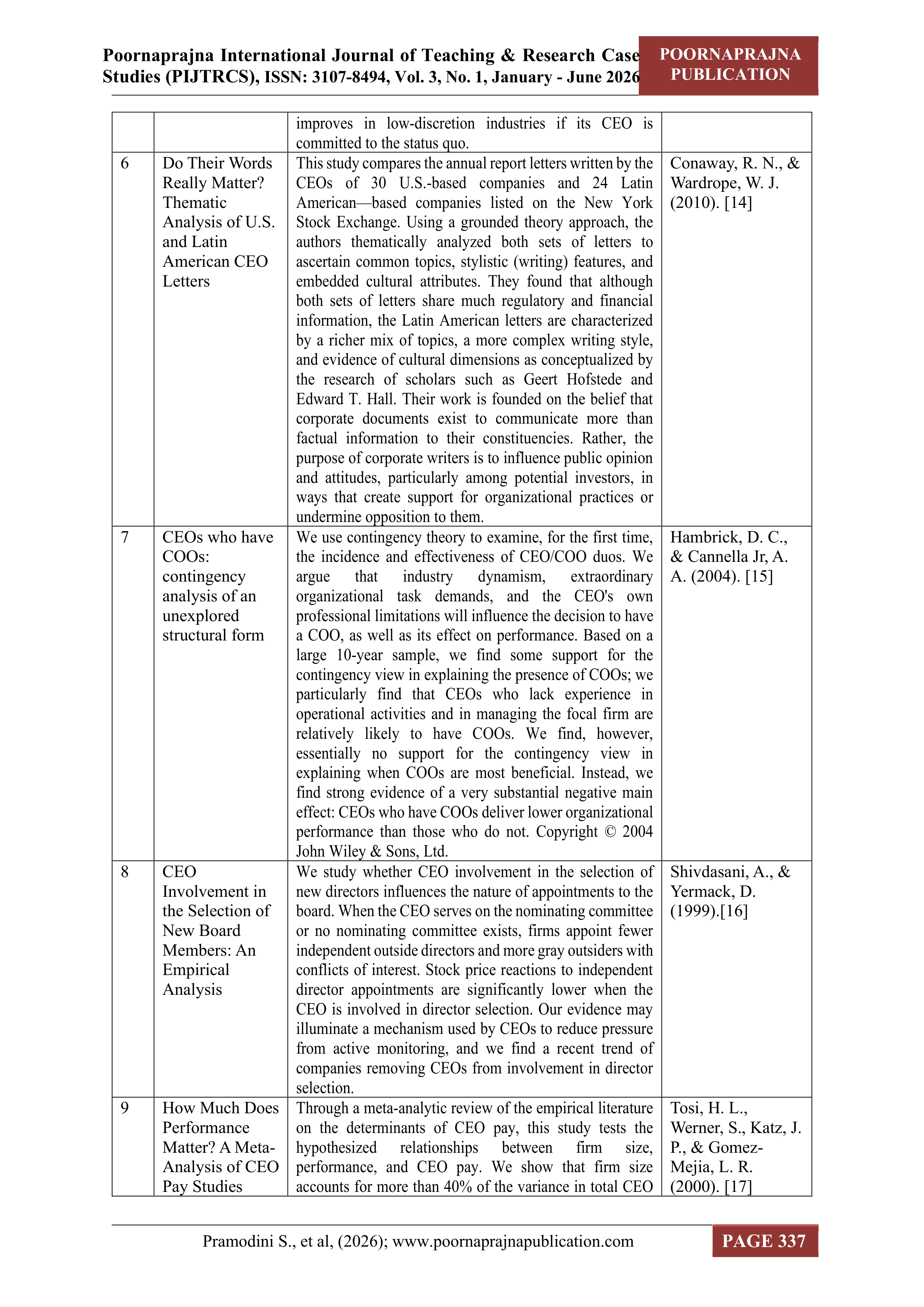
Table 1:
Review of literature using the keyword
“CEO Analysis”
S.
No.
Title of the
Articles
Description
Reference
1
An international
analysis of CEO
social capital
and corporate
risk-taking
This study examines the effects of CEO social capital on
corporate risk-taking around the world. We document a
significant positive relation between CEO social capital
and aggregate corporate risk-taking. Further, we find that
CEOs with large social capital prefer riskier investment
and financial policies. We also determine that the effect of
CEO social capital on corporate risk-taking is moderated
by the extent of legal protections provided to shareholders,
the financial development, and the culture of the country
in which a firm is incorporated. Our results are robust to
alternative proxies of risk-taking, alternative model
specifications, and tests for endogeneity.
Ferris, S. P.,
Javakhadze, D., &
Rajkovic, T.
(2019). [9]


Poornaprajna International Journal of Teaching & Research Case
Studies (PIJTRCS),
ISSN: 3107-8494, Vol. 3, No. 1, January - June 2026
POORNAPRAJNA
PUBLICATION
Pramodini S., et al, (2026); www.poornaprajnapublication.com
PAGE 336
2
The Case for
Separating the
Roles of
Chairman and
CEO: An
Analysis of
Stock Market
and Accounting
Data
This UK study investigates whether the stock market
prefers companies to award the positions of chairman and
chief executive officer to two different people instead of
permitting a single individual, the ‘dual CEO', to combine
them. The results suggest (a) that the market responds
favourably to the separation of the two roles and
unfavourably to their fusion and (b) that the accounting
performance of companies which adopt a ‘dual CEO’
appears to decline subsequent to this change.
Dahya, J., Lonie,
A. A., & Power, D.
M. (1996). [10]
3
FORE! An
Analysis of CEO
Shirking
Using golf play as a measure of leisure, we provide direct
evidence that some CEOs shirk their responsibilities to the
detriment of firm shareholders. CEOs with lower equity-
based incentives play more golf and those that golf the
most are associated with firms that have lower operating
performance and firm values. Numerous tests accounting
for the possible endogenous nature of these relations
support a conclusion that CEO shirking causes lower firm
performance. New CEOs and those at firms with more
independent boards are more likely to be replaced when
they shirk, but those with long tenures or less independent
boards appear to avoid discipline.
Biggerstaff, L.,
Cicero, D. C., &
Puckett, A. (2017).
[11]
4
CEO
Compensation in
Financially
Distressed
Firms: An
Empirical
Analysis
This paper studies senior management compensation
policy in 77 publicly traded firms that filed for bankruptcy
or privately restructured their debt during 1981 to 1987.
Almost one-third of all CEOs are replaced, and those who
keep their jobs often experience large salary and bonus
reductions. Newly appointed CEOs with ties to previous
management are typically paid
35% less
than the CEOs
they replace. In contrast, outside replacement CEOs are
typically paid
36% more
than their predecessors, and are
often compensated with stock options. On average, CEO
wealth is significantly related to shareholder wealth after
firms renegotiate their debt contracts. However, managers'
compensation is sometimes explicitly tied to the value
of
creditors'
claims.
Gilson, S. C., &
Vetsuypens, M. R.
(1993). [12]
5
CEO
Commitment to
the Status Quo:
Replication and
Extension Using
Content
Analysis
A limited number of studies have identified multilevel
determinants
of
chief
executive
officer
(CEO)
commitment to the status quo (CSQ). Using an unintrusive
measure of CEO CSQ developed through computer-aided
content analyses of CEO letters to shareholders, this study
confirmed that determinants of CEO CSQ are multilevel,
including factors at the individual (CEO age and tenure),
organizational (size and financial slack), and industry
(extent of industry discretion) levels of analysis. In
addition, as an important extension to prior research, the
authors find that CEO CSQ is associated with future
performance changes depending on a firm’s industry
environment. They find that in high-discretion industries,
firms whose CEOs are committed to the status quo suffer
future financial and market performance declines as
compared
with
their
competitors,
whereas
such
performance deterioration does not occur in low-discretion
environments. Indeed, when future performance is market
based and measured as Tobin’s Q, the authors find that
compared with competitors, a firm’s performance actually
McClelland, P. L.,
Liang, X., &
Barker III, V. L.
(2010). [13]


Poornaprajna International Journal of Teaching & Research Case
Studies (PIJTRCS),
ISSN: 3107-8494, Vol. 3, No. 1, January - June 2026
POORNAPRAJNA
PUBLICATION
Pramodini S., et al, (2026); www.poornaprajnapublication.com
PAGE 337
improves in low-discretion industries if its CEO is
committed to the status quo.
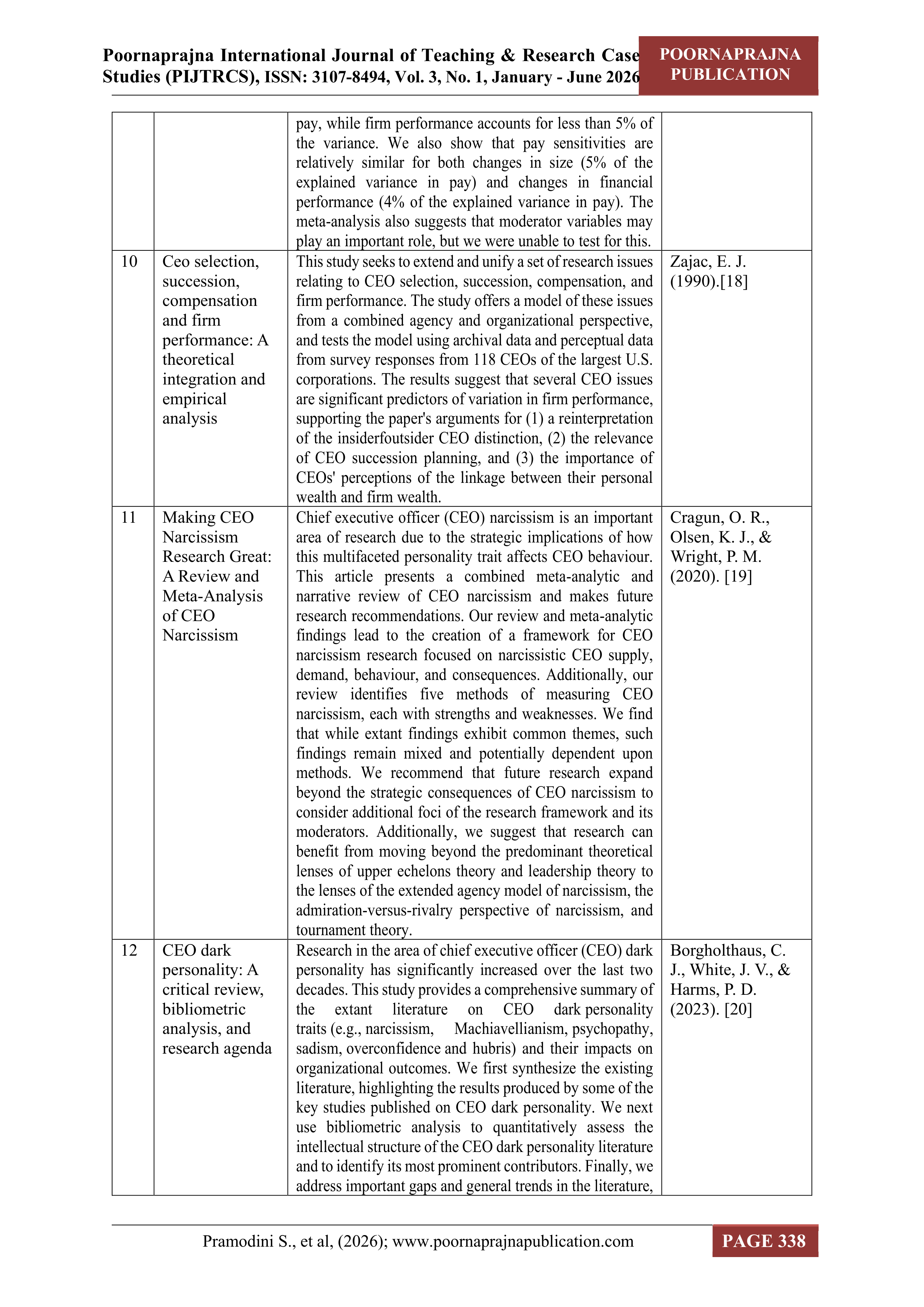
6
Do Their Words
Really Matter?
Thematic
Analysis of U.S.
and Latin
American CEO
Letters
This study compares the annual report letters written by the
CEOs of 30 U.S.-based companies and 24 Latin
American—based companies listed on the New York
Stock Exchange. Using a grounded theory approach, the
authors thematically analyzed both sets of letters to
ascertain common topics, stylistic (writing) features, and
embedded cultural attributes. They found that although
both sets of letters share much regulatory and financial
information, the Latin American letters are characterized
by a richer mix of topics, a more complex writing style,
and evidence of cultural dimensions as conceptualized by
the research of scholars such as Geert Hofstede and
Edward T. Hall. Their work is founded on the belief that
corporate documents exist to communicate more than
factual information to their constituencies. Rather, the
purpose of corporate writers is to influence public opinion
and attitudes, particularly among potential investors, in
ways that create support for organizational practices or
undermine opposition to them.
Conaway, R. N., &
Wardrope, W. J.
(2010). [14]
7
CEOs who have
COOs:
contingency
analysis of an
unexplored
structural form
We use contingency theory to examine, for the first time,
the incidence and effectiveness of CEO/COO duos. We
argue
that
industry
dynamism,
extraordinary
organizational task demands, and the CEO's own
professional limitations will influence the decision to have
a COO, as well as its effect on performance. Based on a
large 10-year sample, we find some support for the
contingency view in explaining the presence of COOs; we
particularly find that CEOs who lack experience in
operational activities and in managing the focal firm are
relatively likely to have COOs. We find, however,
essentially no support for the contingency view in
explaining when COOs are most beneficial. Instead, we
find strong evidence of a very substantial negative main
effect: CEOs who have COOs deliver lower organizational
performance than those who do not. Copyright © 2004
John Wiley & Sons, Ltd.
Hambrick, D. C.,
& Cannella Jr, A.
A. (2004). [15]
8
CEO
Involvement in
the Selection of
New Board
Members: An
Empirical
Analysis
We study whether CEO involvement in the selection of
new directors influences the nature of appointments to the
board. When the CEO serves on the nominating committee
or no nominating committee exists, firms appoint fewer
independent outside directors and more gray outsiders with
conflicts of interest. Stock price reactions to independent
director appointments are significantly lower when the
CEO is involved in director selection. Our evidence may
illuminate a mechanism used by CEOs to reduce pressure
from active monitoring, and we find a recent trend of
companies removing CEOs from involvement in director
selection.
Shivdasani, A., &
Yermack, D.
(1999).[16]
9
How Much Does
Performance
Matter? A Meta-
Analysis of CEO
Pay Studies
Through a meta-analytic review of the empirical literature
on the determinants of CEO pay, this study tests the
hypothesized
relationships
between
firm
size,
performance, and CEO pay. We show that firm size
accounts for more than 40% of the variance in total CEO
Tosi, H. L.,
Werner, S., Katz, J.
P., & Gomez-
Mejia, L. R.
(2000). [17]


Poornaprajna International Journal of Teaching & Research Case
Studies (PIJTRCS),
ISSN: 3107-8494, Vol. 3, No. 1, January - June 2026
POORNAPRAJNA
PUBLICATION
Pramodini S., et al, (2026); www.poornaprajnapublication.com
PAGE 338
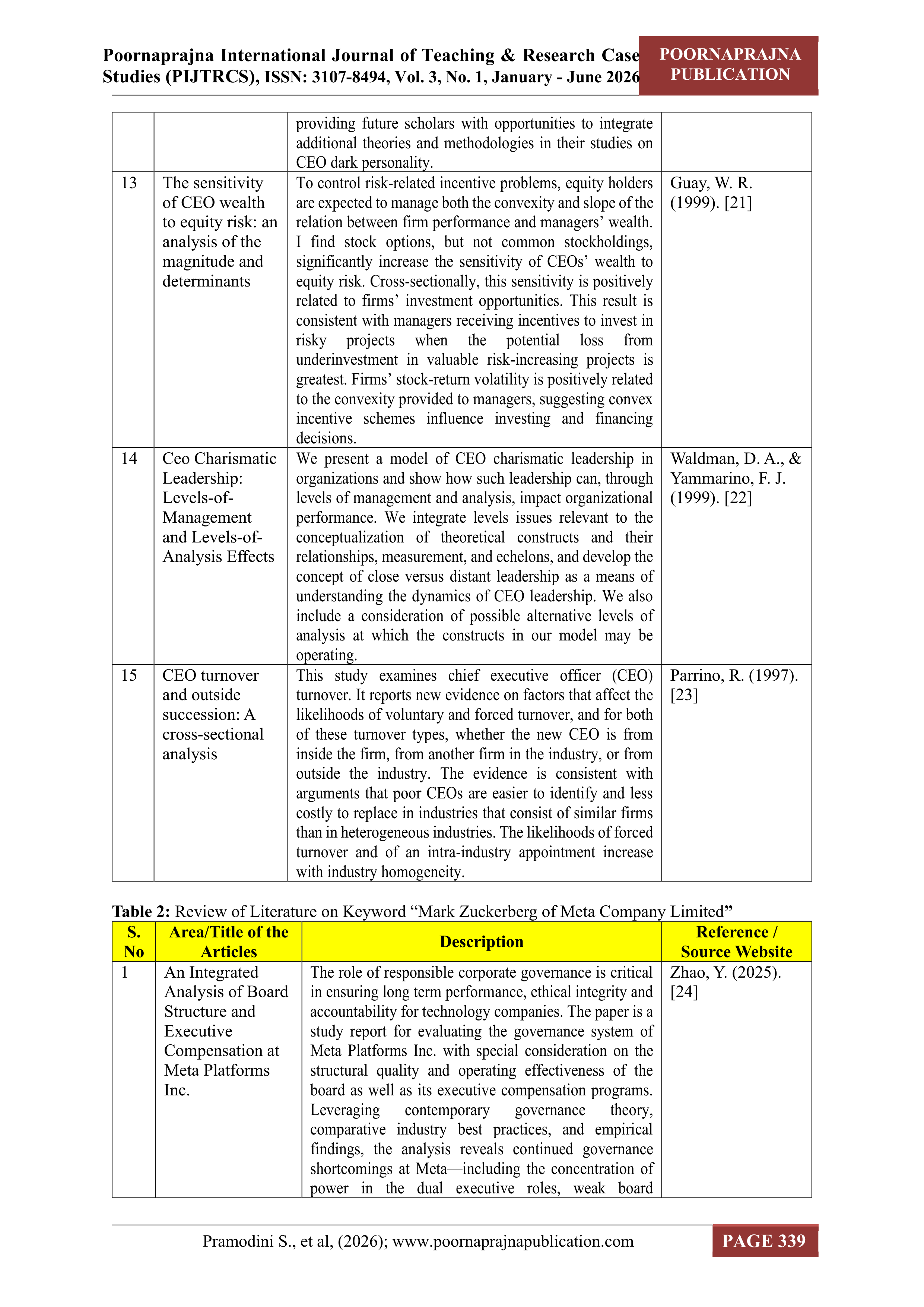
pay, while firm performance accounts for less than 5% of
the variance. We also show that pay sensitivities are
relatively similar for both changes in size (5% of the
explained variance in pay) and changes in financial
performance (4% of the explained variance in pay). The
meta-analysis also suggests that moderator variables may
play an important role, but we were unable to test for this.
10
Ceo selection,
succession,
compensation
and firm
performance: A
theoretical
integration and
empirical
analysis
This study seeks to extend and unify a set of research issues
relating to CEO selection, succession, compensation, and
firm performance. The study offers a model of these issues
from a combined agency and organizational perspective,
and tests the model using archival data and perceptual data
from survey responses from 118 CEOs of the largest U.S.
corporations. The results suggest that several CEO issues
are significant predictors of variation in firm performance,
supporting the paper's arguments for (1) a reinterpretation
of the insiderfoutsider CEO distinction, (2) the relevance
of CEO succession planning, and (3) the importance of
CEOs' perceptions of the linkage between their personal
wealth and firm wealth.
Zajac, E. J.
(1990).[18]
11
Making CEO
Narcissism
Research Great:
A Review and
Meta-Analysis
of CEO
Narcissism
Chief executive officer (CEO) narcissism is an important
area of research due to the strategic implications of how
this multifaceted personality trait affects CEO behaviour.
This article presents a combined meta-analytic and
narrative review of CEO narcissism and makes future
research recommendations. Our review and meta-analytic
findings lead to the creation of a framework for CEO
narcissism research focused on narcissistic CEO supply,
demand, behaviour, and consequences. Additionally, our
review identifies five methods of measuring CEO
narcissism, each with strengths and weaknesses. We find
that while extant findings exhibit common themes, such
findings remain mixed and potentially dependent upon
methods. We recommend that future research expand
beyond the strategic consequences of CEO narcissism to
consider additional foci of the research framework and its
moderators. Additionally, we suggest that research can
benefit from moving beyond the predominant theoretical
lenses of upper echelons theory and leadership theory to
the lenses of the extended agency model of narcissism, the
admiration-versus-rivalry perspective of narcissism, and
tournament theory.
Cragun, O. R.,
Olsen, K. J., &
Wright, P. M.
(2020). [19]
12
CEO dark
personality: A
critical review,
bibliometric
analysis, and
research agenda
Research in the area of chief executive officer (CEO) dark
personality has significantly increased over the last two
decades. This study provides a comprehensive summary of
the
extant
literature
on
CEO
dark personality
traits (e.g., narcissism,
Machiavellianism, psychopathy,
sadism, overconfidence and hubris) and their impacts on
organizational outcomes. We first synthesize the existing
literature, highlighting the results produced by some of the
key studies published on CEO dark personality. We next
use bibliometric analysis to quantitatively assess the
intellectual structure of the CEO dark personality literature
and to identify its most prominent contributors. Finally, we
address important gaps and general trends in the literature,
Borgholthaus, C.
J., White, J. V., &
Harms, P. D.
(2023). [20]


Poornaprajna International Journal of Teaching & Research Case
Studies (PIJTRCS),
ISSN: 3107-8494, Vol. 3, No. 1, January - June 2026
POORNAPRAJNA
PUBLICATION
Pramodini S., et al, (2026); www.poornaprajnapublication.com
PAGE 339
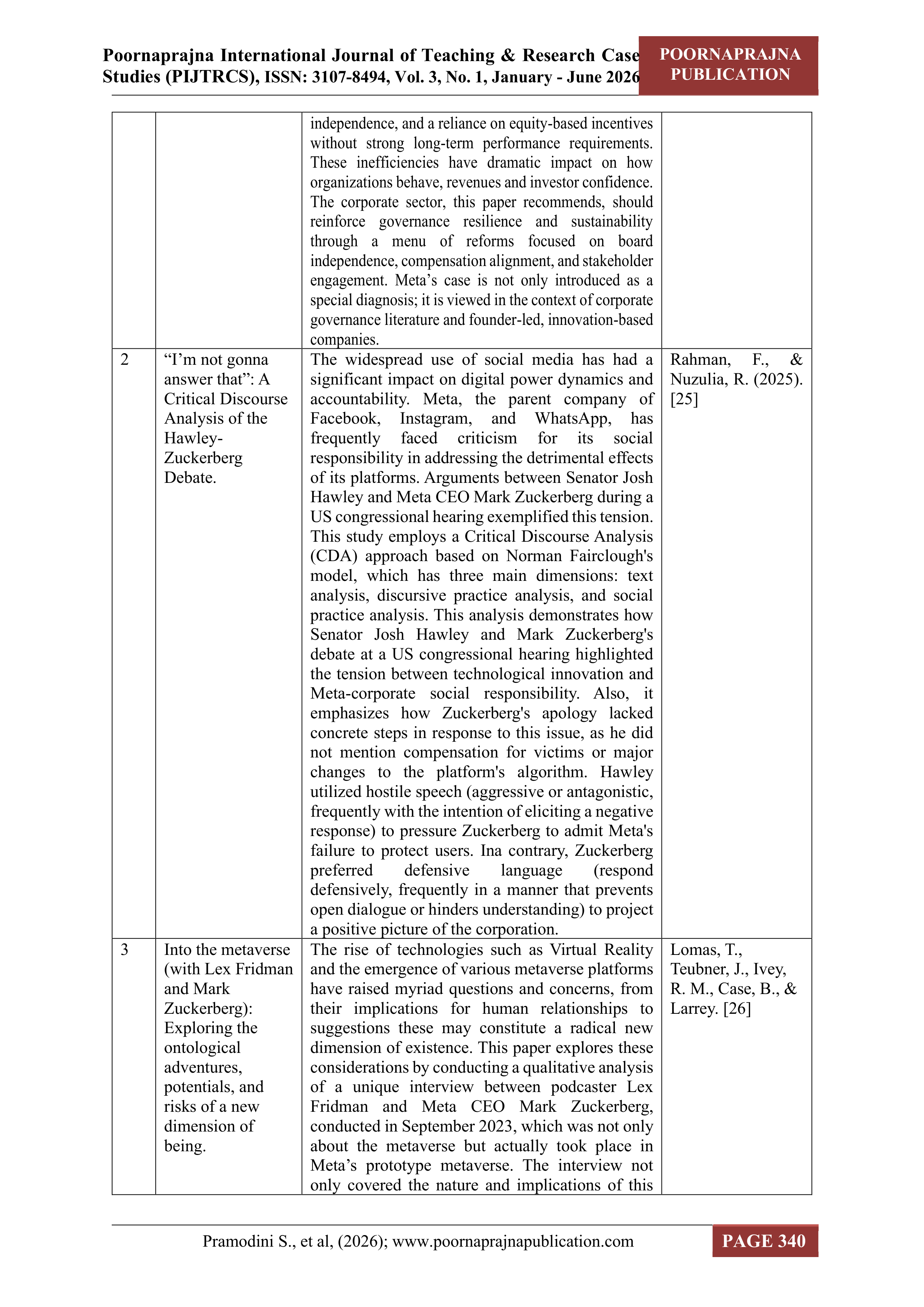
providing future scholars with opportunities to integrate
additional theories and methodologies in their studies on
CEO dark personality.
13
The sensitivity
of CEO wealth
to equity risk: an
analysis of the
magnitude and
determinants
To control risk-related incentive problems, equity holders
are expected to manage both the convexity and slope of the
relation between firm performance and managers’ wealth.
I find stock options, but not common stockholdings,
significantly increase the sensitivity of CEOs’ wealth to
equity risk. Cross-sectionally, this sensitivity is positively
related to firms’ investment opportunities. This result is
consistent with managers receiving incentives to invest in
risky
projects
when
the
potential
loss
from
underinvestment in valuable risk-increasing projects is
greatest. Firms’ stock-return volatility is positively related
to the convexity provided to managers, suggesting convex
incentive schemes influence investing and financing
decisions.
Guay, W. R.
(1999). [21]
14
Ceo Charismatic
Leadership:
Levels-of-
Management
and Levels-of-
Analysis Effects
We present a model of CEO charismatic leadership in
organizations and show how such leadership can, through
levels of management and analysis, impact organizational
performance. We integrate levels issues relevant to the
conceptualization of theoretical constructs and their
relationships, measurement, and echelons, and develop the
concept of close versus distant leadership as a means of
understanding the dynamics of CEO leadership. We also
include a consideration of possible alternative levels of
analysis at which the constructs in our model may be
operating.
Waldman, D. A., &
Yammarino, F. J.
(1999). [22]
15
CEO turnover
and outside
succession: A
cross-sectional
analysis
This study examines chief executive officer (CEO)
turnover. It reports new evidence on factors that affect the
likelihoods of voluntary and forced turnover, and for both
of these turnover types, whether the new CEO is from
inside the firm, from another firm in the industry, or from
outside the industry. The evidence is consistent with
arguments that poor CEOs are easier to identify and less
costly to replace in industries that consist of similar firms
than in heterogeneous industries. The likelihoods of forced
turnover and of an intra-industry appointment increase
with industry homogeneity.
Parrino, R. (1997).
[23]
Table 2:
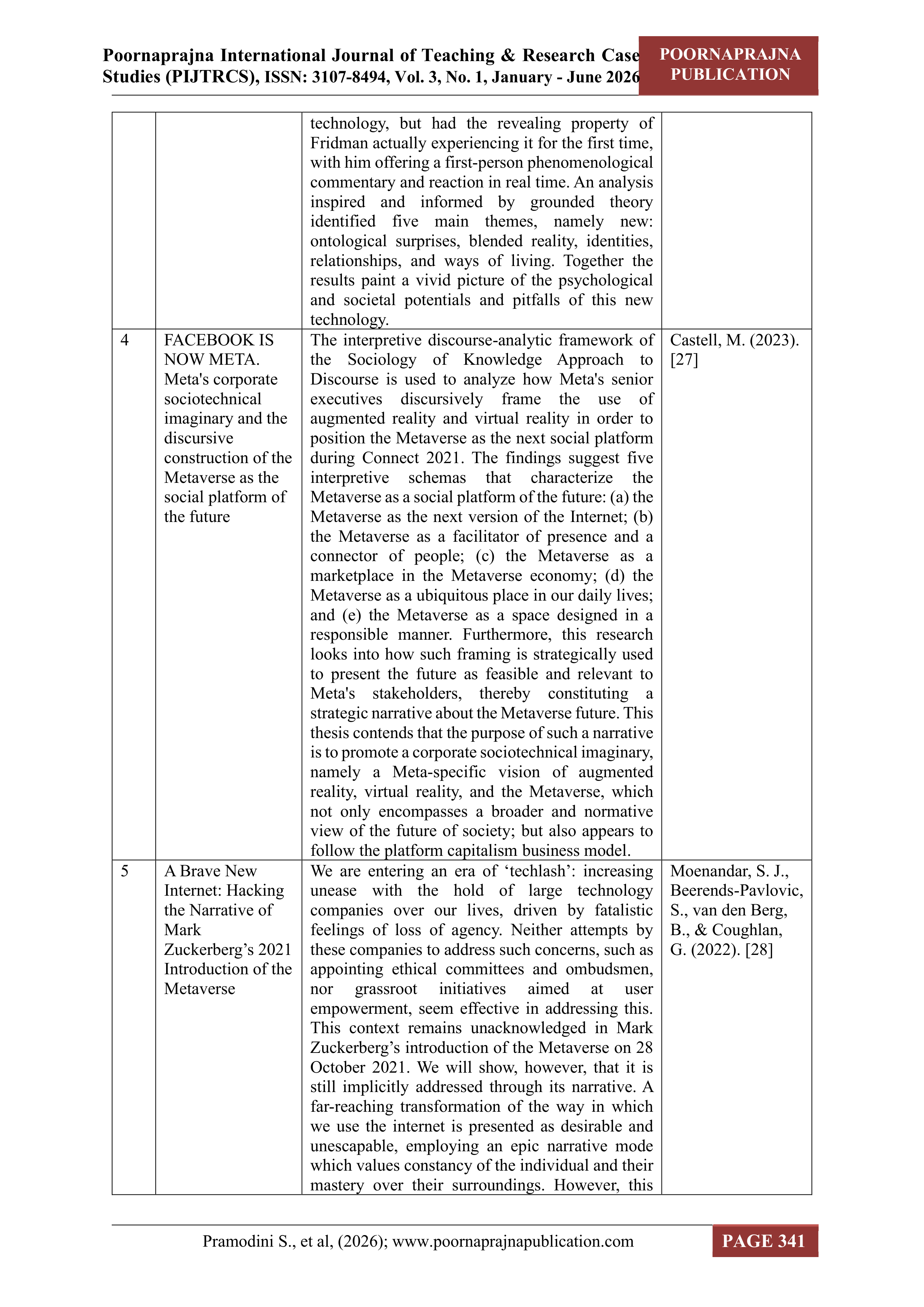
Review of Literature on Keyword “Mark Zuckerberg of Meta Company Limited
”
S.
No
Area/Title of the
Articles
Description
Reference /
Source Website
1
An Integrated
Analysis of Board
Structure and
Executive
Compensation at
Meta Platforms
Inc.
The role of responsible corporate governance is critical
in ensuring long term performance, ethical integrity and
accountability for technology companies. The paper is a
study report for evaluating the governance system of
Meta Platforms Inc. with special consideration on the
structural quality and operating effectiveness of the
board as well as its executive compensation programs.
Leveraging
contemporary
governance
theory,
comparative industry best practices, and empirical
findings, the analysis reveals continued governance
shortcomings at Meta—including the concentration of
power in the dual executive roles, weak board
Zhao, Y. (2025).
[24]


Poornaprajna International Journal of Teaching & Research Case
Studies (PIJTRCS),
ISSN: 3107-8494, Vol. 3, No. 1, January - June 2026
POORNAPRAJNA
PUBLICATION
Pramodini S., et al, (2026); www.poornaprajnapublication.com
PAGE 340
independence, and a reliance on equity-based incentives
without strong long-term performance requirements.
These inefficiencies have dramatic impact on how
organizations behave, revenues and investor confidence.
The corporate sector, this paper recommends, should
reinforce governance resilience and sustainability
through a menu of reforms focused on board
independence, compensation alignment, and stakeholder
engagement. Meta’s case is not only introduced as a
special diagnosis; it is viewed in the context of corporate
governance literature and founder-led, innovation-based
companies.
2
“I’m not gonna
answer that”: A
Critical Discourse
Analysis of the
Hawley-
Zuckerberg
Debate.
The widespread use of social media has had a
significant impact on digital power dynamics and
accountability. Meta, the parent company of
Facebook,
Instagram,
and
WhatsApp,
has
frequently
faced
criticism
for
its
social
responsibility in addressing the detrimental effects
of its platforms. Arguments between Senator Josh
Hawley and Meta CEO Mark Zuckerberg during a
US congressional hearing exemplified this tension.
This study employs a Critical Discourse Analysis
(CDA) approach based on Norman Fairclough's
model, which has three main dimensions: text
analysis, discursive practice analysis, and social
practice analysis. This analysis demonstrates how
Senator Josh Hawley and Mark Zuckerberg's
debate at a US congressional hearing highlighted
the tension between technological innovation and
Meta-corporate social responsibility. Also, it
emphasizes how Zuckerberg's apology lacked
concrete steps in response to this issue, as he did
not mention compensation for victims or major
changes to the platform's algorithm. Hawley
utilized hostile speech (aggressive or antagonistic,
frequently with the intention of eliciting a negative
response) to pressure Zuckerberg to admit Meta's
failure to protect users. Ina contrary, Zuckerberg
preferred
defensive
language
(respond
defensively, frequently in a manner that prevents
open dialogue or hinders understanding) to project
a positive picture of the corporation.
Rahman,
F.,
&
Nuzulia, R. (2025).
[25]
3
Into the metaverse
(with Lex Fridman
and Mark
Zuckerberg):
Exploring the
ontological
adventures,
potentials, and
risks of a new
dimension of
being.
The rise of technologies such as Virtual Reality
and the emergence of various metaverse platforms
have raised myriad questions and concerns, from
their implications for human relationships to
suggestions these may constitute a radical new
dimension of existence. This paper explores these
considerations by conducting a qualitative analysis
of a unique interview between podcaster Lex
Fridman and Meta CEO Mark Zuckerberg,
conducted in September 2023, which was not only
about the metaverse but actually took place in
Meta’s prototype metaverse. The interview not
only covered the nature and implications of this
Lomas, T.,
Teubner, J., Ivey,
R. M., Case, B., &
Larrey. [26]


Poornaprajna International Journal of Teaching & Research Case
Studies (PIJTRCS),
ISSN: 3107-8494, Vol. 3, No. 1, January - June 2026
POORNAPRAJNA
PUBLICATION
Pramodini S., et al, (2026); www.poornaprajnapublication.com
PAGE 341
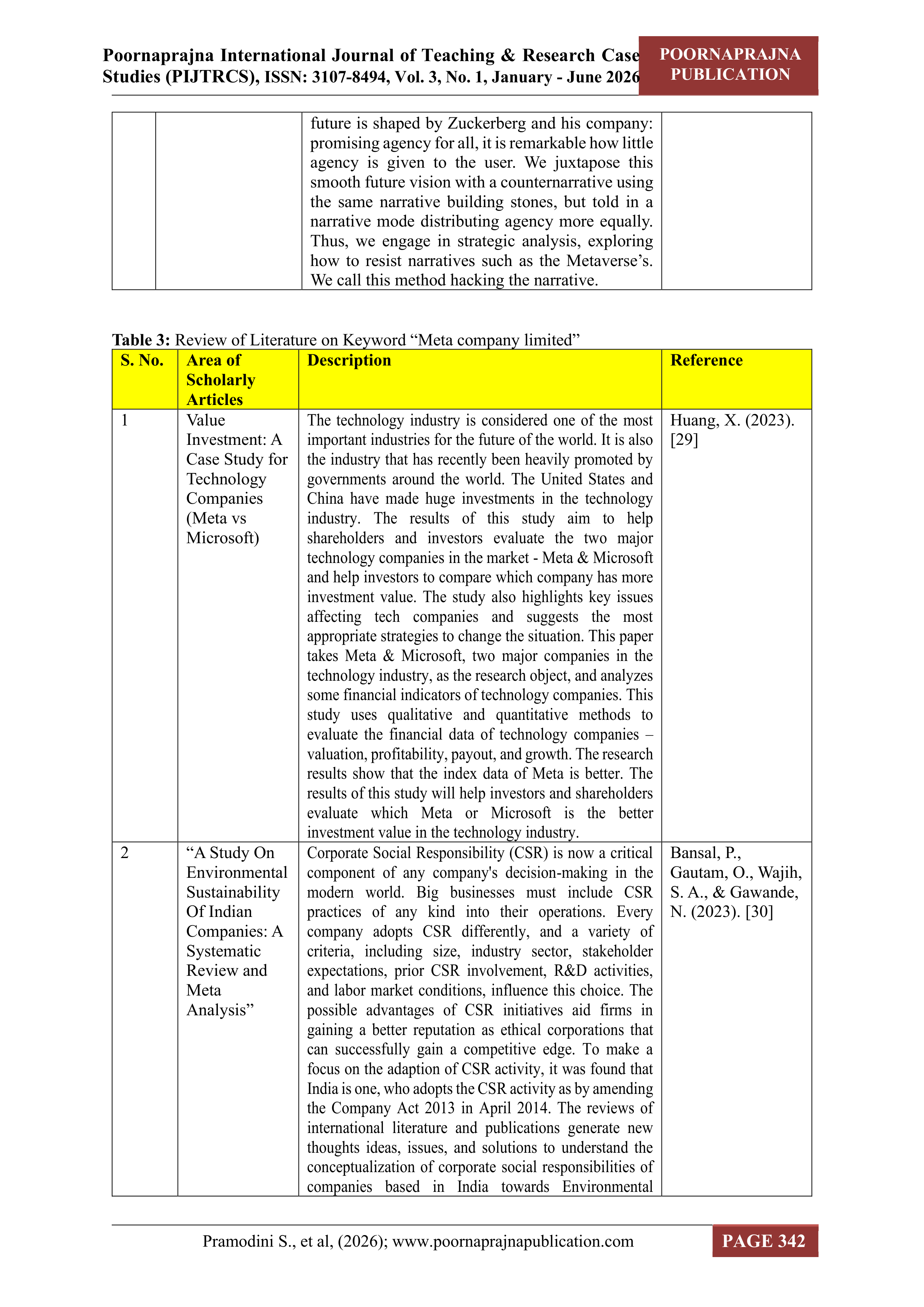
technology, but had the revealing property of
Fridman actually experiencing it for the first time,
with him offering a first-person phenomenological
commentary and reaction in real time. An analysis
inspired and informed by grounded theory
identified five main themes, namely new:
ontological surprises, blended reality, identities,
relationships, and ways of living. Together the
results paint a vivid picture of the psychological
and societal potentials and pitfalls of this new
technology.
4
FACEBOOK IS
NOW META.
Meta's corporate
sociotechnical
imaginary and the
discursive
construction of the
Metaverse as the
social platform of
the future
The interpretive discourse-analytic framework of
the Sociology of Knowledge Approach to
Discourse is used to analyze how Meta's senior
executives
discursively
frame
the
use
of
augmented reality and virtual reality in order to
position the Metaverse as the next social platform
during Connect 2021. The findings suggest five
interpretive
schemas
that
characterize
the
Metaverse as a social platform of the future: (a) the
Metaverse as the next version of the Internet; (b)
the Metaverse as a facilitator of presence and a
connector of people; (c) the Metaverse as a
marketplace in the Metaverse economy; (d) the
Metaverse as a ubiquitous place in our daily lives;
and (e) the Metaverse as a space designed in a
responsible manner. Furthermore, this research
looks into how such framing is strategically used
to present the future as feasible and relevant to
Meta's stakeholders, thereby constituting a
strategic narrative about the Metaverse future. This
thesis contends that the purpose of such a narrative
is to promote a corporate sociotechnical imaginary,
namely a Meta-specific vision of augmented
reality, virtual reality, and the Metaverse, which
not only encompasses a broader and normative
view of the future of society; but also appears to
follow the platform capitalism business model.
Castell, M. (2023).
[27]
5
A Brave New
Internet: Hacking
the Narrative of
Mark
Zuckerberg’s 2021
Introduction of the
Metaverse
We are entering an era of ‘techlash’: increasing
unease with the hold of large technology
companies over our lives, driven by fatalistic
feelings of loss of agency. Neither attempts by
these companies to address such concerns, such as
appointing ethical committees and ombudsmen,
nor
grassroot
initiatives
aimed
at
user
empowerment, seem effective in addressing this.
This context remains unacknowledged in Mark
Zuckerberg’s introduction of the Metaverse on 28
October 2021. We will show, however, that it is
still implicitly addressed through its narrative. A
far-reaching transformation of the way in which
we use the internet is presented as desirable and
unescapable, employing an epic narrative mode
which values constancy of the individual and their
mastery over their surroundings. However, this
Moenandar, S. J.,
Beerends-Pavlovic,
S., van den Berg,
B., & Coughlan,
G. (2022). [28]


Poornaprajna International Journal of Teaching & Research Case
Studies (PIJTRCS),
ISSN: 3107-8494, Vol. 3, No. 1, January - June 2026
POORNAPRAJNA
PUBLICATION
Pramodini S., et al, (2026); www.poornaprajnapublication.com
PAGE 342
future is shaped by Zuckerberg and his company:
promising agency for all, it is remarkable how little
agency is given to the user. We juxtapose this
smooth future vision with a counternarrative using
the same narrative building stones, but told in a
narrative mode distributing agency more equally.
Thus, we engage in strategic analysis, exploring
how to resist narratives such as the Metaverse’s.
We call this method hacking the narrative.
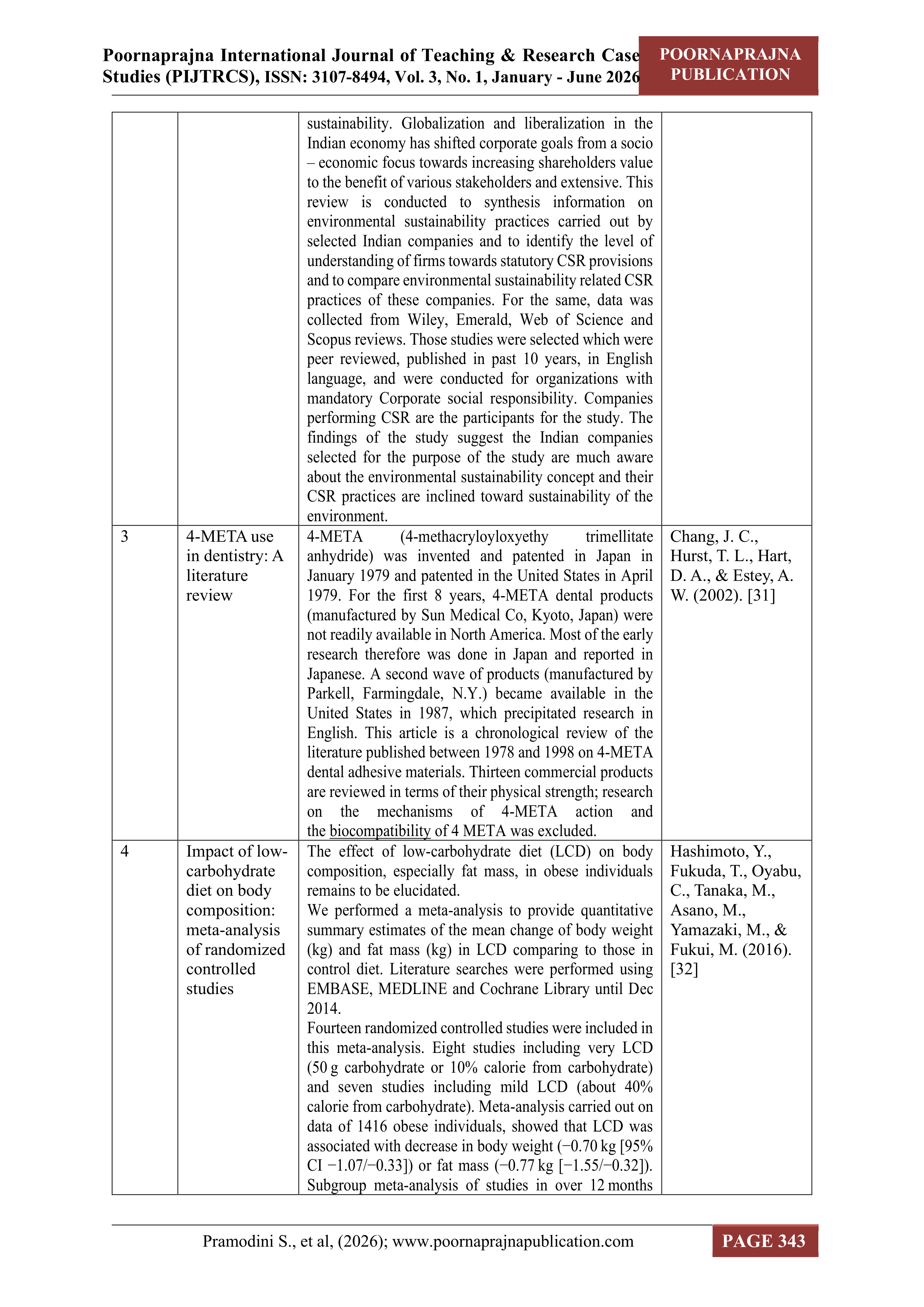
Table 3:
Review of Literature on Keyword “Meta company limited”
S. No.
Area of
Scholarly
Articles
Description
Reference
1
Value
Investment: A
Case Study for
Technology
Companies
(Meta vs
Microsoft)
The technology industry is considered one of the most
important industries for the future of the world. It is also
the industry that has recently been heavily promoted by
governments around the world. The United States and
China have made huge investments in the technology
industry. The results of this study aim to help
shareholders and investors evaluate the two major
technology companies in the market - Meta & Microsoft
and help investors to compare which company has more
investment value. The study also highlights key issues
affecting tech companies and suggests the most
appropriate strategies to change the situation. This paper
takes Meta & Microsoft, two major companies in the
technology industry, as the research object, and analyzes
some financial indicators of technology companies. This
study uses qualitative and quantitative methods to
evaluate the financial data of technology companies –
valuation, profitability, payout, and growth. The research
results show that the index data of Meta is better. The
results of this study will help investors and shareholders
evaluate which Meta or Microsoft is the better
investment value in the technology industry.
Huang, X. (2023).
[29]
2
“A Study On
Environmental
Sustainability
Of Indian
Companies: A
Systematic
Review and
Meta
Analysis”
Corporate Social Responsibility (CSR) is now a critical
component of any company's decision-making in the
modern world. Big businesses must include CSR
practices of any kind into their operations. Every
company adopts CSR differently, and a variety of
criteria, including size, industry sector, stakeholder
expectations, prior CSR involvement, R&D activities,
and labor market conditions, influence this choice. The
possible advantages of CSR initiatives aid firms in
gaining a better reputation as ethical corporations that
can successfully gain a competitive edge. To make a
focus on the adaption of CSR activity, it was found that
India is one, who adopts the CSR activity as by amending
the Company Act 2013 in April 2014. The reviews of
international literature and publications generate new
thoughts ideas, issues, and solutions to understand the
conceptualization of corporate social responsibilities of
companies based in India towards Environmental
Bansal, P.,
Gautam, O., Wajih,
S. A., & Gawande,
N. (2023). [30]


Poornaprajna International Journal of Teaching & Research Case
Studies (PIJTRCS),
ISSN: 3107-8494, Vol. 3, No. 1, January - June 2026
POORNAPRAJNA
PUBLICATION
Pramodini S., et al, (2026); www.poornaprajnapublication.com
PAGE 343
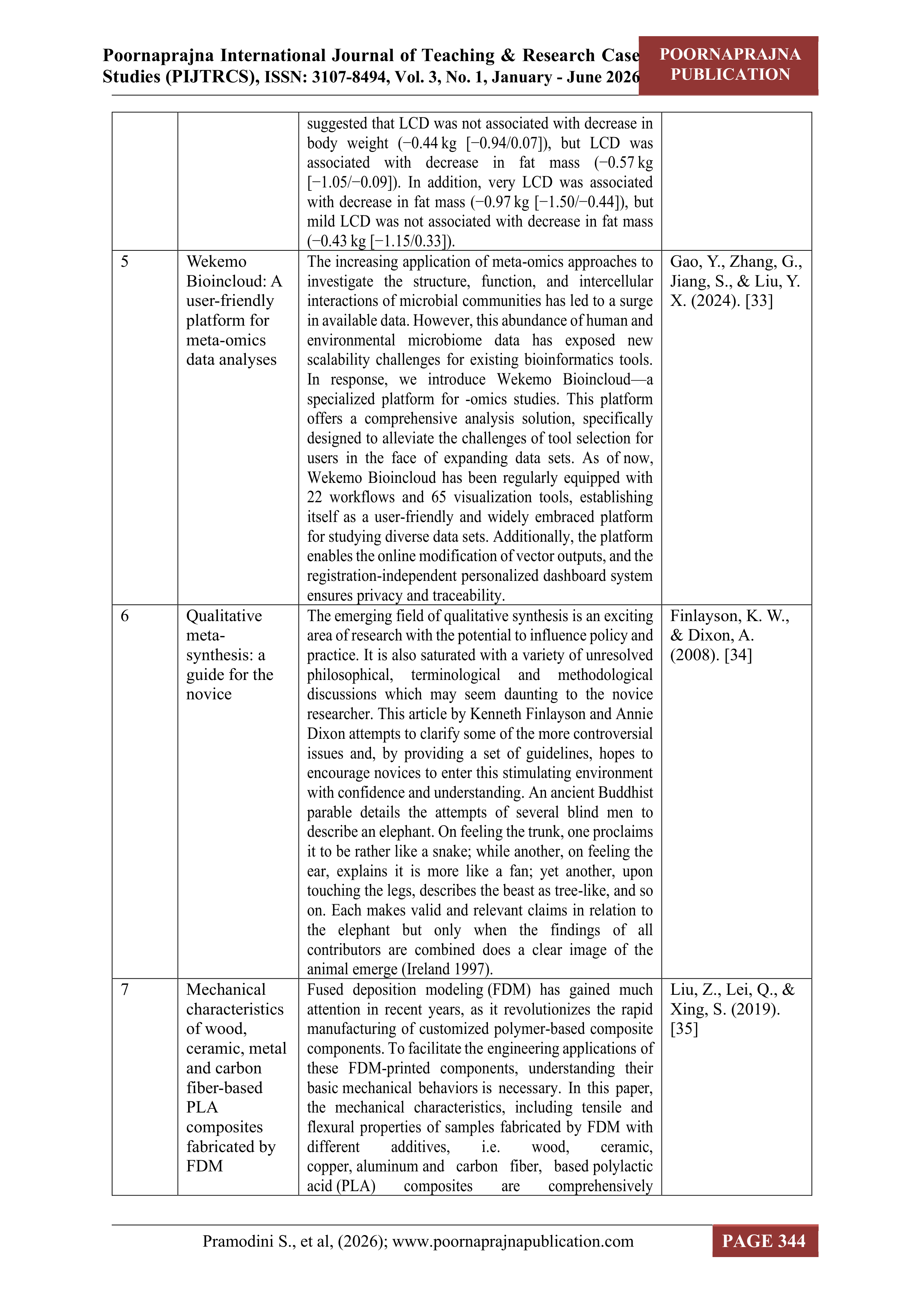
sustainability. Globalization and liberalization in the
Indian economy has shifted corporate goals from a socio
– economic focus towards increasing shareholders value
to the benefit of various stakeholders and extensive. This
review is conducted to synthesis information on
environmental sustainability practices carried out by
selected Indian companies and to identify the level of
understanding of firms towards statutory CSR provisions
and to compare environmental sustainability related CSR
practices of these companies. For the same, data was
collected from Wiley, Emerald, Web of Science and
Scopus reviews. Those studies were selected which were
peer reviewed, published in past 10 years, in English
language, and were conducted for organizations with
mandatory Corporate social responsibility. Companies
performing CSR are the participants for the study. The
findings of the study suggest the Indian companies
selected for the purpose of the study are much aware
about the environmental sustainability concept and their
CSR practices are inclined toward sustainability of the
environment.
3
4-META use
in dentistry: A
literature
review
4-META
(4-methacryloyloxyethy
trimellitate
anhydride) was invented and patented in Japan in
January 1979 and patented in the United States in April
1979. For the first 8 years, 4-META dental products
(manufactured by Sun Medical Co, Kyoto, Japan) were
not readily available in North America. Most of the early
research therefore was done in Japan and reported in
Japanese. A second wave of products (manufactured by
Parkell, Farmingdale, N.Y.) became available in the
United States in 1987, which precipitated research in
English. This article is a chronological review of the
literature published between 1978 and 1998 on 4-META
dental adhesive materials. Thirteen commercial products
are reviewed in terms of their physical strength; research
on
the
mechanisms
of
4-META
action
and
the biocompatibility of 4 META was excluded.
Chang, J. C.,
Hurst, T. L., Hart,
D. A., & Estey, A.
W. (2002). [31]
4
Impact of low-
carbohydrate
diet on body
composition:
meta-analysis
of randomized
controlled
studies
The effect of low-carbohydrate diet (LCD) on body
composition, especially fat mass, in obese individuals
remains to be elucidated.
We performed a meta-analysis to provide quantitative
summary estimates of the mean change of body weight
(kg) and fat mass (kg) in LCD comparing to those in
control diet. Literature searches were performed using
EMBASE, MEDLINE and Cochrane Library until Dec
2014.
Fourteen randomized controlled studies were included in
this meta-analysis. Eight studies including very LCD
(50 g carbohydrate or 10% calorie from carbohydrate)
and seven studies including mild LCD (about 40%
calorie from carbohydrate). Meta-analysis carried out on
data of 1416 obese individuals, showed that LCD was
associated with decrease in body weight (−0.70 kg [95%
CI −1.07/−0.33]) or fat mass (−0.77 kg [−1.55/−0.32]).
Subgroup meta-analysis of studies in over 12 months
Hashimoto, Y.,
Fukuda, T., Oyabu,
C., Tanaka, M.,
Asano, M.,
Yamazaki, M., &
Fukui, M. (2016).
[32]


Poornaprajna International Journal of Teaching & Research Case
Studies (PIJTRCS),
ISSN: 3107-8494, Vol. 3, No. 1, January - June 2026
POORNAPRAJNA
PUBLICATION
Pramodini S., et al, (2026); www.poornaprajnapublication.com
PAGE 344
suggested that LCD was not associated with decrease in
body weight (−0.44 kg [−0.94/0.07]), but LCD was
associated with decrease in fat mass (−0.57 kg
[−1.05/−0.09]). In addition, very LCD was associated
with decrease in fat mass (−0.97 kg [−1.50/−0.44]), but
mild LCD was not associated with decrease in fat mass
(−0.43 kg [−1.15/0.33]).
5
Wekemo
Bioincloud: A
user-friendly
platform for
meta-omics
data analyses
The increasing application of meta-omics approaches to
investigate the structure, function, and intercellular
interactions of microbial communities has led to a surge
in available data. However, this abundance of human and
environmental microbiome data has exposed new
scalability challenges for existing bioinformatics tools.
In response, we introduce Wekemo Bioincloud—a
specialized platform for -omics studies. This platform
offers a comprehensive analysis solution, specifically
designed to alleviate the challenges of tool selection for
users in the face of expanding data sets. As of now,
Wekemo Bioincloud has been regularly equipped with
22 workflows and 65 visualization tools, establishing
itself as a user-friendly and widely embraced platform
for studying diverse data sets. Additionally, the platform
enables the online modification of vector outputs, and the
registration-independent personalized dashboard system
ensures privacy and traceability.
Gao, Y., Zhang, G.,
Jiang, S., & Liu, Y.
X. (2024). [33]
6
Qualitative
meta-
synthesis: a
guide for the
novice
The emerging field of qualitative synthesis is an exciting
area of research with the potential to influence policy and
practice. It is also saturated with a variety of unresolved
philosophical,
terminological
and
methodological
discussions which may seem daunting to the novice
researcher. This article by Kenneth Finlayson and Annie
Dixon attempts to clarify some of the more controversial
issues and, by providing a set of guidelines, hopes to
encourage novices to enter this stimulating environment
with confidence and understanding. An ancient Buddhist
parable details the attempts of several blind men to
describe an elephant. On feeling the trunk, one proclaims
it to be rather like a snake; while another, on feeling the
ear, explains it is more like a fan; yet another, upon
touching the legs, describes the beast as tree-like, and so
on. Each makes valid and relevant claims in relation to
the elephant but only when the findings of all
contributors are combined does a clear image of the
animal emerge (Ireland 1997).
Finlayson, K. W.,
& Dixon, A.
(2008). [34]
7
Mechanical
characteristics
of wood,
ceramic, metal
and carbon
fiber-based
PLA
composites
fabricated by
FDM
Fused deposition modeling (FDM) has gained much
attention in recent years, as it revolutionizes the rapid
manufacturing of customized polymer-based composite
components. To facilitate the engineering applications of
these FDM-printed components, understanding their
basic mechanical behaviors is necessary. In this paper,
the mechanical characteristics, including tensile and
flexural properties of samples fabricated by FDM with
different
additives,
i.e.
wood,
ceramic,
copper, aluminum and carbon fiber, based polylactic
acid (PLA)
composites
are
comprehensively
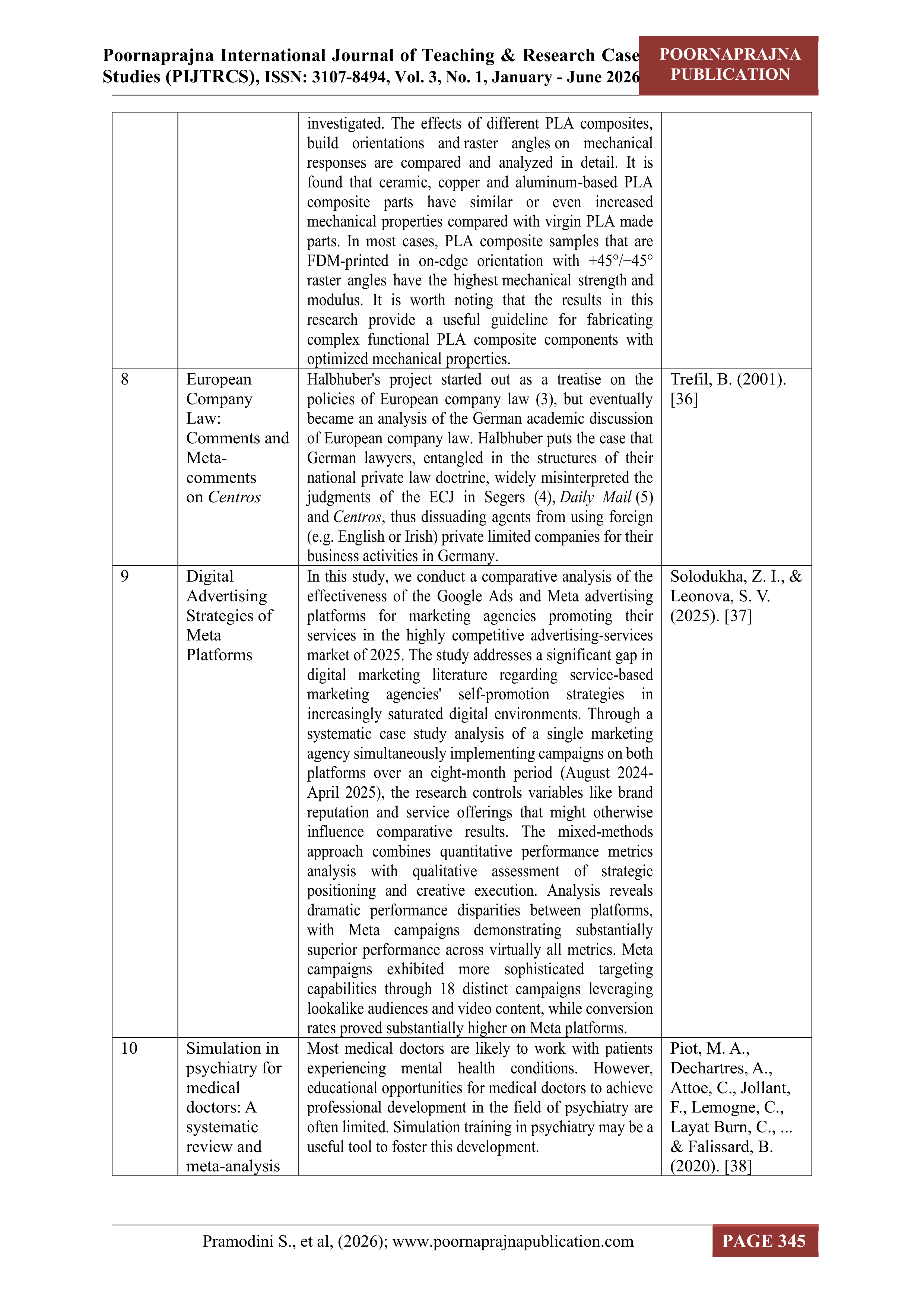
Liu, Z., Lei, Q., &
Xing, S. (2019).
[35]


Poornaprajna International Journal of Teaching & Research Case
Studies (PIJTRCS),
ISSN: 3107-8494, Vol. 3, No. 1, January - June 2026
POORNAPRAJNA
PUBLICATION
Pramodini S., et al, (2026); www.poornaprajnapublication.com
PAGE 345
investigated. The effects of different PLA composites,
build orientations and raster angles on mechanical
responses are compared and analyzed in detail. It is
found that ceramic, copper and aluminum-based PLA
composite parts have similar or even increased
mechanical properties compared with virgin PLA made
parts. In most cases, PLA composite samples that are
FDM-printed in on-edge orientation with +45°/−45°
raster angles have the highest mechanical strength and
modulus. It is worth noting that the results in this
research provide a useful guideline for fabricating
complex functional PLA composite components with
optimized mechanical properties.
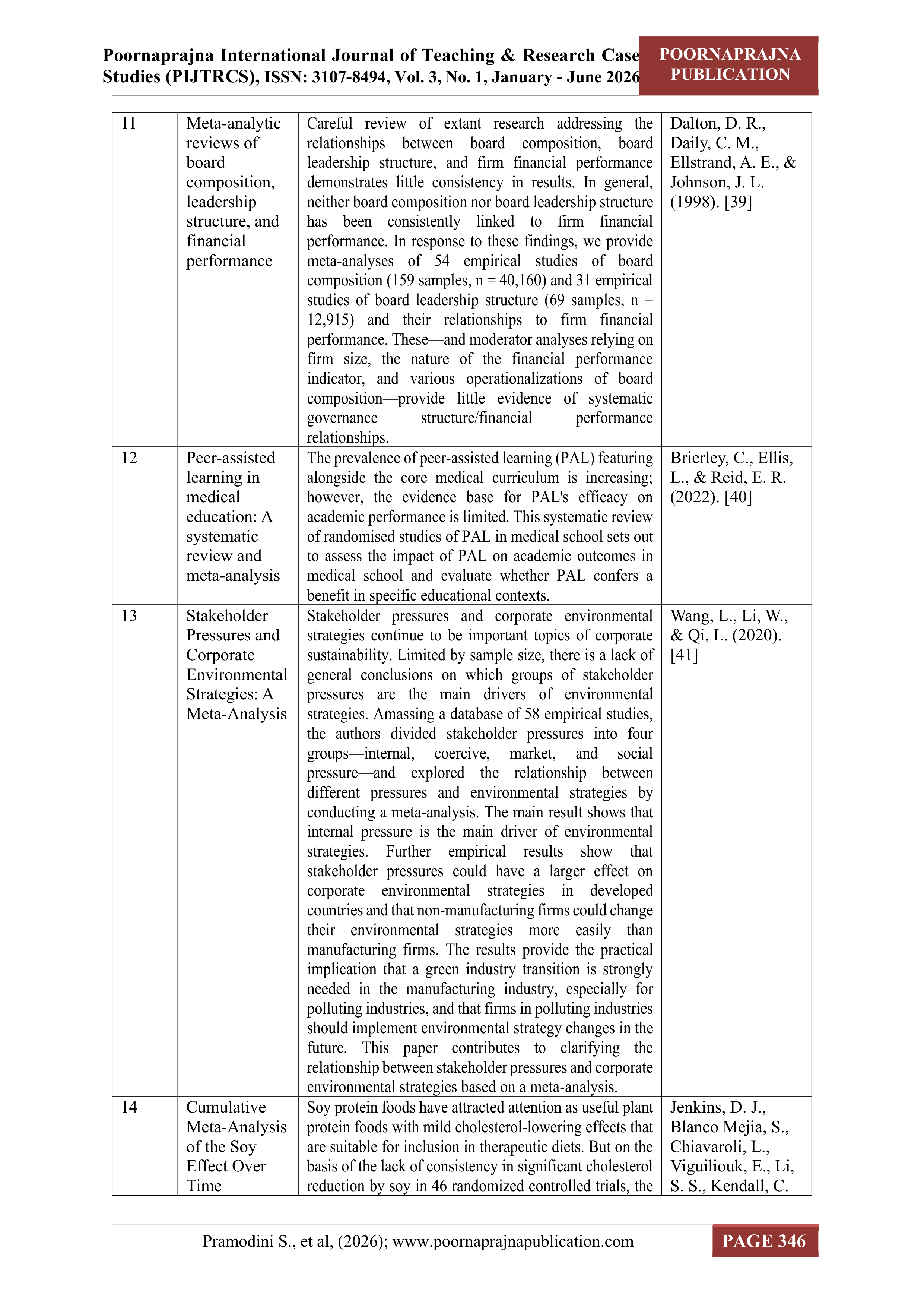
8
European
Company
Law:
Comments and
Meta-
comments
on
Centros
Halbhuber's project started out as a treatise on the
policies of European company law (3), but eventually
became an analysis of the German academic discussion
of European company law. Halbhuber puts the case that
German lawyers, entangled in the structures of their
national private law doctrine, widely misinterpreted the
judgments of the ECJ in Segers (4),
Daily Mail
(5)
and
Centros
, thus dissuading agents from using foreign
(e.g. English or Irish) private limited companies for their
business activities in Germany.
Trefil, B. (2001).
[36]
9
Digital
Advertising
Strategies of
Meta
Platforms
In this study, we conduct a comparative analysis of the
effectiveness of the Google Ads and Meta advertising
platforms for marketing agencies promoting their
services in the highly competitive advertising-services
market of 2025. The study addresses a significant gap in
digital marketing literature regarding service-based
marketing
agencies'
self-promotion
strategies
in
increasingly saturated digital environments. Through a
systematic case study analysis of a single marketing
agency simultaneously implementing campaigns on both
platforms over an eight-month period (August 2024-
April 2025), the research controls variables like brand
reputation and service offerings that might otherwise
influence comparative results. The mixed-methods
approach combines quantitative performance metrics
analysis with qualitative assessment of strategic
positioning and creative execution. Analysis reveals
dramatic performance disparities between platforms,
with Meta campaigns demonstrating substantially
superior performance across virtually all metrics. Meta
campaigns exhibited more sophisticated targeting
capabilities through 18 distinct campaigns leveraging
lookalike audiences and video content, while conversion
rates proved substantially higher on Meta platforms.
Solodukha, Z. I., &
Leonova, S. V.
(2025). [37]
10
Simulation in
psychiatry for
medical
doctors: A
systematic
review and
meta-analysis
Most medical doctors are likely to work with patients
experiencing mental health conditions. However,
educational opportunities for medical doctors to achieve
professional development in the field of psychiatry are
often limited. Simulation training in psychiatry may be a
useful tool to foster this development.
Piot, M. A.,
Dechartres, A.,
Attoe, C., Jollant,
F., Lemogne, C.,
Layat Burn, C., ...
& Falissard, B.
(2020). [38]


Poornaprajna International Journal of Teaching & Research Case
Studies (PIJTRCS),
ISSN: 3107-8494, Vol. 3, No. 1, January - June 2026
POORNAPRAJNA
PUBLICATION
Pramodini S., et al, (2026); www.poornaprajnapublication.com
PAGE 346
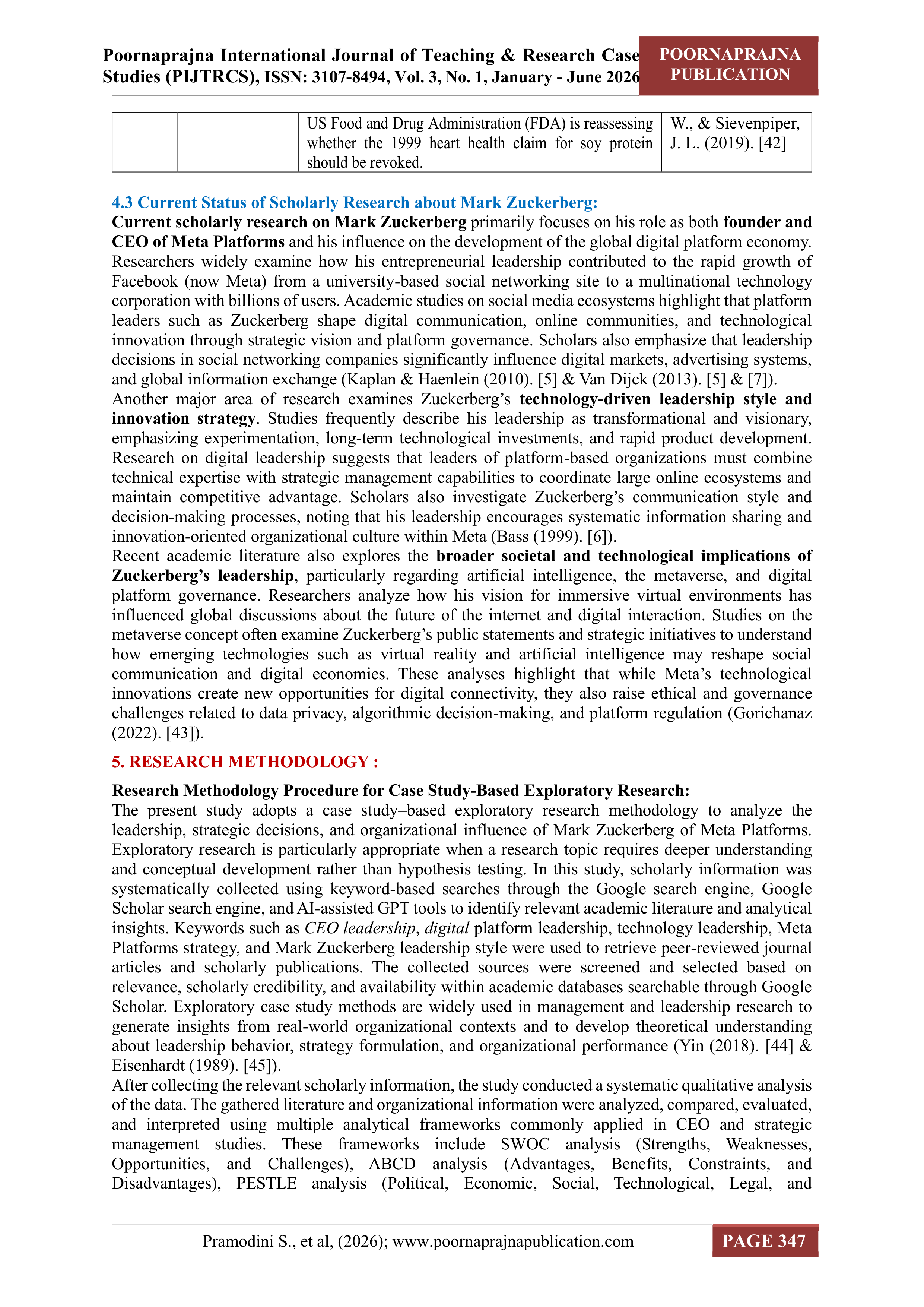
11
Meta-analytic
reviews of
board
composition,
leadership
structure, and
financial
performance
Careful review of extant research addressing the
relationships
between
board
composition,
board
leadership structure, and firm financial performance
demonstrates little consistency in results. In general,
neither board composition nor board leadership structure
has been consistently linked to firm financial
performance. In response to these findings, we provide
meta-analyses of 54 empirical studies of board
composition (159 samples, n = 40,160) and 31 empirical
studies of board leadership structure (69 samples, n =
12,915) and their relationships to firm financial
performance. These—and moderator analyses relying on
firm size, the nature of the financial performance
indicator, and various operationalizations of board
composition—provide little evidence of systematic
governance
structure/financial
performance
relationships.
Dalton, D. R.,
Daily, C. M.,
Ellstrand, A. E., &
Johnson, J. L.
(1998). [39]
12
Peer-assisted
learning in
medical
education: A
systematic
review and
meta-analysis
The prevalence of peer-assisted learning (PAL) featuring
alongside the core medical curriculum is increasing;
however, the evidence base for PAL's efficacy on
academic performance is limited. This systematic review
of randomised studies of PAL in medical school sets out
to assess the impact of PAL on academic outcomes in
medical school and evaluate whether PAL confers a
benefit in specific educational contexts.
Brierley, C., Ellis,
L., & Reid, E. R.
(2022). [40]
13
Stakeholder
Pressures and
Corporate
Environmental
Strategies: A
Meta-Analysis
Stakeholder pressures and corporate environmental
strategies continue to be important topics of corporate
sustainability. Limited by sample size, there is a lack of
general conclusions on which groups of stakeholder
pressures are the main drivers of environmental
strategies. Amassing a database of 58 empirical studies,
the authors divided stakeholder pressures into four
groups—internal,
coercive,
market,
and
social
pressure—and explored the relationship between
different pressures and environmental strategies by
conducting a meta-analysis. The main result shows that
internal pressure is the main driver of environmental
strategies.
Further
empirical
results
show
that
stakeholder pressures could have a larger effect on
corporate environmental
strategies in
developed
countries and that non-manufacturing firms could change
their environmental strategies more easily than
manufacturing firms. The results provide the practical
implication that a green industry transition is strongly
needed in the manufacturing industry, especially for
polluting industries, and that firms in polluting industries
should implement environmental strategy changes in the
future. This paper contributes to clarifying the
relationship between stakeholder pressures and corporate
environmental strategies based on a meta-analysis.
Wang, L., Li, W.,
& Qi, L. (2020).
[41]
14
Cumulative
Meta‐Analysis
of the Soy
Effect Over
Time
Soy protein foods have attracted attention as useful plant
protein foods with mild cholesterol‐lowering effects that
are suitable for inclusion in therapeutic diets. But on the
basis of the lack of consistency in significant cholesterol
reduction by soy in 46 randomized controlled trials, the
Jenkins, D. J.,
Blanco Mejia, S.,
Chiavaroli, L.,
Viguiliouk, E., Li,
S. S., Kendall, C.


Poornaprajna International Journal of Teaching & Research Case
Studies (PIJTRCS),
ISSN: 3107-8494, Vol. 3, No. 1, January - June 2026
POORNAPRAJNA
PUBLICATION
Pramodini S., et al, (2026); www.poornaprajnapublication.com
PAGE 347
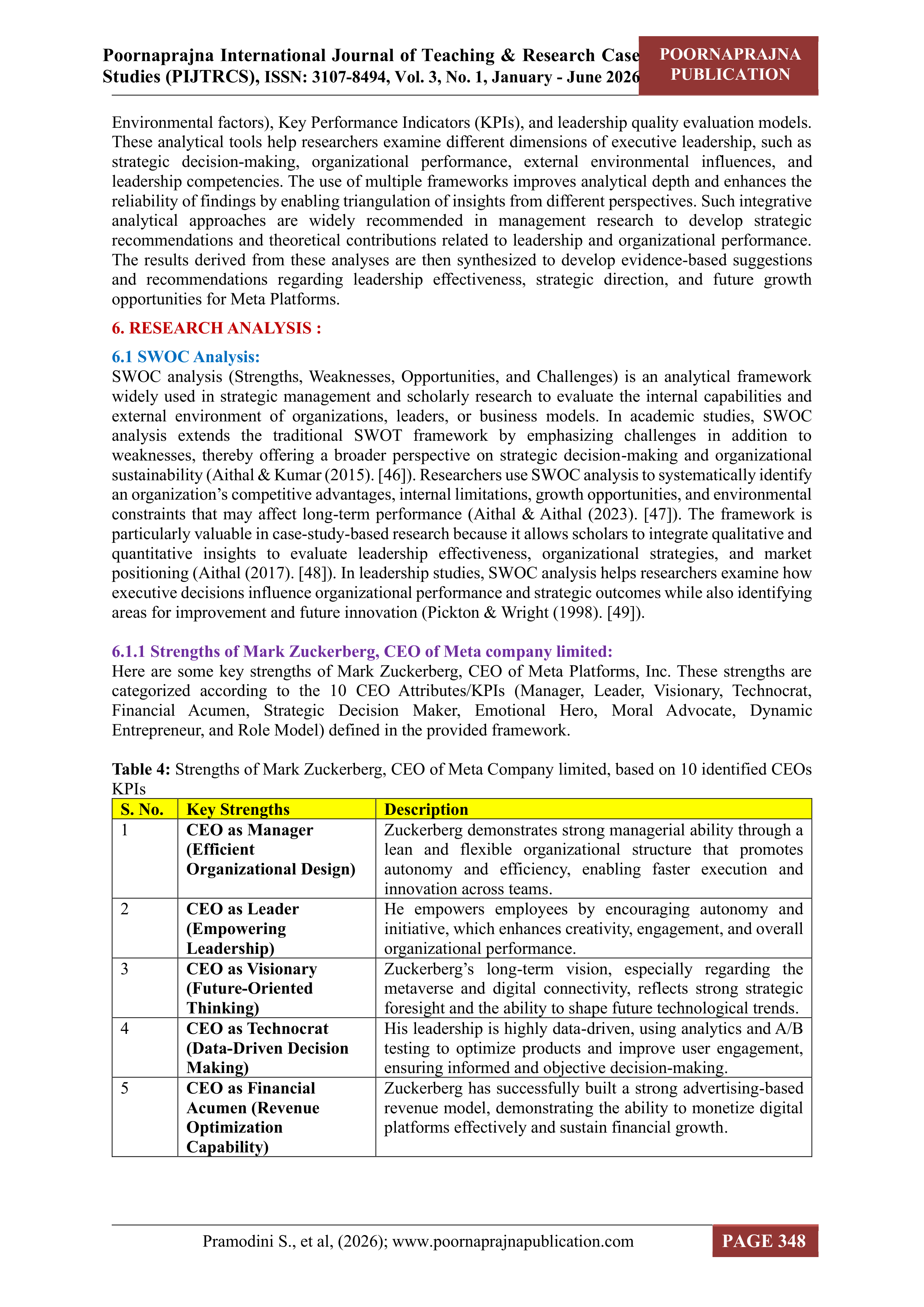
US Food and Drug Administration (FDA) is reassessing
whether the 1999 heart health claim for soy protein
should be revoked.
W., & Sievenpiper,
J. L. (2019). [42]
4.3 Current Status of Scholarly Research about Mark Zuckerberg:
Current scholarly research on Mark Zuckerberg
primarily focuses on his role as both
founder and
CEO of Meta Platforms
and his influence on the development of the global digital platform economy.
Researchers widely examine how his entrepreneurial leadership contributed to the rapid growth of
Facebook (now Meta) from a university-based social networking site to a multinational technology
corporation with billions of users. Academic studies on social media ecosystems highlight that platform
leaders such as Zuckerberg shape digital communication, online communities, and technological
innovation through strategic vision and platform governance. Scholars also emphasize that leadership
decisions in social networking companies significantly influence digital markets, advertising systems,
and global information exchange (Kaplan & Haenlein (2010). [5] & Van Dijck (2013). [5] & [7]).
Another major area of research examines Zuckerberg’s
technology-driven leadership style and
innovation strategy
. Studies frequently describe his leadership as transformational and visionary,
emphasizing experimentation, long-term technological investments, and rapid product development.
Research on digital leadership suggests that leaders of platform-based organizations must combine
technical expertise with strategic management capabilities to coordinate large online ecosystems and
maintain competitive advantage. Scholars also investigate Zuckerberg’s communication style and
decision-making processes, noting that his leadership encourages systematic information sharing and
innovation-oriented organizational culture within Meta (Bass (1999). [6]).
Recent academic literature also explores the
broader societal and technological implications of
Zuckerberg’s leadership
, particularly regarding artificial intelligence, the metaverse, and digital
platform governance. Researchers analyze how his vision for immersive virtual environments has
influenced global discussions about the future of the internet and digital interaction. Studies on the
metaverse concept often examine Zuckerberg’s public statements and strategic initiatives to understand
how emerging technologies such as virtual reality and artificial intelligence may reshape social
communication and digital economies. These analyses highlight that while Meta’s technological
innovations create new opportunities for digital connectivity, they also raise ethical and governance
challenges related to data privacy, algorithmic decision-making, and platform regulation (Gorichanaz
(2022). [43]).
5. RESEARCH METHODOLOGY :
Research Methodology Procedure for Case Study-Based Exploratory Research:
The present study adopts a case study–based exploratory research methodology to analyze the
leadership, strategic decisions, and organizational influence of Mark Zuckerberg of Meta Platforms.
Exploratory research is particularly appropriate when a research topic requires deeper understanding
and conceptual development rather than hypothesis testing. In this study, scholarly information was
systematically collected using keyword-based searches through the Google search engine, Google
Scholar search engine, and AI-assisted GPT tools to identify relevant academic literature and analytical
insights. Keywords such as
CEO leadership
,
digital
platform leadership, technology leadership, Meta
Platforms strategy, and Mark Zuckerberg leadership style were used to retrieve peer-reviewed journal
articles and scholarly publications. The collected sources were screened and selected based on
relevance, scholarly credibility, and availability within academic databases searchable through Google
Scholar. Exploratory case study methods are widely used in management and leadership research to
generate insights from real-world organizational contexts and to develop theoretical understanding
about leadership behavior, strategy formulation, and organizational performance (Yin (2018). [44] &
Eisenhardt (1989). [45]).
After collecting the relevant scholarly information, the study conducted a systematic qualitative analysis
of the data. The gathered literature and organizational information were analyzed, compared, evaluated,
and interpreted using multiple analytical frameworks commonly applied in CEO and strategic
management studies. These frameworks include SWOC analysis (Strengths, Weaknesses,
Opportunities, and Challenges), ABCD analysis (Advantages, Benefits, Constraints, and
Disadvantages), PESTLE analysis (Political, Economic, Social, Technological, Legal, and


Poornaprajna International Journal of Teaching & Research Case
Studies (PIJTRCS),
ISSN: 3107-8494, Vol. 3, No. 1, January - June 2026
POORNAPRAJNA
PUBLICATION
Pramodini S., et al, (2026); www.poornaprajnapublication.com
PAGE 348
Environmental factors), Key Performance Indicators (KPIs), and leadership quality evaluation models.
These analytical tools help researchers examine different dimensions of executive leadership, such as
strategic decision-making, organizational performance, external environmental influences, and
leadership competencies. The use of multiple frameworks improves analytical depth and enhances the
reliability of findings by enabling triangulation of insights from different perspectives. Such integrative
analytical approaches are widely recommended in management research to develop strategic
recommendations and theoretical contributions related to leadership and organizational performance.
The results derived from these analyses are then synthesized to develop evidence-based suggestions
and recommendations regarding leadership effectiveness, strategic direction, and future growth
opportunities for Meta Platforms.
6. RESEARCH ANALYSIS :
6.1 SWOC Analysis:
SWOC analysis (Strengths, Weaknesses, Opportunities, and Challenges) is an analytical framework
widely used in strategic management and scholarly research to evaluate the internal capabilities and
external environment of organizations, leaders, or business models. In academic studies, SWOC
analysis extends the traditional SWOT framework by emphasizing challenges in addition to
weaknesses, thereby offering a broader perspective on strategic decision-making and organizational
sustainability (Aithal & Kumar (2015). [46]). Researchers use SWOC analysis to systematically identify
an organization’s competitive advantages, internal limitations, growth opportunities, and environmental
constraints that may affect long-term performance (Aithal & Aithal (2023). [47]). The framework is
particularly valuable in case-study-based research because it allows scholars to integrate qualitative and
quantitative insights to evaluate leadership effectiveness, organizational strategies, and market
positioning (Aithal (2017). [48]). In leadership studies, SWOC analysis helps researchers examine how
executive decisions influence organizational performance and strategic outcomes while also identifying
areas for improvement and future innovation (Pickton & Wright (1998). [49]).
6.1.1 Strengths of Mark Zuckerberg, CEO of Meta company limited:
Here are some key strengths of Mark Zuckerberg, CEO of Meta Platforms, Inc. These strengths are
categorized according to the 10 CEO Attributes/KPIs (Manager, Leader, Visionary, Technocrat,
Financial Acumen, Strategic Decision Maker, Emotional Hero, Moral Advocate, Dynamic
Entrepreneur, and Role Model) defined in the provided framework.
Table 4:
Strengths of
Mark Zuckerberg, CEO of Meta Company limited, based on 10 identified CEOs
KPIs
S. No.
Key Strengths
Description
1
CEO as Manager
(Efficient
Organizational Design)
Zuckerberg demonstrates strong managerial ability through a
lean and flexible organizational structure that promotes
autonomy and efficiency, enabling faster execution and
innovation across teams.
2
CEO as Leader
(Empowering
Leadership)
He empowers employees by encouraging autonomy and
initiative, which enhances creativity, engagement, and overall
organizational performance.
3
CEO as Visionary
(Future-Oriented
Thinking)
Zuckerberg’s long-term vision, especially regarding the
metaverse and digital connectivity, reflects strong strategic
foresight and the ability to shape future technological trends.
4
CEO as Technocrat
(Data-Driven Decision
Making)
His leadership is highly data-driven, using analytics and A/B
testing to optimize products and improve user engagement,
ensuring informed and objective decision-making.
5
CEO as Financial
Acumen (Revenue
Optimization
Capability)
Zuckerberg has successfully built a strong advertising-based
revenue model, demonstrating the ability to monetize digital
platforms effectively and sustain financial growth.
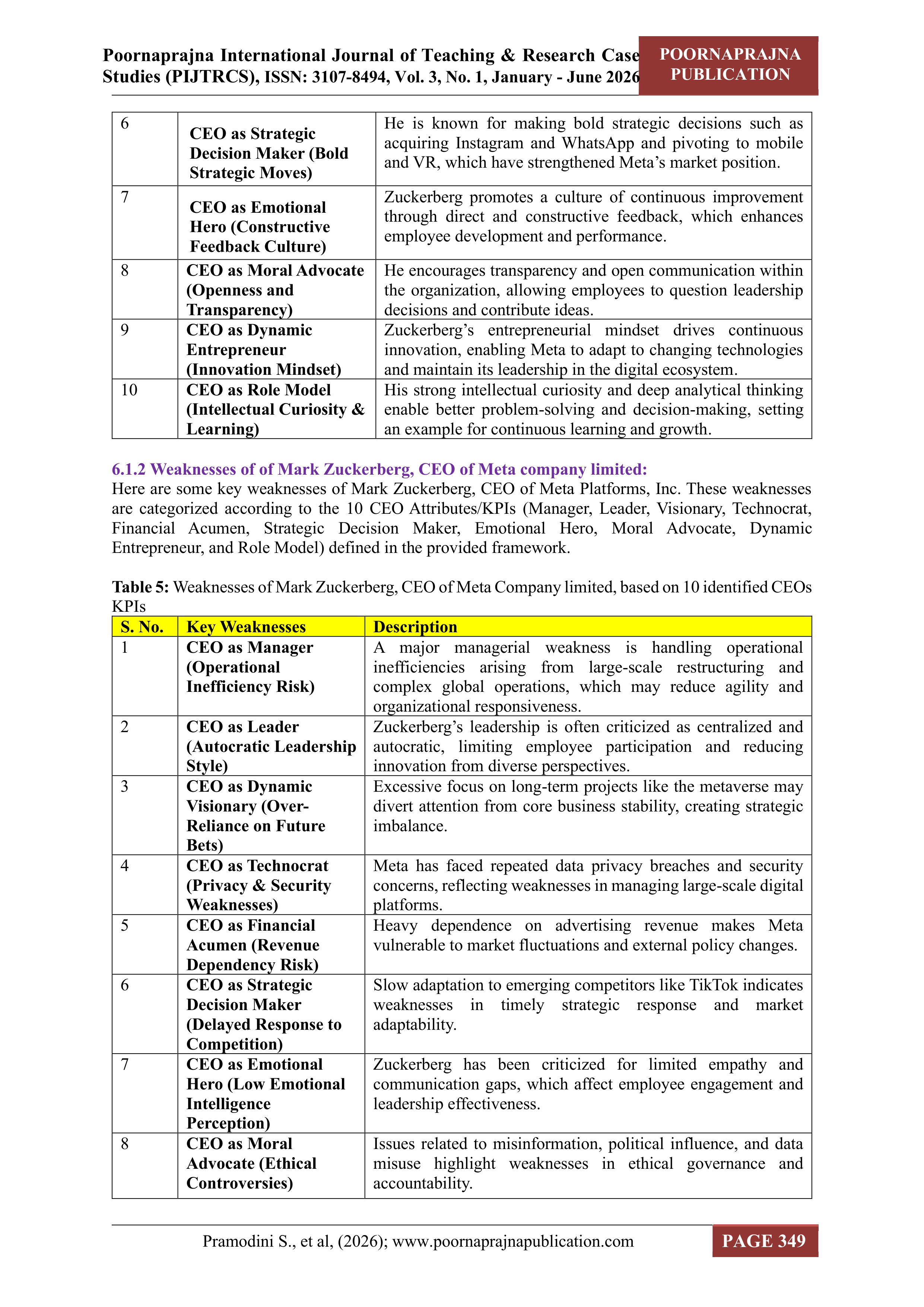


Poornaprajna International Journal of Teaching & Research Case
Studies (PIJTRCS),
ISSN: 3107-8494, Vol. 3, No. 1, January - June 2026
POORNAPRAJNA
PUBLICATION
Pramodini S., et al, (2026); www.poornaprajnapublication.com
PAGE 349
6
CEO as Strategic
Decision Maker (Bold
Strategic Moves)
He is known for making bold strategic decisions such as
acquiring Instagram and WhatsApp and pivoting to mobile
and VR, which have strengthened Meta’s market position.
7
CEO as Emotional
Hero (Constructive
Feedback Culture)
Zuckerberg promotes a culture of continuous improvement
through direct and constructive feedback, which enhances
employee development and performance.
8
CEO as Moral Advocate
(Openness and
Transparency)
He encourages transparency and open communication within
the organization, allowing employees to question leadership
decisions and contribute ideas.
9
CEO as Dynamic
Entrepreneur
(Innovation Mindset)
Zuckerberg’s entrepreneurial mindset drives continuous
innovation, enabling Meta to adapt to changing technologies
and maintain its leadership in the digital ecosystem.
10
CEO as Role Model
(Intellectual Curiosity &
Learning)
His strong intellectual curiosity and deep analytical thinking
enable better problem-solving and decision-making, setting
an example for continuous learning and growth.
6.1.2 Weaknesses of of Mark Zuckerberg, CEO of Meta company limited:
Here are some key weaknesses of Mark Zuckerberg, CEO of Meta Platforms, Inc. These weaknesses
are categorized according to the 10 CEO Attributes/KPIs (Manager, Leader, Visionary, Technocrat,
Financial Acumen, Strategic Decision Maker, Emotional Hero, Moral Advocate, Dynamic
Entrepreneur, and Role Model) defined in the provided framework.
Table 5:
Weaknesses
of Mark Zuckerberg, CEO of Meta Company limited, based on 10 identified CEOs
KPIs
S. No.
Key Weaknesses
Description
1
CEO as Manager
(Operational
Inefficiency Risk)
A major managerial weakness is handling operational
inefficiencies arising from large-scale restructuring and
complex global operations, which may reduce agility and
organizational responsiveness.
2
CEO as Leader
(Autocratic Leadership
Style)
Zuckerberg’s leadership is often criticized as centralized and
autocratic, limiting employee participation and reducing
innovation from diverse perspectives.
3
CEO as Dynamic
Visionary (Over-
Reliance on Future
Bets)
Excessive focus on long-term projects like the metaverse may
divert attention from core business stability, creating strategic
imbalance.
4
CEO as Technocrat
(Privacy & Security
Weaknesses)
Meta has faced repeated data privacy breaches and security
concerns, reflecting weaknesses in managing large-scale digital
platforms.
5
CEO as Financial
Acumen (Revenue
Dependency Risk)
Heavy dependence on advertising revenue makes Meta
vulnerable to market fluctuations and external policy changes.
6
CEO as Strategic
Decision Maker
(Delayed Response to
Competition)
Slow adaptation to emerging competitors like TikTok indicates
weaknesses in timely strategic response and market
adaptability.
7
CEO as Emotional
Hero (Low Emotional
Intelligence
Perception)
Zuckerberg has been criticized for limited empathy and
communication gaps, which affect employee engagement and
leadership effectiveness.
8
CEO as Moral
Advocate (Ethical
Controversies)
Issues related to misinformation, political influence, and data
misuse highlight weaknesses in ethical governance and
accountability.
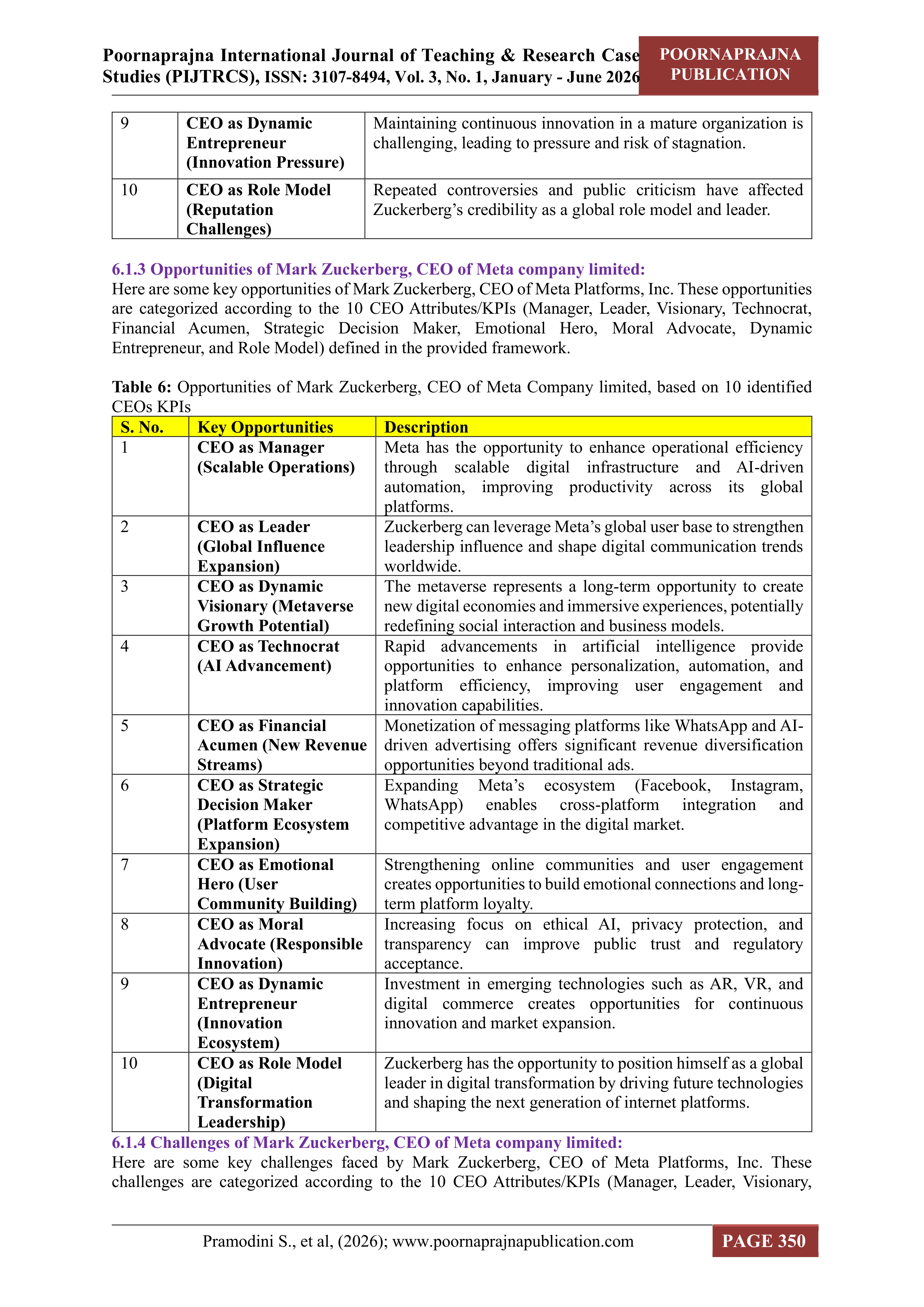


Poornaprajna International Journal of Teaching & Research Case
Studies (PIJTRCS),
ISSN: 3107-8494, Vol. 3, No. 1, January - June 2026
POORNAPRAJNA
PUBLICATION
Pramodini S., et al, (2026); www.poornaprajnapublication.com
PAGE 350
9
CEO as Dynamic
Entrepreneur
(Innovation Pressure)
Maintaining continuous innovation in a mature organization is
challenging, leading to pressure and risk of stagnation.
10
CEO as Role Model
(Reputation
Challenges)
Repeated controversies and public criticism have affected
Zuckerberg’s credibility as a global role model and leader.
6.1.3 Opportunities of Mark Zuckerberg, CEO of Meta company limited:
Here are some key opportunities of Mark Zuckerberg, CEO of Meta Platforms, Inc. These opportunities
are categorized according to the 10 CEO Attributes/KPIs (Manager, Leader, Visionary, Technocrat,
Financial Acumen, Strategic Decision Maker, Emotional Hero, Moral Advocate, Dynamic
Entrepreneur, and Role Model) defined in the provided framework.
Table 6:
Opportunities
of Mark Zuckerberg, CEO of Meta Company limited, based on 10 identified
CEOs KPIs
S. No.
Key Opportunities
Description
1
CEO as Manager
(Scalable Operations)
Meta has the opportunity to enhance operational efficiency
through scalable digital infrastructure and AI-driven
automation, improving productivity across its global
platforms.
2
CEO as Leader
(Global Influence
Expansion)
Zuckerberg can leverage Meta’s global user base to strengthen
leadership influence and shape digital communication trends
worldwide.
3
CEO as Dynamic
Visionary (Metaverse
Growth Potential)
The metaverse represents a long-term opportunity to create
new digital economies and immersive experiences, potentially
redefining social interaction and business models.
4
CEO as Technocrat
(AI Advancement)
Rapid advancements in artificial intelligence provide
opportunities to enhance personalization, automation, and
platform efficiency, improving user engagement and
innovation capabilities.
5
CEO as Financial
Acumen (New Revenue
Streams)
Monetization of messaging platforms like WhatsApp and AI-
driven advertising offers significant revenue diversification
opportunities beyond traditional ads.
6
CEO as Strategic
Decision Maker
(Platform Ecosystem
Expansion)
Expanding
Meta’s
ecosystem
(Facebook,
Instagram,
WhatsApp)
enables
cross-platform
integration
and
competitive advantage in the digital market.
7
CEO as Emotional
Hero (User
Community Building)
Strengthening online communities and user engagement
creates opportunities to build emotional connections and long-
term platform loyalty.
8
CEO as Moral
Advocate (Responsible
Innovation)
Increasing focus on ethical AI, privacy protection, and
transparency can improve public trust and regulatory
acceptance.
9
CEO as Dynamic
Entrepreneur
(Innovation
Ecosystem)
Investment in emerging technologies such as AR, VR, and
digital commerce creates opportunities for continuous
innovation and market expansion.
10
CEO as Role Model
(Digital
Transformation
Leadership)
Zuckerberg has the opportunity to position himself as a global
leader in digital transformation by driving future technologies
and shaping the next generation of internet platforms.
6.1.4 Challenges of Mark Zuckerberg, CEO of Meta company limited:
Here are some key challenges faced by Mark Zuckerberg, CEO of Meta Platforms, Inc. These
challenges are categorized according to the 10 CEO Attributes/KPIs (Manager, Leader, Visionary,
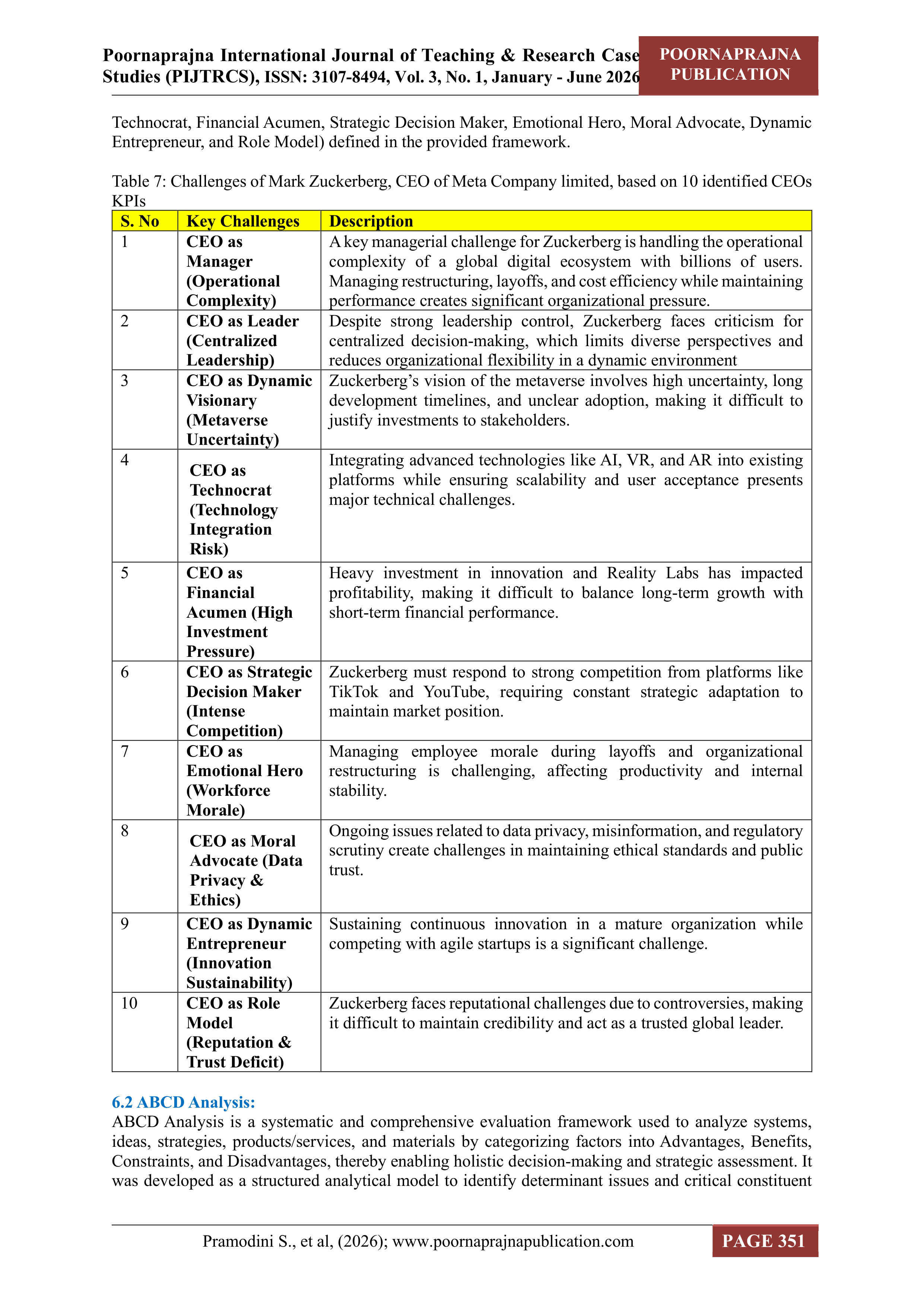


Poornaprajna International Journal of Teaching & Research Case
Studies (PIJTRCS),
ISSN: 3107-8494, Vol. 3, No. 1, January - June 2026
POORNAPRAJNA
PUBLICATION
Pramodini S., et al, (2026); www.poornaprajnapublication.com
PAGE 351
Technocrat, Financial Acumen, Strategic Decision Maker, Emotional Hero, Moral Advocate, Dynamic
Entrepreneur, and Role Model) defined in the provided framework.
Table 7: Challenges of Mark Zuckerberg, CEO of Meta Company limited, based on 10 identified CEOs
KPIs
S. No
Key Challenges
Description
1
CEO as
Manager
(Operational
Complexity)
A key managerial challenge for Zuckerberg is handling the operational
complexity of a global digital ecosystem with billions of users.
Managing restructuring, layoffs, and cost efficiency while maintaining
performance creates significant organizational pressure.
2
CEO as Leader
(Centralized
Leadership)
Despite strong leadership control, Zuckerberg faces criticism for
centralized decision-making, which limits diverse perspectives and
reduces organizational flexibility in a dynamic environment
3
CEO as Dynamic
Visionary
(Metaverse
Uncertainty)
Zuckerberg’s vision of the metaverse involves high uncertainty, long
development timelines, and unclear adoption, making it difficult to
justify investments to stakeholders.
4
CEO as
Technocrat
(Technology
Integration
Risk)
Integrating advanced technologies like AI, VR, and AR into existing
platforms while ensuring scalability and user acceptance presents
major technical challenges.
5
CEO as
Financial
Acumen (High
Investment
Pressure)
Heavy investment in innovation and Reality Labs has impacted
profitability, making it difficult to balance long-term growth with
short-term financial performance.
6
CEO as Strategic
Decision Maker
(Intense
Competition)
Zuckerberg must respond to strong competition from platforms like
TikTok and YouTube, requiring constant strategic adaptation to
maintain market position.
7
CEO as
Emotional Hero
(Workforce
Morale)
Managing employee morale during layoffs and organizational
restructuring is challenging, affecting productivity and internal
stability.
8
CEO as Moral
Advocate (Data
Privacy &
Ethics)
Ongoing issues related to data privacy, misinformation, and regulatory
scrutiny create challenges in maintaining ethical standards and public
trust.
9
CEO as Dynamic
Entrepreneur
(Innovation
Sustainability)
Sustaining continuous innovation in a mature organization while
competing with agile startups is a significant challenge.
10
CEO as Role
Model
(Reputation &
Trust Deficit)
Zuckerberg faces reputational challenges due to controversies, making
it difficult to maintain credibility and act as a trusted global leader.
6.2 ABCD Analysis:
ABCD Analysis is a systematic and comprehensive evaluation framework used to analyze systems,
ideas, strategies, products/services, and materials by categorizing factors into Advantages, Benefits,
Constraints, and Disadvantages, thereby enabling holistic decision-making and strategic assessment. It
was developed as a structured analytical model to identify determinant issues and critical constituent
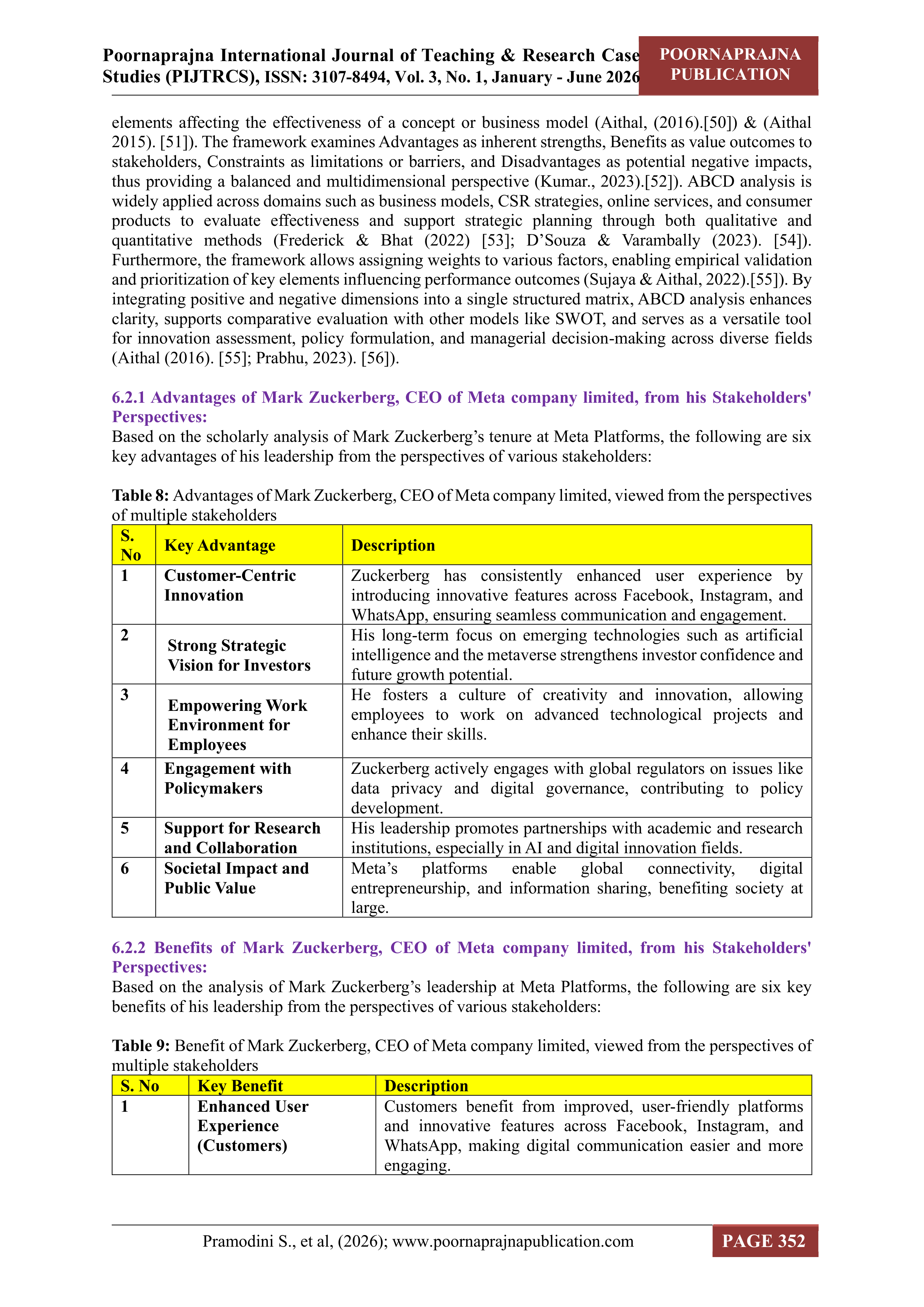


Poornaprajna International Journal of Teaching & Research Case
Studies (PIJTRCS),
ISSN: 3107-8494, Vol. 3, No. 1, January - June 2026
POORNAPRAJNA
PUBLICATION
Pramodini S., et al, (2026); www.poornaprajnapublication.com
PAGE 352
elements affecting the effectiveness of a concept or business model (Aithal, (2016).[50]) & (Aithal
2015). [51]). The framework examines Advantages as inherent strengths, Benefits as value outcomes to
stakeholders, Constraints as limitations or barriers, and Disadvantages as potential negative impacts,
thus providing a balanced and multidimensional perspective (Kumar., 2023).[52]). ABCD analysis is
widely applied across domains such as business models, CSR strategies, online services, and consumer
products to evaluate effectiveness and support strategic planning through both qualitative and
quantitative methods (Frederick & Bhat (2022) [53]; D’Souza & Varambally (2023). [54]).
Furthermore, the framework allows assigning weights to various factors, enabling empirical validation
and prioritization of key elements influencing performance outcomes (Sujaya & Aithal, 2022).[55]). By
integrating positive and negative dimensions into a single structured matrix, ABCD analysis enhances
clarity, supports comparative evaluation with other models like SWOT, and serves as a versatile tool
for innovation assessment, policy formulation, and managerial decision-making across diverse fields
(Aithal (2016). [55]; Prabhu, 2023). [56]).
6.2.1 Advantages of Mark Zuckerberg, CEO of Meta company limited, from his Stakeholders'
Perspectives:
Based on the scholarly analysis of Mark Zuckerberg’s tenure at Meta Platforms, the following are six
key advantages of his leadership from the perspectives of various stakeholders:
Table 8:
Advantages of Mark Zuckerberg, CEO of Meta company limited, viewed from the perspectives
of multiple stakeholders
S.
No
Key Advantage
Description
1
Customer-Centric
Innovation
Zuckerberg has consistently enhanced user experience by
introducing innovative features across Facebook, Instagram, and
WhatsApp, ensuring seamless communication and engagement.
2
Strong Strategic
Vision for Investors
His long-term focus on emerging technologies such as artificial
intelligence and the metaverse strengthens investor confidence and
future growth potential.
3
Empowering Work
Environment for
Employees
He fosters a culture of creativity and innovation, allowing
employees to work on advanced technological projects and
enhance their skills.
4
Engagement with
Policymakers
Zuckerberg actively engages with global regulators on issues like
data privacy and digital governance, contributing to policy
development.
5
Support for Research
and Collaboration
His leadership promotes partnerships with academic and research
institutions, especially in AI and digital innovation fields.
6
Societal Impact and
Public Value
Meta’s
platforms
enable
global
connectivity,
digital
entrepreneurship, and information sharing, benefiting society at
large.
6.2.2 Benefits of Mark Zuckerberg, CEO of Meta company limited, from his Stakeholders'
Perspectives:
Based on the analysis of Mark Zuckerberg’s leadership at Meta Platforms, the following are six key
benefits of his leadership from the perspectives of various stakeholders:
Table 9:
Benefit of Mark Zuckerberg, CEO of Meta company limited, viewed from the perspectives of
multiple stakeholders
S. No
Key Benefit
Description
1
Enhanced User
Experience
(Customers)
Customers benefit from improved, user-friendly platforms
and innovative features across Facebook, Instagram, and
WhatsApp, making digital communication easier and more
engaging.
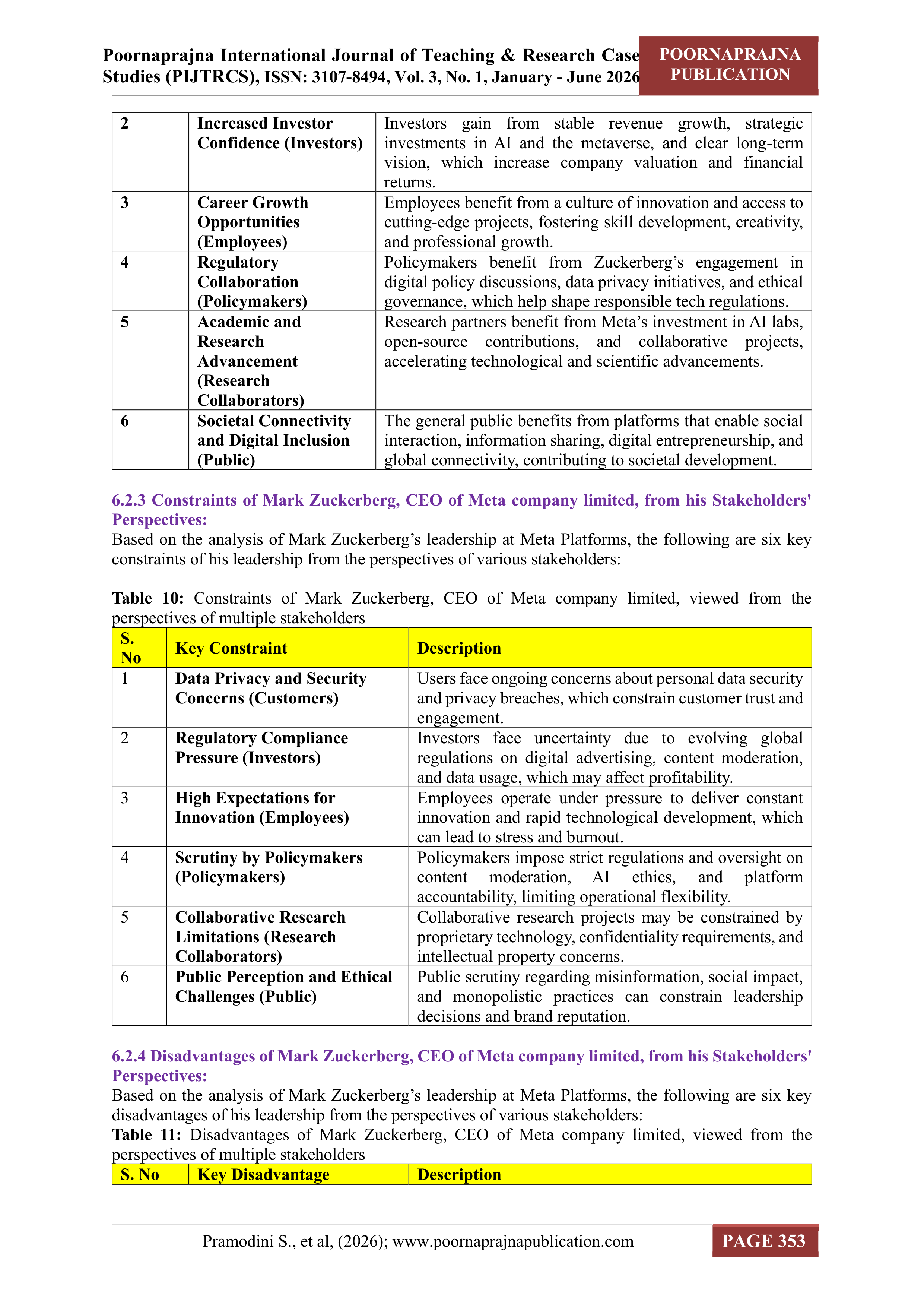


Poornaprajna International Journal of Teaching & Research Case
Studies (PIJTRCS),
ISSN: 3107-8494, Vol. 3, No. 1, January - June 2026
POORNAPRAJNA
PUBLICATION
Pramodini S., et al, (2026); www.poornaprajnapublication.com
PAGE 353
2
Increased Investor
Confidence (Investors)
Investors gain from stable revenue growth, strategic
investments in AI and the metaverse, and clear long-term
vision, which increase company valuation and financial
returns.
3
Career Growth
Opportunities
(Employees)
Employees benefit from a culture of innovation and access to
cutting-edge projects, fostering skill development, creativity,
and professional growth.
4
Regulatory
Collaboration
(Policymakers)
Policymakers benefit from Zuckerberg’s engagement in
digital policy discussions, data privacy initiatives, and ethical
governance, which help shape responsible tech regulations.
5
Academic and
Research
Advancement
(Research
Collaborators)
Research partners benefit from Meta’s investment in AI labs,
open-source contributions, and collaborative projects,
accelerating technological and scientific advancements.
6
Societal Connectivity
and Digital Inclusion
(Public)
The general public benefits from platforms that enable social
interaction, information sharing, digital entrepreneurship, and
global connectivity, contributing to societal development.
6.2.3 Constraints of Mark Zuckerberg, CEO of Meta company limited, from his Stakeholders'
Perspectives:
Based on the analysis of Mark Zuckerberg’s leadership at Meta Platforms, the following are six key
constraints of his leadership from the perspectives of various stakeholders:
Table 10:
Constraints
of Mark Zuckerberg, CEO of Meta company limited, viewed from the
perspectives of multiple stakeholders
S.
No
Key Constraint
Description
1
Data Privacy and Security
Concerns (Customers)
Users face ongoing concerns about personal data security
and privacy breaches, which constrain customer trust and
engagement.
2
Regulatory Compliance
Pressure (Investors)
Investors face uncertainty due to evolving global
regulations on digital advertising, content moderation,
and data usage, which may affect profitability.
3
High Expectations for
Innovation (Employees)
Employees operate under pressure to deliver constant
innovation and rapid technological development, which
can lead to stress and burnout.
4
Scrutiny by Policymakers
(Policymakers)
Policymakers impose strict regulations and oversight on
content
moderation,
AI
ethics,
and
platform
accountability, limiting operational flexibility.
5
Collaborative Research
Limitations (Research
Collaborators)
Collaborative research projects may be constrained by
proprietary technology, confidentiality requirements, and
intellectual property concerns.
6
Public Perception and Ethical
Challenges (Public)
Public scrutiny regarding misinformation, social impact,
and monopolistic practices can constrain leadership
decisions and brand reputation.
6.2.4 Disadvantages of Mark Zuckerberg, CEO of Meta company limited, from his Stakeholders'
Perspectives:
Based on the analysis of Mark Zuckerberg’s leadership at Meta Platforms, the following are six key
disadvantages of his leadership from the perspectives of various stakeholders:
Table 11:
Disadvantages
of Mark Zuckerberg, CEO of Meta company limited, viewed from the
perspectives of multiple stakeholders
S. No
Key Disadvantage
Description
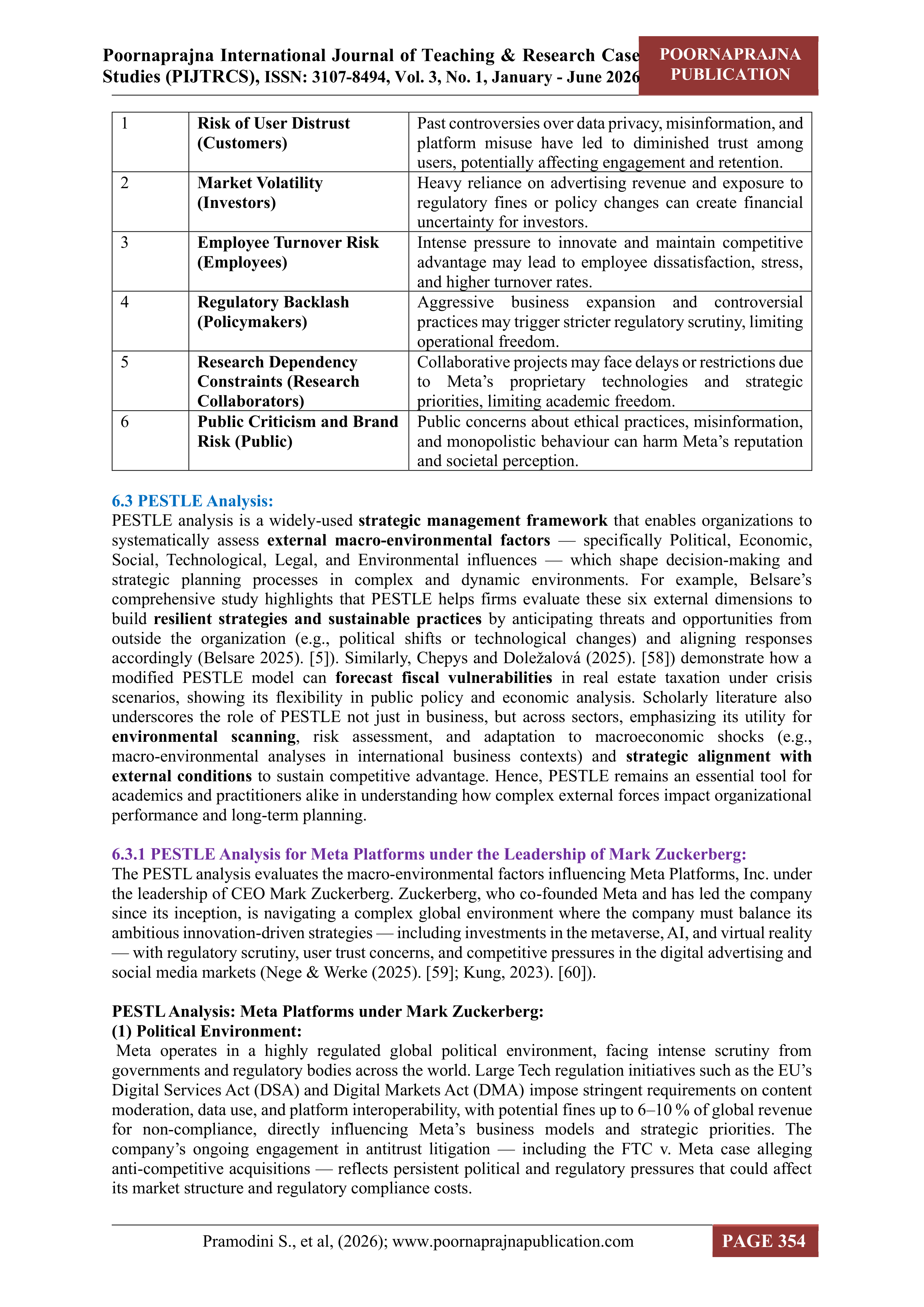


Poornaprajna International Journal of Teaching & Research Case
Studies (PIJTRCS),
ISSN: 3107-8494, Vol. 3, No. 1, January - June 2026
POORNAPRAJNA
PUBLICATION
Pramodini S., et al, (2026); www.poornaprajnapublication.com
PAGE 354
1
Risk of User Distrust
(Customers)
Past controversies over data privacy, misinformation, and
platform misuse have led to diminished trust among
users, potentially affecting engagement and retention.
2
Market Volatility
(Investors)
Heavy reliance on advertising revenue and exposure to
regulatory fines or policy changes can create financial
uncertainty for investors.
3
Employee Turnover Risk
(Employees)
Intense pressure to innovate and maintain competitive
advantage may lead to employee dissatisfaction, stress,
and higher turnover rates.
4
Regulatory Backlash
(Policymakers)
Aggressive business expansion and controversial
practices may trigger stricter regulatory scrutiny, limiting
operational freedom.
5
Research Dependency
Constraints (Research
Collaborators)
Collaborative projects may face delays or restrictions due
to Meta’s proprietary technologies and strategic
priorities, limiting academic freedom.
6
Public Criticism and Brand
Risk (Public)
Public concerns about ethical practices, misinformation,
and monopolistic behaviour can harm Meta’s reputation
and societal perception.
6.3 PESTLE Analysis:
PESTLE analysis is a widely-used
strategic management framework
that enables organizations to
systematically assess
external macro-environmental factors
— specifically Political, Economic,
Social, Technological, Legal, and Environmental influences — which shape decision-making and
strategic planning processes in complex and dynamic environments. For example, Belsare’s
comprehensive study highlights that PESTLE helps firms evaluate these six external dimensions to
build
resilient strategies and sustainable practices
by anticipating threats and opportunities from
outside the organization (e.g., political shifts or technological changes) and aligning responses
accordingly (Belsare 2025). [5]). Similarly, Chepys and Doležalová (2025). [58]) demonstrate how a
modified PESTLE model can
forecast fiscal vulnerabilities
in real estate taxation under crisis
scenarios, showing its flexibility in public policy and economic analysis. Scholarly literature also
underscores the role of PESTLE not just in business, but across sectors, emphasizing its utility for
environmental scanning
, risk assessment, and adaptation to macroeconomic shocks (e.g.,
macro-environmental analyses in international business contexts) and
strategic alignment with
external conditions
to sustain competitive advantage. Hence, PESTLE remains an essential tool for
academics and practitioners alike in understanding how complex external forces impact organizational
performance and long-term planning.
6.3.1 PESTLE Analysis for Meta Platforms under the Leadership of Mark Zuckerberg:
The PESTL analysis evaluates the macro-environmental factors influencing Meta Platforms, Inc. under
the leadership of CEO Mark Zuckerberg. Zuckerberg, who co-founded Meta and has led the company
since its inception, is navigating a complex global environment where the company must balance its
ambitious innovation-driven strategies — including investments in the metaverse, AI, and virtual reality
— with regulatory scrutiny, user trust concerns, and competitive pressures in the digital advertising and
social media markets (Nege & Werke (2025). [59]; Kung, 2023). [60]).
PESTL Analysis:
Meta Platforms under Mark Zuckerberg:
(1) Political Environment:
Meta operates in a highly regulated global political environment, facing intense scrutiny from
governments and regulatory bodies across the world. Large Tech regulation initiatives such as the EU’s
Digital Services Act (DSA) and Digital Markets Act (DMA) impose stringent requirements on content
moderation, data use, and platform interoperability, with potential fines up to 6–10 % of global revenue
for non-compliance, directly influencing Meta’s business models and strategic priorities. The
company’s ongoing engagement in antitrust litigation — including the FTC v. Meta case alleging
anti-competitive acquisitions — reflects persistent political and regulatory pressures that could affect
its market structure and regulatory compliance costs.
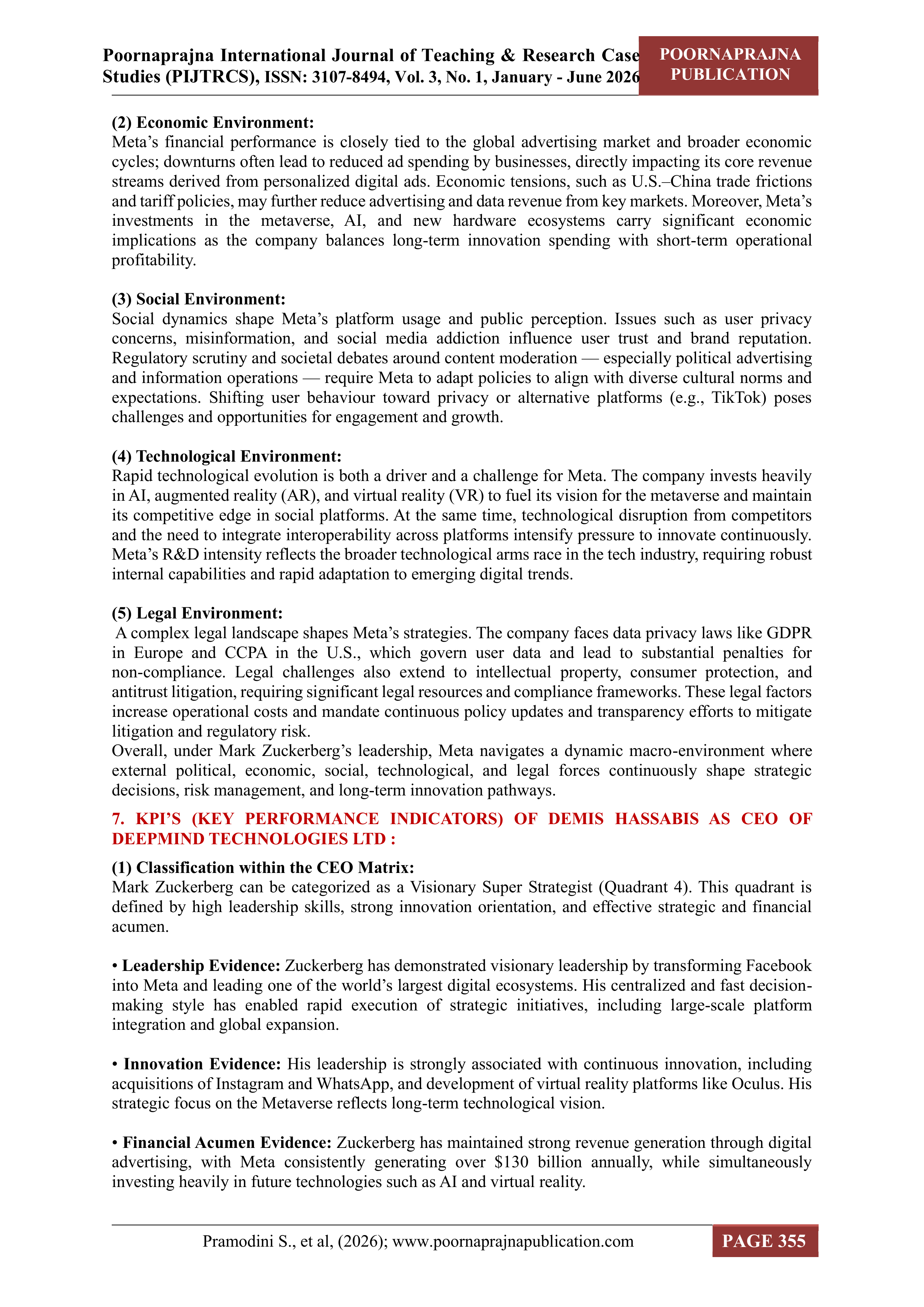


Poornaprajna International Journal of Teaching & Research Case
Studies (PIJTRCS),
ISSN: 3107-8494, Vol. 3, No. 1, January - June 2026
POORNAPRAJNA
PUBLICATION
Pramodini S., et al, (2026); www.poornaprajnapublication.com
PAGE 355
(2) Economic Environment:
Meta’s financial performance is closely tied to the global advertising market and broader economic
cycles; downturns often lead to reduced ad spending by businesses, directly impacting its core revenue
streams derived from personalized digital ads. Economic tensions, such as U.S.–China trade frictions
and tariff policies, may further reduce advertising and data revenue from key markets. Moreover, Meta’s
investments in the metaverse, AI, and new hardware ecosystems carry significant economic
implications as the company balances long-term innovation spending with short-term operational
profitability.
(3) Social Environment:
Social dynamics shape Meta’s platform usage and public perception. Issues such as user privacy
concerns, misinformation, and social media addiction influence user trust and brand reputation.
Regulatory scrutiny and societal debates around content moderation — especially political advertising
and information operations — require Meta to adapt policies to align with diverse cultural norms and
expectations. Shifting user behaviour toward privacy or alternative platforms (e.g., TikTok) poses
challenges and opportunities for engagement and growth.
(4) Technological Environment:
Rapid technological evolution is both a driver and a challenge for Meta. The company invests heavily
in AI, augmented reality (AR), and virtual reality (VR) to fuel its vision for the metaverse and maintain
its competitive edge in social platforms. At the same time, technological disruption from competitors
and the need to integrate interoperability across platforms intensify pressure to innovate continuously.
Meta’s R&D intensity reflects the broader technological arms race in the tech industry, requiring robust
internal capabilities and rapid adaptation to emerging digital trends.
(5) Legal Environment:
A complex legal landscape shapes Meta’s strategies. The company faces data privacy laws like GDPR
in Europe and CCPA in the U.S., which govern user data and lead to substantial penalties for
non-compliance. Legal challenges also extend to intellectual property, consumer protection, and
antitrust litigation, requiring significant legal resources and compliance frameworks. These legal factors
increase operational costs and mandate continuous policy updates and transparency efforts to mitigate
litigation and regulatory risk.
Overall, under Mark Zuckerberg’s leadership, Meta navigates a dynamic macro-environment where
external political, economic, social, technological, and legal forces continuously shape strategic
decisions, risk management, and long-term innovation pathways.
7. KPI’S (KEY PERFORMANCE INDICATORS) OF DEMIS HASSABIS AS CEO OF
DEEPMIND TECHNOLOGIES LTD :
(1) Classification within the CEO Matrix:
Mark Zuckerberg can be categorized as a Visionary Super Strategist (Quadrant 4). This quadrant is
defined by high leadership skills, strong innovation orientation, and effective strategic and financial
acumen.
•
Leadership Evidence:
Zuckerberg has demonstrated visionary leadership by transforming Facebook
into Meta and leading one of the world’s largest digital ecosystems. His centralized and fast decision-
making style has enabled rapid execution of strategic initiatives, including large-scale platform
integration and global expansion.
•
Innovation Evidence:
His leadership is strongly associated with continuous innovation, including
acquisitions of Instagram and WhatsApp, and development of virtual reality platforms like Oculus. His
strategic focus on the Metaverse reflects long-term technological vision.
•
Financial Acumen Evidence:
Zuckerberg has maintained strong revenue generation through digital
advertising, with Meta consistently generating over $130 billion annually, while simultaneously
investing heavily in future technologies such as AI and virtual reality.
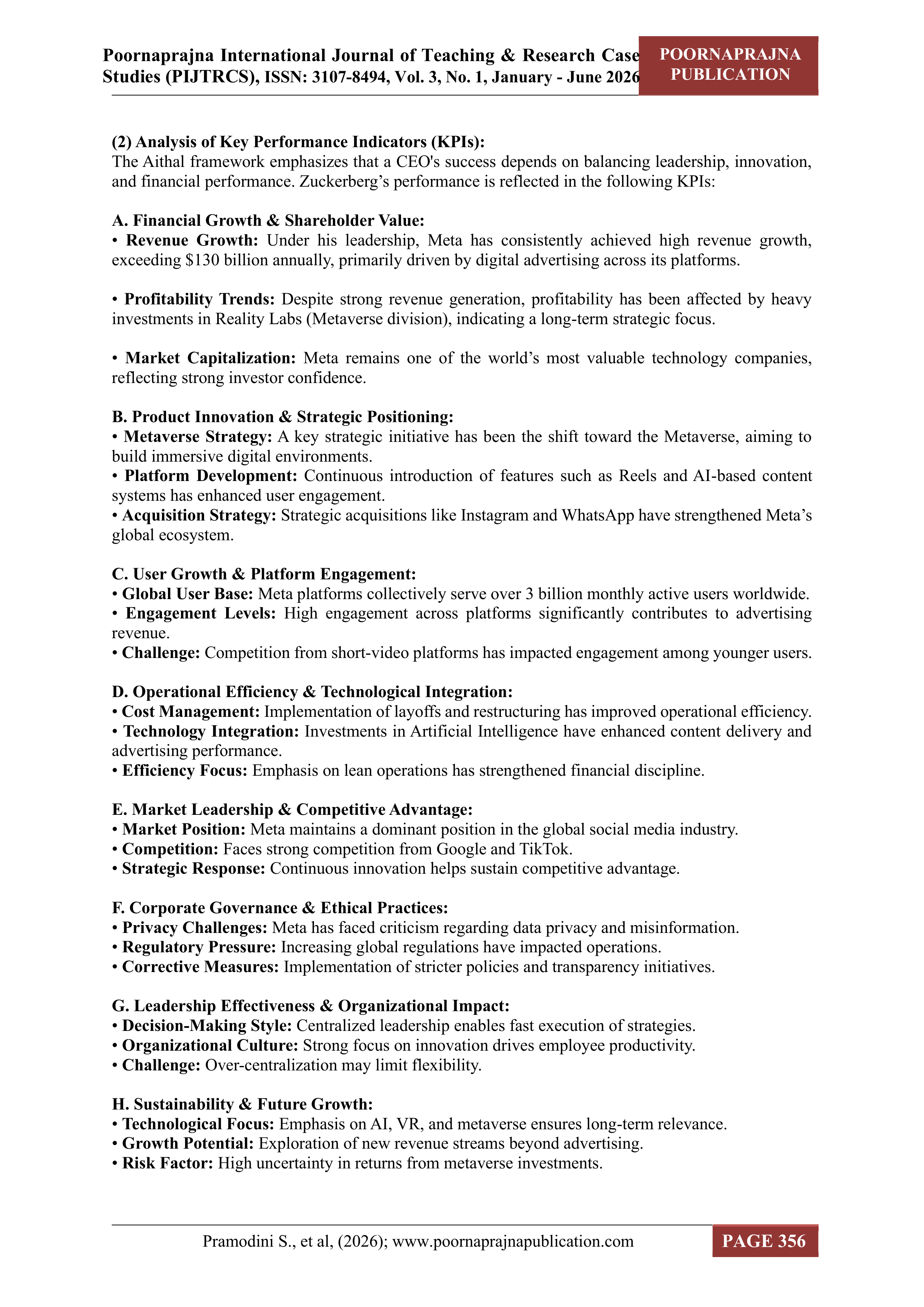


Poornaprajna International Journal of Teaching & Research Case
Studies (PIJTRCS),
ISSN: 3107-8494, Vol. 3, No. 1, January - June 2026
POORNAPRAJNA
PUBLICATION
Pramodini S., et al, (2026); www.poornaprajnapublication.com
PAGE 356
(2) Analysis of Key Performance Indicators (KPIs):
The Aithal framework emphasizes that a CEO's success depends on balancing leadership, innovation,
and financial performance. Zuckerberg’s performance is reflected in the following KPIs:
A. Financial Growth & Shareholder Value:
•
Revenue Growth:
Under his leadership, Meta has consistently achieved high revenue growth,
exceeding $130 billion annually, primarily driven by digital advertising across its platforms.
•
Profitability Trends:
Despite strong revenue generation, profitability has been affected by heavy
investments in Reality Labs (Metaverse division), indicating a long-term strategic focus.
•
Market Capitalization:
Meta remains one of the world’s most valuable technology companies,
reflecting strong investor confidence.
B. Product Innovation & Strategic Positioning:
•
Metaverse Strategy:
A key strategic initiative has been the shift toward the Metaverse, aiming to
build immersive digital environments.
•
Platform Development:
Continuous introduction of features such as Reels and AI-based content
systems has enhanced user engagement.
•
Acquisition Strategy:
Strategic acquisitions like Instagram and WhatsApp have strengthened Meta’s
global ecosystem.
C. User Growth & Platform Engagement:
•
Global User Base:
Meta platforms collectively serve over 3 billion monthly active users worldwide.
•
Engagement Levels:
High engagement across platforms significantly contributes to advertising
revenue.
•
Challenge:
Competition from short-video platforms has impacted engagement among younger users.
D. Operational Efficiency & Technological Integration:
•
Cost Management:
Implementation of layoffs and restructuring has improved operational efficiency.
•
Technology Integration:
Investments in Artificial Intelligence have enhanced content delivery and
advertising performance.
•
Efficiency Focus:
Emphasis on lean operations has strengthened financial discipline.
E. Market Leadership & Competitive Advantage:
•
Market Position:
Meta maintains a dominant position in the global social media industry.
•
Competition:
Faces strong competition from Google and TikTok.
•
Strategic Response:
Continuous innovation helps sustain competitive advantage.
F. Corporate Governance & Ethical Practices:
•
Privacy Challenges:
Meta has faced criticism regarding data privacy and misinformation.
•
Regulatory Pressure:
Increasing global regulations have impacted operations.
•
Corrective Measures:
Implementation of stricter policies and transparency initiatives.
G. Leadership Effectiveness & Organizational Impact:
•
Decision-Making Style:
Centralized leadership enables fast execution of strategies.
•
Organizational Culture:
Strong focus on innovation drives employee productivity.
•
Challenge:
Over-centralization may limit flexibility.
H. Sustainability & Future Growth:
•
Technological Focus:
Emphasis on AI, VR, and metaverse ensures long-term relevance.
•
Growth Potential:
Exploration of new revenue streams beyond advertising.
•
Risk Factor:
High uncertainty in returns from metaverse investments.
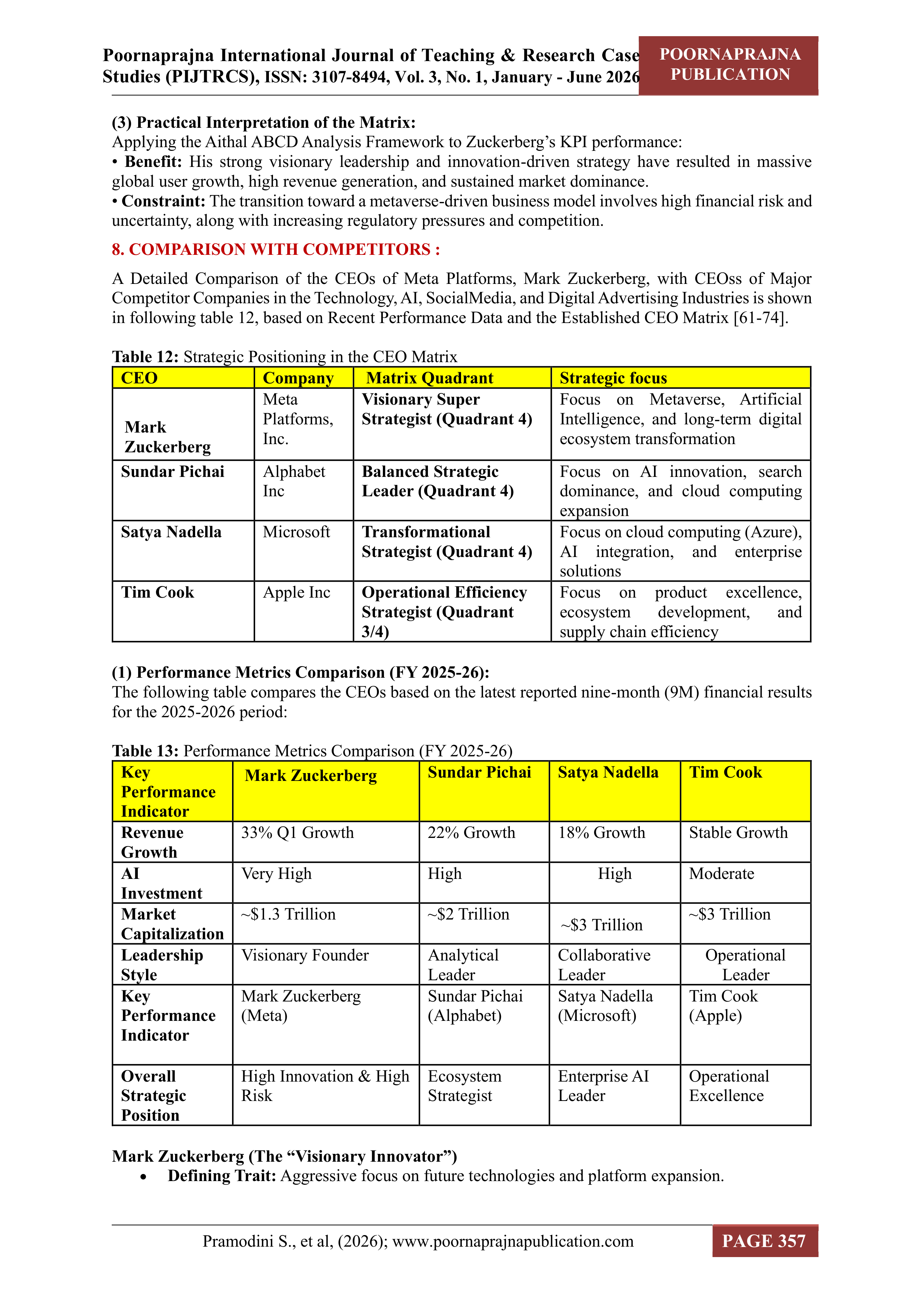


Poornaprajna International Journal of Teaching & Research Case
Studies (PIJTRCS),
ISSN: 3107-8494, Vol. 3, No. 1, January - June 2026
POORNAPRAJNA
PUBLICATION
Pramodini S., et al, (2026); www.poornaprajnapublication.com
PAGE 357
(3) Practical Interpretation of the Matrix:
Applying the Aithal ABCD Analysis Framework to Zuckerberg’s KPI performance:
•
Benefit:
His strong visionary leadership and innovation-driven strategy have resulted in massive
global user growth, high revenue generation, and sustained market dominance.
•
Constraint:
The transition toward a metaverse-driven business model involves high financial risk and
uncertainty, along with increasing regulatory pressures and competition.
8. COMPARISON WITH COMPETITORS :
A Detailed Comparison of the CEOs of Meta Platforms, Mark Zuckerberg, with CEOss of Major
Competitor Companies in the Technology, AI, SocialMedia, and Digital Advertising Industries is shown
in following table 12, based on Recent Performance Data and the Established CEO Matrix [61-74].
Table 12:
Strategic Positioning in the CEO Matrix
CEO
Company
Matrix Quadrant
Strategic focus
Mark
Zuckerberg
Meta
Platforms,
Inc.
Visionary Super
Strategist (Quadrant 4)
Focus on Metaverse, Artificial
Intelligence, and long-term digital
ecosystem transformation
Sundar Pichai
Alphabet
Inc
Balanced Strategic
Leader (Quadrant 4)
Focus on AI innovation, search
dominance, and cloud computing
expansion
Satya Nadella
Microsoft
Transformational
Strategist (Quadrant 4)
Focus on cloud computing (Azure),
AI
integration,
and enterprise
solutions
Tim Cook
Apple Inc
Operational Efficiency
Strategist (Quadrant
3/4)
Focus
on
product
excellence,
ecosystem
development,
and
supply chain efficiency
(1) Performance Metrics Comparison (FY 2025-26):
The following table compares the CEOs based on the latest reported nine-month (9M) financial results
for the 2025-2026 period:
Table 13:
Performance Metrics Comparison (FY 2025-26)
Key
Performance
Indicator
Mark Zuckerberg
Sundar Pichai
Satya Nadella
Tim Cook
Revenue
Growth
33% Q1 Growth
22% Growth
18% Growth
Stable Growth
AI
Investment
Very High
High
High
Moderate
Market
Capitalization
~$1.3 Trillion
~$2 Trillion
~$3 Trillion
~$3 Trillion
Leadership
Style
Visionary Founder
Analytical
Leader
Collaborative
Leader
Operational
Leader
Key
Performance
Indicator
Mark Zuckerberg
(Meta)
Sundar Pichai
(Alphabet)
Satya Nadella
(Microsoft)
Tim Cook
(Apple)
Overall
Strategic
Position
High Innovation & High
Risk
Ecosystem
Strategist
Enterprise AI
Leader
Operational
Excellence
Mark Zuckerberg (The “Visionary Innovator”)
•
Defining Trait:
Aggressive focus on future technologies and platform expansion.


Poornaprajna International Journal of Teaching & Research Case
Studies (PIJTRCS),
ISSN: 3107-8494, Vol. 3, No. 1, January - June 2026
POORNAPRAJNA
PUBLICATION
Pramodini S., et al, (2026); www.poornaprajnapublication.com
PAGE 358
•
Key Achievement:
Expanded Meta’s AI infrastructure and strengthened platforms like
Facebook, Instagram, WhatsApp, and Threads with AI-driven growth.
•
Challenge:
Managing massive AI and Metaverse investments while facing privacy concerns
and intense competition.
Sundar Pichai (The “Ecosystem Strategist”)
•
Defining Trait:
Calm, analytical leadership with strong ecosystem integration.
•
Key Strategy:
Integrated AI across Google Search, Android, Gemini, and Google Cloud to
strengthen long-term ecosystem dominance.
•
Challenge:
Maintaining search leadership amid rising AI competition and regulatory pressure.
Satya Nadella (The “Transformation Leader”)
•
Defining Trait:
Collaborative leadership focused on business transformation.
•
Key Achievement:
Successfully transformed Microsoft into a global cloud and enterprise AI
leader through Azure and AI partnerships.
•
Challenge:
Sustaining rapid AI growth while balancing enterprise expectations and global
competition.
Tim Cook (The “Operational Perfectionist”)
•
Defining Trait:
Strong operational discipline and premium brand management.
•
Key Strategy:
Strengthened Apple’s ecosystem through services, supply-chain efficiency, and
customer loyalty.
•
Challenge:
Expanding AI capabilities while maintaining Apple’s privacy-focused and
premium brand image.
(2) Summary:
The comparative leadership analysis shows that each CEO follows a unique strategic leadership
approach. Mark Zuckerberg focuses on aggressive innovation and long-term technology investments,
while Sundar Pichai emphasizes ecosystem integration and analytical growth. Satya Nadella is
recognized for transformational and collaborative leadership in enterprise AI, whereas Tim Cook
prioritizes operational excellence, premium branding, and customer loyalty.
9. MARK ZUCKBERG OF META COMPANY LIMITED AND CEO PERFORMANCE
MATRIX :
Based on the Newly Developed CEO Matrix and the performance data of Mark Zuckerberg, the CEO
of Meta Platforms, his performance can be evaluated across the two key parameters defined in the paper
[61-74]: Leadership Skills and Financial Acumen.
(1) Classification within the CEO Matrix:
Mark Zuckerberg can be categorized as a
Super Strategist (Quadrant 4)
. This quadrant represents
leaders who possess a high degree of both leadership skills and financial acumen.
•
High Leadership Skills:
Zuckerberg successfully transformed Meta from a social networking
platform into a global AI and digital ecosystem company. His long-term vision toward AI,
Metaverse technologies, and digital communication platforms demonstrates strong innovation-
oriented leadership.
•
High Financial Acumen:
He has demonstrated strong strategic financial management through
advertising revenue expansion, AI infrastructure investment, and platform scalability. Meta’s
continued revenue growth and market expansion reflect effective financial planning and
resource allocation.
(2) KPI Evaluation Based on the CEO Matrix Framework:
The CEO Matrix identifies several attributes that characterize a “Super Strategist.” Zuckerberg’s
performance aligns with these key areas:
•
Strategic Thinking & Decision Making:
He made aggressive long-term investments in AI
and Metaverse development to strengthen Meta’s future competitiveness.
•
Financial Expertise & Forecasting:
Under his leadership, Meta maintained strong advertising
profitability while increasing investments in AI infrastructure and technology expansion.
•
Technological Integration:
His focus on artificial intelligence, virtual reality, machine
learning, and digital platform integration reflects strong technological leadership.
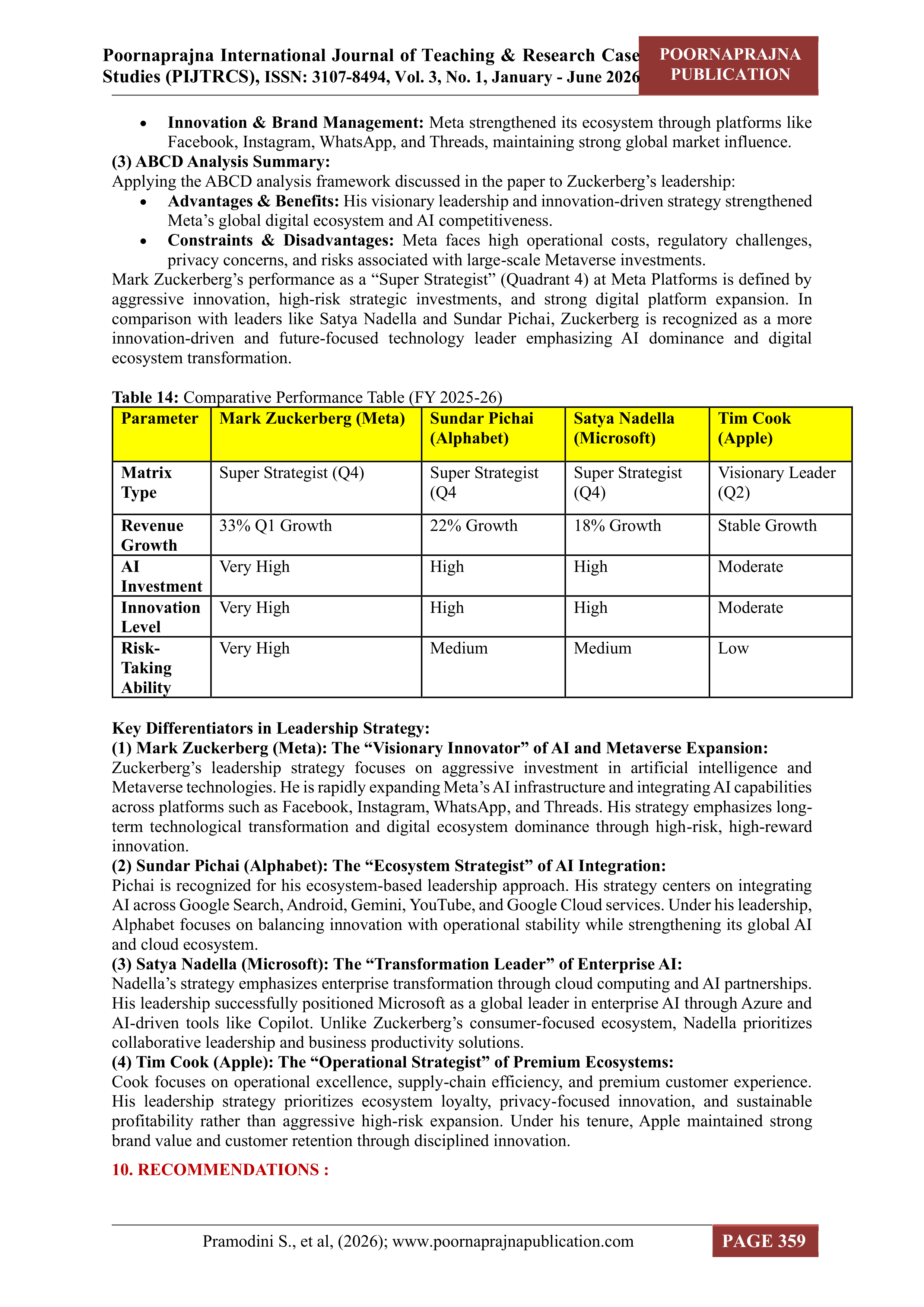


Poornaprajna International Journal of Teaching & Research Case
Studies (PIJTRCS),
ISSN: 3107-8494, Vol. 3, No. 1, January - June 2026
POORNAPRAJNA
PUBLICATION
Pramodini S., et al, (2026); www.poornaprajnapublication.com
PAGE 359
•
Innovation & Brand Management:
Meta strengthened its ecosystem through platforms like
Facebook, Instagram, WhatsApp, and Threads, maintaining strong global market influence.
(3) ABCD Analysis Summary:
Applying the ABCD analysis framework discussed in the paper to Zuckerberg’s leadership:
•
Advantages & Benefits:
His visionary leadership and innovation-driven strategy strengthened
Meta’s global digital ecosystem and AI competitiveness.
•
Constraints & Disadvantages:
Meta faces high operational costs, regulatory challenges,
privacy concerns, and risks associated with large-scale Metaverse investments.
Mark Zuckerberg’s performance as a “Super Strategist” (Quadrant 4) at Meta Platforms is defined by
aggressive innovation, high-risk strategic investments, and strong digital platform expansion. In
comparison with leaders like Satya Nadella and Sundar Pichai, Zuckerberg is recognized as a more
innovation-driven and future-focused technology leader emphasizing AI dominance and digital
ecosystem transformation.
Table 14:
Comparative Performance Table (FY 2025-26)
Parameter
Mark Zuckerberg (Meta)
Sundar Pichai
(Alphabet)
Satya Nadella
(Microsoft)
Tim Cook
(Apple)
Matrix
Type
Super Strategist (Q4)
Super Strategist
(Q4
Super Strategist
(Q4)
Visionary Leader
(Q2)
Revenue
Growth
33% Q1 Growth
22% Growth
18% Growth
Stable Growth
AI
Investment
Very High
High
High
Moderate
Innovation
Level
Very High
High
High
Moderate
Risk-
Taking
Ability
Very High
Medium
Medium
Low
Key Differentiators in Leadership Strategy:
(1) Mark Zuckerberg (Meta): The “Visionary Innovator” of AI and Metaverse Expansion:
Zuckerberg’s leadership strategy focuses on aggressive investment in artificial intelligence and
Metaverse technologies. He is rapidly expanding Meta’s AI infrastructure and integrating AI capabilities
across platforms such as Facebook, Instagram, WhatsApp, and Threads. His strategy emphasizes long-
term technological transformation and digital ecosystem dominance through high-risk, high-reward
innovation.
(2) Sundar Pichai (Alphabet): The “Ecosystem Strategist” of AI Integration:
Pichai is recognized for his ecosystem-based leadership approach. His strategy centers on integrating
AI across Google Search, Android, Gemini, YouTube, and Google Cloud services. Under his leadership,
Alphabet focuses on balancing innovation with operational stability while strengthening its global AI
and cloud ecosystem.
(3) Satya Nadella (Microsoft): The “Transformation Leader” of Enterprise AI:
Nadella’s strategy emphasizes enterprise transformation through cloud computing and AI partnerships.
His leadership successfully positioned Microsoft as a global leader in enterprise AI through Azure and
AI-driven tools like Copilot. Unlike Zuckerberg’s consumer-focused ecosystem, Nadella prioritizes
collaborative leadership and business productivity solutions.
(4) Tim Cook (Apple): The “Operational Strategist” of Premium Ecosystems:
Cook focuses on operational excellence, supply-chain efficiency, and premium customer experience.
His leadership strategy prioritizes ecosystem loyalty, privacy-focused innovation, and sustainable
profitability rather than aggressive high-risk expansion. Under his tenure, Apple maintained strong
brand value and customer retention through disciplined innovation.
10. RECOMMENDATIONS :
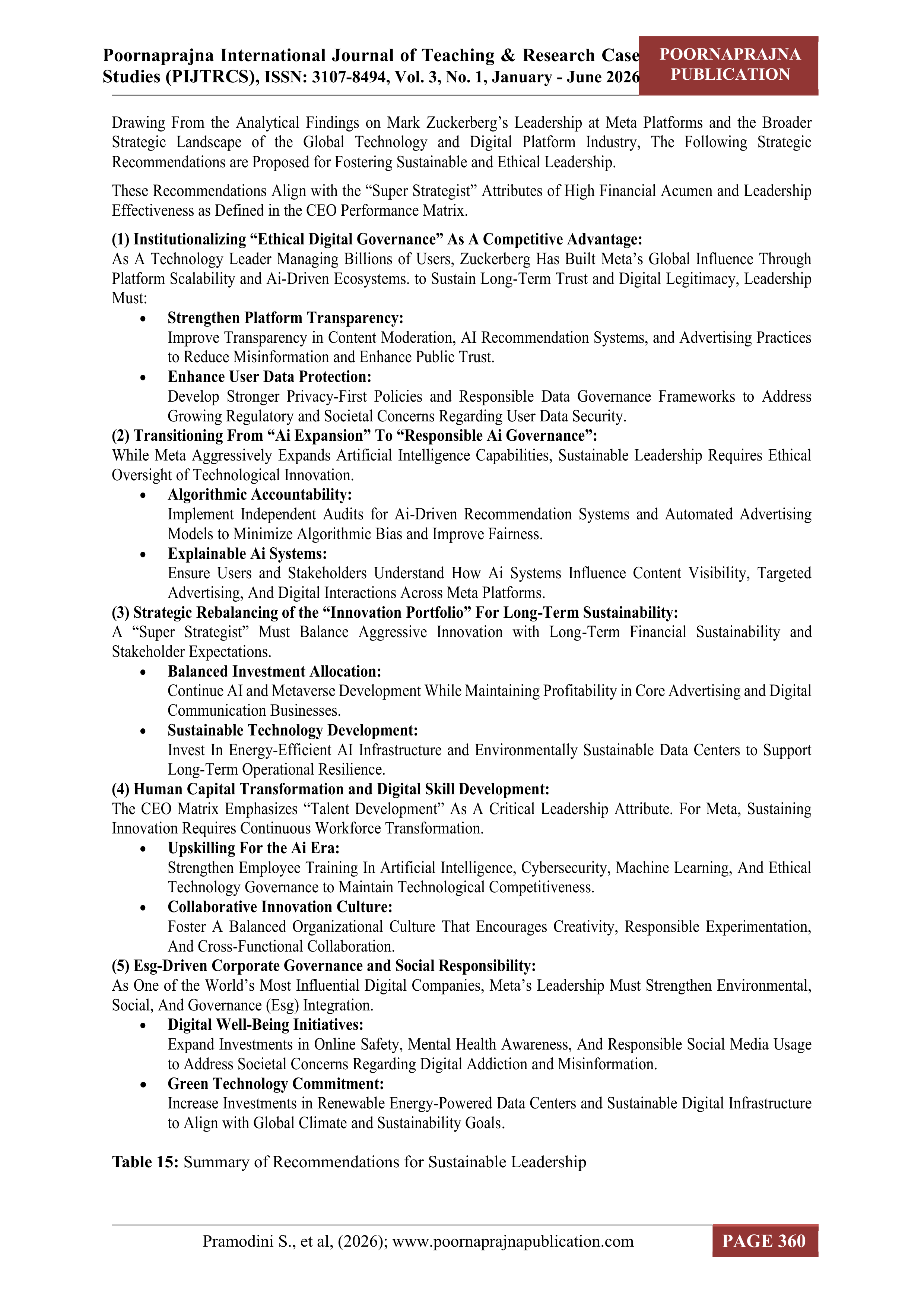


Poornaprajna International Journal of Teaching & Research Case
Studies (PIJTRCS),
ISSN: 3107-8494, Vol. 3, No. 1, January - June 2026
POORNAPRAJNA
PUBLICATION
Pramodini S., et al, (2026); www.poornaprajnapublication.com
PAGE 360
Drawing From the Analytical Findings on Mark Zuckerberg’s Leadership at Meta Platforms and the Broader
Strategic Landscape of the Global Technology and Digital Platform Industry, The Following Strategic
Recommendations are Proposed for Fostering Sustainable and Ethical Leadership.
These Recommendations Align with the “Super Strategist” Attributes of High Financial Acumen and Leadership
Effectiveness as Defined in the CEO Performance Matrix.
(1) Institutionalizing “Ethical Digital Governance” As A Competitive Advantage:
As A Technology Leader Managing Billions of Users, Zuckerberg Has Built Meta’s Global Influence Through
Platform Scalability and Ai-Driven Ecosystems. to Sustain Long-Term Trust and Digital Legitimacy, Leadership
Must:
•
Strengthen Platform Transparency:
Improve Transparency in Content Moderation, AI Recommendation Systems, and Advertising Practices
to Reduce Misinformation and Enhance Public Trust.
•
Enhance User Data Protection:
Develop Stronger Privacy-First Policies and Responsible Data Governance Frameworks to Address
Growing Regulatory and Societal Concerns Regarding User Data Security.
(2) Transitioning From “Ai Expansion” To “Responsible Ai Governance”:
While Meta Aggressively Expands Artificial Intelligence Capabilities, Sustainable Leadership Requires Ethical
Oversight of Technological Innovation.
•
Algorithmic Accountability:
Implement Independent Audits for Ai-Driven Recommendation Systems and Automated Advertising
Models to Minimize Algorithmic Bias and Improve Fairness.
•
Explainable Ai Systems:
Ensure Users and Stakeholders Understand How Ai Systems Influence Content Visibility, Targeted
Advertising, And Digital Interactions Across Meta Platforms.
(3) Strategic Rebalancing of the “Innovation Portfolio” For Long-Term Sustainability:
A “Super Strategist” Must Balance Aggressive Innovation with Long-Term Financial Sustainability and
Stakeholder Expectations.
•
Balanced Investment Allocation:
Continue AI and Metaverse Development While Maintaining Profitability in Core Advertising and Digital
Communication Businesses.
•
Sustainable Technology Development:
Invest In Energy-Efficient AI Infrastructure and Environmentally Sustainable Data Centers to Support
Long-Term Operational Resilience.
(4) Human Capital Transformation and Digital Skill Development:
The CEO Matrix Emphasizes “Talent Development” As A Critical Leadership Attribute. For Meta, Sustaining
Innovation Requires Continuous Workforce Transformation.
•
Upskilling For the Ai Era:
Strengthen Employee Training In Artificial Intelligence, Cybersecurity, Machine Learning, And Ethical
Technology Governance to Maintain Technological Competitiveness.
•
Collaborative Innovation Culture:
Foster A Balanced Organizational Culture That Encourages Creativity, Responsible Experimentation,
And Cross-Functional Collaboration.
(5) Esg-Driven Corporate Governance and Social Responsibility:
As One of the World’s Most Influential Digital Companies, Meta’s Leadership Must Strengthen Environmental,
Social, And Governance (Esg) Integration.
•
Digital Well-Being Initiatives:
Expand Investments in Online Safety, Mental Health Awareness, And Responsible Social Media Usage
to Address Societal Concerns Regarding Digital Addiction and Misinformation.
•
Green Technology Commitment:
Increase Investments in Renewable Energy-Powered Data Centers and Sustainable Digital Infrastructure
to Align with Global Climate and Sustainability Goals
.
Table 15:
Summary of Recommendations for Sustainable Leadership
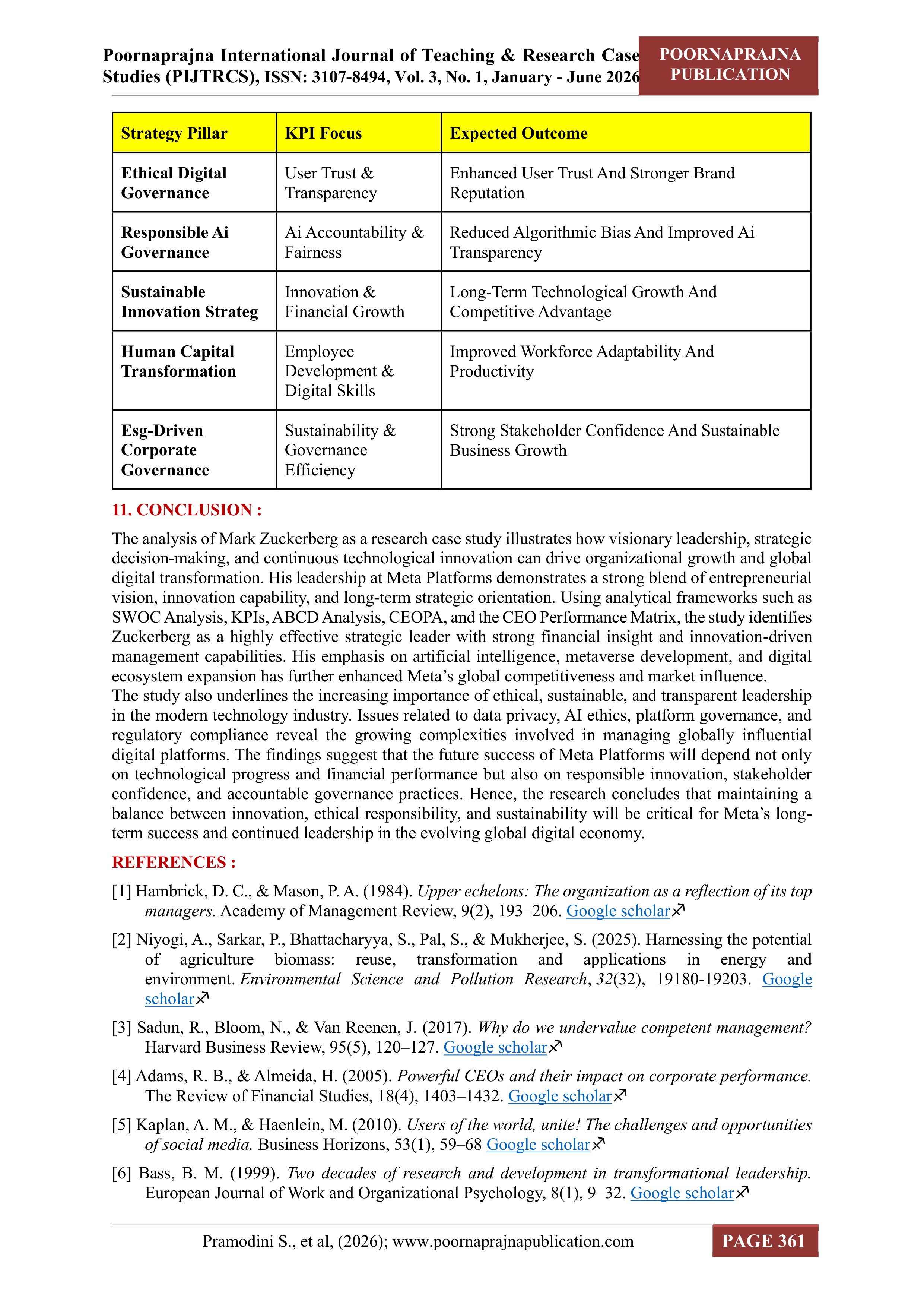


Poornaprajna International Journal of Teaching & Research Case
Studies (PIJTRCS),
ISSN: 3107-8494, Vol. 3, No. 1, January - June 2026
POORNAPRAJNA
PUBLICATION
Pramodini S., et al, (2026); www.poornaprajnapublication.com
PAGE 361
Strategy Pillar
KPI Focus
Expected Outcome
Ethical Digital
Governance
User Trust &
Transparency
Enhanced User Trust And Stronger Brand
Reputation
Responsible Ai
Governance
Ai Accountability &
Fairness
Reduced Algorithmic Bias And Improved Ai
Transparency
Sustainable
Innovation Strateg
Innovation &
Financial Growth
Long-Term Technological Growth And
Competitive Advantage
Human Capital
Transformation
Employee
Development &
Digital Skills
Improved Workforce Adaptability And
Productivity
Esg-Driven
Corporate
Governance
Sustainability &
Governance
Efficiency
Strong Stakeholder Confidence And Sustainable
Business Growth
11. CONCLUSION :
The analysis of Mark Zuckerberg as a research case study illustrates how visionary leadership, strategic
decision-making, and continuous technological innovation can drive organizational growth and global
digital transformation. His leadership at Meta Platforms demonstrates a strong blend of entrepreneurial
vision, innovation capability, and long-term strategic orientation. Using analytical frameworks such as
SWOC Analysis, KPIs, ABCD Analysis, CEOPA, and the CEO Performance Matrix, the study identifies
Zuckerberg as a highly effective strategic leader with strong financial insight and innovation-driven
management capabilities. His emphasis on artificial intelligence, metaverse development, and digital
ecosystem expansion has further enhanced Meta’s global competitiveness and market influence.
The study also underlines the increasing importance of ethical, sustainable, and transparent leadership
in the modern technology industry. Issues related to data privacy, AI ethics, platform governance, and
regulatory compliance reveal the growing complexities involved in managing globally influential
digital platforms. The findings suggest that the future success of Meta Platforms will depend not only
on technological progress and financial performance but also on responsible innovation, stakeholder
confidence, and accountable governance practices. Hence, the research concludes that maintaining a
balance between innovation, ethical responsibility, and sustainability will be critical for Meta’s long-
term success and continued leadership in the evolving global digital economy.
REFERENCES :
[1] Hambrick, D. C., & Mason, P. A. (1984).
Upper echelons: The organization as a reflection of its top
managers.
Academy of Management Review, 9(2), 193–206.
Google scholar
[2] Niyogi, A., Sarkar, P., Bhattacharyya, S., Pal, S., & Mukherjee, S. (2025). Harnessing the potential
of
agriculture
biomass:
reuse,
transformation
and
applications
in
energy
and
environment.
Environmental Science and Pollution Research
,
32
(32), 19180-19203.
Google
scholar
[3] Sadun, R., Bloom, N., & Van Reenen, J. (2017).
Why do we undervalue competent management?
Harvard Business Review, 95(5), 120–127.
Google scholar
[4] Adams, R. B., & Almeida, H. (2005).
Powerful CEOs and their impact on corporate performance.
The Review of Financial Studies, 18(4), 1403–1432.
Google scholar
[5] Kaplan, A. M., & Haenlein, M. (2010).
Users of the world, unite! The challenges and opportunities
of social media.
Business Horizons, 53(1), 59–68
Google scholar
[6] Bass, B. M. (1999).
Two decades of research and development in transformational leadership.
European Journal of Work and Organizational Psychology, 8(1), 9–32.
Google scholar


Poornaprajna International Journal of Teaching & Research Case
Studies (PIJTRCS),
ISSN: 3107-8494, Vol. 3, No. 1, January - June 2026
POORNAPRAJNA
PUBLICATION
Pramodini S., et al, (2026); www.poornaprajnapublication.com
PAGE 362
[7] Van Dijck, J. (2013).
The Culture of Connectivity: A Critical History of Social Media.
Oxford
University Press.
Google scholar
[8] McAfee, A., & Brynjolfsson, E. (2012).
Big data: The management revolution.
Harvard Business
Review, 90(10), 60–68.
Google scholar
[9] Ferris, S. P., Javakhadze, D., & Rajkovic, T. (2019). An international analysis of CEO social capital
and corporate risk‐taking.
European Financial Management
,
25
(1), 3-37.
Google scholar
[10] Dahya, J., Lonie, A. A., & Power, D. M. (1996). The case for separating the roles of chairman and
CEO: An analysis of stock market and accounting data.
Corporate Governance: An International
Review
,
4
(2), 71-77.
Google scholar
[11] Biggerstaff, L., Cicero, D. C., & Puckett, A. (2017). FORE! An analysis of CEO
shirking.
Management Science
,
63
(7), 2302-2322.
Google scholar
[12] Gilson, S. C., & Vetsuypens, M. R. (1993). CEO compensation in financially distressed firms: An
empirical analysis.
The Journal of Finance
,
48
(2), 425-458.
Google scholar
[13] McClelland, P. L., Liang, X., & Barker III, V. L. (2010). CEO commitment to the status quo:
Replication and extension using content analysis.
Journal of Management
,
36
(5), 1251-1277.
Google scholar
[14] Conaway, R. N., & Wardrope, W. J. (2010). Do their words really matter? Thematic analysis of US
and Latin American CEO letters.
The Journal of Business Communication (1973)
,
47
(2), 141-168.
Google scholar
[15] Hambrick, D. C., & Cannella Jr, A. A. (2004). CEOs who have COOs: Contingency analysis of an
unexplored structural form.
Strategic Management Journal
,
25
(10), 959-979.
Google scholar
[16] Shivdasani, A., & Yermack, D. (1999). CEO involvement in the selection of new board members:
An empirical analysis.
The journal of finance
,
54
(5), 1829-1853.
Google scholar
[17] Tosi, H. L., Werner, S., Katz, J. P., & Gomez-Mejia, L. R. (2000). How much does performance
matter? A meta-analysis of CEO pay studies.
Journal of management
,
26
(2), 301-339.
Google
scholar
[18] Zajac, E. J. (1990). CEO selection, succession, compensation and firm performance: A theoretical
integration and empirical analysis.
Strategic Management Journal
,
11
(3), 217-230.
Google
scholar
[19] Cragun, O. R., Olsen, K. J., & Wright, P. M. (2020). Making CEO narcissism research great: A
review and meta-analysis of CEO narcissism.
Journal of management
,
46
(6), 908-936.
Google
Scholar
[20] Borgholthaus, C. J., White, J. V., & Harms, P. D. (2023). CEO dark personality: A critical review,
bibliometric analysis, and research agenda.
Personality and Individual Differences
,
201
, 111951.
Google scholar
[21] Guay, W. R. (1999). The sensitivity of CEO wealth to equity risk: an analysis of the magnitude and
determinants.
Journal of financial economics
,
53
(1), 43-71.
Google scholar
[22] Waldman, D. A., & Yammarino, F. J. (1999). CEO charismatic leadership: Levels-of-management
and levels-of-analysis effects.
Academy of management review
,
24
(2), 266-285.
Google scholar
[23] Parrino, R. (1997). CEO turnover and outside succession a cross-sectional analysis.
Journal of
financial Economics
,
46
(2), 165-197.
Google scholar
[24] Zhao, Y. (2025). An Integrated Analysis of Board Structure and Executive Compensation at Meta
Platforms Inc. In
SHS Web of Conferences
(Vol. 225, p. 01031). EDP Sciences.
Google scholar
[25] Rahman, F., & Nuzulia, R. (2025). “I’m not gonna answer that”: A Critical Discourse Analysis of
the Hawley-Zuckerberg Debate.
Journal of Current Social and Political Issues
,
3
(2), 85-95.
Google scholar


Poornaprajna International Journal of Teaching & Research Case
Studies (PIJTRCS),
ISSN: 3107-8494, Vol. 3, No. 1, January - June 2026
POORNAPRAJNA
PUBLICATION
Pramodini S., et al, (2026); www.poornaprajnapublication.com
PAGE 363
[26] Lomas, T., Teubner, J., Ivey, R. M., Case, B., & Larrey, F. P. Into the metaverse (with Lex Fridman
and Mark Zuckerberg): Exploring the ontological adventures, potentials, and risks of a new
dimension of being.
Google scholar
[27] Castell, M. (2023). FACEBOOK IS NOW META. Meta's corporate sociotechnical imaginary and
the discursive construction of the Metaverse as the social platform of the future.
Google scholar
[28] Moenandar, S. J., Beerends-Pavlovic, S., van den Berg, B., & Coughlan, G. (2022). A brave new
internet: Hacking the narrative of Mark Zuckerberg’s 2021 introduction of the
Metaverse.
Narrative Works
,
11
, 125-148.
Google scholar
[29] Huang, X. (2023, February). Value Investment: A Case Study for Technology Companies (Meta vs
Microsoft). In
International Conference on Business and Policy Studies
(pp. 827-837). Singapore:
Springer Nature Singapore.
Google scholar
[30] Bansal, P., Gautam, O., Wajih, S. A., & Gawande, N. (2023). A study on environmental
sustainability of Indian companies: A systematic review and meta analysis.
Journal of
Pharmaceutical Negative Results
,
14
, 2673.
Google scholar
[31] Chang, J. C., Hurst, T. L., Hart, D. A., & Estey, A. W. (2002). 4-META use in dentistry: a literature
review.
The Journal of prosthetic dentistry
,
87
(2), 216-224.
Google scholar
[32] Hashimoto, Y., Fukuda, T., Oyabu, C., Tanaka, M., Asano, M., Yamazaki, M., & Fukui, M. (2016).
Impact of low‐carbohydrate diet on body composition: meta‐analysis of randomized controlled
studies.
Obesity reviews
,
17
(6), 499-509.
Google scholar
[33] Gao, Y., Zhang, G., Jiang, S., & Liu, Y. X. (2024). Wekemo Bioincloud: A user‐friendly platform
for meta‐omics data analyses.
Imeta
,
3
(1), e175.
Google scholar
[34] Finlayson, K. W., & Dixon, A. (2008). Qualitative meta-synthesis: a guide for the novice.
Nurse
researcher
,
15
(2).
Google scholar
[35] Liu, Z., Lei, Q., & Xing, S. (2019). Mechanical characteristics of wood, ceramic, metal and carbon
fiber-based PLA composites fabricated by FDM.
Journal of Materials Research and
Technology
,
8
(5), 3741-3751.
Google scholar
[36] Trefil, B. (2001). European Company Law: Comments and Meta-comments on Centros.
German
Law Journal
,
2
(18), E3.
Google scholar
[37] Solodukha, Z. I., & Leonova, S. V. (2025). Digital Tools for Promoting Marketing Agencies in the
Advertising Services Market: A Comparative Analysis of Google Ads and Meta Approaches.
The
actual problems of regional economy development
,
1
(21), 288-296.
Google scholar
[38] Piot, M. A., Dechartres, A., Attoe, C., Jollant, F., Lemogne, C., Layat Burn, C., ... & Falissard, B.
(2020). Simulation in psychiatry for medical doctors: a systematic review and meta‐
analysis.
Medical education
,
54
(8), 696-708.
Google scholar
[39] Dalton, D. R., Daily, C. M., Ellstrand, A. E., & Johnson, J. L. (1998). Meta‐analytic reviews of
board composition, leadership structure, and financial performance.
Strategic management
journal
,
19
(3), 269-290.
Google scholar
[40] Brierley, C., Ellis, L., & Reid, E. R. (2022). Peer‐assisted learning in medical education: A
systematic review and meta‐analysis.
Medical education
,
56
(4), 365-373.
Google scholar
[41]W ang, L., Li, W., & Qi, L. (2020). Stakeholder pressures and corporate environmental strategies:
A meta-analysis.
Sustainability
,
12
(3), 1172.
Google scholar
[42] Jenkins, D. J., Blanco Mejia, S., Chiavaroli, L., Viguiliouk, E., Li, S. S., Kendall, C. W., ... &
Sievenpiper, J. L. (2019). Cumulative meta‐analysis of the soy effect over time.
Journal of the
American Heart Association
,
8
(13), e012458.
Google scholar
[43] Gorichanaz, T. (2022).
The philosophy of the Metaverse: What is it and why does it matter?
Philosophy & Technology, 35(4), 1–16.
Google scholar


Poornaprajna International Journal of Teaching & Research Case
Studies (PIJTRCS),
ISSN: 3107-8494, Vol. 3, No. 1, January - June 2026
POORNAPRAJNA
PUBLICATION
Pramodini S., et al, (2026); www.poornaprajnapublication.com
PAGE 364
[44] Yin, R. K. (2018).
Case Study Research and Applications: Design and Methods.
Sage Publications.
Google scholar
[45] Eisenhardt, K. M. (1989).
Building theories from case study research.
Academy of Management
Review, 14(4), 532–550.
Google scholar
[46] Aithal, P. S., & Kumar, P. M. (2015). Applying SWOC analysis to an institution of higher
education.
International Journal of Management, IT and Engineering
,
5
(7), 231-247.
Google
Scholar
[47] Aithal, P. S., & Aithal, S. (2023). Incubationship–A systematic analysis of recently announced
super innovation in higher education using SWOC, ABCD, and PESTL frameworks.
International
Journal of Case Studies in Business, IT, and Education (IJCSBE)
,
7
(4), 48-90.
Google Scholar
[48] Aithal, P. S. (2017). Industry analysis–the first Step in business management Scholarly
research.
International Journal of Case Studies in Business, IT and Education (IJCSBE)
,
1
(1), 1-
13.
Google Scholar
[49] Pickton, D. W., & Wright, S. (1998).
What’s SWOT in strategic analysis?
Strategic Change, 7(2),
101–109.
Google scholar
[50] Aithal, P. S. (2016).
ABCD analysis as research methodology in company case studies.
International Journal of Management, IT and Engineering, 6(1), 98–115.
Google scholar
[51] Aithal, P. S., Shailashree, V. T., & Kumar, P. M. (2015).
A new ABCD technique to analyze business
models & concepts.
International Journal of Management, IT and Engineering, 5(4), 409–423.
Google scholar
[52] Kumar, P. M., Aithal, P. S., & Frederick, D. P. (2023).
Application of ABCD analysis framework in
strategic management studies.
International Journal of Applied Research and Studies, 12(2), 45–
58.
Google scholar
[53] Frederick, D. P., & Bhat, G. (2022).
ABCD analysis of CSR strategies in business organizations.
International Journal of Case Studies in Business, IT and Education, 6(1), 120–135.
Google
scholar
[54] Lobo, S., & Bhat, S. (2024). A Quantitative ABCD Analysis of Factors Driving Share Price
Volatility in the Indian Pharmaceutical Sector.
International Journal of Management, Technology
and Social Sciences (IJMTS)
,
9
(2), 18-52.
Google scholar
[55] Sujaya, H., & Aithal, P. S. (2022).
Quantitative weighting approach in ABCD analysis for
organizational decision-making.
International Journal of Engineering and Management Research,
12(4), 88–97.
Google scholar
[56] Prabhu, N. (2023).
Comparative analysis of SWOT and ABCD frameworks in strategic planning.
International Journal of Research in Business Management, 9(2), 30–41.
Google scholar
[57] Puyt, R. W., & Madsen, D. Ø. (2025). The Origins of PEST Analysis: From Information Factors to
Mnemonic Framework Through Epistemic Decoupling.
Available at SSRN 5644046
.
Google
scholar
[58] Chepys, I., & Doležalová, P. (2025).
Application of modified PESTLE analysis in forecasting fiscal
vulnerabilities and public policy assessment.
Financial Law Review, 37(1), 26–52.
DOI:10.4467/22996834FLR.25.014.23055.
Google scholar
[59] Kung, L. (2023).
Innovation, competition, and regulation in digital platform companies: The case
of Meta Platforms.
Journal of Digital Economy and Management, 8(3), 55–72.
Google scholar
[60] Rintala, O. (2025). Concept Development for Integrated Technology Product Portfolio
Management System: Case Study in Marine Technology Company.
Google scholar
[61] Aithal, P. S. (2023). Anticipated attributes of chief executive officers based on newly developed
CEO matrix.
International Journal of Applied Engineering and Management Letters
(IJAEML)
,
7
(4), 216-248.
Google Scholar


Poornaprajna International Journal of Teaching & Research Case
Studies (PIJTRCS),
ISSN: 3107-8494, Vol. 3, No. 1, January - June 2026
POORNAPRAJNA
PUBLICATION
Pramodini S., et al, (2026); www.poornaprajnapublication.com
PAGE 365
[62] Aithal, P. S. (2025). Publishing Company and CEO Analysis Papers as Part of a 'Dark-Blue Ocean
Strategy'in Professional Education to Grab Employment.
Poornaprajna International Journal of
Management, Education & Social Science (PIJMESS)
,
2
(1), 129-153.
Google Scholar
[63] Aithal, P. S., Bhandarkar, S. M., & Shetty, V. (2024). A Systematic CEO Analysis for Elon Musk
of Tesla Inc. EV Company.
Poornaprajna International Journal of Teaching & Research Case
Studies (PIJTRCS)
,
1
(1), 126-162.
Google Scholar
[64] Aithal, P. S. (2025). CEO Analysis of K. Krithivasan of Tata Consultancy Services.
Poornaprajna
International Journal of Teaching & Research Case Studies (PIJTRCS)
,
2
(1), 73-107.
Google
Scholar
[65] Aithal, P. S. (2026). CEO Analysis of Siddhartha Mohanty as an Insider-Reformer of Life Insurance
Corporation of India.
Poornaprajna International Journal of Teaching & Research Case Studies
(PIJTRCS)
,
3
(1), 103-137.
Google Scholar
[66] Aithal, P. S., & Naveen Kumar K. R, (2025). CEO Analysis of Demis Hassabis of DeepMind
Technologies Limited.
Poornaprajna International Journal of Teaching & Research Case Studies
(PIJTRCS)
,
2
(2), 225-258.
Google Scholar
[67] Diya Devadiga & Aithal P. S. (25/04/2026). Visionary Leadership and Strategic Innovation: A CEO
Analysis of Melanie Perkins at Canva Pty Ltd.
Poornaprajna International Journal of Teaching &
Research Case Studies (PIJTRCS), 3
(1), 138-165.
Google Scholar
[68] Diya Devadiga & Aithal P. S. (2026). Transformational Leadership and Digital Transformation: A
CEO Matrix and KPI-Based Case Study of Satya Nadella at Microsoft.
Poornaprajna
International Journal of Teaching & Research Case Studies (PIJTRCS), 3
(1), 166-189.
Google
Scholar
[69] Aithal, K. V., & Aithal, P. S. Leadership and Strategic Vision: A Scholarly Analysis of CEO Anders
Opedal’s Tenure at Equinor.
Poornaprajna International Journal of Teaching & Research Case
Studies (PIJTRCS), 2
(2), 433-469.
Google Scholar
[70] Isha Devadiga & Aithal P. S. (2026). The Super Strategist in the Semiconductor Industry: A Multi-
Framework CEO Analysis of Lisa Su at Advanced Micro Devices, Inc..
Poornaprajna
International Journal of Teaching & Research Case Studies (PIJTRCS), 3
(1), 190-219.
Google
Scholar
[71] Diya Devadiga & Aithal P. S. (2026). Transformational Leadership and Digital Transformation: A
CEO Matrix and KPI-Based Case Study of Satya Nadella at Microsoft.
Poornaprajna
International Journal of Teaching & Research Case Studies (PIJTRCS), 3
(1), 166-189.
Google
Scholar
[72] Subhash Poojary & Aithal P. S. (2026). Strategic Leadership and Vision: An In-Depth CEO
Analysis of Zerodha and Founder-CEO Nithin Kamath.
Poornaprajna International Journal of
Teaching
&
Research
Case
Studies
(PIJTRCS),
3
(1),
220-244.
DOI:
https://doi.org/10.5281/zenodo.20080620
[73] Devadiga, I. & Aithal, P. S. (2026). CEO Analysis of Sanjiv Puri of ITC Limited: A Multi-
Framework Evaluation of Technology-Led Leadership, Strategic Diversification, and Sustainable
Transformation.
Poornaprajna International Journal of Teaching & Research Case Studies
(PIJTRCS), 3
(1), 260-291. DOI:
https://doi.org/10.5281/zenodo.20390527
[74] Devadiga Disha. & Aithal, P. S. (2026). Architecting Intelligence: An Integrated Framework
Analysis of Jensen Huang's Transformational Leadership at NVIDIA Corporation.
Poornaprajna
International Journal of Teaching & Research Case Studies (PIJTRCS), 3
(1), 292-329. DOI:
https://doi.org/10.5281/zenodo.20390662
***********