





































































































1
The original knowledge management publication
N
ews
posted 4 Sep 2003 in Volume 7 Issue 1
Sensemaking techniques in support of leadership development
Large companies looking to explore and solve complex business chal
lenges are adopting proven
techniques to get the most out of their efforts.
Charles Palus
and
Albert Selvin
outline the
results of a leadership
-
development workshop that used Compendium, a methodology offering a
way to visually map and connect ideas, and e
xamine the implications for knowledge
management.
Recently Verizon Communications and the Center for Creative Leadership have been
collaborating on R&D to help leaders face and resolve complex challenges. A principle part of
that effort has involved experi
menting with tools and processes for better sensemaking
, that is,
for paying attention to diverse and often chaotic information about critical challenges, and
creating shared understanding in support of mindful action.
In this brief case report we focus
on illustrating a set of techniques, called Compendium, that
make sense of complexity, as applied during a two
-
day leadership development workshop. We
look at the outcomes achieved via Compendium, and the implications for the fields of
knowledge management
and leadership development.
Compendium was originally developed for internal use at Verizon. It is available for use by
others under a no
-
cost license. Verizon is currently evaluating the release of the code for open
-
source management in the public domain.
The workshop had two sets of goals. The first was to mutually explore, and then begin to solve
selected urgent
but frustratingly complex
challenges facing a business unit. The second was
to develop leadership capacity within this group, including en
hanced sensemaking competencies,
and an enhanced leader
-
to
-
leader network of relationships.[1] Participants were executives from
different geographic regions and functional groups within a business unit of a large corporation.
Many of the participants had
never met face to face before the session. By the end of the
workshop, two action
-
learning teams were formed to address targeted aspects of the challenges
explored.
Faculty members from the Center for Creative Leadership facilitated the workshop. Albert
Se
lvin served as the Compendium practitioner, he operated the software and assisted in various
facilitation functions.
Compendium offers a way to visually map and connect ideas. Ideas are shown as text-
filled
icons on a screen. Conversations are mapped as t
hey unfold, producing a richer record than
www.kmmagazine.com
downloaded Sept 17 2003
2
normal minutes. Because it is done on a computer, ideas can be connected in many ways, for
example, by clustering ideas together, joining ideas with graphical lines and sharing keywords.
Compendium enables groups
of people to build knowledge on the fly. It allows teams to
combine informal, exploratory discussion with formal problem
-
solving frameworks.
Compendium makes the resulting knowledge available for re-
use and expansion via a robust
database (MS Access) and a
variety of display and reporting formats (for example, hyperlinked
HTML pages, MS Word, and a visual map of nodes and links). Originally developed at Verizon
as a methodology for cross
-
functional business
-process redesign, and for addressing wicked
prob
lems pertaining to telephone operations (for example, Y2K planning among diverse
stakeholders), Compendium has been applied to more than 70 projects in a variety of
organisations.[2]
An important research question of ours begins: What if we took this set
of Compendium
techniques, as originally developed for making sense of wicked technical problems, and adapted
it for the use of leaders facing complex business challenges?
The workshop
The following description of the workshop is not exhaustive. Rather, we
show how the
Compendium techniques are used to help build shared and useful knowledge within the group. In
the interests of confidentiality we have withheld or disguised the details of that knowledge.
One of the initial exercises is called Visual Explorer
(VE).[3] Participants had done preparation
work to identify a key challenge they were facing. They were then instructed to walk around and
look at approximately 200 pictures spread out on the floor in the hallway outside the conference
room. They were ask
ed to look for pictures that spoke to them in some way
not literal
illustrations, but rather ones that triggered some metaphorical or emotional resonance. Each
person was asked to select two pictures
one representing the current state of the challenge
and
one representing a pathway for taking action. After the individuals selected the pictures, they
brought them back and discussed them in small groups according to a structured protocol. First
the selector explains what they see in a picture, why they se
lected it and how it seems to speak of
their challenge. Others in the group say what they see in the picture. The selector then gives his
final comments, and the process moves on to the next person.
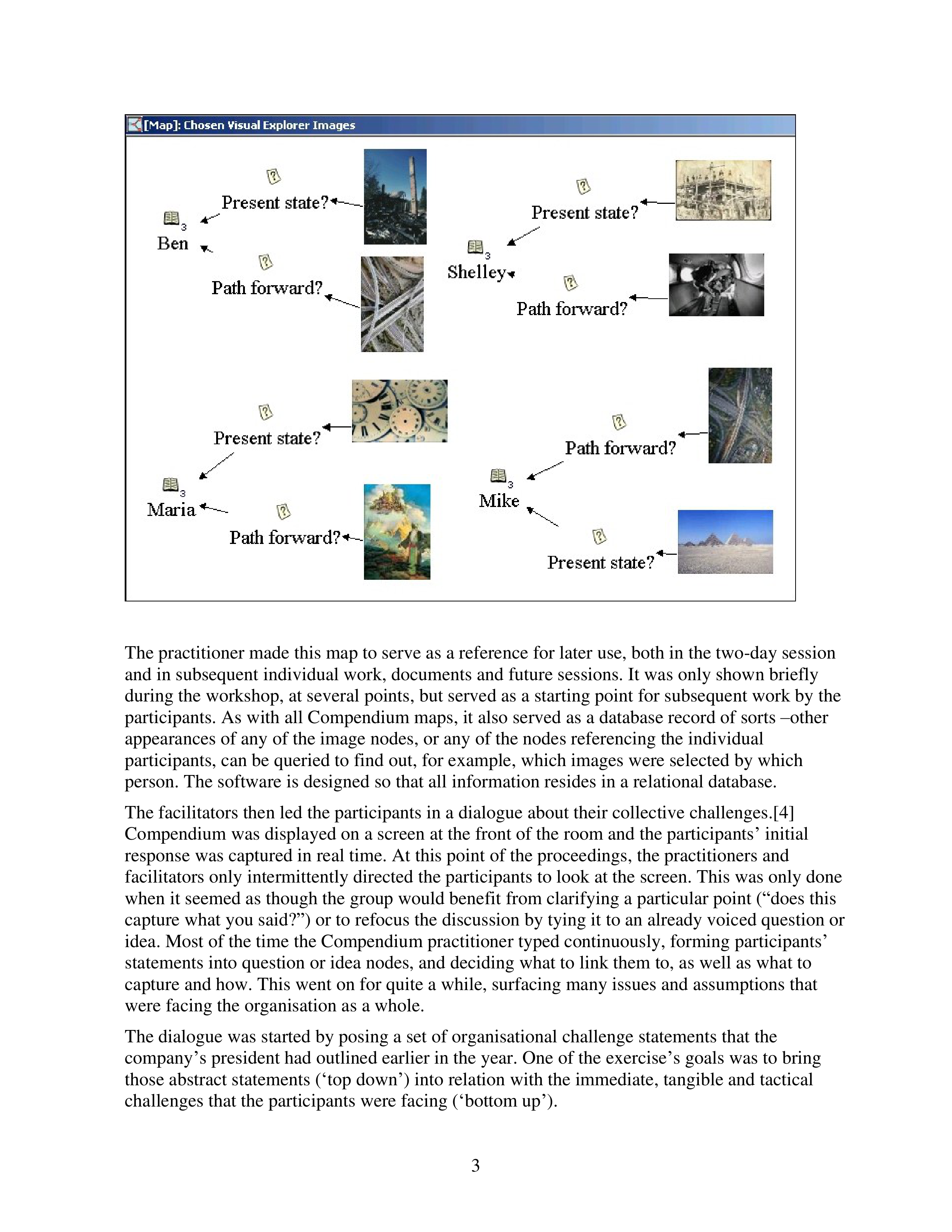
At this point, a few hours into the day, Compendium ente
red the proceedings. Each of the VE
images had a serial number tied to a file name of thumbnail images stored on a laptop computer,
which also had the Compendium software installed. The practitioner created a map with each
participant
s name linked to two question nodes: present state? and future state?
. These were
then linked to the associated VE image. The entire map was projected on a shared display.
3
The practitioner made this map to serve as a reference for later use, both in the two
-
day session
and
in subsequent individual work, documents and future sessions. It was only shown briefly
during the workshop, at several points, but served as a starting point for subsequent work by the
participants. As with all Compendium maps, it also served as a database record of sorts
other
appearances of any of the image nodes, or any of the nodes referencing the individual
participants, can be queried to find out, for example, which images were selected by which
person. The software is designed so that all informat
ion resides in a relational database.
The facilitators then led the participants in a dialogue about their collective challenges.[4]
Compendium was displayed on a screen at the front of the room and the participants initial
response was captured in real t
ime. At this point of the proceedings, the practitioners and
facilitators only intermittently directed the participants to look at the screen. This was only done
when it seemed as though the group would benefit from clarifying a particular point (
does thi
s
capture what you said?
) or to refocus the discussion by tying it to an already voiced question or
idea. Most of the time the Compendium practitioner typed continuously, forming participants
statements into question or idea nodes, and deciding what to l
ink them to, as well as what to
capture and how. This went on for quite a while, surfacing many issues and assumptions that
were facing the organisation as a whole.
The dialogue was started by posing a set of organisational challenge statements that the
co
mpany
s president had outlined earlier in the year. One of the exercise
s goals was to bring
those abstract statements (
top down
) into relation with the immediate, tangible and tactical
challenges that the participants were facing (
bottom up
).
4
At this
point in the initial Compendium
-
supported dialogue, the practitioner made minimal
attempts to guide or shape the conversation, emphasising the verbatim capturing of the
participants statements more than shaping or active construction. There are several reasons for
this. One is to simply get a record of the discussion. Another is to capture the discussion as it
happens in a form that allows its elements to be available for later use. The display is also used
as one aspect of the facilitation for this part
icular session. This approach also gives each
participant a sense of validation by having his or her comments added to the display. The
mapping process involves aesthetic and technical choices appropriate to the situation. At other
times and for other reas
ons, practitioners can employ more deliberate shaping, using pre
-
established structural templates for example.
The workshop participants then divided their visual attention between the screen and each other.
They watched as the practitioner entered their
words (or close paraphrases) in nodes, sometimes
calling out corrections either to the current node or to a previous node as the meanings became
refined or changed in the discussion. Corrections were sometimes made in a review mode as
either the practiti
oner, one of the facilitators, or one of the participants read through some
portion of the discussion out loud. Most of the time, though, they looked at each other.
At one stage, one of the CCL facilitators asked if any of the chosen VE images illustrated
any of
the points raised in the general discussion. The participants identified such images and they were
added to the map in context, as were the copious points made in the ensuing lively discussion.
Note that this is a matter of re
-
using a node already
created in the individually chosen map of
images
an example of re
-
using knowledge elements on the fly.
During live sessions, it is often useful to show participants that an idea they have created or
referenced in one context has been used in another. In
the example above, the image selected had
already been discussed by a small group of participants in the earlier VE exercise. Compendium
has a special interface for displaying in which views a particular node appears.
In the afternoon of the first day, th
e facilitators asked the participants to review the Compendium
discussion map as a prelude to reframing their challenge statements. The practitioner read
through the map while the participants listened and watched the screen. The facilitators checked
to ma
ke sure that the review seemed to match what the participants remembered, and had
captured the sense of the morning
s discussion, correcting the map where necessary.
The facilitators then conducted the reframing session, in which the participants would
come up
with alternative ways of talking about their major challenges, incorporating the dialogues they
had had during the VE exercise and the subsequent Compendium discussion session. The
purpose of reframing was to identify better ways of stating the ess
ential challenges, thus leading
to more robust solutions.
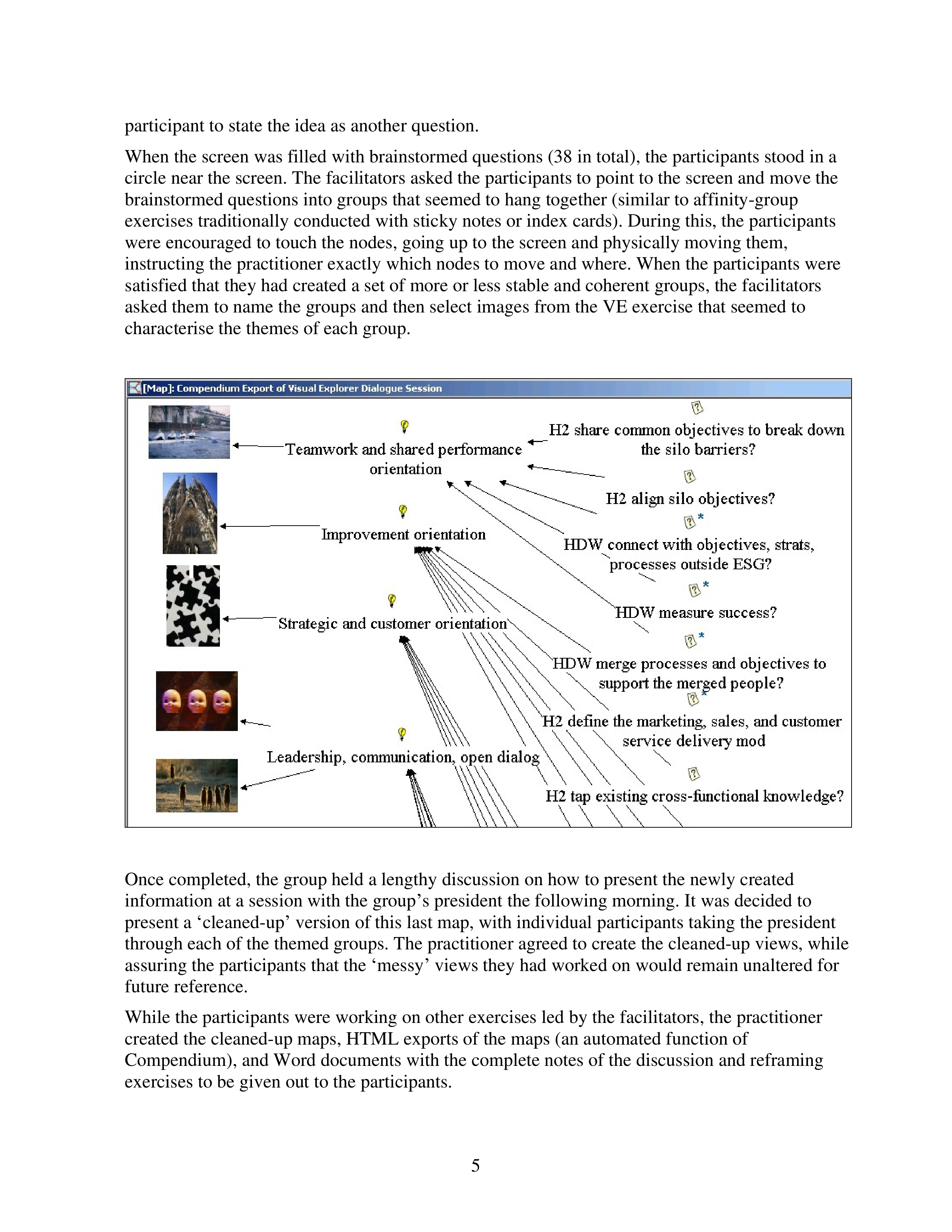
To introduce this, the facilitators presented some material about how to reframe challenges in
order to achieve more robust results. They then conducted a brainstorming
-
style Compendium
session wher
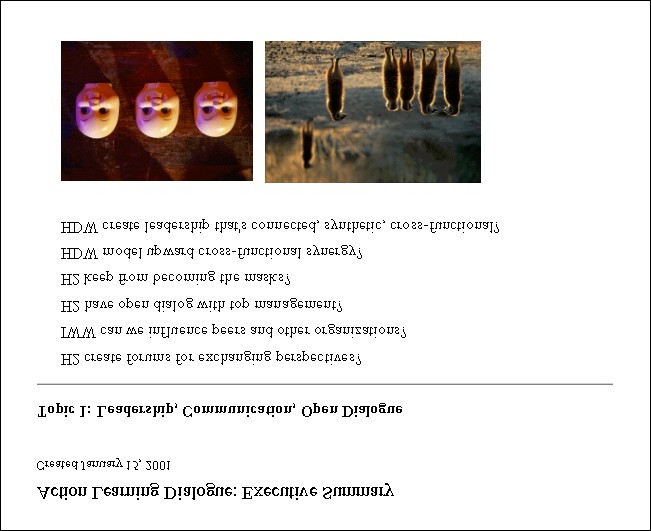
e participants were asked to call out new challenge statements in the form of
questions, starting with How to
(abbreviated as H2), How do we
(HDW), In what
way
(IWW), etc. Participants were asked to pay attention to the screen and directly enga
ge
with how their questions were being captured and displayed. The practitioner captured each
question in real time. He employed only minimal arranging, to keep more or less regular
columns of questions on the screen. The exercise was not conducted as an o
pen discussion; if
new ideas were suggested by another participant
s question, the facilitators encouraged the
5
participant to state the idea as another question.
When the screen was filled with brainstormed questions (38 in total), the participants stood i
n a
circle near the screen. The facilitators asked the participants to point to the screen and move the
brainstormed questions into groups that seemed to hang together (similar to affinity-
group
exercises traditionally conducted with sticky notes or index
cards). During this, the participants
were encouraged to touch the nodes, going up to the screen and physically moving them,
instructing the practitioner exactly which nodes to move and where. When the participants were
satisfied that they had created a set of more or less stable and coherent groups, the facilitators
asked them to name the groups and then select images from the VE exercise that seemed to
characterise the themes of each group.
Once completed, the group held a lengthy discussion on how to
present the newly created
information at a session with the group
s president the following morning. It was decided to
present a cleaned-up version of this last map, with individual participants taking the president
through each of the themed groups. The
practitioner agreed to create the cleaned
-
up views, while
assuring the participants that the messy views they had worked on would remain unaltered for
future reference.
While the participants were working on other exercises led by the facilitators, the practitioner
created the cleaned
-
up maps, HTML exports of the maps (an automated function of
Compendium), and Word documents with the complete notes of the discussion and reframing
exercises to be given out to the participants.
6
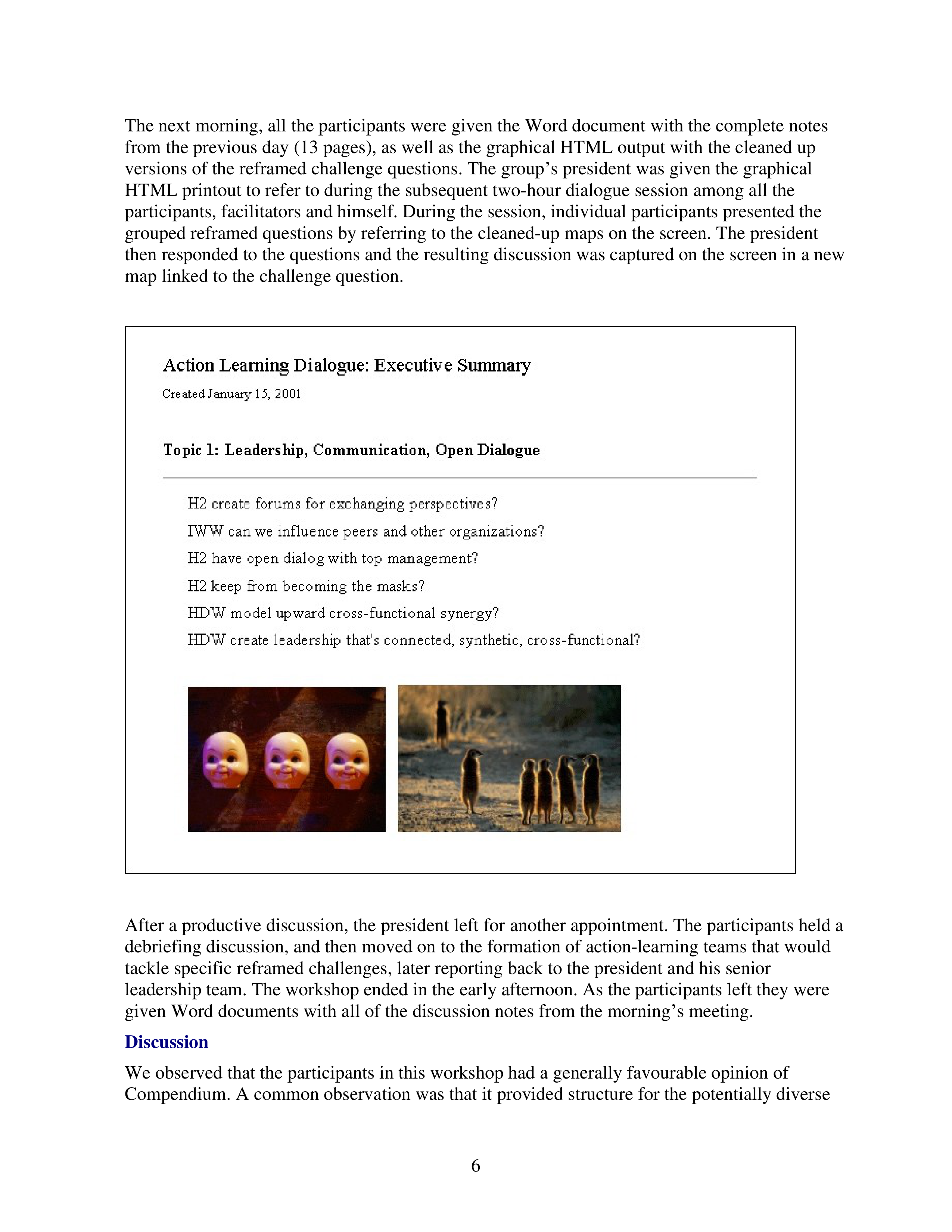
The next morning, all the p
articipants were given the Word document with the complete notes
from the previous day (13 pages), as well as the graphical HTML output with the cleaned up
versions of the reframed challenge questions. The group
s president was given the graphical
HTML pri
ntout to refer to during the subsequent two
-hour dialogue session among all the
participants, facilitators and himself. During the session, individual participants presented the
grouped reframed questions by referring to the cleaned
-
up maps on the screen.
The president
then responded to the questions and the resulting discussion was captured on the screen in a new
map linked to the challenge question.
After a productive discussion, the president left for another appointment. The participants held a
debr
iefing discussion, and then moved on to the formation of action-learning teams that would
tackle specific reframed challenges, later reporting back to the president and his senior
leadership team. The workshop ended in the early afternoon. As the participants left they were
given Word documents with all of the discussion notes from
the morning
s meeting.
Discussion
We observed that the participants in this workshop had a generally favourable opinion of
Compendium. A common observation was that it provided
structure for the potentially diverse
7
exploration and dialogue aspects of the workshop. Compendium offered several clear advantages
compared to the more usual method of note taking.
First, participants now have a robust database in support of their action
-
learning projects. This
database can be easily searched, built upon and formatted in a number of ways for their own use
as well as presentation to others. This advantage first became apparent when the president held a
dialogue on the second day. Participan
ts were able to use the features of Compendium to prepare
for this somewhat tricky encounter, in which they would be surfacing issues that were difficult to
discuss with top management. At the same time, they were able to invite the president into the
dial
ogue, by displaying the texture of their deliberations from the previous day. Likewise, the
database, when combined with similar ones from other workshops, had much to contribute to a
broader understanding of this organisation
s complex challenges.
Second,
Compendium allowed us to combine the images from the VE session in the same map
with text from the group dialogues. This proved to be very fruitful, helping participants more
readily connect business facts to the more metaphorical and emotional associat
ions provoked
by the images, and to then preserve and build on these often intriguing connections.
Finally, Compendium allowed us to re-
use and restructure the knowledge maps during the
session. Unlike a paper
-
based capture system, we were able to preserve
the original maps, while
at the same time copying them into new maps where the initial dialogue was sorted into themes
and modified by deeper reflection. Also, unlike form
-
based or static graphical visualisations
common in many knowledge
-
management system
s, we were able to manipulate, and add to the
graphic knowledge representation directly and in real time.
It is important to keep in mind that the entire session was conducted in a mostly improvisational
manner. The structures used by the Compendium practitioner were not set up in advance or
programmed in to the software (with the exception of the VE images already present on the hard
drive). Compendium was not imposed on the workshop; rather, it reflected and responded to
what was happening, including una
nticipated twists and turns.
The complexification of business issues requires networks of leaders working together. The
associated processes of leadership need considerable support in handling often dispersed
information, making shared sense of it, and
creating and using the resultant shared knowledge.
Compendium is therefore an example of what Weick and Meader call a sensemaking-
support
system for leadership in the face of complexity.[5]
Our experience with this and similar cases has led us to an asp
ect of sensemaking
-
support
systems that we believe to be of critical importance. When networks of leaders come together to
work on complex challenges, it has been helpful to think in terms of what we call knowledge
art
. It is a mistake to think of Compendium as simply a software device or a set of facilitation
techniques. Knowledge art is the application of artistic competencies and sensibilities to the
processes of making sense and meaning out of complexity. The artistic aspect transforms a
process that
could otherwise be formulaic, reductive or hyper
-
rational into a creative, synthetic
process resembling art making.
In this case, knowledge art is apparent in several ways. The content of Compendium
s shared
display and database become something like clay
that participants shape into larger structures.
The best of these structures get re
-
used, eventually being crafted into formal ideas or statements
of purpose. The visual
-
explorer images lend themselves to knowledge art by providing a stock of
8
metaphors. Th
ese too are part of this clay, and tend to become crafted into shared narratives, in
which the metaphors play out in various extensions and implications. The idea of play is
important to knowledge art. Participants test various combinations of their idea
s, tell stories,
improvise and explore metaphors with levity and humour. This humour is often a welcome foil
for disarming anxiety around contentious issues. More subtly, Compendium provides a means of
positively affecting the rhythm and timbre of the grou
p conversation.[6] Typically the pace of
conversation is fast, staccato and dominated by the most assertive participants. Compendium
provides a way of occasionally and deliberately shifting this dynamic by reflecting back on what
was said, seeking clarific
ation, looking for patterns, or drawing attention to another part of the
map. Finally, we suggest that the aesthetics of sensemaking are of great practical importance. It
pays to use robust tools and inviting media that handle well. The practice of a sha
red discipline
will result in coherent works of everyday art that are both emotionally and logically satisfying.
The appropriate methodology can add a great deal to the efficacy of groups gathered for the
purpose of making sense of complex challenges. T
hose working with similar methodologies and
similar groups would do well to consider the nature of knowledge art as adapted to their own
environment.
Acknowledgements
The authors thank Yolan Williams, David M. Horth, Mary Lynn Pulley, Wilfred H. Drath and
Simon Buckingham Shum for their cont
ributions to this body of work.
Albert M. Selvin
is
senior manager in the information technology group at Verizon
Communications. He can be contacted at
albert.m.selvin@ve
rizon.com
Charles J. Palus, Ph.D. is research scientist at the Center for Creative Leadership. He can be
contacted at
palusc@leaders.ccl.org
For further information:
www.compendiuminstitute.org
www.ccl.org
9
References
1 For our understanding of the leadership sensemaking competencies useful for complex
challenges, see Palus, C.J. & Horth, D.M.,
The Leader
s Edge: Six Cre
ative Competencies for
Navigating Complex Challenges
(Jossey
-
Bass, 2002)
2 Selvin, A., Buckingham Shum, S., Sierhuis, M., Conklin, J., Zimmermann, B., Palus, C.,
Drath, W., Horth, D., Domingue, J., Motta, E. & Li, G
., Compendium: Making Meetings into
Knowl
edge Events.
Knowledge Technologies conference (Austin TX, March 4
-
7, 2001) See
www.compendiuminstitute.org/library/papers.htm
.
3 The visual explorer is a product of the Center for Creat
ive Leadership (www.ccl.org). See
Palus, C.J. & Drath, W.H., Putting something in the middle: an approach to dialogue in
Reflections
(3(2), 28
-
39, 2001)
4 Isaacs, W.
Dialogue and the Art of Thinking Together
, (Random House, 1999)
Palus, C.J. & Drath, W.H., Putting Something In The Middle: An Approach To Dialogue in
Reflections
(Society for Organisational Learning, 3(2), 2001)
5 Weick, K.E. & D.K. Meader, Sensemaking and group support systems in L.M. Jessup & J.S.
Valacich (Eds)
Group Support Systems:
New Perspectives
(Macmillan 1993)
6 Conklin, J., Selvin, A.M., Shum, S.J.B., & Sierhuis, M., Facilitated hypertext for collective
sensemaking: 15 years on from gIBIS
, Tech Report 112, Knowledge Media Institute (The Open
University, 2001)
http://kmi.open.ac.uk/tr/papers/kmi
-
tr
-
112.pdf
Copyright © 1994
-
2003 Ark Group Ltd. All rights reserved.
No part of this site or the publications described herein may be reproduced in any form without the
permission of Ark
Conferences Ltd, Registered in England, No. 2931372.