


Poornaprajna International Journal of Teaching & Research Case
Studies (PIJTRCS),
ISSN: 3107-8494, Vol. 3, No. 1, January - June 2026
POORNAPRAJNA
PUBLICATION
Isha Devadiga, (2026); www.poornaprajnapublication.com
PAGE 190
The Super Strategist in the Semiconductor
Industry: A Multi-Framework CEO Analysis of
Lisa Su at Advanced Micro Devices, Inc.
Isha Devadiga
1
& P. S. Aithal
2
Second year MBA Scholar, Poornaprajna Institute of Management, Udupi,576 101, India,
ORCID iD: 0009-0000-5533-0320; Email:
isha.mbaa24@pim.ac.in
Professor, Poornaprajna Institute of Management, Udupi - 576101, India,
Orchid ID: 0000-0002-4691-8736; E-mail:
psaithal@pim.ac.in
Area/Section:
CEO Analysis.
Type of the Paper:
Qualitative
Exploratory Research.
Number of Peer Reviews:
Two.
Type of Review:
Peer Reviewed as per
|C|O|P|E|
guidance.
Indexed in:
OpenAIRE.
DOI:
https://doi.org/10.5281/zenodo.20080552
Google Scholar Citation:
PIJTRCS
Poornaprajna International Journal of Teaching & Research Case Studies (PIJTRCS)
A Refereed International Journal of Poornaprajna Publication, India.
ISSN: 3107-8494
Crossref DOI:
https://doi.org/10.64818/PIJTRCS.3107.8494.0043
Received on: 09/04/2026
Published on: 09/05/2026
© With Authors.
This work is licensed under a
Creative Commons Attribution-Non-Commercial 4.0
International License,
subject to proper citation to the publication source of the work.
Disclaimer:
The scholarly papers as reviewed and published by Poornaprajna Publication
(P.P.), India, are the views and opinions of their respective authors and are not the views or
opinions of the PP. The PP disclaims of any harm or loss caused due to the published content
to any party.
How to Cite this Paper:
Isha Devadiga & Aithal P. S. (2026).
The Super Strategist in the Semiconductor Industry:
A Multi-Framework CEO Analysis of Lisa Su at Advanced Micro Devices, Inc..
Poornaprajna International Journal of Teaching & Research Case Studies (PIJTRCS),
3
(1), 190-219. DOI:
https://doi.org/10.5281/zenodo.20080552


Poornaprajna International Journal of Teaching & Research Case
Studies (PIJTRCS),
ISSN: 3107-8494, Vol. 3, No. 1, January - June 2026
POORNAPRAJNA
PUBLICATION
Isha Devadiga, (2026); www.poornaprajnapublication.com
PAGE 191
The Super Strategist in the Semiconductor Industry: A
Multi-Framework CEO Analysis of Lisa Su at Advanced
Micro Devices, Inc.
Isha Devadiga
1
& P. S. Aithal
2
Second year MBA Scholar, Poornaprajna Institute of Management, Udupi,576 101, India,
ORCID iD: 0009-0000-5533-0320; Email:
isha.mbaa24@pim.ac.in
Professor, Poornaprajna Institute of Management, Udupi - 576101, India,
Orchid ID: 0000-0002-4691-8736; E-mail:
psaithal@pim.ac.in
ABSTRACT
Purpose:
The purpose of this research case study is to conduct a focused and in-depth
examination of Lisa Su’s leadership, strategic decisions, and technological vision during her
tenure at Advanced Micro Devices, Inc. The study aims to evaluate her influence on AMD’s
transformation and organizational performance using multiple analytical frameworks such as
SWOC, ABCD, and the CEO Performance Matrix. Ultimately, the research seeks to
demonstrate how visionary technological leadership and strategic decision-making can
reshape a semiconductor company’s competitive position in the global market.
Methodology:
This exploratory case study uses information gathered from credible sources
such as official websites, Google Scholar, and AI-driven GPT tools, and analyzes the data using
suitable analytical frameworks aligned with the objectives of the study.
Result/Analysis:
The research analysis indicates that Lisa Su’s leadership at AMD reflects a
strong combination of technological expertise, strategic transformation, and innovation-driven
growth. The application of SWOC, ABCD, PESTLE, KPIs, and the CEO Performance Matrix
highlights her role in revitalizing AMD’s product roadmap, strengthening research and
development capabilities, and expanding its presence in high-performance computing and
artificial intelligence markets. Overall, the case study demonstrates that her leadership
significantly contributed to AMD’s resurgence as a major global competitor in the
semiconductor industry.
Originality/Value:
The originality of this research lies in its structured and multi-framework
evaluation of Lisa Su’s leadership using SWOC, ABCD, PESTLE, KPIs, CEOPA, and the CEO
Performance Matrix to analyze a contemporary technology CEO in the semiconductor
industry. The study contributes value by linking leadership theory with technological
innovation and strategic transformation at AMD, providing a replicable model for evaluating
leadership effectiveness in global technology firms.
Type of Paper
:
Qualitative Exploratory Case Study.
Keywords:
CEO Analysis, Lisa Su, Advanced Micro Devices, Semiconductor Industry,
SWOC Analysis, ABCD Analysis, KPIs of CEO, CEO Performance Areas, CEO Performance
Matrix, Strategic Leadership in Technology Firms
1. INTRODUCTION :
1.1 About CEO Analysis:
The Chief Executive Officer (CEO) plays a critical role in shaping organizational strategy, performance,
and long-term competitiveness. Strategic leadership research emphasizes that CEOs influence firm
outcomes through their personal values, experiences, and cognitive orientations, a perspective formally
articulated by Upper Echelons Theory (Hambrick & Mason (1984) [1]; Hambrick (2007). [2]).
According to this framework, organizational results are partially predicted by top executives’
characteristics because strategic decisions reflect the mental models and backgrounds of those in
leadership positions. Consequently, CEOs function not just as operational managers but as strategic


Poornaprajna International Journal of Teaching & Research Case
Studies (PIJTRCS),
ISSN: 3107-8494, Vol. 3, No. 1, January - June 2026
POORNAPRAJNA
PUBLICATION
Isha Devadiga, (2026); www.poornaprajnapublication.com
PAGE 192
architects, whose leadership creates a lasting impact on the organization’s identity and direction (Wood
& Vilkinas (2003) [3]; Berson et al. (2008). [4]).
The contribution of a CEO to an organization manifests through strategic decision-making, governance
mechanisms, and stakeholder engagement. Empirical research indicates that CEO characteristics
significantly influence firm strategic actions beyond firm- or industry-level effects (Zacharias et al.
(2015) [5]; Ahmed et al. (2019) [6]; Chulkov & Kim (2025). [7]). Attributes such as tenure, ethical
orientation, compensation structure, and international experience shape critical outcomes including
global expansion, innovation, and corporate social responsibility initiatives. By directing organizational
resources, shaping corporate culture, and setting performance expectations, CEOs influence both
financial and non-financial outcomes. Research further demonstrates that CEO leadership effects can
exceed industry-level determinants in explaining firm behavior, highlighting the centrality of executive
leadership in competitive differentiation (Brahma & Economou (2024). [8]).
The impact of CEO contributions on firm performance is complex and context-dependent. Studies show
that CEO tenure influences organizational outcomes in several ways, including strategic focus,
innovation, and leadership continuity. Research on Chinese listed firms finds that longer CEO tenure
promotes enterprises’ green innovation, highlighting a positive effect of sustained leadership on long-
term strategic initiatives (
Liu et al. (2024).
[9]). Other work on U.S. public firms shows how observable
CEO and firm characteristics shape tenure duration and turnover risk, with implications for strategic
continuity and performance outcomes (
Jarva, H. (2025).
[10]). Additionally, CEO characteristics such
as political ties and personal attributes have been shown to affect firm performance and firm value in
institutional contexts (Liu & Jiang (2020). [11]). These findings indicate that CEO influence is neither
uniform nor linear, reinforcing the need for in-depth research designs capable of capturing leadership
dynamics within real organizational contexts.
To address these complexities, this study adopts an exploratory case study research design to examine
the strategic contributions of a CEO and their organizational impact. Exploratory research is particularly
appropriate when theoretical frameworks exist but empirical insights remain fragmented or context-
specific (Stebbins (2001). [12]). Case study methodology allows researchers to investigate
contemporary leadership phenomena within their natural settings and to integrate multiple sources of
evidence, thereby enhancing analytical depth and validity (Yin (2018). [13]).
The structure of this CEO Analysis paper follows a systematic scholarly format. After this introduction,
a literature review synthesizes theoretical and empirical studies on CEO characteristics and
organizational performance. The methodology section details the exploratory case study design, data
sources, and analytical techniques employed. The findings and discussion sections interpret the CEO’s
strategic contributions and their organizational impact through established leadership frameworks.
Finally, the conclusion summarizes key insights, discusses theoretical and managerial implications, and
identifies directions for future research in CEO and strategic leadership studies.
1.2 About This Paper:
The scholarly article titled
“CEO Analysis of Lisa Su of Advanced Micro Devices, Inc.”
adopts a
structured analytical approach that integrates strategic leadership theory with performance-based
evaluation frameworks. The article is organized to first situate Lisa Su’s leadership within established
CEO and strategic management literature, drawing on upper echelons and strategic leadership
perspectives that emphasize how executive cognition and expertise shape organizational outcomes
(Kiss et al. (2022) [14]; Wang et al. (2022). [15]). The literature review synthesizes empirical research
on CEO influence, innovation leadership, and firm performance, highlighting how leadership attributes
interact with technological capability and competitive strategy (Banerjee (2025). [16]). The
methodology section employs a multi-framework analytical design incorporating SWOC analysis, key
performance indicators (KPIs), and CEO performance assessment models, consistent with prior studies
advocating multi-method approaches to capture the complex mechanisms through which CEOs drive
innovation and strategic renewal (Kiss et al. (2022) [14]; Banerjee (2025). [16]). This structured design
enables the article to systematically link leadership theory with measurable organizational outcomes
such as R&D intensity, market share growth, and profitability.
The analysis section focuses on evaluating Lisa Su’s effectiveness across innovation leadership,
strategic orientation, and stakeholder management dimensions. Using leadership and innovation
scholarship as a foundation, the article assesses Su’s transformational and strategic leadership


Poornaprajna International Journal of Teaching & Research Case
Studies (PIJTRCS),
ISSN: 3107-8494, Vol. 3, No. 1, January - June 2026
POORNAPRAJNA
PUBLICATION
Isha Devadiga, (2026); www.poornaprajnapublication.com
PAGE 193
behaviours and their role in fostering sustained innovation and competitive positioning at AMD (Jensen
et al. (2020) [17]; Begum et al. (2020). [18]). Empirical evidence from leadership research suggests that
CEOs with strong technical expertise and long-term strategic orientation are better positioned to
translate innovation investments into firm-level performance gains, particularly in technology-intensive
industries (Kiss et al. (2022) [14]; Wang et al. (2022). [15]). The article further aligns Su’s leadership
outcomes with CEO performance area frameworks, emphasizing her strengths in innovation
governance, ecosystem development, and growth strategy while identifying future strategic priorities
such as AI hardware–software co-design and sustainability. This analytical approach is consistent with
contemporary research that underscores the importance of aligning CEO leadership capabilities with
evolving technological and stakeholder environments to sustain long-term organizational performance
(Banerjee (2025) [16]; Agazu et al. (2025). [19]).
2. OBJECTIVES OF THE PAPER :
(1).
To study the professional background, leadership journey, and technological expertise of
Dr. Lisa T. Su
, Chair and CEO of Advanced Micro Devices, Inc., with emphasis on her role in
transforming AMD’s strategic and competitive position.
(2).
To review and synthesize existing literature related to Lisa Su’s leadership and Advanced
Micro Devices, Inc.
, and to assess the current status of research on CEO-driven turnarounds,
technology leadership, and strategic decision-making in the semiconductor industry.
(3).
To analyze the strategic leadership style and decision-making approach of Lisa Su
using
established CEO leadership theories such as transformational and strategic leadership, in order
to understand how her vision and behavior influence organizational outcomes.
(4).
To evaluate AMD’s organizational performance under Lisa Su’s leadership
through key
performance indicators (KPIs) such as R&D intensity, market share in high-performance
computing, innovation output, and financial performance.
(5).
To assess AMD’s internal and external strategic position
during Lisa Su’s tenure using
analytical frameworks including SWOC analysis, ABCD stakeholders’ analysis, and PESTLE
analysis.
(6).
To compare AMD’s competitive performance and strategic positioning with key industry
competitors
in the semiconductor sector, highlighting the role of CEO leadership in sustaining
competitive advantage.
(7).
To apply the CEO Performance Matrix and Ten CEO Performance Areas (CEOPA)
framework
to identify Lisa Su’s strengths, limitations, and future strategic priorities, and to
propose recommendations related to AI-driven innovation, ecosystem partnerships, and
sustainability.
3. ABOUT LISA SU, CEO OF ADVANCED MICRO DEVICES, INC :
3.1 Background of Lisa Su, CEO of Advanced Micro Devices, Inc.:
Advanced Micro Devices, Inc. (AMD), founded in 1969, is a major global semiconductor company
specializing in microprocessors, graphics processing units (GPUs), and high-performance computing
solutions (Talmadge (2025) [20]; Tiwari (2022). [21]). Operating in a highly competitive and
innovation-driven industry, AMD has historically faced cyclical challenges related to technological
shifts, pricing pressures, and rivalry with dominant incumbents such as Intel and NVIDIA (
de Sousaet
al
(2021).
[22]). Scholarly research on semiconductor firms emphasizes that sustained competitiveness
in this sector depends heavily on strategic leadership, R&D investment, and the ability to anticipate
technological disruptions (Tiwari (2022) [21]; Hambrick (2007). [23]).
The strategic repositioning of AMD gained momentum following the appointment of Dr. Lisa T. Su as
President and CEO in 2014 (Talmadge (2025) [20];
de Sousa
et al
(2021).
[22]). Under her leadership,
AMD adopted a focused strategy centered on high-performance computing, data centers, gaming, and
AI-enabled architectures, supported by disciplined capital allocation and increased R&D intensity (
de
Sousa
et al (2021). [22]; Mowery & Rosenberg (1999). [24]). Studies on corporate turnarounds in
technology-intensive industries highlight that leadership-driven strategic focus is a critical factor in
restoring firm performance and market credibility (Hambrick (2007) [23]; Finkelstein et al. (2009).
[25]).


Poornaprajna International Journal of Teaching & Research Case
Studies (PIJTRCS),
ISSN: 3107-8494, Vol. 3, No. 1, January - June 2026
POORNAPRAJNA
PUBLICATION
Isha Devadiga, (2026); www.poornaprajnapublication.com
PAGE 194
Dr. Lisa Su’s professional background reflects a strong foundation in engineering and applied research.
She holds a PhD in Electrical Engineering from the Massachusetts Institute of Technology and has held
senior technical and managerial roles at Texas Instruments and IBM, where she was engaged in
semiconductor research and strategic initiatives (IBM Research [27]). Empirical studies demonstrate
that CEOs with science or engineering expertise are more likely to foster innovation, prioritize R&D,
and support technologically complex strategic decisions (Barker & Mueller (2002) [28]; Ting et al.
(2021). [30]). Such technical expertise enhances a CEO’s ability to align innovation investments with
long-term competitive strategy.
Prior to joining AMD, Su served as Chief Technology Officer and later Senior Vice President at
Freescale Semiconductor, where she played a key role in organizational restructuring and portfolio
realignment (IBM Research [27]). Leadership research suggests that experience in restructuring
contexts strengthens executives’ abilities to manage complexity, reallocate resources, and rebuild
stakeholder trust (Finkelstein et al. (2009) [25]; Barker & Mueller (2002). [28]). These competencies
were directly transferable to AMD, where Su streamlined operations, refocused product development,
and restored investor confidence (Talmadge (2025) [20];
de Sousa
et al.
(2021).
[22]).
Lisa Su’s leadership philosophy emphasizes long-term value creation through innovation leadership,
execution discipline, and ecosystem collaboration (Mowery & Rosenberg (1999). [24]). Strategic and
transformational leadership scholarship argues that such an approach enables CEOs to align
organizational culture with strategic priorities while sustaining employee engagement and innovation
performance (Hambrick (2007) [23]; Finkelstein et al. (2009). [25]). Under Su’s leadership, AMD
successfully launched the Zen CPU architecture and expanded into adaptive and AI computing,
demonstrating how visionary leadership combined with technical rigor can generate sustained
competitive advantage (Tiwari (2022) [21]; Mowery & Rosenberg (1999). [24]).
Overall, Lisa Su’s leadership at AMD reinforces scholarly arguments that CEO characteristics—
particularly technical expertise, strategic clarity, and long-term orientation—play a decisive role in
shaping firm performance in technology-intensive industries (Hambrick (2007) [23]; Finkelstein et al.
(2009) [25]; Barker & Mueller (2002) [28]; Crossland & Hambrick (2011) [29]; Ting et al. (2021).
[30]). AMD’s turnaround under her stewardship provides a strong empirical foundation for CEO
analysis as a research case study, highlighting the relevance of executive leadership theories in
understanding competitive renewal within the global semiconductor industry (Tiwari (2022) [21];
Mowery & Rosenberg (1999) [24]; Crossland & Hambrick (2011) [29]; Advanced Micro Devices, Inc.
[26]; American Academy of Arts and Sciences [27]).
4. REVIEW OF LITERATURE :
4.1 Review and Synthesize the Existing Scholarship:
Upper-echelons theory provides the primary conceptual foundation for examining how CEOs influence
organizational outcomes. The theory posits that firm strategies and performance reflect the experiences,
values, and cognitive bases of top executives, as strategic decisions are filtered through managerial
interpretations (Hambrick & Mason (1984) [31]; Hambrick (2007). [32]). Extensive empirical research
supports this view, demonstrating that CEO characteristics such as education, tenure, and professional
background significantly shape innovation intensity, strategic change, and firm performance across
industries (Garcia-Blandon et al. (2019). [33]). In technology-intensive environments, these executive
attributes become especially salient due to high uncertainty and rapid technological evolution.
Beyond demographic traits, leadership style has been widely examined as a mechanism linking CEOs
to organizational performance. Transformational leadership research shows that CEOs who articulate a
compelling vision, promote innovation, and empower employees enhance organizational adaptability
and long-term competitiveness (Chen et al. (2019) [34]; Zhang et al. (2015). [35]). Similarly, relational
and empowering leadership approaches strengthen top management team cohesion and collective
decision-making, leading to improved strategic execution and innovation outcomes (Wang et al. (2022).
[36]). These leadership dynamics are particularly relevant for high-technology firms where cross-
functional coordination and knowledge integration are critical.
Scholarly attention has also focused on CEO power and strategic discretion in shaping innovation
strategies. Studies indicate that CEOs with greater authority and influence are more likely to pursue
exploratory innovation, which is essential for sustaining competitive advantage in fast-moving
technology sectors (Sariol et al. (2017). [37]). CEO proactiveness further amplifies innovation


Poornaprajna International Journal of Teaching & Research Case
Studies (PIJTRCS),
ISSN: 3107-8494, Vol. 3, No. 1, January - June 2026
POORNAPRAJNA
PUBLICATION
Isha Devadiga, (2026); www.poornaprajnapublication.com
PAGE 195
outcomes by fostering organizational ambidexterity and responsiveness to environmental change (Kiss,
A. N et al. (2022). [38]). Together, these findings highlight the importance of aligning CEO leadership
capabilities with innovation-driven strategic priorities.
Despite these advances, several gaps remain in the upper-echelons literature. Recent reviews emphasize
that much of the research remains fragmented and overly focused on traditional demographic variables,
offering limited insight into how executive attributes interact with dynamic industry contexts such as
global technology markets (Popli et al. (2022). [39]). Moreover, non-financial outcomes—including
ecosystem development, stakeholder trust, and long-term innovation capability—remain underexplored
within dominant performance models. These limitations underscore the need for context-specific CEO
case studies that integrate leadership theory with industry-level realities.
Addressing these gaps, an exploratory CEO case study approach enables a nuanced examination of how
executive characteristics, leadership philosophy, and strategic decisions jointly influence firm outcomes
over time (Yin (2018). [40]). In this context, the leadership of Lisa Su at Advanced Micro Devices offers
a compelling empirical setting to investigate how technical expertise and strategic leadership combine
to drive organizational renewal, innovation leadership, and sustained competitiveness in the global
semiconductor industry.
4.2 Based on Important Keywords:
Table 1:
Review of Literature on Keyword “Lisa Su” using search in www.scholar.google.com
S. No.
Area of
Scholarly
Articles
Description
Reference
1
Strategic
Leadership
Examines AMD’s revival through leadership-led
strategic redirection under CEO Lisa Su,
emphasizing performance-based competition.
Sousa et al. (2021)
[41]
2
Corporate
Turnaround
Explains strategic transformation as a critical step
in reviving distressed firms, relevant to AMD’s
recovery under Lisa Su.
Pearce et al. (2008)
[43]
3
CEO Decision-
Making
Analyzes how CEO characteristics influence
strategic priorities such as innovation and R&D
spending.
Barker et al.
(2002) [50]
4
Upper Echelons
Theory
Establishes that organizational outcomes reflect
top
executives’
backgrounds
and
values,
applicable to Lisa Su’s technical leadership.
Hambrick et al.
(1984) [51]
5
Innovation
Leadership
Highlights the role of ambidextrous leadership in
balancing innovation and operational efficiency.
O'Reilly et al.
(2013) [49]
6
Strategic
Renewal
Discusses capability development over time
driven by executive leadership decisions.
Helfat et al.
(2003) [54]
7
Dynamic
Capabilities
Explains how leadership builds and renews
capabilities in rapidly changing environments.
Eisenhardt et al.
(2017) [52]
8
Business Model
Strategy
Explores how strategic leadership influences
business model design in technology firms.
Teece et al. (2018)
[47]
9
Resource-Based
Leadership
Links executive leadership to leveraging firm
resources for sustainable competitive advantage.
Barney et al.
(1991) [53]
10
Organizational
Strategy
Examines alignment between strategy and
organizational
structure
under
executive
leadership.
Zakrzewska-
Bielawska et al.
(2016) [45]
Table 2:
Review of Literature on Keyword “Advanced Micro Devices (AMD)” using search in
www.scholar.google.com
S. No.
Area of
Scholarly
Articles
Description
Reference


Poornaprajna International Journal of Teaching & Research Case
Studies (PIJTRCS),
ISSN: 3107-8494, Vol. 3, No. 1, January - June 2026
POORNAPRAJNA
PUBLICATION
Isha Devadiga, (2026); www.poornaprajnapublication.com
PAGE 196
1
Competitive
Strategy
Analyzes AMD’s competitive resurgence against
Intel
and
NVIDIA
through
strategic
repositioning.
Sousa et al. (2021)
[41]
2
Corporate
Growth Case
Study
Presents AMD as a high-growth firm through
strategic focus and leadership transformation.
Kumar et al.
(2024) [42]
3
Business
Turnaround
Examines strategic transformation processes
relevant to AMD’s recovery phase.
Pearce et al. (2008)
[43]
4
Semiconductor
Competition
Studies
competitive
dynamics
in
the
semiconductor industry, providing context for
AMD’s market position.
Wang et al. (2025)
[44]
5
Strategy–
Structure
Alignment
Explores
how
strategic
choices
influence
organizational structure in high-technology firms
like AMD.
Zakrzewska-
Bielawska et al.
(2016) [45]
6
Industry Forces
Analysis
Provides a framework to analyze competitive
forces affecting AMD’s industry environment.
Porter et al.
(2008) [46]
7
Business Model
Innovation
Examines how business model design supports
competitiveness in technology firms such as
AMD.
Zott et al. (2011)
[48]
8
Dynamic
Capabilities
Highlights AMD’s ability to adapt and innovate
in a volatile semiconductor market.
Teece et al. (2018)
[47]
9
Resource-Based
Advantage
Explains how AMD leveraged internal resources
to achieve sustained competitive advantage.
Barney et al.
(1991) [53]
10
Capability
Lifecycle
Analyzes how AMD’s technological capabilities
evolved over time to support long-term
competitiveness.
Helfat et al.
(2003) [54]
Table 3:
Review of Literature on Keyword “
CEO Analysis
” using search in
www.scholar.google.com
S. No.
Area of
Scholarly
Articles
Description
Reference
1
Upper Echelons
Theory
Foundational theory explaining how CEO
characteristics influence strategic decisions and
firm outcomes.
Hambrick et al.
(1984) [55]
2
CEO
Psychological
Profiles
Examines CEO psychological traits and their
impact on organizational diversity and strategy.
McHugh et al.
(2025) [56]
3
Bibliometric
Analysis of CEO
Research
Reviews thematic evolution and intellectual
structure of CEO research.
White et al..
(2022) [57]
4
CEO
Characteristics
& Firm
Performance
Studies relationship between CEO attributes and
financial/operational performance.
Argilés et al.
(2019) [58]
5
CEO
Transformational
Leadership
Investigates CEO leadership style and its impact
on innovation and performance.
Chen et al. (2019)
[59]
6
CEO Relational
Leadership &
Innovation
Explores CEO relational leadership effects on
product innovation.
Wang et al. (2022)
[60]
7
CEO Power &
Strategic
Decisions
Reviews how CEO power influences corporate
strategies and governance.
Brahma et al.
(2024) [61]


Poornaprajna International Journal of Teaching & Research Case
Studies (PIJTRCS),
ISSN: 3107-8494, Vol. 3, No. 1, January - June 2026
POORNAPRAJNA
PUBLICATION
Isha Devadiga, (2026); www.poornaprajnapublication.com
PAGE 197
8
CEO Duality &
Governance
Systematic review of CEO duality and firm
performance outcomes.
Li et al. (2025)
[62]
9
CEO Functional
Experience
Examines how CEO background and expertise
affect innovation and performance.
Huang et al.
(2023) [63]
10
CEO, Innovation
& Business
Performance
Bibliometric review linking CEOs to innovation-
driven firm performance.
Parodi-Camano et
al. (2025) [64]
4.3 Current Status of Scholarly Research about “Lisa Su”:
Over the past decade, Dr. Lisa Su’s leadership at Advanced Micro Devices (AMD) has attracted
scholarly attention for its role in corporate turnaround and innovation strategy. Scholars analysing
AMD’s revival consistently highlight Su’s transformational leadership, strategic vision, and emphasis
on high-performance computing architectures, particularly through the Ryzen and EPYC processors
and the adoption of modular chiplet designs (Sousa et al. (2021) [65]; Kumari & Nair (2023). [66]).
These strategic initiatives have been central to AMD’s regained competitiveness against industry
leaders such as Intel and Nvidia and are frequently cited as exemplary cases of executive-driven
innovation and market repositioning.
Beyond firm-specific turnaround studies, comparative research on executive leadership and governance
provides insight into how CEO characteristics and strategic decisions affect organizational outcomes.
Analyses of executive compensation and decision-making structures reveal that leadership incentives,
resource allocation, and risk management under Su align with long-term performance objectives,
supporting innovation and strategic agility (WANG et al. (2021) [67]; Sharma (2025). [68]). These
studies collectively situate Su’s leadership within broader research on CEO impact in high-technology
environments, highlighting the importance of technical expertise, strategic foresight, and operational
discipline in driving firm success.
Finally, contextual and public analyses underscore the broader recognition of Su’s leadership in
transforming AMD into a competitive force in the global semiconductor industry. These works note that
Su’s strategic decision-making — including acquisitions, ecosystem partnerships, and adoption of AI-
optimized architectures — has reinforced AMD’s innovation trajectory and market positioning, earning
her recognition in both scholarly and industry circles (Sharma (2025). [68]; Perrigo (2024) [69]).
Together, these studies illustrate how Su’s combination of technical proficiency, visionary leadership,
and strategic execution serves as a model for leadership in technology-intensive firms.
5. RESEARCH METHODOLOGY :
In case study–based exploratory research, the methodology typically begins with a clearly defined
research question and an exploratory design that justifies the use of qualitative case study methods to
investigate contemporary, real-world phenomena within their context (Baxter & Jack (2008) [70]; Hyett
et al. (2014). [71]). Researchers first identify and refine keywords relevant to the topic (e.g., CEO
leadership analysis, strategic frameworks, SWOC, PESTLE, ABCD, KPIs) and use these to collect
secondary data from multiple sources, such as general web search (Google Search), bibliographic
databases (Google Scholar), and AI-driven models (e.g., GPTs) to supplement gaps or trace current
developments in the literature. The rationale for combining these sources is supported by
methodological literature that emphasises triangulation and multiple sources of evidence to enhance the
breadth and depth of data collection in qualitative case studies, thereby increasing validity and
contextual richness (Baxter & Jack (2008) [70]; Vardopoulos et al. (2021). [72]).
Once information is assembled, the next stage involves systematic analysis, comparison, evaluation,
and interpretation. Data are first organised into thematic clusters corresponding to internal and external
factors, performance indicators, and leadership attributes, after which researchers apply analytical
frameworks such as SWOC/SWOT, PESTLE, ABCD, and KPI matrices to examine organizational
context, executive decision-making, and strategic outcomes (Ghazinoory et al. (2011) [73]; Vardopoulos
et al. (2021). [72]). These frameworks help contextualise both quantitative and qualitative insights by
mapping internal strengths/weaknesses and external opportunities/threats, while specialised leadership
and KPI frameworks provide further interpretive lenses for CEO performance (Pathiranage (2020).
[74]). Throughout the analytical process, methods such as pattern matching, content analysis, and cross-
case comparison are used to identify consistencies and divergences in the data and to generate new


Poornaprajna International Journal of Teaching & Research Case
Studies (PIJTRCS),
ISSN: 3107-8494, Vol. 3, No. 1, January - June 2026
POORNAPRAJNA
PUBLICATION
Isha Devadiga, (2026); www.poornaprajnapublication.com
PAGE 198
propositions, recommendations, and theoretical insights grounded in empirical evidence (Hyett et al.
(2014) [71]; Pathiranage et al. (2020) [74]).
6. RESEARCH ANALYSIS :
6.1 SWOC Analysis:
SWOC (Strengths, Weaknesses, Opportunities, and Challenges)—an evolution of the traditional SWOT
framework—is widely recognised in scholarly research as a fundamental strategic analysis tool that
systematically connects internal capabilities with external environmental factors to support decision
making, strategic planning, and performance evaluation across disciplines. In the seminal review of
SWOT methodology, (Ghazinoory et al. (2011). [75]). explain that SWOT/SWOC frameworks provide
a conceptual basis for scanning both internal resources and external conditions, enabling researchers to
build strategies that align organizational strengths with opportunities while addressing weaknesses and
mitigating challenges. Research in strategic management shows that integrating quantitative techniques
such as Importance–Performance Analysis (IPA) with SWOT enhances analytical rigor by prioritising
factors based on empirical data, thus overcoming traditional SWOT’s subjective limitations and making
findings more actionable (Phadermrod et al. (2019). [76]). Comprehensive literature syntheses further
confirm that SWOT has been applied in diverse fields—ranging from business competition to supply
chain and service management—highlighting its adaptability and capacity to generate insights into
strategic positioning and competitive advantage (Benzaghta et al. (2021). [77]). Empirical studies
demonstrate that SWOC informs organisational planning and performance outcomes by linking internal
assessments with external opportunities and threats, which, when combined with scenario planning and
strategic forecasting, support robust organisational outcomes and improved performance measures
(Bakir (2023). [78]). Integrative reviews of SWOT applications also emphasise its role in theory
development and refinement by synthesising historical and contemporary research trends, revealing
both the tool’s versatility and the need for methodological enhancements in future studies (Irawan
(2024) [79]; Phadermrod et al. (2019). [76]). Together, this body of research underscores the importance
of SWOC/SWOT not only as a practical planning instrument but also as a research methodology that
deepens theoretical understanding of strategic dynamics in complex organisational and environmental
contexts.
6.1.1 Strengths of Lisa Su, CEO of Advanced Micro Devices, Inc:
The following section outlines ten key strengths of Lisa Su, Chief Executive Officer of Advanced Micro
Devices, Inc. These strengths are analyzed using the ten CEO Attributes/KPIs—Manager, Leader,
Visionary, Technocrat, Financial Acumen, Strategic Decision Maker, Emotional Hero, Moral Advocate,
Dynamic Entrepreneur, and Role Model—established in the “Newly Developed CEO Matrix and KPI
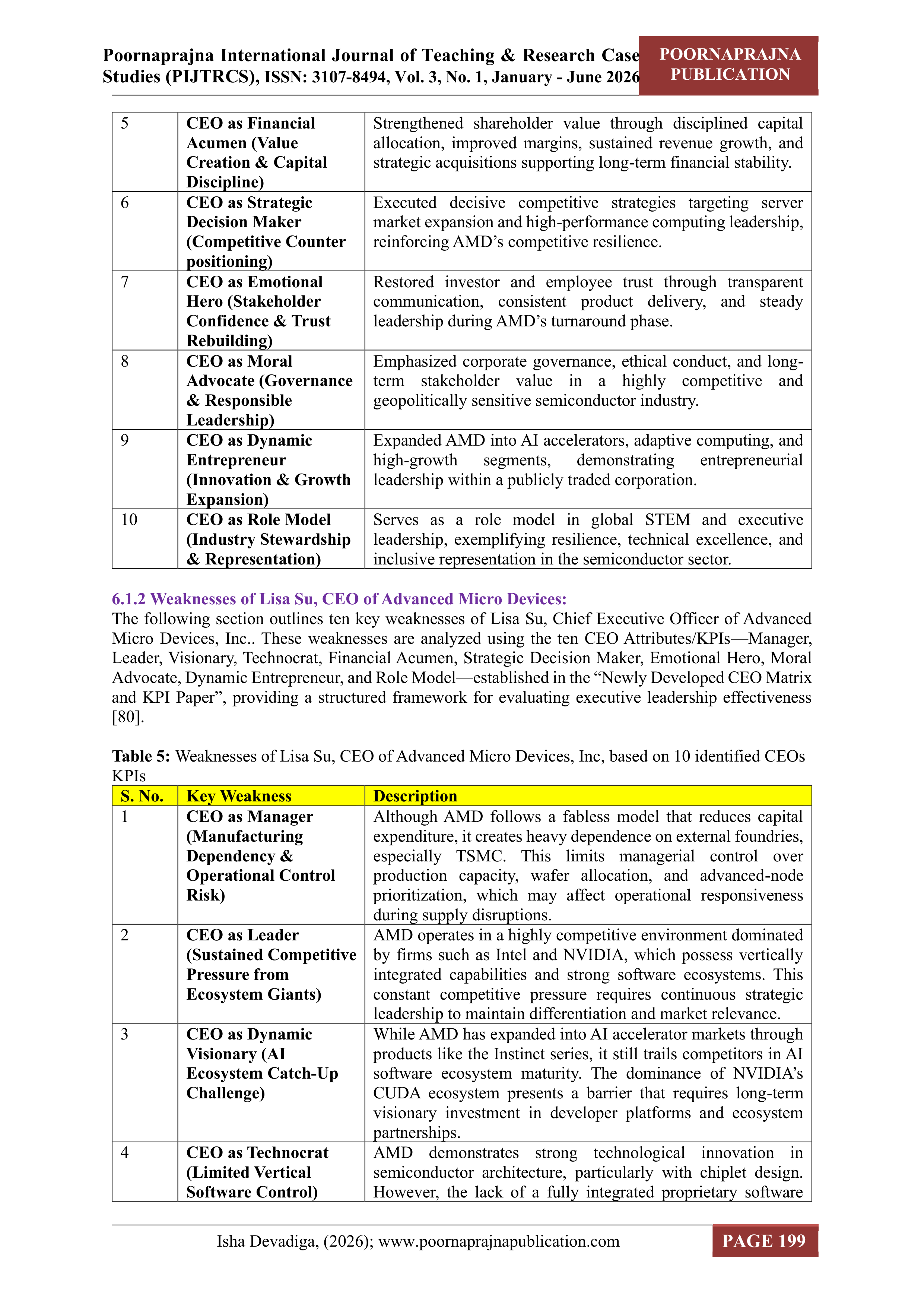
Paper”, providing a structured framework for evaluating executive leadership effectiveness [80].
Table 4:
Strengths of Lisa Su, CEO of Advanced Micro Devices, Inc, based on 10 identified CEOs
KPIs
S. No.
Key Strengths
Description
1
CEO as Manager
(Operational
Efficiency)
Demonstrated exceptional managerial capability by restoring
operational discipline at AMD, implementing structured
product roadmaps, improving execution reliability, and
strengthening supply chain coordination to ensure consistent
performance delivery.
2
CEO as Leader
(Transformational
Leadership)
Revitalized organizational morale and rebuilt stakeholder
confidence through transformational leadership, aligning
engineering teams with a unified high-performance computing
vision.
3
CEO as Dynamic
Visionary (Strategic
Repositioning)
Repositioned AMD strategically toward high-margin data
center, AI acceleration, and enterprise computing markets,
redefining the firm’s competitive identity.
4
CEO as Technocrat
(Engineering Expertise
& Product
Architecture)
Leveraged deep semiconductor engineering expertise to
support architecture-level decisions, including chiplet-based
modular design and advanced node adoption strategies.


Poornaprajna International Journal of Teaching & Research Case
Studies (PIJTRCS),
ISSN: 3107-8494, Vol. 3, No. 1, January - June 2026
POORNAPRAJNA
PUBLICATION
Isha Devadiga, (2026); www.poornaprajnapublication.com
PAGE 199
5
CEO as Financial
Acumen (Value
Creation & Capital
Discipline)
Strengthened shareholder value through disciplined capital
allocation, improved margins, sustained revenue growth, and
strategic acquisitions supporting long-term financial stability.
6
CEO as Strategic
Decision Maker
(Competitive Counter
positioning)
Executed decisive competitive strategies targeting server
market expansion and high-performance computing leadership,
reinforcing AMD’s competitive resilience.
7
CEO as Emotional
Hero (Stakeholder
Confidence & Trust
Rebuilding)
Restored investor and employee trust through transparent
communication, consistent product delivery, and steady
leadership during AMD’s turnaround phase.
8
CEO as Moral
Advocate (Governance
& Responsible
Leadership)
Emphasized corporate governance, ethical conduct, and long-
term stakeholder value in a highly competitive and
geopolitically sensitive semiconductor industry.
9
CEO as Dynamic
Entrepreneur
(Innovation & Growth
Expansion)
Expanded AMD into AI accelerators, adaptive computing, and
high-growth
segments,
demonstrating
entrepreneurial
leadership within a publicly traded corporation.
10
CEO as Role Model
(Industry Stewardship
& Representation)
Serves as a role model in global STEM and executive
leadership, exemplifying resilience, technical excellence, and
inclusive representation in the semiconductor sector.
6.1.2 Weaknesses of Lisa Su, CEO of Advanced Micro Devices:
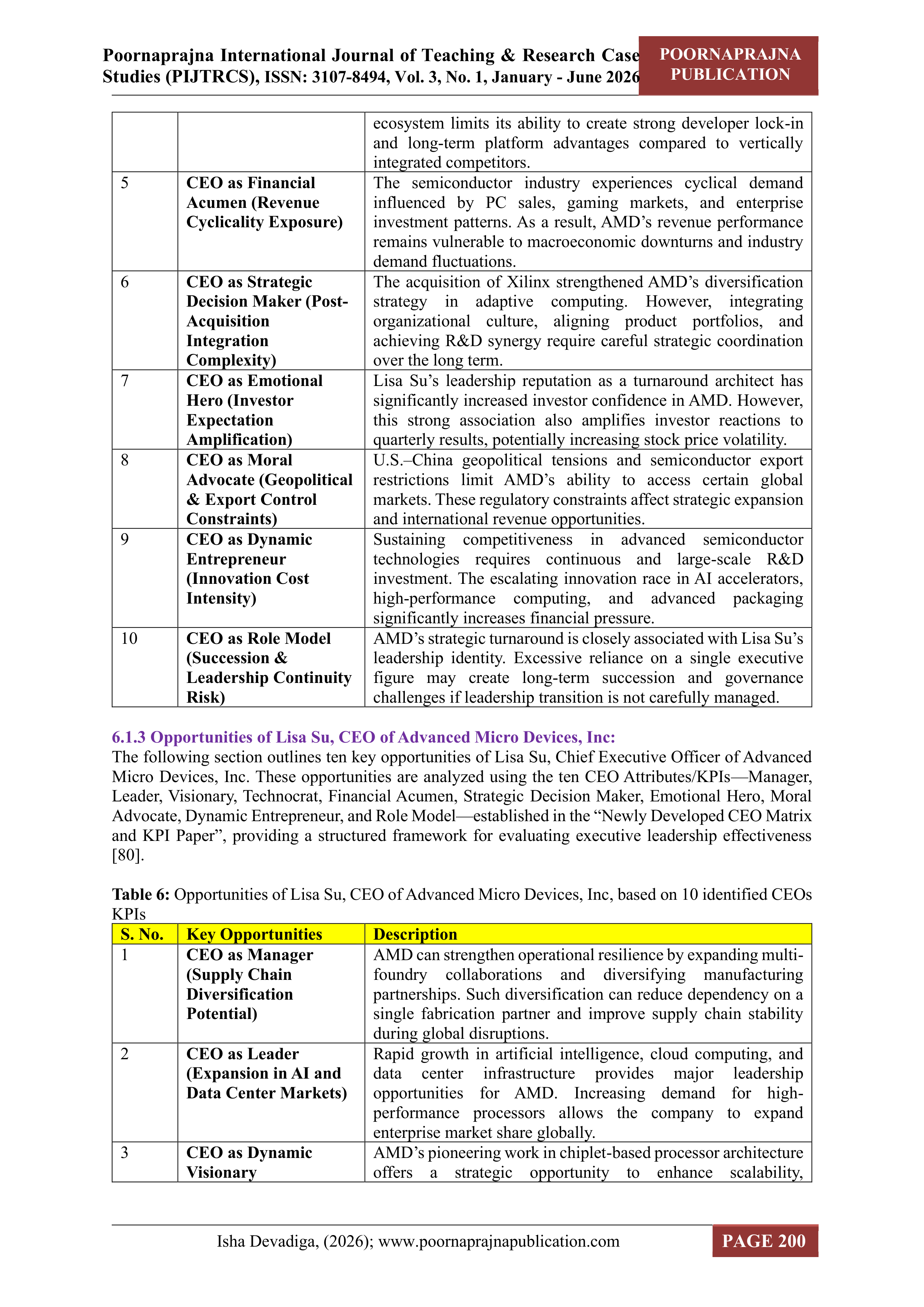
The following section outlines ten key weaknesses of Lisa Su, Chief Executive Officer of Advanced
Micro Devices, Inc.. These weaknesses are analyzed using the ten CEO Attributes/KPIs—Manager,
Leader, Visionary, Technocrat, Financial Acumen, Strategic Decision Maker, Emotional Hero, Moral
Advocate, Dynamic Entrepreneur, and Role Model—established in the “Newly Developed CEO Matrix
and KPI Paper”, providing a structured framework for evaluating executive leadership effectiveness
[80].
Table 5:
Weaknesses of Lisa Su, CEO of Advanced Micro Devices, Inc, based on 10 identified CEOs
KPIs
S. No.
Key Weakness
Description
1
CEO as Manager
(Manufacturing
Dependency &
Operational Control
Risk)
Although AMD follows a fabless model that reduces capital
expenditure, it creates heavy dependence on external foundries,
especially TSMC. This limits managerial control over
production capacity, wafer allocation, and advanced-node
prioritization, which may affect operational responsiveness
during supply disruptions.
2
CEO as Leader
(Sustained Competitive
Pressure from
Ecosystem Giants)
AMD operates in a highly competitive environment dominated
by firms such as Intel and NVIDIA, which possess vertically
integrated capabilities and strong software ecosystems. This
constant competitive pressure requires continuous strategic
leadership to maintain differentiation and market relevance.
3
CEO as Dynamic
Visionary (AI
Ecosystem Catch-Up
Challenge)
While AMD has expanded into AI accelerator markets through
products like the Instinct series, it still trails competitors in AI
software ecosystem maturity. The dominance of NVIDIA’s
CUDA ecosystem presents a barrier that requires long-term
visionary investment in developer platforms and ecosystem
partnerships.
4
CEO as Technocrat
(Limited Vertical
Software Control)
AMD demonstrates strong technological innovation in
semiconductor architecture, particularly with chiplet design.
However, the lack of a fully integrated proprietary software


Poornaprajna International Journal of Teaching & Research Case
Studies (PIJTRCS),
ISSN: 3107-8494, Vol. 3, No. 1, January - June 2026
POORNAPRAJNA
PUBLICATION
Isha Devadiga, (2026); www.poornaprajnapublication.com
PAGE 200
ecosystem limits its ability to create strong developer lock-in
and long-term platform advantages compared to vertically
integrated competitors.
5
CEO as Financial
Acumen (Revenue
Cyclicality Exposure)
The semiconductor industry experiences cyclical demand
influenced by PC sales, gaming markets, and enterprise
investment patterns. As a result, AMD’s revenue performance
remains vulnerable to macroeconomic downturns and industry
demand fluctuations.
6
CEO as Strategic
Decision Maker (Post-
Acquisition
Integration
Complexity)
The acquisition of Xilinx strengthened AMD’s diversification
strategy in adaptive computing. However, integrating
organizational culture, aligning product portfolios, and
achieving R&D synergy require careful strategic coordination
over the long term.
7
CEO as Emotional
Hero (Investor
Expectation
Amplification)
Lisa Su’s leadership reputation as a turnaround architect has
significantly increased investor confidence in AMD. However,
this strong association also amplifies investor reactions to
quarterly results, potentially increasing stock price volatility.
8
CEO as Moral
Advocate (Geopolitical
& Export Control
Constraints)
U.S.–China geopolitical tensions and semiconductor export
restrictions limit AMD’s ability to access certain global
markets. These regulatory constraints affect strategic expansion
and international revenue opportunities.
9
CEO as Dynamic
Entrepreneur
(Innovation Cost
Intensity)
Sustaining competitiveness in advanced semiconductor
technologies requires continuous and large-scale R&D
investment. The escalating innovation race in AI accelerators,
high-performance computing, and advanced packaging
significantly increases financial pressure.
10
CEO as Role Model
(Succession &
Leadership Continuity
Risk)
AMD’s strategic turnaround is closely associated with Lisa Su’s
leadership identity. Excessive reliance on a single executive
figure may create long-term succession and governance
challenges if leadership transition is not carefully managed.
6.1.3 Opportunities of Lisa Su, CEO of Advanced Micro Devices, Inc:
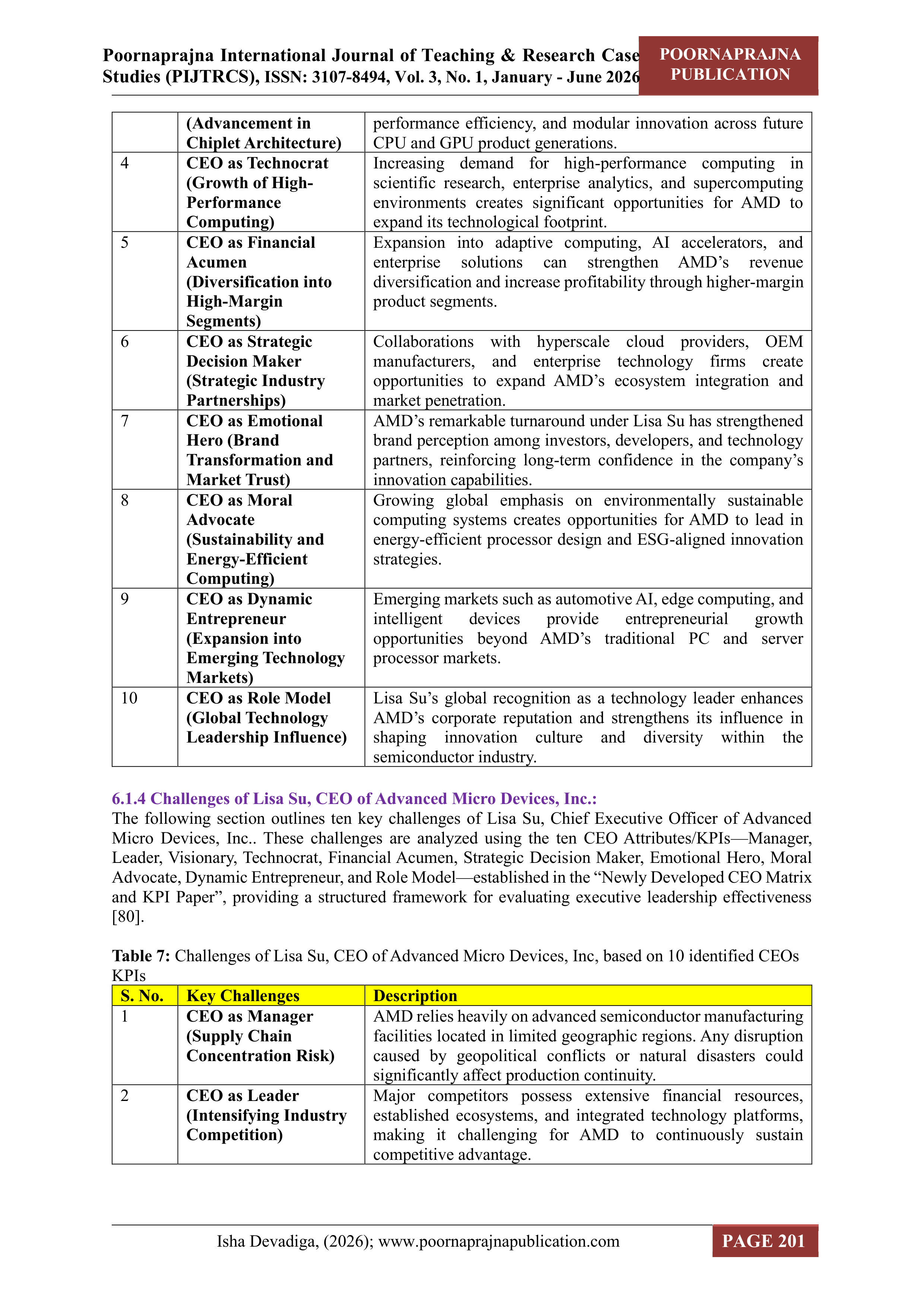
The following section outlines ten key opportunities of Lisa Su, Chief Executive Officer of Advanced
Micro Devices, Inc. These opportunities are analyzed using the ten CEO Attributes/KPIs—Manager,
Leader, Visionary, Technocrat, Financial Acumen, Strategic Decision Maker, Emotional Hero, Moral
Advocate, Dynamic Entrepreneur, and Role Model—established in the “Newly Developed CEO Matrix
and KPI Paper”, providing a structured framework for evaluating executive leadership effectiveness
[80].
Table 6:
Opportunities of Lisa Su, CEO of Advanced Micro Devices, Inc, based on 10 identified CEOs
KPIs
S. No.
Key Opportunities
Description
1
CEO as Manager
(Supply Chain
Diversification
Potential)
AMD can strengthen operational resilience by expanding multi-
foundry
collaborations
and
diversifying
manufacturing
partnerships. Such diversification can reduce dependency on a
single fabrication partner and improve supply chain stability
during global disruptions.
2
CEO as Leader
(Expansion in AI and
Data Center Markets)
Rapid growth in artificial intelligence, cloud computing, and
data
center
infrastructure
provides
major
leadership
opportunities for AMD. Increasing demand for high-
performance processors allows the company to expand
enterprise market share globally.
3
CEO as Dynamic
Visionary
AMD’s pioneering work in chiplet-based processor architecture
offers a strategic opportunity to enhance scalability,


Poornaprajna International Journal of Teaching & Research Case
Studies (PIJTRCS),
ISSN: 3107-8494, Vol. 3, No. 1, January - June 2026
POORNAPRAJNA
PUBLICATION
Isha Devadiga, (2026); www.poornaprajnapublication.com
PAGE 201
(Advancement in
Chiplet Architecture)
performance efficiency, and modular innovation across future
CPU and GPU product generations.
4
CEO as Technocrat
(Growth of High-
Performance
Computing)
Increasing demand for high-performance computing in
scientific research, enterprise analytics, and supercomputing
environments creates significant opportunities for AMD to
expand its technological footprint.
5
CEO as Financial
Acumen
(Diversification into
High-Margin
Segments)
Expansion into adaptive computing, AI accelerators, and
enterprise
solutions
can
strengthen
AMD’s
revenue
diversification and increase profitability through higher-margin
product segments.
6
CEO as Strategic
Decision Maker
(Strategic Industry
Partnerships)
Collaborations with hyperscale cloud providers, OEM
manufacturers, and enterprise technology firms create
opportunities to expand AMD’s ecosystem integration and
market penetration.
7
CEO as Emotional
Hero (Brand
Transformation and
Market Trust)
AMD’s remarkable turnaround under Lisa Su has strengthened
brand perception among investors, developers, and technology
partners, reinforcing long-term confidence in the company’s
innovation capabilities.
8
CEO as Moral
Advocate
(Sustainability and
Energy-Efficient
Computing)
Growing global emphasis on environmentally sustainable
computing systems creates opportunities for AMD to lead in
energy-efficient processor design and ESG-aligned innovation
strategies.
9
CEO as Dynamic
Entrepreneur
(Expansion into
Emerging Technology
Markets)
Emerging markets such as automotive AI, edge computing, and
intelligent
devices
provide
entrepreneurial
growth
opportunities beyond AMD’s traditional PC and server
processor markets.
10
CEO as Role Model
(Global Technology
Leadership Influence)
Lisa Su’s global recognition as a technology leader enhances
AMD’s corporate reputation and strengthens its influence in
shaping innovation
culture and
diversity
within the
semiconductor industry.
6.1.4 Challenges of Lisa Su, CEO of Advanced Micro Devices, Inc.:
The following section outlines ten key challenges of Lisa Su, Chief Executive Officer of Advanced
Micro Devices, Inc.. These challenges are analyzed using the ten CEO Attributes/KPIs—Manager,
Leader, Visionary, Technocrat, Financial Acumen, Strategic Decision Maker, Emotional Hero, Moral
Advocate, Dynamic Entrepreneur, and Role Model—established in the “Newly Developed CEO Matrix
and KPI Paper”, providing a structured framework for evaluating executive leadership effectiveness
[80].
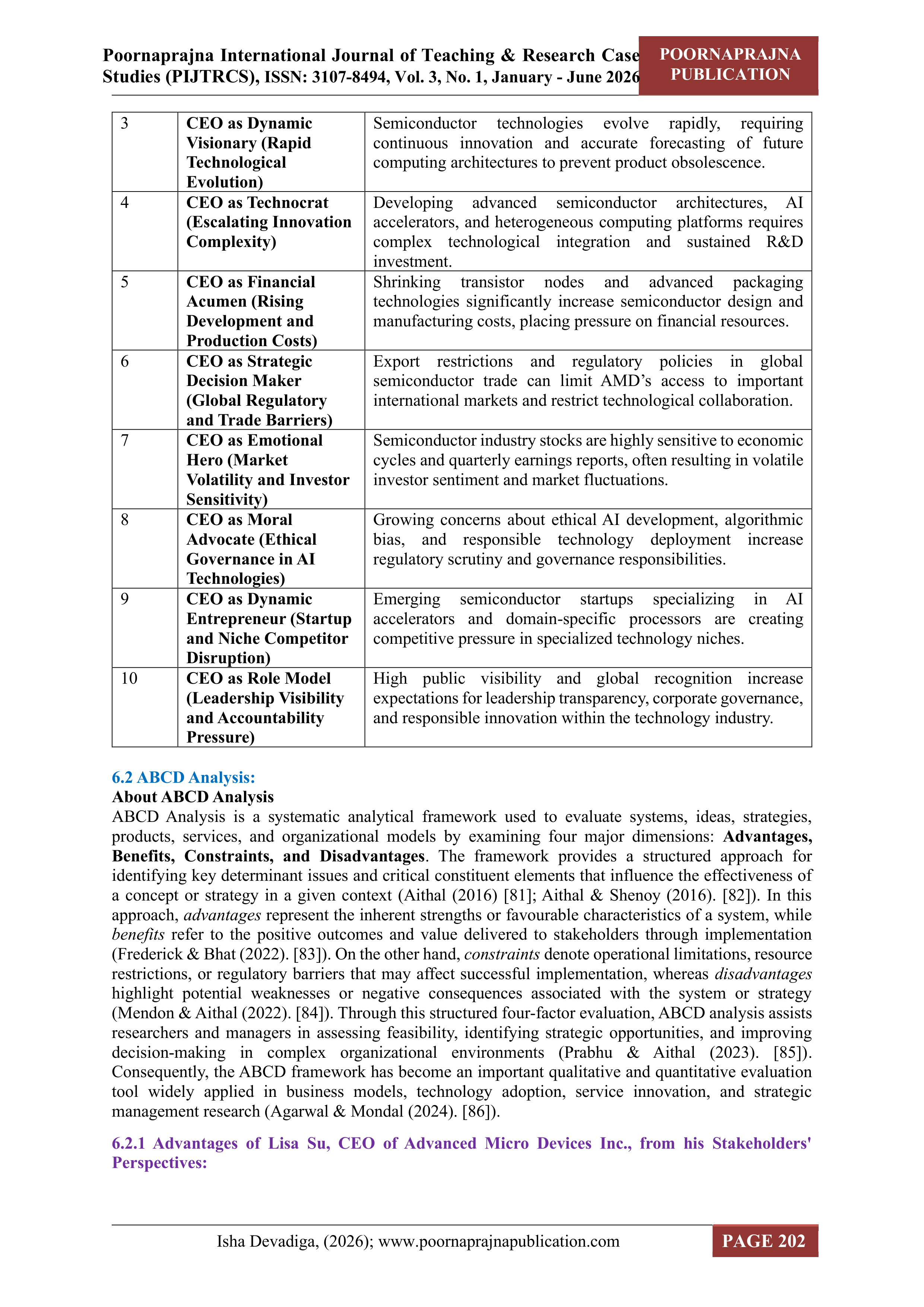
Table 7:
Challenges of Lisa Su, CEO of Advanced Micro Devices, Inc, based on 10 identified CEOs
KPIs
S. No.
Key Challenges
Description
1
CEO as Manager
(Supply Chain
Concentration Risk)
AMD relies heavily on advanced semiconductor manufacturing
facilities located in limited geographic regions. Any disruption
caused by geopolitical conflicts or natural disasters could
significantly affect production continuity.
2
CEO as Leader
(Intensifying Industry
Competition)
Major competitors possess extensive financial resources,
established ecosystems, and integrated technology platforms,
making it challenging for AMD to continuously sustain
competitive advantage.


Poornaprajna International Journal of Teaching & Research Case
Studies (PIJTRCS),
ISSN: 3107-8494, Vol. 3, No. 1, January - June 2026
POORNAPRAJNA
PUBLICATION
Isha Devadiga, (2026); www.poornaprajnapublication.com
PAGE 202
3
CEO as Dynamic
Visionary (Rapid
Technological
Evolution)
Semiconductor
technologies
evolve
rapidly,
requiring
continuous innovation and accurate forecasting of future
computing architectures to prevent product obsolescence.
4
CEO as Technocrat
(Escalating Innovation
Complexity)
Developing
advanced
semiconductor
architectures,
AI
accelerators, and heterogeneous computing platforms requires
complex technological integration and sustained R&D
investment.
5
CEO as Financial
Acumen (Rising
Development and
Production Costs)
Shrinking
transistor
nodes
and
advanced
packaging
technologies significantly increase semiconductor design and
manufacturing costs, placing pressure on financial resources.
6
CEO as Strategic
Decision Maker
(Global Regulatory
and Trade Barriers)
Export restrictions and regulatory policies in global
semiconductor trade can limit AMD’s access to important
international markets and restrict technological collaboration.
7
CEO as Emotional
Hero (Market
Volatility and Investor
Sensitivity)
Semiconductor industry stocks are highly sensitive to economic
cycles and quarterly earnings reports, often resulting in volatile
investor sentiment and market fluctuations.
8
CEO as Moral
Advocate (Ethical
Governance in AI
Technologies)
Growing concerns about ethical AI development, algorithmic
bias, and responsible technology deployment increase
regulatory scrutiny and governance responsibilities.
9
CEO as Dynamic
Entrepreneur (Startup
and Niche Competitor
Disruption)
Emerging
semiconductor
startups
specializing
in
AI
accelerators and domain-specific processors are creating
competitive pressure in specialized technology niches.
10
CEO as Role Model
(Leadership Visibility
and Accountability
Pressure)
High public visibility and global recognition increase
expectations for leadership transparency, corporate governance,
and responsible innovation within the technology industry.
6.2 ABCD Analysis:
About ABCD Analysis
ABCD Analysis is a systematic analytical framework used to evaluate systems, ideas, strategies,
products, services, and organizational models by examining four major dimensions:
Advantages,
Benefits, Constraints, and Disadvantages
. The framework provides a structured approach for
identifying key determinant issues and critical constituent elements that influence the effectiveness of
a concept or strategy in a given context (Aithal (2016) [81]; Aithal & Shenoy (2016). [82]). In this
approach,
advantages
represent the inherent strengths or favourable characteristics of a system, while
benefits
refer to the positive outcomes and value delivered to stakeholders through implementation
(Frederick & Bhat (2022). [83]). On the other hand,
constraints
denote operational limitations, resource
restrictions, or regulatory barriers that may affect successful implementation, whereas
disadvantages
highlight potential weaknesses or negative consequences associated with the system or strategy
(Mendon & Aithal (2022). [84]). Through this structured four-factor evaluation, ABCD analysis assists
researchers and managers in assessing feasibility, identifying strategic opportunities, and improving
decision-making in complex organizational environments (Prabhu & Aithal (2023). [85]).
Consequently, the ABCD framework has become an important qualitative and quantitative evaluation
tool widely applied in business models, technology adoption, service innovation, and strategic
management research (Agarwal & Mondal (2024). [86]).
6.2.1 Advantages of Lisa Su, CEO of Advanced Micro Devices Inc., from his Stakeholders'
Perspectives:


Poornaprajna International Journal of Teaching & Research Case
Studies (PIJTRCS),
ISSN: 3107-8494, Vol. 3, No. 1, January - June 2026
POORNAPRAJNA
PUBLICATION
Isha Devadiga, (2026); www.poornaprajnapublication.com
PAGE 203
Based on the scholarly analysis of the leadership of
Lisa Su
at
Advanced Micro Devices
, the following
are six key advantages of her tenure as Chief Executive Officer from the perspectives of various
stakeholders, including customers, investors, employees, policymakers, research collaborators, and the
general public.
Table 8:
Advantages of Lisa Su, CEO of Advanced Micro Devices (AMD), viewed from the
perspectives of multiple stakeholders
S. No.
Key Advantages
Description
1
Customers: High-
Performance
Products and Better
Value
Under the leadership of Lisa Su, AMD has significantly improved
the performance and efficiency of its processors and graphics
technologies. Through innovative product lines such as Ryzen and
EPYC processors, customers benefit from powerful computing
solutions at competitive prices, enhancing their overall computing
experience in gaming, professional workloads, and cloud services.
2
Investors: Strong
Financial
Turnaround and
Shareholder Value
From the perspective of investors, Lisa Su successfully
transformed AMD from a financially struggling company into one
of the most competitive semiconductor firms in the global market.
Her strategic focus on high-margin products and advanced chip
architectures led to significant revenue growth, improved
profitability,
and
increased
market
valuation,
thereby
strengthening investor confidence.
3
Employees: Culture
of Innovation and
Technical
Excellence
Lisa Su has cultivated a collaborative and innovation-driven work
culture within AMD. By emphasizing research, engineering
excellence, and professional development, she motivates
employees to contribute creatively to the company’s technological
advancement while also improving job satisfaction and
organizational commitment.
4
Policymakers:
Strengthening the
Global
Semiconductor
Industry
From a policymaker’s perspective, AMD under Lisa Su contributes
to technological advancement, economic growth, and global
semiconductor competitiveness. The company’s innovations
support national strategies related to digital infrastructure, artificial
intelligence development, and high-performance computing
capabilities.
5
Research
Collaborators:
Advancement of
Computing
Research
Lisa Su actively encourages collaboration with universities,
research institutions, and technology partners. These partnerships
support cutting-edge research in semiconductor design, artificial
intelligence, and high-performance computing, offering valuable
opportunities for academic researchers and technological
innovators.
6
The Public:
Technological
Progress and
Digital
Transformation
For the broader public, AMD’s technological advancements
contribute to faster and more efficient computing systems used in
education, healthcare, entertainment, and scientific research. Lisa
Su’s leadership thus supports wider digital transformation and
technological accessibility in modern society.
6.2.2 Benefits of Lisa Su, CEO of Advanced Micro Devices Inc., from his Stakeholders'
Perspectives:
Based on the scholarly analysis of the leadership of
Lisa Su
at
Advanced Micro Devices
, the following
are six key Benefits of her tenure as Chief Executive Officer from the perspectives of various
stakeholders, including customers, investors, employees, policymakers, research collaborators, and the
general public.
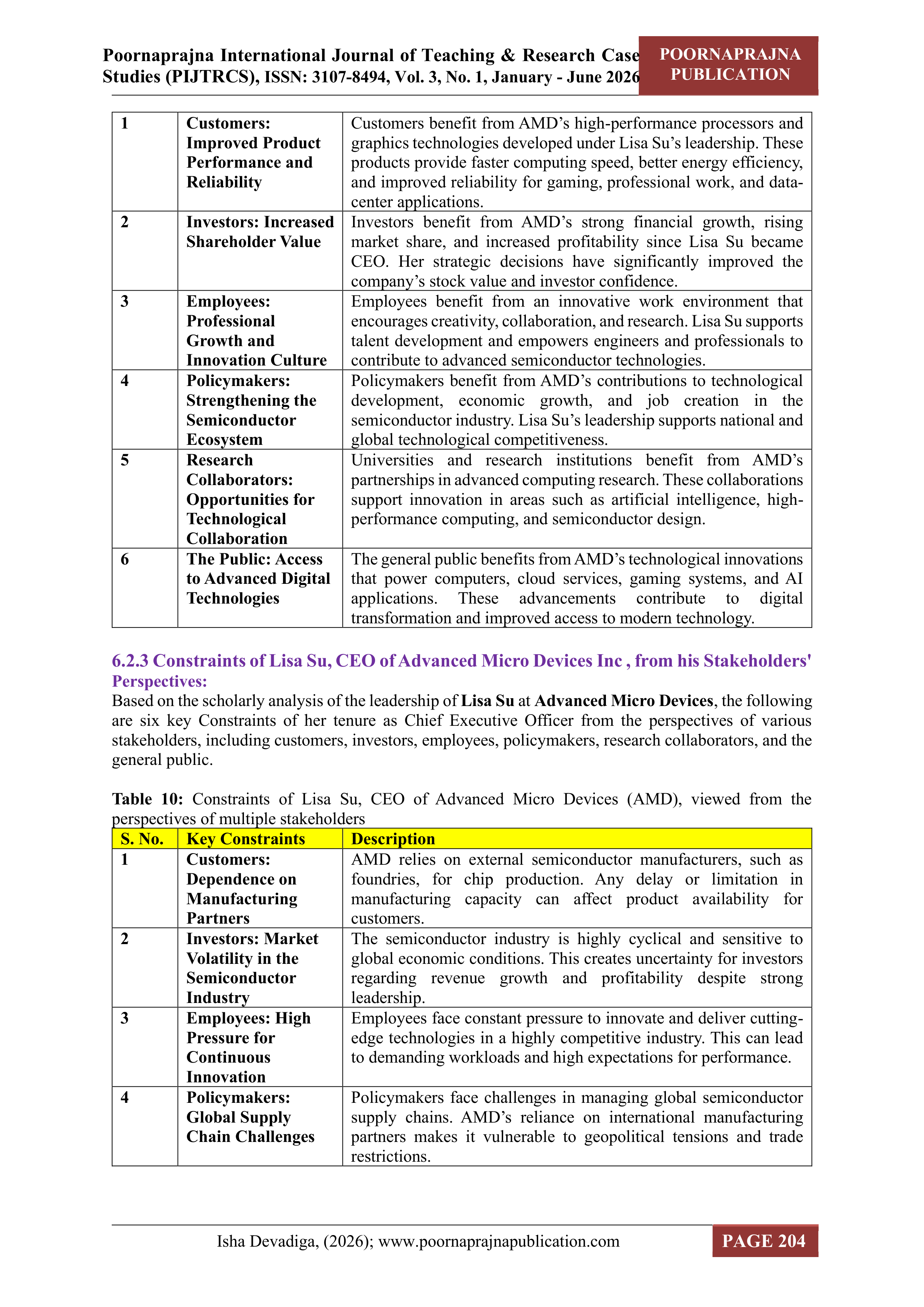
Table 9:
Benefits of Lisa Su, CEO of Advanced Micro Devices (AMD), viewed from the perspectives
of multiple stakeholders
S. No.
Key Benefits
Description


Poornaprajna International Journal of Teaching & Research Case
Studies (PIJTRCS),
ISSN: 3107-8494, Vol. 3, No. 1, January - June 2026
POORNAPRAJNA
PUBLICATION
Isha Devadiga, (2026); www.poornaprajnapublication.com
PAGE 204
1
Customers:
Improved Product
Performance and
Reliability
Customers benefit from AMD’s high-performance processors and
graphics technologies developed under Lisa Su’s leadership. These
products provide faster computing speed, better energy efficiency,
and improved reliability for gaming, professional work, and data-
center applications.
2
Investors: Increased
Shareholder Value
Investors benefit from AMD’s strong financial growth, rising
market share, and increased profitability since Lisa Su became
CEO. Her strategic decisions have significantly improved the
company’s stock value and investor confidence.
3
Employees:
Professional
Growth and
Innovation Culture
Employees benefit from an innovative work environment that
encourages creativity, collaboration, and research. Lisa Su supports
talent development and empowers engineers and professionals to
contribute to advanced semiconductor technologies.
4
Policymakers:
Strengthening the
Semiconductor
Ecosystem
Policymakers benefit from AMD’s contributions to technological
development, economic growth, and job creation in the
semiconductor industry. Lisa Su’s leadership supports national and
global technological competitiveness.
5
Research
Collaborators:
Opportunities for
Technological
Collaboration
Universities and research institutions benefit from AMD’s
partnerships in advanced computing research. These collaborations
support innovation in areas such as artificial intelligence, high-
performance computing, and semiconductor design.
6
The Public: Access
to Advanced Digital
Technologies
The general public benefits from AMD’s technological innovations
that power computers, cloud services, gaming systems, and AI
applications.
These
advancements
contribute
to
digital
transformation and improved access to modern technology.
6.2.3 Constraints of Lisa Su, CEO of Advanced Micro Devices Inc , from his Stakeholders'
Perspectives:
Based on the scholarly analysis of the leadership of
Lisa Su
at
Advanced Micro Devices
, the following
are six key Constraints of her tenure as Chief Executive Officer from the perspectives of various
stakeholders, including customers, investors, employees, policymakers, research collaborators, and the
general public.
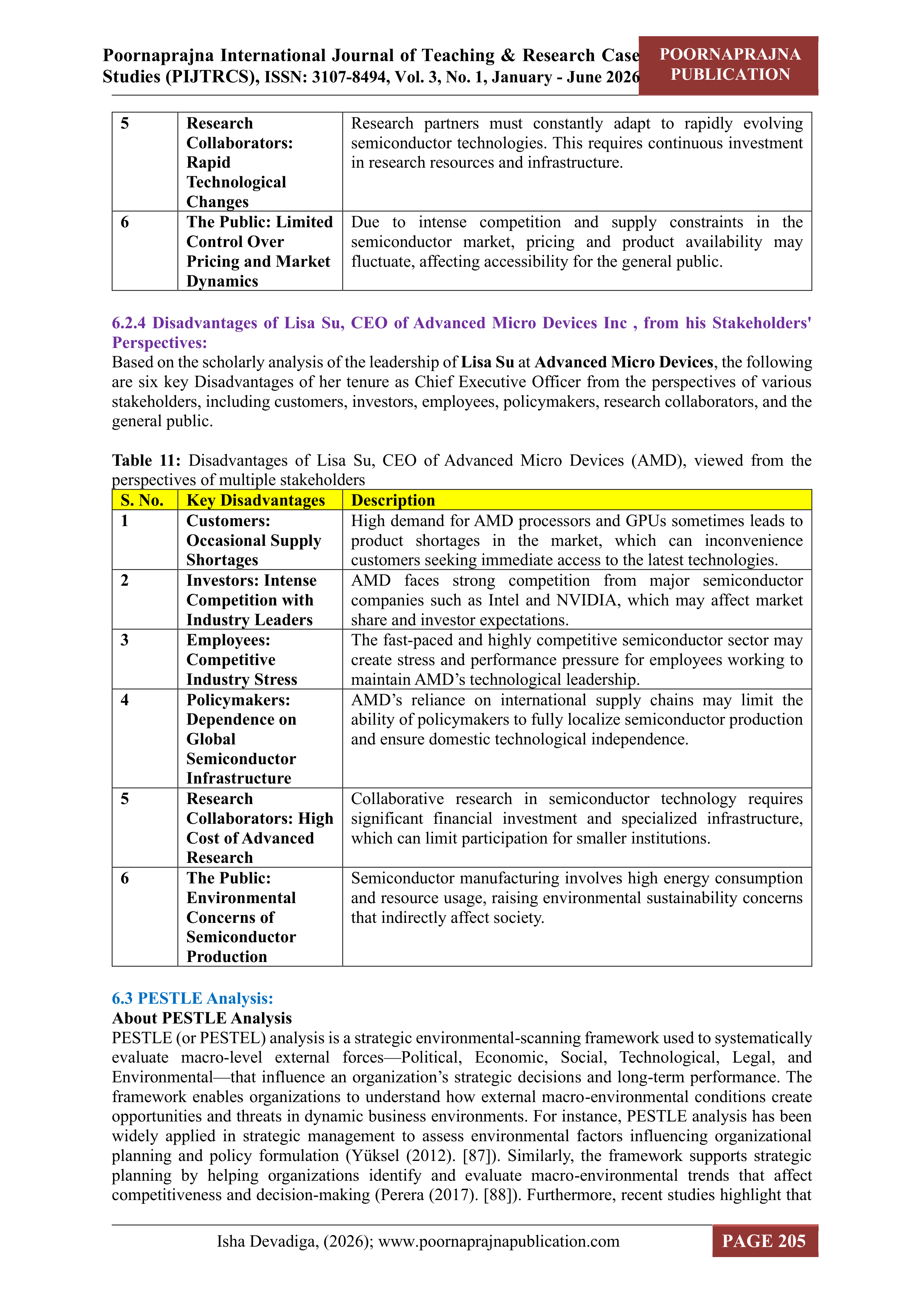
Table 10:
Constraints of Lisa Su, CEO of Advanced Micro Devices (AMD), viewed from the
perspectives of multiple stakeholders
S. No.
Key Constraints
Description
1
Customers:
Dependence on
Manufacturing
Partners
AMD relies on external semiconductor manufacturers, such as
foundries, for chip production. Any delay or limitation in
manufacturing capacity can affect product availability for
customers.
2
Investors: Market
Volatility in the
Semiconductor
Industry
The semiconductor industry is highly cyclical and sensitive to
global economic conditions. This creates uncertainty for investors
regarding revenue growth and profitability despite strong
leadership.
3
Employees: High
Pressure for
Continuous
Innovation
Employees face constant pressure to innovate and deliver cutting-
edge technologies in a highly competitive industry. This can lead
to demanding workloads and high expectations for performance.
4
Policymakers:
Global Supply
Chain Challenges
Policymakers face challenges in managing global semiconductor
supply chains. AMD’s reliance on international manufacturing
partners makes it vulnerable to geopolitical tensions and trade
restrictions.


Poornaprajna International Journal of Teaching & Research Case
Studies (PIJTRCS),
ISSN: 3107-8494, Vol. 3, No. 1, January - June 2026
POORNAPRAJNA
PUBLICATION
Isha Devadiga, (2026); www.poornaprajnapublication.com
PAGE 205
5
Research
Collaborators:
Rapid
Technological
Changes
Research partners must constantly adapt to rapidly evolving
semiconductor technologies. This requires continuous investment
in research resources and infrastructure.
6
The Public: Limited
Control Over
Pricing and Market
Dynamics
Due to intense competition and supply constraints in the
semiconductor market, pricing and product availability may
fluctuate, affecting accessibility for the general public.
6.2.4 Disadvantages of Lisa Su, CEO of Advanced Micro Devices Inc , from his Stakeholders'
Perspectives:
Based on the scholarly analysis of the leadership of
Lisa Su
at
Advanced Micro Devices
, the following
are six key Disadvantages of her tenure as Chief Executive Officer from the perspectives of various
stakeholders, including customers, investors, employees, policymakers, research collaborators, and the
general public.
Table 11:
Disadvantages of Lisa Su, CEO of Advanced Micro Devices (AMD), viewed from the
perspectives of multiple stakeholders
S. No.
Key Disadvantages
Description
1
Customers:
Occasional Supply
Shortages
High demand for AMD processors and GPUs sometimes leads to
product shortages in the market, which can inconvenience
customers seeking immediate access to the latest technologies.
2
Investors: Intense
Competition with
Industry Leaders
AMD faces strong competition from major semiconductor
companies such as Intel and NVIDIA, which may affect market
share and investor expectations.
3
Employees:
Competitive
Industry Stress
The fast-paced and highly competitive semiconductor sector may
create stress and performance pressure for employees working to
maintain AMD’s technological leadership.
4
Policymakers:
Dependence on
Global
Semiconductor
Infrastructure
AMD’s reliance on international supply chains may limit the
ability of policymakers to fully localize semiconductor production
and ensure domestic technological independence.
5
Research
Collaborators: High
Cost of Advanced
Research
Collaborative research in semiconductor technology requires
significant financial investment and specialized infrastructure,
which can limit participation for smaller institutions.
6
The Public:
Environmental
Concerns of
Semiconductor
Production
Semiconductor manufacturing involves high energy consumption
and resource usage, raising environmental sustainability concerns
that indirectly affect society.
6.3 PESTLE Analysis:
About PESTLE Analysis
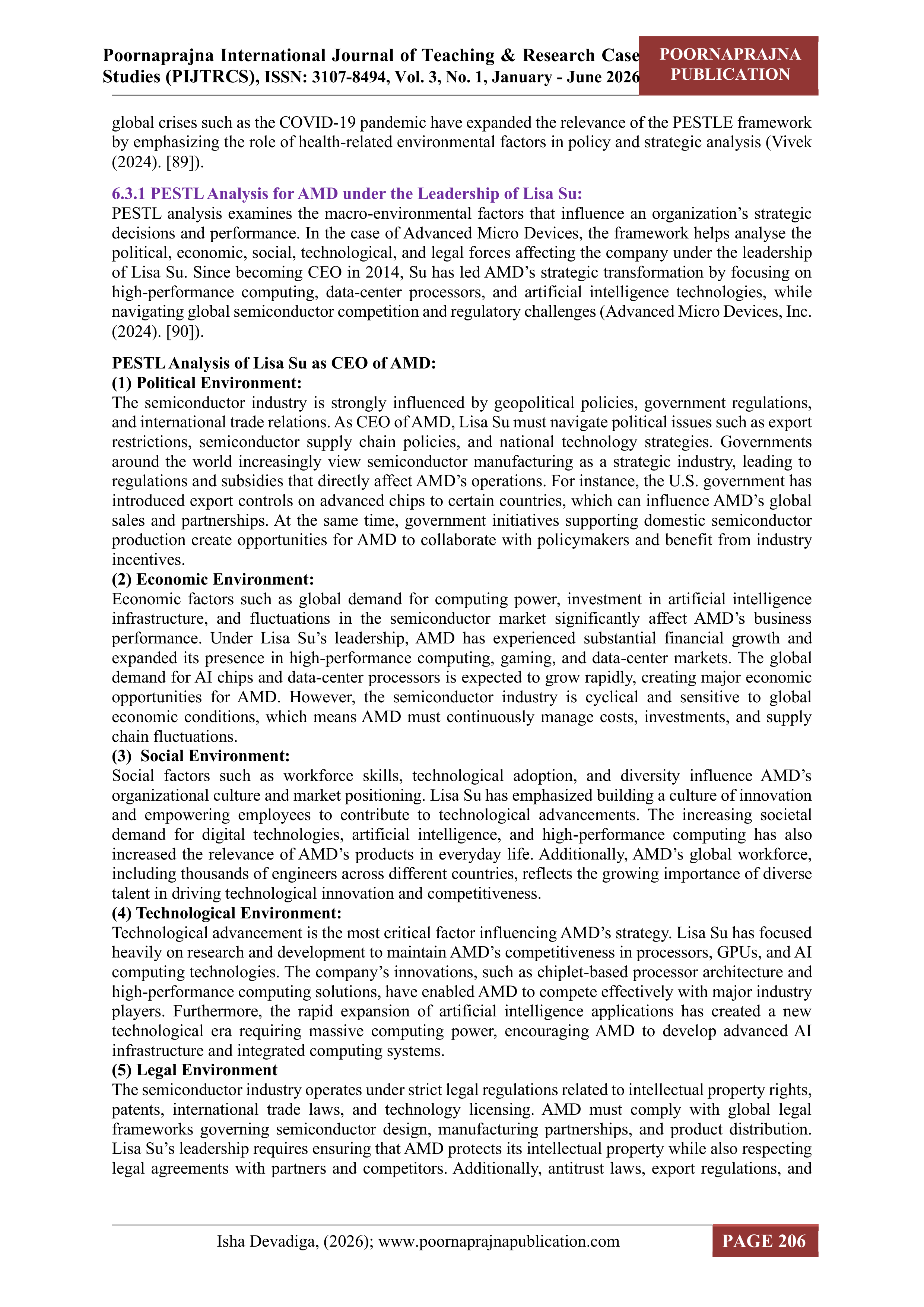
PESTLE (or PESTEL) analysis is a strategic environmental-scanning framework used to systematically
evaluate macro-level external forces—Political, Economic, Social, Technological, Legal, and
Environmental—that influence an organization’s strategic decisions and long-term performance. The
framework enables organizations to understand how external macro-environmental conditions create
opportunities and threats in dynamic business environments. For instance, PESTLE analysis has been
widely applied in strategic management to assess environmental factors influencing organizational
planning and policy formulation (Yüksel (2012). [87]). Similarly, the framework supports strategic
planning by helping organizations identify and evaluate macro-environmental trends that affect
competitiveness and decision-making (Perera (2017). [88]). Furthermore, recent studies highlight that


Poornaprajna International Journal of Teaching & Research Case
Studies (PIJTRCS),
ISSN: 3107-8494, Vol. 3, No. 1, January - June 2026
POORNAPRAJNA
PUBLICATION
Isha Devadiga, (2026); www.poornaprajnapublication.com
PAGE 206
global crises such as the COVID-19 pandemic have expanded the relevance of the PESTLE framework
by emphasizing the role of health-related environmental factors in policy and strategic analysis (Vivek
(2024). [89]).
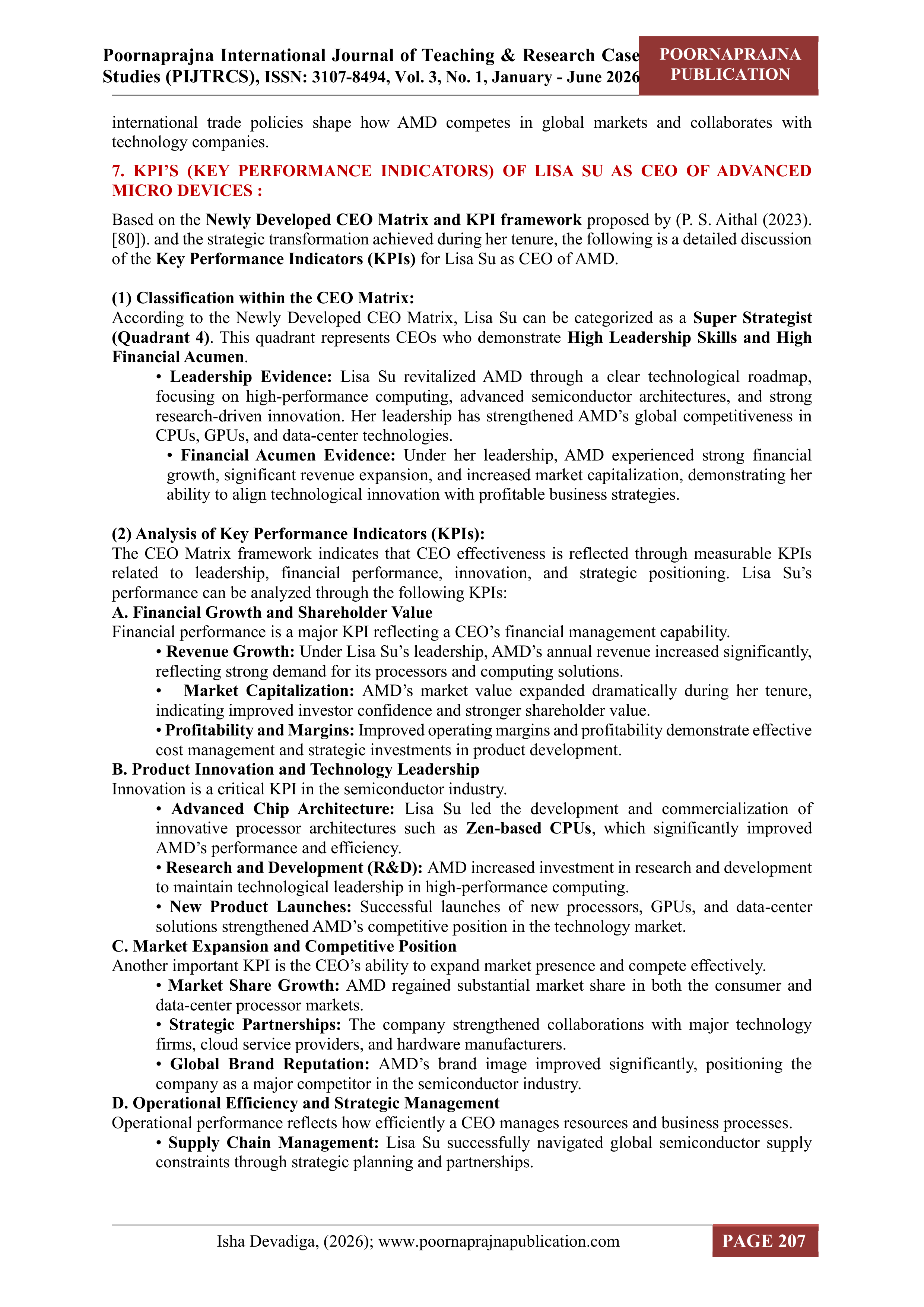
6.3.1 PESTL Analysis for AMD under the Leadership of Lisa Su:
PESTL analysis examines the macro-environmental factors that influence an organization’s strategic
decisions and performance. In the case of Advanced Micro Devices, the framework helps analyse the
political, economic, social, technological, and legal forces affecting the company under the leadership
of Lisa Su. Since becoming CEO in 2014, Su has led AMD’s strategic transformation by focusing on
high-performance computing, data-center processors, and artificial intelligence technologies, while
navigating global semiconductor competition and regulatory challenges (Advanced Micro Devices, Inc.
(2024). [90]).
PESTL Analysis of Lisa Su as CEO of AMD:
(1) Political Environment:
The semiconductor industry is strongly influenced by geopolitical policies, government regulations,
and international trade relations. As CEO of AMD, Lisa Su must navigate political issues such as export
restrictions, semiconductor supply chain policies, and national technology strategies. Governments
around the world increasingly view semiconductor manufacturing as a strategic industry, leading to
regulations and subsidies that directly affect AMD’s operations. For instance, the U.S. government has
introduced export controls on advanced chips to certain countries, which can influence AMD’s global
sales and partnerships. At the same time, government initiatives supporting domestic semiconductor
production create opportunities for AMD to collaborate with policymakers and benefit from industry
incentives.
(2)
Economic Environment:
Economic factors such as global demand for computing power, investment in artificial intelligence
infrastructure, and fluctuations in the semiconductor market significantly affect AMD’s business
performance. Under Lisa Su’s leadership, AMD has experienced substantial financial growth and
expanded its presence in high-performance computing, gaming, and data-center markets. The global
demand for AI chips and data-center processors is expected to grow rapidly, creating major economic
opportunities for AMD. However, the semiconductor industry is cyclical and sensitive to global
economic conditions, which means AMD must continuously manage costs, investments, and supply
chain fluctuations.
(3) Social Environment:
Social factors such as workforce skills, technological adoption, and diversity influence AMD’s
organizational culture and market positioning. Lisa Su has emphasized building a culture of innovation
and empowering employees to contribute to technological advancements. The increasing societal
demand for digital technologies, artificial intelligence, and high-performance computing has also
increased the relevance of AMD’s products in everyday life. Additionally, AMD’s global workforce,
including thousands of engineers across different countries, reflects the growing importance of diverse
talent in driving technological innovation and competitiveness.
(4) Technological Environment:
Technological advancement is the most critical factor influencing AMD’s strategy. Lisa Su has focused
heavily on research and development to maintain AMD’s competitiveness in processors, GPUs, and AI
computing technologies. The company’s innovations, such as chiplet-based processor architecture and
high-performance computing solutions, have enabled AMD to compete effectively with major industry
players. Furthermore, the rapid expansion of artificial intelligence applications has created a new
technological era requiring massive computing power, encouraging AMD to develop advanced AI
infrastructure and integrated computing systems.
(5) Legal Environment
The semiconductor industry operates under strict legal regulations related to intellectual property rights,
patents, international trade laws, and technology licensing. AMD must comply with global legal
frameworks governing semiconductor design, manufacturing partnerships, and product distribution.
Lisa Su’s leadership requires ensuring that AMD protects its intellectual property while also respecting
legal agreements with partners and competitors. Additionally, antitrust laws, export regulations, and


Poornaprajna International Journal of Teaching & Research Case
Studies (PIJTRCS),
ISSN: 3107-8494, Vol. 3, No. 1, January - June 2026
POORNAPRAJNA
PUBLICATION
Isha Devadiga, (2026); www.poornaprajnapublication.com
PAGE 207
international trade policies shape how AMD competes in global markets and collaborates with
technology companies.
7. KPI’S (KEY PERFORMANCE INDICATORS) OF LISA SU AS CEO OF ADVANCED
MICRO DEVICES :
Based on the
Newly Developed CEO Matrix and KPI framework
proposed
by (P. S. Aithal (2023).
[80]). and the strategic transformation achieved during her tenure, the following is a detailed discussion
of the
Key Performance Indicators (KPIs)
for Lisa Su as CEO of AMD.
(1) Classification within the CEO Matrix:
According to the Newly Developed CEO Matrix, Lisa Su can be categorized as a
Super Strategist
(Quadrant 4)
. This quadrant represents CEOs who demonstrate
High Leadership Skills and High
Financial Acumen
.
•
Leadership Evidence:
Lisa Su revitalized AMD through a clear technological roadmap,
focusing on high-performance computing, advanced semiconductor architectures, and strong
research-driven innovation. Her leadership has strengthened AMD’s global competitiveness in
CPUs, GPUs, and data-center technologies.
•
Financial Acumen Evidence:
Under her leadership, AMD experienced strong financial
growth, significant revenue expansion, and increased market capitalization, demonstrating her
ability to align technological innovation with profitable business strategies.
(2) Analysis of Key Performance Indicators (KPIs):
The CEO Matrix framework indicates that CEO effectiveness is reflected through measurable KPIs
related to leadership, financial performance, innovation, and strategic positioning. Lisa Su’s
performance can be analyzed through the following KPIs:
A. Financial Growth and Shareholder Value
Financial performance is a major KPI reflecting a CEO’s financial management capability.
•
Revenue Growth:
Under Lisa Su’s leadership, AMD’s annual revenue increased significantly,
reflecting strong demand for its processors and computing solutions.
•
Market Capitalization:
AMD’s market value expanded dramatically during her tenure,
indicating improved investor confidence and stronger shareholder value.
•
Profitability and Margins:
Improved operating margins and profitability demonstrate effective
cost management and strategic investments in product development.
B. Product Innovation and Technology Leadership
Innovation is a critical KPI in the semiconductor industry.
•
Advanced Chip Architecture:
Lisa Su led the development and commercialization of
innovative processor architectures such as
Zen-based CPUs
, which significantly improved
AMD’s performance and efficiency.
•
Research and Development (R&D):
AMD increased investment in research and development
to maintain technological leadership in high-performance computing.
•
New Product Launches:
Successful launches of new processors, GPUs, and data-center
solutions strengthened AMD’s competitive position in the technology market.
C. Market Expansion and Competitive Position
Another important KPI is the CEO’s ability to expand market presence and compete effectively.
•
Market Share Growth:
AMD regained substantial market share in both the consumer and
data-center processor markets.
•
Strategic Partnerships:
The company strengthened collaborations with major technology
firms, cloud service providers, and hardware manufacturers.
•
Global Brand Reputation:
AMD’s brand image improved significantly, positioning the
company as a major competitor in the semiconductor industry.
D. Operational Efficiency and Strategic Management
Operational performance reflects how efficiently a CEO manages resources and business processes.
•
Supply Chain Management:
Lisa Su successfully navigated global semiconductor supply
constraints through strategic planning and partnerships.
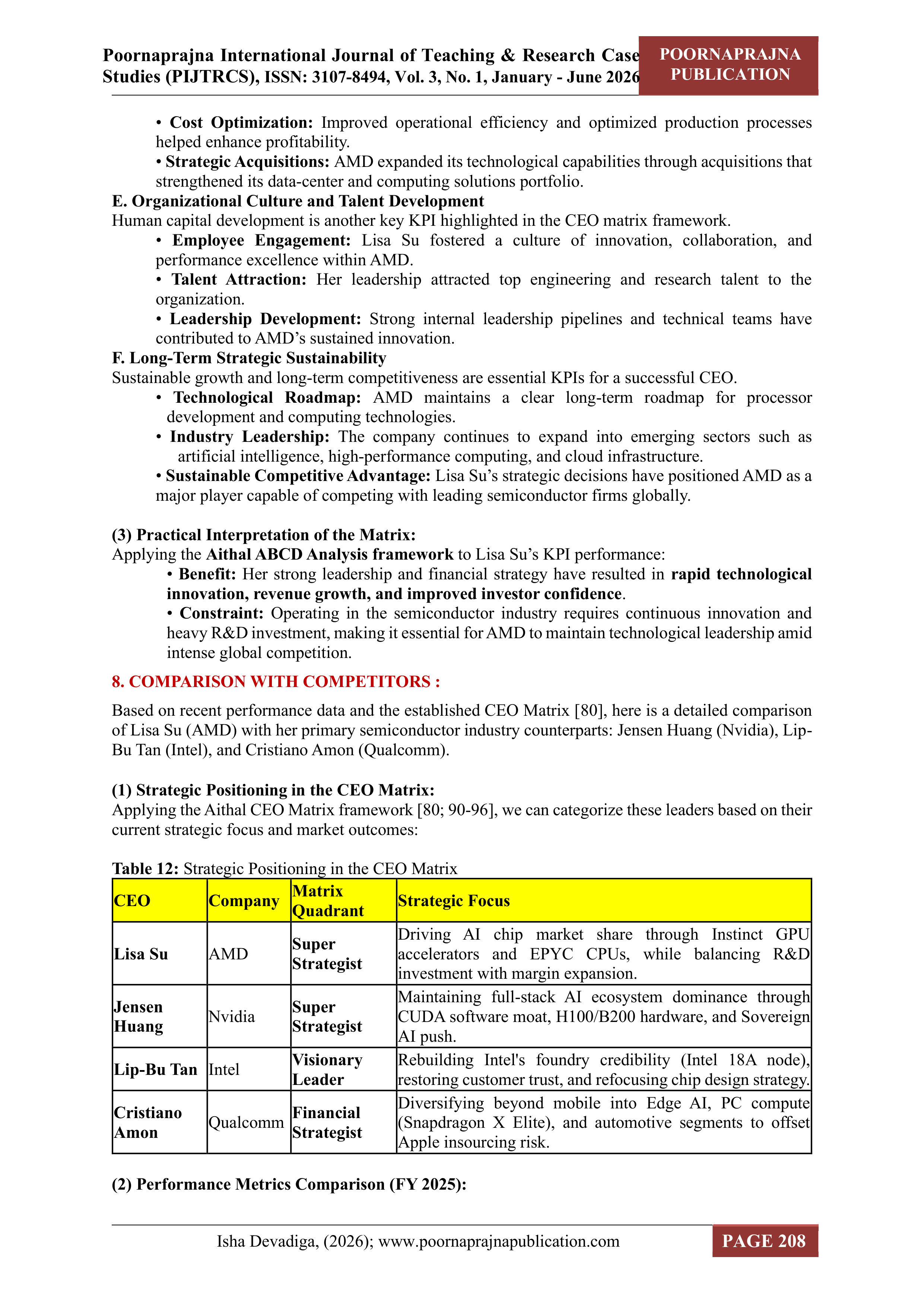


Poornaprajna International Journal of Teaching & Research Case
Studies (PIJTRCS),
ISSN: 3107-8494, Vol. 3, No. 1, January - June 2026
POORNAPRAJNA
PUBLICATION
Isha Devadiga, (2026); www.poornaprajnapublication.com
PAGE 208
•
Cost Optimization:
Improved operational efficiency and optimized production processes
helped enhance profitability.
•
Strategic Acquisitions:
AMD expanded its technological capabilities through acquisitions that
strengthened its data-center and computing solutions portfolio.
E. Organizational Culture and Talent Development
Human capital development is another key KPI highlighted in the CEO matrix framework.
•
Employee Engagement:
Lisa Su fostered a culture of innovation, collaboration, and
performance excellence within AMD.
•
Talent Attraction:
Her leadership attracted top engineering and research talent to the
organization.
•
Leadership Development:
Strong internal leadership pipelines and technical teams have
contributed to AMD’s sustained innovation.
F. Long-Term Strategic Sustainability
Sustainable growth and long-term competitiveness are essential KPIs for a successful CEO.
•
Technological Roadmap:
AMD maintains a clear long-term roadmap for processor
development and computing technologies.
•
Industry Leadership:
The company continues to expand into emerging sectors such as
artificial intelligence, high-performance computing, and cloud infrastructure.
•
Sustainable Competitive Advantage:
Lisa Su’s strategic decisions have positioned AMD as a
major player capable of competing with leading semiconductor firms globally.
(3) Practical Interpretation of the Matrix:
Applying the
Aithal ABCD Analysis framework
to Lisa Su’s KPI performance:
•
Benefit:
Her strong leadership and financial strategy have resulted in
rapid technological
innovation, revenue growth, and improved investor confidence
.
•
Constraint:
Operating in the semiconductor industry requires continuous innovation and
heavy R&D investment, making it essential for AMD to maintain technological leadership amid
intense global competition.
8. COMPARISON WITH COMPETITORS :
Based on recent performance data and the established CEO Matrix [80], here is a detailed comparison
of Lisa Su (AMD) with her primary semiconductor industry counterparts: Jensen Huang (Nvidia), Lip-
Bu Tan (Intel), and Cristiano Amon (Qualcomm).
(1) Strategic Positioning in the CEO Matrix:
Applying the Aithal CEO Matrix framework [80; 90-96], we can categorize these leaders based on their
current strategic focus and market outcomes:
Table 12:
Strategic Positioning in the CEO Matrix
CEO
Company
Matrix
Quadrant
Strategic Focus
Lisa Su
AMD
Super
Strategist
Driving AI chip market share through Instinct GPU
accelerators and EPYC CPUs, while balancing R&D
investment with margin expansion.
Jensen
Huang
Nvidia
Super
Strategist
Maintaining full-stack AI ecosystem dominance through
CUDA software moat, H100/B200 hardware, and Sovereign
AI push.
Lip-Bu Tan
Intel
Visionary
Leader
Rebuilding Intel's foundry credibility (Intel 18A node),
restoring customer trust, and refocusing chip design strategy.
Cristiano
Amon
Qualcomm
Financial
Strategist
Diversifying beyond mobile into Edge AI, PC compute
(Snapdragon X Elite), and automotive segments to offset
Apple insourcing risk.
(2) Performance Metrics Comparison (FY 2025):
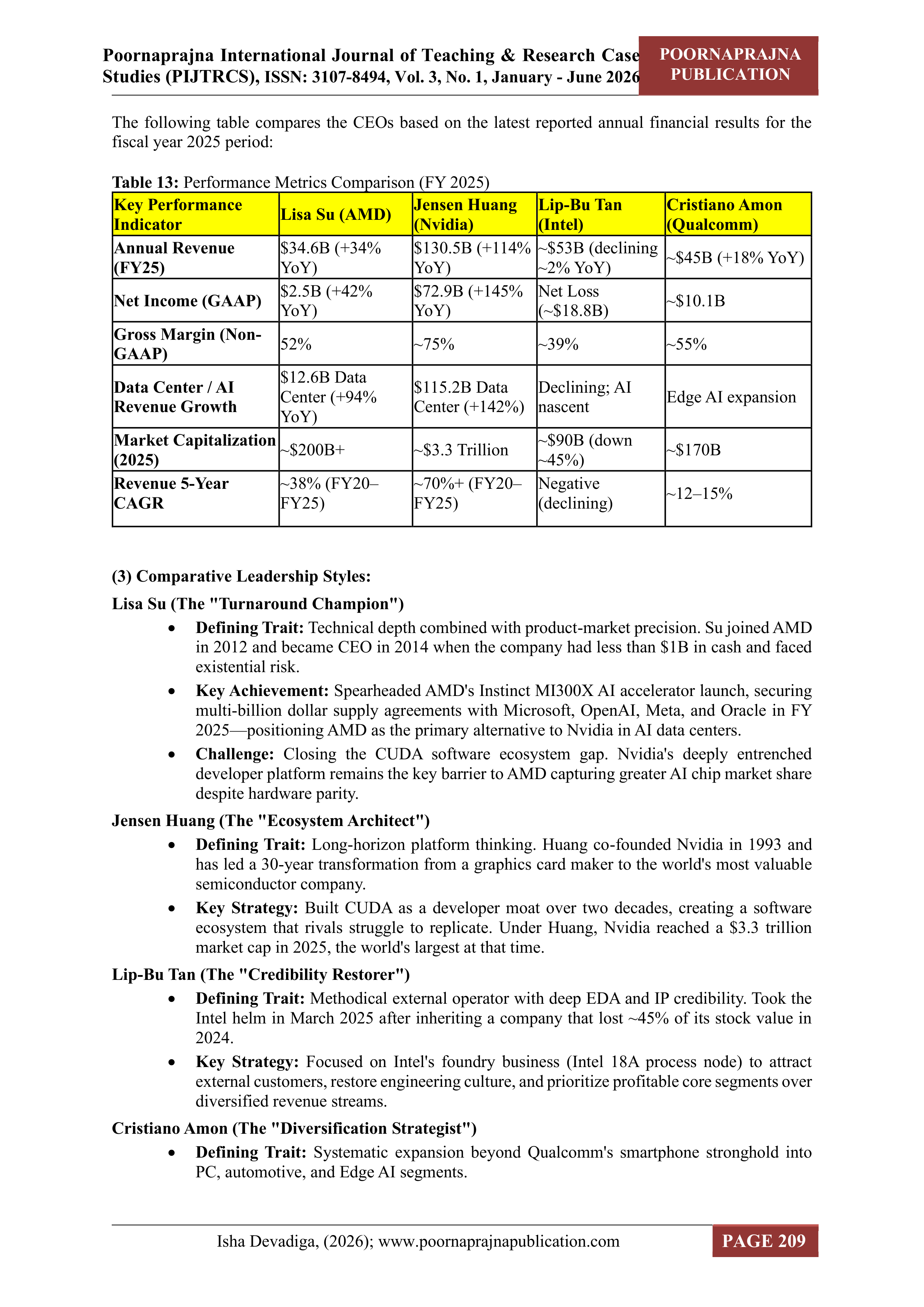


Poornaprajna International Journal of Teaching & Research Case
Studies (PIJTRCS),
ISSN: 3107-8494, Vol. 3, No. 1, January - June 2026
POORNAPRAJNA
PUBLICATION
Isha Devadiga, (2026); www.poornaprajnapublication.com
PAGE 209
The following table compares the CEOs based on the latest reported annual financial results for the
fiscal year 2025 period:
Table 13:
Performance Metrics Comparison (FY 2025)
Key Performance
Indicator
Lisa Su (AMD)
Jensen Huang
(Nvidia)
Lip-Bu Tan
(Intel)
Cristiano Amon
(Qualcomm)
Annual Revenue
(FY25)
$34.6B (+34%
YoY)
$130.5B (+114%
YoY)
~$53B (declining
~2% YoY)
~$45B (+18% YoY)
Net Income (GAAP)
$2.5B (+42%
YoY)
$72.9B (+145%
YoY)
Net Loss
(~$18.8B)
~$10.1B
Gross Margin (Non-
GAAP)
52%
~75%
~39%
~55%
Data Center / AI
Revenue Growth
$12.6B Data
Center (+94%
YoY)
$115.2B Data
Center (+142%)
Declining; AI
nascent
Edge AI expansion
Market Capitalization
(2025)
~$200B+
~$3.3 Trillion
~$90B (down
~45%)
~$170B
Revenue 5-Year
CAGR
~38% (FY20–
FY25)
~70%+ (FY20–
FY25)
Negative
(declining)
~12–15%
(3) Comparative Leadership Styles:
Lisa Su (The "Turnaround Champion")
•
Defining Trait:
Technical depth combined with product-market precision. Su joined AMD
in 2012 and became CEO in 2014 when the company had less than $1B in cash and faced
existential risk.
•
Key Achievement:
Spearheaded AMD's Instinct MI300X AI accelerator launch, securing
multi-billion dollar supply agreements with Microsoft, OpenAI, Meta, and Oracle in FY
2025—positioning AMD as the primary alternative to Nvidia in AI data centers.
•
Challenge:
Closing the CUDA software ecosystem gap. Nvidia's deeply entrenched
developer platform remains the key barrier to AMD capturing greater AI chip market share
despite hardware parity.
Jensen Huang (The "Ecosystem Architect")
•
Defining Trait:
Long-horizon platform thinking. Huang co-founded Nvidia in 1993 and
has led a 30-year transformation from a graphics card maker to the world's most valuable
semiconductor company.
•
Key Strategy:
Built CUDA as a developer moat over two decades, creating a software
ecosystem that rivals struggle to replicate. Under Huang, Nvidia reached a $3.3 trillion
market cap in 2025, the world's largest at that time.
Lip-Bu Tan (The "Credibility Restorer")
•
Defining Trait:
Methodical external operator with deep EDA and IP credibility. Took the
Intel helm in March 2025 after inheriting a company that lost ~45% of its stock value in
2024.
•
Key Strategy:
Focused on Intel's foundry business (Intel 18A process node) to attract
external customers, restore engineering culture, and prioritize profitable core segments over
diversified revenue streams.
Cristiano Amon (The "Diversification Strategist")
•
Defining Trait:
Systematic expansion beyond Qualcomm's smartphone stronghold into
PC, automotive, and Edge AI segments.
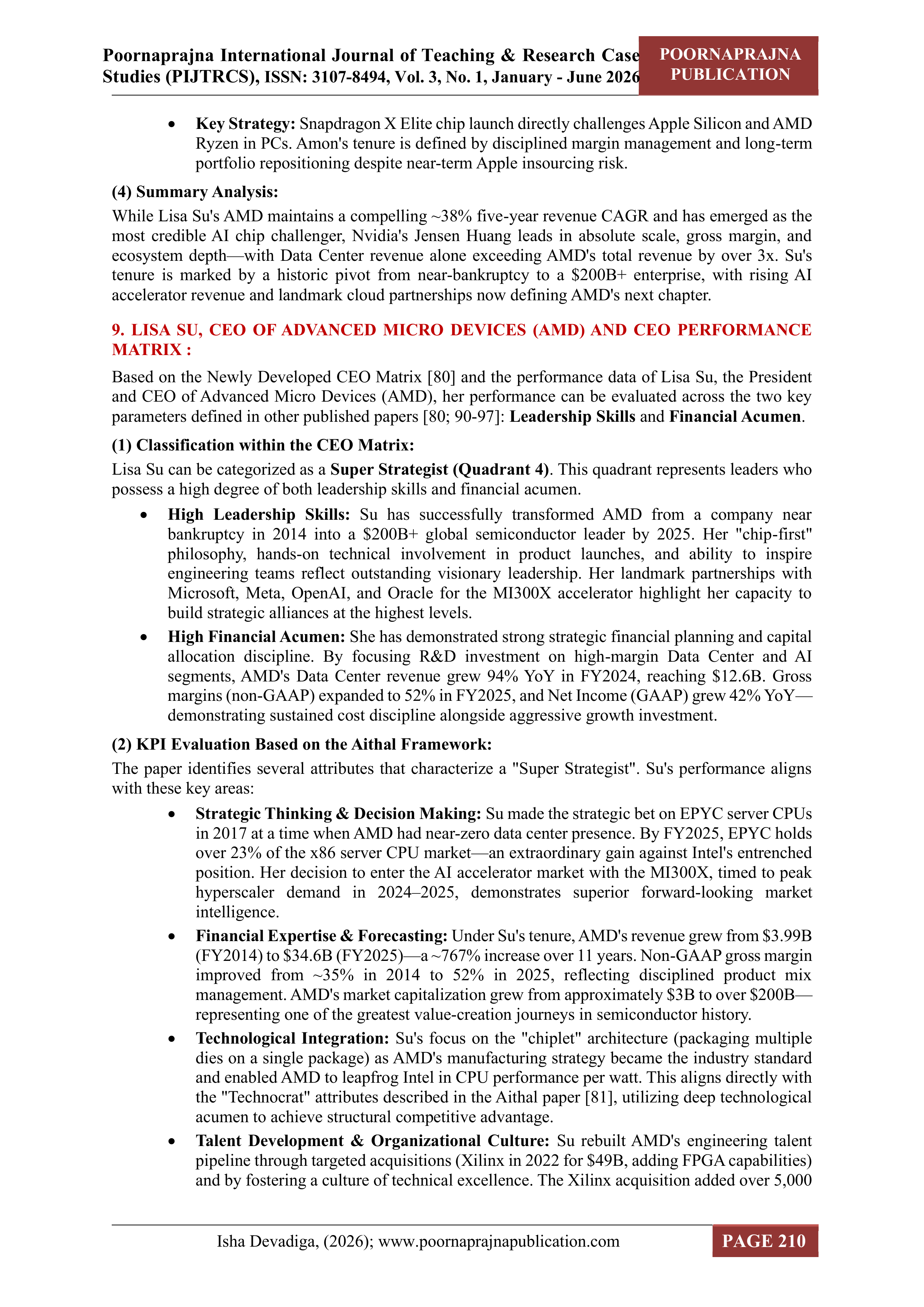


Poornaprajna International Journal of Teaching & Research Case
Studies (PIJTRCS),
ISSN: 3107-8494, Vol. 3, No. 1, January - June 2026
POORNAPRAJNA
PUBLICATION
Isha Devadiga, (2026); www.poornaprajnapublication.com
PAGE 210
•
Key Strategy:
Snapdragon X Elite chip launch directly challenges Apple Silicon and AMD
Ryzen in PCs. Amon's tenure is defined by disciplined margin management and long-term
portfolio repositioning despite near-term Apple insourcing risk.
(4) Summary Analysis:
While Lisa Su's AMD maintains a compelling ~38% five-year revenue CAGR and has emerged as the
most credible AI chip challenger, Nvidia's Jensen Huang leads in absolute scale, gross margin, and
ecosystem depth—with Data Center revenue alone exceeding AMD's total revenue by over 3x. Su's
tenure is marked by a historic pivot from near-bankruptcy to a $200B+ enterprise, with rising AI
accelerator revenue and landmark cloud partnerships now defining AMD's next chapter.
9. LISA SU, CEO OF ADVANCED MICRO DEVICES (AMD) AND CEO PERFORMANCE
MATRIX :
Based on the Newly Developed CEO Matrix [80] and the performance data of Lisa Su, the President
and CEO of Advanced Micro Devices (AMD), her performance can be evaluated across the two key
parameters defined in other published papers [80; 90-97]:
Leadership Skills
and
Financial Acumen
.
(1) Classification within the CEO Matrix:
Lisa Su can be categorized as a
Super Strategist (Quadrant 4)
. This quadrant represents leaders who
possess a high degree of both leadership skills and financial acumen.
•
High Leadership Skills:
Su has successfully transformed AMD from a company near
bankruptcy in 2014 into a $200B+ global semiconductor leader by 2025. Her "chip-first"
philosophy, hands-on technical involvement in product launches, and ability to inspire
engineering teams reflect outstanding visionary leadership. Her landmark partnerships with
Microsoft, Meta, OpenAI, and Oracle for the MI300X accelerator highlight her capacity to
build strategic alliances at the highest levels.
•
High Financial Acumen:
She has demonstrated strong strategic financial planning and capital
allocation discipline. By focusing R&D investment on high-margin Data Center and AI
segments, AMD's Data Center revenue grew 94% YoY in FY2024, reaching $12.6B. Gross
margins (non-GAAP) expanded to 52% in FY2025, and Net Income (GAAP) grew 42% YoY—
demonstrating sustained cost discipline alongside aggressive growth investment.
(2) KPI Evaluation Based on the Aithal Framework:
The paper identifies several attributes that characterize a "Super Strategist". Su's performance aligns
with these key areas:
•
Strategic Thinking & Decision Making:
Su made the strategic bet on EPYC server CPUs
in 2017 at a time when AMD had near-zero data center presence. By FY2025, EPYC holds
over 23% of the x86 server CPU market—an extraordinary gain against Intel's entrenched
position. Her decision to enter the AI accelerator market with the MI300X, timed to peak
hyperscaler demand in 2024–2025, demonstrates superior forward-looking market
intelligence.
•
Financial Expertise & Forecasting:
Under Su's tenure, AMD's revenue grew from $3.99B
(FY2014) to $34.6B (FY2025)—a ~767% increase over 11 years. Non-GAAP gross margin
improved from ~35% in 2014 to 52% in 2025, reflecting disciplined product mix
management. AMD's market capitalization grew from approximately $3B to over $200B—
representing one of the greatest value-creation journeys in semiconductor history.
•
Technological Integration:
Su's focus on the "chiplet" architecture (packaging multiple
dies on a single package) as AMD's manufacturing strategy became the industry standard
and enabled AMD to leapfrog Intel in CPU performance per watt. This aligns directly with
the "Technocrat" attributes described in the Aithal paper [81], utilizing deep technological
acumen to achieve structural competitive advantage.
•
Talent Development & Organizational Culture:
Su rebuilt AMD's engineering talent
pipeline through targeted acquisitions (Xilinx in 2022 for $49B, adding FPGA capabilities)
and by fostering a culture of technical excellence. The Xilinx acquisition added over 5,000
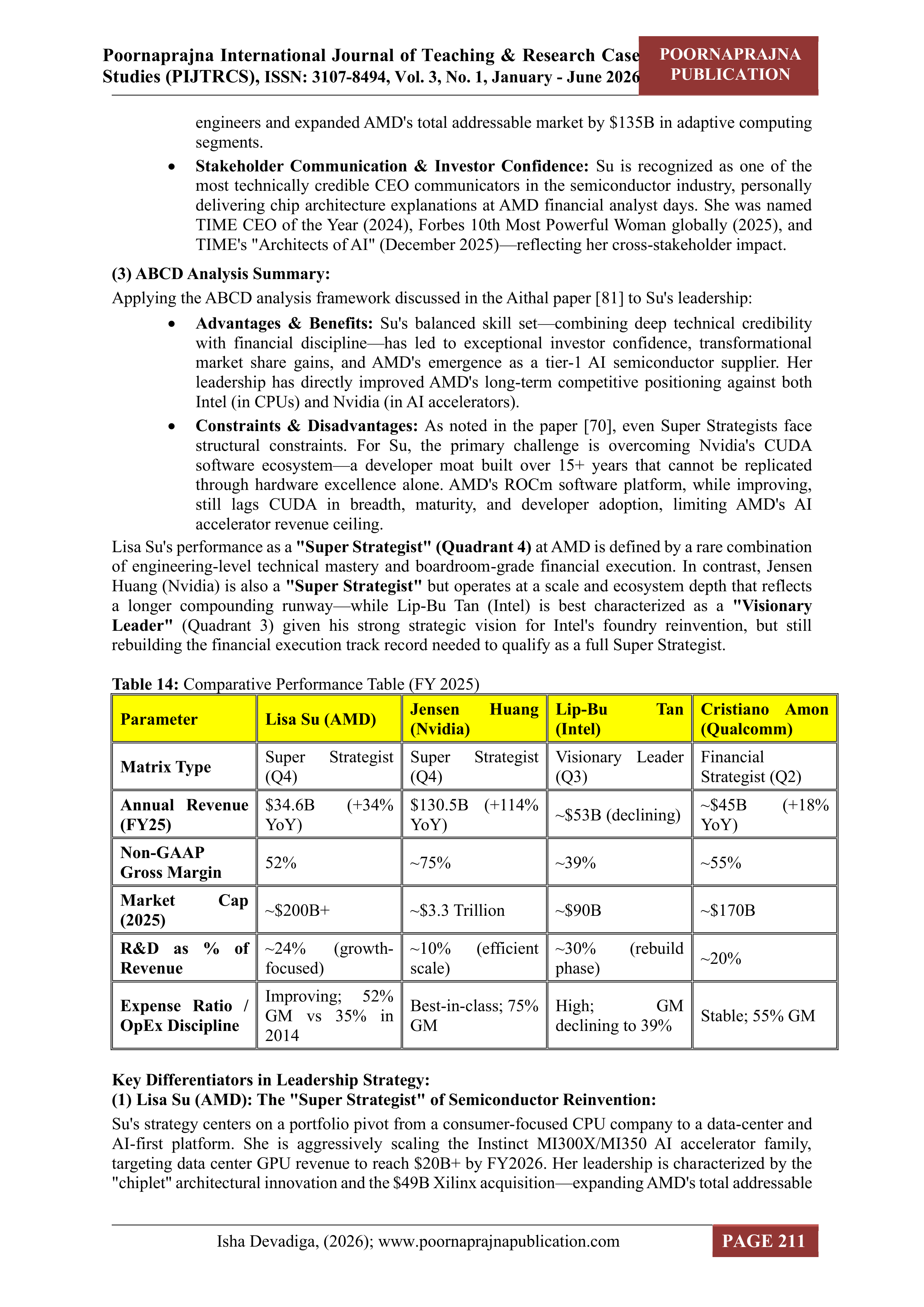


Poornaprajna International Journal of Teaching & Research Case
Studies (PIJTRCS),
ISSN: 3107-8494, Vol. 3, No. 1, January - June 2026
POORNAPRAJNA
PUBLICATION
Isha Devadiga, (2026); www.poornaprajnapublication.com
PAGE 211
engineers and expanded AMD's total addressable market by $135B in adaptive computing
segments.
•
Stakeholder Communication & Investor Confidence:
Su is recognized as one of the
most technically credible CEO communicators in the semiconductor industry, personally
delivering chip architecture explanations at AMD financial analyst days. She was named
TIME CEO of the Year (2024), Forbes 10th Most Powerful Woman globally (2025), and
TIME's "Architects of AI" (December 2025)—reflecting her cross-stakeholder impact.
(3) ABCD Analysis Summary:
Applying the ABCD analysis framework discussed in the Aithal paper [81] to Su's leadership:
•
Advantages & Benefits:
Su's balanced skill set—combining deep technical credibility
with financial discipline—has led to exceptional investor confidence, transformational
market share gains, and AMD's emergence as a tier-1 AI semiconductor supplier. Her
leadership has directly improved AMD's long-term competitive positioning against both
Intel (in CPUs) and Nvidia (in AI accelerators).
•
Constraints & Disadvantages:
As noted in the paper [70], even Super Strategists face
structural constraints. For Su, the primary challenge is overcoming Nvidia's CUDA
software ecosystem—a developer moat built over 15+ years that cannot be replicated
through hardware excellence alone. AMD's ROCm software platform, while improving,
still lags CUDA in breadth, maturity, and developer adoption, limiting AMD's AI
accelerator revenue ceiling.
Lisa Su's performance as a
"Super Strategist" (Quadrant 4)
at AMD is defined by a rare combination
of engineering-level technical mastery and boardroom-grade financial execution. In contrast, Jensen
Huang (Nvidia) is also a
"Super Strategist"
but operates at a scale and ecosystem depth that reflects
a longer compounding runway—while Lip-Bu Tan (Intel) is best characterized as a
"Visionary
Leader"
(Quadrant 3) given his strong strategic vision for Intel's foundry reinvention, but still
rebuilding the financial execution track record needed to qualify as a full Super Strategist.
Table 14:
Comparative Performance Table (FY 2025)
Parameter
Lisa Su (AMD)
Jensen
Huang
(Nvidia)
Lip-Bu
Tan
(Intel)
Cristiano Amon
(Qualcomm)
Matrix Type
Super
Strategist
(Q4)
Super
Strategist
(Q4)
Visionary Leader
(Q3)
Financial
Strategist (Q2)
Annual Revenue
(FY25)
$34.6B
(+34%
YoY)
$130.5B (+114%
YoY)
~$53B (declining)
~$45B
(+18%
YoY)
Non-GAAP
Gross Margin
52%
~75%
~39%
~55%
Market
Cap
(2025)
~$200B+
~$3.3 Trillion
~$90B
~$170B
R&D as % of
Revenue
~24%
(growth-
focused)
~10%
(efficient
scale)
~30%
(rebuild
phase)
~20%
Expense Ratio /
OpEx Discipline
Improving;
52%
GM vs 35% in
2014
Best-in-class; 75%
GM
High;
GM
declining to 39%
Stable; 55% GM
Key Differentiators in Leadership Strategy:
(1) Lisa Su (AMD): The "Super Strategist" of Semiconductor Reinvention:
Su's strategy centers on a portfolio pivot from a consumer-focused CPU company to a data-center and
AI-first platform. She is aggressively scaling the Instinct MI300X/MI350 AI accelerator family,
targeting data center GPU revenue to reach $20B+ by FY2026. Her leadership is characterized by the
"chiplet" architectural innovation and the $49B Xilinx acquisition—expanding AMD's total addressable
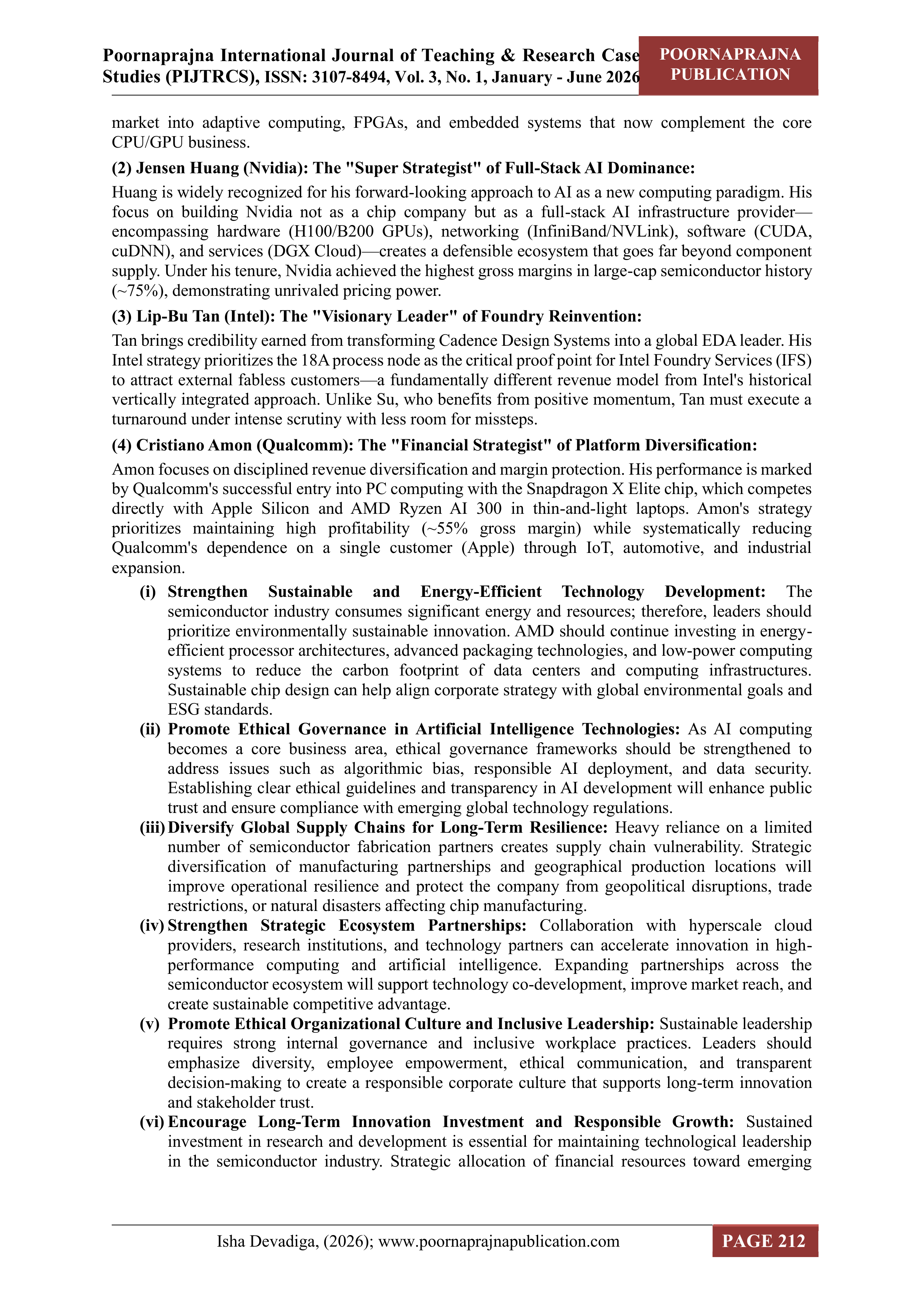


Poornaprajna International Journal of Teaching & Research Case
Studies (PIJTRCS),
ISSN: 3107-8494, Vol. 3, No. 1, January - June 2026
POORNAPRAJNA
PUBLICATION
Isha Devadiga, (2026); www.poornaprajnapublication.com
PAGE 212
market into adaptive computing, FPGAs, and embedded systems that now complement the core
CPU/GPU business.
(2) Jensen Huang (Nvidia): The "Super Strategist" of Full-Stack AI Dominance:
Huang is widely recognized for his forward-looking approach to AI as a new computing paradigm. His
focus on building Nvidia not as a chip company but as a full-stack AI infrastructure provider—
encompassing hardware (H100/B200 GPUs), networking (InfiniBand/NVLink), software (CUDA,
cuDNN), and services (DGX Cloud)—creates a defensible ecosystem that goes far beyond component
supply. Under his tenure, Nvidia achieved the highest gross margins in large-cap semiconductor history
(~75%), demonstrating unrivaled pricing power.
(3) Lip-Bu Tan (Intel): The "Visionary Leader" of Foundry Reinvention:
Tan brings credibility earned from transforming Cadence Design Systems into a global EDA leader. His
Intel strategy prioritizes the 18A process node as the critical proof point for Intel Foundry Services (IFS)
to attract external fabless customers—a fundamentally different revenue model from Intel's historical
vertically integrated approach. Unlike Su, who benefits from positive momentum, Tan must execute a
turnaround under intense scrutiny with less room for missteps.
(4) Cristiano Amon (Qualcomm): The "Financial Strategist" of Platform Diversification:
Amon focuses on disciplined revenue diversification and margin protection. His performance is marked
by Qualcomm's successful entry into PC computing with the Snapdragon X Elite chip, which competes
directly with Apple Silicon and AMD Ryzen AI 300 in thin-and-light laptops. Amon's strategy
prioritizes maintaining high profitability (~55% gross margin) while systematically reducing
Qualcomm's dependence on a single customer (Apple) through IoT, automotive, and industrial
expansion.
(i)
Strengthen
Sustainable
and
Energy-Efficient
Technology
Development:
The
semiconductor industry consumes significant energy and resources; therefore, leaders should
prioritize environmentally sustainable innovation. AMD should continue investing in energy-
efficient processor architectures, advanced packaging technologies, and low-power computing
systems to reduce the carbon footprint of data centers and computing infrastructures.
Sustainable chip design can help align corporate strategy with global environmental goals and
ESG standards.
(ii)
Promote Ethical Governance in Artificial Intelligence Technologies:
As AI computing
becomes a core business area, ethical governance frameworks should be strengthened to
address issues such as algorithmic bias, responsible AI deployment, and data security.
Establishing clear ethical guidelines and transparency in AI development will enhance public
trust and ensure compliance with emerging global technology regulations.
(iii)
Diversify Global Supply Chains for Long-Term Resilience:
Heavy reliance on a limited
number of semiconductor fabrication partners creates supply chain vulnerability. Strategic
diversification of manufacturing partnerships and geographical production locations will
improve operational resilience and protect the company from geopolitical disruptions, trade
restrictions, or natural disasters affecting chip manufacturing.
(iv)
Strengthen Strategic Ecosystem Partnerships:
Collaboration with hyperscale cloud
providers, research institutions, and technology partners can accelerate innovation in high-
performance computing and artificial intelligence. Expanding partnerships across the
semiconductor ecosystem will support technology co-development, improve market reach, and
create sustainable competitive advantage.
(v)
Promote Ethical Organizational Culture and Inclusive Leadership:
Sustainable leadership
requires strong internal governance and inclusive workplace practices. Leaders should
emphasize diversity, employee empowerment, ethical communication, and transparent
decision-making to create a responsible corporate culture that supports long-term innovation
and stakeholder trust.
(vi)
Encourage Long-Term Innovation Investment and Responsible Growth:
Sustained
investment in research and development is essential for maintaining technological leadership
in the semiconductor industry. Strategic allocation of financial resources toward emerging
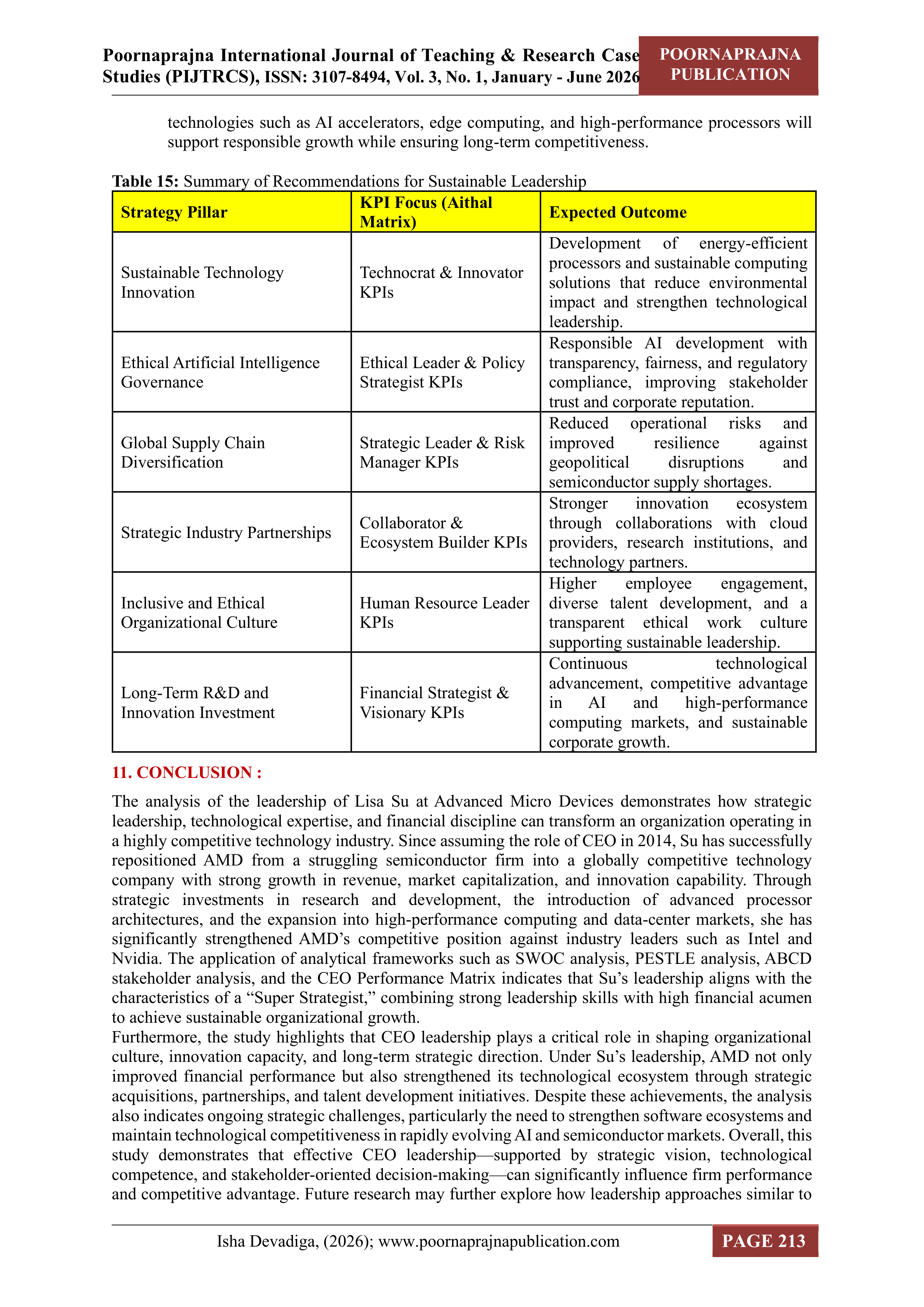


Poornaprajna International Journal of Teaching & Research Case
Studies (PIJTRCS),
ISSN: 3107-8494, Vol. 3, No. 1, January - June 2026
POORNAPRAJNA
PUBLICATION
Isha Devadiga, (2026); www.poornaprajnapublication.com
PAGE 213
technologies such as AI accelerators, edge computing, and high-performance processors will
support responsible growth while ensuring long-term competitiveness.
Table 15:
Summary of Recommendations for Sustainable Leadership
Strategy Pillar
KPI Focus (Aithal
Matrix)
Expected Outcome
Sustainable Technology
Innovation
Technocrat & Innovator
KPIs
Development
of
energy-efficient
processors and sustainable computing
solutions that reduce environmental
impact and strengthen technological
leadership.
Ethical Artificial Intelligence
Governance
Ethical Leader & Policy
Strategist KPIs
Responsible AI development with
transparency, fairness, and regulatory
compliance, improving stakeholder
trust and corporate reputation.
Global Supply Chain
Diversification
Strategic Leader & Risk
Manager KPIs
Reduced
operational
risks
and
improved
resilience
against
geopolitical
disruptions
and
semiconductor supply shortages.
Strategic Industry Partnerships
Collaborator &
Ecosystem Builder KPIs
Stronger
innovation
ecosystem
through collaborations with cloud
providers, research institutions, and
technology partners.
Inclusive and Ethical
Organizational Culture
Human Resource Leader
KPIs
Higher
employee
engagement,
diverse talent development, and a
transparent
ethical
work
culture
supporting sustainable leadership.
Long-Term R&D and
Innovation Investment
Financial Strategist &
Visionary KPIs
Continuous
technological
advancement, competitive advantage
in
AI
and
high-performance
computing markets, and sustainable
corporate growth.
11. CONCLUSION :
The analysis of the leadership of Lisa Su at Advanced Micro Devices demonstrates how strategic
leadership, technological expertise, and financial discipline can transform an organization operating in
a highly competitive technology industry. Since assuming the role of CEO in 2014, Su has successfully
repositioned AMD from a struggling semiconductor firm into a globally competitive technology
company with strong growth in revenue, market capitalization, and innovation capability. Through
strategic investments in research and development, the introduction of advanced processor
architectures, and the expansion into high-performance computing and data-center markets, she has
significantly strengthened AMD’s competitive position against industry leaders such as Intel and
Nvidia. The application of analytical frameworks such as SWOC analysis, PESTLE analysis, ABCD
stakeholder analysis, and the CEO Performance Matrix indicates that Su’s leadership aligns with the
characteristics of a “Super Strategist,” combining strong leadership skills with high financial acumen
to achieve sustainable organizational growth.
Furthermore, the study highlights that CEO leadership plays a critical role in shaping organizational
culture, innovation capacity, and long-term strategic direction. Under Su’s leadership, AMD not only
improved financial performance but also strengthened its technological ecosystem through strategic
acquisitions, partnerships, and talent development initiatives. Despite these achievements, the analysis
also indicates ongoing strategic challenges, particularly the need to strengthen software ecosystems and
maintain technological competitiveness in rapidly evolving AI and semiconductor markets. Overall, this
study demonstrates that effective CEO leadership—supported by strategic vision, technological
competence, and stakeholder-oriented decision-making—can significantly influence firm performance
and competitive advantage. Future research may further explore how leadership approaches similar to


Poornaprajna International Journal of Teaching & Research Case
Studies (PIJTRCS),
ISSN: 3107-8494, Vol. 3, No. 1, January - June 2026
POORNAPRAJNA
PUBLICATION
Isha Devadiga, (2026); www.poornaprajnapublication.com
PAGE 214
those demonstrated by Lisa Su can support sustainable innovation and ethical leadership practices in
the global semiconductor industry.
REFERENCES :
[1] Hambrick, D. C., & Mason, P. A. (1984). Upper echelons: The organization as a reflection of its top
managers.
Academy of Management Review
,
9
(2), 193-206.
Google Scholar
[2] Hambrick, D. C. (2007). Upper echelons theory: An update.
Academy of Management
Review
,
32
(2), 334-343.
Google Scholar
[3] Wood, J., & Vilkinas, T. (2005). Characteristics associated with success: CEOs'
perspectives.
Leadership & Organization Development Journal
,
26
(3), 186-196.
Google
Scholar
[4] Berson, Y., Oreg, S., & Dvir, T. (2008). CEO values, organizational culture, and firm
outcomes.
Journal of Organizational Behaviour: The International Journal of Industrial,
Occupational and Organizational Psychology and Behaviour
,
29
(5), 615-633.
Google Scholar
[5] Zacharias, N. A., Six, B., Schiereck, D., & Stock, R. M. (2015). CEO influences on firms' strategic
actions: A comparison of CEO-, firm-, and industry-level effects.
Journal of Business
Research
,
68
(11), 2338-2346.
Google Scholar
[6] Ullah, I., Hameed, R. M., Kayani, N. Z., & Fazal, Y. (2022). CEO ethical leadership and corporate
social responsibility: Examining the mediating role of organizational ethical culture and
intellectual capital.
Journal of Management & Organization
,
28
(1), 99-119.
Google Scholar
[7] Chulkov, D., & Kim, J. (2025). Analyzing Corporate Social Responsibility, CEO Gender, and
Compensation Structure: Evidence from US Firms.
Journal of Risk and Financial
Management
,
18
(1), 17.
Google Scholar
[8] Brahma, S., & Economou, F. (2024). CEO power and corporate strategies: a review of the
literature.
Review of Quantitative Finance and Accounting
,
62
(3), 1069-1143.
Google Scholar
[9]
Liu, L., Zhu, G., & Yu, F. (2024). How does CEO tenure affect enterprises’ green innovation?
Evidence from Chinese listed firms from 2007 to 2021. Journal of Cleaner Production, 454,
142092.
Google Scholar
[10] Jarva, H. (2025).
CEO tenure: Evidence from US public firms
. International Review of Economics
& Finance, 104633
.
Google Scholar
[11] Liu, C., & Jiang, H. (2020). Impact of CEO characteristics on firm performance: evidence from
China listed firms.
Applied economics letters
,
27
(14), 1-5.
Google Scholar
[12] Stebbins, R. A. (2001).
Exploratory research in the social sciences
(Vol. 48). Sage.
Google
Scholar
[13] Yin, R. K. (2018).
Case study research and applications
(Vol. 6). Thousand Oaks, CA: Sage.
Google Scholar
[14] Kiss, A. N., Cortes, A. F., & Herrmann, P. (2022). CEO proactiveness, innovation, and firm
performance.
The Leadership Quarterly
,
33
(3), 101545.
Google Scholar
[15] Wang, Y., Su, Q., & Sun, W. (2022). CEO relational leadership and product innovation
performance: The roles of TMT behavior and characteristics.
Frontiers in Psychology
,
13
, 874105.
Google Scholar
[16] Banerjee, S. (2025). CEO-board directional age difference and R&D of firms: Examining the
moderation effects of strategic orientation.
Acta Psychologica
,
254
, 104815.
Google Scholar
[17] Jensen, M., Potočnik, K., & Chaudhry, S. (2020). A mixed-methods study of CEO transformational
leadership and firm performance.
European Management Journal
,
38
(6), 836-845.
Google
Scholar


Poornaprajna International Journal of Teaching & Research Case
Studies (PIJTRCS),
ISSN: 3107-8494, Vol. 3, No. 1, January - June 2026
POORNAPRAJNA
PUBLICATION
Isha Devadiga, (2026); www.poornaprajnapublication.com
PAGE 215
[18] Begum, S., Xia, E., Mehmood, K., Iftikhar, Y., & Li, Y. (2020). The impact of CEOs’
transformational leadership on sustainable organizational innovation in SMEs: a three-wave
mediating role of organizational learning and psychological empowerment.
Sustainability
,
12
(20),
8620.
Google Scholar
[19] Agazu, B. G., Kero, C. A., & Debela, K. L. (2025). Transformational leadership and firm
performance: a systematic literature review.
Journal of Innovation and Entrepreneurship
,
14
(1),
29.
Google Scholar
[20] Talmadge, T. (2025).
Do You Guys Ever Think About Dying? A Systemic Functional Approach to
Mass Shooting Coverage
(Master's thesis, University of Georgia).
Google Scholar
[21] Tiwari, V. (2022). AMD’s comeback in the CPU market share with the launch of Ryzen.
Int. J. Res.
Circuits Devices Syst
,
3
, 17-23.
Google Scholar
[22]
de Sousa, Bernardo & Alves, Cláudia & Mendes, Marta & Au-Yong Oliveira, Manuel. (2021).
Competing with Intel and Nvidia: The Revival of Advanced Micro Devices (AMD). 1-7.
10.23919/CISTI52073.2021.9476337.
Google Scholar
[23] Hambrick, D. C. (2007). Upper echelons theory: An update.
Academy of management
review
,
32
(2), 334-343.
Google Scholar
[24] Mowery, D. C., & Rosenberg, N. (1999).
Paths of innovation: Technological change in 20th-
century America
. Cambridge University Press.
Google Scholar
[25Finkelstein, S., Hambrick, D. C., & Cannella, A. A. (2009).
Strategic leadership: Theory and
research on executives, top management teams, and boards
. Oxford University Press.
Google
Scholar
[26] Advanced Micro Devices, Inc. (n.d.).
Dr. Lisa T. Su — Chair and Chief Executive Officer
.
https://www.amd.com/en/corporate/leadership/lisa-su
Google Scholar
[27] American Academy of Arts and Sciences. (n.d.).
Lisa T. Su
.
Google Scholar
[28]
Barker III, V. L., & Mueller, G. C. (2002). CEO characteristics and firm R&D
spending.
Management science
,
48
(6), 782-801.
Google Scholar
[29] Crossland, C., & Hambrick, D. C. (2011). Differences in managerial discretion across countries:
how nation‐level institutions affect the degree to which CEOs matter.
Strategic management
journal
,
32
(8), 797-819.
Google Scholar
[30] Ting, H. I., Wang, M. C., Yang, J. J., & Tuan, K. W. (2021). Technical expert CEOs and corporate
innovation.
Pacific-Basin Finance Journal
,
68
, 101603.
Google Scholar
[31] Hambrick, D. C., & Mason, P. A. (1984). Upper echelons: The organization as a reflection of its
top managers.
Academy of management review
,
9
(2), 193-206.
Google Scholar
[32] Hambrick, D. C. (2007). Upper echelons theory: An update.
Academy of management
review
,
32
(2), 334-343.
Google Scholar
[33] García Blandón, J., Argilés Bosch, J. M., & Ravenda, D. (2019). Exploring the relationship between
CEO characteristics and performance.
Journal of Business Economics and Management
(JBEM)
,
20
(6), 1064-1082.
Google Scholar
[34] Chen, J. X., Sharma, P., Zhan, W., & Liu, L. (2019). Demystifying the impact of CEO
transformational leadership on firm performance: Interactive roles of exploratory innovation and
environmental uncertainty.
Journal of Business Research
,
96
, 85-96.
Google Scholar
[35] Zhang, X. A., Li, N., Ullrich, J., & Van Dick, R. (2015). Getting everyone on boards on top
management team effectiveness and leader-rated firm performance:: The effect of differentiated
transformational
leadership
by
CEO.
Journal
of
Management
,
41
(7),
1898-1933.
Google Scholar


Poornaprajna International Journal of Teaching & Research Case
Studies (PIJTRCS),
ISSN: 3107-8494, Vol. 3, No. 1, January - June 2026
POORNAPRAJNA
PUBLICATION
Isha Devadiga, (2026); www.poornaprajnapublication.com
PAGE 216
[36] Wang, Y., Su, Q., & Sun, W. (2022). CEO relational leadership and product innovation
performance: The roles of TMT behavior and characteristics.
Frontiers in Psychology
,
13
, 874105.
Google Scholar
[37] Sariol, A. M., & Abebe, M. A. (2017). The influence of CEO power on explorative and exploitative
organizational
innovation.
Journal
of
Business
Research
,
73
,
38-45.
Google Scholar
[38] Kiss, A. N., Cortes, A. F., & Herrmann, P. (2022). CEO proactiveness, innovation, and firm
performance.
The
Leadership
Quarterly
,
33
(3),
101545.
Google Scholar
[39] Popli, M., Ahsan, F. M., & Mukherjee, D. (2022). Upper echelons and firm internationalization: A
critical review and future directions.
Journal of Business Research
,
152
, 505-521.
Google
Scholar
[40] Yin, R. K. (2018).
Case study research and applications
(Vol. 6). Thousand Oaks, CA: Sage.
Google Scholar
[41] Sousa, B., Alves, C., Mendes, M., & Au-Yong-Oliveira, M. (2021, June). Competing with Intel and
Nvidia: The Revival of Advanced Micro Devices (AMD). In
2021 16th Iberian Conference on
Information Systems and Technologies (CISTI)
(pp. 1-7). IEEE.
Google Scholar
[42] Kumar, B. R. (2024). Case 10 Advanced Micro Devices. In
Rising Stars: Integrative Case Studies
on the 100 Fastest-Growing Companies
(pp. 75-82). Cham: Springer International Publishing.
Google Scholar
[43] Pearce II, J. A., & Robbins, D. K. (2008). Strategic transformation as the essential last step in the
process of business turnaround.
Business Horizons
,
51
(2), 121-130.
Google Scholar
[44] Wang, J. (2025). Research on the Competitive Development and Prospects of Nvidia.
Advances in
Economics, Management and Political Sciences
,
161
, 51-56.
Google Scholar
[45] Zakrzewska-Bielawska, A. (2016). Perceived mutual impact of strategy and organizational
structure: Findings from the high-technology enterprises.
Journal of Management &
Organization
,
22
(5), 599-622.
Google Scholar
[46] Porter, M. E. (2008). The five competitive forces that shape strategy.
Harvard business
review
,
86
(1), 78.
Google Scholar
[47] Teece, D. J. (2018). Business models and dynamic capabilities.
Long range planning
,
51
(1), 40-
49.
Google Scholar
[48] Zott, C., Amit, R., & Massa, L. (2011). The business model: recent developments and future
research.
Journal of management
,
37
(4), 1019-1042.
Google Scholar
[49] O'Reilly III, C. A., & Tushman, M. L. (2013). Organizational ambidexterity: Past, present, and
future.
Academy of management Perspectives
,
27
(4), 324-338.
Google Scholar
[50] Barker III, V. L., & Mueller, G. C. (2002). CEO characteristics and firm R&D
spending.
Management science
,
48
(6), 782-801.
Google Scholar
[51] Hambrick, D. C., & Mason, P. A. (1984). Upper echelons: The organization as a reflection of its
top managers.
Academy of management review
,
9
(2), 193-206.
Google Scholar
[52] Eisenhardt, K. M., & Martin, J. A. (2017). Dynamic capabilities: what are they?.
The SMS
Blackwell handbook of organizational capabilities
, 341-363.
Google Scholar
[53] Barney, J. (1991). Firm resources and sustained competitive advantage.
Journal of
management
,
17
(1), 99-120.
Google Scholar
[54] Helfat, C. E., & Peteraf, M. A. (2003). The dynamic resource‐based view: Capability
lifecycles.
Strategic management journal
,
24
(10), 997-1010.
Google Scholar


Poornaprajna International Journal of Teaching & Research Case
Studies (PIJTRCS),
ISSN: 3107-8494, Vol. 3, No. 1, January - June 2026
POORNAPRAJNA
PUBLICATION
Isha Devadiga, (2026); www.poornaprajnapublication.com
PAGE 217
[55] Hambrick, D. C., & Mason, P. A. (1984). Upper echelons: The organization as a reflection of its
top managers.
Academy of management review
,
9
(2), 193-206.
Google Scholar
v
[56] McHugh, P., & Duane, J. N. (2025). Upper echelons theory: Research at the nexus of CEO
psychological profiles, gender, and firm diversity.
Journal of Management & Organization
, 1-22.
Google Scholar
[57] White, J. V., & Borgholthaus, C. J. (2022). Who’s in charge here? A bibliometric analysis of upper
echelons research.
Journal of Business Research
,
139
, 1012-1025.
Google Scholar
[58] Argilés, J. M. (2019). Exploring the relationship between CEO characteristics and
performance.
Journal of Business Economics and Management
.
Google Scholar
[59] Chen, J. X., Sharma, P., Zhan, W., & Liu, L. (2019). Demystifying the impact of CEO
transformational leadership on firm performance: Interactive roles of exploratory innovation and
environmental uncertainty.
Journal of Business Research
,
96
, 85-96.
Google Scholar
[60] Wang, Y., Su, Q., & Sun, W. (2022). CEO relational leadership and product innovation
performance: The roles of TMT behavior and characteristics.
Frontiers in Psychology
,
13
, 874105.
Google Scholar
[61] Brahma, S., & Economou, F. (2024). CEO power and corporate strategies: a review of the
literature.
Review of Quantitative Finance and Accounting
,
62
(3), 1069-1143.
Google Scholar
[62] Li, Y., Fan, S., & Zhang, Y. (2025). Impact of Health Information on Health-Related Behavior
Change of Patients Living with Chronic Diseases.
Libri
,
75
(3), 311-326.
Google Scholar
[63] Huang, X., Liu, J., Min, L., Zeng, Q., Zhang, J., & Zhang, X. (2023). CEO’s functional experience
and firm performance based on text mining.
Plos one
,
18
(3), e0281866.
Google Scholar
[64] Parodi-Camano, T., Vidal-Durango, J. V., & Portnoy, I. (2025). CEO, innovation, and business
performance–A bibliometric analysis and literature review.
International Journal of Innovative
and Scientific Studies
,
8
(2), 1274-1291.
Google Scholar
[65] Sousa, B., Alves, C., Mendes, M., & Au-Yong-Oliveira, M. (2021, June). Competing with Intel and
Nvidia: The Revival of Advanced Micro Devices (AMD). In
2021 16th Iberian Conference on
Information Systems and Technologies (CISTI)
(pp. 1-7). IEEE.
Google Scholar
[66] Kumari, S., & Nair, J. (2023). Lisa Su’s strategic leadership: Will she change her approach post
Xilinx and Pensando acquisitions?.
The Case For Women
, 1-27.
Google Scholar
[67] WANG, Z., Yu, J., & Wu, H. (2022). Intel Corporation (INTC) vs. Advance Micro Devices (AMD):
A Comparative Case Analysis of the 2021 CEO's Executive Compensation.
Google Scholar
[68] Sharma, B. (2025). Investment Analysis Report: Intel Corporation vs. Advanced Micro
Devices.
Journal of Computer Science and Technology Studies
,
7
(9), 780-795.
Google Scholar
[69] Perrigo, B. (2024, December 10). Lisa Su. Time.
Google Scholar
[70] Baxter, P., & Jack, S. (2008). Qualitative case study methodology: Study design and
implementation for novice researchers.
The qualitative report
,
13
(4), 544-559.
Google Scholar
[71] Hyett, N., Kenny, A., & Dickson-Swift, V. (2014). Methodology or method? A critical review of
qualitative case study reports.
International journal of qualitative studies on health and well-
being
,
9
(1), 23606.
Google Scholar
[72] Vardopoulos, I., Tsilika, E., Sarantakou, E., Zorpas, A. A., Salvati, L., & Tsartas, P. (2021). An
integrated SWOT-PESTLE-AHP model assessing sustainability in adaptive reuse projects.
Applied
Sciences
,
11
(15), 7134.
Google Scholar
[73] Ghazinoory, S., Abdi, M., & Azadegan-Mehr, M. (2011). SWOT methodology: a state-of-the-art
review for the past, a framework for the future.
Journal of business economics and
management
,
12
(1), 24-48.
Google Scholar


Poornaprajna International Journal of Teaching & Research Case
Studies (PIJTRCS),
ISSN: 3107-8494, Vol. 3, No. 1, January - June 2026
POORNAPRAJNA
PUBLICATION
Isha Devadiga, (2026); www.poornaprajnapublication.com
PAGE 218
[74] Pathiranage, Y. L., Jayatilake, L. V., & Abeysekera, R. (2020). Case study research design for
exploration of organizational culture towards corporate performance.
Review of International
Comparative Management
,
21
(3), 361-372.
Google Scholar
[75] Ghazinoory, S., Abdi, M., & Azadegan-Mehr, M. (2011). SWOT methodology: a state-of-the-art
review for the past, a framework for the future.
Journal of business economics and
management
,
12
(1), 24-48.
Google Scholar
[76] Phadermrod, B., Crowder, R. M., & Wills, G. B. (2019). Importance-performance analysis based
SWOT analysis.
International journal of information management
,
44
, 194-203.
Google
Scholar
[77] Benzaghta, M. A., Elwalda, A., Mousa, M. M., Erkan, I., & Rahman, M. (2021). SWOT analysis
applications: An integrative literature review.
Journal of Global Business Insights
,
6
(1), 54-72.
Google Scholar
[78] Bakir, A., & Moh'd, S. (2023). Impact of Strategic Analysis (SWOT) on the Performance of
Jordanian Public Shareholding Industrial Companies: The Mediating Role of Scenario
Planning.
International Journal of Sustainable Development & Planning
,
18
(5).
Google
Scholar
[79] Irawan, Cahyo. (2024). SWOT Analysis as a Company Strategy for Business Competition. Siber
Journal of Transportation and Logistics. 1. 164-171. 10.38035/sjtl.v1i4.158.
Google Scholar
[80] Aithal, P. S. (2023). Anticipated attributes of chief executive officers based on the newly developed
CEO matrix.
International Journal of Applied Engineering and Management Letters
(IJAEML)
,
7
(4), 216-248.
Google Scholar
[81] Aithal, P. S. (2016). Study on ABCD analysis technique for business models, business strategies,
operating concepts & business systems.
International Journal in Management and Social
Science
,
4
(1), 95-115.
Google Scholar
[82] Shenoy, V., & Aithal, P. S. (2016). ABCD Analysis of On-line Campus Placement Model.
IRA-
International Journal of Management & Social Sciences,(ISSN 2455-2267)
,
5
(2), 227-244.
Google
Scholar
[83] Frederick, D. P., & Bhat, G. (2022). Quantitative ABCD analysis of online food delivery
services.
International Journal of Case Studies in Business, IT, and Education (IJCSBE)
,
6
(1), 76-
92.
Google Scholar
[84] Mendon, S., & Aithal, P. S. (2022). Quantitative ABCD analysis of organic food product and its
impact on purchase intention.
International Journal of Management, Technology, and Social
Sciences (IJMTS)
,
7
(1), 254-278.
Google Scholar
[85] Prabhu, N., & Aithal, P. S. (2023). Quantitative ABCD Analysis of Green Banking Practices and
its Impact on Using Green Banking Products.
International Journal of Applied Engineering and
Management Letters (IJAEML)
,
7
(1), 28-66.
Google Scholar
[86] Agarwal, A., & Mondal, S. (2025). ABCD Analysis for Startups in Quick Commerce (Q-
Commerce).
Journal of Commerce and Trade
,
20
(1), 60-65.
Google Scholar
[87] Yüksel, I. (2012). Developing a multi-criteria decision-making model for PESTEL
analysis.
International Journal of Business and Management
,
7
(24), 52.
Google Scholar
[88] Perera, R. (2017).
The PESTLE analysis
(Vol. 1). Avissawella, Sri Lanka: Nerdynaut.
Google
Scholar
[89] Vivek, R. (2024). A Systematic Review: Covid-19 and Expansion of PESTLE Framework: Time
to Perceive Health Environment as a Separate Dimension.
International Journal of Environmental,
Sustainability, and Social Science
,
5
(2), 504-516.
Google Scholar
[
90] Terolli, B., Lotarev, I., OʼHara, K. K., Tragaj, K., & Thuy, V. S. D. D. T. AMD (Advanced Micro
Devices, Inc.) Equity Report.
Google Scholar


Poornaprajna International Journal of Teaching & Research Case
Studies (PIJTRCS),
ISSN: 3107-8494, Vol. 3, No. 1, January - June 2026
POORNAPRAJNA
PUBLICATION
Isha Devadiga, (2026); www.poornaprajnapublication.com
PAGE 219
[91] Aithal, P. S. (2025). Publishing Company and CEO Analysis Papers as Part of a 'Dark-Blue Ocean
Strategy'in Professional Education to Grab Employment.
Poornaprajna International Journal of
Management, Education & Social Science (PIJMESS)
,
2
(1), 129-153.
Google Scholar
[92] Aithal, P. S., Bhandarkar, S. M., & Shetty, V. (2024). A Systematic CEO Analysis for Elon Musk
of Tesla Inc. EV Company.
Poornaprajna International Journal of Teaching & Research Case
Studies (PIJTRCS)
,
1
(1), 126-162.
Google Scholar
[93] Aithal, P. S. (2025). CEO Analysis of K. Krithivasan of Tata Consultancy Services.
Poornaprajna
International Journal of Teaching & Research Case Studies (PIJTRCS)
,
2
(1), 73-107.
Google
Scholar
[94] Aithal, P. S. (2026). CEO Analysis of Siddhartha Mohanty as an Insider-Reformer of Life Insurance
Corporation of India.
Poornaprajna International Journal of Teaching & Research Case Studies
(PIJTRCS)
,
3
(1), 103-137.
Google Scholar
[95] Aithal, P. S., & Naveen Kumar K. R, (2025). CEO Analysis of Demis Hassabis of DeepMind
Technologies Limited.
Poornaprajna International Journal of Teaching & Research Case Studies
(PIJTRCS)
,
2
(2), 225-258.
Google Scholar
[96] Diya Devadiga & Aithal P. S. (25/04/2026). Visionary Leadership and Strategic Innovation: A CEO
Analysis of Melanie Perkins at Canva Pty Ltd.
Poornaprajna International Journal of Teaching &
Research Case Studies (PIJTRCS), 3
(1), 138-165.
Google Scholar
[97] Diya Devadiga & Aithal P. S. (2026). Transformational Leadership and Digital Transformation: A
CEO Matrix and KPI-Based Case Study of Satya Nadella at Microsoft.
Poornaprajna
International Journal of Teaching & Research Case Studies (PIJTRCS), 3
(1), 166-189.
Google
Scholar
**********