


Poornaprajna International Journal of Teaching & Research Case
Studies (PIJTRCS),
ISSN: 3107-8494, Vol. 3, No. 1, January - June 2026
POORNAPRAJNA
PUBLICATION
Diya Devadiga, (2026); www.poornaprajnapublication.com
PAGE 166
Transformational Leadership and Digital
Transformation: A CEO Matrix and KPI-Based
Case Study of Satya Nadella at Microsoft
Diya Devadiga
1
& P. S. Aithal
2
1
MBA Scholar, Poornaprajna Institute of Management, Udupi - 576101, India,
ORCID iD: 0009-0003-0533-4499; Email:
diya.mbab24@pim.ac.in
2
Professor, Poornaprajna Institute of Management, Udupi - 576101, India,
ORCID iD: 0000-0002-4691-8736; E-mail:
psaithal@pim.ac.in
Area/Section:
CEO Analysis.
Type of the Paper:
Qualitative
Exploratory Research.
Number of Peer Reviews:
Two.
Type of Review:
Peer Reviewed as per
|C|O|P|E|
guidance.
Indexed in:
OpenAIRE.
DOI:
https://doi.org/10.5281/zenodo.20040273
Google Scholar Citation:
PIJTRCS
Poornaprajna International Journal of Teaching & Research Case Studies (PIJTRCS)
A Refereed International Journal of Poornaprajna Publication, India.
ISSN: 3107-8494
Crossref DOI:
https://doi.org/10.64818/PIJTRCS.3107.8494.0042
Received on: 08/04/2026
Published on: 06/05/2026
© With Authors.
This work is licensed under a
Creative Commons Attribution-Non-Commercial 4.0
International License,
subject to proper citation to the publication source of the work.
Disclaimer:
The scholarly papers as reviewed and published by Poornaprajna Publication
(P.P.), India, are the views and opinions of their respective authors and are not the views or
opinions of the PP. The PP disclaims of any harm or loss caused due to the published content
to any party.
How to Cite this Paper:
Diya Devadiga & Aithal P. S. (2026).
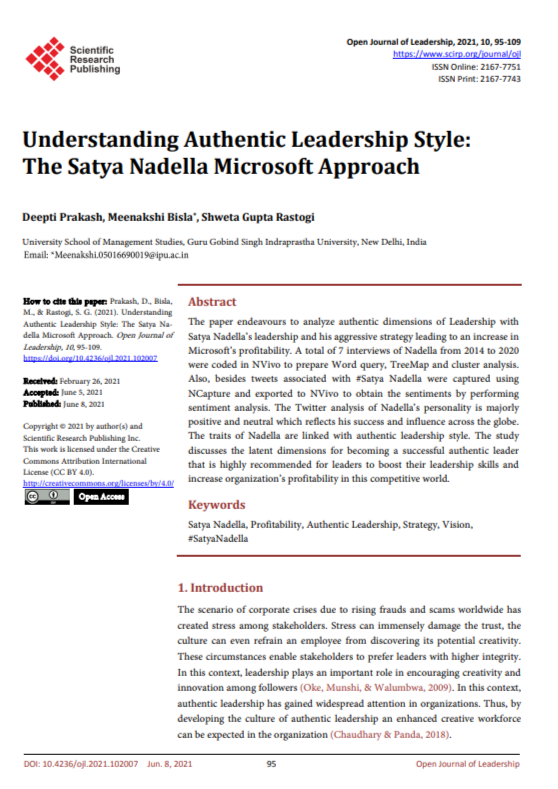
Transformational Leadership and Digital
Transformation: A CEO Matrix and KPI-Based Case Study of Satya Nadella at Microsoft.
Poornaprajna International Journal of Teaching & Research Case Studies (PIJTRCS),
3
(1), 166-189. DOI:
https://doi.org/10.5281/zenodo.20040273


Poornaprajna International Journal of Teaching & Research Case
Studies (PIJTRCS),
ISSN: 3107-8494, Vol. 3, No. 1, January - June 2026
POORNAPRAJNA
PUBLICATION
Diya Devadiga, (2026); www.poornaprajnapublication.com
PAGE 167
Transformational Leadership and Digital Transformation:
A CEO Matrix and KPI-Based Case Study of Satya
Nadella at Microsoft
Diya Devadiga
1
& P. S. Aithal
2
1
MBA Scholar, Poornaprajna Institute of Management, Udupi - 576101, India,
ORCID iD: 0009-0003-0533-4499; Email:
diya.mbab24@pim.ac.in
2
Professor, Poornaprajna Institute of Management, Udupi - 576101, India,
ORCID iD: 0000-0002-4691-8736; E-mail:
psaithal@pim.ac.in
ABSTRACT
Purpose:
The purpose of this study is to analyze the leadership performance and strategic
influence of Satya Nadella, CEO of Microsoft Corporation, and to understand how his
leadership style, vision, and strategic decisions contribute to the company’s transformation and
competitive advantage in the global technology industry. The study also aims to examine how
transformational and innovation-driven leadership supports sustainable growth in rapidly
evolving digital and AI-driven markets.
Methodology:
This research adopts a qualitative CEO analysis case study approach based on
secondary data collected from academic literature, industry reports, company publications,
and credible business sources. To evaluate the effectiveness of Nadella’s leadership, multiple
analytical frameworks are applied, including SWOC (Strengths, Weaknesses, Opportunities,
and Challenges), Key Performance Indicators (KPIs), ABCD analysis (Advantages, Benefits,
Constraints, and Disadvantages), the Ten CEO Performance Areas (CEOPA), and the CEO
Performance Matrix. These frameworks provide a systematic approach to assess leadership
behaviour, strategic decision-making, innovation capability, and organizational performance
outcomes.
Results & Analysis:
The findings indicate that Satya Nadella demonstrates strong
transformational and visionary leadership supported by strategic foresight and technological
innovation. His emphasis on a “growth mindset,” cultural transformation, and empathy has
revitalized Microsoft’s organizational culture and enhanced employee engagement. Under his
leadership, Microsoft has successfully transitioned to a cloud-first and AI-driven business
model, achieving significant global expansion, strong financial performance, and continuous
innovation. The analysis further reveals that Nadella promotes collaboration, inclusivity, and
continuous learning, which strengthens Microsoft’s competitive position in the global cloud
computing and enterprise technology market.
Originality & Value:
This study contributes to leadership and management research by
offering a structured evaluation of a leading global technology CEO using integrated
analytical frameworks. It highlights how adaptive leadership, cultural transformation, and
strategic innovation can significantly influence organizational success in the digital economy.
The findings provide valuable insights for managers, researchers, and policymakers seeking to
understand effective leadership practices in large-scale, technology-driven organizations.
Type of Paper:
Qualitative Exploratory Case Study.
Keywords:
CEO Analysis, Satya Nadella Leadership, Microsoft CEO Case Study,
Transformational Leadership Microsoft, Technology Leadership Strategies, SWOC Analysis
Satya Nadella, CEO Performance Matrix, Cloud and AI Strategy Microsoft, Leadership
Theories Evaluation, CEOPA Model CEO Assessment
1. INTRODUCTION :
1.1 About CEO Analysis:


Poornaprajna International Journal of Teaching & Research Case
Studies (PIJTRCS),
ISSN: 3107-8494, Vol. 3, No. 1, January - June 2026
POORNAPRAJNA
PUBLICATION
Diya Devadiga, (2026); www.poornaprajnapublication.com
PAGE 168
The Chief Executive Officer (CEO) occupies a pivotal position in modern organizations, serving as the
primary architect of strategic intent and organizational direction. Scholarly interest in CEOs has grown
substantially as firms operate in increasingly volatile and competitive environments, where leadership
decisions can have long-term consequences. Upper Echelons Theory explains this phenomenon by
arguing that organizational outcomes are partially shaped by the experiences, values, and cognitive
frames of top executives (Hambrick & Mason (1984). [1]). This theoretical lens legitimizes the
academic investigation of CEOs as individual units of analysis and establishes a strong foundation for
treating CEO analysis as a rigorous research case study rather than a purely descriptive managerial
profile.
Beyond theory, empirical research has demonstrated that CEOs contribute to firm outcomes through
strategic choices related to innovation, diversification, and resource allocation. Studies in strategic
leadership show that executive characteristics influence how firms sense opportunities and build
dynamic capabilities in response to environmental change (Carpenter, Geletkanycz, & Sanders (2016).
[2]). These strategic contributions extend beyond short-term profitability and shape organizational
adaptability, competitiveness, and resilience. As such, CEO analysis provides a meaningful pathway for
understanding how leadership decisions translate into sustained organizational performance.
The magnitude of CEO influence has been empirically examined through variance decomposition and
longitudinal research designs, revealing that CEOs account for a measurable portion of firm
performance differences over time. Research on the “CEO effect” indicates that leadership impact is
neither trivial nor uniform, but context-dependent and sensitive to organizational and industry
conditions (Hambrick & Quigley (2014). [3]). Subsequent evidence suggests that the influence of CEOs
has intensified in recent decades due to increased executive discretion and stakeholder visibility
(Quigley & Hambrick (2015). [4]). These findings reinforce the relevance of CEO-centric inquiry while
highlighting the need for nuanced, methodologically sound approaches.
In addition to financial outcomes, contemporary research emphasizes the broader organizational and
social impact of CEOs. Leadership behaviours have been linked to corporate reputation, sustainability
initiatives, and stakeholder trust, particularly in emerging economies and highly regulated sectors
(Aguilera et al. (2022). [5]). Furthermore, responsible leadership practices adopted by CEOs have been
shown to enhance corporate social responsibility and organizational legitimacy (Wang, Ye, & Liu
(2023). [6]). These multidimensional effects suggest that CEO contributions should be evaluated using
both economic and non-economic performance indicators.
Given the complexity and contextual nature of CEO influence, this study adopts an exploratory case
study research design, which is appropriate for investigating leadership phenomena where theory
development and contextual understanding are essential (Yin (2018). [7]). The paper is structured as
follows: first, a focused review of strategic leadership literature establishes the conceptual framework;
second, the research methodology outlines the case selection and analytical approach; third, the CEO’s
strategic contributions and organizational impact are examined; and finally, findings are synthesized to
derive theoretical and managerial implications. By doing so, this study contributes to strategic
management literature by offering a structured, evidence-based understanding of CEO leadership as a
driver of organizational outcomes.
1.2 About This Paper:
Satya Nadella, Chief Executive Officer of Microsoft Corporation, has emerged as a prominent subject
of scholarly inquiry due to his transformational leadership and role in redefining Microsoft’s strategic
and cultural identity. Academic research emphasizes Nadella’s human-centered leadership philosophy,
particularly his emphasis on empathy, collaboration, and the cultivation of a “growth mindset,” as key
drivers of Microsoft’s organizational renewal. Scholars argue that these leadership practices enabled
Microsoft to overcome internal rigidity, revive innovation capabilities, and reposition itself as a cloud-
first and AI-driven enterprise (Schein (2010). [8]; Helfat & Peteraf (2015). [9]).
Further scholarly analyses of Nadella’s leadership employ structured evaluative frameworks such as
SWOC (Strengths, Weaknesses, Opportunities, and Challenges), Key Performance Indicators (KPIs),
and ABCD (Advantages, Benefits, Constraints, and Disadvantages) analysis to assess his strategic
effectiveness. These studies highlight how Nadella’s emphasis on cloud computing, artificial
intelligence integration, and continuous organizational learning significantly enhanced Microsoft’s
operational performance and global competitiveness. His leadership is frequently interpreted through


Poornaprajna International Journal of Teaching & Research Case
Studies (PIJTRCS),
ISSN: 3107-8494, Vol. 3, No. 1, January - June 2026
POORNAPRAJNA
PUBLICATION
Diya Devadiga, (2026); www.poornaprajnapublication.com
PAGE 169
established theoretical lenses, including transformational, adaptive, and servant leadership theories,
underscoring his ability to foster inclusivity, innovation, and long-term stakeholder value (Northouse
(2022). [10]).
Additionally, research applying structured leadership evaluation tools such as the Ten CEO Performance
Areas (CEOPA) and the CEO Performance Matrix consistently identifies Nadella’s strengths in strategic
foresight, capability development, and stakeholder alignment. Scholars conclude that his leadership has
not only strengthened Microsoft’s market position but also positioned the firm for future technological
disruption. These studies recommend sustained investment in artificial intelligence ecosystems,
platform-based business models, and collaborative partnerships to maintain strategic relevance in an
increasingly dynamic digital environment (Cusumano et al. (2019). [11]; Vial (2019). [12]).
2. OBJECTIVES OF THE PAPER :
The objectives of this exploratory research include:
(1)
To study the professional background, leadership journey, and strategic role of Satya Nadella as the
Chief Executive Officer of Microsoft Corporation.
(2)
To review and synthesize existing scholarly literature related to Satya Nadella’s leadership style,
strategic decision-making, and organizational impact at Microsoft Corporation.
(3)
To examine the current status of academic research on Satya Nadella of Microsoft Corporation by
identifying major themes, methodological approaches, and research gaps.
(4)
To analyze Satya Nadella’s leadership style and decision-making patterns using established
leadership theories such as transformational, adaptive, and servant leadership.
(5)
To evaluate the impact of Satya Nadella’s strategic initiatives—particularly cloud computing,
artificial intelligence, and platform-based business models—on Microsoft’s organizational
performance and competitive positioning.
(6)
To assess Microsoft’s organizational transformation under Satya Nadella using structured analytical
frameworks such as SWOC, KPIs, ABCD analysis, CEOPA, and the CEO Performance Matrix.
(7)
To derive theoretical and managerial implications from the CEO case study of Satya Nadella that
contribute to leadership, corporate strategy, and organizational behaviour literature.
3. ABOUT SATYA NADELLA, CEO OF MICROSOFT CORPORATION :
3.1 Background of Satya Nadella, CEO of Microsoft Corporation:
Microsoft Corporation is one of the world’s most influential technology enterprises, operating across
software, cloud services, artificial intelligence, and digital infrastructure. Over several decades,
Microsoft built a competitive advantage through platform dominance and ecosystem development, yet
by the early 2010s faced strategic stagnation due to rigid internal structures and increasing competition.
Strategic management scholarship suggests that legacy technology firms often struggle to adapt when
organizational routines and leadership mindsets inhibit innovation (Porter (1985) [13]; Teece (2018).
[14]). This context made leadership change a critical factor in Microsoft’s long-term survival and
competitiveness.
Satya Nadella assumed the role of Chief Executive Officer in 2014 following a long internal career that
included leadership positions in Microsoft’s cloud and enterprise divisions. Academic leadership
research emphasizes that internally promoted CEOs often possess superior firm-specific knowledge,
enabling more effective strategic realignment than external successors (Zhang & Rajagopalan (2010).
[15]). Nadella’s technical background and operational familiarity positioned him to recognize emerging
digital opportunities while understanding the cultural barriers that constrained Microsoft’s innovation
capabilities.
Scholarly literature characterizes Nadella’s leadership philosophy as transformational and purpose-
driven, emphasizing empathy, learning orientation, and inclusive collaboration. Transformational
leadership theory posits that leaders who articulate vision, inspire followers, and support individual
development can generate profound organizational change (Bass & Riggio (2006). [16]). Researchers
argue that Nadella’s emphasis on learning and humility reduced internal competition and facilitated
cross-functional cooperation, thereby improving innovation outcomes within Microsoft’s complex
organizational structure.
From a strategic perspective, Nadella’s leadership coincided with Microsoft’s decisive pivot toward
cloud computing, artificial intelligence, and platform-based ecosystems. Research on dynamic


Poornaprajna International Journal of Teaching & Research Case
Studies (PIJTRCS),
ISSN: 3107-8494, Vol. 3, No. 1, January - June 2026
POORNAPRAJNA
PUBLICATION
Diya Devadiga, (2026); www.poornaprajnapublication.com
PAGE 170
capabilities highlights that sustained competitive advantage in technology-intensive industries depends
on leadership’s ability to sense opportunities, seize technological shifts, and reconfigure organizational
resources (Teece (2014). [17]). Nadella’s strategic emphasis on Azure, AI integration, and open-source
collaboration aligns closely with this framework, enabling Microsoft to reposition itself as a central
actor in the global digital economy.
Organizational behaviour scholars further note that Nadella’s leadership reshaped Microsoft’s internal
culture by promoting psychological safety and continuous learning. Studies on learning organizations
suggest that cultures encouraging experimentation and error tolerance are essential for innovation in
knowledge-driven firms (Edmondson (2018). [18]). Nadella’s leadership practices are frequently cited
as instrumental in transforming Microsoft from a competitive, siloed organization into a collaborative
and adaptive enterprise capable of rapid technological advancement.
Finally, Nadella’s tenure is increasingly used in academic research as a benchmark case of CEO-led
organizational renewal. Leadership scholars argue that effective CEOs influence firm outcomes not only
through strategy formulation but also through symbolic actions that reshape employee cognition and
organizational identity (Gioia et al. (2013). [19]). In this regard, Satya Nadella’s leadership at Microsoft
provides a compelling case for examining how human-centered leadership philosophy can drive
strategic renewal, innovation capability, and sustained competitive advantage in a global technology
corporation.
4. REVIEW OF LITERATURE :
4.1 Review and Synthesize the Existing Scholarship:
(1)
CEO Leadership as a Research Domain:
The study of CEOs as strategic leaders has become a central theme in management research, particularly
within the upper echelons perspective, which posits that organizational outcomes are partially predicted
by executive characteristics and values. Empirical studies emphasize that CEOs influence firm strategy,
culture, and performance through cognition-driven decision-making and leadership behaviours
(Hambrick (2007). [20]). In technology-driven firms, this influence is amplified due to rapid innovation
cycles and high environmental uncertainty, making CEO leadership a critical determinant of
competitive advantage.
(2)
Leadership in Large Technology Corporations:
Research focusing on leadership in large technology corporations highlights the importance of
adaptability, strategic vision, and learning orientation. Scholars argue that technology-sector CEOs must
balance exploration and exploitation while managing platform ecosystems and innovation pipelines
(Smith & Tushman (2005). [21]). Studies examining leadership in firms such as IBM, Intel, and
Microsoft demonstrate that leadership effectiveness is closely linked to the CEO’s ability to foster
organizational ambidexterity and cultural openness (O’Reilly & Tushman (2013). [22]).
(3)
Transformational and Human-Centered Leadership:
Recent leadership literature increasingly emphasizes transformational and human-centered leadership
approaches in knowledge-intensive firms. Transformational leaders shape employee motivation by
articulating compelling visions and aligning individual goals with organizational objectives (Waldman
et al. (2001). [23]). Research further suggests that empathy, ethical orientation, and psychological safety
enhance employee engagement and innovation outcomes, particularly in digital organizations
undergoing strategic renewal (Avolio & Gardner (2005). [24]).
(4)
Strategic Renewal and Cultural Change:
Scholarly work on strategic renewal underscores the role of CEOs in reshaping organizational culture
to support innovation and adaptability. Cultural change research demonstrates that leaders act as
symbolic agents who redefine norms, values, and identity during periods of transformation (Denison et
al. (2014). [25]). In technology firms, cultural renewal is often associated with shifts toward
collaboration, experimentation, and learning, which are critical for sustaining long-term
competitiveness.
(5)
Measuring CEO Impact on Firm Performance:
Several studies attempt to quantify the impact of CEO leadership on firm performance using financial,
innovation, and stakeholder-related indicators. Research indicates that CEO strategic orientation and
leadership style significantly affect firm growth, market valuation, and innovation output (Quigley &


Poornaprajna International Journal of Teaching & Research Case
Studies (PIJTRCS),
ISSN: 3107-8494, Vol. 3, No. 1, January - June 2026
POORNAPRAJNA
PUBLICATION
Diya Devadiga, (2026); www.poornaprajnapublication.com
PAGE 171
Hambrick (2015). [26]). However, many studies rely on secondary performance data and broad
leadership constructs, limiting their ability to capture nuanced behavioral mechanisms.
(6)
Research Gaps and Need for Case-Based Inquiry:
Despite extensive leadership research, there remains a gap in context-rich, exploratory case studies that
integrate leadership theory with firm-level strategic outcomes. Scholars call for in-depth case-based
research to examine how specific leadership behaviours translate into organizational transformation
within real-world settings (Eisenhardt & Graebner (2007). [27]). A focused CEO case study of Satya
Nadella addresses this gap by linking leadership philosophy, strategic decisions, and cultural
transformation within Microsoft Corporation, thereby contributing to leadership, strategy, and
organizational behaviour literature.
4.2 Based on Important Keywords:
Table 1 lists the summary of
the
Review of Literature on the keyword “Satya Nadella”, Table 2 lists the
Review of Literature on the keyword “Microsoft Corporation”, and Table 3 lists the Review of
Literature on the keyword “Cloud and AI Strategy Microsoft” based on published scholarly articles.
Table 1:
Review of Literature on Keyword “Satya Nadella” using search in
https://scholar.google.com/
S.
No.
Area of Scholarly
Articles
Description
Reference
1
Leadership Strategies
Reviews Nadella’s leadership approaches
and impact on Microsoft’s culture and
innovation.
Adenekan et al.
(2025). [28]
2
Modern Leadership in
Post-COVID Era
Explores leadership traits relevant to
Nadella’s adaptive style in modern business.
Zada et al. (2022).
[29]
3
Culture Transformation
Examines Nadella’s shift from “know-it-all”
to “learn-it-all” culture at Microsoft.
Gino et al. (2020).
[30]
4
Strategic Leadership
Case
study
on
Nadella’s
strategic
management and employee empowerment in
tech enterprises.
Samson et al.
(2023). [31]
5
Millennial Leadership
Perspectives
Analyzes
leadership
behaviours
and
decision-making styles linked to Nadella’s
approach.
Tobing et al. (2024).
[32]
6
Change Management
Explores Microsoft’s change management
under Nadella for organizational growth.
Gotsch et al. (2019).
[33]
7
Leadership in AI Era
Discusses AI’s influence on leadership and
Nadella’s
navigation
of
digital
transformation.
Pandey et al. (2025).
[34]
8
AI & Organizational
Leadership
Investigates
AI
reshaping
leadership
strategies, applicable to Nadella.
Oloyede et al.
(2025). [35]
9
Diversity & Leadership
Provides
a
theoretical
framework
on
leadership
and
diversity
management,
supporting Nadella’s inclusive culture.
Ng et al. (2008).
[36]
10
Growth Mindset
Practice
Highlights Nadella’s implementation of
growth
mindset
initiatives
to
drive
innovation and learning.
Ibarra et al. (2018).
[37]
Table 2:
Review of Literature on Keyword “Microsoft Corporation” using search in
https://scholar.google.com/
S.
No.
Area of Scholarly
Articles
Description
Reference
1
Big Data & Strategic
Innovation
Microsoft’s use of big data to drive corporate
entrepreneurship and innovation.
Zhao et al. (2025).
[38]


Poornaprajna International Journal of Teaching & Research Case
Studies (PIJTRCS),
ISSN: 3107-8494, Vol. 3, No. 1, January - June 2026
POORNAPRAJNA
PUBLICATION
Diya Devadiga, (2026); www.poornaprajnapublication.com
PAGE 172
S.
No.
Area of Scholarly
Articles
Description
Reference
2
Business, Innovation &
Platform Ecosystems
Systematic review of business, innovation,
and
platform
ecosystems
relevant
to
Microsoft.
Liu et al. (2024).
[39]
3
Strategic Leadership &
Technology
Leadership
strategies
for
product
and
technology
innovation
in
high-tech
companies, applicable to Microsoft.
Chartier
et
al.
(1998). [40]
4
OS Innovation Strategy
Microsoft’s strategies for managing operating
system innovations.
Wonglimpiyarat
et
al. (2012). [41]
5
Communication
Networks & Hierarchy
Internal communication network dynamics
within
Microsoft’s
large
organizational
hierarchy.
Josephs et al. (2024).
[42]
6
Innovation Ecosystem &
Patents
Patent
network
analysis
of Activision
Blizzard acquisition and innovation activities.
Tomeczek
et
al.
(2025). [43]
7
Collaborative Work
Culture
Microsoft initiatives to foster collaboration
and innovation in the workplace.
Chebolu
et
al.
(2021). [44]
8
Corporate Culture &
Accessibility
Case study on corporate culture, HR
practices, and accessibility at Microsoft.
Sandler et al. (2005).
[45]
9
Data Infrastructure &
Innovation
Microsoft’s exabyte-scale data infrastructure
supporting innovation and performance.
Zhu et al. (2021).
[46]
10
Leadership Styles &
Performance
Comparison
of
leadership
styles
and
organizational performance between Apple
and Microsoft.
Sagdiddinov et al.
(2025). [47]
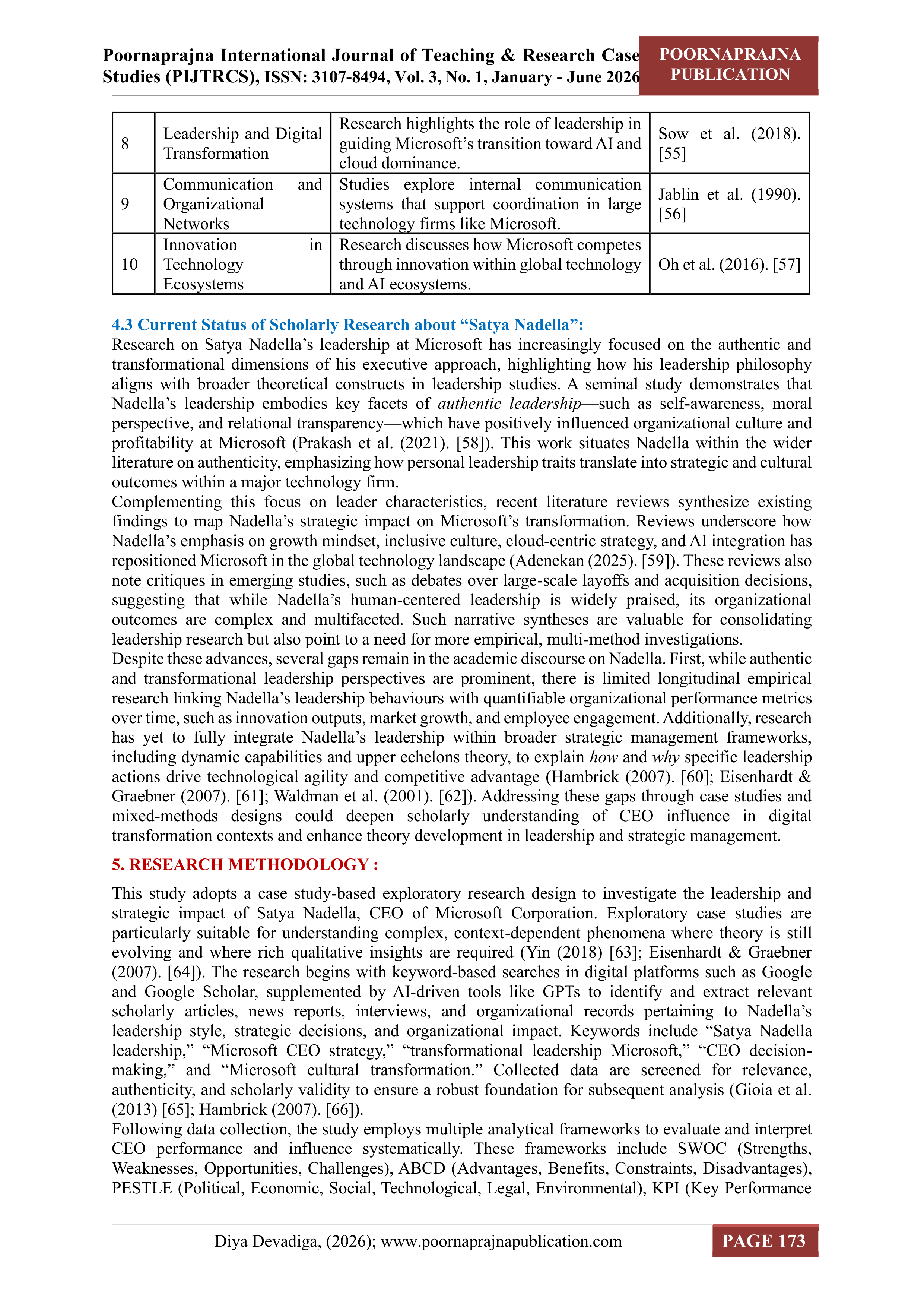
Table 3:
Review of Literature on Keyword “Cloud and AI Strategy Microsoft” using search in
https://scholar.google.com/
S.
No.
Area
of
Scholarly
Articles
Description
Reference
1
Cloud
Computing
Strategy
Studies highlight Microsoft’s shift to a
cloud-first model through Azure, enabling
scalable enterprise solutions and global
digital transformation.
Kundra et al. (2011).
[48]
2
AI
Integration
in
Business
Research shows how Microsoft integrates AI
across products like Office and Azure to
enhance productivity and automation.
Adesoga
et
al.
(2024). [49]
3
Platform
Ecosystem
Development
Literature
emphasizes
Microsoft’s
development of a strong digital ecosystem
connecting cloud, software, and AI services.
Gamidullaeva et al.
(2021). [50]
4
Innovation
and
Technology
Leadership
Studies discuss Microsoft’s role in driving
innovation through continuous R&D and
advanced computing technologies.
Bowen et al. (2013).
[51]
5
Organizational Culture
and Innovation
Research highlights how collaborative
culture supports innovation and successful
cloud transformation at Microsoft.
Büschgens
et
al.
(2013). [52]
6
Accessibility
and
Inclusive Technology
Studies examine Microsoft’s focus on
accessibility and inclusive design in digital
technologies.
Pal et al. (2015). [53]
7
Data Infrastructure and
Scalability
Literature explains Microsoft’s large-scale
data infrastructure supporting cloud and AI
operations globally.
Li et al. (2015). [54]


Poornaprajna International Journal of Teaching & Research Case
Studies (PIJTRCS),
ISSN: 3107-8494, Vol. 3, No. 1, January - June 2026
POORNAPRAJNA
PUBLICATION
Diya Devadiga, (2026); www.poornaprajnapublication.com
PAGE 173
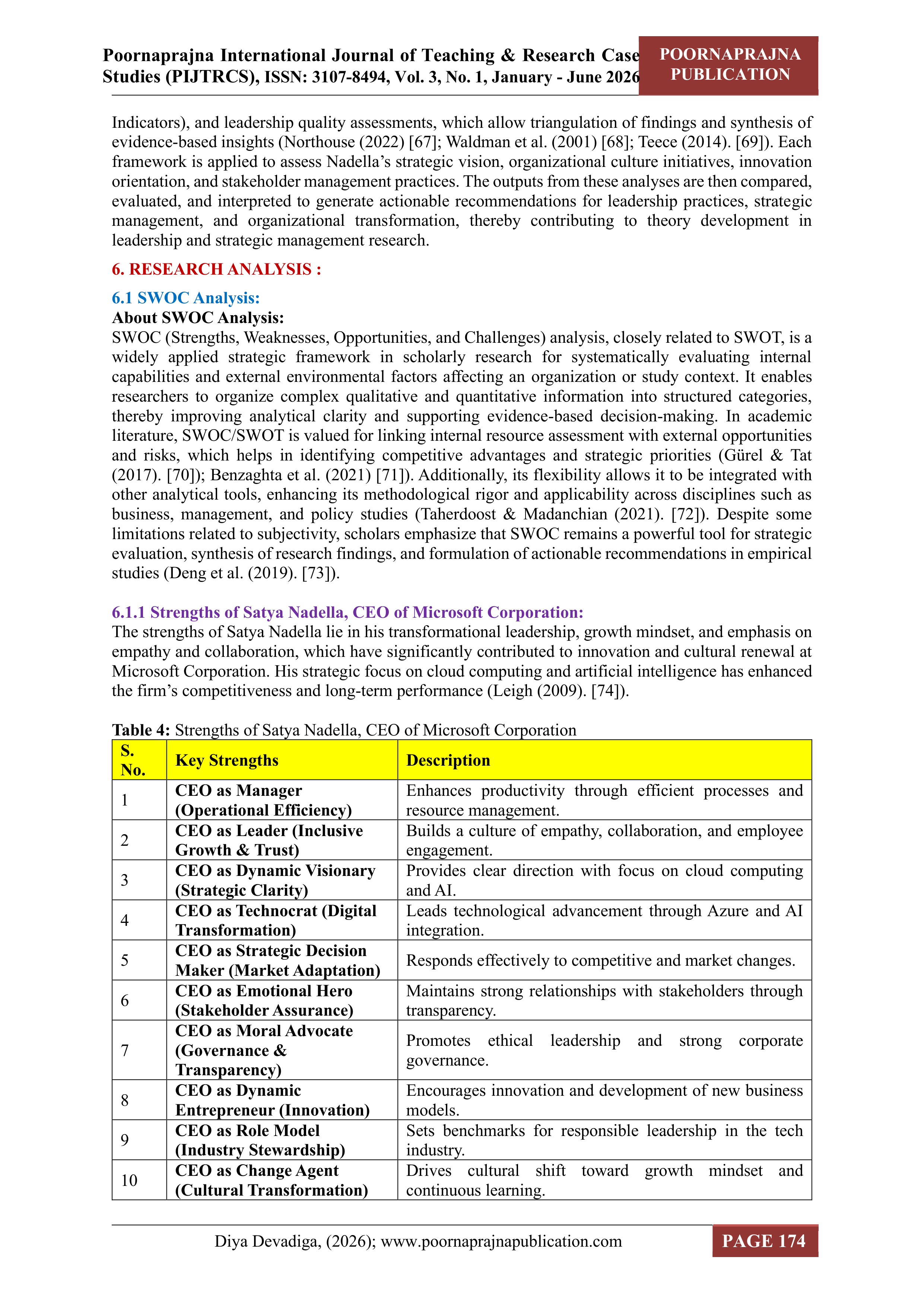
8
Leadership and Digital
Transformation
Research highlights the role of leadership in
guiding Microsoft’s transition toward AI and
cloud dominance.
Sow et al. (2018).
[55]
9
Communication
and
Organizational
Networks
Studies explore internal communication
systems that support coordination in large
technology firms like Microsoft.
Jablin et al. (1990).
[56]
10
Innovation
in
Technology
Ecosystems
Research discusses how Microsoft competes
through innovation within global technology
and AI ecosystems.
Oh et al. (2016). [57]
4.3 Current Status of Scholarly Research about “Satya Nadella”:
Research on Satya Nadella’s leadership at Microsoft has increasingly focused on the authentic and
transformational dimensions of his executive approach, highlighting how his leadership philosophy
aligns with broader theoretical constructs in leadership studies. A seminal study demonstrates that
Nadella’s leadership embodies key facets of
authentic leadership
—such as self-awareness, moral
perspective, and relational transparency—which have positively influenced organizational culture and
profitability at Microsoft (Prakash et al. (2021). [58]). This work situates Nadella within the wider
literature on authenticity, emphasizing how personal leadership traits translate into strategic and cultural
outcomes within a major technology firm.
Complementing this focus on leader characteristics, recent literature reviews synthesize existing
findings to map Nadella’s strategic impact on Microsoft’s transformation. Reviews underscore how
Nadella’s emphasis on growth mindset, inclusive culture, cloud-centric strategy, and AI integration has
repositioned Microsoft in the global technology landscape (Adenekan (2025). [59]). These reviews also
note critiques in emerging studies, such as debates over large-scale layoffs and acquisition decisions,
suggesting that while Nadella’s human-centered leadership is widely praised, its organizational
outcomes are complex and multifaceted. Such narrative syntheses are valuable for consolidating
leadership research but also point to a need for more empirical, multi-method investigations.
Despite these advances, several gaps remain in the academic discourse on Nadella. First, while authentic
and transformational leadership perspectives are prominent, there is limited longitudinal empirical
research linking Nadella’s leadership behaviours with quantifiable organizational performance metrics
over time, such as innovation outputs, market growth, and employee engagement. Additionally, research
has yet to fully integrate Nadella’s leadership within broader strategic management frameworks,
including dynamic capabilities and upper echelons theory, to explain
how
and
why
specific leadership
actions drive technological agility and competitive advantage (Hambrick (2007). [60]; Eisenhardt &
Graebner (2007). [61]; Waldman et al. (2001). [62]). Addressing these gaps through case studies and
mixed-methods designs could deepen scholarly understanding of CEO influence in digital
transformation contexts and enhance theory development in leadership and strategic management.
5. RESEARCH METHODOLOGY :
This study adopts a case study-based exploratory research design to investigate the leadership and
strategic impact of Satya Nadella, CEO of Microsoft Corporation. Exploratory case studies are
particularly suitable for understanding complex, context-dependent phenomena where theory is still
evolving and where rich qualitative insights are required (Yin (2018) [63]; Eisenhardt & Graebner
(2007). [64]). The research begins with keyword-based searches in digital platforms such as Google
and Google Scholar, supplemented by AI-driven tools like GPTs to identify and extract relevant
scholarly articles, news reports, interviews, and organizational records pertaining to Nadella’s
leadership style, strategic decisions, and organizational impact. Keywords include “Satya Nadella
leadership,” “Microsoft CEO strategy,” “transformational leadership Microsoft,” “CEO decision-
making,” and “Microsoft cultural transformation.” Collected data are screened for relevance,
authenticity, and scholarly validity to ensure a robust foundation for subsequent analysis (Gioia et al.
(2013) [65]; Hambrick (2007). [66]).
Following data collection, the study employs multiple analytical frameworks to evaluate and interpret
CEO performance and influence systematically. These frameworks include SWOC (Strengths,
Weaknesses, Opportunities, Challenges), ABCD (Advantages, Benefits, Constraints, Disadvantages),
PESTLE (Political, Economic, Social, Technological, Legal, Environmental), KPI (Key Performance


Poornaprajna International Journal of Teaching & Research Case
Studies (PIJTRCS),
ISSN: 3107-8494, Vol. 3, No. 1, January - June 2026
POORNAPRAJNA
PUBLICATION
Diya Devadiga, (2026); www.poornaprajnapublication.com
PAGE 174
Indicators), and leadership quality assessments, which allow triangulation of findings and synthesis of
evidence-based insights (Northouse (2022) [67]; Waldman et al. (2001) [68]; Teece (2014). [69]). Each
framework is applied to assess Nadella’s strategic vision, organizational culture initiatives, innovation
orientation, and stakeholder management practices. The outputs from these analyses are then compared,
evaluated, and interpreted to generate actionable recommendations for leadership practices, strategic
management, and organizational transformation, thereby contributing to theory development in
leadership and strategic management research.
6. RESEARCH ANALYSIS :
6.1 SWOC Analysis:
About SWOC Analysis:
SWOC (Strengths, Weaknesses, Opportunities, and Challenges) analysis, closely related to SWOT, is a
widely applied strategic framework in scholarly research for systematically evaluating internal
capabilities and external environmental factors affecting an organization or study context. It enables
researchers to organize complex qualitative and quantitative information into structured categories,
thereby improving analytical clarity and supporting evidence-based decision-making. In academic
literature, SWOC/SWOT is valued for linking internal resource assessment with external opportunities
and risks, which helps in identifying competitive advantages and strategic priorities (Gürel & Tat
(2017). [70]); Benzaghta et al. (2021) [71]). Additionally, its flexibility allows it to be integrated with
other analytical tools, enhancing its methodological rigor and applicability across disciplines such as
business, management, and policy studies (Taherdoost & Madanchian (2021). [72]). Despite some
limitations related to subjectivity, scholars emphasize that SWOC remains a powerful tool for strategic
evaluation, synthesis of research findings, and formulation of actionable recommendations in empirical
studies (Deng et al. (2019). [73]).
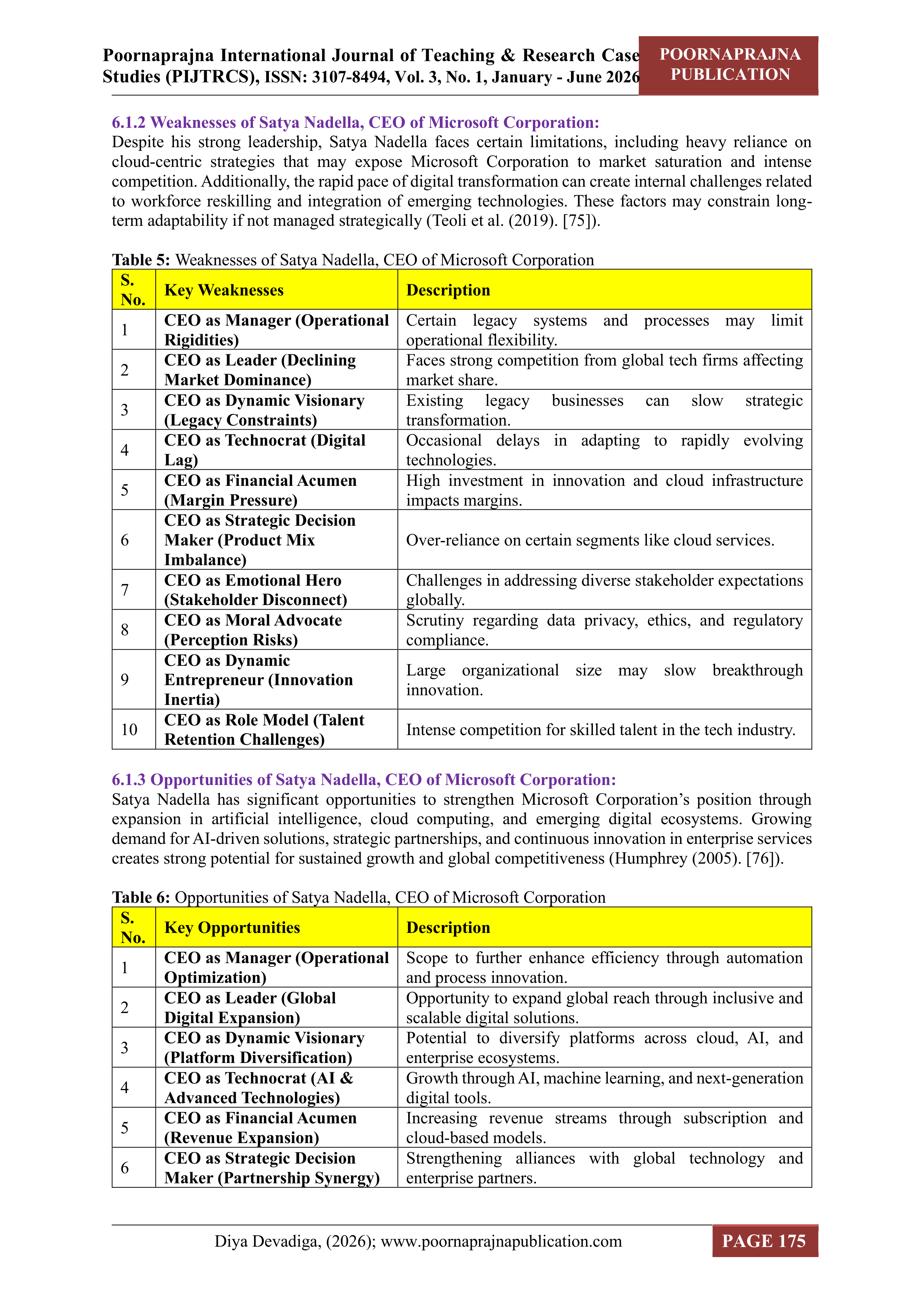
6.1.1 Strengths of Satya Nadella, CEO of Microsoft Corporation:
The strengths of Satya Nadella lie in his transformational leadership, growth mindset, and emphasis on
empathy and collaboration, which have significantly contributed to innovation and cultural renewal at
Microsoft Corporation. His strategic focus on cloud computing and artificial intelligence has enhanced
the firm’s competitiveness and long-term performance (Leigh (2009). [74]).
Table 4:
Strengths of Satya Nadella, CEO of Microsoft Corporation
S.
No.
Key Strengths
Description
1
CEO as Manager
(Operational Efficiency)
Enhances productivity through efficient processes and
resource management.
2
CEO as Leader (Inclusive
Growth & Trust)
Builds a culture of empathy, collaboration, and employee
engagement.
3
CEO as Dynamic Visionary
(Strategic Clarity)
Provides clear direction with focus on cloud computing
and AI.
4
CEO as Technocrat (Digital
Transformation)
Leads technological advancement through Azure and AI
integration.
5
CEO as Strategic Decision
Maker (Market Adaptation)
Responds effectively to competitive and market changes.
6
CEO as Emotional Hero
(Stakeholder Assurance)
Maintains strong relationships with stakeholders through
transparency.
7
CEO as Moral Advocate
(Governance &
Transparency)
Promotes ethical leadership and strong corporate
governance.
8
CEO as Dynamic
Entrepreneur (Innovation)
Encourages innovation and development of new business
models.
9
CEO as Role Model
(Industry Stewardship)
Sets benchmarks for responsible leadership in the tech
industry.
10
CEO as Change Agent
(Cultural Transformation)
Drives cultural shift toward growth mindset and
continuous learning.


Poornaprajna International Journal of Teaching & Research Case
Studies (PIJTRCS),
ISSN: 3107-8494, Vol. 3, No. 1, January - June 2026
POORNAPRAJNA
PUBLICATION
Diya Devadiga, (2026); www.poornaprajnapublication.com
PAGE 175
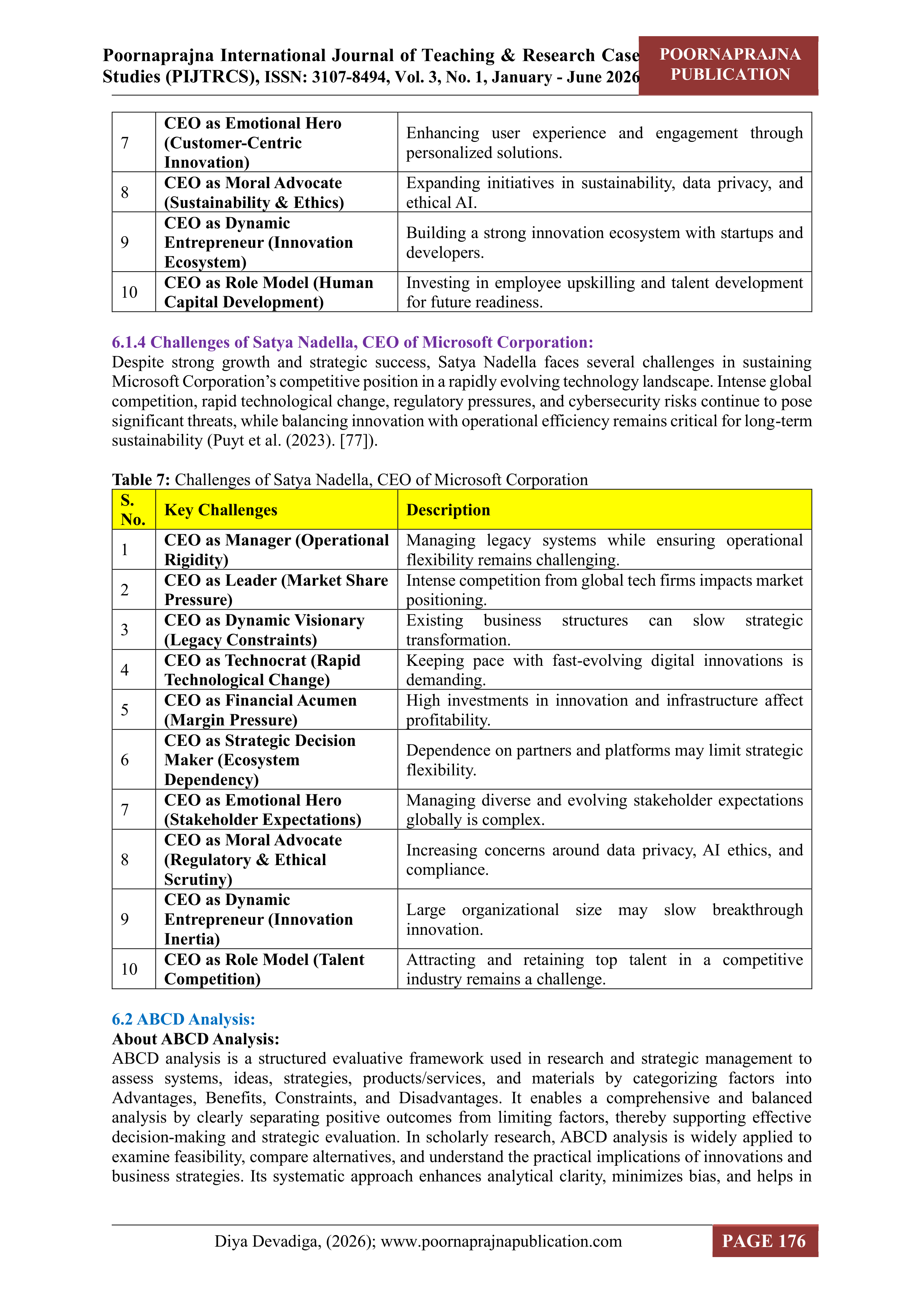
6.1.2 Weaknesses of Satya Nadella, CEO of Microsoft Corporation:
Despite his strong leadership, Satya Nadella faces certain limitations, including heavy reliance on
cloud-centric strategies that may expose Microsoft Corporation to market saturation and intense
competition. Additionally, the rapid pace of digital transformation can create internal challenges related
to workforce reskilling and integration of emerging technologies. These factors may constrain long-
term adaptability if not managed strategically (Teoli et al. (2019). [75]).
Table 5:
Weaknesses of Satya Nadella, CEO of Microsoft Corporation
S.
No.
Key Weaknesses
Description
1
CEO as Manager (Operational
Rigidities)
Certain legacy systems and processes may limit
operational flexibility.
2
CEO as Leader (Declining
Market Dominance)
Faces strong competition from global tech firms affecting
market share.
3
CEO as Dynamic Visionary
(Legacy Constraints)
Existing
legacy
businesses
can
slow
strategic
transformation.
4
CEO as Technocrat (Digital
Lag)
Occasional delays in adapting to rapidly evolving
technologies.
5
CEO as Financial Acumen
(Margin Pressure)
High investment in innovation and cloud infrastructure
impacts margins.
6
CEO as Strategic Decision
Maker (Product Mix
Imbalance)
Over-reliance on certain segments like cloud services.
7
CEO as Emotional Hero
(Stakeholder Disconnect)
Challenges in addressing diverse stakeholder expectations
globally.
8
CEO as Moral Advocate
(Perception Risks)
Scrutiny regarding data privacy, ethics, and regulatory
compliance.
9
CEO as Dynamic
Entrepreneur (Innovation
Inertia)
Large organizational size may slow breakthrough
innovation.
10
CEO as Role Model (Talent
Retention Challenges)
Intense competition for skilled talent in the tech industry.
6.1.3 Opportunities of Satya Nadella, CEO of Microsoft Corporation:
Satya Nadella has significant opportunities to strengthen Microsoft Corporation’s position through
expansion in artificial intelligence, cloud computing, and emerging digital ecosystems. Growing
demand for AI-driven solutions, strategic partnerships, and continuous innovation in enterprise services
creates strong potential for sustained growth and global competitiveness (Humphrey (2005). [76]).
Table 6:
Opportunities of Satya Nadella, CEO of Microsoft Corporation
S.
No.
Key Opportunities
Description
1
CEO as Manager (Operational
Optimization)
Scope to further enhance efficiency through automation
and process innovation.
2
CEO as Leader (Global
Digital Expansion)
Opportunity to expand global reach through inclusive and
scalable digital solutions.
3
CEO as Dynamic Visionary
(Platform Diversification)
Potential to diversify platforms across cloud, AI, and
enterprise ecosystems.
4
CEO as Technocrat (AI &
Advanced Technologies)
Growth through AI, machine learning, and next-generation
digital tools.
5
CEO as Financial Acumen
(Revenue Expansion)
Increasing revenue streams through subscription and
cloud-based models.
6
CEO as Strategic Decision
Maker (Partnership Synergy)
Strengthening alliances with global technology and
enterprise partners.


Poornaprajna International Journal of Teaching & Research Case
Studies (PIJTRCS),
ISSN: 3107-8494, Vol. 3, No. 1, January - June 2026
POORNAPRAJNA
PUBLICATION
Diya Devadiga, (2026); www.poornaprajnapublication.com
PAGE 176
7
CEO as Emotional Hero
(Customer-Centric
Innovation)
Enhancing user experience and engagement through
personalized solutions.
8
CEO as Moral Advocate
(Sustainability & Ethics)
Expanding initiatives in sustainability, data privacy, and
ethical AI.
9
CEO as Dynamic
Entrepreneur (Innovation
Ecosystem)
Building a strong innovation ecosystem with startups and
developers.
10
CEO as Role Model (Human
Capital Development)
Investing in employee upskilling and talent development
for future readiness.
6.1.4 Challenges of Satya Nadella, CEO of Microsoft Corporation:
Despite strong growth and strategic success, Satya Nadella faces several challenges in sustaining
Microsoft Corporation’s competitive position in a rapidly evolving technology landscape. Intense global
competition, rapid technological change, regulatory pressures, and cybersecurity risks continue to pose
significant threats, while balancing innovation with operational efficiency remains critical for long-term
sustainability (Puyt et al. (2023). [77]).
Table 7:
Challenges of Satya Nadella, CEO of Microsoft Corporation
S.
No.
Key Challenges
Description
1
CEO as Manager (Operational
Rigidity)
Managing legacy systems while ensuring operational
flexibility remains challenging.
2
CEO as Leader (Market Share
Pressure)
Intense competition from global tech firms impacts market
positioning.
3
CEO as Dynamic Visionary
(Legacy Constraints)
Existing
business
structures
can
slow
strategic
transformation.
4
CEO as Technocrat (Rapid
Technological Change)
Keeping pace with fast-evolving digital innovations is
demanding.
5
CEO as Financial Acumen
(Margin Pressure)
High investments in innovation and infrastructure affect
profitability.
6
CEO as Strategic Decision
Maker (Ecosystem
Dependency)
Dependence on partners and platforms may limit strategic
flexibility.
7
CEO as Emotional Hero
(Stakeholder Expectations)
Managing diverse and evolving stakeholder expectations
globally is complex.
8
CEO as Moral Advocate
(Regulatory & Ethical
Scrutiny)
Increasing concerns around data privacy, AI ethics, and
compliance.
9
CEO as Dynamic
Entrepreneur (Innovation
Inertia)
Large organizational size may slow breakthrough
innovation.
10
CEO as Role Model (Talent
Competition)
Attracting and retaining top talent in a competitive
industry remains a challenge.
6.2 ABCD Analysis:
About ABCD Analysis:
ABCD analysis is a structured evaluative framework used in research and strategic management to
assess systems, ideas, strategies, products/services, and materials by categorizing factors into
Advantages, Benefits, Constraints, and Disadvantages. It enables a comprehensive and balanced
analysis by clearly separating positive outcomes from limiting factors, thereby supporting effective
decision-making and strategic evaluation. In scholarly research, ABCD analysis is widely applied to
examine feasibility, compare alternatives, and understand the practical implications of innovations and
business strategies. Its systematic approach enhances analytical clarity, minimizes bias, and helps in


Poornaprajna International Journal of Teaching & Research Case
Studies (PIJTRCS),
ISSN: 3107-8494, Vol. 3, No. 1, January - June 2026
POORNAPRAJNA
PUBLICATION
Diya Devadiga, (2026); www.poornaprajnapublication.com
PAGE 177
generating actionable insights by linking theoretical understanding with real-world applications (Aithal
et al. (2015). [78]; Aithal (2016). [79]).
6.2.1 Advantages of Satya Nadella, CEO of Microsoft Corporation, from his Stakeholders'
Perspectives:
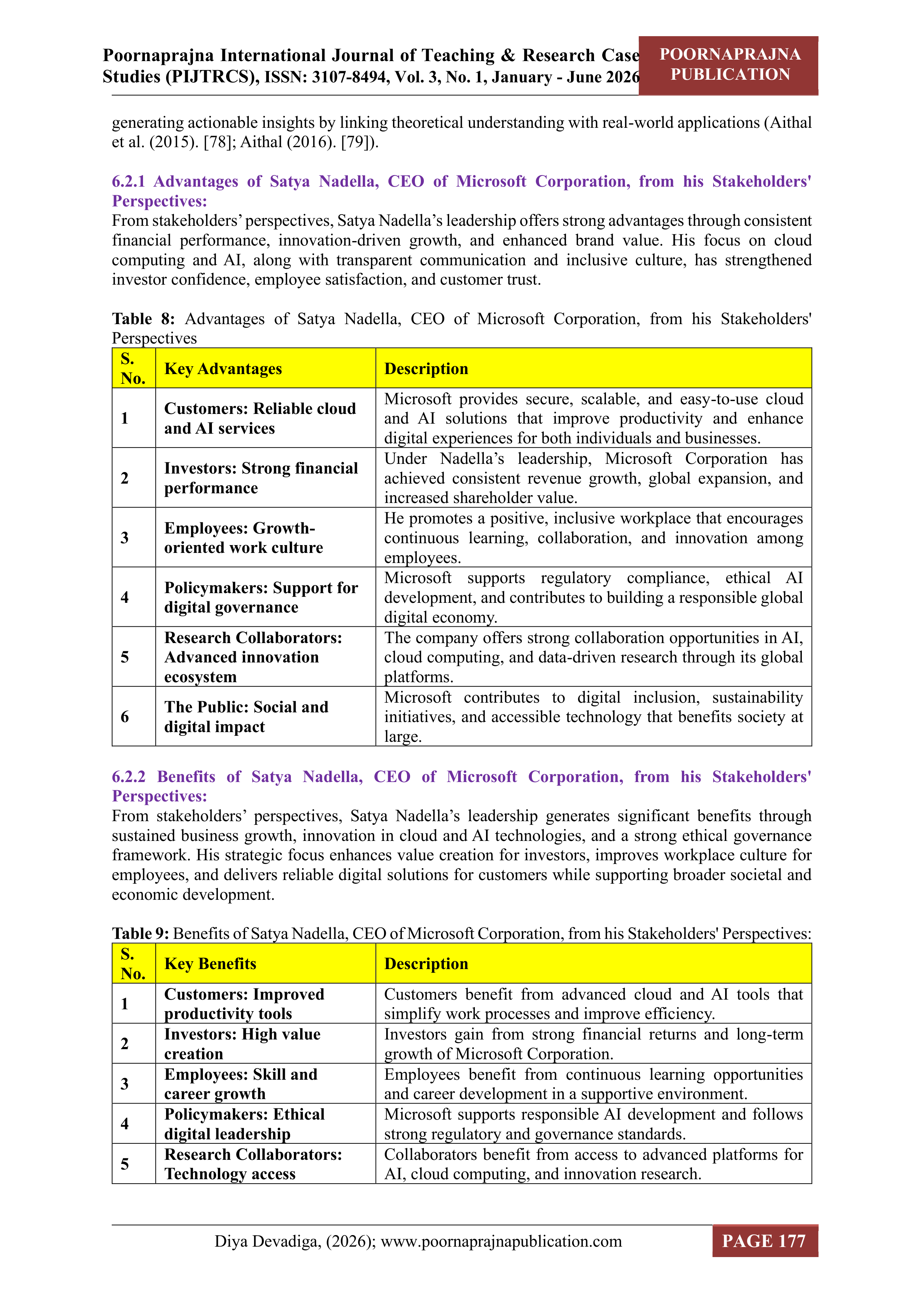
From stakeholders’ perspectives, Satya Nadella’s leadership offers strong advantages through consistent
financial performance, innovation-driven growth, and enhanced brand value. His focus on cloud
computing and AI, along with transparent communication and inclusive culture, has strengthened
investor confidence, employee satisfaction, and customer trust.
Table 8:
Advantages of Satya Nadella, CEO of Microsoft Corporation, from his Stakeholders'
Perspectives
S.
No.
Key Advantages
Description
1
Customers: Reliable cloud
and AI services
Microsoft provides secure, scalable, and easy-to-use cloud
and AI solutions that improve productivity and enhance
digital experiences for both individuals and businesses.
2
Investors: Strong financial
performance
Under Nadella’s leadership, Microsoft Corporation has
achieved consistent revenue growth, global expansion, and
increased shareholder value.
3
Employees: Growth-
oriented work culture
He promotes a positive, inclusive workplace that encourages
continuous learning, collaboration, and innovation among
employees.
4
Policymakers: Support for
digital governance
Microsoft supports regulatory compliance, ethical AI
development, and contributes to building a responsible global
digital economy.
5
Research Collaborators:
Advanced innovation
ecosystem
The company offers strong collaboration opportunities in AI,
cloud computing, and data-driven research through its global
platforms.
6
The Public: Social and
digital impact
Microsoft contributes to digital inclusion, sustainability
initiatives, and accessible technology that benefits society at
large.
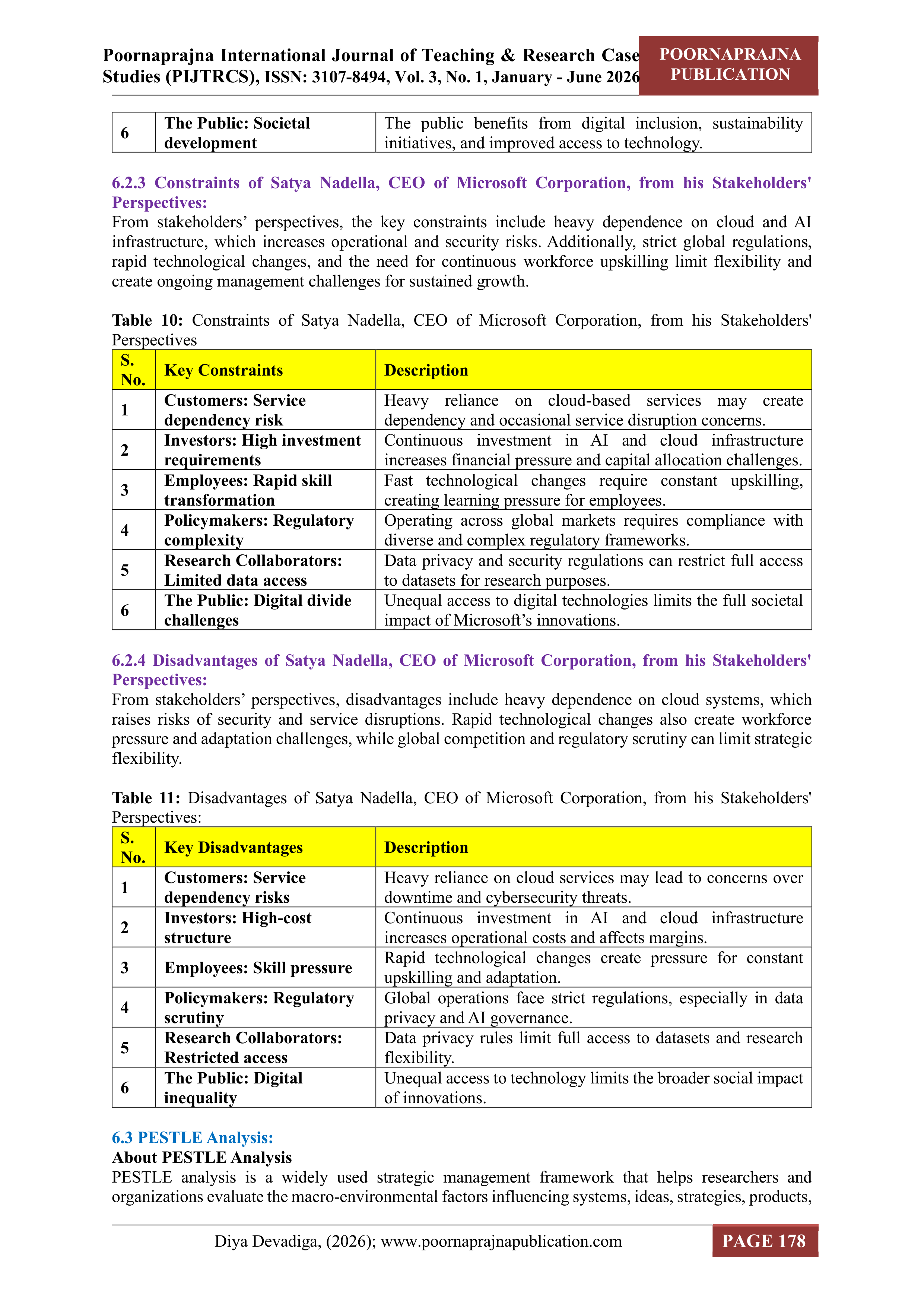
6.2.2 Benefits of Satya Nadella, CEO of Microsoft Corporation, from his Stakeholders'
Perspectives:
From stakeholders’ perspectives, Satya Nadella’s leadership generates significant benefits through
sustained business growth, innovation in cloud and AI technologies, and a strong ethical governance
framework. His strategic focus enhances value creation for investors, improves workplace culture for
employees, and delivers reliable digital solutions for customers while supporting broader societal and
economic development.
Table 9:
Benefits of Satya Nadella, CEO of Microsoft Corporation, from his Stakeholders' Perspectives:
S.
No.
Key Benefits
Description
1
Customers: Improved
productivity tools
Customers benefit from advanced cloud and AI tools that
simplify work processes and improve efficiency.
2
Investors: High value
creation
Investors gain from strong financial returns and long-term
growth of Microsoft Corporation.
3
Employees: Skill and
career growth
Employees benefit from continuous learning opportunities
and career development in a supportive environment.
4
Policymakers: Ethical
digital leadership
Microsoft supports responsible AI development and follows
strong regulatory and governance standards.
5
Research Collaborators:
Technology access
Collaborators benefit from access to advanced platforms for
AI, cloud computing, and innovation research.


Poornaprajna International Journal of Teaching & Research Case
Studies (PIJTRCS),
ISSN: 3107-8494, Vol. 3, No. 1, January - June 2026
POORNAPRAJNA
PUBLICATION
Diya Devadiga, (2026); www.poornaprajnapublication.com
PAGE 178
6
The Public: Societal
development
The public benefits from digital inclusion, sustainability
initiatives, and improved access to technology.
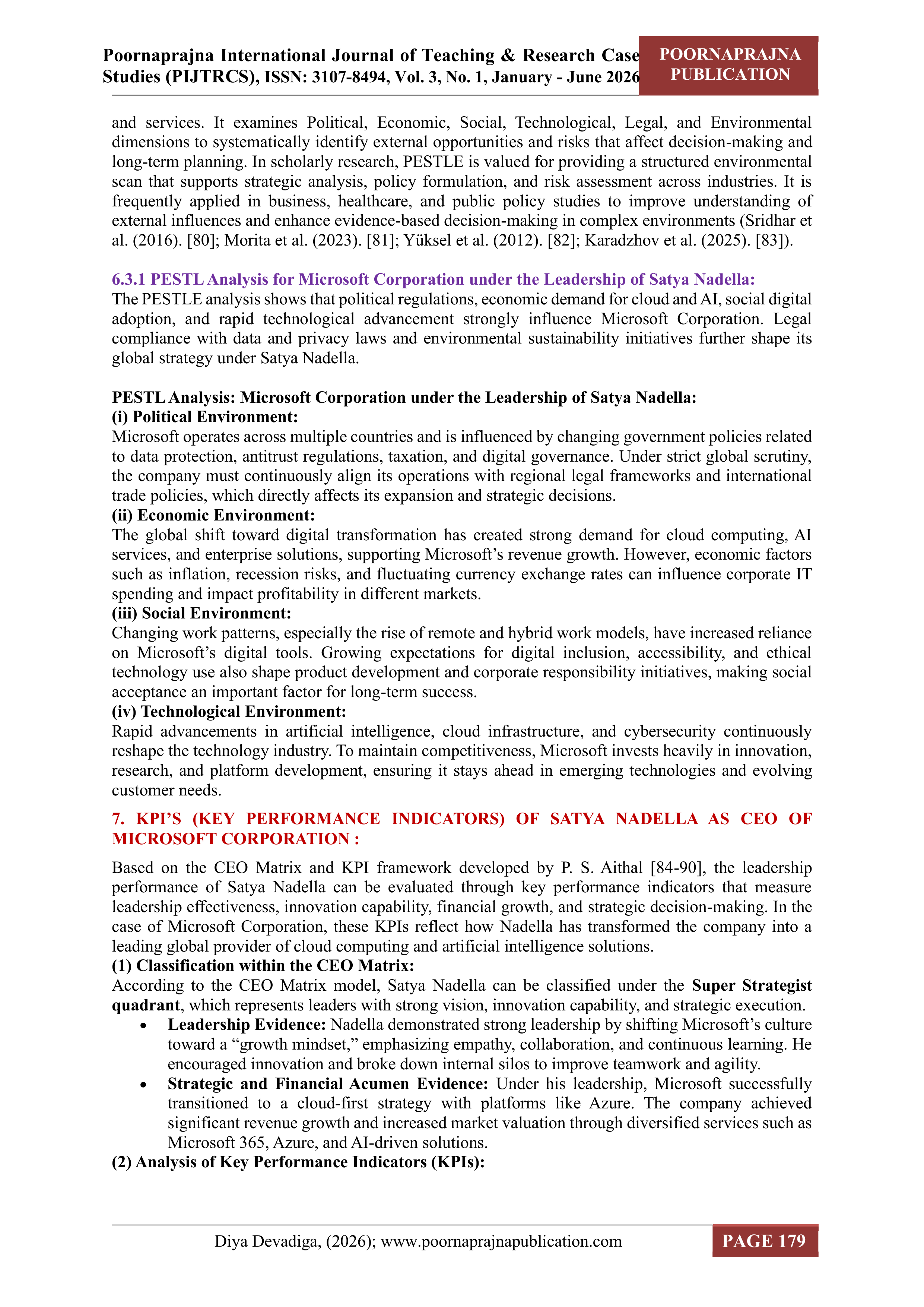
6.2.3 Constraints of Satya Nadella, CEO of Microsoft Corporation, from his Stakeholders'
Perspectives:
From stakeholders’ perspectives, the key constraints include heavy dependence on cloud and AI
infrastructure, which increases operational and security risks. Additionally, strict global regulations,
rapid technological changes, and the need for continuous workforce upskilling limit flexibility and
create ongoing management challenges for sustained growth.
Table 10:
Constraints of Satya Nadella, CEO of Microsoft Corporation, from his Stakeholders'
Perspectives
S.
No.
Key Constraints
Description
1
Customers: Service
dependency risk
Heavy reliance on cloud-based services may create
dependency and occasional service disruption concerns.
2
Investors: High investment
requirements
Continuous investment in AI and cloud infrastructure
increases financial pressure and capital allocation challenges.
3
Employees: Rapid skill
transformation
Fast technological changes require constant upskilling,
creating learning pressure for employees.
4
Policymakers: Regulatory
complexity
Operating across global markets requires compliance with
diverse and complex regulatory frameworks.
5
Research Collaborators:
Limited data access
Data privacy and security regulations can restrict full access
to datasets for research purposes.
6
The Public: Digital divide
challenges
Unequal access to digital technologies limits the full societal
impact of Microsoft’s innovations.
6.2.4 Disadvantages of Satya Nadella, CEO of Microsoft Corporation, from his Stakeholders'
Perspectives:
From stakeholders’ perspectives, disadvantages include heavy dependence on cloud systems, which
raises risks of security and service disruptions. Rapid technological changes also create workforce
pressure and adaptation challenges, while global competition and regulatory scrutiny can limit strategic
flexibility.
Table 11:
Disadvantages of Satya Nadella, CEO of Microsoft Corporation, from his Stakeholders'
Perspectives:
S.
No.
Key Disadvantages
Description
1
Customers: Service
dependency risks
Heavy reliance on cloud services may lead to concerns over
downtime and cybersecurity threats.
2
Investors: High-cost
structure
Continuous investment in AI and cloud infrastructure
increases operational costs and affects margins.
3
Employees: Skill pressure
Rapid technological changes create pressure for constant
upskilling and adaptation.
4
Policymakers: Regulatory
scrutiny
Global operations face strict regulations, especially in data
privacy and AI governance.
5
Research Collaborators:
Restricted access
Data privacy rules limit full access to datasets and research
flexibility.
6
The Public: Digital
inequality
Unequal access to technology limits the broader social impact
of innovations.
6.3 PESTLE Analysis:
About PESTLE Analysis
PESTLE analysis is a widely used strategic management framework that helps researchers and
organizations evaluate the macro-environmental factors influencing systems, ideas, strategies, products,


Poornaprajna International Journal of Teaching & Research Case
Studies (PIJTRCS),
ISSN: 3107-8494, Vol. 3, No. 1, January - June 2026
POORNAPRAJNA
PUBLICATION
Diya Devadiga, (2026); www.poornaprajnapublication.com
PAGE 179
and services. It examines Political, Economic, Social, Technological, Legal, and Environmental
dimensions to systematically identify external opportunities and risks that affect decision-making and
long-term planning. In scholarly research, PESTLE is valued for providing a structured environmental
scan that supports strategic analysis, policy formulation, and risk assessment across industries. It is
frequently applied in business, healthcare, and public policy studies to improve understanding of
external influences and enhance evidence-based decision-making in complex environments (Sridhar et
al. (2016). [80]; Morita et al. (2023). [81]; Yüksel et al. (2012). [82]; Karadzhov et al. (2025). [83]).
6.3.1 PESTL Analysis for Microsoft Corporation under the Leadership of
Satya Nadella:
The PESTLE analysis shows that political regulations, economic demand for cloud and AI, social digital
adoption, and rapid technological advancement strongly influence Microsoft Corporation. Legal
compliance with data and privacy laws and environmental sustainability initiatives further shape its
global strategy under Satya Nadella.
PESTL Analysis: Microsoft Corporation under the Leadership of
Satya Nadella:
(i) Political Environment:
Microsoft operates across multiple countries and is influenced by changing government policies related
to data protection, antitrust regulations, taxation, and digital governance. Under strict global scrutiny,
the company must continuously align its operations with regional legal frameworks and international
trade policies, which directly affects its expansion and strategic decisions.
(ii) Economic Environment:
The global shift toward digital transformation has created strong demand for cloud computing, AI
services, and enterprise solutions, supporting Microsoft’s revenue growth. However, economic factors
such as inflation, recession risks, and fluctuating currency exchange rates can influence corporate IT
spending and impact profitability in different markets.
(iii) Social Environment:
Changing work patterns, especially the rise of remote and hybrid work models, have increased reliance
on Microsoft’s digital tools. Growing expectations for digital inclusion, accessibility, and ethical
technology use also shape product development and corporate responsibility initiatives, making social
acceptance an important factor for long-term success.
(iv) Technological Environment:
Rapid advancements in artificial intelligence, cloud infrastructure, and cybersecurity continuously
reshape the technology industry. To maintain competitiveness, Microsoft invests heavily in innovation,
research, and platform development, ensuring it stays ahead in emerging technologies and evolving
customer needs.
7. KPI’S (KEY PERFORMANCE INDICATORS) OF SATYA NADELLA AS CEO OF
MICROSOFT CORPORATION :
Based on the CEO Matrix and KPI framework developed by P. S. Aithal [84-90], the leadership
performance of Satya Nadella can be evaluated through key performance indicators that measure
leadership effectiveness, innovation capability, financial growth, and strategic decision-making. In the
case of Microsoft Corporation, these KPIs reflect how Nadella has transformed the company into a
leading global provider of cloud computing and artificial intelligence solutions.
(1) Classification within the CEO Matrix:
According to the CEO Matrix model, Satya Nadella can be classified under the
Super Strategist
quadrant
, which represents leaders with strong vision, innovation capability, and strategic execution.
•
Leadership Evidence:
Nadella demonstrated strong leadership by shifting Microsoft’s culture
toward a “growth mindset,” emphasizing empathy, collaboration, and continuous learning. He
encouraged innovation and broke down internal silos to improve teamwork and agility.
•
Strategic and Financial Acumen Evidence:
Under his leadership, Microsoft successfully
transitioned to a cloud-first strategy with platforms like Azure. The company achieved
significant revenue growth and increased market valuation through diversified services such as
Microsoft 365, Azure, and AI-driven solutions.
(2) Analysis of Key Performance Indicators (KPIs):


Poornaprajna International Journal of Teaching & Research Case
Studies (PIJTRCS),
ISSN: 3107-8494, Vol. 3, No. 1, January - June 2026
POORNAPRAJNA
PUBLICATION
Diya Devadiga, (2026); www.poornaprajnapublication.com
PAGE 180
The CEO Matrix framework highlights that leadership success can be measured through organizational
performance indicators. The following KPIs reflect the effectiveness of Nadella’s leadership:
A. Platform Growth and Market Expansion:
•
Global Market Presence:
Microsoft has expanded its global footprint, serving enterprises,
governments, and individuals across multiple countries.
•
Cloud Market Leadership:
Azure has become one of the leading cloud platforms,
demonstrating strong growth in the global cloud computing market.
B. Innovation and Product Development:
•
Continuous Innovation:
Microsoft consistently introduces new technologies and updates
across its product ecosystem, including AI integration and cloud services.
•
AI Advancement:
The company has invested heavily in artificial intelligence, integrating AI
capabilities into products like Microsoft 365 and Azure.
C. Operational Efficiency and Technology Leadership:
•
Cloud-Based Infrastructure:
Microsoft’s cloud ecosystem enables scalable, secure, and
efficient service delivery worldwide.
•
Technological Scalability:
Its infrastructure supports millions of users and enterprises with
high reliability and performance.
D. Brand Influence and Market Leadership:
•
Global Brand Strength:
Microsoft has reinforced its position as a leading technology
company known for innovation and reliability.
•
Customer Engagement:
Strong enterprise relationships and user adoption reflect the
effectiveness of its product ecosystem.
E. Organizational Culture and Talent Development:
•
Inclusive Work Culture:
Nadella promotes diversity, inclusion, and a collaborative work
environment.
•
Talent Development:
The company invests in employee learning, skill development, and
leadership growth.
(3) Practical Interpretation using the ABCD Framework:
Applying the ABCD analysis to Nadella’s KPI performance provides the following insights:
•
Advantages:
Strong strategic vision, innovation in cloud and AI, and effective leadership
enhance Microsoft’s competitive position globally.
•
Benefits:
Continuous growth, improved financial performance, and high customer adoption
strengthen long-term sustainability.
•
Constraints:
Rapid technological changes and intense competition require constant innovation
and high investment.
•
Disadvantages:
Managing large-scale operations and maintaining consistent innovation across
global teams can create complexity and operational challenges.
8. COMPARISON WITH COMPETITORS :
Comparison of Satya Nadella, CEO of Microsoft Corporation, with CEOs of Competitive
Technology Companies:
Compared to leaders such as Sundar Pichai of Google and Tim Cook of Apple Inc., Satya Nadella stands
out for his strong focus on cultural transformation and a growth mindset approach. While competitors
emphasize product innovation and ecosystem control, Nadella’s leadership is characterized by
collaboration, cloud-first strategy, and integration of artificial intelligence across platforms, which has
significantly enhanced Microsoft Corporation’s adaptability and long-term competitiveness.
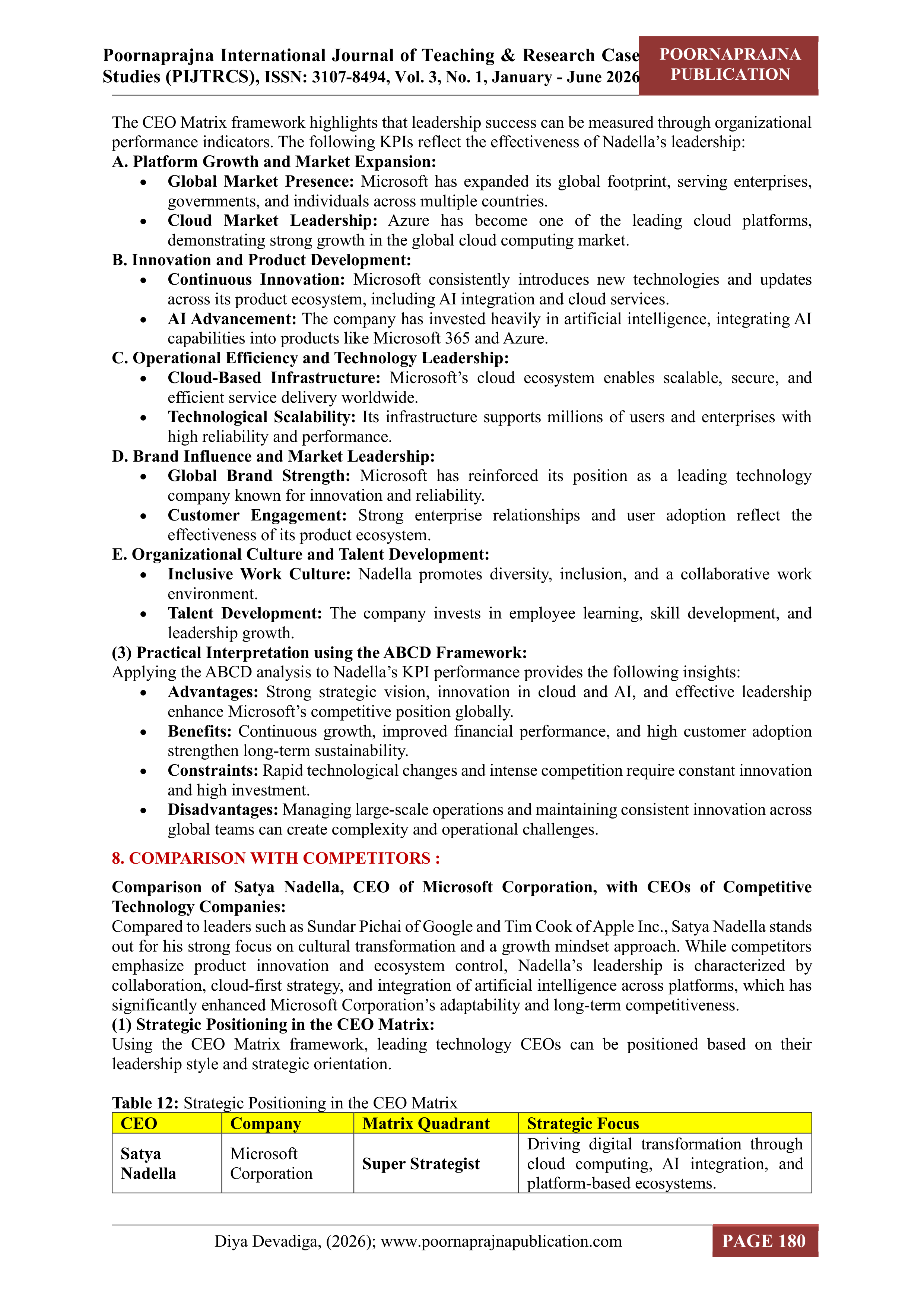
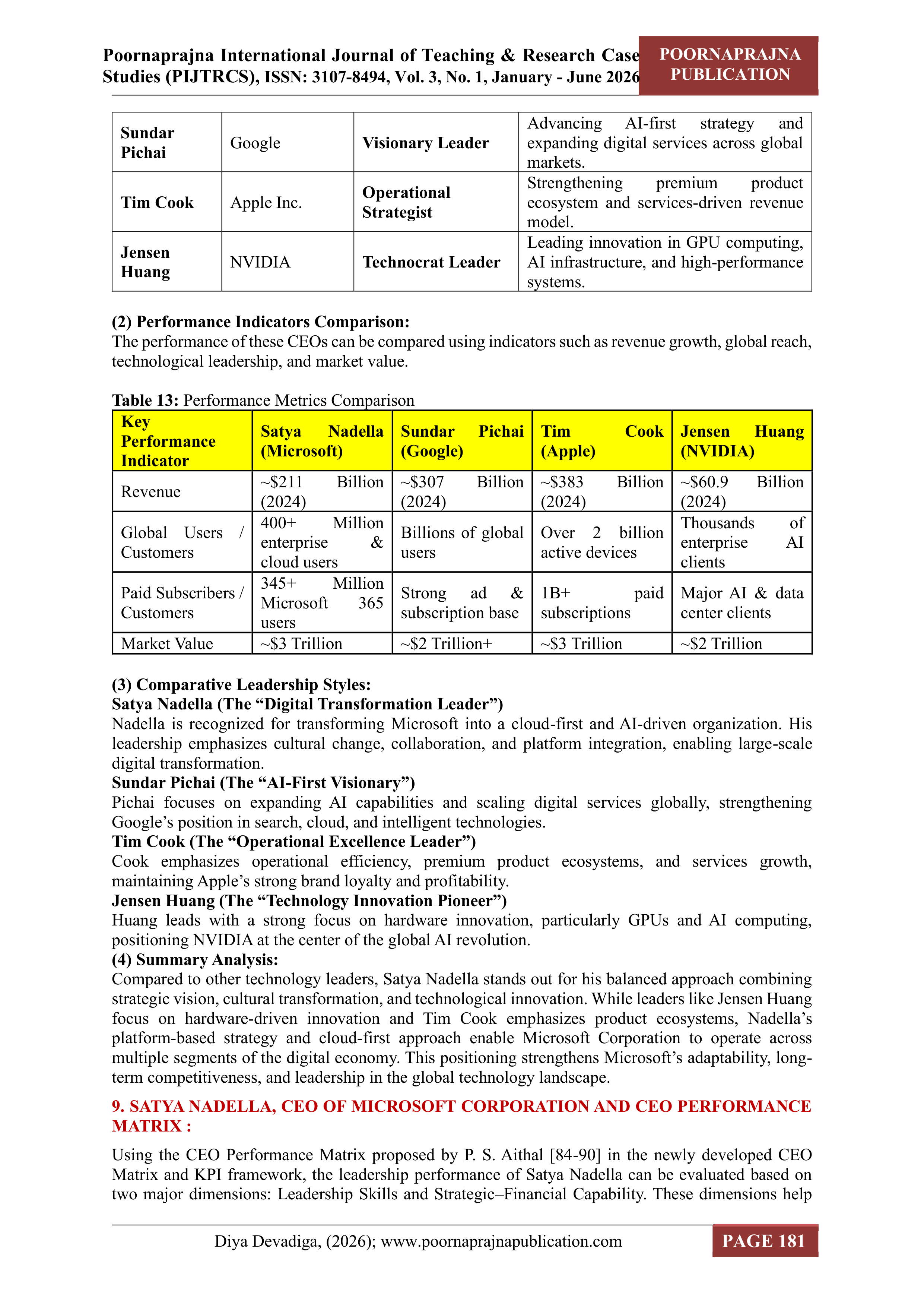
(1) Strategic Positioning in the CEO Matrix:
Using the CEO Matrix framework, leading technology CEOs can be positioned based on their
leadership style and strategic orientation.
Table 12:
Strategic Positioning in the CEO Matrix
CEO
Company
Matrix Quadrant
Strategic Focus
Satya
Nadella
Microsoft
Corporation
Super Strategist
Driving digital transformation through
cloud computing, AI integration, and
platform-based ecosystems.


Poornaprajna International Journal of Teaching & Research Case
Studies (PIJTRCS),
ISSN: 3107-8494, Vol. 3, No. 1, January - June 2026
POORNAPRAJNA
PUBLICATION
Diya Devadiga, (2026); www.poornaprajnapublication.com
PAGE 181
Sundar
Pichai
Google
Visionary Leader
Advancing
AI-first
strategy
and
expanding digital services across global
markets.
Tim Cook
Apple Inc.
Operational
Strategist
Strengthening
premium
product
ecosystem and services-driven revenue
model.
Jensen
Huang
NVIDIA
Technocrat Leader
Leading innovation in GPU computing,
AI infrastructure, and high-performance
systems.
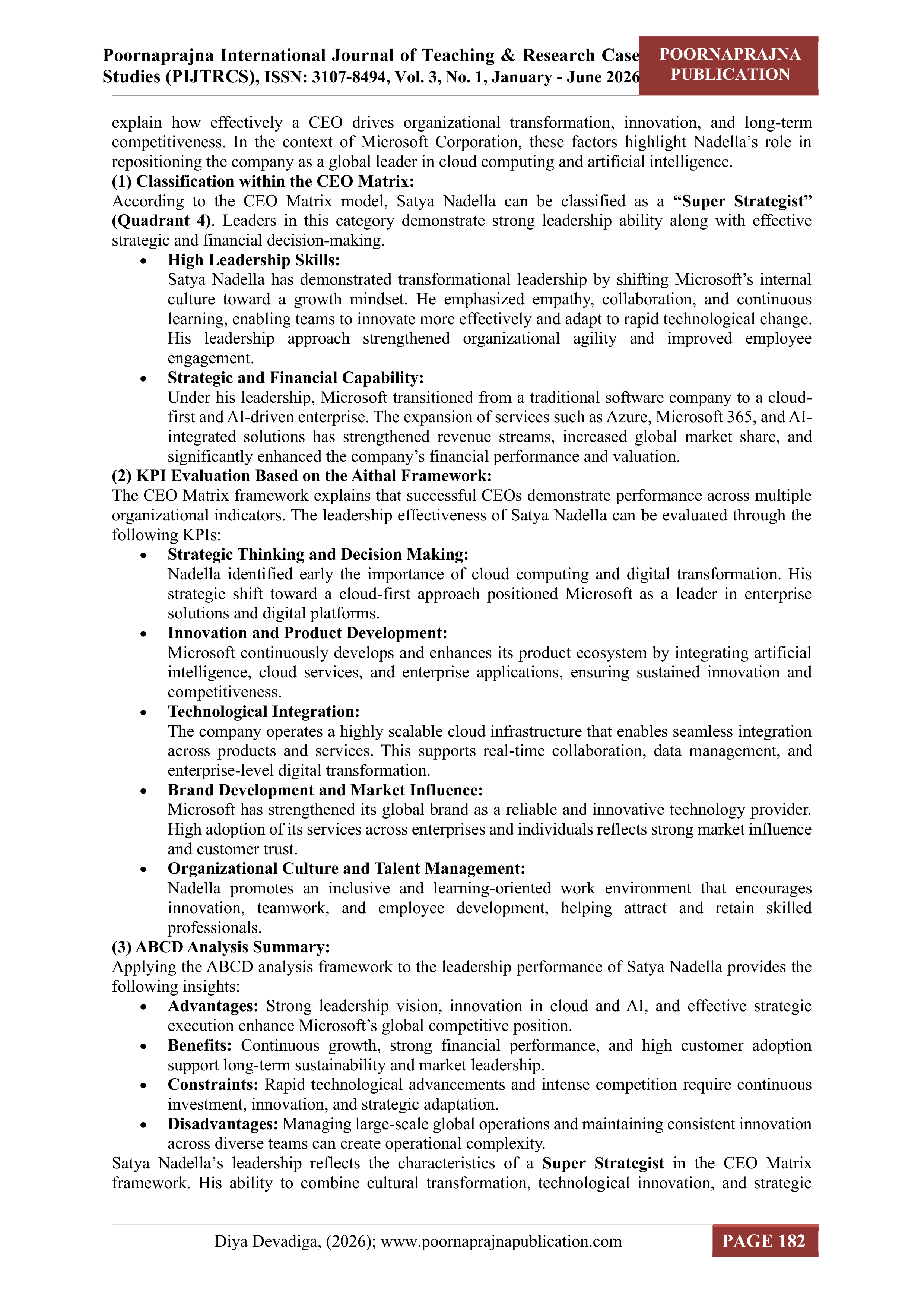
(2) Performance Indicators Comparison:
The performance of these CEOs can be compared using indicators such as revenue growth, global reach,
technological leadership, and market value.
Table 13:
Performance Metrics Comparison
Key
Performance
Indicator
Satya
Nadella
(Microsoft)
Sundar
Pichai
(Google)
Tim
Cook
(Apple)
Jensen
Huang
(NVIDIA)
Revenue
~$211
Billion
(2024)
~$307
Billion
(2024)
~$383
Billion
(2024)
~$60.9
Billion
(2024)
Global Users /
Customers
400+
Million
enterprise
&
cloud users
Billions of global
users
Over 2 billion
active devices
Thousands
of
enterprise
AI
clients
Paid Subscribers /
Customers
345+
Million
Microsoft
365
users
Strong
ad
&
subscription base
1B+
paid
subscriptions
Major AI & data
center clients
Market Value
~$3 Trillion
~$2 Trillion+
~$3 Trillion
~$2 Trillion
(3) Comparative Leadership Styles:
Satya Nadella (The “Digital Transformation Leader”)
Nadella is recognized for transforming Microsoft into a cloud-first and AI-driven organization. His
leadership emphasizes cultural change, collaboration, and platform integration, enabling large-scale
digital transformation.
Sundar Pichai (The “AI-First Visionary”)
Pichai focuses on expanding AI capabilities and scaling digital services globally, strengthening
Google’s position in search, cloud, and intelligent technologies.
Tim Cook (The “Operational Excellence Leader”)
Cook emphasizes operational efficiency, premium product ecosystems, and services growth,
maintaining Apple’s strong brand loyalty and profitability.
Jensen Huang (The “Technology Innovation Pioneer”)
Huang leads with a strong focus on hardware innovation, particularly GPUs and AI computing,
positioning NVIDIA at the center of the global AI revolution.
(4) Summary Analysis:
Compared to other technology leaders, Satya Nadella stands out for his balanced approach combining
strategic vision, cultural transformation, and technological innovation. While leaders like Jensen Huang
focus on hardware-driven innovation and Tim Cook emphasizes product ecosystems, Nadella’s
platform-based strategy and cloud-first approach enable Microsoft Corporation to operate across
multiple segments of the digital economy. This positioning strengthens Microsoft’s adaptability, long-
term competitiveness, and leadership in the global technology landscape.
9. SATYA NADELLA, CEO OF MICROSOFT CORPORATION AND CEO PERFORMANCE
MATRIX :
Using the CEO Performance Matrix proposed by P. S. Aithal [84-90] in the newly developed CEO
Matrix and KPI framework, the leadership performance of Satya Nadella can be evaluated based on
two major dimensions: Leadership Skills and Strategic–Financial Capability. These dimensions help


Poornaprajna International Journal of Teaching & Research Case
Studies (PIJTRCS),
ISSN: 3107-8494, Vol. 3, No. 1, January - June 2026
POORNAPRAJNA
PUBLICATION
Diya Devadiga, (2026); www.poornaprajnapublication.com
PAGE 182
explain how effectively a CEO drives organizational transformation, innovation, and long-term
competitiveness. In the context of Microsoft Corporation, these factors highlight Nadella’s role in
repositioning the company as a global leader in cloud computing and artificial intelligence.
(1) Classification within the CEO Matrix:
According to the CEO Matrix model, Satya Nadella can be classified as a
“Super Strategist”
(Quadrant 4)
. Leaders in this category demonstrate strong leadership ability along with effective
strategic and financial decision-making.
•
High Leadership Skills:
Satya Nadella has demonstrated transformational leadership by shifting Microsoft’s internal
culture toward a growth mindset. He emphasized empathy, collaboration, and continuous
learning, enabling teams to innovate more effectively and adapt to rapid technological change.
His leadership approach strengthened organizational agility and improved employee
engagement.
•
Strategic and Financial Capability:
Under his leadership, Microsoft transitioned from a traditional software company to a cloud-
first and AI-driven enterprise. The expansion of services such as Azure, Microsoft 365, and AI-
integrated solutions has strengthened revenue streams, increased global market share, and
significantly enhanced the company’s financial performance and valuation.
(2) KPI Evaluation Based on the Aithal Framework:
The CEO Matrix framework explains that successful CEOs demonstrate performance across multiple
organizational indicators. The leadership effectiveness of Satya Nadella can be evaluated through the
following KPIs:
•
Strategic Thinking and Decision Making:
Nadella identified early the importance of cloud computing and digital transformation. His
strategic shift toward a cloud-first approach positioned Microsoft as a leader in enterprise
solutions and digital platforms.
•
Innovation and Product Development:
Microsoft continuously develops and enhances its product ecosystem by integrating artificial
intelligence, cloud services, and enterprise applications, ensuring sustained innovation and
competitiveness.
•
Technological Integration:
The company operates a highly scalable cloud infrastructure that enables seamless integration
across products and services. This supports real-time collaboration, data management, and
enterprise-level digital transformation.
•
Brand Development and Market Influence:
Microsoft has strengthened its global brand as a reliable and innovative technology provider.
High adoption of its services across enterprises and individuals reflects strong market influence
and customer trust.
•
Organizational Culture and Talent Management:
Nadella promotes an inclusive and learning-oriented work environment that encourages
innovation, teamwork, and employee development, helping attract and retain skilled
professionals.
(3) ABCD Analysis Summary:
Applying the ABCD analysis framework to the leadership performance of Satya Nadella provides the
following insights:
•
Advantages:
Strong leadership vision, innovation in cloud and AI, and effective strategic
execution enhance Microsoft’s global competitive position.
•
Benefits:
Continuous growth, strong financial performance, and high customer adoption
support long-term sustainability and market leadership.
•
Constraints:
Rapid technological advancements and intense competition require continuous
investment, innovation, and strategic adaptation.
•
Disadvantages:
Managing large-scale global operations and maintaining consistent innovation
across diverse teams can create operational complexity.
Satya Nadella’s leadership reflects the characteristics of a
Super Strategist
in the CEO Matrix
framework. His ability to combine cultural transformation, technological innovation, and strategic


Poornaprajna International Journal of Teaching & Research Case
Studies (PIJTRCS),
ISSN: 3107-8494, Vol. 3, No. 1, January - June 2026
POORNAPRAJNA
PUBLICATION
Diya Devadiga, (2026); www.poornaprajnapublication.com
PAGE 183
execution has enabled Microsoft Corporation to achieve sustained growth and maintain a strong
competitive position in the global technology industry. Through continuous innovation and effective
leadership, he has positioned the company for long-term success in the evolving digital landscape.
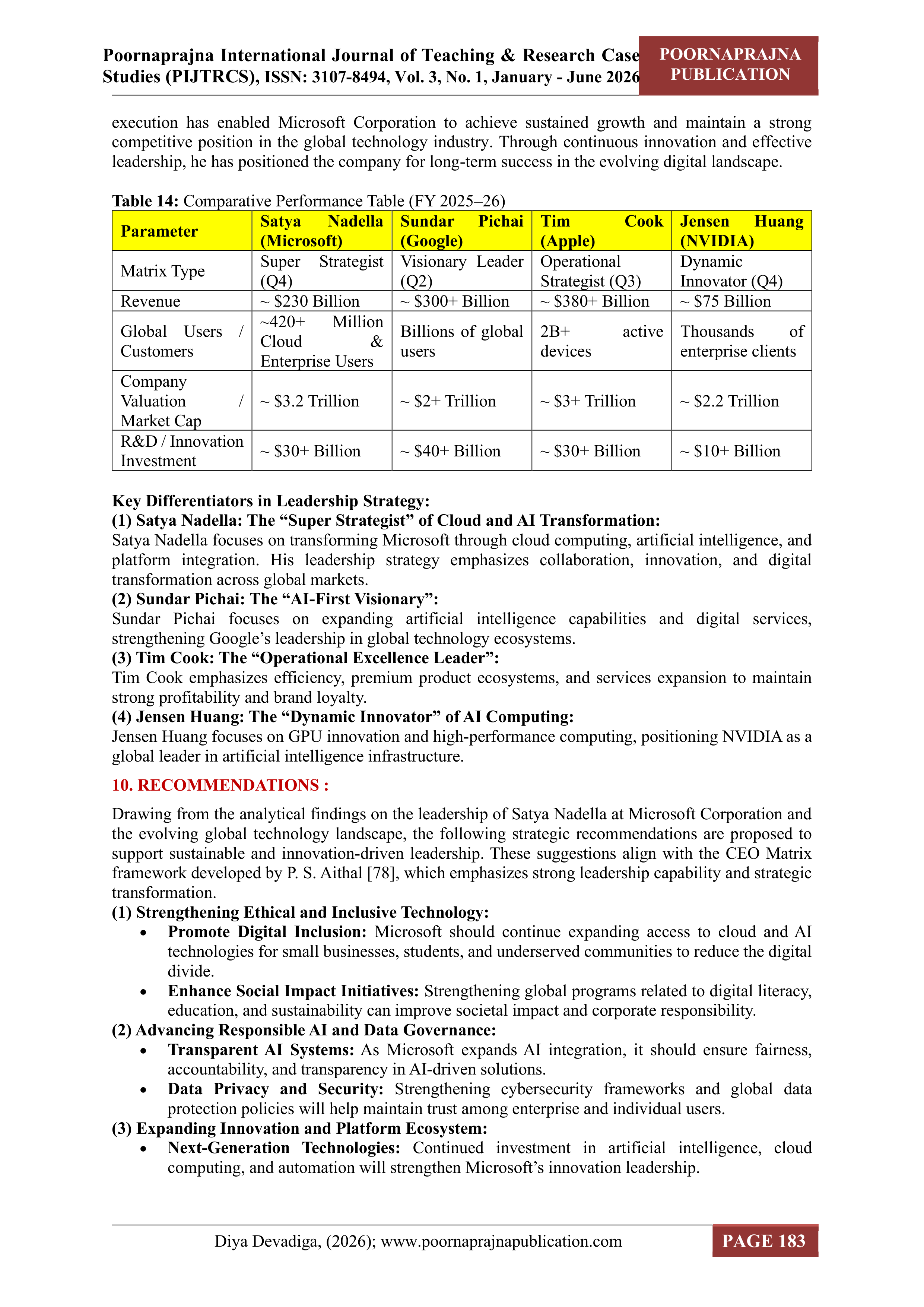
Table 14:
Comparative Performance Table (FY 2025–26)
Parameter
Satya
Nadella
(Microsoft)
Sundar
Pichai
(Google)
Tim
Cook
(Apple)
Jensen
Huang
(NVIDIA)
Matrix Type
Super
Strategist
(Q4)
Visionary Leader
(Q2)
Operational
Strategist (Q3)
Dynamic
Innovator (Q4)
Revenue
~ $230 Billion
~ $300+ Billion
~ $380+ Billion
~ $75 Billion
Global Users /
Customers
~420+
Million
Cloud
&
Enterprise Users
Billions of global
users
2B+
active
devices
Thousands
of
enterprise clients
Company
Valuation
/
Market Cap
~ $3.2 Trillion
~ $2+ Trillion
~ $3+ Trillion
~ $2.2 Trillion
R&D / Innovation
Investment
~ $30+ Billion
~ $40+ Billion
~ $30+ Billion
~ $10+ Billion
Key Differentiators in Leadership Strategy:
(1) Satya Nadella: The “Super Strategist” of Cloud and AI Transformation:
Satya Nadella focuses on transforming Microsoft through cloud computing, artificial intelligence, and
platform integration. His leadership strategy emphasizes collaboration, innovation, and digital
transformation across global markets.
(2) Sundar Pichai: The “AI-First Visionary”:
Sundar Pichai focuses on expanding artificial intelligence capabilities and digital services,
strengthening Google’s leadership in global technology ecosystems.
(3) Tim Cook: The “Operational Excellence Leader”:
Tim Cook emphasizes efficiency, premium product ecosystems, and services expansion to maintain
strong profitability and brand loyalty.
(4) Jensen Huang: The “Dynamic Innovator” of AI Computing:
Jensen Huang focuses on GPU innovation and high-performance computing, positioning NVIDIA as a
global leader in artificial intelligence infrastructure.
10. RECOMMENDATIONS :
Drawing from the analytical findings on the leadership of Satya Nadella at Microsoft Corporation and
the evolving global technology landscape, the following strategic recommendations are proposed to
support sustainable and innovation-driven leadership. These suggestions align with the CEO Matrix
framework developed by P. S. Aithal [78], which emphasizes strong leadership capability and strategic
transformation.
(1) Strengthening Ethical and Inclusive Technology:
•
Promote Digital Inclusion:
Microsoft should continue expanding access to cloud and AI
technologies for small businesses, students, and underserved communities to reduce the digital
divide.
•
Enhance Social Impact Initiatives:
Strengthening global programs related to digital literacy,
education, and sustainability can improve societal impact and corporate responsibility.
(2) Advancing Responsible AI and Data Governance:
•
Transparent AI Systems:
As Microsoft expands AI integration, it should ensure fairness,
accountability, and transparency in AI-driven solutions.
•
Data Privacy and Security:
Strengthening cybersecurity frameworks and global data
protection policies will help maintain trust among enterprise and individual users.
(3) Expanding Innovation and Platform Ecosystem:
•
Next-Generation Technologies:
Continued investment in artificial intelligence, cloud
computing, and automation will strengthen Microsoft’s innovation leadership.


Poornaprajna International Journal of Teaching & Research Case
Studies (PIJTRCS),
ISSN: 3107-8494, Vol. 3, No. 1, January - June 2026
POORNAPRAJNA
PUBLICATION
Diya Devadiga, (2026); www.poornaprajnapublication.com
PAGE 184
•
Platform Integration:
Enhancing integration across services such as Azure, Microsoft 365,
and enterprise platforms can improve efficiency and user experience.
(4) Strengthening Talent Development and Organizational Culture:
•
Continuous Learning Culture:
Encouraging employee upskilling in AI and digital
technologies will support long-term innovation and adaptability.
•
Global Collaboration:
Improving coordination among global teams will enhance productivity,
creativity, and knowledge sharing.
(5) Sustainable Growth and Strategic Expansion:
•
Expansion in Emerging Markets:
Localized digital solutions and infrastructure development
can increase adoption in developing economies.
•
Sustainability Leadership:
Continued focus on carbon neutrality, green data centers, and
sustainable operations will strengthen Microsoft’s global reputation.
Table 15:
Summary of Recommendations for Sustainable Leadership
Strategy Pillar
KPI Focus (CEO Matrix)
Expected Outcome
Ethical & Inclusive
Technology
Moral Advocate / Role Model
Increased
digital
inclusion
and
stakeholder trust
Responsible
AI
Governance
Technocrat / Strategic Decision
Maker
Secure, transparent, and ethical AI
systems
Continuous
Innovation
Dynamic Entrepreneur / Visionary
Strong competitive advantage in
cloud and AI
Talent Development
Leader / Organizational Builder
Enhanced employee skills, creativity,
and engagement
Global Expansion
Financial Acumen / Strategic
Leader
Sustainable growth and expanded
global presence
11. CONCLUSION :
The analysis of Satya Nadella’s leadership at Microsoft Corporation demonstrates how effective
leadership, strategic vision, and innovation can transform a global organization. Using frameworks such
as the CEO Matrix, KPI evaluation, SWOC, ABCD, and PESTLE analysis, the study highlights
Nadella’s ability to align organizational culture with technological advancement and long-term strategic
goals. His emphasis on cloud computing, artificial intelligence, and a growth mindset has significantly
improved Microsoft’s competitiveness, financial performance, and global influence.
Furthermore, the findings show that Nadella’s leadership reflects the characteristics of a “Super
Strategist,” combining strong leadership capabilities with strategic and financial effectiveness. Despite
challenges such as rapid technological changes, regulatory pressures, and global competition, Microsoft
continues to maintain a strong position in the digital economy. Overall, the study concludes that
adaptive, innovation-driven, and values-based leadership plays a crucial role in achieving sustainable
growth and long-term success in the global technology industry.
REFERENCES :
[1] Hambrick, D. C., & Mason, P. A. (1984). Upper echelons: The organization as a reflection of its top
managers.
Academy of Management Review, 9
(2), 193–206.
Google Scholar
[2] Carpenter, M. A., Geletkanycz, M. A., & Sanders, W. G. (2016). Upper echelons research revisited:
Antecedents, elements, and consequences of top management team composition.
Journal of
Management, 42
(7), 1730–1754.
Google Scholar
[3] Hambrick, D. C., & Quigley, T. J. (2014). Toward more accurate contextualization of the CEO effect
on firm performance.
Academy of Management Journal, 57
(2), 473–491.
Google Scholar
[4] Quigley, T. J., & Hambrick, D. C. (2015). Has the “CEO effect” increased in recent decades? A new
explanation for the great rise in America’s attention to corporate leaders.
Strategic Management
Journal, 36
(6), 821–830.
Google Scholar


Poornaprajna International Journal of Teaching & Research Case
Studies (PIJTRCS),
ISSN: 3107-8494, Vol. 3, No. 1, January - June 2026
POORNAPRAJNA
PUBLICATION
Diya Devadiga, (2026); www.poornaprajnapublication.com
PAGE 185
[5] Aguilera, R. V., Desender, K. A., López-Puertas-Lamy, M., & Crespi-Cladera, R. (2022). The impact
of CEO attributes on corporate reputation, financial performance, and sustainable growth.
Financial Innovation, 8
(40), 1–22.
Google Scholar
[6] Wang, Z., Ye, Y., & Liu, X. (2023). How CEO responsible leadership influences corporate social
responsibility and organizational performance.
International Journal of Contemporary Hospitality
Management, 35
(6), 1944–1962.
Google Scholar
[7] Yin, R. K. (2018).
Case study research and applications: Design and methods
(6th ed., pp. 15–34).
Sage Publications.
Google Scholar
[8] Schein, E. H. (2010).
Organizational culture and leadership
(4th ed., pp. 18–45). Jossey-Bass.
Google Scholar
[9] Helfat, C. E., & Peteraf, M. A. (2015). Managerial cognitive capabilities and the microfoundations
of dynamic capabilities.
Strategic Management Journal, 36
(6), 831–850.
Google Scholar
[10] Moreno, J. R. (2024).
A Qualitative Study of School Leadership Perceptions on Teacher
Retention
(Doctoral dissertation, Saint Leo University).
Google Scholar
[11] Cusumano, M. A., Gawer, A., & Yoffie, D. B. (2019).
The business of platforms: Strategy in the
age of digital competition, innovation, and power
(pp. 1–40). Harper Business.
Google Scholar
[12] Vial, G. (2019). Understanding digital transformation: A review and a research agenda.
Journal of
Strategic Information Systems, 28
(2), 118–144.
Google Scholar
[13] Porter, M. E. (1985).
Competitive advantage: Creating and sustaining superior performance
. Free
Press. (pp. 1–45).
Google Scholar
[14] Teece, D. J. (2018). Business models and dynamic capabilities.
Long Range Planning
, 51(1), 40–
49. (pp. 40–49).
Google Scholar
[15] Zhang, Y., & Rajagopalan, N. (2010). Once an outsider, always an outsider? CEO origin, strategic
change, and firm performance.
Strategic Management Journal
, 31(3), 334–346. (pp. 334–346).
Google Scholar
[16] Bass, B. M., & Riggio, R. E. (2006). Transformational leadership.
Psychology Press
. (pp. 3–28).
Google Scholar
[17] Teece, D. J. (2014). A dynamic capabilities-based entrepreneurial theory of the multinational
enterprise.
Journal of International Business Studies
, 45(1), 8–37. (pp. 8–37).
Google Scholar
[18] Edmondson, A. C. (2018). The fear-free organization: Creating psychological safety in the
workplace for learning, innovation, and growth.
Harvard Business Review Press
. (pp. 1–36).
Google Scholar
[19] Gioia, D. A., Patvardhan, S. D., Hamilton, A. L., & Corley, K. G. (2013). Organizational identity
formation and change.
Academy of Management Annals
, 7(1), 123–193. (pp. 123–193).
Google
Scholar
[20] Hambrick, D. C. (2007). Upper echelons theory: An update.
Academy of Management Review,
32
(2), 334–343. (pp. 334–343).
Google Scholar
[21] Smith, W. K., & Tushman, M. L. (2005). Managing strategic contradictions: A top management
model for managing innovation streams.
Organization Science, 16
(5), 522–536. (pp. 522–536).
Google Scholar
[22] O’Reilly, C. A., & Tushman, M. L. (2013). Organizational ambidexterity: Past, present, and future.
Academy of Management Perspectives, 27
(4), 324–338. (pp. 324–338).
Google Scholar
[23] Waldman, D. A., Ramirez, G. G., House, R. J., & Puranam, P. (2001). Does leadership matter?
CEO leadership attributes and profitability under conditions of perceived environmental
uncertainty.
Academy of Management Journal, 44
(1), 134–143. (pp. 134–143).
Google Scholar


Poornaprajna International Journal of Teaching & Research Case
Studies (PIJTRCS),
ISSN: 3107-8494, Vol. 3, No. 1, January - June 2026
POORNAPRAJNA
PUBLICATION
Diya Devadiga, (2026); www.poornaprajnapublication.com
PAGE 186
[24] Avolio, B. J., & Gardner, W. L. (2005). Authentic leadership development: Getting to the root of
positive forms of leadership.
The Leadership Quarterly, 16
(3), 315–338. (pp. 315–338).
Google
Scholar
[25] Denison, D. R., Nieminen, L., & Kotrba, L. (2014). Diagnosing organizational cultures: A
conceptual and empirical review.
European Journal of Work and Organizational Psychology,
23
(1), 145–161. (pp. 145–161).
Google Scholar
[26] Quigley, T. J., & Hambrick, D. C. (2015). Has the “CEO effect” increased in recent decades? A
new explanation for the great rise in America’s attention to corporate leaders.
Strategic
Management Journal, 36
(6), 821–830. (pp. 821–830).
Google Scholar
[27] Eisenhardt, K. M., & Graebner, M. E. (2007). Theory building from cases: Opportunities and
challenges.
Academy of Management Journal, 50
(1), 25–32. (pp. 25–32).
Google Scholar
[28] Adenekan, T. E. (2025). Leadership Strategies of Satya Nadella: A Review of Extant
Literature.
International Journal of Research and Innovation in Social Science
,
9
(14), 785-794.
Google Scholar
[29] Zada, I. (2022). The modern leadership ingredients for the post-COVID.
International Business
Research
,
15
(9), 43-49.
Google Scholar
[30] Gino, F., Ciechanover, A., & Huizinga, J. (2020). Culture transformation at Microsoft: From “know
it all” to “learn it all.”.
Harvard Business School Case
, 921-004.
Google Scholar
[31] Samson, V. (2023). Strategic Leadership and Management in Technology Enterprises: A Case
Study of Microsoft's Transformational Approach.
Available at SSRN 5247668
.
Google Scholar
[32] Tobing, B. N., Lantu, D. C., Ginting, H., & Tjakraatmadja, J. H. (2024). SOEs Top Management
Perspectives on Key Leadership Behaviors of Millennial Leadership: A Thematic
Analysis.
Qubahan Academic Journal
,
4
(3), 82-99.
Google Scholar
[33] Gotsch, M. L., Lienhard, S. D., & Schögel, M. (2019). Case Study: Change Management &
Leadership at Microsoft.
Google Scholar
[34] Pandey, V. (2025). Leadership in the AI Era: Navigating and shaping the future of organizational
guidance.
Available at SSRN 5331975
.
Google Scholar
[35] Oloyede, J. (2025). Leading with Intelligence: How AI is Reshaping Organizational Leadership in
the Digital Era Author: Joseph Oluwaseyi Oloyede.
Available at SSRN 5316969
.
Google Scholar
[36] Ng, E. S. (2008). Why organizations choose to manage diversity? Toward a leadership-based
theoretical framework.
Human Resource Development Review
,
7
(1), 58-78.
Google Scholar
[37] Ibarra, H., Rattan, A., & Johnston, A. (2018). Satya Nadella at Microsoft: Instilling a growth
mindset.
London Business School
.
Google Scholar
[38] Zhao, R., Dong, Z., Wu, H., Sindakis, S., Showkat, S., & Yang, X. (2025). Harnessing Big Data
for Strategic Innovation: Insights into Corporate Entrepreneurship and Technological
Advancements.
Journal of the Knowledge Economy
,
16
(1), 5238-5270.
Google Scholar
[39] Liu, Z., Li, Z., Zhang, Y., Mutukumira, A. N., Feng, Y., Cui, Y., ... & Wang, S. (2024). Comparing
business,
innovation,
and
platform
ecosystems:
a
systematic
review
of
the
literature.
Biomimetics
,
9
(4), 216.
Google Scholar
[40] Chartier, C. T. (1998).
Strategic leadership: Product and technology innovation in high-technology
companies
. United States International University.
Google Scholar
[41] Wonglimpiyarat, J. (2012). Microsoft’s strategies in managing operating system
innovations.
International Journal of Technology, Policy and Management
,
12
(1), 20-36.
Google
Scholar
[42] Josephs, N., Peng, S., & Crawford, F. W. (2024). Communication network dynamics in a large
organizational hierarchy.
The Annals of Applied Statistics
,
18
(4), 3007-3023.
Google Scholar


Poornaprajna International Journal of Teaching & Research Case
Studies (PIJTRCS),
ISSN: 3107-8494, Vol. 3, No. 1, January - June 2026
POORNAPRAJNA
PUBLICATION
Diya Devadiga, (2026); www.poornaprajnapublication.com
PAGE 187
[43] Tomeczek, A. F. (2025). Innovative activities of Activision Blizzard: A patent network
analysis.
arXiv preprint arXiv:2502.02259
.
Google Scholar
[44] Chebolu, R. M., & Nair, J. (2021). Microsoft: Building a Collaborative Work Culture to Foster
Innovation.
IUP Journal of Organizational Behavior
,
20
(4).
Google Scholar
[45] Sandler, L. A., & Blanck, P. (2005). The quest to make accessibility a corporate article of faith at
Microsoft: case study of corporate culture and human resource dimensions.
Behavioral sciences &
the law
,
23
(1), 39-64.
Google Scholar
[46] Zhu, Y., Krishnan, S., Karanasos, K., Tarte, I., Power, C., Modi, A., ... & Curino, C. (2021, June).
Kea: Tuning an exabyte-scale data infrastructure. In
Proceedings of the 2021 International
Conference on Management of Data
(pp. 2667-2680).
Google Scholar
[47] Sagdiddinov, M. (2025). Leadership Styles and Organizational Performance: A Comparative
Analysis of Apple and Microsoft.
International Journal Of Management And Economics
Fundamental
,
5
(04), 39-44.
Google Scholar
[48] Kundra, V., & Chief Information Officers Council (US). (2011). Federal cloud computing strategy.
Google Scholar
[49] Adesoga, T. O., Ojo, C., Obani, O. Q., Nwafor, K. C., & Rasul, O. A. (2024). AI integration in
business development: Ethical considerations and practical solutions.
GSC Advanced Research
and Reviews
,
20
(1), 376-380.
Google Scholar
[50] Gamidullaeva, L., Tolstykh, T., Bystrov, A., Radaykin, A., & Shmeleva, N. (2021). Cross-sectoral
digital platform as a tool for innovation ecosystem development.
Sustainability
,
13
(21), 11686.
Google Scholar
[51] Bowen, E. E., Bertoline, G. R., Athinarayanan, R., Cox, R. F., Burbank, K. A., Buskirk, D. R., &
Küçükönal, H. (2013). Global technology leadership: A case for innovative education
praxis.
Procedia-Social and Behavioral Sciences
,
75
, 163-171.
Google Scholar
[52] Büschgens, T., Bausch, A., & Balkin, D. B. (2013). Organizational culture and innovation: A meta‐
analytic review.
Journal of product innovation management
,
30
(4), 763-781.
Google Scholar
[53] Pal, J. (2015). Access technologies and accessibility for inclusion.
International encyclopedia of
digital communication and society
,
1
.
Google Scholar
[54] Li, T., Keahey, K., Wang, K., Zhao, D., & Raicu, I. (2015, June). A dynamically scalable cloud data
infrastructure for sensor networks. In
Proceedings of the 6th Workshop on Scientific Cloud
Computing
(pp. 25-28).
Google Scholar
[55] Sow, M., & Aborbie, S. (2018). Impact of leadership on digital transformation.
Business and
Economic Research
,
8
(3), 139-148.
Google Scholar
[56] Jablin, F. M., & Putnam, L. (1990). Organizational communication.
Human communication:
Theory and research
, 156-182.
Google Scholar
[57] Oh, D. S., Phillips, F., Park, S., & Lee, E. (2016). Innovation ecosystems: A critical
examination.
Technovation
,
54
, 1-6.
Google Scholar
[58] Khatri, P., Kaushik, N., & Kumari, P. (2022). Positive leadership: Qualitative leadership research
using deductive pattern matching approach.
Prabandhan: Indian Journal of Management
,
15
(4),
8-27.
Google Scholar
[59] Adenekan, T. E. (2025). Leadership strategies of Satya Nadella: A review of extant literature.
International Journal of Research and Innovation in Social Science, 9
(14), 785–794. (pp. 785–
794).
Google Scholar
[60] Hambrick, D. C. (2007). Upper echelons theory: An update.
Academy of Management Review,
32
(2), 334–343. (pp. 334–343).
Google Scholar
[61] Eisenhardt, K. M., & Graebner, M. E. (2007). Theory building from cases: Opportunities and
challenges.
Academy of Management Journal, 50
(1), 25–32. (pp. 25–32).
Google Scholar


Poornaprajna International Journal of Teaching & Research Case
Studies (PIJTRCS),
ISSN: 3107-8494, Vol. 3, No. 1, January - June 2026
POORNAPRAJNA
PUBLICATION
Diya Devadiga, (2026); www.poornaprajnapublication.com
PAGE 188
[62] Waldman, D. A., Ramirez, G. G., House, R. J., & Puranam, P. (2001). Does leadership matter?
CEO leadership attributes and profitability under conditions of perceived environmental
uncertainty.
Academy of Management Journal, 44
(1), 134–143. (pp. 134–143).
Google Scholar
[63] Yin, R. K. (2018).
Case study research and applications: Design and methods
(6th ed.). Sage
Publications. (pp. 1–280).
Google Scholar
[64] Eisenhardt, K. M., & Graebner, M. E. (2007). Theory building from cases: Opportunities and
challenges.
Academy of Management Journal, 50
(1), 25–32. (pp. 25–32).
Google Scholar
[65] Gioia, D. A., Corley, K. G., & Hamilton, A. L. (2013). Seeking qualitative rigor in inductive
research: Notes on the Gioia methodology.
Organizational Research Methods, 16
(1), 15–31. (pp.
15–31).
Google Scholar
[66] Hambrick, D. C. (2007). Upper echelons theory: An update.
Academy of Management Review,
32
(2), 334–343. (pp. 334–343).
Google Scholar
[67] Haslam, S. A., Reicher, S., & Platow, M. J. (2020).
The new psychology of leadership: Identity,
influence and power
. Routledge.
Google Scholar
[68] Waldman, D. A., Ramirez, G. G., House, R. J., & Puranam, P. (2001). Does leadership matter?
CEO leadership attributes and profitability under conditions of perceived environmental
uncertainty.
Academy of Management Journal, 44
(1), 134–143. (pp. 134–143).
Google Scholar
[69] Teece, D. J. (2014). The foundations of enterprise performance: Dynamic and ordinary capabilities
in an (economic) theory of firms.
Academy of Management Perspectives, 28
(4), 328–352. (pp.
328–352).
Google Scholar
[70] Gürel, E., & Tat, M. (2017). SWOT analysis: A theoretical review.
Journal of International Social
Research
,
10
(51).
Google Scholar
[71] Benzaghta, M. A., Elwalda, A., Mousa, M. M., Erkan, I., & Rahman, M. (2021). SWOT analysis
applications: An integrative literature review.
Journal of Global Business Insights
,
6
(1), 55-73.
Google Scholar
[72] Taherdoost, H., & Madanchian, M. (2021). Determination of business strategies using SWOT
analysis; planning and managing the organizational resources to enhance growth and
profitability.
Macro Management & Public Policies
,
3
(1), 19-22.
Google Scholar
[73] Gupta, M., George, J. F., & Xia, W. (2019). Relationships between IT department culture and agile
software development practices: An empirical investigation.
International Journal of Information
Management
,
44
, 13-24.
Google Scholar
[74] Leigh, D. (2009). SWOT analysis.
Handbook of Improving Performance in the Workplace:
Volumes 1‐3
, 115-140.
Google Scholar
[75] Teoli, D., Sanvictores, T., & An, J. (2019). SWOT analysis.
Google Scholar
[76] Humphrey, A. S. (2005). SWOT analysis.
Long Range Planning
,
30
(1), 46-52.
Google Scholar
[77] Puyt, R. W., Lie, F. B., & Wilderom, C. P. (2023). The origins of SWOT analysis.
Long range
planning
,
56
(3), 102304.
Google Scholar
[78] Aithal, P. S., Shailashree, V., & Kumar, P. M. (2016). Application of ABCD Analysis Framework
on Private University System in India.
International journal of management sciences and business
research
,
5
(4), 159-170.
Google Scholar
[79] Aithal, P. S. (2016). Study on ABCD analysis technique for business models, business strategies,
operating concepts & business systems.
International Journal in Management and Social
Science
,
4
(1), 95-115.
Google Scholar
[80] Sridhar, R., Sachithanandam, V., Mageswaran, T., Purvaja, R., Ramesh, R., Senthil Vel, A., &
Thirunavukkarasu, E. (2016). A Political, Economic, Social, Technological, Legal, and
Environmental (PESTLE) approach for assessment of coastal zone management practice in
India.
International Review of Public Administration
,
21
(3), 216-232.
Google Scholar


Poornaprajna International Journal of Teaching & Research Case
Studies (PIJTRCS),
ISSN: 3107-8494, Vol. 3, No. 1, January - June 2026
POORNAPRAJNA
PUBLICATION
Diya Devadiga, (2026); www.poornaprajnapublication.com
PAGE 189
[81] Morita, P. P., Abhari, S., Kaur, J., Lotto, M., Miranda, P. A. D. S. E. S., & Oetomo, A. (2023).
Applying ChatGPT in public health: a SWOT and PESTLE analysis.
Frontiers in Public
Health
,
11
, 1225861.
Google Scholar
[82] Yüksel, I. (2012). Developing a multi-criteria decision-making model for PESTEL
analysis.
International Journal of Business and Management
,
7
(24), 52.
Google Scholar
[83] Karadzhov, V., & Patarchanova, E. (2025). How to create the best PESTEL analysis.
International
Journal of Digital Research
,
1
(3), 8-20.
Google Scholar
[84] Aithal, P. S. (2025). Publishing Company and CEO Analysis Papers as Part of a 'Dark-Blue Ocean
Strategy'in Professional Education to Grab Employment.
Poornaprajna International Journal of
Management, Education & Social Science (PIJMESS)
,
2
(1), 129-153.
Google Scholar
[85] Aithal, P. S. (2023). Anticipated attributes of chief executive officers based on newly developed
ceo matrix.
International Journal of Applied Engineering and Management Letters
(IJAEML)
,
7
(4), 216-248.
Google Scholar
[86] Aithal, P. S., Bhandarkar, S. M., & Shetty, V. (2024). A Systematic CEO Analysis for Elon Musk
of Tesla Inc. EV Company.
Poornaprajna International Journal of Teaching & Research Case
Studies (PIJTRCS)
,
1
(1), 126-162.
Google Scholar
[87] Aithal, P. S. (2025). CEO Analysis of K. Krithivasan of Tata Consultancy Services.
Poornaprajna
International Journal of Teaching & Research Case Studies (PIJTRCS)
,
2
(1), 73-107.
Google
Scholar
[88] Aithal, P. S. (2026). CEO Analysis of Siddhartha Mohanty as an Insider-Reformer of Life Insurance
Corporation of India.
Poornaprajna International Journal of Teaching & Research Case Studies
(PIJTRCS)
,
3
(1), 103-137.
Google Scholar
[89] Aithal, P. S., & Naveen Kumar,K. R, (2025). CEO Analysis of Demis Hassabis of DeepMind
Technologies Limited.
Poornaprajna International Journal of Teaching & Research Case Studies
(PIJTRCS)
,
2
(2), 225-258.
Google Scholar
[90] Diya Devadiga & Aithal P. S. (25/04/2026). Visionary Leadership and Strategic Innovation: A CEO
Analysis of Melanie Perkins at Canva Pty Ltd.
Poornaprajna International Journal of Teaching &
Research Case Studies (PIJTRCS), 3
(1), 138-165.
Google Scholar
*********