[
194
]
Leadership & Organization
Development Journal
19/4 [
1998
] 194–198
© MCB University Press
[
ISSN 0143-7739
]
Leaders developing leaders: an effective way to
enhance leadership development programs
Ron Cacioppe
Graduate School of Business, Curtin University of Technology, Perth,
Western Australia
The purpose of this article is
to examine how senior lead-
ers in organisations can play
a greater role in the develop-
ment of leadership within
their organisations. Innova-
tive “leaders developing
leaders” programs in Pep-
siCo, General Electric and
Shell are described as exam-
ples of tangible and effective
ways that can be used for
successful leadership devel-
opment which can also con-
tribute to strategic change
and business profitability.
Suggestions and various
options to incorporate senior
executive involvement in
leadership development
programs are put forward as
well as factors that need to be
considered when first imple-
menting this approach. At a
time when leadership devel-
opment is recognised as a
vital ingredient for organisa-
tion success, the involvement
of senior leaders in the teach-
ing and learning of future
leaders has been shown to be
a powerful and effective tool.
Great leaders are often
great teachers
When we look at history, we see that many
great leaders were great teachers. Leaders
like Gandhi, Jesus and Martin Luther King Jr
were able to revolutionise the way people saw
the world, teach a new vision and establish
new behaviours. They were strong leaders but
they also were able to transform some of their
disciples into leaders during their lifetimes. If
they were unable to do this their visions
would have been short-lived.
The importance of developing leaders has
been recognised in a number of ways in recent
years.
The Enterprising Nation
report (Indus-
try Task Force, 1995), conferences on Global
Leadership in Brussels, on Leadership Devel-
opment in Boston and San Francisco, the
establishment of Institutes of Leadership in
several universities such as the University of
Southern California and the initiation of
leadership development programs by many
major corporations such as Johnson & John-
son, Levi Strauss, PepsiCo, Australia Post and
Hewlett-Packard has indicated that the devel-
opment of leadership is of key importance.
The design of effective leadership programs
that add value and contribute to organisation
success is a difficult and challenging field.
There has been little research on establishing
how much learning from leadership develop-
ment programs has been transferred back
into the workplace. As Cohen and Tichy (1997,
p. 97) state:
most of what has been done in leadership
development falls drastically short. It has
been too rote, too back-ward-looking and too
theoretical. It has rarely been tied to a busi-
ness’s immediate needs, nor has it prepared
leaders for the challenges of the future.
In an effort to improve the effectiveness of
leadership development programs organisa-
tional case studies, project work, presenta-
tions on current topics, questionnaires that
measure personality such as the Myers-
Briggs Type Indicator, situation leadership
skills, and computer simulations have
become a standard part of many manage-
ment and leadership development programs.
More recently outdoor adventure programs,
360 degree feedback, health appraisals and
interactive computer learning programs have
been added to many programs.
Most leadership development programs are
usually designed and conducted by human
resource professionals within the firm, acad-
emic co-ordinators from graduate schools of
business within universities or by outside
consultants from organisations like the Cen-
ter for Creative Leadership in the USA. But
leadership development has yet to effectively
show that it is a vital contributor to the suc-
cess of the organisation.
A factor that is important to leadership
development within any firm is the commit-
ment and involvement of senior executives in
the program. Typically, involvement of the
Chief Executive Officer and the senior man-
agement of the organisation is through
involvement in the initial design of the pro-
gram, key note talks, sponsorship of projects
to work on, participation on panels and pre-
sentation of certificates of accomplishment at
the end of the program.
While the presence of the head of the organ-
isation and senior management team lends
some credibility to the leadership develop-
ment program, most of their involvement has
been as guest appearance spots – “organisa-
tional celebrities” who pass briefly through
the program while the main part is conducted
by the HRD consultants, academics and visit-
ing experts. This level of participation does
not fully utilise the expertise and experience
senior leaders have which could be passed on
to leaders within the firm. It does not allow
the strategic issues to be explored and under-
stood through the eyes and mind of the senior
executives.
There is evidence, however, that the
involvement of senior leaders in the develop-
ment of organisational leaders is very effec-
tive. In one study, CEOs rated having a man-
ager early in their career act as a role model
one of the major contributors of their devel-
opment as leaders (Magerison and
Kakabadse, 1984).
Cohen and Tichy (1997) identified and stud-
ied the most successful business and non-
profit organisations (e.g. General Electric,
Hewlett-Packard, Focus: Hope, the US Navy
Seals and Intel) and found that all of these
organisations had strong programs for leaders
[
195
]
Ron Cacioppe
Leaders developing leaders:
an effective way to enhance
leadership development
programs
Leadership & Organization
Development Journal
19/4 [1998] 194–198
to develop leaders by passing on their experi-
ence. Leadership was developed and fostered
throughout these organisations, not just at
the top. In addition, senior leaders had a
“teachable point of view”, a point of view that
they were committed to, that involved a
dynamic, compelling vision or story of where
the organisation is going and how it is going
to get there. Moreover, these leaders and
organisations found creative ways to teach
these and set time aside for leadership devel-
opment outside of scheduled activities.
Programs where leaders develop
leaders
Recently PepsiCo, General Electric, Allied
Signal, Shell and a number of other firms
have gone a step further in involving their
chief executive officers and senior managers
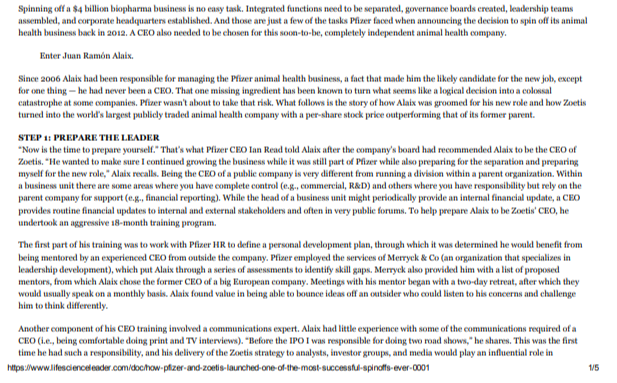
in teaching leaders how to lead. PepsiCo
offers one of the most dramatic examples of
this “leaders develop leaders” strategy. Roger
Enrico, PepsiCo’s CEO and chairman,
decided four years ago that he would be fully
involved in the design and conducting of the
company’s senior leadership program.
Enrico wanted to have PepsiCo conduct a
program which would be a watershed event
in the development of leaders with excep-
tional potential in the middle to upper level of
PepsiCo. He wanted the program to create the
mindset that the role of the leader is to add
value to the business and to use leadership
models and tools that would directly drive the
business. A competency model was used that
included three broad competencies:
1
Setting the Agenda
involved focusing on
results by responding to the customer and
developing intellectual skills to creatively
think outside the box.
2
Taking Others With You
involved develop-
ing others in your team and aligning the
leadership of the organisation to deliver
business results.
3
The third competency was
Doing It the
Right Way
which entailed respect for oth-
ers and using diversity effectively.
PepsiCo uses a very intense, five-day live-in
experience with Roger Enrico doing almost all
the teaching and facilitating of discussion over
the five days. Group size is small, around ten
people, so that a great deal of interaction with
the CEO occurs. Each session uses an action
learning format and, over the week, steps
through a model of leadership, managing
change, a vision for PepsiCo for the future and
individual feedback and counselling. Each
participant also receives a 360 degree feedback
report summarising an evaluation of their
leadership skills from their subordinates,
peers and manager. This is used as a basis to
have one-on-one sessions with Enrico during
the program. Each participant has two sepa-
rate sessions with the CEO in which they can
discuss any topics they wish from business
decisions to personal and career matters. The
evaluation of the PepsiCo program indicates
it is playing a powerful role in the success of
the company in the USA and overseas.
PepsiCo’s CEO is not the only leader highly
involved in developing other leaders. Andy
Grove of Intel is often involved in conducting
sessions with his managers on how to detect
turbulent shifts in the high technology indus-
try and how to navigate through them. He
believes that having leaders at all levels who
can spot trends and have the courage to act
will enable Intel to succeed while other com-
panies will falter (Cohen and Tichy, 1997).
General Electric uses their leadership
development programs conducted at its Man-
agement Development Centre as a pivotal
element toward achieving the company’s
strategic objective. These programs also
provide an opportunity for senior manage-
ment to remain in touch with the organisa-
tion – to understand its problems, moods and
commitment. Senior managers are actively
involved in conducting classes and question
and answer periods (Conger, 1992). Jack
Welch, CEO of General Electric, has partici-
pated in the GE Senior Leadership Program
for two weeks every year for 15 years and has
not missed a session. Welch conducts no-
holds-barred discussions which challenge
participants to think for themselves and to
hone their leadership instincts and skills. He
attributes GE’s extraordinary comeback,
from the fifth largest company in the world in
1972 to the largest company in the world in
1997 with over 175 billion dollars in assets, in
some ways to the thinking he has been able to
develop in these sessions (Tichy, 1993).
Shell has also learned to use the process of
leaders developing leaders as the basis for the
transformation of the organisation and for
delivering key business results. At the Shell
Learning Centre, leaders hear the story and
vision for the future of Shell along with the
individual teachable points from senior exec-
utives. They are taught how to translate this
into their own story relevant to their own
department and how to develop their own
teachable point of view. In this way, organisa-
tional transformation and business change is
cascaded down the entire organisation
(Cohen and Tichy, 1997).
At the beginning of a two-day leadership
development workshop, Chairman of Shell,
Cor Herkstroter taught a powerful lesson to
Shell executives by having them all write a
letter of resignation to the Committee of
[
196
]
Ron Cacioppe
Leaders developing leaders:
an effective way to enhance
leadership development
programs
Leadership & Organization
Dev elopment Journal
19/4 [1998] 194–198
Managing Directors explaining why they
would resign from Shell as it currently is
operating. This letter was unsettling and eye-
opening for the 50 Shell leaders, many of
whom had been with the organisation for
over 25 years. The leaders then went into
groups and summarised their combined
views. These summaries painted a clear pic-
ture of a major need for Shell to change to a
more dynamic and responsive organisation.
Herkstroter totally altered his managers’
view of the Shell world and provided an excel-
lent example of how a leader develops leaders.
This leaders developing leaders philosophy
is also being used in the new Masters degree
of Leadership and Management (MLM) at
Curtin University of Technology in Western
Australia. The MLM program makes a strong
effort to involve graduates and senior stu-
dents in teaching leadership skills to current
students. A specific example of this is in the
last year of their MLM program, students
have to design, raise revenue for and conduct
a three day leadership experience for leaders
from a wide section of the community. The
MLM students not only have a first hand
experience of their own leadership develop-
ment program but they have practical experi-
ence and knowledge as leaders of organisa-
tions. The old adage of “the best way to learn
something is to have to teach it” gives these
leadership students an opportunity to deepen
and test their understanding.
Relevance to other organisations
According to Paul Russell (1997), the vice pres-
ident of Leadership Development at PepsiCo
who helped design and conduct the PepsiCo
programs with Enrico, there are important
lessons and points from the PepsiCo program
that can be applied to other organisations
which wish to implement the idea of leaders
developing leaders in their own organisational
programs;
1
The company must have a senior leader
(or leaders) who the participants hold in
high regard and want to learn from – an
Icon. You need to find out who these people
are in the organisation by asking partici-
pants which senior leaders they would
value learning from in the organisation.
2
Senior executives must be coached on how
to facilitate and teach groups and to bring
out their own views and “teachable
points”. According to Paul Russell, on first
being approached many senior executives
indicate they do not have the time or the
skills to conduct sessions like these. After
a brief period, however, almost every man-
ager is quite pleased to be asked and very
interested in providing younger managers
in the organisation the benefit of their
experience.
3
The learning environment (e.g. informal
or formal, lecture or case study, etc.) must
fit the executive’s own style and personal-
ity, so that they feel comfortable in teach-
ing and interacting with the participants.
4
Some work is needed by a HR manager or
consultant to help the senior manager
make explicit what they have to teach.
This involves one or two sessions where
you need to ask a lot of questions, going
through their experiences and business
situations to develop a common approach
and finally to synthesise their learning
principles and frameworks. This does not
have to be perfect according to Russell but
has to have enough teachable points that
the executive can feel confident and clear
about what they are going to impart.
Russell also indicates that after a year or two
of involvement, some senior executives lose
the enthusiasm and may not have the time for
the commitment needed so other executives
will need to be coached into this role to keep
the program alive.
While some chief executive officers may not
have the time nor skills to conduct a leader-
ship development program on their own,
there are modified forms of this that can add
substantial value to existing leadership devel-
opment programs conducted by academics
and in-house HR specialists. For example,
case studies around actual past or current
business decisions can be developed which
involve the senior manager specifically. Par-
ticipants can be asked to read these and in
small groups decide how they would handle
this problem. The senior leader would then
facilitate a three- or four- hour discussion
exploring the approaches of the participants
and comparing them to the approach he or
she would adopt. The
Los Angeles Times
uses
a different version of this approach in their
leadership develop program by developing
“puzzles”, current problems or dilemmas,
that their senior managers are facing (e.g. to
close down a service, a human resource issue
involving ethics or discrimination of minori-
ties). Participants are asked to develop their
own solution and then discuss, debate and
defend these with senior executives (Hartley,
1997)
Another useful addition to the standard in-
house leadership development program is the
one-on-one coaching session that builds on
the 360 degree feedback process. This
involves a session with a senior executive
which might start with the key learnings that
arose from the 360 feedback process and
[
197
]
Ron Cacioppe
Leaders developing leaders:
an effective way to enhance
leadership development
programs
Leadership & Organization
Development Journal
19/4 [1998] 194–198
extend to a discussion of career paths, busi-
ness directions and anything else the partici-
pants need to discuss. A number of senior
managers may need to be involved in this role
in larger programs.
Why leaders need to make
the time
Noel Tichy (1997), professor and director of
the Global Leadership Program at the Univer-
sity of Michigan, has worked in both the G.E.
and PepsiCo leadership development pro-
grams and strongly encourages top leaders to
spend as much as one third of their time
developing the organisation’s leaders in for-
mal programs. Tichy puts forward three rea-
sons why senior managers should be
required to play a major role in leadership
development programs. First, successful
organisations are built on clear ideas, they
set a direction for everyone in the organisa-
tion, especially its managers, to follow. Dur-
ing the leadership development program,
participants are open to new ideas and direc-
tions. Hearing these from the top leaders of
the organisation gives power, support and the
thinking behind the new directions and
behaviours required. Second, senior leaders
as teachers in the program assess the chang-
ing realities of the ideas and amend them to
be relevant and fit the necessities of the cur-
rent environment. They can select ideas that
add significant value rather than have a wide
range of interesting ideas and topics which
are not directly applicable to the organisa-
tion. Third, they provide frameworks for the
decisions of managers at all levels. They give
a focus for common goals and actions which
can be implemented back in the work envi-
ronment.
Alan Mumford, Professor of Management
Development at International Management
Centres and one of the major authorities on
leadership development suggests that there
are many reasons why leaders should develop
other leaders. These include:
•
It brings personal satisfaction by helping
others grow.
•
Your own skills, knowledge and insight are
developed as a result of sharing experiences
with others.
•
Real business and personal problems can be
resolved as you are working on developing
others.
•
By improving the performance of others,
you are enhancing their ability to deal with
tasks you currently do, which can allow you
to pursue larger leadership responsibilities
(Mumford, 1993).
In addition to these reasons, the involvement
of senior leaders with middle level managers
helps integrate and link the two groups
together. Leadership programs are often
conducted independently for these two
groups and the process of leaders developing
leaders can help bridge gaps, clarify under-
standing and build commitment between
leadership groups.
In summary, using leaders to develop lead-
ers as a part of an in-house leadership devel-
opment program can add considerable value
with a minimum of effort and expense. It can
add a very positive component to leadership
development which can be effective for indi-
viduals, build leadership within and across
management groups as well as contribute to
the accomplishment of business objectives
and organisational change. It is an activity
that needs to be considered and introduced at
the appropriate time in the organisation. The
questionnaire provided in the Appendix to
this paper can help give your organisation an
idea of how ready it is to get leaders involved
in leadership development (see Appendix).
References
Cohen, E. and Tichy, N. (1997), “How leaders
develop leaders”,
Training & Development
,
May, Vol. 51 No. 5, pp. 58-73.
Conger, J. (1992),
Learning to Lead
, Jossey-Bass,
San Francisco, CA.
Hartley, J. (1997), “Working with executive man-
agement to help initiate, design and instruct
leadership development: a case study”,
Con-
ference Proceedings, The 2nd Annual Leader-
ship Development Conference
, Linkage Incor-
porated, pp. 241-70.
Industry Task Force on Leadership and Manage-
ment Skills (1995),
Enterprising Nation,
Renewing Australia’s Managers to Meet the
Challenges of the Asia-Pacific Century
, Com-
monwealth of Australia, Canberra, ACT.
Magerison, C.J. and Kakabadse, A.P. (1984), “How
American chief executives succeed”, AMA
Survey Report, USA.
Mumford, A. (1993),
How Managers Can Develop
Managers
, Gower, Aldershot.
Russell, P. (1997), “The PepsiCo leadership center:
how PepsiCo’s leaders develop leaders”, C
on-
ference Proceedings, The 2nd Annual Leader-
ship Development Conference
, Linkage Inc.,
pp. 97-138.
Tichy, N. (1993),
Control Your Own Destiny or
Someone Else Will : How Jack Welch is making
General Electric the World’s Most Competitive
Company
, Doubleday, New York, NY.
Tichy, N. (1997), “The leadership engine: how
winning companies create leaders at all lev-
els”,
Conference Proceedings, The 2nd Annual
Leadership Development Conference
, Linkage
Inc., pp. 57-81.

[
198
]
Ron Cacioppe
Leaders developing leaders:
an effective way to enhance
leadership development
programs
Leadership & Organization
Dev elopment Journal
19/4 [1998] 194–198
Appendix: how ready are your leaders to
develop leaders?
The following questionnaire can help you
establish how ready your senior leaders are
to developing other leaders in your organisa-
tion. It will also give an indication as to how
much leader developing leadership activity
you are already doing.
Circle the extent that you feel each of the
following is happening in your organisation
at this time. Then add the numbers you cir-
cled on each question to get a total score and
interpretation.
Definitely not
(0)
Little or Not certain (2)
Some (4)
A fair amount (6)
A great deal (8)
Completely (10)
1
This organisation has some type of organ-
ised leadership development program.
0 2 4 6 8 10
2
Our senior executives show a strong inter-
est in the objectives and content of our
leadership development program.`
0 2 4 6 8 10
3
There are a number of senior executives in
organisation who lower level managers
would enjoy and find worthwhile learning
from.
0 2 4 6 8 10
4
This organisation gives adequate money,
resources and thought to leadership devel-
opment.
0 2 4 6 8 10
5
The chief executive spends time discussing
participating in leadership development.
0 2 4 6 8 10
6.
Senior executives are willing to give time
to coach our middle level managers
0 2 4 6 8 10
7.
Senior executives have a clear idea of the
organisational vision and values which
they can communicate and teach to our
managers.
0 2 4 6 8 10
Total Score _____
Interpretation
56-80
– Congratulations. Your organisation
is already doing a lot of leaders developing
leaders. See if you can find ways to improve
the effectiveness of what you are already
doing.
31-55
– It appears you have the ability and the
potential to introduce a leader developing
leader segment or extend what you are
already doing in your leadership develop-
ment programs. You just need to spend time
to clarify how you will do it, who will do it
and when you will begin this process.
0-30
– The area of leadership development
has not been given much attention or thought
in your organisation. First ask if leadership
development is needed in this organisation,
how do we want to develop leaders and how
much resources and time are you willing to
devote to the process. The leaders of the
organisation will need to answer these ques-
tions before they can begin to teach your
managers how to be leaders.