Introduction
In 1971 Seattle, Washington the first Starbucks café was opened by three partners across the
street from the historic Pike Place Market in Seattle.”
Starbucks is named after the first mate
in Herman Melville’s “Moby Dick.” Our logo is also inspired by the sea – featuring a
twin-tailed siren from Greek mythology.” Starbucks company profile
few years later in 1980 one of the partners decided to pursue other interests and left the
two remaining partners .In 1982 Howard Schultz, a sales representative for Hammarplast
company join Starbucks as the head of the marketing, In 1983, Howard had a journey to Italy
and impressed with Italian coffee bars and the romance of the coffee experience. He had a
vision to bring the Italian coffeehouse tradition back to the United States. A place where you
can spend time in comfort and a good feeling and to break the routine of work and house.
He left Starbucks for a short period of time to start his own Il Giornale coffeehouses and
returned in August 1987 to purchase Starbucks with the help of local investors. Starbucks
soon became the largest coffee-house chain in the world with 28720 stores as of July
1,2018.
Starbucks Company Time line:
1971 First store in Seattle
1982 Howard Schultz Joins Starbucks as head of retail operation and marketing.
1987 Starbucks opens the 17
th
branch.
1988 Starbucks offers health benefits to full and part time workers.
1994 total stores are 425
1996 Starbucks open the first store outside North America in Japan and then in Singapore
and reached 1015 stores.
1998 starbucks.com launched, open new areas stores in New Zealand, Malaysia, Taiwan,
Thailand and UK
1999 open in China, Kuwait, Lebanon and South Korea and reached 2498 stores.
2000 Howard Schuitz be a chairman and chief global strategist, new stores opens in
Australia, Hong Kong, Bahrain, Saudi Arabia, Qatar and United Arab Emirates and reach 3501
stores.
2002 a new stores opens in Germany,Greece, Indonesia, Mexico Oman, Puerto Rico and
Spain.
2003 “Opens roastingfacilityinCarsonValley, Nev., and Amsterdam,Netherlands. Opens new
stores in: Chile,Cyprus,PeruandTurkey”
2004 first farmer support center opened and a new store in France and total stores reach
8569.
2005 Starbuck opens 10241 stores by opening in Bahamas Jordan and Ireland.
2006 brazil and Egypt stores opend to reach 12440 store
2007 Romania and Russia stores ,total stores 15011.
2008 Chairman Howard Schultz became a chief executive officer, new stores in Argentina,
Czech Republic, Bulgaria and Portugal and stores became 16680.
2009poland and Aruba
2010 opens in Hungary and Salvador total stores are16858
2011 Farmer support center opened in Mbeya, Tanzania and more stores in Guatemala,
Curacao and Morocco to reach more than 17000 stores.
2012 Opens Farmer Support Centers in Manizales, Colombia and Yunnan, China. And stores
in Costa Rica India Finland and Norway store number 18066.
2013 stores open in Vietnam and Monaco
2014 Launch Starbucks mobile order & pay, open stores in Brunei and Colombia total stores
21366.
2015 Commits to hire 10,000 opportunity youth by 2018, panama stores open to reach
22519 stores worldwide.
During the time Schultz grow Starbucks from 11 stores to more than 28000 outlets around
77 countries and during this time Starbucks delivered 21000% gain in stock price value and
at the same time he concentrates on the people who work for Starbucks.
“I set out to build a company that my father, a blue-collar worker and World War II veteran,
never had a chance to work for,”
Schultz
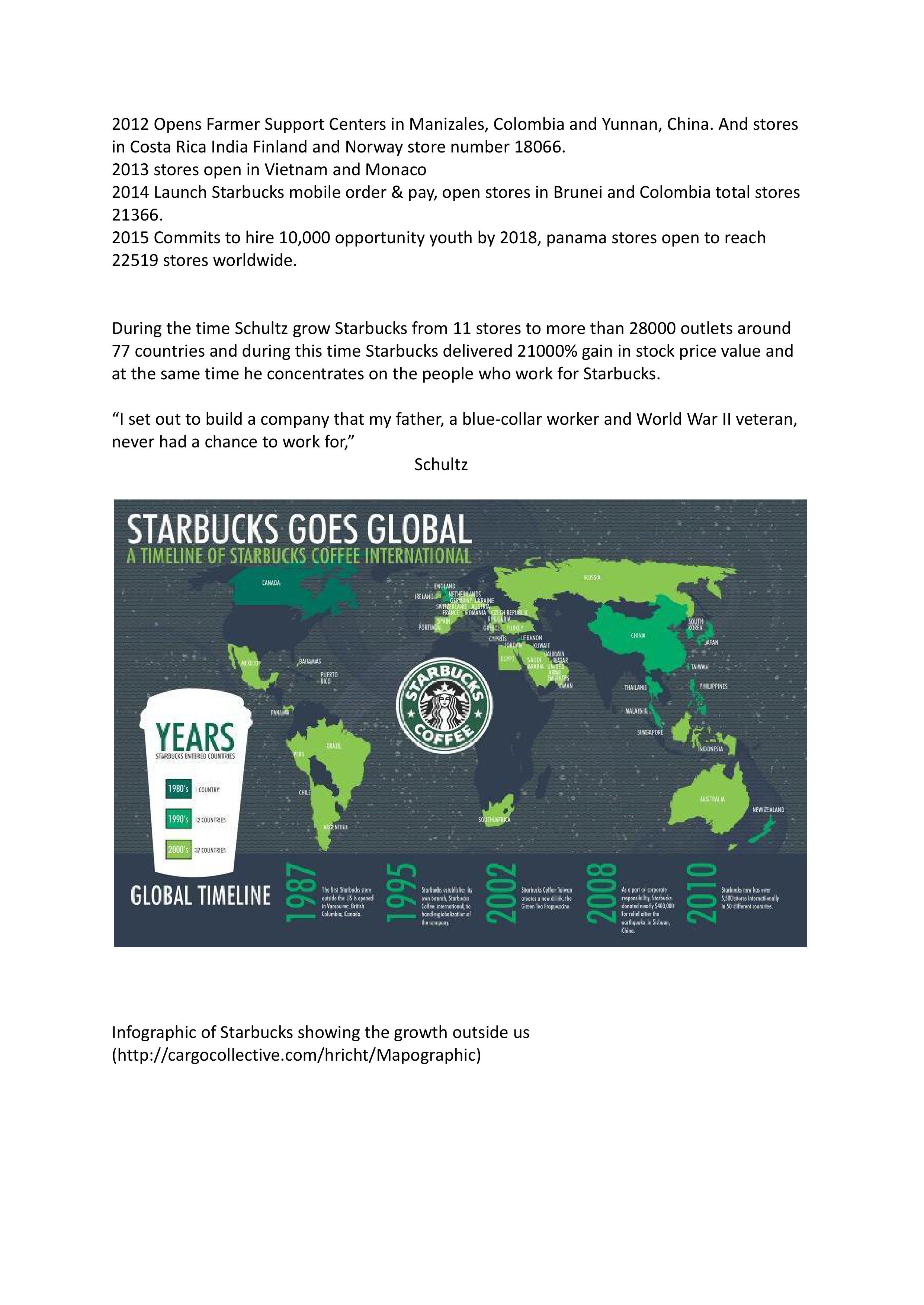
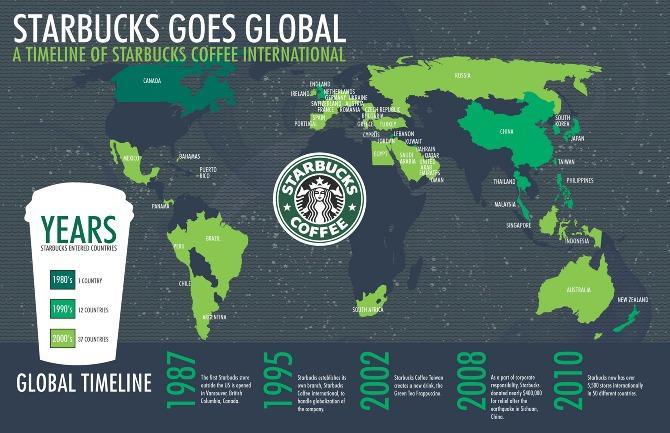
Infographic of Starbucks showing the growth outside us
(http://cargocollective.com/hricht/Mapographic)
Management and leadership
Since start of humanity the cooperation of people was very important to overcome most of
the problems facing them but to be more efficient they have to be organized to some extent
and for this people start depending on the older or the stronger to lead the rest.
leadership can be defined as the ability of some to drive people to reach a goal or
accomplish a task (Robbins, 2005), so many of researchers differentiate between the
management and leadership as the management is not about the ability but its more about
organizing the process of work then make the management definition “Management is the
organizational process that includes strategic planning, setting objectives, managing
resources, deploying the human and financial assets needed to achieve objectives, and
measuring results. Management also includes recording and storing facts and information
for later use or for others within the organization. Management functions are not limited
to managers and supervisors. Every member of the organization has some management and
reporting functions as part of their job” (Knowledge Management Terms, 2009)
with the time more studies and research run on management and how to improve the ways
which leads to more benefits from workers so different theories of management appears in
the last century They include the classical scientific management theory, the administrative
management theory, the behavioral management theory, and the organizational
environment theory.
1.
Classical management theory:
The classical management theory was made by F.W. Taylor and Henri Fayol who is claimed to
be the real father of modern management, he suggested 14 principals to be the general
principals management:
●
Division of work: is to give everybody a specific role during the work or
manufacturing process, this principle was expressed as a necessary factor in efficient
use of labor.
●
Discipline: is the respect of agreement between firm and its employees.
●
Authority and responsibility: the wright to give orders will combined with
responsibility.
●
Unity of command: the employee should receive orders from one supervisor.
●
Unity of direction: One head and one plan for each group of activities with the same
objective.
●
Subordination of individual interests to general interest: the manager should manage
the individual interests to not affect the general interest.
●
Remuneration of personnel: the payment should be fair and satisfied for both
employee and employer.
●
Centralization: it depends on the size of the company or organization.
●
Scalar Chain: the line of authority from the highest rank to the lower of the company.
●
Order: Arranging the persons and things in the right place.
●
Equity: treating all employees with justice and kindness.
●
Stability of tenure of personnel: managers and employees need a time to find
stability in new jobs.
●
Initiative: all levels of workers should be given a chance to show initiative in
controlled levels.
●
Esprit de corps: Team work is the main reason of success and should be encouraged.
2 Bureaucracy:
A theory which developed by a German sociologist called Max Weber when he tried to find
out why the employees follow orders from a higher rank supervisors and managers, the
bureaucratic administration system is consists of 5 principles areas:
a)
Managers formal authority which is the power body to role and manage people
and actions and to make decisions depend on the variables.
b)
The positions should be arranged from top to bottom in a system which each
employee should know whom to report to.
c)
The authority and tasks should be clear depend on the positions for managers
and workers.
d)
There should be a clear system of rules and standard operation system to control
the organization.
e)
Promotion and raze should not base on sentiment but on function and
competency.
Leadership theories and styles
:
Leadership researches and literature conclude that theories have been modified and refined
throughout the time and none of them is completely irrelevant, main theories that emerged
during last century including:
a)
Great man theory.
b)
Trait theory:
This theory built on belief that the leaders born with certain capabilities and trait
and personality characteristics differ them from non-leaders.
c)
Contingency theories:
Also known as situational theory and it shows that there is no single way to lead
and the right way is depending on the situation and the leader should adapt to
that situation.
d)
Style and behavior theory.
e)
Process leadership theory.
f)
Transactional theory.
g)
Transformational theory.
Leadership Styles:
a)
Transactional style: comprises three components, contingent reward which focuses
on achieving results, Active management by exception and this style focus only on
achieving target and does not try to make employees to achieve beyond expectation,
passive management by exception where the leader will not interfere unless the
things went wrong.
this style of leadership focuses on results and measures the success or fail depend
on the company system of rewards and penalties.
The transactional leaders showing some characteristics like the mainly focus on short
term goals not long term, restricts on follow the rules and doing the task on write
way and they are mainly inflexible and they are preferred following structured
policies and procedures.
Advantages and dis advantages:
The advantages of transactional leadership style that they will reward who will follow
the instructions, they always achieve short term goals rapidly the most important
that rewards and penalties are clearly stated for employees. on the other hand the
disadvantages are they reward employees on a practical level only, the transactional
style will not allow workers creativity because the goal and the process to follow are
already set.
b)
Transformational Leadership Style:
With the belive that the arrangements and theories of the past should not be the
guide for leadership in the current or future the resarchers confidence in
transformational leaders to create visions for the future, unlike transactional
transformational leaders belive in human power to make the difference and they
concentrate on vision , long term goals and on create a different system according to
the task.
This style was linked with good outcomes from workers because it inspires them to
work for and achieve remarkable results, the transformational leadership has three
dimensions:
Idealized influence when a manager or leader earns respect the workers will be
ready to change if required in any task.
Inspirational Motivation: the positive attitude of the leader will reflect on workers
teamwork.
Individualized Consideration: with understanding the difference between workers
the addressing and resolving the problems will be easier.
In 2010 Mc Shane & Van Glinow show that the personal characteristics and traits of the
leader will draw the leadership competencies of the person, so the different dimensions of
leadership can be divided as
1)
Personality.
2)
The background and the beliefs of the leader.
3)
Drive.
4)
Impartiality and honesty.
5)
Motivation
6)
The knowledge of the business.
7)
Practical and emotional intelligence.
Leadership principle apply in Starbucks Company:
Starbucks released a statement about their leadership reads: “Through our unwavering
commitment to excellence and our guiding principles, we bring the unique Starbucks
Experience to life for every customer through every cup.”
Joseoh Chris said according to that statement he believes Starbucks leadership style is
Servant leadership, the servant leadership is a movement launched by Robert Greenleaf in
1970 when he published his assay the servant as leader he built his theory on the concept of
if you want to be served serve first or in other words give the worker a good conditions and
he will work perfectly.
Servant leadership:
●
It works well in diverse workplace because it allows the personalized management
and serve every part of the work team.
●
It breeds loyalty because the staff need is coming first.
●
It encourages involvement opening the door foe the employees to share their
opinions in simple and important matters.
●
Promotes Productivity as a result of the up three points the outcome will be
productivity of the staff.
Howard Mark Schultz, a writer and businessman and he is the chairman and CEO of
Starbucks coffee company which is know the world largest coffee house.
“
Our mission: to inspire and nurture the human spirit – one person, one cup and one
neighborhood at a time.”
(Starbucks mission statement 2013)
The Starbucks name is now synonymous with coffee and the growth of the brand name and
the company from a small cafe shop in Seattle to a word wide brand is nearly impossible
without Howard Schultz strong management system and innovations .according to theory of
leadership formulated in 1978 there are two types of leaders transactional and
transformational, Howard Schultz is following the transformational leading style by inspire
Starbucks team and encourage the employees as individuals to develop and to calibrate with
the team to reach the general objectives and under his leadership he treated the employees
as partners and treat them with respect and dignity the company also providing a flexible
working hours.
Joseph Chris in his blog 7Howard Schultz leadership style principles write about what makes
Howard Schultz the type of leader he was and give 7 reasons:
●
He believes in hiring the right people In one of the interview with Howard Schultz, he
explicitly talked about his believe in hiring the people who will work hard to reach
the best results and he stated that his company will contribute in development of
these people.
●
He sticks with being consistent in delivering products and services: regardless the
branch you use to buy your coffee blends, sandwiches or hot boxes you will always
get the same perfect product tasty and fresh.
●
He really cares about his employees by hearing them and fast response to their
problems, also offering a tuition benefits and flexible shifting schedules.
●
He respects cultures and encourage diversity, because of different locations and
cultures we will find different appearance and store design.
●
He has a mission and vision: Howard stated in interview that his main passion is to
build a company focusing mainly on treat employees with respect and dignity.
“When we began Starbucks, what I wanted to try to do was to create a set of values,
guiding principles, and culture.”
Howard Schultz (2007)
●
He believes in the importance of partnerships: the best way to achieve goals of brand
is with parented with the right team.
●
He knows the importance of knowing employees and customers.
in his book,
Pour Your Heart into It
. Accordingly, Howard Schultz mentioned that: “If I hang
my hat on one thing that makes Starbucks stand out above other companies, it would be the
introduction of ‘bean stock. With it we turned every employee of Starbucks into a partner
…
My goal was to link shareholder value with long-term rewards for our employees. I wanted
them to have a chance to share in the benefits of growth, and to make clear the connection
between their contributions and the growing value of the company. (Daniels, 2003)” that’s
why many researchers argue that his leadership style is based on being gentle, considerate,
caring and taking care of his employees
conclusion
throughout the time the difference of management and leadership styles gives different
outcomes either good or bad, the leadership style practiced by Howard Schultz was the main
reason for the huge development of Starbucks during the 4 decades of this presence there
and he proof that as much as leader take great care of the workers they will take good care
of the customers in return, so Howard Schultz bring the best of the people oriented
leadership style and give the good care of the employees which help to bring amazing
growth of the company.
Prefrences:
●
AN ANALYSIS OF HOWARD SCHULTZ’S LEADERSHIP STYLE (OCTOBER 2016)
http://businessessays.net/human-resources-management/an-analysis-of-howard-sch
ultzs-leadership-style/
●
Chris,Joseph (2015)7 Howard Schultz Leadership Style Principles available at
http://www.josephchris.com/7-howard-schultz-leadership-style-principles accesed
(31 June 2018)
●
Cole, Gerald A.
Custom Management Theory and Practice
. Cengage Learning UK,
2017-03-17. VitalBook file.
●
Daniels, C. (2003, April). Mr. coffee. Fortune, 147(7), 139-140.
●
Knowledge Management Terms. (2009, January 20). from Stuhlman Management
Consultants: http://home.earthlink.net/~ddstuhlman/defin1.htm (accessed 1st Aug
2018)
●
Mahfooz ,A THE THEORY OF BUREAUCRACY OF MAX WEBER, MERITS AND DEMERITS
available :
https://www.academia.edu/23173795/THE_THEORY_OF_BUREAUCRACY_OF_MAX_
WEBER_MERITS_AND_DEMERITS accessed (2 august 2018)
●
Mind Tools Editorial Team / Elizabeth Eyre(November 2010)Henri Fayol's Principles
of Management Early Management Theory ,
https://www.mindtools.com/pages/article/henri-fayol.htm accessed (2 August 2018)
●
McShane & Von Glinow. (2010). Organizational Behavior: emerging knowledge and
practice for the real world (5
th
ed.). McGraw-Hill: New York.
●
Robbins, S. P. (2005).
Organizational Behavior,
11
th
ed., Pearson Prentice Hall, Upper
Saddle River, NJ.
●
Starbucks Company Profile (July 2018) available at
https://news.starbucks.com/uploads/documents/AboutUs-Company_Profile-7.26.18.p
df accessed (3
Aug 2018)
●
Starbucks company timeline available at
https://news.starbucks.com/uploads/documents/AboutUs-Timeline-1.25.18.pdf
accessed (4 Aug 2018)
●
St THOMAS UNI, What is Transactional Leadership? How Structure Leads to
Results (may 2018) available at
https://online.stu.edu/articles/education/what-is-transactional-leadership.aspx#style
Accessed (2 Aug 2018)
●
The Howard Schultz quote is from the book titled,
It’s Not About the Coffee: Lessons
on Putting People First from a Life at Starbucks,
by Howard Behar, The Penguin
Group, 2007
.
●
UKEssays. November 2013. Starbucks' Leadership Development. [online]. Available
from:
https://www.ukessays.com/essays/management/leadership-principle-apply-in-starbu
cks-company-management-essay.php?vref=1 [Accessed 4 August 2018]
●
Zakeer,A & Nawaz, A & Khan ,I (2016) “Leadership Theories and Styles: A literature
Review” Journal of Resources Development and Management available
https://www.researchgate.net/profile/Allah_Nawaz/publication/293885908_Leaders
hip_Theories_and_Styles_A_Literature_Review/links/56bcd3ad08ae9ca20a4cdea2.p
df accessed (30 July 2018)