

Business Perspectives and Research
1–11
© 2024 KJ Somaiya Institute of Management
Article reuse guidelines:
in.sagepub.com/journals-permissions-india
DOI: 10.1177/22785337241233035
journals.sagepub.com/home/bpr
Case Study
Navigating Change and Adversity: A
Case Study of Netflix’s Journey
Syamala Devi Challa
1
and Lalatendu Kesari Jena
2
Abstract
On March 14, 2022, Netflix’s shares were down to more than 50% by losing all its pandemic gains.
Investors have faced the biggest loss; even big companies have withdrawn their shares from Netflix.
The founders of Netflix, led by Reed Hastings and pioneered by Marc Randolph, were in trouble.
Though Randolph pioneered Netflix, Reed Hastings, the co-founder and the most decisive leader of
Netflix, has played a prominent place in its growth. He has been serving Netflix for two decades, and
his leadership tactics have helped it to serve in critical times like COVID. The journey of Netflix from
inception to today has involved leadership lessons, tactics, and change initiatives. The role of Hastings
in every change is also notable for the growth of Netflix. Though the change is for the improvement
of the company, all the changes would not give fruitful results. The team Hastings adaptation and
customization of changes were remarkable. The growth of Netflix can be divided into three phases:
Before, during, and after COVID-19, depending on the change initiatives taken by the company. The
changes adopted before and during COVID have made Netflix a top brand in the streaming zone. But
due to present losses, there is a quest for the next act in the company to recover the market share;
otherwise, the future of Netflix would be questionable.
Keywords
Change management, COVID-19, cross-cultural, organizational management, partnership change
Introduction
On March 14, 2022, Netflix’s shares were down to more than 50% by losing all its pandemic gains.
Investors have faced the most significant loss; even big companies have withdrawn their shares from
Netflix. The efforts of Marc Randolph and Reed Hastings, the founders of Netflix, were in trouble.
Though Randolph pioneered Netflix, Reed Hastings, the co-founder and the most decisive leader of
Netflix, has a prominent place in its growth. He has been serving Netflix for two decades, and his
leadership tactics have helped it to serve in critical times like COVID. The journey of Netflix from
1
Kallam Haranadhareddy Institute of Technology, Guntur, Andhra Pradesh, India
2
School of Human Resource Management, XIM University, Bhubaneswar, Odisha, India
Corresponding author:
Lalatendu Kesari Jena, School of Human Resource Management, XIM University, Bhubaneswar, Odisha 752050, India.
E-mail: lkjena@xim.edu.in

2
Business Perspectives and Research
inception to today has involved leadership lessons, tactics, and change initiatives. The role of Hastings
in every change is also notable for the growth of Netflix. Though the change is for the improvement of
the company, all the changes would not give fruitful results. The team Hastings adaptation and
customization of changes were remarkable. The growth of Netflix can be divided into three phases:
Before, during, and after COVID-19, depending on the change initiatives taken by the company. The
changes adopted before and during COVID have made Netflix a top brand in the streaming zone. But
due to present losses, there is a quest for the next act in the company to recover the market share;
otherwise, the future of Netflix would be questionable.
Netflix Inc.
Founded in 1997 in California, USA, by Marc Randolph and Reed Hastings, Netflix is a massive media
service with a significant impact on the media and entertainment sectors. The company details are presented
in Table 1. Every huge corporation began as a tiny encounter or concept. Netflix’s innovative path also began
with a novel concept. The idea for the business model of Netflix was originated by Reed Hastings when he
paid a late fee for a movie rental. His thoughts regarding a subscription-based business plan where clients may
rent movies without worrying about late penalties were sparked by this encounter. As DVDs would be shipped
to the clients via mail, the initial idea of Hastings and Randolph has eliminated the need for physical rental
stores and late fees associated with traditional video rental services. Netflix set itself apart by employing a
recommendation system that examined customers’ viewing preferences to make recommendations for other
films they would like to watch. This personalized recommendation system became a key feature of the service.
Initially, customers are allowed to pay to rent a DVD for seven days. Later, the company set a monthly rent to
access an unlimited number of DVDs. This feature is limited to three DVDs at a time, and once a DVD has
returned, the company will mail the next movie as per the customer’s account list. Marc Randolph served as
the first CEO of the company from its establishment in 1997 until 1999 when Reed Hastings, the other
co-founder, took over as CEO. Randolph and Hastings were involved in getting Netflix its first round of
investment. Their ability to attract investment played a crucial role in the company’s early development and
expansion. Randolph’s leadership during the early stages helped establish the foundation of the company. He
had a hand in creating Netflix’s original business plan, which aimed to upend the established video rental
industry. The idea of a subscription-based DVD-by-mail service, removing late fees and offering clients an
easy way to rent movies contributed to Netflix’s early success. In 2004, Randolph departed the corporation
Table 1.
Details About the Company.
Company Description
Company name
Netflix
Founded
August 1997
Founders
Reed Hastings and Marc Randolph
Headquarters
Los Gatos, California, United States
Total employees
12,800 (2022)
Total subscribers
223.09 million (2022)
Products
Physical media and streaming
Tagline
To entertain the world
Logo
Challa and Jena
3
entirely, handing over all of his responsibilities to Hastings. The role of Hastings is significant as a CEO and
a versatile leader in the success of Netflix.
Hastings has filled Netflix’s catalog with unique content of independent films, documentaries, and
others unavailable in other sources. This is possible through the efforts of Hastings’s team through
aggressive marketing campaigns, alliances with movie studios, and other strategic moves. In 2007, the
business permitted users to download movies and TV series as streaming files. The success milestones
of Netflix are shown in Table 2. The business entered Canada in 2010 as part of its first overseas growth.
Additionally, it works in nations where the media is controlled, like China, where it has an arrangement
with Baidu-owned “iQiYi” for the first streaming of Netflix content. Netflix’s international paid
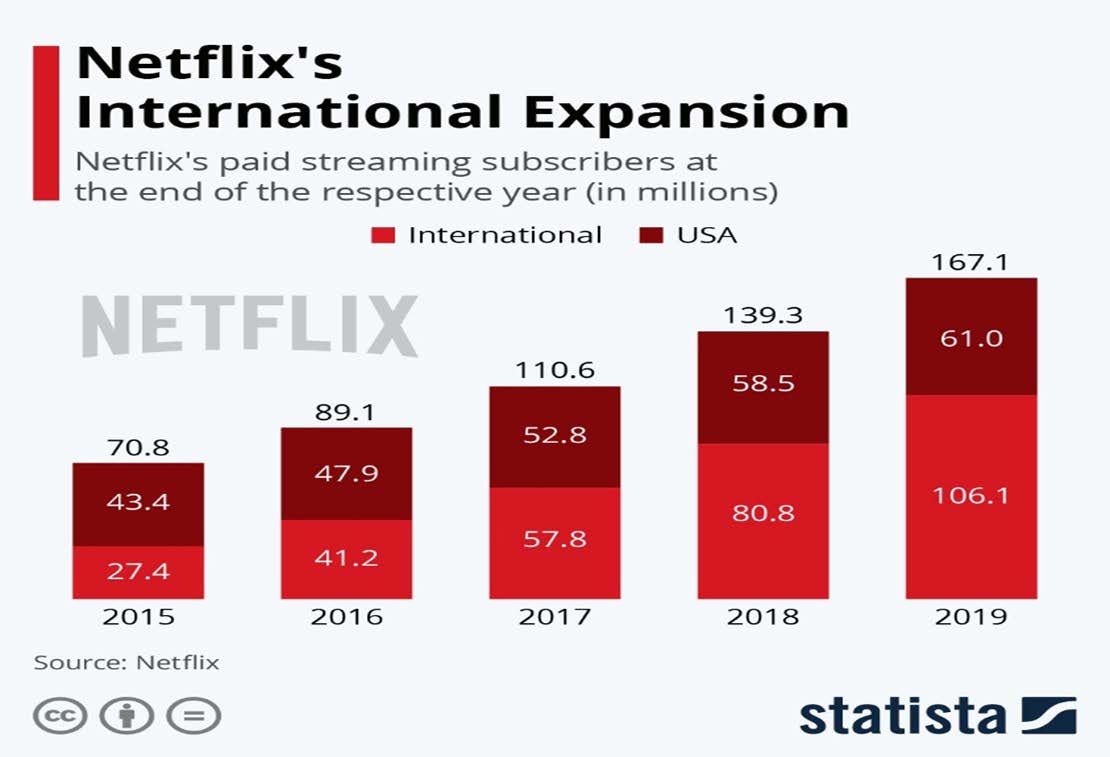
streaming subscribers are shown in Figure 1. In 2011, Hastings took a misstep that made Netflix its
downfall and created an entry step for the change initiatives.
The Phase Before COVID-19
Initial Challenges
Netflix has failed tire countless numbers of times. While Netflix has been incredibly successful, like any
large company, it faces ongoing entrepreneurial challenges and dilemmas. There are two main causes of
Netflix’s downfall:
Table 2.
Netflix’s Milestone of Success.
Development from 1990 to 2000
Development from 2001 to 2010
Development from 2011 to 2020
1997
: Netflix was initiated, domi-
nating entertainment rental during
this time
1998
: With the establishment of
Netflix.com, it explored offering
DVD rental and sales in the initial
period
1999
: Online subscription initiative
started by Netflix
2001
: Netflix began a relation-
ship with Best Buy with network
advertising
2002
: A significant change occurred
during this period; Netflix became
Netflix, Inc. from Netflix.com and
the company was making it public
2003
: Attains yet has the initial
successful share among 1 million
viewers
2005
: The company focused on
viewing patterns and reviews. It
also started creating suggestions
for audiences for better subscrip-
tions
2006
: The company did well and
became financially viable
2010
: The company stopped DVDs
and launched a broadcasting pack-
age that allows free streaming.
With its popularity, the streaming
business gradually extends from
Canada to the United States
2012
: Netflix started making origi-
nal shows
2015
: Netflix increased its reach to
50 countries
2017
: In this phase, Netflix gained
popularity and climbed century mil-
lion viewers
2018
: Netflix invests hugely in
productions and produces several
TV shows, original movies, and
iterations of movies. For this, it
has been nominated for 112 Emmy
Awards
2019
: Netflix’s popularity grows to
190 countries
2020
: A drastic change in its
percent market share of online
streaming due to COVID-19.
Netflix has a 26.6% market share
till February 2020, but after March
2020, its popularity and share
burst due to the lockdown (stay at
home)
4
Business Perspectives and Research
1.
Strategy failure
2.
Management and leadership failure
The Biggest Challenge (Strategy Failure)
In the year 2011, Netflix was just about to collapse. Stock prices dropped by 80%; most critically,
businesses lost almost 800,000 clients within a year. The cause is Reed Hastings’ choice to divide their
$10 into two distinct plans that each cost $8 in a single bundle. Netflix’s user base has not accepted this
60% price increase. He also specified that the DVD services could be operated with the name “Qwikster,”
which specifies the company’s intention of quick delivery. Hastings details the reason for the division
was that rental and streaming services are two different services with exclusive benefits. According to
him, each business has a different pricing structure, potential for demand, and growth.
Along with dividing the business, Hastings also modified its pricing strategy, doing away with the
previous one that required users to pay a $7.99 subscription fee to access all of the streaming and DVD
content. They split the updated pricing plan’s DVDs and streaming provisions, requiring customers to
pay $7.99 for each service. This meant the customer could avail of a single service at $7.99 or $15.98.
The initiative was implemented because the company had limited stock and access to DVDs needed to
be increased due to increased license charges for DVD owners to distribute their content.
Figure 1.
The International Expansion of Netflix.
Source:
Statista 2020.
Challa and Jena
5
Management and Leadership Failure
Although Netflix’s whole business strategy was centered on subscriptions, the firm broke one regulation
that customers connected to the company. Hastings betrayed the trust of the audience by dividing its
clientele into DVD viewers and online streamers. When any critical change must be taken in an organization,
one must consider the company’s credibility with the stakeholders (Hamada, 2010). To introduce change,
management must have a proactive approach and estimate the problems and risks associated with the change
(Martin & Fellenz, 2010). Hastings failed to create a proactive approach to make customers accept the change.
The management thought the two services needed different marketing strategies and pricing models. The
decision was stated to the customers just one month before the implementation. Thus, they would not find
enough time to understand the change made by Hastings. Customers felt the price was high for the individual
service as Netflix did not have their content then. However, Hastings reversed the company’s decision by
dissolving Qwikster and re-integrated both services after facing condemnation from various quarters.
Change Initiatives Were Taken to Overcome Challenges
After facing the biggest challenge in 2011, the Hastings team started producing original shows. Lilyhammer
was the first program, and House of Cards debuted in 2013. Later, it became one of the best streaming
services for original content by producing over 1,900 originals. Squid Game and The Crown have been
extremely popular and won many awards. The cost of acquiring and producing original content is one of
the ongoing challenges for Netflix. A significant investment is needed to secure high-quality content that
draws and keeps members in the increasingly competitive streaming market. Balancing the need for a
diverse and attractive content library with cost management is an ongoing dilemma.
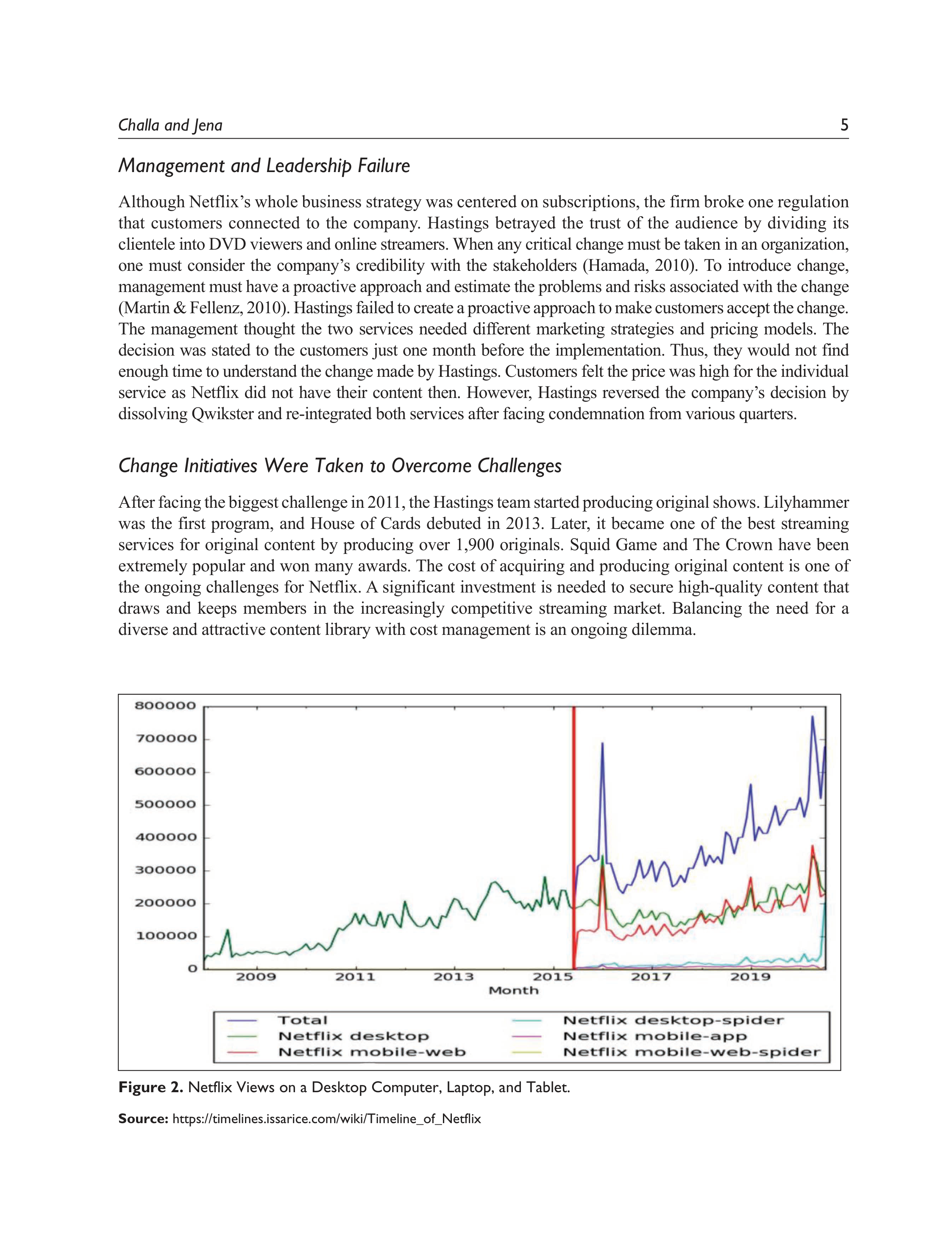
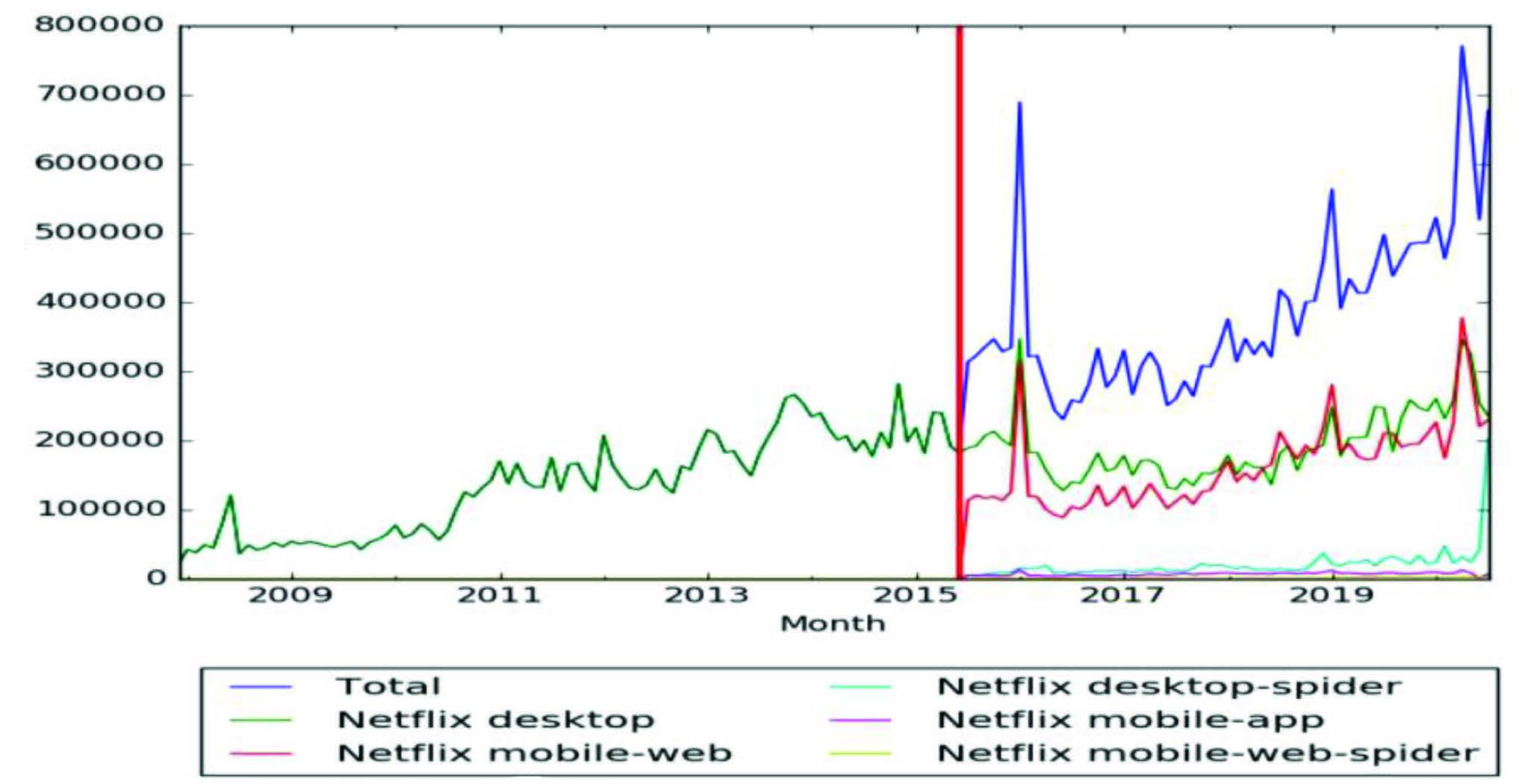
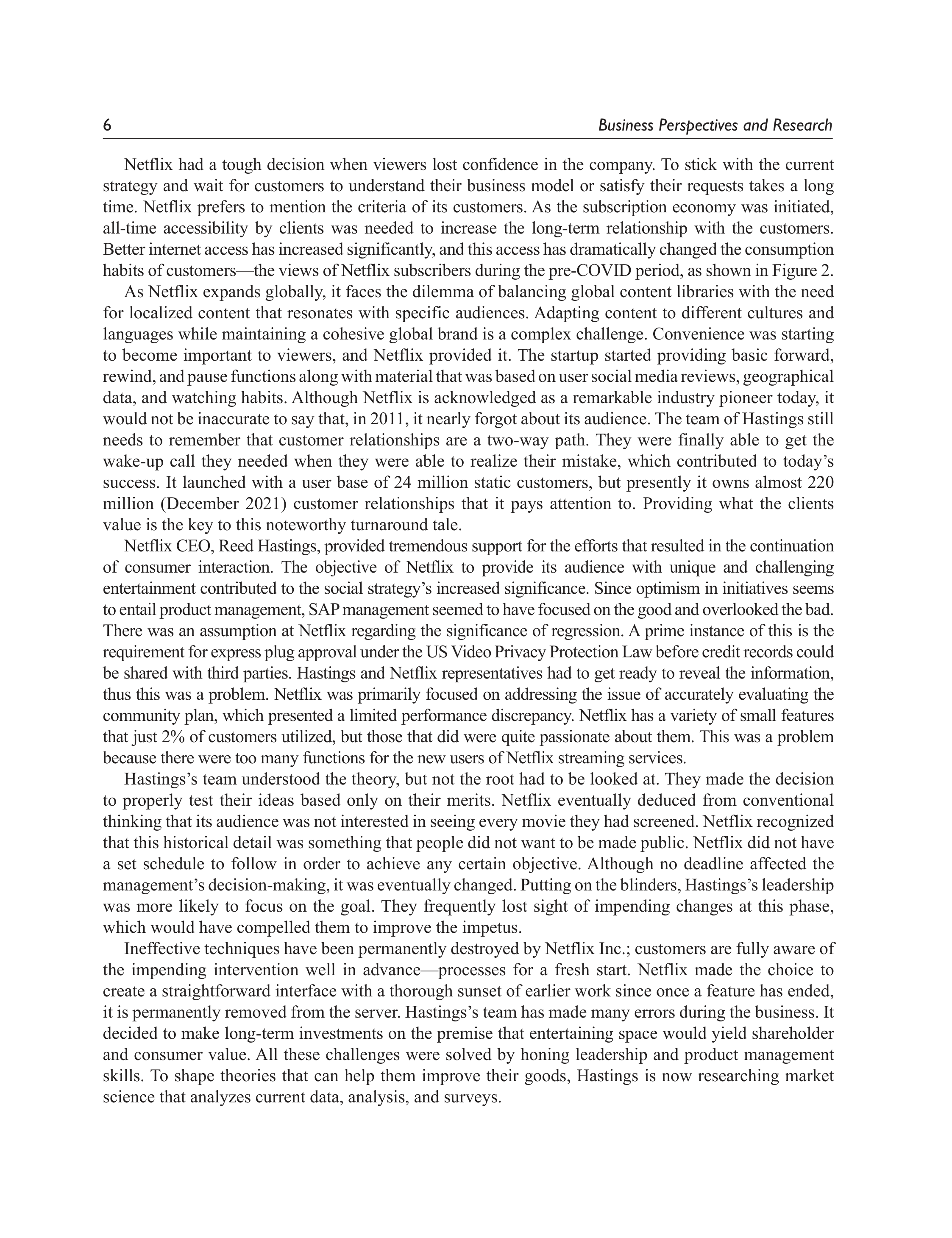
Figure 2.
Netflix Views on a Desktop Computer, Laptop, and Tablet.
Source:
https://timelines.issarice.com/wiki/Timeline_of_Netflix
6
Business Perspectives and Research
Netflix had a tough decision when viewers lost confidence in the company. To stick with the current
strategy and wait for customers to understand their business model or satisfy their requests takes a long
time. Netflix prefers to mention the criteria of its customers. As the subscription economy was initiated,
all-time accessibility by clients was needed to increase the long-term relationship with the customers.
Better internet access has increased significantly, and this access has dramatically changed the consumption
habits of customers—the views of Netflix subscribers during the pre-COVID period, as shown in Figure 2.
As Netflix expands globally, it faces the dilemma of balancing global content libraries with the need
for localized content that resonates with specific audiences. Adapting content to different cultures and
languages while maintaining a cohesive global brand is a complex challenge. Convenience was starting
to become important to viewers, and Netflix provided it. The startup started providing basic forward,
rewind, and pause functions along with material that was based on user social media reviews, geographical
data, and watching habits. Although Netflix is acknowledged as a remarkable industry pioneer today, it
would not be inaccurate to say that, in 2011, it nearly forgot about its audience. The team of Hastings still
needs to remember that customer relationships are a two-way path. They were finally able to get the
wake-up call they needed when they were able to realize their mistake, which contributed to today’s
success. It launched with a user base of 24 million static customers, but presently it owns almost 220
million (December 2021) customer relationships that it pays attention to. Providing what the clients
value is the key to this noteworthy turnaround tale.
Netflix CEO, Reed Hastings, provided tremendous support for the efforts that resulted in the continuation
of consumer interaction. The objective of Netflix to provide its audience with unique and challenging
entertainment contributed to the social strategy’s increased significance. Since optimism in initiatives seems
to entail product management, SAP management seemed to have focused on the good and overlooked the bad.
There was an assumption at Netflix regarding the significance of regression. A prime instance of this is the
requirement for express plug approval under the US Video Privacy Protection Law before credit records could
be shared with third parties. Hastings and Netflix representatives had to get ready to reveal the information,
thus this was a problem. Netflix was primarily focused on addressing the issue of accurately evaluating the
community plan, which presented a limited performance discrepancy. Netflix has a variety of small features
that just 2% of customers utilized, but those that did were quite passionate about them. This was a problem
because there were too many functions for the new users of Netflix streaming services.
Hastings’s team understood the theory, but not the root had to be looked at. They made the decision
to properly test their ideas based only on their merits. Netflix eventually deduced from conventional
thinking that its audience was not interested in seeing every movie they had screened. Netflix recognized
that this historical detail was something that people did not want to be made public. Netflix did not have
a set schedule to follow in order to achieve any certain objective. Although no deadline affected the
management’s decision-making, it was eventually changed. Putting on the blinders, Hastings’s leadership
was more likely to focus on the goal. They frequently lost sight of impending changes at this phase,
which would have compelled them to improve the impetus.
Ineffective techniques have been permanently destroyed by Netflix Inc.; customers are fully aware of
the impending intervention well in advance—processes for a fresh start. Netflix made the choice to
create a straightforward interface with a thorough sunset of earlier work since once a feature has ended,
it is permanently removed from the server. Hastings’s team has made many errors during the business. It
decided to make long-term investments on the premise that entertaining space would yield shareholder
and consumer value. All these challenges were solved by honing leadership and product management
skills. To shape theories that can help them improve their goods, Hastings is now researching market
science that analyzes current data, analysis, and surveys.
Challa and Jena
7
Hastings’s Leadership and Organizational Administration
Reed Hastings’s leadership has been instrumental in Netflix’s success. His disruptive vision, customer-
centric approach, emphasis on original content, adaptability, strong organizational culture, and long-term
focus have shaped Netflix into a global leader in the streaming industry. Under his guidance, Netflix has
revolutionized how people consume entertainment and continues to innovate and adapt to maintain its
position as a dominant force in the market.
Once he said, “If you would like to create a ship, you do not have to whip up people to gather wood,
divide the work, and issue commands; instead of teaching them to strive for the vast and infinite sea, they
should do the trick.” To maintain its commercial momentum, Netflix has led the industry both inside and
externally. Hastings’s philosophy states that Netflix hires employees who support independent judgment.
This is accomplished by making sure that employees are open to exchanging specific information and
are casual and honest. Hastings prohibits enforcing protocols on its employees and recognizes only top
efficient individuals. The basic ideology is to hold every individual in the loop. The organizational
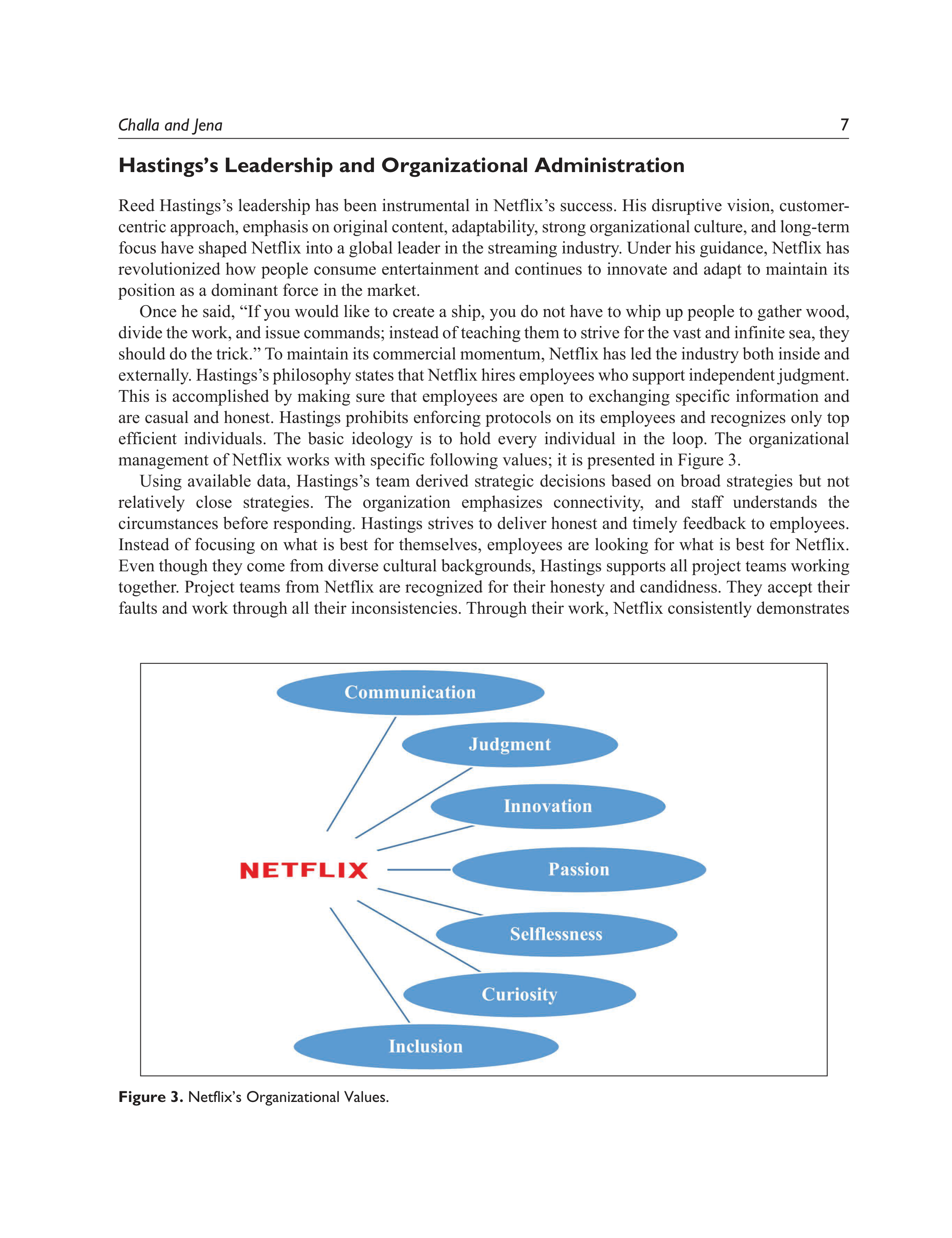
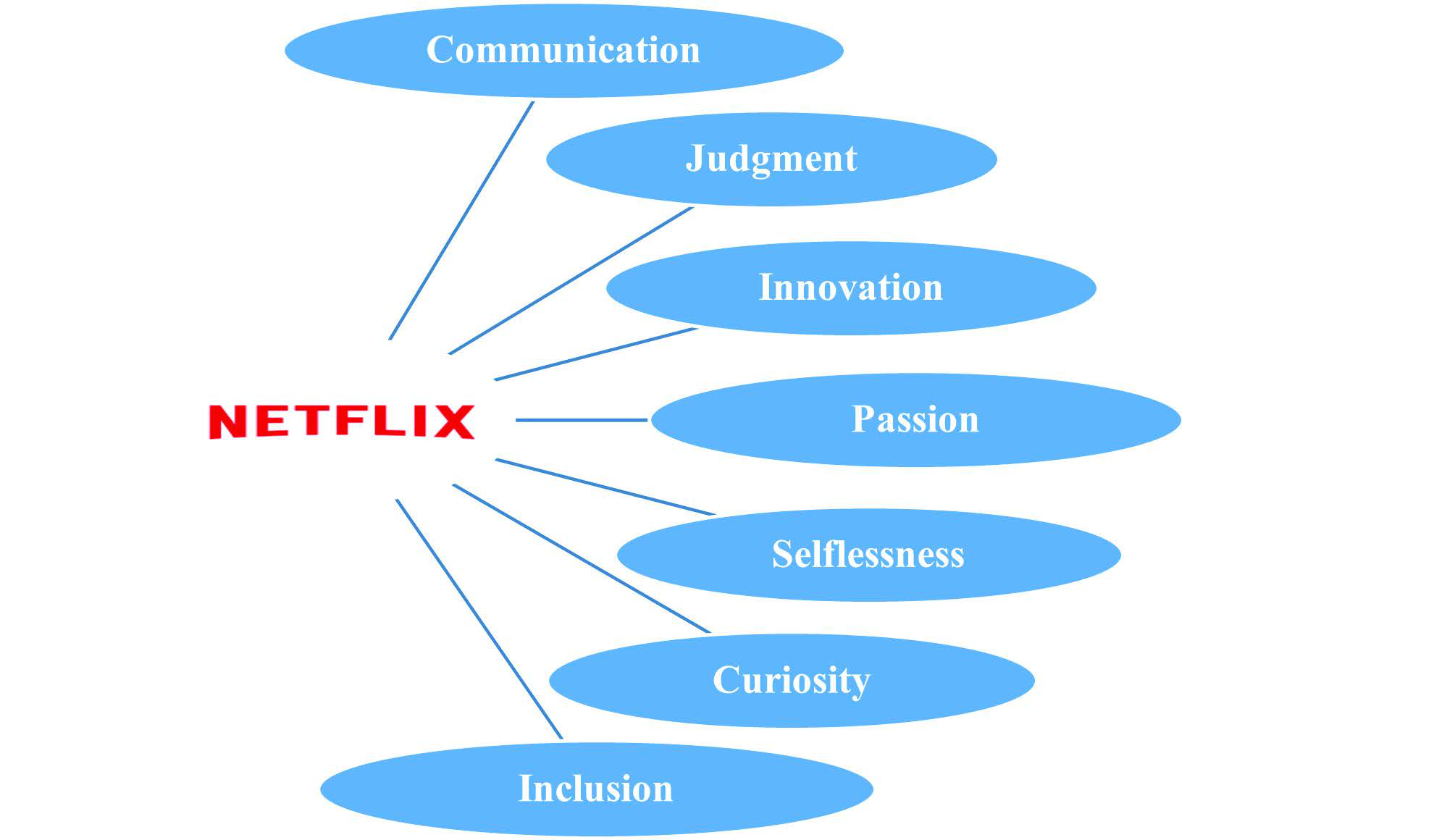
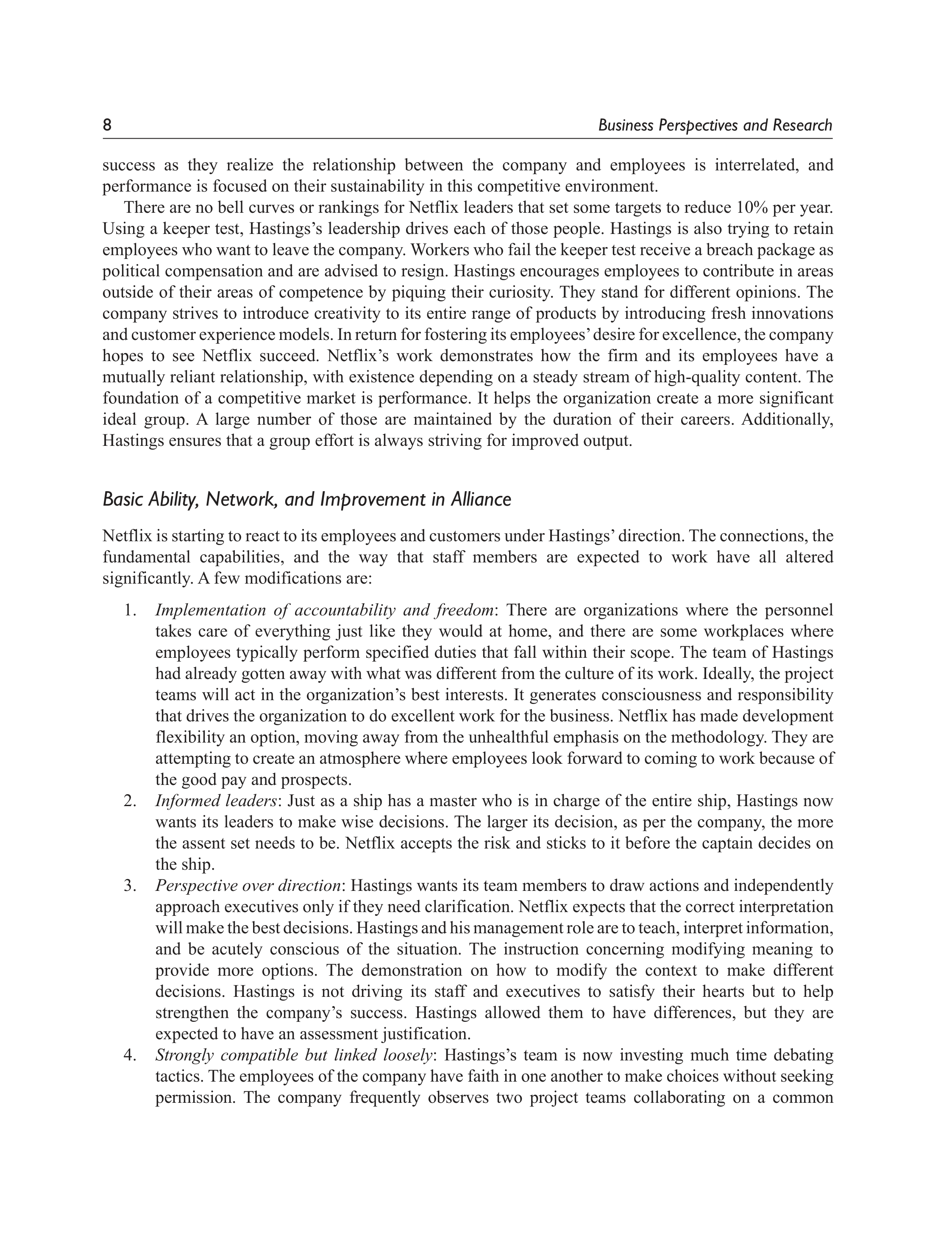
management of Netflix works with specific following values; it is presented in Figure 3.
Using available data, Hastings’s team derived strategic decisions based on broad strategies but not
relatively close strategies. The organization emphasizes connectivity, and staff understands the
circumstances before responding. Hastings strives to deliver honest and timely feedback to employees.
Instead of focusing on what is best for themselves, employees are looking for what is best for Netflix.
Even though they come from diverse cultural backgrounds, Hastings supports all project teams working
together. Project teams from Netflix are recognized for their honesty and candidness. They accept their
faults and work through all their inconsistencies. Through their work, Netflix consistently demonstrates
Figure 3.
Netflix’s Organizational Values.
8
Business Perspectives and Research
success as they realize the relationship between the company and employees is interrelated, and
performance is focused on their sustainability in this competitive environment.
There are no bell curves or rankings for Netflix leaders that set some targets to reduce 10% per year.
Using a keeper test, Hastings’s leadership drives each of those people. Hastings is also trying to retain
employees who want to leave the company. Workers who fail the keeper test receive a breach package as
political compensation and are advised to resign. Hastings encourages employees to contribute in areas
outside of their areas of competence by piquing their curiosity. They stand for different opinions. The
company strives to introduce creativity to its entire range of products by introducing fresh innovations
and customer experience models. In return for fostering its employees’ desire for excellence, the company
hopes to see Netflix succeed. Netflix’s work demonstrates how the firm and its employees have a
mutually reliant relationship, with existence depending on a steady stream of high-quality content. The
foundation of a competitive market is performance. It helps the organization create a more significant
ideal group. A large number of those are maintained by the duration of their careers. Additionally,
Hastings ensures that a group effort is always striving for improved output.
Basic Ability, Network, and Improvement in Alliance
Netflix is starting to react to its employees and customers under Hastings’ direction. The connections, the
fundamental capabilities, and the way that staff members are expected to work have all altered
significantly. A few modifications are:
1.
Implementation of accountability and freedom
: There are organizations where the personnel
takes care of everything just like they would at home, and there are some workplaces where
employees typically perform specified duties that fall within their scope. The team of Hastings
had already gotten away with what was different from the culture of its work. Ideally, the project
teams will act in the organization’s best interests. It generates consciousness and responsibility
that drives the organization to do excellent work for the business. Netflix has made development
flexibility an option, moving away from the unhealthful emphasis on the methodology. They are
attempting to create an atmosphere where employees look forward to coming to work because of
the good pay and prospects.
2.
Informed leaders
: Just as a ship has a master who is in charge of the entire ship, Hastings now
wants its leaders to make wise decisions. The larger its decision, as per the company, the more
the assent set needs to be. Netflix accepts the risk and sticks to it before the captain decides on
the ship.
3.
Perspective over direction
: Hastings wants its team members to draw actions and independently
approach executives only if they need clarification. Netflix expects that the correct interpretation
will make the best decisions. Hastings and his management role are to teach, interpret information,
and be acutely conscious of the situation. The instruction concerning modifying meaning to
provide more options. The demonstration on how to modify the context to make different
decisions. Hastings is not driving its staff and executives to satisfy their hearts but to help
strengthen the company’s success. Hastings allowed them to have differences, but they are
expected to have an assessment justification.
4.
Strongly compatible but linked loosely
: Hastings’s team is now investing much time debating
tactics. The employees of the company have faith in one another to make choices without seeking
permission. The company frequently observes two project teams collaborating on a common
Challa and Jena
9
feature, but when something does not feel right, they make a choice straight away. This environment
was successful because it was built on high-achieving individuals collaborating to grow the
organization for a bigger effect. As a result, the company’s adaptability and agility have increased.
The Phase During COVID-19
COVID-19 is a major disaster where so many businesses have been lost. Netflix is one of the few
winners of COVID-19. The more extended COVID restrictions are the primary reason for the increase
in demand for streaming services. According to the streaming video report of Adobe’s 2020, over
60% of Americans have subscribed to at least one streaming service during the pandemic. The
streaming market has become highly competitive, with the emergence of new players. It is a stage
where a streaming service should continually innovate to stay ahead of competitors and address the
challenge of retaining subscribers in a market with an increasing number of alternatives. Among all
the streaming services, Netflix became the market leader by overtaking the competitors and grabbing
200 million subscribers; 73 million are Americans alone. In the first three months of the year, around
16 million people registered accounts, which is twice as many as the number of new users in the last
few months of 2019. Nevertheless, the streaming platform supplying several mega-dollar films said
layoffs have stopped “almost all” shooting worldwide. Sales and earnings per share (EPS) for the
most recent quarter were $6.15 billion and $1.59, respectively. These figures were above analyst
projections of $6.08 billion in revenue and fell short of $1.83 EPS forecasts. The market, however, is
more concerned with subscriber growth, and investors are now concerned about inadequate guidance.
The company expects to gain 2.5 million members by the end of September, which would be the
lowest growth rate since 2016. The revelation alarmed investors and caused the share price to drop
6.5% to $492.99.
Maintaining lockout limits during localized flare-ups will benefit Netflix by encouraging more
people to try their service. Understanding and adapting to evolving consumer preferences is a constant
challenge. It requires anticipating shifts in how people consume content and adapting its strategy to
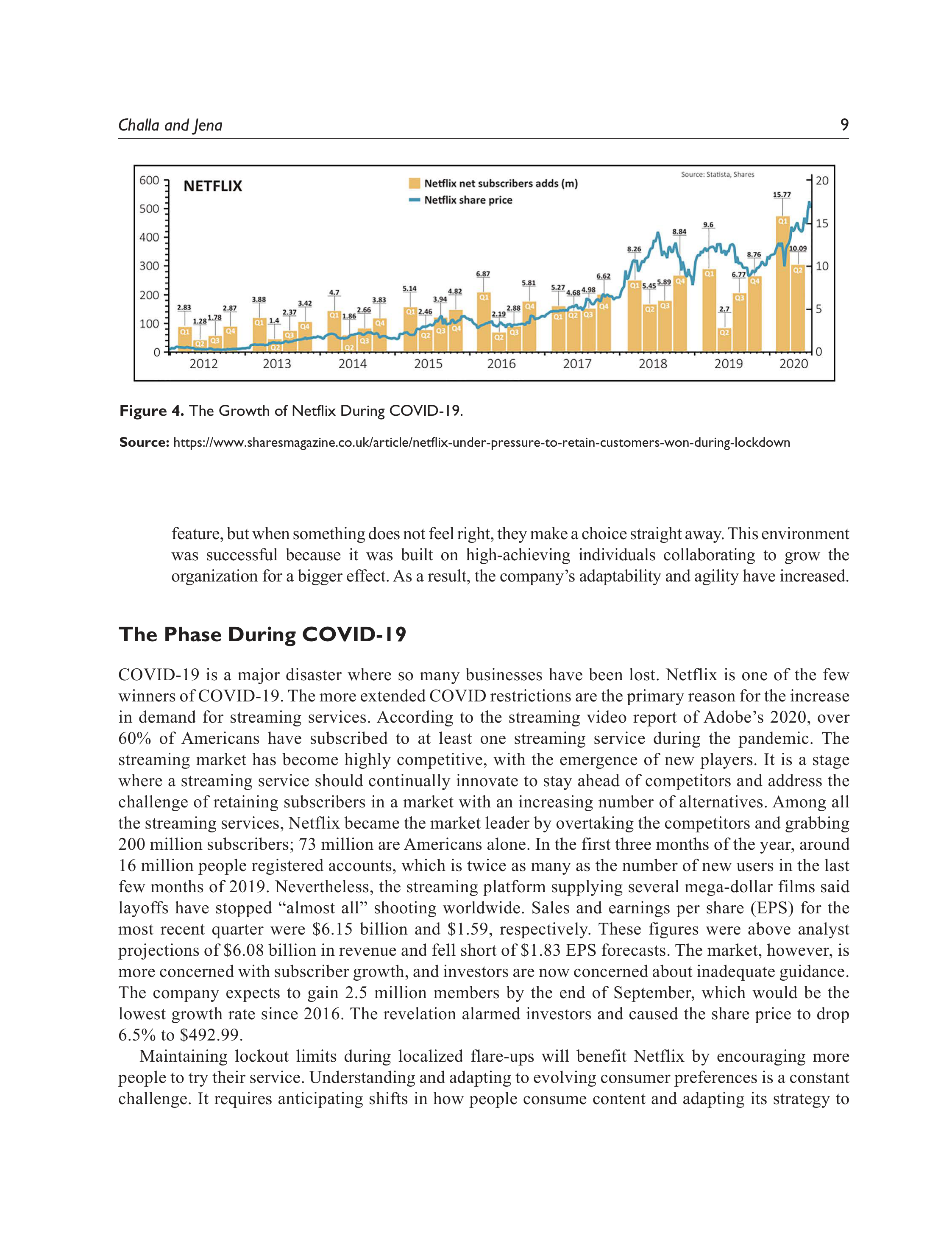
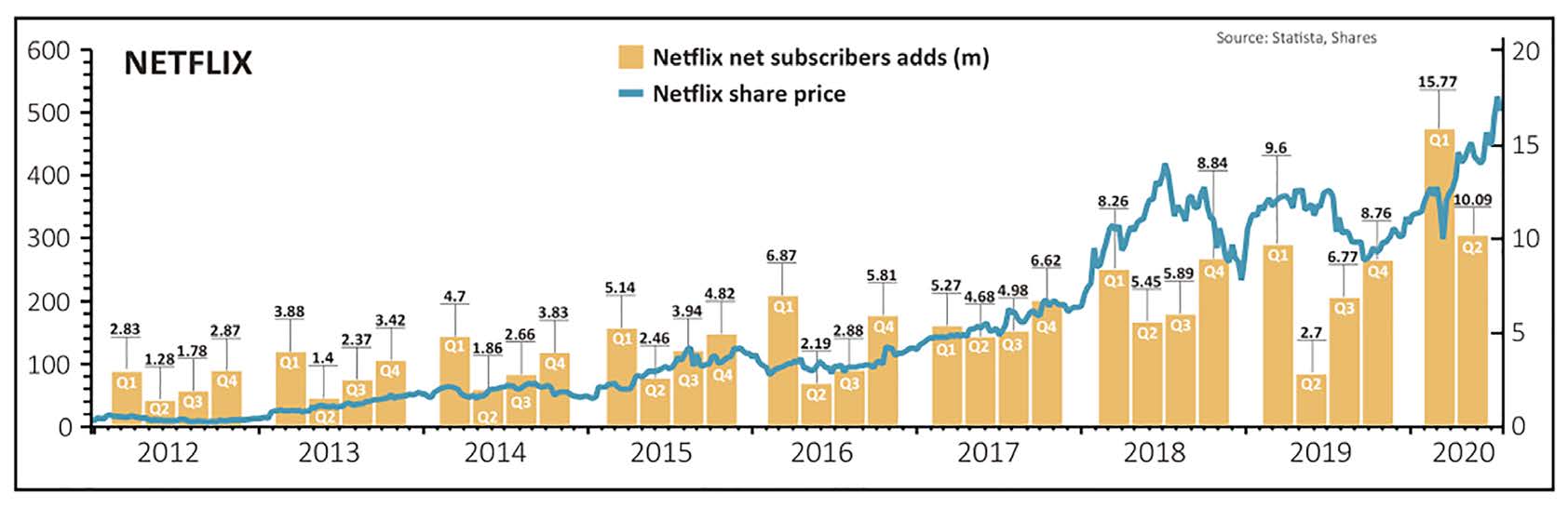
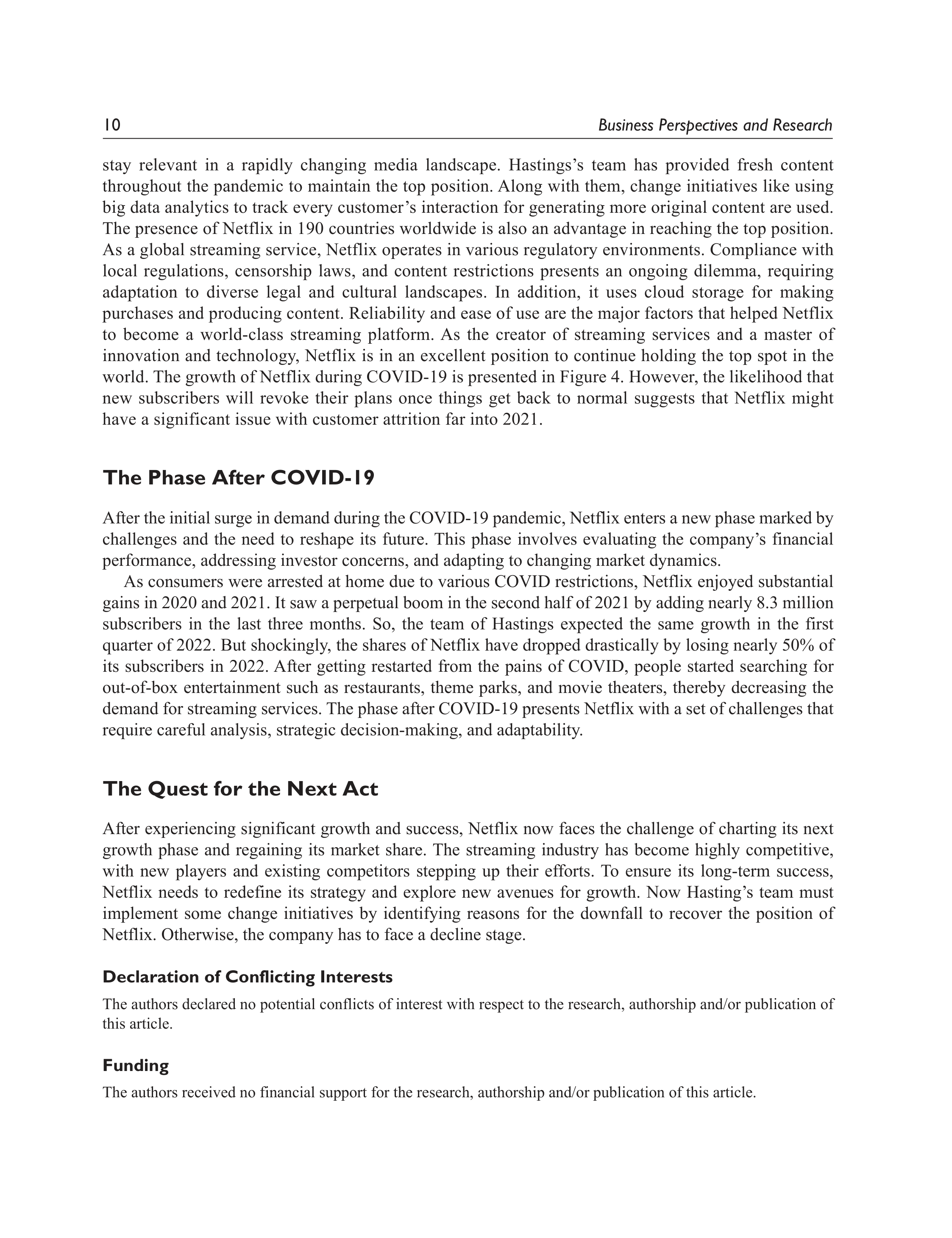
Figure 4.
The Growth of Netflix During COVID-19.
Source:
https://www.sharesmagazine.co.uk/article/netflix-under-pressure-to-retain-customers-won-during-lockdown
10
Business Perspectives and Research
stay relevant in a rapidly changing media landscape. Hastings’s team has provided fresh content
throughout the pandemic to maintain the top position. Along with them, change initiatives like using
big data analytics to track every customer’s interaction for generating more original content are used.
The presence of Netflix in 190 countries worldwide is also an advantage in reaching the top position.
As a global streaming service, Netflix operates in various regulatory environments. Compliance with
local regulations, censorship laws, and content restrictions presents an ongoing dilemma, requiring
adaptation to diverse legal and cultural landscapes. In addition, it uses cloud storage for making
purchases and producing content. Reliability and ease of use are the major factors that helped Netflix
to become a world-class streaming platform. As the creator of streaming services and a master of
innovation and technology, Netflix is in an excellent position to continue holding the top spot in the
world. The growth of Netflix during COVID-19 is presented in Figure 4. However, the likelihood that
new subscribers will revoke their plans once things get back to normal suggests that Netflix might
have a significant issue with customer attrition far into 2021.
The Phase After COVID-19
After the initial surge in demand during the COVID-19 pandemic, Netflix enters a new phase marked by
challenges and the need to reshape its future. This phase involves evaluating the company’s financial
performance, addressing investor concerns, and adapting to changing market dynamics.
As consumers were arrested at home due to various COVID restrictions, Netflix enjoyed substantial
gains in 2020 and 2021. It saw a perpetual boom in the second half of 2021 by adding nearly 8.3 million
subscribers in the last three months. So, the team of Hastings expected the same growth in the first
quarter of 2022. But shockingly, the shares of Netflix have dropped drastically by losing nearly 50% of
its subscribers in 2022. After getting restarted from the pains of COVID, people started searching for
out-of-box entertainment such as restaurants, theme parks, and movie theaters, thereby decreasing the
demand for streaming services. The phase after COVID-19 presents Netflix with a set of challenges that
require careful analysis, strategic decision-making, and adaptability.
The Quest for the Next Act
After experiencing significant growth and success, Netflix now faces the challenge of charting its next
growth phase and regaining its market share. The streaming industry has become highly competitive,
with new players and existing competitors stepping up their efforts. To ensure its long-term success,
Netflix needs to redefine its strategy and explore new avenues for growth. Now Hasting’s team must
implement some change initiatives by identifying reasons for the downfall to recover the position of
Netflix. Otherwise, the company has to face a decline stage.
Declaration of Conflicting Interests
The authors declared no potential conflicts of interest with respect to the research, authorship and/or publication of
this article.
Funding
The authors received no financial support for the research, authorship and/or publication of this article.

Challa and Jena
11
ORCID iD
Lalatendu Kesari Jena
https://orcid.org/0000-0002-8610-3865
References
Hamada, K. (2010).
Business group management in Japan
. World Scientific.
Martin, J., & Fellenz, M. (2010).
Organizational behaviour and management
. Cengage Learning.