Jurnal Riset Multidisiplin Edukasi
https://journal.hasbaedukasi.co.id/index.php/jurmie
Page : 223–240
223
Volume 2 Number 1 Tahun 2025
INFLUENCE TACTICS OF LEADERS: THE ROLE OF RAY KROC’S
TRANSFORMATIONAL LEADERSHIP IN SHAPING MCDONALD’S
ORGANIZATIONAL CULTURE AND GLOBAL SUCCESS
Muhamad Reza Pahlefy
1
Tasya Amanda Putri
2
Faculty of Administrative Sciences, Universitas Indonesia, Depok, Indonesia
1,2
Email:
krfjhrg@gmail.com
¹,
tasyaamandaptr@gmail.com
²
Information
Abstract
Volume
Number
Month
Year
E-ISSN
: 2
: 1
: January
: 2025
: 3062-9624
Leadership plays a central role in determining organizational success,
especially in the context of competitive global business. Ray Kroc, the
figure behind McDonald’s success, is known as a transformational leader
capable of turning a small restaurant into a leading global fast-food
chain. This study aims to analyze the application of the Model of Power
and Influence in Kroc's leadership, particularly in building an
organizational culture based on innovation, efficiency, and adaptability.
Using a literature review approach, data were obtained from scientific
journals, books, and credible reports. The analysis shows that Kroc
integrated influence tactics such as rational persuasion, inspirational
appeals, and consultation to create commitment, compliance, and
overcome resistance within the organization. Innovations such as the
Speedee Service System reflect a rational persuasion approach that
enhanced operational efficiency. Inspiration was instilled through core
values such as Quality, Service, Cleanliness, and Value. Consultation with
franchise partners ensured local adaptation without sacrificing global
standards. As a result, McDonald’s achieved customer loyalty, employee
compliance, and consistent global expansion. Kroc's transformational
leadership demonstrates how the application of the Model of Power and
Influence can create a highly competitive organizational culture and
long-term sustainability. This study emphasizes the importance of
combining vision, strategy, and influence tactics in building a successful
global organization.
Keywords :
Ray Kroc, Model of Power and Influence, Transformational
Leadership, Organizational Culture, McDonald’s.
A.
INTRODUCTION
Leadership plays a central role in determining the direction and success of an
organization (Chaidir, et al., 2024). In the context of global business, a leader’s role is not only
limited to making strategic decisions but also includes the ability to build a strong, adaptive,
Jurnal Riset Multidisiplin Edukasi
Volume 2 Number 1 Tahun 2025
224
https://journal.hasbaedukasi.co.id/index.php/jurmie
and consistent organizational culture (Vistarini, et al., 2024). One concrete example of
leadership that has successfully created significant transformation is Ray Kroc, the figure
behind McDonald’s global success. Ray Kroc can be categorized as a transformational leader
who successfully turned McDonald’s from a small restaurant into the world’s leading fast-food
chain. In the context of the Model of Power and Influence by Dubrin, et al. (2023), Kroc
utilized influence tactics such as rational persuasion, inspirational appeals, and consultation
to motivate his employees by building a strong and consistent organizational culture across
all McDonald’s branches, which is also closely related to the Model of Power and Influence.
Ray Kroc was a central figure in transforming McDonald's from a small restaurant into
one of the most top-of-mind fast-food brands worldwide. As a transformational leader, Kroc
not only had a clear vision but also possessed the ability to inspire and motivate employees
and business partners to achieve shared grand goals. One of Kroc's most significant
contributions was the creation of a strong organizational culture by focusing on customer
service, product quality, and consistent operational standards across every McDonald's outlet.
For example, policies such as “if the food is not served within 5 minutes, it will be free” reflect
the commitment to customer satisfaction. Additionally, efforts to ensure maximum cleanliness
at every McDonald's outlet not only enhance customer comfort but also build a reliable brand
reputation. This culture has proven capable of increasing high customer loyalty and
strengthening McDonald's position as a global market leader, according to Smith, 2020;
Johnson et al., 2022 (Ghannam, 2024).
McDonald’s was founded by Richard and Maurice McDonald in 1940 in California as a
simple restaurant offering a fast service system. A major transformation began when Ray
Kroc joined in 1954 as a franchise agent and later took over the company in 1961. Kroc
introduced a franchise-based business model that allowed rapid expansion into various
regions. In the 1970s and 1980s, McDonald’s began implementing global operational
standards, creating iconic menu items such as the Big Mac, and entering international
markets. In the 1990s, McDonald’s continued to innovate by adapting its menu to suit local
tastes in different countries, making it a prime example of a global company with local
adaptation. According to America House Chisinau (2022) and McDonald’s World Economic
Forum (2024), McDonald’s currently operates more than 40,000 outlets in 120 countries and
serves around 68 million customers daily. This global footprint makes McDonald’s one of the
largest restaurant chains in the world by revenue. A report in 2018 showed that McDonald’s
Jurnal Riset Multidisiplin Edukasi
Volume 2 Number 1 Tahun 2025
225
https://journal.hasbaedukasi.co.id/index.php/jurmie
operated more than 37,855 outlets worldwide. Its global success and popularity can be
attributed to an effective business strategy, focusing on advertising, innovation, and
marketing. Kroc’s contribution in building an efficient management system and a service-
oriented organizational culture is one of the key factors behind this success (Singh, J., &
Shukla, P. 2024).
As a transformational leader, Ray Kroc fulfills the criteria outlined in Bass's (1985)
transformational leadership theory as described by Dalkie & Botha (2024). These criteria
include vision, inspiration, intellectual stimulation, and individualized consideration. Kroc's
emphasis on innovation in the fast-service system, a quality-focused organizational culture,
and the management of a global franchise network reflects how a transformational leader can
build a highly competitive organization. Furthermore, Kroc's transformational leadership
significantly contributed to organizational performance through increased customer
satisfaction, employee engagement, and operational innovation (Northouse, 2021; Yukl,
2020) in Hui, Z., & Long, C. S. (2024). Additionally, research conducted by Vidani, J. (2024)
highlights that the success of a company in a competitive business environment heavily relies
on a customer-focused organizational culture, as implemented at McDonald’s. By integrating a
transformational vision, effective business strategies, and an inclusive organizational culture
approach, McDonald’s has achieved its success in the global market. This study aims to
analyze how the influence tactics employed by Ray Kroc as a transformational leader shaped
McDonald’s organizational culture and strengthened its position as a global market leader in
the fast-food industry, based on the Model of Power and Influence framework.
This research aims to analyze how Ray Kroc's influence tactics as a transformational
leader contributed to shaping McDonald’s organizational culture and positioning it as a global
market leader in the fast-food industry, based on an analysis of Kroc's leadership through the
Model of Power and Influence at McDonald’s.
LITERATURE REVIEW
Influence tactics in leadership serve as a crucial link between leader traits, leader
behaviors, and situational dynamics, which collectively shape organizational outcomes,
according to Krasnopevtsev, N. J. (2024). Influence tactics such as rational persuasion,
inspirational appeals, and consultation are driven by inherent leader characteristics and
adaptive behaviors, which determine their effectiveness in fostering commitment or
compliance (Hunter, et al., 2024). Furthermore, Adinew, Y. (2024) argues that situational
Jurnal Riset Multidisiplin Edukasi
Volume 2 Number 1 Tahun 2025
226
https://journal.hasbaedukasi.co.id/index.php/jurmie
factors, such as organizational culture and external challenges, significantly moderate the
selection and success of influence strategies. According to Park, et al. (2023), leader behavior
must align with the situational context to achieve the desired outcomes, whether they be
commitment, compliance, or resistance. Empirical findings by Dong, B. (2023) reveal that
transformational leaders who use individualized consideration are more likely to achieve
long-term commitment compared to those relying solely on transactional methods. Similarly,
Ejaz, et al. (2024) highlight that the effectiveness of influence tactics depends on the leader’s
emotional intelligence and their ability to align behaviors with follower needs and
organizational goals. Research by Wiroonrath, et al. (2024) emphasizes the importance of
integrating leader traits, leader behaviors, and situational variables into an influence model,
as these factors collectively enhance the strategic application of influence tactics in various
organizational contexts. In line with this, the contingency model by Burhan, et al. (2024)
demonstrates that situational favorability significantly impacts the effectiveness of leader
influence, affirming the interconnectedness of traits, behaviors, and context. Additionally, the
situational leadership theory by Hassan, A. (2023) reinforces the idea that adaptive
leadership styles are essential for optimizing influence tactics under varying situational
demands. By leveraging these insights, leaders can refine their strategies to maximize
influence outcomes, ensuring alignment with organizational goals.
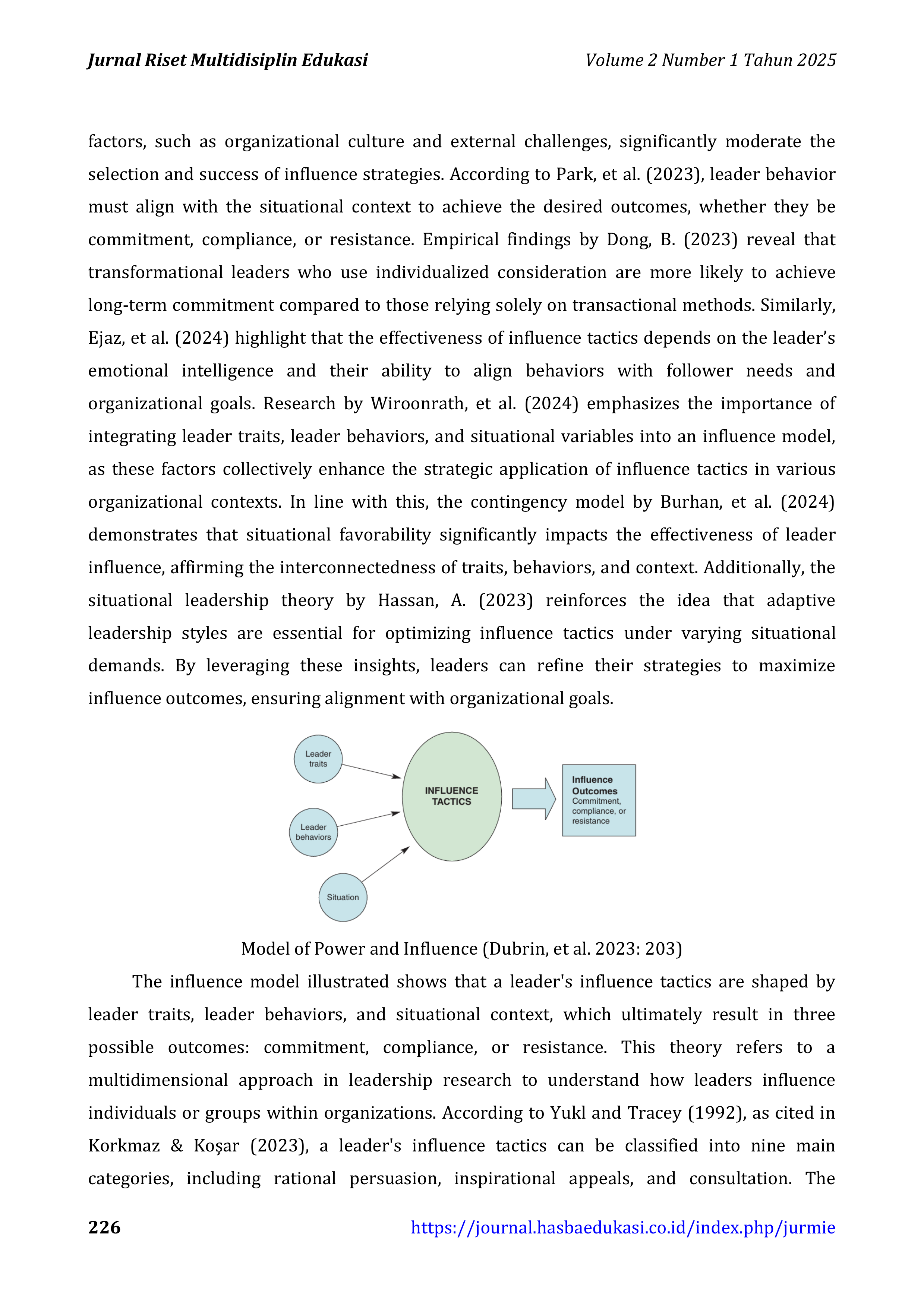
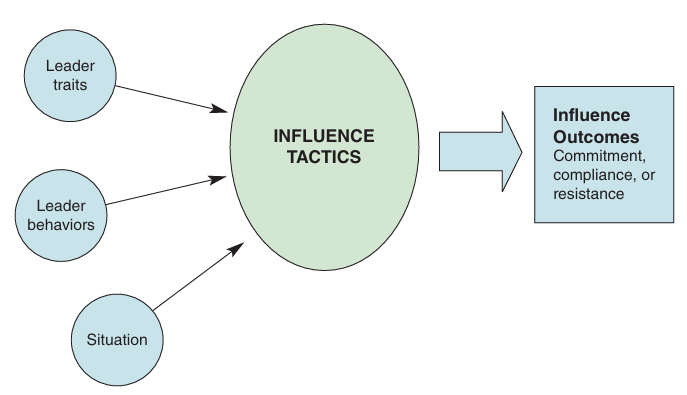
Model of Power and Influence (Dubrin, et al. 2023: 203)
The influence model illustrated shows that a leader's influence tactics are shaped by
leader traits, leader behaviors, and situational context, which ultimately result in three
possible outcomes: commitment, compliance, or resistance. This theory refers to a
multidimensional approach in leadership research to understand how leaders influence
individuals or groups within organizations. According to Yukl and Tracey (1992), as cited in
Korkmaz & Koşar (2023), a leader's influence tactics can be classified into nine main
categories, including rational persuasion, inspirational appeals, and consultation. The
Jurnal Riset Multidisiplin Edukasi
Volume 2 Number 1 Tahun 2025
227
https://journal.hasbaedukasi.co.id/index.php/jurmie
selection of these tactics is greatly influenced by the leader's individual characteristics, such
as charisma, emotional intelligence, and integrity (Salloum, et al., 2024). Other research
highlights that the effectiveness of influence tactics often depends on the leader's
interpersonal competencies, where the ability to understand situational dynamics and adapt
behaviors is key to success (Nanjundeswaraswamy, et al., 2024). Furthermore, research by
Steinmann, B. (2023) shows that certain combinations of influence tactics, such as
collaboration and goal-setting, tend to result in higher commitment from followers compared
to the use of coercion or direct control. In a situational context, Hersey and Blanchard (1982),
as cited in Cortes, M. (2023), introduced the concept of situational leadership, asserting that
leaders who are flexible in adjusting their style to the needs of the situation are more likely to
achieve positive outcomes. Contemporary research also emphasizes the importance of the
relationship between leader behavior and influence outcomes. According to Keller (2006), as
cited in Badrinarayanan, et al. (2024), behaviors such as employee empowerment and
effective communication can reduce resistance to organizational change. Additionally, Ghayas,
et al. (2023), found that servant leadership often influences organizational commitment levels
by enhancing trust and respect between leaders and followers. In broader empirical research,
Mollazehi, et al. (2024), stated that influence tactics utilizing psychological principles, such as
reciprocation, commitment, and social proof, have a significant impact on individual behavior.
For example, research by Roy, et al. (2023), found that tactics relying on coercion often lead to
resistance, especially in unsupportive work environments.
B.
METHOD
This research employs a literature review approach as the primary method to explore
concepts, theories, and previous research findings relevant to the discussed topic. The study is
conducted through the collection and critical analysis of various credible sources, such as
scientific journals, books, research reports, and other official documents. This approach aims
to identify patterns, uncover gaps in existing research, and provide both theoretical and
practical contributions in the field of Human Resources (HR). The data analysis process is
carried out systematically and meticulously to ensure the validity and relevance of each
source used (Neuman, 2014).
C.
RESULTS AND DISCUSSION
Ray Kroc is a figure widely known for his ability to transform McDonald’s from a small
restaurant in California into the world’s largest fast-food chain. His transformational
Jurnal Riset Multidisiplin Edukasi
Volume 2 Number 1 Tahun 2025
228
https://journal.hasbaedukasi.co.id/index.php/jurmie
leadership played a vital role in creating a grand vision that not only propelled McDonald’s to
the top of the fast-food industry but also established a strong organizational culture focused
on efficiency and innovation. In this analysis, Kroc applied the Model of Power and Influence,
demonstrating how he used his influence to foster deep commitment to the organization's
vision while driving behaviors aligned with the standards he set. His leadership analysis
encompasses several key aspects. In Leader Traits, Kroc was known for having a clear vision,
resilience, and a strong spirit of innovation. In Leader Behaviors, he exhibited inspirational
behavior, commitment to quality, and the ability to effectively motivate his team. Through
Situational Dynamics, Kroc adeptly adapted to global market challenges and made strategic
decisions. His leadership was also evident in his efforts to build Commitment, ensure
Compliance, and overcome Resistance, resulting in a collaborative and innovative work
culture at McDonald’s. The transformation he led laid a solid foundation for an organizational
culture that propelled McDonald’s to become a global leader in the fast-food industry. By
leveraging strategic influence tactics such as aligning a shared vision, strengthening
relationships with business partners, and adopting a persuasive approach to motivate
employees and franchisees, his strategies ensured not only uniform operational standards
worldwide but also established a strong and consistent brand image, making McDonald’s the
top-of-mind brand in the fast-food industry. Furthermore, his leadership instilled values such
as fast service, consistent quality, and affordable prices, which have become the cornerstone
of McDonald’s organizational culture to this day. Kroc was not just a business leader but also a
cultural architect who successfully integrated his influence to create an iconic and enduring
organizational model.
Ray Kroc in Leader Traits
Ray Kroc demonstrated distinctive leadership characteristics, such as a strong vision,
charisma, persistence, and innovation, which became the foundation of his success in
transforming McDonald's into the largest fast-food restaurant chain in the world. According to
the theory of Yukl and Tracey (1992) in Korkmaz & Koşar (2023), leadership characteristics
significantly influence the effectiveness of influence tactics used. In this context, Kroc was able
to inspire business partners and franchisees to follow his vision of creating an efficient,
consistent, and high-quality fast-food system. His charismatic nature was reflected in his
ability to build close relationships with business partners, convincing them to invest in the
McDonald's franchise model, and ensuring the implementation of uniform standards across
Jurnal Riset Multidisiplin Edukasi
Volume 2 Number 1 Tahun 2025
229
https://journal.hasbaedukasi.co.id/index.php/jurmie
all outlets. Ray Kroc, the founder of McDonald's, demonstrated his charismatic nature by
building close relationships with business partners. He successfully convinced Richard and
Maurice McDonald to join the McDonald's franchise company in 1955 (Anderson & Kroc,
2018). This ability to build relationships and persuade enabled Kroc to expand the
McDonald's network to 100 outlets in the United States within five years (Schlosser, 2001).
Furthermore, Kroc also possessed strong leadership skills, allowing him to ensure the
implementation of uniform standards across all McDonald's outlets (The Founder, 2016 in
Wahyuni, C. (2023)). In 1965, McDonald's became a public company with a stock value of
$300 million, marking Kroc's success in leading the company (Forbes).
Kroc's vision to create a superior and consistent customer experience worldwide
became the foundation of McDonald's global expansion strategy. His innovative nature was
clearly evident when he introduced the modern franchise system, which allowed the company
to expand rapidly across various countries. This reflects the transformational leadership
principles proposed by Bass (1985), especially in terms of vision and inspiration. By paying
attention to customer needs and adapting the menu to local cultures in different countries,
Kroc ensured that McDonald’s was not only accepted globally but also locally relevant. For
example, menu items like McAloo Tikki in India and McSpaghetti in the Philippines
demonstrate strategic innovation in aligning products with local customer preferences.
Kroc's perseverance was also one of the key elements in his success. According to the
Power and Influence model by Dubrin et al. (2023), leaders who are persistent can use
rational persuasion and inspirational appeals to motivate employees and business partners.
Kroc diligently ensured that all McDonald's branches adhered to strict operational standards,
such as cleanliness, food quality, and fast service. His efforts to maintain operational
consistency worldwide not only enhanced customer trust but also strengthened McDonald's
reputation as a global market leader. For example, the policy "if food is not delivered within 5
minutes, it’s free" reflects a customer-focused approach and demonstrates a commitment to
customer satisfaction. This supports Vidani, J. (2024), who states that a customer-oriented
organizational culture is a key factor for success in a competitive business environment.
Ray Kroc in Leader Behavior
Ray Kroc demonstrated a combination of visionary and adaptive leadership behaviors,
reflected in the application of influence tactics such as rational persuasion, inspirational
appeals, and consultation. This approach not only ensured operational efficiency but also
Jurnal Riset Multidisiplin Edukasi
Volume 2 Number 1 Tahun 2025
230
https://journal.hasbaedukasi.co.id/index.php/jurmie
created a strong organizational culture, making McDonald’s the leading fast-food chain in the
world. Based on the theory of Influence Tactics of Leaders by Yukl and Tracey (1990) in
Korkmaz & Koşar (2023), Kroc's behavior reflects the strategic utilization of influence tactics
to achieve commitment and compliance from his employees.
Rational Persuasion
Kroc used a data-driven approach to introduce operational innovations such as the
Speedee Service System, designed to improve service efficiency at every McDonald’s
restaurant. This tactic aligns with the research of Yukl and Tracey (1992), which emphasizes
that rational persuasion is one of the effective strategies for gaining commitment from
followers. In this context, Kroc provided logical arguments supported by concrete evidence to
convince franchise partners and employees of the benefits of the innovation. For example, the
Speedee Service System not only increased the speed of food delivery but also ensured
consistency in quality, which became McDonald’s competitive advantage in the global market.
Inspirational Appeals
The inspirational appeal of Kroc is evident in his ability to instill core values such as
"QSC&V" into the organizational culture of McDonald's from its early establishment, which
consists of Quality, Service, Cleanliness, and Value (Hinson, et al 2024). Quality emphasizes
consistency and product excellence by ensuring that every meal served meets high standards
and uses the best ingredients. Service focuses on delivering fast, friendly, and efficient service
to every customer. Cleanliness reflects McDonald's commitment to maintaining a clean and
hygienic restaurant environment as a top priority at every branch. Value centers on providing
an experience that is worth the price paid by customers. These values play a crucial role in
shaping the company's identity, influencing operational efficiency, enhancing employee
loyalty, and providing a consistent customer experience worldwide.
The application of QSC&V across all McDonald's branches aims to ensure uniformity in
service and product standards. This implementation creates a competitive advantage through
operational consistency, which is one of the key factors behind McDonald's success in
maintaining customer loyalty globally. QSC&V reflects a rationalization approach in business
management that emphasizes efficiency, calculability, predictability, and control. This
approach enables McDonald's to effectively manage thousands of branches without
compromising the customer experience, making it a best practice example in the fast food
industry. From the perspective of Kotler and Keller in Hinson, et al. (2024), the core values
Jurnal Riset Multidisiplin Edukasi
Volume 2 Number 1 Tahun 2025
231
https://journal.hasbaedukasi.co.id/index.php/jurmie
like QSC&V are emphasized in modern marketing strategies to create a consistent and reliable
customer experience. By prioritizing QSC&V, McDonald's not only succeeds in meeting
customer satisfaction but also integrates these values into its brand identity, which is globally
recognized.
Furthermore, by emphasizing the importance of a shared vision, Kroc succeeded in
motivating franchise partners and employees to view McDonald's as more than just a
business, but as a movement that changed the fast food industry. This aligns with the concept
of transformational leadership, which highlights the importance of vision and inspiration in
building long-term commitment (Bass, 1985, in Dalkie & Botha, 2024). For example, the policy
"if the food doesn't arrive within 5 minutes, it will be free" not only increased customer trust
but also strengthened employee spirit to provide the best service.
Consultation
Kroc also demonstrated consultative behavior by involving franchise partners in
strategic decision-making, particularly related to operations at the local level. This approach
strengthened the partners' commitment to the company's vision and ensured the successful
implementation of operational standards at various locations. The consultation carried out by
Kroc reflects the integration of the situational leadership principle (Hersey and Blanchard,
1982, in Cortes, M., 2023), where leaders adjust their approach to the needs of the situation
and followers. For example, Kroc worked with franchise partners to ensure that cleanliness
and efficiency standards were maintained, while also providing flexibility in adjusting the
menu to local preferences.
Ray Kroc in Situational Dynamics
Ray Kroc successfully leveraged situational dynamics to build a strong and adaptive
organizational culture at McDonald's. Referring to the situational leadership theory by Hersey
and Blanchard (1977), Kroc demonstrated flexibility in his leadership style to address various
challenges and needs at each operational location. For example, when expanding McDonald's
network into international markets, Kroc recognized the importance of menu adaptation to
reflect local preferences, such as offering McSpicy Paneer in India and Nasi Uduk in Indonesia.
This step reflects the application of individualized consideration as explained by Bass (1985),
where the needs and preferences of local customers were a primary concern to ensure
customer satisfaction.
Jurnal Riset Multidisiplin Edukasi
Volume 2 Number 1 Tahun 2025
232
https://journal.hasbaedukasi.co.id/index.php/jurmie
Additionally, Kroc used rational persuasion and inspirational appeals to gain support
from franchise partners and employees in implementing consistent global operational
standards. According to Dong (2023), leaders who combine these influence tactics tend to be
more effective in driving commitment than those who rely solely on transactional approaches.
For instance, Kroc persuaded franchise partners to invest in training and maintain restaurant
cleanliness by emphasizing the long-term importance of brand reputation. These efforts
reinforced an organizational culture focused on quality and customer service, which became
the foundation of McDonald's success as a global market leader.
Furthermore, Kroc was able to identify opportunities amidst the changing lifestyle of
society, which increasingly prioritized efficiency, such as the desire for affordable yet high-
quality fast food. According to the contingency model by Burhan et al. (2024), situational
favorability influences the effectiveness of a leader's influence. In Kroc's case, he capitalized
on this situation by introducing an innovative service system, such as the Speedee Service
System, which became McDonald's competitive advantage. His ability to read situational
dynamics and adjust his influence strategies not only increased employee compliance but also
resulted in long-term commitment from customers and business partners.
Transformational Leadership of Ray Kroc in Achieving Commitment, Compliance, and
Resistance
In Commitment, Ray Kroc successfully created long-term commitment from franchisees
and employees by building a consistent organizational culture across the McDonald’s
network. The implementation of individualized consideration, as proposed by Bass (1985) in
Dalkie & Botha (2024), is evident in Kroc's approach to the unique needs of each outlet. For
example, Kroc not only set global standards but also encouraged local adaptation to meet
customer needs in various regions, such as adjusting the menu to local tastes in different
countries. This approach fostered loyalty among employees and franchisees, as Judge and
Bono (2000) explained, that attention to individual needs can increase engagement and long-
term commitment. Additionally, Kroc's focus on human resource development through
training at Hamburger University strengthened employees' sense of responsibility towards
McDonald's mission and vision.
Then in Compliance, Kroc also ensured high compliance with operational standards
through the implementation of intensive training systems at Hamburger University.
According to Podsakoff and Schriesheim (1995), compliance can be achieved when the
Jurnal Riset Multidisiplin Edukasi
Volume 2 Number 1 Tahun 2025
233
https://journal.hasbaedukasi.co.id/index.php/jurmie
leader’s behavior aligns with the demands of the situation and the organization’s objectives.
Kroc applied this principle by emphasizing the importance of fast service standards and
cleanliness across all outlets. These standards not only served as operational guidelines but
also formed the foundation of McDonald’s reputation as a reliable global fast food network. By
providing comprehensive and detailed training, Kroc was able to integrate rational
persuasion as an effective influence tactic to ensure that every employee and franchisee
adhered to the company's vision and values.
Based on Resistance, Kroc was not exempt from challenges, including initial resistance
from some franchisees to innovation and changes in operational systems. However, by relying
on a combination of rational persuasion and consultation, Kroc successfully reduced this
resistance. This approach aligns with the findings of Hersey and Blanchard (1982) in the
concept of situational leadership, where adapting leadership style to meet the needs of the
situation can yield positive results. For example, when facing skepticism from franchisees
about the franchise-based business model, Kroc used data supporting the success of his
system to convince them of the long-term benefits of the change. This approach reflects that
adaptive influence strategies can transform resistance into an opportunity to strengthen
organizational integration, as also found by Dong (2023) in a study on the effectiveness of
transformational leadership.
McDonald's Organizational Transformation
Ray Kroc played a key role in transforming McDonald's from a simple restaurant into a
leading global fast food chain. As a transformational leader, Kroc not only developed a vision
for the company but also built an organizational culture that supported global expansion and
long-term success. In the context of the Power and Influence Model by Dubrin et al. (2023),
Kroc utilized influence tactics such as rational persuasion, inspirational appeals, and
consultation to shape an efficient and quality-focused culture. Kroc implemented strict global
operational standards and uniform training to ensure that every McDonald's branch
worldwide maintained consistent service levels and product quality. For example, the
Speedee Service system introduced by Kroc increased operational efficiency by reducing
service time, allowing McDonald's to become a top-of-mind brand in the fast food industry.
Kroc's emotional intelligence was also evident in his ability to adapt McDonald's culture
to different local contexts without sacrificing the global brand identity. This aligns with the
view of Hersey and Blanchard (1982), who state that a transformational leader must have
Jurnal Riset Multidisiplin Edukasi
Volume 2 Number 1 Tahun 2025
234
https://journal.hasbaedukasi.co.id/index.php/jurmie
emotional intelligence to understand and adjust behavior to the needs of followers and the
situational context. Kroc recognized that people in different countries had different
preferences and cultures, so he innovated by adjusting the McDonald's menu to local tastes,
while still maintaining high standards of quality and service. For example, in some Asian
countries, McDonald's added rice-based or local ingredient options to appeal to local
customers, but still maintained the consistency and quality of the products as implemented
globally.
The transformational leadership implemented by Kroc also focused on employee
development through high-standard education and training. One significant innovation
supporting this vision was the establishment of Hamburger University, McDonald’s training
center aimed at developing employee skills and knowledge in accordance with restaurant
operational procedures. Hamburger University provides comprehensive training in
operational management, leadership, and customer service based on core values such as
quality, service, cleanliness, and speed (QSC&V). According to Northouse in (Mudd, et al
2024), the transformational leadership approach involves the development of individuals to
reach their full potential, which, in the context of McDonald’s, is achieved through formal
education at Hamburger University. Additionally, Becker, M.'s Human Capital Development
theory (2024) emphasizes that investing in employee training and development increases
productivity, efficiency, and loyalty, all of which are pillars of McDonald’s success in
maintaining global standards and service consistency.
Through individualized consideration, where he gives more attention to the needs of
employees and inspires them to commit to the company's vision. According to Bass (1985) in
Dalkie & Botha (2024), this characteristic is part of the transformational leadership theory
that emphasizes the importance of inspiration and personal attention from leaders. Through
this approach, Kroc successfully created high loyalty among employees and business partners,
which in turn increased customer loyalty. Research by Vidani (2024) affirms that customer-
oriented organizational culture, like the one developed at McDonald's, is a key factor in the
company’s success in a highly competitive business environment. By integrating the values of
quality, efficiency, and service, Kroc managed to make McDonald's a fast food symbol that is
not only loved but also trusted by customers worldwide.
McDonald's (McD) has successfully achieved the position of one of the best fast-food
companies in the world. With 13,457 locations in the United States and more than 38,695
Jurnal Riset Multidisiplin Edukasi
Volume 2 Number 1 Tahun 2025
235
https://journal.hasbaedukasi.co.id/index.php/jurmie
locations in 100 countries, McD has become one of the most widespread and globally
recognized brands (Statista, 2023). Additionally, McD's annual revenue reaches $23.2 billion,
indicating strong financial capabilities (Statista, 2023). With 210,000 employees worldwide
and 64 million customers every day, McD has created a significant economic and social impact
(McDonald’s Corporation Annual Report 2022). In Indonesia, McD also shows impressive
performance with more than 230 locations and 10,000 employees. McD’s success can be
attributed to the significant role of Ray Kroc in becoming a transformative leader. Therefore,
McD deserves to be called one of the best fast-food companies in the world.
Ray Kroc, through the application of the Power and Influence Model, demonstrated how
a transformational leader can create an organizational culture that supports global expansion
and long-term success. His leadership stood out in terms of leader traits, such as a strong
vision, charisma, and determination. Kroc also successfully applied leadership behaviors, such
as rational persuasion, inspirational appeals, and consultation, which encouraged efficiency
and innovation within the organization. By adapting his leadership style to specific situations
(Situational Dynamics), Kroc was able to tackle global challenges with strategic adjustments.
The result was long-term commitment, compliance, and management of resistance, all of
which built a strong foundation for McDonald's to become the world leader in fast food. The
organizational culture transformation created by Kroc serves as a real example of how
influence tactics can create a sustainable.
D.
CONCLUSION
Ray Kroc's transformational leadership was instrumental in McDonald's evolution from
a small restaurant into a global fast-food leader. By leveraging the Model of Power and
Influence, Kroc effectively utilized rational persuasion, inspirational appeals, and consultation
to establish a robust organizational culture centered on quality, service, cleanliness, and
value. His adaptive leadership style fostered commitment and compliance while overcoming
resistance, enabling McDonald's to maintain consistent global standards and innovate locally
to meet diverse customer needs. Kroc's visionary approach not only drove operational
efficiency and brand loyalty but also set a lasting example of how transformational leadership
and strategic influence can achieve sustained organizational success.
E.
SUGGESTIONS
To maintain its position as a global leader in the fast-food industry while promoting
sustainable innovation, McDonald’s needs to adopt integrated and data-driven strategic steps.
Jurnal Riset Multidisiplin Edukasi
Volume 2 Number 1 Tahun 2025
236
https://journal.hasbaedukasi.co.id/index.php/jurmie
First, McDonald’s can launch a Leadership Innovation Program to train operational leaders
across the network to become change agents with a transformational leadership approach.
With modules such as rational persuasion, inspirational appeals, and consultation, this
program can enhance employee commitment and ensure global standards remain consistent,
in line with the Power and Influence theory (Dubrin et al., 2023) and Transformational
Leadership theory (Bass, 1985). Second, McDonald’s needs to integrate cutting-edge
technology to create an interactive customer experience through the use of Artificial
Intelligence (AI) and Machine Learning (ML), such as smart kiosks that personalize menu
recommendations. This is supported by the Situational Leadership theory (Hersey &
Blanchard, 1982), which emphasizes the importance of adapting technology to meet modern
customer needs. Furthermore, McDonald’s is advised to launch sustainability initiatives, such
as locally sourced and eco-friendly menu items through the “McFuture Foods” program, to
attract new customer segments and strengthen the company’s social commitment. This
approach aligns with Stakeholder Theory (Freeman, 2020), which underscores the
importance of social responsibility. Additionally, McDonald’s can strengthen internal
communication by implementing real-time communication platforms to align organizational
goals and enhance collaboration across the global network, as proposed in Transformational
Leadership Theory. Lastly, optimizing data-driven analytics will provide sharper strategic
insights to support decision-making, increase efficiency, and predict market trends, in line
with Decision-Making Theory (Simon, 1979). By implementing these recommendations,
McDonald’s can not only maintain its position as a global market leader but also create
sustainable innovation that strengthens relationships with customers, employees, and
business partners worldwide.
F.
REFERENCES
Adinew, Y. (2024). A comparative study on motivational strategies, organizational culture,
and climate in public and private institutions.
Current Psychology, 43
(13), 11470–
11492.
Anderson, R., & Kroc, R. (2018).
Grinding it out: The making of McDonald's
(p. 201). Tantor
Media.
Badrinarayanan, V., Rangarajan, D., Lai-Bennejean, C., Bowen, M., & Kaski, T. A. (2024). Digital
transformation in sales organizations: Antecedents of sales managers’ change
readiness and championing behaviors.
Journal of Business & Industrial Marketing.
Jurnal Riset Multidisiplin Edukasi
Volume 2 Number 1 Tahun 2025
237
https://journal.hasbaedukasi.co.id/index.php/jurmie
Becker, M. (2024). The effect of positive management practices on firm profitability–Evidence
from text mining. The Journal of Applied Behavioral Science, 60(2), 280-309.
Berson, Y., Nemanich, L. A., Waldman, D. A., Galvin, B. M., & Keller, R. T. (2006). Leadership and
organizational learning: A multiple levels perspective. The leadership quarterly,
17(6), 577-594.
Burhan, Q. U. A., & Khan, M. A. (2024). Empowering leadership ripple effect: Improving
employee engagement, performance and knowledge sharing through relational
energy and autonomy.
European Business Review, 36
(3), 392–409.
Chaidir, A. B., Haludin, G., Rahmawati, R., Jasmine, N., Swangsa, D., & Widayanto, M. P. (2024).
Analisis Peran Kepemimpinan Terhadap Kinerja Perusahaan Dalam Perspektif
Budaya Organisasi: Studi Kasus Pada Skandal Perusahaan Toshiba. Journal of Social
and Economics Research, 6(1), 734-742.
Cortes, M. (2023).
The employees’ perspective: Situational leadership style flexibility and
effectiveness and employee performance in a technological organization
(Doctoral
dissertation, Walden University).
Dalkie, D. D., & Botha, R. N. (2024). Investigating the role of the principal's individualized
consideration and intellectual stimulation in shaping the academic performance of
students in the secondary schools of Sidama Region, Ethiopia.
Eximia, 13,
923–943.
Dong, B. (2023). A systematic review of the transactional leadership literature and future
outlook.
Academic Journal of Management and Social Sciences, 2
(3), 21–25.
DuBrin, A. J. (2023).
Leadership: Research findings, practices and skills
(10th ed.). Nelson
Education, Ltd.
Ejaz, A., Quratulain, S., Aulakh, A. H., Cando-Naranjo, J., & Sabharwal, M. (2024). The
conditional effects of transformational leadership behaviors on leaders’ emotional
exhaustion: Roles of deep acting and emotional intelligence.
The American Review of
Public Administration.
Freeman,
R.
E.
(2020).
The
stakeholder
approach
revisited.
Wirtschafts-und
Unternehmensethik,
657–671.
Ghayas, M. M., Khan, M. M. S., Kumar, S., & Mohyuddin, S. M. (2023). Reconstruction of trust
and organizational commitment through servant leadership in the post-pandemic
era: Evidence from the IT sector of Pakistan.
Journal of Asia Business Studies.
Jurnal Riset Multidisiplin Edukasi
Volume 2 Number 1 Tahun 2025
238
https://journal.hasbaedukasi.co.id/index.php/jurmie
Ghannam, Y. P. (2024). Crafting a winning workplace culture: Understanding organizational
dynamics using AI tools. In
Building Business Knowledge for Complex Modern Business
Environments
(pp. 29–62). IGI Global.
Hassan, A. (2023). Balancing leadership styles: Finding your management approach.
Global
Journal of Econometrics and Finance, 1
(01), 13–24.
Hersey, P., & Blanchard, K. H. (1982). Grid® principles and situationalism: Both! A response to
Blake and Mouton. Group & Organization Studies, 7(2), 207-210.
Hinson, R. E., Mensah, I., Amoako, G. K., Mensah, E. A., Coffie, I., & Khosa, E. (2024). Hospitality
and Tourism Marketing: Building Customer Driven Hospitality and Tourism
Organizations. CRC Press.
Hunter, S. T., Lovelace, J. B., Neely Jr, B. H., & Allen, J. (2024). Multiple pathways to leadership:
A revision and extension of the CIP leadership framework.
Organizational Psychology
Review.
Hui, Z., & Long, C. S. (2024). The impact of transformational leadership on employees’ job
satisfaction: A conceptual model.
International Journal of Academic Research in
Business and Social Sciences, 14
(2), 1345–1354.
Judge, T. A., & Bono, J. E. (2000). Five-factor model of personality and transformational
leadership.
Journal of Applied Psychology, 85
(5), 751.
Korkmaz, Y., & Koşar, D. (2023). Teachers’ views on the influence tactics used by school
administrators.
Gazi Üniversitesi Gazi Eğitim Fakültesi Dergisi, 43
(2), 1101–1128.
Krasnopevtsev, N. J. (2024). Uncovering mechanisms of leadership as an influence process. In
Leadership during a crisis
(pp. 161–188). Routledge.
Leading QSR chains by number of units US 2023 | Statista. (2023). Statista.
https://www.statista.com/statistics/242883/quick-service-restaurant-chains-by-
number-of-restaurants/
McDonald’s.
(2024).
World
Economic
Forum.
https://www.weforum.org/organizations/mcdonalds-corporation/
McDonald’s
Corporation
Annual
Report
2022
Form
10-K
(NYSE:MCD).
(2022).
https://stocklight.com/stocks/us/nyse-mcd/mcdonald-s-corporation/annual-
reports/nyse-mcd-2022-10K-22671248.pdf
Jurnal Riset Multidisiplin Edukasi
Volume 2 Number 1 Tahun 2025
239
https://journal.hasbaedukasi.co.id/index.php/jurmie
McDonald’s – the biggest food chain in the world – America House Chisinau. (2022).
Americahouse.md.
https://americahouse.md/mcdonalds-the-biggest-food-chain-in-
the-world/
Mollazehi, A., Abuelezz, I., Barhamgi, M., Khan, K. M., & Ali, R. (2024, May). Do Cialdini’s
persuasion principles still influence trust and risk-taking when social engineering is
knowingly possible? In
International Conference on Research Challenges in
Information Science
(pp. 273–288). Cham: Springer Nature Switzerland.
Mudd-Fegett, K., & Mudd, H. K. (2024). Transformational Leadership. In Transformational
Learning in Social Work and Human Services Education (pp. 63-83). IGI Global.
Nanjundeswaraswamy, T. S., Nagesh, P., Bharath, S., & Vignesh, K. M. (2024). Leadership
theories and styles—A systematic literature review and the narrative synthesis.
Human Resources Management and Services, 6
(3), 3477–3477.
Lawrence Neuman, W. (2014). Social research methods: Qualitative and quantitative
approaches.
Park, H. M., Carter, K. M., & Phillips, J. M. (2023). Resisting delegation: The influence of
incivility and developmental tasks on commitment to the supervisor and delegation
resistance.
Journal of Business and Psychology, 38
(6), 1245–1266.
Roy, V., Prakash, C., & Charan, P. (2023). Under “my way or the highway”! The weaker
partner's synergy on collaborative performance in humanitarian relief when
experiencing power tactics.
International Journal of Operations & Production
Management, 43
(7), 1148–1173.
Salloum, C., Jarrar, H., Chaanine, N., Al Sayah, M., & Verdie, J. F. (2024). Winning hearts and
minds: The charismatic leader’s role in SME productivity.
European Business Review,
36
(4), 494–509.
Simon, H. A. (1979). Rational decision-making in business organizations.
The American
Economic Review, 69
(4), 493–513.
Singh, J., & Shukla, P. (2024).
Brand management: Principles and applications for effective
branding.
Kogan Page Publishers.
Steinmann, B. (2023). Transformational leadership and goal setting. In
Encyclopedia of
Business and Professional Ethics
(pp. 1780–1785). Cham: Springer International
Publishing.
Jurnal Riset Multidisiplin Edukasi
Volume 2 Number 1 Tahun 2025
240
https://journal.hasbaedukasi.co.id/index.php/jurmie
Vidani, J. (2024). Golden arches of success: Enhancing customer relationship management at
McDonald's, Wide Angle, Ahmedabad.
Wide Angle, Ahmedabad
(April 30, 2024).
Vistarini, T. V., Kaifa, S. R. B., Aulia, D. M., & Jannah, A. R. N. (2024). MEMBENTUK ORGANISASI
YANG KUAT DENGAN KEPEMIMPINAN YANG EFEKTIF. Musytari: Jurnal Manajemen,
Akuntansi, dan Ekonomi, 11(5), 141-150.
Wahyuni, C. (2023).
The founder belajar bisnis dari McDonald.
Wiroonrath, S., Phanniphong, K., Somnuk, S., & Na-Nan, K. (2024). Impact of leader support on
open innovation: The mediating role of organizational culture, intellectual property,
and collaboration.
Journal of Open Innovation: Technology, Market, and Complexity,
10
(3), 100333.
Yukl, G., & Tracey, J. B. (1992). Consequences of influence tactics used with subordinates,
peers, and the boss.
Journal of Applied Psychology, 77
(4), 525.