
Chapter
31
Book
Chapter
Leadership
Development
through
Emotional
Intelligence:
A
Case
Based
Analytical
Study
Kaarthikeya
Palli
∗
1
and
Esha
Soni
†
2
1
BBA
Honours
(Business
analytics
and
business
intelligence),
Bhavan’s
Vivekananda
College
of
Science,
Humanities
and
Commerce,
Sainikpuri,
Secunderabad,
India
2
BBA
General,
Bhavan’s
Vivekananda
College
of
Science,
Humanities
and
Commerce,
Sainikpuri,
Secunderabad,
India
Abstract
Emotional
intelligence
(EI)
refers
to
the
ability
to
recognize,
understand,
manage,
and
in-
fluence
one’s
own
emotions,
as
well
as
the
emotions
of
others.
This
study
looks
at
how
emotional
intelligence
(EI)
can
shape
better
leaders,
using
FedEx
Express’s
LEAD1
pro-
gram
as
a
real-world
example.
The
goals
are
to
evaluate
the
impact
of
EI
training
on
leadership
development
among
managers
and
to
identify
practical
lessons
and
implications
for
leadership
training
programs
based
on
the
outcome
of
a
specific
program.
Using
a
quali-
tative
approach
and
existing
data
like
case
studies,
feedback,
and
assessments,
the
research
explores
the
effects
of
EI-based
leadership
training.
The
findings
show
that
leaders
who
learned
to
“Know
Yourself,
Choose
Yourself,
and
Give
Yourself”
became
more
self-aware,
thoughtful,
and
optimistic.
These
results
show
that
teaching
leaders
emotional
Intelligence
helps
people
work
better
together
and
builds
stronger
organisations.
Keywords:
Emotional Intelligence.
LEAD1 Program.
Qualitative.
Leadership Development.
∗
Email:
kaarthikeyapalli@gmail.com
Corresponding
Author
†
Email:
eshasoni2889@gmail.com
417
1
Introduction
and
Review
of
Literature
Emotional
intelligence,
defined
as
the
ability
to
recognize,
understand,
manage,
and
in-
fluence
emotions
in
oneself
and
others,
helps
leaders
foster
trust,
build
inclusive
cultures,
and
make
balanced
decisions
under
pressure.
Despite
its
growing
relevance,
many
orga-
nizations
continue
to
approach
leadership
development
from
a
narrow
lens,
prioritizing
operational
skills
while
neglecting
emotional
and
relational
competencies.
While
studies
(e.g.,
TalentSmart,
Centre
for
Creative
Leadership)
reveal
a
strong
correlation
between
EI
and
leadership
success,
there
is
still
a
lack
of
in-depth,
practical
case
studies
showing
how
organizations
implement
EI-based
leadership
programs
and
the
real
outcomes
they
achieve.
Shahwan’s
(
2023
)
explains
how
emotional
intelligence
(EI)
is
closely
linked
to
organizational
culture,
helping
leaders
make
better
decisions
and
encouraging
knowledge
sharing.
EI
plays
a
critical
role
in
shaping
an
organization’s
climate,
directly
impacting
decision-making
processes
and
the
overall
culture
of
knowledge
exchange.Hashim
et
al.’s
(
2018
) show that both EI and company culture together improve job satisfaction and per-
formance,
especially
in
the
food
processing
industry.
They
argue
that
EI
helps
leaders
adapt
and
understand
their
teams
better,
fostering
an
environment
where
employees
feel
motivated
and
valued.
Haustein,
Sugimoto,
and
Larivière’s
(
2015
)
finds
that
leaders
with
high
EI
increase
employee
engagement,
with
trust
and
open
communication
playing
key
roles.
Leaders’
emotional
intelligence
enables
them
to
foster
an
environment
where
trust
is
high,
directly
influencing
employee
morale
and
productivity.McGregor’s
(
2019
)
supports
this,
showing
that
EI
in
leaders
leads
to
happier
and
more
engaged
employees.
He
emphasizes
that
leaders’
emotional
awareness
directly
correlates
to
higher
employee
satisfaction,
which
in
turn
leads
to
greater
workplace
productivity
and
collaboration.
Similarly,
Atege
and
Juma’s
(
2025
)
find
that
EI
improves
communication,
builds
a
positive
workplace
climate,
and
boosts
employee
involvement.
Their
research
demonstrates
that
EI-enhanced
lead-
ers
foster
a
supportive
environment
where
communication
is
open,
thus
promoting
higher
engagement
and
teamwork.
This
has
been
echoed
in
various
studies,
showing
that
orga-
nizations
with
emotionally
intelligent
leaders
exhibit
stronger
interpersonal
relationships
and
higher
levels
of
employee
commitment.
The
recent
work
of
Coronado-Maldonado
and
Benítez-Márquez’s (
2023
) supports the idea that EI is not only vital for leadership but also
crucial
for
sustainable
workplace
success.
Their
model
emphasizes
the
practical
applica-
tion of EI in daily interactions, suggesting that high EI helps leaders make better decisions,
manage
emotions
effectively,
and
navigate
complex
organizational
dynamics.
Their
work
aligns
with
Mishra,
Dashora,
and
Dubey’s
(
2023
),
who
argue
that
EI
is
directly
linked
to
transformational
leadership,
improving
team
motivation,
engagement,
and
performance
outcomes.
Both
studies
underscore
the
transformative
role
of
EI
in
leadership,
confirming
that
leaders
with
high
EI
are
better
positioned
to
inspire
and
influence
their
teams.
Business
Analytics
and
Intelligence:
Driving
Strategy
with
Data
Editors:
M.
Sandeep
Kumar
and
K.
Uma
Lakshmi
DOI:
10.48001/978-81-980647-7-6-31
|
ISBN:
978-81-980647-7-6
|
Copyright
©2025
QTanalytics
®
418
T.’s
(
2024
)
highlight
that
EI
helps
leaders
resolve
conflicts
and
understand
others
bet-
ter,
thanks
to
improved
emotional
control.
Their
study
underlines
the
role
of
EI
in
con-
flict resolution, suggesting that leaders with strong emotional regulation skills can navigate
complex interpersonal dynamics with greater ease.
This supports the findings of Coronado-
Maldonado
and
Benítez-Márquez’s
(
2023
),
who
posit
that
emotional
intelligence
is
essen-
tial
for
leadership
success,
particularly
in
stressful
situations
where
emotional
control
is
paramount.
Korakis and Poulaki’s (
2025
) reviewed 60 studies and found strong proof that
EI is essential for effective and ethical leadership.
Their meta-analysis confirmed that EI is
a
foundational
trait
for
leaders,
contributing
to
improved
ethical
decision-making
and
the
ability
to
inspire
trust
within
their
teams.
Ikart’s
(
2023
)
as
outlined
in
the
comparison
table,
expanded
upon
this
by
integrating
EI
into
leadership
models
that
focus
on
both
personal
and
organizational
outcomes.
Goleman’s
framework,
particularly
focusing
on
self-regulation
and
empathy,
illustrates
how
EI
impacts
overall
leadership
success.
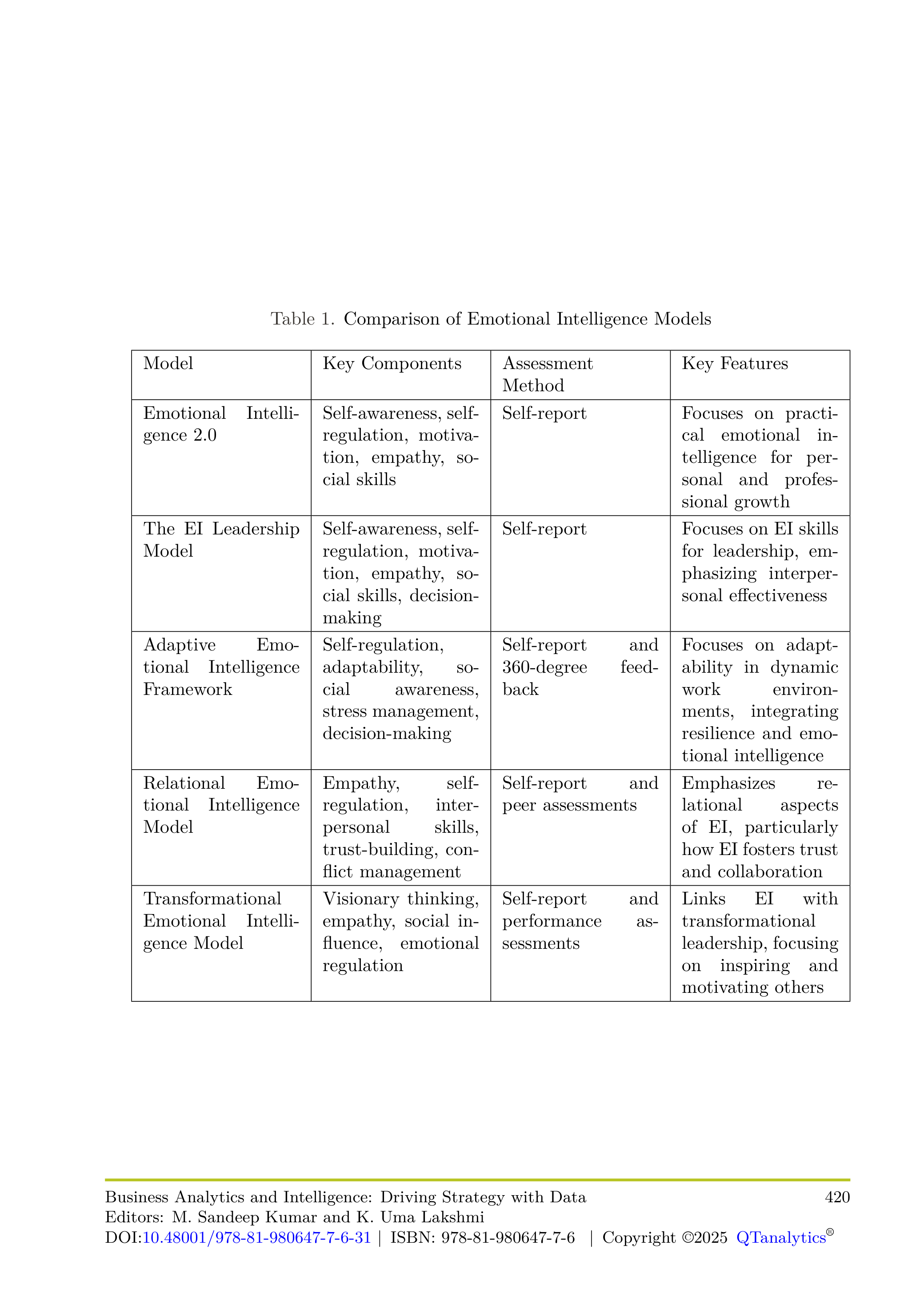
Table
1
represents
the
comparison
of
Emotional
Intelligence
Models.
Although many studies link emotional intelligence (EI) to leadership success, there are
still important areas that need more attention.
Current research on emotional intelligence
(EI)
and
leadership
often
lacks
long-term
tracking,
leaving
uncertain
whether
improve-
ments
in
EI
are
sustainable
without
continuous
support.
There
is
also
limited
focus
on
understanding
how
leaders
develop
these
emotional
skills,
with
few
studies
exploring
the
learning
processes
and
tools
involved.
Additionally,
most
research
fails
to
compare
dif-
ferent
EI
models
in
leadership
training,
hindering
the
identification
of
the
most
effective
approach.
Furthermore,
there
is
a
lack
of
cross-cultural
and
cross-industry
studies,
limit-
ing the understanding of EI’s impact in diverse environments.
Lastly, many studies do not
include
measurable
results
from
EI
training,
making
it
difficult
to
assess
the
true
impact
on
leadership
effectiveness.
Business
Analytics
and
Intelligence:
Driving
Strategy
with
Data
Editors:
M.
Sandeep
Kumar
and
K.
Uma
Lakshmi
DOI:
10.48001/978-81-980647-7-6-31
|
ISBN:
978-81-980647-7-6
|
Copyright
©2025
QTanalytics
®
419
Table
1.
Comparison
of
Emotional
Intelligence
Models
Model
Key
Components
Assessment
Method
Key
Features
Emotional
Intelli-
gence
2.0
Self-awareness, self-
regulation,
motiva-
tion,
empathy,
so-
cial
skills
Self-report
Focuses
on
practi-
cal
emotional
in-
telligence
for
per-
sonal
and
profes-
sional
growth
The
EI
Leadership
Model
Self-awareness, self-
regulation,
motiva-
tion,
empathy,
so-
cial
skills,
decision-
making
Self-report
Focuses
on
EI
skills
for
leadership,
em-
phasizing
interper-
sonal
effectiveness
Adaptive
Emo-
tional
Intelligence
Framework
Self-regulation,
adaptability,
so-
cial
awareness,
stress management,
decision-making
Self-report
and
360-degree
feed-
back
Focuses
on
adapt-
ability
in
dynamic
work
environ-
ments,
integrating
resilience
and
emo-
tional
intelligence
Relational
Emo-
tional
Intelligence
Model
Empathy,
self-
regulation,
inter-
personal
skills,
trust-building,
con-
flict
management
Self-report
and
peer
assessments
Emphasizes
re-
lational
aspects
of
EI,
particularly
how EI fosters trust
and
collaboration
Transformational
Emotional
Intelli-
gence
Model
Visionary
thinking,
empathy,
social
in-
fluence,
emotional
regulation
Self-report
and
performance
as-
sessments
Links
EI
with
transformational
leadership, focusing
on
inspiring
and
motivating
others
Business
Analytics
and
Intelligence:
Driving
Strategy
with
Data
Editors:
M.
Sandeep
Kumar
and
K.
Uma
Lakshmi
DOI:
10.48001/978-81-980647-7-6-31
|
ISBN:
978-81-980647-7-6
|
Copyright
©2025
QTanalytics
®
420
2
Research
Questions
&
Objectives
To
guide
the
investigation,
this
study
addresses
the
following
questions:
1.
How
does
emotional
intelligence
(EI)
training
impact
key
leadership
competencies,
such as decision-making, emotional regulation, and relationship-building among mid-
level
managers
at
FedEx?
2.
What role does personalized coaching play in enhancing the effectiveness of emotional
intelligence
training
within
leadership
development
programs?
3.
To
what
extent
can
emotional
intelligence
training
in
the
workplace
lead
to
im-
provements
in
employees’
personal
lives,
including
mental
well-being,
interpersonal
relationships,
and
overall
life
satisfaction?
The present study seeks to bridge that gap by analysing the FedEx LEAD1 program
and
drawing
comparisons
with
similar
initiatives,
such
as
Google’s
Project
Oxygen.
It
explores
how
structured
emotional
intelligence
training
can
influence
leadership
behaviour,
organizational
culture,
and
employee
outcomes.
3
Research
Methodology
This
study
adopts
a
qualitative
descriptive
and
exploratory
approach
to
examine
how
emotionally
intelligent
leadership
impacts
organizational
culture
and
employee
behavior,
particularly
through
leadership
development
programs
focused
on
emotional
intelligence
training.
The
research
relies
on
secondary
data,
as
no
new
data
will
be
collected
directly
from
participants,
allowing
for
in-depth
analysis
of
existing
information.
The
LEAD1
leadership
development
program
at
FedEx
Express
was
chosen
as
the
case
study
for
this
research,
based
on
its
relevance
in
integrating
emotional
intelligence
into
leadership
train-
ing,
the
accessibility
of
comprehensive
secondary
data,
its
credibility
from
evaluations
by
reputable
organizations
like
Six
Seconds,
and
its
practical
impact
in
a
global
corporate
setting.
Data
sources
for
this
study
include
internal
documents
and
training
materials
from FedEx Express and Six Seconds, as well as participant testimonials, case stories, and
reflective
narratives
that
provide
insights
into
the
program’s
design,
implementation,
and
outcomes.
4
Discussions
&
Findings
The
LEAD1
program
at
FedEx
Express
presents
a
compelling
case
for
how
structured
emotional
intelligence
(EI)
training
can
significantly
enhance
leadership
effectiveness.
Grounded
in
FedEx’s
“People-Service-Profit”
(PSP)
philosophy
and
founder
Fred
Smith’s
Business
Analytics
and
Intelligence:
Driving
Strategy
with
Data
Editors:
M.
Sandeep
Kumar
and
K.
Uma
Lakshmi
DOI:
10.48001/978-81-980647-7-6-31
|
ISBN:
978-81-980647-7-6
|
Copyright
©2025
QTanalytics
®
421
belief
that
“people
are
the
key
to
business,”
this
initiative
reflects
the
company’s
long-
standing
commitment
to
people-first
leadership.
In
an
enterprise
moving
over
seven
mil-
lion
packages
daily
with
more
than
600
flights
and
nearly
300,000
employees,
develop-
ing
leaders
who
can
think
clearly,
act
intentionally,
and
relate
empathetically
is
critical.
The
LEAD1
program,
implemented
by
the
Global
Leadership
Institute
(GLI),
focused
on
integrating
EI
into
the
core
leadership
approach
of
new
managers.
Participants
were
trained
to
become
more
aware
of
their
emotional
patterns,
manage
their
reactions,
and
engage
with
their
teams
more
intentionally.
The
practical
emphasis
on
emotional
lit-
eracy,
decision-making
under
pressure,
and
optimism
helped
leaders
navigate
FedEx’s
high-speed
work
environment
while
fostering
a
stronger,
more
emotionally
intelligent
cul-
ture.
The
results
observed—such
as
improvements
in
emotional
regulation,
increased
op-
timism,
and
enhanced
influence—strongly
support
the
idea
that
EI
is
not
only
teachable
but
also
immediately
applicable
in
managerial
contexts.
These
outcomes
are
consistent
with
the
findings
of
Singh2023;
Korakis
and
Poulaki’s
(
2025
),
who
stress
the
centrality
of
emotional
intelligence
to
leadership
success.
The
program’s
cultural
impact
was
evi-
dent.
Managers
reported
better
communication,
stronger
relationships,
and
greater
team
cohesion—mirroring
on
how
emotionally
intelligent
leadership
can
inspire
and
motivate
teams.
FedEx’s
ongoing
commitment
to
a
“people-first”
strategy
was
reinforced
by
these
improvements
in
team
dynamics
and
workplace
relationships.
An
unexpected
benefit
was
the
notable
personal
growth
among
participants.
Beyond
workplace performance, many reported life-changing improvements in areas such as family
relationships,
sobriety,
and
mental
well-being.
These
outcomes,
though
not
the
primary
aim of the program, underline the transformative potential of emotional intelligence.
This
supports the research of Coronado-Maldonado and Benítez-Márquez’s (
2023
), who empha-
size EI’s broader impact on personal and professional well-being.
By embedding emotional
intelligence training into the leadership journey, FedEx not only improved decision-making
and
influence
within
its
management
ranks,
but
also
equipped
its
leaders
with
the
tools
to
support
long-term
cultural
sustainability
and
emotional
resilience.
Figure
1
illustrates
the
average
scores
for
eight
emotional
intelligence
competencies
before
and
after
the
LEAD1
training
program
across
eight
cohorts.
The
results
from
106
managers
who
completed
the
six-month
LEAD1
program
show
a
clear
improvement
in
emotional
intelligence
(EQ)
skills.
On
average,
participants’
EQ
scores
increased
by
8%
to
11%
across
all
eight
measured
areas.
This
improvement
is
statistically
significant,
with
a
P-value
less
than
0.0001,
which
means
it
is
very
unlikely
to
be
due
to
chance.
The
data
also shows that 44% of participants had large improvements of 10% to 50% in one or more
EQ
skills.
The
biggest
improvements
were
in:
•
“Apply
Consequential
Thinking”
–
54%
of
participants
improved
by
10–50%
•
“Exercise
Optimism”
–
57%
improved
by
10–50%
Business
Analytics
and
Intelligence:
Driving
Strategy
with
Data
Editors:
M.
Sandeep
Kumar
and
K.
Uma
Lakshmi
DOI:
10.48001/978-81-980647-7-6-31
|
ISBN:
978-81-980647-7-6
|
Copyright
©2025
QTanalytics
®
422
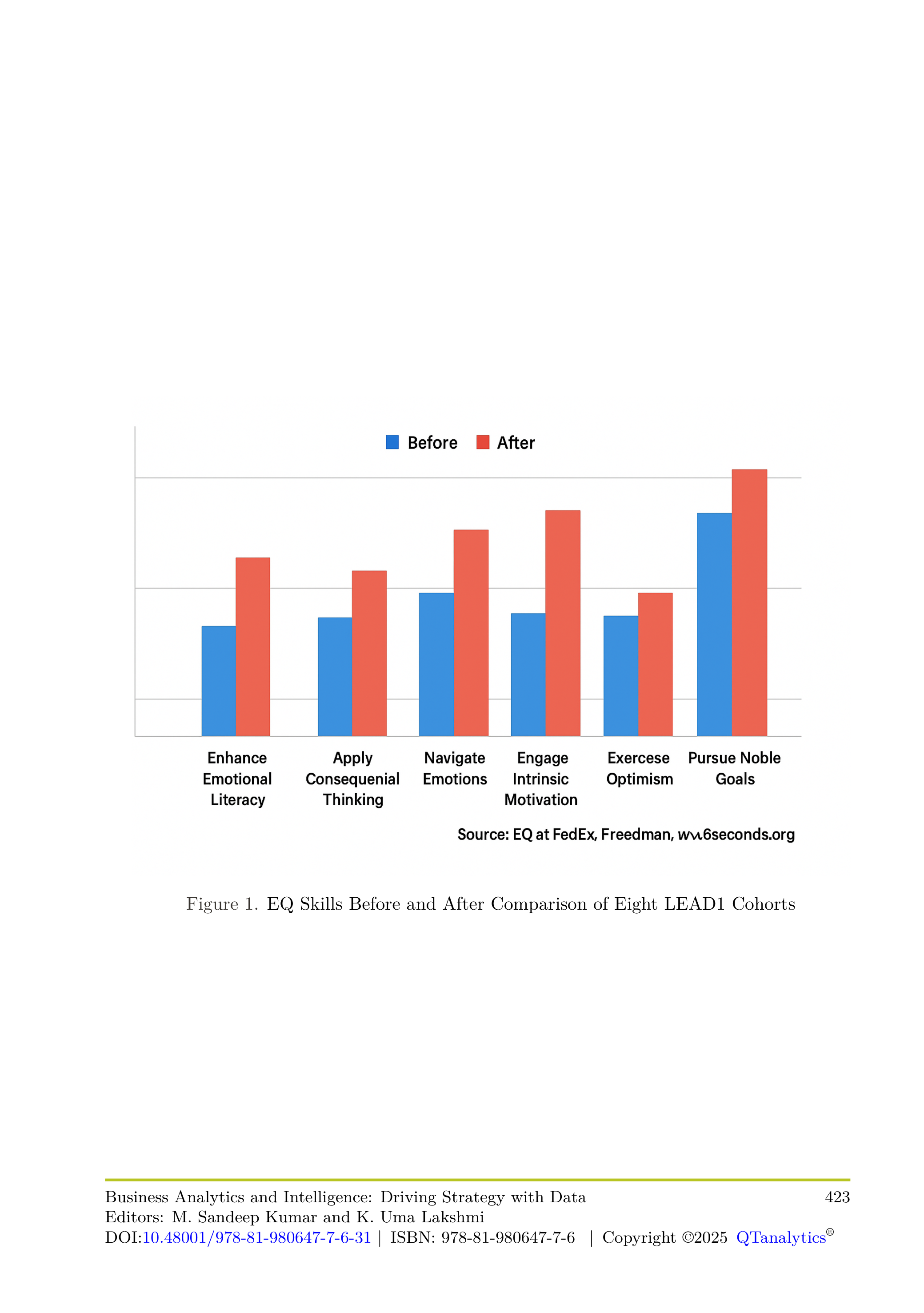
Figure
1.
EQ
Skills
Before
and
After
Comparison
of
Eight
LEAD1
Cohorts
Business
Analytics
and
Intelligence:
Driving
Strategy
with
Data
Editors:
M.
Sandeep
Kumar
and
K.
Uma
Lakshmi
DOI:
10.48001/978-81-980647-7-6-31
|
ISBN:
978-81-980647-7-6
|
Copyright
©2025
QTanalytics
®
423
These
results
show
that
focused
EQ
training
works.
Improving
specific
skills
like
opti-
mism
and
thoughtful
decision-making
helps
managers
become
more
effective
leaders.
The
program
should
continue
to
focus
on
these
areas
and
help
more
participants
stay
fully
engaged
to
get
the
best
results.
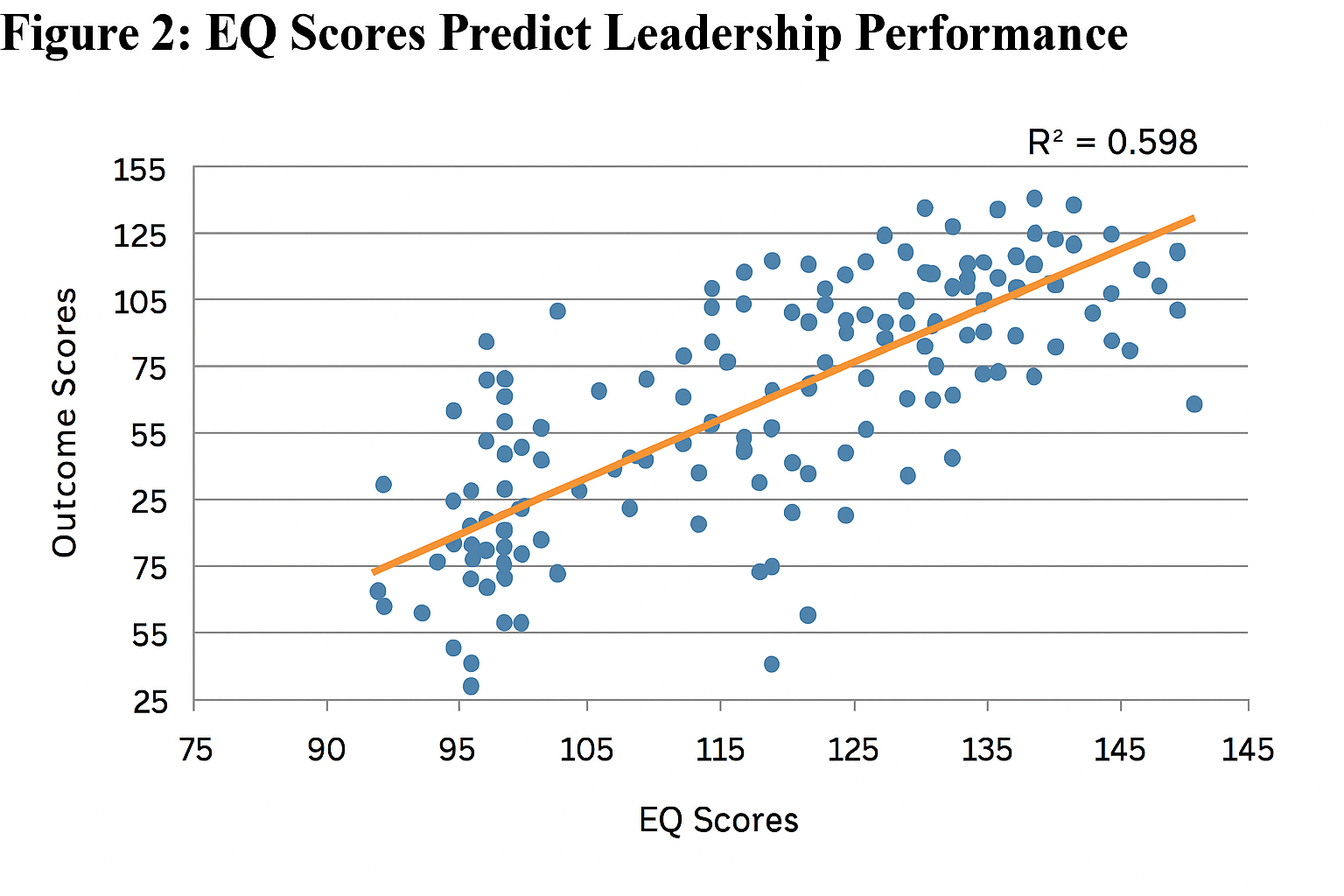
Figure
2.
EQ
Scores
Predict
Leadership
Performance
Figure
2
shows the relationship between total EQ scores and leadership outcome scores
from
SEI
assessments
of
181
individuals.
This
above
graph
shows
the
strong
link
between
EQ
scores
and
leadership
results.
Data
from
181
participants
found
that
59.8%
of
the
difference
in
leadership
outcome
scores
can
be
explained
by
differences
in
EQ
scores
(R²
=
0.598).
This
means
that
people
with
higher
EQ
tend
to
perform
better
in
leadership
roles.
This
finding
matches
with
other
researches,
which
shows
EQ
explains
55–65%
of
leadership
success.
In
other
words,
strong
emotional
intelligence
is
a
good
sign
that
someone
will
do
well
as
a
leader.
Because
of
this,
organizations
should
use
EQ
tests
not
just
to
measure
progress,
but
also
to
help
identify
future
leaders.
EQ
can
help
guide
personalized
leadership
development
plans
that
target
each
person’s
strengths
and
needs.
The
SEI
assessment
also
looked
at
six
leadership-related
outcomes,
including
decision-
making,
influence,
and
quality
of
life.
After
the
program,
participants
improved
by
6%
to
10%
on
average
in
all
these
areas.
The
largest
improvements
were:
Business
Analytics
and
Intelligence:
Driving
Strategy
with
Data
Editors:
M.
Sandeep
Kumar
and
K.
Uma
Lakshmi
DOI:
10.48001/978-81-980647-7-6-31
|
ISBN:
978-81-980647-7-6
|
Copyright
©2025
QTanalytics
®
424
•
Decision
Making
–
72%
of
participants
had
major
gains
(10–50%)
•
Quality
of
Life
–
60%
improved
by
10–50%
•
Influence
–
58%
improved
by
10–50%
These
changes
are
closely
linked
to
the
growth
in
EQ
skills.
For
example,
better
decision-
making
is
tied
to
the
“Apply
Consequential
Thinking”
skill,
while
better
quality
of
life
relates
to
optimism
and
emotional
awareness.
These
results
show
that
EQ
training
im-
proves
more
than
just
job
skills.
It
helps
managers
make
better
decisions,
build
stronger
relationships,
and
feel
more
satisfied
in
their
work
and
life.
Leadership
training
should
focus
on
both
performance
and
personal
growth
for
long-term
success.
The
design
and
outcomes
of
the
LEAD1
program
offer
a
series
of
valuable
lessons
for
organizations
looking
to
incorporate
EI
into
leadership
development.
1.
Begin
EI
Training
Early
to
Build
Strong
Leadership
Foundations
FedEx’s
choice
to
introduce
EI
training
at
the
beginning
of
a
manager’s
career
allowed
new
leaders
to
build
healthy
leadership
habits
from
the
outset.
This
proactive
approach
ensured
that
emotional
intelligence
became
a
core
competency
rather
than
an
afterthought.
2.
Blend
Instruction
with
Real-World
Application
Rather
than
limiting
training
to
theoretical
content,
LEAD1
emphasized
real-life
application.
Managers
were
en-
couraged
to
reflect
on
their
leadership
legacy,
manage
their
emotional
responses,
and
apply
relational
strategies
in
high-pressure
settings.
This
pragmatic
approach
strengthened
both
retention
and
relevance.
3.
Foster
a
Culture
of
Emotional
Awareness
By
integrating
EI
into
leadership
develop-
ment,
FedEx
reinforced
its
PSP
philosophy
and
created
a
culture
where
communi-
cation,
empathy,
and
people-centered
leadership
were
emphasized.
This
aligns
with
Neong
(2022)
and
Kour
&
Ansari
(2024),
who
noted
that
emotionally
intelligent
leaders
enhance
trust,
collaboration,
and
job
satisfaction—cornerstones
of
a
healthy
organizational
culture.
4.
Equip
Leaders
for
Fast-Paced
Decision-Making
In
a
fast-moving
logistics
environ-
ment, leaders need to make accurate decisions quickly.
LEAD1 helped managers stay
composed
and
thoughtful
under
stress.
The
focus
on
emotional
control
and
inten-
tional
response
translated
into
more
effective
leadership,
especially
when
balancing
speed
with
long-term
strategic
thinking.
5.
Recognize
and
Support
Whole-Person
Growth
Perhaps
the
most
powerful
lesson
from
LEAD1
was
the
extent
of
personal
transformation.
Leaders
not
only
improved
professionally
but
also
reported
becoming
better
parents,
partners,
and
individuals.
This
holistic
growth
helped
build
more
authentic,
resilient
leaders
and
echoed
the
belief
that
emotional
intelligence
is
a
life
skill—not
just
a
workplace
tool.
Business
Analytics
and
Intelligence:
Driving
Strategy
with
Data
Editors:
M.
Sandeep
Kumar
and
K.
Uma
Lakshmi
DOI:
10.48001/978-81-980647-7-6-31
|
ISBN:
978-81-980647-7-6
|
Copyright
©2025
QTanalytics
®
425
6.
Sustain
Growth
Beyond
the
Classroom
Another
effective
strategy
was
the
contin-
uation
of
support
and
accountability
beyond
the
initial
training
period.
Managers
remained engaged with their learning journey through follow-up coaching and reflec-
tive
practices,
reinforcing
the
idea
that
leadership
growth
is
an
ongoing
process.
5
Suggestions
Based
on
the
outcomes
of
the
LEAD1
program,
several
practical
lessons
emerge
for
de-
signing
and
improving
leadership
training
initiatives.
First,
training
should
focus
on
the
EI
competencies
that
deliver
the
greatest
impact.
“Apply
Consequential
Thinking”
and
“Exercise
Optimism”
were
the
areas
with
the
highest
participant
gains,
suggesting
that
programs
should
emphasize
these
skills
early
and
throughout
the
curriculum.
These
com-
petencies
not
only
improve
internal
awareness
and
judgment
but
also
contribute
directly
to
decision-making
and
leadership
influence.
Secondly,
using
baseline
EI
assessments
like
the
SEI
can
help
customize
the
training
experience.
Not
all
participants
benefit
equally,
and
identifying
individual
strengths
and
development
areas
at
the
start
allows
for
more
targeted
coaching
and
content.
This
personalization
can
increase
participant
engagement
and
training
effectiveness.
Additionally,
programs
should
track
both
emotional
intel-
ligence
and
behavioral
outcomes
such
as
decision-making
and
relationship
quality.
This
dual-tracking provides a clearer picture of how emotional growth translates into leadership
performance.
Well-being
should
also
be
integrated
as
a
core
goal
of
leadership
training.
The
improvements
in
quality
of
life
and
health-related
outcomes
suggest
that
emotion-
ally
intelligent
leaders
not
only
perform
better
but
are
also
more
satisfied
and
resilient.
Finally,
to
ensure
sustained
growth,
training
programs
should
include
follow-up
support
such
as
coaching,
peer
learning
groups,
or
reflection
sessions.
These
components
help
re-
inforce
learning,
deepen
application,
and
support
long-term
behaviour
change,
which
are
essential
for
building
emotionally
intelligent,
high-performing
leaders.
6
Conclusion
The findings from the LEAD1 program provide strong conceptual support for the argument
that
emotional
intelligence
(EI)
training
contributes
significantly
to
leadership
develop-
ment
among
managers.
Participants
demonstrated
notable
growth
across
key
EI
compe-
tencies,
indicating
that
structured
interventions
can
effectively
cultivate
self-awareness,
emotional
regulation,
and
interpersonal
skills.
The
most
substantial
gains
were
observed
in areas such as consequential thinking and optimism—skills that directly support critical
leadership
functions
like
sound
decision-making
and
personal
resilience.
Beyond
internal
development,
improvements
in
emotional
intelligence
translated
into
tangible
behavioural
changes.
Participants
reported
enhanced
capacity
in
leadership
performance
areas
such
Business
Analytics
and
Intelligence:
Driving
Strategy
with
Data
Editors:
M.
Sandeep
Kumar
and
K.
Uma
Lakshmi
DOI:
10.48001/978-81-980647-7-6-31
|
ISBN:
978-81-980647-7-6
|
Copyright
©2025
QTanalytics
®
426
as
decision-making,
influence,
and
overall
quality
of
life.
These
behavioral
outcomes
re-
inforce
the
practical
relevance
of
EI
in
real-world
leadership
contexts.
Moreover,
the
strong
alignment
between
emotional
intelligence
and
leadership
effectiveness
underscores
the
foundational
role
that
EI
plays
in
shaping
how
leaders
think,
act,
and
interact
with
others.
Collectively,
these
insights
affirm
that
emotional
intelligence
training
serves
as
a
vital
lever
for
elevating
both
the
capabilities
and
the
impact
of
emerging
leaders.
References
Atege, E. O., & Juma, D. (2025). Emotional intelligence and leadership effectiveness among
local
leaders
in
kisii
county.
Human
Resource
and
Leadership
Journal,
10(2),
52–
70.
https://doi.org/10.47941/hrlj.2735
Coronado-Maldonado,
I.,
&
Benítez-Márquez,
M.-D.
(2023).
Emotional
intelligence,
lead-
ership,
and
work
teams:
A
hybrid
literature
review.
Heliyon,
9(10).
https://doi.
org/10.1016/j.heliyon.2023.e20356
Hashim, H., Yunus, M. M., Ibrahim, N., Jeri, I. E., Mohamad, M. A., Sukr, Ilahi, N. S. N.,
&
Hassim,
M.
A.
N.
(2018).
Social
media
and
its
impact
on
students’
writing
skills.
https://api.semanticscholar.org/CorpusID:250527030
Haustein,
S.,
Sugimoto,
C.
R.,
&
Larivière,
V.
(2015).
Guest
editorial:
Social
media
in
scholarly communication. Aslib Journal of Information Management, 67(3).
https:
//doi.org/10.1108/AJIM-03-2015-0047
Ikart,
E.
M.
(2023).
Emotional
intelligence:
Why
its
matters
in
change
leadership
and
innovation
in
the
21st
century
styles
of
work.
International
Journal
of
Business
Innovation
(IJBI),
2(4).
https://doi.org/10.34624/ijbi.v2i4.34732
Korakis,
G.,
&
Poulaki,
I.
(2025).
A
systematic
literature
review
on
the
relationship
be-
tween emotional intelligence and transformational leadership—a critical approach.
Businesses,
5(1),
4.
https://doi.org/10.3390/businesses5010004
McGregor,
S.
(2019).
Social
media
as
public
opinion:
How
journalists
use
social
me-
dia
to
represent
public
opinion.
Journalism,
20(1).
https://doi.org/10.1177/
1464884919845458
Mishra,
D.,
Dashora,
J.,
&
Dubey,
D.
K.
(2023,
August).
The
impact
of
transformational
leadership
on
employee
engagement
and
performance:
A
comprehensive
review
[Unpublished
or
publication
source
not
specified].
Shahwan,
S.
J.
(2023).
The
impact
of
social
media
on
literature.
Arab
World
English
Journal (AWEJ) Special Issue on Communication and Language in Virtual Spaces,
226–245.
https://doi.org/10.24093/awej/comm1.18
T.,
N.
I.
M.
(2024).
The
role
of
emotional
intelligence
in
conflict
resolution
within
orga-
nizations.
Research
Output
Journal
of
Arts
and
Management,
3(2),
59–65.
https:
//rojournals.org/roj-art-and-management/
Business
Analytics
and
Intelligence:
Driving
Strategy
with
Data
Editors:
M.
Sandeep
Kumar
and
K.
Uma
Lakshmi
DOI:
10.48001/978-81-980647-7-6-31
|
ISBN:
978-81-980647-7-6
|
Copyright
©2025
QTanalytics
®
427