

2024
Amazon
Sustainability
Report
2
Contents
Overview
3
Introduction
A Letter from Our Chief Sustainability Officer
A Letter from Our Chief Sustainability Officer
A Letter from Our Chief Sustainability Officer
Officer
5
How We Work
6
Goals Summary
7
2024 Year in Review
Progress
8
Carbon and Energy
18
Waste and Circularity
21
Packaging
24
Water
26
Biodiversity
28
Human Rights
30
Responsible Supply Chain
34
Sustainable Products
37
Employee Experience
40
Health and Safety
43
Inclusive Experiences
45
Community Impact
47
Responsible Business Practices
Appendix
50
Data Tables
54
Priority Topics Assessment
55
Endnotes
56
Assurance Statements
56
Disclaimer and
Forward-Looking Statements
Learn more
about our cover photos


3
Overview
Progress
Appendix
Introduction
A Letter from Our Chief Sustainability Officer
How We Work
Goals Summary
2024 Year in Review
Introduction
About Amazon
Amazon is a global company with more than 1.5 million
full- and part-time employees worldwide and operations in
Africa, Asia-Pacific, Europe, Latin America, the Middle East,
and North America.
At Amazon, we combine data and science with passion
and innovation to tackle some of the world’s most urgent
environmental and societal challenges. We set bold,
long-term aspirations, such as The Climate Pledge—our
goal to reach net-zero carbon emissions across our global
operations by 2040—and create strategic, actionable
plans to achieve them. This determined, solutions-focused
approach guides our efforts to create lasting, positive
impact for our customers, employees, communities, and
the planet.
About This Report
This report details progress against our
goals
and
prioritized sustainability topics. All financial figures are
reported in U.S. dollars ($), unless otherwise stated. The
data within this report reflects the period from January 1
through December 31, 2024, unless otherwise indicated.
This report includes information about many of our
business units and subsidiaries, including, for example:
AWS, Devices, Amazon Fresh, Whole Foods Market,
Amazon Private Brands, Stores, and Twitch.
Our 2024 Sustainability Report covers a range of priority
topics, highlighting Amazon’s efforts to scale our work
globally, collaborate with others, and invest in and
innovate more sustainable solutions. This report details
our work to embed decarbonization efforts across our
business and the industries we work in; prevent and
responsibly divert waste; avoid, optimize, and transform
packaging; reduce, reuse, and replenish water; and
avoid and minimize biodiversity loss within our own
operations and beyond our value chain. We describe
our commitments to respect human rights, foster a
responsible supply chain, offer more sustainable products,
and support local communities. We also discuss how our
efforts align with our ambition to be the safest workplace
in our industries, and how we prioritize employee
well-being and inclusivity. Finally, we highlight our robust
governance, share our responsible business practices, and
reinforce our commitment to operating with integrity to
uphold the trust of our stakeholders.
Framework Disclosures
In addition to this report, we share our Sustainability
Reporting Framework Summary on our website, which
includes our 2024 performance against reporting
frameworks including the Global Reporting Initiative (GRI),
the Sustainability Accounting Standards Board (SASB),
the Task Force on Climate-related Financial Disclosures
(TCFD), and the United Nations Guiding Principles on
Business and Human Rights (UNGPs).
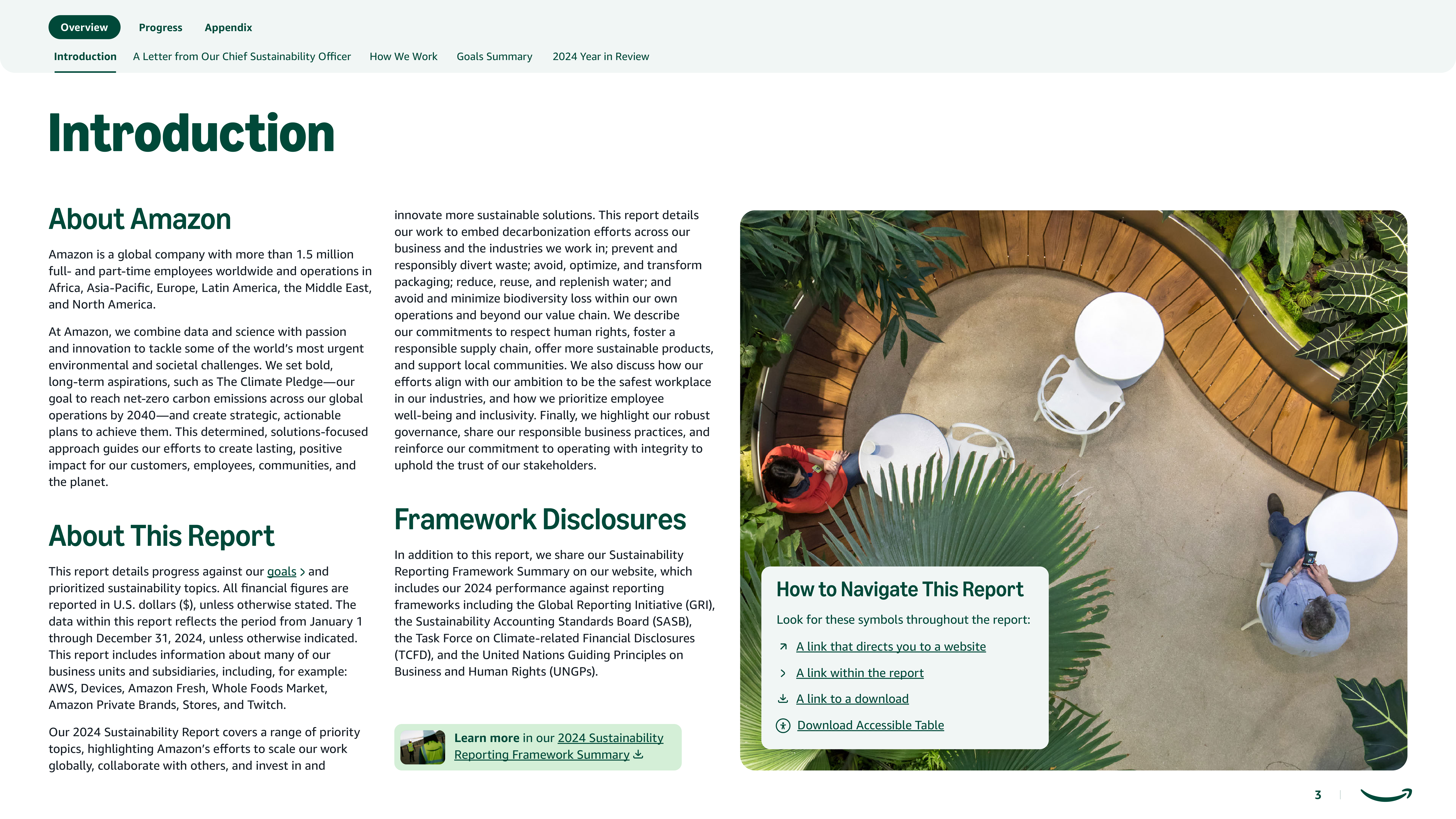
How to Navigate This Report
Look for these symbols throughout the report:
A link that directs you to a website
A link within the report
A link to a download
Download Accessible Table
Learn more
in our 2024 Sustainability
Reporting Framework Summary

4
Overview
Progress
Appendix
Introduction
A Letter from Our Chief Sustainability Officer
How We Work
Goals Summary
2024 Year in Review
A Letter from
Our Chief
Sustainability
Officer
Amazon is a unique company. The diverse nature of our
business allows us to test new sustainability solutions across
industries. When we discover a solution in one area, we can
quickly adopt it across our business, helping us move faster
toward our sustainability goals. As a customer-obsessed
company, we find this approach helps us make our customers’
lives better and easier every day, while making our operations
more sustainable.
We’re developing cutting-edge AI, delivering packages at
record speeds, creating award-winning entertainment,
advancing healthcare solutions, and promoting global
broadband access—while simultaneously reducing waste,
expanding carbon-free energy, using lower-carbon building
materials, protecting forests, protecting and furthering
human rights, and helping our communities recover from
global disasters.
Amazon’s culture also encourages us to ask “Why?” at every
turn. When we ask why sustainability matters, the answer
is clear: Sustainability is not separate from our customer
obsession—it’s an extension of it. Solutions that benefit
the environment can create superior experiences for
our customers and also become economic drivers that
help strengthen communities and protect the planet.
In 2024, we demonstrated this repeatedly across our
business, with sustainability innovations directly enhancing
customer experiences. For example, our ongoing packaging
innovations meant customers had fewer boxes to break
down and now zero air pillows to pop.
2024 also marked a turning point for artificial intelligence
(AI). It’s a transformative technology that we believe
will reinvent virtually every customer experience, as well
as create new experiences that we only once dreamed
would be possible. Over the last few years, Amazon has
accelerated its investments in generative AI to build these
experiences across our business and, including through the
1,000-plus AI applications we’re developing across Amazon.
We introduced Amazon Q, the most capable AI-powered
coding assistant; SageMaker, a service that makes it easier
to build foundation models; Amazon Bedrock, which allows
developers to do GenAI inference at scale; our own frontier
model, Amazon Nova, to give customers leading intelligence
at lower latency and cost; and we’re rolling out Alexa+, our
next-generation Alexa personal assistant that’s meaningfully
smarter, more capable, and is the first personal assistant
that can take significant actions for customers. We’ve also
harnessed AI as a powerful sustainability tool—optimizing
sizing recommendations to reduce returns, identifying
energy inefficiencies, detecting water leaks, and avoiding
packaging—solving countless environmental challenges
while simultaneously improving service quality. And we’re
just at the beginning.
As we harness generative AI’s potential and our AI
business continues to grow rapidly, we are investing in the
infrastructure that we’ll need to make AI innovation possible.
We’re also tackling one of its greatest challenges head on,
rising energy demand. Rather than viewing this as a limitation
for sustainability, we see it as an opportunity we’re facing
head-on to pioneer sustainability solutions at scale through
our AWS business for our customers and our suppliers.
In 2024, we unveiled breakthrough data center innovations
in power systems, cooling technology, and hardware
architecture that will simultaneously support next-generation
AI capabilities while improving energy efficiency—proving
that technological progress and sustainability can advance
in tandem. We’re also diversifying and expanding our
carbon-free energy portfolio, which includes our first
investments in nuclear energy, alongside maintaining our
position as the world’s largest corporate purchaser of
renewable energy for the fifth consecutive year. Through
these complementary approaches—optimizing efficiency
while scaling carbon-free energy—we’re creating a more
sustainable foundation that AI needs to fulfill its
world-changing potential.
AI is already embedded in much of this work, but when
our customers think about sustainability at Amazon, it’s
most often associated with our retail business, which we’ve
made more sustainable too. In 2024, we delivered at faster
speeds than ever before, with 10 billion items delivered
the same or next day around the world. At the same time,
our growing fleet of over 30,000 electric delivery vehicles
helped deliver 1.5 billion packages globally. Across our global
operations, we eliminated all plastic air pillows and replaced
them with recyclable paper filler. We also reduced our total
plastic packaging by 16.4%. We’ve been keenly focused on
preventing and diverting waste, and in 2024, 85% of our
waste was diverted from landfill.
As we continue to champion sustainability solutions for
our customers, we’re doing the same for our partners and
suppliers. As of today, over 550 companies have committed
to The Climate Pledge and are choosing to come together to
drive joint action and fast-track decarbonization solutions.
In that same spirit of collaboration, we’re engaging our
suppliers to set their own sustainability goals. To accelerate
collective progress, we launched The Sustainability Exchange,
sharing our playbooks and previously proprietary insights
freely with businesses worldwide. This collaborative approach
multiplies our impact by allowing companies to build on proven
solutions, combines our collective resources to tackle our
greatest environmental challenges, and drives industry-wide
momentum with a powerful blend of urgency and optimism.
Looking ahead, we recognize that the path to being a more
sustainable company will never be linear, because we’re
charting new territory at an unprecedented scale. While we
are firm on our goals, our approach will continuously evolve
with emerging challenges and opportunities, as we’re seeing
with the rapid adoption of AI. No matter what we’re faced
with in the future, we’ll remain steadfast in our commitment
to sustainability and will continue to invest, innovate, and
obsess over our progress each year, with the same intensity
and focus that has defined Amazon from Day One.
The progress demonstrated in this report is the result of the
years of work by thousands of Amazonians who have never
stopped asking “Why?” to find better and more sustainable
solutions. This questioning mindset has uncovered innovative
ways to reduce waste, cut emissions, and improve efficiency.
I’m confident our habit of asking tough questions will
lead to continued breakthrough solutions for decades to
come. Thank you to everyone—our teams, partners, and
customers—who have helped turn these questions into
real-world progress.
With gratitude,
Kara Hurst
Chief Sustainability Officer




5
Overview
Progress
Appendix
Introduction
A Letter from Our Chief Sustainability Officer
How We Work
Goals Summary
2024 Year in Review
How We Work
Our Mission
To make customers’ lives better and easier every day.
Our Business
We are committed to addressing
sustainability at every stage of
our value chain.
Our Operations
We offer a wide range of products and
services—both Amazon-branded and
from other brands and third-party sellers
—through our Amazon stores, supported
by advanced global transportation and
logistics capabilities. We also operate
businesses in digital media, including
the creation and distribution of original
entertainment content. In addition, AWS
provides the world’s most widely adopted
and comprehensive cloud offering,
supporting customers and businesses
around the globe.
Our Supply Chain
We procure materials, commodities,
components, finished goods, and
services from a complex supplier
network. We engage suppliers globally
to align our expectations for respecting
human rights, maintaining safe,
inclusive workplaces, and promoting
more sustainable practices.
Our Workforce
Amazon’s more than 1.5 million
full- and part-time employees are
key to our success, from enabling
global fulfillment to delivering on
sustainability initiatives. We support
them in advancing their own career
goals, and we offer competitive pay
and benefits, upskilling and educational
programs, opportunities to give back to
our communities through volunteerism,
as well as an inclusive workplace.
Our Communities
Amazon is committed to investing
in local communities, and being a
good neighbor all around the world,
wherever we operate. We work
side-by-side with community partners
to build long-term, innovative
programs that have a lasting positive
impact. Programs vary globally
and include increasing access to
affordable housing, alleviating hunger,
strengthening education, and helping
those impacted by natural disasters
when they occur.
Our Customers
We continually seek new and better
ways to serve customers, offering
lower prices, more convenient
services, and a larger selection
of more sustainable products.
We also help customers advance
their businesses and enable digital
transformations through AWS,
content development services, and
advertising options. In addition,
we support small businesses with
access to Amazon’s tools, resources,
and network, helping them reach
customers around the world.
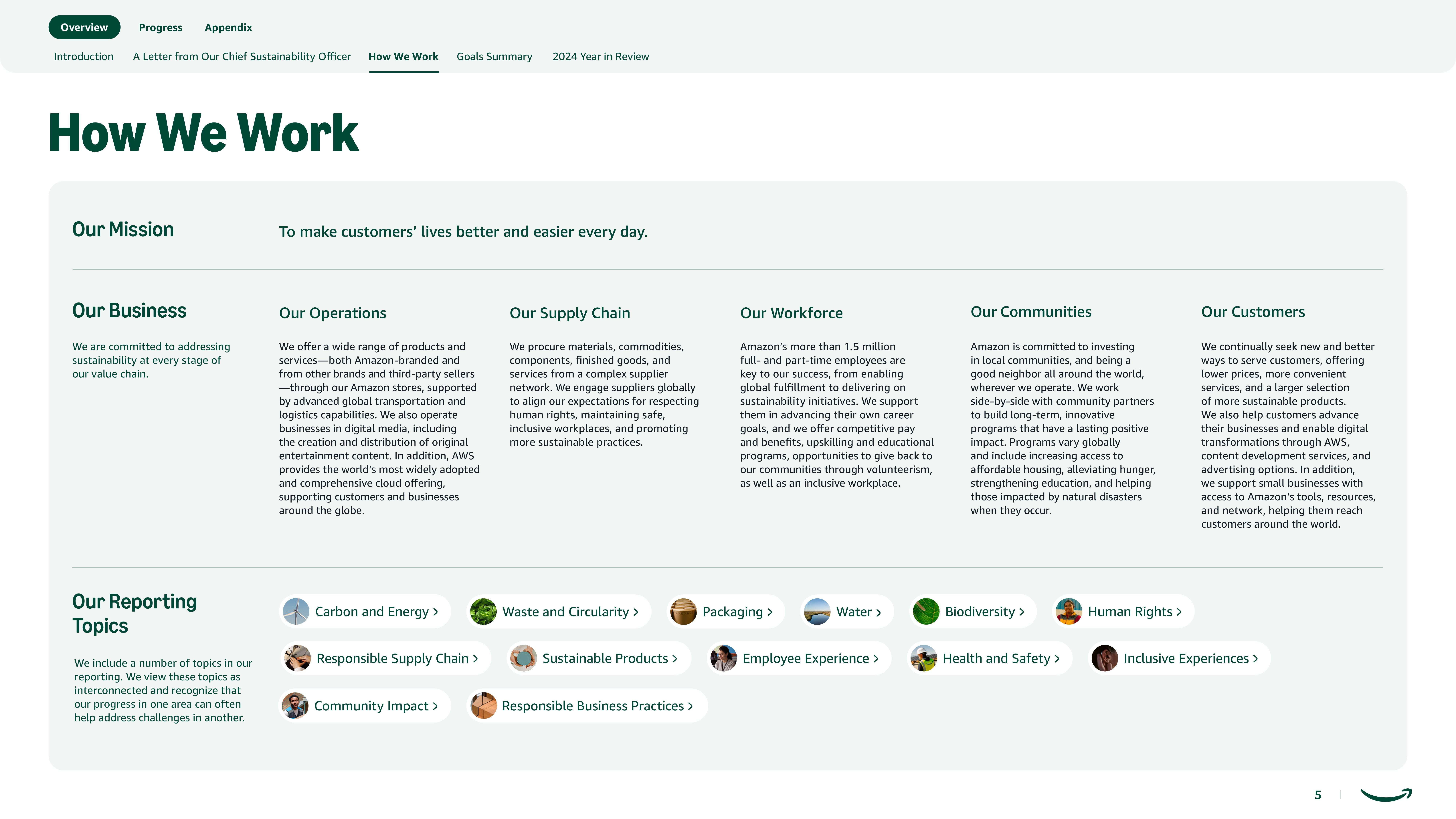
Our Reporting
Topics
We include a number of topics in our
reporting. We view these topics as
interconnected and recognize that
our progress in one area can often
help address challenges in another.
Carbon and Energy
Waste and Circularity
Packaging
Water
Biodiversity
Human Rights
Responsible Supply Chain
Sustainable Products
Employee Experience
Health and Safety
Inclusive Experiences
Community Impact
Responsible Business Practices
6
Overview
Progress
Appendix
Introduction
A Letter from Our Chief Sustainability Officer
How We Work
Goals Summary
2024 Year in Review
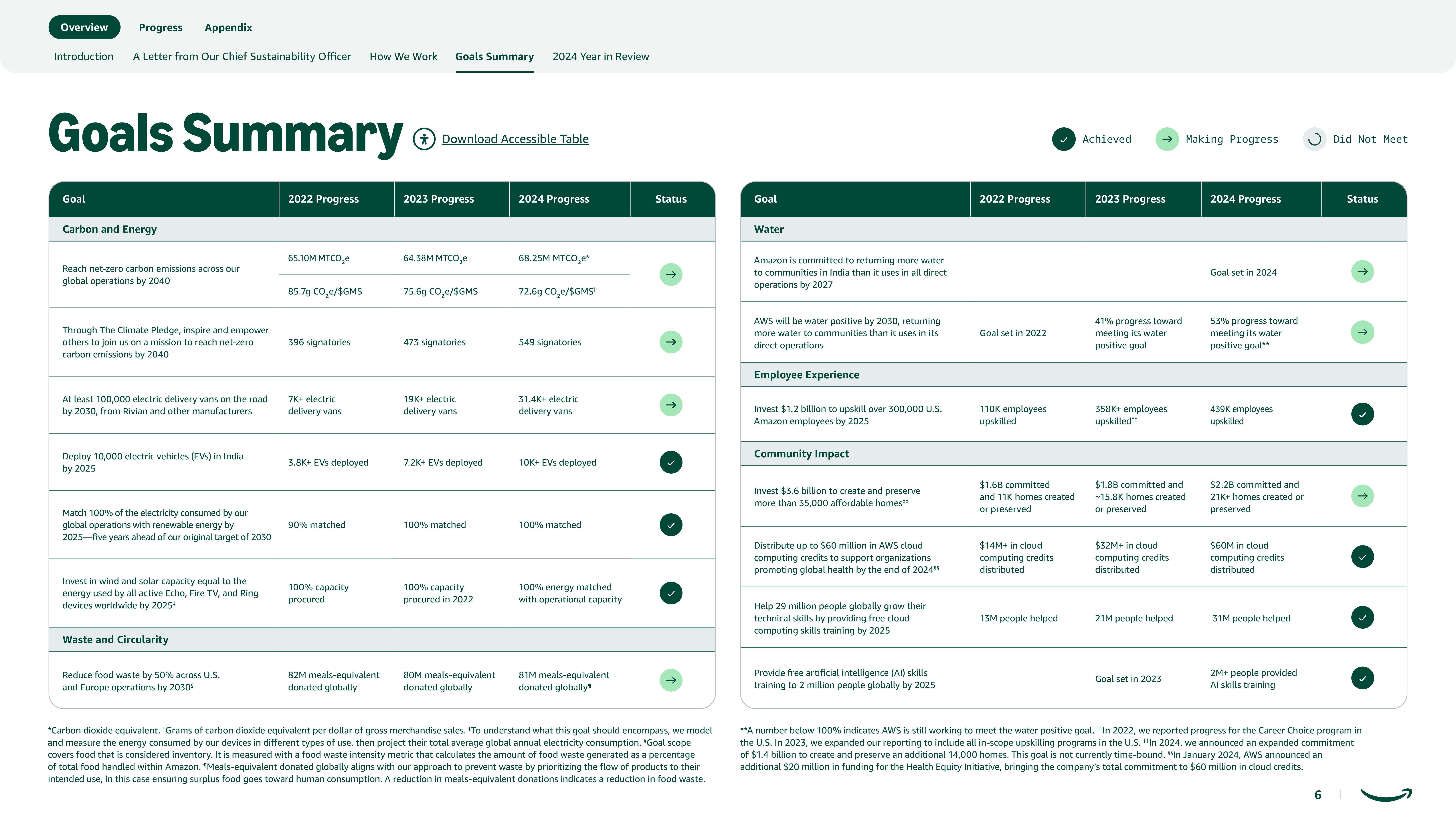
Goals Summary
Achieved
Making Progress
Did Not Meet
Goal
2022 Progress
2023 Progress
ss
2024 Progress
Status
Carbon and Energy
Reach net-zero carbon emissions across our
global operations by 2040
65.10M MTCO
2
e
64.38M MTCO
2
e
68.25M MTCO
2
e*
85.7g CO
2
e/$GMS
75.6g CO
2
e/$GMS
72.6g CO
2
e/$GMS
†
Through The Climate Pledge, inspire and empower
others to join us on a mission to reach net-zero
carbon emissions by 2040
396 signatories
473 signatories
549 signatories
At least 100,000 electric delivery vans on the road
by 2030, from Rivian and other manufacturers
7K+ electric
delivery vans
19K+ electric
delivery vans
31.4K+ electric
delivery vans
Deploy 10,000 electric vehicles (EVs) in India
by 2025
3.8K+ EVs deployed
7.2K+ EVs deployed
10K+ EVs deployed
Match 100% of the electricity consumed by our
global operations with renewable energy by
2025—five years ahead of our original target of 2030
90% matched
100% matched
100% matched
Invest in wind and solar capacity equal to the
energy used by all active Echo, Fire TV, and Ring
devices worldwide by 2025
‡
100% capacity
procured
100% capacity
procured in 2022
100% energy matched
with operational capacity
Waste and Circularity
Reduce food waste by 50% across U.S.
and Europe operations by 2030
§
82M meals-equivalent
donated globally
80M meals-equivalent
donated globally
81M meals-equivalent
donated globally
¶
*Carbon dioxide equivalent.
†
Grams of carbon dioxide equivalent per dollar of gross merchandise sales.
‡
To understand what this goal should encompass, we model
and measure the energy consumed by our devices in different types of use, then project their total average global annual electricity consumption.
§
Goal scope
covers food that is considered inventory. It is measured with a food waste intensity metric that calculates the amount of food waste generated as a percentage
of total food handled within Amazon.
¶
Meals-equivalent donated globally aligns with our approach to prevent waste by prioritizing the flow of products to their
intended use, in this case ensuring surplus food goes toward human consumption. A reduction in meals-equivalent donations indicates a reduction in food waste.
Goal
2022 Progress
2023 Progress
ss
2024 Progress
Status
Water
Amazon is committed to returning more water
to communities in India than it uses in all direct
operations by 2027
Goal set in 2024
AWS will be water positive by 2030, returning
more water to communities than it uses in its
direct operations
Goal set in 2022
41% progress toward
meeting its water
positive goal
53% progress toward
meeting its water
positive goal**
Employee Experience
Invest $1.2 billion to upskill over 300,000 U.S.
Amazon employees by 2025
110K employees
upskilled
358K+ employees
upskilled
††
439K employees
upskilled
Community Impact
Invest $3.6 billion to create and preserve
more than 35,000 affordable homes
‡‡
$1.6B committed
and 11K homes created
or preserved
$1.8B committed and
~15.8K homes created
or preserved
$2.2B committed and
21K+ homes created or
preserved
Distribute up to $60 million in AWS cloud
computing credits to support organizations
promoting global health by the end of 2024
§§
$14M+ in cloud
computing credits
distributed
$32M+ in cloud
computing credits
distributed
$60M in cloud
computing credits
distributed
Help 29 million people globally grow their
technical skills by providing free cloud
computing skills training by 2025
13M people helped
21M people helped
31M people helped
Provide free artificial intelligence (AI) skills
training to 2 million people globally by 2025
Goal set in 2023
2M+ people provided
AI skills training
**A number below 100% indicates AWS is still working to meet the water positive goal.
††
In 2022, we reported progress for the Career Choice program in
the U.S. In 2023, we expanded our reporting to include all in-scope upskilling programs in the U.S.
‡‡
In 2024, we announced an expanded commitment
of $1.4 billion to create and preserve an additional 14,000 homes. This goal is not currently time-bound.
§§
In January 2024, AWS announced an
additional $20 million in funding for the Health Equity Initiative, bringing the company’s total commitment to $60 million in cloud credits.
Download Accessible Table


7
Overview
Progress
Appendix
Introduction
A Letter from Our Chief Sustainability Officer
How We Work
Goals Summary
2024 Year in Review
2024 Year in Review
As we reflect on 2024, we are proud of our achievements. We have worked
hard to reduce our environmental footprint, drive improvements throughout
our value chain, and to create a safer, more inclusive place for people to work.
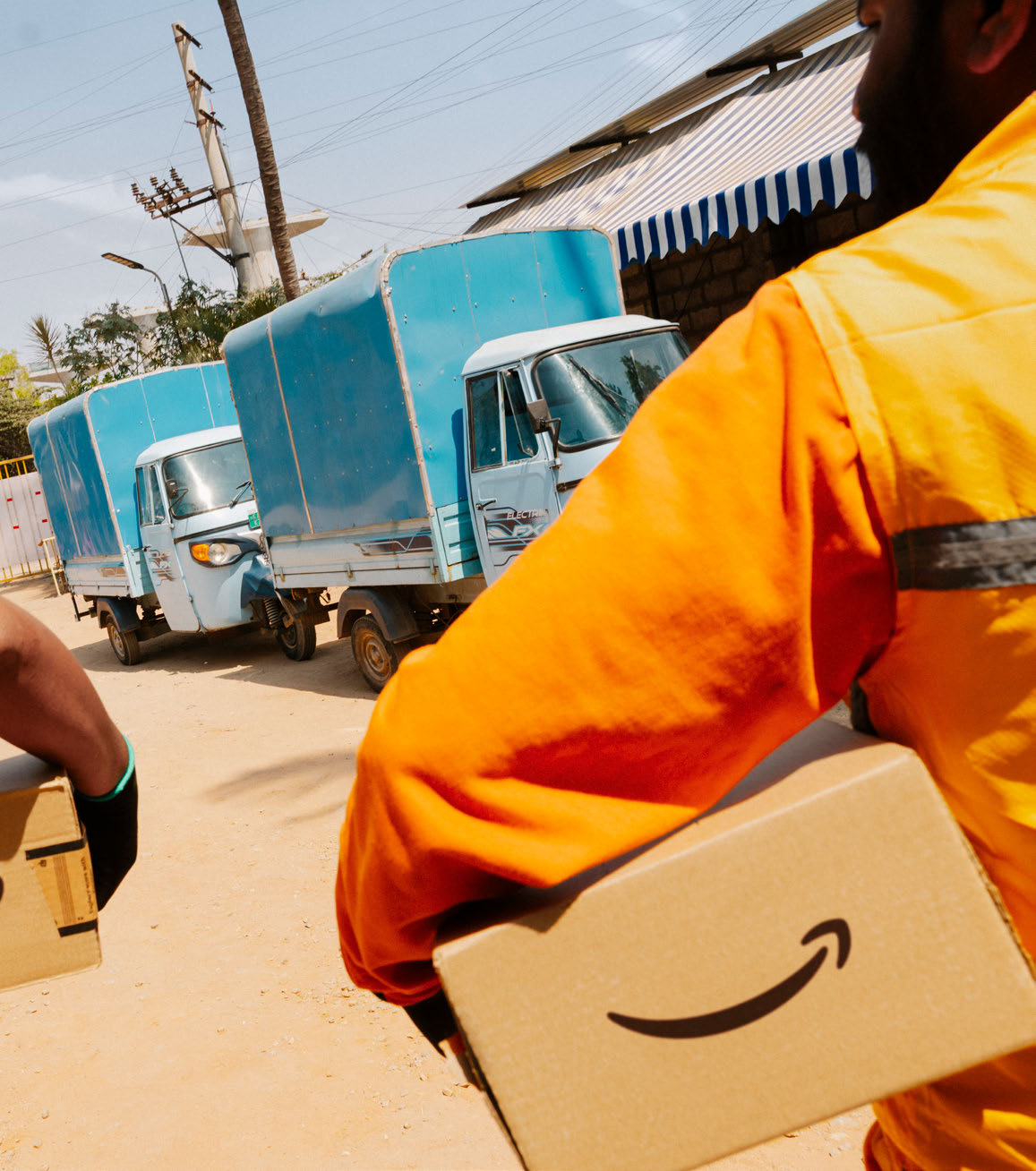
1.5B
Packages delivered by electric
delivery vehicles globally
16.4%
Reduction in single-use plastic
delivery packaging globally
1.15
Global Power Usage Effectiveness
(PUE) for AWS data centers, compared
to the industry average of 1.25
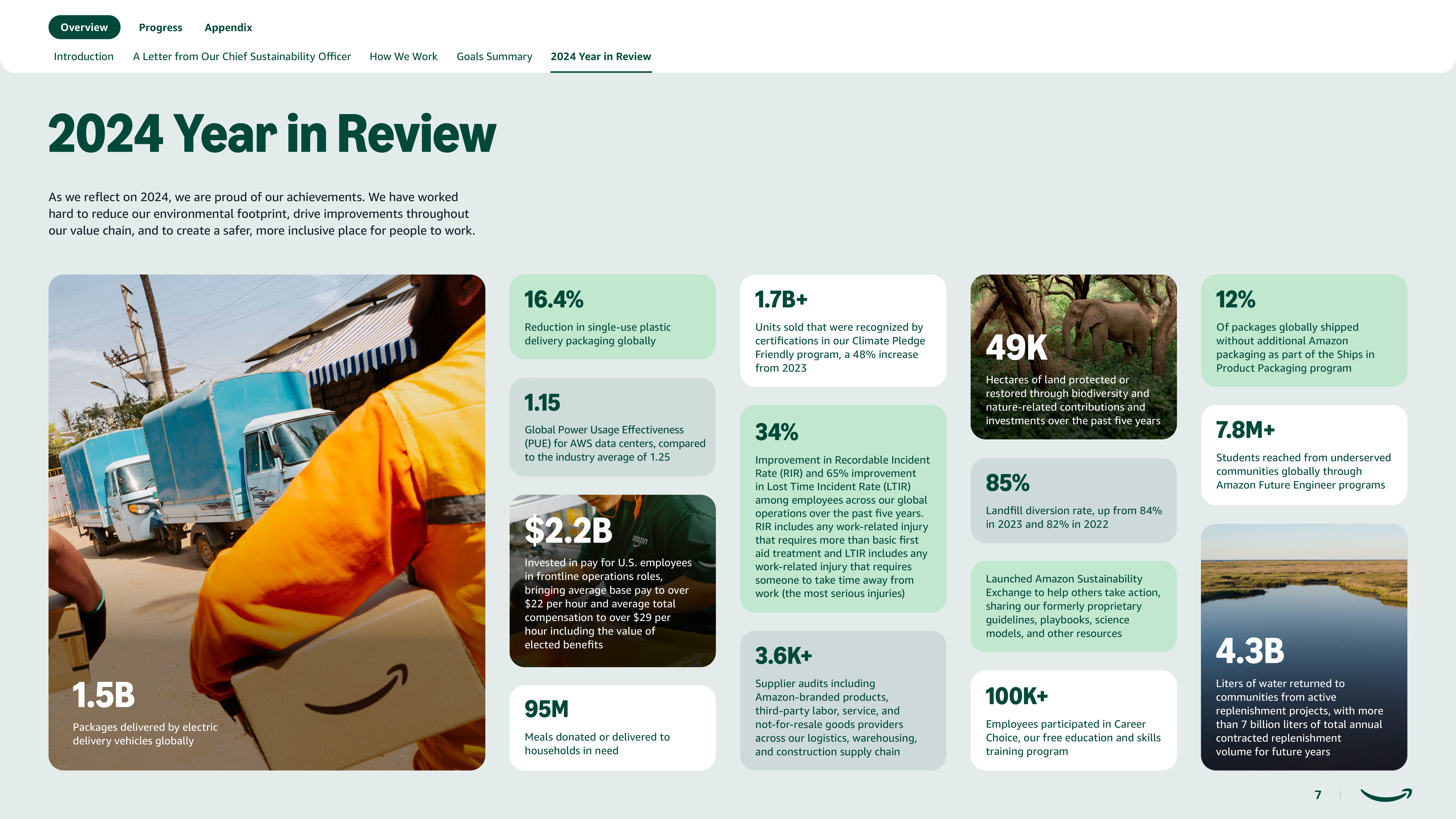
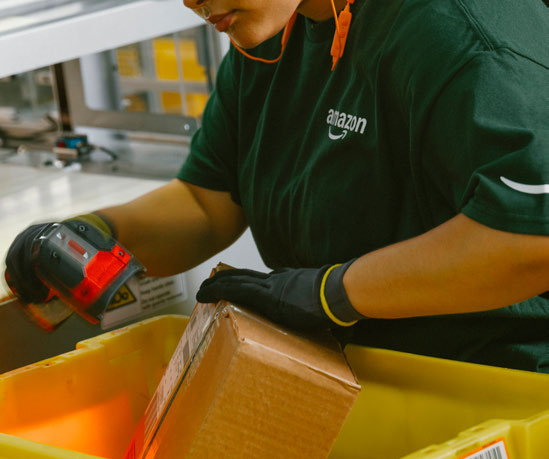
$2.2B
Invested in pay for U.S. employees
in frontline operations roles,
bringing average base pay to over
$22 per hour and average total
compensation to over $29 per
hour including the value of
elected benefits
95M
Meals donated or delivered to
households in need
1.7B+
Units sold that were recognized by
certifications in our Climate Pledge
Friendly program, a 48% increase
from 2023
34%
Improvement in Recordable Incident
Rate (RIR) and 65% improvement
in Lost Time Incident Rate (LTIR)
among employees across our global
operations over the past five years.
RIR includes any work-related injury
that requires more than basic first
aid treatment and LTIR includes any
work-related injury that requires
someone to take time away from
work (the most serious injuries)
3.6K+
Supplier audits including
Amazon-branded products,
third-party labor, service, and
not-for-resale goods providers
across our logistics, warehousing,
and construction supply chain
49K
Hectares of land protected or
restored through biodiversity and
nature-related contributions and
investments over the past five years
85%
Landfill diversion rate, up from 84%
in 2023 and 82% in 2022
Launched Amazon Sustainability
Exchange to help others take action,
sharing our formerly proprietary
guidelines, playbooks, science
models, and other resources
100K+
Employees participated in Career
Choice, our free education and skills
training program
12%
Of packages globally shipped
without additional Amazon
packaging as part of the Ships in
Product Packaging program
7.8M+
Students reached from underserved
communities globally through
Amazon Future Engineer programs
4.3B
Liters of water returned to
communities from active
replenishment projects, with more
than 7 billion liters of total annual
contracted replenishment
volume for future years
Gl
8
Overview
Progress
Appendix
Carbon and Energy
Waste and Circularity
Packaging
Water
Biodiversity
Human Rights
Responsible Supply Chain
Sustainable Products
Employee Experience
Health and Safety
Inclusive Experiences
Community Impact
Responsible Business Practices
Carbon
and Energy
Goal
Match 100% of the electricity
consumed by our global operations
with renewable energy by 2025—five
years ahead of our original target
of 2030
3
100%
Of electricity consumed by Amazon
was matched with renewable energy
sources in 2024, for the second
consecutive year
Goal
Invest in wind and solar farm capacity
equal to the energy use of all active
Echo, Fire TV, and Ring devices
worldwide by 2025
100%
Of energy used by active Echo, Fire
TV, and Ring devices worldwide was
matched with operational wind and
solar capacity in 2024
4
Goal
At least 100,000 electric delivery vans
on the road by 2030, from Rivian and
other manufacturers
5
31.4K+
Electric vans deployed globally
Goal
Inspire and invite others to sign
The Climate Pledge and join us on
a mission to reach net-zero carbon
emissions by 2040
549
Signatories, up from 473 in 2023
Goal
Deploy 10,000 electric vehicles in
India by 2025
10K+
Electric vehicles deployed in India,
surpassing our goal one year ahead
of schedule
6
Our Approach
Amazon is investing in new solutions to decarbonize our
business by using our size, scale, and resources to drive
progress across our supply chain and the industries in
which we operate.
1
Through
The Climate Pledge
, which we co-founded and
committed to in 2019, our goal is to reach net-zero carbon
emissions across our global operations by 2040, while
inspiring and inviting others to take action. We recognize
that progress will not always be linear, but we remain
focused on serving our customers better, faster, and with
fewer emissions.
Our strategy is aligned with climate science and embeds
decarbonization initiatives and efficiency improvements
across our business and supply chain. Teams across
Amazon are accountable for setting decarbonization
plans that map back to Amazon’s worldwide strategy, as
ownership and accountability are essential to operational
success and managing complexity. We focus on four
cross-cutting initiatives to decarbonize our business:
•
Driving efficiency across our global operations.
We
identify and implement efficiency initiatives across
Amazon, such as improving transportation routing,
increasing pack and fill rates, improving cloud-computing
chip efficiency, adding Low Power Mode to devices, and
installing energy-efficiency solutions in buildings.
•
Deploying lower-carbon alternatives.
We use
lower-carbon options when practicable, such as
lower-carbon concrete and steel during construction,
recycled and bio-based plastics in data center
components, and lower-emission fuels and vehicles
for transportation.
•
Investing in carbon-free electricity
. We invest in
carbon-free energy, such as on-site solar, utility-scale
solar and wind, nuclear, as well as battery energy
storage to collect and store carbon-free energy.
2
•
Engaging with suppliers.
We actively engage,
support, and incentivize suppliers to join Amazon’s
decarbonization journey by setting credible goals,
implementing emissions reduction strategies, and
transparently sharing their progress, and we create
industry solutions that our suppliers can utilize, like the
Amazon Sustainability Exchange
.
Beyond our own operations, we are working to accelerate
decarbonization across industries and with suppliers by:
•
Catalyzing industry-wide action.
We bring
companies together from around the world through
The Climate Pledge, driving collective action,
cross-sector collaboration, and engagement in
initiatives that encourage industry-wide measures
to promote decarbonization.
•
Investing in innovation.
We adopt ready-to-scale
solutions, and we evaluate and invest in emerging
technologies through
The Climate Pledge Fund
—
including those that can help address emissions from
hard-to-abate sectors. We also provide direct
funding to accelerate the widespread adoption
of such emerging technologies.
•
Supporting policies that drive decarbonization.
We work with policymakers, governments,
nongovernmental organizations (NGOs), industry
associations, coalitions, and other organizations on
regulatory and policy issues aimed at advancing
and incentivizing decarbonization.
•
Catalyzing climate finance and market-based
mechanisms.
We use mechanisms (e.g., insets and book
and claim) to spur development of decarbonization
technologies and transform the sectors in which
we operate. This allows us to make progress on
commodities where decarbonization solutions are
not yet available within our direct supply chain.
•
Neutralizing remaining emissions.
While our first
priority is to eliminate emissions within our value
chain, we are also investing in climate mitigation
solutions outside of our value chain as a contribution
to global climate action. Our approach focuses on
direct investment, advance purchase agreements,
coalition building, new methodology development,
and technological innovation.
Our Progress
Our Carbon Footprint
Regular and transparent reporting is an important part
of our decarbonization strategy and our Climate Pledge
9
Overview
Progress
Appendix
Carbon and Energy
Waste and Circularity
Packaging
Water
Biodiversity
Human Rights
Responsible Supply Chain
Sustainable Products
Employee Experience
Health and Safety
Inclusive Experiences
Community Impact
Responsible Business Practices
Actions
#1
Largest corporate purchaser of
renewable energy in the world for
the fifth consecutive year, according
to BloombergNEF
3.7M
Gallons of blended SAF procured
1.5B
Packages delivered by EVs globally
1.15
Global Power Usage Effectiveness
(PUE) for AWS data centers, compared
to the industry average of 1.25
621
Total renewable energy projects
globally—including 124 new
projects—representing 34 GW
of capacity
90%
Of our highest-emitting suppliers
have decarbonization plans in place
Launched Amazon Sustainability Exchange
to help others
take action, sharing our formerly proprietary guidelines,
playbooks, science models, and other resources
10
Goal
Reach net-zero carbon emissions
across our global operations by 2040
Amazon’s Carbon Footprint (MMT CO₂e*)
commitment. We measure both absolute emissions and
carbon intensity to provide a complete picture of our
progress toward our 2040 goal. Absolute emissions are
critical to our end goal, and carbon intensity helps us
assess the effectiveness of our actions along the way.
This type of comprehensive measurement is not only
important for us, but it is also useful for our customers
and partners, so they can understand how investments
across our value chain are driving real progress.
After two years of decreasing absolute carbon emissions,
we saw a 6% increase in 2024.
7
This is where carbon
intensity helps us examine whether we’re employing the
right solutions in the near term, and decoupling emissions
from business growth.
8
In 2024, we achieved a 4%
reduction in carbon intensity compared to 2023, with 11%
business growth during the same period. We have also
seen a sustained reduction in carbon intensity year over
year and have reduced our carbon intensity approximately
40% since committing to The Climate Pledge in 2019.
9
As we continue toward our 2040 goal, our progress will
not be linear, but we will remain focused on investing in
long-term solutions, optimizing for network efficiencies,
helping our supply chain decarbonize, and innovating with
our partners in the hard-to-abate parts of our business.
Direct Emissions
Amazon’s direct emissions are primarily generated from
the fuel used by our transportation and logistics fleet to
deliver packages to customers, and refrigerants to keep
buildings and products cool. One way we address this is
by continually refining our strategy to reduce emissions
generated during the full journey of an Amazon package—
from its origins with the manufacturer to the doorstep of
the customer.
We know that speed matters to our customers, which is
why we invest in our logistics and delivery capabilities
to optimize for faster deliveries while prioritizing
sustainability. For example, we’ve optimized our inventory
placement to shorten the distance products have to
travel to our customers. By dividing our operations
and transportation networks into smaller regions and
stocking more of the products our customers want locally
customers can get the products they want quickly and we
can utilize more sustainable modes of transport to deliver
those products to them. In 2024, we avoided millions of
miles due to increased efficiency from this regionalization
effort and expect to accelerate this progress in coming
years. Additionally, we continue to optimize how we fill
our trucks and are increasing the use of electric vehicles
(EVs). And when we can’t use EVs, we use lower-carbon
transportation modes, such as alternative fuel vehicles,
where possible. By the end of 2024, we had reduced the
carbon emissions per shipped unit by roughly one-third
since 2019. Specific examples include:
•
Offering customers shipping options that improve
routing, by combining products into one delivery. In
2024, Prime members in the U.S. saved an estimated
452 million delivery trips, which helped avoid the use of
more than 494 million boxes and the generation
of 335,000 metric tons of CO
2
e.
Learn more
about how
we are
improving routing efficiency
•
Expanding our electric delivery fleet by delivering 1.5
billion packages to customers using more than 31,400
electric delivery vans and other EVs. To support our
expanding EV network, we installed 11,770 chargers
at 50 delivery stations, creating the largest private
charging network in the U.S. In early 2025, we also
announced our largest order of zero-tailpipe-emission
heavy goods vehicles, with more than 200 new
Mercedes-Benz Trucks eActros 600 vehicles set to join
our transportation network in Europe. These vehicles
are expected to transport 338 million packages per year
when fully operational.
Learn more
about how we are
scaling up EVs
•
Scaling lower-carbon fuels. In 2024, Amazon procured
3.7 million gallons of blended sustainable aviation fuel
(SAF). In addition, we expanded our use of renewable
*Million metric tons carbon dioxide equivalent.
† Scope 2 and 3 carbon emissions are calculated using a
market-based method.
‡ Grams of carbon dioxide equivalent per dollar of gross
merchandise sales.
§ We updated our Carbon Methodology
used for our 2022, 2023,
and 2024 carbon footprint
Direct Emissions
Indirect Emissions from Purchased Electricity
†
Indirect Emissions from Other Sources
†
Carbon intensity (gCO₂e/$GMS)
‡
5.76
51.17
60.64
71.54
65.10
64.38
68.25
9.62
12.11
13.02
14.22
15.13
2022
§
2023
§
2024
§
2021
2020
2019
39.91
5.50
45.75
5.27
55.36
4.07
49.02
3.06
47.40
2.76
50.32
2.80
102.7
122.8
100.8
85.7
75.6
72.6
10
Overview
Progress
Appendix
Carbon and Energy
Waste and Circularity
Packaging
Water
Biodiversity
Human Rights
Responsible Supply Chain
Sustainable Products
Employee Experience
Health and Safety
Inclusive Experiences
Community Impact
Responsible Business Practices
diesel—a lower-carbon fuel made from waste fats and
oils—using 4.7 million gallons in middle and last mile
operations, up from 286,300 gallons in 2023.
Learn
more
about how we are
scaling lower-carbon fuels
Our direct emissions increased 6% compared to 2023, as
our business continued to grow and we navigated global
supply constraints for EVs and low-carbon fuels. This
reinforces the importance of our leadership in creating
stronger demand signals for lower-carbon transportation
solutions through buyers’ alliances, partnerships with
industry leaders, policymakers, and other companies.
Indirect Emissions from Purchased Electricity
Our indirect emissions from purchased electricity primarily
come from electricity used to power buildings and charge
EVs at our facilities. Two of the most effective ways we
manage indirect emissions from purchased electricity are
by transitioning to carbon-free energy sources and by
improving energy efficiency.
Nuclear power is a key component of our carbon-free
energy strategy, in addition to using renewable energy
sources such as wind and solar. In 2024, we signed
agreements to support nuclear energy projects, including
the development of Small Modular Reactors (SMRs). SMRs
feature a compact design that enables faster construction
closer to power grids, which allows for more rapid
deployment than traditional reactors. Additionally, as of
January 2025, we had invested in 621 renewable energy
projects—including 124 new projects in 2024 alone—
representing 34 GW of carbon-free energy capacity.
Learn more
about how we are
transitioning to
carbon-free energy
Today, in virtually every corner of Amazon, we’re using
generative AI to make customers’ lives better and easier—
and while we’ve made a lot of progress, we’re still at the
relative beginning. One of the biggest challenges with
scaling AI is increased energy demands for data centers.
This increased energy demand is from AI chips, which
are vital for machine learning models, but require more
electricity and cooling than traditional chips given the
higher speeds at which they complete mathematical
calculations.
11
We are laser-focused on improving energy
efficiency, which we measure through Power Usage
Effectiveness (PUE). In 2024, AWS reported a global
PUE of 1.15—better than both the public cloud industry
average of 1.25 and 1.63 for on-premises enterprise
data centers, as estimated by the International Data
Corporation.
12
A lower PUE value indicates greater
efficiency (with the theoretical minimum PUE being 1.0),
and indicates that using AWS to power AI innovation is
a lower-emission option than most. We achieved this
success from optimized data center designs, energy-
efficient custom chips, and advanced cooling technologies.
For example, new AWS data center components
introduced in 2024 deliver 12% more computing power
and reduce peak cooling energy consumption by 46%
compared to previous designs, all without increasing
water usage.
Learn more
about how we’re
improving
energy efficiency to power AI innovation
For the past two years, 100% of the electricity consumed
by Amazon was matched with renewable energy sources.
This helps us reduce carbon emissions, but doesn’t
eliminate them. We saw a 1% increase in our indirect
emissions from purchased electricity in 2024, in part due to
the higher electricity usage required to support advanced
technologies. This underscores why it’s important to scale
carbon-free energy sources to continue to deliver the
advanced technologies our customers need.
Indirect Emissions from Other Sources
Indirect emissions from other sources are from activities
beyond our direct operations, including building materials
and construction, third-party transportation, and the
production of Amazon-branded products and their
components by our suppliers.
We aim to reduce embodied carbon in building construction
by using lower-emission concrete, lower-emission steel and
aluminum, and mass timber. In 2024, 49 Amazon building
projects incorporated lower-carbon building materials and
finishes, avoiding at least 77,000 metric tons of embodied
CO
2
e.
13
Learn more
about how we are
reducing embodied
carbon in our buildings
Reducing indirect emissions from other sources requires
engaging our suppliers on their efforts to decarbonize. It
is important that all suppliers understand their business
and how they will decarbonize, and that they have a
plan to do so. To enable that, we are open-sourcing
information and making playbooks available through
the
Sustainability Exchange
, a free, publicly available
website offering previously proprietary information
to help other companies seeking to make meaningful
progress toward net-zero carbon emissions.
Learn more
about how we are
engaging suppliers
Indirect emissions from other sources, which made up
74% of our total carbon footprint in 2024, increased
6% from 2023, primarily from data center construction
and fuel consumption by third-party delivery service
providers. As we look forward, we will continue to focus
on our supplier engagement programs and our investment
in lower-carbon building materials, which help create
scalable solutions for reducing indirect emissions across
our business.
Engaging Others on the Path to Net-Zero
Carbon by 2040
We recognize that addressing complex sustainability
challenges—like enabling widespread electrification,
scaling lower-carbon fuels, and increasing the availability
of lower-carbon building materials—requires growing
demand to expand supply and achieve lower costs
through efficiencies of scale. We drive change through
industry engagement and buyers’ alliances like Zero
Emission Maritime Buyers Alliance (ZEMBA) and the
Sustainable Aviation Buyers Alliance (SABA), which help
develop lower-carbon solutions for hard-to-abate sectors
and commodities. Our partnerships with organizations
such as the Clean Energy Buyers Association (CEBA), RMI’s
Sustainable Steel Buyers Platform, the Smart Freight
Centre, and The Center for Green Market Activation support
innovation and decarbonization across multiple industries.
Learn more
about how we are
catalyzing industry action
This work extends through The Climate Pledge, which had
reached 549 signatories by the end of 2024 and is working
on 11 joint action projects to address critical climate
challenges. The Climate Pledge Fund, which marked its
fifth year of investing in 2024, enables us to invest in
companies operating in hard-to-abate sectors. In 2024,
the fund made 12 new and follow-on investments across
transportation, energy, buildings, and carbon removal
sectors.
Learn more
about how we are
investing in
innovation through the Climate Pledge Fund
Looking ahead, we remain committed to innovation
and collaboration. We aim to deliver the best for our
customers and communities while progressing toward our
goal of net-zero carbon emissions across our operations
by 2040. Ultimately, we strive to contribute to a better
planet for all.
Embedding Decarbonization
Efforts Across Our Business
Driving Efficiency Across Our Global
Operations
From how we deliver packages and operate our cloud
technologies to how we design buildings and products,
we continually seek ways to use less energy and generate
fewer emissions.
11
Overview
Progress
Appendix
Carbon and Energy
Waste and Circularity
Packaging
Water
Biodiversity
Human Rights
Responsible Supply Chain
Sustainable Products
Employee Experience
Health and Safety
Inclusive Experiences
Community Impact
Responsible Business Practices
Enhancing Routing and Fleet Efficiency
Optimal routing and transportation network efficiency is
one of our most impactful ways of reducing emissions. To
optimize routing and transportation network efficiency,
we deploy a multi-pronged strategy to reduce emissions
during the full journey of an Amazon package from its
manufacturer all the way through to the customer. We
prioritize the lowest-emission delivery methods wherever
possible, while balancing trade-offs in speed, cost,
reliability, and convenience.
Where possible, we prioritize lower-emission transportation
options, using a mix of road, rail, sea, and air. In 2024,
we offered our customers shipping options that promote
routing efficiency, further reducing the miles traveled and
the average carbon emissions associated with delivery.
In 2024, Prime members in the U.S. saved an estimated
452 million deliveries due to consolidating their Prime
deliveries, which helped avoid the use of more than 494
million boxes and 335,000 metric tons of carbon dioxide
equivalent (MTCO₂e). Ocean and rail transportation have
a lower carbon footprint than air transportation, so we
prioritize shipping our products via those modes, when
feasible. In 2024, 90% of our imported transoceanic
shipments were transported via ocean freight and 10%
transported via airfreight, consistent with 2023. We
increased our total rail load volume by 59% in Europe and
11% in the U.S. compared to 2023.
Amazon launched rail deliveries in the UK for the first
time in 2024. Products are loaded onto train cars on the
fully electric West Coast Main Line, which runs between
Scotland and the Midlands. More than 5 million products
are expected to travel on the UK’s electric rail network
in 2025, avoiding traffic congestion and reducing carbon
emissions, with plans to expand across further electric rail
routes before the end of 2025.
We are also exploring using inland waterways and
passenger trains as part of our Intermodal City Injections
program. For example, we collaborated on a pilot project to
deliver packages using electric delivery vehicles to transport
products from the distribution center to an electric tram
followed by micromobility e-cargo bikes in Frankfurt,
Germany—achieving zero tailpipe emissions from delivery
station to customer. We have also continued to invest
in lower-carbon fuels and deployment of electric and
alternative fuel vehicles to reduce transportation-
related emissions.
We aim to avoid unnecessary delivery packaging whenever
possible, and select lighter, right-sized options, to ship
products to customers with fewer associated emissions.
We also aim to increase pack and fill rates to optimize
truck and airplane space, which can also reduce the
number of trucks needed to make deliveries. In addition,
we provide customers with shipping options that
reduce the emissions associated with the delivery of
their packages.
Learn more
about our more
sustainable packaging
approach
Implementing Efficiency Initiatives in Our Buildings
Building construction is a significant driver of carbon
emissions in many industries, due to the associated
embodied carbon that is emitted during the construction
process. Amazon’s buildings portfolio includes owned and
leased facilities in 65 countries, encompassing a number
of building types—including operations facilities, grocery
stores, corporate offices, and data centers. As a result,
implementing and scaling decarbonization solutions
and processes to reduce the footprint of our built
environment is a priority for Amazon.
Our
building decarbonization work
focuses on the
materials and methods used in construction as well
as the energy consumption and emissions associated
with operations that occur throughout a building’s
lifecycle. Our standardized approach targets five areas:
(1) prioritizing carbon-free energy; (2) increasing energy
efficiency; (3) using lower-carbon refrigerants; (4) using
lower-carbon construction materials; and (5) reducing
on-site water consumption and waste generation. These
efforts are supported by investments in innovative
technology, as well as regular testing and learning to
refine our approach and guide future development.
In 2024, we conducted 200 energy audits of our
existing buildings to inform future upgrade programs
and to help optimize operational performance. We
also improved energy efficiency in our North America
and Europe fulfillment centers through optimizing
warehouse ventilation controls, updating heating
and air conditioning scheduling, upgrading dock door
levelers, and implementing intelligent materials handling
equipment management. These system optimizations
helped reduce energy consumption by 92 million
kilowatt hours and helped avoid 24 million metric tons
of CO₂e compared to 2023. We piloted a prototype of
a new high-performance dehumidification technology,
which decreases air conditioning energy consumption
and associated emissions while improving air quality for
occupants in buildings located in humid climates.
As we progress our building decarbonization efforts,
we continue to obtain validation of our improvements
through Zero Carbon certification by the International
Living Future Institute (Living Future). In 2024, a sortation
center in Melbourne, Australia, was certified, bringing our
total Living Future-certified buildings to four.
Optimizing AWS Global Cloud Infrastructure
As the world’s most comprehensive and broadly adopted
cloud, AWS is committed to building a more energy
efficient and lower-carbon business for our customers
and the planet, especially as advancements in digital
transformation and adoption of advanced technologies
such as AI increase global demand for data center
capacity.
Research
estimates AWS infrastructure is up
to 4.1 times more efficient than on-premises computing,
and when workloads are optimized on AWS, the
associated carbon footprint can be reduced by up to 99%.
In 2024, AWS had a global PUE of 1.15. This was achieved
through optimized data center designs, purpose-built
chips, and innovative cooling technologies. Additionally,
in 2024, we unveiled new AWS data center components,
offering 12% more compute power with improved
availability and efficiency. AWS
also introduced a novel,
direct-to-chip liquid cooling solution
for high-density
AI compute chips in new and existing data centers. These
components reduce mechanical energy consumption
by up to 46% during peak cooling—without increasing
water usage.
Additionally, with increased computing power required for
AI and other applications, investing in purpose-built chips
that advance innovations in power efficiency continues to
be an important part of our strategy. We offer a number
of chips with energy-efficiency benefits. For example,
Graviton-based instances use up to 60% less energy than
comparable instances for the same performance. At the
end of 2024, over 70,000 customers had adopted Graviton
chips, achieving an estimated reduction of 12,000 MTCO₂e
due to increased energy efficiency. Amazon’s own adoption
of Graviton chips has achieved an estimated reduction of
71,000 MTCO₂e in 2024. Other efficiency savings include
Inferentia2-based instances, which offer up to 50% better
performance/watt over comparable Amazon Elastic
Compute Cloud (EC2) instances, and AWS Trainium3 chips
are designed to be up to 40% more energy efficient than
AWS Trainium2 chips.
Selecting Lower-Carbon Alternatives
Whenever possible, Amazon aims to select lower-carbon
alternatives across transportation, buildings, and products,
and we consider a range of factors, including cost,
emissions reduction potential, and availability.
Scaling Use of Electric Vehicles
We are focused on a comprehensive transportation
decarbonization strategy that includes optimizing our
12
Overview
Progress
Appendix
Carbon and Energy
Waste and Circularity
Packaging
Water
Biodiversity
Human Rights
Responsible Supply Chain
Sustainable Products
Employee Experience
Health and Safety
Inclusive Experiences
Community Impact
Responsible Business Practices
network to minimize unnecessary transportation, promoting
electrification where technologically and operationally
feasible, and pursuing efficient lower-carbon fuel solutions.
We deliver packages to our customers every day,
making vehicle electrification within our network a
decarbonization priority for Amazon. We have set goals
to have at least 100,000 electric delivery vans on the road
globally by 2030 and more than 10,000 electric delivery
vehicles deployed in India by 2025.
In 2024, we made progress toward these goals, with more
than 31,400 electric vans deployed globally—including
more than 24,000 from Rivian—up from 19,000 in 2023.
To support this growth, we installed 11,770 chargers,
bringing our total to 24,000 chargers at 50 delivery
stations—now the largest private charging network in the
U.S. We also achieved our India goal ahead of schedule,
deploying more than 10,000 electric vehicles in 2024, a
year earlier than planned. These initiatives enabled us to
deliver 1.5 billion packages via EVs globally in 2024.
We continue to increase the usage of EVs that move
shipments between Amazon facilities, which are called
middle mile EVs and include light, medium, and
heavy-duty electric goods vehicles (eHGVs). In early
2025,
we announced our largest order of zero-tailpipe-
emission heavy goods vehicles
, with more than 200
new Mercedes-Benz Trucks eActros 600 vehicles set to
join our transportation network in Europe, which are
expected to transport 338 million packages per year once
fully operational. We expect these vehicles to join the 300
middle mile EVs deployed in our transportation network
by the end of 2025 in the UK and by 2026 in Germany. We
collaborate with others to advance the improvements in
charging infrastructure and electricity grids required to
enable more widespread use of eHGVs.
We are also focused on electrification of vehicles used
on-site. In 2024, Amazon had 360 electric yard hostlers,
vehicles that move truck trailers around fulfillment centers,
in North America—one of the world’s largest fleets.
While we aim to scale up our use of EVs globally,
electrification at scale is a challenge. Our operations
look very different across the globe, and within our
transportation networks, we see different vehicle
types from different suppliers. We need vehicles and
chargers that can meet our operational needs, as well
as our technical, cost, and sustainability requirements.
Specific challenges include limited land availability,
energy dependence, trade barriers, limited financing,
power availability at competitive rates, and unfavorable
policy environments. We are engaging with private and
government partners to remove these barriers and enable
broader access to electrification.
Sourcing Better Materials and Designing
More Efficient Products
We know that producing more sustainable and efficient
products starts with responsibly sourcing raw materials.
Agricultural deforestation is a significant contributor to
climate change, as it decreases carbon sequestration, thus
increasing GHG emissions. We aim to reduce deforestation
risk within our global grocery and commodities supply
chains for commodities including palm oil, beef, coffee,
and tea. When we develop Amazon devices, we aim
for each generation to be more carbon-efficient than
the last by integrating efficiency features directly into
product design and incorporating recycled materials into
our products where feasible.
Learn more
about how
we are reducing deforestation risk and designing more-
sustainable products
Increasing Use of Lower-Carbon Fuels and
Alternative-Fuel Vehicles
Electrification is our primary strategy for decarbonizing
logistics and transportation network vehicles. Where
electrification is not yet feasible, we are scaling and
encouraging the use of lower-carbon fuels, focusing
on road transportation in the short term and ocean
transportation and aviation over the long term. While
these fuels are important to our strategy, they remain
nascent, with industry challenges including supply
constraints, high prices, and limited access. We are making
investments to help lower costs and scale supply, and
through industry collaborations, we aim to encourage the
development and expansion of lower-carbon fuels, making
these fuels more accessible and affordable for everyone.
We engage in efforts that focus on:
•
Lower-carbon marine fuels:
As a member of the First
Movers Coalition and co-founder of ZEMBA in 2023,
we seek to expand the use of lower-emission fuels and
technologies for ocean transportation. We support the
First Movers Coalition goal of using maritime ships with
zero-emission fuels for at least 10% of cargo shipped
internationally by 2030, and ZEMBA’s goal that freight
buyers can purchase third-party verified zero-emission
shipping for 100% of ocean cargo by 2040. In 2024, we
purchased lower-emission biofuel services representing
the maritime transportation of more than 10% of our
ocean cargo. In addition, Amazon worked with dozens
of companies to
support ZEMBA’s first tender for ocean
shipping
by committing to purchase Environmental
Attribute Certificates (EACs) associated with over
1 billion 20-foot shipping container-miles.
•
Sustainable Aviation Fuel (SAF):
For air transportation,
we source lower-carbon SAF and support the
development of SAF EACs. We work with peers on
innovative solutions to resolve the low volume and high
cost of SAF. We co-founded the Sustainable Aviation
Buyers Alliance and played a significant role in the
launch of the (SAFc) Registry, which aims to increase
transparency related to emissions reduction claims and
accelerate overall SAF deployment. In 2024, Amazon
procured 3.7 million gallons of blended SAF.
•
Renewable diesel:
In 2024, we increased use of
renewable diesel—a lower-carbon fuel made from
waste fats and oils—and used 4.7 million gallons in
middle and last mile operations, up from 286,300
gallons in 2023. We also expanded use of renewable
diesel from fulfillment and sort centers in California
to Oregon and Washington. Amazon India Operations
entered into a
strategic partnership with Hindustan
Petroleum Corporation Limited (HPCL)
to push the
development and adoption of Low Carbon Fuels (LCFs)
produced from agricultural and agro-industrial waste,
with the goal of decarbonizing long-haul transportation
in India. We also transitioned AWS backup generators
to renewable diesel in parts of Europe and the U.S. and
piloted this fuel at our Amazon Air Hub in Cincinnati/
Northern Kentucky in ground support equipment.
•
Hydrogen:
Hydrogen fuel vehicles are a promising
alternative to other fuels, as they produce water vapor
instead of carbon emissions when combusted. In
2024, we used 17,800 hydrogen-powered forklifts at
more than 80 fulfillment centers in North America. In
Japan and Europe, we began testing fuel-cell trucks
to evaluate their operational efficiency compared to
traditional diesel trucks.
•
Renewable Natural Gas (RNG):
In our transportation
network, we have compressed natural gas vehicles
(CNGs), which can reduce carbon emissions by at least
75% compared to diesel when refueled with RNG.
14
In
2024, there were more than 4,400 CNGs on the road
in our transportation network—an increase of 12%
compared to 2023—which used 39 million gallons
of RNG.
Utilizing Micromobility Solutions
We are working to scale micromobility solutions—
such as e-cargo bikes and on-foot deliveries—in our
transportation network to bring packages to customers
in more sustainable ways. In 2024, 170 million packages
were delivered via micromobility solutions globally, up
from 125 million packages in 2023.
In 2024, Amazon had 70 micromobility hubs—smaller,
centrally located delivery stations in dense cities—in more
13
Overview
Progress
Appendix
Carbon and Energy
Waste and Circularity
Packaging
Water
Biodiversity
Human Rights
Responsible Supply Chain
Sustainable Products
Employee Experience
Health and Safety
Inclusive Experiences
Community Impact
Responsible Business Practices
than 45 cities across Europe and in New York City in the
U.S. We added micromobility hubs in London and Norwich
in the UK, Paris in France, Naples and Florence in Italy,
Barcelona and Santander in Spain, Berlin and Hamburg
in Germany, and Belfast in Northern Ireland. In the U.S.,
we continued on-foot deliveries in Manhattan, New York
City. Amazon also started piloting
a new model of e-cargo
delivery bike in Brooklyn, New York
, in November 2024
that can carry up to 120 packages per trip.
Reducing Embodied Carbon in Our Buildings
We collaborate within the industries we operate to
address embodied carbon emissions—the emissions
generated from the manufacture, transportation,
installation, maintenance, and disposal of building
materials. By helping to advance innovative, scalable
solutions, we aim to reduce embodied carbon emissions,
which are part of our Scope 3 footprint.
We use lower-carbon building materials across our
buildings portfolio where possible. In 2024, 49 building
projects across Amazon, including data centers, grocery
stores, fulfillment centers, and corporate offices, were
constructed with lower-carbon building materials and
finishes. These projects avoided at least 77,000 metric
tons of embodied CO₂e in 2024.
•
Lower-carbon steel:
In 2024, Amazon
joined the
Sustainable Steel Buyers Platform
, a coalition
of leading corporations working to accelerate the
availability of lower-carbon steel in North America,
in particular lower-carbon iron making technologies.
AWS constructed 36 data centers with lower-carbon
steel in 2024, in addition to 31 in 2023. AWS also
achieved an industry first by purchasing steel made
using hydrogen direct reduction from SSAB, a Swedish
steel company, and using it in one data center’s facade.
Hydrogen direct reduction is a key technology that could
help decarbonize the 76.3% of global steel production
that uses iron ore.
15
•
Lower-carbon concrete:
We piloted lower-carbon
concrete solutions with a number of manufacturers
in 2024 to explore the use of calcined clay,
natural
pozzolans, as well as cement containing less than 25%
clinker—a key concrete ingredient that accounts for a
substantial portion of its embodied carbon emissions.
16
AWS used 9,600 cubic yards of less than 25% clinker
concrete at a data center in South Bend, Indiana, in the
U.S. This resulted in 1,500 tons of CO₂e avoided, which
is a 60% reduction against a 2021 baseline. In March
2025, this work was recognized as
“Slag Cement Project
of the Year”
by the Slag Cement Association, and
won a “Concrete Innovations” award from the National
Ready Mixed Concrete Association. We also used lower-
carbon concrete developed by CarbonCure Technologies,
which we invested in through our Climate Pledge Fund,
in 46 Amazon building sites in 2024.
17
To date, we have
used CarbonCure in 86 building sites. We continued to
promote the use of lower-carbon concrete across our
industry by working with the Center for Green Market
Activation and RMI toward a proposed book-and-
claim system for concrete to accelerate demand-side
initiatives. In January 2024, AWS updated its design
standards to require the use of concrete with 35% less
embodied carbon than the industry average in new data
centers around the world. In 2024, 38 data centers were
constructed with lower-carbon concrete, in addition to
36 data centers in 2023.
•
Mass timber:
In 2024, we developed Mass Timber
Sourcing Guidelines to inform our building materials
suppliers and building partners about sourcing and
deploying lower-carbon structural wood. In 2024, eight
Amazon buildings integrated mass timber structural
elements in design or construction. We are leveraging
our learnings from these first mass timber projects and
exploring additional mass timber opportunities across
our operations and data center building portfolios.
We continue to track and report the embodied carbon
of our building construction materials by using the
Embodied Carbon in Construction Calculator
, and we
ask our key building contractors to do the same. In 2024,
Amazon collaborated with the UK Chartered Institution
of Building Services Engineers (CIBSE) and Introba to
publish
Technical Memorandum 65.3 (TM65.3)
outlining
embodied carbon baselining guidance for the design,
construction, operation, and/or maintenance of logistics
centers in Europe. Additionally, Amazon worked with
the American Society of Heating, Refrigerating and Air-
Conditioning Engineers (ASHRAE) to adapt Technical
Memorandum 65 for North American building construction
and helped publish the
TM65NA
.
Implementing Lower-Carbon Approaches
to Heating and Cooling
We strive to use lower-carbon options for heating and
cooling of buildings to reduce our Scope 1 and 2 emissions.
For example, we are switching more buildings to all-electric
heat pump rooftop units (RTUs), which are more efficient
than and eliminate on-site combustion. In 2024, we took
part in the U.S. Department of Energy’s Better Buildings
Commercial Building Heat Pump Accelerator, which aims to
drive the development and adoption of the next generation
of heat pump packaged RTUs by 2027.
By the end of 2024, 24 Whole Foods Market stores were
relying on natural refrigerants in a primary refrigeration
system. Natural refrigerants refer to refrigerants such as
ammonia, carbon dioxide, or propane, which are widely
considered the most sustainable alternatives to HFC
refrigerants. An additional 20 stores rely on a combination
of natural refrigerants and other refrigerants in a primary
refrigeration system. Where possible, we pushed to
integrate as much natural refrigerant as possible.
Transitioning to Carbon-Free Energy
As the energy needs of our business and customers
continue to grow, we are continuing to invest in
renewables and new sources of carbon-free energy that
can both help power our operations and bring new sources
of energy to the grid. Our energy portfolio includes
renewable energy sources such as solar and wind, as well
as nuclear power, which can be brought online at scale,
and has a decades-long record of providing a reliable
source of safe, carbon-free energy for communities
around the world. We are also expanding battery energy
storage capacity to collect and store renewable energy to
use when other energy sources may be unavailable—such
as at night or during periods of high demand—and to help
improve grid stability.
We recognize that making the transition to carbon-free
energy will require embracing and advancing a range
of technologies and innovations—there is not a
one-size-fits-all approach. We need to consider all viable
and scalable solutions. In addition to lowering emissions,
the transition to carbon-free energy can create real
economic growth in communities where energy projects
are built and operate, while encouraging the modernization
and better management of energy infrastructure.
Learn
more
about our
global renewable energy projects
and
our
Renewable Energy Methodology
Solar and Wind Projects
Our approach to expanding our renewable energy
footprint includes robust investment in utility-scale wind
and solar projects. We have a strong track record of
enabling utility-scale renewable energy projects, as one
of the first corporations to do so in India, Ireland, South
Africa, Japan, and Indonesia. In 2024, Amazon invested
in 302 utility-scale wind and solar projects globally,
including 76 newly operational ones, in 29 countries. As of
the end of 2024, we had announced 302 power purchase
agreements (PPA).
14
Overview
Progress
Appendix
Carbon and Energy
Waste and Circularity
Packaging
Water
Biodiversity
Human Rights
Responsible Supply Chain
Sustainable Products
Employee Experience
Health and Safety
Inclusive Experiences
Community Impact
Responsible Business Practices
Amazon became the
world’s largest corporate buyer
of offshore wind energy
in 2024.
18
One of the most
impactful ways we have done this is by enabling nearly 1.3
GW of carbon-free energy across five offshore wind farms
along the coasts of Germany, the Netherlands, and the UK.
Once each project becomes operational, they are expected
to produce 5.8 GW hours of carbon-free energy annually—
enough to power 1.6 million average European homes. In
total, Amazon has announced 52 new renewable energy
projects in Europe as of the end of January 2025, adding
2.5 GW of renewable energy capacity to grid in the region,
for a total renewable energy capacity of 9 GW.
In the U.S., we expanded our renewable energy footprint
through 37 new solar and wind projects, bringing the total
to 281 across 30 states. This included investing in projects
that combine renewable energy with agriculture to bring
economic benefits to farmers.
We are collaborating with
the renewable energy developer AES
to use Maximo, an
AI-powered robot, to support building Amazon-enabled
solar farms
, while enhancing safety and precision.
Across the Asia-Pacific region, Amazon has invested in
97 renewable energy projects, including 53 in India. In
Japan, Amazon announced our first onshore wind farm
and stand-alone utility-scale solar project—a 33 megawatt
(MW) wind project located in Rokkasho, Aomori Prefecture,
as well as a 9.5 MW solar farm located in Kudamatsu,
Yamaguchi Prefecture. Amazon is the largest corporate
purchaser of renewable energy in Japan, with a total of
25 projects at the end of 2024.
At the end of 2024, Amazon had 319 rooftop solar
projects at our fulfillment centers, sortation centers, and
stores around the globe. These projects avoid roughly
19.3 million metric tons of CO₂e each year. We brought
51 new on-site rooftop solar energy systems online in
2024, for a total capacity of 61 MW. These on-site rooftop
solar energy systems are estimated to generate 45 GWh
annually and avoid the equivalent of nearly 17,000 metric
tons of CO₂e annually.
Data Center Electricity Use Matched by
Renewable Energy
In 2024, we continued to match 100% of electricity
consumed in all data center regions with renewable
energy sources and worked with utilities and regulators on
green tariffs so that more companies can buy carbon-free
energy directly from renewable energy projects. In 2024,
as part of a $10 billion investment for building two new
data center complexes in Mississippi, AWS announced
a first-of-its-kind agreement with utility company
Entergy Mississippi
to enable 650 MW of new renewable
energy projects in the state over the next three years.
This investment, along with Amazon’s prior investment in
Delta Wind, a utility-scale wind farm along the Mississippi
Delta, is expected to bring a total of 834 MW of new
carbon-free energy to Mississippi, the equivalent of
powering over 200,000 U.S. homes.
Battery Storage Solutions
We invest in energy storage to collect and store renewable
energy for use when other energy sources may be
unavailable—such as at night or during periods of high
demand—and to enhance grid stability. By the end of
2024, Amazon had eight solar energy projects paired with
battery energy storage systems, representing 2.1 GW
of capacity, up from 1.9 GW in 2023. In 2024, Amazon
powered nearly 4,000 hours of our operations from
energy stored in these batteries.
In 2024, Amazon invested in the
Baldy Mesa battery
storage system
, which is monitored through machine
learning powered by AWS and is used to predict when and
how the project’s battery unit should charge and discharge
energy back to the grid, optimizing its performance. We
signed the first European Union (EU) Battery Energy
Storage System (BESS) PPA that includes a 4 MW rooftop
solar photovoltaic system paired with a BESS in Spain. This
BESS initiative is expected to yield nearly 500 metric tons
of CO₂e avoided annually and enhanced energy resilience.
Nuclear Energy Sources
Nuclear power is an important part of our carbon-free
energy strategy, as it can be brought online at scale and
has a decades-long record of providing reliable, safe, and
abundant carbon-free energy for communities globally.
In 2024, we signed agreements to support the
development of nuclear energy projects, including
enabling the
development of Small Modular Reactors
(SMRs)—advanced nuclear reactors with a small physical
footprint. This smaller size allows them to be built closer
to the grid, with faster build times, allowing them to
come online sooner than traditional reactors. Through
the Climate Pledge Fund, Amazon led an approximately
$500 million Series C-1 financing round in X-energy to
support nuclear technology development. X-energy is
targeting deployment of up to 960 MW of carbon-free
energy to the U.S. grid by 2039—which would be the
largest SMR implementation in the industry. X-energy’s
Xe-100 SMR technology delivers scalable, cost-effective
carbon-free energy generation for high-demand industrial
customers and aims to establish a commercial framework
for advanced nuclear energy deployment in the private
sector. We also began working with Energy Northwest on
a project to develop SMRs.
We complement this work by seeking opportunities to
support existing nuclear operations. We have signed
an agreement to build a data center facility near Talen
Energy’s nuclear facility in Pennsylvania, which will help
power our operations with carbon-free energy.
Engaging With Suppliers
Working with suppliers to help them reduce emissions is
critical to addressing climate change. We’ve identified our
high-emitting suppliers, which represent 50% of our
Scope 3 emissions, and mobilized our business units
to drive key supplier decarbonization actions—such as
setting credible targets, measuring and sharing progress,
and actively reducing emissions. These suppliers are in a
number of industries including transportation, building
construction, IT hardware and devices, as well as products
and packaging.
We recognized the need for practical tools to accelerate
implementation and to help support Amazon’s suppliers
and value chain partners in their own decarbonization
efforts. That’s why in July 2024, we launched the
Sustainability Exchange
. The Exchange is a free resource
hub designed to help organizations of all sizes advance
their sustainability initiatives. Through the Exchange,
Amazon is publicly sharing playbooks, case studies, tools,
Carbon-Free Energy Highlights
•
100% of electricity consumed by Amazon was matched
with renewable energy sources in 2024, for the second
consecutive year
•
Since 2020, Amazon has been the world’s largest
corporate purchaser of renewable energy annually
•
World’s largest corporate buyer of offshore wind energy
in 2024, according to BloombergNEF
•
100% of energy used by active Echo, Fire TV, and Ring
devices worldwide was matched with operational wind
and solar capacity in 2024
•
621 total renewable energy projects announced globally
as of January 2025—including 124 new projects in
2024—representing 34 GW of carbon-free energy
capacity, which can produce 91,000 GW hours of
carbon-free electricity annually
•
219 solar projects and 83 wind farms, totaling 302
utility-scale wind and solar projects as of January 2025
•
319 on-site rooftop solar systems at our fulfillment
centers and stores as of January 2025
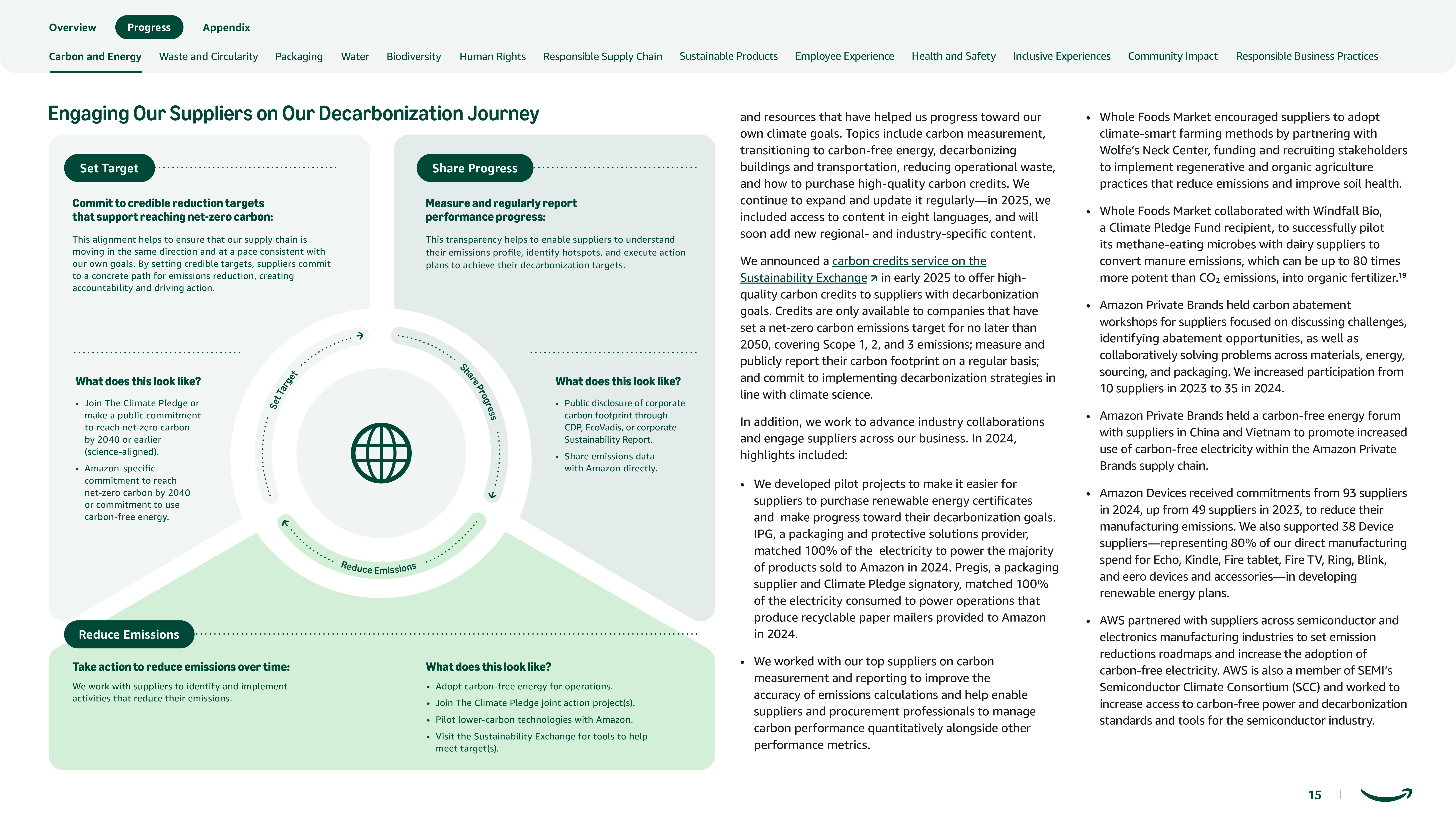
15
Overview
Progress
Appendix
Carbon and Energy
Waste and Circularity
Packaging
Water
Biodiversity
Human Rights
Responsible Supply Chain
Sustainable Products
Employee Experience
Health and Safety
Inclusive Experiences
Community Impact
Responsible Business Practices
Engaging Our Suppliers on Our Decarbonization Journey
S
e
t
T
a
r
g
e
t
S
h
a
r
e
P
r
o
g
r
e
s
s
R
e
d
u
c
e
E
m
i
s
s
i
o
n
s
Set Target
Commit to credible reduction targets
that support reaching net-zero carbon:
This alignment helps to ensure that our supply chain is
moving in the same direction and at a pace consistent with
our own goals. By setting credible targets, suppliers commit
to a concrete path for emissions reduction, creating
accountability and driving action.
What does this look like?
•
Join The Climate Pledge or
make a public commitment
to reach net-zero carbon
by 2040 or earlier
(science-aligned).
•
Amazon-specific
commitment to reach
net-zero carbon by 2040
or commitment to use
carbon-free energy.
Share Progress
Measure and regularly report
performance progress:
This transparency helps to enable suppliers to understand
their emissions profile, identify hotspots, and execute action
plans to achieve their decarbonization targets.
What does this look like?
•
Public disclosure of corporate
carbon footprint through
CDP, EcoVadis, or corporate
Sustainability Report.
•
Share emissions data
with Amazon directly.
Reduce Emissions
Take action to reduce emissions over time:
We work with suppliers to identify and implement
activities that reduce their emissions.
What does this look like?
•
Adopt carbon-free energy for operations.
•
Join The Climate Pledge joint action project(s).
•
Pilot lower-carbon technologies with Amazon.
•
Visit the Sustainability Exchange for tools to help
meet target(s).
and resources that have helped us progress toward our
own climate goals. Topics include carbon measurement,
transitioning to carbon-free energy, decarbonizing
buildings and transportation, reducing operational waste,
and how to purchase high-quality carbon credits. We
continue to expand and update it regularly—in 2025, we
included access to content in eight languages, and will
soon add new regional- and industry-specific content.
We announced a
carbon credits service on the
Sustainability Exchange
in early 2025 to offer high-
quality carbon credits to suppliers with decarbonization
goals. Credits are only available to companies that have
set a net-zero carbon emissions target for no later than
2050, covering Scope 1, 2, and 3 emissions; measure and
publicly report their carbon footprint on a regular basis;
and commit to implementing decarbonization strategies in
line with climate science.
In addition, we work to advance industry collaborations
and engage suppliers across our business. In 2024,
highlights included:
•
We developed pilot projects to make it easier for
suppliers to purchase renewable energy certificates
and make progress toward their decarbonization goals.
IPG, a packaging and protective solutions provider,
matched 100% of the electricity to power the majority
of products sold to Amazon in 2024. Pregis, a packaging
supplier and Climate Pledge signatory, matched 100%
of the electricity consumed to power operations that
produce recyclable paper mailers provided to Amazon
in 2024.
•
We worked with our top suppliers on carbon
measurement and reporting to improve the
accuracy of emissions calculations and help enable
suppliers and procurement professionals to manage
carbon performance quantitatively alongside other
performance metrics.
•
Whole Foods Market encouraged suppliers to adopt
climate-smart farming methods by partnering with
Wolfe’s Neck Center, funding and recruiting stakeholders
to implement regenerative and organic agriculture
practices that reduce emissions and improve soil health.
•
Whole Foods Market collaborated with Windfall Bio,
a Climate Pledge Fund recipient, to successfully pilot
its methane-eating microbes with dairy suppliers to
convert manure emissions, which can be up to 80 times
more potent than CO₂ emissions, into organic fertilizer.
19
•
Amazon Private Brands held carbon abatement
workshops for suppliers focused on discussing challenges,
identifying abatement opportunities, as well as
collaboratively solving problems across materials, energy,
sourcing, and packaging. We increased participation from
10 suppliers in 2023 to 35 in 2024.
•
Amazon Private Brands held a carbon-free energy forum
with suppliers in China and Vietnam to promote increased
use of carbon-free electricity within the Amazon Private
Brands supply chain.
•
Amazon Devices received commitments from 93 suppliers
in 2024, up from 49 suppliers in 2023, to reduce their
manufacturing emissions. We also supported 38 Device
suppliers—representing 80% of our direct manufacturing
spend for Echo, Kindle, Fire tablet, Fire TV, Ring, Blink,
and eero devices and accessories—in developing
renewable energy plans.
•
AWS partnered with suppliers across semiconductor and
electronics manufacturing industries to set emission
reductions roadmaps and increase the adoption of
carbon-free electricity. AWS is also a member of SEMI’s
Semiconductor Climate Consortium (SCC) and worked to
increase access to carbon-free power and decarbonization
standards and tools for the semiconductor industry.
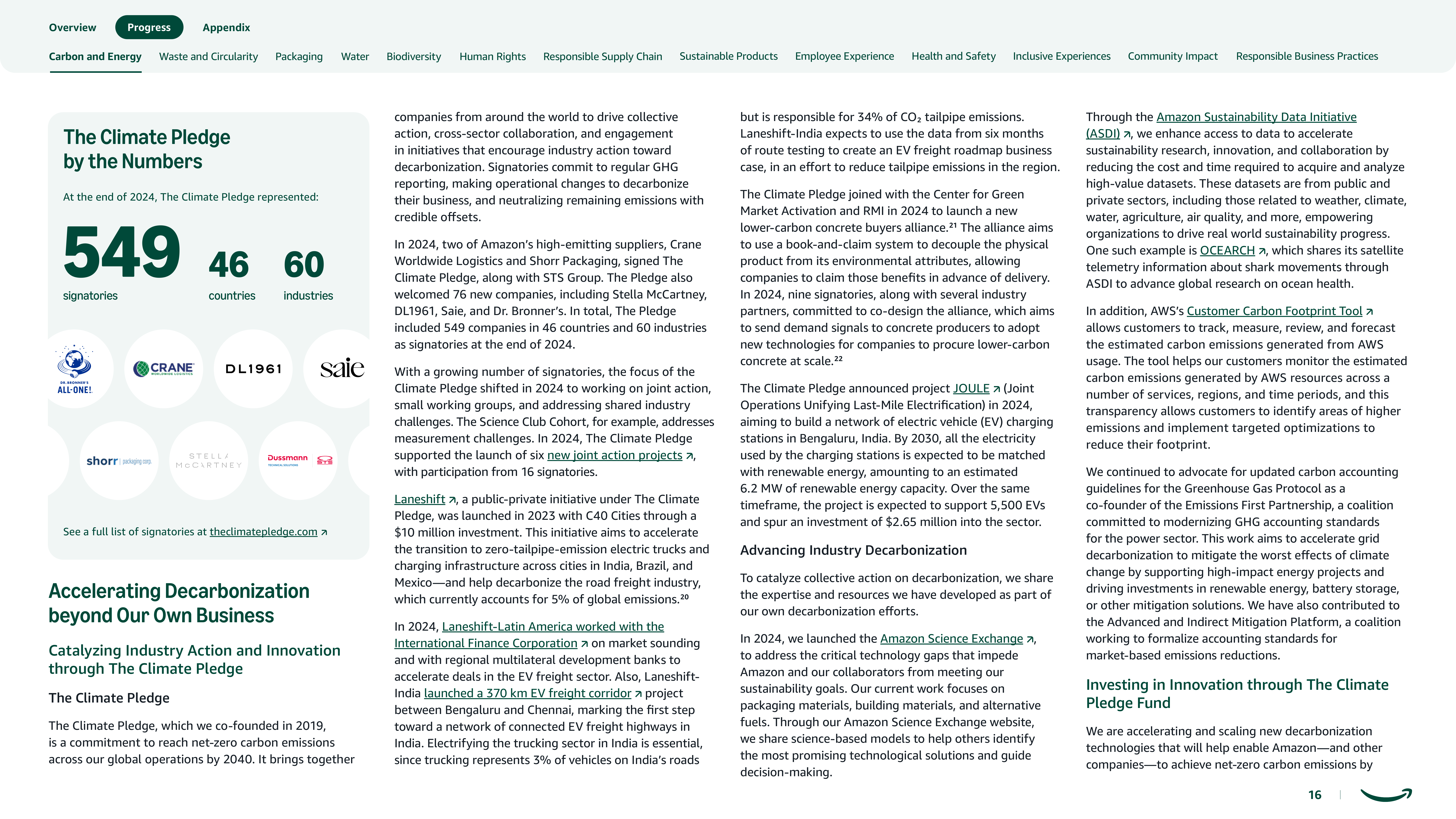


16
Overview
Progress
Appendix
Carbon and Energy
Waste and Circularity
Packaging
Water
Biodiversity
Human Rights
Responsible Supply Chain
Sustainable Products
Employee Experience
Health and Safety
Inclusive Experiences
Community Impact
Responsible Business Practices
Climate
theclimatepledge.com (opens in a new
tab).
The Climate Pledge
by the Numbers
At the end of 2024, The Climate Pledge represented:
549
signatories
46
countries
60
industries
See a full list of signatories at theclimatepledge.com
Accelerating Decarbonization
beyond Our Own Business
Catalyzing Industry Action and Innovation
through The Climate Pledge
The Climate Pledge
The Climate Pledge, which we co-founded in 2019,
is a commitment to reach net-zero carbon emissions
across our global operations by 2040. It brings together
companies from around the world to drive collective
action, cross-sector collaboration, and engagement
in initiatives that encourage industry action toward
decarbonization. Signatories commit to regular GHG
reporting, making operational changes to decarbonize
their business, and neutralizing remaining emissions with
credible offsets.
In 2024, two of Amazon’s high-emitting suppliers, Crane
Worldwide Logistics and Shorr Packaging, signed The
Climate Pledge, along with STS Group. The Pledge also
welcomed 76 new companies, including Stella McCartney,
DL1961, Saie, and Dr. Bronner’s. In total, The Pledge
included 549 companies in 46 countries and 60 industries
as signatories at the end of 2024.
With a growing number of signatories, the focus of the
Climate Pledge shifted in 2024 to working on joint action,
small working groups, and addressing shared industry
challenges. The Science Club Cohort, for example, addresses
measurement challenges. In 2024, The Climate Pledge
supported the launch of six
new joint action projects
,
with participation from 16 signatories.
Laneshift
, a public-private initiative under The Climate
Pledge, was launched in 2023 with C40 Cities through a
$10 million investment. This initiative aims to accelerate
the transition to zero-tailpipe-emission electric trucks and
charging infrastructure across cities in India, Brazil, and
Mexico—and help decarbonize the road freight industry,
which currently accounts for 5% of global emissions.
20
In 2024,
Laneshift-Latin America worked with the
International Finance Corporation
on market sounding
and with regional multilateral development banks to
accelerate deals in the EV freight sector. Also, Laneshift-
India
launched a 370 km EV freight corridor
project
between Bengaluru and Chennai, marking the first step
toward a network of connected EV freight highways in
India. Electrifying the trucking sector in India is essential,
since trucking represents 3% of vehicles on India’s roads
but is responsible for 34% of CO₂ tailpipe emissions.
Laneshift-India expects to use the data from six months
of route testing to create an EV freight roadmap business
case, in an effort to reduce tailpipe emissions in the region.
The Climate Pledge joined with the Center for Green
Market Activation and RMI in 2024 to launch a new
lower-carbon concrete buyers alliance.
21
The alliance aims
to use a book-and-claim system to decouple the physical
product from its environmental attributes, allowing
companies to claim those benefits in advance of delivery.
In 2024, nine signatories, along with several industry
partners, committed to co-design the alliance, which aims
to send demand signals to concrete producers to adopt
new technologies for companies to procure lower-carbon
concrete at scale.
22
The Climate Pledge announced project
JOULE
(Joint
Operations Unifying Last-Mile Electrification) in 2024,
aiming to build a network of electric vehicle (EV) charging
stations in Bengaluru, India. By 2030, all the electricity
used by the charging stations is expected to be matched
with renewable energy, amounting to an estimated
6.2 MW of renewable energy capacity. Over the same
timeframe, the project is expected to support 5,500 EVs
and spur an investment of $2.65 million into the sector.
Advancing Industry Decarbonization
To catalyze collective action on decarbonization, we share
the expertise and resources we have developed as part of
our own decarbonization efforts.
In 2024, we launched the
Amazon Science Exchange
,
to address the critical technology gaps that impede
Amazon and our collaborators from meeting our
sustainability goals. Our current work focuses on
packaging materials, building materials, and alternative
fuels. Through our Amazon Science Exchange website,
we share science-based models to help others identify
the most promising technological solutions and guide
decision-making.
Through the
Amazon Sustainability Data Initiative
(ASDI)
, we enhance access to data to accelerate
sustainability research, innovation, and collaboration by
reducing the cost and time required to acquire and analyze
high-value datasets. These datasets are from public and
private sectors, including those related to weather, climate,
water, agriculture, air quality, and more, empowering
organizations to drive real world sustainability progress.
One such example is
OCEARCH
, which shares its satellite
telemetry information about shark movements through
ASDI to advance global research on ocean health.
In addition, AWS’s
Customer Carbon Footprint Tool
allows customers to track, measure, review, and forecast
the estimated carbon emissions generated from AWS
usage. The tool helps our customers monitor the estimated
carbon emissions generated by AWS resources across a
number of services, regions, and time periods, and this
transparency allows customers to identify areas of higher
emissions and implement targeted optimizations to
reduce their footprint.
We continued to advocate for updated carbon accounting
guidelines for the Greenhouse Gas Protocol as a
co-founder of the Emissions First Partnership, a coalition
committed to modernizing GHG accounting standards
for the power sector. This work aims to accelerate grid
decarbonization to mitigate the worst effects of climate
change by supporting high-impact energy projects and
driving investments in renewable energy, battery storage,
or other mitigation solutions. We have also contributed to
the Advanced and Indirect Mitigation Platform, a coalition
working to formalize accounting standards for
market-based emissions reductions.
Investing in Innovation through The Climate
Pledge Fund
We are accelerating and scaling new decarbonization
technologies that will help enable Amazon—and other
companies—to achieve net-zero carbon emissions by
17
Overview
Progress
Appendix
Carbon and Energy
Waste and Circularity
Packaging
Water
Biodiversity
Human Rights
Responsible Supply Chain
Sustainable Products
Employee Experience
Health and Safety
Inclusive Experiences
Community Impact
Responsible Business Practices
adopting ready-to-scale solutions, investing in emerging
technologies, and through direct funding.
The Climate Pledge Fund
, a $2 billion venture
investment program that specifically targets companies
operating in hard-to-abate sectors, is central to our
approach. The goal of The Climate Pledge Fund is to
support solutions that could accelerate and lower the
overall cost to decarbonize Amazon and the broader
economy. In 2024, The Climate Pledge Fund reached a
milestone of five years of investments, making 12
new and follow-on investments
in multiple industry
sectors that affect climate change: transportation and
logistics; energy generation, storage, and utilization;
buildings; manufacturing and materials; the circular
economy; food and agriculture; carbon removal; and water.
This brings The Climate Pledge Fund’s total investment
portfolio to 32 companies. Recent investments include:
•
Forum Mobility, which provides accessible
zero-tailpipe-emission trucking solutions for drayage in
California, including charging infrastructure and Class
8 zero-tailpipe-emission electric trucks. Forum Mobility
is developing a network of charging depots around
the Ports of Oakland, Los Angeles, and Long Beach
in California, and Seattle, and Tacoma in Washington
state, and along common trucking routes to warehouse
destinations. Forum Mobility also provided the charging
infrastructure for Amazon’s first electric heavy-duty
trucks in our ocean freight operations.
•
Glacier, an AI and robotics company, uses AI-powered
robots to automate sorting recyclable materials and
collect real-time data on recycling streams for recycling
companies and consumer brands. Glacier also supports
Amazon in testing new biomaterials in applications
where we have more limited sustainability solutions,
such as some flexible plastics, and then recycling them.
•
Subeca, a company that offers a simple and secure
device that uses wireless networks such as LoRaWAN and
Amazon Sidewalk to assist Amazon, AWS, and utilities
in gathering timely and reliable data to manage water
use without relying on traditional cellular or building
network infrastructure. As a result, users can more easily
monitor and control resources and detect water leaks.
By utilizing Subeca’s single-device ultrasonic smart water
meter, Amazon can improve the efficiency of its water
use and reduce water loss across its fulfillment centers,
grocery stores, offices, and data centers.
As part of The Climate Pledge Fund’s broader commitment
to invest $50 million in climate initiatives led by women,
we invested in three new female-founded and female-led
companies in 2024, one of which is Paebbl. Paebbl converts
CO₂ into carbon-storing building materials, transforming
the built environment into a carbon sink. Concrete is the
world’s second most used material, and Paebbl aims to
future-proof its global supply chain by locking carbon into
everyday structures. AWS intends to trial Paebbl’s material
in the construction of one of its European data centers.
Supporting Policies That Drive
Decarbonization
Public policy can accelerate the deployment of emerging
lower-carbon technologies necessary to achieve global
decarbonization. A stable regulatory environment
supports long-term progress. Our global public policy
team works with policymakers, multilateral organizations,
industry associations, coalitions, and other partners to
accelerate decarbonization by scaling lower-emission
fuels, advancing zero-tailpipe-emission vehicle
deployment and associated infrastructure, driving the
deployment of carbon-free energy, modernizing the grid,
accelerating lower-carbon technologies, advancing circular
economy policies, and more.
In 2024, we continued our advocacy for expanding the
deployment of carbon-free energy and creating pathways
for corporate procurement of carbon-free energy. We
collaborate with organizations such as CEBA, Asia Clean
Energy Coalition (ACEC) and RE-Source to encourage these
policy changes around the world. For example, we worked
with regulators in Indonesia and Thailand to pioneer
utility green tariffs. In Europe, we supported ambitious
carbon emission reduction targets for newly registered
heavy-duty vehicles to accelerate deployment of
zero-tailpipe-emission vehicles at scale. In the U.S., we
worked with the Low Carbon Fuels Coalition to continue
our support for low-carbon fuels. Further, we engaged
in joint action with organizations such as the Center for
Climate and Energy Solutions (C2ES), the Cambridge
Institute for Sustainability Leadership (CISL) Corporate
Leaders Groups in the UK (CLG UK) and Europe (CLG
Europe), and Japan Climate Leaders’ Partnership (JCPL)
to support innovation and decarbonization.
Learn more
about how we
advocate for issues
that matter
Carbon Neutralization
Amazon’s carbon neutralization efforts are currently
focused on three priorities: reducing deforestation,
advancing the removal of carbon from the atmosphere
with nature-based solutions, and scaling up carbon
removal technologies. Across these areas, Amazon is
using a range of strategies, including direct investment,
advance purchase agreements, coalition building, new
methodology development, and technological innovation,
to scale outcomes and advance carbon credit quality.
23
Our approach is detailed in our
Carbon Neutralization
Methodology
.
Reducing Deforestation
Tropical forests, which cover 45% of the world’s forested
areas, play a crucial role in regulating global climate
patterns, according to the International Panel on Climate
Change.
24
As a result, mobilizing financing to enable
countries to protect their tropical rainforests is a key
focus of our carbon neutralization and broader
biodiversity efforts.
In 2021, we made an ambitious pledge to protect nature
and mitigate climate change through co-founding the
Lowering Emissions by Accelerating Forest Finance (LEAF)
Coalition
. The proceeds support curbing deforestation
and share the economic benefits with Indigenous peoples,
traditional communities, and family farmers.
Learn more
about how we preserve
biodiversity
and
source better materials in our commodities supply chains
Advancing the Removal of Carbon from the
Atmosphere with Nature-Based Solutions
Nature-based carbon removal projects involve the
extraction and retention of atmospheric CO₂ by natural
and managed ecosystems. When effectively implemented,
these projects can create benefits such as wildlife habitat,
promote biodiversity, improve water quality, and reduce
flood risk.
As part of an independent working group composed
of carbon market experts, scientists, and conservation
professionals, representatives from Amazon contributed
to the development of the
ABACUS
label. It identifies
credits that reflect a rigorous set of principles and
requirements for quantifying the climate benefits of
restoration projects. In 2024, the label was formally
approved and released by Verra, the mission-driven
nonprofit that serves as a leading standards-setter for
the voluntary carbon market.
Scaling Up Carbon Removal Technologies
Direct air capture (DAC), which chemically scrubs CO₂ from
the air and then stores it deep underground or uses it in
applications such as building materials and lower-carbon
fuels, is an important technology in the fight against
climate change. Amazon is
accelerating and scaling the
development of DAC solutions
by investing in and
committing to purchase carbon removal credits produced
by DAC technology.
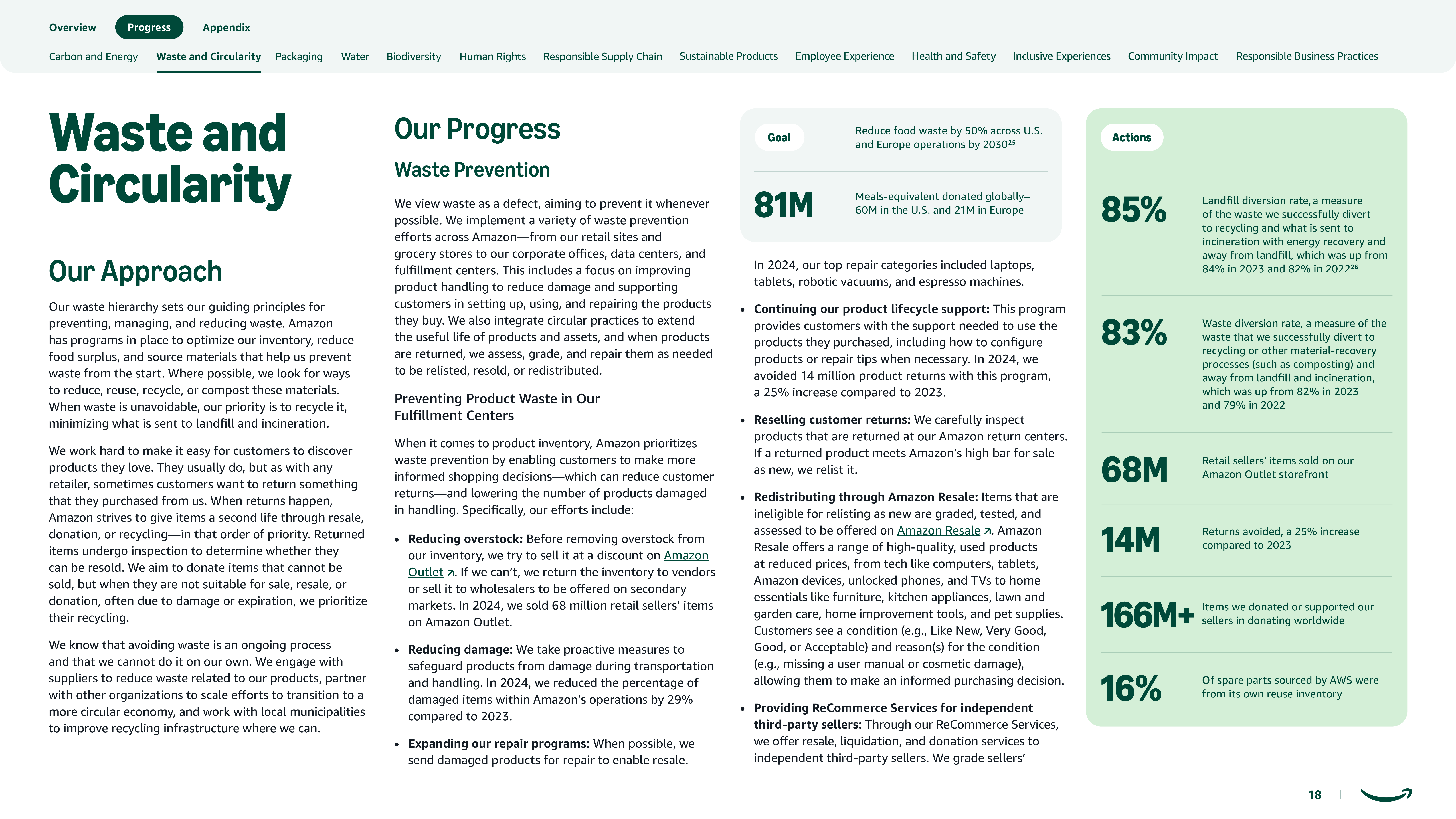
18
Overview
Progress
Appendix
Carbon and Energy
Waste and Circularity
Packaging
Water
Biodiversity
Human Rights
Responsible Supply Chain
Sustainable Products
Employee Experience
Health and Safety
Inclusive Experiences
Community Impact
Responsible Business Practices
Waste and
Circularity
Our Approach
Our waste hierarchy sets our guiding principles for
preventing, managing, and reducing waste. Amazon
has programs in place to optimize our inventory, reduce
food surplus, and source materials that help us prevent
waste from the start. Where possible, we look for ways
to reduce, reuse, recycle, or compost these materials.
When waste is unavoidable, our priority is to recycle it,
minimizing what is sent to landfill and incineration.
We work hard to make it easy for customers to discover
products they love. They usually do, but as with any
retailer, sometimes customers want to return something
that they purchased from us. When returns happen,
Amazon strives to give items a second life through resale,
donation, or recycling—in that order of priority. Returned
items undergo inspection to determine whether they
can be resold. We aim to donate items that cannot be
sold, but when they are not suitable for sale, resale, or
donation, often due to damage or expiration, we prioritize
their recycling.
We know that avoiding waste is an ongoing process
and that we cannot do it on our own. We engage with
suppliers to reduce waste related to our products, partner
with other organizations to scale efforts to transition to a
more circular economy, and work with local municipalities
to improve recycling infrastructure where we can.
Our Progress
Waste Prevention
We view waste as a defect, aiming to prevent it whenever
possible. We implement a variety of waste prevention
efforts across Amazon—from our retail sites and
grocery stores to our corporate offices, data centers, and
fulfillment centers. This includes a focus on improving
product handling to reduce damage and supporting
customers in setting up, using, and repairing the products
they buy. We also integrate circular practices to extend
the useful life of products and assets, and when products
are returned, we assess, grade, and repair them as needed
to be relisted, resold, or redistributed.
Preventing Product Waste in Our
Fulfillment Centers
When it comes to product inventory, Amazon prioritizes
waste prevention by enabling customers to make more
informed shopping decisions—which can reduce customer
returns—and lowering the number of products damaged
in handling. Specifically, our efforts include:
•
Reducing overstock:
Before removing overstock from
our inventory, we try to sell it at a discount on
Amazon
Outlet
. If we can’t, we return the inventory to vendors
or sell it to wholesalers to be offered on secondary
markets. In 2024, we sold 68 million retail sellers’ items
on Amazon Outlet.
•
Reducing damage:
We take proactive measures to
safeguard products from damage during transportation
and handling. In 2024, we reduced the percentage of
damaged items within Amazon’s operations by 29%
compared to 2023.
•
Expanding our repair programs:
When possible, we
send damaged products for repair to enable resale.
In 2024, our top repair categories included laptops,
tablets, robotic vacuums, and espresso machines.
•
Continuing our product lifecycle support:
This program
provides customers with the support needed to use the
products they purchased, including how to configure
products or repair tips when necessary. In 2024, we
avoided 14 million product returns with this program,
a 25% increase compared to 2023.
•
Reselling customer returns:
We carefully inspect
products that are returned at our Amazon return centers.
If a returned product meets Amazon’s high bar for sale
as new, we relist it.
•
Redistributing through Amazon Resale:
Items that are
ineligible for relisting as new are graded, tested, and
assessed to be offered on
Amazon Resale
. Amazon
Resale offers a range of high-quality, used products
at reduced prices, from tech like computers, tablets,
Amazon devices, unlocked phones, and TVs to home
essentials like furniture, kitchen appliances, lawn and
garden care, home improvement tools, and pet supplies.
Customers see a condition (e.g., Like New, Very Good,
Good, or Acceptable) and reason(s) for the condition
(e.g., missing a user manual or cosmetic damage),
allowing them to make an informed purchasing decision.
•
Providing ReCommerce Services for independent
third-party sellers:
Through our ReCommerce Services,
we offer resale, liquidation, and donation services to
independent third-party sellers. We grade sellers’
Goal
Reduce food waste by 50% across U.S.
and Europe operations by 2030
25
81M
Meals-equivalent donated globally–
60M in the U.S. and 21M in Europe
Actions
85%
Landfill diversion rate,
a measure
of the waste we successfully divert
to recycling and what is sent to
incineration with energy recovery and
away from landfill, which was up from
84% in 2023 and 82% in 2022
26
83%
Waste diversion rate, a measure of the
waste that we successfully divert to
recycling or other material-recovery
processes (such as composting) and
away from landfill and incineration,
which was up from 82% in 2023
and 79% in 2022
68M
Retail sellers’ items sold on our
Amazon Outlet storefront
14M
Returns avoided, a 25% increase
compared to 2023
166M+
Items we donated or supported our
sellers in donating worldwide
16%
Of spare parts sourced by AWS were
from its own reuse inventory
19
Overview
Progress
Appendix
Carbon and Energy
Waste and Circularity
Packaging
Water
Biodiversity
Human Rights
Responsible Supply Chain
Sustainable Products
Employee Experience
Health and Safety
Inclusive Experiences
Community Impact
Responsible Business Practices
returned items and enable recovery through programs
such as grade and resell or donation. In 2024, we
helped sellers resell or donate nearly 391 million of
their items in the U.S. and Europe.
•
Donation:
We donate items that are safe to use but
that remain in our inventory if we are unable to repair
or resell them. In 2024, we donated or supported our
sellers in donating over 166 million items worldwide.
Learn more
about our efforts to
provide more sustainable
products
and
optimize packaging
Preventing Food Waste in Grocery Stores and
Distribution Centers
Food waste represents lost natural resources and nutrition
and is a significant contributor of greenhouse gas
emissions.
27
That’s why Amazon has set a goal to reduce
food waste by 50% by 2030 across our U.S. and Europe
operations. We prioritize reducing surplus inventory, and
when that is not possible, we focus on donation to reduce
waste generated. In 2024, the equivalent of 81 million
meals were donated globally—60 million in the U.S. and
21 million in Europe. Any remaining food waste follows
the hierarchy and as much is diverted to organic waste
treatment as possible.
We continue to explore new ways of reducing food loss and
waste as we work toward our 2030 goal. To continue driving
progress at scale, Amazon Fresh and Whole Foods Market
became members of the
U.S. Food Waste Pact
, a joint
initiative between ReFED and World Wildlife Fund. In joining
this national agreement, we are accelerating progress
toward our goals under a proven framework. This year, we
actively contributed food waste data to ReFED for inclusion
in the U.S. Food Waste Pact’s “Progress In Reducing Food
Waste: A Data Report from the Pacific Coast Food Waste
Commitment and the U.S. Food Waste Pact” as part of
our commitment. This collaboration supports our ongoing
efforts to optimize inventory management and prioritize
sustainable practices in food retail.
In 2024, Whole Foods Market launched a program with
Too Good To Go
, a social impact company that has
created a marketplace app for surplus food. Through
this program, Too Good To Go’s app enables customers
to access high-quality food at discounted prices at 536
Whole Foods Market stores across the U.S. Whole Foods
Market diverted an equivalent of 636,000 meals from
waste in the U.S. as part of this effort in 2024, and we
are expanding this service to Amazon Fresh locations in
the U.S. Additionally, we maintain strong relationships
with food charities across our grocery stores, fulfillment
centers, and other retail sites to support ongoing
donation programs for surplus food.
When food cannot be donated or offered to customers
at a discounted price at Amazon Fresh and Whole Foods
Market stores, we aim to divert it via organic waste
treatment programs, such as composting. In 2024, we
continued to implement and expand these efforts at 612
locations and diverted 108,300 tons of food waste.
Learn more
about how we
support food donations,
delivery, and distribution
Preventing Office and Operational Material
Waste in Buildings
To run our operations, we use operational materials and
equipment such as packaging to transport products
between fulfillment centers, pallets to move products
within fulfillment centers, office furniture, storage racks,
electronic equipment, and conveyor systems. We aim to
prevent the waste associated with these materials and
equipment through the following methods:
•
Implementing circular design practices:
We focus on
developing modular equipment and components that
enhance operational efficiency while extending the
useful life of assets. We use innovative design principles
to create versatile equipment that can be easily
repurposed for multiple uses, reducing material waste
and potential losses. This modular approach can also
enable easier maintenance, repairs, and adaptability for
different operational needs. This results in more resilient
infrastructure where components can be efficiently
reused, repaired, or reconfigured, rather than replaced.
•
Reducing single-use items and materials:
We take a
systematic approach to reducing single-use materials
across our operations. Cross-functional working groups
collaborate to identify replacement opportunities and
source more environmentally efficient, lower-waste
solutions that meet our operating requirements. We
also use a detailed waste stream analysis to evaluate
the environmental impact of single-use materials and
prioritize circular solutions. In 2024, we expanded the
use of universal plastic pallets and GoCarts (a reusable
cart system that replaces pallets and cardboard
containers) and avoided the use of 85 million wood
pallets. Across our corporate offices, we are increasingly
transitioning away from single-use cutlery, plates, and
cups and replacing them with reusable alternatives.
•
Extending asset life through reuse and donations:
We
have established programs and built tools to enable the
repurposing, donation, and responsible management
of unused assets across Amazon. These programs and
tools facilitate the storage, tracking, and transfer of idle
assets between Amazon sites, as well as coordination
with charities interested in items no longer used by
our teams. In 2024, we repurposed 310,000 assets and
materials from these programs.
Preventing Hardware and Server Waste in
Data Centers
In 2024, AWS enhanced its circular economy strategy,
which focuses on three core pillars:
•
Design better:
AWS unlocks its greatest potential for
circularity through better design practices—including
avoiding excess materials, enabling repair and reuse, and
integrating recycled content from the start. In addition
to using 30% recycled or bio-based plastics in server rack
components, AWS is also exploring ways that better
design can help extend the lifespan of hardware and
equipment, further scale repair and reuse, and increase
materials recovery at end of use.
•
Operate longer:
AWS seeks to use equipment for as
long as operationally efficient. AWS prioritizes keeping
functional drives in use for as long as possible, avoiding
early retirement of healthy and working hard drives.
This helps AWS power fewer racks with optimized
performance, replace aging hardware, and save water
and energy. As a result, AWS only needs to send
broken drives for recycling, avoiding early retirement
of healthy and working hard drives on the same rack.
Since 2023, AWS has avoided the purchase of more
than 500,000 new hard drives, reducing the associated
carbon footprint, costs, and waste.
•
Recover more:
AWS aims to continually improve repair,
reuse, and recycling practices to recover more value
from decommissioned assets. AWS uses
Amazon’s
re:Cycle Reverse Logistics hubs
to assess, repair, and
recirculate used equipment into inventory or sell it to
third parties for reuse. To drive circularity and increase
landfill diversion, AWS sends racks to these hubs for
secure decommissioning of the hardware in the racks
before recirculation into AWS inventory, resale into the
secondary market, or recycling. In 2024, 11.5 million
components were sold on the secondary market through
our re:Cycle Reverse Logistics hubs. Additionally, these
reverse logistics hubs have enabled AWS to source 16%
of spare parts from its own reuse inventory, abating
110,000 tons of carbon emissions by avoiding purchase
of new parts. In October 2024, Amazon announced an
expansion of the
re:Cycle Ireland Hub
to continue
scaling this program. In 2024, the facility also earned
UL Solutions’ highest Zero Waste certification (Platinum
level) by diverting 100% of processed equipment from
landfills, including 99% through reuse by AWS, resale
into the secondary market, or recycling, and 1% to
Thermal Processing with Energy Recovery.
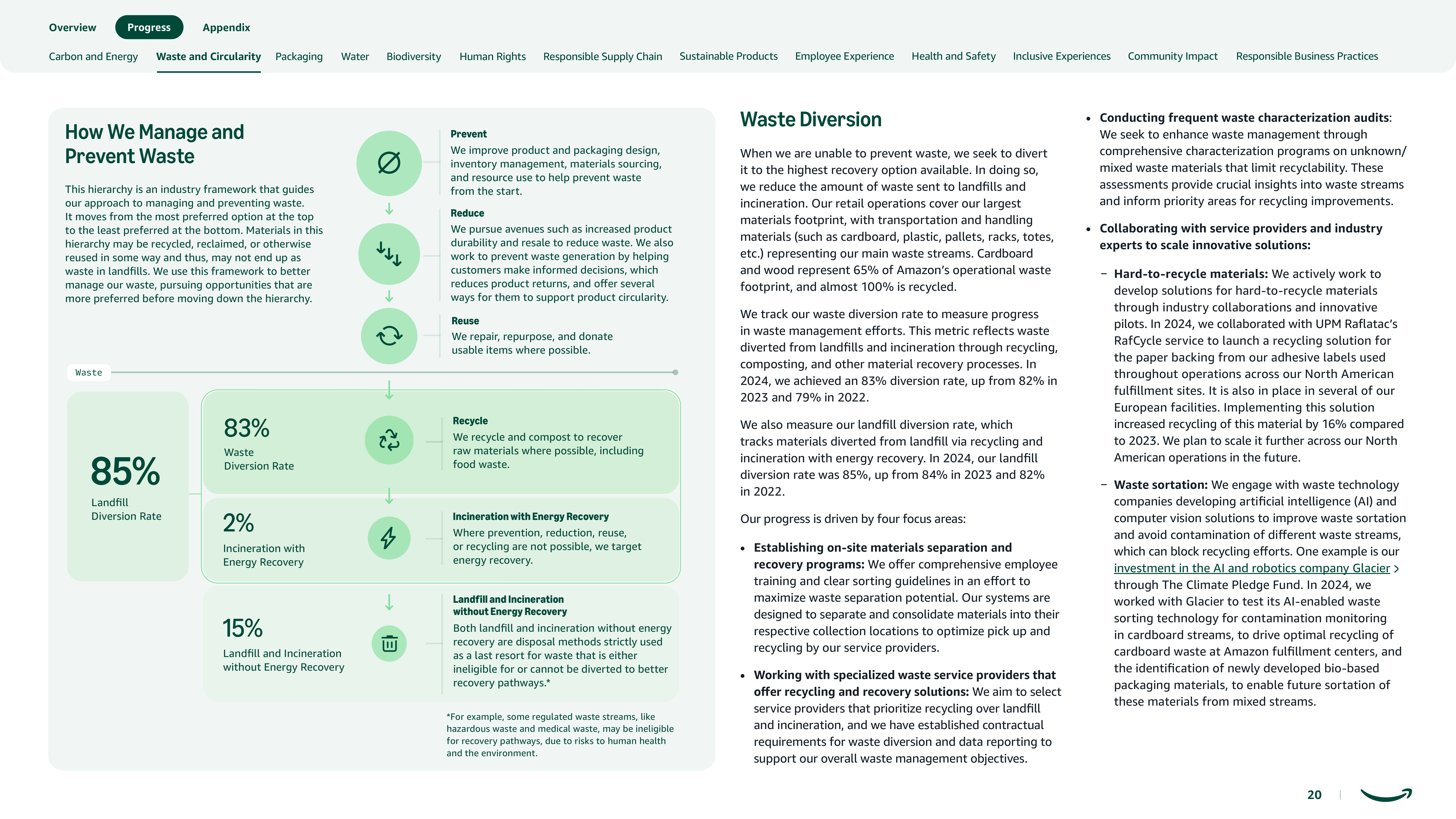
20
Overview
Progress
Appendix
Carbon and Energy
Waste and Circularity
Packaging
Water
Biodiversity
Human Rights
Responsible Supply Chain
Sustainable Products
Employee Experience
Health and Safety
Inclusive Experiences
Community Impact
Responsible Business Practices
How We Manage and
Prevent Waste
This hierarchy is an industry framework that guides
our approach to managing and preventing waste.
It moves from the most preferred option at the top
to the least preferred at the bottom. Materials in this
hierarchy may be recycled, reclaimed, or otherwise
reused in some way and thus, may not end up as
waste in landfills. We use this framework to better
manage our waste, pursuing opportunities that are
more preferred before moving down the hierarchy.
Prevent
We improve product and packaging design,
inventory management, materials sourcing,
and resource use to help prevent waste
from the start.
Reduce
We pursue avenues such as increased product
durability and resale to reduce waste. We also
work to prevent waste generation by helping
customers make informed decisions, which
reduces product returns, and offer several
ways for them to support product circularity.
Reuse
We repair, repurpose, and donate
usable items where possible.
Waste
85%
Landfill
Diversion Rate
83%
Waste
Diversion Rate
Recycle
We recycle and compost to recover
raw materials where possible, including
food waste.
2%
Incineration with
Energy Recovery
Incineration with Energy Recovery
Where prevention, reduction, reuse,
or recycling are not possible, we target
energy recovery.
15%
Landfill and Incineration
without Energy Recovery
Landfill and Incineration
without Energy Recovery
Both landfill and incineration without energy
recovery are disposal methods strictly used
as a last resort for waste that is either
ineligible for or cannot be diverted to better
recovery pathways.*
*For example, some regulated waste streams, like
hazardous waste and medical waste, may be ineligible
for recovery pathways, due to risks to human health
and the environment.
Waste Diversion
When we are unable to prevent waste, we seek to divert
it to the highest recovery option available. In doing so,
we reduce the amount of waste sent to landfills and
incineration. Our retail operations cover our largest
materials footprint, with transportation and handling
materials (such as cardboard, plastic, pallets, racks, totes,
etc.) representing our main waste streams. Cardboard
and wood represent 65% of Amazon’s operational waste
footprint, and almost 100% is recycled.
We track our waste diversion rate to measure progress
in waste management efforts. This metric reflects waste
diverted from landfills and incineration through recycling,
composting, and other material recovery processes. In
2024, we achieved an 83% diversion rate, up from 82% in
2023 and 79% in 2022.
We also measure our landfill diversion rate, which
tracks materials diverted from landfill via recycling and
incineration with energy recovery. In 2024, our landfill
diversion rate was 85%, up from 84% in 2023 and 82%
in 2022.
Our progress is driven by four focus areas:
•
Establishing on-site materials separation and
recovery programs:
We offer comprehensive employee
training and clear sorting guidelines in an effort to
maximize waste separation potential. Our systems are
designed to separate and consolidate materials into their
respective collection locations to optimize pick up and
recycling by our service providers.
•
Working with specialized waste service providers that
offer recycling and recovery solutions:
We aim to select
service providers that prioritize recycling over landfill
and incineration, and we have established contractual
requirements for waste diversion and data reporting to
support our overall waste management objectives.
•
Conducting frequent waste characterization audits
:
We seek to enhance waste management through
comprehensive characterization programs on unknown/
mixed waste materials that limit recyclability. These
assessments provide crucial insights into waste streams
and inform priority areas for recycling improvements.
•
Collaborating with service providers and industry
experts to scale innovative solutions:
−
Hard-to-recycle materials:
We actively work to
develop solutions for hard-to-recycle materials
through industry collaborations and innovative
pilots. In 2024, we collaborated with UPM Raflatac’s
RafCycle service to launch a recycling solution for
the paper backing from our adhesive labels used
throughout operations across our North American
fulfillment sites. It is also in place in several of our
European facilities. Implementing this solution
increased recycling of this material by 16% compared
to 2023. We plan to scale it further across our North
American operations in the future.
−
Waste sortation:
We engage with waste technology
companies developing artificial intelligence (AI) and
computer vision solutions to improve waste sortation
and avoid contamination of different waste streams,
which can block recycling efforts. One example is our
investment in the AI and robotics company Glacier
through The Climate Pledge Fund. In 2024, we
worked with Glacier to test its AI-enabled waste
sorting technology for contamination monitoring
in cardboard streams, to drive optimal recycling of
cardboard waste at Amazon fulfillment centers, and
the identification of newly developed bio-based
packaging materials, to enable future sortation of
these materials from mixed streams.
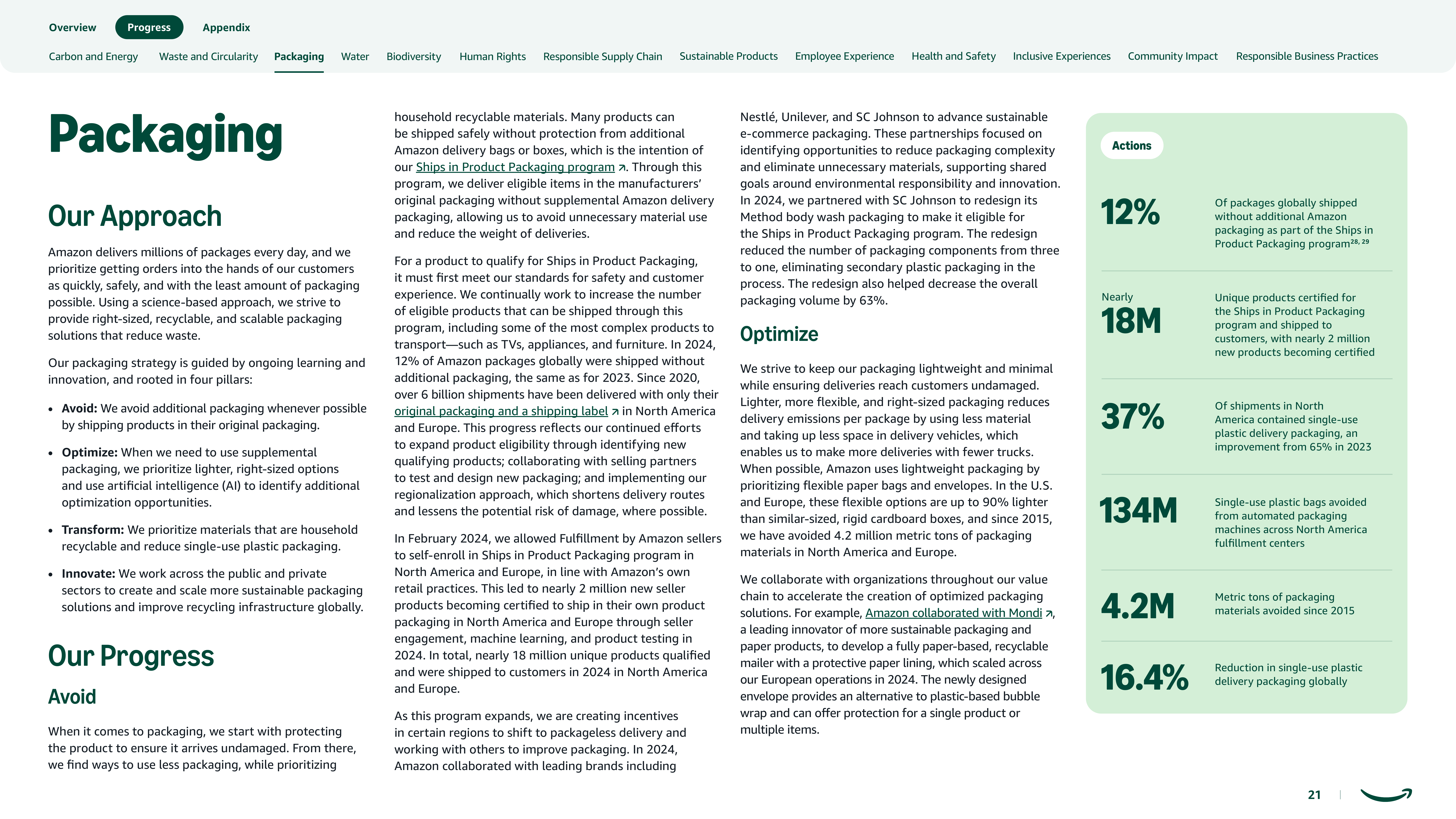
21
Overview
Progress
Appendix
Carbon and Energy
Waste and Circularity
Packaging
Water
Biodiversity
Human Rights
Responsible Supply Chain
Sustainable Products
Employee Experience
Health and Safety
Inclusive Experiences
Community Impact
Responsible Business Practices
Packaging
Our Approach
Amazon delivers millions of packages every day, and we
prioritize getting orders into the hands of our customers
as quickly, safely, and with the least amount of packaging
possible. Using a science-based approach, we strive to
provide right-sized, recyclable, and scalable packaging
solutions that reduce waste.
Our packaging strategy is guided by ongoing learning and
innovation, and rooted in four pillars:
•
Avoid:
We avoid additional packaging whenever possible
by shipping products in their original packaging.
•
Optimize:
When we need to use supplemental
packaging, we prioritize lighter, right-sized options
and use artificial intelligence (AI) to identify additional
optimization opportunities.
•
Transform:
We prioritize materials that are household
recyclable and reduce single-use plastic packaging.
•
Innovate:
We work across the public and private
sectors to create and scale more sustainable packaging
solutions and improve recycling infrastructure globally.
Our Progress
Avoid
When it comes to packaging, we start with protecting
the product to ensure it arrives undamaged. From there,
we find ways to use less packaging, while prioritizing
household recyclable materials. Many products can
be shipped safely without protection from additional
Amazon delivery bags or boxes, which is the intention of
our
Ships in Product Packaging program
. Through this
program, we deliver eligible items in the manufacturers’
original packaging without supplemental Amazon delivery
packaging, allowing us to avoid unnecessary material use
and reduce the weight of deliveries.
For a product to qualify for Ships in Product Packaging,
it must first meet our standards for safety and customer
experience. We continually work to increase the number
of eligible products that can be shipped through this
program, including some of the most complex products to
transport—such as TVs, appliances, and furniture. In 2024,
12% of Amazon packages globally were shipped without
additional packaging, the same as for 2023. Since 2020,
over 6 billion shipments have been delivered with only their
original packaging and a shipping label
in North America
and Europe. This progress reflects our continued efforts
to expand product eligibility through identifying new
qualifying products; collaborating with selling partners
to test and design new packaging; and implementing our
regionalization approach, which shortens delivery routes
and lessens the potential risk of damage, where possible.
In February 2024, we allowed Fulfillment by Amazon sellers
to self-enroll in Ships in Product Packaging program in
North America and Europe, in line with Amazon’s own
retail practices. This led to nearly 2 million new seller
products becoming certified to ship in their own product
packaging in North America and Europe through seller
engagement, machine learning, and product testing in
2024. In total, nearly 18 million unique products qualified
and were shipped to customers in 2024 in North America
and Europe.
As this program expands, we are creating incentives
in certain regions to shift to packageless delivery and
working with others to improve packaging. In 2024,
Amazon collaborated with leading brands including
Nestlé, Unilever, and SC Johnson to advance sustainable
e-commerce packaging. These partnerships focused on
identifying opportunities to reduce packaging complexity
and eliminate unnecessary materials, supporting shared
goals around environmental responsibility and innovation.
In 2024, we partnered with SC Johnson to redesign its
Method body wash packaging to make it eligible for
the Ships in Product Packaging program. The redesign
reduced the number of packaging components from three
to one, eliminating secondary plastic packaging in the
process. The redesign also helped decrease the overall
packaging volume by 63%.
Optimize
We strive to keep our packaging lightweight and minimal
while ensuring deliveries reach customers undamaged.
Lighter, more flexible, and right-sized packaging reduces
delivery emissions per package by using less material
and taking up less space in delivery vehicles, which
enables us to make more deliveries with fewer trucks.
When possible, Amazon uses lightweight packaging by
prioritizing flexible paper bags and envelopes. In the U.S.
and Europe, these flexible options are up to 90% lighter
than similar-sized, rigid cardboard boxes, and since 2015,
we have avoided 4.2 million metric tons of packaging
materials in North America and Europe.
We collaborate with organizations throughout our value
chain to accelerate the creation of optimized packaging
solutions. For example,
Amazon collaborated with Mondi
,
a leading innovator of more sustainable packaging and
paper products, to develop a fully paper-based, recyclable
mailer with a protective paper lining, which scaled across
our European operations in 2024. The newly designed
envelope provides an alternative to plastic-based bubble
wrap and can offer protection for a single product or
multiple items.
Actions
12%
Of packages globally shipped
without additional Amazon
packaging as part of the Ships in
Product Packaging program
28, 29
Nearly
18M
Unique products certified for
the Ships in Product Packaging
program and shipped to
customers, with nearly 2 million
new products becoming certified
37%
Of shipments in North
America contained single-use
plastic delivery packaging, an
improvement from 65% in 2023
134M
Single-use plastic bags avoided
from automated packaging
machines across North America
fulfillment centers
4.2M
Metric tons of packaging
materials avoided since 2015
16.4%
Reduction in single-use plastic
delivery packaging globally
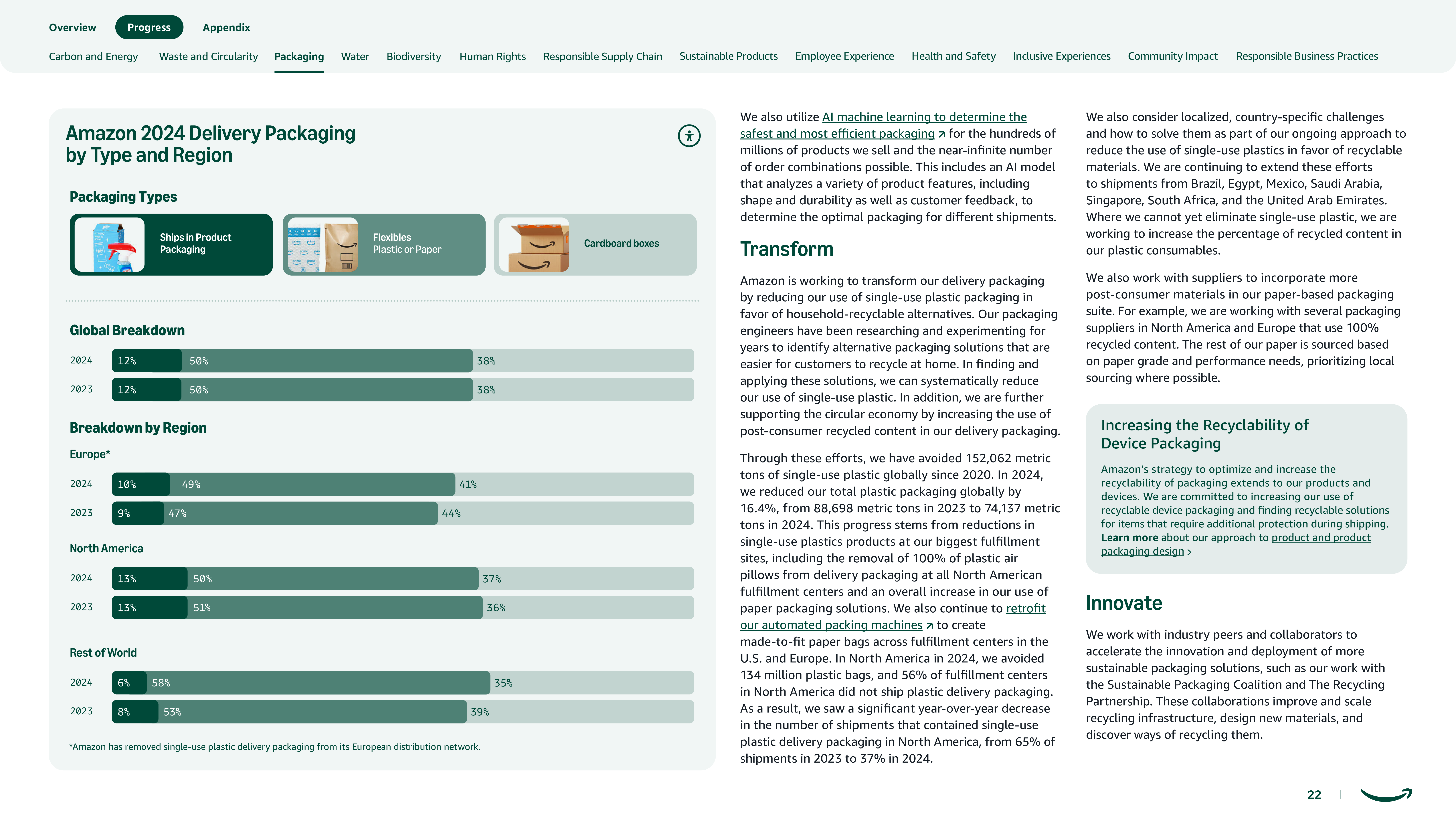




22
Overview
Progress
Appendix
Carbon and Energy
Waste and Circularity
Packaging
Water
Biodiversity
Human Rights
Responsible Supply Chain
Sustainable Products
Employee Experience
Health and Safety
Inclusive Experiences
Community Impact
Responsible Business Practices
We also utilize
AI machine learning to determine the
safest and most efficient packaging
for the hundreds of
millions of products we sell and the near-infinite number
of order combinations possible. This includes an AI model
that analyzes a variety of product features, including
shape and durability as well as customer feedback, to
determine the optimal packaging for different shipments.
Transform
Amazon is working to transform our delivery packaging
by reducing our use of single-use plastic packaging in
favor of household-recyclable alternatives. Our packaging
engineers have been researching and experimenting for
years to identify alternative packaging solutions that are
easier for customers to recycle at home. In finding and
applying these solutions, we can systematically reduce
our use of single-use plastic. In addition, we are further
supporting the circular economy by increasing the use of
post-consumer recycled content in our delivery packaging.
Through these efforts, we have avoided 152,062 metric
tons of single-use plastic globally since 2020. In 2024,
we reduced our total plastic packaging globally by
16.4%, from 88,698 metric tons in 2023 to 74,137 metric
tons in 2024. This progress stems from reductions in
single-use plastics products at our biggest fulfillment
sites, including the removal of 100% of plastic air
pillows from delivery packaging at all North American
fulfillment centers and an overall increase in our use of
paper packaging solutions. We also continue to
retrofit
our automated packing machines
to create
made-to-fit paper bags across fulfillment centers in the
U.S. and Europe. In North America in 2024, we avoided
134 million plastic bags, and 56% of fulfillment centers
in North America did not ship plastic delivery packaging.
As a result, we saw a significant year-over-year decrease
in the number of shipments that contained single-use
plastic delivery packaging in North America, from 65% of
shipments in 2023 to 37% in 2024.
We also consider localized, country-specific challenges
and how to solve them as part of our ongoing approach to
reduce the use of single-use plastics in favor of recyclable
materials. We are continuing to extend these efforts
to shipments from Brazil, Egypt, Mexico, Saudi Arabia,
Singapore, South Africa, and the United Arab Emirates.
Where we cannot yet eliminate single-use plastic, we are
working to increase the percentage of recycled content in
our plastic consumables.
We also work with suppliers to incorporate more
post-consumer materials in our paper-based packaging
suite. For example, we are working with several packaging
suppliers in North America and Europe that use 100%
recycled content. The rest of our paper is sourced based
on paper grade and performance needs, prioritizing local
sourcing where possible.
Increasing the Recyclability of
Device Packaging
Amazon’s strategy to optimize and increase the
recyclability of packaging extends to our products and
devices. We are committed to increasing our use of
recyclable device packaging and finding recyclable solutions
for items that require additional protection during shipping.
Learn more
about our approach to product and product
packaging design
Innovate
We work with industry peers and collaborators to
accelerate the innovation and deployment of more
sustainable packaging solutions, such as our work with
the Sustainable Packaging Coalition and The Recycling
Partnership. These collaborations improve and scale
recycling infrastructure, design new materials, and
discover ways of recycling them.
Amazon 2024 Delivery Packaging
by Type and Region
*Amazon has removed single-use plastic delivery packaging from its European distribution network.
Packaging Types
Europe*
North America
Rest of World
10%
49%
41%
13%
50%
37%
6%
58%
35%
9%
47%
44%
13%
51%
36%
8%
53%
Breakdown by Region
2023
2023
2023
2024
2024
2024
12%
50%
38%
12%
50%
38%
Global Breakdown
2023
2024
39%
Ships in Product
Packaging
Flexibles
Plastic or Paper
Cardboard boxes
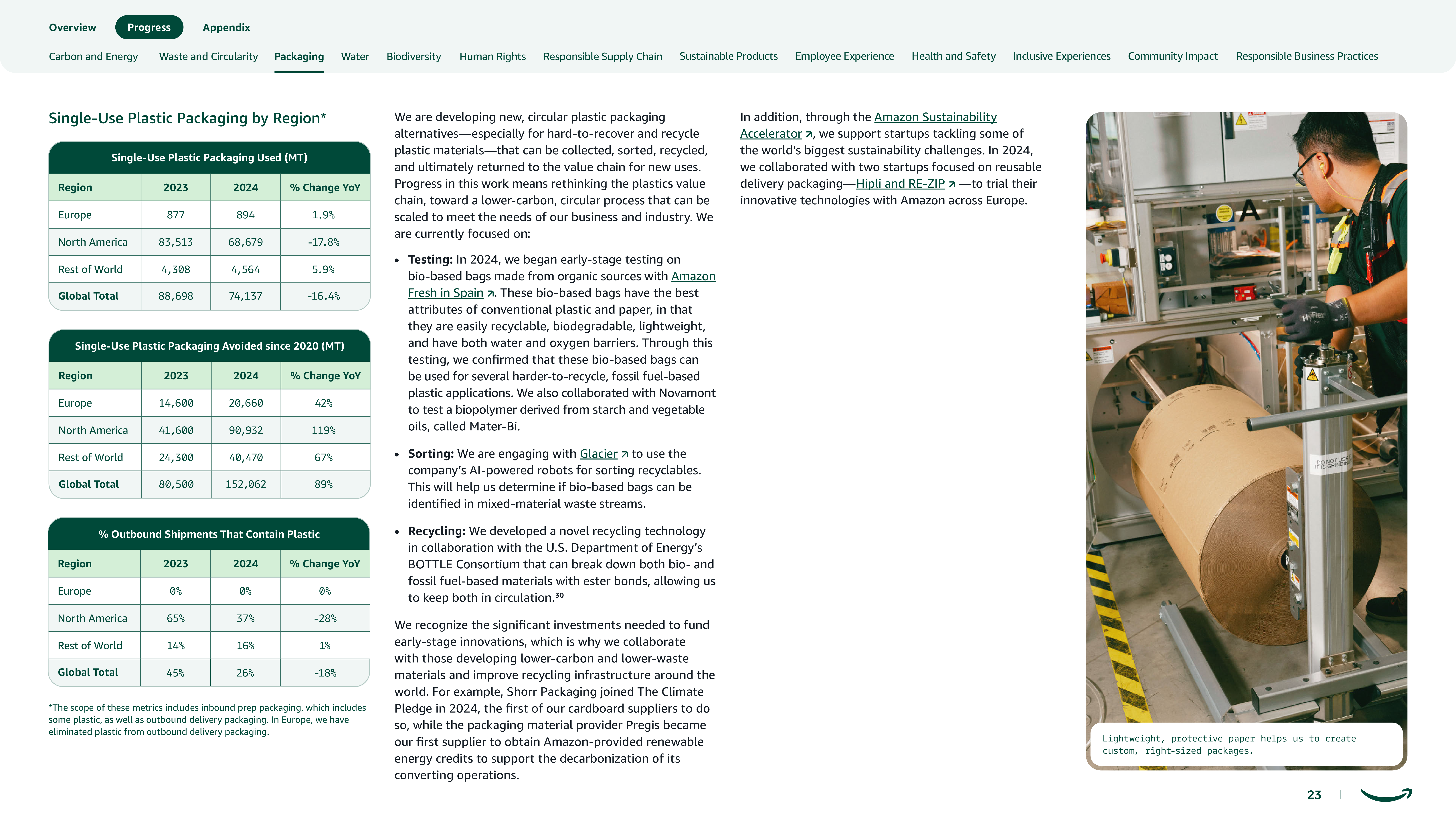
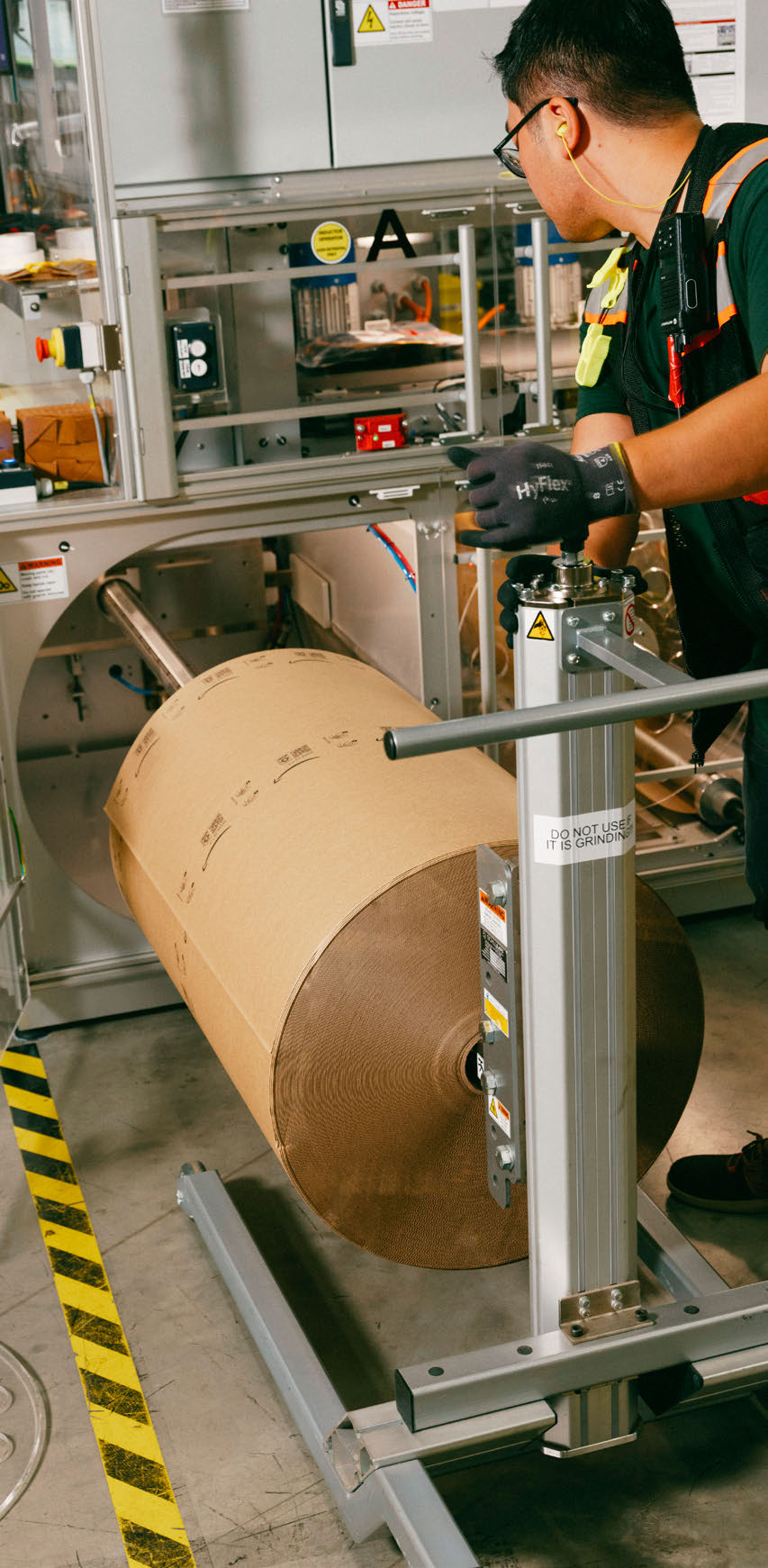
23
Overview
Progress
Appendix
Carbon and Energy
Waste and Circularity
Packaging
Water
Biodiversity
Human Rights
Responsible Supply Chain
Sustainable Products
Employee Experience
Health and Safety
Inclusive Experiences
Community Impact
Responsible Business Practices
Single-Use Plastic Packaging by Region*
Single-Use Plastic Packaging Used (MT)
Region
2023
2024
% Change YoY
Europe
877
894
1.9%
North America
83,513
68,679
-17.8%
Rest of World
4,308
4,564
5.9%
Global Total
88,698
74,137
-16.4%
Single-Use Plastic Packaging Avoided since 2020 (MT)
Region
2023
2024
% Change YoY
Europe
14,600
20,660
42%
North America
41,600
90,932
119%
Rest of World
24,300
40,470
67%
Global Total
80,500
152,062
89%
% Outbound Shipments That Contain Plastic
Region
2023
2024
% Change YoY
Europe
0%
0%
0%
North America
65%
37%
-28%
Rest of World
14%
16%
1%
Global Total
45%
26%
-18%
*The scope of these metrics includes inbound prep packaging, which includes
some plastic, as well as outbound delivery packaging. In Europe, we have
eliminated plastic from outbound delivery packaging.
We are developing new, circular plastic packaging
alternatives—especially for hard-to-recover and recycle
plastic materials—that can be collected, sorted, recycled,
and ultimately returned to the value chain for new uses.
Progress in this work means rethinking the plastics value
chain, toward a lower-carbon, circular process that can be
scaled to meet the needs of our business and industry. We
are currently focused on:
•
Testing:
In 2024, we began early-stage testing on
bio-based bags made from organic sources with
Amazon
Fresh in Spain
. These bio-based bags have the best
attributes of conventional plastic and paper, in that
they are easily recyclable, biodegradable, lightweight,
and have both water and oxygen barriers. Through this
testing, we confirmed that these bio-based bags can
be used for several harder-to-recycle, fossil fuel-based
plastic applications. We also collaborated with Novamont
to test a biopolymer derived from starch and vegetable
oils, called Mater-Bi.
•
Sorting:
We are engaging with
Glacier
to use the
company’s AI-powered robots for sorting recyclables.
This will help us determine if bio-based bags can be
identified in mixed-material waste streams.
•
Recycling:
We developed a novel recycling technology
in collaboration with the U.S. Department of Energy’s
BOTTLE Consortium that can break down both bio- and
fossil fuel-based materials with ester bonds, allowing us
to keep both in circulation.
30
We recognize the significant investments needed to fund
early-stage innovations, which is why we collaborate
with those developing lower-carbon and lower-waste
materials and improve recycling infrastructure around the
world. For example, Shorr Packaging joined The Climate
Pledge in 2024, the first of our cardboard suppliers to do
so, while the packaging material provider Pregis became
our first supplier to obtain Amazon-provided renewable
energy credits to support the decarbonization of its
converting operations.
Lightweight, protective paper helps us to create
custom, right-sized packages.
In addition, through the
Amazon Sustainability
Accelerator
, we support startups tackling some of
the world’s biggest sustainability challenges. In 2024,
we collaborated with two startups focused on reusable
delivery packaging—
Hipli and RE-ZIP
—to trial their
innovative technologies with Amazon across Europe.
24
Overview
Progress
Appendix
Carbon and Energy
Waste and Circularity
Packaging
Water
Biodiversity
Human Rights
Responsible Supply Chain
Sustainable Products
Employee Experience
Health and Safety
Inclusive Experiences
Community Impact
Responsible Business Practices
Water
Goal
AWS will be water positive by 2030,
returning more water to communities
than it uses in its direct operations
31
53%
Of the way toward meeting its water
positive goal
Goal
Amazon will return more water to
communities than it uses in direct
operations across India by 2027
Amazon set this goal in December 2024 and will begin
reporting progress in our 2025 Sustainability Report
Actions
0.15
L/kWh water use effectiveness (WUE)
for Amazon’s data centers, a 17%
improvement from 2023
23
Water replenishment projects globally
invested in by Amazon
4.3B
Liters of water returned to
communities from active replenishment
projects, with
more than 7 billion
liters of total annual contracted
replenishment volume for future years
Our Approach
Amazon aims to be a good water steward in every
way we operate, including cooling servers in data
centers, preparing food in grocery stores, and providing
sanitation for associates in our buildings. Climate
change, population growth, and economic development
are increasing global water demand and affecting
water availability in many regions of our operations. As
a result, responsible and efficient water management
is an important part of Amazon’s overall sustainability
strategy. Amazon has public commitments to return
more water to communities than we use in AWS direct
operations globally by 2030, and in the direct operations
of all Amazon facilities in India by 2027. To meet these
commitments and support a more resilient and
water-secure future, we are working to reduce our global
water footprint and prioritizing action to address water
scarcity, access, and quality in the most high-risk
regions of our operations. We drive progress through
the following strategies:
•
Reduce:
We increase our water use efficiency and
reduce local withdrawals by installing water-conserving
measures in buildings and tracking water use in real
time to help minimize water loss.
•
Reuse:
We strive to source water from more sustainable
sources, such as recycled and/or harvested rainwater, to
minimize demands on public water supplies.
•
Replenish:
We invest in water replenishment projects
that increase community water access, availability, and
quality by restoring watersheds and bringing clean
water, sanitation, and hygiene services to
water-stressed communities.
Our Progress
Water Positive in Data Centers
In 2022, AWS announced its commitment to being water
positive by 2030. To meet this goal, AWS is focused on
improving liters per kilowatt-hour (L/kWh) water use
effectiveness (WUE), using more sustainable sources, and
delivering water replenishment. In 2024, AWS was 53% of
the way toward meeting its water positive by 2030 goal,
up from 41% in 2023. Progress is calculated using AWS’s
Water Positive Methodology
.
Reduce
Amazon is continually working to optimize water
consumption and reduce the amount of incoming water
we use. Within our direct operations, reduction efforts
focus on increasing operational efficiency and resilience
to limit water loss and enhance water conservation. We
improve water use efficiency across Amazon operations
by scaling real-time leak detection, innovative treatment
technologies, and water-conserving fixtures.
AWS Data Centers
Amazon seeks to minimize water use across our global
data centers. Within AWS, global teams deploy water
monitoring technology in data centers to determine where
they need to take action to maintain or improve WUE.
In 2024, AWS began implementing
integrated liquid
cooling components
to more efficiently manage
artificial intelligence (AI) workloads at new data centers.
These novel solutions combine air and liquid cooling
capabilities for both powerful AI chipsets and AWS’s
network switches and storage servers. This flexible design
is expected to reduce mechanical energy consumption
by up to 46% compared to previous designs during peak
cooling conditions. The system also helps enable our
direct evaporative cooling systems to meet generative AI
demands without increasing water use per kWh.
In 2024, AWS reduced cooling water needs by 946
million liters in North America. Partially enabled through
improved server chip technology that can operate at higher
temperatures, AWS also uses cloud technologies to monitor
real-time water usage and automatically flag leaks for
operators to resolve.
The implementation of these new technologies contributed
to AWS’s global data center WUE of 0.15 liters of water per
kilowatt-hour (L/kWh) in 2024—a 17% improvement from
2023 and a 40% improvement since 2021.
AWS Water Use Effectiveness
2021
2022
2023
2024
% Change
from 2023
Water use
effectiveness
(L/kWh)
0.25
0.19
0.18
0.15
17%
Amazon Grocery, Logistics, and
Corporate Buildings
Amazon seeks to implement water efficiency best
practices across our global logistics and grocery
operations, along with our corporate offices. In 2024,
we scaled our global water metering and leak detection
program to logistics and Whole Foods Market sites in
highest-risk regions. Through this program, “smart”
meters send data to a common dashboard and
Amazon-developed leak detection software, allowing our
engineering teams to respond to suspected leaks remotely
and in real time. Additionally, this program enables our
teams to analyze changes in water use patterns under
different circumstances, such as fluctuations in seasonal
demand, to improve forecasting and track the progress of
our water conservation strategies.
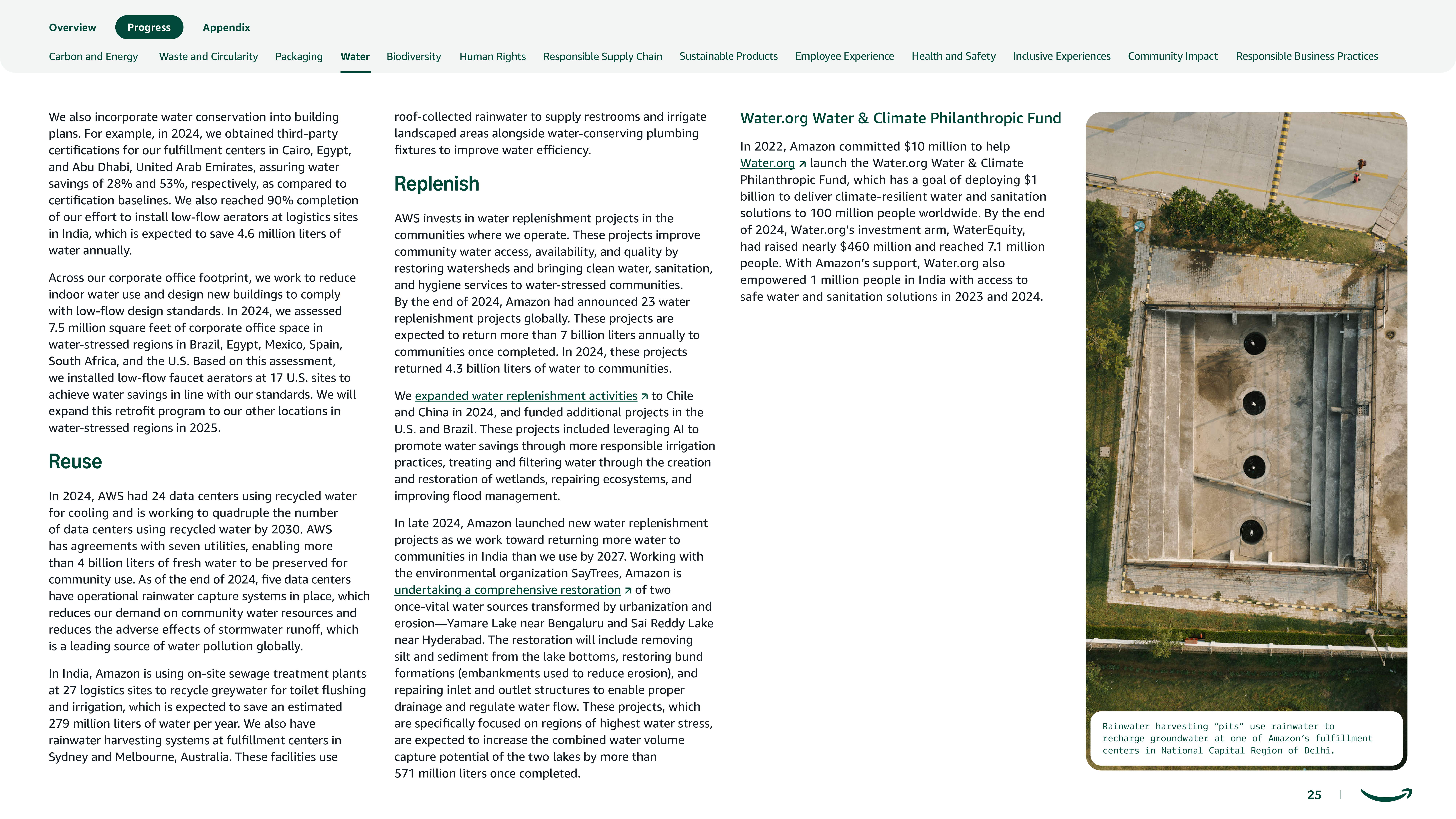
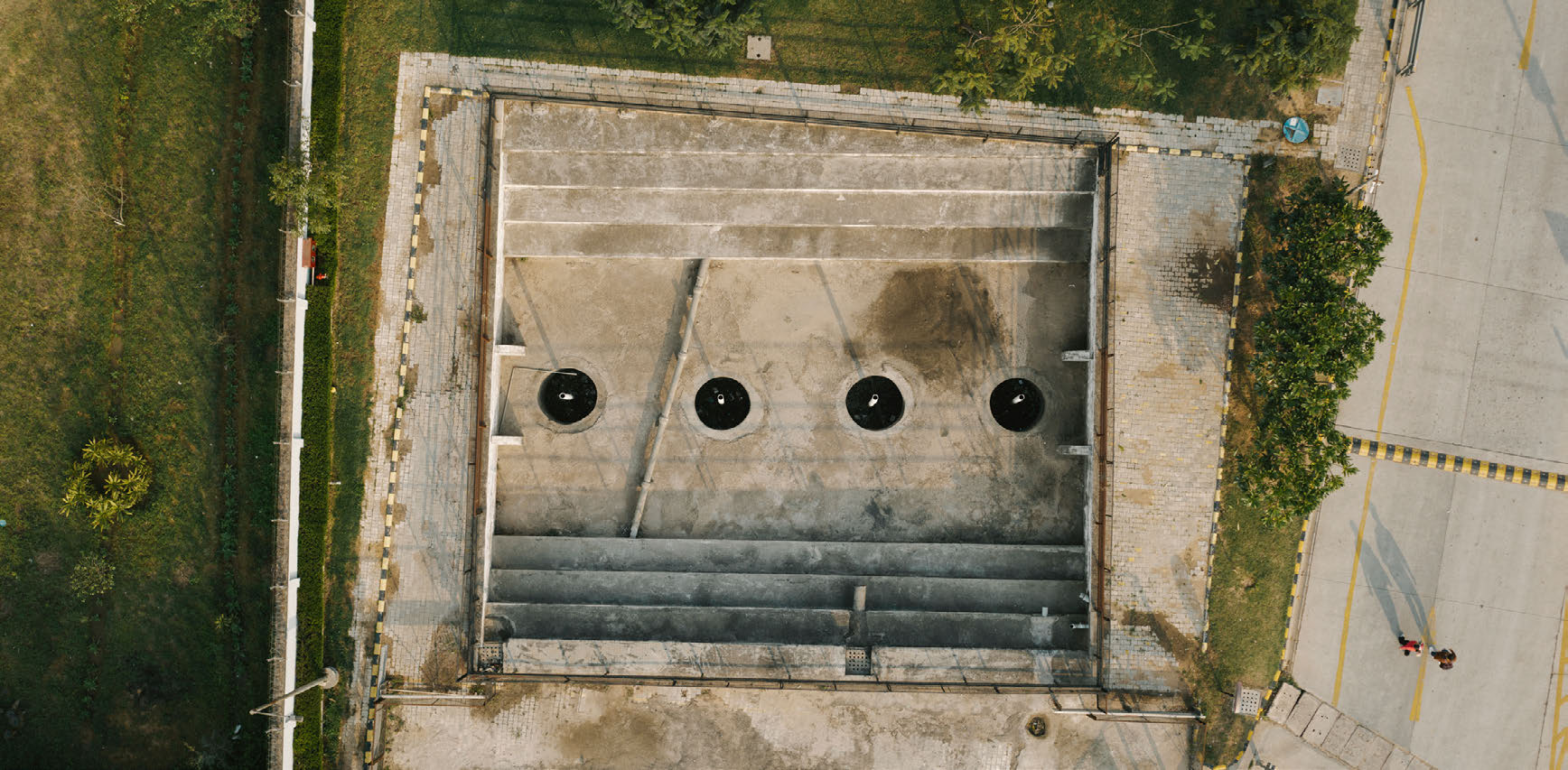
25
Overview
Progress
Appendix
Carbon and Energy
Waste and Circularity
Packaging
Water
Biodiversity
Human Rights
Responsible Supply Chain
Sustainable Products
Employee Experience
Health and Safety
Inclusive Experiences
Community Impact
Responsible Business Practices
We also incorporate water conservation into building
plans. For example, in 2024, we obtained third-party
certifications for our fulfillment centers in Cairo, Egypt,
and Abu Dhabi, United Arab Emirates, assuring water
savings of 28% and 53%, respectively, as compared to
certification baselines. We also reached 90% completion
of our effort to install low-flow aerators at logistics sites
in India, which is expected to save 4.6 million liters of
water annually.
Across our corporate office footprint, we work to reduce
indoor water use and design new buildings to comply
with low-flow design standards. In 2024, we assessed
7.5 million square feet of corporate office space in
water-stressed regions in Brazil, Egypt, Mexico, Spain,
South Africa, and the U.S. Based on this assessment,
we installed low-flow faucet aerators at 17 U.S. sites to
achieve water savings in line with our standards. We will
expand this retrofit program to our other locations in
water-stressed regions in 2025.
Reuse
In 2024, AWS had 24 data centers using recycled water
for cooling and is working to quadruple the number
of data centers using recycled water by 2030. AWS
has agreements with seven utilities, enabling more
than 4 billion liters of fresh water to be preserved for
community use. As of the end of 2024, five data centers
have operational rainwater capture systems in place, which
reduces our demand on community water resources and
reduces the adverse effects of stormwater runoff, which
is a leading source of water pollution globally.
In India, Amazon is using on-site sewage treatment plants
at 27 logistics sites to recycle greywater for toilet flushing
and irrigation, which is expected to save an estimated
279 million liters of water per year. We also have
rainwater harvesting systems at fulfillment centers in
Sydney and Melbourne, Australia. These facilities use
roof-collected rainwater to supply restrooms and irrigate
landscaped areas alongside water-conserving plumbing
fixtures to improve water efficiency.
Replenish
AWS invests in water replenishment projects in the
communities where we operate. These projects improve
community water access, availability, and quality by
restoring watersheds and bringing clean water, sanitation,
and hygiene services to water-stressed communities.
By the end of 2024, Amazon had announced 23 water
replenishment projects globally. These projects are
expected to return more than 7 billion liters annually to
communities once completed. In 2024, these projects
returned 4.3 billion liters of water to communities.
We
expanded water replenishment activities
to Chile
and China in 2024, and funded additional projects in the
U.S. and Brazil. These projects included leveraging AI to
promote water savings through more responsible irrigation
practices, treating and filtering water through the creation
and restoration of wetlands, repairing ecosystems, and
improving flood management.
In late 2024, Amazon launched new water replenishment
projects as we work toward returning more water to
communities in India than we use by 2027. Working with
the environmental organization SayTrees, Amazon is
undertaking a comprehensive restoration
of two
once-vital water sources transformed by urbanization and
erosion—Yamare Lake near Bengaluru and Sai Reddy Lake
near Hyderabad. The restoration will include removing
silt and sediment from the lake bottoms, restoring bund
formations (embankments used to reduce erosion), and
repairing inlet and outlet structures to enable proper
drainage and regulate water flow. These projects, which
are specifically focused on regions of highest water stress,
are expected to increase the combined water volume
capture potential of the two lakes by more than
571 million liters once completed.
Water.org Water & Climate Philanthropic Fund
In 2022, Amazon committed $10 million to help
Water.org
launch the Water.org Water & Climate
Philanthropic Fund, which has a goal of deploying $1
billion to deliver climate-resilient water and sanitation
solutions to 100 million people worldwide. By the end
of 2024, Water.org’s investment arm, WaterEquity,
had raised nearly $460 million and reached 7.1 million
people. With Amazon’s support, Water.org also
empowered 1 million people in India with access to
safe water and sanitation solutions in 2023 and 2024.
Rainwater harvesting “pits” use rainwater to
recharge groundwater at one of Amazon’s fulfillment
centers in National Capital Region of Delhi.
26
Overview
Progress
Appendix
Carbon and Energy
Waste and Circularity
Packaging
Water
Biodiversity
Human Rights
Responsible Supply Chain
Sustainable Products
Employee Experience
Health and Safety
Inclusive Experiences
Community Impact
Responsible Business Practices
Biodiversity
Our Approach
Biodiversity, which is defined as the variety of living
species on Earth and the habitats, ecosystems, and natural
processes that support them, is declining globally due
to land use change, direct exploitation, climate change,
pollution, and the proliferation of invasive species.
Since
1970, global wildlife populations have dropped by an
average of 73%, signaling severe stress on the natural
systems that support life.
32
Amazon recognizes the critical
importance of biodiversity to the health of the planet,
communities, and our business.
Amazon’s approach to biodiversity follows a mitigation
hierarchy that prioritizes avoidance and reduction of
habitat loss above other actions. We are focusing on three
areas to help avoid and minimize land use change within
our own operations and enhance biodiversity beyond our
business activities:
•
Commodities in our supply chain.
We aim to reduce
deforestation and responsibly source agricultural
and mineral commodities for our own products and
delivery packaging.
•
Buildings where we operate.
We seek to avoid and
minimize biodiversity loss related to the siting,
construction, and operations of the buildings that
support our businesses. We are beginning to measure
habitat value at building sites and develop design
standards that prioritize biodiversity enhancement.
•
Beyond our value chain.
We contribute to nature
conservation and restoration through collaborative
investments between private and public entities,
especially in regions with sensitive ecosystems. This
includes our commitment of $100 million to protect
and restore nature through the Right Now Climate
Fund. Amazon also enhances biodiversity through
broader sustainability initiatives. For example, we are
investing in nature-based climate solutions that
reduce
and remove carbon from the atmosphere
as part of
The Climate Pledge and in
watershed replenishment
projects
that protect and restore natural fresh water
sources to support our water positive goals.
Our Progress
Commodities in Our Supply Chain
The loss of natural habitat due to land conversion for
activities such as agriculture and forestry is one of the
primary drivers of biodiversity loss worldwide. Our
business activities can indirectly affect biodiversity
through the production of agricultural commodities
used in Amazon’s own-branded products and delivery
packaging. Our strategy to address this focuses on
measuring and seeking opportunities to reduce the land
footprint and the risk of habitat conversion from our
agricultural commodity supply chains.
One way we are minimizing impact is by continuing to make
progress on
Amazon’s responsible sourcing commitments
and enhancing them over time. These commitments often
aim to achieve leading product certifications, such as those
provided by the Rainforest Alliance, Forest Stewardship
Council, and Better Cotton Initiative.
Within agricultural lands, Whole Foods Market works to
improve the farms it sources from through promoting and
supporting “climate-smart agriculture”—an approach to
farming that supports environmental health, including
the promotion of biodiversity, while considering both the
impact agriculture has on the climate and the climate’s
impact on agriculture. Whole Foods Market has a
long-standing commitment to organic and regenerative
agriculture, two approaches that employ climate-smart
strategies. In 2024, 34% of all products sold at Whole
Foods Market were organic, and over 61% of all fresh
produce sold in 2024 was organic. To further promote
on-farm biodiversity, Whole Foods Market joined Mad
Agriculture’s Wilding initiative in 2024. This effort
supports the strategic integration of native perennial
vegetation planted in and around agricultural fields
to enhance farm viability, protect pollinators, improve
soil health, and support water retention. Through this
partnership, Mad Agriculture and participating farmers
are planting and maintaining 113 acres of reconstructed
prairie, most of which are on farms that supply ingredients
to brands we sell, reflecting a shared commitment to
regenerative agriculture and environmental stewardship.
Whole Foods Market also supports pollinator health
through its industry-leading
Quality Standards
.
Under the
Whole Foods Market Pollinator Health Policy
for Fresh Produce and Floral, all fresh produce and floral
suppliers must implement an integrated pest management
system, which reduces the need for chemical pesticides.
In recognition of its ongoing work, Whole Foods Market
was 2024’s top-ranked retailer on Friends of the Earth’s
Bee Friendly Retailer Scorecard, which ranks retailers on
pollinator protection from pesticides in food and beverage
supply chains.
Buildings Where We Operate
To address potential natural habitat changes associated
with buildings in our retail operations and data centers, we
are establishing metrics, guidance, and tools that support
best practices for preventing habitat loss and creating
on-site enhancements. At 24 building sites across Europe,
North America, and India, we are evaluating habitat
conditions and developing site designs that help avoid and
reduce loss of habitat, such as retaining and adding native
Actions
24
Amazon building sites in
Europe, U.S., and India, where
habitat conditions and site
designs are being evaluated
to help avoid and minimize
habitat loss
$67.4M
Disbursed to nature
conservation projects across
the world through the Right
Now Climate Fund in the
past five years
49K
Hectares of land protected
or restored through
biodiversity and nature-related
contributions and investments
over the past five years
5
New Right Now Climate Fund
projects added to our portfolio
in 2024
#1
Ranking as top retailer for
Whole Foods Market on the
Friends of the Earth’s Bee
Friendly Retailer Scorecard
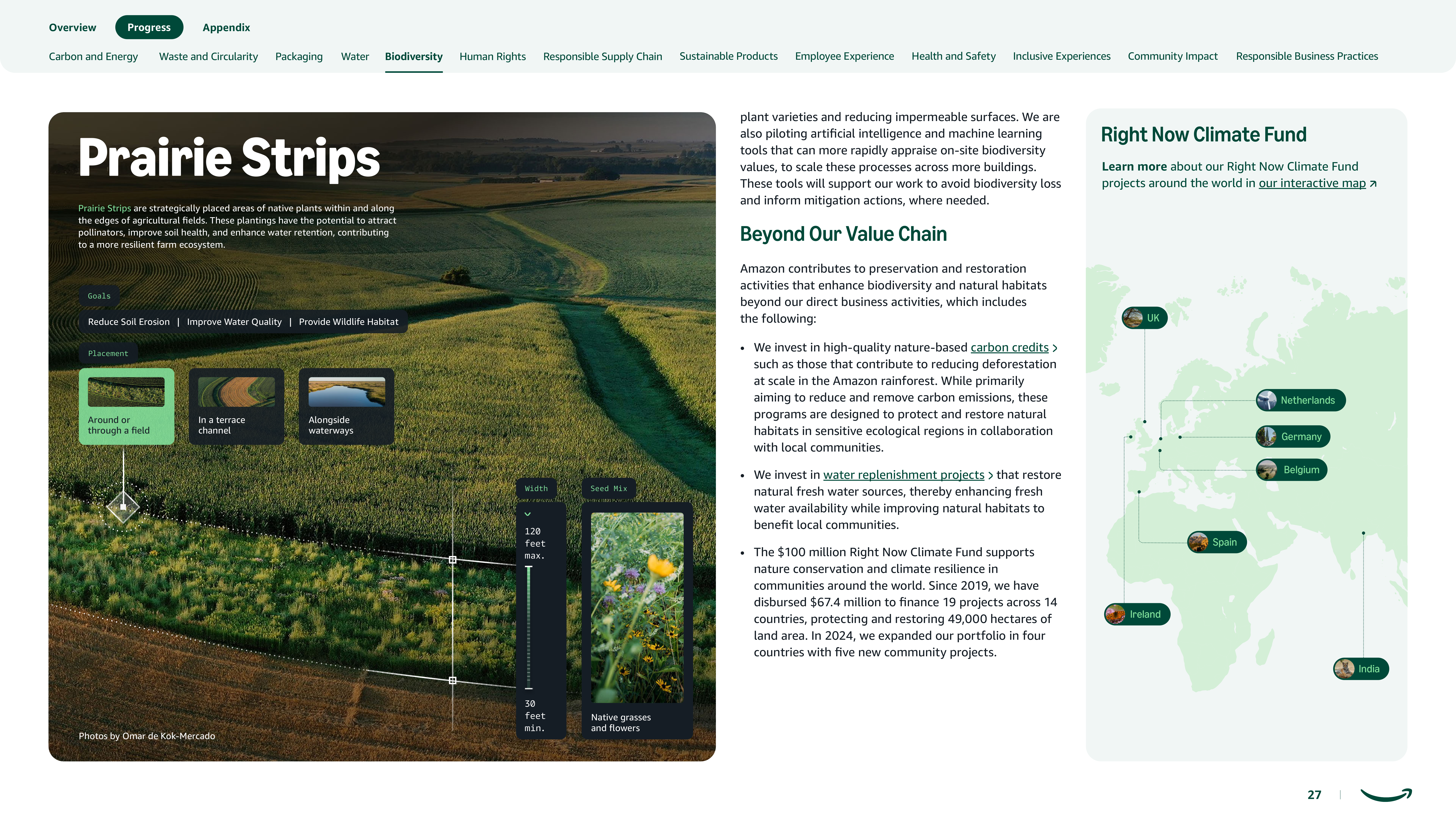










27
Overview
Progress
Appendix
Carbon and Energy
Waste and Circularity
Packaging
Water
Biodiversity
Human Rights
Responsible Supply Chain
Sustainable Products
Employee Experience
Health and Safety
Inclusive Experiences
Community Impact
Responsible Business Practices
Prairie Strips
Prairie Strips
are strategically placed areas of native plants within and along
the edges of agricultural fields. These plantings have the potential to attract
pollinators, improve soil health, and enhance water retention, contributing
to a more resilient farm ecosystem.
Goals
Reduce Soil Erosion | Improve Water Quality | Provide Wildlife Habitat
Placement
Around or
through a field
In a terrace
channel
Alongside
waterways
Width
Seed Mix
Native grasses
and flowers
120
feet
max.
30
feet
min.
Photos by Omar de Kok-Mercado
plant varieties and reducing impermeable surfaces. We are
also piloting artificial intelligence and machine learning
tools that can more rapidly appraise on-site biodiversity
values, to scale these processes across more buildings.
These tools will support our work to avoid biodiversity loss
and inform mitigation actions, where needed.
Beyond Our Value Chain
Amazon contributes to preservation and restoration
activities that enhance biodiversity and natural habitats
beyond our direct business activities, which includes
the following:
•
We invest in high-quality nature-based
carbon credits
such as those that contribute to reducing deforestation
at scale in the Amazon rainforest. While primarily
aiming to reduce and remove carbon emissions, these
programs are designed to protect and restore natural
habitats in sensitive ecological regions in collaboration
with local communities.
•
We invest in
water replenishment projects
that restore
natural fresh water sources, thereby enhancing fresh
water availability while improving natural habitats to
benefit local communities.
•
The $100 million Right Now Climate Fund supports
nature conservation and climate resilience in
communities around the world. Since 2019, we have
disbursed $67.4 million to finance 19 projects across 14
countries, protecting and restoring 49,000 hectares of
land area. In 2024, we expanded our portfolio in four
countries with five new community projects.
Right Now Climate Fund
Learn more
about our Right Now Climate Fund
projects around the world in our interactive map
India
UK
Netherlands
Germany
Belgium
Spain
Ireland
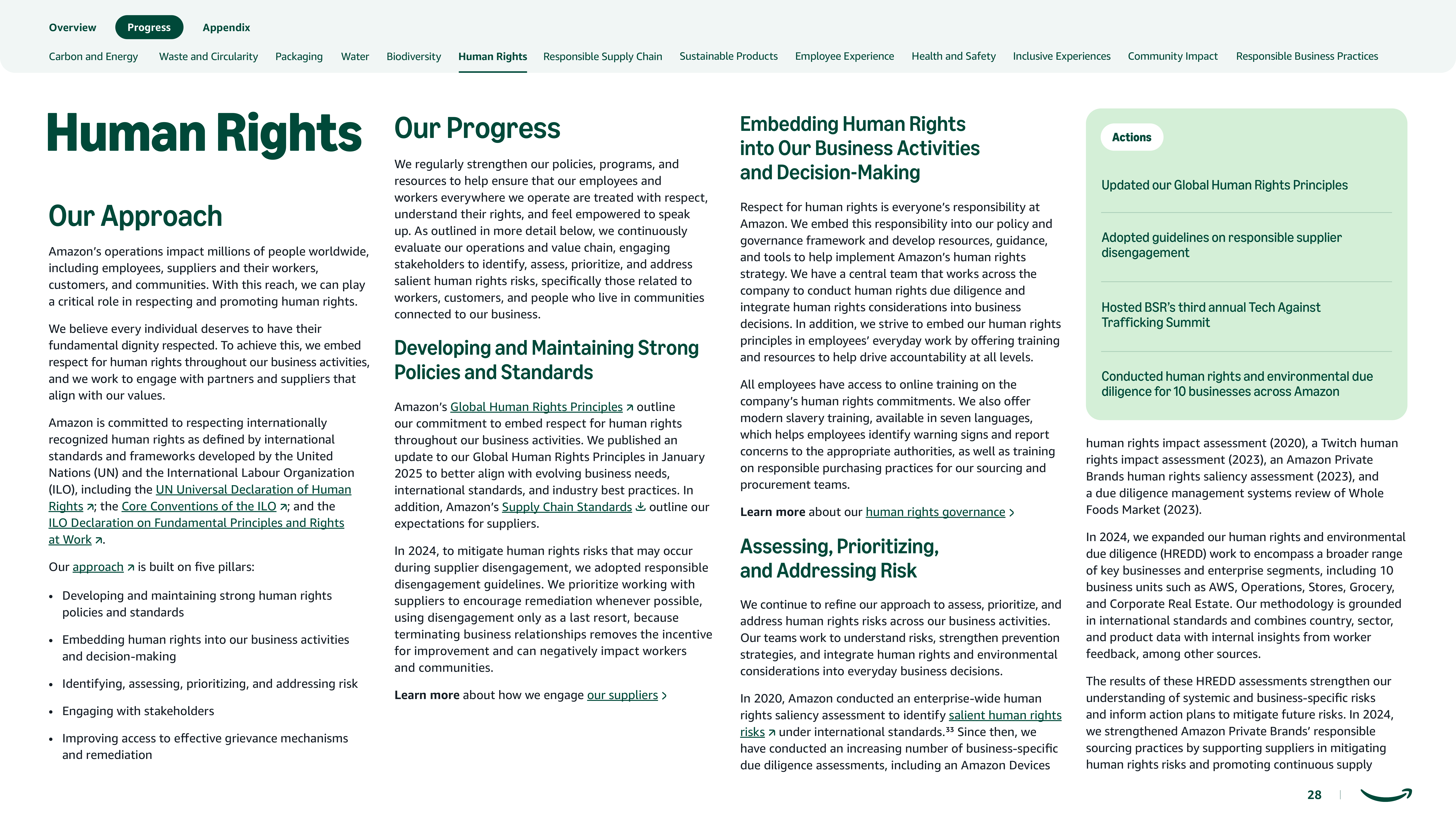
28
Overview
Progress
Appendix
Carbon and Energy
Waste and Circularity
Packaging
Water
Biodiversity
Human Rights
Responsible Supply Chain
Sustainable Products
Employee Experience
Health and Safety
Inclusive Experiences
Community Impact
Responsible Business Practices
Human Rights
Our Approach
Amazon’s operations impact millions of people worldwide,
including employees, suppliers and their workers,
customers, and communities. With this reach, we can play
a critical role in respecting and promoting human rights.
We believe every individual deserves to have their
fundamental dignity respected. To achieve this, we embed
respect for human rights throughout our business activities,
and we work to engage with partners and suppliers that
align with our values.
Amazon is committed to respecting internationally
recognized human rights as defined by international
standards and frameworks developed by the United
Nations (UN) and the International Labour Organization
(ILO), including the
UN Universal Declaration of Human
Rights
; the
Core Conventions of the ILO
; and the
ILO Declaration on Fundamental Principles and Rights
at Work
.
Our
approach
is built on five pillars:
•
Developing and maintaining strong human rights
policies and standards
•
Embedding human rights into our business activities
and decision-making
•
Identifying, assessing, prioritizing, and addressing risk
•
Engaging with stakeholders
•
Improving access to effective grievance mechanisms
and remediation
Our Progress
We regularly strengthen our policies, programs, and
resources to help ensure that our employees and
workers everywhere we operate are treated with respect,
understand their rights, and feel empowered to speak
up. As outlined in more detail below, we continuously
evaluate our operations and value chain, engaging
stakeholders to identify, assess, prioritize, and address
salient human rights risks, specifically those related to
workers, customers, and people who live in communities
connected to our business.
Developing and Maintaining Strong
Policies and Standards
Amazon’s
Global Human Rights Principles
outline
our commitment to embed respect for human rights
throughout our business activities. We published an
update to our Global Human Rights Principles in January
2025 to better align with evolving business needs,
international standards, and industry best practices. In
addition, Amazon’s
Supply Chain Standards
outline our
expectations for suppliers.
In 2024, to mitigate human rights risks that may occur
during supplier disengagement, we adopted responsible
disengagement guidelines. We prioritize working with
suppliers to encourage remediation whenever possible,
using disengagement only as a last resort, because
terminating business relationships removes the incentive
for improvement and can negatively impact workers
and communities.
Learn more
about how we engage
our suppliers
Actions
Updated our Global Human Rights Principles
Adopted guidelines on responsible supplier
disengagement
Hosted BSR’s third annual Tech Against
Trafficking Summit
Conducted human rights and environmental due
diligence for 10 businesses across Amazon
Embedding Human Rights
into Our Business Activities
and Decision-Making
Respect for human rights is everyone’s responsibility at
Amazon. We embed this responsibility into our policy and
governance framework and develop resources, guidance,
and tools to help implement Amazon’s human rights
strategy. We have a central team that works across the
company to conduct human rights due diligence and
integrate human rights considerations into business
decisions. In addition, we strive to embed our human rights
principles in employees’ everyday work by offering training
and resources to help drive accountability at all levels.
All employees have access to online training on the
company’s human rights commitments. We also offer
modern slavery training, available in seven languages,
which helps employees identify warning signs and report
concerns to the appropriate authorities, as well as training
on responsible purchasing practices for our sourcing and
procurement teams.
Learn more
about our
human rights governance
Assessing, Prioritizing,
and Addressing Risk
We continue to refine our approach to assess, prioritize, and
address human rights risks across our business activities.
Our teams work to understand risks, strengthen prevention
strategies, and integrate human rights and environmental
considerations into everyday business decisions.
In 2020, Amazon conducted an enterprise-wide human
rights saliency assessment to identify
salient human rights
risks
under international standards.
33
Since then, we
have conducted an increasing number of business-specific
due diligence assessments, including an Amazon Devices
human rights impact assessment (2020), a Twitch human
rights impact assessment (2023), an Amazon Private
Brands human rights saliency assessment (2023), and
a due diligence management systems review of Whole
Foods Market (2023).
In 2024, we expanded our human rights and environmental
due diligence (HREDD) work to encompass a broader range
of key businesses and enterprise segments, including 10
business units such as AWS, Operations, Stores, Grocery,
and Corporate Real Estate. Our methodology is grounded
in international standards and combines country, sector,
and product data with internal insights from worker
feedback, among other sources.
The results of these HREDD assessments strengthen our
understanding of systemic and business-specific risks
and inform action plans to mitigate future risks. In 2024,
we strengthened Amazon Private Brands’ responsible
sourcing practices by supporting suppliers in mitigating
human rights risks and promoting continuous supply
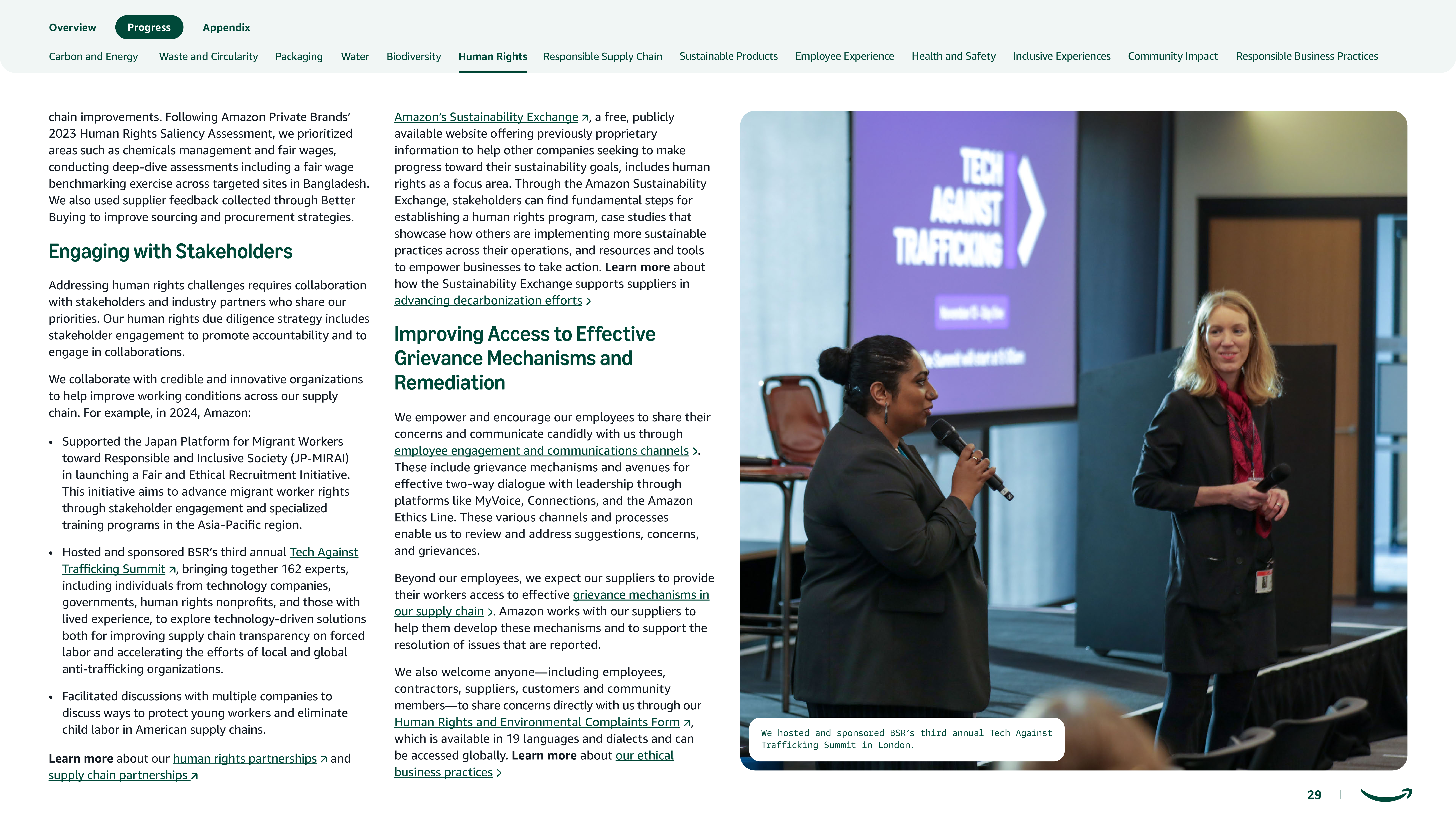
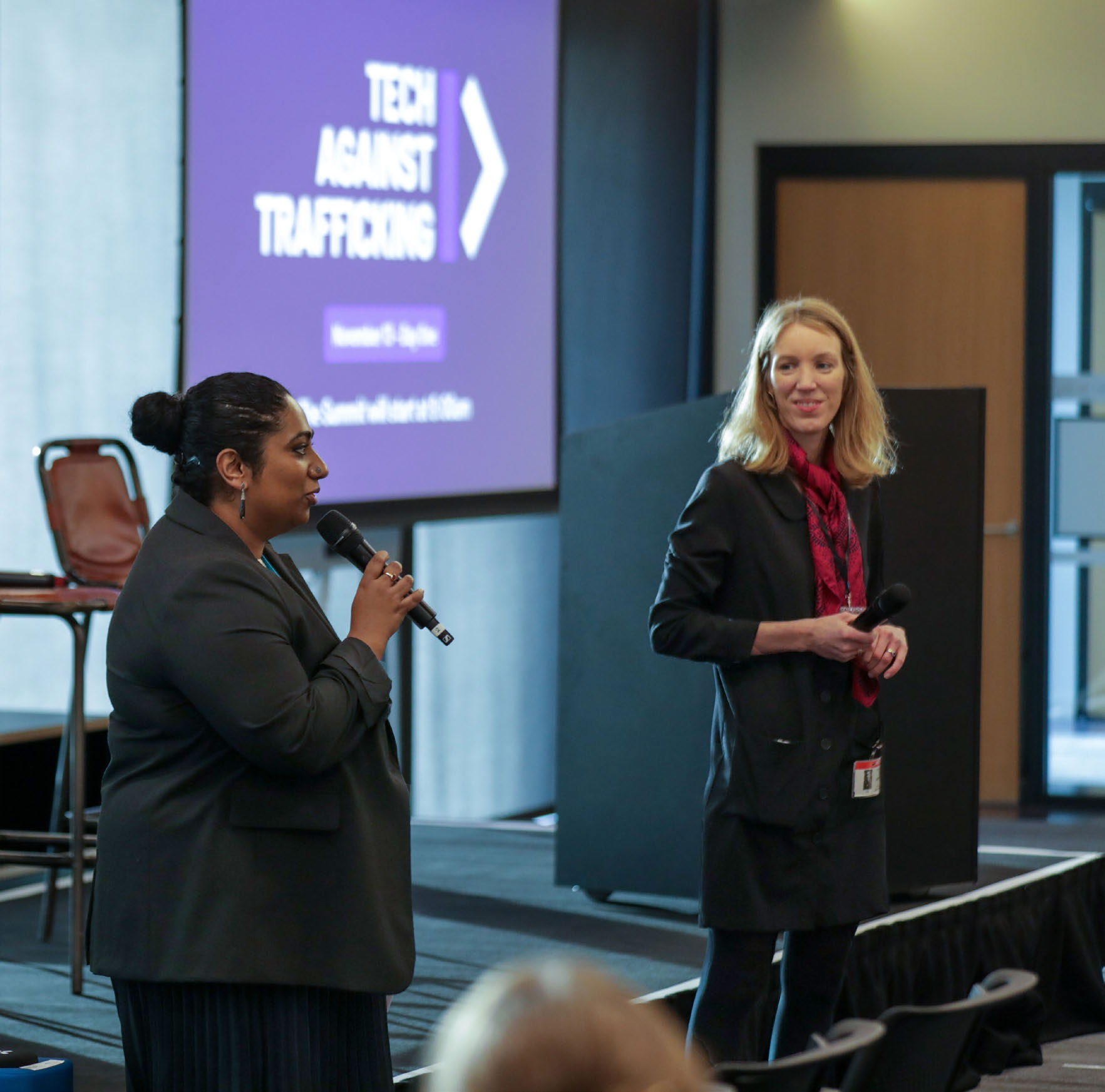
29
Overview
Progress
Appendix
Carbon and Energy
Waste and Circularity
Packaging
Water
Biodiversity
Human Rights
Responsible Supply Chain
Sustainable Products
Employee Experience
Health and Safety
Inclusive Experiences
Community Impact
Responsible Business Practices
chain improvements. Following Amazon Private Brands’
2023 Human Rights Saliency Assessment, we prioritized
areas such as chemicals management and fair wages,
conducting deep-dive assessments including a fair wage
benchmarking exercise across targeted sites in Bangladesh.
We also used supplier feedback collected through Better
Buying to improve sourcing and procurement strategies.
Engaging with Stakeholders
Addressing human rights challenges requires collaboration
with stakeholders and industry partners who share our
priorities. Our human rights due diligence strategy includes
stakeholder engagement to promote accountability and to
engage in collaborations.
We collaborate with credible and innovative organizations
to help improve working conditions across our supply
chain. For example, in 2024, Amazon:
•
Supported the Japan Platform for Migrant Workers
toward Responsible and Inclusive Society (JP-MIRAI)
in launching a Fair and Ethical Recruitment Initiative.
This initiative aims to advance migrant worker rights
through stakeholder engagement and specialized
training programs in the Asia-Pacific region.
•
Hosted and sponsored BSR’s third annual
Tech Against
Trafficking Summit
, bringing together 162 experts,
including individuals from technology companies,
governments, human rights nonprofits, and those with
lived experience, to explore technology-driven solutions
both for improving supply chain transparency on forced
labor and accelerating the efforts of local and global
anti-trafficking organizations.
•
Facilitated discussions with multiple companies to
discuss ways to protect young workers and eliminate
child labor in American supply chains.
Learn more
about our
human rights partnerships
and
supply chain partnerships
Amazon’s Sustainability Exchange
, a free, publicly
available website offering previously proprietary
information to help other companies seeking to make
progress toward their sustainability goals, includes human
rights as a focus area. Through the Amazon Sustainability
Exchange, stakeholders can find fundamental steps for
establishing a human rights program, case studies that
showcase how others are implementing more sustainable
practices across their operations, and resources and tools
to empower businesses to take action.
Learn more
about
how the Sustainability Exchange supports suppliers in
advancing decarbonization efforts
Improving Access to Effective
Grievance Mechanisms and
Remediation
We empower and encourage our employees to share their
concerns and communicate candidly with us through
employee engagement and communications channels
.
These include grievance mechanisms and avenues for
effective two-way dialogue with leadership through
platforms like MyVoice, Connections, and the Amazon
Ethics Line. These various channels and processes
enable us to review and address suggestions, concerns,
and grievances.
Beyond our employees, we expect our suppliers to provide
their workers access to effective
grievance mechanisms in
our supply chain
. Amazon works with our suppliers to
help them develop these mechanisms and to support the
resolution of issues that are reported.
We also welcome anyone—including employees,
contractors, suppliers, customers and community
members—to share concerns directly with us through our
Human Rights and Environmental Complaints Form
,
which is available in 19 languages and dialects and can
be accessed globally.
Learn more
about
our ethical
business practices
We hosted and sponsored BSR’s third annual Tech Against
Trafficking Summit in London.
30
Overview
Progress
Appendix
Carbon and Energy
Waste and Circularity
Packaging
Water
Biodiversity
Human Rights
Responsible Supply Chain
Sustainable Products
Employee Experience
Health and Safety
Inclusive Experiences
Community Impact
Responsible Business Practices
Responsible
Supply Chain
Our Approach
With a network of thousands of suppliers around the
world, we embrace our ability to support safe and healthy
working conditions throughout our supply chain. Our
dedicated supply chain engagement teams are focused
on building long-term relationships and fostering
ongoing improvement. We engage directly with suppliers
that support safe working conditions, fair pay, and
environmental protection in their own businesses. We
also collaborate with industry peers that maintain high
standards and drive progress through new initiatives.
Amazon’s
Supply Chain Standards
, available in 23
languages and dialects, detail our expectations for all
suppliers of goods and services for Amazon, including
service providers, vendors, selling partners, contractors,
and subcontractors.
34
Products sold in Amazon stores,
as well as products and services provided to us, must
be manufactured, produced, or provided in accordance
with these standards. Suppliers are responsible for
communicating these standards to their own suppliers.
In 2024, to promote awareness of the Supply Chain
Standards, we developed and deployed online trainings
to 500 suppliers, including a new course on child labor
prevention. Additionally, we made 38 third-party online
trainings covering 14 human rights topics—such as
anti-harassment and responsible recruitment—
accessible for our businesses to offer to their suppliers.
To complement our online training efforts and further
support our suppliers, we hosted 20 in-person workshops
across 11 countries, which engaged 718 participants from
351 suppliers.
Whole Foods Market Seafood Code
of Conduct
In 2024, Whole Foods Market developed its new Seafood
Code of Conduct, which was published in early 2025. The
Code establishes clear standards to safeguard the human
rights and welfare of workers throughout its global seafood
supply chain. All Whole Foods Market seafood suppliers—
from vessel owners to processors and distributors—are
expected to follow these standards. The Seafood Code of
Conduct builds on Whole Foods Market’s broader Supplier
Code of Conduct and is part of the company’s long-term
mission to promote social responsibility and continuous
improvement in its supply chain.
Our Progress
Assessing Our Suppliers
Our supplier assessment approach includes auditing
our suppliers, working with them when issues arise, and
managing supplier risk in Amazon-branded product
manufacturing and our global logistics network.
Audits
Supplier audits help us to assess supplier compliance with
our Supply Chain Standards, identify issues, and take
corrective actions when needed.
35
We audit suppliers in
four categories: Labor Rights, Ethics, Environment, and
Health and Safety.
Audit findings are flagged as high-, medium-, or low-level,
depending on severity. A high-level finding is an issue
that has caused or is likely to cause immediate harm
to workers or communities or demonstrates egregious
unethical behavior. A medium-level finding is an issue that
poses significant risk of harm to workers or communities
or demonstrates unethical or exploitative behavior. When
high-level issues are identified, suppliers must develop
corrective action plans to address identified issues as well
as long-term plans to prevent recurrence. As necessary,
suppliers must also undergo follow-up audits to confirm
the sufficient remediation of identified issues. For
medium-level issues, we track and confirm meaningful
progress toward resolution through corrective action
plans, while we monitor low-level issues for continuous
improvement through maintenance audits.
Risk Management
We seek to identify, assess, and prioritize risk across our
supply chain through a centralized methodology that
combines external data, worker feedback, and audit
findings aligning with international standards. This
central methodology allows us to more systematically
assess our supply chains to better understand the highest
risks to workers. Our approach includes identifying
country-specific risks and implementing site-level
requirements to build suppliers’ capacity to meet our
Supply Chain Standards. For example, in countries
identified as at the highest risk for modern slavery, we
require eligible suppliers to join Better Work, a program
that collaborates directly with factories, workers, and
their representatives to support greater compliance with
national labor laws and international labor standards.
36
In countries where Better Work is unavailable or not
applicable to a product category, we require participation
in an Amazon-managed audit and Amazon’s advisory
services, a tailored supplier-level intervention with
enhanced oversight to improve working conditions and
maintain continuous improvement.
Actions
3.6K+
Supplier audits including
Amazon-branded products,
third-party labor, service, and
not-for-resale goods providers
across our logistics, warehousing,
and construction supply chain
5.8K
Female workers completed
training through i4Equality,
an Amazon-owned
capacity-building program
for suppliers
Nearly
88K
Workers at supplier sites across Asia
participated in safe and healthy
workplace industry programs
Broadened Amazon Private Brands’ fair wage benchmarking
program to the apparel sector
Participated in the Harvesting the Future – Cotton in India
initiative, a unique multisector collaboration coordinated
by the Fair Labor Association
Collaborated with the Life and Building Safety (LABS)
Initiative to support the development of workplace safety
programs in our supply chain
31
Overview
Progress
Appendix
Carbon and Energy
Waste and Circularity
Packaging
Water
Biodiversity
Human Rights
Responsible Supply Chain
Sustainable Products
Employee Experience
Health and Safety
Inclusive Experiences
Community Impact
Responsible Business Practices
Expanding Our Supplier Audit Program
In 2024, we strengthened our global human rights risk
management by expanding our supplier audit program to
reach more of Amazon’s global logistics network. While
our audits have traditionally focused on Amazon-branded
product suppliers, we recognize risks to workers exist
throughout our supply chain. By broadening our scope to
include third-party labor, service, and not-for-resale goods
providers in our logistics, warehousing, and construction
supply chain, we demonstrate our commitment to making
human rights risk mitigation central to our logistics
business strategy and daily decisions. Given the scale
and complexity of our global logistics supply chain, we
began by auditing suppliers operating within our facilities,
building upon our established processes and tools. Over
the next several years, we plan to expand these audits
to our global transportation supply chain, developing
approaches tailored to different businesses and supplier
categories, to enhance our assessment of third-party
service providers’ compliance with Amazon’s Supply
Chain Standards.
In 2024, we performed 3,639 audits of suppliers of
Amazon-branded products, third-party labor, service,
and not-for-resale goods providers in our logistics,
warehousing, and construction supply chain. Of these,
1,695 audits specifically focused on third-party labor,
service, and not-for-resale goods providers in our logistics,
warehousing, and construction supply chain. These include
initial audits with new suppliers to our audit program,
maintenance audits for sites we have already audited and
supported, and verification audits to confirm sufficient
remediation of identified issues.
Remediation
Remediation services are available for all Amazon
businesses, and required when third-party labor, service,
and not-for-resale goods providers in our logistics,
warehousing, and construction supply chain have
high- or medium-risk findings in their audits. Remediation
managers, who are strategically placed globally where
Amazon operates, support suppliers in developing corrective
action plans, verify their progress, advise on how to
mitigate risks going forward, and conduct follow-up
audits as needed. Failure to take corrective action can
result in suppliers losing their ability to conduct business
with Amazon. While the remediation varies based on the
nature and scope of the issues, we prioritize working with
suppliers to respond quickly, remove harm, act in the best
interests of workers, and commit to preventing similar
issues in the future.
Mapping Our Supply Chain
We work within our supply chain to identify risks and
collaborate on systemic issues. Our
supplier list and
interactive supply chain map
provides details on finished
product suppliers of Amazon-branded apparel, consumer
electronics, food and beverage, and home goods products.
Recognizing the need for further transparency beyond
finished product suppliers, we have been working toward
greater visibility in upstream supply chains. In 2024, we
began expanding our public supplier list and supply chain
map to include apparel component suppliers. Updated
Supplier Audits by Type
37
46.6%
Maintenance
Audit
39.9%
Initial
Audit
13.5%
Verification
Audit
Supplier Audits by Risk Ratings
38
Subcategory
2022
(manufacturing audits only)
2023
(manufacturing audits only)
2024
39
Labor Rights
Freedom of Association
0.2%
0.0%
0.2%
0.0%
0.1%
0.0%
Freely Chosen Employment
2.5%
0.4%
5.6%
1.3%
6.4%
1.0%
Humane Treatment
0.2%
0.0%
0.2%
0.0%
0.3%
0.1%
Nondiscrimination
0.1%
0.1%
0.1%
0.1%
0.1%
0.0%
Subcontractor and Next-Tier Supplier Responsibility
0.0%
0.0%
0.0%
0.0%
0.0%
0.0%
Wages and Benefits
40.8%
0.0%
27.1%
0.0%
17.0%
0.0%
Worker Grievance/Complaint Mechanism
0.0%
0.0%
0.0%
0.0%
0.0%
0.0%
Working Hours
3.8%
0.0%
6.6%
0.0%
8.1%
0.0%
Young Workers
0.1%
0.0%
1.0%
0.0%
0.2%
0.1%
Ethical Behavior
Business Integrity
1.3%
0.1%
3.0%
0.0%
2.9%
0.0%
Transparency
0.4%
0.9%
0.5%
1.8%
0.8%
2.9%
Environment
Hazardous Substances
0.0%
0.0%
0.1%
0.0%
0.1%
0.0%
Pollution Management and Prevention
0.2%
0.0%
0.1%
0.0%
0.1%
0.0%
Health and Safety
Emergency Preparedness and Response
6.7%
0.7%
11.7%
2.9%
14.1%
3.5%
Industrial Hygiene
15.3%
0.0%
8.1%
0.0%
4.2%
0.0%
Machine Safeguarding
0.2%
0.0%
0.3%
0.1%
0.5%
0.1%
Sanitation, Dormitory, and Canteen
1.0%
0.2%
1.1%
0.4%
0.6%
0.5%
Occupational Safety
11.9%
0.1%
10.5%
0.1%
8.6%
0.1%
Medium-Level Findings
High-Level Findings

32
Overview
Progress
Appendix
Carbon and Energy
Waste and Circularity
Packaging
Water
Biodiversity
Human Rights
Responsible Supply Chain
Sustainable Products
Employee Experience
Health and Safety
Inclusive Experiences
Community Impact
Responsible Business Practices
yearly, this information provides customers and external
stakeholders visibility into where we source our products.
Our 2024 supplier list included nearly 2,300 finished-product
suppliers and component suppliers.
We share our supplier list to
Open Supply Hub
(OS Hub) ,
an open supply chain mapping platform used across sectors
to increase supply chain transparency and collaboration.
Amazon also serves on OS Hub’s Technical Steering
Committee, a multi-stakeholder group that supports the
technical direction and development of the hub.
Advancing Our Supply Chain
Commitments
To build a responsible supply chain, we focus where we
can have influence both directly and indirectly through our
work with industry and other partners
.
Responsible Recruitment and Freely
Chosen Employment
We do not tolerate child labor, involuntary or forced
labor, human trafficking, or modern slavery in any form.
We continually work to improve our efforts to identify,
prevent, and address the risks of all forms of modern
slavery. We work to provide individuals from vulnerable
and marginalized communities access to clear, transparent
information on working conditions including pay, hiring
practices, and contract terms.
In 2024, Amazon strengthened our detection and
prevention capabilities; we established robust reporting
mechanisms and enhanced monitoring systems designed
to identify and address potential risk indicators quickly and
efficiently. Through our comprehensive awareness program,
we delivered specialized training to over 2,500 security
associates across our U.S. operations. In 2025, we plan to
expand this training globally. We also launched training on
identifying and preventing child labor in supply chains for
our grocery suppliers in 2024.
We engage and collaborate with relevant stakeholders—
including nongovernmental organizations (NGOs), law
enforcement and other agencies to reinforce and advance
our efforts to prevent risk. In 2024, we worked with the
Mekong Club, a nonprofit organization that partners with
the private sector to help prevent modern slavery. The
Mekong Club provided a training series on responsible
recruitment practices for 172 suppliers in Saudi Arabia
and the United Arab Emirates. As a corporate sponsor of
TAT (Truckers Against Trafficking), we support its mission
to educate, equip, empower, and mobilize members of
key industries and agencies to combat human trafficking.
Through TAT’s training modules, we have equipped 10,100
active Amazon transportation associates to identify and
respond to potential instances of human trafficking,
including 4,100 associates trained in 2024.
We continue to support a systems-change approach
through industry collaboration. In 2024, Amazon
announced participation in the Harvesting the Future
– Cotton in India initiative, a multisector collaboration
coordinated by the Fair Labor Association. This three-
year effort connects Amazon and 23 other global brands
with Indian garment and textile producers and several
local implementing partners to enhance working and
living conditions for cotton farmers and their families
across 32 villages in Madhya Pradesh, India. After a
comprehensive scoping study, the brand group focused
on specific efforts to create improvements in the cotton
sector, such as establishing child labor-free zones,
initiatives to help ensure legal wages, and monitoring of
working conditions. In 2024, we also collaborated with
The Centre for Child Rights and Business to conduct child
labor risk assessments for strategic suppliers in the U.S.,
develop risk management tools and training materials
that reached 344 suppliers, and engage with stakeholders
including business representatives, NGOs, and workers to
strengthen our child labor prevention framework.
Learn more
about responsible recruitment and
remediation in our
Modern Slavery Statement
Access to Effective Grievance Mechanisms
We encourage workers across our value chain to voice
their concerns, whether directly to us, through
supplier-managed tools, products, and systems that we
support, or by connecting our suppliers to third-party
grievance mechanisms.
For example, through our Worker Voice program, we
assist suppliers to improve their own internal systems,
conduct supplier and worker training, triage cases, and help
improve management of the grievance process. In 2024, we
developed a worker grievance tool for contracted associates
at Amazon facilities in Saudi Arabia so that worker voices
could be heard by both our suppliers and Amazon.
We also connected suppliers and service providers with
supplier-managed grievance mechanisms that we support
to hear directly from workers about their experiences and
support the resolution of issues from workers’ perspectives.
In 2024, we helped connect supplier sites in eight countries
with third-party grievance mechanisms. One example is
the Amader Kotha Helpline, which is a partner of Nirapon,
an industry-led nonprofit that works with global brands,
retailers, manufacturers, and other NGOs to create
and sustain a culture of workplace safety in factories in
Bangladesh. Another example is Ulula, a worker-centric
platform that enables workers to participate in surveys and
access a remedy-centered helpline to raise their concerns
with specialized support in Cambodia, China, India, and
Pakistan. In Japan, we partner with JP-MIRAI to provide
workers at certain supplier sites access to JP-MIRAI’s
independent grievance mechanism.
Our
Human Rights and Environmental Complaints
Form
allows supply chain workers, among others,
to share concerns directly with us. It is available in 19
languages and dialects and can be accessed globally.
Complaints are evaluated in accordance with Amazon’s
Global Human Rights Principles
and
Supply Chain
Standards
. Amazon’s central human rights team
We collaborate with PATH Wellness4All on programs
offering hands-on and e-learning tools to improve
workplace health and safety.

33
Overview
Progress
Appendix
Carbon and Energy
Waste and Circularity
Packaging
Water
Biodiversity
Human Rights
Responsible Supply Chain
Sustainable Products
Employee Experience
Health and Safety
Inclusive Experiences
Community Impact
Responsible Business Practices
manages and tracks the complaints. If a violation is
identified, relevant parties are responsible for collaborating
to implement remedial actions. In 2024, we addressed
100% of the 826 complaints that were filed that year.
40
Learn more
about our
grievance mechanisms
and
other
ways to report concerns
Safe and Healthy Workplaces
Everyone has a right to a safe and healthy workplace.
Across the globe, we work with suppliers and global
organizations to support workers’ rights to safe and
healthy workplaces. For example, our work with Nirapon
extends beyond grievance mechanisms to foster
workplace safety in Bangladesh through monitoring and
overall safety oversight and training.
We are also members of the Life and Building Safety
(LABS) Initiative, an industry-driven program which
works to mitigate preventable fire, electrical, and
structural building safety risks in key apparel-, footwear-,
accessories- and home-textile-producing countries.
Since 2024, Amazon has actively contributed to the
LABS program through participation on the Steering,
Technical, and Communications committees. In addition,
through our Building, Electrical, and Fire Safety (BEFS)
program, we go beyond traditional audits in countries
not covered by Nirapon or LABS. In 2024, Tier 1 supplier
sites in Bangladesh, Cambodia, China, India, Indonesia,
Malaysia, and Vietnam participated in safe and healthy
workplace industry programs including LABS (sites
nominated by peer brands), Nirapon, the ILO’s Sustaining
Competitive and Responsible Enterprises (SCORE), Social
Accountability International (SAI)’s TenSquared, and PATH
Wellness4All, covering nearly 88,000 workers.
Fair Wages
We believe everyone has a right to be paid fairly for the
work they perform, and ensuring workers receive fair pay
remains a global, cross-industry issue. Wage transparency
is critical to assist us in addressing wage disparities in our
supply chain, and we support our suppliers in evaluating
whether workers earn enough to meet their basic needs
and the needs of their families.
In 2024, Amazon Private Brands expanded its fair
wage benchmarking program to the apparel sector
for worker compensation at Tier 1 factories and Tier 2
mills in high-risk areas. In Bangladesh, the assessments
enabled suppliers to measure their progress toward fair
compensation, as we work closely with our suppliers to
support their implementation of Bangladesh’s updated
wage regulations.
We also supported the Anker Research Institute, a global
research initiative that has developed a methodology for
estimating living wages and living incomes around the
world. By annually updating its publicly available global
database of living wage and living income estimates,
all stakeholders can access information on the cost of
living in regions where products are manufactured or
harvested, so that they can make informed decisions,
support advocacy efforts, and contribute to the
promotion of decent wages and incomes. In 2025,
we plan to support key suppliers to assess worker
compensation and develop response plans, including
enhanced wage training and remediation support.
Environmental Protection
We strive to source products and services that avoid
unnecessary environmental harm. In 2024, we continued our
collaboration with the Institute of Public & Environmental
Affairs (IPE), a nonprofit environmental research organization
in China that promotes environmental disclosures and
environmental governance. We use IPE’s public database
to assist in screening our supplier sites in China for
environmental issues. In 2025, we plan to integrate IPE’s
data with other sources, including grievance mechanisms, to
strengthen our ability to identify potential environmental
compliance issues that may not be detected through
traditional supplier assessments.
Amazon also encourages suppliers to evaluate their
sustainability-focused practices using the Higg Facility
Environmental Module (FEM), which assesses performance
and helps prioritize opportunities for improvement
across seven environmental impact areas, such as carbon
emissions, waste, and water. In 2024, 61% of Amazon’s
Private Brands Tier 1 apparel suppliers completed the
Higg FEM, to better understand their environmental
performance and practices.
Learn more
about how we engage suppliers to
achieve
net-zero carbon emissions by 2040
Equal Opportunity
Amazon serves on the advisory board of the Resilience
Fund for Women in Global Value Chains, supporting
women-led organizations in Southeast Asia through
flexible grants for sexual and reproductive health
programs or the prevention of gender-based violence.
In 2024, we completed the implementation of BSR’s
HERproject, a legacy program now part of RISE
(Reimagining Industry to Support Equality), to support
workers in Vietnam with health care training. Further, our
i4Equality training program covers gender inclusion and
the prevention of sexual harassment in the workplace, as
well as women’s health, workplace dialogue, and financial
literacy for suppliers in China, India, and Sri Lanka. By
the end of 2024, 5,800 female workers had completed
training in Sri Lanka.
i4Equality is an Amazon-owned capacity-building
program that helps suppliers’ efforts on gender
inclusion.
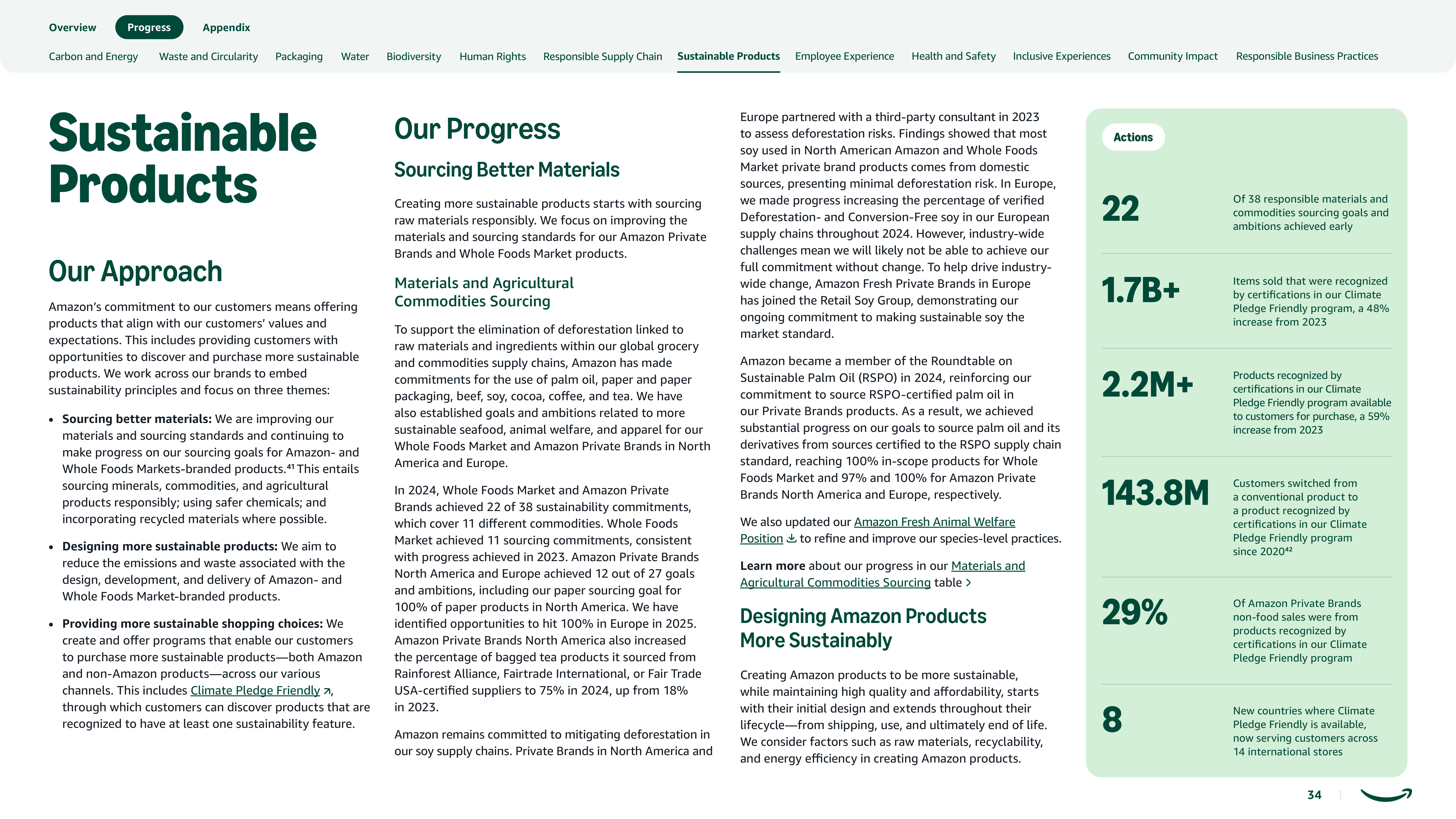
34
Overview
Progress
Appendix
Carbon and Energy
Waste and Circularity
Packaging
Water
Biodiversity
Human Rights
Responsible Supply Chain
Sustainable Products
Employee Experience
Health and Safety
Inclusive Experiences
Community Impact
Responsible Business Practices
Sustainable
Products
Our Approach
Amazon’s commitment to our customers means offering
products that align with our customers’ values and
expectations. This includes providing customers with
opportunities to discover and purchase more sustainable
products. We work across our brands to embed
sustainability principles and focus on three themes:
•
Sourcing better materials:
We are improving our
materials and sourcing standards and continuing to
make progress on our sourcing goals for Amazon- and
Whole Foods Markets-branded products.
41
This entails
sourcing minerals, commodities, and agricultural
products responsibly; using safer chemicals; and
incorporating recycled materials where possible.
•
Designing more sustainable products:
We aim to
reduce the emissions and waste associated with the
design, development, and delivery of Amazon- and
Whole Foods Market-branded products.
•
Providing more sustainable shopping choices:
We
create and offer programs that enable our customers
to purchase more sustainable products—both Amazon
and non-Amazon products—across our various
channels. This includes
Climate Pledge Friendly
,
through which customers can discover products that are
recognized to have at least one sustainability feature.
Our Progress
Sourcing Better Materials
Creating more sustainable products starts with sourcing
raw materials responsibly. We focus on improving the
materials and sourcing standards for our Amazon Private
Brands and Whole Foods Market products.
Materials and Agricultural
Commodities Sourcing
To support the elimination of deforestation linked to
raw materials and ingredients within our global grocery
and commodities supply chains, Amazon has made
commitments for the use of palm oil, paper and paper
packaging, beef, soy, cocoa, coffee, and tea. We have
also established goals and ambitions related to more
sustainable seafood, animal welfare, and apparel for our
Whole Foods Market and Amazon Private Brands in North
America and Europe.
In 2024, Whole Foods Market and Amazon Private
Brands achieved 22 of 38 sustainability commitments,
which cover 11 different commodities. Whole Foods
Market achieved 11 sourcing commitments, consistent
with progress achieved in 2023. Amazon Private Brands
North America and Europe achieved 12 out of 27 goals
and ambitions, including our paper sourcing goal for
100% of paper products in North America. We have
identified opportunities to hit 100% in Europe in 2025.
Amazon Private Brands North America also increased
the percentage of bagged tea products it sourced from
Rainforest Alliance, Fairtrade International, or Fair Trade
USA-certified suppliers to 75% in 2024, up from 18%
in 2023.
Amazon remains committed to mitigating deforestation in
our soy supply chains. Private Brands in North America and
Europe partnered with a third-party consultant in 2023
to assess deforestation risks. Findings showed that most
soy used in North American Amazon and Whole Foods
Market private brand products comes from domestic
sources, presenting minimal deforestation risk. In Europe,
we made progress increasing the percentage of verified
Deforestation- and Conversion-Free soy in our European
supply chains throughout 2024. However, industry-wide
challenges mean we will likely not be able to achieve our
full commitment without change. To help drive industry-
wide change, Amazon Fresh Private Brands in Europe
has joined the Retail Soy Group, demonstrating our
ongoing commitment to making sustainable soy the
market standard.
Amazon became a member of the Roundtable on
Sustainable Palm Oil (RSPO) in 2024, reinforcing our
commitment to source RSPO-certified palm oil in
our Private Brands products. As a result, we achieved
substantial progress on our goals to source palm oil and its
derivatives from sources certified to the RSPO supply chain
standard, reaching 100% in-scope products for Whole
Foods Market and 97% and 100% for Amazon Private
Brands North America and Europe, respectively.
We also updated our
Amazon Fresh Animal Welfare
Position
to refine and improve our species-level practices.
Learn more
about our progress in our
Materials and
Agricultural Commodities Sourcing
table
Designing Amazon Products
More Sustainably
Creating Amazon products to be more sustainable,
while maintaining high quality and affordability, starts
with their initial design and extends throughout their
lifecycle—from shipping, use, and ultimately end of life.
We consider factors such as raw materials, recyclability,
and energy efficiency in creating Amazon products.
Actions
22
Of 38 responsible materials and
commodities sourcing goals and
ambitions achieved early
1.7B+
Items sold that were recognized
by certifications in our Climate
Pledge Friendly program, a 48%
increase from 2023
2.2M+
Products recognized by
certifications in our Climate
Pledge Friendly program available
to customers for purchase, a 59%
increase from 2023
143.8M
Customers switched from
a conventional product to
a product recognized by
certifications in our Climate
Pledge Friendly program
since 2020
42
29%
Of Amazon Private Brands
non-food sales were from
products recognized by
certifications in our Climate
Pledge Friendly program
8
New countries where Climate
Pledge Friendly is available,
now serving customers across
14 international stores
35
Overview
Progress
Carbon and Energy
Waste and Circularity
Packaging
Water
Biodiversity
Human Rights
Responsible Supply Chain
Sustainable Products
Employee Experience
Health and Safety
Inclusive Experiences
Community Impact
Responsible Business Practices
Amazon Grocery
Amazon seeks to sell high-quality grocery products
made with responsibly sourced ingredients and ethical
production practices. At Whole Foods Market, our
rigorous
Quality Standards
ban many ingredients
commonly found in other stores, and numerous farming,
ranching, fishing, and manufacturing practices. Amazon
Fresh in North America is also one of a few grocery
retailers nationally that offers only cage-free egg
selection. Additionally, Amazon Private Brand shell and
liquid eggs must meet cage-free or higher animal welfare
standards, and all stand-alone coffee and teas must be
certified by the Rainforest Alliance, Fair Trade USA, or
Fairtrade International.
In 2024, we measured carbon emissions, soil health,
and water usage of Whole Foods Market and Amazon
Fresh private label food products. As of the end of 2024,
we had measured the carbon footprint of 69% of our
food-related private label products, which allows us to
identify and prioritize carbon abatement projects. Projects
implemented in 2024 include manure management with
dairy farmers, increasing climate smart practices on dairy
farms and with leafy green growers, and enhancing process
electrification and feed efficiency with seafood suppliers.
We also explore ways to improve grocery packaging
to lower associated emissions, reduce food waste, and
divert waste from landfills. Amazon Fresh Private Brands’
and Whole Foods Market’s packaging guidelines help
merchants, procurement teams, and suppliers to make
more sustainable packaging choices and reduce material
use. In 2024, our North America Grocery Private Brands
business avoided 8.85 metric tons of plastic.
In addition, Whole Foods Market is expanding its carbon
reduction efforts beyond stores to its supply chain and
working with suppliers to reduce the carbon impact
of products in its supply chain. In 2024, Whole Foods
Market launched a pilot program to reduce emissions in
shrimp farming through more sustainable feed initiatives,
improved delivery efficiency, and by reducing operational
energy use with the installation of solar panels.
Amazon Private Brands
We continuously work to decarbonize Amazon Private
Brands’ supply chain and product materials and set a
high bar for responsible sourcing. As of the end of 2024,
we had measured the carbon footprint of 75% of our
non-food related products. This exercise confirmed the
largest carbon abatement opportunities for Amazon
Private Brands guiding our decarbonization efforts
for 2025 and beyond. In 2024, we also used the Higg
Facility Environmental Module to assess our apparel
suppliers’ product manufacturing activities and identified
engagement opportunities with more carbon-intensive
suppliers, such as fabric mills.
We regularly evaluate Amazon Private Brands’
environmental and responsible sourcing standards, and, in
2024, we enhanced our lower-carbon material standards
for new products. We also regularly seek opportunities
to collaborate with our suppliers on developing more
sustainable materials. For example, we worked with a
home textiles supplier to recycle polyester scraps from its
production lines to reduce the use of virgin polyester in
Amazon Private Brands’ products. We also strive to reduce
packaging for Amazon Private Brands products, including
by collaborating with suppliers on packaging optimization,
and we prioritize the development of Amazon Private
Brands products that have certifications recognized by
our Climate Pledge Friendly program. As of the end of
2024, 29% of Amazon Private Brands product sales were
recognized by certifications in this program. In addition, we
publish a
Formulated Products Restricted Substances List
and a
Packaging Restricted Substance List
outlining the
materials we seek to avoid in specific products. Amazon
enforces these restricted substances lists with our suppliers
individually and through industry groups.
Amazon Devices
We aim for each generation of Amazon devices to be more
carbon-efficient than the last. One way we do this is by
incorporating recycled materials in our products. By the
end of 2024, various components across Echo, Fire TV,
Fire tablets, and Kindle were made from a majority
of—or all—recycled materials. These included 58%
recycled plastic, 100% recycled yarn, 100% recycled
aluminum, and 90% recycled magnesium. In 2024, we
also launched 25 new devices and accessories with a
SCS Recycled Content or a Carbon Trust certification,
which are certifications recognized by our Climate Pledge
Friendly program.
While we do not source directly from mine sites and
smelters, we are committed to avoiding the use of
minerals that have fueled conflict. We aim to have
100% of tin, tungsten, tantalum, and gold smelters and
refiners in our supply chain conform with a recognized
minerals certification program. In addition, we aim to use
more recycled materials when sourcing minerals for our
electronic products. In 2024, we introduced the new Kindle
Colorsoft Signature Edition e-reader with a battery made
from 100% recycled cobalt and the Echo Hub Smart Home
Control Panel with magnets made from 100% recycled
rare earth elements. We also engage our suppliers and
supply chain partners on responsible mineral sourcing
mechanisms and collaborate to advance industry-wide
progress.
Learn more
about our approach to avoiding
conflict minerals in our
Conflict Minerals Report
We set a goal to invest in new renewable energy capacity
to match the electricity used by our customers’ Echo,
Fire TV and Ring devices by 2025. By 2022, we had
contracted enough renewable energy capacity to match
our 2025 projections. In 2024, when this capacity was
brought online, we matched the electricity used by active
Echo, Fire TV and Ring devices—a full year ahead of
our goal. By the end of 2024, over 71% of Echo devices
and Fire TVs featured Low Power Mode, compared to
67% in 2023. We continue to issue over-the-air updates
so that older devices can also use this feature. We also
strive to use best-in-class practices to make our products
more resilient and last longer, so they do not need to be
replaced as often.
In 2024, 89% of new devices and accessories featured
100% recyclable packaging in the U.S., now at 42 devices
in total, but down from 90% in 2023, due to the types
of devices released in 2024. Some products, large Fire
TVs for example, require non-recyclable packaging
components (e.g., expanded polystyrene (EPS) foam)
to meet shipping and storage product protection
requirements. We also introduced
redesigned packaging
for Echo, Kindle, and Fire TV devices
that replaces, on
average, 30% of the fiber content with recycled fiber, and
has 60% less ink compared to previous packaging. This
new packaging also reduces our reliance on virgin tree-based
and bleached fibers, resulting in an average of 98% wood
fiber-based materials from responsibly managed forests
or recycled sources used in packaging across our device
product lines.
We work with our suppliers to reduce waste throughout
our supply chain. In 2024, 62 supplier sites achieved UL
Solutions’ Zero Waste to Landfill (ZWTL) certification at
Silver level or better, up from 10 sites when we launched our
ZWTL program in 2021.
43
This includes all final assembly
sites and packaging sites worldwide for Echo, Kindle, Ring,
Fire tablets, Fire TV devices, cables, and adapters.
We publish
carbon footprints
and
product
sustainability fact sheets
assured by the Carbon Trust
for all latest Echo, eero, Ring, Fire TV, and Fire tablet
devices on our website to enhance transparency around
the sustainability of our devices. In 2024, we updated
these fact sheets to include carbon footprint comparisons
against previous-generation models. We also launched
our first carbon footprint fact sheet in the UK for our
latest Echo device. We plan to roll these fact sheets out in
more countries in 2025.
Appendix
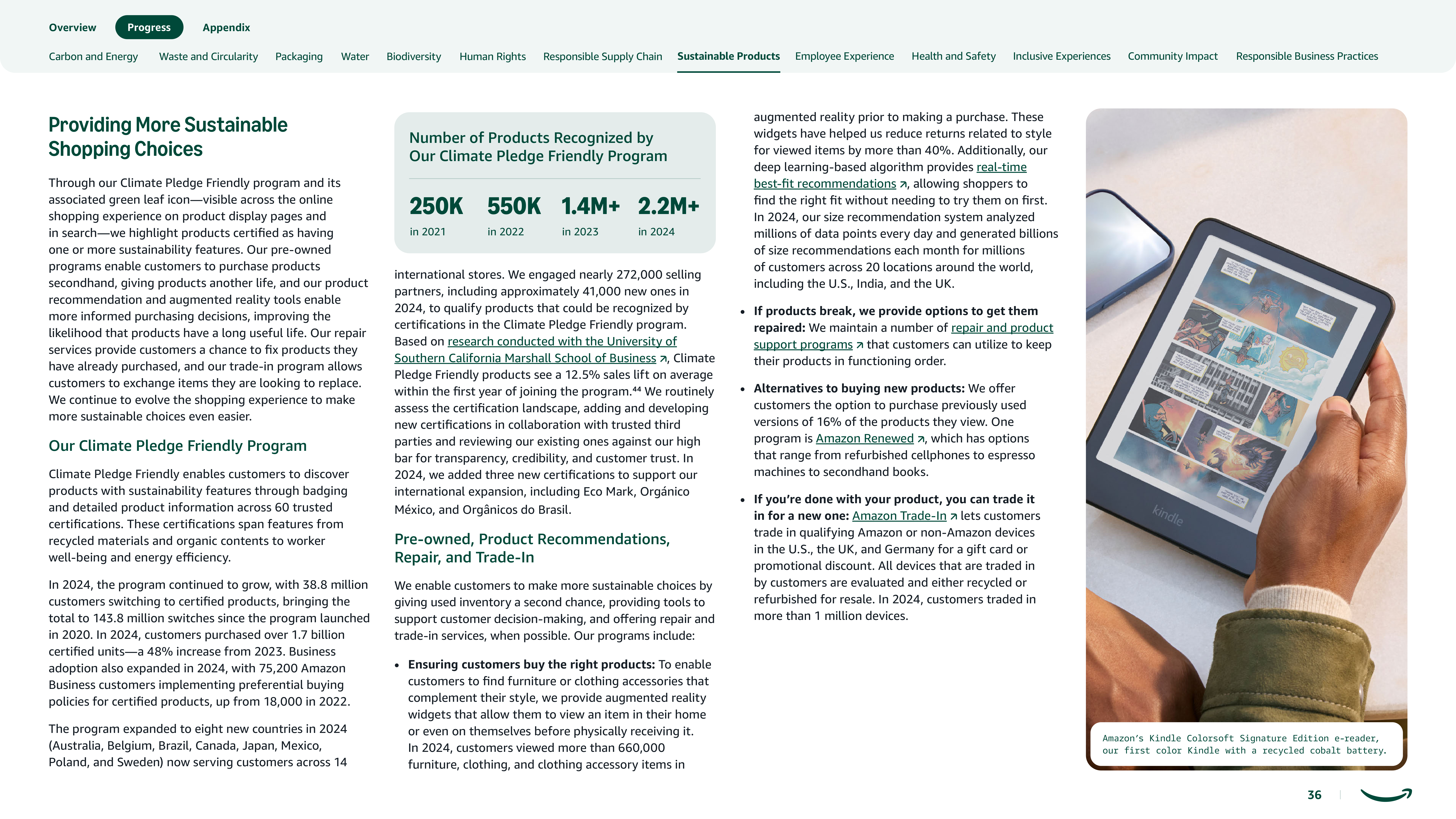

36
Overview
Progress
Carbon and Energy
Waste and Circularity
Packaging
Water
Biodiversity
Human Rights
Responsible Supply Chain
Sustainable Products
Employee Experience
Health and Safety
Inclusive Experiences
Community Impact
Responsible Business Practices
Providing More Sustainable
Shopping Choices
Through our Climate Pledge Friendly program and its
associated green leaf icon—visible across the online
shopping experience on product display pages and
in search—we highlight products certified as having
one or more sustainability features. Our pre-owned
programs enable customers to purchase products
secondhand, giving products another life, and our product
recommendation and augmented reality tools enable
more informed purchasing decisions, improving the
likelihood that products have a long useful life. Our repair
services provide customers a chance to fix products they
have already purchased, and our trade-in program allows
customers to exchange items they are looking to replace.
We continue to evolve the shopping experience to make
more sustainable choices even easier.
Our Climate Pledge Friendly Program
Climate Pledge Friendly enables customers to discover
products with sustainability features through badging
and detailed product information across 60 trusted
certifications. These certifications span features from
recycled materials and organic contents to worker
well-being and energy efficiency.
In 2024, the program continued to grow, with 38.8 million
customers switching to certified products, bringing the
total to 143.8 million switches since the program launched
in 2020. In 2024, customers purchased over 1.7 billion
certified units—a 48% increase from 2023. Business
adoption also expanded in 2024, with 75,200 Amazon
Business customers implementing preferential buying
policies for certified products, up from 18,000 in 2022.
The program expanded to eight new countries in 2024
(Australia, Belgium, Brazil, Canada, Japan, Mexico,
Poland, and Sweden) now serving customers across 14
international stores. We engaged nearly 272,000 selling
partners, including approximately 41,000 new ones in
2024, to qualify products that could be recognized by
certifications in the Climate Pledge Friendly program.
Based on
research conducted with the University of
Southern California Marshall School of Business
, Climate
Pledge Friendly products see a 12.5% sales lift on average
within the first year of joining the program.
44
We routinely
assess the certification landscape, adding and developing
new certifications in collaboration with trusted third
parties and reviewing our existing ones against our high
bar for transparency, credibility, and customer trust. In
2024, we added three new certifications to support our
international expansion, including Eco Mark, Orgánico
México, and Orgânicos do Brasil.
Pre-owned, Product Recommendations,
Repair, and Trade-In
We enable customers to make more sustainable choices by
giving used inventory a second chance, providing tools to
support customer decision-making, and offering repair and
trade-in services, when possible. Our programs include:
•
Ensuring customers buy the right products:
To enable
customers to find furniture or clothing accessories that
complement their style, we provide augmented reality
widgets that allow them to view an item in their home
or even on themselves before physically receiving it.
In 2024, customers viewed more than 660,000
furniture, clothing, and clothing accessory items in
augmented reality prior to making a purchase. These
widgets have helped us reduce returns related to style
for viewed items by more than 40%. Additionally, our
deep learning-based algorithm provides
real-time
best-fit recommendations
, allowing shoppers to
find the right fit without needing to try them on first.
In 2024, our size recommendation system analyzed
millions of data points every day and generated billions
of size recommendations each month for millions
of customers across 20 locations around the world,
including the U.S., India, and the UK.
•
If products break, we provide options to get them
repaired:
We maintain a number of
repair and product
support programs
that customers can utilize to keep
their products in functioning order.
•
Alternatives to buying new products:
We offer
customers the option to purchase previously used
versions of 16% of the products they view. One
program is
Amazon Renewed
, which has options
that range from refurbished cellphones to espresso
machines to secondhand books.
•
If you’re done with your product, you can trade it
in for a new one:
Amazon Trade-In
lets customers
trade in qualifying Amazon or non-Amazon devices
in the U.S., the UK, and Germany for a gift card or
promotional discount. All devices that are traded in
by customers are evaluated and either recycled or
refurbished for resale. In 2024, customers traded in
more than 1 million devices.
Number of Products Recognized by
Our Climate Pledge Friendly Program
250K
in 2021
550K
in 2022
1.4M+
in 2023
2.2M+
in 2024
Amazon’s Kindle Colorsoft Signature Edition e-reader,
our first color Kindle with a recycled cobalt battery.
Appendix
37
Overview
Progress
Appendix
Carbon and Energy
Waste and Circularity
Packaging
Water
Biodiversity
Human Rights
Responsible Supply Chain
Sustainable Products
Employee Experience
Health and Safety
Inclusive Experiences
Community Impact
Responsible Business Practices
Employee
Experience
Goal
Invest $1.2B to provide education
and skills training to over 300,000
U.S. employees by 2025
439K
U.S. employees have participated
in upskilling programs since we
announced our Upskilling Pledge
in 2019
Actions
$2.2B
Incrementally invested in
pay for U.S. employees in
frontline operations roles,
bringing average pay to over
$22 per hour and average total
compensation to over $29
per hour including the value
of elected benefits
$653M
Invested in international
wage increases
$37M
Saved for emergencies
by employees through
our paycheck-linked
savings program
Nearly
$1B
In supplementary retirement
benefits provided to over
1 million U.S. employees
100K+
Employees participated
in Career Choice, our free
education and skills
training program
Our Approach
With more than 1.5 million full- and part-time employees
around the globe, we recognize the critical role our
people play in our success. We strive to prioritize the
physical, mental, and financial well-being of each Amazon
employee, and take meaningful steps to support their
work lives and their families’ needs.
We strive to be Earth’s best employer, offering more
than just competitive wages and inclusive benefits. We
also want our employees to develop their careers with
us, and we offer upskilling opportunities that support
individual goals. We listen to employees through a variety
of feedback channels, using the insights to improve the
employee experience and empower them to deliver
for customers.
Our Progress
Prioritizing Compensation
and Pay Equity
Amazon is one of the largest private employers in the
U.S. Our pay practices affect our employees and their
families as well as the local economies where they live.
In the U.S., more than 800,000 of our employees work
in hourly frontline operations roles. In 2024, we invested
an incremental $2.2 billion in pay for our employees,
bringing average hourly pay to over $22 and average total
compensation to over $29 per hour when including the
value of their elected benefits. This represents an average
increase of $1.50 per hour from 2023, our largest annual
investment in pay to date.
Amazon invested $653 million in international wage
increases in 2024. In the UK, we increased compensation
for frontline operations employees to at least £13.50,
a 9.8% increase since April 2024. Since 2022, we
invested £550 million in our UK operations employees,
representing a 35% increase in hourly pay in just two
years. In Germany, we increased the starting hourly wage
for logistics employees to at least €15.00, a 39% increase
over the last five years. On average, logistics employees
in Germany receive an annual salary of €39,000 plus
benefits after two years of service.
Pay Equity
Amazon is committed to compensating all employees
equitably for comparable roles, responsibilities, and skills.
We conduct an annual review of employee compensation,
including base pay, cash bonuses, and stock shares. Our
2024 review found that women we employ in the U.S.
earned 99.9 cents and globally earned 99.9 cents for
every dollar men earned performing comparable jobs. This
review also showed that racial/ethnic minorities in the U.S.
earned 99.4 cents for every dollar that white employees
earned performing comparable jobs.
Offering Inclusive and
Flexible Benefits
We offer a range of competitive benefits that are designed
to meet the evolving needs of our employees and eligible
family members, including their children and domestic
partners. Our
robust benefits program
is structured to
prioritize physical and mental health, financial wellness,
family-building support, and workplace and commuter
Pay Equity by Country
Group
Country
Percentage
Earned by
Comparison
Women in Jobs
Comparable to Men
Global
99.9
France
100.0
Germany
99.7
Italy
99.4
Spain
98.8
UK
99.9
U.S.
99.9
Racial and Ethnic
Minorities in Jobs
Comparable to
White Employees’
U.S.
99.4
38
Overview
Progress
Appendix
Carbon and Energy
Waste and Circularity
Packaging
Water
Biodiversity
Human Rights
Responsible Supply Chain
Sustainable Products
Employee Experience
Health and Safety
Inclusive Experiences
Community Impact
Responsible Business Practices
benefits. We make it easy for employees to discover
and access benefits through our A to Z app and website,
which 96% of employees visited each month in 2024. In
total, we invested $10.8 billion in employee benefits in 59
countries, a 7% increase over 2023.
For regular full-time and reduced-time employees,
benefits start on their first day of employment and
include health care insurance coverage, up to 100% paid
prepartum and postpartum leave, ways to save for the
future, and health and well-being resources.
45
We also
offer valuable benefits to seasonal employees.
Health and Well-Being Benefits
We look at our employees’ full range of health and
well-being needs and provide medical coverage, mental
health and wellness support, and life, disability, and other
types of insurance. Amazon health insurance covered
approximately 1.6 million employees and family members
globally in 2024.
We integrate whole person care into our approach to
promote health and wellness for enrolled members. In
the U.S., we offer integrated primary care clinics providing
affordable health care services, including primary
care, behavioral health, and physical therapy. We have
expanded access to 90-day prescriptions for chronic
non-specialty medications across our pharmacy network,
including Amazon Pharmacy, which offers same-day
delivery, automatic price comparisons, and automatic drug
discount card application at checkout. Additionally, all U.S.
Amazon employees have access to a free 24/7 Medical
Advice Line from their first day, regardless of medical plan
enrollment, allowing them to talk with a registered nurse
whenever and wherever they need medical advice.
Amazon continues to support initiatives to fight cancer.
To that end, members enrolled in a self-insured plan
who are 45 years or older may request a free at-home
colorectal cancer screening kit to increase early detection.
Additionally, the Amazon Cancer Advocacy, Resources,
Education, and Support (CARES) program provides
high-touch, one-to-one support for employees and their
family members who have been diagnosed. In 2024,
CARES supported over 4,000 employees in 63 countries.
We prioritize comprehensive mental health support
through two key programs. Our Employee Assistance
Program (EAP) serves nearly 1.7 million employees, their
families, and household members across 62 countries,
offering up to six free counseling sessions per issue
annually and a globally accessible therapeutic app for daily
mental health support. It is available 24/7 in most major
world languages, 100% confidential, and free of charge.
Additionally, in 2024, we launched a custom mental health
network through Lyra Health for employees enrolled in
Amazon health plans. This service provides specialized
mental health services on average within two days.
We design our EAP benefits globally as an essential
resource for employees and their families seeking daily
guidance or support. In 2024, we expanded our wellness
offerings by adding coaching in all countries outside the
U.S. (except Ireland) to help employees manage weight,
nutrition, physical activity, smoking/vaping cessation, and
stress reduction.
46
U.S. employees enrolled in a health
plan, along with their spouses and dependents ages
15 or older, can access Pelago, a digital clinic offering
personalized, confidential treatment for substance use.
Pelago’s physician-led program combines
medication-assisted treatments with health goal-tracking
tools, an on-demand library, and additional resources.
Separately, Amazon broadened access to evidence-
based cognitive behavioral therapy and trauma-focused
counseling services in additional regions around the world.
Financial Benefits
Amazon offers a number of benefits that help employees
carve out a path to financial security. In 2024, we
expanded the financial assistance program we began
offering last year through Brightside Financial Care to all
50 U.S. states. Customer fulfillment and transportation
employees can use Brightside to reduce or consolidate
debt, and personal coaches can recommend customized
plans to improve financial health. The program provided
$27 million worth of financial solutions and resources
to hourly employees in 2024, up from nearly $14 million
in 2023. More than 52,000 employees engaged in this
program in 2024, an 82% year-over-year increase.
Our paycheck-linked savings program helps employees
prepare for unexpected expenses and achieve personal
financial goals through automatic payroll elections. In
2024, employees allocated $37 million in emergency
savings and over $5 million toward other financial goals
through this program.
In 2024, we launched a new home purchase benefit to
support employees, simplifying the process of obtaining a
mortgage. We also added a tax-advantaged 529 educational
savings benefit to assist employees in saving and investing
for their children’s qualified post-secondary education
expenses. We continued to support our employees with
charitable giving through our Donor-Advised Fund benefit,
which drove over $26 million in giving during the past year.
We also offer supplementary retirement benefits in 37
countries and provided nearly $1 billion in such benefits to
over 1 million U.S. employees in 2024.
Family-Building Benefits
All U.S. employees enrolled in our self-insured medical
plans—regardless of their gender, sexual orientation,
or relationship status—have access to family-building
benefits including in vitro fertilization, egg freezing,
genetic testing, access to fertility specialists, adoption
assistance and reimbursement, and more. In the U.S., we
offer up to 20 weeks of paid leave for birthing parents,
up to six weeks of paid parental leave for partners, and a
reduced schedule for up to eight weeks after the birth or
adoption of a child. Over 30,000 U.S. full-time and hourly
Amazon employees utilized these family-building benefits
in 2024. Employees in 55 other countries can access
fertility navigation services. In 2024, we also expanded
our contraception benefit for U.S. employees and
dependents, allowing them to receive a 12-month supply
of birth control pills.
Commuter Benefits
In 2024, we offered flexible commuter subsidies in 94%
of countries where our employees live or work, regardless
of how employees prefer to get to work—by car, public
transportation, or bicycle. In the U.S., employees can also
apply their subsidy toward vanpool, carpool, and rideshare.
Investing in Upskilling Programs
for Our Employees
We want Amazon employees to grow meaningful careers,
whether they stay with us or eventually work elsewhere.
We believe that Amazon is one of the best places for career
development because we are committed to skill building
no matter an employee’s aspirations. Upskilling is key to
our talent development approach, empowering employees
to build the skills they need to remain competitive, grow
their careers, and move into higher-paying roles. These
efforts also assist in building a strong pipeline to fill
current and future in-demand jobs, both at Amazon and
elsewhere. We announced our Upskilling Pledge in 2019,
and have used our allocated spend of $1.2 billion to invest
in nine U.S. programs to fund education and technical skills
training for Amazon employees. Since 2019, approximately
439,000 employees have participated in the U.S. and
710,000 participated globally.
Career Choice
Launched in 2012,
Career Choice
is our longest-standing
upskilling program. It offers a variety of training benefits
for 41 career pathways in 14 countries through our global
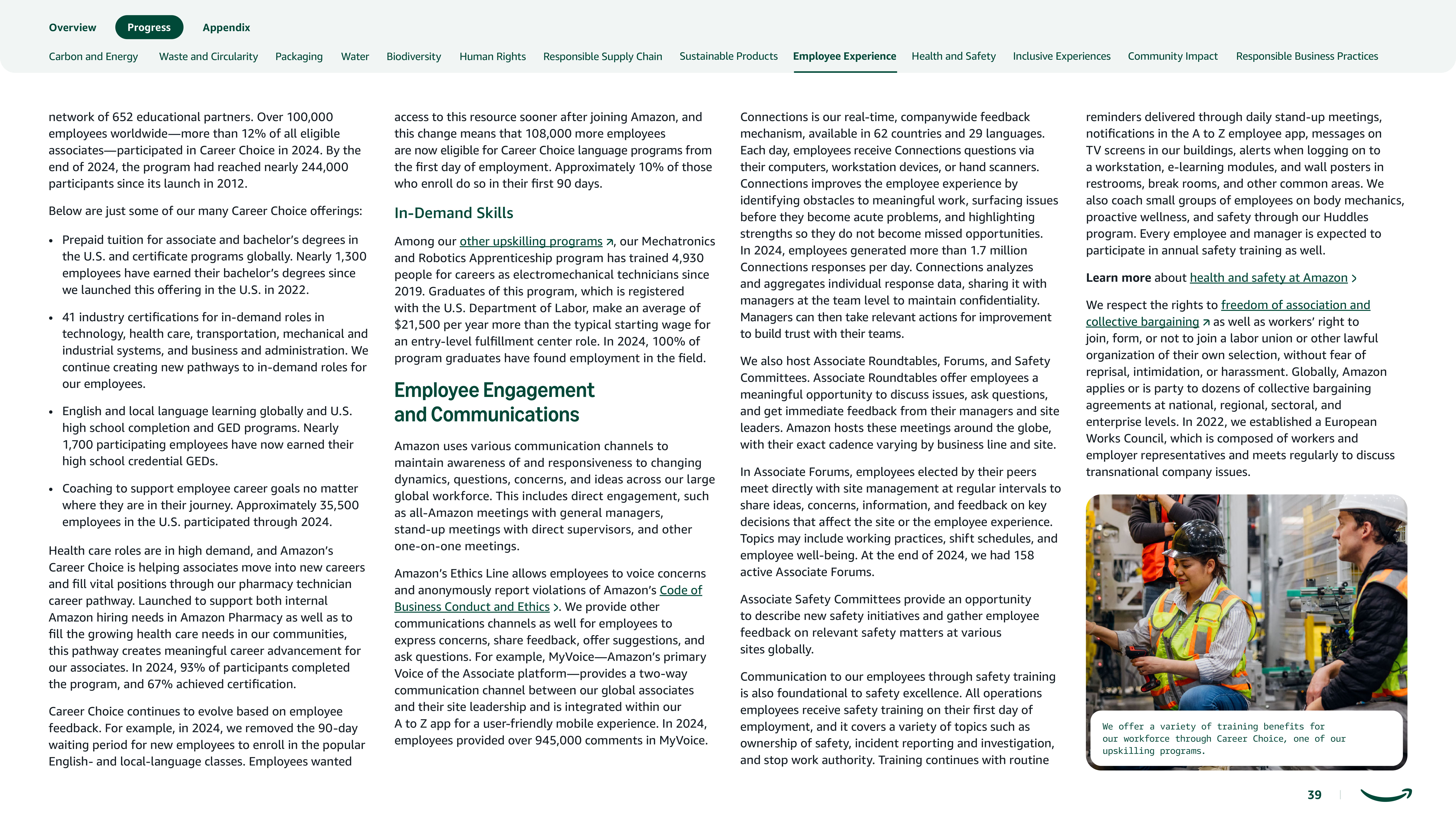
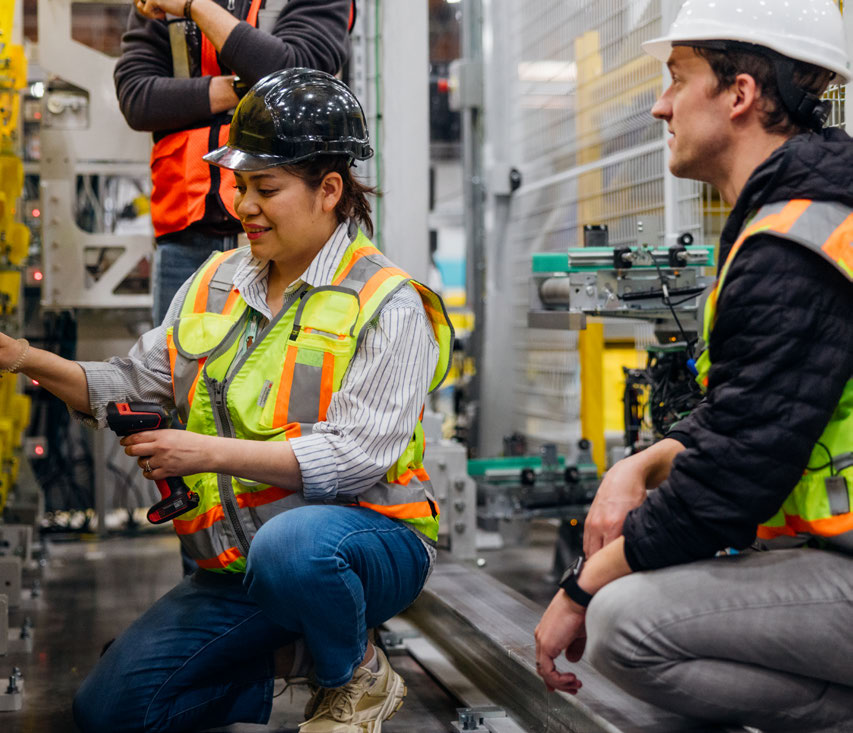
39
Progress
Progress
Appendix
Carbon and Energy
Waste and Circularity
Packaging
Water
Biodiversity
Human Rights
Responsible Supply Chain
Sustainable Products
Employee Experience
Health and Safety
Inclusive Experiences
Community Impact
Responsible Business Practices
network of 652 educational partners. Over 100,000
employees worldwide—more than 12% of all eligible
associates—participated in Career Choice in 2024. By the
end of 2024, the program had reached nearly 244,000
participants since its launch in 2012.
Below are just some of our many Career Choice offerings:
•
Prepaid tuition for associate and bachelor’s degrees in
the U.S. and certificate programs globally. Nearly 1,300
employees have earned their bachelor’s degrees since
we launched this offering in the U.S. in 2022.
•
41 industry certifications for in-demand roles in
technology, health care, transportation, mechanical and
industrial systems, and business and administration. We
continue creating new pathways to in-demand roles for
our employees.
•
English and local language learning globally and U.S.
high school completion and GED programs. Nearly
1,700 participating employees have now earned their
high school credential GEDs.
•
Coaching to support employee career goals no matter
where they are in their journey. Approximately 35,500
employees in the U.S. participated through 2024.
Health care roles are in high demand, and Amazon’s
Career Choice is helping associates move into new careers
and fill vital positions through our pharmacy technician
career pathway. Launched to support both internal
Amazon hiring needs in Amazon Pharmacy as well as to
fill the growing health care needs in our communities,
this pathway creates meaningful career advancement for
our associates. In 2024, 93% of participants completed
the program, and 67% achieved certification.
Career Choice continues to evolve based on employee
feedback. For example, in 2024, we removed the 90-day
waiting period for new employees to enroll in the popular
English- and local-language classes. Employees wanted
access to this resource sooner after joining Amazon, and
this change means that 108,000 more employees
are now eligible for Career Choice language programs from
the first day of employment. Approximately 10% of those
who enroll do so in their first 90 days.
In-Demand Skills
Among our
other upskilling programs
, our Mechatronics
and Robotics Apprenticeship program has trained 4,930
people for careers as electromechanical technicians since
2019. Graduates of this program, which is registered
with the U.S. Department of Labor, make an average of
$21,500 per year more than the typical starting wage for
an entry-level fulfillment center role. In 2024, 100% of
program graduates have found employment in the field.
Employee Engagement
and Communications
Amazon uses various communication channels to
maintain awareness of and responsiveness to changing
dynamics, questions, concerns, and ideas across our large
global workforce. This includes direct engagement, such
as all-Amazon meetings with general managers,
stand-up meetings with direct supervisors, and other
one-on-one meetings.
Amazon’s Ethics Line allows employees to voice concerns
and anonymously report violations of Amazon’s
Code of
Business Conduct and Ethics
. We provide other
communications channels as well for employees to
express concerns, share feedback, offer suggestions, and
ask questions. For example, MyVoice—Amazon’s primary
Voice of the Associate platform—provides a two-way
communication channel between our global associates
and their site leadership and is integrated within our
A to Z app for a user-friendly mobile experience. In 2024,
employees provided over 945,000 comments in MyVoice.
Connections is our real-time, companywide feedback
mechanism, available in 62 countries and 29 languages.
Each day, employees receive Connections questions via
their computers, workstation devices, or hand scanners.
Connections improves the employee experience by
identifying obstacles to meaningful work, surfacing issues
before they become acute problems, and highlighting
strengths so they do not become missed opportunities.
In 2024, employees generated more than 1.7 million
Connections responses per day. Connections analyzes
and aggregates individual response data, sharing it with
managers at the team level to maintain confidentiality.
Managers can then take relevant actions for improvement
to build trust with their teams.
We also host Associate Roundtables, Forums, and Safety
Committees. Associate Roundtables offer employees a
meaningful opportunity to discuss issues, ask questions,
and get immediate feedback from their managers and site
leaders. Amazon hosts these meetings around the globe,
with their exact cadence varying by business line and site.
In Associate Forums, employees elected by their peers
meet directly with site management at regular intervals to
share ideas, concerns, information, and feedback on key
decisions that affect the site or the employee experience.
Topics may include working practices, shift schedules, and
employee well-being. At the end of 2024, we had 158
active Associate Forums.
Associate Safety Committees provide an opportunity
to describe new safety initiatives and gather employee
feedback on relevant safety matters at various
sites globally.
Communication to our employees through safety training
is also foundational to safety excellence. All operations
employees receive safety training on their first day of
employment, and it covers a variety of topics such as
ownership of safety, incident reporting and investigation,
and stop work authority. Training continues with routine
reminders delivered through daily stand-up meetings,
notifications in the A to Z employee app, messages on
TV screens in our buildings, alerts when logging on to
a workstation, e-learning modules, and wall posters in
restrooms, break rooms, and other common areas. We
also coach small groups of employees on body mechanics,
proactive wellness, and safety through our Huddles
program. Every employee and manager is expected to
participate in annual safety training as well.
Learn more
about
health and safety at Amazon
We respect the rights to
freedom of association and
collective bargaining
as well as workers’ right to
join, form, or not to join a labor union or other lawful
organization of their own selection, without fear of
reprisal, intimidation, or harassment. Globally, Amazon
applies or is party to dozens of collective bargaining
agreements at national, regional, sectoral, and
enterprise levels. In 2022, we established a European
Works Council, which is composed of workers and
employer representatives and meets regularly to discuss
transnational company issues.
We offer a variety of training benefits for
our workforce through Career Choice, one of our
upskilling programs.
40
Overview
Progress
Appendix
Carbon and Energy
Waste and Circularity
Packaging
Water
Biodiversity
Human Rights
Responsible Supply Chain
Sustainable Products
Employee Experience
Health and Safety
Inclusive Experiences
Community Impact
Responsible Business Practices
Health
and Safety
Our Approach
With an organization of more than 10,000 safety
professionals dedicated to keeping over 1 million
operations employees safe every day, nothing is more
important than ensuring our people’s safety. We know
that every person is someone’s mother, father, sibling,
child, or best friend, and that’s why we’ve set an ambitious
goal to become the benchmark of safety excellence across
all industries in which we operate.
In 2024, we focused on expanding and executing an
effective strategy to improve safety across our global
operations, and it led to meaningful, measurable progress.
While we’re encouraged by our continued progress, we
know there’s more work to do, and we’re committed to
further improvement as we work toward our goal.
Our Progress
Evaluating Our Safety Performance
We have made meaningful progress on global safety
since 2019. Our Recordable Incident Rate (RIR), which
encompasses any work-related injury requiring more
than basic first-aid treatment, has shown measurable
improvement. Over the past five years, we’ve seen a 34%
reduction in RIR, with a 6% decrease year over year. Our
Lost Time Incident Rate (LTIR), which accounts for the
most serious injuries requiring time away from work, has
improved by 65% over the last five years, with
a 13% reduction year over year.
Learn more
about how
Amazon’s safety performance
improved year over year
Safety in the United States
In the U.S., we report our operations data to the
Occupational Safety and Health Administration (OSHA)
under various industry codes that reflect the kind of work
we do across our network. The majority of our data is
reported under the General Warehousing and Storage and
Courier and Express Delivery Services codes. As seen on
the following page, we continued making year-over-year
progress across all categories, building on our meaningful
progress over the past five years.
In the U.S. General Warehousing and Storage industry, our
RIR improved by 27% over the past five years and 5% year
over year.
47
Within the same sector, LTIR showed a 79%
improvement over the past five years and a 9%
year-over-year reduction.
In the U.S. Courier and Express Delivery Services industry,
we achieved a 50% improvement in our RIR over the past
five years and a 16% reduction year over year.
48
Our LTIR
in this sector improved by 74% over the past five years,
with a 25% reduction year over year.
These graphs illustrate our progress year over year and
how we stack up against industry averages calculated by
the Bureau of Labor Statistics (BLS). The BLS calculates
these averages using data from selected employers
and releases them each November, so the most recent
averages available are for 2023.
We’re continuing to make steady and meaningful
progress. That said, we’ve never aspired to be average
because when it comes to safety there is no such thing
as “good enough.” We want to be the safest company in
the industries in which we operate, so we’re consistently
innovating and investing in safety measures. In 2025
alone, we’ve allocated hundreds of millions of dollars to
invest in technologies, resources, training, and programs
to further our safety efforts.
Understanding Our Operations
and Workforce
Globally, our operations network has more than doubled
in size since 2019—to more than 1 million operations
employees across more than 2,500 sites around the world.
Alongside that growth, we’ve worked hard to further build
and evolve our culture of safety.
We know that we can’t get safety right without our
employees’ feedback. We’ve created several ways for
employees to give us feedback on how to improve, but
one tool we’re especially proud of is Dragonfly. Available
on employees’ devices or at on-site kiosks, Dragonfly
enables employees to provide suggestions from the palm
of their hand and notifies their site managers, who then
take appropriate action as needed. In 2024, over 130,000
employees used Dragonfly to provide suggestions. Some
recommendations include small changes like repositioning
a package scanner so it isn’t accidentally knocked over,
while others involve more complex safety measures like
adding laser motion sensors to alert forklift drivers when
people are nearby. Whether simple or sophisticated, these
improvements make a big difference at scale in creating a
safer, simpler employee experience.
Auditing and Inspecting Our Sites
We consider both employee feedback and data when
we’re identifying opportunities for improvement and
developing proactive safety measures. This approach
allows us to not only evaluate overall injury rates
but also analyze the types and frequencies of injuries
to help prevent them from happening in the first place.
It’s why we rigorously audit and inspect our sites to make
sure our resources and protocols are effectively helping us
identify, eliminate, or reduce safety hazards. In 2024, we
conducted 7.8 million inspections globally—a 24% increase
from the 6.3 million conducted in 2023—and we audited
331 sites across Amazon.
These audits and inspections also help us determine how
to address the various types of injuries. The most common
Actions
34%
Improvement in global operations
Recordable Incident Rate (RIR) over
the past five years and over 6%
improvement from 2023. RIR includes
any work-related injury that requires
more than basic first aid treatment
49,50
65%
Improvement in global operations
Lost Time Incident Rate (LTIR) over the
past five years and 13% improvement
from 2023. LTIR includes any work-
related injury that requires someone
to take time away from work (the
most serious injuries)
7.8M
Internal inspections conducted
globally—a 24% increase from the 6.3
million we conducted in 2023
$2B+
Invested in our safety efforts
since 2019
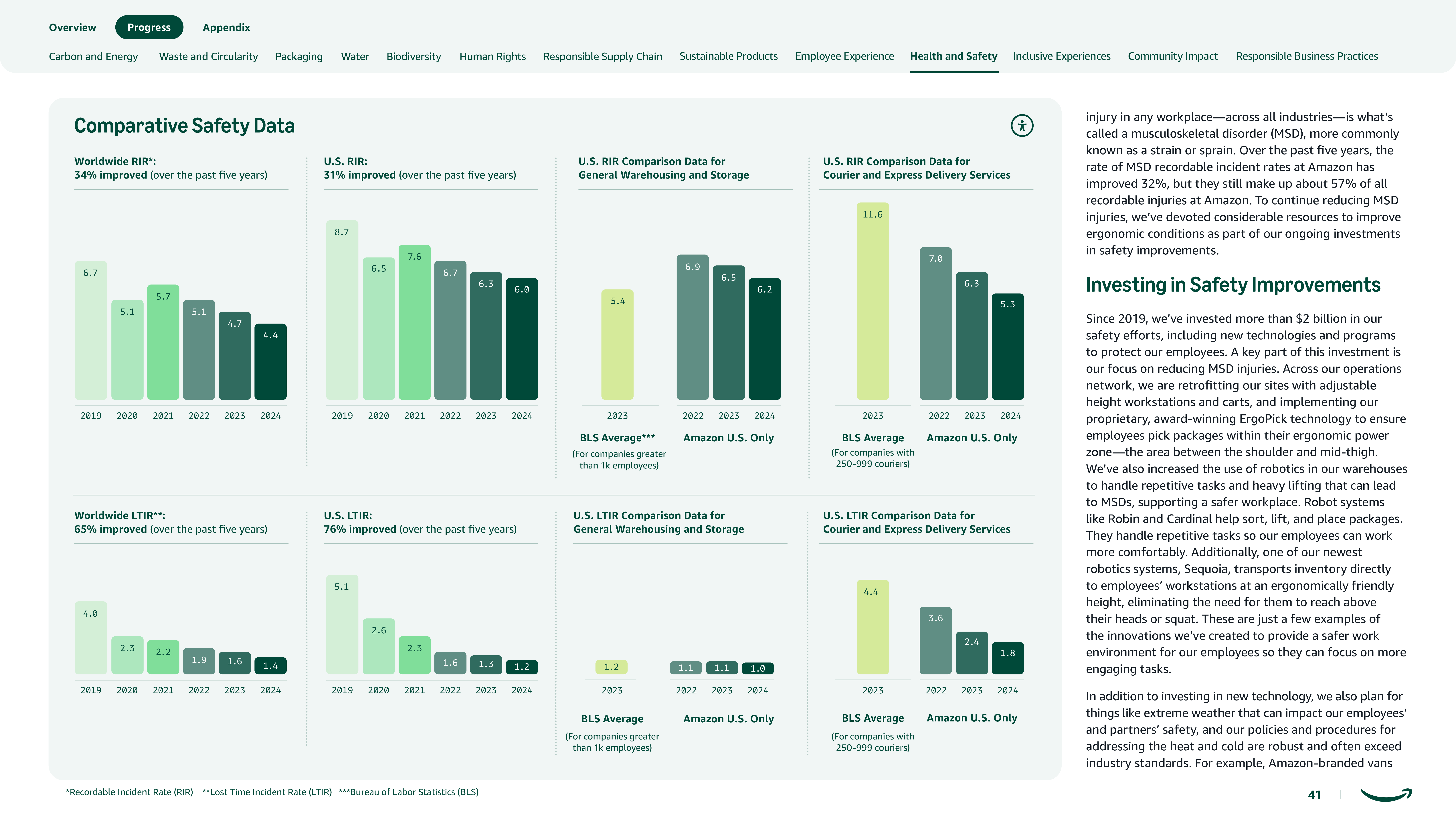
41
Overview
Progress
Appendix
Carbon and Energy
Waste and Circularity
Packaging
Water
Biodiversity
Human Rights
Responsible Supply Chain
Sustainable Products
Employee Experience
Health and Safety
Inclusive Experiences
Community Impact
Responsible Business Practices
injury in any workplace—across all industries—is what’s
called a musculoskeletal disorder (MSD), more commonly
known as a strain or sprain. Over the past five years, the
rate of MSD recordable incident rates at Amazon has
improved 32%, but they still make up about 57% of all
recordable injuries at Amazon. To continue reducing MSD
injuries, we’ve devoted considerable resources to improve
ergonomic conditions as part of our ongoing investments
in safety improvements.
Investing in Safety Improvements
Since 2019, we’ve invested more than $2 billion in our
safety efforts, including new technologies and programs
to protect our employees. A key part of this investment is
our focus on reducing MSD injuries. Across our operations
network, we are retrofitting our sites with adjustable
height workstations and carts, and implementing our
proprietary, award-winning ErgoPick technology to ensure
employees pick packages within their ergonomic power
zone—the area between the shoulder and mid-thigh.
We’ve also increased the use of robotics in our warehouses
to handle repetitive tasks and heavy lifting that can lead
to MSDs, supporting a safer workplace. Robot systems
like Robin and Cardinal help sort, lift, and place packages.
They handle repetitive tasks so our employees can work
more comfortably. Additionally, one of our newest
robotics systems, Sequoia, transports inventory directly
to employees’ workstations at an ergonomically friendly
height, eliminating the need for them to reach above
their heads or squat. These are just a few examples of
the innovations we’ve created to provide a safer work
environment for our employees so they can focus on more
engaging tasks.
In addition to investing in new technology, we also plan for
things like extreme weather that can impact our employees’
and partners’ safety, and our policies and procedures for
addressing the heat and cold are robust and often exceed
industry standards. For example, Amazon-branded vans
2020
2020
2020
2020
2019
2019
2019
2019
5.1
2.3
6.5
2.6
6.7
4.0
8.7
5.1
5.7
2.2
7.6
5.4
1.2
11.6
4.4
2.3
4.7
1.6
6.3
1.3
4.4
1.4
6.0
6.2
5.3
1.8
6.5
1.1
1.0
6.3
2.4
6.9
1.1
7.0
3.6
1.2
2021
2021
2021
2021
2022
2022
2022
2022
2022
2022
2022
2022
2023
2023
2023
2023
2023
2023
2023
2023
2023
2023
2023
2023
2024
2024
2024
2024
2024
2024
2024
2024
Comparative Safety Data
Worldwide RIR*:
34% improved
(over the past five years)
Worldwide LTIR**:
65% improved
(over the past five years)
U.S. RIR:
31% improved
(over the past five years)
U.S. LTIR:
76% improved
(over the past five years)
U.S. LTIR Comparison Data for
General Warehousing and Storage
U.S. RIR Comparison Data for
General Warehousing and Storage
U.S. LTIR Comparison Data for
Courier and Express Delivery Services
U.S. RIR Comparison Data for
Courier and Express Delivery Services
BLS Average***
BLS Average
BLS Average
BLS Average
(For companies greater
than 1k employees)
(For companies greater
than 1k employees)
(For companies with
250-999 couriers)
(For companies with
250-999 couriers)
Amazon U.S. Only
Amazon U.S. Only
Amazon U.S. Only
Amazon U.S. Only
5.1
1.9
6.7
1.6
*Recordable Incident Rate (RIR)
**Lost Time Incident Rate (LTIR)
***Bureau of Labor Statistics (BLS)
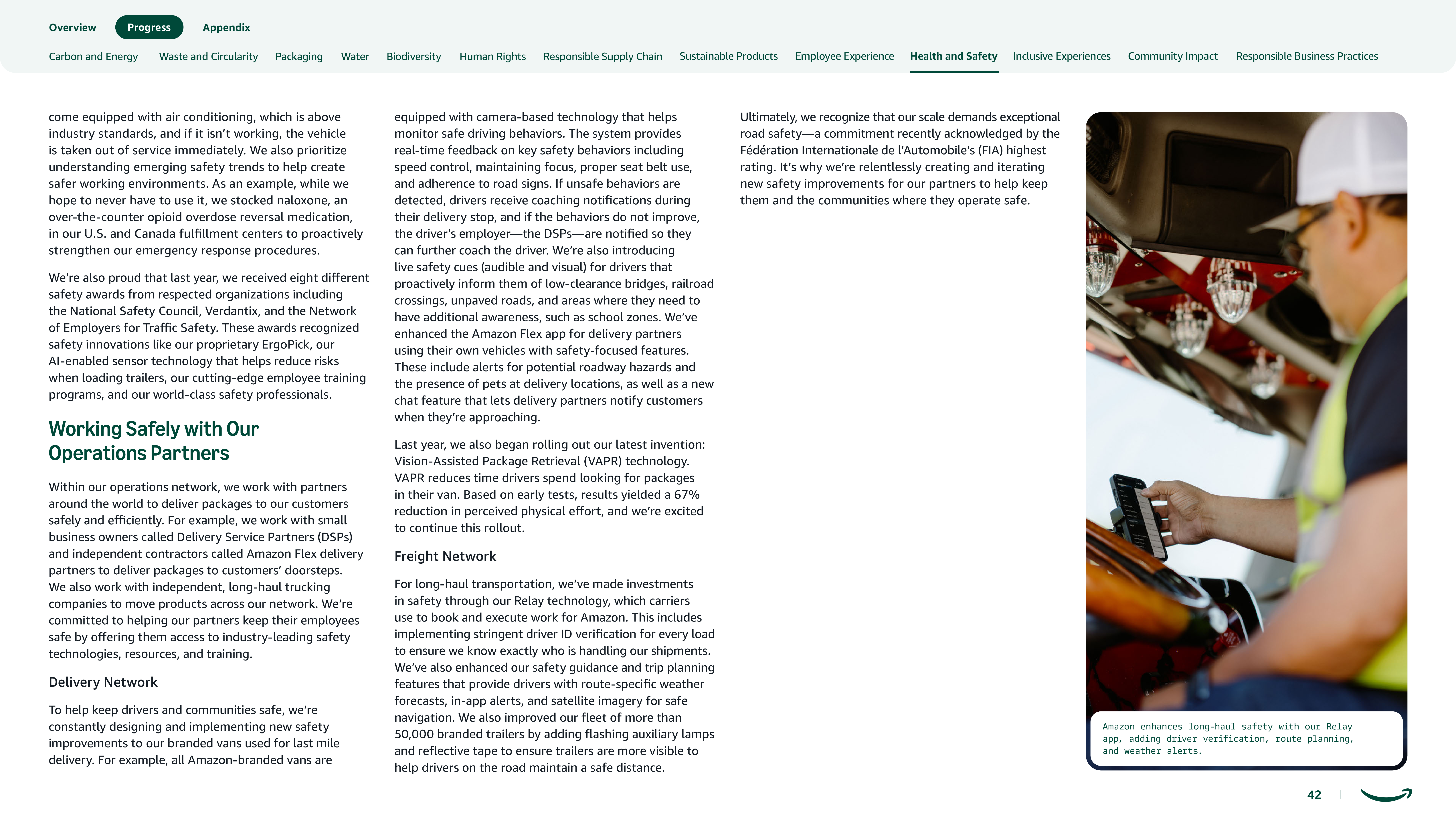
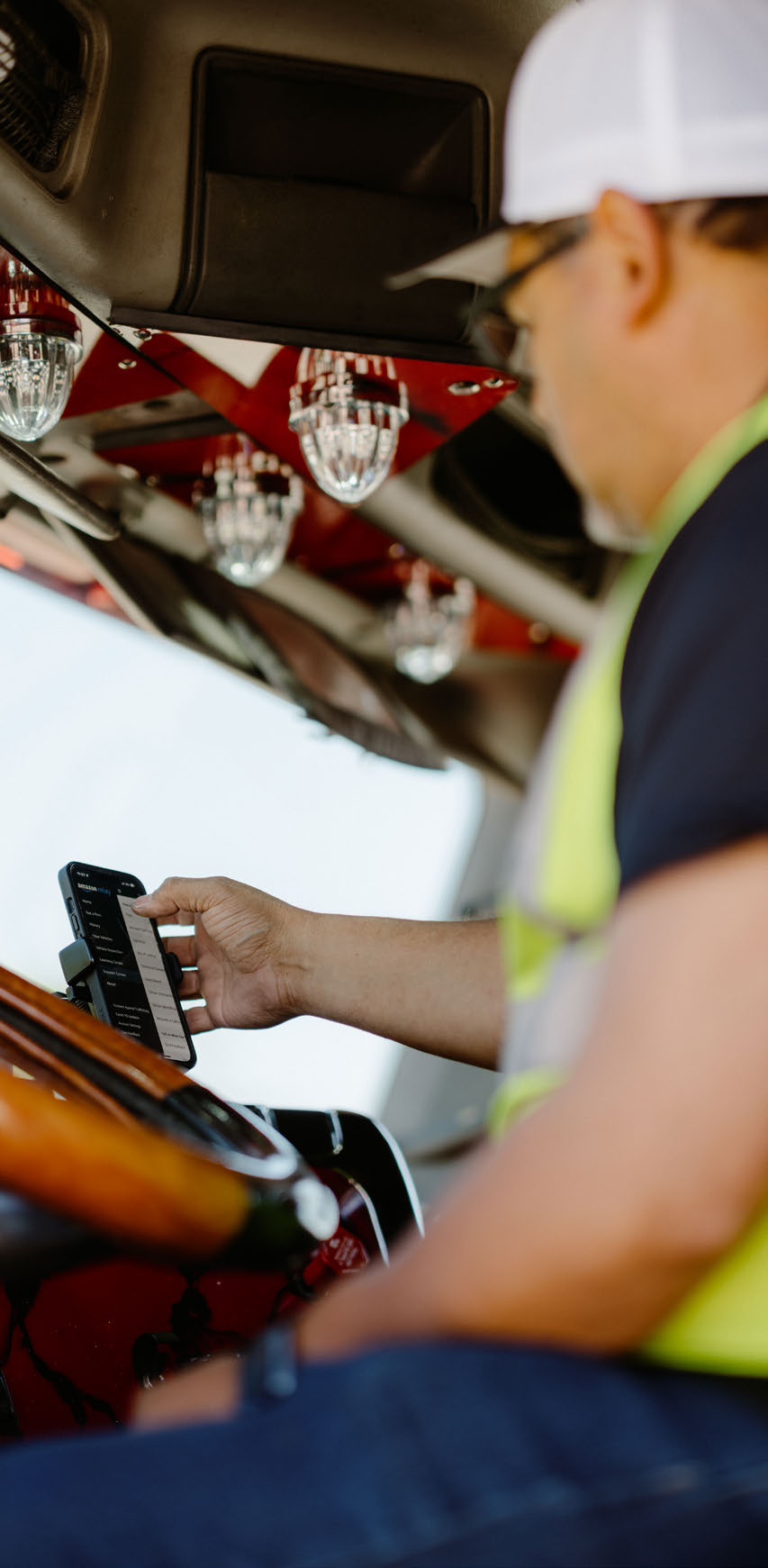
42
Overview
Progress
Appendix
Carbon and Energy
Waste and Circularity
Packaging
Water
Biodiversity
Human Rights
Responsible Supply Chain
Sustainable Products
Employee Experience
Health and Safety
Inclusive Experiences
Community Impact
Responsible Business Practices
come equipped with air conditioning, which is above
industry standards, and if it isn’t working, the vehicle
is taken out of service immediately. We also prioritize
understanding emerging safety trends to help create
safer working environments. As an example, while we
hope to never have to use it, we stocked naloxone, an
over-the-counter opioid overdose reversal medication,
in our U.S. and Canada fulfillment centers to proactively
strengthen our emergency response procedures.
We’re also proud that last year, we received eight different
safety awards from respected organizations including
the National Safety Council, Verdantix, and the Network
of Employers for Traffic Safety. These awards recognized
safety innovations like our proprietary ErgoPick, our
AI-enabled sensor technology that helps reduce risks
when loading trailers, our cutting-edge employee training
programs, and our world-class safety professionals.
Working Safely with Our
Operations Partners
Within our operations network, we work with partners
around the world to deliver packages to our customers
safely and efficiently. For example, we work with small
business owners called Delivery Service Partners (DSPs)
and independent contractors called Amazon Flex delivery
partners to deliver packages to customers’ doorsteps.
We also work with independent, long-haul trucking
companies to move products across our network. We’re
committed to helping our partners keep their employees
safe by offering them access to industry-leading safety
technologies, resources, and training.
Delivery Network
To help keep drivers and communities safe, we’re
constantly designing and implementing new safety
improvements to our branded vans used for last mile
delivery. For example, all Amazon-branded vans are
equipped with camera-based technology that helps
monitor safe driving behaviors. The system provides
real-time feedback on key safety behaviors including
speed control, maintaining focus, proper seat belt use,
and adherence to road signs. If unsafe behaviors are
detected, drivers receive coaching notifications during
their delivery stop, and if the behaviors do not improve,
the driver’s employer—the DSPs—are notified so they
can further coach the driver. We’re also introducing
live safety cues (audible and visual) for drivers that
proactively inform them of low-clearance bridges, railroad
crossings, unpaved roads, and areas where they need to
have additional awareness, such as school zones. We’ve
enhanced the Amazon Flex app for delivery partners
using their own vehicles with safety-focused features.
These include alerts for potential roadway hazards and
the presence of pets at delivery locations, as well as a new
chat feature that lets delivery partners notify customers
when they’re approaching.
Last year, we also began rolling out our latest invention:
Vision-Assisted Package Retrieval (VAPR) technology.
VAPR reduces time drivers spend looking for packages
in their van. Based on early tests, results yielded a 67%
reduction in perceived physical effort, and we’re excited
to continue this rollout.
Freight Network
For long-haul transportation, we’ve made investments
in safety through our Relay technology, which carriers
use to book and execute work for Amazon. This includes
implementing stringent driver ID verification for every load
to ensure we know exactly who is handling our shipments.
We’ve also enhanced our safety guidance and trip planning
features that provide drivers with route-specific weather
forecasts, in-app alerts, and satellite imagery for safe
navigation. We also improved our fleet of more than
50,000 branded trailers by adding flashing auxiliary lamps
and reflective tape to ensure trailers are more visible to
help drivers on the road maintain a safe distance.
Ultimately, we recognize that our scale demands exceptional
road safety—a commitment recently acknowledged by the
Fédération Internationale de l’Automobile’s (FIA) highest
rating. It’s why we’re relentlessly creating and iterating
new safety improvements for our partners to help keep
them and the communities where they operate safe.
Amazon enhances long-haul safety with our Relay
app, adding driver verification, route planning,
and weather alerts.
43
Overview
Progress
Appendix
Carbon and Energy
Waste and Circularity
Packaging
Water
Biodiversity
Human Rights
Responsible Supply Chain
Sustainable Products
Employee Experience
Health and Safety
Inclusive Experiences
Community Impact
Responsible Business Practices
Inclusive
Experiences
Actions
Tens of thousands of employees have participated
in Amazon Huddles, micro-learning conversations
that help build an inclusive culture
Hundreds of thousands of employees belong to
volunteer-led groups that foster community and
support and are open to all at Amazon
Our Approach
Amazon is committed to creating a diverse and inclusive
company that helps us provide the best range of products
and services for our vast and varied customer base. We build
pathways for employees, partners, and customers from all
backgrounds to work, collaborate, and shop with us.
Over the last several years, we’ve proven that this work is
most effective when it is built into our business and into
the way we work from the start, rather than through a
“bolted-on” program. Our focus is on integrating inclusive
practices into core business processes and fostering a
truly inclusive culture. Whether it’s through the way
we hire, develop talent, design our products, or serve
our communities, we will continue driving our “built-in”
strategy, creating scalable programs and technologies that
serve our globally diverse customers.
Our Progress
Our Employees
We believe that technology provides us with the
best path to reach more than 1.5 million full- and
part-time employees. We use a comprehensive,
data-driven approach to evaluate employee programs
based on their demonstrated impact.
Our efforts are constantly evolving as we continue to
measure outcomes and learn how we can further improve.
Since evolving to our “built-in” approach in 2022,
we’ve made significant strides in identifying programs
that deliver meaningful impact for our employees.
In 2024, we continued to invest in the programs
that demonstrated measurable results and had the
potential to scale. For example, we expanded Amazon
Huddles—micro-discussions that help build an inclusive
culture—to reach tens of thousands of employees
globally, seamlessly integrating it into everything from
new-employee onboarding to ongoing team meetings.
Employees have responded positively to these 15- to
30-minute conversations on topics such as culture,
well-being, and personal and professional growth. When
an employee participates in Amazon Huddles, we see
durable improvements in job satisfaction, managerial
skills, and team connectivity.
The following are just a few additional examples of where
we’ve built inclusive systems that are working better,
at scale, for people across our ecosystem. They help us
create an environment where people have the resources
they need to do their best work.
•
Promotions for our frontline employees.
We learned
that our promotion process for frontline operation roles
was primarily being sourced from referrals by their
managers. While that approach had good intentions, the
focus on local site presence resulted in varying levels of
access and opportunity across locations. To minimize
the potential for bias, we built a tool called Fluid to
surface opportunities to all employees who meet the
minimum criteria for a frontline operation role. They
can easily apply through an app and are then evaluated
on their tenure and merit. This means that more people,
from more geographies and backgrounds, have the
best shot toward a frontline operation promotional
opportunity based on their accomplishments.
•
Hiring.
Like most companies, we have a referral
program where existing Amazonians can recommend
someone who may be qualified for an open role. We
have a recruiting team that will search the market for
the best talent for individual roles. And we have also
built a tool that works alongside those efforts to ensure
we find talent from a wide range of backgrounds and
life experiences. It sorts through the qualifications of
tens of millions of applicants, surfacing the best talent
based on eligibility requirements. This means that
anyone, from any background, can be fairly evaluated if
they’re interested in joining our team.
•
Benefits.
As we looked at who used our benefits, we saw
that many eligible people weren’t using them. We dug
into the reasons and realized that a root cause was a
lack of awareness. Those who knew about the benefits
used them, so we focused on raising awareness among
all populations to ensure that when someone needs
help—no matter who they are or where they are in the
company—they know how to get it.
•
Upskilling.
Career Choice
has helped nearly 244,000
employees pursue education with prepaid tuition,
flexible schedules, and on-site classes. Similarly, our
Apprenticeship
programs have created hundreds
of paths into technical roles since 2017—in cloud
computing, software development, robotics, and
mechanical maintenance—by focusing on potential
over prerequisites.
Learn more
about
Career Choice
•
Together at Amazon.
We launched Together at Amazon
in August 2024 to bring together participants in our
employee-led groups, including affinity groups and
informal employee networks. Self-led by Amazonians,
these groups are open to all employees and offer
community and support. Together at Amazon invites
employees across operations sites, data centers, and
corporate offices to actively participate in building
a culture where each individual can connect, grow,
and thrive. Together at Amazon also helps to guide
employees toward proven, high-impact company
programs, ranging from career development and
upskilling resources to mental health support and
community engagement opportunities. Among them
is Growth Conversations, a resource we created to
support meaningful career discussions between
employees and managers. Growth Conversations is
an optional, employee-led experience that provides a
dedicated space for employees to explore and discuss
goals, plan next steps, and check in on progress over
time with their manager.
Our Customers
Amazon launched new product features and initiatives in
2024 to help reach a broader audience and make it easier
for customers with disabilities to enjoy our products.
Streaming Services and Product Accessibility
We added Dual Audio to the Fire TV, which allows users
to stream audio through speakers and hearing aids
simultaneously, making TV watching with hard-of-hearing
44
Overview
Progress
Appendix
Carbon and Energy
Waste and Circularity
Packaging
Water
Biodiversity
Human Rights
Responsible Supply Chain
Sustainable Products
Employee Experience
Health and Safety
Inclusive Experiences
Community Impact
Responsible Business Practices
friends more enjoyable. We also expanded Fire TV’s
hearing aid compatibility beyond Cochlear and Starkey,
adding WS Audiology (WSA) in 2024. On Prime Video,
the new Dialogue Boost feature lets viewers increase
the volume of dialogue relative to background music
and effects to create a more comfortable and accessible
viewing experience. In 2024, we also expanded the
number of languages and audio-described titles across
U.S. streaming services.
For the Kindle app on iOS, Android, and the Fire tablet,
we added Assistive Reader to support customers who are
blind or have low vision. This feature allows customers
the flexibility to listen to their books—and read along
with real-time highlighting. To improve access to product
information, we rolled out new tactile-marked
QR codes on inbox documentation for Kindles, Echo
devices, and most Fire TVs. These QR codes link to
comprehensive accessibility documents and quick-start
guides, helping customers who are blind or have low
vision access online content.
Amazon has relied on a major project collaboration tool
to meet the needs of a wide range of assistive technology
users at our company, including those who use screen
readers, screen magnifiers, or alternative navigation. In
2024, we leveraged our global reach to extend use of this
tool to more than 100,000 third-party sellers, making it a
requirement as part of their enterprise licenses.
In January 2025, we also launched enhanced product
summary functionality to make online shopping more
accessible for screen reader users and those relying on
keyboard-only navigation. This feature identifies and
presents critical product information in a streamlined
interface. As a result, blind- or low-vision shoppers can
find the most relevant information about the products
they’re browsing and more quickly make informed
purchase decisions.
Inclusive Access in TV, Film, and Music
Amazon continues to invest in strategic partnerships and
programs to support the development of talent across TV,
film, and music. In 2024, Amazon MGM Studios remained
the primary sponsor of the Latino Film Institute’s Youth
Cinema Project Alumni Program, which connects students
to industry mentoring and assistance with college
applications. Our collaboration with the Cherokee Nation
provided full-ride scholarships to Cherokee Film Institute’s
inaugural 2025 class. In the UK, our Prime Video Pathway
partnership with the National Film and Television School
expanded career opportunities in TV and film nationwide.
We also sponsored the 2025 ReelAbilities Film Festival,
the largest showcase for stories from the disability
community, as well as the 2025 Easterseals Disability Film
Challenge. In the music sector, Amazon Music renewed its
collaboration with the Recording Academy’s Black Music
Collective through the Your Future Is Now scholarship
program. Additionally, we supported the MusiCares
Humans of Hip-Hop program, a multi-year initiative
that provides access to under-represented communities
for financial, medical, and mental health services, and
partnered with the Association of Independent Music and
Women in CTRL to launch the Amplify apprenticeship for
women and non-binary talent in the UK music industry.
Reliable Access to Broadband
Project Kuiper
is among our most ambitious initiatives
to expand access to reliable broadband. Through a
constellation of 3,200 satellites in low Earth orbit, we will
bring fast, affordable service to unserved and underserved
communities around the world. This effort will benefit
a wide range of customers, including schools, hospitals,
businesses, government agencies, and others that operate
in places without reliable connectivity or that need more
flexible, resilient communications capabilities. We began
deploying our satellite constellation in early 2025, and
expect to roll out service later in the year.
Our Communities
With our size, speed, and innovative culture, Amazon’s
philanthropic and volunteering initiatives are driving
change on a global scale. We are active in neighborhoods
around the world, creating inclusive experiences that offer
more opportunities to succeed. For example, education
initiatives around Science, Technology, Engineering, and
Mathematics (STEM); engagement with institutions that
support people from all backgrounds; and direct exposure
to work at Amazon through our
JumpStart
program, all
help create paths to employment across our communities.
Among our latest initiatives, In This Together (ITT)
helps us respond to community needs through targeted
economic and technological advancement opportunities.
ITT provides access to a curated list of Amazon resources
for civic organizations, professional associations, and
educational institutions globally. It covers a few key
areas, including career and hiring opportunities, supplier
development, business ownership pathways, seller
education and resources, training and certifications,
discount programs, and accessibility solutions.
Amazon products also help make our communities
safer through programs such as Ring Home, where
we donated Ring Home security cameras over the last
two years to domestic violence survivors through our
collaboration with TechSoup and the National Network
to End Domestic Violence.
Learn more
about Amazon’s outreach efforts in our
Community Impact section
In This Together
In This Together (ITT) helps us respond to community
needs in these key areas:
Discover
Hiring and career building programs
such as Career Choice
Supply
Supplier development programs
like Impact Initiative
Own
Business ownership opportunities
like Road to Ownership (R2O)
Sell
Seller University and resources such
as Amazon Partnered Carrier
Learn
Training and certifications through
AWS Educate, AWS Academy, and
Amazon Future Engineer
Access
Discount programs and accessibility
solutions through Amazon Access
45
Overview
Progress
Appendix
Carbon and Energy
Waste and Circularity
Packaging
Water
Biodiversity
Human Rights
Responsible Supply Chain
Sustainable Products
Employee Experience
Health and Safety
Inclusive Experiences
Community Impact
Responsible Business Practices
Community
Impact
Goal
Add $1.4 billion to the Housing
Equity Fund to create and preserve an
additional 14,000 affordable homes
$2.2B
Invested to create or preserve more
than 21,000 affordable homes,
supporting more than 44,700 residents
Goal
Distribute up to $60 million in AWS
cloud computing credits to support
global health by the end of 2024
$60M
In cloud computing credits awarded to
403 organizations since 2021
Goal
Help 29 million people globally grow
their technical skills by providing free
cloud computing training by 2025
31M
People helped in 2024
Actions
250K+
Amazon employees from over
55 countries volunteered with
7,000 organizations
$350M+
Contributed to support 2,600
community partners globally
95M
Meals donated or delivered
to households in need
39
Natural disasters responded
to across 19 countries
7.8M+
Students reached from
underserved communities
globally through Amazon
Future Engineer programs
Our Approach
We aim to make our customers’ lives better and easier
every day and to have a positive impact on our local
communities all around the world, using our scale and
abilities to take on some of society’s most pressing
challenges. We work side by side with local community
partners and nonprofits to create and drive programs
that help advance access to affordable housing,
alleviate hunger, strengthen education, and build skills
for the future, and we mobilize our infrastructure and
technology to support communities impacted by natural
disasters. We’re also focused on providing employees
with volunteering opportunities so they can give back
directly to communities where they work and live.
We also support
nature conservation and climate
resilience in communities around the world
.
Learn more
in our 2024 Community Impact Reports:
•
Puget Sound
•
National Capital Region
Our Progress
Expanding Access to Critical
Social Needs
We focus our time and resources on expanding access
to critical social needs like affordable housing, food, and
education, so that individuals and families can thrive.
Affordable Housing
We believe everyone should have access to housing they
can afford. However, the possibility of homeownership
remains out of reach for many in the U.S., especially
for low-income families. In January 2021, we launched
the Housing Equity Fund with the goal of increasing
access to affordable homes. When the Fund started,
we committed $2 billion to help create and preserve
20,000 affordable homes across three of our hometown
communities—Washington State’s Puget Sound region;
the Arlington, Virginia/National Capital region; and
Nashville, Tennessee. We exceeded this original goal
two years early by providing $2.2 billion to create and
preserve more than 21,000 affordable homes. In 2024,
we announced an expanded commitment of $1.4 billion
to create and preserve an additional 14,000 homes,
bringing Amazon’s total commitment to $3.6 billion to
help create or preserve 35,000 affordable homes in these
three communities.
Addressing Food Security
We use our logistics, technology, and infrastructure to
innovate on behalf of people facing food insecurity.
This includes mobilizing our transportation network to
provide bulk food transport, as well as free meal deliveries
to households in need. In addition, we are increasing
collaboration with food rescue and redistribution
organizations across the U.S. In 2024, Amazon donated or
delivered 95 million meals to food banks, nonprofits, and
households in need:
•
Delivered 56.5 million meals on behalf of food banks
and nonprofits across 13 countries worldwide, including
12.5 million meals to U.S. households
•
Donated 38.5 million meals through Amazon Fresh
product and cash donations to the Feeding America
network, reaching over 40 local partner food banks
in the U.S. to redistribute surplus food to people
experiencing hunger
51
Beyond donations, our efforts to be a socially responsible
grocer extend to making grocery shopping more affordable
for the community. In 2024, we launched Temporary
Assistance for Needy Families (“Cash EBT”) payment
acceptance in 21 states through
Amazon Access
,
a program for low-income individuals that also enables
Supplemental Nutrition Assistance Program benefits
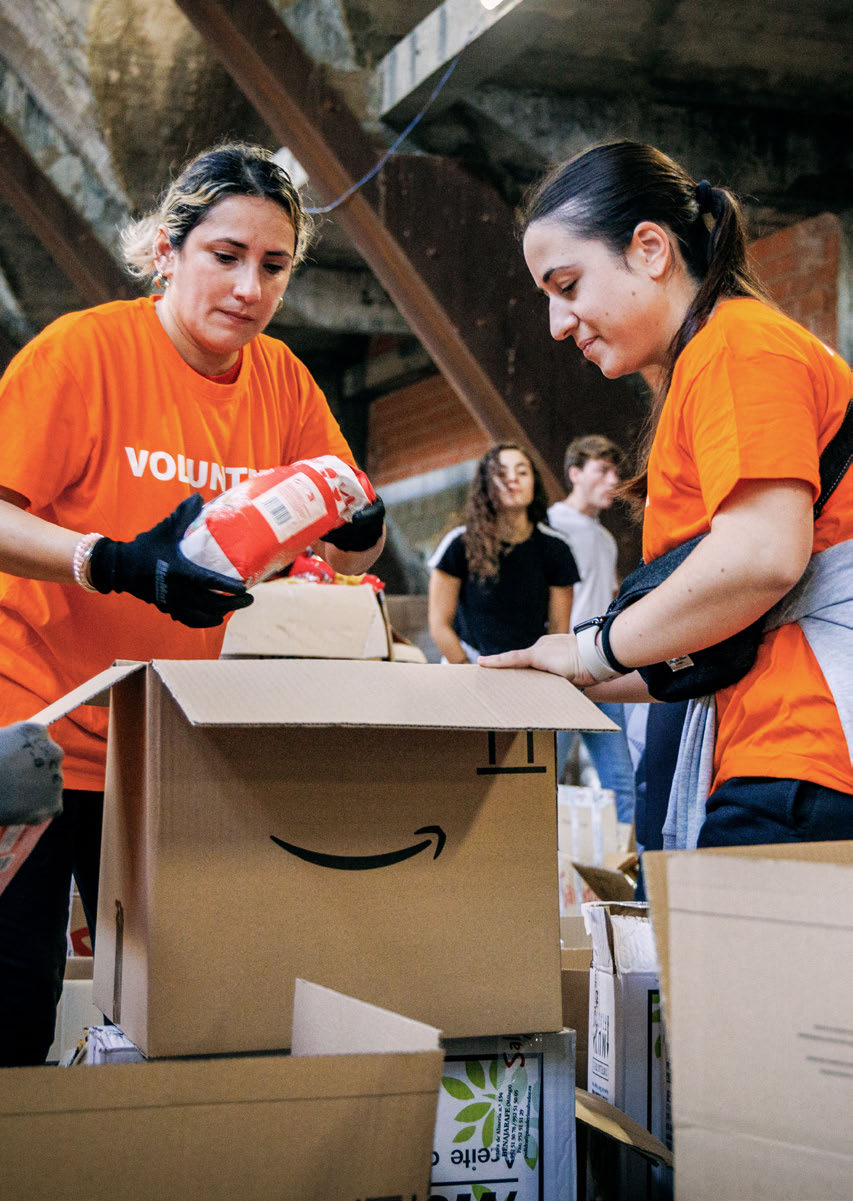
46
Overview
Progress
Appendix
Carbon and Energy
Waste and Circularity
Packaging
Water
Biodiversity
Human Rights
Responsible Supply Chain
Sustainable Products
Employee Experience
Health and Safety
Inclusive Experiences
Community Impact
Responsible Business Practices
acceptance for groceries. We also partner with
organizations like Partnership for a Healthier America to
improve nutrition accessibility.
In partnership with Food Donation Connection, Whole
Foods Market donates millions of pounds of perishable
and nonperishable food annually to local food banks and
food rescue agencies across the U.S. In 2024, over 28
million meals were donated to 1,030 unique food rescue
and redistribution programs across the country through
Whole Foods Market. To further promote access to quality
food, the
Nourishing Our Neighborhoods
program
has donated 54 refrigerated vans to help community-
based programs distribute food.
Learn more
about how
we increase access to healthy food in the
Whole Foods
Market’s 2023 Impact Report
Health Resources
In July 2024, AWS concluded the AWS Health Equity
Initiative (HEI) , a $60 million commitment to use cloud
technology to address disparities in global health. Over three
years, HEI supported 403 organizations across 39 countries,
reaching every continent except Antarctica, reflecting
the growing span of health customers and their focus on
utilizing technology to address access to health care.
Access to Education and Skills-Building
We develop and advance programs that empower learners
of all ages and skill levels with digital education and
technical skills to prepare more people for jobs of the future.
This includes giving school-age students opportunities to
prepare for future education and careers in technology.
One example is our childhood-to-career computer science
program,
Amazon Future Engineer
, which reached more
than 7.8 million students in 2024 across grade levels, up
from 3.9 million in 2023. Another example is AWS Think
Big Spaces, which provide interactive STEM education in
tech-related fields such as robotics, coding, and artificial
intelligence (AI). In 2024, 82,000 K-12 students and
educators participated in 93 of these spaces. AWS also
offers the
AWS Machine Learning University educator
enablement program
, which trains employees on the
theory and practical application of machine learning (ML)
and AI.
As of the end of 2024, we delivered free cloud computing
skills training to 31 million learners—surpassing our goal
to help 29 million people by 2025. Similarly, through
AWS’s free AI skills training initiative,
AI Ready
, we
reached our target of training 2 million learners globally
with free AI skills, achieving both milestones ahead of our
2025 commitment. AWS offers more than 135 free and
low-cost courses and learning resources on AI, ML, and
generative AI. In addition,
AWS InCommunities
,
Amazon’s community efforts in data center locations,
focuses on STEM education, local skills development,
sustainability, and hyper-local social impact. In 2024, AWS
launched 11 InCommunities funds and allocated nearly
$2 million globally in hyper-local funding.
For those just starting their careers or looking to break
into a new field, the
AWS AI and ML Scholarship
program
, in collaboration with Udacity, awarded 2,500
scholarships in 2024 to support students globally to learn
foundational skills to prepare for careers in technology.
The
AWS Skills to Jobs Tech Alliance
, an educational
and skills training program, has now connected 37,000
learners to employers.
We also support organizations that build digital learning
solutions for underserved learners. For example, in 2024,
AWS launched the
AWS Education Equity Initiative
,
a $100 million commitment of cloud and AI technology
to support innovative learning solutions such as coding
curriculums, AI assistants, and more.
Learn more
about skill development programs in this
year’s
AWS Summary
AI for Social Good
Amazon is committed to unlocking the potential of AI for
social good. AWS’s AI for Changemakers (AI4C) program
provides nonprofits and social enterprises with cloud
credits, technical training, and mentorship to build and
scale AI-based solutions that address global challenges.
As part of AI4C, AWS launched the Now Go Build CTO
Fellowship, a mentorship program for senior technical
leaders. AWS also supports the United Nations-led digital
platform, AI for Good , investing $800,000 with 10
organizations and projects to identify practical AI solutions
that advance the UN Sustainable Development Goals.
Supporting Disaster Relief
and Response Efforts
Whether in times of immediate crisis or when long-term
support is needed, we respond by showing up in communities.
Through Amazon Disaster Relief, we leverage our
technology and global logistics network to provide fast,
effective aid for communities affected by natural disasters.
Our 15 global Disaster Relief Hubs across the U.S., Europe,
Asia, and Australia are facilities stocked with relief items
including shelter materials, hygiene supplies, and medical
equipment. In 2024, Amazon provided support during 39
disasters across 19 countries—including the devastating
hurricanes in the Southeast U.S. and flooding across
central Europe and Southern Spain. Amazon donated
$10 million to support the Southern California wildfires
in January 2025, including donating 550,000 items from
its Wildfire Disaster Relief Hub, as well as providing
AWS cloud technology, including drone support, to help
emergency responders quickly assess and react to the
wildfires’ conditions. We used our logistics network to
donate and deliver 4.1 million relief items to nonprofit
partners. We also deployed our AWS cloud technology to
help local governments and organizations stay connected,
providing nearly $2 million in AWS credits to 41 customers
affected by eight natural disasters.
Giving Back through Volunteering Efforts
Amazon also contributes to building healthy communities
through employee volunteering. During our 2024 Global
Month of Volunteering , Amazon employees from over
50 countries participated in more than 5,000 volunteering
events. Throughout the year, over 250,000 participants
volunteered with 7,000 nonprofit and community
organizations across over 55 countries. In addition, our pro
bono program enabled more than 1,400 legal and public
policy professionals to provide 16,200 hours of free legal
support globally in 2024.
We mobilized our European Disaster Relief Hub and
volunteer employees to aid those impacted by flooding
in southeastern Spain.
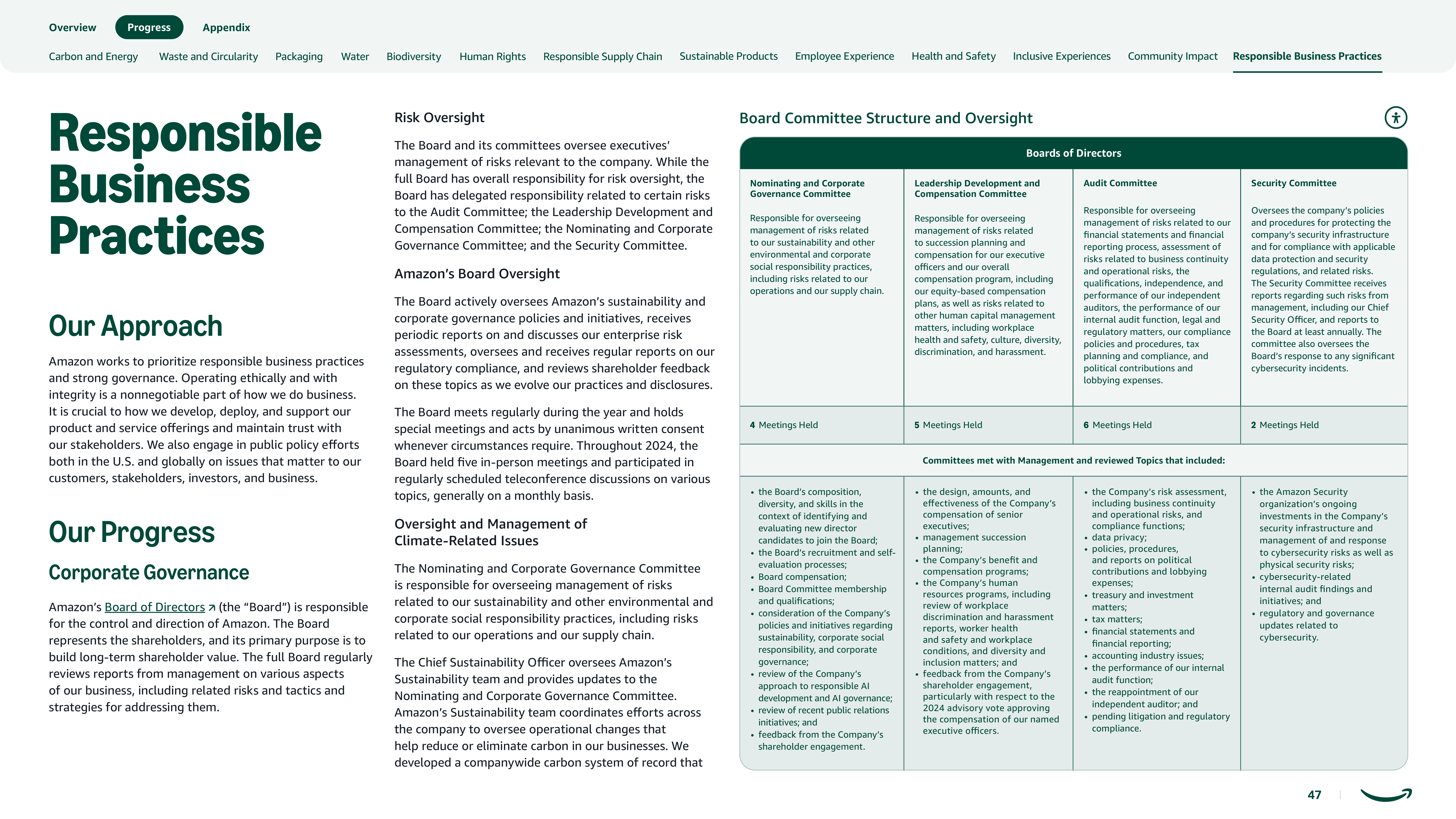
47
Boards of Directors
Nominating and Corporate
Governance Committee
Responsible for overseeing
management of risks related
to our sustainability and other
environmental and corporate
social responsibility practices,
including risks related to our
operations and our supply chain.
Leadership Development and
Compensation Committee
Responsible for overseeing
management of risks related
to succession planning and
compensation for our executive
officers and our overall
compensation program, including
our equity-based compensation
plans, as well as risks related to
other human capital management
matters, including workplace
health and safety, culture, diversity,
discrimination, and harassment.
Audit Committee
Responsible for overseeing
management of risks related to our
financial statements and financial
reporting process, assessment of
risks related to business continuity
and operational risks, the
qualifications, independence, and
performance of our independent
auditors, the performance of our
internal audit function, legal and
regulatory matters, our compliance
policies and procedures, tax
planning and compliance, and
political contributions and
lobbying expenses.
Security Committee
Oversees the company’s policies
and procedures for protecting the
company’s security infrastructure
and for compliance with applicable
data protection and security
regulations, and related risks.
The Security Committee receives
reports regarding such risks from
management, including our Chief
Security Officer, and reports to
the Board at least annually. The
committee also oversees the
Board’s response to any significant
cybersecurity incidents.
4
Meetings Held
5
Meetings Held
6
Meetings Held
2
Meetings Held
Committees met with Management and reviewed Topics that included:
• the Board’s composition,
diversity, and skills in the
context of identifying and
evaluating new director
candidates to join the Board;
• the Board’s recruitment and self-
evaluation processes;
• Board compensation;
• Board Committee membership
and qualifications;
• consideration of the Company’s
policies and initiatives regarding
sustainability, corporate social
responsibility, and corporate
governance;
• review of the Company’s
approach to responsible AI
development and AI governance;
• review of recent public relations
initiatives; and
• feedback from the Company’s
shareholder engagement.
• the design, amounts, and
effectiveness of the Company’s
compensation of senior
executives;
• management succession
planning;
• the Company’s benefit and
compensation programs;
• the Company’s human
resources programs, including
review of workplace
discrimination and harassment
reports, worker health
and safety and workplace
conditions, and diversity and
inclusion matters; and
• feedback from the Company’s
shareholder engagement,
particularly with respect to the
2024 advisory vote approving
the compensation of our named
executive officers.
• the Company’s risk assessment,
including business continuity
and operational risks, and
compliance functions;
• data privacy;
• policies, procedures,
and reports on political
contributions and lobbying
expenses;
• treasury and investment
matters;
• tax matters;
• financial statements and
financial reporting;
• accounting industry issues;
• the performance of our internal
audit function;
• the reappointment of our
independent auditor; and
• pending litigation and regulatory
compliance.
• the Amazon Security
organization’s ongoing
investments in the Company’s
security infrastructure and
management of and response
to cybersecurity risks as well as
physical security risks;
• cybersecurity-related
internal audit findings and
initiatives; and
• regulatory and governance
updates related to
cybersecurity.
Overview
Progress
Appendix
Carbon and Energy
Waste and Circularity
Packaging
Water
Biodiversity
Human Rights
Responsible Supply Chain
Sustainable Products
Employee Experience
Health and Safety
Inclusive Experiences
Community Impact
Responsible Business Practices
Responsible
Business
Practices
Our Approach
Amazon works to prioritize responsible business practices
and strong governance. Operating ethically and with
integrity is a nonnegotiable part of how we do business.
It is crucial to how we develop, deploy, and support our
product and service offerings and maintain trust with
our stakeholders. We also engage in public policy efforts
both in the U.S. and globally on issues that matter to our
customers, stakeholders, investors, and business.
Our Progress
Corporate Governance
Amazon’s
Board of Directors
(the “Board”) is responsible
for the control and direction of Amazon. The Board
represents the shareholders, and its primary purpose is to
build long-term shareholder value. The full Board regularly
reviews reports from management on various aspects
of our business, including related risks and tactics and
strategies for addressing them.
Risk Oversight
The Board and its committees oversee executives’
management of risks relevant to the company. While the
full Board has overall responsibility for risk oversight, the
Board has delegated responsibility related to certain risks
to the Audit Committee; the Leadership Development and
Compensation Committee; the Nominating and Corporate
Governance Committee; and the Security Committee.
Amazon’s Board Oversight
The Board actively oversees Amazon’s sustainability and
corporate governance policies and initiatives, receives
periodic reports on and discusses our enterprise risk
assessments, oversees and receives regular reports on our
regulatory compliance, and reviews shareholder feedback
on these topics as we evolve our practices and disclosures.
The Board meets regularly during the year and holds
special meetings and acts by unanimous written consent
whenever circumstances require. Throughout 2024, the
Board held five in-person meetings and participated in
regularly scheduled teleconference discussions on various
topics, generally on a monthly basis.
Oversight and Management of
Climate-Related Issues
The Nominating and Corporate Governance Committee
is responsible for overseeing management of risks
related to our sustainability and other environmental and
corporate social responsibility practices, including risks
related to our operations and our supply chain.
The Chief Sustainability Officer oversees Amazon’s
Sustainability team and provides updates to the
Nominating and Corporate Governance Committee.
Amazon’s Sustainability team coordinates efforts across
the company to oversee operational changes that
help reduce or eliminate carbon in our businesses. We
developed a companywide carbon system of record that
Board Committee Structure and Oversight
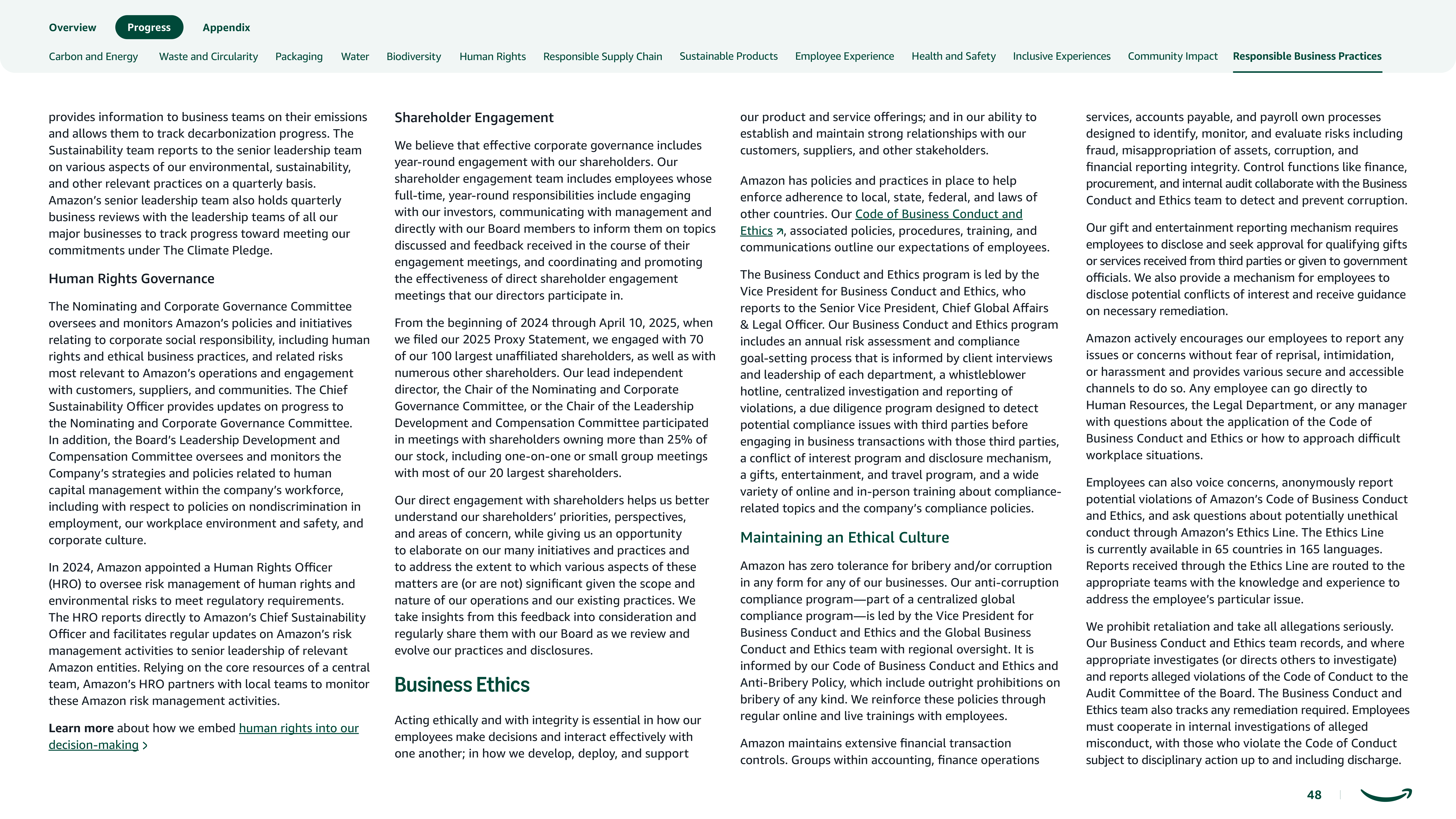
48
Overview
Progress
Appendix
Carbon and Energy
Waste and Circularity
Packaging
Water
Biodiversity
Human Rights
Responsible Supply Chain
Sustainable Products
Employee Experience
Health and Safety
Inclusive Experiences
Community Impact
provides information to business teams on their emissions
and allows them to track decarbonization progress. The
Sustainability team reports to the senior leadership team
on various aspects of our environmental, sustainability,
and other relevant practices on a quarterly basis.
Amazon’s senior leadership team also holds quarterly
business reviews with the leadership teams of all our
major businesses to track progress toward meeting our
commitments under The Climate Pledge.
Human Rights Governance
The Nominating and Corporate Governance Committee
oversees and monitors Amazon’s policies and initiatives
relating to corporate social responsibility, including human
rights and ethical business practices, and related risks
most relevant to Amazon’s operations and engagement
with customers, suppliers, and communities. The Chief
Sustainability Officer provides updates on progress to
the Nominating and Corporate Governance Committee.
In addition, the Board’s Leadership Development and
Compensation Committee oversees and monitors the
Company’s strategies and policies related to human
capital management within the company’s workforce,
including with respect to policies on nondiscrimination in
employment, our workplace environment and safety, and
corporate culture.
In 2024, Amazon appointed a Human Rights Officer
(HRO) to oversee risk management of human rights and
environmental risks to meet regulatory requirements.
The HRO reports directly to Amazon’s Chief Sustainability
Officer and facilitates regular updates on Amazon’s risk
management activities to senior leadership of relevant
Amazon entities. Relying on the core resources of a central
team, Amazon’s HRO partners with local teams to monitor
these Amazon risk management activities.
Learn more
about how we embed
human rights into our
decision-making
Shareholder Engagement
We believe that effective corporate governance includes
year-round engagement with our shareholders. Our
shareholder engagement team includes employees whose
full-time, year-round responsibilities include engaging
with our investors, communicating with management and
directly with our Board members to inform them on topics
discussed and feedback received in the course of their
engagement meetings, and coordinating and promoting
the effectiveness of direct shareholder engagement
meetings that our directors participate in.
From the beginning of 2024 through April 10, 2025, when
we filed our 2025 Proxy Statement, we engaged with 70
of our 100 largest unaffiliated shareholders, as well as with
numerous other shareholders. Our lead independent
director, the Chair of the Nominating and Corporate
Governance Committee, or the Chair of the Leadership
Development and Compensation Committee participated
in meetings with shareholders owning more than 25% of
our stock, including one-on-one or small group meetings
with most of our 20 largest shareholders.
Our direct engagement with shareholders helps us better
understand our shareholders’ priorities, perspectives,
and areas of concern, while giving us an opportunity
to elaborate on our many initiatives and practices and
to address the extent to which various aspects of these
matters are (or are not) significant given the scope and
nature of our operations and our existing practices. We
take insights from this feedback into consideration and
regularly share them with our Board as we review and
evolve our practices and disclosures.
Business Ethics
Acting ethically and with integrity is essential in how our
employees make decisions and interact effectively with
one another; in how we develop, deploy, and support
our product and service offerings; and in our ability to
establish and maintain strong relationships with our
customers, suppliers, and other stakeholders.
Amazon has policies and practices in place to help
enforce adherence to local, state, federal, and laws of
other countries. Our
Code of Business Conduct and
Ethics
, associated policies, procedures, training, and
communications outline our expectations of employees.
The Business Conduct and Ethics program is led by the
Vice President for Business Conduct and Ethics, who
reports to the Senior Vice President, Chief Global Affairs
& Legal Officer. Our Business Conduct and Ethics program
includes an annual risk assessment and compliance
goal-setting process that is informed by client interviews
and leadership of each department, a whistleblower
hotline, centralized investigation and reporting of
violations, a due diligence program designed to detect
potential compliance issues with third parties before
engaging in business transactions with those third parties,
a conflict of interest program and disclosure mechanism,
a gifts, entertainment, and travel program, and a wide
variety of online and in-person training about compliance-
related topics and the company’s compliance policies.
Maintaining an Ethical Culture
Amazon has zero tolerance for bribery and/or corruption
in any form for any of our businesses. Our anti-corruption
compliance program—part of a centralized global
compliance program—is led by the Vice President for
Business Conduct and Ethics and the Global Business
Conduct and Ethics team with regional oversight. It is
informed by our Code of Business Conduct and Ethics and
Anti-Bribery Policy, which include outright prohibitions on
bribery of any kind. We reinforce these policies through
regular online and live trainings with employees.
Amazon maintains extensive financial transaction
controls. Groups within accounting, finance operations
services, accounts payable, and payroll own processes
designed to identify, monitor, and evaluate risks including
fraud, misappropriation of assets, corruption, and
financial reporting integrity. Control functions like finance,
procurement, and internal audit collaborate with the Business
Conduct and Ethics team to detect and prevent corruption.
Our gift and entertainment reporting mechanism requires
employees to disclose and seek approval for qualifying gifts
or services received from third parties or given to government
officials. We also provide a mechanism for employees to
disclose potential conflicts of interest and receive guidance
on necessary remediation.
Amazon actively encourages our employees to report any
issues or concerns without fear of reprisal, intimidation,
or harassment and provides various secure and accessible
channels to do so. Any employee can go directly to
Human Resources, the Legal Department, or any manager
with questions about the application of the Code of
Business Conduct and Ethics or how to approach difficult
workplace situations.
Employees can also voice concerns, anonymously report
potential violations of Amazon’s Code of Business Conduct
and Ethics, and ask questions about potentially unethical
conduct through Amazon’s Ethics Line. The Ethics Line
is currently available in 65 countries in 165 languages.
Reports received through the Ethics Line are routed to the
appropriate teams with the knowledge and experience to
address the employee’s particular issue.
We prohibit retaliation and take all allegations seriously.
Our Business Conduct and Ethics team records, and where
appropriate investigates (or directs others to investigate)
and reports alleged violations of the Code of Conduct to the
Audit Committee of the Board. The Business Conduct and
Ethics team also tracks any remediation required. Employees
must cooperate in internal investigations of alleged
misconduct, with those who violate the Code of Conduct
subject to disciplinary action up to and including discharge.
Responsible Business Practices
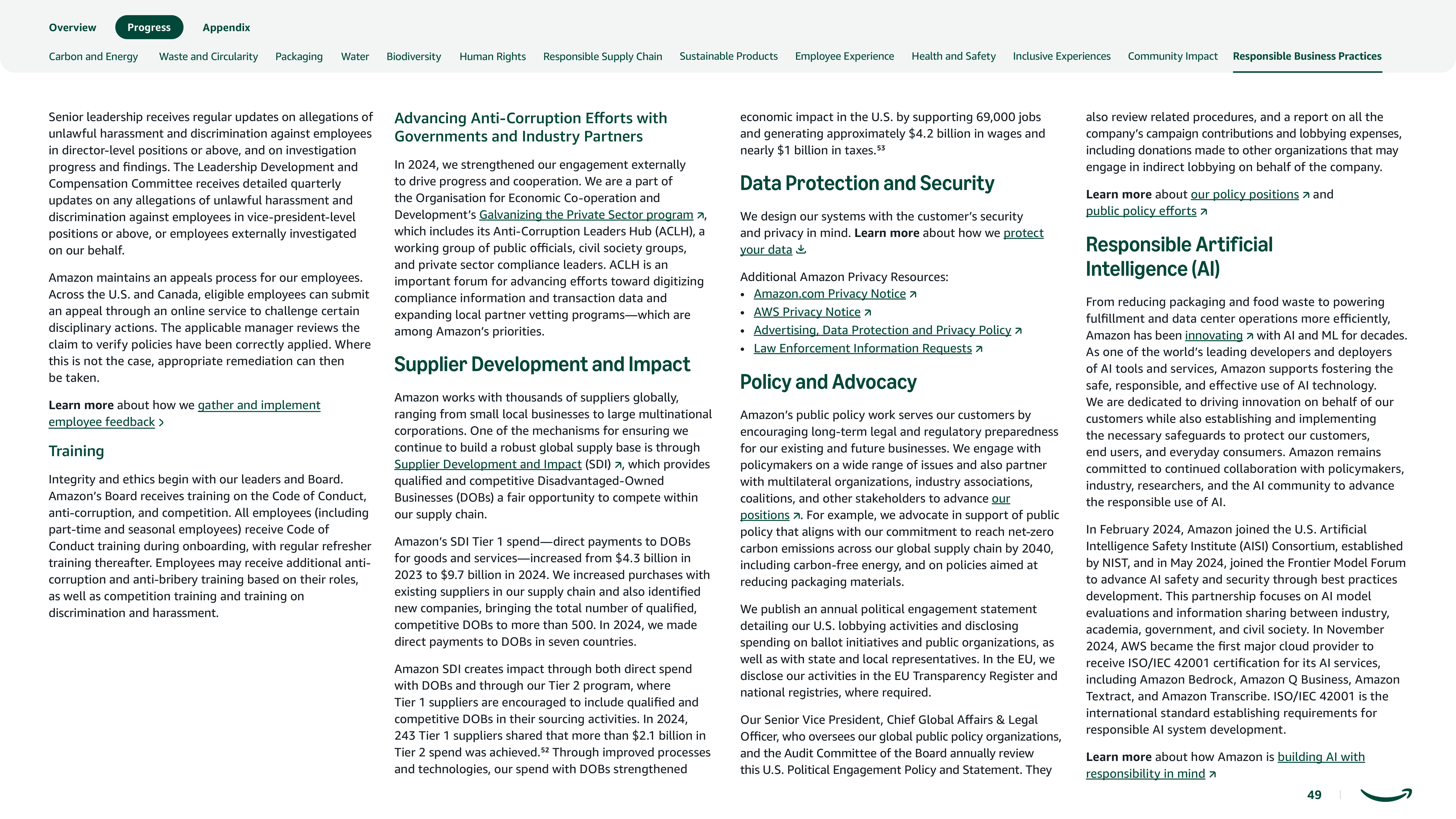
49
Overview
Progress
Appendix
Carbon and Energy
Waste and Circularity
Packaging
Water
Biodiversity
Human Rights
Responsible Supply Chain
Sustainable Products
Employee Experience
Health and Safety
Inclusive Experiences
Community Impact
Responsible Business Practices
Senior leadership receives regular updates on allegations of
unlawful harassment and discrimination against employees
in director-level positions or above, and on investigation
progress and findings. The Leadership Development and
Compensation Committee receives detailed quarterly
updates on any allegations of unlawful harassment and
discrimination against employees in vice-president-level
positions or above, or employees externally investigated
on our behalf.
Amazon maintains an appeals process for our employees.
Across the U.S. and Canada, eligible employees can submit
an appeal through an online service to challenge certain
disciplinary actions. The applicable manager reviews the
claim to verify policies have been correctly applied. Where
this is not the case, appropriate remediation can then
be taken.
Learn more
about how we
gather and implement
employee feedback
Training
Integrity and ethics begin with our leaders and Board.
Amazon’s Board receives training on the Code of Conduct,
anti-corruption, and competition. All employees (including
part-time and seasonal employees) receive Code of
Conduct training during onboarding, with regular refresher
training thereafter. Employees may receive additional anti-
corruption and anti-bribery training based on their roles,
as well as competition training and training on
discrimination and harassment.
Advancing Anti-Corruption Efforts with
Governments and Industry Partners
In 2024, we strengthened our engagement externally
to drive progress and cooperation. We are a part of
the Organisation for Economic Co-operation and
Development’s
Galvanizing the Private Sector program
,
which includes its Anti-Corruption Leaders Hub (ACLH), a
working group of public officials, civil society groups,
and private sector compliance leaders. ACLH is an
important forum for advancing efforts toward digitizing
compliance information and transaction data and
expanding local partner vetting programs—which are
among Amazon’s priorities.
Supplier Development and Impact
Amazon works with thousands of suppliers globally,
ranging from small local businesses to large multinational
corporations. One of the mechanisms for ensuring we
continue to build a robust global supply base is through
Supplier Development and Impact
(SDI) , which provides
qualified and competitive Disadvantaged-Owned
Businesses (DOBs) a fair opportunity to compete within
our supply chain.
Amazon’s SDI Tier 1 spend—direct payments to DOBs
for goods and services—increased from $4.3 billion in
2023 to $9.7 billion in 2024. We increased purchases with
existing suppliers in our supply chain and also identified
new companies, bringing the total number of qualified,
competitive DOBs to more than 500. In 2024, we made
direct payments to DOBs in seven countries.
Amazon SDI creates impact through both direct spend
with DOBs and through our Tier 2 program, where
Tier 1 suppliers are encouraged to include qualified and
competitive DOBs in their sourcing activities. In 2024,
243 Tier 1 suppliers shared that more than $2.1 billion in
Tier 2 spend was achieved.
52
Through improved processes
and technologies, our spend with DOBs strengthened
economic impact in the U.S. by supporting 69,000 jobs
and generating approximately $4.2 billion in wages and
nearly $1 billion in taxes.
53
Data Protection and Security
We design our systems with the customer’s security
and privacy in mind.
Learn more
about how we
protect
your data
Additional Amazon Privacy Resources:
•
Amazon.com Privacy Notice
•
AWS Privacy Notice
•
Advertising, Data Protection and Privacy Policy
•
Law Enforcement Information Requests
Policy and Advocacy
Amazon’s public policy work serves our customers by
encouraging long-term legal and regulatory preparedness
for our existing and future businesses. We engage with
policymakers on a wide range of issues and also partner
with multilateral organizations, industry associations,
coalitions, and other stakeholders to advance
our
positions
. For example, we advocate in support of public
policy that aligns with our commitment to reach net-zero
carbon emissions across our global supply chain by 2040,
including carbon-free energy, and on policies aimed at
reducing packaging materials.
We publish an annual political engagement statement
detailing our U.S. lobbying activities and disclosing
spending on ballot initiatives and public organizations, as
well as with state and local representatives. In the EU, we
disclose our activities in the EU Transparency Register and
national registries, where required.
Our Senior Vice President, Chief Global Affairs & Legal
Officer, who oversees our global public policy organizations,
and the Audit Committee of the Board annually review
this U.S. Political Engagement Policy and Statement. They
also review related procedures, and a report on all the
company’s campaign contributions and lobbying expenses,
including donations made to other organizations that may
engage in indirect lobbying on behalf of the company.
Learn more
about
our policy positions
and
public policy efforts
Responsible Artificial
Intelligence (AI)
From reducing packaging and food waste to powering
fulfillment and data center operations more efficiently,
Amazon has been
innovating
with AI and ML for decades.
As one of the world’s leading developers and deployers
of AI tools and services, Amazon supports fostering the
safe, responsible, and effective use of AI technology.
We are dedicated to driving innovation on behalf of our
customers while also establishing and implementing
the necessary safeguards to protect our customers,
end users, and everyday consumers. Amazon remains
committed to continued collaboration with policymakers,
industry, researchers, and the AI community to advance
the responsible use of AI.
In February 2024, Amazon joined the U.S. Artificial
Intelligence Safety Institute (AISI) Consortium, established
by NIST, and in May 2024, joined the Frontier Model Forum
to advance AI safety and security through best practices
development. This partnership focuses on AI model
evaluations and information sharing between industry,
academia, government, and civil society. In November
2024, AWS became the first major cloud provider to
receive ISO/IEC 42001 certification for its AI services,
including Amazon Bedrock, Amazon Q Business, Amazon
Textract, and Amazon Transcribe. ISO/IEC 42001 is the
international standard establishing requirements for
responsible AI system development.
Learn more
about how Amazon is
building AI with
responsibility in mind
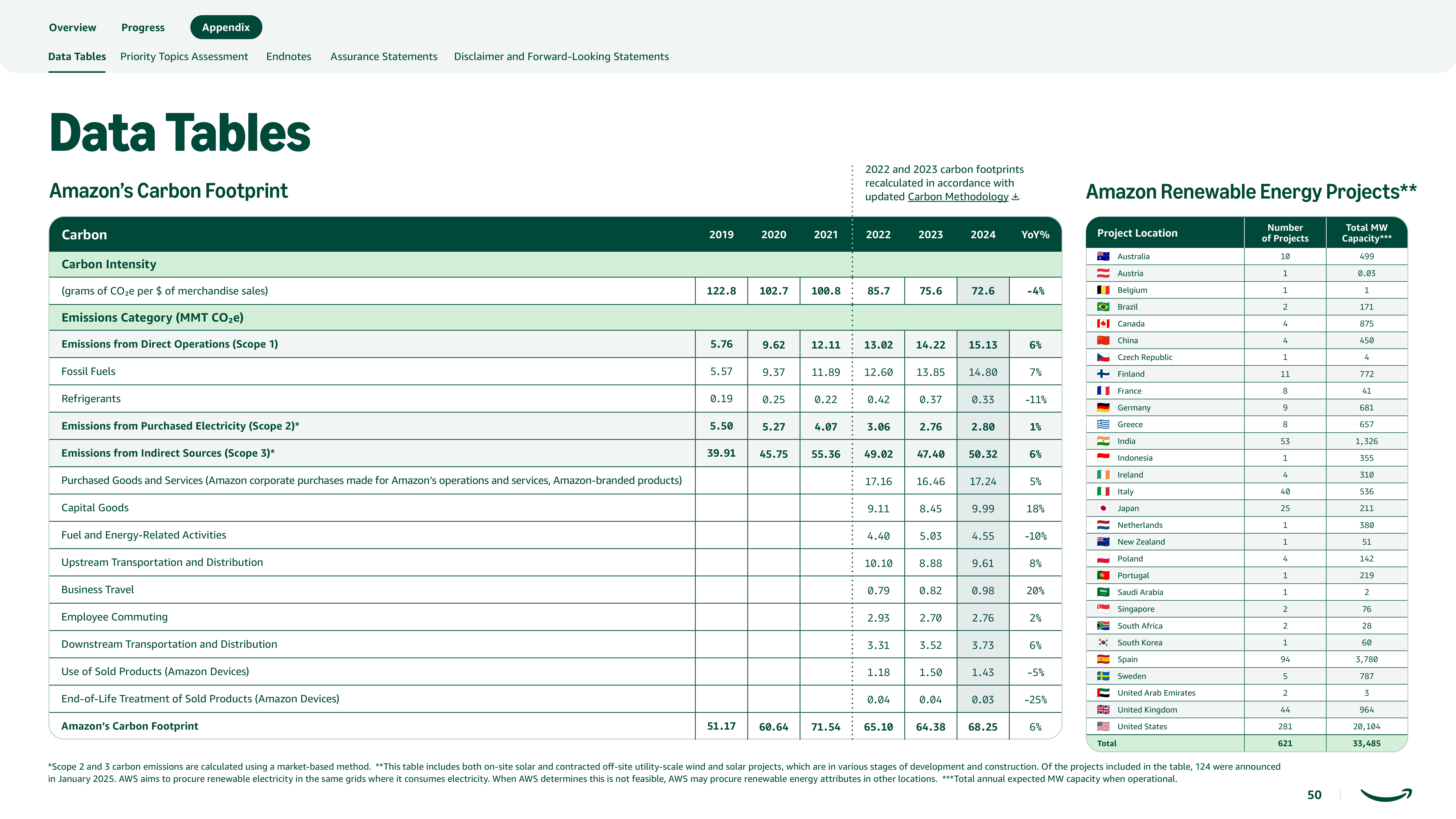
50
Overview
Progress
Appendix
Data Tables
Priority Topics Assessment
Endnotes
Assurance Statements
Disclaimer and Forward-Looking Statements
Data Tables
Amazon’s Carbon Footprint
Carbon
2019
2020
2021
2022
2023
2024
YoY%
Carbon Intensity
(grams of CO₂e per $ of merchandise sales)
122.8
102.7
100.8
85.7
75.6
72.6
-4%
Emissions Category (MMT CO₂e)
Emissions from Direct Operations (Scope 1)
5.76
9.62
12.11
13.02
14.22
15.13
6%
Fossil Fuels
5.57
9.37
11.89
12.60
13.85
14.80
7%
Refrigerants
0.19
0.25
0.22
0.42
0.37
0.33
-11%
Emissions from Purchased Electricity (Scope 2)*
5.50
5.27
4.07
3.06
2.76
2.80
1%
Emissions from Indirect Sources (Scope 3)*
39.91
45.75
55.36
49.02
47.40
50.32
6%
Purchased Goods and Services (Amazon corporate purchases made for Amazon’s operations and services, Amazon-branded products)
17.16
16.46
17.24
5%
Capital Goods
9.11
8.45
9.99
18%
Fuel and Energy-Related Activities
4.40
5.03
4.55
-10%
Upstream Transportation and Distribution
10.10
8.88
9.61
8%
Business Travel
0.79
0.82
0.98
20%
Employee Commuting
2.93
2.70
2.76
2%
Downstream Transportation and Distribution
3.31
3.52
3.73
6%
Use of Sold Products (Amazon Devices)
1.18
1.50
1.43
-5%
End-of-Life Treatment of Sold Products (Amazon Devices)
0.04
0.04
0.03
-25%
Amazon’s Carbon Footprint
51.17
60.64
71.54
65.10
64.38
68.25
6%
2022 and 2023 carbon footprints
recalculated in accordance with
updated Carbon Methodology
Amazon Renewable Energy Projects**
Project Location
Number
of Projects
Total MW
Capacity***
Australia
10
499
Austria
1
0.03
Belgium
1
1
Brazil
2
171
Canada
4
875
China
4
450
Czech Republic
1
4
Finland
11
772
France
8
41
Germany
9
681
Greece
8
657
India
53
1,326
Indonesia
1
355
Ireland
4
310
Italy
40
536
Japan
25
211
Netherlands
1
380
New Zealand
1
51
Poland
4
142
Portugal
1
219
Saudi Arabia
1
2
Singapore
2
76
South Africa
2
28
South Korea
1
60
Spain
94
3,780
Sweden
5
787
United Arab Emirates
2
3
United Kingdom
44
964
United States
281
20,104
Total
621
33,485
*Scope 2 and 3 carbon emissions are calculated using a market-based method. **This table includes both on-site solar and contracted off-site utility-scale wind and solar projects, which are in various stages of development and construction. Of the projects included in the table, 124 were announced
in January 2025. AWS aims to procure renewable electricity in the same grids where it consumes electricity. When AWS determines this is not feasible, AWS may procure renewable energy attributes in other locations. ***Total annual expected MW capacity when operational.
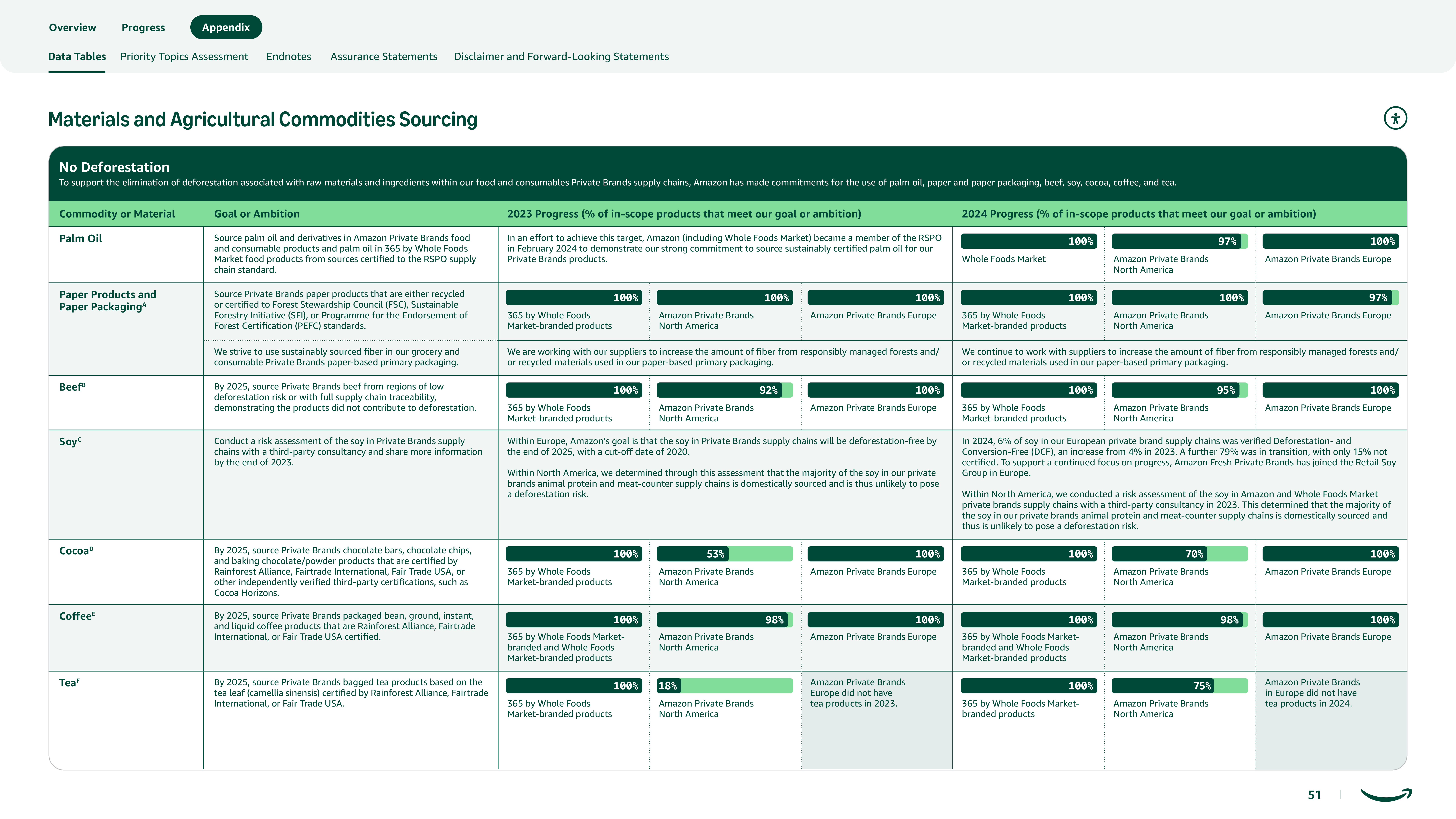
51
Overview
Progress
Appendix
Data Tables
Priority Topics Assessment
Endnotes
Assurance Statements
Disclaimer and Forward-Looking Statements
Materials and Agricultural Commodities Sourcing
No Deforestation
To support the elimination of deforestation associated with raw materials and ingredients within our food and consumables Private Brands supply chains, Amazon has made commitments for the use of palm oil, paper and paper packaging, beef, soy, cocoa, coffee, and tea.
Commodity or Material
Goal or Ambition
2023 Progress (% of in-scope products that meet our goal or ambition)
2024 Progress (% of in-scope products that meet our goal or ambition)
Palm Oil
Source palm oil and derivatives in Amazon Private Brands food
and consumable products and palm oil in 365 by Whole Foods
Market food products from sources certified to the RSPO supply
chain standard.
In an effort to achieve this target, Amazon (including Whole Foods Market) became a member of the RSPO
in February 2024 to demonstrate our strong commitment to source sustainably certified palm oil for our
Private Brands products.
100%
Whole Foods Market
97%
Amazon Private Brands
North America
100%
Amazon Private Brands Europe
Paper Products and
Paper Packaging
A
Source Private Brands paper products that are either recycled
or certified to Forest Stewardship Council (FSC), Sustainable
Forestry Initiative (SFI), or Programme for the Endorsement of
Forest Certification (PEFC) standards.
365 by Whole Foods
Market-branded products
Amazon Private Brands
North America
Amazon Private Brands Europe
365 by Whole Foods
Market-branded products
Amazon Private Brands
North America
Amazon Private Brands Europe
We strive to use sustainably sourced fiber in our grocery and
consumable Private Brands paper-based primary packaging.
We are working with our suppliers to increase the amount of fiber from responsibly managed forests and/
or recycled materials used in our paper-based primary packaging.
We continue to work with suppliers to increase the amount of fiber from responsibly managed forests and/
or recycled materials used in our paper-based primary packaging.
Beef
B
By 2025, source Private Brands beef from regions of low
deforestation risk or with full supply chain traceability,
demonstrating the products did not contribute to deforestation.
100%
365 by Whole Foods
Market-branded products
92%
Amazon Private Brands
North America
100%
Amazon Private Brands Europe
100%
365 by Whole Foods
Market-branded products
91%
Amazon Private Brands
North America
100%
Amazon Private Brands Europe
Soy
C
Conduct a risk assessment of the soy in Private Brands supply
chains with a third-party consultancy and share more information
by the end of 2023.
Within Europe, Amazon’s goal is that the soy in Private Brands supply chains will be deforestation-free by
the end of 2025, with a cut-off date of 2020.
Within North America, we determined through this assessment that the majority of the soy in our private
brands animal protein and meat-counter supply chains is domestically sourced and is thus unlikely to pose
a deforestation risk.
In 2024, 6% of soy in our European private brand supply chains was verified Deforestation- and
Conversion-Free (DCF), an increase from 4% in 2023. A further 79% was in transition, with only 15% not
certified. To support a continued focus on progress, Amazon Fresh Private Brands has joined the Retail Soy
Group in Europe.
Within North America, we conducted a risk assessment of the soy in Amazon and Whole Foods Market
private brands supply chains with a third-party consultancy in 2023. This determined that the majority of
the soy in our private brands animal protein and meat-counter supply chains is domestically sourced and
thus is unlikely to pose a deforestation risk.
Cocoa
D
By 2025, source Private Brands chocolate bars, chocolate chips,
and baking chocolate/powder products that are certified by
Rainforest Alliance, Fairtrade International, Fair Trade USA, or
other independently verified third-party certifications, such as
Cocoa Horizons.
100%
365 by Whole Foods
Market-branded products
53%
Amazon Private Brands
North America
100%
Amazon Private Brands Europe
100%
365 by Whole Foods
Market-branded products
70%
Amazon Private Brands
North America
100%
Amazon Private Brands Europe
Coffee
E
By 2025, source Private Brands packaged bean, ground, instant,
and liquid coffee products that are Rainforest Alliance, Fairtrade
International, or Fair Trade USA certified.
365 by Whole Foods Market-
branded and Whole Foods
Market-branded products
Amazon Private Brands
North America
Amazon Private Brands Europe
365 by Whole Foods Market-
branded and Whole Foods
Market-branded products
Amazon Private Brands
North America
Amazon Private Brands Europe
Tea
F
By 2025, source Private Brands bagged tea products based on the
tea leaf (camellia sinensis) certified by Rainforest Alliance, Fairtrade
International, or Fair Trade USA.
100%
365 by Whole Foods
Market-branded products
18
Amazon Private Brands
North America
Amazon Private Brands
Europe did not have
tea products in 2023.
100%
365 by Whole Foods Market-
branded products
Amazon Private Brands
North America
Amazon Private Brands
in Europe did not have
tea products in 2024.
100%
100%
100%
100%
100%
100%
100%
100%
100%
100%
100%
100%
100%
100%
100%
100%
100%
95%
70%
53%
98%
98%
97%
97%
18%
100%
100%
100%
100%
75%
92%
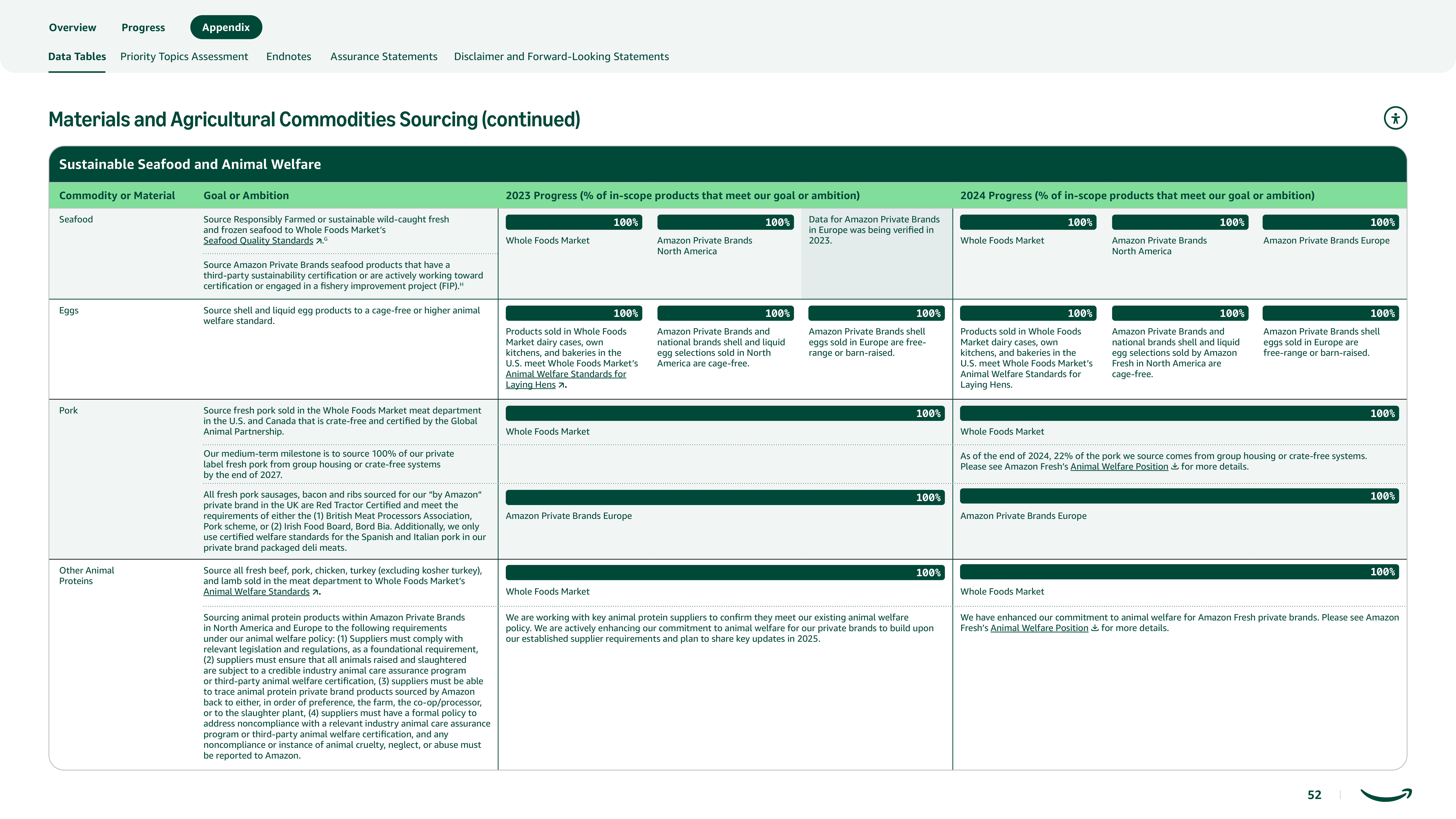
52
Sustainable Seafood and Animal Welfare
Commodity or Material
Goal or Ambition
2023 Progress (% of in-scope products that meet our goal or ambition)
2024 Progress (% of in-scope products that meet our goal or ambition)
Seafood
Source Responsibly Farmed or sustainable wild-caught fresh
and frozen seafood to Whole Foods Market’s
Seafood Quality Standards
.
G
Whole Foods Market
Amazon Private Brands
North America
Data for Amazon Private Brands
in Europe was being verified in
2023.
Whole Foods Market
Amazon Private Brands
North America
Amazon Private Brands Europe
Source Amazon Private Brands seafood products that have a
third-party sustainability certification or are actively working toward
certification or engaged in a fishery improvement project (FIP).
H
Eggs
Source shell and liquid egg products to a cage-free or higher animal
welfare standard.
Products sold in Whole Foods
Market dairy cases, own
kitchens, and bakeries in the
U.S. meet Whole Foods Market’s
Animal Welfare Standards for
Laying Hens
.
Amazon Private Brands and
national brands shell and liquid
egg selections sold in North
America are cage-free.
Amazon Private Brands shell
eggs sold in Europe are free-
range or barn-raised.
Products sold in Whole Foods
Market dairy cases, own
kitchens, and bakeries in the
U.S. meet Whole Foods Market’s
Animal Welfare Standards for
Laying Hens.
Amazon Private Brands and
national brands shell and liquid
egg selections sold by Amazon
Fresh in North America are
cage-free.
Amazon Private Brands shell
eggs sold in Europe are
free-range or barn-raised.
Pork
Source fresh pork sold in the Whole Foods Market meat department
in the U.S. and Canada that is crate-free and certified by the Global
Animal Partnership.
Whole Foods Market
Whole Foods Market
Our medium-term milestone is to source 100% of our private
label fresh pork from group housing or crate-free systems
by the end of 2027.
As of the end of 2024, 22% of the pork we source comes from group housing or crate-free systems.
Please see Amazon Fresh’s Animal Welfare Position
for more details.
All fresh pork sausages, bacon and ribs sourced for our “by Amazon“
private brand in the UK are Red Tractor Certified and meet the
requirements of either the (1) British Meat Processors Association,
Pork scheme, or (2) Irish Food Board, Bord Bia. Additionally, we only
use certified welfare standards for the Spanish and Italian pork in our
private brand packaged deli meats.
Amazon Private Brands Europe
Amazon Private Brands Europe
Other Animal
Proteins
Source all fresh beef, pork, chicken, turkey (excluding kosher turkey),
and lamb sold in the meat department to Whole Foods Market’s
Animal Welfare Standards
.
Whole Foods Market
Whole Foods Market
Sourcing animal protein products within Amazon Private Brands
in North America and Europe to the following requirements
under our animal welfare policy: (1) Suppliers must comply with
relevant legislation and regulations, as a foundational requirement,
(2) suppliers must ensure that all animals raised and slaughtered
are subject to a credible industry animal care assurance program
or third-party animal welfare certification, (3) suppliers must be able
to trace animal protein private brand products sourced by Amazon
back to either, in order of preference, the farm, the co-op/processor,
or to the slaughter plant, (4) suppliers must have a formal policy to
address noncompliance with a relevant industry animal care assurance
program or third-party animal welfare certification, and any
noncompliance or instance of animal cruelty, neglect, or abuse must
be reported to Amazon.
We are working with key animal protein suppliers to confirm they meet our existing animal welfare
policy. We are actively enhancing our commitment to animal welfare for our private brands to build upon
our established supplier requirements and plan to share key updates in 2025.
We have enhanced our commitment to animal welfare for Amazon Fresh private brands. Please see Amazon
Fresh’s Animal Welfare Position
for more details.
Overview
Progress
Appendix
Data Tables
Priority Topics Assessment
Endnotes
Assurance Statements
Disclaimer and Forward-Looking Statements
Materials and Agricultural Commodities Sourcing (continued)
100%
100%
100%
100%
100%
100%
100%
100%
100%
100%
100%
100%
100%
100%
100%
100%
100%
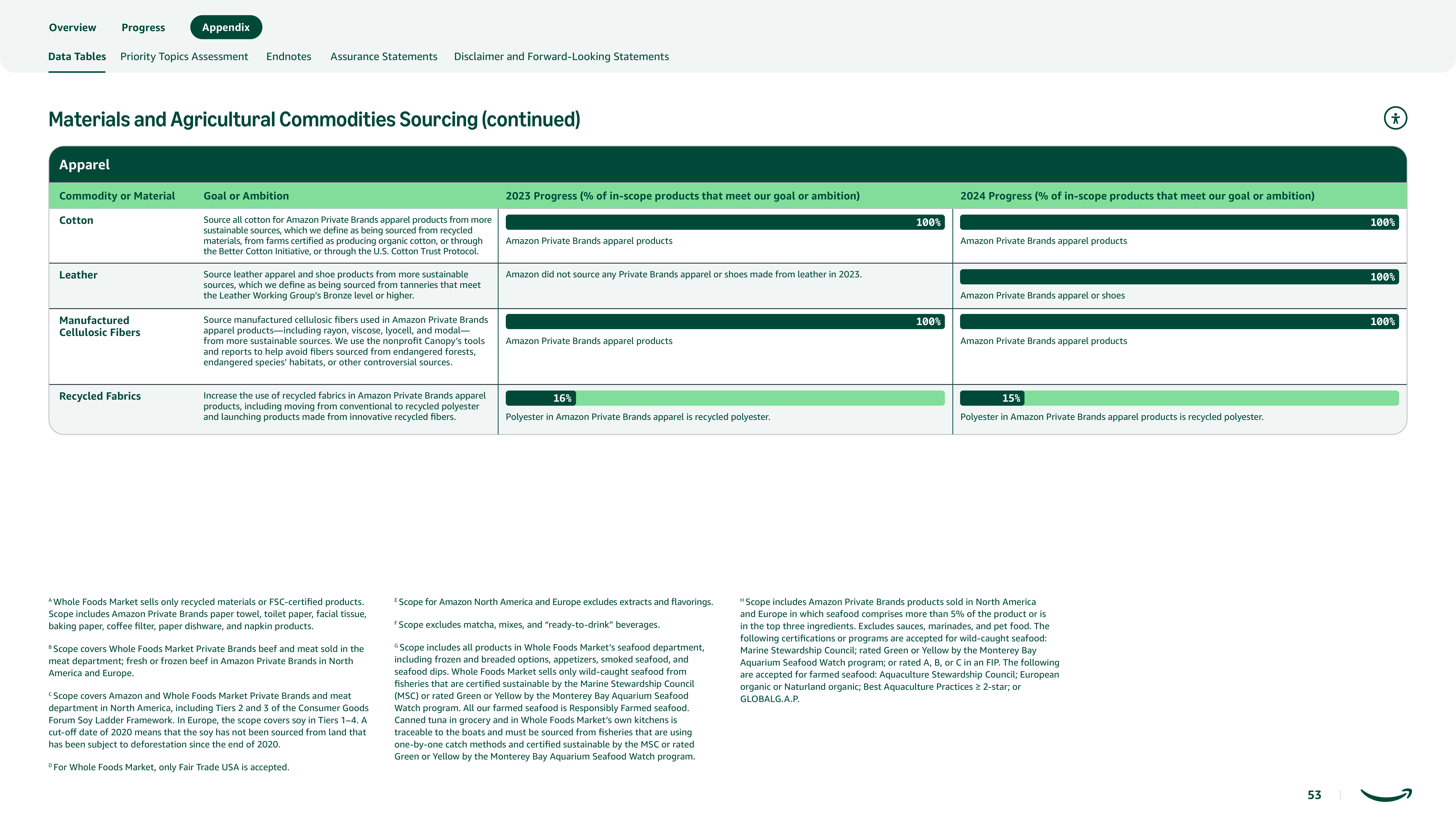
53
Apparel
Commodity or Material
Goal or Ambition
2023 Progress (% of in-scope products that meet our goal or ambition)
2024 Progress (% of in-scope products that meet our goal or ambition)
Cotton
Source all cotton for Amazon Private Brands apparel products from more
sustainable sources, which we define as being sourced from recycled
materials, from farms certified as producing organic cotton, or through
the Better Cotton Initiative, or through the U.S. Cotton Trust Protocol.
Amazon Private Brands apparel products
Amazon Private Brands apparel products
Leather
Source leather apparel and shoe products from more sustainable
sources, which we define as being sourced from tanneries that meet
the Leather Working Group’s Bronze level or higher.
Amazon did not source any Private Brands apparel or shoes made from leather in 2023.
Amazon Private Brands apparel or shoes
Amazon Private Brands apparel or shoes
Manufactured
Cellulosic Fibers
Source manufactured cellulosic fibers used in Amazon Private Brands
apparel products—including rayon, viscose, lyocell, and modal—
from more sustainable sources. We use the nonprofit Canopy’s tools
and reports to help avoid fibers sourced from endangered forests,
endangered species’ habitats, or other controversial sources.
Amazon Private Brands apparel products
Amazon Private Brands apparel products
Recycled Fabrics
Increase the use of recycled fabrics in Amazon Private Brands apparel
products, including moving from conventional to recycled polyester
and launching products made from innovative recycled fibers.
Polyester in Amazon Private Brands apparel is recycled polyester.
Polyester in Amazon Private Brands apparel products is recycled polyester.
Overview
Progress
Appendix
Data Tables
Priority Topics Assessment
Endnotes
Assurance Statements
Disclaimer and Forward-Looking Statements
Materials and Agricultural Commodities Sourcing (continued)
100%
100%
100%
100%
100%
16%
15%
A
Whole Foods Market sells only recycled materials or FSC-certified products.
Scope includes Amazon Private Brands paper towel, toilet paper, facial tissue,
baking paper, coffee filter, paper dishware, and napkin products.
B
Scope covers Whole Foods Market Private Brands beef and meat sold in the
meat department; fresh or frozen beef in Amazon Private Brands in North
America and Europe.
C
Scope covers Amazon and Whole Foods Market Private Brands and meat
department in North America, including Tiers 2 and 3 of the Consumer Goods
Forum Soy Ladder Framework. In Europe, the scope covers soy in Tiers 1–4. A
cut-off date of 2020 means that the soy has not been sourced from land that
has been subject to deforestation since the end of 2020.
D
For Whole Foods Market, only Fair Trade USA is accepted.
E
Scope for Amazon North America and Europe excludes extracts and flavorings.
F
Scope excludes matcha, mixes, and “ready-to-drink” beverages.
G
Scope includes all products in Whole Foods Market’s seafood department,
including frozen and breaded options, appetizers, smoked seafood, and
seafood dips. Whole Foods Market sells only wild-caught seafood from
fisheries that are certified sustainable by the Marine Stewardship Council
(MSC) or rated Green or Yellow by the Monterey Bay Aquarium Seafood
Watch program. All our farmed seafood is Responsibly Farmed seafood.
Canned tuna in grocery and in Whole Foods Market’s own kitchens is
traceable to the boats and must be sourced from fisheries that are using
one-by-one catch methods and certified sustainable by the MSC or rated
Green or Yellow by the Monterey Bay Aquarium Seafood Watch program.
H
Scope includes Amazon Private Brands products sold in North America
and Europe in which seafood comprises more than 5% of the product or is
in the top three ingredients. Excludes sauces, marinades, and pet food. The
following certifications or programs are accepted for wild-caught seafood:
Marine Stewardship Council; rated Green or Yellow by the Monterey Bay
Aquarium Seafood Watch program; or rated A, B, or C in an FIP. The following
are accepted for farmed seafood: Aquaculture Stewardship Council; European
organic or Naturland organic; Best Aquaculture Practices ≥ 2-star; or
GLOBALG.A.P.
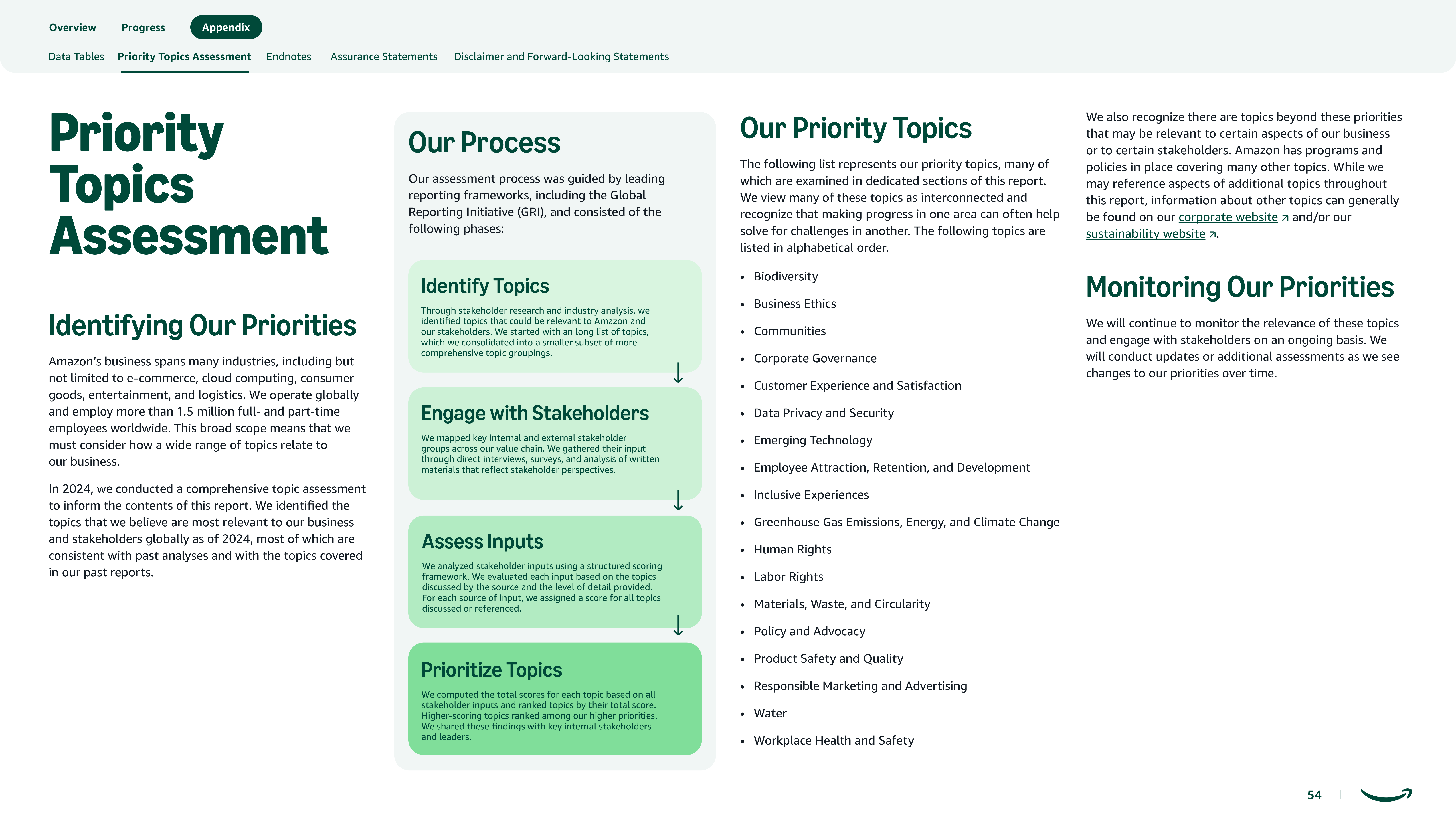
54
Overview
Progress
Appendix
Data Tables
Priority Topics Assessment
Endnotes
Assurance Statements
Disclaimer and Forward-Looking Statements
Priority
Topics
Assessment
Identifying Our Priorities
Amazon’s business spans many industries, including but
not limited to e-commerce, cloud computing, consumer
goods, entertainment, and logistics. We operate globally
and employ more than 1.5 million full- and part-time
employees worldwide. This broad scope means that we
must consider how a wide range of topics relate to
our business.
In 2024, we conducted a comprehensive topic assessment
to inform the contents of this report. We identified the
topics that we believe are most relevant to our business
and stakeholders globally as of 2024, most of which are
consistent with past analyses and with the topics covered
in our past reports.
Our Process
Our assessment process was guided by leading
reporting frameworks, including the Global
Reporting Initiative (GRI), and consisted of the
following phases:
Identify Topics
Through stakeholder research and industry analysis, we
identified topics that could be relevant to Amazon and
our stakeholders. We started with an long list of topics,
which we consolidated into a smaller subset of more
comprehensive topic groupings.
Engage with Stakeholders
We mapped key internal and external stakeholder
groups across our value chain. We gathered their input
through direct interviews, surveys, and analysis of written
materials that reflect stakeholder perspectives.
Assess Inputs
We analyzed stakeholder inputs using a structured scoring
framework. We evaluated each input based on the topics
discussed by the source and the level of detail provided.
For each source of input, we assigned a score for all topics
discussed or referenced.
Prioritize Topics
We computed the total scores for each topic based on all
stakeholder inputs and ranked topics by their total score.
Higher-scoring topics ranked among our higher priorities.
We shared these findings with key internal stakeholders
and leaders.
Our Priority Topics
The following list represents our priority topics, many of
which are examined in dedicated sections of this report.
We view many of these topics as interconnected and
recognize that making progress in one area can often help
solve for challenges in another. The following topics are
listed in alphabetical order.
•
Biodiversity
•
Business Ethics
•
Communities
•
Corporate Governance
•
Customer Experience and Satisfaction
•
Data Privacy and Security
•
Emerging Technology
•
Employee Attraction, Retention, and Development
•
Inclusive Experiences
•
Greenhouse Gas Emissions, Energy, and Climate Change
•
Human Rights
•
Labor Rights
•
Materials, Waste, and Circularity
•
Policy and Advocacy
•
Product Safety and Quality
•
Responsible Marketing and Advertising
•
Water
•
Workplace Health and Safety
We also recognize there are topics beyond these priorities
that may be relevant to certain aspects of our business
or to certain stakeholders. Amazon has programs and
policies in place covering many other topics. While we
may reference aspects of additional topics throughout
this report, information about other topics can generally
be found on our
corporate website
and/or our
sustainability website
.
Monitoring Our Priorities
We will continue to monitor the relevance of these topics
and engage with stakeholders on an ongoing basis. We
will conduct updates or additional assessments as we see
changes to our priorities over time.
55
Overview
Progress
Appendix
Data Tables
Priority Topics Assessment
Endnotes
Assurance Statements
Disclaimer and Forward-Looking Statements
Endnotes
1.
Supply chains focus on sourcing materials and delivering goods to
customers. Value chains include upstream supply chain as well as
downstream delivery to customers, customer use of products, and
end-of-life of products.
2.
Carbon-free energy includes existing renewable energy technologies,
such as wind and solar farms and on-site rooftop solar systems, as well
as other sources that generate carbon-free energy, such as nuclear
reactors, hydroelectric, and geothermal. Our investments also include
site energy contracts and green tariffs with local utilities that result in
new wind and solar projects being added to the grid.
3.
As detailed in our Renewable Energy Methodology , to calculate the
percentage of renewable energy matched by the electricity consumed by
our global operations, we evaluate both the amount of renewable energy
from Amazon’s projects and the renewable energy in the grid. This total
renewable energy is then compared to Amazon’s total energy use.
4.
In our 2022 and 2023 Reports, we stated this goal had been met
with contracted energy capacity. In 2024, the contracted energy
became operational.
5.
Electric delivery vans include Rivian and vans from other electric vehicle
manufacturers.
6.
Electric delivery vehicles include four-wheel (electric delivery vans),
three-wheel, two-wheel, and e-mopeds.
7.
Amazon’s carbon footprint is reported in metric tons of carbon dioxide
equivalent (MTCO
2
e), where each metric ton of CO
2
emissions represents
the same global warming potential as one metric ton of another
greenhouse gas. Learn more in our Carbon Methodology .
8.
Carbon intensity measures emissions growth against the growth of the
business. Carbon intensity at Amazon is measured in grams of CO
2
e per
dollar of gross merchandise sales (g CO
2
e/$GMS).
9.
We regularly refine our carbon measurement approach to improve
accuracy. In 2024, we updated our emissions data sources, which led us
to recalculate our 2022 and 2023 figures. While we did not apply these
new methods to 2021 and earlier data, year-over-year comparisons
remain possible, though the methodology differs between 2024 and
2019 carbon intensity calculations.
10.
A free, publicly available website of previously proprietary information
that will help other companies make meaningful progress toward
net-zero carbon emissions.
11.
PUE measures the energy consumed by a data center to power
computing equipment, cooling, and other data center infrastructure
to support operations.
12.
International Data Corporation, 2H24 Datacenter Trends: Sustainable
Datacenter Builds and CO2 Emissions
Doc # US51911924, January
2025. A 1.0 PUE is a theoretical number, implying that all the energy
consumed by a data center is being used to power computing
equipment and that none is wasted on cooling or other infrastructure.
Learn more
in our Power Usage Effectiveness (PUE) Methodology
13.
The embodied carbon calculation uses the Carbon Leadership Forum’s
(CLF) 2021 baseline. CLF baselines represent an estimate of
industry-average GHG emissions for construction materials
manufactured in North America.
14.
Renewable natural gas (RNG) is created by decomposing organic waste
materials anaerobically (without oxygen).
15.
World Steel in Figures .
16.
Natural pozzolans are cement clinker substitutes that enable cement to
be produced at a lower temperature, creating fewer emissions.
17.
CarbonCure is a commercialized portfolio of carbon removal
technologies that consume carbon dioxide (CO
2
) in concrete during
production, permanently sequestering CO
2
and enabling the reduction
of cement content in mixes without impacting concrete performance.
18.
According to BloombergNEF.
19.
United Nations Environment Programme, Methane emissions are driving
climate change
.
20.
WEF Net Zero Industry Tracker 2024 .
21.
Cement and concrete constitute approximately 8% of all global
emissions, and demand is expected to grow significantly by 2050.
22.
Amazon, Microsoft, Mundy’s, Ryan Companies, Prologis, Trammell Crow
(CBRE), Deloitte, AECOM, and CarbonCure.
23.
Carbon credits are certificates that are purchased to offset the emissions
of a certain amount of CO
2
or other GHGs.
24.
IPCC Cross-Chapter Paper 7: Tropical Forests
.
25.
Goal scope covers food that is considered inventory. It is measured with
a food waste intensity metric that calculates the amount
of food waste generated as a percentage of total food handled
within Amazon.
26.
Amazon’s landfill diversion rate is a measure of both the waste we
successfully divert to recycling and what we send to incineration with
energy recovery.
27.
United Nations Climate Change, Food loss and waste
.
28.
Global includes the following regions and countries: North America (U.S.
and Canada), Europe (Europe and UK), and Rest of World (Australia,
Brazil, Egypt, India, Japan, Mexico, Saudi Arabia, Singapore, South Africa
and the United Arab Emirates).
29.
Ships in Product Packaging was formerly called Ships in Own Container.
30.
BOTTLE: Bio-Optimized Technologies to keep Thermoplastics out of
Landfills and the Environment .
31.
Being water positive means AWS will return more water to communities
and the environment than its direct operations use. AWS measures
progress annually against this goal by adding together reused water and
water from replenishment projects and dividing that number by total
water withdrawal minus water from sustainable sources. As we improve
water efficiency, we also reduce how much incoming water we use.
32.
WWF, Living Planet Report
.
33.
The concept of salience uses the lens of risk to people, not to the
business, as the starting point, while recognizing that where risks
to people’s human rights are greatest, there is often strong convergence
with risks to the business. UN Guiding Principles Reporting Framework
.
34.
We review our Supply Chain Standards at least every three years,
working with external stakeholders to align our requirements with
current best practices and regulatory standards. Please refer to our most
recent update as mentioned in our 2022 Sustainability Report .
35.
Supplier audits are conducted for businesses manufacturing
Amazon-branded products, products under Amazon’s patent or
trademark, third-party labor, service, and not-for-resale goods providers
in our logistics, warehousing, and construction supply chain.
36.
Manufacturing sites that are covered by Better Work.
37.
Includes data for businesses manufacturing Amazon-branded products,
products under Amazon’s patent or trademark, third-party labor, service,
and not-for-resale goods providers in our logistics, warehousing, and
construction supply chain.
38.
Data for 2022 and 2023 represents findings from audits of
Amazon-branded product suppliers only. 2024 data has an expanded
scope that includes both Amazon-branded product suppliers and third-
party labor, service, and not-for-resale goods providers in our logistics,
warehousing, and construction supply chain.
39.
This 2024 data includes third-party labor, service, and not-for-resale
goods providers in our logistics, warehousing, and construction supply
chain, which was not included in 2023 and 2022.
40.
Addressed is defined as assessed, investigated, and resolved,
where applicable.
41.
Whole Foods Market refers to Whole Foods Market in the U.S., unless
stated otherwise.
42.
A switch is defined as a customer who purchases a product recognized
by certifications in the Climate Pledge Friendly program and has
purchased only products not recognized by Climate Pledge Friendly
within the past two years in the same product category.
43.
UL’s Zero Waste to Landfill methodology defines Silver-level sites as
those diverting 90%–94%, Gold-level sites as those diverting 95%–99%,
and Platinum-level sites as those diverting 100% of waste, according to
the UL 2799 standard.
44.
Based on EU and U.S. data, not a guarantee of future performance.
Amazon 2024 Commissioned study with a PhD from USC Marshall
School of Business
.
45.
Reduced-time employees are those who work 30 hours per week, as
defined by the threshold of requiring employees to provide health
insurance for workers who work 30 hours per week or more under
U.S. law.
46.
Employees in Ireland have access to integrated private health insurance
and coverage, which includes EAP and wellness services.
47.
In the General Warehousing and Storage industry, Amazon benchmarks
itself against the industry average for employers with >1,000 employees.
48.
In the Courier and Express Delivery Services industry, Amazon
benchmarks itself against the industry average for employers with
250–999 employees.
49.
All these numbers and other comparisons are based on the rates
Amazon has reported to applicable regulators or are otherwise derived
from the same tracking systems used for that reporting.
50.
Global operations in reference to health and safety rates means
fulfillment (Amazon Robotics sortable, traditional non-sort, in-bound
cross dock), transportation (sort center, delivery station, and air), and
Amazon Robotics operations facilities.
51.
According to the USDA, 1.2 pounds is the equivalent to one meal. $1
helps to provide at least 10 meals secured by Feeding America on behalf
of local partner food banks.
52.
We partnered with a third-party provider, Supplier.io, to manage the
impact on communities through our suppliers’ Tier 1 spend, with metrics
that report Tier 2 outcomes.
53.
We partnered with a third-party provider, Proximo, to manage the
impact on communities through Amazon’s SDI Tier 1 spend, with metrics
that report economic impact outcomes.
On the cover
Image 1: Our Euclid, Ohio, fulfillment center is the first in the U.S. to
replace plastic delivery packaging with paper packaging solutions that
are curbside recyclable.
Image 2: In India, we collaborated with NeoMotion to expand our delivery
fleet by incorporating electric wheelchairs, supporting associates who use
wheelchairs to deliver packages.
Image 3: In Madison County, Ohio, we’ve enabled one of the first
utility-scale solar projects in the U.S. that is intentionally integrating forage
crop production—crops used as feedstock—between rows of solar panels.
56
Overview
Progress
Appendix
Data Tables
Priority Topics Assessment
Endnotes
Assurance Statements
Disclaimer and Forward-Looking Statements
Assurance Statements
Please see our 2024 assurance statements at the links below:
Amazon Scopes
1 and 2 Assurance
Download
Amazon Scope 3
Assurance
Download
Amazon Renewable
Energy Assurance
Download
Devices Renewable
Energy Assurance
Download
Amazon Plastic
Packaging Assurance
Download
Disclaimer and
Forward-Looking
Statements
The information and opinions contained in this report
are provided as of the date of this report and are subject
to change without notice. Amazon does not undertake
to update or revise any such statements. This report
represents current Amazon policy and intent and is
not intended to create legal rights or obligations. This
report may contain, or incorporate by reference, public
information not separately reviewed, approved, or
endorsed by Amazon, and no representation, warranty,
or undertaking is made by Amazon as to the accuracy,
reasonableness, or completeness of such information.
Inclusion of information in this report may be based on
a variety of standards, frameworks, and considerations
and is not an indication that the subject or information
is material to Amazon’s business, strategy, outlook,
operating results, or financial condition or to its
stakeholders, nor material as it relates to Amazon’s impact
on other parties or sustainability matters. This report was
originally drafted in English and then translated into other
languages. The English version is the authoritative version.
This report includes forward-looking statements within
the meaning of the Private Securities Litigation Reform
Act of 1995. All statements other than statements of
historical or current facts, including statements regarding
our plans, initiatives, projections, goals, commitments,
expectations, or prospects, are forward-looking. These
forward-looking statements are inherently uncertain
and difficult to predict. We use words such as aim,
anticipate, believe, commit, drive, estimate, ensure,
expect, goal, intend, may, mission, plan, project, seek,
strategy, strive, target, will, or similar expressions to
identify forward-looking statements. Forward-looking
statements reflect management’s current expectations
and inherently involve risks and uncertainties. Actual
results and outcomes could differ materially for a variety
of reasons, including, among others, assumptions not
being realized, changing climate-related conditions and
weather events, scientific or technological developments,
evolving sustainability strategies, changes in carbon
markets, evolving government regulations or policies, our
expansion into new products, services, technologies, and
geographic regions, or other changes in circumstances, as
well as the factors set forth in the “Risk Factors” section
of Amazon’s most recent Annual Report on Form 10-K
and subsequent filings. The standards of measurement
and performance contained in the report are developing
and based on assumptions, and no assurance can be given
that any plan, initiative, projection, goal, commitment,
expectation, or prospect set forth in this report can or will
be achieved.

57
Published July 2025 | sustainability.aboutamazon.com