

Lenovo Group Limited 2024/25 Annual Report
HKD COUNTER STOCK CODE 992
RMB COUNTER STOCK CODE 80992



Financial highlights
Chairman and CEO statement
Lenovo management team
Management’s discussion and analysis
Corporate governance report
Audit committee report
Compensation committee report
Directors’ report
Independent auditor’s report
Consolidated income statement
Consolidated statement of comprehensive income
Consolidated balance sheet
Consolidated cash flow statement
Consolidated statement of changes in equity
Notes to the financial statements
Five-year financial summary
Corporate information
About Lenovo
Lenovo
1
is a US$69 billion revenue global technology powerhouse, ranked #248
in the Fortune Global 500, and serving millions of customers every day
in 180 markets. Focused on a bold vision to deliver Smarter Technology
for All, Lenovo has built on its success as the world’s largest PC company
with a full-stack portfolio of AI-enabled, AI-ready, and AI-optimized
devices (PCs, workstations, smartphones, tablets), infrastructure (server,
storage, edge, high performance computing and software defined
infrastructure), software, solutions, and services. Lenovo’s continued
investment in world-changing innovation is building a more equitable,
trustworthy, and smarter future for everyone, everywhere. Lenovo is
listed on the Stock Exchange of Hong Kong under Lenovo Group Limited (HKSE:
992) (ADR: LNVGY). To find out more visit https://www.lenovo.com, and
read about the latest news via our StoryHub.
Table of content
4
8
12
16
58
115
122
138
166
171
172
173
175
177
179
267
268
1
Lenovo or “Lenovo Group” or the “Group” refers to Lenovo Group Limited together with its subsidiaries. Lenovo
Group Limited (“The Company”) is the ultimate holding company of Lenovo Group. As a holding company,
it does not design, develop, manufacture, or distribute products or services, or control any activities of the
Company’s subsidiaries in the design, development, manufacture, or distribution of products or services.


Enabling easier
management of IT
carbon emissions
Scan to learn more
Active in Brazil for over 70 years, PepsiCo
Brasil operates more than 100 sales and
distribution centers, nine factories, and
an extensive technology park. Each year,
PepsiCo Brasil refreshes around 1,000
PCs across the business—and, in line
with efforts to reduce its environmental
impact, PepsiCo Brasil uses Lenovo CO
2
Offset Services to efficiently manage CO
2
emissions from its IT solutions.
With carbon credits going to support
Gold Standard® and United Nations
verified climate action projects around
the world, PepsiCo Brasil can efficiently
manage its CO
2
emissions from IT and
help reduce its environmental impact.
"Lenovo CO
2
Offset is an important service that
helps our IT team contribute to managing the
impact of our business on the environment.”
-
Renato Gaido,
Senior Information
Technology Manager, PepsiCo Brasil


Lenovo Group Limited 2024/25 Annual Report
4
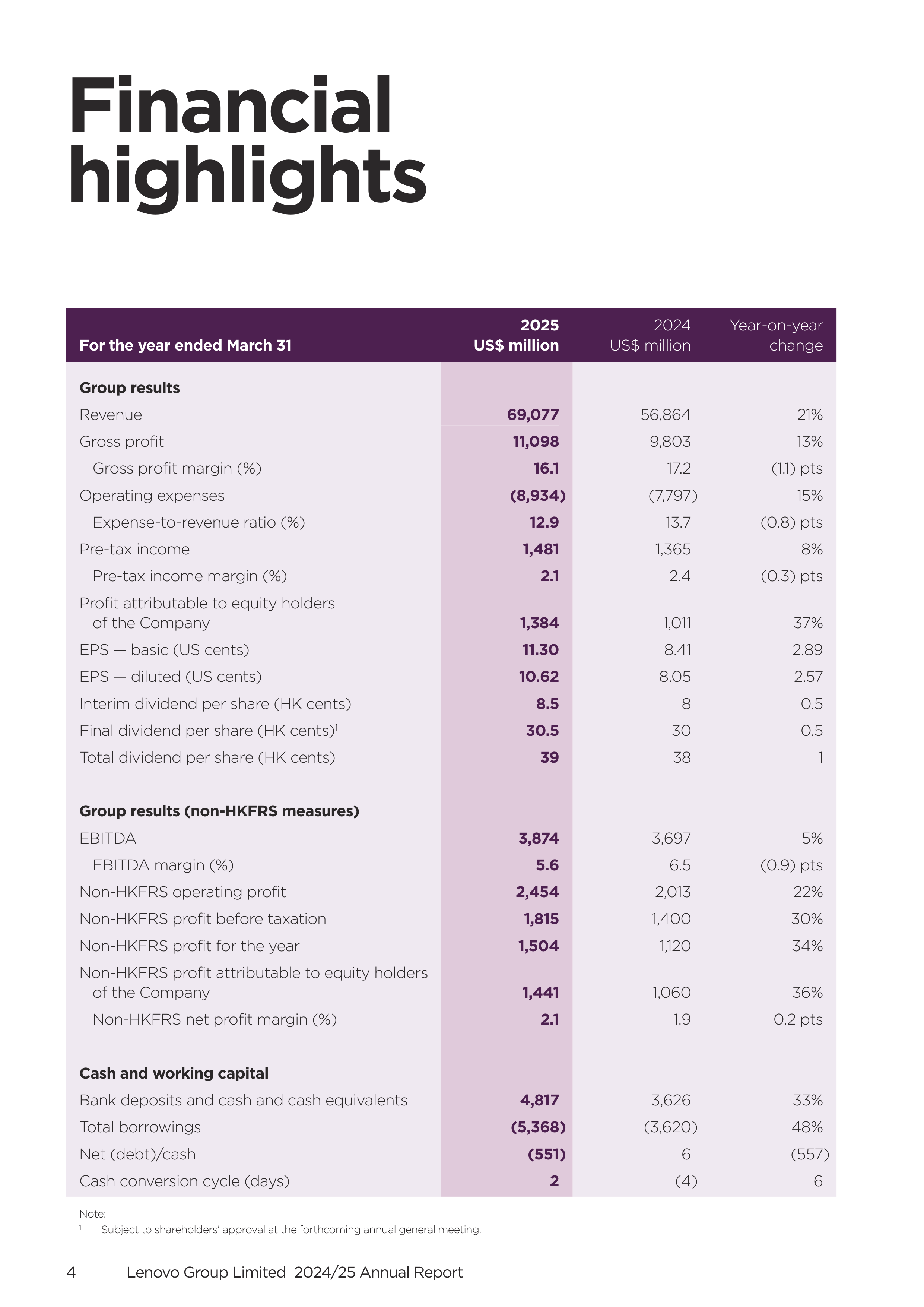
Financial
highlights
For the year ended March 31
2025
US$ million
2024
US$ million
Year-on-year
change
Group results
Revenue
69,077
56,864
21%
Gross profit
11,098
9,803
13%
Gross profit margin (%)
16.1
17.2
(1.1) pts
Operating expenses
(8,934)
(7,797)
15%
Expense-to-revenue ratio (%)
12.9
13.7
(0.8) pts
Pre-tax income
1,481
1,365
8%
Pre-tax income margin (%)
2.1
2.4
(0.3) pts
Profit attributable to equity holders
of the Company
1,384
1,011
37%
EPS — basic (US cents)
11.30
8.41
2.89
EPS — diluted (US cents)
10.62
8.05
2.57
Interim dividend per share (HK cents)
8.5
8
0.5
Final dividend per share (HK cents)
1
30.5
30
0.5
Total dividend per share (HK cents)
39
38
1
Group results (non-HKFRS measures)
EBITDA
3,874
3,697
5%
EBITDA margin (%)
5.6
6.5
(0.9) pts
Non-HKFRS operating profit
2,454
2,013
22%
Non-HKFRS profit before taxation
1,815
1,400
30%
Non-HKFRS profit for the year
1,504
1,120
34%
Non-HKFRS profit attributable to equity holders
of the Company
1,441
1,060
36%
Non-HKFRS net profit margin (%)
2.1
1.9
0.2 pts
Cash and working capital
Bank deposits and cash and cash equivalents
4,817
3,626
33%
Total borrowings
(5,368)
(3,620)
48%
Net (debt)/cash
(551)
6
(557)
Cash conversion cycle (days)
2
(4)
6
Note:
1
Subject to shareholders’ approval at the forthcoming annual general meeting.

Lenovo Group Limited 2024/25 Annual Report
5
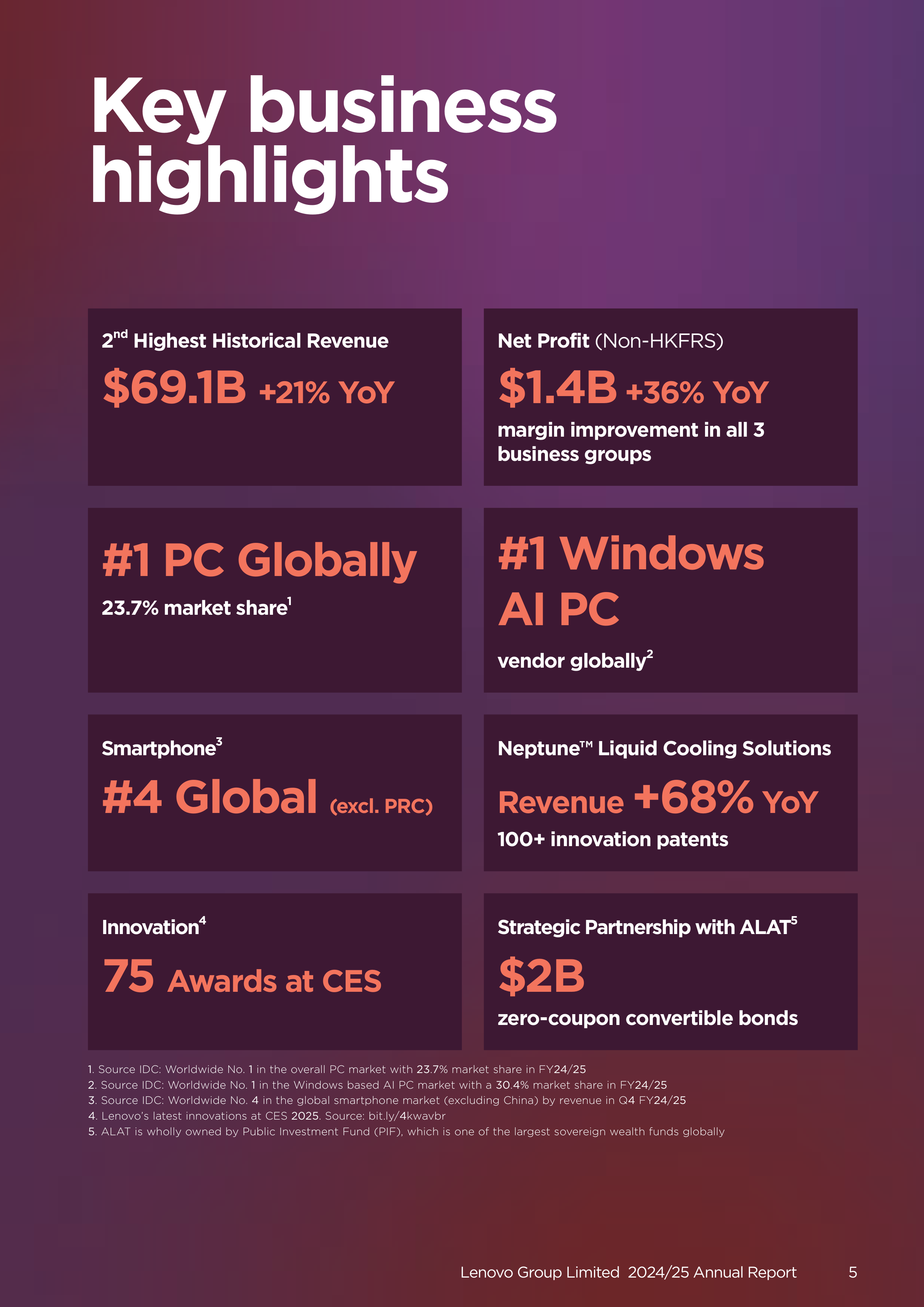
Key business
highlights
1
. Source IDC: Worldwide No.
1
in the overall PC market with
23
.
7
% market share in FY
24
/
25
2
. Source IDC: Worldwide No.
1
in the Windows based AI PC market with a
30
.
4
% market share in FY
24
/
25
3
. Source IDC: Worldwide No.
4
in the global smartphone market (excluding China) by revenue in Q
4
FY
24
/
25
4
. Lenovo’s latest innovations at CES
2025
. Source: bit.ly/
4
kwavbr
5
. ALAT is wholly owned by Public Investment Fund (PIF), which is one of the largest sovereign wealth funds globally
Net Profit
(Non-HKFRS)
$1.4B
+36% YoY
margin improvement in all 3
business groups
2
nd
Highest Historical Revenue
$69.1B
+21% YoY
Neptune™ Liquid Cooling Solutions
Revenue
+68%
YoY
100+ innovation patents
Strategic Partnership with ALAT
5
$2B
zero-coupon convertible bonds
Smartphone
3
#4 Global
(excl. PRC)
Innovation
4
75
Awards at CES
#1 PC Globally
23.7% market share
1
#1 Windows
AI PC
vendor globally
2


Scan to learn more
Smarter
solutions on
the frontlines
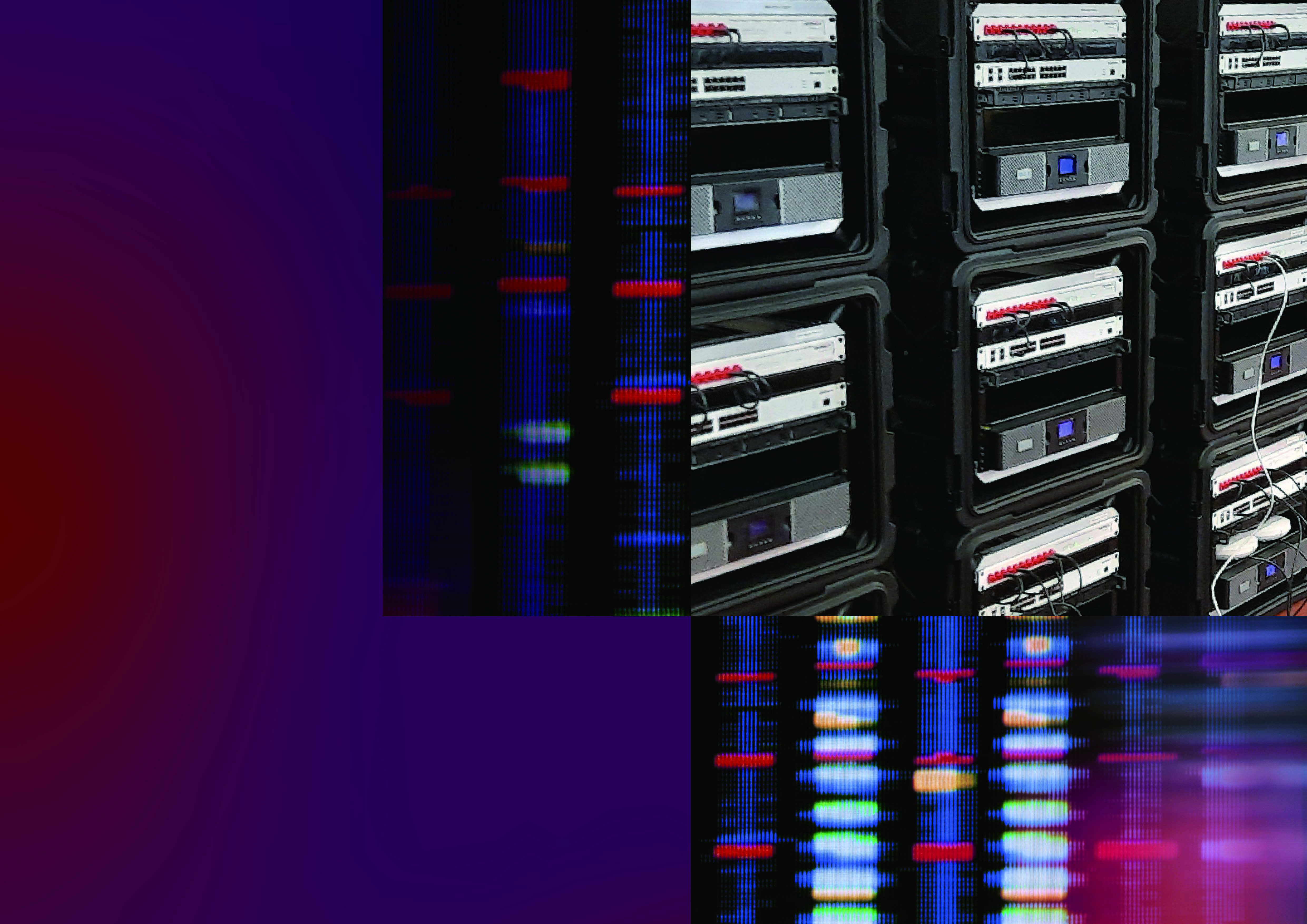
Médecins Sans Frontières, also known
as Doctors Without Borders – (MSF)
Operational Center Geneva (OCG) is
non-governmental organization (NGO)
that delivers medical assistance to
people affected by armed conflict,
natural and man-made disasters, and
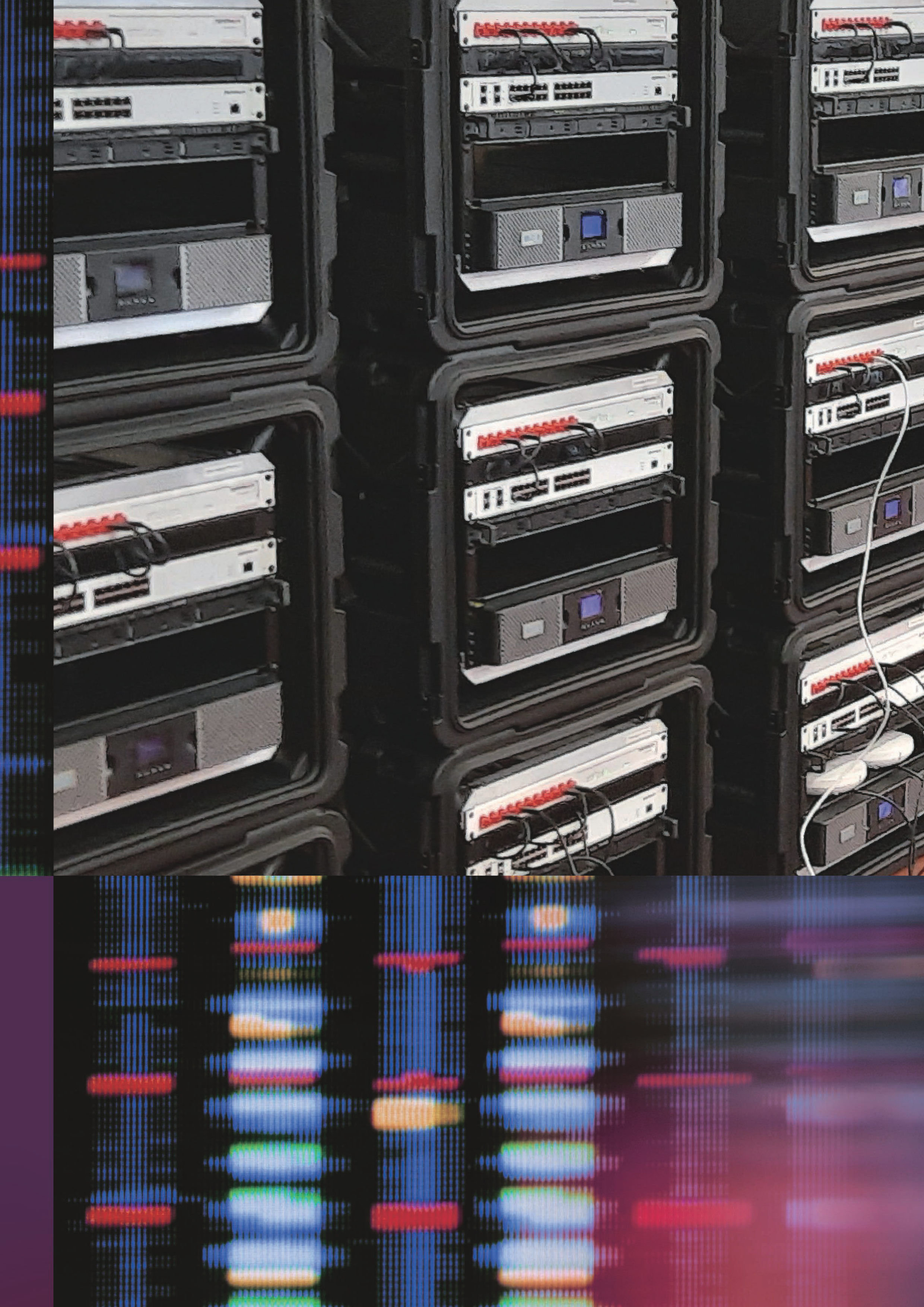
other emergency situations. The NGO
elevates the performance and security of
essential IT services with rugged Lenovo
ThinkSystem SE350 Edge servers, helping
field teams work more effectively and
deliver vital assistance to those who need
it most.




Lenovo Group Limited 2024/25 Annual Report
8
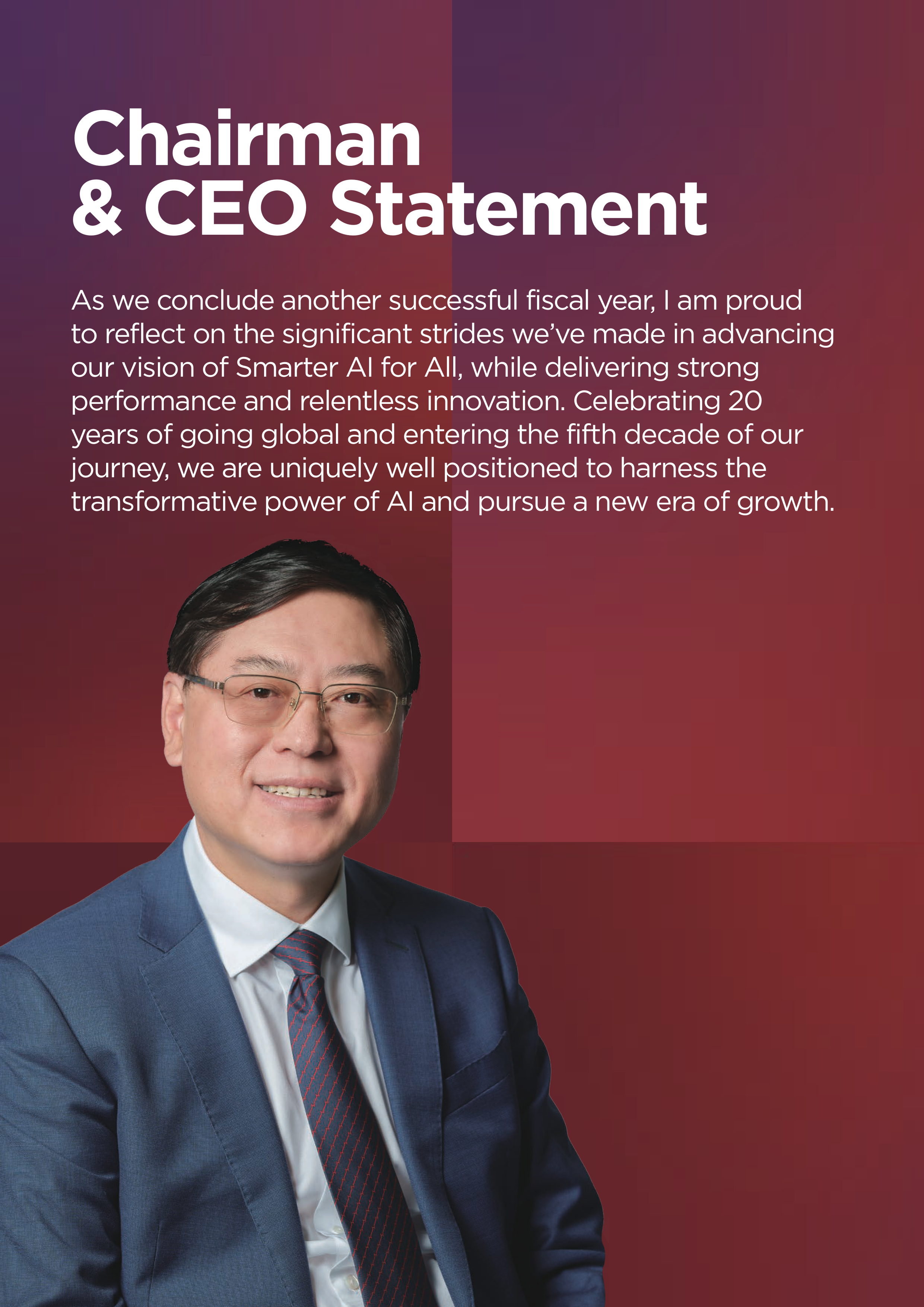
Chairman
& CEO Statement
As we conclude another successful fiscal year, I am proud
to reflect on the significant strides we’ve made in advancing
our vision of Smarter AI for All, while delivering strong
performance and relentless innovation. Celebrating 20
years of going global and entering the fifth decade of our
journey, we are uniquely well positioned to harness the
transformative power of AI and pursue a new era of growth.




Lenovo Group Limited 2024/25 Annual Report
9
One of Lenovo’s Best Years Ever
I am pleased to report that Lenovo just concluded one
of the best years in our history. Despite global political
and economic turbulence, we achieved substantial
revenue growth and increased profit
significantly year
on year. Even more, we strengthened our commitment
to innovation and kept raising the bar for operational
excellence.
Our smart devices business continued to lead the global
PC market with increased competitive advantage
and expanded rapidly and profitably in the global
smartphone market. Our smart infrastructure business
delivered hypergrowth, achieved breakeven in the
second half of the fiscal year, and is now turning into a
sustainably profitable business, driven by strong growth
in both cloud service provider segment and enterprise/
SMB segment. Additionally, our solutions and services
business delivered high growth and high profitability,
building new horizontal and vertical AI solutions while
unleashing Lenovo Hybrid AI Advantage.
Key to these successes is our commitment to
operational
excellence
, notably our unique ODM+ model, combining
in-house manufacturing with outsourced production to
give us cost competitiveness and better customization.
It also allows us to learn from industry best practices and
adopt the most advanced technologies and processes.
Our distinctive Global/Local model leverages global
resources in capital, talent, supply chain, manufacturing
as well as research and development, while delivering
the last mile of local sales, marketing, fulfillment, and
services to customers in 180 markets. This model helps
drive higher customer satisfaction, robust compliance,
deep community engagement, and more secure and
resilient operations.
Another critical factor behind our successful year is our
increased investment in
innovation
with a clear focus
on hybrid AI. In personal AI, Lenovo is already leading
the global AI PC race, introducing advanced AI agents
and innovative form factors that wowed the industry.
In enterprise AI, we have launched AI servers and
continued to lead the market with our Neptune liquid
cooling solutions. And Lenovo’s Hybrid AI Advantage
combines hybrid infrastructure, model factory, and agent
platform with AI services and applications to deliver
value to enterprise customers.




Lenovo Group Limited 2024/25 Annual Report
10
Chairman & CEO statement
Embracing Lenovo’s AI Decade
Looking ahead, I believe our fifth decade will be
Lenovo’s AI decade
.
Lenovo remains committed to a future defined by
hybrid AI
— integrating public, personal, and enterprise
AI to meet customer needs in terms of effectiveness,
efficiency, responsiveness, security and privacy
protection, and sustainability.
Our milestone AI PC product has transformed personal
computing into personalized AI. And the upcoming
generation will soon feature significantly improved on-
device AI inferencing capabilities. But we don’t stop
here. We are driving the next level of breakthroughs with
personal super AI agent, which features new capabilities
in perception and interaction, cognition and decisions,
and autonomy and evolution, creating a secure and
private AI experience for users and taking them one step
closer to personal AI twins.
In enterprise AI, Lenovo continues expanding hybrid
infrastructure by combining client devices, edge
computing, networks, and hybrid cloud environments.
This structure streamlines data collection, storage,
processing, and deployment of trained AI models.
Utilizing enterprise data, Lenovo develops functional and
vertical solutions through our model factory and agent
platform. When we put all these capabilities together,
and meet the requirements of security, compliance
and AI governance, we now have Lenovo Hybrid AI
Advantage. By fully unleashing the capabilities built
under Lenovo Hybrid AI Advantage, Lenovo has a
mission of building a variety of AI applications — or
“domain AI agents” — for all types of enterprises and
organizations. And collectively, all these domain AI
agents within an enterprise will form an enterprise
super AI agent. Furthermore, we are building enterprise
super AI agents, either as digital assistants or robots,
to command domain AI agents to access enterprise
knowledge, perform reasoning, orchestrate tasks and
proactively execute jobs, thus making enterprise AI twins
a much closer reality.






Lenovo Group Limited 2024/25 Annual Report
11
New Partnerships, Bigger Opportunities
Adding to this excitement are our new partnerships.
Lenovo’s recently announced Alat partnership is opening
doors for us to pursue growth in Saudi Arabia and the
Middle East/Africa region, while expanding our global
footprint and adding resilience into our supply chain.
Even more, built upon the success with our F1
partnership, Lenovo is now the official technology
partner for FIFA. Between F1 and FIFA, Lenovo powers
the most technologically advanced and popular sports
in the entire world — the perfect opportunity to show
the world what our technology and solutions can do.
This is a truly exciting time for Lenovo. Twenty years
after our first step of going global, we have built a unique
model that has proven to work at uncertain times. It will
guide to navigate any contextual challenges. With our
operational excellence, commitment to innovation, and
diverse and unified One Lenovo team around the world, I
am confident that our best days are yet to come, and we
will turn our vision into reality.
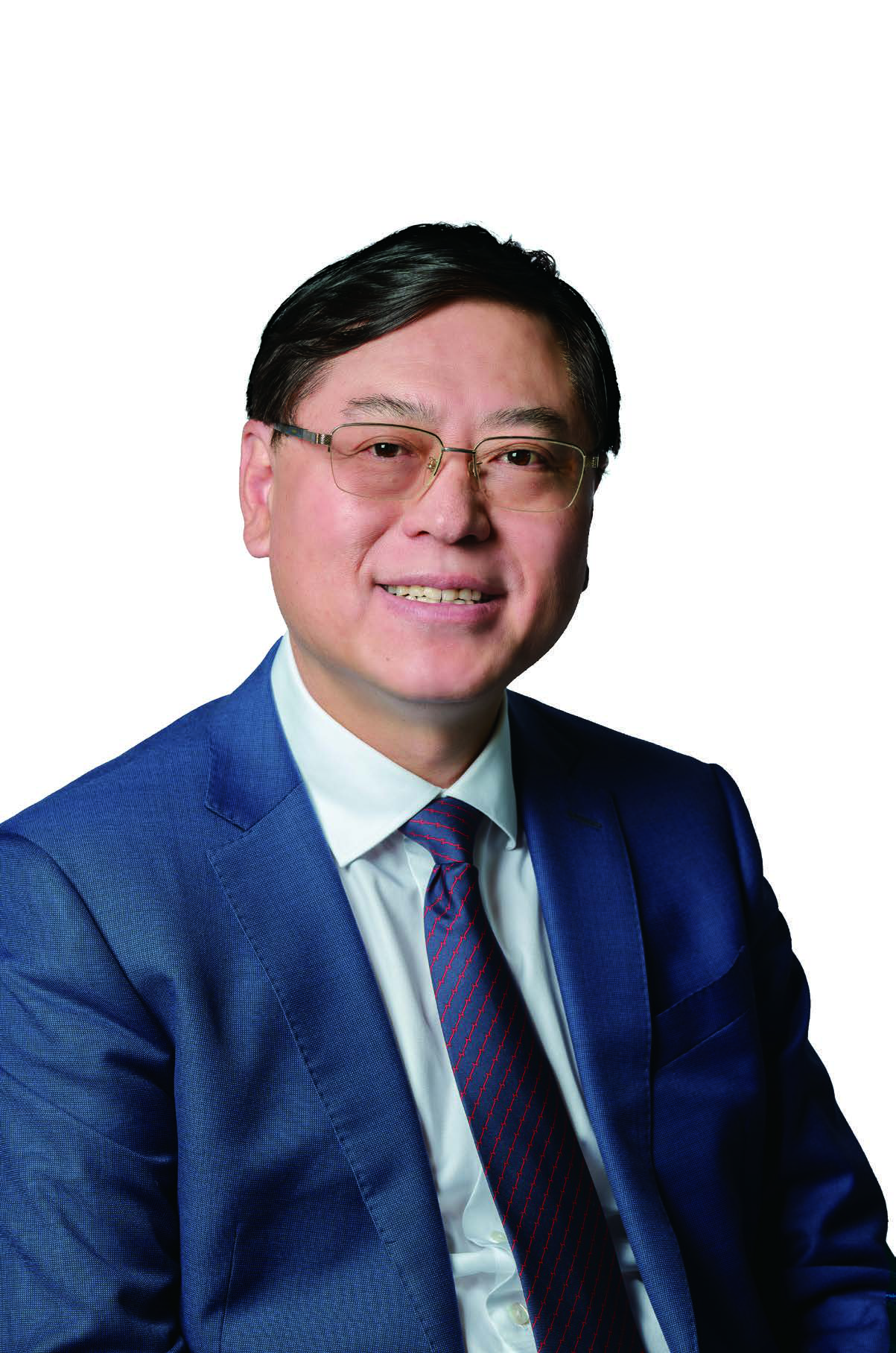
Yuanqing Yang
Chairman and CEO
Lenovo













Lenovo Group Limited 2024/25 Annual Report
12
Lenovo
management
team
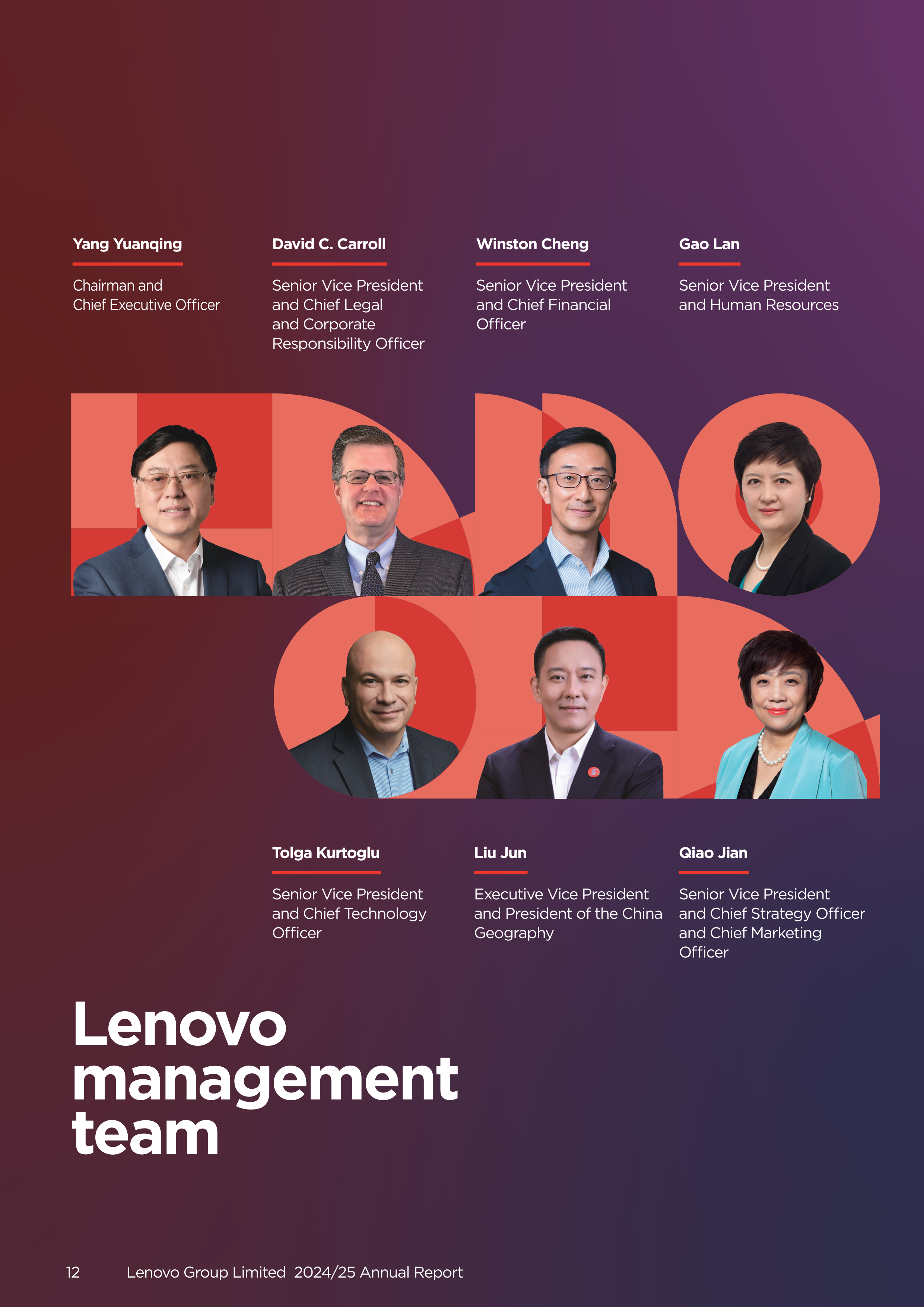
Yang Yuanqing
Chairman and
Chief Executive Officer
Gao Lan
Senior Vice President
and Human Resources
David C. Carroll
Senior Vice President
and Chief Legal
and Corporate
Responsibility Officer
Tolga Kurtoglu
Senior Vice President
and Chief Technology
Officer
Winston Cheng
Senior Vice President
and Chief Financial
Officer
Liu Jun
Executive Vice President
and President of the China
Geography
Qiao Jian
Senior Vice President
and Chief Strategy Officer
and Chief Marketing
Officer













Lenovo Group Limited 2024/25 Annual Report
13
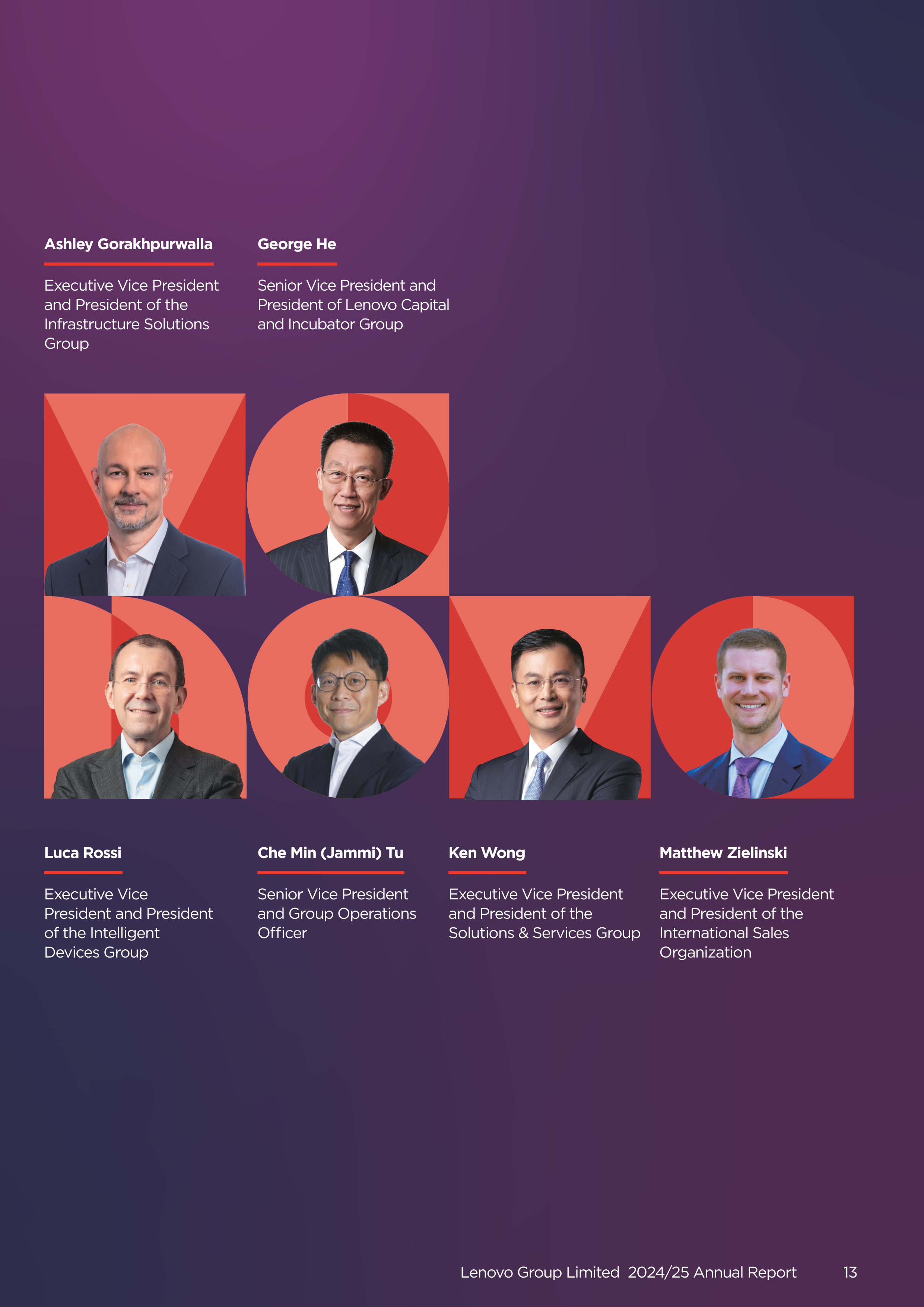
Matthew Zielinski
Executive Vice President
and President of the
International Sales
Organization
Che Min (Jammi) Tu
Senior Vice President
and Group Operations
Officer
Ken Wong
Executive Vice President
and President of the
Solutions & Services Group
Ashley Gorakhpurwalla
Executive Vice President
and President of the
Infrastructure Solutions
Group
Luca Rossi
Executive Vice
President and President
of the Intelligent
Devices Group
George He
Senior Vice President and
President of Lenovo Capital
and Incubator Group



Scan to learn more
Lenovo Group Limited 2024/25 Annual Report
14
Lenovo X MSG
Family kickoff
powerhouse
partnership
Partnering with Lenovo and Motorola, the
MSG Family of Companies is pushing the
boundaries of innovation in sports and
entertainment across their portfolio. As
part of the multi-year partnership, Lenovo
is an Official Partner of Madison Square
Garden, the Christmas Spectacular
Starring the Radio City Rockettes, and
the professional sports franchises the
New York Knicks and New York Rangers,
and receives brand inclusion across MSG
Networks. Motorola is an Official Partner
of Madison Square Garden, the New York
Knicks and New York Rangers.
The cornerstone of the partnership
between the MSG Family of Companies
and Lenovo is community engagement
– with initiatives focused on small
businesses and community organizations
through programming with both the
New York Knicks and the Christmas
Spectacular Starring the Radio City
Rockettes. The multi-faceted Motorola
partnership is anchored in high profile,
in-venue assets – specifically as the
exclusive title partner of Madison Square
Garden’s famed Celebrity Row.


LENOVO, THINKAGILE, and XClarity are trademarks of Lenovo. All other
trademarks are the property of their respective owners. ©2024 Lenovo


Management’s
discussion & analysis
Lenovo Group Limited 2024/25 Annual Report
16
Business review and outlook
Highlights
For the fiscal year ended March 31, 2025, Lenovo (the
Group) delivered solid financial results. The Group’s profit
attributable to equity holders increased by 37 percent
year-on-year, and revenue grew 21 percent to US$69
billion, marking its second highest annual sales. All three
Business Groups - Infrastructure Solutions Group (ISG),
Solutions and Services Group (SSG), and Intelligent
Devices Group (IDG) - achieved double-digit top-line
growth, with strong profit expansion for IDG and SSG
and significant loss reduction for ISG, fueled by Lenovo’s
emphasis on Hybrid AI, operational excellence, and
strategic execution.
The Group’s investments in building a comprehensive full-
stack AI portfolio, spanning infrastructure, edge devices
and services, were instrumental in seizing new market
opportunities. ISG, SSG and Smartphone delivered record-
breaking sales, reflecting the success of newly enriched
Hybrid AI offerings and continued strength in current
business franchises. IDG achieved double-digit year-on-
year revenue growth on higher market share and rising
premium sales in both PCs and smartphones. The Group
achieved balanced growth across regions, with Asia
Pacific, China, EMEA (Europe, Middle East, and Africa),
and Americas contributing 19 to 34 percent to total
revenue. In response to a complex and challenging trade
regulatory landscape, Lenovo has implemented strategic
measures to fortify its global operations, enhance business
agility, and ensure long-term growth.
Advancing overall profitability remains Lenovo’s top
priority, with all three Business Groups reporting improved
segment margins by harnessing their unique strengths
to drive efficiency and profitability. Non-HKFRS net
profit, which the Group believes is indicative of the core
operating results by excluding certain items, grew 36
percent year-on-year to US$1.4 billion. On an HKFRS
basis, profit attributable to equity holders, increased by 37
percent year-on-year to US$1.4 billion.
In the fiscal fourth quarter, our strategic partnership with
PIF/Alat took an important step forward as we gained
overwhelming shareholder support and obtained all
regulatory approvals to close on this landmark transaction.
Upon conversion, PIF/Alat will be the largest sovereign
wealth fund in the shareholder base. The successful
issuance of the US$2 billion zero-coupon convertible
bonds (CBs) to Alat and the US$212 million of warrants
marks a significant milestone, enabling the Group to
broaden its shareholder base, expand its global presence,
diversify its manufacturing footprint, and capture
substantial growth opportunities in the Middle East and
Africa regions.


Lenovo Group Limited 2024/25 Annual Report
17
These achievements underscore the Group’s commitment
to innovation. R&D spending rose 13 percent year-on-
year to US$2.3 billion. The Group made notable progress
in Personal AI, one of the two foundational aspects of
Hybrid AI, expanding from hardware design to advanced
software applications and services. The launch of the
“AI Now” agent enabled the creation of an ecosystem of
“One AI, multiple devices.” In Enterprise AI, the company
developed AI Super Agents for enterprises and smart
cities under the Hybrid AI Advantage solution, which
combined ISG’s full-stack capabilities and SSG’s AI library
to accelerate customers’ intelligent transformation.
The cash conversion cycle has increased by six days year-
on-year, primarily driven by longer inventory days. Higher
level of inventory is required in response to increased
demand, new product launches, and sales mix favoring
fast-growing ISG business. In particular, the high-growth AI
server business demanded costly components including
GPUs, leading to higher inventory balance.
The Group’s steadfast focus on corporate governance
and sustainability earned wide recognition. For the third
consecutive year, the Group secured an AAA rating in
the MSCI ESG Ratings and was included for the third
time in the annual CDP A List for Climate, highlighting its
commitment to environmental transparency and climate
action.
Group Financial Performance
The Group reported a 21 percent year-on-year sales
growth to US$69 billion, the second highest in its history.
Contributing to this was ISG’s 63 percent revenue growth,
driven by robust server orders, renewed enterprise
demand, and new customer acquisition. Meanwhile, SSG
saw a 13 percent year-on-year revenue increase to a new
record, propelled by strong demand for DWS (Digital
Workplace Solutions) and AI-powered solutions. IDG
achieved a 13 percent year-on-year sales increase, with
PC revenue benefiting from global market share gains,
revitalized commercial sales, and premium products,
including new AI PCs. Notably, its smartphone business
continued to secure market share in key markets, including
Asia Pacific and Europe. While Lenovo remains a leader
in the PC market, its diversification efforts have paid off,
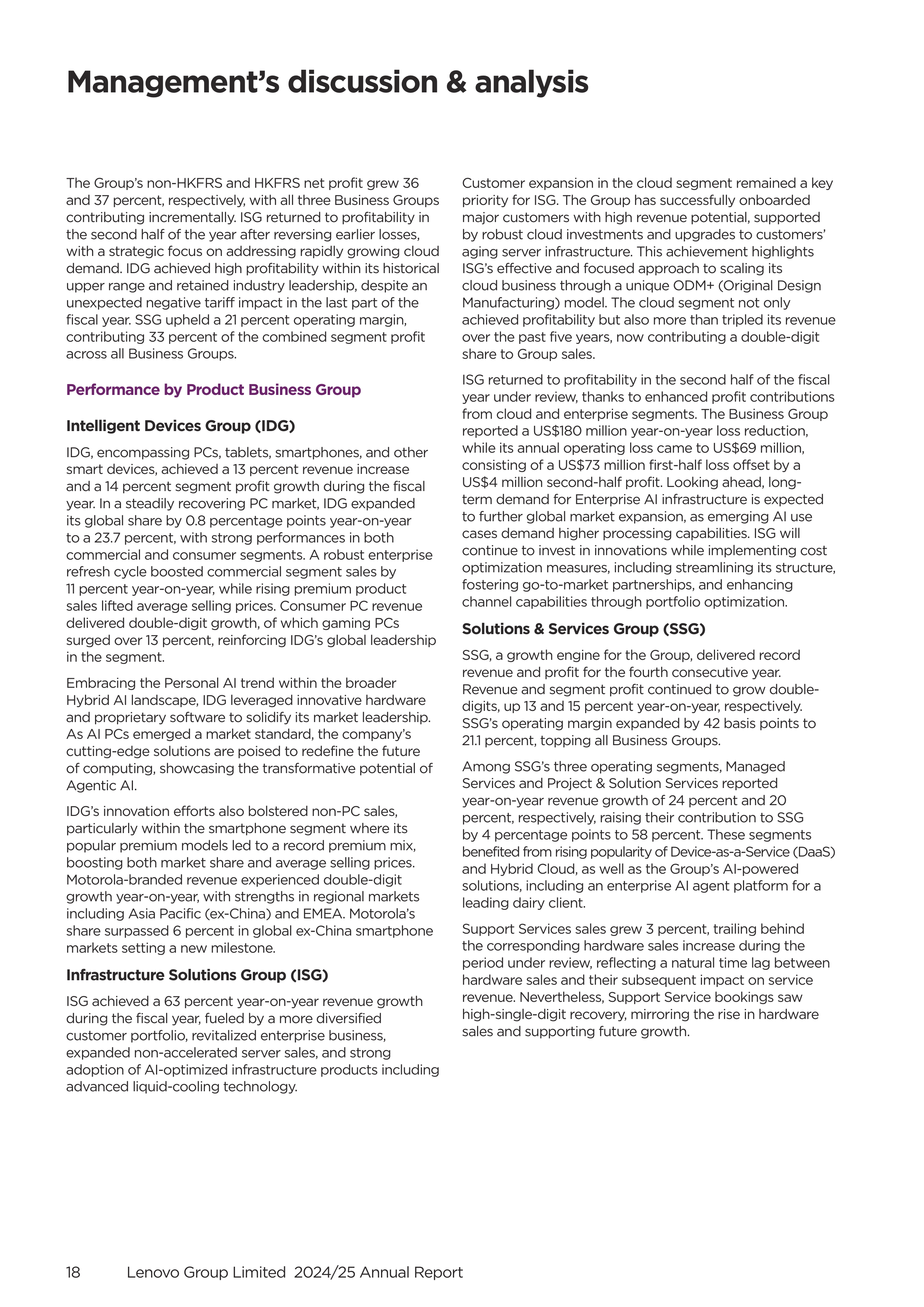
with non-PC revenue accounting for 47 percent of total
revenue across the three Business Groups.
Record-high Non-PC Revenue Contribution
1,2
2025
PC
Others
Smartphone
Infrastructure
Services
PC: 53%
Non-PC: 47%, +5 pts YoY
Notes:
1
Revenue before eliminations.
2
Non-PC revenue includes revenues from SSG, ISG and non-PC
part of IDG.
Management’s discussion & analysis
Lenovo Group Limited 2024/25 Annual Report
18
Customer expansion in the cloud segment remained a key
priority for ISG. The Group has successfully onboarded
major customers with high revenue potential, supported
by robust cloud investments and upgrades to customers’
aging server infrastructure. This achievement highlights
ISG’s effective and focused approach to scaling its
cloud business through a unique ODM+ (Original Design
Manufacturing) model. The cloud segment not only
achieved profitability but also more than tripled its revenue
over the past five years, now contributing a double-digit
share to Group sales.
ISG returned to profitability in the second half of the fiscal
year under review, thanks to enhanced profit contributions
from cloud and enterprise segments. The Business Group
reported a US$180 million year-on-year loss reduction,
while its annual operating loss came to US$69 million,
consisting of a US$73 million first-half loss offset by a
US$4 million second-half profit. Looking ahead, long-
term demand for Enterprise AI infrastructure is expected
to further global market expansion, as emerging AI use
cases demand higher processing capabilities. ISG will
continue to invest in innovations while implementing cost
optimization measures, including streamlining its structure,
fostering go-to-market partnerships, and enhancing
channel capabilities through portfolio optimization.
Solutions & Services Group (SSG)
SSG, a growth engine for the Group, delivered record
revenue and profit for the fourth consecutive year.
Revenue and segment profit continued to grow double-
digits, up 13 and 15 percent year-on-year, respectively.
SSG’s operating margin expanded by 42 basis points to
21.1 percent, topping all Business Groups.
Among SSG’s three operating segments, Managed
Services and Project & Solution Services reported
year-on-year revenue growth of 24 percent and 20
percent, respectively, raising their contribution to SSG
by 4 percentage points to 58 percent. These segments
benefited from rising popularity of Device-as-a-Service (DaaS)
and Hybrid Cloud, as well as the Group’s AI-powered
solutions, including an enterprise AI agent platform for a
leading dairy client.
Support Services sales grew 3 percent, trailing behind
the corresponding hardware sales increase during the
period under review, reflecting a natural time lag between
hardware sales and their subsequent impact on service
revenue. Nevertheless, Support Service bookings saw
high-single-digit recovery, mirroring the rise in hardware
sales and supporting future growth.
The Group’s non-HKFRS and HKFRS net profit grew 36
and 37 percent, respectively, with all three Business Groups
contributing incrementally. ISG returned to profitability in
the second half of the year after reversing earlier losses,
with a strategic focus on addressing rapidly growing cloud
demand. IDG achieved high profitability within its historical
upper range and retained industry leadership, despite an
unexpected negative tariff impact in the last part of the
fiscal year. SSG upheld a 21 percent operating margin,
contributing 33 percent of the combined segment profit
across all Business Groups.
Performance by Product Business Group
Intelligent Devices Group (IDG)
IDG, encompassing PCs, tablets, smartphones, and other
smart devices, achieved a 13 percent revenue increase
and a 14 percent segment profit growth during the fiscal
year. In a steadily recovering PC market, IDG expanded
its global share by 0.8 percentage points year-on-year
to a 23.7 percent, with strong performances in both
commercial and consumer segments. A robust enterprise
refresh cycle boosted commercial segment sales by
11 percent year-on-year, while rising premium product
sales lifted average selling prices. Consumer PC revenue
delivered double-digit growth, of which gaming PCs
surged over 13 percent, reinforcing IDG’s global leadership
in the segment.
Embracing the Personal AI trend within the broader
Hybrid AI landscape, IDG leveraged innovative hardware
and proprietary software to solidify its market leadership.
As AI PCs emerged a market standard, the company’s
cutting-edge solutions are poised to redefine the future
of computing, showcasing the transformative potential of
Agentic AI.
IDG’s innovation efforts also bolstered non-PC sales,
particularly within the smartphone segment where its
popular premium models led to a record premium mix,
boosting both market share and average selling prices.
Motorola-branded revenue experienced double-digit
growth year-on-year, with strengths in regional markets
including Asia Pacific (ex-China) and EMEA. Motorola’s
share surpassed 6 percent in global ex-China smartphone
markets setting a new milestone.
Infrastructure Solutions Group (ISG)
ISG achieved a 63 percent year-on-year revenue growth
during the fiscal year, fueled by a more diversified
customer portfolio, revitalized enterprise business,
expanded non-accelerated server sales, and strong
adoption of AI-optimized infrastructure products including
advanced liquid-cooling technology.
Lenovo Group Limited 2024/25 Annual Report
19
Outlook and Strategic Highlights
Lenovo leverages its experience to navigate market
uncertainties, achieving consistent growth through
operational excellence and innovation. These strengths
are essential to capitalizing on the expanding Hybrid AI
market, which is expected to grow despite economic
fluctuations. Future investments will bolster Lenovo’s
leadership and drive sustained growth in a dynamic
tech landscape. Advanced global operations and
manufacturing initiatives will enhance resilience against
market shifts, ensuring agility and sustainable growth.
IDG’s latest AI-powered innovations are redefining next-
generation devices, including AI PCs. AI NOW intelligent
agent offers fast, secure on-device AI features using
heterogeneous computing. ThinkShield filters harmful
content for a safe environment, while Smart Connect
enables seamless data management across multiple
devices. Technologies like Lenovo Creator Zone and
Lenovo Learning Zone strengthen IDG’s global leadership
in the AI PCs. Legion Space optimizes gaming device
synchronization across its ecosystem. In smartphones,
Motorola’s premium Razr and Edge models enhance moto
ai capabilities with Large Action Models.
ISG drives on innovation, diversification, and operational
excellence to strengthen its leadership in Hybrid AI
while achieving sustainable growth and profitability. It
collaborates with ecosystem partners to develop advanced
AI solutions for AI-driven applications and traditional
compute workloads. Its ODM+ business model, featuring
liquid-cooling technology, supports diversification into
areas such as storage while expands growth in cloud
business and enterprise opportunities.
SSG leverages its hardware expertise to offer cost-
effective AI-powered IT services. It integrates AI into key
offerings including Digital Workplace, Hybrid Cloud, and
Sustainability solutions, creating impactful and resilient
solutions. SSG’s AI Fast Start services helps enterprises
quickly adopt AI with access to proven use cases and
expert guidance.
Geographic Performance
With a global presence across 180 markets, Lenovo
leverages its diversified market exposure to achieve
balanced growth across all geographical markets. In Asia
Pacific, excluding China, revenue rose 29 percent year-
on-year, driven by strong momentum across all Business
Groups. IDG’s targeted initiatives aimed at enhancing
market penetration boded well with Japan’s Windows 11
refresh, growing interest in gaming PCs, and smartphone
market share gains. ISG witnessed strong demand for
its industry-leading liquid cooling technology, while SSG
benefited from growing demand for DaaS and IaaS
(Infrastructure-as-a-Service).
In China, sales surged by 26 percent year-on-year, mainly
fueled by ISG’s market share gains through an enhanced
infrastructure portfolio. PC sales in the SMB segment
recovered strongly, showcasing the Group’s resilient
efforts in driving premium sales. Additionally, SSG secured
multiple DaaS case wins to deliver AI solutions to industry-
leading customers.
In the Americas, the Group’s revenue climbed by 19
percent year-on-year. ISG delivered robust growth,
underscoring its core strengths in meeting large customer
demand for AI GPU solutions with leading liquid-cooling
technology. Premium smartphones and PCs continued to
drive market share gains for IDG. SSG saw high growth in
Hybrid Cloud Services including IaaS.
The EMEA market experienced a 16 percent year-on-
year sales increase, with IDG and SSG maintaining strong
momentum. Within IDG, market share gains in multiple
European countries for PCs and smartphones were a
strong growth catalyst. SSG signed its largest-ever DWS
services contract in the region and saw strong momentum
on ESG services including ARS (Asset Recovery Service).
ISG thrived on heightened demand from major cloud
customers, who are building local data centers to meet
booming demand and regional data security regulations.
Management’s discussion & analysis
Lenovo Group Limited 2024/25 Annual Report
20
FY24/25 validated the foresight and effectiveness of our
strategy. Lenovo today stands on a more solid and future-
ready foundation.
1)
We are the pioneer in Hybrid AI
2)
All business groups are on positive trajectory — with
core business expanding leadership, growth engines
scaling, and transformation business delivering
profitable growth
3)
We extended strategically significant partnerships, e.g.,
our partnership with Alat, further strengthening our
global/local model
4)
Our foundational pillars for long-term success —
global supply chain, R&D, Digitalization, and One
Lenovo — are stronger than ever
Looking ahead, we face macro environment uncertainties
and a volatile geopolitical landscape. However, we are
confident that with our solid foundations, we are well-
positioned to navigate external uncertainties and stay
competitive to lead in the Hybrid AI era.
Human resources
By the end of FY2024/25, the Group had a headcount of
approximately 72,000 worldwide. The Group implements
remuneration policy, bonus, employee share purchase
plan and long-term incentive scheme with reference to
the performance of the Group and individual employees.
The Group also provides benefits such as insurance,
medical and retirement funds to employees to sustain
competitiveness of the Group.
Corporate strategy highlights
Guided by our mission to be the Leader and Enabler of
Intelligent Transformation, Lenovo has deepened our
“3S strategy” (Smart IoT, Smart Infrastructure, Smart
Solutions), incorporating AI in our corporate strategy.
Our strategic foresight and operational excellence proved
highly effective. We not only delivered robust performance
in FY24/25, but also established Lenovo as an industry
pioneer in Hybrid AI.
In Smart IoT, we further expanded our leadership position
with our innovative product design and operational
excellence. Lenovo is clearly leading in AI PC, not only in
terms of market share, but also by establishing 5-feature
AI PC standard. 5-feature AI PCs with a personal
intelligent agent, compressed local LLM, heterogenous
computing, security protection, and an AI ecosystem.
In MBG, we continued to execute our three-year growth
plan, achieving #5 position outside China in the 2H
with robust growth momentum throughout the year.
Building on this foundation, we will build “One Personal
AI, multiple devices” to achieve seamless cross-device,
cross-ecosystem AI experience. Smart Connect will be the
key enabler, seamlessly bridging the global ecosystems
of Windows, Android, and iOS to deliver a unified, cross-
device AI experience.
In Smart Infrastructure, our strategy to leverage our ODM+
model to scale Cloud Service Provider segment (CSP) and
empower Enterprise and Small-Medium Business segment
(ESMB) has proven highly effective. In the past year, we
have turned the business to profitable and delivered
hypergrowth. At the same time, we continued to lead in
critical AI technology such as the Neptune liquid cooling,
which will enable us to capture the rising AI infrastructure
demand.
Smart Solutions continued to serve as the key margin
contributor, delivering high-margin and solid growth
throughout the year. Our strategy of building Horizontal
Building Blocks has brought profitable growth across
DWS, Hybrid Cloud, and Sustainability. We launched
Hybrid AI Advantage, a suite of Enterprise AI solutions,
which will help us to capitalize on Enterprise Hybrid AI
growth.
Lenovo Group Limited 2024/25 Annual Report
21
These risks are not exhaustive. Like all global enterprises,
Lenovo is also exposed to general business risks not
individually detailed here. Furthermore, the nature and
significance of risks may evolve over time due to changes
in market conditions, technology, regulatory requirements,
or the Group’s global operations.
These risks are embedded within Lenovo’s broader
governance, compliance, and internal control frameworks,
ensuring they are proactively identified, assessed, and
managed at all levels of the organization.
Lenovo group material risks
Effective risk management is essential to Lenovo Group’s
long-term success, particularly in today’s dynamic and
increasingly complex business environment.
This section highlights the key risks the Group considers
material — those that could significantly affect its
operations, financial performance, or strategic objectives.
Each risk includes a summary of its potential impact and
the mitigation strategies the Group has in place.
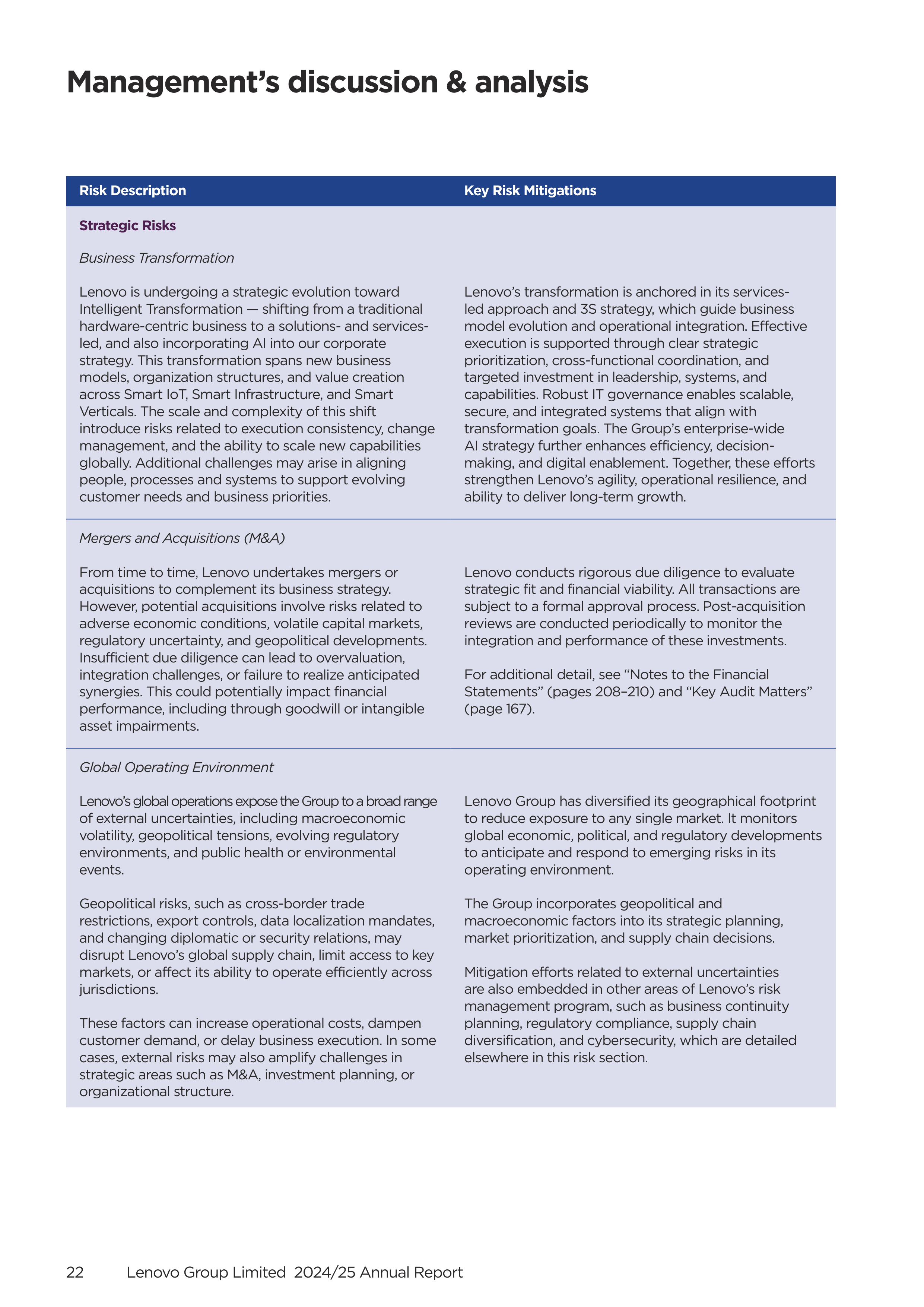
Risk Description
Key Risk Mitigations
Strategic Risks
Competition
Lenovo operates in a highly competitive industry
characterized by rapid technological advances in
hardware, software and services, as well as evolving
customer preferences. The Group faces strong
competition in product offerings, pricing, and innovation
from both established players and new market entrants.
Failure to differentiate effectively or respond to
competitive pressures could adversely affect market
share and profitability.
The Group closely monitors market trends and
competitive dynamics. It invests in research and
development (R&D) to enhance product innovation and
differentiation, broadens its portfolio of products and
services, strengthens brand positioning, and prioritizes
customer experience to support business growth.
Innovation
Continual innovation is critical to Lenovo’s
competitiveness and long-term growth. In an
environment of fast-moving technology, the inability to
introduce new products in a timely and cost-effective
manner, or to meet evolving customer needs, may
weaken the Group’s market position and constrain
future revenue growth. Rapid advancements in
Artificial Intelligence (AI) further intensifies competitive
pressures, requiring Lenovo to innovate at scale to
remain a leader in an increasingly intelligent technology
ecosystem.
Innovation is embedded in Lenovo’s strategy and
supported by sustained R&D investment and a focus
on delivering solutions that reflect real-world customer
needs. The Group’s Service-led Transformation and 3S
strategy (Smart IoT, Smart Infrastructure and Smart
Verticals) guide product innovation and intelligent
transformation across its solutions and business
operations. This integrated approach enables Lenovo to
deliver value-added, future-ready offerings aligned with
evolving customer needs. Strategic partnerships further
enhance the Group’s innovation capabilities.
In response to the rapid expansion and immense
potential of the global AI market, Lenovo has built a
strong portfolio of AI-enabled products and solutions
and is advancing its long-term strategic vision, “Smarter
AI for All”, through significant investments and a
focused commitment to delivering transparent, secure,
and personalized AI solutions. This vision is underpinned
by Lenovo’s Hybrid AI strategy, which integrates AI
across Lenovo’s portfolio—from client to edge, to
cloud and network—enhancing product functionality,
competitiveness, and customer value.
Management’s discussion & analysis
Lenovo Group Limited 2024/25 Annual Report
22
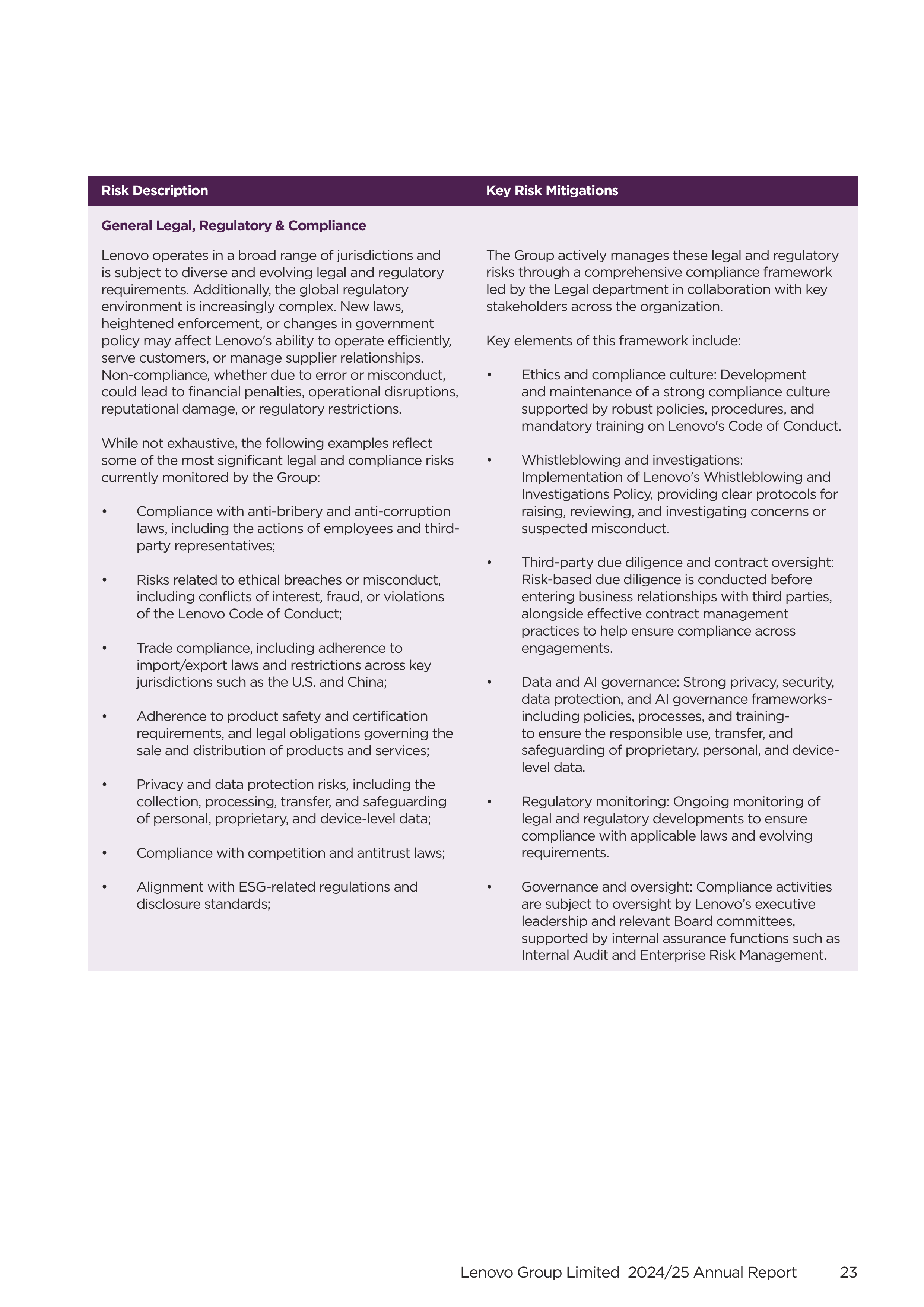
Risk Description
Key Risk Mitigations
Strategic Risks
Business Transformation
Lenovo is undergoing a strategic evolution toward
Intelligent Transformation — shifting from a traditional
hardware-centric business to a solutions- and services-
led, and also incorporating AI into our corporate
strategy. This transformation spans new business
models, organization structures, and value creation
across Smart IoT, Smart Infrastructure, and Smart
Verticals. The scale and complexity of this shift
introduce risks related to execution consistency, change
management, and the ability to scale new capabilities
globally. Additional challenges may arise in aligning
people, processes and systems to support evolving
customer needs and business priorities.
Lenovo’s transformation is anchored in its services-
led approach and 3S strategy, which guide business
model evolution and operational integration. Effective
execution is supported through clear strategic
prioritization, cross-functional coordination, and
targeted investment in leadership, systems, and
capabilities. Robust IT governance enables scalable,
secure, and integrated systems that align with
transformation goals. The Group’s enterprise-wide
AI strategy further enhances efficiency, decision-
making, and digital enablement. Together, these efforts
strengthen Lenovo’s agility, operational resilience, and
ability to deliver long-term growth.
Mergers and Acquisitions (M&A)
From time to time, Lenovo undertakes mergers or
acquisitions to complement its business strategy.
However, potential acquisitions involve risks related to
adverse economic conditions, volatile capital markets,
regulatory uncertainty, and geopolitical developments.
Insufficient due diligence can lead to overvaluation,
integration challenges, or failure to realize anticipated
synergies. This could potentially impact financial
performance, including through goodwill or intangible
asset impairments.
Lenovo conducts rigorous due diligence to evaluate
strategic fit and financial viability. All transactions are
subject to a formal approval process. Post-acquisition
reviews are conducted periodically to monitor the
integration and performance of these investments.
For additional detail, see “Notes to the Financial
Statements” (pages 208–210) and “Key Audit Matters”
(page 167).
Global Operating Environment
Lenovo’s global operations expose the Group to a broad range
of external uncertainties, including macroeconomic
volatility, geopolitical tensions, evolving regulatory
environments, and public health or environmental
events.
Geopolitical risks, such as cross-border trade
restrictions, export controls, data localization mandates,
and changing diplomatic or security relations, may
disrupt Lenovo’s global supply chain, limit access to key
markets, or affect its ability to operate efficiently across
jurisdictions.
These factors can increase operational costs, dampen
customer demand, or delay business execution. In some
cases, external risks may also amplify challenges in
strategic areas such as M&A, investment planning, or
organizational structure.
Lenovo Group has diversified its geographical footprint
to reduce exposure to any single market. It monitors
global economic, political, and regulatory developments
to anticipate and respond to emerging risks in its
operating environment.
The Group incorporates geopolitical and
macroeconomic factors into its strategic planning,
market prioritization, and supply chain decisions.
Mitigation efforts related to external uncertainties
are also embedded in other areas of Lenovo’s risk
management program, such as business continuity
planning, regulatory compliance, supply chain
diversification, and cybersecurity, which are detailed
elsewhere in this risk section.
Lenovo Group Limited 2024/25 Annual Report
23
Risk Description
Key Risk Mitigations
General Legal, Regulatory & Compliance
Lenovo operates in a broad range of jurisdictions and
is subject to diverse and evolving legal and regulatory
requirements. Additionally, the global regulatory
environment is increasingly complex. New laws,
heightened enforcement, or changes in government
policy may affect Lenovo's ability to operate efficiently,
serve customers, or manage supplier relationships.
Non-compliance, whether due to error or misconduct,
could lead to financial penalties, operational disruptions,
reputational damage, or regulatory restrictions.
While not exhaustive, the following examples reflect
some of the most significant legal and compliance risks
currently monitored by the Group:
•
Compliance with anti-bribery and anti-corruption
laws, including the actions of employees and third-
party representatives;
•
Risks related to ethical breaches or misconduct,
including conflicts of interest, fraud, or violations
of the Lenovo Code of Conduct;
•
Trade compliance, including adherence to
import/export laws and restrictions across key
jurisdictions such as the U.S. and China;
•
Adherence to product safety and certification
requirements, and legal obligations governing the
sale and distribution of products and services;
•
Privacy and data protection risks, including the
collection, processing, transfer, and safeguarding
of personal, proprietary, and device-level data;
•
Compliance with competition and antitrust laws;
•
Alignment with ESG-related regulations and
disclosure standards;
The Group actively manages these legal and regulatory
risks through a comprehensive compliance framework
led by the Legal department in collaboration with key
stakeholders across the organization.
Key elements of this framework include:
•
Ethics and compliance culture: Development
and maintenance of a strong compliance culture
supported by robust policies, procedures, and
mandatory training on Lenovo's Code of Conduct.
•
Whistleblowing and investigations:
Implementation of Lenovo's Whistleblowing and
Investigations Policy, providing clear protocols for
raising, reviewing, and investigating concerns or
suspected misconduct.
•
Third-party due diligence and contract oversight:
Risk-based due diligence is conducted before
entering business relationships with third parties,
alongside effective contract management
practices to help ensure compliance across
engagements.
•
Data and AI governance: Strong privacy, security,
data protection, and AI governance frameworks-
including policies, processes, and training-
to ensure the responsible use, transfer, and
safeguarding of proprietary, personal, and device-
level data.
•
Regulatory monitoring: Ongoing monitoring of
legal and regulatory developments to ensure
compliance with applicable laws and evolving
requirements.
•
Governance and oversight: Compliance activities
are subject to oversight by Lenovo’s executive
leadership and relevant Board committees,
supported by internal assurance functions such as
Internal Audit and Enterprise Risk Management.
Management’s discussion & analysis
Lenovo Group Limited 2024/25 Annual Report
24
Risk Description
Key Risk Mitigations
General Legal, Regulatory & Compliance
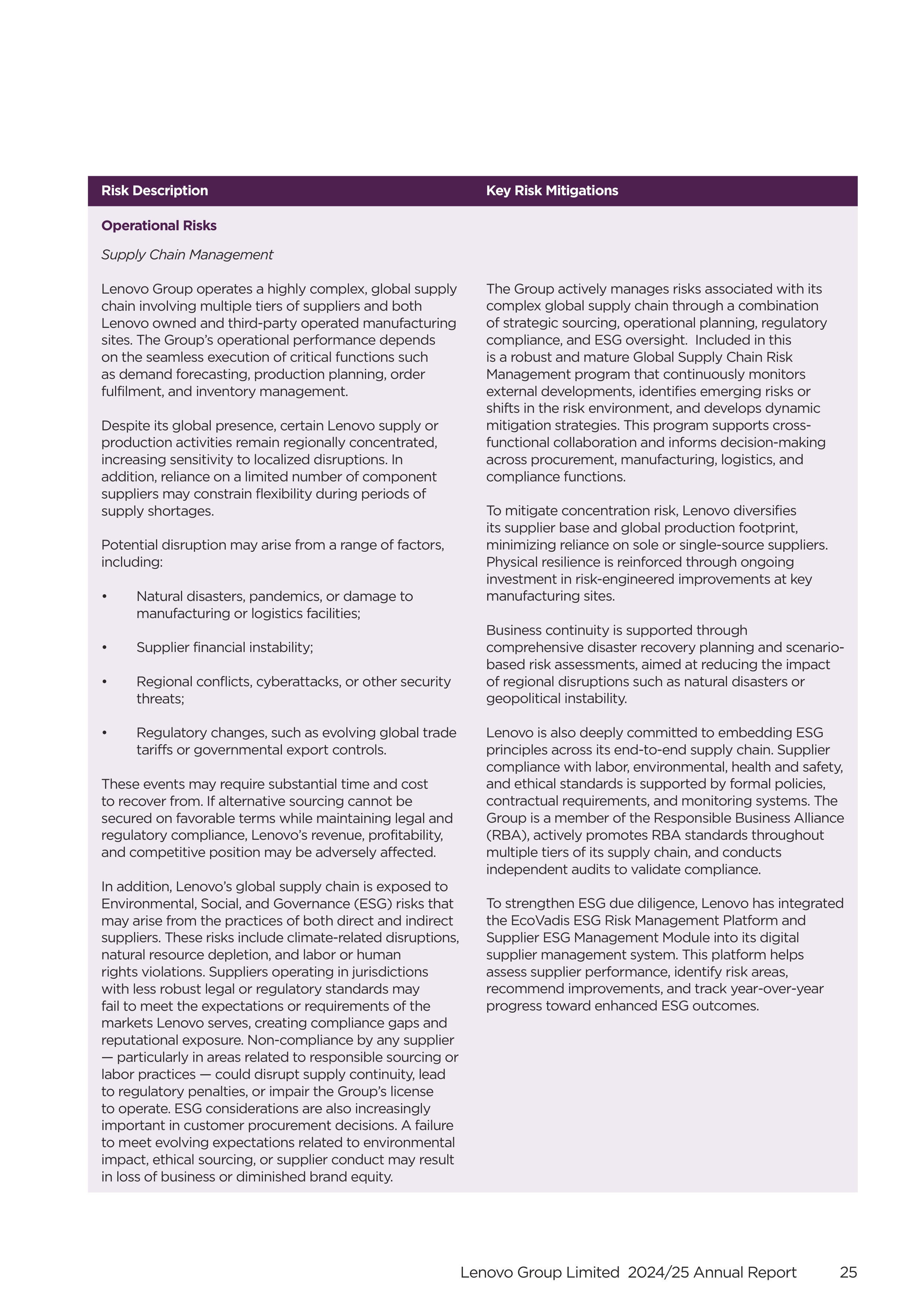
Artificial Intelligence (AI) Compliance
Artificial Intelligence (AI) is fundamentally reshaping
the global technology landscape. As the use of AI
accelerates, governments and regulators worldwide
are focused on how these technologies are developed,
deployed and governed.
In this rapidly evolving environment, the Group
faces risks related to the alignment of the usage of
AI in products, services and internal operations with
emerging laws, standards, and ethical expectations.
Non-compliance may lead to loss of market access,
legal or regulatory sanctions, reputational damage, or
reduced customer trust and adoption.
The Group recognizes that realizing its “Smarter AI
for All” vision depends on the responsible, ethical, and
secure development, deployment, and use of AI. To
support this, Lenovo is committed to structured conduct
standards for employees, centralized governance
and oversight, and transparency in the development,
deployment, sale and internal use of AI technologies.
Foundational AI governance and compliance practices
are in place across the organization. The Group is
now advancing toward a unified, enterprise-wide
governance framework, led by the Chief Security and AI
Officer in collaboration with the Legal team and other
key stakeholders. This initiative ensures alignment with
global standards and Lenovo’s principles for responsible
AI.
Lenovo Group Limited 2024/25 Annual Report
25
Risk Description
Key Risk Mitigations
Operational Risks
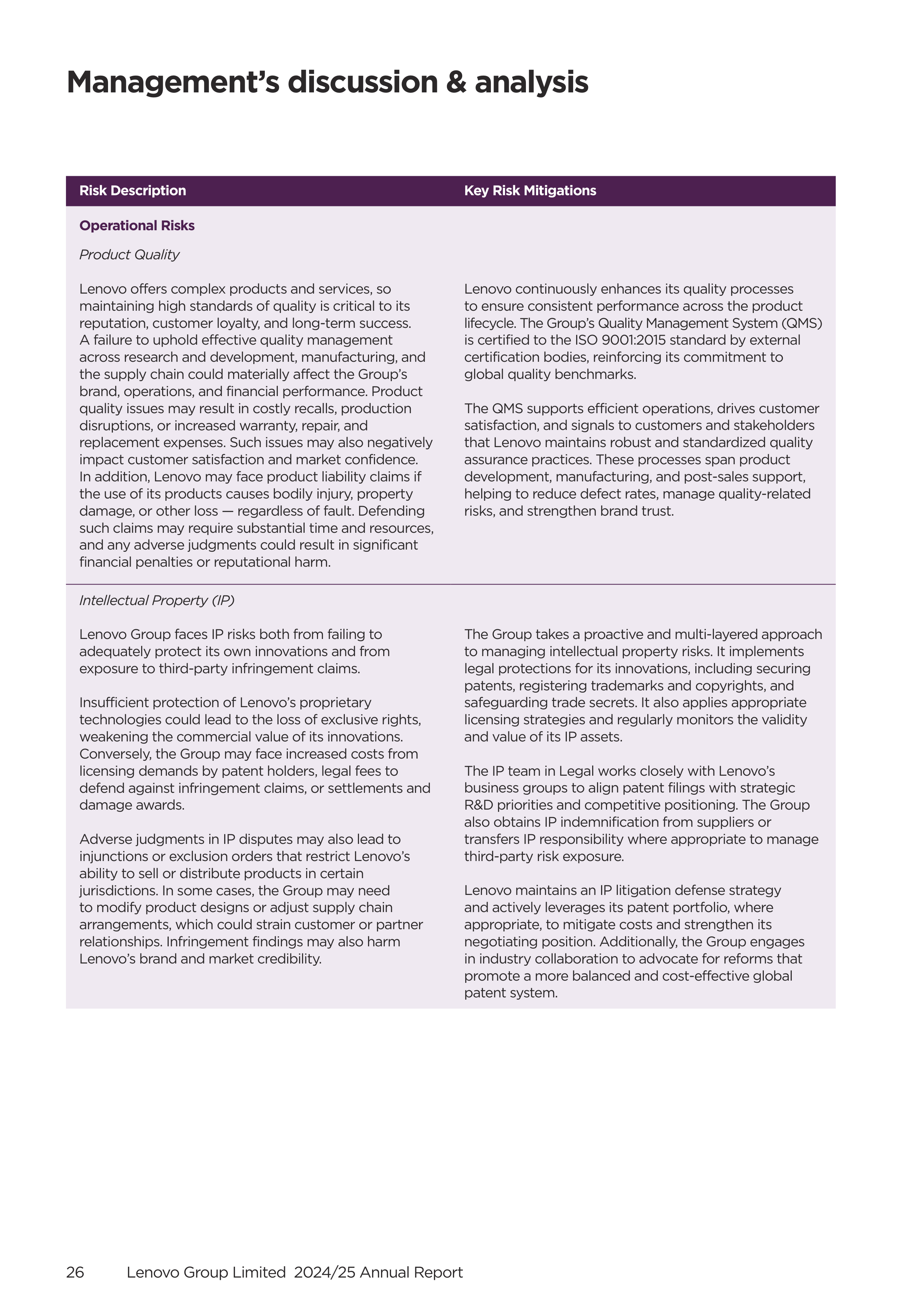
Supply Chain Management
Lenovo Group operates a highly complex, global supply
chain involving multiple tiers of suppliers and both
Lenovo owned and third-party operated manufacturing
sites. The Group’s operational performance depends
on the seamless execution of critical functions such
as demand forecasting, production planning, order
fulfilment, and inventory management.
Despite its global presence, certain Lenovo supply or
production activities remain regionally concentrated,
increasing sensitivity to localized disruptions. In
addition, reliance on a limited number of component
suppliers may constrain flexibility during periods of
supply shortages.
Potential disruption may arise from a range of factors,
including:
•
Natural disasters, pandemics, or damage to
manufacturing or logistics facilities;
•
Supplier financial instability;
•
Regional conflicts, cyberattacks, or other security
threats;
•
Regulatory changes, such as evolving global trade
tariffs or governmental export controls.
These events may require substantial time and cost
to recover from. If alternative sourcing cannot be
secured on favorable terms while maintaining legal and
regulatory compliance, Lenovo’s revenue, profitability,
and competitive position may be adversely affected.
In addition, Lenovo’s global supply chain is exposed to
Environmental, Social, and Governance (ESG) risks that
may arise from the practices of both direct and indirect
suppliers. These risks include climate-related disruptions,
natural resource depletion, and labor or human
rights violations. Suppliers operating in jurisdictions
with less robust legal or regulatory standards may
fail to meet the expectations or requirements of the
markets Lenovo serves, creating compliance gaps and
reputational exposure. Non-compliance by any supplier
— particularly in areas related to responsible sourcing or
labor practices — could disrupt supply continuity, lead
to regulatory penalties, or impair the Group’s license
to operate. ESG considerations are also increasingly
important in customer procurement decisions. A failure
to meet evolving expectations related to environmental
impact, ethical sourcing, or supplier conduct may result
in loss of business or diminished brand equity.
The Group actively manages risks associated with its
complex global supply chain through a combination
of strategic sourcing, operational planning, regulatory
compliance, and ESG oversight. Included in this
is a robust and mature Global Supply Chain Risk
Management program that continuously monitors
external developments, identifies emerging risks or
shifts in the risk environment, and develops dynamic
mitigation strategies. This program supports cross-
functional collaboration and informs decision-making
across procurement, manufacturing, logistics, and
compliance functions.
To mitigate concentration risk, Lenovo diversifies
its supplier base and global production footprint,
minimizing reliance on sole or single-source suppliers.
Physical resilience is reinforced through ongoing
investment in risk-engineered improvements at key
manufacturing sites.
Business continuity is supported through
comprehensive disaster recovery planning and scenario-
based risk assessments, aimed at reducing the impact
of regional disruptions such as natural disasters or
geopolitical instability.
Lenovo is also deeply committed to embedding ESG
principles across its end-to-end supply chain. Supplier
compliance with labor, environmental, health and safety,
and ethical standards is supported by formal policies,
contractual requirements, and monitoring systems. The
Group is a member of the Responsible Business Alliance
(RBA), actively promotes RBA standards throughout
multiple tiers of its supply chain, and conducts
independent audits to validate compliance.
To strengthen ESG due diligence, Lenovo has integrated
the EcoVadis ESG Risk Management Platform and
Supplier ESG Management Module into its digital
supplier management system. This platform helps
assess supplier performance, identify risk areas,
recommend improvements, and track year-over-year
progress toward enhanced ESG outcomes.
Management’s discussion & analysis
Lenovo Group Limited 2024/25 Annual Report
26
Risk Description
Key Risk Mitigations
Operational Risks
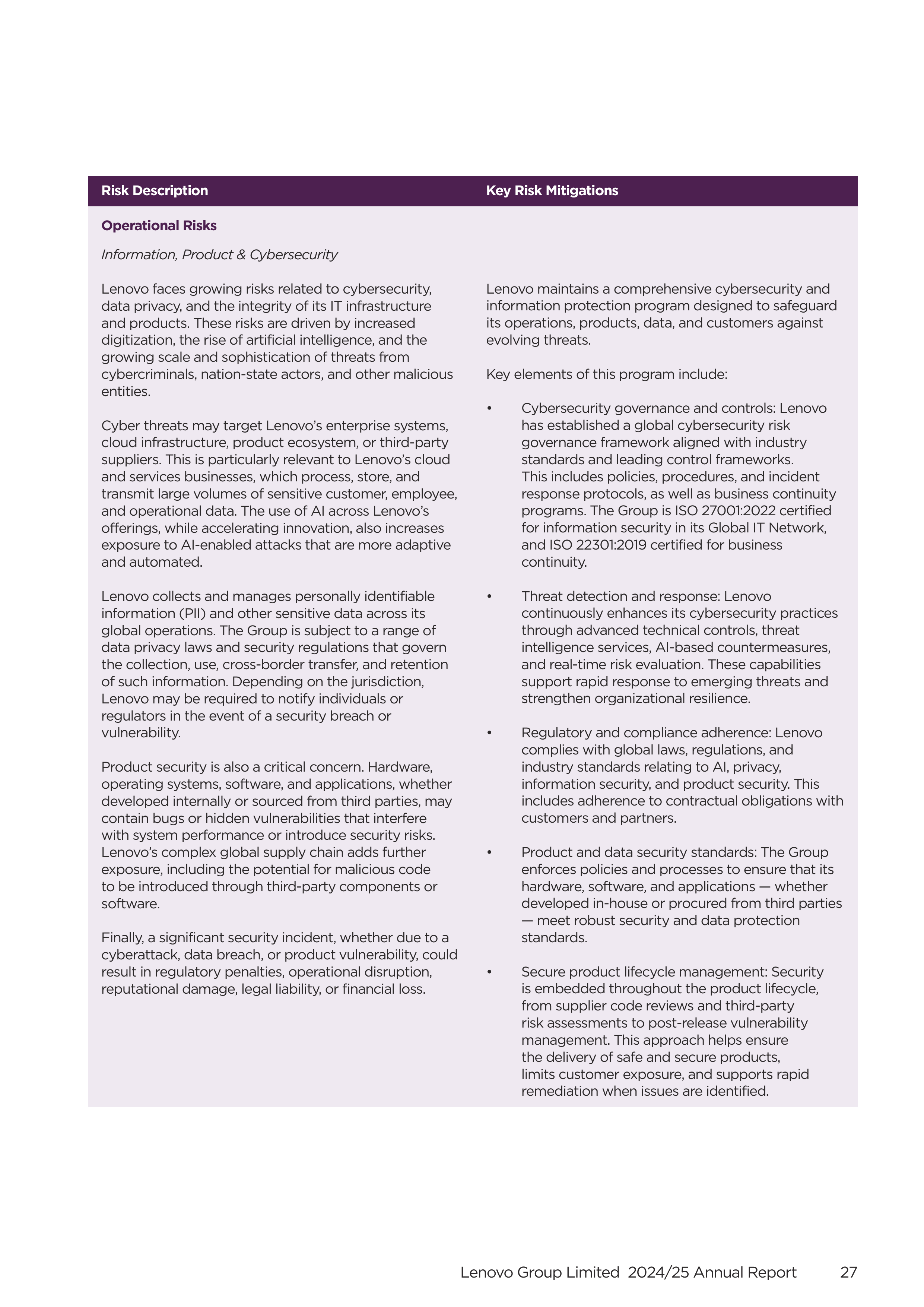
Product Quality
Lenovo offers complex products and services, so
maintaining high standards of quality is critical to its
reputation, customer loyalty, and long-term success.
A failure to uphold effective quality management
across research and development, manufacturing, and
the supply chain could materially affect the Group’s
brand, operations, and financial performance. Product
quality issues may result in costly recalls, production
disruptions, or increased warranty, repair, and
replacement expenses. Such issues may also negatively
impact customer satisfaction and market confidence.
In addition, Lenovo may face product liability claims if
the use of its products causes bodily injury, property
damage, or other loss — regardless of fault. Defending
such claims may require substantial time and resources,
and any adverse judgments could result in significant
financial penalties or reputational harm.
Lenovo continuously enhances its quality processes
to ensure consistent performance across the product
lifecycle. The Group’s Quality Management System (QMS)
is certified to the ISO 9001:2015 standard by external
certification bodies, reinforcing its commitment to
global quality benchmarks.
The QMS supports efficient operations, drives customer
satisfaction, and signals to customers and stakeholders
that Lenovo maintains robust and standardized quality
assurance practices. These processes span product
development, manufacturing, and post-sales support,
helping to reduce defect rates, manage quality-related
risks, and strengthen brand trust.
Intellectual Property (IP)
Lenovo Group faces IP risks both from failing to
adequately protect its own innovations and from
exposure to third-party infringement claims.
Insufficient protection of Lenovo’s proprietary
technologies could lead to the loss of exclusive rights,
weakening the commercial value of its innovations.
Conversely, the Group may face increased costs from
licensing demands by patent holders, legal fees to
defend against infringement claims, or settlements and
damage awards.
Adverse judgments in IP disputes may also lead to
injunctions or exclusion orders that restrict Lenovo’s
ability to sell or distribute products in certain
jurisdictions. In some cases, the Group may need
to modify product designs or adjust supply chain
arrangements, which could strain customer or partner
relationships. Infringement findings may also harm
Lenovo’s brand and market credibility.
The Group takes a proactive and multi-layered approach
to managing intellectual property risks. It implements
legal protections for its innovations, including securing
patents, registering trademarks and copyrights, and
safeguarding trade secrets. It also applies appropriate
licensing strategies and regularly monitors the validity
and value of its IP assets.
The IP team in Legal works closely with Lenovo’s
business groups to align patent filings with strategic
R&D priorities and competitive positioning. The Group
also obtains IP indemnification from suppliers or
transfers IP responsibility where appropriate to manage
third-party risk exposure.
Lenovo maintains an IP litigation defense strategy
and actively leverages its patent portfolio, where
appropriate, to mitigate costs and strengthen its
negotiating position. Additionally, the Group engages
in industry collaboration to advocate for reforms that
promote a more balanced and cost-effective global
patent system.
Lenovo Group Limited 2024/25 Annual Report
27
Risk Description
Key Risk Mitigations
Operational Risks
Information, Product & Cybersecurity
Lenovo faces growing risks related to cybersecurity,
data privacy, and the integrity of its IT infrastructure
and products. These risks are driven by increased
digitization, the rise of artificial intelligence, and the
growing scale and sophistication of threats from
cybercriminals, nation-state actors, and other malicious
entities.
Cyber threats may target Lenovo’s enterprise systems,
cloud infrastructure, product ecosystem, or third-party
suppliers. This is particularly relevant to Lenovo’s cloud
and services businesses, which process, store, and
transmit large volumes of sensitive customer, employee,
and operational data. The use of AI across Lenovo’s
offerings, while accelerating innovation, also increases
exposure to AI-enabled attacks that are more adaptive
and automated.
Lenovo collects and manages personally identifiable
information (PII) and other sensitive data across its
global operations. The Group is subject to a range of
data privacy laws and security regulations that govern
the collection, use, cross-border transfer, and retention
of such information. Depending on the jurisdiction,
Lenovo may be required to notify individuals or
regulators in the event of a security breach or
vulnerability.
Product security is also a critical concern. Hardware,
operating systems, software, and applications, whether
developed internally or sourced from third parties, may
contain bugs or hidden vulnerabilities that interfere
with system performance or introduce security risks.
Lenovo’s complex global supply chain adds further
exposure, including the potential for malicious code
to be introduced through third-party components or
software.
Finally, a significant security incident, whether due to a
cyberattack, data breach, or product vulnerability, could
result in regulatory penalties, operational disruption,
reputational damage, legal liability, or financial loss.
Lenovo maintains a comprehensive cybersecurity and
information protection program designed to safeguard
its operations, products, data, and customers against
evolving threats.
Key elements of this program include:
•
Cybersecurity governance and controls: Lenovo
has established a global cybersecurity risk
governance framework aligned with industry
standards and leading control frameworks.
This includes policies, procedures, and incident
response protocols, as well as business continuity
programs. The Group is ISO 27001:2022 certified
for information security in its Global IT Network,
and ISO 22301:2019 certified for business
continuity.
•
Threat detection and response: Lenovo
continuously enhances its cybersecurity practices
through advanced technical controls, threat
intelligence services, AI-based countermeasures,
and real-time risk evaluation. These capabilities
support rapid response to emerging threats and
strengthen organizational resilience.
•
Regulatory and compliance adherence: Lenovo
complies with global laws, regulations, and
industry standards relating to AI, privacy,
information security, and product security. This
includes adherence to contractual obligations with
customers and partners.
•
Product and data security standards: The Group
enforces policies and processes to ensure that its
hardware, software, and applications — whether
developed in-house or procured from third parties
— meet robust security and data protection
standards.
•
Secure product lifecycle management: Security
is embedded throughout the product lifecycle,
from supplier code reviews and third-party
risk assessments to post-release vulnerability
management. This approach helps ensure
the delivery of safe and secure products,
limits customer exposure, and supports rapid
remediation when issues are identified.
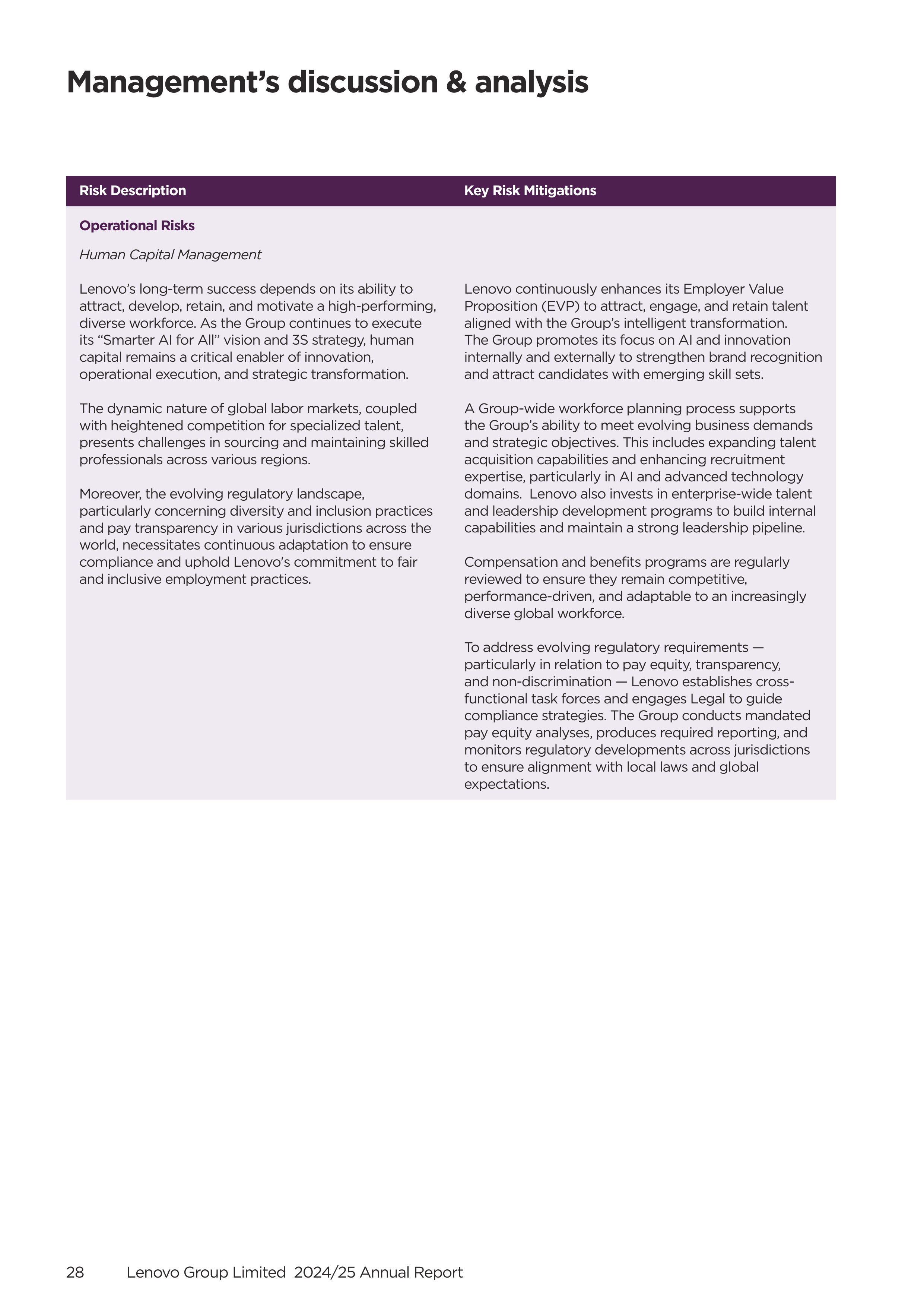
Management’s discussion & analysis
Lenovo Group Limited 2024/25 Annual Report
28
Risk Description
Key Risk Mitigations
Operational Risks
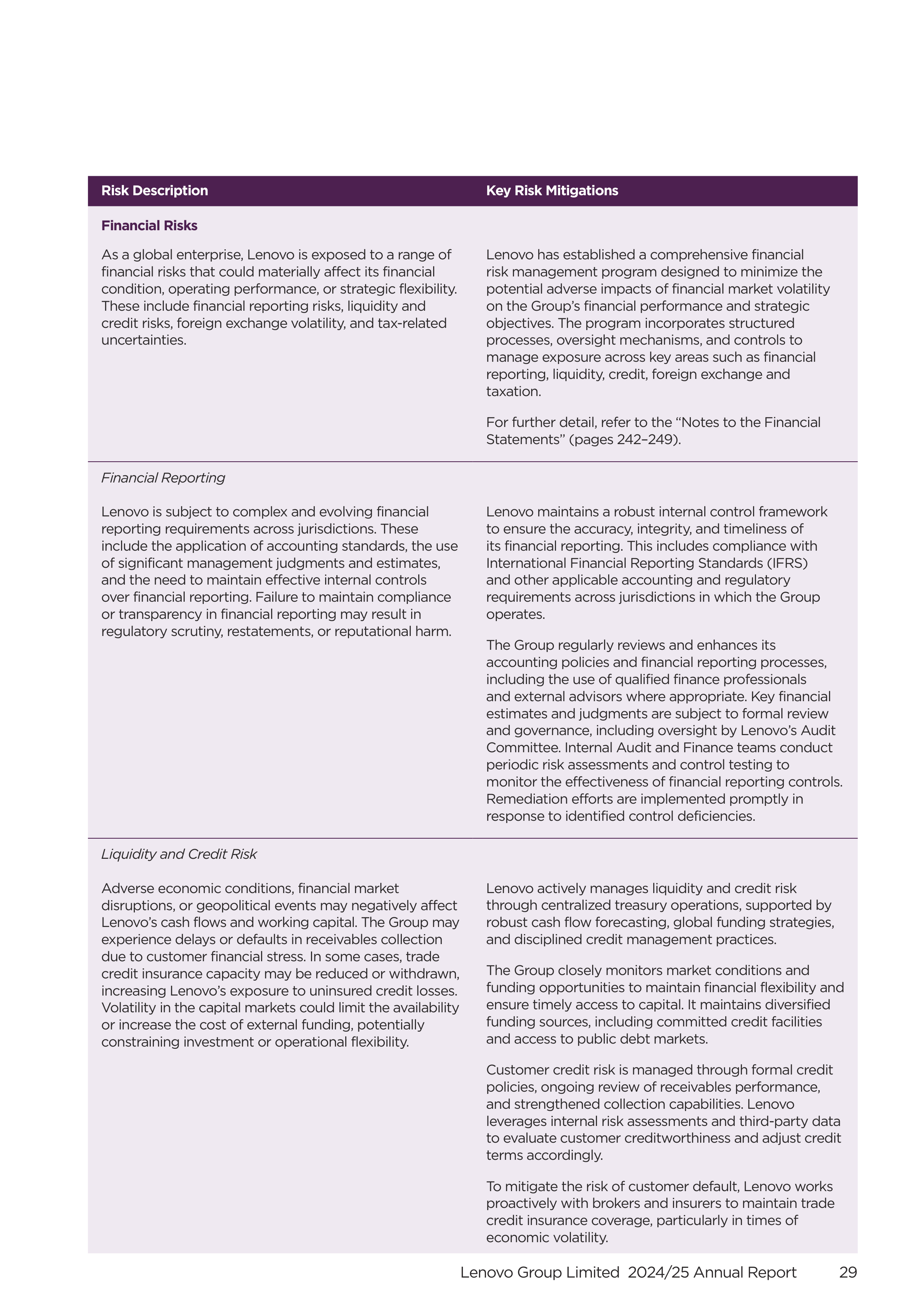
Human Capital Management
Lenovo’s long-term success depends on its ability to
attract, develop, retain, and motivate a high-performing,
diverse workforce. As the Group continues to execute
its “Smarter AI for All” vision and 3S strategy, human
capital remains a critical enabler of innovation,
operational execution, and strategic transformation.
The dynamic nature of global labor markets, coupled
with heightened competition for specialized talent,
presents challenges in sourcing and maintaining skilled
professionals across various regions.
Moreover, the evolving regulatory landscape,
particularly concerning diversity and inclusion practices
and pay transparency in various jurisdictions across the
world, necessitates continuous adaptation to ensure
compliance and uphold Lenovo's commitment to fair
and inclusive employment practices.
Lenovo continuously enhances its Employer Value
Proposition (EVP) to attract, engage, and retain talent
aligned with the Group’s intelligent transformation.
The Group promotes its focus on AI and innovation
internally and externally to strengthen brand recognition
and attract candidates with emerging skill sets.
A Group-wide workforce planning process supports
the Group’s ability to meet evolving business demands
and strategic objectives. This includes expanding talent
acquisition capabilities and enhancing recruitment
expertise, particularly in AI and advanced technology
domains. Lenovo also invests in enterprise-wide talent
and leadership development programs to build internal
capabilities and maintain a strong leadership pipeline.
Compensation and benefits programs are regularly
reviewed to ensure they remain competitive,
performance-driven, and adaptable to an increasingly
diverse global workforce.
To address evolving regulatory requirements —
particularly in relation to pay equity, transparency,
and non-discrimination — Lenovo establishes cross-
functional task forces and engages Legal to guide
compliance strategies. The Group conducts mandated
pay equity analyses, produces required reporting, and
monitors regulatory developments across jurisdictions
to ensure alignment with local laws and global
expectations.
Lenovo Group Limited 2024/25 Annual Report
29
Risk Description
Key Risk Mitigations
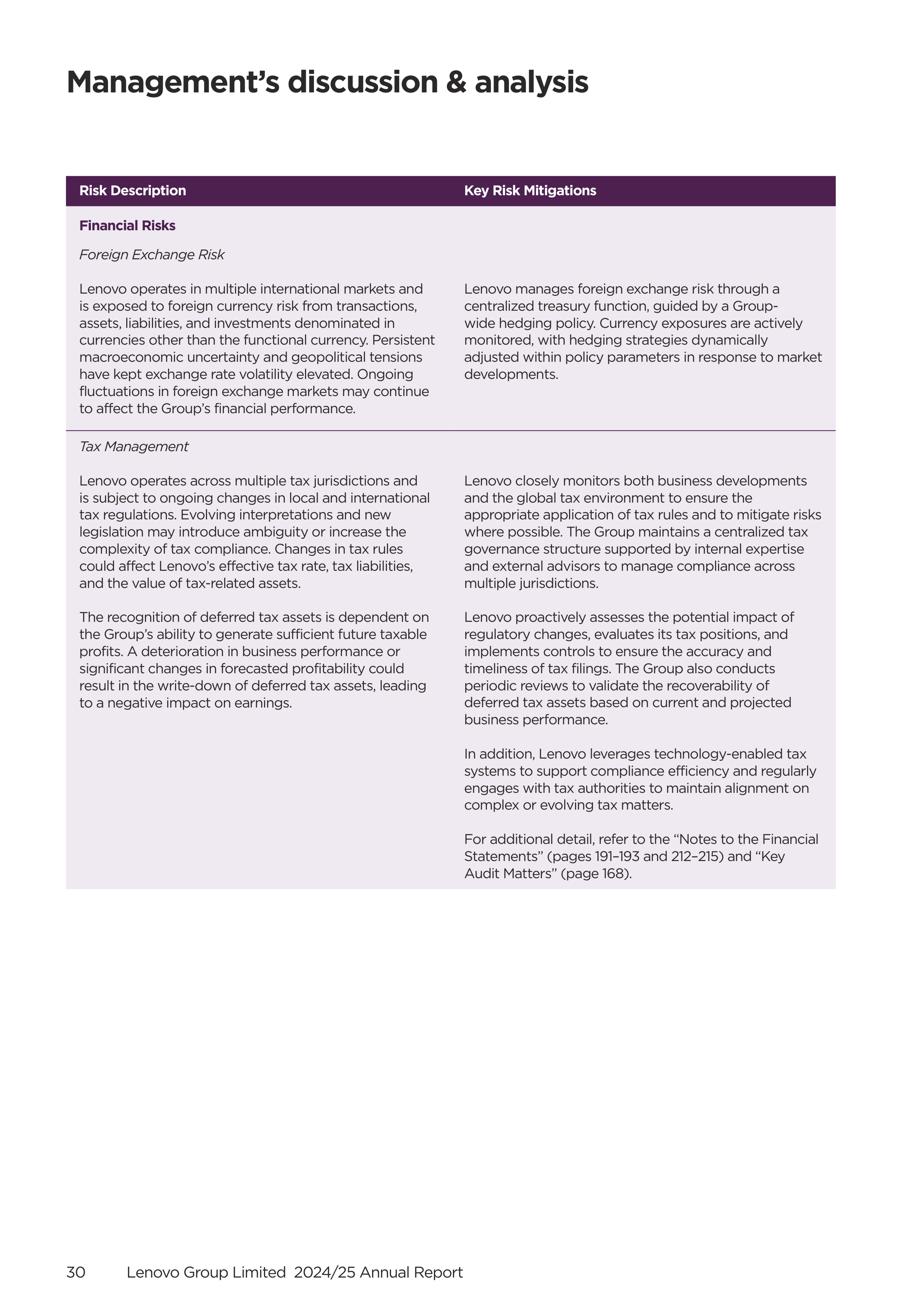
Financial Risks
As a global enterprise, Lenovo is exposed to a range of
financial risks that could materially affect its financial
condition, operating performance, or strategic flexibility.
These include financial reporting risks, liquidity and
credit risks, foreign exchange volatility, and tax-related
uncertainties.
Lenovo has established a comprehensive financial
risk management program designed to minimize the
potential adverse impacts of financial market volatility
on the Group’s financial performance and strategic
objectives. The program incorporates structured
processes, oversight mechanisms, and controls to
manage exposure across key areas such as financial
reporting, liquidity, credit, foreign exchange and
taxation.
For further detail, refer to the “Notes to the Financial
Statements” (pages 242–249).
Financial Reporting
Lenovo is subject to complex and evolving financial
reporting requirements across jurisdictions. These
include the application of accounting standards, the use
of significant management judgments and estimates,
and the need to maintain effective internal controls
over financial reporting. Failure to maintain compliance
or transparency in financial reporting may result in
regulatory scrutiny, restatements, or reputational harm.
Lenovo maintains a robust internal control framework
to ensure the accuracy, integrity, and timeliness of
its financial reporting. This includes compliance with
International Financial Reporting Standards (IFRS)
and other applicable accounting and regulatory
requirements across jurisdictions in which the Group
operates.
The Group regularly reviews and enhances its
accounting policies and financial reporting processes,
including the use of qualified finance professionals
and external advisors where appropriate. Key financial
estimates and judgments are subject to formal review
and governance, including oversight by Lenovo’s Audit
Committee. Internal Audit and Finance teams conduct
periodic risk assessments and control testing to
monitor the effectiveness of financial reporting controls.
Remediation efforts are implemented promptly in
response to identified control deficiencies.
Liquidity and Credit Risk
Adverse economic conditions, financial market
disruptions, or geopolitical events may negatively affect
Lenovo’s cash flows and working capital. The Group may
experience delays or defaults in receivables collection
due to customer financial stress. In some cases, trade
credit insurance capacity may be reduced or withdrawn,
increasing Lenovo’s exposure to uninsured credit losses.
Volatility in the capital markets could limit the availability
or increase the cost of external funding, potentially
constraining investment or operational flexibility.
Lenovo actively manages liquidity and credit risk
through centralized treasury operations, supported by
robust cash flow forecasting, global funding strategies,
and disciplined credit management practices.
The Group closely monitors market conditions and
funding opportunities to maintain financial flexibility and
ensure timely access to capital. It maintains diversified
funding sources, including committed credit facilities
and access to public debt markets.
Customer credit risk is managed through formal credit
policies, ongoing review of receivables performance,
and strengthened collection capabilities. Lenovo
leverages internal risk assessments and third-party data
to evaluate customer creditworthiness and adjust credit
terms accordingly.
To mitigate the risk of customer default, Lenovo works
proactively with brokers and insurers to maintain trade
credit insurance coverage, particularly in times of
economic volatility.
Management’s discussion & analysis
Lenovo Group Limited 2024/25 Annual Report
30
Risk Description
Key Risk Mitigations
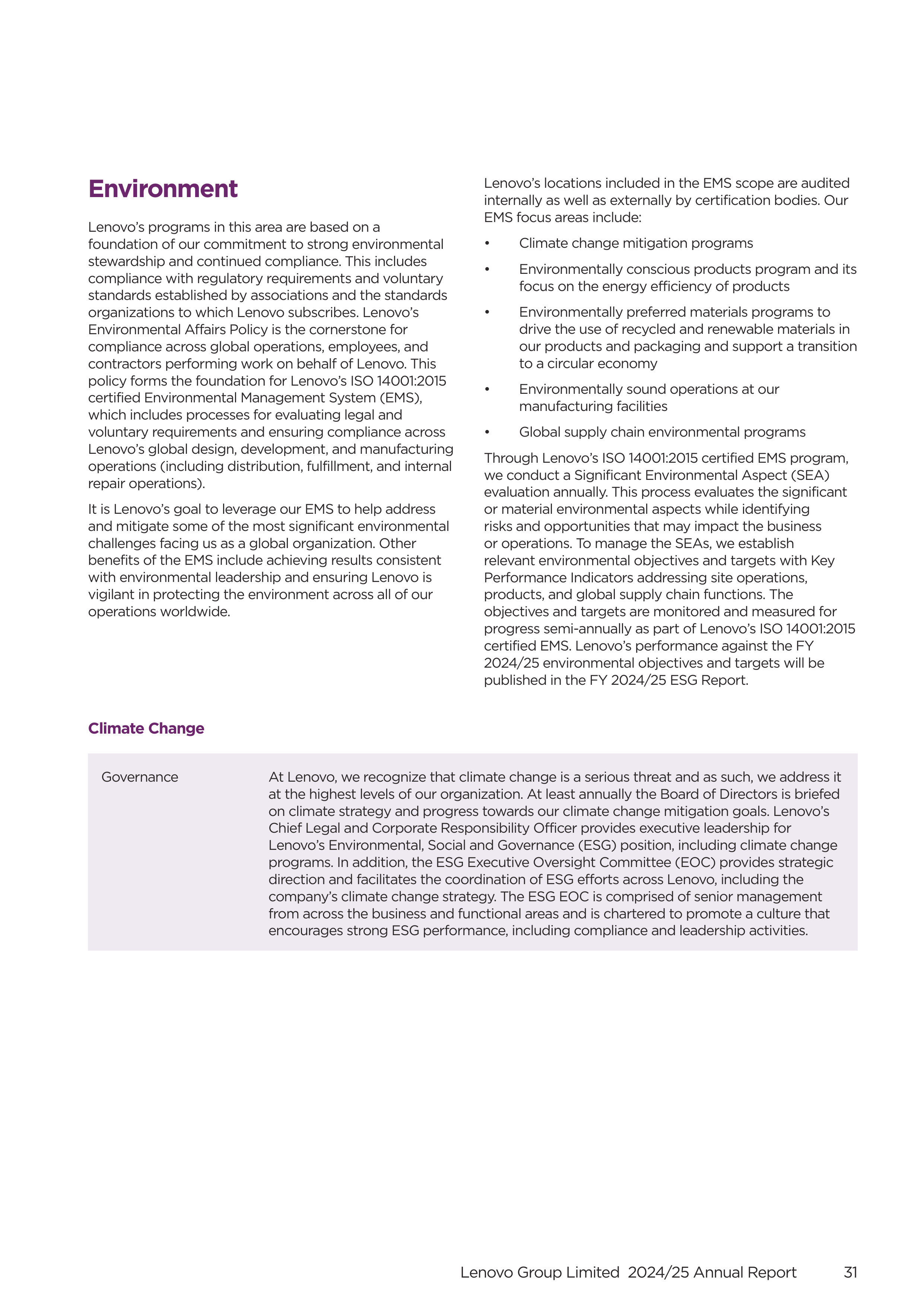
Financial Risks
Foreign Exchange Risk
Lenovo operates in multiple international markets and
is exposed to foreign currency risk from transactions,
assets, liabilities, and investments denominated in
currencies other than the functional currency. Persistent
macroeconomic uncertainty and geopolitical tensions
have kept exchange rate volatility elevated. Ongoing
fluctuations in foreign exchange markets may continue
to affect the Group’s financial performance.
Lenovo manages foreign exchange risk through a
centralized treasury function, guided by a Group-
wide hedging policy. Currency exposures are actively
monitored, with hedging strategies dynamically
adjusted within policy parameters in response to market
developments.
Tax Management
Lenovo operates across multiple tax jurisdictions and
is subject to ongoing changes in local and international
tax regulations. Evolving interpretations and new
legislation may introduce ambiguity or increase the
complexity of tax compliance. Changes in tax rules
could affect Lenovo’s effective tax rate, tax liabilities,
and the value of tax-related assets.
The recognition of deferred tax assets is dependent on
the Group’s ability to generate sufficient future taxable
profits. A deterioration in business performance or
significant changes in forecasted profitability could
result in the write-down of deferred tax assets, leading
to a negative impact on earnings.
Lenovo closely monitors both business developments
and the global tax environment to ensure the
appropriate application of tax rules and to mitigate risks
where possible. The Group maintains a centralized tax
governance structure supported by internal expertise
and external advisors to manage compliance across
multiple jurisdictions.
Lenovo proactively assesses the potential impact of
regulatory changes, evaluates its tax positions, and
implements controls to ensure the accuracy and
timeliness of tax filings. The Group also conducts
periodic reviews to validate the recoverability of
deferred tax assets based on current and projected
business performance.
In addition, Lenovo leverages technology-enabled tax
systems to support compliance efficiency and regularly
engages with tax authorities to maintain alignment on
complex or evolving tax matters.
For additional detail, refer to the “Notes to the Financial
Statements” (pages 191–193 and 212–215) and “Key
Audit Matters” (page 168).
Lenovo Group Limited 2024/25 Annual Report
31
Lenovo’s locations included in the EMS scope are audited
internally as well as externally by certification bodies. Our
EMS focus areas include:
•
Climate change mitigation programs
•
Environmentally conscious products program and its
focus on the energy efficiency of products
•
Environmentally preferred materials programs to
drive the use of recycled and renewable materials in
our products and packaging and support a transition
to a circular economy
•
Environmentally sound operations at our
manufacturing facilities
•
Global supply chain environmental programs
Through Lenovo’s ISO 14001:2015 certified EMS program,
we conduct a Significant Environmental Aspect (SEA)
evaluation annually. This process evaluates the significant
or material environmental aspects while identifying
risks and opportunities that may impact the business
or operations. To manage the SEAs, we establish
relevant environmental objectives and targets with Key
Performance Indicators addressing site operations,
products, and global supply chain functions. The
objectives and targets are monitored and measured for
progress semi-annually as part of Lenovo’s ISO 14001:2015
certified EMS. Lenovo’s performance against the FY
2024/25 environmental objectives and targets will be
published in the FY 2024/25 ESG Report.
Environment
Lenovo’s programs in this area are based on a
foundation of our commitment to strong environmental
stewardship and continued compliance. This includes
compliance with regulatory requirements and voluntary
standards established by associations and the standards
organizations to which Lenovo subscribes. Lenovo’s
Environmental Affairs Policy is the cornerstone for
compliance across global operations, employees, and
contractors performing work on behalf of Lenovo. This
policy forms the foundation for Lenovo’s ISO 14001:2015
certified Environmental Management System (EMS),
which includes processes for evaluating legal and
voluntary requirements and ensuring compliance across
Lenovo’s global design, development, and manufacturing
operations (including distribution, fulfillment, and internal
repair operations).
It is Lenovo’s goal to leverage our EMS to help address
and mitigate some of the most significant environmental
challenges facing us as a global organization. Other
benefits of the EMS include achieving results consistent
with environmental leadership and ensuring Lenovo is
vigilant in protecting the environment across all of our
operations worldwide.
Climate Change
Governance
At Lenovo, we recognize that climate change is a serious threat and as such, we address it
at the highest levels of our organization. At least annually the Board of Directors is briefed
on climate strategy and progress towards our climate change mitigation goals. Lenovo’s
Chief Legal and Corporate Responsibility Officer provides executive leadership for
Lenovo’s Environmental, Social and Governance (ESG) position, including climate change
programs. In addition, the ESG Executive Oversight Committee (EOC) provides strategic
direction and facilitates the coordination of ESG efforts across Lenovo, including the
company’s climate change strategy. The ESG EOC is comprised of senior management
from across the business and functional areas and is chartered to promote a culture that
encourages strong ESG performance, including compliance and leadership activities.
Management’s discussion & analysis
Lenovo Group Limited 2024/25 Annual Report
32
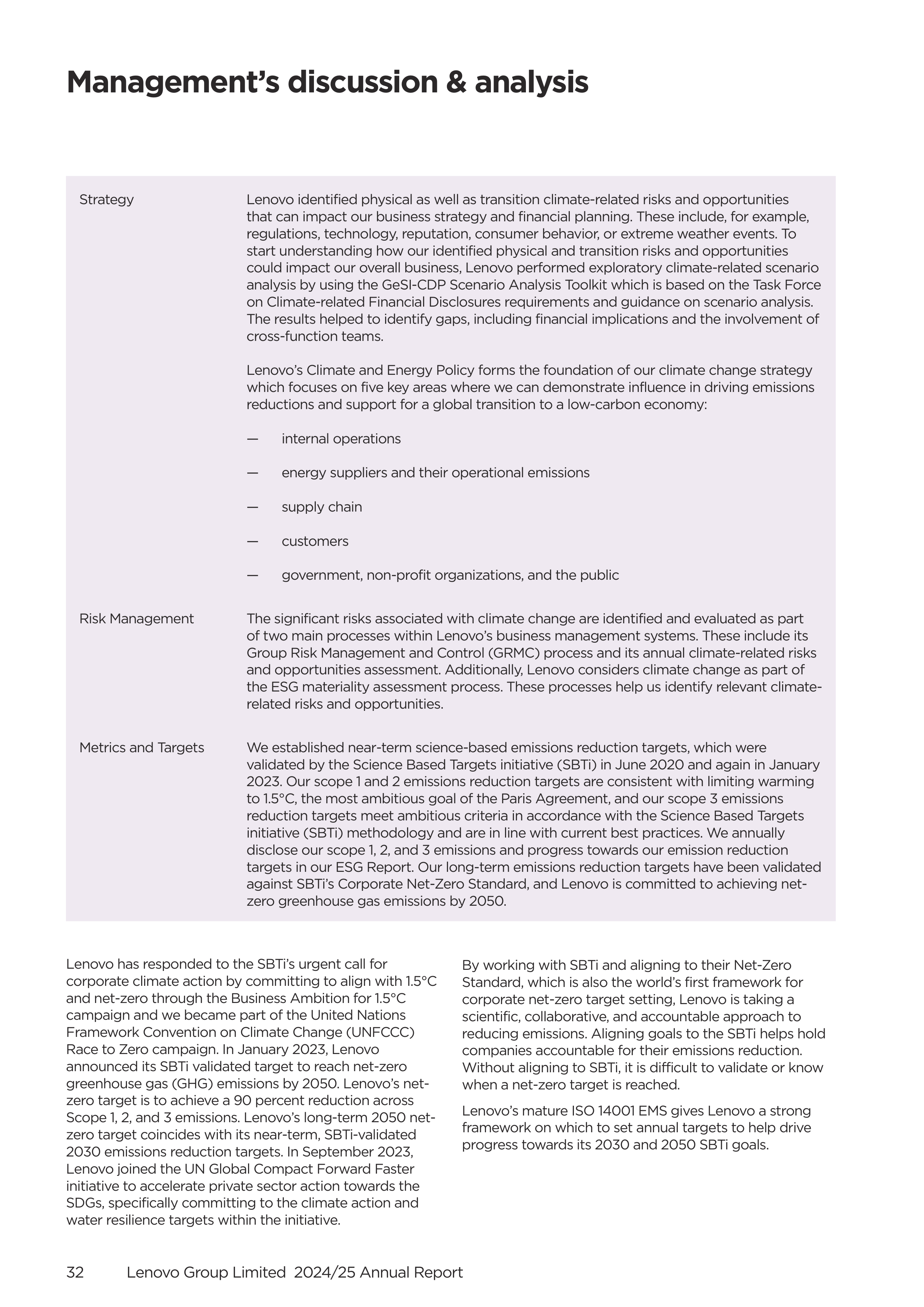
Strategy
Lenovo identified physical as well as transition climate-related risks and opportunities
that can impact our business strategy and financial planning. These include, for example,
regulations, technology, reputation, consumer behavior, or extreme weather events. To
start understanding how our identified physical and transition risks and opportunities
could impact our overall business, Lenovo performed exploratory climate-related scenario
analysis by using the GeSI-CDP Scenario Analysis Toolkit which is based on the Task Force
on Climate-related Financial Disclosures requirements and guidance on scenario analysis.
The results helped to identify gaps, including financial implications and the involvement of
cross-function teams.
Lenovo’s Climate and Energy Policy forms the foundation of our climate change strategy
which focuses on five key areas where we can demonstrate influence in driving emissions
reductions and support for a global transition to a low-carbon economy:
—
internal operations
—
energy suppliers and their operational emissions
—
supply chain
—
customers
—
government, non-profit organizations, and the public
Risk Management
The significant risks associated with climate change are identified and evaluated as part
of two main processes within Lenovo’s business management systems. These include its
Group Risk Management and Control (GRMC) process and its annual climate-related risks
and opportunities assessment. Additionally, Lenovo considers climate change as part of
the ESG materiality assessment process. These processes help us identify relevant climate-
related risks and opportunities.
Metrics and Targets
We established near-term science-based emissions reduction targets, which were
validated by the Science Based Targets initiative (SBTi) in June 2020 and again in January
2023. Our scope 1 and 2 emissions reduction targets are consistent with limiting warming
to 1.5°C, the most ambitious goal of the Paris Agreement, and our scope 3 emissions
reduction targets meet ambitious criteria in accordance with the Science Based Targets
initiative (SBTi) methodology and are in line with current best practices. We annually
disclose our scope 1, 2, and 3 emissions and progress towards our emission reduction
targets in our ESG Report. Our long-term emissions reduction targets have been validated
against SBTi’s Corporate Net-Zero Standard, and Lenovo is committed to achieving net-
zero greenhouse gas emissions by 2050.
Lenovo has responded to the SBTi’s urgent call for
corporate climate action by committing to align with 1.5°C
and net-zero through the Business Ambition for 1.5°C
campaign and we became part of the United Nations
Framework Convention on Climate Change (UNFCCC)
Race to Zero campaign. In January 2023, Lenovo
announced its SBTi validated target to reach net-zero
greenhouse gas (GHG) emissions by 2050. Lenovo’s net-
zero target is to achieve a 90 percent reduction across
Scope 1, 2, and 3 emissions. Lenovo’s long-term 2050 net-
zero target coincides with its near-term, SBTi-validated
2030 emissions reduction targets. In September 2023,
Lenovo joined the UN Global Compact Forward Faster
initiative to accelerate private sector action towards the
SDGs, specifically committing to the climate action and
water resilience targets within the initiative.
By working with SBTi and aligning to their Net-Zero
Standard, which is also the world’s first framework for
corporate net-zero target setting, Lenovo is taking a
scientific, collaborative, and accountable approach to
reducing emissions. Aligning goals to the SBTi helps hold
companies accountable for their emissions reduction.
Without aligning to SBTi, it is difficult to validate or know
when a net-zero target is reached.
Lenovo’s mature ISO 14001 EMS gives Lenovo a strong
framework on which to set annual targets to help drive
progress towards its 2030 and 2050 SBTi goals.
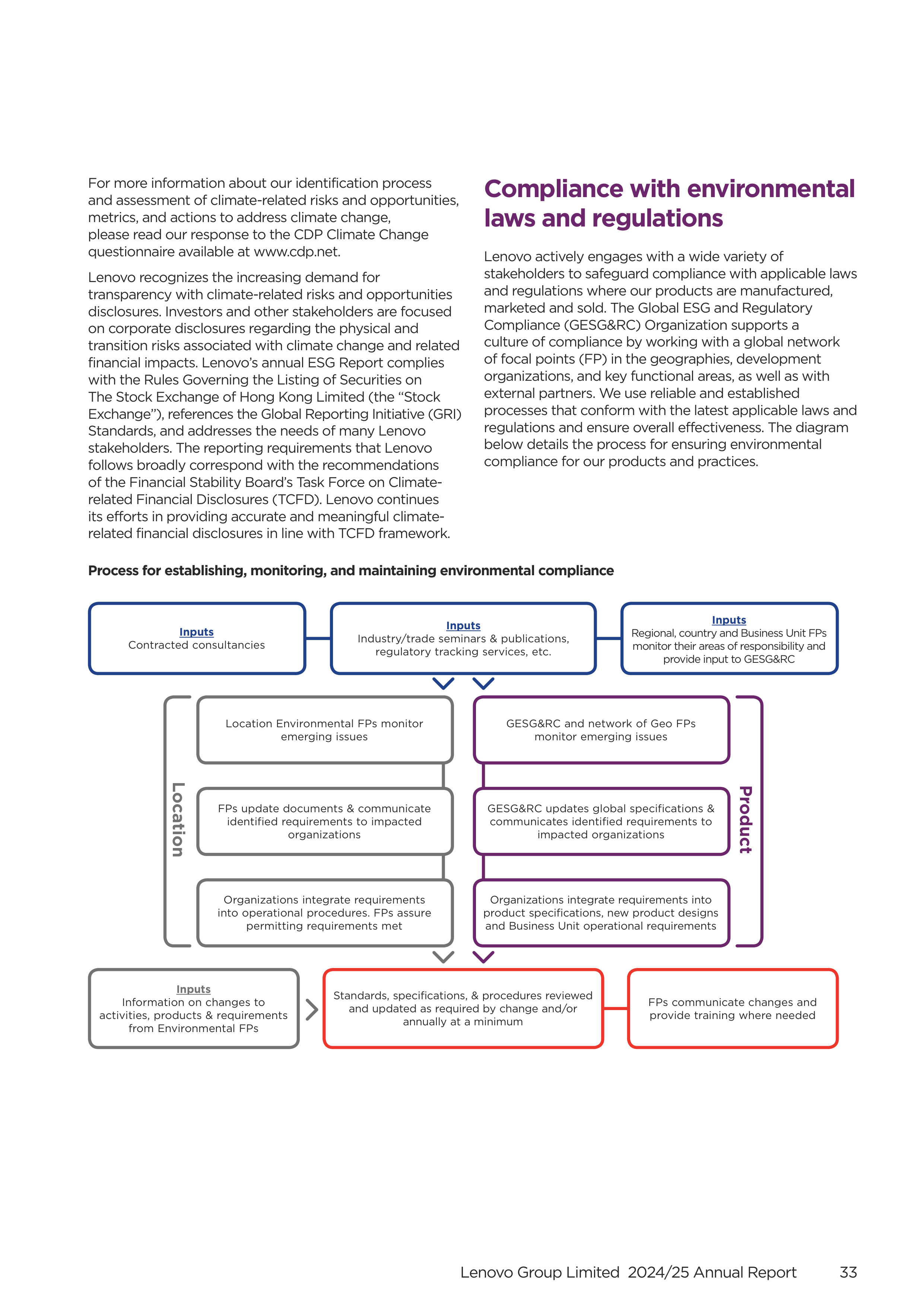
Lenovo Group Limited 2024/25 Annual Report
33
Compliance with environmental
laws and regulations
Lenovo actively engages with a wide variety of
stakeholders to safeguard compliance with applicable laws
and regulations where our products are manufactured,
marketed and sold. The Global ESG and Regulatory
Compliance (GESG&RC) Organization supports a
culture of compliance by working with a global network
of focal points (FP) in the geographies, development
organizations, and key functional areas, as well as with
external partners. We use reliable and established
processes that conform with the latest applicable laws and
regulations and ensure overall effectiveness. The diagram
below details the process for ensuring environmental
compliance for our products and practices.
For more information about our identification process
and assessment of climate-related risks and opportunities,
metrics, and actions to address climate change,
please read our response to the CDP Climate Change
questionnaire available at www.cdp.net.
Lenovo recognizes the increasing demand for
transparency with climate-related risks and opportunities
disclosures. Investors and other stakeholders are focused
on corporate disclosures regarding the physical and
transition risks associated with climate change and related
financial impacts. Lenovo’s annual ESG Report complies
with the Rules Governing the Listing of Securities on
The Stock Exchange of Hong Kong Limited (the “Stock
Exchange”), references the Global Reporting Initiative (GRI)
Standards, and addresses the needs of many Lenovo
stakeholders. The reporting requirements that Lenovo
follows broadly correspond with the recommendations
of the Financial Stability Board’s Task Force on Climate-
related Financial Disclosures (TCFD). Lenovo continues
its efforts in providing accurate and meaningful climate-
related financial disclosures in line with TCFD framework.
Process for establishing, monitoring, and maintaining environmental compliance
Inputs
Contracted consultancies
FPs communicate changes and
provide training where needed
Inputs
Regional, country and Business Unit FPs
monitor their areas of responsibility and
provide input to GESG&RC
Inputs
Industry/trade seminars & publications,
regulatory tracking services, etc.
Standards, specifications, & procedures reviewed
and updated as required by change and/or
annually at a minimum
Location Environmental FPs monitor
emerging issues
FPs update documents & communicate
identified requirements to impacted
organizations
Organizations integrate requirements
into operational procedures. FPs assure
permitting requirements met
GESG&RC and network of Geo FPs
monitor emerging issues
GESG&RC updates global specifications &
communicates identified requirements to
impacted organizations
Organizations integrate requirements into
product specifications, new product designs
and Business Unit operational requirements
Product
Location
Inputs
Information on changes to
activities, products & requirements
from Environmental FPs
Management’s discussion & analysis
Lenovo Group Limited 2024/25 Annual Report
34
•
The
Nomination and governance committee
oversees the corporate policies and practices
about governance and compliance with legal and
regulatory requirements
Other Committees
•
The
Executive Ethics Committee
provides executive-
level oversight and guidance to the ECO
•
The
Investigation Oversight Committee
works
closely with the ECO to oversee the Group’s internal
investigation process and speak up initiatives
•
The
Regional Ethics and Compliance Committee
provides the ECO with global support, perspective
and insight
Business practices
Lenovo is committed to conducting business legally,
ethically, and with integrity. Lenovo’s Code of Conduct
mandates compliance with applicable laws in markets
where it conducts business. Its policies strongly support
ethical and responsible business practices, including, but
not limited to areas such as anti-bribery and corruption,
data privacy, anti-competitive practices and fair
competition, trade compliance, intellectual property, and
more.
Anti-Bribery and Corruption
Lenovo has zero tolerance for bribery and corruption.
Lenovo complies with the anti-bribery and corruption laws
in every jurisdiction where we conduct business. Lenovo’s
Global Anti-Bribery and Corruption Policy, along with
our Global Gift, Entertainment, Corporate Hospitality and
Travel Policy, reinforce provisions in the Code and provide
additional guidance regarding compliance with global
anti- bribery and corruption laws and regulations. The
policies stress that Lenovo will not directly or indirectly
solicit, offer, promise, authorize, provide, or accept
anything of value to any person, including government
officials, to influence action, inaction or to secure an
improper advantage as defined by applicable laws.
Anti-Competitive Practices and Fair Competition
Lenovo competes for business ethically and lawfully.
Lenovo’s Code and policy on anti-competitive practices
and fair competition sets out fundamental principles
to serve as guidelines for employees in complying with
the competition laws in every jurisdiction where Lenovo
operates. In particular, the policies strictly prohibit
employees from engaging in anti-competitive practices,
including entering into an agreement or discussion that
would result in setting prices, limiting the availability of
goods or services on the market, or agreeing to boycott a
customer or supplier.
Lenovo and its business partners obtain the environmental
and regulatory certifications that are required to legally sell
its products where they are marketed and sold. Lenovo
relies on internal and external subject matter experts, third-
party labs, internal tools and processes to evaluate and
confirm product compliance before shipment. In addition
to environmental compliance, areas of review include but
are not limited to, electromagnetic compatibility (EMC),
safety, technology and trade controls, and wireless.
Ethics and compliance with
relevant laws and regulations
Lenovo is committed to conducting business legally,
ethically, and with integrity. Ethics and integrity serve as
the foundation of all Lenovo’s business practices. Results
from our most recent ‘Lenovo Listens’ survey highlight
one of the Company’s greatest strengths: ethical business
practices. We recognize our success hinges on our
steadfast commitment to these values. This commitment
is reinforced among the workforce through Lenovo’s core
values, which emphasize the significance of “Teamwork
with Integrity and Trust,” one of Lenovo’s four fundamental
cultural tenets.
Our Ethics and Compliance Office (ECO) was established
to foster a culture that is committed to implementing
these values. The ECO works in partnership with
stakeholders across the globe to promote legal and ethical
operations. The ECO actively raises awareness about the
importance of ethical and compliant business practices to
Lenovo and serves a critical role in providing employees
with the information, resources, and training they need to
make informed ethical decisions. The ECO also oversees
Lenovo’s Code of Conduct (Code), which establishes clear
expectations for employee compliance with Lenovo’s
policies related to lawful and ethical business conduct.
Lenovo’s Code reflects our culture of trust and integrity
and holds employees accountable for their behavior and
helps employees determine when and where to seek
advice. Lenovo’s Code, policies, and related awareness and
training materials are provided electronically and through
periodic communications. Specifically, Lenovo’s new hires
are required to take Code training. In order to successfully
complete the training, all employees are required to
provide attestation of their adherence to the Code and
Lenovo policies. The Code training covers various topics,
including, conflicts of interest, insider trading, anti-bribery
and corruption, anti-competitive practices and fair
competition, insider trading, anti-money laundering, and
international trade compliance.
The ECO is supported by the following committees:
Board Committees
•
The
Audit committee
is annually briefed by the ECO
on matters including the adequacy of resources for
ESG reporting
Lenovo Group Limited 2024/25 Annual Report
35
•
Providing contractual support to ensure that
risks associated with any dataflows are covered
by appropriate supplier, customer, and partner
contractual terms; includes assisting the Lenovo
Global Contract Team (GCT) in its efforts to apply
contract templates and improve privacy and
security-focused contract exhibits
•
Providing early input to product and services
development teams by incorporating privacy
checkpoints into formal development plans, including
privacy impact assessments, and conducting pre-
launch privacy compliance reviews of products,
software, services, websites, marketing programs,
internal systems, and supplier relationships
•
Publishing transparent website and product privacy
statements that describe Lenovo’s data practices
and choices for individuals
•
Responding to requests from individuals to access,
review, correct, amend, or delete their personal
information
•
Coordinating Lenovo’s response to law enforcement
and other government requests for personal, user, or
device identifiable data
•
Developing and delivering live and virtual privacy-
focused training programs and working closely
with the Chief Security Office (CSO), Corporate
Infrastructure Security Office (CISO), and product
security teams to timely identify and respond to
information incidents
•
Maintaining an internal Global Privacy & Data
Protection Program website for the Lenovo
Community that serves as a resource containing
policies, training, news, analysis, and additional
guidance on a host of privacy and data protection
areas of concern
Raising questions or concerns
Lenovo is committed to fostering a speak up culture,
where employees, contractors, and business partners
are empowered to speak up on anything that appears
unethical, illegal, or suspicious. Lenovo has established
clear processes and various reporting channels for
raising questions or reporting concerns. Employees
are encouraged to raise concerns to their managers,
Human Resources, the ECO, Internal Audit, or the Legal
Department about any potential issues including, but not
limited to, those known about or suspected:
•
Fraud by or against Lenovo
•
Bribery or Corruption
•
Unethical business conduct
•
Violation of legal or regulatory requirements
•
Substantial and specific danger to health and safety
•
Violation of Lenovo’s corporate policies and
guidelines, particularly the Code of Conduct
Intellectual Property
Lenovo values intellectual property as it innovates for the
future. Lenovo expects employees to protect intellectual
property and to respect the intellectual property rights
of other companies and individuals. Lenovo secures
its intellectual property by using patents, copyrights,
trademarks, confidential information, related contract
rights, and other applicable forms of legal protection.
Trade Compliance
Lenovo is fully committed to complying with all applicable
global trade laws and regulations in the markets where it
conducts business. This includes adherence to customs
and import regulations, export controls, economic
sanctions, and anti-boycott regulations as mandated by
relevant authorities in each jurisdiction.
All employees are expected to uphold Lenovo’s Code
of Conduct and Global Trade Compliance Policy, which
define the requirements for maintaining compliance
with these laws and regulations. Lenovo also requires its
business partners to comply with applicable global trade
laws and regulations pursuant to its Partner Code of
Conduct.
Additionally, Lenovo is Customs-Trade Partnership Against
Terrorism (CTPAT) certified and a member of the CTPAT
Trade Compliance program, demonstrating Lenovo’s
commitment to supply chain security and regulatory
compliance.
Privacy & Data Protection
Lenovo recognizes the great importance of privacy to
individuals everywhere — customers, website visitors,
product users, employees — everyone. The responsible use
and protection of personal and other information under
Lenovo’s care is a core value. To ensure adherence to
Lenovo’s privacy and data protection policies, principles,
and processes, Lenovo maintains a global Privacy & Data
Protection Program led by the Legal Department and a
cross-functional Privacy Working Group comprised of
key partners drawn from Information Security, Product
Security, Product Development, Marketing, E-Commerce,
Service and Repair, Human Resources, and other groups.
Key elements of Lenovo’s approach to responsibly using
and protecting information of concern include:
•
Monitoring privacy and data protection legal and
regulatory trends, advising senior leadership, and
improving Lenovo’s privacy and data protection
practices
•
Harmonizing global privacy and data protection
requirements into a corporate-wide Privacy Policy,
Privacy Standard, and set of Guiding Privacy
Principles intended to drive how Lenovo handles
personal, user, device and certain other identifiable
information, including developing and updating
Lenovo privacy controls and processes
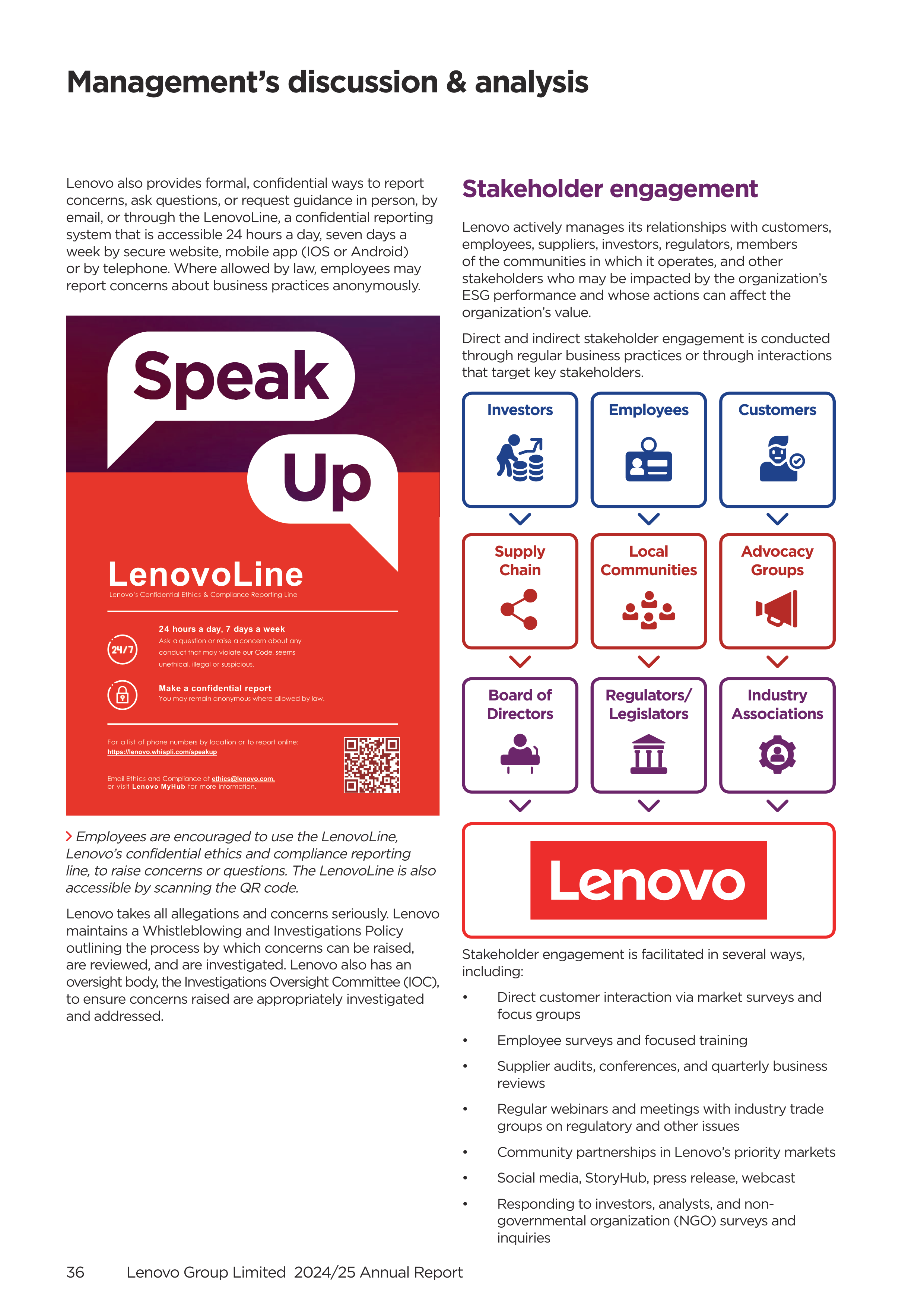





Management’s discussion & analysis
Lenovo Group Limited 2024/25 Annual Report
36
Stakeholder engagement is facilitated in several ways,
including:
•
Direct customer interaction via market surveys and
focus groups
•
Employee surveys and focused training
•
Supplier audits, conferences, and quarterly business
reviews
•
Regular webinars and meetings with industry trade
groups on regulatory and other issues
•
Community partnerships in Lenovo’s priority markets
•
Social media, StoryHub, press release, webcast
•
Responding to investors, analysts, and non-
governmental organization (NGO) surveys and
inquiries
Stakeholder engagement
Lenovo actively manages its relationships with customers,
employees, suppliers, investors, regulators, members
of the communities in which it operates, and other
stakeholders who may be impacted by the organization’s
ESG performance and whose actions can affect the
organization’s value.
Direct and indirect stakeholder engagement is conducted
through regular business practices or through interactions
that target key stakeholders.
Lenovo also provides formal, confidential ways to report
concerns, ask questions, or request guidance in person, by
email, or through the LenovoLine, a confidential reporting
system that is accessible 24 hours a day, seven days a
week by secure website, mobile app (IOS or Android)
or by telephone. Where allowed by law, employees may
report concerns about business practices anonymously.
LenovoLine
Lenovo’s
Confidential
Ethics &
Compliance Reporting
Line
24
hours
a
day,
7
days
a week
Ask
a question or
raise
a concern about
any
conduct that may violate our Code, seems
unethical,
illegal
or
suspicious.
Make a confidential report
You may remain anonymous where allowed by law.
For
a list
of
phone
numbers
by
location
or
to
report
online:
https://lenovo.whispli.com/speakup
Email Ethics
and Compliance at
ethics@lenovo.com,
or
visit
Lenovo MyHub
for
more
information.
Employees are encouraged to use the LenovoLine,
Lenovo’s confidential ethics and compliance reporting
line, to raise concerns or questions. The LenovoLine is also
accessible by scanning the QR code.
Lenovo takes all allegations and concerns seriously. Lenovo
maintains a Whistleblowing and Investigations Policy
outlining the process by which concerns can be raised,
are reviewed, and are investigated. Lenovo also has an
oversight body, the Investigations Oversight Committee (IOC),
to ensure concerns raised are appropriately investigated
and addressed.
Investors
Supply
Chain
Board of
Directors
Employees
Local
Communities
Regulators/
Legislators
Customers
Advocacy
Groups
Industry
Associations
Lenovo Group Limited 2024/25 Annual Report
37
With operations and supply chains that extend around the
world, we are uniquely positioned to support the global
collective impact of business by aligning our practices to
a sustainable and inclusive future. Since 2009, Lenovo has
continued its role as a signatory supporter to the United
Nations Global Compact (UNGC), a globally recognized
platform that provides a blueprint for businesses that want
to achieve a more sustainable future for all. As a business
participant in the UNGC, we strive to demonstrate
continuous improvements by aligning our operations
and practices with the ten principles of the UNGC. The
principles promote a value system that supports the
fundamental responsibilities in the areas of human rights,
labor, environment, and anti-corruption in the markets
where we operate.
As we aim to integrate these values and principles
wherever we conduct business, we are also making
meaningful contributions to people and the planet and
setting the stage for long-term success. This dedication
begins at the top with the support and endorsement of
our Chairman and CEO, Mr. Yang Yuanqing. Lenovo is
proud to be recognized by professionals and prominent
programs worldwide as we demonstrate leadership in
corporate ESG practices. The information below contains
a selection of Lenovo’s FY 2024/25 ESG achievements. A
detailed review of Lenovo’s FY 2024/25 ESG performance
is published in our ESG Report.
Lenovo also engages with stakeholders through targeted
campaigns that support our social investment objectives
that include but are not limited to:
•
Love on Global Month of Service: September 2024
marked Lenovo’s eighth annual Love on Global
Month of Service, engaging employees in 62
offices around the world to make a positive impact
in their communities. Projects aligned to Lenovo
Foundation’s mission to empower under represented
populations with access to technology and STEM
education. Whether it’s the number of volunteers,
volunteer hours, participating offices, or beneficiaries,
the project has grown every year since 2017.
•
AI for Social Impact: This year Lenovo philanthropy
created the AI for Social Impact initiative which
works to connect non-profits with education and
resources so that they can harness AI to enhance
their missions. As part of the initiative, AI for Social
Impact webinars were created to share Lenovo’s AI
expertise with non-profits through free webinars
shared with Lenovo partners and on non-profit
websites. Lenovo is also partnering with Tech to the
Rescue to offer the AI for Social Impact Lab, focusing
on the areas of climate change and education, and
giving non-profits the resources to develop and
deploy AI solutions that enhance their missions.
In addition to these and other formal stakeholder
interactions, we collaborate with industry associations
from time to time. The external perspectives provide
opportunities to adopt best practices and knowledge that
may help to assess our commitments and progress in key
ESG-related areas.
Key ESG recognitions and accomplishments
Environmental
Lenovo scored in the leadership band by CDP for climate change (A) and water security (A–) for 2024. This is the
sixth year in a row Lenovo has been in the leadership band for climate (A– or A). For its A, Lenovo also earned a spot
on CDP’s 2024 Corporate A list for Climate which highlights Lenovo’s commitment to environmental transparency
and comprehensive disclosure.
In addition, EcoVadis recognized Lenovo as a Leader in Carbon Management, achieving the highest ranking in its
category with a best-in-class greenhouse gas (GHG) management system and strong ambition for decarbonization.
Multiple Lenovo initiatives were recipients of 2024 SEAL Business Sustainability Awards, an environmental program
that honors organizations that demonstrate strong leadership, innovation, and commitment to sustainable business
practices. Lenovo’s International Supply Chain Organization (ISCC) won the SEAL Environmental Initiative Award for
Transform Trash to Treasure, its innovative parts-harvesting program. The SEAL Sustainable Innovation Award was
presented to the newly launched Lenovo Intelligent Sustainability Solutions Advisor (LISSA). This AI-powered engine
informs IT sustainability strategies through data intelligence. The Lenovo Neptune™ liquid cooling technology won
in the SEAL Sustainable Product Award category and Lenovo’s Reduced Carbon Transport Service, an offering that
gives enterprise customers opportunities to purchase sustainable aviation fuel credits, won the SEAL Sustainable
Service Award.
Management’s discussion & analysis
Lenovo Group Limited 2024/25 Annual Report
38
Social
Lenovo was recognized as a “2024 Best Workplace for Disability Inclusion” by the Disability Equality Index in the
US, the UK and Brazil. The index recognizes companies for demonstrating leading disability inclusion practices and
committing to an inclusive culture. These factors are validated through visible support from company leadership,
accessible workplace and employment practices, community engagement initiatives, and supplier programs.
In 2024, Lenovo received its highest score in the annual Workplace Pride Global Benchmark. In addition to
recognition from Workplace Pride, Lenovo was included in the Human Rights Campaign Foundation’s 2025
Corporate Equality Index for the seventh year, highlighting its commitment to inclusion.
Lenovo was included in the inaugural list of America’s Dream Employers for 2025 by Forbes, in partnership
with Statista. This recognition is a testament to the inclusive culture, the purposeful approach, and the positive
environment that Lenovo fosters for its global employee base. Lenovo has received similar recognitions for being an
employer of choice. In January 2024, employees voted Lenovo to be one of Glassdoor’s Best Places to Work.
Governance
Lenovo was presented the Gold Award in the Most Sustainable Companies and Organizations (MSCO) section (H-share
companies and other Mainland enterprise category) by The Hong Kong Institute of Certified Public Accountants (HKICPA)’s
2024 Best Corporate Governance and ESG Awards. This is the twelfth consecutive year Lenovo has received awards
from the HKICPA.
Lenovo was included in the 2024 Hang Seng Corporate Sustainability Index with an AA score. Among the 550 Hong
Kong-listed companies, Lenovo received the strongest score in the IT industry for its environmental achievements.
Lenovo was honored to receive both the Corporate Governance and ESG Excellence Awards from the Chamber of
Hong Kong Listed Companies (CHKLC).
Lenovo was awarded the Platinum Medal by EcoVadis, a leading global provider of business sustainability ratings.
With a score of 85/100, this recognition places Lenovo in the top 1% of all companies rated worldwide by EcoVadis.
In 2024, Lenovo maintained a rating of AAA (on a scale of AAA-CCC) in the MSCI ESG Ratings assessment.
Lenovo Group Limited 2024/25 Annual Report
39
Training & Development
We have enhanced our management and leadership
development programs to provide support for managers
during their leadership progression at Lenovo by offering
specific training and development experiences, for
example Executive Presence Workshop (EPW), Director
Leadership Enhancement Program (DLEP), Coaching
With Impact (CWI), Leading In Matrix Environment (LIME),
etc at key points in their careers.
Lenovo also places a high priority on executive leaders
development, bringing senior leaders together once a year
to share best practices, learn from external experts and
drive strategic alignment across the enterprise through
Global Leadership Team (GLT), Excelling Leadership In
Transformation Era (ELITE) and Striving Excellence in
Executive Director (SEED).
We are Lenovo
The “We Are Lenovo” cultural values of Serving Our
Customers, Innovation, Entrepreneurship, and Teamwork
with Integrity & Trust are the foundation of our business
strategy. These values guide our operations, decision-
making, and interactions with customers.
Employment Performance and Compensation
Lenovo continues to leverage its performance
management and compensation programs to reinforce
a strong commitment to excellence in business
achievements and customer experience. This approach
includes annual goal setting and review, continuous
feedback for development, the calibration of individual
ratings across organizations to ensure a fair assessment,
and the recognition of individual and team performance.
The performance management approach drives business
objectives, while career development enables employees
to grow and succeed through challenging and exciting
work. The Lenovo Compensation Philosophy emphasizes
our focus on competitive compensation for performance
that reflects the unique status of the local market where
employees are based and supports flexibility in the design
of business specific programs within a consistent – Lenovo
Compensation framework.
Organizational & Talent Management
“Integrity, Learning Ability, Persistence and Ambition
are not only the fundamental for success in career
development, but also the compulsory talent requirement
in Lenovo. Only if you have these four elements you can
grow up into a big tree!”
– Yuanqing Yang
Lenovo uses Tree model to vividly describe our talent
concept. The growing big tree symbolizes lofty ambitions;
the Leaves represent learning ability, continuously
acquiring new knowledge and mastering new skills; the
Trunk represents persistence, tenacity and perseverance;
the Root represents fundamental of human being –
integrity.
Lenovo’s long-term organization and talent strategy
remains steadily focused on hiring and engaging
world-class talent, building global organization and
talent capabilities and skills, and fostering an inclusive
environment where people can thrive at their full potential.
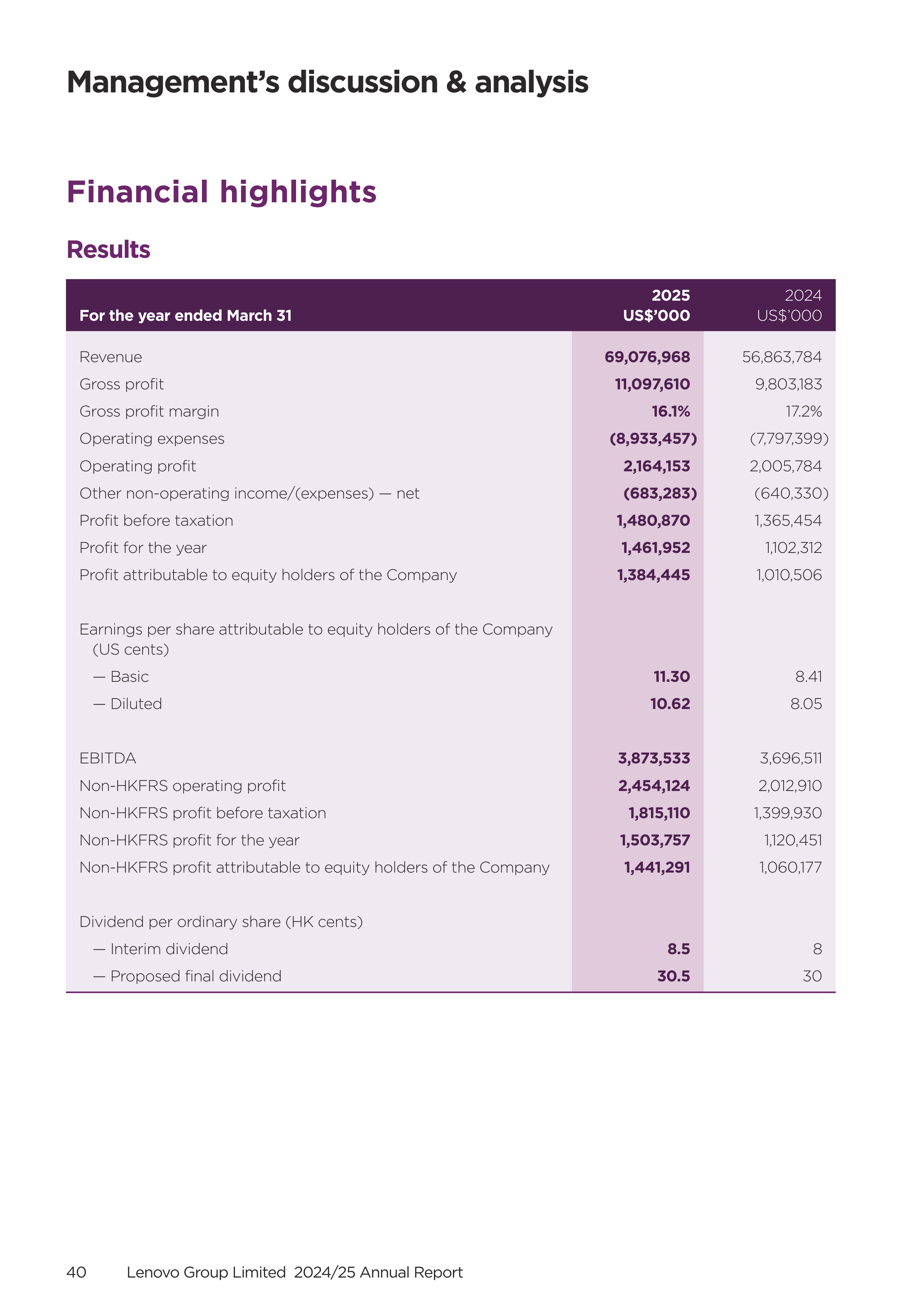
Management’s discussion & analysis
Lenovo Group Limited 2024/25 Annual Report
40
Financial highlights
Results
For the year ended March 31
2025
US$’000
2024
US$’000
Revenue
69,076,968
56,863,784
Gross profit
11,097,610
9,803,183
Gross profit margin
16.1%
17.2%
Operating expenses
(8,933,457 )
(7,797,399)
Operating profit
2,164,153
2,005,784
Other non-operating income/(expenses) — net
(683,283 )
(640,330)
Profit before taxation
1,480,870
1,365,454
Profit for the year
1,461,952
1,102,312
Profit attributable to equity holders of the Company
1,384,445
1,010,506
Earnings per share attributable to equity holders of the Company
(US cents)
— Basic
11.30
8.41
— Diluted
10.62
8.05
EBITDA
3,873,533
3,696,511
Non-HKFRS operating profit
2,454,124
2,012,910
Non-HKFRS profit before taxation
1,815,110
1,399,930
Non-HKFRS profit for the year
1,503,757
1,120,451
Non-HKFRS profit attributable to equity holders of the Company
1,441,291
1,060,177
Dividend per ordinary share (HK cents)
— Interim dividend
8.5
8
— Proposed final dividend
30.5
30
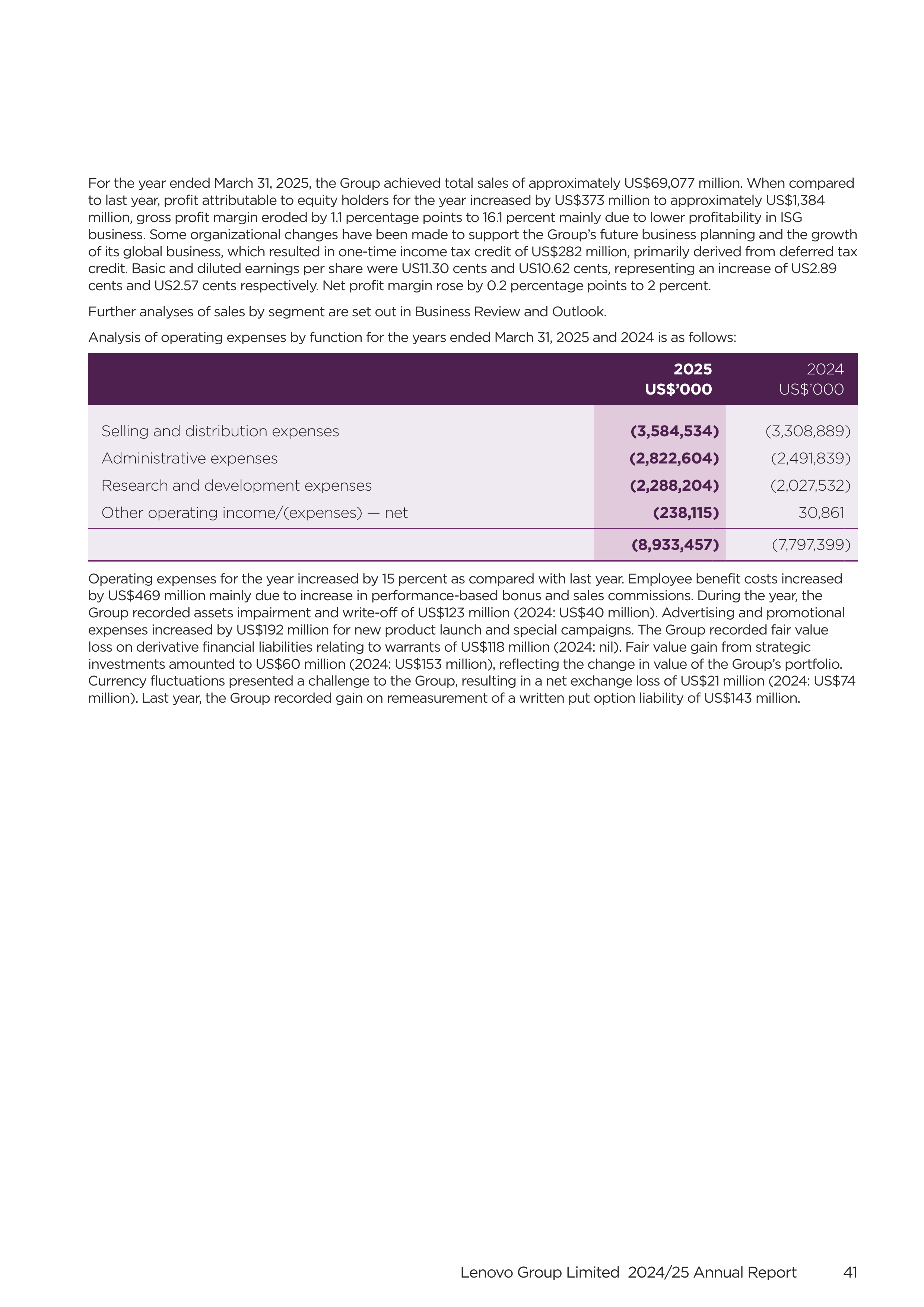
Lenovo Group Limited 2024/25 Annual Report
41
For the year ended March 31, 2025, the Group achieved total sales of approximately US$69,077 million. When compared
to last year, profit attributable to equity holders for the year increased by US$373 million to approximately US$1,384
million, gross profit margin eroded by 1.1 percentage points to 16.1 percent mainly due to lower profitability in ISG
business. Some organizational changes have been made to support the Group’s future business planning and the growth
of its global business, which resulted in one-time income tax credit of US$282 million, primarily derived from deferred tax
credit. Basic and diluted earnings per share were US11.30 cents and US10.62 cents, representing an increase of US2.89
cents and US2.57 cents respectively. Net profit margin rose by 0.2 percentage points to 2 percent.
Further analyses of sales by segment are set out in Business Review and Outlook.
Analysis of operating expenses by function for the years ended March 31, 2025 and 2024 is as follows:
2025
US$’000
2024
US$’000
Selling and distribution expenses
(3,584,534)
(3,308,889)
Administrative expenses
(2,822,604)
(2,491,839)
Research and development expenses
(2,288,204)
(2,027,532)
Other operating income/(expenses) — net
(238,115)
30,861
(8,933,457)
(7,797,399)
Operating expenses for the year increased by 15 percent as compared with last year. Employee benefit costs increased
by US$469 million mainly due to increase in performance-based bonus and sales commissions. During the year, the
Group recorded assets impairment and write-off of US$123 million (2024: US$40 million). Advertising and promotional
expenses increased by US$192 million for new product launch and special campaigns. The Group recorded fair value
loss on derivative financial liabilities relating to warrants of US$118 million (2024: nil). Fair value gain from strategic
investments amounted to US$60 million (2024: US$153 million), reflecting the change in value of the Group’s portfolio.
Currency fluctuations presented a challenge to the Group, resulting in a net exchange loss of US$21 million (2024: US$74
million). Last year, the Group recorded gain on remeasurement of a written put option liability of US$143 million.
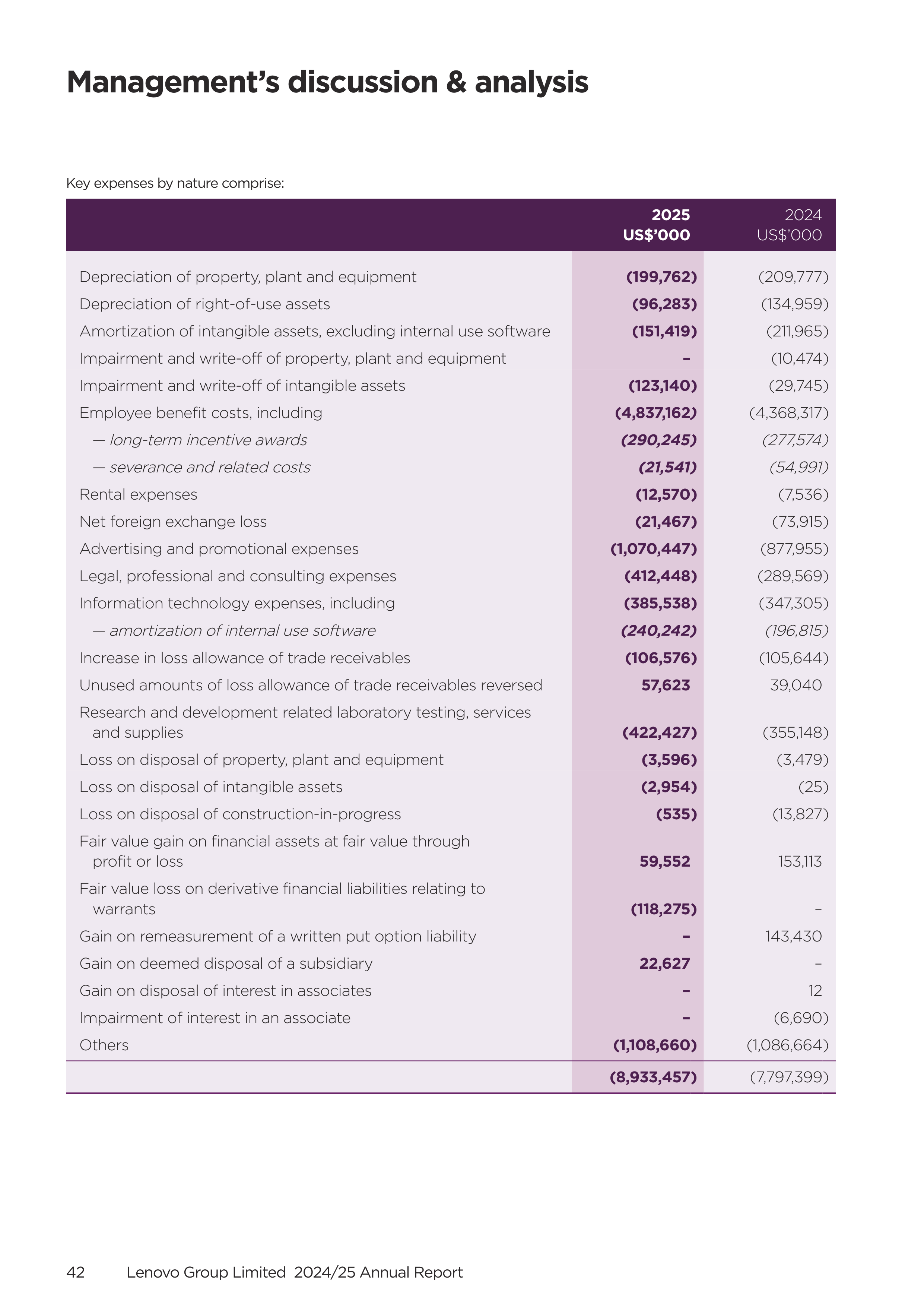
Management’s discussion & analysis
Lenovo Group Limited 2024/25 Annual Report
42
Key expenses by nature comprise:
2025
US$’000
2024
US$’000
Depreciation of property, plant and equipment
(199,762 )
(209,777)
Depreciation of right-of-use assets
(96,283 )
(134,959)
Amortization of intangible assets, excluding internal use software
(151,419 )
(211,965)
Impairment and write-off of property, plant and equipment
–
(10,474)
Impairment and write-off of intangible assets
(123,140 )
(29,745)
Employee benefit costs, including
(4,837,162 )
(4,368,317)
— long-term incentive awards
(290,245 )
(277,574)
— severance and related costs
(21,541 )
(54,991)
Rental expenses
(12,570 )
(7,536)
Net foreign exchange loss
(21,467 )
(73,915)
Advertising and promotional expenses
(1,070,447 )
(877,955)
Legal, professional and consulting expenses
(412,448 )
(289,569)
Information technology expenses, including
(385,538 )
(347,305)
— amortization of internal use software
(240,242 )
(196,815)
Increase in loss allowance of trade receivables
(106,576 )
(105,644)
Unused amounts of loss allowance of trade receivables reversed
57,623
39,040
Research and development related laboratory testing, services
and supplies
(422,427 )
(355,148)
Loss on disposal of property, plant and equipment
(3,596 )
(3,479)
Loss on disposal of intangible assets
(2,954 )
(25)
Loss on disposal of construction-in-progress
(535 )
(13,827)
Fair value gain on financial assets at fair value through
profit or loss
59,552
153,113
Fair value loss on derivative financial liabilities relating to
warrants
(118,275)
–
Gain on remeasurement of a written put option liability
–
143,430
Gain on deemed disposal of a subsidiary
22,627
–
Gain on disposal of interest in associates
–
12
Impairment of interest in an associate
–
(6,690)
Others
(1,108,660 )
(1,086,664)
(8,933,457 )
(7,797,399)
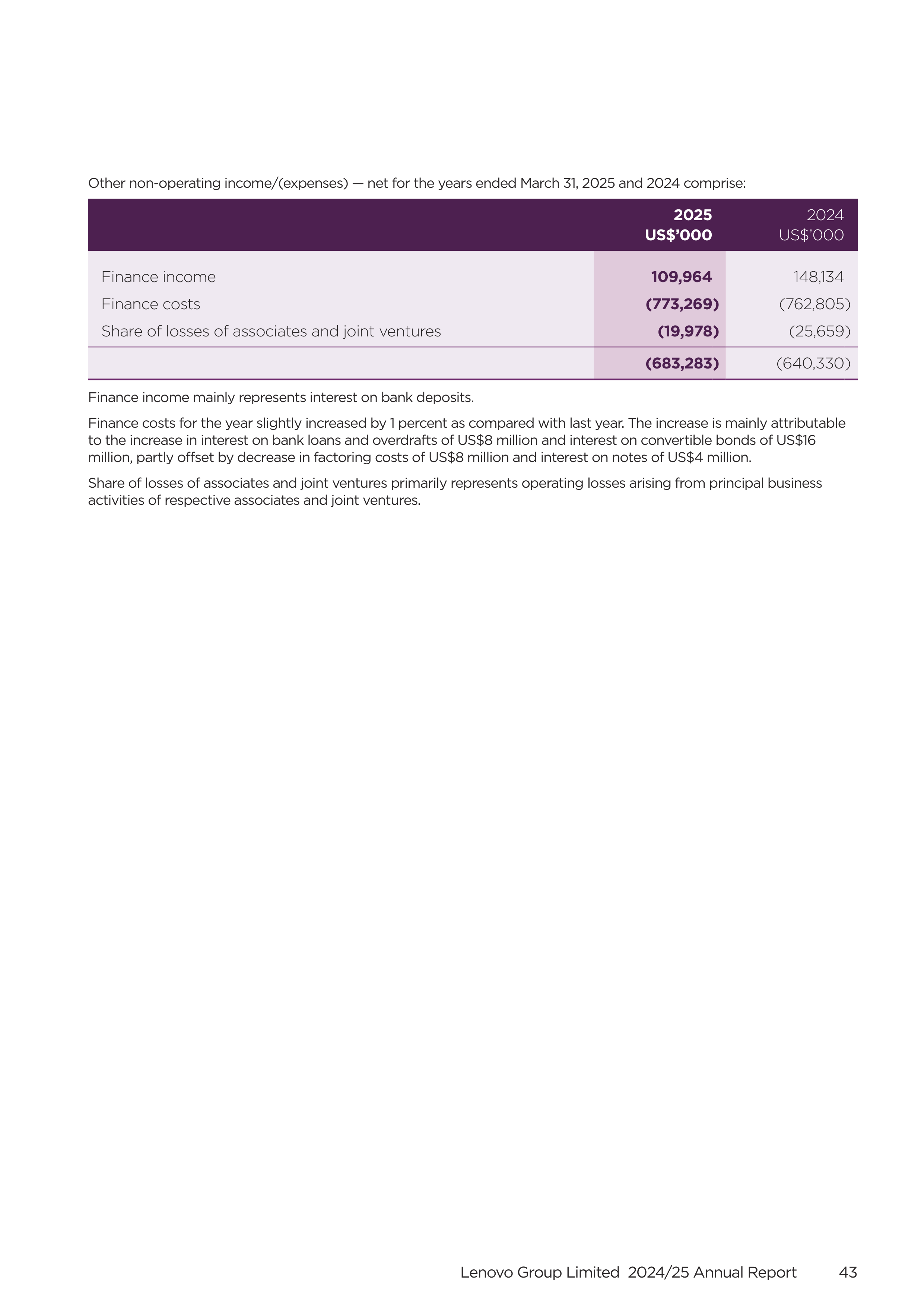
Lenovo Group Limited 2024/25 Annual Report
43
Other non-operating income/(expenses) — net for the years ended March 31, 2025 and 2024 comprise:
2025
US$’000
2024
US$’000
Finance income
109,964
148,134
Finance costs
(773,269)
(762,805)
Share of losses of associates and joint ventures
(19,978)
(25,659)
(683,283)
(640,330)
Finance income mainly represents interest on bank deposits.
Finance costs for the year slightly increased by 1 percent as compared with last year. The increase is mainly attributable
to the increase in interest on bank loans and overdrafts of US$8 million and interest on convertible bonds of US$16
million, partly offset by decrease in factoring costs of US$8 million and interest on notes of US$4 million.
Share of losses of associates and joint ventures primarily represents operating losses arising from principal business
activities of respective associates and joint ventures.
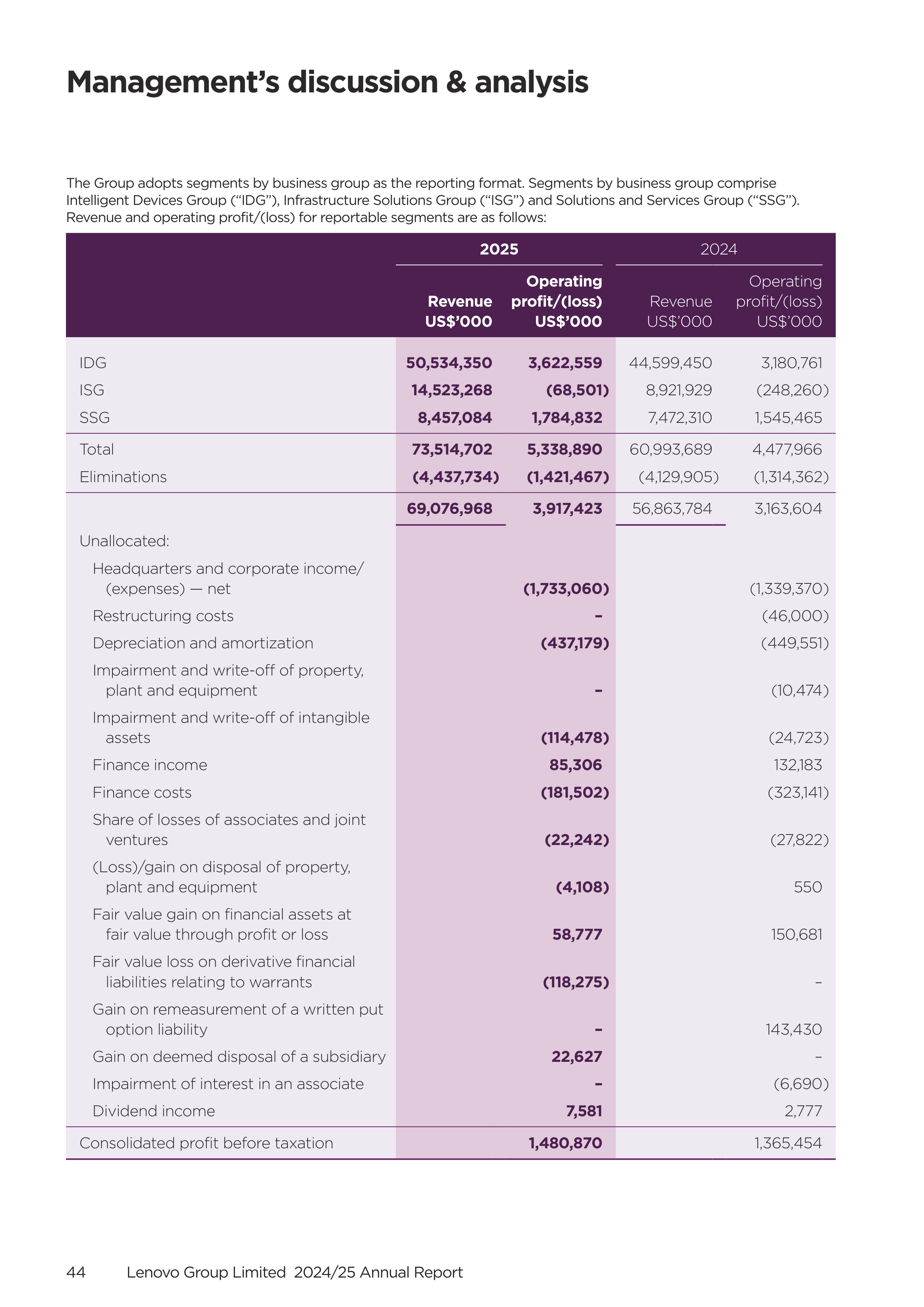
Management’s discussion & analysis
Lenovo Group Limited 2024/25 Annual Report
44
The Group adopts segments by business group as the reporting format. Segments by business group comprise
Intelligent Devices Group (“IDG”), Infrastructure Solutions Group (“ISG”) and Solutions and Services Group (“SSG”).
Revenue and operating profit/(loss) for reportable segments are as follows:
2025
2024
Revenue
US$’000
Operating
profit/(loss)
US$’000
Revenue
US$’000
Operating
profit/(loss)
US$’000
IDG
50,534,350
3,622,559
44,599,450
3,180,761
ISG
14,523,268
(68,501 )
8,921,929
(248,260)
SSG
8,457,084
1,784,832
7,472,310
1,545,465
Total
73,514,702
5,338,890
60,993,689
4,477,966
Eliminations
(4,437,734 )
(1,421,467 )
(4,129,905)
(1,314,362)
69,076,968
3,917,423
56,863,784
3,163,604
Unallocated:
Headquarters and corporate income/
(expenses) — net
(1,733,060 )
(1,339,370)
Restructuring costs
–
(46,000)
Depreciation and amortization
(437,179)
(449,551)
Impairment and write-off of property,
plant and equipment
–
(10,474)
Impairment and write-off of intangible
assets
(114,478 )
(24,723)
Finance income
85,306
132,183
Finance costs
(181,502 )
(323,141)
Share of losses of associates and joint
ventures
(22,242 )
(27,822)
(Loss)/gain on disposal of property,
plant and equipment
(4,108 )
550
Fair value gain on financial assets at
fair value through profit or loss
58,777
150,681
Fair value loss on derivative financial
liabilities relating to warrants
(118,275)
–
Gain on remeasurement of a written put
option liability
–
143,430
Gain on deemed disposal of a subsidiary
22,627
–
Impairment of interest in an associate
–
(6,690)
Dividend income
7,581
2,777
Consolidated profit before taxation
1,480,870
1,365,454
Lenovo Group Limited 2024/25 Annual Report
45
Headquarters and corporate income/(expenses) — net for the year comprise various expenses, after appropriate
allocation to business groups, of US$1,733 million (2024: US$1,339 million) such as employee benefit costs, legal,
professional and consulting expenses, and research and technology expenses. The increase is primarily in relation to the
increase in employee benefit costs driven by performance-based bonus, increase in legal, professional and consulting
expenses; advertising and promotional expenses; and provision for claims, partly offset by the decrease in net foreign
exchange loss as compared with last year.
Use of non-HKFRS measure
To supplement Lenovo’s consolidated financial statements prepared and presented in accordance with HKFRS
Accounting Standards (“HKFRS”), we utilize non-HKFRS adjusted profit as an additional financial measure.
We define adjusted profit as profit for the year by excluding (i) net fair value changes on financial assets at fair value
through profit or loss, (ii) amortization of intangible assets resulting from mergers and acquisitions, (iii) mergers and
acquisitions related charges, (iv) gain on deemed disposal of a subsidiary, (v) impairment and write-off of intangible assets, (vi)
one-time income tax credit, (vii) restructuring and other charges, (viii) gain on remeasurement of a written put option
liability, (ix) fair value change on derivative financial liabilities relating to warrants, and (x) notional interest of convertible
bonds, and the corresponding income tax effects, if any.
More specifically, management excludes each of those items mentioned above for the following reasons:
—
Lenovo recognizes fair value gains or losses from its strategic investments. The change in fair value included
revaluation gains or losses on new investment rounds on unlisted holdings and mark-to-market gains or losses
on listed holdings. Lenovo excludes this item for the purposes of calculating the non-HKFRS measure to facilitate
a more meaningful evaluation of Lenovo’s current operating performance and comparisons to operating
performance in other periods.
—
Lenovo incurs charges related to the amortization of intangible assets resulting from mergers and acquisitions.
Those charges are included in Lenovo’s net profit prepared under HKFRS. Such charges are significantly impacted
by the timing and magnitude of Lenovo’s acquisitions and any related impairment charges. Consequently, Lenovo
excludes these charges for the purposes of calculating the non-HKFRS measure to facilitate a more meaningful
evaluation of Lenovo’s current operating performance and comparisons to operating performance in other periods.
—
Lenovo incurs cost related to its mergers and acquisitions, which it would not have otherwise incurred as part of its
operations. The charges are direct expenses such as third-party professional and legal fees, and integration-related
costs, as well as non-cash adjustments to the fair value of certain acquired assets. These charges related to mergers
and acquisitions are inconsistent in amount and frequency and are significantly impacted by the timing and
nature of the transactions. Management believes that eliminating such expenses for the purposes of calculating
the non-HKFRS measure facilitates a more meaningful evaluation of Lenovo’s current operating performance and
comparisons to operating performance in other periods.
—
Lenovo recognizes gain on deemed disposal of a subsidiary. Such gains or losses are inconsistent in amount and
frequency and are significantly impacted by the timing and nature of the transactions. Lenovo excludes this item
for the purposes of calculating the non-HKFRS measure to facilitate a more meaningful evaluation of Lenovo’s
current operating performance and comparisons to operating performance in other periods.
—
Lenovo records impairment and write-off of intangible assets, which are inconsistent in amount and frequency.
Lenovo excludes these charges for the purposes of calculating the non-HKFRS measure to facilitate a more
meaningful evaluation of Lenovo’s current operating performance and comparisons to operating performance in
other periods.
—
Lenovo recognizes one-time income tax credit, primarily derived from deferred tax credit, which is non-recurring
in nature. During the year, some organizational changes have been made to support the Group’s future business
planning and the growth of its global business, which resulted in one-time income tax credit. Lenovo excludes this
item for the purposes of calculating the non-HKFRS measure to facilitate a more meaningful evaluation of Lenovo’s
current operating performance and comparisons to operating performance in other periods.
Management’s discussion & analysis
Lenovo Group Limited 2024/25 Annual Report
46
—
Lenovo incurs restructuring and other charges that are (i) costs associated with restructuring plans which are
related to employee separation from service; and (ii) other charges, which include non-recurring costs for assets
impairment and write-off. Lenovo excludes these restructuring and other charges for the purposes of calculating
the non-HKFRS measure to facilitate a more meaningful evaluation of Lenovo’s current operating performance and
comparisons to operating performance in other periods.
—
Lenovo recognizes gain on remeasurement of a written put option liability based on the latest assessment.
Lenovo excludes this gain for the purposes of calculating the non-HKFRS measure to facilitate a more meaningful
evaluation of Lenovo’s current operating performance and comparisons to operating performance in other periods.
—
Lenovo recognizes fair value change on derivative financial liabilities relating to warrants. Lenovo excludes this item
for the purposes of calculating the non-HKFRS measure to facilitate a more meaningful evaluation of Lenovo’s
current operating performance and comparisons to operating performance in other periods.
—
Lenovo incurs notional interest of convertible bonds, which is non-cash in nature. Lenovo excludes these charges
for the purposes of calculating the non-HKFRS measure to facilitate a more meaningful evaluation of Lenovo’s
current operating performance and comparisons to operating performance in other periods.
This non-HKFRS financial measure is not computed in accordance with, or as an alternative to, HKFRS. Management
uses this non-HKFRS financial measure for the purposes of evaluating Lenovo’s historical and prospective financial
performance. Management believes that excluding the items mentioned above for this non-HKFRS financial measure
allows management to better understand Lenovo’s consolidated financial performance in relation to its operating results,
as management does not believe that the excluded items are reflective of ongoing operating results.
However, the use of this particular non-HKFRS measure has limitations as an analytical tool, and should not be
considered in isolation from, or as a substitute for analysis of, the results of operations or financial conditions as reported
under HKFRS. In addition, this non-HKFRS financial measure may be defined differently from similar terms used by other
companies and therefore may not be comparable to similar measures used by other companies.
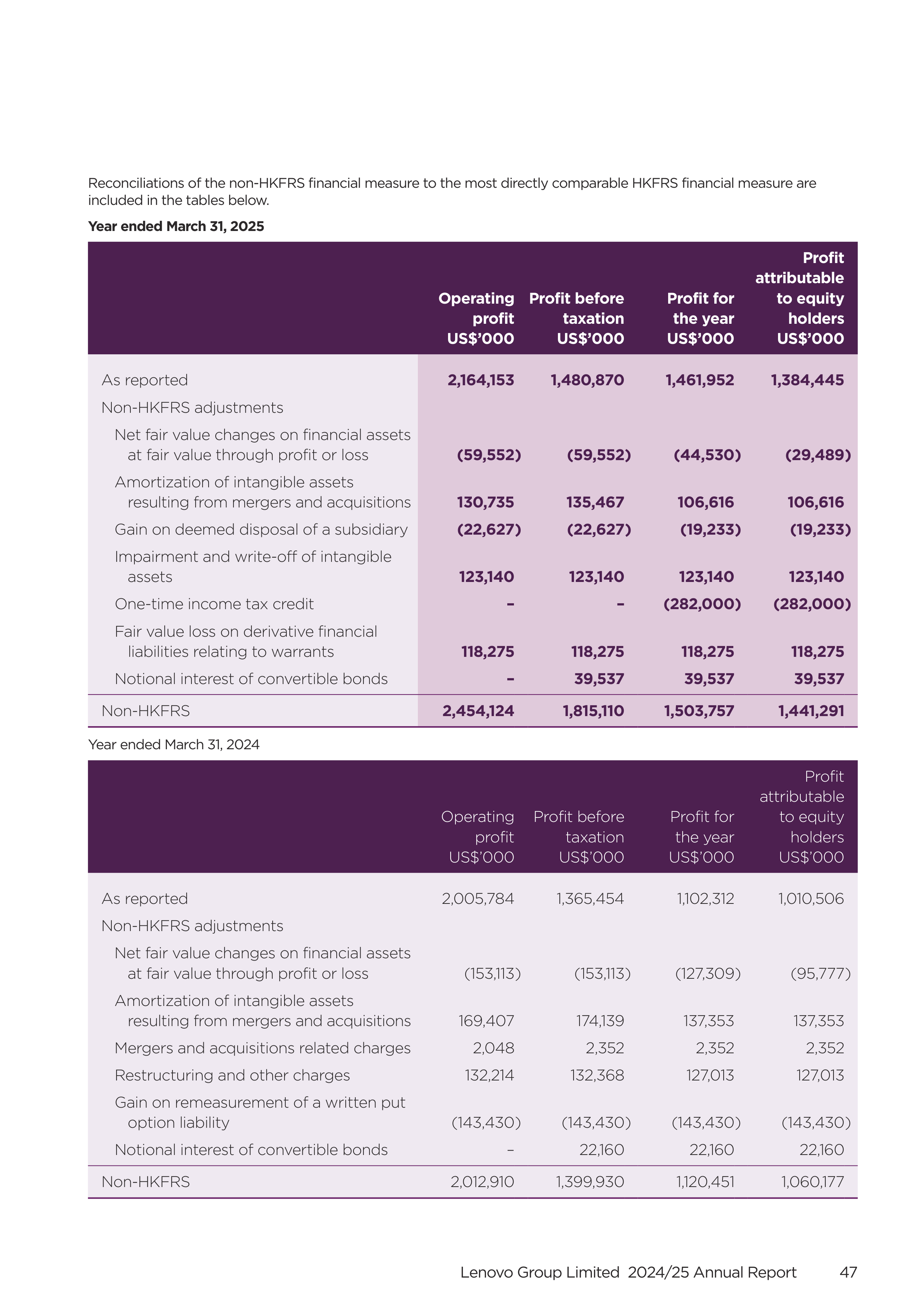
Lenovo Group Limited 2024/25 Annual Report
47
Reconciliations of the non-HKFRS financial measure to the most directly comparable HKFRS financial measure are
included in the tables below.
Year ended March 31, 2025
Operating
profit
US$’000
Profit before
taxation
US$’000
Profit for
the year
US$’000
Profit
attributable
to equity
holders
US$’000
As reported
2,164,153
1,480,870
1,461,952
1,384,445
Non-HKFRS adjustments
Net fair value changes on financial assets
at fair value through profit or loss
(59,552 )
(59,552 )
(44,530 )
(29,489 )
Amortization of intangible assets
resulting from mergers and acquisitions
130,735
135,467
106,616
106,616
Gain on deemed disposal of a subsidiary
(22,627 )
(22,627 )
(19,233 )
(19,233 )
Impairment and write-off of intangible
assets
123,140
123,140
123,140
123,140
One-time income tax credit
–
–
(282,000 )
(282,000 )
Fair value loss on derivative financial
liabilities relating to warrants
118,275
118,275
118,275
118,275
Notional interest of convertible bonds
–
39,537
39,537
39,537
Non-HKFRS
2,454,124
1,815,110
1,503,757
1,441,291
Year ended March 31, 2024
Operating
profit
US$’000
Profit before
taxation
US$’000
Profit for
the year
US$’000
Profit
attributable
to equity
holders
US$’000
As reported
2,005,784
1,365,454
1,102,312
1,010,506
Non-HKFRS adjustments
Net fair value changes on financial assets
at fair value through profit or loss
(153,113)
(153,113)
(127,309)
(95,777)
Amortization of intangible assets
resulting from mergers and acquisitions
169,407
174,139
137,353
137,353
Mergers and acquisitions related charges
2,048
2,352
2,352
2,352
Restructuring and other charges
132,214
132,368
127,013
127,013
Gain on remeasurement of a written put
option liability
(143,430)
(143,430)
(143,430)
(143,430)
Notional interest of convertible bonds
–
22,160
22,160
22,160
Non-HKFRS
2,012,910
1,399,930
1,120,451
1,060,177
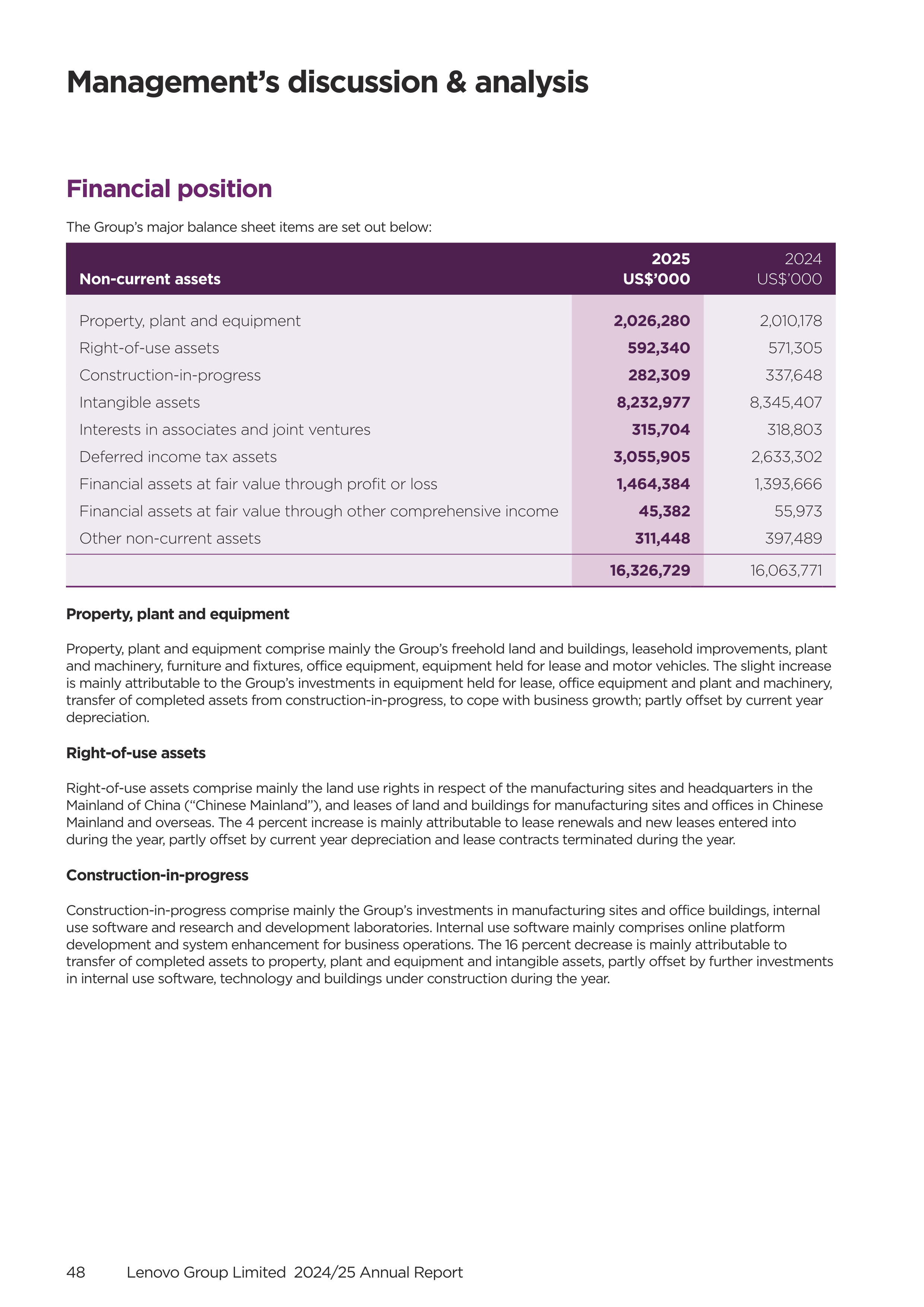
Management’s discussion & analysis
Lenovo Group Limited 2024/25 Annual Report
48
Financial position
The Group’s major balance sheet items are set out below:
Non-current assets
2025
US$’000
2024
US$’000
Property, plant and equipment
2,026,280
2,010,178
Right-of-use assets
592,340
571,305
Construction-in-progress
282,309
337,648
Intangible assets
8,232,977
8,345,407
Interests in associates and joint ventures
315,704
318,803
Deferred income tax assets
3,055,905
2,633,302
Financial assets at fair value through profit or loss
1,464,384
1,393,666
Financial assets at fair value through other comprehensive income
45,382
55,973
Other non-current assets
311,448
397,489
16,326,729
16,063,771
Property, plant and equipment
Property, plant and equipment comprise mainly the Group’s freehold land and buildings, leasehold improvements, plant
and machinery, furniture and fixtures, office equipment, equipment held for lease and motor vehicles. The slight increase
is mainly attributable to the Group’s investments in equipment held for lease, office equipment and plant and machinery,
transfer of completed assets from construction-in-progress, to cope with business growth; partly offset by current year
depreciation.
Right-of-use assets
Right-of-use assets comprise mainly the land use rights in respect of the manufacturing sites and headquarters in the
Mainland of China (“Chinese Mainland”), and leases of land and buildings for manufacturing sites and offices in Chinese
Mainland and overseas. The 4 percent increase is mainly attributable to lease renewals and new leases entered into
during the year, partly offset by current year depreciation and lease contracts terminated during the year.
Construction-in-progress
Construction-in-progress comprise mainly the Group’s investments in manufacturing sites and office buildings, internal
use software and research and development laboratories. Internal use software mainly comprises online platform
development and system enhancement for business operations. The 16 percent decrease is mainly attributable to
transfer of completed assets to property, plant and equipment and intangible assets, partly offset by further investments
in internal use software, technology and buildings under construction during the year.
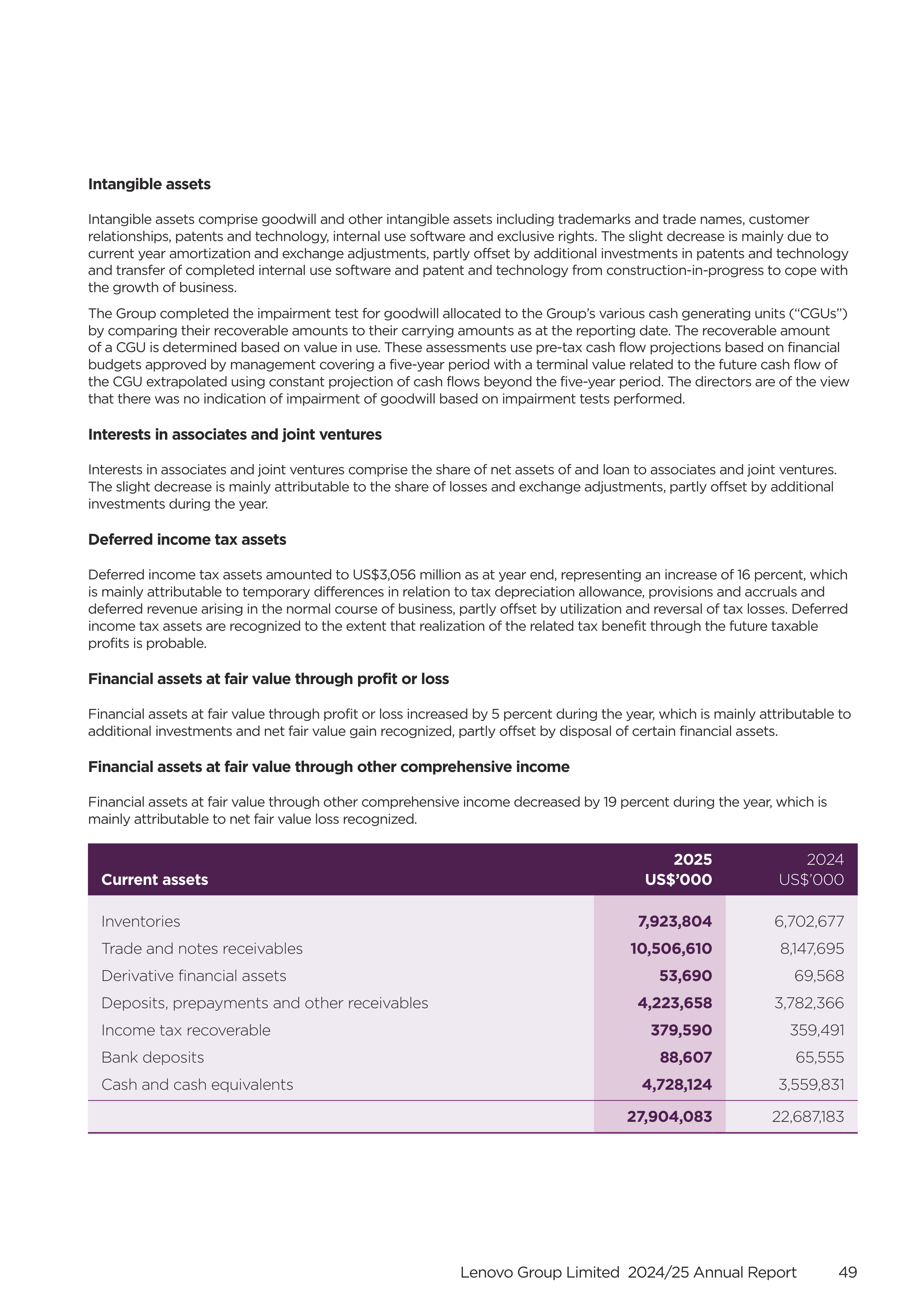
Lenovo Group Limited 2024/25 Annual Report
49
Intangible assets
Intangible assets comprise goodwill and other intangible assets including trademarks and trade names, customer
relationships, patents and technology, internal use software and exclusive rights. The slight decrease is mainly due to
current year amortization and exchange adjustments, partly offset by additional investments in patents and technology
and transfer of completed internal use software and patent and technology from construction-in-progress to cope with
the growth of business.
The Group completed the impairment test for goodwill allocated to the Group’s various cash generating units (“CGUs”)
by comparing their recoverable amounts to their carrying amounts as at the reporting date. The recoverable amount
of a CGU is determined based on value in use. These assessments use pre-tax cash flow projections based on financial
budgets approved by management covering a five-year period with a terminal value related to the future cash flow of
the CGU extrapolated using constant projection of cash flows beyond the five-year period. The directors are of the view
that there was no indication of impairment of goodwill based on impairment tests performed.
Interests in associates and joint ventures
Interests in associates and joint ventures comprise the share of net assets of and loan to associates and joint ventures.
The slight decrease is mainly attributable to the share of losses and exchange adjustments, partly offset by additional
investments during the year.
Deferred income tax assets
Deferred income tax assets amounted to US$3,056 million as at year end, representing an increase of 16 percent, which
is mainly attributable to temporary differences in relation to tax depreciation allowance, provisions and accruals and
deferred revenue arising in the normal course of business, partly offset by utilization and reversal of tax losses. Deferred
income tax assets are recognized to the extent that realization of the related tax benefit through the future taxable
profits is probable.
Financial assets at fair value through profit or loss
Financial assets at fair value through profit or loss increased by 5 percent during the year, which is mainly attributable to
additional investments and net fair value gain recognized, partly offset by disposal of certain financial assets.
Financial assets at fair value through other comprehensive income
Financial assets at fair value through other comprehensive income decreased by 19 percent during the year, which is
mainly attributable to net fair value loss recognized.
Current assets
2025
US$’000
2024
US$’000
Inventories
7,923,804
6,702,677
Trade and notes receivables
10,506,610
8,147,695
Derivative financial assets
53,690
69,568
Deposits, prepayments and other receivables
4,223,658
3,782,366
Income tax recoverable
379,590
359,491
Bank deposits
88,607
65,555
Cash and cash equivalents
4,728,124
3,559,831
27,904,083
22,687,183
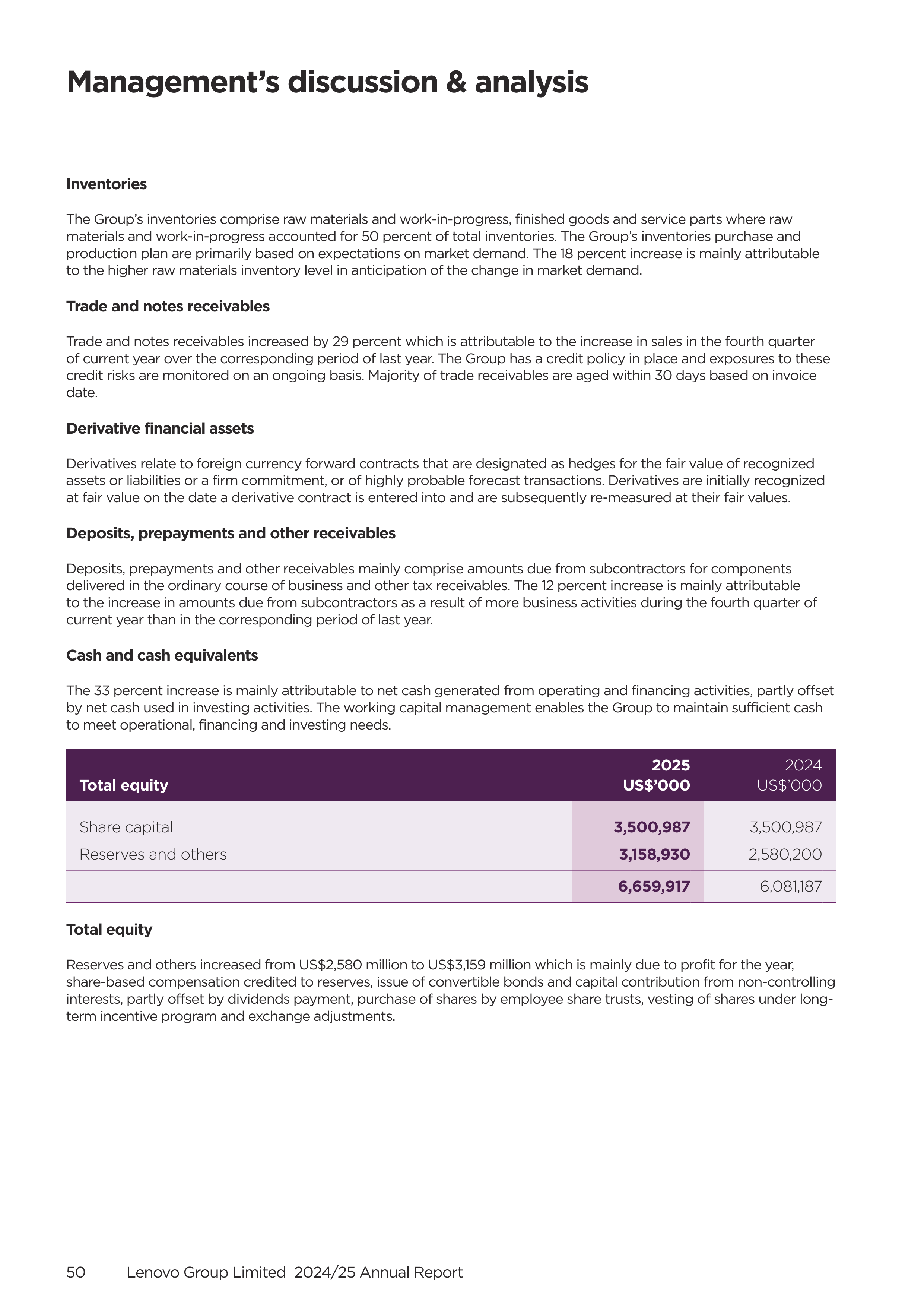
Management’s discussion & analysis
Lenovo Group Limited 2024/25 Annual Report
50
Inventories
The Group’s inventories comprise raw materials and work-in-progress, finished goods and service parts where raw
materials and work-in-progress accounted for 50 percent of total inventories. The Group’s inventories purchase and
production plan are primarily based on expectations on market demand. The 18 percent increase is mainly attributable
to the higher raw materials inventory level in anticipation of the change in market demand.
Trade and notes receivables
Trade and notes receivables increased by 29 percent which is attributable to the increase in sales in the fourth quarter
of current year over the corresponding period of last year. The Group has a credit policy in place and exposures to these
credit risks are monitored on an ongoing basis. Majority of trade receivables are aged within 30 days based on invoice
date.
Derivative financial assets
Derivatives relate to foreign currency forward contracts that are designated as hedges for the fair value of recognized
assets or liabilities or a firm commitment, or of highly probable forecast transactions. Derivatives are initially recognized
at fair value on the date a derivative contract is entered into and are subsequently re-measured at their fair values.
Deposits, prepayments and other receivables
Deposits, prepayments and other receivables mainly comprise amounts due from subcontractors for components
delivered in the ordinary course of business and other tax receivables. The 12 percent increase is mainly attributable
to the increase in amounts due from subcontractors as a result of more business activities during the fourth quarter of
current year than in the corresponding period of last year.
Cash and cash equivalents
The 33 percent increase is mainly attributable to net cash generated from operating and financing activities, partly offset
by net cash used in investing activities. The working capital management enables the Group to maintain sufficient cash
to meet operational, financing and investing needs.
Total equity
2025
US$’000
2024
US$’000
Share capital
3,500,987
3,500,987
Reserves and others
3,158,930
2,580,200
6,659,917
6,081,187
Total equity
Reserves and others increased from US$2,580 million to US$3,159 million which is mainly due to profit for the year,
share-based compensation credited to reserves, issue of convertible bonds and capital contribution from non-controlling
interests, partly offset by dividends payment, purchase of shares by employee share trusts, vesting of shares under long-
term incentive program and exchange adjustments.
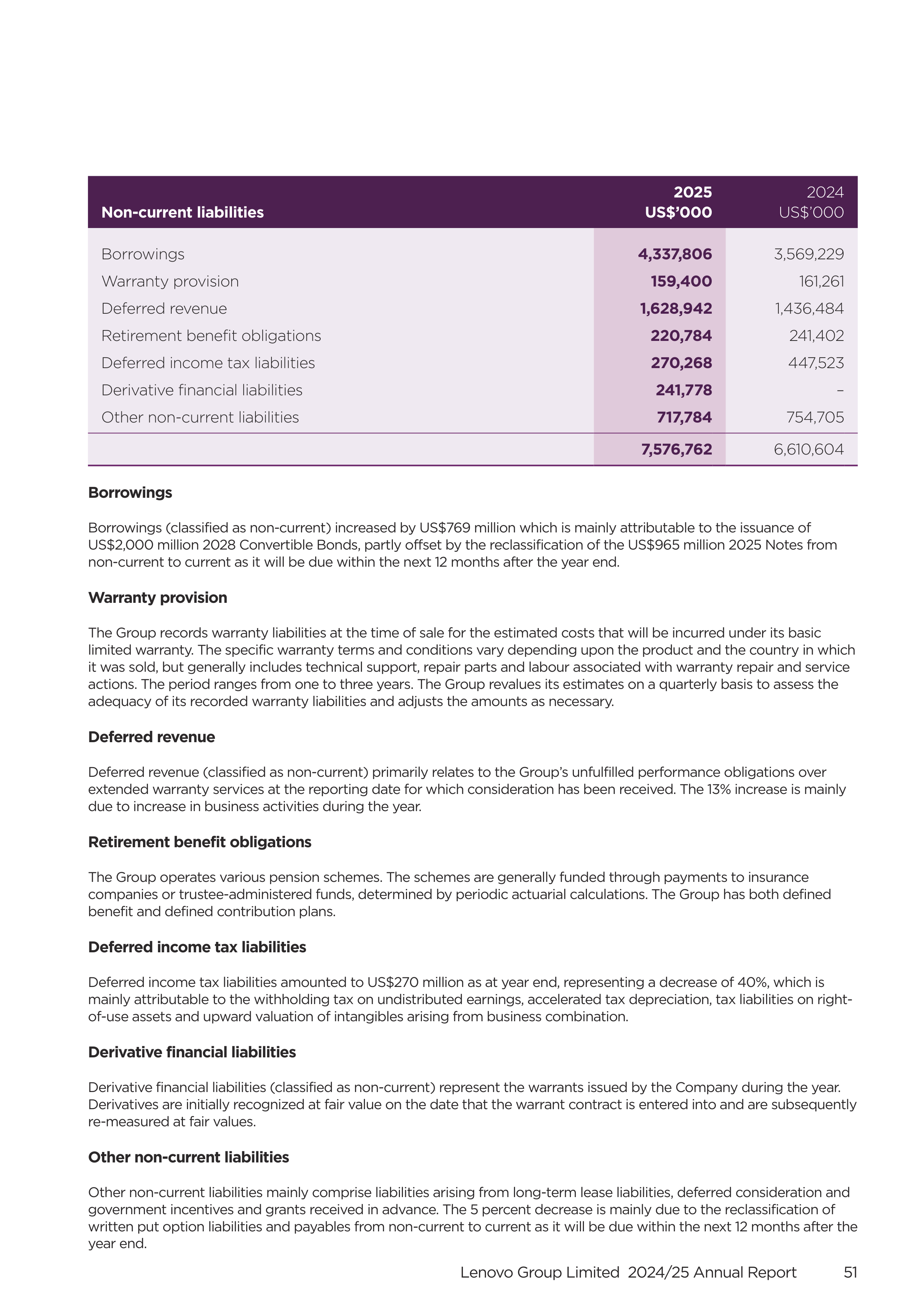
Lenovo Group Limited 2024/25 Annual Report
51
Non-current liabilities
2025
US$’000
2024
US$’000
Borrowings
4,337,806
3,569,229
Warranty provision
159,400
161,261
Deferred revenue
1,628,942
1,436,484
Retirement benefit obligations
220,784
241,402
Deferred income tax liabilities
270,268
447,523
Derivative financial liabilities
241,778
–
Other non-current liabilities
717,784
754,705
7,576,762
6,610,604
Borrowings
Borrowings (classified as non-current) increased by US$769 million which is mainly attributable to the issuance of
US$2,000 million 2028 Convertible Bonds, partly offset by the reclassification of the US$965 million 2025 Notes from
non-current to current as it will be due within the next 12 months after the year end.
Warranty provision
The Group records warranty liabilities at the time of sale for the estimated costs that will be incurred under its basic
limited warranty. The specific warranty terms and conditions vary depending upon the product and the country in which
it was sold, but generally includes technical support, repair parts and labour associated with warranty repair and service
actions. The period ranges from one to three years. The Group revalues its estimates on a quarterly basis to assess the
adequacy of its recorded warranty liabilities and adjusts the amounts as necessary.
Deferred revenue
Deferred revenue (classified as non-current) primarily relates to the Group’s unfulfilled performance obligations over
extended warranty services at the reporting date for which consideration has been received. The 13% increase is mainly
due to increase in business activities during the year.
Retirement benefit obligations
The Group operates various pension schemes. The schemes are generally funded through payments to insurance
companies or trustee-administered funds, determined by periodic actuarial calculations. The Group has both defined
benefit and defined contribution plans.
Deferred income tax liabilities
Deferred income tax liabilities amounted to US$270 million as at year end, representing a decrease of 40%, which is
mainly attributable to the withholding tax on undistributed earnings, accelerated tax depreciation, tax liabilities on right-
of-use assets and upward valuation of intangibles arising from business combination.
Derivative financial liabilities
Derivative financial liabilities (classified as non-current) represent the warrants issued by the Company during the year.
Derivatives are initially recognized at fair value on the date that the warrant contract is entered into and are subsequently
re-measured at fair values.
Other non-current liabilities
Other non-current liabilities mainly comprise liabilities arising from long-term lease liabilities, deferred consideration and
government incentives and grants received in advance. The 5 percent decrease is mainly due to the reclassification of
written put option liabilities and payables from non-current to current as it will be due within the next 12 months after the
year end.
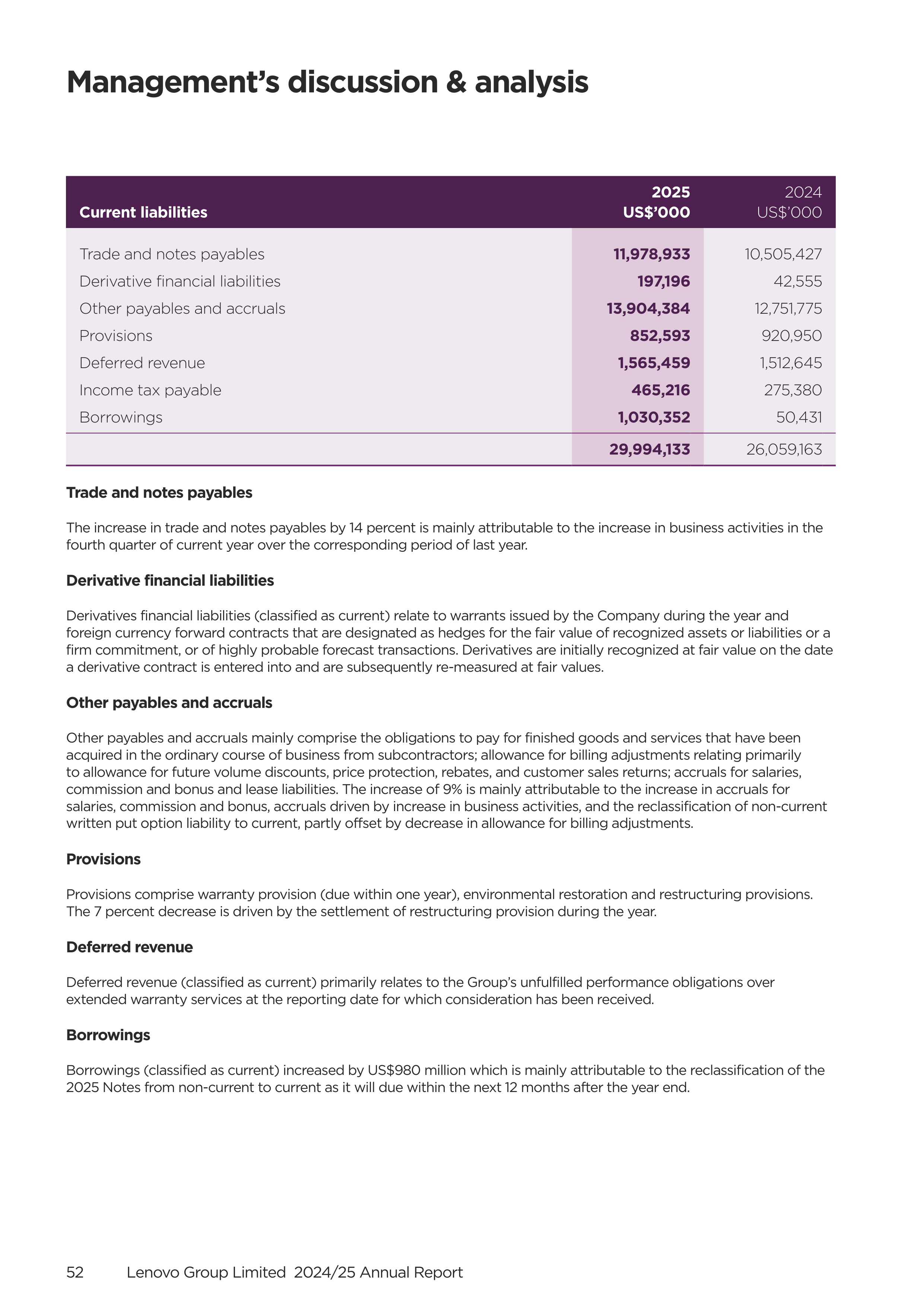
Management’s discussion & analysis
Lenovo Group Limited 2024/25 Annual Report
52
Current liabilities
2025
US$’000
2024
US$’000
Trade and notes payables
11,978,933
10,505,427
Derivative financial liabilities
197,196
42,555
Other payables and accruals
13,904,384
12,751,775
Provisions
852,593
920,950
Deferred revenue
1,565,459
1,512,645
Income tax payable
465,216
275,380
Borrowings
1,030,352
50,431
29,994,133
26,059,163
Trade and notes payables
The increase in trade and notes payables by 14 percent is mainly attributable to the increase in business activities in the
fourth quarter of current year over the corresponding period of last year.
Derivative financial liabilities
Derivatives financial liabilities (classified as current) relate to warrants issued by the Company during the year and
foreign currency forward contracts that are designated as hedges for the fair value of recognized assets or liabilities or a
firm commitment, or of highly probable forecast transactions. Derivatives are initially recognized at fair value on the date
a derivative contract is entered into and are subsequently re-measured at fair values.
Other payables and accruals
Other payables and accruals mainly comprise the obligations to pay for finished goods and services that have been
acquired in the ordinary course of business from subcontractors; allowance for billing adjustments relating primarily
to allowance for future volume discounts, price protection, rebates, and customer sales returns; accruals for salaries,
commission and bonus and lease liabilities. The increase of 9% is mainly attributable to the increase in accruals for
salaries, commission and bonus, accruals driven by increase in business activities, and the reclassification of non-current
written put option liability to current, partly offset by decrease in allowance for billing adjustments.
Provisions
Provisions comprise warranty provision (due within one year), environmental restoration and restructuring provisions.
The 7 percent decrease is driven by the settlement of restructuring provision during the year.
Deferred revenue
Deferred revenue (classified as current) primarily relates to the Group’s unfulfilled performance obligations over
extended warranty services at the reporting date for which consideration has been received.
Borrowings
Borrowings (classified as current) increased by US$980 million which is mainly attributable to the reclassification of the
2025 Notes from non-current to current as it will due within the next 12 months after the year end.
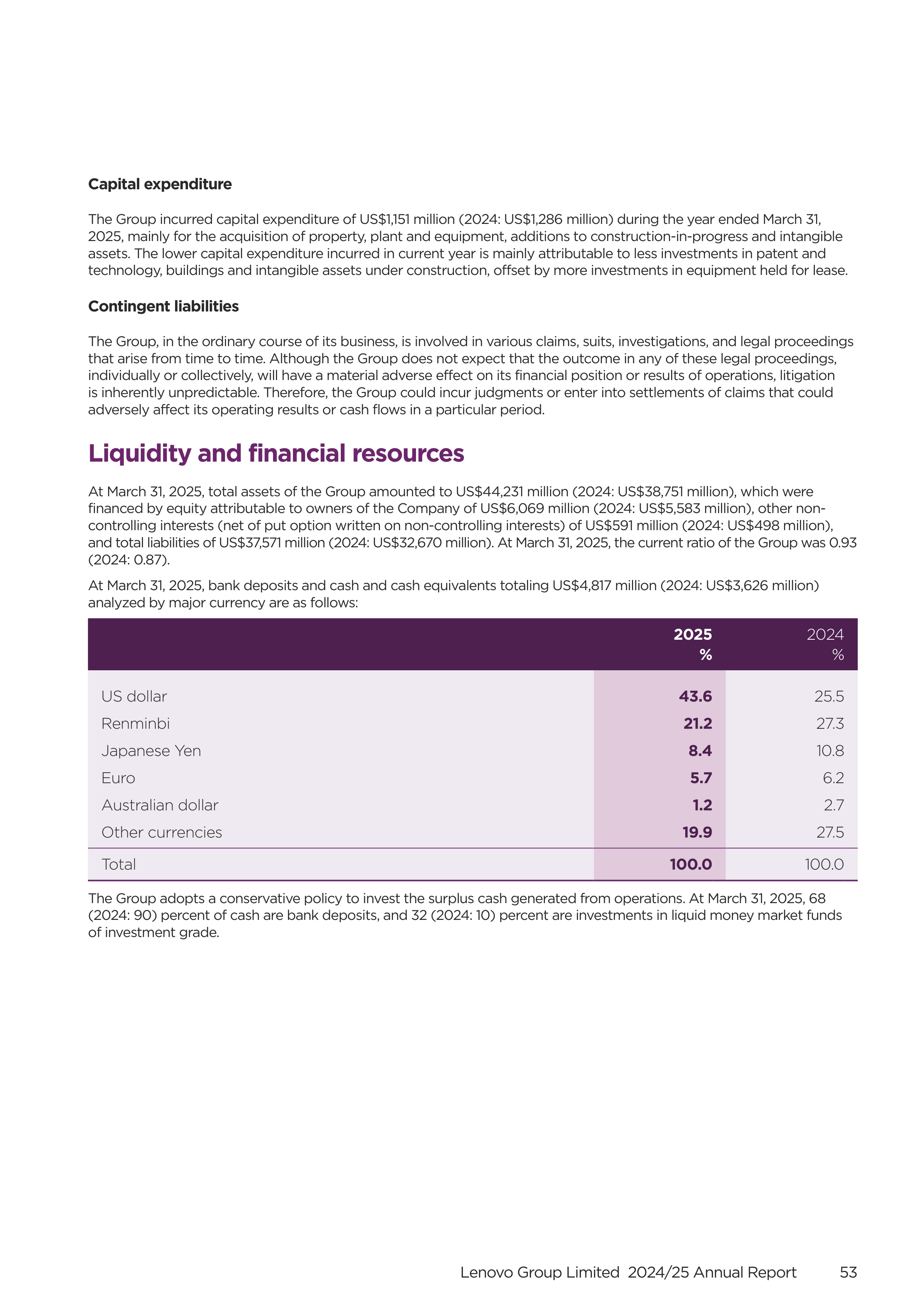
Lenovo Group Limited 2024/25 Annual Report
53
Capital expenditure
The Group incurred capital expenditure of US$1,151 million (2024: US$1,286 million) during the year ended March 31,
2025, mainly for the acquisition of property, plant and equipment, additions to construction-in-progress and intangible
assets. The lower capital expenditure incurred in current year is mainly attributable to less investments in patent and
technology, buildings and intangible assets under construction, offset by more investments in equipment held for lease.
Contingent liabilities
The Group, in the ordinary course of its business, is involved in various claims, suits, investigations, and legal proceedings
that arise from time to time. Although the Group does not expect that the outcome in any of these legal proceedings,
individually or collectively, will have a material adverse effect on its financial position or results of operations, litigation
is inherently unpredictable. Therefore, the Group could incur judgments or enter into settlements of claims that could
adversely affect its operating results or cash flows in a particular period.
Liquidity and financial resources
At March 31, 2025, total assets of the Group amounted to US$44,231 million (2024: US$38,751 million), which were
financed by equity attributable to owners of the Company of US$6,069 million (2024: US$5,583 million), other non-
controlling interests (net of put option written on non-controlling interests) of US$591 million (2024: US$498 million),
and total liabilities of US$37,571 million (2024: US$32,670 million). At March 31, 2025, the current ratio of the Group was 0.93
(2024: 0.87).
At March 31, 2025, bank deposits and cash and cash equivalents totaling US$4,817 million (2024: US$3,626 million)
analyzed by major currency are as follows:
2025
%
2024
%
US dollar
43.6
25.5
Renminbi
21.2
27.3
Japanese Yen
8.4
10.8
Euro
5.7
6.2
Australian dollar
1.2
2.7
Other currencies
19.9
27.5
Total
100.0
100.0
The Group adopts a conservative policy to invest the surplus cash generated from operations. At March 31, 2025, 68
(2024: 90) percent of cash are bank deposits, and 32 (2024: 10) percent are investments in liquid money market funds
of investment grade.
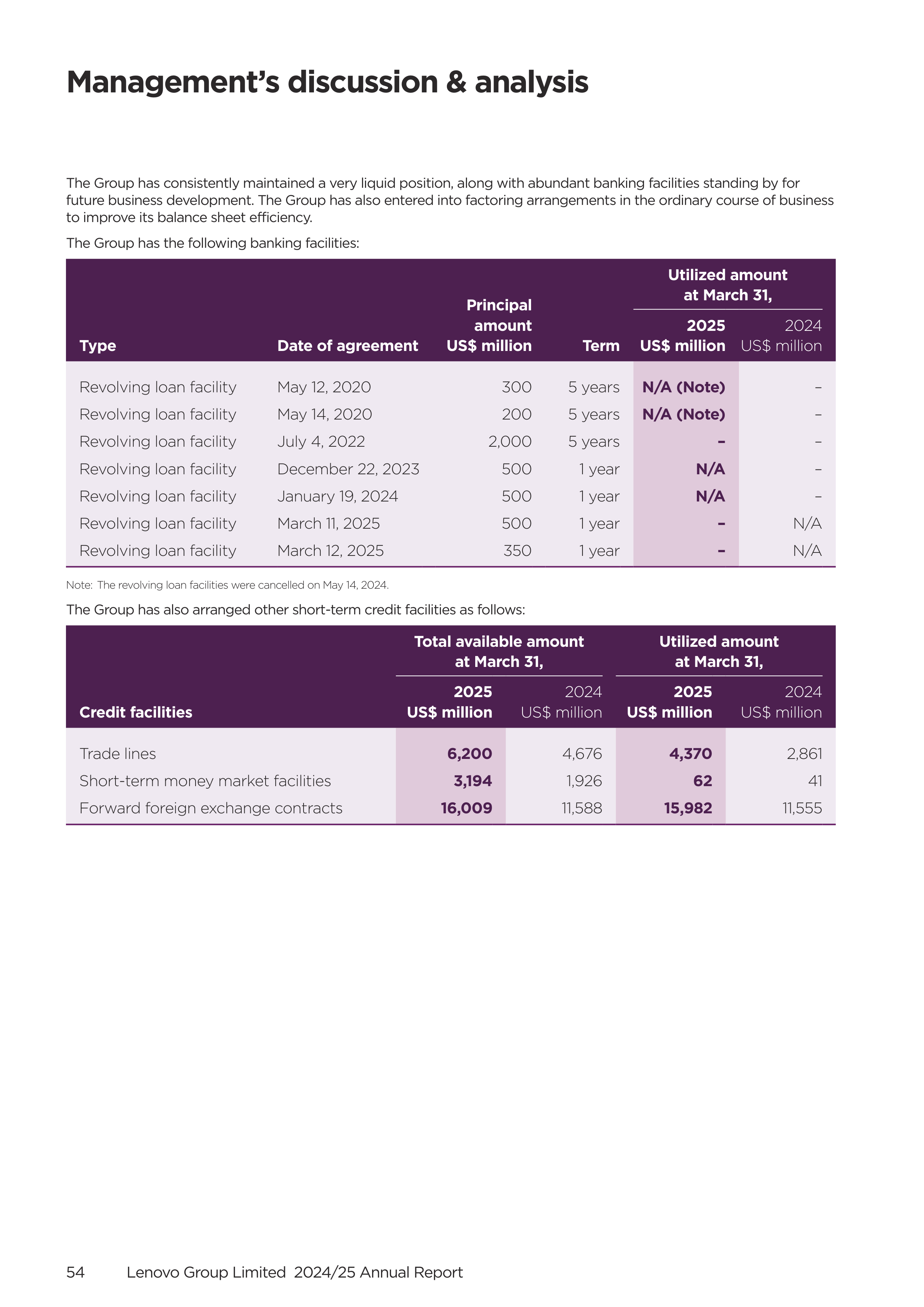
Management’s discussion & analysis
Lenovo Group Limited 2024/25 Annual Report
54
The Group has consistently maintained a very liquid position, along with abundant banking facilities standing by for
future business development. The Group has also entered into factoring arrangements in the ordinary course of business
to improve its balance sheet efficiency.
The Group has the following banking facilities:
Principal
amount
US$ million
Utilized amount
at March 31,
Type
Date of agreement
Term
2025
US$ million
2024
US$ million
Revolving loan facility
May 12, 2020
300
5 years
N/A (Note)
–
Revolving loan facility
May 14, 2020
200
5 years
N/A (Note)
–
Revolving loan facility
July 4, 2022
2,000
5 years
–
–
Revolving loan facility
December 22, 2023
500
1 year
N/A
–
Revolving loan facility
January 19, 2024
500
1 year
N/A
–
Revolving loan facility
March 11, 2025
500
1 year
–
N/A
Revolving loan facility
March 12, 2025
350
1 year
–
N/A
Note: The revolving loan facilities were cancelled on May 14, 2024.
The Group has also arranged other short-term credit facilities as follows:
Total available amount
at March 31,
Utilized amount
at March 31,
Credit facilities
2025
US$ million
2024
US$ million
2025
US$ million
2024
US$ million
Trade lines
6,200
4,676
4,370
2,861
Short-term money market facilities
3,194
1,926
62
41
Forward foreign exchange contracts
16,009
11,588
15,982
11,555
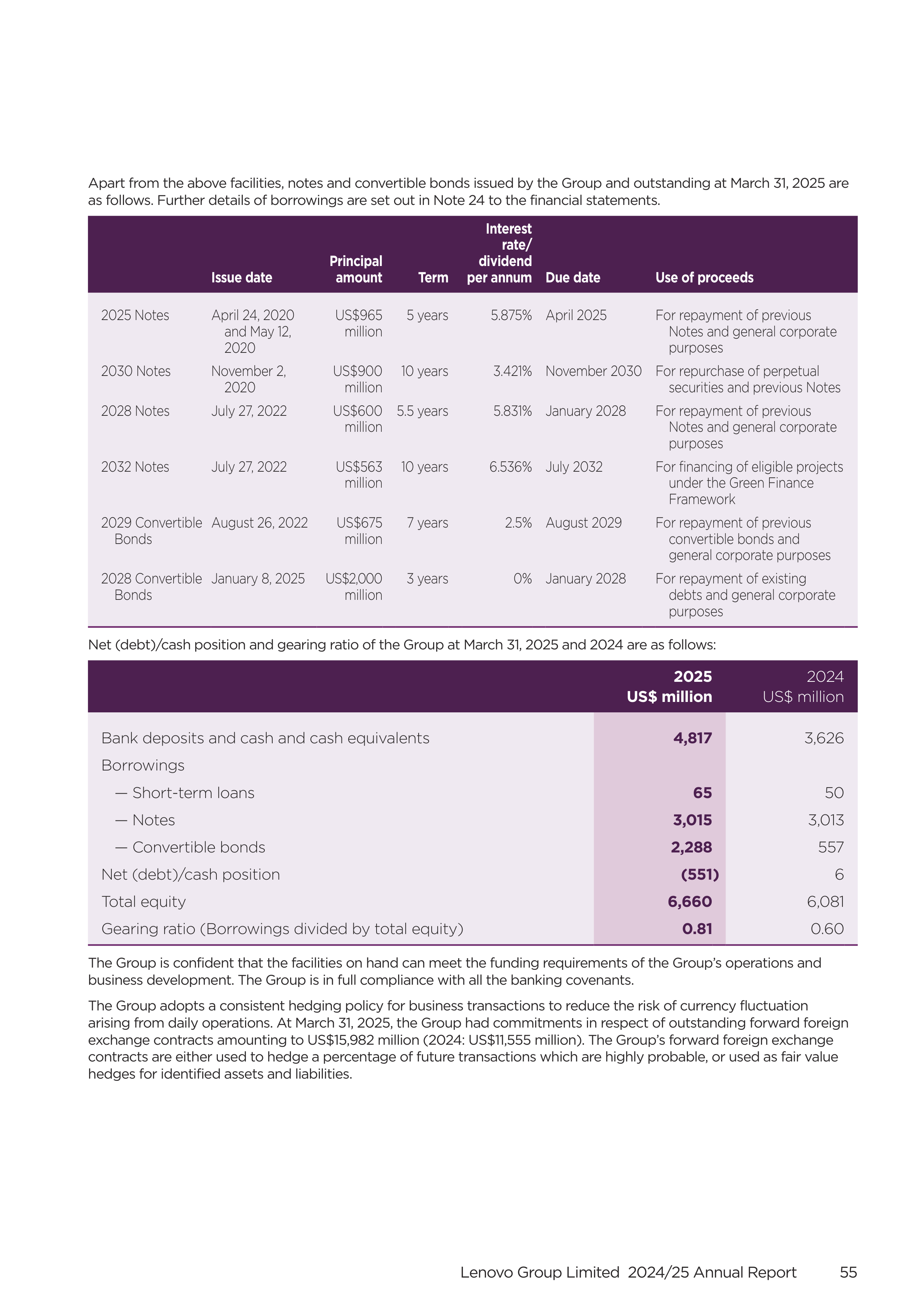
Lenovo Group Limited 2024/25 Annual Report
55
Apart from the above facilities, notes and convertible bonds issued by the Group and outstanding at March 31, 2025 are
as follows. Further details of borrowings are set out in Note 24 to the financial statements.
Issue date
Principal
amount
Term
Interest
rate/
dividend
per annum Due date
Use of proceeds
2025 Notes
April 24, 2020
and May 12,
2020
US$965
million
5 years
5.875%
April 2025
For repayment of previous
Notes and general corporate
purposes
2030 Notes
November 2,
2020
US$900
million
10 years
3.421%
November 2030
For repurchase of perpetual
securities and previous Notes
2028 Notes
July 27, 2022
US$600
million
5.5 years
5.831%
January 2028
For repayment of previous
Notes and general corporate
purposes
2032 Notes
July 27, 2022
US$563
million
10 years
6.536%
July 2032
For financing of eligible projects
under the Green Finance
Framework
2029 Convertible
Bonds
August 26, 2022
US$675
million
7 years
2.5%
August 2029
For repayment of previous
convertible bonds and
general corporate purposes
2028 Convertible
Bonds
January 8, 2025
US$2,000
million
3 years
0%
January 2028
For repayment of existing
debts and general corporate
purposes
Net (debt)/cash position and gearing ratio of the Group at March 31, 2025 and 2024 are as follows:
2025
US$ million
2024
US$ million
Bank deposits and cash and cash equivalents
4,817
3,626
Borrowings
— Short-term loans
65
50
— Notes
3,015
3,013
— Convertible bonds
2,288
557
Net (debt)/cash position
(551 )
6
Total equity
6,660
6,081
Gearing ratio (Borrowings divided by total equity)
0.81
0.60
The Group is confident that the facilities on hand can meet the funding requirements of the Group’s operations and
business development. The Group is in full compliance with all the banking covenants.
The Group adopts a consistent hedging policy for business transactions to reduce the risk of currency fluctuation
arising from daily operations. At March 31, 2025, the Group had commitments in respect of outstanding forward foreign
exchange contracts amounting to US$15,982 million (2024: US$11,555 million). The Group’s forward foreign exchange
contracts are either used to hedge a percentage of future transactions which are highly probable, or used as fair value
hedges for identified assets and liabilities.
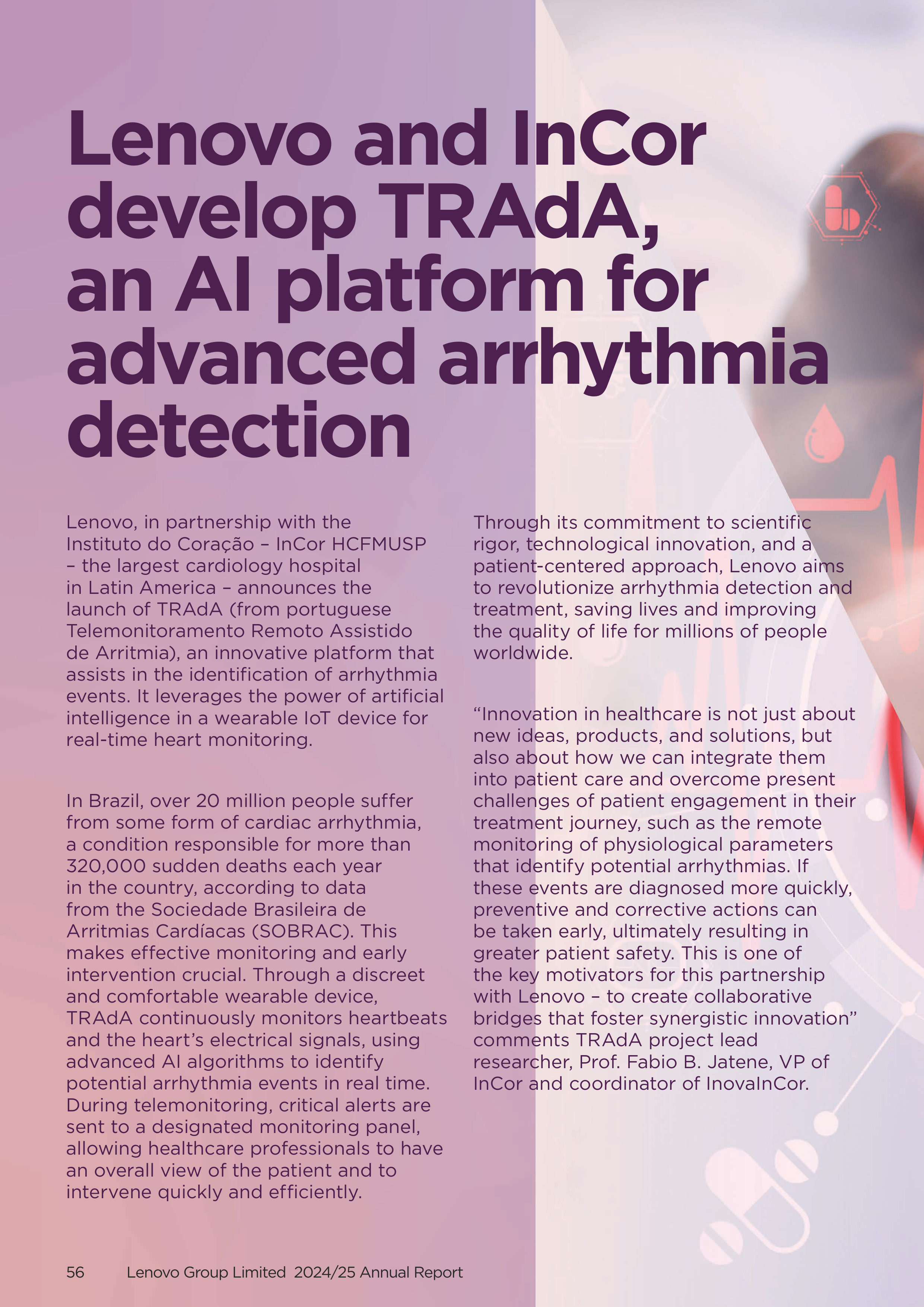

Lenovo Group Limited 2024/25 Annual Report
56
Lenovo and InCor
develop TRAdA,
an AI platform for
advanced arrhythmia
detection
Lenovo, in partnership with the
Instituto do Coração – InCor HCFMUSP
– the largest cardiology hospital
in Latin America – announces the
launch of TRAdA (from portuguese
Telemonitoramento Remoto Assistido
de Arritmia), an innovative platform that
assists in the identification of arrhythmia
events. It leverages the power of artificial
intelligence in a wearable IoT device for
real-time heart monitoring.
In Brazil, over 20 million people suffer
from some form of cardiac arrhythmia,
a condition responsible for more than
320,000 sudden deaths each year
in the country, according to data
from the Sociedade Brasileira de
Arritmias Cardíacas (SOBRAC). This
makes effective monitoring and early
intervention crucial. Through a discreet
and comfortable wearable device,
TRAdA continuously monitors heartbeats
and the heart’s electrical signals, using
advanced AI algorithms to identify
potential arrhythmia events in real time.
During telemonitoring, critical alerts are
sent to a designated monitoring panel,
allowing healthcare professionals to have
an overall view of the patient and to
intervene quickly and efficiently.
Through its commitment to scientific
rigor, technological innovation, and a
patient-centered approach, Lenovo aims
to revolutionize arrhythmia detection and
treatment, saving lives and improving
the quality of life for millions of people
worldwide.
“Innovation in healthcare is not just about
new ideas, products, and solutions, but
also about how we can integrate them
into patient care and overcome present
challenges of patient engagement in their
treatment journey, such as the remote
monitoring of physiological parameters
that identify potential arrhythmias. If
these events are diagnosed more quickly,
preventive and corrective actions can
be taken early, ultimately resulting in
greater patient safety. This is one of
the key motivators for this partnership
with Lenovo – to create collaborative
bridges that foster synergistic innovation”
comments TRAdA project lead
researcher, Prof. Fabio B. Jatene, VP of
InCor and coordinator of InovaInCor.


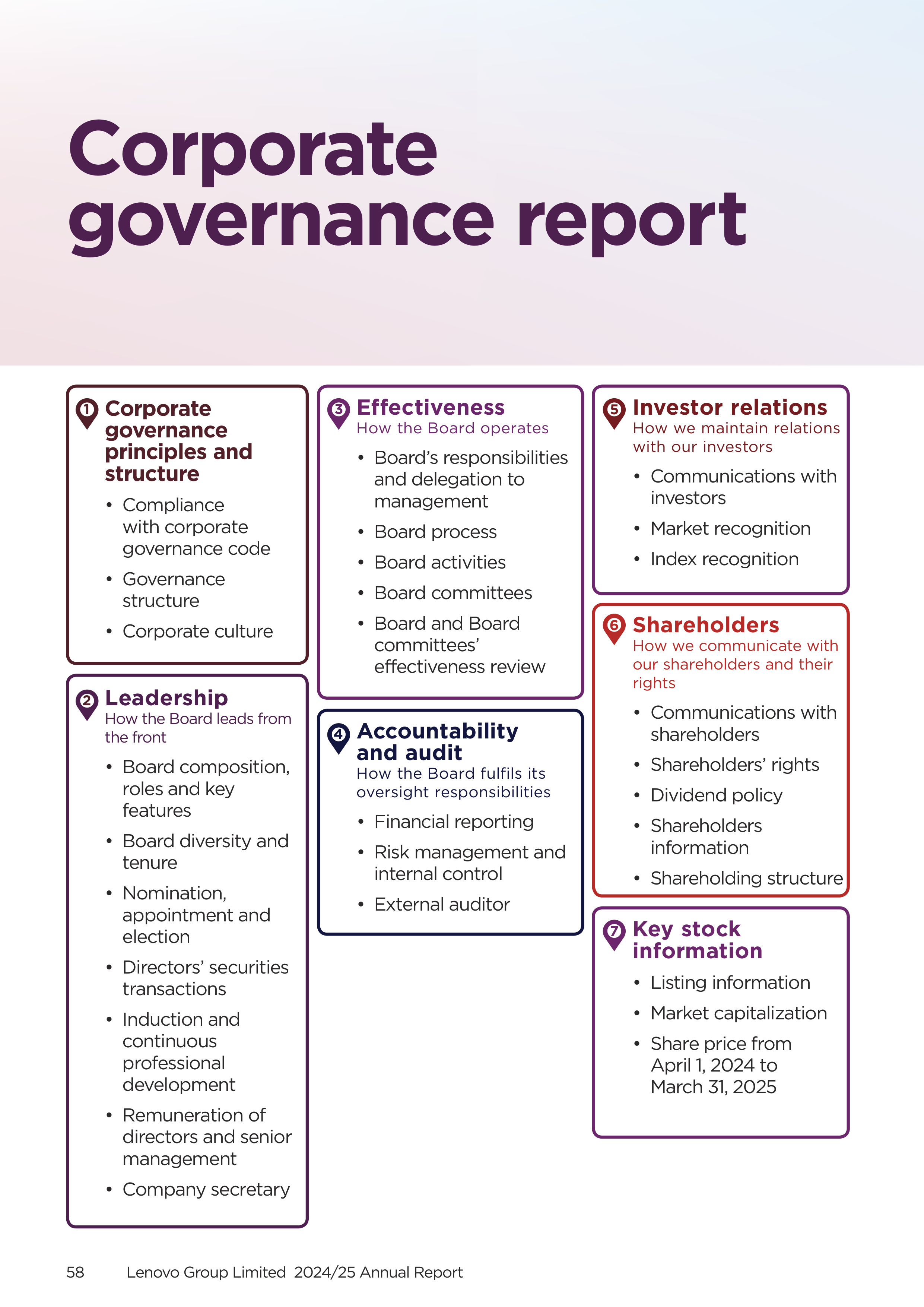
Lenovo Group Limited 2024/25 Annual Report
58
Corporate
governance report
Corporate
governance
principles and
structure
• Compliance
with corporate
governance code
• Governance
structure
• Corporate culture
Leadership
How the Board leads from
the front
• Board composition,
roles and key
features
• Board diversity and
tenure
• Nomination,
appointment and
election
• Directors’ securities
transactions
• Induction and
continuous
professional
development
• Remuneration of
directors and senior
management
• Company secretary
Effectiveness
How the Board operates
• Board’s responsibilities
and delegation to
management
• Board process
• Board activities
• Board committees
• Board and Board
committees’
effectiveness review
Accountability
and audit
How the Board fulfils its
oversight responsibilities
• Financial reporting
• Risk management and
internal control
• External auditor
Investor relations
How we maintain relations
with our investors
• Communications with
investors
• Market recognition
• Index recognition
Shareholders
How we communicate with
our shareholders and their
rights
• Communications with
shareholders
• Shareholders’ rights
• Dividend policy
• Shareholders
information
• Shareholding structure
1
5
6
Key stock
information
• Listing information
• Market capitalization
• Share price from
April 1, 2024 to
March 31, 2025
7
2
3
4
Lenovo Group Limited 2024/25 Annual Report
59
The Board also appointed Mr. John Lawson Thornton, who
succeeded Mr. William O. Grabe (“Mr. Grabe”), as the lead
independent director (the “Lead Independent Director”)
with effect from February 21, 2025, with broad authorities
and responsibilities. Such authorities and responsibilities
include serving as chairman of the Nomination and
Governance Committee meeting and/or the Board
meeting considering the combined roles of Chairman
and CEO; in consultation with all other Board members,
to assess the performance of the Chairman and/or CEO;
calls and chair meeting(s) with all non-executive directors
at least once a year on matters deemed appropriate and
provide feedback to the Chairman and/or CEO; and serves
a key role in the Board evaluation process. Accordingly,
the Board believes that the current Board structure with
combined roles of Chairman and CEO, the appointment of
Lead Independent Director and a majority of independent
non-executive directors provide an effective check and
balance of powers and authorizations between the Board
and the management of the Company.
In relation to the recommended best practices in the
CG Code, the Company published quarterly financial
results and business reviews in addition to interim and
annual results. Quarterly financial results enhanced the
shareholders’ ability to assess the performance, financial
position and prospects of the Company. The quarterly
financial results were prepared using the accounting
standards consistent with the policies applied to the
interim and annual financial statements.
Corporate governance
principles and structure
The board of directors (the “Board”) and the management
of Lenovo Group Limited (the “Company”, together with
its subsidiaries, “Lenovo”, “Lenovo Group” or the “Group”)
strive to attain and uphold a high standard of corporate
governance and to maintain sound and well-established
corporate governance practices for the interest of
shareholders and other stakeholders including, but not
limited to, employees, customers, suppliers and the
general public. The Group abides strictly by the governing
laws and regulations of the jurisdictions where it operates
and observes the applicable guidelines and rules issued
by regulatory authorities. It regularly undertakes review of
its corporate governance system to ensure it is in line with
international and local best practices.
Compliance with corporate governance code
Throughout the financial year ended March 31, 2025
(“FY2024/25”), the Company has complied with the code
provisions of the Corporate Governance Code (the “CG
Code”) as set out in Appendix C1 to the Rules Governing
the Listing of Securities on the Stock Exchange of Hong
Kong Limited (“Listing Rules”), and where appropriate,
met the recommended best practices in the CG Code,
with the exception that the roles of the chairman of the
Board (the “Chairman”) and the chief executive officer of
the Company (the “CEO”) have not been segregated as
required by code provision C.2.1 of the CG Code.
The Board has reviewed the organization human resources
planning of the Group and is of the opinion that for the
vesting of the roles of Chairman and the CEO in Mr. Yang
Yuanqing (“Mr. Yang”) is appropriate and beneficial to the
Group as it provides consistency of the strategy execution
and stability of the operations of the Group. The Board
comprising a majority of independent non-executive
directors meets regularly on a quarterly basis to review
the operations of the Group led by Mr. Yang.
1
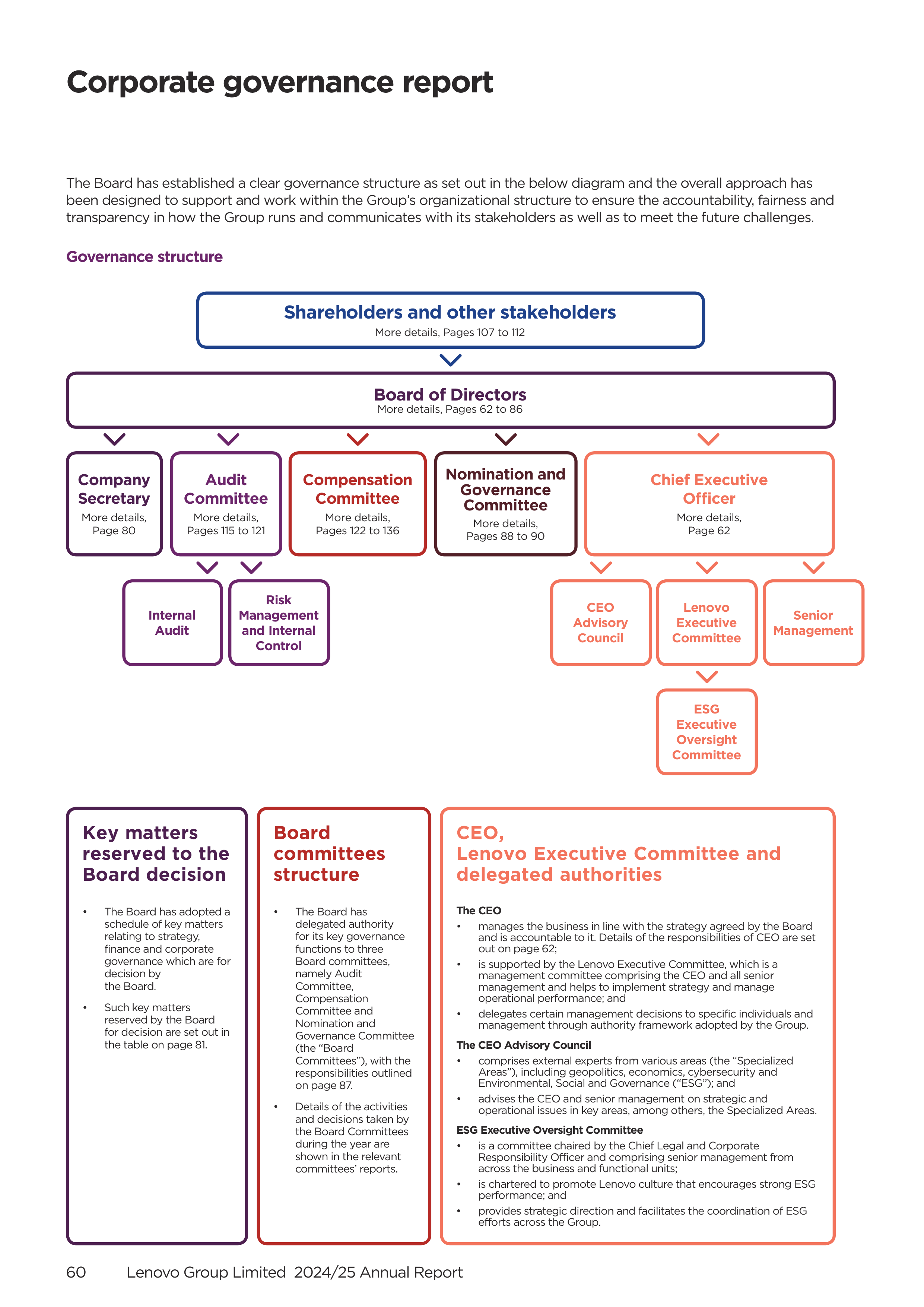
Lenovo Group Limited 2024/25 Annual Report
60
Corporate governance report
The Board has established a clear governance structure as set out in the below diagram and the overall approach has
been designed to support and work within the Group’s organizational structure to ensure the accountability, fairness and
transparency in how the Group runs and communicates with its stakeholders as well as to meet the future challenges.
Key matters
reserved to the
Board decision
•
The Board has adopted a
schedule of key matters
relating to strategy,
finance and corporate
governance which are for
decision by
the Board.
•
Such key matters
reserved by the Board
for decision are set out in
the table on page 81.
Board
committees
structure
•
The Board has
delegated authority
for its key governance
functions to three
Board committees,
namely Audit
Committee,
Compensation
Committee and
Nomination and
Governance Committee
(the “Board
Committees”), with the
responsibilities outlined
on page 87.
•
Details of the activities
and decisions taken by
the Board Committees
during the year are
shown in the relevant
committees’ reports.
CEO,
Lenovo Executive Committee and
delegated authorities
The CEO
•
manages the business in line with the strategy agreed by the Board
and is accountable to it. Details of the responsibilities of CEO are set
out on page 62;
•
is supported by the Lenovo Executive Committee, which is a
management committee comprising the CEO and all senior
management and helps to implement strategy and manage
operational performance; and
•
delegates certain management decisions to specific individuals and
management through authority framework adopted by the Group.
The CEO Advisory Council
•
comprises external experts from various areas (the “Specialized
Areas”), including geopolitics, economics, cybersecurity and
Environmental, Social and Governance (“ESG”); and
•
advises the CEO and senior management on strategic and
operational issues in key areas, among others, the Specialized Areas.
ESG Executive Oversight Committee
•
is a committee chaired by the Chief Legal and Corporate
Responsibility Officer and comprising senior management from
across the business and functional units;
•
is chartered to promote Lenovo culture that encourages strong ESG
performance; and
•
provides strategic direction and facilitates the coordination of ESG
efforts across the Group.
Governance structure
Shareholders and other stakeholders
More details, Pages 107 to 112
Board of Directors
More details, Pages 62 to 86
Company
Secretary
More details,
Page 80
Audit
Committee
More details,
Pages 115 to 121
Internal
Audit
Risk
Management
and Internal
Control
ESG
Executive
Oversight
Committee
CEO
Advisory
Council
Lenovo
Executive
Committee
Senior
Management
Compensation
Committee
More details,
Pages 122 to 136
Nomination and
Governance
Committee
More details,
Pages 88 to 90
Chief Executive
Officer
More details,
Page 62
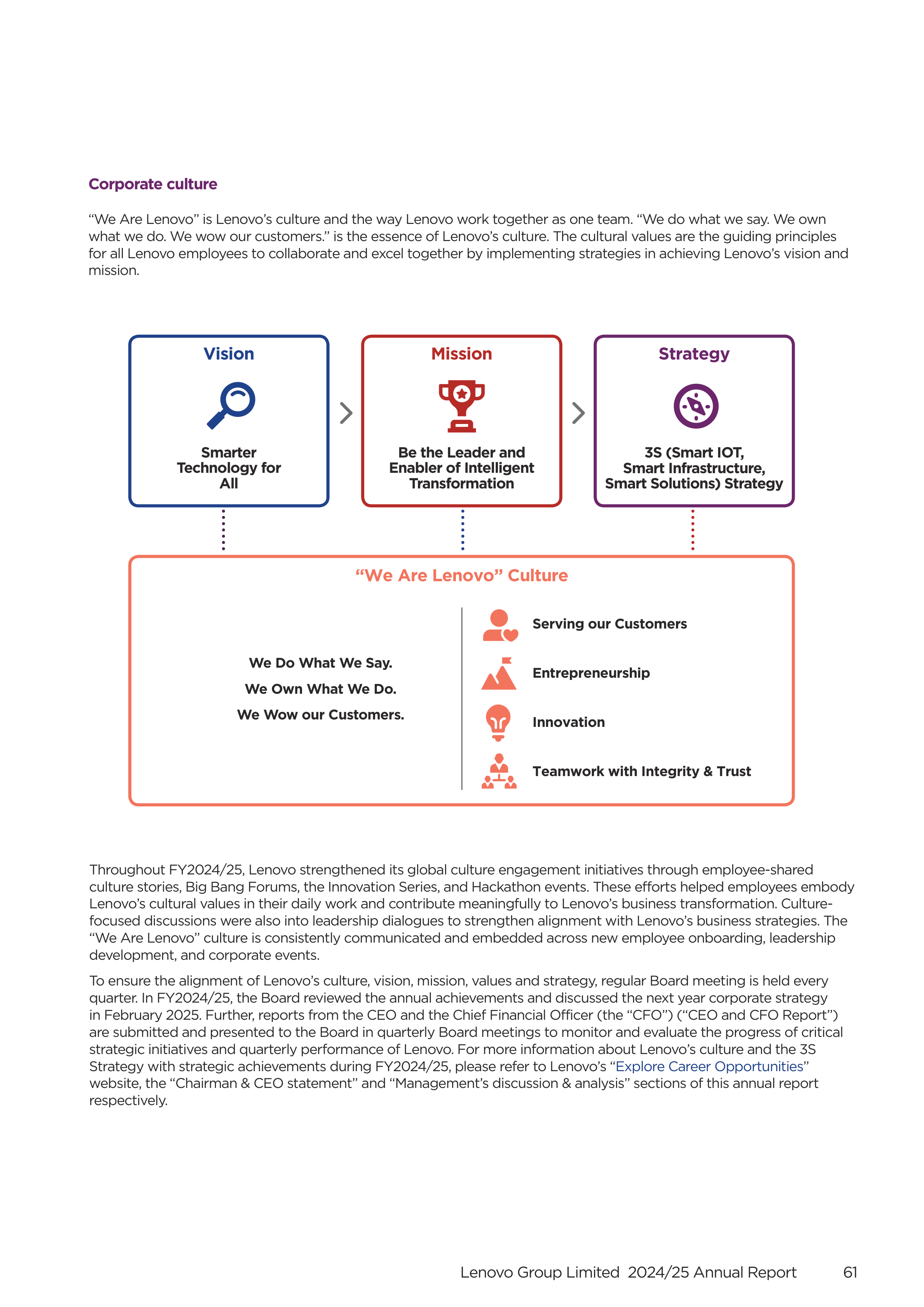
Lenovo Group Limited 2024/25 Annual Report
61
Corporate culture
“We Are Lenovo” is Lenovo’s culture and the way Lenovo work together as one team. “We do what we say. We own
what we do. We wow our customers.” is the essence of Lenovo’s culture. The cultural values are the guiding principles
for all Lenovo employees to collaborate and excel together by implementing strategies in achieving Lenovo’s vision and
mission.
Throughout FY2024/25, Lenovo strengthened its global culture engagement initiatives through employee-shared
culture stories, Big Bang Forums, the Innovation Series, and Hackathon events. These efforts helped employees embody
Lenovo’s cultural values in their daily work and contribute meaningfully to Lenovo’s business transformation. Culture-
focused discussions were also into leadership dialogues to strengthen alignment with Lenovo’s business strategies. The
“We Are Lenovo” culture is consistently communicated and embedded across new employee onboarding, leadership
development, and corporate events.
To ensure the alignment of Lenovo’s culture, vision, mission, values and strategy, regular Board meeting is held every
quarter. In FY2024/25, the Board reviewed the annual achievements and discussed the next year corporate strategy
in February 2025. Further, reports from the CEO and the Chief Financial Officer (the “CFO”) (“CEO and CFO Report”)
are submitted and presented to the Board in quarterly Board meetings to monitor and evaluate the progress of critical
strategic initiatives and quarterly performance of Lenovo. For more information about Lenovo’s culture and the 3S
Strategy with strategic achievements during FY2024/25, please refer to Lenovo’s “
Explore Career Opportunities
”
website, the “Chairman & CEO statement” and “Management’s discussion & analysis” sections of this annual report
respectively.
Vision
Mission
“We Are Lenovo” Culture
Strategy
Smarter
Technology for
All
Be the Leader and
Enabler of Intelligent
Transformation
3S (Smart IOT,
Smart Infrastructure,
Smart Solutions) Strategy
We Do What We Say.
We Own What We Do.
We Wow our Customers.
Serving our Customers
Entrepreneurship
Innovation
Teamwork with Integrity & Trust
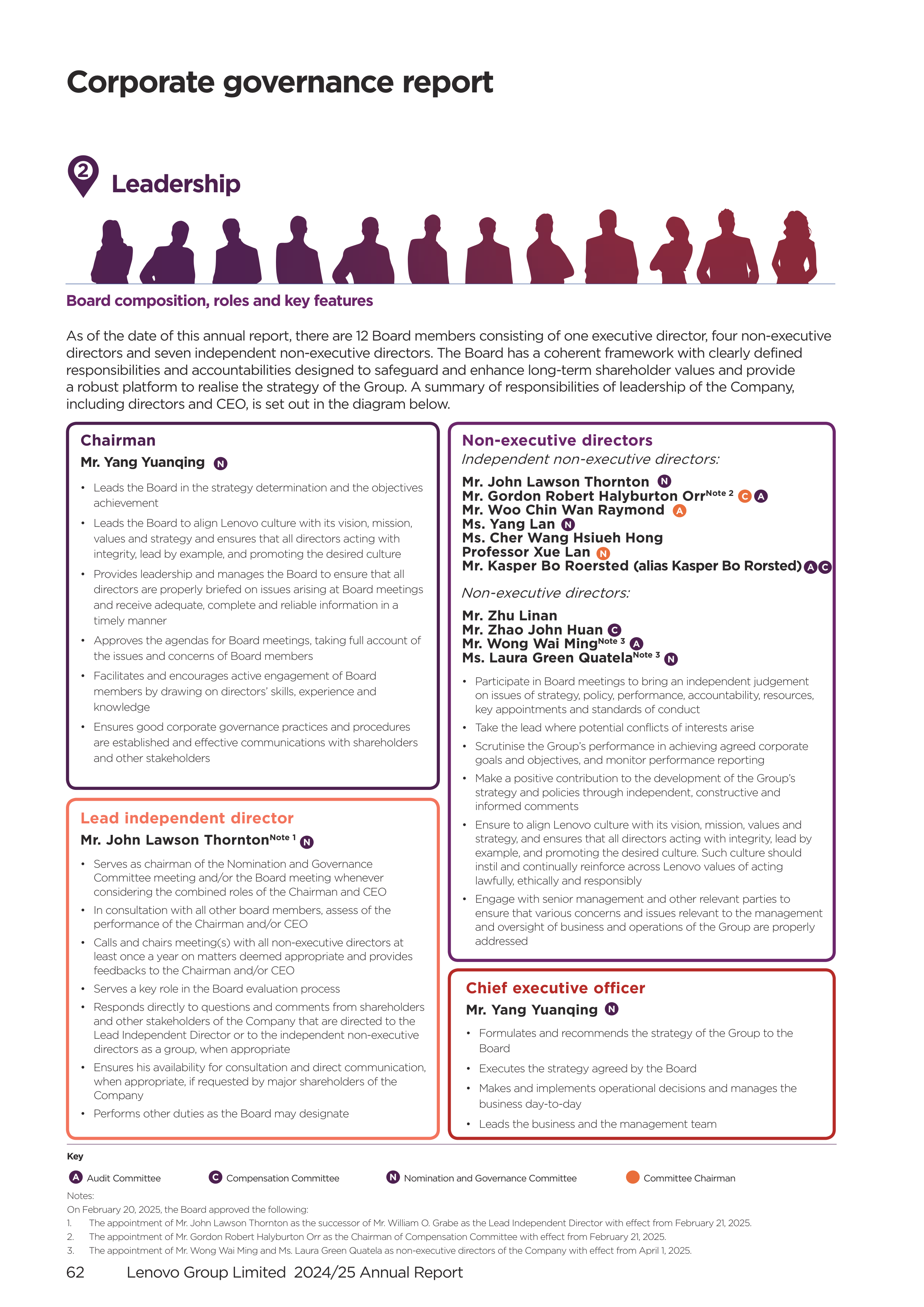

Lenovo Group Limited 2024/25 Annual Report
62
Corporate governance report
Leadership
Key
A
Audit Committee
C
Compensation Committee
N
Nomination and Governance Committee
Committee Chairman
Notes:
On February 20, 2025, the Board approved the following:
1.
The appointment of Mr. John Lawson Thornton as the successor of Mr. William O. Grabe as the Lead Independent Director with effect from February 21, 2025.
2.
The appointment of Mr. Gordon Robert Halyburton Orr as the Chairman of Compensation Committee with effect from February 21, 2025.
3.
The appointment of Mr. Wong Wai Ming and Ms. Laura Green Quatela as non-executive directors of the Company with effect from April 1, 2025.
2
Board composition, roles and key features
As of the date of this annual report, there are 12 Board members consisting of one executive director, four non-executive
directors and seven independent non-executive directors. The Board has a coherent framework with clearly defined
responsibilities and accountabilities designed to safeguard and enhance long-term shareholder values and provide
a robust platform to realise the strategy of the Group. A summary of responsibilities of leadership of the Company,
including directors and CEO, is set out in the diagram below.
Non-executive directors
Independent non-executive directors:
Mr. John Lawson Thornton
Mr. Gordon Robert Halyburton Orr
Note 2
Mr. Woo Chin Wan Raymond
Ms. Yang Lan
Ms. Cher Wang Hsiueh Hong
Professor Xue Lan
Mr. Kasper Bo Roersted (alias Kasper Bo Rorsted)
Non-executive directors:
Mr. Zhu Linan
Mr. Zhao John Huan
Mr. Wong Wai Ming
Note 3
Ms. Laura Green Quatela
Note 3
• Participate in Board meetings to bring an independent judgement
on issues of strategy, policy, performance, accountability, resources,
key appointments and standards of conduct
• Take the lead where potential conflicts of interests arise
• Scrutinise the Group’s performance in achieving agreed corporate
goals and objectives, and monitor performance reporting
• Make a positive contribution to the development of the Group’s
strategy and policies through independent, constructive and
informed comments
• Ensure to align Lenovo culture with its vision, mission, values and
strategy, and ensures that all directors acting with integrity, lead by
example, and promoting the desired culture. Such culture should
instil and continually reinforce across Lenovo values of acting
lawfully, ethically and responsibly
• Engage with senior management and other relevant parties to
ensure that various concerns and issues relevant to the management
and oversight of business and operations of the Group are properly
addressed
Chief executive officer
Mr. Yang Yuanqing
• Formulates and recommends the strategy of the Group to the
Board
• Executes the strategy agreed by the Board
• Makes and implements operational decisions and manages the
business day-to-day
• Leads the business and the management team
Chairman
Mr. Yang Yuanqing
• Leads the Board in the strategy determination and the objectives
achievement
• Leads the Board to align Lenovo culture with its vision, mission,
values and strategy and ensures that all directors acting with
integrity, lead by example, and promoting the desired culture
• Provides leadership and manages the Board to ensure that all
directors are properly briefed on issues arising at Board meetings
and receive adequate, complete and reliable information in a
timely manner
• Approves the agendas for Board meetings, taking full account of
the issues and concerns of Board members
• Facilitates and encourages active engagement of Board
members by drawing on directors’ skills, experience and
knowledge
• Ensures good corporate governance practices and procedures
are established and effective communications with shareholders
and other stakeholders
N
N
A
Lead independent director
Mr. John Lawson Thornton
Note 1
• Serves as chairman of the Nomination and Governance
Committee meeting and/or the Board meeting whenever
considering the combined roles of the Chairman and CEO
• In consultation with all other board members, assess of the
performance of the Chairman and/or CEO
• Calls and chairs meeting(s) with all non-executive directors at
least once a year on matters deemed appropriate and provides
feedbacks to the Chairman and/or CEO
• Serves a key role in the Board evaluation process
• Responds directly to questions and comments from shareholders
and other stakeholders of the Company that are directed to the
Lead Independent Director or to the independent non-executive
directors as a group, when appropriate
• Ensures his availability for consultation and direct communication,
when appropriate, if requested by major shareholders of the
Company
• Performs other duties as the Board may designate
N
N
N
N
N
C
C
C
A
A
A
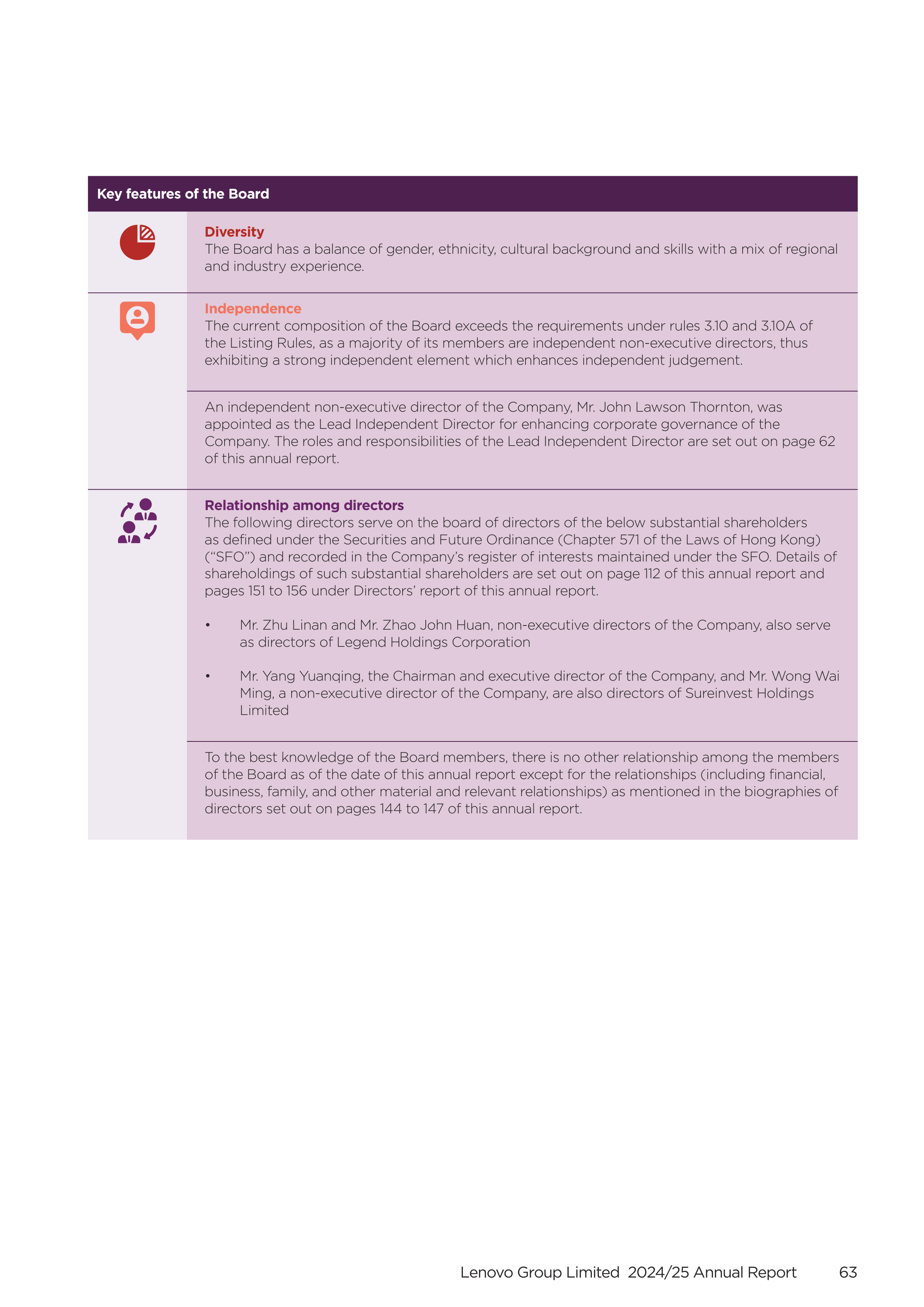
Lenovo Group Limited 2024/25 Annual Report
63
Key features of the Board
Diversity
The Board has a balance of gender, ethnicity, cultural background and skills with a mix of regional
and industry experience.
Independence
The current composition of the Board exceeds the requirements under rules 3.10 and 3.10A of
the Listing Rules, as a majority of its members are independent non-executive directors, thus
exhibiting a strong independent element which enhances independent judgement.
An independent non-executive director of the Company, Mr. John Lawson Thornton, was
appointed as the Lead Independent Director for enhancing corporate governance of the
Company. The roles and responsibilities of the Lead Independent Director are set out on page 62
of this annual report.
Relationship among directors
The following directors serve on the board of directors of the below substantial shareholders
as defined under the Securities and Future Ordinance (Chapter 571 of the Laws of Hong Kong)
(“SFO”) and recorded in the Company’s register of interests maintained under the SFO. Details of
shareholdings of such substantial shareholders are set out on page 112 of this annual report and
pages 151 to 156 under Directors’ report of this annual report.
•
Mr. Zhu Linan and Mr. Zhao John Huan, non-executive directors of the Company, also serve
as directors of Legend Holdings Corporation
•
Mr. Yang Yuanqing, the Chairman and executive director of the Company, and Mr. Wong Wai
Ming, a non-executive director of the Company, are also directors of Sureinvest Holdings
Limited
To the best knowledge of the Board members, there is no other relationship among the members
of the Board as of the date of this annual report except for the relationships (including financial,
business, family, and other material and relevant relationships) as mentioned in the biographies of
directors set out on pages 144 to 147 of this annual report.
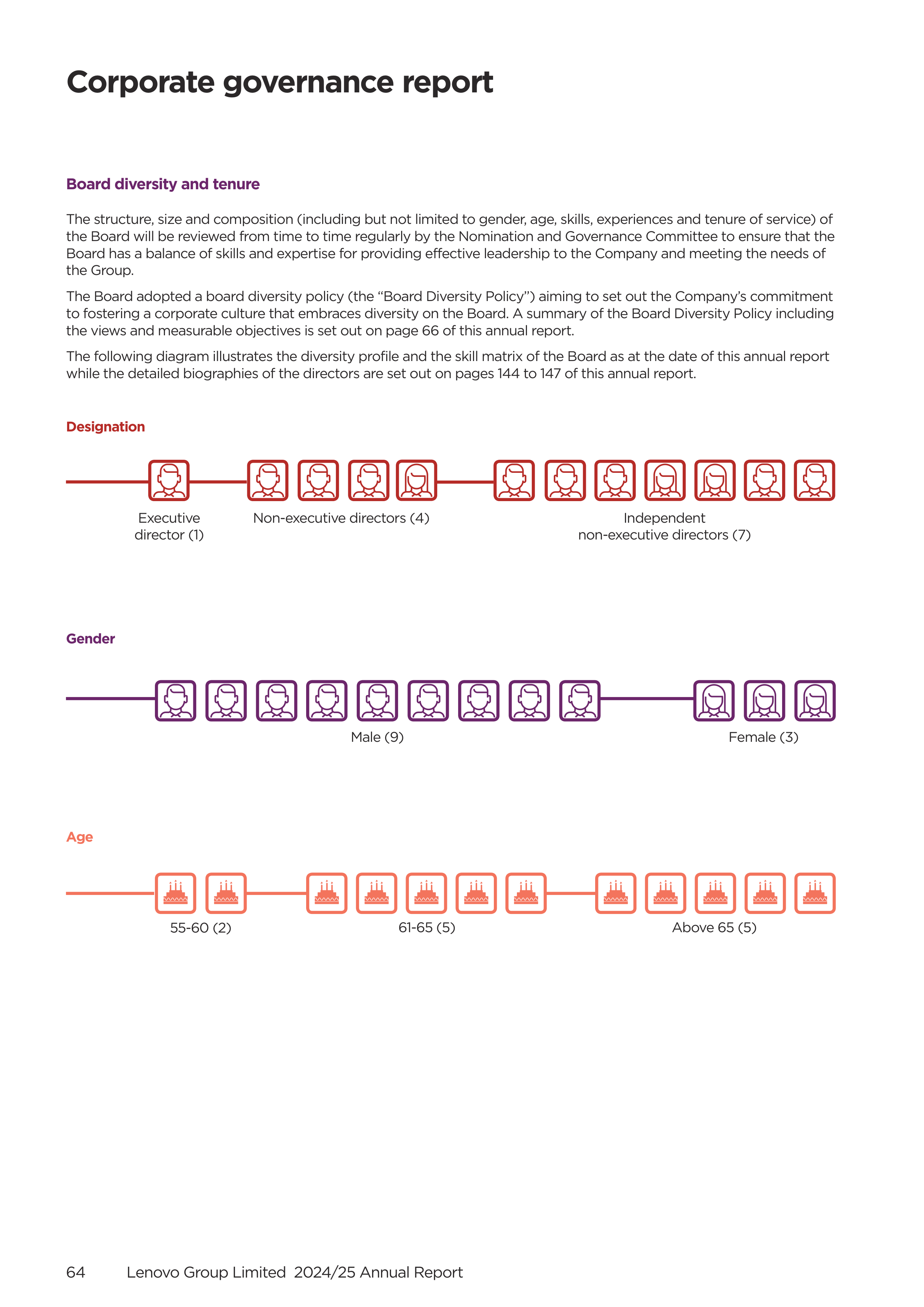
Lenovo Group Limited 2024/25 Annual Report
64
Corporate governance report
Board diversity and tenure
The structure, size and composition (including but not limited to gender, age, skills, experiences and tenure of service) of
the Board will be reviewed from time to time regularly by the Nomination and Governance Committee to ensure that the
Board has a balance of skills and expertise for providing effective leadership to the Company and meeting the needs of
the Group.
The Board adopted a board diversity policy (the “Board Diversity Policy”) aiming to set out the Company’s commitment
to fostering a corporate culture that embraces diversity on the Board. A summary of the Board Diversity Policy including
the views and measurable objectives is set out on page 66 of this annual report.
The following diagram illustrates the diversity profile and the skill matrix of the Board as at the date of this annual report
while the detailed biographies of the directors are set out on pages 144 to 147 of this annual report.
Above 65 (5)
55-60 (2)
61-65 (5)
Independent
non-executive directors (7)
Executive
director (1)
Non-executive directors (4)
Age
Gender
Designation
Male (9)
Female (3)
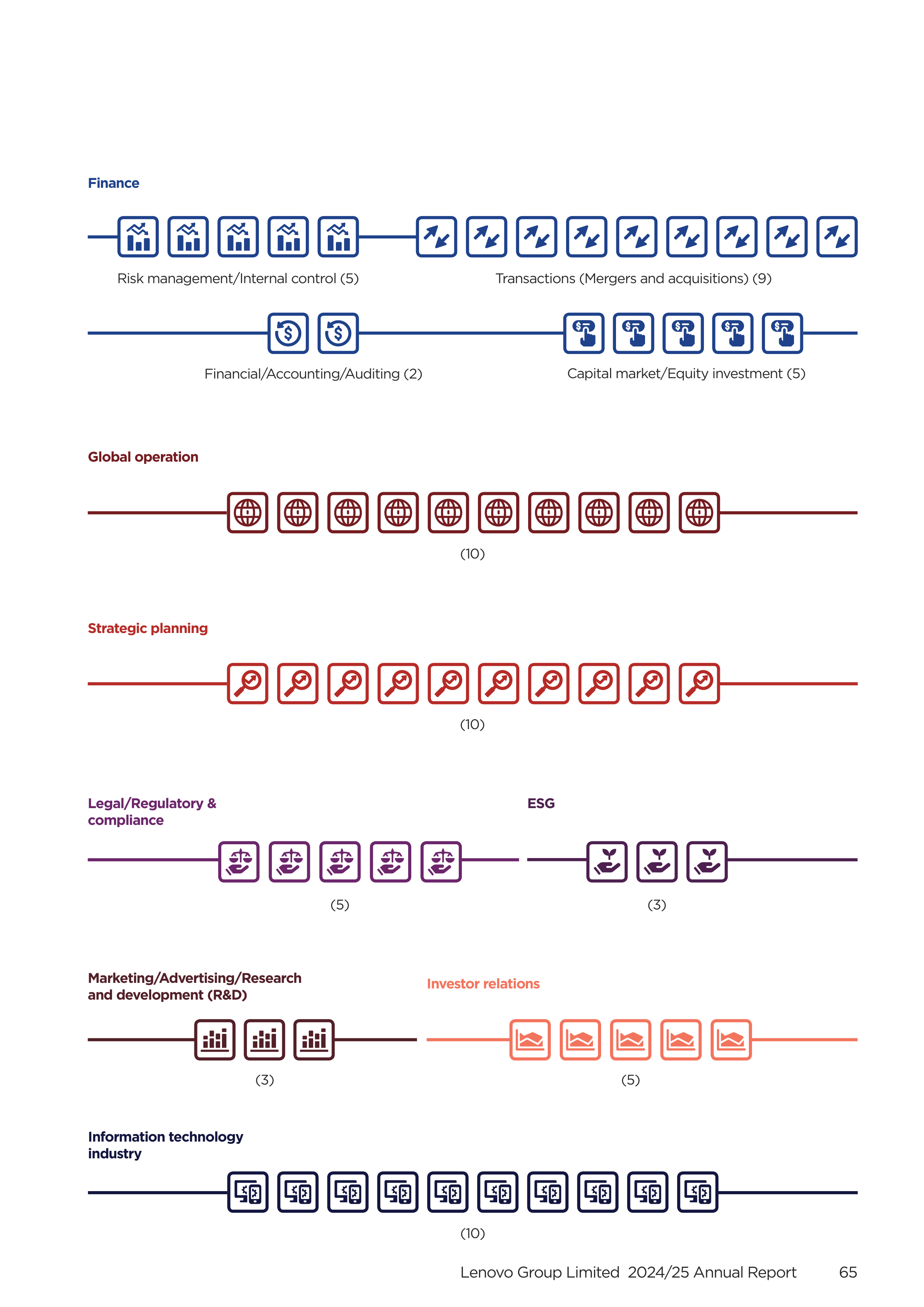
Lenovo Group Limited 2024/25 Annual Report
65
Strategic planning
(10)
Investor relations
(5)
Information technology
industry
(10)
Global operation
(10)
Legal/Regulatory &
compliance
ESG
Marketing/Advertising/Research
and development (R&D)
(5)
(3)
(3)
Risk management/Internal control (5)
Financial/Accounting/Auditing (2)
Capital market/Equity investment (5)
Transactions (Mergers and acquisitions) (9)
Finance
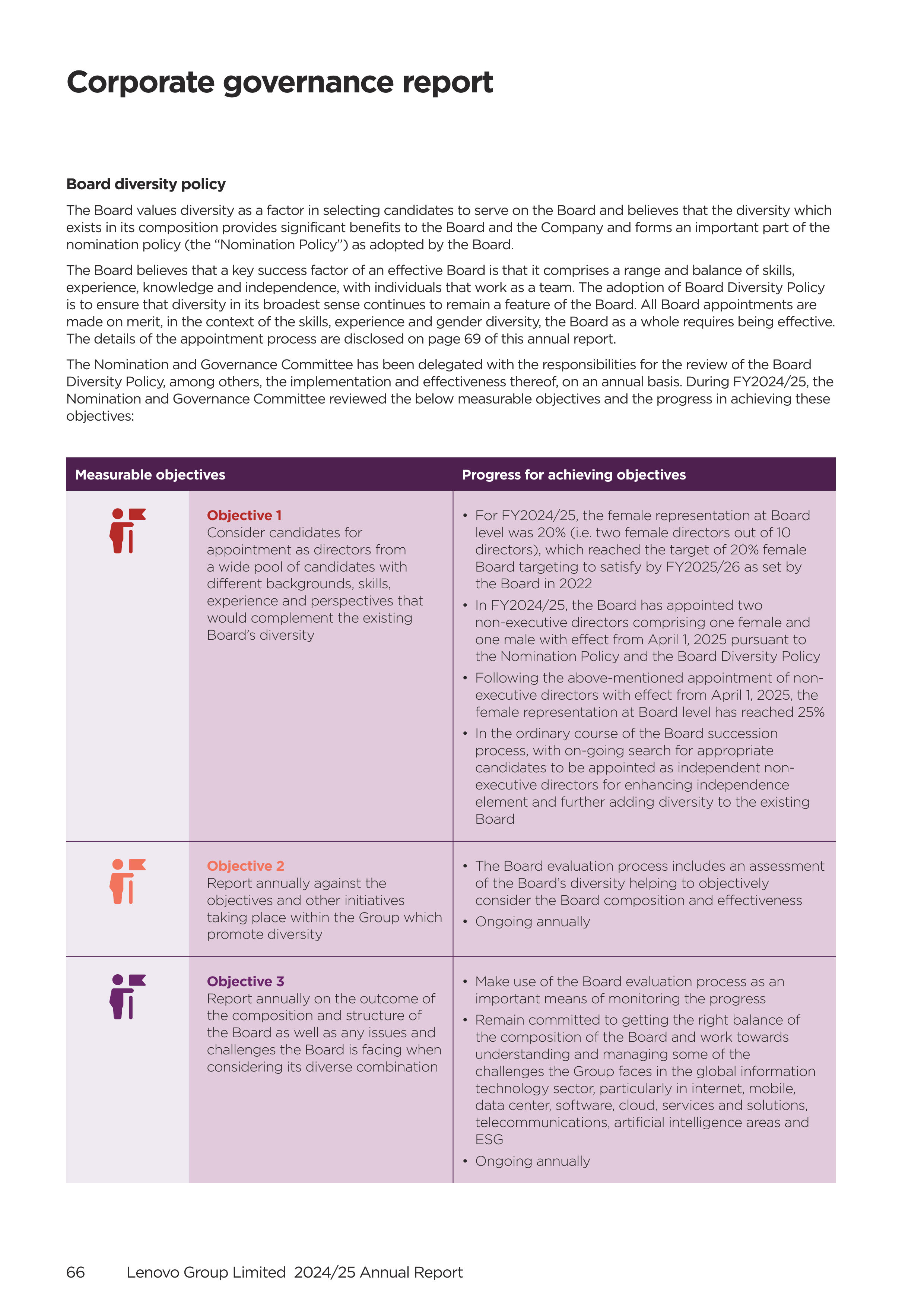
Lenovo Group Limited 2024/25 Annual Report
66
Corporate governance report
Board diversity policy
The Board values diversity as a factor in selecting candidates to serve on the Board and believes that the diversity which
exists in its composition provides significant benefits to the Board and the Company and forms an important part of the
nomination policy (the “Nomination Policy”) as adopted by the Board.
The Board believes that a key success factor of an effective Board is that it comprises a range and balance of skills,
experience, knowledge and independence, with individuals that work as a team. The adoption of Board Diversity Policy
is to ensure that diversity in its broadest sense continues to remain a feature of the Board. All Board appointments are
made on merit, in the context of the skills, experience and gender diversity, the Board as a whole requires being effective.
The details of the appointment process are disclosed on page 69 of this annual report.
The Nomination and Governance Committee has been delegated with the responsibilities for the review of the Board
Diversity Policy, among others, the implementation and effectiveness thereof, on an annual basis. During FY2024/25, the
Nomination and Governance Committee reviewed the below measurable objectives and the progress in achieving these
objectives:
Measurable objectives
Progress for achieving objectives
Objective 1
Consider candidates for
appointment as directors from
a wide pool of candidates with
different backgrounds, skills,
experience and perspectives that
would complement the existing
Board’s diversity
• For FY2024/25, the female representation at Board
level was 20% (i.e. two female directors out of 10
directors), which reached the target of 20% female
Board targeting to satisfy by FY2025/26 as set by
the Board in 2022
• In FY2024/25, the Board has appointed two
non-executive directors comprising one female and
one male with effect from April 1, 2025 pursuant to
the Nomination Policy and the Board Diversity Policy
• Following the above-mentioned appointment of non-
executive directors with effect from April 1, 2025, the
female representation at Board level has reached 25%
• In the ordinary course of the Board succession
process, with on-going search for appropriate
candidates to be appointed as independent non-
executive directors for enhancing independence
element and further adding diversity to the existing
Board
Objective 2
Report annually against the
objectives and other initiatives
taking place within the Group which
promote diversity
• The Board evaluation process includes an assessment
of the Board’s diversity helping to objectively
consider the Board composition and effectiveness
• Ongoing annually
Objective 3
Report annually on the outcome of
the composition and structure of
the Board as well as any issues and
challenges the Board is facing when
considering its diverse combination
• Make use of the Board evaluation process as an
important means of monitoring the progress
• Remain committed to getting the right balance of
the composition of the Board and work towards
understanding and managing some of the
challenges the Group faces in the global information
technology sector, particularly in internet, mobile,
data center, software, cloud, services and solutions,
telecommunications, artificial intelligence areas and
ESG
• Ongoing annually
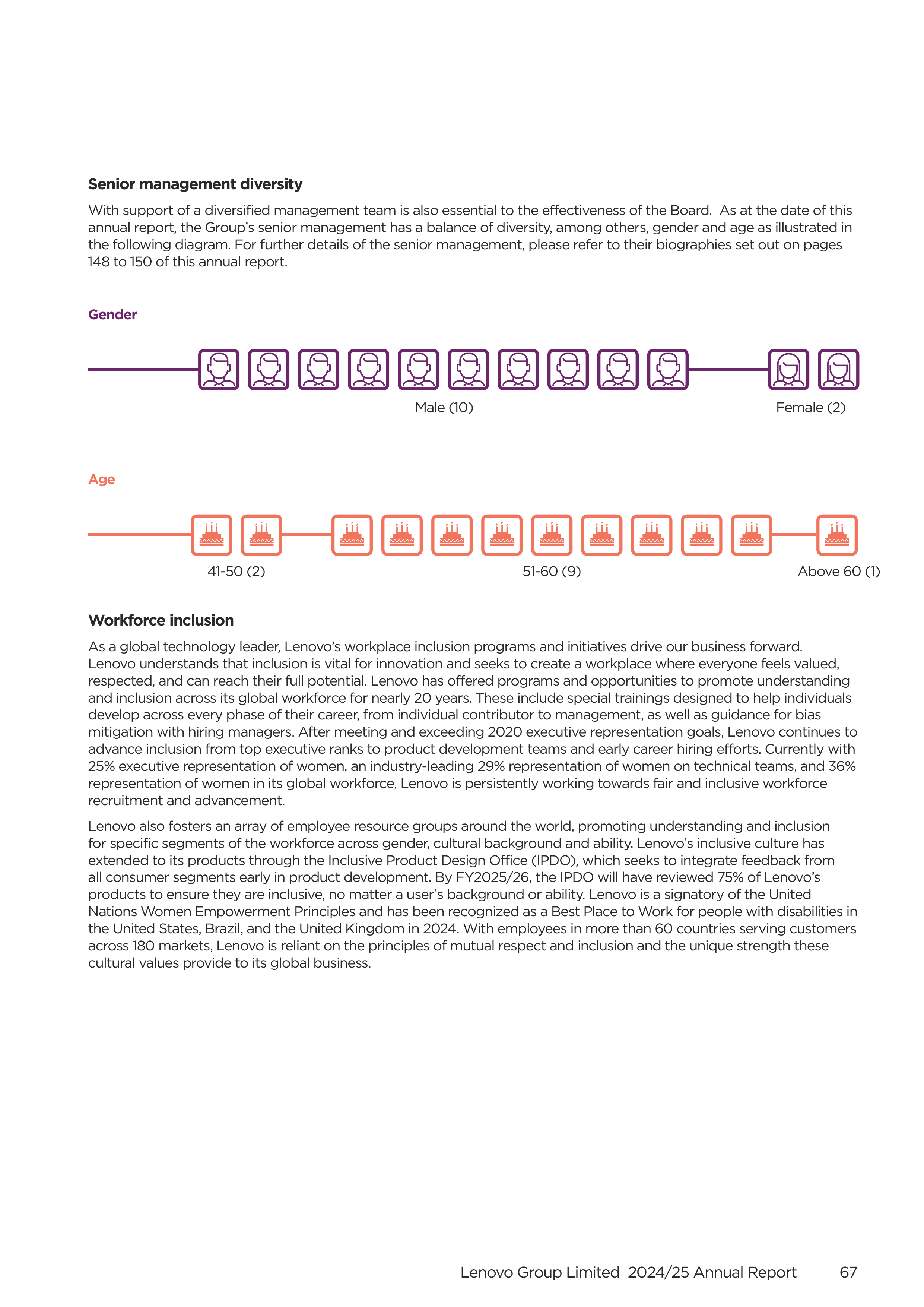
Lenovo Group Limited 2024/25 Annual Report
67
Workforce inclusion
As a global technology leader, Lenovo’s workplace inclusion programs and initiatives drive our business forward.
Lenovo understands that inclusion is vital for innovation and seeks to create a workplace where everyone feels valued,
respected, and can reach their full potential. Lenovo has offered programs and opportunities to promote understanding
and inclusion across its global workforce for nearly 20 years. These include special trainings designed to help individuals
develop across every phase of their career, from individual contributor to management, as well as guidance for bias
mitigation with hiring managers. After meeting and exceeding 2020 executive representation goals, Lenovo continues to
advance inclusion from top executive ranks to product development teams and early career hiring efforts. Currently with
25% executive representation of women, an industry-leading 29% representation of women on technical teams, and 36%
representation of women in its global workforce, Lenovo is persistently working towards fair and inclusive workforce
recruitment and advancement.
Lenovo also fosters an array of employee resource groups around the world, promoting understanding and inclusion
for specific segments of the workforce across gender, cultural background and ability. Lenovo’s inclusive culture has
extended to its products through the Inclusive Product Design Office (IPDO), which seeks to integrate feedback from
all consumer segments early in product development. By FY2025/26, the IPDO will have reviewed 75% of Lenovo’s
products to ensure they are inclusive, no matter a user’s background or ability. Lenovo is a signatory of the United
Nations Women Empowerment Principles and has been recognized as a Best Place to Work for people with disabilities in
the United States, Brazil, and the United Kingdom in 2024. With employees in more than 60 countries serving customers
across 180 markets, Lenovo is reliant on the principles of mutual respect and inclusion and the unique strength these
cultural values provide to its global business.
Senior management diversity
With support of a diversified management team is also essential to the effectiveness of the Board. As at the date of this
annual report, the Group’s senior management has a balance of diversity, among others, gender and age as illustrated in
the following diagram. For further details of the senior management, please refer to their biographies set out on pages
148 to 150 of this annual report.
Gender
Male (10)
Female (2)
Above 60 (1)
51-60 (9)
Age
41-50 (2)
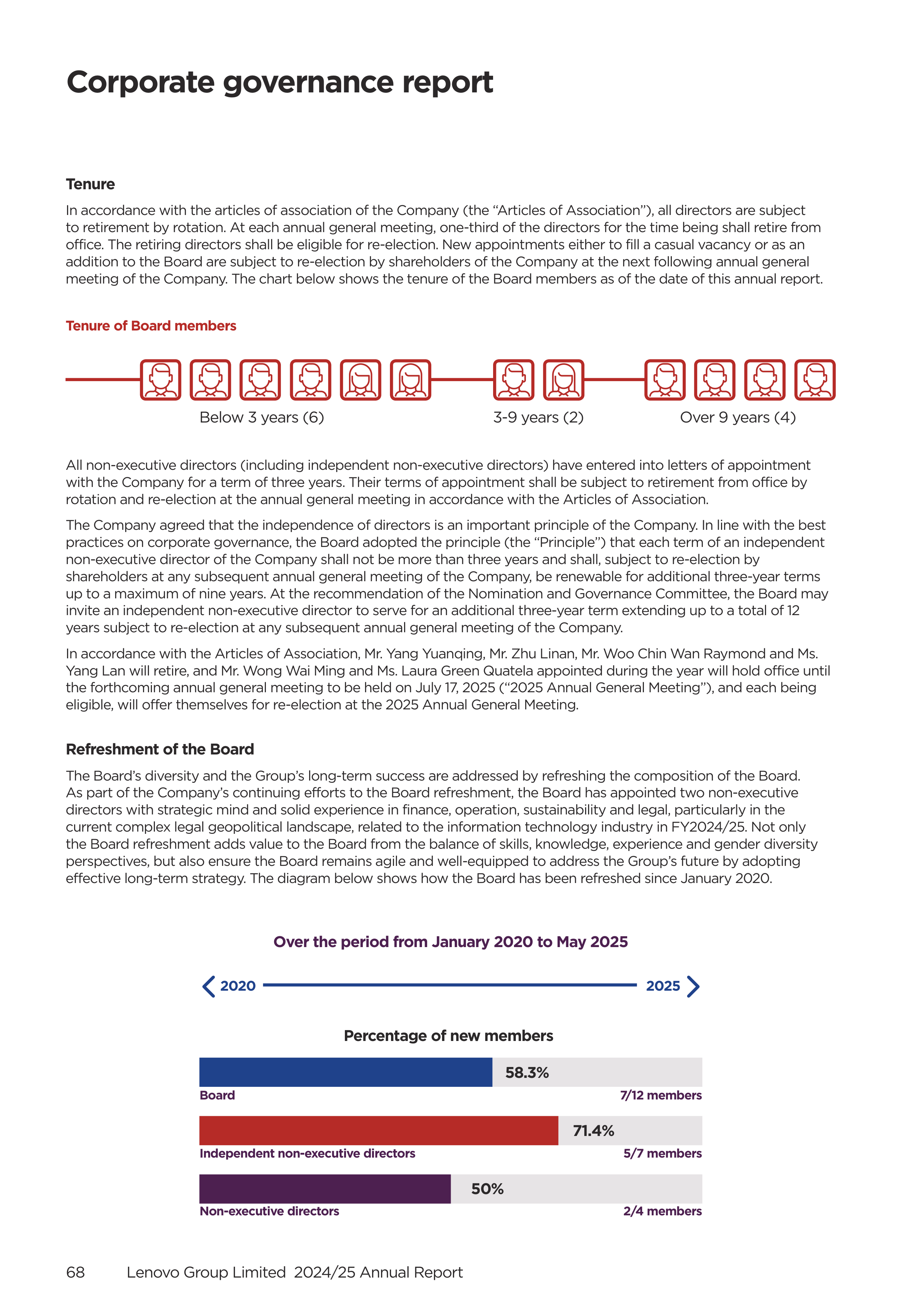
Lenovo Group Limited 2024/25 Annual Report
68
Corporate governance report
Tenure
In accordance with the articles of association of the Company (the “Articles of Association”), all directors are subject
to retirement by rotation. At each annual general meeting, one-third of the directors for the time being shall retire from
office. The retiring directors shall be eligible for re-election. New appointments either to fill a casual vacancy or as an
addition to the Board are subject to re-election by shareholders of the Company at the next following annual general
meeting of the Company. The chart below shows the tenure of the Board members as of the date of this annual report.
2020
2025
Percentage of new members
Over the period from January 2020 to May 2025
58.3%
7/12 members
5/7 members
2/4 members
Board
Independent non-executive directors
Non-executive directors
71.4%
50%
Tenure of Board members
Over 9 years (4)
3-9 years (2)
Below 3 years (6)
All non-executive directors (including independent non-executive directors) have entered into letters of appointment
with the Company for a term of three years. Their terms of appointment shall be subject to retirement from office by
rotation and re-election at the annual general meeting in accordance with the Articles of Association.
The Company agreed that the independence of directors is an important principle of the Company. In line with the best
practices on corporate governance, the Board adopted the principle (the “Principle”) that each term of an independent
non-executive director of the Company shall not be more than three years and shall, subject to re-election by
shareholders at any subsequent annual general meeting of the Company, be renewable for additional three-year terms
up to a maximum of nine years. At the recommendation of the Nomination and Governance Committee, the Board may
invite an independent non-executive director to serve for an additional three-year term extending up to a total of 12
years subject to re-election at any subsequent annual general meeting of the Company.
In accordance with the Articles of Association, Mr. Yang Yuanqing, Mr. Zhu Linan, Mr. Woo Chin Wan Raymond and Ms.
Yang Lan will retire, and Mr. Wong Wai Ming and Ms. Laura Green Quatela appointed during the year will hold office until
the forthcoming annual general meeting to be held on July 17, 2025 (“2025 Annual General Meeting”), and each being
eligible, will offer themselves for re-election at the 2025 Annual General Meeting.
Refreshment of the Board
The Board’s diversity and the Group’s long-term success are addressed by refreshing the composition of the Board.
As part of the Company’s continuing efforts to the Board refreshment, the Board has appointed two non-executive
directors with strategic mind and solid experience in finance, operation, sustainability and legal, particularly in the
current complex legal geopolitical landscape, related to the information technology industry in FY2024/25. Not only
the Board refreshment adds value to the Board from the balance of skills, knowledge, experience and gender diversity
perspectives, but also ensure the Board remains agile and well-equipped to address the Group’s future by adopting
effective long-term strategy. The diagram below shows how the Board has been refreshed since January 2020.
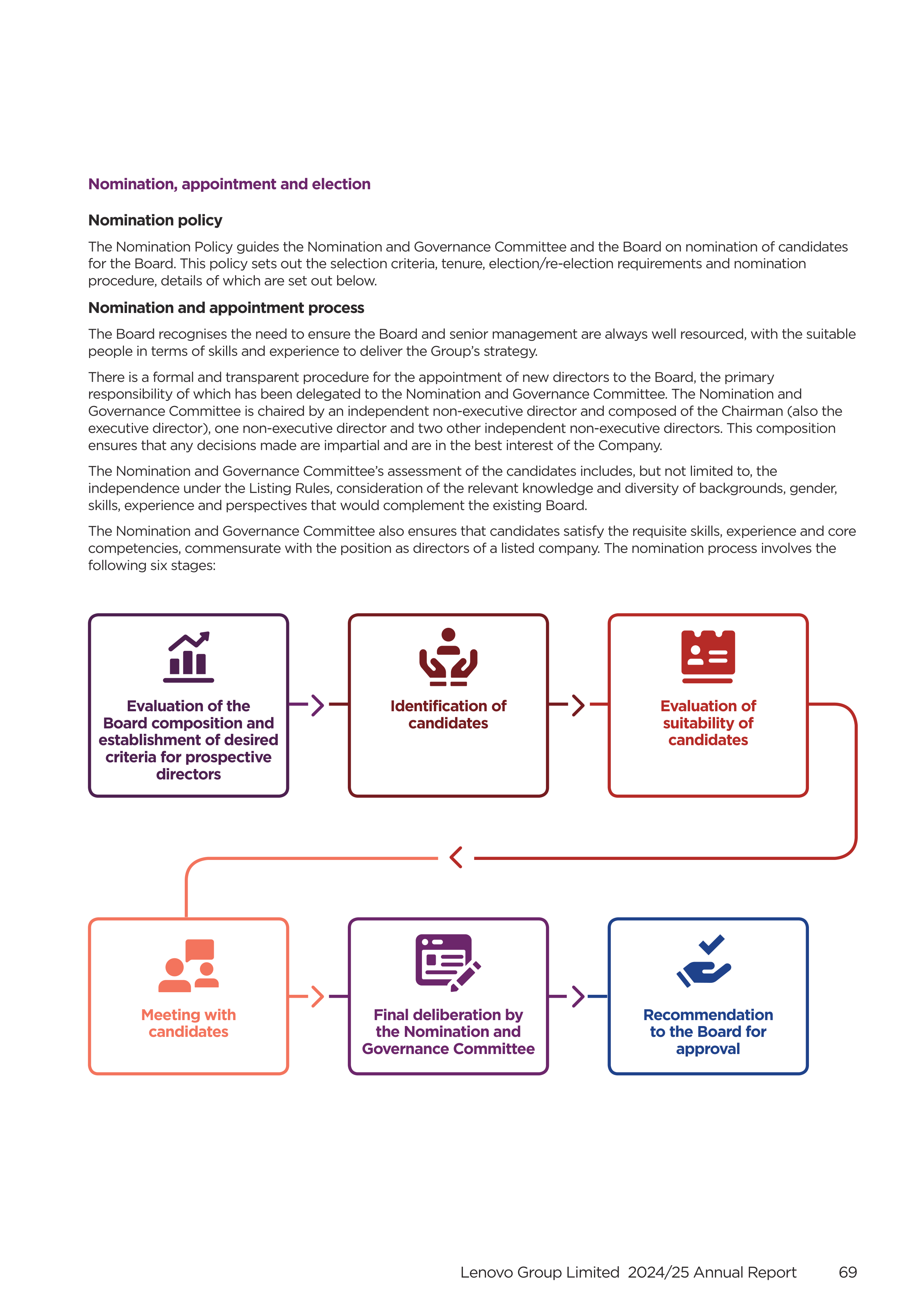
Lenovo Group Limited 2024/25 Annual Report
69
Evaluation of the
Board composition and
establishment of desired
criteria for prospective
directors
Identification of
candidates
Evaluation of
suitability of
candidates
Meeting with
candidates
Final deliberation by
the Nomination and
Governance Committee
Recommendation
to the Board for
approval
Nomination, appointment and election
Nomination policy
The Nomination Policy guides the Nomination and Governance Committee and the Board on nomination of candidates
for the Board. This policy sets out the selection criteria, tenure, election/re-election requirements and nomination
procedure, details of which are set out below.
Nomination and appointment process
The Board recognises the need to ensure the Board and senior management are always well resourced, with the suitable
people in terms of skills and experience to deliver the Group’s strategy.
There is a formal and transparent procedure for the appointment of new directors to the Board, the primary
responsibility of which has been delegated to the Nomination and Governance Committee. The Nomination and
Governance Committee is chaired by an independent non-executive director and composed of the Chairman (also the
executive director), one non-executive director and two other independent non-executive directors. This composition
ensures that any decisions made are impartial and are in the best interest of the Company.
The Nomination and Governance Committee’s assessment of the candidates includes, but not limited to, the
independence under the Listing Rules, consideration of the relevant knowledge and diversity of backgrounds, gender,
skills, experience and perspectives that would complement the existing Board.
The Nomination and Governance Committee also ensures that candidates satisfy the requisite skills, experience and core
competencies, commensurate with the position as directors of a listed company. The nomination process involves the
following six stages:
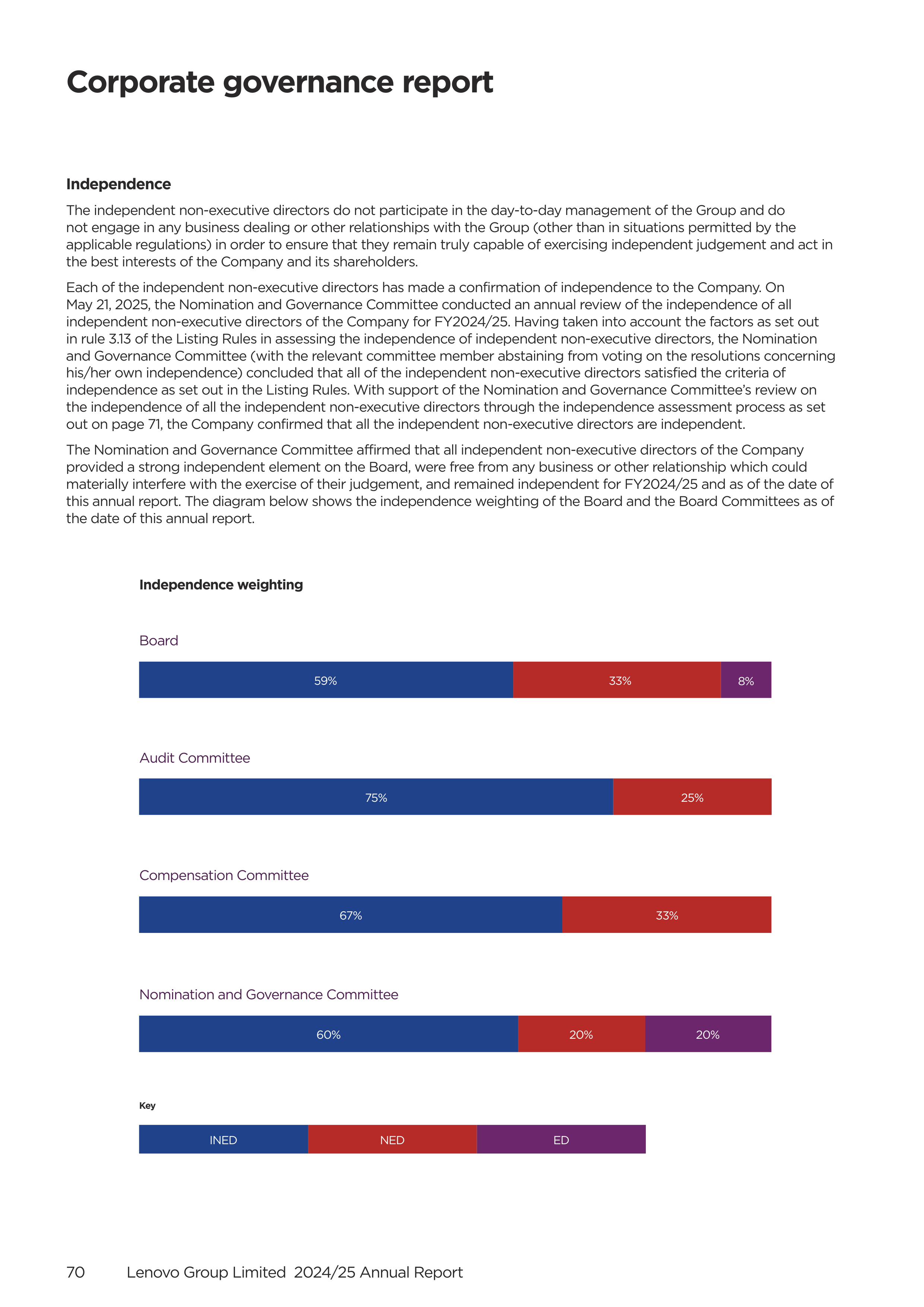
Lenovo Group Limited 2024/25 Annual Report
70
Corporate governance report
Independence
The independent non-executive directors do not participate in the day-to-day management of the Group and do
not engage in any business dealing or other relationships with the Group (other than in situations permitted by the
applicable regulations) in order to ensure that they remain truly capable of exercising independent judgement and act in
the best interests of the Company and its shareholders.
Each of the independent non-executive directors has made a confirmation of independence to the Company. On
May 21, 2025, the Nomination and Governance Committee conducted an annual review of the independence of all
independent non-executive directors of the Company for FY2024/25. Having taken into account the factors as set out
in rule 3.13 of the Listing Rules in assessing the independence of independent non-executive directors, the Nomination
and Governance Committee (with the relevant committee member abstaining from voting on the resolutions concerning
his/her own independence) concluded that all of the independent non-executive directors satisfied the criteria of
independence as set out in the Listing Rules. With support of the Nomination and Governance Committee’s review on
the independence of all the independent non-executive directors through the independence assessment process as set
out on page 71, the Company confirmed that all the independent non-executive directors are independent.
The Nomination and Governance Committee affirmed that all independent non-executive directors of the Company
provided a strong independent element on the Board, were free from any business or other relationship which could
materially interfere with the exercise of their judgement, and remained independent for FY2024/25 and as of the date of
this annual report. The diagram below shows the independence weighting of the Board and the Board Committees as of
the date of this annual report.
Independence weighting
Key
59%
33%
8%
Board
Compensation Committee
60%
20%
20%
Audit Committee
Nomination and Governance Committee
67%
33%
75%
25%
INED
NED
ED
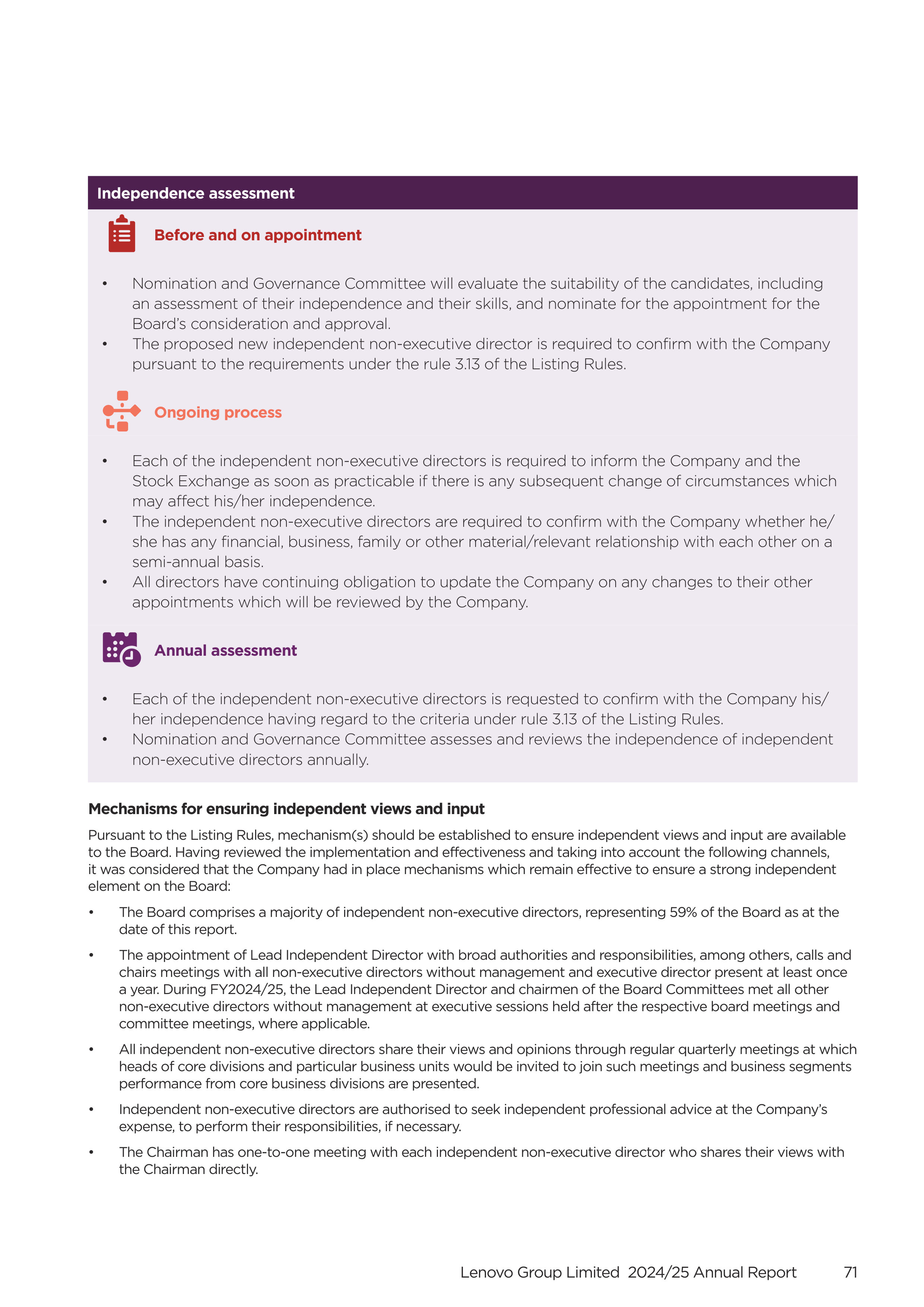
Lenovo Group Limited 2024/25 Annual Report
71
Independence assessment
Before and on appointment
•
Nomination and Governance Committee will evaluate the suitability of the candidates, including
an assessment of their independence and their skills, and nominate for the appointment for the
Board’s consideration and approval.
•
The proposed new independent non-executive director is required to confirm with the Company
pursuant to the requirements under the rule 3.13 of the Listing Rules.
Ongoing process
•
Each of the independent non-executive directors is required to inform the Company and the
Stock Exchange as soon as practicable if there is any subsequent change of circumstances which
may affect his/her independence.
•
The independent non-executive directors are required to confirm with the Company whether he/
she has any financial, business, family or other material/relevant relationship with each other on a
semi-annual basis.
•
All directors have continuing obligation to update the Company on any changes to their other
appointments which will be reviewed by the Company.
Annual assessment
•
Each of the independent non-executive directors is requested to confirm with the Company his/
her independence having regard to the criteria under rule 3.13 of the Listing Rules.
•
Nomination and Governance Committee assesses and reviews the independence of independent
non-executive directors annually.
Mechanisms for ensuring independent views and input
Pursuant to the Listing Rules, mechanism(s) should be established to ensure independent views and input are available
to the Board. Having reviewed the implementation and effectiveness and taking into account the following channels,
it was considered that the Company had in place mechanisms which remain effective to ensure a strong independent
element on the Board:
•
The Board comprises a majority of independent non-executive directors, representing 59% of the Board as at the
date of this report.
•
The appointment of Lead Independent Director with broad authorities and responsibilities, among others, calls and
chairs meetings with all non-executive directors without management and executive director present at least once
a year. During FY2024/25, the Lead Independent Director and chairmen of the Board Committees met all other
non-executive directors without management at executive sessions held after the respective board meetings and
committee meetings, where applicable.
•
All independent non-executive directors share their views and opinions through regular quarterly meetings at which
heads of core divisions and particular business units would be invited to join such meetings and business segments
performance from core business divisions are presented.
•
Independent non-executive directors are authorised to seek independent professional advice at the Company’s
expense, to perform their responsibilities, if necessary.
•
The Chairman has one-to-one meeting with each independent non-executive director who shares their views with
the Chairman directly.
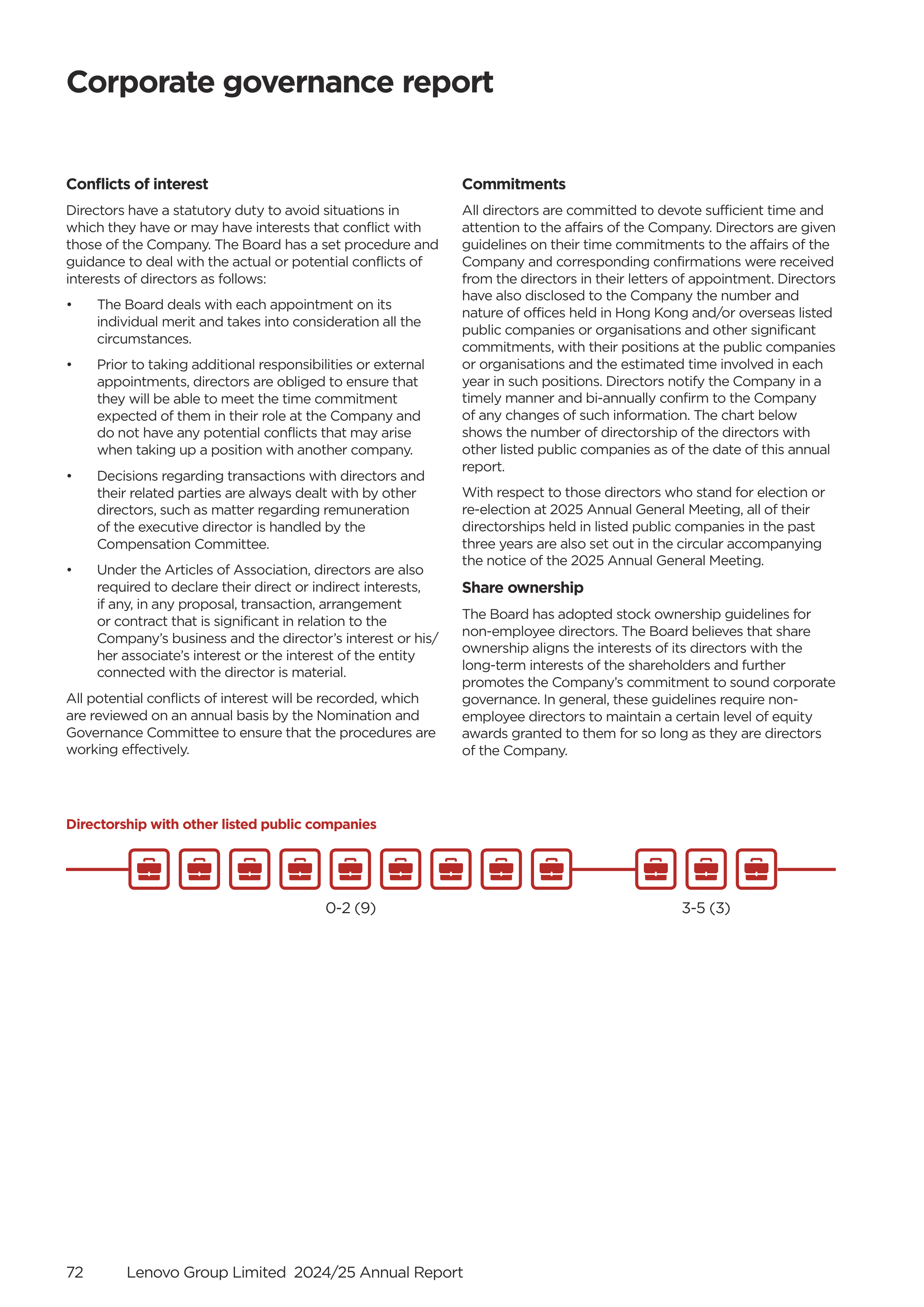
Lenovo Group Limited 2024/25 Annual Report
72
Corporate governance report
Conflicts of interest
Directors have a statutory duty to avoid situations in
which they have or may have interests that conflict with
those of the Company. The Board has a set procedure and
guidance to deal with the actual or potential conflicts of
interests of directors as follows:
•
The Board deals with each appointment on its
individual merit and takes into consideration all the
circumstances.
•
Prior to taking additional responsibilities or external
appointments, directors are obliged to ensure that
they will be able to meet the time commitment
expected of them in their role at the Company and
do not have any potential conflicts that may arise
when taking up a position with another company.
•
Decisions regarding transactions with directors and
their related parties are always dealt with by other
directors, such as matter regarding remuneration
of the executive director is handled by the
Compensation Committee.
•
Under the Articles of Association, directors are also
required to declare their direct or indirect interests,
if any, in any proposal, transaction, arrangement
or contract that is significant in relation to the
Company’s business and the director’s interest or his/
her associate’s interest or the interest of the entity
connected with the director is material.
All potential conflicts of interest will be recorded, which
are reviewed on an annual basis by the Nomination and
Governance Committee to ensure that the procedures are
working effectively.
Commitments
All directors are committed to devote sufficient time and
attention to the affairs of the Company. Directors are given
guidelines on their time commitments to the affairs of the
Company and corresponding confirmations were received
from the directors in their letters of appointment. Directors
have also disclosed to the Company the number and
nature of offices held in Hong Kong and/or overseas listed
public companies or organisations and other significant
commitments, with their positions at the public companies
or organisations and the estimated time involved in each
year in such positions. Directors notify the Company in a
timely manner and bi-annually confirm to the Company
of any changes of such information. The chart below
shows the number of directorship of the directors with
other listed public companies as of the date of this annual
report.
With respect to those directors who stand for election or
re-election at 2025 Annual General Meeting, all of their
directorships held in listed public companies in the past
three years are also set out in the circular accompanying
the notice of the 2025 Annual General Meeting.
Share ownership
The Board has adopted stock ownership guidelines for
non-employee directors. The Board believes that share
ownership aligns the interests of its directors with the
long-term interests of the shareholders and further
promotes the Company’s commitment to sound corporate
governance. In general, these guidelines require non-
employee directors to maintain a certain level of equity
awards granted to them for so long as they are directors
of the Company.
Directorship with other listed public companies
3-5 (3)
0-2 (9)
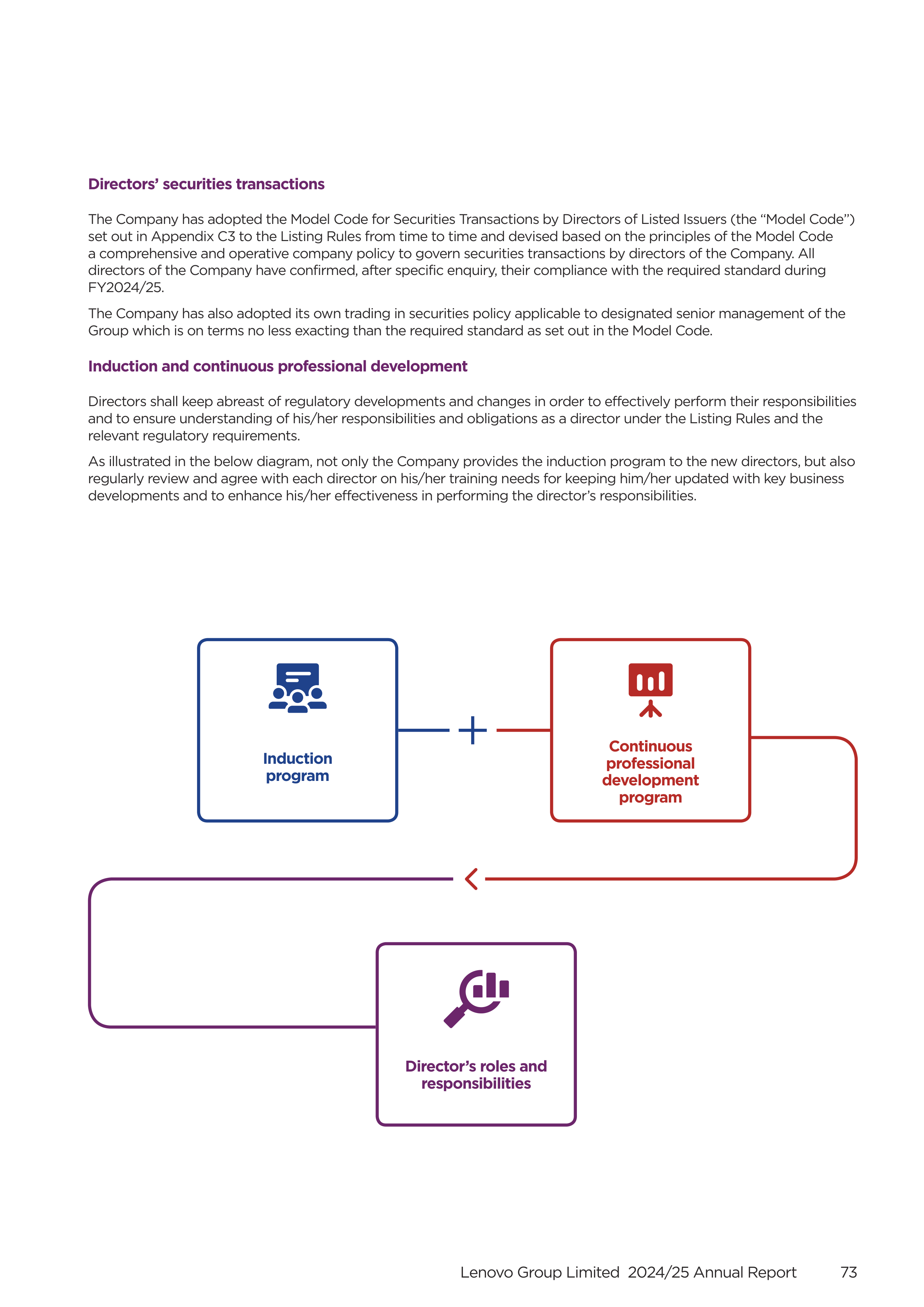
Lenovo Group Limited 2024/25 Annual Report
73
Directors’ securities transactions
The Company has adopted the Model Code for Securities Transactions by Directors of Listed Issuers (the “Model Code”)
set out in Appendix C3 to the Listing Rules from time to time and devised based on the principles of the Model Code
a comprehensive and operative company policy to govern securities transactions by directors of the Company. All
directors of the Company have confirmed, after specific enquiry, their compliance with the required standard during
FY2024/25.
The Company has also adopted its own trading in securities policy applicable to designated senior management of the
Group which is on terms no less exacting than the required standard as set out in the Model Code.
Induction and continuous professional development
Directors shall keep abreast of regulatory developments and changes in order to effectively perform their responsibilities
and to ensure understanding of his/her responsibilities and obligations as a director under the Listing Rules and the
relevant regulatory requirements.
As illustrated in the below diagram, not only the Company provides the induction program to the new directors, but also
regularly review and agree with each director on his/her training needs for keeping him/her updated with key business
developments and to enhance his/her effectiveness in performing the director’s responsibilities.
Induction
program
Continuous
professional
development
program
Director’s roles and
responsibilities
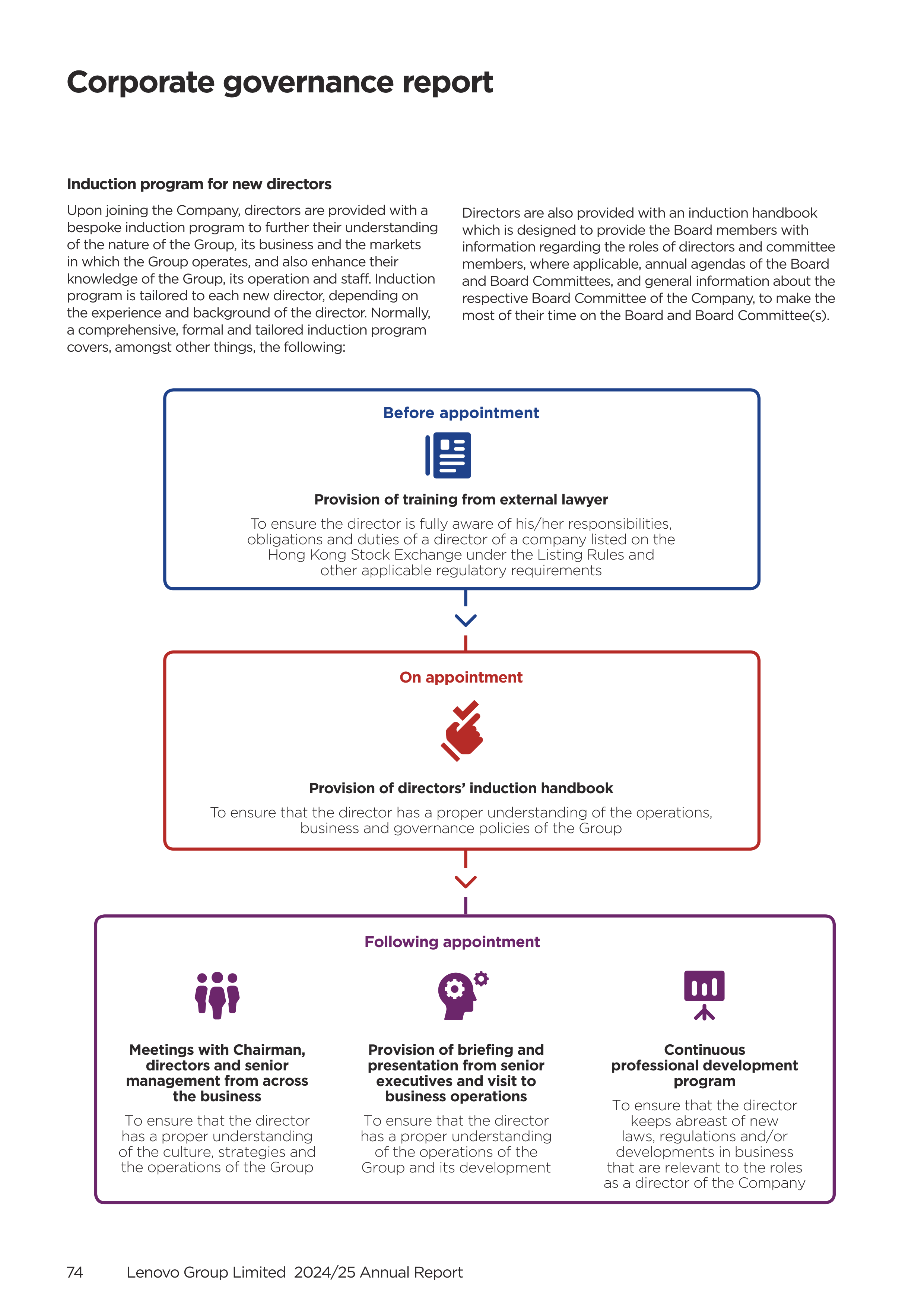
Lenovo Group Limited 2024/25 Annual Report
74
Corporate governance report
Following appointment
Meetings with Chairman,
directors and senior
management from across
the business
To ensure that the director
has a proper understanding
of the culture, strategies and
the operations of the Group
Provision of briefing and
presentation from senior
executives and visit to
business operations
To ensure that the director
has a proper understanding
of the operations of the
Group and its development
Continuous
professional development
program
To ensure that the director
keeps abreast of new
laws, regulations and/or
developments in business
that are relevant to the roles
as a director of the Company
Induction program for new directors
Upon joining the Company, directors are provided with a
bespoke induction program to further their understanding
of the nature of the Group, its business and the markets
in which the Group operates, and also enhance their
knowledge of the Group, its operation and staff. Induction
program is tailored to each new director, depending on
the experience and background of the director. Normally,
a comprehensive, formal and tailored induction program
covers, amongst other things, the following:
Directors are also provided with an induction handbook
which is designed to provide the Board members with
information regarding the roles of directors and committee
members, where applicable, annual agendas of the Board
and Board Committees, and general information about the
respective Board Committee of the Company, to make the
most of their time on the Board and Board Committee(s).
Before appointment
Provision of training from external lawyer
To ensure the director is fully aware of his/her responsibilities,
obligations and duties of a director of a company listed on the
Hong Kong Stock Exchange under the Listing Rules and
other applicable regulatory requirements
On appointment
Provision of directors’ induction handbook
To ensure that the director has a proper understanding of the operations,
business and governance policies of the Group
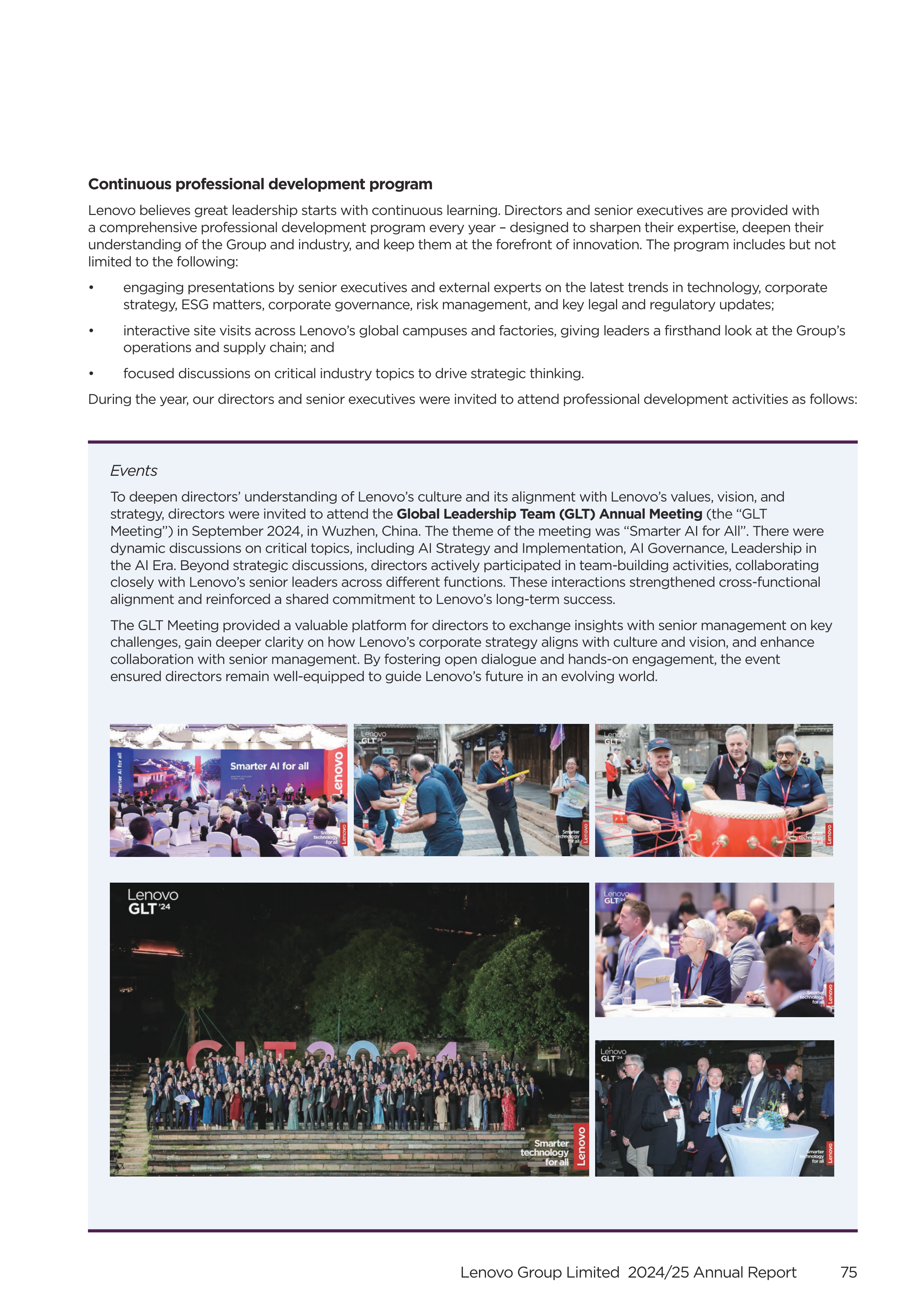
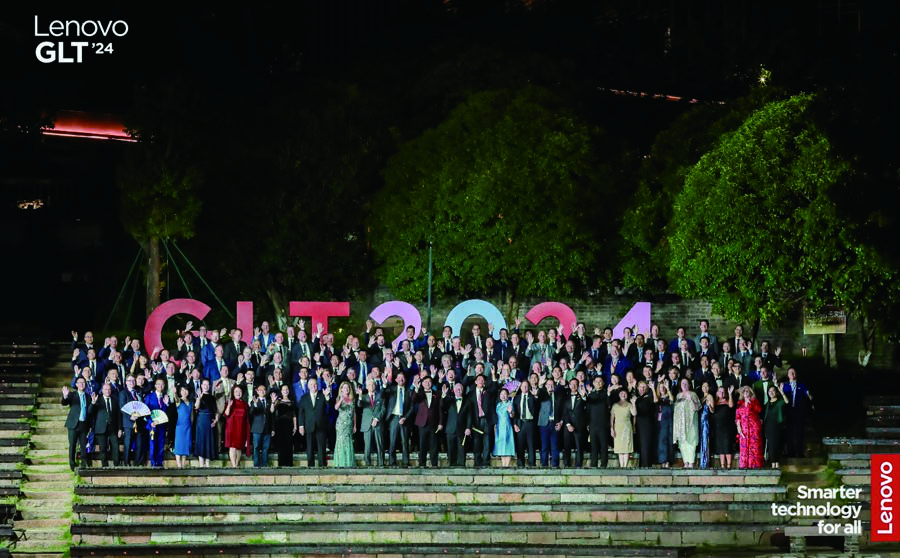
Lenovo Group Limited 2024/25 Annual Report
75
Continuous professional development program
Lenovo believes great leadership starts with continuous learning. Directors and senior executives are provided with
a comprehensive professional development program every year – designed to sharpen their expertise, deepen their
understanding of the Group and industry, and keep them at the forefront of innovation. The program includes but not
limited to the following:
•
engaging presentations by senior executives and external experts on the latest trends in technology, corporate
strategy, ESG matters, corporate governance, risk management, and key legal and regulatory updates;
•
interactive site visits across Lenovo’s global campuses and factories, giving leaders a firsthand look at the Group’s
operations and supply chain; and
•
focused discussions on critical industry topics to drive strategic thinking.
During the year, our directors and senior executives were invited to attend professional development activities as follows:
Events
To deepen directors’ understanding of Lenovo’s culture and its alignment with Lenovo’s values, vision, and
strategy, directors were invited to attend the
Global Leadership Team (GLT) Annual Meeting
(the “GLT
Meeting”) in September 2024, in Wuzhen, China. The theme of the meeting was “Smarter AI for All”. There were
dynamic discussions on critical topics, including AI Strategy and Implementation, AI Governance, Leadership in
the AI Era. Beyond strategic discussions, directors actively participated in team-building activities, collaborating
closely with Lenovo’s senior leaders across different functions. These interactions strengthened cross-functional
alignment and reinforced a shared commitment to Lenovo’s long-term success.
The GLT Meeting provided a valuable platform for directors to exchange insights with senior management on key
challenges, gain deeper clarity on how Lenovo’s corporate strategy aligns with culture and vision, and enhance
collaboration with senior management. By fostering open dialogue and hands-on engagement, the event
ensured directors remain well-equipped to guide Lenovo’s future in an evolving world.
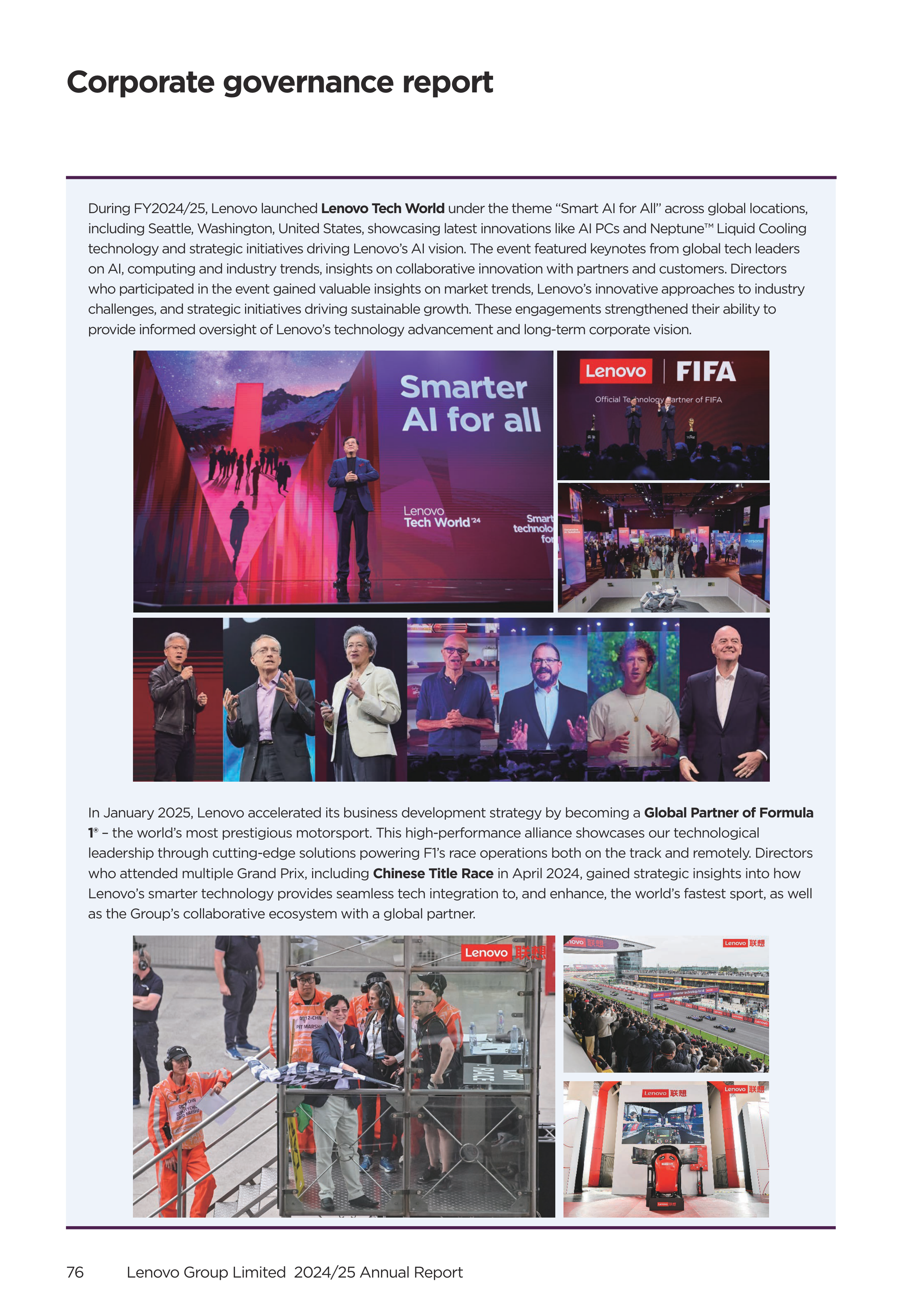
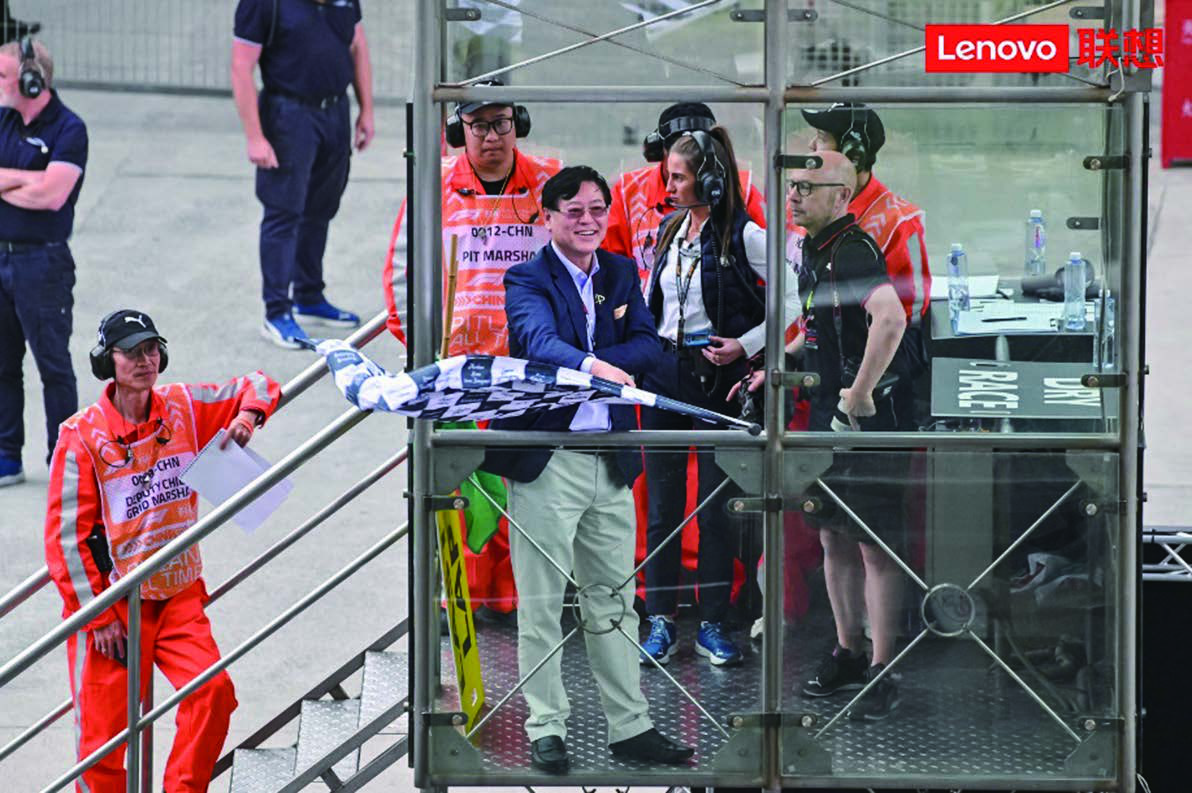

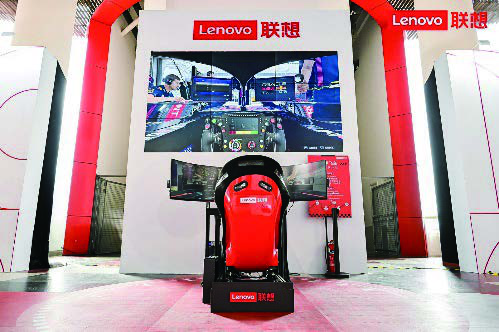
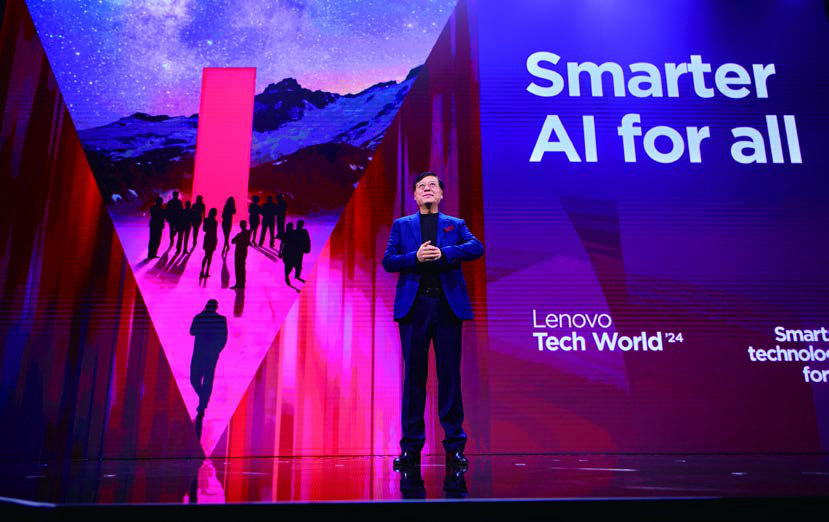

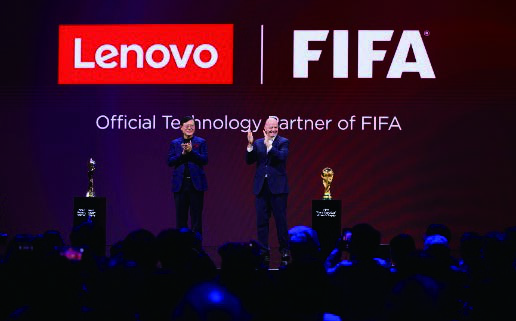
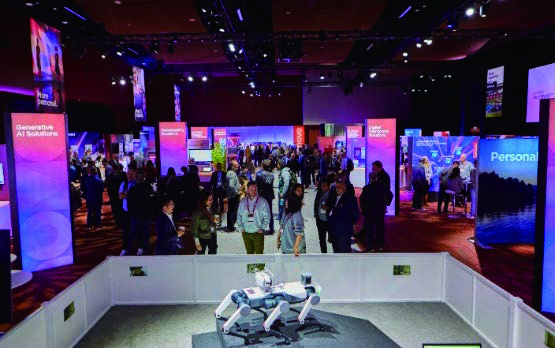
Lenovo Group Limited 2024/25 Annual Report
76
Corporate governance report
During FY2024/25, Lenovo launched
Lenovo Tech World
under the theme “Smart AI for All” across global locations,
including Seattle, Washington, United States, showcasing latest innovations like AI PCs and Neptune™ Liquid Cooling
technology and strategic initiatives driving Lenovo’s AI vision. The event featured keynotes from global tech leaders
on AI, computing and industry trends, insights on collaborative innovation with partners and customers. Directors
who participated in the event gained valuable insights on market trends, Lenovo’s innovative approaches to industry
challenges, and strategic initiatives driving sustainable growth. These engagements strengthened their ability to
provide informed oversight of Lenovo’s technology advancement and long-term corporate vision.
In January 2025, Lenovo accelerated its business development strategy by becoming a
Global Partner of Formula
1®
– the world’s most prestigious motorsport. This high-performance alliance showcases our technological
leadership through cutting-edge solutions powering F1’s race operations both on the track and remotely. Directors
who attended multiple Grand Prix, including
Chinese Title Race
in April 2024, gained strategic insights into how
Lenovo’s smarter technology provides seamless tech integration to, and enhance, the world’s fastest sport, as well
as the Group’s collaborative ecosystem with a global partner.
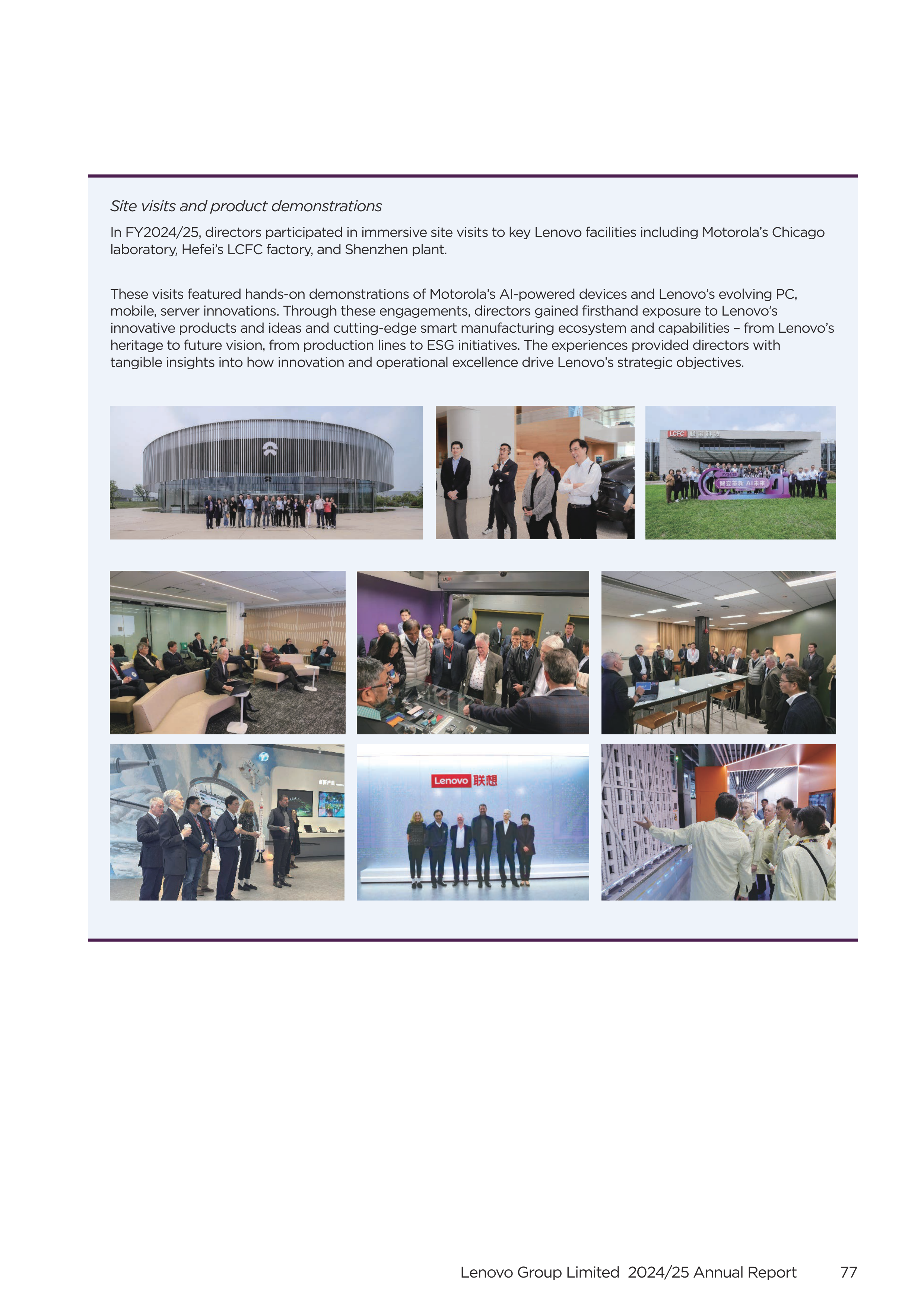
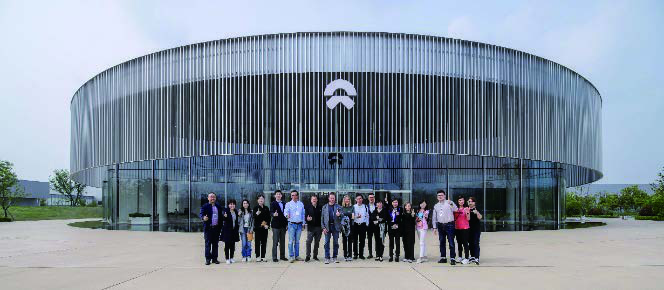
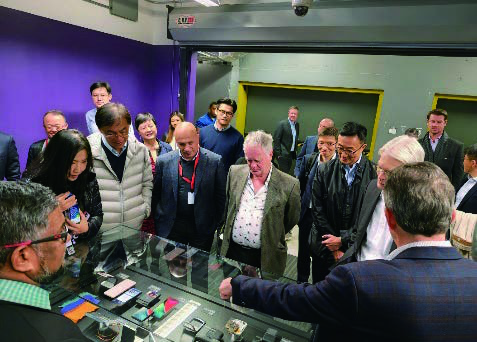
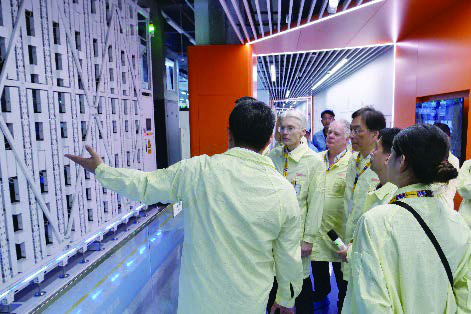
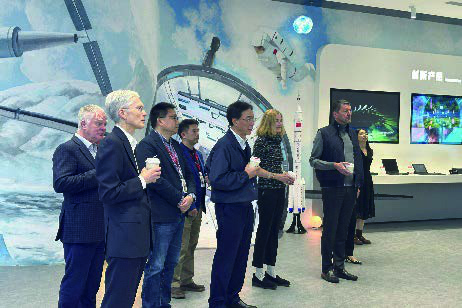
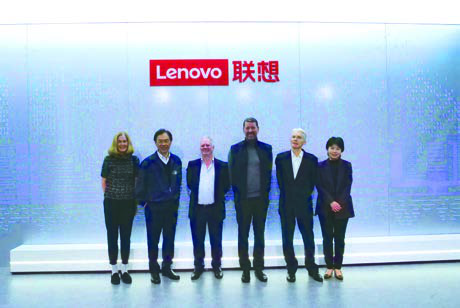
Lenovo Group Limited 2024/25 Annual Report
77
Site visits and product demonstrations
In FY2024/25, directors participated in immersive site visits to key Lenovo facilities including Motorola’s Chicago
laboratory, Hefei’s LCFC factory, and Shenzhen plant.
These visits featured hands-on demonstrations of Motorola’s AI-powered devices and Lenovo’s evolving PC,
mobile, server innovations. Through these engagements, directors gained firsthand exposure to Lenovo’s
innovative products and ideas and cutting-edge smart manufacturing ecosystem and capabilities – from Lenovo’s
heritage to future vision, from production lines to ESG initiatives. The experiences provided directors with
tangible insights into how innovation and operational excellence drive Lenovo’s strategic objectives.
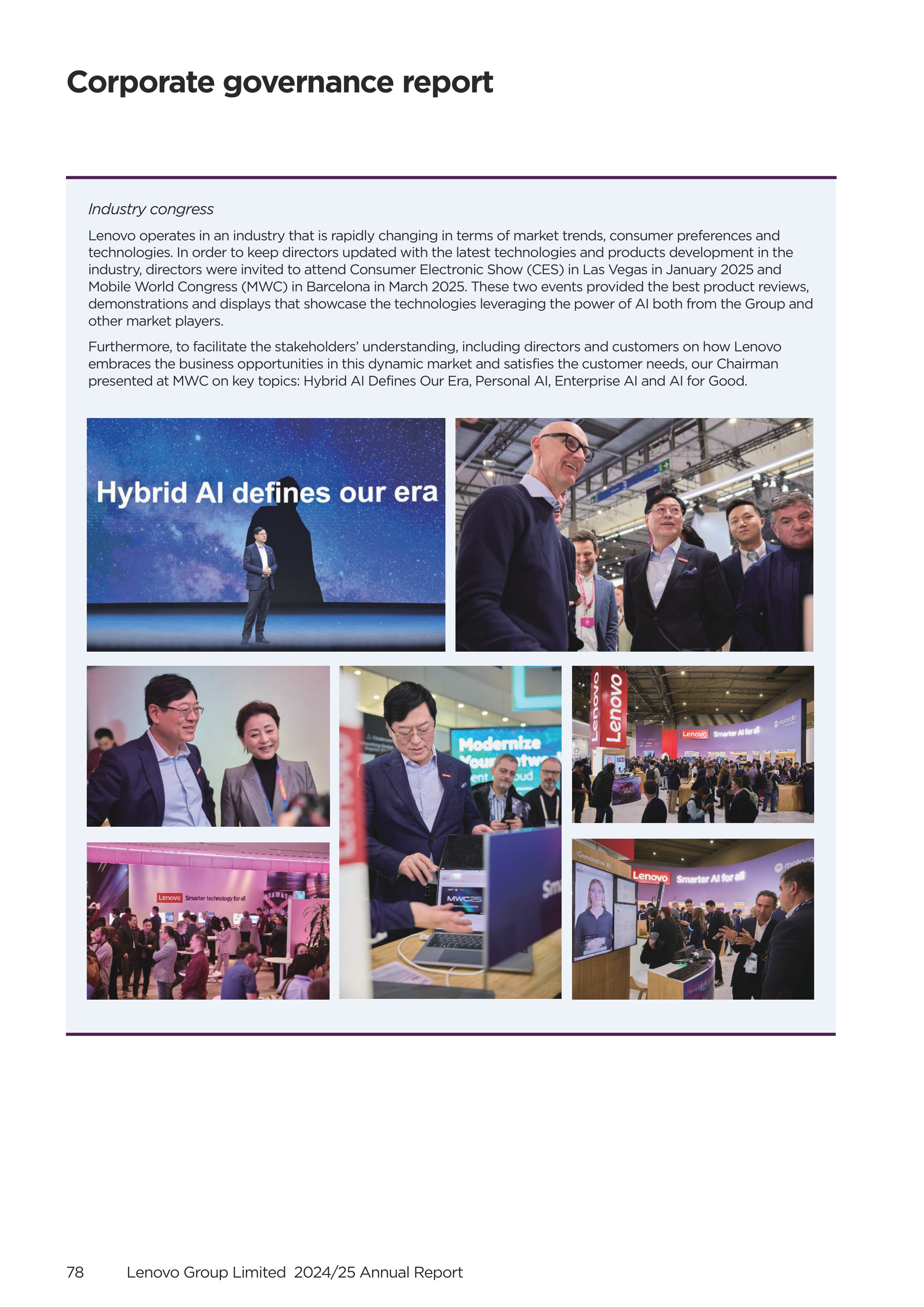
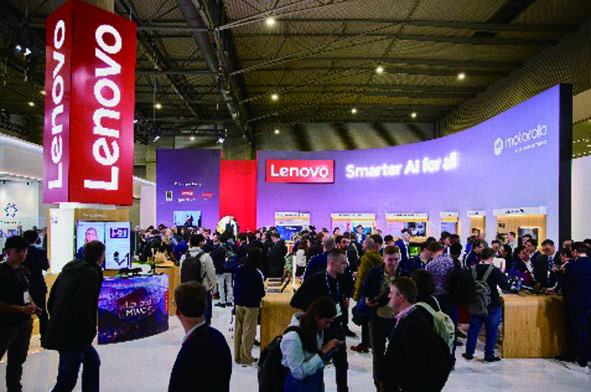
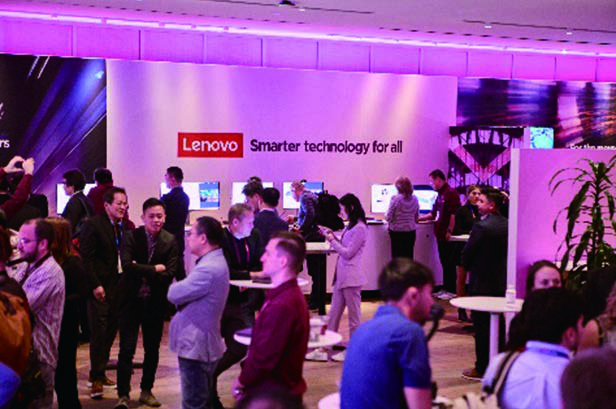

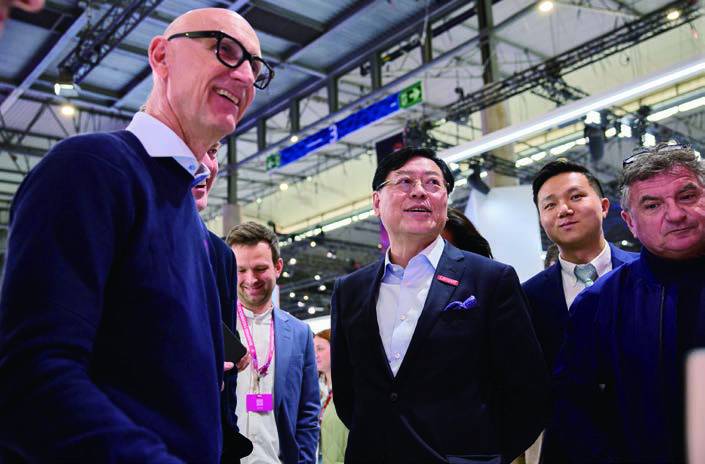
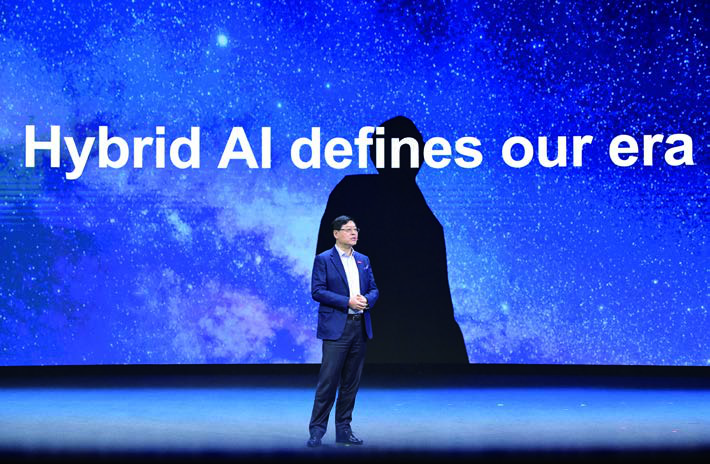
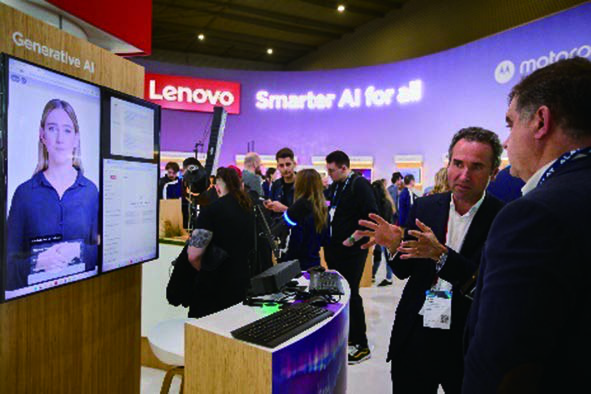
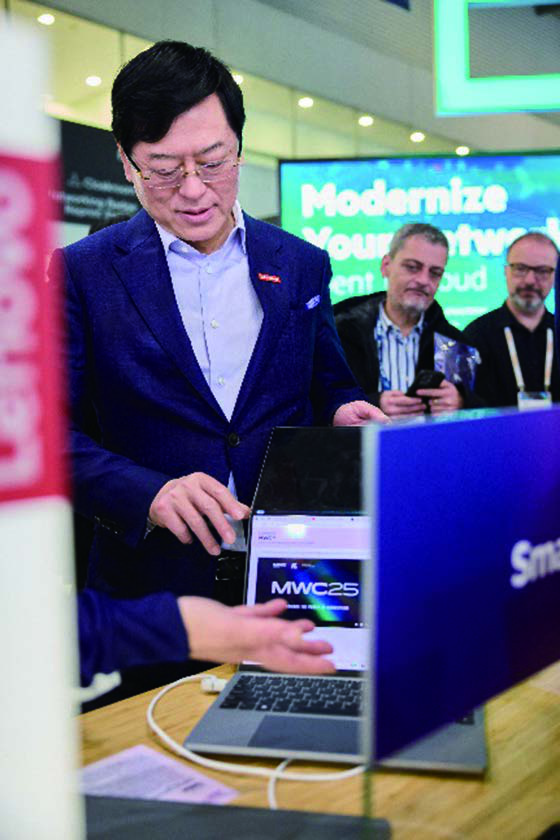
Lenovo Group Limited 2024/25 Annual Report
78
Corporate governance report
Industry congress
Lenovo operates in an industry that is rapidly changing in terms of market trends, consumer preferences and
technologies. In order to keep directors updated with the latest technologies and products development in the
industry, directors were invited to attend Consumer Electronic Show (CES) in Las Vegas in January 2025 and
Mobile World Congress (MWC) in Barcelona in March 2025. These two events provided the best product reviews,
demonstrations and displays that showcase the technologies leveraging the power of AI both from the Group and
other market players.
Furthermore, to facilitate the stakeholders’ understanding, including directors and customers on how Lenovo
embraces the business opportunities in this dynamic market and satisfies the customer needs, our Chairman
presented at MWC on key topics: Hybrid AI Defines Our Era, Personal AI, Enterprise AI and AI for Good.
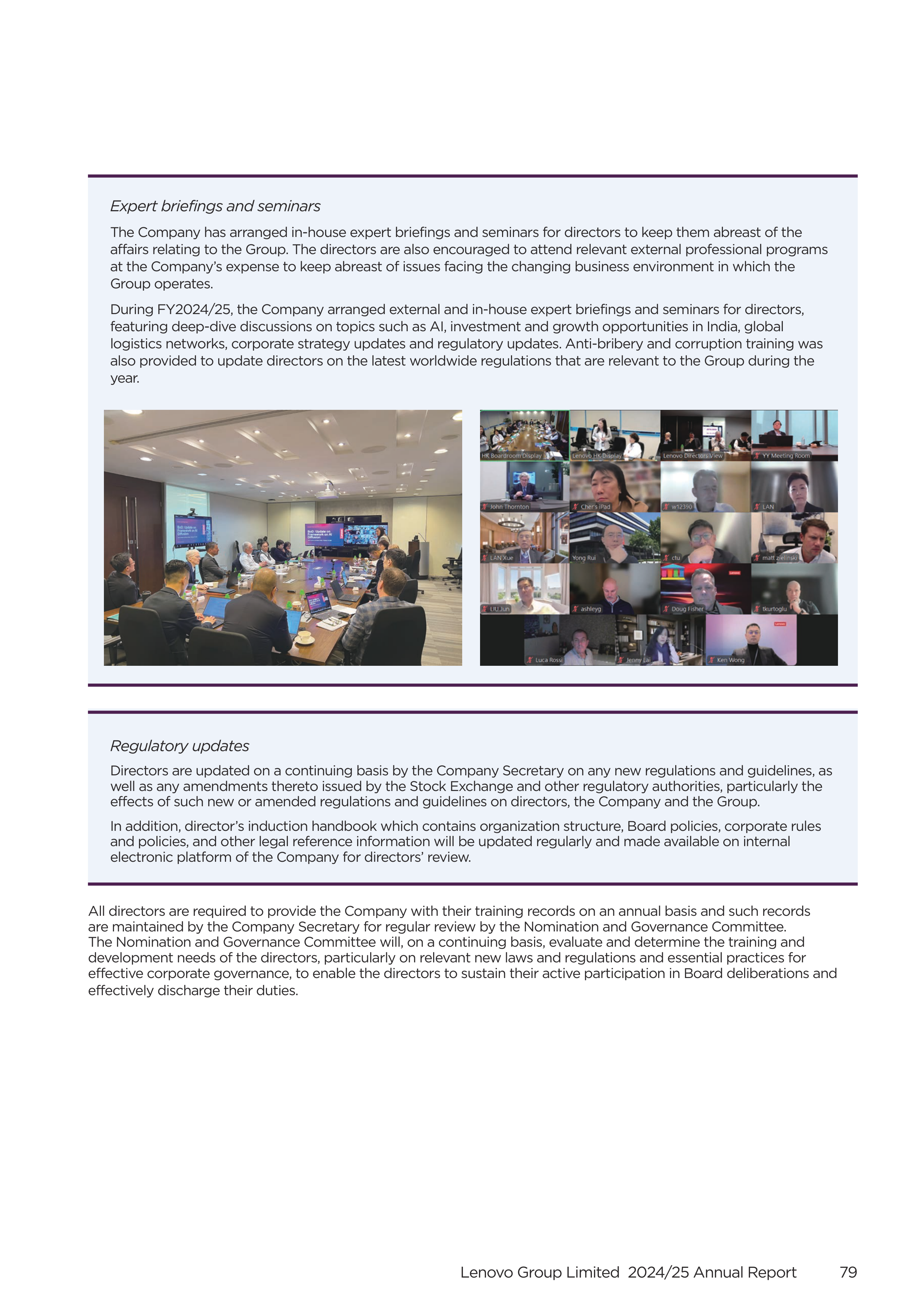
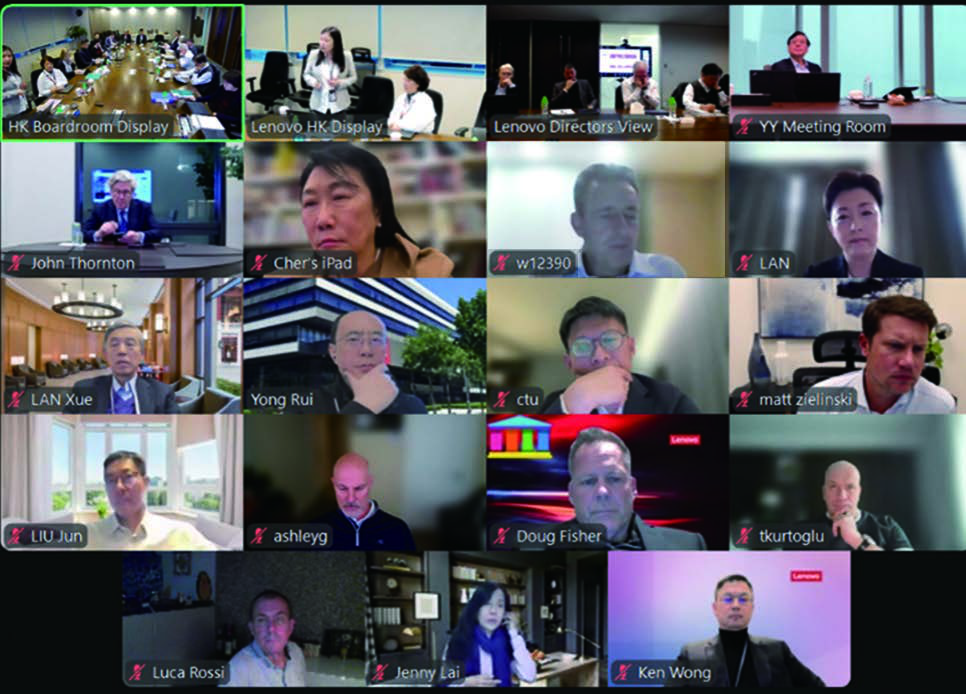
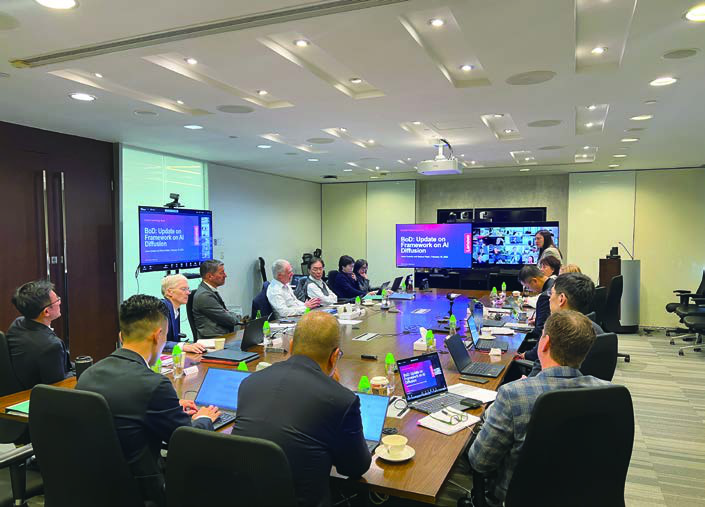
Lenovo Group Limited 2024/25 Annual Report
79
Expert briefings and seminars
The Company has arranged in-house expert briefings and seminars for directors to keep them abreast of the
affairs relating to the Group. The directors are also encouraged to attend relevant external professional programs
at the Company’s expense to keep abreast of issues facing the changing business environment in which the
Group operates.
During FY2024/25, the Company arranged external and in-house expert briefings and seminars for directors,
featuring deep-dive discussions on topics such as AI, investment and growth opportunities in India, global
logistics networks, corporate strategy updates and regulatory updates. Anti-bribery and corruption training was
also provided to update directors on the latest worldwide regulations that are relevant to the Group during the
year.
Regulatory updates
Directors are updated on a continuing basis by the Company Secretary on any new regulations and guidelines, as
well as any amendments thereto issued by the Stock Exchange and other regulatory authorities, particularly the
effects of such new or amended regulations and guidelines on directors, the Company and the Group.
In addition, director’s induction handbook which contains organization structure, Board policies, corporate rules
and policies, and other legal reference information will be updated regularly and made available on internal
electronic platform of the Company for directors’ review.
All directors are required to provide the Company with their training records on an annual basis and such records
are maintained by the Company Secretary for regular review by the Nomination and Governance Committee.
The Nomination and Governance Committee will, on a continuing basis, evaluate and determine the training and
development needs of the directors, particularly on relevant new laws and regulations and essential practices for
effective corporate governance, to enable the directors to sustain their active participation in Board deliberations and
effectively discharge their duties.
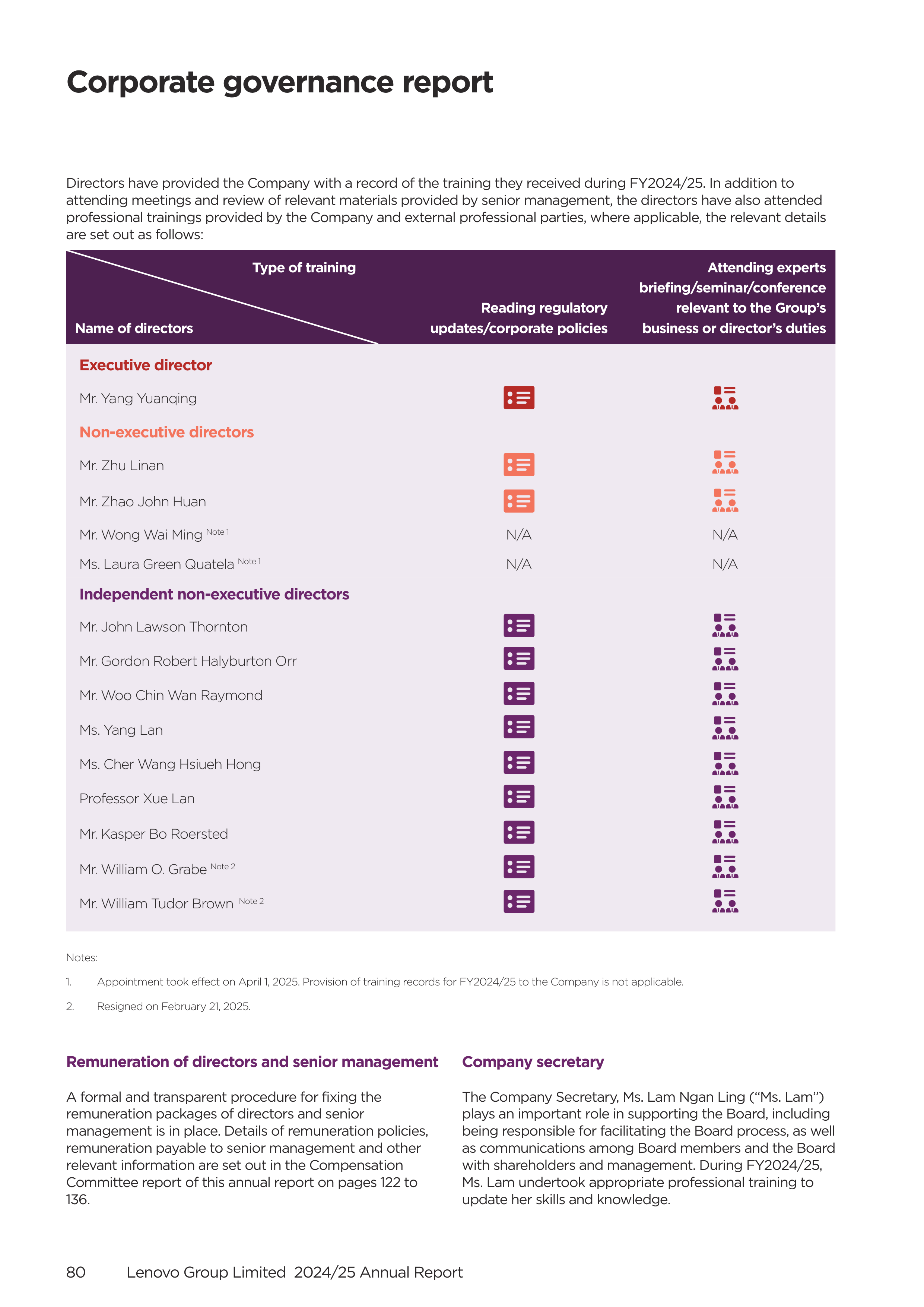
Lenovo Group Limited 2024/25 Annual Report
80
Corporate governance report
Directors have provided the Company with a record of the training they received during FY2024/25. In addition to
attending meetings and review of relevant materials provided by senior management, the directors have also attended
professional trainings provided by the Company and external professional parties, where applicable, the relevant details
are set out as follows:
Type of training
Name of directors
Reading regulatory
updates/corporate policies
Attending experts
briefing/seminar/conference
relevant to the Group’s
business or director’s duties
Executive director
Mr. Yang Yuanqing
Non-executive directors
Mr. Zhu Linan
Mr. Zhao John Huan
Mr. Wong Wai Ming
Note 1
N/A
N/A
Ms. Laura Green Quatela
Note 1
N/A
N/A
Independent non-executive directors
Mr. John Lawson Thornton
Mr. Gordon Robert Halyburton Orr
Mr. Woo Chin Wan Raymond
Ms. Yang Lan
Ms. Cher Wang Hsiueh Hong
Professor Xue Lan
Mr. Kasper Bo Roersted
Mr. William O. Grabe
Note 2
Mr. William Tudor Brown
Note 2
Notes:
1.
Appointment took effect on April 1, 2025. Provision of training records for FY2024/25 to the Company is not applicable.
2.
Resigned on February 21, 2025.
Remuneration of directors and senior management
A formal and transparent procedure for fixing the
remuneration packages of directors and senior
management is in place. Details of remuneration policies,
remuneration payable to senior management and other
relevant information are set out in the Compensation
Committee report of this annual report on pages 122 to
136.
Company secretary
The Company Secretary, Ms. Lam Ngan Ling (“Ms. Lam”)
plays an important role in supporting the Board, including
being responsible for facilitating the Board process, as well
as communications among Board members and the Board
with shareholders and management. During FY2024/25,
Ms. Lam undertook appropriate professional training to
update her skills and knowledge.
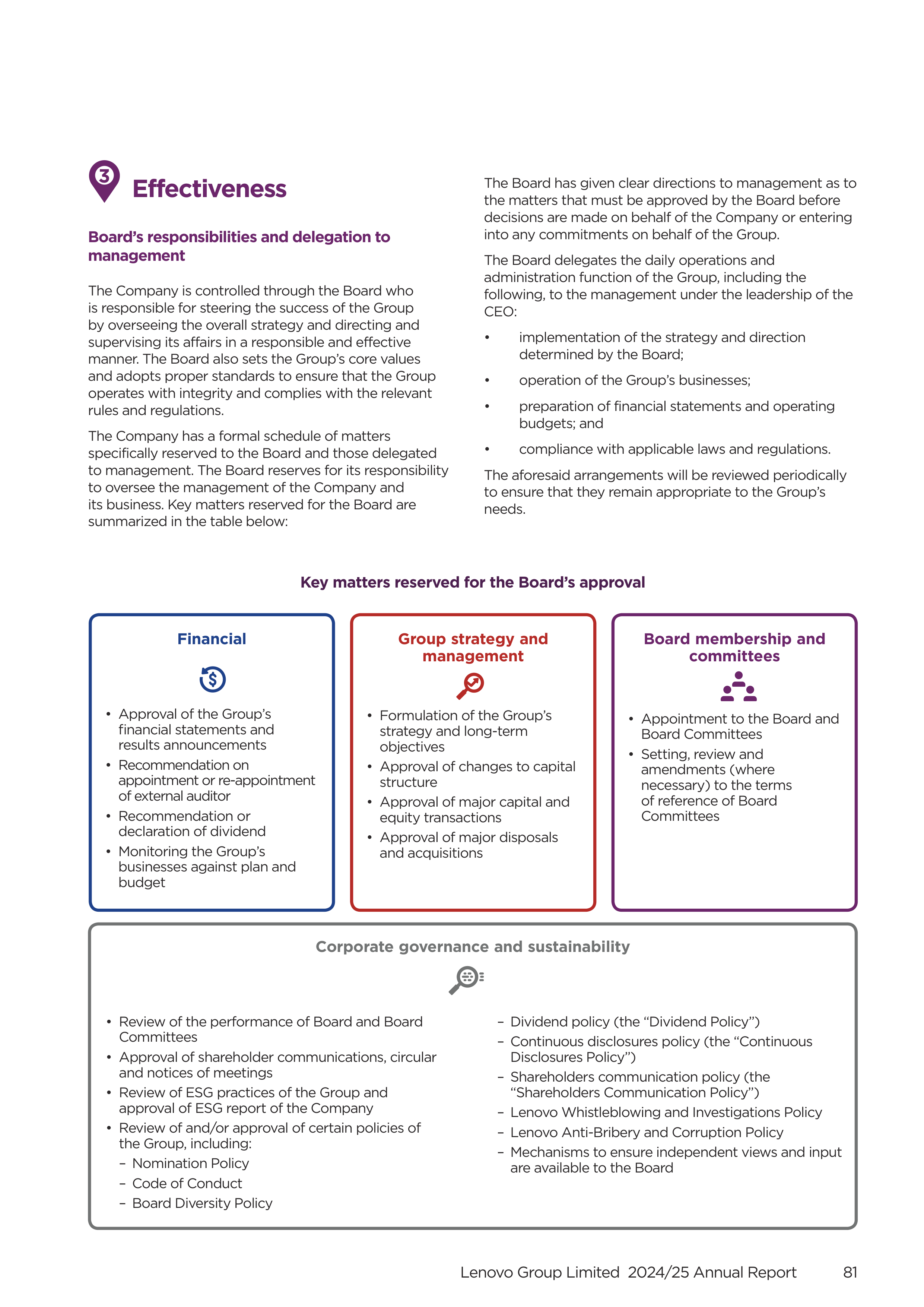
Lenovo Group Limited 2024/25 Annual Report
81
Effectiveness
Board’s responsibilities and delegation to
management
The Company is controlled through the Board who
is responsible for steering the success of the Group
by overseeing the overall strategy and directing and
supervising its affairs in a responsible and effective
manner. The Board also sets the Group’s core values
and adopts proper standards to ensure that the Group
operates with integrity and complies with the relevant
rules and regulations.
The Company has a formal schedule of matters
specifically reserved to the Board and those delegated
to management. The Board reserves for its responsibility
to oversee the management of the Company and
its business. Key matters reserved for the Board are
summarized in the table below:
3
The Board has given clear directions to management as to
the matters that must be approved by the Board before
decisions are made on behalf of the Company or entering
into any commitments on behalf of the Group.
The Board delegates the daily operations and
administration function of the Group, including the
following, to the management under the leadership of the
CEO:
•
implementation of the strategy and direction
determined by the Board;
•
operation of the Group’s businesses;
•
preparation of financial statements and operating
budgets; and
•
compliance with applicable laws and regulations.
The aforesaid arrangements will be reviewed periodically
to ensure that they remain appropriate to the Group’s
needs.
Key matters reserved for the Board’s approval
Group strategy and
management
• Formulation of the Group’s
strategy and long-term
objectives
• Approval of changes to capital
structure
• Approval of major capital and
equity transactions
• Approval of major disposals
and acquisitions
Board membership and
committees
• Appointment to the Board and
Board Committees
• Setting, review and
amendments (where
necessary) to the terms
of reference of Board
Committees
Corporate governance and sustainability
Financial
• Approval of the Group’s
financial statements and
results announcements
• Recommendation on
appointment or re-appointment
of external auditor
• Recommendation or
declaration of dividend
• Monitoring the Group’s
businesses against plan and
budget
• Review of the performance of Board and Board
Committees
• Approval of shareholder communications, circular
and notices of meetings
• Review of ESG practices of the Group and
approval of ESG report of the Company
• Review of and/or approval of certain policies of
the Group, including:
– Nomination Policy
– Code of Conduct
– Board Diversity Policy
– Dividend policy (the “Dividend Policy”)
– Continuous disclosures policy (the “Continuous
Disclosures Policy”)
– Shareholders communication policy (the
“Shareholders Communication Policy”)
– Lenovo Whistleblowing and Investigations Policy
– Lenovo Anti-Bribery and Corruption Policy
– Mechanisms to ensure independent views and input
are available to the Board
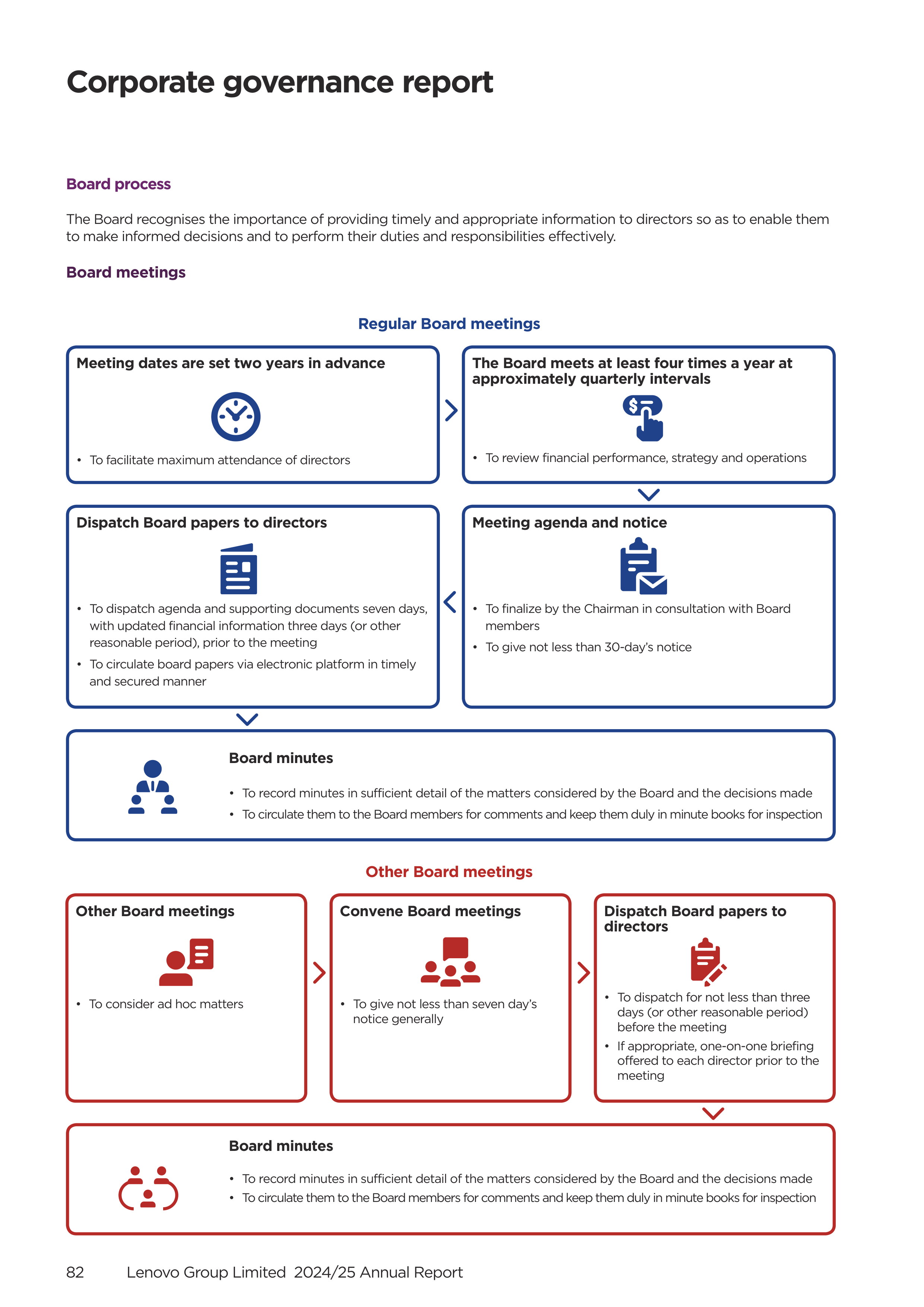
Lenovo Group Limited 2024/25 Annual Report
82
Corporate governance report
Board process
The Board recognises the importance of providing timely and appropriate information to directors so as to enable them
to make informed decisions and to perform their duties and responsibilities effectively.
Board meetings
Regular Board meetings
Other Board meetings
Meeting dates are set two years in advance
• To facilitate maximum attendance of directors
Other Board meetings
• To consider ad hoc matters
Convene Board meetings
• To give not less than seven day’s
notice generally
Dispatch Board papers to
directors
• To dispatch for not less than three
days (or other reasonable period)
before the meeting
• If appropriate, one-on-one briefing
offered to each director prior to the
meeting
Dispatch Board papers to directors
• To dispatch agenda and supporting documents seven days,
with updated financial information three days (or other
reasonable period), prior to the meeting
• To circulate board papers via electronic platform in timely
and secured manner
The Board meets at least four times a year at
approximately quarterly intervals
• To review financial performance, strategy and operations
Meeting agenda and notice
• To finalize by the Chairman in consultation with Board
members
• To give not less than 30-day’s notice
Board minutes
• To record minutes in sufficient detail of the matters considered by the Board and the decisions made
• To circulate them to the Board members for comments and keep them duly in minute books for inspection
Board minutes
• To record minutes in sufficient detail of the matters considered by the Board and the decisions made
• To circulate them to the Board members for comments and keep them duly in minute books for inspection
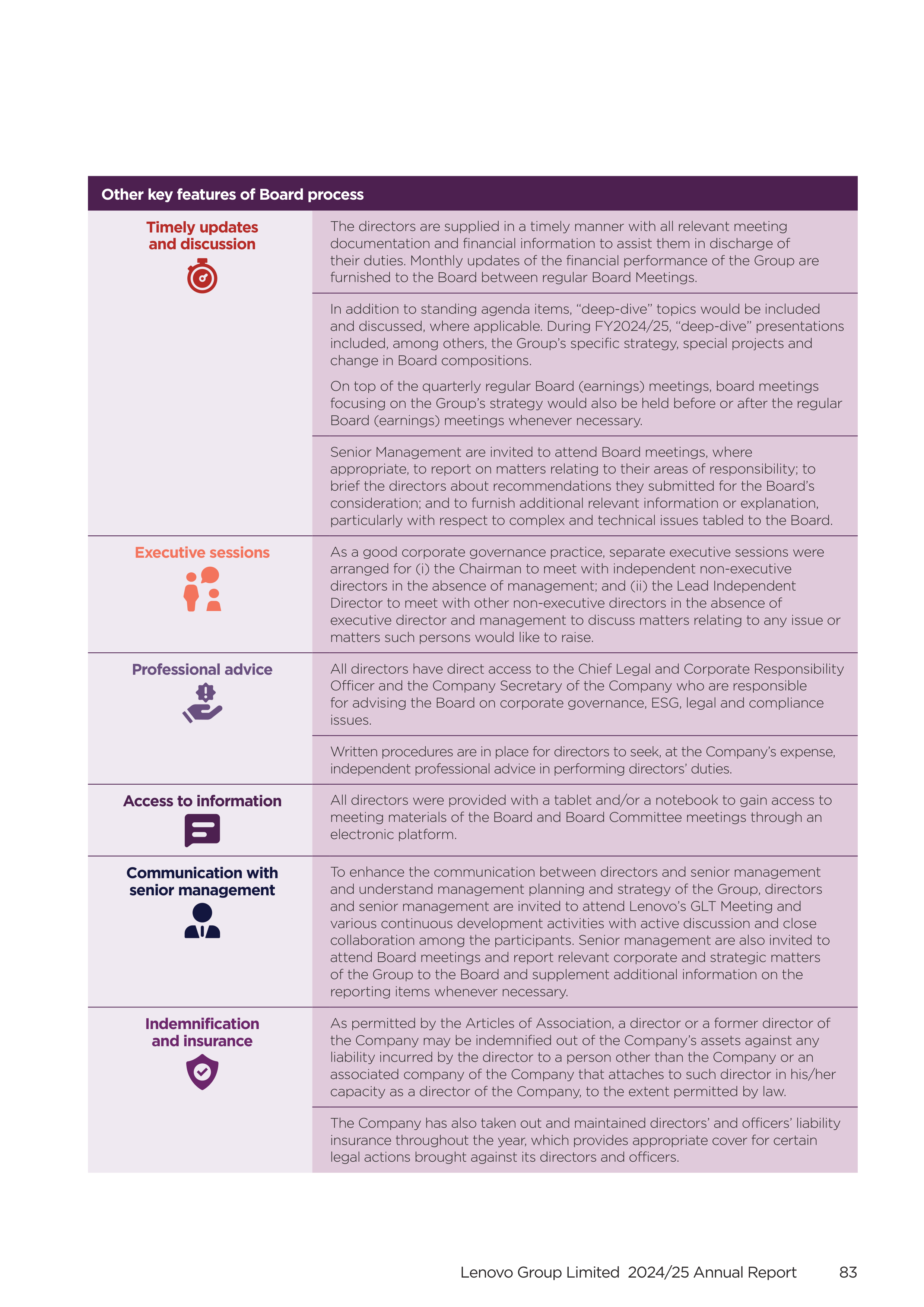
Lenovo Group Limited 2024/25 Annual Report
83
Other key features of Board process
Timely updates
and discussion
The directors are supplied in a timely manner with all relevant meeting
documentation and financial information to assist them in discharge of
their duties. Monthly updates of the financial performance of the Group are
furnished to the Board between regular Board Meetings.
In addition to standing agenda items, “deep-dive” topics would be included
and discussed, where applicable. During FY2024/25, “deep-dive” presentations
included, among others, the Group’s specific strategy, special projects and
change in Board compositions.
On top of the quarterly regular Board (earnings) meetings, board meetings
focusing on the Group’s strategy would also be held before or after the regular
Board (earnings) meetings whenever necessary.
Senior Management are invited to attend Board meetings, where
appropriate, to report on matters relating to their areas of responsibility; to
brief the directors about recommendations they submitted for the Board’s
consideration; and to furnish additional relevant information or explanation,
particularly with respect to complex and technical issues tabled to the Board.
Executive sessions
As a good corporate governance practice, separate executive sessions were
arranged for (i) the Chairman to meet with independent non-executive
directors in the absence of management; and (ii) the Lead Independent
Director to meet with other non-executive directors in the absence of
executive director and management to discuss matters relating to any issue or
matters such persons would like to raise.
Professional advice
All directors have direct access to the Chief Legal and Corporate Responsibility
Officer and the Company Secretary of the Company who are responsible
for advising the Board on corporate governance, ESG, legal and compliance
issues.
Written procedures are in place for directors to seek, at the Company’s expense,
independent professional advice in performing directors’ duties.
Access to information
All directors were provided with a tablet and/or a notebook to gain access to
meeting materials of the Board and Board Committee meetings through an
electronic platform.
Communication with
senior management
To enhance the communication between directors and senior management
and understand management planning and strategy of the Group, directors
and senior management are invited to attend Lenovo’s GLT Meeting and
various continuous development activities with active discussion and close
collaboration among the participants. Senior management are also invited to
attend Board meetings and report relevant corporate and strategic matters
of the Group to the Board and supplement additional information on the
reporting items whenever necessary.
Indemnification
and insurance
As permitted by the Articles of Association, a director or a former director of
the Company may be indemnified out of the Company’s assets against any
liability incurred by the director to a person other than the Company or an
associated company of the Company that attaches to such director in his/her
capacity as a director of the Company, to the extent permitted by law.
The Company has also taken out and maintained directors’ and officers’ liability
insurance throughout the year, which provides appropriate cover for certain
legal actions brought against its directors and officers.
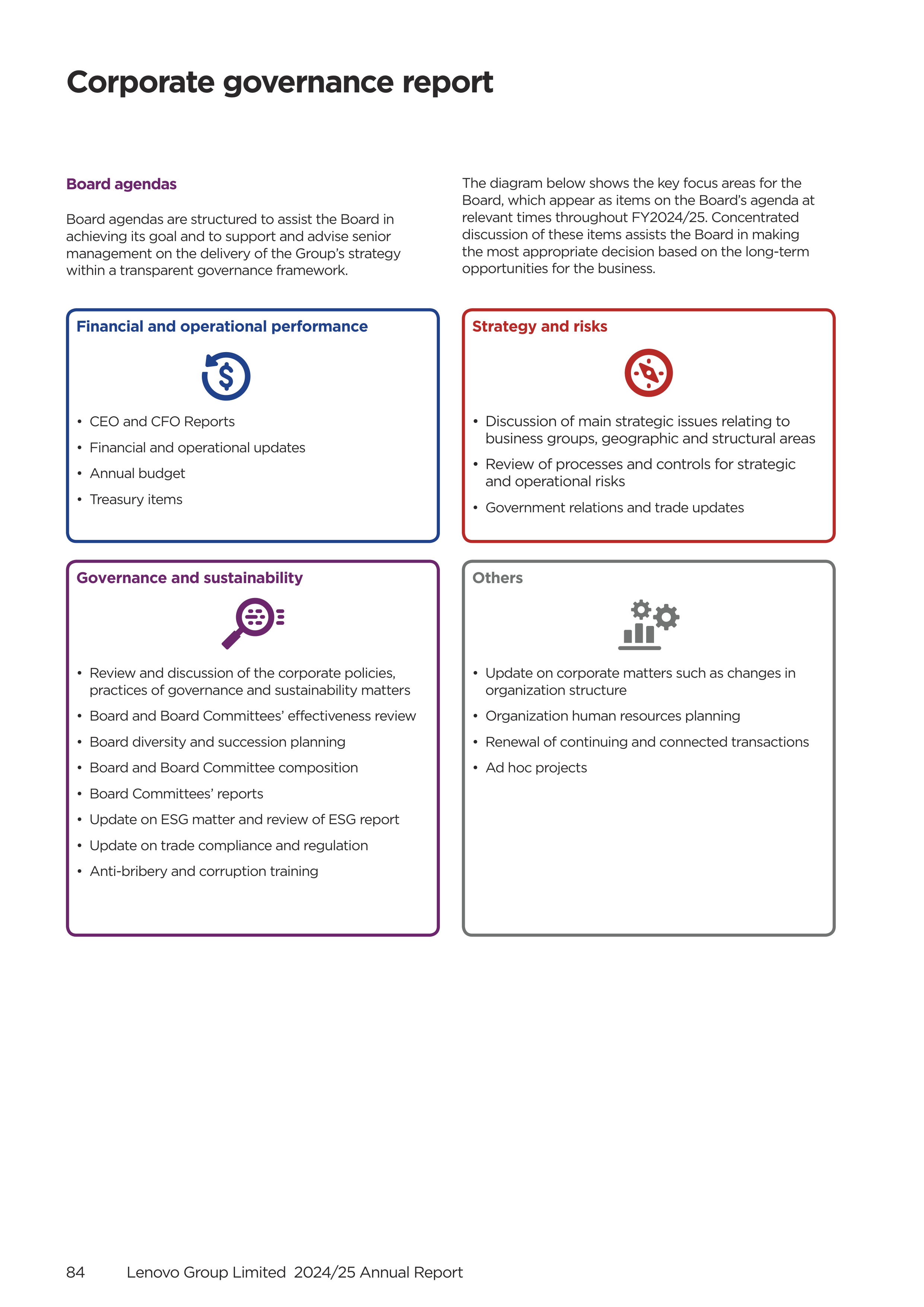
Lenovo Group Limited 2024/25 Annual Report
84
Corporate governance report
Board agendas
Board agendas are structured to assist the Board in
achieving its goal and to support and advise senior
management on the delivery of the Group’s strategy
within a transparent governance framework.
The diagram below shows the key focus areas for the
Board, which appear as items on the Board’s agenda at
relevant times throughout FY2024/25. Concentrated
discussion of these items assists the Board in making
the most appropriate decision based on the long-term
opportunities for the business.
Financial and operational performance
• CEO and CFO Reports
• Financial and operational updates
• Annual budget
• Treasury items
Governance and sustainability
• Review and discussion of the corporate policies,
practices of governance and sustainability matters
• Board and Board Committees’ effectiveness review
• Board diversity and succession planning
• Board and Board Committee composition
• Board Committees’ reports
• Update on ESG matter and review of ESG report
• Update on trade compliance and regulation
• Anti-bribery and corruption training
Strategy and risks
• Discussion of main strategic issues relating to
business groups, geographic and structural areas
• Review of processes and controls for strategic
and operational risks
• Government relations and trade updates
Others
• Update on corporate matters such as changes in
organization structure
• Organization human resources planning
• Renewal of continuing and connected transactions
• Ad hoc projects
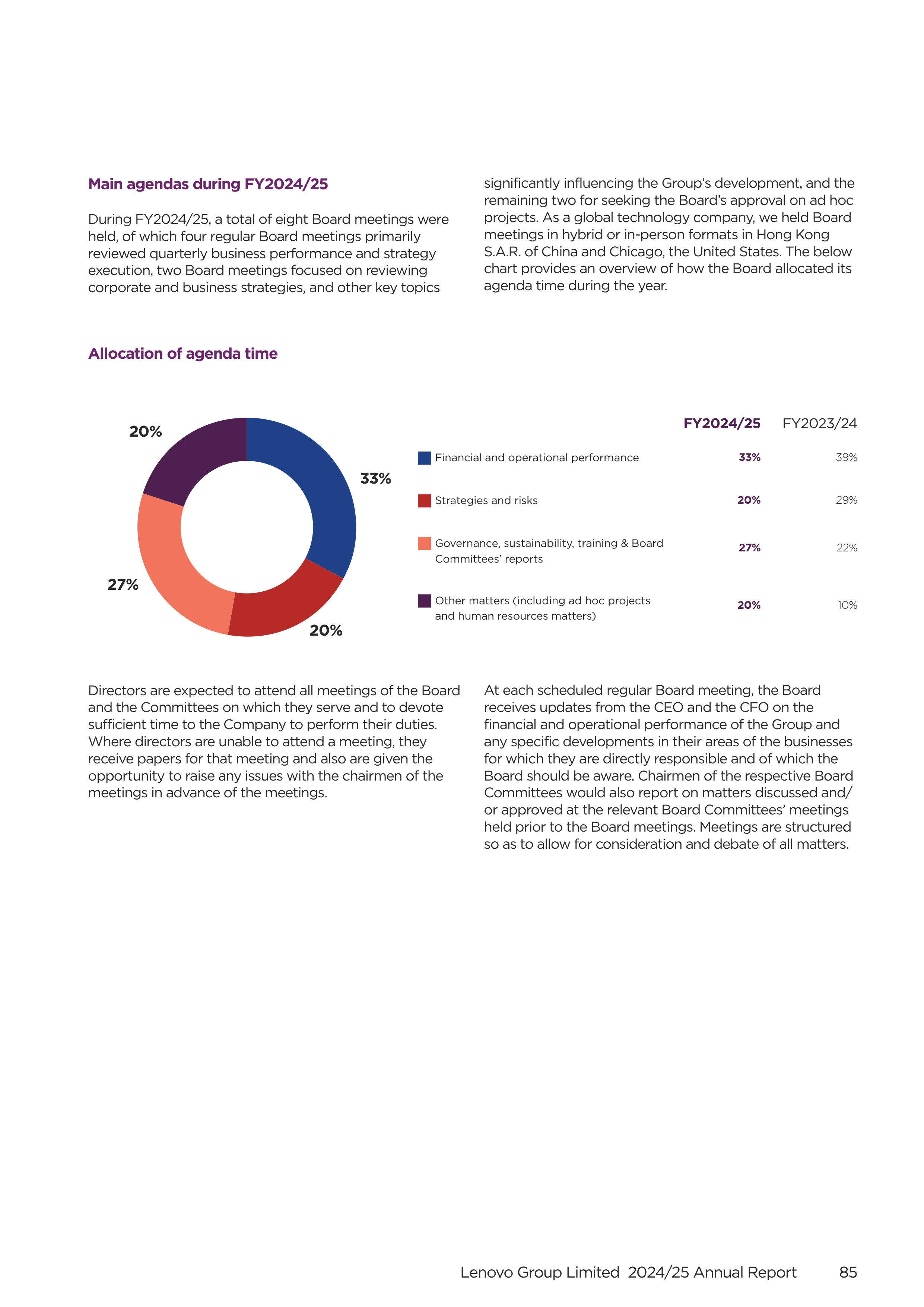
Lenovo Group Limited 2024/25 Annual Report
85
Main agendas during FY2024/25
During FY2024/25, a total of eight Board meetings were
held, of which four regular Board meetings primarily
reviewed quarterly business performance and strategy
execution, two Board meetings focused on reviewing
corporate and business strategies, and other key topics
significantly influencing the Group’s development, and the
remaining two for seeking the Board’s approval on ad hoc
projects. As a global technology company, we held Board
meetings in hybrid or in-person formats in Hong Kong
S.A.R. of China and Chicago, the United States. The below
chart provides an overview of how the Board allocated its
agenda time during the year.
FY2024/25
FY2023/24
Financial and operational performance
33%
39%
Strategies and risks
20%
29%
Governance, sustainability, training & Board
Committees’ reports
27%
22%
Other matters (including ad hoc projects
and human resources matters)
20%
10%
20%
27%
33%
Allocation of agenda time
20%
Directors are expected to attend all meetings of the Board
and the Committees on which they serve and to devote
sufficient time to the Company to perform their duties.
Where directors are unable to attend a meeting, they
receive papers for that meeting and also are given the
opportunity to raise any issues with the chairmen of the
meetings in advance of the meetings.
At each scheduled regular Board meeting, the Board
receives updates from the CEO and the CFO on the
financial and operational performance of the Group and
any specific developments in their areas of the businesses
for which they are directly responsible and of which the
Board should be aware. Chairmen of the respective Board
Committees would also report on matters discussed and/
or approved at the relevant Board Committees’ meetings
held prior to the Board meetings. Meetings are structured
so as to allow for consideration and debate of all matters.
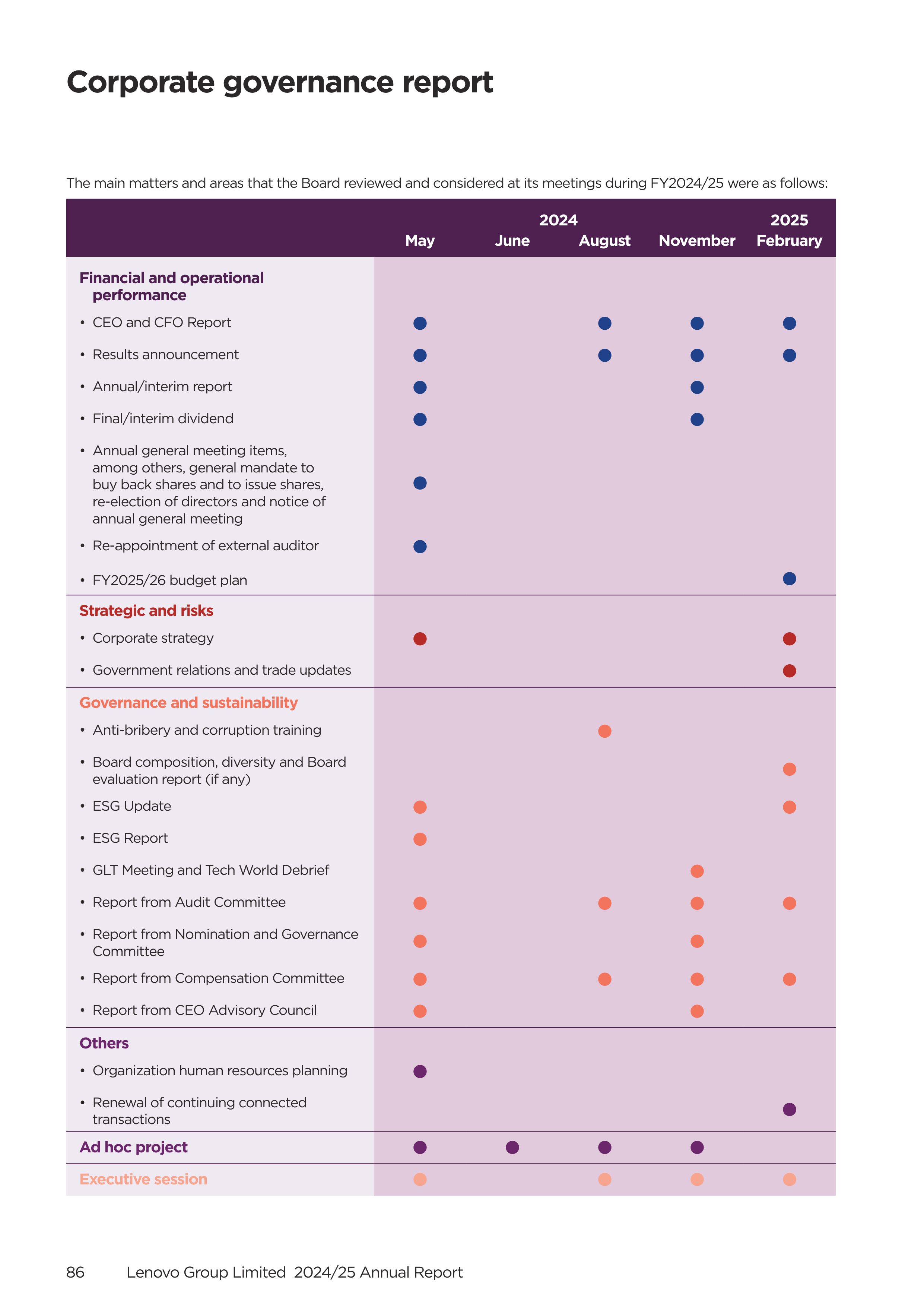
Lenovo Group Limited 2024/25 Annual Report
86
Corporate governance report
The main matters and areas that the Board reviewed and considered at its meetings during FY2024/25 were as follows:
2024
2025
May
June
August
November
February
Financial and operational
performance
• CEO and CFO Report
• Results announcement
• Annual/interim report
• Final/interim dividend
• Annual general meeting items,
among others, general mandate to
buy back shares and to issue shares,
re-election of directors and notice of
annual general meeting
• Re-appointment of external auditor
• FY2025/26 budget plan
Strategic and risks
• Corporate strategy
• Government relations and trade updates
Governance and sustainability
• Anti-bribery and corruption training
• Board composition, diversity and Board
evaluation report (if any)
• ESG Update
• ESG Report
• GLT Meeting and Tech World Debrief
• Report from Audit Committee
• Report from Nomination and Governance
Committee
• Report from Compensation Committee
• Report from CEO Advisory Council
Others
• Organization human resources planning
• Renewal of continuing connected
transactions
Ad hoc project
Executive session
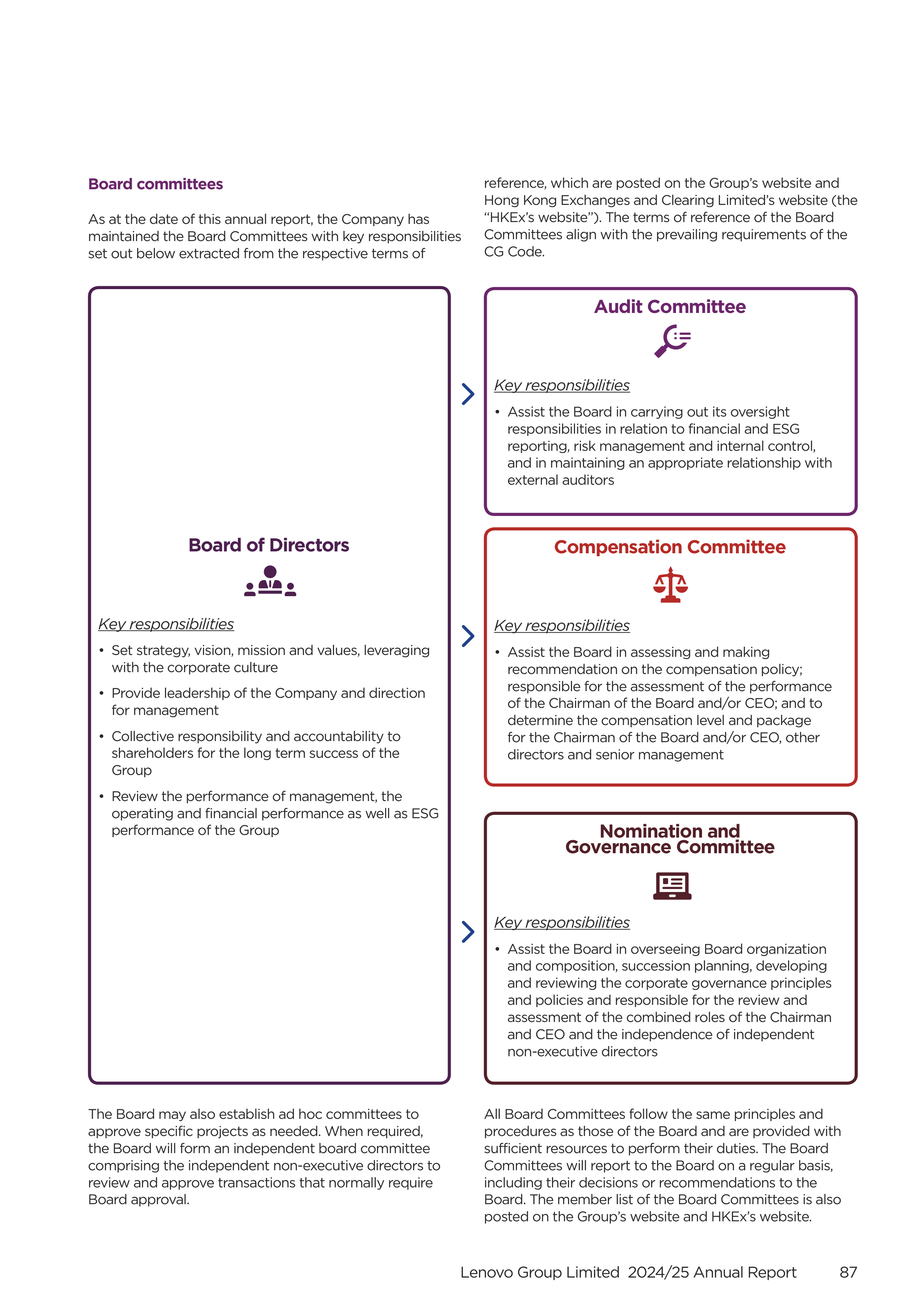
Lenovo Group Limited 2024/25 Annual Report
87
Board committees
As at the date of this annual report, the Company has
maintained the Board Committees with key responsibilities
set out below extracted from the respective terms of
reference, which are posted on the Group’s website and
Hong Kong Exchanges and Clearing Limited’s website (the
“HKEx’s website”). The terms of reference of the Board
Committees align with the prevailing requirements of the
CG Code.
The Board may also establish ad hoc committees to
approve specific projects as needed. When required,
the Board will form an independent board committee
comprising the independent non-executive directors to
review and approve transactions that normally require
Board approval.
All Board Committees follow the same principles and
procedures as those of the Board and are provided with
sufficient resources to perform their duties. The Board
Committees will report to the Board on a regular basis,
including their decisions or recommendations to the
Board. The member list of the Board Committees is also
posted on the Group’s website and HKEx’s website.
Board of Directors
Key responsibilities
• Set strategy, vision, mission and values, leveraging
with the corporate culture
• Provide leadership of the Company and direction
for management
• Collective responsibility and accountability to
shareholders for the long term success of the
Group
• Review the performance of management, the
operating and financial performance as well as ESG
performance of the Group
Audit Committee
Key responsibilities
• Assist the Board in carrying out its oversight
responsibilities in relation to financial and ESG
reporting, risk management and internal control,
and in maintaining an appropriate relationship with
external auditors
Compensation Committee
Key responsibilities
• Assist the Board in assessing and making
recommendation on the compensation policy;
responsible for the assessment of the performance
of the Chairman of the Board and/or CEO; and to
determine the compensation level and package
for the Chairman of the Board and/or CEO, other
directors and senior management
Nomination and
Governance Committee
Key responsibilities
• Assist the Board in overseeing Board organization
and composition, succession planning, developing
and reviewing the corporate governance principles
and policies and responsible for the review and
assessment of the combined roles of the Chairman
and CEO and the independence of independent
non-executive directors
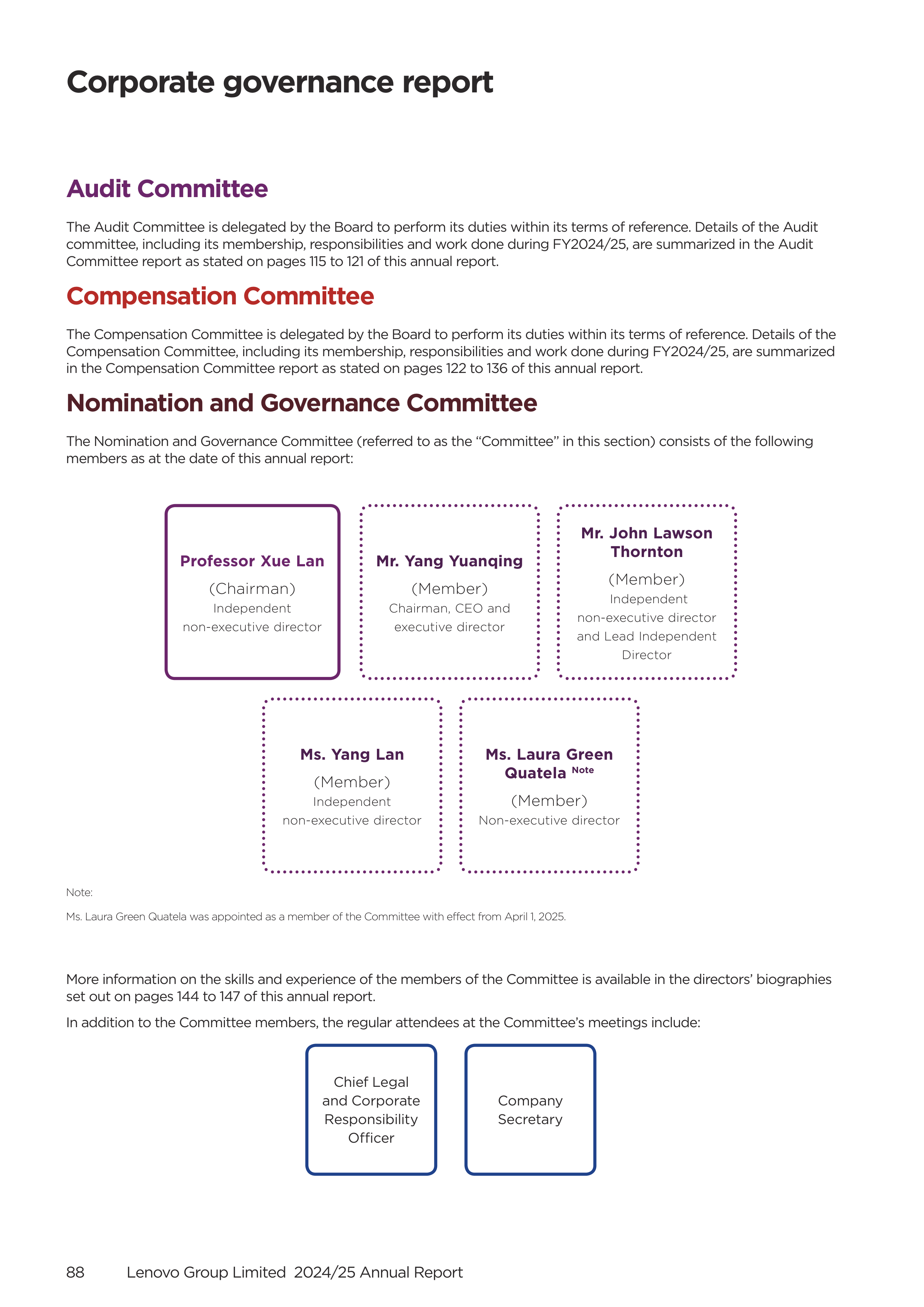
Lenovo Group Limited 2024/25 Annual Report
88
Corporate governance report
Audit Committee
The Audit Committee is delegated by the Board to perform its duties within its terms of reference. Details of the Audit
committee, including its membership, responsibilities and work done during FY2024/25, are summarized in the Audit
Committee report as stated on pages 115 to 121 of this annual report.
Compensation Committee
The Compensation Committee is delegated by the Board to perform its duties within its terms of reference. Details of the
Compensation Committee, including its membership, responsibilities and work done during FY2024/25, are summarized
in the Compensation Committee report as stated on pages 122 to 136 of this annual report.
Nomination and Governance Committee
The Nomination and Governance Committee (referred to as the “Committee” in this section) consists of the following
members as at the date of this annual report:
More information on the skills and experience of the members of the Committee is available in the directors’ biographies
set out on pages 144 to 147 of this annual report.
In addition to the Committee members, the regular attendees at the Committee’s meetings include:
Note:
Ms. Laura Green Quatela was appointed as a member of the Committee with effect from April 1, 2025.
Professor Xue Lan
(Chairman)
Independent
non-executive director
Mr. Yang Yuanqing
(Member)
Chairman, CEO and
executive director
Mr. John Lawson
Thornton
(Member)
Independent
non-executive director
and Lead Independent
Director
Ms. Yang Lan
(Member)
Independent
non-executive director
Ms. Laura Green
Quatela
Note
(Member)
Non-executive director
Chief Legal
and Corporate
Responsibility
Officer
Company
Secretary
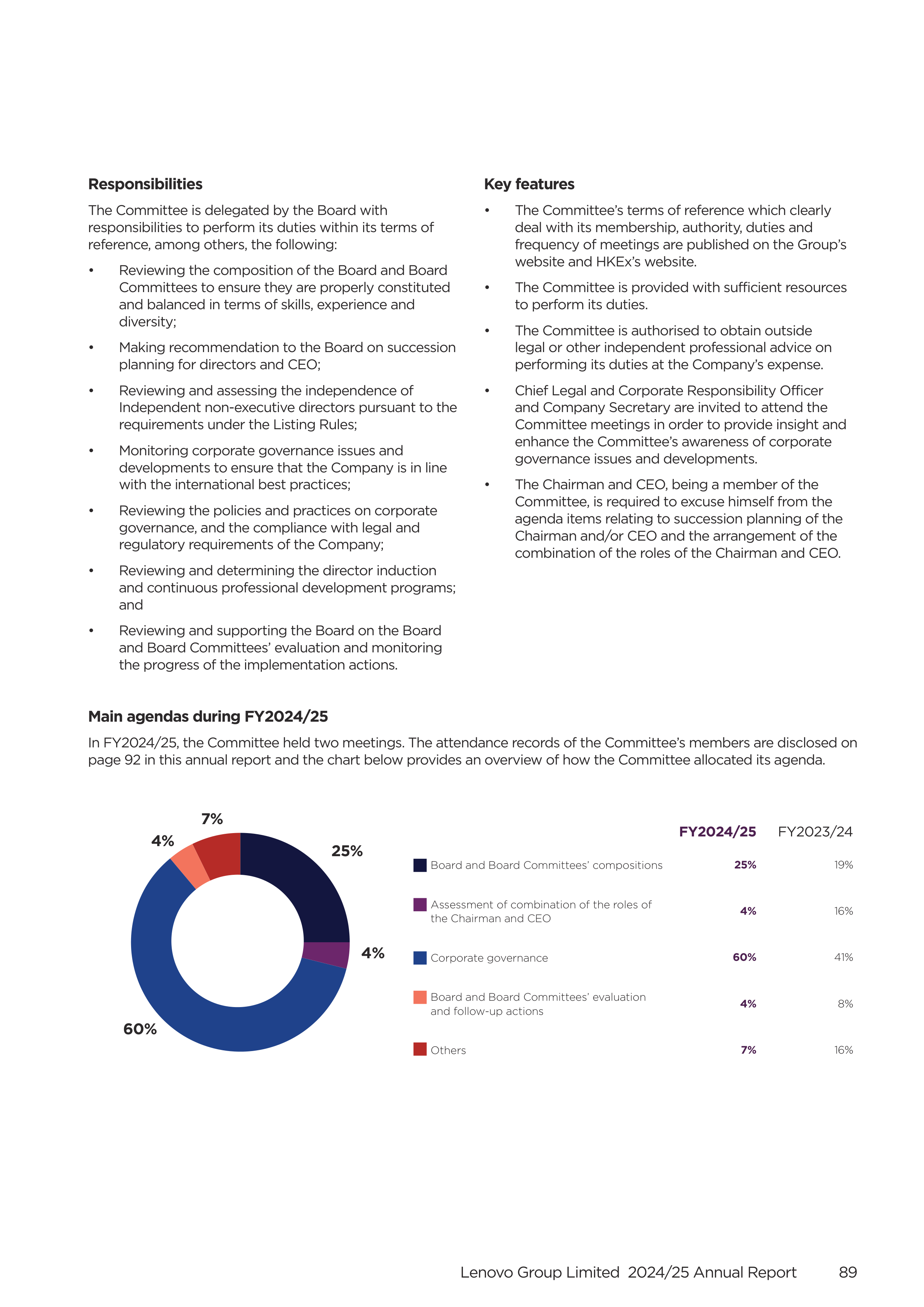
Lenovo Group Limited 2024/25 Annual Report
89
Key features
•
The Committee’s terms of reference which clearly
deal with its membership, authority, duties and
frequency of meetings are published on the Group’s
website and HKEx’s website.
•
The Committee is provided with sufficient resources
to perform its duties.
•
The Committee is authorised to obtain outside
legal or other independent professional advice on
performing its duties at the Company’s expense.
•
Chief Legal and Corporate Responsibility Officer
and Company Secretary are invited to attend the
Committee meetings in order to provide insight and
enhance the Committee’s awareness of corporate
governance issues and developments.
•
The Chairman and CEO, being a member of the
Committee, is required to excuse himself from the
agenda items relating to succession planning of the
Chairman and/or CEO and the arrangement of the
combination of the roles of the Chairman and CEO.
Responsibilities
The Committee is delegated by the Board with
responsibilities to perform its duties within its terms of
reference, among others, the following:
•
Reviewing the composition of the Board and Board
Committees to ensure they are properly constituted
and balanced in terms of skills, experience and
diversity;
•
Making recommendation to the Board on succession
planning for directors and CEO;
•
Reviewing and assessing the independence of
Independent non-executive directors pursuant to the
requirements under the Listing Rules;
•
Monitoring corporate governance issues and
developments to ensure that the Company is in line
with the international best practices;
•
Reviewing the policies and practices on corporate
governance, and the compliance with legal and
regulatory requirements of the Company;
•
Reviewing and determining the director induction
and continuous professional development programs;
and
•
Reviewing and supporting the Board on the Board
and Board Committees’ evaluation and monitoring
the progress of the implementation actions.
FY2024/25
FY2023/24
Board and Board Committees’ compositions
25%
19%
Assessment of combination of the roles of
the Chairman and CEO
4%
16%
Corporate governance
60%
41%
Board and Board Committees’ evaluation
and follow-up actions
4%
8%
Others
7%
16%
4%
7%
60%
25%
4%
Main agendas during FY2024/25
In FY2024/25, the Committee held two meetings. The attendance records of the Committee’s members are disclosed on
page 92 in this annual report and the chart below provides an overview of how the Committee allocated its agenda.
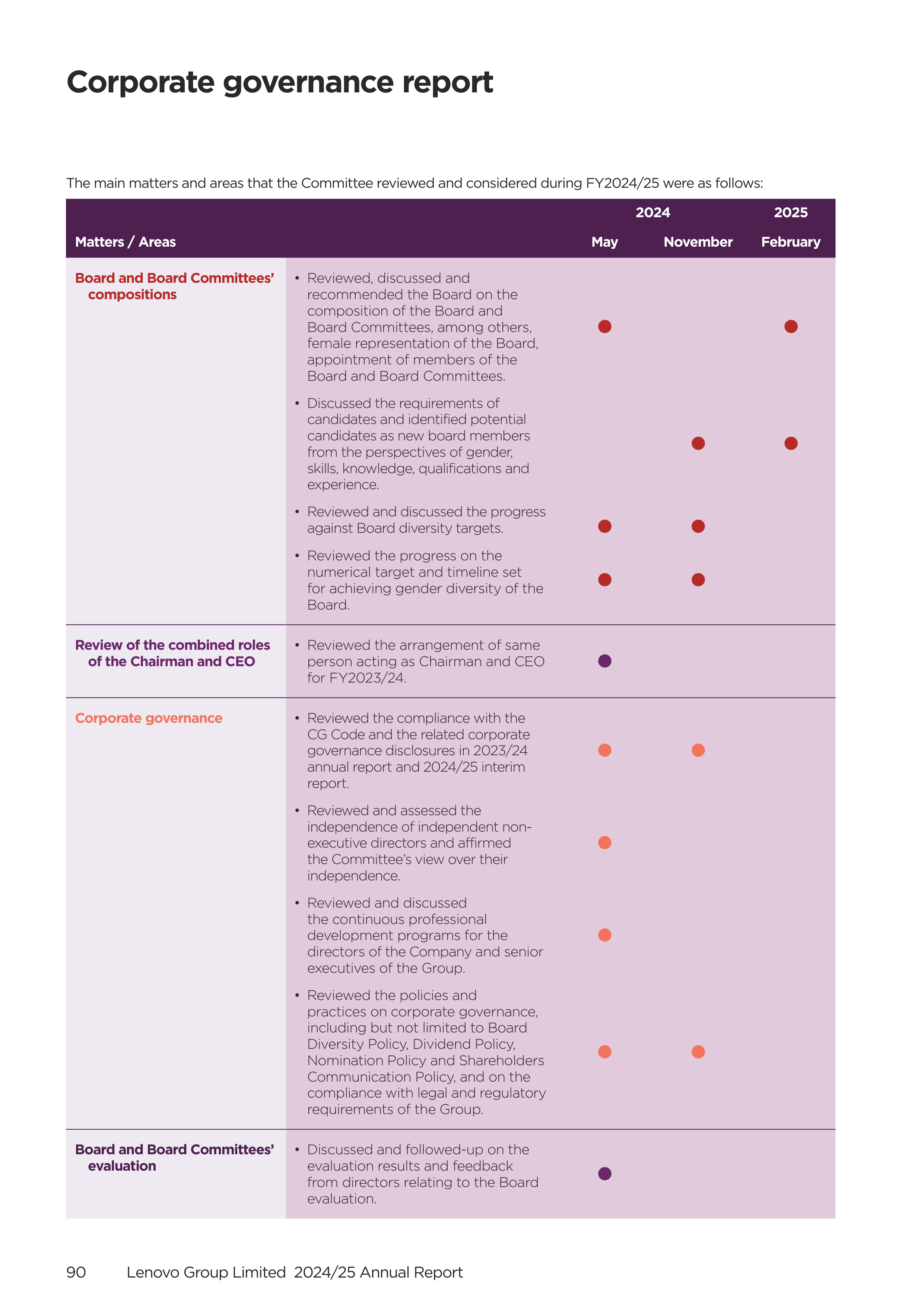
Lenovo Group Limited 2024/25 Annual Report
90
Corporate governance report
The main matters and areas that the Committee reviewed and considered during FY2024/25 were as follows:
2024
2025
Matters / Areas
May
November
February
Board and Board Committees’
compositions
• Reviewed, discussed and
recommended the Board on the
composition of the Board and
Board Committees, among others,
female representation of the Board,
appointment of members of the
Board and Board Committees.
• Discussed the requirements of
candidates and identified potential
candidates as new board members
from the perspectives of gender,
skills, knowledge, qualifications and
experience.
• Reviewed and discussed the progress
against Board diversity targets.
• Reviewed the progress on the
numerical target and timeline set
for achieving gender diversity of the
Board.
Review of the combined roles
of the Chairman and CEO
• Reviewed the arrangement of same
person acting as Chairman and CEO
for FY2023/24.
Corporate governance
• Reviewed the compliance with the
CG Code and the related corporate
governance disclosures in 2023/24
annual report and 2024/25 interim
report.
• Reviewed and assessed the
independence of independent non-
executive directors and affirmed
the Committee’s view over their
independence.
• Reviewed and discussed
the continuous professional
development programs for the
directors of the Company and senior
executives of the Group.
• Reviewed the policies and
practices on corporate governance,
including but not limited to Board
Diversity Policy, Dividend Policy,
Nomination Policy and Shareholders
Communication Policy, and on the
compliance with legal and regulatory
requirements of the Group.
Board and Board Committees’
evaluation
• Discussed and followed-up on the
evaluation results and feedback
from directors relating to the Board
evaluation.
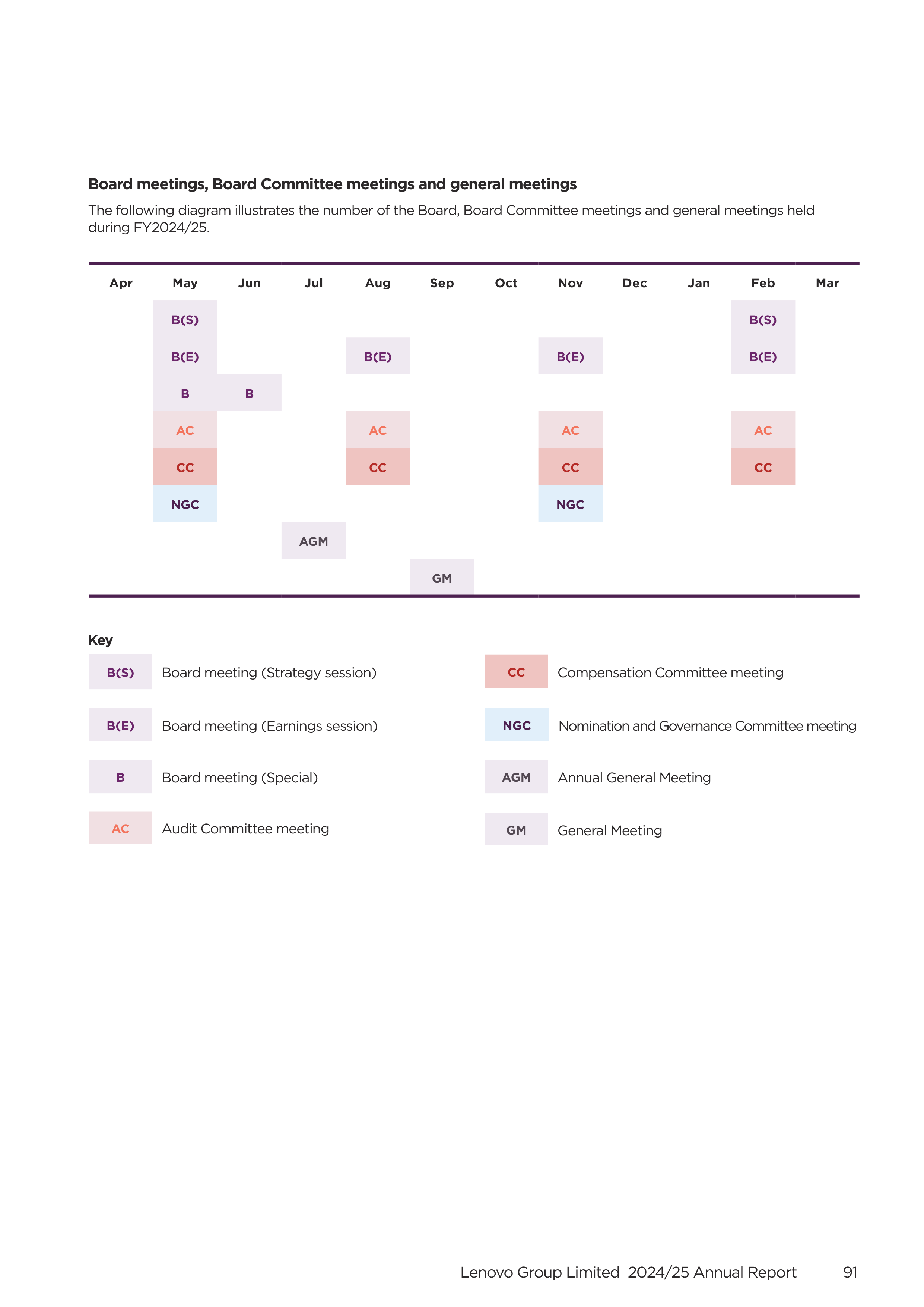
Lenovo Group Limited 2024/25 Annual Report
91
Board meetings, Board Committee meetings and general meetings
The following diagram illustrates the number of the Board, Board Committee meetings and general meetings held
during FY2024/25.
Apr
May
Jun
Jul
Aug
Sep
Oct
Nov
Dec
Jan
Feb
Mar
B(S)
B
B(S)
B(E)
B(E)
B(E)
B(E)
B
B
AC
AC
AC
AC
CC
CC
CC
CC
NGC
NGC
AGM
GM
B(S)
Board meeting (Strategy session)
CC
Compensation Committee meeting
B(E)
Board meeting (Earnings session)
NGC
Nomination and Governance Committee meeting
B
Board meeting (Special)
AGM
Annual General Meeting
GM
General Meeting
AC
Audit Committee meeting
Key
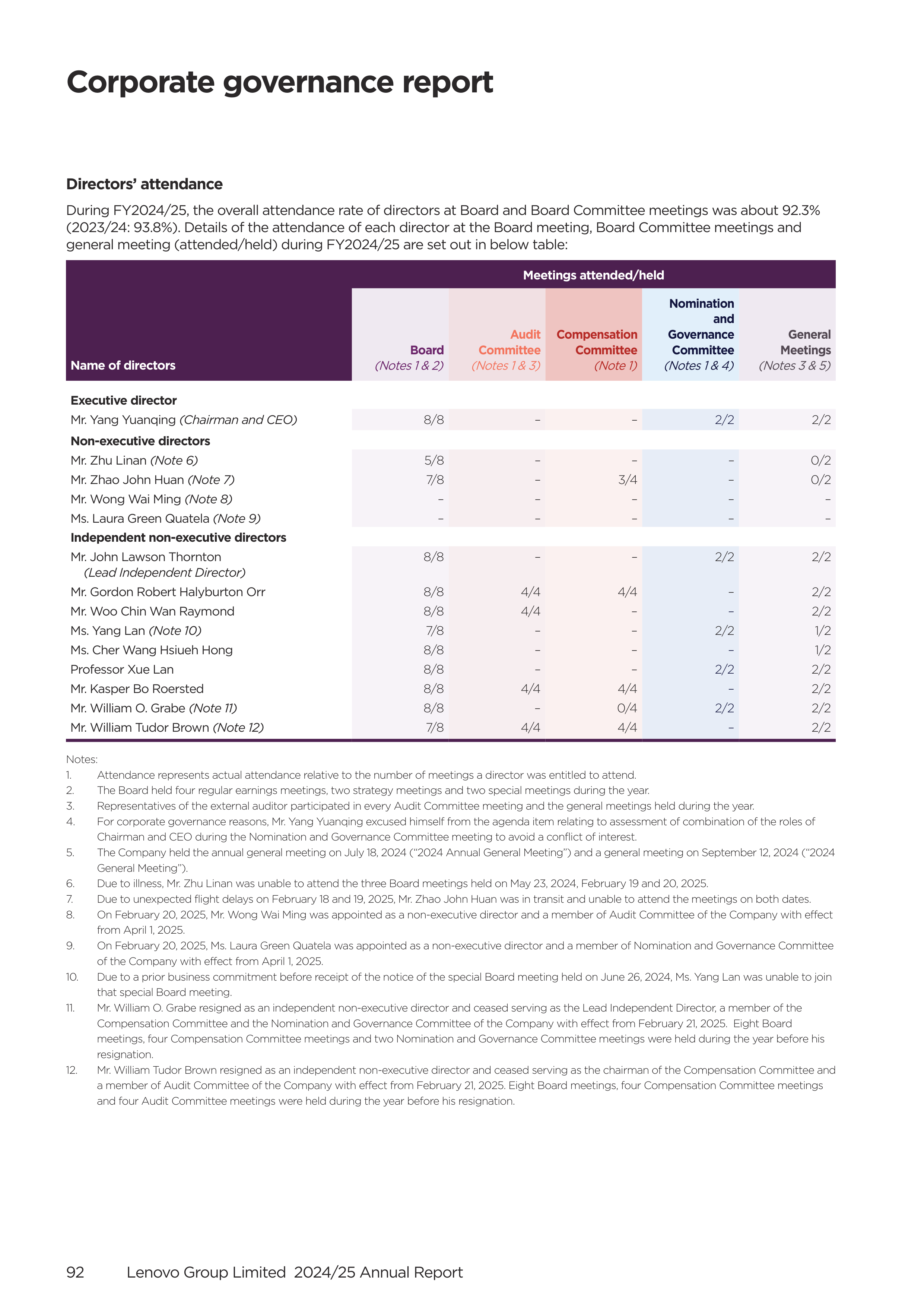
Lenovo Group Limited 2024/25 Annual Report
92
Corporate governance report
Directors’ attendance
During FY2024/25, the overall attendance rate of directors at Board and Board Committee meetings was about 92.3%
(2023/24: 93.8%). Details of the attendance of each director at the Board meeting, Board Committee meetings and
general meeting (attended/held) during FY2024/25 are set out in below table:
Meetings attended/held
Name of directors
Board
(Notes 1 & 2)
Audit
Committee
(Notes 1 & 3)
Compensation
Committee
(Note 1)
Nomination
and
Governance
Committee
(Notes 1 & 4)
General
Meetings
(Notes 3 & 5)
Executive director
Mr. Yang Yuanqing
(Chairman and CEO)
8/8
–
–
2/2
2/2
Non-executive directors
Mr. Zhu Linan
(Note 6)
5/8
–
–
–
0/2
Mr. Zhao John Huan
(Note 7)
7/8
–
3/4
–
0/2
Mr. Wong Wai Ming
(Note 8)
–
–
–
–
–
Ms. Laura Green Quatela
(Note 9)
–
–
–
–
–
Independent non-executive directors
Mr. John Lawson Thornton
(Lead Independent Director)
8/8
–
–
2/2
2/2
Mr. Gordon Robert Halyburton Orr
8/8
4/4
4/4
–
2/2
Mr. Woo Chin Wan Raymond
8/8
4/4
–
–
2/2
Ms. Yang Lan
(Note 10)
7/8
–
–
2/2
1/2
Ms. Cher Wang Hsiueh Hong
8/8
–
–
–
1/2
Professor Xue Lan
8/8
–
–
2/2
2/2
Mr. Kasper Bo Roersted
8/8
4/4
4/4
–
2/2
Mr. William O. Grabe
(Note 11)
8/8
–
0/4
2/2
2/2
Mr. William Tudor Brown
(Note 12)
7/8
4/4
4/4
–
2/2
Notes:
1.
Attendance represents actual attendance relative to the number of meetings a director was entitled to attend.
2.
The Board held four regular earnings meetings, two strategy meetings and two special meetings during the year.
3.
Representatives of the external auditor participated in every Audit Committee meeting and the general meetings held during the year.
4.
For corporate governance reasons, Mr. Yang Yuanqing excused himself from the agenda item relating to assessment of combination of the roles of
Chairman and CEO during the Nomination and Governance Committee meeting to avoid a conflict of interest.
5.
The Company held the annual general meeting on July 18, 2024 (“2024 Annual General Meeting”) and a general meeting on September 12, 2024 (“2024
General Meeting”).
6.
Due to illness, Mr. Zhu Linan was unable to attend the three Board meetings held on May 23, 2024, February 19 and 20, 2025.
7.
Due to unexpected flight delays on February 18 and 19, 2025, Mr. Zhao John Huan was in transit and unable to attend the meetings on both dates.
8.
On February 20, 2025, Mr. Wong Wai Ming was appointed as a non-executive director and a member of Audit Committee of the Company with effect
from April 1, 2025.
9.
On February 20, 2025, Ms. Laura Green Quatela was appointed as a non-executive director and a member of Nomination and Governance Committee
of the Company with effect from April 1, 2025.
10.
Due to a prior business commitment before receipt of the notice of the special Board meeting held on June 26, 2024, Ms. Yang Lan was unable to join
that special Board meeting.
11.
Mr. William O. Grabe resigned as an independent non-executive director and ceased serving as the Lead Independent Director, a member of the
Compensation Committee and the Nomination and Governance Committee of the Company with effect from February 21, 2025. Eight Board
meetings, four Compensation Committee meetings and two Nomination and Governance Committee meetings were held during the year before his
resignation.
12.
Mr. William Tudor Brown resigned as an independent non-executive director and ceased serving as the chairman of the Compensation Committee and
a member of Audit Committee of the Company with effect from February 21, 2025. Eight Board meetings, four Compensation Committee meetings
and four Audit Committee meetings were held during the year before his resignation.
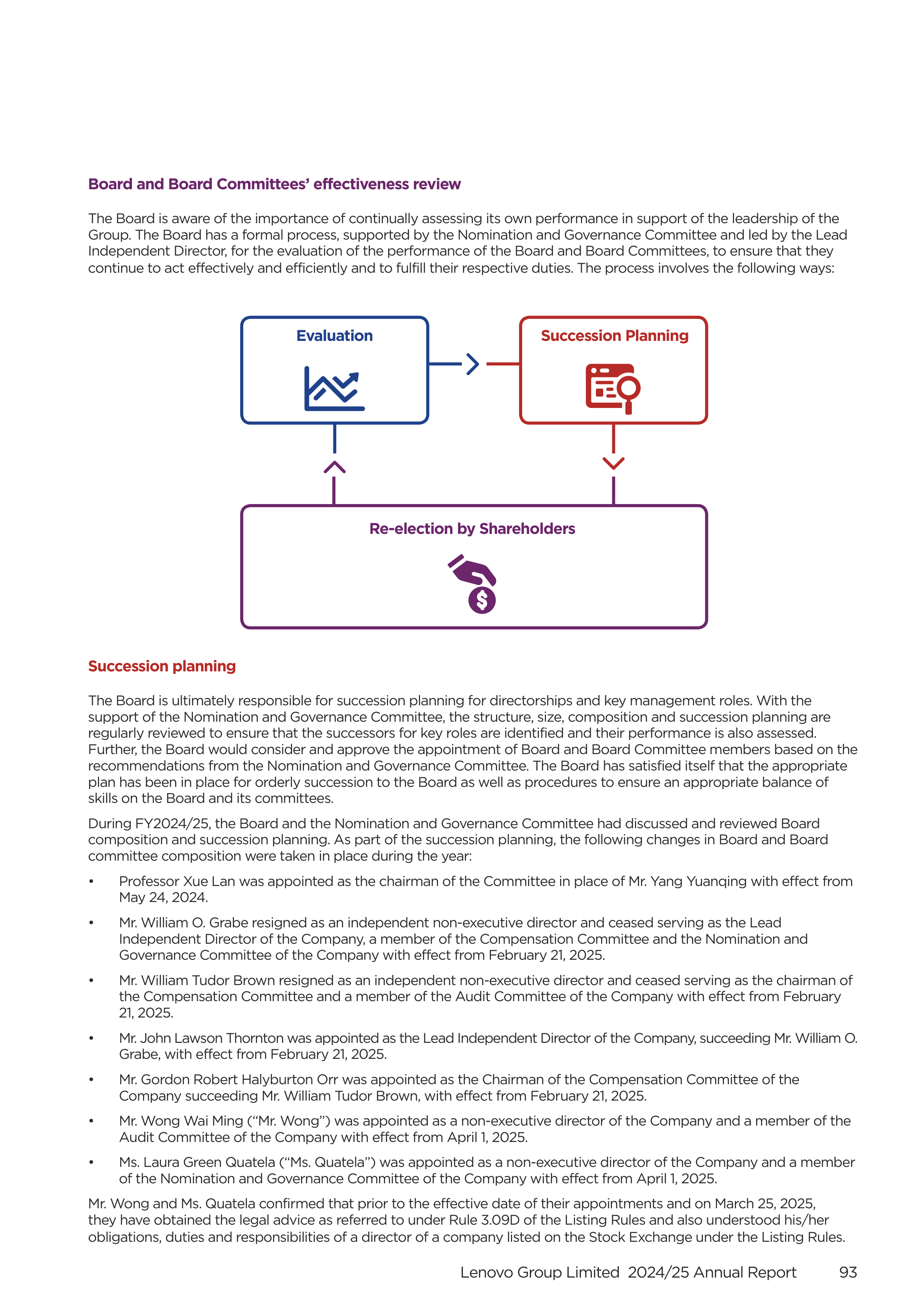
Lenovo Group Limited 2024/25 Annual Report
93
Board and Board Committees’ effectiveness review
The Board is aware of the importance of continually assessing its own performance in support of the leadership of the
Group. The Board has a formal process, supported by the Nomination and Governance Committee and led by the Lead
Independent Director, for the evaluation of the performance of the Board and Board Committees, to ensure that they
continue to act effectively and efficiently and to fulfill their respective duties. The process involves the following ways:
Succession planning
The Board is ultimately responsible for succession planning for directorships and key management roles. With the
support of the Nomination and Governance Committee, the structure, size, composition and succession planning are
regularly reviewed to ensure that the successors for key roles are identified and their performance is also assessed.
Further, the Board would consider and approve the appointment of Board and Board Committee members based on the
recommendations from the Nomination and Governance Committee. The Board has satisfied itself that the appropriate
plan has been in place for orderly succession to the Board as well as procedures to ensure an appropriate balance of
skills on the Board and its committees.
During FY2024/25, the Board and the Nomination and Governance Committee had discussed and reviewed Board
composition and succession planning. As part of the succession planning, the following changes in Board and Board
committee composition were taken in place during the year:
•
Professor Xue Lan was appointed as the chairman of the Committee in place of Mr. Yang Yuanqing with effect from
May 24, 2024.
•
Mr. William O. Grabe resigned as an independent non-executive director and ceased serving as the Lead
Independent Director of the Company, a member of the Compensation Committee and the Nomination and
Governance Committee of the Company with effect from February 21, 2025.
•
Mr. William Tudor Brown resigned as an independent non-executive director and ceased serving as the chairman of
the Compensation Committee and a member of the Audit Committee of the Company with effect from February
21, 2025.
•
Mr. John Lawson Thornton was appointed as the Lead Independent Director of the Company, succeeding Mr. William O.
Grabe, with effect from February 21, 2025.
•
Mr. Gordon Robert Halyburton Orr was appointed as the Chairman of the Compensation Committee of the
Company succeeding Mr. William Tudor Brown, with effect from February 21, 2025.
•
Mr. Wong Wai Ming (“Mr. Wong”) was appointed as a non-executive director of the Company and a member of the
Audit Committee of the Company with effect from April 1, 2025.
•
Ms. Laura Green Quatela (“Ms. Quatela”) was appointed as a non-executive director of the Company and a member
of the Nomination and Governance Committee of the Company with effect from April 1, 2025.
Mr. Wong and Ms. Quatela confirmed that prior to the effective date of their appointments and on March 25, 2025,
they have obtained the legal advice as referred to under Rule 3.09D of the Listing Rules and also understood his/her
obligations, duties and responsibilities of a director of a company listed on the Stock Exchange under the Listing Rules.
Evaluation
Re-election by Shareholders
Succession Planning
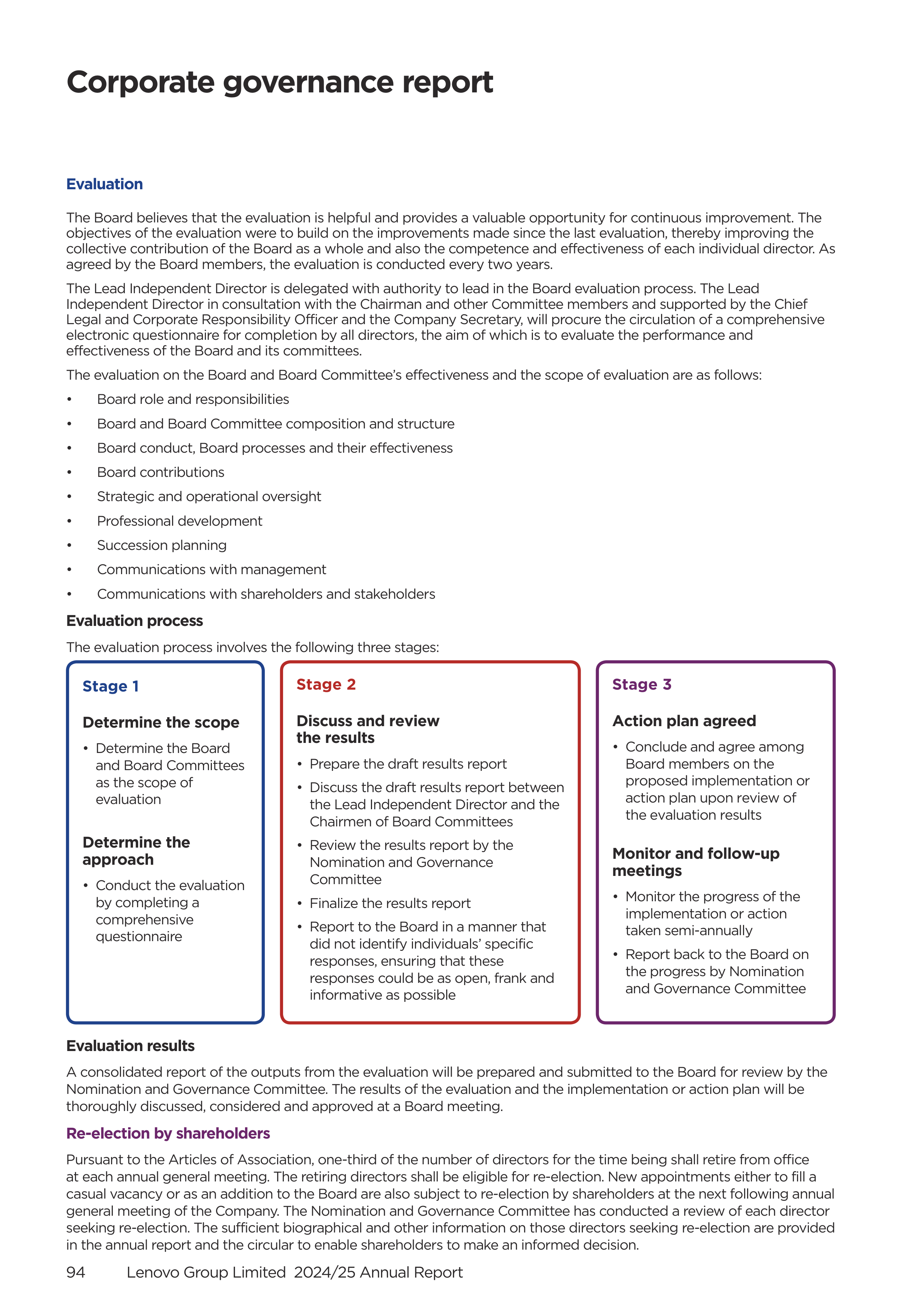
Lenovo Group Limited 2024/25 Annual Report
94
Corporate governance report
Evaluation
The Board believes that the evaluation is helpful and provides a valuable opportunity for continuous improvement. The
objectives of the evaluation were to build on the improvements made since the last evaluation, thereby improving the
collective contribution of the Board as a whole and also the competence and effectiveness of each individual director. As
agreed by the Board members, the evaluation is conducted every two years.
The Lead Independent Director is delegated with authority to lead in the Board evaluation process. The Lead
Independent Director in consultation with the Chairman and other Committee members and supported by the Chief
Legal and Corporate Responsibility Officer and the Company Secretary, will procure the circulation of a comprehensive
electronic questionnaire for completion by all directors, the aim of which is to evaluate the performance and
effectiveness of the Board and its committees.
The evaluation on the Board and Board Committee’s effectiveness and the scope of evaluation are as follows:
•
Board role and responsibilities
•
Board and Board Committee composition and structure
•
Board conduct, Board processes and their effectiveness
•
Board contributions
•
Strategic and operational oversight
•
Professional development
•
Succession planning
•
Communications with management
•
Communications with shareholders and stakeholders
Evaluation process
The evaluation process involves the following three stages:
Evaluation results
A consolidated report of the outputs from the evaluation will be prepared and submitted to the Board for review by the
Nomination and Governance Committee. The results of the evaluation and the implementation or action plan will be
thoroughly discussed, considered and approved at a Board meeting.
Re-election by shareholders
Pursuant to the Articles of Association, one-third of the number of directors for the time being shall retire from office
at each annual general meeting. The retiring directors shall be eligible for re-election. New appointments either to fill a
casual vacancy or as an addition to the Board are also subject to re-election by shareholders at the next following annual
general meeting of the Company. The Nomination and Governance Committee has conducted a review of each director
seeking re-election. The sufficient biographical and other information on those directors seeking re-election are provided
in the annual report and the circular to enable shareholders to make an informed decision.
Stage 1
Determine the scope
• Determine the Board
and Board Committees
as the scope of
evaluation
Determine the
approach
• Conduct the evaluation
by completing a
comprehensive
questionnaire
Stage 2
Discuss and review
the results
• Prepare the draft results report
• Discuss the draft results report between
the Lead Independent Director and the
Chairmen of Board Committees
• Review the results report by the
Nomination and Governance
Committee
• Finalize the results report
• Report to the Board in a manner that
did not identify individuals’ specific
responses, ensuring that these
responses could be as open, frank and
informative as possible
Stage 3
Action plan agreed
• Conclude and agree among
Board members on the
proposed implementation or
action plan upon review of
the evaluation results
Monitor and follow-up
meetings
• Monitor the progress of the
implementation or action
taken semi-annually
• Report back to the Board on
the progress by Nomination
and Governance Committee
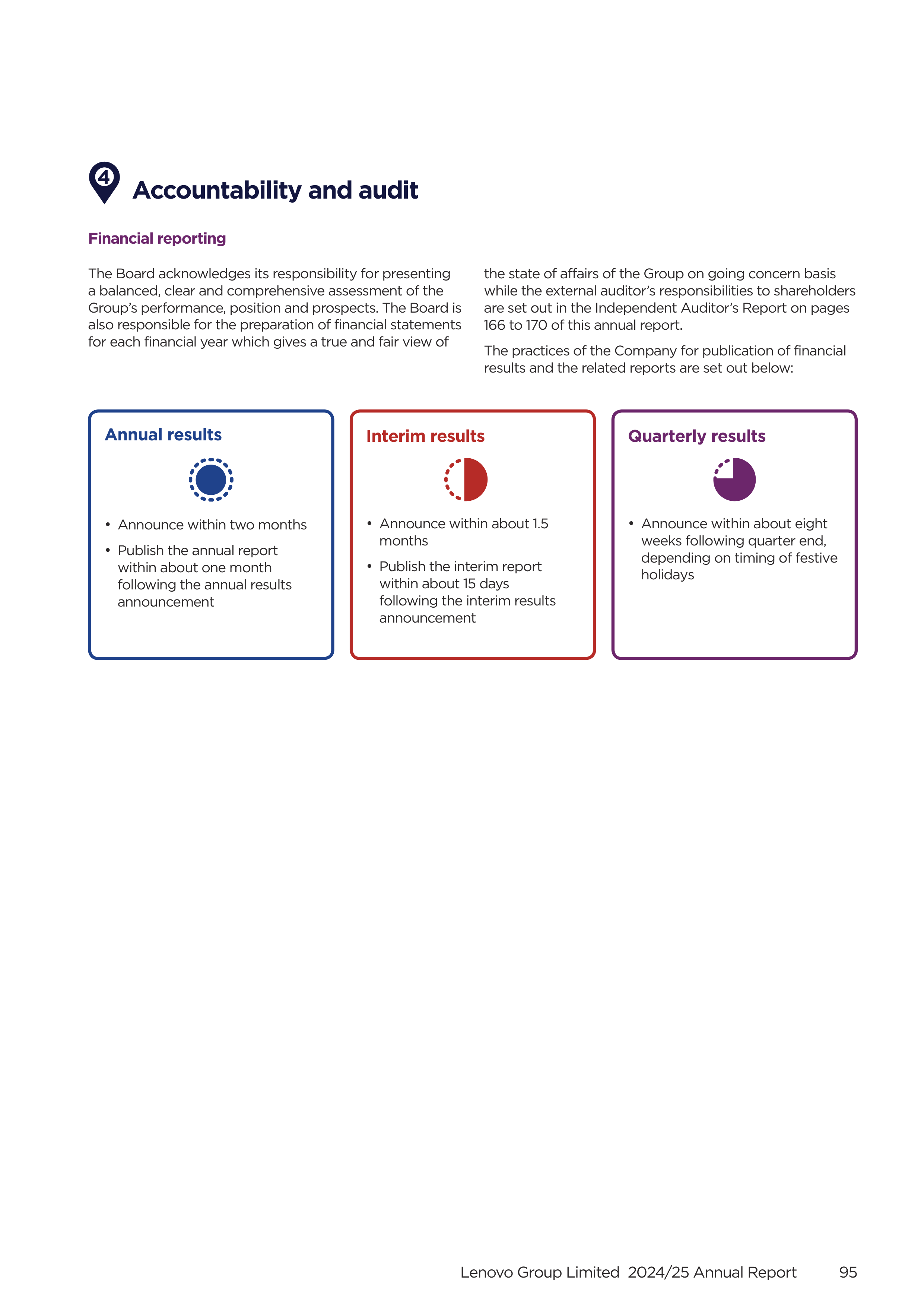
Lenovo Group Limited 2024/25 Annual Report
95
Accountability and audit
Financial reporting
The Board acknowledges its responsibility for presenting
a balanced, clear and comprehensive assessment of the
Group’s performance, position and prospects. The Board is
also responsible for the preparation of financial statements
for each financial year which gives a true and fair view of
4
the state of affairs of the Group on going concern basis
while the external auditor’s responsibilities to shareholders
are set out in the Independent Auditor’s Report on pages
166 to 170 of this annual report.
The practices of the Company for publication of financial
results and the related reports are set out below:
Annual results
•
Announce within two months
•
Publish the annual report
within about one month
following the annual results
announcement
Interim results
•
Announce within about 1.5
months
•
Publish the interim report
within about 15 days
following the interim results
announcement
Quarterly results
•
Announce within about eight
weeks following quarter end,
depending on timing of festive
holidays
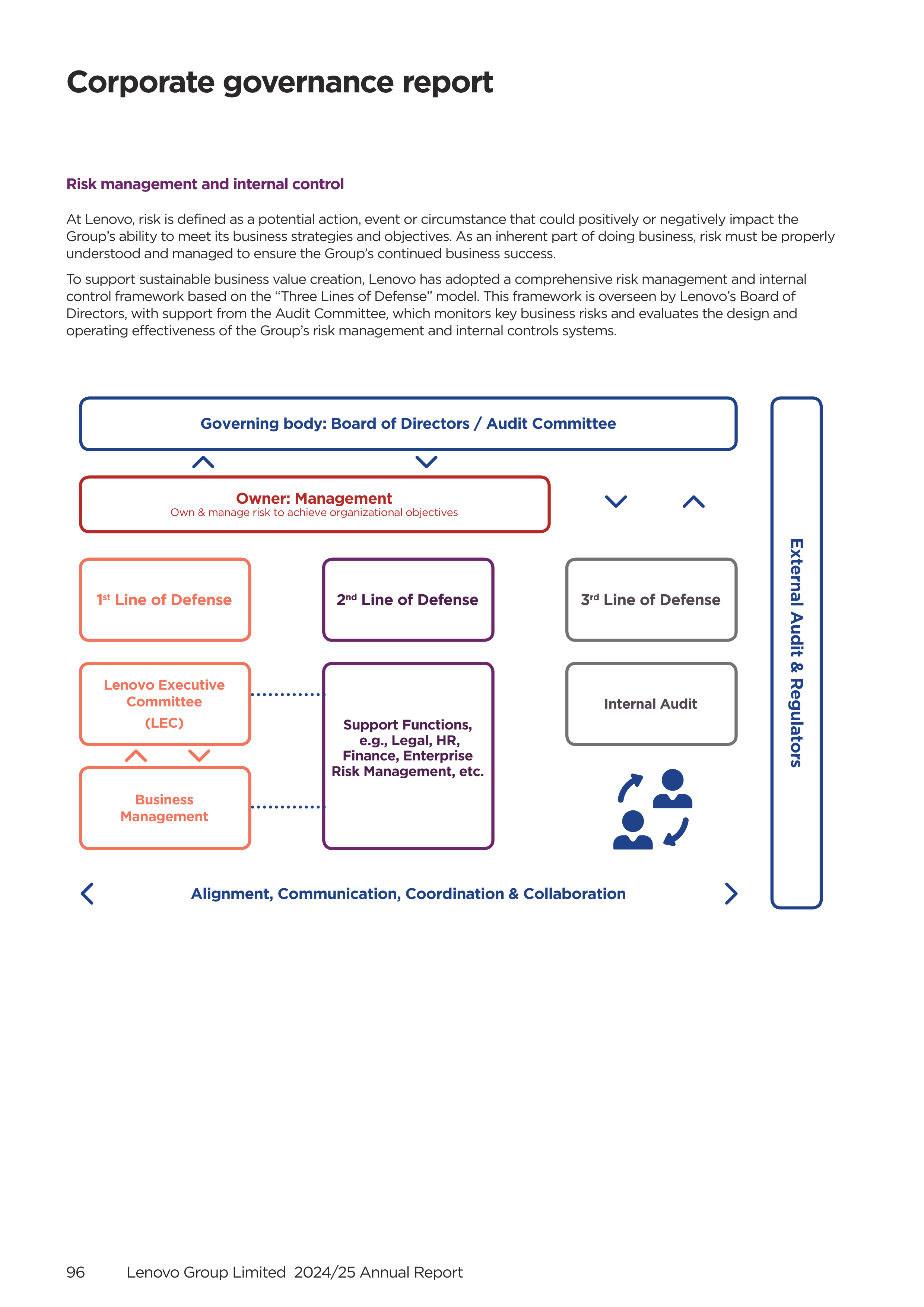
Lenovo Group Limited 2024/25 Annual Report
96
Corporate governance report
Risk management and internal control
At Lenovo, risk is defined as a potential action, event or circumstance that could positively or negatively impact the
Group’s ability to meet its business strategies and objectives. As an inherent part of doing business, risk must be properly
understood and managed to ensure the Group’s continued business success.
To support sustainable business value creation, Lenovo has adopted a comprehensive risk management and internal
control framework based on the “Three Lines of Defense” model. This framework is overseen by Lenovo’s Board of
Directors, with support from the Audit Committee, which monitors key business risks and evaluates the design and
operating effectiveness of the Group’s risk management and internal controls systems.
Lenovo Executive
Committee
(LEC)
Internal Audit
1
st
Line of Defense
2
nd
Line of Defense
3
rd
Line of Defense
Business
Management
Governing body: Board of Directors / Audit Committee
Alignment, Communication, Coordination & Collaboration
Owner: Management
Own & manage risk to achieve organizational objectives
External Audit & Regulators
Support Functions,
e.g., Legal, HR,
Finance, Enterprise
Risk Management, etc.
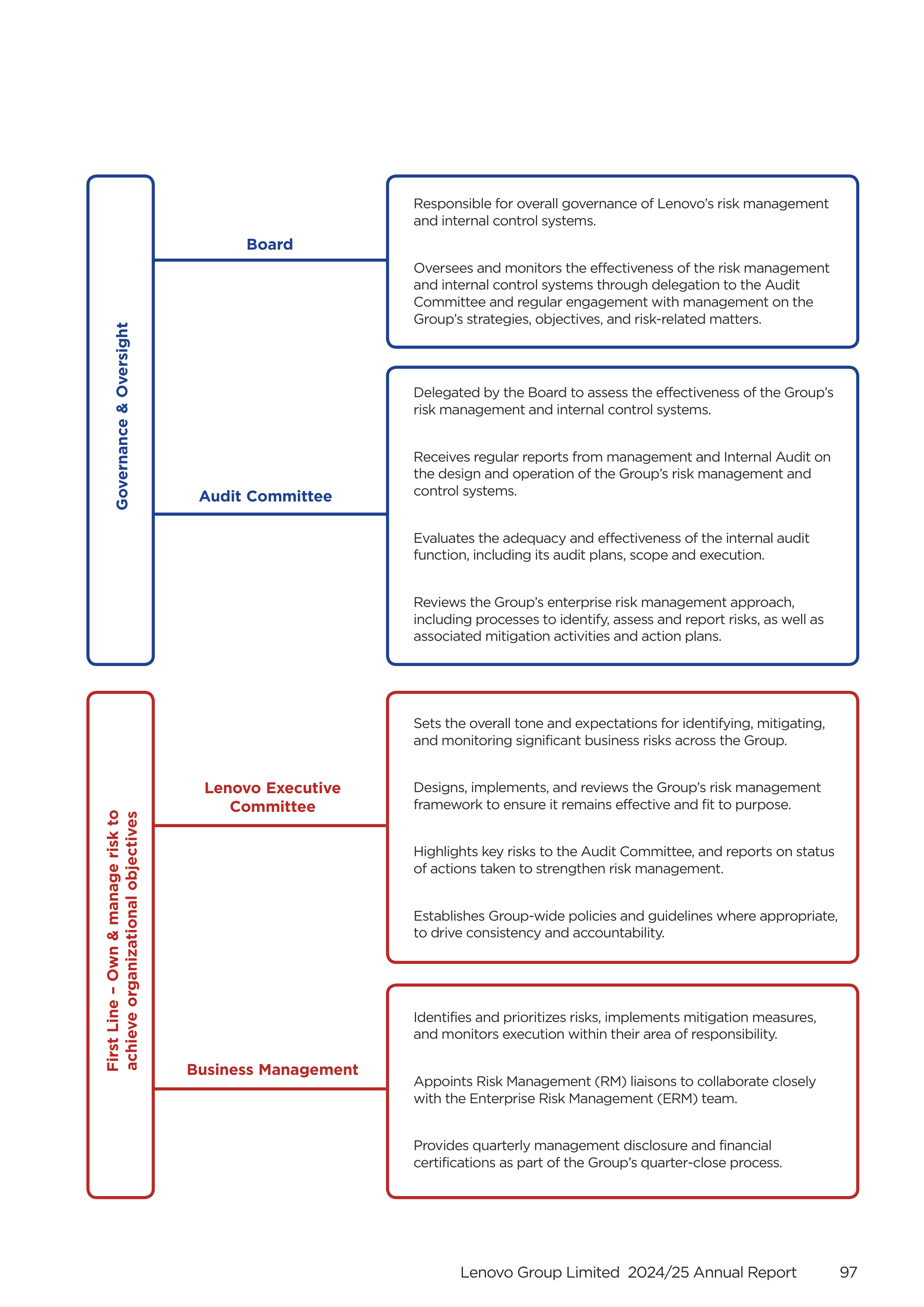
Lenovo Group Limited 2024/25 Annual Report
97
Responsible for overall governance of Lenovo’s risk management
and internal control systems.
Oversees and monitors the effectiveness of the risk management
and internal control systems through delegation to the Audit
Committee and regular engagement with management on the
Group’s strategies, objectives, and risk-related matters.
Sets the overall tone and expectations for identifying, mitigating,
and monitoring significant business risks across the Group.
Designs, implements, and reviews the Group’s risk management
framework to ensure it remains effective and fit to purpose.
Highlights key risks to the Audit Committee, and reports on status
of actions taken to strengthen risk management.
Establishes Group-wide policies and guidelines where appropriate,
to drive consistency and accountability.
Delegated by the Board to assess the effectiveness of the Group’s
risk management and internal control systems.
Receives regular reports from management and Internal Audit on
the design and operation of the Group’s risk management and
control systems.
Evaluates the adequacy and effectiveness of the internal audit
function, including its audit plans, scope and execution.
Reviews the Group’s enterprise risk management approach,
including processes to identify, assess and report risks, as well as
associated mitigation activities and action plans.
Identifies and prioritizes risks, implements mitigation measures,
and monitors execution within their area of responsibility.
Appoints Risk Management (RM) liaisons to collaborate closely
with the Enterprise Risk Management (ERM) team.
Provides quarterly management disclosure and financial
certifications as part of the Group’s quarter-close process.
Lenovo Executive
Committee
Audit Committee
Business Management
Governance & Oversight
First Line – Own & manage risk to
achieve organizational objectives
Board
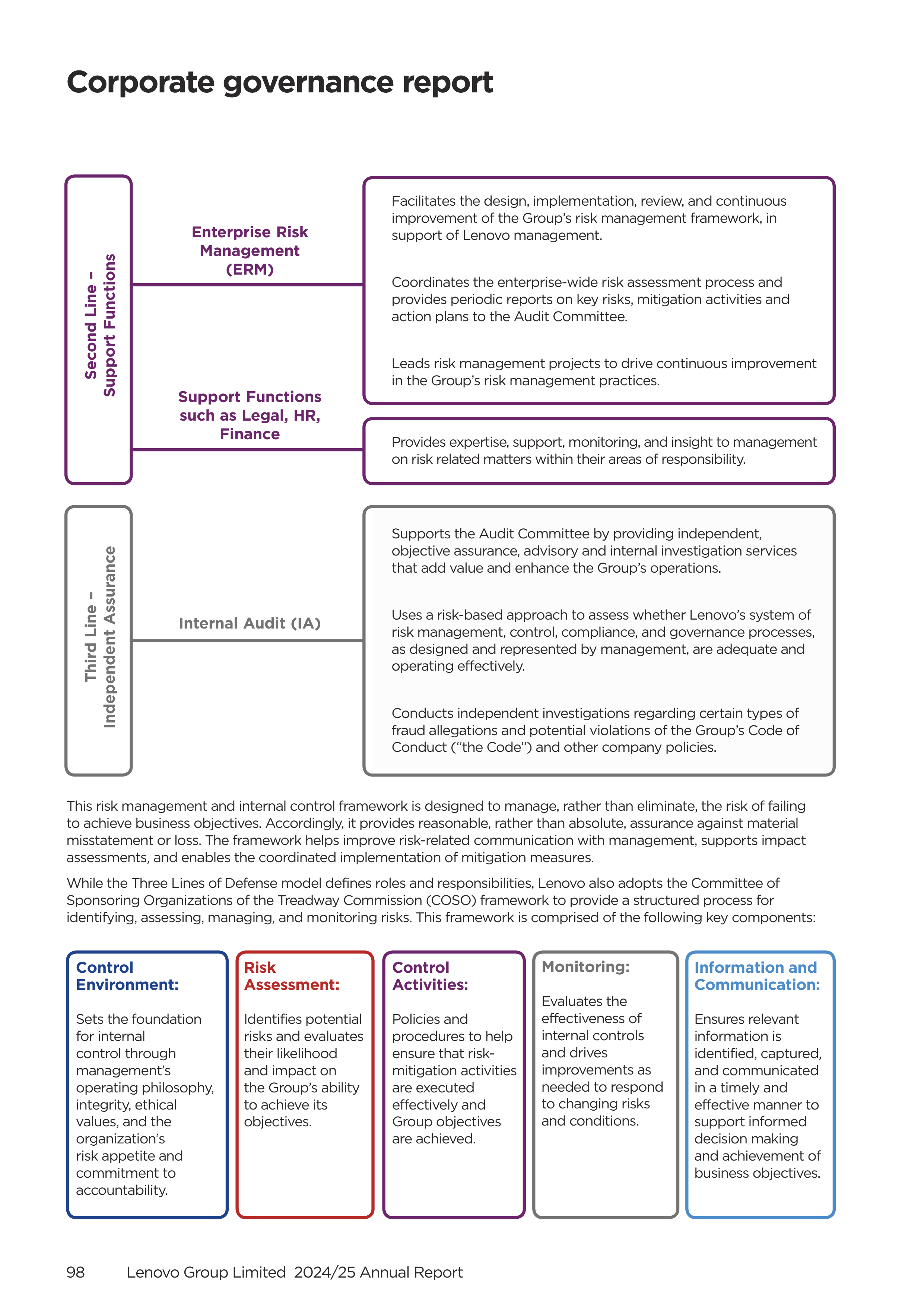
Lenovo Group Limited 2024/25 Annual Report
98
Corporate governance report
This risk management and internal control framework is designed to manage, rather than eliminate, the risk of failing
to achieve business objectives. Accordingly, it provides reasonable, rather than absolute, assurance against material
misstatement or loss. The framework helps improve risk-related communication with management, supports impact
assessments, and enables the coordinated implementation of mitigation measures.
While the Three Lines of Defense model defines roles and responsibilities, Lenovo also adopts the Committee of
Sponsoring Organizations of the Treadway Commission (COSO) framework to provide a structured process for
identifying, assessing, managing, and monitoring risks. This framework is comprised of the following key components:
Facilitates the design, implementation, review, and continuous
improvement of the Group’s risk management framework, in
support of Lenovo management.
Coordinates the enterprise-wide risk assessment process and
provides periodic reports on key risks, mitigation activities and
action plans to the Audit Committee.
Leads risk management projects to drive continuous improvement
in the Group’s risk management practices.
Supports the Audit Committee by providing independent,
objective assurance, advisory and internal investigation services
that add value and enhance the Group’s operations.
Uses a risk-based approach to assess whether Lenovo’s system of
risk management, control, compliance, and governance processes,
as designed and represented by management, are adequate and
operating effectively.
Conducts independent investigations regarding certain types of
fraud allegations and potential violations of the Group’s Code of
Conduct (“the Code”) and other company policies.
Provides expertise, support, monitoring, and insight to management
on risk related matters within their areas of responsibility.
Enterprise Risk
Management
(ERM)
Internal Audit (IA)
Support Functions
such as Legal, HR,
Finance
Second Line –
Support Functions
Third Line –
Independent Assurance
Information and
Communication:
Ensures relevant
information is
identified, captured,
and communicated
in a timely and
effective manner to
support informed
decision making
and achievement of
business objectives.
Control
Environment:
Sets the foundation
for internal
control through
management’s
operating philosophy,
integrity, ethical
values, and the
organization’s
risk appetite and
commitment to
accountability.
Risk
Assessment:
Identifies potential
risks and evaluates
their likelihood
and impact on
the Group’s ability
to achieve its
objectives.
Monitoring:
Evaluates the
effectiveness of
internal controls
and drives
improvements as
needed to respond
to changing risks
and conditions.
Control
Activities:
Policies and
procedures to help
ensure that risk-
mitigation activities
are executed
effectively and
Group objectives
are achieved.
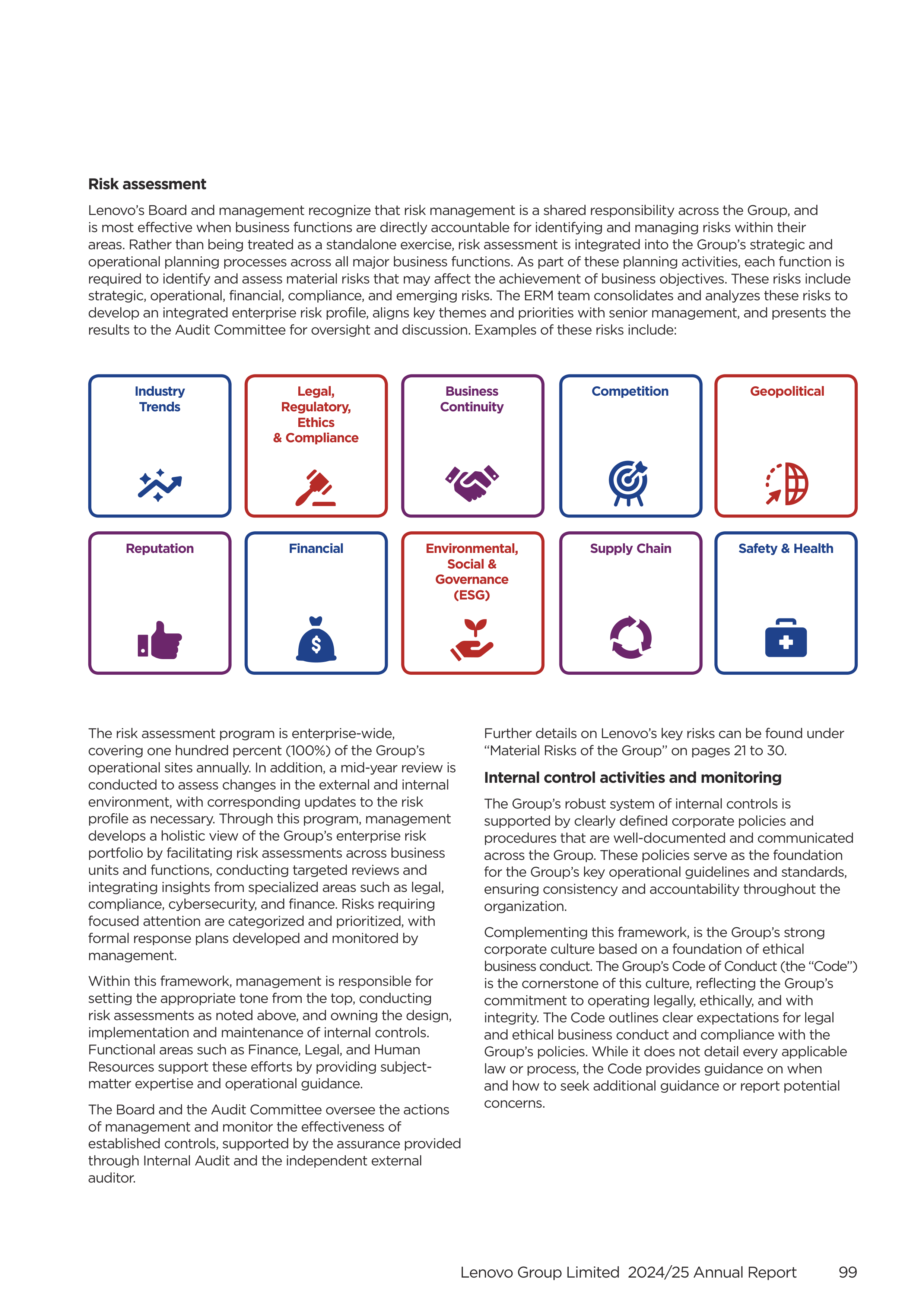
Lenovo Group Limited 2024/25 Annual Report
99
Risk assessment
Lenovo’s Board and management recognize that risk management is a shared responsibility across the Group, and
is most effective when business functions are directly accountable for identifying and managing risks within their
areas. Rather than being treated as a standalone exercise, risk assessment is integrated into the Group’s strategic and
operational planning processes across all major business functions. As part of these planning activities, each function is
required to identify and assess material risks that may affect the achievement of business objectives. These risks include
strategic, operational, financial, compliance, and emerging risks. The ERM team consolidates and analyzes these risks to
develop an integrated enterprise risk profile, aligns key themes and priorities with senior management, and presents the
results to the Audit Committee for oversight and discussion. Examples of these risks include:
The risk assessment program is enterprise-wide,
covering one hundred percent (100%) of the Group’s
operational sites annually. In addition, a mid-year review is
conducted to assess changes in the external and internal
environment, with corresponding updates to the risk
profile as necessary. Through this program, management
develops a holistic view of the Group’s enterprise risk
portfolio by facilitating risk assessments across business
units and functions, conducting targeted reviews and
integrating insights from specialized areas such as legal,
compliance, cybersecurity, and finance. Risks requiring
focused attention are categorized and prioritized, with
formal response plans developed and monitored by
management.
Within this framework, management is responsible for
setting the appropriate tone from the top, conducting
risk assessments as noted above, and owning the design,
implementation and maintenance of internal controls.
Functional areas such as Finance, Legal, and Human
Resources support these efforts by providing subject-
matter expertise and operational guidance.
The Board and the Audit Committee oversee the actions
of management and monitor the effectiveness of
established controls, supported by the assurance provided
through Internal Audit and the independent external
auditor.
Further details on Lenovo’s key risks can be found under
“Material Risks of the Group” on pages 21 to 30.
Internal control activities and monitoring
The Group’s robust system of internal controls is
supported by clearly defined corporate policies and
procedures that are well-documented and communicated
across the Group. These policies serve as the foundation
for the Group’s key operational guidelines and standards,
ensuring consistency and accountability throughout the
organization.
Complementing this framework, is the Group’s strong
corporate culture based on a foundation of ethical
business conduct. The Group’s Code of Conduct (the “Code”)
is the cornerstone of this culture, reflecting the Group’s
commitment to operating legally, ethically, and with
integrity. The Code outlines clear expectations for legal
and ethical business conduct and compliance with the
Group’s policies. While it does not detail every applicable
law or process, the Code provides guidance on when
and how to seek additional guidance or report potential
concerns.
Legal,
Regulatory,
Ethics
& Compliance
Financial
Geopolitical
Safety & Health
Business
Continuity
Environmental,
Social &
Governance
(ESG)
Industry
Trends
Reputation
Competition
Supply Chain
Lenovo Group Limited 2024/25 Annual Report
100
Corporate governance report
Reporting Ethical Concerns
The Group recognizes that a culture of compliance, where
employees feel empowered to raise concerns, is essential
to the success of its internal control system. To support
this, the Group provides a confidential and anonymous
reporting mechanism (known as the LenovoLine) for
raising concerns or reporting suspected misconduct.
These reporting procedures are governed by the Lenovo
Whistleblowing and Investigations Policy which outlines
how concerns can be raised, reviewed, and investigated.
The Group is committed to maintaining the confidentiality
of reports and thoroughly investigating all alleged
misconduct. The Group does not tolerate retaliation
against individuals who report potential issues or raise
concern in good faith, cooperate with an investigation
or audit, or refuse to participate in activities that violate
the Code, laws or company policies. To ensure effective
oversight, the Group has established the Investigation
Oversight Committee (IOC) to review the handling and
resolution of all reported concerns and potential violations
of the Code.
To further strengthen reporting accessibility, the Group’s
third-party whistleblowing and hotline provider, Whispli,
offers an enhanced reporting platform that allows web-
based and telephonic submissions in multiple languages.
Key features include mobile reporting (iOS and Android),
real-time translation, and a secure chat feature that allows
for anonymous, ongoing dialog between reporters and
investigators.
To promote awareness, the Group provides regular
training and communication on the internal investigation
process and to encourage employees to speak up
without fear of retaliation. In FY 2024/25, training on
Whistleblowing and Investigations was integrated into
Lenovo’s mandatory e-Learning Code training described
earlier. Additional awareness efforts include detailed
LenovoLine instructions, quarterly IOC communications
summarizing investigation insights (with no identifying
information), computer lock screen messages, posters,
and other internal communications.
Another key feature of the Group’s internal control system
is the execution of key control self-assessments performed
by management. These assessments help provide
reasonable assurance that internal controls are operating
effectively and that any identified weaknesses are
addressed promptly. Specific control owners with subject
matter expertise are designated within the business to
support the design, execution, and monitoring of these
controls.
Finally, in alignment with the Group’s commitment to
financial integrity, relevant senior executives certify
quarterly the accuracy and completeness of the quarterly
financial statements and confirm that key internal controls
are operating effectively.
The Code is available in multiple languages on the Group’s
website. To reinforce its principles, the Group requires
mandatory training on the Code and related policies,
and any violation of the Code is treated as a serious
matter. Failure to follow the Code, or violation of the
policies described in the Code, can result in disciplinary
action, including termination of employment or business
relationships.
The Group has also developed and implemented
numerous policies to provide more detailed guidance to
employees on compliance with rules and laws, including
those related to the prevention and detection of bribery
and corruption. These include the Global Anti-Bribery
and Corruption Policy, a Conflicts of Interest Policy, and
a Global Gift, Entertainment, Corporate Hospitality and
Travel Policy.
The Group has a zero-tolerance stance on bribery and
corruption, and complies fully with anti-bribery and
corruption laws in the jurisdictions in which it operates.
The Group’s policies reinforce provisions in the Code and
provide additional guidance regarding compliance with
global anti-bribery and corruption laws and regulations.
The policies stress that Lenovo will not directly or
indirectly solicit, offer, promise, authorize, provide,
or accept anything of value to any person, including
government officials, to influence action, inactions or to
secure an improper advantage as defined by applicable
laws.
Bribery and corruption risks are assessed annually as part
of the Group’s Enterprise Risk Management Program to
ensure the Group’s internal controls are adequate and
effective.
To ensure a broad understanding of these requirements,
the Group provides comprehensive training on anti-
bribery and corruption. In FY 2024/25, this training was
integrated into the mandatory Code training delivered
through eLearning, resulting in a 99% completion rate
among employees with access to the eLearning platform.
New employees also receive Code training that includes
anti-bribery and corruption topics. Finally, the Board and
Senior Leadership Team are provided a facilitator-led
training session on anti-bribery and corruption.
The Group also expects its business partners to uphold
the same ethical standards and comply with applicable
anti-bribery and corruption laws and regulations. All
business partners are subject to the Group’s Partner
Code of Conduct and Global Anti-Bribery and Corruption
Policy, which includes requirements for anti-bribery
and corruption due diligence on any business partner
identified as presenting elevated bribery and corruption
risks to the organization. The Group actively monitors its
business partners to identify and address potential areas
of concern or inquiries regarding bribery and corruption.
Lenovo Group Limited 2024/25 Annual Report
101
the Audit Committee and administratively to the Chief
Financial Officer. The Chief Auditor is also authorized
to communicate directly with the Chairman of the
Board, the Chairman of the Audit Committee and other
Board members as necessary. Internal Audit maintains
a comprehensive quality assurance and improvement
program, aligned with the International Standards for
the Professional Practice of Internal Auditing issued by
the Institute of Internal Auditors. In addition, the Audit
Committee periodically commissions an independent,
external quality review of the Internal Audit function.
Internal Audit operates on a rolling six-month audit
planning cycle, allowing the function to remain agile
and responsive to emerging risks and changes in the
business environment. Each cycle begins with a risk
assessment informed by input from process owners,
the ERM team, senior executives, the external auditor,
Ethics & Compliance, and the Board. The resulting audit
plan prioritizes areas of significant risk and is approved
by the Audit Committee. The Committee receives
quarterly updates on plan execution, key findings, and
any necessary adjustments to reflect evolving priorities.
Internal Audit also conducts ad hoc reviews at the request
of management or the Audit Committee, as needed.
In FY2024/25, Internal Audit issued multiple reports
covering key operational and financial areas across
the Group. It tracks management’s implementation of
corrective actions and reports progress quarterly to the
Audit Committee. Reporting also includes significant
control issues identified by Internal Audit to ensure full
visibility into the status of the Group’s control environment.
As noted previously, Internal Audit is responsible for
investigating certain types of misconduct allegations
or potential violations of policies. These investigations
are conducted in coordination with Legal, Ethics &
Compliance, Human Resources, Security, and other
relevant experts. Results, required actions, and progress
updates are reported to management and the Audit
Committee.
Board Review and Confirmation of Effectiveness
The Board, supported by the Audit Committee, regularly
reviews the effectiveness of the Group’s risk management
and internal control system. This review encompasses
all material risks, including ESG risks, and relevant
key controls across financial, operational, information
technology, and compliance areas. The Board is not aware
of any significant areas of concern which may affect the
shareholders. The Board confirms that the Group has fully
complied with the Corporate Governance Code provisions
relating to internal control and is not aware of any
significant areas of concern that may affect shareholders.
Inside information
Regarding procedures and internal controls for the
handling and dissemination of inside information, the
Group:
(i)
is aware of the Company’s disclosure obligations
under the SFO and the Listing Rules and the
overriding principle under the SFO that inside
information must be announced immediately unless
exemption avails under the safe harbour rule provided
therein;
(ii)
conducts its affairs with close regard to the applicable
laws and regulations prevailing in Hong Kong S.A.R.
of China and all other applicable laws, rules and
regulations;
(iii)
has included in the Code a strict prohibition on the
unauthorized use of non-public or inside information;
(iv)
has established a Continuous Disclosure Policy along
with its guidance notes for monitoring, reporting and
disseminating inside information to our shareholders,
investors, analysts and media. These policy and
guidance notes also identify who are the Group’s
authorized spokespersons and their responsibilities
for communications with stakeholders; and
(v)
has communicated to all relevant staff regarding the
implementation of the Continuous Disclosure Policy
and the relevant trainings are also provided.
Risk management oversight
To support the Audit Committee in its oversight
responsibilities, the Group maintains an independent,
global Internal Audit function. Internal Audit provides
objective assurance that the system of internal controls is
effective and operating as intended.
The mission of Internal Audit is to provide the Board and
management with:
•
Independent and objective assessment of the Group’s
internal control system;
•
Guidance to stakeholders on improving risk
management;
•
Proactive support to improve the Group’s control
posture; and
•
Independent investigations into certain allegations
of fraud and violations of the Code and other Group
policies.
To fulfill this mission, Internal Audit has unrestricted
access to all operations, records, data, systems,
property, and personnel across the Group. To preserve
independence, the Chief Auditor reports functionally to
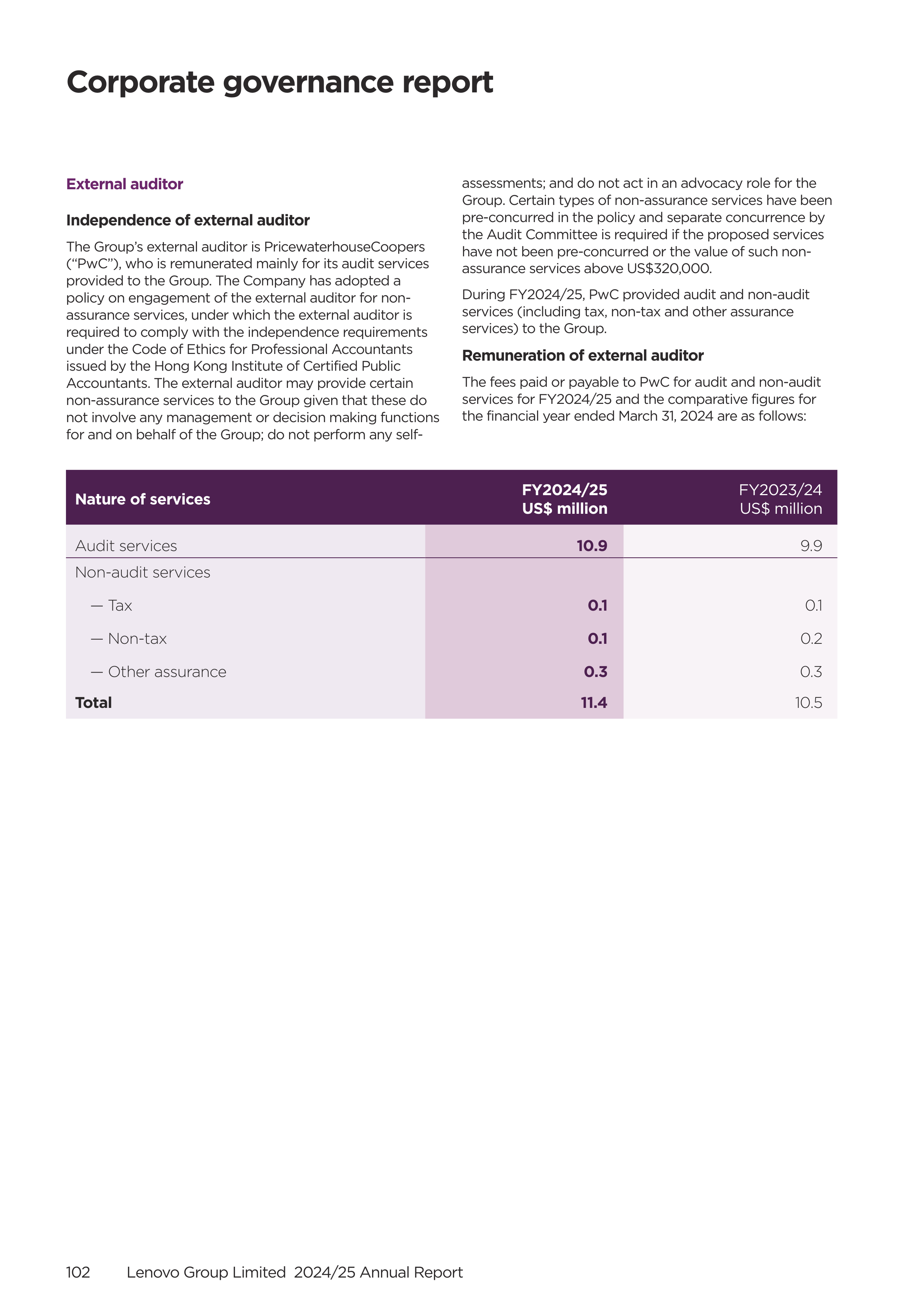
Lenovo Group Limited 2024/25 Annual Report
102
Corporate governance report
External auditor
Independence of external auditor
The Group’s external auditor is PricewaterhouseCoopers
(“PwC”), who is remunerated mainly for its audit services
provided to the Group. The Company has adopted a
policy on engagement of the external auditor for non-
assurance services, under which the external auditor is
required to comply with the independence requirements
under the Code of Ethics for Professional Accountants
issued by the Hong Kong Institute of Certified Public
Accountants. The external auditor may provide certain
non-assurance services to the Group given that these do
not involve any management or decision making functions
for and on behalf of the Group; do not perform any self-
assessments; and do not act in an advocacy role for the
Group. Certain types of non-assurance services have been
pre-concurred in the policy and separate concurrence by
the Audit Committee is required if the proposed services
have not been pre-concurred or the value of such non-
assurance services above US$320,000.
During FY2024/25, PwC provided audit and non-audit
services (including tax, non-tax and other assurance
services) to the Group.
Remuneration of external auditor
The fees paid or payable to PwC for audit and non-audit
services for FY2024/25 and the comparative figures for
the financial year ended March 31, 2024 are as follows:
Nature of services
FY2024/25
US$ million
FY2023/24
US$ million
Audit services
10.9
9.9
Non-audit services
— Tax
0.1
0.1
— Non-tax
0.1
0.2
— Other assurance
0.3
0.3
Total
11.4
10.5
Lenovo Group Limited 2024/25 Annual Report
103
Quarterly IR Communications
Results Announcements
The senior management presented the annual and
quarterly earnings results through webcasts, conference
calls, social media, and face-to-face meetings with
international and domestic shareholders, investors, and
analysts. The various communication channels enhanced
the capital market’s understanding with regard to the
Group’s business strategy, development tactics, and
competitive edge.
Post-Results Non-Deal Roadshows and Key Investor
Meetings
The IR and senior management attend a Non-Deal
Roadshows (“NDR”) to meet with current and potential
investors in each quarter. In FY2024/25, Lenovo arranged
physical NDRs in the US, UK, Continental Europe, Hong
Kong S.A.R. of China and Taipei to meet with investors and
analysts from those regions. Other virtual NDRs were also
arranged with investors from other parts of Asia and etc.
The IR team also conducted one-on-one meetings with
key investors and continued its efforts to build effective
communication channels with the investment community.
Communications on ESG Initiatives
To foster understanding of Lenovo’s ESG initiatives by
the investment community, Lenovo conducts active
communication with ESG rating agencies and funds, with
ESG mandates regularly and upon request.
Investor Conferences
To maintain active communications with institutional
investors around the world, the senior management
participated in the following investor conferences held by
major international investment banks.
Investor relations
Communications with investors
The Company is devoted to providing transparent and
clear communications with investors and analysts to help
them form a better understanding of the Group’s business
development and future prospects.
Shareholders communication policy
The Company has adopted a Shareholders Communication
Policy to ensure that the investment community is
provided with timely and equal access to fair, balanced
and understandable information on the Group’s financial
performance, corporate strategies and ESG initiatives.
The policy also sets forth various communication
channels through which senior management and the
Investor Relations (“IR”) can conduct ongoing dialogs
with investors and analysts on business strategy and also
address market concerns about the Group. The policy can
be accessed through Lenovo’s
IR website
.
Investor Engagement and Communications
Investors and analysts can have direct communication
with the Chairman and Chief Executive Officer, the Chief
Financial Officer and other senior management on a
quarterly basis through effective communication channels
set out in the Shareholders’ Communication Policy. These
include investor conferences, non-deal roadshows, one on-
one/group meetings, and company visits. The IR is also
poised to provide relevant public information to investors
and analysts to support the appropriate valuation of the
Company’s equity.
During FY2024/25, the Company held nearly 700
meetings with institutional investors and analysts,
mainly from the Asia Pacific region, UK, Europe and
North America. Some key channels during the year are
highlighted below:
5
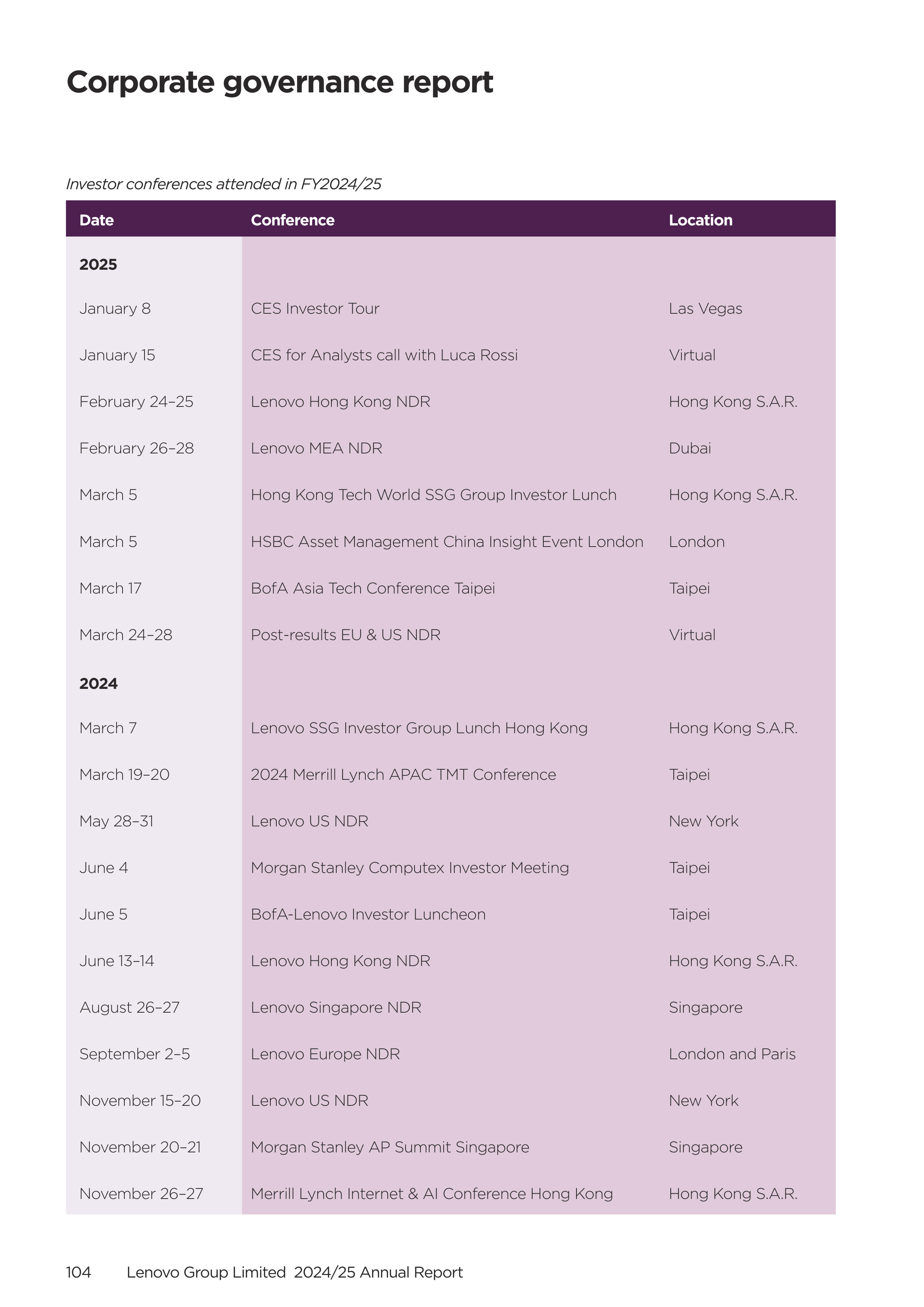
Lenovo Group Limited 2024/25 Annual Report
104
Corporate governance report
Investor conferences attended in FY2024/25
Date
Conference
Location
2025
January 8
CES Investor Tour
Las Vegas
January 15
CES for Analysts call with Luca Rossi
Virtual
February 24–25
Lenovo Hong Kong NDR
Hong Kong S.A.R.
February 26–28
Lenovo MEA NDR
Dubai
March 5
Hong Kong Tech World SSG Group Investor Lunch
Hong Kong S.A.R.
March 5
HSBC Asset Management China Insight Event London
London
March 17
BofA Asia Tech Conference Taipei
Taipei
March 24–28
Post-results EU & US NDR
Virtual
2024
March 7
Lenovo SSG Investor Group Lunch Hong Kong
Hong Kong S.A.R.
March 19–20
2024 Merrill Lynch APAC TMT Conference
Taipei
May 28–31
Lenovo US NDR
New York
June 4
Morgan Stanley Computex Investor Meeting
Taipei
June 5
BofA-Lenovo Investor Luncheon
Taipei
June 13–14
Lenovo Hong Kong NDR
Hong Kong S.A.R.
August 26–27
Lenovo Singapore NDR
Singapore
September 2–5
Lenovo Europe NDR
London and Paris
November 15–20
Lenovo US NDR
New York
November 20–21
Morgan Stanley AP Summit Singapore
Singapore
November 26–27
Merrill Lynch Internet & AI Conference Hong Kong
Hong Kong S.A.R.
Lenovo Group Limited 2024/25 Annual Report
105
Effectiveness of the Shareholders communication
policy
The Company’s Shareholders Communication Policy
has set out clear guidelines and standards in relation to
communicating with the investment community. During
FY2024/25, the Company received a variety of awards
from different organizers in recognition of its efforts
to facilitate open and effective communication. The
Company was included as a constituent stock on the Hang
Seng Index — Hong Kong’s benchmark stock gauge — in
March 2022, demonstrating the market’s confidence in
Lenovo, which is built on the Company’s continuous open
communication strategies.
Market recognition
•
Lenovo’s MSCI ESG rating was upgraded to AAA,
the highest tier, recognizing its leadership in
managing ESG risks and opportunities. This upgrade
underscores advancements in sustainable supply
chain practices, diversity initiatives, and climate
change strategies.
•
Gold Award in the Most Sustainable Companies/
Organizations category by the Hong Kong Institute
of Certified Public Accountants and received Awards
of Excellence in Corporate Governance and ESG
at the Hong Kong Corporate Governance and ESG
Excellence Awards 2024.
•
HKIRA 9th Investor Relations Awards — Certificate of
Excellence
•
MWC 2025 Awards, Accolades & Honors
Index recognition
Lenovo has always been well recognized by the capital
markets and the Company is currently a constituent stock
of many indices. Below are some of the key ones:
•
Hang Seng Index
•
Hang Seng China Enterprises Index
•
Hang Seng TECH Index
•
Bloomberg World Large & Mid Cap Price Return
Index
•
Hang Seng Composite Index
•
Bloomberg ESG Data Index
•
Bloomberg Emerging Markets Large & Mid Cap Price
Return Index
•
Bloomberg China Large & Mid Cap Price Return Index
USD
•
Mirae Asset China Tech Top 10 Index
•
Bloomberg World Large, Mid & Small Cap Price
Return Index
•
Bloomberg APAC Large & Mid Cap Price Return
Index
•
FTSE Developed ex US All Cap Net Tax (US RIC)
Index
•
Hang Seng Stock Connect Hong Kong Index
•
Hang Seng Index — Commerce & Industry
•
Bloomberg Asia Emerging Markets Large & Mid Cap
Price Return Index
•
Bloomberg APAC ex Japan Large & Mid Cap Price
Return Index
•
S&P Global BMI (US Dollar)
•
Bloomberg World ex US Large & Mid Cap Price
Return Index
•
Solactive ISS ESG Screened Paris Aligned Global
Markets Index NTR
•
Gender Equality Score Total Coverage Index
•
Solactive China AI Tech Top 10 Index PR















Lenovo Group Limited 2024/25 Annual Report
106
Corporate governance report
You can also follow other Lenovo channels at:
Lenovo values comments from shareholders and
analysts. Some renowned analysts would be invited to
the Company’s Board meeting and communicate directly
with Board members on their market views of Lenovo
and market outlook. The IR also conveys messages to
the Board on a quarterly basis on information including
sellside consensus, the target price of the Company’s
shares, report summaries and questions and feedback
collected from meetings with the investment community.
IR webpage, newsletters and social media
A regularly updated
IR website
provides easy access to
the public with information about the Company, including
the Company’s financial reports, results announcements
and other statutory publications, presentation materials,
press releases, major corporate news, financial calendars
and dividend announcements. IR’s contact details can also
be found on the page for those wish to contact the IR.
Investor relations contact details
Investor Relations Team
Lenovo Group Limited
23rd Floor, Lincoln House, Taikoo Place,
979 King’s Road, Quarry Bay,
Hong Kong SAR, China
Telephone: (852) 2590 0228
Facsimile: (852) 2516 5384
Email: ir@lenovo.com
Shareholders can also request to be added to the
Company’s investor database to receive newsletters and
news of major corporate developments sent out by the IR
team on a regular basis, or simply follow Lenovo Investor
Relations.
Please search for our WeChat ID: Lenovo_IR or use
WeChat to scan the QR codes below for our WeChat
account, WeChat Channel, and Weibo.
Follow us & stay tuned
Search
Lenovo_IR
OR
Scan the QR code below
in WeChat app
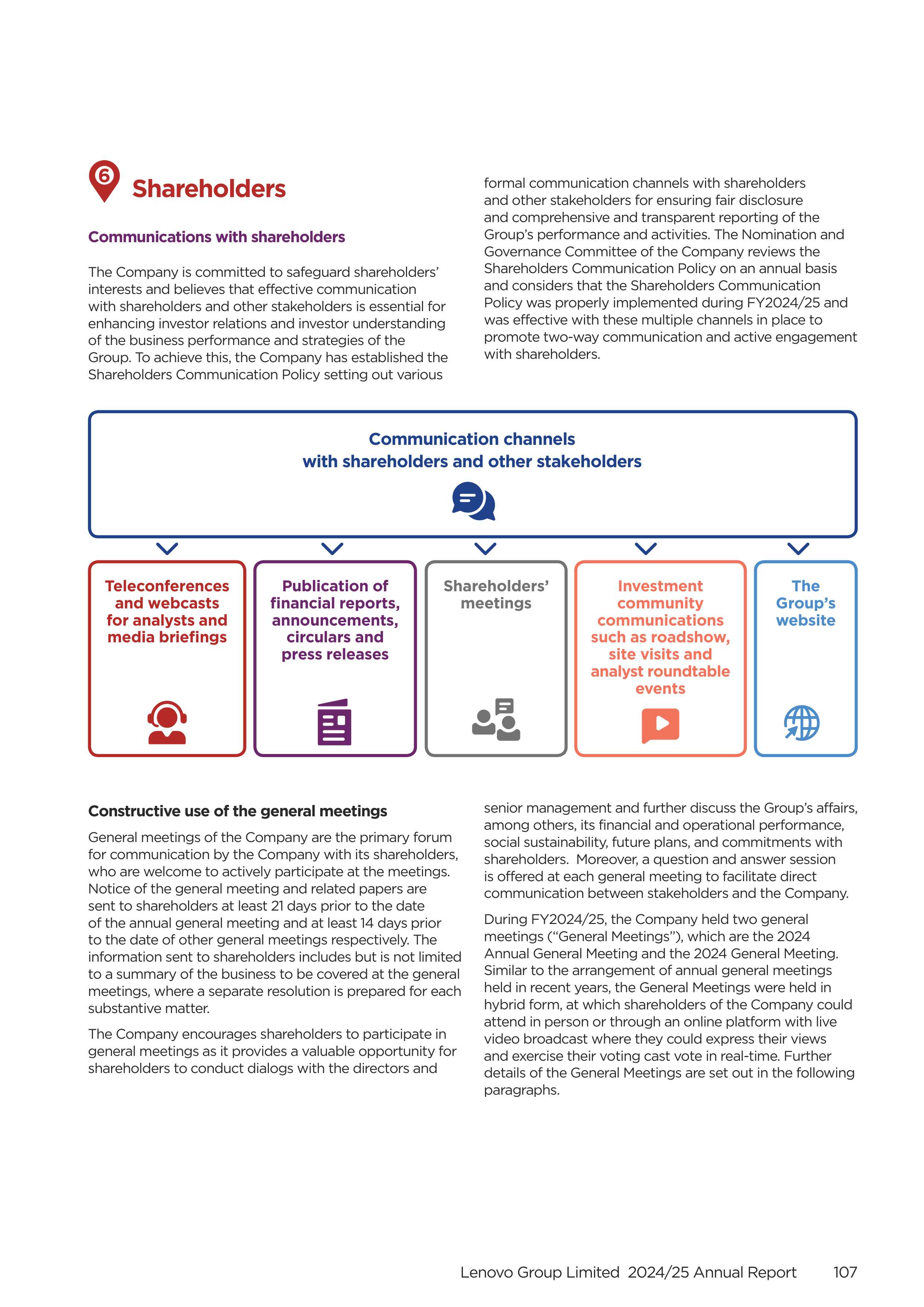
Lenovo Group Limited 2024/25 Annual Report
107
formal communication channels with shareholders
and other stakeholders for ensuring fair disclosure
and comprehensive and transparent reporting of the
Group’s performance and activities. The Nomination and
Governance Committee of the Company reviews the
Shareholders Communication Policy on an annual basis
and considers that the Shareholders Communication
Policy was properly implemented during FY2024/25 and
was effective with these multiple channels in place to
promote two-way communication and active engagement
with shareholders.
Shareholders
Communications with shareholders
The Company is committed to safeguard shareholders’
interests and believes that effective communication
with shareholders and other stakeholders is essential for
enhancing investor relations and investor understanding
of the business performance and strategies of the
Group. To achieve this, the Company has established the
Shareholders Communication Policy setting out various
6
Constructive use of the general meetings
General meetings of the Company are the primary forum
for communication by the Company with its shareholders,
who are welcome to actively participate at the meetings.
Notice of the general meeting and related papers are
sent to shareholders at least 21 days prior to the date
of the annual general meeting and at least 14 days prior
to the date of other general meetings respectively. The
information sent to shareholders includes but is not limited
to a summary of the business to be covered at the general
meetings, where a separate resolution is prepared for each
substantive matter.
The Company encourages shareholders to participate in
general meetings as it provides a valuable opportunity for
shareholders to conduct dialogs with the directors and
senior management and further discuss the Group’s affairs,
among others, its financial and operational performance,
social sustainability, future plans, and commitments with
shareholders. Moreover, a question and answer session
is offered at each general meeting to facilitate direct
communication between stakeholders and the Company.
During FY2024/25, the Company held two general
meetings (“General Meetings”), which are the 2024
Annual General Meeting and the 2024 General Meeting.
Similar to the arrangement of annual general meetings
held in recent years, the General Meetings were held in
hybrid form, at which shareholders of the Company could
attend in person or through an online platform with live
video broadcast where they could express their views
and exercise their voting cast vote in real-time. Further
details of the General Meetings are set out in the following
paragraphs.
Communication channels
with shareholders and other stakeholders
Teleconferences
and webcasts
for analysts and
media briefings
Publication of
financial reports,
announcements,
circulars and
press releases
Shareholders’
meetings
Investment
community
communications
such as roadshow,
site visits and
analyst roundtable
events
The
Group’s
website
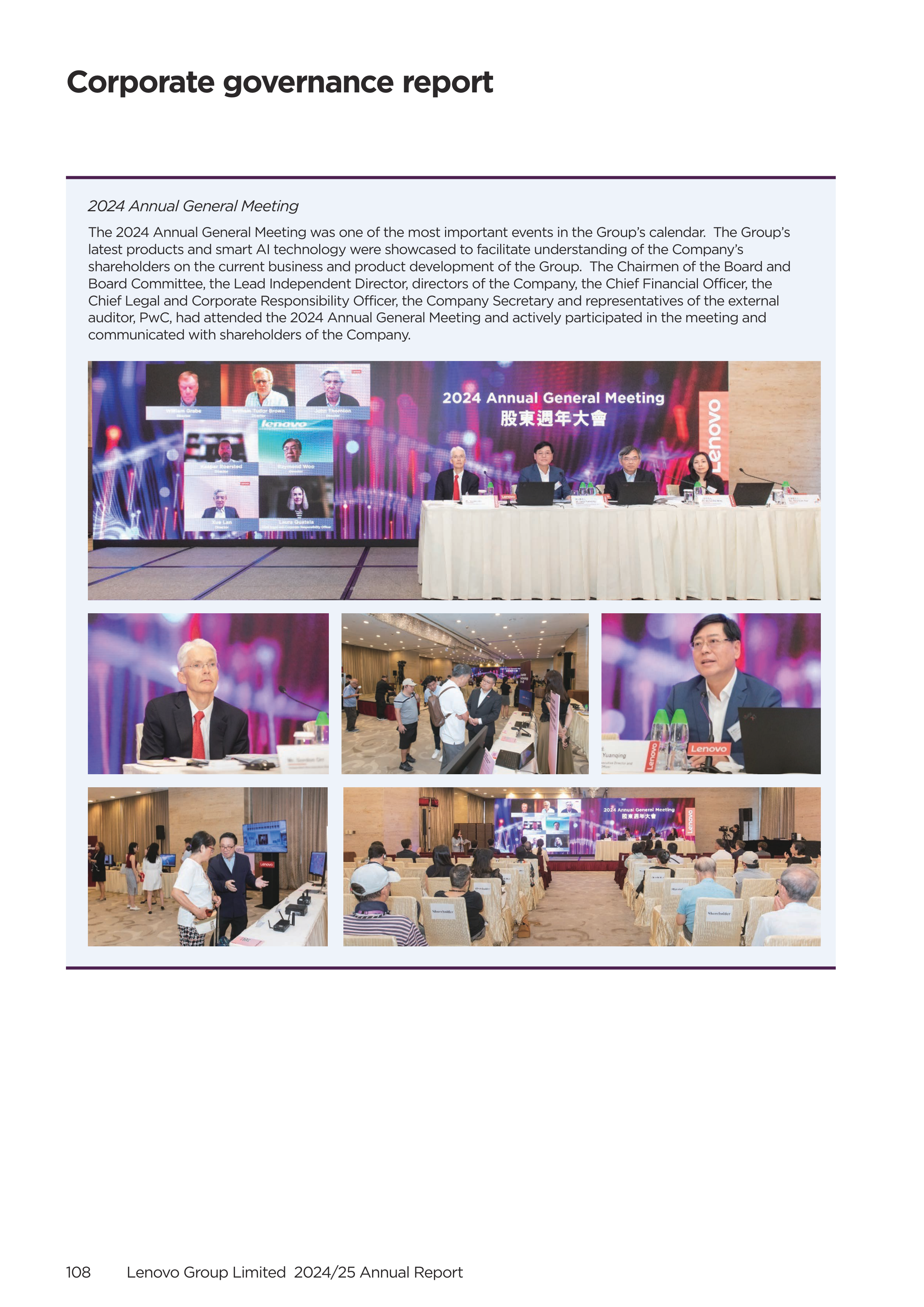
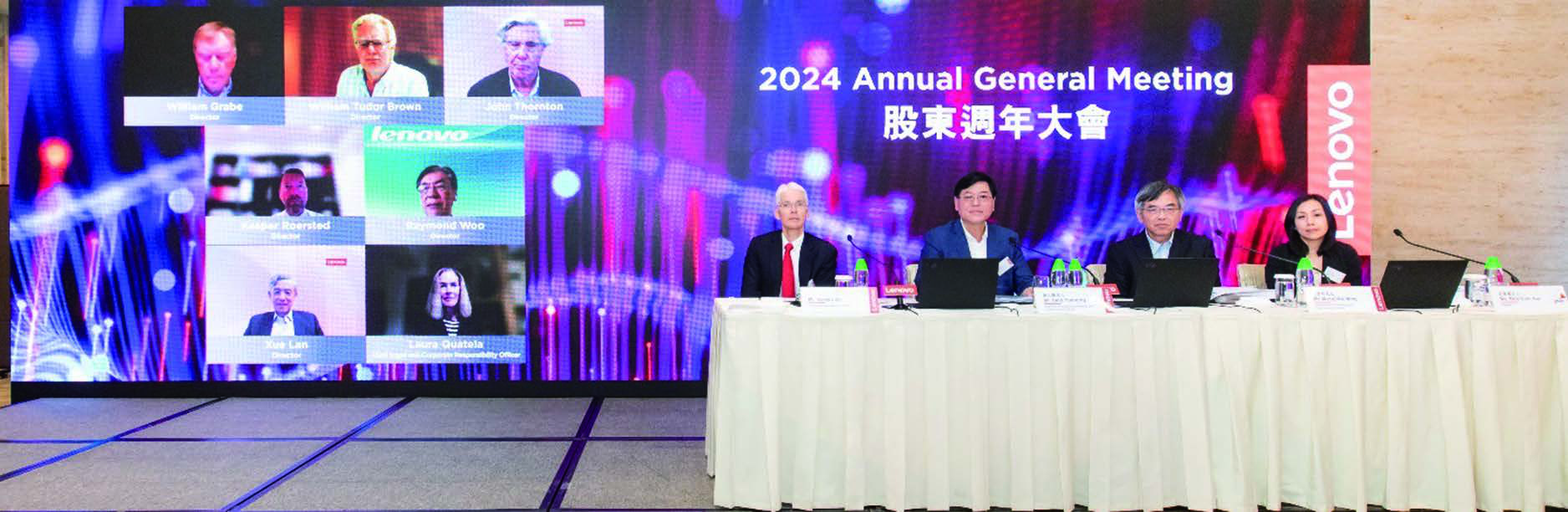
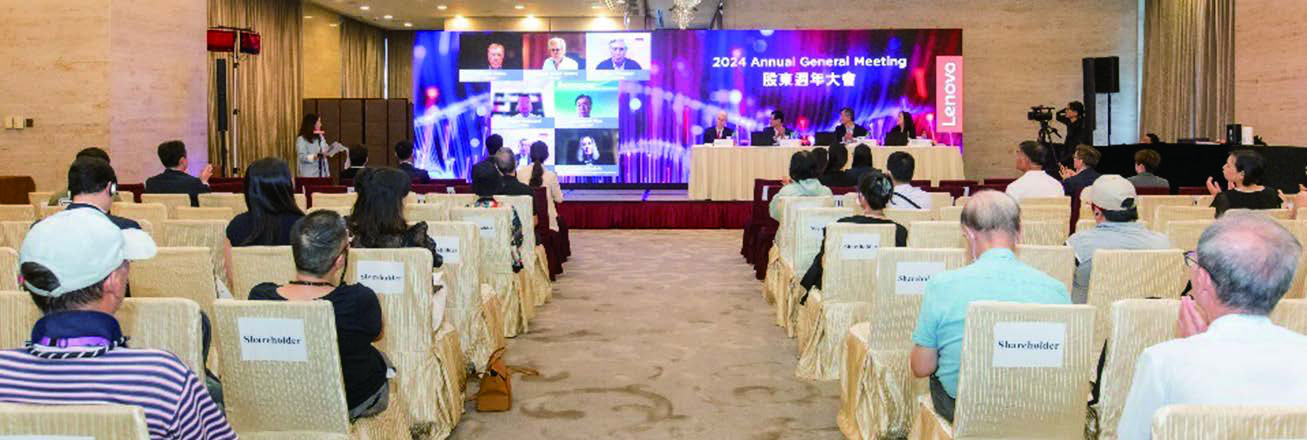
Lenovo Group Limited 2024/25 Annual Report
108
Corporate governance report
2024 Annual General Meeting
The 2024 Annual General Meeting was one of the most important events in the Group’s calendar. The Group’s
latest products and smart AI technology were showcased to facilitate understanding of the Company’s
shareholders on the current business and product development of the Group. The Chairmen of the Board and
Board Committee, the Lead Independent Director, directors of the Company, the Chief Financial Officer, the
Chief Legal and Corporate Responsibility Officer, the Company Secretary and representatives of the external
auditor, PwC, had attended the 2024 Annual General Meeting and actively participated in the meeting and
communicated with shareholders of the Company.
Lenovo Group Limited 2024/25 Annual Report
109
Separate resolutions on the following matters were proposed to shareholders for approval and the voting results of
which resolved at the 2024 Annual General Meeting are available on the
Group’s website
and
HKEx’s website
.
Matters resolved at the 2024 Annual General Meeting
Note
Receipt of the audited consolidated financial statements and the reports of the directors and
the independent auditor
Declaration of final dividend
Re-election of retiring directors and authorization of the Board to fix directors’ fees
Re-appointment of PwC as the Company’s auditor and authorization of the Board to fix
auditor’s remuneration
Granting of the general mandate to issue shares not exceeding 20% of the aggregate number
of shares in issue
Granting the general mandate to buy back shares not exceeding 10% of the aggregate
number of shares in issue
Extending the general mandate to the directors to issue new shares by adding the number of
shares bought back
Note: The full text of the resolutions is set out in the notice of the 2024 Annual General Meeting.
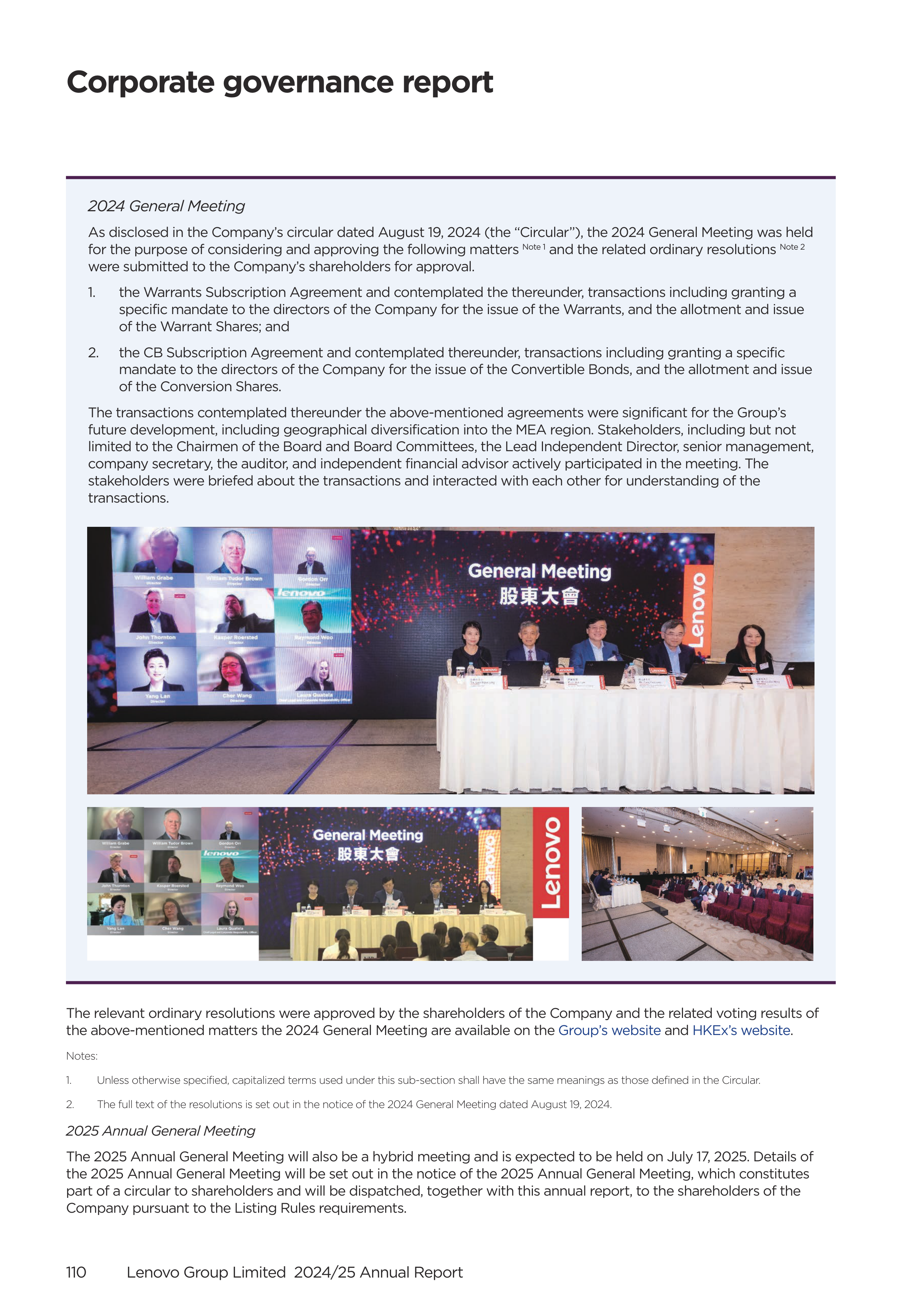
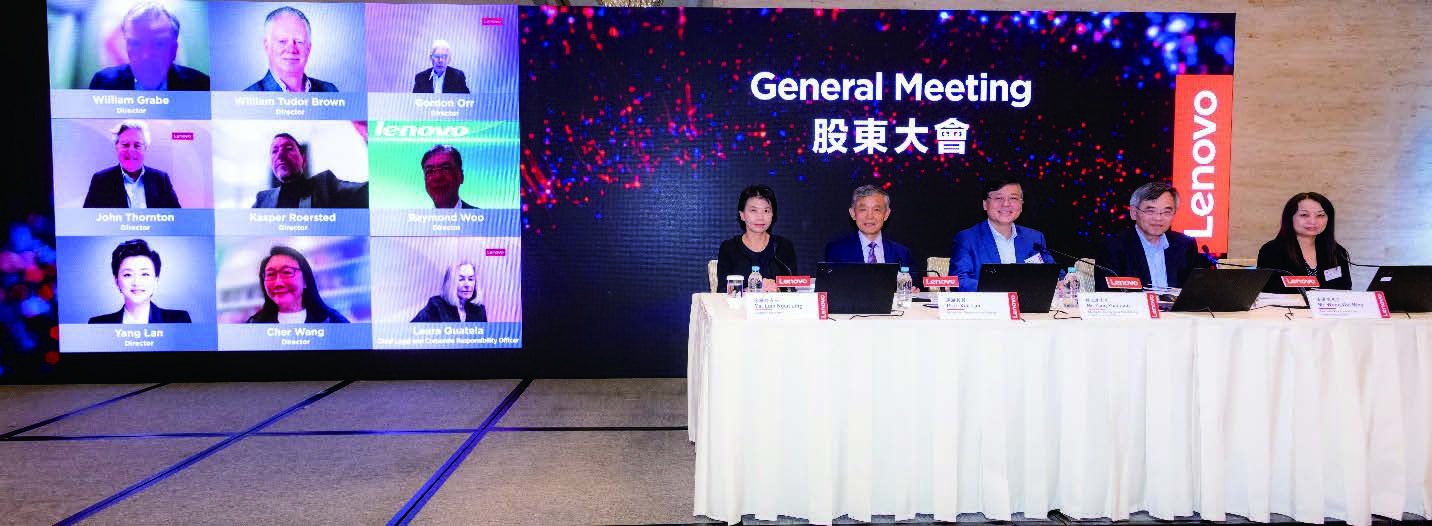
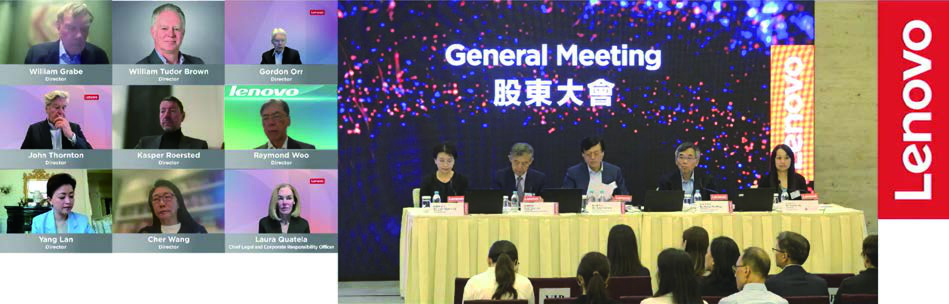
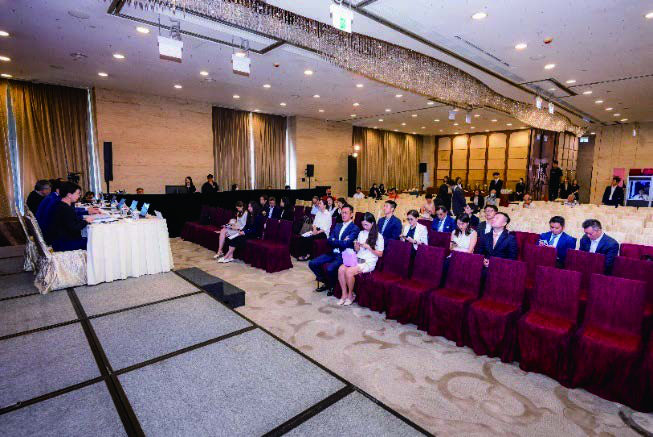
Lenovo Group Limited 2024/25 Annual Report
110
Corporate governance report
2024 General Meeting
As disclosed in the Company’s circular dated August 19, 2024 (the “Circular”), the 2024 General Meeting was held
for the purpose of considering and approving the following matters
Note 1
and the related ordinary resolutions
Note 2
were submitted to the Company’s shareholders for approval.
1.
the Warrants Subscription Agreement and contemplated the thereunder, transactions including granting a
specific mandate to the directors of the Company for the issue of the Warrants, and the allotment and issue
of the Warrant Shares; and
2.
the CB Subscription Agreement and contemplated thereunder, transactions including granting a specific
mandate to the directors of the Company for the issue of the Convertible Bonds, and the allotment and issue
of the Conversion Shares.
The transactions contemplated thereunder the above-mentioned agreements were significant for the Group’s
future development, including geographical diversification into the MEA region. Stakeholders, including but not
limited to the Chairmen of the Board and Board Committees, the Lead Independent Director, senior management,
company secretary, the auditor, and independent financial advisor actively participated in the meeting. The
stakeholders were briefed about the transactions and interacted with each other for understanding of the
transactions.
The relevant ordinary resolutions were approved by the shareholders of the Company and the related voting results of
the above-mentioned matters the 2024 General Meeting are available on the
Group’s website
and
HKEx’s website
.
Notes:
1.
Unless otherwise specified, capitalized terms used under this sub-section shall have the same meanings as those defined in the Circular.
2.
The full text of the resolutions is set out in the notice of the 2024 General Meeting dated August 19, 2024.
2025 Annual General Meeting
The 2025 Annual General Meeting will also be a hybrid meeting and is expected to be held on July 17, 2025. Details of
the 2025 Annual General Meeting will be set out in the notice of the 2025 Annual General Meeting, which constitutes
part of a circular to shareholders and will be dispatched, together with this annual report, to the shareholders of the
Company pursuant to the Listing Rules requirements.
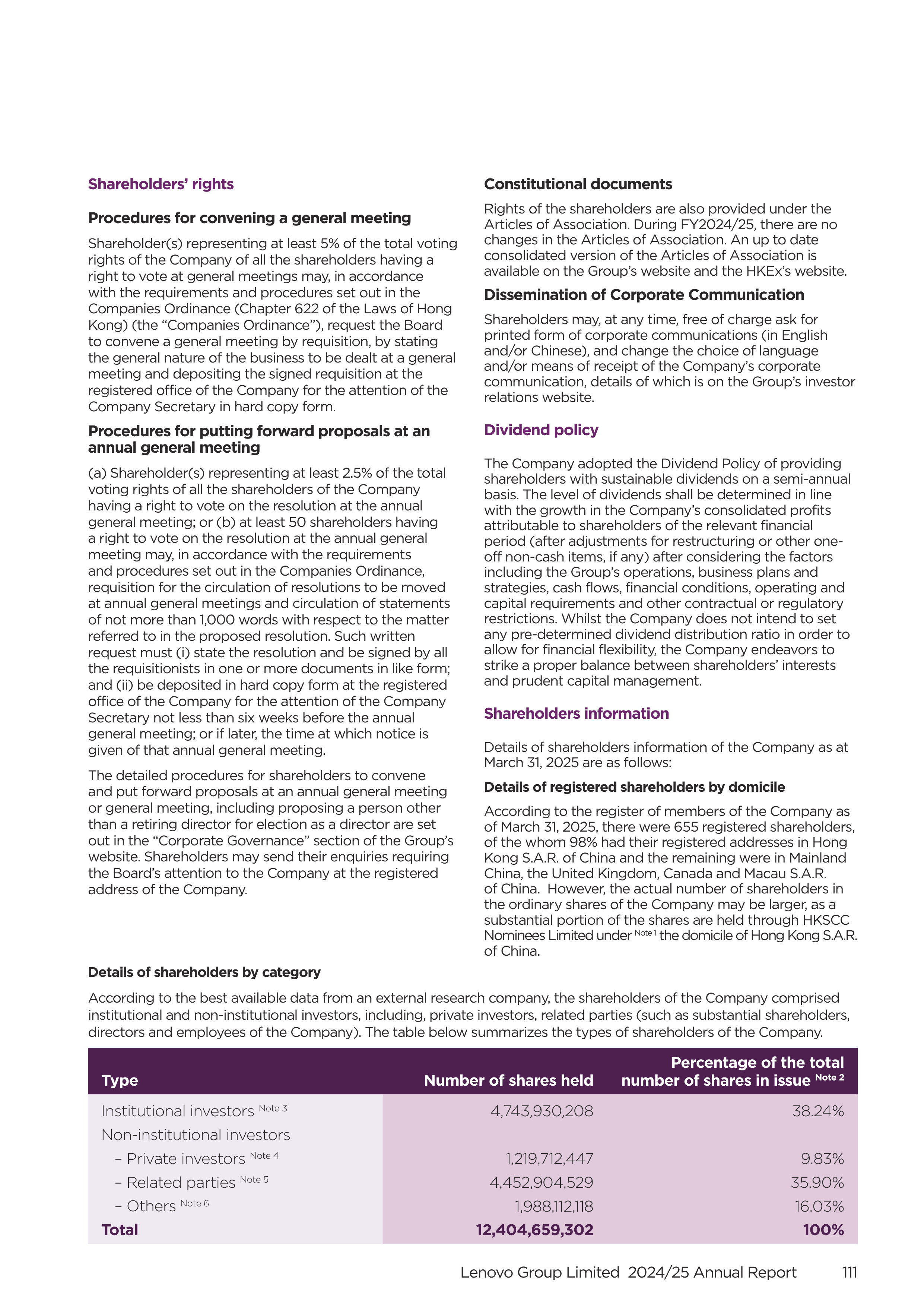
Lenovo Group Limited 2024/25 Annual Report
111
Shareholders’ rights
Procedures for convening a general meeting
Shareholder(s) representing at least 5% of the total voting
rights of the Company of all the shareholders having a
right to vote at general meetings may, in accordance
with the requirements and procedures set out in the
Companies Ordinance (Chapter 622 of the Laws of Hong
Kong) (the “Companies Ordinance”), request the Board
to convene a general meeting by requisition, by stating
the general nature of the business to be dealt at a general
meeting and depositing the signed requisition at the
registered office of the Company for the attention of the
Company Secretary in hard copy form.
Procedures for putting forward proposals at an
annual general meeting
(a) Shareholder(s) representing at least 2.5% of the total
voting rights of all the shareholders of the Company
having a right to vote on the resolution at the annual
general meeting; or (b) at least 50 shareholders having
a right to vote on the resolution at the annual general
meeting may, in accordance with the requirements
and procedures set out in the Companies Ordinance,
requisition for the circulation of resolutions to be moved
at annual general meetings and circulation of statements
of not more than 1,000 words with respect to the matter
referred to in the proposed resolution. Such written
request must (i) state the resolution and be signed by all
the requisitionists in one or more documents in like form;
and (ii) be deposited in hard copy form at the registered
office of the Company for the attention of the Company
Secretary not less than six weeks before the annual
general meeting; or if later, the time at which notice is
given of that annual general meeting.
The detailed procedures for shareholders to convene
and put forward proposals at an annual general meeting
or general meeting, including proposing a person other
than a retiring director for election as a director are set
out in the “Corporate Governance” section of the Group’s
website. Shareholders may send their enquiries requiring
the Board’s attention to the Company at the registered
address of the Company.
Constitutional documents
Rights of the shareholders are also provided under the
Articles of Association. During FY2024/25, there are no
changes in the Articles of Association. An up to date
consolidated version of the Articles of Association is
available on the Group’s website and the HKEx’s website.
Dissemination of Corporate Communication
Shareholders may, at any time, free of charge ask for
printed form of corporate communications (in English
and/or Chinese), and change the choice of language
and/or means of receipt of the Company’s corporate
communication, details of which is on the Group’s investor
relations website.
Dividend policy
The Company adopted the Dividend Policy of providing
shareholders with sustainable dividends on a semi-annual
basis. The level of dividends shall be determined in line
with the growth in the Company’s consolidated profits
attributable to shareholders of the relevant financial
period (after adjustments for restructuring or other one-
off non-cash items, if any) after considering the factors
including the Group’s operations, business plans and
strategies, cash flows, financial conditions, operating and
capital requirements and other contractual or regulatory
restrictions. Whilst the Company does not intend to set
any pre-determined dividend distribution ratio in order to
allow for financial flexibility, the Company endeavors to
strike a proper balance between shareholders’ interests
and prudent capital management.
Shareholders information
Details of shareholders information of the Company as at
March 31, 2025 are as follows:
Details of registered shareholders by domicile
According to the register of members of the Company as
of March 31, 2025, there were 655 registered shareholders,
of the whom 98% had their registered addresses in Hong
Kong S.A.R. of China and the remaining were in Mainland
China, the United Kingdom, Canada and Macau S.A.R.
of China. However, the actual number of shareholders in
the ordinary shares of the Company may be larger, as a
substantial portion of the shares are held through HKSCC
Nominees Limited under
Note 1
the domicile of Hong Kong S.A.R.
of China.
Details of shareholders by category
According to the best available data from an external research company, the shareholders of the Company comprised
institutional and non-institutional investors, including, private investors, related parties (such as substantial shareholders,
directors and employees of the Company). The table below summarizes the types of shareholders of the Company.
Type
Number of shares held
Percentage of the total
number of shares in issue
Note 2
Institutional investors
Note 3
4,743,930,208
38.24%
Non-institutional investors
– Private investors
Note 4
1,219,712,447
9.83%
– Related parties
Note 5
4,452,904,529
35.90%
– Others
Note 6
1,988,112,118
16.03%
Total
12,404,659,302
100%
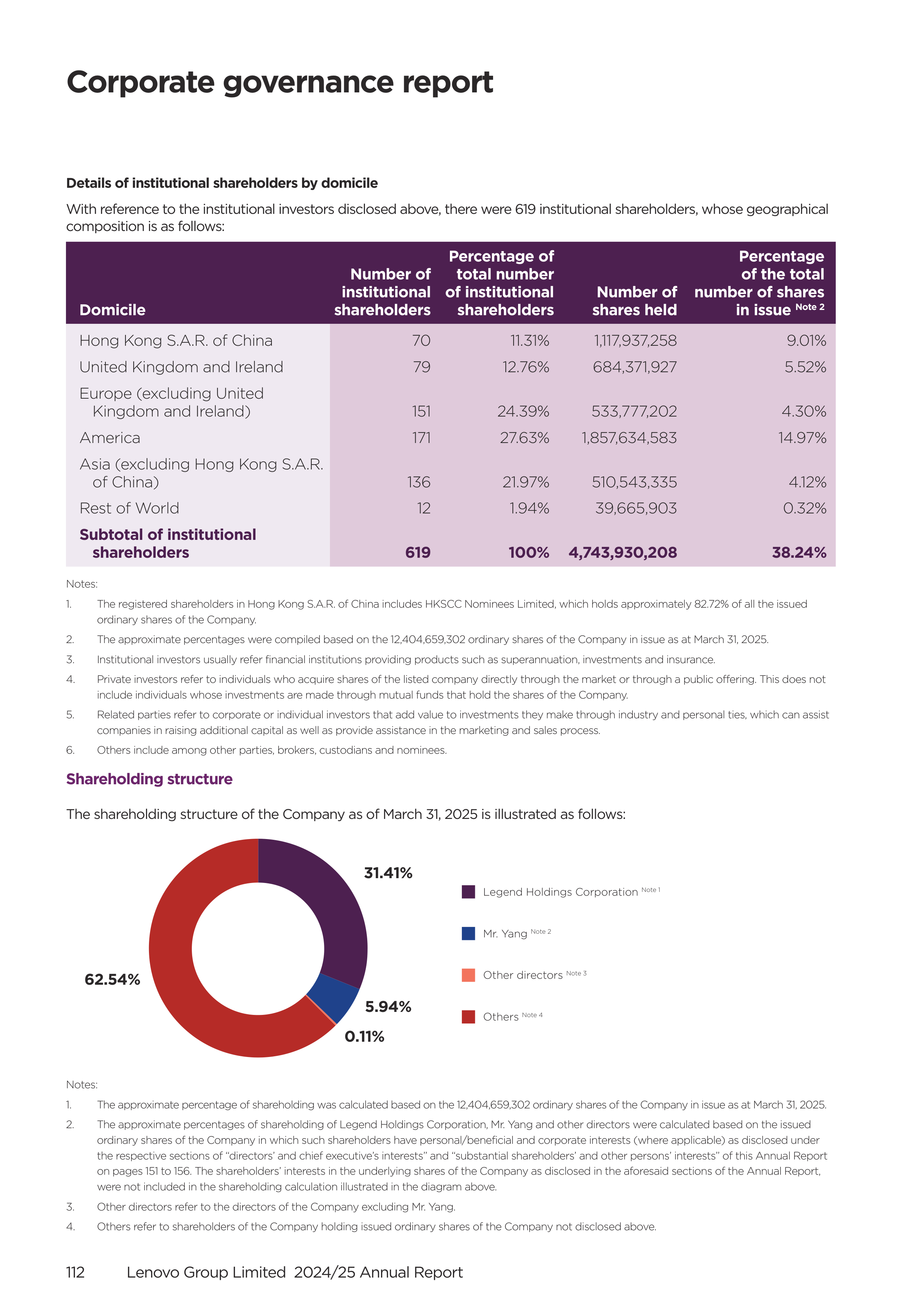
Lenovo Group Limited 2024/25 Annual Report
112
Corporate governance report
Details of institutional shareholders by domicile
With reference to the institutional investors disclosed above, there were 619 institutional shareholders, whose geographical
composition is as follows:
Domicile
Number of
institutional
shareholders
Percentage of
total number
of institutional
shareholders
Number of
shares held
Percentage
of the total
number of shares
in issue
Note 2
Hong Kong S.A.R. of China
70
11.31%
1,117,937,258
9.01%
United Kingdom and Ireland
79
12.76%
684,371,927
5.52%
Europe (excluding United
Kingdom and Ireland)
151
24.39%
533,777,202
4.30%
America
171
27.63%
1,857,634,583
14.97%
Asia (excluding Hong Kong S.A.R.
of China)
136
21.97%
510,543,335
4.12%
Rest of World
12
1.94%
39,665,903
0.32%
Subtotal of institutional
shareholders
619
100%
4,743,930,208
38.24%
Notes:
1.
The registered shareholders in Hong Kong S.A.R. of China includes HKSCC Nominees Limited, which holds approximately 82.72% of all the issued
ordinary shares of the Company.
2.
The approximate percentages were compiled based on the 12,404,659,302 ordinary shares of the Company in issue as at March 31, 2025.
3.
Institutional investors usually refer financial institutions providing products such as superannuation, investments and insurance.
4.
Private investors refer to individuals who acquire shares of the listed company directly through the market or through a public offering. This does not
include individuals whose investments are made through mutual funds that hold the shares of the Company.
5.
Related parties refer to corporate or individual investors that add value to investments they make through industry and personal ties, which can assist
companies in raising additional capital as well as provide assistance in the marketing and sales process.
6.
Others include among other parties, brokers, custodians and nominees.
Shareholding structure
The shareholding structure of the Company as of March 31, 2025 is illustrated as follows:
Legend Holdings Corporation
Note 1
Mr. Yang
Note 2
Other directors
Note 3
Others
Note 4
0.11%
31.41%
62.54%
5.94%
Notes:
1.
The approximate percentage of shareholding was calculated based on the 12,404,659,302 ordinary shares of the Company in issue as at March 31, 2025.
2.
The approximate percentages of shareholding of Legend Holdings Corporation, Mr. Yang and other directors were calculated based on the issued
ordinary shares of the Company in which such shareholders have personal/beneficial and corporate interests (where applicable) as disclosed under
the respective sections of “directors’ and chief executive’s interests” and “substantial shareholders’ and other persons’ interests” of this Annual Report
on pages 151 to 156. The shareholders’ interests in the underlying shares of the Company as disclosed in the aforesaid sections of the Annual Report,
were not included in the shareholding calculation illustrated in the diagram above.
3.
Other directors refer to the directors of the Company excluding Mr. Yang.
4.
Others refer to shareholders of the Company holding issued ordinary shares of the Company not disclosed above.
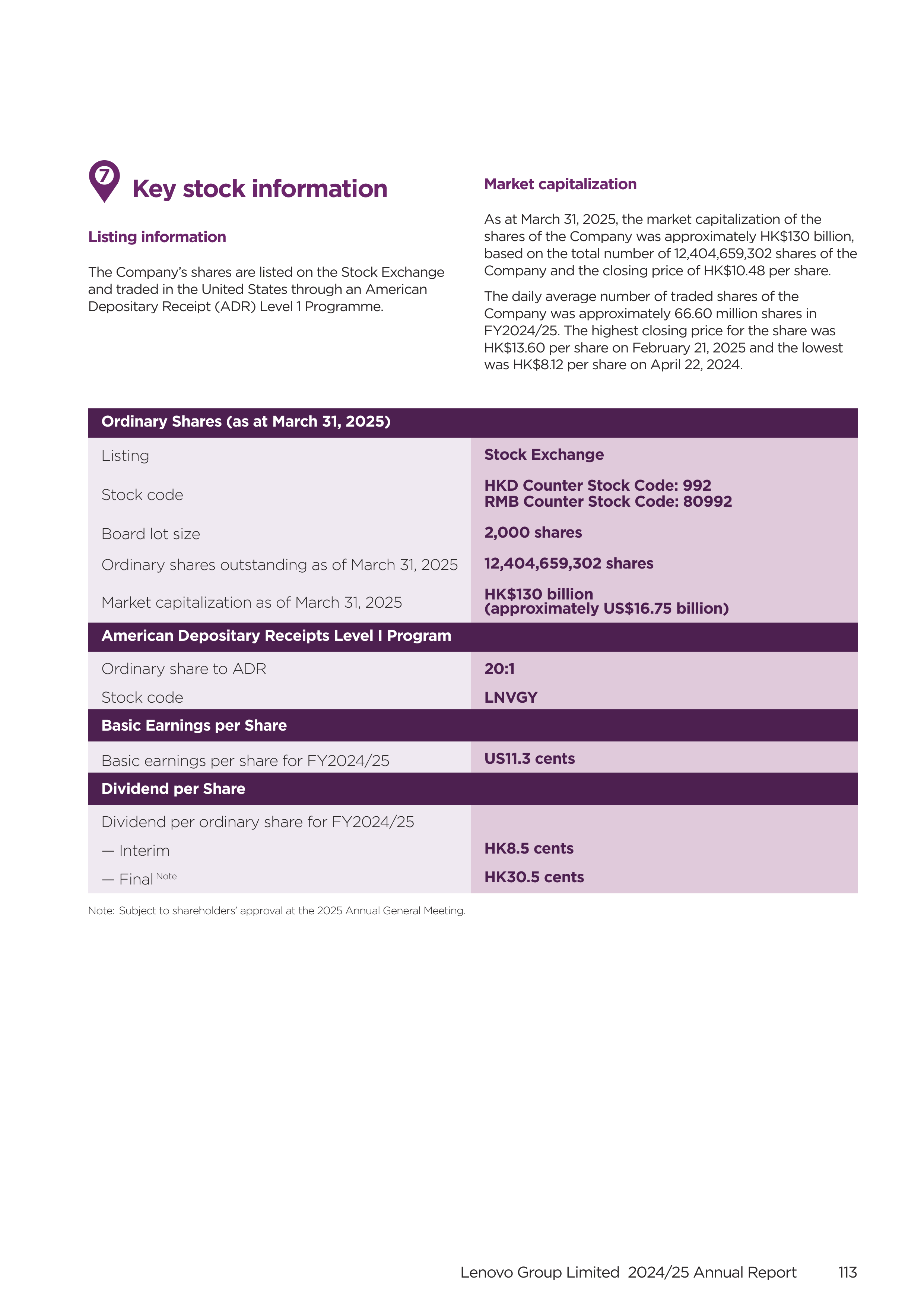
Lenovo Group Limited 2024/25 Annual Report
113
Key stock information
Listing information
The Company’s shares are listed on the Stock Exchange
and traded in the United States through an American
Depositary Receipt (ADR) Level 1 Programme.
Market capitalization
As at March 31, 2025, the market capitalization of the
shares of the Company was approximately HK$130 billion,
based on the total number of 12,404,659,302 shares of the
Company and the closing price of HK$10.48 per share.
The daily average number of traded shares of the
Company was approximately 66.60 million shares in
FY2024/25. The highest closing price for the share was
HK$13.60 per share on February 21, 2025 and the lowest
was HK$8.12 per share on April 22, 2024.
Ordinary Shares (as at March 31, 2025)
Listing
Stock Exchange
Stock code
HKD Counter Stock Code: 992
RMB Counter Stock Code: 80992
Board lot size
2,000 shares
Ordinary shares outstanding as of March 31, 2025
12,404,659,302 shares
Market capitalization as of March 31, 2025
HK$130 billion
(approximately US$16.75 billion)
American Depositary Receipts Level I Program
Ordinary share to ADR
20:1
Stock code
LNVGY
Basic Earnings per Share
Basic earnings per share for FY2024/25
US11.3 cents
Dividend per Share
Dividend per ordinary share for FY2024/25
— Interim
HK8.5 cents
— Final
Note
HK30.5 cents
Note: Subject to shareholders’ approval at the 2025 Annual General Meeting.
7
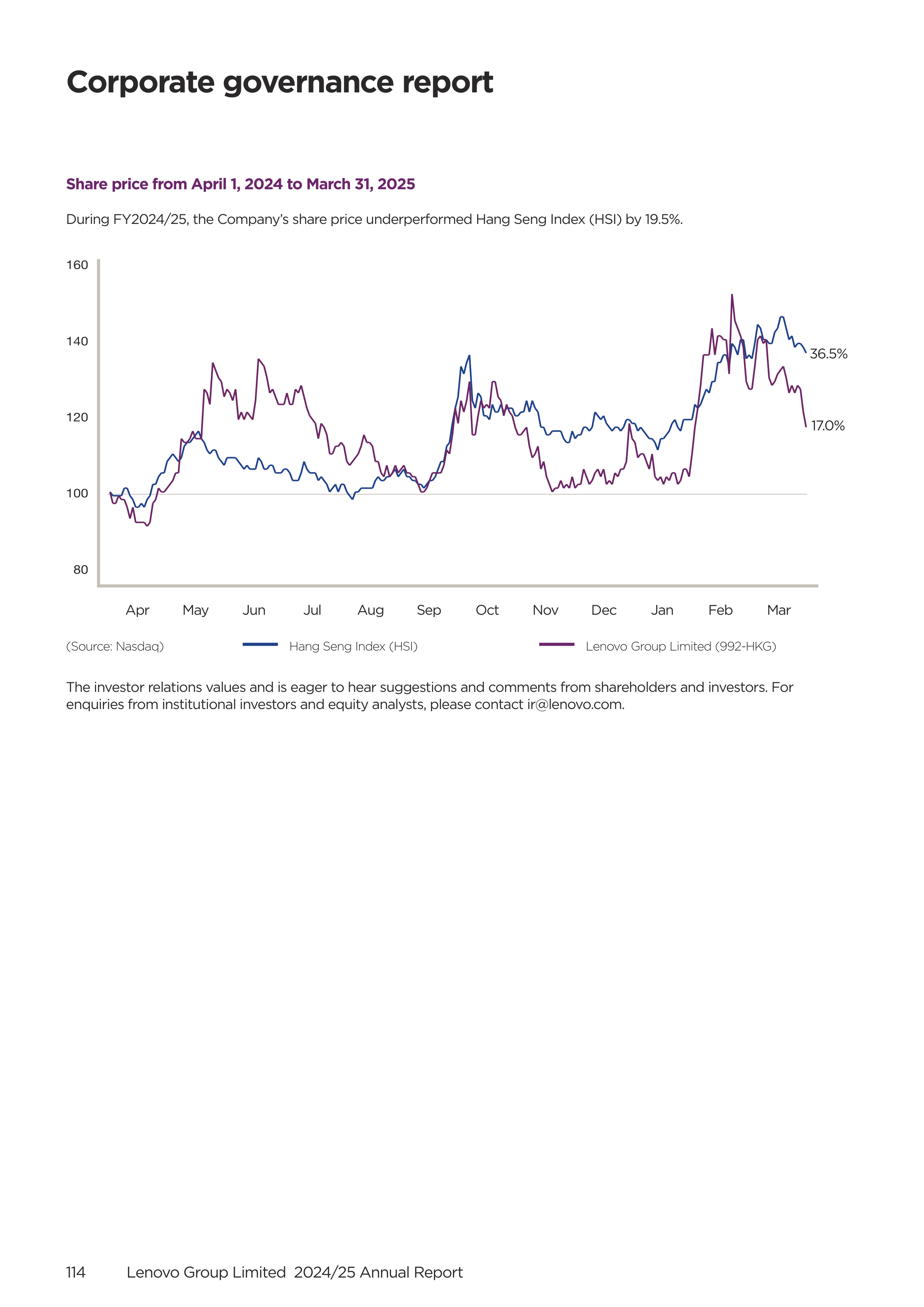
Lenovo Group Limited 2024/25 Annual Report
114
Corporate governance report
Share price from April 1, 2024 to March 31, 2025
During FY2024/25, the Company’s share price underperformed Hang Seng Index (HSI) by 19.5%.
80
100
120
140
160
Apr
May
Jun
Jul
Aug
Sep
Oct
Nov
Dec
Jan
Feb
Mar
(Source: Nasdaq)
Hang Seng Index (HSI)
Lenovo Group Limited (992-HKG)
36.5%
17.0%
The investor relations values and is eager to hear suggestions and comments from shareholders and investors. For
enquiries from institutional investors and equity analysts, please contact ir@lenovo.com.
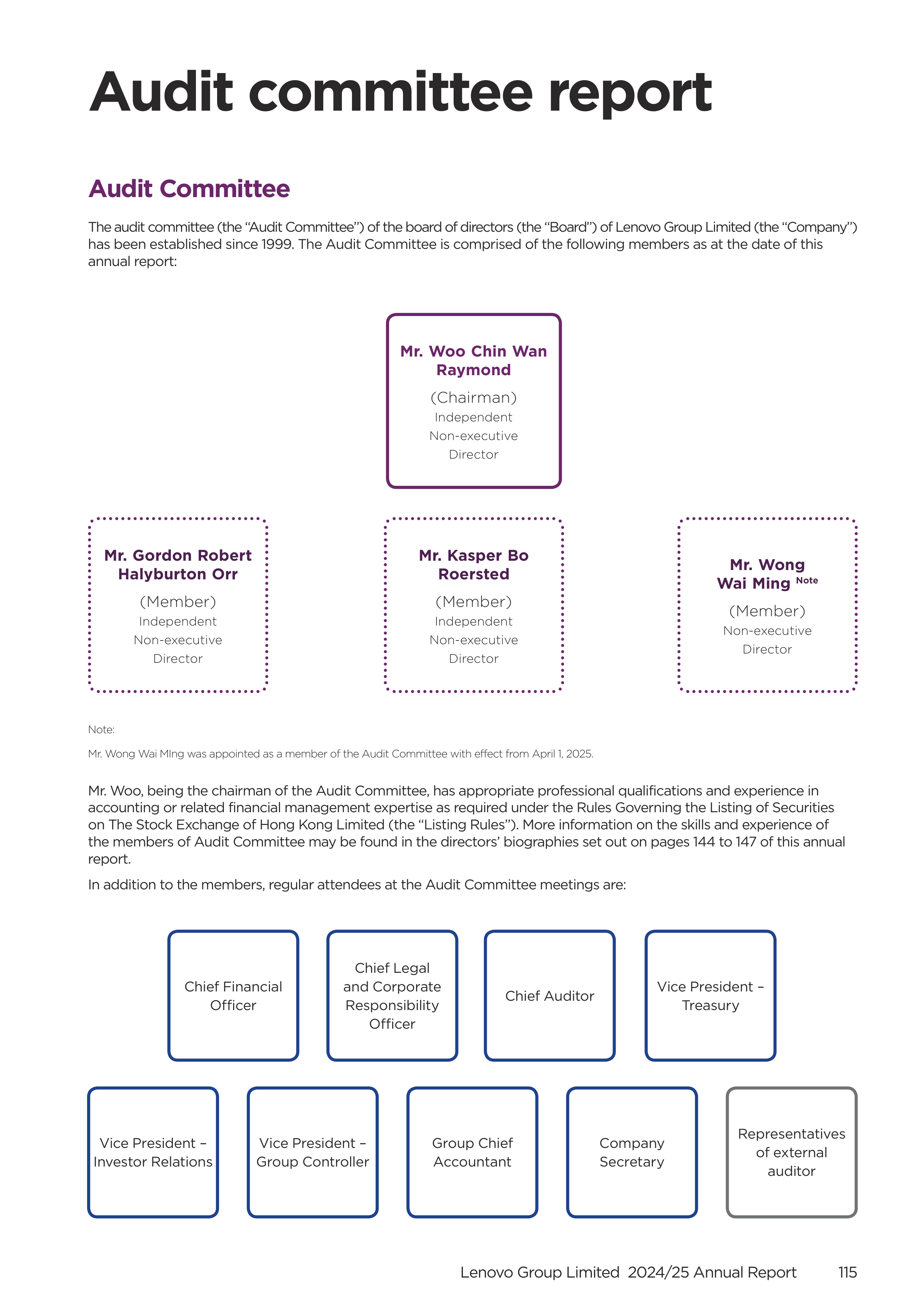
Lenovo Group Limited 2024/25 Annual Report
115
Audit committee report
Audit Committee
The audit committee (the “Audit Committee”) of the board of directors (the “Board”) of Lenovo Group Limited (the “Company”)
has been established since 1999. The Audit Committee is comprised of the following members as at the date of this
annual report:
Mr. Woo, being the chairman of the Audit Committee, has appropriate professional qualifications and experience in
accounting or related financial management expertise as required under the Rules Governing the Listing of Securities
on The Stock Exchange of Hong Kong Limited (the “Listing Rules”). More information on the skills and experience of
the members of Audit Committee may be found in the directors’ biographies set out on pages 144 to 147 of this annual
report.
In addition to the members, regular attendees at the Audit Committee meetings are:
Note:
Mr. Wong Wai MIng was appointed as a member of the Audit Committee with effect from April 1, 2025.
Mr. Woo Chin Wan
Raymond
(Chairman)
Independent
Non-executive
Director
Mr. Gordon Robert
Halyburton Orr
(Member)
Independent
Non-executive
Director
Mr. Kasper Bo
Roersted
(Member)
Independent
Non-executive
Director
Mr. Wong
Wai Ming
Note
(Member)
Non-executive
Director
Chief Financial
Officer
Chief Legal
and Corporate
Responsibility
Officer
Vice President –
Group Controller
Vice President –
Investor Relations
Chief Auditor
Company
Secretary
Group Chief
Accountant
Vice President –
Treasury
Representatives
of external
auditor
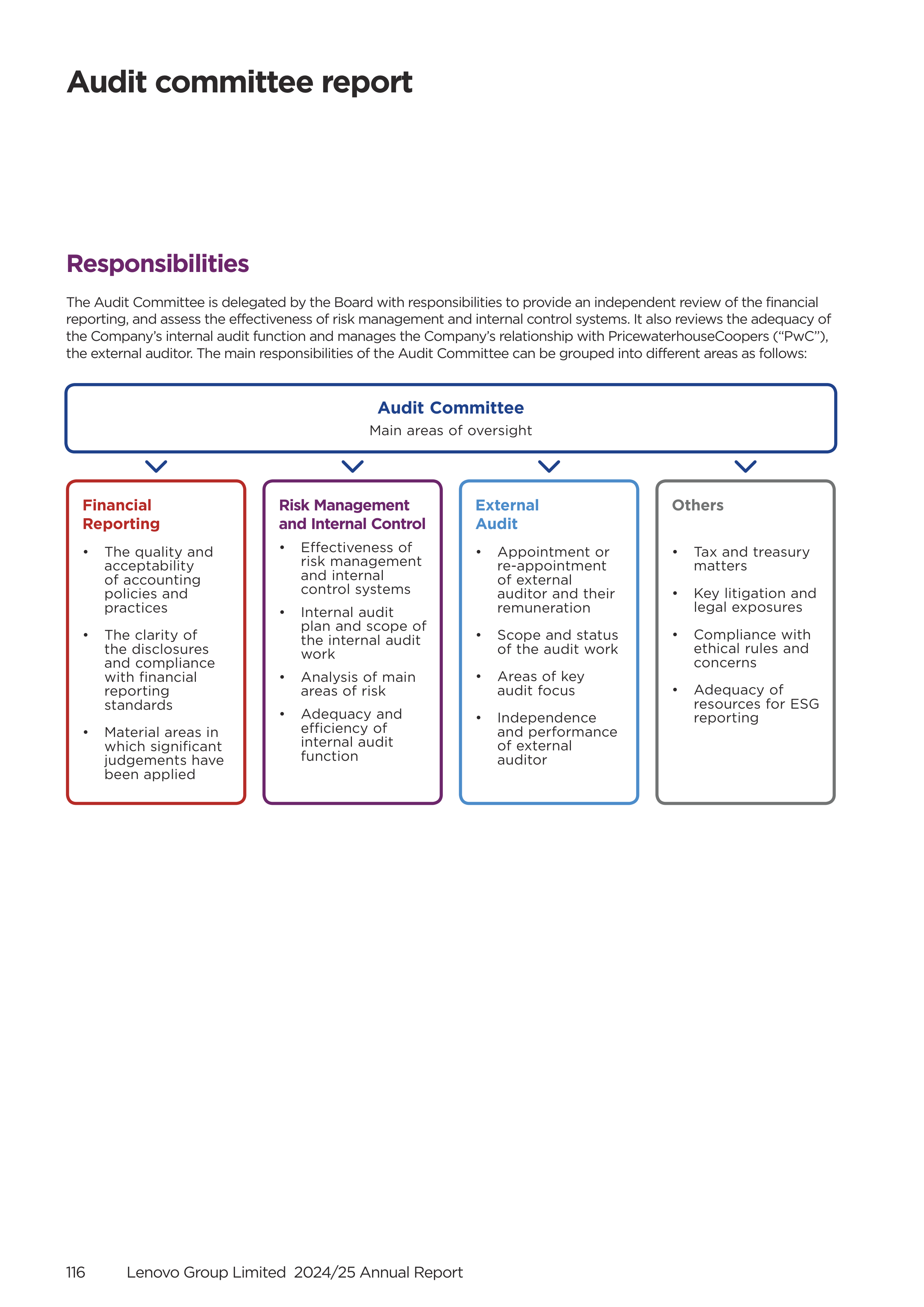
Lenovo Group Limited 2024/25 Annual Report
116
Audit committee report
Responsibilities
The Audit Committee is delegated by the Board with responsibilities to provide an independent review of the financial
reporting, and assess the effectiveness of risk management and internal control systems. It also reviews the adequacy of
the Company’s internal audit function and manages the Company’s relationship with PricewaterhouseCoopers (“PwC”),
the external auditor. The main responsibilities of the Audit Committee can be grouped into different areas as follows:
Audit Committee
Main areas of oversight
Risk Management
and Internal Control
• Effectiveness of
risk management
and internal
control systems
• Internal audit
plan and scope of
the internal audit
work
• Analysis of main
areas of risk
• Adequacy and
efficiency of
internal audit
function
External
Audit
• Appointment or
re-appointment
of external
auditor and their
remuneration
• Scope and status
of the audit work
• Areas of key
audit focus
• Independence
and performance
of external
auditor
Others
• Tax and treasury
matters
• Key litigation and
legal exposures
• Compliance with
ethical rules and
concerns
• Adequacy of
resources for ESG
reporting
Financial
Reporting
• The quality and
acceptability
of accounting
policies and
practices
• The clarity of
the disclosures
and compliance
with financial
reporting
standards
• Material areas in
which significant
judgements have
been applied
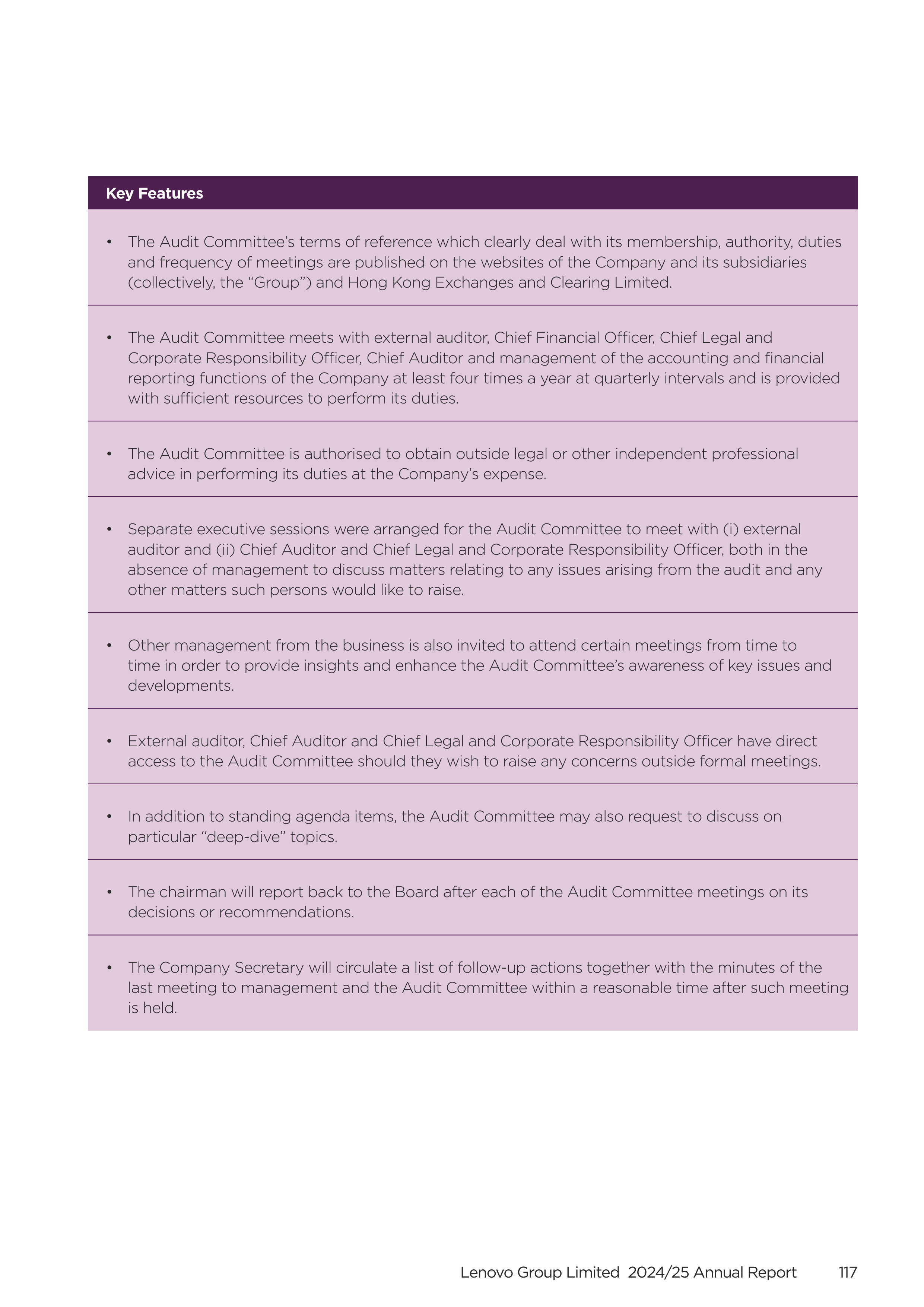
Lenovo Group Limited 2024/25 Annual Report
117
Key Features
• The Audit Committee’s terms of reference which clearly deal with its membership, authority, duties
and frequency of meetings are published on the websites of the Company and its subsidiaries
(collectively, the “Group”) and Hong Kong Exchanges and Clearing Limited.
• The Audit Committee meets with external auditor, Chief Financial Officer, Chief Legal and
Corporate Responsibility Officer, Chief Auditor and management of the accounting and financial
reporting functions of the Company at least four times a year at quarterly intervals and is provided
with sufficient resources to perform its duties.
• The Audit Committee is authorised to obtain outside legal or other independent professional
advice in performing its duties at the Company’s expense.
• Separate executive sessions were arranged for the Audit Committee to meet with (i) external
auditor and (ii) Chief Auditor and Chief Legal and Corporate Responsibility Officer, both in the
absence of management to discuss matters relating to any issues arising from the audit and any
other matters such persons would like to raise.
• Other management from the business is also invited to attend certain meetings from time to
time in order to provide insights and enhance the Audit Committee’s awareness of key issues and
developments.
• External auditor, Chief Auditor and Chief Legal and Corporate Responsibility Officer have direct
access to the Audit Committee should they wish to raise any concerns outside formal meetings.
• In addition to standing agenda items, the Audit Committee may also request to discuss on
particular “deep-dive” topics.
• The chairman will report back to the Board after each of the Audit Committee meetings on its
decisions or recommendations.
• The Company Secretary will circulate a list of follow-up actions together with the minutes of the
last meeting to management and the Audit Committee within a reasonable time after such meeting
is held.
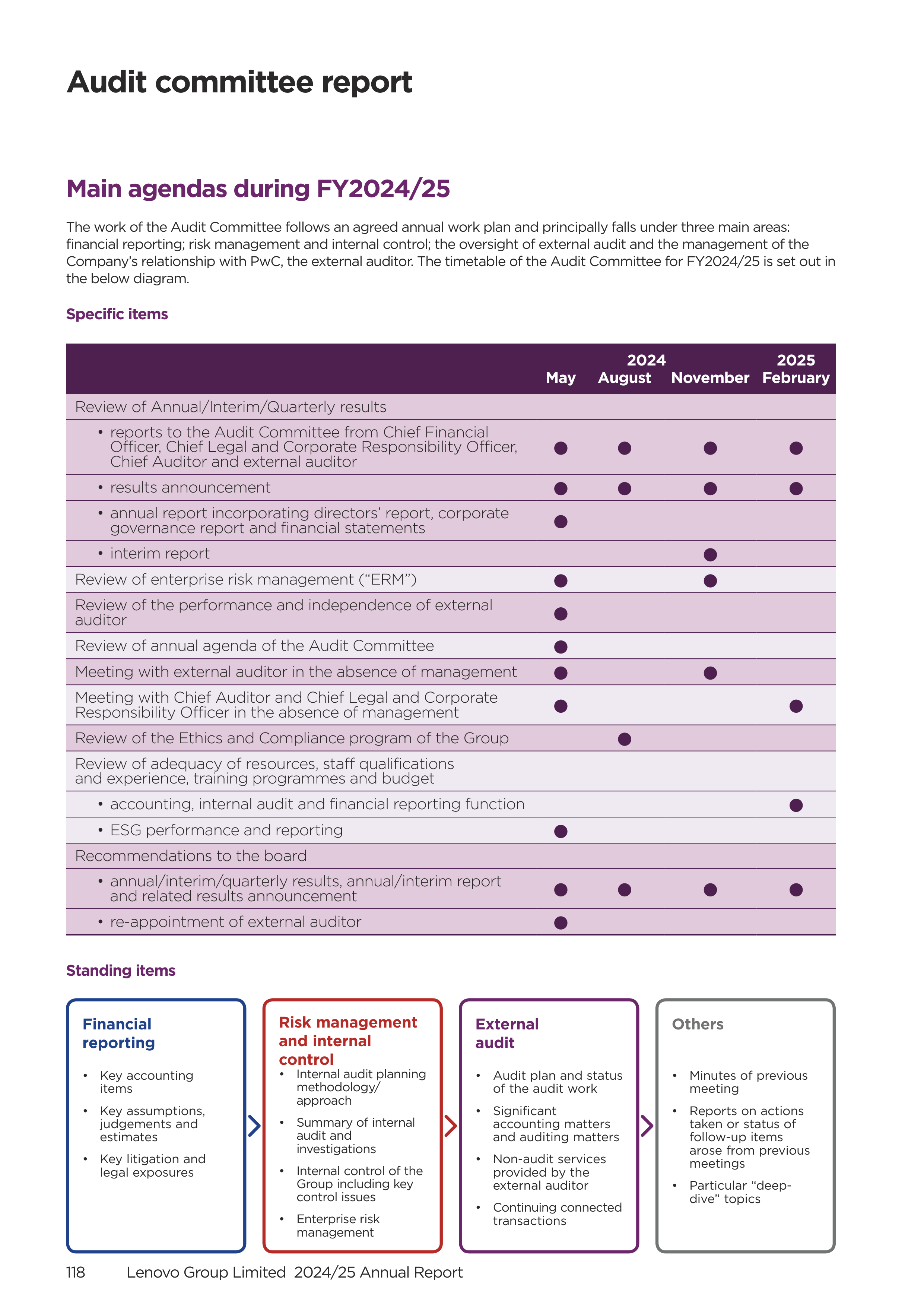
Lenovo Group Limited 2024/25 Annual Report
118
Audit committee report
Main agendas during FY2024/25
The work of the Audit Committee follows an agreed annual work plan and principally falls under three main areas:
financial reporting; risk management and internal control; the oversight of external audit and the management of the
Company’s relationship with PwC, the external auditor. The timetable of the Audit Committee for FY2024/25 is set out in
the below diagram.
Specific items
2024
2025
May
August
November
February
Review of Annual/Interim/Quarterly results
• reports to the Audit Committee from Chief Financial
Officer, Chief Legal and Corporate Responsibility Officer,
Chief Auditor and external auditor
• results announcement
• annual report incorporating directors’ report, corporate
governance report and financial statements
• interim report
Review of enterprise risk management (“ERM”)
Review of the performance and independence of external
auditor
Review of annual agenda of the Audit Committee
Meeting with external auditor in the absence of management
Meeting with Chief Auditor and Chief Legal and Corporate
Responsibility Officer in the absence of management
Review of the Ethics and Compliance program of the Group
Review of adequacy of resources, staff qualifications
and experience, training programmes and budget
• accounting, internal audit and financial reporting function
• ESG performance and reporting
Recommendations to the board
• annual/interim/quarterly results, annual/interim report
and related results announcement
• re-appointment of external auditor
Standing items
Risk management
and internal
control
• Internal audit planning
methodology/
approach
• Summary of internal
audit and
investigations
• Internal control of the
Group including key
control issues
• Enterprise risk
management
External
audit
• Audit plan and status
of the audit work
• Significant
accounting matters
and auditing matters
• Non-audit services
provided by the
external auditor
• Continuing connected
transactions
Others
• Minutes of previous
meeting
• Reports on actions
taken or status of
follow-up items
arose from previous
meetings
• Particular “deep-
dive” topics
Financial
reporting
• Key accounting
items
• Key assumptions,
judgements and
estimates
• Key litigation and
legal exposures
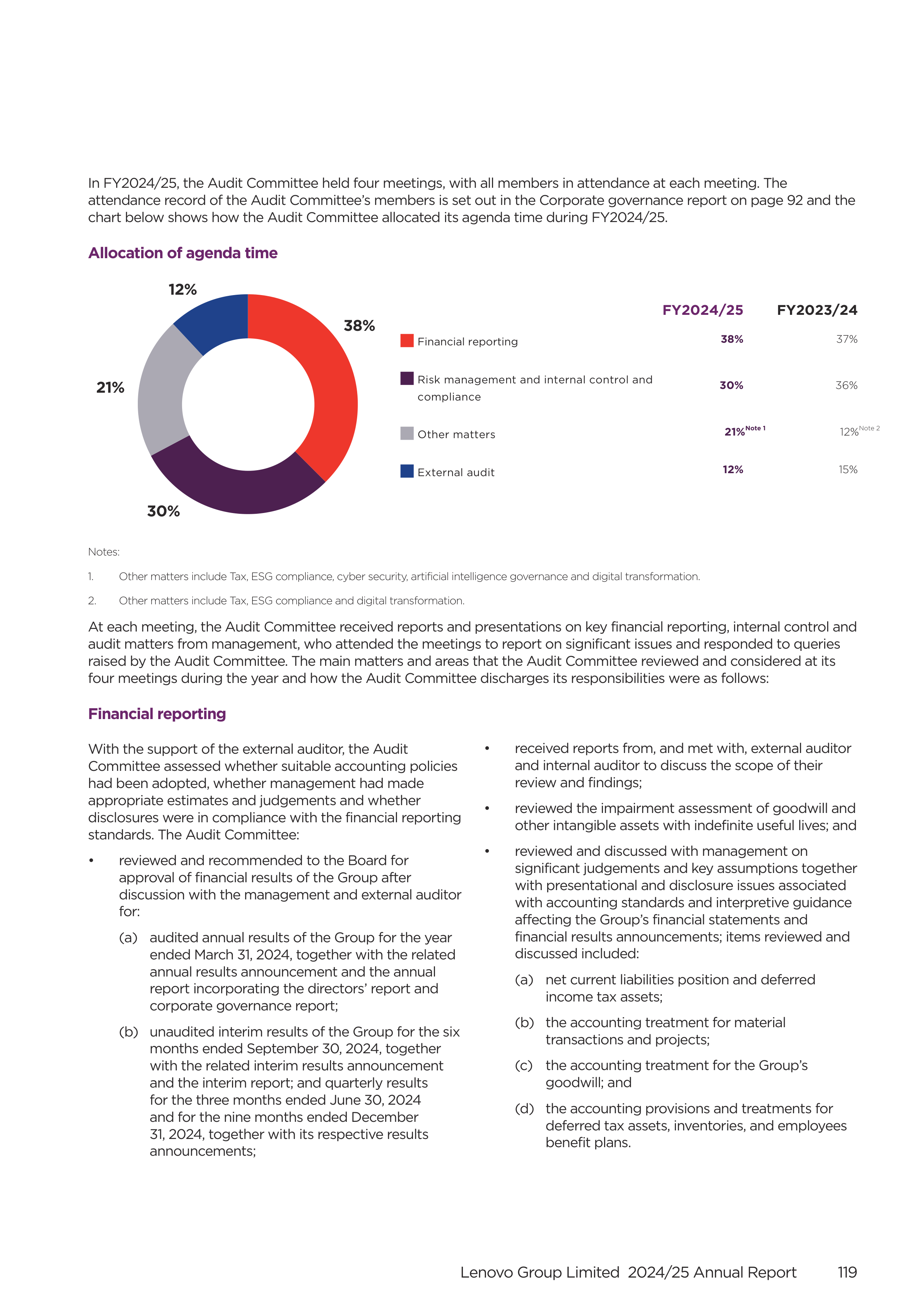
Lenovo Group Limited 2024/25 Annual Report
119
In FY2024/25, the Audit Committee held four meetings, with all members in attendance at each meeting. The
attendance record of the Audit Committee’s members is set out in the Corporate governance report on page 92 and the
chart below shows how the Audit Committee allocated its agenda time during FY2024/25.
Allocation of agenda time
FY2024/25
FY2023/24
Financial reporting
38%
37%
Risk management and internal control and
compliance
30%
36%
Other matters
21%
Note 1
12%
Note 2
External audit
12%
15%
12%
21%
38%
30%
At each meeting, the Audit Committee received reports and presentations on key financial reporting, internal control and
audit matters from management, who attended the meetings to report on significant issues and responded to queries
raised by the Audit Committee. The main matters and areas that the Audit Committee reviewed and considered at its
four meetings during the year and how the Audit Committee discharges its responsibilities were as follows:
Financial reporting
With the support of the external auditor, the Audit
Committee assessed whether suitable accounting policies
had been adopted, whether management had made
appropriate estimates and judgements and whether
disclosures were in compliance with the financial reporting
standards. The Audit Committee:
•
reviewed and recommended to the Board for
approval of financial results of the Group after
discussion with the management and external auditor
for:
(a)
audited annual results of the Group for the year
ended March 31, 2024, together with the related
annual results announcement and the annual
report incorporating the directors’ report and
corporate governance report;
(b)
unaudited interim results of the Group for the six
months ended September 30, 2024, together
with the related interim results announcement
and the interim report; and quarterly results
for the three months ended June 30, 2024
and for the nine months ended December
31, 2024, together with its respective results
announcements;
•
received reports from, and met with, external auditor
and internal auditor to discuss the scope of their
review and findings;
•
reviewed the impairment assessment of goodwill and
other intangible assets with indefinite useful lives; and
•
reviewed and discussed with management on
significant judgements and key assumptions together
with presentational and disclosure issues associated
with accounting standards and interpretive guidance
affecting the Group’s financial statements and
financial results announcements; items reviewed and
discussed included:
(a)
net current liabilities position and deferred
income tax assets;
(b)
the accounting treatment for material
transactions and projects;
(c)
the accounting treatment for the Group’s
goodwill; and
(d)
the accounting provisions and treatments for
deferred tax assets, inventories, and employees
benefit plans.
Notes:
1.
Other matters include Tax, ESG compliance, cyber security, artificial intelligence governance and digital transformation.
2.
Other matters include Tax, ESG compliance and digital transformation.
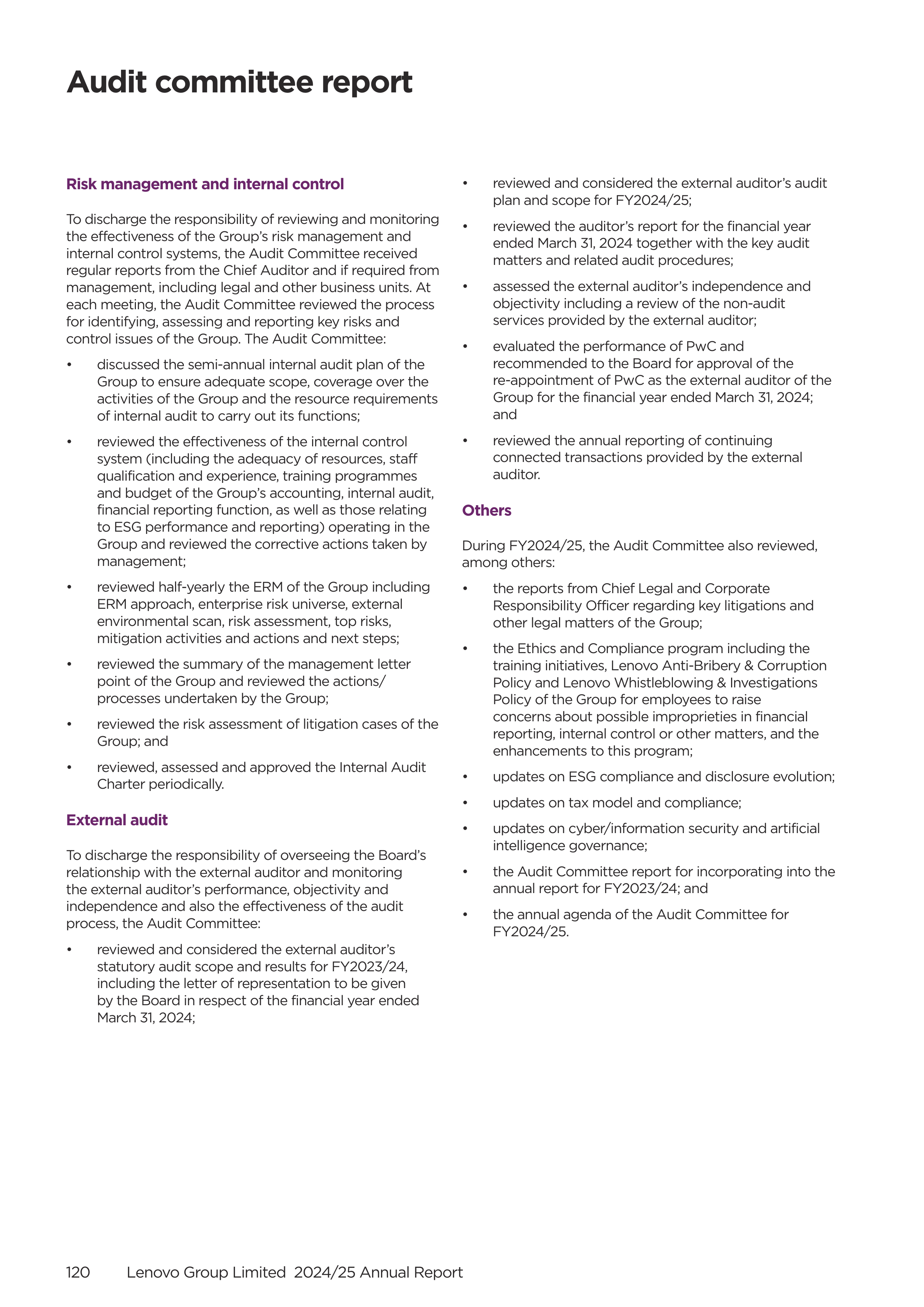
Lenovo Group Limited 2024/25 Annual Report
120
Audit committee report
•
reviewed and considered the external auditor’s audit
plan and scope for FY2024/25;
•
reviewed the auditor’s report for the financial year
ended March 31, 2024 together with the key audit
matters and related audit procedures;
•
assessed the external auditor’s independence and
objectivity including a review of the non-audit
services provided by the external auditor;
•
evaluated the performance of PwC and
recommended to the Board for approval of the
re-appointment of PwC as the external auditor of the
Group for the financial year ended March 31, 2024;
and
•
reviewed the annual reporting of continuing
connected transactions provided by the external
auditor.
Others
During FY2024/25, the Audit Committee also reviewed,
among others:
•
the reports from Chief Legal and Corporate
Responsibility Officer regarding key litigations and
other legal matters of the Group;
•
the Ethics and Compliance program including the
training initiatives, Lenovo Anti-Bribery & Corruption
Policy and Lenovo Whistleblowing & Investigations
Policy of the Group for employees to raise
concerns about possible improprieties in financial
reporting, internal control or other matters, and the
enhancements to this program;
•
updates on ESG compliance and disclosure evolution;
•
updates on tax model and compliance;
•
updates on cyber/information security and artificial
intelligence governance;
•
the Audit Committee report for incorporating into the
annual report for FY2023/24; and
•
the annual agenda of the Audit Committee for
FY2024/25.
Risk management and internal control
To discharge the responsibility of reviewing and monitoring
the effectiveness of the Group’s risk management and
internal control systems, the Audit Committee received
regular reports from the Chief Auditor and if required from
management, including legal and other business units. At
each meeting, the Audit Committee reviewed the process
for identifying, assessing and reporting key risks and
control issues of the Group. The Audit Committee:
•
discussed the semi-annual internal audit plan of the
Group to ensure adequate scope, coverage over the
activities of the Group and the resource requirements
of internal audit to carry out its functions;
•
reviewed the effectiveness of the internal control
system (including the adequacy of resources, staff
qualification and experience, training programmes
and budget of the Group’s accounting, internal audit,
financial reporting function, as well as those relating
to ESG performance and reporting) operating in the
Group and reviewed the corrective actions taken by
management;
•
reviewed half-yearly the ERM of the Group including
ERM approach, enterprise risk universe, external
environmental scan, risk assessment, top risks,
mitigation activities and actions and next steps;
•
reviewed the summary of the management letter
point of the Group and reviewed the actions/
processes undertaken by the Group;
•
reviewed the risk assessment of litigation cases of the
Group; and
•
reviewed, assessed and approved the Internal Audit
Charter periodically.
External audit
To discharge the responsibility of overseeing the Board’s
relationship with the external auditor and monitoring
the external auditor’s performance, objectivity and
independence and also the effectiveness of the audit
process, the Audit Committee:
•
reviewed and considered the external auditor’s
statutory audit scope and results for FY2023/24,
including the letter of representation to be given
by the Board in respect of the financial year ended
March 31, 2024;
Lenovo Group Limited 2024/25 Annual Report
121
Recommendation for
re-appointment of the external
auditor
The Audit Committee recognizes the importance
of maintaining the independence of the external
auditor. Consistent with its terms of reference, the
Audit Committee has evaluated PwC’s qualifications,
performance, and independence, including that of the
lead audit partner. The Company has established a
policy pursuant to which certain types of non-assurance
services have been pre-concurred in the policy and
separate concurrence by the Audit Committee is
required if the proposed services have not been pre-
concurred or the value of such non-assurance services is
above US$320,000. This policy is more fully described
in the corporate governance report on page 102. The
Audit Committee has concluded that provision of the
non-assurance services described in that section was
compatible with maintaining the independence of PwC.
In addition, PwC has provided the Audit Committee an
independence statement confirming that for FY2024/25
and thereafter to the date of this annual report, they
are independent of the Group in accordance with the
independence requirements of the Hong Kong Institute of
Certified Public Accountants.
Based on the review and discussions referred to above,
the Audit Committee was satisfied with the external
auditor’s work, its independence and objectivity, and
therefore recommended to the Board the re-appointment
of PwC as the Group’s external auditor for the financial
year ending March 31, 2026 for shareholders’ approval at
the forthcoming annual general meeting to be held on
July 17, 2025.
Priorities for FY2025/26
Looking ahead, the priorities of the Audit Committee for
the FY2025/26 are:
•
To stay focused on high standard financial
accounting and reporting, audit quality, effective risk
management and internal control;
•
To stay updated on the developments and impacts of
data security, product security, cybersecurity, artificial
intelligence and regulatory compliance; and
•
To remain vigilant on the impacts of the business
conditions on the Group under ongoing geopolitical
and macroeconomic impacts.
Review of FY2024/25 financial
results
At the meeting held on May 21, 2025, the Audit
Committee:
•
reviewed the key accounting judgements and policies
adopted by the Group and confirmed that these
are appropriate. The significant areas of judgement
identified by the Audit Committee, in conjunction
with management and the external auditor, together
with a number of other areas that the Audit
Committee deemed to be significant in the context of
the consolidated financial statements of the Group for
FY2024/25 are set out in the Independent Auditor’s
Report on pages 166 to 170;
•
after discussion with management and the external
auditor, and having considered the Group’s financial
position, the Audit Committee was satisfied that the
Group and the Company had adequate resources to
continue in operational existence for the foreseeable
future and confirmed to the Board that it was
appropriate for the consolidated financial statements
of the Group for FY2024/25 to be prepared on a
going concern basis; and
•
reviewed the consolidated financial statements of
the Group for FY2024/25 in conjunction with the
narrative sections of this annual report. The Audit
Committee was satisfied that, taken as a whole,
this annual report presented a balanced, clear
and comprehensible assessment of the Group’s
performance, position and prospects.
Based on the reviews and discussions referred to above,
the Audit Committee recommended to the Board the
approval of the audited consolidated financial statements
of the Group for FY2024/25 together with the related
annual results announcement and this annual report
incorporating the directors’ report and corporate
governance report.
Review of risk management and
internal control systems
The Group’s internal control system covers every activity
and transaction. Within this framework, management
performs periodic enterprise wide risk assessments and
continuously monitors and reports the progress of action
plans to address the key risks. Further information about
the risk management and internal control framework and
control processes are set out in the corporate governance
report on pages 96 to 101.
Based on the information and confirmation received from
management, external auditor and internal auditor, the
Audit Committee concluded that for FY2024/25, the
Group’s risk management and internal control systems
were adequate and effective. The Audit Committee also
confirmed that the Group had, in FY2024/25, satisfactorily
complied with the code provisions on risk management
and internal control as set forth in the Corporate
Governance Code in Appendix C1 to the Listing Rules.
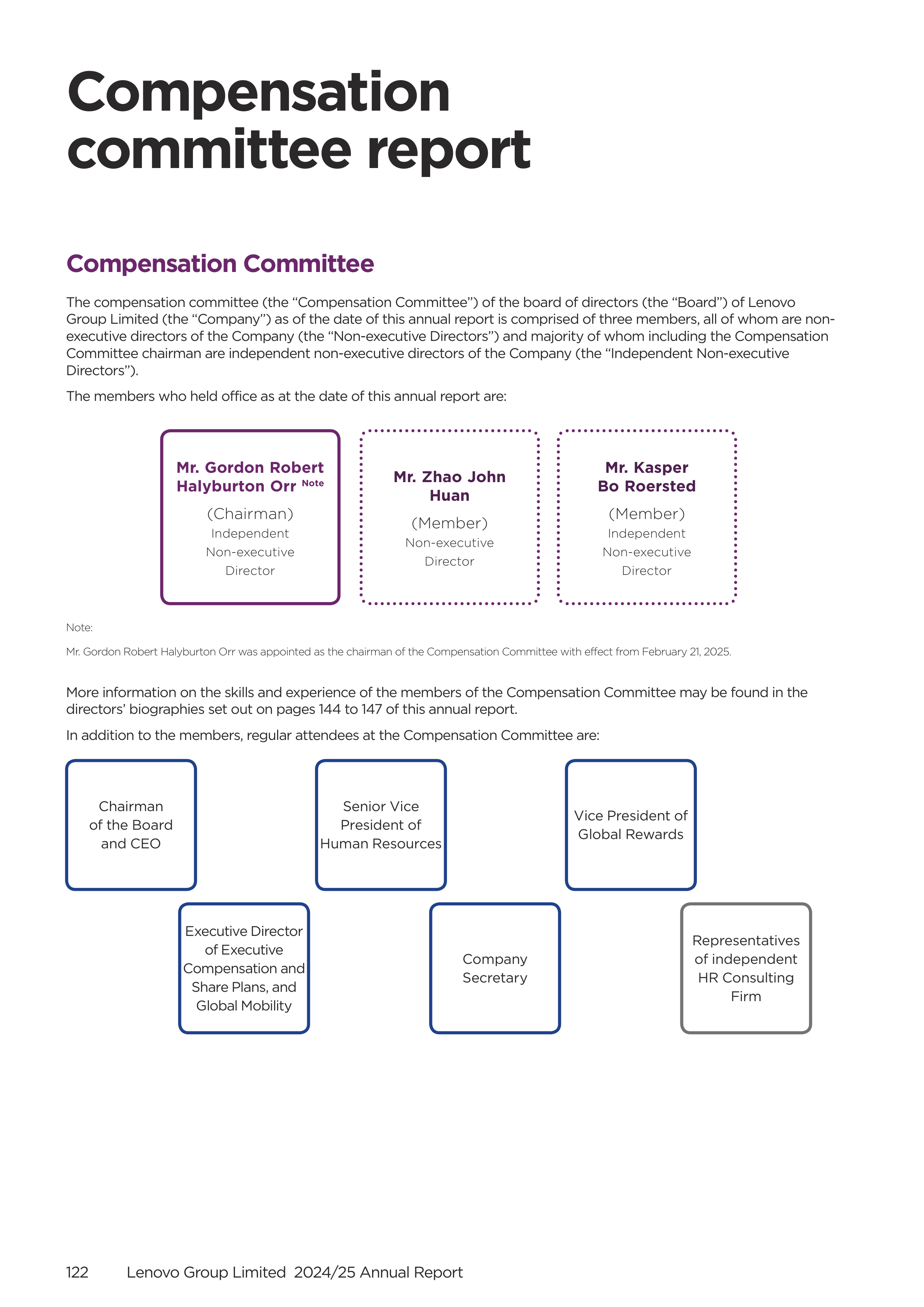
Lenovo Group Limited 2024/25 Annual Report
122
Compensation
committee report
Compensation Committee
The compensation committee (the “Compensation Committee”) of the board of directors (the “Board”) of Lenovo
Group Limited (the “Company”) as of the date of this annual report is comprised of three members, all of whom are non-
executive directors of the Company (the “Non-executive Directors”) and majority of whom including the Compensation
Committee chairman are independent non-executive directors of the Company (the “Independent Non-executive
Directors”).
The members who held office as at the date of this annual report are:
More information on the skills and experience of the members of the Compensation Committee may be found in the
directors’ biographies set out on pages 144 to 147 of this annual report.
In addition to the members, regular attendees at the Compensation Committee are:
Mr. Gordon Robert
Halyburton Orr
Note
(Chairman)
Independent
Non-executive
Director
Mr. Kasper
Bo Roersted
(Member)
Independent
Non-executive
Director
Mr. Zhao John
Huan
(Member)
Non-executive
Director
Chairman
of the Board
and CEO
Vice President of
Global Rewards
Company
Secretary
Senior Vice
President of
Human Resources
Executive Director
of Executive
Compensation and
Share Plans, and
Global Mobility
Representatives
of independent
HR Consulting
Firm
Note
:
Mr. Gordon Robert Halyburton Orr was appointed as the chairman of the Compensation Committee with effect from February 21, 2025.
Lenovo Group Limited 2024/25 Annual Report
123
Responsibilities
The Compensation Committee is delegated by the Board with the following responsibilities:
•
establish a formal and transparent procedure for developing compensation policy for all Directors and senior
management;
•
approve the amount and forms of compensation to be provided to all Directors and senior management;
•
review and assess the performance of Chairman of the Board and Chief Executive Officer;
•
review the incentive compensation arrangements to determine whether they encourage excessive risk-taking,
and evaluate compensation policies and practices that could mitigate any such risk, and also encourage pay for
performance;
•
evaluate the need for, and provisions of severance arrangements for our senior management;
•
review and approve matters relating to the share schemes; and
•
review the recommendation from independent professional adviser on the compensation of Non-executive
Directors.
Key Features
The Compensation Committee’s terms of reference which clearly deal with its membership, authority, duties and
frequency of meetings are published on the websites of the Company and its subsidiaries (collectively, the “Group”)
and Hong Kong Exchanges and Clearing Limited.
The Compensation Committee meets with management and external independent professional adviser on a timely
basis and is provided with sufficient resources to perform its duties.
The Compensation Committee is authorised to obtain outside independent professional advice in performing its
duties at the Company’s expense.
The Compensation Committee shall ensure that no director is involved in deciding his or her own individual
compensation.
Separate executive sessions were arranged for the Compensation Committee to meet with its independent
consultant in the absence of executive director and management to discuss matters relating to any issues and any
other matters such persons would like to raise.
The chairman will report back to the Board after each of the Compensation Committee meeting regarding decisions
or recommendations.
Summary of work in FY2024/25
In the financial year ended March 31, 2025 (“FY2024/25”), the Compensation Committee held four meetings. The
attendance record of the Compensation Committee’s members is set out in the Corporate governance report on page 92.
The main matters and areas that the Compensation Committee reviewed and considered at its four meetings during the
year were as follows:
Review of company and market information
•
reviewed the overall compensation strategy;
•
reviewed and approved the peer group used for compensation benchmarking for the CEO, senior management,
and Non-executive Directors;
•
reviewed the market positioning of CEO and senior management compensation including pay levels and mix;
•
reviewed the compensation trends, remuneration practices and regulatory developments in the technology
industry;
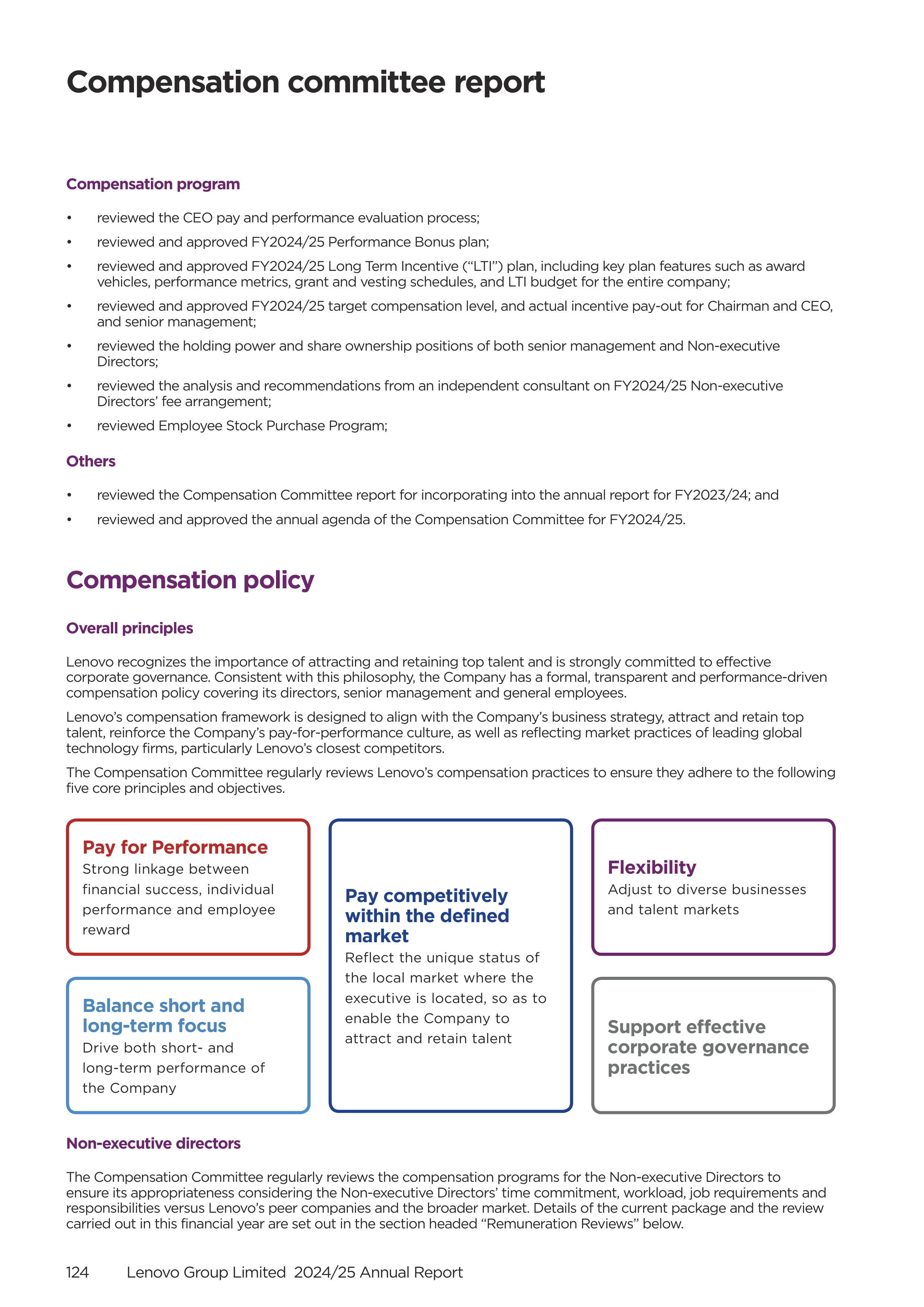
Lenovo Group Limited 2024/25 Annual Report
124
Compensation committee report
Compensation program
•
reviewed the CEO pay and performance evaluation process;
•
reviewed and approved FY2024/25 Performance Bonus plan;
•
reviewed and approved FY2024/25 Long Term Incentive (“LTI”) plan, including key plan features such as award
vehicles, performance metrics, grant and vesting schedules, and LTI budget for the entire company;
•
reviewed and approved FY2024/25 target compensation level, and actual incentive pay-out for Chairman and CEO,
and senior management;
•
reviewed the holding power and share ownership positions of both senior management and Non-executive
Directors;
•
reviewed the analysis and recommendations from an independent consultant on FY2024/25 Non-executive
Directors’ fee arrangement;
•
reviewed Employee Stock Purchase Program;
Others
•
reviewed the Compensation Committee report for incorporating into the annual report for FY2023/24; and
•
reviewed and approved the annual agenda of the Compensation Committee for FY2024/25.
Compensation policy
Overall principles
Lenovo recognizes the importance of attracting and retaining top talent and is strongly committed to effective
corporate governance. Consistent with this philosophy, the Company has a formal, transparent and performance-driven
compensation policy covering its directors, senior management and general employees.
Lenovo’s compensation framework is designed to align with the Company’s business strategy, attract and retain top
talent, reinforce the Company’s pay-for-performance culture, as well as reflecting market practices of leading global
technology firms, particularly Lenovo’s closest competitors.
The Compensation Committee regularly reviews Lenovo’s compensation practices to ensure they adhere to the following
five core principles and objectives.
Non-executive directors
The Compensation Committee regularly reviews the compensation programs for the Non-executive Directors to
ensure its appropriateness considering the Non-executive Directors’ time commitment, workload, job requirements and
responsibilities versus Lenovo’s peer companies and the broader market. Details of the current package and the review
carried out in this financial year are set out in the section headed “Remuneration Reviews” below.
Pay for Performance
Strong linkage between
financial success, individual
performance and employee
reward
Flexibility
Adjust to diverse businesses
and talent markets
Pay competitively
within the defined
market
Reflect the unique status of
the local market where the
executive is located, so as to
enable the Company to
attract and retain talent
Balance short and
long-term focus
Drive both short- and
long-term performance of
the Company
Support effective
corporate governance
practices
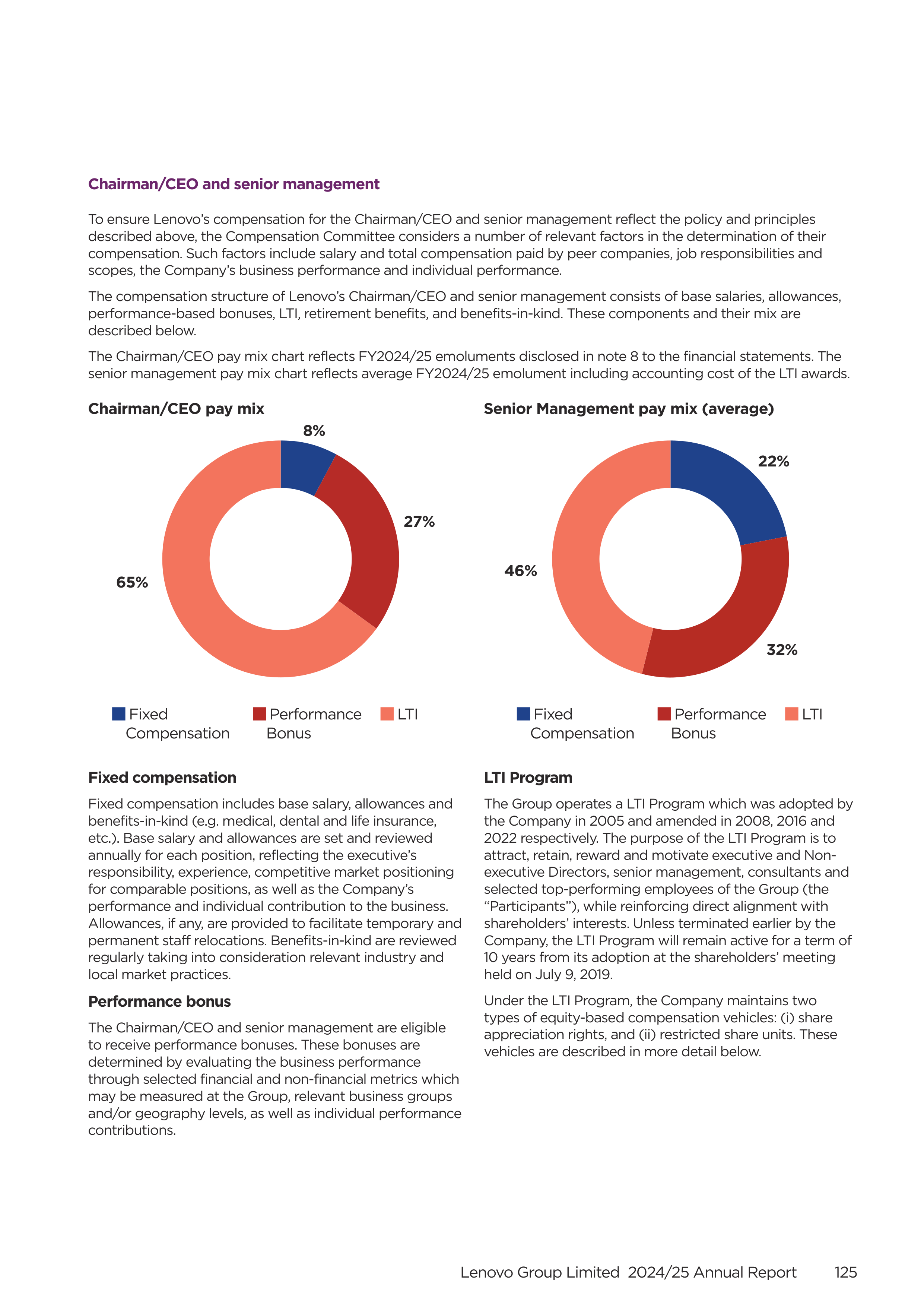
Lenovo Group Limited 2024/25 Annual Report
125
LTI Program
The Group operates a LTI Program which was adopted by
the Company in 2005 and amended in 2008, 2016 and
2022 respectively. The purpose of the LTI Program is to
attract, retain, reward and motivate executive and Non-
executive Directors, senior management, consultants and
selected top-performing employees of the Group (the
“Participants”), while reinforcing direct alignment with
shareholders’ interests. Unless terminated earlier by the
Company, the LTI Program will remain active for a term of
10 years from its adoption at the shareholders’ meeting
held on July 9, 2019.
Under the LTI Program, the Company maintains two
types of equity-based compensation vehicles: (i) share
appreciation rights, and (ii) restricted share units. These
vehicles are described in more detail below.
Fixed compensation
Fixed compensation includes base salary, allowances and
benefits-in-kind (e.g. medical, dental and life insurance,
etc.). Base salary and allowances are set and reviewed
annually for each position, reflecting the executive’s
responsibility, experience, competitive market positioning
for comparable positions, as well as the Company’s
performance and individual contribution to the business.
Allowances, if any, are provided to facilitate temporary and
permanent staff relocations. Benefits-in-kind are reviewed
regularly taking into consideration relevant industry and
local market practices.
Performance bonus
The Chairman/CEO and senior management are eligible
to receive performance bonuses. These bonuses are
determined by evaluating the business performance
through selected financial and non-financial metrics which
may be measured at the Group, relevant business groups
and/or geography levels, as well as individual performance
contributions.
Chairman/CEO and senior management
To ensure Lenovo’s compensation for the Chairman/CEO and senior management reflect the policy and principles
described above, the Compensation Committee considers a number of relevant factors in the determination of their
compensation. Such factors include salary and total compensation paid by peer companies, job responsibilities and
scopes, the Company’s business performance and individual performance.
The compensation structure of Lenovo’s Chairman/CEO and senior management consists of base salaries, allowances,
performance-based bonuses, LTI, retirement benefits, and benefits-in-kind. These components and their mix are
described below.
The Chairman/CEO pay mix chart reflects FY2024/25 emoluments disclosed in note 8 to the financial statements. The
senior management pay mix chart reflects average FY2024/25 emolument including accounting cost of the LTI awards.
Chairman/CEO pay mix
Senior Management pay mix (average)
Fixed
Compensation
Performance
Bonus
LTI
Fixed
Compensation
Performance
Bonus
LTI
32%
27%
8%
22%
46%
65%
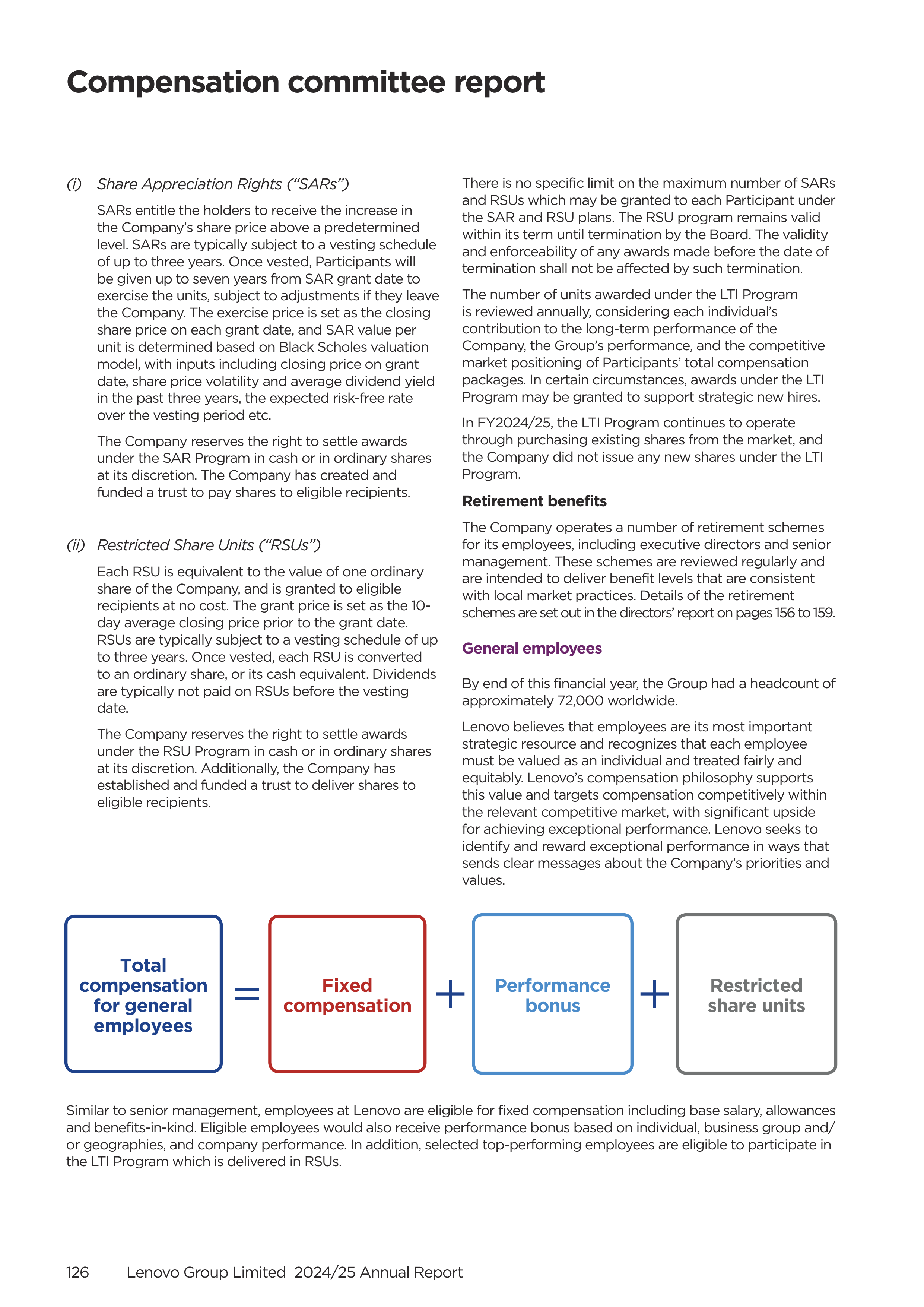
Lenovo Group Limited 2024/25 Annual Report
126
Compensation committee report
There is no specific limit on the maximum number of SARs
and RSUs which may be granted to each Participant under
the SAR and RSU plans. The RSU program remains valid
within its term until termination by the Board. The validity
and enforceability of any awards made before the date of
termination shall not be affected by such termination.
The number of units awarded under the LTI Program
is reviewed annually, considering each individual’s
contribution to the long-term performance of the
Company, the Group’s performance, and the competitive
market positioning of Participants’ total compensation
packages. In certain circumstances, awards under the LTI
Program may be granted to support strategic new hires.
In FY2024/25, the LTI Program continues to operate
through purchasing existing shares from the market, and
the Company did not issue any new shares under the LTI
Program.
Retirement benefits
The Company operates a number of retirement schemes
for its employees, including executive directors and senior
management. These schemes are reviewed regularly and
are intended to deliver benefit levels that are consistent
with local market practices. Details of the retirement
schemes are set out in the directors’ report on pages 156 to 159.
General employees
By end of this financial year, the Group had a headcount of
approximately 72,000 worldwide.
Lenovo believes that employees are its most important
strategic resource and recognizes that each employee
must be valued as an individual and treated fairly and
equitably. Lenovo’s compensation philosophy supports
this value and targets compensation competitively within
the relevant competitive market, with significant upside
for achieving exceptional performance. Lenovo seeks to
identify and reward exceptional performance in ways that
sends clear messages about the Company’s priorities and
values.
(i)
Share Appreciation Rights (“SARs”)
SARs entitle the holders to receive the increase in
the Company’s share price above a predetermined
level. SARs are typically subject to a vesting schedule
of up to three years. Once vested, Participants will
be given up to seven years from SAR grant date to
exercise the units, subject to adjustments if they leave
the Company. The exercise price is set as the closing
share price on each grant date, and SAR value per
unit is determined based on Black Scholes valuation
model, with inputs including closing price on grant
date, share price volatility and average dividend yield
in the past three years, the expected risk-free rate
over the vesting period etc.
The Company reserves the right to settle awards
under the SAR Program in cash or in ordinary shares
at its discretion. The Company has created and
funded a trust to pay shares to eligible recipients.
(ii)
Restricted Share Units (“RSUs”)
Each RSU is equivalent to the value of one ordinary
share of the Company, and is granted to eligible
recipients at no cost. The grant price is set as the 10-
day average closing price prior to the grant date.
RSUs are typically subject to a vesting schedule of up
to three years. Once vested, each RSU is converted
to an ordinary share, or its cash equivalent. Dividends
are typically not paid on RSUs before the vesting
date.
The Company reserves the right to settle awards
under the RSU Program in cash or in ordinary shares
at its discretion. Additionally, the Company has
established and funded a trust to deliver shares to
eligible recipients.
Similar to senior management, employees at Lenovo are eligible for fixed compensation including base salary, allowances
and benefits-in-kind. Eligible employees would also receive performance bonus based on individual, business group and/
or geographies, and company performance. In addition, selected top-performing employees are eligible to participate in
the LTI Program which is delivered in RSUs.
Total
compensation
for general
employees
Fixed
compensation
Performance
bonus
Restricted
share units
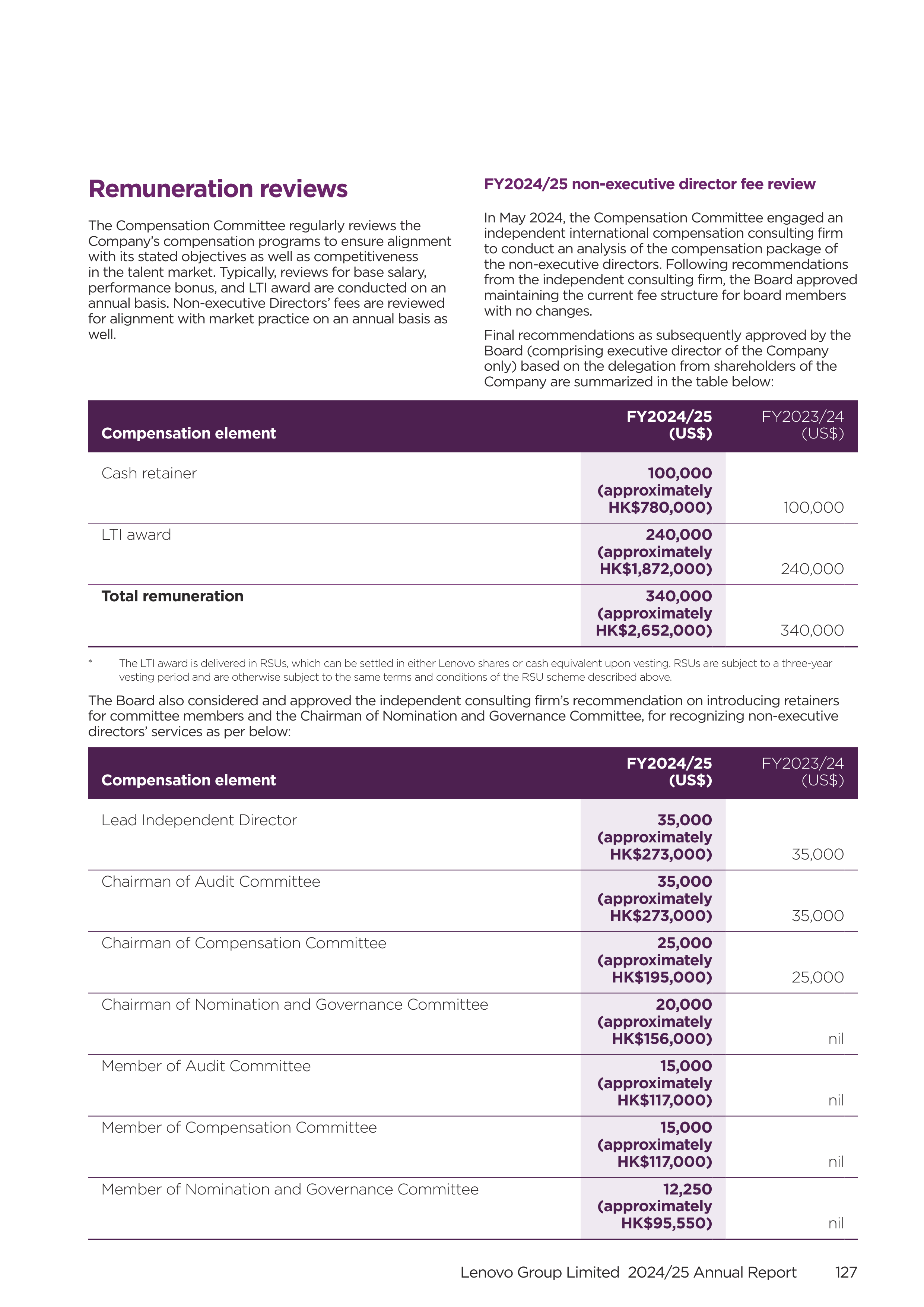
Lenovo Group Limited 2024/25 Annual Report
127
FY2024/25 non-executive director fee review
In May 2024, the Compensation Committee engaged an
independent international compensation consulting firm
to conduct an analysis of the compensation package of
the non-executive directors. Following recommendations
from the independent consulting firm, the Board approved
maintaining the current fee structure for board members
with no changes.
Final recommendations as subsequently approved by the
Board (comprising executive director of the Company
only) based on the delegation from shareholders of the
Company are summarized in the table below:
Remuneration reviews
The Compensation Committee regularly reviews the
Company’s compensation programs to ensure alignment
with its stated objectives as well as competitiveness
in the talent market. Typically, reviews for base salary,
performance bonus, and LTI award are conducted on an
annual basis. Non-executive Directors’ fees are reviewed
for alignment with market practice on an annual basis as
well.
Compensation element
FY2024/25
(US$)
FY2023/24
(US$)
Cash retainer
100,000
(approximately
HK$780,000)
100,000
LTI award
240,000
(approximately
HK$1,872,000)
240,000
Total remuneration
340,000
(approximately
HK$2,652,000)
340,000
*
The LTI award is delivered in RSUs, which can be settled in either Lenovo shares or cash equivalent upon vesting. RSUs are subject to a three-year
vesting period and are otherwise subject to the same terms and conditions of the RSU scheme described above.
The Board also considered and approved the independent consulting firm’s recommendation on introducing retainers
for committee members and the Chairman of Nomination and Governance Committee, for recognizing non-executive
directors’ services as per below:
Compensation element
FY2024/25
(US$)
FY2023/24
(US$)
Lead Independent Director
35,000
(approximately
HK$273,000)
35,000
Chairman of Audit Committee
35,000
(approximately
HK$273,000)
35,000
Chairman of Compensation Committee
25,000
(approximately
HK$195,000)
25,000
Chairman of Nomination and Governance Committee
20,000
(approximately
HK$156,000)
nil
Member of Audit Committee
15,000
(approximately
HK$117,000)
nil
Member of Compensation Committee
15,000
(approximately
HK$117,000)
nil
Member of Nomination and Governance Committee
12,250
(approximately
HK$95,550)
nil
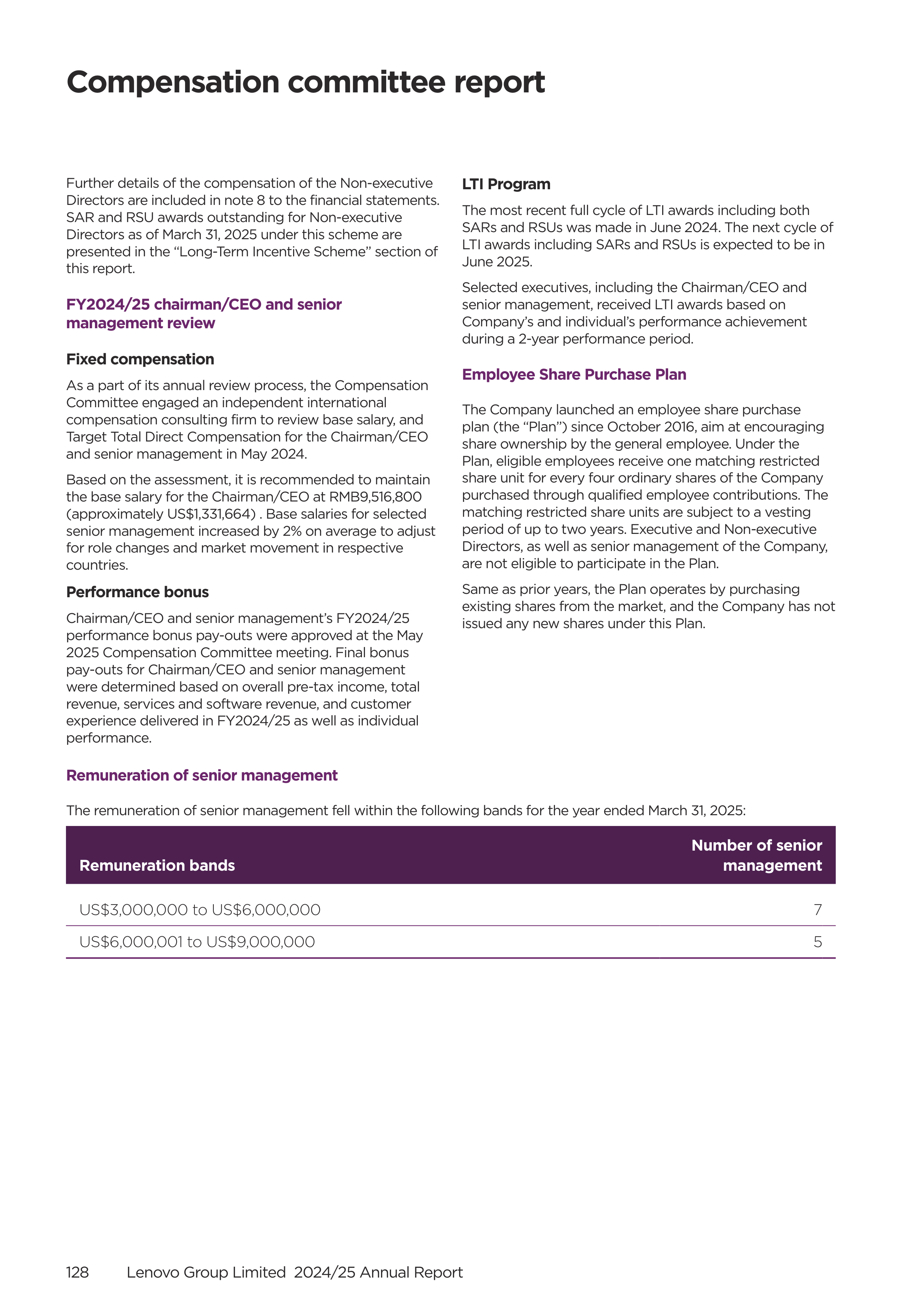
Lenovo Group Limited 2024/25 Annual Report
128
Compensation committee report
LTI Program
The most recent full cycle of LTI awards including both
SARs and RSUs was made in June 2024. The next cycle of
LTI awards including SARs and RSUs is expected to be in
June 2025.
Selected executives, including the Chairman/CEO and
senior management, received LTI awards based on
Company’s and individual’s performance achievement
during a 2-year performance period.
Employee Share Purchase Plan
The Company launched an employee share purchase
plan (the “Plan”) since October 2016, aim at encouraging
share ownership by the general employee. Under the
Plan, eligible employees receive one matching restricted
share unit for every four ordinary shares of the Company
purchased through qualified employee contributions. The
matching restricted share units are subject to a vesting
period of up to two years. Executive and Non-executive
Directors, as well as senior management of the Company,
are not eligible to participate in the Plan.
Same as prior years, the Plan operates by purchasing
existing shares from the market, and the Company has not
issued any new shares under this Plan.
Further details of the compensation of the Non-executive
Directors are included in note 8 to the financial statements.
SAR and RSU awards outstanding for Non-executive
Directors as of March 31, 2025 under this scheme are
presented in the “Long-Term Incentive Scheme” section of
this report.
FY2024/25 chairman/CEO and senior
management review
Fixed compensation
As a part of its annual review process, the Compensation
Committee engaged an independent international
compensation consulting firm to review base salary, and
Target Total Direct Compensation for the Chairman/CEO
and senior management in May 2024.
Based on the assessment, it is recommended to maintain
the base salary for the Chairman/CEO at RMB9,516,800
(approximately US$1,331,664) . Base salaries for selected
senior management increased by 2% on average to adjust
for role changes and market movement in respective
countries.
Performance bonus
Chairman/CEO and senior management’s FY2024/25
performance bonus pay-outs were approved at the May
2025 Compensation Committee meeting. Final bonus
pay-outs for Chairman/CEO and senior management
were determined based on overall pre-tax income, total
revenue, services and software revenue, and customer
experience delivered in FY2024/25 as well as individual
performance.
Remuneration of senior management
The remuneration of senior management fell within the following bands for the year ended March 31, 2025:
Remuneration bands
Number of senior
management
US$3,000,000 to US$6,000,000
7
US$6,000,001 to US$9,000,000
5
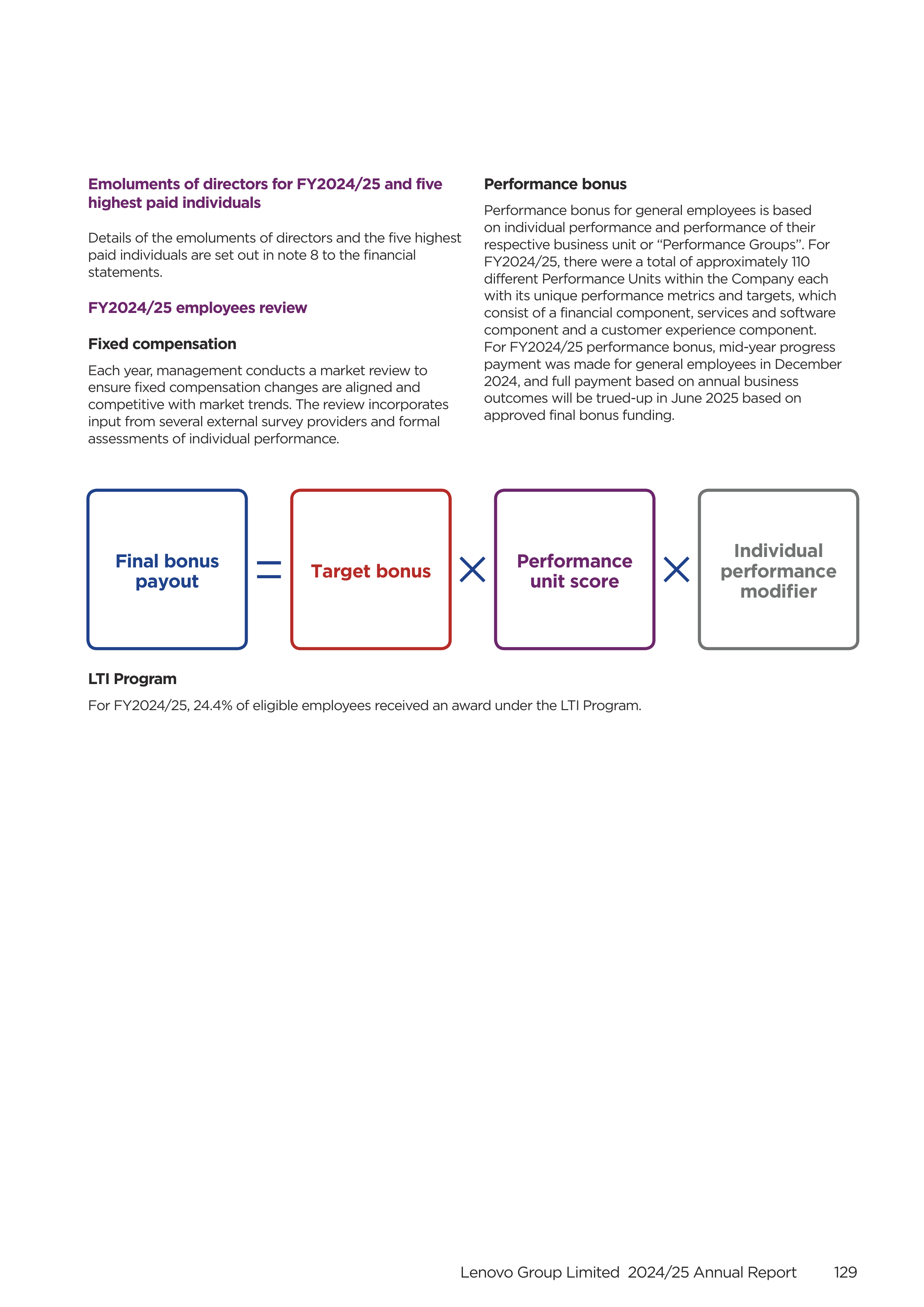
Lenovo Group Limited 2024/25 Annual Report
129
Emoluments of directors for FY2024/25 and five
highest paid individuals
Details of the emoluments of directors and the five highest
paid individuals are set out in note 8 to the financial
statements.
FY2024/25 employees review
Fixed compensation
Each year, management conducts a market review to
ensure fixed compensation changes are aligned and
competitive with market trends. The review incorporates
input from several external survey providers and formal
assessments of individual performance.
LTI Program
For FY2024/25, 24.4% of eligible employees received an award under the LTI Program.
Final bonus
payout
Target bonus
Performance
unit score
Individual
performance
modifier
Performance bonus
Performance bonus for general employees is based
on individual performance and performance of their
respective business unit or “Performance Groups”. For
FY2024/25, there were a total of approximately 110
different Performance Units within the Company each
with its unique performance metrics and targets, which
consist of a financial component, services and software
component and a customer experience component.
For FY2024/25 performance bonus, mid-year progress
payment was made for general employees in December
2024, and full payment based on annual business
outcomes will be trued-up in June 2025 based on
approved final bonus funding.
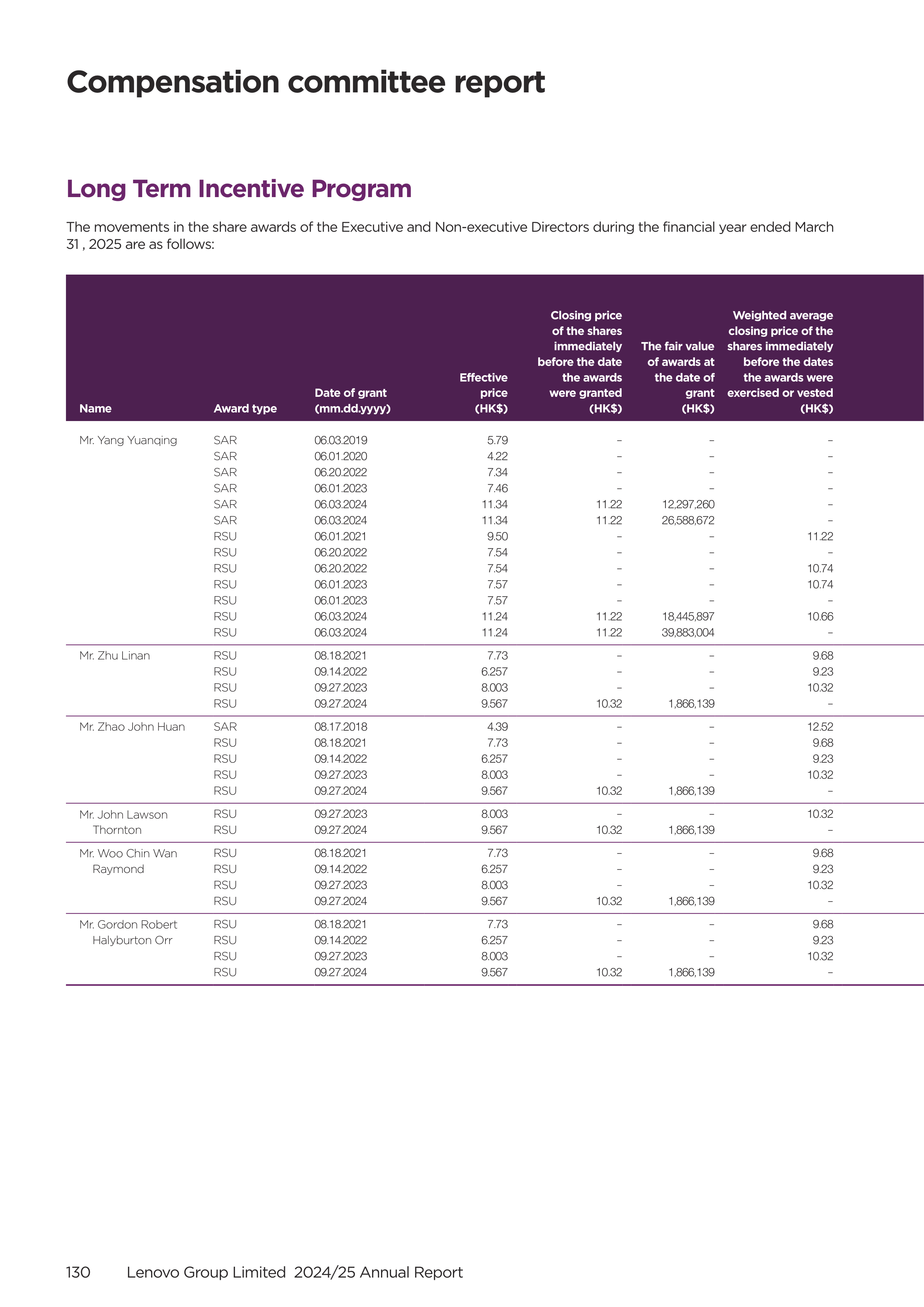
Lenovo Group Limited 2024/25 Annual Report
130
Compensation committee report
Long Term Incentive Program
The movements in the share awards of the Executive and Non-executive Directors during the financial year ended March
31 , 2025 are as follows:
Name
Award type
Date of grant
(mm.dd.yyyy)
Effective
price
(HK$)
Closing price
of the shares
immediately
before the date
the awards
were granted
(HK$)
The fair value
of awards at
the date of
grant
(HK$)
Weighted average
closing price of the
shares immediately
before the dates
the awards were
exercised or vested
(HK$)
Mr. Yang Yuanqing
SAR
06
.
03
.
2019
5
.
79
–
–
–
SAR
06
.
01
.
2020
4
.
22
–
–
–
SAR
06
.
20
.
2022
7
.
34
–
–
–
SAR
06
.
01
.
2023
7
.
46
–
–
–
SAR
06
.
03
.
2024
11
.
34
11
.
22
12
,
297
,
260
–
SAR
06
.
03
.
2024
11
.
34
11
.
22
26
,
588
,
672
–
RSU
06
.
01
.
2021
9
.
50
–
–
11
.
22
RSU
06
.
20
.
2022
7
.
54
–
–
–
RSU
06
.
20
.
2022
7
.
54
–
–
10
.
74
RSU
06
.
01
.
2023
7
.
57
–
–
10
.
74
RSU
06
.
01
.
2023
7
.
57
–
–
–
RSU
06
.
03
.
2024
11
.
24
11
.
22
18
,
445
,
897
10
.
66
RSU
06
.
03
.
2024
11
.
24
11
.
22
39
,
883
,
004
–
Mr. Zhu Linan
RSU
08
.
18
.
2021
7
.
73
–
–
9
.
68
RSU
09
.
14
.
2022
6
.
257
–
–
9
.
23
RSU
09
.
27
.
2023
8
.
003
–
–
10
.
32
RSU
09
.
27
.
2024
9
.
567
10
.
32
1
,
866
,
139
–
Mr. Zhao John Huan
SAR
08
.
17
.
2018
4
.
39
–
–
12
.
52
RSU
08
.
18
.
2021
7
.
73
–
–
9
.
68
RSU
09
.
14
.
2022
6
.
257
–
–
9
.
23
RSU
09
.
27
.
2023
8
.
003
–
–
10
.
32
RSU
09
.
27
.
2024
9
.
567
10
.
32
1
,
866
,
139
–
Mr. John Lawson
Thornton
RSU
09
.
27
.
2023
8
.
003
–
–
10
.
32
RSU
09
.
27
.
2024
9
.
567
10
.
32
1
,
866
,
139
–
Mr. Woo Chin Wan
Raymond
RSU
08
.
18
.
2021
7
.
73
–
–
9
.
68
RSU
09
.
14
.
2022
6
.
257
–
–
9
.
23
RSU
09
.
27
.
2023
8
.
003
–
–
10
.
32
RSU
09
.
27
.
2024
9
.
567
10
.
32
1
,
866
,
139
–
Mr. Gordon Robert
Halyburton Orr
RSU
08
.
18
.
2021
7
.
73
–
–
9
.
68
RSU
09
.
14
.
2022
6
.
257
–
–
9
.
23
RSU
09
.
27
.
2023
8
.
003
–
–
10
.
32
RSU
09
.
27
.
2024
9
.
567
10
.
32
1
,
866
,
139
–
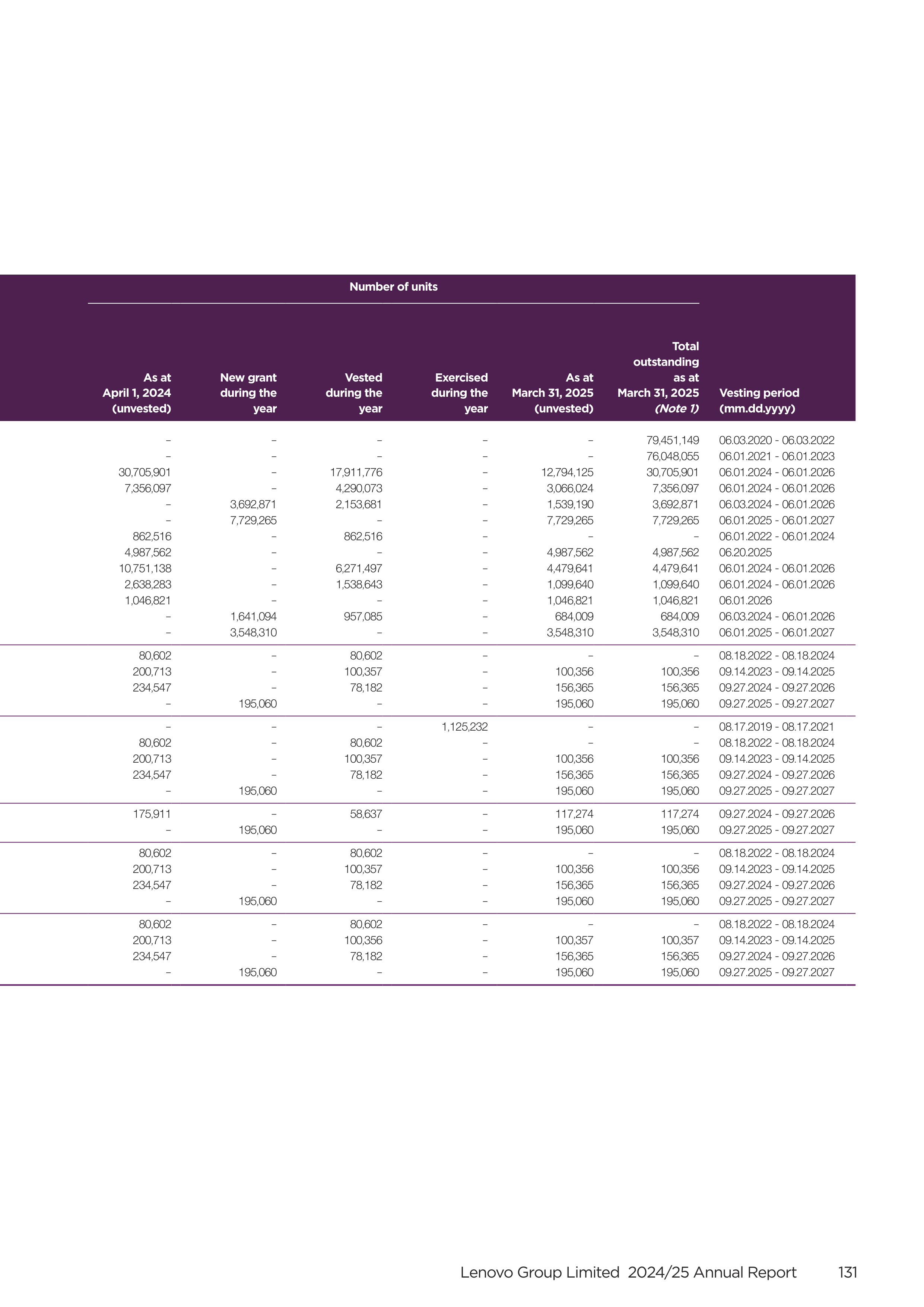
Lenovo Group Limited 2024/25 Annual Report
131
Number of units
As at
April 1, 2024
(unvested)
New grant
during the
year
Vested
during the
year
Exercised
during the
year
As at
March 31, 2025
(unvested)
Total
outstanding
as at
March 31, 2025
(Note 1)
Vesting period
(mm.dd.yyyy)
–
–
–
–
–
79
,
451
,
149
06
.
03
.
2020
-
06
.
03
.
2022
–
–
–
–
–
76
,
048
,
055
06
.
01
.
2021
-
06
.
01
.
2023
30
,
705
,
901
–
17
,
911
,
776
–
12
,
794
,
125
30
,
705
,
901
06
.
01
.
2024
-
06
.
01
.
2026
7
,
356
,
097
–
4
,
290
,
073
–
3
,
066
,
024
7
,
356
,
097
06
.
01
.
2024
-
06
.
01
.
2026
–
3
,
692
,
871
2
,
153
,
681
–
1
,
539
,
190
3
,
692
,
871
06
.
03
.
2024
-
06
.
01
.
2026
–
7
,
729
,
265
–
–
7
,
729
,
265
7
,
729
,
265
06
.
01
.
2025
-
06
.
01
.
2027
862
,
516
–
862
,
516
–
–
–
06
.
01
.
2022
-
06
.
01
.
2024
4
,
987
,
562
–
–
–
4
,
987
,
562
4
,
987
,
562
06
.
20
.
2025
10
,
751
,
138
–
6
,
271
,
497
–
4
,
479
,
641
4
,
479
,
641
06
.
01
.
2024
-
06
.
01
.
2026
2
,
638
,
283
–
1
,
538
,
643
–
1
,
099
,
640
1
,
099
,
640
06
.
01
.
2024
-
06
.
01
.
2026
1
,
046
,
821
–
–
–
1
,
046
,
821
1
,
046
,
821
06
.
01
.
2026
–
1
,
641
,
094
957
,
085
–
684
,
009
684
,
009
06
.
03
.
2024
-
06
.
01
.
2026
–
3
,
548
,
310
–
–
3
,
548
,
310
3
,
548
,
310
06
.
01
.
2025
-
06
.
01
.
2027
80
,
602
–
80
,
602
–
–
–
08
.
18
.
2022
-
08
.
18
.
2024
200
,
713
–
100
,
357
–
100
,
356
100
,
356
09
.
14
.
2023
-
09
.
14
.
2025
234
,
547
–
78
,
182
–
156
,
365
156
,
365
09
.
27
.
2024
-
09
.
27
.
2026
–
195
,
060
–
–
195
,
060
195
,
060
09
.
27
.
2025
-
09
.
27
.
2027
–
–
–
1
,
125
,
232
–
–
08
.
17
.
2019
-
08
.
17
.
2021
80
,
602
–
80
,
602
–
–
–
08
.
18
.
2022
-
08
.
18
.
2024
200
,
713
–
100
,
357
–
100
,
356
100
,
356
09
.
14
.
2023
-
09
.
14
.
2025
234
,
547
–
78
,
182
–
156
,
365
156
,
365
09
.
27
.
2024
-
09
.
27
.
2026
–
195
,
060
–
–
195
,
060
195
,
060
09
.
27
.
2025
-
09
.
27
.
2027
175
,
911
–
58
,
637
–
117
,
274
117
,
274
09
.
27
.
2024
-
09
.
27
.
2026
–
195
,
060
–
–
195
,
060
195
,
060
09
.
27
.
2025
-
09
.
27
.
2027
80
,
602
–
80
,
602
–
–
–
08
.
18
.
2022
-
08
.
18
.
2024
200
,
713
–
100
,
357
–
100
,
356
100
,
356
09
.
14
.
2023
-
09
.
14
.
2025
234
,
547
–
78
,
182
–
156
,
365
156
,
365
09
.
27
.
2024
-
09
.
27
.
2026
–
195
,
060
–
–
195
,
060
195
,
060
09
.
27
.
2025
-
09
.
27
.
2027
80
,
602
–
80
,
602
–
–
–
08
.
18
.
2022
-
08
.
18
.
2024
200
,
713
–
100
,
356
–
100
,
357
100
,
357
09
.
14
.
2023
-
09
.
14
.
2025
234
,
547
–
78
,
182
–
156
,
365
156
,
365
09
.
27
.
2024
-
09
.
27
.
2026
–
195
,
060
–
–
195
,
060
195
,
060
09
.
27
.
2025
-
09
.
27
.
2027
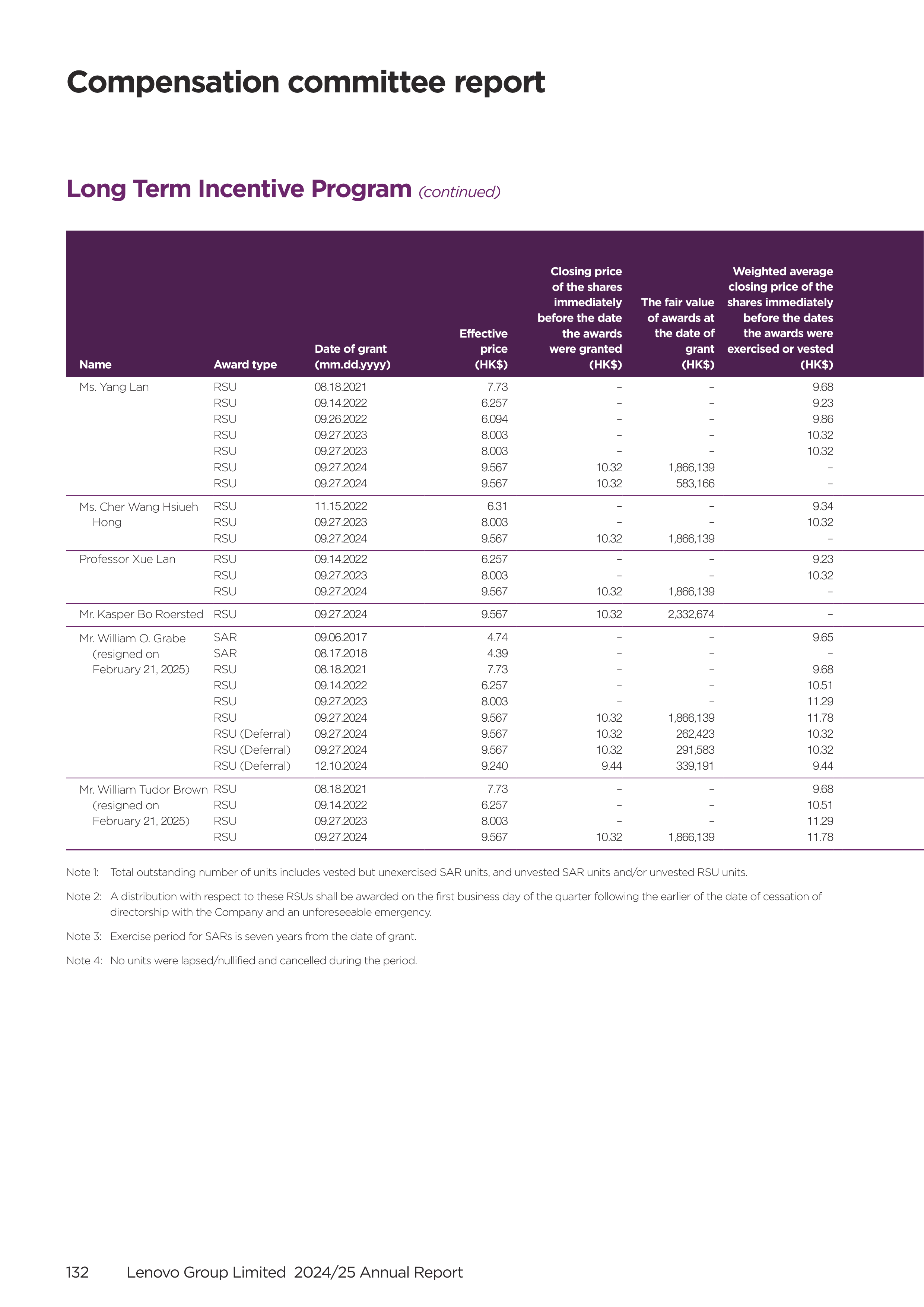
Lenovo Group Limited 2024/25 Annual Report
132
Compensation committee report
Name
Award type
Date of grant
(mm.dd.yyyy)
Effective
price
(HK$)
Closing price
of the shares
immediately
before the date
the awards
were granted
(HK$)
The fair value
of awards at
the date of
grant
(HK$)
Weighted average
closing price of the
shares immediately
before the dates
the awards were
exercised or vested
(HK$)
Ms. Yang Lan
RSU
08
.
18
.
2021
7
.
73
–
–
9
.
68
RSU
09
.
14
.
2022
6
.
257
–
–
9
.
23
RSU
09
.
26
.
2022
6
.
094
–
–
9
.
86
RSU
09
.
27
.
2023
8
.
003
–
–
10
.
32
RSU
09
.
27
.
2023
8
.
003
–
–
10
.
32
RSU
09
.
27
.
2024
9
.
567
10
.
32
1
,
866
,
139
–
RSU
09
.
27
.
2024
9
.
567
10
.
32
583
,
166
–
Ms. Cher Wang Hsiueh
Hong
RSU
11
.
15
.
2022
6
.
31
–
–
9
.
34
RSU
09
.
27
.
2023
8
.
003
–
–
10
.
32
RSU
09
.
27
.
2024
9
.
567
10
.
32
1
,
866
,
139
–
Professor Xue Lan
RSU
09
.
14
.
2022
6
.
257
–
–
9
.
23
RSU
09
.
27
.
2023
8
.
003
–
–
10
.
32
RSU
09
.
27
.
2024
9
.
567
10
.
32
1
,
866
,
139
–
Mr. Kasper Bo Roersted
RSU
09
.
27
.
2024
9
.
567
10
.
32
2
,
332
,
674
–
Mr. William O. Grabe
(resigned on
February
21
,
2025
)
SAR
09
.
06
.
2017
4
.
74
–
–
9
.
65
SAR
08
.
17
.
2018
4
.
39
–
–
–
RSU
08
.
18
.
2021
7
.
73
–
–
9
.
68
RSU
09
.
14
.
2022
6
.
257
–
–
10
.
51
RSU
09
.
27
.
2023
8
.
003
–
–
11
.
29
RSU
09
.
27
.
2024
9
.
567
10
.
32
1
,
866
,
139
11
.
78
RSU (Deferral)
09
.
27
.
2024
9
.
567
10
.
32
262
,
423
10
.
32
RSU (Deferral)
09
.
27
.
2024
9
.
567
10
.
32
291
,
583
10
.
32
RSU (Deferral)
12
.
10
.
2024
9
.
240
9
.
44
339
,
191
9
.
44
Mr. William Tudor Brown
(resigned on
February
21
,
2025
)
RSU
08
.
18
.
2021
7
.
73
–
–
9
.
68
RSU
09
.
14
.
2022
6
.
257
–
–
10
.
51
RSU
09
.
27
.
2023
8
.
003
–
–
11
.
29
RSU
09
.
27
.
2024
9
.
567
10
.
32
1
,
866
,
139
11
.
78
Note 1:
Total outstanding number of units includes vested but unexercised SAR units, and unvested SAR units and/or unvested RSU units.
Note 2:
A distribution with respect to these RSUs shall be awarded on the first business day of the quarter following the earlier of the date of cessation of
directorship with the Company and an unforeseeable emergency.
Note 3: Exercise period for SARs is seven years from the date of grant.
Note 4: No units were lapsed/nullified and cancelled during the period.
Long Term Incentive Program
(continued)
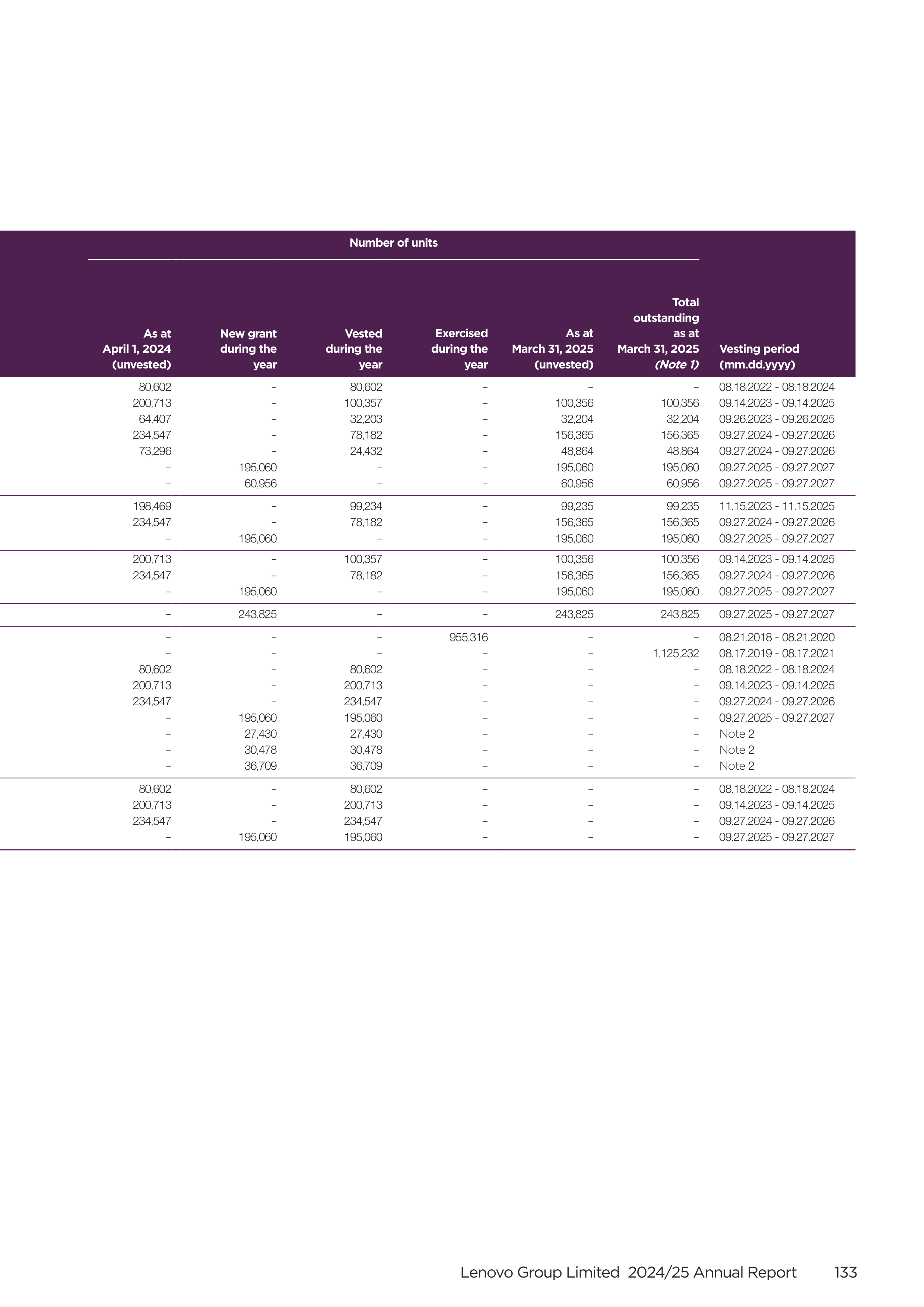
Lenovo Group Limited 2024/25 Annual Report
133
Number of units
As at
April 1, 2024
(unvested)
New grant
during the
year
Vested
during the
year
Exercised
during the
year
As at
March 31, 2025
(unvested)
Total
outstanding
as at
March 31, 2025
(Note 1)
Vesting period
(mm.dd.yyyy)
80
,
602
–
80
,
602
–
–
–
08
.
18
.
2022
-
08
.
18
.
2024
200
,
713
–
100
,
357
–
100
,
356
100
,
356
09
.
14
.
2023
-
09
.
14
.
2025
64
,
407
–
32
,
203
–
32
,
204
32
,
204
09
.
26
.
2023
-
09
.
26
.
2025
234
,
547
–
78
,
182
–
156
,
365
156
,
365
09
.
27
.
2024
-
09
.
27
.
2026
73
,
296
–
24
,
432
–
48
,
864
48
,
864
09
.
27
.
2024
-
09
.
27
.
2026
–
195
,
060
–
–
195
,
060
195
,
060
09
.
27
.
2025
-
09
.
27
.
2027
–
60
,
956
–
–
60
,
956
60
,
956
09
.
27
.
2025
-
09
.
27
.
2027
198
,
469
–
99
,
234
–
99
,
235
99
,
235
11
.
15
.
2023
-
11
.
15
.
2025
234
,
547
–
78
,
182
–
156
,
365
156
,
365
09
.
27
.
2024
-
09
.
27
.
2026
–
195
,
060
–
–
195
,
060
195
,
060
09
.
27
.
2025
-
09
.
27
.
2027
200
,
713
–
100
,
357
–
100
,
356
100
,
356
09
.
14
.
2023
-
09
.
14
.
2025
234
,
547
–
78
,
182
–
156
,
365
156
,
365
09
.
27
.
2024
-
09
.
27
.
2026
–
195
,
060
–
–
195
,
060
195
,
060
09
.
27
.
2025
-
09
.
27
.
2027
–
243
,
825
–
–
243
,
825
243
,
825
09
.
27
.
2025
-
09
.
27
.
2027
–
–
–
955
,
316
–
–
08
.
21
.
2018
-
08
.
21
.
2020
–
–
–
–
–
1
,
125
,
232
08
.
17
.
2019
-
08
.
17
.
2021
80
,
602
–
80
,
602
–
–
–
08
.
18
.
2022
-
08
.
18
.
2024
200
,
713
–
200
,
713
–
–
–
09
.
14
.
2023
-
09
.
14
.
2025
234
,
547
–
234
,
547
–
–
–
09
.
27
.
2024
-
09
.
27
.
2026
–
195
,
060
195
,
060
–
–
–
09
.
27
.
2025
-
09
.
27
.
2027
–
27
,
430
27
,
430
–
–
–
Note
2
–
30
,
478
30
,
478
–
–
–
Note
2
–
36
,
709
36
,
709
–
–
–
Note
2
80
,
602
–
80
,
602
–
–
–
08
.
18
.
2022
-
08
.
18
.
2024
200
,
713
–
200
,
713
–
–
–
09
.
14
.
2023
-
09
.
14
.
2025
234
,
547
–
234
,
547
–
–
–
09
.
27
.
2024
-
09
.
27
.
2026
–
195
,
060
195
,
060
–
–
–
09
.
27
.
2025
-
09
.
27
.
2027
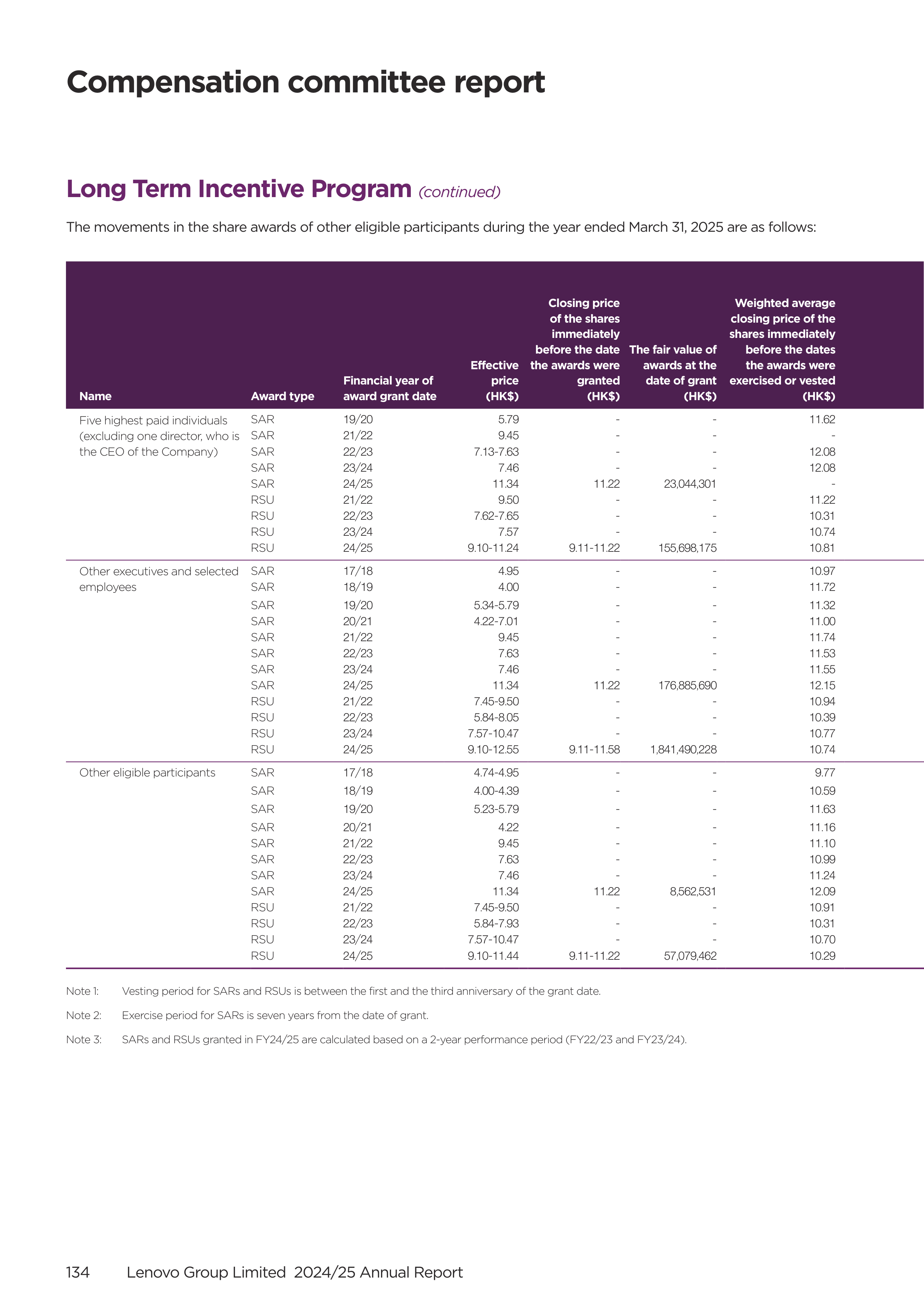
Lenovo Group Limited 2024/25 Annual Report
134
Compensation committee report
Name
Award type
Financial year of
award grant date
Effective
price
(HK$)
Closing price
of the shares
immediately
before the date
the awards were
granted
(HK$)
The fair value of
awards at the
date of grant
(HK$)
Weighted average
closing price of the
shares immediately
before the dates
the awards were
exercised or vested
(HK$)
Five highest paid individuals
(excluding one director, who is
the CEO of the Company)
SAR
19
/
20
5
.
79
-
-
11
.
62
SAR
21
/
22
9
.
45
-
-
-
SAR
22
/
23
7
.
13
-
7
.
63
-
-
12
.
08
SAR
23
/
24
7
.
46
-
-
12
.
08
SAR
24
/
25
11
.
34
11
.
22
23
,
044
,
301
-
RSU
21
/
22
9
.
50
-
-
11
.
22
RSU
22
/
23
7
.
62
-
7
.
65
-
-
10
.
31
RSU
23
/
24
7
.
57
-
-
10
.
74
RSU
24
/
25
9
.
10
-
11
.
24
9
.
11
-
11
.
22
155
,
698
,
175
10
.
81
Other executives and selected
employees
SAR
17
/
18
4
.
95
-
-
10
.
97
SAR
18
/
19
4
.
00
-
-
11
.
72
SAR
19
/
20
5
.
34
-
5
.
79
-
-
11
.
32
SAR
20
/
21
4
.
22
-
7
.
01
-
-
11
.
00
SAR
21
/
22
9
.
45
-
-
11
.
74
SAR
22
/
23
7
.
63
-
-
11
.
53
SAR
23
/
24
7
.
46
-
-
11
.
55
SAR
24
/
25
11
.
34
11
.
22
176
,
885
,
690
12
.
15
RSU
21
/
22
7
.
45
-
9
.
50
-
-
10
.
94
RSU
22
/
23
5
.
84
-
8
.
05
-
-
10
.
39
RSU
23
/
24
7
.
57
-
10
.
47
-
-
10
.
77
RSU
24
/
25
9
.
10
-
12
.
55
9
.
11
-
11
.
58
1
,
841
,
490
,
228
10
.
74
Other eligible participants
SAR
17
/
18
4
.
74
-
4
.
95
-
-
9
.
77
SAR
18
/
19
4
.
00
-
4
.
39
-
-
10
.
59
SAR
19
/
20
5
.
23
-
5
.
79
-
-
11
.
63
SAR
20
/
21
4
.
22
-
-
11
.
16
SAR
21
/
22
9
.
45
-
-
11
.
10
SAR
22
/
23
7
.
63
-
-
10
.
99
SAR
23
/
24
7
.
46
-
-
11
.
24
SAR
24
/
25
11
.
34
11
.
22
8
,
562
,
531
12
.
09
RSU
21
/
22
7
.
45
-
9
.
50
-
-
10
.
91
RSU
22
/
23
5
.
84
-
7
.
93
-
-
10
.
31
RSU
23
/
24
7
.
57
-
10
.
47
-
-
10
.
70
RSU
24
/
25
9
.
10
-
11
.
44
9
.
11
-
11
.
22
57
,
079
,
462
10
.
29
Note 1:
Vesting period for SARs and RSUs is between the first and the third anniversary of the grant date.
Note 2:
Exercise period for SARs is seven years from the date of grant.
Note 3:
SARs and RSUs granted in FY24/25 are calculated based on a 2-year performance period (FY22/23 and FY23/24).
Long Term Incentive Program
(continued)
The movements in the share awards of other eligible participants during the year ended March 31, 2025 are as follows:
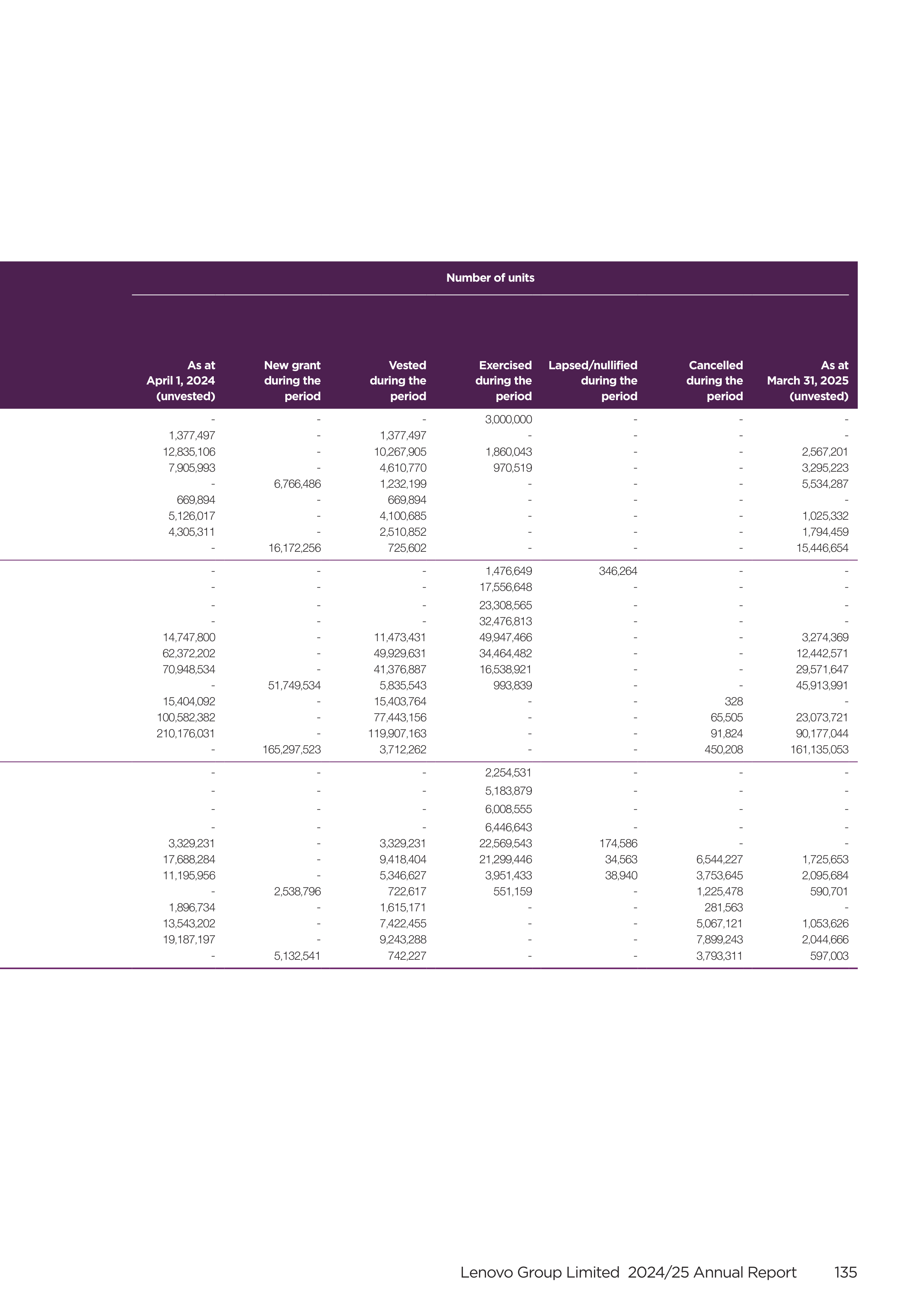
Lenovo Group Limited 2024/25 Annual Report
135
Number of units
As at
April 1, 2024
(unvested)
New grant
during the
period
Vested
during the
period
Exercised
during the
period
Lapsed/nullified
during the
period
Cancelled
during the
period
As at
March 31, 2025
(unvested)
-
-
-
3
,
000
,
000
-
-
-
1
,
377
,
497
-
1
,
377
,
497
-
-
-
-
12
,
835
,
106
-
10
,
267
,
905
1
,
860
,
043
-
-
2
,
567
,
201
7
,
905
,
993
-
4
,
610
,
770
970
,
519
-
-
3
,
295
,
223
-
6
,
766
,
486
1
,
232
,
199
-
-
-
5
,
534
,
287
669
,
894
-
669
,
894
-
-
-
-
5
,
126
,
017
-
4
,
100
,
685
-
-
-
1
,
025
,
332
4
,
305
,
311
-
2
,
510
,
852
-
-
-
1
,
794
,
459
-
16
,
172
,
256
725
,
602
-
-
-
15
,
446
,
654
-
-
-
1
,
476
,
649
346
,
264
-
-
-
-
-
17
,
556
,
648
-
-
-
-
-
-
23
,
308
,
565
-
-
-
-
-
-
32
,
476
,
813
-
-
-
14
,
747
,
800
-
11
,
473
,
431
49
,
947
,
466
-
-
3
,
274
,
369
62
,
372
,
202
-
49
,
929
,
631
34
,
464
,
482
-
-
12
,
442
,
571
70
,
948
,
534
-
41
,
376
,
887
16
,
538
,
921
-
-
29
,
571
,
647
-
51
,
749
,
534
5
,
835
,
543
993
,
839
-
-
45
,
913
,
991
15
,
404
,
092
-
15
,
403
,
764
-
-
328
-
100
,
582
,
382
-
77
,
443
,
156
-
-
65
,
505
23
,
073
,
721
210
,
176
,
031
-
119
,
907
,
163
-
-
91
,
824
90
,
177
,
044
-
165
,
297
,
523
3
,
712
,
262
-
-
450
,
208
161
,
135
,
053
-
-
-
2
,
254
,
531
-
-
-
-
-
-
5
,
183
,
879
-
-
-
-
-
-
6
,
008
,
555
-
-
-
-
-
-
6
,
446
,
643
-
-
-
3
,
329
,
231
-
3
,
329
,
231
22
,
569
,
543
174
,
586
-
-
17
,
688
,
284
-
9
,
418
,
404
21
,
299
,
446
34
,
563
6
,
544
,
227
1
,
725
,
653
11
,
195
,
956
-
5
,
346
,
627
3
,
951
,
433
38
,
940
3
,
753
,
645
2
,
095
,
684
-
2
,
538
,
796
722
,
617
551
,
159
-
1
,
225
,
478
590
,
701
1
,
896
,
734
-
1
,
615
,
171
-
-
281
,
563
-
13
,
543
,
202
-
7
,
422
,
455
-
-
5
,
067
,
121
1
,
053
,
626
19
,
187
,
197
-
9
,
243
,
288
-
-
7
,
899
,
243
2
,
044
,
666
-
5
,
132
,
541
742
,
227
-
-
3
,
793
,
311
597
,
003
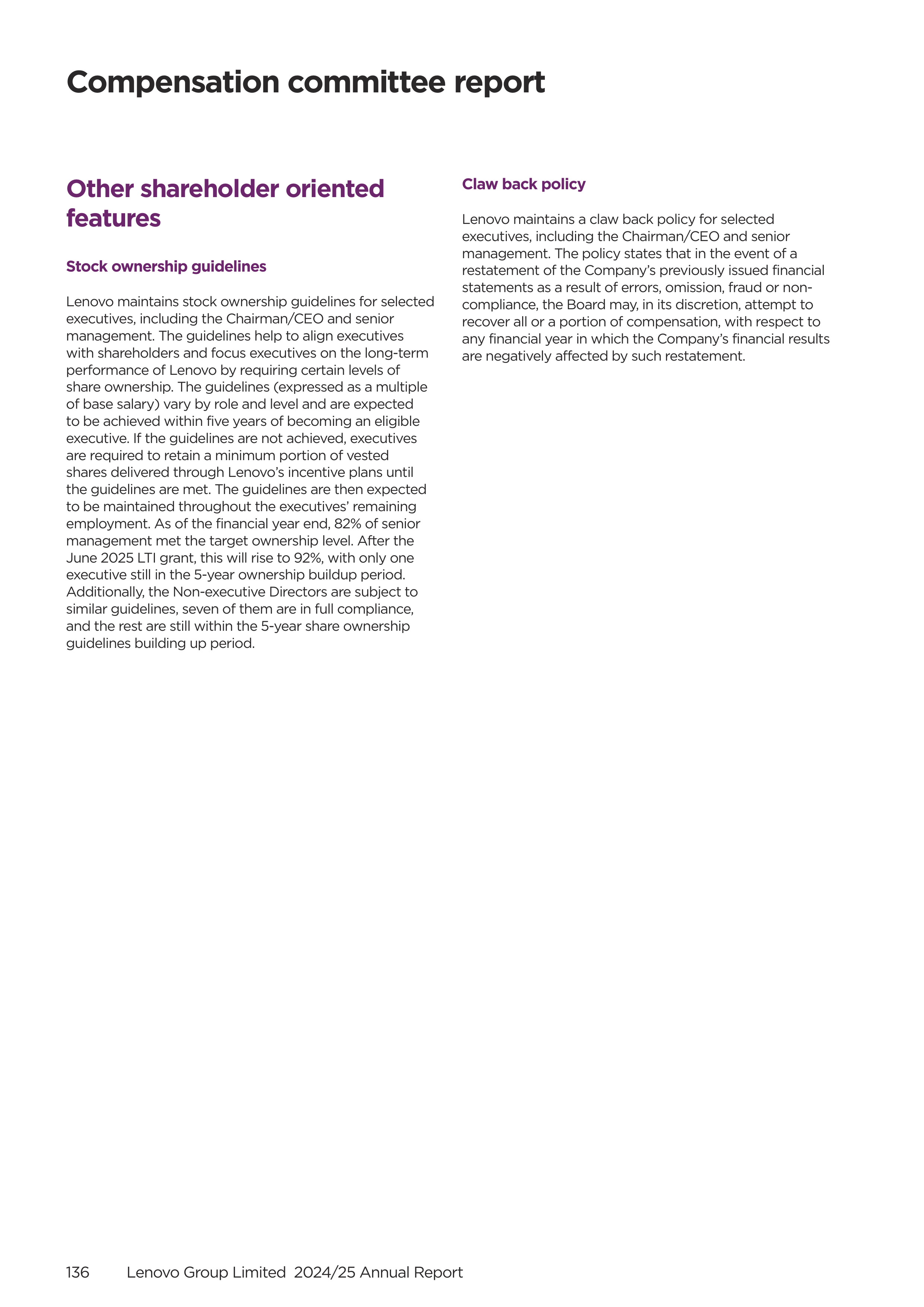
Lenovo Group Limited 2024/25 Annual Report
136
Compensation committee report
Claw back policy
Lenovo maintains a claw back policy for selected
executives, including the Chairman/CEO and senior
management. The policy states that in the event of a
restatement of the Company’s previously issued financial
statements as a result of errors, omission, fraud or non-
compliance, the Board may, in its discretion, attempt to
recover all or a portion of compensation, with respect to
any financial year in which the Company’s financial results
are negatively affected by such restatement.
Other shareholder oriented
features
Stock ownership guidelines
Lenovo maintains stock ownership guidelines for selected
executives, including the Chairman/CEO and senior
management. The guidelines help to align executives
with shareholders and focus executives on the long-term
performance of Lenovo by requiring certain levels of
share ownership. The guidelines (expressed as a multiple
of base salary) vary by role and level and are expected
to be achieved within five years of becoming an eligible
executive. If the guidelines are not achieved, executives
are required to retain a minimum portion of vested
shares delivered through Lenovo’s incentive plans until
the guidelines are met. The guidelines are then expected
to be maintained throughout the executives’ remaining
employment. As of the financial year end, 82% of senior
management met the target ownership level. After the
June 2025 LTI grant, this will rise to 92%, with only one
executive still in the 5-year ownership buildup period.
Additionally, the Non-executive Directors are subject to
similar guidelines, seven of them are in full compliance,
and the rest are still within the 5-year share ownership
guidelines building up period.












Lenovo Group Limited 2024/25 Annual Report
137
Directors’ report
138
Independent auditor’s report
166
Consolidated income statement
171
Consolidated statement of comprehensive income
172
Consolidated balance sheet
173
Consolidated cash flow statement
175
Consolidated statement of changes in equity
177
Notes to the financial statements
179
Five-year financial summary
267
Corporate information
268
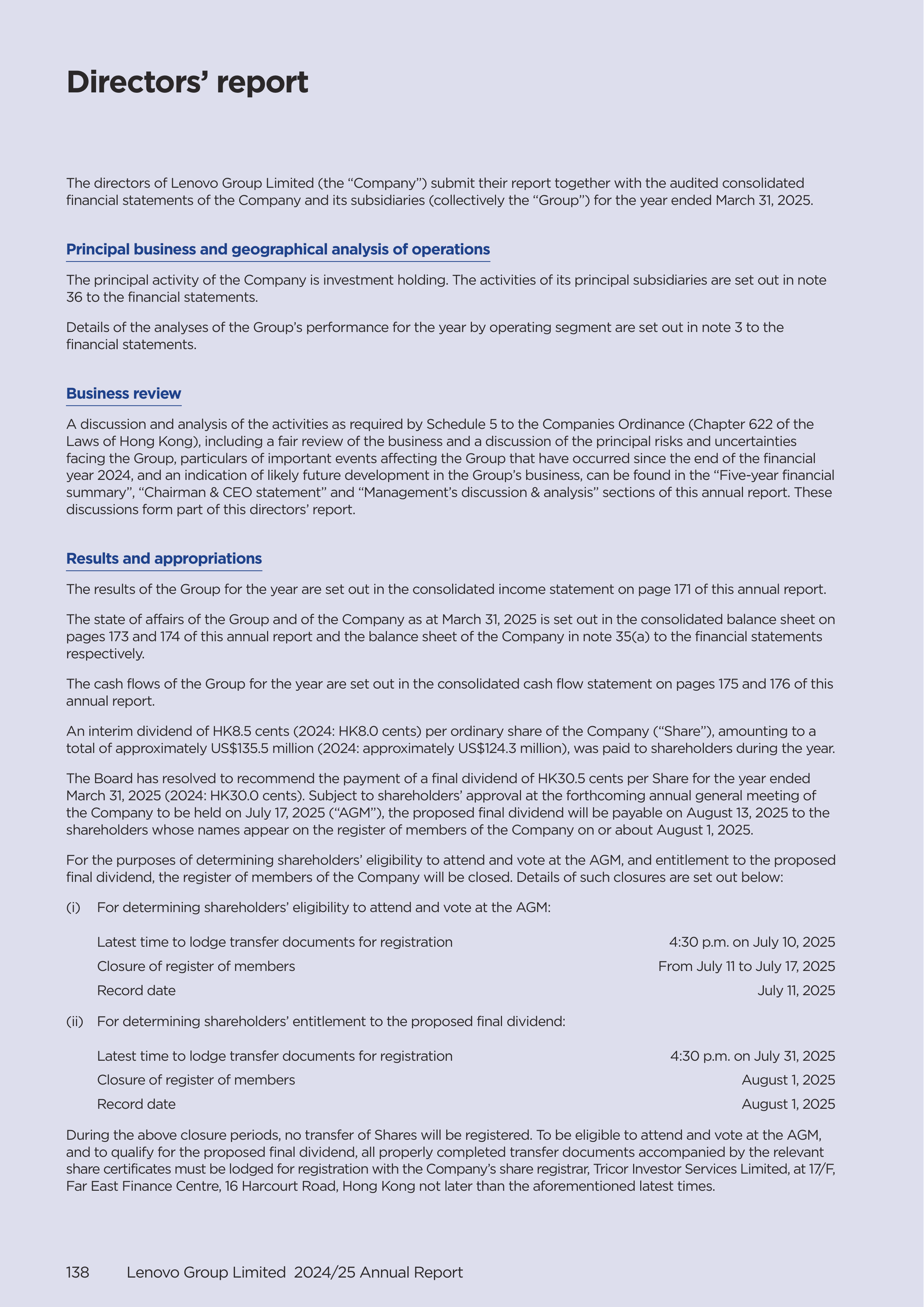
Directors’ report
Lenovo Group Limited 2024/25 Annual Report
138
The directors of Lenovo Group Limited (the “Company”) submit their report together with the audited consolidated
financial statements of the Company and its subsidiaries (collectively the “Group”) for the year ended March 31, 2025.
Principal business and geographical analysis of operations
The principal activity of the Company is investment holding. The activities of its principal subsidiaries are set out in note
36 to the financial statements.
Details of the analyses of the Group’s performance for the year by operating segment are set out in note 3 to the
financial statements.
Business review
A discussion and analysis of the activities as required by Schedule 5 to the Companies Ordinance (Chapter 622 of the
Laws of Hong Kong), including a fair review of the business and a discussion of the principal risks and uncertainties
facing the Group, particulars of important events affecting the Group that have occurred since the end of the financial
year 2024, and an indication of likely future development in the Group’s business, can be found in the “Five-year financial
summary”, “Chairman & CEO statement” and “Management’s discussion & analysis” sections of this annual report. These
discussions form part of this directors’ report.
Results and appropriations
The results of the Group for the year are set out in the consolidated income statement on page 171 of this annual report.
The state of affairs of the Group and of the Company as at March 31, 2025 is set out in the consolidated balance sheet on
pages 173 and 174 of this annual report and the balance sheet of the Company in note 35(a) to the financial statements
respectively.
The cash flows of the Group for the year are set out in the consolidated cash flow statement on pages 175 and 176 of this
annual report.
An interim dividend of HK8.5 cents (2024: HK8.0 cents) per ordinary share of the Company (“Share”), amounting to a
total of approximately US$135.5 million (2024: approximately US$124.3 million), was paid to shareholders during the year.
The Board has resolved to recommend the payment of a final dividend of HK30.5 cents per Share for the year ended
March 31, 2025 (2024: HK30.0 cents). Subject to shareholders’ approval at the forthcoming annual general meeting of
the Company to be held on July 17, 2025 (“AGM”), the proposed final dividend will be payable on August 13, 2025 to the
shareholders whose names appear on the register of members of the Company on or about August 1, 2025.
For the purposes of determining shareholders’ eligibility to attend and vote at the AGM, and entitlement to the proposed
final dividend, the register of members of the Company will be closed. Details of such closures are set out below:
(i)
For determining shareholders’ eligibility to attend and vote at the AGM:
Latest time to lodge transfer documents for registration
4:30 p.m. on July 10, 2025
Closure of register of members
From July 11 to July 17, 2025
Record date
July 11, 2025
(ii)
For determining shareholders’ entitlement to the proposed final dividend:
Latest time to lodge transfer documents for registration
4:30 p.m. on July 31, 2025
Closure of register of members
August 1, 2025
Record date
August 1, 2025
During the above closure periods, no transfer of Shares will be registered. To be eligible to attend and vote at the AGM,
and to qualify for the proposed final dividend, all properly completed transfer documents accompanied by the relevant
share certificates must be lodged for registration with the Company’s share registrar, Tricor Investor Services Limited, at 17/F,
Far East Finance Centre, 16 Harcourt Road, Hong Kong not later than the aforementioned latest times.
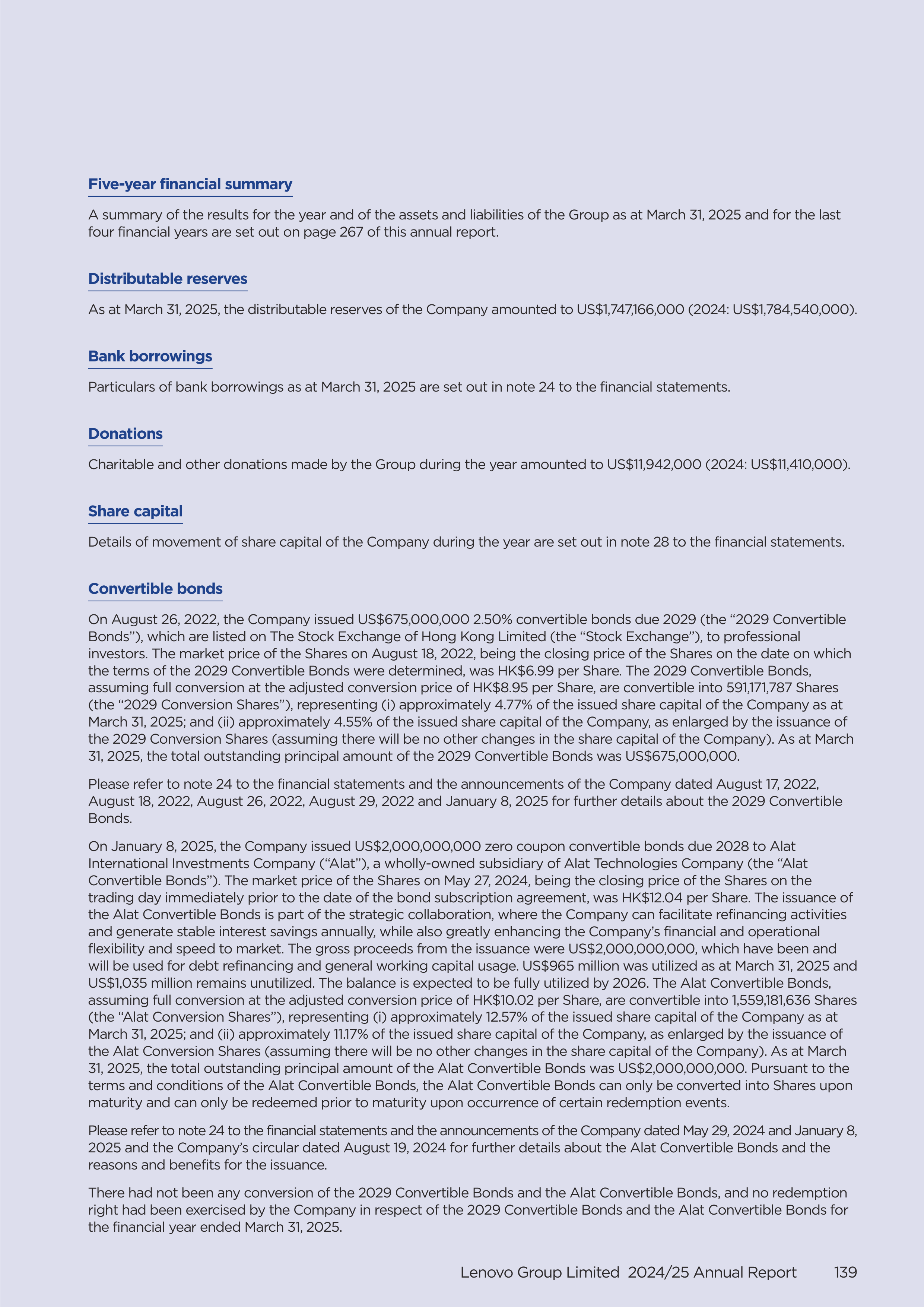
Lenovo Group Limited 2024/25 Annual Report
139
Five-year financial summary
A summary of the results for the year and of the assets and liabilities of the Group as at March 31, 2025 and for the last
four financial years are set out on page 267 of this annual report.
Distributable reserves
As at March 31, 2025, the distributable reserves of the Company amounted to US$1,747,166,000 (2024: US$1,784,540,000).
Bank borrowings
Particulars of bank borrowings as at March 31, 2025 are set out in note 24 to the financial statements.
Donations
Charitable and other donations made by the Group during the year amounted to US$11,942,000 (2024: US$11,410,000).
Share capital
Details of movement of share capital of the Company during the year are set out in note 28 to the financial statements.
Convertible bonds
On August 26, 2022, the Company issued US$675,000,000 2.50% convertible bonds due 2029 (the “2029 Convertible
Bonds”), which are listed on The Stock Exchange of Hong Kong Limited (the “Stock Exchange”), to professional
investors. The market price of the Shares on August 18, 2022, being the closing price of the Shares on the date on which
the terms of the 2029 Convertible Bonds were determined, was HK$6.99 per Share. The 2029 Convertible Bonds,
assuming full conversion at the adjusted conversion price of HK$8.95 per Share, are convertible into 591,171,787 Shares
(the “2029 Conversion Shares”), representing (i) approximately 4.77% of the issued share capital of the Company as at
March 31, 2025; and (ii) approximately 4.55% of the issued share capital of the Company, as enlarged by the issuance of
the 2029 Conversion Shares (assuming there will be no other changes in the share capital of the Company). As at March
31, 2025, the total outstanding principal amount of the 2029 Convertible Bonds was US$675,000,000.
Please refer to note 24 to the financial statements and the announcements of the Company dated August 17, 2022,
August 18, 2022, August 26, 2022, August 29, 2022 and January 8, 2025 for further details about the 2029 Convertible
Bonds.
On January 8, 2025, the Company issued US$2,000,000,000 zero coupon convertible bonds due 2028 to Alat
International Investments Company (“Alat”), a wholly-owned subsidiary of Alat Technologies Company (the “Alat
Convertible Bonds”). The market price of the Shares on May 27, 2024, being the closing price of the Shares on the
trading day immediately prior to the date of the bond subscription agreement, was HK$12.04 per Share. The issuance of
the Alat Convertible Bonds is part of the strategic collaboration, where the Company can facilitate refinancing activities
and generate stable interest savings annually, while also greatly enhancing the Company’s financial and operational
flexibility and speed to market. The gross proceeds from the issuance were US$2,000,000,000, which have been and
will be used for debt refinancing and general working capital usage. US$965 million was utilized as at March 31, 2025 and
US$1,035 million remains unutilized. The balance is expected to be fully utilized by 2026. The Alat Convertible Bonds,
assuming full conversion at the adjusted conversion price of HK$10.02 per Share, are convertible into 1,559,181,636 Shares
(the “Alat Conversion Shares”), representing (i) approximately 12.57% of the issued share capital of the Company as at
March 31, 2025; and (ii) approximately 11.17% of the issued share capital of the Company, as enlarged by the issuance of
the Alat Conversion Shares (assuming there will be no other changes in the share capital of the Company). As at March
31, 2025, the total outstanding principal amount of the Alat Convertible Bonds was US$2,000,000,000. Pursuant to the
terms and conditions of the Alat Convertible Bonds, the Alat Convertible Bonds can only be converted into Shares upon
maturity and can only be redeemed prior to maturity upon occurrence of certain redemption events.
Please refer to note 24 to the financial statements and the announcements of the Company dated May 29, 2024 and January 8,
2025 and the Company’s circular dated August 19, 2024 for further details about the Alat Convertible Bonds and the
reasons and benefits for the issuance.
There had not been any conversion of the 2029 Convertible Bonds and the Alat Convertible Bonds, and no redemption
right had been exercised by the Company in respect of the 2029 Convertible Bonds and the Alat Convertible Bonds for
the financial year ended March 31, 2025.
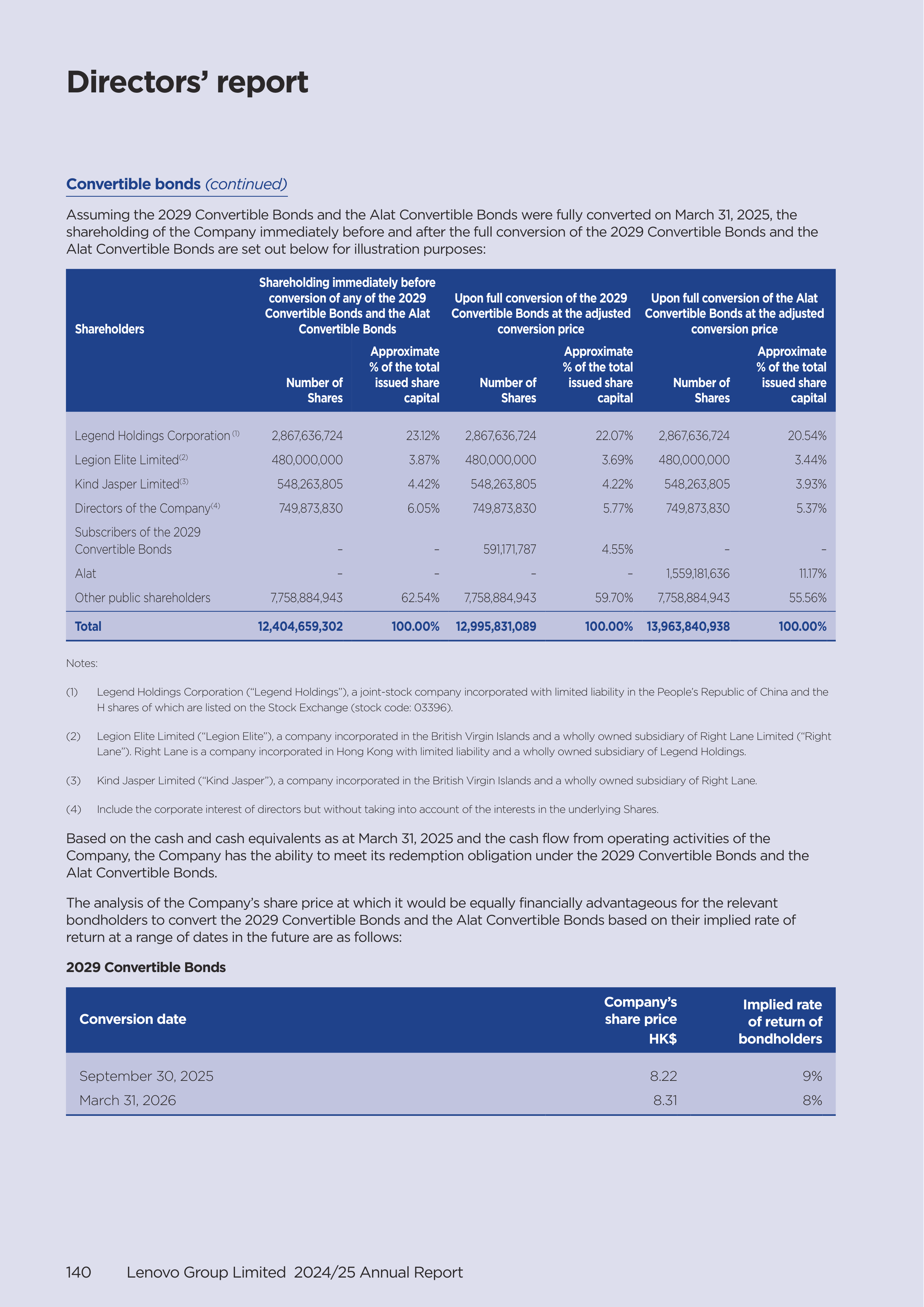
Directors’ report
Lenovo Group Limited 2024/25 Annual Report
140
Convertible bonds
(continued)
Assuming the 2029 Convertible Bonds and the Alat Convertible Bonds were fully converted on March 31, 2025, the
shareholding of the Company immediately before and after the full conversion of the 2029 Convertible Bonds and the
Alat Convertible Bonds are set out below for illustration purposes:
Shareholders
Shareholding immediately before
conversion of any of the 2029
Convertible Bonds and the Alat
Convertible Bonds
Upon full conversion of the 2029
Convertible Bonds at the adjusted
conversion price
Upon full conversion of the Alat
Convertible Bonds at the adjusted
conversion price
Number of
Shares
Approximate
% of the total
issued share
capital
Number of
Shares
Approximate
% of the total
issued share
capital
Number of
Shares
Approximate
% of the total
issued share
capital
Legend Holdings Corporation
(1)
2,867,636,724
23.12%
2,867,636,724
22.07%
2,867,636,724
20.54%
Legion Elite Limited
(2)
480,000,000
3.87%
480,000,000
3.69%
480,000,000
3.44%
Kind Jasper Limited
(3)
548,263,805
4.42%
548,263,805
4.22%
548,263,805
3.93%
Directors of the Company
(4)
749,873,830
6.05%
749,873,830
5.77%
749,873,830
5.37%
Subscribers of the 2029
Convertible Bonds
–
–
591,171,787
4.55%
–
–
Alat
–
–
–
–
1,559,181,636
11.17%
Other public shareholders
7,758,884,943
62.54%
7,758,884,943
59.70%
7,758,884,943
55.56%
Total
12,404,659,302
100.00%
12,995,831,089
100.00%
13,963,840,938
100.00%
Notes:
(1)
Legend Holdings Corporation (“Legend Holdings”), a joint-stock company incorporated with limited liability in the People’s Republic of China and the
H shares of which are listed on the Stock Exchange (stock code: 03396).
(2)
Legion Elite Limited (“Legion Elite”), a company incorporated in the British Virgin Islands and a wholly owned subsidiary of Right Lane Limited (“Right
Lane”). Right Lane is a company incorporated in Hong Kong with limited liability and a wholly owned subsidiary of Legend Holdings.
(3)
Kind Jasper Limited (“Kind Jasper”), a company incorporated in the British Virgin Islands and a wholly owned subsidiary of Right Lane.
(4)
Include the corporate interest of directors but without taking into account of the interests in the underlying Shares.
Based on the cash and cash equivalents as at March 31, 2025 and the cash flow from operating activities of the
Company, the Company has the ability to meet its redemption obligation under the 2029 Convertible Bonds and the
Alat Convertible Bonds.
The analysis of the Company’s share price at which it would be equally financially advantageous for the relevant
bondholders to convert the 2029 Convertible Bonds and the Alat Convertible Bonds based on their implied rate of
return at a range of dates in the future are as follows:
2029 Convertible Bonds
Conversion date
Company’s
share price
Implied rate
of return of
bondholders
HK$
September 30, 2025
8.22
9%
March 31, 2026
8.31
8%
Lenovo Group Limited 2024/25 Annual Report
141
Convertible bonds
(continued)
Alat Convertible Bonds
Subject to the terms and conditions of the Alat Convertible Bonds, it would be equally financially advantageous for the
bondholder of Alat Convertible Bonds to convert or redeem the convertible securities thereunder based on the implied
internal rate of return thereof, when the Company’s share price approximates to the conversion price in the future.
Warrants
On January 8, 2025, the Company issued 1,150,000,000 warrants (the “Warrants”) at the issue price of HK$1.43 per
Warrant to Sureinvest Holdings Limited (“Sureinvest”), an entity wholly owned by Mr. Yang Yuanqing (a connected
person of the Company), Wisdom Summit Limited, the investment holding vehicle for certain management members
of the Company (which include connected persons of the Company at subsidiary level), as well as certain independent
professional investors. The market price of the Shares on May 27, 2024, being the closing price of the Shares on the
trading day immediately prior to May 28, 2024 (being the date on which the Board approved the indicative principal
terms of the Warrants), was HK$12.04 per Share. The issuance of the Warrants is part of the strategic collaboration,
where it supports the strategic initiatives of the Company. The gross proceeds from the issuance were HK$1,645 million
(approximately US$212 million), which will be used for business expansion in the Middle East and Africa region. None
of the proceeds was utilized as at March 31, 2025 and it is expected that the proceeds will be fully utilized by 2026 for
business expansion in the Middle East and Africa region. Assuming the full exercise of the Warrants at the initial exercise
price of HK$12.31 per Share, it would provide the Company with up to an additional capital of approximately US$1.8
billion to further strengthen its equity base. The Company aims to use 40% of the proceeds for further expansion of the
Company’s operation (including future potential acquisition opportunities), 50% of proceeds for investment in research
and development and artificial intelligence and 10% of the proceeds for general working capital purposes to meet daily
operational business needs, such as supply chain investments.
Assuming the full exercise of the Warrants at the initial exercise price of HK$12.31 per Share, it will result in the issue of 1,150,000,000
Shares (the “Warrant Shares”), representing (i) approximately 9.27% of the issued share capital of the Company as at
March 31, 2025; and (ii) approximately 8.48% of the issued share capital of the Company, as enlarged by the issuance of
the Warrant Shares (assuming there will be no other changes in the share capital of the Company).
Please refer to note 25 to the financial statements and the announcements of the Company dated May 29, 2024, July 15,
2024 and January 8, 2025 and the Company’s circular dated August 19, 2024 for further details about the Warrants and
the reasons and benefits for the issuance.
Directors’ report
Lenovo Group Limited 2024/25 Annual Report
142
Debentures
Save as disclosed, there had not been any issuance, purchase, redemption or cancellation of debentures by the
Company during the year ended March 31, 2025.
Equity-linked agreements
No equity-linked agreements were entered into during the year, save for the long-term incentive program described in
this report.
Subsidiaries, associates and joint ventures
Particulars of the Company’s principal subsidiaries, associates and joint ventures as at March 31, 2025 are set out in notes
36 and 15 to the financial statements respectively.
Management contracts
No contracts concerning the management and administration of the whole or any substantial part of the business of the
Company were entered into or existed during the year.
Major customers and suppliers
During the year, the Group sold less than 26% of its goods and services to its five largest customers. The percentages of
purchases for the year attributable to the Group’s major suppliers are as follows:
The largest supplier
13%
Five largest suppliers combined
37%
None of the directors of the Company, their close associates or any shareholder (which to the knowledge of the directors
own more than 5% of the number of issued shares of the Company) had an interest in the major suppliers noted above.
Purchase, sale or redemption of the company’s listed securities
Save as disclosed above and the respective trustee of the long-term incentive program and the employee share
purchase plan of the Company purchased a total of 203,502,684 Shares from the market for award to employees upon
vesting, neither the Company nor any of its subsidiaries purchased, sold or redeemed any of the Company’s listed
securities during the year ended March 31, 2025. Details of these program and plan are set out under sections headed
“LTI Program” and “Employee Share Purchase Plan” in the Compensation committee report on page 125 and page 128
respectively of this annual report.
Lenovo Group Limited 2024/25 Annual Report
143
Directors
The directors during the year and up to the date of this report are:
Chairman and executive director
Mr. Yang Yuanqing
Non-executive directors
Mr. Zhu Linan
Mr. Zhao John Huan
Mr. Wong Wai Ming (appointed with effect from April 1, 2025)
Ms. Laura Green Quatela (appointed with effect from April 1, 2025)
Independent non-executive directors
Mr. John Lawson Thornton
Mr. Gordon Robert Halyburton Orr
Mr. Woo Chin Wan Raymond
Ms. Yang Lan
Ms. Cher Wang Hsiueh Hong
Professor Xue Lan
Mr. Kasper Bo Roersted (alias Kasper Bo Rorsted)
Mr. William O. Grabe (resigned on February 21, 2025)
Mr. William Tudor Brown (resigned on February 21, 2025)
In accordance with article 95 of the Company’s articles of association, Mr. Wong Wai Ming and Ms. Laura Green Quatela
who were appointed as directors during the year, shall hold office until the forthcoming AGM and, being eligible, offer
themselves for re-election.
In accordance with article 107 of the Company’s articles of association, Mr. Yang Yuanqing, Mr. Zhu Linan, Mr. Woo Chin
Wan Raymond and Ms. Yang Lan will retire by rotation at the AGM and, being eligible, offer themselves for re-election.
The Company has received from each of the independent non-executive directors an annual confirmation of their
independence having regard to the criteria under rule 3.13 of the Rules Governing the Listing of Securities on the
Stock Exchange (the “Listing Rules”). The nomination and governance committee of the Company has duly reviewed
the independence of each of these directors. The Company has determined and confirmed that all independent
non-executive directors satisfied the independence requirement set out in rule 3.13 of the Listing Rules and remain
independent.
The list of directors who have served on the boards of directors of the subsidiaries of the Company during the year
ended March 31, 2025 or during the period from April 1, 2025 to the date of this report is available on the Group’s website
(https://investor.lenovo.com/en/publications/list_directors.php).
Directors’ report
Lenovo Group Limited 2024/25 Annual Report
144
Biography of directors and senior management
Honorary Chairman
Mr. Liu Chuanzhi
, 81, has been the Honorary Chairman and Senior Advisor of the Company since November 3, 2011.
Mr. Liu is the founder of the Group and held the positions of executive director, non-executive director and chairman
of the Board at different times from 1993 until his resignation from the Board on November 3, 2011. As our Honorary
Chairman, Mr. Liu is not a director or an officer of the Company or of any subsidiary of the Company, and does not have
any management role in the Company or any of its subsidiaries. He graduated from the Radar Navigation Department of
People’s Liberation Army Institute of Telecommunication Engineering (
中國人民解放軍軍事電信工程學院雷達導航系
) (now
known as Xidian University) in China in 1966 and has substantial experiences in corporate management.
Biography of directors
Chairman and executive director
Mr. Yang Yuanqing
, 60, is the Chairman of the Board, Chief Executive Officer and an executive director of the Company.
He is also a director and a shareholder of Sureinvest which holds interests in the issued Shares of the Company. Mr. Yang
assumed the duties of Chief Executive Officer of the Company on February 5, 2009. Prior to that, he was the chairman
of the Board from April 30, 2005. Before taking up the office as chairman, Mr. Yang was the chief executive officer and
has been an executive director of the Company since December 16, 1997.
Mr. Yang has more than 30 years of experience in the field of ICT industry. Under his leadership, Lenovo has become not
only a leading global PC company, but also built diversified growth engines including servers, storage, smartphones, as
well as digital and intelligent solutions and services. Mr. Yang holds a Master’s degree from the Department of Computer
Science at the University of Science and Technology of China, and a Bachelor’s degree in Computer Science and
Engineering from Shanghai Jiao Tong University. Mr. Yang is currently an independent director of Baidu, Inc. (NASDAQ
and HKSE listed) and was an independent director of Taikang Insurance Group Inc.
Non-executive directors
Mr. Zhu Linan
, 62, has been a non-executive director of the Company since April 30, 2005. Mr. Zhu graduated with
a master’s degree in electronic engineering from Shanghai Jiao Tong University and has more than 20 years of
management experience. He was previously a senior vice president of the Group. Mr. Zhu has been re-designated as a
non-executive director of Legend Holdings (HKSE listed), a company holding substantial interests in the issued Shares of
the Company, with effect from January 1, 2020 and prior to that, he was executive director, president and member of the
executive committee of Legend Holdings.
Mr. Zhao John Huan
, 62, has been a non-executive director of the Company since November 3, 2011. Mr. Zhao holds a
master’s degree in business administration from the Kellogg School of Management at Northwestern University, dual
master’s degrees in electric engineering and physics from Northern Illinois University and a bachelor’s degree in physics
from Nanjing University. He has been re-designated as a non-executive director of Legend Holdings (HKSE listed), a
company holding substantial interests in the issued Shares of the Company, with effect from January 1, 2020 and prior to
that, he was an executive director, executive vice president and member of executive committee of Legend Holdings. He
is also the chairman of Hony Capital Limited.
In addition, Mr. Zhao currently holds the following positions: the chairman of the board and executive director of Best
Food Holding Company Limited and Goldstream Investment Limited
金涌投資有限公司
(formerly known as “International
Elite Ltd.”) and the chairman of the board and non-executive director of Hony Media Group (formerly known as “Huayi
Tencent Entertainment Company Limited”) (all HKSE listed).
Mr. Zhao was previously a non-executive director of Zoomlion Heavy Industry Science and Technology Co., Ltd.
中聯重
科股份有限公司
(HKSE and Shenzhen Stock Exchange listed), Eros STX Global Corporation (New York Stock Exchange
“NYSE” listed), Shanghai Jin Jiang International Hotels Company Limited
上海錦江國際酒店股份有限公司
(Shanghai
Stock Exchange listed), ENN Natural Gas Co., Ltd.
新奧天然氣股份有限公司
(Shanghai Stock Exchange listed), Simcere
Pharmaceutical Group Limited, and China Glass Holdings Limited (both HKSE listed).
Lenovo Group Limited 2024/25 Annual Report
145
Biography of directors and senior management
(continued)
Biography of directors
(continued)
Non-executive directors
(continued)
Mr. Wong Wai Ming
, 67, has been a non-executive director of the Company since April 1, 2025. He was an Executive
Vice President and the chief financial officer of the Group and retired from the roles with effect from March 31, 2025,
after serving the Group as chief financial officer for over 17 years. He was a member of certain internal committees of
the Group and a director of certain subsidiaries of the Company prior to the appointment as a non-executive director
of the Company. Currently, Mr. Wong is the deputy chairman of the supervisory board of Medion AG (a subsidiary of
the Company and delisted from Frankfurt Stock Exchange in January 2025) and a director of Sureinvest which holds
interest in the issued Shares of the Company. Mr. Wong was an independent non-executive director of the Company
from March 30, 1999 to May 23, 2007, prior to his appointment as the chief financial officer of the Group on July 15, 2007.
Prior to joining the Group, he was an investment banker for more than 15 years and also held various senior management
positions in listed companies in Hong Kong, including his appointment as an independent non-executive director of
China Unicom (Hong Kong) Limited from January 19, 2006 to April 10, 2024. Mr. Wong obtained a bachelor’s degree in
management sciences from the Victoria University of Manchester in the United Kingdom. He is a member of the Hong
Kong Institute of Certified Public Accountants and the Institute of Chartered Accountants in England and Wales.
Ms. Laura Green Quatela
, 67, has been a non-executive director of the Company since April 1, 2025. She was a Senior
Vice President and Chief Legal Officer (subsequently re-designated as Chief Legal and Corporate Responsibility Officer
in January 2023) of the Group since October 2016 and has retired from the roles with effect from March 31, 2025. Ms.
Quatela was responsible for the Group’s legal, IP, government relations and ESG (environmental, social and governance)
matters globally. She was a member of certain internal committees of the Group and a director of subsidiary(ies) of the
Company.
Before joining the Group, Ms. Quatela had a 15-year career with Eastman Kodak Company (“Kodak”) holding a broad
range of leadership positions including Chief Intellectual Property Officer, General Counsel, Senior Vice President, Co-
Chief Operating Officer and President of the company. She had responsibility for licensing Kodak’s technology, patents
and trademarks and leading Kodak’s consumer film, photographic paper, retail photo kiosk, event imaging and OLED
businesses. Prior to joining Kodak, Ms. Quatela worked for Clover Capital Management, Inc., SASIB Railway GRS, and
Bausch & Lomb. In private law practice, she was a defense litigator specializing in mass tort cases. Ms. Quatela is a
graduate of Denison University, B.A., International Politics and Case Western Reserve University School of Law, J.D.,
where she was inducted into the Society of Benchers. The Financial Times named her among the Top 20 GCs in the
World in June 2021. In November 2021, she was inducted into the IP Hall of Fame as a joint winner of IAM’s Inaugural Q.
Todd Dickinson Award. She is on the Board of Trustees/Governors of Case Western Reserve University and Genesee
Valley Club. Ms. Quatela is conversant in Mandarin.
Independent non-executive directors
Mr. John Lawson Thornton
, 71, was appointed as an independent non-executive director of the Company on August
18, 2023 and was appointed as the lead independent director of the Company on February 21, 2025. Mr. Thornton is
currently the chairman of Barrick Gold Corporation (Toronto Stock Exchange and NYSE listed). He is also the lead
independent director of Ford Motor Company (New York Stock Exchange listed).
Mr. Thornton is chairman of RedBird Capital Partners, a private investment firm, and non-executive chairman of
PineBridge Investments, a global asset manager. Mr. Thornton is also the lead director of both Divergent Technologies
Inc., a digital advanced manufacturing company, and Avathon, Inc., an industrial artificial intelligence company.
Mr. Thornton is a professor and director of Tsinghua University’s Global Leadership Program, and an advisory board
member of Tsinghua’s School of Economics and Management and its School of Public Policy and Management. Mr.
Thornton is co-chair of the Asia Society, chairman emeritus of the Brookings Institution in Washington, D.C., and is also
on the advisory boards or board of trustees of the China Investment Corporation (CIC), China Securities Regulatory
Commission, King Abdullah University of Science and Technology, McKinsey Advisory Council, Schwarzman Scholars,
and the African Leadership Academy.
Mr. Thornton joined Goldman Sachs in 1980 and retired as president and director of The Goldman Sachs Group, Inc.
in 2003. He also previously served as chairman of Goldman Sachs Asia and as co-chief executive of Goldman Sachs
International, overseeing the firm’s business in Europe, the Middle East, and Africa. Mr. Thornton was a director of AltC
Acquisition Corp. (currently known as “Oklo Inc.”) (NYSE listed).
Mr. Thornton holds a Bachelor of Arts in history from Harvard College, a Bachelor of Arts and Master of Arts in
jurisprudence from Oxford University and a Master’s degree in public and private management from the Yale School of
Management.
Directors’ report
Lenovo Group Limited 2024/25 Annual Report
146
Biography of directors and senior management
(continued)
Biography of directors
(continued)
Independent non-executive directors
(continued)
Mr. Gordon Robert Halyburton Orr
, 62, was re-designated as an independent non-executive director of the Company
on September 1, 2016. Prior to that, he was a non-executive director of the Company since September 2015. He holds
a Master of Arts degree in Engineering Science from Oxford University, United Kingdom and a Master of Business
Administration degree from Harvard University.
Mr. Orr joined McKinsey & Company (“McKinsey”) in 1986 and held a broad range of senior positions in McKinsey until his
retirement in August 2015. During the years with McKinsey, he was Greater China Managing Partner and subsequently
Senior Partner (1999-2015), Managing Partner of McKinsey Asia (2008-2014) and Member of McKinsey’s global
Operating Committee (2008-2015). He also served on McKinsey’s Global Shareholder’s Board (2003-2015) and chaired
the Governance and Risk Committee.
In the past 20 years, Mr. Orr has served a broad range of clients in Asia, with primary focus on China and technology
related sectors across Asia. Mr. Orr is currently an independent non-executive director of Swire Pacific Limited and Meituan (formerly
known as “Meituan Dianping”) (both HKSE listed) and a non-executive director of Fidelity China Special Situations PLC
(London Stock Exchange “LSE” listed). He is also the chairman of the audit committee and a member of the corporate
governance committee of Meituan. Mr. Orr currently is a board member of EQT AB (listed on the Nasdaq Stockholm).
He was previously a vice chairman of the China-Britain Business Council and an independent non-executive director of
Sondrel (Holdings) plc (LSE listed).
Mr. Woo Chin Wan Raymond
, 70, has been an independent non-executive director of the Company since February 22,
2019. Mr. Woo is a retired partner of Ernst & Young (“EY”). Before his retirement in June 2015, he had held various senior
positions with EY in the Greater China area. He was a director and the general manager of EY Hua Ming CPA, a member
of EY’s Greater China Leadership Team, and the managing partner of EY’s Greater China Operations. He has more than
30 years of professional experience, specializing in audit, corporate restructuring, IPO, risk management, and mergers
and acquisitions. Mr. Woo is a Hong Kong Certified Public Accountant. He obtained his master’s degree in Business
Administration from York University (Canada) in 1982. Mr. Woo was previously an independent non-executive director of
Bank of Communications Co., Ltd. (HKSE listed).
Ms. Yang Lan
, 57, has been an independent non-executive director of the Company since May 15, 2020. Ms. Yang is
currently a broadcast journalist and media entrepreneur with more than 30 years’ experience in the industry. She is
the chairperson of Sun Media Group and Sun Future Art Education Foundation. Sun Media Group is a leading media
company with synthetic communication and marketing capabilities. Its business spans across media, education, art,
tourism, exhibitions, and more. The group is highly regarded in the industry for its high-quality content, women’s
empowerment and lifestyle communities, as well as branding services to business and cities. It has played a significant
role in facilitating cultural exchanges between China and the world and the promotion of sustainable development. Sun
Future Art Education Foundation is a non-profit organization aiming to promote the development of children’s aesthetic
education. Ms. Yang obtained her bachelor’s degree in English Language & Literature from Beijing Foreign Studies
University, China in 1990 and her master’s degree in International Affairs from Columbia University, the United States of
America in 1996.
Prior to that, she was a creator, executive producer and anchor of talk show series “Yang Lan Studio” (now known as “Yang
Lan One on One”) which has become China’s longest-running in-depth talk show with more than 1,200 interviews with
movers and shapers around the world. Ms. Yang has in-depth researches, delivered documentary series and published
a book on Artificial Intelligence. She is currently a global ambassador and international board member for the Special
Olympics Movement. She served as the presenter for Beijing’s bid for both the 2008 Olympic Games and 2022 Olympic
Winter Games and the Goodwill Ambassador for 2010 Shanghai Expo. She was the Vice-Chairman of China Charity
Alliance from 2013 to 2024. Ms. Yang was ranked among The World’s 100 Most Powerful Women by Forbes.
Lenovo Group Limited 2024/25 Annual Report
147
Biography of directors and senior management
(continued)
Biography of directors
(continued)
Independent non-executive directors
(continued)
Ms. Cher Wang Hsiueh Hong
, 66, has been an independent non-executive director of the Company since June 20, 2022.
Ms. Wang is the co-founder and chairwoman of HTC Corporation
宏達國際電子股份有限公司
(Taiwan Stock Exchange
listed) and has established a number of successful Information & Communication Technology related businesses, with
over 40 years’ experience in the industry. Ms. Wang obtained her bachelor’s degree in Political Economy of Industrial
Societies at the University of California, Berkeley in 1982.
Ms. Wang co-founded HTC Corporation in 1997, which pioneered the smartphone market and was first to market with
key technologies such as the touch interface, Android integration and wireless technologies, and has expanded its vision
to include cutting-edge experiences like virtual reality with the HTC VIVE systems, advanced 5G platforms and the
VIVERSE immersive internet. Ms. Wang also founded VIA Technologies, Inc.
威盛電子股份有限公司
in 1992 (Taiwan Stock
Exchange listed), a leading developer of computing platforms connecting businesses to advanced Artificial Intelligence
(AI), Internet of Things (IoT), and computer vision technology for transportation, industrial, smart city, and data center
applications. She was chairwoman and is currently a director of VIA Technologies, Inc.. Prior to these, Ms. Wang was
the general manager of the PC division at First International Computer, Inc.,
大眾電腦股份有限公司
and helped drive the
business unit into the lucrative motherboard market.
Ms. Wang is currently a director of Formosa Plastics Corporation
台灣塑膠工業股份有限公司
, Xander International
Corporation
建達國際股份有限公司
, VIA Labs, Inc.
威鋒電子股份有限公司
and VIA Technologies, Inc.
威盛電子股份有限公司
(all
Taiwan Stock Exchange listed).
Professor Xue Lan
, 65, has been an independent non-executive director of the Company since June 20, 2022. Prof. Xue
is currently a professor at Tsinghua University, with teaching and research interests in Public Policy and Management,
Science and Technology Policy, Crisis Management and Global Governance. He is the Dean of Schwarzman College
and the Dean of Institute for AI International Governance (I-AIIG) of Tsinghua University. He also serves as a director of
China Institute for Science and Technology Policy, and a co-director of Global Institute for Sustainable Development
Goals at Tsinghua University. He is a co-convener of the Discipline Evaluation Group (Public Administration) of the
Academic Degrees Committee of the State Council. He is also an Adjunct Professor of Engineering and Public Policy at
Carnegie Mellon University, a non-resident Senior Fellow of the Brookings Institution, a board member of the Sustainable
Development Solutions Network (SDSN) Association, and a member of the United Nations Committee of Experts on
Public Administration (CEPA).
Prof. Xue is currently an independent non-executive director of SenseTime Group Inc. (HKSE listed) and Neusoft
Corporation
東軟集團股份有限公司
(Shanghai Stock Exchange listed). He is serving as the vice chairman of the board of
Chinese Association of Science and Science & Technology Policy (the CASSSP)
中國科學學與科技政策研究會
, the chair of
the National Expert Committee on New Generation of Artificial Intelligence Governance
國家新一代人工智能治理專業委員
會
and a member of the Standing Committee of the China Association for Science and Technology.
Prof. Xue obtained his bachelor’s degree in optics and fine mechanics from the Changchun Institute of Optics and Fine
Mechanics
長春光學精密機械學院
(currently known as Changchun University of Science and Technology
長春理工大學
)
in January 1982. He obtained a Master of Science degree from the State University of New York at Stony Brook in
December 1987. He further received a master of Science degree and a Ph.D. degree in engineering and public policy
from Carnegie Mellon University in May 1989 and December 1991, respectively.
Mr. Kasper Bo Roersted (alias Kasper Bo Rorsted)
, 63, was appointed as an independent non-executive director of the
Company on February 23, 2024. Mr. Roersted is currently an independent director and a member of the Nomination
Committee, the Remuneration Committee and the Energy Transition Committee (formerly known as “Environmental,
Social and Governance Committee”) of A.P. Møller — Mærsk A/S (Nasdaq Stock Exchange listed), and a member of the
Supervisory Board and the Innovation and Finance Committee of Siemens AG (Frankfurt Stock Exchange listed).
Mr. Roersted was an executive board member and the Chief Executive Officer of adidas AG (Frankfurt Stock Exchange
listed), the Chief Executive Officer of Henkel AG & Co. KGaA (Frankfurt Stock Exchange listed) and a board member of
Nestlé S.A. (SIX Swiss Exchange listed) and a senior advisor to the private equity team of KKR & Co. Inc. (NYSE listed).
Mr. Roersted holds a Diploma in International Business Studies from the Niels Brock Copenhagen Business College,
Denmark and completed a series of executive programs in Harvard Business School, the United States of America.
Directors’ report
Lenovo Group Limited 2024/25 Annual Report
148
Biography of directors and senior management
(continued)
Biography of senior management
Mr. David C. Carroll
, 57, joined the Group since the acquisition of Motorola in 2014 and is currently Senior Vice President
of the Group and the Chief Legal and Corporate Responsibility Officer (“CLO”) responsible for the Group’s legal, IP,
government relations and ESG (environmental, social and governance) matters globally. Before promoting as the CLO
on April 1, 2025, Mr. Carroll has served as both General Counsel for Motorola Business Group and more recently as
General Counsel for the Intelligent Devices Group and Group Operations, as well as supporting Trademarks & Marketing,
Data Privacy and Security, and has also run the Global Brand Licensing business. Mr. Carroll is a three-time Lenovo
Excellence Award winner, earning both an individual Leadership Excellence Award and two Team Excellence Awards for
his outstanding contributions to Lenovo. Before joining Lenovo, Mr. Carroll practiced in-house at Sears and the Amway
Corporation, where he specialized in marketing and advertising law. Mr. Carroll holds a bachelor’s degree in Philosophy
from the University of Illinois and earned his law degree from Northwestern University School of Law in Chicago. Mr.
Carroll is a well-known, proven, and respected leader at the Group and brings over 30 years of valuable institutional
knowledge together with a focus on creativity and collaboration.
Mr. Cheng Shao-min Winston
, 52, is the Senior Vice President and Chief Financial Officer of the Group. He oversees
the group’s global financial operations, as well as corporate development and M&A, corporate finance, and investor
relations. Before joining the Group, Mr. Cheng was the Global Co-Head of Technology, Media and Telecom, Investment
Banking at The Hongkong and Shanghai Banking Corporation Limited (“HSBC”). Prior to joining HSBC, he was President
International and a member of the group investment committee at JD.com.
With over 20 years of experience in investment banking, Mr. Cheng has held senior leadership roles, including Managing
Director and Head of Asia TMT Investment Banking at Bank of America Merrill Lynch, and Head of Asia Technology
Investment Banking and the Head of Asia Consumer Retail Investment Banking at Goldman Sachs. He began his
career with Salomon Brothers and spent over a decade at Citigroup. He was based in New York, Palo Alto and Hong
Kong. In addition to his executive roles, Mr. Cheng has extensive global leadership experience in the technology sector
having served as board director of Arizon RFID, GoTo (Formerly GoJek), Tiki.com and TCL Electronics (formerly TCL
Multimedia), as well as an industry investor and advisor. Mr. Cheng holds a double Bachelor of Arts in Economics and
Chinese Language from the University of California, Berkeley.
Ms. Gao Lan
, 59, joined the Group in 2009 and is currently the Senior Vice President of Human Resources of the
Company, responsible for human resources, organizational development, global talent, compensation and benefits, as
well as nurturing the Company’s culture. Prior to this, Ms. Gao held several Vice President roles leading the HR functions
of many teams, including Emerging Markets Group, APLA & China Geography, People & Organization Capability
Development and HR Strategy & Operations. Before joining the Group, Ms. Gao held senior positions in HR in various
multinational companies. Ms. Gao holds a bachelor’s degree of science from Nankai University, studied M.Phil. degree
from Cambridge University in the UK, completed human resource management course at the Western Management
Institute of Beijing and the Leadership Excellence for Business HR Program at Stanford University in the US.
Mr. Ashley Gorakhpurwalla
, 56, joined the Group in 2024 and is currently Executive Vice President of the Group,
President of the Infrastructure Solutions Group (ISG). He oversees Lenovo’s global business, focused on driving
intelligent transformation with AI-ready infrastructure that goes beyond the data center from edge to cloud.
Before joining the Group, he was Executive Vice President and General Manager, HDD at Western Digital Corporation.
Prior to joining Western Digital Corporation, Mr. Gorakhpurwalla served as President and General Manager of Servers and
Infrastructure Systems at Dell Technologies. With over 30 years of technology industry experience, Mr. Gorakhpurwalla
is widely known in the enterprise data center business as a strong leader dedicated to delivering exceptional business
results. Mr. Gorakhpurwalla holds a Bachelor of Science in electrical engineering from Texas A&M University — Kingsville.
Mr. He Zhiqiang
, 62, joined the Group in 1986 and is currently the Senior Vice President of the Group and President of
Lenovo Capital and Incubator Group. This group is responsible for driving innovation through investment in startups,
spinning off new businesses and exploring new technologies. Prior to that, Mr. He held various leadership positions in the
Group including the President of Cloud Services Business Group and was the Chief Technology Officer overseeing the
Group’s Research & Technology initiatives and systems. Mr. He holds a bachelor’s degree in computer communication
from Beijing University of Posts and Telecommunications and a master’s degree in computer engineering from the
Institute of Computing Technology of the Chinese Academy of Sciences.
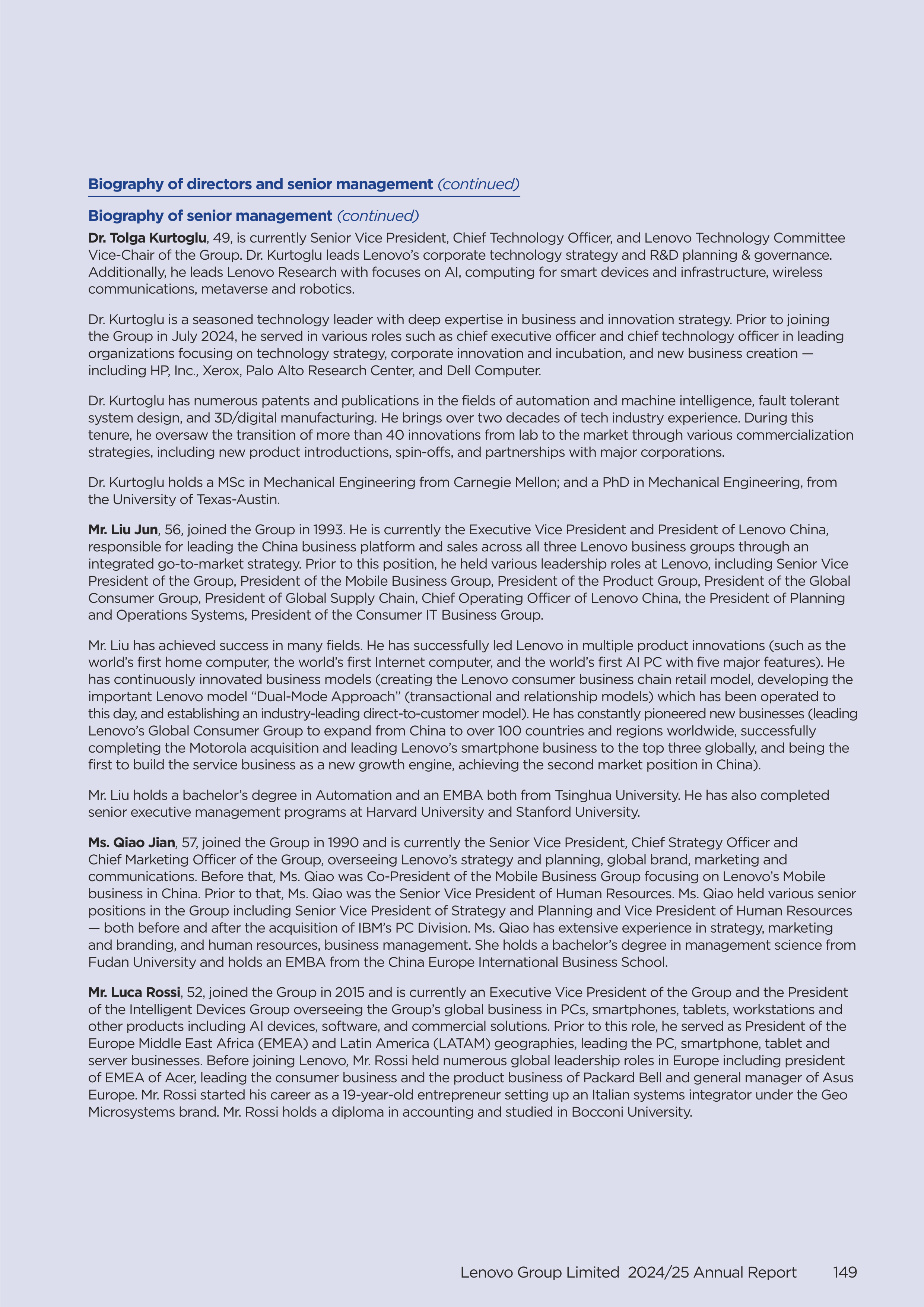
Lenovo Group Limited 2024/25 Annual Report
149
Biography of directors and senior management
(continued)
Biography of senior management
(continued)
Dr. Tolga Kurtoglu
, 49, is currently Senior Vice President, Chief Technology Officer, and Lenovo Technology Committee
Vice-Chair of the Group. Dr. Kurtoglu leads Lenovo’s corporate technology strategy and R&D planning & governance.
Additionally, he leads Lenovo Research with focuses on AI, computing for smart devices and infrastructure, wireless
communications, metaverse and robotics.
Dr. Kurtoglu is a seasoned technology leader with deep expertise in business and innovation strategy. Prior to joining
the Group in July 2024, he served in various roles such as chief executive officer and chief technology officer in leading
organizations focusing on technology strategy, corporate innovation and incubation, and new business creation —
including HP, Inc., Xerox, Palo Alto Research Center, and Dell Computer.
Dr. Kurtoglu has numerous patents and publications in the fields of automation and machine intelligence, fault tolerant
system design, and 3D/digital manufacturing. He brings over two decades of tech industry experience. During this
tenure, he oversaw the transition of more than 40 innovations from lab to the market through various commercialization
strategies, including new product introductions, spin-offs, and partnerships with major corporations.
Dr. Kurtoglu holds a MSc in Mechanical Engineering from Carnegie Mellon; and a PhD in Mechanical Engineering, from
the University of Texas-Austin.
Mr. Liu Jun
, 56, joined the Group in 1993. He is currently the Executive Vice President and President of Lenovo China,
responsible for leading the China business platform and sales across all three Lenovo business groups through an
integrated go-to-market strategy. Prior to this position, he held various leadership roles at Lenovo, including Senior Vice
President of the Group, President of the Mobile Business Group, President of the Product Group, President of the Global
Consumer Group, President of Global Supply Chain, Chief Operating Officer of Lenovo China, the President of Planning
and Operations Systems, President of the Consumer IT Business Group.
Mr. Liu has achieved success in many fields. He has successfully led Lenovo in multiple product innovations (such as the
world’s first home computer, the world’s first Internet computer, and the world’s first AI PC with five major features). He
has continuously innovated business models (creating the Lenovo consumer business chain retail model, developing the
important Lenovo model “Dual-Mode Approach” (transactional and relationship models) which has been operated to
this day, and establishing an industry-leading direct-to-customer model). He has constantly pioneered new businesses (leading
Lenovo’s Global Consumer Group to expand from China to over 100 countries and regions worldwide, successfully
completing the Motorola acquisition and leading Lenovo’s smartphone business to the top three globally, and being the
first to build the service business as a new growth engine, achieving the second market position in China).
Mr. Liu holds a bachelor’s degree in Automation and an EMBA both from Tsinghua University. He has also completed
senior executive management programs at Harvard University and Stanford University.
Ms. Qiao Jian
, 57, joined the Group in 1990 and is currently the Senior Vice President, Chief Strategy Officer and
Chief Marketing Officer of the Group, overseeing Lenovo’s strategy and planning, global brand, marketing and
communications. Before that, Ms. Qiao was Co-President of the Mobile Business Group focusing on Lenovo’s Mobile
business in China. Prior to that, Ms. Qiao was the Senior Vice President of Human Resources. Ms. Qiao held various senior
positions in the Group including Senior Vice President of Strategy and Planning and Vice President of Human Resources
— both before and after the acquisition of IBM’s PC Division. Ms. Qiao has extensive experience in strategy, marketing
and branding, and human resources, business management. She holds a bachelor’s degree in management science from
Fudan University and holds an EMBA from the China Europe International Business School.
Mr. Luca Rossi
, 52, joined the Group in 2015 and is currently an Executive Vice President of the Group and the President
of the Intelligent Devices Group overseeing the Group’s global business in PCs, smartphones, tablets, workstations and
other products including AI devices, software, and commercial solutions. Prior to this role, he served as President of the
Europe Middle East Africa (EMEA) and Latin America (LATAM) geographies, leading the PC, smartphone, tablet and
server businesses. Before joining Lenovo, Mr. Rossi held numerous global leadership roles in Europe including president
of EMEA of Acer, leading the consumer business and the product business of Packard Bell and general manager of Asus
Europe. Mr. Rossi started his career as a 19-year-old entrepreneur setting up an Italian systems integrator under the Geo
Microsystems brand. Mr. Rossi holds a diploma in accounting and studied in Bocconi University.
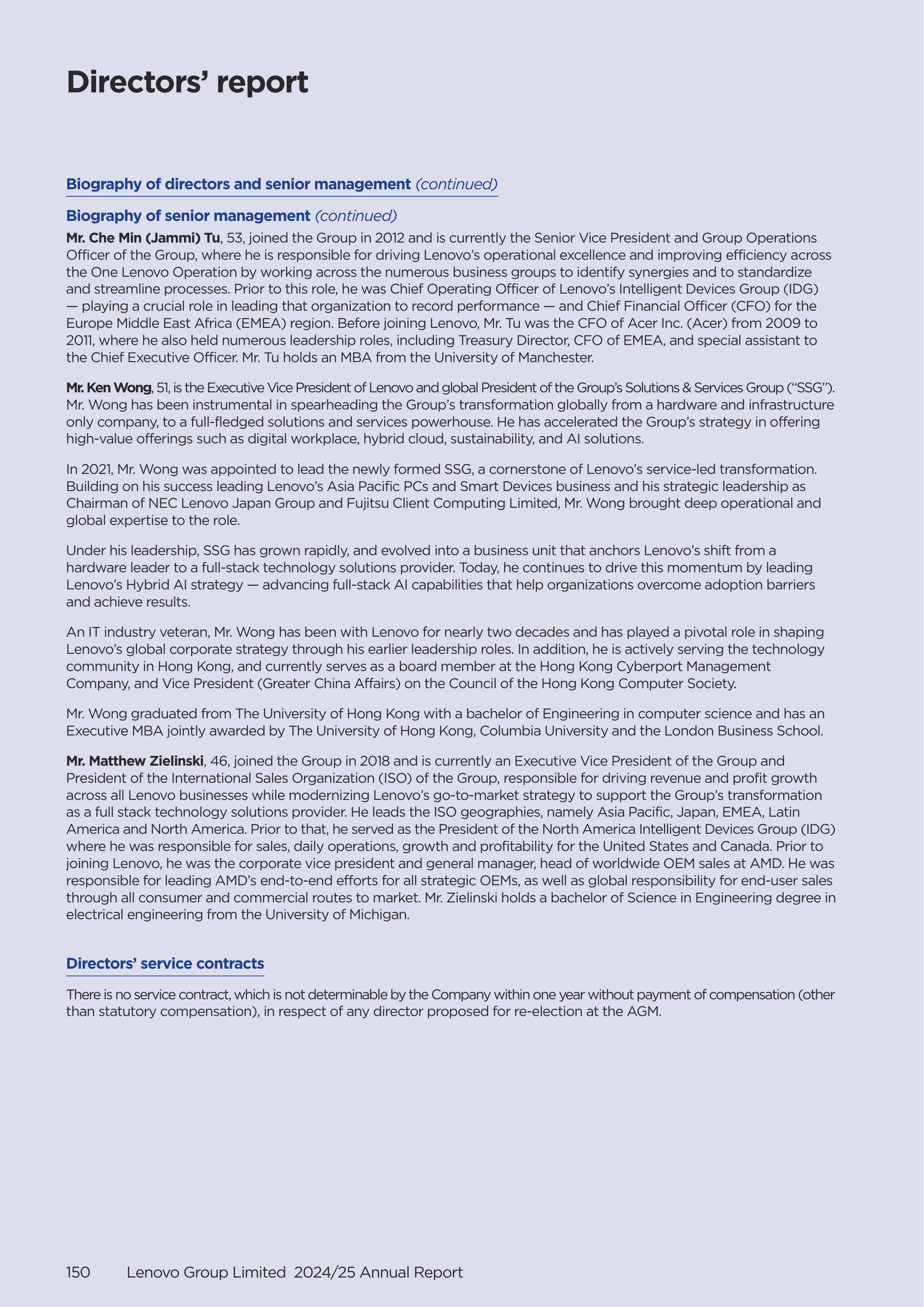
Directors’ report
Lenovo Group Limited 2024/25 Annual Report
150
Biography of directors and senior management
(continued)
Biography of senior management
(continued)
Mr. Che Min (Jammi) Tu
, 53, joined the Group in 2012 and is currently the Senior Vice President and Group Operations
Officer of the Group, where he is responsible for driving Lenovo’s operational excellence and improving efficiency across
the One Lenovo Operation by working across the numerous business groups to identify synergies and to standardize
and streamline processes. Prior to this role, he was Chief Operating Officer of Lenovo’s Intelligent Devices Group (IDG)
— playing a crucial role in leading that organization to record performance — and Chief Financial Officer (CFO) for the
Europe Middle East Africa (EMEA) region. Before joining Lenovo, Mr. Tu was the CFO of Acer Inc. (Acer) from 2009 to
2011, where he also held numerous leadership roles, including Treasury Director, CFO of EMEA, and special assistant to
the Chief Executive Officer. Mr. Tu holds an MBA from the University of Manchester.
Mr. Ken Wong
, 51, is the Executive Vice President of Lenovo and global President of the Group’s Solutions & Services Group (“SSG”).
Mr. Wong has been instrumental in spearheading the Group’s transformation globally from a hardware and infrastructure
only company, to a full-fledged solutions and services powerhouse. He has accelerated the Group’s strategy in offering
high-value offerings such as digital workplace, hybrid cloud, sustainability, and AI solutions.
In 2021, Mr. Wong was appointed to lead the newly formed SSG, a cornerstone of Lenovo’s service-led transformation.
Building on his success leading Lenovo’s Asia Pacific PCs and Smart Devices business and his strategic leadership as
Chairman of NEC Lenovo Japan Group and Fujitsu Client Computing Limited, Mr. Wong brought deep operational and
global expertise to the role.
Under his leadership, SSG has grown rapidly, and evolved into a business unit that anchors Lenovo’s shift from a
hardware leader to a full-stack technology solutions provider. Today, he continues to drive this momentum by leading
Lenovo’s Hybrid AI strategy — advancing full-stack AI capabilities that help organizations overcome adoption barriers
and achieve results.
An IT industry veteran, Mr. Wong has been with Lenovo for nearly two decades and has played a pivotal role in shaping
Lenovo’s global corporate strategy through his earlier leadership roles. In addition, he is actively serving the technology
community in Hong Kong, and currently serves as a board member at the Hong Kong Cyberport Management
Company, and Vice President (Greater China Affairs) on the Council of the Hong Kong Computer Society.
Mr. Wong graduated from The University of Hong Kong with a bachelor of Engineering in computer science and has an
Executive MBA jointly awarded by The University of Hong Kong, Columbia University and the London Business School.
Mr. Matthew Zielinski
, 46, joined the Group in 2018 and is currently an Executive Vice President of the Group and
President of the International Sales Organization (ISO) of the Group, responsible for driving revenue and profit growth
across all Lenovo businesses while modernizing Lenovo’s go-to-market strategy to support the Group’s transformation
as a full stack technology solutions provider. He leads the ISO geographies, namely Asia Pacific, Japan, EMEA, Latin
America and North America. Prior to that, he served as the President of the North America Intelligent Devices Group (IDG)
where he was responsible for sales, daily operations, growth and profitability for the United States and Canada. Prior to
joining Lenovo, he was the corporate vice president and general manager, head of worldwide OEM sales at AMD. He was
responsible for leading AMD’s end-to-end efforts for all strategic OEMs, as well as global responsibility for end-user sales
through all consumer and commercial routes to market. Mr. Zielinski holds a bachelor of Science in Engineering degree in
electrical engineering from the University of Michigan.
Directors’ service contracts
There is no service contract, which is not determinable by the Company within one year without payment of compensation (other
than statutory compensation), in respect of any director proposed for re-election at the AGM.
Lenovo Group Limited 2024/25 Annual Report
151
Directors’ material interests in transactions, arrangements or contracts
No other transactions, arrangements or contracts that is significant in relation to the Group’s business to which the
Company, its holding company, any of its subsidiaries or fellow subsidiaries was a party and in which a director of the
Company or his or her connected entities had a material interest, whether directly or indirectly, subsisted at the end of
the year or at any time during the year.
Directors’ indemnities and insurance
As permitted by the articles of association of the Company, a director or a former director of the Company may
be indemnified out of the Company’s assets against any liability incurred by the director to a person other than the
Company or an associated company of the Company that attaches to such director in his or her capacity as a director of
the Company, to the extent permitted by law. Such permitted indemnity provision is in force throughout the year and up
to the date of this report.
The Company has also taken out and maintained directors’ and officers’ liability insurance throughout the year, which
provides appropriate cover for certain legal actions brought against its directors and officers.
Directors’ and chief executive’s interests
As at March 31, 2025, the interests and short positions of the directors and chief executive of the Company in the shares,
underlying shares and debentures of the Company or any of its associated corporations (within the meaning of Part XV
of the Securities and Futures Ordinance (“SFO”)) as recorded in the register maintained by the Company under section
352 of the SFO or as otherwise notified to the Company and the Stock Exchange pursuant to the Model Code for
Securities Transactions by Directors of Listed Issuers (the “Model Code”) in the Listing Rules were as follows:
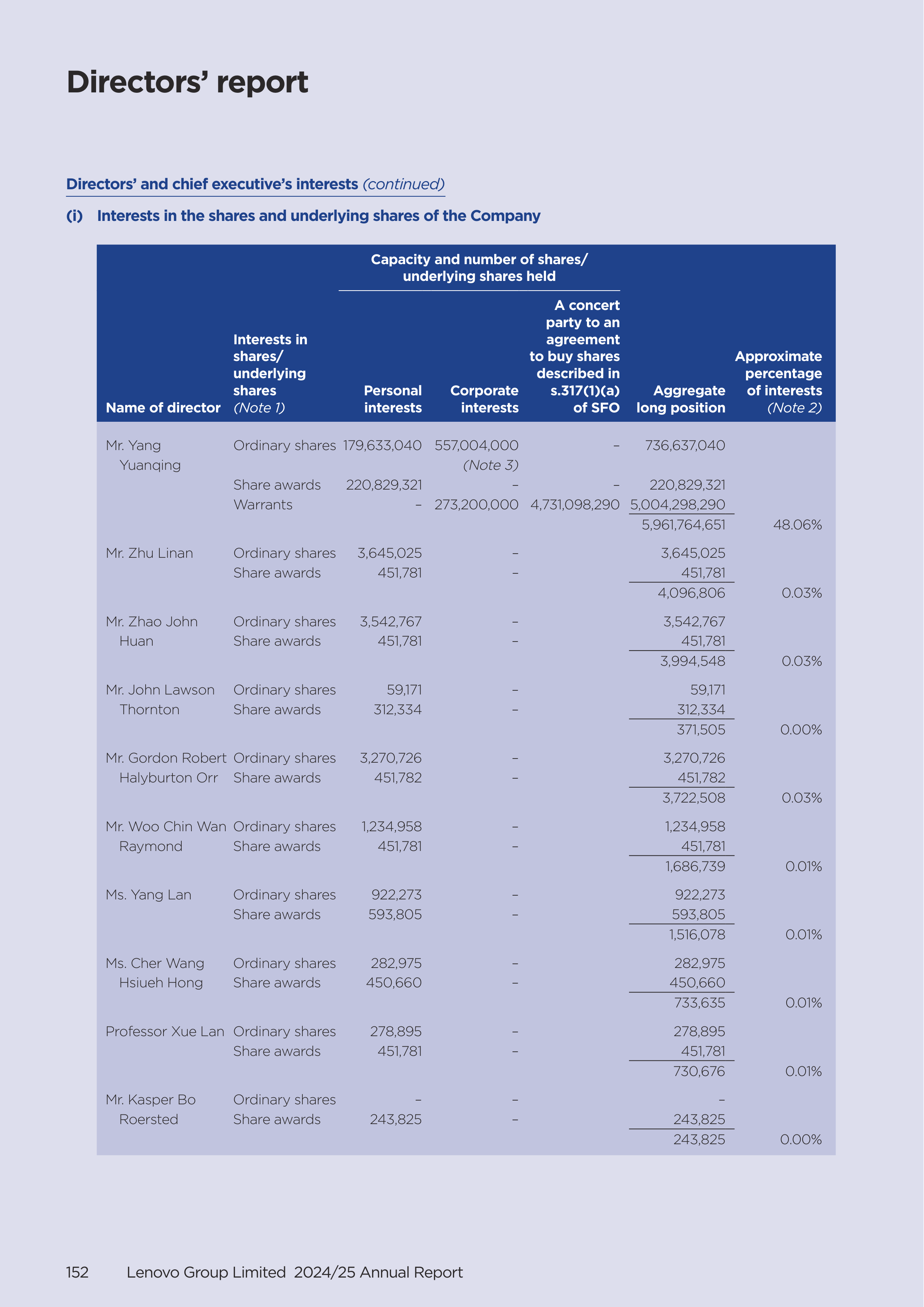
Directors’ report
Lenovo Group Limited 2024/25 Annual Report
152
Directors’ and chief executive’s interests
(continued)
(i)
Interests in the shares and underlying shares of the Company
Capacity and number of shares/
underlying shares held
Name of director
Interests in
shares/
underlying
shares
(Note 1)
Personal
interests
Corporate
interests
A concert
party to an
agreement
to buy shares
described in
s.317(1)(a)
of SFO
Aggregate
long position
Approximate
percentage
of interests
(Note 2)
Mr. Yang
Ordinary shares
179,633,040
557,004,000
–
736,637,040
Yuanqing
(Note 3)
Share awards
220,829,321
–
–
220,829,321
Warrants
–
273,200,000
4,731,098,290
5,004,298,290
5,961,764,651
48.06%
Mr. Zhu Linan
Ordinary shares
3,645,025
–
3,645,025
Share awards
451,781
–
451,781
4,096,806
0.03%
Mr. Zhao John
Ordinary shares
3,542,767
–
3,542,767
Huan
Share awards
451,781
–
451,781
3,994,548
0.03%
Mr. John Lawson
Ordinary shares
59,171
–
59,171
Thornton
Share awards
312,334
–
312,334
371,505
0.00%
Mr. Gordon Robert
Ordinary shares
3,270,726
–
3,270,726
Halyburton Orr
Share awards
451,782
–
451,782
3,722,508
0.03%
Mr. Woo Chin Wan
Ordinary shares
1,234,958
–
1,234,958
Raymond
Share awards
451,781
–
451,781
1,686,739
0.01%
Ms. Yang Lan
Ordinary shares
922,273
–
922,273
Share awards
593,805
–
593,805
1,516,078
0.01%
Ms. Cher Wang
Ordinary shares
282,975
–
282,975
Hsiueh Hong
Share awards
450,660
–
450,660
733,635
0.01%
Professor Xue Lan
Ordinary shares
278,895
–
278,895
Share awards
451,781
–
451,781
730,676
0.01%
Mr. Kasper Bo
Ordinary shares
–
–
–
Roersted
Share awards
243,825
–
243,825
243,825
0.00%
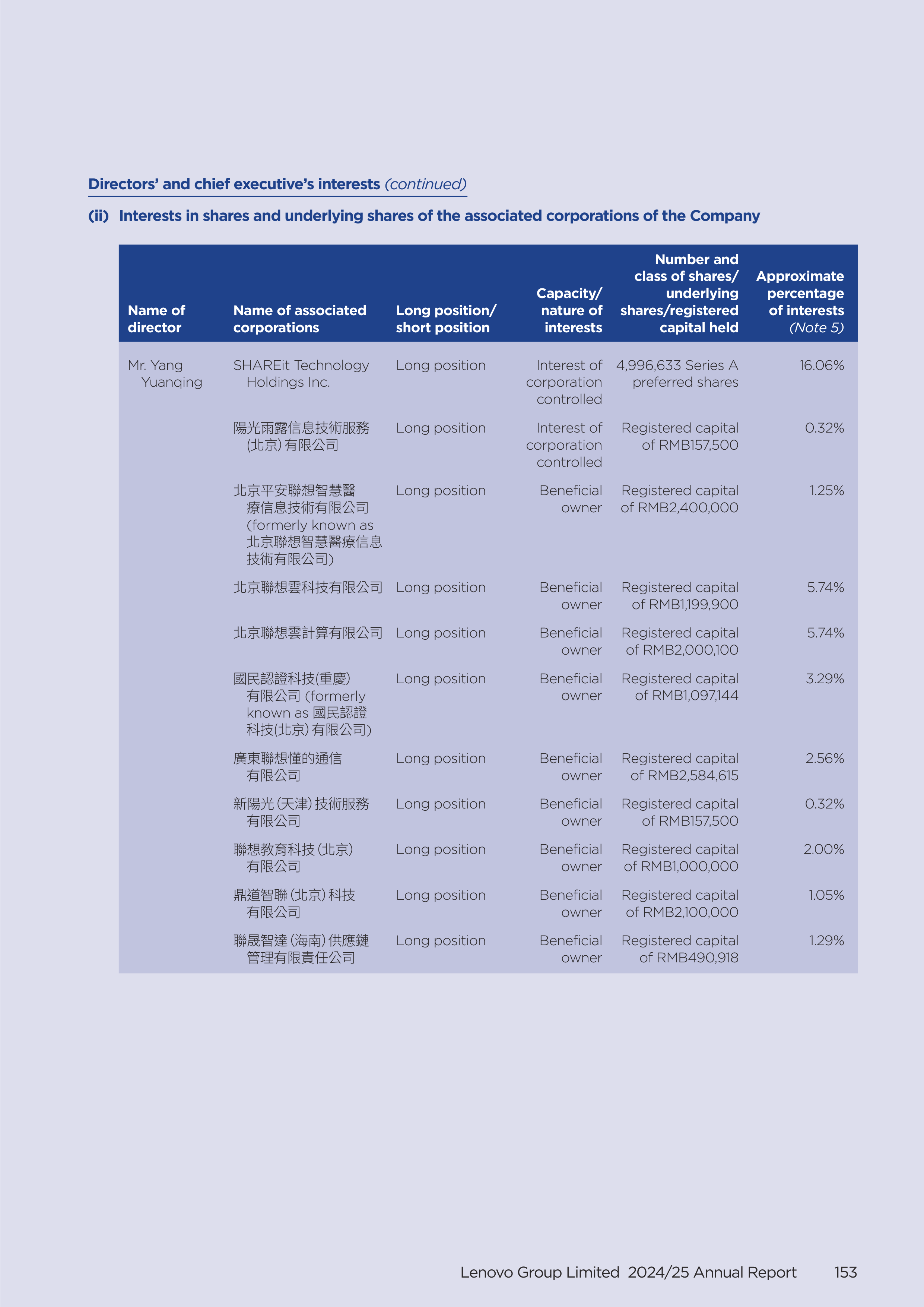
Lenovo Group Limited 2024/25 Annual Report
153
Directors’ and chief executive’s interests
(continued)
(ii)
Interests in shares and underlying shares of the associated corporations of the Company
Name of
director
Name of associated
corporations
Long position/
short position
Capacity/
nature of
interests
Number and
class of shares/
underlying
shares/registered
capital held
Approximate
percentage
of interests
(Note 5)
Mr. Yang
Yuanqing
SHAREit Technology
Holdings Inc.
Long position
Interest of
corporation
controlled
4,996,633 Series A
preferred shares
16.06%
陽光雨露信息技術服務
(北京)有限公司
Long position
Interest of
corporation
controlled
Registered capital
of RMB157,500
0.32%
北京平安聯想智慧醫
療信息技術有限公司
(formerly known as
北京聯想智慧醫療信息
技術有限公司
)
Long position
Beneficial
owner
Registered capital
of RMB2,400,000
1.25%
北京聯想雲科技有限公司
Long position
Beneficial
owner
Registered capital
of RMB1,199,900
5.74%
北京聯想雲計算有限公司
Long position
Beneficial
owner
Registered capital
of RMB2,000,100
5.74%
國民認證科技(重慶)
有限公司
(formerly
known as
國民認證
科技(北京)有限公司
)
Long position
Beneficial
owner
Registered capital
of RMB1,097,144
3.29%
廣東聯想懂的通信
有限公司
Long position
Beneficial
owner
Registered capital
of RMB2,584,615
2.56%
新陽光(天津)技術服務
有限公司
Long position
Beneficial
owner
Registered capital
of RMB157,500
0.32%
聯想教育科技(北京)
有限公司
Long position
Beneficial
owner
Registered capital
of RMB1,000,000
2.00%
鼎道智聯(北京)科技
有限公司
Long position
Beneficial
owner
Registered capital
of RMB2,100,000
1.05%
聯晟智達(海南)供應鏈
管理有限責任公司
Long position
Beneficial
owner
Registered capital
of RMB490,918
1.29%
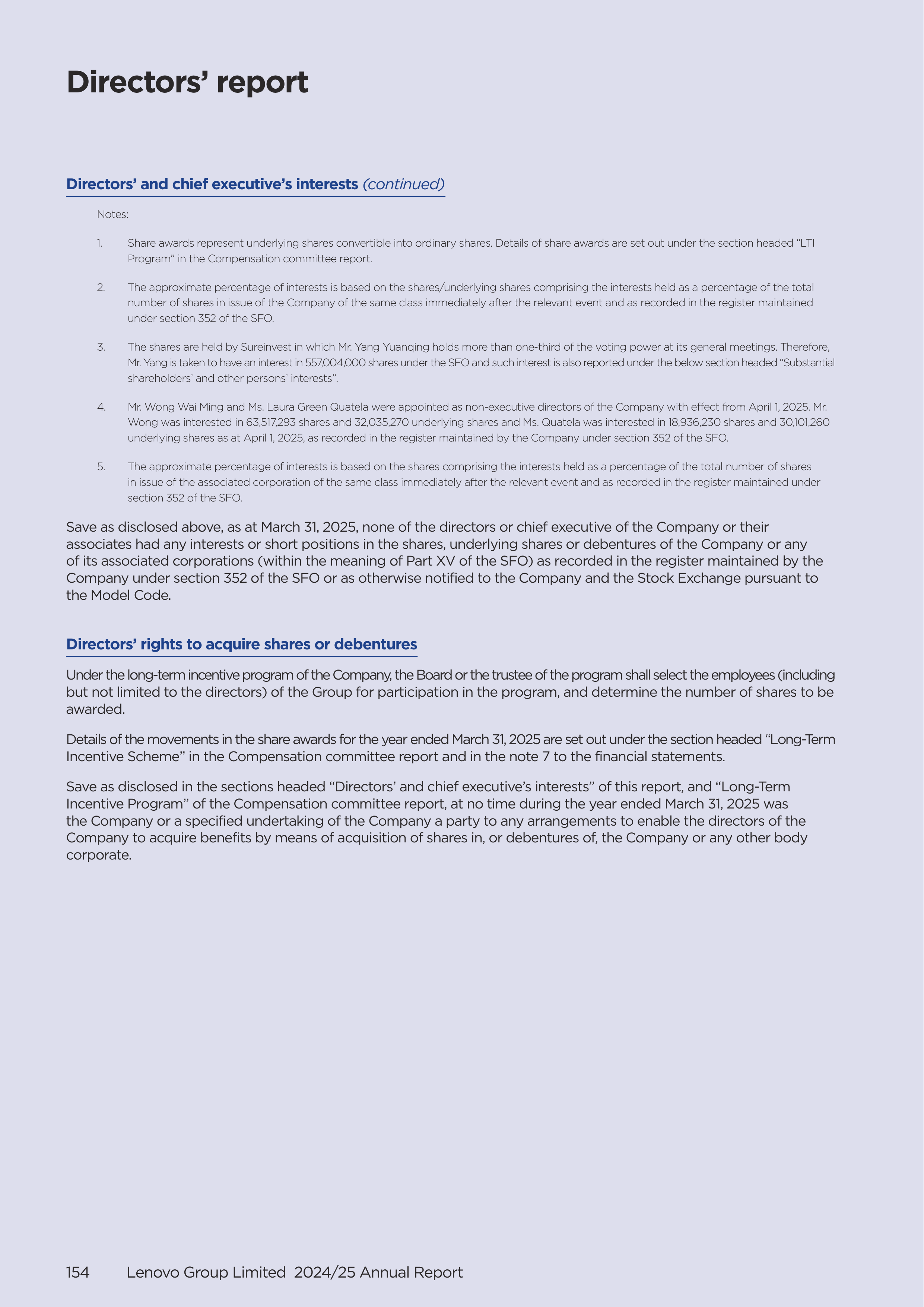
Directors’ report
Lenovo Group Limited 2024/25 Annual Report
154
Directors’ and chief executive’s interests
(continued)
Notes:
1.
Share awards represent underlying shares convertible into ordinary shares. Details of share awards are set out under the section headed “LTI
Program” in the Compensation committee report.
2.
The approximate percentage of interests is based on the shares/underlying shares comprising the interests held as a percentage of the total
number of shares in issue of the Company of the same class immediately after the relevant event and as recorded in the register maintained
under section 352 of the SFO.
3.
The shares are held by Sureinvest in which Mr. Yang Yuanqing holds more than one-third of the voting power at its general meetings. Therefore,
Mr. Yang is taken to have an interest in 557,004,000 shares under the SFO and such interest is also reported under the below section headed “Substantial
shareholders’ and other persons’ interests”.
4.
Mr. Wong Wai Ming and Ms. Laura Green Quatela were appointed as non-executive directors of the Company with effect from April 1, 2025. Mr.
Wong was interested in 63,517,293 shares and 32,035,270 underlying shares and Ms. Quatela was interested in 18,936,230 shares and 30,101,260
underlying shares as at April 1, 2025, as recorded in the register maintained by the Company under section 352 of the SFO.
5.
The approximate percentage of interests is based on the shares comprising the interests held as a percentage of the total number of shares
in issue of the associated corporation of the same class immediately after the relevant event and as recorded in the register maintained under
section 352 of the SFO.
Save as disclosed above, as at March 31, 2025, none of the directors or chief executive of the Company or their
associates had any interests or short positions in the shares, underlying shares or debentures of the Company or any
of its associated corporations (within the meaning of Part XV of the SFO) as recorded in the register maintained by the
Company under section 352 of the SFO or as otherwise notified to the Company and the Stock Exchange pursuant to
the Model Code.
Directors’ rights to acquire shares or debentures
Under the long-term incentive program of the Company, the Board or the trustee of the program shall select the employees (including
but not limited to the directors) of the Group for participation in the program, and determine the number of shares to be
awarded.
Details of the movements in the share awards for the year ended March 31, 2025 are set out under the section headed “Long-Term
Incentive Scheme” in the Compensation committee report and in the note 7 to the financial statements.
Save as disclosed in the sections headed “Directors’ and chief executive’s interests” of this report, and “Long-Term
Incentive Program” of the Compensation committee report, at no time during the year ended March 31, 2025 was
the Company or a specified undertaking of the Company a party to any arrangements to enable the directors of the
Company to acquire benefits by means of acquisition of shares in, or debentures of, the Company or any other body
corporate.
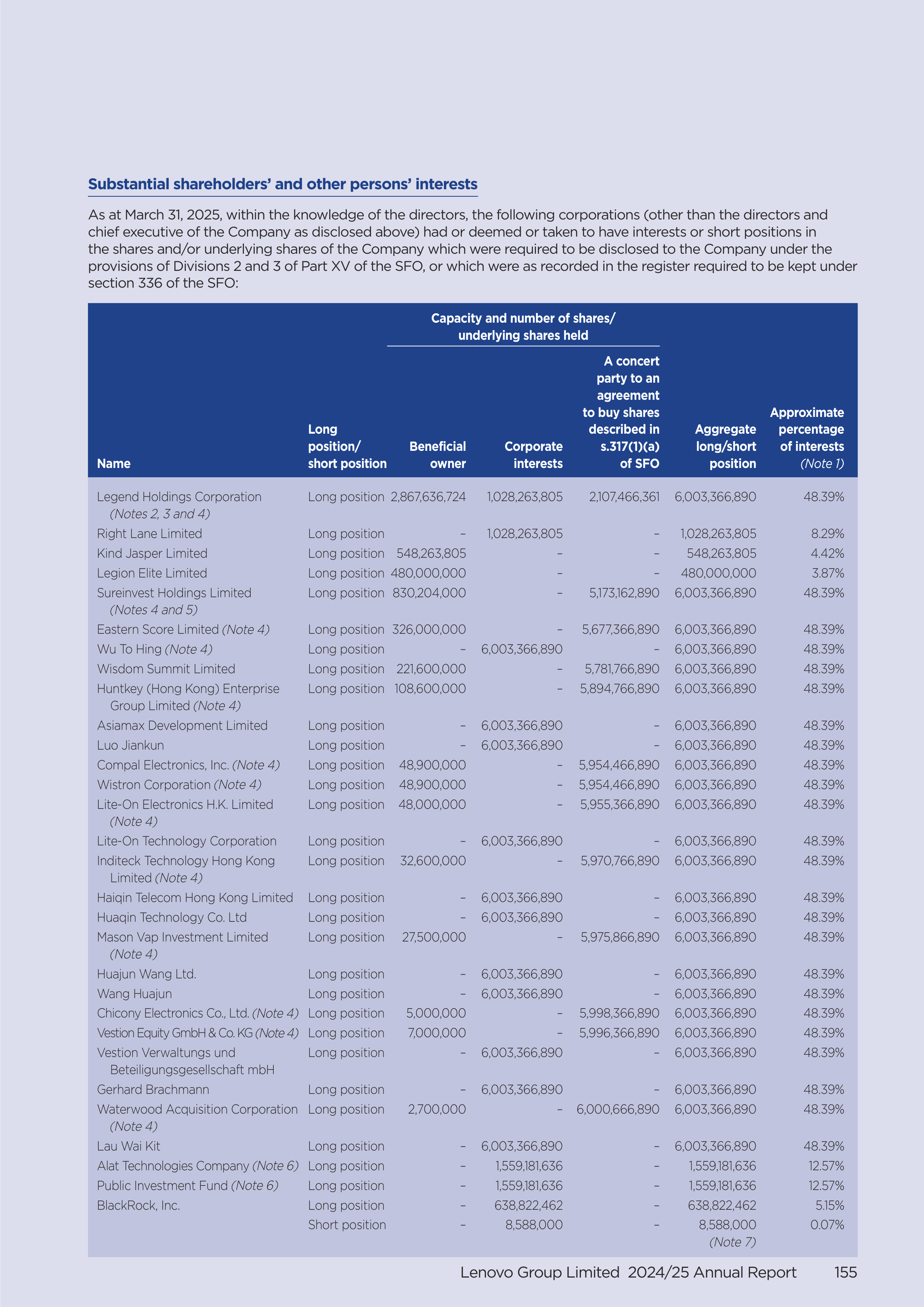
Lenovo Group Limited 2024/25 Annual Report
155
Substantial shareholders’ and other persons’ interests
As at March 31, 2025, within the knowledge of the directors, the following corporations (other than the directors and
chief executive of the Company as disclosed above) had or deemed or taken to have interests or short positions in
the shares and/or underlying shares of the Company which were required to be disclosed to the Company under the
provisions of Divisions 2 and 3 of Part XV of the SFO, or which were as recorded in the register required to be kept under
section 336 of the SFO:
Capacity and number of shares/
underlying shares held
Name
Long
position/
short position
Beneficial
owner
Corporate
interests
A concert
party to an
agreement
to buy shares
described in
s.317(1)(a)
of SFO
Aggregate
long/short
position
Approximate
percentage
of interests
(Note 1)
Legend Holdings Corporation
(Notes 2, 3 and 4)
Long position
2,867,636,724
1,028,263,805
2,107,466,361
6,003,366,890
48.39%
Right Lane Limited
Long position
–
1,028,263,805
–
1,028,263,805
8.29%
Kind Jasper Limited
Long position
548,263,805
–
–
548,263,805
4.42%
Legion Elite Limited
Long position
480,000,000
–
–
480,000,000
3.87%
Sureinvest Holdings Limited
(Notes 4 and 5)
Long position
830,204,000
–
5,173,162,890
6,003,366,890
48.39%
Eastern Score Limited (Note 4)
Long position
326,000,000
–
5,677,366,890
6,003,366,890
48.39%
Wu To Hing (Note 4)
Long position
–
6,003,366,890
–
6,003,366,890
48.39%
Wisdom Summit Limited
Long position
221,600,000
–
5,781,766,890
6,003,366,890
48.39%
Huntkey (Hong Kong) Enterprise
Group Limited (Note 4)
Long position
108,600,000
–
5,894,766,890
6,003,366,890
48.39%
Asiamax Development Limited
Long position
–
6,003,366,890
–
6,003,366,890
48.39%
Luo Jiankun
Long position
–
6,003,366,890
–
6,003,366,890
48.39%
Compal Electronics, Inc. (Note 4)
Long position
48,900,000
–
5,954,466,890
6,003,366,890
48.39%
Wistron Corporation (Note 4)
Long position
48,900,000
–
5,954,466,890
6,003,366,890
48.39%
Lite-On Electronics H.K. Limited
(Note 4)
Long position
48,000,000
–
5,955,366,890
6,003,366,890
48.39%
Lite-On Technology Corporation
Long position
–
6,003,366,890
–
6,003,366,890
48.39%
Inditeck Technology Hong Kong
Limited (Note 4)
Long position
32,600,000
–
5,970,766,890
6,003,366,890
48.39%
Haiqin Telecom Hong Kong Limited
Long position
–
6,003,366,890
–
6,003,366,890
48.39%
Huaqin Technology Co. Ltd
Long position
–
6,003,366,890
–
6,003,366,890
48.39%
Mason Vap Investment Limited
(Note 4)
Long position
27,500,000
–
5,975,866,890
6,003,366,890
48.39%
Huajun Wang Ltd.
Long position
–
6,003,366,890
–
6,003,366,890
48.39%
Wang Huajun
Long position
–
6,003,366,890
–
6,003,366,890
48.39%
Chicony Electronics Co., Ltd. (Note 4)
Long position
5,000,000
–
5,998,366,890
6,003,366,890
48.39%
Vestion Equity GmbH & Co. KG (Note 4)
Long position
7,000,000
–
5,996,366,890
6,003,366,890
48.39%
Vestion Verwaltungs und
Beteiligungsgesellschaft mbH
Long position
–
6,003,366,890
–
6,003,366,890
48.39%
Gerhard Brachmann
Long position
–
6,003,366,890
–
6,003,366,890
48.39%
Waterwood Acquisition Corporation
(Note 4)
Long position
2,700,000
–
6,000,666,890
6,003,366,890
48.39%
Lau Wai Kit
Long position
–
6,003,366,890
–
6,003,366,890
48.39%
Alat Technologies Company (Note 6)
Long position
–
1,559,181,636
–
1,559,181,636
12.57%
Public Investment Fund (Note 6)
Long position
–
1,559,181,636
–
1,559,181,636
12.57%
BlackRock, Inc.
Long position
–
638,822,462
–
638,822,462
5.15%
Short position
–
8,588,000
–
8,588,000
(Note 7)
0.07%
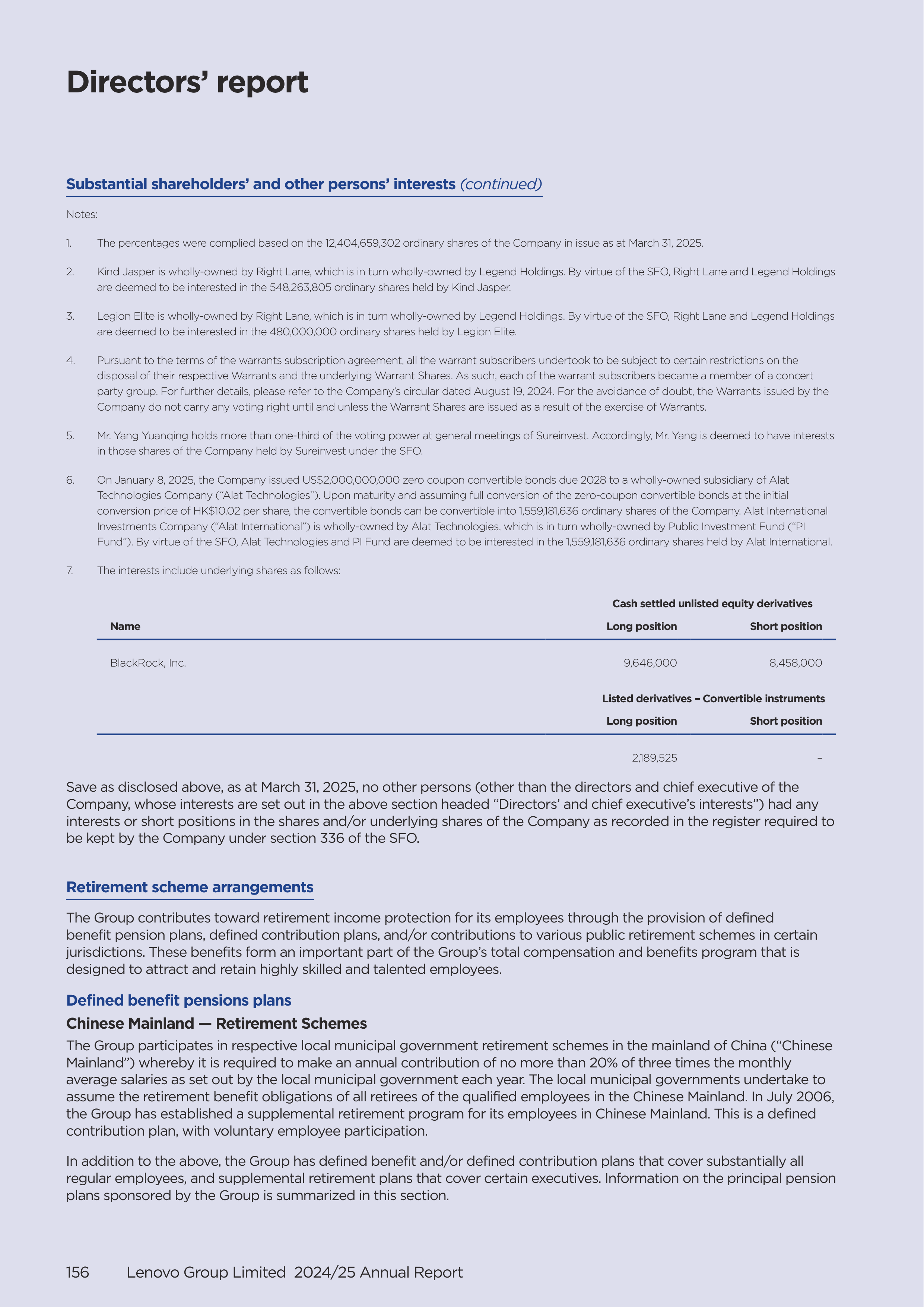
Directors’ report
Lenovo Group Limited 2024/25 Annual Report
156
Substantial shareholders’ and other persons’ interests
(continued)
Notes:
1.
The percentages were complied based on the 12,404,659,302 ordinary shares of the Company in issue as at March 31, 2025.
2.
Kind Jasper is wholly-owned by Right Lane, which is in turn wholly-owned by Legend Holdings. By virtue of the SFO, Right Lane and Legend Holdings
are deemed to be interested in the 548,263,805 ordinary shares held by Kind Jasper.
3.
Legion Elite is wholly-owned by Right Lane, which is in turn wholly-owned by Legend Holdings. By virtue of the SFO, Right Lane and Legend Holdings
are deemed to be interested in the 480,000,000 ordinary shares held by Legion Elite.
4.
Pursuant to the terms of the warrants subscription agreement, all the warrant subscribers undertook to be subject to certain restrictions on the
disposal of their respective Warrants and the underlying Warrant Shares. As such, each of the warrant subscribers became a member of a concert
party group. For further details, please refer to the Company’s circular dated August 19, 2024. For the avoidance of doubt, the Warrants issued by the
Company do not carry any voting right until and unless the Warrant Shares are issued as a result of the exercise of Warrants.
5.
Mr. Yang Yuanqing holds more than one-third of the voting power at general meetings of Sureinvest. Accordingly, Mr. Yang is deemed to have interests
in those shares of the Company held by Sureinvest under the SFO.
6.
On January 8, 2025, the Company issued US$2,000,000,000 zero coupon convertible bonds due 2028 to a wholly-owned subsidiary of Alat
Technologies Company (“Alat Technologies”). Upon maturity and assuming full conversion of the zero-coupon convertible bonds at the initial
conversion price of HK$10.02 per share, the convertible bonds can be convertible into 1,559,181,636 ordinary shares of the Company. Alat International
Investments Company (“Alat International”) is wholly-owned by Alat Technologies, which is in turn wholly-owned by Public Investment Fund (“PI
Fund”). By virtue of the SFO, Alat Technologies and PI Fund are deemed to be interested in the 1,559,181,636 ordinary shares held by Alat International.
7.
The interests include underlying shares as follows:
Cash settled unlisted equity derivatives
Name
Long position
Short position
BlackRock, Inc.
9,646,000
8,458,000
Listed derivatives – Convertible instruments
Long position
Short position
2,189,525
–
Save as disclosed above, as at March 31, 2025, no other persons (other than the directors and chief executive of the
Company, whose interests are set out in the above section headed “Directors’ and chief executive’s interests”) had any
interests or short positions in the shares and/or underlying shares of the Company as recorded in the register required to
be kept by the Company under section 336 of the SFO.
Retirement scheme arrangements
The Group contributes toward retirement income protection for its employees through the provision of defined
benefit pension plans, defined contribution plans, and/or contributions to various public retirement schemes in certain
jurisdictions. These benefits form an important part of the Group’s total compensation and benefits program that is
designed to attract and retain highly skilled and talented employees.
Defined benefit pensions plans
Chinese Mainland — Retirement Schemes
The Group participates in respective local municipal government retirement schemes in the mainland of China (“Chinese
Mainland”) whereby it is required to make an annual contribution of no more than 20% of three times the monthly
average salaries as set out by the local municipal government each year. The local municipal governments undertake to
assume the retirement benefit obligations of all retirees of the qualified employees in the Chinese Mainland. In July 2006,
the Group has established a supplemental retirement program for its employees in Chinese Mainland. This is a defined
contribution plan, with voluntary employee participation.
In addition to the above, the Group has defined benefit and/or defined contribution plans that cover substantially all
regular employees, and supplemental retirement plans that cover certain executives. Information on the principal pension
plans sponsored by the Group is summarized in this section.
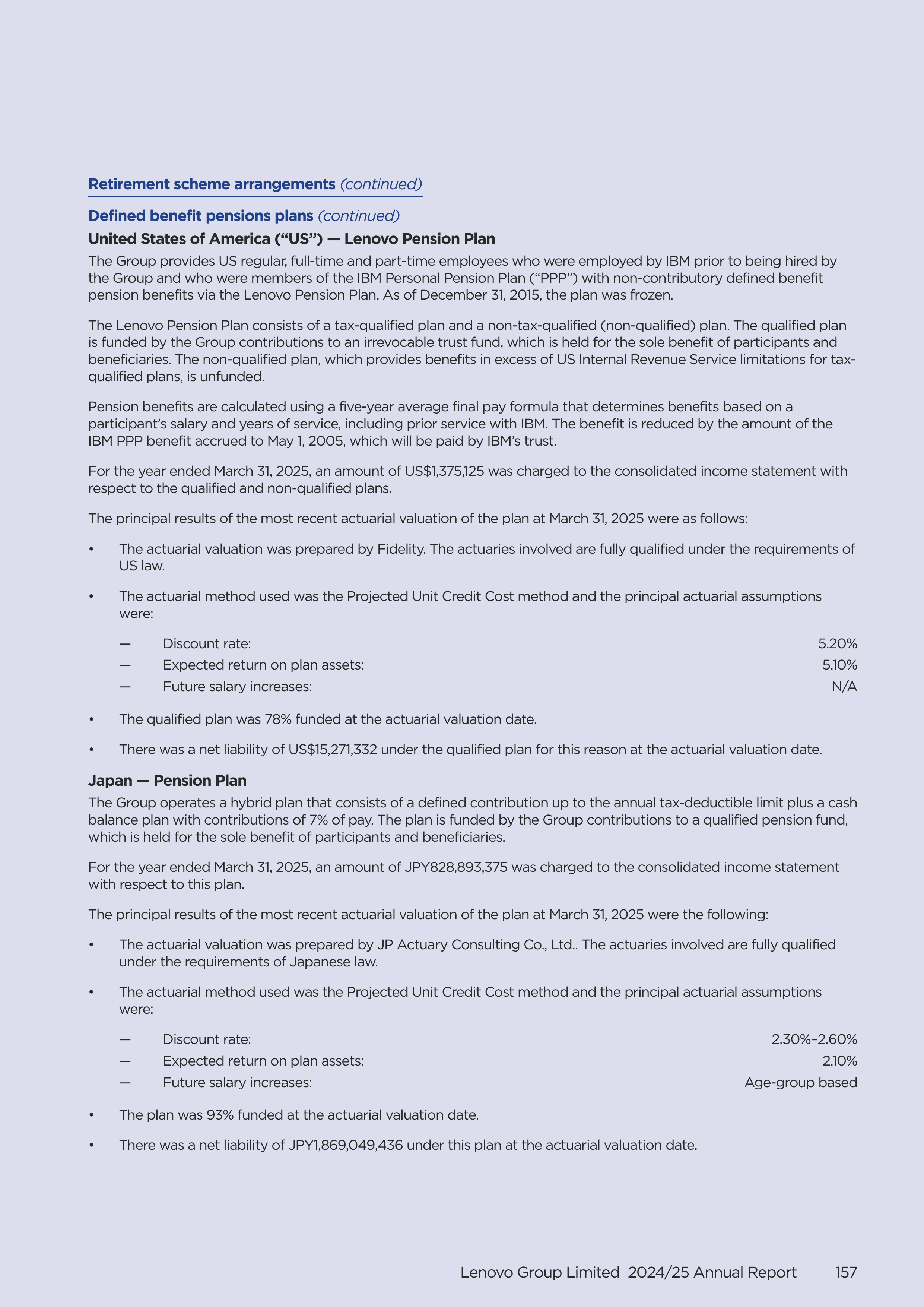
Lenovo Group Limited 2024/25 Annual Report
157
Retirement scheme arrangements
(continued)
Defined benefit pensions plans
(continued)
United States of America (“US”) — Lenovo Pension Plan
The Group provides US regular, full-time and part-time employees who were employed by IBM prior to being hired by
the Group and who were members of the IBM Personal Pension Plan (“PPP”) with non-contributory defined benefit
pension benefits via the Lenovo Pension Plan. As of December 31, 2015, the plan was frozen.
The Lenovo Pension Plan consists of a tax-qualified plan and a non-tax-qualified (non-qualified) plan. The qualified plan
is funded by the Group contributions to an irrevocable trust fund, which is held for the sole benefit of participants and
beneficiaries. The non-qualified plan, which provides benefits in excess of US Internal Revenue Service limitations for tax-
qualified plans, is unfunded.
Pension benefits are calculated using a five-year average final pay formula that determines benefits based on a
participant’s salary and years of service, including prior service with IBM. The benefit is reduced by the amount of the
IBM PPP benefit accrued to May 1, 2005, which will be paid by IBM’s trust.
For the year ended March 31, 2025, an amount of US$1,375,125 was charged to the consolidated income statement with
respect to the qualified and non-qualified plans.
The principal results of the most recent actuarial valuation of the plan at March 31, 2025 were as follows:
•
The actuarial valuation was prepared by Fidelity. The actuaries involved are fully qualified under the requirements of
US law.
•
The actuarial method used was the Projected Unit Credit Cost method and the principal actuarial assumptions
were:
—
Discount rate:
5.20%
—
Expected return on plan assets:
5.10%
—
Future salary increases:
N/A
•
The qualified plan was 78% funded at the actuarial valuation date.
•
There was a net liability of US$15,271,332 under the qualified plan for this reason at the actuarial valuation date.
Japan — Pension Plan
The Group operates a hybrid plan that consists of a defined contribution up to the annual tax-deductible limit plus a cash
balance plan with contributions of 7% of pay. The plan is funded by the Group contributions to a qualified pension fund,
which is held for the sole benefit of participants and beneficiaries.
For the year ended March 31, 2025, an amount of JPY828,893,375 was charged to the consolidated income statement
with respect to this plan.
The principal results of the most recent actuarial valuation of the plan at March 31, 2025 were the following:
•
The actuarial valuation was prepared by JP Actuary Consulting Co., Ltd.. The actuaries involved are fully qualified
under the requirements of Japanese law.
•
The actuarial method used was the Projected Unit Credit Cost method and the principal actuarial assumptions
were:
—
Discount rate:
2.30%–2.60%
—
Expected return on plan assets:
2.10%
—
Future salary increases:
Age-group based
•
The plan was 93% funded at the actuarial valuation date.
•
There was a net liability of JPY1,869,049,436 under this plan at the actuarial valuation date.
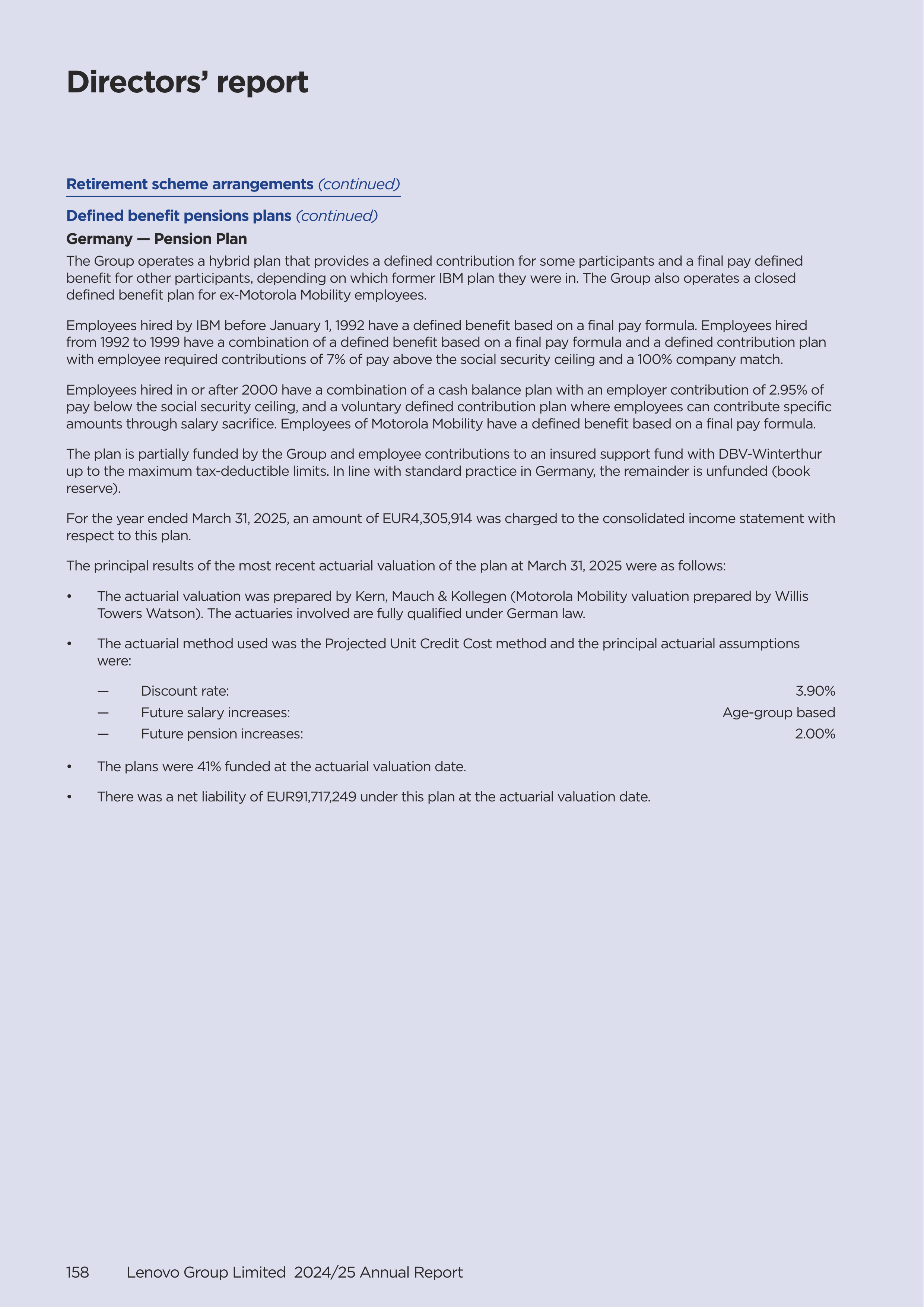
Directors’ report
Lenovo Group Limited 2024/25 Annual Report
158
Retirement scheme arrangements
(continued)
Defined benefit pensions plans
(continued)
Germany — Pension Plan
The Group operates a hybrid plan that provides a defined contribution for some participants and a final pay defined
benefit for other participants, depending on which former IBM plan they were in. The Group also operates a closed
defined benefit plan for ex-Motorola Mobility employees.
Employees hired by IBM before January 1, 1992 have a defined benefit based on a final pay formula. Employees hired
from 1992 to 1999 have a combination of a defined benefit based on a final pay formula and a defined contribution plan
with employee required contributions of 7% of pay above the social security ceiling and a 100% company match.
Employees hired in or after 2000 have a combination of a cash balance plan with an employer contribution of 2.95% of
pay below the social security ceiling, and a voluntary defined contribution plan where employees can contribute specific
amounts through salary sacrifice. Employees of Motorola Mobility have a defined benefit based on a final pay formula.
The plan is partially funded by the Group and employee contributions to an insured support fund with DBV-Winterthur
up to the maximum tax-deductible limits. In line with standard practice in Germany, the remainder is unfunded (book
reserve).
For the year ended March 31, 2025, an amount of EUR4,305,914 was charged to the consolidated income statement with
respect to this plan.
The principal results of the most recent actuarial valuation of the plan at March 31, 2025 were as follows:
•
The actuarial valuation was prepared by Kern, Mauch & Kollegen (Motorola Mobility valuation prepared by Willis
Towers Watson). The actuaries involved are fully qualified under German law.
•
The actuarial method used was the Projected Unit Credit Cost method and the principal actuarial assumptions
were:
—
Discount rate:
3.90%
—
Future salary increases:
Age-group based
—
Future pension increases:
2.00%
•
The plans were 41% funded at the actuarial valuation date.
•
There was a net liability of EUR91,717,249 under this plan at the actuarial valuation date.
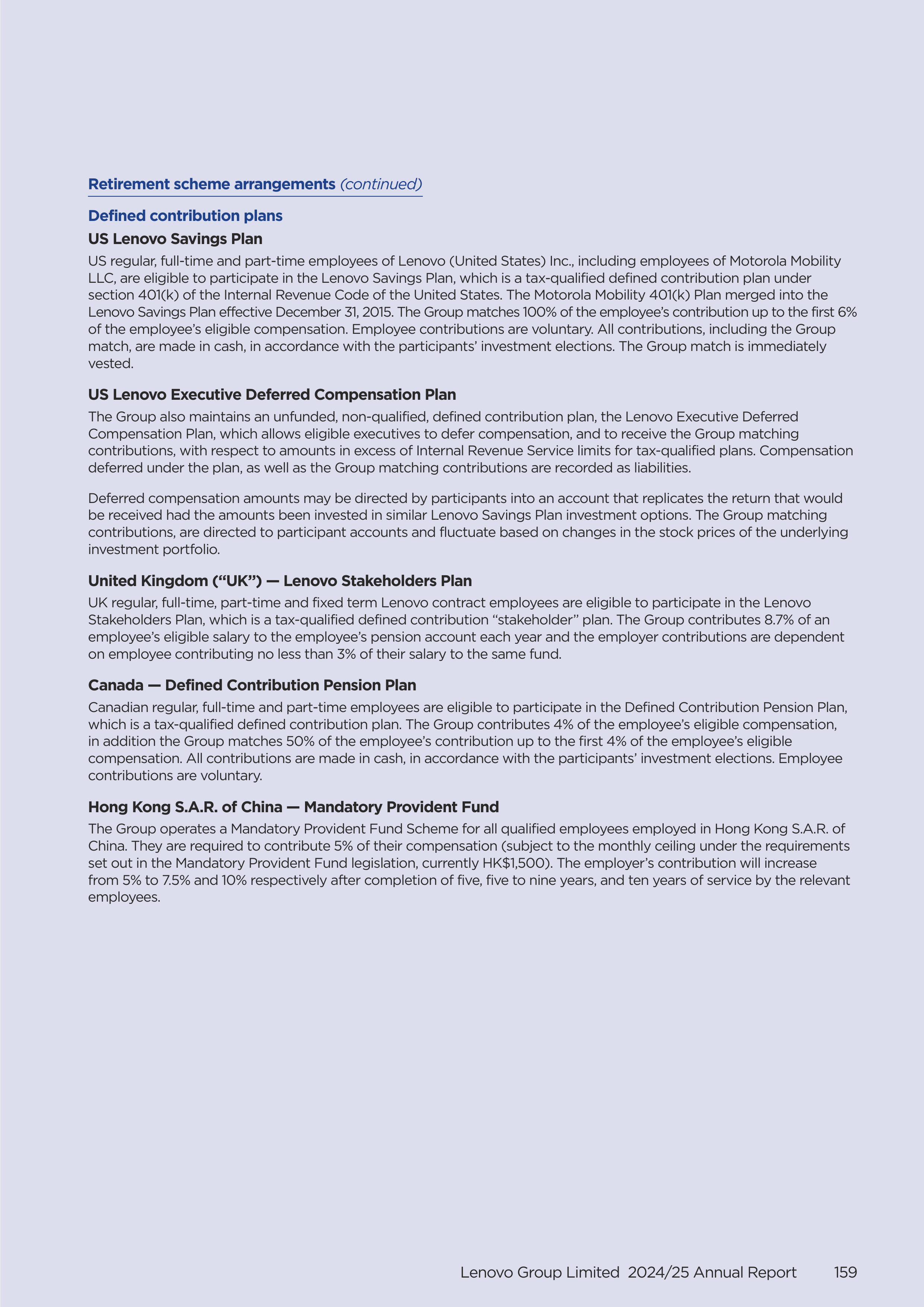
Lenovo Group Limited 2024/25 Annual Report
159
Retirement scheme arrangements
(continued)
Defined contribution plans
US Lenovo Savings Plan
US regular, full-time and part-time employees of Lenovo (United States) Inc., including employees of Motorola Mobility
LLC, are eligible to participate in the Lenovo Savings Plan, which is a tax-qualified defined contribution plan under
section 401(k) of the Internal Revenue Code of the United States. The Motorola Mobility 401(k) Plan merged into the
Lenovo Savings Plan effective December 31, 2015. The Group matches 100% of the employee’s contribution up to the first 6%
of the employee’s eligible compensation. Employee contributions are voluntary. All contributions, including the Group
match, are made in cash, in accordance with the participants’ investment elections. The Group match is immediately
vested.
US Lenovo Executive Deferred Compensation Plan
The Group also maintains an unfunded, non-qualified, defined contribution plan, the Lenovo Executive Deferred
Compensation Plan, which allows eligible executives to defer compensation, and to receive the Group matching
contributions, with respect to amounts in excess of Internal Revenue Service limits for tax-qualified plans. Compensation
deferred under the plan, as well as the Group matching contributions are recorded as liabilities.
Deferred compensation amounts may be directed by participants into an account that replicates the return that would
be received had the amounts been invested in similar Lenovo Savings Plan investment options. The Group matching
contributions, are directed to participant accounts and fluctuate based on changes in the stock prices of the underlying
investment portfolio.
United Kingdom (“UK”) — Lenovo Stakeholders Plan
UK regular, full-time, part-time and fixed term Lenovo contract employees are eligible to participate in the Lenovo
Stakeholders Plan, which is a tax-qualified defined contribution “stakeholder” plan. The Group contributes 8.7% of an
employee’s eligible salary to the employee’s pension account each year and the employer contributions are dependent
on employee contributing no less than 3% of their salary to the same fund.
Canada — Defined Contribution Pension Plan
Canadian regular, full-time and part-time employees are eligible to participate in the Defined Contribution Pension Plan,
which is a tax-qualified defined contribution plan. The Group contributes 4% of the employee’s eligible compensation,
in addition the Group matches 50% of the employee’s contribution up to the first 4% of the employee’s eligible
compensation. All contributions are made in cash, in accordance with the participants’ investment elections. Employee
contributions are voluntary.
Hong Kong S.A.R. of China — Mandatory Provident Fund
The Group operates a Mandatory Provident Fund Scheme for all qualified employees employed in Hong Kong S.A.R. of
China. They are required to contribute 5% of their compensation (subject to the monthly ceiling under the requirements
set out in the Mandatory Provident Fund legislation, currently HK$1,500). The employer’s contribution will increase
from 5% to 7.5% and 10% respectively after completion of five, five to nine years, and ten years of service by the relevant
employees.
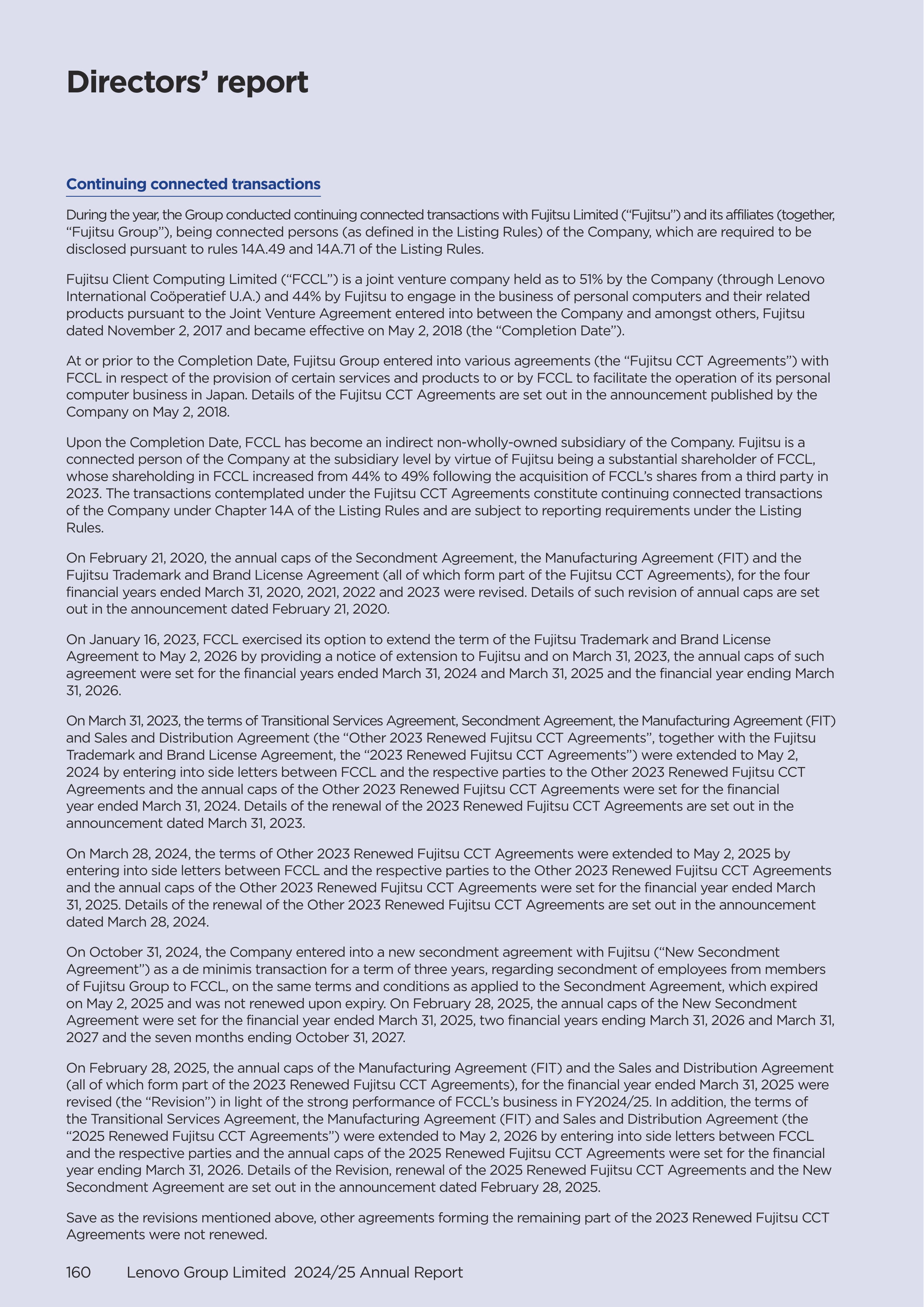
Directors’ report
Lenovo Group Limited 2024/25 Annual Report
160
Continuing connected transactions
During the year, the Group conducted continuing connected transactions with Fujitsu Limited (“Fujitsu”) and its affiliates (together,
“Fujitsu Group”), being connected persons (as defined in the Listing Rules) of the Company, which are required to be
disclosed pursuant to rules 14A.49 and 14A.71 of the Listing Rules.
Fujitsu Client Computing Limited (“FCCL”) is a joint venture company held as to 51% by the Company (through Lenovo
International Coöperatief U.A.) and 44% by Fujitsu to engage in the business of personal computers and their related
products pursuant to the Joint Venture Agreement entered into between the Company and amongst others, Fujitsu
dated November 2, 2017 and became effective on May 2, 2018 (the “Completion Date”).
At or prior to the Completion Date, Fujitsu Group entered into various agreements (the “Fujitsu CCT Agreements”) with
FCCL in respect of the provision of certain services and products to or by FCCL to facilitate the operation of its personal
computer business in Japan. Details of the Fujitsu CCT Agreements are set out in the announcement published by the
Company on May 2, 2018.
Upon the Completion Date, FCCL has become an indirect non-wholly-owned subsidiary of the Company. Fujitsu is a
connected person of the Company at the subsidiary level by virtue of Fujitsu being a substantial shareholder of FCCL,
whose shareholding in FCCL increased from 44% to 49% following the acquisition of FCCL’s shares from a third party in
2023. The transactions contemplated under the Fujitsu CCT Agreements constitute continuing connected transactions
of the Company under Chapter 14A of the Listing Rules and are subject to reporting requirements under the Listing
Rules.
On February 21, 2020, the annual caps of the Secondment Agreement, the Manufacturing Agreement (FIT) and the
Fujitsu Trademark and Brand License Agreement (all of which form part of the Fujitsu CCT Agreements), for the four
financial years ended March 31, 2020, 2021, 2022 and 2023 were revised. Details of such revision of annual caps are set
out in the announcement dated February 21, 2020.
On January 16, 2023, FCCL exercised its option to extend the term of the Fujitsu Trademark and Brand License
Agreement to May 2, 2026 by providing a notice of extension to Fujitsu and on March 31, 2023, the annual caps of such
agreement were set for the financial years ended March 31, 2024 and March 31, 2025 and the financial year ending March
31, 2026.
On March 31, 2023, the terms of Transitional Services Agreement, Secondment Agreement, the Manufacturing Agreement (FIT)
and Sales and Distribution Agreement (the “Other 2023 Renewed Fujitsu CCT Agreements”, together with the Fujitsu
Trademark and Brand License Agreement, the “2023 Renewed Fujitsu CCT Agreements”) were extended to May 2,
2024 by entering into side letters between FCCL and the respective parties to the Other 2023 Renewed Fujitsu CCT
Agreements and the annual caps of the Other 2023 Renewed Fujitsu CCT Agreements were set for the financial
year ended March 31, 2024. Details of the renewal of the 2023 Renewed Fujitsu CCT Agreements are set out in the
announcement dated March 31, 2023.
On March 28, 2024, the terms of Other 2023 Renewed Fujitsu CCT Agreements were extended to May 2, 2025 by
entering into side letters between FCCL and the respective parties to the Other 2023 Renewed Fujitsu CCT Agreements
and the annual caps of the Other 2023 Renewed Fujitsu CCT Agreements were set for the financial year ended March
31, 2025. Details of the renewal of the Other 2023 Renewed Fujitsu CCT Agreements are set out in the announcement
dated March 28, 2024.
On October 31, 2024, the Company entered into a new secondment agreement with Fujitsu (“New Secondment
Agreement”) as a de minimis transaction for a term of three years, regarding secondment of employees from members
of Fujitsu Group to FCCL, on the same terms and conditions as applied to the Secondment Agreement, which expired
on May 2, 2025 and was not renewed upon expiry. On February 28, 2025, the annual caps of the New Secondment
Agreement were set for the financial year ended March 31, 2025, two financial years ending March 31, 2026 and March 31,
2027 and the seven months ending October 31, 2027.
On February 28, 2025, the annual caps of the Manufacturing Agreement (FIT) and the Sales and Distribution Agreement
(all of which form part of the 2023 Renewed Fujitsu CCT Agreements), for the financial year ended March 31, 2025 were
revised (the “Revision”) in light of the strong performance of FCCL’s business in FY2024/25. In addition, the terms of
the Transitional Services Agreement, the Manufacturing Agreement (FIT) and Sales and Distribution Agreement (the
“2025 Renewed Fujitsu CCT Agreements”) were extended to May 2, 2026 by entering into side letters between FCCL
and the respective parties and the annual caps of the 2025 Renewed Fujitsu CCT Agreements were set for the financial
year ending March 31, 2026. Details of the Revision, renewal of the 2025 Renewed Fujitsu CCT Agreements and the New
Secondment Agreement are set out in the announcement dated February 28, 2025.
Save as the revisions mentioned above, other agreements forming the remaining part of the 2023 Renewed Fujitsu CCT
Agreements were not renewed.
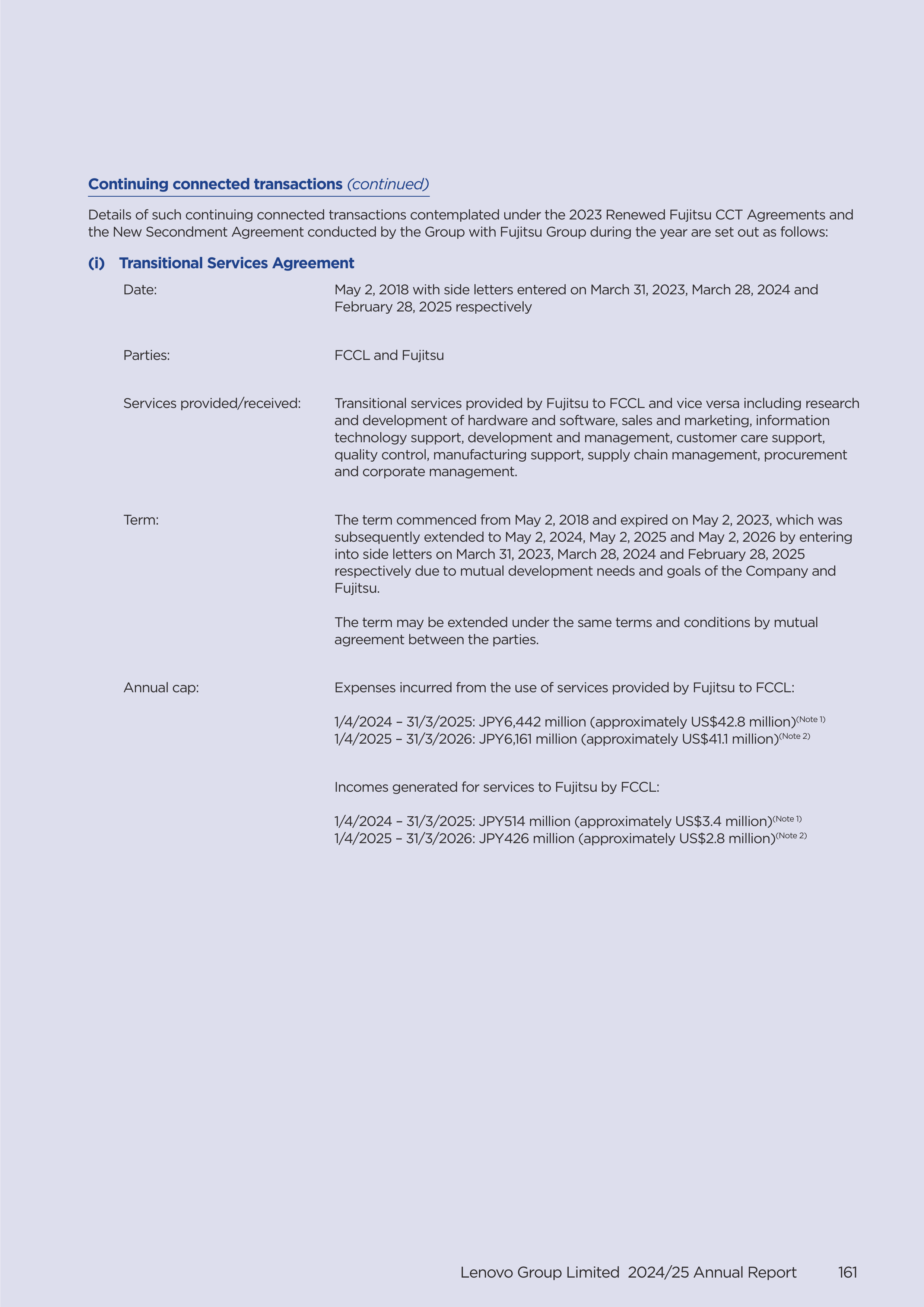
Lenovo Group Limited 2024/25 Annual Report
161
Continuing connected transactions
(continued)
Details of such continuing connected transactions contemplated under the 2023 Renewed Fujitsu CCT Agreements and
the New Secondment Agreement conducted by the Group with Fujitsu Group during the year are set out as follows:
(i)
Transitional Services Agreement
Date:
May 2, 2018 with side letters entered on March 31, 2023, March 28, 2024 and
February 28, 2025 respectively
Parties:
FCCL and Fujitsu
Services provided/received:
Transitional services provided by Fujitsu to FCCL and vice versa including research
and development of hardware and software, sales and marketing, information
technology support, development and management, customer care support,
quality control, manufacturing support, supply chain management, procurement
and corporate management.
Term:
The term commenced from May 2, 2018 and expired on May 2, 2023, which was
subsequently extended to May 2, 2024, May 2, 2025 and May 2, 2026 by entering
into side letters on March 31, 2023, March 28, 2024 and February 28, 2025
respectively due to mutual development needs and goals of the Company and
Fujitsu.
The term may be extended under the same terms and conditions by mutual
agreement between the parties.
Annual cap:
Expenses incurred from the use of services provided by Fujitsu to FCCL:
1/4/2024 – 31/3/2025: JPY6,442 million (approximately US$42.8 million)
(Note 1)
1/4/2025 – 31/3/2026: JPY6,161 million (approximately US$41.1 million)
(Note 2)
Incomes generated for services to Fujitsu by FCCL:
1/4/2024 – 31/3/2025: JPY514 million (approximately US$3.4 million)
(Note 1)
1/4/2025 – 31/3/2026: JPY426 million (approximately US$2.8 million)
(Note 2)
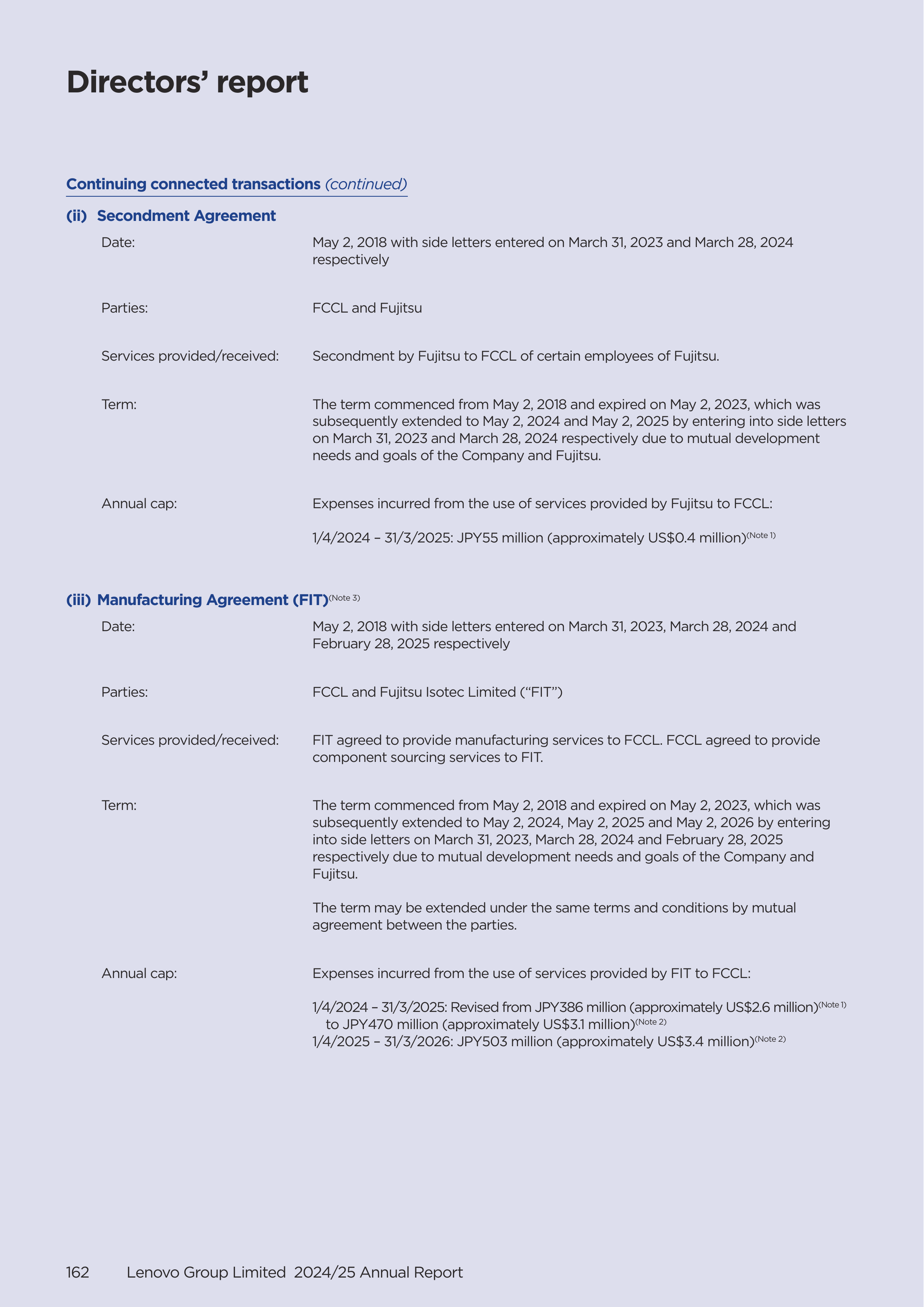
Directors’ report
Lenovo Group Limited 2024/25 Annual Report
162
Continuing connected transactions
(continued)
(ii)
Secondment Agreement
Date:
May 2, 2018 with side letters entered on March 31, 2023 and March 28, 2024
respectively
Parties:
FCCL and Fujitsu
Services provided/received:
Secondment by Fujitsu to FCCL of certain employees of Fujitsu.
Term:
The term commenced from May 2, 2018 and expired on May 2, 2023, which was
subsequently extended to May 2, 2024 and May 2, 2025 by entering into side letters
on March 31, 2023 and March 28, 2024 respectively due to mutual development
needs and goals of the Company and Fujitsu.
Annual cap:
Expenses incurred from the use of services provided by Fujitsu to FCCL:
1/4/2024 – 31/3/2025: JPY55 million (approximately US$0.4 million)
(Note 1)
(iii) Manufacturing Agreement (FIT)
(Note 3)
Date:
May 2, 2018 with side letters entered on March 31, 2023, March 28, 2024 and
February 28, 2025 respectively
Parties:
FCCL and Fujitsu Isotec Limited (“FIT”)
Services provided/received:
FIT agreed to provide manufacturing services to FCCL. FCCL agreed to provide
component sourcing services to FIT.
Term:
The term commenced from May 2, 2018 and expired on May 2, 2023, which was
subsequently extended to May 2, 2024, May 2, 2025 and May 2, 2026 by entering
into side letters on March 31, 2023, March 28, 2024 and February 28, 2025
respectively due to mutual development needs and goals of the Company and
Fujitsu.
The term may be extended under the same terms and conditions by mutual
agreement between the parties.
Annual cap:
Expenses incurred from the use of services provided by FIT to FCCL:
1/4/2024 – 31/3/2025: Revised from JPY386 million (approximately US$2.6 million)
(Note 1)
to JPY470 million (approximately US$3.1 million)
(Note 2)
1/4/2025 – 31/3/2026: JPY503 million (approximately US$3.4 million)
(Note 2)
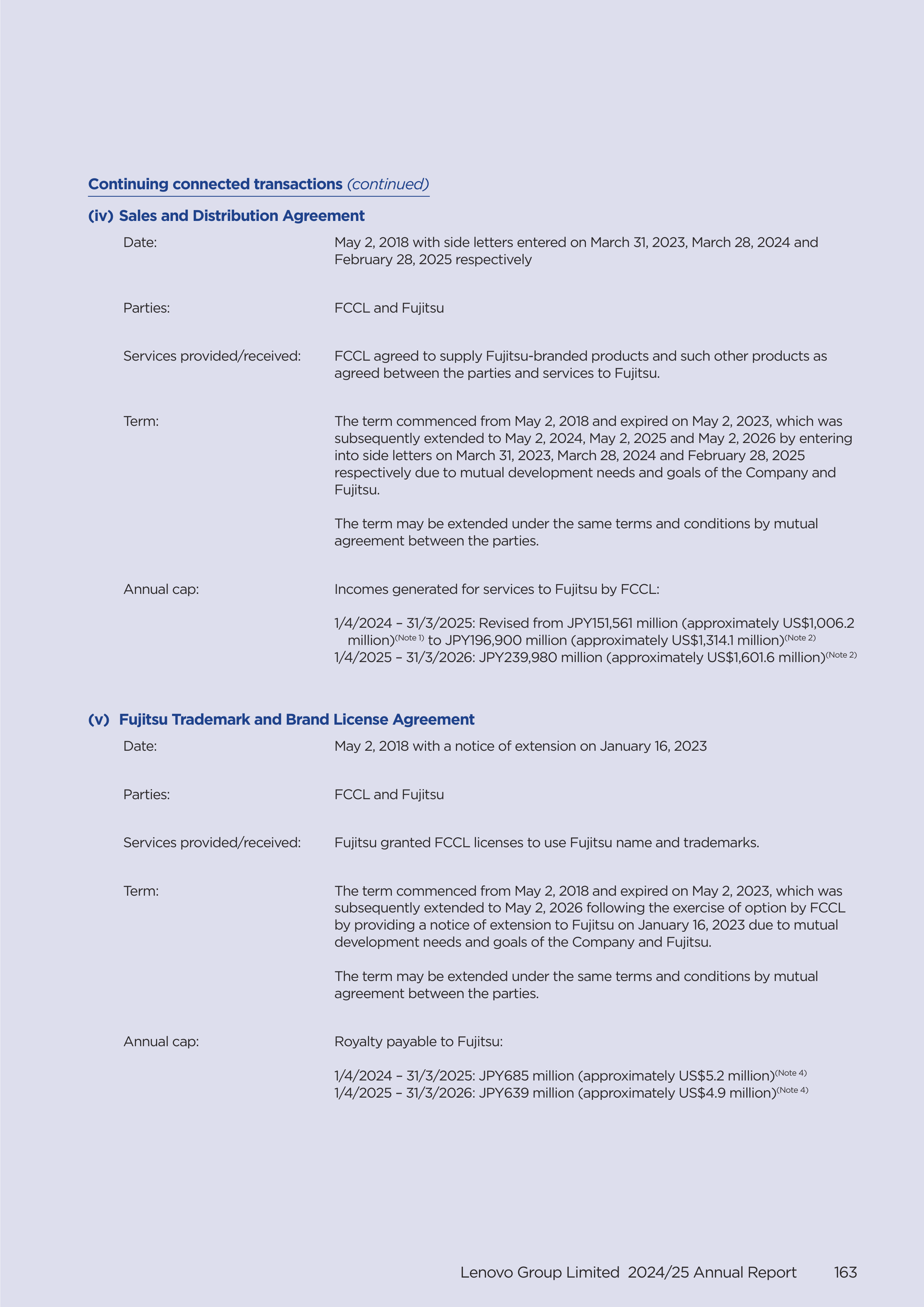
Lenovo Group Limited 2024/25 Annual Report
163
Continuing connected transactions
(continued)
(iv) Sales and Distribution Agreement
Date:
May 2, 2018 with side letters entered on March 31, 2023, March 28, 2024 and
February 28, 2025 respectively
Parties:
FCCL and Fujitsu
Services provided/received:
FCCL agreed to supply Fujitsu-branded products and such other products as
agreed between the parties and services to Fujitsu.
Term:
The term commenced from May 2, 2018 and expired on May 2, 2023, which was
subsequently extended to May 2, 2024, May 2, 2025 and May 2, 2026 by entering
into side letters on March 31, 2023, March 28, 2024 and February 28, 2025
respectively due to mutual development needs and goals of the Company and
Fujitsu.
The term may be extended under the same terms and conditions by mutual
agreement between the parties.
Annual cap:
Incomes generated for services to Fujitsu by FCCL:
1/4/2024 – 31/3/2025: Revised from JPY151,561 million (approximately US$1,006.2
million)
(Note 1)
to JPY196,900 million (approximately US$1,314.1 million)
(Note 2)
1/4/2025 – 31/3/2026: JPY239,980 million (approximately US$1,601.6 million)
(Note 2)
(v)
Fujitsu Trademark and Brand License Agreement
Date:
May 2, 2018 with a notice of extension on January 16, 2023
Parties:
FCCL and Fujitsu
Services provided/received:
Fujitsu granted FCCL licenses to use Fujitsu name and trademarks.
Term:
The term commenced from May 2, 2018 and expired on May 2, 2023, which was
subsequently extended to May 2, 2026 following the exercise of option by FCCL
by providing a notice of extension to Fujitsu on January 16, 2023 due to mutual
development needs and goals of the Company and Fujitsu.
The term may be extended under the same terms and conditions by mutual
agreement between the parties.
Annual cap:
Royalty payable to Fujitsu:
1/4/2024 – 31/3/2025: JPY685 million (approximately US$5.2 million)
(Note 4)
1/4/2025 – 31/3/2026: JPY639 million (approximately US$4.9 million)
(Note 4)
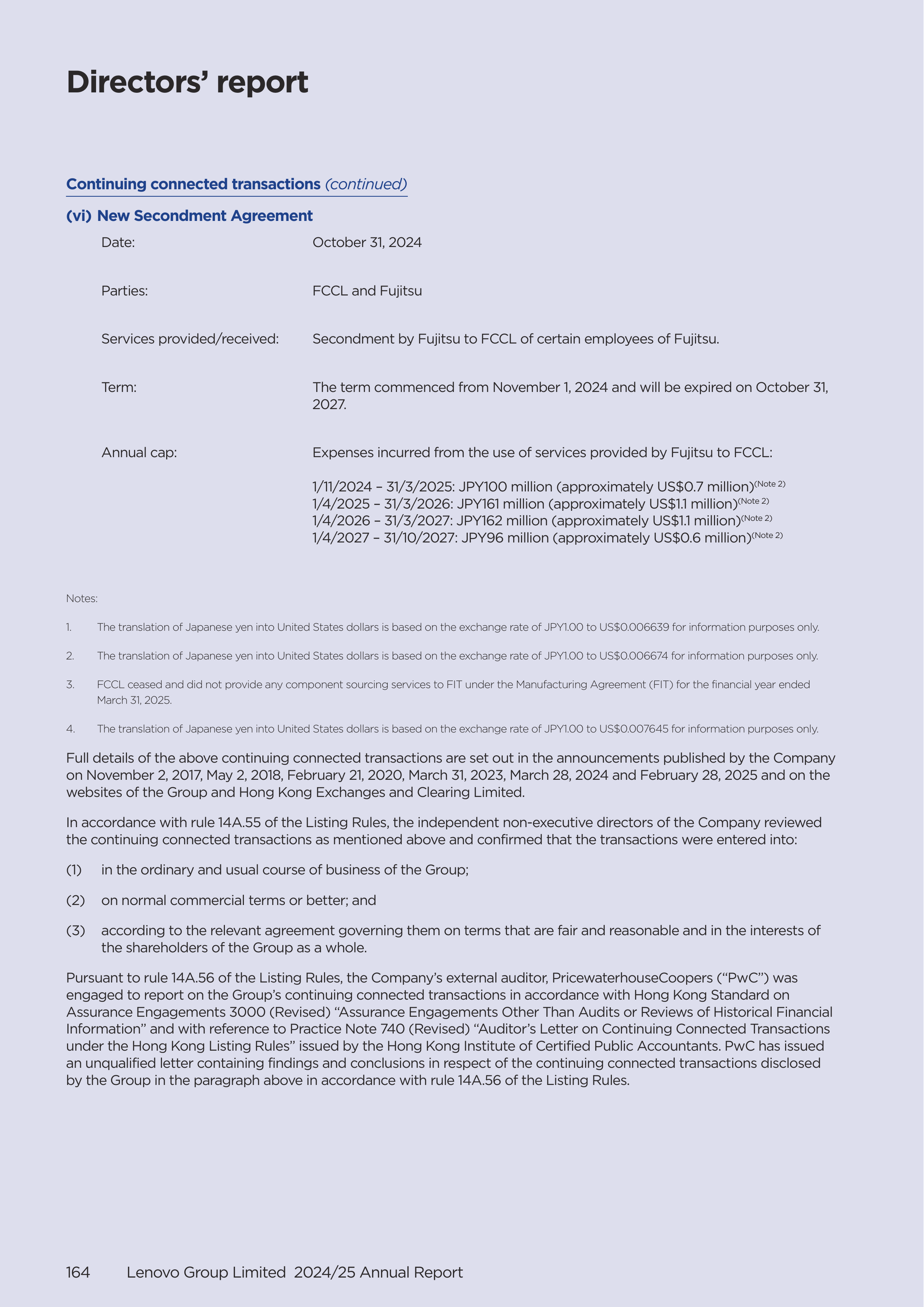
Directors’ report
Lenovo Group Limited 2024/25 Annual Report
164
Continuing connected transactions
(continued)
(vi) New Secondment Agreement
Date:
October 31, 2024
Parties:
FCCL and Fujitsu
Services provided/received:
Secondment by Fujitsu to FCCL of certain employees of Fujitsu.
Term:
The term commenced from November 1, 2024 and will be expired on October 31,
2027.
Annual cap:
Expenses incurred from the use of services provided by Fujitsu to FCCL:
1/11/2024 – 31/3/2025: JPY100 million (approximately US$0.7 million)
(Note 2)
1/4/2025 – 31/3/2026: JPY161 million (approximately US$1.1 million)
(Note 2)
1/4/2026 – 31/3/2027: JPY162 million (approximately US$1.1 million)
(Note 2)
1/4/2027 – 31/10/2027: JPY96 million (approximately US$0.6 million)
(Note 2)
Notes:
1.
The translation of Japanese yen into United States dollars is based on the exchange rate of JPY1.00 to US$0.006639 for information purposes only.
2.
The translation of Japanese yen into United States dollars is based on the exchange rate of JPY1.00 to US$0.006674 for information purposes only.
3.
FCCL ceased and did not provide any component sourcing services to FIT under the Manufacturing Agreement (FIT) for the financial year ended
March 31, 2025.
4.
The translation of Japanese yen into United States dollars is based on the exchange rate of JPY1.00 to US$0.007645 for information purposes only.
Full details of the above continuing connected transactions are set out in the announcements published by the Company
on November 2, 2017, May 2, 2018, February 21, 2020, March 31, 2023, March 28, 2024 and February 28, 2025 and on the
websites of the Group and Hong Kong Exchanges and Clearing Limited.
In accordance with rule 14A.55 of the Listing Rules, the independent non-executive directors of the Company reviewed
the continuing connected transactions as mentioned above and confirmed that the transactions were entered into:
(1)
in the ordinary and usual course of business of the Group;
(2)
on normal commercial terms or better; and
(3)
according to the relevant agreement governing them on terms that are fair and reasonable and in the interests of
the shareholders of the Group as a whole.
Pursuant to rule 14A.56 of the Listing Rules, the Company’s external auditor, PricewaterhouseCoopers (“PwC”) was
engaged to report on the Group’s continuing connected transactions in accordance with Hong Kong Standard on
Assurance Engagements 3000 (Revised) “Assurance Engagements Other Than Audits or Reviews of Historical Financial
Information” and with reference to Practice Note 740 (Revised) “Auditor’s Letter on Continuing Connected Transactions
under the Hong Kong Listing Rules” issued by the Hong Kong Institute of Certified Public Accountants. PwC has issued
an unqualified letter containing findings and conclusions in respect of the continuing connected transactions disclosed
by the Group in the paragraph above in accordance with rule 14A.56 of the Listing Rules.

Lenovo Group Limited 2024/25 Annual Report
165
Significant related party transactions
During the year, the Group entered into certain transactions with parties regarded as “related parties” under applicable
accounting principles. Details of the significant related party transactions undertaken in the normal course of business
are set out in note 34 to the financial statements. None of these transactions constitutes a discloseable connected
transaction as defined under the Listing Rules.
Auditor
The financial statements for the year have been audited by PwC who retire and, being eligible, offer themselves for re-
appointment.
Public float
Based on the information that is publicly available to the Company and within the knowledge of the directors of the
Company, as at the date of this report, there is sufficient public float of more than 25% of the Company’s total number of
issued shares as required under the Listing Rules.
On behalf of the Board
Yang Yuanqing
Chairman and Chief Executive Officer
May 22, 2025
Independent auditor’s report
Lenovo Group Limited 2024/25 Annual Report
166
Independent auditor’s report
To the members of Lenovo Group Limited
(incorporated in Hong Kong with limited liability)
Opinion
What we have audited
The consolidated financial statements of Lenovo Group Limited (the “Company”) and its subsidiaries (the “Group”),
which are set out on pages 171 to 266, comprise:
•
the consolidated balance sheet as at March 31, 2025;
•
the consolidated income statement for the year then ended;
•
the consolidated statement of comprehensive income for the year then ended;
•
the consolidated statement of changes in equity for the year then ended;
•
the consolidated cash flow statement for the year then ended; and
•
the notes to the consolidated financial statements, comprising material accounting policy information and other
explanatory information.
Our opinion
In our opinion, the consolidated financial statements give a true and fair view of the consolidated financial position of the
Group as at March 31, 2025, and of its consolidated financial performance and its consolidated cash flows for the year
then ended in accordance with HKFRS Accounting Standards as issued by the Hong Kong Institute of Certified Public
Accountants (“HKICPA”) and have been properly prepared in compliance with the Hong Kong Companies Ordinance.
Basis for opinion
We conducted our audit in accordance with Hong Kong Standards on Auditing (“HKSAs”) as issued by the HKICPA.
Our responsibilities under those standards are further described in the Auditor’s Responsibilities for the Audit of the
Consolidated Financial Statements section of our report.
We believe that the audit evidence we have obtained is sufficient and appropriate to provide a basis for our opinion.
Independence
We are independent of the Group in accordance with the HKICPA’s Code of Ethics for Professional Accountants (“the
Code”), and we have fulfilled our other ethical responsibilities in accordance with the Code.
Key audit matters
Key audit matters are those matters that, in our professional judgment, were of most significance in our audit of the
consolidated financial statements of the current period. These matters were addressed in the context of our audit of
the consolidated financial statements as a whole, and in forming our opinion thereon, and we do not provide a separate
opinion on these matters.
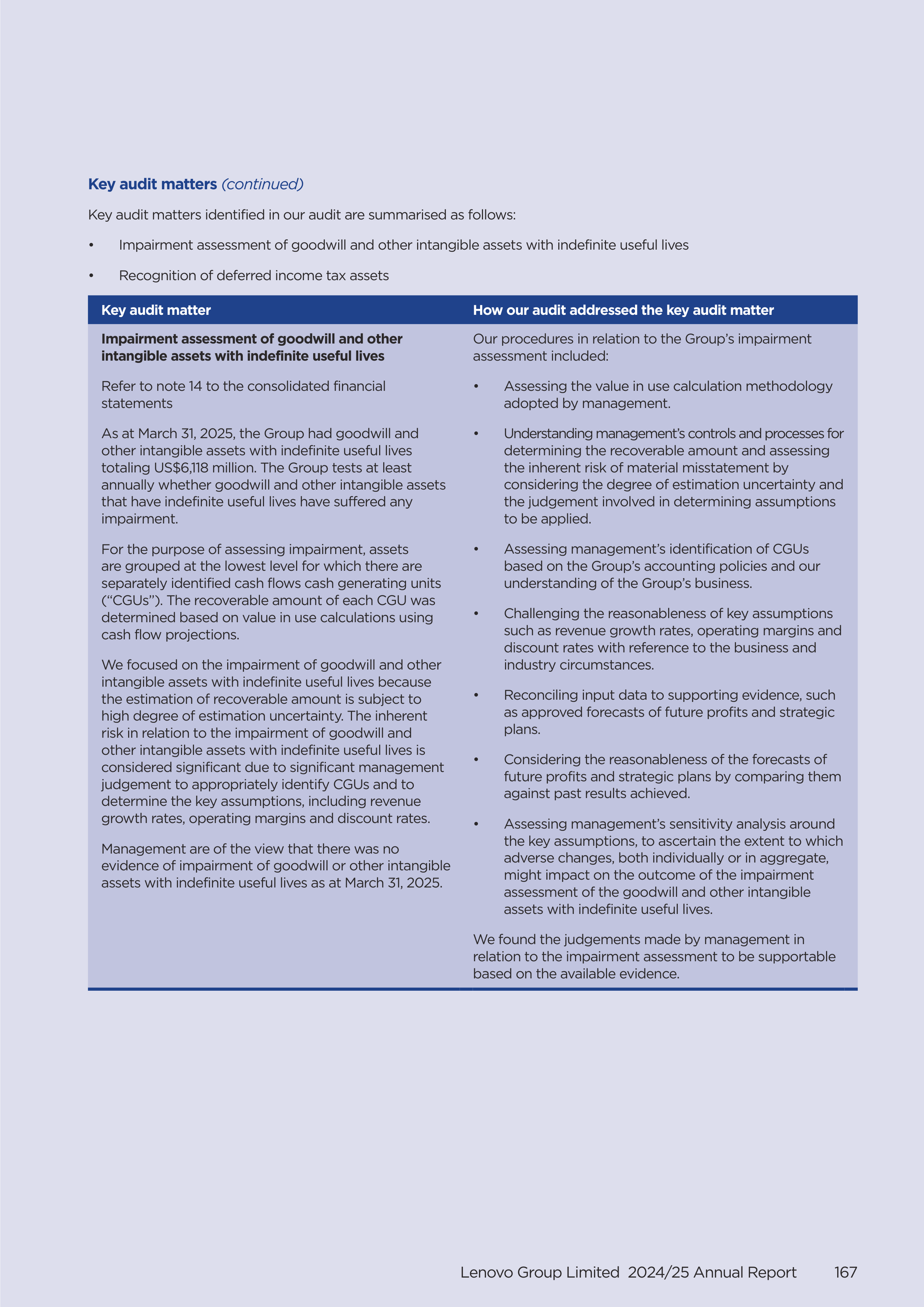
Lenovo Group Limited 2024/25 Annual Report
167
Key audit matters
(continued)
Key audit matters identified in our audit are summarised as follows:
•
Impairment assessment of goodwill and other intangible assets with indefinite useful lives
•
Recognition of deferred income tax assets
Key audit matter
How our audit addressed the key audit matter
Impairment assessment of goodwill and other
intangible assets with indefinite useful lives
Refer to note 14 to the consolidated financial
statements
As at March 31, 2025, the Group had goodwill and
other intangible assets with indefinite useful lives
totaling US$6,118 million. The Group tests at least
annually whether goodwill and other intangible assets
that have indefinite useful lives have suffered any
impairment.
For the purpose of assessing impairment, assets
are grouped at the lowest level for which there are
separately identified cash flows cash generating units
(“CGUs”). The recoverable amount of each CGU was
determined based on value in use calculations using
cash flow projections.
We focused on the impairment of goodwill and other
intangible assets with indefinite useful lives because
the estimation of recoverable amount is subject to
high degree of estimation uncertainty. The inherent
risk in relation to the impairment of goodwill and
other intangible assets with indefinite useful lives is
considered significant due to significant management
judgement to appropriately identify CGUs and to
determine the key assumptions, including revenue
growth rates, operating margins and discount rates.
Management are of the view that there was no
evidence of impairment of goodwill or other intangible
assets with indefinite useful lives as at March 31, 2025.
Our procedures in relation to the Group’s impairment
assessment included:
•
Assessing the value in use calculation methodology
adopted by management.
•
Understanding management’s controls and processes for
determining the recoverable amount and assessing
the inherent risk of material misstatement by
considering the degree of estimation uncertainty and
the judgement involved in determining assumptions
to be applied.
•
Assessing management’s identification of CGUs
based on the Group’s accounting policies and our
understanding of the Group’s business.
•
Challenging the reasonableness of key assumptions
such as revenue growth rates, operating margins and
discount rates with reference to the business and
industry circumstances.
•
Reconciling input data to supporting evidence, such
as approved forecasts of future profits and strategic
plans.
•
Considering the reasonableness of the forecasts of
future profits and strategic plans by comparing them
against past results achieved.
•
Assessing management’s sensitivity analysis around
the key assumptions, to ascertain the extent to which
adverse changes, both individually or in aggregate,
might impact on the outcome of the impairment
assessment of the goodwill and other intangible
assets with indefinite useful lives.
We found the judgements made by management in
relation to the impairment assessment to be supportable
based on the available evidence.
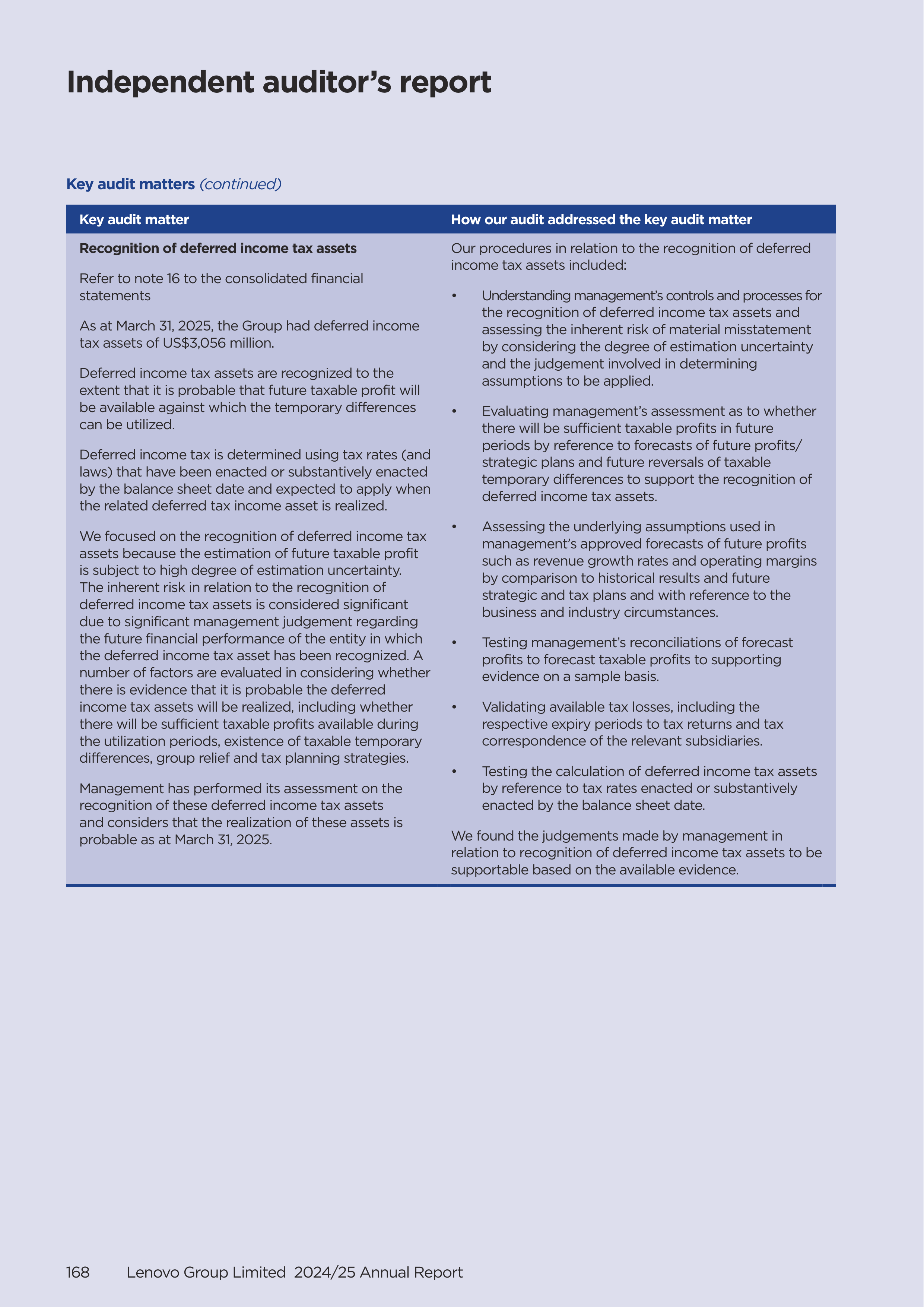
Independent auditor’s report
Lenovo Group Limited 2024/25 Annual Report
168
Key audit matters
(continued)
Key audit matter
How our audit addressed the key audit matter
Recognition of deferred income tax assets
Refer to note 16 to the consolidated financial
statements
As at March 31, 2025, the Group had deferred income
tax assets of US$3,056 million.
Deferred income tax assets are recognized to the
extent that it is probable that future taxable profit will
be available against which the temporary differences
can be utilized.
Deferred income tax is determined using tax rates (and
laws) that have been enacted or substantively enacted
by the balance sheet date and expected to apply when
the related deferred tax income asset is realized.
We focused on the recognition of deferred income tax
assets because the estimation of future taxable profit
is subject to high degree of estimation uncertainty.
The inherent risk in relation to the recognition of
deferred income tax assets is considered significant
due to significant management judgement regarding
the future financial performance of the entity in which
the deferred income tax asset has been recognized. A
number of factors are evaluated in considering whether
there is evidence that it is probable the deferred
income tax assets will be realized, including whether
there will be sufficient taxable profits available during
the utilization periods, existence of taxable temporary
differences, group relief and tax planning strategies.
Management has performed its assessment on the
recognition of these deferred income tax assets
and considers that the realization of these assets is
probable as at March 31, 2025.
Our procedures in relation to the recognition of deferred
income tax assets included:
•
Understanding management’s controls and processes for
the recognition of deferred income tax assets and
assessing the inherent risk of material misstatement
by considering the degree of estimation uncertainty
and the judgement involved in determining
assumptions to be applied.
•
Evaluating management’s assessment as to whether
there will be sufficient taxable profits in future
periods by reference to forecasts of future profits/
strategic plans and future reversals of taxable
temporary differences to support the recognition of
deferred income tax assets.
•
Assessing the underlying assumptions used in
management’s approved forecasts of future profits
such as revenue growth rates and operating margins
by comparison to historical results and future
strategic and tax plans and with reference to the
business and industry circumstances.
•
Testing management’s reconciliations of forecast
profits to forecast taxable profits to supporting
evidence on a sample basis.
•
Validating available tax losses, including the
respective expiry periods to tax returns and tax
correspondence of the relevant subsidiaries.
•
Testing the calculation of deferred income tax assets
by reference to tax rates enacted or substantively
enacted by the balance sheet date.
We found the judgements made by management in
relation to recognition of deferred income tax assets to be
supportable based on the available evidence.
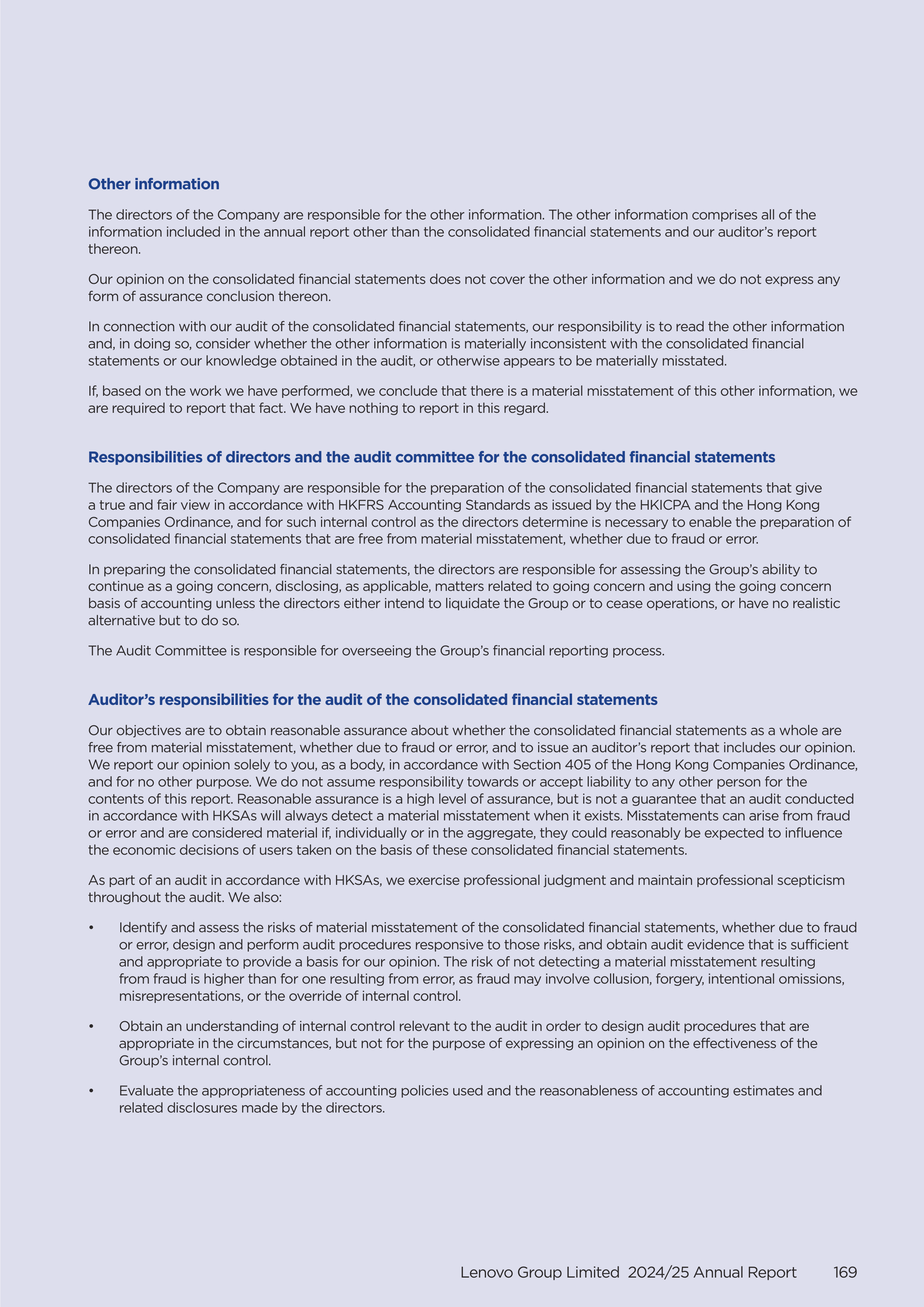
Lenovo Group Limited 2024/25 Annual Report
169
Other information
The directors of the Company are responsible for the other information. The other information comprises all of the
information included in the annual report other than the consolidated financial statements and our auditor’s report
thereon.
Our opinion on the consolidated financial statements does not cover the other information and we do not express any
form of assurance conclusion thereon.
In connection with our audit of the consolidated financial statements, our responsibility is to read the other information
and, in doing so, consider whether the other information is materially inconsistent with the consolidated financial
statements or our knowledge obtained in the audit, or otherwise appears to be materially misstated.
If, based on the work we have performed, we conclude that there is a material misstatement of this other information, we
are required to report that fact. We have nothing to report in this regard.
Responsibilities of directors and the audit committee for the consolidated financial statements
The directors of the Company are responsible for the preparation of the consolidated financial statements that give
a true and fair view in accordance with HKFRS Accounting Standards as issued by the HKICPA and the Hong Kong
Companies Ordinance, and for such internal control as the directors determine is necessary to enable the preparation of
consolidated financial statements that are free from material misstatement, whether due to fraud or error.
In preparing the consolidated financial statements, the directors are responsible for assessing the Group’s ability to
continue as a going concern, disclosing, as applicable, matters related to going concern and using the going concern
basis of accounting unless the directors either intend to liquidate the Group or to cease operations, or have no realistic
alternative but to do so.
The Audit Committee is responsible for overseeing the Group’s financial reporting process.
Auditor’s responsibilities for the audit of the consolidated financial statements
Our objectives are to obtain reasonable assurance about whether the consolidated financial statements as a whole are
free from material misstatement, whether due to fraud or error, and to issue an auditor’s report that includes our opinion.
We report our opinion solely to you, as a body, in accordance with Section 405 of the Hong Kong Companies Ordinance,
and for no other purpose. We do not assume responsibility towards or accept liability to any other person for the
contents of this report. Reasonable assurance is a high level of assurance, but is not a guarantee that an audit conducted
in accordance with HKSAs will always detect a material misstatement when it exists. Misstatements can arise from fraud
or error and are considered material if, individually or in the aggregate, they could reasonably be expected to influence
the economic decisions of users taken on the basis of these consolidated financial statements.
As part of an audit in accordance with HKSAs, we exercise professional judgment and maintain professional scepticism
throughout the audit. We also:
•
Identify and assess the risks of material misstatement of the consolidated financial statements, whether due to fraud
or error, design and perform audit procedures responsive to those risks, and obtain audit evidence that is sufficient
and appropriate to provide a basis for our opinion. The risk of not detecting a material misstatement resulting
from fraud is higher than for one resulting from error, as fraud may involve collusion, forgery, intentional omissions,
misrepresentations, or the override of internal control.
•
Obtain an understanding of internal control relevant to the audit in order to design audit procedures that are
appropriate in the circumstances, but not for the purpose of expressing an opinion on the effectiveness of the
Group’s internal control.
•
Evaluate the appropriateness of accounting policies used and the reasonableness of accounting estimates and
related disclosures made by the directors.
Independent auditor’s report
Lenovo Group Limited 2024/25 Annual Report
170
Auditor’s responsibilities for the audit of the consolidated financial statements
(continued)
•
Conclude on the appropriateness of the directors’ use of the going concern basis of accounting and, based on
the audit evidence obtained, whether a material uncertainty exists related to events or conditions that may cast
significant doubt on the Group’s ability to continue as a going concern. If we conclude that a material uncertainty
exists, we are required to draw attention in our auditor’s report to the related disclosures in the consolidated
financial statements or, if such disclosures are inadequate, to modify our opinion. Our conclusions are based on the
audit evidence obtained up to the date of our auditor’s report. However, future events or conditions may cause the
Group to cease to continue as a going concern.
•
Evaluate the overall presentation, structure and content of the consolidated financial statements, including the
disclosures, and whether the consolidated financial statements represent the underlying transactions and events in
a manner that achieves fair presentation.
•
Plan and perform the group audit to obtain sufficient appropriate audit evidence regarding the financial information
of the entities or business units within the Group as a basis for forming an opinion on the consolidated financial
statements. We are responsible for the direction, supervision and review of the audit work performed for purposes
of the group audit. We remain solely responsible for our audit opinion.
We communicate with the Audit Committee regarding, among other matters, the planned scope and timing of the audit
and significant audit findings, including any significant deficiencies in internal control that we identify during our audit.
We also provide the Audit Committee with a statement that we have complied with relevant ethical requirements
regarding independence, and to communicate with them all relationships and other matters that may reasonably be
thought to bear on our independence, and where applicable, actions taken to eliminate threats or safeguards applied.
From the matters communicated with the Audit Committee, we determine those matters that were of most significance
in the audit of the consolidated financial statements of the current period and are therefore the key audit matters. We
describe these matters in our auditor’s report unless law or regulation precludes public disclosure about the matter or
when, in extremely rare circumstances, we determine that a matter should not be communicated in our report because
the adverse consequences of doing so would reasonably be expected to outweigh the public interest benefits of such
communication.
The engagement partner on the audit resulting in this independent auditor’s report is Shia Yuen Yee (practising
certificate number: P05129).
PricewaterhouseCoopers
Certified Public Accountants
Hong Kong, May 22, 2025
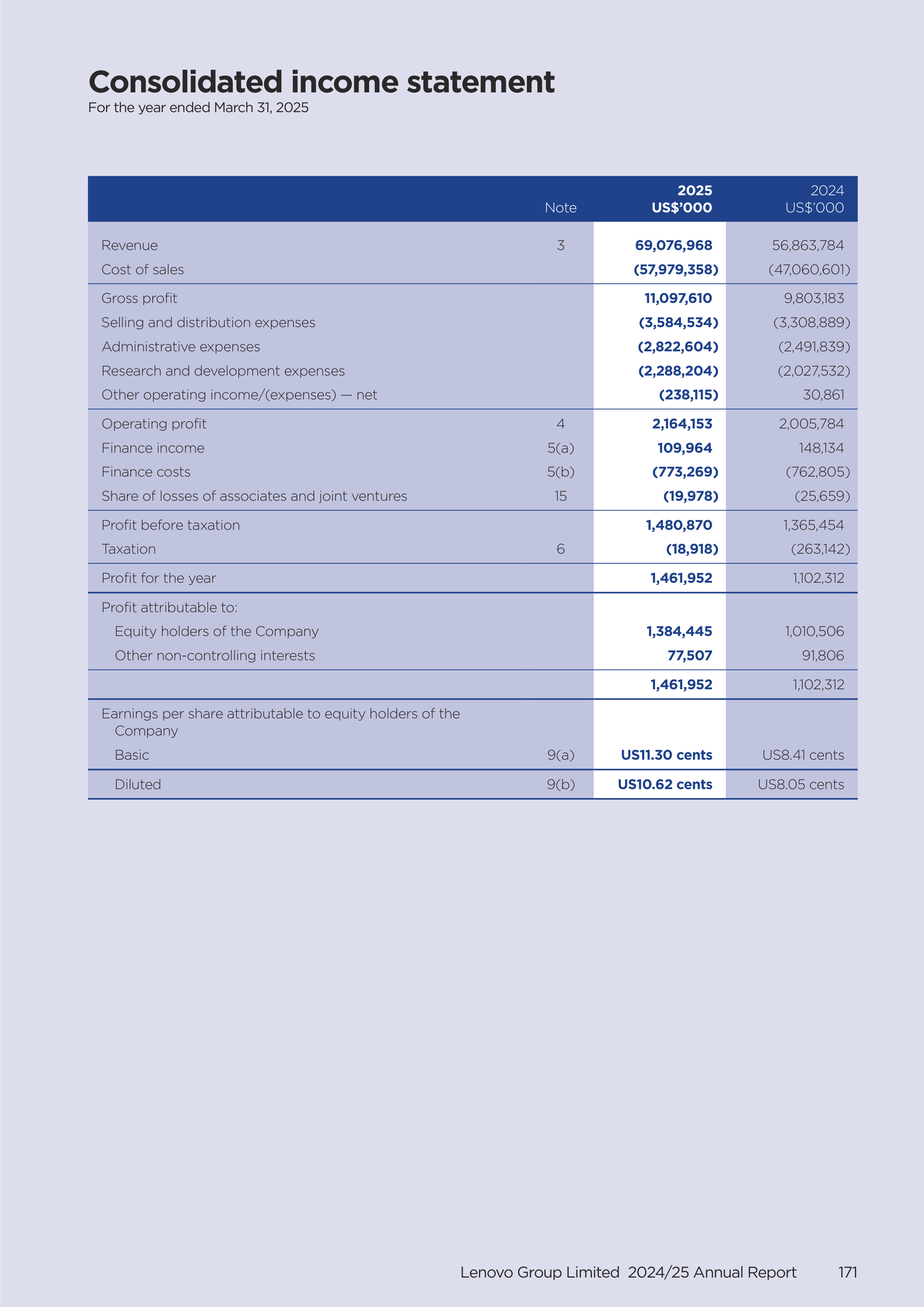
Consolidated income statement
For the year ended March 31, 2025
Lenovo Group Limited 2024/25 Annual Report
171
Note
2025
US$’000
2024
US$’000
Revenue
3
69,076,968
56,863,784
Cost of sales
(57,979,358)
(47,060,601)
Gross profit
11,097,610
9,803,183
Selling and distribution expenses
(3,584,534 )
(3,308,889)
Administrative expenses
(2,822,604 )
(2,491,839)
Research and development expenses
(2,288,204)
(2,027,532)
Other operating income/(expenses) — net
(238,115)
30,861
Operating profit
4
2,164,153
2,005,784
Finance income
5(a)
109,964
148,134
Finance costs
5(b)
(773,269 )
(762,805)
Share of losses of associates and joint ventures
15
(19,978 )
(25,659)
Profit before taxation
1,480,870
1,365,454
Taxation
6
(18,918 )
(263,142)
Profit for the year
1,461,952
1,102,312
Profit attributable to:
Equity holders of the Company
1,384,445
1,010,506
Other non-controlling interests
77,507
91,806
1,461,952
1,102,312
Earnings per share attributable to equity holders of the
Company
Basic
9(a)
US11.30 cents
US8.41 cents
Diluted
9(b)
US10.62 cents
US8.05 cents
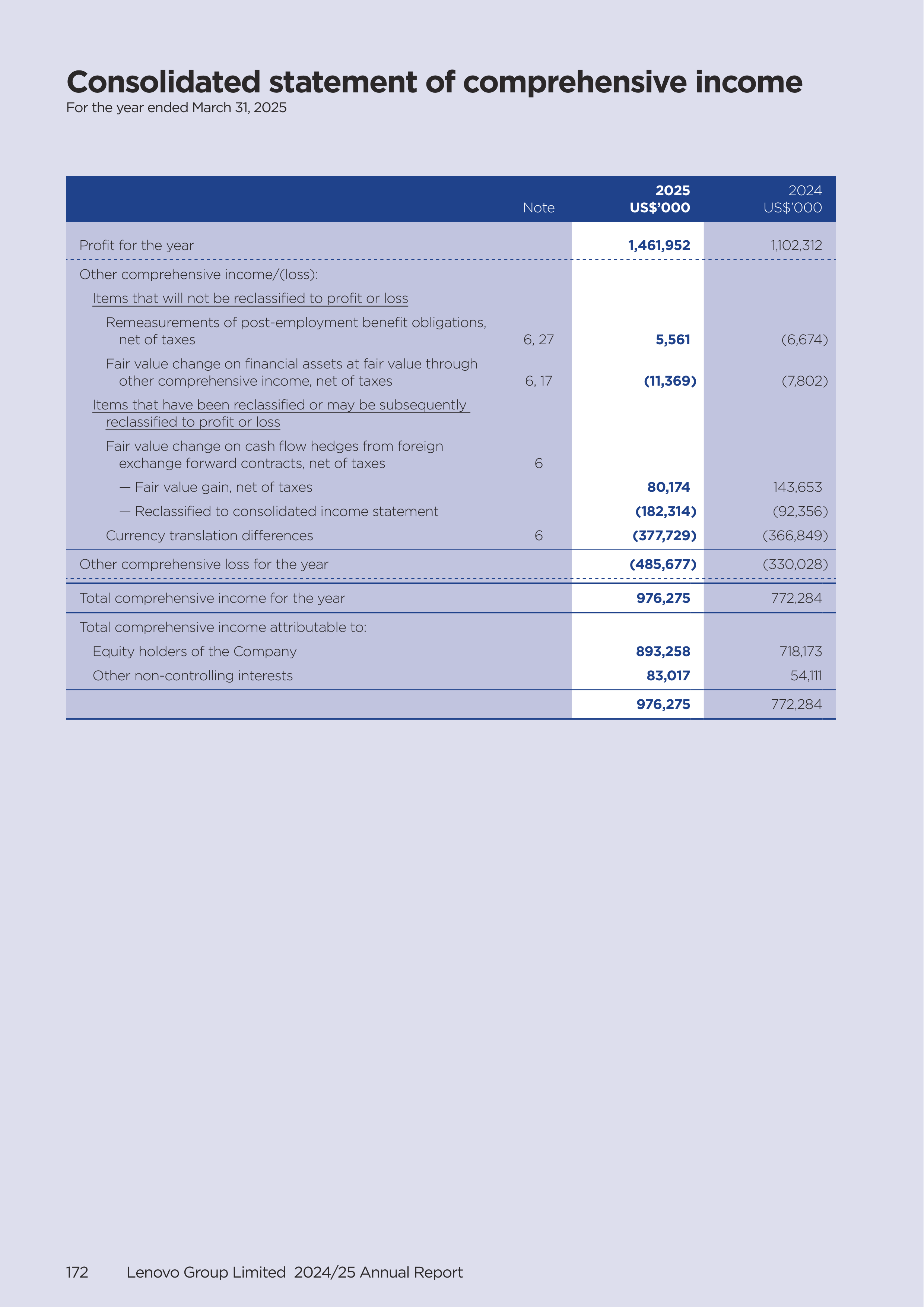
Consolidated statement of comprehensive income
For the year ended March 31, 2025
Lenovo Group Limited 2024/25 Annual Report
172
Note
2025
US$’000
2024
US$’000
Profit for the year
1,461,952
1,102,312
Other comprehensive income/(loss):
Items that will not be reclassified to profit or loss
Remeasurements of post-employment benefit obligations,
net of taxes
6, 27
5,561
(6,674)
Fair value change on financial assets at fair value through
other comprehensive income, net of taxes
6, 17
(11,369 )
(7,802)
Items that have been reclassified or may be subsequently
reclassified to profit or loss
Fair value change on cash flow hedges from foreign
exchange forward contracts, net of taxes
6
— Fair value gain, net of taxes
80,174
143,653
— Reclassified to consolidated income statement
(182,314 )
(92,356)
Currency translation differences
6
(377,729 )
(366,849)
Other comprehensive loss for the year
(485,677)
(330,028)
Total comprehensive income for the year
976,275
772,284
Total comprehensive income attributable to:
Equity holders of the Company
893,258
718,173
Other non-controlling interests
83,017
54,111
976,275
772,284
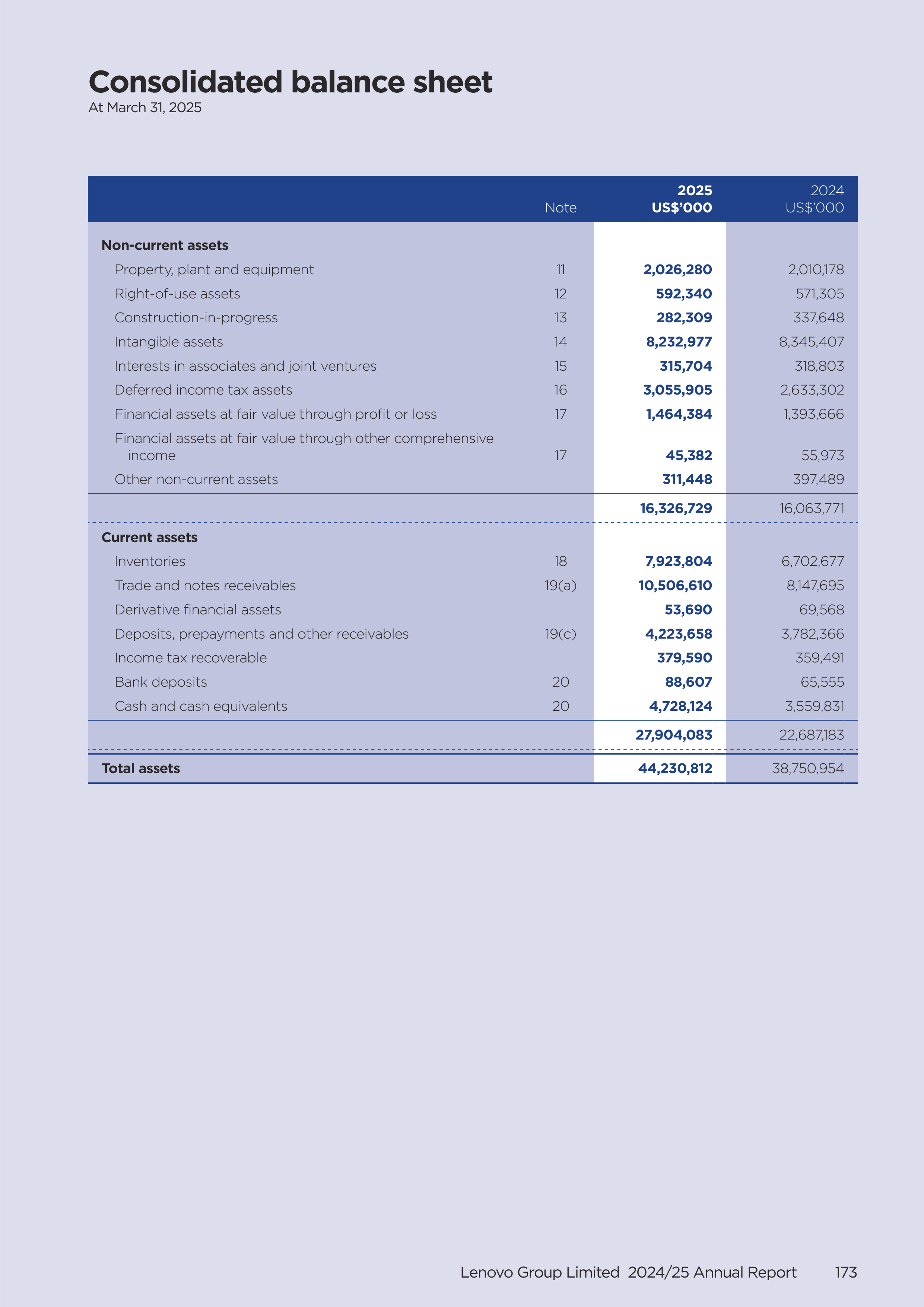
Consolidated balance sheet
At March 31, 2025
Lenovo Group Limited 2024/25 Annual Report
173
Note
2025
US$’000
2024
US$’000
Non-current assets
Property, plant and equipment
11
2,026,280
2,010,178
Right-of-use assets
12
592,340
571,305
Construction-in-progress
13
282,309
337,648
Intangible assets
14
8,232,977
8,345,407
Interests in associates and joint ventures
15
315,704
318,803
Deferred income tax assets
16
3,055,905
2,633,302
Financial assets at fair value through profit or loss
17
1,464,384
1,393,666
Financial assets at fair value through other comprehensive
income
17
45,382
55,973
Other non-current assets
311,448
397,489
16,326,729
16,063,771
Current assets
Inventories
18
7,923,804
6,702,677
Trade and notes receivables
19(a)
10,506,610
8,147,695
Derivative financial assets
53,690
69,568
Deposits, prepayments and other receivables
19(c)
4,223,658
3,782,366
Income tax recoverable
379,590
359,491
Bank deposits
20
88,607
65,555
Cash and cash equivalents
20
4,728,124
3,559,831
27,904,083
22,687,183
Total assets
44,230,812
38,750,954
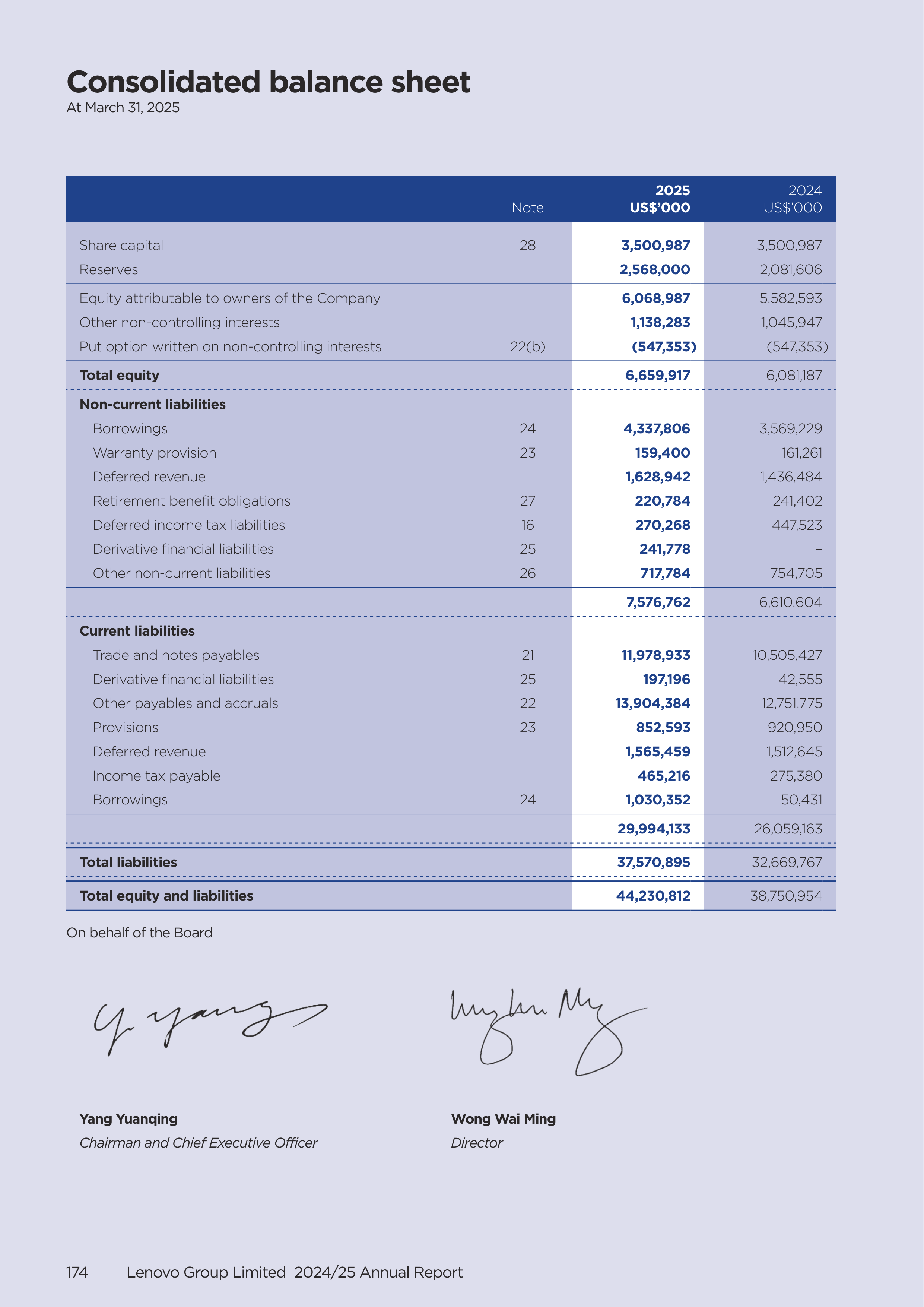

Consolidated balance sheet
At March 31, 2025
Lenovo Group Limited 2024/25 Annual Report
174
Note
2025
US$’000
2024
US$’000
Share capital
28
3,500,987
3,500,987
Reserves
2,568,000
2,081,606
Equity attributable to owners of the Company
6,068,987
5,582,593
Other non-controlling interests
1,138,283
1,045,947
Put option written on non-controlling interests
22(b)
(547,353 )
(547,353)
Total equity
6,659,917
6,081,187
Non-current liabilities
Borrowings
24
4,337,806
3,569,229
Warranty provision
23
159,400
161,261
Deferred revenue
1,628,942
1,436,484
Retirement benefit obligations
27
220,784
241,402
Deferred income tax liabilities
16
270,268
447,523
Derivative financial liabilities
25
241,778
–
Other non-current liabilities
26
717,784
754,705
7,576,762
6,610,604
Current liabilities
Trade and notes payables
21
11,978,933
10,505,427
Derivative financial liabilities
25
197,196
42,555
Other payables and accruals
22
13,904,384
12,751,775
Provisions
23
852,593
920,950
Deferred revenue
1,565,459
1,512,645
Income tax payable
465,216
275,380
Borrowings
24
1,030,352
50,431
29,994,133
26,059,163
Total liabilities
37,570,895
32,669,767
Total equity and liabilities
44,230,812
38,750,954
On behalf of the Board
Yang Yuanqing
Wong Wai Ming
Chairman and Chief Executive Officer
Director
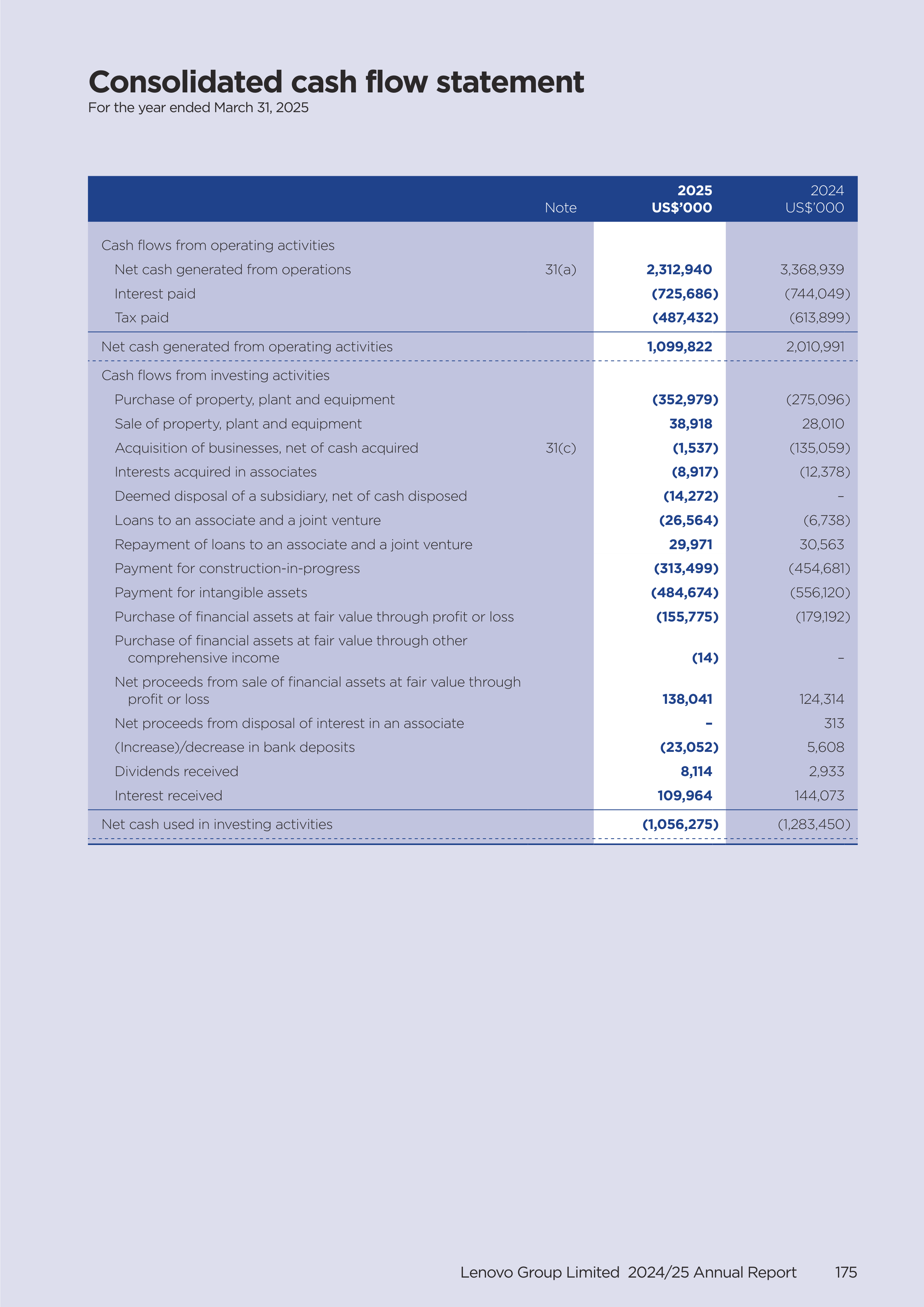
Consolidated cash flow statement
For the year ended March 31, 2025
Lenovo Group Limited 2024/25 Annual Report
175
Note
2025
US$’000
2024
US$’000
Cash flows from operating activities
Net cash generated from operations
31(a)
2,312,940
3,368,939
Interest paid
(725,686 )
(744,049)
Tax paid
(487,432 )
(613,899)
Net cash generated from operating activities
1,099,822
2,010,991
Cash flows from investing activities
Purchase of property, plant and equipment
(352,979 )
(275,096)
Sale of property, plant and equipment
38,918
28,010
Acquisition of businesses, net of cash acquired
31(c)
(1,537 )
(135,059)
Interests acquired in associates
(8,917 )
(12,378)
Deemed disposal of a subsidiary, net of cash disposed
(14,272)
–
Loans to an associate and a joint venture
(26,564 )
(6,738)
Repayment of loans to an associate and a joint venture
29,971
30,563
Payment for construction-in-progress
(313,499 )
(454,681)
Payment for intangible assets
(484,674 )
(556,120)
Purchase of financial assets at fair value through profit or loss
(155,775 )
(179,192)
Purchase of financial assets at fair value through other
comprehensive income
(14)
–
Net proceeds from sale of financial assets at fair value through
profit or loss
138,041
124,314
Net proceeds from disposal of interest in an associate
–
313
(Increase)/decrease in bank deposits
(23,052 )
5,608
Dividends received
8,114
2,933
Interest received
109,964
144,073
Net cash used in investing activities
(1,056,275)
(1,283,450)
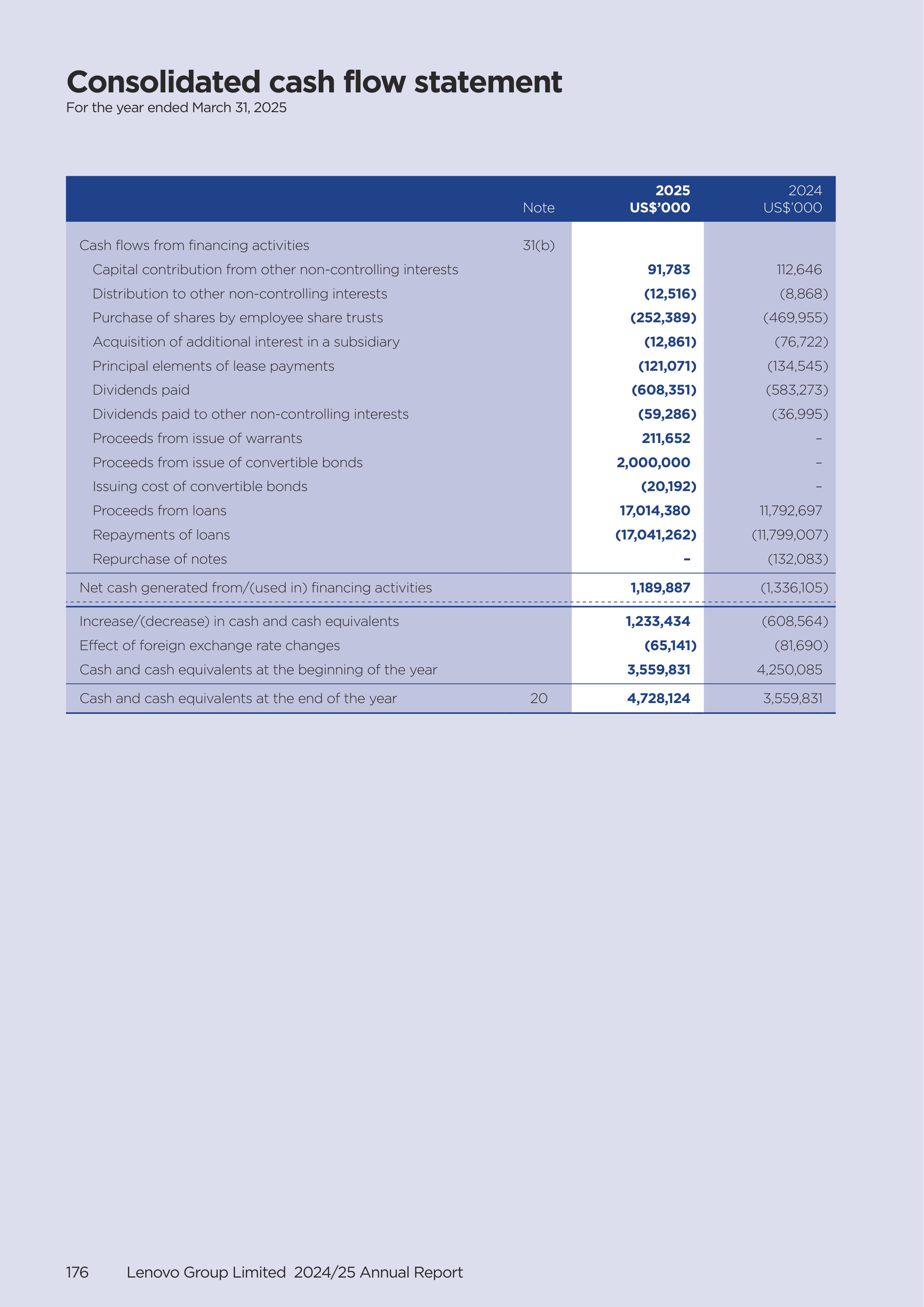
Consolidated cash flow statement
For the year ended March 31, 2025
Lenovo Group Limited 2024/25 Annual Report
176
Note
2025
US$’000
2024
US$’000
Cash flows from financing activities
31(b)
Capital contribution from other non-controlling interests
91,783
112,646
Distribution to other non-controlling interests
(12,516 )
(8,868)
Purchase of shares by employee share trusts
(252,389 )
(469,955)
Acquisition of additional interest in a subsidiary
(12,861 )
(76,722)
Principal elements of lease payments
(121,071 )
(134,545)
Dividends paid
(608,351)
(583,273)
Dividends paid to other non-controlling interests
(59,286 )
(36,995)
Proceeds from issue of warrants
211,652
–
Proceeds from issue of convertible bonds
2,000,000
–
Issuing cost of convertible bonds
(20,192 )
–
Proceeds from loans
17,014,380
11,792,697
Repayments of loans
(17,041,262 )
(11,799,007)
Repurchase of notes
–
(132,083)
Net cash generated from/(used in) financing activities
1,189,887
(1,336,105)
Increase/(decrease) in cash and cash equivalents
1,233,434
(608,564)
Effect of foreign exchange rate changes
(65,141)
(81,690)
Cash and cash equivalents at the beginning of the year
3,559,831
4,250,085
Cash and cash equivalents at the end of the year
20
4,728,124
3,559,831
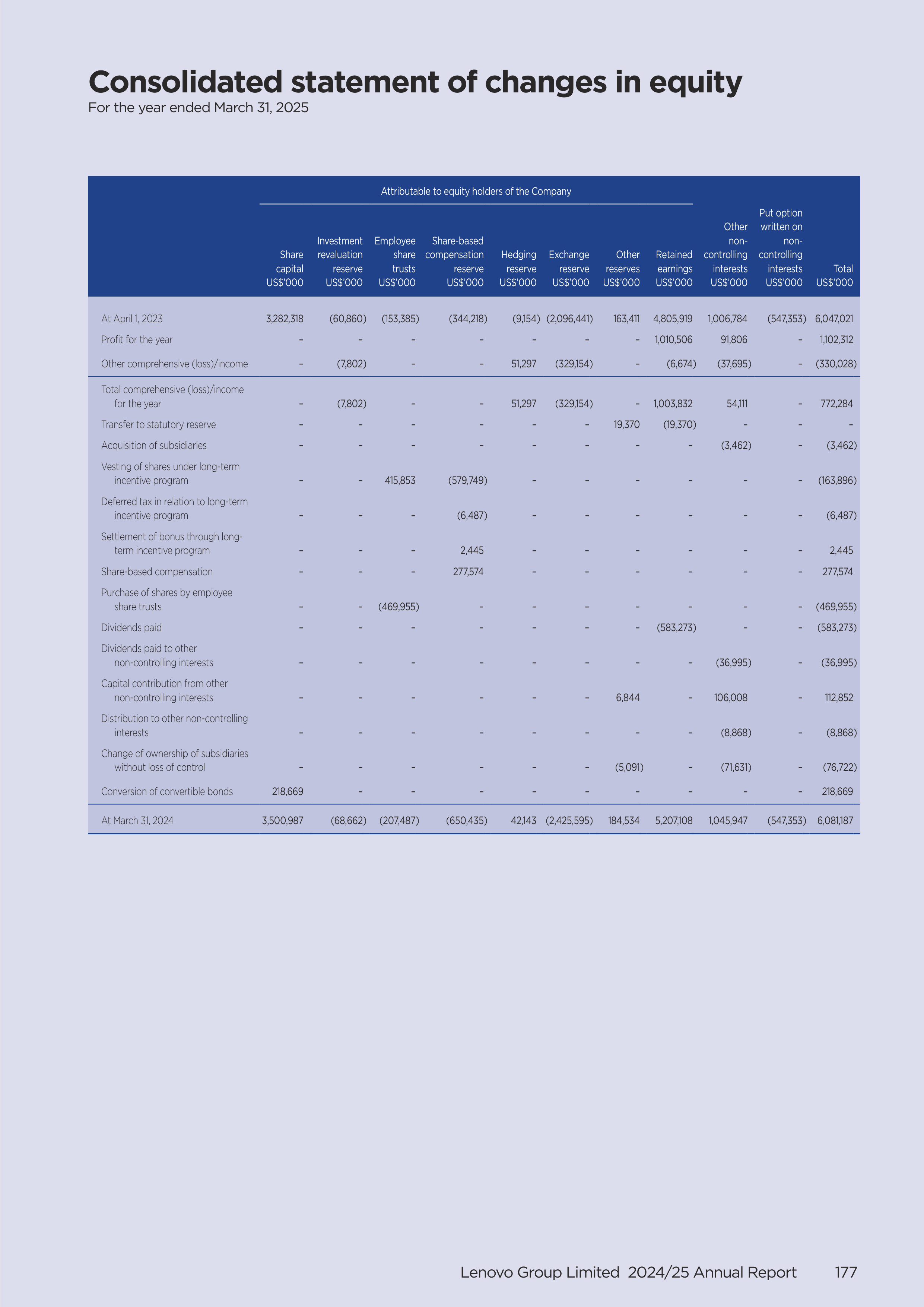
Consolidated statement of changes in equity
For the year ended March 31, 2025
Lenovo Group Limited 2024/25 Annual Report
177
Attributable to equity holders of the Company
Share
capital
US$’000
Investment
revaluation
reserve
US$’000
Employee
share
trusts
US$’000
Share-based
compensation
reserve
US$’000
Hedging
reserve
US$’000
Exchange
reserve
US$’000
Other
reserves
US$’000
Retained
earnings
US$’000
Other
non-
controlling
interests
US$’000
Put option
written on
non-
controlling
interests
US$’000
Total
US$’000
At April 1, 2023
3,282,318
(60,860)
(153,385)
(344,218)
(9,154)
(2,096,441)
163,411
4,805,919
1,006,784
(547,353)
6,047,021
Profit for the year
–
–
–
–
–
–
–
1,010,506
91,806
–
1,102,312
Other comprehensive (loss)/income
–
(7,802)
–
–
51,297
(329,154)
–
(6,674)
(37,695)
–
(330,028)
Total comprehensive (loss)/income
for the year
–
(7,802)
–
–
51,297
(329,154)
–
1,003,832
54,111
–
772,284
Transfer to statutory reserve
–
–
–
–
–
–
19,370
(19,370)
–
–
–
Acquisition of subsidiaries
–
–
–
–
–
–
–
–
(3,462)
–
(3,462)
Vesting of shares under long-term
incentive program
–
–
415,853
(579,749)
–
–
–
–
–
–
(163,896)
Deferred tax in relation to long-term
incentive program
–
–
–
(6,487)
–
–
–
–
–
–
(6,487)
Settlement of bonus through long-
term incentive program
–
–
–
2,445
–
–
–
–
–
–
2,445
Share-based compensation
–
–
–
277,574
–
–
–
–
–
–
277,574
Purchase of shares by employee
share trusts
–
–
(469,955)
–
–
–
–
–
–
–
(469,955)
Dividends paid
–
–
–
–
–
–
–
(583,273)
–
–
(583,273)
Dividends paid to other
non-controlling interests
–
–
–
–
–
–
–
–
(36,995)
–
(36,995)
Capital contribution from other
non-controlling interests
–
–
–
–
–
–
6,844
–
106,008
–
112,852
Distribution to other non-controlling
interests
–
–
–
–
–
–
–
–
(8,868)
–
(8,868)
Change of ownership of subsidiaries
without loss of control
–
–
–
–
–
–
(5,091)
–
(71,631)
–
(76,722)
Conversion of convertible bonds
218,669
–
–
–
–
–
–
–
–
–
218,669
At March 31, 2024
3,500,987
(68,662)
(207,487)
(650,435)
42,143
(2,425,595)
184,534
5,207,108
1,045,947
(547,353)
6,081,187
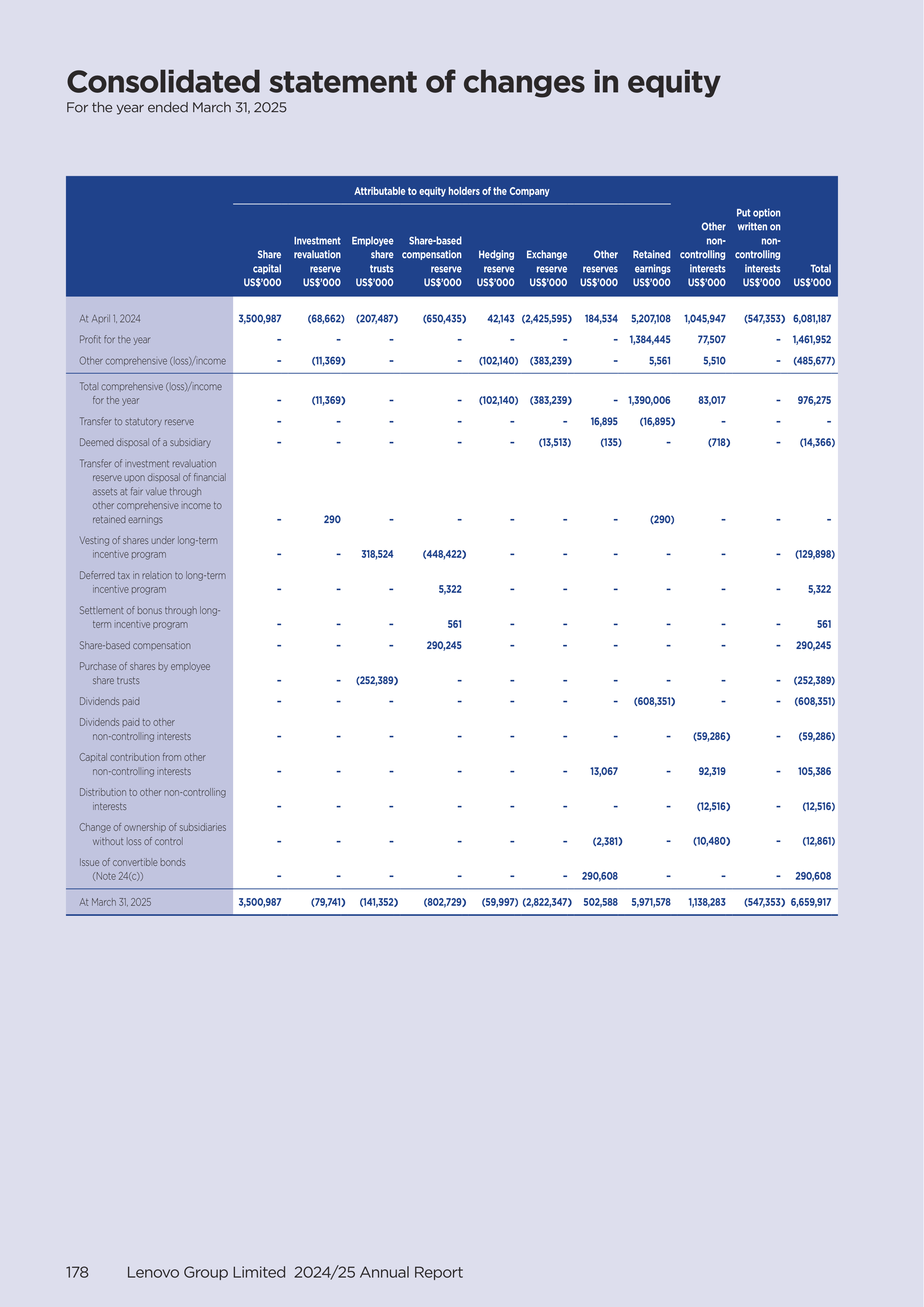
Consolidated statement of changes in equity
For the year ended March 31, 2025
Lenovo Group Limited 2024/25 Annual Report
178
Attributable to equity holders of the Company
Share
capital
US$’000
Investment
revaluation
reserve
US$’000
Employee
share
trusts
US$’000
Share-based
compensation
reserve
US$’000
Hedging
reserve
US$’000
Exchange
reserve
US$’000
Other
reserves
US$’000
Retained
earnings
US$’000
Other
non-
controlling
interests
US$’000
Put option
written on
non-
controlling
interests
US$’000
Total
US$’000
At April 1, 2024
3,500,987
(68,662)
(207,487
)
(650,435
)
42,143
(2,425,595
)
184,534
5,207,108
1,045,947
(547,353
)
6,081,187
Profit for the year
–
–
–
–
–
–
–
1,384,445
77,507
–
1,461,952
Other comprehensive (loss)/income
–
(11,369
)
–
–
(102,140)
(383,239
)
–
5,561
5,510
–
(485,677)
Total comprehensive (loss)/income
for the year
–
(11,369
)
–
–
(102,140)
(383,239
)
–
1,390,006
83,017
–
976,275
Transfer to statutory reserve
–
–
–
–
–
–
16,895
(16,895
)
–
–
–
Deemed disposal of a subsidiary
–
–
–
–
–
(13,513)
(135)
–
(718
)
–
(14,366)
Transfer of investment revaluation
reserve upon disposal of financial
assets at fair value through
other comprehensive income to
retained earnings
–
290
–
–
–
–
–
(290)
–
–
–
Vesting of shares under long-term
incentive program
–
–
318,524
(448,422
)
–
–
–
–
–
–
(129,898)
Deferred tax in relation to long-term
incentive program
–
–
–
5,322
–
–
–
–
–
–
5,322
Settlement of bonus through long-
term incentive program
–
–
–
561
–
–
–
–
–
–
561
Share-based compensation
–
–
–
290,245
–
–
–
–
–
–
290,245
Purchase of shares by employee
share trusts
–
–
(252,389
)
–
–
–
–
–
–
–
(252,389)
Dividends paid
–
–
–
–
–
–
–
(608,351
)
–
–
(608,351)
Dividends paid to other
non-controlling interests
–
–
–
–
–
–
–
–
(59,286
)
–
(59,286)
Capital contribution from other
non-controlling interests
–
–
–
–
–
–
13,067
–
92,319
–
105,386
Distribution to other non-controlling
interests
–
–
–
–
–
–
–
–
(12,516
)
–
(12,516)
Change of ownership of subsidiaries
without loss of control
–
–
–
–
–
–
(2,381
)
–
(10,480
)
–
(12,861)
Issue of convertible bonds
(Note 24(c))
–
–
–
–
–
–
290,608
–
–
–
290,608
At March 31, 2025
3,500,987
(79,741
)
(141,352
)
(802,729
)
(59,997)
(2,822,347
)
502,588
5,971,578
1,138,283
(547,353
)
6,659,917
Notes to the financial statements
For the year ended March 31, 2025
Lenovo Group Limited 2024/25 Annual Report
179
1
General information and basis of preparation
Lenovo Group Limited (the “Company”) and its subsidiaries (together, the “Group”) develop, manufacture and
market reliable, high-quality, secure and easy-to-use technology products and services. Its product lines include
legendary Think-branded commercial personal computers and Idea-branded consumer personal computers, as well
as servers, workstations, and a family of mobile internet devices, including tablets and smartphones.
The Company is a limited liability company incorporated in Hong Kong S.A.R. of China. The address of its registered
office is 23rd Floor, Lincoln House, Taikoo Place, 979 King’s Road, Quarry Bay, Hong Kong S.A.R. of China. The
Company has its primary listing on The Stock Exchange of Hong Kong Limited.
The consolidated financial statements have been prepared in accordance with HKFRS Accounting Standards
(“HKFRS”). The consolidated financial statements have been prepared under the historical cost convention except
that plan assets under defined benefit pension plans and certain financial assets and financial liabilities are stated
at fair values, as explained in the material accounting policies set out in relevant notes to the consolidated financial
statements.
The preparation of the consolidated financial statements in conformity with HKFRS requires the use of certain
critical accounting estimates. It also requires management to exercise its judgment in the process of applying the
Group’s accounting policies. Estimates and judgments used in preparing the financial statements are continually
evaluated and are based on historical experience and other factors, including expectations of future events that may
have a financial impact on the entity and that are believed to be reasonable under the circumstances. The resulting
accounting estimates will, by definition, seldom equal the related actual results. The areas involving a higher degree
of judgment or complexity, or areas where assumptions and estimates are significant to the consolidated financial
statements, are disclosed in relevant notes to the consolidated financial statements.
Changes in accounting policies and disclosures
Interpretation and amendments to existing standards adopted by the Group
The following interpretation and amendments to existing standards became applicable for the current year. The
Group did not have to change its accounting policies or make retrospective adjustments as a result of adopting
these interpretation and amendments to existing standards.
—
Hong Kong Interpretation 5 (Revised), Presentation of financial statements — Classification by the borrower of
a term loan that contains a repayment on demand clause
—
Amendments to HKAS 1, Classification of liabilities as current or non-current
—
Amendments to HKAS 1, Non-current liabilities with covenants
—
Amendments to HKFRS 16, Lease liability in a sale and leaseback
—
Amendments to HKAS 7 and HKFRS 7, Supplier finance arrangements
Notes to the financial statements
For the year ended March 31, 2025
Lenovo Group Limited 2024/25 Annual Report
180
1
General information and basis of preparation
(continued)
Changes in accounting policies and disclosures
(continued)
New and amendments to standards in issue not yet effective
The following new standards, amendments and improvements to standards, which may be applicable to the Group,
have been issued but are not effective for the year ended March 31, 2025 and have not been early adopted:
Effective for annual
periods beginning
on or after
Amendments to HKAS 21, Lack of exchangeability
April 1, 2025
Amendments to HKFRS 9 and HKFRS 7, Amendments to the classification and
measurement of financial instruments
April 1, 2026
Amendments to HKFRS 9 and HKFRS 7, Contracts referencing nature-dependent
electricity
April 1, 2026
Annual improvements to HKFRS accounting standards — Volume 11
April 1, 2026
HKFRS 18, Presentation and disclosure in financial statements
April 1, 2027
Amendments to HKFRS 10 and HKAS 28, Sale or contribution of assets
between an investor and its associate or joint venture
Date to be determined
HKFRS 18 will replace HKAS 1 Presentation of financial statements, introducing new requirements that will help
to achieve comparability of the financial performance of similar entities and provide more relevant information
and transparency to users. Even though HKFRS 18 will not impact the recognition or measurement of items in the
financial statements, its impacts on presentation and disclosure are expected to be pervasive. The Group will apply
the new standard from its mandatory effective date of April 1, 2027. Retrospective application is required, and so the
comparative information for the financial year ending March 31, 2027 will be restated in accordance with HKFRS 18.
Except for the abovementioned changes in presentation and disclosure, the application of new and amendments to
standards is not expected to have a material impact on the consolidated financial statements of the Group.
2
Material accounting policies
Other than the material accounting policies included in corresponding notes to the consolidated financial
statements, the material accounting policies adopted in the preparation of these consolidated financial statements
are set out below. These policies have been consistently applied to all the years presented, unless otherwise stated.
(a)
Principles of consolidation and equity accounting
(i)
Subsidiaries
The consolidated financial statements include the financial statements of the Company and all of its
subsidiaries made up to March 31.
Subsidiaries are all entities (including structured entities) over which the Group has control. The Group
controls an entity when the Group is exposed to, or has rights to, variable returns from its involvement
with the entity and has the ability to affect those returns through its power to direct the activities of the
entity.
Subsidiaries are fully consolidated from the date on which control is transferred to the Group. They are
deconsolidated from the date that control ceases.
The Group operates certain businesses in the Mainland of China (“Chinese Mainland”) through the variable
interest entities (“VIE”), whose equity interests are held by certain key management personnel of the
Group. The Group obtained control over these VIEs by entering into a series of contractual arrangement
with the legal shareholders who are also referred to as nominee shareholders. These nominee shareholders
are the legal owners of the VIEs. However, the rights of those nominee shareholders have been transferred
to the Group through the contractual arrangements.
Lenovo Group Limited 2024/25 Annual Report
181
2
Material accounting policies
(continued)
(a)
Principles of consolidation and equity accounting
(continued)
(i)
Subsidiaries
(continued)
The contractual arrangements that are used to control the VIEs include loan agreements, powers of
attorney, exclusive consultation service agreements, exclusive business cooperation agreement, equity
pledge agreements and exclusive option agreements. Management concluded that the Group, through the
contractual arrangements, has the power to direct the activities that most significantly impact the VIEs’
economic performance, bears the risks of and enjoys the rewards normally associated with the ownership
of the VIEs, and therefore the Group is the ultimate primary beneficiary of these VIEs. Consequently, the
financial results of the VIEs were included in the Group’s consolidated financial statements accordingly.
The acquisition method of accounting is used to account for business combinations by the Group.
Inter-company transactions, balances and unrealized gains on transactions between Group companies
are eliminated. Unrealized losses are also eliminated unless the transaction provides evidence of an
impairment of the transferred asset.
Adjustments have been made to the financial statements of subsidiaries when necessary to align their
accounting policies to ensure consistency with the policies adopted by the Group.
For subsidiaries which adopted December 31 as their financial year end date for statutory reporting
purposes, their financial statements for the years ended March 31, 2025 and 2024 have been used for the
preparation of the Group’s consolidated financial statements.
(ii)
Business combinations
The Group applies the acquisition method to account for business combinations. The consideration
transferred for the acquisition of a subsidiary is the fair values of the assets transferred, the liabilities
incurred to the former owners of the acquiree and the equity interests issued by the Group. Identifiable
assets acquired and liabilities and contingent liabilities assumed in a business combination are measured
initially at their fair values at the acquisition date. The Group recognizes any non-controlling interest in
the acquiree on an acquisition-by-acquisition basis, either at fair value or at the non-controlling interest’s
proportionate share of the recognized amounts of acquiree’s identifiable net assets.
Acquisition-related costs are expensed as incurred.
If the business combination is achieved in stages, the acquirer’s previously held equity interest in the
acquiree is re-measured to fair value at the acquisition date; any gains or losses arising from such re-
measurement are recognized in profit or loss.
Goodwill is initially measured as the excess of the aggregate of the consideration transferred, amount of
any non-controlling interest in the acquiree and acquisition-date fair value of any previous equity interest
in the acquiree over the fair value of the net identifiable assets acquired and liabilities assumed (Note
14). If it is less than the fair value of the net assets of the subsidiary acquired, the difference is recognized
directly in the consolidated income statement.
Critical accounting estimates and judgments
The Group applies the acquisition method to account for business combinations, which requires the
Group to record assets acquired and liabilities assumed at their fair values on the date of acquisition.
Significant judgment is used to estimate the fair values of the assets and liabilities acquired, including
estimating future cash flows from the acquired business, determining appropriate discount rates, asset
lives and other assumptions.
Notes to the financial statements
For the year ended March 31, 2025
Lenovo Group Limited 2024/25 Annual Report
182
2
Material accounting policies
(continued)
(a)
Principles of consolidation and equity accounting
(continued)
(iii) Changes in ownership interests
The Group treats transactions with non-controlling interests that do not result in a loss of control as
transactions with equity owners of the Group. A change in ownership interest results in an adjustment
between the carrying amounts of the controlling and non-controlling interests to reflect their relative
interests in the subsidiary. Any difference between the amount of the adjustment to non-controlling
interests and any consideration paid or received is recognized in a separate reserve within equity
attributable to owners of the Company.
When the Group ceases to consolidate or equity account for an investment because of a loss of control,
joint control or significant influence, any retained interest in the entity is re-measured to its fair value
with the change in carrying amount recognized in profit or loss. This fair value becomes the initial
carrying amount for the purposes of subsequent accounting for the retained interest as an associate,
joint venture or financial asset. In addition, any amounts previously recognized in other comprehensive
income in respect of that entity are accounted for as if the Group had directly disposed of the related
assets or liabilities. This may mean that amounts previously recognized in other comprehensive income
are reclassified to profit or loss or transferred to another category of equity as specified/permitted by
applicable HKFRSs.
If the ownership interest in a joint venture or an associate is reduced but joint control or significant
influence is retained, only a proportionate share of the amounts previously recognized in other
comprehensive income are reclassified to profit or loss where appropriate.
(iv) Separate financial statements
Investments in subsidiaries in the Company’s balance sheet are accounted for at cost less impairment.
The results of subsidiaries are accounted for by the Company on the basis of dividends received and
receivable.
Impairment testing of the investments in subsidiaries is required upon receiving dividends from these
investments if the dividend exceeds the total comprehensive income of the subsidiary in the period the
dividend is declared or if the carrying amount of the investment in the separate financial statements
exceeds the carrying amount in the consolidated financial statements of the investee’s net assets including
goodwill.
(v)
Associates and joint arrangements
Associates are entities over which the Group has significant influence but not control, generally
accompanying a shareholding of between 20% and 50% of the voting rights.
Investments in joint arrangements are classified as either joint operations or joint ventures depending
on the contractual rights and obligations of each investor, rather than the legal structures of the joint
arrangements. The Group has assessed the nature of its joint arrangements and applied HKFRS 11 in
preparing the consolidated financial statements.
(A) Associates and joint ventures
Interests in associates and joint ventures are accounted for using the equity method of accounting
and are initially recognized at cost. The Group’s interests in associates and joint ventures include
goodwill identified on acquisition, net of any accumulated impairment losses.
The Group’s share of its associates’ and joint ventures’ post-acquisition profits or losses is
recognized in the consolidated income statement, and its share of post-acquisition movements in
other comprehensive income or loss is recognized in other comprehensive income or loss with a
corresponding adjustment to the carrying amount of the investment. When the Group’s share of
losses in an associate or a joint venture equals or exceeds its interest in the associate or the joint
venture including any other unsecured receivables, the Group does not recognize further losses,
unless it has incurred legal or constructive obligations or made payments on behalf of the associate
or the joint venture.
Lenovo Group Limited 2024/25 Annual Report
183
2
Material accounting policies
(continued)
(a)
Principles of consolidation and equity accounting
(continued)
(v)
Associates and joint arrangements
(continued)
(A) Associates and joint ventures (continued)
The Group determines at each reporting date whether there is any objective evidence that the
investment in the associate and joint venture is impaired. If this is the case, the Group calculates
the amount of impairment as the difference between the recoverable amount of the associate or
joint venture and its carrying value and recognizes the amount adjacent to share of profit/(loss) of
associates and joint ventures in the consolidated income statement.
Profits and losses resulting from upstream and downstream transactions between the Group and its
associates or joint ventures are recognized in the Group’s consolidated financial statements only to
the extent of unrelated investor’s interests in the associates or the joint ventures. Unrealized losses are
eliminated unless the transaction provides evidence of an impairment of the assets transferred.
Accounting policies of associates and joint ventures have been changed where necessary to ensure
consistency with the policies adopted by the Group.
For associates and joint ventures which adopted December 31 as their financial year end date for
statutory reporting purposes, their financial statements for the years ended March 31, 2025 and 2024
have been used for the preparation of the Group’s consolidated financial statements.
(B) Joint operation
Joint operations arise where the investors have rights to the assets and obligations for the liabilities
of an arrangement. Investments in joint operations are accounted for such that each joint operator
recognizes its assets (including its share of any assets jointly held), its liabilities (including its share of
any liabilities incurred jointly), its revenue (including its share of revenue from the sale of the output
by the joint operation) and its expenses (including its share of any expenses incurred jointly). Each
joint operator accounts for the assets and liabilities, as well as revenues and expenses, relating to its
interest in the joint operation in accordance with the applicable standards.
(b) Translation of foreign currencies
(i)
Items included in the financial statements of each of the Group’s entities are measured using the currency
of the primary economic environment in which the entity operates (the “functional currency”). The
financial statements of the Company and of the Group are presented in United States dollars, which is the
Company’s functional and the Group’s presentation currency.
(ii)
Foreign currency transactions are translated into the functional currency using the exchange rates at
the dates of the transactions. Foreign exchange gains and losses resulting from the settlement of such
transactions and from the translation of monetary assets and liabilities denominated in foreign currencies
at year end exchange rates are generally recognized in the consolidated income statement. They are
deferred in equity if they are related to qualifying cash flow hedges.
All foreign exchange gains and losses that relate to monetary assets and liabilities denominated in foreign
currency are presented in the consolidated income statement within “Other operating income/(expenses)
— net”.
Non-monetary items that are measured at fair value in a foreign currency are translated using the
exchange rates at the date when the fair value was determined. Translation differences on financial
assets and liabilities carried at fair value are as part of the fair value gain or loss. For example, translation
differences on non-monetary assets and liabilities such as equities held at fair value through profit or loss (“FVPL”)
are recognized in the consolidated income statement as part of the fair value gain or loss and translation
differences on non-monetary assets such as equities classified as fair value through other comprehensive
income (“FVOCI”) are recognized in other comprehensive income or loss.
Notes to the financial statements
For the year ended March 31, 2025
Lenovo Group Limited 2024/25 Annual Report
184
2
Material accounting policies
(continued)
(b) Translation of foreign currencies
(continued)
(iii)
The results and financial position of all the group entities that have a functional currency different from the
Group’s presentation currency are translated into the presentation currency as follows:
—
assets and liabilities for each balance sheet presented are translated at the closing rate at the date of
that balance sheet;
—
income and expenses for each income statement are translated at average exchange rates (unless
this average is not a reasonable approximation of the cumulative effect of the rates prevailing on the
transaction dates, in which case income and expenses are translated at the rates on the dates of the
transactions); and
—
all resulting exchange differences are recognized in other comprehensive income or loss.
Goodwill and fair value adjustments arising on the acquisition of a foreign entity are treated as assets
and liabilities of the foreign entity and translated at the closing rate. Exchange differences arising are
recognized in other comprehensive income or loss and included in the exchange reserve in equity.
(iv)
On the disposal of a foreign operation (that is, a disposal of the Group’s entire interest in a foreign
operation, or a disposal involving loss of control over a subsidiary, loss of joint control of a joint venture,
or loss of significant influence over an associate that includes a foreign operation), all of the exchange
differences accumulated in equity in respect of that operation attributable to the equity holders of the
Company are reclassified to the consolidated income statement.
In the case of a partial disposal that does not result in the Group losing control over a subsidiary that
includes a foreign operation, the proportionate share of the accumulated exchange differences are re-
attributed to non-controlling interests and are not recognized in the consolidated income statement. For
all other partial disposals (that is, reductions in the Group’s ownership interest in an associate or a joint
venture that do not result in the Group losing significant influence or joint control), the proportionate share
of the accumulated exchange differences is reclassified to the consolidated income statement.
Lenovo Group Limited 2024/25 Annual Report
185
3
Segment information
Accounting policy
(a)
Segment reporting
Operating segments are reported in a manner consistent with the internal reporting provided to the chief
operating decision-maker. The chief operating decision-maker, who is responsible for allocating resources
and assessing performance of the operating segments, has been identified as the Lenovo Executive
Committee (the “LEC”) that makes strategic decisions.
(b) Sale of goods and provision of services
Revenue from sale of hardware, software, peripherals and mobile devices and the provision of services is
recognized when control over such products or services is transferred to the customer at the amount of
promised consideration to which the Group is expected to be entitled, excluding those amounts collected
on behalf of third parties. Revenue excludes value-added tax, an allowance for estimated returns, rebates
and discounts.
The Group enters into different shipping terms with customers. Control of hardware, software, peripherals
and mobile devices is transferred when delivery has occurred. Delivery is generally considered as occurred
once the goods are shipped. For certain transactions that the Group retains control during the course of
shipment, the Group defers the recognition of revenue and cost of such products until they are delivered
to the designated locations. The Group’s obligation to repair or replace faulty products under the standard
warranty terms is recognized as a provision.
Control of systems integration service, information technology technical service and extended warranty
service is transferred over time during the contract period or when services are rendered.
The Group recognizes revenue on a gross or net basis depending on whether the Group is acting as a
principal or an agent in the transaction.
No element of financing is deemed present as the sales are made with a credit term of 0 – 120 days, which
is consistent with market practice. A receivable is recognized when the goods or services are delivered and
consideration is unconditional because only the passage of time is required before the payment is due.
(c)
Dividend income
Dividend income is recognized when the right to receive payment is established.
(d) Lease revenue
When the Group acts as a lessor, it determines at lease inception whether each lease is a finance lease or
an operating lease. A lease is classified as a finance lease if it transfers substantially all the risks and rewards
incidental to the ownership of an underlying assets to the lessee. If this is not the case, the lease is classified
as an operating lease.
On commencement of finance leases, the Group recognizes profit up-front, and amounts due from the
customer under the lease contract are recognized as finance lease receivables on the consolidated balance
sheet. Interest income is recognized over the term of the lease based on the effective interest method.
Lease revenue under operating leases is recognized in equal instalments over the periods covered by the
lease term. Lease incentives granted are recognized in profit or loss as an integral part of the aggregate
net lease payments receivable. Variable lease payments that do not depend on an index or a rate are
recognized as lease revenue in the accounting period in which they are earned.
When a contract contains lease and non-lease components, the Group allocates the consideration in the
contract to each component on a relative stand-alone selling price basis.
The equipment held for lease are presented within “Property, plant and equipment” in the consolidated
balance sheet in accordance with Note 11.
Notes to the financial statements
For the year ended March 31, 2025
Lenovo Group Limited 2024/25 Annual Report
186
3
Segment information
(continued)
Critical accounting estimates and judgments
Application of various accounting principles related to the measurement and recognition of revenue requires
the Group to make judgments and estimates. Specifically, complex arrangements with non-standard terms
and conditions may require significant contract interpretation to determine the appropriate accounting,
including whether the deliverables specified in a multiple element arrangement should be treated as separate
performance obligations. Other significant judgments include determining whether the Group or a reseller is
acting as the principal in a transaction and whether separate contracts are considered part of one arrangement.
The Group sells products to channels. Sales through channels are primarily made under agreements allowing
for volume discounts, price protection and rebates, and marketing development funds. The Group monitors the
channel inventory level with reference to historical data. Revenue recognition is also impacted by the Group’s
ability to estimate volume discounts, price protection and rebates, and marketing development funds. The
Group considers various factors, including review of specific transactions, historical experience, market and
economic conditions and channel inventory level when calculating these provisions and allowances (Note 22).
Revenue is only recognized to the extent that it is highly probable that a significant reversal will not occur.
Revenue from sale of goods is recognized when the control of the goods is transferred to customers, which are
generally occurred upon shipment. For certain transactions that the Group retains control during the course of
shipment, the Group defers the recognition of revenue and cost of such products until they are delivered to the
designated locations.
Management has determined the operating segments based on the reports reviewed by the LEC, that are used to
make strategic decisions. Segments by business group comprise Intelligent Devices Group (“IDG”), Infrastructure
Solutions Group (“ISG”) and Solutions and Services Group (“SSG”).
The LEC assesses the performance of the operating segments based on a measure of operating profit/loss. This
measurement basis excludes the effects of non-cash merger and acquisition related accounting charges and non-
recurring expenses such as restructuring costs from the business groups. The measurement basis also excludes
the effects of allocation from headquarters certain income and expenses such as fair value change of financial
instruments and disposal gain/loss of property, plant and equipment that are from activities driven by headquarters
and centralized functions. Certain finance income and costs are allocated to business groups when they are directly
attributed to their business activities.
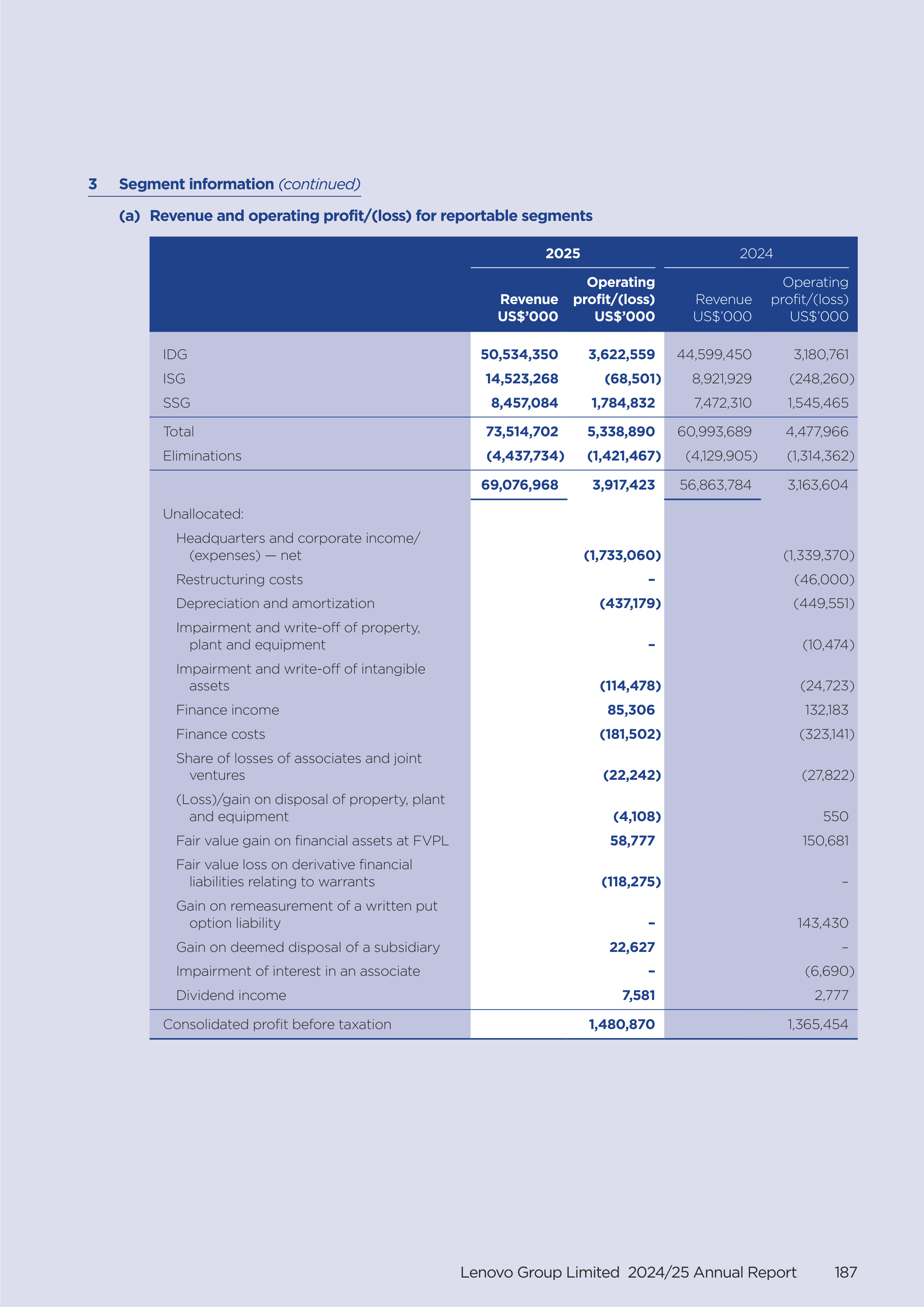
Lenovo Group Limited 2024/25 Annual Report
187
3
Segment information
(continued)
(a)
Revenue and operating profit/(loss) for reportable segments
2025
2024
Revenue
US$’000
Operating
profit/(loss)
US$’000
Revenue
US$’000
Operating
profit/(loss)
US$’000
IDG
50,534,350
3,622,559
44,599,450
3,180,761
ISG
14,523,268
(68,501)
8,921,929
(248,260)
SSG
8,457,084
1,784,832
7,472,310
1,545,465
Total
73,514,702
5,338,890
60,993,689
4,477,966
Eliminations
(4,437,734)
(1,421,467)
(4,129,905)
(1,314,362)
69,076,968
3,917,423
56,863,784
3,163,604
Unallocated:
Headquarters and corporate income/
(expenses) — net
(1,733,060 )
(1,339,370)
Restructuring costs
–
(46,000)
Depreciation and amortization
(437,179)
(449,551)
Impairment and write-off of property,
plant and equipment
–
(10,474)
Impairment and write-off of intangible
assets
(114,478 )
(24,723)
Finance income
85,306
132,183
Finance costs
(181,502 )
(323,141)
Share of losses of associates and joint
ventures
(22,242 )
(27,822)
(Loss)/gain on disposal of property, plant
and equipment
(4,108 )
550
Fair value gain on financial assets at FVPL
58,777
150,681
Fair value loss on derivative financial
liabilities relating to warrants
(118,275 )
–
Gain on remeasurement of a written put
option liability
–
143,430
Gain on deemed disposal of a subsidiary
22,627
–
Impairment of interest in an associate
–
(6,690)
Dividend income
7,581
2,777
Consolidated profit before taxation
1,480,870
1,365,454
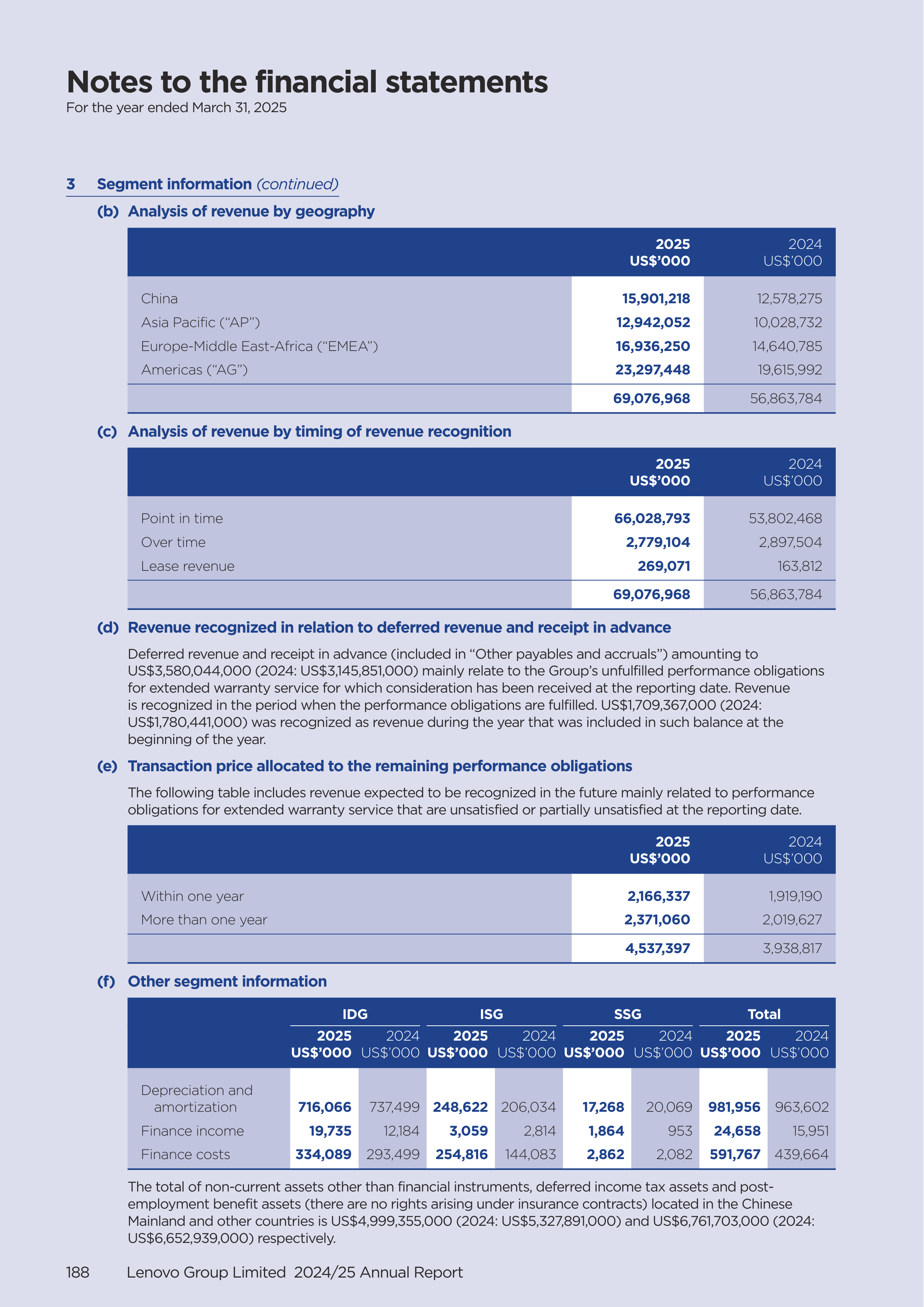
Notes to the financial statements
For the year ended March 31, 2025
Lenovo Group Limited 2024/25 Annual Report
188
3
Segment information
(continued)
(b) Analysis of revenue by geography
2025
US$’000
2024
US$’000
China
15,901,218
12,578,275
Asia Pacific (“AP”)
12,942,052
10,028,732
Europe-Middle East-Africa (“EMEA”)
16,936,250
14,640,785
Americas (“AG”)
23,297,448
19,615,992
69,076,968
56,863,784
(c)
Analysis of revenue by timing of revenue recognition
2025
US$’000
2024
US$’000
Point in time
66,028,793
53,802,468
Over time
2,779,104
2,897,504
Lease revenue
269,071
163,812
69,076,968
56,863,784
(d) Revenue recognized in relation to deferred revenue and receipt in advance
Deferred revenue and receipt in advance (included in “Other payables and accruals”) amounting to
US$3,580,044,000 (2024: US$3,145,851,000) mainly relate to the Group’s unfulfilled performance obligations
for extended warranty service for which consideration has been received at the reporting date. Revenue
is recognized in the period when the performance obligations are fulfilled. US$1,709,367,000 (2024:
US$1,780,441,000) was recognized as revenue during the year that was included in such balance at the
beginning of the year.
(e)
Transaction price allocated to the remaining performance obligations
The following table includes revenue expected to be recognized in the future mainly related to performance
obligations for extended warranty service that are unsatisfied or partially unsatisfied at the reporting date.
2025
US$’000
2024
US$’000
Within one year
2,166,337
1,919,190
More than one year
2,371,060
2,019,627
4,537,397
3,938,817
(f)
Other segment information
IDG
ISG
SSG
Total
2025
US$’000
2024
US$’000
2025
US$’000
2024
US$’000
2025
US$’000
2024
US$’000
2025
US$’000
2024
US$’000
Depreciation and
amortization
716,066
737,499
248,622
206,034
17,268
20,069
981,956
963,602
Finance income
19,735
12,184
3,059
2,814
1,864
953
24,658
15,951
Finance costs
334,089
293,499
254,816
144,083
2,862
2,082
591,767
439,664
The total of non-current assets other than financial instruments, deferred income tax assets and post-
employment benefit assets (there are no rights arising under insurance contracts) located in the Chinese
Mainland and other countries is US$4,999,355,000 (2024: US$5,327,891,000) and US$6,761,703,000 (2024:
US$6,652,939,000) respectively.
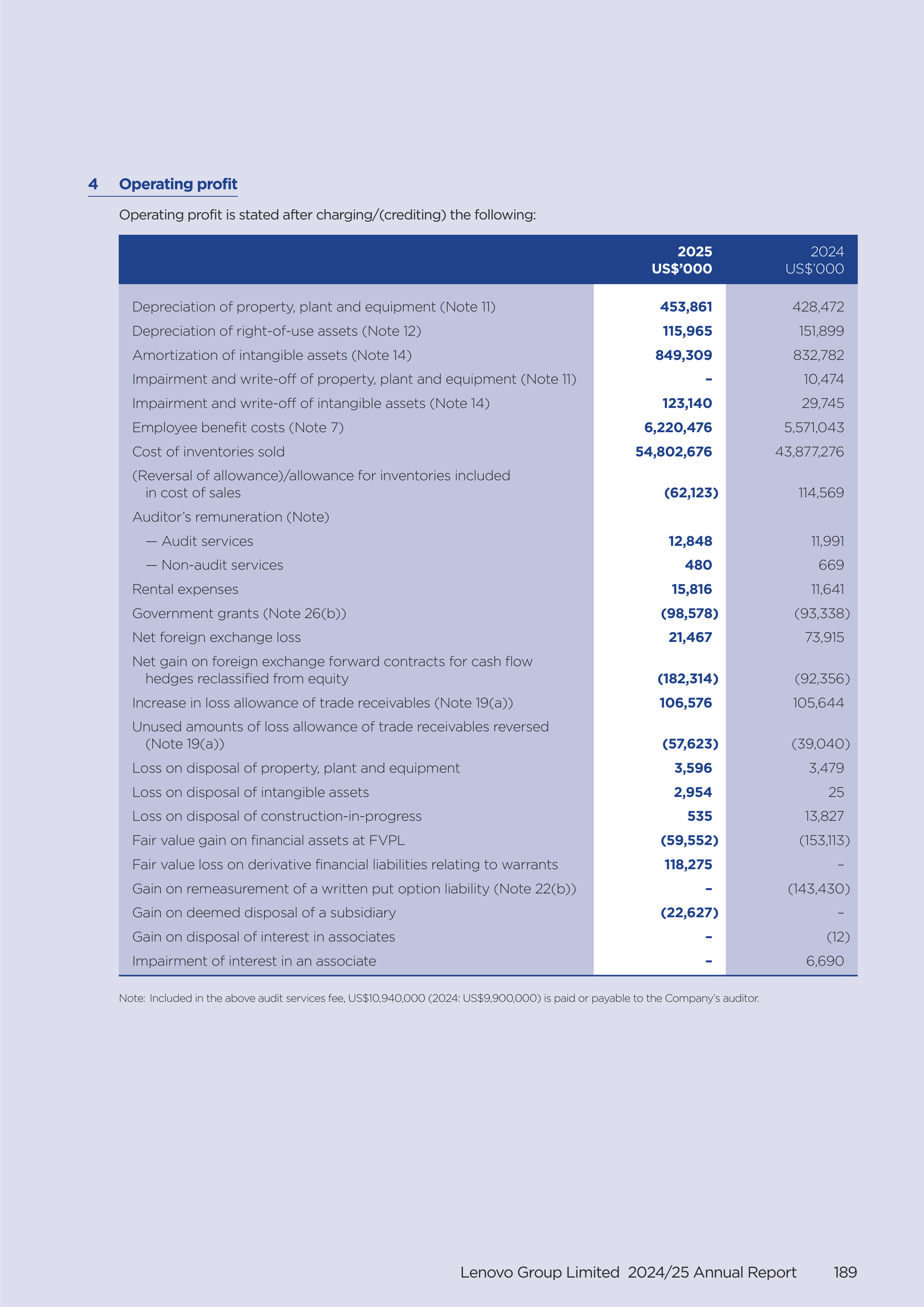
Lenovo Group Limited 2024/25 Annual Report
189
4
Operating profit
Operating profit is stated after charging/(crediting) the following:
2025
US$’000
2024
US$’000
Depreciation of property, plant and equipment (Note 11)
453,861
428,472
Depreciation of right-of-use assets (Note 12)
115,965
151,899
Amortization of intangible assets (Note 14)
849,309
832,782
Impairment and write-off of property, plant and equipment (Note 11)
–
10,474
Impairment and write-off of intangible assets (Note 14)
123,140
29,745
Employee benefit costs (Note 7)
6,220,476
5,571,043
Cost of inventories sold
54,802,676
43,877,276
(Reversal of allowance)/allowance for inventories included
in cost of sales
(62,123)
114,569
Auditor’s remuneration (Note)
— Audit services
12,848
11,991
— Non-audit services
480
669
Rental expenses
15,816
11,641
Government grants (Note 26(b))
(98,578 )
(93,338)
Net foreign exchange loss
21,467
73,915
Net gain on foreign exchange forward contracts for cash flow
hedges reclassified from equity
(182,314 )
(92,356)
Increase in loss allowance of trade receivables (Note 19(a))
106,576
105,644
Unused amounts of loss allowance of trade receivables reversed
(Note 19(a))
(57,623)
(39,040)
Loss on disposal of property, plant and equipment
3,596
3,479
Loss on disposal of intangible assets
2,954
25
Loss on disposal of construction-in-progress
535
13,827
Fair value gain on financial assets at FVPL
(59,552 )
(153,113)
Fair value loss on derivative financial liabilities relating to warrants
118,275
–
Gain on remeasurement of a written put option liability (Note 22(b))
–
(143,430)
Gain on deemed disposal of a subsidiary
(22,627)
–
Gain on disposal of interest in associates
–
(12)
Impairment of interest in an associate
–
6,690
Note: Included in the above audit services fee, US$10,940,000 (2024: US$9,900,000) is paid or payable to the Company’s auditor.
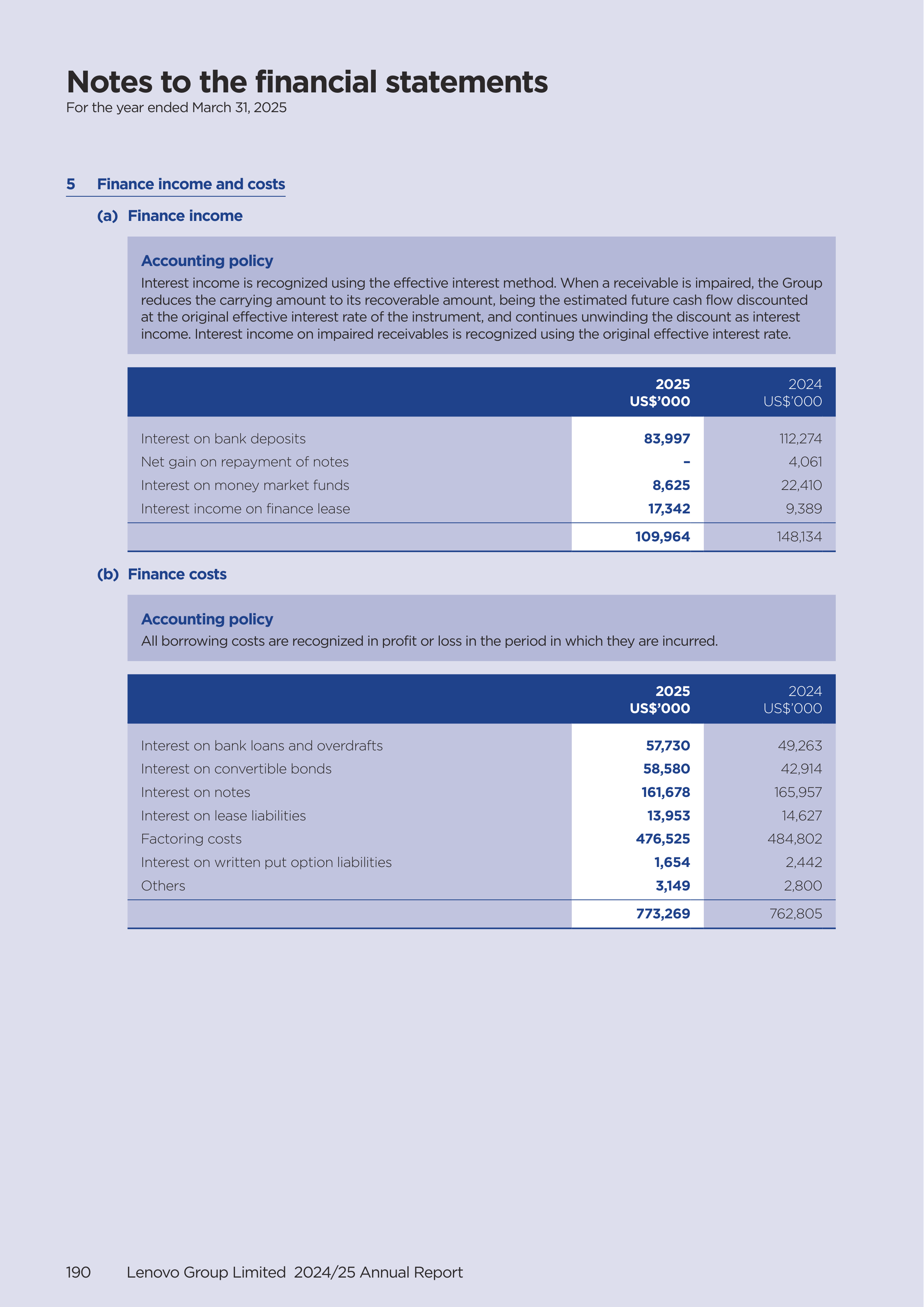
Notes to the financial statements
For the year ended March 31, 2025
Lenovo Group Limited 2024/25 Annual Report
190
5
Finance income and costs
(a)
Finance income
Accounting policy
Interest income is recognized using the effective interest method. When a receivable is impaired, the Group
reduces the carrying amount to its recoverable amount, being the estimated future cash flow discounted
at the original effective interest rate of the instrument, and continues unwinding the discount as interest
income. Interest income on impaired receivables is recognized using the original effective interest rate.
2025
US$’000
2024
US$’000
Interest on bank deposits
83,997
112,274
Net gain on repayment of notes
–
4,061
Interest on money market funds
8,625
22,410
Interest income on finance lease
17,342
9,389
109,964
148,134
(b) Finance costs
Accounting policy
All borrowing costs are recognized in profit or loss in the period in which they are incurred.
2025
US$’000
2024
US$’000
Interest on bank loans and overdrafts
57,730
49,263
Interest on convertible bonds
58,580
42,914
Interest on notes
161,678
165,957
Interest on lease liabilities
13,953
14,627
Factoring costs
476,525
484,802
Interest on written put option liabilities
1,654
2,442
Others
3,149
2,800
773,269
762,805
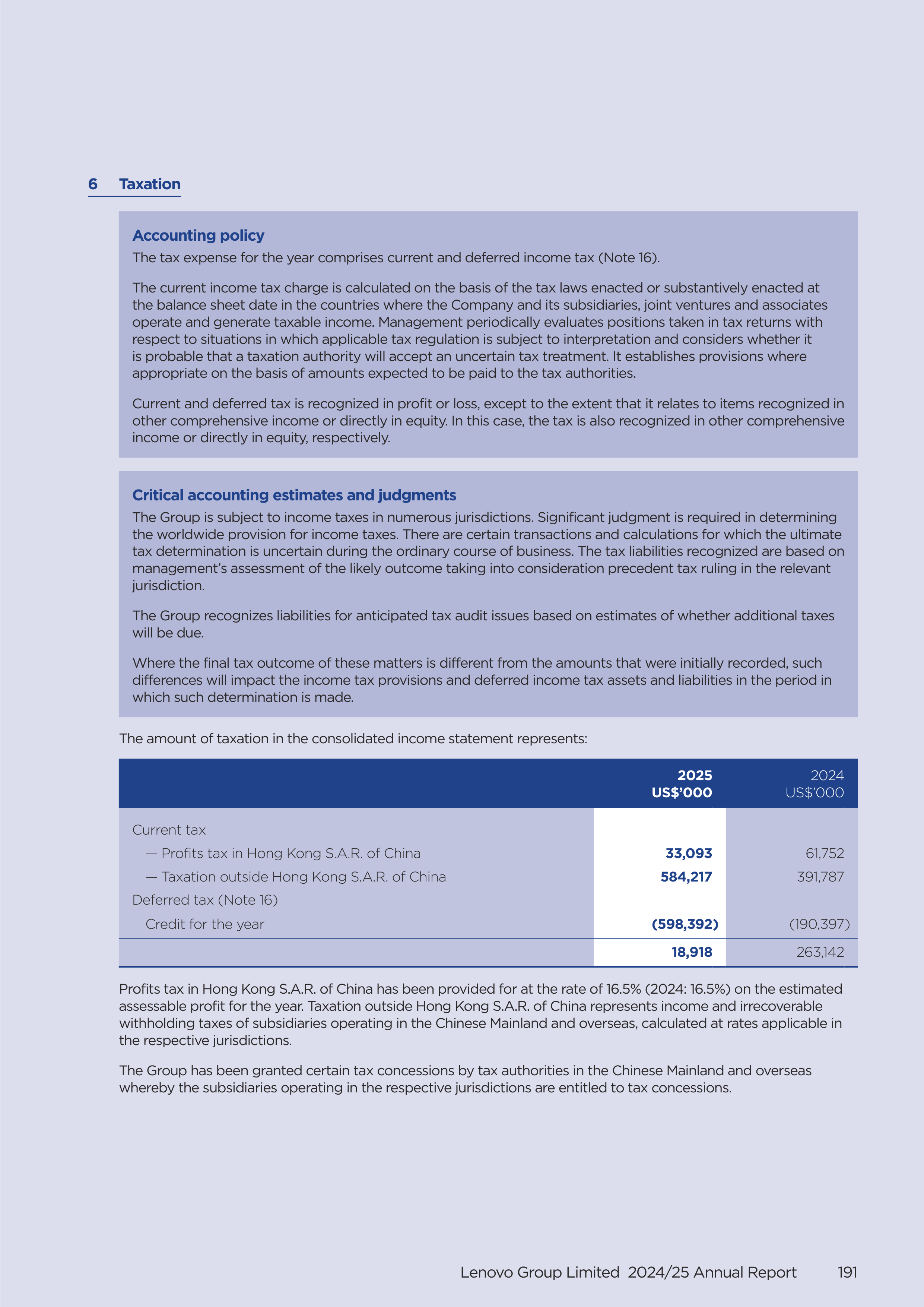
Lenovo Group Limited 2024/25 Annual Report
191
6
Taxation
Accounting policy
The tax expense for the year comprises current and deferred income tax (Note 16).
The current income tax charge is calculated on the basis of the tax laws enacted or substantively enacted at
the balance sheet date in the countries where the Company and its subsidiaries, joint ventures and associates
operate and generate taxable income. Management periodically evaluates positions taken in tax returns with
respect to situations in which applicable tax regulation is subject to interpretation and considers whether it
is probable that a taxation authority will accept an uncertain tax treatment. It establishes provisions where
appropriate on the basis of amounts expected to be paid to the tax authorities.
Current and deferred tax is recognized in profit or loss, except to the extent that it relates to items recognized in
other comprehensive income or directly in equity. In this case, the tax is also recognized in other comprehensive
income or directly in equity, respectively.
Critical accounting estimates and judgments
The Group is subject to income taxes in numerous jurisdictions. Significant judgment is required in determining
the worldwide provision for income taxes. There are certain transactions and calculations for which the ultimate
tax determination is uncertain during the ordinary course of business. The tax liabilities recognized are based on
management’s assessment of the likely outcome taking into consideration precedent tax ruling in the relevant
jurisdiction.
The Group recognizes liabilities for anticipated tax audit issues based on estimates of whether additional taxes
will be due.
Where the final tax outcome of these matters is different from the amounts that were initially recorded, such
differences will impact the income tax provisions and deferred income tax assets and liabilities in the period in
which such determination is made.
The amount of taxation in the consolidated income statement represents:
2025
US$’000
2024
US$’000
Current tax
— Profits tax in Hong Kong S.A.R. of China
33,093
61,752
— Taxation outside Hong Kong S.A.R. of China
584,217
391,787
Deferred tax (Note 16)
Credit for the year
(598,392)
(190,397)
18,918
263,142
Profits tax in Hong Kong S.A.R. of China has been provided for at the rate of 16.5% (2024: 16.5%) on the estimated
assessable profit for the year. Taxation outside Hong Kong S.A.R. of China represents income and irrecoverable
withholding taxes of subsidiaries operating in the Chinese Mainland and overseas, calculated at rates applicable in
the respective jurisdictions.
The Group has been granted certain tax concessions by tax authorities in the Chinese Mainland and overseas
whereby the subsidiaries operating in the respective jurisdictions are entitled to tax concessions.
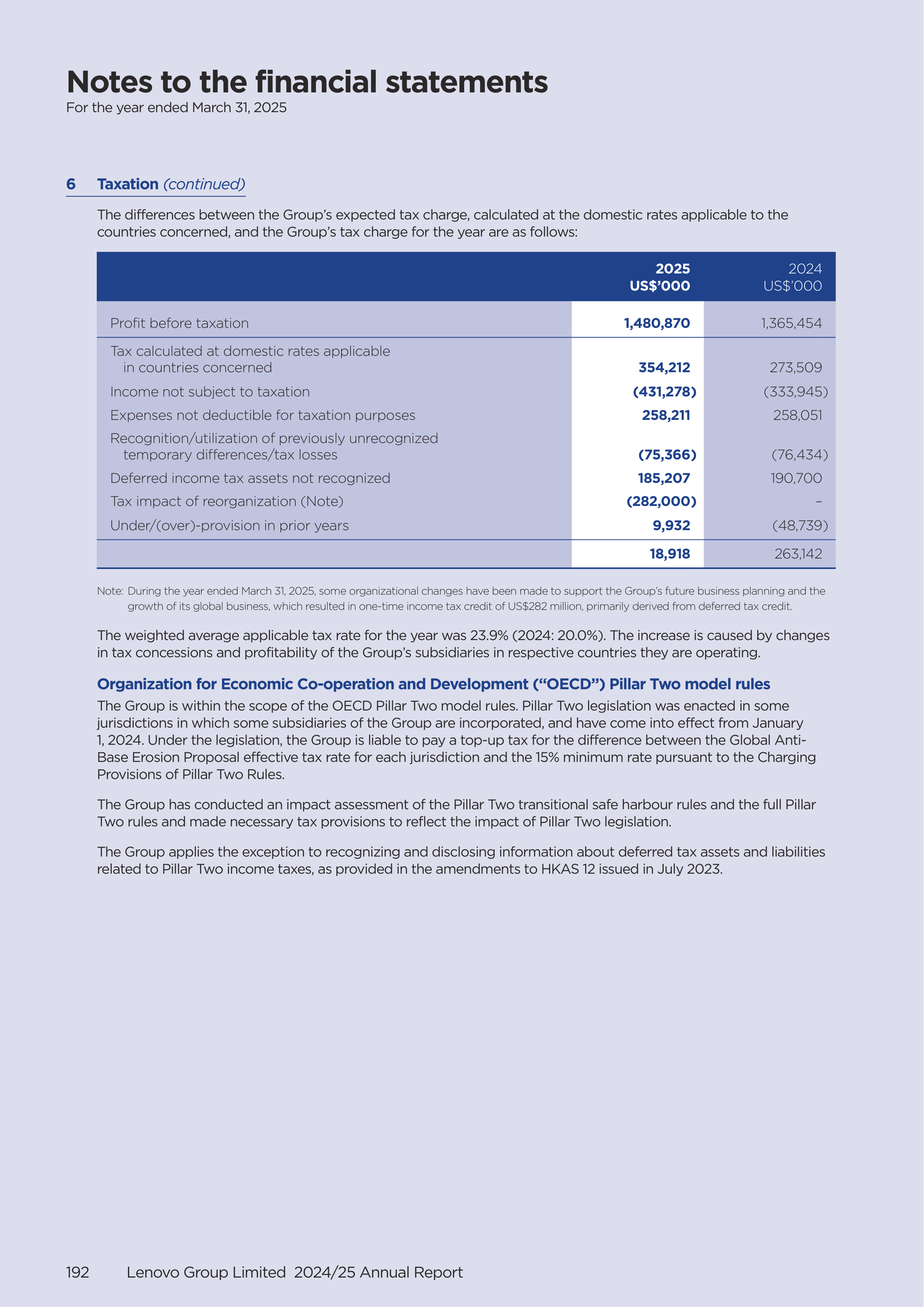
Notes to the financial statements
For the year ended March 31, 2025
Lenovo Group Limited 2024/25 Annual Report
192
6
Taxation
(continued)
The differences between the Group’s expected tax charge, calculated at the domestic rates applicable to the
countries concerned, and the Group’s tax charge for the year are as follows:
2025
US$’000
2024
US$’000
Profit before taxation
1,480,870
1,365,454
Tax calculated at domestic rates applicable
in countries concerned
354,212
273,509
Income not subject to taxation
(431,278)
(333,945)
Expenses not deductible for taxation purposes
258,211
258,051
Recognition/utilization of previously unrecognized
temporary differences/tax losses
(75,366)
(76,434)
Deferred income tax assets not recognized
185,207
190,700
Tax impact of reorganization (Note)
(282,000)
–
Under/(over)-provision in prior years
9,932
(48,739)
18,918
263,142
Note: During the year ended March 31, 2025, some organizational changes have been made to support the Group’s future business planning and the
growth of its global business, which resulted in one-time income tax credit of US$282 million, primarily derived from deferred tax credit.
The weighted average applicable tax rate for the year was 23.9% (2024: 20.0%). The increase is caused by changes
in tax concessions and profitability of the Group’s subsidiaries in respective countries they are operating.
Organization for Economic Co-operation and Development (“OECD”) Pillar Two model rules
The Group is within the scope of the OECD Pillar Two model rules. Pillar Two legislation was enacted in some
jurisdictions in which some subsidiaries of the Group are incorporated, and have come into effect from January
1, 2024. Under the legislation, the Group is liable to pay a top-up tax for the difference between the Global Anti-
Base Erosion Proposal effective tax rate for each jurisdiction and the 15% minimum rate pursuant to the Charging
Provisions of Pillar Two Rules.
The Group has conducted an impact assessment of the Pillar Two transitional safe harbour rules and the full Pillar
Two rules and made necessary tax provisions to reflect the impact of Pillar Two legislation.
The Group applies the exception to recognizing and disclosing information about deferred tax assets and liabilities
related to Pillar Two income taxes, as provided in the amendments to HKAS 12 issued in July 2023.
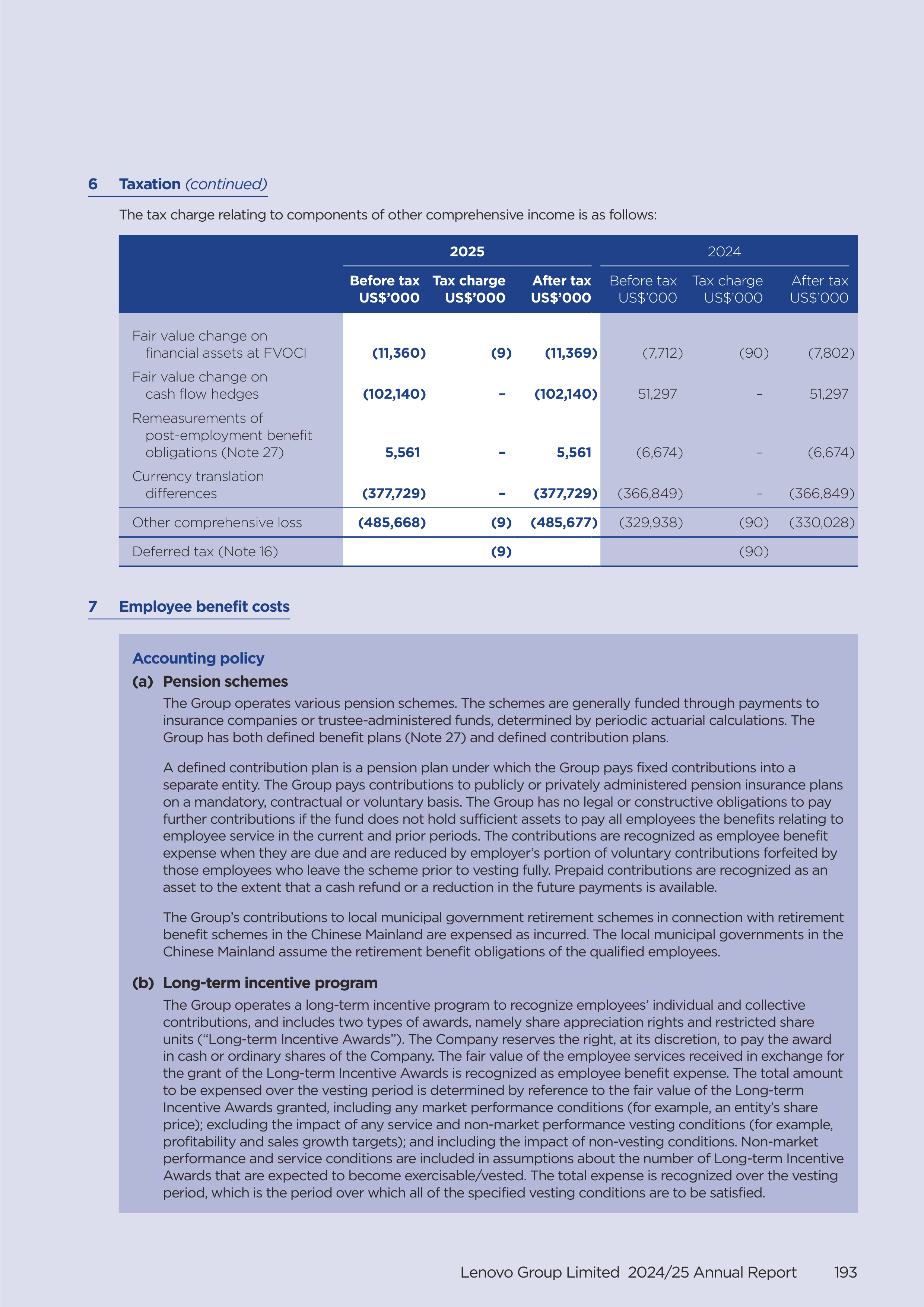
Lenovo Group Limited 2024/25 Annual Report
193
6
Taxation
(continued)
The tax charge relating to components of other comprehensive income is as follows:
2025
2024
Before tax
US$’000
Tax charge
US$’000
After tax
US$’000
Before tax
US$’000
Tax charge
US$’000
After tax
US$’000
Fair value change on
financial assets at FVOCI
(11,360)
(9)
(11,369)
(7,712)
(90)
(7,802)
Fair value change on
cash flow hedges
(102,140)
–
(102,140)
51,297
–
51,297
Remeasurements of
post-employment benefit
obligations (Note 27)
5,561
–
5,561
(6,674)
–
(6,674)
Currency translation
differences
(377,729)
–
(377,729)
(366,849)
–
(366,849)
Other comprehensive loss
(485,668)
(9)
(485,677)
(329,938)
(90)
(330,028)
Deferred tax (Note 16)
(9)
(90)
7
Employee benefit costs
Accounting policy
(a)
Pension schemes
The Group operates various pension schemes. The schemes are generally funded through payments to
insurance companies or trustee-administered funds, determined by periodic actuarial calculations. The
Group has both defined benefit plans (Note 27) and defined contribution plans.
A defined contribution plan is a pension plan under which the Group pays fixed contributions into a
separate entity. The Group pays contributions to publicly or privately administered pension insurance plans
on a mandatory, contractual or voluntary basis. The Group has no legal or constructive obligations to pay
further contributions if the fund does not hold sufficient assets to pay all employees the benefits relating to
employee service in the current and prior periods. The contributions are recognized as employee benefit
expense when they are due and are reduced by employer’s portion of voluntary contributions forfeited by
those employees who leave the scheme prior to vesting fully. Prepaid contributions are recognized as an
asset to the extent that a cash refund or a reduction in the future payments is available.
The Group’s contributions to local municipal government retirement schemes in connection with retirement
benefit schemes in the Chinese Mainland are expensed as incurred. The local municipal governments in the
Chinese Mainland assume the retirement benefit obligations of the qualified employees.
(b) Long-term incentive program
The Group operates a long-term incentive program to recognize employees’ individual and collective
contributions, and includes two types of awards, namely share appreciation rights and restricted share
units (“Long-term Incentive Awards”). The Company reserves the right, at its discretion, to pay the award
in cash or ordinary shares of the Company. The fair value of the employee services received in exchange for
the grant of the Long-term Incentive Awards is recognized as employee benefit expense. The total amount
to be expensed over the vesting period is determined by reference to the fair value of the Long-term
Incentive Awards granted, including any market performance conditions (for example, an entity’s share
price); excluding the impact of any service and non-market performance vesting conditions (for example,
profitability and sales growth targets); and including the impact of non-vesting conditions. Non-market
performance and service conditions are included in assumptions about the number of Long-term Incentive
Awards that are expected to become exercisable/vested. The total expense is recognized over the vesting
period, which is the period over which all of the specified vesting conditions are to be satisfied.
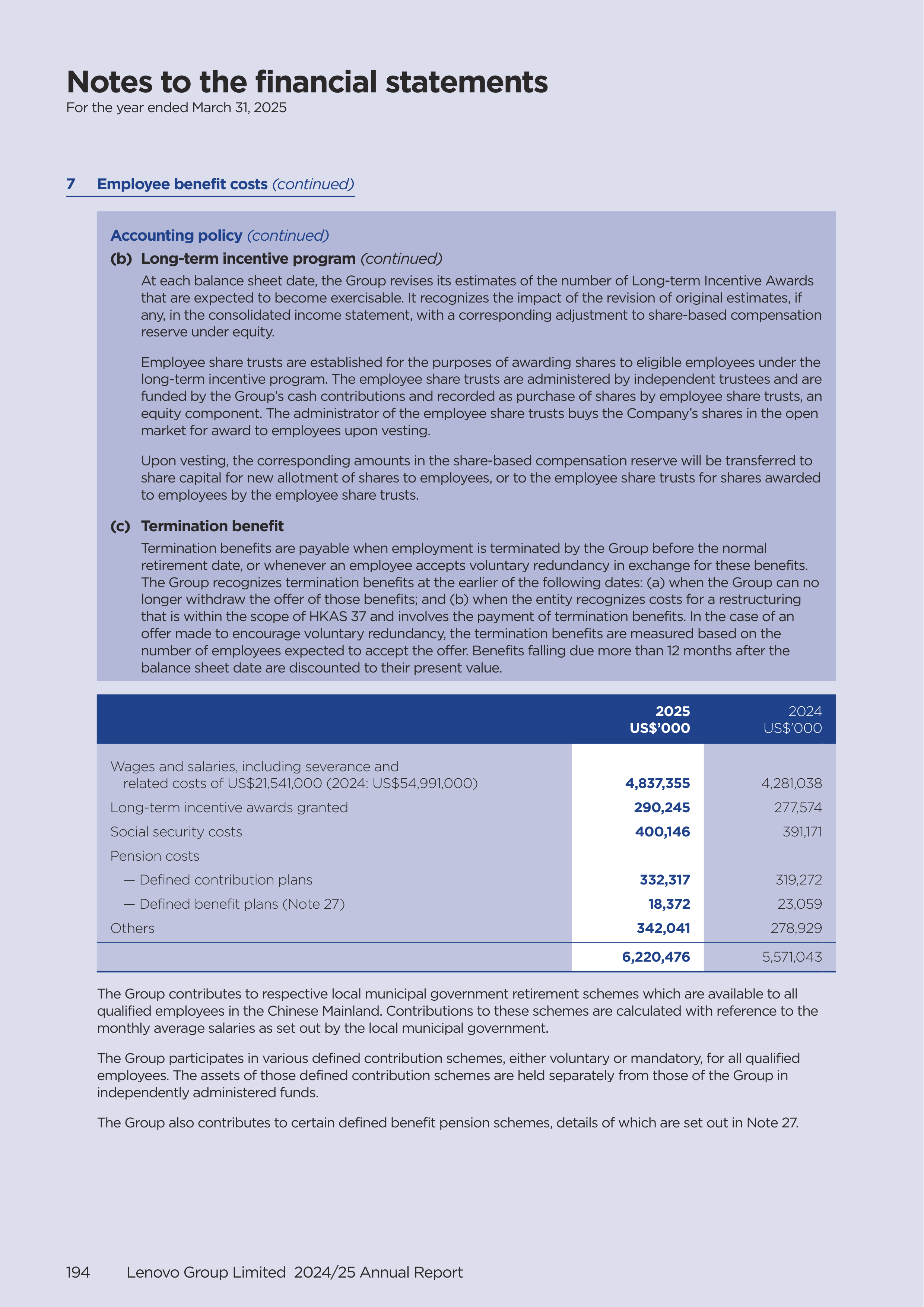
Notes to the financial statements
For the year ended March 31, 2025
Lenovo Group Limited 2024/25 Annual Report
194
7
Employee benefit costs
(continued)
Accounting policy
(continued)
(b) Long-term incentive program
(continued)
At each balance sheet date, the Group revises its estimates of the number of Long-term Incentive Awards
that are expected to become exercisable. It recognizes the impact of the revision of original estimates, if
any, in the consolidated income statement, with a corresponding adjustment to share-based compensation
reserve under equity.
Employee share trusts are established for the purposes of awarding shares to eligible employees under the
long-term incentive program. The employee share trusts are administered by independent trustees and are
funded by the Group’s cash contributions and recorded as purchase of shares by employee share trusts, an
equity component. The administrator of the employee share trusts buys the Company’s shares in the open
market for award to employees upon vesting.
Upon vesting, the corresponding amounts in the share-based compensation reserve will be transferred to
share capital for new allotment of shares to employees, or to the employee share trusts for shares awarded
to employees by the employee share trusts.
(c)
Termination benefit
Termination benefits are payable when employment is terminated by the Group before the normal
retirement date, or whenever an employee accepts voluntary redundancy in exchange for these benefits.
The Group recognizes termination benefits at the earlier of the following dates: (a) when the Group can no
longer withdraw the offer of those benefits; and (b) when the entity recognizes costs for a restructuring
that is within the scope of HKAS 37 and involves the payment of termination benefits. In the case of an
offer made to encourage voluntary redundancy, the termination benefits are measured based on the
number of employees expected to accept the offer. Benefits falling due more than 12 months after the
balance sheet date are discounted to their present value.
2025
US$’000
2024
US$’000
Wages and salaries, including severance and
related costs of US$21,541,000 (2024: US$54,991,000)
4,837,355
4,281,038
Long-term incentive awards granted
290,245
277,574
Social security costs
400,146
391,171
Pension costs
— Defined contribution plans
332,317
319,272
— Defined benefit plans (Note 27)
18,372
23,059
Others
342,041
278,929
6,220,476
5,571,043
The Group contributes to respective local municipal government retirement schemes which are available to all
qualified employees in the Chinese Mainland. Contributions to these schemes are calculated with reference to the
monthly average salaries as set out by the local municipal government.
The Group participates in various defined contribution schemes, either voluntary or mandatory, for all qualified
employees. The assets of those defined contribution schemes are held separately from those of the Group in
independently administered funds.
The Group also contributes to certain defined benefit pension schemes, details of which are set out in Note 27.
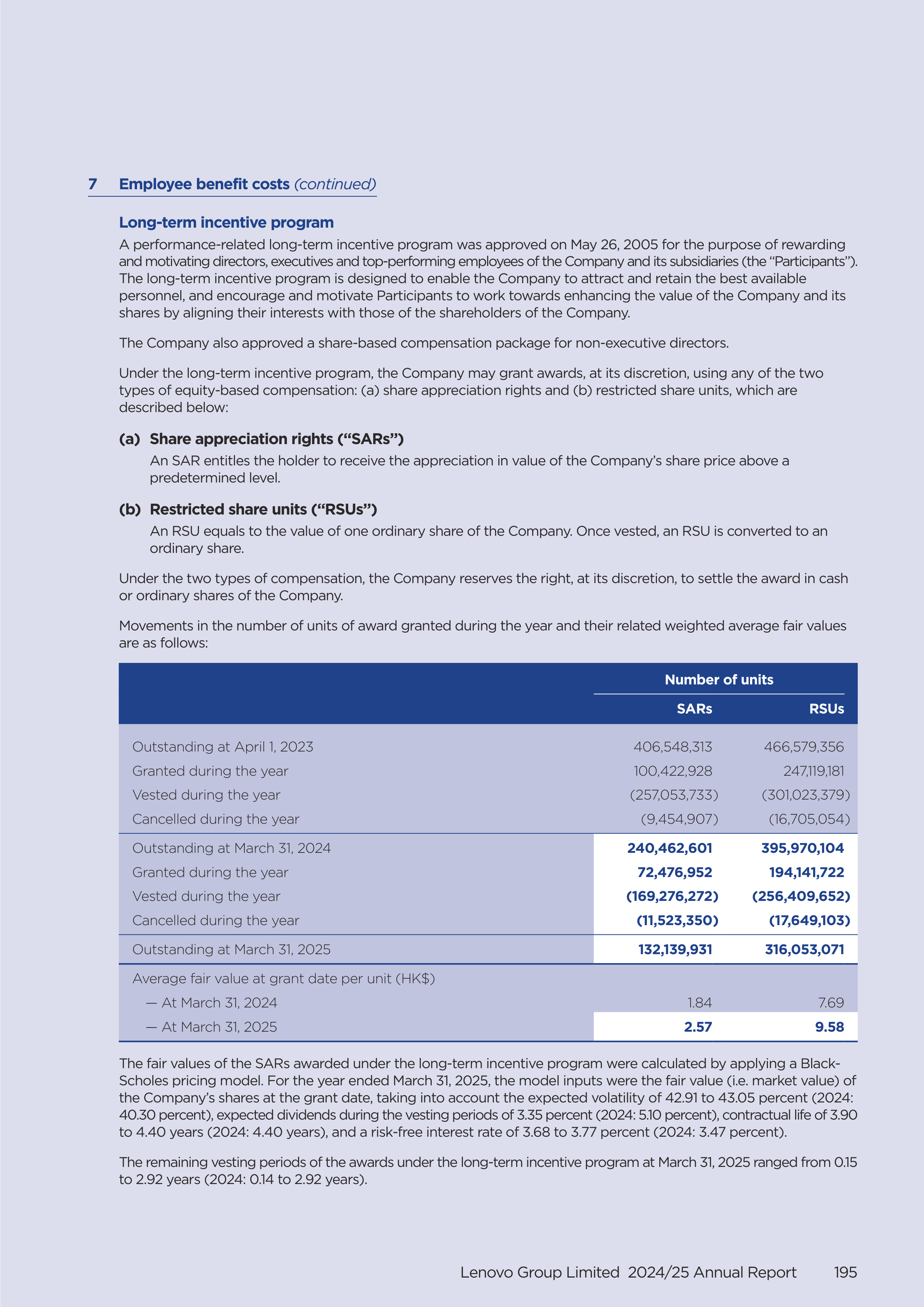
Lenovo Group Limited 2024/25 Annual Report
195
7
Employee benefit costs
(continued)
Long-term incentive program
A performance-related long-term incentive program was approved on May 26, 2005 for the purpose of rewarding
and motivating directors, executives and top-performing employees of the Company and its subsidiaries (the “Participants”).
The long-term incentive program is designed to enable the Company to attract and retain the best available
personnel, and encourage and motivate Participants to work towards enhancing the value of the Company and its
shares by aligning their interests with those of the shareholders of the Company.
The Company also approved a share-based compensation package for non-executive directors.
Under the long-term incentive program, the Company may grant awards, at its discretion, using any of the two
types of equity-based compensation: (a) share appreciation rights and (b) restricted share units, which are
described below:
(a)
Share appreciation rights (“SARs”)
An SAR entitles the holder to receive the appreciation in value of the Company’s share price above a
predetermined level.
(b) Restricted share units (“RSUs”)
An RSU equals to the value of one ordinary share of the Company. Once vested, an RSU is converted to an
ordinary share.
Under the two types of compensation, the Company reserves the right, at its discretion, to settle the award in cash
or ordinary shares of the Company.
Movements in the number of units of award granted during the year and their related weighted average fair values
are as follows:
Number of units
SARs
RSUs
Outstanding at April 1, 2023
406,548,313
466,579,356
Granted during the year
100,422,928
247,119,181
Vested during the year
(257,053,733)
(301,023,379)
Cancelled during the year
(9,454,907)
(16,705,054)
Outstanding at March 31, 2024
240,462,601
395,970,104
Granted during the year
72,476,952
194,141,722
Vested during the year
(169,276,272 )
(256,409,652 )
Cancelled during the year
(11,523,350 )
(17,649,103 )
Outstanding at March 31, 2025
132,139,931
316,053,071
Average fair value at grant date per unit (HK$)
— At March 31, 2024
1.84
7.69
— At March 31, 2025
2.57
9.58
The fair values of the SARs awarded under the long-term incentive program were calculated by applying a Black-
Scholes pricing model. For the year ended March 31, 2025, the model inputs were the fair value (i.e. market value) of
the Company’s shares at the grant date, taking into account the expected volatility of 42.91 to 43.05 percent (2024:
40.30 percent), expected dividends during the vesting periods of 3.35 percent (2024: 5.10 percent), contractual life of 3.90
to 4.40 years (2024: 4.40 years), and a risk-free interest rate of 3.68 to 3.77 percent (2024: 3.47 percent).
The remaining vesting periods of the awards under the long-term incentive program at March 31, 2025 ranged from 0.15
to 2.92 years (2024: 0.14 to 2.92 years).
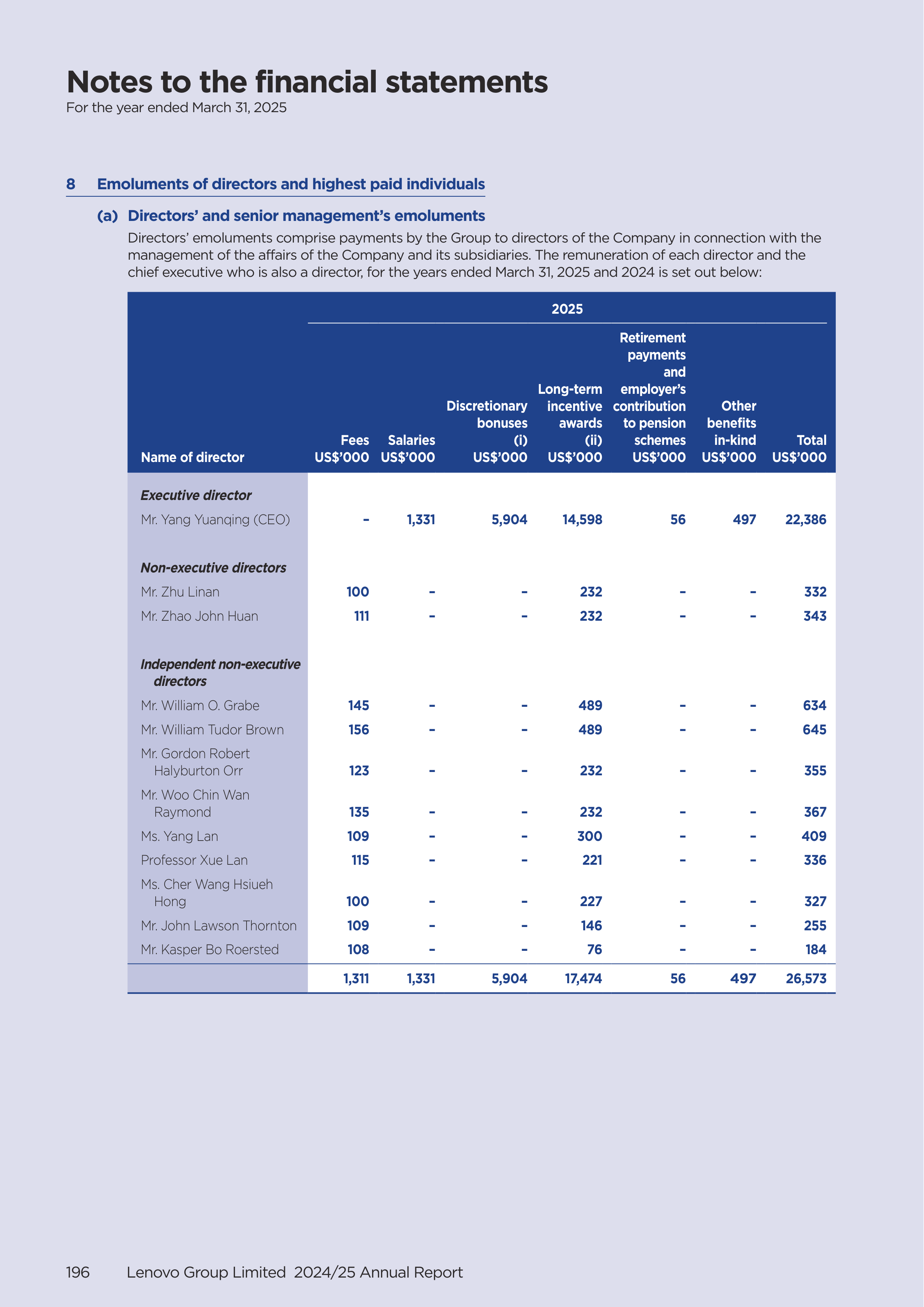
Notes to the financial statements
For the year ended March 31, 2025
Lenovo Group Limited 2024/25 Annual Report
196
8
Emoluments of directors and highest paid individuals
(a)
Directors’ and senior management’s emoluments
Directors’ emoluments comprise payments by the Group to directors of the Company in connection with the
management of the affairs of the Company and its subsidiaries. The remuneration of each director and the
chief executive who is also a director, for the years ended March 31, 2025 and 2024 is set out below:
2025
Name of director
Fees
US$’000
Salaries
US$’000
Discretionary
bonuses
(i)
US$’000
Long-term
incentive
awards
(ii)
US$’000
Retirement
payments
and
employer’s
contribution
to pension
schemes
US$’000
Other
benefits
in-kind
US$’000
Total
US$’000
Executive director
Mr. Yang Yuanqing (CEO)
–
1,331
5,904
14,598
56
497
22,386
Non-executive directors
Mr. Zhu Linan
100
–
–
232
–
–
332
Mr. Zhao John Huan
111
–
–
232
–
–
343
Independent non-executive
directors
Mr. William O. Grabe
145
–
–
489
–
–
634
Mr. William Tudor Brown
156
–
–
489
–
–
645
Mr. Gordon Robert
Halyburton Orr
123
–
–
232
–
–
355
Mr. Woo Chin Wan
Raymond
135
–
–
232
–
–
367
Ms. Yang Lan
109
–
–
300
–
–
409
Professor Xue Lan
115
–
–
221
–
–
336
Ms. Cher Wang Hsiueh
Hong
100
–
–
227
–
–
327
Mr. John Lawson Thornton
109
–
–
146
–
–
255
Mr. Kasper Bo Roersted
108
–
–
76
–
–
184
1,311
1,331
5,904
17,474
56
497
26,573
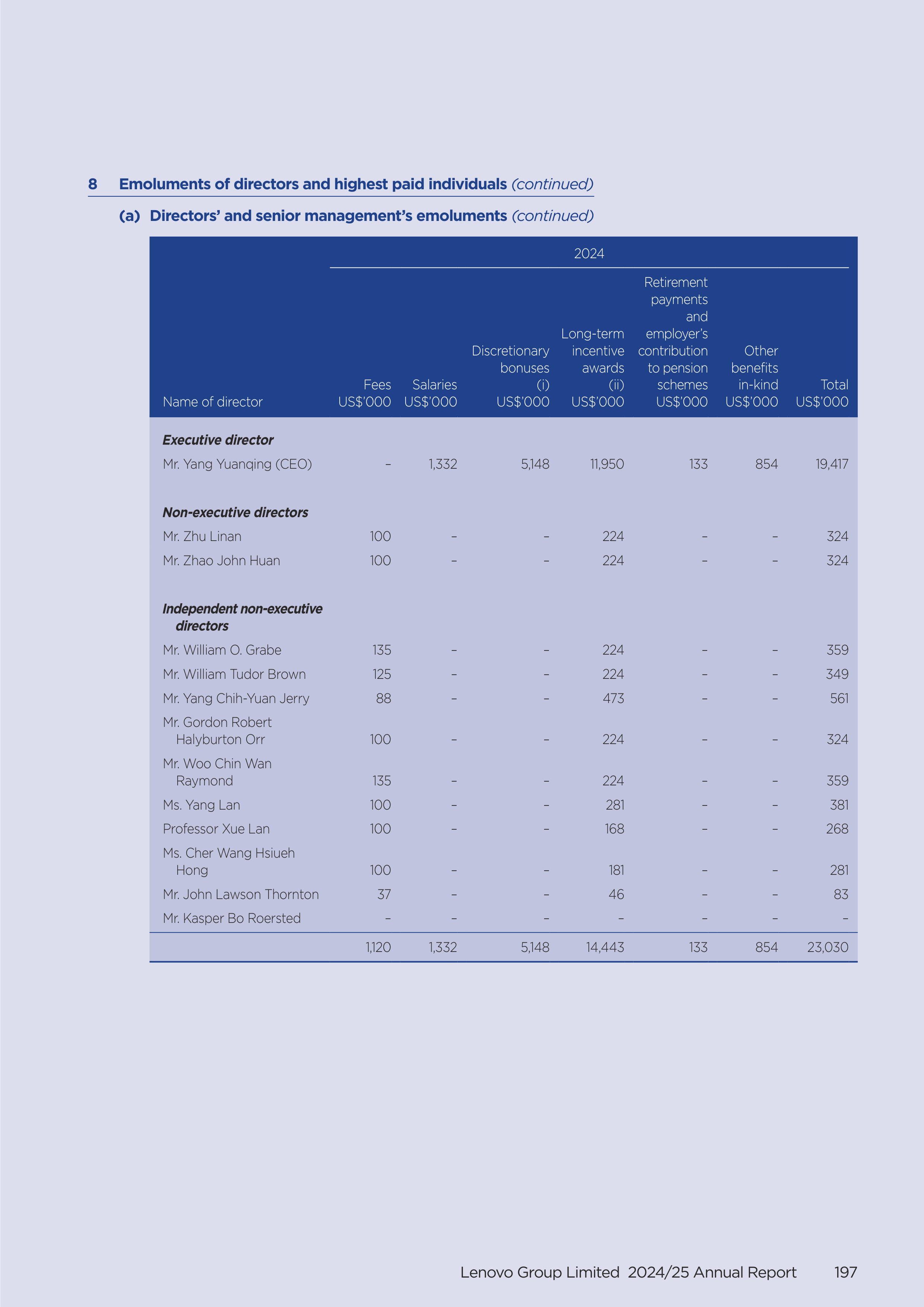
Lenovo Group Limited 2024/25 Annual Report
197
8
Emoluments of directors and highest paid individuals
(continued)
(a)
Directors’ and senior management’s emoluments
(continued)
2024
Name of director
Fees
US$’000
Salaries
US$’000
Discretionary
bonuses
(i)
US$’000
Long-term
incentive
awards
(ii)
US$’000
Retirement
payments
and
employer’s
contribution
to pension
schemes
US$’000
Other
benefits
in-kind
US$’000
Total
US$’000
Executive director
Mr. Yang Yuanqing (CEO)
–
1,332
5,148
11,950
133
854
19,417
Non-executive directors
Mr. Zhu Linan
100
–
–
224
–
–
324
Mr. Zhao John Huan
100
–
–
224
–
–
324
Independent non-executive
directors
Mr. William O. Grabe
135
–
–
224
–
–
359
Mr. William Tudor Brown
125
–
–
224
–
–
349
Mr. Yang Chih-Yuan Jerry
88
–
–
473
–
–
561
Mr. Gordon Robert
Halyburton Orr
100
–
–
224
–
–
324
Mr. Woo Chin Wan
Raymond
135
–
–
224
–
–
359
Ms. Yang Lan
100
–
–
281
–
–
381
Professor Xue Lan
100
–
–
168
–
–
268
Ms. Cher Wang Hsiueh
Hong
100
–
–
181
–
–
281
Mr. John Lawson Thornton
37
–
–
46
–
–
83
Mr. Kasper Bo Roersted
–
–
–
–
–
–
–
1,120
1,332
5,148
14,443
133
854
23,030
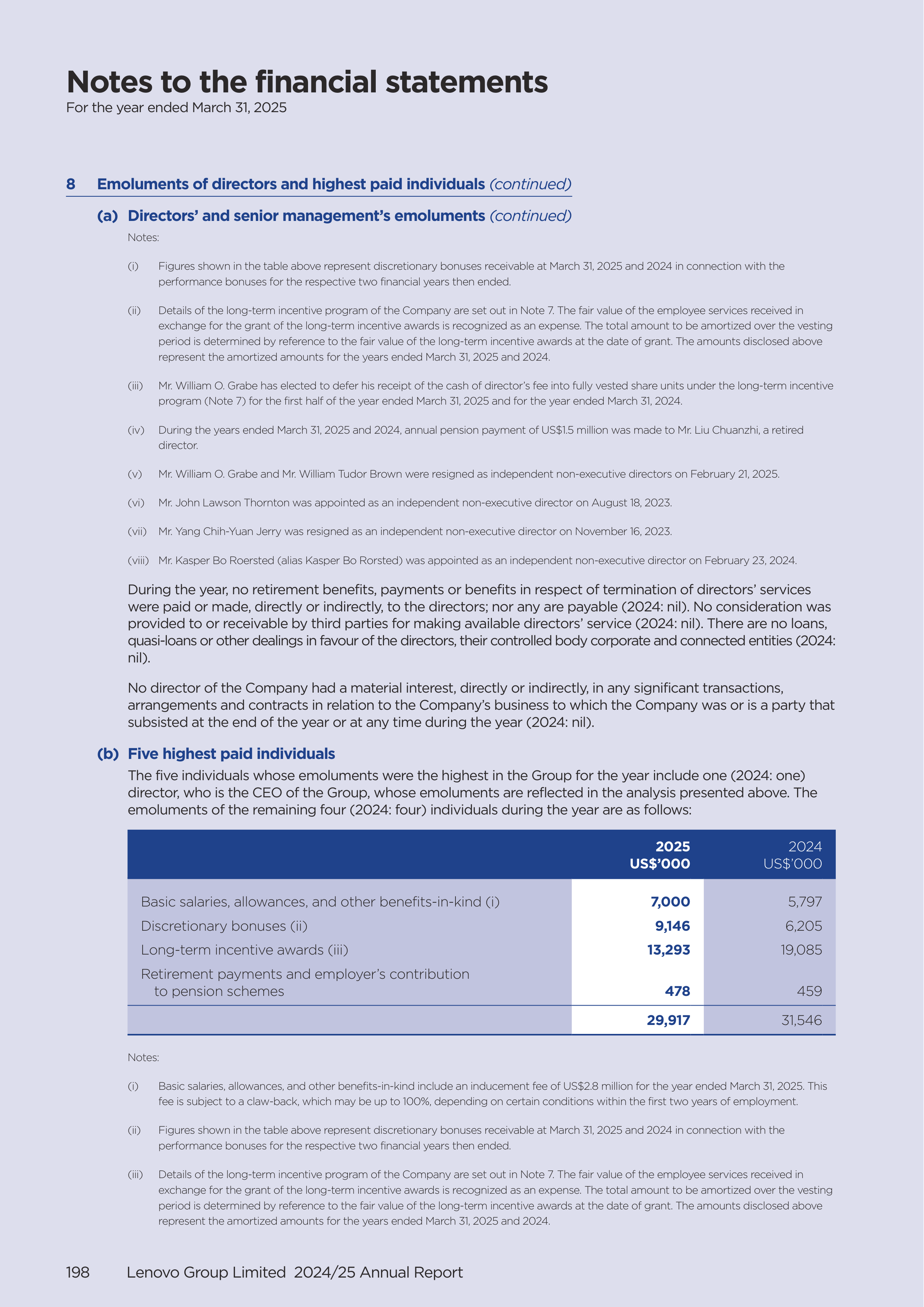
Notes to the financial statements
For the year ended March 31, 2025
Lenovo Group Limited 2024/25 Annual Report
198
8
Emoluments of directors and highest paid individuals
(continued)
(a)
Directors’ and senior management’s emoluments
(continued)
Notes:
(i)
Figures shown in the table above represent discretionary bonuses receivable at March 31, 2025 and 2024 in connection with the
performance bonuses for the respective two financial years then ended.
(ii)
Details of the long-term incentive program of the Company are set out in Note 7. The fair value of the employee services received in
exchange for the grant of the long-term incentive awards is recognized as an expense. The total amount to be amortized over the vesting
period is determined by reference to the fair value of the long-term incentive awards at the date of grant. The amounts disclosed above
represent the amortized amounts for the years ended March 31, 2025 and 2024.
(iii)
Mr. William O. Grabe has elected to defer his receipt of the cash of director’s fee into fully vested share units under the long-term incentive
program (Note 7) for the first half of the year ended March 31, 2025 and for the year ended March 31, 2024.
(iv)
During the years ended March 31, 2025 and 2024, annual pension payment of US$1.5 million was made to Mr. Liu Chuanzhi, a retired
director.
(v)
Mr. William O. Grabe and Mr. William Tudor Brown were resigned as independent non-executive directors on February 21, 2025.
(vi)
Mr. John Lawson Thornton was appointed as an independent non-executive director on August 18, 2023.
(vii)
Mr. Yang Chih-Yuan Jerry was resigned as an independent non-executive director on November 16, 2023.
(viii)
Mr. Kasper Bo Roersted (alias Kasper Bo Rorsted) was appointed as an independent non-executive director on February 23, 2024.
During the year, no retirement benefits, payments or benefits in respect of termination of directors’ services
were paid or made, directly or indirectly, to the directors; nor any are payable (2024: nil). No consideration was
provided to or receivable by third parties for making available directors’ service (2024: nil). There are no loans,
quasi-loans or other dealings in favour of the directors, their controlled body corporate and connected entities (2024:
nil).
No director of the Company had a material interest, directly or indirectly, in any significant transactions,
arrangements and contracts in relation to the Company’s business to which the Company was or is a party that
subsisted at the end of the year or at any time during the year (2024: nil).
(b) Five highest paid individuals
The five individuals whose emoluments were the highest in the Group for the year include one (2024: one)
director, who is the CEO of the Group, whose emoluments are reflected in the analysis presented above. The
emoluments of the remaining four (2024: four) individuals during the year are as follows:
2025
US$’000
2024
US$’000
Basic salaries, allowances, and other benefits-in-kind (i)
7,000
5,797
Discretionary bonuses (ii)
9,146
6,205
Long-term incentive awards (iii)
13,293
19,085
Retirement payments and employer’s contribution
to pension schemes
478
459
29,917
31,546
Notes:
(i)
Basic salaries, allowances, and other benefits-in-kind include an inducement fee of US$2.8 million for the year ended March 31, 2025. This
fee is subject to a claw-back, which may be up to 100%, depending on certain conditions within the first two years of employment.
(ii)
Figures shown in the table above represent discretionary bonuses receivable at March 31, 2025 and 2024 in connection with the
performance bonuses for the respective two financial years then ended.
(iii)
Details of the long-term incentive program of the Company are set out in Note 7. The fair value of the employee services received in
exchange for the grant of the long-term incentive awards is recognized as an expense. The total amount to be amortized over the vesting
period is determined by reference to the fair value of the long-term incentive awards at the date of grant. The amounts disclosed above
represent the amortized amounts for the years ended March 31, 2025 and 2024.
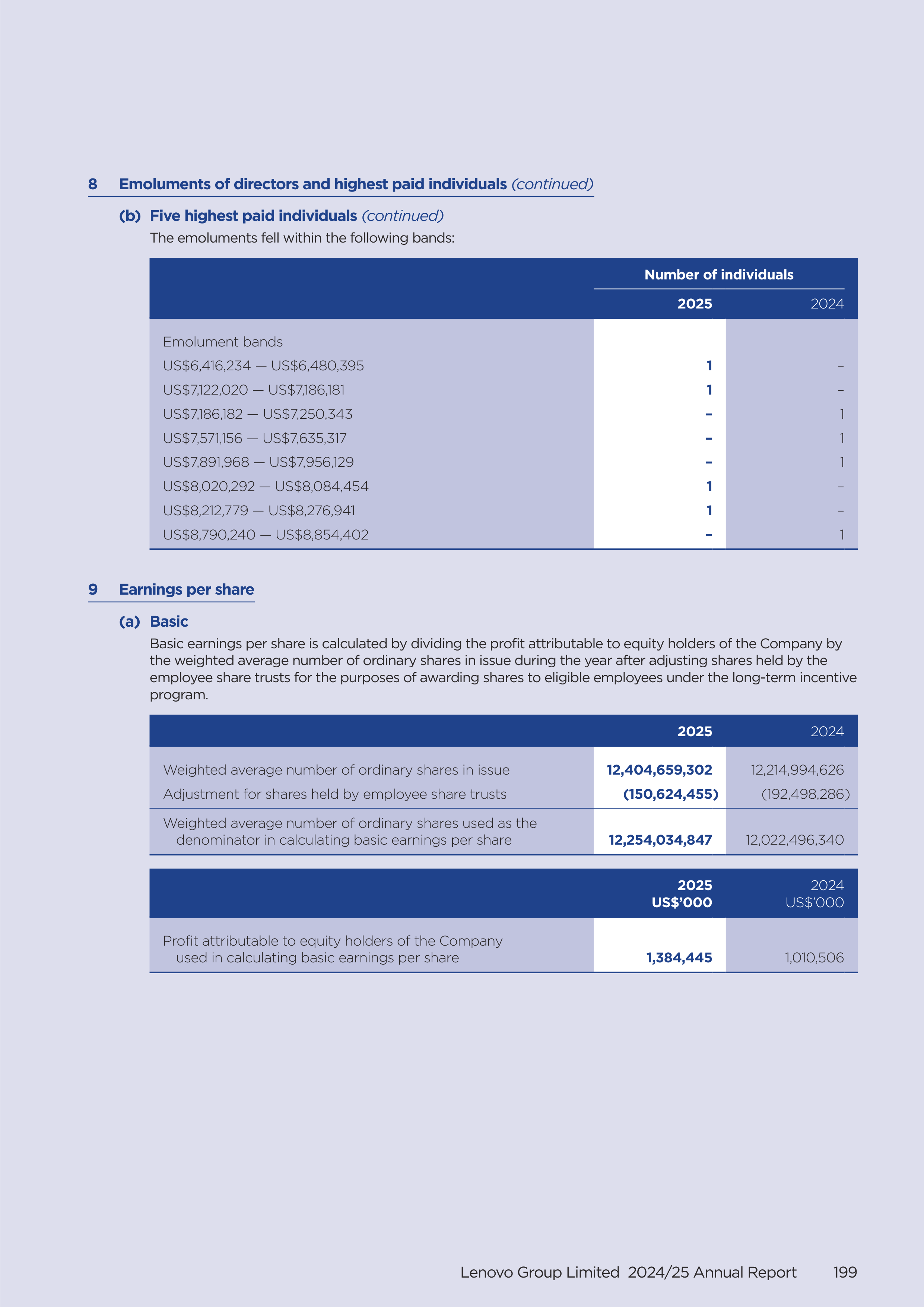
Lenovo Group Limited 2024/25 Annual Report
199
8
Emoluments of directors and highest paid individuals
(continued)
(b) Five highest paid individuals
(continued)
The emoluments fell within the following bands:
Number of individuals
2025
2024
Emolument bands
US$6,416,234 — US$6,480,395
1
–
US$7,122,020 — US$7,186,181
1
–
US$7,186,182 — US$7,250,343
–
1
US$7,571,156 — US$7,635,317
–
1
US$7,891,968 — US$7,956,129
–
1
US$8,020,292 — US$8,084,454
1
–
US$8,212,779 — US$8,276,941
1
–
US$8,790,240 — US$8,854,402
–
1
9
Earnings per share
(a)
Basic
Basic earnings per share is calculated by dividing the profit attributable to equity holders of the Company by
the weighted average number of ordinary shares in issue during the year after adjusting shares held by the
employee share trusts for the purposes of awarding shares to eligible employees under the long-term incentive
program.
2025
2024
Weighted average number of ordinary shares in issue
12,404,659,302
12,214,994,626
Adjustment for shares held by employee share trusts
(150,624,455)
(192,498,286)
Weighted average number of ordinary shares used as the
denominator in calculating basic earnings per share
12,254,034,847
12,022,496,340
2025
US$’000
2024
US$’000
Profit attributable to equity holders of the Company
used in calculating basic earnings per share
1,384,445
1,010,506
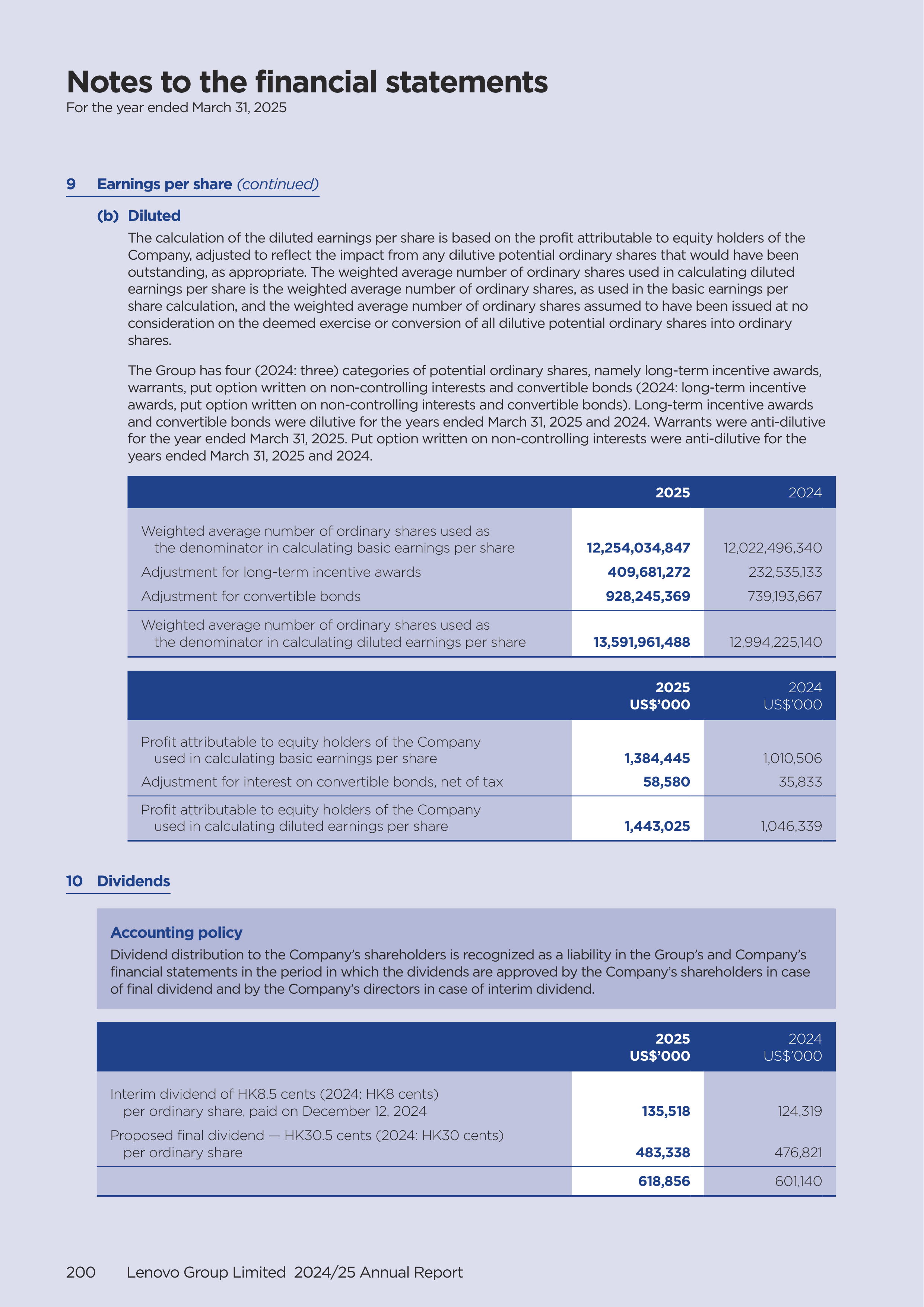
Notes to the financial statements
For the year ended March 31, 2025
Lenovo Group Limited 2024/25 Annual Report
200
9
Earnings per share
(continued)
(b) Diluted
The calculation of the diluted earnings per share is based on the profit attributable to equity holders of the
Company, adjusted to reflect the impact from any dilutive potential ordinary shares that would have been
outstanding, as appropriate. The weighted average number of ordinary shares used in calculating diluted
earnings per share is the weighted average number of ordinary shares, as used in the basic earnings per
share calculation, and the weighted average number of ordinary shares assumed to have been issued at no
consideration on the deemed exercise or conversion of all dilutive potential ordinary shares into ordinary
shares.
The Group has four (2024: three) categories of potential ordinary shares, namely long-term incentive awards,
warrants, put option written on non-controlling interests and convertible bonds (2024: long-term incentive
awards, put option written on non-controlling interests and convertible bonds). Long-term incentive awards
and convertible bonds were dilutive for the years ended March 31, 2025 and 2024. Warrants were anti-dilutive
for the year ended March 31, 2025. Put option written on non-controlling interests were anti-dilutive for the
years ended March 31, 2025 and 2024.
2025
2024
Weighted average number of ordinary shares used as
the denominator in calculating basic earnings per share
12,254,034,847
12,022,496,340
Adjustment for long-term incentive awards
409,681,272
232,535,133
Adjustment for convertible bonds
928,245,369
739,193,667
Weighted average number of ordinary shares used as
the denominator in calculating diluted earnings per share
13,591,961,488
12,994,225,140
2025
US$’000
2024
US$’000
Profit attributable to equity holders of the Company
used in calculating basic earnings per share
1,384,445
1,010,506
Adjustment for interest on convertible bonds, net of tax
58,580
35,833
Profit attributable to equity holders of the Company
used in calculating diluted earnings per share
1,443,025
1,046,339
10
Dividends
Accounting policy
Dividend distribution to the Company’s shareholders is recognized as a liability in the Group’s and Company’s
financial statements in the period in which the dividends are approved by the Company’s shareholders in case
of final dividend and by the Company’s directors in case of interim dividend.
2025
US$’000
2024
US$’000
Interim dividend of HK8.5 cents (2024: HK8 cents)
per ordinary share, paid on December 12, 2024
135,518
124,319
Proposed final dividend — HK30.5 cents (2024: HK30 cents)
per ordinary share
483,338
476,821
618,856
601,140
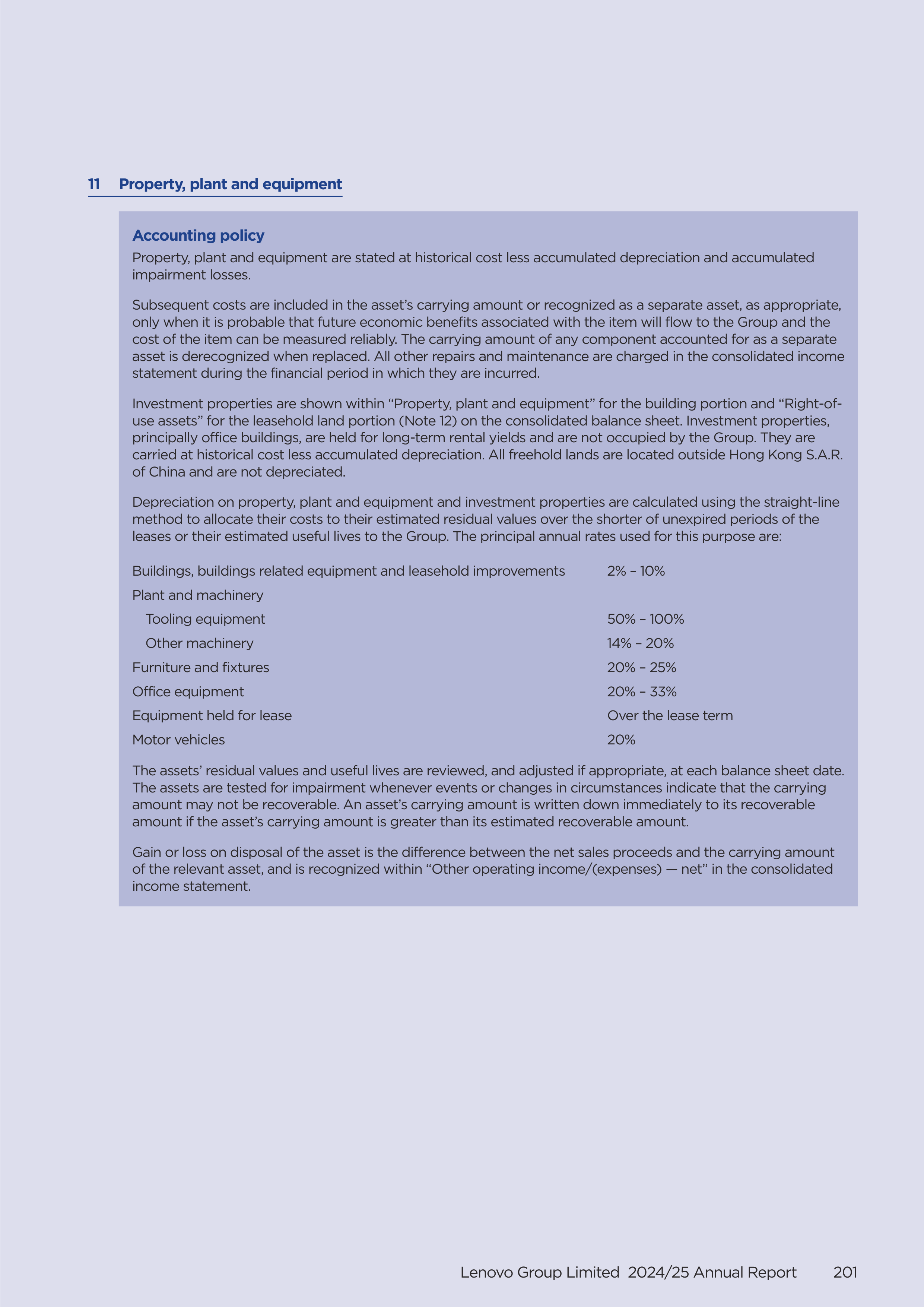
Lenovo Group Limited 2024/25 Annual Report
201
11
Property, plant and equipment
Accounting policy
Property, plant and equipment are stated at historical cost less accumulated depreciation and accumulated
impairment losses.
Subsequent costs are included in the asset’s carrying amount or recognized as a separate asset, as appropriate,
only when it is probable that future economic benefits associated with the item will flow to the Group and the
cost of the item can be measured reliably. The carrying amount of any component accounted for as a separate
asset is derecognized when replaced. All other repairs and maintenance are charged in the consolidated income
statement during the financial period in which they are incurred.
Investment properties are shown within “Property, plant and equipment” for the building portion and “Right-of-
use assets” for the leasehold land portion (Note 12) on the consolidated balance sheet. Investment properties,
principally office buildings, are held for long-term rental yields and are not occupied by the Group. They are
carried at historical cost less accumulated depreciation. All freehold lands are located outside Hong Kong S.A.R.
of China and are not depreciated.
Depreciation on property, plant and equipment and investment properties are calculated using the straight-line
method to allocate their costs to their estimated residual values over the shorter of unexpired periods of the
leases or their estimated useful lives to the Group. The principal annual rates used for this purpose are:
Buildings, buildings related equipment and leasehold improvements
2% – 10%
Plant and machinery
Tooling equipment
50% – 100%
Other machinery
14% – 20%
Furniture and fixtures
20% – 25%
Office equipment
20% – 33%
Equipment held for lease
Over the lease term
Motor vehicles
20%
The assets’ residual values and useful lives are reviewed, and adjusted if appropriate, at each balance sheet date.
The assets are tested for impairment whenever events or changes in circumstances indicate that the carrying
amount may not be recoverable. An asset’s carrying amount is written down immediately to its recoverable
amount if the asset’s carrying amount is greater than its estimated recoverable amount.
Gain or loss on disposal of the asset is the difference between the net sales proceeds and the carrying amount
of the relevant asset, and is recognized within “Other operating income/(expenses) — net” in the consolidated
income statement.
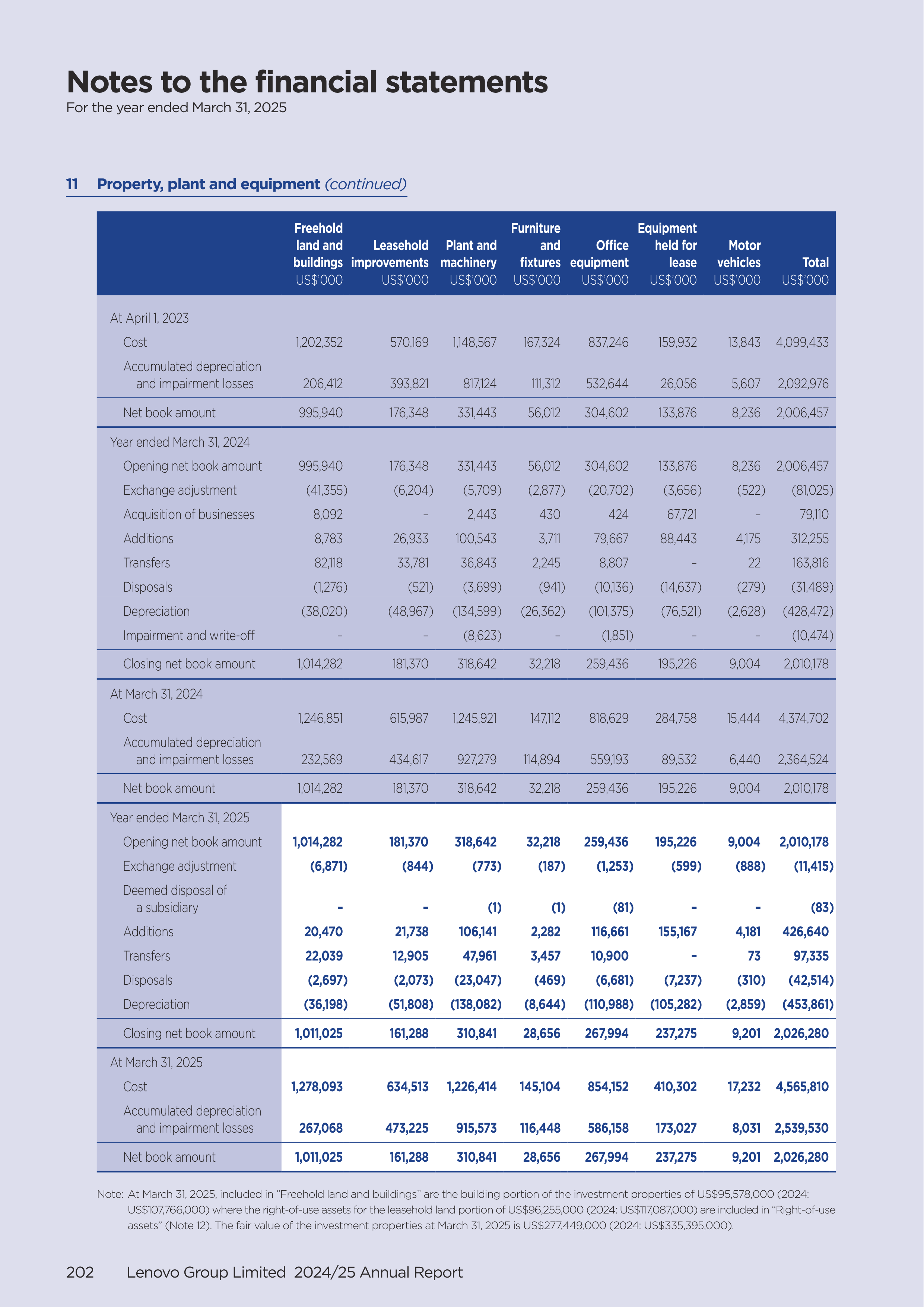
Notes to the financial statements
For the year ended March 31, 2025
Lenovo Group Limited 2024/25 Annual Report
202
11
Property, plant and equipment
(continued)
Freehold
land and
buildings
Leasehold
improvements
Plant and
machinery
Furniture
and
fixtures
Office
equipment
Equipment
held for
lease
Motor
vehicles
Total
US$’000
US$’000
US$’000
US$’000
US$’000
US$’000
US$’000
US$’000
At April 1, 2023
Cost
1,202,352
570,169
1,148,567
167,324
837,246
159,932
13,843
4,099,433
Accumulated depreciation
and impairment losses
206,412
393,821
817,124
111,312
532,644
26,056
5,607
2,092,976
Net book amount
995,940
176,348
331,443
56,012
304,602
133,876
8,236
2,006,457
Year ended March 31, 2024
Opening net book amount
995,940
176,348
331,443
56,012
304,602
133,876
8,236
2,006,457
Exchange adjustment
(41,355 )
(6,204)
(5,709)
(2,877)
(20,702)
(3,656)
(522)
(81,025)
Acquisition of businesses
8,092
–
2,443
430
424
67,721
–
79,110
Additions
8,783
26,933
100,543
3,711
79,667
88,443
4,175
312,255
Transfers
82,118
33,781
36,843
2,245
8,807
–
22
163,816
Disposals
(1,276)
(521)
(3,699)
(941)
(10,136)
(14,637)
(279)
(31,489)
Depreciation
(38,020)
(48,967)
(134,599)
(26,362)
(101,375)
(76,521)
(2,628)
(428,472)
Impairment and write-off
–
–
(8,623 )
–
(1,851 )
–
–
(10,474)
Closing net book amount
1,014,282
181,370
318,642
32,218
259,436
195,226
9,004
2,010,178
At March 31, 2024
Cost
1,246,851
615,987
1,245,921
147,112
818,629
284,758
15,444
4,374,702
Accumulated depreciation
and impairment losses
232,569
434,617
927,279
114,894
559,193
89,532
6,440
2,364,524
Net book amount
1,014,282
181,370
318,642
32,218
259,436
195,226
9,004
2,010,178
Year ended March 31, 2025
Opening net book amount
1,014,282
181,370
318,642
32,218
259,436
195,226
9,004
2,010,178
Exchange adjustment
(6,871)
(844)
(773)
(187)
(1,253)
(599)
(888)
(11,415)
Deemed disposal of
a subsidiary
–
–
(1)
(1)
(81)
–
–
(83)
Additions
20,470
21,738
106,141
2,282
116,661
155,167
4,181
426,640
Transfers
22,039
12,905
47,961
3,457
10,900
–
73
97,335
Disposals
(2,697)
(2,073)
(23,047)
(469)
(6,681)
(7,237)
(310)
(42,514)
Depreciation
(36,198)
(51,808)
(138,082)
(8,644)
(110,988)
(105,282)
(2,859)
(453,861)
Closing net book amount
1,011,025
161,288
310,841
28,656
267,994
237,275
9,201
2,026,280
At March 31, 2025
Cost
1,278,093
634,513
1,226,414
145,104
854,152
410,302
17,232
4,565,810
Accumulated depreciation
and impairment losses
267,068
473,225
915,573
116,448
586,158
173,027
8,031
2,539,530
Net book amount
1,011,025
161,288
310,841
28,656
267,994
237,275
9,201
2,026,280
Note: At March 31, 2025, included in “Freehold land and buildings” are the building portion of the investment properties of US$95,578,000 (2024:
US$107,766,000) where the right-of-use assets for the leasehold land portion of US$96,255,000 (2024: US$117,087,000) are included in “Right-of-use
assets” (Note 12). The fair value of the investment properties at March 31, 2025 is US$277,449,000 (2024: US$335,395,000).
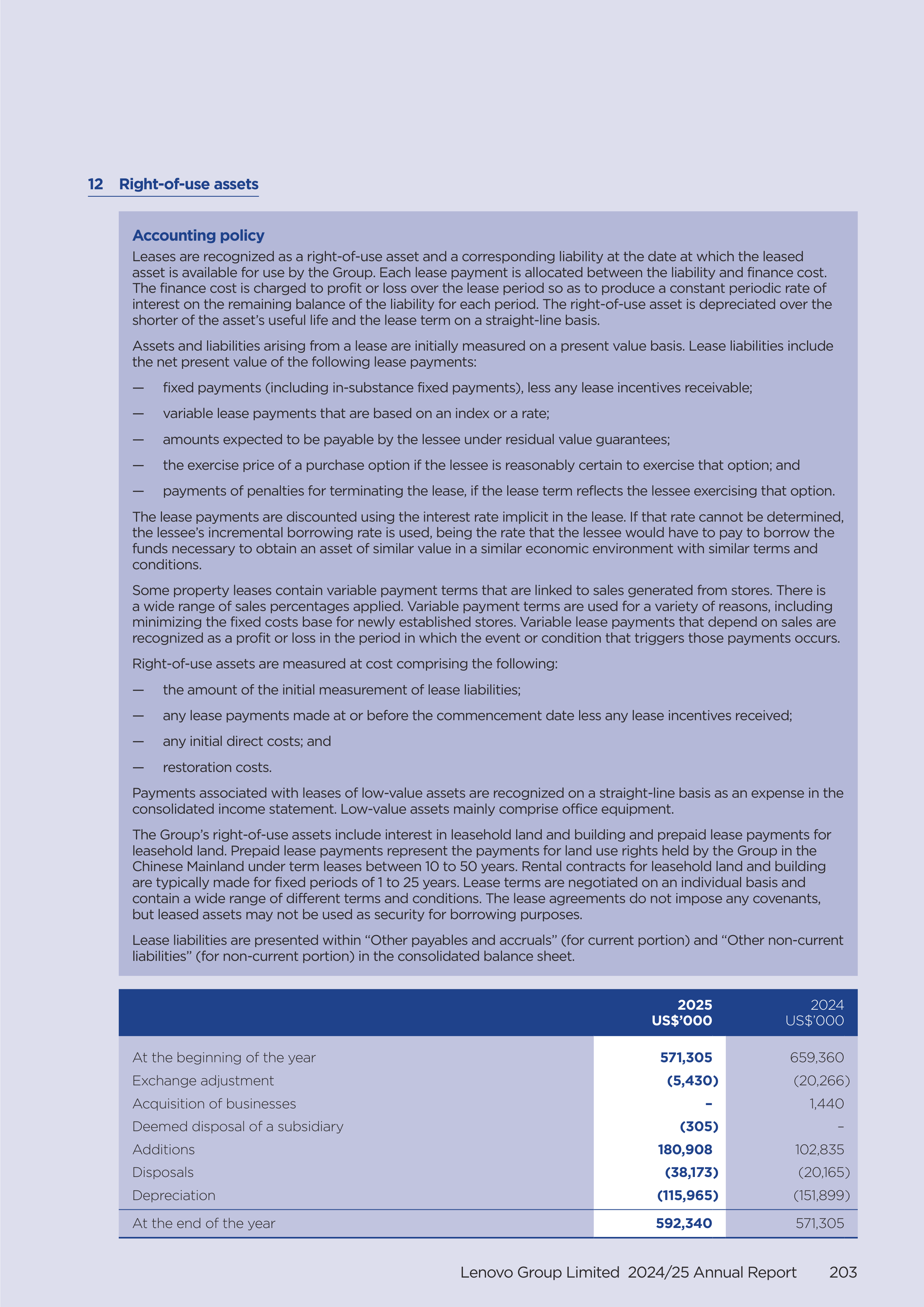
Lenovo Group Limited 2024/25 Annual Report
203
12
Right-of-use assets
Accounting policy
Leases are recognized as a right-of-use asset and a corresponding liability at the date at which the leased
asset is available for use by the Group. Each lease payment is allocated between the liability and finance cost.
The finance cost is charged to profit or loss over the lease period so as to produce a constant periodic rate of
interest on the remaining balance of the liability for each period. The right-of-use asset is depreciated over the
shorter of the asset’s useful life and the lease term on a straight-line basis.
Assets and liabilities arising from a lease are initially measured on a present value basis. Lease liabilities include
the net present value of the following lease payments:
—
fixed payments (including in-substance fixed payments), less any lease incentives receivable;
—
variable lease payments that are based on an index or a rate;
—
amounts expected to be payable by the lessee under residual value guarantees;
—
the exercise price of a purchase option if the lessee is reasonably certain to exercise that option; and
—
payments of penalties for terminating the lease, if the lease term reflects the lessee exercising that option.
The lease payments are discounted using the interest rate implicit in the lease. If that rate cannot be determined,
the lessee’s incremental borrowing rate is used, being the rate that the lessee would have to pay to borrow the
funds necessary to obtain an asset of similar value in a similar economic environment with similar terms and
conditions.
Some property leases contain variable payment terms that are linked to sales generated from stores. There is
a wide range of sales percentages applied. Variable payment terms are used for a variety of reasons, including
minimizing the fixed costs base for newly established stores. Variable lease payments that depend on sales are
recognized as a profit or loss in the period in which the event or condition that triggers those payments occurs.
Right-of-use assets are measured at cost comprising the following:
—
the amount of the initial measurement of lease liabilities;
—
any lease payments made at or before the commencement date less any lease incentives received;
—
any initial direct costs; and
—
restoration costs.
Payments associated with leases of low-value assets are recognized on a straight-line basis as an expense in the
consolidated income statement. Low-value assets mainly comprise office equipment.
The Group’s right-of-use assets include interest in leasehold land and building and prepaid lease payments for
leasehold land. Prepaid lease payments represent the payments for land use rights held by the Group in the
Chinese Mainland under term leases between 10 to 50 years. Rental contracts for leasehold land and building
are typically made for fixed periods of 1 to 25 years. Lease terms are negotiated on an individual basis and
contain a wide range of different terms and conditions. The lease agreements do not impose any covenants,
but leased assets may not be used as security for borrowing purposes.
Lease liabilities are presented within “Other payables and accruals” (for current portion) and “Other non-current
liabilities” (for non-current portion) in the consolidated balance sheet.
2025
US$’000
2024
US$’000
At the beginning of the year
571,305
659,360
Exchange adjustment
(5,430 )
(20,266)
Acquisition of businesses
–
1,440
Deemed disposal of a subsidiary
(305)
–
Additions
180,908
102,835
Disposals
(38,173 )
(20,165)
Depreciation
(115,965 )
(151,899)
At the end of the year
592,340
571,305
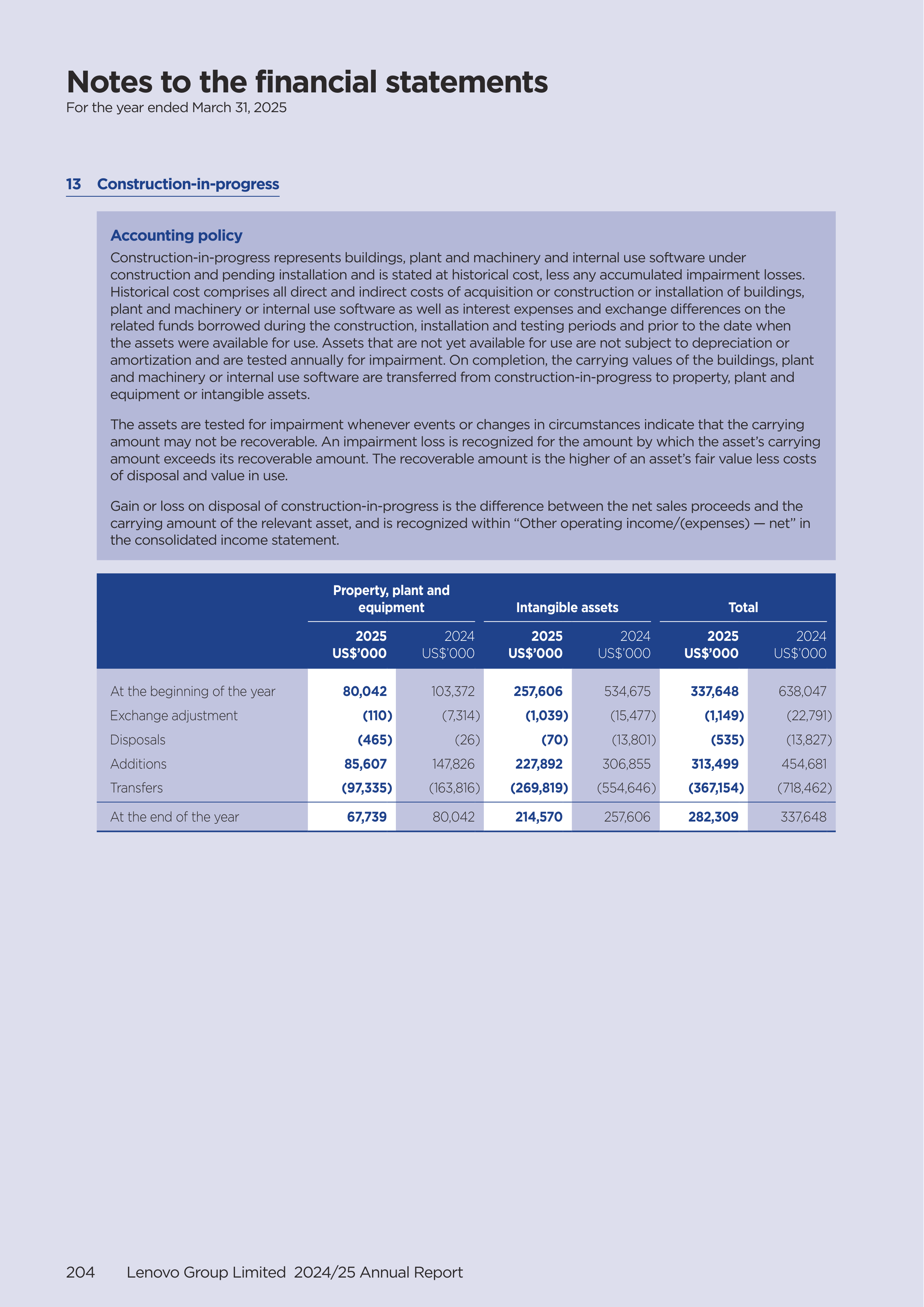
Notes to the financial statements
For the year ended March 31, 2025
Lenovo Group Limited 2024/25 Annual Report
204
13
Construction-in-progress
Accounting policy
Construction-in-progress represents buildings, plant and machinery and internal use software under
construction and pending installation and is stated at historical cost, less any accumulated impairment losses.
Historical cost comprises all direct and indirect costs of acquisition or construction or installation of buildings,
plant and machinery or internal use software as well as interest expenses and exchange differences on the
related funds borrowed during the construction, installation and testing periods and prior to the date when
the assets were available for use. Assets that are not yet available for use are not subject to depreciation or
amortization and are tested annually for impairment. On completion, the carrying values of the buildings, plant
and machinery or internal use software are transferred from construction-in-progress to property, plant and
equipment or intangible assets.
The assets are tested for impairment whenever events or changes in circumstances indicate that the carrying
amount may not be recoverable. An impairment loss is recognized for the amount by which the asset’s carrying
amount exceeds its recoverable amount. The recoverable amount is the higher of an asset’s fair value less costs
of disposal and value in use.
Gain or loss on disposal of construction-in-progress is the difference between the net sales proceeds and the
carrying amount of the relevant asset, and is recognized within “Other operating income/(expenses) — net” in
the consolidated income statement.
Property, plant and
equipment
Intangible assets
Total
2025
US$’000
2024
US$’000
2025
US$’000
2024
US$’000
2025
US$’000
2024
US$’000
At the beginning of the year
80,042
103,372
257,606
534,675
337,648
638,047
Exchange adjustment
(110)
(7,314)
(1,039)
(15,477)
(1,149)
(22,791)
Disposals
(465)
(26)
(70)
(13,801)
(535)
(13,827)
Additions
85,607
147,826
227,892
306,855
313,499
454,681
Transfers
(97,335)
(163,816)
(269,819)
(554,646)
(367,154)
(718,462)
At the end of the year
67,739
80,042
214,570
257,606
282,309
337,648
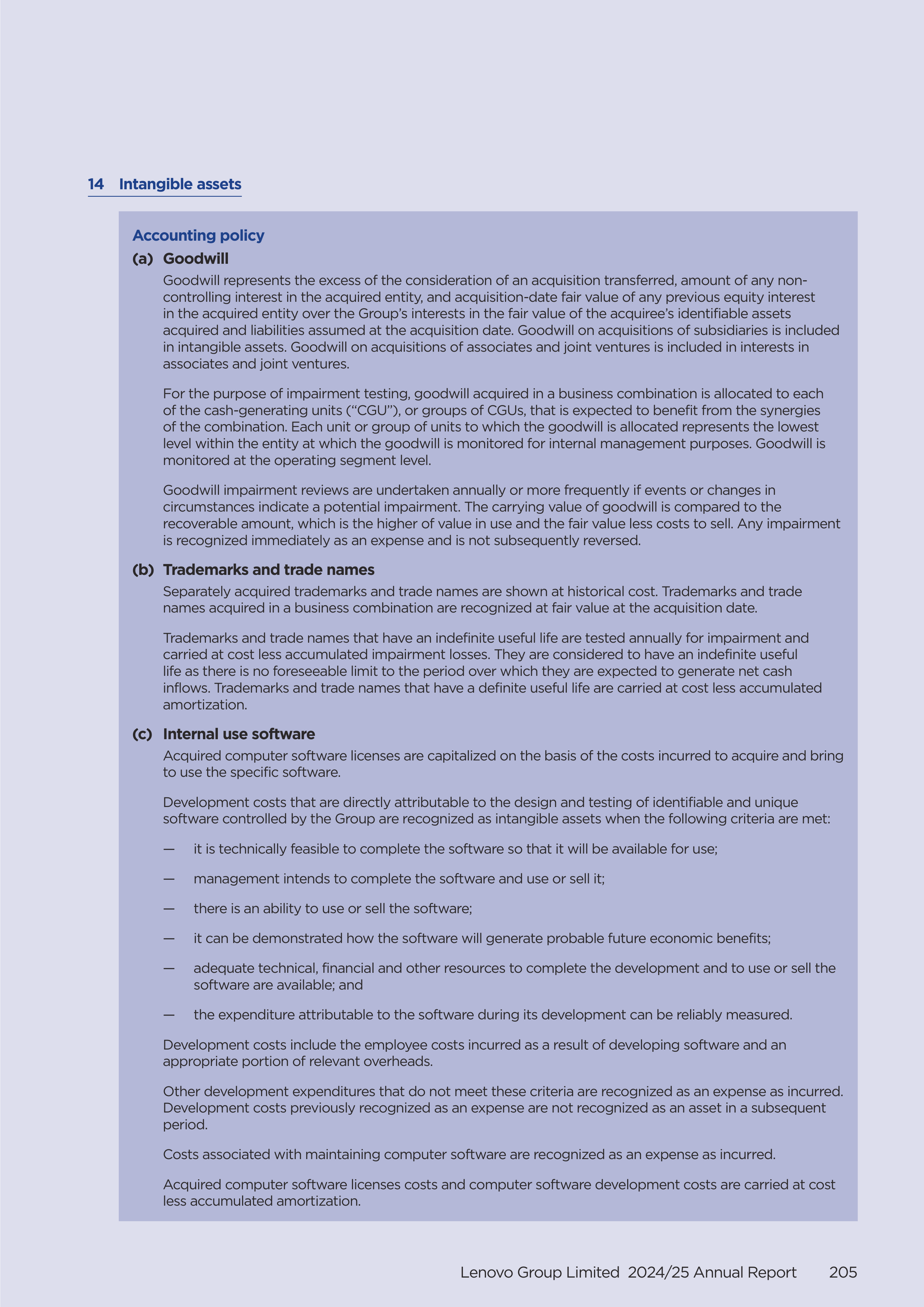
Lenovo Group Limited 2024/25 Annual Report
205
14
Intangible assets
Accounting policy
(a)
Goodwill
Goodwill represents the excess of the consideration of an acquisition transferred, amount of any non-
controlling interest in the acquired entity, and acquisition-date fair value of any previous equity interest
in the acquired entity over the Group’s interests in the fair value of the acquiree’s identifiable assets
acquired and liabilities assumed at the acquisition date. Goodwill on acquisitions of subsidiaries is included
in intangible assets. Goodwill on acquisitions of associates and joint ventures is included in interests in
associates and joint ventures.
For the purpose of impairment testing, goodwill acquired in a business combination is allocated to each
of the cash-generating units (“CGU”), or groups of CGUs, that is expected to benefit from the synergies
of the combination. Each unit or group of units to which the goodwill is allocated represents the lowest
level within the entity at which the goodwill is monitored for internal management purposes. Goodwill is
monitored at the operating segment level.
Goodwill impairment reviews are undertaken annually or more frequently if events or changes in
circumstances indicate a potential impairment. The carrying value of goodwill is compared to the
recoverable amount, which is the higher of value in use and the fair value less costs to sell. Any impairment
is recognized immediately as an expense and is not subsequently reversed.
(b) Trademarks and trade names
Separately acquired trademarks and trade names are shown at historical cost. Trademarks and trade
names acquired in a business combination are recognized at fair value at the acquisition date.
Trademarks and trade names that have an indefinite useful life are tested annually for impairment and
carried at cost less accumulated impairment losses. They are considered to have an indefinite useful
life as there is no foreseeable limit to the period over which they are expected to generate net cash
inflows. Trademarks and trade names that have a definite useful life are carried at cost less accumulated
amortization.
(c)
Internal use software
Acquired computer software licenses are capitalized on the basis of the costs incurred to acquire and bring
to use the specific software.
Development costs that are directly attributable to the design and testing of identifiable and unique
software controlled by the Group are recognized as intangible assets when the following criteria are met:
—
it is technically feasible to complete the software so that it will be available for use;
—
management intends to complete the software and use or sell it;
—
there is an ability to use or sell the software;
—
it can be demonstrated how the software will generate probable future economic benefits;
—
adequate technical, financial and other resources to complete the development and to use or sell the
software are available; and
—
the expenditure attributable to the software during its development can be reliably measured.
Development costs include the employee costs incurred as a result of developing software and an
appropriate portion of relevant overheads.
Other development expenditures that do not meet these criteria are recognized as an expense as incurred.
Development costs previously recognized as an expense are not recognized as an asset in a subsequent
period.
Costs associated with maintaining computer software are recognized as an expense as incurred.
Acquired computer software licenses costs and computer software development costs are carried at cost
less accumulated amortization.
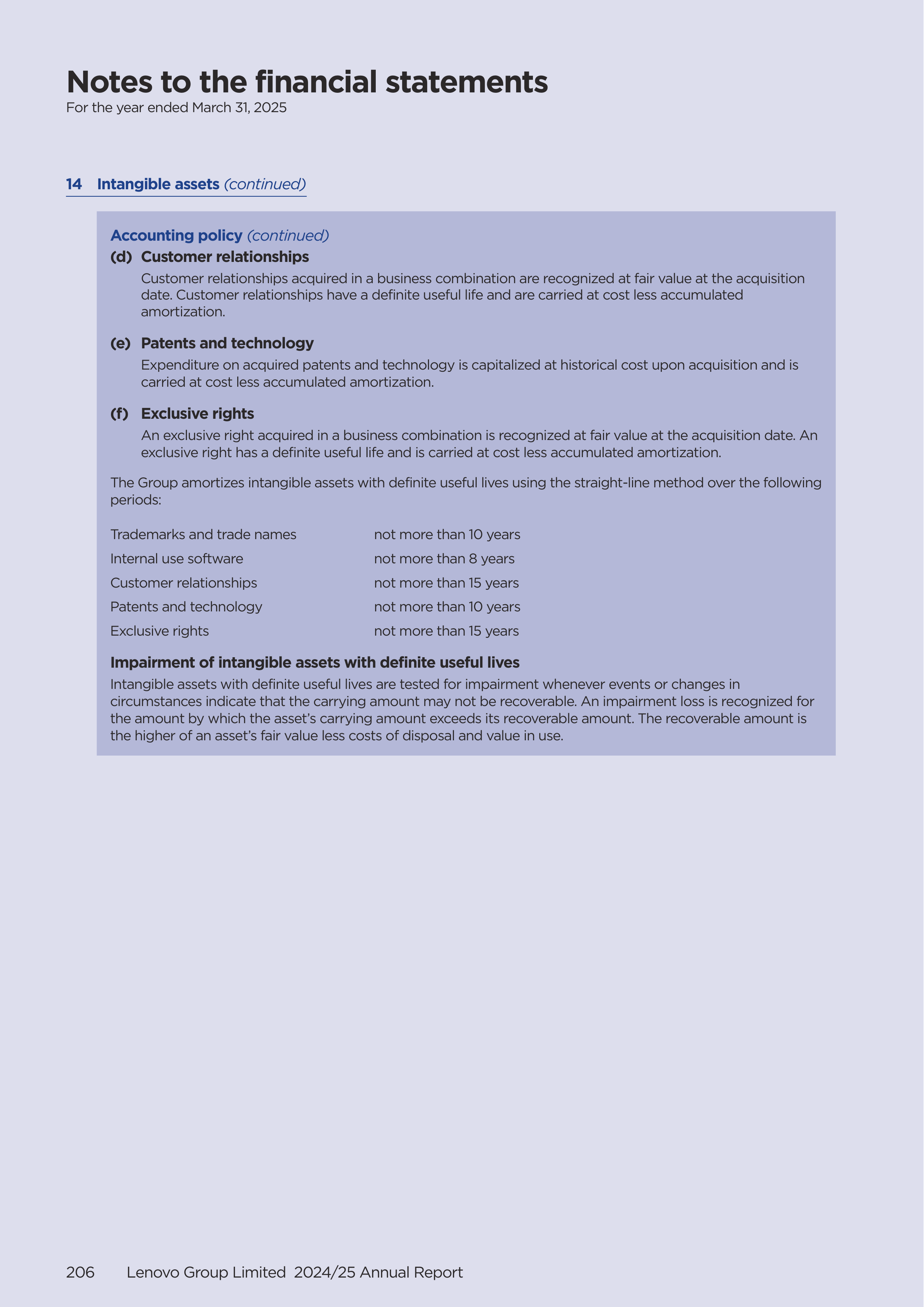
Notes to the financial statements
For the year ended March 31, 2025
Lenovo Group Limited 2024/25 Annual Report
206
14
Intangible assets
(continued)
Accounting policy
(continued)
(d) Customer relationships
Customer relationships acquired in a business combination are recognized at fair value at the acquisition
date. Customer relationships have a definite useful life and are carried at cost less accumulated
amortization.
(e)
Patents and technology
Expenditure on acquired patents and technology is capitalized at historical cost upon acquisition and is
carried at cost less accumulated amortization.
(f)
Exclusive rights
An exclusive right acquired in a business combination is recognized at fair value at the acquisition date. An
exclusive right has a definite useful life and is carried at cost less accumulated amortization.
The Group amortizes intangible assets with definite useful lives using the straight-line method over the following
periods:
Trademarks and trade names
not more than 10 years
Internal use software
not more than 8 years
Customer relationships
not more than 15 years
Patents and technology
not more than 10 years
Exclusive rights
not more than 15 years
Impairment of intangible assets with definite useful lives
Intangible assets with definite useful lives are tested for impairment whenever events or changes in
circumstances indicate that the carrying amount may not be recoverable. An impairment loss is recognized for
the amount by which the asset’s carrying amount exceeds its recoverable amount. The recoverable amount is
the higher of an asset’s fair value less costs of disposal and value in use.
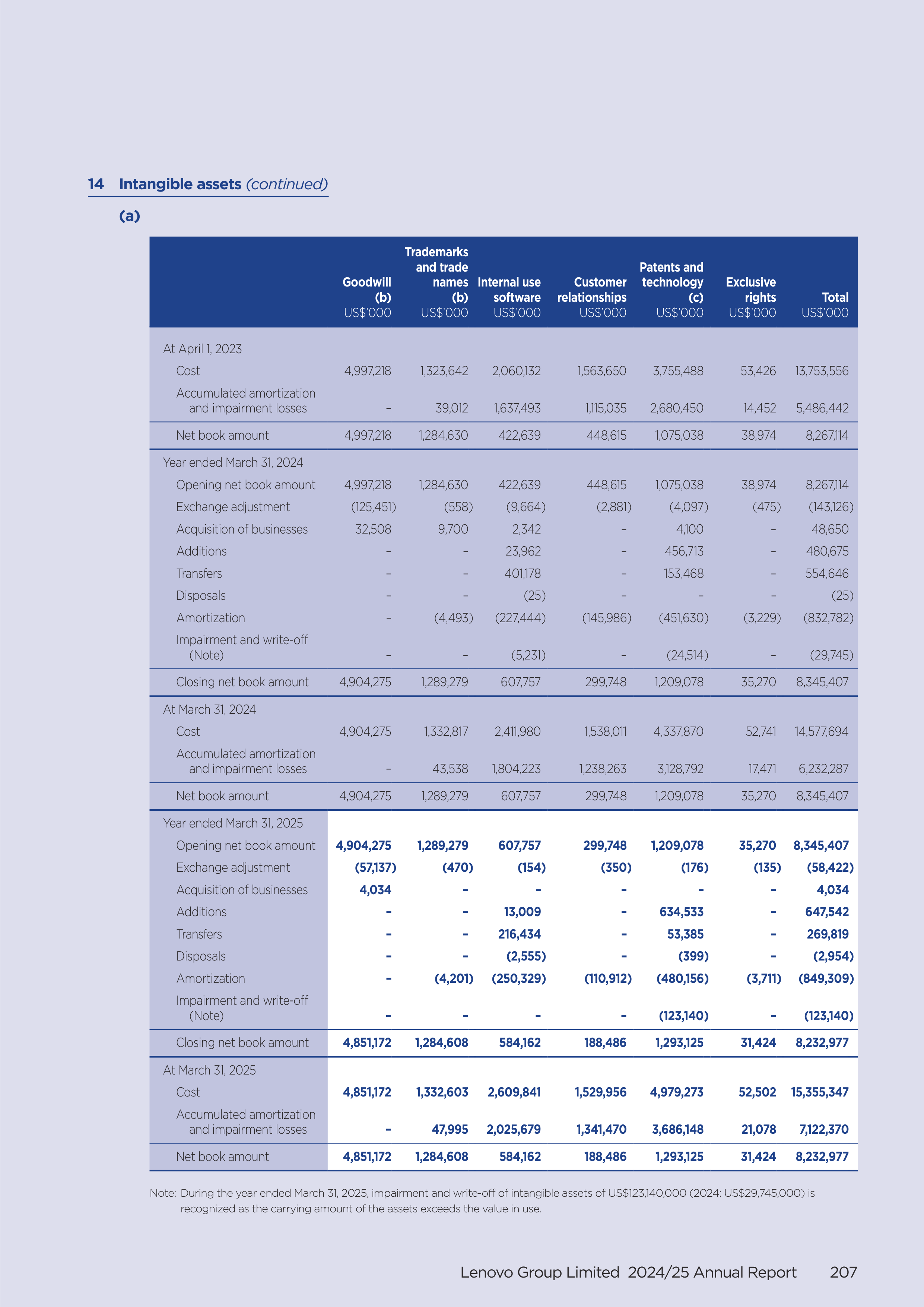
Lenovo Group Limited 2024/25 Annual Report
207
14
Intangible assets
(continued)
(a)
Goodwill
(b)
US$’000
Trademarks
and trade
names
(b)
US$’000
Internal use
software
US$’000
Customer
relationships
US$’000
Patents and
technology
(c)
US$’000
Exclusive
rights
US$’000
Total
US$’000
At April 1, 2023
Cost
4,997,218
1,323,642
2,060,132
1,563,650
3,755,488
53,426
13,753,556
Accumulated amortization
and impairment losses
–
39,012
1,637,493
1,115,035
2,680,450
14,452
5,486,442
Net book amount
4,997,218
1,284,630
422,639
448,615
1,075,038
38,974
8,267,114
Year ended March 31, 2024
Opening net book amount
4,997,218
1,284,630
422,639
448,615
1,075,038
38,974
8,267,114
Exchange adjustment
(125,451 )
(558 )
(9,664)
(2,881 )
(4,097 )
(475 )
(143,126)
Acquisition of businesses
32,508
9,700
2,342
–
4,100
–
48,650
Additions
–
–
23,962
–
456,713
–
480,675
Transfers
–
–
401,178
–
153,468
–
554,646
Disposals
–
–
(25)
–
–
–
(25)
Amortization
–
(4,493 )
(227,444 )
(145,986 )
(451,630 )
(3,229 )
(832,782 )
Impairment and write-off
(Note)
–
–
(5,231)
–
(24,514 )
–
(29,745)
Closing net book amount
4,904,275
1,289,279
607,757
299,748
1,209,078
35,270
8,345,407
At March 31, 2024
Cost
4,904,275
1,332,817
2,411,980
1,538,011
4,337,870
52,741
14,577,694
Accumulated amortization
and impairment losses
–
43,538
1,804,223
1,238,263
3,128,792
17,471
6,232,287
Net book amount
4,904,275
1,289,279
607,757
299,748
1,209,078
35,270
8,345,407
Year ended March 31, 2025
Opening net book amount
4,904,275
1,289,279
607,757
299,748
1,209,078
35,270
8,345,407
Exchange adjustment
(57,137)
(470)
(154)
(350)
(176)
(135)
(58,422)
Acquisition of businesses
4,034
–
–
–
–
–
4,034
Additions
–
–
13,009
–
634,533
–
647,542
Transfers
–
–
216,434
–
53,385
–
269,819
Disposals
–
–
(2,555)
–
(399)
–
(2,954)
Amortization
–
(4,201)
(250,329)
(110,912)
(480,156)
(3,711)
(849,309)
Impairment and write-off
(Note)
–
–
–
–
(123,140)
–
(123,140)
Closing net book amount
4,851,172
1,284,608
584,162
188,486
1,293,125
31,424
8,232,977
At March 31, 2025
Cost
4,851,172
1,332,603
2,609,841
1,529,956
4,979,273
52,502
15,355,347
Accumulated amortization
and impairment losses
–
47,995
2,025,679
1,341,470
3,686,148
21,078
7,122,370
Net book amount
4,851,172
1,284,608
584,162
188,486
1,293,125
31,424
8,232,977
Note: During the year ended March 31, 2025, impairment and write-off of intangible assets of US$123,140,000 (2024: US$29,745,000) is
recognized as the carrying amount of the assets exceeds the value in use.
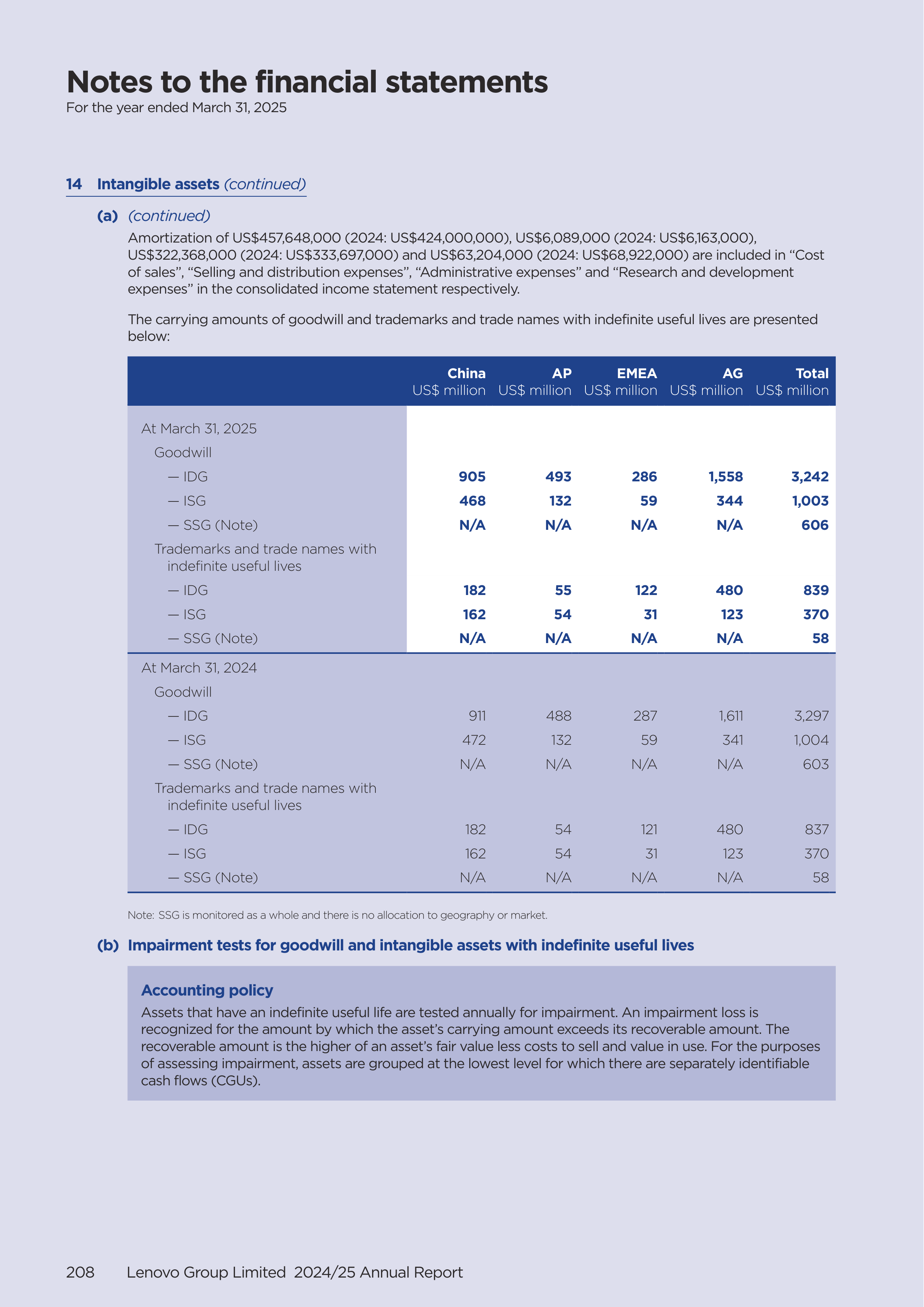
Notes to the financial statements
For the year ended March 31, 2025
Lenovo Group Limited 2024/25 Annual Report
208
14
Intangible assets
(continued)
(a)
(continued)
Amortization of US$457,648,000 (2024: US$424,000,000), US$6,089,000 (2024: US$6,163,000),
US$322,368,000 (2024: US$333,697,000) and US$63,204,000 (2024: US$68,922,000) are included in “Cost
of sales”, “Selling and distribution expenses”, “Administrative expenses” and “Research and development
expenses” in the consolidated income statement respectively.
The carrying amounts of goodwill and trademarks and trade names with indefinite useful lives are presented
below:
China
US$ million
AP
US$ million
EMEA
US$ million
AG
US$ million
Total
US$ million
At March 31, 2025
Goodwill
— IDG
905
493
286
1,558
3,242
— ISG
468
132
59
344
1,003
— SSG (Note)
N/A
N/A
N/A
N/A
606
Trademarks and trade names with
indefinite useful lives
— IDG
182
55
122
480
839
— ISG
162
54
31
123
370
— SSG (Note)
N/A
N/A
N/A
N/A
58
At March 31, 2024
Goodwill
— IDG
911
488
287
1,611
3,297
— ISG
472
132
59
341
1,004
— SSG (Note)
N/A
N/A
N/A
N/A
603
Trademarks and trade names with
indefinite useful lives
— IDG
182
54
121
480
837
— ISG
162
54
31
123
370
— SSG (Note)
N/A
N/A
N/A
N/A
58
Note: SSG is monitored as a whole and there is no allocation to geography or market.
(b) Impairment tests for goodwill and intangible assets with indefinite useful lives
Accounting policy
Assets that have an indefinite useful life are tested annually for impairment. An impairment loss is
recognized for the amount by which the asset’s carrying amount exceeds its recoverable amount. The
recoverable amount is the higher of an asset’s fair value less costs to sell and value in use. For the purposes
of assessing impairment, assets are grouped at the lowest level for which there are separately identifiable
cash flows (CGUs).
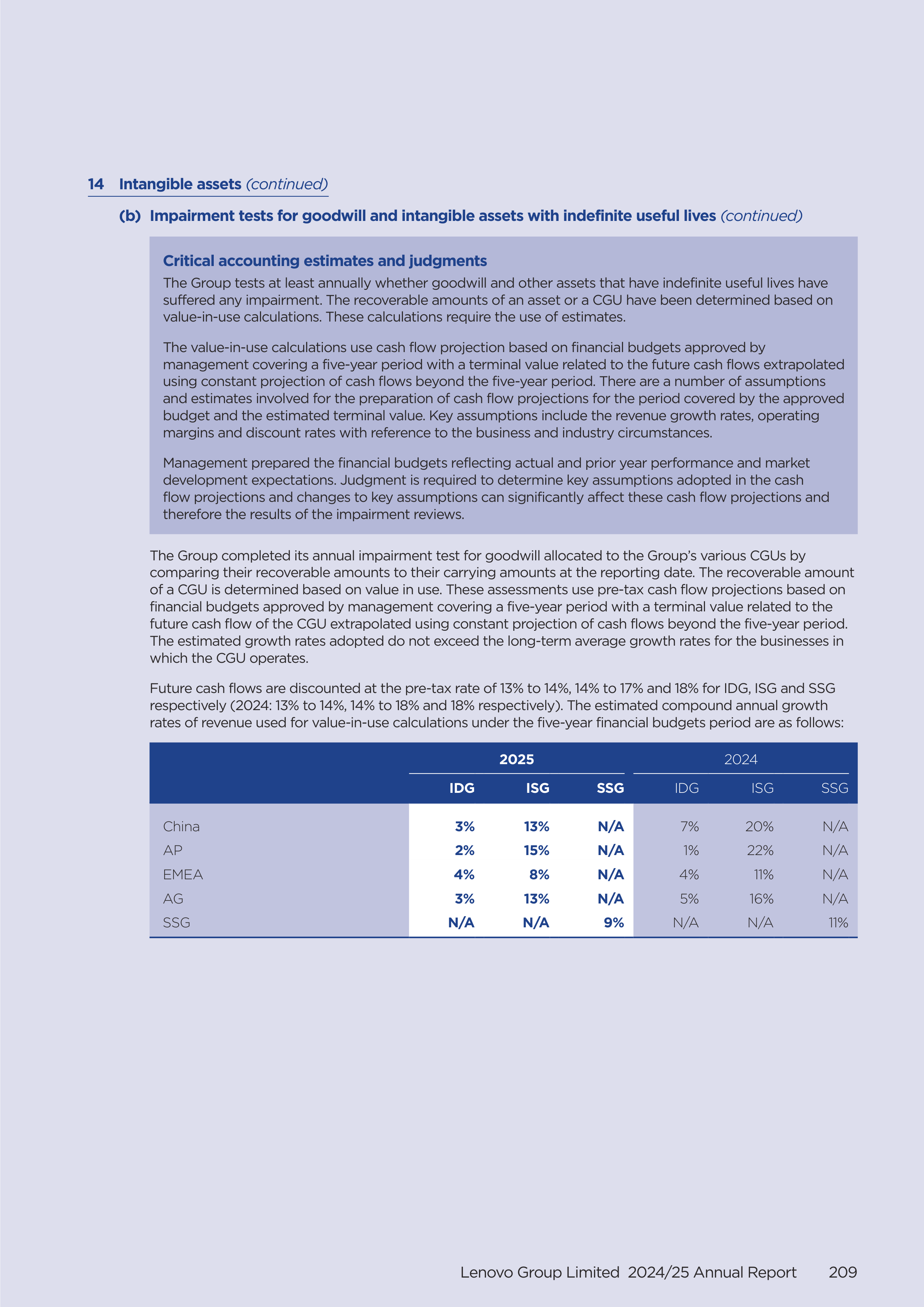
Lenovo Group Limited 2024/25 Annual Report
209
14
Intangible assets
(continued)
(b) Impairment tests for goodwill and intangible assets with indefinite useful lives
(continued)
Critical accounting estimates and judgments
The Group tests at least annually whether goodwill and other assets that have indefinite useful lives have
suffered any impairment. The recoverable amounts of an asset or a CGU have been determined based on
value-in-use calculations. These calculations require the use of estimates.
The value-in-use calculations use cash flow projection based on financial budgets approved by
management covering a five-year period with a terminal value related to the future cash flows extrapolated
using constant projection of cash flows beyond the five-year period. There are a number of assumptions
and estimates involved for the preparation of cash flow projections for the period covered by the approved
budget and the estimated terminal value. Key assumptions include the revenue growth rates, operating
margins and discount rates with reference to the business and industry circumstances.
Management prepared the financial budgets reflecting actual and prior year performance and market
development expectations. Judgment is required to determine key assumptions adopted in the cash
flow projections and changes to key assumptions can significantly affect these cash flow projections and
therefore the results of the impairment reviews.
The Group completed its annual impairment test for goodwill allocated to the Group’s various CGUs by
comparing their recoverable amounts to their carrying amounts at the reporting date. The recoverable amount
of a CGU is determined based on value in use. These assessments use pre-tax cash flow projections based on
financial budgets approved by management covering a five-year period with a terminal value related to the
future cash flow of the CGU extrapolated using constant projection of cash flows beyond the five-year period.
The estimated growth rates adopted do not exceed the long-term average growth rates for the businesses in
which the CGU operates.
Future cash flows are discounted at the pre-tax rate of 13% to 14%, 14% to 17% and 18% for IDG, ISG and SSG
respectively (2024: 13% to 14%, 14% to 18% and 18% respectively). The estimated compound annual growth
rates of revenue used for value-in-use calculations under the five-year financial budgets period are as follows:
2025
2024
IDG
ISG
SSG
IDG
ISG
SSG
China
3%
13%
N/A
7%
20%
N/A
AP
2%
15%
N/A
1%
22%
N/A
EMEA
4%
8%
N/A
4%
11%
N/A
AG
3%
13%
N/A
5%
16%
N/A
SSG
N/A
N/A
9%
N/A
N/A
11%
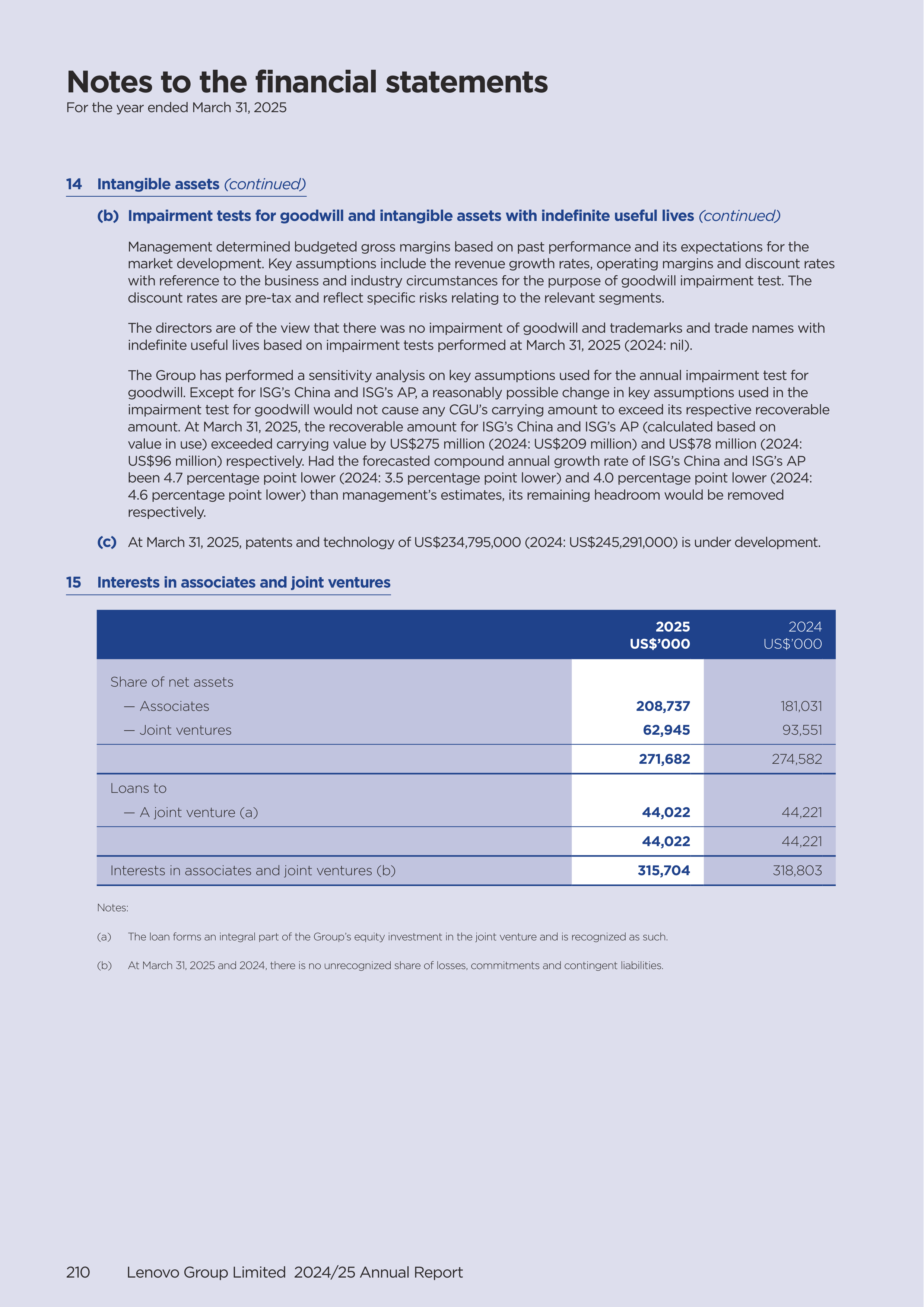
Notes to the financial statements
For the year ended March 31, 2025
Lenovo Group Limited 2024/25 Annual Report
210
14
Intangible assets
(continued)
(b) Impairment tests for goodwill and intangible assets with indefinite useful lives
(continued)
Management determined budgeted gross margins based on past performance and its expectations for the
market development. Key assumptions include the revenue growth rates, operating margins and discount rates
with reference to the business and industry circumstances for the purpose of goodwill impairment test. The
discount rates are pre-tax and reflect specific risks relating to the relevant segments.
The directors are of the view that there was no impairment of goodwill and trademarks and trade names with
indefinite useful lives based on impairment tests performed at March 31, 2025 (2024: nil).
The Group has performed a sensitivity analysis on key assumptions used for the annual impairment test for
goodwill. Except for ISG’s China and ISG’s AP, a reasonably possible change in key assumptions used in the
impairment test for goodwill would not cause any CGU’s carrying amount to exceed its respective recoverable
amount. At March 31, 2025, the recoverable amount for ISG’s China and ISG’s AP (calculated based on
value in use) exceeded carrying value by US$275 million (2024: US$209 million) and US$78 million (2024:
US$96 million) respectively. Had the forecasted compound annual growth rate of ISG’s China and ISG’s AP
been 4.7 percentage point lower (2024: 3.5 percentage point lower) and 4.0 percentage point lower (2024:
4.6 percentage point lower) than management’s estimates, its remaining headroom would be removed
respectively.
(c)
At March 31, 2025, patents and technology of US$234,795,000 (2024: US$245,291,000) is under development.
15
Interests in associates and joint ventures
2025
US$’000
2024
US$’000
Share of net assets
— Associates
208,737
181,031
— Joint ventures
62,945
93,551
271,682
274,582
Loans to
— A joint venture (a)
44,022
44,221
44,022
44,221
Interests in associates and joint ventures (b)
315,704
318,803
Notes:
(a)
The loan forms an integral part of the Group’s equity investment in the joint venture and is recognized as such.
(b)
At March 31, 2025 and 2024, there is no unrecognized share of losses, commitments and contingent liabilities.
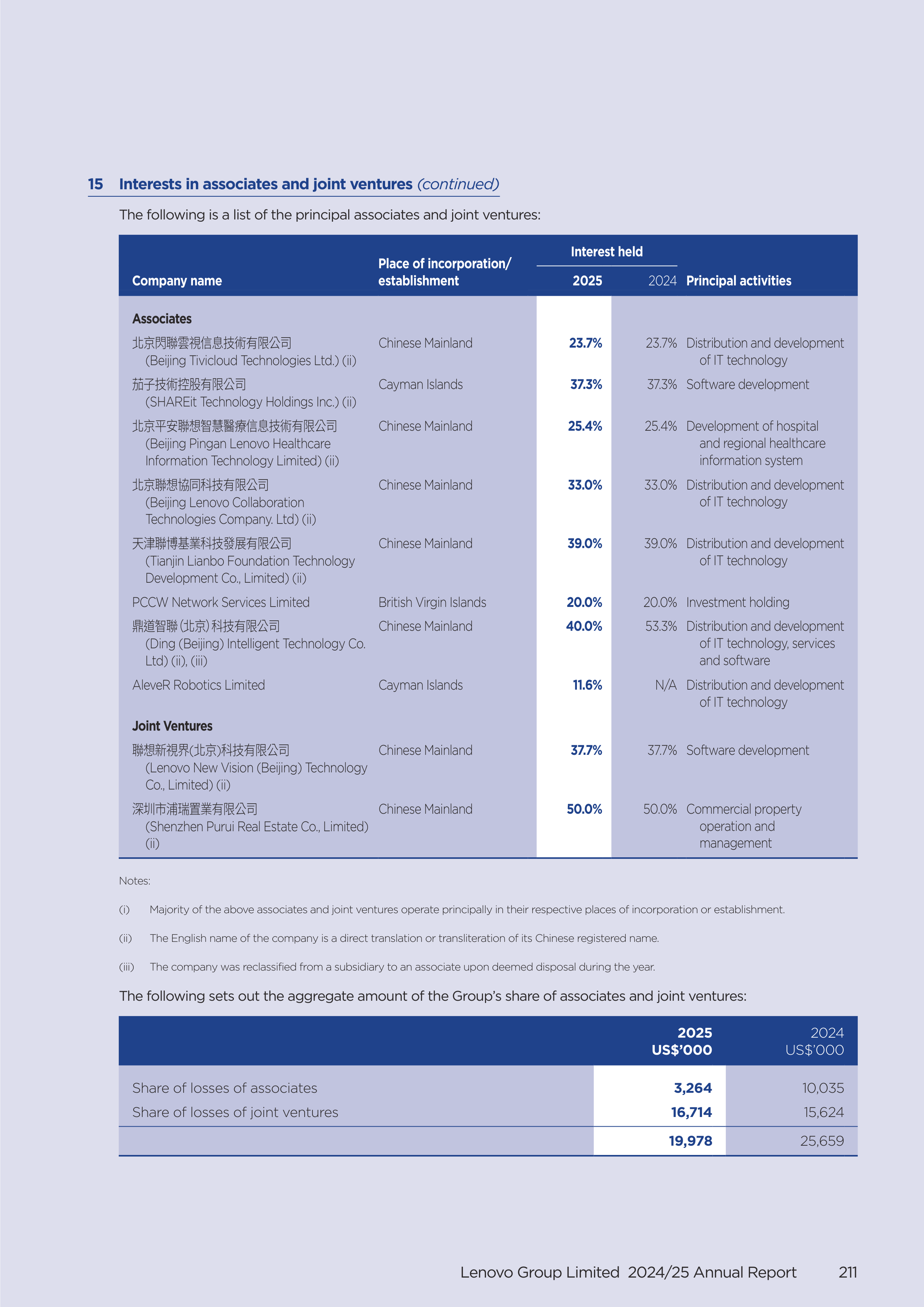
Lenovo Group Limited 2024/25 Annual Report
211
15
Interests in associates and joint ventures
(continued)
The following is a list of the principal associates and joint ventures:
Place of incorporation/
establishment
Interest held
Company name
2025
2024
Principal activities
Associates
北京閃聯雲視信息技術有限公司
(Beijing Tivicloud Technologies Ltd.) (ii)
Chinese Mainland
23.7%
23.7%
Distribution and development
of IT technology
茄子技術控股有限公司
(SHAREit Technology Holdings Inc.) (ii)
Cayman Islands
37.3%
37.3%
Software development
北京平安聯想智慧醫療信息技術有限公司
(Beijing Pingan Lenovo Healthcare
Information Technology Limited) (ii)
Chinese Mainland
25.4%
25.4%
Development of hospital
and regional healthcare
information system
北京聯想協同科技有限公司
(Beijing Lenovo Collaboration
Technologies Company. Ltd) (ii)
Chinese Mainland
33.0%
33.0%
Distribution and development
of IT technology
天津聯博基業科技發展有限公司
(Tianjin Lianbo Foundation Technology
Development Co., Limited) (ii)
Chinese Mainland
39.0%
39.0%
Distribution and development
of IT technology
PCCW Network Services Limited
British Virgin Islands
20.0%
20.0%
Investment holding
鼎道智聯(北京)科技有限公司
(Ding (Beijing) Intelligent Technology Co.
Ltd) (ii), (iii)
Chinese Mainland
40.0%
53.3%
Distribution and development
of IT technology, services
and software
AleveR Robotics Limited
Cayman Islands
11.6%
N/A
Distribution and development
of IT technology
Joint Ventures
聯想新視界
(
北京
)
科技有限公司
(Lenovo New Vision (Beijing) Technology
Co., Limited) (ii)
Chinese Mainland
37.7%
37.7%
Software development
深圳市浦瑞置業有限公司
(Shenzhen Purui Real Estate Co., Limited)
(ii)
Chinese Mainland
50.0%
50.0%
Commercial property
operation and
management
Notes:
(i)
Majority of the above associates and joint ventures operate principally in their respective places of incorporation or establishment.
(ii)
The English name of the company is a direct translation or transliteration of its Chinese registered name.
(iii)
The company was reclassified from a subsidiary to an associate upon deemed disposal during the year.
The following sets out the aggregate amount of the Group’s share of associates and joint ventures:
2025
US$’000
2024
US$’000
Share of losses of associates
3,264
10,035
Share of losses of joint ventures
16,714
15,624
19,978
25,659
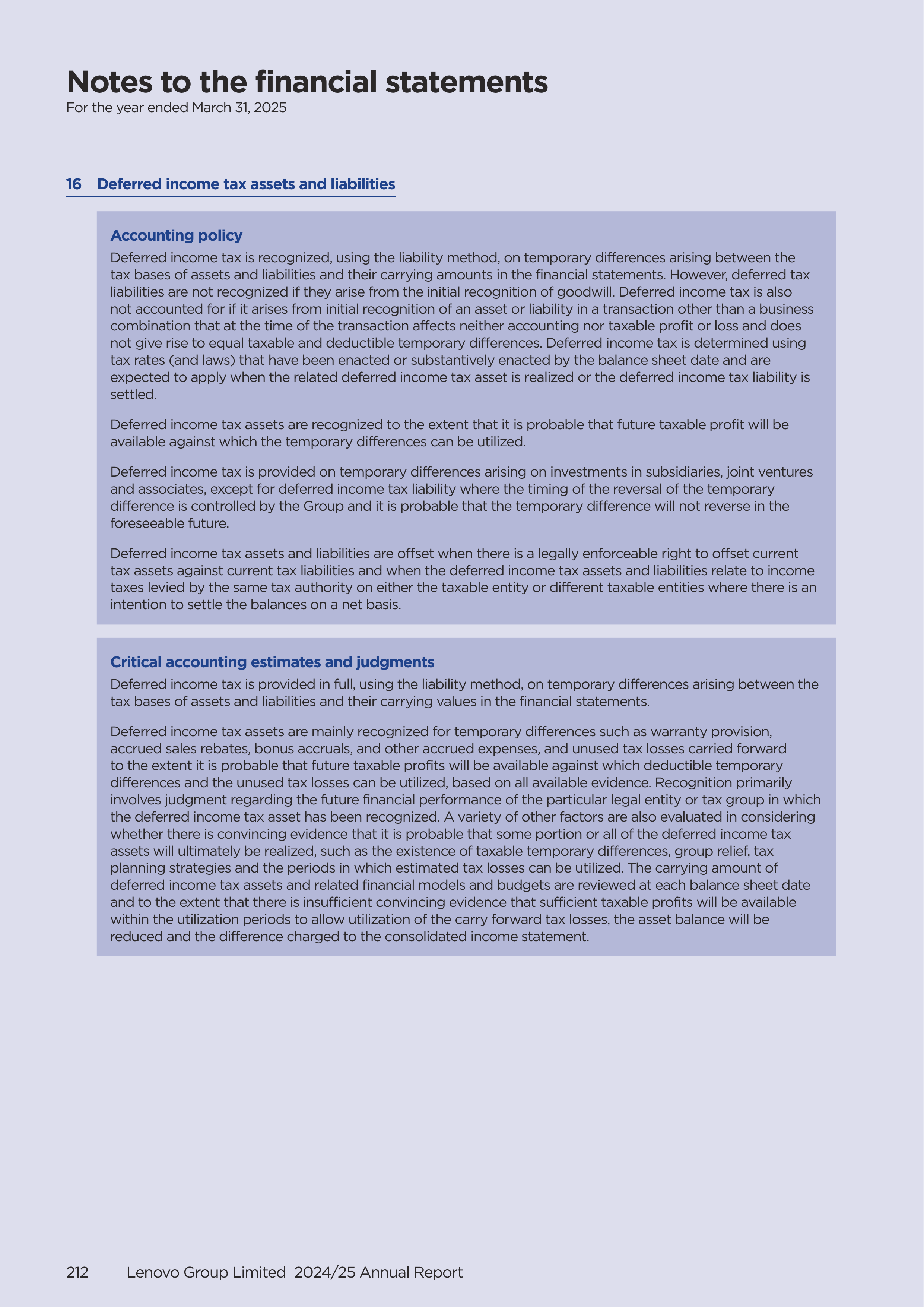
Notes to the financial statements
For the year ended March 31, 2025
Lenovo Group Limited 2024/25 Annual Report
212
16
Deferred income tax assets and liabilities
Accounting policy
Deferred income tax is recognized, using the liability method, on temporary differences arising between the
tax bases of assets and liabilities and their carrying amounts in the financial statements. However, deferred tax
liabilities are not recognized if they arise from the initial recognition of goodwill. Deferred income tax is also
not accounted for if it arises from initial recognition of an asset or liability in a transaction other than a business
combination that at the time of the transaction affects neither accounting nor taxable profit or loss and does
not give rise to equal taxable and deductible temporary differences. Deferred income tax is determined using
tax rates (and laws) that have been enacted or substantively enacted by the balance sheet date and are
expected to apply when the related deferred income tax asset is realized or the deferred income tax liability is
settled.
Deferred income tax assets are recognized to the extent that it is probable that future taxable profit will be
available against which the temporary differences can be utilized.
Deferred income tax is provided on temporary differences arising on investments in subsidiaries, joint ventures
and associates, except for deferred income tax liability where the timing of the reversal of the temporary
difference is controlled by the Group and it is probable that the temporary difference will not reverse in the
foreseeable future.
Deferred income tax assets and liabilities are offset when there is a legally enforceable right to offset current
tax assets against current tax liabilities and when the deferred income tax assets and liabilities relate to income
taxes levied by the same tax authority on either the taxable entity or different taxable entities where there is an
intention to settle the balances on a net basis.
Critical accounting estimates and judgments
Deferred income tax is provided in full, using the liability method, on temporary differences arising between the
tax bases of assets and liabilities and their carrying values in the financial statements.
Deferred income tax assets are mainly recognized for temporary differences such as warranty provision,
accrued sales rebates, bonus accruals, and other accrued expenses, and unused tax losses carried forward
to the extent it is probable that future taxable profits will be available against which deductible temporary
differences and the unused tax losses can be utilized, based on all available evidence. Recognition primarily
involves judgment regarding the future financial performance of the particular legal entity or tax group in which
the deferred income tax asset has been recognized. A variety of other factors are also evaluated in considering
whether there is convincing evidence that it is probable that some portion or all of the deferred income tax
assets will ultimately be realized, such as the existence of taxable temporary differences, group relief, tax
planning strategies and the periods in which estimated tax losses can be utilized. The carrying amount of
deferred income tax assets and related financial models and budgets are reviewed at each balance sheet date
and to the extent that there is insufficient convincing evidence that sufficient taxable profits will be available
within the utilization periods to allow utilization of the carry forward tax losses, the asset balance will be
reduced and the difference charged to the consolidated income statement.
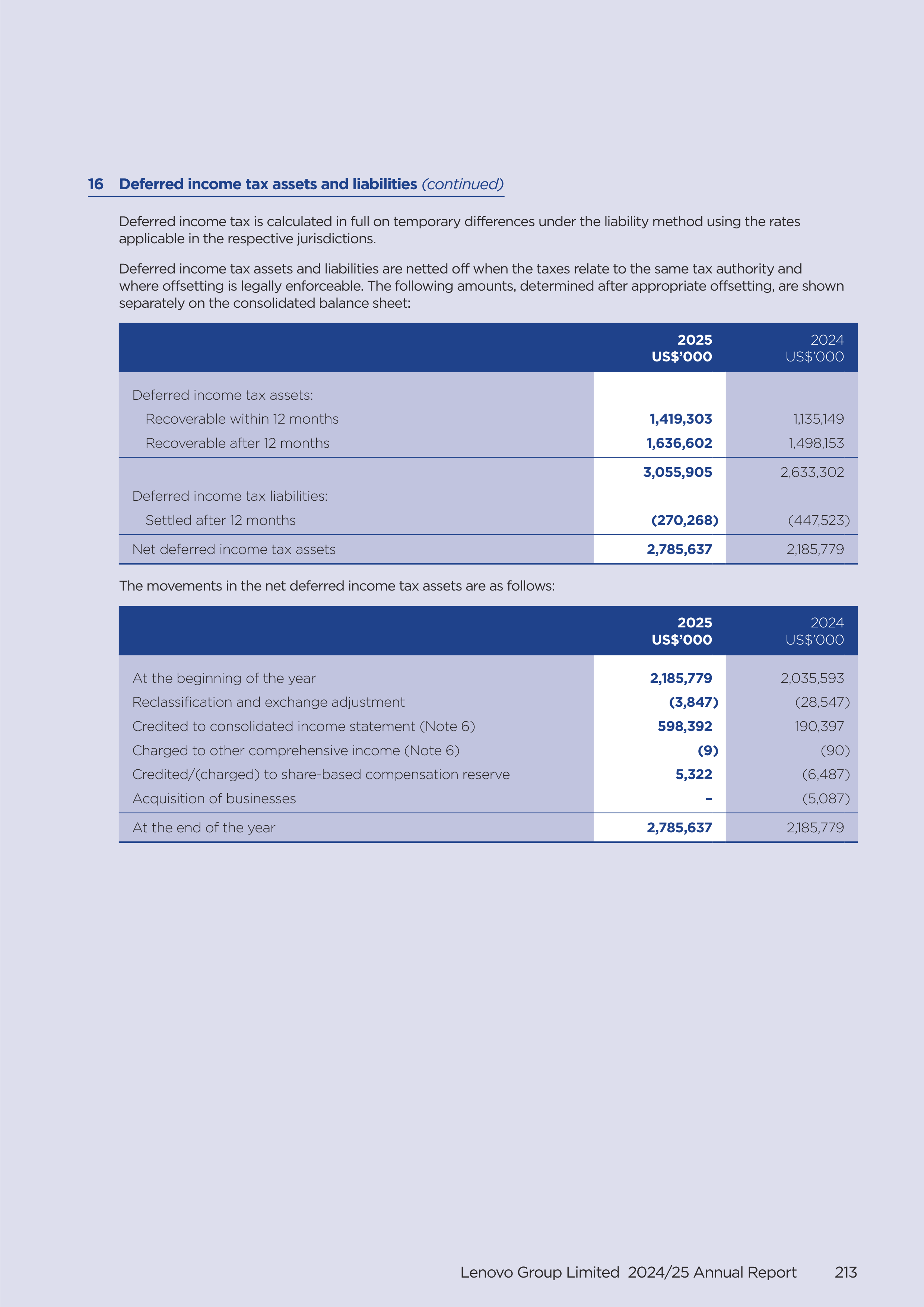
Lenovo Group Limited 2024/25 Annual Report
213
16
Deferred income tax assets and liabilities
(continued)
Deferred income tax is calculated in full on temporary differences under the liability method using the rates
applicable in the respective jurisdictions.
Deferred income tax assets and liabilities are netted off when the taxes relate to the same tax authority and
where offsetting is legally enforceable. The following amounts, determined after appropriate offsetting, are shown
separately on the consolidated balance sheet:
2025
US$’000
2024
US$’000
Deferred income tax assets:
Recoverable within 12 months
1,419,303
1,135,149
Recoverable after 12 months
1,636,602
1,498,153
3,055,905
2,633,302
Deferred income tax liabilities:
Settled after 12 months
(270,268)
(447,523)
Net deferred income tax assets
2,785,637
2,185,779
The movements in the net deferred income tax assets are as follows:
2025
US$’000
2024
US$’000
At the beginning of the year
2,185,779
2,035,593
Reclassification and exchange adjustment
(3,847)
(28,547)
Credited to consolidated income statement (Note 6)
598,392
190,397
Charged to other comprehensive income (Note 6)
(9)
(90)
Credited/(charged) to share-based compensation reserve
5,322
(6,487)
Acquisition of businesses
–
(5,087)
At the end of the year
2,785,637
2,185,779
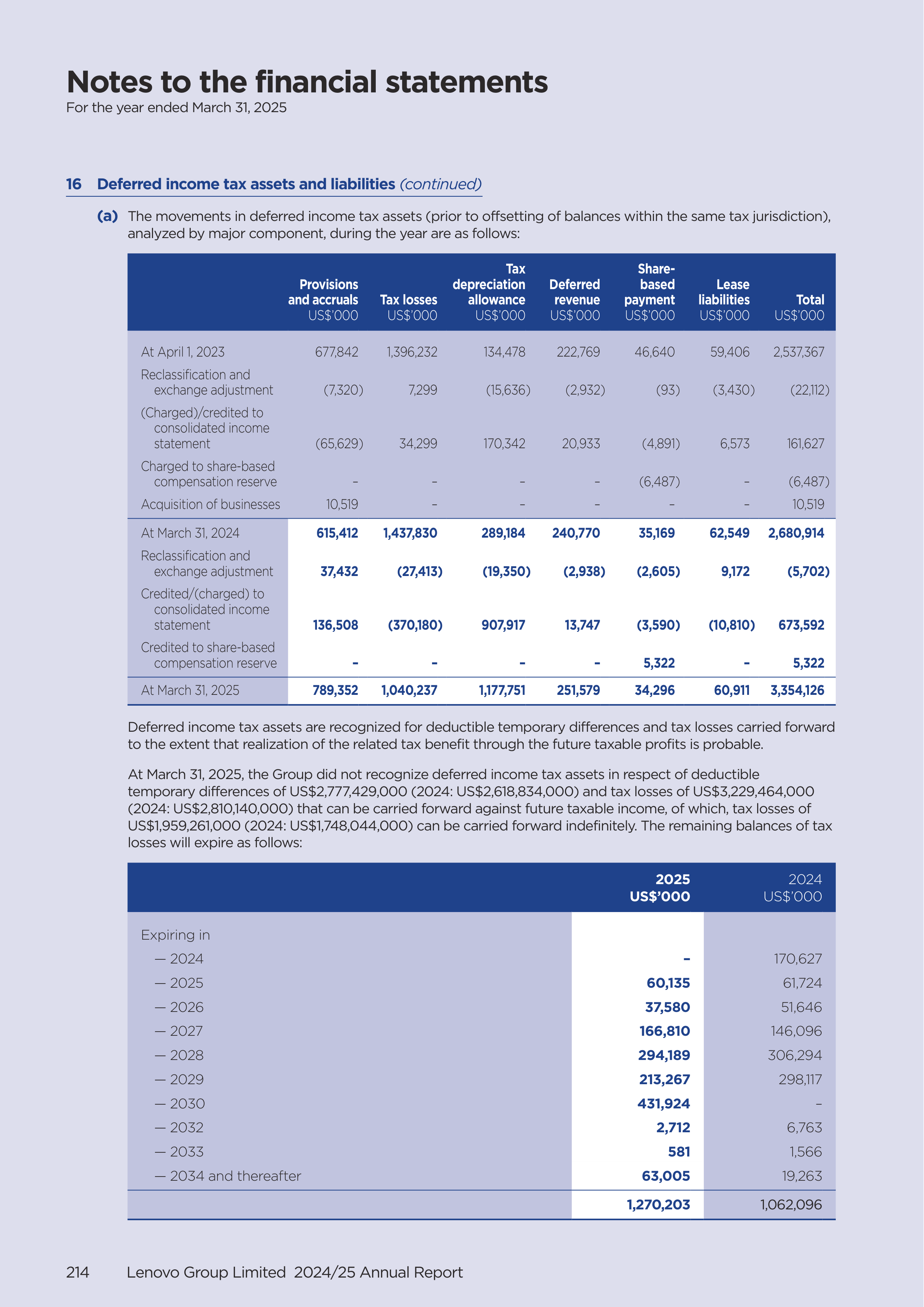
Notes to the financial statements
For the year ended March 31, 2025
Lenovo Group Limited 2024/25 Annual Report
214
16
Deferred income tax assets and liabilities
(continued)
(a)
The movements in deferred income tax assets (prior to offsetting of balances within the same tax jurisdiction),
analyzed by major component, during the year are as follows:
Provisions
and accruals
Tax losses
Tax
depreciation
allowance
Deferred
revenue
Share-
based
payment
Lease
liabilities
Total
US$’000
US$’000
US$’000
US$’000
US$’000
US$’000
US$’000
At April 1, 2023
677,842
1,396,232
134,478
222,769
46,640
59,406
2,537,367
Reclassification and
exchange adjustment
(7,320)
7,299
(15,636)
(2,932)
(93)
(3,430)
(22,112)
(Charged)/credited to
consolidated income
statement
(65,629)
34,299
170,342
20,933
(4,891)
6,573
161,627
Charged to share-based
compensation reserve
–
–
–
–
(6,487)
–
(6,487)
Acquisition of businesses
10,519
–
–
–
–
–
10,519
At March 31, 2024
615,412
1,437,830
289,184
240,770
35,169
62,549
2,680,914
Reclassification and
exchange adjustment
37,432
(27,413)
(19,350)
(2,938)
(2,605)
9,172
(5,702)
Credited/(charged) to
consolidated income
statement
136,508
(370,180)
907,917
13,747
(3,590)
(10,810)
673,592
Credited to share-based
compensation reserve
–
–
–
–
5,322
–
5,322
At March 31, 2025
789,352
1,040,237
1,177,751
251,579
34,296
60,911
3,354,126
Deferred income tax assets are recognized for deductible temporary differences and tax losses carried forward
to the extent that realization of the related tax benefit through the future taxable profits is probable.
At March 31, 2025, the Group did not recognize deferred income tax assets in respect of deductible
temporary differences of US$2,777,429,000 (2024: US$2,618,834,000) and tax losses of US$3,229,464,000
(2024: US$2,810,140,000) that can be carried forward against future taxable income, of which, tax losses of
US$1,959,261,000 (2024: US$1,748,044,000) can be carried forward indefinitely. The remaining balances of tax
losses will expire as follows:
2025
US$’000
2024
US$’000
Expiring in
— 2024
–
170,627
— 2025
60,135
61,724
— 2026
37,580
51,646
— 2027
166,810
146,096
— 2028
294,189
306,294
— 2029
213,267
298,117
— 2030
431,924
–
— 2032
2,712
6,763
— 2033
581
1,566
— 2034 and thereafter
63,005
19,263
1,270,203
1,062,096
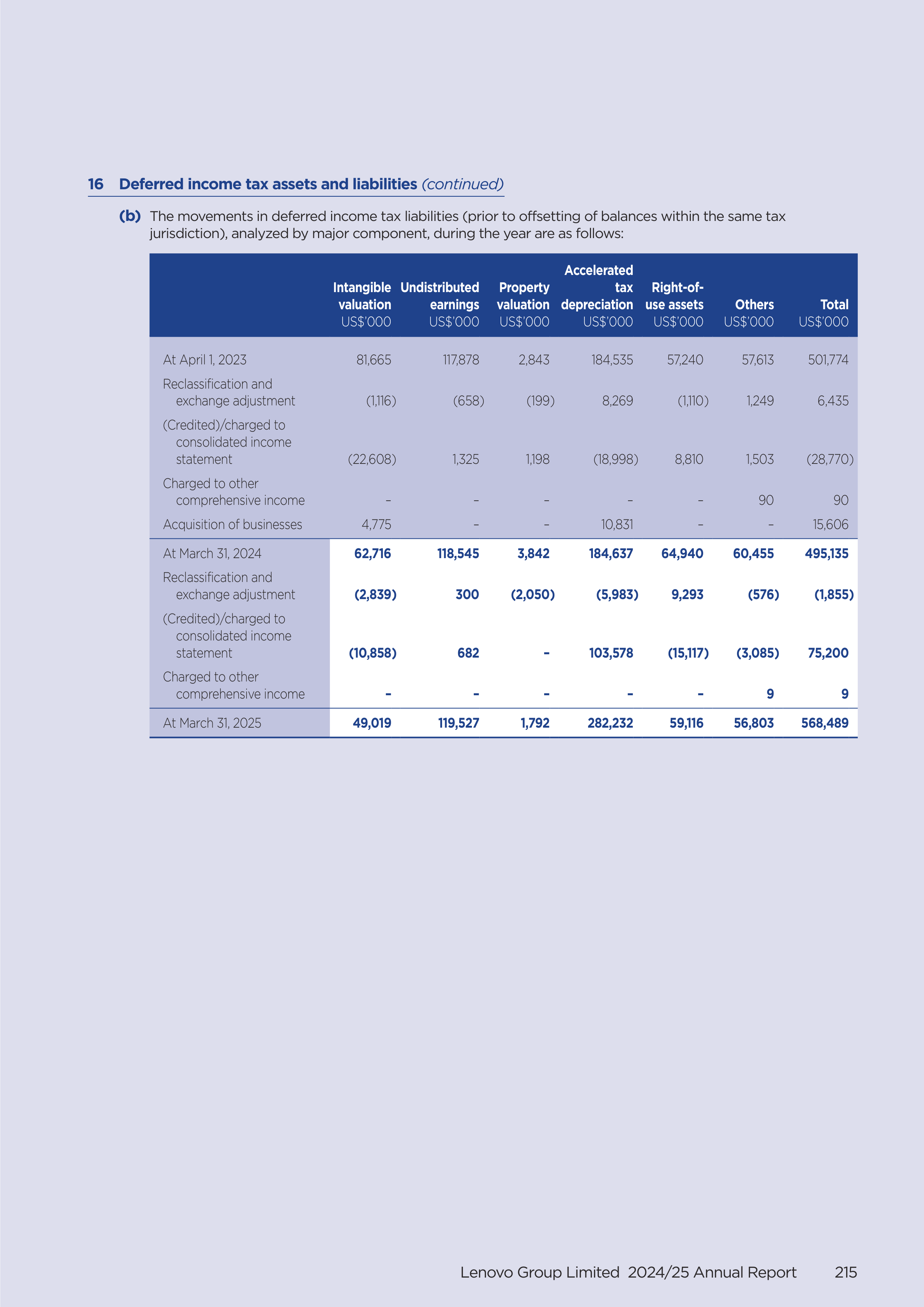
Lenovo Group Limited 2024/25 Annual Report
215
16
Deferred income tax assets and liabilities
(continued)
(b)
The movements in deferred income tax liabilities (prior to offsetting of balances within the same tax
jurisdiction), analyzed by major component, during the year are as follows:
Intangible
valuation
US$’000
Undistributed
earnings
US$’000
Property
valuation
US$’000
Accelerated
tax
depreciation
US$’000
Right-of-
use assets
US$’000
Others
US$’000
Total
US$’000
At April 1, 2023
81,665
117,878
2,843
184,535
57,240
57,613
501,774
Reclassification and
exchange adjustment
(1,116)
(658)
(199)
8,269
(1,110)
1,249
6,435
(Credited)/charged to
consolidated income
statement
(22,608)
1,325
1,198
(18,998)
8,810
1,503
(28,770)
Charged to other
comprehensive income
–
–
–
–
–
90
90
Acquisition of businesses
4,775
–
–
10,831
–
–
15,606
At March 31, 2024
62,716
118,545
3,842
184,637
64,940
60,455
495,135
Reclassification and
exchange adjustment
(2,839)
300
(2,050)
(5,983)
9,293
(576)
(1,855)
(Credited)/charged to
consolidated income
statement
(10,858)
682
–
103,578
(15,117)
(3,085)
75,200
Charged to other
comprehensive income
–
–
–
–
–
9
9
At March 31, 2025
49,019
119,527
1,792
282,232
59,116
56,803
568,489
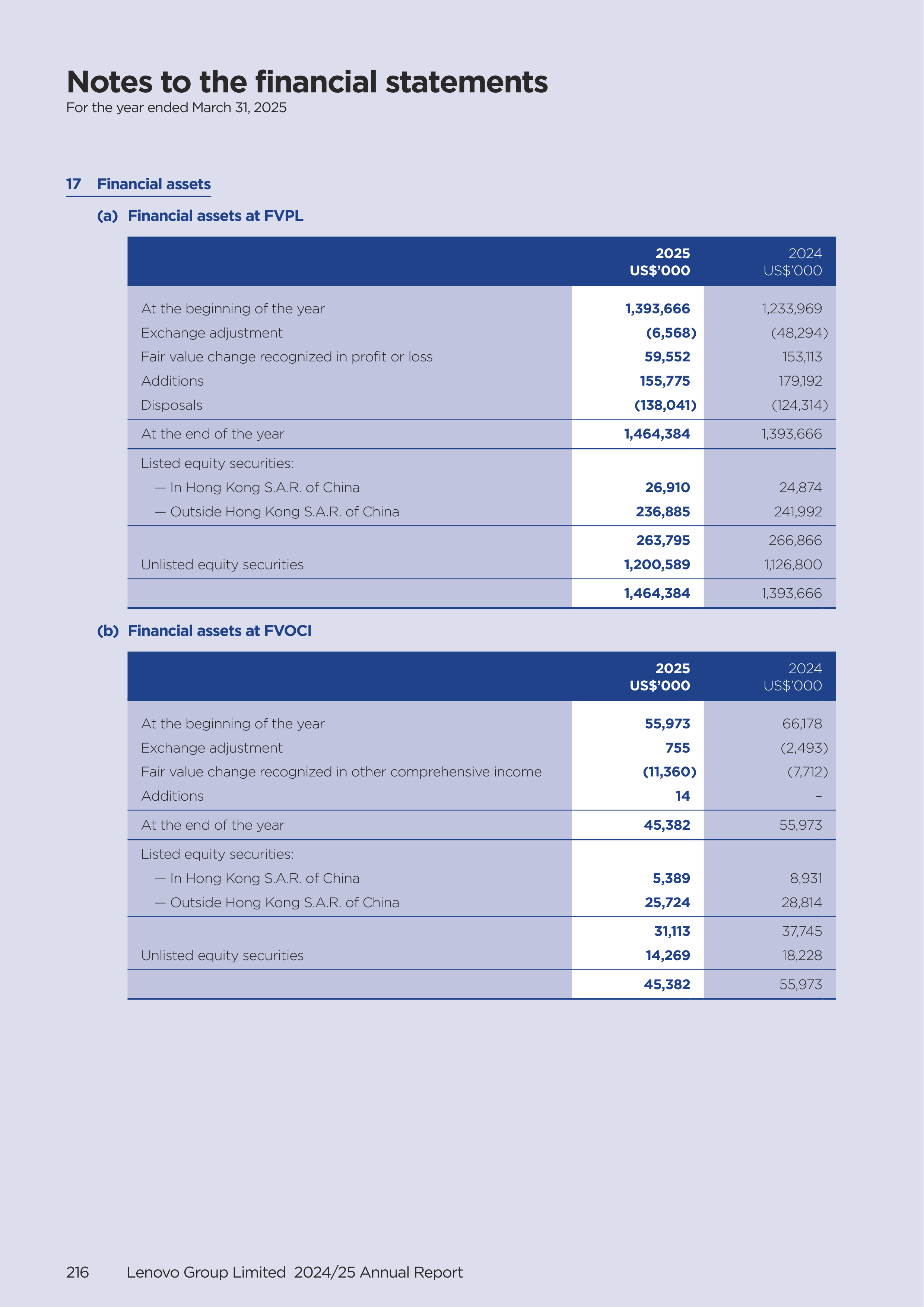
Notes to the financial statements
For the year ended March 31, 2025
Lenovo Group Limited 2024/25 Annual Report
216
17
Financial assets
(a)
Financial assets at FVPL
2025
US$’000
2024
US$’000
At the beginning of the year
1,393,666
1,233,969
Exchange adjustment
(6,568 )
(48,294 )
Fair value change recognized in profit or loss
59,552
153,113
Additions
155,775
179,192
Disposals
(138,041 )
(124,314 )
At the end of the year
1,464,384
1,393,666
Listed equity securities:
— In Hong Kong S.A.R. of China
26,910
24,874
— Outside Hong Kong S.A.R. of China
236,885
241,992
263,795
266,866
Unlisted equity securities
1,200,589
1,126,800
1,464,384
1,393,666
(b) Financial assets at FVOCI
2025
US$’000
2024
US$’000
At the beginning of the year
55,973
66,178
Exchange adjustment
755
(2,493 )
Fair value change recognized in other comprehensive income
(11,360 )
(7,712)
Additions
14
–
At the end of the year
45,382
55,973
Listed equity securities:
— In Hong Kong S.A.R. of China
5,389
8,931
— Outside Hong Kong S.A.R. of China
25,724
28,814
31,113
37,745
Unlisted equity securities
14,269
18,228
45,382
55,973
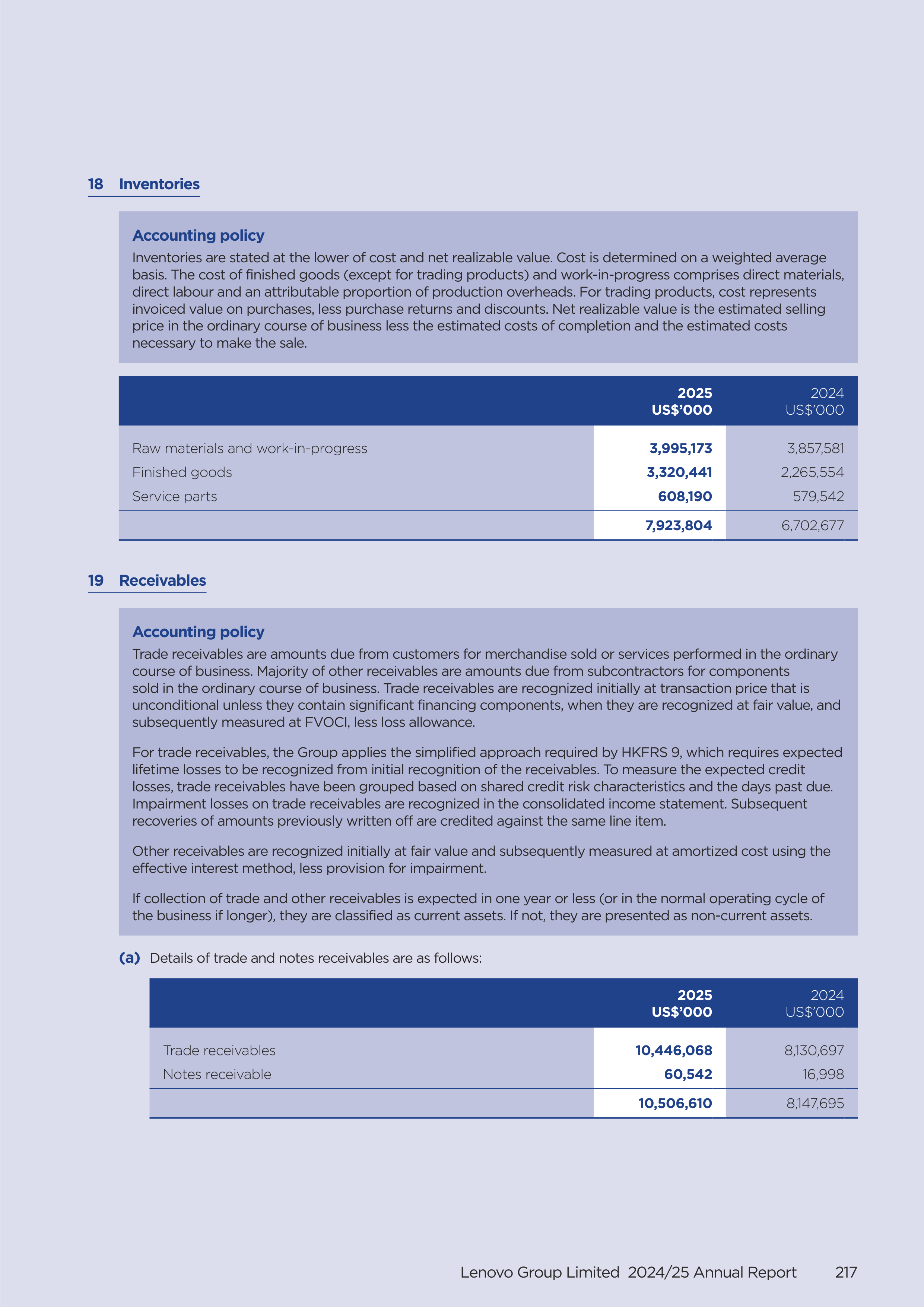
Lenovo Group Limited 2024/25 Annual Report
217
18
Inventories
Accounting policy
Inventories are stated at the lower of cost and net realizable value. Cost is determined on a weighted average
basis. The cost of finished goods (except for trading products) and work-in-progress comprises direct materials,
direct labour and an attributable proportion of production overheads. For trading products, cost represents
invoiced value on purchases, less purchase returns and discounts. Net realizable value is the estimated selling
price in the ordinary course of business less the estimated costs of completion and the estimated costs
necessary to make the sale.
2025
US$’000
2024
US$’000
Raw materials and work-in-progress
3,995,173
3,857,581
Finished goods
3,320,441
2,265,554
Service parts
608,190
579,542
7,923,804
6,702,677
19
Receivables
Accounting policy
Trade receivables are amounts due from customers for merchandise sold or services performed in the ordinary
course of business. Majority of other receivables are amounts due from subcontractors for components
sold in the ordinary course of business. Trade receivables are recognized initially at transaction price that is
unconditional unless they contain significant financing components, when they are recognized at fair value, and
subsequently measured at FVOCI, less loss allowance.
For trade receivables, the Group applies the simplified approach required by HKFRS 9, which requires expected
lifetime losses to be recognized from initial recognition of the receivables. To measure the expected credit
losses, trade receivables have been grouped based on shared credit risk characteristics and the days past due.
Impairment losses on trade receivables are recognized in the consolidated income statement. Subsequent
recoveries of amounts previously written off are credited against the same line item.
Other receivables are recognized initially at fair value and subsequently measured at amortized cost using the
effective interest method, less provision for impairment.
If collection of trade and other receivables is expected in one year or less (or in the normal operating cycle of
the business if longer), they are classified as current assets. If not, they are presented as non-current assets.
(a)
Details of trade and notes receivables are as follows:
2025
US$’000
2024
US$’000
Trade receivables
10,446,068
8,130,697
Notes receivable
60,542
16,998
10,506,610
8,147,695
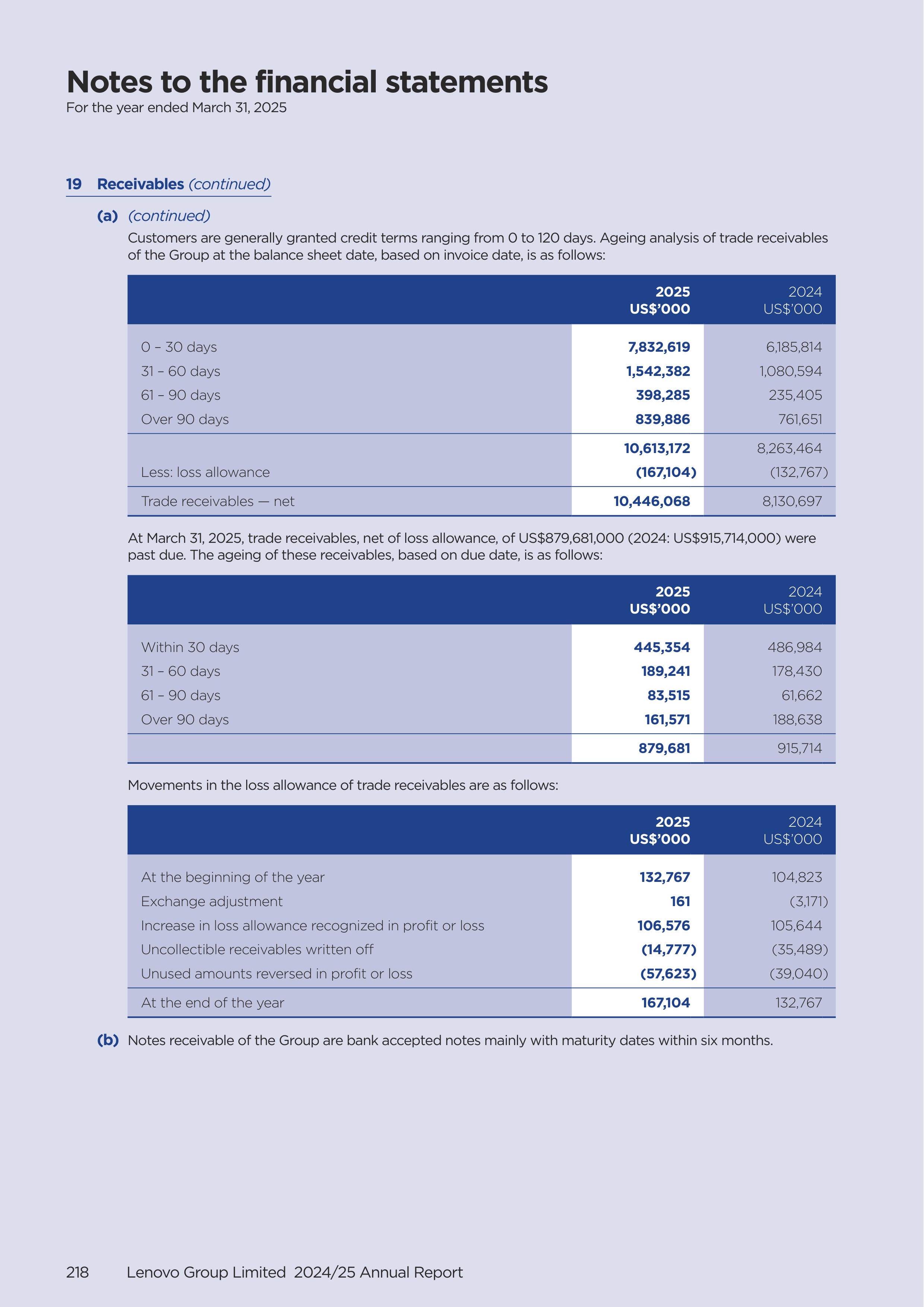
Notes to the financial statements
For the year ended March 31, 2025
Lenovo Group Limited 2024/25 Annual Report
218
19
Receivables
(continued)
(a)
(continued)
Customers are generally granted credit terms ranging from 0 to 120 days. Ageing analysis of trade receivables
of the Group at the balance sheet date, based on invoice date, is as follows:
2025
US$’000
2024
US$’000
0 – 30 days
7,832,619
6,185,814
31 – 60 days
1,542,382
1,080,594
61 – 90 days
398,285
235,405
Over 90 days
839,886
761,651
10,613,172
8,263,464
Less: loss allowance
(167,104 )
(132,767)
Trade receivables — net
10,446,068
8,130,697
At March 31, 2025, trade receivables, net of loss allowance, of US$879,681,000 (2024: US$915,714,000) were
past due. The ageing of these receivables, based on due date, is as follows:
2025
US$’000
2024
US$’000
Within 30 days
445,354
486,984
31 – 60 days
189,241
178,430
61 – 90 days
83,515
61,662
Over 90 days
161,571
188,638
879,681
915,714
Movements in the loss allowance of trade receivables are as follows:
2025
US$’000
2024
US$’000
At the beginning of the year
132,767
104,823
Exchange adjustment
161
(3,171)
Increase in loss allowance recognized in profit or loss
106,576
105,644
Uncollectible receivables written off
(14,777 )
(35,489)
Unused amounts reversed in profit or loss
(57,623 )
(39,040)
At the end of the year
167,104
132,767
(b)
Notes receivable of the Group are bank accepted notes mainly with maturity dates within six months.
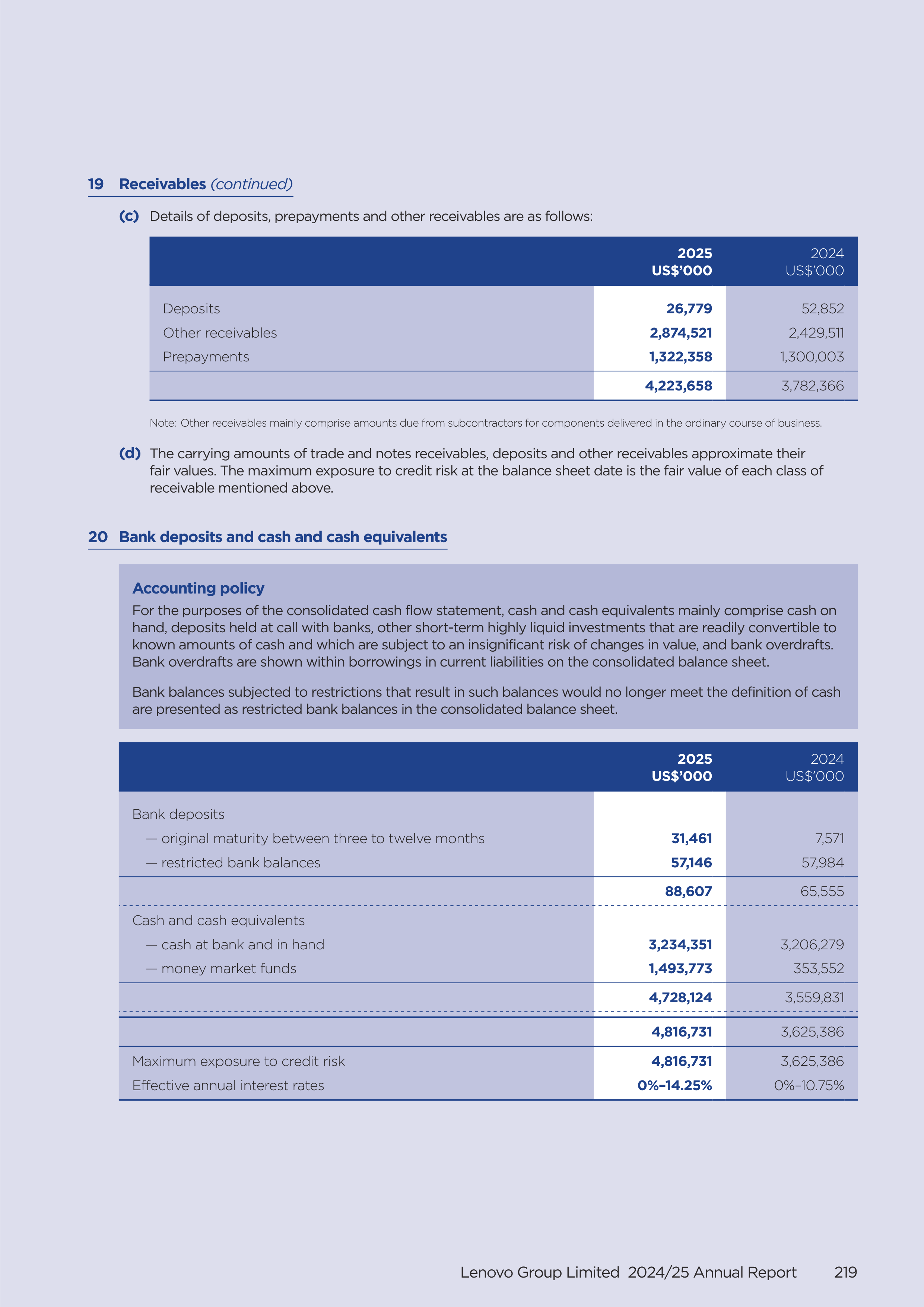
Lenovo Group Limited 2024/25 Annual Report
219
19
Receivables
(continued)
(c)
Details of deposits, prepayments and other receivables are as follows:
2025
US$’000
2024
US$’000
Deposits
26,779
52,852
Other receivables
2,874,521
2,429,511
Prepayments
1,322,358
1,300,003
4,223,658
3,782,366
Note: Other receivables mainly comprise amounts due from subcontractors for components delivered in the ordinary course of business.
(d)
The carrying amounts of trade and notes receivables, deposits and other receivables approximate their
fair values. The maximum exposure to credit risk at the balance sheet date is the fair value of each class of
receivable mentioned above.
20
Bank deposits and cash and cash equivalents
Accounting policy
For the purposes of the consolidated cash flow statement, cash and cash equivalents mainly comprise cash on
hand, deposits held at call with banks, other short-term highly liquid investments that are readily convertible to
known amounts of cash and which are subject to an insignificant risk of changes in value, and bank overdrafts.
Bank overdrafts are shown within borrowings in current liabilities on the consolidated balance sheet.
Bank balances subjected to restrictions that result in such balances would no longer meet the definition of cash
are presented as restricted bank balances in the consolidated balance sheet.
2025
US$’000
2024
US$’000
Bank deposits
— original maturity between three to twelve months
31,461
7,571
— restricted bank balances
57,146
57,984
88,607
65,555
Cash and cash equivalents
— cash at bank and in hand
3,234,351
3,206,279
— money market funds
1,493,773
353,552
4,728,124
3,559,831
4,816,731
3,625,386
Maximum exposure to credit risk
4,816,731
3,625,386
Effective annual interest rates
0%–14.25%
0%–10.75%
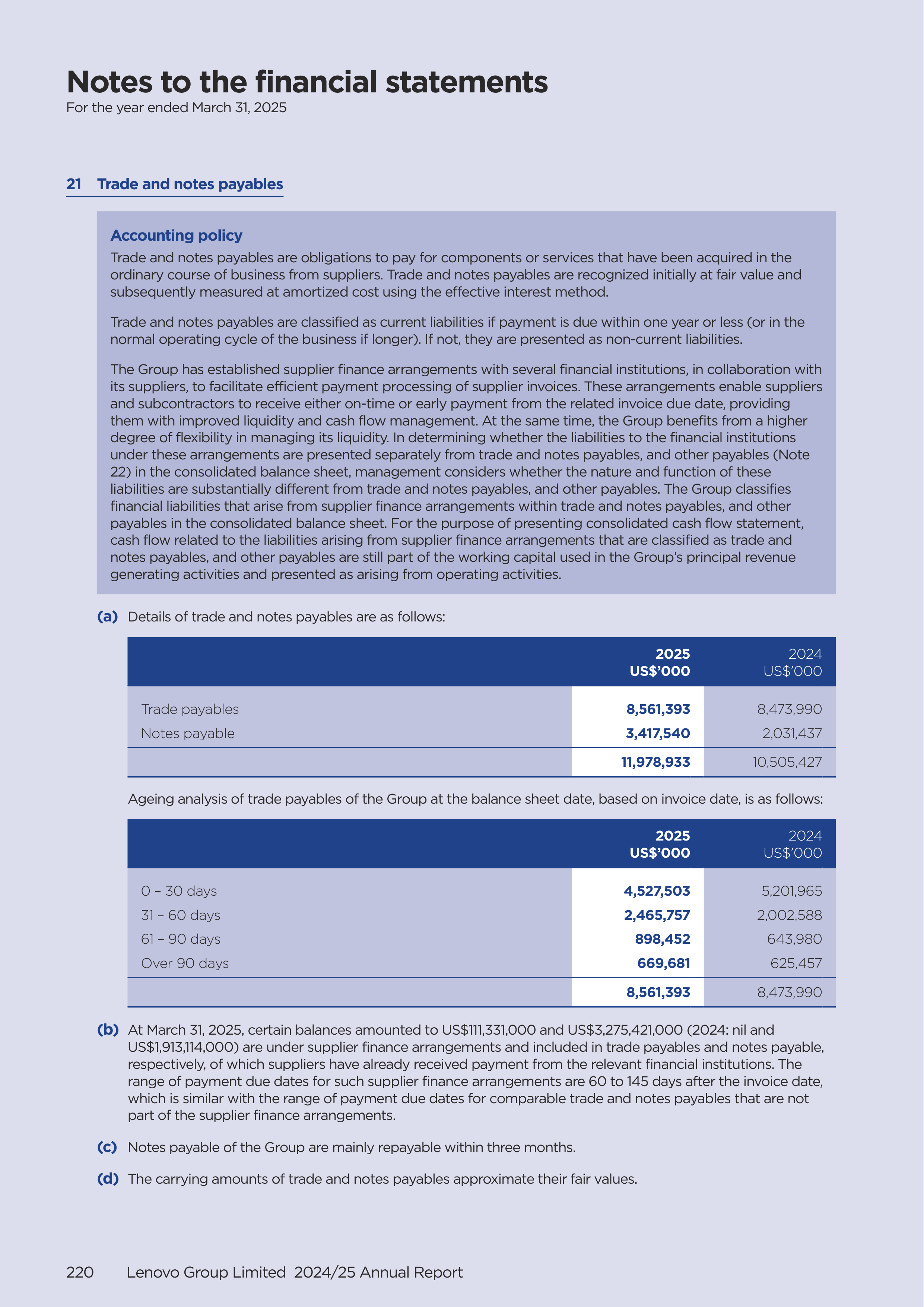
Notes to the financial statements
For the year ended March 31, 2025
Lenovo Group Limited 2024/25 Annual Report
220
21
Trade and notes payables
Accounting policy
Trade and notes payables are obligations to pay for components or services that have been acquired in the
ordinary course of business from suppliers. Trade and notes payables are recognized initially at fair value and
subsequently measured at amortized cost using the effective interest method.
Trade and notes payables are classified as current liabilities if payment is due within one year or less (or in the
normal operating cycle of the business if longer). If not, they are presented as non-current liabilities.
The Group has established supplier finance arrangements with several financial institutions, in collaboration with
its suppliers, to facilitate efficient payment processing of supplier invoices. These arrangements enable suppliers
and subcontractors to receive either on-time or early payment from the related invoice due date, providing
them with improved liquidity and cash flow management. At the same time, the Group benefits from a higher
degree of flexibility in managing its liquidity. In determining whether the liabilities to the financial institutions
under these arrangements are presented separately from trade and notes payables, and other payables (Note
22) in the consolidated balance sheet, management considers whether the nature and function of these
liabilities are substantially different from trade and notes payables, and other payables. The Group classifies
financial liabilities that arise from supplier finance arrangements within trade and notes payables, and other
payables in the consolidated balance sheet. For the purpose of presenting consolidated cash flow statement,
cash flow related to the liabilities arising from supplier finance arrangements that are classified as trade and
notes payables, and other payables are still part of the working capital used in the Group’s principal revenue
generating activities and presented as arising from operating activities.
(a)
Details of trade and notes payables are as follows:
2025
US$’000
2024
US$’000
Trade payables
8,561,393
8,473,990
Notes payable
3,417,540
2,031,437
11,978,933
10,505,427
Ageing analysis of trade payables of the Group at the balance sheet date, based on invoice date, is as follows:
2025
US$’000
2024
US$’000
0 – 30 days
4,527,503
5,201,965
31 – 60 days
2,465,757
2,002,588
61 – 90 days
898,452
643,980
Over 90 days
669,681
625,457
8,561,393
8,473,990
(b)
At March 31, 2025, certain balances amounted to US$111,331,000 and US$3,275,421,000 (2024: nil and
US$1,913,114,000) are under supplier finance arrangements and included in trade payables and notes payable,
respectively, of which suppliers have already received payment from the relevant financial institutions. The
range of payment due dates for such supplier finance arrangements are 60 to 145 days after the invoice date,
which is similar with the range of payment due dates for comparable trade and notes payables that are not
part of the supplier finance arrangements.
(c)
Notes payable of the Group are mainly repayable within three months.
(d)
The carrying amounts of trade and notes payables approximate their fair values.
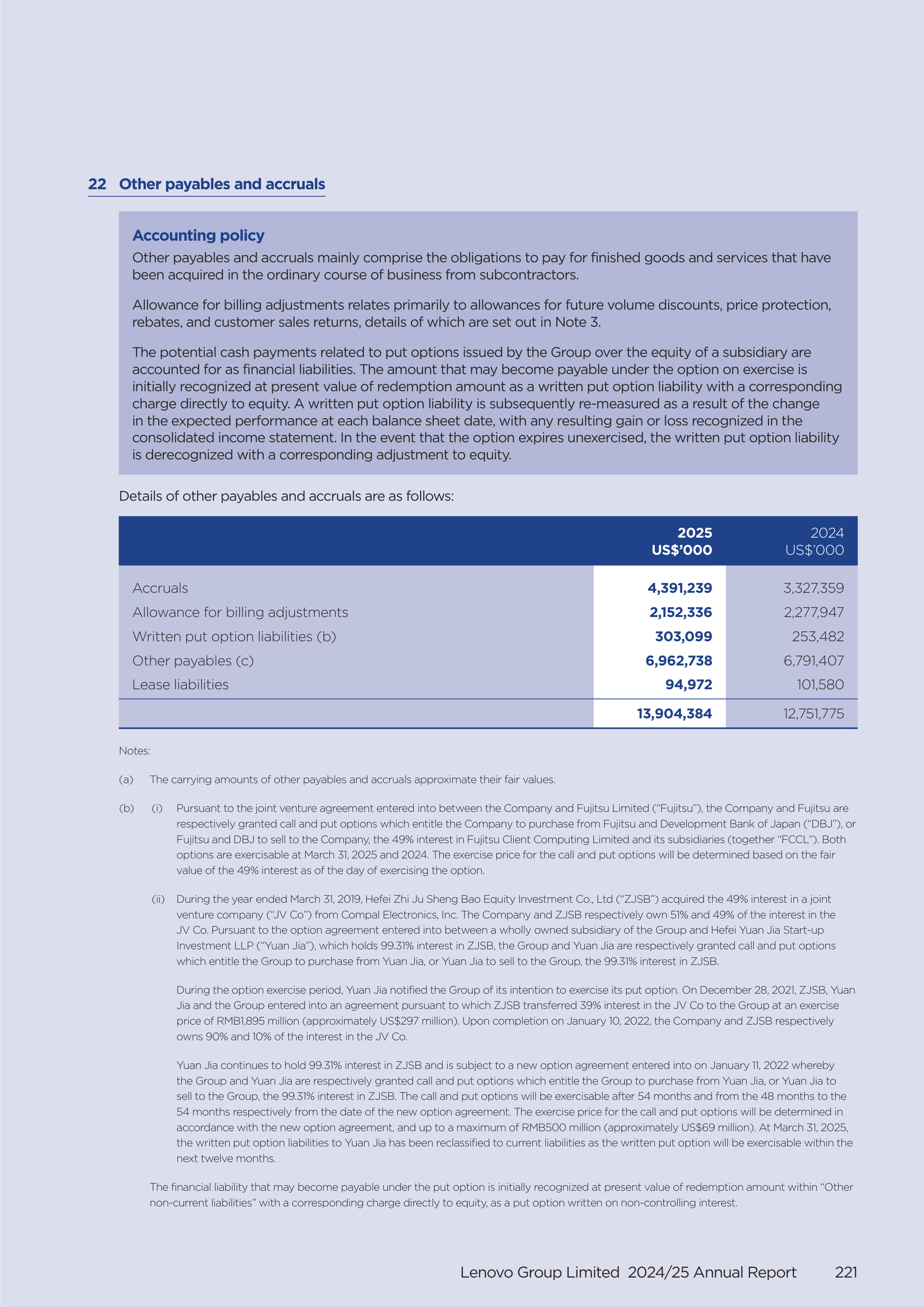
Lenovo Group Limited 2024/25 Annual Report
221
22
Other payables and accruals
Accounting policy
Other payables and accruals mainly comprise the obligations to pay for finished goods and services that have
been acquired in the ordinary course of business from subcontractors.
Allowance for billing adjustments relates primarily to allowances for future volume discounts, price protection,
rebates, and customer sales returns, details of which are set out in Note 3.
The potential cash payments related to put options issued by the Group over the equity of a subsidiary are
accounted for as financial liabilities. The amount that may become payable under the option on exercise is
initially recognized at present value of redemption amount as a written put option liability with a corresponding
charge directly to equity. A written put option liability is subsequently re-measured as a result of the change
in the expected performance at each balance sheet date, with any resulting gain or loss recognized in the
consolidated income statement. In the event that the option expires unexercised, the written put option liability
is derecognized with a corresponding adjustment to equity.
Details of other payables and accruals are as follows:
2025
US$’000
2024
US$’000
Accruals
4,391,239
3,327,359
Allowance for billing adjustments
2,152,336
2,277,947
Written put option liabilities (b)
303,099
253,482
Other payables (c)
6,962,738
6,791,407
Lease liabilities
94,972
101,580
13,904,384
12,751,775
Notes:
(a)
The carrying amounts of other payables and accruals approximate their fair values.
(b)
(i)
Pursuant to the joint venture agreement entered into between the Company and Fujitsu Limited (“Fujitsu”), the Company and Fujitsu are
respectively granted call and put options which entitle the Company to purchase from Fujitsu and Development Bank of Japan (“DBJ”), or
Fujitsu and DBJ to sell to the Company, the 49% interest in Fujitsu Client Computing Limited and its subsidiaries (together “FCCL”). Both
options are exercisable at March 31, 2025 and 2024. The exercise price for the call and put options will be determined based on the fair
value of the 49% interest as of the day of exercising the option.
(ii) During the year ended March 31, 2019, Hefei Zhi Ju Sheng Bao Equity Investment Co., Ltd (“ZJSB”) acquired the 49% interest in a joint
venture company (“JV Co”) from Compal Electronics, Inc. The Company and ZJSB respectively own 51% and 49% of the interest in the
JV Co. Pursuant to the option agreement entered into between a wholly owned subsidiary of the Group and Hefei Yuan Jia Start-up
Investment LLP (“Yuan Jia”), which holds 99.31% interest in ZJSB, the Group and Yuan Jia are respectively granted call and put options
which entitle the Group to purchase from Yuan Jia, or Yuan Jia to sell to the Group, the 99.31% interest in ZJSB.
During the option exercise period, Yuan Jia notified the Group of its intention to exercise its put option. On December 28, 2021, ZJSB, Yuan
Jia and the Group entered into an agreement pursuant to which ZJSB transferred 39% interest in the JV Co to the Group at an exercise
price of RMB1,895 million (approximately US$297 million). Upon completion on January 10, 2022, the Company and ZJSB respectively
owns 90% and 10% of the interest in the JV Co.
Yuan Jia continues to hold 99.31% interest in ZJSB and is subject to a new option agreement entered into on January 11, 2022 whereby
the Group and Yuan Jia are respectively granted call and put options which entitle the Group to purchase from Yuan Jia, or Yuan Jia to
sell to the Group, the 99.31% interest in ZJSB. The call and put options will be exercisable after 54 months and from the 48 months to the
54 months respectively from the date of the new option agreement. The exercise price for the call and put options will be determined in
accordance with the new option agreement, and up to a maximum of RMB500 million (approximately US$69 million). At March 31, 2025,
the written put option liabilities to Yuan Jia has been reclassified to current liabilities as the written put option will be exercisable within the
next twelve months.
The financial liability that may become payable under the put option is initially recognized at present value of redemption amount within “Other
non-current liabilities” with a corresponding charge directly to equity, as a put option written on non-controlling interest.
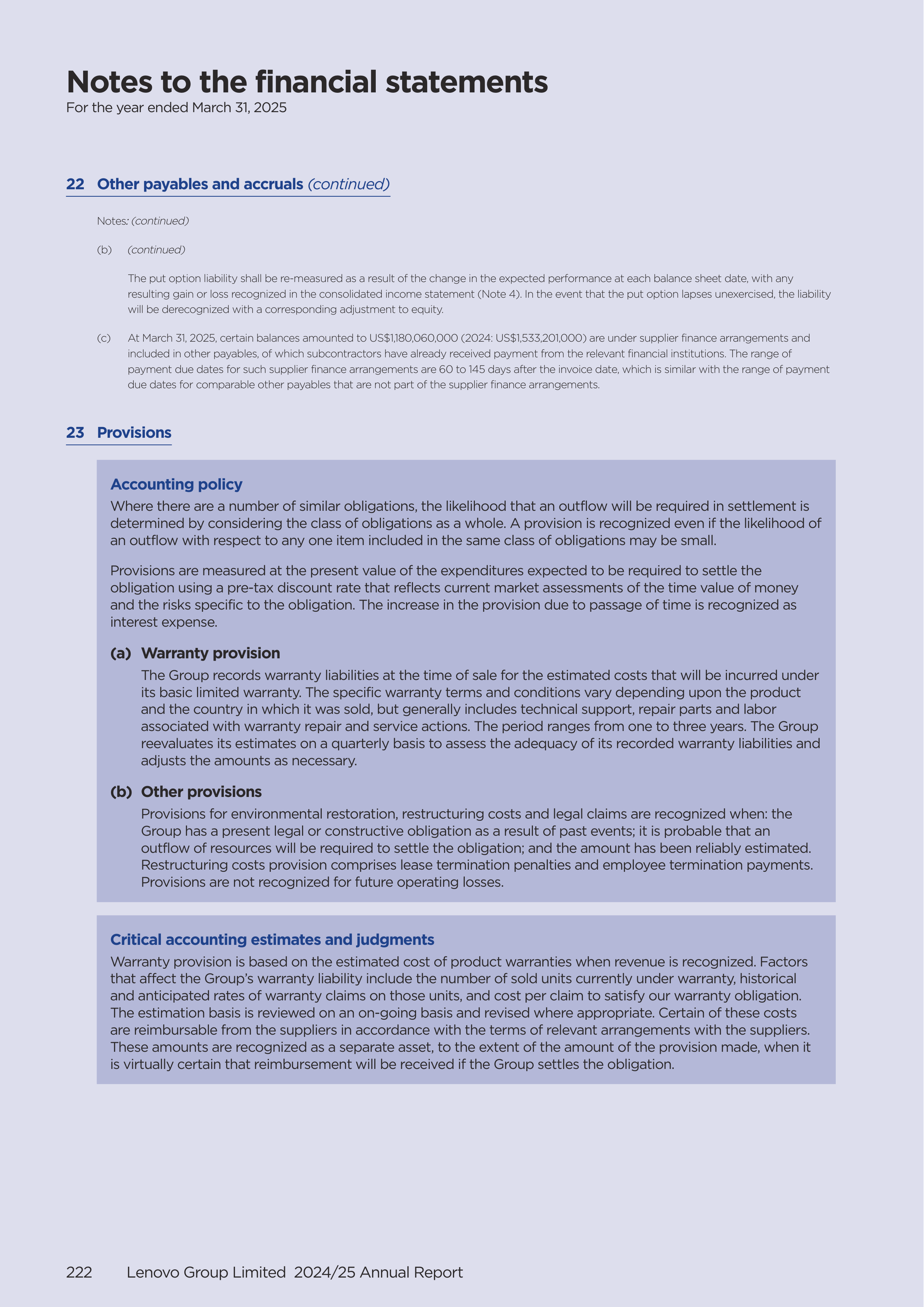
Notes to the financial statements
For the year ended March 31, 2025
Lenovo Group Limited 2024/25 Annual Report
222
22
Other payables and accruals
(continued)
Notes
:
(continued)
(b)
(continued)
The put option liability shall be re-measured as a result of the change in the expected performance at each balance sheet date, with any
resulting gain or loss recognized in the consolidated income statement (Note 4). In the event that the put option lapses unexercised, the liability
will be derecognized with a corresponding adjustment to equity.
(c)
At March 31, 2025, certain balances amounted to US$1,180,060,000 (2024: US$1,533,201,000) are under supplier finance arrangements and
included in other payables, of which subcontractors have already received payment from the relevant financial institutions. The range of
payment due dates for such supplier finance arrangements are 60 to 145 days after the invoice date, which is similar with the range of payment
due dates for comparable other payables that are not part of the supplier finance arrangements.
23
Provisions
Accounting policy
Where there are a number of similar obligations, the likelihood that an outflow will be required in settlement is
determined by considering the class of obligations as a whole. A provision is recognized even if the likelihood of
an outflow with respect to any one item included in the same class of obligations may be small.
Provisions are measured at the present value of the expenditures expected to be required to settle the
obligation using a pre-tax discount rate that reflects current market assessments of the time value of money
and the risks specific to the obligation. The increase in the provision due to passage of time is recognized as
interest expense.
(a)
Warranty provision
The Group records warranty liabilities at the time of sale for the estimated costs that will be incurred under
its basic limited warranty. The specific warranty terms and conditions vary depending upon the product
and the country in which it was sold, but generally includes technical support, repair parts and labor
associated with warranty repair and service actions. The period ranges from one to three years. The Group
reevaluates its estimates on a quarterly basis to assess the adequacy of its recorded warranty liabilities and
adjusts the amounts as necessary.
(b) Other provisions
Provisions for environmental restoration, restructuring costs and legal claims are recognized when: the
Group has a present legal or constructive obligation as a result of past events; it is probable that an
outflow of resources will be required to settle the obligation; and the amount has been reliably estimated.
Restructuring costs provision comprises lease termination penalties and employee termination payments.
Provisions are not recognized for future operating losses.
Critical accounting estimates and judgments
Warranty provision is based on the estimated cost of product warranties when revenue is recognized. Factors
that affect the Group’s warranty liability include the number of sold units currently under warranty, historical
and anticipated rates of warranty claims on those units, and cost per claim to satisfy our warranty obligation.
The estimation basis is reviewed on an on-going basis and revised where appropriate. Certain of these costs
are reimbursable from the suppliers in accordance with the terms of relevant arrangements with the suppliers.
These amounts are recognized as a separate asset, to the extent of the amount of the provision made, when it
is virtually certain that reimbursement will be received if the Group settles the obligation.
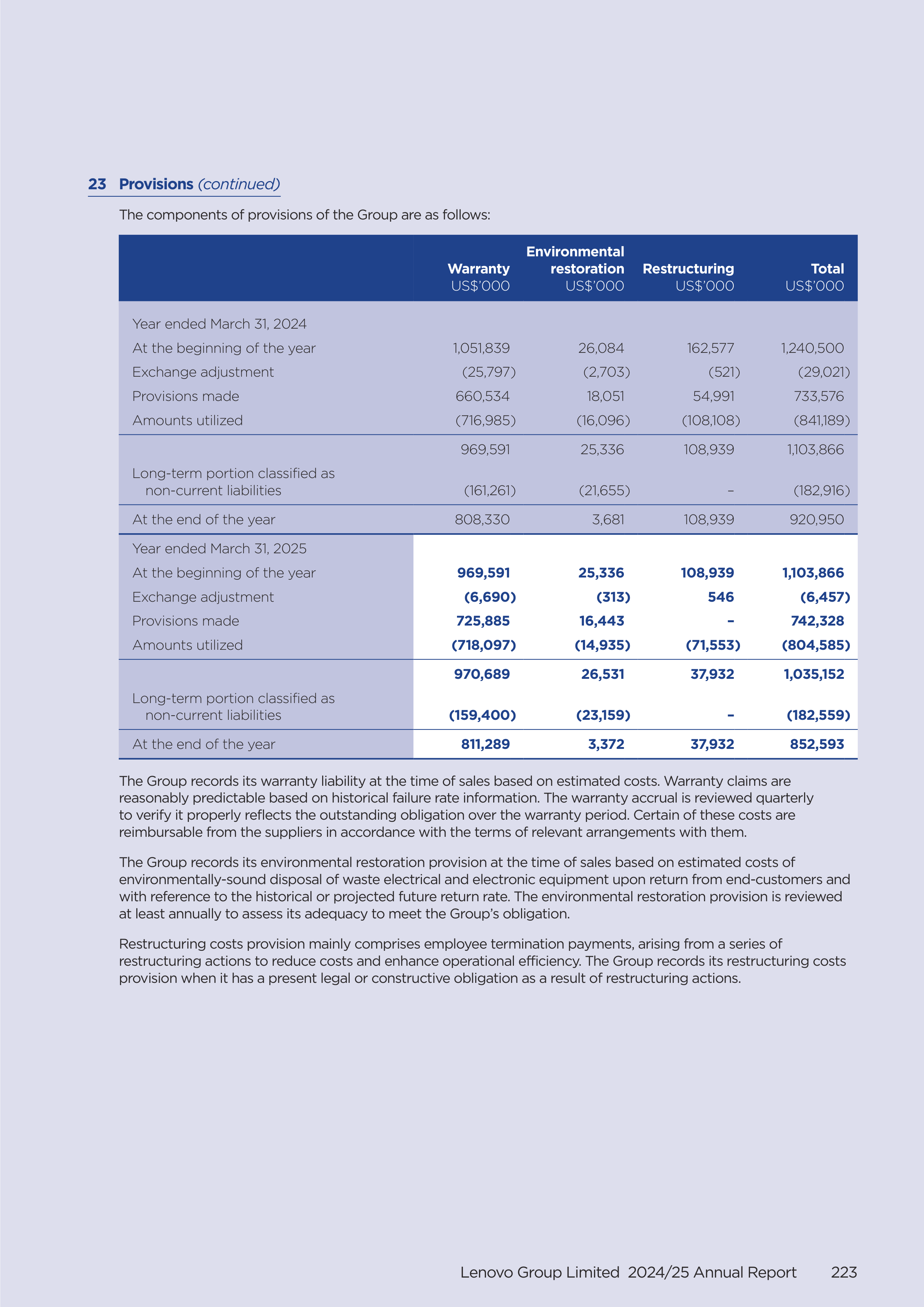
Lenovo Group Limited 2024/25 Annual Report
223
23
Provisions
(continued)
The components of provisions of the Group are as follows:
Warranty
US$’000
Environmental
restoration
US$’000
Restructuring
US$’000
Total
US$’000
Year ended March 31, 2024
At the beginning of the year
1,051,839
26,084
162,577
1,240,500
Exchange adjustment
(25,797)
(2,703)
(521)
(29,021)
Provisions made
660,534
18,051
54,991
733,576
Amounts utilized
(716,985)
(16,096)
(108,108)
(841,189)
969,591
25,336
108,939
1,103,866
Long-term portion classified as
non-current liabilities
(161,261)
(21,655)
–
(182,916)
At the end of the year
808,330
3,681
108,939
920,950
Year ended March 31, 2025
At the beginning of the year
969,591
25,336
108,939
1,103,866
Exchange adjustment
(6,690 )
(313 )
546
(6,457 )
Provisions made
725,885
16,443
–
742,328
Amounts utilized
(718,097 )
(14,935 )
(71,553 )
(804,585 )
970,689
26,531
37,932
1,035,152
Long-term portion classified as
non-current liabilities
(159,400 )
(23,159 )
–
(182,559 )
At the end of the year
811,289
3,372
37,932
852,593
The Group records its warranty liability at the time of sales based on estimated costs. Warranty claims are
reasonably predictable based on historical failure rate information. The warranty accrual is reviewed quarterly
to verify it properly reflects the outstanding obligation over the warranty period. Certain of these costs are
reimbursable from the suppliers in accordance with the terms of relevant arrangements with them.
The Group records its environmental restoration provision at the time of sales based on estimated costs of
environmentally-sound disposal of waste electrical and electronic equipment upon return from end-customers and
with reference to the historical or projected future return rate. The environmental restoration provision is reviewed
at least annually to assess its adequacy to meet the Group’s obligation.
Restructuring costs provision mainly comprises employee termination payments, arising from a series of
restructuring actions to reduce costs and enhance operational efficiency. The Group records its restructuring costs
provision when it has a present legal or constructive obligation as a result of restructuring actions.
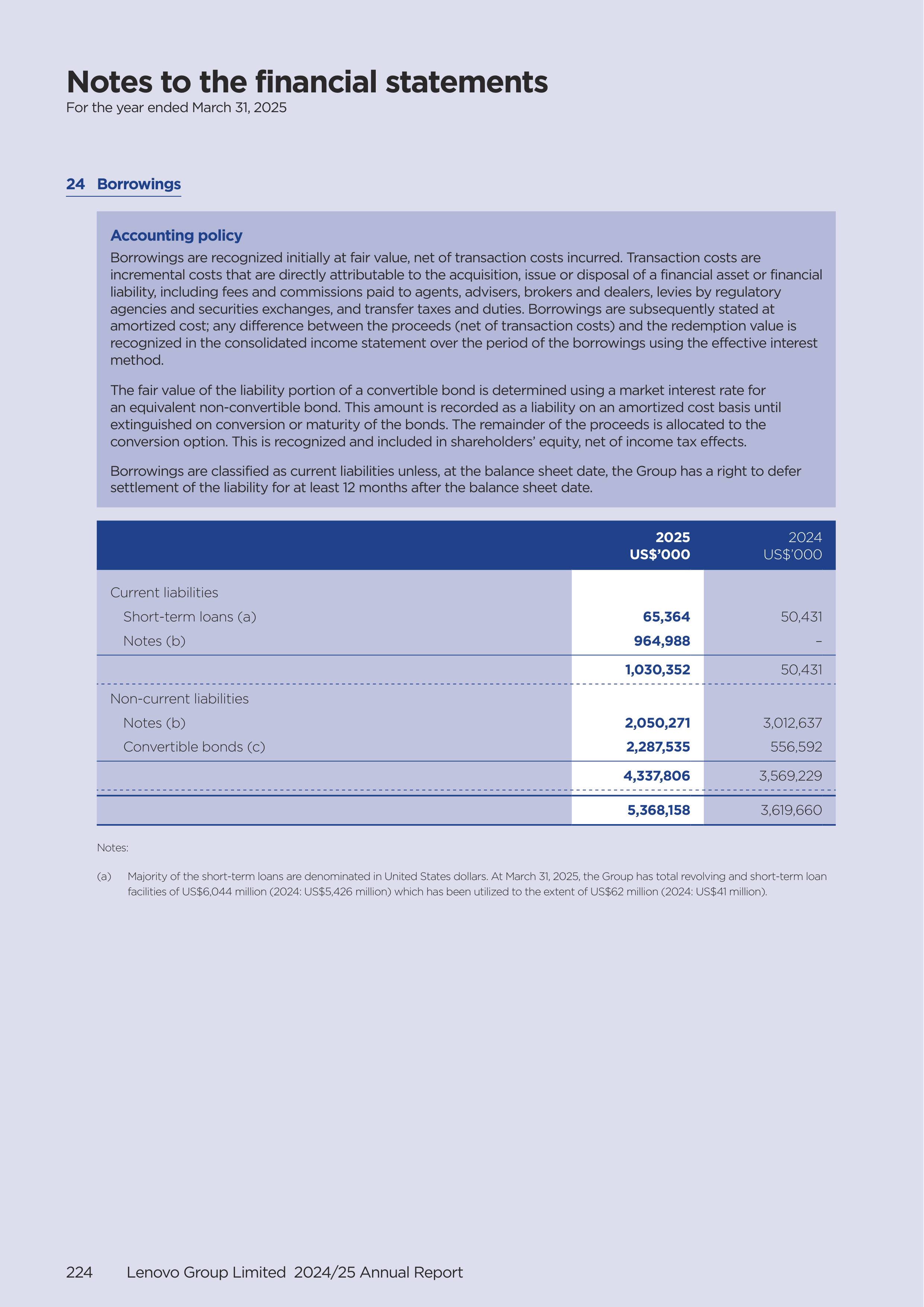
Notes to the financial statements
For the year ended March 31, 2025
Lenovo Group Limited 2024/25 Annual Report
224
24
Borrowings
Accounting policy
Borrowings are recognized initially at fair value, net of transaction costs incurred. Transaction costs are
incremental costs that are directly attributable to the acquisition, issue or disposal of a financial asset or financial
liability, including fees and commissions paid to agents, advisers, brokers and dealers, levies by regulatory
agencies and securities exchanges, and transfer taxes and duties. Borrowings are subsequently stated at
amortized cost; any difference between the proceeds (net of transaction costs) and the redemption value is
recognized in the consolidated income statement over the period of the borrowings using the effective interest
method.
The fair value of the liability portion of a convertible bond is determined using a market interest rate for
an equivalent non-convertible bond. This amount is recorded as a liability on an amortized cost basis until
extinguished on conversion or maturity of the bonds. The remainder of the proceeds is allocated to the
conversion option. This is recognized and included in shareholders’ equity, net of income tax effects.
Borrowings are classified as current liabilities unless, at the balance sheet date, the Group has a right to defer
settlement of the liability for at least 12 months after the balance sheet date.
2025
US$’000
2024
US$’000
Current liabilities
Short-term loans (a)
65,364
50,431
Notes (b)
964,988
–
1,030,352
50,431
Non-current liabilities
Notes (b)
2,050,271
3,012,637
Convertible bonds (c)
2,287,535
556,592
4,337,806
3,569,229
5,368,158
3,619,660
Notes:
(a)
Majority of the short-term loans are denominated in United States dollars. At March 31, 2025, the Group has total revolving and short-term loan
facilities of US$6,044 million (2024: US$5,426 million) which has been utilized to the extent of US$62 million (2024: US$41 million).
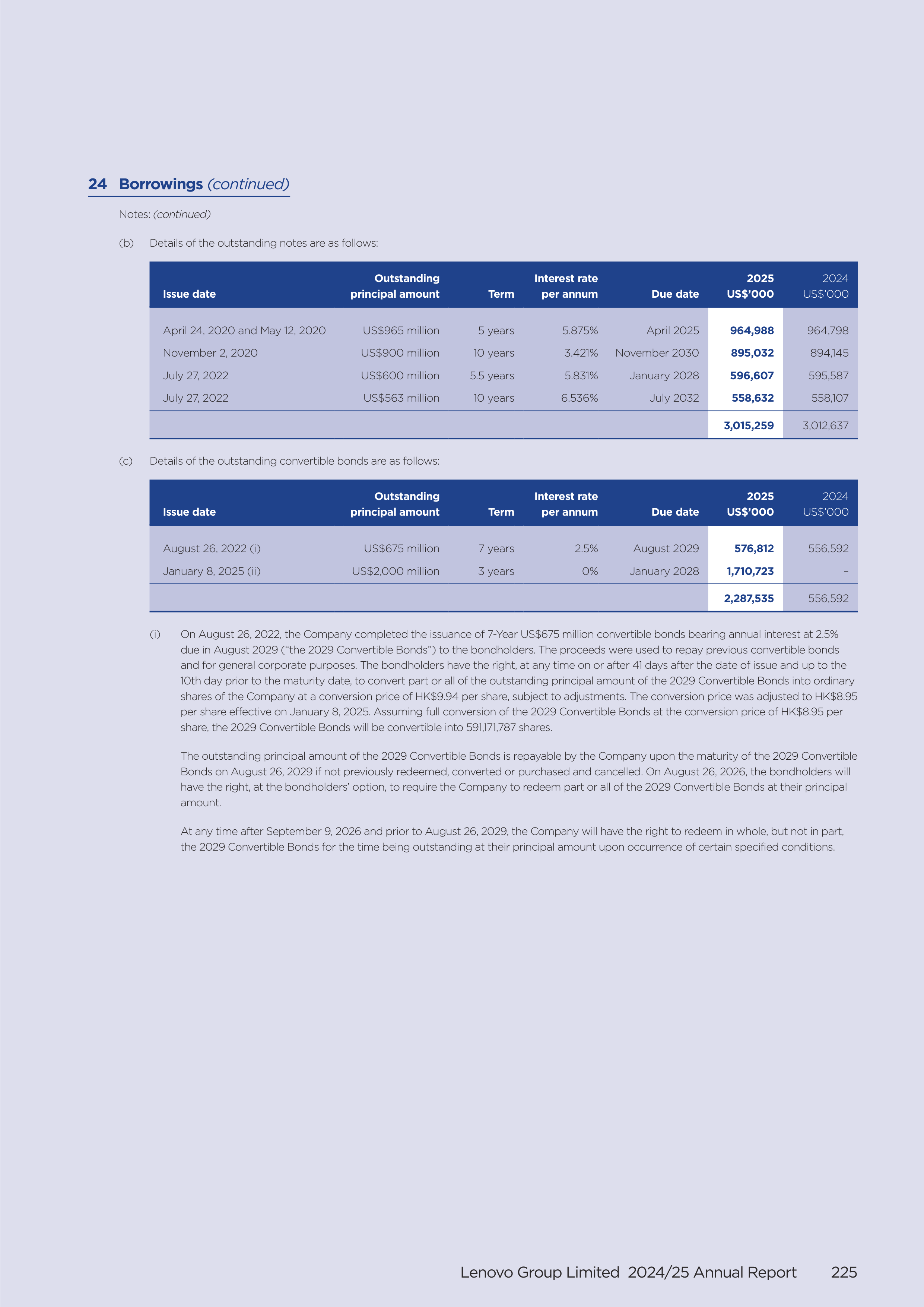
Lenovo Group Limited 2024/25 Annual Report
225
24
Borrowings
(continued)
Notes: (continued)
(b)
Details of the outstanding notes are as follows:
Issue date
Outstanding
principal amount
Term
Interest rate
per annum
Due date
2025
US$’000
2024
US$’000
April 24, 2020 and May 12, 2020
US$965 million
5 years
5.875%
April 2025
964,988
964,798
November 2, 2020
US$900 million
10 years
3.421%
November 2030
895,032
894,145
July 27, 2022
US$600 million
5.5 years
5.831%
January 2028
596,607
595,587
July 27, 2022
US$563 million
10 years
6.536%
July 2032
558,632
558,107
3,015,259
3,012,637
(c)
Details of the outstanding convertible bonds are as follows:
Issue date
Outstanding
principal amount
Term
Interest rate
per annum
Due date
2025
US$’000
2024
US$’000
August 26, 2022 (i)
US$675 million
7 years
2.5%
August 2029
576,812
556,592
January 8, 2025 (ii)
US$2,000 million
3 years
0%
January 2028
1,710,723
–
2,287,535
556,592
(i)
On August 26, 2022, the Company completed the issuance of 7-Year US$675 million convertible bonds bearing annual interest at 2.5%
due in August 2029 (“the 2029 Convertible Bonds”) to the bondholders. The proceeds were used to repay previous convertible bonds
and for general corporate purposes. The bondholders have the right, at any time on or after 41 days after the date of issue and up to the
10th day prior to the maturity date, to convert part or all of the outstanding principal amount of the 2029 Convertible Bonds into ordinary
shares of the Company at a conversion price of HK$9.94 per share, subject to adjustments. The conversion price was adjusted to HK$8.95
per share effective on January 8, 2025. Assuming full conversion of the 2029 Convertible Bonds at the conversion price of HK$8.95 per
share, the 2029 Convertible Bonds will be convertible into 591,171,787 shares.
The outstanding principal amount of the 2029 Convertible Bonds is repayable by the Company upon the maturity of the 2029 Convertible
Bonds on August 26, 2029 if not previously redeemed, converted or purchased and cancelled. On August 26, 2026, the bondholders will
have the right, at the bondholders’ option, to require the Company to redeem part or all of the 2029 Convertible Bonds at their principal
amount.
At any time after September 9, 2026 and prior to August 26, 2029, the Company will have the right to redeem in whole, but not in part,
the 2029 Convertible Bonds for the time being outstanding at their principal amount upon occurrence of certain specified conditions.
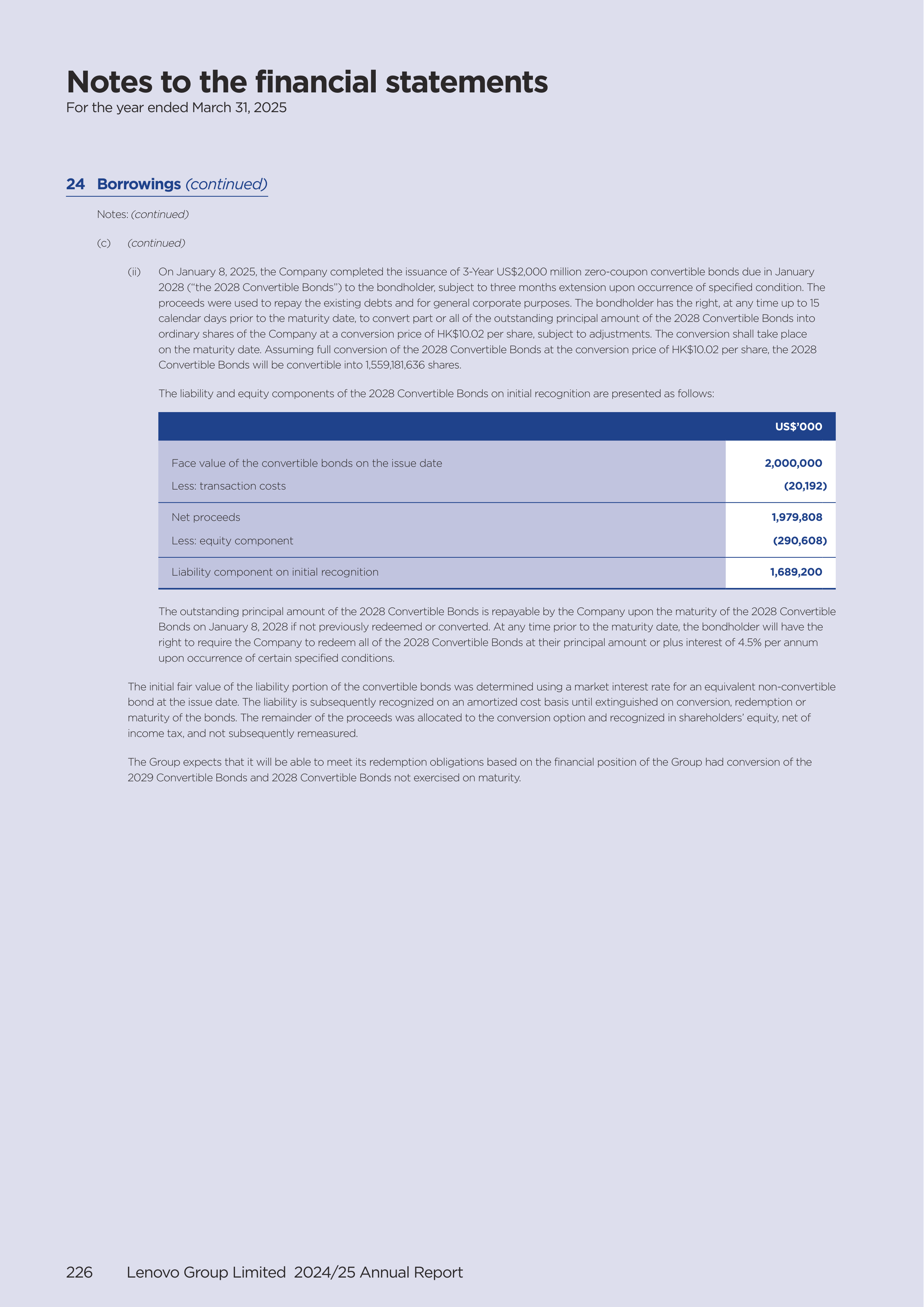
Notes to the financial statements
For the year ended March 31, 2025
Lenovo Group Limited 2024/25 Annual Report
226
24
Borrowings
(continued)
Notes: (continued)
(c)
(continued)
(ii)
On January 8, 2025, the Company completed the issuance of 3-Year US$2,000 million zero-coupon convertible bonds due in January
2028 (“the 2028 Convertible Bonds”) to the bondholder, subject to three months extension upon occurrence of specified condition. The
proceeds were used to repay the existing debts and for general corporate purposes. The bondholder has the right, at any time up to 15
calendar days prior to the maturity date, to convert part or all of the outstanding principal amount of the 2028 Convertible Bonds into
ordinary shares of the Company at a conversion price of HK$10.02 per share, subject to adjustments. The conversion shall take place
on the maturity date. Assuming full conversion of the 2028 Convertible Bonds at the conversion price of HK$10.02 per share, the 2028
Convertible Bonds will be convertible into 1,559,181,636 shares.
The liability and equity components of the 2028 Convertible Bonds on initial recognition are presented as follows:
US$’000
Face value of the convertible bonds on the issue date
2,000,000
Less: transaction costs
(20,192)
Net proceeds
1,979,808
Less: equity component
(290,608)
Liability component on initial recognition
1,689,200
The outstanding principal amount of the 2028 Convertible Bonds is repayable by the Company upon the maturity of the 2028 Convertible
Bonds on January 8, 2028 if not previously redeemed or converted. At any time prior to the maturity date, the bondholder will have the
right to require the Company to redeem all of the 2028 Convertible Bonds at their principal amount or plus interest of 4.5% per annum
upon occurrence of certain specified conditions.
The initial fair value of the liability portion of the convertible bonds was determined using a market interest rate for an equivalent non-convertible
bond at the issue date. The liability is subsequently recognized on an amortized cost basis until extinguished on conversion, redemption or
maturity of the bonds. The remainder of the proceeds was allocated to the conversion option and recognized in shareholders’ equity, net of
income tax, and not subsequently remeasured.
The Group expects that it will be able to meet its redemption obligations based on the financial position of the Group had conversion of the
2029 Convertible Bonds and 2028 Convertible Bonds not exercised on maturity.
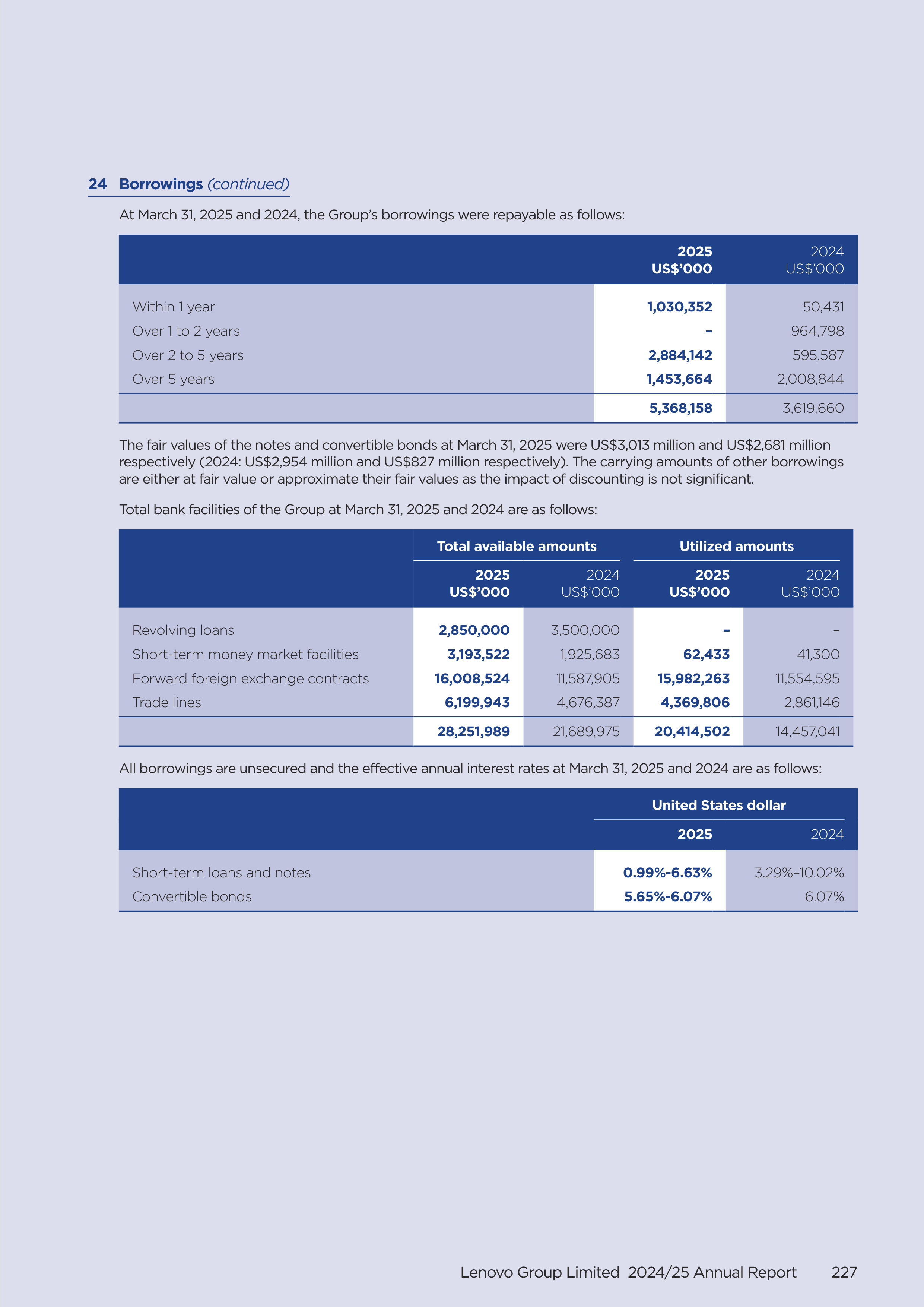
Lenovo Group Limited 2024/25 Annual Report
227
24
Borrowings
(continued)
At March 31, 2025 and 2024, the Group’s borrowings were repayable as follows:
2025
US$’000
2024
US$’000
Within 1 year
1,030,352
50,431
Over 1 to 2 years
–
964,798
Over 2 to 5 years
2,884,142
595,587
Over 5 years
1,453,664
2,008,844
5,368,158
3,619,660
The fair values of the notes and convertible bonds at March 31, 2025 were US$3,013 million and US$2,681 million
respectively (2024: US$2,954 million and US$827 million respectively). The carrying amounts of other borrowings
are either at fair value or approximate their fair values as the impact of discounting is not significant.
Total bank facilities of the Group at March 31, 2025 and 2024 are as follows:
Total available amounts
Utilized amounts
2025
US$’000
2024
US$’000
2025
US$’000
2024
US$’000
Revolving loans
2,850,000
3,500,000
–
–
Short-term money market facilities
3,193,522
1,925,683
62,433
41,300
Forward foreign exchange contracts
16,008,524
11,587,905
15,982,263
11,554,595
Trade lines
6,199,943
4,676,387
4,369,806
2,861,146
28,251,989
21,689,975
20,414,502
14,457,041
All borrowings are unsecured and the effective annual interest rates at March 31, 2025 and 2024 are as follows:
United States dollar
2025
2024
Short-term loans and notes
0.99%-6.63%
3.29%–10.02%
Convertible bonds
5.65%-6.07%
6.07%
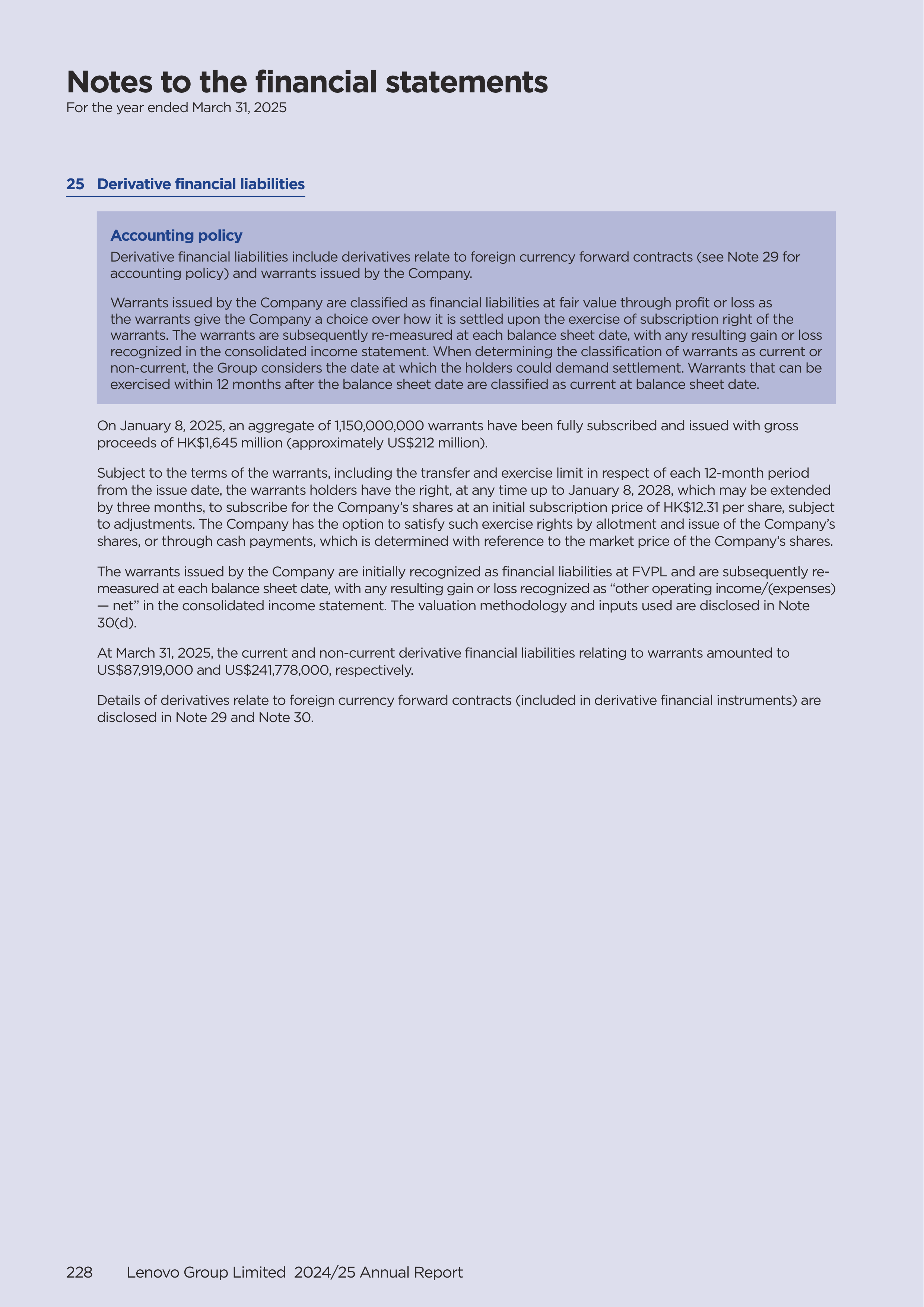
Notes to the financial statements
For the year ended March 31, 2025
Lenovo Group Limited 2024/25 Annual Report
228
25
Derivative financial liabilities
Accounting policy
Derivative financial liabilities include derivatives relate to foreign currency forward contracts (see Note 29 for
accounting policy) and warrants issued by the Company.
Warrants issued by the Company are classified as financial liabilities at fair value through profit or loss as
the warrants give the Company a choice over how it is settled upon the exercise of subscription right of the
warrants. The warrants are subsequently re-measured at each balance sheet date, with any resulting gain or loss
recognized in the consolidated income statement. When determining the classification of warrants as current or
non-current, the Group considers the date at which the holders could demand settlement. Warrants that can be
exercised within 12 months after the balance sheet date are classified as current at balance sheet date.
On January 8, 2025, an aggregate of 1,150,000,000 warrants have been fully subscribed and issued with gross
proceeds of HK$1,645 million (approximately US$212 million).
Subject to the terms of the warrants, including the transfer and exercise limit in respect of each 12-month period
from the issue date, the warrants holders have the right, at any time up to January 8, 2028, which may be extended
by three months, to subscribe for the Company’s shares at an initial subscription price of HK$12.31 per share, subject
to adjustments. The Company has the option to satisfy such exercise rights by allotment and issue of the Company’s
shares, or through cash payments, which is determined with reference to the market price of the Company’s shares.
The warrants issued by the Company are initially recognized as financial liabilities at FVPL and are subsequently re-
measured at each balance sheet date, with any resulting gain or loss recognized as “other operating income/(expenses)
— net” in the consolidated income statement. The valuation methodology and inputs used are disclosed in Note
30(d).
At March 31, 2025, the current and non-current derivative financial liabilities relating to warrants amounted to
US$87,919,000 and US$241,778,000, respectively.
Details of derivatives relate to foreign currency forward contracts (included in derivative financial instruments) are
disclosed in Note 29 and Note 30.
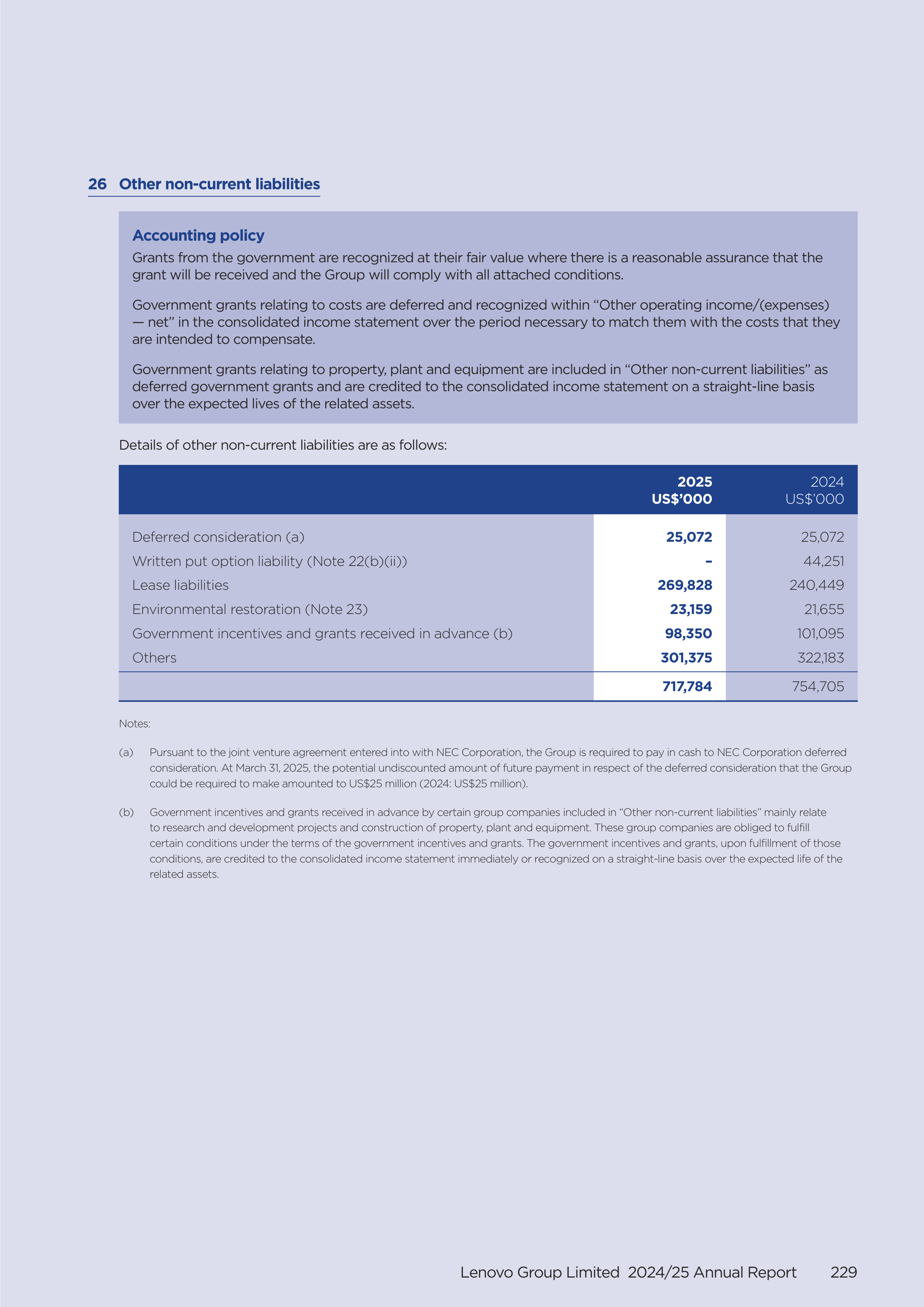
Lenovo Group Limited 2024/25 Annual Report
229
26
Other non-current liabilities
Accounting policy
Grants from the government are recognized at their fair value where there is a reasonable assurance that the
grant will be received and the Group will comply with all attached conditions.
Government grants relating to costs are deferred and recognized within “Other operating income/(expenses)
— net” in the consolidated income statement over the period necessary to match them with the costs that they
are intended to compensate.
Government grants relating to property, plant and equipment are included in “Other non-current liabilities” as
deferred government grants and are credited to the consolidated income statement on a straight-line basis
over the expected lives of the related assets.
Details of other non-current liabilities are as follows:
2025
US$’000
2024
US$’000
Deferred consideration (a)
25,072
25,072
Written put option liability (Note 22(b)(ii))
–
44,251
Lease liabilities
269,828
240,449
Environmental restoration (Note 23)
23,159
21,655
Government incentives and grants received in advance (b)
98,350
101,095
Others
301,375
322,183
717,784
754,705
Notes:
(a)
Pursuant to the joint venture agreement entered into with NEC Corporation, the Group is required to pay in cash to NEC Corporation deferred
consideration. At March 31, 2025, the potential undiscounted amount of future payment in respect of the deferred consideration that the Group
could be required to make amounted to US$25 million (2024: US$25 million).
(b)
Government incentives and grants received in advance by certain group companies included in “Other non-current liabilities” mainly relate
to research and development projects and construction of property, plant and equipment. These group companies are obliged to fulfill
certain conditions under the terms of the government incentives and grants. The government incentives and grants, upon fulfillment of those
conditions, are credited to the consolidated income statement immediately or recognized on a straight-line basis over the expected life of the
related assets.
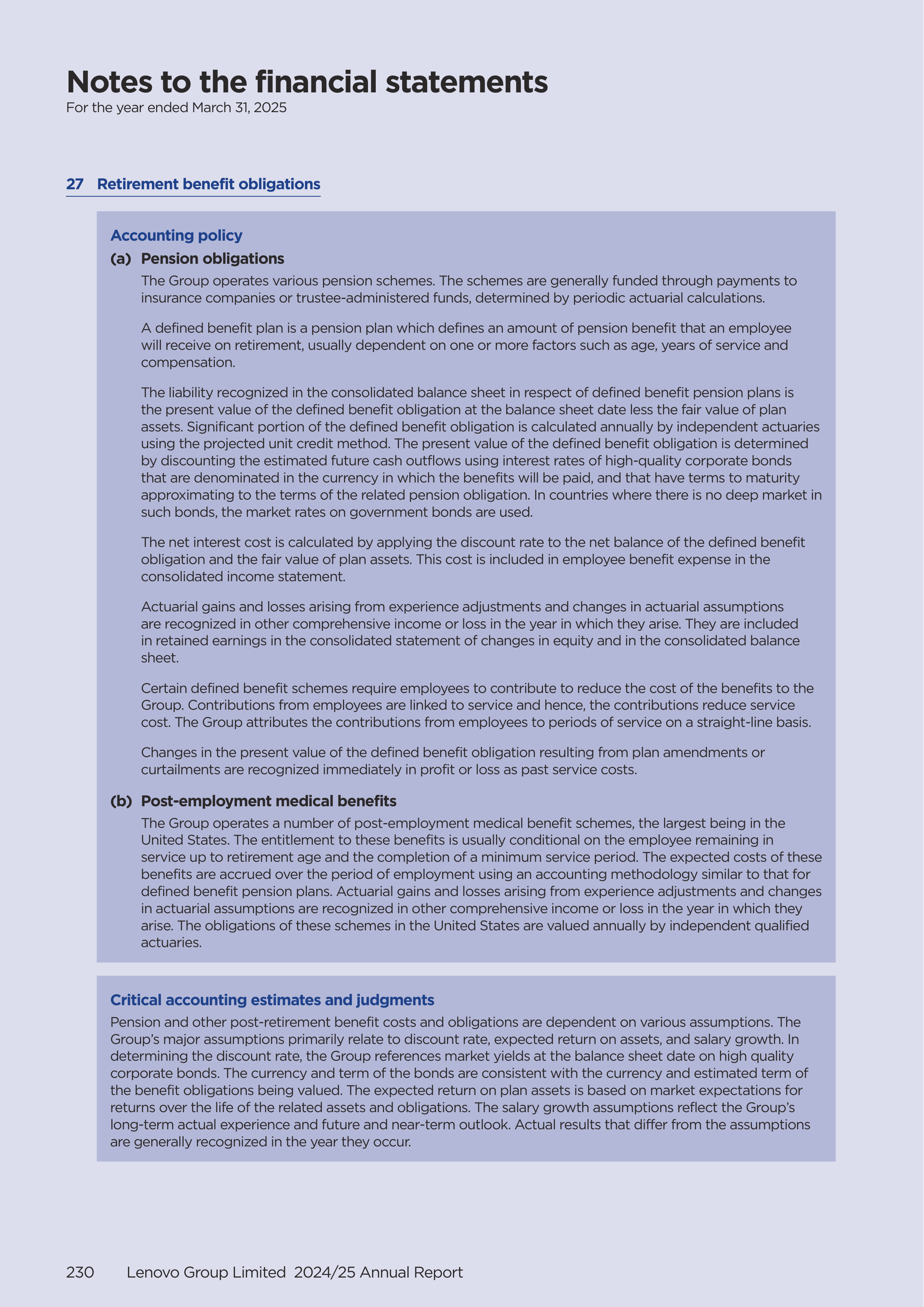
Notes to the financial statements
For the year ended March 31, 2025
Lenovo Group Limited 2024/25 Annual Report
230
27
Retirement benefit obligations
Accounting policy
(a)
Pension obligations
The Group operates various pension schemes. The schemes are generally funded through payments to
insurance companies or trustee-administered funds, determined by periodic actuarial calculations.
A defined benefit plan is a pension plan which defines an amount of pension benefit that an employee
will receive on retirement, usually dependent on one or more factors such as age, years of service and
compensation.
The liability recognized in the consolidated balance sheet in respect of defined benefit pension plans is
the present value of the defined benefit obligation at the balance sheet date less the fair value of plan
assets. Significant portion of the defined benefit obligation is calculated annually by independent actuaries
using the projected unit credit method. The present value of the defined benefit obligation is determined
by discounting the estimated future cash outflows using interest rates of high-quality corporate bonds
that are denominated in the currency in which the benefits will be paid, and that have terms to maturity
approximating to the terms of the related pension obligation. In countries where there is no deep market in
such bonds, the market rates on government bonds are used.
The net interest cost is calculated by applying the discount rate to the net balance of the defined benefit
obligation and the fair value of plan assets. This cost is included in employee benefit expense in the
consolidated income statement.
Actuarial gains and losses arising from experience adjustments and changes in actuarial assumptions
are recognized in other comprehensive income or loss in the year in which they arise. They are included
in retained earnings in the consolidated statement of changes in equity and in the consolidated balance
sheet.
Certain defined benefit schemes require employees to contribute to reduce the cost of the benefits to the
Group. Contributions from employees are linked to service and hence, the contributions reduce service
cost. The Group attributes the contributions from employees to periods of service on a straight-line basis.
Changes in the present value of the defined benefit obligation resulting from plan amendments or
curtailments are recognized immediately in profit or loss as past service costs.
(b) Post-employment medical benefits
The Group operates a number of post-employment medical benefit schemes, the largest being in the
United States. The entitlement to these benefits is usually conditional on the employee remaining in
service up to retirement age and the completion of a minimum service period. The expected costs of these
benefits are accrued over the period of employment using an accounting methodology similar to that for
defined benefit pension plans. Actuarial gains and losses arising from experience adjustments and changes
in actuarial assumptions are recognized in other comprehensive income or loss in the year in which they
arise. The obligations of these schemes in the United States are valued annually by independent qualified
actuaries.
Critical accounting estimates and judgments
Pension and other post-retirement benefit costs and obligations are dependent on various assumptions. The
Group’s major assumptions primarily relate to discount rate, expected return on assets, and salary growth. In
determining the discount rate, the Group references market yields at the balance sheet date on high quality
corporate bonds. The currency and term of the bonds are consistent with the currency and estimated term of
the benefit obligations being valued. The expected return on plan assets is based on market expectations for
returns over the life of the related assets and obligations. The salary growth assumptions reflect the Group’s
long-term actual experience and future and near-term outlook. Actual results that differ from the assumptions
are generally recognized in the year they occur.
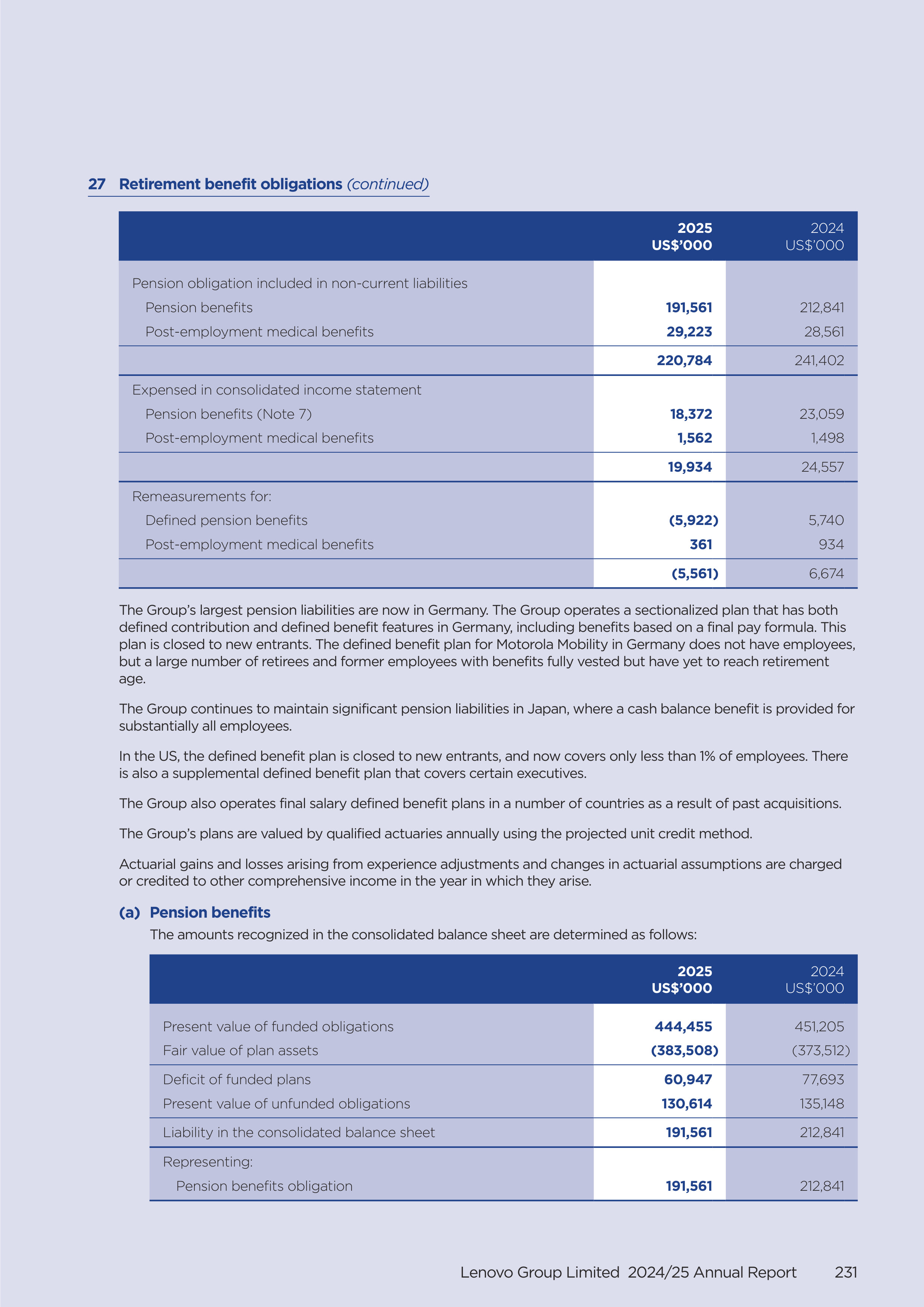
Lenovo Group Limited 2024/25 Annual Report
231
27
Retirement benefit obligations
(continued)
2025
US$’000
2024
US$’000
Pension obligation included in non-current liabilities
Pension benefits
191,561
212,841
Post-employment medical benefits
29,223
28,561
220,784
241,402
Expensed in consolidated income statement
Pension benefits (Note 7)
18,372
23,059
Post-employment medical benefits
1,562
1,498
19,934
24,557
Remeasurements for:
Defined pension benefits
(5,922)
5,740
Post-employment medical benefits
361
934
(5,561)
6,674
The Group’s largest pension liabilities are now in Germany. The Group operates a sectionalized plan that has both
defined contribution and defined benefit features in Germany, including benefits based on a final pay formula. This
plan is closed to new entrants. The defined benefit plan for Motorola Mobility in Germany does not have employees,
but a large number of retirees and former employees with benefits fully vested but have yet to reach retirement
age.
The Group continues to maintain significant pension liabilities in Japan, where a cash balance benefit is provided for
substantially all employees.
In the US, the defined benefit plan is closed to new entrants, and now covers only less than 1% of employees. There
is also a supplemental defined benefit plan that covers certain executives.
The Group also operates final salary defined benefit plans in a number of countries as a result of past acquisitions.
The Group’s plans are valued by qualified actuaries annually using the projected unit credit method.
Actuarial gains and losses arising from experience adjustments and changes in actuarial assumptions are charged
or credited to other comprehensive income in the year in which they arise.
(a)
Pension benefits
The amounts recognized in the consolidated balance sheet are determined as follows:
2025
US$’000
2024
US$’000
Present value of funded obligations
444,455
451,205
Fair value of plan assets
(383,508)
(373,512)
Deficit of funded plans
60,947
77,693
Present value of unfunded obligations
130,614
135,148
Liability in the consolidated balance sheet
191,561
212,841
Representing:
Pension benefits obligation
191,561
212,841
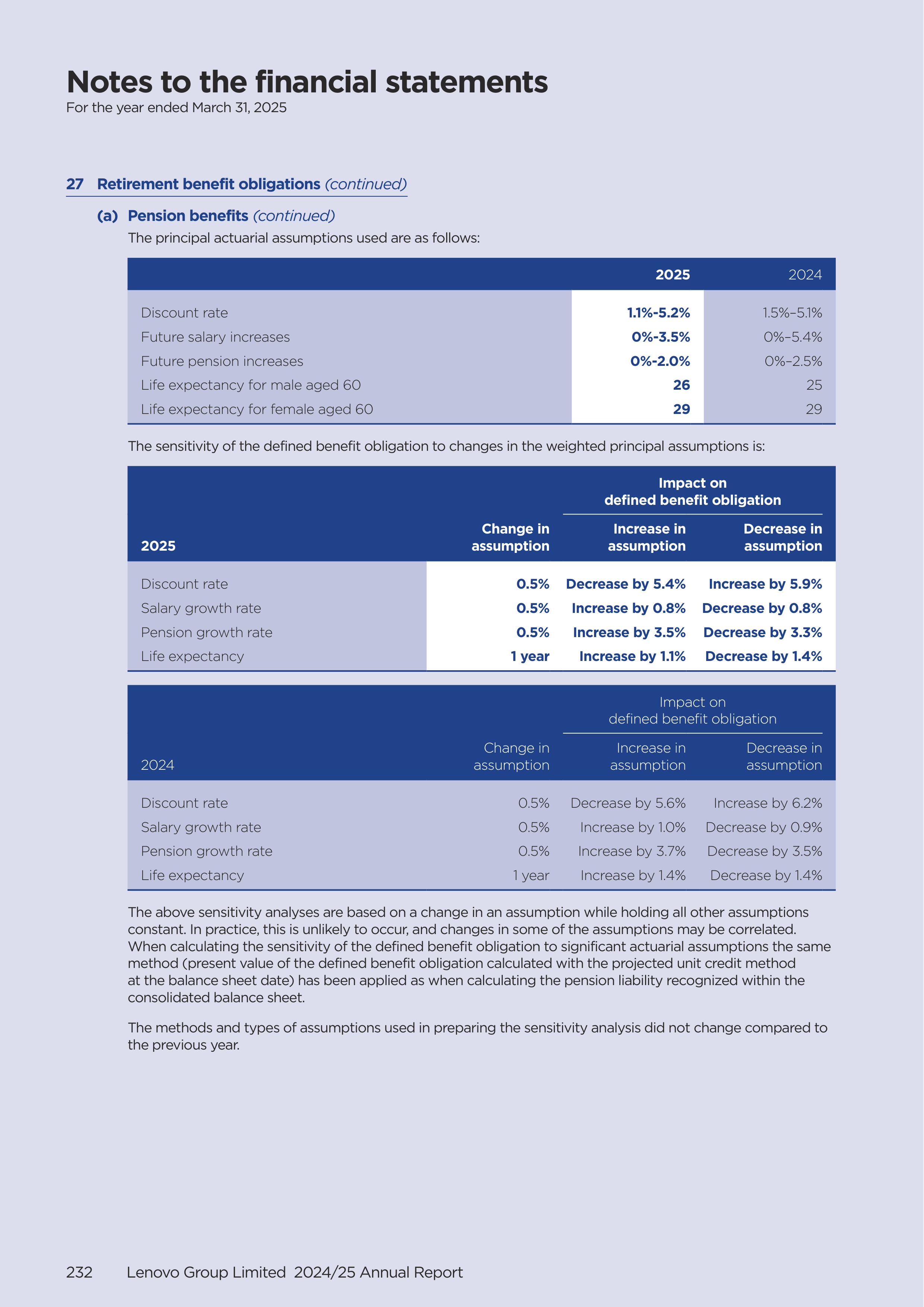
Notes to the financial statements
For the year ended March 31, 2025
Lenovo Group Limited 2024/25 Annual Report
232
27
Retirement benefit obligations
(continued)
(a)
Pension benefits
(continued)
The principal actuarial assumptions used are as follows:
2025
2024
Discount rate
1.1%-5.2%
1.5%–5.1%
Future salary increases
0%-3.5%
0%–5.4%
Future pension increases
0%-2.0%
0%–2.5%
Life expectancy for male aged 60
26
25
Life expectancy for female aged 60
29
29
The sensitivity of the defined benefit obligation to changes in the weighted principal assumptions is:
Impact on
defined benefit obligation
2025
Change in
assumption
Increase in
assumption
Decrease in
assumption
Discount rate
0.5%
Decrease by 5.4%
Increase by 5.9%
Salary growth rate
0.5%
Increase by 0.8%
Decrease by 0.8%
Pension growth rate
0.5%
Increase by 3.5%
Decrease by 3.3%
Life expectancy
1 year
Increase by 1.1%
Decrease by 1.4%
Impact on
defined benefit obligation
2024
Change in
assumption
Increase in
assumption
Decrease in
assumption
Discount rate
0.5%
Decrease by 5.6%
Increase by 6.2%
Salary growth rate
0.5%
Increase by 1.0%
Decrease by 0.9%
Pension growth rate
0.5%
Increase by 3.7%
Decrease by 3.5%
Life expectancy
1 year
Increase by 1.4%
Decrease by 1.4%
The above sensitivity analyses are based on a change in an assumption while holding all other assumptions
constant. In practice, this is unlikely to occur, and changes in some of the assumptions may be correlated.
When calculating the sensitivity of the defined benefit obligation to significant actuarial assumptions the same
method (present value of the defined benefit obligation calculated with the projected unit credit method
at the balance sheet date) has been applied as when calculating the pension liability recognized within the
consolidated balance sheet.
The methods and types of assumptions used in preparing the sensitivity analysis did not change compared to
the previous year.
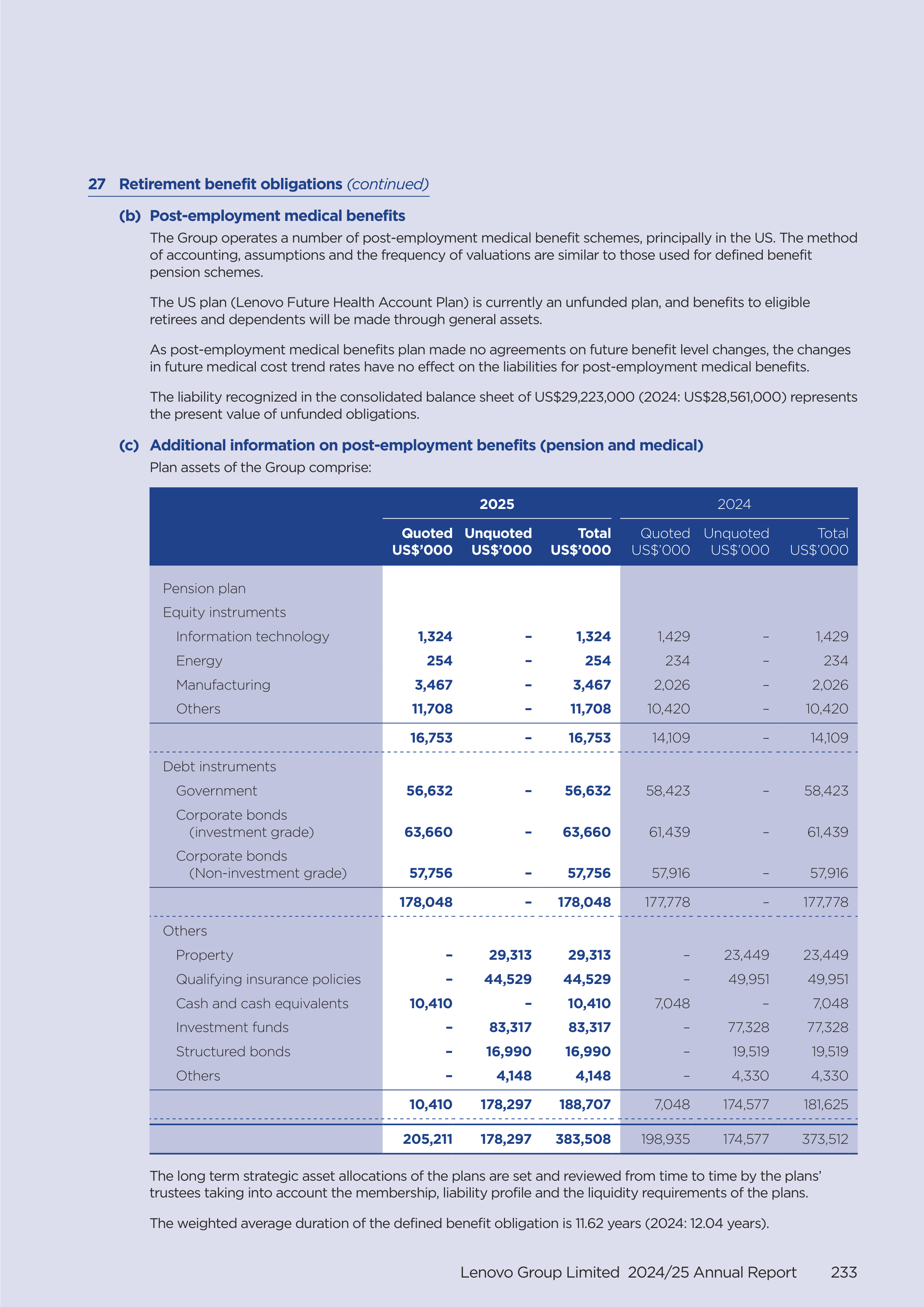
Lenovo Group Limited 2024/25 Annual Report
233
27
Retirement benefit obligations
(continued)
(b) Post-employment medical benefits
The Group operates a number of post-employment medical benefit schemes, principally in the US. The method
of accounting, assumptions and the frequency of valuations are similar to those used for defined benefit
pension schemes.
The US plan (Lenovo Future Health Account Plan) is currently an unfunded plan, and benefits to eligible
retirees and dependents will be made through general assets.
As post-employment medical benefits plan made no agreements on future benefit level changes, the changes
in future medical cost trend rates have no effect on the liabilities for post-employment medical benefits.
The liability recognized in the consolidated balance sheet of US$29,223,000 (2024: US$28,561,000) represents
the present value of unfunded obligations.
(c)
Additional information on post-employment benefits (pension and medical)
Plan assets of the Group comprise:
2025
2024
Quoted
US$’000
Unquoted
US$’000
Total
US$’000
Quoted
US$’000
Unquoted
US$’000
Total
US$’000
Pension plan
Equity instruments
Information technology
1,324
–
1,324
1,429
–
1,429
Energy
254
–
254
234
–
234
Manufacturing
3,467
–
3,467
2,026
–
2,026
Others
11,708
–
11,708
10,420
–
10,420
16,753
–
16,753
14,109
–
14,109
Debt instruments
Government
56,632
–
56,632
58,423
–
58,423
Corporate bonds
(investment grade)
63,660
–
63,660
61,439
–
61,439
Corporate bonds
(Non-investment grade)
57,756
–
57,756
57,916
–
57,916
178,048
–
178,048
177,778
–
177,778
Others
Property
–
29,313
29,313
–
23,449
23,449
Qualifying insurance policies
–
44,529
44,529
–
49,951
49,951
Cash and cash equivalents
10,410
–
10,410
7,048
–
7,048
Investment funds
–
83,317
83,317
–
77,328
77,328
Structured bonds
–
16,990
16,990
–
19,519
19,519
Others
–
4,148
4,148
–
4,330
4,330
10,410
178,297
188,707
7,048
174,577
181,625
205,211
178,297
383,508
198,935
174,577
373,512
The long term strategic asset allocations of the plans are set and reviewed from time to time by the plans’
trustees taking into account the membership, liability profile and the liquidity requirements of the plans.
The weighted average duration of the defined benefit obligation is 11.62 years (2024: 12.04 years).
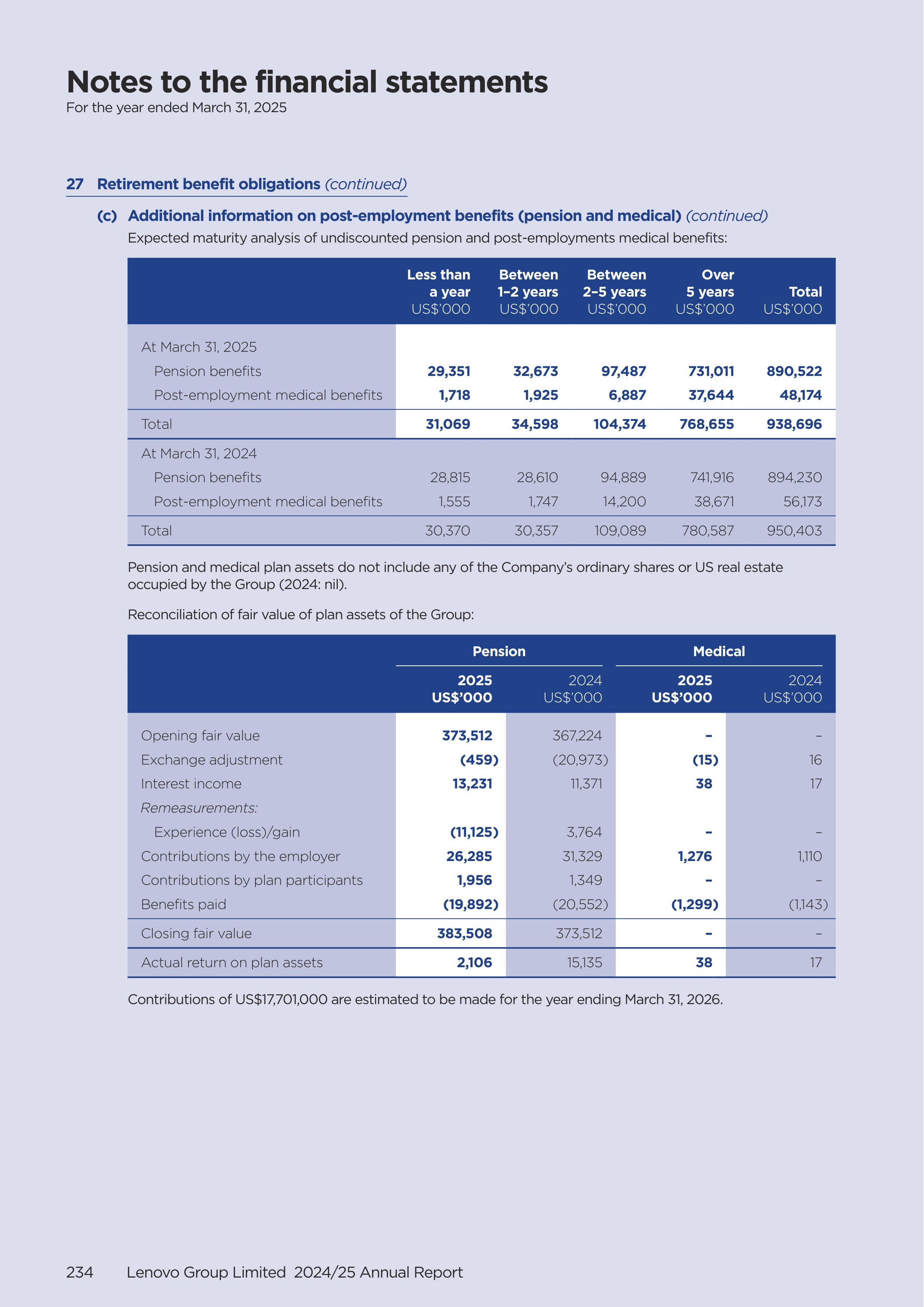
Notes to the financial statements
For the year ended March 31, 2025
Lenovo Group Limited 2024/25 Annual Report
234
27
Retirement benefit obligations
(continued)
(c)
Additional information on post-employment benefits (pension and medical)
(continued)
Expected maturity analysis of undiscounted pension and post-employments medical benefits:
Less than
a year
US$’000
Between
1–2 years
US$’000
Between
2–5 years
US$’000
Over
5 years
US$’000
Total
US$’000
At March 31, 2025
Pension benefits
29,351
32,673
97,487
731,011
890,522
Post-employment medical benefits
1,718
1,925
6,887
37,644
48,174
Total
31,069
34,598
104,374
768,655
938,696
At March 31, 2024
Pension benefits
28,815
28,610
94,889
741,916
894,230
Post-employment medical benefits
1,555
1,747
14,200
38,671
56,173
Total
30,370
30,357
109,089
780,587
950,403
Pension and medical plan assets do not include any of the Company’s ordinary shares or US real estate
occupied by the Group (2024: nil).
Reconciliation of fair value of plan assets of the Group:
Pension
Medical
2025
US$’000
2024
US$’000
2025
US$’000
2024
US$’000
Opening fair value
373,512
367,224
–
–
Exchange adjustment
(459 )
(20,973)
(15)
16
Interest income
13,231
11,371
38
17
Remeasurements:
Experience (loss)/gain
(11,125)
3,764
–
–
Contributions by the employer
26,285
31,329
1,276
1,110
Contributions by plan participants
1,956
1,349
–
–
Benefits paid
(19,892)
(20,552)
(1,299)
(1,143)
Closing fair value
383,508
373,512
–
–
Actual return on plan assets
2,106
15,135
38
17
Contributions of US$17,701,000 are estimated to be made for the year ending March 31, 2026.
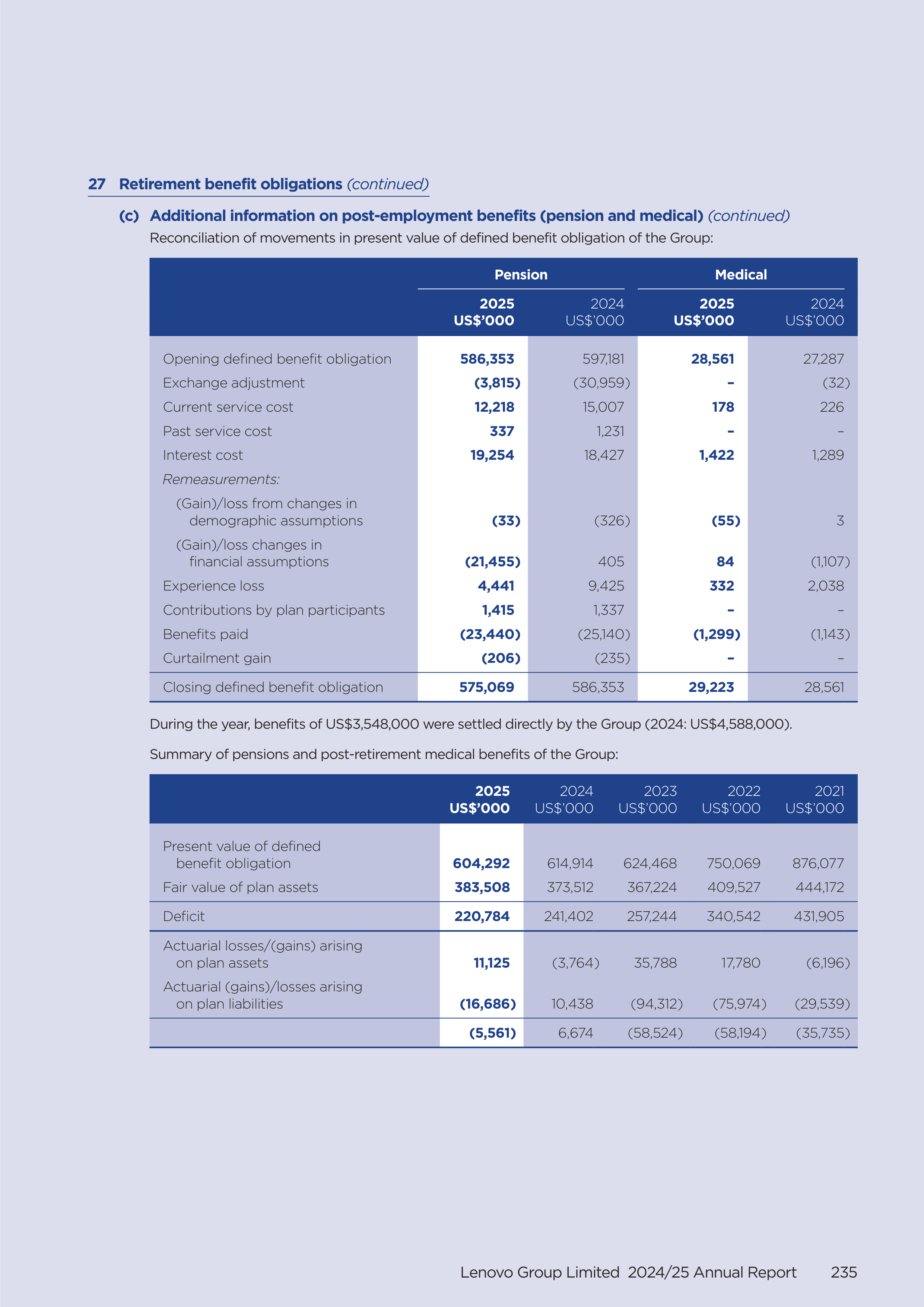
Lenovo Group Limited 2024/25 Annual Report
235
27
Retirement benefit obligations
(continued)
(c)
Additional information on post-employment benefits (pension and medical)
(continued)
Reconciliation of movements in present value of defined benefit obligation of the Group:
Pension
Medical
2025
US$’000
2024
US$’000
2025
US$’000
2024
US$’000
Opening defined benefit obligation
586,353
597,181
28,561
27,287
Exchange adjustment
(3,815)
(30,959)
–
(32)
Current service cost
12,218
15,007
178
226
Past service cost
337
1,231
–
–
Interest cost
19,254
18,427
1,422
1,289
Remeasurements:
(Gain)/loss from changes in
demographic assumptions
(33)
(326)
(55)
3
(Gain)/loss changes in
financial assumptions
(21,455)
405
84
(1,107)
Experience loss
4,441
9,425
332
2,038
Contributions by plan participants
1,415
1,337
–
–
Benefits paid
(23,440)
(25,140)
(1,299)
(1,143)
Curtailment gain
(206)
(235)
–
–
Closing defined benefit obligation
575,069
586,353
29,223
28,561
During the year, benefits of US$3,548,000 were settled directly by the Group (2024: US$4,588,000).
Summary of pensions and post-retirement medical benefits of the Group:
2025
US$’000
2024
US$’000
2023
US$’000
2022
US$’000
2021
US$’000
Present value of defined
benefit obligation
604,292
614,914
624,468
750,069
876,077
Fair value of plan assets
383,508
373,512
367,224
409,527
444,172
Deficit
220,784
241,402
257,244
340,542
431,905
Actuarial losses/(gains) arising
on plan assets
11,125
(3,764)
35,788
17,780
(6,196)
Actuarial (gains)/losses arising
on plan liabilities
(16,686)
10,438
(94,312)
(75,974)
(29,539)
(5,561)
6,674
(58,524)
(58,194)
(35,735)
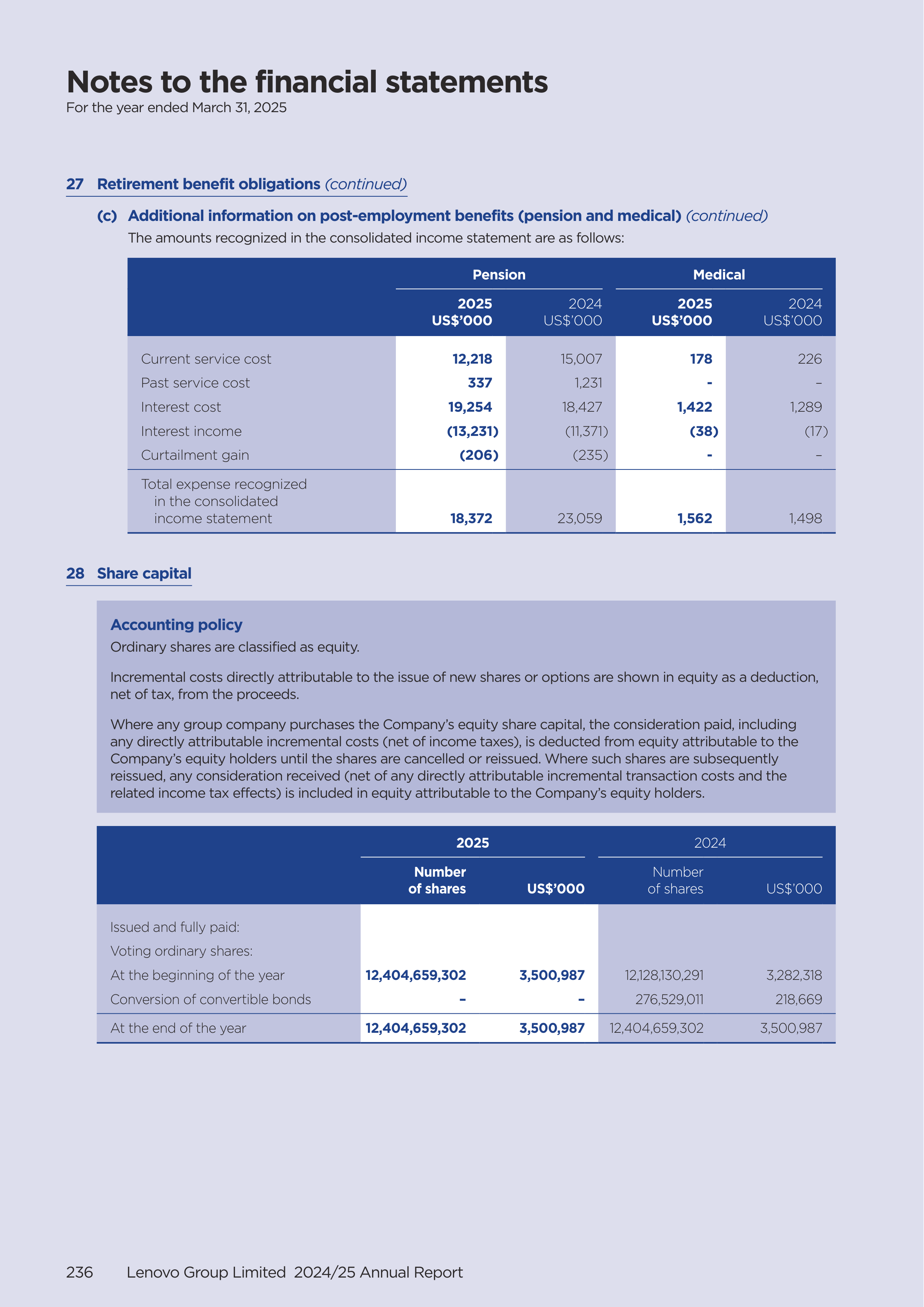
Notes to the financial statements
For the year ended March 31, 2025
Lenovo Group Limited 2024/25 Annual Report
236
27
Retirement benefit obligations
(continued)
(c)
Additional information on post-employment benefits (pension and medical)
(continued)
The amounts recognized in the consolidated income statement are as follows:
Pension
Medical
2025
US$’000
2024
US$’000
2025
US$’000
2024
US$’000
Current service cost
12,218
15,007
178
226
Past service cost
337
1,231
-
–
Interest cost
19,254
18,427
1,422
1,289
Interest income
(13,231)
(11,371)
(38)
(17)
Curtailment gain
(206)
(235)
-
–
Total expense recognized
in the consolidated
income statement
18,372
23,059
1,562
1,498
28
Share capital
Accounting policy
Ordinary shares are classified as equity.
Incremental costs directly attributable to the issue of new shares or options are shown in equity as a deduction,
net of tax, from the proceeds.
Where any group company purchases the Company’s equity share capital, the consideration paid, including
any directly attributable incremental costs (net of income taxes), is deducted from equity attributable to the
Company’s equity holders until the shares are cancelled or reissued. Where such shares are subsequently
reissued, any consideration received (net of any directly attributable incremental transaction costs and the
related income tax effects) is included in equity attributable to the Company’s equity holders.
2025
2024
Number
of shares
US$’000
Number
of shares
US$’000
Issued and fully paid:
Voting ordinary shares:
At the beginning of the year
12,404,659,302
3,500,987
12,128,130,291
3,282,318
Conversion of convertible bonds
–
–
276,529,011
218,669
At the end of the year
12,404,659,302
3,500,987
12,404,659,302
3,500,987
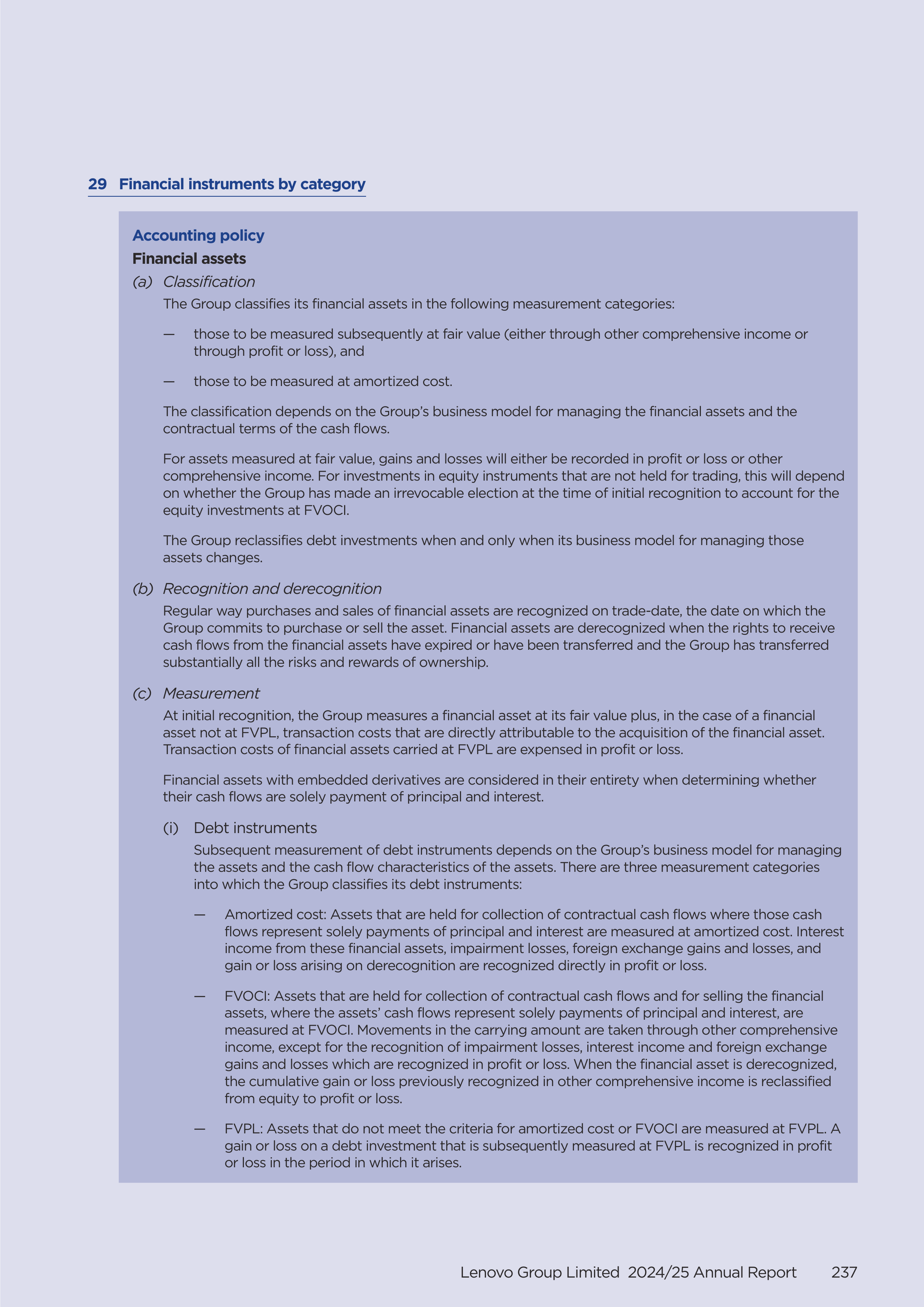
Lenovo Group Limited 2024/25 Annual Report
237
29
Financial instruments by category
Accounting policy
Financial assets
(a)
Classification
The Group classifies its financial assets in the following measurement categories:
—
those to be measured subsequently at fair value (either through other comprehensive income or
through profit or loss), and
—
those to be measured at amortized cost.
The classification depends on the Group’s business model for managing the financial assets and the
contractual terms of the cash flows.
For assets measured at fair value, gains and losses will either be recorded in profit or loss or other
comprehensive income. For investments in equity instruments that are not held for trading, this will depend
on whether the Group has made an irrevocable election at the time of initial recognition to account for the
equity investments at FVOCI.
The Group reclassifies debt investments when and only when its business model for managing those
assets changes.
(b)
Recognition and derecognition
Regular way purchases and sales of financial assets are recognized on trade-date, the date on which the
Group commits to purchase or sell the asset. Financial assets are derecognized when the rights to receive
cash flows from the financial assets have expired or have been transferred and the Group has transferred
substantially all the risks and rewards of ownership.
(c)
Measurement
At initial recognition, the Group measures a financial asset at its fair value plus, in the case of a financial
asset not at FVPL, transaction costs that are directly attributable to the acquisition of the financial asset.
Transaction costs of financial assets carried at FVPL are expensed in profit or loss.
Financial assets with embedded derivatives are considered in their entirety when determining whether
their cash flows are solely payment of principal and interest.
(i)
Debt instruments
Subsequent measurement of debt instruments depends on the Group’s business model for managing
the assets and the cash flow characteristics of the assets. There are three measurement categories
into which the Group classifies its debt instruments:
—
Amortized cost: Assets that are held for collection of contractual cash flows where those cash
flows represent solely payments of principal and interest are measured at amortized cost. Interest
income from these financial assets, impairment losses, foreign exchange gains and losses, and
gain or loss arising on derecognition are recognized directly in profit or loss.
—
FVOCI: Assets that are held for collection of contractual cash flows and for selling the financial
assets, where the assets’ cash flows represent solely payments of principal and interest, are
measured at FVOCI. Movements in the carrying amount are taken through other comprehensive
income, except for the recognition of impairment losses, interest income and foreign exchange
gains and losses which are recognized in profit or loss. When the financial asset is derecognized,
the cumulative gain or loss previously recognized in other comprehensive income is reclassified
from equity to profit or loss.
—
FVPL: Assets that do not meet the criteria for amortized cost or FVOCI are measured at FVPL. A
gain or loss on a debt investment that is subsequently measured at FVPL is recognized in profit
or loss in the period in which it arises.
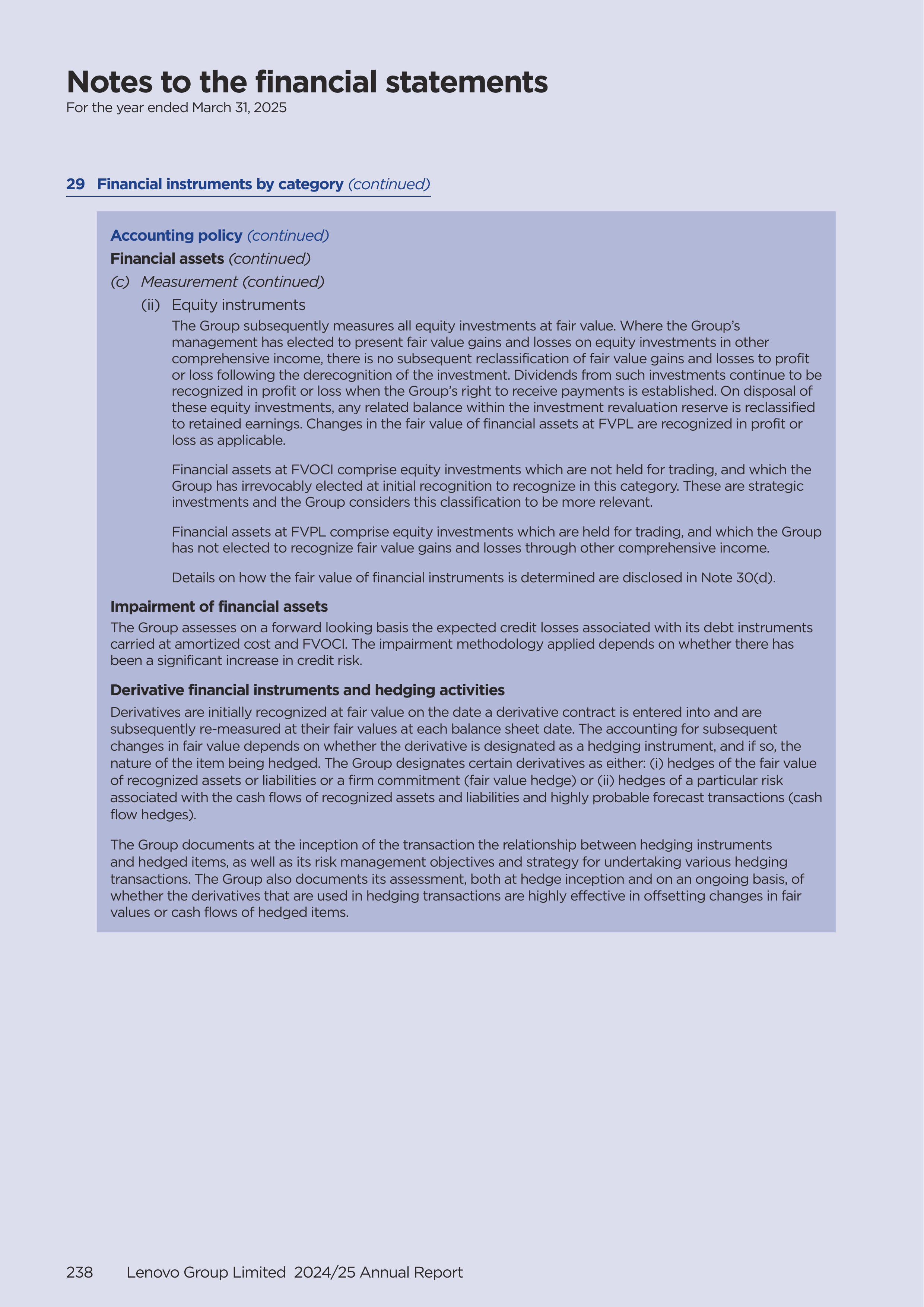
Notes to the financial statements
For the year ended March 31, 2025
Lenovo Group Limited 2024/25 Annual Report
238
29
Financial instruments by category
(continued)
Accounting policy
(continued)
Financial assets
(continued)
(c)
Measurement (continued)
(ii)
Equity instruments
The Group subsequently measures all equity investments at fair value. Where the Group’s
management has elected to present fair value gains and losses on equity investments in other
comprehensive income, there is no subsequent reclassification of fair value gains and losses to profit
or loss following the derecognition of the investment. Dividends from such investments continue to be
recognized in profit or loss when the Group’s right to receive payments is established. On disposal of
these equity investments, any related balance within the investment revaluation reserve is reclassified
to retained earnings. Changes in the fair value of financial assets at FVPL are recognized in profit or
loss as applicable.
Financial assets at FVOCI comprise equity investments which are not held for trading, and which the
Group has irrevocably elected at initial recognition to recognize in this category. These are strategic
investments and the Group considers this classification to be more relevant.
Financial assets at FVPL comprise equity investments which are held for trading, and which the Group
has not elected to recognize fair value gains and losses through other comprehensive income.
Details on how the fair value of financial instruments is determined are disclosed in Note 30(d).
Impairment of financial assets
The Group assesses on a forward looking basis the expected credit losses associated with its debt instruments
carried at amortized cost and FVOCI. The impairment methodology applied depends on whether there has
been a significant increase in credit risk.
Derivative financial instruments and hedging activities
Derivatives are initially recognized at fair value on the date a derivative contract is entered into and are
subsequently re-measured at their fair values at each balance sheet date. The accounting for subsequent
changes in fair value depends on whether the derivative is designated as a hedging instrument, and if so, the
nature of the item being hedged. The Group designates certain derivatives as either: (i) hedges of the fair value
of recognized assets or liabilities or a firm commitment (fair value hedge) or (ii) hedges of a particular risk
associated with the cash flows of recognized assets and liabilities and highly probable forecast transactions (cash
flow hedges).
The Group documents at the inception of the transaction the relationship between hedging instruments
and hedged items, as well as its risk management objectives and strategy for undertaking various hedging
transactions. The Group also documents its assessment, both at hedge inception and on an ongoing basis, of
whether the derivatives that are used in hedging transactions are highly effective in offsetting changes in fair
values or cash flows of hedged items.
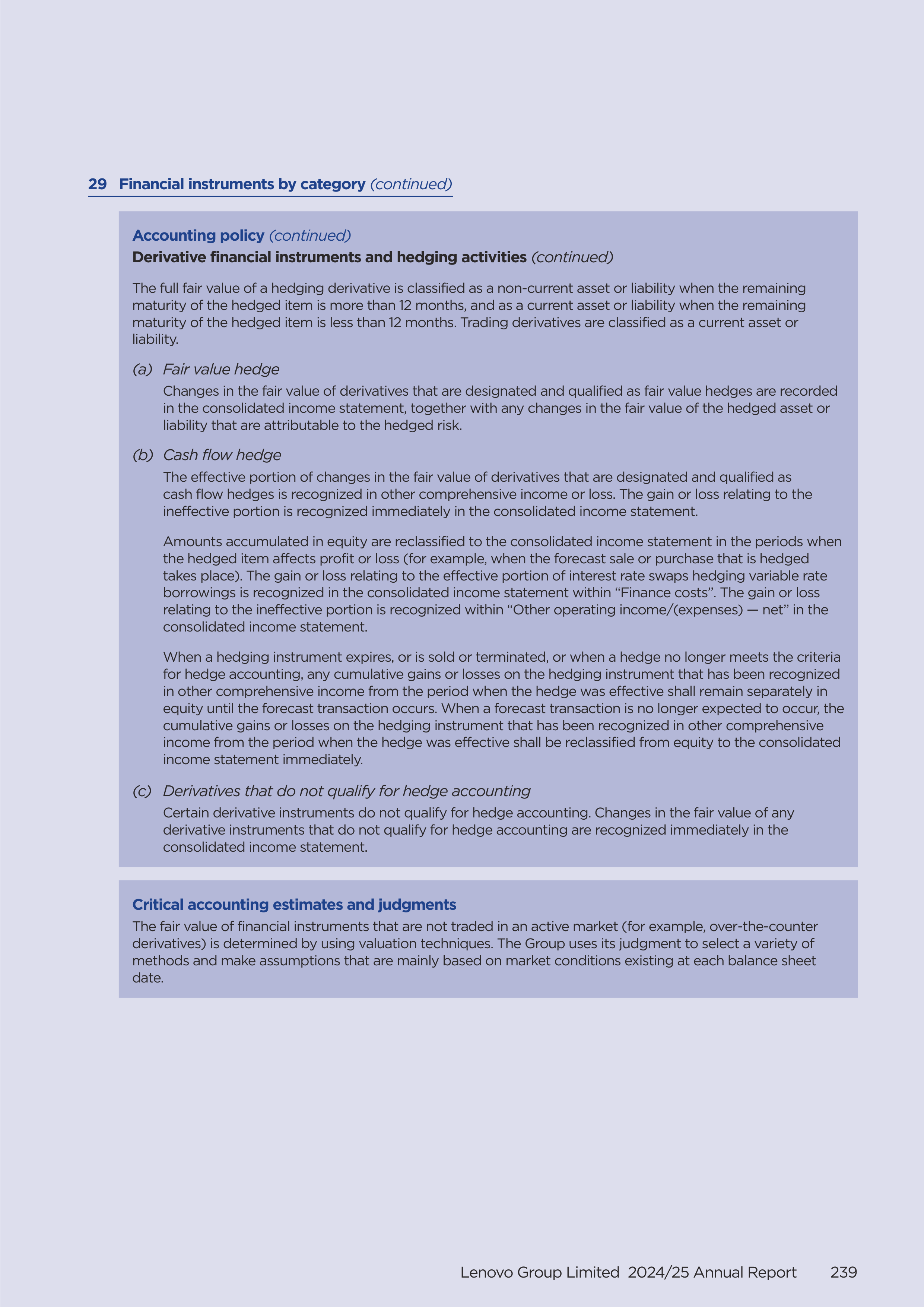
Lenovo Group Limited 2024/25 Annual Report
239
29
Financial instruments by category
(continued)
Accounting policy
(continued)
Derivative financial instruments and hedging activities
(continued)
The full fair value of a hedging derivative is classified as a non-current asset or liability when the remaining
maturity of the hedged item is more than 12 months, and as a current asset or liability when the remaining
maturity of the hedged item is less than 12 months. Trading derivatives are classified as a current asset or
liability.
(a)
Fair value hedge
Changes in the fair value of derivatives that are designated and qualified as fair value hedges are recorded
in the consolidated income statement, together with any changes in the fair value of the hedged asset or
liability that are attributable to the hedged risk.
(b)
Cash flow hedge
The effective portion of changes in the fair value of derivatives that are designated and qualified as
cash flow hedges is recognized in other comprehensive income or loss. The gain or loss relating to the
ineffective portion is recognized immediately in the consolidated income statement.
Amounts accumulated in equity are reclassified to the consolidated income statement in the periods when
the hedged item affects profit or loss (for example, when the forecast sale or purchase that is hedged
takes place). The gain or loss relating to the effective portion of interest rate swaps hedging variable rate
borrowings is recognized in the consolidated income statement within “Finance costs”. The gain or loss
relating to the ineffective portion is recognized within “Other operating income/(expenses) — net” in the
consolidated income statement.
When a hedging instrument expires, or is sold or terminated, or when a hedge no longer meets the criteria
for hedge accounting, any cumulative gains or losses on the hedging instrument that has been recognized
in other comprehensive income from the period when the hedge was effective shall remain separately in
equity until the forecast transaction occurs. When a forecast transaction is no longer expected to occur, the
cumulative gains or losses on the hedging instrument that has been recognized in other comprehensive
income from the period when the hedge was effective shall be reclassified from equity to the consolidated
income statement immediately.
(c)
Derivatives that do not qualify for hedge accounting
Certain derivative instruments do not qualify for hedge accounting. Changes in the fair value of any
derivative instruments that do not qualify for hedge accounting are recognized immediately in the
consolidated income statement.
Critical accounting estimates and judgments
The fair value of financial instruments that are not traded in an active market (for example, over-the-counter
derivatives) is determined by using valuation techniques. The Group uses its judgment to select a variety of
methods and make assumptions that are mainly based on market conditions existing at each balance sheet
date.
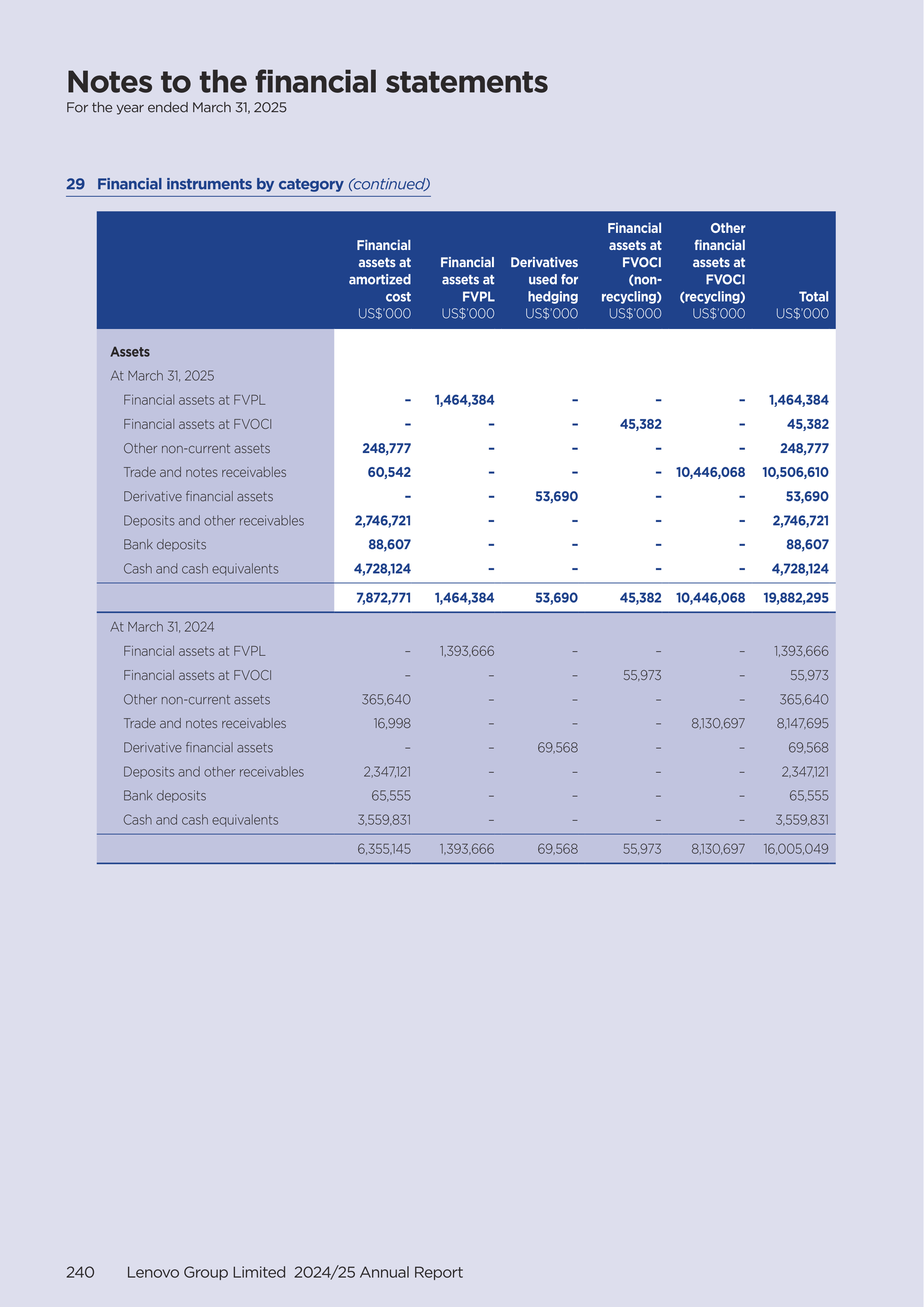
Notes to the financial statements
For the year ended March 31, 2025
Lenovo Group Limited 2024/25 Annual Report
240
29
Financial instruments by category
(continued)
Financial
assets at
amortized
cost
US$’000
Financial
assets at
FVPL
US$’000
Derivatives
used for
hedging
US$’000
Financial
assets at
FVOCI
(non-
recycling)
US$’000
Other
financial
assets at
FVOCI
(recycling)
US$’000
Total
US$’000
Assets
At March 31, 2025
Financial assets at FVPL
–
1,464,384
–
–
–
1,464,384
Financial assets at FVOCI
–
–
–
45,382
–
45,382
Other non-current assets
248,777
–
–
–
–
248,777
Trade and notes receivables
60,542
–
–
–
10,446,068
10,506,610
Derivative financial assets
–
–
53,690
–
–
53,690
Deposits and other receivables
2,746,721
–
–
–
–
2,746,721
Bank deposits
88,607
–
–
–
–
88,607
Cash and cash equivalents
4,728,124
–
–
–
–
4,728,124
7,872,771
1,464,384
53,690
45,382
10,446,068
19,882,295
At March 31, 2024
Financial assets at FVPL
–
1,393,666
–
–
–
1,393,666
Financial assets at FVOCI
–
–
–
55,973
–
55,973
Other non-current assets
365,640
–
–
–
–
365,640
Trade and notes receivables
16,998
–
–
–
8,130,697
8,147,695
Derivative financial assets
–
–
69,568
–
–
69,568
Deposits and other receivables
2,347,121
–
–
–
–
2,347,121
Bank deposits
65,555
–
–
–
–
65,555
Cash and cash equivalents
3,559,831
–
–
–
–
3,559,831
6,355,145
1,393,666
69,568
55,973
8,130,697
16,005,049
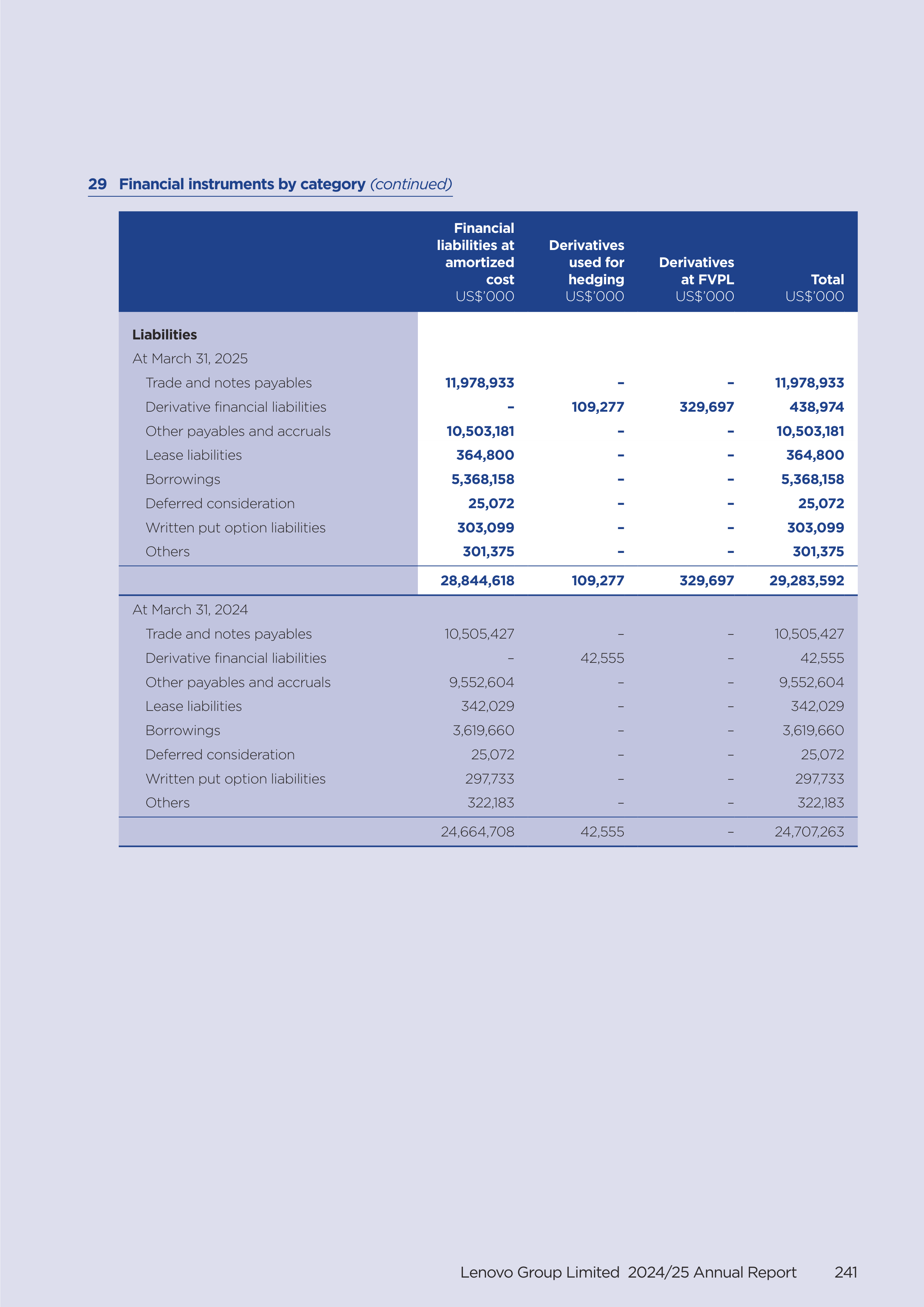
Lenovo Group Limited 2024/25 Annual Report
241
29
Financial instruments by category
(continued)
Financial
liabilities at
amortized
cost
US$’000
Derivatives
used for
hedging
US$’000
Derivatives
at FVPL
US$’000
Total
US$’000
Liabilities
At March 31, 2025
Trade and notes payables
11,978,933
–
–
11,978,933
Derivative financial liabilities
–
109,277
329,697
438,974
Other payables and accruals
10,503,181
–
–
10,503,181
Lease liabilities
364,800
–
–
364,800
Borrowings
5,368,158
–
–
5,368,158
Deferred consideration
25,072
–
–
25,072
Written put option liabilities
303,099
–
–
303,099
Others
301,375
–
–
301,375
28,844,618
109,277
329,697
29,283,592
At March 31, 2024
Trade and notes payables
10,505,427
–
–
10,505,427
Derivative financial liabilities
–
42,555
–
42,555
Other payables and accruals
9,552,604
–
–
9,552,604
Lease liabilities
342,029
–
–
342,029
Borrowings
3,619,660
–
–
3,619,660
Deferred consideration
25,072
–
–
25,072
Written put option liabilities
297,733
–
–
297,733
Others
322,183
–
–
322,183
24,664,708
42,555
–
24,707,263
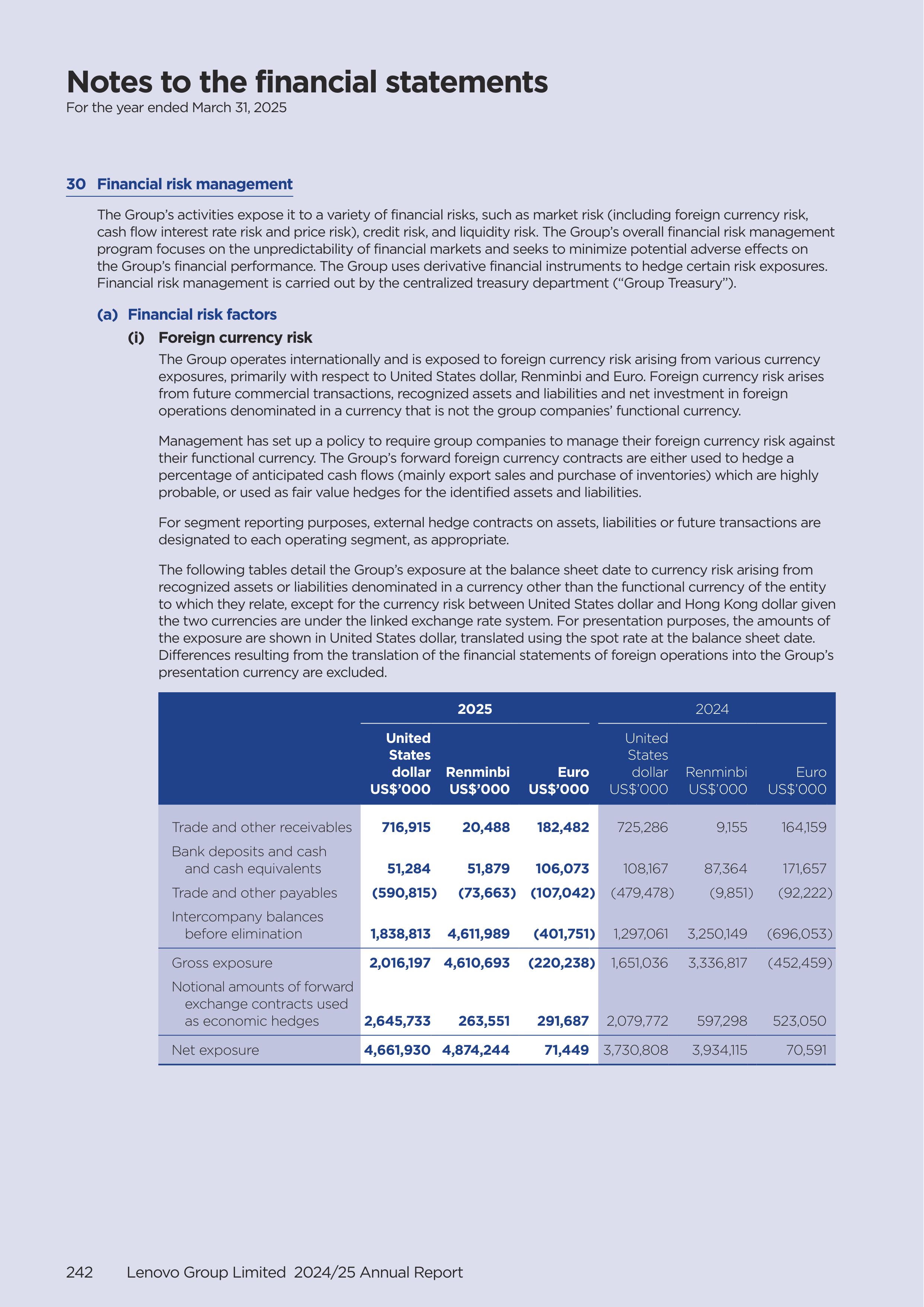
Notes to the financial statements
For the year ended March 31, 2025
Lenovo Group Limited 2024/25 Annual Report
242
30
Financial risk management
The Group’s activities expose it to a variety of financial risks, such as market risk (including foreign currency risk,
cash flow interest rate risk and price risk), credit risk, and liquidity risk. The Group’s overall financial risk management
program focuses on the unpredictability of financial markets and seeks to minimize potential adverse effects on
the Group’s financial performance. The Group uses derivative financial instruments to hedge certain risk exposures.
Financial risk management is carried out by the centralized treasury department (“Group Treasury”).
(a)
Financial risk factors
(i)
Foreign currency risk
The Group operates internationally and is exposed to foreign currency risk arising from various currency
exposures, primarily with respect to United States dollar, Renminbi and Euro. Foreign currency risk arises
from future commercial transactions, recognized assets and liabilities and net investment in foreign
operations denominated in a currency that is not the group companies’ functional currency.
Management has set up a policy to require group companies to manage their foreign currency risk against
their functional currency. The Group’s forward foreign currency contracts are either used to hedge a
percentage of anticipated cash flows (mainly export sales and purchase of inventories) which are highly
probable, or used as fair value hedges for the identified assets and liabilities.
For segment reporting purposes, external hedge contracts on assets, liabilities or future transactions are
designated to each operating segment, as appropriate.
The following tables detail the Group’s exposure at the balance sheet date to currency risk arising from
recognized assets or liabilities denominated in a currency other than the functional currency of the entity
to which they relate, except for the currency risk between United States dollar and Hong Kong dollar given
the two currencies are under the linked exchange rate system. For presentation purposes, the amounts of
the exposure are shown in United States dollar, translated using the spot rate at the balance sheet date.
Differences resulting from the translation of the financial statements of foreign operations into the Group’s
presentation currency are excluded.
2025
2024
United
States
dollar
US$’000
Renminbi
US$’000
Euro
US$’000
United
States
dollar
US$’000
Renminbi
US$’000
Euro
US$’000
Trade and other receivables
716,915
20,488
182,482
725,286
9,155
164,159
Bank deposits and cash
and cash equivalents
51,284
51,879
106,073
108,167
87,364
171,657
Trade and other payables
(590,815)
(73,663)
(107,042)
(479,478)
(9,851)
(92,222)
Intercompany balances
before elimination
1,838,813
4,611,989
(401,751)
1,297,061
3,250,149
(696,053)
Gross exposure
2,016,197
4,610,693
(220,238)
1,651,036
3,336,817
(452,459)
Notional amounts of forward
exchange contracts used
as economic hedges
2,645,733
263,551
291,687
2,079,772
597,298
523,050
Net exposure
4,661,930
4,874,244
71,449
3,730,808
3,934,115
70,591
Lenovo Group Limited 2024/25 Annual Report
243
30
Financial risk management
(continued)
(a)
Financial risk factors
(continued)
(ii)
Cash flow interest rate risk
The Group’s interest rate risk generally arises from short-term and long-term borrowings denominated
in United States dollar. It is the Group’s policy to mitigate interest rate risk through the use of appropriate
interest rate hedging instruments when necessary. Generally, the Group manages its cash flow interest rate
risk by using floating-to-fixed interest rate swaps. Such interest rate swaps have the economic effect of
converting borrowings from floating rates to fixed rates. Under the interest rate swaps, the Group agrees
with other parties to settle the difference between cash flow arising from fixed contract rates and floating-
rate interest of the notional amounts at specified intervals (primarily quarterly).
The Group participates in various trade financing programs. The Group is exposed to fluctuation of
interest rates of all the currencies covered by those programs.
(iii) Price risk
The Group’s exposure to equity securities price risk arises from investments held by the Group and
classified in the consolidated balance sheet either as financial assets at FVPL (Note 17(a)) or FVOCI (Note
17(b)).
To manage its price risk arising from investments in equity securities, the Group diversifies its portfolio.
Diversification of the portfolio is done in accordance with the limits set by the Group.
The Group’s listed equity investments are determined based on respective quoted market prices. The fair
value of unlisted equity investments is determined based on valuation techniques, please refer to Note
30(d) for details.
(iv) Credit risk
Credit risk is managed on a group basis. Credit risk arises from cash and cash equivalents, derivative
financial instruments, notes receivable, other receivables and deposits with banks and financial institutions,
as well as credit exposures to customers and subcontractors, including outstanding receivables and
committed transactions.
For banks and other financial institutions, the Group controls its credit risk through monitoring their credit
rating and setting approved counterparty credit limits that are regularly reviewed.
The Group has no significant concentration of customer credit risk. The Group has a credit policy in place
and exposures to these credit risks are monitored on an ongoing basis. No credit limits were exceeded by
any customers and subcontractors during the reporting period, and management does not expect any
significant losses from non-performance by these counterparties.
Except for trade receivables, the Group measures the loss allowance equal to 12 months expected credit
loss, unless when there has been a significant increase in credit risk since initial recognition, the Group
recognizes lifetime expected credit loss. The expected credit loss was minimal.
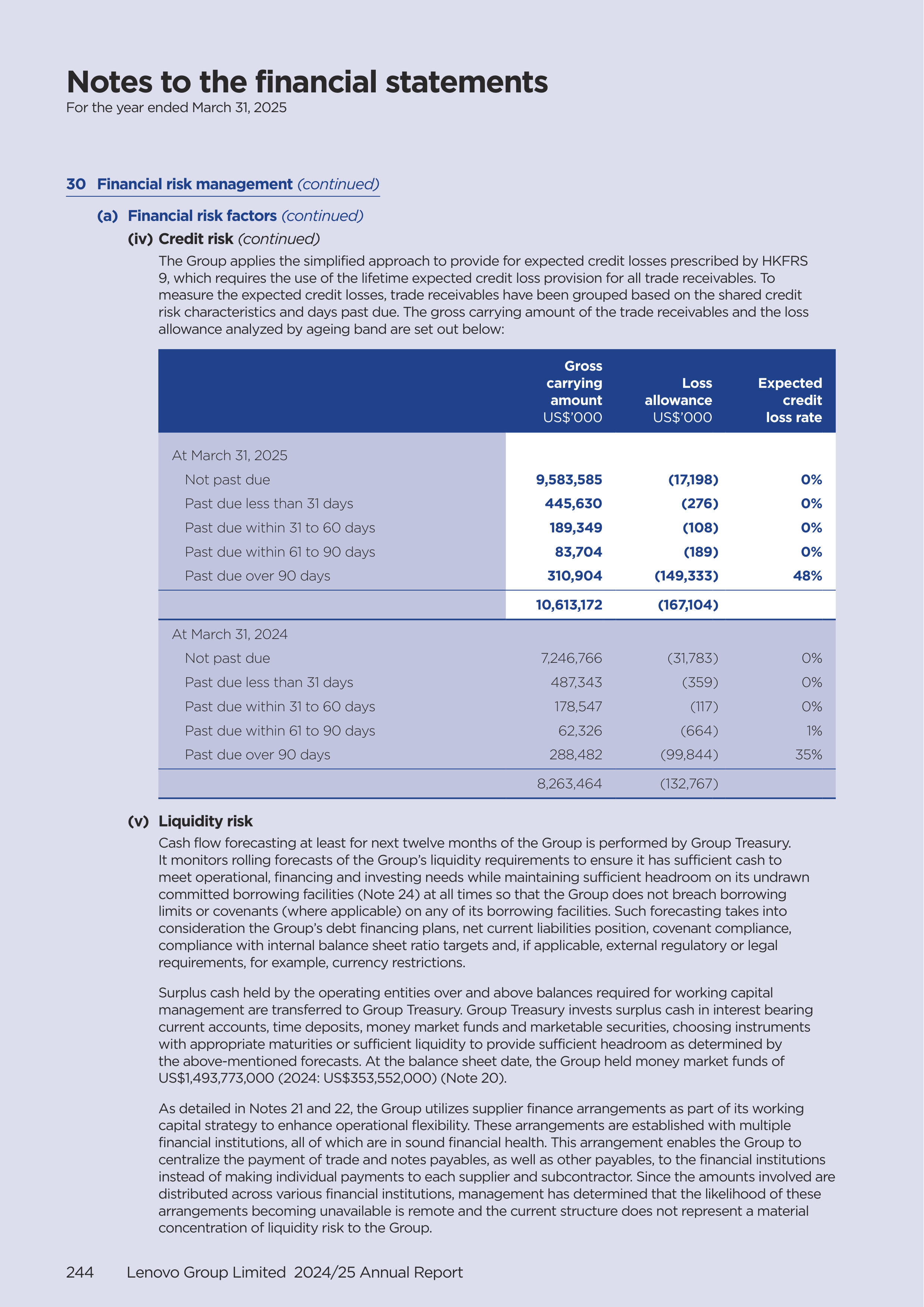
Notes to the financial statements
For the year ended March 31, 2025
Lenovo Group Limited 2024/25 Annual Report
244
30
Financial risk management
(continued)
(a)
Financial risk factors
(continued)
(iv) Credit risk
(continued)
The Group applies the simplified approach to provide for expected credit losses prescribed by HKFRS
9, which requires the use of the lifetime expected credit loss provision for all trade receivables. To
measure the expected credit losses, trade receivables have been grouped based on the shared credit
risk characteristics and days past due. The gross carrying amount of the trade receivables and the loss
allowance analyzed by ageing band are set out below:
Gross
carrying
amount
US$’000
Loss
allowance
US$’000
Expected
credit
loss rate
At March 31, 2025
Not past due
9,583,585
(17,198 )
0%
Past due less than 31 days
445,630
(276 )
0%
Past due within 31 to 60 days
189,349
(108 )
0%
Past due within 61 to 90 days
83,704
(189 )
0%
Past due over 90 days
310,904
(149,333 )
48%
10,613,172
(167,104 )
At March 31, 2024
Not past due
7,246,766
(31,783)
0%
Past due less than 31 days
487,343
(359)
0%
Past due within 31 to 60 days
178,547
(117)
0%
Past due within 61 to 90 days
62,326
(664)
1%
Past due over 90 days
288,482
(99,844)
35%
8,263,464
(132,767)
(v)
Liquidity risk
Cash flow forecasting at least for next twelve months of the Group is performed by Group Treasury.
It monitors rolling forecasts of the Group’s liquidity requirements to ensure it has sufficient cash to
meet operational, financing and investing needs while maintaining sufficient headroom on its undrawn
committed borrowing facilities (Note 24) at all times so that the Group does not breach borrowing
limits or covenants (where applicable) on any of its borrowing facilities. Such forecasting takes into
consideration the Group’s debt financing plans, net current liabilities position, covenant compliance,
compliance with internal balance sheet ratio targets and, if applicable, external regulatory or legal
requirements, for example, currency restrictions.
Surplus cash held by the operating entities over and above balances required for working capital
management are transferred to Group Treasury. Group Treasury invests surplus cash in interest bearing
current accounts, time deposits, money market funds and marketable securities, choosing instruments
with appropriate maturities or sufficient liquidity to provide sufficient headroom as determined by
the above-mentioned forecasts. At the balance sheet date, the Group held money market funds of
US$1,493,773,000 (2024: US$353,552,000) (Note 20).
As detailed in Notes 21 and 22, the Group utilizes supplier finance arrangements as part of its working
capital strategy to enhance operational flexibility. These arrangements are established with multiple
financial institutions, all of which are in sound financial health. This arrangement enables the Group to
centralize the payment of trade and notes payables, as well as other payables, to the financial institutions
instead of making individual payments to each supplier and subcontractor. Since the amounts involved are
distributed across various financial institutions, management has determined that the likelihood of these
arrangements becoming unavailable is remote and the current structure does not represent a material
concentration of liquidity risk to the Group.
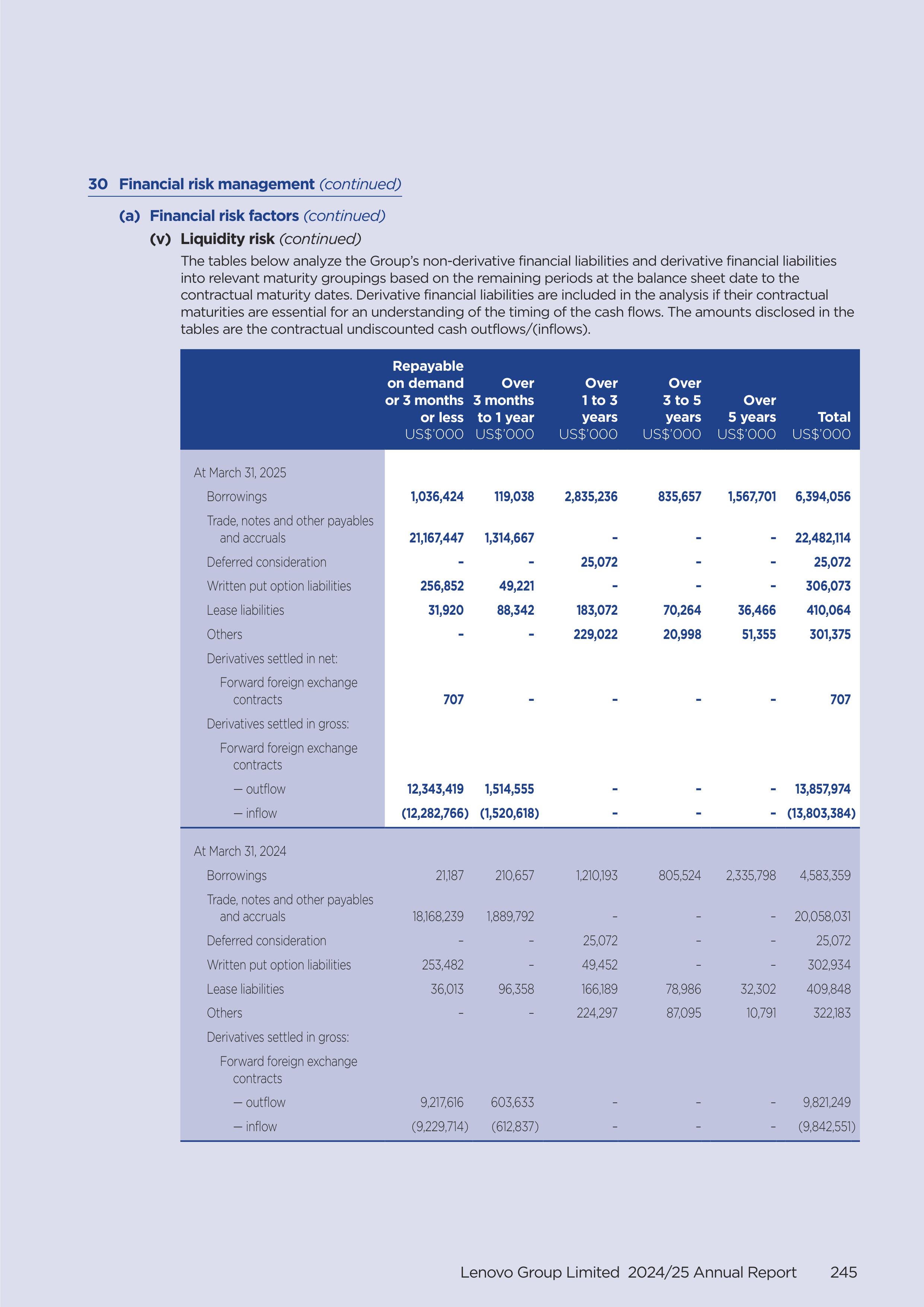
Lenovo Group Limited 2024/25 Annual Report
245
30
Financial risk management
(continued)
(a)
Financial risk factors
(continued)
(v)
Liquidity risk
(continued)
The tables below analyze the Group’s non-derivative financial liabilities and derivative financial liabilities
into relevant maturity groupings based on the remaining periods at the balance sheet date to the
contractual maturity dates. Derivative financial liabilities are included in the analysis if their contractual
maturities are essential for an understanding of the timing of the cash flows. The amounts disclosed in the
tables are the contractual undiscounted cash outflows/(inflows).
Repayable
on demand
or 3 months
or less
US$’000
Over
3 months
to 1 year
US$’000
Over
1 to 3
years
US$’000
Over
3 to 5
years
US$’000
Over
5 years
US$’000
Total
US$’000
At March 31, 2025
Borrowings
1,036,424
119,038
2,835,236
835,657
1,567,701
6,394,056
Trade, notes and other payables
and accruals
21,167,447
1,314,667
–
–
–
22,482,114
Deferred consideration
–
–
25,072
–
–
25,072
Written put option liabilities
256,852
49,221
–
–
–
306,073
Lease liabilities
31,920
88,342
183,072
70,264
36,466
410,064
Others
–
–
229,022
20,998
51,355
301,375
Derivatives settled in net:
Forward foreign exchange
contracts
707
–
–
–
–
707
Derivatives settled in gross:
Forward foreign exchange
contracts
— outflow
12,343,419
1,514,555
–
–
–
13,857,974
— inflow
(12,282,766)
(1,520,618)
–
–
–
(13,803,384)
At March 31, 2024
Borrowings
21,187
210,657
1,210,193
805,524
2,335,798
4,583,359
Trade, notes and other payables
and accruals
18,168,239
1,889,792
–
–
–
20,058,031
Deferred consideration
–
–
25,072
–
–
25,072
Written put option liabilities
253,482
–
49,452
–
–
302,934
Lease liabilities
36,013
96,358
166,189
78,986
32,302
409,848
Others
–
–
224,297
87,095
10,791
322,183
Derivatives settled in gross:
Forward foreign exchange
contracts
— outflow
9,217,616
603,633
–
–
–
9,821,249
— inflow
(9,229,714)
(612,837)
–
–
–
(9,842,551)
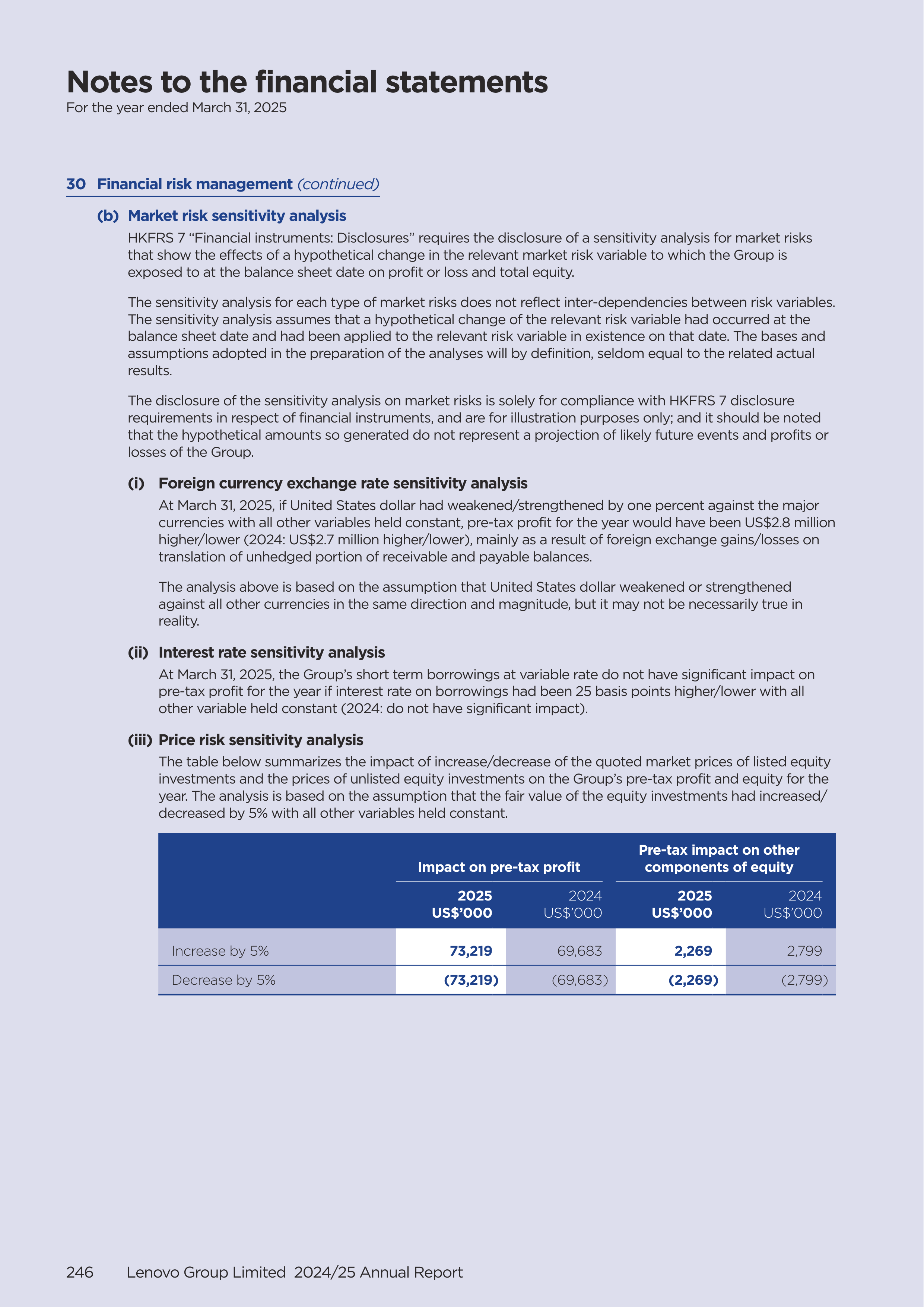
Notes to the financial statements
For the year ended March 31, 2025
Lenovo Group Limited 2024/25 Annual Report
246
30
Financial risk management
(continued)
(b) Market risk sensitivity analysis
HKFRS 7 “Financial instruments: Disclosures” requires the disclosure of a sensitivity analysis for market risks
that show the effects of a hypothetical change in the relevant market risk variable to which the Group is
exposed to at the balance sheet date on profit or loss and total equity.
The sensitivity analysis for each type of market risks does not reflect inter-dependencies between risk variables.
The sensitivity analysis assumes that a hypothetical change of the relevant risk variable had occurred at the
balance sheet date and had been applied to the relevant risk variable in existence on that date. The bases and
assumptions adopted in the preparation of the analyses will by definition, seldom equal to the related actual
results.
The disclosure of the sensitivity analysis on market risks is solely for compliance with HKFRS 7 disclosure
requirements in respect of financial instruments, and are for illustration purposes only; and it should be noted
that the hypothetical amounts so generated do not represent a projection of likely future events and profits or
losses of the Group.
(i)
Foreign currency exchange rate sensitivity analysis
At March 31, 2025, if United States dollar had weakened/strengthened by one percent against the major
currencies with all other variables held constant, pre-tax profit for the year would have been US$2.8 million
higher/lower (2024: US$2.7 million higher/lower), mainly as a result of foreign exchange gains/losses on
translation of unhedged portion of receivable and payable balances.
The analysis above is based on the assumption that United States dollar weakened or strengthened
against all other currencies in the same direction and magnitude, but it may not be necessarily true in
reality.
(ii)
Interest rate sensitivity analysis
At March 31, 2025, the Group’s short term borrowings at variable rate do not have significant impact on
pre-tax profit for the year if interest rate on borrowings had been 25 basis points higher/lower with all
other variable held constant (2024: do not have significant impact).
(iii) Price risk sensitivity analysis
The table below summarizes the impact of increase/decrease of the quoted market prices of listed equity
investments and the prices of unlisted equity investments on the Group’s pre-tax profit and equity for the
year. The analysis is based on the assumption that the fair value of the equity investments had increased/
decreased by 5% with all other variables held constant.
Impact on pre-tax profit
Pre-tax impact on other
components of equity
2025
US$’000
2024
US$’000
2025
US$’000
2024
US$’000
Increase by 5%
73,219
69,683
2,269
2,799
Decrease by 5%
(73,219 )
(69,683)
(2,269 )
(2,799)
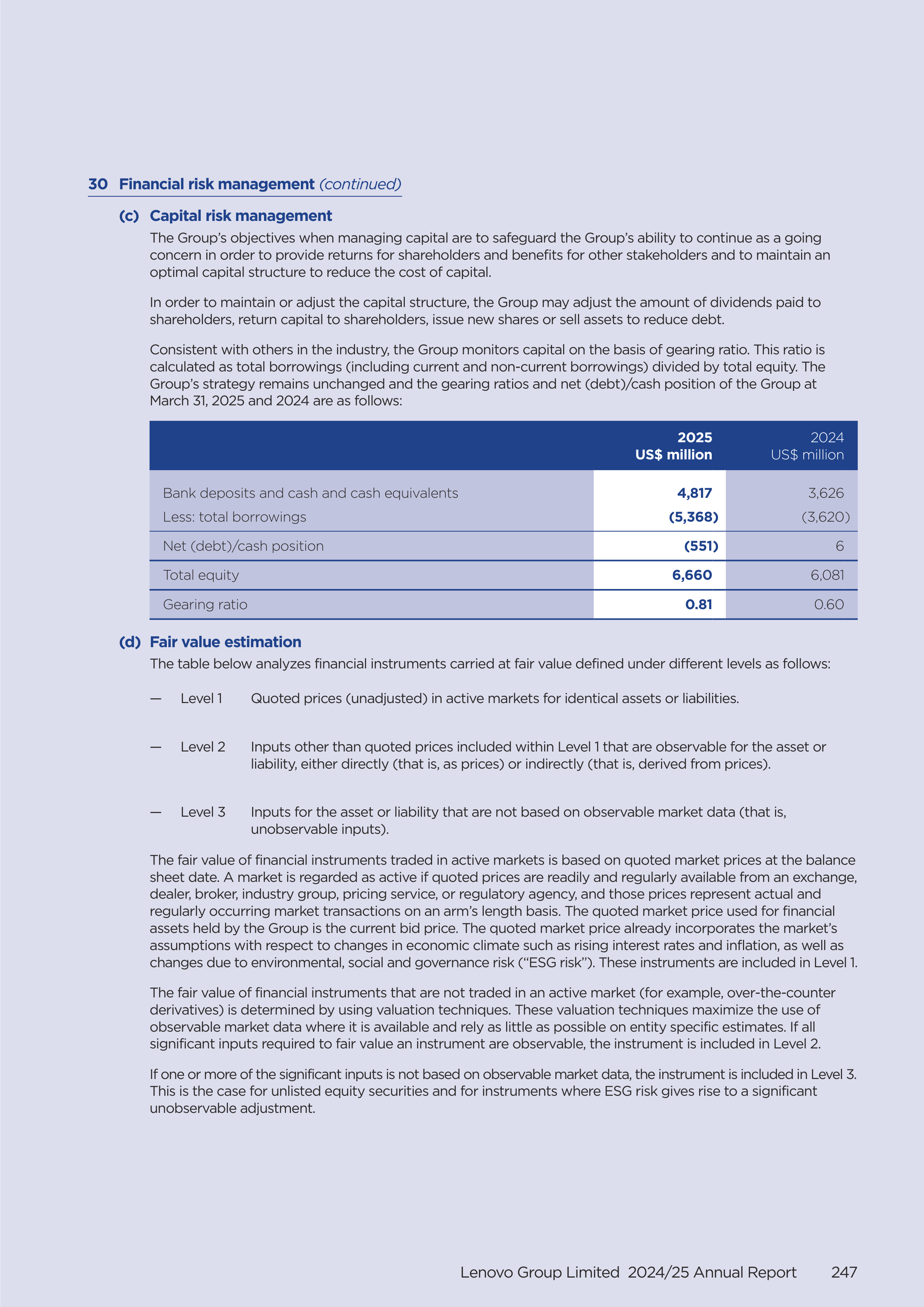
Lenovo Group Limited 2024/25 Annual Report
247
30
Financial risk management
(continued)
(c)
Capital risk management
The Group’s objectives when managing capital are to safeguard the Group’s ability to continue as a going
concern in order to provide returns for shareholders and benefits for other stakeholders and to maintain an
optimal capital structure to reduce the cost of capital.
In order to maintain or adjust the capital structure, the Group may adjust the amount of dividends paid to
shareholders, return capital to shareholders, issue new shares or sell assets to reduce debt.
Consistent with others in the industry, the Group monitors capital on the basis of gearing ratio. This ratio is
calculated as total borrowings (including current and non-current borrowings) divided by total equity. The
Group’s strategy remains unchanged and the gearing ratios and net (debt)/cash position of the Group at
March 31, 2025 and 2024 are as follows:
2025
US$ million
2024
US$ million
Bank deposits and cash and cash equivalents
4,817
3,626
Less: total borrowings
(5,368)
(3,620)
Net (debt)/cash position
(551)
6
Total equity
6,660
6,081
Gearing ratio
0.81
0.60
(d) Fair value estimation
The table below analyzes financial instruments carried at fair value defined under different levels as follows:
—
Level 1
Quoted prices (unadjusted) in active markets for identical assets or liabilities.
—
Level 2
Inputs other than quoted prices included within Level 1 that are observable for the asset or
liability, either directly (that is, as prices) or indirectly (that is, derived from prices).
—
Level 3
Inputs for the asset or liability that are not based on observable market data (that is,
unobservable inputs).
The fair value of financial instruments traded in active markets is based on quoted market prices at the balance
sheet date. A market is regarded as active if quoted prices are readily and regularly available from an exchange,
dealer, broker, industry group, pricing service, or regulatory agency, and those prices represent actual and
regularly occurring market transactions on an arm’s length basis. The quoted market price used for financial
assets held by the Group is the current bid price. The quoted market price already incorporates the market’s
assumptions with respect to changes in economic climate such as rising interest rates and inflation, as well as
changes due to environmental, social and governance risk (“ESG risk”). These instruments are included in Level 1.
The fair value of financial instruments that are not traded in an active market (for example, over-the-counter
derivatives) is determined by using valuation techniques. These valuation techniques maximize the use of
observable market data where it is available and rely as little as possible on entity specific estimates. If all
significant inputs required to fair value an instrument are observable, the instrument is included in Level 2.
If one or more of the significant inputs is not based on observable market data, the instrument is included in Level 3.
This is the case for unlisted equity securities and for instruments where ESG risk gives rise to a significant
unobservable adjustment.
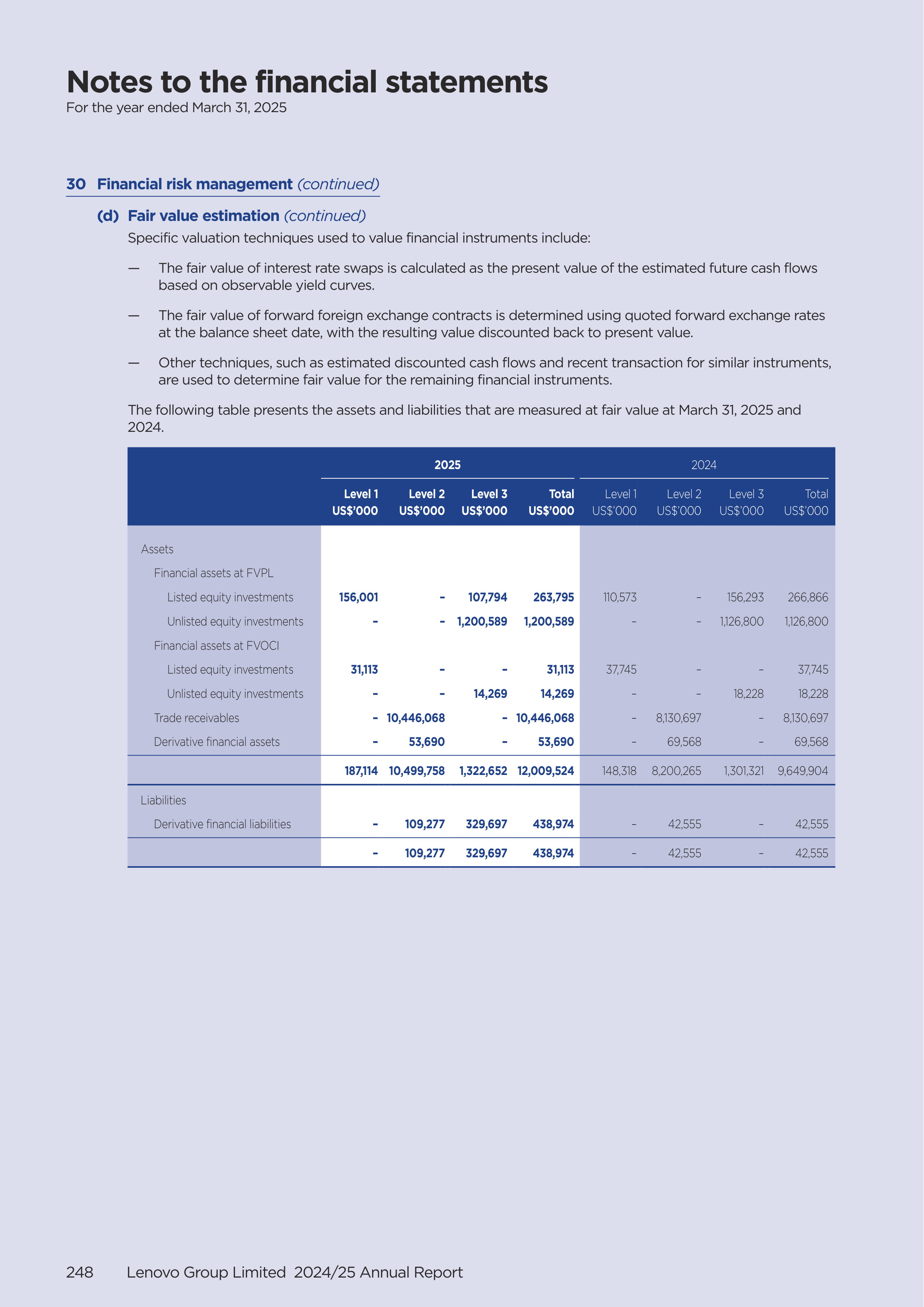
Notes to the financial statements
For the year ended March 31, 2025
Lenovo Group Limited 2024/25 Annual Report
248
30
Financial risk management
(continued)
(d) Fair value estimation
(continued)
Specific valuation techniques used to value financial instruments include:
—
The fair value of interest rate swaps is calculated as the present value of the estimated future cash flows
based on observable yield curves.
—
The fair value of forward foreign exchange contracts is determined using quoted forward exchange rates
at the balance sheet date, with the resulting value discounted back to present value.
—
Other techniques, such as estimated discounted cash flows and recent transaction for similar instruments,
are used to determine fair value for the remaining financial instruments.
The following table presents the assets and liabilities that are measured at fair value at March 31, 2025 and
2024.
2025
2024
Level 1
US$’000
Level 2
US$’000
Level 3
US$’000
Total
US$’000
Level 1
US$’000
Level 2
US$’000
Level 3
US$’000
Total
US$’000
Assets
Financial assets at FVPL
Listed equity investments
156,001
–
107,794
263,795
110,573
–
156,293
266,866
Unlisted equity investments
–
–
1,200,589
1,200,589
–
–
1,126,800
1,126,800
Financial assets at FVOCI
Listed equity investments
31,113
–
–
31,113
37,745
–
–
37,745
Unlisted equity investments
–
–
14,269
14,269
–
–
18,228
18,228
Trade receivables
–
10,446,068
–
10,446,068
–
8,130,697
–
8,130,697
Derivative financial assets
–
53,690
–
53,690
–
69,568
–
69,568
187,114 10,499,758
1,322,652 12,009,524
148,318
8,200,265
1,301,321
9,649,904
Liabilities
Derivative financial liabilities
–
109,277
329,697
438,974
–
42,555
–
42,555
–
109,277
329,697
438,974
–
42,555
–
42,555
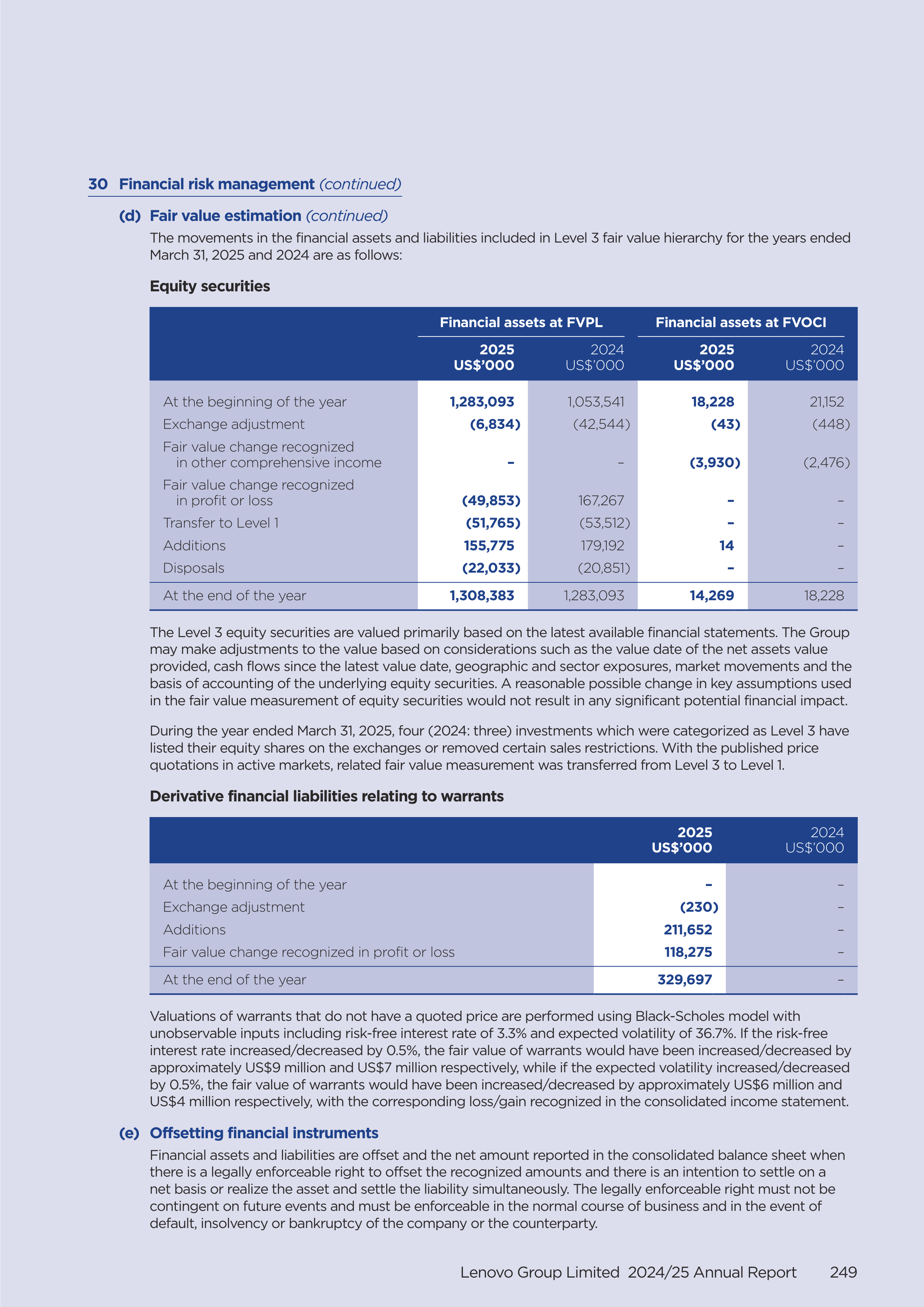
Lenovo Group Limited 2024/25 Annual Report
249
30
Financial risk management
(continued)
(d) Fair value estimation
(continued)
The movements in the financial assets and liabilities included in Level 3 fair value hierarchy for the years ended
March 31, 2025 and 2024 are as follows:
Equity securities
Financial assets at FVPL
Financial assets at FVOCI
2025
US$’000
2024
US$’000
2025
US$’000
2024
US$’000
At the beginning of the year
1,283,093
1,053,541
18,228
21,152
Exchange adjustment
(6,834 )
(42,544)
(43 )
(448)
Fair value change recognized
in other comprehensive income
–
–
(3,930 )
(2,476)
Fair value change recognized
in profit or loss
(49,853 )
167,267
–
–
Transfer to Level 1
(51,765 )
(53,512)
–
–
Additions
155,775
179,192
14
–
Disposals
(22,033 )
(20,851)
–
–
At the end of the year
1,308,383
1,283,093
14,269
18,228
The Level 3 equity securities are valued primarily based on the latest available financial statements. The Group
may make adjustments to the value based on considerations such as the value date of the net assets value
provided, cash flows since the latest value date, geographic and sector exposures, market movements and the
basis of accounting of the underlying equity securities. A reasonable possible change in key assumptions used
in the fair value measurement of equity securities would not result in any significant potential financial impact.
During the year ended March 31, 2025, four (2024: three) investments which were categorized as Level 3 have
listed their equity shares on the exchanges or removed certain sales restrictions. With the published price
quotations in active markets, related fair value measurement was transferred from Level 3 to Level 1.
Derivative financial liabilities relating to warrants
2025
US$’000
2024
US$’000
At the beginning of the year
–
–
Exchange adjustment
(230)
–
Additions
211,652
–
Fair value change recognized in profit or loss
118,275
–
At the end of the year
329,697
–
Valuations of warrants that do not have a quoted price are performed using Black-Scholes model with
unobservable inputs including risk-free interest rate of 3.3% and expected volatility of 36.7%. If the risk-free
interest rate increased/decreased by 0.5%, the fair value of warrants would have been increased/decreased by
approximately US$9 million and US$7 million respectively, while if the expected volatility increased/decreased
by 0.5%, the fair value of warrants would have been increased/decreased by approximately US$6 million and
US$4 million respectively, with the corresponding loss/gain recognized in the consolidated income statement.
(e)
Offsetting financial instruments
Financial assets and liabilities are offset and the net amount reported in the consolidated balance sheet when
there is a legally enforceable right to offset the recognized amounts and there is an intention to settle on a
net basis or realize the asset and settle the liability simultaneously. The legally enforceable right must not be
contingent on future events and must be enforceable in the normal course of business and in the event of
default, insolvency or bankruptcy of the company or the counterparty.
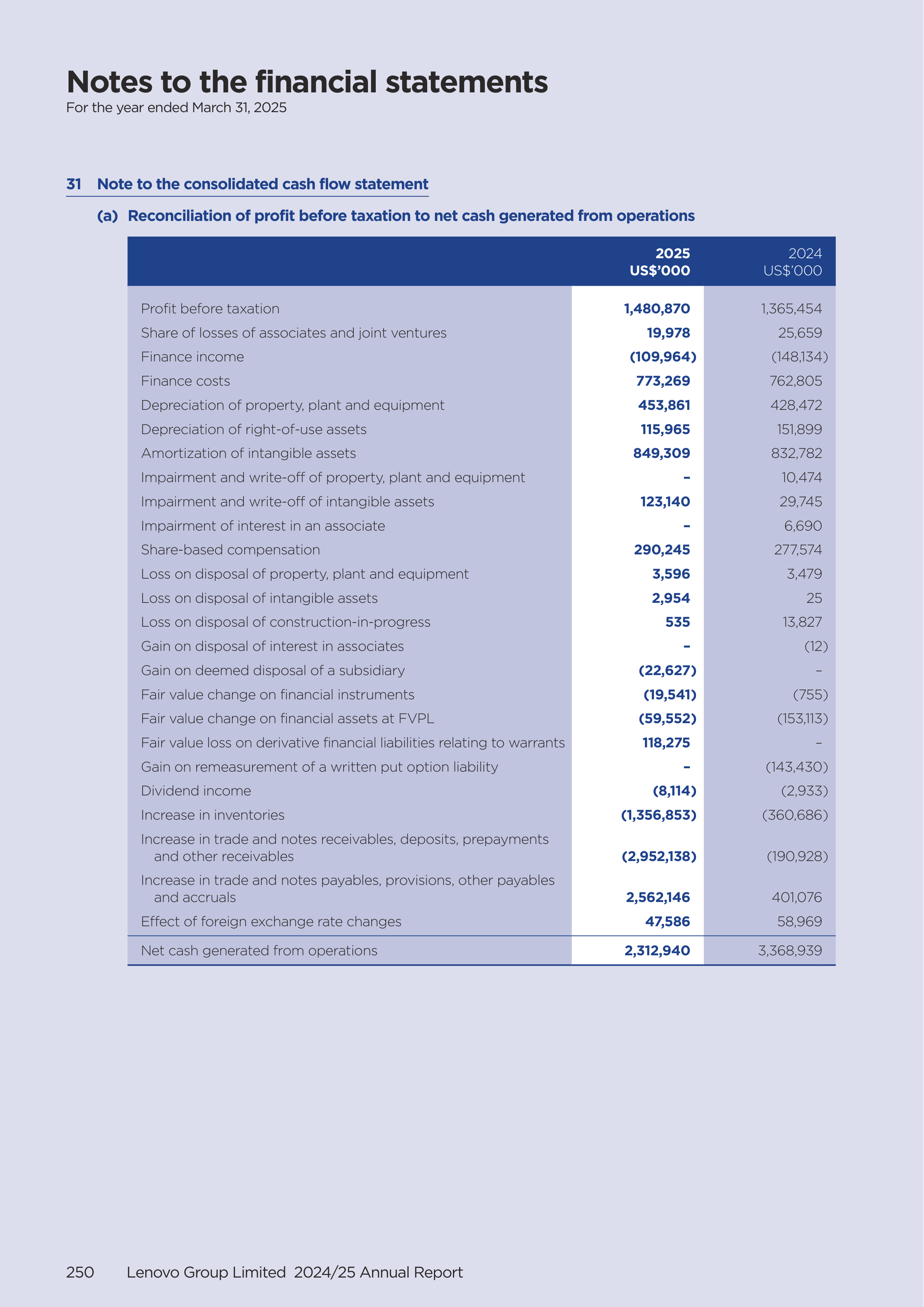
Notes to the financial statements
For the year ended March 31, 2025
Lenovo Group Limited 2024/25 Annual Report
250
31
Note to the consolidated cash flow statement
(a)
Reconciliation of profit before taxation to net cash generated from operations
2025
US$’000
2024
US$’000
Profit before taxation
1,480,870
1,365,454
Share of losses of associates and joint ventures
19,978
25,659
Finance income
(109,964)
(148,134)
Finance costs
773,269
762,805
Depreciation of property, plant and equipment
453,861
428,472
Depreciation of right-of-use assets
115,965
151,899
Amortization of intangible assets
849,309
832,782
Impairment and write-off of property, plant and equipment
–
10,474
Impairment and write-off of intangible assets
123,140
29,745
Impairment of interest in an associate
–
6,690
Share-based compensation
290,245
277,574
Loss on disposal of property, plant and equipment
3,596
3,479
Loss on disposal of intangible assets
2,954
25
Loss on disposal of construction-in-progress
535
13,827
Gain on disposal of interest in associates
–
(12)
Gain on deemed disposal of a subsidiary
(22,627)
–
Fair value change on financial instruments
(19,541)
(755)
Fair value change on financial assets at FVPL
(59,552)
(153,113)
Fair value loss on derivative financial liabilities relating to warrants
118,275
–
Gain on remeasurement of a written put option liability
–
(143,430)
Dividend income
(8,114)
(2,933)
Increase in inventories
(1,356,853)
(360,686)
Increase in trade and notes receivables, deposits, prepayments
and other receivables
(2,952,138)
(190,928)
Increase in trade and notes payables, provisions, other payables
and accruals
2,562,146
401,076
Effect of foreign exchange rate changes
47,586
58,969
Net cash generated from operations
2,312,940
3,368,939
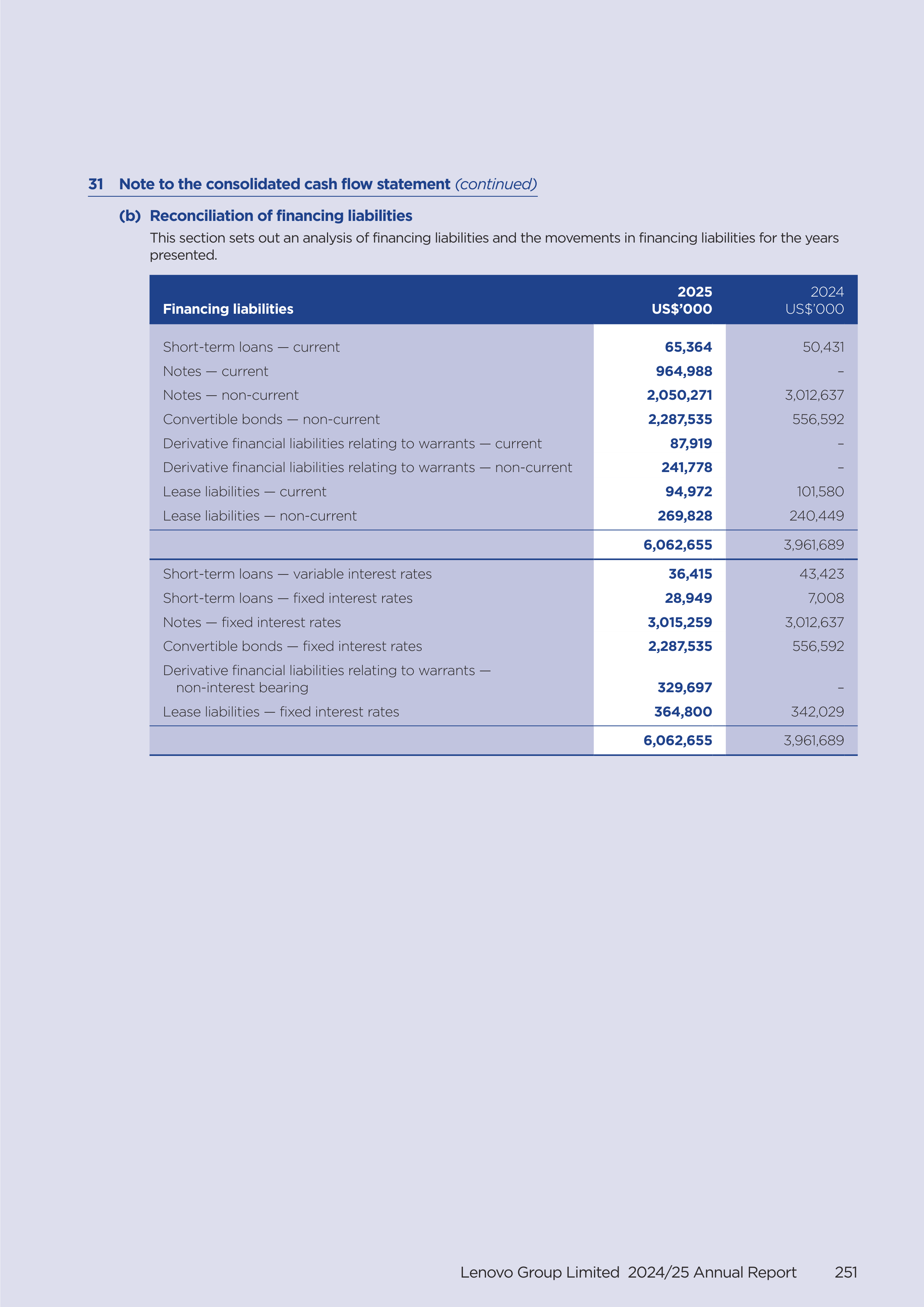
Lenovo Group Limited 2024/25 Annual Report
251
31
Note to the consolidated cash flow statement
(continued)
(b) Reconciliation of financing liabilities
This section sets out an analysis of financing liabilities and the movements in financing liabilities for the years
presented.
Financing liabilities
2025
US$’000
2024
US$’000
Short-term loans — current
65,364
50,431
Notes — current
964,988
–
Notes — non-current
2,050,271
3,012,637
Convertible bonds — non-current
2,287,535
556,592
Derivative financial liabilities relating to warrants — current
87,919
–
Derivative financial liabilities relating to warrants — non-current
241,778
–
Lease liabilities — current
94,972
101,580
Lease liabilities — non-current
269,828
240,449
6,062,655
3,961,689
Short-term loans — variable interest rates
36,415
43,423
Short-term loans — fixed interest rates
28,949
7,008
Notes — fixed interest rates
3,015,259
3,012,637
Convertible bonds — fixed interest rates
2,287,535
556,592
Derivative financial liabilities relating to warrants —
non-interest bearing
329,697
–
Lease liabilities — fixed interest rates
364,800
342,029
6,062,655
3,961,689
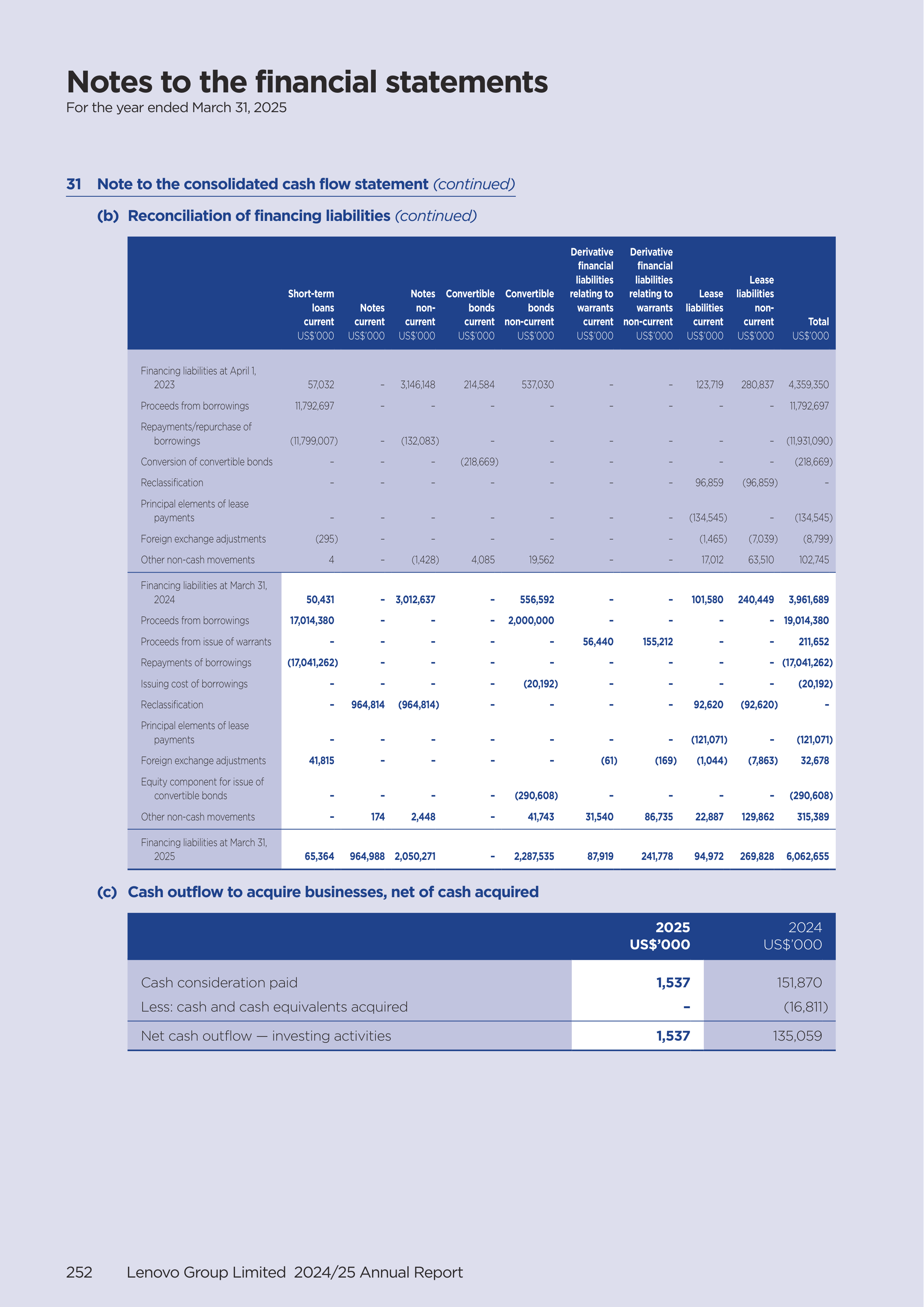
Notes to the financial statements
For the year ended March 31, 2025
Lenovo Group Limited 2024/25 Annual Report
252
31
Note to the consolidated cash flow statement
(continued)
(b) Reconciliation of financing liabilities
(continued)
Short-term
loans
current
Notes
current
Notes
non-
current
Convertible
bonds
current
Convertible
bonds
non-current
Derivative
financial
liabilities
relating to
warrants
current
Derivative
financial
liabilities
relating to
warrants
non-current
Lease
liabilities
current
Lease
liabilities
non-
current
Total
US$’000
US$’000
US$’000
US$’000
US$’000
US$’000
US$’000
US$’000
US$’000
US$’000
Financing liabilities at April 1,
2023
57,032
–
3,146,148
214,584
537,030
–
–
123,719
280,837
4,359,350
Proceeds from borrowings
11,792,697
–
–
–
–
–
–
–
–
11,792,697
Repayments/repurchase of
borrowings
(11,799,007)
–
(132,083)
–
–
–
–
–
–
(11,931,090)
Conversion of convertible bonds
–
–
–
(218,669)
–
–
–
–
–
(218,669)
Reclassification
–
–
–
–
–
–
–
96,859
(96,859)
–
Principal elements of lease
payments
–
–
–
–
–
–
–
(134,545)
–
(134,545)
Foreign exchange adjustments
(295)
–
–
–
–
–
–
(1,465)
(7,039)
(8,799)
Other non-cash movements
4
–
(1,428)
4,085
19,562
–
–
17,012
63,510
102,745
Financing liabilities at March 31,
2024
50,431
–
3,012,637
–
556,592
–
–
101,580
240,449
3,961,689
Proceeds from borrowings
17,014,380
–
–
–
2,000,000
–
–
–
–
19,014,380
Proceeds from issue of warrants
–
–
–
–
–
56,440
155,212
–
–
211,652
Repayments of borrowings
(17,041,262)
–
–
–
–
–
–
–
–
(17,041,262)
Issuing cost of borrowings
–
–
–
–
(20,192)
–
–
–
–
(20,192)
Reclassification
–
964,814
(964,814)
–
–
–
–
92,620
(92,620)
–
Principal elements of lease
payments
–
–
–
–
–
–
–
(121,071)
–
(121,071)
Foreign exchange adjustments
41,815
–
–
–
–
(61)
(169)
(1,044)
(7,863)
32,678
Equity component for issue of
convertible bonds
–
–
–
–
(290,608)
–
–
–
–
(290,608)
Other non-cash movements
–
174
2,448
–
41,743
31,540
86,735
22,887
129,862
315,389
Financing liabilities at March 31,
2025
65,364
964,988
2,050,271
–
2,287,535
87,919
241,778
94,972
269,828
6,062,655
(c)
Cash outflow to acquire businesses, net of cash acquired
2025
US$’000
2024
US$’000
Cash consideration paid
1,537
151,870
Less: cash and cash equivalents acquired
–
(16,811)
Net cash outflow — investing activities
1,537
135,059
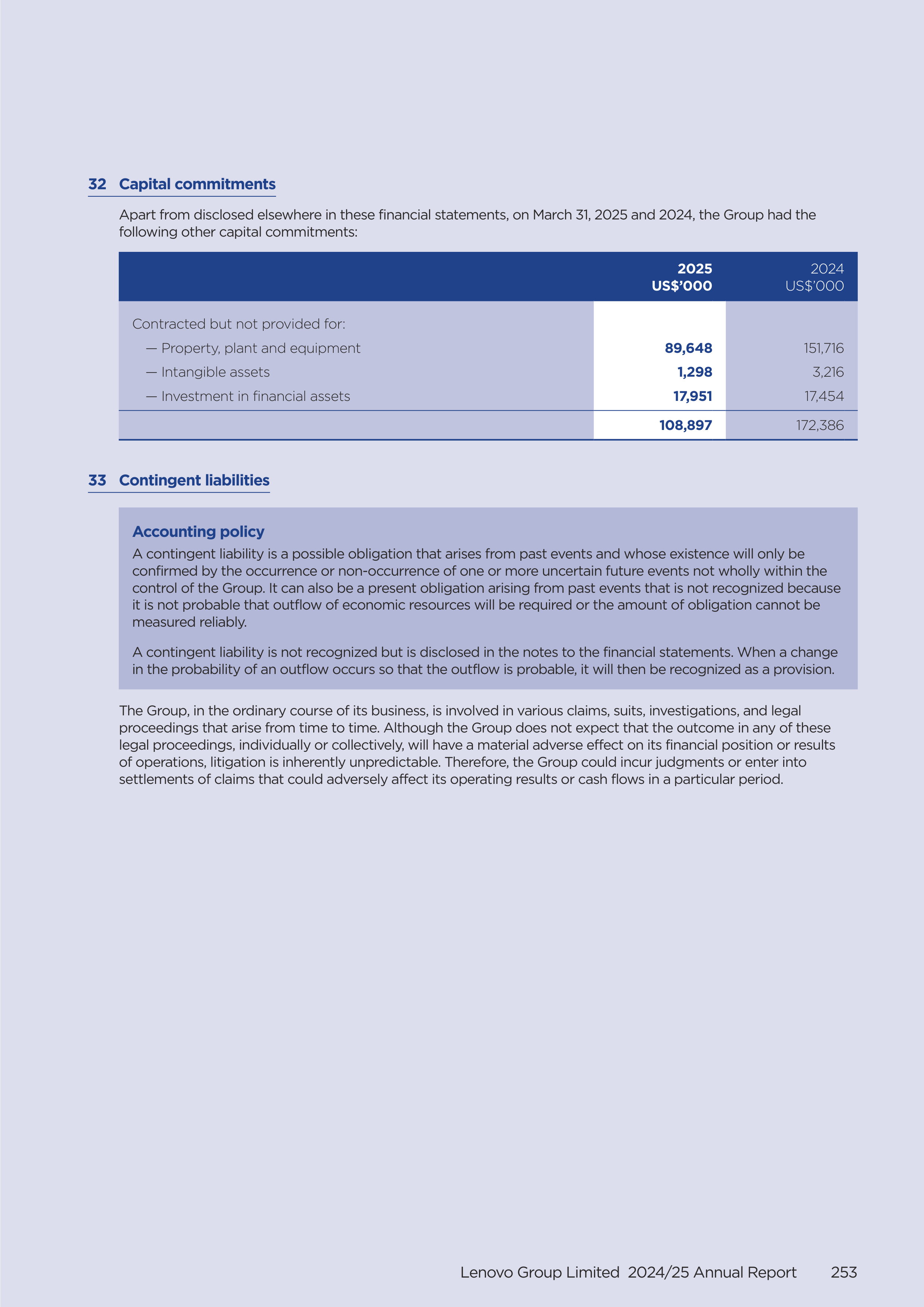
Lenovo Group Limited 2024/25 Annual Report
253
32
Capital commitments
Apart from disclosed elsewhere in these financial statements, on March 31, 2025 and 2024, the Group had the
following other capital commitments:
2025
US$’000
2024
US$’000
Contracted but not provided for:
— Property, plant and equipment
89,648
151,716
— Intangible assets
1,298
3,216
— Investment in financial assets
17,951
17,454
108,897
172,386
33
Contingent liabilities
Accounting policy
A contingent liability is a possible obligation that arises from past events and whose existence will only be
confirmed by the occurrence or non-occurrence of one or more uncertain future events not wholly within the
control of the Group. It can also be a present obligation arising from past events that is not recognized because
it is not probable that outflow of economic resources will be required or the amount of obligation cannot be
measured reliably.
A contingent liability is not recognized but is disclosed in the notes to the financial statements. When a change
in the probability of an outflow occurs so that the outflow is probable, it will then be recognized as a provision.
The Group, in the ordinary course of its business, is involved in various claims, suits, investigations, and legal
proceedings that arise from time to time. Although the Group does not expect that the outcome in any of these
legal proceedings, individually or collectively, will have a material adverse effect on its financial position or results
of operations, litigation is inherently unpredictable. Therefore, the Group could incur judgments or enter into
settlements of claims that could adversely affect its operating results or cash flows in a particular period.
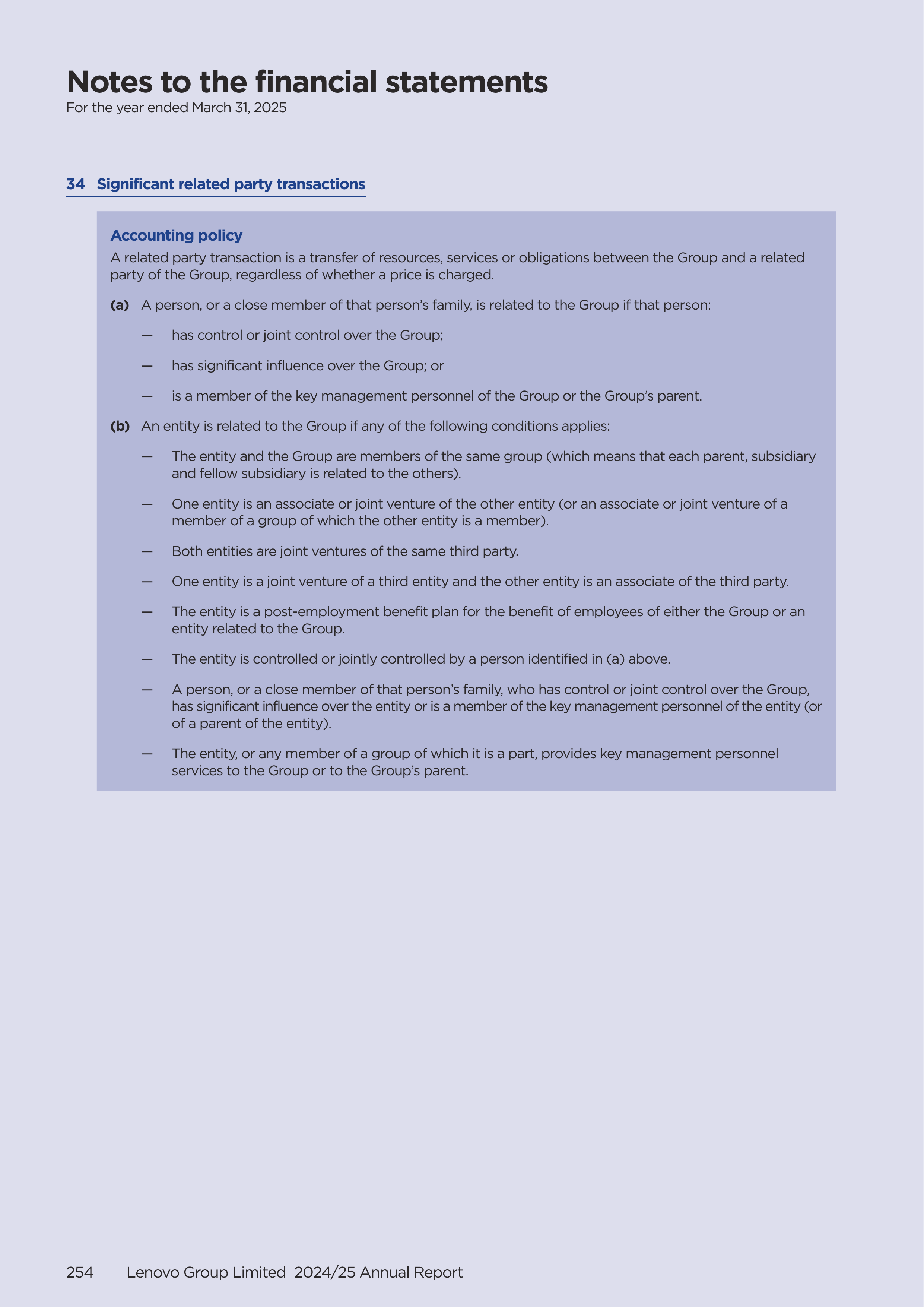
Notes to the financial statements
For the year ended March 31, 2025
Lenovo Group Limited 2024/25 Annual Report
254
34
Significant related party transactions
Accounting policy
A related party transaction is a transfer of resources, services or obligations between the Group and a related
party of the Group, regardless of whether a price is charged.
(a)
A person, or a close member of that person’s family, is related to the Group if that person:
—
has control or joint control over the Group;
—
has significant influence over the Group; or
—
is a member of the key management personnel of the Group or the Group’s parent.
(b)
An entity is related to the Group if any of the following conditions applies:
—
The entity and the Group are members of the same group (which means that each parent, subsidiary
and fellow subsidiary is related to the others).
—
One entity is an associate or joint venture of the other entity (or an associate or joint venture of a
member of a group of which the other entity is a member).
—
Both entities are joint ventures of the same third party.
—
One entity is a joint venture of a third entity and the other entity is an associate of the third party.
—
The entity is a post-employment benefit plan for the benefit of employees of either the Group or an
entity related to the Group.
—
The entity is controlled or jointly controlled by a person identified in (a) above.
—
A person, or a close member of that person’s family, who has control or joint control over the Group,
has significant influence over the entity or is a member of the key management personnel of the entity (or
of a parent of the entity).
—
The entity, or any member of a group of which it is a part, provides key management personnel
services to the Group or to the Group’s parent.
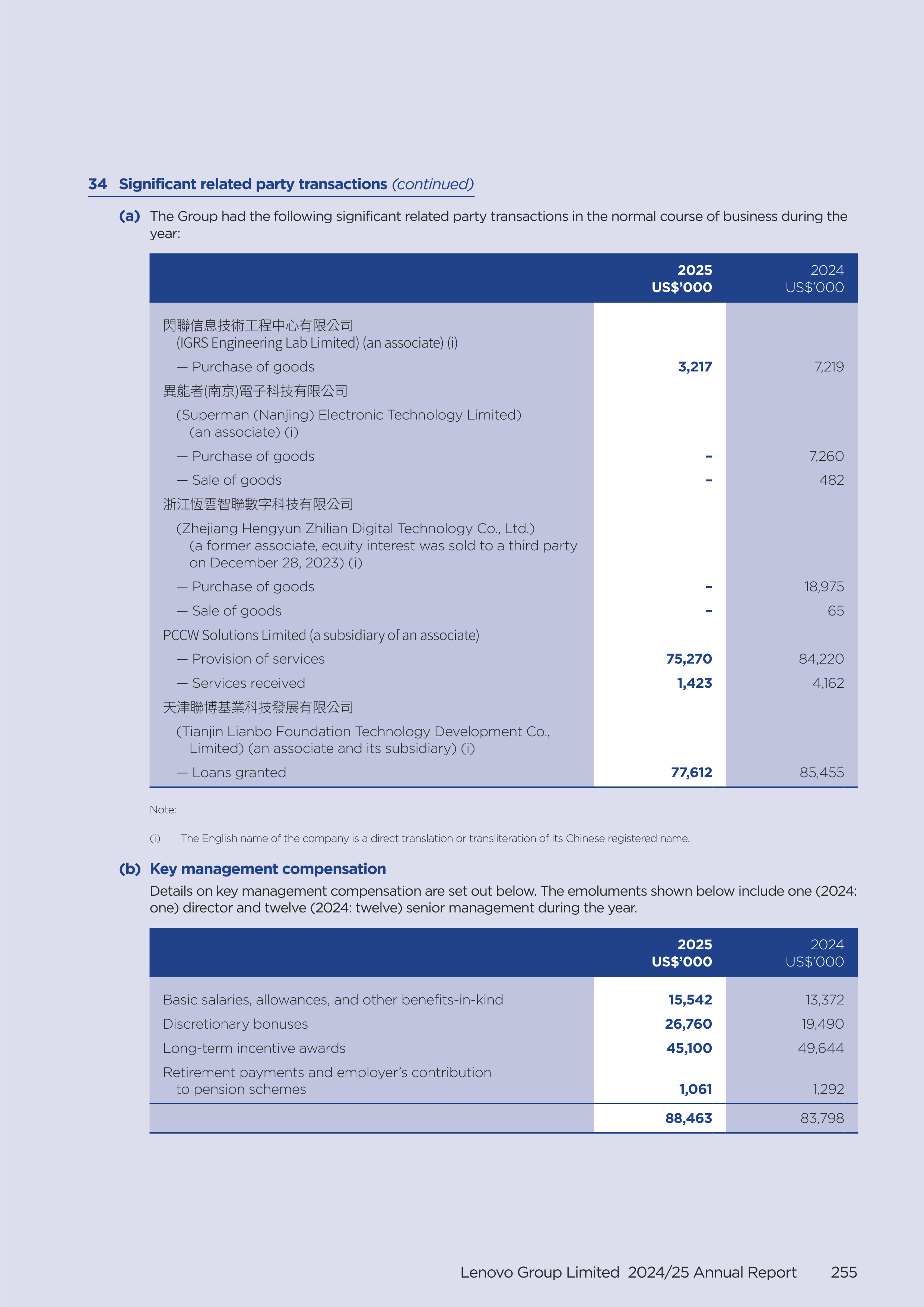
Lenovo Group Limited 2024/25 Annual Report
255
34
Significant related party transactions
(continued)
(a)
The Group had the following significant related party transactions in the normal course of business during the
year:
2025
US$’000
2024
US$’000
閃聯信息技術工程中心有限公司
(IGRS Engineering Lab Limited) (an associate) (i)
— Purchase of goods
3,217
7,219
異能者(南京)電子科技有限公司
(Superman (Nanjing) Electronic Technology Limited)
(an associate) (i)
— Purchase of goods
–
7,260
— Sale of goods
–
482
浙江恆雲智聯數字科技有限公司
(Zhejiang Hengyun Zhilian Digital Technology Co., Ltd.)
(a former associate, equity interest was sold to a third party
on December 28, 2023) (i)
— Purchase of goods
–
18,975
— Sale of goods
–
65
PCCW Solutions Limited (a subsidiary of an associate)
— Provision of services
75,270
84,220
— Services received
1,423
4,162
天津聯博基業科技發展有限公司
(Tianjin Lianbo Foundation Technology Development Co.,
Limited) (an associate and its subsidiary) (i)
— Loans granted
77,612
85,455
Note:
(i)
The English name of the company is a direct translation or transliteration of its Chinese registered name.
(b) Key management compensation
Details on key management compensation are set out below. The emoluments shown below include one (2024:
one) director and twelve (2024: twelve) senior management during the year.
2025
US$’000
2024
US$’000
Basic salaries, allowances, and other benefits-in-kind
15,542
13,372
Discretionary bonuses
26,760
19,490
Long-term incentive awards
45,100
49,644
Retirement payments and employer’s contribution
to pension schemes
1,061
1,292
88,463
83,798
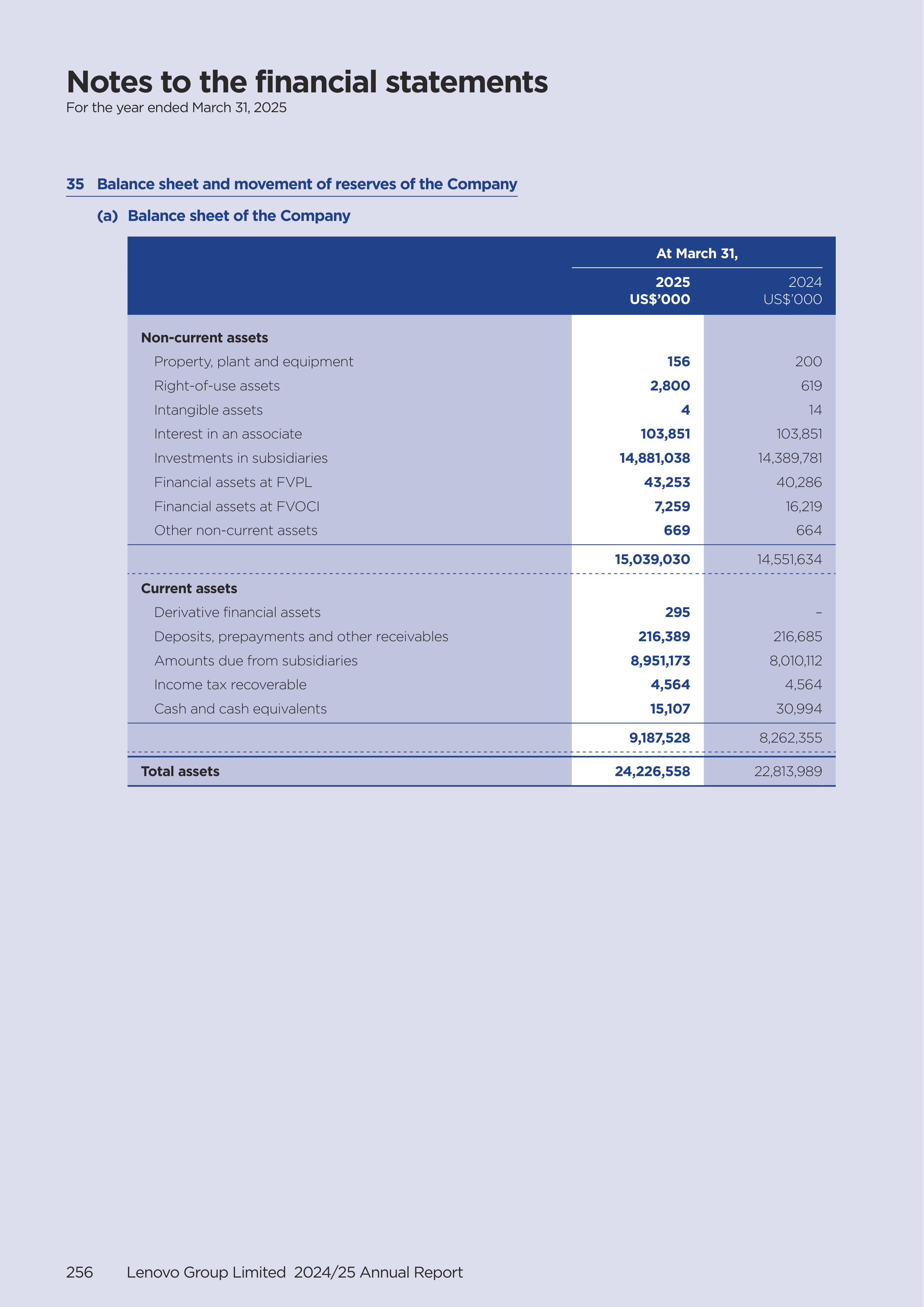
Notes to the financial statements
For the year ended March 31, 2025
Lenovo Group Limited 2024/25 Annual Report
256
35
Balance sheet and movement of reserves of the Company
(a)
Balance sheet of the Company
At March 31,
2025
US$’000
2024
US$’000
Non-current assets
Property, plant and equipment
156
200
Right-of-use assets
2,800
619
Intangible assets
4
14
Interest in an associate
103,851
103,851
Investments in subsidiaries
14,881,038
14,389,781
Financial assets at FVPL
43,253
40,286
Financial assets at FVOCI
7,259
16,219
Other non-current assets
669
664
15,039,030
14,551,634
Current assets
Derivative financial assets
295
–
Deposits, prepayments and other receivables
216,389
216,685
Amounts due from subsidiaries
8,951,173
8,010,112
Income tax recoverable
4,564
4,564
Cash and cash equivalents
15,107
30,994
9,187,528
8,262,355
Total assets
24,226,558
22,813,989
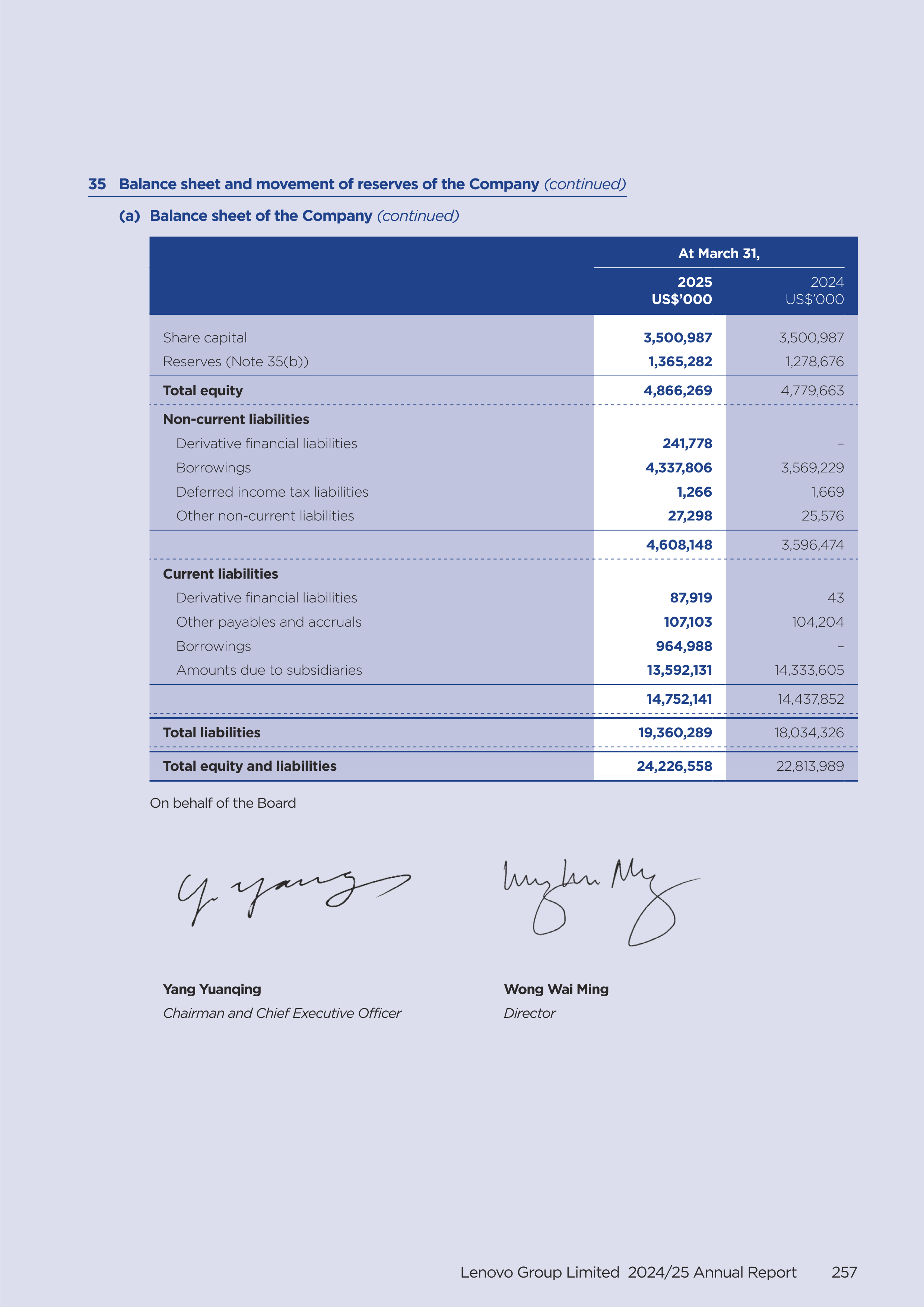

Lenovo Group Limited 2024/25 Annual Report
257
35
Balance sheet and movement of reserves of the Company
(continued)
(a)
Balance sheet of the Company
(continued)
At March 31,
2025
US$’000
2024
US$’000
Share capital
3,500,987
3,500,987
Reserves (Note 35(b))
1,365,282
1,278,676
Total equity
4,866,269
4,779,663
Non-current liabilities
Derivative financial liabilities
241,778
–
Borrowings
4,337,806
3,569,229
Deferred income tax liabilities
1,266
1,669
Other non-current liabilities
27,298
25,576
4,608,148
3,596,474
Current liabilities
Derivative financial liabilities
87,919
43
Other payables and accruals
107,103
104,204
Borrowings
964,988
–
Amounts due to subsidiaries
13,592,131
14,333,605
14,752,141
14,437,852
Total liabilities
19,360,289
18,034,326
Total equity and liabilities
24,226,558
22,813,989
On behalf of the Board
Yang Yuanqing
Wong Wai Ming
Chairman and Chief Executive Officer
Director
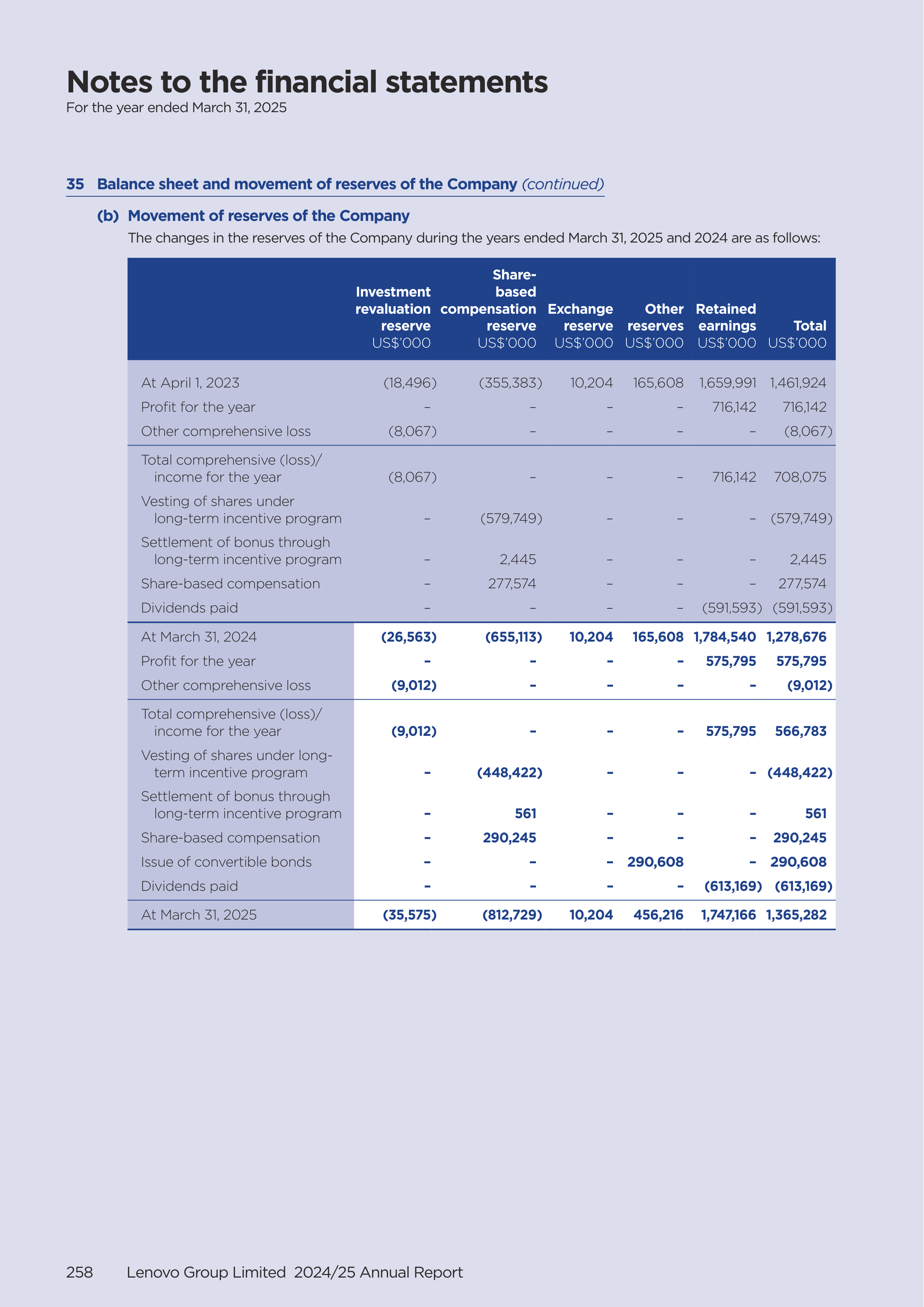
Notes to the financial statements
For the year ended March 31, 2025
Lenovo Group Limited 2024/25 Annual Report
258
35
Balance sheet and movement of reserves of the Company
(continued)
(b) Movement of reserves of the Company
The changes in the reserves of the Company during the years ended March 31, 2025 and 2024 are as follows:
Investment
revaluation
reserve
US$’000
Share-
based
compensation
reserve
US$’000
Exchange
reserve
US$’000
Other
reserves
US$’000
Retained
earnings
US$’000
Total
US$’000
At April 1, 2023
(18,496)
(355,383)
10,204
165,608
1,659,991
1,461,924
Profit for the year
–
–
–
–
716,142
716,142
Other comprehensive loss
(8,067)
–
–
–
–
(8,067)
Total comprehensive (loss)/
income for the year
(8,067)
–
–
–
716,142
708,075
Vesting of shares under
long-term incentive program
–
(579,749)
–
–
– (579,749 )
Settlement of bonus through
long-term incentive program
–
2,445
–
–
–
2,445
Share-based compensation
–
277,574
–
–
–
277,574
Dividends paid
–
–
–
–
(591,593)
(591,593)
At March 31, 2024
(26,563)
(655,113)
10,204
165,608
1,784,540
1,278,676
Profit for the year
–
–
–
–
575,795
575,795
Other comprehensive loss
(9,012)
–
–
–
–
(9,012)
Total comprehensive (loss)/
income for the year
(9,012)
–
–
–
575,795
566,783
Vesting of shares under long-
term incentive program
–
(448,422
)
–
–
–
(448,422)
Settlement of bonus through
long-term incentive program
–
561
–
–
–
561
Share-based compensation
–
290,245
–
–
–
290,245
Issue of convertible bonds
–
–
–
290,608
–
290,608
Dividends paid
–
–
–
–
(613,169)
(613,169)
At March 31, 2025
(35,575)
(812,729)
10,204
456,216
1,747,166
1,365,282
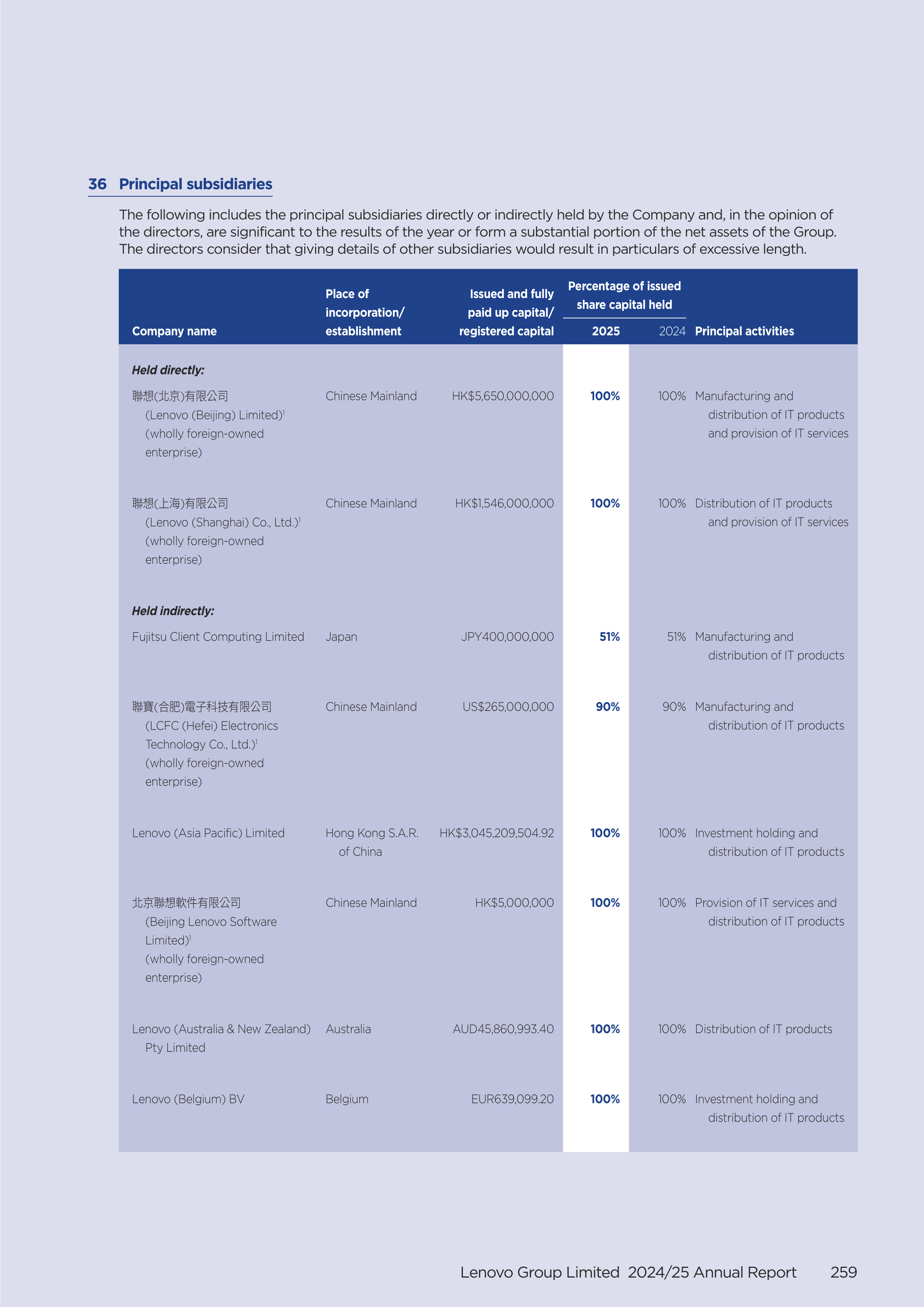
Lenovo Group Limited 2024/25 Annual Report
259
36
Principal subsidiaries
The following includes the principal subsidiaries directly or indirectly held by the Company and, in the opinion of
the directors, are significant to the results of the year or form a substantial portion of the net assets of the Group.
The directors consider that giving details of other subsidiaries would result in particulars of excessive length.
Company name
Place of
incorporation/
establishment
Issued and fully
paid up capital/
registered capital
Percentage of issued
share capital held
Principal activities
2025
2024
Held directly:
聯想
(
北京
)
有限公司
(Lenovo (Beijing) Limited)
1
(wholly foreign-owned
enterprise)
Chinese Mainland
HK$5,650,000,000
100%
100%
Manufacturing and
distribution of IT products
and provision of IT services
聯想
(
上海
)
有限公司
(Lenovo (Shanghai) Co., Ltd.)
1
(wholly foreign-owned
enterprise)
Chinese Mainland
HK$1,546,000,000
100%
100%
Distribution of IT products
and provision of IT services
Held indirectly:
Fujitsu Client Computing Limited
Japan
JPY400,000,000
51%
51%
Manufacturing and
distribution of IT products
聯寶
(
合肥
)
電子科技有限公司
(LCFC (Hefei) Electronics
Technology Co., Ltd.)
1
(wholly foreign-owned
enterprise)
Chinese Mainland
US$265,000,000
90%
90%
Manufacturing and
distribution of IT products
Lenovo (Asia Pacific) Limited
Hong Kong S.A.R.
of China
HK$3,045,209,504.92
100%
100%
Investment holding and
distribution of IT products
北京聯想軟件有限公司
(Beijing Lenovo Software
Limited)
1
(wholly foreign-owned
enterprise)
Chinese Mainland
HK$5,000,000
100%
100%
Provision of IT services and
distribution of IT products
Lenovo (Australia & New Zealand)
Pty Limited
Australia
AUD45,860,993.40
100%
100%
Distribution of IT products
Lenovo (Belgium) BV
Belgium
EUR639,099.20
100%
100%
Investment holding and
distribution of IT products
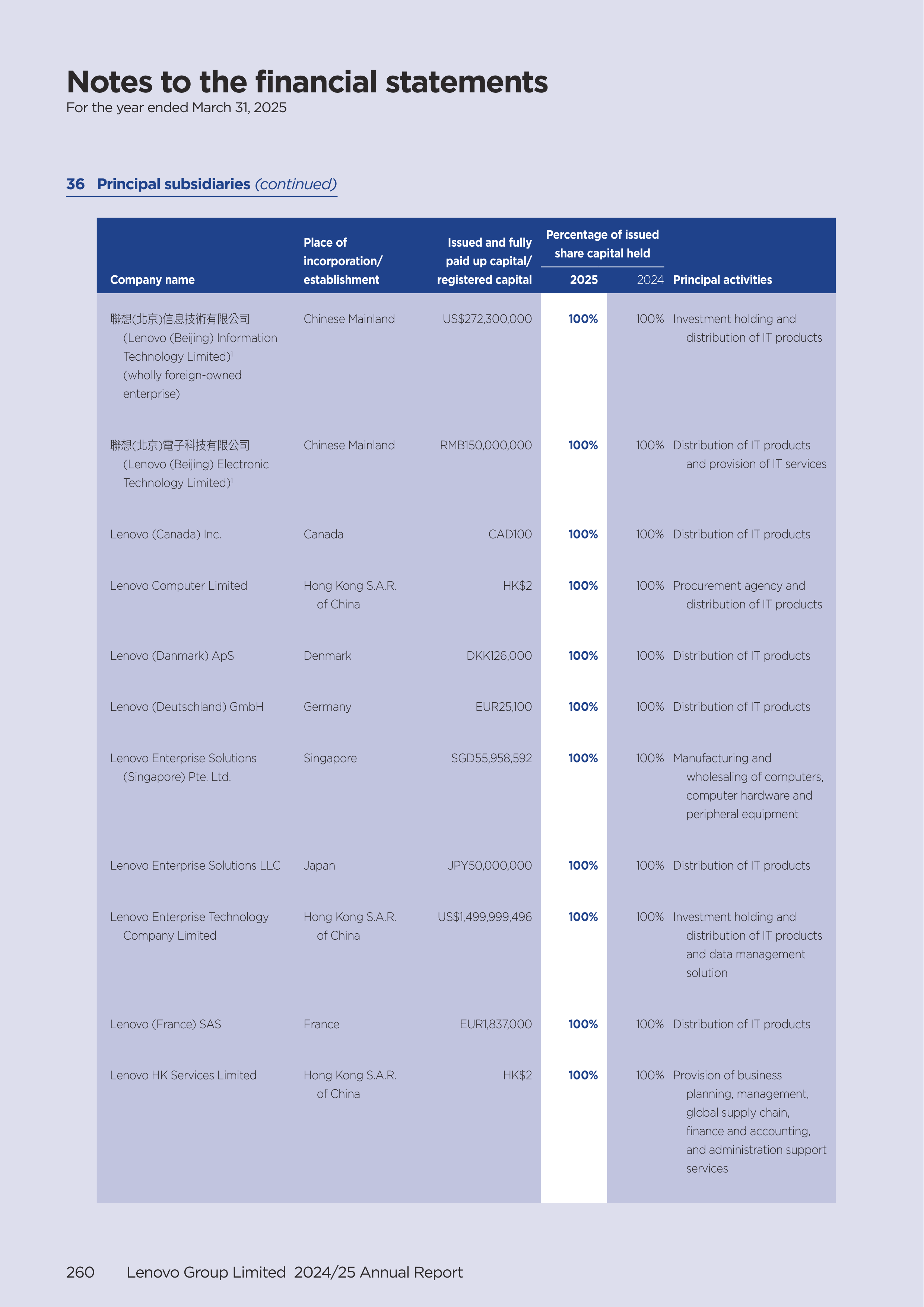
Notes to the financial statements
For the year ended March 31, 2025
Lenovo Group Limited 2024/25 Annual Report
260
Company name
Place of
incorporation/
establishment
Issued and fully
paid up capital/
registered capital
Percentage of issued
share capital held
Principal activities
2025
2024
聯想
(
北京
)
信息技術有限公司
(Lenovo (Beijing) Information
Technology Limited)
1
(wholly foreign-owned
enterprise)
Chinese Mainland
US$272,300,000
100%
100%
Investment holding and
distribution of IT products
聯想
(
北京
)
電子科技有限公司
(Lenovo (Beijing) Electronic
Technology Limited)
1
Chinese Mainland
RMB150,000,000
100%
100%
Distribution of IT products
and provision of IT services
Lenovo (Canada) Inc.
Canada
CAD100
100%
100%
Distribution of IT products
Lenovo Computer Limited
Hong Kong S.A.R.
of China
HK$2
100%
100%
Procurement agency and
distribution of IT products
Lenovo (Danmark) ApS
Denmark
DKK126,000
100%
100%
Distribution of IT products
Lenovo (Deutschland) GmbH
Germany
EUR25,100
100%
100%
Distribution of IT products
Lenovo Enterprise Solutions
(Singapore) Pte. Ltd.
Singapore
SGD55,958,592
100%
100%
Manufacturing and
wholesaling of computers,
computer hardware and
peripheral equipment
Lenovo Enterprise Solutions LLC
Japan
JPY50,000,000
100%
100%
Distribution of IT products
Lenovo Enterprise Technology
Company Limited
Hong Kong S.A.R.
of China
US$1,499,999,496
100%
100%
Investment holding and
distribution of IT products
and data management
solution
Lenovo (France) SAS
France
EUR1,837,000
100%
100%
Distribution of IT products
Lenovo HK Services Limited
Hong Kong S.A.R.
of China
HK$2
100%
100%
Provision of business
planning, management,
global supply chain,
finance and accounting,
and administration support
services
36
Principal subsidiaries
(continued)
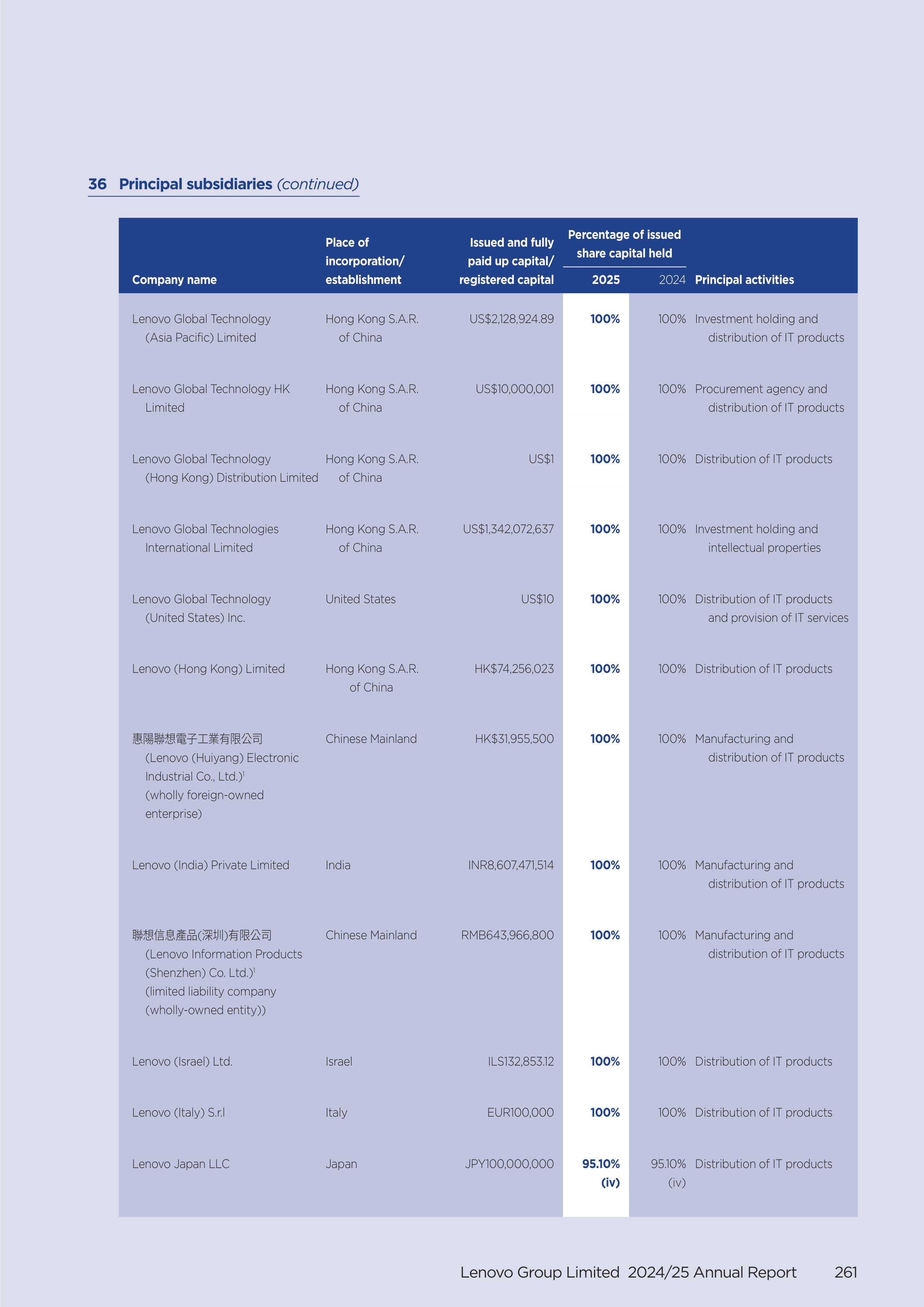
Lenovo Group Limited 2024/25 Annual Report
261
Company name
Place of
incorporation/
establishment
Issued and fully
paid up capital/
registered capital
Percentage of issued
share capital held
Principal activities
2025
2024
Lenovo Global Technology
(Asia Pacific) Limited
Hong Kong S.A.R.
of China
US$2,128,924.89
100%
100%
Investment holding and
distribution of IT products
Lenovo Global Technology HK
Limited
Hong Kong S.A.R.
of China
US$10,000,001
100%
100%
Procurement agency and
distribution of IT products
Lenovo Global Technology
(Hong Kong) Distribution Limited
Hong Kong S.A.R.
of China
US$1
100%
100%
Distribution of IT products
Lenovo Global Technologies
International Limited
Hong Kong S.A.R.
of China
US$1,342,072,637
100%
100%
Investment holding and
intellectual properties
Lenovo Global Technology
(United States) Inc.
United States
US$10
100%
100%
Distribution of IT products
and provision of IT services
Lenovo (Hong Kong) Limited
Hong Kong S.A.R.
of China
HK$74,256,023
100%
100%
Distribution of IT products
惠陽聯想電子工業有限公司
(Lenovo (Huiyang) Electronic
Industrial Co., Ltd.)
1
(wholly foreign-owned
enterprise)
Chinese Mainland
HK$31,955,500
100%
100%
Manufacturing and
distribution of IT products
Lenovo (India) Private Limited
India
INR8,607,471,514
100%
100%
Manufacturing and
distribution of IT products
聯想信息產品
(
深圳
)
有限公司
(Lenovo Information Products
(Shenzhen) Co. Ltd.)
1
(limited liability company
(wholly-owned entity))
Chinese Mainland
RMB643,966,800
100%
100%
Manufacturing and
distribution of IT products
Lenovo (Israel) Ltd.
Israel
ILS132,853.12
100%
100%
Distribution of IT products
Lenovo (Italy) S.r.l
Italy
EUR100,000
100%
100%
Distribution of IT products
Lenovo Japan LLC
Japan
JPY100,000,000
95.10%
(iv)
95.10%
(iv)
Distribution of IT products
36
Principal subsidiaries
(continued)
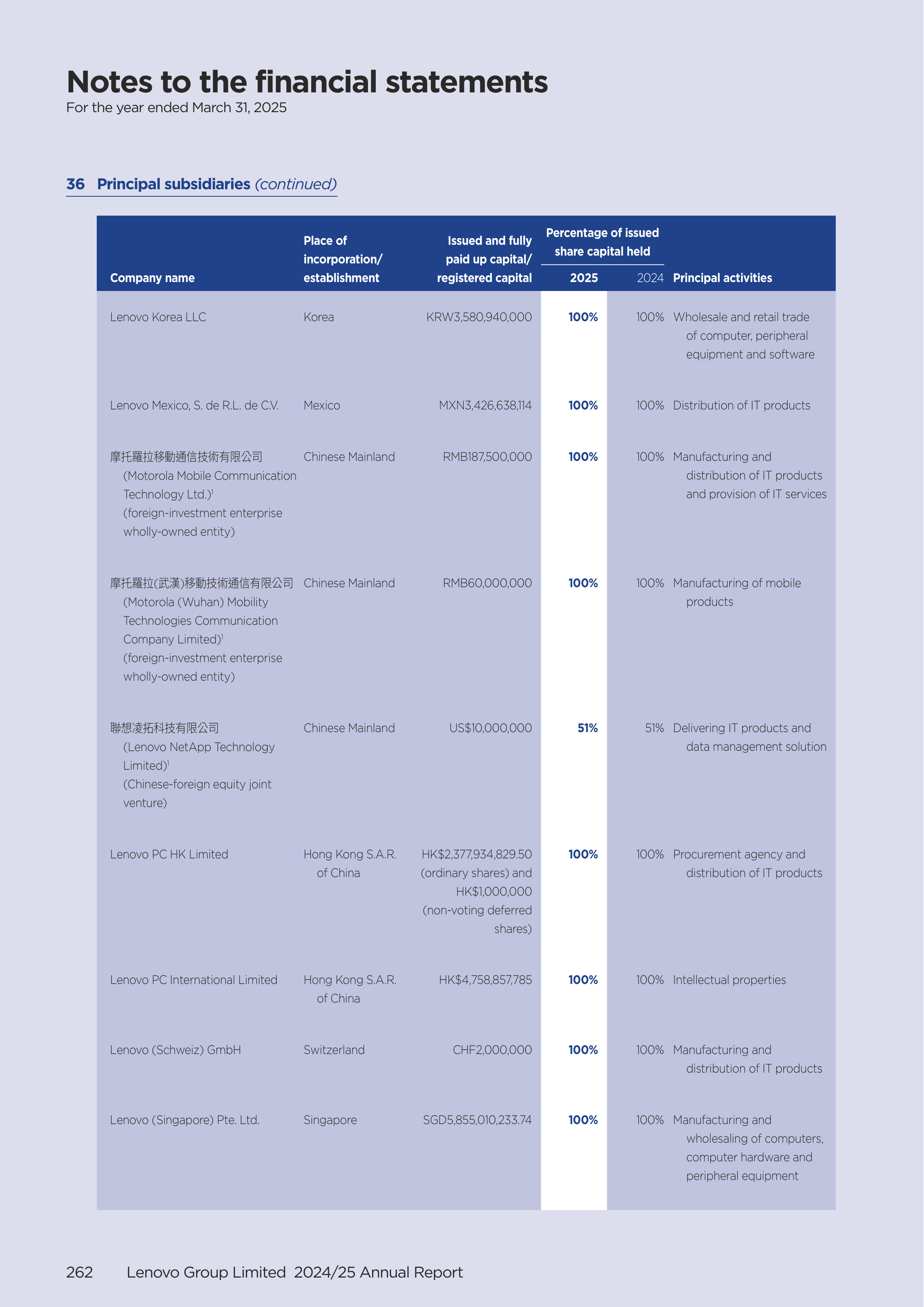
Notes to the financial statements
For the year ended March 31, 2025
Lenovo Group Limited 2024/25 Annual Report
262
Company name
Place of
incorporation/
establishment
Issued and fully
paid up capital/
registered capital
Percentage of issued
share capital held
Principal activities
2025
2024
Lenovo Korea LLC
Korea
KRW3,580,940,000
100%
100%
Wholesale and retail trade
of computer, peripheral
equipment and software
Lenovo Mexico, S. de R.L. de C.V.
Mexico
MXN3,426,638,114
100%
100%
Distribution of IT products
摩托羅拉移動通信技術有限公司
(Motorola Mobile Communication
Technology Ltd.)
1
(foreign-investment enterprise
wholly-owned entity)
Chinese Mainland
RMB187,500,000
100%
100%
Manufacturing and
distribution of IT products
and provision of IT services
摩托羅拉
(
武漢
)
移動技術通信有限公司
(Motorola (Wuhan) Mobility
Technologies Communication
Company Limited)
1
(foreign-investment enterprise
wholly-owned entity)
Chinese Mainland
RMB60,000,000
100%
100%
Manufacturing of mobile
products
聯想凌拓科技有限公司
(Lenovo NetApp Technology
Limited)
1
(Chinese-foreign equity joint
venture)
Chinese Mainland
US$10,000,000
51%
51%
Delivering IT products and
data management solution
Lenovo PC HK Limited
Hong Kong S.A.R.
of China
HK$2,377,934,829.50
(ordinary shares) and
HK$1,000,000
(non-voting deferred
shares)
100%
100%
Procurement agency and
distribution of IT products
Lenovo PC International Limited
Hong Kong S.A.R.
of China
HK$4,758,857,785
100%
100%
Intellectual properties
Lenovo (Schweiz) GmbH
Switzerland
CHF2,000,000
100%
100%
Manufacturing and
distribution of IT products
Lenovo (Singapore) Pte. Ltd.
Singapore
SGD5,855,010,233.74
100%
100%
Manufacturing and
wholesaling of computers,
computer hardware and
peripheral equipment
36
Principal subsidiaries
(continued)
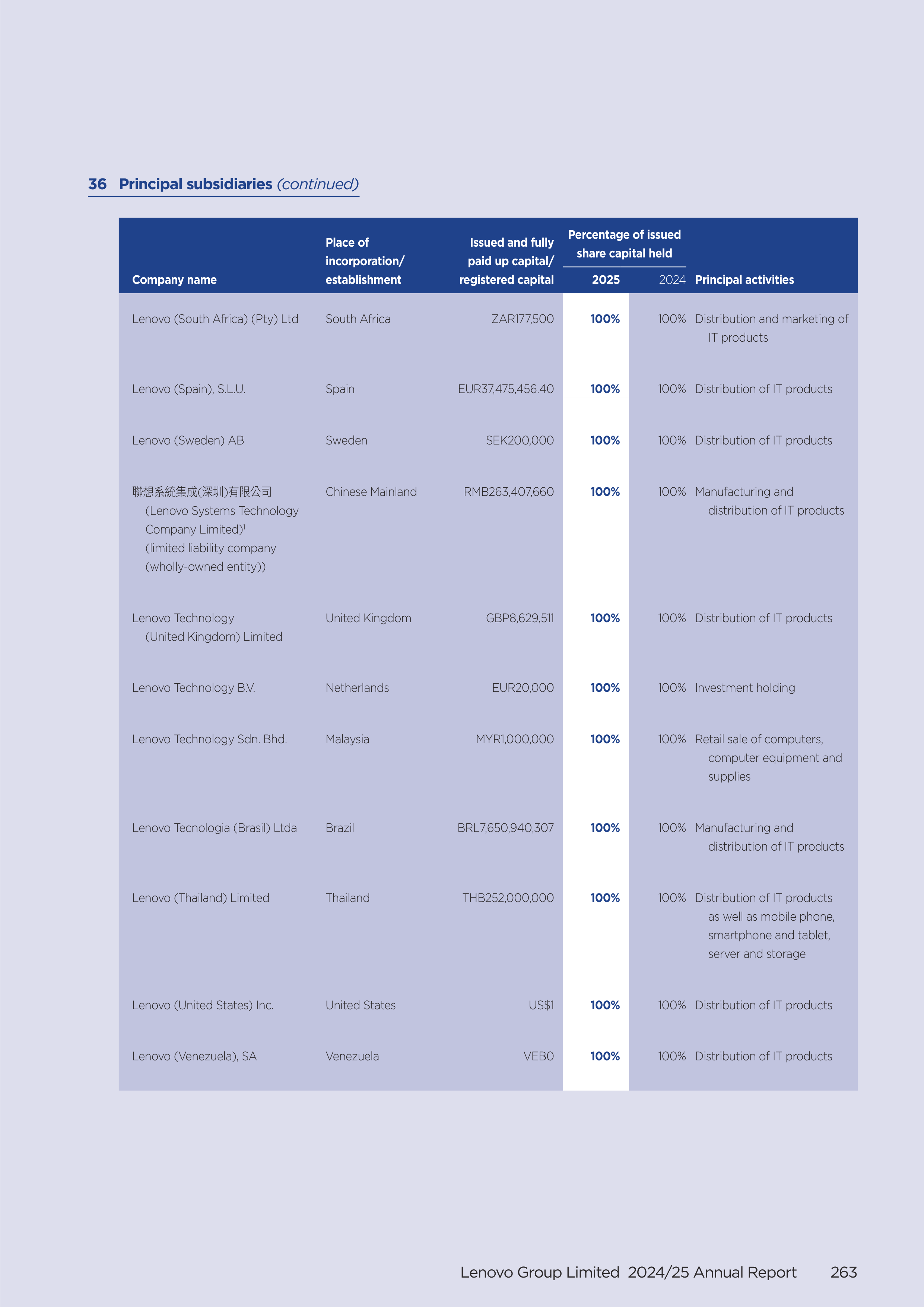
Lenovo Group Limited 2024/25 Annual Report
263
Company name
Place of
incorporation/
establishment
Issued and fully
paid up capital/
registered capital
Percentage of issued
share capital held
Principal activities
2025
2024
Lenovo (South Africa) (Pty) Ltd
South Africa
ZAR177,500
100%
100%
Distribution and marketing of
IT products
Lenovo (Spain), S.L.U.
Spain
EUR37,475,456.40
100%
100%
Distribution of IT products
Lenovo (Sweden) AB
Sweden
SEK200,000
100%
100%
Distribution of IT products
聯想系統集成
(
深圳
)
有限公司
(Lenovo Systems Technology
Company Limited)
1
(limited liability company
(wholly-owned entity))
Chinese Mainland
RMB263,407,660
100%
100%
Manufacturing and
distribution of IT products
Lenovo Technology
(United Kingdom) Limited
United Kingdom
GBP8,629,511
100%
100%
Distribution of IT products
Lenovo Technology B.V.
Netherlands
EUR20,000
100%
100%
Investment holding
Lenovo Technology Sdn. Bhd.
Malaysia
MYR1,000,000
100%
100%
Retail sale of computers,
computer equipment and
supplies
Lenovo Tecnologia (Brasil) Ltda
Brazil
BRL7,650,940,307
100%
100%
Manufacturing and
distribution of IT products
Lenovo (Thailand) Limited
Thailand
THB252,000,000
100%
100%
Distribution of IT products
as well as mobile phone,
smartphone and tablet,
server and storage
Lenovo (United States) Inc.
United States
US$1
100%
100%
Distribution of IT products
Lenovo (Venezuela), SA
Venezuela
VEB0
100%
100%
Distribution of IT products
36
Principal subsidiaries
(continued)
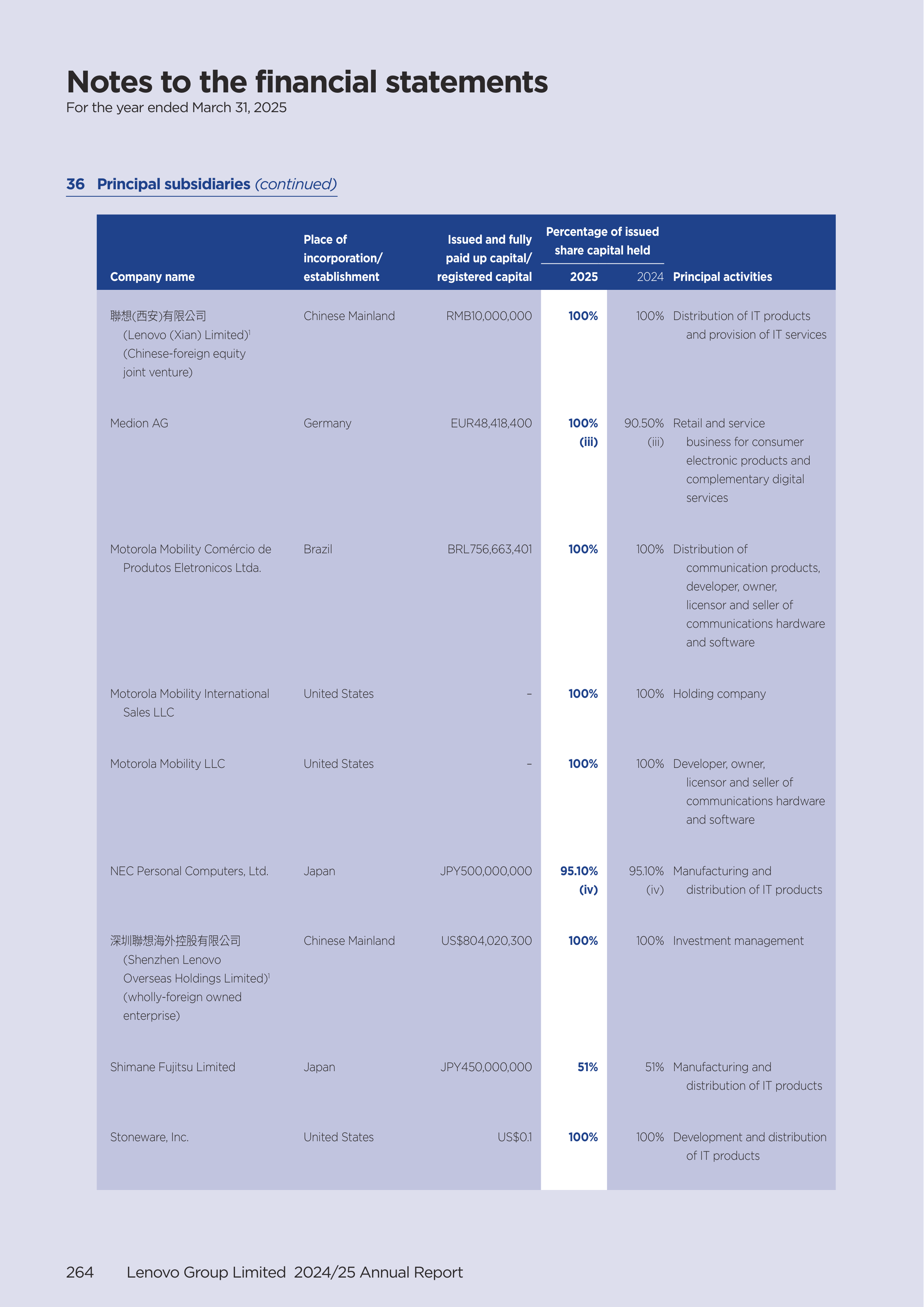
Notes to the financial statements
For the year ended March 31, 2025
Lenovo Group Limited 2024/25 Annual Report
264
Company name
Place of
incorporation/
establishment
Issued and fully
paid up capital/
registered capital
Percentage of issued
share capital held
Principal activities
2025
2024
聯想
(
西安
)
有限公司
(Lenovo (Xian) Limited)
1
(Chinese-foreign equity
joint venture)
Chinese Mainland
RMB10,000,000
100%
100%
Distribution of IT products
and provision of IT services
Medion AG
Germany
EUR48,418,400
100%
(iii)
90.50%
(iii)
Retail and service
business for consumer
electronic products and
complementary digital
services
Motorola Mobility Comércio de
Produtos Eletronicos Ltda.
Brazil
BRL756,663,401
100%
100%
Distribution of
communication products,
developer, owner,
licensor and seller of
communications hardware
and software
Motorola Mobility International
Sales LLC
United States
–
100%
100%
Holding company
Motorola Mobility LLC
United States
–
100%
100%
Developer, owner,
licensor and seller of
communications hardware
and software
NEC Personal Computers, Ltd.
Japan
JPY500,000,000
95.10%
(iv)
95.10%
(iv)
Manufacturing and
distribution of IT products
深圳聯想海外控股有限公司
(Shenzhen Lenovo
Overseas Holdings Limited)
1
(wholly-foreign owned
enterprise)
Chinese Mainland
US$804,020,300
100%
100%
Investment management
Shimane Fujitsu Limited
Japan
JPY450,000,000
51%
51%
Manufacturing and
distribution of IT products
Stoneware, Inc.
United States
US$0.1
100%
100%
Development and distribution
of IT products
36
Principal subsidiaries
(continued)
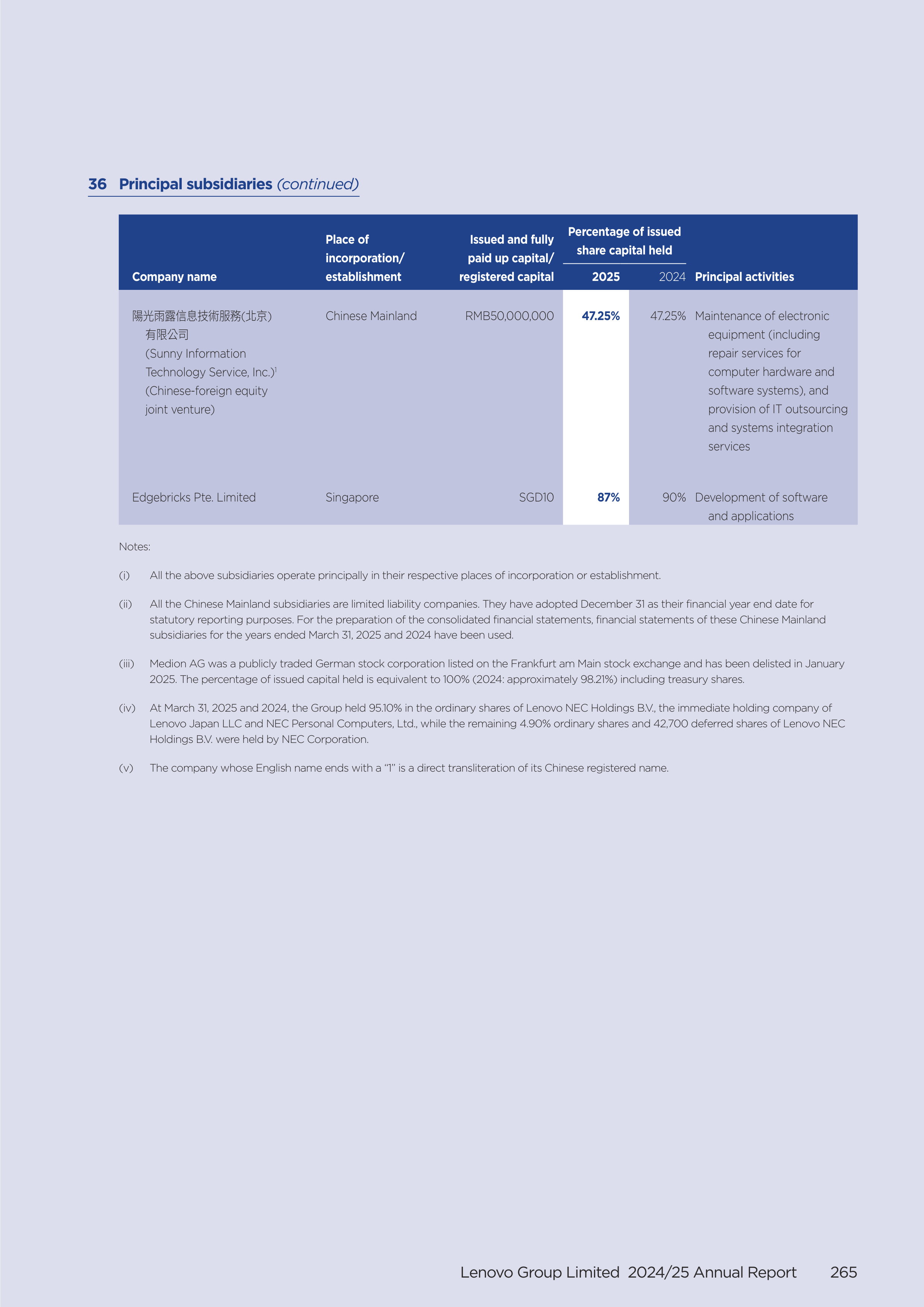
Lenovo Group Limited 2024/25 Annual Report
265
Company name
Place of
incorporation/
establishment
Issued and fully
paid up capital/
registered capital
Percentage of issued
share capital held
Principal activities
2025
2024
陽光雨露信息技術服務
(
北京
)
有限公司
(Sunny Information
Technology Service, Inc.)
1
(Chinese-foreign equity
joint venture)
Chinese Mainland
RMB50,000,000
47.25%
47.25%
Maintenance of electronic
equipment (including
repair services for
computer hardware and
software systems), and
provision of IT outsourcing
and systems integration
services
Edgebricks Pte. Limited
Singapore
SGD10
87%
90%
Development of software
and applications
Notes:
(i)
All the above subsidiaries operate principally in their respective places of incorporation or establishment.
(ii)
All the Chinese Mainland subsidiaries are limited liability companies. They have adopted December 31 as their financial year end date for
statutory reporting purposes. For the preparation of the consolidated financial statements, financial statements of these Chinese Mainland
subsidiaries for the years ended March 31, 2025 and 2024 have been used.
(iii)
Medion AG was a publicly traded German stock corporation listed on the Frankfurt am Main stock exchange and has been delisted in January
2025. The percentage of issued capital held is equivalent to 100% (2024: approximately 98.21%) including treasury shares.
(iv)
At March 31, 2025 and 2024, the Group held 95.10% in the ordinary shares of Lenovo NEC Holdings B.V., the immediate holding company of
Lenovo Japan LLC and NEC Personal Computers, Ltd., while the remaining 4.90% ordinary shares and 42,700 deferred shares of Lenovo NEC
Holdings B.V. were held by NEC Corporation.
(v)
The company whose English name ends with a “1” is a direct transliteration of its Chinese registered name.
36
Principal subsidiaries
(continued)
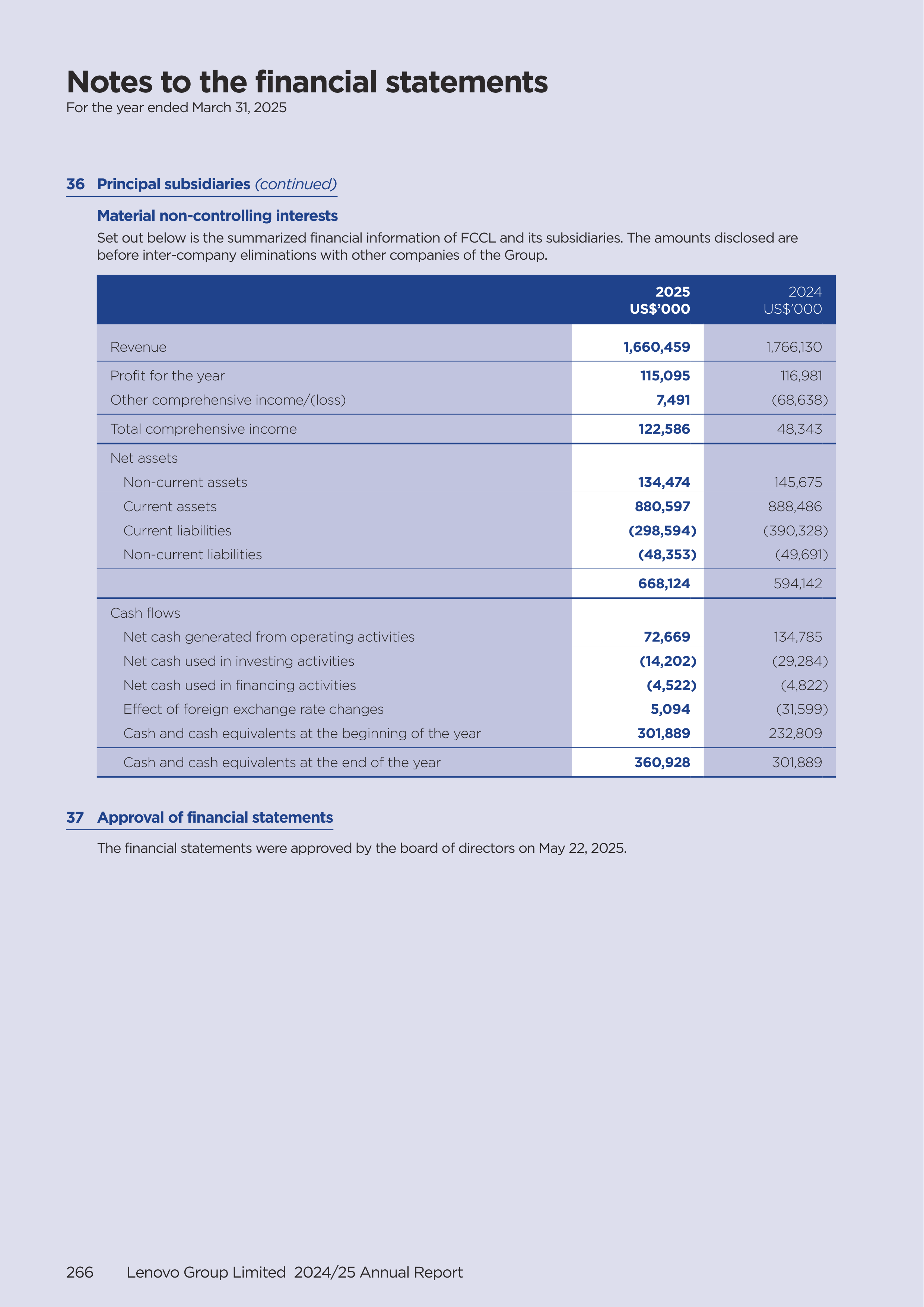
Notes to the financial statements
For the year ended March 31, 2025
Lenovo Group Limited 2024/25 Annual Report
266
36
Principal subsidiaries
(continued)
Material non-controlling interests
Set out below is the summarized financial information of FCCL and its subsidiaries. The amounts disclosed are
before inter-company eliminations with other companies of the Group.
2025
US$’000
2024
US$’000
Revenue
1,660,459
1,766,130
Profit for the year
115,095
116,981
Other comprehensive income/(loss)
7,491
(68,638)
Total comprehensive income
122,586
48,343
Net assets
Non-current assets
134,474
145,675
Current assets
880,597
888,486
Current liabilities
(298,594)
(390,328)
Non-current liabilities
(48,353)
(49,691)
668,124
594,142
Cash flows
Net cash generated from operating activities
72,669
134,785
Net cash used in investing activities
(14,202)
(29,284)
Net cash used in financing activities
(4,522)
(4,822)
Effect of foreign exchange rate changes
5,094
(31,599)
Cash and cash equivalents at the beginning of the year
301,889
232,809
Cash and cash equivalents at the end of the year
360,928
301,889
37
Approval of financial statements
The financial statements were approved by the board of directors on May 22, 2025.
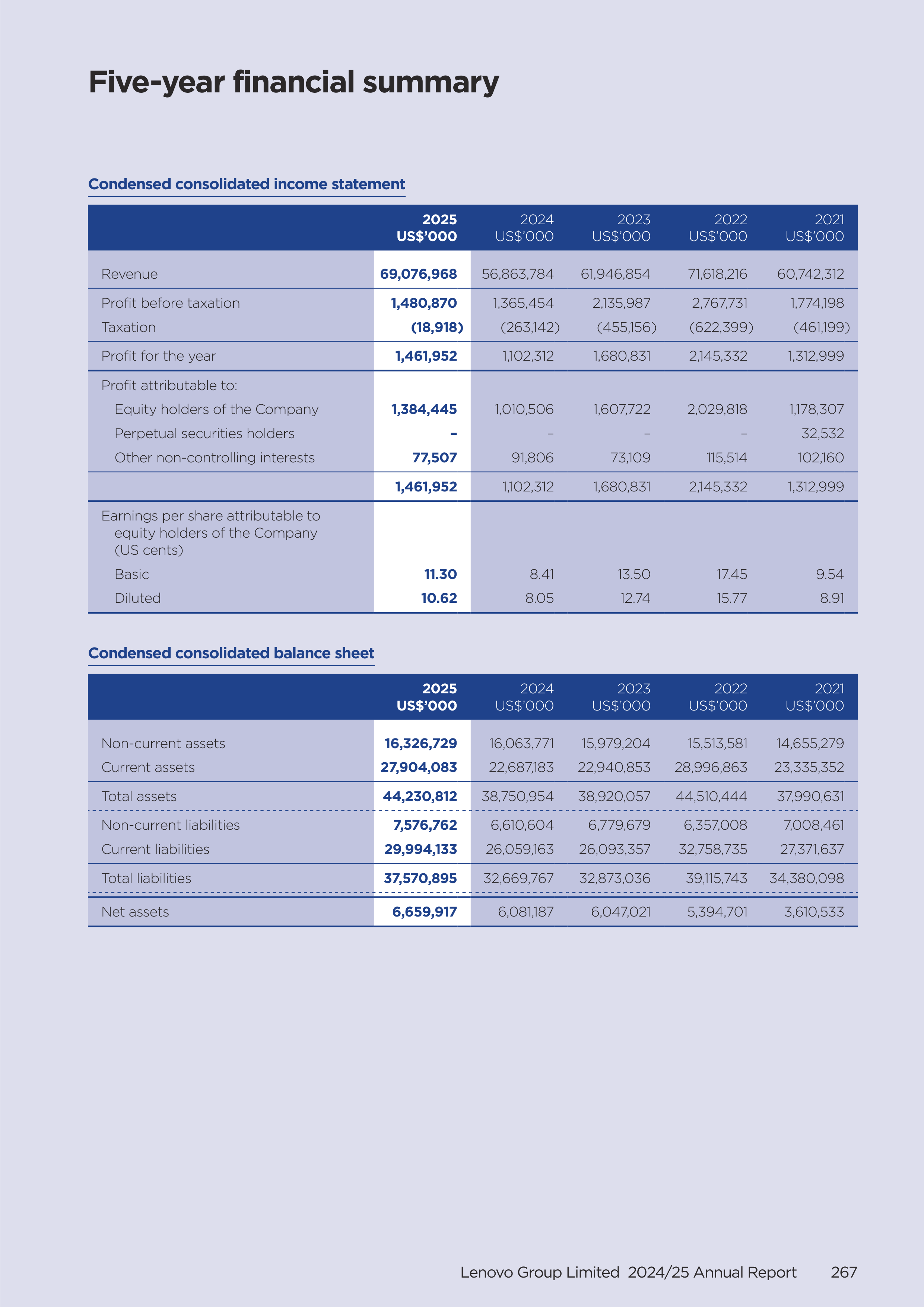
Five-year financial summary
Lenovo Group Limited 2024/25 Annual Report
267
Condensed consolidated income statement
2025
US$’000
2024
US$’000
2023
US$’000
2022
US$’000
2021
US$’000
Revenue
69,076,968
56,863,784
61,946,854
71,618,216
60,742,312
Profit before taxation
1,480,870
1,365,454
2,135,987
2,767,731
1,774,198
Taxation
(18,918)
(263,142)
(455,156)
(622,399)
(461,199)
Profit for the year
1,461,952
1,102,312
1,680,831
2,145,332
1,312,999
Profit attributable to:
Equity holders of the Company
1,384,445
1,010,506
1,607,722
2,029,818
1,178,307
Perpetual securities holders
–
–
–
–
32,532
Other non-controlling interests
77,507
91,806
73,109
115,514
102,160
1,461,952
1,102,312
1,680,831
2,145,332
1,312,999
Earnings per share attributable to
equity holders of the Company
(US cents)
Basic
11.30
8.41
13.50
17.45
9.54
Diluted
10.62
8.05
12.74
15.77
8.91
Condensed consolidated balance sheet
2025
US$’000
2024
US$’000
2023
US$’000
2022
US$’000
2021
US$’000
Non-current assets
16,326,729
16,063,771
15,979,204
15,513,581
14,655,279
Current assets
27,904,083
22,687,183
22,940,853
28,996,863
23,335,352
Total assets
44,230,812
38,750,954
38,920,057
44,510,444
37,990,631
Non-current liabilities
7,576,762
6,610,604
6,779,679
6,357,008
7,008,461
Current liabilities
29,994,133
26,059,163
26,093,357
32,758,735
27,371,637
Total liabilities
37,570,895
32,669,767
32,873,036
39,115,743
34,380,098
Net assets
6,659,917
6,081,187
6,047,021
5,394,701
3,610,533
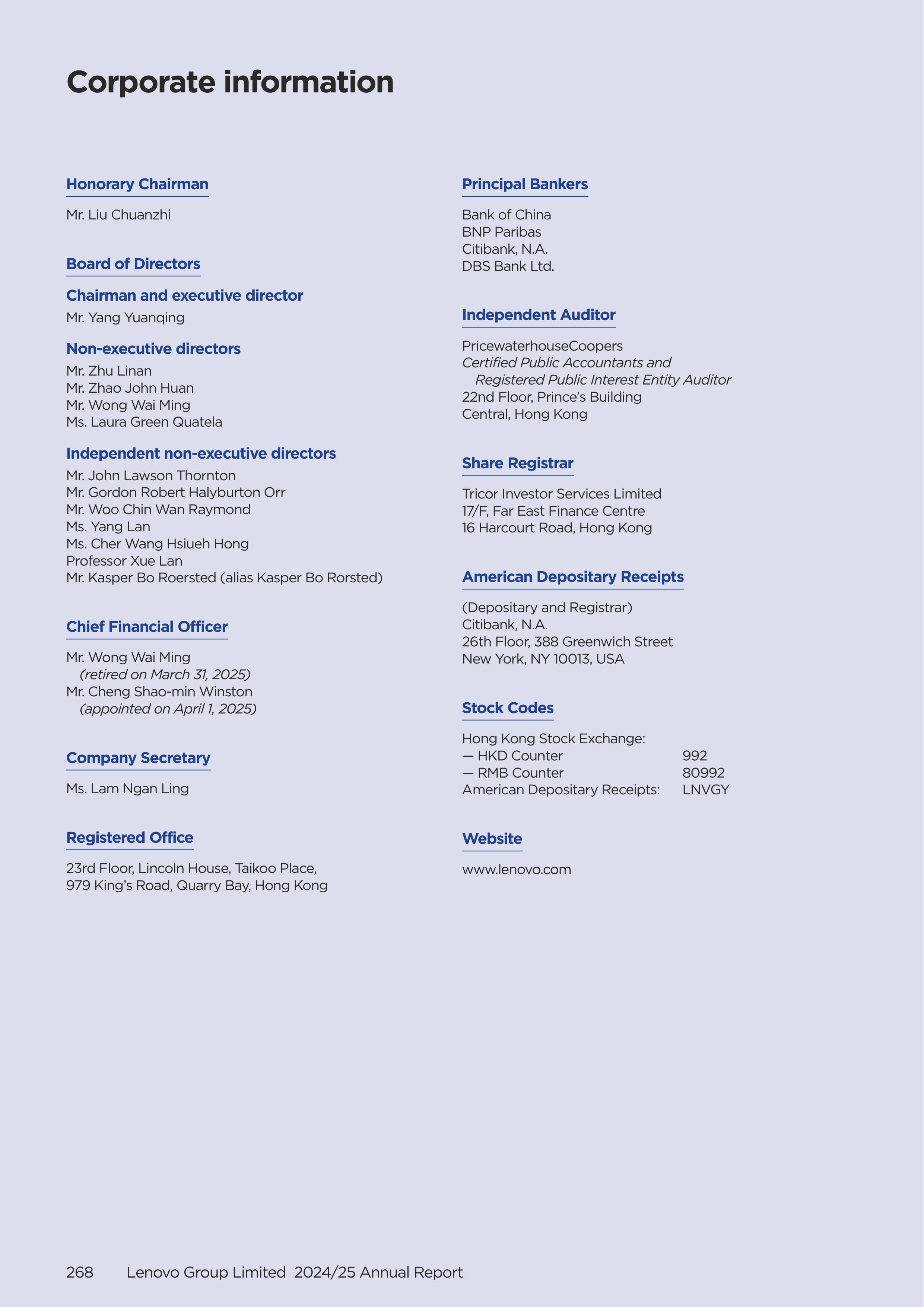
Corporate information
Lenovo Group Limited 2024/25 Annual Report
268
Honorary Chairman
Mr. Liu Chuanzhi
Board of Directors
Chairman and executive director
Mr. Yang Yuanqing
Non-executive directors
Mr. Zhu Linan
Mr. Zhao John Huan
Mr. Wong Wai Ming
Ms. Laura Green Quatela
Independent non-executive directors
Mr. John Lawson Thornton
Mr. Gordon Robert Halyburton Orr
Mr. Woo Chin Wan Raymond
Ms. Yang Lan
Ms. Cher Wang Hsiueh Hong
Professor Xue Lan
Mr. Kasper Bo Roersted (alias Kasper Bo Rorsted)
Chief Financial Officer
Mr. Wong Wai Ming
(retired on March 31, 2025)
Mr. Cheng Shao-min Winston
(appointed on April 1, 2025)
Company Secretary
Ms. Lam Ngan Ling
Registered Office
23rd Floor, Lincoln House, Taikoo Place,
979 King’s Road, Quarry Bay, Hong Kong
Principal Bankers
Bank of China
BNP Paribas
Citibank, N.A.
DBS Bank Ltd.
Independent Auditor
PricewaterhouseCoopers
Certified Public Accountants and
Registered Public Interest Entity Auditor
22nd Floor, Prince’s Building
Central, Hong Kong
Share Registrar
Tricor Investor Services Limited
17/F, Far East Finance Centre
16 Harcourt Road, Hong Kong
American Depositary Receipts
(Depositary and Registrar)
Citibank, N.A.
26th Floor, 388 Greenwich Street
New York, NY 10013, USA
Stock Codes
Hong Kong Stock Exchange:
— HKD Counter
992
— RMB Counter
80992
American Depositary Receipts:
LNVGY
Website
www.lenovo.com


www.lenovo.com
This report is printed on environmentally friendly paper manufactured from elemental
chlorine-free pulp. Printed on chemistry free plate system and soy ink.