


2025 Environmental
Sustainability Report
Accelerating progress to 2030
Reporting on our 2024 fiscal year


Overview
Microsoft sustainability
Carbon
Water
Waste
Ecosystems
Customer sustainability
Global sustainability
Appendix
2025 Environmental Sustainability Report
2
In this report
This year, we reflect on our progress
towards our ambitious 2030 goals:
to be carbon negative, water positive,
and zero waste, while protecting
ecosystems. Since we announced
our goals in 2020, we have made
meaningful progress and we remain
resolute in our commitment not
only to meeting our climate goals
but to empowering others with the
technology they need to build a
more sustainable future.
Reporting disclosure
A key principle of our work is transparency. This report, published annually,
includes our strategy, progress against our goals, and key challenges and
trends we see in this work. We also publish our environmental data, which is
included in the separate Environmental Data Fact Sheet. Deloitte & Touche LLP
performed a review relating to specified information within Section 1 of the
Environmental Data Fact Sheet. Read about how we report in Appendix A.
Explore more
www.microsoft.com/
corporate-responsibility/
sustainability/progress
Overview
Foreword
04
Scaling impact: Our journey to 2030
07
How we work
08
Microsoft sustainability
Carbon
Our approach
10
Efficiency
14
Availability
19
Measurement and adoption
23
Water
Our approach
27
Advancing water replenishment
29
Expanding clean water access
33
Improving efficiency and reducing water use
35
Innovating for greater water efficiency
38
Waste
Our approach
39
Tracking zero waste
41
Reducing waste at our campuses and datacenters
42
Advancing circular cloud hardware and packaging
44
Improving device and packaging circularity
46
Ecosystems
Our approach
49
Fostering biodiversity at campuses and datacenters
50
Collaborating to protect ecosystems
51
Advancing conservation through technology
54
Customer sustainability
Overview
57
Microsoft for Sustainability
58
Green software
60
Devices
63
Gaming
65
Arts and culture
69
Planetary Computer
70
Global sustainability
Overview
72
Investing in innovation
73
Charting new frontiers in AI innovation
77
Shaping policy for a sustainable future
81
Scaling impact through green skilling
85
Appendix
Appendix A - How we report
88
Appendix B - Endnotes
89

3
Overview
Microsoft sustainability
2025 Environmental Sustainability Report
Carbon
Water
Waste
Ecosystems
Customer sustainability
Global sustainability
Appendix
Overview
In this section
Foreword
04
Scaling impact: Our journey to 2030
07
How we work
08
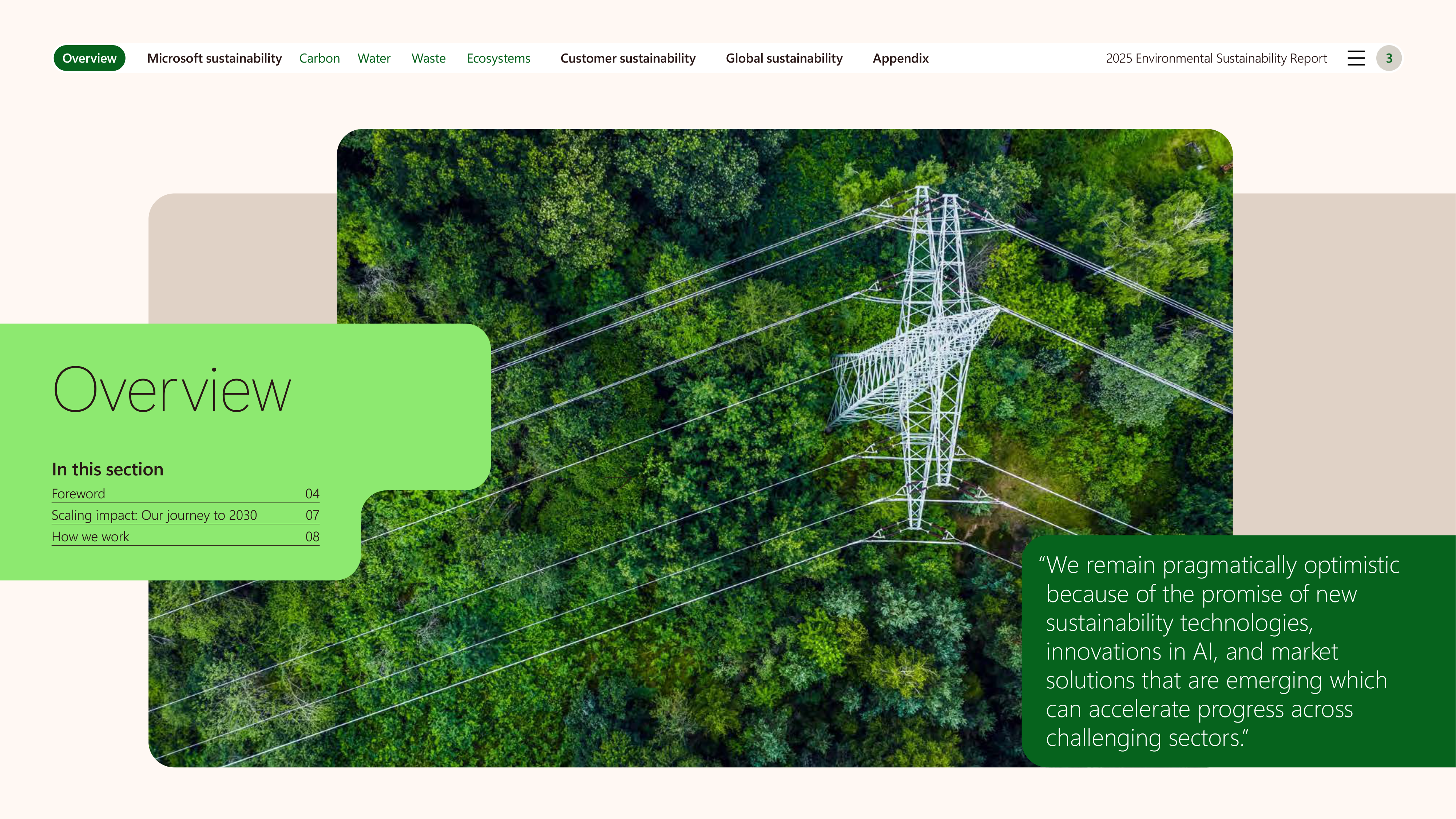
“We remain pragmatically optimistic
because of the promise of new
sustainability technologies,
innovations in AI, and market
solutions that are emerging which
can accelerate progress across
challenging sectors.”



4
Overview
Microsoft sustainability
Carbon
Water
Waste
Ecosystems
Customer sustainability
Global sustainability
Appendix
Foreword
Accelerating
progress
to 2030
Brad Smith
Vice Chair and President
Melanie Nakagawa
Chief Sustainability Officer
“Microsoft remains steadfast
in our dedication to achieving
the company’s 2030
environmental sustainability
commitments.”
As Microsoft continues to grow and innovate, our
commitment to environmental sustainability remains
a core value. This year, we reflect on our progress
towards our ambitious 2030 goals: to be carbon
negative, water positive, and zero waste, while
protecting ecosystems. As we enter the second
half of the decade, Microsoft remains steadfast in
our dedication to achieving the company’s 2030
environmental sustainability commitments.
Since we announced our goals in 2020, we have
made meaningful progress while seeing major
changes in both the technology sector and in our
understanding of what it will take to meet our goals.
We are learning as we go, and we are proactively
working to address sustainability challenges and
accelerate solutions. We remain resolute in our
commitment not only to meeting our climate goals
but also to empowering others with the technology
they need to build a more sustainable future.
At the heart of our approach is an understanding
that sustainability is not simply a set of isolated
initiatives, but a fundamental principle that must
be integrated into every aspect of our business.
Our cross-company Climate Council brings together
leaders from across Microsoft to drive innovation,
accelerate progress, and identify ways to build
sustainability into our operations, products,
and partnerships.
We remain pragmatically optimistic because of
the promise of new sustainability technologies,
innovations in AI, and market solutions that are
emerging which can accelerate progress across
challenging sectors like steel, concrete, and energy
transitions. This annual report is our opportunity to
share our learnings to help accelerate these markets,
be transparent about our progress, and explore
how we can ultimately scale solutions across our
value chain.
We are sharing details about the progress made
in each of our core commitment areas: carbon
negative, water positive, zero waste, and protecting
ecosystems. Our report also highlights a number of
our breakthrough innovations, drawing insights from
the leading edge of climate innovation.
Our progress
In 2020, Microsoft made bold sustainability
commitments. At this halfway point to our 2030
goals, we are reaching key milestones and making
progress that includes:
•
Ecosystems.
In 2022, we met our target of
protecting more land than we use by 2025, a
target we’ve since exceeded by more than 30%.
AI innovation is now driving biodiversity conservation
through research efforts led by the AI for Good Lab
and tools like the Microsoft Planetary Computer.
•
Zero waste.
We exceeded our annual target to
divert 75% of construction and demolition waste six
years early by diverting 85% of this waste in FY24.
We have also surpassed our target for our reuse
and recycling rate for servers and components,
reaching 90.9%. The Surface Copilot+ PCs now
feature our most sustainable packaging design
yet. Packaging from over 30,000 server racks
was processed through recycling programs
in FY24—diverting over 2,500 metric tons of
waste from landfills.
•
Water positive.
We met our target to provide more
than 1.5 million people with clean water and sanitation
solutions. We are also on track to replenish more
water than we consume across global operations and
improve datacenter water use efficiency, including
through a new innovative datacenter design that
optimizes AI workloads and consumes zero water for
cooling to avoid the use of an estimated 125,000 cubic
meters annually per facility.
•
Carbon negative.
To date, we have contracted
34 gigawatts (GW) of carbon-free electricity (CFE)
across 24 countries, about an eighteenfold increase
since 2020. We have also entered long-term
agreements to procure nearly 30 million metric tons
of carbon removal since the start of this program.
2025 Environmental Sustainability Report
Overview
Microsoft sustainability
Carbon
Water
Waste
Ecosystems
Customer sustainability
Global sustainability
Appendix
2025 Environmental Sustainability Report
5
Foreword
continued
Carbon negative: a marathon,
not a sprint
As we remain focused on sustained progress towards
our 2030 goals, it has become clear that our journey
towards being carbon negative is a marathon, not
a sprint. While our total emissions (Scope 1, 2, and
3) have increased by 23.4% compared to our 2020
baseline due to growth-related factors such as AI
and cloud expansion, we are encouraged by the
fact that this increase has been modest compared
to the 168% increase in energy use and 71% revenue
growth that has taken place over the same period.
For Microsoft to be carbon negative by 2030,
we will need to reduce our value chain emissions.
Starting with our direct operational emissions,
as we shared earlier this year, since 2012 our carbon
strategy has included a combination of procuring
environmental attributes leveraging our corporate
carbon fee and overall carbon emissions reduction
efforts. This enabled us to decrease our Scope 1 and
2 emissions by 29.9% from our 2020 baseline in FY24.
At the same time, as we shift away from procuring
non-additional environmental attribute certificates,
we recognize that we must also bring more carbon-
free electricity onto the grids where we operate.
We are also implementing strategies to reduce our
Scope 3 emissions by 2030, which increased in FY24
by 26% from our 2020 baseline. We are prioritizing
addressing these emissions through supplier
engagement programs including establishing
standards via our Supplier Code of Conduct.
Through the latter, select large-scale Microsoft
suppliers are required to transition to 100% carbon-
free electricity for their delivered goods and services
as well as forthcoming guidance, launching in July,
to target usage of sustainable aviation fuel, where
possible, for Microsoft business-related air travel by
2030. We also remain committed to developing and
supporting innovative solutions to reduce emissions
from key datacenter and operational inputs including
building materials, chips, and fuels, focusing on
long-term solutions over short-term stopgaps. To do
this, we have been adapting our strategies to use
new sustainability technologies and address the
challenges of expanding energy demand.
We see significant progress in several key areas,
demonstrating potential for global impact:
Powering operations with carbon-free electricity
(CFE):
In 2024, Microsoft contracted 19 GW of new
renewable energy across 16 countries through power
purchase agreements (PPAs) which are central to
our carbon reduction strategy, driving down our
Scope 2 emissions. Microsoft has taken a first-mover
approach to making long-term investments to bring
more CFE online.
We continue to advocate for expanding clean
energy solutions globally to support not only our
power needs but also those of our supply chain.
We are addressing challenges with permitting,
interconnection delays, and fluctuating interest rates
by innovating through circularity and contracting.
For example, we signed groundbreaking PPAs with
Engie requiring that 100% of photovoltaic modules
will be reused or recycled.
Transforming datacenters and campuses:
In FY24, we launched our first datacenters
constructed with mass timber, a strong, ultra-
lightweight wood in a hybrid construction model.
This approach is projected to reduce the embodied
carbon footprint of these new datacenters by up
to 65% compared to typical precast concrete.
We also doubled our rate of power savings and are
transitioning from traditional air-cooled datacenters
to chip-level liquid cooling designs at all owned
datacenters. As the World Economic Forum
highlighted in Innovation and Adaptation in the
Climate Crisis, “Data-driven and digital technologies
are uniquely suited to build adaptive capacity.”
1
We believe technology can be a powerful tool to
address some of society’s toughest challenges,
including environmental sustainability. As demand
for AI and cloud services grows, we are advancing
how we design, build, and operate our datacenters
and campuses. Decarbonizing the built environment
is a crucial element in this process.
Accelerating carbon removal initiatives:
In FY24, Microsoft signed long-term agreements to
procure more carbon removal than all previous years
combined, achieving nearly 22 million metric tons in
contracts for carbon removal. We are committed to
helping build the markets we buy from, translating
leading science into commercial innovation and
regularly updating our Criteria for High-Quality
Carbon Dioxide Removal. We also know we cannot
accelerate this market alone, which is why we
co-founded the Symbiosis Coalition with industry
partners. The Symbiosis Coalition is targeting up to
20 million metric tons of high-quality, nature-based
carbon removal credits by 2030.
Improving operational efficiency and logistics:
In FY24, among facilities that manufacture devices
for Microsoft, we saw a tenfold increase over the
previous year in transitions to 100% CFE. This was
accomplished, in part, by partnering with 3Degrees
to launch the Supplier REach portal to support
suppliers making their CFE transition. Our drive to
reduce datacenter emissions extends to transforming
the logistics operations of these facilities.
Through strategic partnerships and targeted
initiatives, Microsoft continues to reduce emissions
across transportation, warehousing, and the broader
logistics supply chain, setting new benchmarks for
operational efficiency and environmental impact.
We adopted alternative fuels and electric vehicles to
reduce emissions, collaborating with several leading
logistics service providers (LSPs).

Foreword
continued
Microsoft sustainability
Overview
Customer sustainability
Global sustainability
Appendix
6
Carbon
Water
Waste
Ecosystems
2025 Environmental Sustainability Report
Renewable diesel is now in use in our road freight
operations in Europe and California, cutting
emissions by 50% for these shipments while keeping
existing equipment in use. We also have partnered
with airlines and shipping lines to expand the use of
sustainable aviation and marine fuels. These efforts
have reduced emissions by over 17,000 metric tons
of C
O subscript 2
emissions, comparable to avoiding the
combustion of nearly 40,000 barrels of oil.
2
Accelerating global solutions
At Microsoft, we understand that driving
meaningful sustainability progress goes beyond
our own practices and requires global collaboration,
investment, and innovation. Across our operations,
we are working to empower customers, build
impactful partnerships, and invest in breakthrough
solutions that drive progress worldwide.
•
Investing in innovation:
A hallmark of this effort
has been our Climate Innovation Fund (CIF)—
our $1 billion commitment set in 2020 to advance
innovation beyond Microsoft’s four walls. To date,
CIF has made significant investments in innovative
climate technologies including commercial direct
air capture technologies, sustainable aviation fuel,
industrial decarbonization, and more. CIF has
invested over $793 million in capital in new climate
technologies, expanding to 63 investments across
CFE, sustainable fuels, carbon removal, and
advanced building materials.
•
Empowering customers:
We help customers
and organizations centralize, analyze, and act on
their data with AI-powered platforms for advanced
analytics and reporting insights. For example,
the Howden Resilience Laboratory supported
by Microsoft and our Planetary Computer uses
technology and data platforms to help investors
understand climate risks to critical infrastructure,
improve resilience, and contribute to better-
informed investment decisions.
•
Partnering for impact:
Partnering to scale our
impact is a critical component of our sustainability
efforts. Today GitHub fosters a thriving community
that is home to over 150 million developers and
60,000 climate-focused open-source projects,
advancing climate technology, greener software,
and device sustainability. Xbox has made significant
investments not only to reduce the environmental
footprint associated with the production of our
devices, accessories, and console packaging, but
also to reduce the energy usage of the console
itself. For example, Xbox became the first console
to release a dedicated energy consumption and
carbon emissions measurement tool designed
for game creators.
•
Accelerating AI for sustainability:
Our AI for
Good Lab, sustainability science, and research
teams collaborate globally to accelerate
solutions and develop climate resilience with
AI. For example, we have partnered with the
United Nations to apply AI to climate challenges
through programs like the Early Warnings for All
initiative, which seeks to better understand which
populations may be at risk of extreme weather
events and other threats. By sharing our progress,
tools, and learnings with the world, we aim to
accelerate the pace of innovation, improve overall
operational efficiency, reduce energy consumption,
and find new solutions with long-term results.
“We are building an efficient,
sustainable engine that
drives us closer to our
commitments.”
Sustained momentum and
future impact
There is no issue today that connects everyone on
the planet more than climate change. As we strive to
build a more sustainable future, we remain inspired
by the dedication of our employees and partners
and committed to transparency, accountability,
and collaboration.
While the road to a sustainable future is challenging
and not linear, we are encouraged by the progress
we have made in FY24. By strategically focusing
on CFE, carbon removal, water stewardship, waste
reduction, and ecosystem protection, we are building
an efficient, sustainable engine that drives us closer
to our commitments.
We encourage you to read further to learn more
about our progress and learnings across all of
these areas, and we look forward to engaging in
continued dialogue as we learn and develop new
ways to help us meet our goals. We will continue to
adapt our strategies, utilize emerging sustainability
markets, and scale innovative technologies for even
greater impact.
We recognize that achieving our ambitious goals
requires sustained momentum, and we are dedicated
to driving that momentum forward.
Brad Smith
Vice Chair and President
Melanie Nakagawa
Chief Sustainability Officer
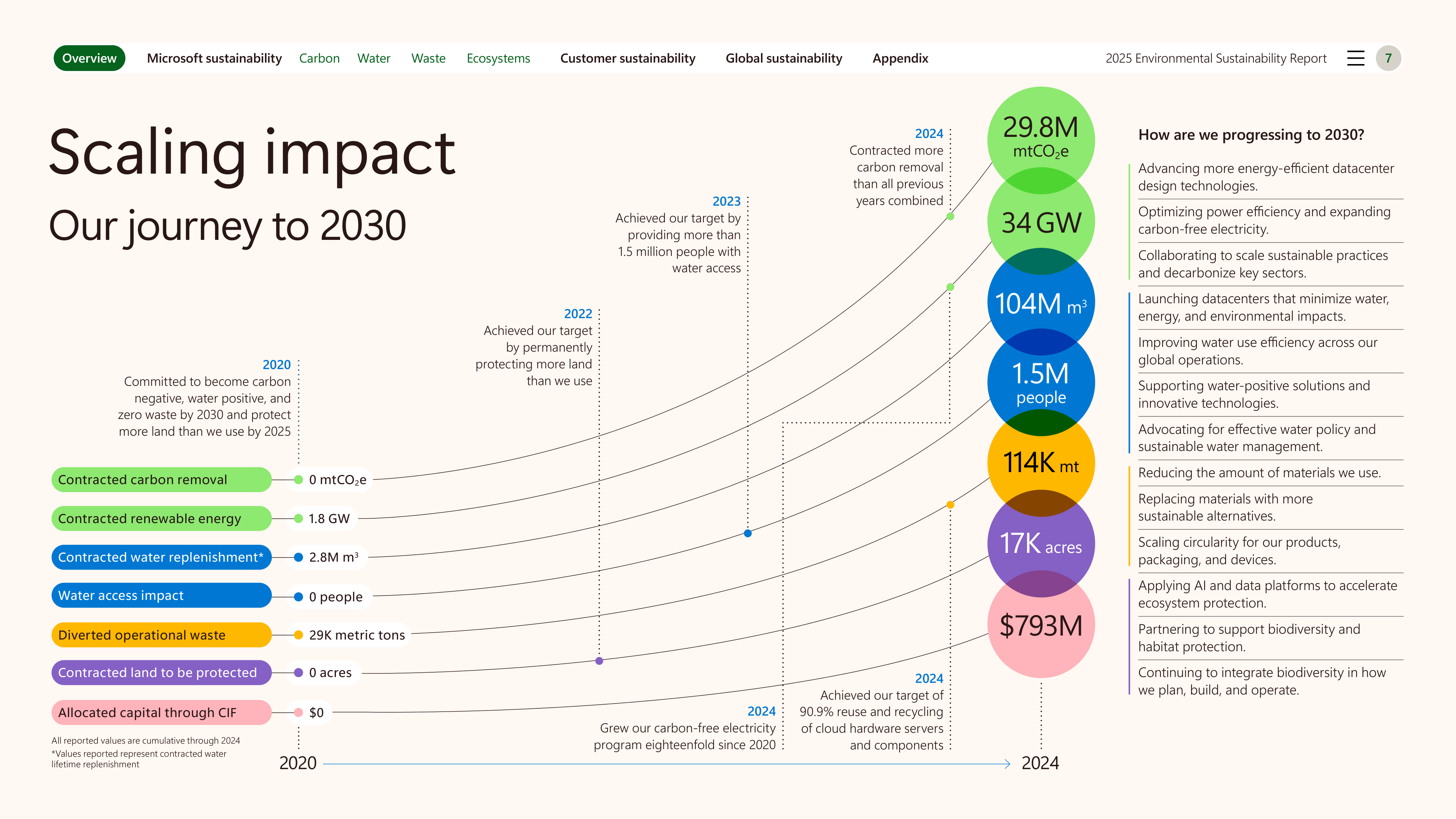

Scaling impact
Our journey to 2030
Contracted carbon removal
0 mtCO
2
e
29.8M
mtCO
2
e
Contracted renewable energy
1.8 GW
34GW
Contracted water replenishment*
2.8M m
3
104M
m
3
Water access impact
0 people
1.5M
people
Diverted operational waste
29K metric tons
114K
mt
Contracted land to be protected
0 acres
17K
acres
Allocated capital through CIF
$0
$793M
2020
Committed to become carbon
negative, water positive, and
zero waste by 2030 and protect
more land than we use by 2025
2022
Achieved our target
by permanently
protecting more land
than we use
2023
Achieved our target by
providing more than
1.5 million people with
water access
2024
Contracted more
carbon removal
than all previous
years combined
2024
Grew our carbon-free electricity
program eighteenfold since 2020
2024
Achieved our target of
90.9% reuse and recycling
of cloud hardware servers
and components
2020
2024
All reported values are cumulative through 2024
Note * Values reported represent contracted water
lifetime replenishment
Microsoft sustainability
Overview
Customer sustainability
Global sustainability
Appendix
7
Carbon
Water
Waste
Ecosystems
2025 Environmental Sustainability Report
How are we progressing to 2030?
Advancing more energy-efficient datacenter
design technologies.
Optimizing power efficiency and expanding
carbon-free electricity.
Collaborating to scale sustainable practices
and decarbonize key sectors.
Launching datacenters that minimize water,
energy, and environmental impacts.
Improving water use efficiency across our
global operations.
Supporting water-positive solutions and
innovative technologies.
Advocating for effective water policy and
sustainable water management.
Reducing the amount of materials we use.
Replacing materials with more
sustainable alternatives.
Scaling circularity for our products,
packaging, and devices.
Applying AI and data platforms to accelerate
ecosystem protection.
Partnering to support biodiversity and
habitat protection.
Continuing to integrate biodiversity in how
we plan, build, and operate.


8
Microsoft sustainability
Overview
Customer sustainability
Global sustainability
Appendix
Carbon
Water
Waste
Ecosystems
2025 Environmental Sustainability Report
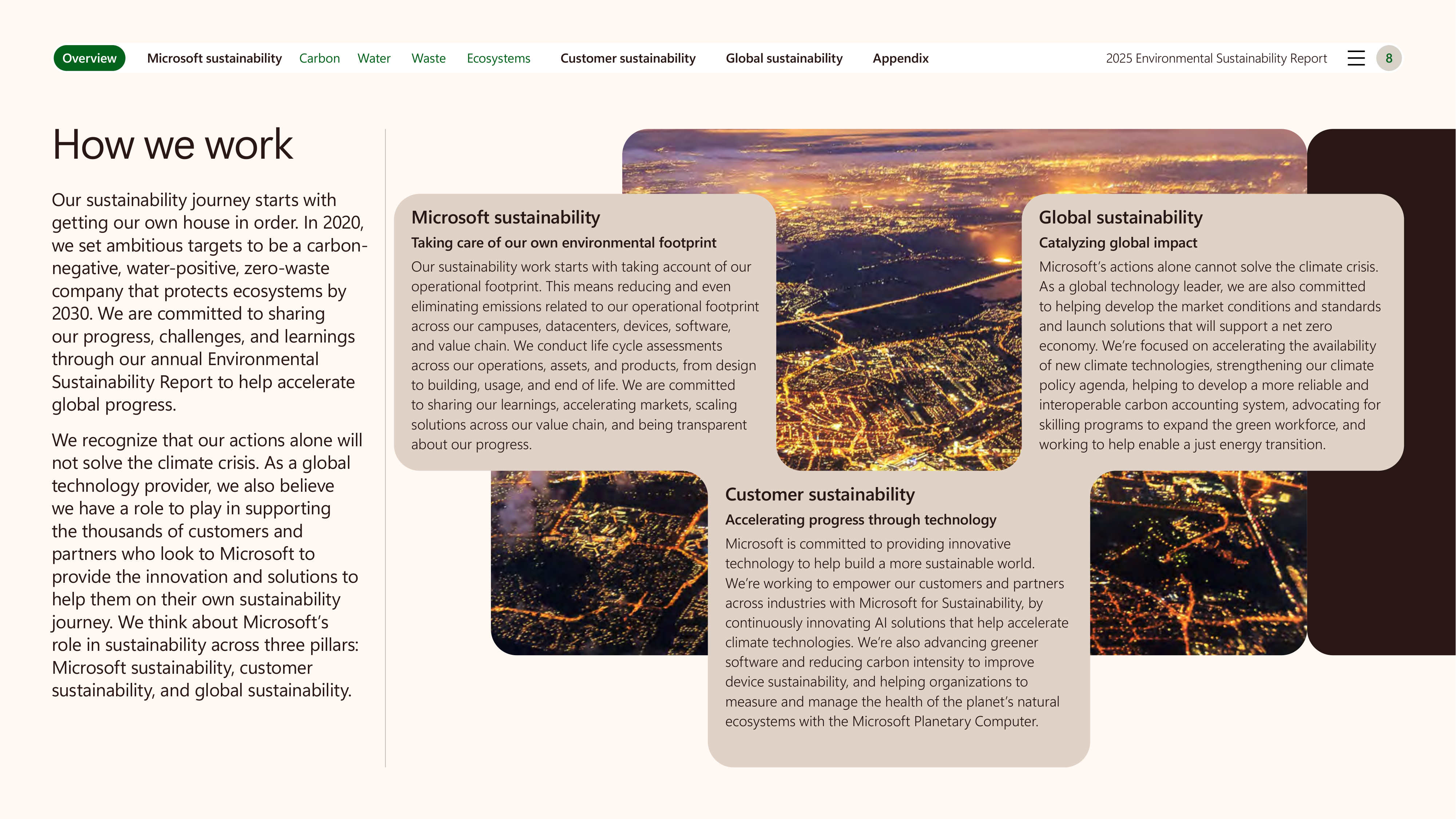
How we work
Our sustainability journey starts with
getting our own house in order. In 2020,
we set ambitious targets to be a carbon-
negative, water-positive, zero-waste
company that protects ecosystems by
2030. We are committed to sharing
our progress, challenges, and learnings
through our annual Environmental
Sustainability Report to help accelerate
global progress.
We recognize that our actions alone will
not solve the climate crisis. As a global
technology provider, we also believe
we have a role to play in supporting
the thousands of customers and
partners who look to Microsoft to
provide the innovation and solutions to
help them on their own sustainability
journey. We think about Microsoft’s
role in sustainability across three pillars:
Microsoft sustainability, customer
sustainability, and global sustainability.
Microsoft sustainability
Taking care of our own environmental footprint
Our sustainability work starts with taking account of our
operational footprint. This means reducing and even
eliminating emissions related to our operational footprint
across our campuses, datacenters, devices, software,
and value chain. We conduct life cycle assessments
across our operations, assets, and products, from design
to building, usage, and end of life. We are committed
to sharing our learnings, accelerating markets, scaling
solutions across our value chain, and being transparent
about our progress.
Customer sustainability
Accelerating progress through technology
Microsoft is committed to providing innovative
technology to help build a more sustainable world.
We’re working to empower our customers and partners
across industries with Microsoft for Sustainability, by
continuously innovating AI solutions that help accelerate
climate technologies. We’re also advancing greener
software and reducing carbon intensity to improve
device sustainability, and helping organizations to
measure and manage the health of the planet’s natural
ecosystems with the Microsoft Planetary Computer.
Global sustainability
Catalyzing global impact
Microsoft’s actions alone cannot solve the climate crisis.
As a global technology leader, we are also committed
to helping develop the market conditions and standards
and launch solutions that will support a net zero
economy. We’re focused on accelerating the availability
of new climate technologies, strengthening our climate
policy agenda, helping to develop a more reliable and
interoperable carbon accounting system, advocating for
skilling programs to expand the green workforce, and
working to help enable a just energy transition.

Carbon
10
Water
27
Waste
39
Ecosystems
49
Microsoft sustainability
Overview
9
Customer sustainability
Global sustainability
Appendix
2025 Environmental Sustainability Report
Carbon
Water
Waste
Ecosystems
Microsoft sustainability
Taking care of our own
environmental footprint
Our sustainability work starts with taking account of
our operational footprint. This means reducing and even
eliminating emissions related to our operational footprint
across our campuses, datacenters, devices, software, and value
chain. We conduct life cycle assessments across our operations,
assets, and products, from design to building, usage, and end
of life. We are committed to sharing our learnings, accelerating
markets, scaling solutions across our value chain, and being
transparent about our progress.
In this section

10
Overview
Microsoft sustainability
Water
Waste
Ecosystems
Customer sustainability
Global sustainability
Appendix
2025 Environmental Sustainability Report
Carbon
In this section
Our approach Efficiency Availability Measurement and adoption Learnings and what’s next
Getting
to carbon
negative
We are working to build markets,
scale solutions, and improve access
to sustainability solutions to support
our Microsoft sustainability journey
and others working to achieve their
own carbon goals.
As we reach the halfway point in our journey
to becoming carbon negative, we reflect on the
progress made, as well as the opportunities and
challenges that lie ahead. This journey requires
a comprehensive and collaborative approach,
addressing all necessary components simultaneously
and laying a foundation that enables future scale
and impact.
Our approach
In our 2024 Sustainability Report, we highlighted
the establishment of the Microsoft Climate Council,
an internal leadership body with representatives
from nearly every business organization at
Microsoft. This council works to track and accelerate
progress, review new reduction measures, and
help the company achieve our environmental
sustainability commitments.
This unique structure drives progress on our
carbon reduction roadmap across all business
groups. As part of the roadmap process, each
business group assesses its emissions forecasts
to 2030. From there, existing and new reduction
interventions are evaluated to drive down emissions
against Microsoft’s 2020 baseline, emission reduction
projections are revised, and lessons learned are
shared with the Council, highlighting where further
investments and interventions are needed.
This annual process drives accountability and
progress throughout the company amid exciting
new innovations and continued business
growth. As part of this cross-company effort,
we have unlocked new opportunities to reduce
emissions which help us progress closer to our
2030 commitments.
Through this process, we identified three critical focus areas as we look to 2030:
1
Efficiency:
Many of the
products and technologies,
such as AI, which can
accelerate climate solutions
also pose a resource challenge.
We are continuously improving
our processes and identifying
solutions to do more with less
—reducing carbon emissions
and resource use while
ensuring our infrastructure
aligns with business growth.
2
Availability:
Many of the
products and technologies
required to reduce emissions,
such as carbon-free electricity,
are not currently available in
sufficient quantities or in all
necessary locations. We are
working to build markets,
scale solutions, and improve
access to sustainability solutions
to support our Microsoft
sustainability journey and
others working to achieve their
own carbon commitments.
3
Measurement and adoption:
For the low-carbon products
available today, we must
ensure our teams have the
systems and processes needed
to integrate sustainability
solutions into our design,
construction, and operations.
We also need systems that
provide accurate measurement
and insights, allowing us to
demonstrate progress in our
emissions reporting.
These focus areas are central to our strategy today. At Microsoft, we are continuously reassessing and
adjusting our strategy to drive the highest impact toward our 2030 commitments and beyond.

Our approach
continued
Overview
Microsoft sustainability
Carbon
Water
Waste
Ecosystems
Customer sustainability
Global sustainability
Appendix
11
2025 Environmental Sustainability Report
Our targets and progress
Carbon negative
By 2030, Microsoft will cut its
emissions by more than half
compared to 2020 and remove
more carbon than it emits.
By 2050, we will remove the
same amount of carbon we
have emitted operationally
since our founding in 1975.
In progress
Achieved
Target
Progress
Reducing direct and indirect emissions
We will reduce our Scope 1 and 2 emissions to near zero against a 2020 baseline by
increasing energy efficiency, decarbonization of our operations, and reaching 100%
renewable energy by 2025.
Scope 1 and 2 emissions
Our Scope 1 and 2 emissions decreased by 30% from the 2020 base year. This result is
driven by our ongoing work to advance clean energy procurement, green tariff programs,
and use of unbundled renewable energy certificates.
Reducing value chain emissions
By 2030, we will reduce our Scope 3 emissions by more than half from a 2020 baseline.
Scope 3 emissions
Our value chain or Scope 3 emissions increased by 26% from our 2020 baseline.
Microsoft continues to work to scale carbon-free electricity markets across our supply
chain and invest to decarbonize need-to abate sectors, including steel, concrete, and
other building materials used in our datacenters, as well as fuels.
Expanding carbon-free electricity
By 2030, 100% of our electricity consumption will be matched by zero carbon electricity
purchases 100% of the time.
Expanding carbon-free electricity with renewable
and nuclear energy
In 2024, we contracted an additional 19 GW of new renewable energy across 16 countries,
further diversifying our energy portfolio. Microsoft also expanded into nuclear energy with
the signing of our first large-scale nuclear energy PPA with the Crane Clean Energy Center
in September 2024. This agreement will enable the restart of an 835-MW nuclear facility
in Pennsylvania, retired in 2019, providing a significant supply of new, reliable, CFE to the
PJM power grid—a critical energy region for Microsoft’s datacenters.
Removing the rest of our emissions
By 2030, Microsoft will remove more carbon than it emits. By 2050, we will remove an
amount of carbon equivalent to all our historical operational emissions.
Contracted carbon removal
In FY24, we contracted an additional 2.8 million metric tons of carbon removal expected
to be delivered toward FY30.
3
In addition, we contracted 17.4 million metric tons that we
expect to apply toward carbon negative goals after 2030 and/or our 2050 goal.

FY20
FY21
FY22
FY23
FY24
Metric tons CO
2
e
18M
15M
12M
6M
3M
9M
-3M
-6M
0M
Retirements from avoided emissions
Retirements from carbon removal
Our approach
continued
Microsoft sustainability
Carbon
Water
Waste
Ecosystems
Overview
Customer sustainability
Global sustainability
Appendix
12
2025 Environmental Sustainability Report
Carbon Table 1
Tracking progress toward carbon negative by 2030
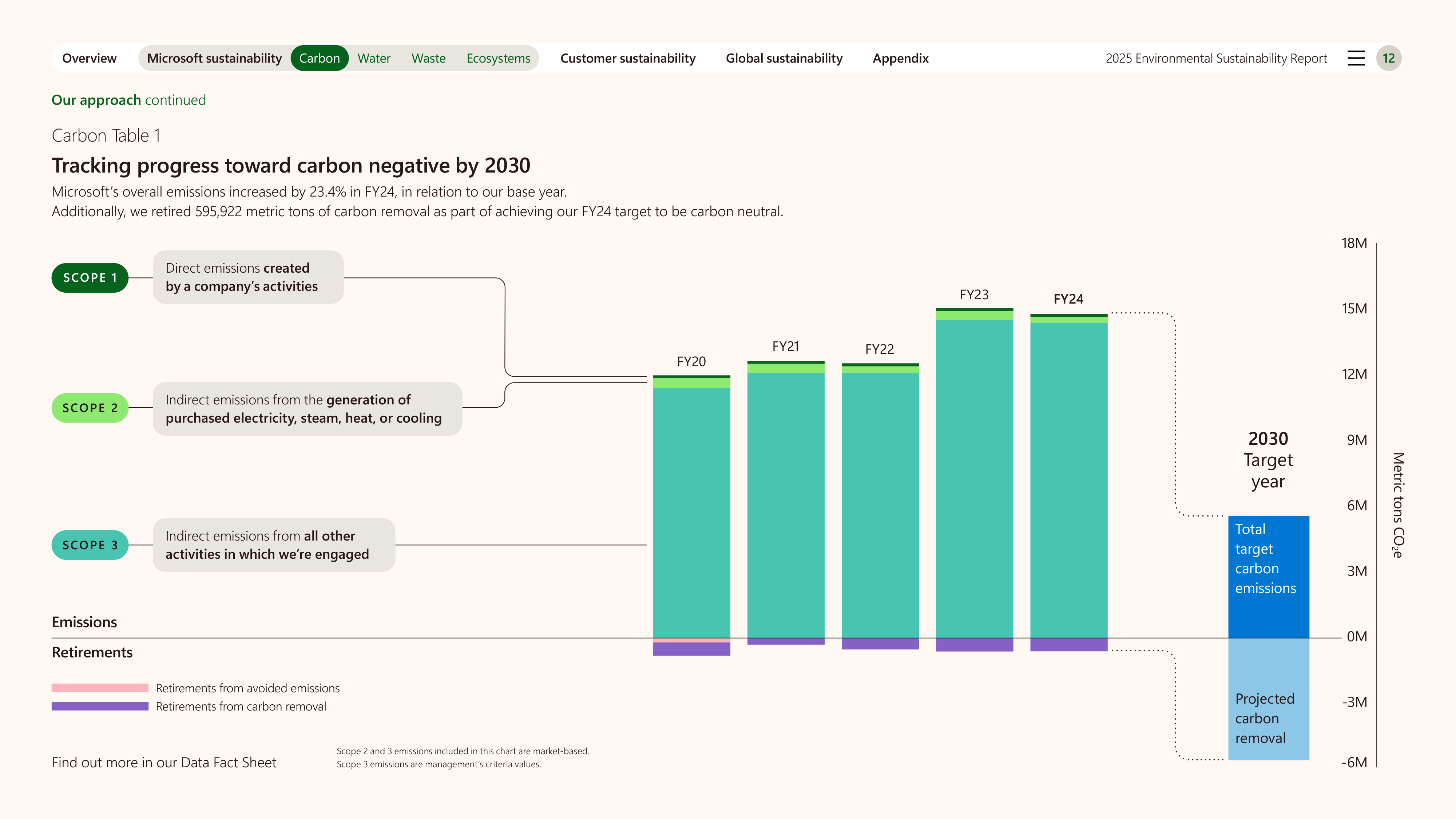
Microsoft’s overall emissions increased by 23.4% in FY24, in relation to our base year.
Additionally, we retired 595,922 metric tons of carbon removal as part of achieving our FY24 target to be carbon neutral.
SCOPE 1
Direct emissions
created
by a company’s activities
SCOPE 2
Indirect emissions from the
generation of
purchased electricity, steam, heat, or cooling
SCOPE 3
Indirect emissions from
all other
activities in which we’re engaged
Emissions
Retirements
2030
Target
year
Total
target
carbon
emissions
Projected
carbon
removal
Find out more in our Data Fact Sheet
Scope 2 and 3 emissions included in this chart are market-based.
Scope 3 emissions are management’s criteria values.

Our approach
continued
1
2
3
4
11
13
Scope 3
97.29%
5
7
9
12
Scope 1
0.97%
Scope 2
1.74%
6
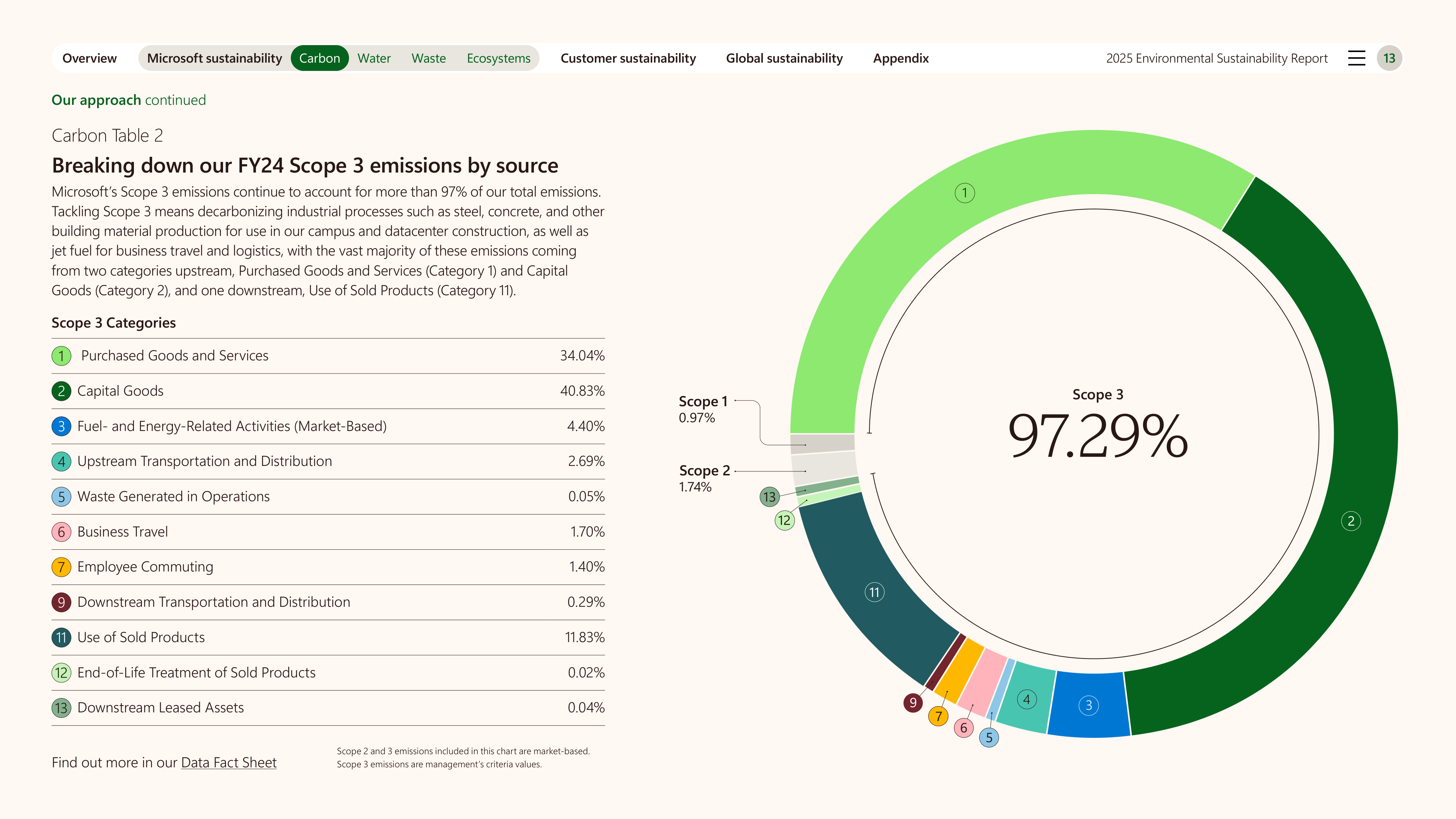
Carbon Table 2
Breaking down our FY24 Scope 3 emissions by source
Microsoft’s Scope 3 emissions continue to account for more than 97% of our total emissions.
Tackling Scope 3 means decarbonizing industrial processes such as steel, concrete, and other
building material production for use in our campus and datacenter construction, as well as
jet fuel for business travel and logistics, with the vast majority of these emissions coming
from two categories upstream, Purchased Goods and Services (Category 1) and Capital
Goods (Category 2), and one downstream, Use of Sold Products (Category 11).
Scope 3 Categories
1
Purchased Goods and Services
34.04%
2
Capital Goods
40.83%
3
Fuel- and Energy-Related Activities (Market-Based)
4.40%
4 Upstream Transportation and Distribution
2.69%
5 Waste Generated in Operations
0.05%
6 Business Travel
1.70%
7 Employee Commuting
1.40%
9
Downstream Transportation and Distribution
0.29%
11
Use of Sold Products
11.83%
12 End-of-Life Treatment of Sold Products
0.02%
13 Downstream Leased Assets
0.04%
Find out more in our Data Fact Sheet
Scope 2 and 3 emissions included in this chart are market-based.
Scope 3 emissions are management’s criteria values.
Microsoft sustainability
Carbon
Water
Waste
Ecosystems
Overview
Customer sustainability
Global sustainability
Appendix
13
2025 Environmental Sustainability Report
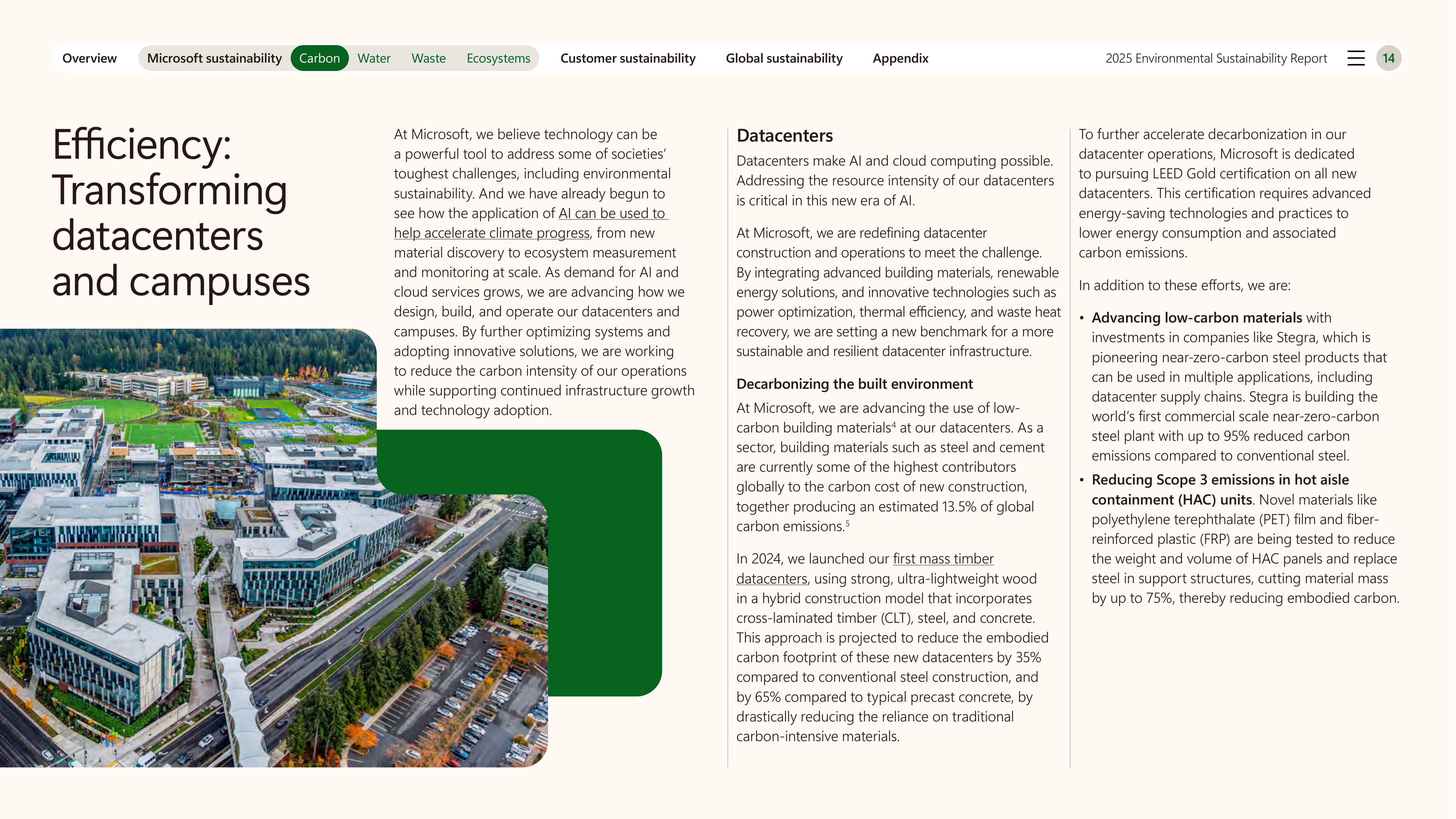

Efficiency:
Transforming
datacenters
and campuses
At Microsoft, we believe technology can be
a powerful tool to address some of societies’
toughest challenges, including environmental
sustainability. And we have already begun to
see how the application of AI can be used to
help accelerate climate progress, from new
material discovery to ecosystem measurement
and monitoring at scale. As demand for AI and
cloud services grows, we are advancing how we
design, build, and operate our datacenters and
campuses. By further optimizing systems and
adopting innovative solutions, we are working
to reduce the carbon intensity of our operations
while supporting continued infrastructure growth
and technology adoption.
Datacenters
Datacenters make AI and cloud computing possible.
Addressing the resource intensity of our datacenters
is critical in this new era of AI.
At Microsoft, we are redefining datacenter
construction and operations to meet the challenge.
By integrating advanced building materials, renewable
energy solutions, and innovative technologies such as
power optimization, thermal efficiency, and waste heat
recovery, we are setting a new benchmark for a more
sustainable and resilient datacenter infrastructure.
Decarbonizing the built environment
At Microsoft, we are advancing the use of low-
carbon building materials
4
at our datacenters. As a
sector, building materials such as steel and cement
are currently some of the highest contributors
globally to the carbon cost of new construction,
together producing an estimated 13.5% of global
carbon emissions.
5
In 2024, we launched our first mass timber
datacenters, using strong, ultra-lightweight wood
in a hybrid construction model that incorporates
cross-laminated timber (CLT), steel, and concrete.
This approach is projected to reduce the embodied
carbon footprint of these new datacenters by 35%
compared to conventional steel construction, and
by 65% compared to typical precast concrete, by
drastically reducing the reliance on traditional
carbon-intensive materials.
To further accelerate decarbonization in our
datacenter operations, Microsoft is dedicated
to pursuing LEED Gold certification on all new
datacenters. This certification requires advanced
energy-saving technologies and practices to
lower energy consumption and associated
carbon emissions.
In addition to these efforts, we are:
•
Advancing low-carbon materials
with
investments in companies like Stegra, which is
pioneering near-zero-carbon steel products that
can be used in multiple applications, including
datacenter supply chains. Stegra is building the
world’s first commercial scale near-zero-carbon
steel plant with up to 95% reduced carbon
emissions compared to conventional steel.
•
Reducing Scope 3 emissions in hot aisle
containment (HAC) units
. Novel materials like
polyethylene terephthalate (PET) film and fiber-
reinforced plastic (FRP) are being tested to reduce
the weight and volume of HAC panels and replace
steel in support structures, cutting material mass
by up to 75%, thereby reducing embodied carbon.
Microsoft sustainability
Carbon
Water
Waste
Ecosystems
Overview
Customer sustainability
Global sustainability
Appendix
14
2025 Environmental Sustainability Report

Efficiency
continued
Collaborating for industry-wide impact
Since launching our sustainability commitments,
we have embedded low-carbon materials and
equipment requirements into supplier contracts,
while also collaborating with industry leaders to scale
sustainable construction practices.
As a member of the Infrastructure Masons (iMasons)
and the iMasons Climate Accord (ICA)—a nonprofit
professional association dedicated to reducing
carbon in digital infrastructure materials, products,
and power, Microsoft is working alongside AWS,
Google, Meta, and over 200 leading digital
infrastructure providers, product companies, and
investment firms to address climate change.
Decarbonizing datacenter operations
Optimizing power efficiency in datacenters
At Microsoft, we are continually refining our
approach to energy efficiency across our datacenter
operations, working to ensure that energy is used
as effectively as possible without compromising
performance or reliability. One key initiative, power
harvesting, maximizes the use of our available
power by reallocating unused power from workloads
that do not consume their full power allocation.
Despite increased demands from AI workloads
over the past year, Microsoft has doubled our rate
of power savings, scaling this approach across
our datacenters.
In parallel, Microsoft is reducing server energy
consumption through methods like low-power
server states, which lowers energy usage on
unallocated servers by up to 35%. This initiative
has rapidly expanded from deployment on a
few thousand servers in 2022 to nearly 2 million
by the end of 2024. Additionally, in a similar
initiative, servers awaiting maintenance are
placed in power-saving modes, reducing energy
usage by hundreds of megawatt-hours monthly.
Microsoft is also increasing server utilization by
selectively oversubscribing CPU cores for internal
workloads with low utilization. This targeted
approach has reduced datacenter hardware needs
for the Microsoft Azure platform by approximately
1.5% since 2020—representing a threefold
improvement compared to reductions achieved
by 2022—while also cutting embodied carbon.
negative 35%
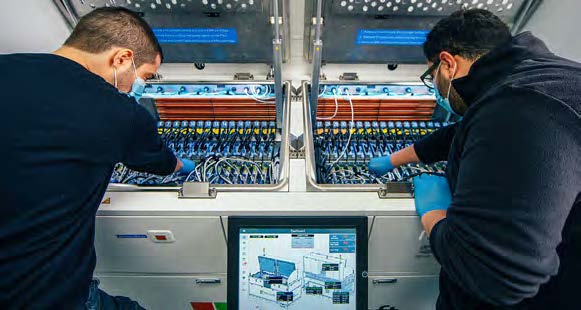
Microsoft is reducing server energy
consumption through methods
like low power server states,
which lowers energy usage on
unallocated servers by up to 35%.
INNOVATION IN ACTION
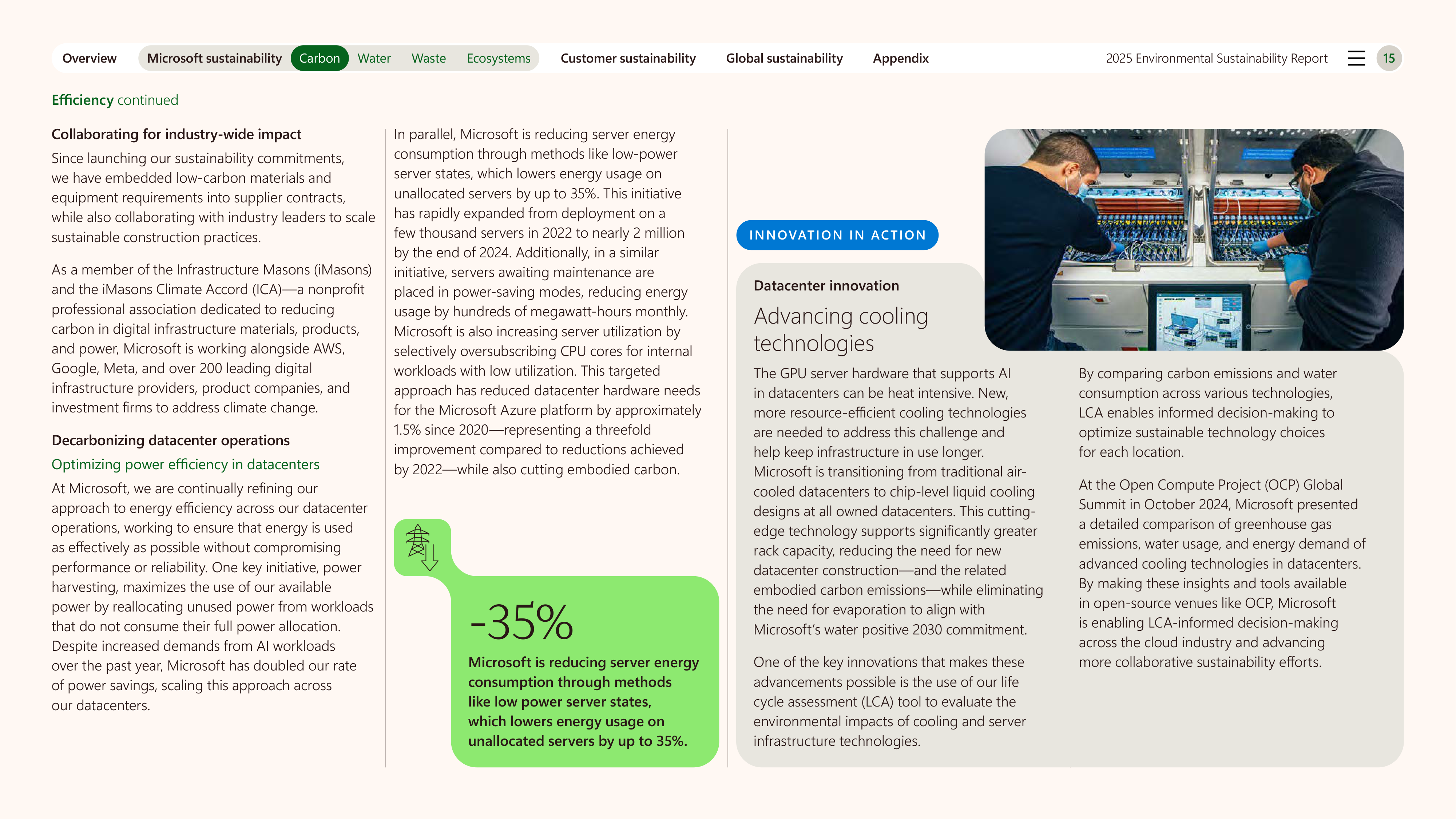
Datacenter innovation
Advancing cooling
technologies
The GPU server hardware that supports AI
in datacenters can be heat intensive. New,
more resource-efficient cooling technologies
are needed to address this challenge and
help keep infrastructure in use longer.
Microsoft is transitioning from traditional air-
cooled datacenters to chip-level liquid cooling
designs at all owned datacenters. This cutting-
edge technology supports significantly greater
rack capacity, reducing the need for new
datacenter construction—and the related
embodied carbon emissions—while eliminating
the need for evaporation to align with
Microsoft’s water positive 2030 commitment.
One of the key innovations that makes these
advancements possible is the use of our life
cycle assessment (LCA) tool to evaluate the
environmental impacts of cooling and server
infrastructure technologies.
By comparing carbon emissions and water
consumption across various technologies,
LCA enables informed decision-making to
optimize sustainable technology choices
for each location.
At the Open Compute Project (OCP) Global
Summit in October 2024, Microsoft presented
a detailed comparison of greenhouse gas
emissions, water usage, and energy demand of
advanced cooling technologies in datacenters.
By making these insights and tools available
in open-source venues like OCP, Microsoft
is enabling LCA-informed decision-making
across the cloud industry and advancing
more collaborative sustainability efforts.
Microsoft sustainability
Carbon
Water
Waste
Ecosystems
Overview
Customer sustainability
Global sustainability
Appendix
15
2025 Environmental Sustainability Report


Efficiency
continued
Transitioning to renewable diesel
Backup generators play a critical role in providing
power to our datacenters during outages and grid
instability. While rarely used, these generators
are essential to maintaining uninterrupted
service for customers, but the carbon footprint
of traditional diesel generators underscores the
importance of transitioning to alternative fuels.
Microsoft is transitioning its datacenter generators
to use alternative fuels including renewable
diesel, which offers significantly lower life cycle
emissions compared to conventional diesel.
This transition includes:
•
Equipment modifications and local permitting
.
Making progress towards full conversion, many
sites have already completed the retrofitting
process to transition to renewable diesel, with
special attention given to generators in cold
climates, ensuring they have adequate heaters
to mitigate cold temperature impacts to
renewable fuel.
•
Sustainable fuel standards
. We work
closely with suppliers to responsibly procure
hydrogenated vegetable oil and other renewable
diesel variations, reinforcing our commitment to
reducing emissions from fuel.
Partnering with suppliers to reduce
operational emissions
Microsoft’s goal to reduce emissions extends beyond
our internal operations, and we continue to partner
with suppliers to reduce emissions across our
supply chain. The Microsoft Supplier Engagement
Program uses in-depth analysis to identify the
most impactful carbon reduction opportunities
across Scope 1, 2, and 3 emissions.
In 2024, Microsoft introduced a new target in
the Microsoft Supplier Code of Conduct requiring
suppliers to transition to 100% carbon-free
electricity (CFE)
6
for goods and services delivered
to Microsoft by 2030. This milestone has inspired
several suppliers to adopt even more ambitious
targets, such as procuring 100% renewable energy
under RE100 standards and implementing Scope 3
programs modeled on the Microsoft Cloud Supply
Chain. These efforts help to ensure sustainability is
embedded throughout the supply chain. In support
of these targets for our suppliers, Microsoft is
working in countries with a significant supply chain
footprint to identify and solve for specific policy,
technology, and finance barriers to carbon-free
electricity access, prioritizing impact by 2030.
Improving operational efficiency and logistics
Our drive to reduce datacenter emissions extends
to transforming the logistics operations of these
facilities. Through strategic partnerships and
targeted initiatives, Microsoft is reducing emissions
across transportation, warehousing, and the broader
logistics supply chain, setting new benchmarks for
operational efficiency and environmental impact.
One key achievement is the completion of the North
American SuperHub, developed in partnership
with our logistics service provider DB Schenker.
This LEED Platinum-certified warehouse, the fourth
in North America, serves as a model for sustainable
supply chain infrastructure. With features like
rooftop solar, advanced heating and cooling
systems, and ecosystem-conscious stormwater
management, the SuperHub demonstrates how
physical infrastructure can align with environmental
sustainability commitments.
In transportation, Microsoft has adopted alternative
fuels and electric vehicles to reduce emissions,
collaborating with several leading logistics service
providers (LSPs). Renewable diesel is now in use
in Microsoft’s road freight operations in Europe
and California, cutting emissions by 50% for these
shipments while keeping existing equipment in use.
Microsoft is also advancing aviation
decarbonization by integrating sustainable
aviation fuel (SAF) into shipments of cloud
hardware through multiyear agreements
designed to reduce air freight emissions and scale
the adoption of SAF. By prioritizing credible, long-
term partnerships, Microsoft is driving innovation
in sustainable logistics and helping to accelerate the
global energy transition. Through our LSPs, we’ve
partnered with airlines and shipping lines to expand
the use of SAF and sustainable marine fuels, a switch
that reduces emissions by over 17,000 metric tons
of carbon dioxide equivalents (m t
C O subscript 2
e) compared
to conventional transportation fuels—equivalent
to avoiding the combustion of nearly 40,000
barrels of oil.
2
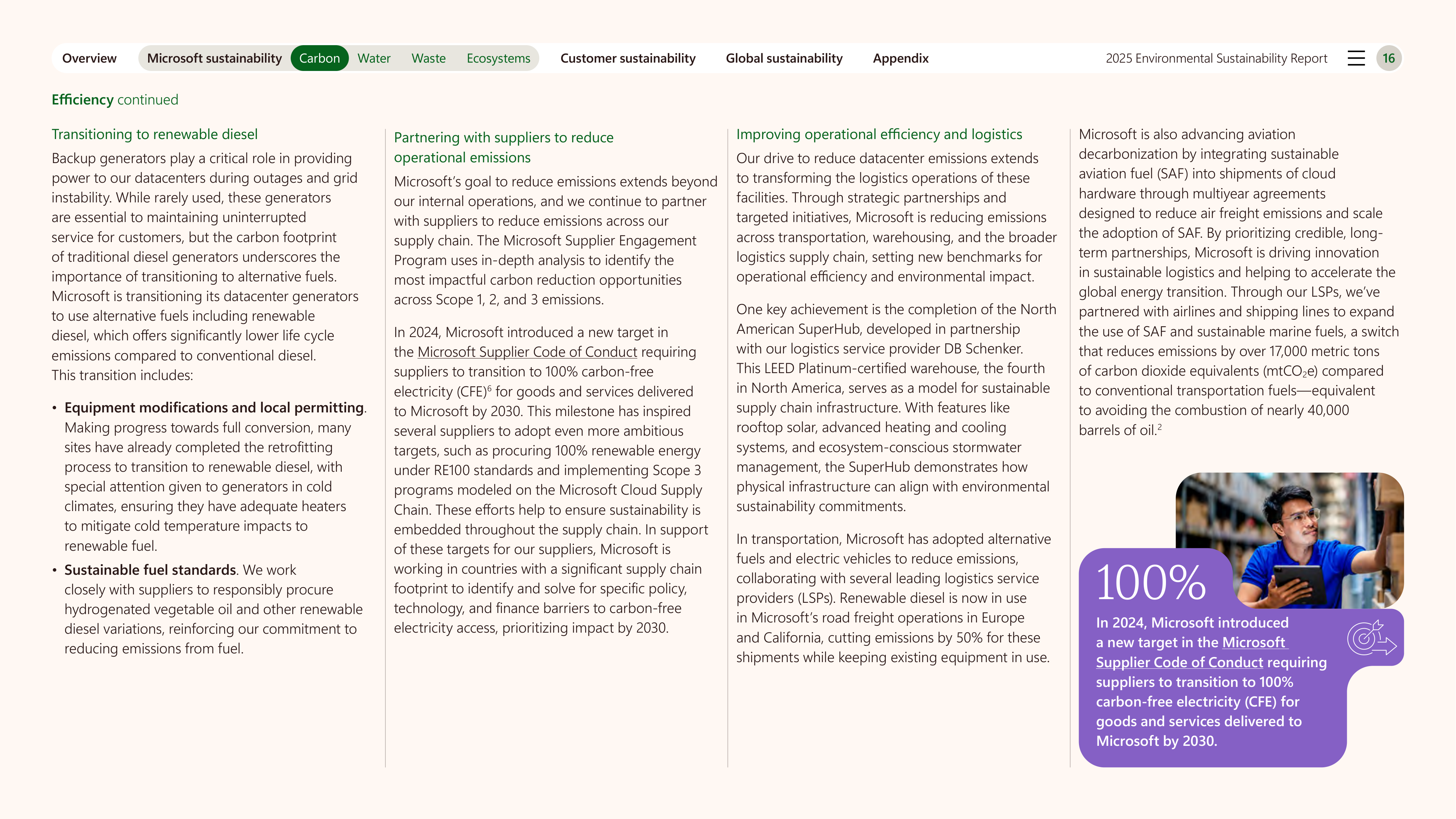
100%
In 2024, Microsoft introduced
a new target in the Microsoft
Supplier Code of Conduct requiring
suppliers to transition to 100%
carbon-free electricity (CFE) for
goods and services delivered to
Microsoft by 2030.
Microsoft sustainability
Carbon
Water
Waste
Ecosystems
Overview
Customer sustainability
Global sustainability
Appendix
16
2025 Environmental Sustainability Report

Efficiency
continued
At the same time, the deployment of electric
vehicle (EV) trucking in the United States, Asia,
and Europe is enabling more sustainable logistics
operations. We are expanding the use of these
EVs within our supply chain, serving both longer
routes and datacenter deliveries. This transition
brings significant benefits to the local communities
where we operate by eliminating tailpipe emissions
affecting local air quality.
Beyond vehicle innovation, Microsoft’s logistics
teams have achieved significant reductions in
shipment carbon intensity through network
optimization, mode shifting to lower-carbon
transportation, and consolidation. These efforts
have reduced the relative carbon intensity
across the cloud logistics supply chain by 73%
since 2022. For these achievements, our cloud
logistics team earned the Coupa Inspire Award
for Purpose and Impact and the SEAL Award for
Sustainability, reinforcing Microsoft’s leadership
in sustainable logistics.
Through these combined efforts, Microsoft is
building a supply chain operation to support
datacenter operations while advancing progress to
meet our commitments, proving that environmental
responsibility and logistical efficiency can
—and do—go hand in hand.
Campuses
We are deeply invested in enhancing the
sustainability of our campuses. We’ve implemented
more sustainable construction practices, such as
reducing our carbon footprint and using local
materials within the East Campus Modernization
Project. Both at our Microsoft and LinkedIn
campuses, we are dedicated to reducing our
environmental impact and promoting sustainable
practices among our employees.
INNOVATION IN ACTION
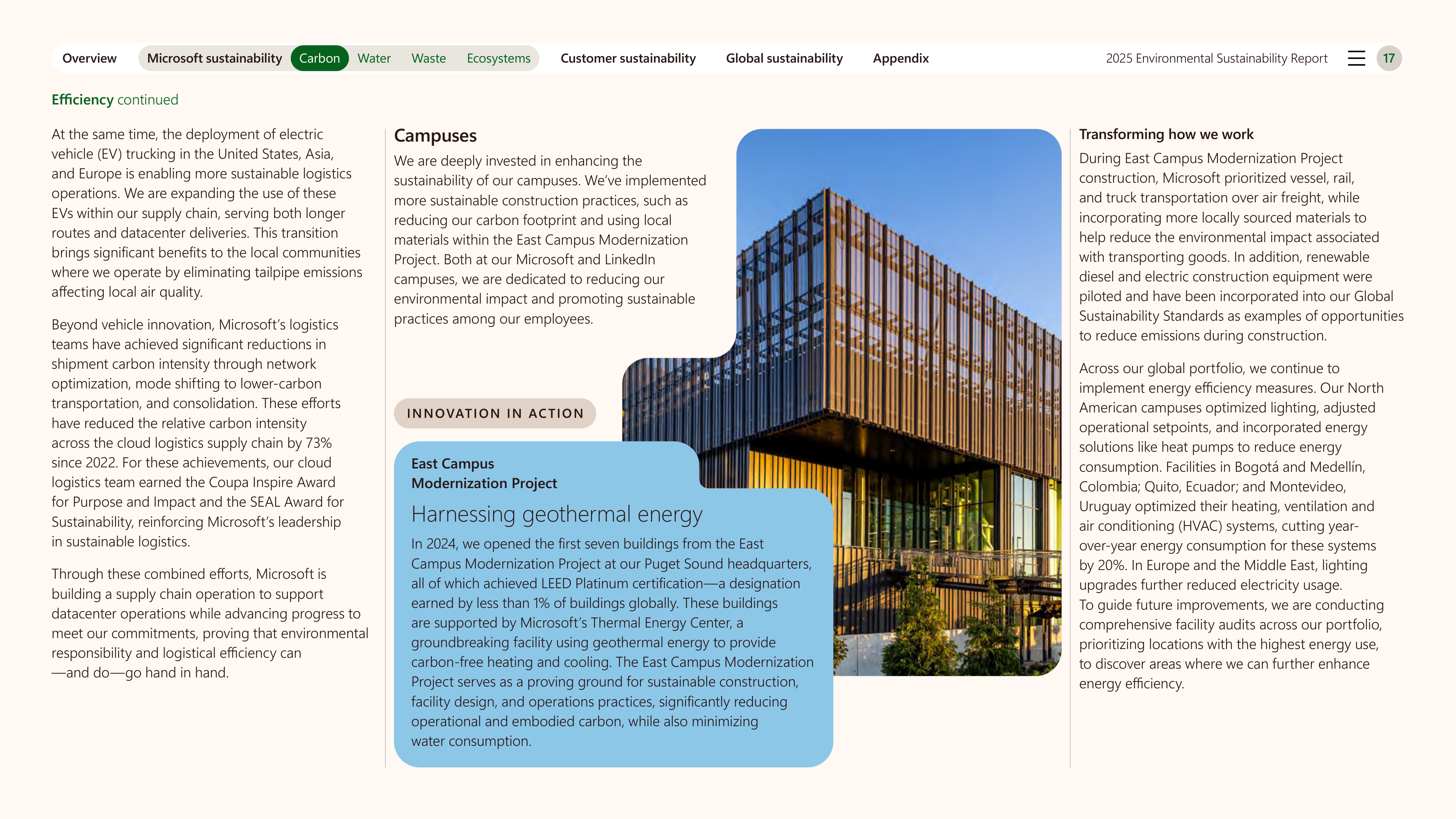
East Campus
Modernization Project
Harnessing geothermal energy
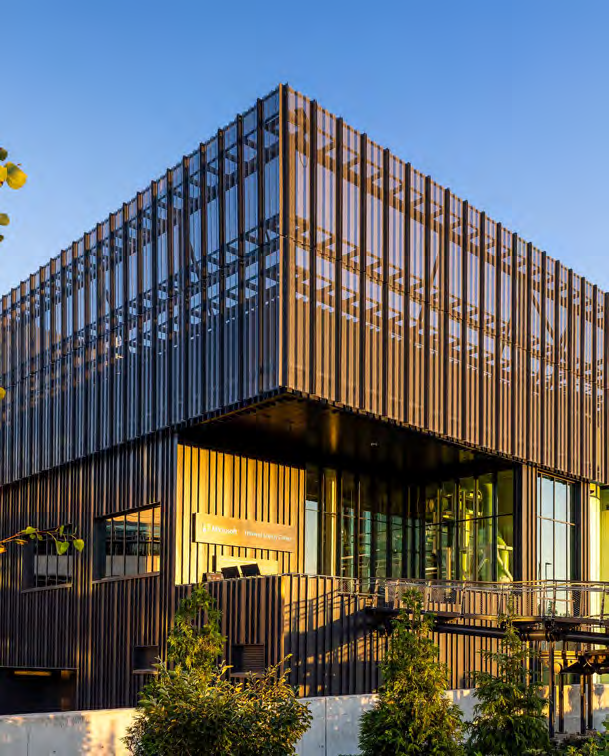
In 2024, we opened the first seven buildings from the East
Campus Modernization Project at our Puget Sound headquarters,
all of which achieved LEED Platinum certification—a designation
earned by less than 1% of buildings globally. These buildings
are supported by Microsoft’s Thermal Energy Center, a
groundbreaking facility using geothermal energy to provide
carbon-free heating and cooling. The East Campus Modernization
Project serves as a proving ground for sustainable construction,
facility design, and operations practices, significantly reducing
operational and embodied carbon, while also minimizing
water consumption.
Transforming how we work
During East Campus Modernization Project
construction, Microsoft prioritized vessel, rail,
and truck transportation over air freight, while
incorporating more locally sourced materials to
help reduce the environmental impact associated
with transporting goods. In addition, renewable
diesel and electric construction equipment were
piloted and have been incorporated into our Global
Sustainability Standards as examples of opportunities
to reduce emissions during construction.
Across our global portfolio, we continue to
implement energy efficiency measures. Our North
American campuses optimized lighting, adjusted
operational setpoints, and incorporated energy
solutions like heat pumps to reduce energy
consumption. Facilities in Bogotá and Medellín,
Colombia; Quito, Ecuador; and Montevideo,
Uruguay optimized their heating, ventilation and
air conditioning (HVAC) systems, cutting year-
over-year energy consumption for these systems
by 20%. In Europe and the Middle East, lighting
upgrades further reduced electricity usage.
To guide future improvements, we are conducting
comprehensive facility audits across our portfolio,
prioritizing locations with the highest energy use,
to discover areas where we can further enhance
energy efficiency.
Microsoft sustainability
Carbon
Water
Waste
Ecosystems
Overview
Customer sustainability
Global sustainability
Appendix
17
2025 Environmental Sustainability Report

Efficiency
continued
INNOVATION IN ACTION
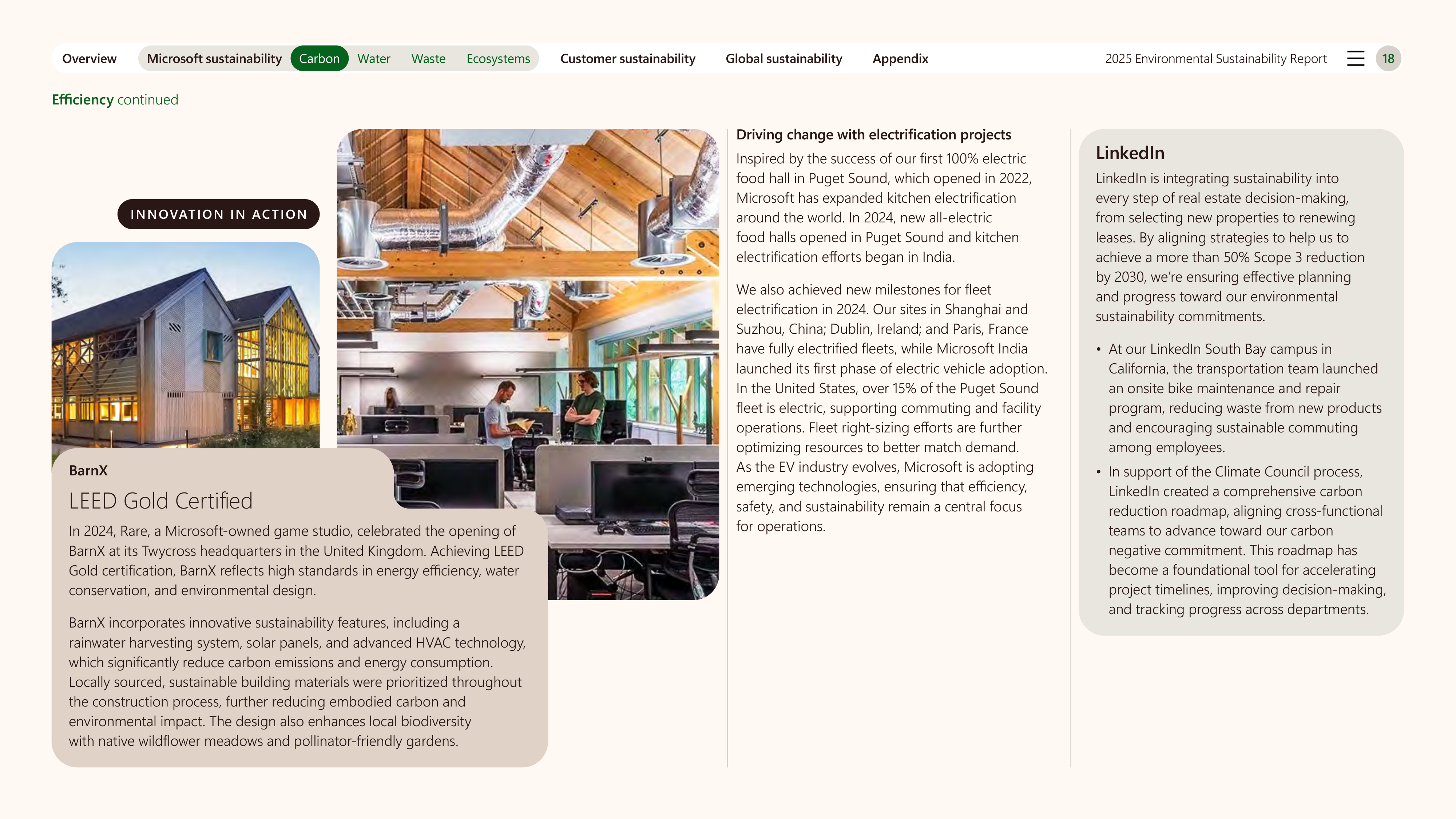
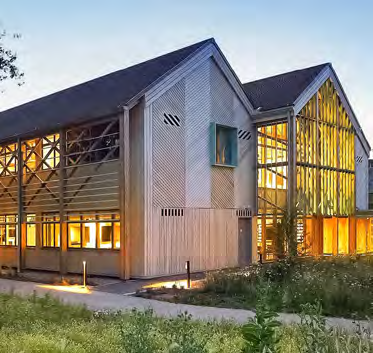
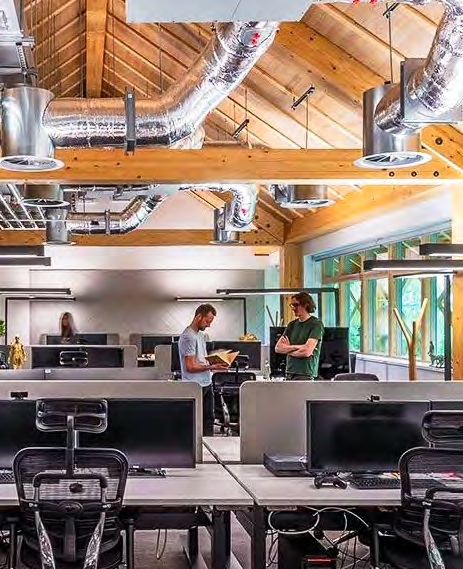
BarnX
LEED Gold Certified
In 2024, Rare, a Microsoft-owned game studio, celebrated the opening of
BarnX at its Twycross headquarters in the United Kingdom. Achieving LEED
Gold certification, BarnX reflects high standards in energy efficiency, water
conservation, and environmental design.
BarnX incorporates innovative sustainability features, including a
rainwater harvesting system, solar panels, and advanced HVAC technology,
which significantly reduce carbon emissions and energy consumption.
Locally sourced, sustainable building materials were prioritized throughout
the construction process, further reducing embodied carbon and
environmental impact. The design also enhances local biodiversity
with native wildflower meadows and pollinator-friendly gardens.
Driving change with electrification projects
Inspired by the success of our first 100% electric
food hall in Puget Sound, which opened in 2022,
Microsoft has expanded kitchen electrification
around the world. In 2024, new all-electric
food halls opened in Puget Sound and kitchen
electrification efforts began in India.
We also achieved new milestones for fleet
electrification in 2024. Our sites in Shanghai and
Suzhou, China; Dublin, Ireland; and Paris, France
have fully electrified fleets, while Microsoft India
launched its first phase of electric vehicle adoption.
In the United States, over 15% of the Puget Sound
fleet is electric, supporting commuting and facility
operations. Fleet right-sizing efforts are further
optimizing resources to better match demand.
As the EV industry evolves, Microsoft is adopting
emerging technologies, ensuring that efficiency,
safety, and sustainability remain a central focus
for operations.
LinkedIn
LinkedIn is integrating sustainability into
every step of real estate decision-making,
from selecting new properties to renewing
leases. By aligning strategies to help us to
achieve a more than 50% Scope 3 reduction
by 2030, we’re ensuring effective planning
and progress toward our environmental
sustainability commitments.
• At our LinkedIn South Bay campus in
California, the transportation team launched
an onsite bike maintenance and repair
program, reducing waste from new products
and encouraging sustainable commuting
among employees.
• In support of the Climate Council process,
LinkedIn created a comprehensive carbon
reduction roadmap, aligning cross-functional
teams to advance toward our carbon
negative commitment. This roadmap has
become a foundational tool for accelerating
project timelines, improving decision-making,
and tracking progress across departments.
Microsoft sustainability
Carbon
Water
Waste
Ecosystems
Overview
Customer sustainability
Global sustainability
Appendix
18
2025 Environmental Sustainability Report

Availability:
Scaling access
to tools for
decarbonization
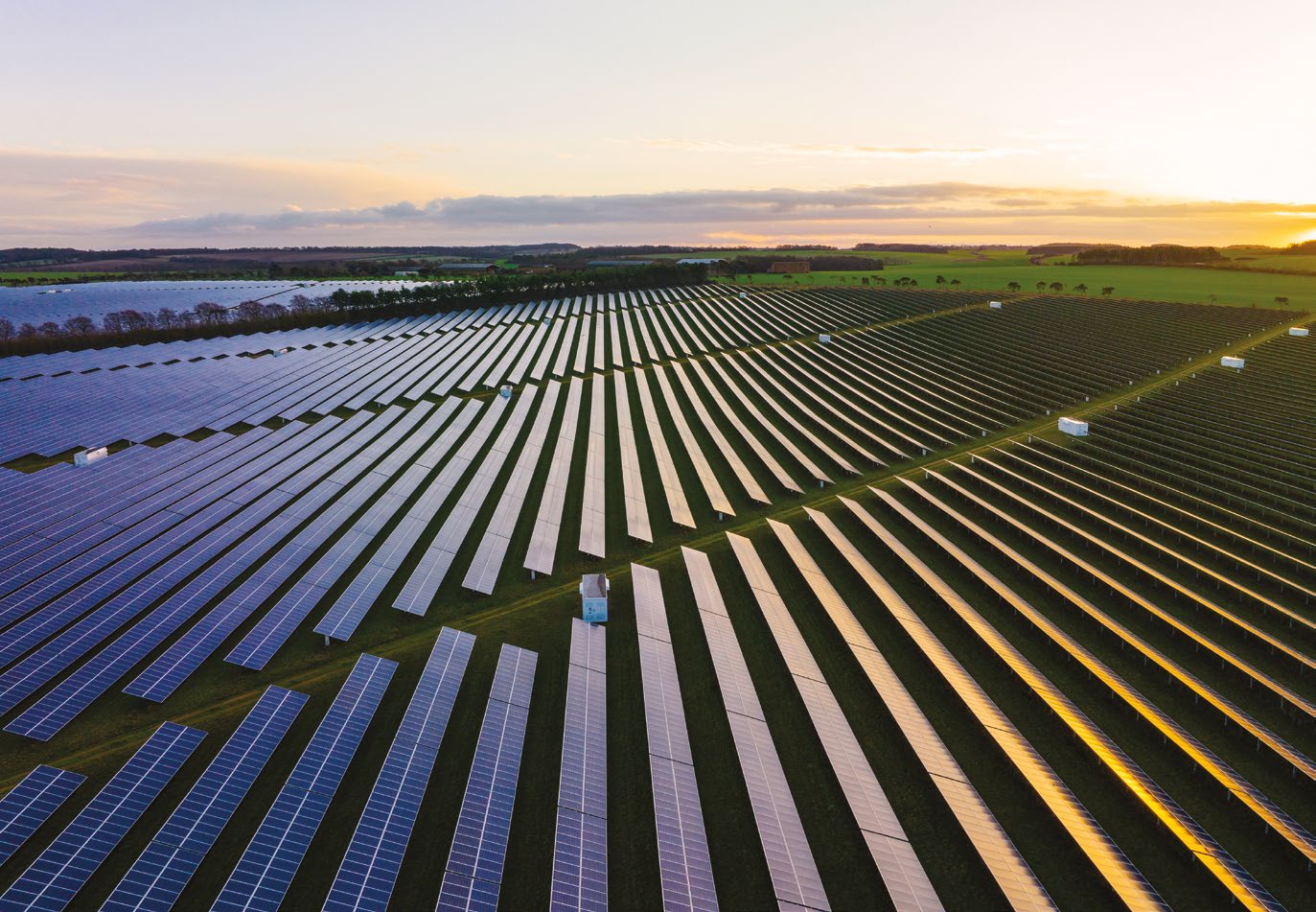
As we plan for 2030, we are working to ensure that
the materials, technologies, and solutions required
for decarbonization are available at the scale and
locations needed—not just for Microsoft, but also for
our partners, suppliers, customers, and the world.
Advancing renewable energy markets
At Microsoft, we believe we have a responsibility
to support the communities and grids where we
build and operate our datacenters. Microsoft has
taken a first-mover approach to making long-term
investments to bring more carbon-free electricity
online. Power purchase agreements (PPAs) are
central to this strategy, and we continue to advocate
for expanding clean energy solutions globally to
support not only our power needs but also those
of our supply chain.
Advancing energy markets
Since 2020, the renewable energy sector has
transformed significantly. However, challenges with
permitting, interconnection delays, and fluctuating
interest rates have added complexity to scaling
these technologies. These dynamics have reshaped
strategies across the industry as we work toward
grid decarbonization by 2030 and beyond.
Microsoft has taken bold steps to address
these challenges and expand access to carbon-free
electricity. Our carbon-free electricity program has
grown eighteenfold since 2020, with contracted
renewables increasing from 1.8 gigawatts (GW) to
over 34 GW across 24 countries. This growth reflects
our leadership in advancing clean energy markets
and has us on track to achieve our 2025 target
of procuring enough renewable energy to cover
100% of our energy consumption.
PROGRESS TOWARDS TARGETS
Renewable energy
Expanding global procurement
and deployment
In 2024, we contracted an additional 19 GW
of new renewable energy across 16 countries,
further diversifying our energy portfolio.
Notable market expansions include:
•
Brookfield Renewable Energy Framework
—
a framework to deliver more than 10.5 GW in
the United States and Europe over the next
five years.
•
Wisconsin PPA with National Grid
Renewables
—a 250-megawatt (MW)
agreement to support this growing
datacenter region, including a $15 million
community benefit fund for environmental
resilience initiatives.
Microsoft also brought 45 carbon-free electricity
projects online across 15 different countries
through PPAs, including our first operational
projects in Canada, Chile, France, Germany,
Japan, and Poland. Key projects include:
•
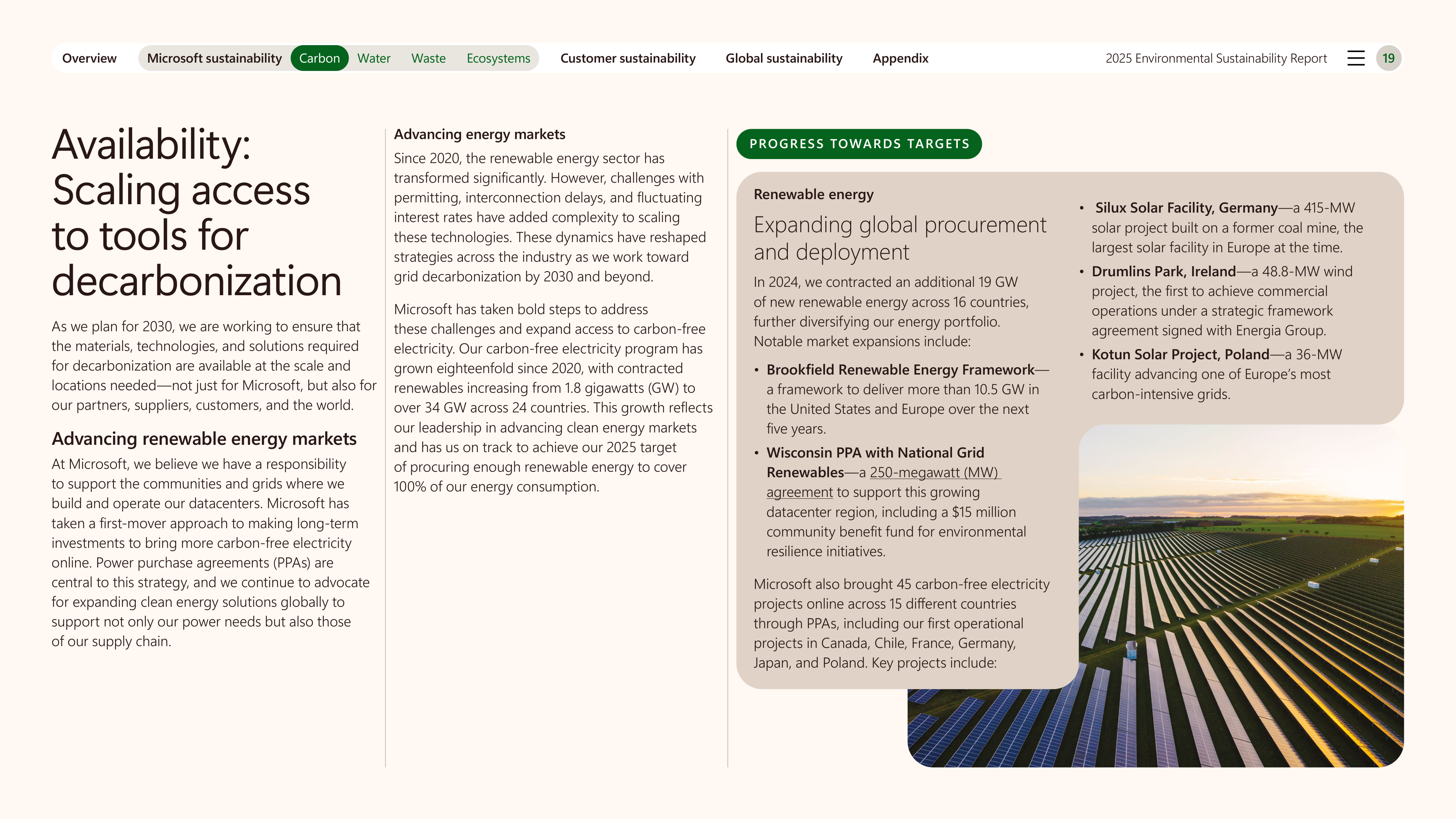
Silux Solar Facility, Germany
—a 415-MW
solar project built on a former coal mine, the
largest solar facility in Europe at the time.
•
Drumlins Park, Ireland
—a 48.8-MW wind
project, the first to achieve commercial
operations under a strategic framework
agreement signed with Energia Group.
•
Kotun Solar Project, Poland
—a 36-MW
facility advancing one of Europe’s most
carbon-intensive grids.
Microsoft sustainability
Carbon
Water
Waste
Ecosystems
Overview
Customer sustainability
Global sustainability
Appendix
19
2025 Environmental Sustainability Report
Advancing carbon-free electricity with
nuclear energy
Microsoft also expanded into nuclear energy with
the signing of our first large-scale nuclear energy
PPA with Constellation for the Crane Clean Energy
Center in September 2024. This agreement will
enable the restart of an 835-MW nuclear facility in
Pennsylvania, retired in 2019, providing a significant
supply of new, reliable, CFE to the PJM power grid—
a critical energy region for Microsoft’s datacenters.
The project will also generate substantial community
and economic benefits, including an estimated
3,400 direct and indirect jobs and $3 billion in
state and federal taxes. This agreement underscores
Microsoft’s dedication to investing in diverse, high-
impact solutions to accelerate decarbonization.
Innovating through circularity and contracting
Microsoft is also leading efforts to integrate circular
economy principles into renewable energy projects.
In 2024, we signed four groundbreaking PPAs with
Engie requiring that 100% of photovoltaic modules
—from construction through end of life—will be
reused or recycled.
Innovative contracting structures also continue
to advance decarbonization. In January 2024, we
announced a partnership with Qcells to supply
Microsoft projects with up to 12 GW of solar
modules and engineering, procurement, and
construction services over an eight-year period.
This agreement bolsters large-scale, sustainable
US solar manufacturing and supports a resilient
clean energy economy.
Collaborating for industry transformation
Beyond procurement, Microsoft is collaborating
with industry leaders to address barriers to scaling
carbon-free electricity technologies. In March 2024,
we announced an advanced clean energy buyers’
consortium with Google and Nucor to aggregate
demand and accelerate deployment of first-of-a-
kind technologies. This consortium aims to unify
customer voices to policymakers and regulators,
and collaborate with key stakeholders on enabling
business models, with project deals expected in
early 2025.
Advancing community vitality with
energy procurement
Microsoft is supporting community development
in energy procurement. The rapid growth of AI
and its supporting infrastructure has created an
unprecedented opportunity to foster problem-
solving and shared responsibility in growing
datacenter markets while driving meaningful
community impact and supporting local prosperity
and well-being.
In 2024, we announced our Datacenter
Community Pledge, reinforcing our role as a
responsible corporate citizen and ensuring that
local communities experience meaningful benefits
from clean energy projects including significant
economic, social, and environmental benefits.
Key examples from the past year include:
•
Pivot Energy agreement
—a five-year framework
agreement to develop a 500-MW portfolio of
community-scale solar energy projects, enabling
approximately 150 projects in 100 US communities
between 2025 and 2029. As Microsoft’s first
large-scale distributed generation portfolio,
this agreement uses an innovative contracting
structure to prioritize benefits for low-income
and rural communities, including workforce
development, energy burden relief, and advancing
community investment funds. It also supports
Microsoft’s target of reducing Scope 3 emissions
by more than 50% by 2030.
•
ReNew agreement in India
—a 437-MW hybrid
wind and solar project in Maharashtra that includes
a community benefit fund managed by the ReNew
Foundation. This fund supports initiatives focused
on women’s economic empowerment, energy
access, water quality improvements, and rural
electrification for communities disproportionately
affected by climate change and pollution.
Scaling carbon removal
So far on our journey, carbon reduction and removal
have all played an important role on our path to
net zero.
Microsoft’s commitment to carbon removal began
in 2020 when we shifted our avoided carbon
emissions credit procurement to focus exclusively
on removing carbon dioxide from the atmosphere.
Since then, we have significantly scaled our efforts,
learning from early purchases of one-year carbon
removal offtakes from existing projects. In 2022,
we signed our first long-term agreement, purchasing
10,000 tons from Climeworks’ first direct air capture
(DAC) facilities in Iceland over 10 years. This required
adapting the PPA contract model, working through
the intricacies of how to structure agreements to
account for carbon registries, reversals, and more.
In 2023, we expanded on this model of advance
procurement, signing our first contracts for millions
of tons of carbon removal, with developers that
were able to design and structure much larger
projects. In 2024, we built on this progress by
advancing commercial offtake structures, refining
methodologies, and expanding a platform that
enables further progress and supports industry
growth. These efforts included Mombak, a Brazilian
reforestation company, unlocking new natural
capital-oriented financial tools in the form of a
$225 million outcome bond issued by the World
Bank to help reforest the Brazilian Amazon.
Availability
continued
Microsoft sustainability
Carbon
Water
Waste
Ecosystems
Overview
Customer sustainability
Global sustainability
Appendix
20
2025 Environmental Sustainability Report

25M
20M
15M
10M
5M
0M
Availability
continued
21
Overview
Microsoft sustainability
Carbon
Water
Waste
Ecosystems
Customer sustainability
Global sustainability
Appendix
2025 Environmental Sustainability Report
In FY24, Microsoft entered long-term agreements
to procure more carbon removal than all previous
years combined—22 million metric tons. That’s
the equivalent of taking 4 million cars off the road
for a year.
7
Our diversified portfolio spans multiple
pathways, including: afforestation, reforestation,
and revegetation (ARR); bioenergy with carbon
capture and storage (BECCS); and DAC. Eight of the
projects signed last year will start delivering over
100,000 metric tons annually by 2030, supporting
our carbon negative milestone year.
Building first-of-a-kind technology and planting
millions of trees each present common and distinct
challenges, and we seek to drive development of
projects that can come online quickly to deliver at
scale. Key examples include:
•
Stockholm Exergi (BECCS)
—a 10-year agreement
to purchase over 3 million metric tons of carbon
removal from the planned BECCS facility in Vartan,
Sweden. Using sustainably sourced forest biomass,
Stockholm Exergi captures carbon dioxide from
flue gas and stores it for thousands of years under
strict measurement, monitoring, reporting, and
verification (MMRV) standards.
•
re.green (ARR
)—a 15-year agreement supporting
the planting of over 10 million seedlings across
16,000 hectares in Brazil, encouraging natural
regeneration across the Atlantic and Amazon
Forests. Microsoft will purchase 3 million metric
tons of carbon removal, with all restoration
activities using native species and building on
the foundational work of previous scientific
studies in the region.
Strengthening carbon removal markets
Microsoft is committed to building the markets we
buy from, translating leading science into commercial
innovation and regularly updating our Criteria for
High-Quality Carbon Dioxide Removal. In FY24,
thousands of hours of third-party due diligence for
our portfolio further informed which project design
and operational characteristics are high integrity.
In Panama, Microsoft collaborated with Ponterra
to structure an innovative offtake agreement that
aligns buyers, developers, and financiers early in
the project life cycle. By ensuring clear investment
pathways from the outset, this agreement created
confidence among stakeholders and accelerated the
development of impactful carbon removal projects.
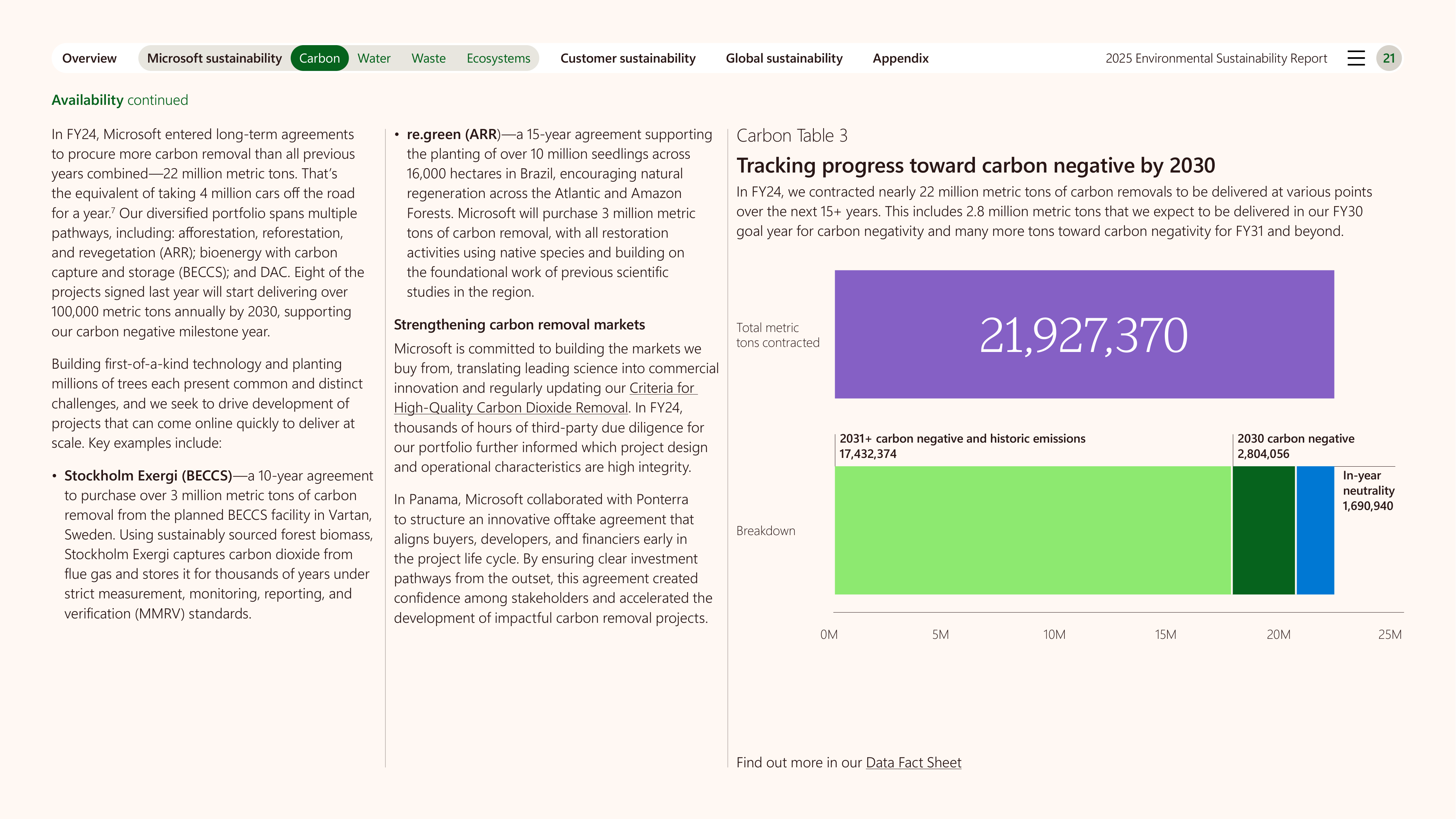
Carbon Table 3
Tracking progress toward carbon negative by 2030
In FY24, we contracted nearly 22 million metric tons of carbon removals to be delivered at various points
over the next 15+ years. This includes 2.8 million metric tons that we expect to be delivered in our FY30
goal year for carbon negativity and many more tons toward carbon negativity for FY31 and beyond.
Find out more in our Data Fact Sheet
Total metric
tons contracted
21,927,370
Breakdown
2030 carbon negative
2,804,056
2031+ carbon negative and historic emissions
17,432,374
In-year
neutrality
1,690,940

22
Microsoft sustainability
Carbon
Water
Waste
Ecosystems
Overview
Customer sustainability
Global sustainability
Appendix
Availability
continued
INNOVATION IN ACTION
Innovation in carbon removal
Harnessing waste heat
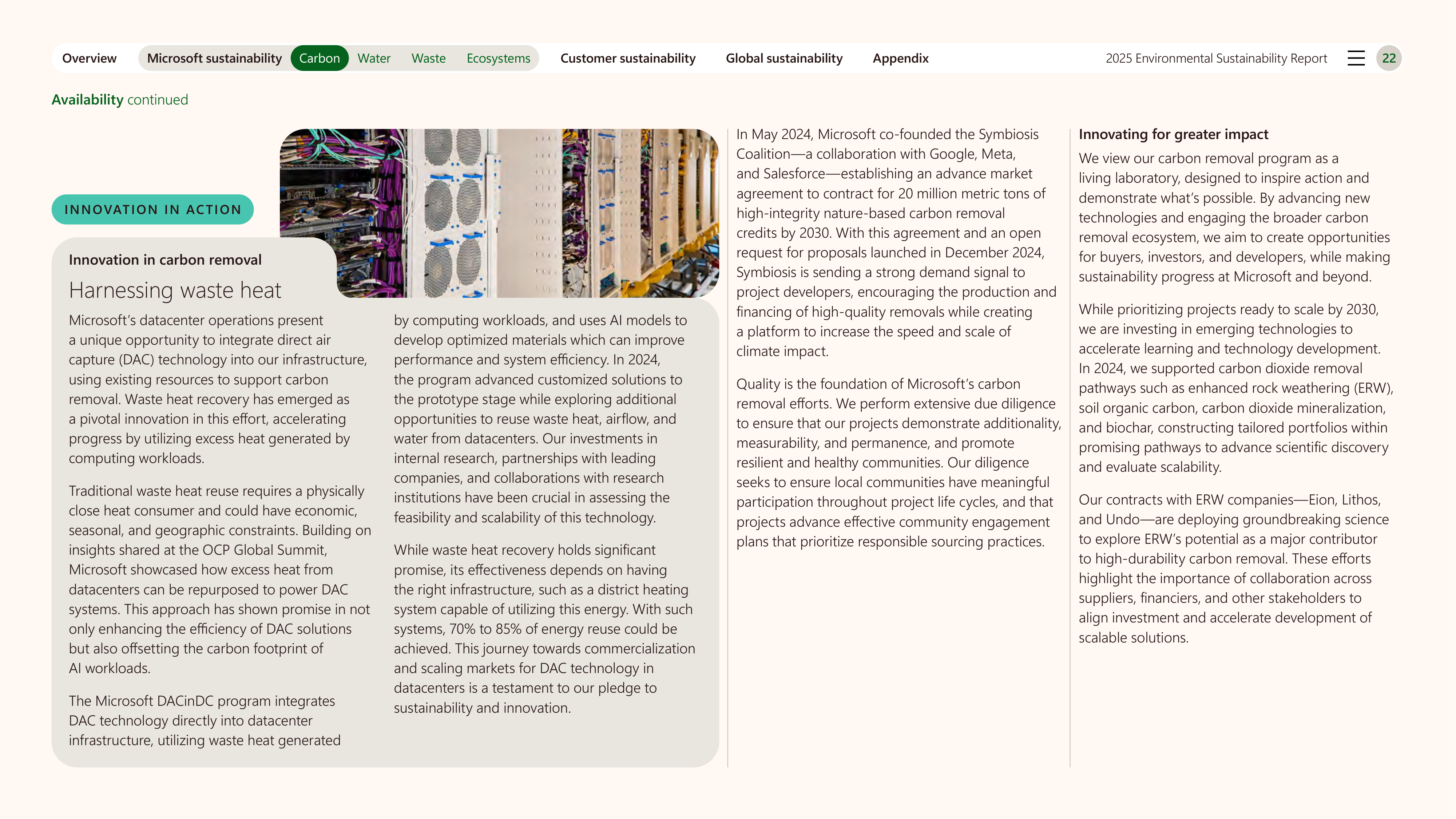
Microsoft’s datacenter operations present
a unique opportunity to integrate direct air
capture (DAC) technology into our infrastructure,
using existing resources to support carbon
removal. Waste heat recovery has emerged as
a pivotal innovation in this effort, accelerating
progress by utilizing excess heat generated by
computing workloads.
Traditional waste heat reuse requires a physically
close heat consumer and could have economic,
seasonal, and geographic constraints. Building on
insights shared at the OCP Global Summit,
Microsoft showcased how excess heat from
datacenters can be repurposed to power DAC
systems. This approach has shown promise in not
only enhancing the efficiency of DAC solutions
but also offsetting the carbon footprint of
AI workloads.
The Microsoft DACinDC program integrates
DAC technology directly into datacenter
infrastructure, utilizing waste heat generated
by computing workloads, and uses AI models to
develop optimized materials which can improve
performance and system efficiency. In 2024,
the program advanced customized solutions to
the prototype stage while exploring additional
opportunities to reuse waste heat, airflow, and
water from datacenters. Our investments in
internal research, partnerships with leading
companies, and collaborations with research
institutions have been crucial in assessing the
feasibility and scalability of this technology.
While waste heat recovery holds significant
promise, its effectiveness depends on having
the right infrastructure, such as a district heating
system capable of utilizing this energy. With such
systems, 70% to 85% of energy reuse could be
achieved. This journey towards commercialization
and scaling markets for DAC technology in
datacenters is a testament to our pledge to
sustainability and innovation.
In May 2024, Microsoft co-founded the Symbiosis
Coalition—a collaboration with Google, Meta,
and Salesforce—establishing an advance market
agreement to contract for 20 million metric tons of
high-integrity nature-based carbon removal
credits by 2030. With this agreement and an open
request for proposals launched in December 2024,
Symbiosis is sending a strong demand signal to
project developers, encouraging the production and
financing of high-quality removals while creating
a platform to increase the speed and scale of
climate impact.
Quality is the foundation of Microsoft’s carbon
removal efforts. We perform extensive due diligence
to ensure that our projects demonstrate additionality,
measurability, and permanence, and promote
resilient and healthy communities. Our diligence
seeks to ensure local communities have meaningful
participation throughout project life cycles, and that
projects advance effective community engagement
plans that prioritize responsible sourcing practices.
Innovating for greater impact
We view our carbon removal program as a
living laboratory, designed to inspire action and
demonstrate what’s possible. By advancing new
technologies and engaging the broader carbon
removal ecosystem, we aim to create opportunities
for buyers, investors, and developers, while making
sustainability progress at Microsoft and beyond.
While prioritizing projects ready to scale by 2030,
we are investing in emerging technologies to
accelerate learning and technology development.
In 2024, we supported carbon dioxide removal
pathways such as enhanced rock weathering (ERW),
soil organic carbon, carbon dioxide mineralization,
and biochar, constructing tailored portfolios within
promising pathways to advance scientific discovery
and evaluate scalability.
Our contracts with ERW companies—Eion, Lithos,
and Undo—are deploying groundbreaking science
to explore ERW’s potential as a major contributor
to high-durability carbon removal. These efforts
highlight the importance of collaboration across
suppliers, financiers, and other stakeholders to
align investment and accelerate development of
scalable solutions.
2025 Environmental Sustainability Report

23
Microsoft sustainability
Carbon
Water
Waste
Ecosystems
Overview
Customer sustainability
Global sustainability
Appendix
Measurement
and adoption:
Supporting
accurate data
and industry-wide
change
Accurate measurement and the adoption of best
practices are critical to achieving our carbon
negative commitment and driving progress
across industries. By implementing advanced
methodologies like life cycle assessments (LCAs),
improving supplier collaboration, and supporting
the adoption of sustainable solutions, Microsoft is
creating systems that enable insight-driven action.
These efforts help us to quantify progress, identify
areas for improvement, and empower suppliers
and partners to make meaningful contributions
to a collective future.
Measurement: Evolving data systems
for greater impact
Data is at the heart of Microsoft’s cloud logistics
decarbonization strategy. In 2024, Microsoft was
recognized as a Gartner Power of the Profession
™
finalist for using data to identify emissions reduction
opportunities from logistics.
TM
Our data systems help to:
• Evaluate impacts of business decisions to
balance cost, carbon, and cycle time.
• Identify opportunities for process or network
improvements across the supply chain.
• Differentiate suppliers based on
emissions performance.
AI in action: Streamlining assessments
Microsoft is using AI-powered tools like Makersite
to transform LCAs, reducing the time and effort
required while significantly improving the accuracy
and representativeness of results. By automating
the analysis of bills of material (BOMs) and material
compositions along with manufacturing processes,
Makersite enables Microsoft to quickly and
effectively model its supply chain to inform data-
driven decisions and track carbon reductions.
For example, Surface and Xbox devices now
benefit from faster, automated modeling of the
manufacturing phase supply chain, with Makersite
reducing the LCA modeling process by more than
80% per device. This efficiency allows sustainability
teams to spend less time on manual data processing
and more time on ecodesign and circularity.
In Azure hardware, Makersite supported our
successful transition from spend-based to
activity based carbon accounting in 2024—a
critical milestone in precisely measuring Scope 3
emissions. By automating the analysis of BOMs
across the global datacenter fleet, Makersite
provides detailed cradle-to-gate insights for
material extraction, manufacturing, and assembly.
These insights empower engineering teams
to make more informed decisions to support
Microsoft’s efforts to align with its 2030 carbon
negative commitment.
2025 Environmental Sustainability Report

Measurement and adoption
continued
INNOVATION IN ACTION
Advancing LCA methodologies
Improving data collection
for better decision-making
In FY24, Microsoft’s Devices team launched
a fully automated data collection process to
facilitate seamless sustainability data exchanges
with suppliers. We are also advancing our data
assurance processes through independent third-
party external audits, including the use of onsite
audits. In 2025, we are exploring opportunities
to standardize supplier sustainability surveys and
data collection across the industry to ease the
reporting obligations on suppliers.
We’ve incorporated both the CFE data from our
suppliers and the semiconductor manufacturing
data from IMEC into customized Microsoft
supplier-specific information.
By integrating this primary data into product
environmental LCAs, Microsoft has increased
the representativeness of assessments, with 70%
of the carbon footprint for devices informed by
primary data—a significant improvement over
the typical 20% of primary data use in LCAs for
laptops and tablets. These insights are driving
actionable opportunities to reduce carbon in
our supply chain. For example, supplier data
has enabled Microsoft to better quantify and
track the environmental impacts of individual
hardware components, identify carbon hotspots,
and prioritize reduction strategies across our
global operations.
Advancing LCA tools
Microsoft continues to enhance its LCA tools
to quantify environmental impacts across datacenter,
device, and cloud infrastructure operations.
Beyond datacenter insights, such as assessing
carbon emissions versus water trade-offs in cooling
technologies, LCAs facilitate informed decision-
making and help redistribute costs to prioritize
regions most adversely affected. By applying these
principles to devices and Azure hardware, and
sharing tools through open-source platforms like
the Open Compute Project, Microsoft aims to drive
industry-wide adoption of LCA-informed practices
that scale sustainable innovation.
Microsoft participates in the Interuniversity
Microelectronics Centre (IMEC) Sustainable
Semiconductor Technologies and Systems
program, which assesses and works to reduce
the environmental impacts of semiconductor
manufacturing. Through customized life cycle
inventories for over 400 chip configurations, we
can track chip generations, forecast emissions, and
differentiate environmental impacts across device
and Azure hardware configurations with greater
precision. However, LCAs can be time-consuming
and labor-intensive, requiring detailed analysis of
complex supply chains and product components.
To address this, Microsoft is using AI to accelerate
and enhance the LCA process, improving accuracy
while significantly reducing the time required.
Embedding measurement to decarbonize
the built environment
Accurate measurement is essential for advancing
low-carbon construction and reducing embodied
carbon. By integrating tools like environmental
product declarations (EPDs) and Building
Transparency’s Embodied Carbon in Construction
Calculator (EC3), Microsoft enables trade partners
to quantify impacts, track progress, and make data-
driven decisions. These efforts create a scalable
model for low-carbon construction, setting a new
standard for sustainability across the industry.
EPDs are essential for reducing embodied carbon
because they provide detailed, standardized
data on the environmental impacts of materials
throughout their life cycle. This transparency helps
project teams to compare materials and prioritize
low-carbon alternatives. However, many trade
partners are unfamiliar with EPDs, unsure of how
to gather necessary information from suppliers
and manufacturers, or hesitant to adopt low-
carbon materials due to perceived risks.
To address these barriers, Microsoft has invested
in educating contractors and suppliers through
training and webinars. These sessions demystify
EPDs, demonstrating their role in identifying
low-carbon materials and integrating them into
construction projects. By fostering confidence in
EPD adoption, Microsoft is empowering partners to
align with shared decarbonization goals and embed
measurement into decision-making processes.
24
Microsoft sustainability
Carbon
Water
Waste
Ecosystems
Overview
Customer sustainability
Global sustainability
Appendix
2025 Environmental Sustainability Report
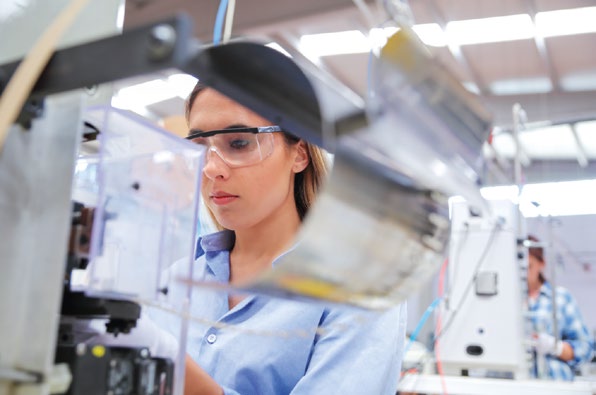
Measurement and adoption
continued
EC3 builds on the insights provided by EPDs, serving
as a cornerstone of Microsoft’s building material
carbon measurement practices by enabling precise,
product-level accounting of materials’ embodied
carbon impacts. By using EC3, contractors can
evaluate materials using detailed carbon data,
moving beyond traditional broad estimates to
make more informed, data-driven decisions.
Microsoft’s process begins with early engagement
of contractors, ideally during the request for
proposal stage. By involving contractors in material
sourcing, procurement, and fabrication, Microsoft
uses their expertise to identify low-carbon materials
and optimize project design. EC3 enhances this
process by enabling precise material comparisons,
transforming embodied carbon accounting from
broad, spend-based estimates into actionable
data. In 2024, Microsoft utilized a version of the
Impact Accounting Methodology to refine carbon
accounting in two datacenter construction projects.
These pilots demonstrated measurable reductions in
embodied carbon, increased supplier awareness of
EPDs, and enabled greater integration of low-carbon
materials into construction workflows.
HVAC systems represent a significant percentage
of a datacenter’s embodied carbon footprint, but
embodied carbon information about these systems
is often unavailable. However, Microsoft continues
to work with a dedicated team that collaborates with
actors throughout our supply chain to ensure that
more equipment EPDs become available.
This effort will enable not just Microsoft but our
entire industry to make better-informed whole-
life carbon decisions when selecting these
critical systems.
PROGRESS TOWARDS TARGETS
Strengthening engagement
Measuring impact
across our
supplier network
At Microsoft, 97% of our emissions are in
the Scope 3 category, with the majority
originating in our supply chain. To accelerate
decarbonization, we strengthened supplier
engagement by requiring suppliers to
transition to 100% carbon-free electricity by
2030 under the Supplier Code of Conduct.
Updated electricity estimates within our
supply chain now enable more targeted policy
engagement in key operational regions.
To further support supplier decarbonization
efforts, Microsoft Indirect Procurement teams have
enhanced data collection and processing through
the ESG Value Chain Solution within Microsoft
Sustainability Manager. Initially focused on emissions
disclosure, their use of the platform has evolved into
a central hub for sustainability engagement, offering
resources such as webinar recordings and program
content to suppliers. AI-powered innovations have
streamlined processes, including:
•
Automated survey processing
—supplier
assurance letters are reviewed, values are
extracted directly into disclosures, and compliance
determination is automated with detailed feedback
provided in a new Actions tab, resulting in a 94%
reduction in time for our team to process supplier
survey submissions, from 35 minutes per survey
to two minutes per survey.
•
Streamlined support desk
—supplier support
tickets are integrated into Microsoft Dynamics,
where Copilot drafts responses for human agents
based on program knowledge articles, improving
customer satisfaction and response times.
Adoption
Microsoft is driving the adoption of best practices
by setting ambitious standards for suppliers,
providing tools that support implementation, and
fostering industry-wide collaboration. By aligning
supplier goals with our own, piloting innovative
materials, and enhancing access to resources like
CFE and SAF, we aim to create a ripple effect that
extends well beyond our operations. These efforts
are critical for scaling decarbonization across
our value chain, supporting meaningful progress
toward our 2030 commitments.
Elevating supplier standards to
accelerate decarbonization
Since 2022, Microsoft’s Devices Supplier
Decarbonization program has built policies,
procedures, data systems, and educational tools to
align suppliers with our sustainability commitments.
Over the past three years, this program has evolved
to address the growing urgency of decarbonization,
amplified by the introduction of the new Supplier
Code of Conduct requirement to transition to
100% CFE by 2030.
25
Microsoft sustainability
Carbon
Water
Waste
Ecosystems
Overview
Customer sustainability
Global sustainability
Appendix
2025 Environmental Sustainability Report
Measurement and adoption
continued
Progress has been significant. As of FY24, 89
devices manufacturing facilities transitioned to
100% CFE for Microsoft production, marking a
more than tenfold increase over the previous year.
These efforts expanded CFE use and avoided
nearly 232,000 m t
C O subscript 2
e in emissions.
Many suppliers have gone beyond meeting
minimum requirements, with several committing to
the RE100 standard, ensuring the use of high-quality
renewable energy resources. This effort underscores
the importance of maintaining credible, impactful
renewable energy standards across the supply chain.
Microsoft’s approach has also inspired several
suppliers to adopt similar sustainability practices.
Many have modeled their Scope 3 emissions
programs after Microsoft’s Cloud Supply Chain
efforts, demonstrating how collaborative
partnerships can create ripple effects across
industries. These changes not only amplify the
impact of Microsoft’s program but also contribute
to an industry-wide shift toward decarbonization.
As the program continues to expand, Microsoft is
focused on codifying best practices into supplier
requirements while providing tools like the Supplier
REach Portal to make decarbonization solutions
more accessible. These efforts are accelerating
the global transition to CFE and strengthening
the resilience of Microsoft’s supply chain.
Enhancing access through tools and partnerships
Recognizing that access to CFE and decarbonization
solutions varies by region, Microsoft has launched
several initiatives to support suppliers in overcoming
these challenges.
Key initiatives include:
•
Supplier REach portal
—launched in 2023,
we partnered with global climate solutions
expert 3Degrees to develop a portal that
provides suppliers with streamlined access and
a guided experience to procure CFE, helping
them align with Microsoft’s environmental
sustainability commitments.
•
SAF purchasing pilot
—in 2024, Microsoft
partnered with Chooose to make SAF more
accessible to our suppliers. Aviation-related
emissions from business travel are a significant
contributor to supplier carbon footprints.
This partnership enables Microsoft suppliers
to act on these emissions by supporting smaller-
scale SAF purchases.
Recognizing progress and aligning expectations
As we reach the midpoint of our journey to 2030,
we are celebrating the progress made with our
suppliers while setting clear expectations for the
path ahead. In October 2024, Microsoft hosted
a supplier summit, bringing together suppliers
across our supply chain.
The summit focused on advancing sustainability
across the supply base, aligning suppliers with
decarbonization goals, and sharing best practices for
achieving impact at scale. This moment marked more
than just a milestone—it highlighted the collective
power of collaboration driving meaningful change.
By building strong partnerships and fostering
transparency, Microsoft and its suppliers are
accelerating progress toward a decarbonized future,
reinforcing the idea that shared success is the
foundation for industry-wide transformation.
LEARNINGS AND WHAT’S NEXT
Advancing carbon market mechanisms.
As part of our efforts to reduce Scope 3
emissions, we are building on our experience
with book-and-claim systems for sustainable
fuels to contract for sustainable building
materials certificates. By collaborating with
multi-stakeholder groups, we aim to develop
market infrastructure to scale these approaches,
driving greater adoption and impact.
Building a robust carbon removal portfolio.
We continue to refine our carbon removal
strategy by signing bankable, multiyear
agreements across high, medium, and low
durability pathways. These efforts will broaden
our supplier base and geographic footprint, while
accelerating financing for critical infrastructure
and afforestation projects to deliver meaningful
carbon removal credits by 2030.
Scaling community-focused sustainability
infrastructure
. Through energy procurement
efforts like Pivot and ReNew, we have learned a lot
about the importance of leading with partnership,
trusting the expertise of local communities, and
authentically shifting power and decision-making
such that new projects are fairly developed and
enhance the health, safety, and overall well-being
of the communities in which we operate. We are
using these lessons learned and embedding
these practices to enable a more sustainable
future for all.
Driving datacenter innovation.
With rapid
cloud business growth, we are advancing
datacenter sustainability by developing strategies
to integrate novel low-carbon materials into HVAC
units, incorporating low-carbon requirements
for materials and equipment in datacenter
construction into our contracts, and identifying
opportunities to improve operational efficiency.
26
Microsoft sustainability
Carbon
Water
Waste
Ecosystems
Overview
Customer sustainability
Global sustainability
Appendix
2025 Environmental Sustainability Report
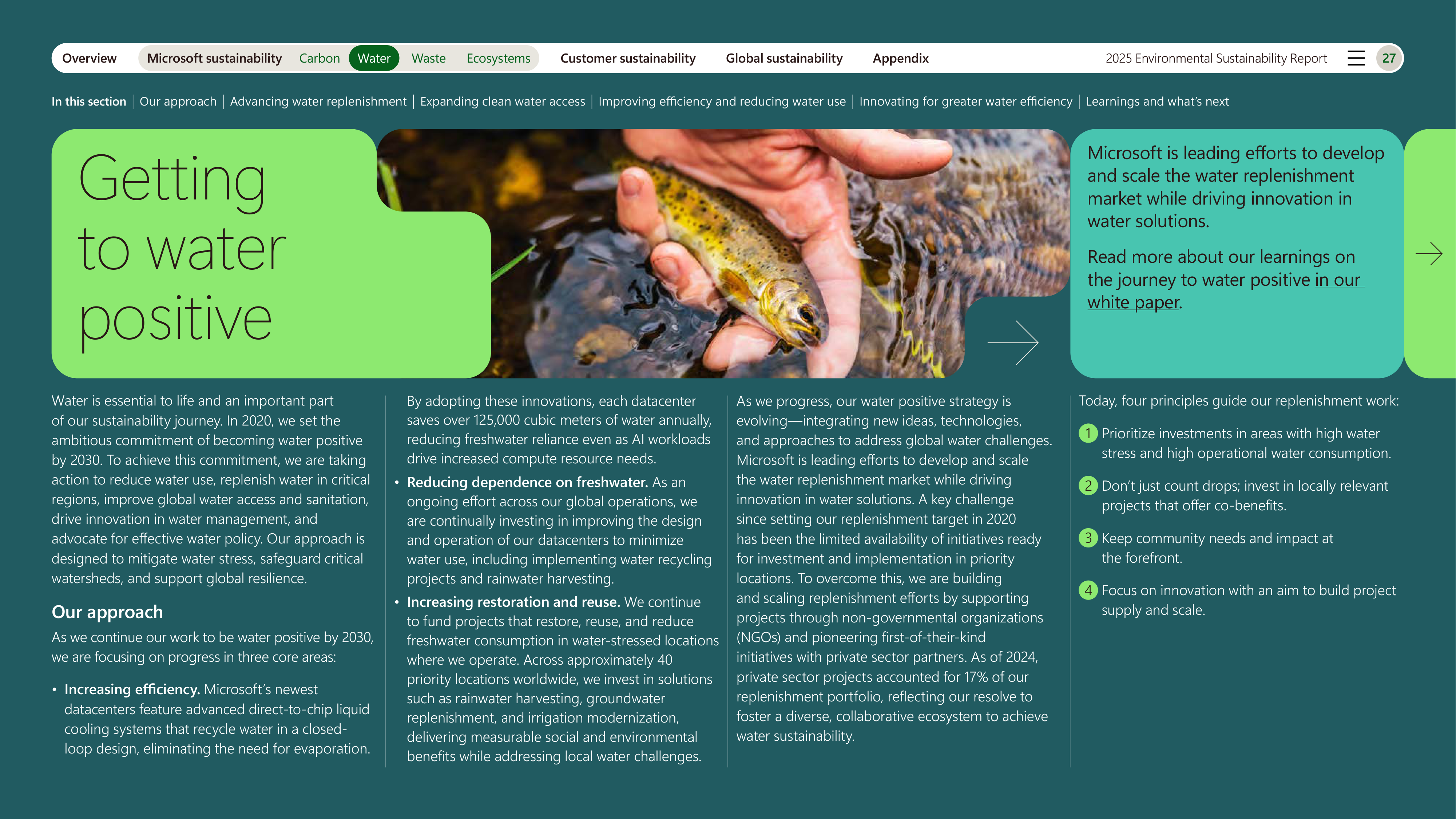


Our approach Advancing water replenishment Expanding clean water access Improving efficiency and reducing water use Innovating for greater water efficiency Learnings and what’s next
Microsoft sustainability
Carbon
Waste
Ecosystems
Overview
Customer sustainability
Global sustainability
Appendix
27
Water
In this section
Getting
to water
positive
Microsoft is leading efforts to develop
and scale the water replenishment
market while driving innovation in
water solutions.
Read more about our learnings on
the journey to water positive in our
white paper.
Water is essential to life and an important part
of our sustainability journey. In 2020, we set the
ambitious commitment of becoming water positive
by 2030. To achieve this commitment, we are taking
action to reduce water use, replenish water in critical
regions, improve global water access and sanitation,
drive innovation in water management, and
advocate for effective water policy. Our approach is
designed to mitigate water stress, safeguard critical
watersheds, and support global resilience.
Our approach
As we continue our work to be water positive by 2030,
we are focusing on progress in three core areas:
•
Increasing efficiency.
Microsoft’s newest
datacenters feature advanced direct-to-chip liquid
cooling systems that recycle water in a closed-
loop design, eliminating the need for evaporation.
By adopting these innovations, each datacenter
saves over 125,000 cubic meters of water annually,
reducing freshwater reliance even as AI workloads
drive increased compute resource needs.
•
Reducing dependence on freshwater.
As an
ongoing effort across our global operations, we
are continually investing in improving the design
and operation of our datacenters to minimize
water use, including implementing water recycling
projects and rainwater harvesting.
•
Increasing restoration and reuse.
We continue
to fund projects that restore, reuse, and reduce
freshwater consumption in water-stressed locations
where we operate. Across approximately 40
priority locations worldwide, we invest in solutions
such as rainwater harvesting, groundwater
replenishment, and irrigation modernization,
delivering measurable social and environmental
benefits while addressing local water challenges.
As we progress, our water positive strategy is
evolving—integrating new ideas, technologies,
and approaches to address global water challenges.
Microsoft is leading efforts to develop and scale
the water replenishment market while driving
innovation in water solutions. A key challenge
since setting our replenishment target in 2020
has been the limited availability of initiatives ready
for investment and implementation in priority
locations. To overcome this, we are building
and scaling replenishment efforts by supporting
projects through non-governmental organizations
(NGOs) and pioneering first-of-their-kind
initiatives with private sector partners. As of 2024,
private sector projects accounted for 17% of our
replenishment portfolio, reflecting our resolve to
foster a diverse, collaborative ecosystem to achieve
water sustainability.
Today, four principles guide our replenishment work:
1
Prioritize investments in areas with high water
stress and high operational water consumption.
2
Don’t just count drops; invest in locally relevant
projects that offer co-benefits.
3
Keep community needs and impact at
the forefront.
4
Focus on innovation with an aim to build project
supply and scale.
2025 Environmental Sustainability Report

Our approach
continued
Our targets and progress
Water positive
As we work to be water positive,
we continue to scale our efforts
to reduce water use across our
operations, while increasing
procurement from alternative
sources and investing in
innovative replenishment
and access projects.
In progress
Achieved
Target
Progress
Replenishing more water than we use by 2030
We will replenish more water than we consume across our global operations, with a focus
on water-stressed regions where we work.
Over 100 million cubic meters of water
replenishment volume
In FY24, we increased the number of projects we have funded by over 50%, funding 27
replenishment projects that are estimated to provide more than 50 million cubic meters
in volumetric water benefit over the lifetime of these projects. Since the inception of this
program, projects contracted are estimated to provide more than 100 million cubic meters
of replenishment volume over their lifetime.
Increasing access to water
We will provide 1.5 million people with access to clean water and sanitation
services by 2030.
Over 1.5 million people with water access
In FY24, we added seven new projects, bringing our portfolio to 13 initiatives that when
fully implemented will serve over 1.6 million people across Brazil, India, Indonesia, Mexico,
Chile, the United States, Malaysia, Kenya, and Nigeria.
Reducing our water intensity
We will make progress against our target to improve water use efficiency by 40% across
our global, owned datacenter operations by 2030, from a 2022 baseline.
Improving water efficiency
Since our baseline year of 2022, operational datacenters have achieved an 18%
reduction in water intensity progressing towards our 2030 target to reduce water
use intensity by 40%.
Microsoft sustainability
Carbon
Waste
Ecosystems
Overview
Customer sustainability
Global sustainability
Appendix
28
Water
2025 Environmental Sustainability Report
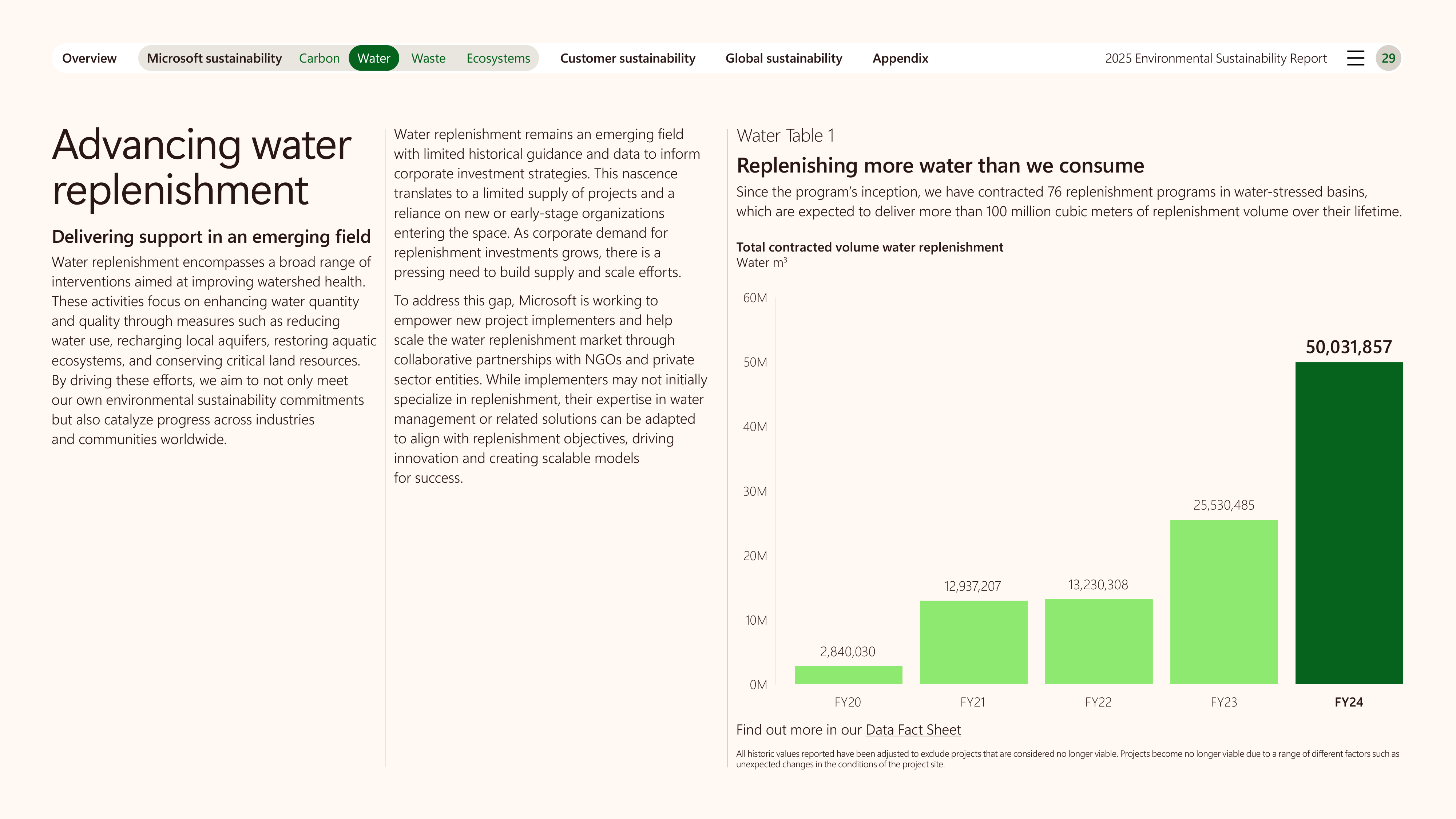

Advancing water
replenishment
Delivering support in an emerging field
Water replenishment encompasses a broad range of
interventions aimed at improving watershed health.
These activities focus on enhancing water quantity
and quality through measures such as reducing
water use, recharging local aquifers, restoring aquatic
ecosystems, and conserving critical land resources.
By driving these efforts, we aim to not only meet
our own environmental sustainability commitments
but also catalyze progress across industries
and communities worldwide.
Water replenishment remains an emerging field
with limited historical guidance and data to inform
corporate investment strategies. This nascence
translates to a limited supply of projects and a
reliance on new or early-stage organizations
entering the space. As corporate demand for
replenishment investments grows, there is a
pressing need to build supply and scale efforts.
To address this gap, Microsoft is working to
empower new project implementers and help
scale the water replenishment market through
collaborative partnerships with NGOs and private
sector entities. While implementers may not initially
specialize in replenishment, their expertise in water
management or related solutions can be adapted
to align with replenishment objectives, driving
innovation and creating scalable models
for success.
Water Table 1
Replenishing more water than we consume
Since the program’s inception, we have contracted 76 replenishment programs in water-stressed basins,
which are expected to deliver more than 100 million cubic meters of replenishment volume over their lifetime.
Total contracted volume water replenishment
Water m
cubed
2,840,030
FY20
12,937,207
13,230,308
25,530,485
50,031,857
FY21
FY22
FY23
FY24
0M
10M
20M
30M
40M
50M
60M
Find out more in our Data Fact Sheet
All historic values reported have been adjusted to exclude projects that are considered no longer viable. Projects become no longer viable due to a range of different factors such as
unexpected changes in the conditions of the project site.
Microsoft sustainability
Carbon
Waste
Ecosystems
Overview
Customer sustainability
Global sustainability
Appendix
29
Water
2025 Environmental Sustainability Report
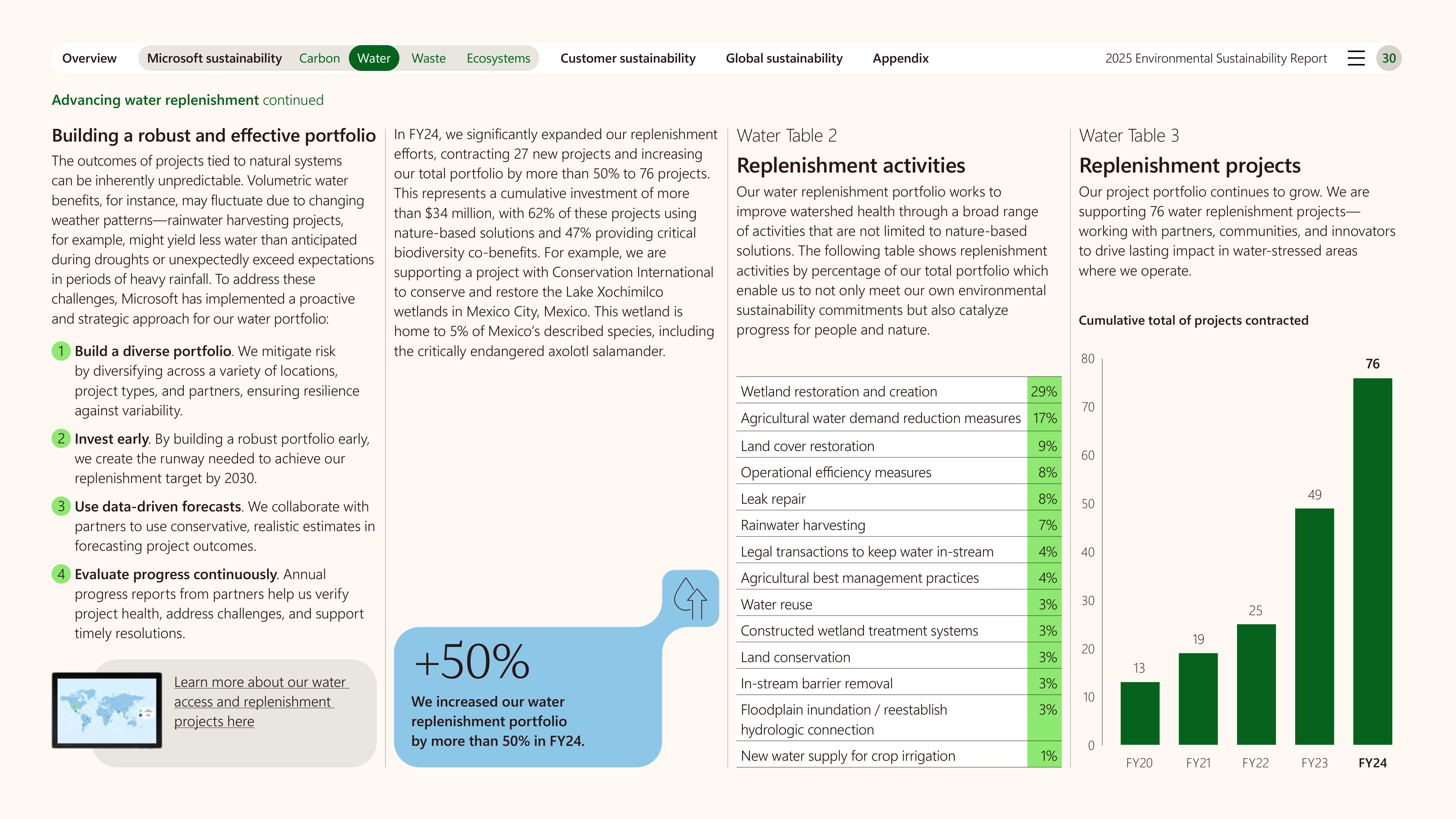
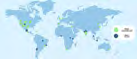


0
FY20
FY21
FY22
13
FY23
FY24
19
25
49
76
20
30
40
50
60
70
80
10
Advancing water replenishment
continued
Building a robust and effective portfolio
The outcomes of projects tied to natural systems
can be inherently unpredictable. Volumetric water
benefits, for instance, may fluctuate due to changing
weather patterns—rainwater harvesting projects,
for example, might yield less water than anticipated
during droughts or unexpectedly exceed expectations
in periods of heavy rainfall. To address these
challenges, Microsoft has implemented a proactive
and strategic approach for our water portfolio:
1
Build a diverse portfolio
. We mitigate risk
by diversifying across a variety of locations,
project types, and partners, ensuring resilience
against variability.
2
Invest early
. By building a robust portfolio early,
we create the runway needed to achieve our
replenishment target by 2030.
3
Use data-driven forecasts
. We collaborate with
partners to use conservative, realistic estimates in
forecasting project outcomes.
4
Evaluate progress continuously
. Annual
progress reports from partners help us verify
project health, address challenges, and support
timely resolutions.
Learn more about our water
access and replenishment
projects here
In FY24, we significantly expanded our replenishment
efforts, contracting 27 new projects and increasing
our total portfolio by more than 50% to 76 projects.
This represents a cumulative investment of more
than $34 million, with 62% of these projects using
nature-based solutions and 47% providing critical
biodiversity co-benefits. For example, we are
supporting a project with Conservation International
to conserve and restore the Lake Xochimilco
wetlands in Mexico City, Mexico. This wetland is
home to 5% of Mexico’s described species, including
the critically endangered axolotl salamander.
+50%
We increased our water
replenishment portfolio
by more than 50% in FY24.
Water Table 2
Replenishment activities
Our water replenishment portfolio works to
improve watershed health through a broad range
of activities that are not limited to nature-based
solutions. The following table shows replenishment
activities by percentage of our total portfolio which
enable us to not only meet our own environmental
sustainability commitments but also catalyze
progress for people and nature.
Wetland restoration and creation
29%
Agricultural water demand reduction measures 17%
Land cover restoration
9%
Operational efficiency measures
8%
Leak repair
8%
Rainwater harvesting
7%
Legal transactions to keep water in-stream
4%
Agricultural best management practices
4%
Water reuse
3%
Constructed wetland treatment systems
3%
Land conservation
3%
In-stream barrier removal
3%
Floodplain inundation / reestablish
hydrologic connection
3%
New water supply for crop irrigation
1%
Water Table 3
Replenishment projects
Our project portfolio continues to grow. We are
supporting 76 water replenishment projects—
working with partners, communities, and innovators
to drive lasting impact in water-stressed areas
where we operate.
Cumulative total of projects contracted
Microsoft sustainability
Carbon
Waste
Ecosystems
Overview
Customer sustainability
Global sustainability
Appendix
30
Water
2025 Environmental Sustainability Report
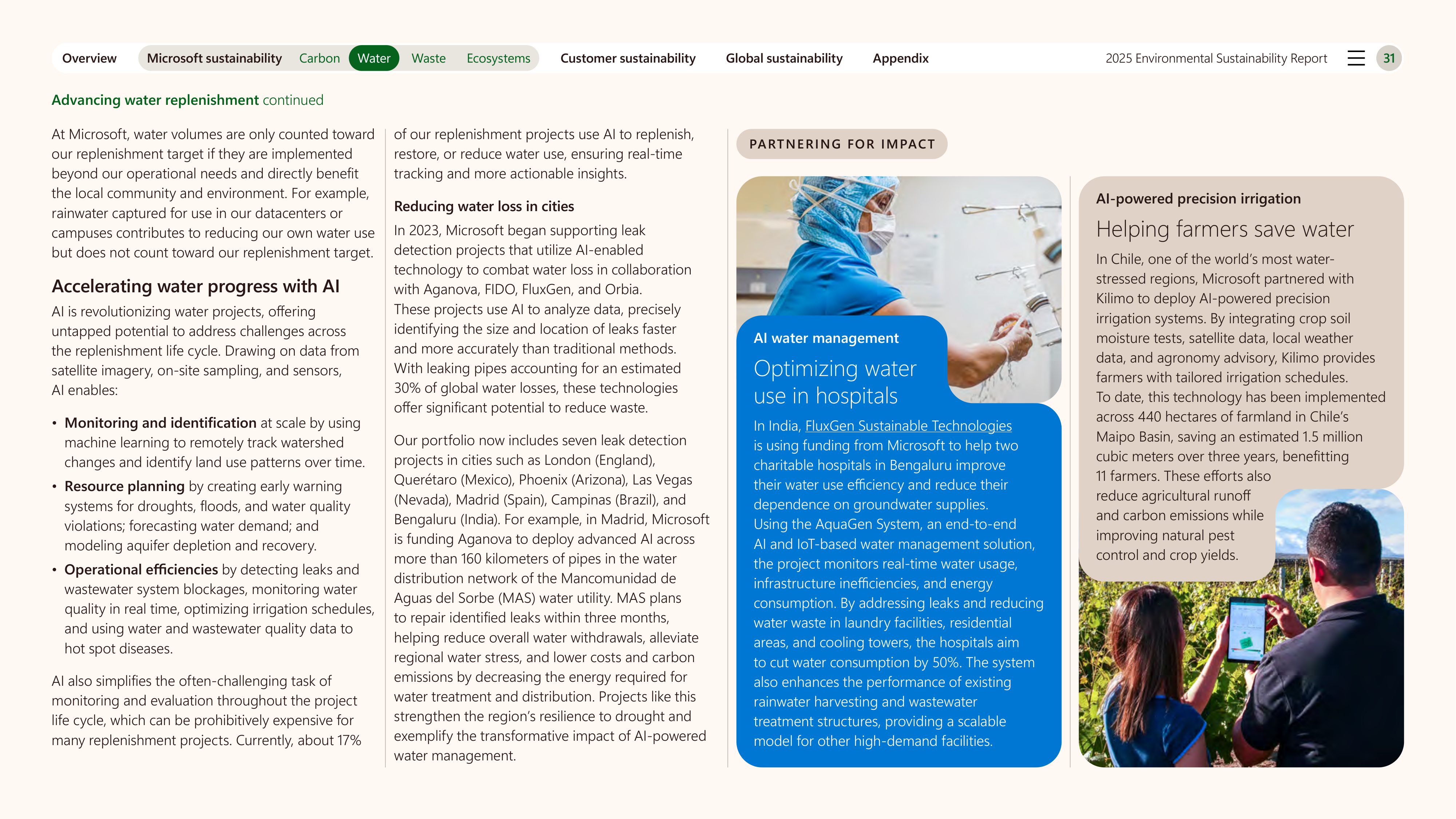

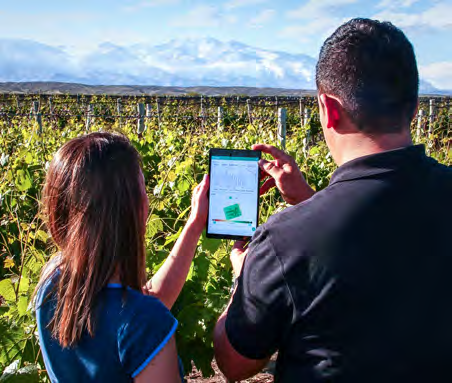

Advancing water replenishment
continued
At Microsoft, water volumes are only counted toward
our replenishment target if they are implemented
beyond our operational needs and directly benefit
the local community and environment. For example,
rainwater captured for use in our datacenters or
campuses contributes to reducing our own water use
but does not count toward our replenishment target.
Accelerating water progress with AI
AI is revolutionizing water projects, offering
untapped potential to address challenges across
the replenishment life cycle. Drawing on data from
satellite imagery, on-site sampling, and sensors,
AI enables:
•
Monitoring and identification
at scale by using
machine learning to remotely track watershed
changes and identify land use patterns over time.
•
Resource planning
by creating early warning
systems for droughts, floods, and water quality
violations; forecasting water demand; and
modeling aquifer depletion and recovery.
•
Operational efficiencies
by detecting leaks and
wastewater system blockages, monitoring water
quality in real time, optimizing irrigation schedules,
and using water and wastewater quality data to
hot spot diseases.
AI also simplifies the often-challenging task of
monitoring and evaluation throughout the project
life cycle, which can be prohibitively expensive for
many replenishment projects. Currently, about 17%
of our replenishment projects use AI to replenish,
restore, or reduce water use, ensuring real-time
tracking and more actionable insights.
Reducing water loss in cities
In 2023, Microsoft began supporting leak
detection projects that utilize AI-enabled
technology to combat water loss in collaboration
with Aganova, FIDO, FluxGen, and Orbia.
These projects use AI to analyze data, precisely
identifying the size and location of leaks faster
and more accurately than traditional methods.
With leaking pipes accounting for an estimated
30% of global water losses, these technologies
offer significant potential to reduce waste.
Our portfolio now includes seven leak detection
projects in cities such as London (England),
Querétaro (Mexico), Phoenix (Arizona), Las Vegas
(Nevada), Madrid (Spain), Campinas (Brazil), and
Bengaluru (India). For example, in Madrid, Microsoft
is funding Aganova to deploy advanced AI across
more than 160 kilometers of pipes in the water
distribution network of the Mancomunidad de
Aguas del Sorbe (MAS) water utility. MAS plans
to repair identified leaks within three months,
helping reduce overall water withdrawals, alleviate
regional water stress, and lower costs and carbon
emissions by decreasing the energy required for
water treatment and distribution. Projects like this
strengthen the region’s resilience to drought and
exemplify the transformative impact of AI-powered
water management.
PARTNERING FOR IMPACT
AI water management
Optimizing water
use in hospitals
In India, FluxGen Sustainable Technologies
is using funding from Microsoft to help two
charitable hospitals in Bengaluru improve
their water use efficiency and reduce their
dependence on groundwater supplies.
Using the AquaGen System, an end-to-end
AI and IoT-based water management solution,
the project monitors real-time water usage,
infrastructure inefficiencies, and energy
consumption. By addressing leaks and reducing
water waste in laundry facilities, residential
areas, and cooling towers, the hospitals aim
to cut water consumption by 50%. The system
also enhances the performance of existing
rainwater harvesting and wastewater
treatment structures, providing a scalable
model for other high-demand facilities.
AI-powered precision irrigation
Helping farmers save water
In Chile, one of the world’s most water-
stressed regions, Microsoft partnered with
Kilimo to deploy AI-powered precision
irrigation systems. By integrating crop soil
moisture tests, satellite data, local weather
data, and agronomy advisory, Kilimo provides
farmers with tailored irrigation schedules.
To date, this technology has been implemented
across 440 hectares of farmland in Chile’s
Maipo Basin, saving an estimated 1.5 million
cubic meters over three years, benefitting
11 farmers. These efforts also
reduce agricultural runoff
and carbon emissions while
improving natural pest
control and crop yields.
Microsoft sustainability
Carbon
Waste
Ecosystems
Overview
Customer sustainability
Global sustainability
Appendix
31
Water
2025 Environmental Sustainability Report
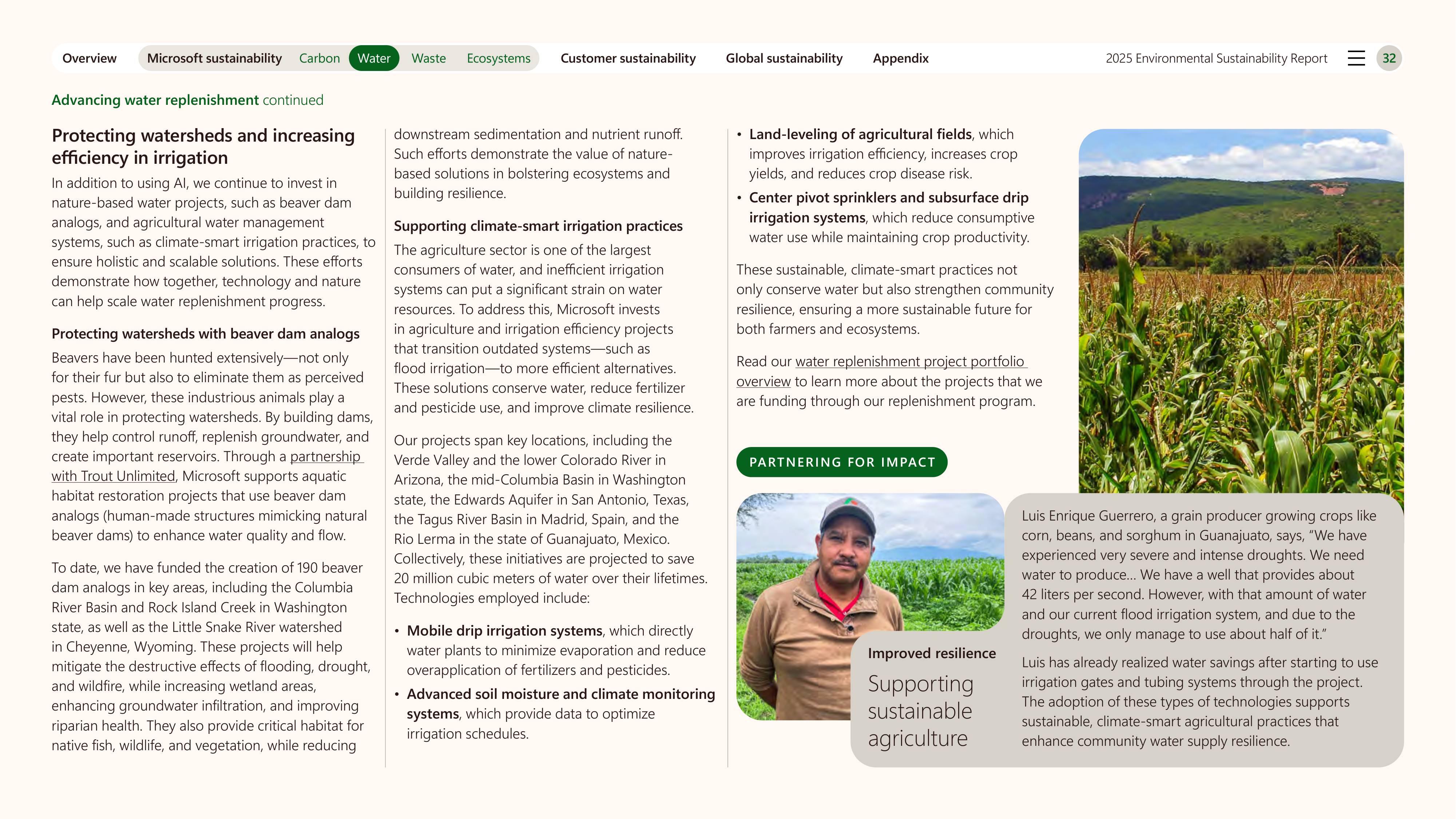
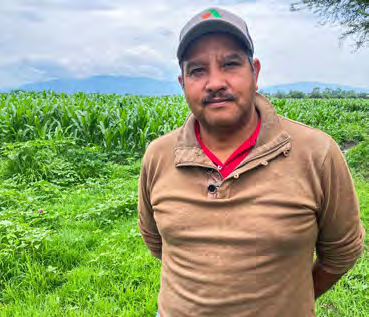


Advancing water replenishment
continued
Protecting watersheds and increasing
efficiency in irrigation
In addition to using AI, we continue to invest in
nature-based water projects, such as beaver dam
analogs, and agricultural water management
systems, such as climate-smart irrigation practices, to
ensure holistic and scalable solutions. These efforts
demonstrate how together, technology and nature
can help scale water replenishment progress.
Protecting watersheds with beaver dam analogs
Beavers have been hunted extensively—not only
for their fur but also to eliminate them as perceived
pests. However, these industrious animals play a
vital role in protecting watersheds. By building dams,
they help control runoff, replenish groundwater, and
create important reservoirs. Through a partnership
with Trout Unlimited, Microsoft supports aquatic
habitat restoration projects that use beaver dam
analogs (human-made structures mimicking natural
beaver dams) to enhance water quality and flow.
To date, we have funded the creation of 190 beaver
dam analogs in key areas, including the Columbia
River Basin and Rock Island Creek in Washington
state, as well as the Little Snake River watershed
in Cheyenne, Wyoming. These projects will help
mitigate the destructive effects of flooding, drought,
and wildfire, while increasing wetland areas,
enhancing groundwater infiltration, and improving
riparian health. They also provide critical habitat for
native fish, wildlife, and vegetation, while reducing
downstream sedimentation and nutrient runoff.
Such efforts demonstrate the value of nature-
based solutions in bolstering ecosystems and
building resilience.
Supporting climate-smart irrigation practices
The agriculture sector is one of the largest
consumers of water, and inefficient irrigation
systems can put a significant strain on water
resources. To address this, Microsoft invests
in agriculture and irrigation efficiency projects
that transition outdated systems—such as
flood irrigation—to more efficient alternatives.
These solutions conserve water, reduce fertilizer
and pesticide use, and improve climate resilience.
Our projects span key locations, including the
Verde Valley and the lower Colorado River in
Arizona, the mid-Columbia Basin in Washington
state, the Edwards Aquifer in San Antonio, Texas,
the Tagus River Basin in Madrid, Spain, and the
Rio Lerma in the state of Guanajuato, Mexico.
Collectively, these initiatives are projected to save
20 million cubic meters of water over their lifetimes.
Technologies employed include:
•
Mobile drip irrigation systems
, which directly
water plants to minimize evaporation and reduce
overapplication of fertilizers and pesticides.
•
Advanced soil moisture and climate monitoring
systems
, which provide data to optimize
irrigation schedules.
•
Land-leveling of agricultural fields
, which
improves irrigation efficiency, increases crop
yields, and reduces crop disease risk.
•
Center pivot sprinklers and subsurface drip
irrigation systems
, which reduce consumptive
water use while maintaining crop productivity.
These sustainable, climate-smart practices not
only conserve water but also strengthen community
resilience, ensuring a more sustainable future for
both farmers and ecosystems.
Read our water replenishment project portfolio
overview to learn more about the projects that we
are funding through our replenishment program.
PARTNERING FOR IMPACT
Improved resilience
Supporting
sustainable
agriculture
Luis Enrique Guerrero, a grain producer growing crops like
corn, beans, and sorghum in Guanajuato, says, “We have
experienced very severe and intense droughts. We need
water to produce… We have a well that provides about
42 liters per second. However, with that amount of water
and our current flood irrigation system, and due to the
droughts, we only manage to use about half of it.”
Luis has already realized water savings after starting to use
irrigation gates and tubing systems through the project.
The adoption of these types of technologies supports
sustainable, climate-smart agricultural practices that
enhance community water supply resilience.
Microsoft sustainability
Carbon
Waste
Ecosystems
Overview
Customer sustainability
Global sustainability
Appendix
32
Water
2025 Environmental Sustainability Report
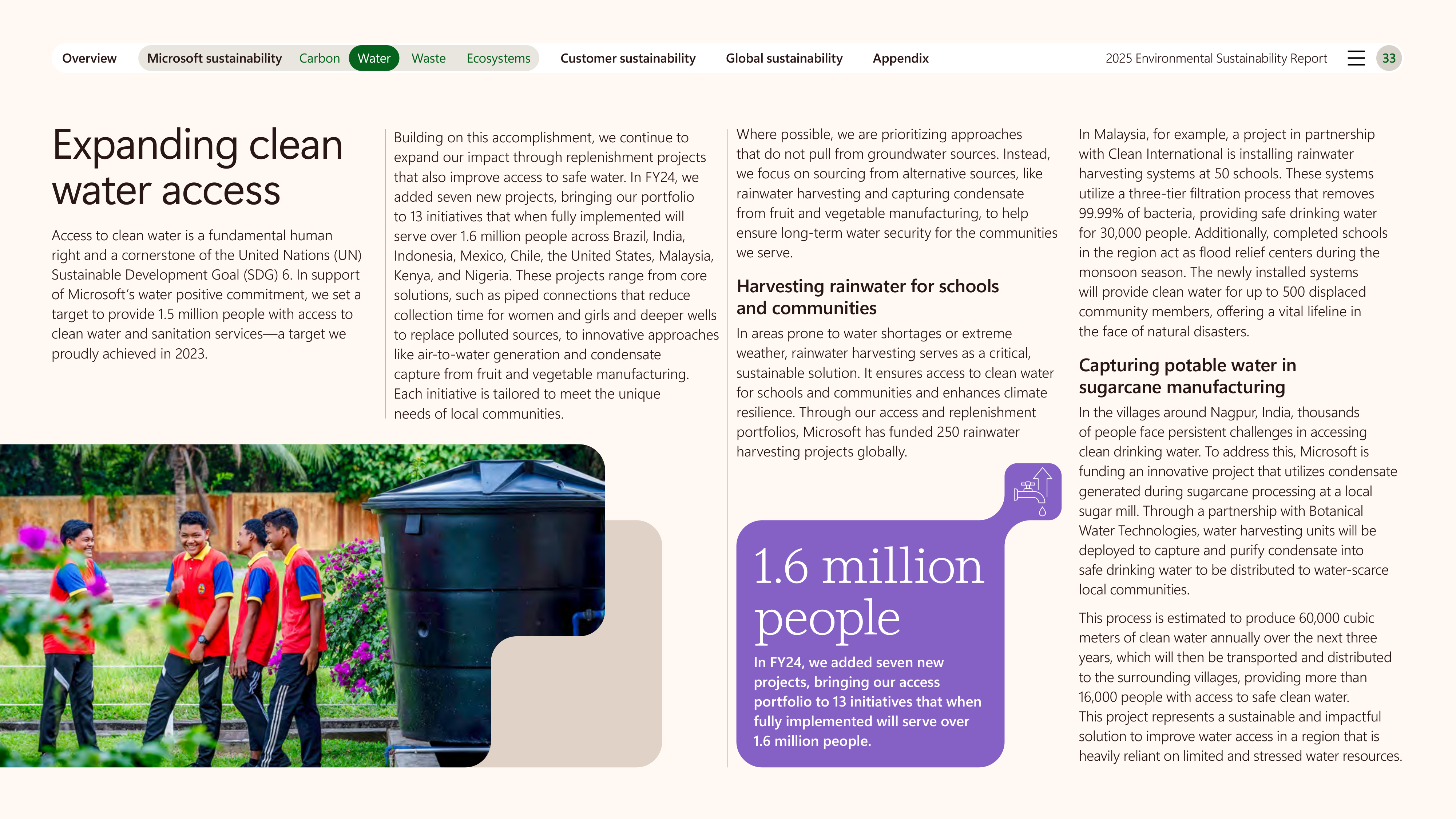
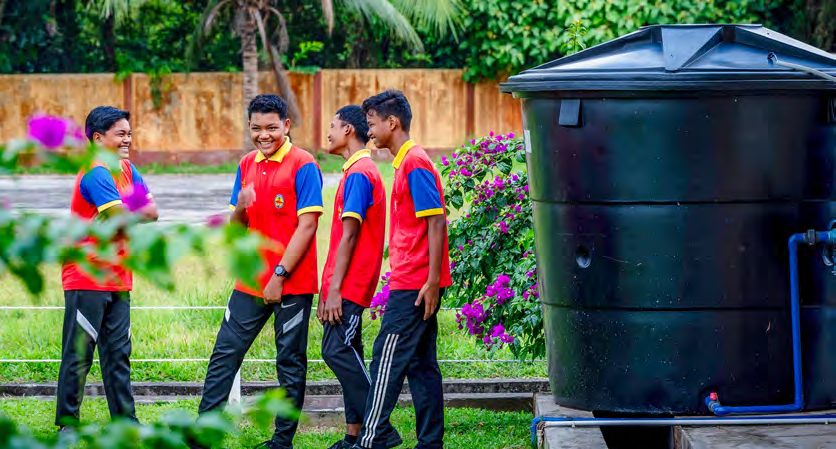
Expanding clean
water access
Access to clean water is a fundamental human
right and a cornerstone of the United Nations (UN)
Sustainable Development Goal (SDG) 6. In support
of Microsoft’s water positive commitment, we set a
target to provide 1.5 million people with access to
clean water and sanitation services—a target we
proudly achieved in 2023.
Building on this accomplishment, we continue to
expand our impact through replenishment projects
that also improve access to safe water. In FY24, we
added seven new projects, bringing our portfolio
to 13 initiatives that when fully implemented will
serve over 1.6 million people across Brazil, India,
Indonesia, Mexico, Chile, the United States, Malaysia,
Kenya, and Nigeria. These projects range from core
solutions, such as piped connections that reduce
collection time for women and girls and deeper wells
to replace polluted sources, to innovative approaches
like air-to-water generation and condensate
capture from fruit and vegetable manufacturing.
Each initiative is tailored to meet the unique
needs of local communities.
Where possible, we are prioritizing approaches
that do not pull from groundwater sources. Instead,
we focus on sourcing from alternative sources, like
rainwater harvesting and capturing condensate
from fruit and vegetable manufacturing, to help
ensure long-term water security for the communities
we serve.
Harvesting rainwater for schools
and communities
In areas prone to water shortages or extreme
weather, rainwater harvesting serves as a critical,
sustainable solution. It ensures access to clean water
for schools and communities and enhances climate
resilience. Through our access and replenishment
portfolios, Microsoft has funded 250 rainwater
harvesting projects globally.
1.6 million
people
In FY24, we added seven new
projects, bringing our access
portfolio to 13 initiatives that when
fully implemented will serve over
1.6 million people.
In Malaysia, for example, a project in partnership
with Clean International is installing rainwater
harvesting systems at 50 schools. These systems
utilize a three-tier filtration process that removes
99.99% of bacteria, providing safe drinking water
for 30,000 people. Additionally, completed schools
in the region act as flood relief centers during the
monsoon season. The newly installed systems
will provide clean water for up to 500 displaced
community members, offering a vital lifeline in
the face of natural disasters.
Capturing potable water in
sugarcane manufacturing
In the villages around Nagpur, India, thousands
of people face persistent challenges in accessing
clean drinking water. To address this, Microsoft is
funding an innovative project that utilizes condensate
generated during sugarcane processing at a local
sugar mill. Through a partnership with Botanical
Water Technologies, water harvesting units will be
deployed to capture and purify condensate into
safe drinking water to be distributed to water-scarce
local communities.
This process is estimated to produce 60,000 cubic
meters of clean water annually over the next three
years, which will then be transported and distributed
to the surrounding villages, providing more than
16,000 people with access to safe clean water.
This project represents a sustainable and impactful
solution to improve water access in a region that is
heavily reliant on limited and stressed water resources.
Microsoft sustainability
Carbon
Waste
Ecosystems
Overview
Customer sustainability
Global sustainability
Appendix
33
Water
2025 Environmental Sustainability Report
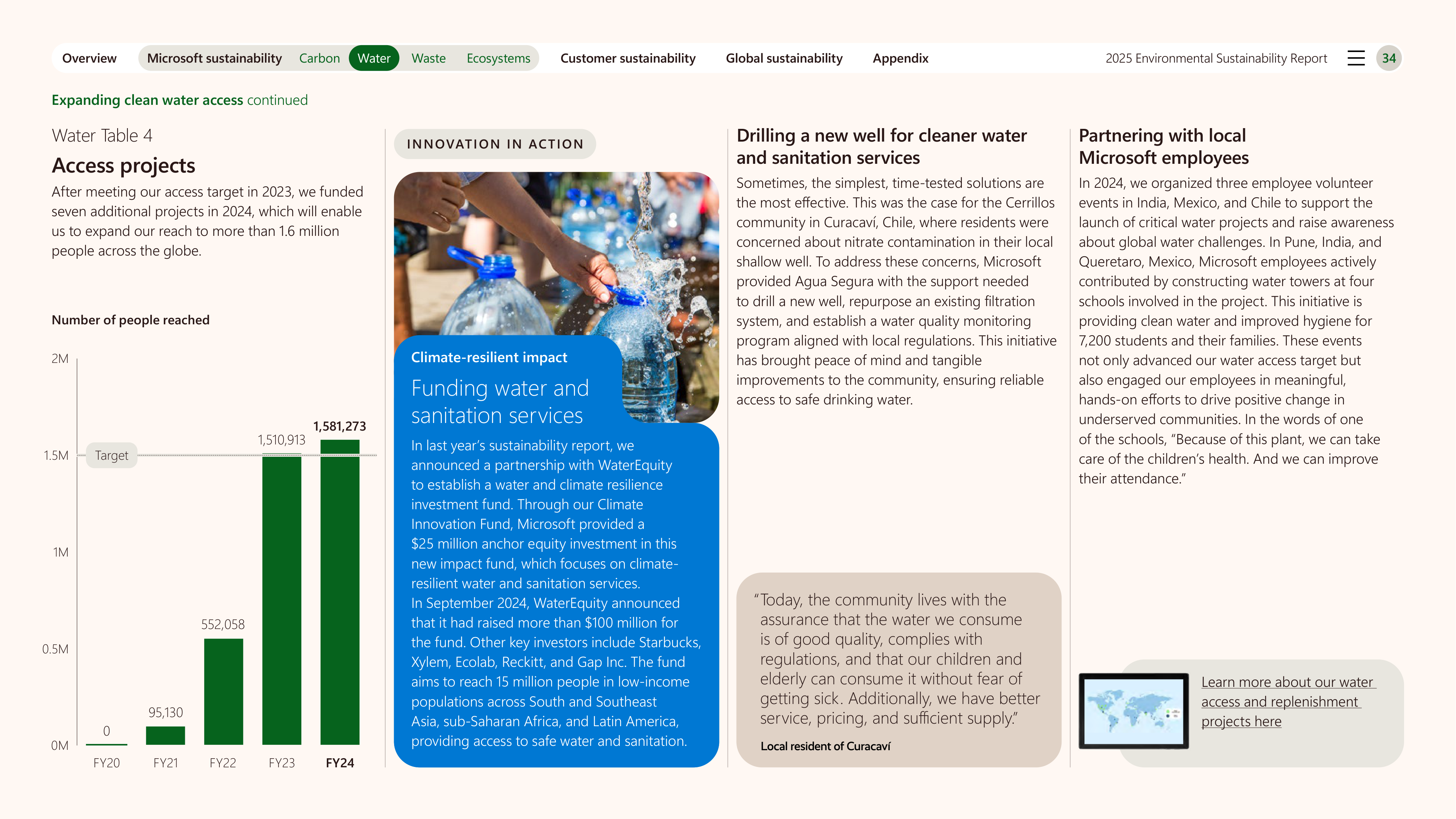

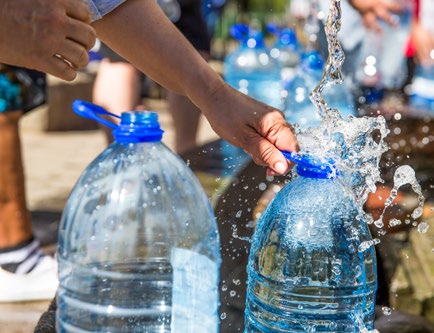

0M
2M
FY20
FY21
FY22
0
FY23
FY24
95,130
552,058
1,510,913
1.5M
1M
0.5M
Target
Expanding clean water access
continued
Water Table 4
Access projects
After meeting our access target in 2023, we funded
seven additional projects in 2024, which will enable
us to expand our reach to more than 1.6 million
people across the globe.
Number of people reached
INNOVATION IN ACTION
Climate-resilient impact
Funding water and
sanitation services
In last year’s sustainability report, we
announced a partnership with WaterEquity
to establish a water and climate resilience
investment fund. Through our Climate
Innovation Fund, Microsoft provided a
$25 million anchor equity investment in this
new impact fund, which focuses on climate-
resilient water and sanitation services.
In September 2024, WaterEquity announced
that it had raised more than $100 million for
the fund. Other key investors include Starbucks,
Xylem, Ecolab, Reckitt, and Gap Inc. The fund
aims to reach 15 million people in low-income
populations across South and Southeast
Asia, sub-Saharan Africa, and Latin America,
providing access to safe water and sanitation.
Drilling a new well for cleaner water
and sanitation services
Sometimes, the simplest, time-tested solutions are
the most effective. This was the case for the Cerrillos
community in Curacaví, Chile, where residents were
concerned about nitrate contamination in their local
shallow well. To address these concerns, Microsoft
provided Agua Segura with the support needed
to drill a new well, repurpose an existing filtration
system, and establish a water quality monitoring
program aligned with local regulations. This initiative
has brought peace of mind and tangible
improvements to the community, ensuring reliable
access to safe drinking water.
“Today, the community lives with the
assurance that the water we consume
is of good quality, complies with
regulations, and that our children and
elderly can consume it without fear of
getting sick. Additionally, we have better
service, pricing, and sufficient supply.”
Local resident of Curacaví
Partnering with local
Microsoft employees
In 2024, we organized three employee volunteer
events in India, Mexico, and Chile to support the
launch of critical water projects and raise awareness
about global water challenges. In Pune, India, and
Queretaro, Mexico, Microsoft employees actively
contributed by constructing water towers at four
schools involved in the project. This initiative is
providing clean water and improved hygiene for
7,200 students and their families. These events
not only advanced our water access target but
also engaged our employees in meaningful,
hands-on efforts to drive positive change in
underserved communities. In the words of one
of the schools, “Because of this plant, we can take
care of the children’s health. And we can improve
their attendance.”
Learn more about our water
access and replenishment
projects here
Microsoft sustainability
Carbon
Waste
Ecosystems
Overview
Customer sustainability
Global sustainability
Appendix
34
Water
2025 Environmental Sustainability Report
1,581,273
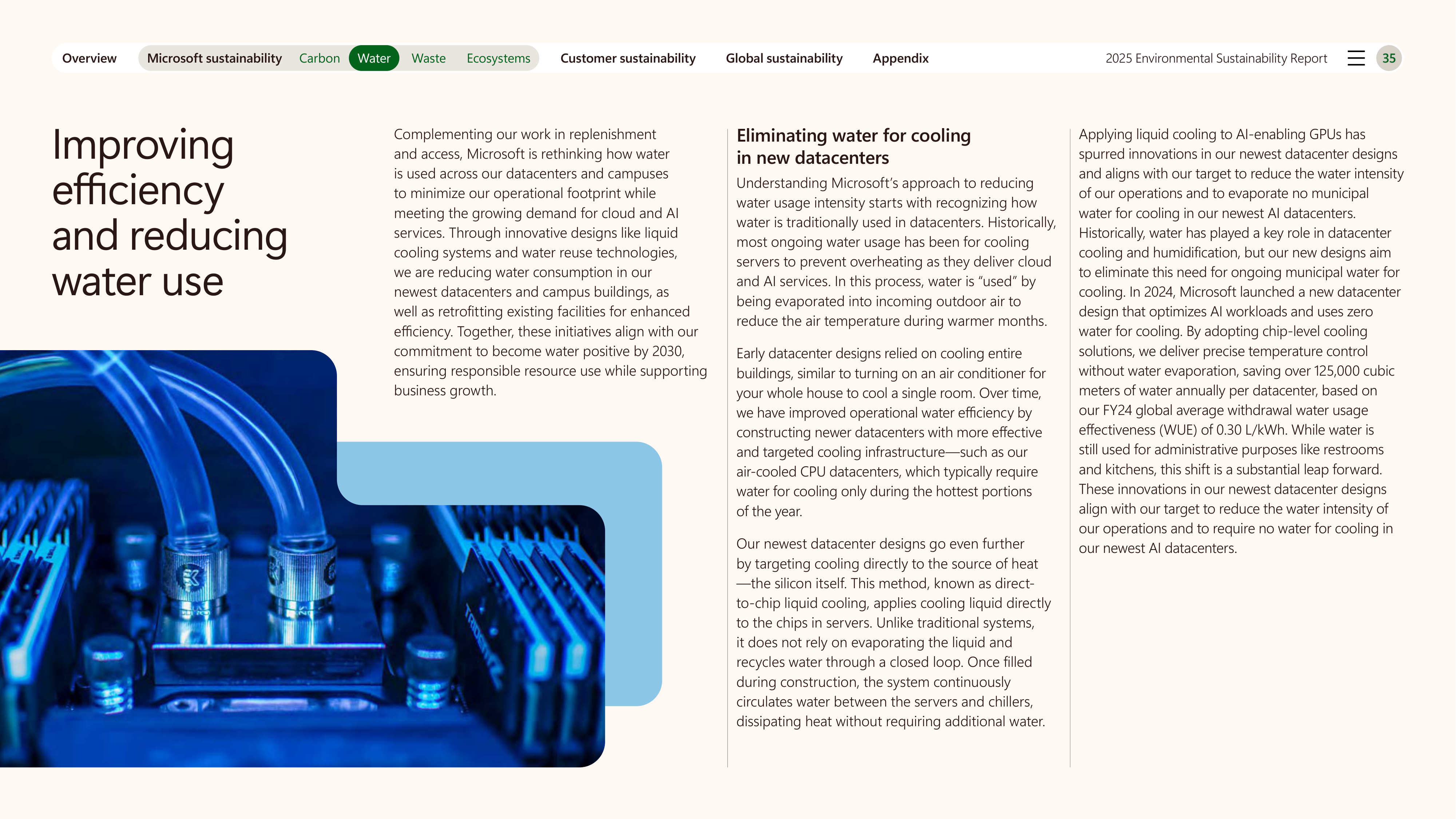
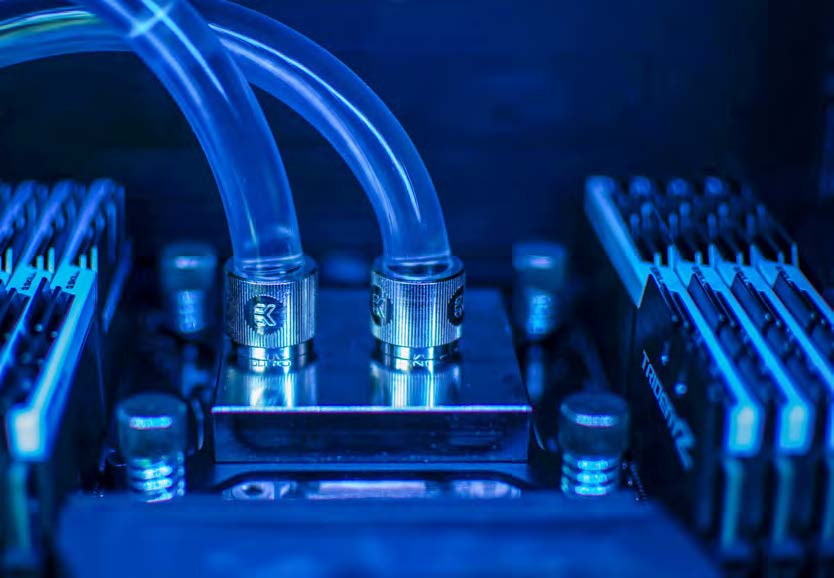
Improving
efficiency
and reducing
water use
Complementing our work in replenishment
and access, Microsoft is rethinking how water
is used across our datacenters and campuses
to minimize our operational footprint while
meeting the growing demand for cloud and AI
services. Through innovative designs like liquid
cooling systems and water reuse technologies,
we are reducing water consumption in our
newest datacenters and campus buildings, as
well as retrofitting existing facilities for enhanced
efficiency. Together, these initiatives align with our
commitment to become water positive by 2030,
ensuring responsible resource use while supporting
business growth.
Eliminating water for cooling
in new datacenters
Understanding Microsoft’s approach to reducing
water usage intensity starts with recognizing how
water is traditionally used in datacenters. Historically,
most ongoing water usage has been for cooling
servers to prevent overheating as they deliver cloud
and AI services. In this process, water is “used” by
being evaporated into incoming outdoor air to
reduce the air temperature during warmer months.
Early datacenter designs relied on cooling entire
buildings, similar to turning on an air conditioner for
your whole house to cool a single room. Over time,
we have improved operational water efficiency by
constructing newer datacenters with more effective
and targeted cooling infrastructure—such as our
air-cooled CPU datacenters, which typically require
water for cooling only during the hottest portions
of the year.
Our newest datacenter designs go even further
by targeting cooling directly to the source of heat
—the silicon itself. This method, known as direct-
to-chip liquid cooling, applies cooling liquid directly
to the chips in servers. Unlike traditional systems,
it does not rely on evaporating the liquid and
recycles water through a closed loop. Once filled
during construction, the system continuously
circulates water between the servers and chillers,
dissipating heat without requiring additional water.
Applying liquid cooling to AI-enabling GPUs has
spurred innovations in our newest datacenter designs
and aligns with our target to reduce the water intensity
of our operations and to evaporate no municipal
water for cooling in our newest AI datacenters.
Historically, water has played a key role in datacenter
cooling and humidification, but our new designs aim
to eliminate this need for ongoing municipal water for
cooling. In 2024, Microsoft launched a new datacenter
design that optimizes AI workloads and uses zero
water for cooling. By adopting chip-level cooling
solutions, we deliver precise temperature control
without water evaporation, saving over 125,000 cubic
meters of water annually per datacenter, based on
our FY24 global average withdrawal water usage
effectiveness (WUE) of 0.30 L per kWh. While water is
still used for administrative purposes like restrooms
and kitchens, this shift is a substantial leap forward.
These innovations in our newest datacenter designs
align with our target to reduce the water intensity of
our operations and to require no water for cooling in
our newest AI datacenters.
Microsoft sustainability
Carbon
Waste
Ecosystems
Overview
Customer sustainability
Global sustainability
Appendix
35
Water
2025 Environmental Sustainability Report
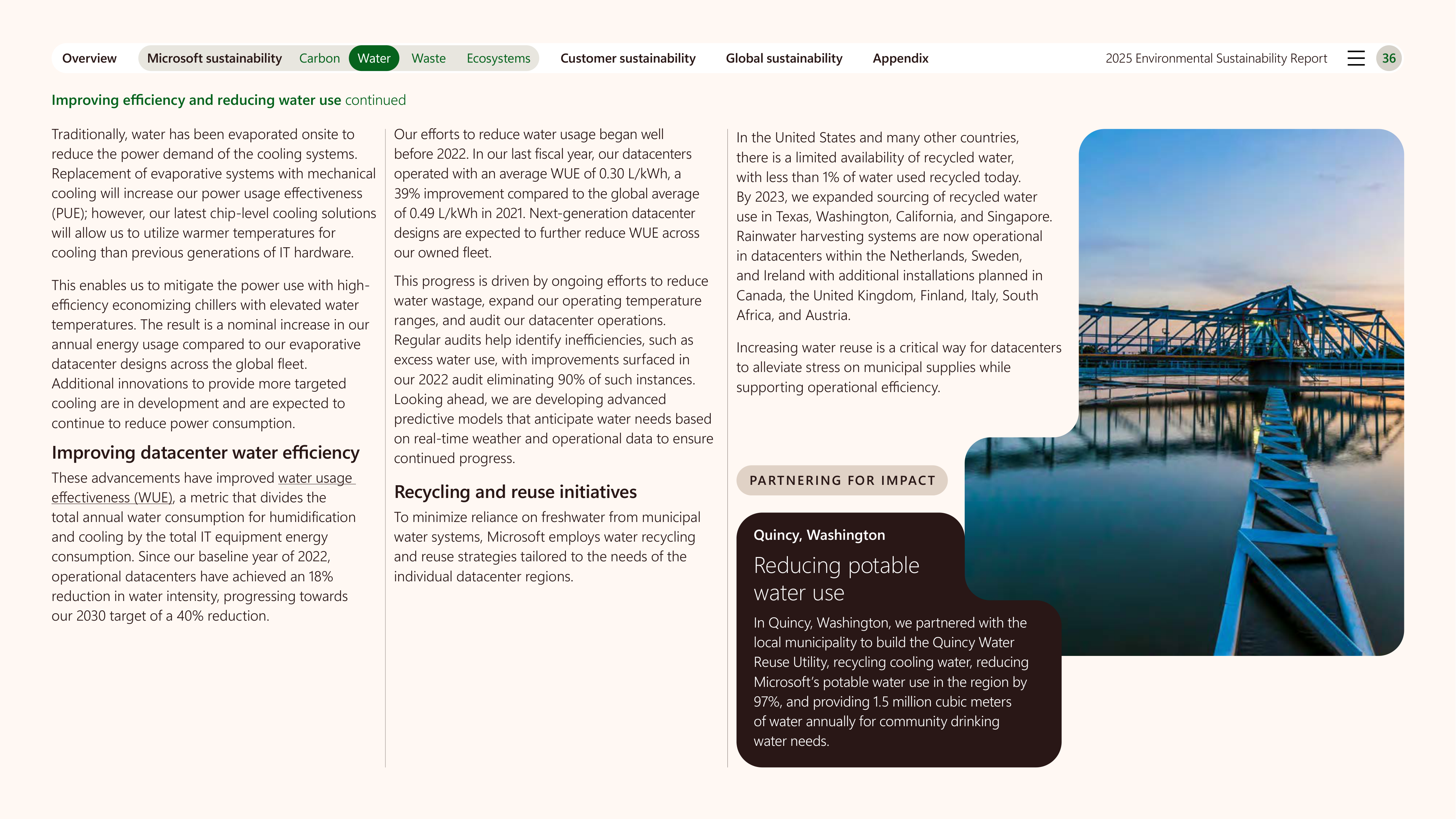

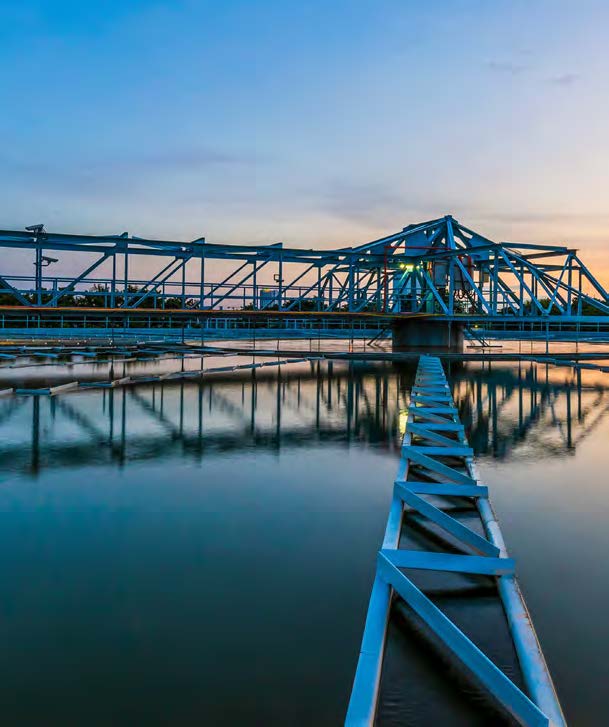
Improving efficiency and reducing water use
continued
Traditionally, water has been evaporated onsite to
reduce the power demand of the cooling systems.
Replacement of evaporative systems with mechanical
cooling will increase our power usage effectiveness
(PUE); however, our latest chip-level cooling solutions
will allow us to utilize warmer temperatures for
cooling than previous generations of IT hardware.
This enables us to mitigate the power use with high-
efficiency economizing chillers with elevated water
temperatures. The result is a nominal increase in our
annual energy usage compared to our evaporative
datacenter designs across the global fleet.
Additional innovations to provide more targeted
cooling are in development and are expected to
continue to reduce power consumption.
Improving datacenter water efficiency
These advancements have improved water usage
effectiveness (WUE), a metric that divides the
total annual water consumption for humidification
and cooling by the total IT equipment energy
consumption. Since our baseline year of 2022,
operational datacenters have achieved an 18%
reduction in water intensity, progressing towards
our 2030 target of a 40% reduction.
Our efforts to reduce water usage began well
before 2022. In our last fiscal year, our datacenters
operated with an average WUE of 0.30 L per kWh, a
39% improvement compared to the global average
of 0.49 L per kWh in 2021. Next-generation datacenter
designs are expected to further reduce WUE across
our owned fleet.
This progress is driven by ongoing efforts to reduce
water wastage, expand our operating temperature
ranges, and audit our datacenter operations.
Regular audits help identify inefficiencies, such as
excess water use, with improvements surfaced in
our 2022 audit eliminating 90% of such instances.
Looking ahead, we are developing advanced
predictive models that anticipate water needs based
on real-time weather and operational data to ensure
continued progress.
Recycling and reuse initiatives
To minimize reliance on freshwater from municipal
water systems, Microsoft employs water recycling
and reuse strategies tailored to the needs of the
individual datacenter regions.
In the United States and many other countries,
there is a limited availability of recycled water,
with less than 1% of water used recycled today.
By 2023, we expanded sourcing of recycled water
use in Texas, Washington, California, and Singapore.
Rainwater harvesting systems are now operational
in datacenters within the Netherlands, Sweden,
and Ireland with additional installations planned in
Canada, the United Kingdom, Finland, Italy, South
Africa, and Austria.
Increasing water reuse is a critical way for datacenters
to alleviate stress on municipal supplies while
supporting operational efficiency.
PARTNERING FOR IMPACT
Quincy, Washington
Reducing potable
water use
In Quincy, Washington, we partnered with the
local municipality to build the Quincy Water
Reuse Utility, recycling cooling water, reducing
Microsoft’s potable water use in the region by
97%, and providing 1.5 million cubic meters
of water annually for community drinking
water needs.
Microsoft sustainability
Carbon
Waste
Ecosystems
Overview
Customer sustainability
Global sustainability
Appendix
36
Water
2025 Environmental Sustainability Report
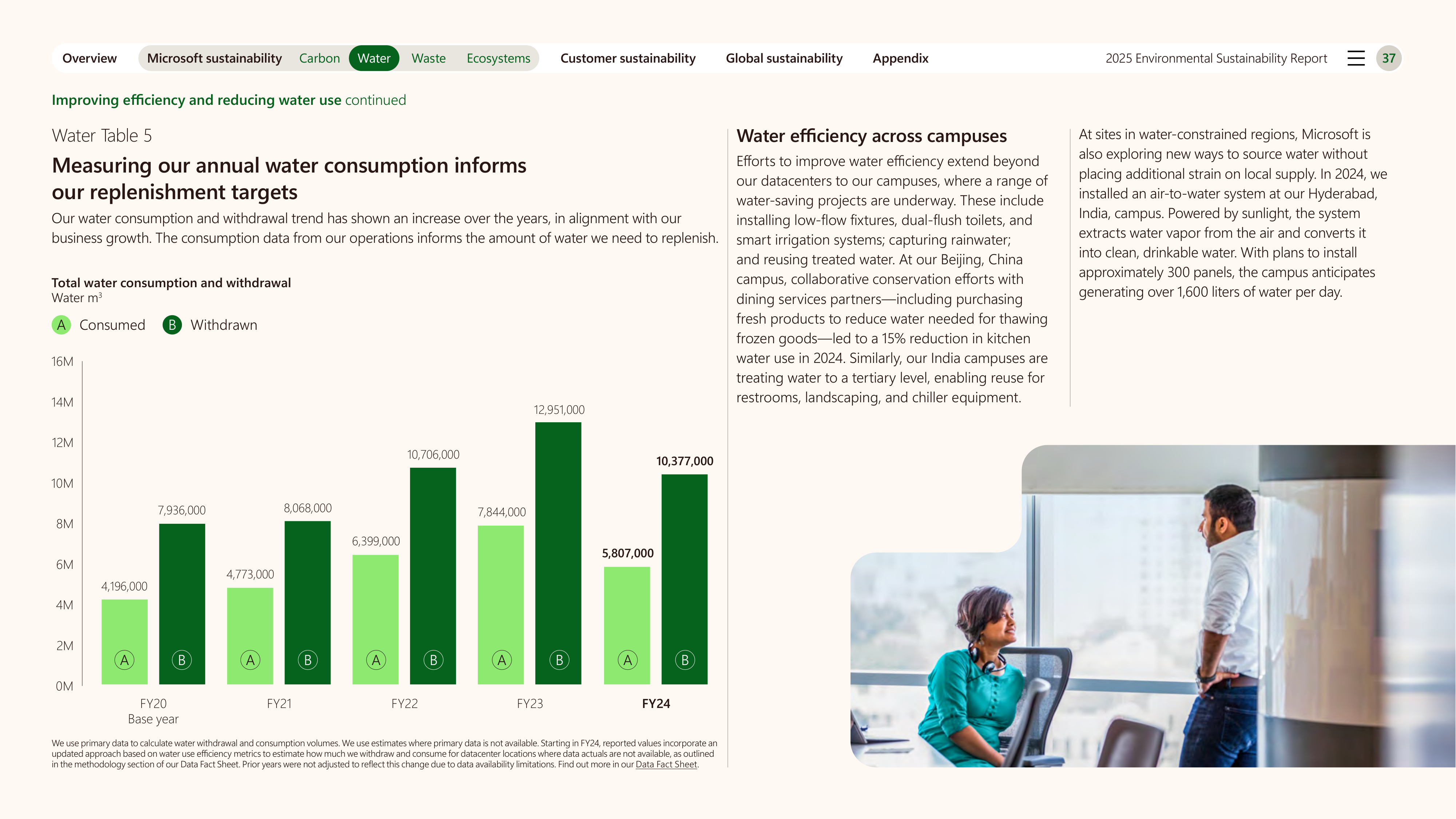


Water Table 5
Measuring our annual water consumption informs
our replenishment targets
Our water consumption and withdrawal trend has shown an increase over the years, in alignment with our
business growth. The consumption data from our operations informs the amount of water we need to replenish.
Total water consumption and withdrawal
Water m
cubed
FY20
Base year
FY21
FY22
FY23
FY24
0M
2M
4M
6M
8M
10M
14M
12M
16M
Consumed
A
Withdrawn
B
4,196,000
7,936,000
4,773,000
8,068,000
6,399,000
7,844,000
10,377,000
5,807,000
12,951,000
10,706,000
A
A
A
A
A
B
B
B
B
B
Improving efficiency and reducing water use
continued
We use primary data to calculate water withdrawal and consumption volumes. We use estimates where primary data is not available. Starting in FY24, reported values incorporate an
updated approach based on water use efficiency metrics to estimate how much we withdraw and consume for datacenter locations where data actuals are not available, as outlined
in the methodology section of our Data Fact Sheet. Prior years were not adjusted to reflect this change due to data availability limitations. Find out more in our Data Fact Sheet.
Water efficiency across campuses
Efforts to improve water efficiency extend beyond
our datacenters to our campuses, where a range of
water-saving projects are underway. These include
installing low-flow fixtures, dual-flush toilets, and
smart irrigation systems; capturing rainwater;
and reusing treated water. At our Beijing, China
campus, collaborative conservation efforts with
dining services partners—including purchasing
fresh products to reduce water needed for thawing
frozen goods—led to a 15% reduction in kitchen
water use in 2024. Similarly, our India campuses are
treating water to a tertiary level, enabling reuse for
restrooms, landscaping, and chiller equipment.
At sites in water-constrained regions, Microsoft is
also exploring new ways to source water without
placing additional strain on local supply. In 2024, we
installed an air-to-water system at our Hyderabad,
India, campus. Powered by sunlight, the system
extracts water vapor from the air and converts it
into clean, drinkable water. With plans to install
approximately 300 panels, the campus anticipates
generating over 1,600 liters of water per day.
Microsoft sustainability
Carbon
Waste
Ecosystems
Overview
Customer sustainability
Global sustainability
Appendix
37
Water
2025 Environmental Sustainability Report
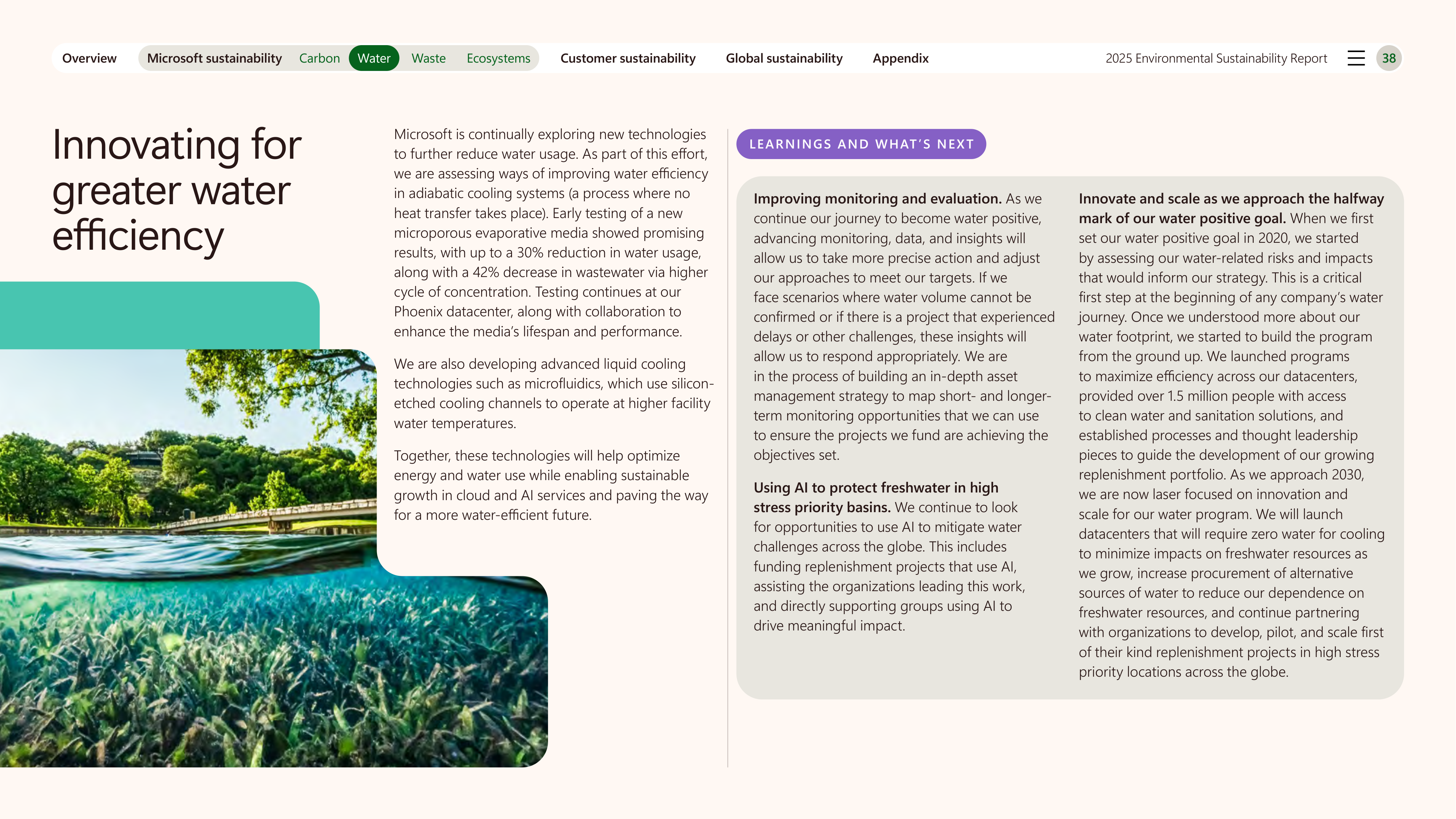

Innovating for
greater water
efficiency
Microsoft is continually exploring new technologies
to further reduce water usage. As part of this effort,
we are assessing ways of improving water efficiency
in adiabatic cooling systems (a process where no
heat transfer takes place). Early testing of a new
microporous evaporative media showed promising
results, with up to a 30% reduction in water usage,
along with a 42% decrease in wastewater via higher
cycle of concentration. Testing continues at our
Phoenix datacenter, along with collaboration to
enhance the media’s lifespan and performance.
We are also developing advanced liquid cooling
technologies such as microfluidics, which use silicon-
etched cooling channels to operate at higher facility
water temperatures.
Together, these technologies will help optimize
energy and water use while enabling sustainable
growth in cloud and AI services and paving the way
for a more water-efficient future.
LEARNINGS AND WHAT’S NEXT
Improving monitoring and evaluation.
As we
continue our journey to become water positive,
advancing monitoring, data, and insights will
allow us to take more precise action and adjust
our approaches to meet our targets. If we
face scenarios where water volume cannot be
confirmed or if there is a project that experienced
delays or other challenges, these insights will
allow us to respond appropriately. We are
in the process of building an in-depth asset
management strategy to map short- and longer-
term monitoring opportunities that we can use
to ensure the projects we fund are achieving the
objectives set.
Using AI to protect freshwater in high
stress priority basins.
We continue to look
for opportunities to use AI to mitigate water
challenges across the globe. This includes
funding replenishment projects that use AI,
assisting the organizations leading this work,
and directly supporting groups using AI to
drive meaningful impact.
Innovate and scale as we approach the halfway
mark of our water positive goal.
When we first
set our water positive goal in 2020, we started
by assessing our water-related risks and impacts
that would inform our strategy. This is a critical
first step at the beginning of any company’s water
journey. Once we understood more about our
water footprint, we started to build the program
from the ground up. We launched programs
to maximize efficiency across our datacenters,
provided over 1.5 million people with access
to clean water and sanitation solutions, and
established processes and thought leadership
pieces to guide the development of our growing
replenishment portfolio. As we approach 2030,
we are now laser focused on innovation and
scale for our water program. We will launch
datacenters that will require zero water for cooling
to minimize impacts on freshwater resources as
we grow, increase procurement of alternative
sources of water to reduce our dependence on
freshwater resources, and continue partnering
with organizations to develop, pilot, and scale first
of their kind replenishment projects in high stress
priority locations across the globe.
Microsoft sustainability
Carbon
Waste
Ecosystems
Overview
Customer sustainability
Global sustainability
Appendix
38
Water
2025 Environmental Sustainability Report
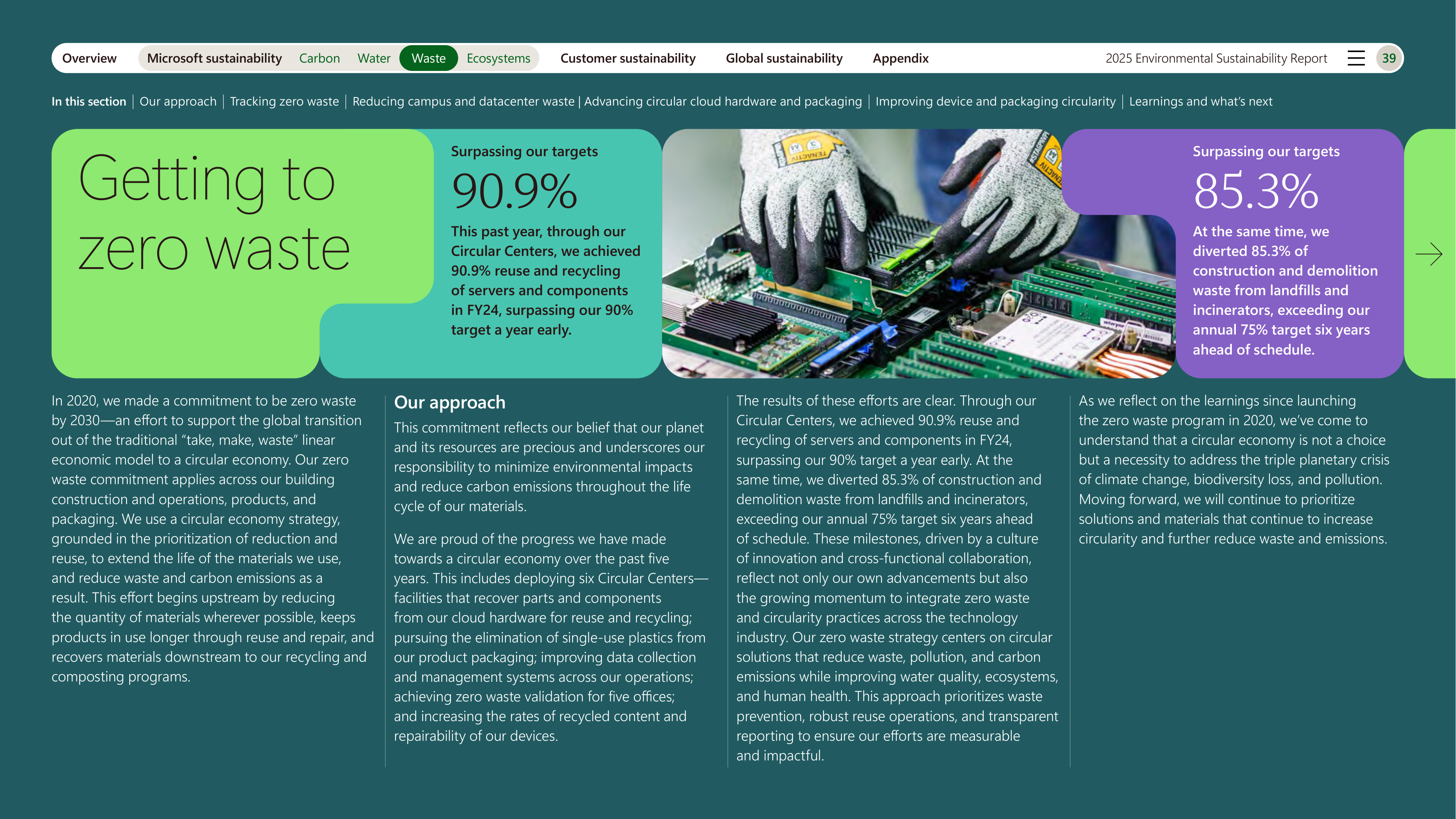
Microsoft sustainability
Carbon
Water
Ecosystems
Overview
Customer sustainability
Global sustainability
Appendix
39
Our approach Tracking zero waste Reducing campus and datacenter waste | Advancing circular cloud hardware and packaging Improving device and packaging circularity Learnings and what’s next
Waste
In this section
Getting to
zero waste
Surpassing our targets
90.9%
This past year, through our
Circular Centers, we achieved
90.9% reuse and recycling
of servers and components
in FY24, surpassing our 90%
target a year early.
Surpassing our targets
85.3%
At the same time, we
diverted 85.3% of
construction and demolition
waste from landfills and
incinerators, exceeding our
annual 75% target six years
ahead of schedule.
In 2020, we made a commitment to be zero waste
by 2030—an effort to support the global transition
out of the traditional “take, make, waste” linear
economic model to a circular economy. Our zero
waste commitment applies across our building
construction and operations, products, and
packaging. We use a circular economy strategy,
grounded in the prioritization of reduction and
reuse, to extend the life of the materials we use,
and reduce waste and carbon emissions as a
result. This effort begins upstream by reducing
the quantity of materials wherever possible, keeps
products in use longer through reuse and repair, and
recovers materials downstream to our recycling and
composting programs.
Our approach
This commitment reflects our belief that our planet
and its resources are precious and underscores our
responsibility to minimize environmental impacts
and reduce carbon emissions throughout the life
cycle of our materials.
We are proud of the progress we have made
towards a circular economy over the past five
years. This includes deploying six Circular Centers—
facilities that recover parts and components
from our cloud hardware for reuse and recycling;
pursuing the elimination of single-use plastics from
our product packaging; improving data collection
and management systems across our operations;
achieving zero waste validation for five offices;
and increasing the rates of recycled content and
repairability of our devices.
The results of these efforts are clear. Through our
Circular Centers, we achieved 90.9% reuse and
recycling of servers and components in FY24,
surpassing our 90% target a year early. At the
same time, we diverted 85.3% of construction and
demolition waste from landfills and incinerators,
exceeding our annual 75% target six years ahead
of schedule. These milestones, driven by a culture
of innovation and cross-functional collaboration,
reflect not only our own advancements but also
the growing momentum to integrate zero waste
and circularity practices across the technology
industry. Our zero waste strategy centers on circular
solutions that reduce waste, pollution, and carbon
emissions while improving water quality, ecosystems,
and human health. This approach prioritizes waste
prevention, robust reuse operations, and transparent
reporting to ensure our efforts are measurable
and impactful.
As we reflect on the learnings since launching
the zero waste program in 2020, we’ve come to
understand that a circular economy is not a choice
but a necessity to address the triple planetary crisis
of climate change, biodiversity loss, and pollution.
Moving forward, we will continue to prioritize
solutions and materials that continue to increase
circularity and further reduce waste and emissions.
2025 Environmental Sustainability Report
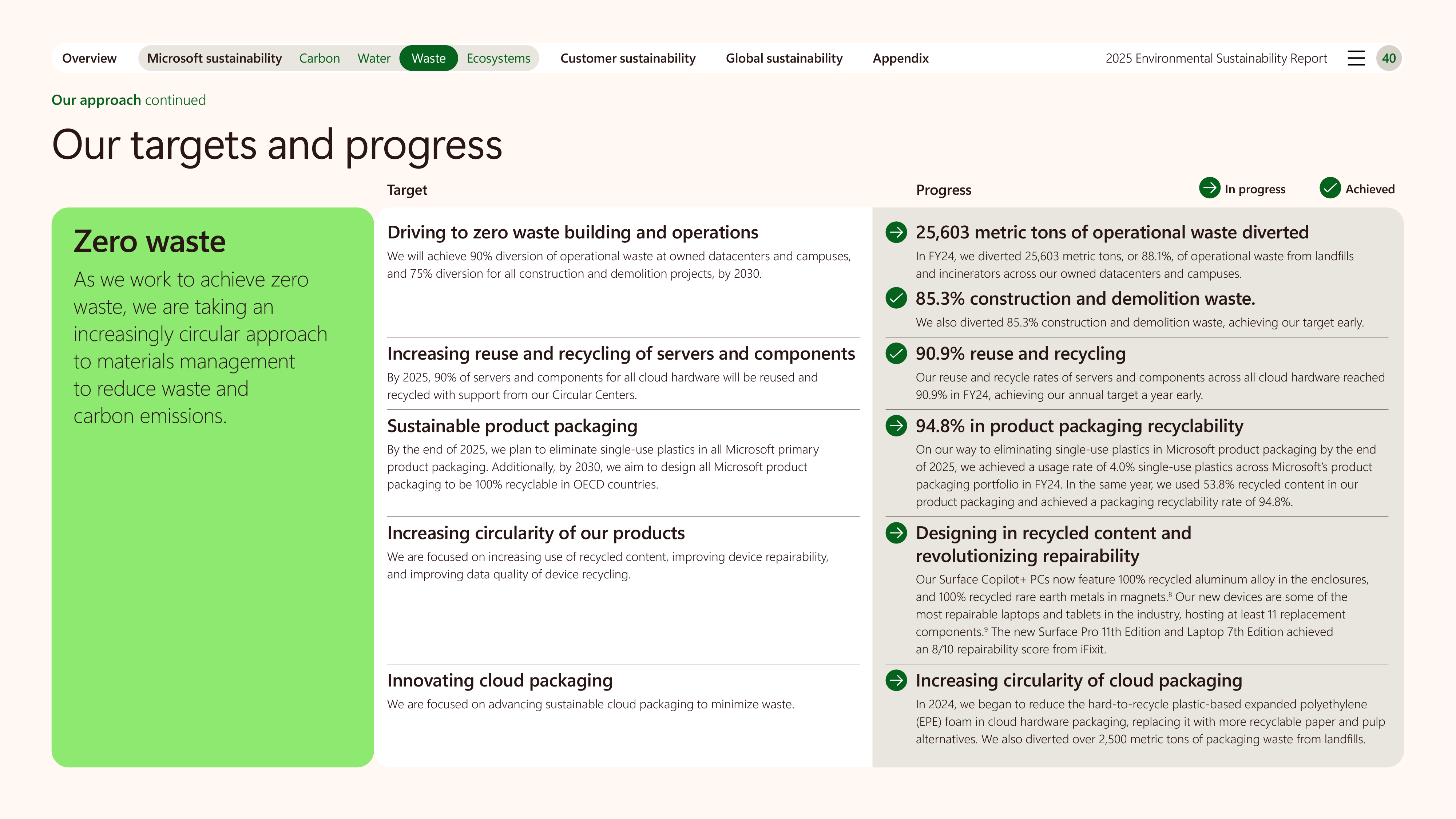

Microsoft sustainability
Carbon
Water
Ecosystems
Overview
Customer sustainability
Global sustainability
Appendix
40
Our approach
continued
Waste
Our targets and progress
Zero waste
As we work to achieve zero
waste, we are taking an
increasingly circular approach
to materials management
to reduce waste and
carbon emissions.
In progress
Achieved
Target
Progress
Driving to zero waste building and operations
We will achieve 90% diversion of operational waste at owned datacenters and campuses,
and 75% diversion for all construction and demolition projects, by 2030.
25,603 metric tons of operational waste diverted
In FY24, we diverted 25,603 metric tons, or 88.1%, of operational waste from landfills
and incinerators across our owned datacenters and campuses.
85.3% construction and demolition waste.
We also diverted 85.3% construction and demolition waste, achieving our target early.
Increasing reuse and recycling of servers and components
By 2025, 90% of servers and components for all cloud hardware will be reused and
recycled with support from our Circular Centers.
90.9% reuse and recycling
Our reuse and recycle rates of servers and components across all cloud hardware reached
90.9% in FY24, achieving our annual target a year early.
Sustainable product packaging
By the end of 2025, we plan to eliminate single-use plastics in all Microsoft primary
product packaging. Additionally, by 2030, we aim to design all Microsoft product
packaging to be 100% recyclable in OECD countries.
94.8% in product packaging recyclability
On our way to eliminating single-use plastics in Microsoft product packaging by the end
of 2025, we achieved a usage rate of 4.0% single-use plastics across Microsoft’s product
packaging portfolio in FY24. In the same year, we used 53.8% recycled content in our
product packaging and achieved a packaging recyclability rate of 94.8%.
Increasing circularity of our products
We are focused on increasing use of recycled content, improving device repairability,
and improving data quality of device recycling.
Designing in recycled content and
revolutionizing repairability
Our Surface Copilot+ PCs now feature 100% recycled aluminum alloy in the enclosures,
and 100% recycled rare earth metals in magnets.
8
Our new devices are some of the
most repairable laptops and tablets in the industry, hosting at least 11 replacement
components.
9
The new Surface Pro 11th Edition and Laptop 7th Edition achieved
an 8/10 repairability score from iFixit.
Innovating cloud packaging
We are focused on advancing sustainable cloud packaging to minimize waste.
Increasing circularity of cloud packaging
In 2024, we began to reduce the hard-to-recycle plastic-based expanded polyethylene
(EPE) foam in cloud hardware packaging, replacing it with more recyclable paper and pulp
alternatives. We also diverted over 2,500 metric tons of packaging waste from landfills.
2025 Environmental Sustainability Report
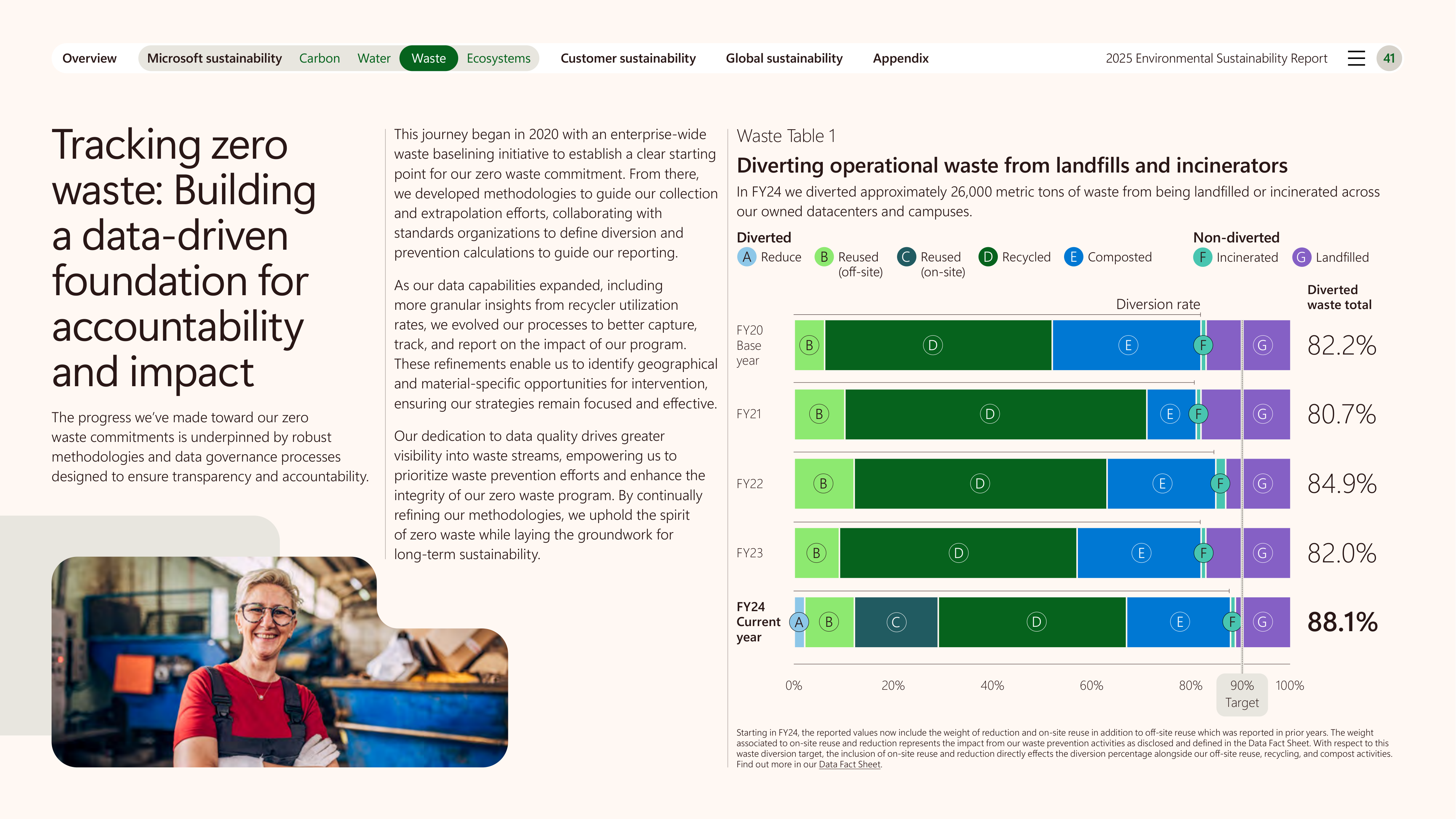


Tracking zero
waste: Building
a data-driven
foundation for
accountability
and impact
The progress we’ve made toward our zero
waste commitments is underpinned by robust
methodologies and data governance processes
designed to ensure transparency and accountability.
This journey began in 2020 with an enterprise-wide
waste baselining initiative to establish a clear starting
point for our zero waste commitment. From there,
we developed methodologies to guide our collection
and extrapolation efforts, collaborating with
standards organizations to define diversion and
prevention calculations to guide our reporting.
As our data capabilities expanded, including
more granular insights from recycler utilization
rates, we evolved our processes to better capture,
track, and report on the impact of our program.
These refinements enable us to identify geographical
and material-specific opportunities for intervention,
ensuring our strategies remain focused and effective.
Our dedication to data quality drives greater
visibility into waste streams, empowering us to
prioritize waste prevention efforts and enhance the
integrity of our zero waste program. By continually
refining our methodologies, we uphold the spirit
of zero waste while laying the groundwork for
long-term sustainability.
Waste Table 1
Diverting operational waste from landfills and incinerators
In FY24 we diverted approximately 26,000 metric tons of waste from being landfilled or incinerated across
our owned datacenters and campuses.
Starting in FY24, the reported values now include the weight of reduction and on-site reuse in addition to off-site reuse which was reported in prior years. The weight
associated to on-site reuse and reduction represents the impact from our waste prevention activities as disclosed and defined in the Data Fact Sheet. With respect to this
Find out more in our
waste diversion target, the inclusion of on-site reuse and reduction directly effects the diversion percentage alongside our off-site reuse, recycling, and compost activities.
Data Fact Sheet.
Diverted
Reused
(off-site)
B
Reused
(on-site)
C
Reduce
A
Recycled
D
Composted
E
Non-diverted
Incinerated
F
Landfilled
G
0%
20%
40%
60%
80%
100%
FY20
Base
year
FY21
FY22
FY23
FY24
Current
year
82.2%
80.7%
84.9%
82.0%
88.1%
B
B
B
B
B
D
E
F
G
G
G
G
G
F
F
F
F
E
E
E
E
D
D
D
D
Diversion rate
90%
Target
Diverted
waste total
C
A
Microsoft sustainability
Carbon
Water
Waste
Ecosystems
Overview
Customer sustainability
Global sustainability
Appendix
41
2025 Environmental Sustainability Report
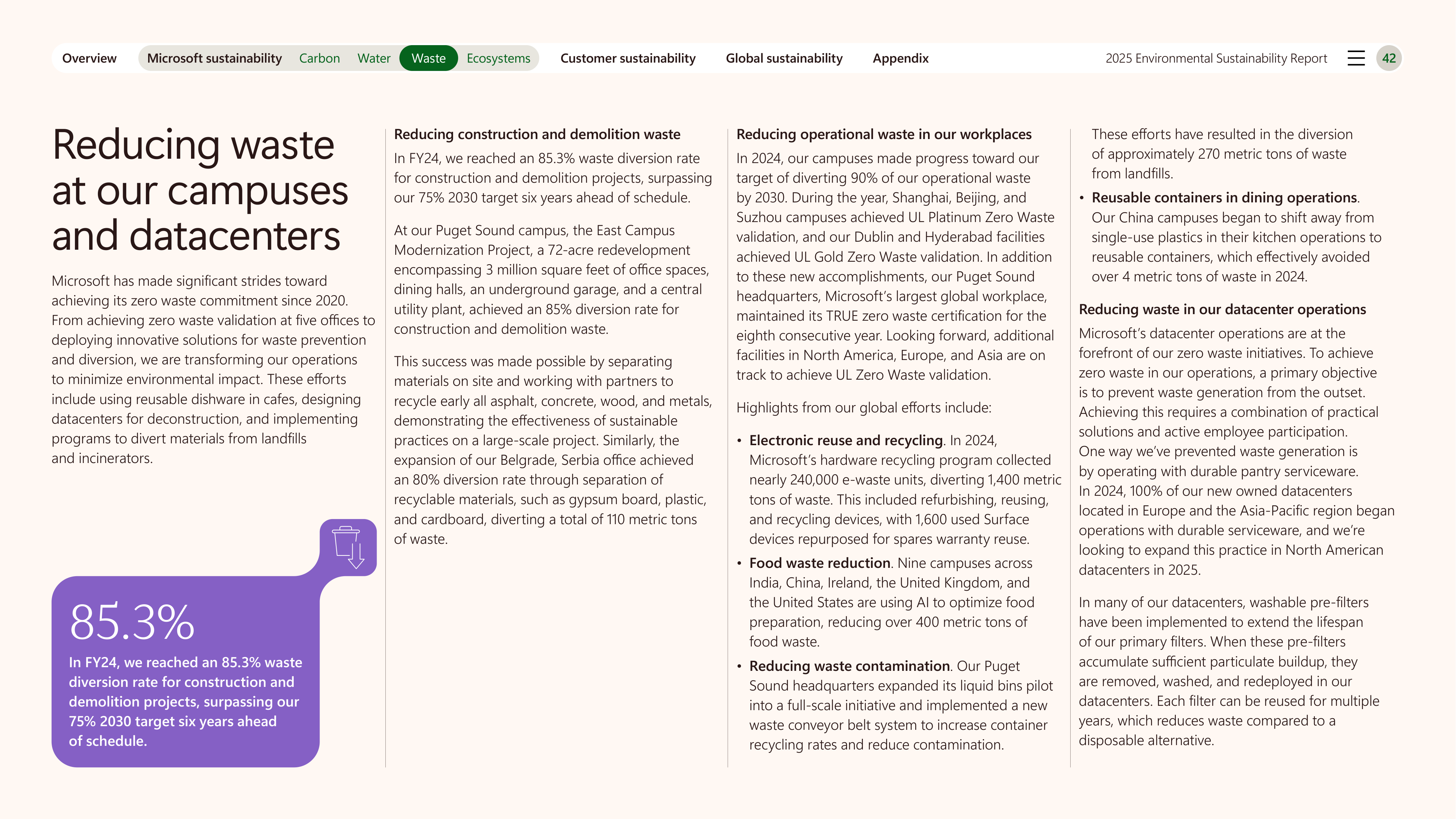
Reducing waste
at our campuses
and datacenters
Microsoft has made significant strides toward
achieving its zero waste commitment since 2020.
From achieving zero waste validation at five offices to
deploying innovative solutions for waste prevention
and diversion, we are transforming our operations
to minimize environmental impact. These efforts
include using reusable dishware in cafes, designing
datacenters for deconstruction, and implementing
programs to divert materials from landfills
and incinerators.
85.3%
In FY24, we reached an 85.3% waste
diversion rate for construction and
demolition projects, surpassing our
75% 2030 target six years ahead
of schedule.
Reducing construction and demolition waste
In FY24, we reached an 85.3% waste diversion rate
for construction and demolition projects, surpassing
our 75% 2030 target six years ahead of schedule.
At our Puget Sound campus, the East Campus
Modernization Project, a 72-acre redevelopment
encompassing 3 million square feet of office spaces,
dining halls, an underground garage, and a central
utility plant, achieved an 85% diversion rate for
construction and demolition waste.
This success was made possible by separating
materials on site and working with partners to
recycle early all asphalt, concrete, wood, and metals,
demonstrating the effectiveness of sustainable
practices on a large-scale project. Similarly, the
expansion of our Belgrade, Serbia office achieved
an 80% diversion rate through separation of
recyclable materials, such as gypsum board, plastic,
and cardboard, diverting a total of 110 metric tons
of waste.
Reducing operational waste in our workplaces
In 2024, our campuses made progress toward our
target of diverting 90% of our operational waste
by 2030. During the year, Shanghai, Beijing, and
Suzhou campuses achieved UL Platinum Zero Waste
validation, and our Dublin and Hyderabad facilities
achieved UL Gold Zero Waste validation. In addition
to these new accomplishments, our Puget Sound
headquarters, Microsoft’s largest global workplace,
maintained its TRUE zero waste certification for the
eighth consecutive year. Looking forward, additional
facilities in North America, Europe, and Asia are on
track to achieve UL Zero Waste validation.
Highlights from our global efforts include:
•
Electronic reuse and recycling
. In 2024,
Microsoft’s hardware recycling program collected
nearly 240,000 e-waste units, diverting 1,400 metric
tons of waste. This included refurbishing, reusing,
and recycling devices, with 1,600 used Surface
devices repurposed for spares warranty reuse.
•
Food waste reduction
. Nine campuses across
India, China, Ireland, the United Kingdom, and
the United States are using AI to optimize food
preparation, reducing over 400 metric tons of
food waste.
•
Reducing waste contamination
. Our Puget
Sound headquarters expanded its liquid bins pilot
into a full-scale initiative and implemented a new
waste conveyor belt system to increase container
recycling rates and reduce contamination.
These efforts have resulted in the diversion
of approximately 270 metric tons of waste
from landfills.
•
Reusable containers in dining operations
.
Our China campuses began to shift away from
single-use plastics in their kitchen operations to
reusable containers, which effectively avoided
over 4 metric tons of waste in 2024.
Reducing waste in our datacenter operations
Microsoft’s datacenter operations are at the
forefront of our zero waste initiatives. To achieve
zero waste in our operations, a primary objective
is to prevent waste generation from the outset.
Achieving this requires a combination of practical
solutions and active employee participation.
One way we’ve prevented waste generation is
by operating with durable pantry serviceware.
In 2024, 100% of our new owned datacenters
located in Europe and the Asia-Pacific region began
operations with durable serviceware, and we’re
looking to expand this practice in North American
datacenters in 2025.
In many of our datacenters, washable pre-filters
have been implemented to extend the lifespan
of our primary filters. When these pre-filters
accumulate sufficient particulate buildup, they
are removed, washed, and redeployed in our
datacenters. Each filter can be reused for multiple
years, which reduces waste compared to a
disposable alternative.
Microsoft sustainability
Carbon
Water
Waste
Ecosystems
Overview
Customer sustainability
Global sustainability
Appendix
42
2025 Environmental Sustainability Report
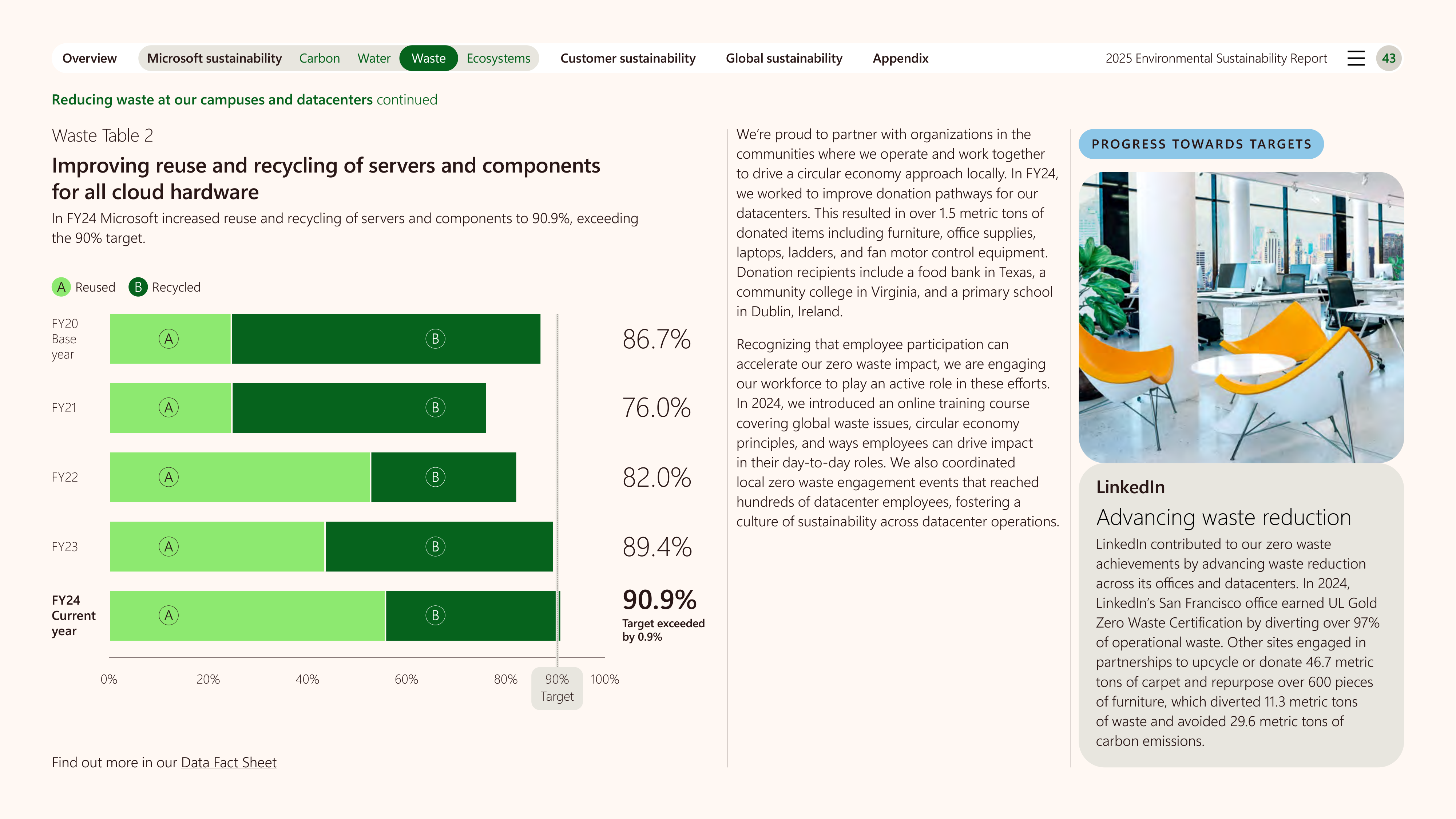


Reducing waste at our campuses and datacenters
continued
Waste Table 2
Improving reuse and recycling of servers and components
for all cloud hardware
In FY24 Microsoft increased reuse and recycling of servers and components to 90.9%, exceeding
the 90% target.
0%
20%
40%
60%
80%
100%
FY20
Base
year
86.7%
FY21
76.0%
FY22
82.0%
FY23
89.4%
FY24
Current
year
90.9%
Target exceeded
by 0.9%
A
A
A
A
A
B
B
B
B
B
90%
Target
Reused
A
Recycled
B
Find out more in our Data Fact Sheet
We’re proud to partner with organizations in the
communities where we operate and work together
to drive a circular economy approach locally. In FY24,
we worked to improve donation pathways for our
datacenters. This resulted in over 1.5 metric tons of
donated items including furniture, office supplies,
laptops, ladders, and fan motor control equipment.
Donation recipients include a food bank in Texas, a
community college in Virginia, and a primary school
in Dublin, Ireland.
Recognizing that employee participation can
accelerate our zero waste impact, we are engaging
our workforce to play an active role in these efforts.
In 2024, we introduced an online training course
covering global waste issues, circular economy
principles, and ways employees can drive impact
in their day-to-day roles. We also coordinated
local zero waste engagement events that reached
hundreds of datacenter employees, fostering a
culture of sustainability across datacenter operations.
PROGRESS TOWARDS TARGETS
LinkedIn
Advancing waste reduction
LinkedIn contributed to our zero waste
achievements by advancing waste reduction
across its offices and datacenters. In 2024,
LinkedIn’s San Francisco office earned UL Gold
Zero Waste Certification by diverting over 97%
of operational waste. Other sites engaged in
partnerships to upcycle or donate 46.7 metric
tons of carpet and repurpose over 600 pieces
of furniture, which diverted 11.3 metric tons
of waste and avoided 29.6 metric tons of
carbon emissions.
Microsoft sustainability
Carbon
Water
Waste
Ecosystems
Overview
Customer sustainability
Global sustainability
Appendix
43
2025 Environmental Sustainability Report
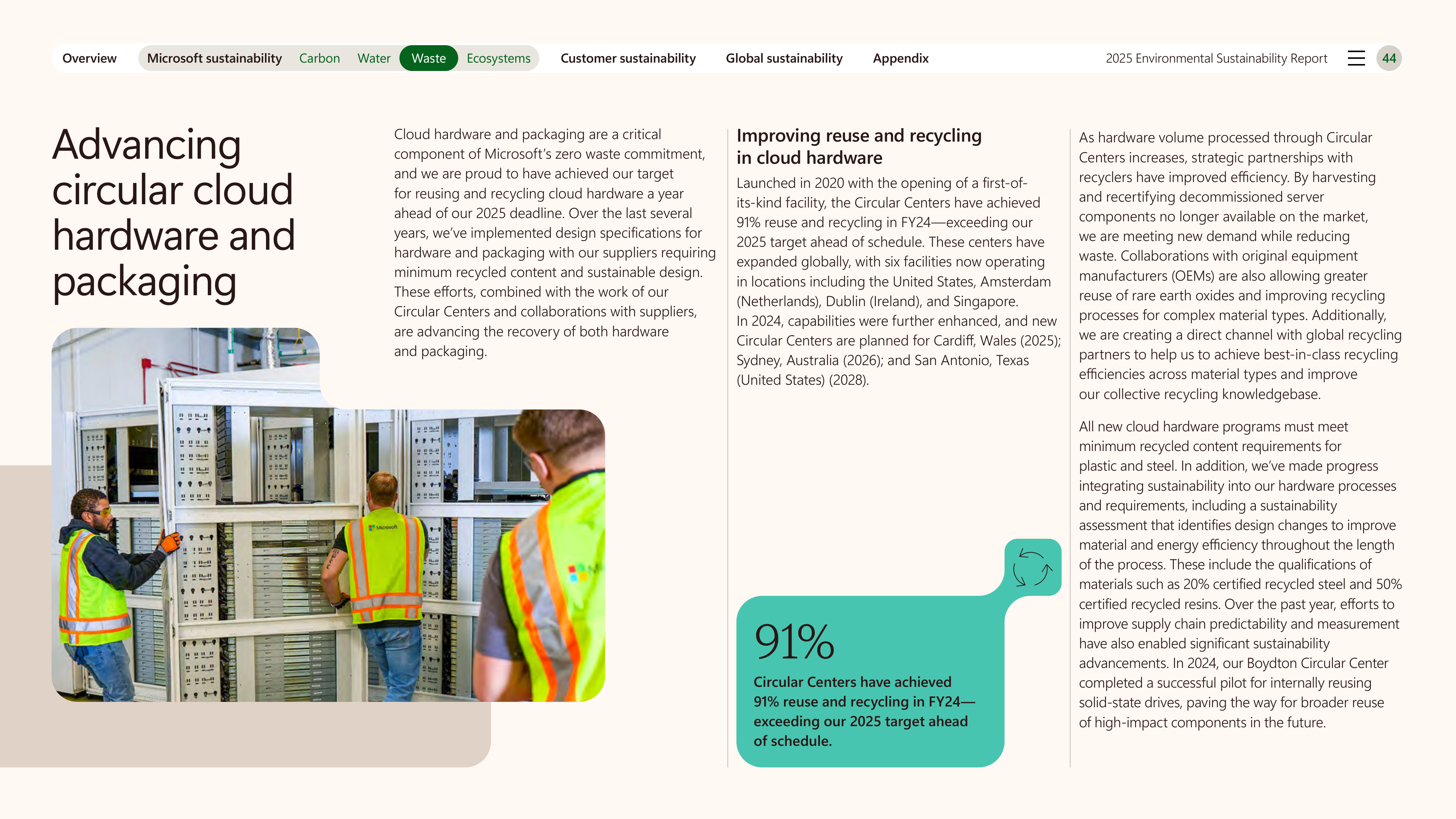

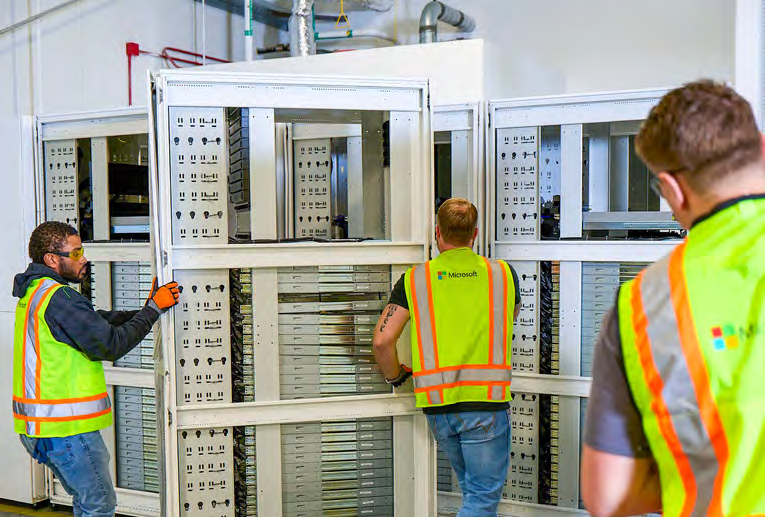
Advancing
circular cloud
hardware and
packaging
Cloud hardware and packaging are a critical
component of Microsoft’s zero waste commitment,
and we are proud to have achieved our target
for reusing and recycling cloud hardware a year
ahead of our 2025 deadline. Over the last several
years, we’ve implemented design specifications for
hardware and packaging with our suppliers requiring
minimum recycled content and sustainable design.
These efforts, combined with the work of our
Circular Centers and collaborations with suppliers,
are advancing the recovery of both hardware
and packaging.
Improving reuse and recycling
in cloud hardware
Launched in 2020 with the opening of a first-of-
its-kind facility, the Circular Centers have achieved
91% reuse and recycling in FY24—exceeding our
2025 target ahead of schedule. These centers have
expanded globally, with six facilities now operating
in locations including the United States, Amsterdam
(Netherlands), Dublin (Ireland), and Singapore.
In 2024, capabilities were further enhanced, and new
Circular Centers are planned for Cardiff, Wales (2025);
Sydney, Australia (2026); and San Antonio, Texas
(United States) (2028).
91%
Circular Centers have achieved
91% reuse and recycling in FY24—
exceeding our 2025 target ahead
of schedule.
As hardware volume processed through Circular
Centers increases, strategic partnerships with
recyclers have improved efficiency. By harvesting
and recertifying decommissioned server
components no longer available on the market,
we are meeting new demand while reducing
waste. Collaborations with original equipment
manufacturers (OEMs) are also allowing greater
reuse of rare earth oxides and improving recycling
processes for complex material types. Additionally,
we are creating a direct channel with global recycling
partners to help us to achieve best-in-class recycling
efficiencies across material types and improve
our collective recycling knowledgebase.
All new cloud hardware programs must meet
minimum recycled content requirements for
plastic and steel. In addition, we’ve made progress
integrating sustainability into our hardware processes
and requirements, including a sustainability
assessment that identifies design changes to improve
material and energy efficiency throughout the length
of the process. These include the qualifications of
materials such as 20% certified recycled steel and 50%
certified recycled resins. Over the past year, efforts to
improve supply chain predictability and measurement
have also enabled significant sustainability
advancements. In 2024, our Boydton Circular Center
completed a successful pilot for internally reusing
solid-state drives, paving the way for broader reuse
of high-impact components in the future.
Microsoft sustainability
Carbon
Water
Waste
Ecosystems
Overview
Customer sustainability
Global sustainability
Appendix
44
2025 Environmental Sustainability Report
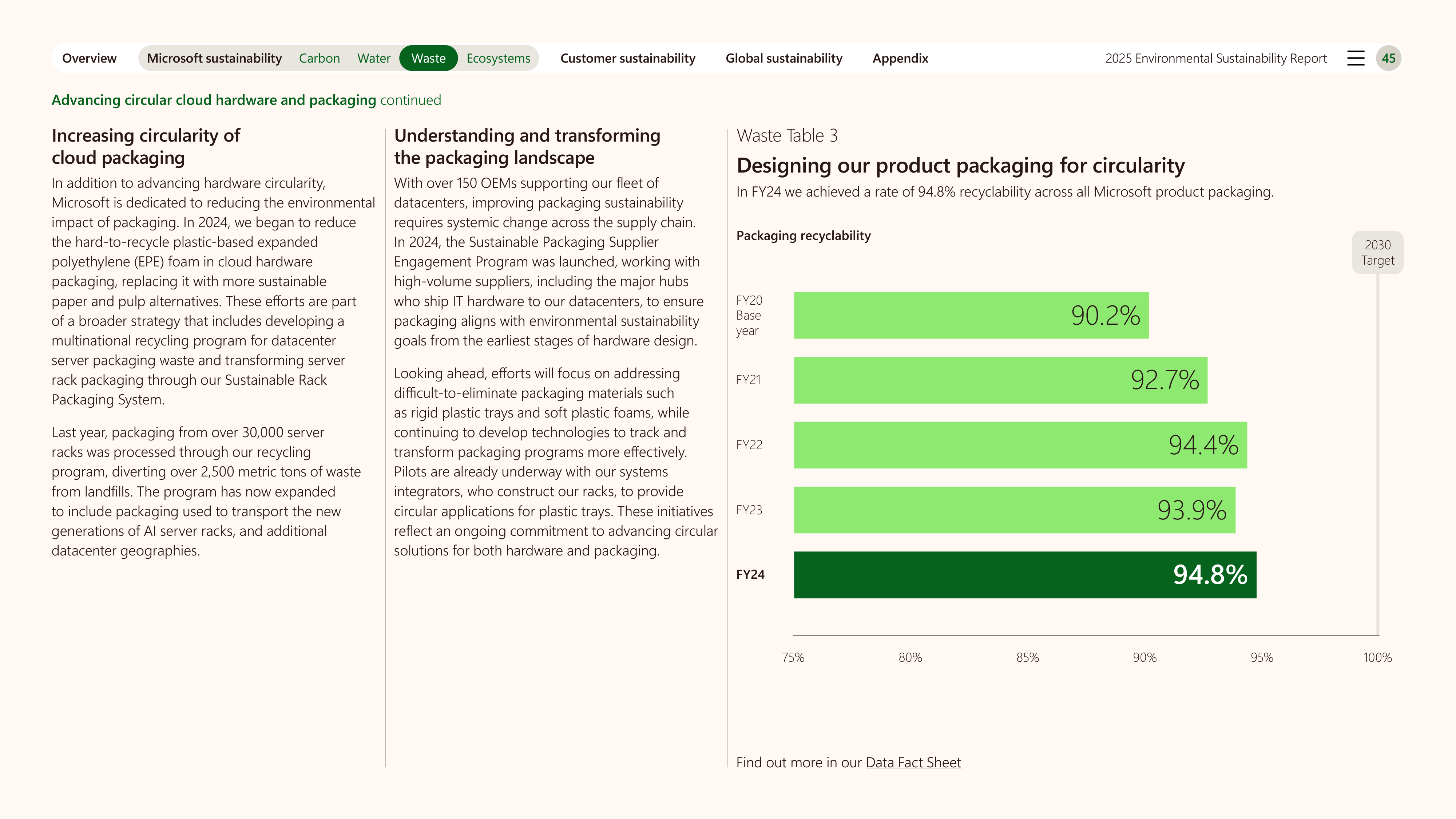

Advancing circular cloud hardware and packaging
continued
Increasing circularity of
cloud packaging
In addition to advancing hardware circularity,
Microsoft is dedicated to reducing the environmental
impact of packaging. In 2024, we began to reduce
the hard-to-recycle plastic-based expanded
polyethylene (EPE) foam in cloud hardware
packaging, replacing it with more sustainable
paper and pulp alternatives. These efforts are part
of a broader strategy that includes developing a
multinational recycling program for datacenter
server packaging waste and transforming server
rack packaging through our Sustainable Rack
Packaging System.
Last year, packaging from over 30,000 server
racks was processed through our recycling
program, diverting over 2,500 metric tons of waste
from landfills. The program has now expanded
to include packaging used to transport the new
generations of AI server racks, and additional
datacenter geographies.
Understanding and transforming
the packaging landscape
With over 150 OEMs supporting our fleet of
datacenters, improving packaging sustainability
requires systemic change across the supply chain.
In 2024, the Sustainable Packaging Supplier
Engagement Program was launched, working with
high-volume suppliers, including the major hubs
who ship IT hardware to our datacenters, to ensure
packaging aligns with environmental sustainability
goals from the earliest stages of hardware design.
Looking ahead, efforts will focus on addressing
difficult-to-eliminate packaging materials such
as rigid plastic trays and soft plastic foams, while
continuing to develop technologies to track and
transform packaging programs more effectively.
Pilots are already underway with our systems
integrators, who construct our racks, to provide
circular applications for plastic trays. These initiatives
reflect an ongoing commitment to advancing circular
solutions for both hardware and packaging.
Waste Table 3
Designing our product packaging for circularity
In FY24 we achieved a rate of 94.8% recyclability across all Microsoft product packaging.
Packaging recyclability
Find out more in our Data Fact Sheet
100%
75%
80%
85%
90%
95%
2030
Target
FY20
Base
year
FY21
FY22
FY23
FY24
90.2%
92.7%
94.4%
93.9%
94.8%
Microsoft sustainability
Carbon
Water
Waste
Ecosystems
Overview
Customer sustainability
Global sustainability
Appendix
45
2025 Environmental Sustainability Report
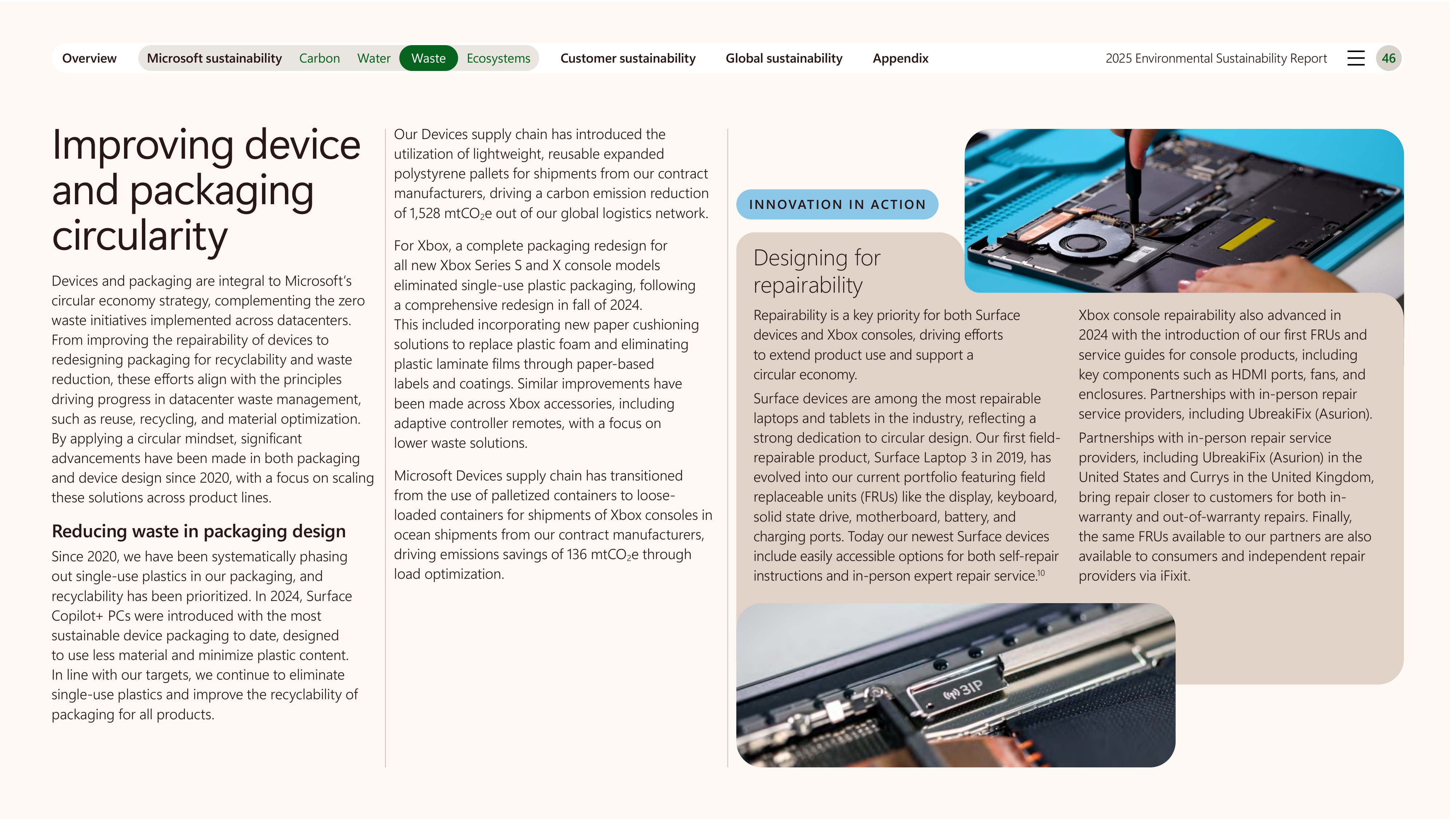




Improving device
and packaging
circularity
Devices and packaging are integral to Microsoft’s
circular economy strategy, complementing the zero
waste initiatives implemented across datacenters.
From improving the repairability of devices to
redesigning packaging for recyclability and waste
reduction, these efforts align with the principles
driving progress in datacenter waste management,
such as reuse, recycling, and material optimization.
By applying a circular mindset, significant
advancements have been made in both packaging
and device design since 2020, with a focus on scaling
these solutions across product lines.
Reducing waste in packaging design
Since 2020, we have been systematically phasing
out single-use plastics in our packaging, and
recyclability has been prioritized. In 2024, Surface
Copilot+ PCs were introduced with the most
sustainable device packaging to date, designed
to use less material and minimize plastic content.
In line with our targets, we continue to eliminate
single-use plastics and improve the recyclability of
packaging for all products.
Our Devices supply chain has introduced the
utilization of lightweight, reusable expanded
polystyrene pallets for shipments from our contract
manufacturers, driving a carbon emission reduction
of 1,528 m t
C
O subscript 2 e out of our global logistics network.
For Xbox, a complete packaging redesign for
all new Xbox Series S and X console models
eliminated single-use plastic packaging, following
a comprehensive redesign in fall of 2024.
This included incorporating new paper cushioning
solutions to replace plastic foam and eliminating
plastic laminate films through paper-based
labels and coatings. Similar improvements have
been made across Xbox accessories, including
adaptive controller remotes, with a focus on
lower waste solutions.
Microsoft Devices supply chain has transitioned
from the use of palletized containers to loose-
loaded containers for shipments of Xbox consoles in
ocean shipments from our contract manufacturers,
driving emissions savings of 136 m t
C
O subscript 2 e through
load optimization.
INNOVATION IN ACTION
Designing for
repairability
Repairability is a key priority for both Surface
devices and Xbox consoles, driving efforts
to extend product use and support a
circular economy.
Surface devices are among the most repairable
laptops and tablets in the industry, reflecting a
strong dedication to circular design. Our first field-
repairable product, Surface Laptop 3 in 2019, has
evolved into our current portfolio featuring field
replaceable units (FRUs) like the display, keyboard,
solid state drive, motherboard, battery, and
charging ports. Today our newest Surface devices
include easily accessible options for both self-repair
instructions and in-person expert repair service.
10
Xbox console repairability also advanced in
2024 with the introduction of our first FRUs and
service guides for console products, including
key components such as HDMI ports, fans, and
enclosures. Partnerships with in-person repair
service providers, including UbreakiFix (Asurion).
Partnerships with in-person repair service
providers, including UbreakiFix (Asurion) in the
United States and Currys in the United Kingdom,
bring repair closer to customers for both in-
warranty and out-of-warranty repairs. Finally,
the same FRUs available to our partners are also
available to consumers and independent repair
providers via iFixit.
Microsoft sustainability
Carbon
Water
Waste
Ecosystems
Overview
Customer sustainability
Global sustainability
Appendix
46
2025 Environmental Sustainability Report
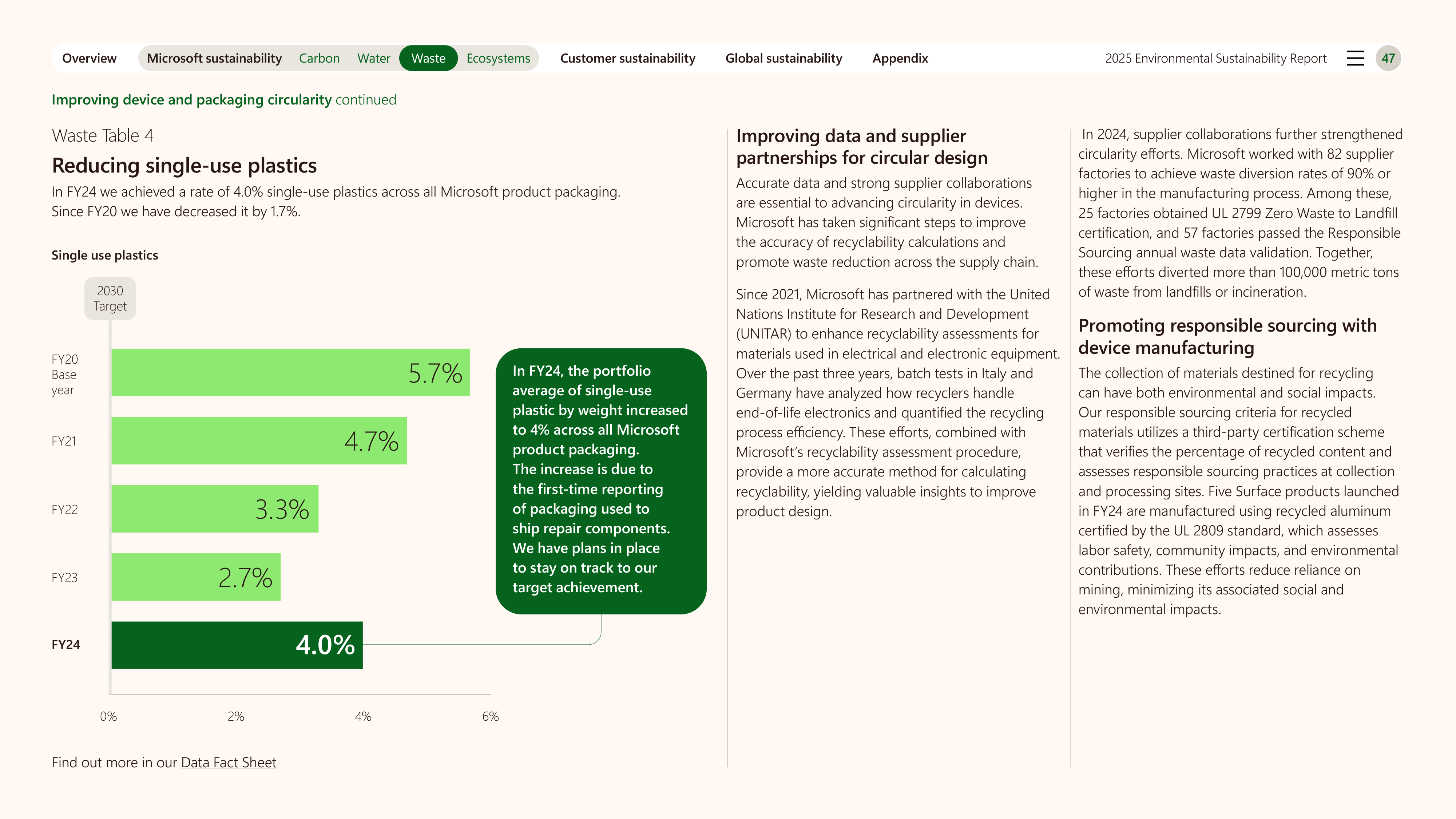

Improving device and packaging circularity
continued
Waste Table 4
Reducing single-use plastics
In FY24 we achieved a rate of 4.0% single-use plastics across all Microsoft product packaging.
Since FY20 we have decreased it by 1.7%.
Single use plastics
In FY24, the portfolio
average of single-use
plastic by weight increased
to 4% across all Microsoft
product packaging.
The increase is due to
the first-time reporting
of packaging used to
ship repair components.
We have plans in place
to stay on track to our
target achievement.
6%
0%
2%
4%
FY20
Base
year
FY21
FY22
FY23
FY24
2030
Target
5.7%
4.7%
3.3%
2.7%
4.0%
Find out more in our Data Fact
Sheet
Improving data and supplier
partnerships for circular design
Accurate data and strong supplier collaborations
are essential to advancing circularity in devices.
Microsoft has taken significant steps to improve
the accuracy of recyclability calculations and
promote waste reduction across the supply chain.
Since 2021, Microsoft has partnered with the United
Nations Institute for Research and Development
(UNITAR) to enhance recyclability assessments for
materials used in electrical and electronic equipment.
Over the past three years, batch tests in Italy and
Germany have analyzed how recyclers handle
end-of-life electronics and quantified the recycling
process efficiency. These efforts, combined with
Microsoft’s recyclability assessment procedure,
provide a more accurate method for calculating
recyclability, yielding valuable insights to improve
product design.
In 2024, supplier collaborations further strengthened
circularity efforts. Microsoft worked with 82 supplier
factories to achieve waste diversion rates of 90% or
higher in the manufacturing process. Among these,
25 factories obtained UL 2799 Zero Waste to Landfill
certification, and 57 factories passed the Responsible
Sourcing annual waste data validation. Together,
these efforts diverted more than 100,000 metric tons
of waste from landfills or incineration.
Promoting responsible sourcing with
device manufacturing
The collection of materials destined for recycling
can have both environmental and social impacts.
Our responsible sourcing criteria for recycled
materials utilizes a third-party certification scheme
that verifies the percentage of recycled content and
assesses responsible sourcing practices at collection
and processing sites. Five Surface products launched
in FY24 are manufactured using recycled aluminum
certified by the UL 2809 standard, which assesses
labor safety, community impacts, and environmental
contributions. These efforts reduce reliance on
mining, minimizing its associated social and
environmental impacts.
Microsoft sustainability
Carbon
Water
Waste
Ecosystems
Overview
Customer sustainability
Global sustainability
Appendix
47
2025 Environmental Sustainability Report
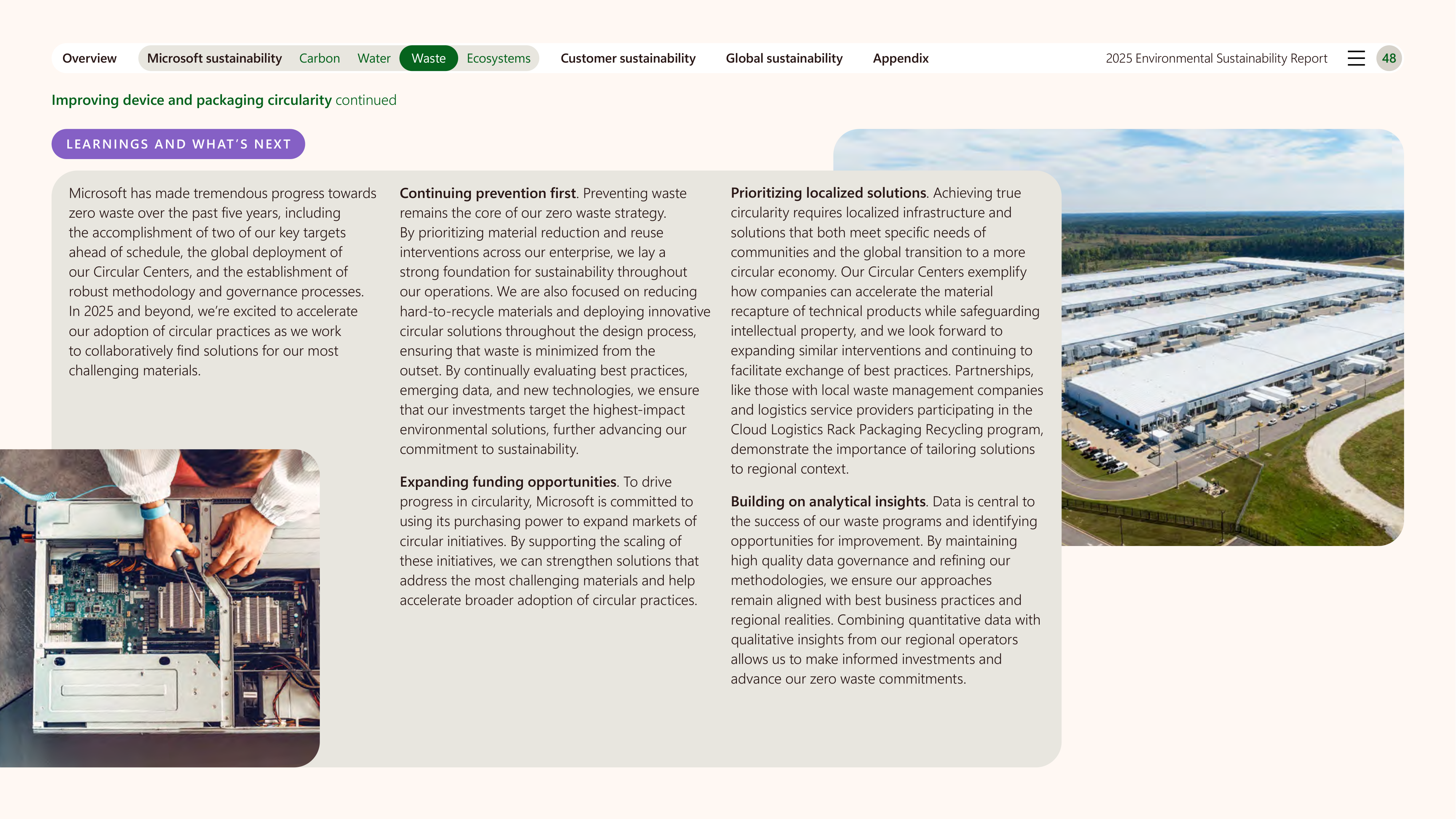
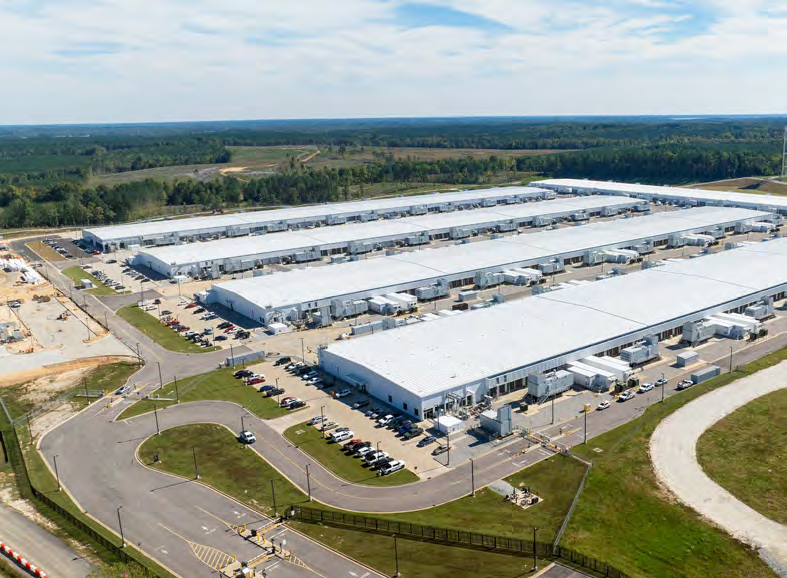


Improving device and packaging circularity
continued
LEARNINGS AND WHAT’S NEXT
Microsoft has made tremendous progress towards
zero waste over the past five years, including
the accomplishment of two of our key targets
ahead of schedule, the global deployment of
our Circular Centers, and the establishment of
robust methodology and governance processes.
In 2025 and beyond, we’re excited to accelerate
our adoption of circular practices as we work
to collaboratively find solutions for our most
challenging materials.
Continuing prevention first
. Preventing waste
remains the core of our zero waste strategy.
By prioritizing material reduction and reuse
interventions across our enterprise, we lay a
strong foundation for sustainability throughout
our operations. We are also focused on reducing
hard-to-recycle materials and deploying innovative
circular solutions throughout the design process,
ensuring that waste is minimized from the
outset. By continually evaluating best practices,
emerging data, and new technologies, we ensure
that our investments target the highest-impact
environmental solutions, further advancing our
commitment to sustainability.
Expanding funding opportunities
. To drive
progress in circularity, Microsoft is committed to
using its purchasing power to expand markets of
circular initiatives. By supporting the scaling of
these initiatives, we can strengthen solutions that
address the most challenging materials and help
accelerate broader adoption of circular practices.
Prioritizing localized solutions
. Achieving true
circularity requires localized infrastructure and
solutions that both meet specific needs of
communities and the global transition to a more
circular economy. Our Circular Centers exemplify
how companies can accelerate the material
recapture of technical products while safeguarding
intellectual property, and we look forward to
expanding similar interventions and continuing to
facilitate exchange of best practices. Partnerships,
like those with local waste management companies
and logistics service providers participating in the
Cloud Logistics Rack Packaging Recycling program,
demonstrate the importance of tailoring solutions
to regional context.
Building on analytical insights
. Data is central to
the success of our waste programs and identifying
opportunities for improvement. By maintaining
high quality data governance and refining our
methodologies, we ensure our approaches
remain aligned with best business practices and
regional realities. Combining quantitative data with
qualitative insights from our regional operators
allows us to make informed investments and
advance our zero waste commitments.
Microsoft sustainability
Carbon
Water
Waste
Ecosystems
Overview
Customer sustainability
Global sustainability
Appendix
48
2025 Environmental Sustainability Report
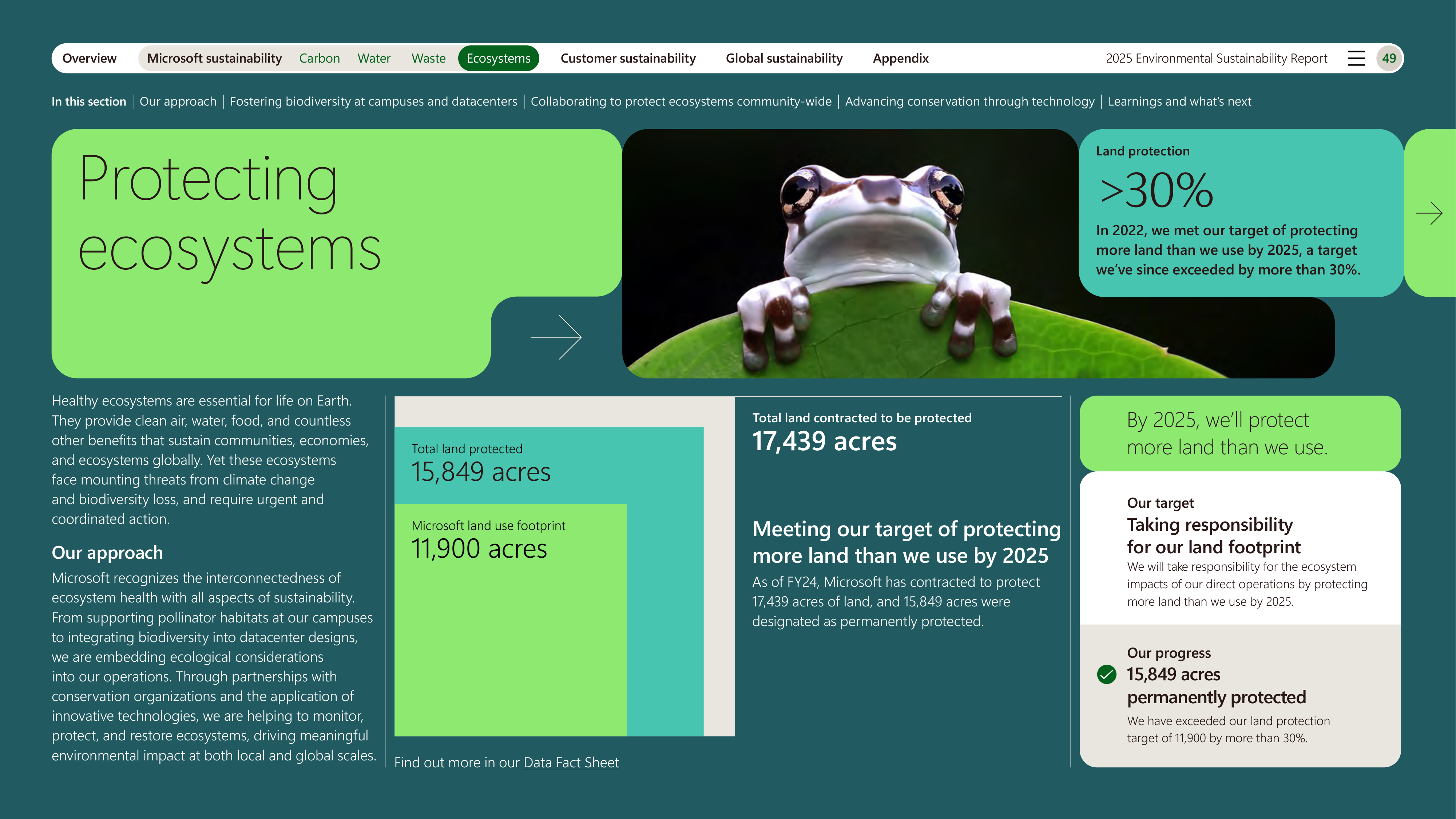


Ecosystems
In this section
Our approach Fostering biodiversity at campuses and datacenters Collaborating to protect ecosystems community-wide Advancing conservation through technology Learnings and what’s next
Protecting
ecosystems
Land protection
>30%
In 2022, we met our target of protecting
more land than we use by 2025, a target
we’ve since exceeded by more than 30%.
Healthy ecosystems are essential for life on Earth.
They provide clean air, water, food, and countless
other benefits that sustain communities, economies,
and ecosystems globally. Yet these ecosystems
face mounting threats from climate change
and biodiversity loss, and require urgent and
coordinated action.
Our approach
Microsoft recognizes the interconnectedness of
ecosystem health with all aspects of sustainability.
From supporting pollinator habitats at our campuses
to integrating biodiversity into datacenter designs,
we are embedding ecological considerations
into our operations. Through partnerships with
conservation organizations and the application of
innovative technologies, we are helping to monitor,
protect, and restore ecosystems, driving meaningful
environmental impact at both local and global scales.
Total land protected
15,849 acres
Microsoft land use footprint
11,900 acres
Meeting our target of protecting
more land than we use by 2025
As of FY24, Microsoft has contracted to protect
17,439 acres of land, and 15,849 acres were
designated as permanently protected.
Find out more in our Data Fact Sheet
Total land contracted to be protected
17,439 acres
By 2025, we’ll protect
more land than we use.
Our target
Taking responsibility
for our land footprint
We will take responsibility for the ecosystem
impacts of our direct operations by protecting
more land than we use by 2025.
Our progress
15,849 acres
permanently protected
We have exceeded our land protection
target of 11,900 by more than 30%.
Microsoft sustainability
Carbon
Water
Waste
Overview
Customer sustainability
Global sustainability
Appendix
49
2025 Environmental Sustainability Report
Ecosystems
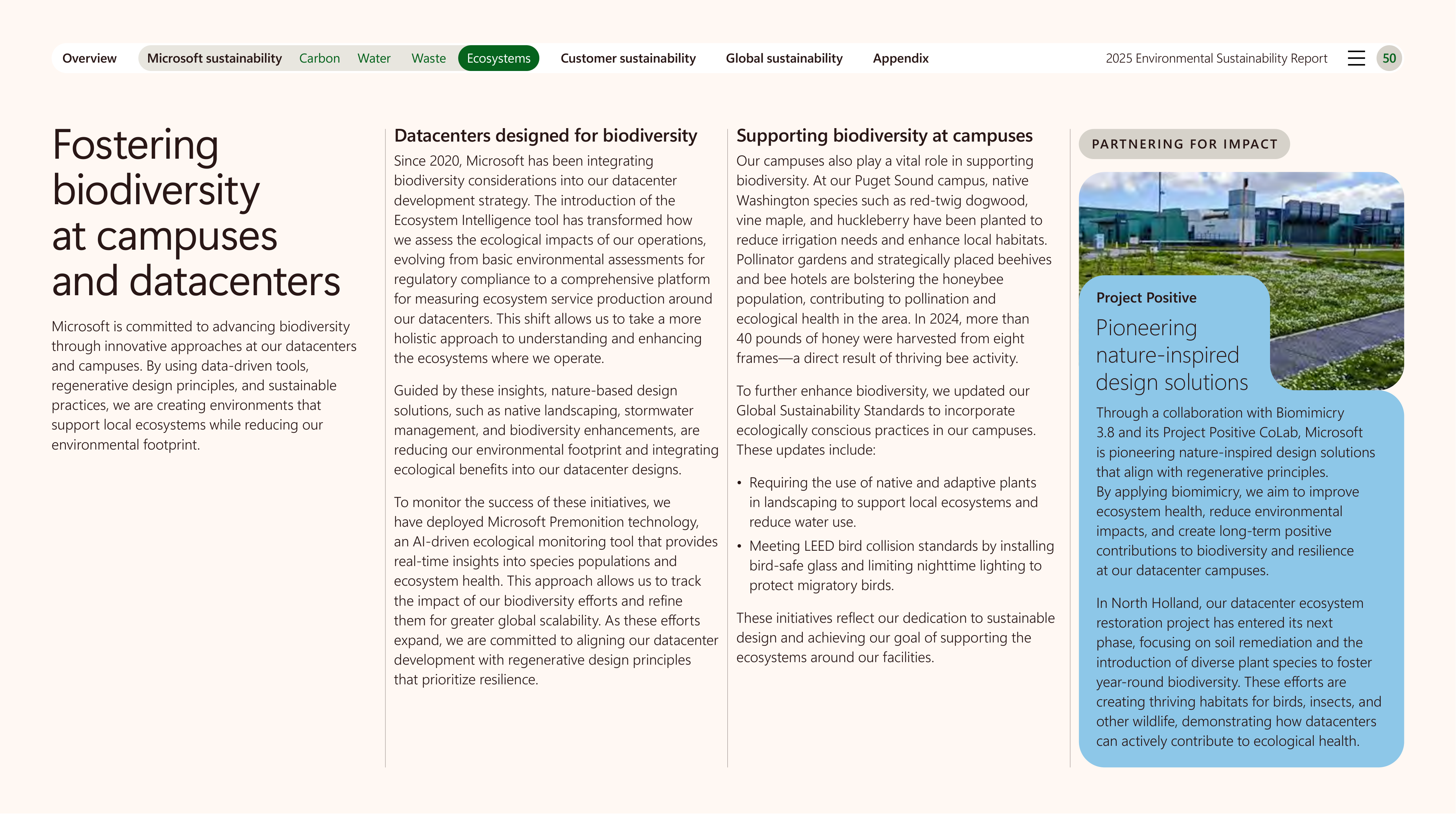

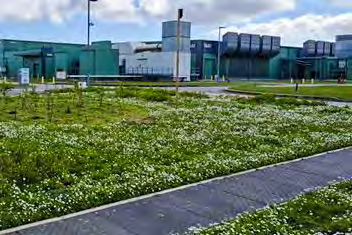
Fostering
biodiversity
at campuses
and datacenters
Microsoft is committed to advancing biodiversity
through innovative approaches at our datacenters
and campuses. By using data-driven tools,
regenerative design principles, and sustainable
practices, we are creating environments that
support local ecosystems while reducing our
environmental footprint.
Datacenters designed for biodiversity
Since 2020, Microsoft has been integrating
biodiversity considerations into our datacenter
development strategy. The introduction of the
Ecosystem Intelligence tool has transformed how
we assess the ecological impacts of our operations,
evolving from basic environmental assessments for
regulatory compliance to a comprehensive platform
for measuring ecosystem service production around
our datacenters. This shift allows us to take a more
holistic approach to understanding and enhancing
the ecosystems where we operate.
Guided by these insights, nature-based design
solutions, such as native landscaping, stormwater
management, and biodiversity enhancements, are
reducing our environmental footprint and integrating
ecological benefits into our datacenter designs.
To monitor the success of these initiatives, we
have deployed Microsoft Premonition technology,
an AI-driven ecological monitoring tool that provides
real-time insights into species populations and
ecosystem health. This approach allows us to track
the impact of our biodiversity efforts and refine
them for greater global scalability. As these efforts
expand, we are committed to aligning our datacenter
development with regenerative design principles
that prioritize resilience.
Supporting biodiversity at campuses
Our campuses also play a vital role in supporting
biodiversity. At our Puget Sound campus, native
Washington species such as red-twig dogwood,
vine maple, and huckleberry have been planted to
reduce irrigation needs and enhance local habitats.
Pollinator gardens and strategically placed beehives
and bee hotels are bolstering the honeybee
population, contributing to pollination and
ecological health in the area. In 2024, more than
40 pounds of honey were harvested from eight
frames—a direct result of thriving bee activity.
To further enhance biodiversity, we updated our
Global Sustainability Standards to incorporate
ecologically conscious practices in our campuses.
These updates include:
• Requiring the use of native and adaptive plants
in landscaping to support local ecosystems and
reduce water use.
• Meeting LEED bird collision standards by installing
bird-safe glass and limiting nighttime lighting to
protect migratory birds.
These initiatives reflect our dedication to sustainable
design and achieving our goal of supporting the
ecosystems around our facilities.
PARTNERING FOR IMPACT
Project Positive
Pioneering
nature-inspired
design solutions
Through a collaboration with Biomimicry
3.8 and its Project Positive CoLab, Microsoft
is pioneering nature-inspired design solutions
that align with regenerative principles.
By applying biomimicry, we aim to improve
ecosystem health, reduce environmental
impacts, and create long-term positive
contributions to biodiversity and resilience
at our datacenter campuses.
In North Holland, our datacenter ecosystem
restoration project has entered its next
phase, focusing on soil remediation and the
introduction of diverse plant species to foster
year-round biodiversity. These efforts are
creating thriving habitats for birds, insects, and
other wildlife, demonstrating how datacenters
can actively contribute to ecological health.
Microsoft sustainability
Carbon
Water
Waste
Ecosystems
Overview
Customer sustainability
Global sustainability
Appendix
50
2025 Environmental Sustainability Report
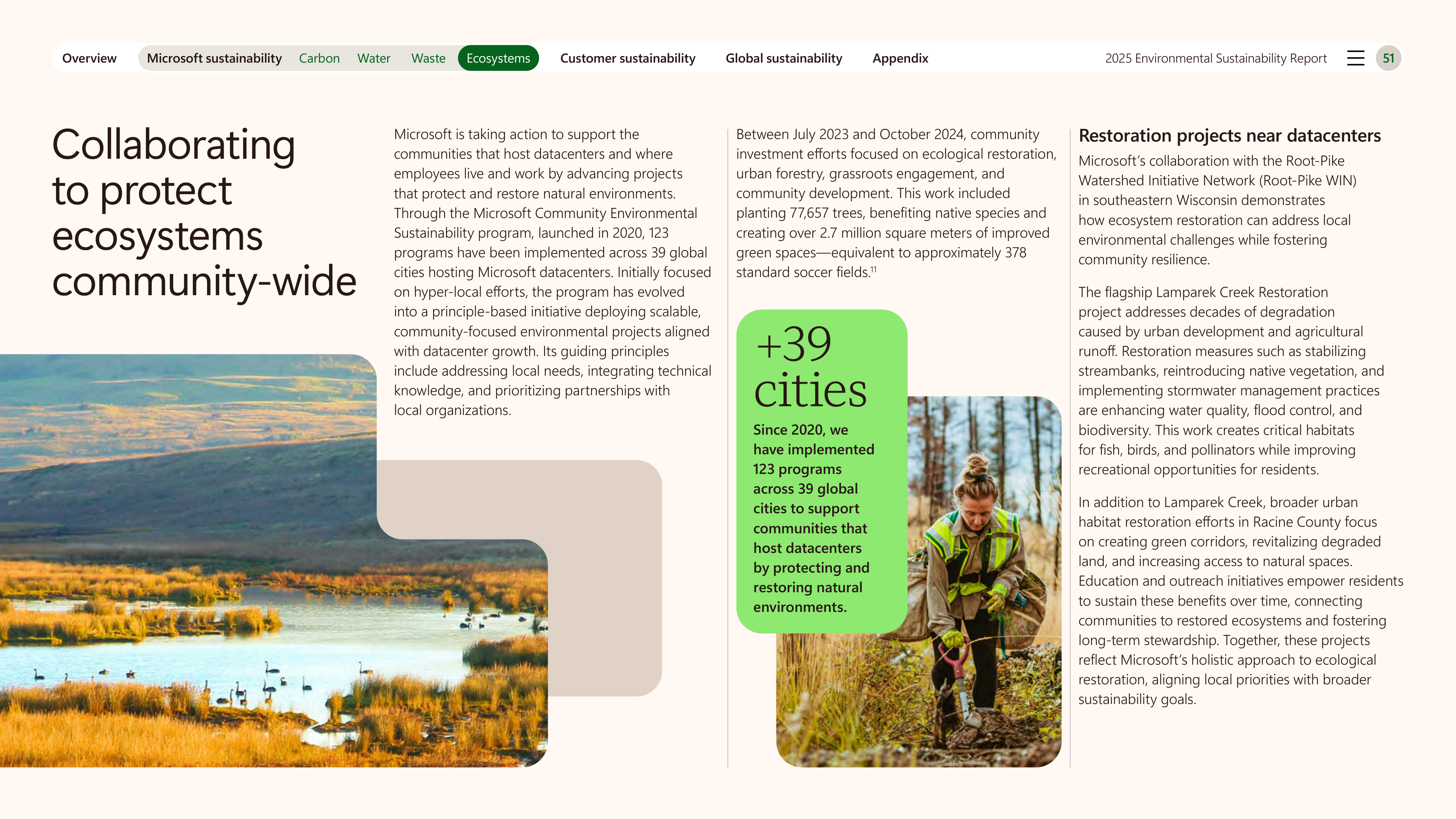

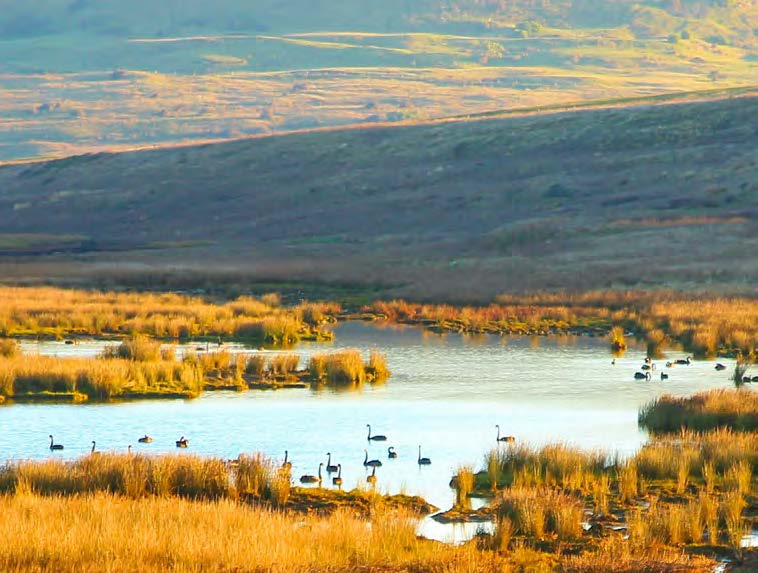
Collaborating
to protect
ecosystems
community-wide
Microsoft is taking action to support the
communities that host datacenters and where
employees live and work by advancing projects
that protect and restore natural environments.
Through the Microsoft Community Environmental
Sustainability program, launched in 2020, 123
programs have been implemented across 39 global
cities hosting Microsoft datacenters. Initially focused
on hyper-local efforts, the program has evolved
into a principle-based initiative deploying scalable,
community-focused environmental projects aligned
with datacenter growth. Its guiding principles
include addressing local needs, integrating technical
knowledge, and prioritizing partnerships with
local organizations.
Between July 2023 and October 2024, community
investment efforts focused on ecological restoration,
urban forestry, grassroots engagement, and
community development. This work included
planting 77,657 trees, benefiting native species and
creating over 2.7 million square meters of improved
green spaces—equivalent to approximately 378
standard soccer fields.
11
+39
cities
Since 2020, we
have implemented
123 programs
across 39 global
cities to support
communities that
host datacenters
by protecting and
restoring natural
environments.
Restoration projects near datacenters
Microsoft’s collaboration with the Root-Pike
Watershed Initiative Network (Root-Pike WIN)
in southeastern Wisconsin demonstrates
how ecosystem restoration can address local
environmental challenges while fostering
community resilience.
The flagship Lamparek Creek Restoration
project addresses decades of degradation
caused by urban development and agricultural
runoff. Restoration measures such as stabilizing
streambanks, reintroducing native vegetation, and
implementing stormwater management practices
are enhancing water quality, flood control, and
biodiversity. This work creates critical habitats
for fish, birds, and pollinators while improving
recreational opportunities for residents.
In addition to Lamparek Creek, broader urban
habitat restoration efforts in Racine County focus
on creating green corridors, revitalizing degraded
land, and increasing access to natural spaces.
Education and outreach initiatives empower residents
to sustain these benefits over time, connecting
communities to restored ecosystems and fostering
long-term stewardship. Together, these projects
reflect Microsoft’s holistic approach to ecological
restoration, aligning local priorities with broader
sustainability goals.
Microsoft sustainability
Carbon
Water
Waste
Ecosystems
Overview
Customer sustainability
Global sustainability
Appendix
51
2025 Environmental Sustainability Report
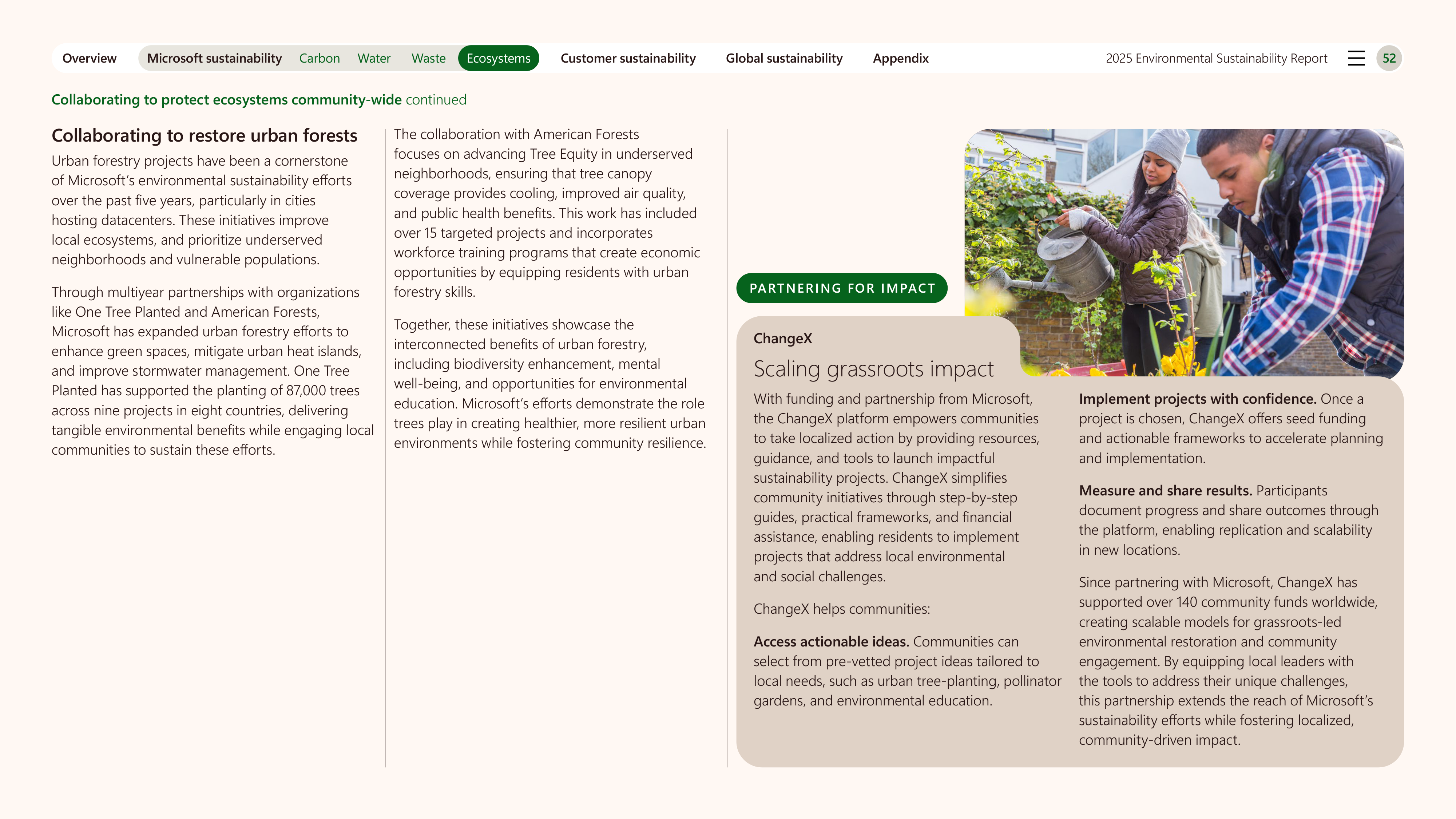

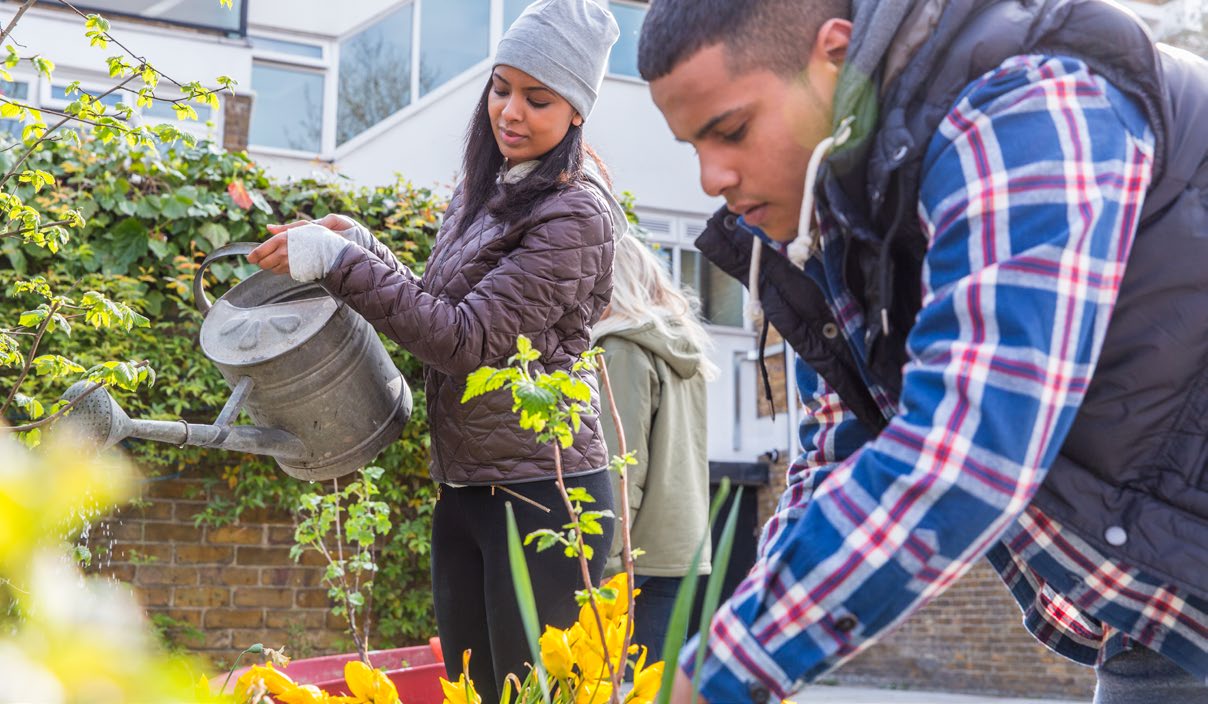

Collaborating to protect ecosystems community-wide
continued
Collaborating to restore urban forests
Urban forestry projects have been a cornerstone
of Microsoft’s environmental sustainability efforts
over the past five years, particularly in cities
hosting datacenters. These initiatives improve
local ecosystems, and prioritize underserved
neighborhoods and vulnerable populations.
Through multiyear partnerships with organizations
like One Tree Planted and American Forests,
Microsoft has expanded urban forestry efforts to
enhance green spaces, mitigate urban heat islands,
and improve stormwater management. One Tree
Planted has supported the planting of 87,000 trees
across nine projects in eight countries, delivering
tangible environmental benefits while engaging local
communities to sustain these efforts.
The collaboration with American Forests
focuses on advancing Tree Equity in underserved
neighborhoods, ensuring that tree canopy
coverage provides cooling, improved air quality,
and public health benefits. This work has included
over 15 targeted projects and incorporates
workforce training programs that create economic
opportunities by equipping residents with urban
forestry skills.
Together, these initiatives showcase the
interconnected benefits of urban forestry,
including biodiversity enhancement, mental
well-being, and opportunities for environmental
education. Microsoft’s efforts demonstrate the role
trees play in creating healthier, more resilient urban
environments while fostering community resilience.
PARTNERING FOR IMPACT
ChangeX
Scaling grassroots impact
With funding and partnership from Microsoft,
the ChangeX platform empowers communities
to take localized action by providing resources,
guidance, and tools to launch impactful
sustainability projects. ChangeX simplifies
community initiatives through step-by-step
guides, practical frameworks, and financial
assistance, enabling residents to implement
projects that address local environmental
and social challenges.
ChangeX helps communities:
Access actionable ideas.
Communities can
select from pre-vetted project ideas tailored to
local needs, such as urban tree-planting, pollinator
gardens, and environmental education.
Implement projects with confidence.
Once a
project is chosen, ChangeX offers seed funding
and actionable frameworks to accelerate planning
and implementation.
Measure and share results.
Participants
document progress and share outcomes through
the platform, enabling replication and scalability
in new locations.
Since partnering with Microsoft, ChangeX has
supported over 140 community funds worldwide,
creating scalable models for grassroots-led
environmental restoration and community
engagement. By equipping local leaders with
the tools to address their unique challenges,
this partnership extends the reach of Microsoft’s
sustainability efforts while fostering localized,
community-driven impact.
Microsoft sustainability
Carbon
Water
Waste
Ecosystems
Overview
Customer sustainability
Global sustainability
Appendix
52
2025 Environmental Sustainability Report
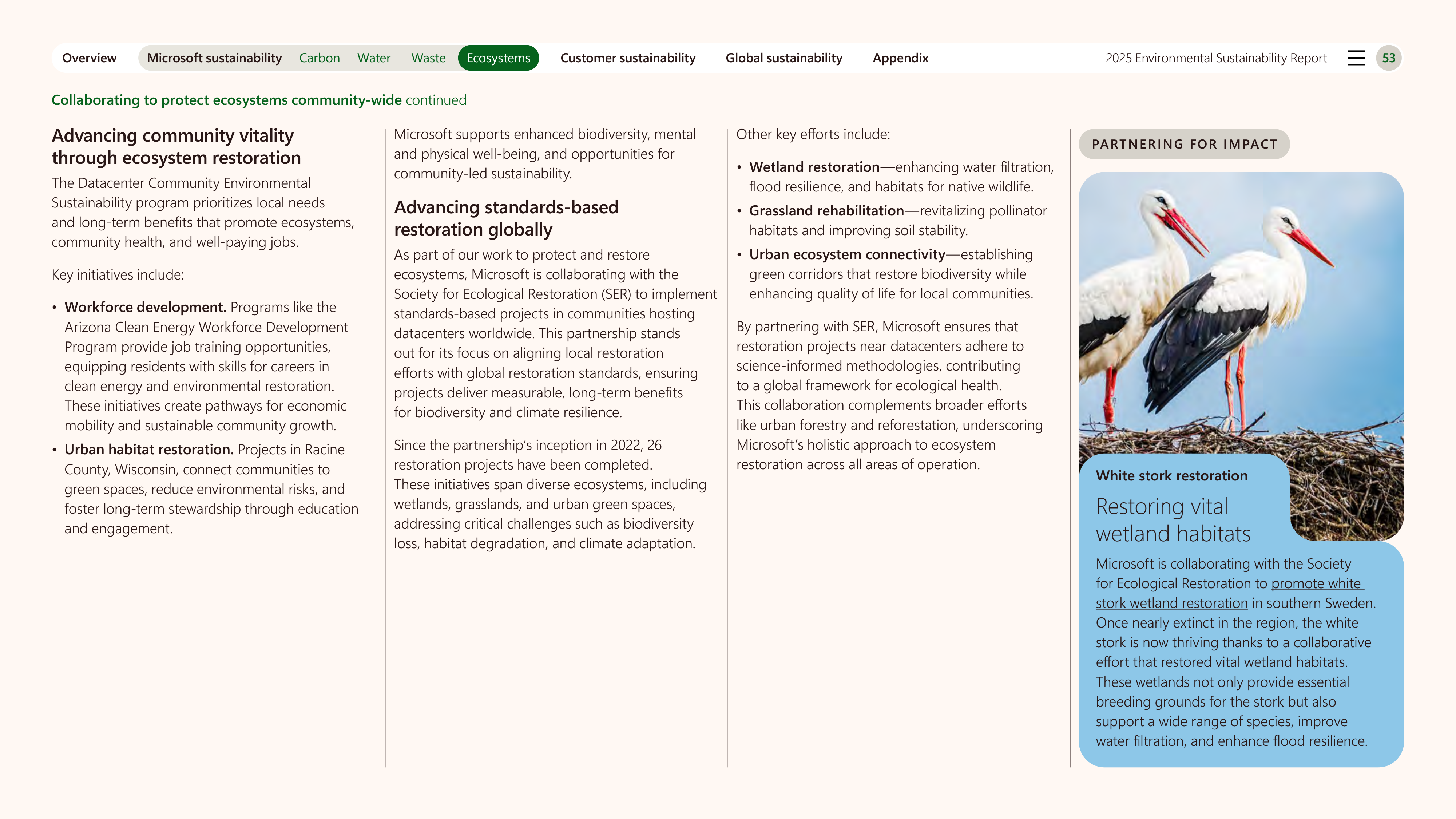


Collaborating to protect ecosystems community-wide
continued
Advancing community vitality
through ecosystem restoration
The Datacenter Community Environmental
Sustainability program prioritizes local needs
and long-term benefits that promote ecosystems,
community health, and well-paying jobs.
Key initiatives include:
•
Workforce development.
Programs like the
Arizona Clean Energy Workforce Development
Program provide job training opportunities,
equipping residents with skills for careers in
clean energy and environmental restoration.
These initiatives create pathways for economic
mobility and sustainable community growth.
•
Urban habitat restoration.
Projects in Racine
County, Wisconsin, connect communities to
green spaces, reduce environmental risks, and
foster long-term stewardship through education
and engagement.
Microsoft supports enhanced biodiversity, mental
and physical well-being, and opportunities for
community-led sustainability.
Advancing standards-based
restoration globally
As part of our work to protect and restore
ecosystems, Microsoft is collaborating with the
Society for Ecological Restoration (SER) to implement
standards-based projects in communities hosting
datacenters worldwide. This partnership stands
out for its focus on aligning local restoration
efforts with global restoration standards, ensuring
projects deliver measurable, long-term benefits
for biodiversity and climate resilience.
Since the partnership’s inception in 2022, 26
restoration projects have been completed.
These initiatives span diverse ecosystems, including
wetlands, grasslands, and urban green spaces,
addressing critical challenges such as biodiversity
loss, habitat degradation, and climate adaptation.
Other key efforts include:
•
Wetland restoration
—enhancing water filtration,
flood resilience, and habitats for native wildlife.
•
Grassland rehabilitation
—revitalizing pollinator
habitats and improving soil stability.
•
Urban ecosystem connectivity
—establishing
green corridors that restore biodiversity while
enhancing quality of life for local communities.
By partnering with SER, Microsoft ensures that
restoration projects near datacenters adhere to
science-informed methodologies, contributing
to a global framework for ecological health.
This collaboration complements broader efforts
like urban forestry and reforestation, underscoring
Microsoft’s holistic approach to ecosystem
restoration across all areas of operation.
PARTNERING FOR IMPACT
White stork restoration
Restoring vital
wetland habitats
Microsoft is collaborating with the Society
for Ecological Restoration to promote white
stork wetland restoration in southern Sweden.
Once nearly extinct in the region, the white
stork is now thriving thanks to a collaborative
effort that restored vital wetland habitats.
These wetlands not only provide essential
breeding grounds for the stork but also
support a wide range of species, improve
water filtration, and enhance flood resilience.
Microsoft sustainability
Carbon
Water
Waste
Ecosystems
Overview
Customer sustainability
Global sustainability
Appendix
53
2025 Environmental Sustainability Report
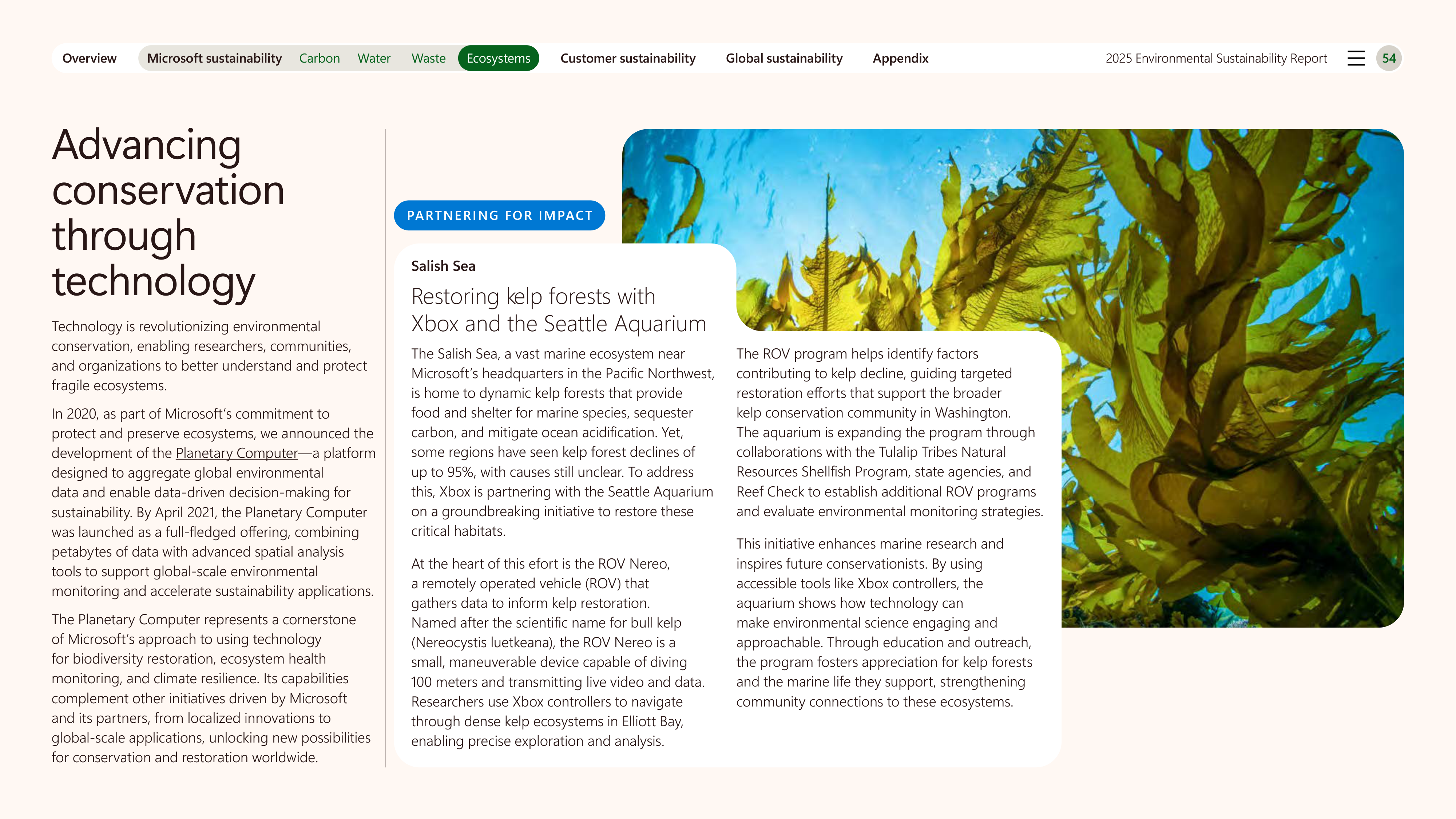

Advancing
conservation
through
technology
Technology is revolutionizing environmental
conservation, enabling researchers, communities,
and organizations to better understand and protect
fragile ecosystems.
In 2020, as part of Microsoft’s commitment to
protect and preserve ecosystems, we announced the
development of the Planetary Computer—a platform
designed to aggregate global environmental
data and enable data-driven decision-making for
sustainability. By April 2021, the Planetary Computer
was launched as a full-fledged offering, combining
petabytes of data with advanced spatial analysis
tools to support global-scale environmental
monitoring and accelerate sustainability applications.
The Planetary Computer represents a cornerstone
of Microsoft’s approach to using technology
for biodiversity restoration, ecosystem health
monitoring, and climate resilience. Its capabilities
complement other initiatives driven by Microsoft
and its partners, from localized innovations to
global-scale applications, unlocking new possibilities
for conservation and restoration worldwide.
PARTNERING FOR IMPACT
Salish Sea
Restoring kelp forests with
Xbox and the Seattle Aquarium
The Salish Sea, a vast marine ecosystem near
Microsoft’s headquarters in the Pacific Northwest,
is home to dynamic kelp forests that provide
food and shelter for marine species, sequester
carbon, and mitigate ocean acidification. Yet,
some regions have seen kelp forest declines of
up to 95%, with causes still unclear. To address
this, Xbox is partnering with the Seattle Aquarium
on a groundbreaking initiative to restore these
critical habitats.
At the heart of this efort is the ROV Nereo,
a remotely operated vehicle (ROV) that
gathers data to inform kelp restoration.
Named after the scientific name for bull kelp
(Nereocystis luetkeana), the ROV Nereo is a
small, maneuverable device capable of diving
100 meters and transmitting live video and data.
Researchers use Xbox controllers to navigate
through dense kelp ecosystems in Elliott Bay,
enabling precise exploration and analysis.
The ROV program helps identify factors
contributing to kelp decline, guiding targeted
restoration efforts that support the broader
kelp conservation community in Washington.
The aquarium is expanding the program through
collaborations with the Tulalip Tribes Natural
Resources Shellfish Program, state agencies, and
Reef Check to establish additional ROV programs
and evaluate environmental monitoring strategies.
This initiative enhances marine research and
inspires future conservationists. By using
accessible tools like Xbox controllers, the
aquarium shows how technology can
make environmental science engaging and
approachable. Through education and outreach,
the program fosters appreciation for kelp forests
and the marine life they support, strengthening
community connections to these ecosystems.
Microsoft sustainability
Carbon
Water
Waste
Ecosystems
Overview
Customer sustainability
Global sustainability
Appendix
54
2025 Environmental Sustainability Report
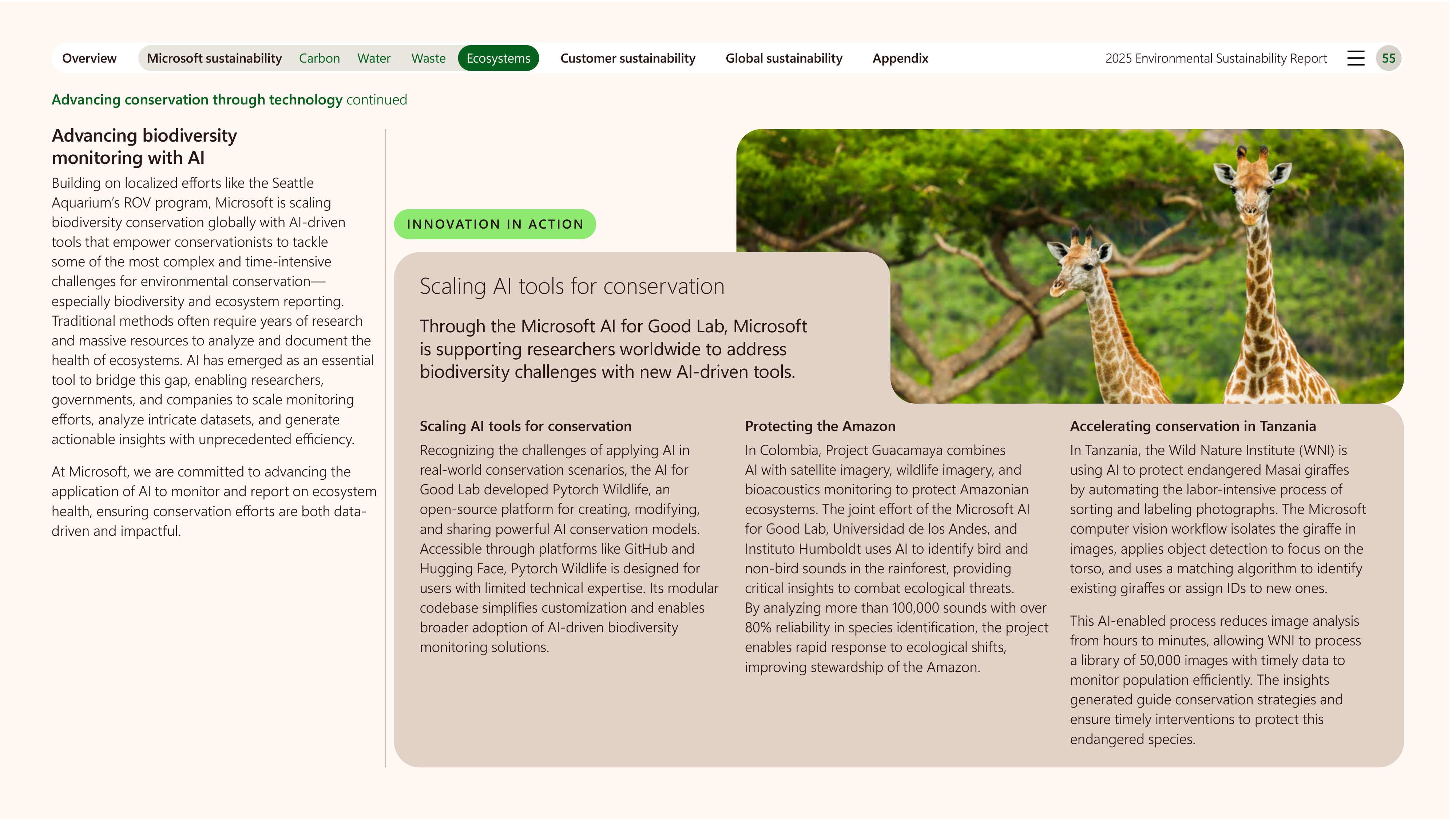


Advancing conservation through technology
continued
Advancing biodiversity
monitoring with AI
Building on localized efforts like the Seattle
Aquarium’s ROV program, Microsoft is scaling
biodiversity conservation globally with AI-driven
tools that empower conservationists to tackle
some of the most complex and time-intensive
challenges for environmental conservation—
especially biodiversity and ecosystem reporting.
Traditional methods often require years of research
and massive resources to analyze and document the
health of ecosystems. AI has emerged as an essential
tool to bridge this gap, enabling researchers,
governments, and companies to scale monitoring
efforts, analyze intricate datasets, and generate
actionable insights with unprecedented efficiency.
At Microsoft, we are committed to advancing the
application of AI to monitor and report on ecosystem
health, ensuring conservation efforts are both data-
driven and impactful.
INNOVATION IN ACTION
Scaling AI tools for conservation
Through the Microsoft AI for Good Lab, Microsoft
is supporting researchers worldwide to address
biodiversity challenges with new AI-driven tools.
Scaling AI tools for conservation
Recognizing the challenges of applying AI in
real-world conservation scenarios, the AI for
Good Lab developed Pytorch Wildlife, an
open-source platform for creating, modifying,
and sharing powerful AI conservation models.
Accessible through platforms like GitHub and
Hugging Face, Pytorch Wildlife is designed for
users with limited technical expertise. Its modular
codebase simplifies customization and enables
broader adoption of AI-driven biodiversity
monitoring solutions.
Protecting the Amazon
In Colombia, Project Guacamaya combines
AI with satellite imagery, wildlife imagery, and
bioacoustics monitoring to protect Amazonian
ecosystems. The joint effort of the Microsoft AI
for Good Lab, Universidad de los Andes, and
Instituto Humboldt uses AI to identify bird and
non-bird sounds in the rainforest, providing
critical insights to combat ecological threats.
By analyzing more than 100,000 sounds with over
80% reliability in species identification, the project
enables rapid response to ecological shifts,
improving stewardship of the Amazon.
Accelerating conservation in Tanzania
In Tanzania, the Wild Nature Institute (WNI) is
using AI to protect endangered Masai giraffes
by automating the labor-intensive process of
sorting and labeling photographs. The Microsoft
computer vision workflow isolates the giraffe in
images, applies object detection to focus on the
torso, and uses a matching algorithm to identify
existing giraffes or assign IDs to new ones.
This AI-enabled process reduces image analysis
from hours to minutes, allowing WNI to process
a library of 50,000 images with timely data to
monitor population efficiently. The insights
generated guide conservation strategies and
ensure timely interventions to protect this
endangered species.
Microsoft sustainability
Water
Waste
Ecosystems
Carbon
Overview
Customer sustainability
Global sustainability
Appendix
55
2025 Environmental Sustainability Report
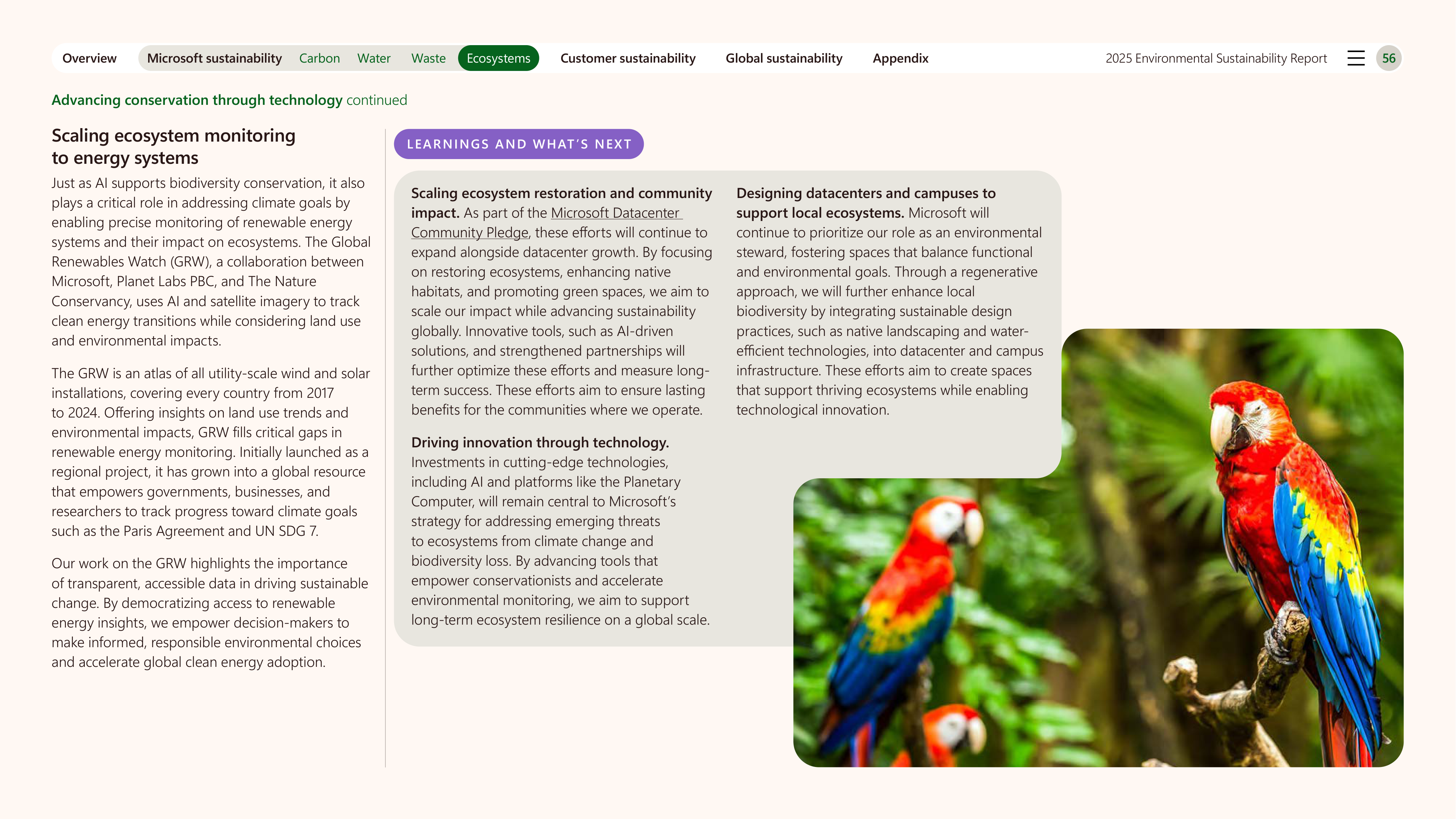


Advancing conservation through technology
continued
Scaling ecosystem monitoring
to energy systems
Just as AI supports biodiversity conservation, it also
plays a critical role in addressing climate goals by
enabling precise monitoring of renewable energy
systems and their impact on ecosystems. The Global
Renewables Watch (GRW), a collaboration between
Microsoft, Planet Labs PBC, and The Nature
Conservancy, uses AI and satellite imagery to track
clean energy transitions while considering land use
and environmental impacts.
The GRW is an atlas of all utility-scale wind and solar
installations, covering every country from 2017
to 2024. Offering insights on land use trends and
environmental impacts, GRW fills critical gaps in
renewable energy monitoring. Initially launched as a
regional project, it has grown into a global resource
that empowers governments, businesses, and
researchers to track progress toward climate goals
such as the Paris Agreement and UN SDG 7.
Our work on the GRW highlights the importance
of transparent, accessible data in driving sustainable
change. By democratizing access to renewable
energy insights, we empower decision-makers to
make informed, responsible environmental choices
and accelerate global clean energy adoption.
LEARNINGS AND WHAT’S NEXT
Scaling ecosystem restoration and community
impact.
As part of the Microsoft Datacenter
Community Pledge, these efforts will continue to
expand alongside datacenter growth. By focusing
on restoring ecosystems, enhancing native
habitats, and promoting green spaces, we aim to
scale our impact while advancing sustainability
globally. Innovative tools, such as AI-driven
solutions, and strengthened partnerships will
further optimize these efforts and measure long-
term success. These efforts aim to ensure lasting
benefits for the communities where we operate.
Driving innovation through technology.
Investments in cutting-edge technologies,
including AI and platforms like the Planetary
Computer, will remain central to Microsoft’s
strategy for addressing emerging threats
to ecosystems from climate change and
biodiversity loss. By advancing tools that
empower conservationists and accelerate
environmental monitoring, we aim to support
long-term ecosystem resilience on a global scale.
Designing datacenters and campuses to
support local ecosystems.
Microsoft will
continue to prioritize our role as an environmental
steward, fostering spaces that balance functional
and environmental goals. Through a regenerative
approach, we will further enhance local
biodiversity by integrating sustainable design
practices, such as native landscaping and water-
efficient technologies, into datacenter and campus
infrastructure. These efforts aim to create spaces
that support thriving ecosystems while enabling
technological innovation.
Microsoft sustainability
Carbon
Water
Waste
Ecosystems
Overview
Customer sustainability
Global sustainability
Appendix
56
2025 Environmental Sustainability Report
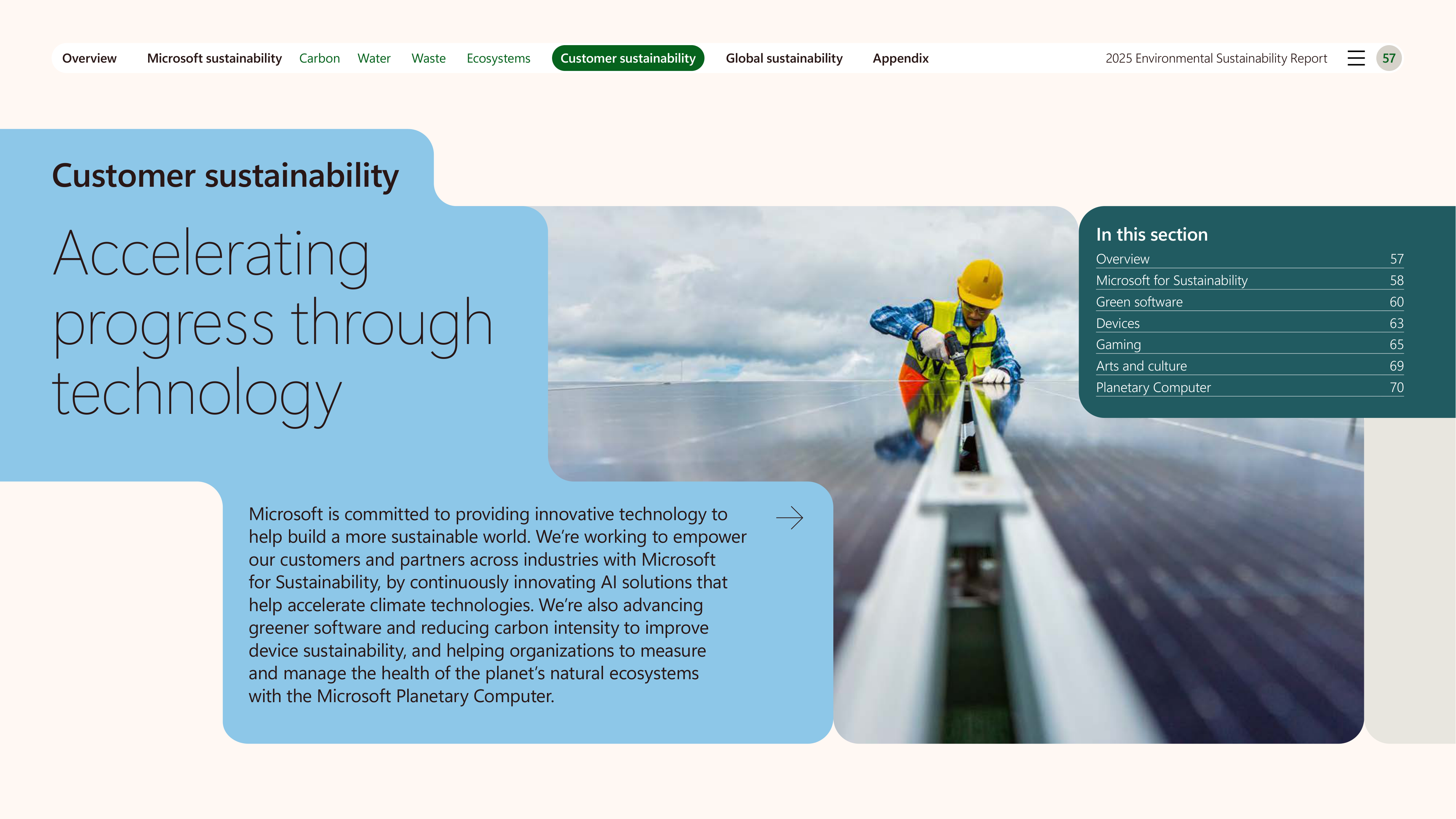
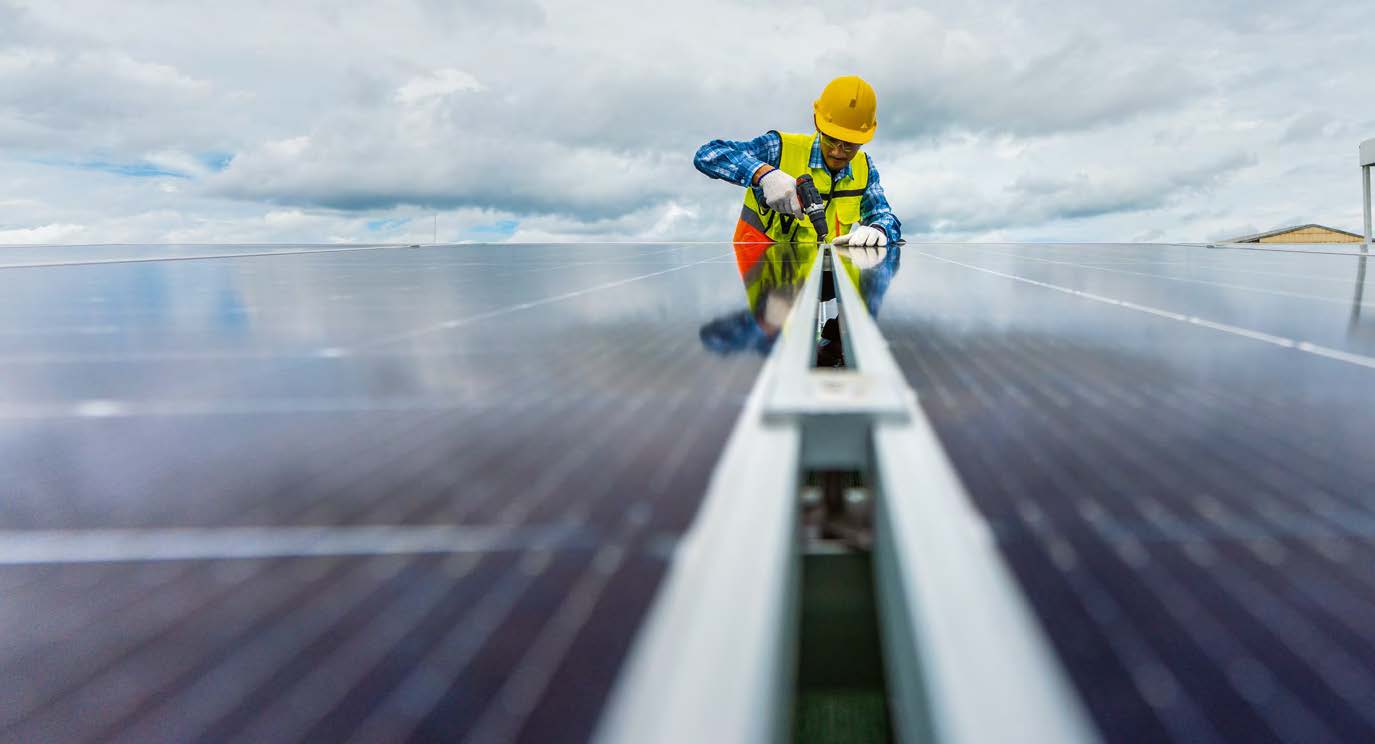


Customer sustainability
Accelerating
progress through
technology
Microsoft is committed to providing innovative technology to
help build a more sustainable world. We’re working to empower
our customers and partners across industries with Microsoft
for Sustainability, by continuously innovating AI solutions that
help accelerate climate technologies. We’re also advancing
greener software and reducing carbon intensity to improve
device sustainability, and helping organizations to measure
and manage the health of the planet’s natural ecosystems
with the Microsoft Planetary Computer.
In this section
Overview
57
Microsoft for Sustainability
58
Green software
60
Devices
63
Gaming
65
Arts and culture
69
Planetary Computer
70
Microsoft sustainability
Carbon
Water
Waste
Overview
Ecosystems
Customer sustainability
Global sustainability
Appendix
57
2025 Environmental Sustainability Report
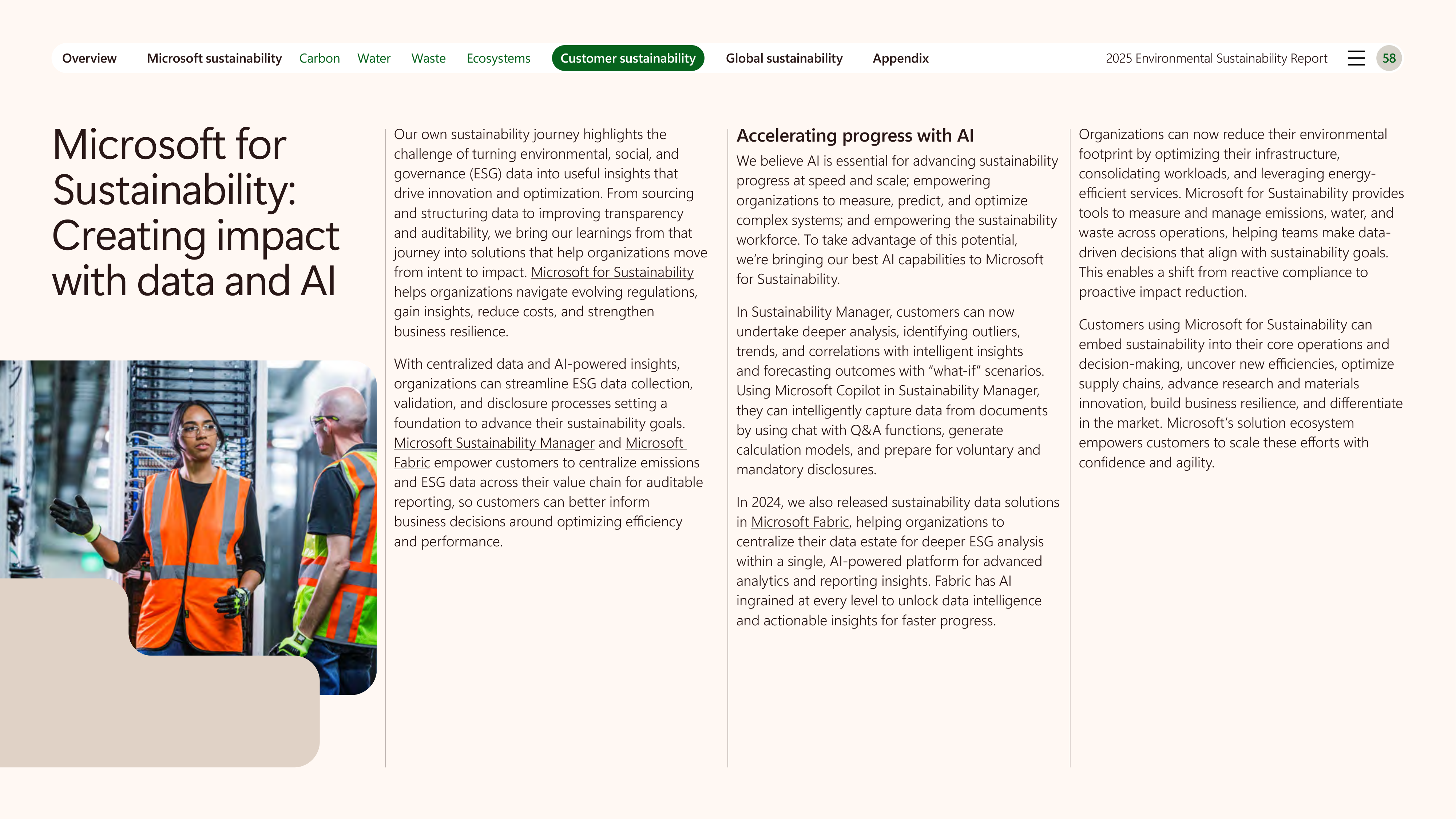

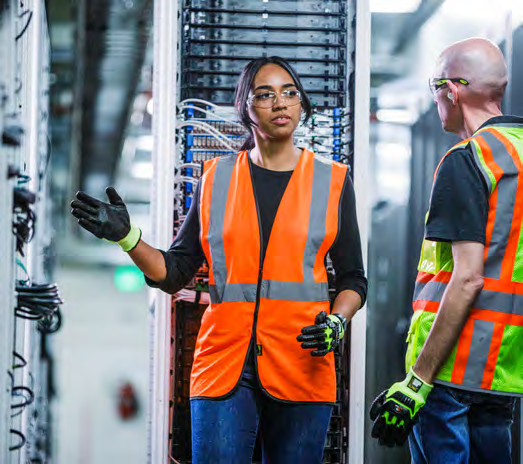
Microsoft for
Sustainability:
Creating impact
with data and AI
Our own sustainability journey highlights the
challenge of turning environmental, social, and
governance (ESG) data into useful insights that
drive innovation and optimization. From sourcing
and structuring data to improving transparency
and auditability, we bring our learnings from that
journey into solutions that help organizations move
from intent to impact. Microsoft for Sustainability
helps organizations navigate evolving regulations,
gain insights, reduce costs, and strengthen
business resilience.
With centralized data and AI-powered insights,
organizations can streamline ESG data collection,
validation, and disclosure processes setting a
foundation to advance their sustainability goals.
Microsoft Sustainability Manager and Microsoft
Fabric empower customers to centralize emissions
and ESG data across their value chain for auditable
reporting, so customers can better inform
business decisions around optimizing efficiency
and performance.
Accelerating progress with AI
We believe AI is essential for advancing sustainability
progress at speed and scale; empowering
organizations to measure, predict, and optimize
complex systems; and empowering the sustainability
workforce. To take advantage of this potential,
we’re bringing our best AI capabilities to Microsoft
for Sustainability.
In Sustainability Manager, customers can now
undertake deeper analysis, identifying outliers,
trends, and correlations with intelligent insights
and forecasting outcomes with “what-if” scenarios.
Using Microsoft Copilot in Sustainability Manager,
they can intelligently capture data from documents
by using chat with Q&A functions, generate
calculation models, and prepare for voluntary and
mandatory disclosures.
In 2024, we also released sustainability data solutions
in Microsoft Fabric, helping organizations to
centralize their data estate for deeper ESG analysis
within a single, AI-powered platform for advanced
analytics and reporting insights. Fabric has AI
ingrained at every level to unlock data intelligence
and actionable insights for faster progress.
Organizations can now reduce their environmental
footprint by optimizing their infrastructure,
consolidating workloads, and leveraging energy-
efficient services. Microsoft for Sustainability provides
tools to measure and manage emissions, water, and
waste across operations, helping teams make data-
driven decisions that align with sustainability goals.
This enables a shift from reactive compliance to
proactive impact reduction.
Customers using Microsoft for Sustainability can
embed sustainability into their core operations and
decision-making, uncover new efficiencies, optimize
supply chains, advance research and materials
innovation, build business resilience, and differentiate
in the market. Microsoft’s solution ecosystem
empowers customers to scale these efforts with
confidence and agility.
Microsoft sustainability
Carbon
Water
Waste
Ecosystems
Overview
Customer sustainability
Global sustainability
Appendix
58
2025 Environmental Sustainability Report
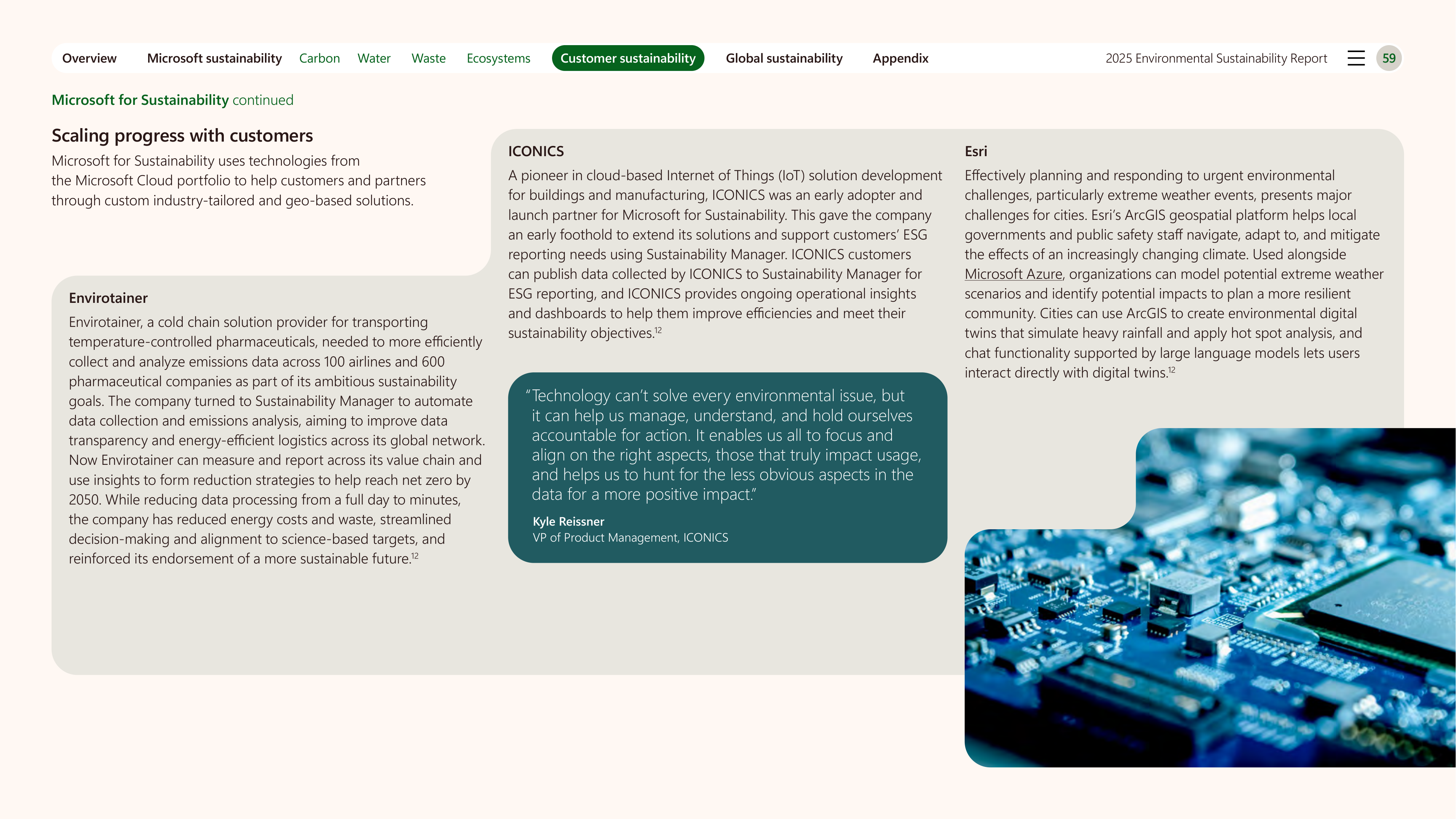


Microsoft for Sustainability
continued
Scaling progress with customers
Microsoft for Sustainability uses technologies from
the Microsoft Cloud portfolio to help customers and partners
through custom industry-tailored and geo-based solutions.
Envirotainer
Envirotainer, a cold chain solution provider for transporting
temperature-controlled pharmaceuticals, needed to more efficiently
collect and analyze emissions data across 100 airlines and 600
pharmaceutical companies as part of its ambitious sustainability
goals. The company turned to Sustainability Manager to automate
data collection and emissions analysis, aiming to improve data
transparency and energy-efficient logistics across its global network.
Now Envirotainer can measure and report across its value chain and
use insights to form reduction strategies to help reach net zero by
2050. While reducing data processing from a full day to minutes,
the company has reduced energy costs and waste, streamlined
decision-making and alignment to science-based targets, and
reinforced its endorsement of a more sustainable future.
12
ICONICS
A pioneer in cloud-based Internet of Things (IoT) solution development
for buildings and manufacturing, ICONICS was an early adopter and
launch partner for Microsoft for Sustainability. This gave the company
an early foothold to extend its solutions and support customers’ ESG
reporting needs using Sustainability Manager. ICONICS customers
can publish data collected by ICONICS to Sustainability Manager for
ESG reporting, and ICONICS provides ongoing operational insights
and dashboards to help them improve efficiencies and meet their
sustainability objectives.
12
Esri
Effectively planning and responding to urgent environmental
challenges, particularly extreme weather events, presents major
challenges for cities. Esri’s ArcGIS geospatial platform helps local
governments and public safety staff navigate, adapt to, and mitigate
the effects of an increasingly changing climate. Used alongside
Microsoft Azure, organizations can model potential extreme weather
scenarios and identify potential impacts to plan a more resilient
community. Cities can use ArcGIS to create environmental digital
twins that simulate heavy rainfall and apply hot spot analysis, and
chat functionality supported by large language models lets users
interact directly with digital twins.
12
“Technology can’t solve every environmental issue, but
it can help us manage, understand, and hold ourselves
accountable for action. It enables us all to focus and
align on the right aspects, those that truly impact usage,
and helps us to hunt for the less obvious aspects in the
data for a more positive impact.”
Kyle Reissner
VP of Product Management, ICONICS
Microsoft sustainability
Carbon
Water
Waste
Ecosystems
Overview
Customer sustainability
Global sustainability
Appendix
59
2025 Environmental Sustainability Report
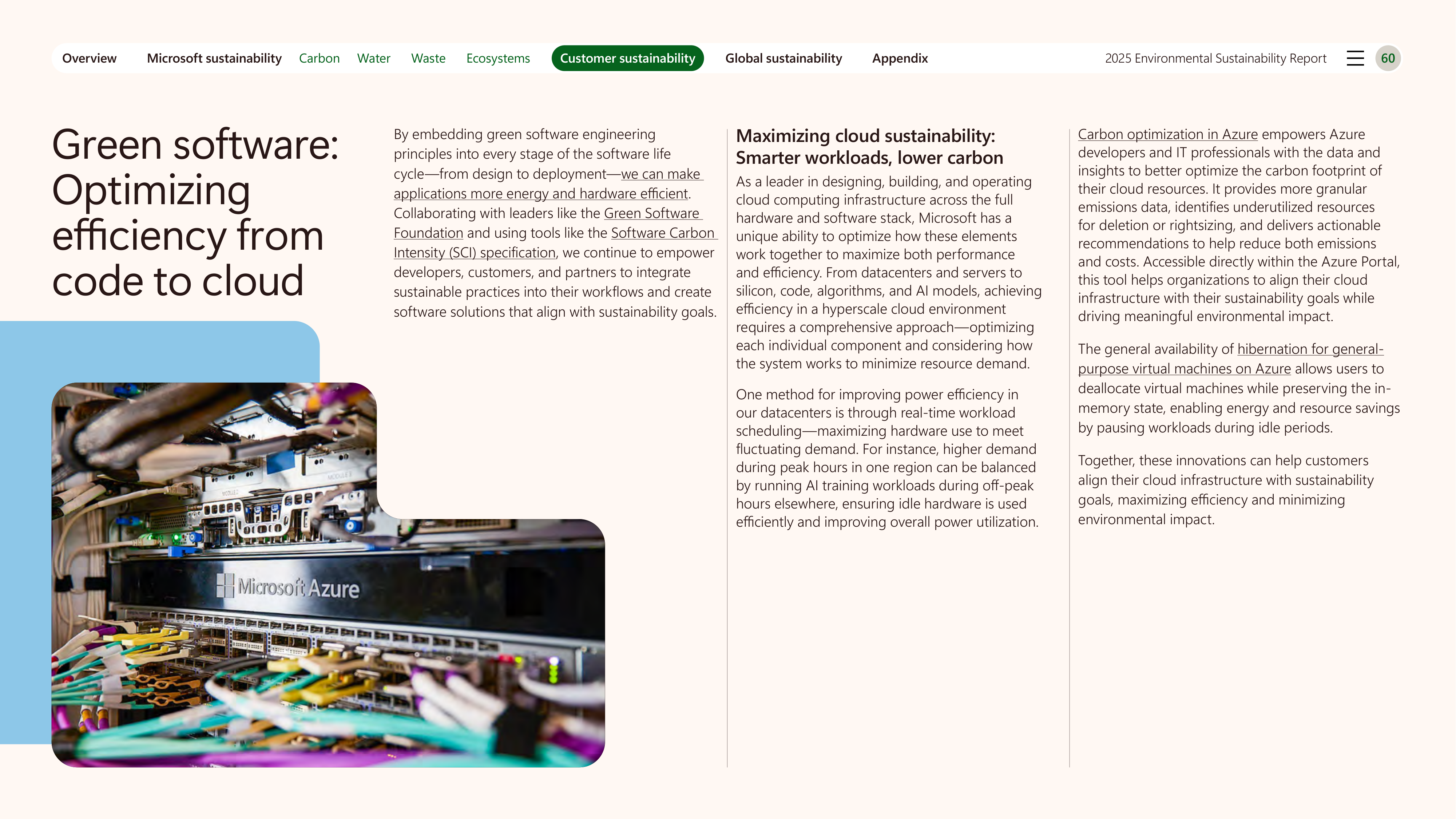

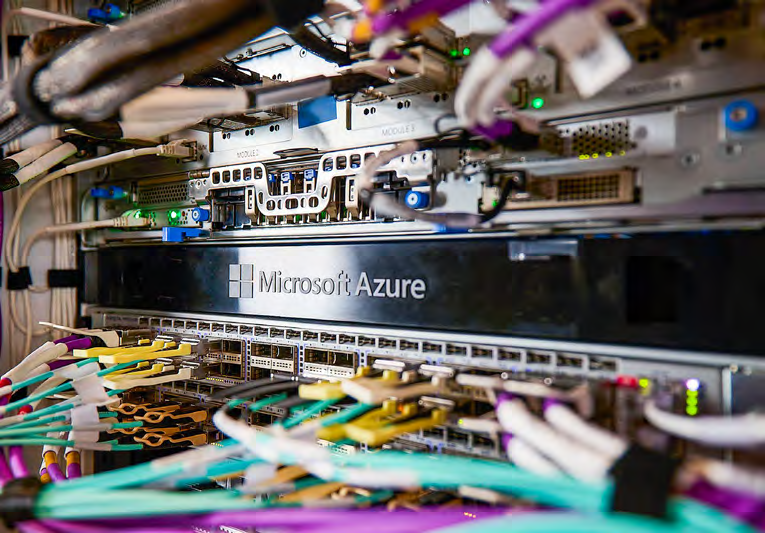
Green software:
Optimizing
efficiency from
code to cloud
By embedding green software engineering
principles into every stage of the software life
cycle—from design to deployment—we can make
applications more energy and hardware efficient.
Collaborating with leaders like the Green Software
Foundation and using tools like the Software Carbon
Intensity (SCI) specification, we continue to empower
developers, customers, and partners to integrate
sustainable practices into their workflows and create
software solutions that align with sustainability goals.
Maximizing cloud sustainability:
Smarter workloads, lower carbon
As a leader in designing, building, and operating
cloud computing infrastructure across the full
hardware and software stack, Microsoft has a
unique ability to optimize how these elements
work together to maximize both performance
and efficiency. From datacenters and servers to
silicon, code, algorithms, and AI models, achieving
efficiency in a hyperscale cloud environment
requires a comprehensive approach—optimizing
each individual component and considering how
the system works to minimize resource demand.
One method for improving power efficiency in
our datacenters is through real-time workload
scheduling—maximizing hardware use to meet
fluctuating demand. For instance, higher demand
during peak hours in one region can be balanced
by running AI training workloads during off-peak
hours elsewhere, ensuring idle hardware is used
efficiently and improving overall power utilization.
Carbon optimization in Azure empowers Azure
developers and IT professionals with the data and
insights to better optimize the carbon footprint of
their cloud resources. It provides more granular
emissions data, identifies underutilized resources
for deletion or rightsizing, and delivers actionable
recommendations to help reduce both emissions
and costs. Accessible directly within the Azure Portal,
this tool helps organizations to align their cloud
infrastructure with their sustainability goals while
driving meaningful environmental impact.
The general availability of hibernation for general-
purpose virtual machines on Azure allows users to
deallocate virtual machines while preserving the in-
memory state, enabling energy and resource savings
by pausing workloads during idle periods.
Together, these innovations can help customers
align their cloud infrastructure with sustainability
goals, maximizing efficiency and minimizing
environmental impact.
Microsoft sustainability
Carbon
Water
Waste
Ecosystems
Overview
Customer sustainability
Global sustainability
Appendix
60
2025 Environmental Sustainability Report
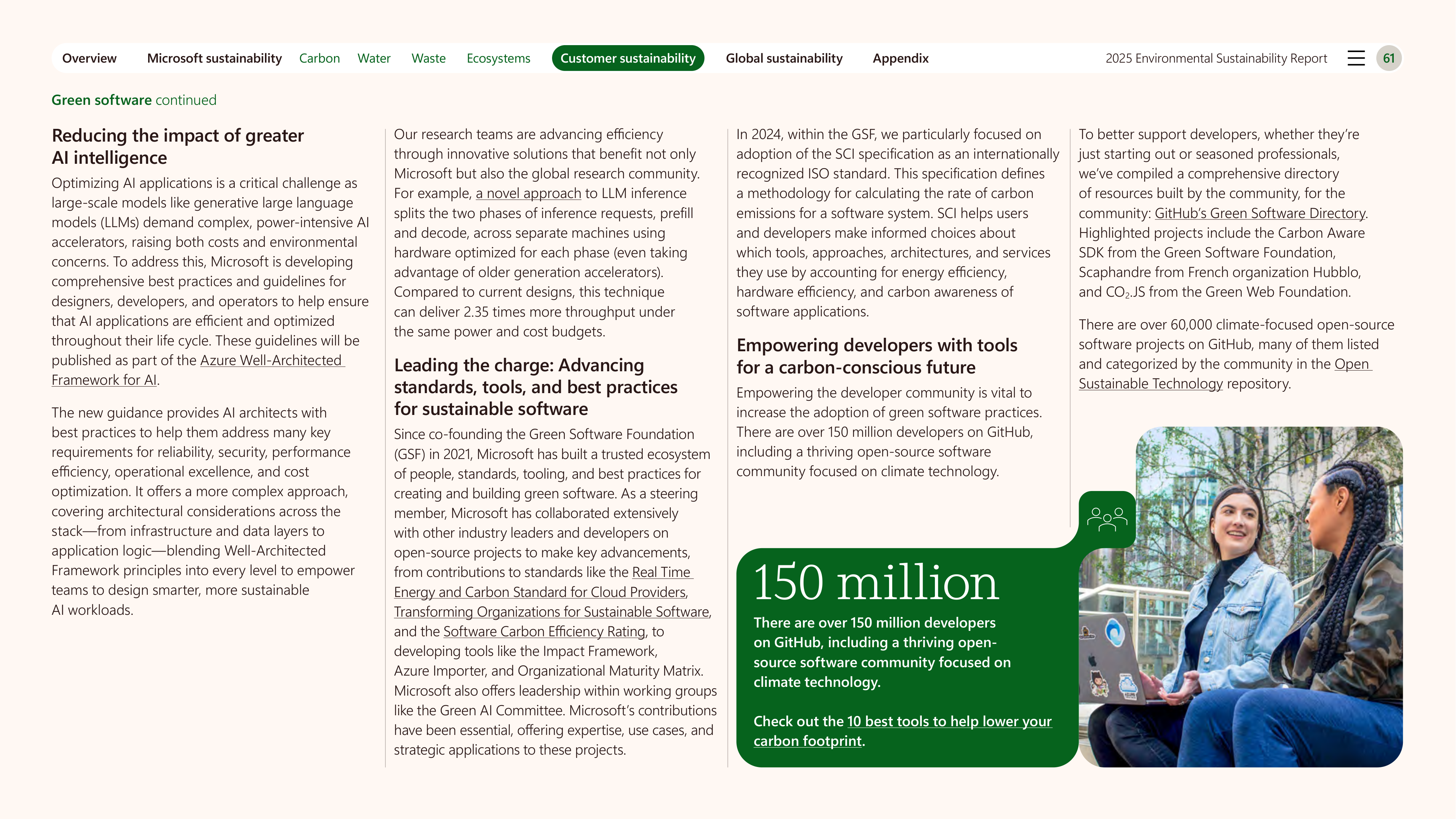

Reducing the impact of greater
AI intelligence
Optimizing AI applications is a critical challenge as
large-scale models like generative large language
models (LLMs) demand complex, power-intensive AI
accelerators, raising both costs and environmental
concerns. To address this, Microsoft is developing
comprehensive best practices and guidelines for
designers, developers, and operators to help ensure
that AI applications are efficient and optimized
throughout their life cycle. These guidelines will be
published as part of the Azure Well-Architected
Framework for AI.
The new guidance provides AI architects with
best practices to help them address many key
requirements for reliability, security, performance
efficiency, operational excellence, and cost
optimization. It offers a more complex approach,
covering architectural considerations across the
stack—from infrastructure and data layers to
application logic—blending Well-Architected
Framework principles into every level to empower
teams to design smarter, more sustainable
AI workloads.
Green software
continued
Our research teams are advancing efficiency
through innovative solutions that benefit not only
Microsoft but also the global research community.
For example, a novel approach to LLM inference
splits the two phases of inference requests, prefill
and decode, across separate machines using
hardware optimized for each phase (even taking
advantage of older generation accelerators).
Compared to current designs, this technique
can deliver 2.35 times more throughput under
the same power and cost budgets.
Leading the charge: Advancing
standards, tools, and best practices
for sustainable software
Since co-founding the Green Software Foundation
(GSF) in 2021, Microsoft has built a trusted ecosystem
of people, standards, tooling, and best practices for
creating and building green software. As a steering
member, Microsoft has collaborated extensively
with other industry leaders and developers on
open-source projects to make key advancements,
from contributions to standards like the Real Time
Energy and Carbon Standard for Cloud Providers,
Transforming Organizations for Sustainable Software,
and the Software Carbon Efficiency Rating, to
developing tools like the Impact Framework,
Azure Importer, and Organizational Maturity Matrix.
Microsoft also offers leadership within working groups
like the Green AI Committee. Microsoft’s contributions
have been essential, offering expertise, use cases, and
strategic applications to these projects.
In 2024, within the GSF, we particularly focused on
adoption of the SCI specification as an internationally
recognized ISO standard. This specification defines
a methodology for calculating the rate of carbon
emissions for a software system. SCI helps users
and developers make informed choices about
which tools, approaches, architectures, and services
they use by accounting for energy efficiency,
hardware efficiency, and carbon awareness of
software applications.
Empowering developers with tools
for a carbon-conscious future
Empowering the developer community is vital to
increase the adoption of green software practices.
There are over 150 million developers on GitHub,
including a thriving open-source software
community focused on climate technology.
To better support developers, whether they’re
just starting out or seasoned professionals,
we’ve compiled a comprehensive directory
of resources built by the community, for the
community: GitHub’s Green Software Directory.
Highlighted projects include the Carbon Aware
SDK from the Green Software Foundation,
Scaphandre from French organization Hubblo,
and CO
2
.JS from the Green Web Foundation.
There are over 60,000 climate-focused open-source
software projects on GitHub, many of them listed
and categorized by the community in the Open
Sustainable Technology repository.
150 million
There are over 150 million developers
on GitHub, including a thriving open-
source software community focused on
climate technology.
Check out the 10 best tools to help lower your
carbon footprint.
Microsoft sustainability
Carbon
Water
Waste
Ecosystems
Overview
Customer sustainability
Global sustainability
Appendix
61
2025 Environmental Sustainability Report
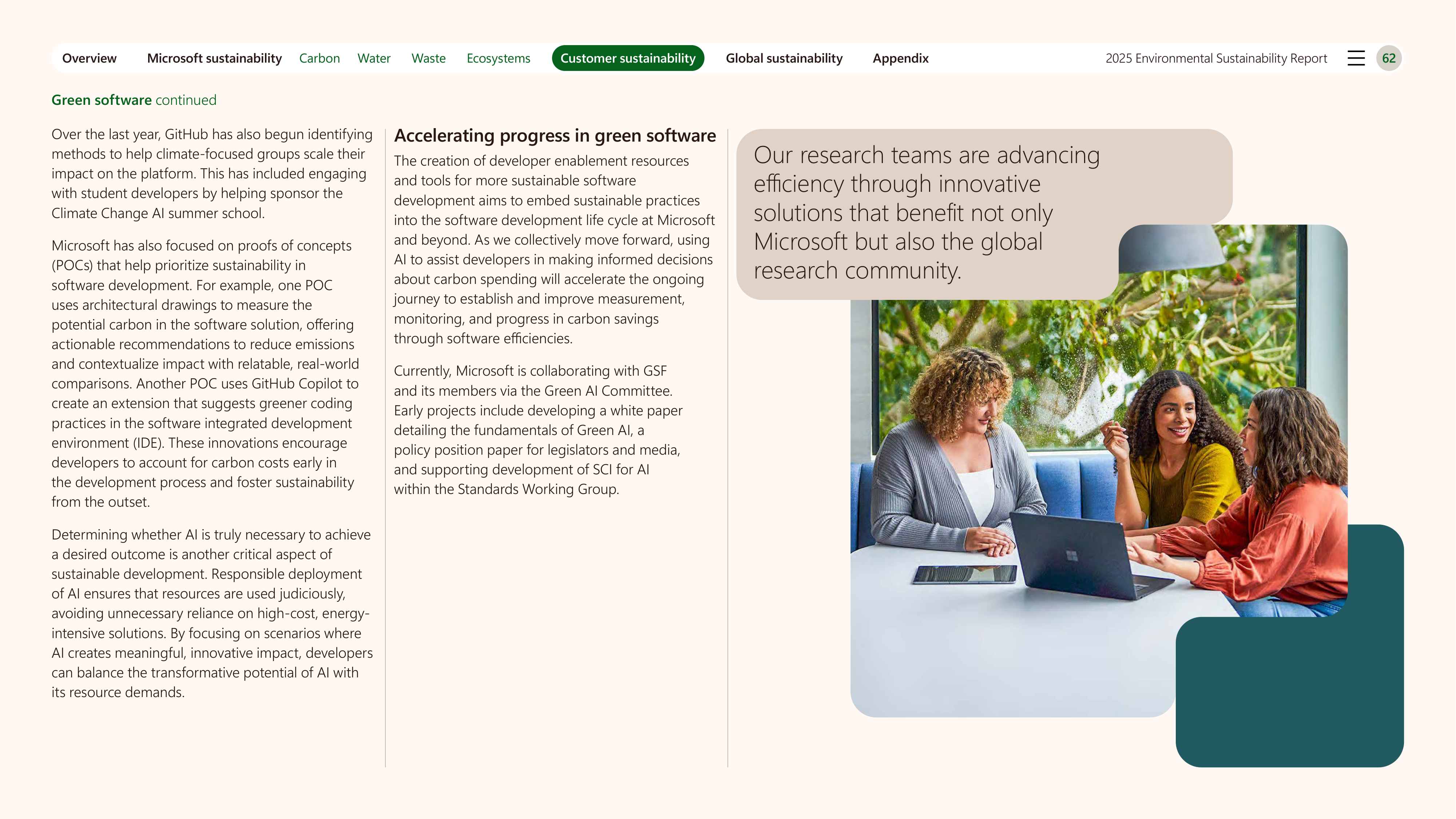


Over the last year, GitHub has also begun identifying
methods to help climate-focused groups scale their
impact on the platform. This has included engaging
with student developers by helping sponsor the
Climate Change AI summer school.
Microsoft has also focused on proofs of concepts
(POCs) that help prioritize sustainability in
software development. For example, one POC
uses architectural drawings to measure the
potential carbon in the software solution, offering
actionable recommendations to reduce emissions
and contextualize impact with relatable, real-world
comparisons. Another POC uses GitHub Copilot to
create an extension that suggests greener coding
practices in the software integrated development
environment (IDE). These innovations encourage
developers to account for carbon costs early in
the development process and foster sustainability
from the outset.
Determining whether AI is truly necessary to achieve
a desired outcome is another critical aspect of
sustainable development. Responsible deployment
of AI ensures that resources are used judiciously,
avoiding unnecessary reliance on high-cost, energy-
intensive solutions. By focusing on scenarios where
AI creates meaningful, innovative impact, developers
can balance the transformative potential of AI with
its resource demands.
Accelerating progress in green software
The creation of developer enablement resources
and tools for more sustainable software
development aims to embed sustainable practices
into the software development life cycle at Microsoft
and beyond. As we collectively move forward, using
AI to assist developers in making informed decisions
about carbon spending will accelerate the ongoing
journey to establish and improve measurement,
monitoring, and progress in carbon savings
through software efficiencies.
Currently, Microsoft is collaborating with GSF
and its members via the Green AI Committee.
Early projects include developing a white paper
detailing the fundamentals of Green AI, a
policy position paper for legislators and media,
and supporting development of SCI for AI
within the Standards Working Group.
Green software
continued
Our research teams are advancing
efficiency through innovative
solutions that benefit not only
Microsoft but also the global
research community.
Microsoft sustainability
Carbon
Water
Waste
Ecosystems
Overview
Customer sustainability
Global sustainability
Appendix
62
2025 Environmental Sustainability Report
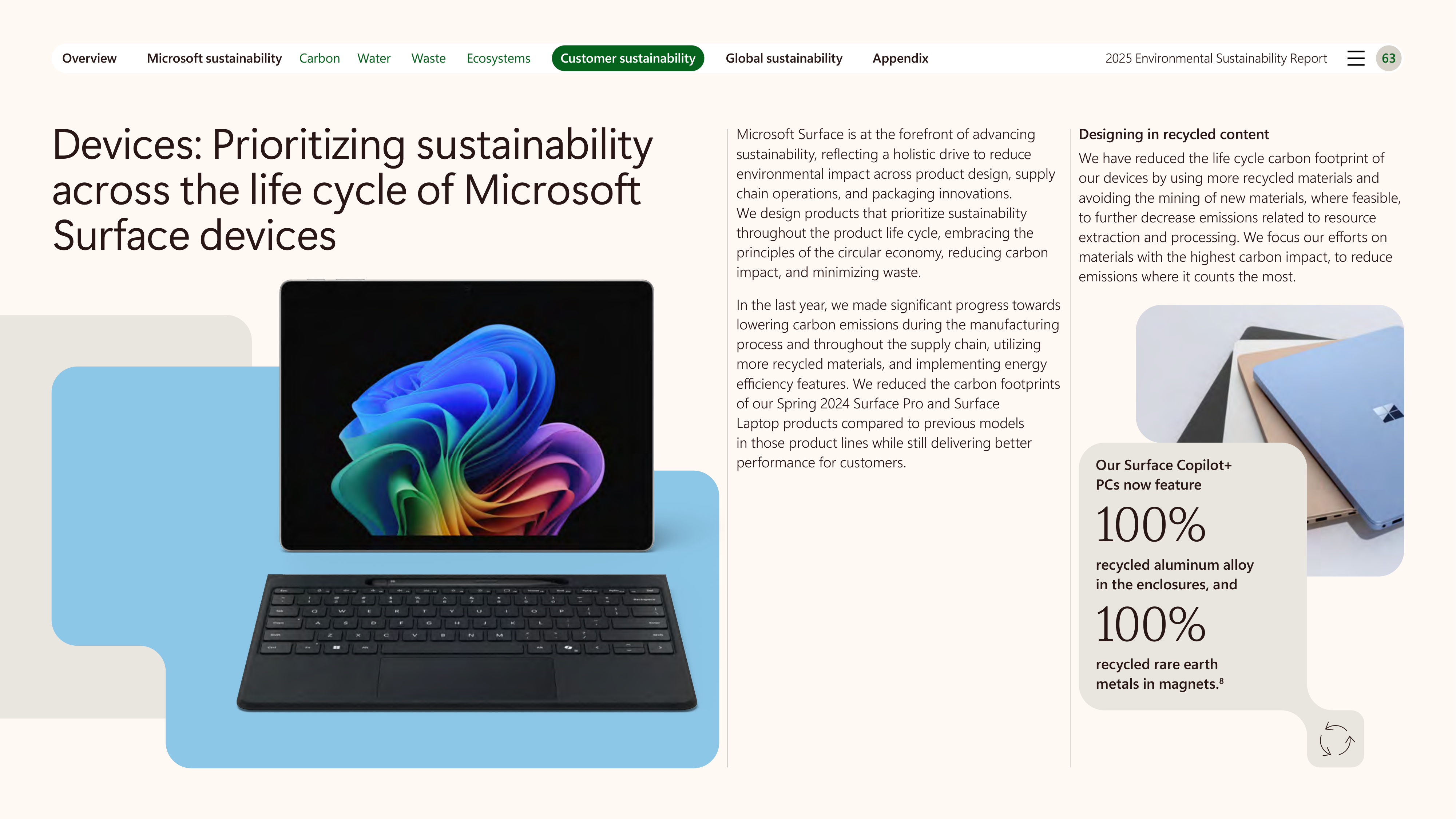
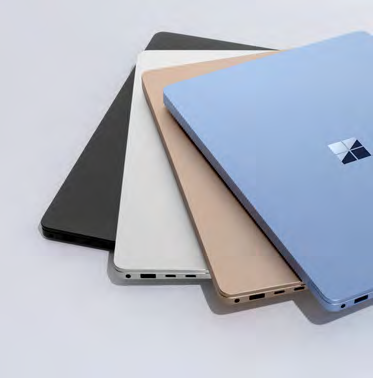
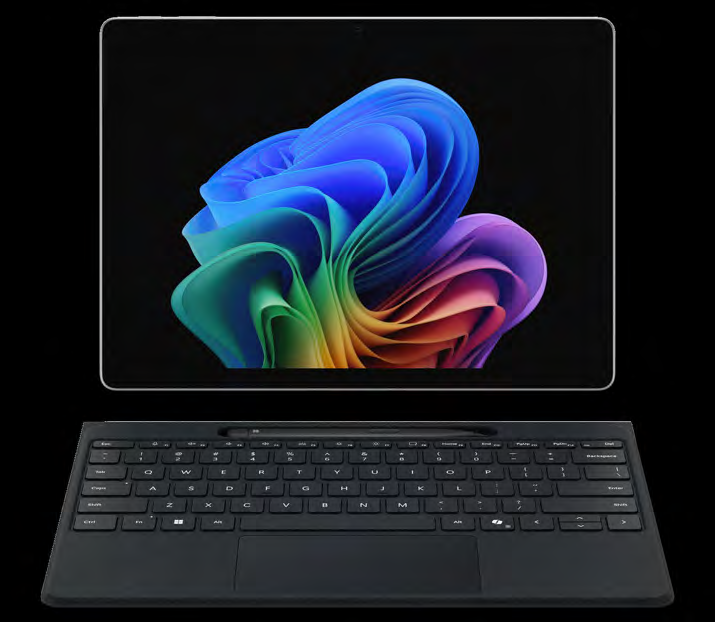

Devices: Prioritizing sustainability
across the life cycle of Microsoft
Surface devices
Microsoft Surface is at the forefront of advancing
sustainability, reflecting a holistic drive to reduce
environmental impact across product design, supply
chain operations, and packaging innovations.
We design products that prioritize sustainability
throughout the product life cycle, embracing the
principles of the circular economy, reducing carbon
impact, and minimizing waste.
In the last year, we made significant progress towards
lowering carbon emissions during the manufacturing
process and throughout the supply chain, utilizing
more recycled materials, and implementing energy
efficiency features. We reduced the carbon footprints
of our Spring 2024 Surface Pro and Surface
Laptop products compared to previous models
in those product lines while still delivering better
performance for customers.
Designing in recycled content
We have reduced the life cycle carbon footprint of
our devices by using more recycled materials and
avoiding the mining of new materials, where feasible,
to further decrease emissions related to resource
extraction and processing. We focus our efforts on
materials with the highest carbon impact, to reduce
emissions where it counts the most.
Our Surface Copilot+
PCs now feature
100%
recycled aluminum alloy
in the enclosures, and
100%
recycled rare earth
metals in magnets.
8
Microsoft sustainability
Carbon
Water
Waste
Ecosystems
Overview
Customer sustainability
Global sustainability
Appendix
63
2025 Environmental Sustainability Report
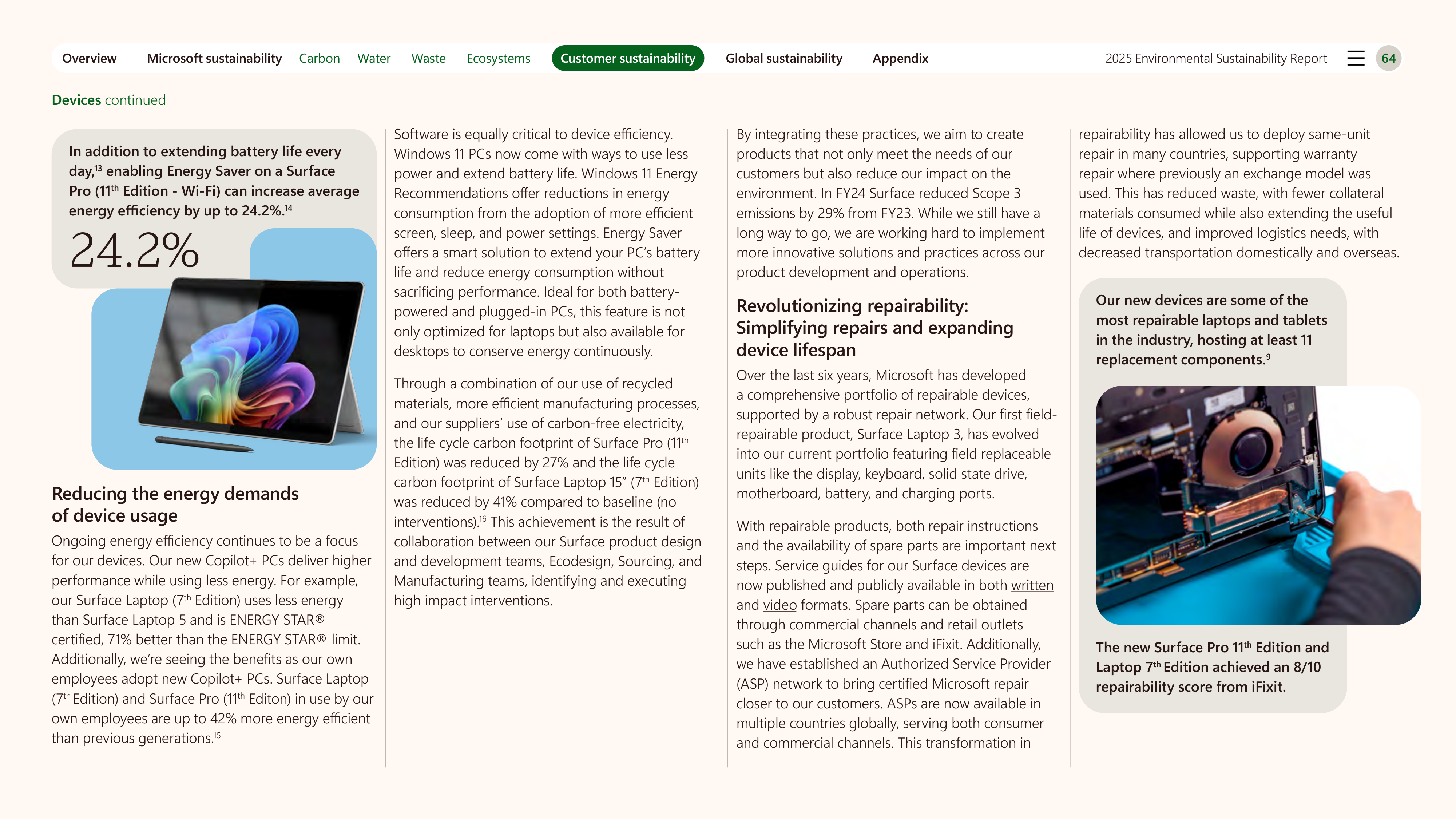
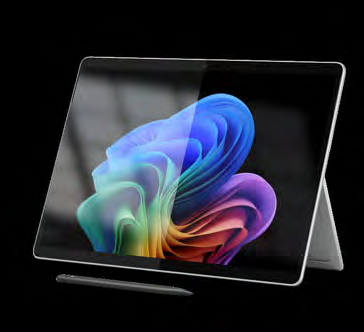


Devices
continued
In addition to extending battery life every
day,
13
enabling Energy Saver on a Surface
Pro (11
th
Edition - Wi-Fi) can increase average
energy efficiency by up to 24.2%.
14
24.2%
Reducing the energy demands
of device usage
Ongoing energy efficiency continues to be a focus
for our devices. Our new Copilot+ PCs deliver higher
performance while using less energy. For example,
our Surface Laptop (7
th
Edition) uses less energy
than Surface Laptop 5 and is ENERGY STAR®
certified, 71% better than the ENERGY STAR® limit.
Additionally, we’re seeing the benefits as our own
employees adopt new Copilot+ PCs. Surface Laptop
(7
th
Edition) and Surface Pro (11
th
Editon) in use by our
own employees are up to 42% more energy efficient
than previous generations.
15
Software is equally critical to device efficiency.
Windows 11 PCs now come with ways to use less
power and extend battery life. Windows 11 Energy
Recommendations offer reductions in energy
consumption from the adoption of more efficient
screen, sleep, and power settings. Energy Saver
offers a smart solution to extend your PC’s battery
life and reduce energy consumption without
sacrificing performance. Ideal for both battery-
powered and plugged-in PCs, this feature is not
only optimized for laptops but also available for
desktops to conserve energy continuously.
Through a combination of our use of recycled
materials, more efficient manufacturing processes,
and our suppliers’ use of carbon-free electricity,
the life cycle carbon footprint of Surface Pro (11
th
Edition) was reduced by 27% and the life cycle
carbon footprint of Surface Laptop 15 inches (7
th
Edition)
was reduced by 41% compared to baseline (no
interventions).
16
This achievement is the result of
collaboration between our Surface product design
and development teams, Ecodesign, Sourcing, and
Manufacturing teams, identifying and executing
high impact interventions.
By integrating these practices, we aim to create
products that not only meet the needs of our
customers but also reduce our impact on the
environment. In FY24 Surface reduced Scope 3
emissions by 29% from FY23. While we still have a
long way to go, we are working hard to implement
more innovative solutions and practices across our
product development and operations.
Revolutionizing repairability:
Simplifying repairs and expanding
device lifespan
Over the last six years, Microsoft has developed
a comprehensive portfolio of repairable devices,
supported by a robust repair network. Our first field-
repairable product, Surface Laptop 3, has evolved
into our current portfolio featuring field replaceable
units like the display, keyboard, solid state drive,
motherboard, battery, and charging ports.
With repairable products, both repair instructions
and the availability of spare parts are important next
steps. Service guides for our Surface devices are
now published and publicly available in both written
and video formats. Spare parts can be obtained
through commercial channels and retail outlets
such as the Microsoft Store and iFixit. Additionally,
we have established an Authorized Service Provider
(ASP) network to bring certified Microsoft repair
closer to our customers. ASPs are now available in
multiple countries globally, serving both consumer
and commercial channels. This transformation in
repairability has allowed us to deploy same-unit
repair in many countries, supporting warranty
repair where previously an exchange model was
used. This has reduced waste, with fewer collateral
materials consumed while also extending the useful
life of devices, and improved logistics needs, with
decreased transportation domestically and overseas.
Our new devices are some of the
most repairable laptops and tablets
in the industry, hosting at least 11
replacement components.
9
The new Surface Pro 11
th
Edition and
Laptop 7
th
Edition achieved an 8/10
repairability score from iFixit.
Microsoft sustainability
Carbon
Water
Waste
Ecosystems
Overview
Customer sustainability
Global sustainability
Appendix
64
2025 Environmental Sustainability Report
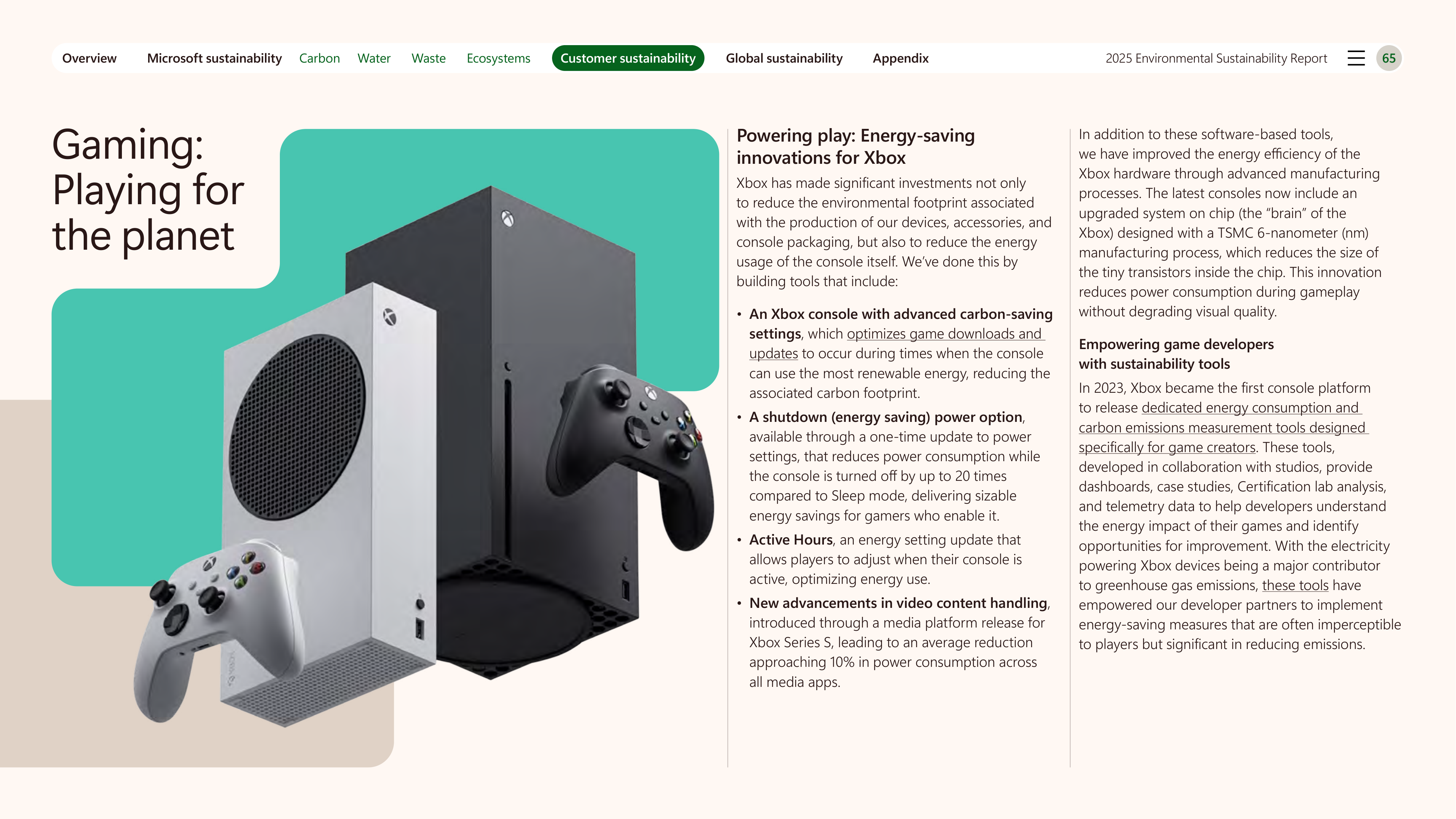

Gaming:
Playing for
the planet
Powering play: Energy-saving
innovations for Xbox
Xbox has made significant investments not only
to reduce the environmental footprint associated
with the production of our devices, accessories, and
console packaging, but also to reduce the energy
usage of the console itself. We’ve done this by
building tools that include:
•
An Xbox console with advanced carbon-saving
settings
, which optimizes game downloads and
updates to occur during times when the console
can use the most renewable energy, reducing the
associated carbon footprint.
•
A shutdown (energy saving) power option
,
available through a one-time update to power
settings, that reduces power consumption while
the console is turned off by up to 20 times
compared to Sleep mode, delivering sizable
energy savings for gamers who enable it.
•
Active Hours
, an energy setting update that
allows players to adjust when their console is
active, optimizing energy use.
•
New advancements in video content handling
,
introduced through a media platform release for
Xbox Series S, leading to an average reduction
approaching 10% in power consumption across
all media apps.
In addition to these software-based tools,
we have improved the energy efficiency of the
Xbox hardware through advanced manufacturing
processes. The latest consoles now include an
upgraded system on chip (the “brain” of the
Xbox) designed with a TSMC 6-nanometer (nm)
manufacturing process, which reduces the size of
the tiny transistors inside the chip. This innovation
reduces power consumption during gameplay
without degrading visual quality.
Empowering game developers
with sustainability tools
In 2023, Xbox became the first console platform
to release dedicated energy consumption and
carbon emissions measurement tools designed
specifically for game creators. These tools,
developed in collaboration with studios, provide
dashboards, case studies, Certification lab analysis,
and telemetry data to help developers understand
the energy impact of their games and identify
opportunities for improvement. With the electricity
powering Xbox devices being a major contributor
to greenhouse gas emissions, these tools have
empowered our developer partners to implement
energy-saving measures that are often imperceptible
to players but significant in reducing emissions.
Microsoft sustainability
Carbon
Water
Waste
Ecosystems
Overview
Customer sustainability
Global sustainability
Appendix
65
2025 Environmental Sustainability Report
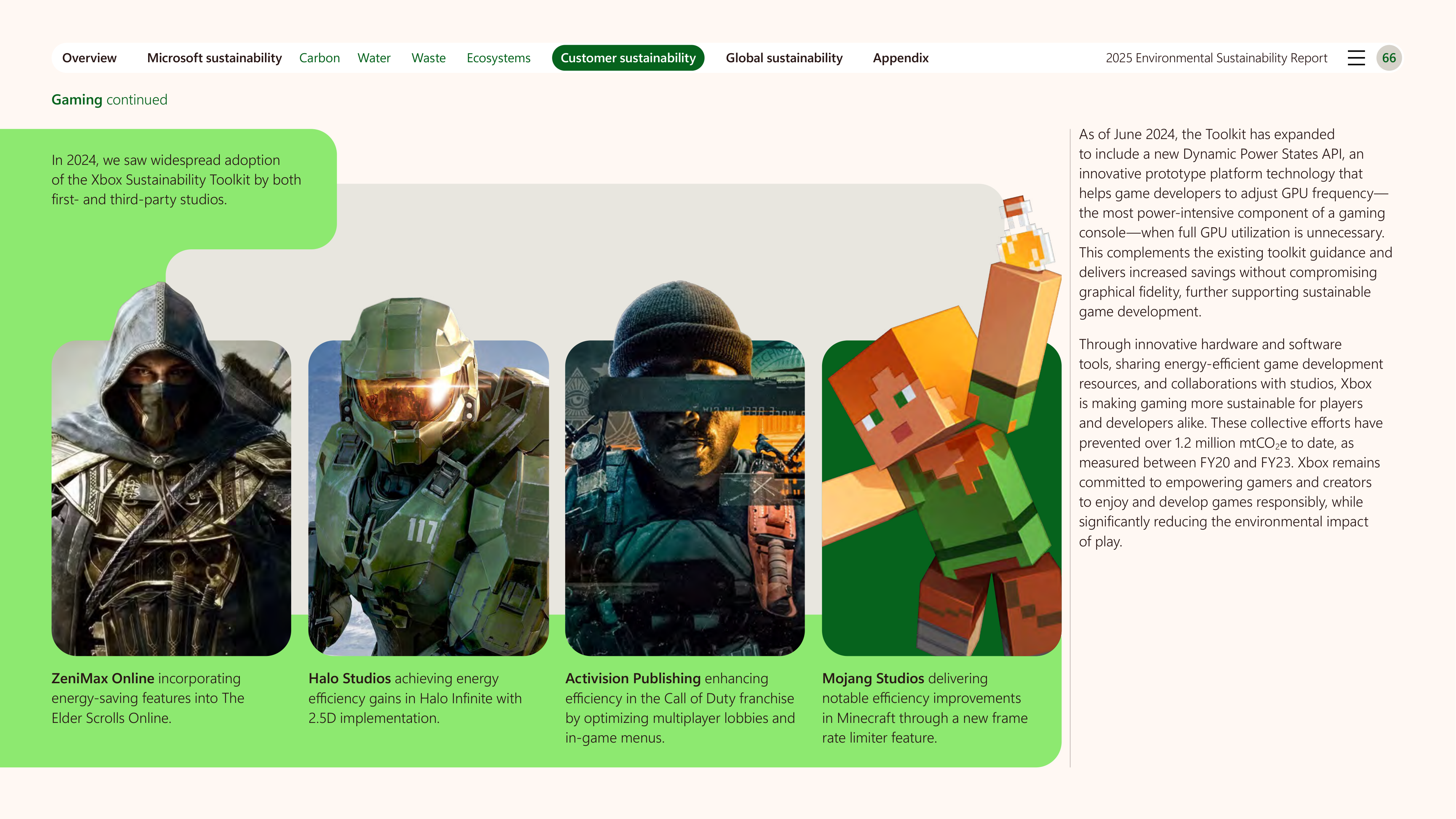








In 2024, we saw widespread adoption
of the Xbox Sustainability Toolkit by both
first- and third-party studios.
ZeniMax Online
incorporating
energy-saving features into The
Elder Scrolls Online.
Halo Studios
achieving energy
efficiency gains in Halo Infinite with
2.5D implementation.
Activision Publishing
enhancing
efficiency in the Call of Duty franchise
by optimizing multiplayer lobbies and
in-game menus.
Mojang Studios
delivering
notable efficiency improvements
in Minecraft through a new frame
rate limiter feature.
As of June 2024, the Toolkit has expanded
to include a new Dynamic Power States API, an
innovative prototype platform technology that
helps game developers to adjust GPU frequency—
the most power-intensive component of a gaming
console—when full GPU utilization is unnecessary.
This complements the existing toolkit guidance and
delivers increased savings without compromising
graphical fidelity, further supporting sustainable
game development.
Through innovative hardware and software
tools, sharing energy-efficient game development
resources, and collaborations with studios, Xbox
is making gaming more sustainable for players
and developers alike. These collective efforts have
prevented over 1.2 million m t
C O subscript 2
e to date, as
measured between FY20 and FY23. Xbox remains
committed to empowering gamers and creators
to enjoy and develop games responsibly, while
significantly reducing the environmental impact
of play.
Gaming
continued
Microsoft sustainability
Carbon
Water
Waste
Ecosystems
Overview
Customer sustainability
Global sustainability
Appendix
66
2025 Environmental Sustainability Report
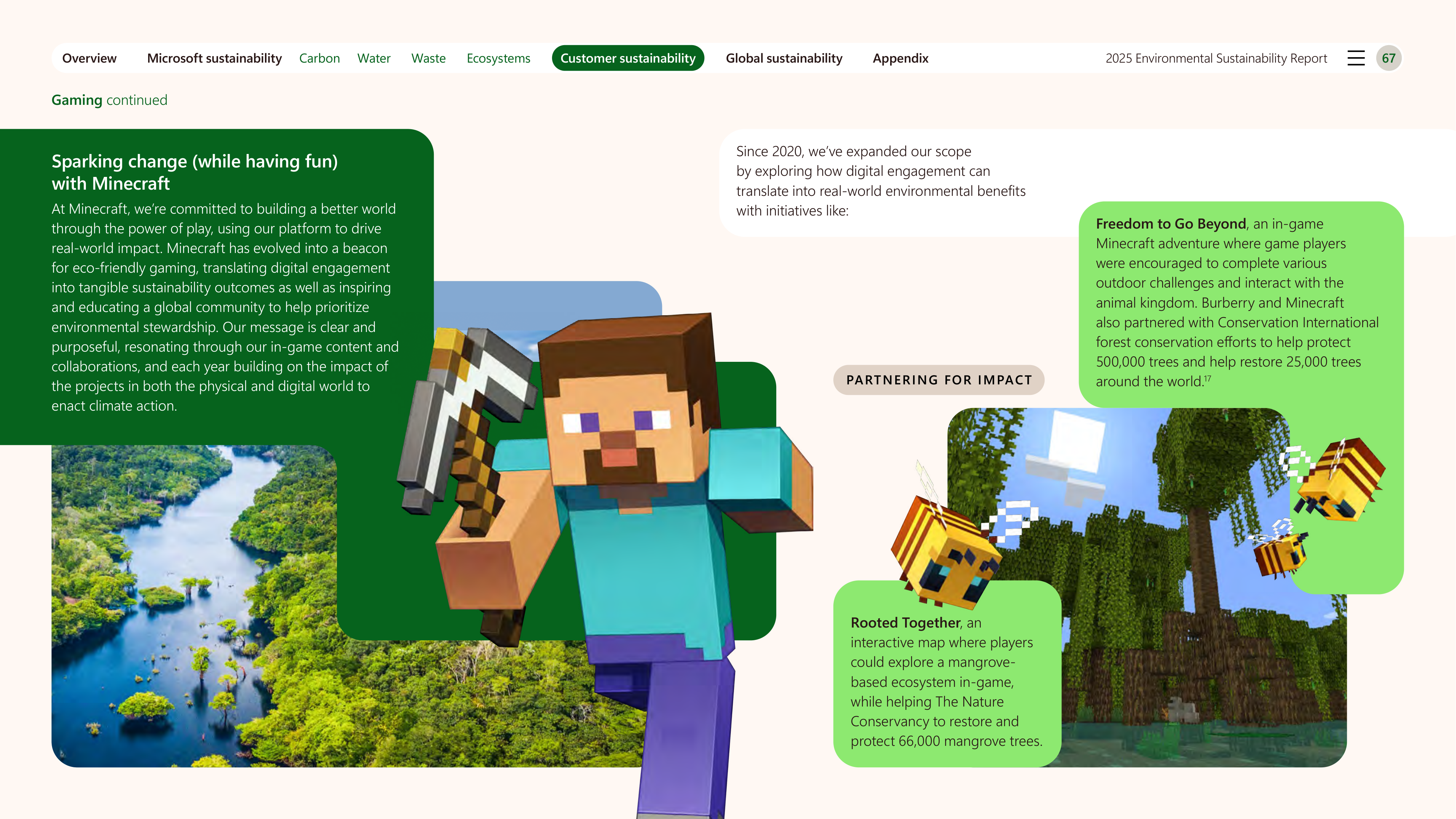

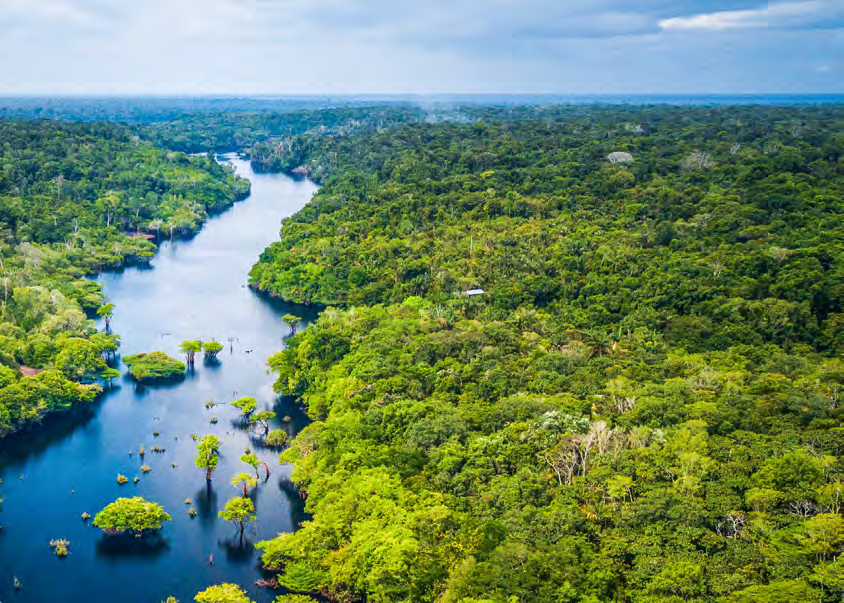

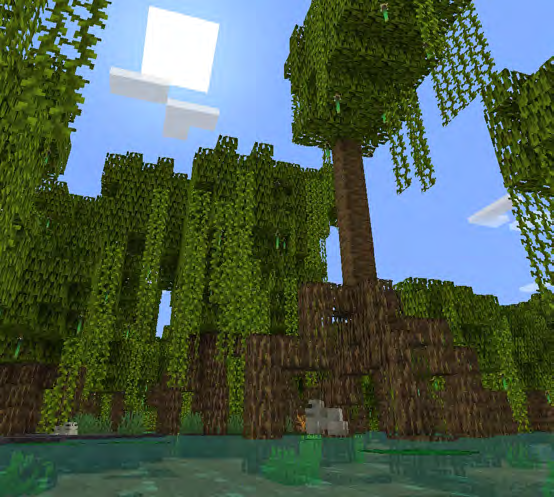


Gaming
continued
Sparking change (while having fun)
with Minecraft
At Minecraft, we’re committed to building a better world
through the power of play, using our platform to drive
real-world impact. Minecraft has evolved into a beacon
for eco-friendly gaming, translating digital engagement
into tangible sustainability outcomes as well as inspiring
and educating a global community to help prioritize
environmental stewardship. Our message is clear and
purposeful, resonating through our in-game content and
collaborations, and each year building on the impact of
the projects in both the physical and digital world to
enact climate action.
Since 2020, we’ve expanded our scope
by exploring how digital engagement can
translate into real-world environmental benefits
with initiatives like:
PARTNERING FOR IMPACT
Rooted Together
, an
interactive map where players
could explore a mangrove-
based ecosystem in-game,
while helping The Nature
Conservancy to restore and
protect 66,000 mangrove trees.
Freedom to Go Beyond
, an in-game
Minecraft adventure where game players
were encouraged to complete various
outdoor challenges and interact with the
animal kingdom. Burberry and Minecraft
also partnered with Conservation International
forest conservation efforts to help protect
500,000 trees and help restore 25,000 trees
around the world.
17
Microsoft sustainability
Carbon
Water
Waste
Ecosystems
Overview
Customer sustainability
Global sustainability
Appendix
67
2025 Environmental Sustainability Report
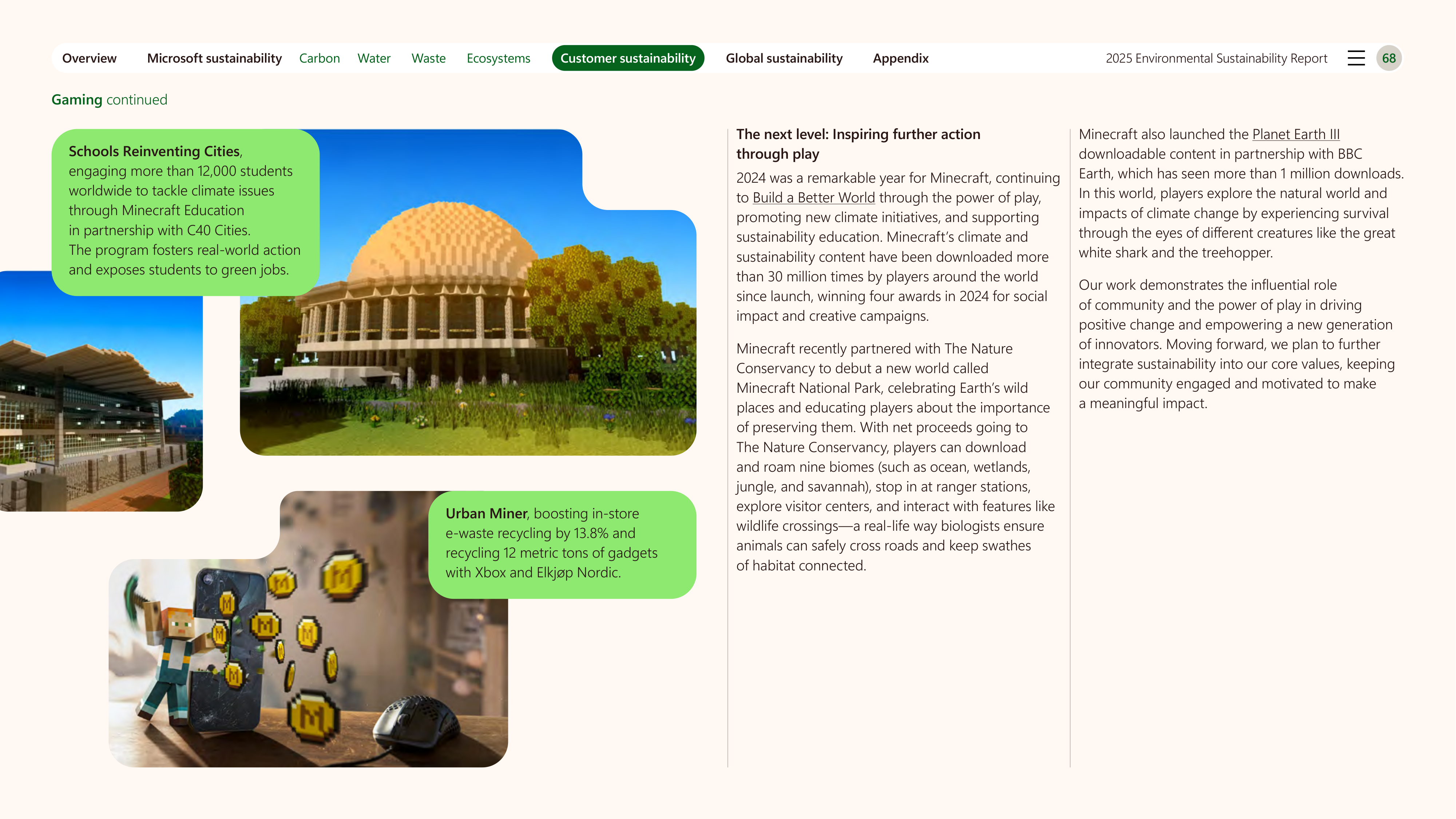
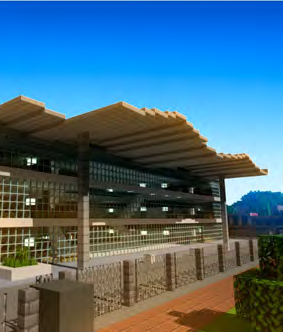
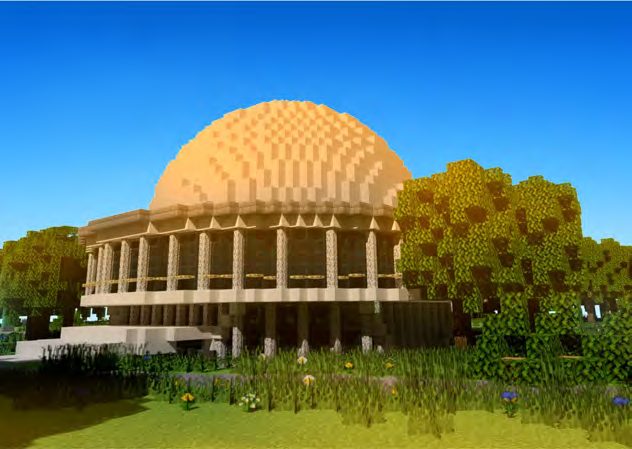


Schools Reinventing Cities
,
engaging more than 12,000 students
worldwide to tackle climate issues
through Minecraft Education
in partnership with C40 Cities.
The program fosters real-world action
and exposes students to green jobs.
Urban Miner
, boosting in-store
e-waste recycling by 13.8% and
recycling 12 metric tons of gadgets
with Xbox and Elkjøp Nordic.
The next level: Inspiring further action
through play
2024 was a remarkable year for Minecraft, continuing
to Build a Better World through the power of play,
promoting new climate initiatives, and supporting
sustainability education. Minecraft’s climate and
sustainability content have been downloaded more
than 30 million times by players around the world
since launch, winning four awards in 2024 for social
impact and creative campaigns.
Minecraft recently partnered with The Nature
Conservancy to debut a new world called
Minecraft National Park, celebrating Earth’s wild
places and educating players about the importance
of preserving them. With net proceeds going to
The Nature Conservancy, players can download
and roam nine biomes (such as ocean, wetlands,
jungle, and savannah), stop in at ranger stations,
explore visitor centers, and interact with features like
wildlife crossings—a real-life way biologists ensure
animals can safely cross roads and keep swathes
of habitat connected.
Minecraft also launched the Planet Earth III
downloadable content in partnership with BBC
Earth, which has seen more than 1 million downloads.
In this world, players explore the natural world and
impacts of climate change by experiencing survival
through the eyes of different creatures like the great
white shark and the treehopper.
Our work demonstrates the influential role
of community and the power of play in driving
positive change and empowering a new generation
of innovators. Moving forward, we plan to further
integrate sustainability into our core values, keeping
our community engaged and motivated to make
a meaningful impact.
Gaming
continued
Microsoft sustainability
Carbon
Water
Waste
Ecosystems
Overview
Customer sustainability
Global sustainability
Appendix
68
2025 Environmental Sustainability Report
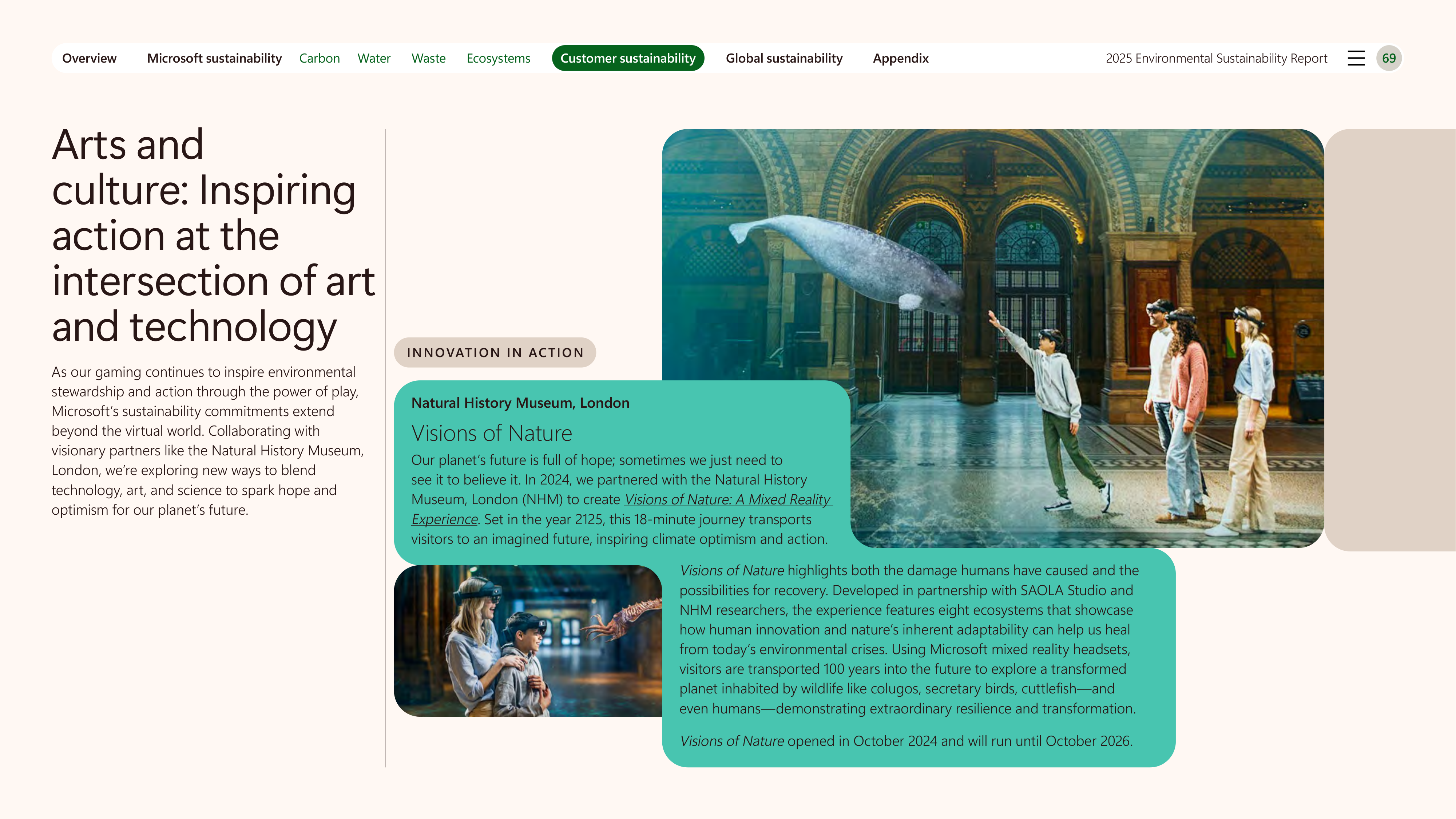



Arts and
culture: Inspiring
action at the
intersection of art
and technology
As our gaming continues to inspire environmental
stewardship and action through the power of play,
Microsoft’s sustainability commitments extend
beyond the virtual world. Collaborating with
visionary partners like the Natural History Museum,
London, we’re exploring new ways to blend
technology, art, and science to spark hope and
optimism for our planet’s future.
INNOVATION IN ACTION
Natural History Museum, London
Visions of Nature
Our planet’s future is full of hope; sometimes we just need to
see it to believe it. In 2024, we partnered with the Natural History
Museum, London (NHM) to create Visions of Nature: A Mixed Reality
Experience. Set in the year 2125, this 18-minute journey transports
visitors to an imagined future, inspiring climate optimism and action.
Visions of Nature highlights both the damage humans have caused and the
possibilities for recovery. Developed in partnership with SAOLA Studio and
NHM researchers, the experience features eight ecosystems that showcase
how human innovation and nature’s inherent adaptability can help us heal
from today’s environmental crises. Using Microsoft mixed reality headsets,
visitors are transported 100 years into the future to explore a transformed
planet inhabited by wildlife like colugos, secretary birds, cuttlefish—and
even humans—demonstrating extraordinary resilience and transformation.
Visions of Nature opened in October 2024 and will run until October 2026.
Microsoft sustainability
Carbon
Water
Waste
Ecosystems
Overview
Customer sustainability
Global sustainability
Appendix
69
2025 Environmental Sustainability Report
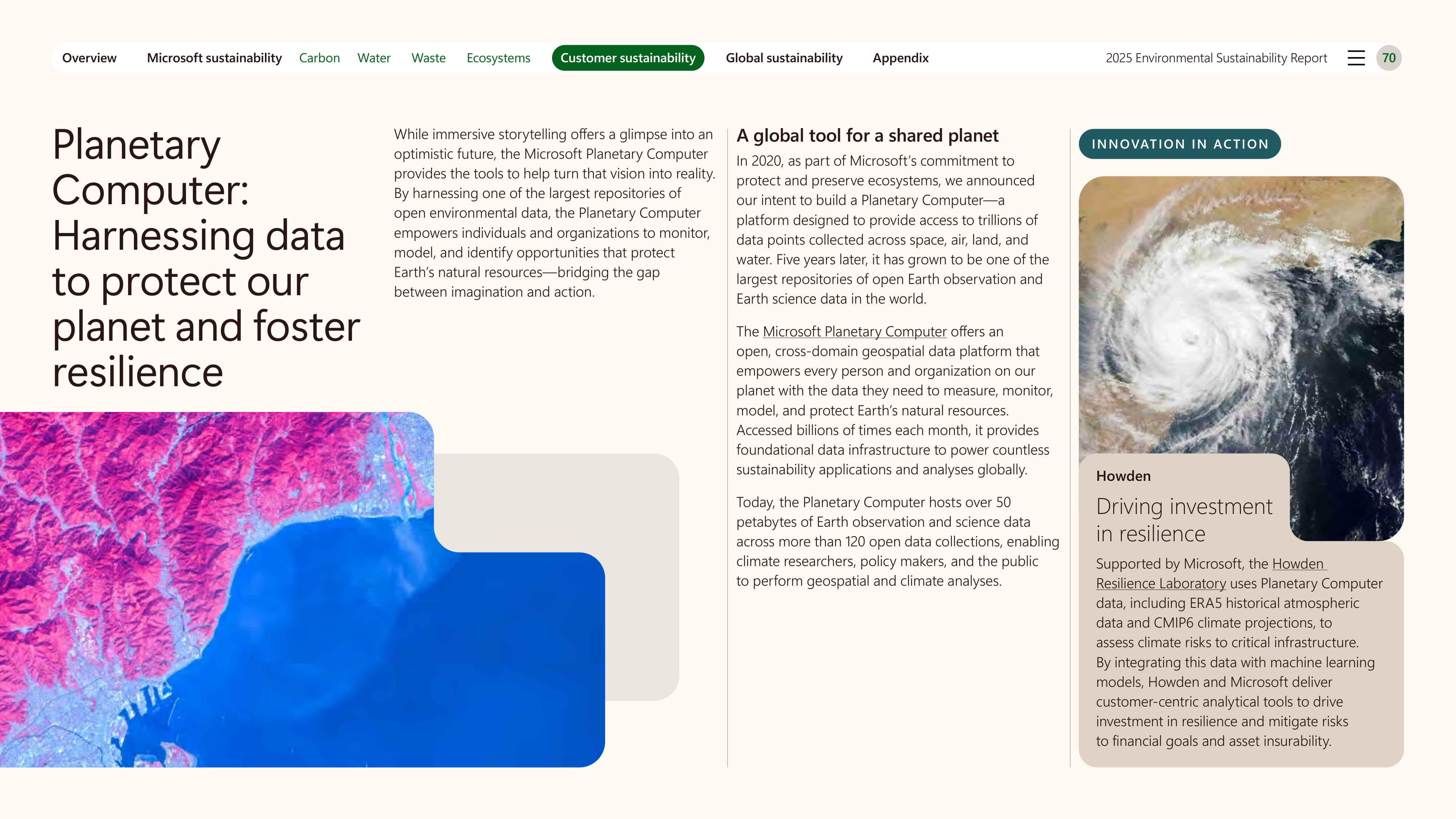


Planetary
Computer:
Harnessing data
to protect our
planet and foster
resilience
While immersive storytelling offers a glimpse into an
optimistic future, the Microsoft Planetary Computer
provides the tools to help turn that vision into reality.
By harnessing one of the largest repositories of
open environmental data, the Planetary Computer
empowers individuals and organizations to monitor,
model, and identify opportunities that protect
Earth’s natural resources—bridging the gap
between imagination and action.
A global tool for a shared planet
In 2020, as part of Microsoft’s commitment to
protect and preserve ecosystems, we announced
our intent to build a Planetary Computer—a
platform designed to provide access to trillions of
data points collected across space, air, land, and
water. Five years later, it has grown to be one of the
largest repositories of open Earth observation and
Earth science data in the world.
The Microsoft Planetary Computer offers an
open, cross-domain geospatial data platform that
empowers every person and organization on our
planet with the data they need to measure, monitor,
model, and protect Earth’s natural resources.
Accessed billions of times each month, it provides
foundational data infrastructure to power countless
sustainability applications and analyses globally.
Today, the Planetary Computer hosts over 50
petabytes of Earth observation and science data
across more than 120 open data collections, enabling
climate researchers, policy makers, and the public
to perform geospatial and climate analyses.
INNOVATION IN ACTION
Howden
Driving investment
in resilience
Supported by Microsoft, the Howden
Resilience Laboratory uses Planetary Computer
data, including ERA5 historical atmospheric
data and CMIP6 climate projections, to
assess climate risks to critical infrastructure.
By integrating this data with machine learning
models, Howden and Microsoft deliver
customer-centric analytical tools to drive
investment in resilience and mitigate risks
to financial goals and asset insurability.
Microsoft sustainability
Carbon
Water
Waste
Ecosystems
Overview
Customer sustainability
Global sustainability
Appendix
70
2025 Environmental Sustainability Report
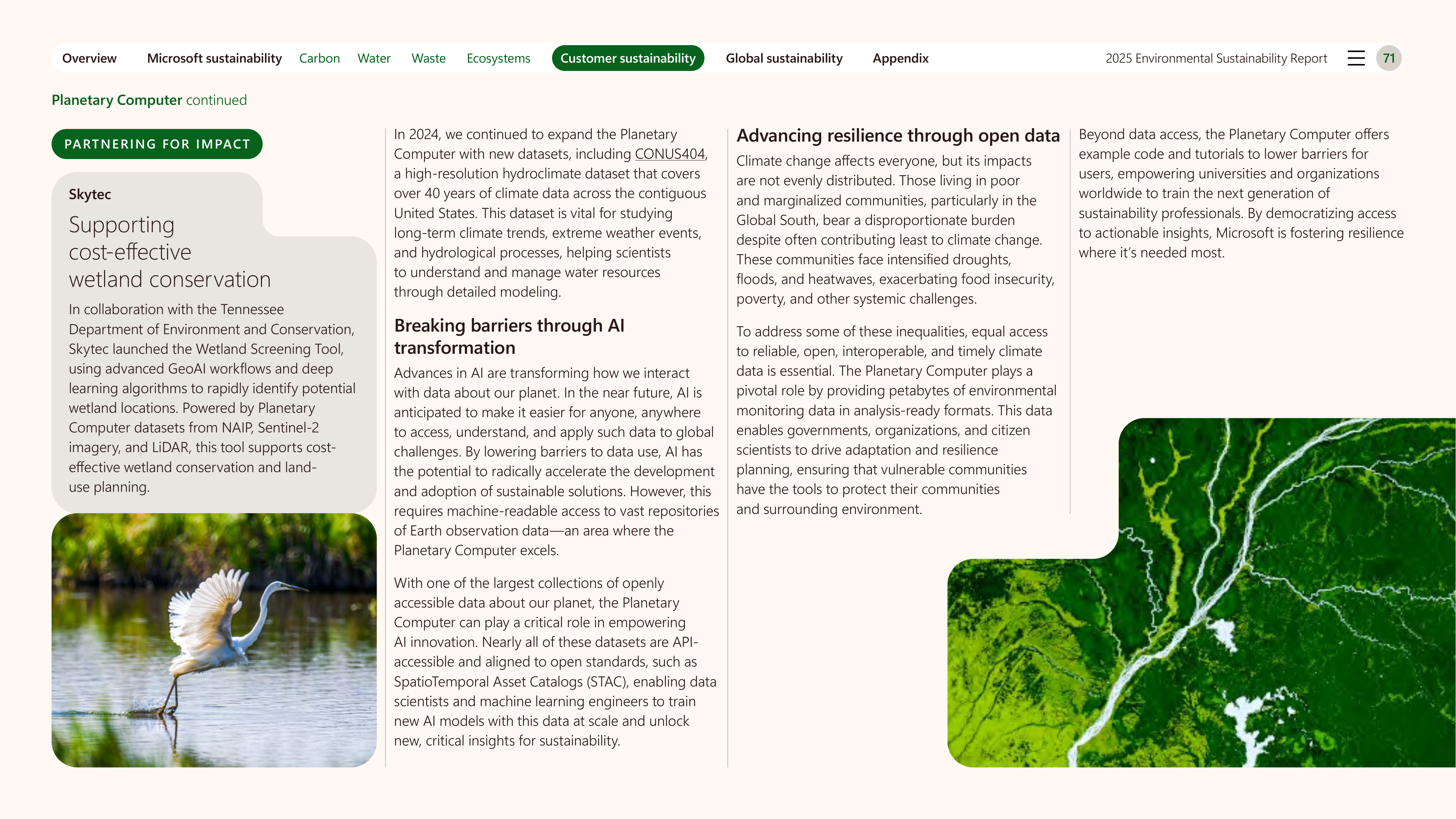


Planetary Computer
continued
PARTNERING FOR IMPACT
Skytec
Supporting
cost-effective
wetland conservation
In collaboration with the Tennessee
Department of Environment and Conservation,
Skytec launched the Wetland Screening Tool,
using advanced GeoAI workflows and deep
learning algorithms to rapidly identify potential
wetland locations. Powered by Planetary
Computer datasets from NAIP, Sentinel-2
imagery, and LiDAR, this tool supports cost-
effective wetland conservation and land-
use planning.
In 2024, we continued to expand the Planetary
Computer with new datasets, including CONUS404,
a high-resolution hydroclimate dataset that covers
over 40 years of climate data across the contiguous
United States. This dataset is vital for studying
long-term climate trends, extreme weather events,
and hydrological processes, helping scientists
to understand and manage water resources
through detailed modeling.
Breaking barriers through AI
transformation
Advances in AI are transforming how we interact
with data about our planet. In the near future, AI is
anticipated to make it easier for anyone, anywhere
to access, understand, and apply such data to global
challenges. By lowering barriers to data use, AI has
the potential to radically accelerate the development
and adoption of sustainable solutions. However, this
requires machine-readable access to vast repositories
of Earth observation data—an area where the
Planetary Computer excels.
With one of the largest collections of openly
accessible data about our planet, the Planetary
Computer can play a critical role in empowering
AI innovation. Nearly all of these datasets are API-
accessible and aligned to open standards, such as
SpatioTemporal Asset Catalogs (STAC), enabling data
scientists and machine learning engineers to train
new AI models with this data at scale and unlock
new, critical insights for sustainability.
Advancing resilience through open data
Climate change affects everyone, but its impacts
are not evenly distributed. Those living in poor
and marginalized communities, particularly in the
Global South, bear a disproportionate burden
despite often contributing least to climate change.
These communities face intensified droughts,
floods, and heatwaves, exacerbating food insecurity,
poverty, and other systemic challenges.
To address some of these inequalities, equal access
to reliable, open, interoperable, and timely climate
data is essential. The Planetary Computer plays a
pivotal role by providing petabytes of environmental
monitoring data in analysis-ready formats. This data
enables governments, organizations, and citizen
scientists to drive adaptation and resilience
planning, ensuring that vulnerable communities
have the tools to protect their communities
and surrounding environment.
Beyond data access, the Planetary Computer offers
example code and tutorials to lower barriers for
users, empowering universities and organizations
worldwide to train the next generation of
sustainability professionals. By democratizing access
to actionable insights, Microsoft is fostering resilience
where it’s needed most.
Microsoft sustainability
Carbon
Water
Waste
Ecosystems
Overview
Customer sustainability
Global sustainability
Appendix
71
2025 Environmental Sustainability Report

Global sustainability
Catalyzing
global impact
Microsoft’s actions alone cannot solve the climate
crisis. As a global technology leader, we are
also committed to helping develop the market
conditions and standards and launch solutions
that will support a net zero economy. We’re
focused on accelerating the availability of new
climate technologies, strengthening our climate
policy agenda, helping to develop a more reliable
and interoperable carbon accounting system,
advocating for skilling programs to expand the
green workforce, and working to help enable a
just energy transition.
In this section
Overview
72
Investing in innovation
73
Charting new frontiers in AI innovation
77
Shaping policy for a sustainable future
81
Scaling impact through green skilling
85
Microsoft sustainability
Carbon
Water
Waste
Ecosystems
Overview
Customer sustainability
Global sustainability
Appendix
72
2025 Environmental Sustainability Report
Investing in
innovation:
Building climate
markets to reach
net zero
Microsoft Climate Innovation Fund
For Microsoft to do well, the world needs to do well.
This principle underscores our global sustainability
commitments, where we work to develop solutions
that support not only Microsoft’s goals but also
those of our customers and across our global
value chain.
Since its inception in 2020, the Microsoft Climate
Innovation Fund (CIF) has been a cornerstone of
our sustainability efforts. Over the past four years,
annual climate capital flows have nearly tripled from
$600 billion to approximately $2.1 trillion globally.
However, this remains far below the $4.5 trillion
per year needed for a net zero transition by 2050.
18
Through CIF, Microsoft has invested in accelerating
the adoption of climate solutions. CIF supports
technologies, investment vehicles, and invest-to-
procure transactions that grow the market supply
of climate solutions, while focusing on underfunded
markets and ensuring climate equity co-benefits
aligned with Microsoft’s goals.
Investing in a portfolio to innovate,
accelerate, and scale
With a $1 billion investment mandate, CIF has
allocated over $793 million in capital to bring
new supply to market and accelerate adoption
and cost reduction in key target technologies.
While private market investments in climate tech
have doubled from 2020 to 2022, sectors critical
to Microsoft’s Scope 3 carbon footprint—industry
and manufacturing, building materials, and carbon
management—account for approximately 20%
of private market climate technology transactions.
19
CIF prioritizes these underfunded sectors.
$793
million
CIF has allocated over $793 million
in capital to bring new supply to
market and accelerate adoption
and cost reduction in key
target technologies.
CIF’s portfolio has expanded to 63 investees to date,
split between 46 companies and project finance
entities and 17 fund managers across energy
systems, industrial supply chains, and natural
systems. These investments execute our invest-to-
procure strategy, ensuring our capital catalyzes the
scaling of innovative climate technologies globally
while supporting our commitments.
CIF was launched in 2020 with a dual mandate
to innovate and to accelerate sustainability
markets. Since then, our investments have
laid the groundwork for sustainable growth in
AI, both through direct decarbonization and
enabling technologies across our core focus areas.
As climate solutions mature and as we advance our
sustainability roadmap to 2030, CIF has added a
third mandate: to scale adoption of climate solutions.
Moving forward, we will focus on invest-to-procure
strategies that have proven to be highly effective in
bringing new market supply online at scale.
Microsoft sustainability
Carbon
Water
Waste
Ecosystems
Overview
Customer sustainability
Global sustainability
Appendix
73
2025 Environmental Sustainability Report
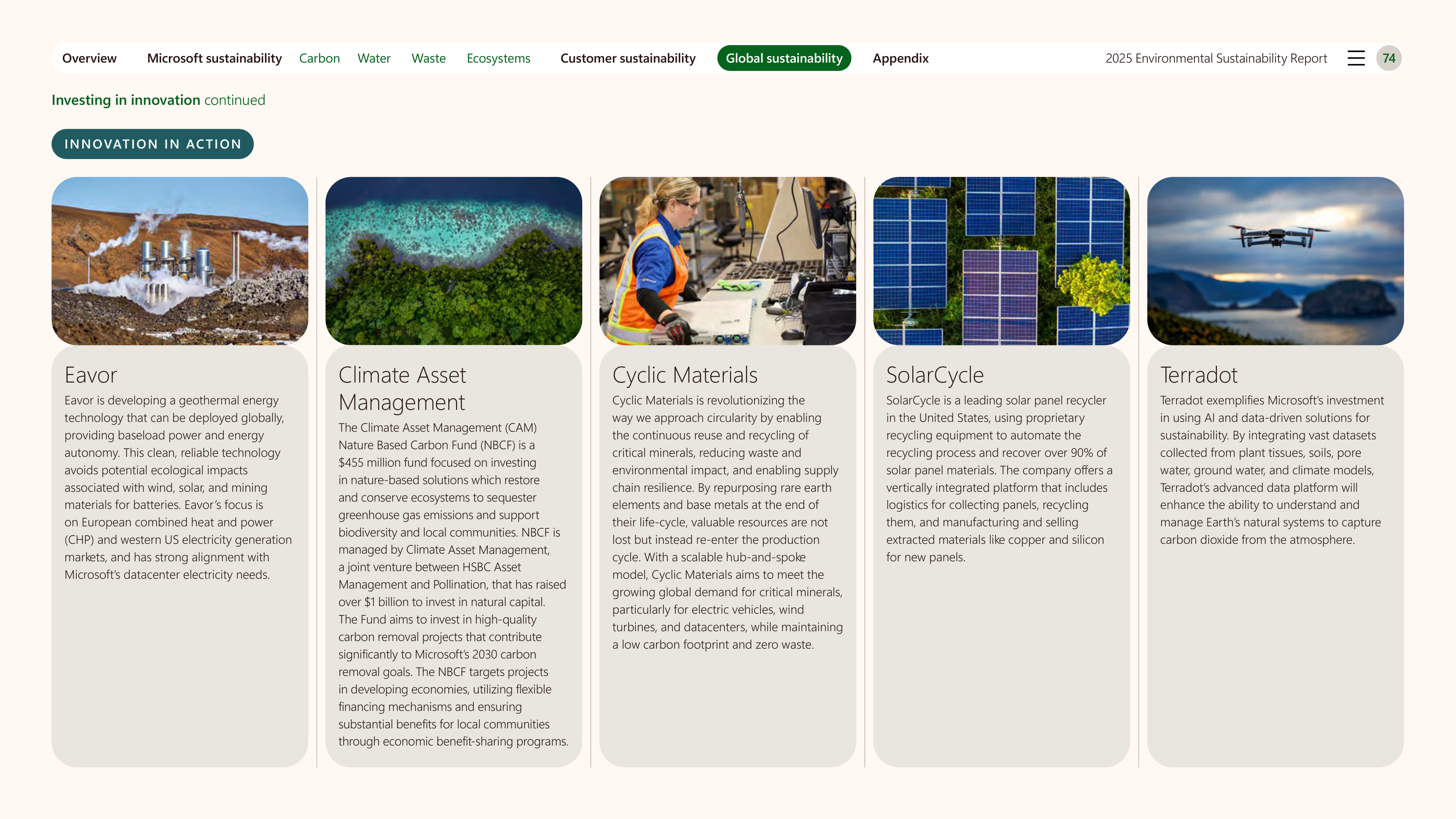
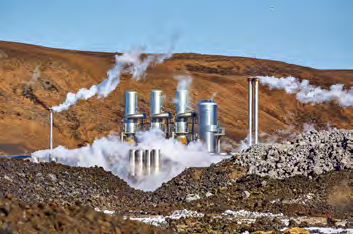

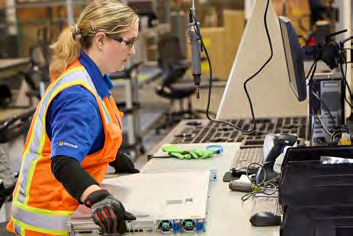
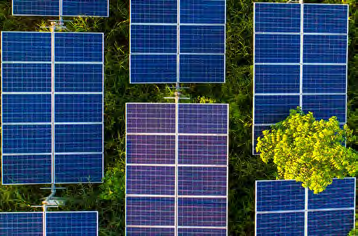
INNOVATION IN ACTION
Eavor
Eavor is developing a geothermal energy
technology that can be deployed globally,
providing baseload power and energy
autonomy. This clean, reliable technology
avoids potential ecological impacts
associated with wind, solar, and mining
materials for batteries. Eavor’s focus is
on European combined heat and power
(CHP) and western US electricity generation
markets, and has strong alignment with
Microsoft’s datacenter electricity needs.
Climate Asset
Management
The Climate Asset Management (CAM)
Nature Based Carbon Fund (NBCF) is a
$455 million fund focused on investing
in nature-based solutions which restore
and conserve ecosystems to sequester
greenhouse gas emissions and support
biodiversity and local communities. NBCF is
managed by Climate Asset Management,
a joint venture between HSBC Asset
Management and Pollination, that has raised
over $1 billion to invest in natural capital.
The Fund aims to invest in high-quality
carbon removal projects that contribute
significantly to Microsoft’s 2030 carbon
removal goals. The NBCF targets projects
in developing economies, utilizing flexible
financing mechanisms and ensuring
substantial benefits for local communities
through economic benefit-sharing programs.
Cyclic Materials
Cyclic Materials is revolutionizing the
way we approach circularity by enabling
the continuous reuse and recycling of
critical minerals, reducing waste and
environmental impact, and enabling supply
chain resilience. By repurposing rare earth
elements and base metals at the end of
their life-cycle, valuable resources are not
lost but instead re-enter the production
cycle. With a scalable hub-and-spoke
model, Cyclic Materials aims to meet the
growing global demand for critical minerals,
particularly for electric vehicles, wind
turbines, and datacenters, while maintaining
a low carbon footprint and zero waste.
SolarCycle
SolarCycle is a leading solar panel recycler
in the United States, using proprietary
recycling equipment to automate the
recycling process and recover over 90% of
solar panel materials. The company offers a
vertically integrated platform that includes
logistics for collecting panels, recycling
them, and manufacturing and selling
extracted materials like copper and silicon
for new panels.
Terradot
Terradot exemplifies Microsoft’s investment
in using AI and data-driven solutions for
sustainability. By integrating vast datasets
collected from plant tissues, soils, pore
water, ground water, and climate models,
Terradot’s advanced data platform will
enhance the ability to understand and
manage Earth’s natural systems to capture
carbon dioxide from the atmosphere.
Investing in innovation
continued
Microsoft sustainability
Carbon
Water
Waste
Ecosystems
Overview
Customer sustainability
Global sustainability
Appendix
74
2025 Environmental Sustainability Report
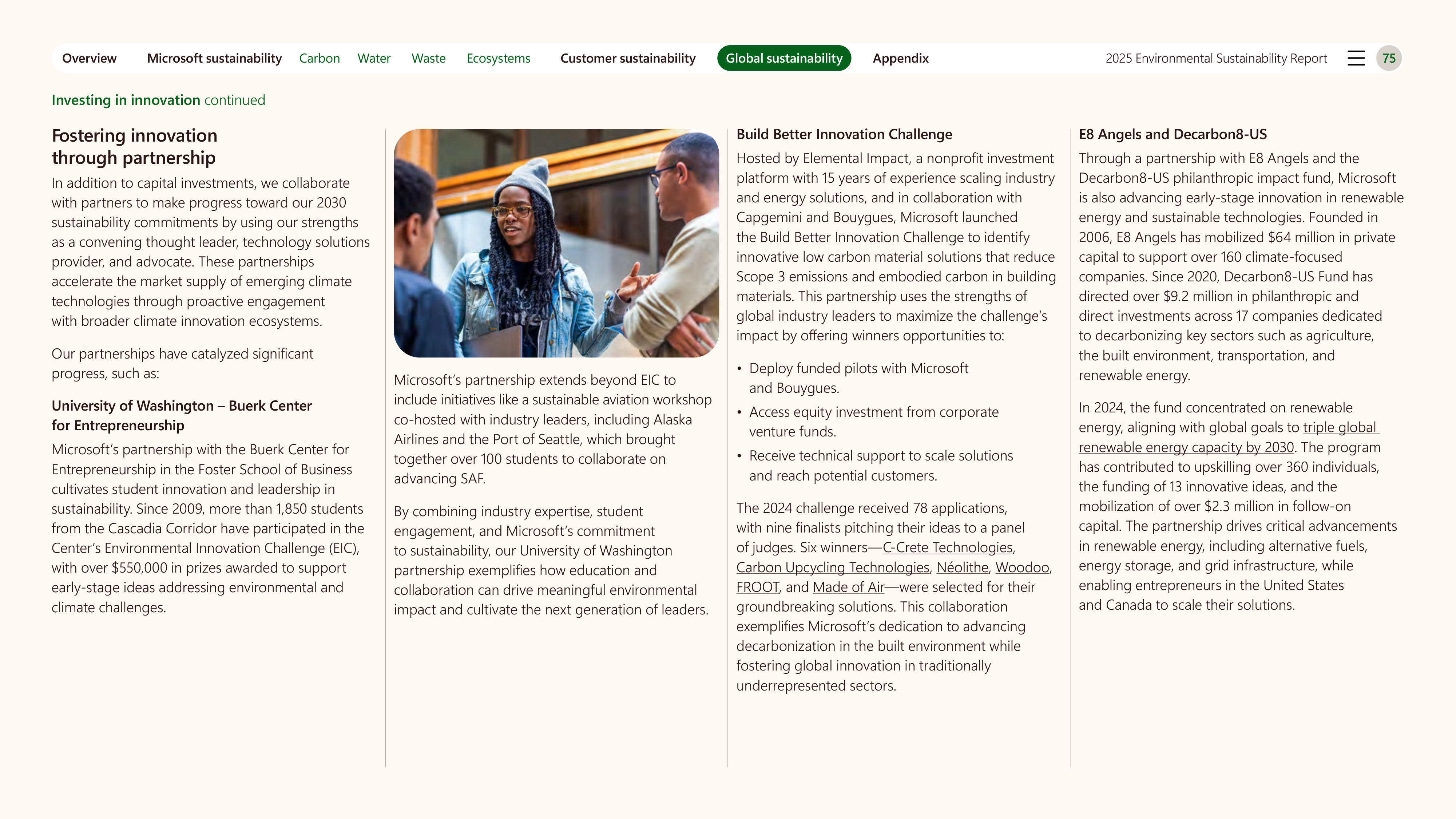
Fostering innovation
through partnership
In addition to capital investments, we collaborate
with partners to make progress toward our 2030
sustainability commitments by using our strengths
as a convening thought leader, technology solutions
provider, and advocate. These partnerships
accelerate the market supply of emerging climate
technologies through proactive engagement
with broader climate innovation ecosystems.
Our partnerships have catalyzed significant
progress, such as:
University of Washington – Buerk Center
for Entrepreneurship
Microsoft’s partnership with the Buerk Center for
Entrepreneurship in the Foster School of Business
cultivates student innovation and leadership in
sustainability. Since 2009, more than 1,850 students
from the Cascadia Corridor have participated in the
Center’s Environmental Innovation Challenge (EIC),
with over $550,000 in prizes awarded to support
early-stage ideas addressing environmental and
climate challenges.
Microsoft’s partnership extends beyond EIC to
include initiatives like a sustainable aviation workshop
co-hosted with industry leaders, including Alaska
Airlines and the Port of Seattle, which brought
together over 100 students to collaborate on
advancing SAF.
By combining industry expertise, student
engagement, and Microsoft’s commitment
to sustainability, our University of Washington
partnership exemplifies how education and
collaboration can drive meaningful environmental
impact and cultivate the next generation of leaders.
Build Better Innovation Challenge
Hosted by Elemental Impact, a nonprofit investment
platform with 15 years of experience scaling industry
and energy solutions, and in collaboration with
Capgemini and Bouygues, Microsoft launched
the Build Better Innovation Challenge to identify
innovative low carbon material solutions that reduce
Scope 3 emissions and embodied carbon in building
materials. This partnership uses the strengths of
global industry leaders to maximize the challenge’s
impact by offering winners opportunities to:
•
Deploy funded pilots with Microsoft
and Bouygues.
•
Access equity investment from corporate
venture funds.
•
Receive technical support to scale solutions
and reach potential customers.
The 2024 challenge received 78 applications,
with nine finalists pitching their ideas to a panel
of judges. Six winners—C-Crete Technologies,
Carbon Upcycling Technologies, Néolithe, Woodoo,
FROOT, and Made of Air—were selected for their
groundbreaking solutions. This collaboration
exemplifies Microsoft’s dedication to advancing
decarbonization in the built environment while
fostering global innovation in traditionally
underrepresented sectors.
E8 Angels and Decarbon8-US
Through a partnership with E8 Angels and the
Decarbon8-US philanthropic impact fund, Microsoft
is also advancing early-stage innovation in renewable
energy and sustainable technologies. Founded in
2006, E8 Angels has mobilized $64 million in private
capital to support over 160 climate-focused
companies. Since 2020, Decarbon8-US Fund has
directed over $9.2 million in philanthropic and
direct investments across 17 companies dedicated
to decarbonizing key sectors such as agriculture,
the built environment, transportation, and
renewable energy.
In 2024, the fund concentrated on renewable
energy, aligning with global goals to triple global
renewable energy capacity by 2030. The program
has contributed to upskilling over 360 individuals,
the funding of 13 innovative ideas, and the
mobilization of over $2.3 million in follow-on
capital. The partnership drives critical advancements
in renewable energy, including alternative fuels,
energy storage, and grid infrastructure, while
enabling entrepreneurs in the United States
and Canada to scale their solutions.
Investing in innovation
continued
Microsoft sustainability
Carbon
Water
Waste
Ecosystems
Overview
Customer sustainability
Global sustainability
Appendix
75
2025 Environmental Sustainability Report
Overview
Microsoft sustainability
Carbon
Water
Waste
Ecosystems
Customer sustainability
Global sustainability
Appendix
2025 Environmental Sustainability Report
76
Investing in innovation
continued
Advancing equity and
climate innovation
Climate change demands solutions that deliver
meaningful impact to the communities most
affected. CIF remains committed to advancing equity
alongside innovation; 22% of CEOs and founders
in our portfolio are women and 21% are from
underrepresented backgrounds, and 19% of capital is
allocated toward the Global South. Additionally, CIF
is partnering with leading programs globally to build
an inclusive innovation ecosystem:
Advancing Climate and Clean Energy
Leaders (ACCEL)
This accelerator, launched by Greentown Labs
and Browning the Green Space (BGS), bolsters
climate tech startups and founders from historically
underserved communities by addressing
structural inequalities through non-dilutive
funding, networking connections, resources,
and opportunities. The program combines
education, prototyping support, mentorship,
and networking to accelerate pilots, partnerships,
and funding. Supported by CIF, the program
has equipped over 100 entrepreneurs with skills,
brought 37 climate solutions to market, and
mobilized more than $18 million in early-stage
capital for sustainability initiatives.
Kinjani African Climate Talent Accelerator
This incubation and investment program empowers
African entrepreneurs and science-driven innovators
by fostering gender balance, developing critical skills,
expanding professional networks, and providing
hands-on support to develop talent in critical
sectors. Its inaugural cohort includes 29 African
founders—55% female—who are developing
regenerative solutions in essential areas such as
food systems, materials, urbanization, and minerals,
which are removing carbon, increasing biodiversity
and water access, and improving livelihoods.
Accelerating progress through AI-
driven product investments
Earth’s growing data footprint offers immense
potential for sustainability. For example, a typical
farm alone generates around 500,000 data points
daily, projected to reach 4 million by 2036.
20
Recognizing the critical role of data in understanding
and managing Earth’s natural systems, CIF has
invested in AI-driven companies with a unique
digital product vision.
By investing in AI-driven companies, CIF goes
beyond providing capital to accelerate innovation—
it connects these companies to a robust ecosystem
of support. Tailored programs help CIF portfolio
companies scale their impact at every stage of
their journey. These programs include:
• Microsoft Founders Hub—a program
designed specifically to support startups with
a
comprehensive suite of benefits.
• Microsoft AI Co-Innovation Lab—a one-week
lab available to any Microsoft customer or partner,
offering
complimentary
personalized
development
sprints for engineering teams to reduce time
to market.
• Collaboration with Microsoft teams—opportunities
to engage with Microsoft specialists focused
on harnessing Earth system data to develop
breakthrough products and research, including
our engineering teams building solutions like the
Azure Data Manager for Agriculture and Microsoft
Planetary Computer, as well as the researchers and
data scientists with Microsoft Climate Research
Initiative and AI for Good.
Building scalable sustainability markets
Looking ahead, CIF’s strategy will focus on scaling
climate technologies as part of Microsoft’s net zero
roadmap, using AI to drive sustainability outcomes,
and integrating climate equity into new market
development. By design, CIF invests alongside a
diverse network of over 250 co-investors, including
both financial venture capital firms and corporations,
to foster future markets. CIF’s $793 million in
commitments has catalyzed over $3.3 billion in
follow-on funding, achieving a multiplier effect
greater than four times. Moving forward, Microsoft
will continue investing to scale sustainability
by combining investment, procurement, and
partnerships, accelerating the global transition
to a sustainable, equitable future.
$3.3
billion
CIF’s $793 million in commitments
has catalyzed over $3.3 billion in
follow-on funding.
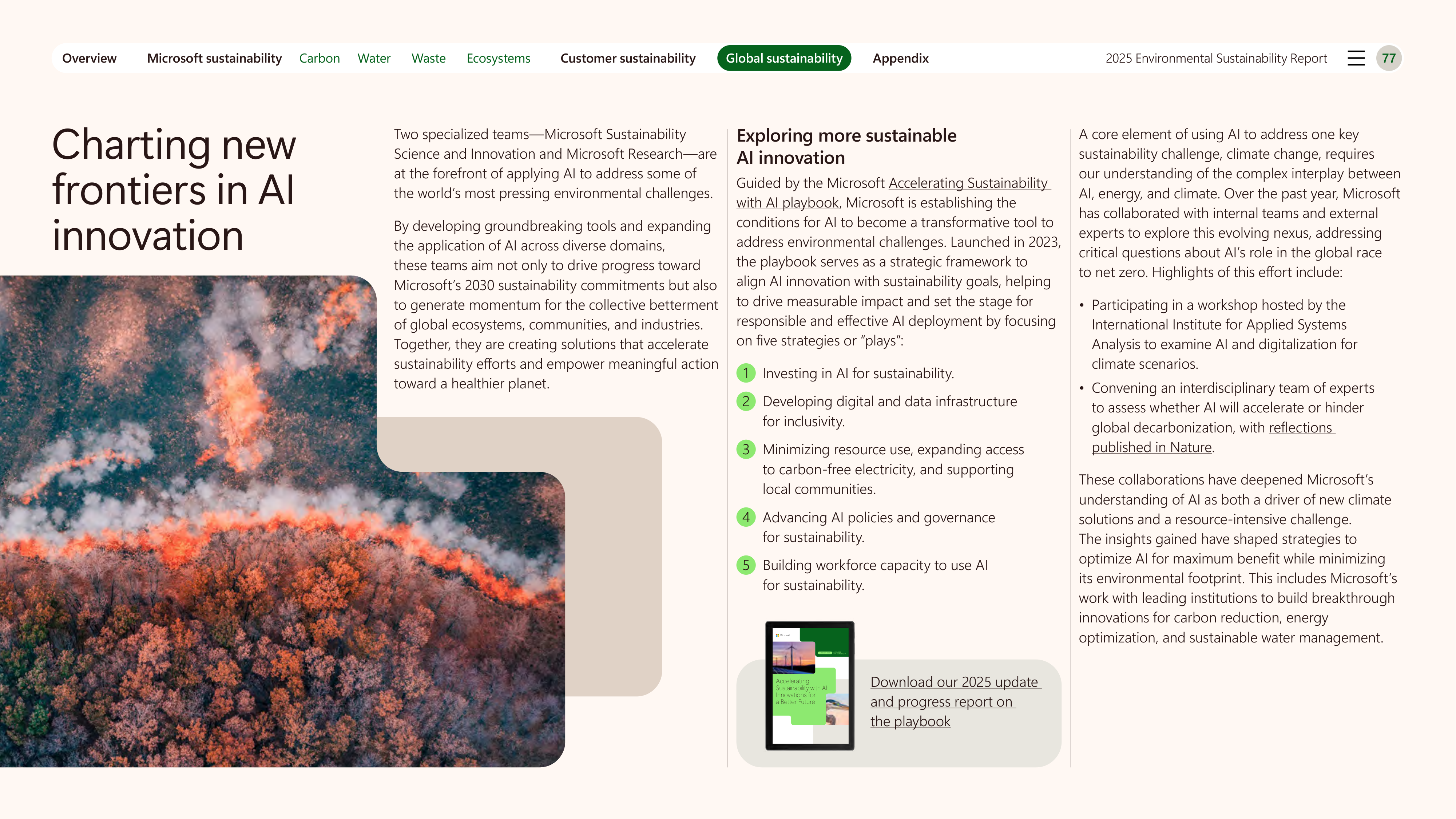
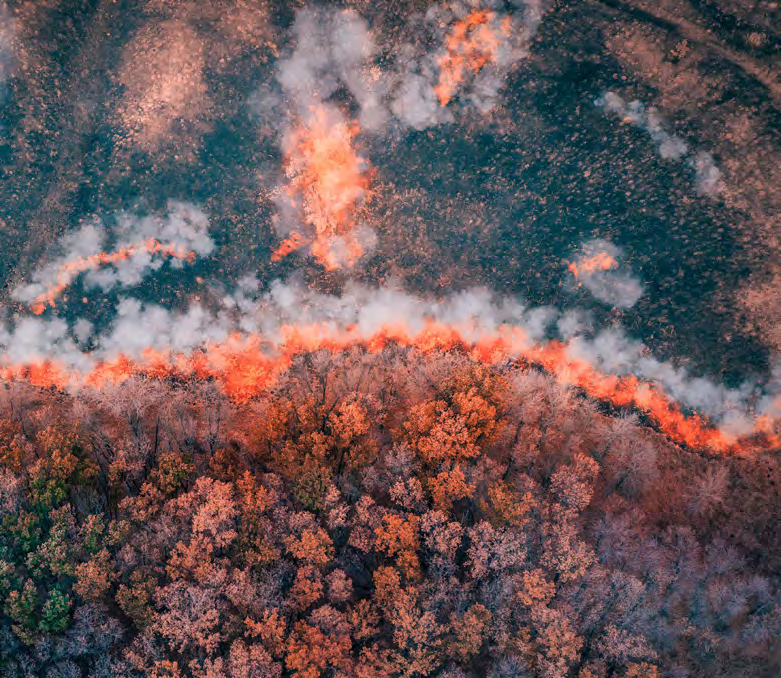



Microsoft sustainability
Carbon
Water
Waste
Ecosystems
Overview
Customer sustainability
Global sustainability
Appendix
2025 Environmental Sustainability Report
77
Charting new
frontiers in AI
innovation
Two specialized teams—Microsoft Sustainability
Science and Innovation and Microsoft Research—are
at the forefront of applying AI to address some of
the world’s most pressing environmental challenges.
By developing groundbreaking tools and expanding
the application of AI across diverse domains,
these teams aim not only to drive progress toward
Microsoft’s 2030 sustainability commitments but also
to generate momentum for the collective betterment
of global ecosystems, communities, and industries.
Together, they are creating solutions that accelerate
sustainability efforts and
empower meaningful action
toward a healthier planet.
Exploring more sustainable
AI innovation
Guided by the Microsoft Accelerating Sustainability
with AI playbook, Microsoft is establishing the
conditions for AI to become a transformative tool to
address environmental challenges. Launched in 2023,
the playbook serves as a strategic framework to
align AI innovation with sustainability goals, helping
to drive measurable impact and set the stage for
responsible and effective AI deployment by focusing
on five
strategies or “plays”:
1 Investing in AI for sustainability.
2 Developing digital and data infrastructure
for inclusivity.
3 Minimizing resource use, expanding access
to carbon-free electricity, and supporting
local communities.
4 Advancing AI policies and governance
for sustainability.
5 Building workforce capacity to use AI
for sustainability.
Accelerating
Sustainability with AI:
Innovations for
a Better Future
Download our 2025 update
and progress report on
the playbook
A core element of using AI to address one key
sustainability challenge, climate change, requires
our understanding of the complex interplay between
AI, energy, and climate. Over the past year, Microsoft
has collaborated with internal teams and external
experts to explore this evolving nexus, addressing
critical questions about AI’s role in the global race
to
net zero. Highlights of this effort include:
• Participating in a workshop hosted by the
International Institute for Applied Systems
Analysis to examine AI and digitalization for
climate scenarios.
• Convening an interdisciplinary team of experts
to assess whether AI will accelerate or hinder
global decarbonization, with reflections
published in Nature.
These collaborations have deepened Microsoft’s
understanding of AI as both a driver of new climate
solutions and a resource-intensive challenge.
The insights gained have shaped strategies to
optimize AI for maximum benefit while minimizing
its environmental footprint. This includes Microsoft’s
work with leading institutions to build breakthrough
innovations for carbon reduction, energy
optimization, and sustainable water management.
ADVANCE
SUSTAINABILITY
JANUARY 2025
Microsoft sustainability
Carbon
Water
Waste
Ecosystems
Overview
Customer sustainability
Global sustainability
Appendix
2025 Environmental Sustainability Report
78
Charting new frontiers in AI innovation
continued
Advancing understanding of Earth’s
natural systems
Microsoft is combining AI and advanced
scientific tools to strengthen our understanding
of biodiversity and ecosystem health, carbon
budgets, and climate dynamics. These efforts
support policymakers, scientists, and organizations
in addressing environmental challenges and
improving global outcomes.
Supporting biodiversity and ecosystem reporting
In collaboration with internal teams and external
partners, Microsoft has identified science-
based AI tools for biodiversity and ecosystem
reporting—now mandated by the European
Union Corporate Sustainability Reporting Directive
(CSRD), UK Biodiversity Net Gain law, and emerging
national regulations in Australia and China.
Collaborations with Planet Labs, the Gund Institute
for the Environment at the University of Vermont,
and the Natural Capital Project have enabled
the development of cost-effective strategies for
meeting these requirements. Using advanced
Earth observation tools such as automated camera
traps, bioacoustics, automated environmental DNA
samplers, and high-resolution satellite imagery,
these solutions provide robust methodologies for
monitoring and reporting ecosystem health at scale.
Investing in nature for sustainability
As we more effectively monitor nature, we can better
understand and prioritize whole ecosystem health in
investments for sustainability. Microsoft partnered
with organizations like CIFOR-ICRAF, the Wilkes
Center for Climate Science & Policy at the University
of Utah, and University of California Santa Cruz
to assess the opportunities and challenges for
companies to maximize their nature-positive
investments. This collaboration resulted in a white
paper outlining lessons from Microsoft’s own
nature strategy and identifying eight actionable
steps companies can take to overcome barriers
such as knowledge gaps, resource limitations,
and incentive misalignment. This paper emphasizes
how AI is already playing a key role in addressing
these challenges, enabling organizations to
better understand and manage their impact
on natural systems.
Understanding and managing Earth’s
carbon budgets
In collaboration with Tsinghua University, the
French Laboratory for Climate and Environmental
Sciences, and other leading global scientists,
Microsoft Research has developed the world’s first
near real-time global carbon budget. This analysis
provides monthly updates with only a three-month
delay, offering important insights into carbon fluxes.
Analysis of 2023 data revealed a steep decline in the
land carbon sink to just 0.14 gigatons of carbon per
year—the lowest in nearly two decades. This decline,
driven by extreme climate events, highlights the
fragility of terrestrial carbon systems. Despite stable
fossil fuel emissions, increased oceanic carbon
uptake was insufficient to counterbalance the loss
in land-based sequestration, resulting in a sharp
rise in atmospheric carbon dioxide. The Mauna Loa
Observatory recorded a 3.37-ppm increase in 2023,
marking the highest carbon dioxide levels ever.
By delivering timely, actionable data on carbon
fluxes
and their underlying causes, this project
enhances global understanding of carbon dynamics
and informs sustainability initiatives. It demonstrates
how innovative technologies and research can
empower policymakers and organizations to
address urgent climate challenges and work
toward carbon neutrality.
Transforming weather and climate forecasting
Enhancing our understanding of global
weather patterns
Aurora, Microsoft’s cutting-edge AI foundation
model for environmental forecasting, uses over
1.3 billion parameters to predict weather patterns and
atmospheric processes like air pollution, and to deliver
high-resolution global forecasts. Unlike traditional
models that train on a single dataset, Aurora
was pre-trained on more than a million hours of
diverse weather and climate data, building general
knowledge before being fine-tuned for specific tasks.
This approach enables superior performance in data-
sparse tasks, such as atmospheric pollution prediction
and extreme weather scenario modeling, offering
more accurate forecasts and timely interventions.
By improving environmental monitoring and helping
mitigate the impacts of extreme weather events,
Aurora advances sustainability and resilience efforts.
Sub-seasonal climate forecasting
Collaborating with the Massachusetts Institute of
Technology and Atmospheric and Environmental
Research, Microsoft has developed an adaptive bias
correction framework that uses machine learning to
systematically correct errors in dynamical forecasts,
enhancing forecasts two to six weeks in advance.
This tool significantly improves predictions, helping
water managers allocate assets efficiently, enabling
early wildfire prevention, and reducing the human
and economic costs of extreme events like droughts
and floods.

Microsoft sustainability
Carbon
Water
Waste
Ecosystems
Overview
Customer sustainability
Global sustainability
Appendix
2025 Environmental Sustainability Report
79
Charting new frontiers in AI innovation
continued
Revolutionizing energy systems
Microsoft is combining advanced AI technologies
with collaborative partnerships to transform energy
systems, creating solutions that address energy
storage, distribution, and resilience. These efforts
support the transition to renewable energy while
empowering communities to achieve greater
energy autonomy and sustainability.
Grid energy storage
In partnership with the University of Michigan,
Microsoft is developing cost-effective long-
duration energy storage technologies using organic
redox flow batteries. By applying generative AI to
design alternatives to vanadium, central to today’s
commercially mature flow batteries, these alternative
batteries aim to reduce reliance on critical minerals,
lower corrosion hazard, and support increased
renewable energy integration into the power grid.
AI-powered community solar microgrids
advancing energy resilience and equity
Frontline communities disproportionally face the
dual challenges of climate disasters and economic
inequality, often with limited access to sustainable
energy solutions. Microsoft is using AI to create solar
microgrids to empower these communities, allowing
them to generate, store, and distribute renewable
energy that aligns with their specific needs.
By reducing dependence on centralized utilities,
this project promotes fair energy pricing, enhances
resilience to climate disasters, and supports local
energy autonomy.
AI technology plays a critical role in predicting
energy demand and optimizing distribution,
ensuring
these systems operate more efficiently
and equitably. This project not only increases
the reliability of microgrids but also prepares
communities to participate in power purchase
agreements (PPAs), improving the long-term
financial viability for renewable energy projects
that contribute to both local resilience and global
decarbonization goals.
PARTNERING FOR IMPACT
Partnerships
Fostering
sustainability skills
To foster sustainability skills, Microsoft
collaborates with community partners such as
Remix: The Soul of Innovation, Ayika Solutions,
and Vicars Community Center Resilience Hub
to co-develop energy transition programs.
These initiatives promote environmental literacy
through co-design workshops, technology
demonstrations, and participatory planning
sessions that engage community members in
shaping their energy futures. By combining
technical innovation with community-driven
approaches, this project builds the knowledge,
capacity, and opportunities needed to create
pathways to sustainable change.
Innovating materials for
a circular economy
Through research and collaboration, Microsoft
is pioneering breakthroughs in material science to
promote circularity and sustainability. By developing
innovative polymer composites, these efforts pave
the way for more sustainable electronics and a
reduction in e-waste.
Composites for printed circuit boards
Through collaboration with the University of
Washington, Microsoft Research is advancing
circularity in polymer composites with a new class
of polymers known as vitrimers. Unlike conventional
polymers, vitrimers possess dynamic chemical bonds
that allow certain composites to be disassembled
and reassembled without compromising material
integrity. This property enables easier repair, reuse,
and recycling of electronic components, addressing
a major challenge in the sustainability of electronics.
These advancements have led to a functional
printed circuit board prototype that demonstrates
how vitrimers can facilitate component disassembly,
recycling, and reuse, paving the way for more
sustainable electronics manufacturing. Looking ahead,
we have developed generative AI methods for
design of next-generation vitrimers with enhanced
strength, flexibility, and recyclability. These improved
properties aim to expand the applicability of vitrimers
in advanced composites, driving greater material
efficiency and sustainability across industries.
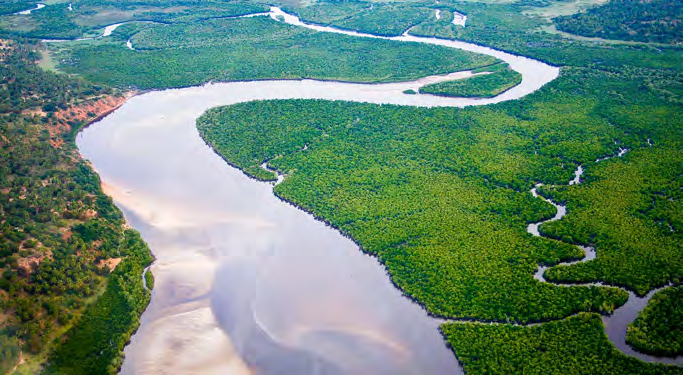
Microsoft sustainability
Carbon
Water
Waste
Ecosystems
Overview
Customer sustainability
Global sustainability
Appendix
2025 Environmental Sustainability Report
80
Charting new frontiers in AI innovation
continued
Optimizing building
and datacenter efficiency
Microsoft is using AI-driven systems to revolutionize
energy and water efficiency in buildings and
datacenters. These advancements deliver smarter,
more sustainable infrastructure while minimizing
resource consumption and operational impact.
Energy and water optimization
Microsoft has developed reinforcement learning
(RL)-powered systems to improve traditional
heating, ventilation, and air conditioning (HVAC)
controls, allowing autonomous, real-time energy-
efficient decision making to optimize operations.
Using offline
reinforcement learning, which trains on
a static dataset to reduce reliance on continuous data
acquisition, we achieved over 30% energy savings
in one of our Redmond campus buildings while
maintaining comfort.
The application of RL extends to datacenters, where
trials in a Phoenix-based facility demonstrated a
21% reduction in water consumption. The RL system
maintains optimal temperature and humidity in
the cold aisle, ensuring operational integrity while
delivering significant water savings. The next phase
will involve collaborating with datacenter teams to
integrate these systems onsite and validate their
performance through real-world experimentation.
Recent advancements include the integration of LLMs
to enhance RL agent robustness and adaptability.
Experimental results show that LLM-supported
RL agents deliver superior and more consistent
performance, even in unfamiliar scenarios, further
advancing the potential of this innovative approach.
Enhancing water resource management
with accessible AI
By integrating AI-powered solutions with cutting-
edge data tools, Microsoft is addressing the
complexities of water management. These efforts
empower communities and decision-makers to
sustainably manage water resources and adapt
to growing environmental challenges.
Developing accessible AI for more sustainable
water practices
In collaboration with the International Water
Management Institute, Microsoft has supported
the development of a cutting-edge AI-powered
Copilot to address the complexities of water resource
management, starting in southern Africa’s Limpopo
River Basin. This solution integrates and interprets
diverse data sources—regulatory documents,
scientific reports, real-time sensor data, and remote-
sensing workflows—to provide localized insights that
support sustainable water management.
Built on advanced data pipelines and accessed
via a user-friendly chat interface powered by GPT-4,
the Copilot enables natural language queries and
delivers actionable insights on water availability
forecasts, drought conditions, and environmental
flows. By making this information accessible in local
languages, this tool empowers decision-makers
to explore data, make informed decisions, and
promote sustainable resource use.
This initiative enhances the reliability of water
management advisory services, offering a
transformative solution for the effective management
of the Limpopo River Basin while directly supporting
local communities and fostering sustainable practices.
Driving innovation for global
sustainability
Microsoft is pushing the boundaries of AI to tackle
the world’s most pressing environmental challenges.
By empowering governments, businesses, and
communities with transformative tools, such as the
Accelerating Sustainability with AI playbook and
innovations in biodiversity, ecosystem, and carbon
monitoring, Microsoft is driving meaningful action
toward a more sustainable future for all.
We remain committed to advancing the role
of AI to address global sustainability challenges.
From targeted research to experimental applications,
we will continue to innovate to meet Microsoft’s own
sustainability goals while supporting our partners
and customers in achieving theirs.
Monitoring biodiversity and complex ecosystems
remains a critical focus. AI will be indispensable in
monitoring and understanding biodiversity and
ecosystems at the scale required for corporate
reporting. Our efforts will center on connecting
science-driven insights with AI-enabled tools to help
companies, governments, and scientists better track,
characterize, understand, and manage ecosystems.
These tools enable more effective decision-making
and support efforts to halt and reverse global
biodiversity declines and environmental degradation.
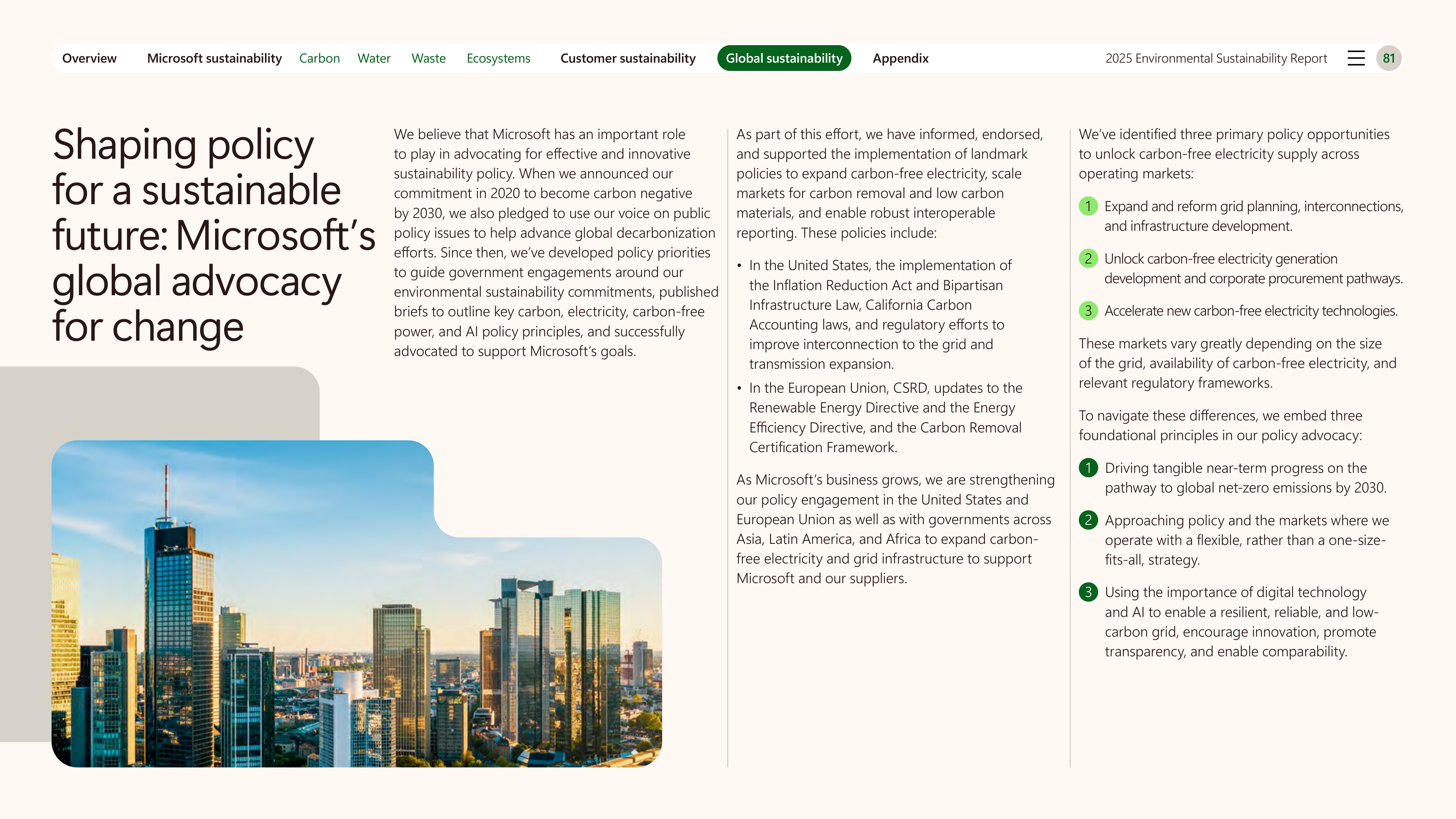

Microsoft sustainability
Carbon
Water
Waste
Ecosystems
Overview
Customer sustainability
Global sustainability
Appendix
2025 Environmental Sustainability Report
81
Shaping policy
for a sustainable
future: Microsoft’s
global advocacy
for change
We believe that Microsoft has an important role
to play in advocating for effective and innovative
sustainability policy. When we announced our
commitment in 2020 to become carbon negative
by 2030, we also pledged to use our voice on public
policy issues to help advance global decarbonization
efforts. Since then, we’ve developed policy priorities
to guide government engagements around our
environmental sustainability commitments, published
briefs to outline key carbon, electricity, carbon-free
power, and AI policy principles, and successfully
advocated to support Microsoft’s goals.
As part of this effort, we have informed, endorsed,
and supported the implementation of landmark
policies to expand carbon-free electricity, scale
markets for carbon removal and low carbon
materials, and enable robust interoperable
reporting. These policies include:
• In the United States, the implementation of
the Inflation Reduction Act and Bipartisan
Infrastructure Law, California Carbon
Accounting laws, and regulatory efforts to
improve interconnection to the grid and
transmission expansion.
• In the European Union, CSRD, updates to the
Renewable Energy Directive and the Energy
Efficiency Directive, and the Carbon Removal
Certification Framework.
As Microsoft’s business grows, we are strengthening
our policy engagement in the United States and
European Union as well as with governments across
Asia, Latin America, and Africa to expand carbon-
free electricity and grid infrastructure to support
Microsoft and our suppliers.
We’ve identified three primary policy opportunities
to unlock carbon-free electricity supply across
operating markets:
1 Expand and reform grid planning, interconnections,
and infrastructure development.
2 Unlock carbon-free electricity generation
development and corporate procurement pathways.
3 Accelerate new carbon-free electricity technologies.
These markets vary greatly depending on the size
of the grid, availability of carbon-free electricity, and
relevant regulatory frameworks.
To navigate these differences, we embed three
foundational principles in our policy advocacy:
1
Driving tangible near-term progress on the
pathway to global net-zero emissions by 2030.
2
Approaching policy and the markets where we
operate with a flexible, rather than a one-size-
fits-all, strategy.
3
Using the importance of digital technology
and AI to enable a resilient, reliable, and low-
carbon grid, encourage innovation, promote
transparency, and enable comparability.
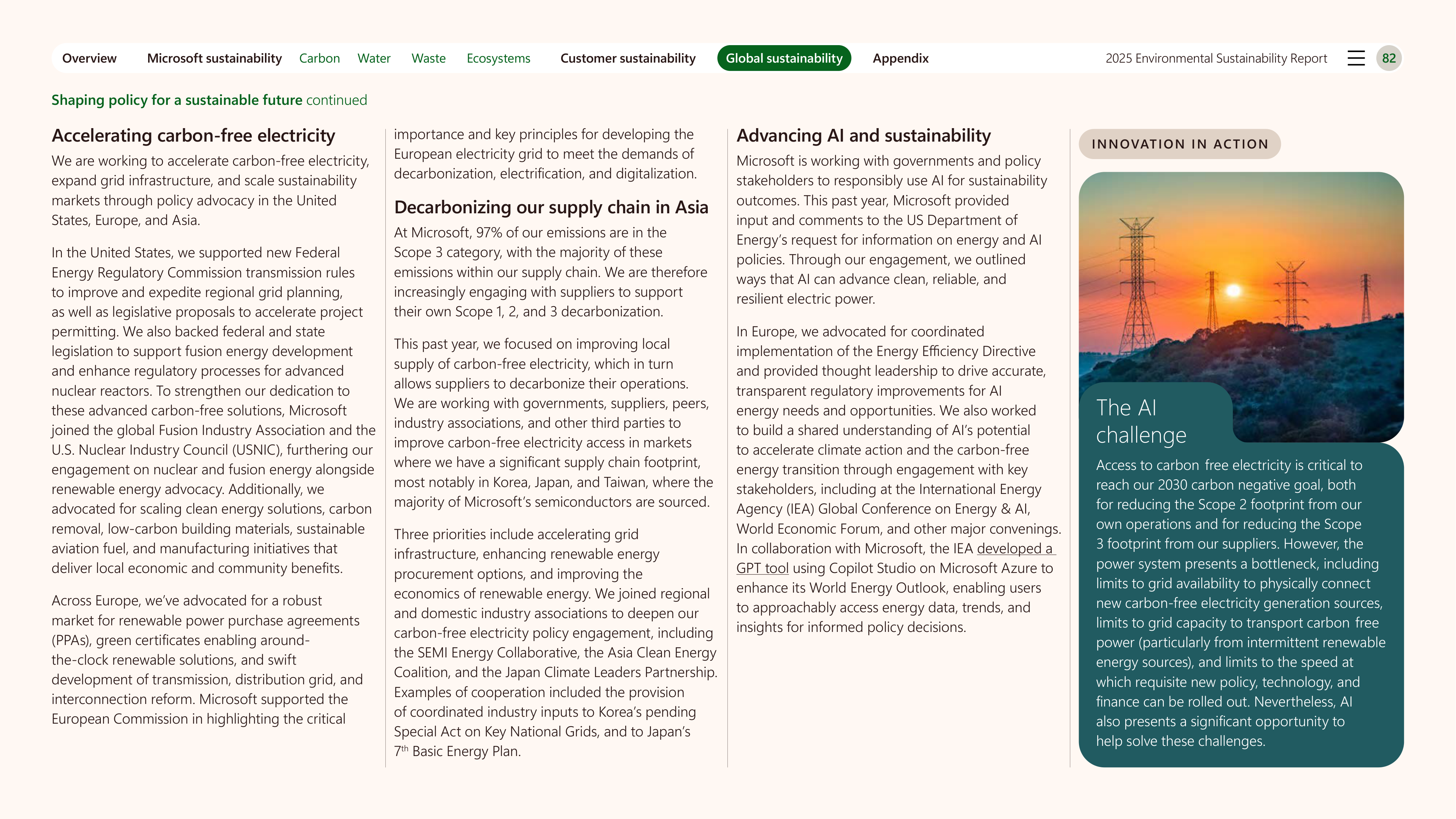
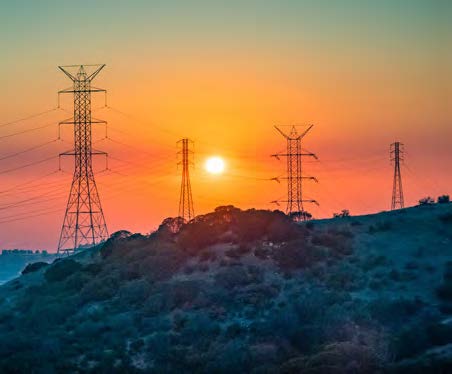
-
-
Microsoft sustainability
Carbon
Water
Waste
Ecosystems
Overview
Customer sustainability
Global sustainability
Appendix
2025 Environmental Sustainability Report
82
Shaping policy for a sustainable future
continued
Accelerating carbon-free electricity
We are working to accelerate carbon-free electricity,
expand grid infrastructure, and scale sustainability
markets through policy advocacy in the United
States, Europe, and Asia.
In the United States, we supported new Federal
Energy Regulatory Commission transmission rules
to improve and expedite regional grid planning,
as well as legislative proposals to accelerate project
permitting. We also backed federal and state
legislation to support fusion energy development
and enhance regulatory processes for advanced
nuclear reactors. To strengthen our dedication to
these advanced carbon-free solutions, Microsoft
joined the global Fusion Industry Association and the
U.S. Nuclear Industry Council (USNIC), furthering our
engagement on nuclear and fusion energy alongside
renewable energy advocacy. Additionally, we
advocated for scaling clean energy solutions, carbon
removal, low-carbon building materials, sustainable
aviation fuel, and manufacturing initiatives that
deliver local economic and community benefits.
Across Europe, we’ve advocated for a robust
market for renewable power purchase agreements
(PPAs), green certificates enabling around-
the-clock renewable solutions, and swift
development of transmission, distribution grid, and
interconnection reform. Microsoft supported the
European Commission in highlighting the critical
importance and key principles for developing the
European electricity grid to meet the demands of
decarbonization,
electrification,
and
digitalization.
Decarbonizing our supply chain in Asia
At Microsoft, 97% of our emissions are in the
Scope 3 category, with the majority of these
emissions within our supply chain. We are therefore
increasingly engaging with suppliers to support
their own Scope 1, 2, and 3 decarbonization.
This past year, we focused on improving local
supply of carbon-free electricity, which in turn
allows suppliers to decarbonize their operations.
We are working with governments, suppliers, peers,
industry associations, and other third parties to
improve carbon-free electricity access in markets
where we have a significant supply chain footprint,
most notably in Korea, Japan, and Taiwan, where the
majority of Microsoft’s semiconductors are sourced.
Three priorities include accelerating grid
infrastructure, enhancing renewable energy
procurement options, and improving the
economics of renewable energy. We joined regional
and domestic industry associations to deepen our
carbon-free electricity policy engagement, including
the SEMI Energy Collaborative, the Asia Clean Energy
Coalition, and the Japan Climate Leaders Partnership.
Examples of cooperation included the provision
of coordinated industry inputs to Korea’s pending
Special Act on Key National Grids, and to Japan’s
7
th
Basic Energy Plan.
Advancing AI and sustainability
Microsoft is working with governments and policy
stakeholders to responsibly use AI for sustainability
outcomes. This past year, Microsoft provided
input and comments to the US Department of
Energy’s request for information on energy and AI
policies. Through our engagement, we outlined
ways that AI can advance clean, reliable, and
resilient electric power.
In Europe, we advocated for coordinated
implementation of the Energy Efficiency Directive
and provided thought leadership to drive accurate,
transparent regulatory improvements for AI
energy needs and opportunities. We also worked
to build a shared understanding of AI’s potential
to accelerate climate action and the carbon-free
energy transition through engagement with key
stakeholders, including at the International Energy
Agency (IEA) Global Conference on Energy & AI,
World Economic Forum, and other major convenings.
In collaboration with Microsoft, the IEA developed a
GPT tool using Copilot Studio on Microsoft Azure to
enhance its World Energy Outlook, enabling users
to approachably access energy data, trends, and
insights for informed policy decisions.
INNOVATION IN ACTION
The AI
challenge
Access to carbon free electricity is critical to
reach our 2030 carbon negative goal, both
for reducing the Scope 2 footprint from our
own operations and for reducing the Scope
3 footprint from our suppliers. However, the
power system presents a bottleneck, including
limits to grid availability to physically connect
new carbon-free electricity generation sources,
limits to grid capacity to transport carbon free
power (particularly from intermittent renewable
energy sources), and limits to the speed at
which requisite new policy, technology, and
finance can be rolled out. Nevertheless, AI
also presents a significant opportunity to
help solve these challenges.
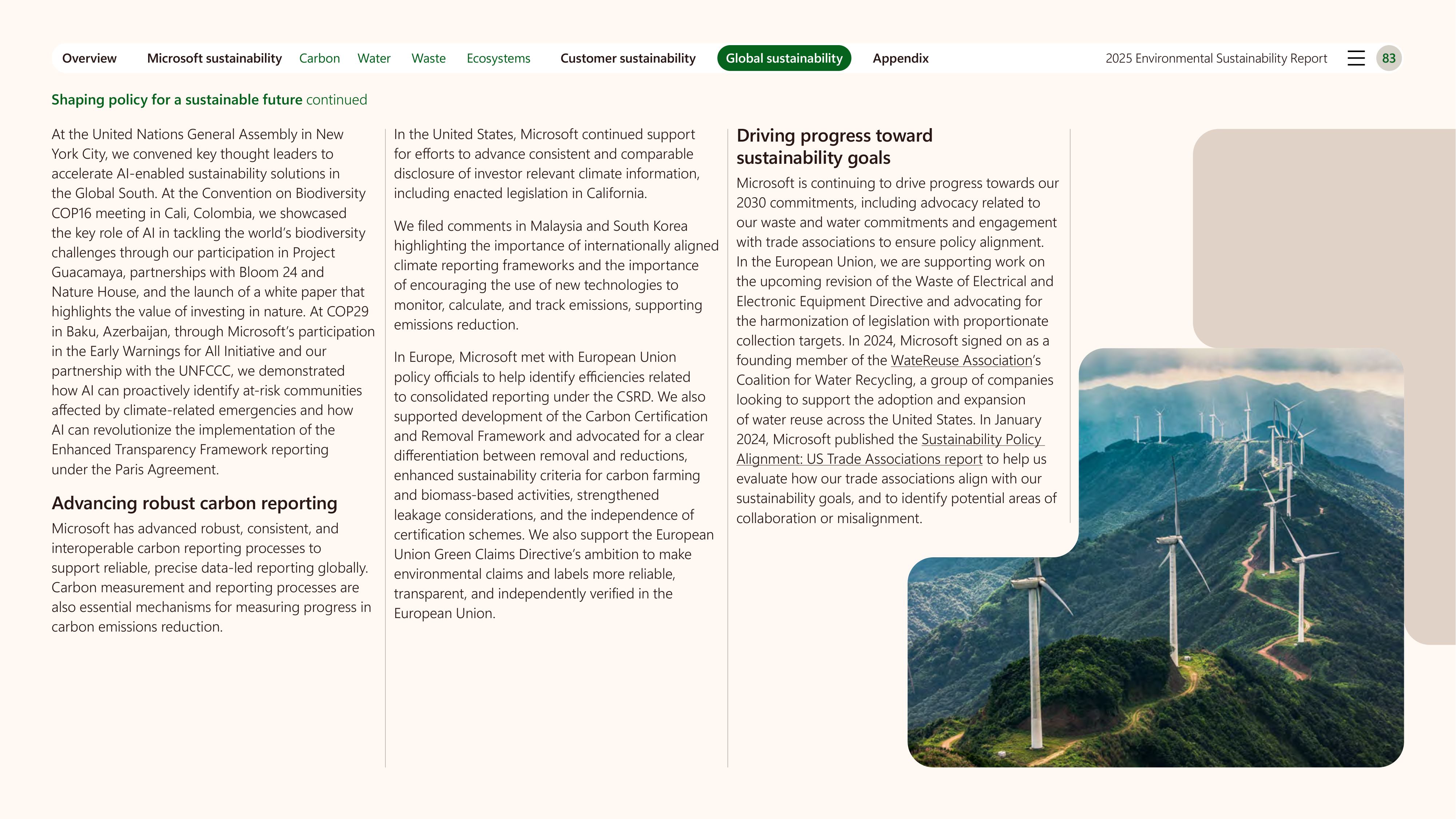
Microsoft sustainability
Carbon
Water
Waste
Ecosystems
Overview
Customer sustainability
Global sustainability
Appendix
2025 Environmental Sustainability Report
83
Shaping policy for a sustainable future
continued
At the United Nations General Assembly in New
York City, we convened key thought leaders to
accelerate AI-enabled sustainability solutions in
the Global South. At the Convention on Biodiversity
COP16 meeting in Cali, Colombia, we showcased
the key role of AI in tackling the world’s biodiversity
challenges through our participation in Project
Guacamaya, partnerships with Bloom 24 and
Nature House, and the launch of a white paper that
highlights the value of investing in nature. At COP29
in Baku, Azerbaijan, through Microsoft’s participation
in the Early Warnings for All Initiative and our
partnership with the UNFCCC, we demonstrated
how AI can proactively identify at-risk communities
affected by climate-related emergencies and how
AI can revolutionize the implementation of the
Enhanced Transparency Framework reporting
under the Paris Agreement.
Advancing robust carbon reporting
Microsoft has advanced robust, consistent, and
interoperable carbon reporting processes to
support reliable, precise data-led reporting globally.
Carbon measurement and reporting processes are
also essential mechanisms for measuring progress in
carbon emissions reduction.
In the United States, Microsoft continued support
for efforts to advance consistent and comparable
disclosure of investor relevant climate information,
including enacted legislation in California.
We filed comments in Malaysia and South Korea
highlighting the importance of internationally aligned
climate reporting frameworks and the importance
of encouraging the use of new technologies to
monitor, calculate, and track emissions, supporting
emissions reduction.
In Europe, Microsoft met with European Union
policy officials to help identify efficiencies related
to consolidated reporting under the CSRD. We also
supported development of the Carbon Certification
and Removal Framework and advocated for a clear
differentiation between removal and reductions,
enhanced sustainability criteria for carbon farming
and biomass-based activities, strengthened
leakage considerations, and the independence of
certification schemes. We also support the European
Union Green Claims Directive’s ambition to make
environmental claims and labels more reliable,
transparent, and independently verified in the
European Union.
Driving progress toward
sustainability goals
Microsoft is continuing to drive progress towards our
2030 commitments, including advocacy related to
our waste and water commitments and engagement
with trade associations to ensure policy alignment.
In the European Union, we are supporting work on
the upcoming revision of the Waste of Electrical and
Electronic Equipment Directive and advocating for
the harmonization of legislation with proportionate
collection targets. In 2024, Microsoft signed on as a
founding member of the WateReuse Association’s
Coalition for Water Recycling, a group of companies
looking to support the adoption and expansion
of water reuse across the United States. In January
2024, Microsoft published the Sustainability Policy
Alignment: US Trade Associations report to help us
evaluate how our trade associations align with our
sustainability goals, and to identify potential areas of
collaboration or misalignment.
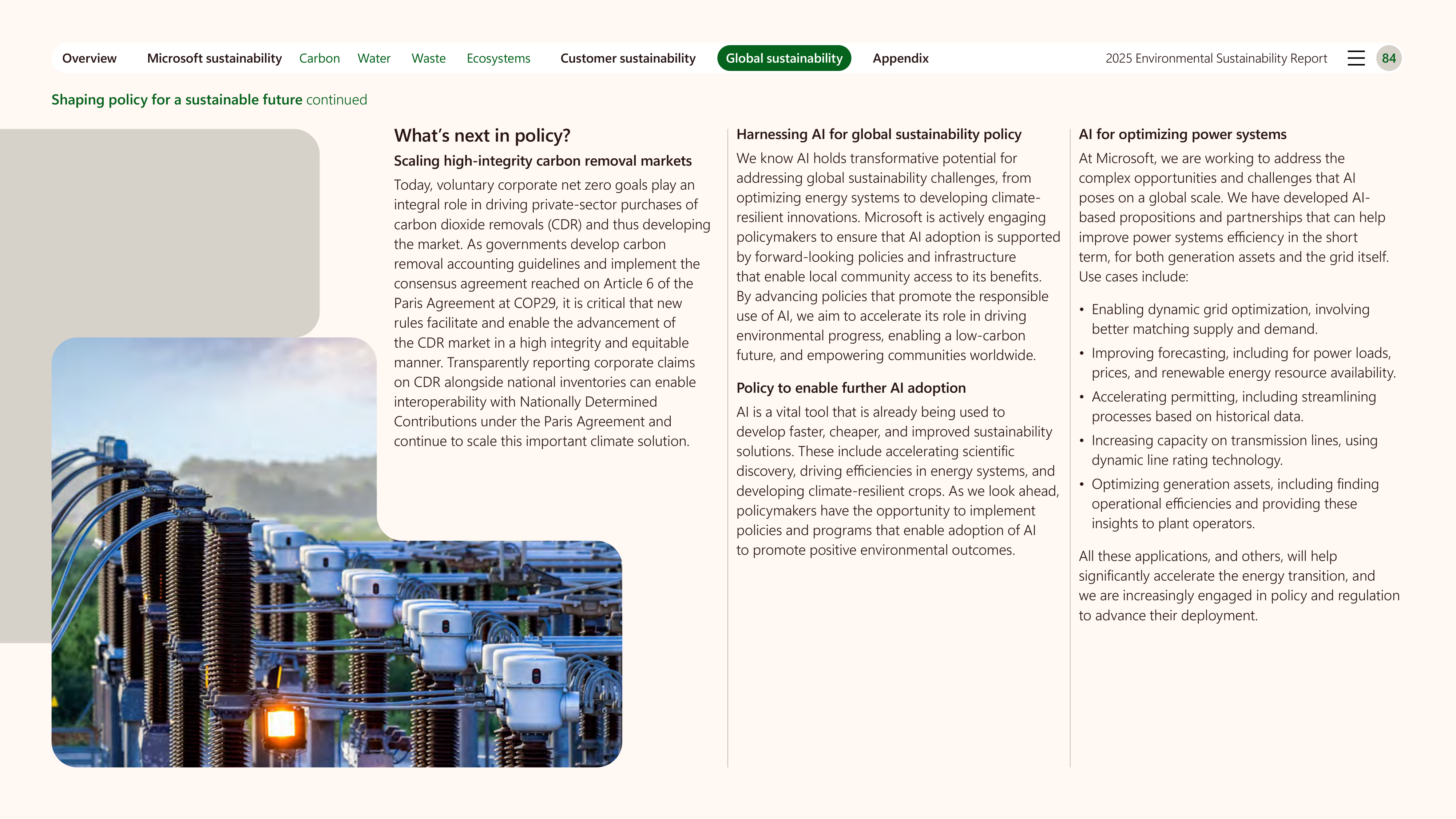
Microsoft sustainability
Carbon
Water
Waste
Ecosystems
Overview
Customer sustainability
Global sustainability
Appendix
2025 Environmental Sustainability Report
84
Shaping policy for a sustainable future
continued
What’s next in policy?
Scaling high-integrity carbon removal markets
Today, voluntary corporate net zero goals play an
integral role in driving private-sector purchases of
carbon dioxide removals (CDR) and thus developing
the market. As governments develop carbon
removal accounting guidelines and implement the
consensus agreement reached on Article 6 of the
Paris Agreement at COP29, it is critical that new
rules facilitate and enable the advancement of
the CDR market in a high integrity and equitable
manner. Transparently reporting corporate claims
on CDR alongside national inventories can enable
interoperability with Nationally Determined
Contributions under the Paris Agreement and
continue to scale this important climate solution.
Harnessing AI for global sustainability policy
We know AI holds transformative potential for
addressing global sustainability challenges, from
optimizing energy systems to developing climate-
resilient innovations. Microsoft is actively engaging
policymakers to ensure that AI adoption is supported
by forward-looking policies and infrastructure
that enable local community access to its benefits.
By advancing policies that promote the responsible
use of AI, we aim to accelerate its role in driving
environmental progress, enabling a low-carbon
future, and empowering communities worldwide.
Policy to enable further AI adoption
AI is a vital tool that is already being used to
develop faster, cheaper, and improved sustainability
solutions. These include accelerating scientific
discovery, driving efficiencies in energy systems, and
developing climate-resilient crops. As we look ahead,
policymakers have the opportunity to implement
policies and programs that enable adoption of AI
to promote positive environmental outcomes.
AI for optimizing power systems
At Microsoft, we are working to address the
complex opportunities and challenges that AI
poses on a global scale. We have developed AI-
based propositions and partnerships that can help
improve power systems efficiency in the short
term, for both generation assets and the grid itself.
Use cases include:
• Enabling dynamic grid optimization, involving
better matching supply and demand.
• Improving forecasting, including for power loads,
prices, and renewable energy resource availability.
• Accelerating permitting, including streamlining
processes based on historical data.
• Increasing capacity on transmission lines, using
dynamic line rating technology.
• Optimizing generation assets, including finding
operational efficiencies and providing these
insights to plant operators.
All these applications, and others, will help
significantly accelerate the energy transition, and
we are increasingly engaged in policy and regulation
to advance their deployment.
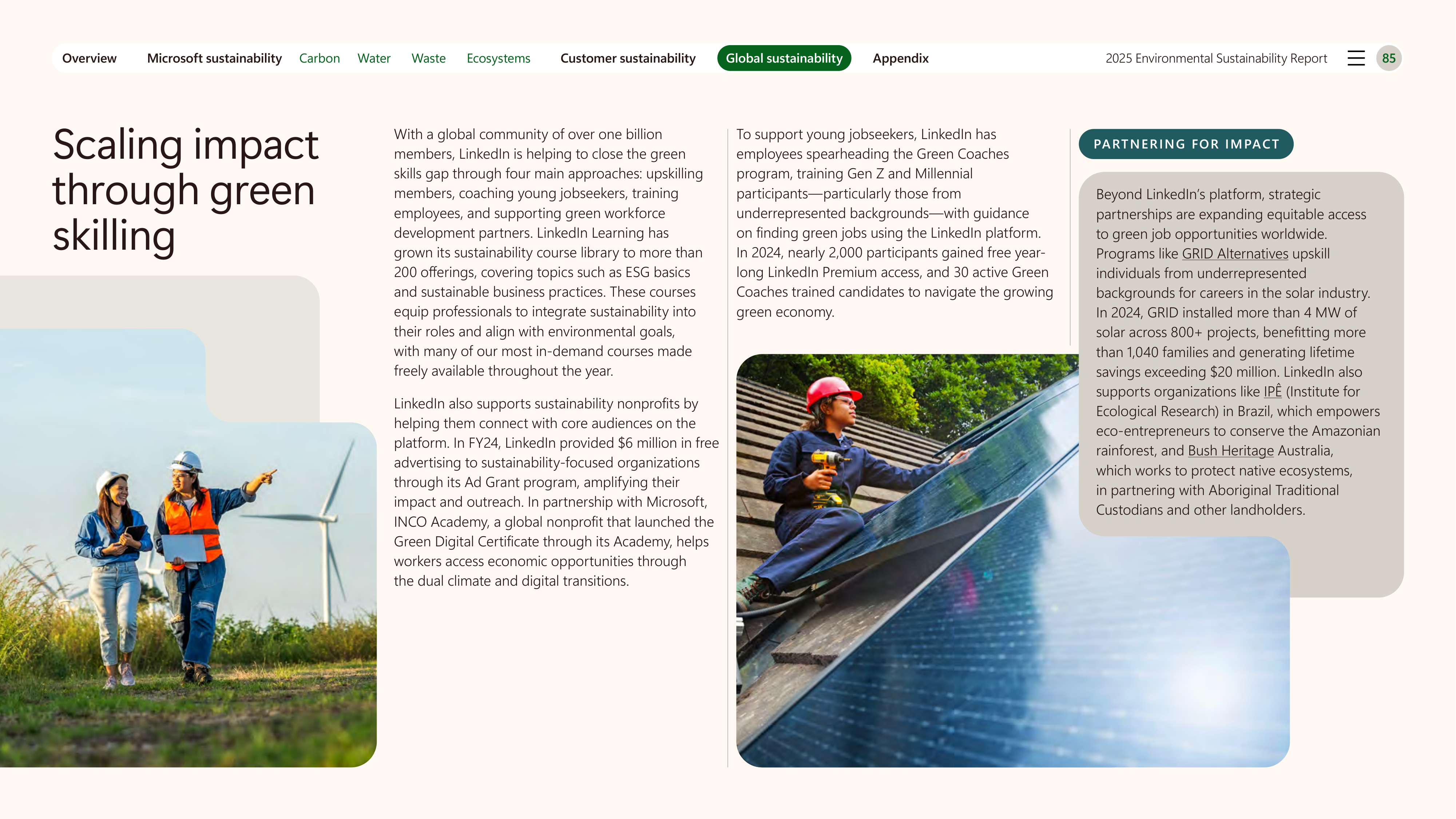
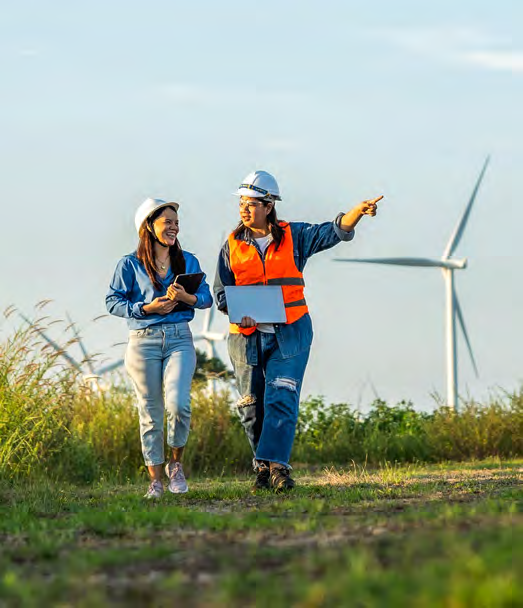

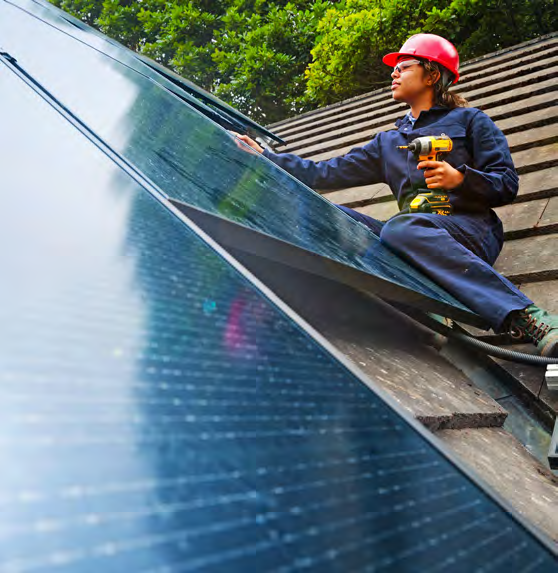
Microsoft sustainability
Carbon
Water
Waste
Ecosystems
Overview
Customer sustainability
Global sustainability
Appendix
2025 Environmental Sustainability Report
85
Scaling impact
through green
skilling
With a global community of over one billion
members, LinkedIn is helping to close the green
skills gap through four main approaches: upskilling
members, coaching young jobseekers, training
employees, and supporting green workforce
development partners. LinkedIn Learning has
grown its sustainability course library to more than
200 offerings, covering topics such as ESG basics
and sustainable business practices. These courses
equip professionals to integrate sustainability into
their roles and align with environmental goals,
with many of our most in-demand courses made
freely available throughout the year.
LinkedIn also supports sustainability nonprofits by
helping them connect with core audiences on the
platform. In FY24, LinkedIn provided $6 million in free
advertising to sustainability-focused organizations
through its Ad Grant program, amplifying their
impact and outreach. In partnership with Microsoft,
INCO Academy, a global nonprofit that launched the
Green Digital Certificate through its Academy, helps
workers access economic opportunities through
the dual climate and digital transitions.
To support young jobseekers, LinkedIn has
employees spearheading the Green Coaches
program, training Gen Z and Millennial
participants—particularly those from
underrepresented backgrounds—with guidance
on
finding green jobs using the LinkedIn platform.
In 2024, nearly 2,000 participants gained free year-
long LinkedIn Premium access, and 30 active Green
Coaches trained candidates to navigate the growing
green economy.
PARTNERING FOR IMPACT
Beyond LinkedIn’s platform, strategic
partnerships are expanding equitable access
to green job opportunities worldwide.
Programs like GRID Alternatives upskill
individuals from underrepresented
backgrounds for careers in the solar industry.
In 2024, GRID installed more than 4 MW of
solar across 800+ projects, benefitting more
than 1,040 families and generating lifetime
savings exceeding $20 million. LinkedIn also
supports organizations like IPÊ (Institute for
Ecological Research) in Brazil, which empowers
eco-entrepreneurs to conserve the Amazonian
rainforest, and Bush Heritage Australia,
which works to protect native ecosystems,
in partnering with Aboriginal Traditional
Custodians and other landholders.
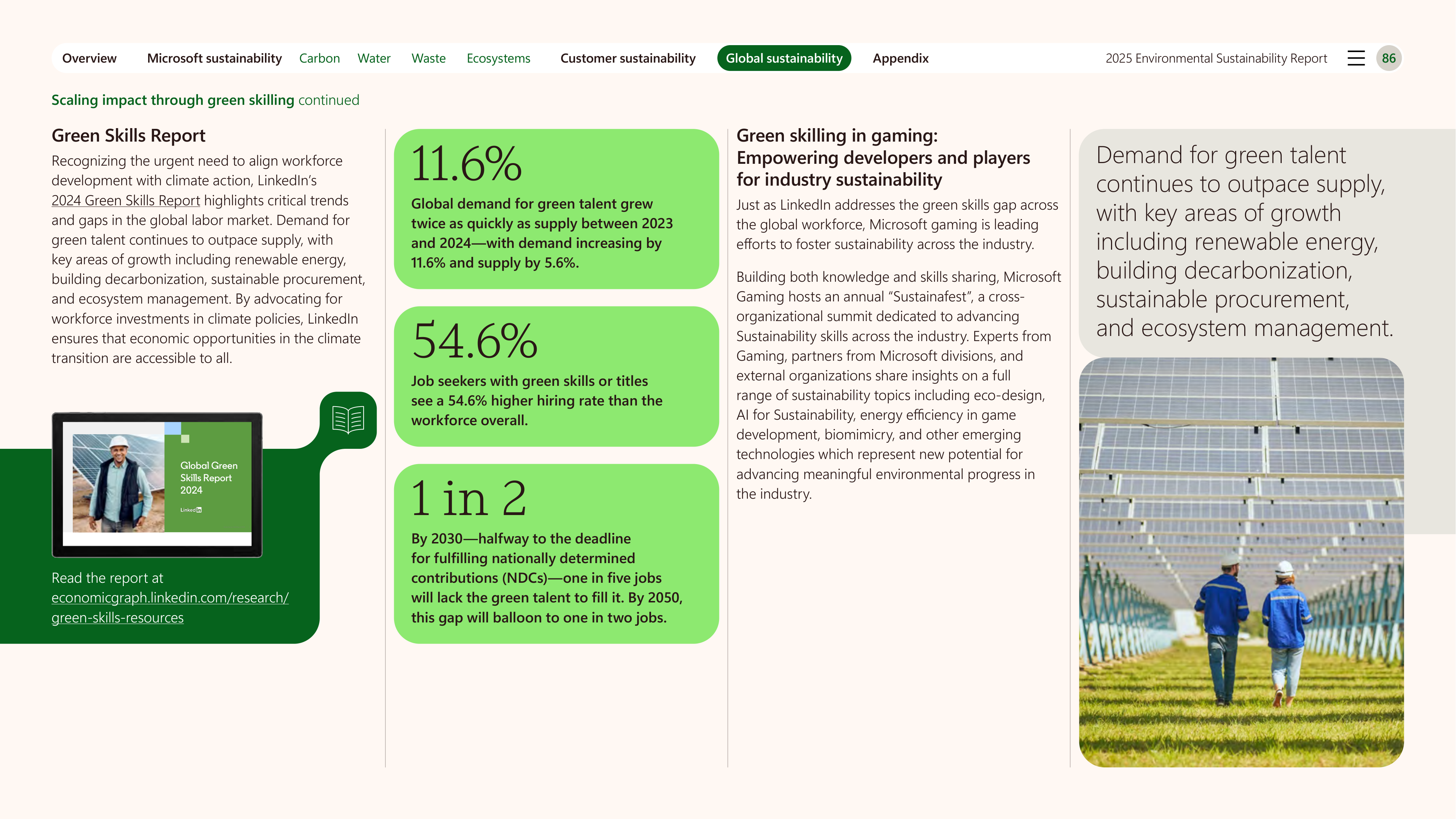


-
Microsoft sustainability
Carbon
Water
Waste
Ecosystems
Overview
Customer sustainability
Global sustainability
Appendix
2025 Environmental Sustainability Report
86
Scaling impact through green skilling
continued
Green Skills Report
Recognizing the urgent need to align workforce
development with climate action, LinkedIn’s
2024 Green Skills Report highlights critical trends
and gaps in the global labor market. Demand for
green talent continues to outpace supply, with
key areas of growth including renewable energy,
building decarbonization, sustainable procurement,
and ecosystem management. By advocating for
workforce investments in climate policies, LinkedIn
ensures that economic opportunities in the climate
transition are accessible to all.
Global Green
Skills Report
2024
Global Green Skills Report 2024
1
Read the report at
economicgraph.linkedin.com/research/
green-skill
-s resources
11.6%
Global demand for green talent grew
twice as quickly as supply between 2023
and 2024—with demand increasing by
11.6% and supply by 5.6%.
54.6%
Job seekers with green skills or titles
see a 54.6% higher hiring rate than the
workforce overall.
1 in 2
By 2030—halfway to the deadline
for fulfilling nationally determined
contributions (NDCs)—one in five jobs
will
lack the green talent to fill it. By 2050,
this gap will balloon to one in two jobs.
Green skilling in gaming:
Empowering developers and players
for industry sustainability
Just as LinkedIn addresses the green skills gap across
the global workforce, Microsoft gaming is leading
efforts to foster sustainability across the industry.
Building both knowledge and skills sharing, Microsoft
Gaming hosts an annual “Sustainafest”, a cross-
organizational summit dedicated to advancing
Sustainability skills across the industry. Experts from
Gaming, partners from Microsoft divisions, and
external organizations share insights on a full
range of sustainability topics including eco-design,
AI for Sustainability, energy efficiency in game
development, biomimicry, and other emerging
technologies which represent new potential for
advancing meaningful environmental progress in
the industry.
Demand for green talent
continues to outpace supply,
with key areas of growth
including renewable energy,
building decarbonization,
sustainable procurement,
and ecosystem management.

Microsoft sustainability
Carbon
Water
Waste
Ecosystems
Overview
Customer sustainability
Global sustainability
Appendix
2025 Environmental Sustainability Report
87
Appendix
In this section
Appendix A - How we report
88
Appendix B - Endnotes
89
Appendix
In this section
Microsoft sustainability
Carbon
Water
Waste
Ecosystems
Overview
Customer sustainability
Global sustainability
Appendix
2025 Environmental Sustainability Report
88
Appendix A
How we report
Reporting principles and external standards
Microsoft works to conduct business in ways that are
principled, transparent, and accountable. We annually
publish this Environmental Sustainability Report to
provide information on our strategy, our performance
and progress against our goals, and key challenges
and trends we see in this work. We also publish our
environmental data, which is included in the separate
Environmental Data Fact Sheet. We present greenhouse
gas emissions in accordance with the GHG Protocol and
management’s criteria and select environmental metrics
that both reference the Global Reporting Initiative
(GRI) Standards and are reported in accordance with
management’s criteria as of and for the fiscal year
ended June 30, 2024 (FY24). Microsoft’s environmental
data reporting covers global wholly owned and
partially owned subsidiaries over which Microsoft
has management and operational control, including
Microsoft owned and leased real estate facilities and
datacenters. Environmental data reported is subject to
Microsoft’s recalculation and structural changes policy
as described in our Environmental Data Fact Sheet.
Our Reports Hub available at Microsoft.com/
transparency
provides a consolidated, comprehensive
view of our ESG reporting and data ranging from our
carbon footprint to workforce demographics to political
donations. This Environmental Sustainability Report
is an important part of that overall set of disclosures.
For this and other reports, we inform our disclosure
strategies with careful consideration of commonly used
global standards. We have reported carbon emissions
and energy data to CDP since 2004 and water data to
CDP since 2011. On climate-related issues, we strive
to align with the recommendations of the Task Force
on Climate-related Financial Disclosures (TCFD) in our
TCFD report.
Working together with stakeholders
We know that the decisions we make can affect
our employees, customers, partners, shareholders,
suppliers, and communities, and we take their
voices into consideration. Microsoft receives input
from millions of people each year—from individual
customers to policymakers and global human rights
specialists. We bring outside perspectives into the
company and inform our business decisions through
a variety of feedback channels. We often go beyond
formal channels, proactively engaging with key
stakeholders, advocacy groups, industry experts,
corporate social responsibility (CSR) rating agencies,
CSR-focused investors, and many others. We also
share our learnings and practices, thereby generating
industry dialogue, informing public debate, and
advancing greater progress.
ESG priority
Our ESG reporting describes the topics we consider
to be the most important annually to stakeholders
when evaluating environmental, social, and governance
issues at Microsoft. Therefore, ESG prioritization in our
reporting does not align to the concept of corporate
“materiality” applied in U.S. securities law. A listing of
what we currently identify and categorize as our top
ESG issues can be found at Microsoft.com/sustainability.
Governance
The Environmental, Social, and Public Policy
Committee of Microsoft’s Board of Directors provides
oversight and guidance on Microsoft’s environmental
sustainability strategy and efforts. Our Vice Chair
and President and our Chief Sustainability Officer
present to this committee on our overall sustainability
agenda, including our climate-related work, and solicit
high-level input on new and emerging initiatives.
Additional information on Microsoft’s corporate
governance is available at Microsoft.com/investor.
Forward-looking statements
This report includes estimates, projections, and other
“forward-looking statements” within the meaning of the
Private Securities Litigation Reform Act of 1995, section
27A of the Securities Act of 1933, and section 21E of the
Securities Exchange Act of 1934. These forward-looking
statements generally are identified by the words
“believe,” “project,” “expect,” “anticipate,” “estimate,”
“intend,” “strategy,” “future,” “target,” “efforts,” “goal,”
“tactic,” “roadmap,” “commitment,” “opportunity,”
“plan,” “may,” “should,” “will,” “would,” “will be,” “will
continue,” “will likely result,” and similar expressions.
Forward-looking statements are based on current
expectations and assumptions that are subject to risks
and uncertainties that may not be anticipated and/or
which may cause actual results to differ significantly.
We describe risks and uncertainties that could
cause actual results and events to differ materially
in our reports filed with the Securities and Exchange
Commission. We undertake no obligation to update
or revise publicly any forward-looking statements,
whether because of new information, future events,
or otherwise.
A number of our ESG goals may depend on the
adoption of certain behaviors and/or activities by third
parties, including our customers and partners. If those
parties do not adopt certain behaviors or activities, or
invest in certain evolving technologies, we may not be
able to meet some goals. Additionally, we are engaged
in certain projects, solutions, and technologies that,
should they not perform as we expect, could negatively
affect our ability to meet some ESG goals on time
or at all. Finally, we make certain claims regarding
our products and projects, including through our
funding of certain projects, and the ability of those
products, projects, and funding efforts to affect third
parties’ sustainability efforts; however, there can be
no guarantee that our products, projects, or funding
efforts will have the effects we anticipate or intend.
Microsoft sustainability
Carbon
Water
Waste
Ecosystems
Overview
Customer sustainability
Global sustainability
Appendix
2025 Environmental Sustainability Report
89
Appendix B
Endnotes
1.
World Economic Forum. Innovation and Adaptation
in the Climate Crisis: Technology for the New Normal.
January 2024. https://www3.weforum.org/docs/WEF_
Innovation_and_Adaptation_in_the_Climate_Crisis_2024.pdf
2. This estimate is calculated based on the EPA estimate of
the typical passenger vehicle emitting 4.6 tons of carbon
dioxide per year.
3. In FY24, we contracted 2.8 million metric tons of carbon
removal expected to be delivered toward FY30—in
addition to 575,000 metric tons that we contracted in
FY23—for a total amount of 3.4 million metric tons of
contracted carbon removal to-date.
4. Low-carbon building materials are those that have a
reduced carbon footprint compared to traditional materials.
This means they have lower emissions, specifically in terms
of the greenhouse gas (GHG) emissions generated by the
manufacturing, transportation, installation, maintenance,
and disposal of construction materials. Read more about
our strategy here: https://www.microsoft.com/en-us/
microsoft-cloud/blog/2024/12/04/sustainable-by-design-
advancing-low-carbon-materials/?msockid=36f9cd13211e6c
bf12b4d84120336d3f
5. Fennell, Paul, et al. “Cement and Steel—Nine Steps to Net
Zero.” Nature, March 23, 2022. https://www.nature.com/
articles/d41586-022-00758-4
6. Microsoft defines carbon-free electricity (CFE)
technologies as including technologies with zero direct
emissions and biogenic technologies with life cycle
emissions equivalent to renewables. CFE technologies
include wind; solar; geothermal; sustainable biomass;
hydropower; nuclear; fossil with complete carbon capture,
utilization, and sequestration; and storage charged
with CFE generation. Microsoft acknowledges that CFE
technologies have indirect carbon dioxide emissions
and these are accounted for in our LCAs. CFE transition
in the supply chain includes the onsite generation and
purchase of verified Energy Attribute Certificates (EACs)
by suppliers that are allocated to Microsoft-specific
production volumes.
7. This estimate is calculated based on the EPA estimate of
the typical passenger vehicle emitting 4.6 tons of carbon
dioxide per year.
8. Surface AI PCs include Surface Pro 10 and Surface Laptop
6. Surface Copilot+ PCs include Surface Pro (11th Edition)
and Surface Laptop (10th Edition). Surface Pro 10 and
Surface Pro (11th Edition) enclosure includes Bucket and
Kickstand. 100% recycled aluminum alloy in Bucket and
Kickstand. Surface Laptop 6 enclosure includes A Cover,
C Cover, and D Bucket. 100% recycled aluminum alloy in
A Cover. Surface Laptop (7th Edition) enclosure includes
A Cover, C Bucket, and D Cover. 100% recycled aluminum
alloy in A Cover and C Bucket. 100% recycled rare earth
metals in magnets. Based on validation performed by
Underwriter Laboratories, Inc. using Environmental
Claim Validation Procedure, UL 2809-2, Second Edition,
November 7, 2023.
9. Replacement components available through Surface
Commercial authorized device resellers. Components can
be replaced on-site by a skilled technician following the
Microsoft Service Guide. Microsoft tools (sold separately)
may also be required. Availability of replacement
components and service options may vary by product,
market, and over time. See Surface service options at
Microsoft Learn. Opening and/or repairing your device
can present electric shock, fire, and personal injury risks
and other hazards. Use caution if undertaking do-it-
yourself repairs. Unless required by law, device damage
caused during repair will not be covered under Microsoft’s
Hardware Warranty or protection plans.
10. Opening and/or repairing your device can present
electric shock, fire, and personal injury risks and other
hazards. Use caution if undertaking do-it-yourself repairs.
Unless required by law, device damage caused during
repair will not be covered under Microsoft’s Hardware
Warranty or protection plans.
11. This estimate calculated based on 7,140 square meters
per standard soccer field.
12. This information has been self-reported by the
organization and has not been verified by Microsoft.
13. Battery life varies significantly with settings, usage, device,
and other factors.
14. Testing conducted by Microsoft in October 2024 with Surface
Pro (11th Edition - Wi-Fi) Snapdragon® X Plus 10 Core 512
GB, 16 GB RAM devices using Windows 11 Home 24H2.
Testing consisted of a partial battery discharge while running
the Windows ADK web browsing battery life workloads
with Energy Saver enabled and disabled. All settings were
default except screen brightness set to 150 units with Auto-
Brightness/Adaptive Brightness disabled. Wi-Fi was connected
to a network. Actual energy efficiency varies significantly
based on settings, usage, and other factors.
15. Based on a snapshot of aggregated internal usage data
for devices connected to Microsoft internal network July
1–September 30, 2024, comparing average weighted daily
energy consumption per device per usage minute for a
population of Surface Copilot+ PCs (Surface Laptop (7th
Edition) and Surface Pro (11th Edition)) to a population of
Surface Laptop 4, 5, 6 and Surface Pro 8, 9, X. Actual energy
efficiency varies significantly by organization and device, and
is based on settings, usage, and other factors.
16. The baseline (no interventions) scenario models the
same product without any sustainability interventions
in the production phase of the device: (a) no additional
renewable energy in the supply chain beyond what
is already modeled in the regional grid mixes from
Ecoinvent v3.9.1, (b) the carbon footprint of materials and
manufacturing processes assuming no recycled content
or additional eco-design interventions as of the date o
f
Ecoprofile where the life cycle carbon footprint is published,
and (c) the default US distribution, use, and end of life
modeling assumptions of the specific product model.
17. Conservation International. “Burberry: Freedom to Go
Beyond.” 2022. https://www.conservation.org/corporate-
engagements/burberry-freedom-to-go-beyond
18. Buchner, Barbara, et al. Global Landscape of Climate
Finance 2023. Climate Policy Initiative, November 2, 2023.
https://www.climatepolicyinitiative.org/publication/global-
landscape-of-climate-finance-2023/
19. CTVC. “$32bn and 30% Drop as Market Hits Pause in 2023.”
CTVC by Sightline Climate, January 5, 2024. https://www.ctvc.co/
32bn-and-30-drop-as-market-hits-pause-in-2023/
20. PR Newswire. “IBM AI and Cloud Technology Helps
Agriculture Industry Improve the World’s Food
and Crop Supply.” PR Newswire, May 22, 2019.
https://www.prnewswire.com/news-releases/ibm-ai-and-
cloud-technology-helps-agriculture-industry-improve-
the-worlds-food-and-crop-supply-300855333.html


Stay up to
date on our
progress
Learn more about our sustainability journey
and sign up for news and updates here.
2025 Microsoft Environmental Sustainability Report