
UNITED STATES
SECURITIES AND EXCHANGE COMMISSION
Washington, D.C. 20549
FORM 10-K
(Mark One)
x
ANNUAL REPORT PURSUANT TO SECTION 13 OR 15(d) OF THE SECURITIES EXCHANGE ACT OF 1934
For the fiscal year ended December 31, 2025
OR
o
TRANSITION REPORT PURSUANT TO SECTION 13 OR 15(d) OF THE SECURITIES EXCHANGE ACT OF 1934
For the transition period from _________ to _________
Commission File Number: 001-34756
Tesla, Inc.
(Exact name of registrant as specified in its charter)
Texas
91-2197729
(State or other jurisdiction of
incorporation or organization)
(I.R.S. Employer
Identification No.)
1 Tesla Road
Austin, Texas
78725
(Address of principal executive offices)
(Zip Code)
(512) 516-8177
(Registrant’s telephone number, including area code)
Securities registered pursuant to Section 12(b) of the Act:
Title of each class
Trading Symbol(s)
Name of each exchange on which registered
Common stock
TSLA
The Nasdaq Global Select Market
Securities registered pursuant to Section 12(g) of the Act:
None
Indicate by check mark whether the registrant is a well-known seasoned issuer, as defined in Rule 405 of the Securities Act. Yes
x
No
o
Indicate by check mark if the registrant is not required to file reports pursuant to Section 13 or 15(d) of the Act. Yes
o
No
x
Indicate by check mark whether the registrant (1) has filed all reports required to be filed by Section 13 or 15(d) of the Securities Exchange Act of 1934 (“Exchange Act”)
during the preceding 12 months (or for such shorter period that the registrant was required to file such reports), and (2) has been subject to such filing requirements for the past
90 days. Yes
x
No
o
Indicate by check mark whether the registrant has submitted electronically every Interactive Data File required to be submitted pursuant to Rule 405 of Regulation S-T
(§232.405 of this chapter) during the preceding 12 months (or for such shorter period that the registrant was required to submit such files). Yes
x
No
o
Indicate by check mark whether the registrant is a large accelerated filer, an accelerated filer, a non-accelerated filer, a smaller reporting company, or an emerging growth
company. See the definitions of “large accelerated filer,” “accelerated filer,” “smaller reporting company” and “emerging growth company” in Rule 12b-2 of the Exchange Act:
Large accelerated filer
x
Accelerated filer
o
Non-accelerated filer
o
Smaller reporting company
o
Emerging growth company
o
If an emerging growth company, indicate by check mark if the registrant has elected not to use the extended transition period for complying with any new or revised
financial accounting standards provided pursuant to Section 13(a) of the Exchange Act.
o
Indicate by check mark whether the Registrant has filed a report on and attestation to its management’s assessment of the effectiveness of its internal control over financial
reporting under Section 404(b) of the Sarbanes-Oxley Act (15 U.S.C. 7262(b)) by the registered public accounting firm that prepared or issued its audit report.
x
If securities are registered pursuant to Section 12(b) of the Act, indicate by check mark whether the financial statements of the registrant included in the filing reflect the
correction of an error to previously issued financial statements.
o
Indicate by check mark whether any of those error corrections are restatements that required a recovery analysis of incentive-based compensation received by any of the
registrant’s executive officers during the relevant recovery period pursuant to §240.10D-1(b).
o
Indicate by check mark whether the registrant is a shell company (as defined in Rule 12b-2 of the Exchange Act). Yes
o
No
x
The aggregate market value of voting stock held by non-affiliates of the registrant, as of June 30, 2025, the last business day of the registrant’s most recently completed
second fiscal quarter, was $892.93 billion (based on the closing price for shares of the registrant’s Common Stock as reported by the NASDAQ Global Select Market on June 30,
2025). Shares of Common Stock held by each executive officer and director have been excluded in that such persons may be deemed to be affiliates. This determination of affiliate
status is not necessarily a conclusive determination for other purposes.
As of January 23, 2026, there were 3,752,431,984 shares of the registrant’s common stock outstanding.
DOCUMENTS INCORPORATED BY REFERENCE
Portions of the registrant’s Proxy Statement for the 2026 Annual Meeting of Shareholders are incorporated herein by reference in Part III of this Annual Report on Form 10-
K to the extent stated herein. Such proxy statement will be filed with the Securities and Exchange Commission within 120 days of the registrant’s fiscal year ended December 31,
2025.
TESLA, INC.
ANNUAL REPORT ON FORM 10-K FOR THE YEAR ENDED DECEMBER 31, 2025
INDEX
Page
PART I.
Item 1.
Business
2
Item 1A.
Risk Factors
12
Item 1B.
Unresolved Staff Comments
27
Item 1C.
Cybersecurity
27
Item 2.
Properties
28
Item 3.
Legal Proceedings
28
Item 4.
Mine Safety Disclosures
28
PART II.
Item 5.
Market for Registrant's Common Equity, Related Stockholder Matters and Issuer Purchases of Equity Securities
29
Item 6.
[Reserved]
30
Item 7.
Management's Discussion and Analysis of Financial Condition and Results of Operations
31
Item 7A.
Quantitative and Qualitative Disclosures about Market Risk
44
Item 8.
Financial Statements and Supplementary Data
45
Item 9.
Changes in and Disagreements with Accountants on Accounting and Financial Disclosure
94
Item 9A.
Controls and Procedures
94
Item 9B.
Other Information
95
Item 9C.
Disclosure Regarding Foreign Jurisdictions that Prevent Inspections
95
PART III.
Item 10.
Directors, Executive Officers and Corporate Governance
96
Item 11.
Executive Compensation
96
Item 12.
Security Ownership of Certain Beneficial Owners and Management and Related Stockholder Matters
96
Item 13.
Certain Relationships and Related Transactions, and Director Independence
96
Item 14.
Principal Accountant Fees and Services
96
PART IV.
Item 15.
Exhibits and Financial Statement Schedules
97
Item 16.
Form 10-K Summary
101
Signatures
Table of Contents
Forward-Looking Statements
The discussions in this Annual Report on Form 10-K contain forward-looking statements within the meaning of the Private Securities Litigation Reform
Act of 1995. Forward-looking statements are based on assumptions with respect to the future and management’s current expectations, involve certain
risks and uncertainties and are not guarantees. These forward-looking statements include, but are not limited to, statements concerning supply chain
constraints, our strategy, competition, future operations and production capacity, future financial position, future revenues, projected costs,
profitability, expected cost reductions, capital adequacy, expectations regarding demand and acceptance for our technologies, growth opportunities and
trends in the markets in which we operate, prospects and plans and objectives of management. The words “anticipates,” “believes,” “could,”
“estimates,” “expects,” “intends,” “may,” “plans,” “projects,” “will,” “would,” “predicts” and similar expressions are intended to identify forward-looking
statements, although not all forward-looking statements contain these identifying words. We may not actually achieve the plans, intentions or
expectations disclosed in our forward-looking statements and you should not place undue reliance on our forward-looking statements. Future results
may differ materially from the plans, intentions and expectations disclosed in the forward-looking statements that we make. These forward-looking
statements involve risks and uncertainties that could cause our actual results to differ materially from those in the forward-looking statements,
including, without limitation, the risks set forth in Part I, Item 1A, “Risk Factors” of the Annual Report on Form 10-K for the fiscal year ended
December 31, 2025 and that are otherwise described or updated from time to time in our other filings with the Securities and Exchange Commission
(the “SEC”). The discussion of such risks is not an indication that any such risks have occurred at the time of this filing. We do not assume any
obligation to update any forward-looking statements.
Table of Contents
PART I
ITEM 1. BUSINESS
Overview
We are focused on bringing artificial intelligence (“AI”) into the real world, through products and services like Full Self-Driving (“FSD”)
(Supervised) and Robotaxi, as well as working to develop and commercialize AI robots (“Bots”) (including Optimus). We intend to leverage our current
operations, in which we design, develop, manufacture, sell and lease high-performance fully electric vehicles and energy generation and storage
systems that increasingly deliver AI-related and enhanced software and services to our customers, to achieve that objective. We generally sell our
products directly to customers, and continue to grow our global retail, service and charging footprint to accelerate the widespread adoption of our
products. We emphasize performance, attractive styling and the safety of our users and workforce in the design and manufacture of our products and
are continuing to develop full self-driving technology for improved safety. We also strive to lower the cost of ownership for our customers through
continuous efforts to reduce manufacturing costs and by offering financial and other services tailored to our products.
Our mission is building a world of amazing abundance. We believe that this mission, along with our engineering expertise, advancements in real-
world AI, vertically integrated business model, and focus on user experience differentiate us from other companies.
Segment Information
We operate as two reportable segments: (i) automotive and (ii) energy generation and storage.
The automotive segment includes the design, development, manufacturing, sales and leasing of high-performance fully electric vehicles as well as
sales of automotive regulatory credits. Additionally, the automotive segment also includes services and other, which includes sales of used vehicles, non-
warranty maintenance services and collision, paid Supercharging sessions, automotive insurance business revenue, part sales and retail merchandise
sales. The energy generation and storage segment includes sales, leasing, and financing of energy generation and storage products, services related to
such products and sales of energy generation incentives.
Our Products and Services
Automotive
We currently manufacture five different consumer vehicles – the Model 3, Y, S, X and Cybertruck. Model 3 is a four-door mid-size sedan that we
designed for manufacturability with a base price for mass-market appeal. Model Y is a compact sport utility vehicle (“SUV”) built on the Model 3
platform with seating for up to seven adults. Model S is a four-door full-size sedan and Model X is a mid-size SUV with seating for up to seven adults.
Model S and Model X feature the highest performance characteristics and longest ranges that we offer in a sedan and SUV, respectively. The
Cybertruck is a full-size electric pickup truck with a stainless steel exterior that has the utility and strength of a truck while featuring the speed of a
sports car. In 2022, we also began early production and deliveries of a commercial electric vehicle, the Tesla Semi.
We have planned electric vehicles to address additional vehicle markets, and will continue leveraging developments in our proprietary Full Self-
Driving (“FSD”) (Supervised) features, battery cell and other technologies. For purposes of this filing, use of the term “FSD (Supervised)” includes the
equivalent naming convention, “FSD (Capability)” that is used in the European, Middle East and Asia-Pacific regions. In June 2025, we launched our
Robotaxi service, an autonomous ride-hailing platform that harnesses our technology and vehicles. We expect this service will open access to an
expanded customer base as modes of transportation evolve, and, along with products such as FSD (Supervised) subscriptions, unlock the potential to
advance a service-driven business model based on AI, software and fleet-based profits. Our Robotaxi business currently operates with Model Y vehicles
but, in time, will include Cybercab, our purpose-built autonomous vehicle.
2
Table of Contents
Energy Generation and Storage
Energy Storage Products
Powerwall and Megapack are our lithium-ion battery energy storage products. Powerwall, which we sell and lease to customers, as well as
through channel partners, is designed to store energy at homes or small commercial facilities. Megapack is an energy storage solution for commercial,
industrial, utility and energy generation customers, multiple of which may be grouped together to form larger installations of gigawatt hours (“GWh”) or
greater capacity. As AI infrastructure drives rapid load growth, Megapack helps to, among other things, increase utilization of existing generation and
transmission capacity, resulting in a more efficient use of the electric grid.
We also continue to develop software capabilities for remotely controlling and dispatching our energy storage systems across a wide range of
markets and applications, including through our real-time energy control and optimization platforms for Megapack batteries (Autobidder) and
distributed energy resources like Powerwall (Powerhub).
Energy Generation Offerings
We sell energy generation systems directly to customers and also through channel partners. We design and manufacture certain components for
our energy generation products, including solar panels and Solar Roof, which combines premium glass roof tiles with energy generation. We also
purchase many components for our energy generation systems from various third-party manufacturers to provide for competitive pricing and adequate
supply.
Technology
Automotive
Self-Driving Development and Artificial Intelligence
We use AI to develop real-world applications, such as autonomous driving solutions and robots. We utilize vision-based technologies, systems and
software to train our artificial neural networks, which are accelerated by our own in-house, custom designed inference chips. We are also applying our
artificial intelligence learnings from self-driving technology to Bots, such as Optimus, a general purpose, autonomous humanoid robot in development.
Currently, we offer in our customer vehicles certain advanced driver assistance systems. Although at present, same as in the past, the driver is
responsible for remaining fully engaged in the driving operation, these systems provide safety and convenience functionality that may relieve drivers of
many tedious and potentially dangerous aspects of road travel much like the system that airplane pilots use, when conditions permit. As with other
vehicle systems, we improve these functions in our customer vehicles through over-the-air software updates. Every Tesla vehicle delivered today is
designed for autonomy, and we believe our capabilities and advancements in AI differentiate us from our competitors.
Vehicle Control and Infotainment Software
The performance and safety systems of our vehicles and their battery packs utilize sophisticated control software. Control systems in our vehicles
optimize performance, customize vehicle behavior, manage charging and control all infotainment functions. We develop almost all of this software,
including most of the user interfaces, internally and update our vehicles’ software regularly through over-the-air updates, and work to actively improve
our software security with every release.
Battery and Powertrain
Our core vehicle technology competencies include powertrain engineering and manufacturing and our ability to design vehicles that utilize the
unique advantages of an electric powertrain. We have designed our proprietary powertrain systems to be adaptable, efficient, reliable and cost-effective
while withstanding the rigors of an automotive environment. We offer dual motor powertrain vehicles, which use two electric motors to maximize
traction and performance in an all-wheel drive configuration, as well as vehicle powertrain technology featuring three electric motors for further
increased performance in certain versions of Model S and Model X, Cybertruck and the Tesla Semi.
We maintain extensive testing and R&D capabilities for battery cells, packs and systems, and have built an expansive body of knowledge on
lithium-ion cell chemistry types and performance characteristics. In order to enable a greater supply of cells for our products with higher energy density
at lower costs, we have developed a new proprietary lithium-ion battery cell and improved manufacturing processes.
3
Table of Contents
Energy Generation and Storage
Energy Storage Products
We leverage many of the component-level technologies from our vehicles in our energy storage products. By taking a modular approach to the
design of battery systems, we can optimize manufacturing capacity of our energy storage products. Additionally, our expertise in power electronics
enables our battery systems to interconnect with electricity grids while providing fast-acting systems for power injection and absorption. We have also
developed software to remotely control and dispatch our energy storage systems. Further leveraging our capabilities in AI, every Tesla energy storage
product is capable of being enhanced through firmware updates and optimized by our software platforms, particularly Powerhub (for distributed energy
resources, including Powerwall-enabled virtual power plants) and Autobidder (for Megapack batteries).
Energy Generation Systems
We began manufacturing a new residential retrofit solar panel in 2025, and began initial customer deliveries in January 2026. We continue to
manufacture Solar Roof, which has been engineered over numerous iterations to combine aesthetic appeal and durability with power generation. The
efficiency of our energy generation products is aided by our own solar inverter, which incorporates our power electronics technologies. We designed
both products to integrate with Powerwall.
Infrastructure
To support our businesses in clean energy and transport and autonomous robots, we are investing in and developing the necessary supporting
infrastructure. This includes additional compute hardware to better enable the massive amounts of field data captured by our vehicles to continually
train and improve these artificial neural networks for real-world performance. In 2025, we further expanded Cortex, our training cluster at Gigafactory
Texas, and announced a new collaboration with Samsung to manufacture advanced semiconductors for AI inference and training in the U.S. We are
currently building Cortex 2 at Gigafactory Texas to further increase our AI training compute capacity.
In 2026, we will be ramping six new production lines across vehicle, Bots, energy storage and battery manufacturing, while further leveraging our
existing factory, charging and service center footprints to support future growth. We are also focused on exploring additional opportunities
independently and with strategic partners to develop bespoke and scalable solutions, including through vertical integration, to optimize for cost,
functionality, efficiency and safety.
Design and Engineering
Automotive
We have established significant in-house capabilities in the design and test engineering of electric vehicles and their components and systems. Our
team has significant experience in computer-aided design as well as durability, strength and crash test simulations, which reduces the product
development time of new models. We have also achieved complex engineering feats in stamping, casting and thermal systems, and developed a method
to integrate batteries directly with vehicle body structures without separate battery packs to optimize manufacturability, weight, range and cost
characteristics.
We are focused on maximum capacity utilization at our factories, while taking action to localize our vehicle designs and production for particular
markets, including country-specific market demands and factory optimizations for local workforces. As we increase our capabilities, particularly in the
areas of automation, die-making and line-building, we are also making strides in the simulations modeling these capabilities prior to construction.
Energy Generation and Storage
Our expertise in electrical, mechanical, civil and software engineering allows us to design, engineer, manufacture and install energy generating
and storage products and components, including at the residential through utility scale. For example, the integrated design of our Megapack products
are intended to significantly reduce the amount of assembly required in the field. We also customize solutions including our energy storage products,
energy generation systems and/or Solar Roof for customers to meet their specific needs.
4
Table of Contents
Sales and Marketing
Historically, we have been able to achieve sales without relying on traditional advertising and at relatively low marketing costs. We continue to
monitor our public narrative and brand, and tailor our marketing efforts accordingly, including through investments in customer education and
advertising as necessary.
Automotive
Direct Sales
Our vehicle sales channels currently include our website and a global network of company-owned stores. In some jurisdictions, we also have
galleries to educate and inform customers about our products, but such locations do not transact in the sale of vehicles. We believe this infrastructure
enables us to better control costs of inventory, manage warranty service and pricing, educate consumers about electric vehicles, make our vehicles
more affordable, maintain and strengthen the Tesla brand and obtain rapid customer feedback.
We reevaluate our sales strategy both globally and at a location-by-location level from time to time to optimize our sales channels. However, sales
of vehicles in the automobile industry tend to be cyclical in many markets, which may expose us to volatility from time to time.
Used Vehicle Sales
Our used vehicle business supports new vehicle sales by integrating the trade-in of a customer’s existing Tesla or non-Tesla vehicle with the sale
of a new Tesla vehicle. The Tesla and non-Tesla vehicles we acquire as trade-ins, along with vehicles returned upon lease-end are subsequently
remarketed, either directly by us or through third parties.
Public Charging
We have a growing global network of Tesla Superchargers, which are our industrial-grade, high-speed vehicle chargers. Where possible, we co-
locate Superchargers with our solar and energy storage systems to reduce costs and promote renewable power. Supercharger stations are typically
placed along well-traveled routes and in and around dense city centers to allow vehicle owners the ability to enjoy quick, reliable charging along an
extensive network with convenient stops. Use of the Supercharger network either requires payment of a fee or is free under certain sales programs. We
offer Supercharger access to non-Tesla vehicles in support of our mission, with all major automakers announcing their adoption of the North American
Charging Standard (NACS) in certain markets. We continue to monitor and increase our network of Tesla Superchargers in anticipation of future
demand, including with respect to our Robotaxi services.
We also work with a wide variety of hospitality, retail and public destinations, as well as businesses with commuting employees, to offer additional
charging options for our customers, as well as single-family homeowners and multi-family residential entities, to deploy home charging solutions. To
accelerate dependable charging ubiquity, Superchargers are also available through our Supercharger for Business program, where third parties can
purchase and install Superchargers and set the charging price, while Tesla remains responsible for software updates, network operations, maintenance
and driver support. In 2025, we opened the first Tesla Diner in California, which offers Supercharging as well as Tesla themed food and merchandise.
In-App Upgrades
As our vehicles are capable of being updated remotely over-the-air, our customers may purchase additional paid options and features through the
Tesla app or through the in-vehicle user interface, which also allows us to offer certain options and features on a subscription basis.
Energy Generation and Storage
We market and sell our solar and energy storage products to residential, commercial and industrial customers and utilities through a variety of
channels, including through our website, stores and galleries, as well as through our network of channel partners, and in the case of some commercial
customers, through PPA transactions. We emphasize simplicity, standardization and accessibility to make it easy and cost-effective for customers to
adopt clean energy, while reducing our customer acquisition costs.
5
Table of Contents
Service and Warranty
Automotive
Service
We provide service for our electric vehicles at our company-owned service locations and through Tesla Mobile Service technicians who perform
work remotely at customers’ homes or other locations. Servicing the vehicles ourselves allows us to identify problems and implement solutions and
improvements faster than traditional automobile manufacturers and their dealer networks. The connectivity of our vehicles also allows us to diagnose
and remedy many problems remotely and proactively.
Vehicle Limited Warranties and Extended Service Plans
We provide a manufacturer’s limited warranty on all new and used Tesla vehicles we sell directly to consumers, which may include limited
warranties on certain components, specific types of damage or battery capacity retention. We also currently offer optional extended service plans that
provide coverage after the new vehicle limited warranties end for certain models in specified regions.
Energy Generation and Storage
We provide service and repairs to our energy product customers, including under warranty where applicable. We generally provide
manufacturer’s limited warranties with our energy storage products and offer certain extended limited warranties that are available at the time of
purchase of the system. If we install a system, we also provide certain limited warranties on our installation workmanship.
For retrofit energy generation systems, we provide separate limited warranties for workmanship and against roof leaks, and for Solar Roof, we
also provide limited warranties for defects and weatherization. For components not manufactured by us, we generally pass-through the applicable
manufacturers’ warranties.
As part of our energy generation system and energy storage contracts, we may provide the customer with either certain availability or
performance guarantees that commit that the underlying system will meet or exceed certain availability or minimum energy generation or performance
requirements specified in the contract.
Financial Services
Automotive
Purchase Financing and Leases
We offer leasing and/or loan financing arrangements for our vehicles in certain jurisdictions in North America, Europe and/or Asia ourselves and
through various financial institutions. Under certain of such programs, we have provided resale value guarantees or buyback guarantees that may
obligate us to cover a resale loss up to a certain limit or repurchase the subject vehicles at pre-determined values.
Insurance
In 2021, we launched our insurance product using real-time driving behavior in select states, which offers rates that are often better than other
alternatives and promotes safer driving. Our insurance products are currently available in 13 states and we plan to expand the markets in which we
offer insurance products, as part of our ongoing effort to decrease the total cost of ownership for our customers.
Energy Generation and Storage
We offer certain financing options to our residential customers, including a new lease product that was launched in the fourth quarter of 2025,
which enable choices to our customers to purchase and own or lease energy systems comprised of solar and/or Powerwall batteries. Our solar PPAs,
offered primarily to commercial customers, charge a fee per kilowatt-hour based on the amount of electricity produced by our energy generation
systems.
6
Table of Contents
Manufacturing
We currently have manufacturing facilities in the U.S. in California, New York, Texas and Nevada. At these facilities, we manufacture and
assemble, among other things, vehicles, certain vehicle parts and components, such as our battery packs and battery cells, energy storage components
and systems and solar products and components.
Internationally, we also have manufacturing facilities in China and Germany, which allows us to increase the affordability of our vehicles for
customers in local markets by reducing transportation and manufacturing costs and limiting the impact of unfavorable tariffs. Generally, we continue to
expand production capacity at our existing facilities, and strive to increase cost-competitiveness in our significant markets by strategically adding local
manufacturing, including through partnerships with suppliers.
Supply Chain
Our products use parts sourced from thousands of suppliers globally. We have developed close relationships with key partners that supply battery
cells, electronics and complex vehicle assemblies. Certain components purchased from these suppliers are shared or are similar across many product
lines, allowing us to take advantage of pricing efficiencies through economies of scale.
As is the case for some OEM companies, some of our procured components and systems are sourced from single suppliers. Where multiple sources
are available for certain key components, we work to qualify multiple suppliers for them where it is sensible to do so in order to minimize potential
production risks due to disruptions in their supply. We also mitigate risk by maintaining safety stock for key parts and assemblies and die banks for
components with lengthy procurement lead times.
Our products use various raw materials including aluminum, steel, lithium, nickel and copper. Pricing for these materials is governed by market
conditions and may fluctuate due to various factors outside of our control, such as supply and demand and market speculation. We strive to execute
long-term supply contracts for such materials at competitive pricing when feasible, and actively manage supply of raw materials to meet the needs of
our operations. We continue to localize and de-risk our supply chains across regions, including through vertical integration where possible, such as our
in-house lithium refinery in Texas, which began operations in January 2026.
Governmental Programs, Incentives and Regulations
Globally, the ownership of our products by our customers is impacted by various government credits, incentives, and policies. Our business and
products are also subject to numerous governmental regulations that vary among jurisdictions.
The operation of our business is also impacted by various government programs, incentives, and other arrangements. See Note 2, Summary of
Significant Accounting Policies, to the consolidated financial statements included elsewhere in this Annual Report on Form 10-K for further details.
Programs and Incentives
Inflation Reduction Act Modified by the OBBBA
On August 16, 2022, the Inflation Reduction Act of 2022 (“IRA”) was enacted into law and is effective for taxable years beginning after December
31, 2022. The IRA included multiple incentives to promote clean energy, electric vehicles, battery and energy storage manufacture or purchase,
including through providing tax credits to consumers. These IRA incentives were subsequently substantially curtailed by the One Big Beautiful Bill Act
(the “OBBBA”) enacted on July 4, 2025, which repeals individual consumer tax credits for electric vehicles and residential energy property, and imposes
more stringent eligibility requirements, accelerated phase-outs, and termination of certain provisions, although some of the IRA incentives remain
available under the revised requirements.
Automotive Regulatory Credits
We earn tradable credits in the operation of our automotive business under various regulations. We sell these credits globally to other regulated
entities who can use the credits to comply with emission standards and other regulatory requirements. Sales of these credits are recognized within
automotive regulatory credits revenue in our consolidated statements of operations included elsewhere in this Annual Report on Form 10-K.
Governmental and regulatory actions, such as the OBBBA, have restricted certain regulatory credit programs tied to our products.
7
Table of Contents
Energy Storage System Incentives and Policies
While the regulatory regime for energy storage projects is still under development, there are various policies, incentives and financial mechanisms
at the federal, state and local levels that support the adoption of energy storage.
For example, energy storage systems may be eligible for the U.S. federal tax credits described below. The Federal Energy Regulatory Commission
(“FERC”) has also taken steps to enable the participation of energy storage in wholesale energy markets. In addition, California and a number of other
states have adopted procurement targets for energy storage, and behind-the-meter energy storage systems qualify for funding under the California Self
Generation Incentive Program. Our customers primarily benefit directly under these programs. In certain instances our customers may transfer such
credits to us as contract consideration. In such transactions, they are included as a component of energy generation and storage revenues in our
consolidated statements of operations included elsewhere in this Annual Report on Form 10-K.
Pursuant to the IRA, as modified by the OBBBA, under Sections 48, 48E and 25D of the Internal Revenue Code (”IRC”), standalone energy storage
technology is eligible for a tax credit between 6% and 50% of qualified expenditures, regardless of the source of energy, which may be claimed by our
customers for storage systems they purchase or by us for arrangements where we own the systems. Residential credits expired on December 31, 2025,
and commercial credits are currently scheduled to phase out in 2034 or later.
Energy Generation System Incentives and Policies
U.S. federal, state and local governments have established various policies, incentives and financial mechanisms to reduce the cost of solar energy
and to accelerate the adoption of solar energy. These incentives include tax credits, cash grants, tax abatements and rebates.
In particular, pursuant to the IRA, as modified by the OBBBA, Sections 48, 48E and 25D of the IRC provides a tax credit between 6% and 70% of
qualified commercial or residential expenditures for solar energy generation systems, which may be claimed by our customers for systems they
purchase, or by us for arrangements where we own the systems for properties that meet statutory requirements. Residential credits expired on
December 31, 2025. Commercial credits are currently scheduled to expire for solar facilities placed in service after December 31, 2027, subject to the
exceptions of projects beginning construction on or before July 4, 2026.
Regulations
Vehicle Safety and Testing
In the U.S., our vehicles are subject to regulation by the National Highway Traffic Safety Administration (“NHTSA”), including all applicable
Federal Motor Vehicle Safety Standards (“FMVSS”) and the NHTSA bumper standard. Numerous FMVSS apply to our vehicles, such as crash-
worthiness and occupant protection requirements. Our current vehicles fully comply and we expect that our vehicles in the future will fully comply with
all applicable FMVSS with limited or no exemptions; however, FMVSS are subject to change from time to time. As a manufacturer, we must self-certify
that our vehicles meet all applicable FMVSS and the NHTSA bumper standard, or otherwise are exempt, before the vehicles may be imported or sold in
the U.S.
We are also required to comply with other federal laws administered by NHTSA, including the Corporate Average Fuel Economy standards, Theft
Prevention Act requirements, labeling requirements and other information provided to customers in writing, Early Warning Reporting requirements
regarding warranty claims, field reports, death and injury reports and foreign recalls, a Standing General Order requiring reports regarding certain
crashes involving vehicles equipped with advanced driver assistance systems, and additional requirements for cooperating with compliance, defect and
safety investigations and recall reporting. The U.S. Automobile Information and Disclosure Act also requires manufacturers of motor vehicles to disclose
certain information regarding the manufacturer’s suggested retail price, optional equipment and pricing. In addition, federal law requires inclusion of
fuel economy ratings, as determined by the U.S. Department of Transportation and the Environmental Protection Agency (the “EPA”), and New Car
Assessment Program ratings as determined by NHTSA, if available.
Our vehicles sold outside of the U.S. are subject to similar foreign compliance, safety, environmental and other regulations. Many of those
regulations are different from those applicable in the U.S. and may require redesign and/or retesting. Some of those regulations impact or prevent the
rollout of new vehicle features.
8
Table of Contents
Regulation of Autonomous Vehicles and Autonomous Vehicle Ride-Hailing
Generally, laws pertaining to autonomous vehicles are evolving globally, and in some cases may impose restrictions on our features or vehicle
designs.
In the U.S., while NHTSA has updated certain FMVSS to account for autonomous vehicle design, other FMVSS and regulations do not currently
account for autonomous vehicle design and additional rulemaking by NHTSA may occur. These requirements are in addition to manufacturer reporting
obligations, and NHTSA retains the authority to investigate and/or take action on the safety or compliance of any vehicle, equipment or features
operating on public roads. Additionally, certain U.S. states and cities have legal restrictions on, or are considering additional regulation of, the testing,
commercial operation, marketing, registration and licensure of autonomous vehicles, including commercial ride-hailing with a fleet of autonomous
vehicles, and many other states and cities are considering them. This regulatory patchwork increases the legal complexity with respect to autonomous
vehicles and an autonomous vehicle ride-hailing business in the U.S.
In Europe and other countries that follow the regulations of the United Nations Economic Commission for Europe (“ECE countries”), some
requirements restrict the design of both advanced driver-assistance and autonomous systems, which can compromise or prevent their use entirely. On a
European Union level, additional layers of regulatory frameworks may impose further obligations in areas such as risk management, data-governance,
trainings, technical documentation. Meanwhile, on a national level, the enforcement of certain applicable regulations may vary. Proposed national laws
may further hinder or complicate the path of both advanced driver-assistance and autonomous vehicle systems, including the timeline for introducing
autonomous vehicles for sale and use in ECE countries. Additionally, certain national and city laws within each ECE country may impose legal
restrictions on the marketing of advanced driver-assistance and autonomous vehicle systems, and may vary significantly on commercial ride-hailing with
a fleet of autonomous vehicles, in areas such as licenses, permits, competition prohibitions, tariffs and other transport services obligations. When
coupled together, the layers of regulation as well as the fragmentation across each ECE country may hinder or complicate the path and timeline to
introducing autonomous vehicles and an autonomous vehicle ride-hailing business in them.
Other key markets, including China, continue to develop and establish driver-assistance and autonomous vehicle regulations. Any implemented
regulations may differ materially from U.S. and ECE countries. These differences may further increase the legal complexity of introducing, or
availability to introduce, driver-assistance and autonomous vehicles for sale and use, including an autonomous vehicle ride-hailing business, and could
result in additional delays, compliance costs, or restrictions on the deployment of certain capabilities in specific jurisdictions.
Automobile Manufacturer and Dealer Regulation
In the U.S., state laws regulate the manufacture, distribution, sale and service of automobiles, and generally require motor vehicle manufacturers
and dealers to be licensed in order to sell vehicles directly to residents. Certain states have asserted that the laws in such states do not permit
automobile manufacturers to be licensed as dealers or to act in the capacity of a dealer, or that they otherwise restrict a manufacturer’s ability to
deliver or perform warranty repairs on vehicles. To sell vehicles to residents of states where we are not licensed as a dealer, we generally conduct the
sale out of the state. In certain of these states, we have opened “galleries” that serve an educational purpose and where sales may not occur.
Some automobile dealer trade associations have both challenged the legality of our operations in court and used administrative and legislative
processes to attempt to prohibit or limit our ability to operate existing stores or expand to new locations. Certain dealer associations have also actively
lobbied state licensing agencies and legislators to interpret existing laws or enact new laws in ways not favorable to our ownership and operation of our
own retail and service locations. We expect such challenges to continue, and we intend to actively fight any such efforts.
Battery Safety and Testing
Our battery packs are subject to various U.S. and international regulations that govern transport of “dangerous goods,” defined to include lithium-
ion batteries, which may present a risk in transportation. We conduct testing to demonstrate our compliance with such regulations.
9
Table of Contents
We use lithium-ion cells in our high voltage battery packs in our vehicles and energy storage products. The use, storage and disposal of our
battery packs are regulated under existing laws and are the subject of ongoing regulatory changes that may add additional requirements in the future.
We have agreements with third party battery recycling companies to recycle our battery packs, and we are also piloting our own recycling technology.
Solar Energy—General
We are subject to certain state and federal regulations applicable to solar and battery storage providers and sellers of electricity. To operate our
systems, we enter into or facilitate for our customers standard interconnection agreements with applicable utilities. Sales of electricity and non-sale
equipment leases by third parties, such as our leases and PPAs, have faced regulatory challenges in some states and jurisdictions.
Solar Energy—Net Metering
Most states in the U.S. make net energy metering, or net metering, available to solar customers. Net metering typically allows solar customers to
interconnect their energy generation systems to the utility grid and offset their utility electricity purchases by receiving a bill credit for excess energy
generated by their energy generation system that is exported to the grid. In certain jurisdictions, regulators or utilities have reduced or eliminated the
benefit available under net metering or have proposed to do so.
Competition
Automotive
The worldwide automotive market is highly competitive and we expect it will become even more competitive in the future as a significant and
growing number of established and new automobile manufacturers, as well as other companies, have entered, or are reported to have plans to enter the
electric vehicle market.
We believe that our vehicles compete in the market based on both their traditional segment classification as well as their propulsion technology.
For example, Cybertruck competes with other pickup trucks, Model S and Model X compete primarily with premium sedans and premium SUVs and
Model 3 and Model Y compete with small to medium-sized sedans and compact SUVs, all of which are extremely competitive markets. Competing
products typically include internal combustion vehicles from more established automobile manufacturers; however, many established and new
automobile manufacturers have entered or have announced plans to enter the market for electric and other alternative fuel vehicles. Overall, we believe
these announcements and vehicle introductions promote the development of the electric vehicle market by highlighting the attractiveness of electric
vehicles relative to internal combustion vehicles. Many major automobile manufacturers have electric vehicles available today in major markets
including the U.S., China and Europe, and other current and prospective automobile manufacturers are also developing electric vehicles. In addition,
several manufacturers offer hybrid vehicles, including plug-in versions.
As we seek to become a top provider of autonomous solutions, we also face competition in the fields of AI and robotics. We expect our Robotaxi
service to compete in this developing market, along with traditional ride-hailing and taxi services, through continued progress on our FSD (Supervised)
and neural network capabilities, Supercharger network and infotainment offerings.
Energy Generation and Storage
Energy Storage Systems
The market for energy storage products and services is also highly competitive, and both established and emerging companies have introduced
products and services that are similar to our product portfolio or that are alternatives to the elements of our systems or software service offerings. We
compete with these companies based on price, energy density, efficiency, optimization and performance. We believe that the specifications and features
of our products, our strong brand and the modular, scalable nature of our energy storage products give us a competitive advantage in our markets.
10
Table of Contents
Energy Generation Systems
The primary competitors to our energy generation business are the traditional local utility companies that supply energy to our potential
customers. We compete with these traditional utility companies primarily based on price and the ease by which customers can switch to electricity
generated by our energy generation systems. We also compete with solar energy companies that provide products and services similar to ours. Many
solar energy companies only install solar energy systems, while others only provide financing for these installations. We believe we have a significant
expansion opportunity with our offerings, including in terms of the aesthetics, superior performance and ease of installation and integration with
Powerwall of our solar panels, and that the environment is increasingly conducive to the adoption of renewable energy systems.
Intellectual Property
We place a strong emphasis on our innovative approach and proprietary designs which bring intrinsic value and uniqueness to our product
portfolio. As part of our business, we seek to protect the underlying intellectual property rights of these innovations and designs such as with respect to
patents, trademarks, copyrights, trade secrets, confidential information and other measures, including through employee and third-party nondisclosure
agreements and other contractual arrangements. For example, we place a high priority on obtaining patents to provide the broadest and strongest
possible protection to enable our freedom to operate our innovations and designs across all of our products and technologies as well as to protect and
defend our product portfolio. We have also adopted a patent policy in which we irrevocably pledged that we will not initiate a lawsuit against any party
for infringing our patents through activity relating to electric vehicles or related equipment for so long as such party is acting in good faith. We made
this pledge in order to encourage the advancement of a common, rapidly-evolving platform for electric vehicles, thereby benefiting ourselves, other
companies making electric vehicles and the world.
Human Capital Resources
Tesla’s ability to attract, develop and retain a talented workforce is a competitive advantage. As of December 31, 2025, our employee headcount
worldwide was 134,785.
We emphasize stock ownership opportunities, with 92% of employees included in total rewards packages, alongside industry-leading benefits like
free counseling, paid parental leave, and comprehensive healthcare options available from day one. Hiring, evaluation, and promotion decisions are
based on skills and performance, with over 29,000 employees globally advancing their careers in 2025, and 69% of managers promoted internally.
Tesla fosters a culture of recognition and growth, enabling employees to contribute meaningfully from day one. Programs such as internships,
military fellowships, and development pathways—like the Manufacturing Development Program and Engineering Development Program—provide skill-
building and career progression. These initiatives, including Apprenticeships and START training, combine academic and hands-on learning to prepare
technicians and leaders, while educational assistance programs support approximately 7,000 learners in fields like engineering and AI. Across Tesla
Shanghai and APAC region, robust programming, including internships, trainee and apprenticeship programs created pathways for employees to
develop. In partnership with educational partners, interns, apprentices and trainees are able to obtain skills necessary to grow their careers at Tesla. In
Berlin and EMEA, educational programs, such as FlexLearn and Dual Study program provided employees the opportunity to pursue education goals.
FlexLearn allows employees to further develop with tailored training that aligns with our factories. The Dual Study program combines theoretical
knowledge with practical experience with graduates receiving industry related degrees. Overall, Tesla programs supported employees to develop
practical training, provided mentorship, and structured transitions to fill roles in manufacturing, service, R&D, and energy sectors across the region.
Tesla is committed to providing a workplace where employees feel respected, satisfied and appreciated. Policies prohibit harassment, violence,
and discrimination, with mandatory anti-harassment training for all employees and ongoing development for leaders. We actively support the hiring,
retention and advancement of exceptional talent, including but not limited to veterans, disabled veterans and individuals with disabilities. As of
December 31, 2025, in the U.S., 2.2% of our employees are veterans or active-duty military personnel, 3.5% of our employees identified as individuals
with disabilities and 1.1% of our employees identified as veterans or active-duty military personnel with disabilities. Our military partnerships and
development programs noted above help to directly and indirectly support these employees. Engagement efforts, such as Tesla’s Pulse survey with 86%
global participation, ensure employee feedback shapes company strategies. Safety and health remain core values, with accessible channels for reporting
concerns and dedicated HR partners to address issues promptly.
11
Table of Contents
Our Compensation Committee generally oversees our human capital management strategy, and regularly receives updates and reviews certain
management practices related to Tesla’s talent, including how Tesla recruits, develops and retains excellent talent. The Committee directly interacts
and engages with members of Tesla’s management, including members from the human resources, compliance and legal teams to review and evaluate
people-related initiatives, employee feedback, risks and opportunities. The Committee also monitors developments in human capital management
practices and recommends revisions to Company policies and practices as appropriate. The Company continually seeks to improve its workplace. By
integrating employee insights and maintaining robust training, Tesla aims to sustain a respectful, innovative environment where talent thrives, directly
contributing to its mission of building a world of amazing abundance.
Available Information
We file or furnish periodic reports and amendments thereto, including our Annual Reports on Form 10-K, our Quarterly Reports on Form 10-Q and
Current Reports on Form 8-K, proxy statements and other information with the SEC. In addition, the SEC maintains a website (www.sec.gov) that
contains reports, proxy and information statements, and other information regarding issuers that file electronically. Our website is located at
www.tesla.com, and our reports, amendments thereto, proxy statements and other information are also made available, free of charge, on our investor
relations website at ir.tesla.com as soon as reasonably practicable after we electronically file or furnish such information with the SEC. The information
posted on our website is not incorporated by reference into this Annual Report on Form 10-K.
ITEM 1A. RISK FACTORS
You should carefully consider the risks described below together with the other information set forth in this report, which could materially affect
our business, financial condition and future results. The risks described below are not the only risks facing our company. Risks and uncertainties not
currently known to us or that we currently deem to be immaterial also may materially adversely affect our business, financial condition and operating
results.
Risks Related to Our Ability to Grow Our Business
We may experience issues or delays in developing, launching and ramping the production of our products, services and features, or
we may be unable to control our manufacturing costs.
We are developing new technologies and services, unique manufacturing processes and design features in our products. There is no guarantee we
will be able to successfully develop or timely introduce and scale these new products, services and features, or that there will be widespread consumer
adoption. We also have previously experienced and may in the future experience launch and production ramp delays.
In particular, our future business depends on development of our driver assistance systems and autonomous driving solutions and increasing the
production of mass-market vehicles, including Cybercab, our purpose-built Robotaxi product. In order to be successful, we will need to further advance
our capabilities in AI, and implement, maintain and ramp efficient and cost-effective manufacturing capabilities, processes and supply chains and
achieve the design tolerances, high quality and output rates we have planned at our manufacturing facilities. We will also need to hire, train and
compensate skilled employees to operate these facilities. Bottlenecks and other unexpected challenges such as those we experienced in the past may
arise during our production ramps, and we must address them promptly while continuing to improve manufacturing processes and reducing costs. If we
are not successful in achieving these goals, we could face delays in establishing and/or sustaining our product ramps or be unable to meet our related
cost and profitability targets. Similarly, we are also developing Bots for future commercialization, and we may experience delays in launching and
ramping the production of this product.
We have experienced, and may also experience similar future delays in launching and/or ramping production of our energy storage products and
Solar Roof; new product versions or variants; new vehicles; and future products, features and services based on artificial intelligence. Likewise, we may
encounter delays with the design, construction and regulatory or other approvals necessary to build and bring online future manufacturing facilities and
products. In addition, as we continue to develop our artificial intelligence services and products, we may face many additional challenges, including the
availability and cost of energy, processing power limitations and the substantial power requirements for our data centers.
Any delay or other complication in ramping the production of our current products or the development, manufacture, launch and production ramp
of our future products, features and services, or in doing so cost-effectively and with high quality, may harm our brand, business, prospects, financial
condition and operating results.
12
Table of Contents
Our suppliers may fail to deliver components according to schedules, prices, quality and volumes that are acceptable to us, or we
may be unable to manage these components effectively.
Our products contain thousands of parts purchased globally from hundreds of suppliers, including single-source direct suppliers, which exposes us
to multiple potential sources of component shortages. Unexpected changes in business conditions, materials pricing, including inflation of raw material
costs, labor issues, wars, trade policies, natural disasters, health epidemics, trade and shipping disruptions, port congestions, cyberattacks and other
factors beyond our or our suppliers’ control could also affect these suppliers’ ability to deliver technologies or components to us or to remain solvent
and operational. U.S. trade policy alterations in 2025, including heightened import tariffs and subsequent retaliatory measures, have impacted our
supply chain costs, and may impact the availability of certain technologies or components, depending on the exact scope of the tariffs ultimately
implemented and retaliatory export controls. Additionally, if our suppliers do not accurately forecast and effectively allocate production or if they are
not willing to allocate sufficient production to us, or face other challenges such as insolvency, it may reduce our access to components and require us to
search for new suppliers. The unavailability of any component or supplier could result in production delays, idle manufacturing facilities, product design
changes and loss of access to important technology and tools for producing and supporting our products, as well as impact our capacity expansion and
our ability to fulfill our obligations under customer contracts. For example, as companies, including Tesla, have made rapid advancements in AI in
recent years, such innovation demands exponentially greater compute, memory, energy and thermal resources, which may prove insufficient in scale or
affordability to meet our requirements.
Moreover, significant increases in our production or product design changes by us have required and may in the
future require us to procure additional components in a short amount of time. We have faced in the past, and may face suppliers who are unwilling or
unable to sustainably meet our timelines or our cost, quality and volume needs, which may increase our costs or require us to replace them with other
sources. Finally, as we construct new manufacturing facilities and add production lines to existing facilities, we may experience issues in
correspondingly increasing the level of localized procurement at those facilities. While we believe that we will be able to secure additional or alternate
sources or develop our own replacements for most of our components, there is no assurance that we will be able to do so quickly or at all. Additionally,
we may be unsuccessful in our continuous efforts to negotiate with existing suppliers to obtain cost reductions and avoid unfavorable changes to terms,
source less expensive suppliers for certain parts and redesign certain parts to make them less expensive to produce, especially in the case of increases
in materials pricing. Any of these occurrences may harm our business, prospects, financial condition and operating results.
As the scale and variants of our production increases, we will also need to accurately forecast, purchase, warehouse and transport components at
high volumes to our manufacturing facilities and servicing locations internationally. If we are unable to accurately match the timing and quantities of
component purchases to our actual needs or successfully implement automation, inventory management and other systems to accommodate the
increased complexity in our supply chain and parts management, we may incur unexpected production disruption, storage, transportation and write-off
costs, which may harm our business and operating results.
We may be unable to meet our projected construction timelines, costs and production ramps at new factories, or we may experience
difficulties in generating and maintaining demand for products manufactured there and related services.
Our ability to increase production of our vehicles and energy products on a sustained basis, make them affordable globally by accessing local
supply chains and workforces and streamline delivery logistics is dependent on the construction and ramp of our current and future factories. The
construction of and commencement and ramp of production at these factories are subject to a number of uncertainties inherent in all new
manufacturing operations, including ongoing compliance with regulatory requirements, procurement and maintenance of construction, environmental
and operational licenses and permitting, supply chain constraints, hiring, training and retention of qualified employees and the pace of bringing
production equipment and processes online with the capability to manufacture high-quality units at scale. Moreover, we will have to establish and ramp
production of our proprietary battery cells and packs at our new factories, and we additionally intend to incorporate sequential design and
manufacturing changes into vehicles and energy products manufactured at each new factory. If we experience any issues or delays in meeting our
projected timelines, costs, capital efficiency and production capacity for our new factories, expanding and managing teams to implement iterative
design and production changes there, maintaining and complying with the terms of any debt financing that we obtain to fund them or generating and
maintaining demand for the vehicles and energy products we manufacture there, our business, prospects, operating results and financial condition may
be harmed. Such delays could also in turn affect our ability to meet demand for our services, such as Robotaxi, which are dependent upon the
production and deployment of Tesla vehicles.
We may be unable to grow our global product sales, delivery and installation capabilities and our servicing and vehicle charging
networks, or we may be unable to accurately project and effectively manage our growth.
Our success will depend on our ability to continue to expand our sales capabilities. We are targeting a global mass demographic with a broad
range of potential customers, in which we have relatively limited experience projecting demand
13
Table of Contents
and pricing our products. We currently produce numerous international variants at a limited number of factories, and if our specific demand
expectations for these variants prove inaccurate, we may not be able to timely generate deliveries matched to the vehicles that we produce in the same
timeframe or that are commensurate with the size of our operations in a given region. Likewise, as we develop and grow our energy products and
services worldwide, our success will similarly depend on our ability to correctly forecast demand in various markets.
Because we do not have independent dealer networks, we are responsible for delivering all of our vehicles to our customers. As our production
volumes continue to grow, we have faced in the past, and may face challenges with deliveries at increasing volumes, particularly in international
markets requiring significant transit times. We have also deployed a number of delivery models, such as deliveries to customers’ homes and workplaces
and touchless deliveries, but there is no guarantee that such models will be scalable or be accepted globally. Likewise, as we ramp our energy products,
we are working to substantially increase our production and installation capabilities. If we experience production delays or inaccurately forecast
demand, our business, financial condition and operating results may be harmed.
Moreover, because of our unique expertise with our vehicles, we recommend that our vehicles be serviced by us or by certain authorized
professionals. If we experience delays in adding servicing capacity or servicing our vehicles efficiently, or experience unforeseen issues with the
reliability of our vehicles, particularly higher-volume additions to our fleet such as Model 3 and Model Y, it could overburden our servicing capabilities
and parts inventory. Similarly, the increasing number of Tesla vehicles also requires us to continue to rapidly increase the number of our Supercharger
stations and connectors throughout the world. As we seek to expand our Robotaxi and Semi business we must also accurately forecast, develop and
optimize our service and charging capabilities to ensure service quality.
There is no assurance that we will be able to ramp our business to meet our sales, delivery, installation, servicing and vehicle charging targets
globally, that our projections on which such targets are based will prove accurate or that the pace of growth or coverage of our customer infrastructure
network will meet customer expectations. These plans require significant cash investments and management resources and there is no guarantee that
they will generate additional sales or installations of our products, or that we will be able to avoid cost overruns or be able to hire additional personnel
to support them. As we expand, we will also need to ensure our compliance with regulatory requirements in various jurisdictions applicable to the sale,
installation and servicing of our products, the sale or dispatch of electricity related to our energy products and the operation of Superchargers. If we fail
to manage our growth effectively, it may harm our brand, business, prospects, financial condition and operating results.
We will need to maintain and significantly grow our access to battery cells, including through the development and manufacture of
our own cells, and control our related costs.
We are dependent on the continued supply of lithium-ion battery cells for our vehicles and energy storage products, and we will require
substantially more cells to grow our business according to our plans. Currently, we rely on suppliers such as Panasonic and Contemporary Amperex
Technology Co. Limited (CATL) for these cells. We have to date fully qualified only a very limited number of such suppliers and have limited flexibility in
changing suppliers. Any disruption in the supply of battery cells from our suppliers could limit production of our vehicles and energy storage products.
In the long term, we intend to supplement cells from our suppliers with cells manufactured by us, which we believe will be more efficient,
manufacturable at greater volumes and more cost-effective than currently available cells. However, our efforts to develop and manufacture such battery
cells have required, and may continue to require, significant investments, and there can be no assurance that we will be able to achieve these targets in
the timeframes that we have planned or at all. If we are unable to do so, we may have to curtail our planned vehicle and energy storage product
production or procure additional cells from suppliers at potentially greater costs, either of which may harm our business and operating results.
In addition, the cost and mass production of battery cells, whether manufactured by our suppliers or by us, depends in part upon the prices and
availability of raw materials such as lithium, nickel and/or other metals. The prices for these materials fluctuate and their available supply may be
unstable, depending on market conditions, trade policies, refining capacity and global demand for these materials. For example, as a result of increased
global production of electric vehicles and energy storage products, suppliers of these raw materials may be unable to meet our volume needs.
Additionally, our suppliers may not be willing or able to reliably meet our timelines or our cost and quality needs, which may require us to replace them
with other sources. Any reduced availability of these materials may impact our access to cells and our growth, and any increases in their prices may
reduce our profitability if we cannot recoup such costs through increased prices. Moreover, our inability to meet demand and any product price
increases may harm our brand, growth, prospects and operating results.
14
Table of Contents
Our future growth and success are dependent upon demand for our electric vehicles and adoption of autonomous driving solutions.
If the market for electric vehicles in general and Tesla vehicles in particular does not develop as we expect, develops more slowly than we expect,
or if demand for our vehicles decreases in our markets or our vehicles compete with each other, our business, prospects, financial condition and
operating results may be harmed.
In addition, electric vehicles still constitute a small percentage of overall vehicle sales. As a result, the market for our vehicles could be negatively
affected by numerous factors, such as:
•
perceptions about electric vehicle features, quality, safety, performance and cost;
•
perceptions about the limited range over which electric vehicles may be driven on a single battery charge, and access to charging facilities;
•
competition, including from other types of alternative fuel vehicles, plug-in hybrid electric vehicles and high fuel-economy internal combustion
engine vehicles;
•
volatility in the cost of oil, gasoline and energy;
•
government regulations and economic incentives and conditions; and
•
concerns about our future viability.
The target demographics for our vehicles are highly competitive. Sales of vehicles in the automotive industry tend to be cyclical in many
markets, which may expose us to further volatility. We also cannot predict the duration or direction of current global trends or their sustained impact on
consumer demand. Ultimately, we continue to monitor macroeconomic conditions to remain flexible and to optimize and evolve our business as
appropriate, and attempt to accurately project demand and infrastructure requirements globally and deploy our production, workforce and other
resources accordingly. Rising interest rates may lead to consumers to increasingly pull back spending, including on our products, which may harm our
demand, business and operating results. If we experience unfavorable global market conditions, or if we cannot or do not maintain operations at a scope
that is commensurate with such conditions or are later required to or choose to suspend such operations again, our business, prospects, financial
condition and operating results may be harmed.
Upon launching our Robotaxi service in June 2025, we also entered into the autonomous ride-hailing service market, and have plans to mass
produce Cybercab, a purpose-built Robotaxi product. As we seek to expand the scope and geographical footprint of this business, our success will be
dependent upon various factors, including the acceptance and adoption by consumers of autonomous driving solutions, and Robotaxi as a preferable
option, amid growing competition. If the uptake rate for autonomous driving solutions does not develop as we expect, our business, prospects, financial
condition and operating results may be harmed.
We face strong competition for our products and services from a growing list of established and new competitors.
The worldwide automotive market is highly competitive today and we expect it will become even more so in the future. A significant and growing
number of established and new automobile manufacturers, as well as other companies, have entered, or are reported to have plans to enter, the market
for electric and other alternative fuel vehicles, including hybrid, plug-in hybrid and fully electric vehicles, as well as the market for self-driving
technology and services and other vehicle applications and software platforms. In addition, certain government and economic incentives which provide
benefits to manufacturers who assemble domestically or have local suppliers, may provide a greater benefit to our competitors, which could negatively
impact our profitability. Many of our competitors have significantly more or better-established resources than we do to devote to the design,
development, manufacturing, distribution, promotion, sale and support of their products and services, and may achieve additional cost efficiencies
owing to location and economic environments. Increased competition could result in our lower vehicle unit sales, price reductions, revenue shortfalls,
loss of customers and loss of market share, which may harm our business, financial condition and operating results.
We also face competition in our energy generation and storage business from other manufacturers, developers, installers and service providers of
competing energy technologies, as well as from large utilities. In addition, decreases in the retail or wholesale prices of electricity from utilities or other
renewable energy sources could make our products less attractive to customers and lead to an increased rate of customer defaults.
Growth of our business is also dependent upon our ability to develop and commercialize Bots, including Optimus, which is in a
nascent industry that has yet to develop commercially.
15
Table of Contents
We currently are developing Bots, including Optimus, and intend for these products, as well as accompanying services, to be an important part of
our business going forward. While this development requires significant cash investments and management resources, there is no guarantee this
business will be successful. We have yet to commercialize Bots and cannot predict how demand for Bots will develop, either from commercial or
consumer applications. We also face significant competition from other companies that are designing, developing and building robotics applications.
Our success will depend on various factors, including our ability to successfully apply our artificial neural network training experience to autonomous
robots, to either source or custom develop the necessary technology and components, and the product’s cost-effectiveness, utility and competitive
positioning relative to market alternatives. If our Bots program fails to develop as we expect, or progresses more slowly than expected, our business,
prospects, financial condition and operating results may be harmed.
Risks Related to Our Operations
We may experience issues with lithium-ion cells or other components manufactured at our Gigafactories, which may harm the
production and profitability of our vehicle and energy storage products.
Our plan to grow the volume and profitability of our vehicles and energy storage products depends on significant lithium-ion battery cell
production. We also produce several vehicle components at our Gigafactories, such as battery modules and packs and drive units, and manufacture
energy storage products. If we are unable to or otherwise do not maintain and grow our respective operations, or if we are unable to do so cost-
effectively or hire and retain highly-skilled personnel there, our ability to manufacture our products profitably would be limited, which may harm our
business and operating results.
Finally, the high volumes of lithium-ion cells and battery modules and packs manufactured by us and by our suppliers are stored and recycled at
our various facilities. Any mishandling of these products may cause disruption to the operation of such facilities. While we have implemented safety
procedures related to the handling of the cells, there can be no assurance that a safety issue or fire related to the cells would not disrupt our operations.
Any such disruptions or issues may harm our brand and business.
We face risks associated with maintaining and expanding our international operations, including unfavorable and uncertain
regulatory, political, economic, tax and labor conditions.
We are subject to legal and regulatory requirements, political uncertainty and social, environmental and economic conditions in numerous
jurisdictions, including markets in which we generate significant sales. We have little control over these matters which are inherently unpredictable.
Our operations in such jurisdictions, particularly as a company based in the U.S., with additional manufacturing operations in China and Europe, create
risks relating to conforming our products to regulatory and safety requirements and charging and other electric infrastructures; organizing local
operating entities; establishing, staffing and managing foreign business locations; attracting local customers; navigating U.S. and foreign government
taxes, regulations and permit requirements; enforceability of our contractual rights; trade restrictions, customs regulations, tariffs and price or
exchange controls; and preferences in foreign nations for domestically manufactured products. For example, we monitor tax legislation changes on a
global basis, including changes arising as a result of the Organization for Economic Cooperation and Development’s multi-jurisdictional plan of action to
address base erosion and profit shifting. Further, the United States has recently announced changes to U.S. trade policy, including increasing tariffs on
imports, in many cases significantly, and potentially renegotiating or terminating existing trade agreements. The exact scope of any such tariffs that will
ultimately be implemented is not known at this time, and the impacts on our business and costs of our products is uncertain. Retaliatory tariffs imposed
by other countries on U.S. exports, further increases in U.S. tariffs, and the uncertainties surrounding domestic and foreign tariffs have impacted the
pricing for our products, which could adversely impact demand. We cannot predict whether, and to what extent, there may be changes to international
trade agreements, such as those with China, or whether, or to what extent, quotas, duties, additional tariffs, export controls or other restrictions will be
changed or imposed by the United States or by other countries. Historically, U.S. special tariff actions have increased our costs for vehicles
manufactured in the United States and increased costs for those same vehicles when exported from the United States. Further, as it pertains to electric
vehicles and lithium-ion batteries for our energy storage products, while the Company has continuously aimed for a strong domestic supply chain,
certain parts and components are difficult or impossible to source within the United States. A change on any of these conditions may increase our costs,
impact our ability to sell our products and require significant management attention, and may harm our business, prospects, financial condition and
operating results if we are unable to manage them effectively.
Our business may suffer if our products or features contain defects, fail to perform as expected or take longer than expected to
become fully functional.
If our products contain design or manufacturing defects, whether relating to our software or hardware, that cause them not to perform as
designed or intended or that require repair, or certain features of our vehicles such as new driver
16
Table of Contents
assistance features take longer than expected to become enabled, are legally restricted or become subject to onerous regulation, our ability to develop,
market and sell our products and services may be harmed, and we may experience delivery delays, product recalls, allegations of product liability,
breach of warranty and related consumer protection claims and significant warranty and other expenses. While we are continuously working to develop
and improve our products’ capability and performance, there is no guarantee that any incremental changes in the specific software or equipment we
deploy in our vehicles over time will not result in initial functional disparities from prior iterations or will perform as forecast in the timeframe we
anticipate, or at all. Although we attempt to remedy any issues we observe in our products as effectively and rapidly as possible, such efforts may not be
timely, may hamper production or may not completely satisfy our customers. We have performed, and continue to perform, extensive internal testing on
our products and features, though, like the rest of the industry, we currently have a limited frame of reference by which to evaluate certain aspects of
their long-term quality, reliability, durability and performance characteristics, including exposure to or consequence of external attacks. While we
attempt to identify and address or remedy defects we identify pre-production and sale, over time-in-use, defects we were unable to detect or control for
may manifest that could not have reasonably been addressed prior to original sale or installations.
We may be required to defend or insure against product liability claims.
The automobile industry generally experiences significant product liability claims, and as such we face the risk of such claims in the event our vehicles
do not perform or are claimed to not perform as expected. As is true for other automakers, our vehicles have been involved and we expect in the future
will be involved in collisions resulting in death or personal injury. Such collisions, whether involving Robotaxi vehicles or customer vehicles with driver
assistance features engaged, are often subject of significant public attention, especially in light of NHTSA’s Standing General Order requiring reports
regarding certain crashes involving vehicles with advanced driver assistance or autonomous driving systems. We have experienced, and we expect to
continue to face, claims and regulatory scrutiny arising from or related to misuse or claimed failures or alleged misrepresentations of the technologies
that we are pioneering. An unfavorable outcome in some or all of these proceedings could have a material adverse impact on results of operations or
cash flows for a particular period. Our view of these matters is subject to inherent uncertainties and may change in the future. In addition, the battery
packs that we produce make use of lithium-ion cells. On rare occasions, lithium-ion cells can rapidly release the energy they contain by venting smoke
and flames in a manner that can ignite nearby materials as well as other lithium-ion cells. While we have designed our battery packs to passively
contain any single cell’s release of energy without spreading to neighboring cells, there can be no assurance that a field or testing failure of our vehicles
or other battery packs that we produce will not occur, in particular due to a high-speed crash. Likewise, as our energy generation and storage products
generate and store electricity, they have the potential to fail or cause injury to people or property. Any product liability claim may subject us to lawsuits
and substantial monetary damages, product recalls or redesign efforts, and even a meritless claim may require us to defend it, all of which may
generate negative publicity and be expensive and time-consuming. In most jurisdictions, we generally self-insure against the risk of product liability
claims for vehicle exposure, meaning that any product liability claims will likely have to be paid from company funds and not by insurance.
We will need to maintain public credibility and confidence in our long-term business prospects in order to succeed.
In order to maintain and grow our business, we must maintain credibility and confidence among customers, suppliers, analysts, investors, ratings
agencies and other parties in our long-term financial viability and business prospects. Maintaining such confidence may be challenging due to our
limited operating history relative to established competitors; customer unfamiliarity with our products and services; any delays we may experience in
scaling manufacturing, delivery and service operations to meet demand; competition and uncertainty regarding the future of electric vehicles,
autonomous solutions or our other products and services; our quarterly production and sales performance compared with market expectations; and
other factors including those over which we have no control. In particular, Tesla’s products, business, results of operations, and statements and actions
of Tesla and its management are subject to significant amounts of commentary by a range of third parties. Such attention can include criticism, which
may be exaggerated or unfounded, such as speculation regarding the sufficiency or stability of our management team, and has incited protests, some
escalating to violence targeting our operations, products and personnel. Any such negative perceptions, whether caused by us or not, may harm our
brand and our business (including sales) and make it more difficult to raise additional funds if needed.
We may be unable to effectively grow, or manage the compliance, residual value, financing and credit risks related to, our various
financing programs.
We offer financing arrangements for our vehicles in North America, Europe and Asia primarily ourselves and through various financial institutions.
We also currently offer vehicle financing arrangements directly through our local subsidiaries in certain markets. Depending on the country, such
arrangements are available for specified models and may include operating leases directly with us under which we typically receive only a very small
portion of the total vehicle
17
Table of Contents
purchase price at the time of lease, followed by a stream of payments over the term of the lease. We have also offered various arrangements for
customers of our energy generation and storage systems whereby they pay us a fixed payment to lease or finance the purchase of such systems or
purchase electricity generated by them. If we do not successfully monitor and comply with applicable national, state and/or local financial regulations
and consumer protection laws governing these transactions, we may become subject to enforcement actions or penalties.
The profitability of any directly-leased vehicles returned to us at the end of their leases depends on our ability to accurately project our vehicles’
residual values at the outset of the leases, and such values may fluctuate prior to the end of their terms depending on various factors such as supply and
demand of our used vehicles, economic cycles, legislative changes and the pricing of new vehicles. We have made in the past and may make in the
future certain adjustments to our prices from time to time in the ordinary course of business, which may impact the residual values of our vehicles and
reduce the profitability of our vehicle leasing program. The funding and growth of this program also rely on our ability to secure adequate financing
and/or business partners. If we are unable to adequately fund our leasing program through internal funds, partners or other financing sources, and
compelling alternative financing programs are not available for our customers who may expect or need such options, we may be unable to grow our
vehicle deliveries. Furthermore, if our vehicle leasing business grows substantially, our business may suffer if we cannot effectively manage the
resulting greater levels of residual risk.
Similarly, we have provided residual value guarantees to vehicle customers and partners for certain financing programs, under which such
counterparties may sell their vehicles through various remarketing channels, including back to Tesla. However, actual resale values are subject to
fluctuations over the term of the financing arrangements, such as from one or more of the factors discussed above. If the actual resale values of any
vehicles resold by our vehicle customers and partners are lower than the residual values we have agreed to with them, the residual value guarantees
may be triggered and, as a result, our financial condition and operating results may be harmed.
Finally, our financing and sales programs also expose us to customer credit risk. In the event of a widespread economic downturn or other
catastrophic event, our customers may be unable or unwilling to satisfy their payment obligations to us on a timely basis or at all. If a significant
number of our customers default, we may incur substantial credit losses and/or impairment charges with respect to the underlying assets.
If we are unable to attract, hire and retain key employees and qualified personnel, our ability to compete may be harmed.
The loss of the services of any of our key employees or any significant portion of our workforce could disrupt our operations or delay the
development, introduction and ramp of our products and services. In particular, we are highly dependent on the services of Elon Musk, Technoking of
Tesla and our Chief Executive Officer. None of our key employees is bound by an employment agreement for any specific term and we may not be able
to successfully attract and retain senior leadership necessary to grow our business. Our future success also depends upon our ability to attract, hire and
retain a large number of engineering, manufacturing, marketing, sales and delivery, service, installation, technology and support personnel, especially
to support our planned high-volume product sales, market and geographical expansion and technological innovations. If we are not successful in
managing these risks, our business, financial condition and operating results may be harmed.
Employees may leave Tesla or choose other employers over Tesla due to various factors, such as a very competitive labor market for talented
individuals with automotive or technology, including AI, experience, or any negative publicity related to us. In regions where we have or will have
operations, particularly significant engineering and manufacturing centers, there is strong competition for individuals with skillsets needed for our
business, including specialized knowledge of electric vehicles, engineering and electrical and building construction expertise. We also compete with
both mature and prosperous companies that have far greater financial resources than we do and start-ups and emerging companies that promise short-
term growth opportunities.
Finally, our compensation philosophy for all of our personnel reflects our startup origins, with an emphasis on equity-based awards and benefits in
order to closely align their incentives with the long-term interests of our shareholders. We periodically seek and obtain approval from our shareholders
for future increases to the number of awards available under our equity incentive and employee stock purchase plans. If we are unable to obtain the
requisite shareholder approvals for such future increases, we may have to expend additional cash to compensate our employees and our ability to retain
and hire qualified personnel may be harmed.
18
Table of Contents
We are highly dependent on the services of Elon Musk, Technoking of Tesla and our Chief Executive Officer.
We are highly dependent on the services of Elon Musk, Technoking of Tesla and our Chief Executive Officer. Although Mr. Musk spends significant
time with Tesla and is highly active in our management, he does not devote his full time and attention to Tesla. For example: Mr. Musk also currently
holds management positions at Space Exploration Technologies Corp., X.AI Holdings Corp. (“xAI”), Neuralink Corp. and The Boring Company, and is
involved in other ventures.
Our information technology systems or data, or those of our service providers or customers or users could be subject to cyber-
attacks or other security incidents, which could result in data breaches, intellectual property theft, claims, litigation, regulatory
investigations, significant liability, reputational damage and other adverse consequences.
We continue to expand our information technology systems as our operations grow, such as product data management, procurement, inventory
management, production planning and execution, sales, service and logistics, dealer management, financial, tax and regulatory compliance systems.
This includes the implementation of new internally developed systems and the deployment of such systems in the U.S. and abroad. While we maintain
information technology measures designed to protect us against intellectual property theft, data breaches, sabotage and other external or internal
cyber-attacks or misappropriation, our systems and those of our service providers are potentially vulnerable to malware, ransomware, viruses, denial-of-
service attacks, phishing attacks, social engineering, computer hacking, unauthorized access, exploitation of bugs, defects and vulnerabilities,
breakdowns, damage, interruptions, system malfunctions, power outages, terrorism, acts of vandalism, security breaches, security incidents,
inadvertent or intentional actions by employees or other third parties, and other cyber-attacks.
To the extent any security incident results in unauthorized access or damage to or acquisition, use, corruption, loss, destruction, alteration or
dissemination of our data, including intellectual property and personal information, or our products, vehicles or service offerings, or for it to be believed
or reported that any of these occurred, it could disrupt our business, harm our reputation, compel us to comply with applicable data breach notification
laws, subject us to time consuming, distracting and expensive litigation, regulatory investigation and oversight, mandatory corrective action, require us
to verify the correctness of database contents, or otherwise subject us to liability under laws, regulations and contractual obligations, including those
that protect the privacy and security of personal information. This could result in increased costs to us and result in significant legal and financial
exposure and/or reputational harm.
We also rely on service providers, and similar incidents relating to their information technology systems could also have a material adverse effect
on our business. There have been and may continue to be significant supply chain attacks. Our service providers, including our workforce management
software provider, have been subject to ransomware and other security incidents, and we cannot guarantee that our or our service providers’ systems
have not been breached or that they do not contain exploitable defects, bugs, or vulnerabilities that could result in a security incident, or other
disruption to, our or our service providers’ systems. Our ability to monitor our service providers’ security measures is limited, and, in any event,
malicious third parties may be able to circumvent those security measures.
Further, the implementation, maintenance, segregation and improvement of these systems require significant management time, support and cost,
and there are inherent risks associated with developing, improving and expanding our core systems as well as implementing new systems and updating
current systems, including disruptions to the related areas of business operation. These risks may affect our ability to manage our data and inventory,
procure parts or supplies or manufacture, sell, deliver and service products, adequately protect our intellectual property or achieve and maintain
compliance with, or realize available benefits under, tax laws and other applicable regulations.
Moreover, if we do not successfully implement, maintain or expand these systems as planned, our operations may be disrupted, our ability to
accurately and/or timely report our financial results could be impaired and deficiencies may arise in our internal control over financial reporting, which
may impact our ability to certify our financial results. Moreover, our proprietary information, including intellectual property and personal information,
could be compromised or misappropriated and our reputation may be adversely affected. If these systems or their functionality do not operate as we
expect them to, we may be required to expend significant resources to make corrections or find alternative sources for performing these functions.
19
Table of Contents
Any unauthorized control or manipulation of our products’ systems could result in loss of confidence in us and our products.
Our products contain complex information technology systems. For example, our vehicles and energy storage products are designed with built-in
data connectivity to accept and install periodic remote updates from us to improve or update their functionality. While we have implemented security
measures intended to prevent unauthorized access to our information technology networks, our products and their systems, malicious entities have
reportedly attempted, and may attempt in the future, to gain unauthorized access to modify, alter and use such networks, products and systems to gain
control of, or to change, our products’ functionality, user interface and performance characteristics or to gain access to data stored in or generated by
our products. We encourage reporting of potential vulnerabilities in the security of our products through our security vulnerability reporting policy, and
we aim to remedy any reported and verified vulnerability. However, there can be no assurance that any vulnerabilities will not be exploited before they
can be identified, or that our remediation efforts are or will be successful.
Any unauthorized access to or control of our products or their systems or any loss of data could result in legal claims or government
investigations. In addition, regardless of their veracity, reports of unauthorized access to our products, their systems or data, as well as other factors
that may result in the perception that our products, their systems or data are capable of being hacked, may harm our brand, prospects and operating
results. We have been the subject of such reports in the past.
Our business may be adversely affected by any disruptions caused by union activities.
It is not uncommon for employees of certain trades at companies such as ours to belong to a union, which can result in higher employee costs and
increased risk of work stoppages. Moreover, regulations in some jurisdictions outside of the U.S. mandate employee participation in industrial collective
bargaining agreements and work councils with certain consultation rights with respect to the relevant companies’ operations. Although we work
diligently to provide the best possible work environment for our employees, they may still decide to join or seek recognition to form a labor union, or we
may be required to become a union signatory. From time to time, labor unions have engaged in campaigns to organize certain parts of our operations,
as part of which such unions have filed unfair labor practice charges against us with the National Labor Relations Board, and they may do so in the
future. Any unfavorable ultimate outcome for Tesla may have a negative impact on the perception of Tesla’s treatment of our employees. Furthermore,
we are directly or indirectly dependent upon companies with unionized work forces, such as suppliers and trucking and freight companies. Any work
stoppages or strikes organized by such unions could delay the manufacture and sale of our products and may harm our business and operating results.
We may choose to or be compelled to undertake product recalls or take other similar actions.
As a manufacturing company, we must manage the risk of product recalls with respect to our products. Recalls for our vehicles have resulted from
various hardware and software-related safety or non-compliance investigations. In addition to recalls initiated by us for various causes, testing of or
investigations into our products by government regulators or industry groups may compel us to initiate product recalls or may result in negative public
perceptions about the safety of our products, even if we disagree with the defect determination or have data that contradicts it. In the future, we may
voluntarily or involuntarily initiate recalls or field actions if any of our products are determined by us or a regulator to contain a safety defect or be
noncompliant with applicable laws and regulations, such as U.S. Federal Motor Vehicle Safety Standards, or provide certain functionalities. Such recalls
or field actions, whether voluntary or involuntary or caused by systems or components engineered or manufactured by us or our suppliers, could result
in significant expense, supply chain complications and service burdens, and may harm our brand, business, prospects, financial condition and operating
results.
Our current and future warranty reserves may be insufficient to cover future warranty claims.
We provide a manufacturer’s warranty on all new and used Tesla vehicles we sell directly to customers. We also provide certain warranties with
respect to the energy generation and storage systems we sell, including on their installation and maintenance. For components not manufactured by us,
we generally pass through to our customers the applicable manufacturers’ warranties, but may retain some warranty responsibilities for some or all of
the life of such components. As part of our energy generation and storage system contracts, we may provide the customer with availability or
performance guarantees that guarantee that the underlying system will meet or exceed certain availability or minimum energy generation or other
energy performance requirements specified in the contract. Under these guarantees, we may bear the risk of electricity production or other
performance shortfalls, including in some cases shortfalls caused by failures in components from third party manufacturers. These risks are
exacerbated in the event such manufacturers cease operations or fail to honor their warranties.
20
Table of Contents
If our warranty reserves are inadequate to cover future warranty claims on our products, our financial condition and operating results may be
harmed. Warranty reserves include our management’s best estimates of the projected costs to repair or to replace items under warranty, which are
based on actual claims incurred to date and an estimate of the nature, frequency and costs of future claims. Such estimates are inherently uncertain and
changes to our historical or projected experience, especially with respect to products that we have introduced relatively recently and/or that we expect
to produce at significantly greater volumes than our past products, may cause material changes to our warranty reserves in the future.
Our insurance coverage strategy may not be adequate to protect us from all business risks.
We may be subject, in the ordinary course of business, to losses resulting from products liability, accidents, acts of God and other claims against
us, for which we may have no insurance coverage. As a general matter, we do not maintain as much insurance coverage as many other companies do,
and in some cases, we do not maintain any at all. Additionally, the policies that we do have may include significant deductibles or self-insured
retentions, policy limitations and exclusions, and we cannot be certain that our insurance coverage will be sufficient to cover all future losses or claims
against us. A loss that is uninsured or which exceeds policy limits may require us to pay substantial amounts, which may harm our financial condition
and operating results.
Our debt agreements contain covenant restrictions that may limit our ability to operate our business.
The terms of certain of our debt facilities contain, and any of our other future debt agreements may contain, covenant restrictions that may limit
our ability to operate our business, including restrictions on our and/or our subsidiaries’ ability to, among other things, incur additional debt or create
liens. In addition, under certain circumstances we are required to maintain a certain amount of liquidity. As a result of these covenants, our ability to
respond to changes in business and economic conditions and engage in beneficial transactions, including to obtain additional financing as needed, may
be restricted. Furthermore, our failure to comply with our debt covenants could result in a default under our debt agreements, which could permit the
holders to accelerate our obligation to repay the debt. If any of our debt is accelerated, we may not have sufficient funds available to repay it.
Additional funds may not be available to us when we need or want them.
Our business and our future plans for expansion, supporting infrastructure for our businesses, and AI innovations, including growth in our fleet of
AI-enabled company-operated assets and new businesses, such as our development and production of Bots, are capital-intensive, and the specific timing
of cash inflows and outflows may fluctuate substantially from period to period. We may need or want to raise additional funds through the issuance of
equity, equity-related or debt securities or through obtaining credit from financial institutions to fund, together with our principal sources of liquidity,
the costs of developing and manufacturing our current or future products, to pay any significant unplanned or accelerated expenses or for new
significant strategic investments, or to refinance our significant consolidated indebtedness, even if not required to do so by the terms of such
indebtedness. We cannot be certain that additional funds will be available to us on favorable terms when required, or at all. If we cannot raise additional
funds when we need them, our financial condition, results of operations, business and prospects could be materially and adversely affected.
We may be negatively impacted by any early obsolescence of our manufacturing and other equipment.
We depreciate the cost of our manufacturing and other equipment over their expected useful lives. However, product cycles or technology may
change periodically, and we may decide to update our products or processes more quickly than expected. Moreover, improvements in engineering and
manufacturing expertise and efficiency may result in our ability to manufacture our products using less of our currently installed equipment.
Alternatively, as we ramp and mature the production of our products and services to higher levels, we may discontinue the use of already installed
equipment in favor of different or additional equipment. The useful life of any equipment that would be retired early as a result would be shortened,
causing such depreciation to be accelerated, and our results of operations may be harmed.
There is no guarantee that we will have sufficient cash flow from our business to pay our indebtedness or that we will not incur
additional indebtedness.
As of December 31, 2025, we and our subsidiaries had outstanding $8.18 billion in aggregate principal amount of indebtedness (see Note 9, Debt,
to the consolidated financial statements included elsewhere in this Annual Report on Form 10-K). Our consolidated indebtedness may increase our
vulnerability to any generally adverse economic and industry conditions. We and our subsidiaries may, subject to the limitations in the terms of our
existing and future indebtedness, incur additional debt, secure existing or future debt or recapitalize our debt.
21
Table of Contents
Our ability to make scheduled payments of the principal and interest on our indebtedness when due, or to refinance our indebtedness as we may
need or desire, depends on our future performance, which is subject to economic, financial, competitive and other factors beyond our control. Our
business may not continue to generate cash flow from operations in the future sufficient to satisfy our obligations under our existing indebtedness and
any future indebtedness we may incur, and to make necessary capital expenditures. If we are unable to generate such cash flow, we may be required to
adopt one or more alternatives, such as reducing or delaying investments or capital expenditures, selling assets, refinancing or obtaining additional
equity capital on terms that may be onerous or highly dilutive. Our ability to refinance existing or future indebtedness will depend on the capital
markets and our financial condition at such time. In addition, our ability to make payments may be limited by law, by regulatory authority or by
agreements governing our future indebtedness. We may not be able to engage in these activities on desirable terms or at all, which may result in a
default on our existing or future indebtedness and harm our financial condition and operating results.
We are exposed to fluctuations in currency exchange rates.
We transact business globally in multiple currencies and have foreign currency risks related to our revenue, costs of revenue, operating expenses
and localized subsidiary debt denominated in currencies other than the U.S. dollar. To the extent we have significant revenues denominated in such
foreign currencies, any strengthening of the U.S. dollar would tend to reduce our revenues as measured in U.S. dollars, as we have historically
experienced. We have also experienced, and will continue to experience, fluctuations in our net income as a result of gains (losses) on the settlement
and the re-measurement of monetary assets and liabilities denominated in currencies that are not the local currency (primarily consisting of our
intercompany and cash and cash equivalents balances). In addition, a portion of our costs and expenses have been, and we anticipate will continue to
be, denominated in foreign currencies. If we do not have fully offsetting revenues in these currencies and if the value of the U.S. dollar depreciates
significantly against these currencies, our costs as measured in U.S. dollars as a percent of our revenues will correspondingly increase and our margins
will suffer. As a result, our operating results may be harmed.
We may not be able to adequately protect or defend ourselves against intellectual property infringement claims, which may be time-
consuming and expensive, or affect the freedom to operate our business.
Our competitors or other third parties may hold or obtain patents, copyrights, trademarks or other proprietary rights that could prevent, limit or
interfere with our ability to make, use, develop, sell or market our products and services, which could make it more difficult for us to operate our
business. From time to time, the holders of such intellectual property rights may assert their rights and urge us to take licenses and/or may bring suits
alleging infringement or misappropriation of such rights, which could result in substantial costs, negative publicity and management attention,
regardless of merit.
In addition, the effective protection for our brands, technologies, and proprietary information may be limited or unavailable in certain countries,
making it difficult to protect our intellectual property from misappropriation or infringement. Although we make reasonable efforts to maintain the
confidentiality of our proprietary information, we cannot guarantee that these actions will deter or prevent misappropriation of our intellectual
property. The theft or unauthorized use or publication of our trade secrets and confidential information could affect our competitive position.
While we endeavor to obtain and protect the intellectual property rights that we expect will allow us to retain or advance our strategic initiatives
in these circumstances, there can be no assurance that we will be able to adequately identify and protect the portions of intellectual property that are
strategic to our business, or mitigate the risk of potential suits or other legal demands by third parties. Accordingly, we may consider the entering into
licensing agreements with respect to such rights, although no assurance can be given that such licenses can be obtained on acceptable terms or that
litigation will not occur, and such licenses and associated litigation could significantly increase our operating expenses. Further, if we are determined to
have or believe there is a high likelihood that we have infringed upon a third party’s intellectual property rights, we may be required to cease making,
selling or incorporating certain components or intellectual property into the goods and services we offer, to pay substantial damages and/or license
royalties, to redesign our products and services and/or to establish and maintain alternative branding for our products and services. In the event that
we are required to take one or more such actions, our brand, business, financial condition and operating results may be harmed.
Our operations could be adversely affected by events outside of our control, such as natural disasters, wars or health epidemics.
We may be impacted by natural disasters, wars and other geopolitical conflicts, health epidemics, weather conditions, the long-term effects of
climate change, power outages or other events outside of our control. For example, our Fremont Factory and Gigafactory Nevada are located in
seismically active regions in Northern California and Nevada, and our Gigafactory Shanghai is located in a flood-prone area. Moreover, the area in
which our Gigafactory Texas is located experienced severe winter storms in the first quarter of 2021 that had a widespread impact on utilities and
transportation. If
22
Table of Contents
major disasters such as earthquakes, floods or other climate-related events occur, geopolitical conflicts impact our ability to access certain facilities or
supply chain, or our information system or communication breaks down or operates improperly, our headquarters and production facilities may be
seriously damaged, or we may have to stop or delay production and shipment of our products. We may incur expenses or delays relating to such events
outside of our control, which could have a material adverse impact on our business, operating results and financial condition.
Risks Related to Government Laws and Regulations
Demand for our products and services may be impacted by the status of government and economic incentives supporting the
development and adoption of such products.
Government and economic incentives that support the development and adoption of electric vehicles in the U.S. and abroad, including certain tax
exemptions, tax credits and rebates, may be reduced, eliminated, amended or exhausted from time to time. For example, previously available incentives
favoring electric vehicles in certain areas have expired or were cancelled or temporarily unavailable, and in some cases were not eventually replaced or
reinstituted, which may have negatively impacted sales. Specifically, recent governmental and regulatory actions have repealed and/or restricted
consumer, manufacturing and charging infrastructure tax credits, and certain regulatory credit programs tied to our products. These, and any similar
actions in the future, may affect demand for our vehicles, and harm our growth, prospects and operating results, and the loss of previously available tax
credits and carbon offset mechanisms may further negatively impact our financial results. In addition, certain government and economic incentives may
also be implemented or amended to provide benefits to manufacturers who assemble domestically, have local suppliers or have other characteristics
that may not apply to Tesla. Such developments could negatively impact demand for our vehicles, and we and our customers may have to adjust to
them, including through pricing modifications.
In addition, certain governmental rebates, tax credits and other financial incentives that are currently available with respect to our solar and
energy storage product businesses allow us to lower our costs and encourage customers to buy our products and investors to invest in our solar
financing funds. However, these incentives may expire when the allocated funding is exhausted, reduced or terminated as renewable energy adoption
rates increase, sometimes without warning. For example, provisions of the OBBBA could affect battery cell expenses and impact costs for our
consumers, negatively impacting demand. Compliance with evolving legislation, such as the OBBBA, also requires rigorous traceability of raw materials.
If we or our suppliers are unable to provide sufficient documentation to verify the origin of critical minerals, our products may lose eligibility for tax
credits and incentives, directly increasing the effective price for our customers and potentially reducing demand. In addition, in jurisdictions where net
metering is currently available, our customers receive bill credits from utilities for energy that their energy generation systems generate and export to
the grid in excess of the electric load they use. The benefit available under net metering has been or has been proposed to be reduced, altered or
eliminated in several jurisdictions, and has also been contested and may continue to be contested before the Federal Energy Regulatory Commission.
Any reductions or terminations of such incentives may harm our business, prospects, financial condition and operating results by making our products
less competitive for customers, increasing our cost of capital and adversely impacting our ability to attract investment partners and to form new
financing funds for our solar and energy storage assets.
We are subject to evolving laws and regulations that could impose substantial costs, legal prohibitions or unfavorable changes upon
our operations or products.
Our business operations are and will continue to be subject to complex environmental, occupational, health and safety laws and regulations at
numerous jurisdictional levels in the U.S., China, Germany and other locations abroad, including laws relating to the use, handling, storage, recycling,
disposal and/or human exposure to hazardous materials, product material inputs and post-consumer products and with respect to constructing,
expanding and maintaining our facilities and other infrastructure. New, or changes in, environmental and climate change laws, regulations or rules
could also lead to increased costs of compliance, including remediations of any discovered issues, and changes to our operations, which may be
significant, and any failures to comply could result in significant expenses, delays or fines. In addition, as we have increased our operations, we are and
may continue to be subject to increased scrutiny, including litigation and government investigations, that we will need to defend against. If we are
unable to successfully defend ourselves in such litigation or government investigations, it may harm our brand, ability to attract and retain qualified
employees, business and financial condition. We are also subject to laws and regulations applicable to the supply, manufacture, import, sale, service and
performance of our products both domestically and abroad. For example, in countries outside of the U.S., we are required to meet standards relating to
vehicle safety, fuel economy and emissions that are often materially different from equivalent requirements in the U.S., thus resulting in additional
investment into the vehicles and systems to aim to ensure regulatory compliance in all countries. This process may include official review and
certification of our vehicles by
23
Table of Contents
foreign regulatory agencies prior to market entry, as well as compliance with foreign reporting and recall management systems requirements.
In particular, we offer in our customer vehicles in certain markets driver assistance features that today assist drivers with certain tedious and
potentially dangerous aspects of road travel, but which currently require drivers to remain fully engaged in the driving operation. We also launched our
autonomous ride-hailing service in 2025. There are a variety of international, federal and state regulations that may apply to, and may adversely inhibit,
the design and capabilities, sale, marketing, registration and operation of driver assistance features, future autonomous capability on customer vehicles,
as well as our Robotaxi business. This includes many existing vehicle standards that were drafted assuming the presence of a human driver. Such
regulations, including their enforcement or the enforcement policy associated with the regulations, continue to rapidly change, which increases the
likelihood of a patchwork of complex or conflicting regulations, or may delay, restrict or prohibit the availability of certain functionalities and vehicle
designs, or affect the pace at which we expand our Robotaxi business, which could adversely affect our business, prospects, financial condition and
operating results.
Finally, as a manufacturer, installer and service provider with respect to energy generation and storage systems, a supplier of electricity
generated and stored by certain of the energy generation and storage systems we install for customers, and a provider of grid services through virtual
power plant models, we are impacted by federal, state and local regulations and policies concerning the import or export of components, electricity
pricing, the interconnection of electricity generation and storage equipment with the electrical grid and the sale of electricity generated by third party-
owned systems. If regulations and policies are introduced that adversely impact the import or export of components, or the interconnection,
maintenance or use of our solar and energy storage systems, they could deter potential customers from purchasing our solar and energy storage
products and services, threaten the economics of our existing contracts and cause us to cease solar and energy storage system sales and services in the
relevant jurisdictions, which may harm our business, financial condition and operating results.
Any failure by us to comply with a variety of U.S. and international privacy and consumer protection laws may harm us.
Any failure by us or our vendors or other business partners to comply with our public privacy notice or with federal, state or international privacy,
data protection, artificial intelligence or security laws or regulations relating to the processing, collection, use, retention, security and transfer of
personally identifiable information could result in regulatory or litigation-related actions against us, legal liability, fines, damages, ongoing audit
requirements and other significant costs. Substantial expenses and operational changes may be required in connection with maintaining compliance
with such laws, and even an unsuccessful challenge by customers or regulatory authorities of our activities could result in adverse publicity and could
require a costly response from and defense by us. In addition, certain privacy laws are still subject to a high degree of uncertainty as to their
interpretation, application and impact, and may require extensive system and operational changes, be difficult to implement, increase our operating
costs, adversely impact the cost or attractiveness of the products or services we offer, or result in adverse publicity and harm our reputation. For
example, the General Data Protection Regulation applies to the processing of personal information collected from individuals located in the European
Union requiring certain data protection measures when handling, with a significant risk of fines for noncompliance. Similarly, our North American
operations are subject to complex and changing federal and U.S. state-specific data privacy laws and regulations, such as the California Consumer
Privacy Act which imposes certain legal obligations on our use and processing of personal information related to California residents. Many other U.S.
states have enacted their own distinct privacy laws and regulations, which often impose different, overlapping, and sometimes conflicting requirements
across multiple jurisdictions. Finally, additional privacy and cybersecurity laws have come into effect in the Asia-Pacific region, including China, and
other jurisdictions where Tesla has a market presence.
These laws continue to develop and may be inconsistent from jurisdiction to jurisdiction. Complying with emerging and changing requirements
may cause us to incur substantial costs and make enhancements to relevant data practices. Noncompliance could result in significant penalties or legal
liability.
In addition to the risks related to general privacy regulation, we may also be subject to specific vehicle manufacturer obligations relating to
cybersecurity, data privacy and data localization requirements which place additional risks to our international operations. Risks and penalties could
include ongoing audit requirements, data protection authority investigations, legal proceedings by international governmental entities or others
resulting in mandated disclosure of sensitive data or other commercially unfavorable terms. Notwithstanding our efforts to protect the security and
integrity of our customers’ personal information, we may be required to expend significant resources to comply with data breach requirements if, for
example, third parties improperly obtain and use the personal information of our customers or we otherwise experience a data loss with respect to the
personal information we process and handle. A major breach of our
24
Table of Contents
network security and systems may occur despite defensive measures, and may result in fines, penalties and damages and harm our brand, prospects
and operating results.
We could be subject to liability, penalties and other restrictive sanctions and adverse consequences arising out of certain
governmental investigations and proceedings.
We are cooperating with certain government investigations as discussed in Note 13, Commitments and Contingencies, to the consolidated
financial statements included elsewhere in this Annual Report on Form 10-K. To our knowledge, no government agency in any such ongoing
investigation has concluded that any wrongdoing occurred. However, we cannot predict the outcome or impact of any such ongoing matters, and there
exists the possibility that we could be subject to liability, penalties and other restrictive sanctions and adverse consequences if the SEC, the U.S.
Department of Justice or any other government agency were to pursue legal action in the future. Moreover, we expect to incur costs in responding to
related requests for information and subpoenas, and if instituted, in defending against any governmental proceedings.
We may face regulatory challenges to or limitations on our ability to sell vehicles directly.
While we intend to continue to leverage our most effective sales strategies, including sales through our website, we may not be able to sell our
vehicles through our own stores in certain states in the U.S. with laws that may be interpreted to impose limitations on this direct-to-consumer sales
model. It has also been asserted that the laws in some states limit our ability to obtain dealer licenses from state motor vehicle regulators, and such
assertions persist. In certain locations, decisions by regulators permitting us to sell vehicles have been, and may be, challenged by dealer associations
and others as to whether such decisions comply with applicable state motor vehicle industry laws. We have prevailed in many of these lawsuits and such
results have reinforced our continuing belief that state franchise laws were not intended to apply to a manufacturer that does not have franchise dealers
anywhere in the world. In some states, there have also been regulatory and legislative efforts by dealer associations to propose laws that, if enacted,
would prevent us from obtaining dealer licenses in their states given our current sales model. A few states have passed legislation that clarifies our
ability to operate, but at the same time limits the number of dealer licenses we can obtain or stores that we can operate. The application of state laws
applicable to our operations continues to be difficult to predict.
Internationally, there may be laws in jurisdictions we have not yet entered or laws we are unaware of in jurisdictions we have entered that may
restrict our sales or other business practices. Even for those jurisdictions we have analyzed, the laws in this area can be complex, difficult to interpret
and may change over time. Continued regulatory limitations and other obstacles interfering with our ability to sell vehicles directly to consumers may
harm our financial condition and operating results.
Risks Related to the Ownership of Our Common Stock
The trading price of our common stock is likely to continue to be volatile.
The trading price of our common stock has been highly volatile and could continue to be subject to wide fluctuations in response to various
factors, some of which are beyond our control. Our common stock has experienced over the last 52 weeks an intra-day trading high of $498.83 per
share and a low of $214.25 per share. The stock market in general, and the market for technology companies in particular, has experienced extreme
price and volume fluctuations that have often been unrelated or disproportionate to the operating performance of those companies. In particular, a
large proportion of our common stock has been historically and may in the future be traded by short sellers which may put pressure on the supply and
demand for our common stock, further influencing volatility in its market price. Public perception of our company or management and other factors
outside of our control may additionally impact the stock price of companies like us that garner a disproportionate degree of public attention, regardless
of actual operating performance. In addition, in the past, following periods of volatility in the overall market or the market price of our shares, securities
class action litigation has been filed against us. While we defend such actions vigorously, any judgment against us or any future shareholder litigation
could result in substantial costs and a diversion of our management’s attention and resources.
Our financial results may vary significantly from period to period due to fluctuations in our operating costs and other factors.
We expect our period-to-period financial results to vary based on our operating costs, which we anticipate will fluctuate as the pace at which we
continue to design, develop and manufacture new products and increase production capacity by expanding our current manufacturing facilities and
adding future facilities, may not be consistent or linear between periods. Additionally, our revenues from period to period may fluctuate as we introduce
existing products to new
25
Table of Contents
markets for the first time and as we develop and introduce new products. As a result of these factors, we believe that quarter-to-quarter comparisons of
our financial results, especially in the short term, are not necessarily meaningful and that these comparisons cannot be relied upon as indicators of
future performance. Moreover, our financial results may not meet expectations of equity research analysts, ratings agencies or investors, who may be
focused only on short-term quarterly financial results. If any of this occurs, the trading price of our stock could fall substantially, either suddenly or over
time.
We may fail to meet our publicly announced guidance or other expectations about our business, which could cause our stock price to
decline.
We provide from time to time guidance regarding our expected financial and business performance. Correctly identifying key factors affecting
business conditions and predicting future events is inherently an uncertain process, and our guidance may not ultimately be accurate and has in the
past been inaccurate in certain respects, such as the timing of new product manufacturing ramps. Our guidance is based on certain assumptions such
as those relating to anticipated production and sales volumes, costs and operational efficiencies. If our guidance varies from actual results, such as due
to our assumptions not being met or the impact on our financial performance that could occur as a result of various risks and uncertainties, the market
value of our common stock could decline significantly.
There is a risk that the technologies and initiatives associated with the 2025 CEO Performance Award, including the product goals,
are misaligned with current or future consumer demand, resulting in our failure to invest in or pursue another opportunity that
generates significant financial returns or leads to greater shareholder value.
If the 2025 CEO Performance Award inadvertently directs our focus and resources toward specific technologies that are misaligned with market
preferences, or such preferences evolve unfavorably, or customer demand for these innovations does not materialize as anticipated, we may miss
opportunities better aligned with other needs. In particular, the product goals may not be indicative of the types of products or services that would, in
the long run, generate financial returns necessary to justify the significant market capitalization goals of the 2025 CEO Performance Award. The
product goals were designed to incentivize Elon Musk to devote time and energy to development of these products and services, as these products and
services are directionally consistent with Mr. Musk’s vision for the future of our company. Our investments in these technologies and initiatives,
including those underlying the product goals, frequently involve long development timelines and substantial capital, and there is no assurance that
these investments will deliver the expected business, financial or reputational benefits. As a result, misalignment of consumer demand and the
technologies and initiatives associated with the 2025 CEO Performance Award, including the product goals, may impair our ability to realize returns on
such investments and could lead to strategic misalignment, underperformance or write-downs of related assets, all of which could have a negative
impact on our financial performance and stock price.
If Elon Musk were forced to sell shares of our common stock, either that he has the ability to pledge to secure certain personal loan
obligations, or in satisfaction of other obligations, such sales could cause our stock price to decline.
Certain banking institutions have in the past made extensions of credit to Elon Musk, our Chief Executive Officer that were secured by pledges of
our common stock. If Mr. Musk were to choose to partially secure any loans with pledges of Tesla common stock that he owns, and the price of our
common stock were to decline substantially, Mr. Musk may be forced by one or more of the banking institutions to sell shares of Tesla common stock to
satisfy his loan obligations if he could not do so through other means. Further, Mr. Musk from time to time may commit to investing in significant
business or other ventures, and as a result, be required to sell shares of our common stock in satisfaction of such commitments. Mr. Musk may also sell
a portion of his shares in order to satisfy tax obligations relating to the 2018 CEO Performance Award. Any such sales could cause the price of our
common stock to decline.
Anti-takeover provisions contained in our governing documents, applicable laws and certain of our debt facilities could impair a
takeover attempt.
Our certificate of formation and bylaws afford certain rights and powers to our board of directors that may facilitate the delay or prevention of an
acquisition that it deems undesirable. We are also subject to Section 21.606 of the Texas Business Organizations Code and other provisions of Texas law
that limit the ability of shareholders in certain situations to effect certain business combinations. In addition, a change in control may cause the
acceleration of certain of our debt facilities. Any of the foregoing provisions and terms that has the effect of delaying or deterring a change in control
could limit the opportunity for our shareholders to receive a premium for their shares of our common stock, and could also affect the price that some
investors are willing to pay for our common stock.
26
Table of Contents
ITEM 1B. UNRESOLVED STAFF COMMENTS
None.
ITEM 1C. CYBERSECURITY
Cybersecurity Risk Management and Strategy
We recognize the importance of assessing, identifying, and managing material risks associated with cybersecurity threats, as such term is defined
in Item 106(a) of Regulation S-K. These risks include, among other things: operational risks, intellectual property theft, fraud, extortion, harm to
employees or customers and violation of data privacy or security laws.
Identifying and assessing cybersecurity risk is integrated into our overall risk management systems and processes. Cybersecurity risks related to
our business, technical operations, privacy and compliance issues are identified and addressed through a multi-faceted approach including third party
assessments, internal IT Audit, IT security, governance, risk and compliance reviews. To defend, detect and respond to cybersecurity incidents, we,
among other things: conduct proactive privacy and cybersecurity reviews of systems and applications, audit applicable data policies, perform
penetration testing using external third-party tools and techniques to test security controls, operate a bug bounty program to encourage proactive
vulnerability reporting, conduct employee training, monitor emerging laws and regulations related to data protection and information security
(including our consumer products) and implement appropriate changes.
We have implemented incident response and breach management processes which have four overarching and interconnected stages: 1)
preparation for a cybersecurity incident, 2) detection and analysis of a security incident, 3) containment, eradication and recovery, and 4) post-incident
analysis. Such incident responses are overseen by leaders from our Information Security, Product Security, Compliance and Legal teams regarding
matters of cybersecurity.
Security events and data incidents are evaluated, ranked by severity and prioritized for response and remediation. Incidents are evaluated to
determine materiality as well as operational and business impact, and reviewed for privacy impact.
We also conduct tabletop exercises to simulate responses to cybersecurity incidents. Our team of cybersecurity professionals then collaborate with
technical and business stakeholders across our business units to further analyze the risk to the company, and form detection, mitigation and
remediation strategies.
As part of the above processes, we regularly engage external auditors and consultants to assess our internal cybersecurity programs and
compliance with applicable practices and standards. As of 2025, our Information Security Management System has been certified to conform to the
requirements of ISO/IEC 27001:2013.
Our risk management program also assesses third party risks, and we perform third-party risk management to identify and mitigate risks from
third parties such as vendors, suppliers, and other business partners associated with our use of third-party service providers. Cybersecurity risks are
evaluated when determining the selection and oversight of applicable third-party service providers and potential fourth-party risks when handling
and/or processing our employee, business or customer data. In addition to new vendor onboarding, we perform risk management during third-party
cybersecurity compromise incidents to identify and mitigate risks to us from third-party incidents.
We describe whether and how risks from identified cybersecurity threats, including as a result of any previous cybersecurity incidents, have
materially affected or are reasonably likely to materially affect us, including our business strategy, results of operations, or financial condition, under
the heading “Our information technology systems or data, or those of our service providers or customers or users could be subject to cyber-attacks or
other security incidents, which could result in data breaches, intellectual property theft, claims, litigation, regulatory investigations, significant liability,
reputational damage and other adverse consequences” included as part of our risk factor disclosures at Item 1A of this Annual Report on Form 10-K.
27
Cybersecurity Governance
Cybersecurity is an important part of our risk management processes and an area of focus for our Board and management. Our Audit Committee is
responsible for the oversight of risks from cybersecurity threats. Members of the Audit Committee receive updates on a quarterly basis from senior
management, including leaders from our Information Security, Product Security, Compliance and Legal teams regarding matters of cybersecurity. This
includes existing and new cybersecurity risks, status on how management is addressing and/or mitigating those risks, cybersecurity and data privacy
incidents (if any) and status on key information security initiatives. Our Board members also engage in ad hoc conversations with management on
cybersecurity-related news events and discuss any updates to our cybersecurity risk management and strategy programs.
Our cybersecurity risk management and strategy processes are overseen by leaders from our Information Security, Product Security, Compliance
and Legal teams. Such individuals have an average of over 16 years of prior work experience in various roles involving information technology,
including security, auditing, compliance, systems and programming. These individuals are informed about, and monitor the prevention, mitigation,
detection and remediation of cybersecurity incidents through their management of, and participation in, the cybersecurity risk management and
strategy processes described above, including the operation of our incident response plan, and report to the Audit Committee on any appropriate items.
ITEM 2. PROPERTIES
We are headquartered in Austin, Texas. Our principal facilities include a large number of properties in North America, Europe and Asia utilized for
manufacturing and assembly, warehousing, engineering, retail and service locations, Supercharger sites and administrative and sales offices. Our
facilities are used to support both of our reporting segments, and are suitable and adequate for the conduct of our business. We generally lease such
facilities with the primary exception of some manufacturing facilities. The following table sets forth the location of our primary owned and leased
manufacturing facilities.
Primary Manufacturing Facilities
Location
Owned or Leased
Gigafactory Texas
Austin, Texas
Owned
Fremont Factory
Fremont, California
Owned
Gigafactory Nevada
Sparks, Nevada
Owned
Gigafactory Berlin-Brandenburg
Grunheide, Germany
Owned
Gigafactory Shanghai
Shanghai, China
*
Megafactory Shanghai
Shanghai, China
*
Gigafactory New York
Buffalo, New York
Leased
Megafactory Lathrop
Lathrop, California
Leased
*
We own the building and the land use rights with an initial term of 50 years. The land use rights are treated as operating lease right-of-use assets.
ITEM 3. LEGAL PROCEEDINGS
For a description of our material pending legal proceedings, see Note 13, Commitments and Contingencies, to the consolidated financial
statements included elsewhere in this Annual Report on Form 10-K.
ITEM 4. MINE SAFETY DISCLOSURES
Not applicable.
28
PART II
ITEM 5. MARKET FOR REGISTRANT’S COMMON EQUITY, RELATED STOCKHOLDER MATTERS AND ISSUER PURCHASES OF EQUITY
SECURITIES
Market Information
Our common stock has traded on The NASDAQ Global Select Market under the symbol “TSLA” since it began trading on June 29, 2010. Our initial
public offering was priced at approximately $1.13 per share on June 28, 2010 as adjusted to give effect to the three-for-one stock split effected in the
form of a stock dividend in August 2022 and the five-for-one stock split effected in the form of a stock dividend in August 2020.
Holders
As of January 23, 2026, there were 9,797 holders of record of our common stock. A substantially greater number of holders of our common stock
are “street name” or beneficial holders, whose shares are held by banks, brokers and other financial institutions.
Dividend Policy
We have never declared or paid cash dividends on our common stock. We currently do not anticipate paying any cash dividends in the foreseeable
future. Any future determination to declare cash dividends will be made at the discretion of our board of directors, subject to applicable laws, and will
depend on our financial condition, results of operations, capital requirements, general business conditions and other factors that our board of directors
may deem relevant.
29
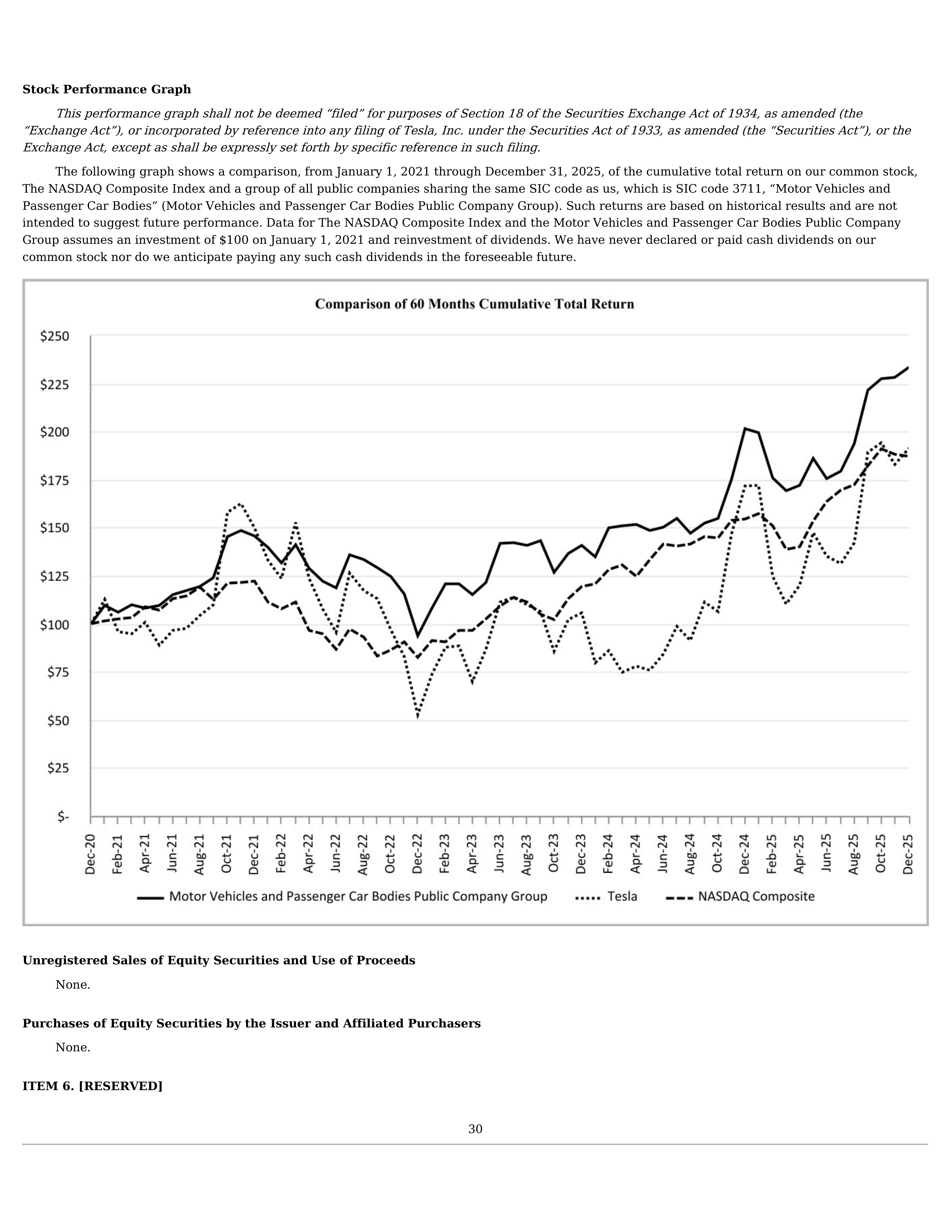
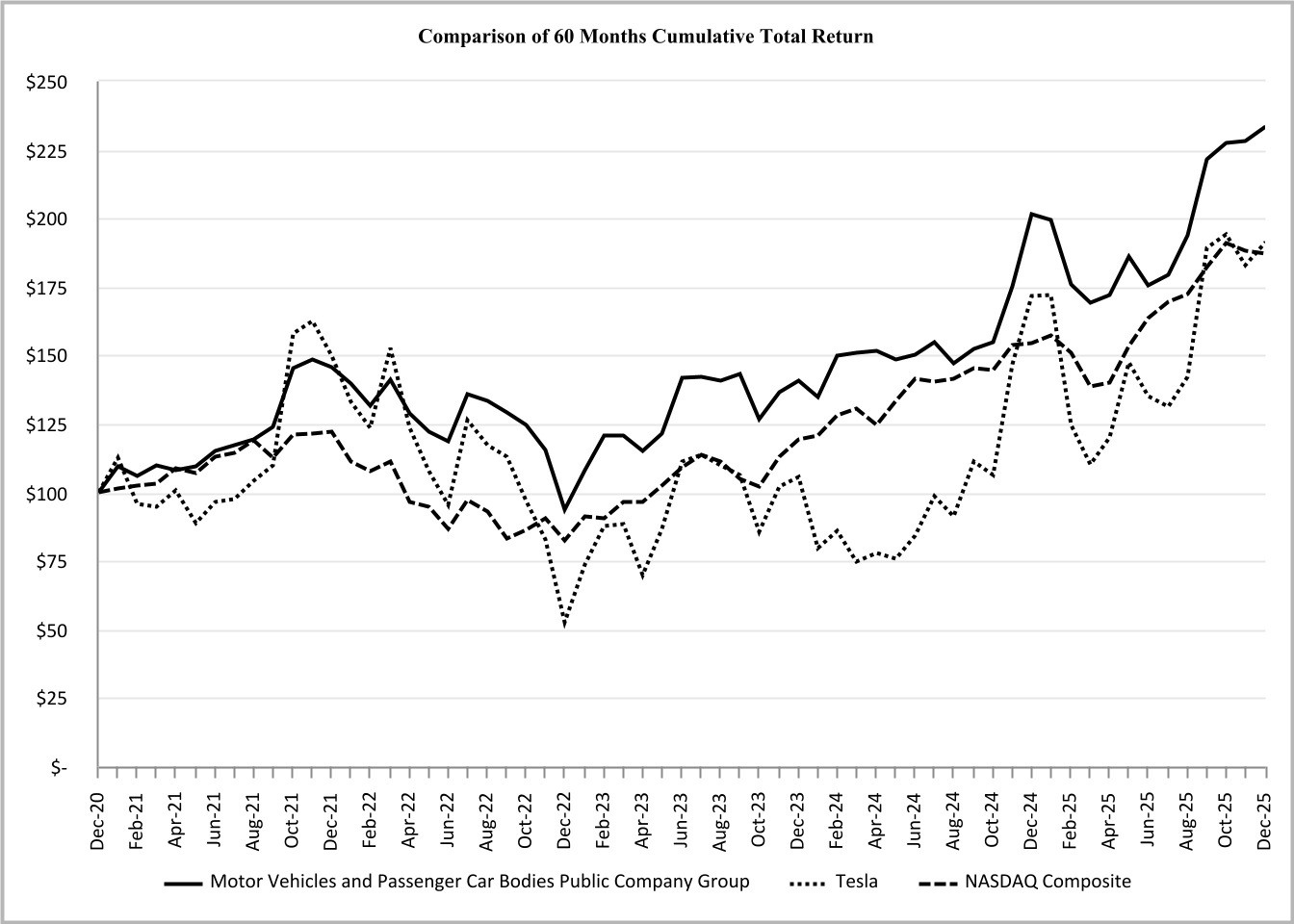
Stock Performance Graph
This performance graph shall not be deemed “filed” for purposes of Section 18 of the Securities Exchange Act of 1934, as amended (the
“Exchange Act”), or incorporated by reference into any filing of Tesla, Inc. under the Securities Act of 1933, as amended (the “Securities Act”), or the
Exchange Act, except as shall be expressly set forth by specific reference in such filing.
The following graph shows a comparison, from January 1, 2021 through December 31, 2025, of the cumulative total return on our common stock,
The NASDAQ Composite Index and a group of all public companies sharing the same SIC code as us, which is SIC code 3711, “Motor Vehicles and
Passenger Car Bodies” (Motor Vehicles and Passenger Car Bodies Public Company Group). Such returns are based on historical results and are not
intended to suggest future performance. Data for The NASDAQ Composite Index and the Motor Vehicles and Passenger Car Bodies Public Company
Group assumes an investment of $100 on January 1, 2021 and reinvestment of dividends. We have never declared or paid cash dividends on our
common stock nor do we anticipate paying any such cash dividends in the foreseeable future.
Unregistered Sales of Equity Securities and Use of Proceeds
None.
Purchases of Equity Securities by the Issuer and Affiliated Purchasers
None.
ITEM 6. [RESERVED]
30
ITEM 7. MANAGEMENT’S DISCUSSION AND ANALYSIS OF FINANCIAL CONDITION AND RESULTS OF OPERATIONS
The following discussion and analysis should be read in conjunction with the consolidated financial statements and the related notes included
elsewhere in this Annual Report on Form 10-K. For further discussion of our products and services, technology and competitive strengths, refer to Item
1- Business. For discussion related to changes in financial condition and the results of operations for fiscal year 2024-related items, refer to Part II, Item
7. Management’s Discussion and Analysis of Financial Condition and Results of Operations in our Annual Report on Form 10-K for fiscal year 2024,
which was filed with the SEC on January 30, 2025.
Overview and 2025 Highlights
We are focused on bringing artificial intelligence into the real world, through products and services like FSD (Supervised) and Robotaxi, as well as
working to develop and commercialize AI robots (including Optimus). We intend to leverage our current operations, in which we design, develop,
manufacture, sell and lease high-performance fully electric vehicles and energy generation and storage systems that increasingly deliver AI-related and
enhanced software and services to our customers, to achieve that objective.
As a result of rapidly evolving trade and fiscal policy, uncertainty in the automotive and energy markets continues, posing risks to our global
supply chain and cost structure which could have a meaningfully adverse impact on demand for our products and our profitability. The current tariff
regime will have a relatively larger impact on our energy generation and storage business compared to our automotive business. While we prepare for
near-term challenges to our business under current policies, we are focused on long-term growth opportunities as we continue to make prudent
investments.
In 2025, we produced approximately 1.66 million consumer vehicles and delivered approximately 1.64 million consumer vehicles. We are focused
on profitable growth via a differentiated and efficiently managed product portfolio that leverages our existing factories and production lines, further
improving and deploying our FSD (Supervised) capabilities, including future autonomous capabilities through our purpose-built Robotaxi product,
Cybercab, reducing costs, increasing vehicle production, utilized capacity and delivery capabilities, improving and developing our vehicles, battery and
AI compute technologies, vertically integrating and localizing our supply chain, and expanding our global infrastructure, including our service and
charging infrastructure. We have continued to expand and refine our Robotaxi service after its June 2025 launch, capitalizing on our AI investments and
scalable mobility infrastructure to advance a service-driven business model.
In 2025, we deployed 46.7 GWh of energy storage products. We are focused on ramping the production, increasing the market penetration of our
energy storage products, developing our battery technologies and vertically integrating, localizing and expanding our supply chain.
In 2025, we recognized total revenues of $94.83 billion, representing a decrease of $2.86 billion compared to the prior year. In 2025, our net
income attributable to common stockholders was $3.79 billion, representing a decrease of $3.30 billion compared to the prior year. We continue to
ramp production and build and optimize our manufacturing capacity, expand our operations while focusing on further cost reductions and operational
efficiencies to enable increased deliveries and deployments of our products, and invest in research and development to accelerate our AI, software and
fleet-based profits for further revenue growth.
We ended 2025 with $44.06 billion in cash and cash equivalents and investments, representing an increase of $7.50 billion from the end of 2024.
Our cash flows provided by operating activities were $14.75 billion in 2025 compared to $14.92 billion in 2024, representing a decrease of $176 million.
Capital expenditures amounted to $8.53 billion in 2025 compared to $11.34 billion in 2024, representing a decrease of $2.82 billion. Overall growth has
allowed our business to generally fund itself, and we will continue to make critical high-value investments while maintaining a strong balance sheet.
31
Management Opportunities, Challenges and Uncertainties and 2026 Outlook
Automotive and AI Enabled Products—Production
We are focused on growing and optimizing our manufacturing capacity, which includes capacity for manufacturing newer vehicle models and
future vehicles utilizing aspects of our next generation platform, while maximizing production rate and efficiency at our Gigafactories. In 2025, we
completed the refresh of our vehicle lineup with the launch of the new Model Y and additional variants for Model 3 and Model Y. The next phase of
production growth will be initiated by advances in autonomy and the introduction of new products, including those built on our next generation vehicle
platform, as well as our ability to efficiently manufacture our own cells that we are developing to have high-volume output, lower capital and production
costs and longer range. Our goals are to improve vehicle performance, decrease production costs and increase affordability and customer awareness.
We are also capitalizing on our strengths in real-world AI data to advance the development of Optimus, a general purpose, autonomous humanoid robot.
These plans are subject to uncertainties inherent in establishing and ramping manufacturing operations, which may be exacerbated by new
product and manufacturing technologies we introduce, the number of concurrent international projects, any industry-wide component constraints, labor
shortages and any future impact from events outside of our control. For example, changes to fiscal and trade policy with respect to tariffs, export
controls and other restrictions may impact our global supply chain cost structure and availability, affecting not only vehicle production, but also facility
expansions. Moreover, we have set ambitious technological targets with our plans for battery cells as well as for iterative manufacturing and design
improvements for our vehicles.
Automotive and AI Enabled Products—Demand, Sales, Deliveries and Infrastructure
Our cost reduction efforts, cost innovation strategies, and additional localized procurement and manufacturing are key to our vehicles’
affordability and have allowed us to competitively price our vehicles. We will also continue to generate demand by improving our vehicles’ performance
and functionality, including through product offerings and features utilizing artificial intelligence such as FSD (Supervised) and other software, and
delivering new vehicles and vehicle options. In addition, we believe the launch of our Robotaxi service unlocks the potential for significant business
growth to advance a service-driven business model. We will continue to improve safety and profitability while scaling the network. In addition, we have
been increasing awareness, and expanding our vehicle financing programs, including attractive leasing terms for our customers. We will also continue
to work on developing our robotics offerings.
However, we operate in a cyclical industry that is sensitive to shifting consumer trends, political and regulatory uncertainty, including with
respect to trade and the environment, all of which can be compounded by inflationary pressures, rising energy prices, interest rate fluctuations and the
liquidity of enterprise customers. For example, as inflationary pressures increased across the markets in which we operate, central banks in developed
countries raised interest rates rapidly and substantially, which impacted the affordability of vehicle lease and finance arrangements. Further, sales of
vehicles in the automotive industry also tend to be cyclical in many markets, which may expose us to increased volatility as we expand and adjust our
operations. Moreover, as additional competitors enter the marketplace and help bring the world closer to sustainable transportation, we will have to
adjust and continue to execute well to maintain our momentum. Additionally, our suppliers’ liquidity and allocation plans may be affected by current
challenges in the automotive industry, which could reduce our access to components or result in unfavorable changes to cost. These macroeconomic
and industry trends have had, and will likely continue to have, an impact on the pricing of, and order rate for our vehicles, and in turn our operating
margin.
Changes in government and economic policies, incentives or tariffs may also impact our production, cost structure and the competitive landscape.
For instance, while the final scope and application of recently announced changes in trade policy remain uncertain at this time, higher tariffs on imports
and subsequent retaliatory tariffs could adversely impact consumer spending and demand for durable goods and related services. Furthermore, certain
provisions of the OBBBA, including the removal of tax credits for electric vehicles, may also impact consumer demand for electric vehicles in general.
We will continue to adjust accordingly to such developments, and we believe our ongoing cost reduction efforts, including through production
innovation, process improvements and logistics optimization, and focus on operating leverage, vertical integration and supply chain localization will
continue to benefit us in relation to our competitors. Our new products and our advances in autonomy and robotics, position us for future growth.
32
As our vehicle production increases, we must work constantly to similarly increase vehicle delivery capability so that it does not become a
bottleneck on our total deliveries. As we expand our manufacturing operations globally, we will also have to continue to increase and staff our delivery,
servicing and charging infrastructure accordingly, maintain our vehicle reliability and optimize our Supercharger locations to ensure cost effectiveness
and customer satisfaction. In particular, as other automotive manufacturers have announced their adoption of NACS and agreements with us to utilize
our Superchargers, we must correspondingly expand our network in order to ensure adequate availability to meet customer demands. We also remain
focused on continued enhancements of the capability and efficiency of our servicing operations. In tandem with the launch of our Robotaxi business, we
are focused on developing and optimizing dedicated infrastructure, including in relation to vehicle cleaning and maintenance, charging, security,
teleoperations and fleet management, to ensure service quality as we continue to scale.
Energy Generation and Storage Demand, Production and Deployment
The long-term success of this business is dependent upon incremental volume growth. We continue to increase the production and capabilities of
our energy storage products to meet high levels of demand, including the ramps of our Megafactories in Shanghai and Lathrop, California, and the
construction of a new Megafactory near Houston, Texas. In 2025, we introduced Megapack 3 and Megablock, our next-generation industrial storage
product, and began manufacturing a new residential retrofit solar panel. For Megapack, energy storage deployments can vary meaningfully quarter to
quarter depending on the timing of specific project milestones and logistics. As these product lines grow, we will have to maintain adequate battery cell
supply for our energy storage products. At the same time, changes in government and economic incentives or tariffs may also impact our sales, cost
structure and the competitive landscape. For instance, import tariffs by the US government and the provisions of the OBBBA could significantly
increase battery cell expenses and impact costs for our consumers, negatively impacting consumer demand. Despite these challenges, as AI
infrastructure drives rapid load growth, we see opportunities for our energy storage products to stabilize the grid, shift energy when it is needed most
and provide additional power capacity.
Cash Flow and Capital Expenditure Trends
Our capital expenditures are typically difficult to project beyond the short-term given the number and breadth of our core projects at any given
time, and may further be impacted by uncertainties in future global market conditions and shifting global trade and fiscal policy. We are simultaneously
developing and ramping new products, building or ramping manufacturing facilities on three continents, piloting the development and manufacture of
new battery cell technologies, expanding our Supercharger network and investing in autonomy, robotics and other artificial intelligence enabled
training and products and its supporting infrastructure, and the pace of our capital spend may vary depending on overall priority among projects, the
pace at which we meet milestones, production adjustments to and among our various products, increased capital efficiencies and the addition of new
projects. We are focused on long-term growth opportunities through critical, high-value investments. We currently expect our capital expenditures to be
in excess of $20 billion in 2026, driven by our AI initiatives, including investments in compute infrastructure and data centers, the expansion and ramp
of our manufacturing and R&D production lines and facilities, and growth in our fleet of company-operated AI-enabled assets and our retail, service and
charging footprint. We believe this strategy will position our Company for further growth as we make investments in a capital efficient manner.
Our business has generally been consistently generating cash flow from operations in excess of our level of capital spend, and with better working
capital management resulting in shorter days sales outstanding than days payable outstanding, our sales growth is also generally facilitating positive
cash generation. We have and will continue to utilize such cash flows, among other things, to invest in autonomy and robotics, further vertically
integrate our supply chain, expand our product roadmap and provide financing options to our customers. At the same time, periods of heightened levels
of capital expenditures due to capital-intensive projects and other potential variables such as rising material prices and increases in supply chain and
labor expenses resulting from changes in global trade conditions and labor availability, will necessitate additional funding beyond our operating cash
flow.
33
Critical Accounting Policies and Estimates
The consolidated financial statements are prepared in accordance with accounting principles generally accepted in the U.S. (“GAAP”). The
preparation of the consolidated financial statements requires us to make estimates and assumptions that affect the reported amounts of assets,
liabilities, revenues, costs and expenses and related disclosures. We base our estimates on historical experience, as appropriate, and on various other
assumptions that we believe to be reasonable under the circumstances. Changes in the accounting estimates are reasonably likely to occur from period
to period. Accordingly, actual results could differ significantly from the estimates made by our management. We evaluate our estimates and
assumptions on an ongoing basis. To the extent that there are material differences between these estimates and actual results, our future financial
statement presentation, financial condition, results of operations and cash flows may be affected.
The estimates used for, but not limited to, determining significant economic incentive for resale value guarantee arrangements, sales return
reserves, resale value guarantee liabilities, income tax, the collectability of accounts and finance receivables, fair value and probability assessments of
stock-based awards, inventory valuation, warranties, fair value of long-lived assets, fair value of financial instruments, fair value and residual value of
operating lease vehicles and energy generation and storage systems subject to leases could be impacted. We have assessed the impact and are not
aware of any specific events or circumstances that required an update to our estimates and assumptions or materially affected the carrying value of our
assets or liabilities as of the date of issuance of this Annual Report on Form 10-K. These estimates may change as new events occur and additional
information is obtained. Actual results could differ materially from these estimates under different assumptions or conditions.
Revenue Recognition
Automotive Sales
Automotive sales revenue includes revenues related to cash and financing deliveries of new vehicles, and specific other features and services that
meet the definition of a performance obligation under Accounting Standards Codification 606, Revenue from Contracts with Customers (“ASC 606”),
including access to our internet connectivity, access to our FSD (Supervised) features and their ongoing maintenance, free Supercharging programs
and over-the-air software updates. We recognize revenue on automotive sales, net of any discounts or financial subsidies, upon delivery to the customer,
which is when the control of a vehicle transfers. Payments are typically received at the point control transfers or in accordance with payment terms
customary to the business, except sales we finance for which payments are collected over the contractual loan term. We also recognize a sales return
reserve based on historical experience plus consideration for expected future market values when we offer resale value guarantees or similar buyback
terms. Other features and services such as access to our internet connectivity, unlimited free Supercharging and over-the-air software updates are
provisioned upon transfer of control of a vehicle and recognized over time on a straight-line basis as we have a stand-ready obligation to deliver such
services to the customer. Other limited free Supercharging incentives are recognized based on actual usage or expiration, whichever is earlier. We
recognize revenue related to these other features and services over the performance period, which is generally the expected ownership life of the
vehicle. Revenue related to FSD (Supervised) features is recognized when functionality is delivered to the customer and their ongoing maintenance is
recognized over time. For our obligations related to automotive sales, we estimate standalone selling price by considering costs used to develop and
deliver the service, third-party pricing of similar options and other information that may be available. Customers may purchase subscriptions, including
FSD (Supervised) and premium connectivity, after taking delivery of their vehicles. Revenue from subscriptions is recognized either over time or point
in time depending on the nature of contractual terms.
Any fees or financial subsidies that are paid or payable by us to a customer’s lender when we arrange the financing are recognized upfront as an
offset against automotive sales revenue. As our contract costs related to automotive sales are typically fulfilled within one year, the costs to obtain a
contract are expensed as incurred. Amounts billed to customers related to shipping and handling are classified as automotive sales revenue, and we
have elected to recognize the cost for freight and shipping when control over vehicles, parts or accessories have transferred to the customer as an
expense in cost of automotive sales revenue. Our policy is to exclude taxes collected from a customer from the transaction price of automotive
contracts.
34
We offer resale value guarantees to our commercial banking partners in connection with certain vehicle leasing programs. Under these programs,
we originate the lease with our end customer and immediately transfer the lease and the underlying vehicle to our commercial banking partner, with
the transaction being accounted for as a sale under ASC 606. We receive upfront payment for the vehicle, do not bear casualty and credit risks during
the lease term, and we provide a guarantee capped to a limit if they are unable to sell the vehicle at or above the vehicle’s contractual or determined
residual value at the end of the lease term. We estimate a guarantee liability in accordance with ASC 460, Guarantees and record it within other
liabilities on our consolidated balance sheets. On a quarterly basis, we assess the estimated market value of vehicles sold under these programs to
determine whether there have been changes to the amount of expected resale value guarantee liabilities. As we accumulate more data related to the
resale values of our vehicles or as market conditions change, there may be material changes to their estimated values.
Inventory Valuation
Inventories are stated at the lower of cost or net realizable value. Cost is computed using standard cost for vehicles and energy products, which
approximates actual cost on a first-in, first-out basis. We record inventory write-downs for excess or obsolete inventories based upon assumptions about
current and future demand forecasts. If our inventory on-hand is in excess of our future demand forecast, the excess amounts are written-off.
We also review our inventory to determine whether its carrying value exceeds the net amount realizable upon the ultimate sale of the inventory.
This requires us to determine the estimated selling price of our vehicles less the estimated cost to convert the inventory on-hand into a finished product.
Once inventory is written-down, a new, lower cost basis for that inventory is established and subsequent changes in facts and circumstances do not
result in the restoration or increase in that newly established cost basis.
Should our estimates of future selling prices or production costs change, additional and potentially material write-downs may be required. A small
change in our estimates may result in a material charge to our reported financial results.
Warranties
We provide a manufacturer’s warranty on all new and used vehicles and a warranty on the installation and components of the energy generation
and storage systems we sell for periods typically between 1 to 25 years. We accrue a warranty reserve for the products sold by us, which includes our
best estimate of the projected costs to repair or replace items under warranties and recalls if identified. These estimates are based on actual claims
incurred to date and an estimate of the nature, frequency and costs of future claims. These estimates are inherently uncertain and changes to our
historical or projected warranty experience may cause material changes to the warranty reserve in the future. The warranty reserve does not include
projected service costs associated with our vehicles subject to operating lease accounting and our energy generation and storage systems under lease
contracts or PPAs, as these service costs are expensed as incurred. The portion of the warranty reserve expected to be incurred within the next 12
months is included within Accrued liabilities and other, while the remaining balance is included within Other long-term liabilities on the consolidated
balance sheets. For liabilities that we are entitled to receive indemnification from our suppliers, we record receivables for the contractually obligated
amounts on the consolidated balance sheets as a component of Prepaid expenses and other current assets for the current portion and as Other non-
current assets for the long-term portion. Warranty expense is recorded as a component of Cost of revenues in the consolidated statements of operations.
Due to the magnitude of our automotive business, our accrued warranty balance is primarily related to our automotive segment.
Stock-Based Compensation
We use the fair value method of accounting for our restricted stock awards (“RSAs”), stock options and restricted stock units (“RSUs”) granted to
employees and for our employee stock purchase plan (“the ESPP”) to measure the cost of employee services received in exchange for the stock-based
awards. Stock-based compensation expense for equity awards is a non-cash expense and is recorded in Cost of revenues, Research and development
expense and Selling, general and administrative expense in the consolidated statements of operations based on the function of the employee.
35
Equity awards with service and/or performance conditions
The fair value of stock option awards with service and/or performance conditions and the ESPP is estimated on the grant or offering date using the
Black-Scholes option-pricing model. The Black-Scholes option-pricing model requires inputs such as the risk-free interest rate, expected award term and
expected share price volatility. The fair value of RSUs with service and/or performance conditions is measured on the grant date based on the closing
fair market value of our common stock. The resulting stock-based compensation expense for stock options, RSUs and the ESPP is recognized over the
period during which an employee is required to provide service in exchange for the awards, usually the vesting period, which is generally four years for
stock options and RSUs and six months for the ESPP.
The fair value of restricted stock granted to our CEO with service and/or performance conditions is measured on the grant date based on the
closing fair market value of our common stock, adjusted to take into account the illiquidity discount due to any applicable required holding period, less
any purchase price or offset amount. The illiquidity discount is determined using a valuation model that requires inputs such as expected share price
volatility and the employee’s expected tax rate. The inputs used in the valuation models, which are subjective and generally require significant
judgment, are unique to each award based on the best available information at the valuation date.
Stock-based compensation expense for equity awards with performance conditions is recognized over the requisite service period when the
vesting of the award becomes probable. Stock-based compensation expense is recognized on a straight-line basis for equity awards with only a service
condition and on a graded vesting basis for equity awards with a performance condition, net of actual forfeitures in the period.
Equity awards with market, service and performance conditions
The fair value and derived service period of performance-based awards granted to our CEO with market, service and performance conditions are
estimated on the grant date using a Monte Carlo simulation model. A Monte Carlo simulation model requires inputs such as the risk-free interest rate,
expected award term, expected share dilution and expected share price volatility. For awards with a holding requirement that is in effect post-vesting,
the fair value is adjusted to take into account an illiquidity discount, which is determined using a valuation model that requires inputs such as expected
share price volatility and the employee’s expected tax rate. These inputs, which are subjective and generally require significant judgment, are unique to
each award based on the best available information at the valuation date.
For such awards, stock-based compensation expense is recognized on a straight-line basis over the expected performance achievement period of
individual performance milestones when the achievement of each individual performance milestone becomes probable. If applicable, stock-based
compensation expense for such awards is recognized over the longer of (i) the expected service period, (ii) the expected achievement period for the
operational milestone (performance condition) and (iii) the expected achievement period for the related market capitalization milestone determined on
the grant date, with recognition beginning at the point in time that the relevant operational milestone is considered probable of achievement. If such
operational milestone becomes probable any time after the grant date or the expected achievement period changes, we will recognize a cumulative
expense adjustment from the grant date to that point in time. Stock-based compensation expense will continue to be recognized over the expected
achievement period for the operational milestone (if applicable) regardless of whether the market capitalization milestone is achieved earlier than its
expected achievement period or achieved at all, as long as the service condition continues to be satisfied. If an operational milestone is subsequently
determined to be improbable of achievement, stock-based compensation expense previously recognized would be reversed in the period the condition is
deemed improbable.
Income Taxes
We are subject to income taxes in the U.S. and in many foreign jurisdictions. Significant judgment is required in determining our provision for
income taxes, our deferred tax assets and liabilities and any valuation allowance recorded against our net deferred tax assets that are not more likely
than not to be realized. We monitor the realizability of our deferred tax assets taking into account all relevant factors at each reporting period. In
completing our assessment of realizability of our deferred tax assets, we consider our history of income (loss) measured at pre-tax income (loss)
adjusted for permanent book-tax differences on a jurisdictional basis, volatility in actual earnings, excess tax benefits related to stock-based
compensation in recent prior years, and impacts of the timing of reversal of existing temporary differences. We also rely on our assessment of the
Company’s projected future results of business operations, including uncertainty in future operating results relative to historical results, volatility in the
market price of our common stock and its performance over time, variable macroeconomic conditions impacting our ability to forecast future taxable
income, and changes in business that may affect the existence and magnitude of future taxable income. Our valuation allowance assessment is based on
our best estimate of future results considering all available information.
36
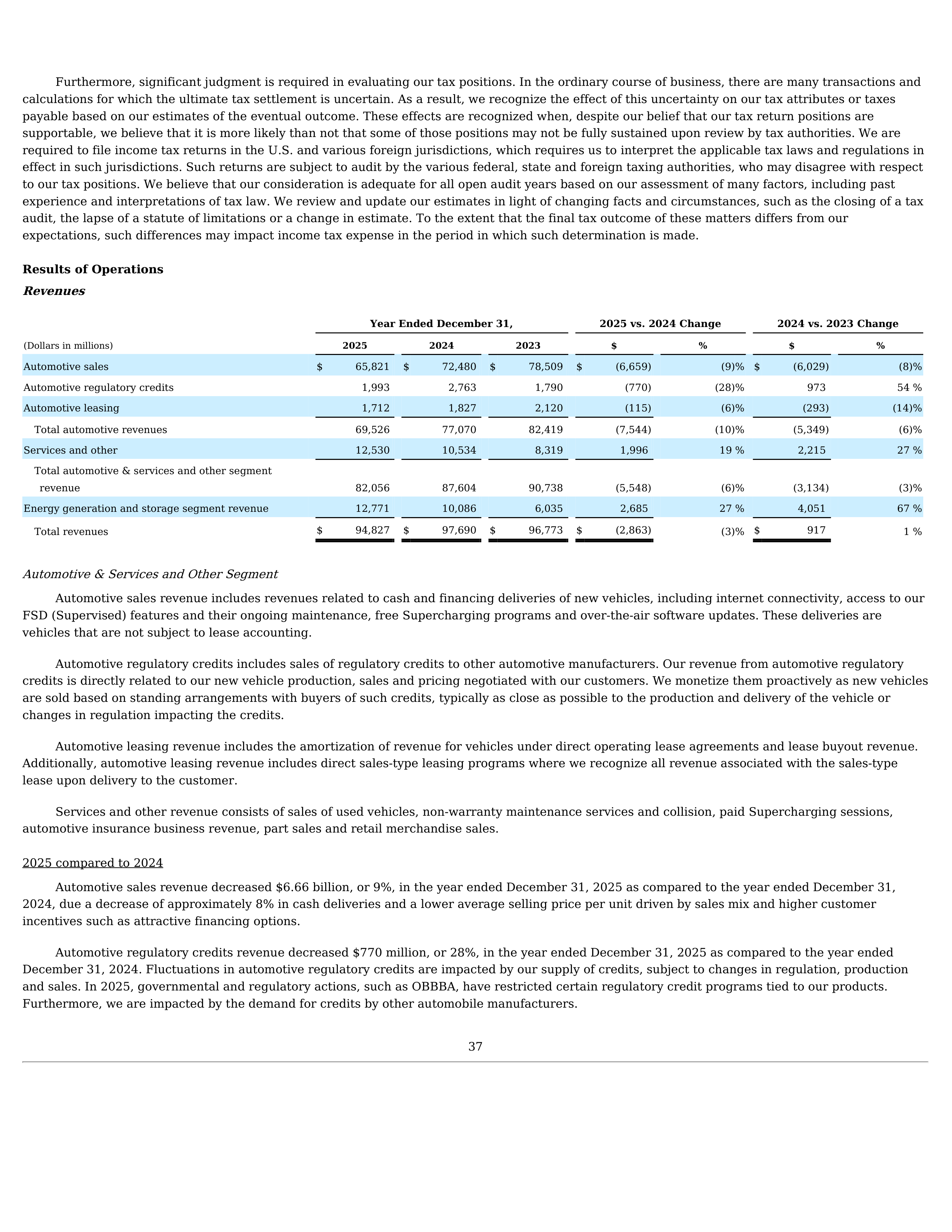
Furthermore, significant judgment is required in evaluating our tax positions. In the ordinary course of business, there are many transactions and
calculations for which the ultimate tax settlement is uncertain. As a result, we recognize the effect of this uncertainty on our tax attributes or taxes
payable based on our estimates of the eventual outcome. These effects are recognized when, despite our belief that our tax return positions are
supportable, we believe that it is more likely than not that some of those positions may not be fully sustained upon review by tax authorities. We are
required to file income tax returns in the U.S. and various foreign jurisdictions, which requires us to interpret the applicable tax laws and regulations in
effect in such jurisdictions. Such returns are subject to audit by the various federal, state and foreign taxing authorities, who may disagree with respect
to our tax positions. We believe that our consideration is adequate for all open audit years based on our assessment of many factors, including past
experience and interpretations of tax law. We review and update our estimates in light of changing facts and circumstances, such as the closing of a tax
audit, the lapse of a statute of limitations or a change in estimate. To the extent that the final tax outcome of these matters differs from our
expectations, such differences may impact income tax expense in the period in which such determination is made.
Results of Operations
Revenues
Year Ended December 31,
2025 vs. 2024 Change
2024 vs. 2023 Change
(Dollars in millions)
2025
2024
2023
$
%
$
%
Automotive sales
$
65,821
$
72,480
$
78,509
$
(6,659)
(9)%
$
(6,029)
(8)%
Automotive regulatory credits
1,993
2,763
1,790
(770)
(28)%
973
54 %
Automotive leasing
1,712
1,827
2,120
(115)
(6)%
(293)
(14)%
Total automotive revenues
69,526
77,070
82,419
(7,544)
(10)%
(5,349)
(6)%
Services and other
12,530
10,534
8,319
1,996
19 %
2,215
27 %
Total automotive & services and other segment
revenue
82,056
87,604
90,738
(5,548)
(6)%
(3,134)
(3)%
Energy generation and storage segment revenue
12,771
10,086
6,035
2,685
27 %
4,051
67 %
Total revenues
$
94,827
$
97,690
$
96,773
$
(2,863)
(3)%
$
917
1 %
Automotive & Services and Other Segment
Automotive sales revenue includes revenues related to cash and financing deliveries of new vehicles, including internet connectivity, access to our
FSD (Supervised) features and their ongoing maintenance, free Supercharging programs and over-the-air software updates. These deliveries are
vehicles that are not subject to lease accounting.
Automotive regulatory credits includes sales of regulatory credits to other automotive manufacturers. Our revenue from automotive regulatory
credits is directly related to our new vehicle production, sales and pricing negotiated with our customers. We monetize them proactively as new vehicles
are sold based on standing arrangements with buyers of such credits, typically as close as possible to the production and delivery of the vehicle or
changes in regulation impacting the credits.
Automotive leasing revenue includes the amortization of revenue for vehicles under direct operating lease agreements and lease buyout revenue.
Additionally, automotive leasing revenue includes direct sales-type leasing programs where we recognize all revenue associated with the sales-type
lease upon delivery to the customer.
Services and other revenue consists of sales of used vehicles, non-warranty maintenance services and collision, paid Supercharging sessions,
automotive insurance business revenue, part sales and retail merchandise sales.
2025 compared to 2024
Automotive sales revenue decreased $6.66 billion, or 9%, in the year ended December 31, 2025 as compared to the year ended December 31,
2024, due a decrease of approximately 8% in cash deliveries and a lower average selling price per unit driven by sales mix and higher customer
incentives such as attractive financing options.
Automotive regulatory credits revenue decreased $770 million, or 28%, in the year ended December 31, 2025 as compared to the year ended
December 31, 2024. Fluctuations in automotive regulatory credits are impacted by our supply of credits, subject to changes in regulation, production
and sales. In 2025, governmental and regulatory actions, such as OBBBA, have restricted certain regulatory credit programs tied to our products.
Furthermore, we are impacted by the demand for credits by other automobile manufacturers.
37
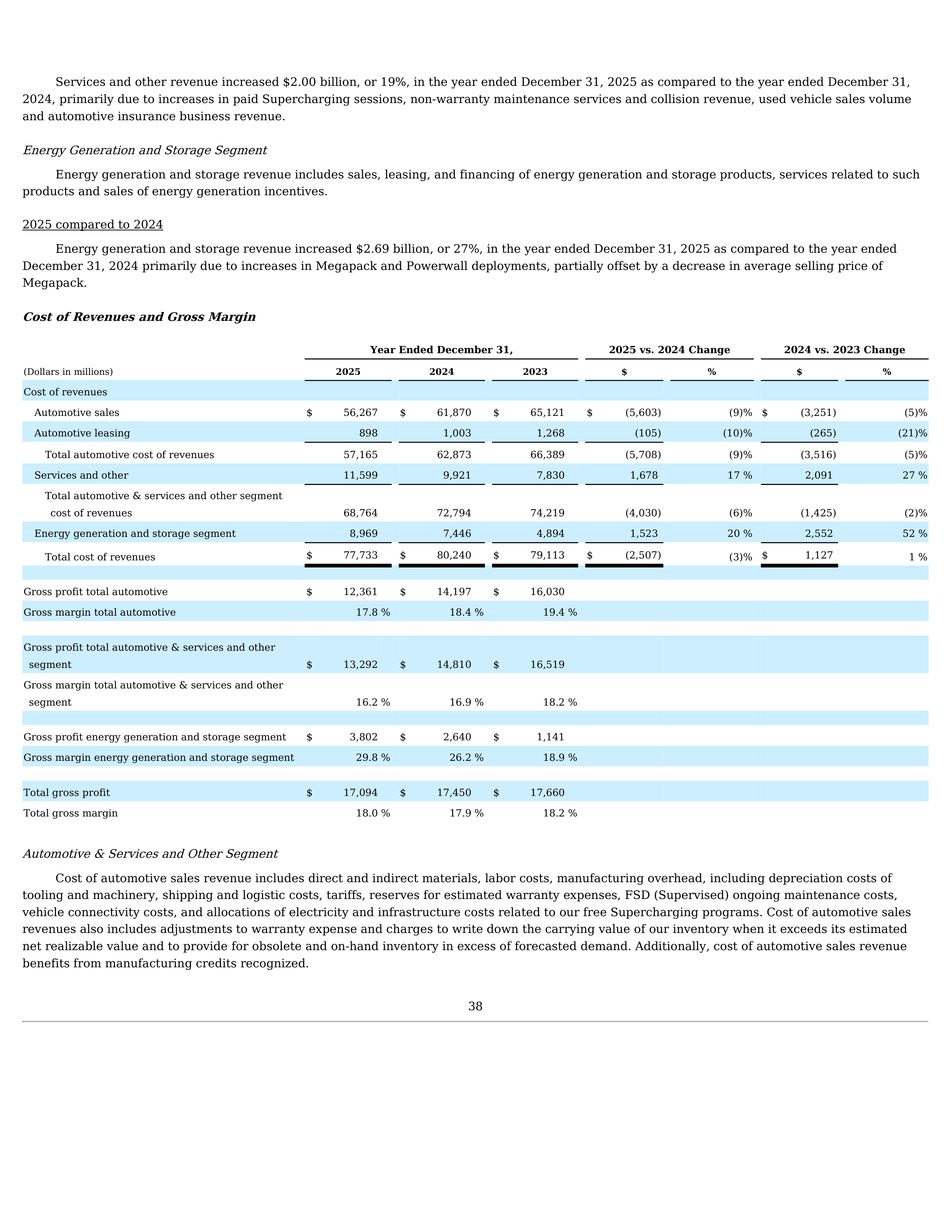
Services and other revenue increased $2.00 billion, or 19%, in the year ended December 31, 2025 as compared to the year ended December 31,
2024, primarily due to increases in paid Supercharging sessions, non-warranty maintenance services and collision revenue, used vehicle sales volume
and automotive insurance business revenue.
Energy Generation and Storage Segment
Energy generation and storage revenue includes sales, leasing, and financing of energy generation and storage products, services related to such
products and sales of energy generation incentives.
2025 compared to 2024
Energy generation and storage revenue increased $2.69 billion, or 27%, in the year ended December 31, 2025 as compared to the year ended
December 31, 2024 primarily due to increases in Megapack and Powerwall deployments, partially offset by a decrease in average selling price of
Megapack.
Cost of Revenues and Gross Margin
Year Ended December 31,
2025 vs. 2024 Change
2024 vs. 2023 Change
(Dollars in millions)
2025
2024
2023
$
%
$
%
Cost of revenues
Automotive sales
$
56,267
$
61,870
$
65,121
$
(5,603)
(9)%
$
(3,251)
(5)%
Automotive leasing
898
1,003
1,268
(105)
(10)%
(265)
(21)%
Total automotive cost of revenues
57,165
62,873
66,389
(5,708)
(9)%
(3,516)
(5)%
Services and other
11,599
9,921
7,830
1,678
17 %
2,091
27 %
Total automotive & services and other segment
cost of revenues
68,764
72,794
74,219
(4,030)
(6)%
(1,425)
(2)%
Energy generation and storage segment
8,969
7,446
4,894
1,523
20 %
2,552
52 %
Total cost of revenues
$
77,733
$
80,240
$
79,113
$
(2,507)
(3)%
$
1,127
1 %
Gross profit total automotive
$
12,361
$
14,197
$
16,030
Gross margin total automotive
17.8 %
18.4 %
19.4 %
Gross profit total automotive & services and other
segment
$
13,292
$
14,810
$
16,519
Gross margin total automotive & services and other
segment
16.2 %
16.9 %
18.2 %
Gross profit energy generation and storage segment
$
3,802
$
2,640
$
1,141
Gross margin energy generation and storage segment
29.8 %
26.2 %
18.9 %
Total gross profit
$
17,094
$
17,450
$
17,660
Total gross margin
18.0 %
17.9 %
18.2 %
Automotive & Services and Other Segment
Cost of automotive sales revenue includes direct and indirect materials, labor costs, manufacturing overhead, including depreciation costs of
tooling and machinery, shipping and logistic costs, tariffs, reserves for estimated warranty expenses, FSD (Supervised) ongoing maintenance costs,
vehicle connectivity costs, and allocations of electricity and infrastructure costs related to our free Supercharging programs. Cost of automotive sales
revenues also includes adjustments to warranty expense and charges to write down the carrying value of our inventory when it exceeds its estimated
net realizable value and to provide for obsolete and on-hand inventory in excess of forecasted demand. Additionally, cost of automotive sales revenue
benefits from manufacturing credits recognized.
38
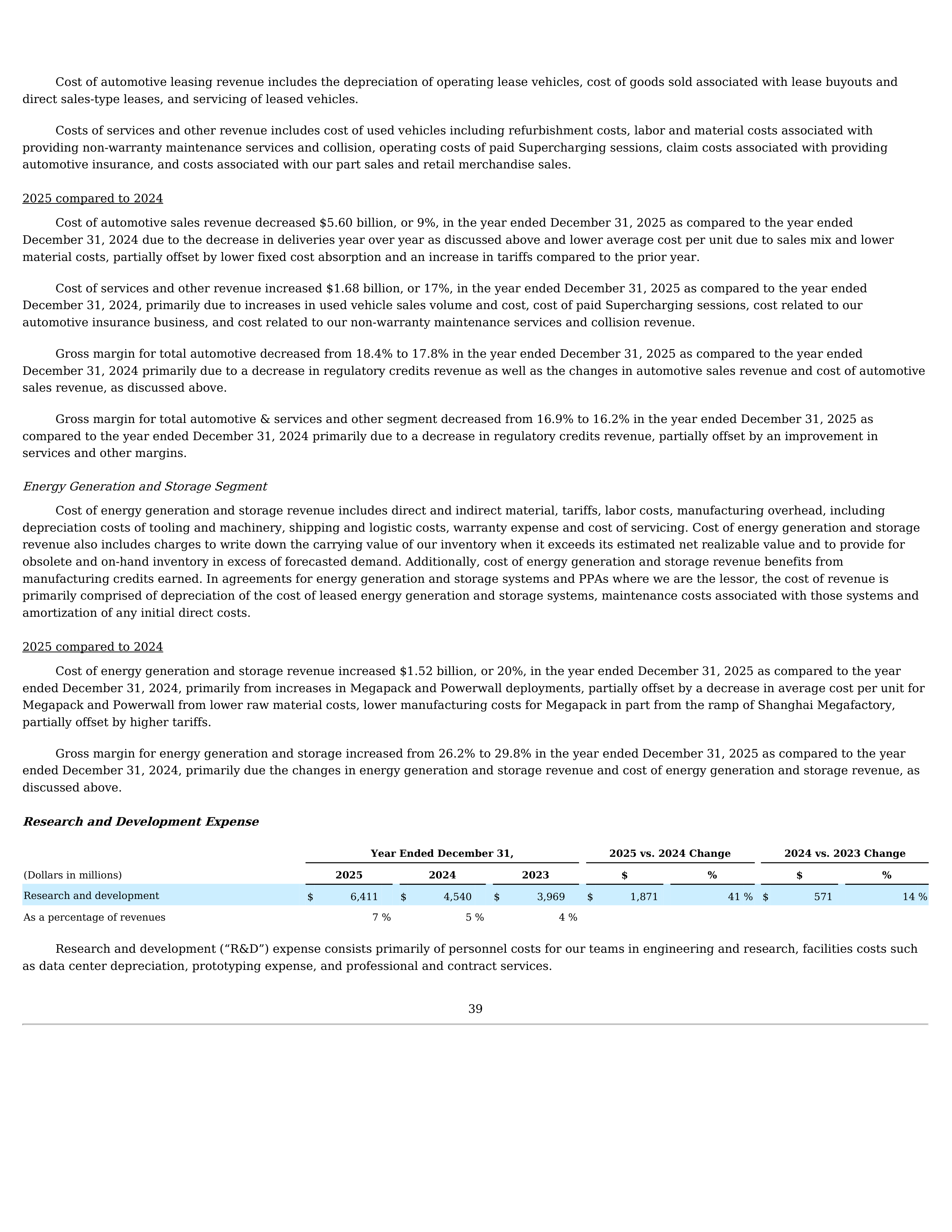
Cost of automotive leasing revenue includes the depreciation of operating lease vehicles, cost of goods sold associated with lease buyouts and
direct sales-type leases, and servicing of leased vehicles.
Costs of services and other revenue includes cost of used vehicles including refurbishment costs, labor and material costs associated with
providing non-warranty maintenance services and collision, operating costs of paid Supercharging sessions, claim costs associated with providing
automotive insurance, and costs associated with our part sales and retail merchandise sales.
2025 compared to 2024
Cost of automotive sales revenue decreased $5.60 billion, or 9%, in the year ended December 31, 2025 as compared to the year ended
December 31, 2024 due to the decrease in deliveries year over year as discussed above and lower average cost per unit due to sales mix and lower
material costs, partially offset by lower fixed cost absorption and an increase in tariffs compared to the prior year.
Cost of services and other revenue increased $1.68 billion, or 17%, in the year ended December 31, 2025 as compared to the year ended
December 31, 2024, primarily due to increases in used vehicle sales volume and cost, cost of paid Supercharging sessions, cost related to our
automotive insurance business, and cost related to our non-warranty maintenance services and collision revenue.
Gross margin for total automotive decreased from 18.4% to 17.8% in the year ended December 31, 2025 as compared to the year ended
December 31, 2024 primarily due to a decrease in regulatory credits revenue as well as the changes in automotive sales revenue and cost of automotive
sales revenue, as discussed above.
Gross margin for total automotive & services and other segment decreased from 16.9% to 16.2% in the year ended December 31, 2025 as
compared to the year ended December 31, 2024 primarily due to a decrease in regulatory credits revenue, partially offset by an improvement in
services and other margins.
Energy Generation and Storage Segment
Cost of energy generation and storage revenue includes direct and indirect material, tariffs, labor costs, manufacturing overhead, including
depreciation costs of tooling and machinery, shipping and logistic costs, warranty expense and cost of servicing. Cost of energy generation and storage
revenue also includes charges to write down the carrying value of our inventory when it exceeds its estimated net realizable value and to provide for
obsolete and on-hand inventory in excess of forecasted demand. Additionally, cost of energy generation and storage revenue benefits from
manufacturing credits earned. In agreements for energy generation and storage systems and PPAs where we are the lessor, the cost of revenue is
primarily comprised of depreciation of the cost of leased energy generation and storage systems, maintenance costs associated with those systems and
amortization of any initial direct costs.
2025 compared to 2024
Cost of energy generation and storage revenue increased $1.52 billion, or 20%, in the year ended December 31, 2025 as compared to the year
ended December 31, 2024, primarily from increases in Megapack and Powerwall deployments, partially offset by a decrease in average cost per unit for
Megapack and Powerwall from lower raw material costs, lower manufacturing costs for Megapack in part from the ramp of Shanghai Megafactory,
partially offset by higher tariffs.
Gross margin for energy generation and storage increased from 26.2% to 29.8% in the year ended December 31, 2025 as compared to the year
ended December 31, 2024, primarily due the changes in energy generation and storage revenue and cost of energy generation and storage revenue, as
discussed above.
Research and Development Expense
Year Ended December 31,
2025 vs. 2024 Change
2024 vs. 2023 Change
(Dollars in millions)
2025
2024
2023
$
%
$
%
Research and development
$
6,411
$
4,540
$
3,969
$
1,871
41 %
$
571
14 %
As a percentage of revenues
7 %
5 %
4 %
Research and development (“R&D”) expense consists primarily of personnel costs for our teams in engineering and research, facilities costs such
as data center depreciation, prototyping expense, and professional and contract services.
39
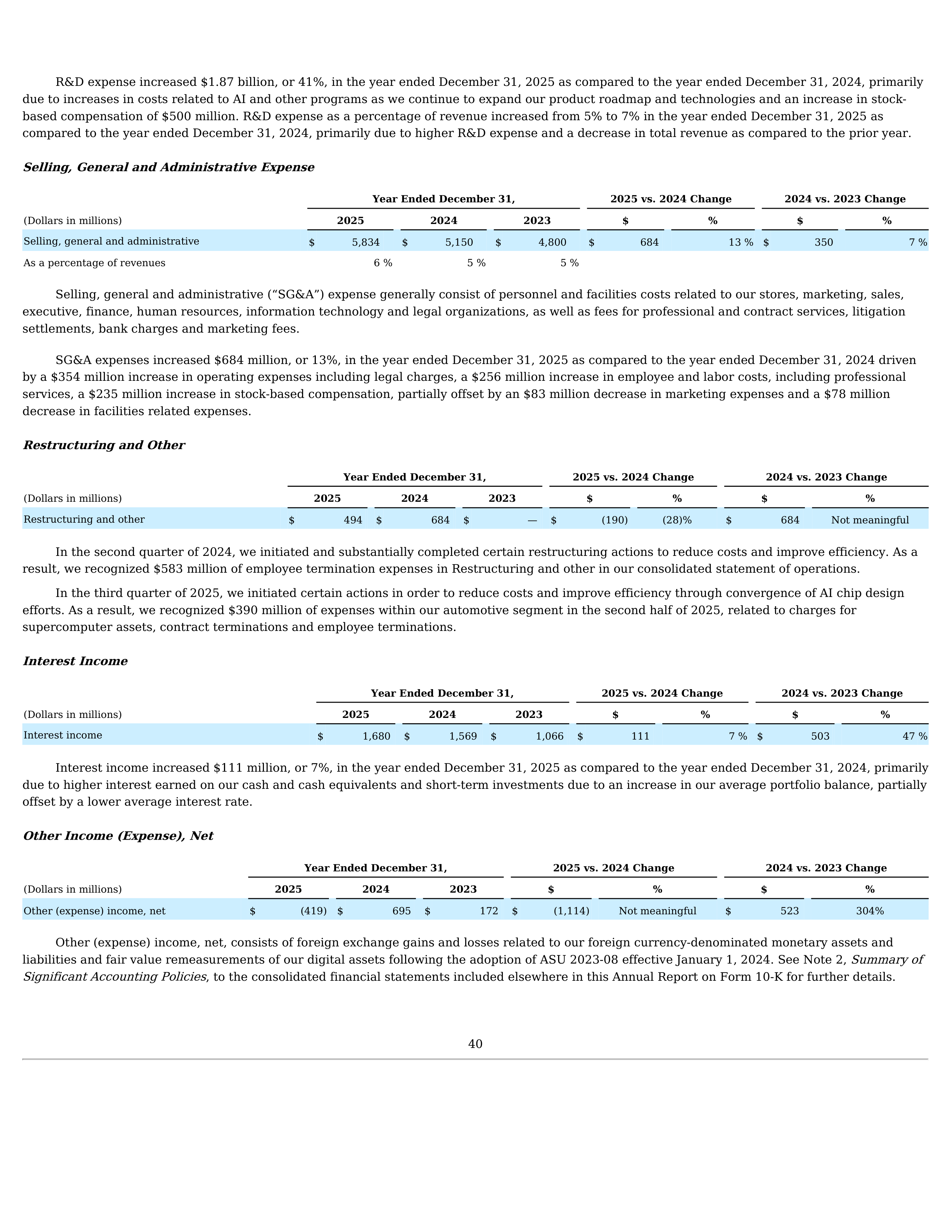
R&D expense increased $1.87 billion, or 41%, in the year ended December 31, 2025 as compared to the year ended December 31, 2024, primarily
due to increases in costs related to AI and other programs as we continue to expand our product roadmap and technologies and an increase in stock-
based compensation of $500 million. R&D expense as a percentage of revenue increased from 5% to 7% in the year ended December 31, 2025 as
compared to the year ended December 31, 2024, primarily due to higher R&D expense and a decrease in total revenue as compared to the prior year.
Selling, General and Administrative Expense
Year Ended December 31,
2025 vs. 2024 Change
2024 vs. 2023 Change
(Dollars in millions)
2025
2024
2023
$
%
$
%
Selling, general and administrative
$
5,834
$
5,150
$
4,800
$
684
13 %
$
350
7 %
As a percentage of revenues
6 %
5 %
5 %
Selling, general and administrative (“SG&A”) expense generally consist of personnel and facilities costs related to our stores, marketing, sales,
executive, finance, human resources, information technology and legal organizations, as well as fees for professional and contract services, litigation
settlements, bank charges and marketing fees.
SG&A expenses increased $684 million, or 13%, in the year ended December 31, 2025 as compared to the year ended December 31, 2024 driven
by a $354 million increase in operating expenses including legal charges, a $256 million increase in employee and labor costs, including professional
services, a $235 million increase in stock-based compensation, partially offset by an $83 million decrease in marketing expenses and a $78 million
decrease in facilities related expenses.
Restructuring and Other
Year Ended December 31,
2025 vs. 2024 Change
2024 vs. 2023 Change
(Dollars in millions)
2025
2024
2023
$
%
$
%
Restructuring and other
$
494
$
684
$
—
$
(190)
(28)%
$
684
Not meaningful
In the second quarter of 2024, we initiated and substantially completed certain restructuring actions to reduce costs and improve efficiency. As a
result, we recognized $583 million of employee termination expenses in Restructuring and other in our consolidated statement of operations.
In the third quarter of 2025, we initiated certain actions in order to reduce costs and improve efficiency through convergence of AI chip design
efforts. As a result, we recognized $390 million of expenses within our automotive segment in the second half of 2025, related to charges for
supercomputer assets, contract terminations and employee terminations.
Interest Income
Year Ended December 31,
2025 vs. 2024 Change
2024 vs. 2023 Change
(Dollars in millions)
2025
2024
2023
$
%
$
%
Interest income
$
1,680
$
1,569
$
1,066
$
111
7 %
$
503
47 %
Interest income increased $111 million, or 7%, in the year ended December 31, 2025 as compared to the year ended December 31, 2024, primarily
due to higher interest earned on our cash and cash equivalents and short-term investments due to an increase in our average portfolio balance, partially
offset by a lower average interest rate.
Other Income (Expense), Net
Year Ended December 31,
2025 vs. 2024 Change
2024 vs. 2023 Change
(Dollars in millions)
2025
2024
2023
$
%
$
%
Other (expense) income, net
$
(419)
$
695
$
172
$
(1,114)
Not meaningful
$
523
304%
Other (expense) income, net, consists of foreign exchange gains and losses related to our foreign currency-denominated monetary assets and
liabilities and fair value remeasurements of our digital assets following the adoption of ASU 2023-08 effective January 1, 2024. See Note 2, Summary of
Significant Accounting Policies, to the consolidated financial statements included elsewhere in this Annual Report on Form 10-K for further details.
40
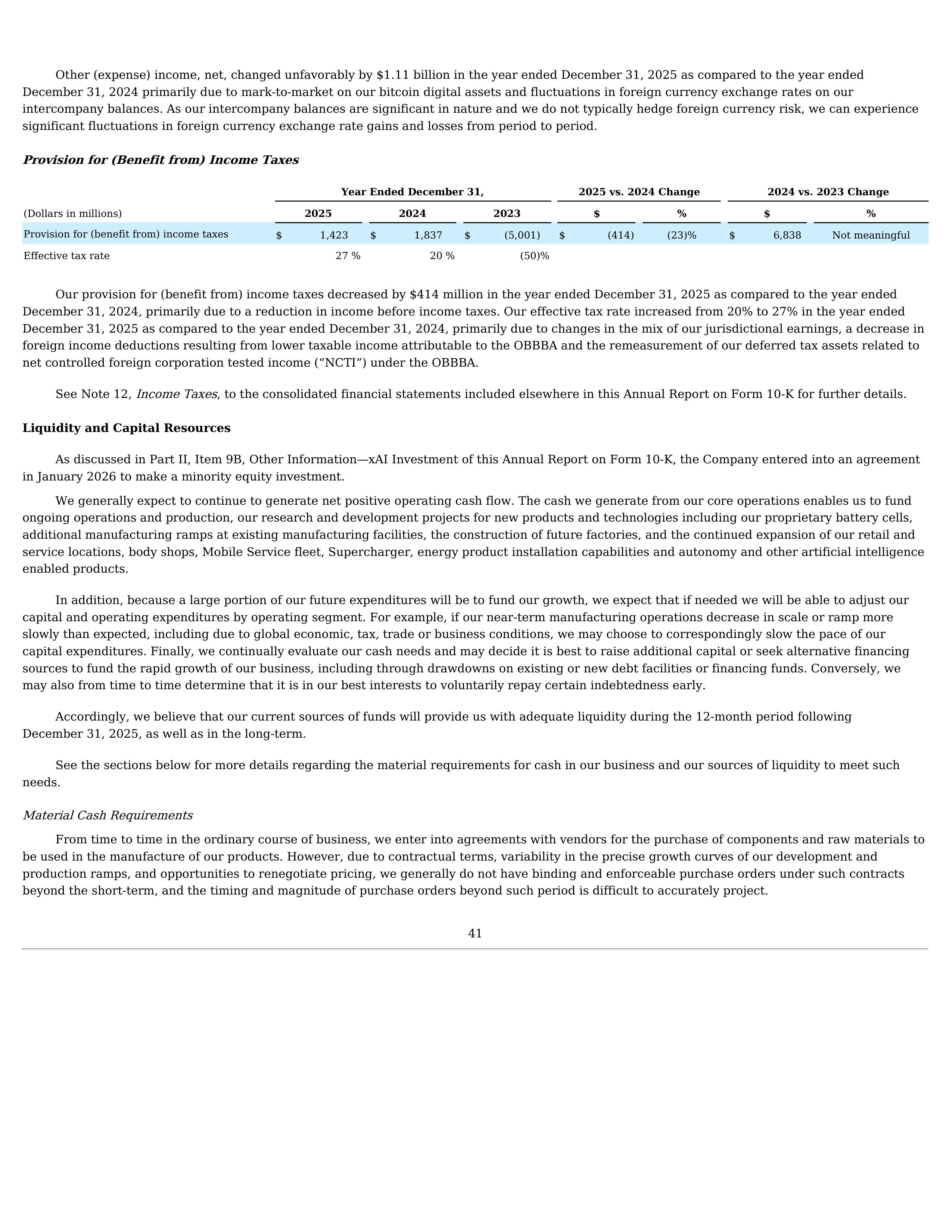
Other (expense) income, net, changed unfavorably by $1.11 billion in the year ended December 31, 2025 as compared to the year ended
December 31, 2024 primarily due to mark-to-market on our bitcoin digital assets and fluctuations in foreign currency exchange rates on our
intercompany balances. As our intercompany balances are significant in nature and we do not typically hedge foreign currency risk, we can experience
significant fluctuations in foreign currency exchange rate gains and losses from period to period.
Provision for (Benefit from) Income Taxes
Year Ended December 31,
2025 vs. 2024 Change
2024 vs. 2023 Change
(Dollars in millions)
2025
2024
2023
$
%
$
%
Provision for (benefit from) income taxes
$
1,423
$
1,837
$
(5,001)
$
(414)
(23)%
$
6,838
Not meaningful
Effective tax rate
27 %
20 %
(50)%
Our provision for (benefit from) income taxes decreased by $414 million in the year ended December 31, 2025 as compared to the year ended
December 31, 2024, primarily due to a reduction in income before income taxes. Our effective tax rate increased from 20% to 27% in the year ended
December 31, 2025 as compared to the year ended December 31, 2024, primarily due to changes in the mix of our jurisdictional earnings, a decrease in
foreign income deductions resulting from lower taxable income attributable to the OBBBA and the remeasurement of our deferred tax assets related to
net controlled foreign corporation tested income (“NCTI”) under the OBBBA.
See Note 12, Income Taxes, to the consolidated financial statements included elsewhere in this Annual Report on Form 10-K for further details.
Liquidity and Capital Resources
As discussed in Part II, Item 9B, Other Information—xAI Investment of this Annual Report on Form 10-K, the Company entered into an agreement
in January 2026 to make a minority equity investment.
We generally expect to continue to generate net positive operating cash flow. The cash we generate from our core operations enables us to fund
ongoing operations and production, our research and development projects for new products and technologies including our proprietary battery cells,
additional manufacturing ramps at existing manufacturing facilities, the construction of future factories, and the continued expansion of our retail and
service locations, body shops, Mobile Service fleet, Supercharger, energy product installation capabilities and autonomy and other artificial intelligence
enabled products.
In addition, because a large portion of our future expenditures will be to fund our growth, we expect that if needed we will be able to adjust our
capital and operating expenditures by operating segment. For example, if our near-term manufacturing operations decrease in scale or ramp more
slowly than expected, including due to global economic, tax, trade or business conditions, we may choose to correspondingly slow the pace of our
capital expenditures. Finally, we continually evaluate our cash needs and may decide it is best to raise additional capital or seek alternative financing
sources to fund the rapid growth of our business, including through drawdowns on existing or new debt facilities or financing funds. Conversely, we
may also from time to time determine that it is in our best interests to voluntarily repay certain indebtedness early.
Accordingly, we believe that our current sources of funds will provide us with adequate liquidity during the 12-month period following
December 31, 2025, as well as in the long-term.
See the sections below for more details regarding the material requirements for cash in our business and our sources of liquidity to meet such
needs.
Material Cash Requirements
From time to time in the ordinary course of business, we enter into agreements with vendors for the purchase of components and raw materials to
be used in the manufacture of our products. However, due to contractual terms, variability in the precise growth curves of our development and
production ramps, and opportunities to renegotiate pricing, we generally do not have binding and enforceable purchase orders under such contracts
beyond the short-term, and the timing and magnitude of purchase orders beyond such period is difficult to accurately project.
41
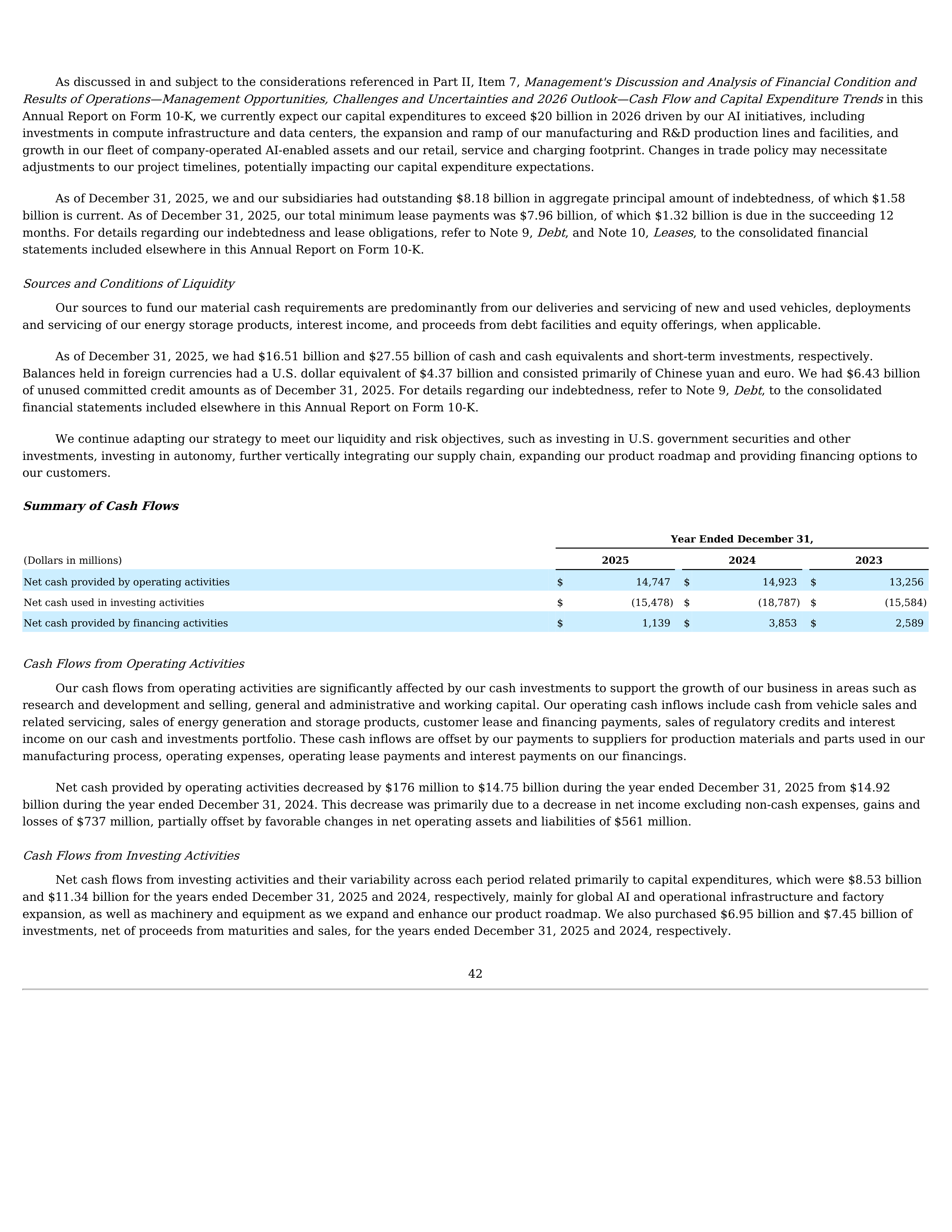
As discussed in and subject to the considerations referenced in Part II, Item 7, Management's Discussion and Analysis of Financial Condition and
Results of Operations—Management Opportunities, Challenges and Uncertainties and 2026 Outlook—Cash Flow and Capital Expenditure Trends in this
Annual Report on Form 10-K, we currently expect our capital expenditures to exceed $20 billion in 2026 driven by our AI initiatives, including
investments in compute infrastructure and data centers, the expansion and ramp of our manufacturing and R&D production lines and facilities, and
growth in our fleet of company-operated AI-enabled assets and our retail, service and charging footprint. Changes in trade policy may necessitate
adjustments to our project timelines, potentially impacting our capital expenditure expectations.
As of December 31, 2025, we and our subsidiaries had outstanding $8.18 billion in aggregate principal amount of indebtedness, of which $1.58
billion is current. As of December 31, 2025, our total minimum lease payments was $7.96 billion, of which $1.32 billion is due in the succeeding 12
months. For details regarding our indebtedness and lease obligations, refer to Note 9, Debt, and Note 10, Leases, to the consolidated financial
statements included elsewhere in this Annual Report on Form 10-K.
Sources and Conditions of Liquidity
Our sources to fund our material cash requirements are predominantly from our deliveries and servicing of new and used vehicles, deployments
and servicing of our energy storage products, interest income, and proceeds from debt facilities and equity offerings, when applicable.
As of December 31, 2025, we had $16.51 billion and $27.55 billion of cash and cash equivalents and short-term investments, respectively.
Balances held in foreign currencies had a U.S. dollar equivalent of $4.37 billion and consisted primarily of Chinese yuan and euro. We had $6.43 billion
of unused committed credit amounts as of December 31, 2025. For details regarding our indebtedness, refer to Note 9, Debt, to the consolidated
financial statements included elsewhere in this Annual Report on Form 10-K.
We continue adapting our strategy to meet our liquidity and risk objectives, such as investing in U.S. government securities and other
investments, investing in autonomy, further vertically integrating our supply chain, expanding our product roadmap and providing financing options to
our customers.
Summary of Cash Flows
Year Ended December 31,
(Dollars in millions)
2025
2024
2023
Net cash provided by operating activities
$
14,747
$
14,923
$
13,256
Net cash used in investing activities
$
(15,478)
$
(18,787)
$
(15,584)
Net cash provided by financing activities
$
1,139
$
3,853
$
2,589
Cash Flows from Operating Activities
Our cash flows from operating activities are significantly affected by our cash investments to support the growth of our business in areas such as
research and development and selling, general and administrative and working capital. Our operating cash inflows include cash from vehicle sales and
related servicing, sales of energy generation and storage products, customer lease and financing payments, sales of regulatory credits and interest
income on our cash and investments portfolio. These cash inflows are offset by our payments to suppliers for production materials and parts used in our
manufacturing process, operating expenses, operating lease payments and interest payments on our financings.
Net cash provided by operating activities decreased by $176 million to $14.75 billion during the year ended December 31, 2025 from $14.92
billion during the year ended December 31, 2024. This decrease was primarily due to a decrease in net income excluding non-cash expenses, gains and
losses of $737 million, partially offset by favorable changes in net operating assets and liabilities of $561 million.
Cash Flows from Investing Activities
Net cash flows from investing activities and their variability across each period related primarily to capital expenditures, which were $8.53 billion
and $11.34 billion for the years ended December 31, 2025 and 2024, respectively, mainly for global AI and operational infrastructure and factory
expansion, as well as machinery and equipment as we expand and enhance our product roadmap. We also purchased $6.95 billion and $7.45 billion of
investments, net of proceeds from maturities and sales, for the years ended December 31, 2025 and 2024, respectively.
42
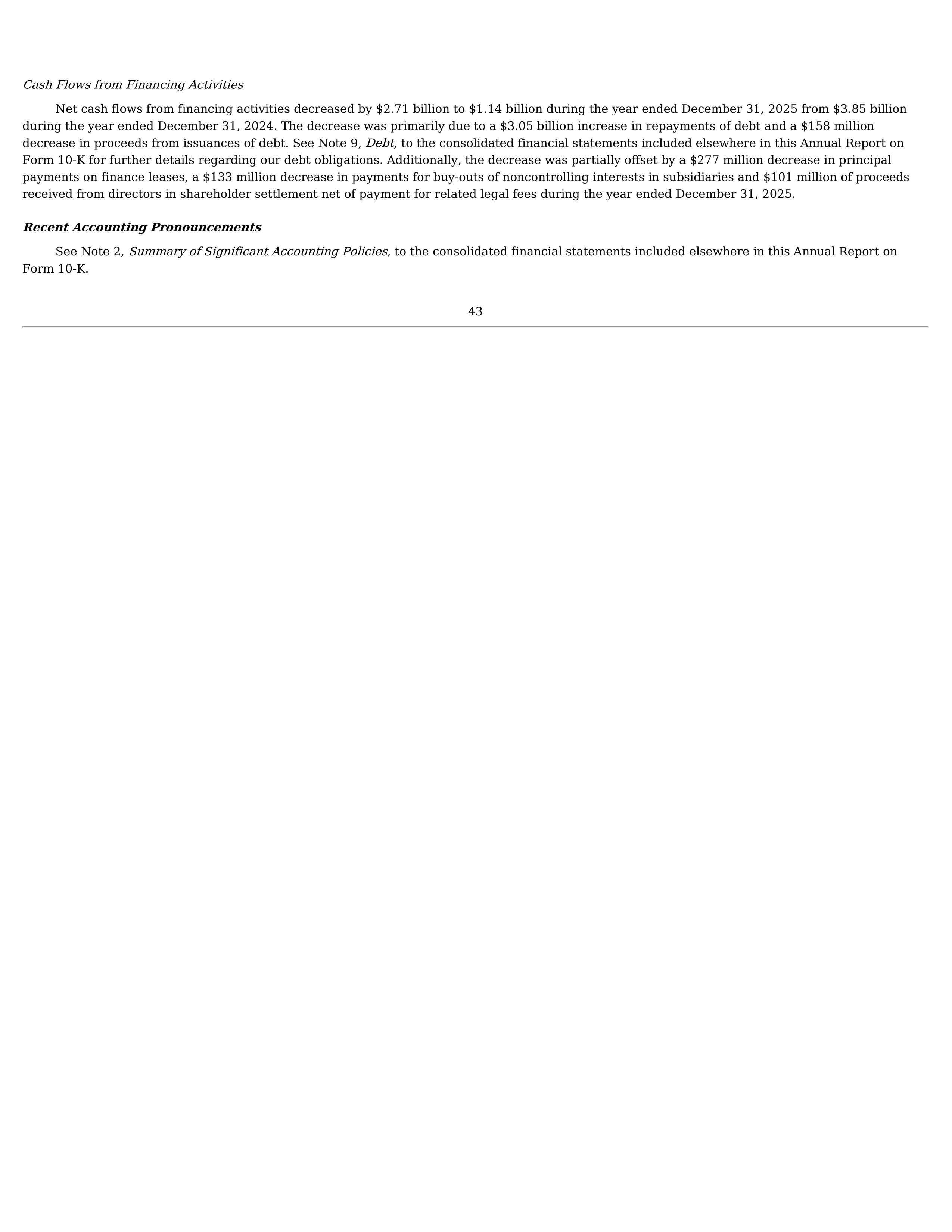
Cash Flows from Financing Activities
Net cash flows from financing activities decreased by $2.71 billion to $1.14 billion during the year ended December 31, 2025 from $3.85 billion
during the year ended December 31, 2024. The decrease was primarily due to a $3.05 billion increase in repayments of debt and a $158 million
decrease in proceeds from issuances of debt. See Note 9, Debt, to the consolidated financial statements included elsewhere in this Annual Report on
Form 10-K for further details regarding our debt obligations. Additionally, the decrease was partially offset by a $277 million decrease in principal
payments on finance leases, a $133 million decrease in payments for buy-outs of noncontrolling interests in subsidiaries and $101 million of proceeds
received from directors in shareholder settlement net of payment for related legal fees during the year ended December 31, 2025.
Recent Accounting Pronouncements
See Note 2, Summary of Significant Accounting Policies, to the consolidated financial statements included elsewhere in this Annual Report on
Form 10-K.
43
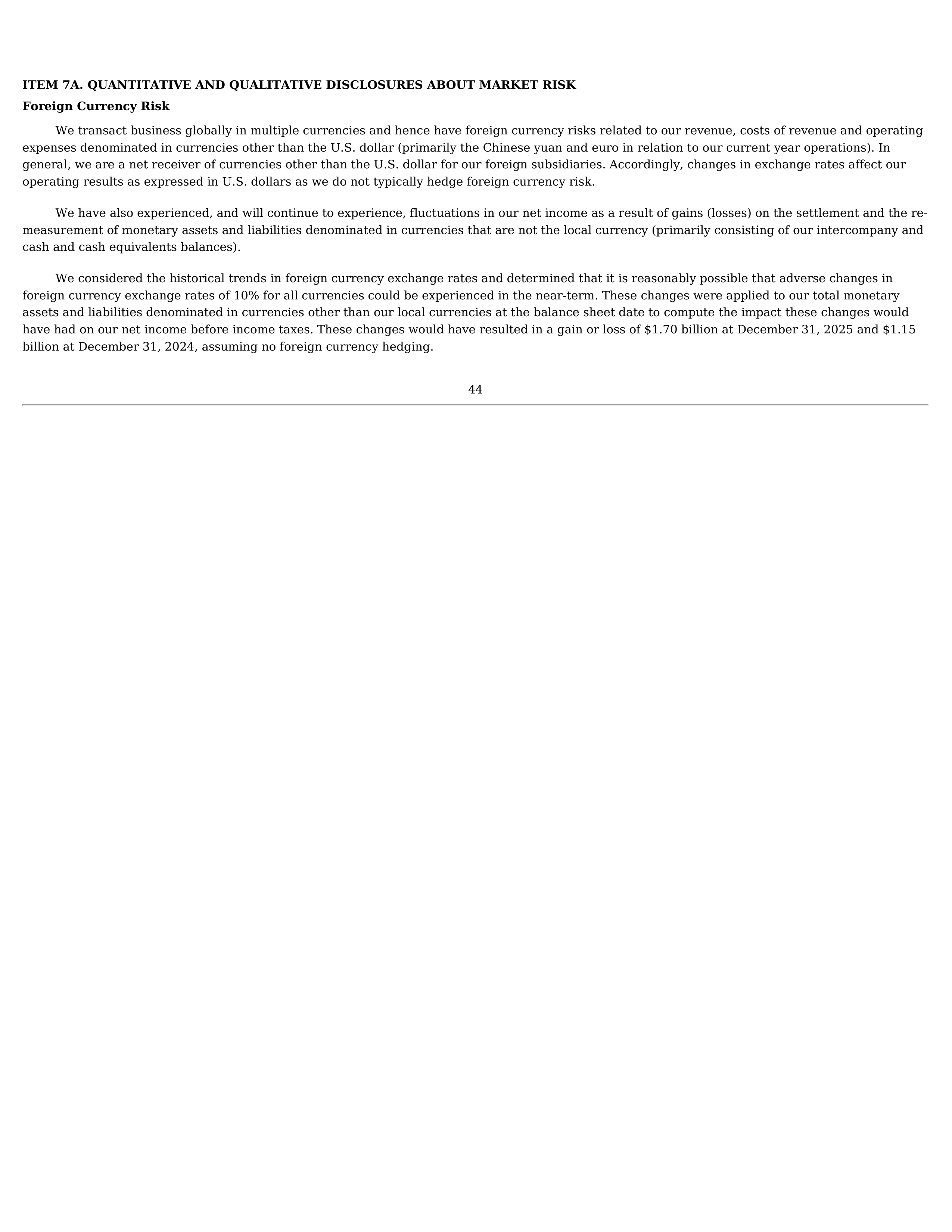
ITEM 7A. QUANTITATIVE AND QUALITATIVE DISCLOSURES ABOUT MARKET RISK
Foreign Currency Risk
We transact business globally in multiple currencies and hence have foreign currency risks related to our revenue, costs of revenue and operating
expenses denominated in currencies other than the U.S. dollar (primarily the Chinese yuan and euro in relation to our current year operations). In
general, we are a net receiver of currencies other than the U.S. dollar for our foreign subsidiaries. Accordingly, changes in exchange rates affect our
operating results as expressed in U.S. dollars as we do not typically hedge foreign currency risk.
We have also experienced, and will continue to experience, fluctuations in our net income as a result of gains (losses) on the settlement and the re-
measurement of monetary assets and liabilities denominated in currencies that are not the local currency (primarily consisting of our intercompany and
cash and cash equivalents balances).
We considered the historical trends in foreign currency exchange rates and determined that it is reasonably possible that adverse changes in
foreign currency exchange rates of 10% for all currencies could be experienced in the near-term. These changes were applied to our total monetary
assets and liabilities denominated in currencies other than our local currencies at the balance sheet date to compute the impact these changes would
have had on our net income before income taxes. These changes would have resulted in a gain or loss of $1.70 billion at December 31, 2025 and $1.15
billion at December 31, 2024, assuming no foreign currency hedging.
44
ITEM 8. FINANCIAL STATEMENTS AND SUPPLEMENTARY DATA
Index to Consolidated Financial Statements
Page
Report of Independent Registered Public Accounting Firm
(PCAOB ID: 238)
46
Consolidated Balance Sheets
49
Consolidated Statements of Operations
50
Consolidated Statements of Comprehensive Income
51
Consolidated Statements of Redeemable Noncontrolling Interests and Equity
52
Consolidated Statements of Cash Flows
53
Notes to Consolidated Financial Statements
54
45
Report of Independent Registered Public Accounting Firm
To the
Board of Directors and Stockholders of Tesla, Inc.
Opinions on the Financial Statements and Internal Control over Financial Reporting
We have audited the accompanying consolidated balance sheets of Tesla, Inc. and its subsidiaries (the "Company") as of December 31, 2025 and 2024,
and the related consolidated statements of operations, of comprehensive income, of redeemable noncontrolling interests and equity and of cash flows
for each of the three years in the period ended December 31, 2025, including the related notes (collectively referred to as the "consolidated financial
statements"). We also have audited the Company's internal control over financial reporting as of December 31, 2025, based on criteria established in
Internal Control - Integrated Framework (2013) issued by the Committee of Sponsoring Organizations of the Treadway Commission (COSO).
In our opinion, the consolidated financial statements referred to above present fairly, in all material respects, the financial position of the Company as of
December 31, 2025 and 2024, and the results of its operations and its cash flows for each of the three years in the period ended December 31, 2025 in
conformity with accounting principles generally accepted in the United States of America. Also in our opinion, the Company maintained, in all material
respects, effective internal control over financial reporting as of December 31, 2025, based on criteria established in Internal Control - Integrated
Framework (2013) issued by the COSO.
Change in Accounting Principle
As discussed in Note 2 to the consolidated financial statements, the Company changed the manner in which it accounts for digital assets in 2024.
Basis for Opinions
The Company's management is responsible for these consolidated financial statements, for maintaining effective internal control over financial
reporting, and for its assessment of the effectiveness of internal control over financial reporting, included in Management’s Report on Internal Control
over Financial Reporting appearing under Item 9A. Our responsibility is to express opinions on the Company’s consolidated financial statements and on
the Company's internal control over financial reporting based on our audits. We are a public accounting firm registered with the Public Company
Accounting Oversight Board (United States) (PCAOB) and are required to be independent with respect to the Company in accordance with the U.S.
federal securities laws and the applicable rules and regulations of the Securities and Exchange Commission and the PCAOB.
We conducted our audits in accordance with the standards of the PCAOB. Those standards require that we plan and perform the audits to obtain
reasonable assurance about whether the consolidated financial statements are free of material misstatement, whether due to error or fraud, and
whether effective internal control over financial reporting was maintained in all material respects.
Our audits of the consolidated financial statements included performing procedures to assess the risks of material misstatement of the consolidated
financial statements, whether due to error or fraud, and performing procedures that respond to those risks. Such procedures included examining, on a
test basis, evidence regarding the amounts and disclosures in the consolidated financial statements. Our audits also included evaluating the accounting
principles used and significant estimates made by management, as well as evaluating the overall presentation of the consolidated financial statements.
Our audit of internal control over financial reporting included obtaining an understanding of internal control over financial reporting, assessing the risk
that a material weakness exists, and testing and evaluating the design and operating effectiveness of internal control based on the assessed risk. Our
audits also included performing such other procedures as we considered necessary in the circumstances. We believe that our audits provide a
reasonable basis for our opinions.
46
Definition and Limitations of Internal Control over Financial Reporting
A company’s internal control over financial reporting is a process designed to provide reasonable assurance regarding the reliability of financial
reporting and the preparation of financial statements for external purposes in accordance with generally accepted accounting principles. A company’s
internal control over financial reporting includes those policies and procedures that (i) pertain to the maintenance of records that, in reasonable detail,
accurately and fairly reflect the transactions and dispositions of the assets of the company; (ii) provide reasonable assurance that transactions are
recorded as necessary to permit preparation of financial statements in accordance with generally accepted accounting principles, and that receipts and
expenditures of the company are being made only in accordance with authorizations of management and directors of the company; and (iii) provide
reasonable assurance regarding prevention or timely detection of unauthorized acquisition, use, or disposition of the company’s assets that could have a
material effect on the financial statements.
Because of its inherent limitations, internal control over financial reporting may not prevent or detect misstatements. Also, projections of any evaluation
of effectiveness to future periods are subject to the risk that controls may become inadequate because of changes in conditions, or that the degree of
compliance with the policies or procedures may deteriorate.
Critical Audit Matters
The critical audit matters communicated below are matters arising from the current period audit of the consolidated financial statements that were
communicated or required to be communicated to the audit committee and that (i) relate to accounts or disclosures that are material to the
consolidated financial statements and (ii) involved our especially challenging, subjective, or complex judgments. The communication of critical audit
matters does not alter in any way our opinion on the consolidated financial statements, taken as a whole, and we are not, by communicating the critical
audit matters below, providing separate opinions on the critical audit matters or on the accounts or disclosures to which they relate.
Automotive Warranty Reserve
As described in Note 2 to the consolidated financial statements, total accrued warranty, which primarily relates to the automotive segment, was $8,607
million as of December 31, 2025. The Company provides a manufacturer’s warranty on all new and used Tesla vehicles. A warranty reserve is accrued
for these products sold, which includes management’s best estimate of the projected costs to repair or replace items under warranty and recalls if
identified. These estimates are based on actual claims incurred to date and an estimate of the nature, frequency and costs of future claims.
The principal considerations for our determination that performing procedures relating to the automotive warranty reserve is a critical audit matter are
(i) the significant judgment by management in determining the automotive warranty reserve for certain Tesla vehicle models; (ii) a high degree of
auditor judgment, subjectivity, and effort in performing procedures and evaluating management’s significant assumptions related to the nature,
frequency and costs of future claims for certain Tesla vehicle models; and, (iii) the audit effort involved the use of professionals with specialized skill
and knowledge.
Addressing the matter involved performing procedures and evaluating audit evidence in connection with forming our overall opinion on the consolidated
financial statements. These procedures included testing the effectiveness of controls relating to management’s estimate of the automotive warranty
reserve for certain Tesla vehicle models, including controls over management’s significant assumptions related to the nature, frequency and costs of
future claims and controls over the completeness and accuracy of actual claims incurred to date. These procedures also included, among others, (i)
testing the completeness and accuracy of historical vehicle claims processed and testing that such claims were appropriately used by management in
the estimation of future claims and (ii) the involvement of professionals with specialized skill and knowledge to assist in evaluating the reasonableness
of management’s estimate by (a) developing an independent estimate of the automotive warranty reserve for certain Tesla vehicle models and (b)
comparing the independent estimate to management’s estimate. Developing the independent estimate involved evaluating the appropriateness of
management’s significant assumptions related to the nature and frequency of future claims.
47
2025 CEO Performance Award
As described in Notes 2 and 11 to the consolidated financial statements, the Company granted the 2025 CEO performance award with market, service
and performance conditions and a required holding period. The award consists of 12 tranches of performance-based restricted stock, each containing a
market capitalization milestone and an operational milestone that must be met in order for the tranche to vest, in addition to the service condition. With
the assistance of a third-party valuation specialist, management determined the fair value of the award on the grant date, using a Monte Carlo valuation
model, which included significant assumptions such as expected share price volatility, illiquidity discount and dilution adjustment. To estimate the
required holding period illiquidity discount applied to the fair value, management utilized significant assumptions relating to expected share price
volatility and expected employee tax rate. The Company recognizes stock-based compensation expense on a straight-line basis over the expected
performance achievement period of individual performance milestones when the achievement of each individual performance milestones becomes
probable. As of December 31, 2025, the Company had unrecognized stock-based compensation expense of $10.23 billion for the operational milestone
that was considered probable of achievement, which will be recognized over 9.7 years, and unrecognized stock-based compensation expense of $105.82
billion to $120.37 billion for the operational milestones that were considered not probable of achievement. For the year ended December 31, 2025, the
Company recorded stock-based compensation expense of $162 million related to the award.
The principal considerations for our determination that performing procedures relating to the 2025 CEO performance award is a critical audit matter
are (i) the significant judgment by management when developing the fair value measurement of the award and determining whether performance
conditions are probable; (ii) a high degree of auditor judgment, subjectivity and effort in performing procedures and evaluating management’s
significant assumptions related to expected share price volatility, dilution adjustment, and estimated employee tax rate used in the fair value
measurement of the award and evaluating audit evidence related to management's assessment of whether certain performance conditions were
probable; and (iii) the audit effort involved the use of professionals with specialized skill and knowledge.
Addressing the matter involved performing procedures and evaluating audit evidence in connection with forming our overall opinion on the consolidated
financial statements. These procedures included testing the effectiveness of controls relating to management’s estimate of fair value of the 2025 CEO
performance award, including controls over management’s significant assumptions related to the stock price volatility, dilution adjustment, and
estimated employee tax rate, and controls over management’s assessment of the probability of certain performance conditions. These procedures also
included, among others, (i) testing the completeness and accuracy of the underlying data used in the Monte Carlo model, (ii) the involvement of
professionals with specialized skill and knowledge to assist in evaluating the reasonableness of management’s estimate by (a) developing an
independent estimate of the grant date fair value of the award, including evaluating the appropriateness of management’s significant assumptions
related to expected share price volatility, dilution adjustment, and estimated employee tax rate, and (b) comparing the independent estimate to
management’s estimate, (iii) testing management's process for determining the achievement of certain performance conditions, and (iv) evaluating the
appropriateness of the probability of achievement of certain performance conditions by considering the current, past, and expected future performance
of the Company, and whether management's assessment was consistent with evidence obtained in other areas of the audit.
/s/ PricewaterhouseCoopers LLP
San Jose, California
January 28, 2026
We have served as the Company’s auditor since 2005.
48
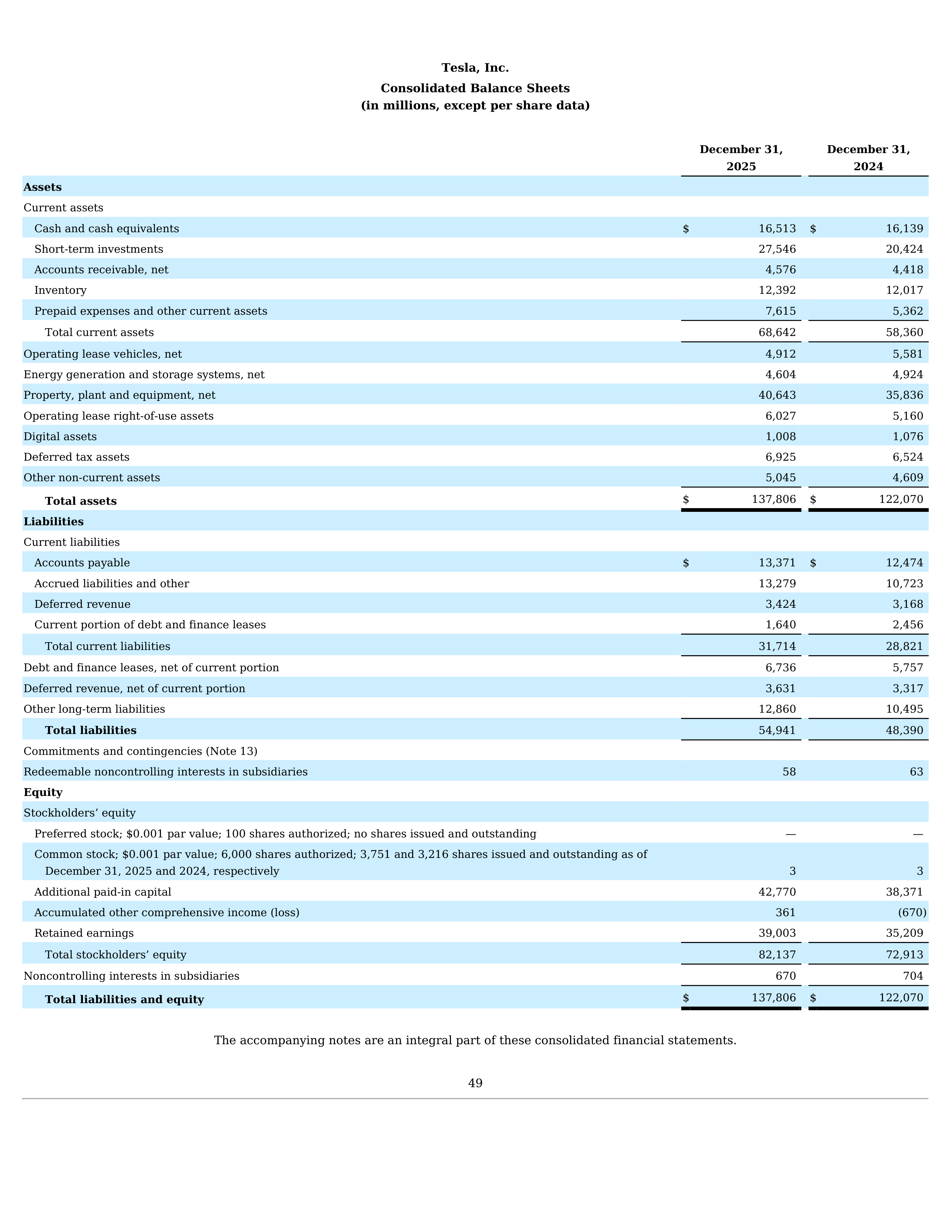
Tesla, Inc.
Consolidated Balance Sheets
(in millions, except per share data)
December 31,
2025
December 31,
2024
Assets
Current assets
Cash and cash equivalents
$
16,513
$
16,139
Short-term investments
27,546
20,424
Accounts receivable, net
4,576
4,418
Inventory
12,392
12,017
Prepaid expenses and other current assets
7,615
5,362
Total current assets
68,642
58,360
Operating lease vehicles, net
4,912
5,581
Energy generation and storage systems, net
4,604
4,924
Property, plant and equipment, net
40,643
35,836
Operating lease right-of-use assets
6,027
5,160
Digital assets
1,008
1,076
Deferred tax assets
6,925
6,524
Other non-current assets
5,045
4,609
Total assets
$
137,806
$
122,070
Liabilities
Current liabilities
Accounts payable
$
13,371
$
12,474
Accrued liabilities and other
13,279
10,723
Deferred revenue
3,424
3,168
Current portion of debt and finance leases
1,640
2,456
Total current liabilities
31,714
28,821
Debt and finance leases, net of current portion
6,736
5,757
Deferred revenue, net of current portion
3,631
3,317
Other long-term liabilities
12,860
10,495
Total liabilities
54,941
48,390
Commitments and contingencies (Note 13)
Redeemable noncontrolling interests in subsidiaries
58
63
Equity
Stockholders’ equity
Preferred stock; $0.001 par value; 100 shares authorized; no shares issued and outstanding
—
—
Common stock; $0.001 par value; 6,000 shares authorized; 3,751 and 3,216 shares issued and outstanding as of
December 31, 2025 and 2024, respectively
3
3
Additional paid-in capital
42,770
38,371
Accumulated other comprehensive income (loss)
361
(670)
Retained earnings
39,003
35,209
Total stockholders’ equity
82,137
72,913
Noncontrolling interests in subsidiaries
670
704
Total liabilities and equity
$
137,806
$
122,070
The accompanying notes are an integral part of these consolidated financial statements.
49
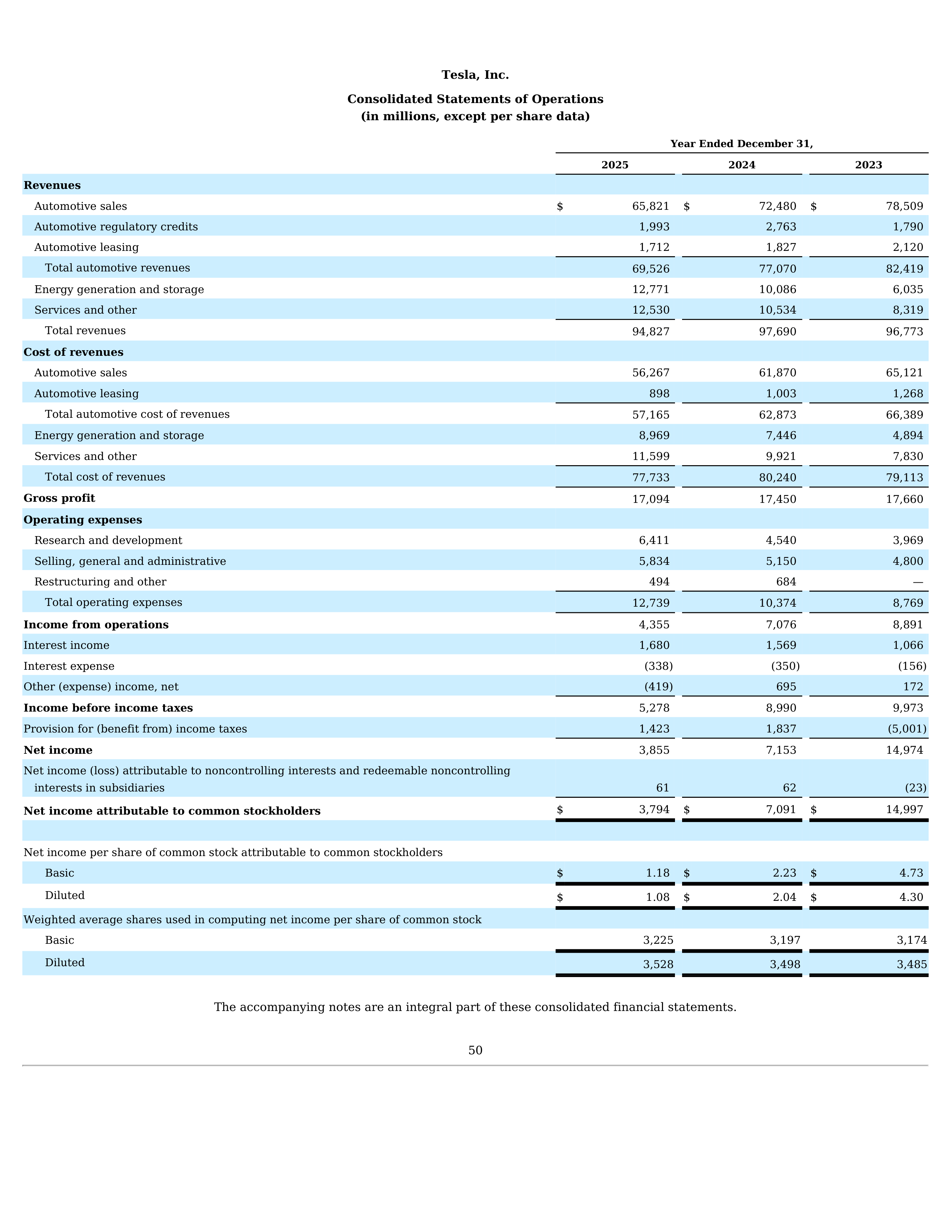
Tesla, Inc.
Consolidated Statements of Operations
(in millions, except per share data)
Year Ended December 31,
2025
2024
2023
Revenues
Automotive sales
$
65,821
$
72,480
$
78,509
Automotive regulatory credits
1,993
2,763
1,790
Automotive leasing
1,712
1,827
2,120
Total automotive revenues
69,526
77,070
82,419
Energy generation and storage
12,771
10,086
6,035
Services and other
12,530
10,534
8,319
Total revenues
94,827
97,690
96,773
Cost of revenues
Automotive sales
56,267
61,870
65,121
Automotive leasing
898
1,003
1,268
Total automotive cost of revenues
57,165
62,873
66,389
Energy generation and storage
8,969
7,446
4,894
Services and other
11,599
9,921
7,830
Total cost of revenues
77,733
80,240
79,113
Gross profit
17,094
17,450
17,660
Operating expenses
Research and development
6,411
4,540
3,969
Selling, general and administrative
5,834
5,150
4,800
Restructuring and other
494
684
—
Total operating expenses
12,739
10,374
8,769
Income from operations
4,355
7,076
8,891
Interest income
1,680
1,569
1,066
Interest expense
(338)
(350)
(156)
Other (expense) income, net
(419)
695
172
Income before income taxes
5,278
8,990
9,973
Provision for (benefit from) income taxes
1,423
1,837
(5,001)
Net income
3,855
7,153
14,974
Net income (loss) attributable to noncontrolling interests and redeemable noncontrolling
interests in subsidiaries
61
62
(23)
Net income attributable to common stockholders
$
3,794
$
7,091
$
14,997
Net income per share of common stock attributable to common stockholders
Basic
$
1.18
$
2.23
$
4.73
Diluted
$
1.08
$
2.04
$
4.30
Weighted average shares used in computing net income per share of common stock
Basic
3,225
3,197
3,174
Diluted
3,528
3,498
3,485
The accompanying notes are an integral part of these consolidated financial statements.
50
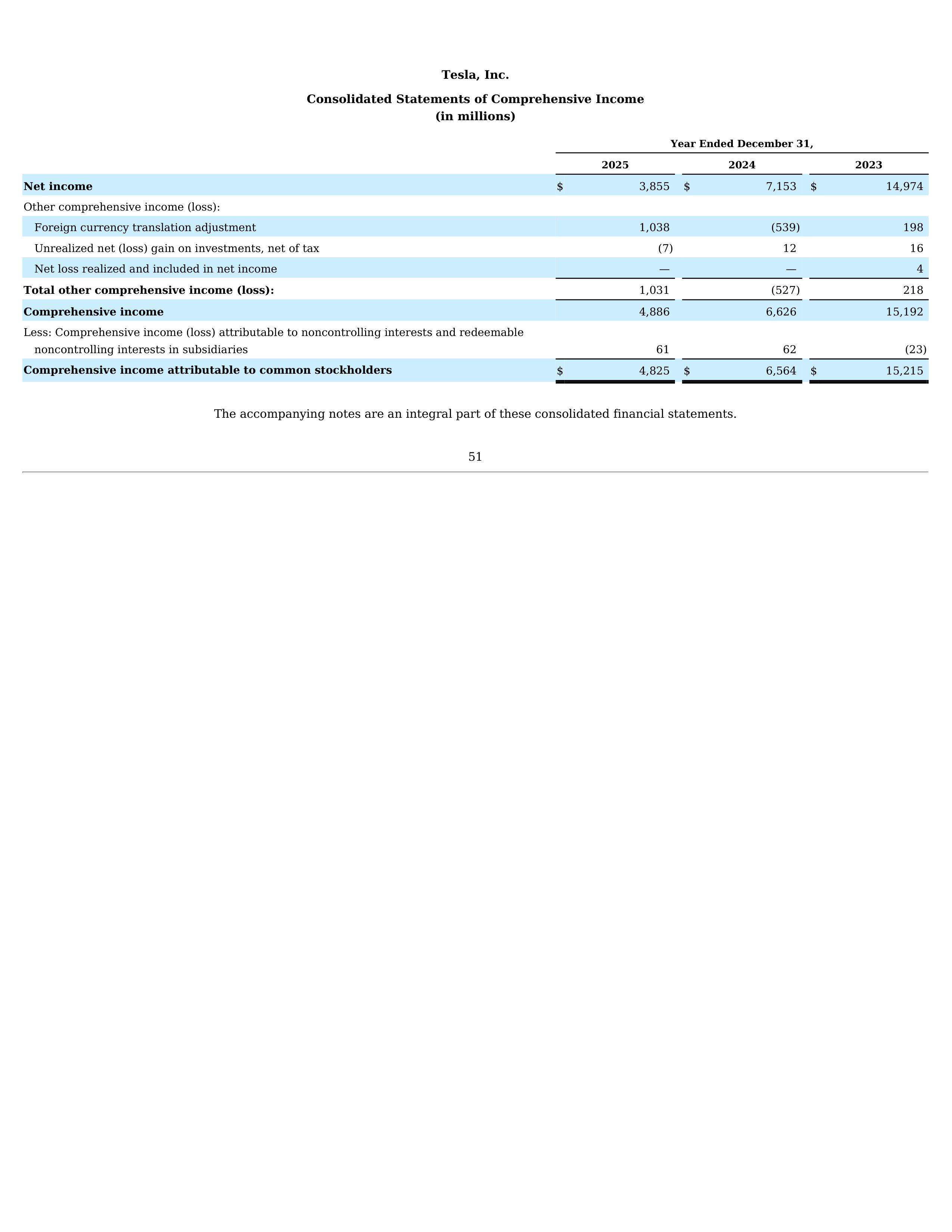
Tesla, Inc.
Consolidated Statements of Comprehensive Income
(in millions)
Year Ended December 31,
2025
2024
2023
Net income
$
3,855
$
7,153
$
14,974
Other comprehensive income (loss):
Foreign currency translation adjustment
1,038
(539)
198
Unrealized net (loss) gain on investments, net of tax
(7)
12
16
Net loss realized and included in net income
—
—
4
Total other comprehensive income (loss):
1,031
(527)
218
Comprehensive income
4,886
6,626
15,192
Less: Comprehensive income (loss) attributable to noncontrolling interests and redeemable
noncontrolling interests in subsidiaries
61
62
(23)
Comprehensive income attributable to common stockholders
$
4,825
$
6,564
$
15,215
The accompanying notes are an integral part of these consolidated financial statements.
51
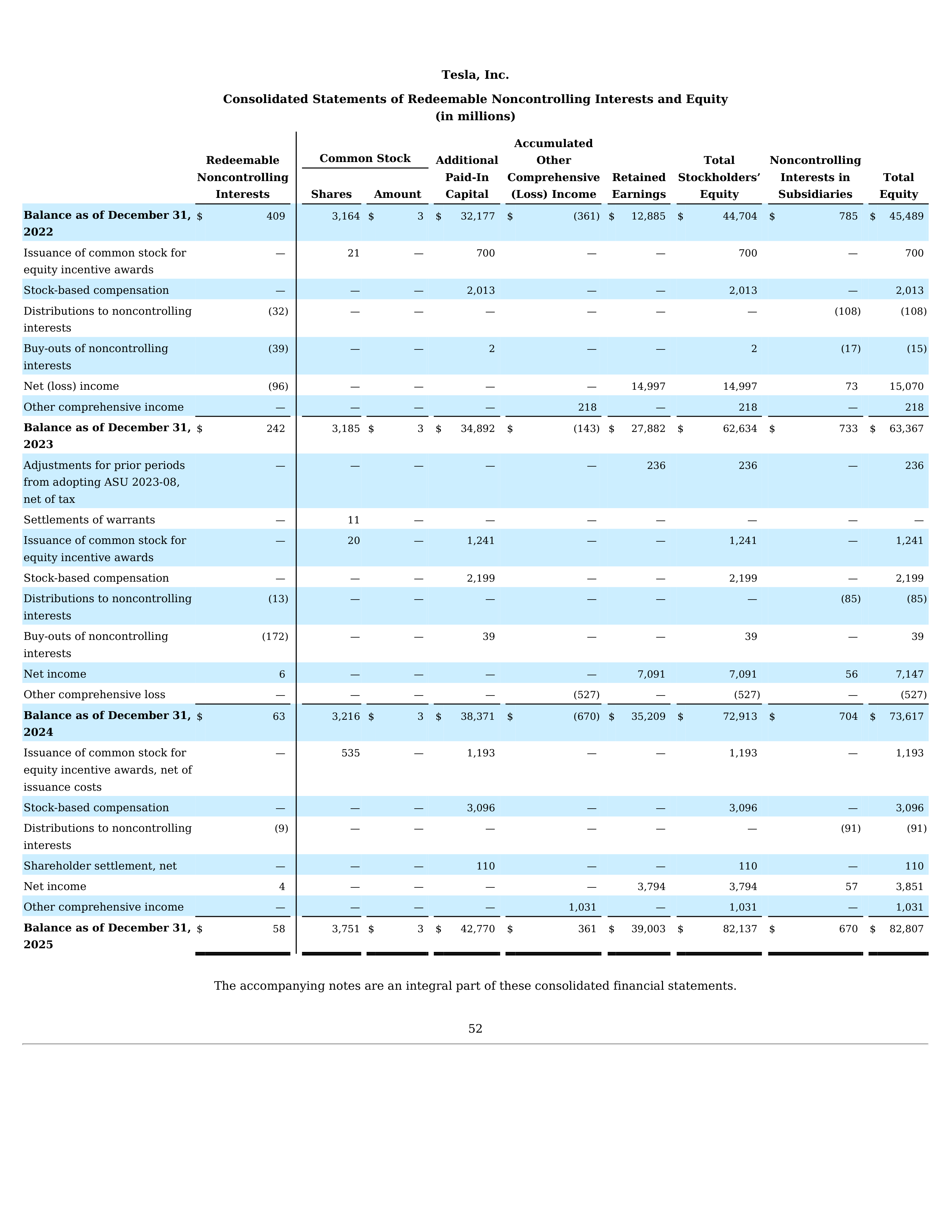
Tesla, Inc.
Consolidated Statements of Redeemable Noncontrolling Interests and Equity
(in millions)
Redeemable
Noncontrolling
Interests
Common Stock
Additional
Paid-In
Capital
Accumulated
Other
Comprehensive
(Loss) Income
Retained
Earnings
Total
Stockholders’
Equity
Noncontrolling
Interests in
Subsidiaries
Total
Equity
Shares
Amount
Balance as of December 31,
2022
$
409
3,164
$
3
$
32,177
$
(361)
$
12,885
$
44,704
$
785
$
45,489
Issuance of common stock for
equity incentive awards
—
21
—
700
—
—
700
—
700
Stock-based compensation
—
—
—
2,013
—
—
2,013
—
2,013
Distributions to noncontrolling
interests
(32)
—
—
—
—
—
—
(108)
(108)
Buy-outs of noncontrolling
interests
(39)
—
—
2
—
—
2
(17)
(15)
Net (loss) income
(96)
—
—
—
—
14,997
14,997
73
15,070
Other comprehensive income
—
—
—
—
218
—
218
—
218
Balance as of December 31,
2023
$
242
3,185
$
3
$
34,892
$
(143)
$
27,882
$
62,634
$
733
$
63,367
Adjustments for prior periods
from adopting ASU 2023-08,
net of tax
—
—
—
—
—
236
236
—
236
Settlements of warrants
—
11
—
—
—
—
—
—
—
Issuance of common stock for
equity incentive awards
—
20
—
1,241
—
—
1,241
—
1,241
Stock-based compensation
—
—
—
2,199
—
—
2,199
—
2,199
Distributions to noncontrolling
interests
(13)
—
—
—
—
—
—
(85)
(85)
Buy-outs of noncontrolling
interests
(172)
—
—
39
—
—
39
—
39
Net income
6
—
—
—
—
7,091
7,091
56
7,147
Other comprehensive loss
—
—
—
—
(527)
—
(527)
—
(527)
Balance as of December 31,
2024
$
63
3,216
$
3
$
38,371
$
(670)
$
35,209
$
72,913
$
704
$
73,617
Issuance of common stock for
equity incentive awards, net of
issuance costs
—
535
—
1,193
—
—
1,193
—
1,193
Stock-based compensation
—
—
—
3,096
—
—
3,096
—
3,096
Distributions to noncontrolling
interests
(9)
—
—
—
—
—
—
(91)
(91)
Shareholder settlement, net
—
—
—
110
—
—
110
—
110
Net income
4
—
—
—
—
3,794
3,794
57
3,851
Other comprehensive income
—
—
—
—
1,031
—
1,031
—
1,031
Balance as of December 31,
2025
$
58
3,751
$
3
$
42,770
$
361
$
39,003
$
82,137
$
670
$
82,807
The accompanying notes are an integral part of these consolidated financial statements.
52
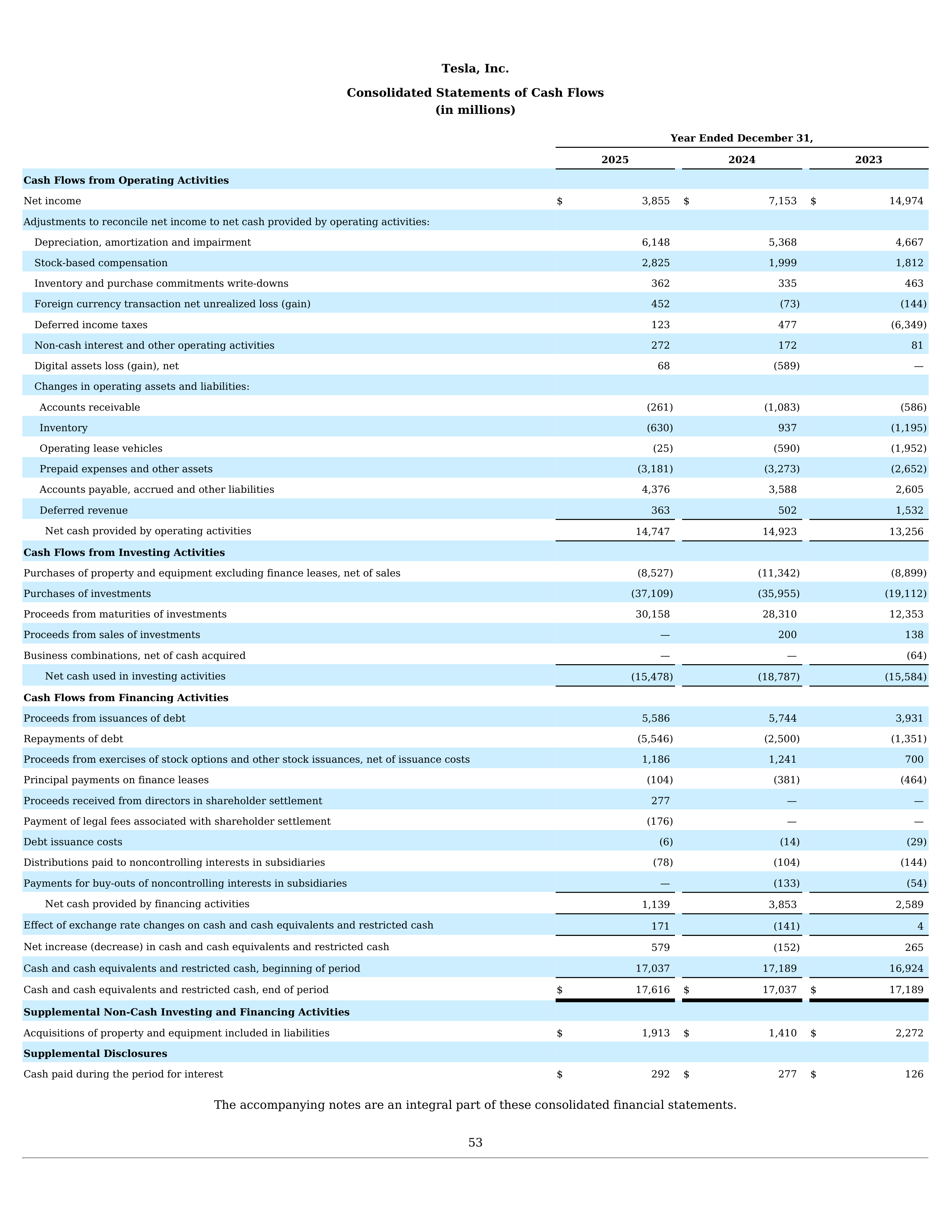
Tesla, Inc.
Consolidated Statements of Cash Flows
(in millions)
Year Ended December 31,
2025
2024
2023
Cash Flows from Operating Activities
Net income
$
3,855
$
7,153
$
14,974
Adjustments to reconcile net income to net cash provided by operating activities:
Depreciation, amortization and impairment
6,148
5,368
4,667
Stock-based compensation
2,825
1,999
1,812
Inventory and purchase commitments write-downs
362
335
463
Foreign currency transaction net unrealized loss (gain)
452
(73)
(144)
Deferred income taxes
123
477
(6,349)
Non-cash interest and other operating activities
272
172
81
Digital assets loss (gain), net
68
(589)
—
Changes in operating assets and liabilities:
Accounts receivable
(261)
(1,083)
(586)
Inventory
(630)
937
(1,195)
Operating lease vehicles
(25)
(590)
(1,952)
Prepaid expenses and other assets
(3,181)
(3,273)
(2,652)
Accounts payable, accrued and other liabilities
4,376
3,588
2,605
Deferred revenue
363
502
1,532
Net cash provided by operating activities
14,747
14,923
13,256
Cash Flows from Investing Activities
Purchases of property and equipment excluding finance leases, net of sales
(8,527)
(11,342)
(8,899)
Purchases of investments
(37,109)
(35,955)
(19,112)
Proceeds from maturities of investments
30,158
28,310
12,353
Proceeds from sales of investments
—
200
138
Business combinations, net of cash acquired
—
—
(64)
Net cash used in investing activities
(15,478)
(18,787)
(15,584)
Cash Flows from Financing Activities
Proceeds from issuances of debt
5,586
5,744
3,931
Repayments of debt
(5,546)
(2,500)
(1,351)
Proceeds from exercises of stock options and other stock issuances, net of issuance costs
1,186
1,241
700
Principal payments on finance leases
(104)
(381)
(464)
Proceeds received from directors in shareholder settlement
277
—
—
Payment of legal fees associated with shareholder settlement
(176)
—
—
Debt issuance costs
(6)
(14)
(29)
Distributions paid to noncontrolling interests in subsidiaries
(78)
(104)
(144)
Payments for buy-outs of noncontrolling interests in subsidiaries
—
(133)
(54)
Net cash provided by financing activities
1,139
3,853
2,589
Effect of exchange rate changes on cash and cash equivalents and restricted cash
171
(141)
4
Net increase (decrease) in cash and cash equivalents and restricted cash
579
(152)
265
Cash and cash equivalents and restricted cash, beginning of period
17,037
17,189
16,924
Cash and cash equivalents and restricted cash, end of period
$
17,616
$
17,037
$
17,189
Supplemental Non-Cash Investing and Financing Activities
Acquisitions of property and equipment included in liabilities
$
1,913
$
1,410
$
2,272
Supplemental Disclosures
Cash paid during the period for interest
$
292
$
277
$
126
The accompanying notes are an integral part of these consolidated financial statements.
53
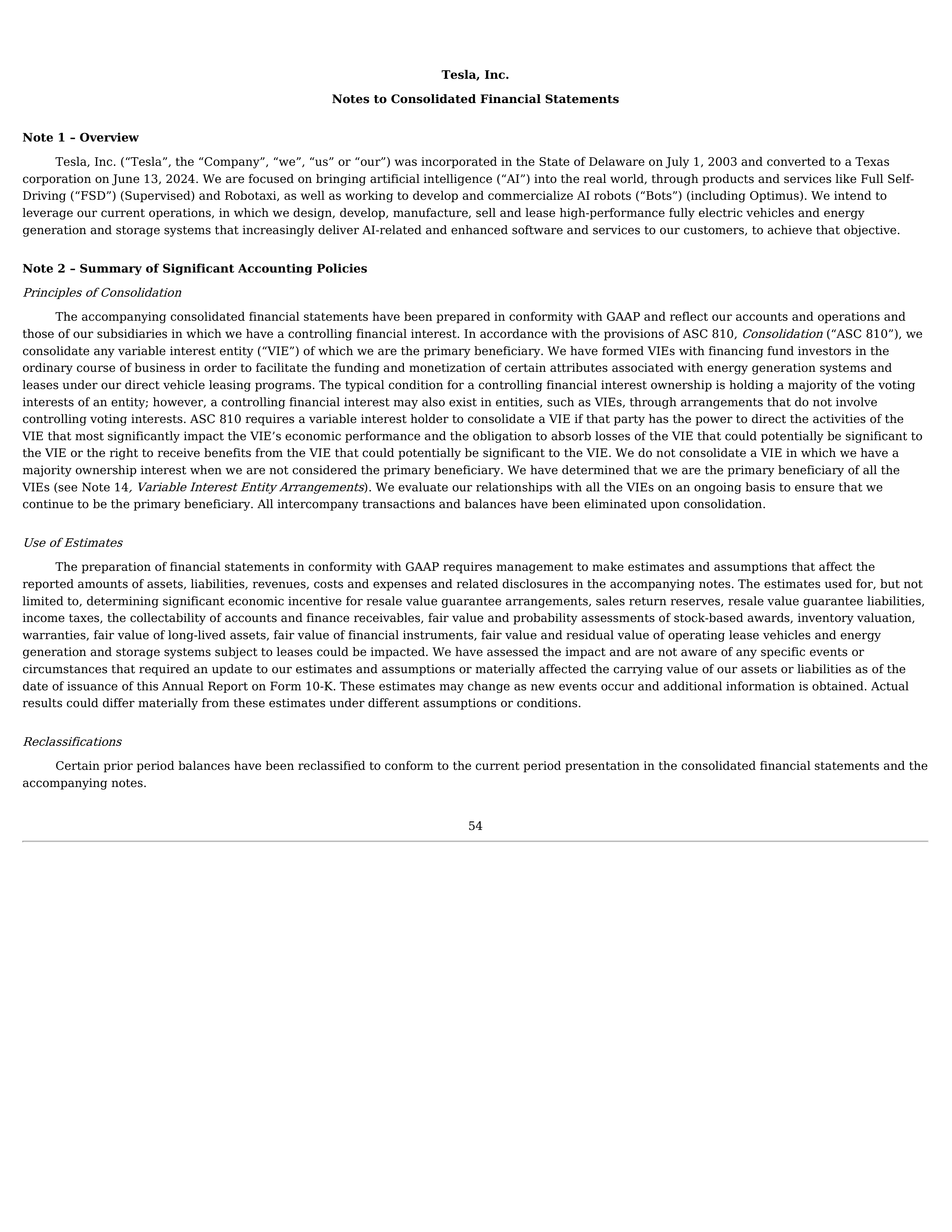
Tesla, Inc.
Notes to Consolidated Financial Statements
Note 1 – Overview
Tesla, Inc. (“Tesla”, the “Company”, “we”, “us” or “our”) was incorporated in the State of Delaware on July 1, 2003 and converted to a Texas
corporation on June 13, 2024. We are focused on bringing artificial intelligence (“AI”) into the real world, through products and services like Full Self-
Driving (“FSD”) (Supervised) and Robotaxi, as well as working to develop and commercialize AI robots (“Bots”) (including Optimus). We intend to
leverage our current operations, in which we design, develop, manufacture, sell and lease high-performance fully electric vehicles and energy
generation and storage systems that increasingly deliver AI-related and enhanced software and services to our customers, to achieve that objective.
Note 2 – Summary of Significant Accounting Policies
Principles of Consolidation
The accompanying consolidated financial statements have been prepared in conformity with GAAP and reflect our accounts and operations and
those of our subsidiaries in which we have a controlling financial interest. In accordance with the provisions of ASC 810, Consolidation (“ASC 810”), we
consolidate any variable interest entity (“VIE”) of which we are the primary beneficiary. We have formed VIEs with financing fund investors in the
ordinary course of business in order to facilitate the funding and monetization of certain attributes associated with energy generation systems and
leases under our direct vehicle leasing programs. The typical condition for a controlling financial interest ownership is holding a majority of the voting
interests of an entity; however, a controlling financial interest may also exist in entities, such as VIEs, through arrangements that do not involve
controlling voting interests. ASC 810 requires a variable interest holder to consolidate a VIE if that party has the power to direct the activities of the
VIE that most significantly impact the VIE’s economic performance and the obligation to absorb losses of the VIE that could potentially be significant to
the VIE or the right to receive benefits from the VIE that could potentially be significant to the VIE. We do not consolidate a VIE in which we have a
majority ownership interest when we are not considered the primary beneficiary. We have determined that we are the primary beneficiary of all the
VIEs (see Note 14, Variable Interest Entity Arrangements). We evaluate our relationships with all the VIEs on an ongoing basis to ensure that we
continue to be the primary beneficiary. All intercompany transactions and balances have been eliminated upon consolidation.
Use of Estimates
The preparation of financial statements in conformity with GAAP requires management to make estimates and assumptions that affect the
reported amounts of assets, liabilities, revenues, costs and expenses and related disclosures in the accompanying notes. The estimates used for, but not
limited to, determining significant economic incentive for resale value guarantee arrangements, sales return reserves, resale value guarantee liabilities,
income taxes, the collectability of accounts and finance receivables, fair value and probability assessments of stock-based awards, inventory valuation,
warranties, fair value of long-lived assets, fair value of financial instruments, fair value and residual value of operating lease vehicles and energy
generation and storage systems subject to leases could be impacted. We have assessed the impact and are not aware of any specific events or
circumstances that required an update to our estimates and assumptions or materially affected the carrying value of our assets or liabilities as of the
date of issuance of this Annual Report on Form 10-K. These estimates may change as new events occur and additional information is obtained. Actual
results could differ materially from these estimates under different assumptions or conditions.
Reclassifications
Certain prior period balances have been reclassified to conform to the current period presentation in the consolidated financial statements and the
accompanying notes.
54
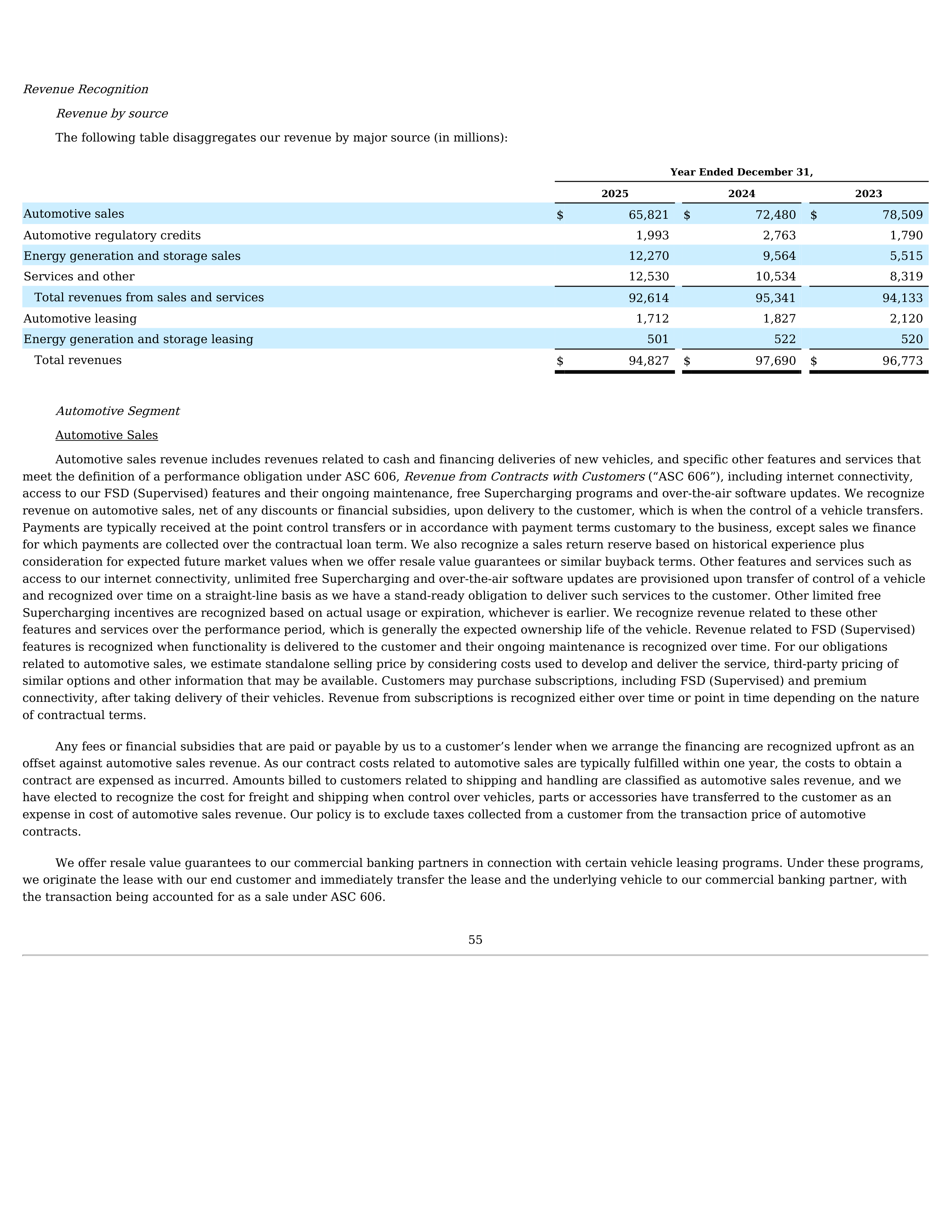
Revenue Recognition
Revenue by source
The following table disaggregates our revenue by major source (in millions):
Year Ended December 31,
2025
2024
2023
Automotive sales
$
65,821
$
72,480
$
78,509
Automotive regulatory credits
1,993
2,763
1,790
Energy generation and storage sales
12,270
9,564
5,515
Services and other
12,530
10,534
8,319
Total revenues from sales and services
92,614
95,341
94,133
Automotive leasing
1,712
1,827
2,120
Energy generation and storage leasing
501
522
520
Total revenues
$
94,827
$
97,690
$
96,773
Automotive Segment
Automotive Sales
Automotive sales revenue includes revenues related to cash and financing deliveries of new vehicles, and specific other features and services that
meet the definition of a performance obligation under ASC 606, Revenue from Contracts with Customers (“ASC 606”), including internet connectivity,
access to our FSD (Supervised) features and their ongoing maintenance, free Supercharging programs and over-the-air software updates. We recognize
revenue on automotive sales, net of any discounts or financial subsidies, upon delivery to the customer, which is when the control of a vehicle transfers.
Payments are typically received at the point control transfers or in accordance with payment terms customary to the business, except sales we finance
for which payments are collected over the contractual loan term. We also recognize a sales return reserve based on historical experience plus
consideration for expected future market values when we offer resale value guarantees or similar buyback terms. Other features and services such as
access to our internet connectivity, unlimited free Supercharging and over-the-air software updates are provisioned upon transfer of control of a vehicle
and recognized over time on a straight-line basis as we have a stand-ready obligation to deliver such services to the customer. Other limited free
Supercharging incentives are recognized based on actual usage or expiration, whichever is earlier. We recognize revenue related to these other
features and services over the performance period, which is generally the expected ownership life of the vehicle. Revenue related to FSD (Supervised)
features is recognized when functionality is delivered to the customer and their ongoing maintenance is recognized over time. For our obligations
related to automotive sales, we estimate standalone selling price by considering costs used to develop and deliver the service, third-party pricing of
similar options and other information that may be available. Customers may purchase subscriptions, including FSD (Supervised) and premium
connectivity, after taking delivery of their vehicles. Revenue from subscriptions is recognized either over time or point in time depending on the nature
of contractual terms.
Any fees or financial subsidies that are paid or payable by us to a customer’s lender when we arrange the financing are recognized upfront as an
offset against automotive sales revenue. As our contract costs related to automotive sales are typically fulfilled within one year, the costs to obtain a
contract are expensed as incurred. Amounts billed to customers related to shipping and handling are classified as automotive sales revenue, and we
have elected to recognize the cost for freight and shipping when control over vehicles, parts or accessories have transferred to the customer as an
expense in cost of automotive sales revenue. Our policy is to exclude taxes collected from a customer from the transaction price of automotive
contracts.
We offer resale value guarantees to our commercial banking partners in connection with certain vehicle leasing programs. Under these programs,
we originate the lease with our end customer and immediately transfer the lease and the underlying vehicle to our commercial banking partner, with
the transaction being accounted for as a sale under ASC 606.
55
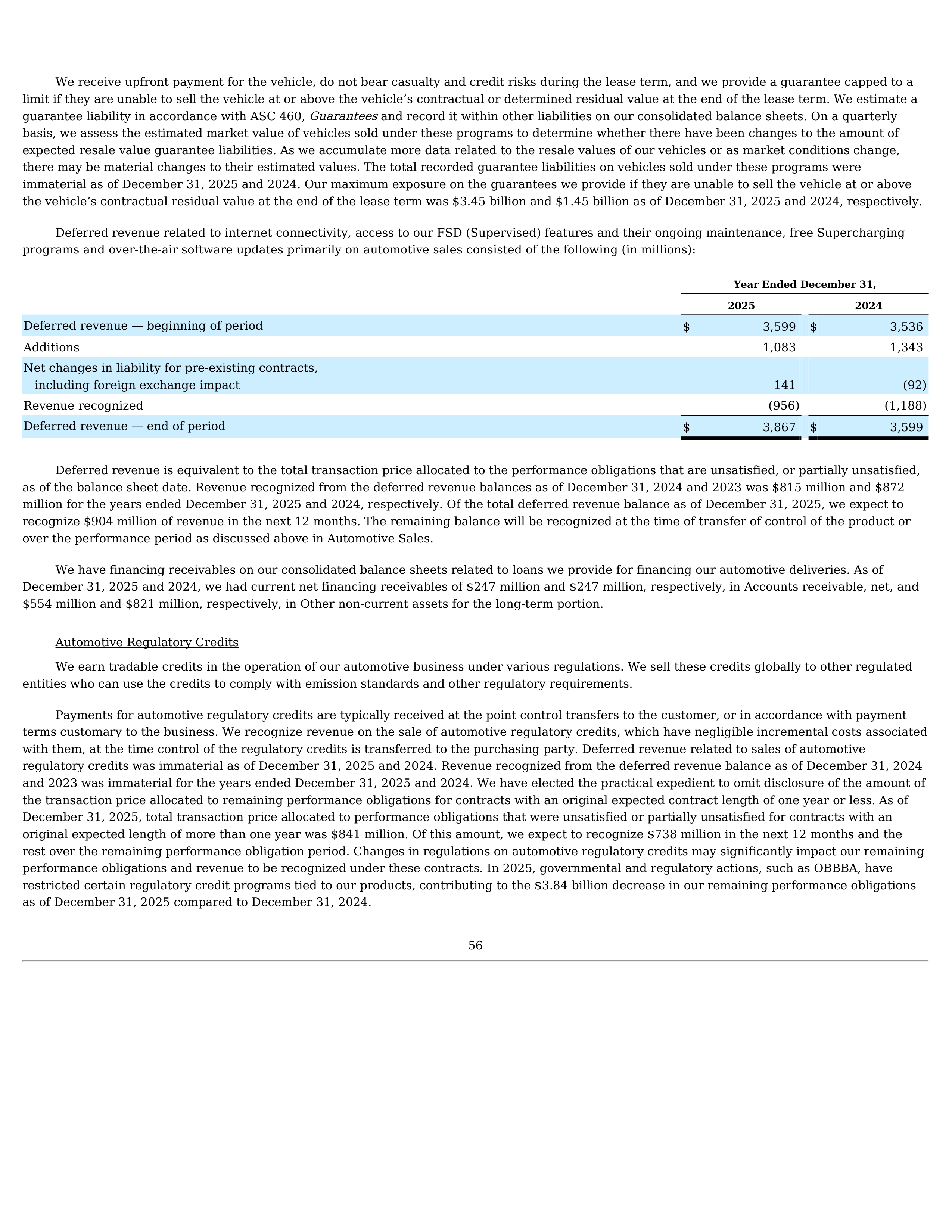
We receive upfront payment for the vehicle, do not bear casualty and credit risks during the lease term, and we provide a guarantee capped to a
limit if they are unable to sell the vehicle at or above the vehicle’s contractual or determined residual value at the end of the lease term. We estimate a
guarantee liability in accordance with ASC 460, Guarantees and record it within other liabilities on our consolidated balance sheets. On a quarterly
basis, we assess the estimated market value of vehicles sold under these programs to determine whether there have been changes to the amount of
expected resale value guarantee liabilities. As we accumulate more data related to the resale values of our vehicles or as market conditions change,
there may be material changes to their estimated values. The total recorded guarantee liabilities on vehicles sold under these programs were
immaterial as of December 31, 2025 and 2024. Our maximum exposure on the guarantees we provide if they are unable to sell the vehicle at or above
the vehicle’s contractual residual value at the end of the lease term was $3.45 billion and $1.45 billion as of December 31, 2025 and 2024, respectively.
Deferred revenue related to internet connectivity, access to our FSD (Supervised) features and their ongoing maintenance, free Supercharging
programs and over-the-air software updates primarily on automotive sales consisted of the following (in millions):
Year Ended December 31,
2025
2024
Deferred revenue — beginning of period
$
3,599
$
3,536
Additions
1,083
1,343
Net changes in liability for pre-existing contracts,
including foreign exchange impact
141
(92)
Revenue recognized
(956)
(1,188)
Deferred revenue — end of period
$
3,867
$
3,599
Deferred revenue is equivalent to the total transaction price allocated to the performance obligations that are unsatisfied, or partially unsatisfied,
as of the balance sheet date. Revenue recognized from the deferred revenue balances as of December 31, 2024 and 2023 was $815 million and $872
million for the years ended December 31, 2025 and 2024, respectively. Of the total deferred revenue balance as of December 31, 2025, we expect to
recognize $904 million of revenue in the next 12 months. The remaining balance will be recognized at the time of transfer of control of the product or
over the performance period as discussed above in Automotive Sales.
We have financing receivables on our consolidated balance sheets related to loans we provide for financing our automotive deliveries. As of
December 31, 2025 and 2024, we had current net financing receivables of $247 million and $247 million, respectively, in Accounts receivable, net, and
$554 million and $821 million, respectively, in Other non-current assets for the long-term portion.
Automotive Regulatory Credits
We earn tradable credits in the operation of our automotive business under various regulations. We sell these credits globally to other regulated
entities who can use the credits to comply with emission standards and other regulatory requirements.
Payments for automotive regulatory credits are typically received at the point control transfers to the customer, or in accordance with payment
terms customary to the business. We recognize revenue on the sale of automotive regulatory credits, which have negligible incremental costs associated
with them, at the time control of the regulatory credits is transferred to the purchasing party. Deferred revenue related to sales of automotive
regulatory credits was immaterial as of December 31, 2025 and 2024. Revenue recognized from the deferred revenue balance as of December 31, 2024
and 2023 was immaterial for the years ended December 31, 2025 and 2024. We have elected the practical expedient to omit disclosure of the amount of
the transaction price allocated to remaining performance obligations for contracts with an original expected contract length of one year or less. As of
December 31, 2025, total transaction price allocated to performance obligations that were unsatisfied or partially unsatisfied for contracts with an
original expected length of more than one year was $841 million. Of this amount, we expect to recognize $738 million in the next 12 months and the
rest over the remaining performance obligation period. Changes in regulations on automotive regulatory credits may significantly impact our remaining
performance obligations and revenue to be recognized under these contracts. In 2025, governmental and regulatory actions, such as OBBBA, have
restricted certain regulatory credit programs tied to our products, contributing to the $3.84 billion decrease in our remaining performance obligations
as of December 31, 2025 compared to December 31, 2024.
56
Automotive Leasing Revenue
Direct Vehicle Operating Leasing Program
We have outstanding leases under our direct vehicle operating leasing programs in the U.S., Canada and in certain countries in Europe. Qualifying
customers are permitted to lease a vehicle directly from Tesla for up to 48 months. At the end of the lease term, customers may opt to return the
vehicles to us or purchase the vehicles when contractually permitted. We account for these leasing transactions as operating leases. We record leasing
revenues to automotive leasing revenue on a straight-line basis over the contractual term, and we record the depreciation of these vehicles to cost of
automotive leasing revenue. For the years ended December 31, 2025, 2024 and 2023, we recognized $1.68 billion, $1.78 billion and $1.86 billion of
direct vehicle leasing revenue, respectively. As of December 31, 2025 and 2024, we had deferred $282 million and $394 million, respectively, of lease-
related upfront payments, which will be recognized on a straight-line basis over the contractual terms of the individual leases.
Our policy is to exclude taxes collected from a customer from the transaction price of automotive contracts.
Direct Sales-Type Leasing Program
We have outstanding direct leases and vehicles financed by us under loan arrangements accounted for as sales-type leases under ASC 842, Leases
(“ASC 842”), in certain countries in Asia and Europe. Our arrangements under these programs can have terms for up to 72 months. We recognize all
revenue and costs associated with the sales-type lease as automotive leasing revenue and automotive leasing cost of revenue, respectively, upon
delivery of the vehicle to the customer. Interest income based on the implicit rate in the lease is recorded to automotive leasing revenue over time as
customers are invoiced on a monthly basis. For the years ended December 31, 2025, 2024 and 2023, we recognized $10 million, $12 million and $215
million, respectively, of sales-type leasing revenue and $5 million, $7 million and $164 million, respectively, of sales-type leasing cost of revenue.
Services and Other Revenue
Services and other revenue consists of sales of used vehicles, non-warranty maintenance services and collision, paid Supercharging sessions,
insurance services revenue, part sales and retail merchandise sales.
Revenues related to repair, maintenance and vehicle insurance services are recognized over time as services are provided and extended service
plans are recognized over the performance period of the service contract as the obligation represents a stand-ready obligation to the customer. We sell
used vehicles, services, service plans, vehicle components and merchandise separately and thus use standalone selling prices as the basis for revenue
allocation to the extent that these items are sold in transactions with other performance obligations. Payment for used vehicles, services, vehicle
components, and merchandise are typically received at the point when control transfers to the customer or in accordance with payment terms
customary to the business. Payments received for prepaid plans are refundable upon customer cancellation of the related contracts and are included
within Accrued liabilities and other on the consolidated balance sheets. We record in Deferred revenue any non-refundable prepayment amounts that
are collected from customers and unearned insurance premiums, which is recognized as revenue ratably over the respective customer contract term.
Deferred revenue excluding unearned insurance premiums was not material as of December 31, 2025 and 2024.
Energy Generation and Storage Segment
Energy Generation and Storage Sales
Energy generation and storage sales revenue consists of the sale of energy generation and storage systems to residential, small commercial, large
commercial and utility grade customers. Sales of energy generation and storage systems to residential and small-scale commercial customers consist of
the engineering, design and installation of the system. Residential and small-scale commercial customers pay the full purchase price of the system
upfront. Revenue for the design and installation obligation is recognized when control transfers, which is when we install a system and the system
passes inspection by the utility or the authority having jurisdiction.
We also sell storage systems to channel partners. These sales are recognized when the product has been delivered. Payment for such storage
systems is made upon invoice or in accordance with payment terms customary to the business.
57
For large commercial and utility grade energy storage system sales, customers make milestone payments that are consistent with contract-specific
phases of a project. Revenue from the sale of such systems is recognized when control transfers, which is when the product has been delivered. For
certain sales contracts which consist of the engineering, design and installation of the system, revenue related to those services is recognized over time
based on their estimated standalone selling price and applying the percentage of completion method using cost incurred as a percentage of total
estimated service costs.
In instances where there are multiple performance obligations in a single contract, we allocate the consideration to the various obligations in the
contract based on the relative standalone selling price method. Standalone selling prices are estimated based on estimated costs plus margin or by
using market data for comparable products. Costs to obtain a contract relate mainly to commissions paid to our sales personnel related to the sale of
energy storage systems. As our contract costs related to energy storage system sales are typically fulfilled within one year, the costs to obtain a contract
are expensed as incurred.
As part of certain energy storage system contracts, we may provide the customer with performance guarantees that warrant that the underlying
system will meet or exceed the minimum energy performance requirements specified in the contract. If an energy storage system does not meet the
performance guarantee requirements, we may be required to pay liquidated damages. Other forms of variable consideration related to our large
commercial and utility grade energy storage system contracts include variable customer payments that will be made based on our energy market
participation activities. Such guarantees and variable customer payments represent a form of variable consideration and are estimated at contract
inception at their most likely amount and updated at the end of each reporting period as additional performance data becomes available. Such estimates
are included in the transaction price only to the extent that it is probable a significant reversal of revenue will not occur.
We record as deferred revenue any non-refundable amounts that are primarily related to prepayments from customers, which is recognized as
revenue as or when the performance obligations are satisfied. As of December 31, 2025 and 2024, deferred revenue related to such customer payments
amounted to $2.04 billion and $1.77 billion, respectively, mainly due to contractual payment terms. Revenue recognized from the deferred revenue
balance as of December 31, 2024 and 2023 was $1.45 billion and $1.27 billion for the years ended December 31, 2025 and 2024, respectively. We have
elected the practical expedient to omit disclosure of the amount of the transaction price allocated to remaining performance obligations for contracts
with an original expected contract length of one year or less and the amount that we have the right to invoice when that amount corresponds directly
with the value of the performance to date. As of December 31, 2025, total transaction price allocated to performance obligations that were unsatisfied
or partially unsatisfied for contracts with an original expected length of more than one year was $10.42 billion. Of this amount, we expect to recognize
$4.96 billion in the next 12 months and the rest over the remaining performance obligation period. Changes in government and economic incentives or
tariffs may impact the transaction price or our ability to execute these existing contracts.
We have financing receivables on our consolidated balance sheets related to loans we provide for financing our energy products. As of
December 31, 2025 and 2024, we had current net financing receivables of $38 million and $34 million, respectively, in Accounts receivable, net, and
$731 million and $658 million, respectively, in Other non-current assets for the long-term portion.
Energy Generation and Storage Leasing
For the arrangements where we are the lessor for energy generation and storage systems, we have determined that these agreements should be
accounted for as operating leases. We record lease revenue from minimum lease payments, assuming all other revenue recognition criteria have been
met. The difference between the payments received and the revenue recognized is recorded as deferred revenue or deferred asset on the consolidated
balance sheets.
For energy generation and storage systems where customers purchase electricity from us under PPAs, we have determined that these agreements
should be accounted for as operating leases. Revenue is recognized based on the amount of electricity delivered at rates specified under the contracts,
assuming all other revenue recognition criteria are met.
We record as deferred revenue any amounts that are collected from customers, including lease prepayments, in excess of revenue recognized,
which is recognized as revenue ratably over the respective customer contract term. As of December 31, 2025 and 2024, deferred revenue related to
such customer payments amounted to $151 million and $164 million, respectively. Deferred revenue also includes the portion of rebates and incentives
received from utility companies and various local and state government agencies, which is recognized as revenue over the lease term. As of
December 31, 2025 and 2024, deferred revenue from rebates and incentives was immaterial.
58
We capitalize initial direct costs from the execution of lease and PPA agreements for energy generation and storage systems, which include the
referral fees and sales commissions, as an element of energy generation and storage systems, net, and subsequently amortize these costs over the term
of the related agreements.
Cost of Revenues
Automotive Segment
Automotive Sales
Cost of automotive sales revenue includes direct and indirect materials, labor costs, manufacturing overhead, including depreciation costs of
tooling and machinery, shipping and logistic costs, tariffs, vehicle connectivity costs, FSD (Supervised) ongoing maintenance costs, electricity costs for
our free Supercharging programs and reserves for estimated warranty expenses. Cost of automotive sales revenues also includes adjustments to
warranty expense and charges to write down the carrying value of our inventory when it exceeds its estimated net realizable value and to provide for
obsolete and on-hand inventory in excess of forecasted demand. Additionally, cost of automotive sales revenue benefits from manufacturing credits
earned, amounting to $565 million, $625 million and $359 million for the years ended December 31, 2025, 2024 and 2023, respectively.
Automotive Leasing
Cost of automotive leasing revenue includes the depreciation of operating lease vehicles, cost of goods sold associated with direct sales-type
leases and servicing of leased vehicles.
Services and Other
Costs of services and other revenue includes cost of used vehicles including refurbishment costs, labor and material costs associated with
providing non-warranty maintenance services and collision, operating costs of paid Supercharging sessions, claim costs associated with providing
automotive insurance, and costs associated with our part sales and retail merchandise sales.
Energy Generation and Storage Segment
Energy Generation and Storage
Cost of energy generation and storage revenue includes direct and indirect material, tariffs, labor costs, manufacturing overhead, including
depreciation costs of tooling and machinery, shipping and logistic costs, warranty expense, and cost of servicing. Cost of energy generation and storage
revenue also includes charges to write down the carrying value of our inventory when it exceeds its estimated net realizable value and to provide for
obsolete and on-hand inventory in excess of forecasted demand. Additionally, cost of energy generation and storage revenue benefits from
manufacturing credits earned, amounting to $1.12 billion, $756 million and $115 million for the years ended December 31, 2025, 2024 and 2023,
respectively. In lease agreements and PPAs for energy generation and storage systems where we are the lessor, the cost of revenue is primarily
comprised of depreciation of the cost of leased energy generation and storage systems, maintenance costs associated with those systems and
amortization of any initial direct costs.
Research and Development Costs
Research and development costs are expensed as incurred.
Income Taxes
We are subject to income taxes in the U.S. and in many foreign jurisdictions. Income taxes are computed using the asset and liability method,
under which deferred tax assets and liabilities are determined based on the difference between the financial statement and tax bases of assets and
liabilities using enacted tax rates in effect for the year in which the differences are expected to affect taxable income. Valuation allowances are
established when necessary to reduce deferred tax assets to the amount expected to be realized.
59
Significant judgment is required in determining our provision for income taxes, our deferred tax assets and liabilities and any valuation allowance
recorded against our net deferred tax assets that are not more likely than not to be realized. We monitor the realizability of our deferred tax assets
taking into account all relevant factors at each reporting period. In completing our assessment of realizability of our deferred tax assets, we consider
our history of income (loss) measured at pre-tax income (loss) adjusted for permanent book-tax differences on a jurisdictional basis, volatility in actual
earnings, excess tax benefits related to stock-based compensation in recent prior years and impacts of the timing of reversal of existing temporary
differences. We also rely on our assessment of the Company’s projected future results of business operations, including uncertainty in future operating
results relative to historical results, volatility in the market price of our common stock and its performance over time, variable macroeconomic
conditions impacting our ability to forecast future taxable income, and changes in business that may affect the existence and magnitude of future
taxable income. Our valuation allowance assessment is based on our best estimate of future results considering all available information.
We record liabilities related to uncertain tax positions when, despite our belief that our tax return positions are supportable, we believe that it is
more likely than not that those positions may not be fully sustained upon review by tax authorities. Accrued interest and penalties related to
unrecognized tax benefits are classified as income tax expense.
The Tax Cuts and Jobs Act subjects a U.S. shareholder to tax on global intangible low-taxed income (“GILTI”) earned by certain foreign
subsidiaries. The OBBBA renamed GILTI to NCTI for taxable years beginning after December 31, 2025. Under GAAP, we can make an accounting policy
election to either treat taxes due on the GILTI or NCTI inclusion as a current period expense or factor such amounts into our measurement of deferred
taxes. We elected the deferred method, under which we recorded the corresponding deferred tax assets and liabilities in our consolidated balance
sheets.
Comprehensive Income
Comprehensive income is comprised of net income and other comprehensive income (loss). Other comprehensive income (loss) consists of foreign
currency translation adjustments and unrealized net gains and losses on investments that have been excluded from the determination of net income.
Stock-Based Compensation
We use the fair value method of accounting for our restricted stock, stock options and RSUs granted to employees and for our ESPP to measure
the cost of employee services received in exchange for the stock-based awards. Stock-based compensation expense for equity awards is a non-cash
expense and is recorded in Cost of revenues, Research and development expense and Selling, general and administrative expense in the consolidated
statements of operations based on the function of the employee.
Equity awards with service and/or performance conditions
The fair value of stock option awards with service and/or performance conditions and the ESPP is estimated on the grant or offering date using the
Black-Scholes option-pricing model. The Black-Scholes option-pricing model requires inputs such as the risk-free interest rate, expected award term and
expected share price volatility. The fair value of RSUs with service and/or performance conditions is measured on the grant date based on the closing
fair market value of our common stock. The resulting stock-based compensation expense for stock options, RSUs and the ESPP is recognized over the
period during which an employee is required to provide service in exchange for the awards, usually the vesting period, which is generally four years for
stock options and RSUs and six months for the ESPP.
The fair value of restricted stock granted to our CEO with service and/or performance conditions is measured on the grant date based on the
closing fair market value of our common stock, adjusted to take into account the illiquidity discount due to any applicable required holding requirement
that is in effect post-vesting, less any purchase price or offset amount. The illiquidity discount is determined using a valuation model that requires
inputs such as expected share price volatility and the employee’s expected tax rate. The inputs used in the valuation models, which are subjective and
generally require significant judgment, are unique to each award based on the best available information at the valuation date.
Stock-based compensation expense for equity awards with performance conditions is recognized over the requisite service period when the
vesting of the award becomes probable. Stock-based compensation expense is recognized on a straight-line basis for equity awards with only a service
condition and on a graded vesting basis for equity awards with a performance condition, net of actual forfeitures in the period.
60
Equity awards with market, service and performance conditions
The fair value and derived service period of performance-based awards granted to our CEO with market, service and performance conditions are
estimated on the grant date using a Monte Carlo simulation model. A Monte Carlo simulation model requires inputs such as the risk-free interest rate,
expected award term, expected share dilution and expected share price volatility. For awards with a holding requirement that is in effect post-vesting,
the fair value is adjusted to take into account an illiquidity discount, which is determined using a valuation model that requires inputs such as expected
share price volatility and the employee’s expected tax rate. These inputs, which are subjective and generally require significant judgment, are unique to
each award based on the best available information at the valuation date.
For such awards, stock-based compensation expense is recognized on a straight-line basis over the expected performance achievement period of
individual performance milestones when the achievement of each individual performance milestone becomes probable. As applicable, stock-based
compensation expense for such awards is recognized over the longer of (i) the expected service period, (ii) the expected achievement period for the
operational milestone (performance condition) and (iii) the expected achievement period for the related market capitalization milestone determined on
the grant date, with recognition beginning at the point in time that the relevant operational milestone is considered probable of achievement. If such
operational milestone becomes probable any time after the grant date or the expected achievement period changes, we will recognize a cumulative
expense adjustment from the grant date to that point in time. Stock-based compensation expense will continue to be recognized over the expected
achievement period for the operational milestone (if applicable) regardless of whether the market capitalization milestone is achieved earlier than its
expected achievement period or achieved at all, as long as the service condition continues to be satisfied. If an operational milestone is subsequently
determined to be improbable of achievement, stock-based compensation expense previously recognized would be reversed in the period the condition is
deemed improbable.
Noncontrolling Interests and Redeemable Noncontrolling Interests
Noncontrolling interests and redeemable noncontrolling interests represent third-party interests in the net assets under certain funding
arrangements, or funds, that we have entered into to finance the costs of energy generation systems. We have determined that the contractual
provisions of the funds represent substantive profit-sharing arrangements. We have further determined that the methodology for calculating the
noncontrolling interest and redeemable noncontrolling interest balances that reflects the substantive profit-sharing arrangements is a balance sheet
approach using the hypothetical liquidation at book value (“HLBV”) method. We, therefore, determine the amount of the noncontrolling interests and
redeemable noncontrolling interests in the net assets of the funds at each balance sheet date using the HLBV method, which is presented on the
consolidated balance sheets as noncontrolling interests in subsidiaries and redeemable noncontrolling interests in subsidiaries. Under the HLBV
method, the amounts reported as noncontrolling interests and redeemable noncontrolling interests in the consolidated balance sheets represent the
amounts the third parties would hypothetically receive at each balance sheet date under the liquidation provisions of the funds, assuming the net assets
of the funds were liquidated at their recorded amounts determined in accordance with GAAP and with tax laws effective at the balance sheet date and
distributed to the third parties. The third parties’ interests in the results of operations of the funds are determined as the difference in the
noncontrolling interest and redeemable noncontrolling interest balances in the consolidated balance sheets between the start and end of each reporting
period, after taking into account any capital transactions between the funds and the third parties. However, the redeemable noncontrolling interest
balance is at least equal to the redemption amount. The redeemable noncontrolling interest balance is presented as temporary equity in the mezzanine
section of the consolidated balance sheets since these third parties have the right to redeem their interests in the funds for cash or other assets.
Net Income per Share of Common Stock Attributable to Common Stockholders
Basic net income per share of common stock attributable to common stockholders is calculated by dividing net income attributable to common
stockholders by the weighted-average shares of common stock outstanding for the period. Potentially dilutive shares, which are based on the weighted-
average shares of common stock underlying outstanding stock-based awards, warrants and convertible senior notes using the treasury stock method or
the if-converted method, as applicable, are included when calculating diluted net income per share of common stock attributable to common
stockholders when their effect is dilutive. Equity awards classified as RSAs are treated as issued shares when granted and approved; however, these
shares are not included in the computation of basic weighted average shares outstanding until vested.
61
The following table presents the reconciliation of net income attributable to common stockholders to net income used in computing basic and
diluted net income per share of common stock (in millions):
Year Ended December 31,
2025
2024
2023
Net income attributable to common stockholders
$
3,794
$
7,091
$
14,997
Less: Buy-outs of noncontrolling interests
—
(39)
(2)
Net income used in computing basic and diluted net income per share of common stock
$
3,794
$
7,130
$
14,999
RSAs will be excluded from the computation of diluted weighted average shares until the shares have been deemed to be earned. The following
table presents the reconciliation of basic to diluted weighted average shares used in computing net income per share of common stock attributable to
common stockholders (in millions):
Year Ended December 31,
2025
2024
2023
Weighted average shares used in computing net income per share of common stock,
basic
3,225
3,197
3,174
Add:
Stock-based awards
303
292
298
Convertible senior notes
—
1
2
Warrants
—
8
11
Weighted average shares used in computing net income per share of common stock,
diluted
3,528
3,498
3,485
The following table presents the potentially dilutive shares that were excluded from the computation of diluted net income per share of common
stock attributable to common stockholders, because their effect was anti-dilutive (in millions):
Year Ended December 31,
2025
2024
2023
Stock-based awards
4
15
12
Cash and Cash Equivalents
All highly liquid investments with an original maturity of three months or less at the date of purchase are considered cash equivalents.
Restricted Cash
We maintain certain cash balances restricted as to withdrawal or use. Our restricted cash is comprised primarily of cash held as collateral for
sales to lease partners with a resale value guarantee, cash held to service certain payments under various secured debt facilities, and deposits held for
our insurance services. We record restricted cash as other assets in the consolidated balance sheets and determine current or non-current classification
based on the expected remaining duration of the restriction.
62
Our total cash and cash equivalents and restricted cash, as presented in the consolidated statements of cash flows, was as follows (in millions):
December 31,
2025
December 31,
2024
December 31,
2023
Cash and cash equivalents
$
16,513
$
16,139
$
16,398
Restricted cash included in prepaid expenses and other current assets
389
494
543
Restricted cash included in other non-current assets
714
404
248
Total as presented in the consolidated statements of cash flows
$
17,616
$
17,037
$
17,189
Investments
Our investments are all designated as available-for-sale and reported at estimated fair value, with unrealized gains and losses recorded in
accumulated other comprehensive income (loss) which is included within stockholders’ equity. Available-for-sale marketable securities with maturities
greater than three months at the date of purchase are included in short-term investments in our consolidated balance sheets. Interest, dividends,
amortization and accretion of purchase premiums and discounts on these investments are included within Interest income in our consolidated
statements of operations. Interest income on our short-term investments for the years ended December 31, 2025, 2024 and 2023 was $879 million,
$763 million and $388 million, respectively.
The cost of available-for-sale investments sold is based on the specific identification method. Realized gains and losses on the sale of available-for-
sale investments are recorded in Other (expense) income, net.
We regularly review all of our investments for declines in fair value. The review includes but is not limited to (i) the consideration of the cause of
the decline, (ii) any currently recorded expected credit losses and (iii) the creditworthiness of the respective security issuers. The amortized cost basis
of our investments approximates its fair value.
Accounts Receivable and Allowance for Doubtful Accounts
Accounts receivable primarily include amounts related to receivables from sales of energy generation and storage products, financial institutions
and leasing companies offering various financing products to our customers, sales of regulatory credits to other automotive manufacturers, and
government rebates already passed through to customers. We provide an allowance against accounts receivable for the amount we expect to be
uncollectible. We write-off accounts receivable against the allowance when they are deemed uncollectible.
Depending on the day of the week on which the end of a fiscal quarter falls, our accounts receivable balance may fluctuate as we are waiting for
certain customer payments to clear through our banking institutions and receipts of payments from our financing partners, which can take up to
approximately two weeks based on the contractual payment terms with such partners. Our accounts receivable balances associated with sales of energy
storage products are dependent on billing milestones and payment terms negotiated for each contract, and our accounts receivable balances associated
with our sales of regulatory credits are dependent on contractual payment terms. These various factors may have a significant impact on our accounts
receivable balance from period to period. As of December 31, 2025 and 2024, government rebates receivable was $108 million and $315 million,
respectively, in Accounts receivable, net.
Financing Receivables
We provide financing options to our customers for our automotive and energy products. Financing receivables are carried at amortized cost, net of
allowance for loan losses. Provisions for loan losses are charged to operations in amounts sufficient to maintain the allowance for loan losses at levels
considered adequate to cover expected credit losses on the financing receivables. In determining expected credit losses, we consider our historical level
of credit losses, current economic trends, and reasonable and supportable forecasts that affect the collectability of the future cash flows. Interest
income on financing receivables is recognized over the loan term as revenue in the consolidated statements of operations.
When originating consumer receivables, we review the credit application, the proposed contract terms, credit bureau information (e.g., FICO
score) and other information. Our evaluation emphasizes the applicant’s ability to pay and creditworthiness focusing on payment, affordability, and
applicant credit history as key considerations. Generally, all customers in this portfolio have strong creditworthiness at loan origination.
63
After origination, we review the credit quality of retail financing based on customer payment activity and aging analysis. For all financing
receivables, we define “past due” as any payment, including principal and interest, which is at least 31 days past the contractual due date. As of
December 31, 2025 and 2024, the vast majority of our financing receivables were at current status with an immaterial balance being past due. As of
December 31, 2025, the majority of our financing receivables, excluding MyPower notes receivable, were originated in the past four years. As of
December 31, 2024, the majority of these receivables were originated in 2023 and 2022.
We have customer notes receivable under the legacy MyPower loan program, which provided residential customers with the option to finance the
purchase of an energy generation system through a 30-year loan and were all originated prior to year 2018. The outstanding balances, net of any
allowance for expected credit losses, are presented on the consolidated balance sheets as a component of Prepaid expenses and other current assets for
the current portion and as Other non-current assets for the long-term portion. As of December 31, 2025 and 2024, the total outstanding balance of
MyPower customer notes receivable, net of allowance for expected credit losses, was $241 million and $248 million, respectively, of which immaterial
amounts were due in the next 12 months as of December 31, 2025 and 2024. As of December 31, 2025 and 2024, the allowance for expected credit
losses was $26 million and $33 million, respectively.
Concentration of Risk
Credit Risk
Financial instruments that potentially subject us to a concentration of credit risk consist of cash, cash equivalents, investments, restricted cash,
accounts receivable and other finance receivables. Our cash and investments balances are primarily on deposit at high credit quality financial
institutions or invested in highly rated, investment-grade securities. These deposits are typically in excess of insured limits. As of December 31, 2025
and 2024, no entity represented 10% or more of our total receivables balance.
Supply Risk
We are dependent on our suppliers, including single source suppliers, and the inability of these suppliers to deliver necessary components of our
products in a timely manner at prices, quality levels and volumes acceptable to us, or our inability to efficiently manage these components from these
suppliers, could have a material adverse effect on our business, prospects, financial condition and operating results.
Inventory Valuation
Inventories are stated at the lower of cost or net realizable value. Cost is computed using standard cost for vehicles and energy products, which
approximates actual cost on a first-in, first-out basis. We record inventory write-downs for excess or obsolete inventories based upon assumptions about
current and future demand forecasts. If our inventory on-hand is in excess of our future demand forecast, the excess amounts are written-off.
We also review our inventory to determine whether its carrying value exceeds the net amount realizable upon the ultimate sale of the inventory.
This requires us to determine the estimated selling price of our products less the estimated cost to convert the inventory on-hand into a finished
product. Once inventory is written-down, a new, lower cost basis for that inventory is established and subsequent changes in facts and circumstances do
not result in the restoration or increase in that newly established cost basis.
Should our estimates of future selling prices or production costs change, additional and potentially material write-downs may be required. A small
change in our estimates may result in a material charge to our reported financial results.
Operating Lease Vehicles
Vehicles that are leased as part of our direct vehicle leasing program are classified as operating lease vehicles at cost less accumulated
depreciation. We generally depreciate their cost, less residual value, using the straight-line-method to cost of automotive leasing revenue over the
contractual period. The gross cost of operating lease vehicles as of December 31, 2025 and 2024 was $6.12 billion and $7.03 billion, respectively.
Operating lease vehicles on the consolidated balance sheets are presented net of accumulated depreciation of $1.21 billion and $1.45 billion as of
December 31, 2025 and 2024, respectively.
64
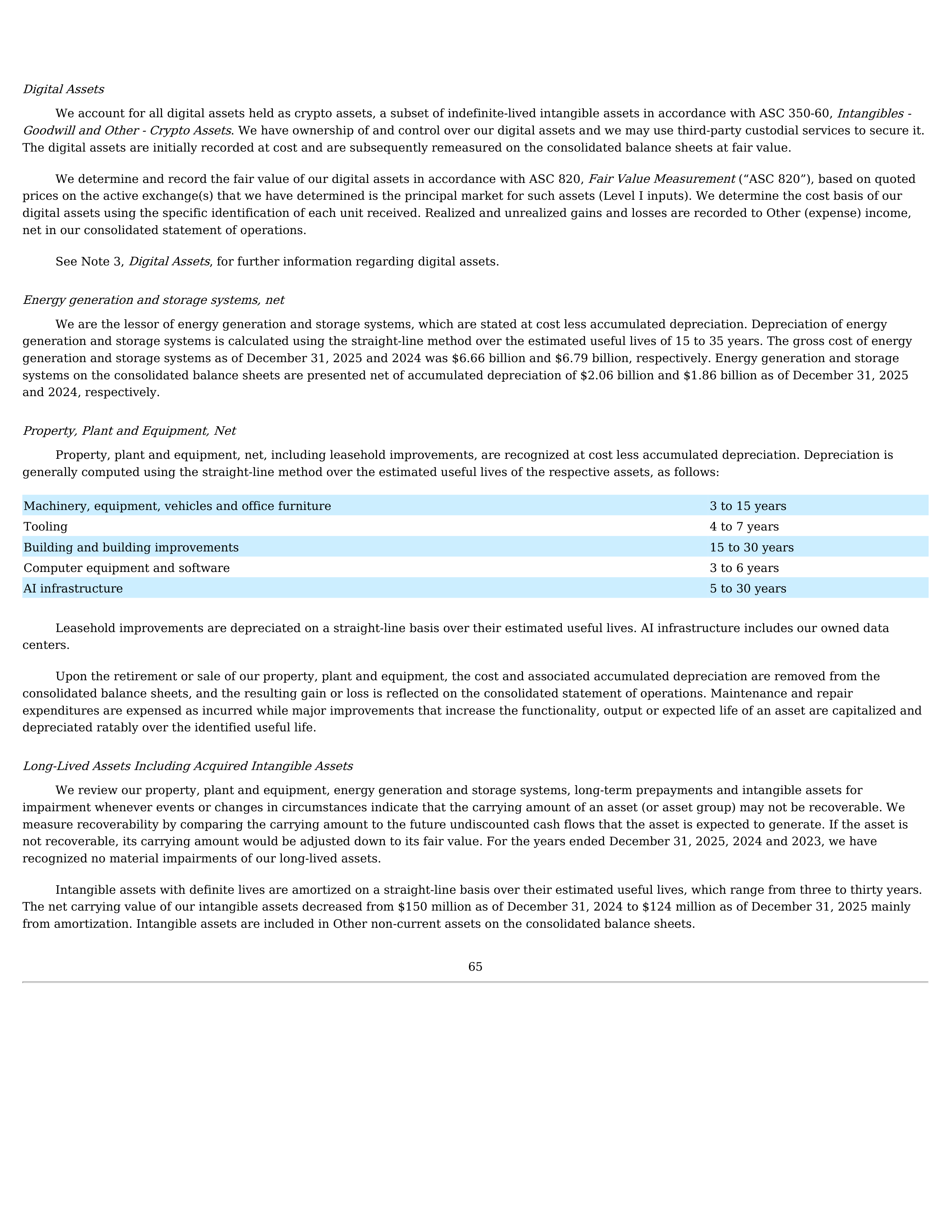
Digital Assets
We account for all digital assets held as crypto assets, a subset of indefinite-lived intangible assets in accordance with ASC 350-60, Intangibles -
Goodwill and Other - Crypto Assets. We have ownership of and control over our digital assets and we may use third-party custodial services to secure it.
The digital assets are initially recorded at cost and are subsequently remeasured on the consolidated balance sheets at fair value.
We determine and record the fair value of our digital assets in accordance with ASC 820, Fair Value Measurement (“ASC 820”), based on quoted
prices on the active exchange(s) that we have determined is the principal market for such assets (Level I inputs). We determine the cost basis of our
digital assets using the specific identification of each unit received. Realized and unrealized gains and losses are recorded to Other (expense) income,
net in our consolidated statement of operations.
See Note 3, Digital Assets, for further information regarding digital assets.
Energy generation and storage systems, net
We are the lessor of energy generation and storage systems, which are stated at cost less accumulated depreciation. Depreciation of energy
generation and storage systems is calculated using the straight-line method over the estimated useful lives of 15 to 35 years. The gross cost of energy
generation and storage systems as of December 31, 2025 and 2024 was $6.66 billion and $6.79 billion, respectively. Energy generation and storage
systems on the consolidated balance sheets are presented net of accumulated depreciation of $2.06 billion and $1.86 billion as of December 31, 2025
and 2024, respectively.
Property, Plant and Equipment, Net
Property, plant and equipment, net, including leasehold improvements, are recognized at cost less accumulated depreciation. Depreciation is
generally computed using the straight-line method over the estimated useful lives of the respective assets, as follows:
Machinery, equipment, vehicles and office furniture
3 to 15 years
Tooling
4 to 7 years
Building and building improvements
15 to 30 years
Computer equipment and software
3 to 6 years
AI infrastructure
5 to 30 years
Leasehold improvements are depreciated on a straight-line basis over their estimated useful lives. AI infrastructure includes our owned data
centers.
Upon the retirement or sale of our property, plant and equipment, the cost and associated accumulated depreciation are removed from the
consolidated balance sheets, and the resulting gain or loss is reflected on the consolidated statement of operations. Maintenance and repair
expenditures are expensed as incurred while major improvements that increase the functionality, output or expected life of an asset are capitalized and
depreciated ratably over the identified useful life.
Long-Lived Assets Including Acquired Intangible Assets
We review our property, plant and equipment, energy generation and storage systems, long-term prepayments and intangible assets for
impairment whenever events or changes in circumstances indicate that the carrying amount of an asset (or asset group) may not be recoverable. We
measure recoverability by comparing the carrying amount to the future undiscounted cash flows that the asset is expected to generate. If the asset is
not recoverable, its carrying amount would be adjusted down to its fair value. For the years ended December 31, 2025, 2024 and 2023, we have
recognized no material impairments of our long-lived assets.
Intangible assets with definite lives are amortized on a straight-line basis over their estimated useful lives, which range from three to thirty years.
The net carrying value of our intangible assets decreased from $150 million as of December 31, 2024 to $124 million as of December 31, 2025 mainly
from amortization. Intangible assets are included in Other non-current assets on the consolidated balance sheets.
65
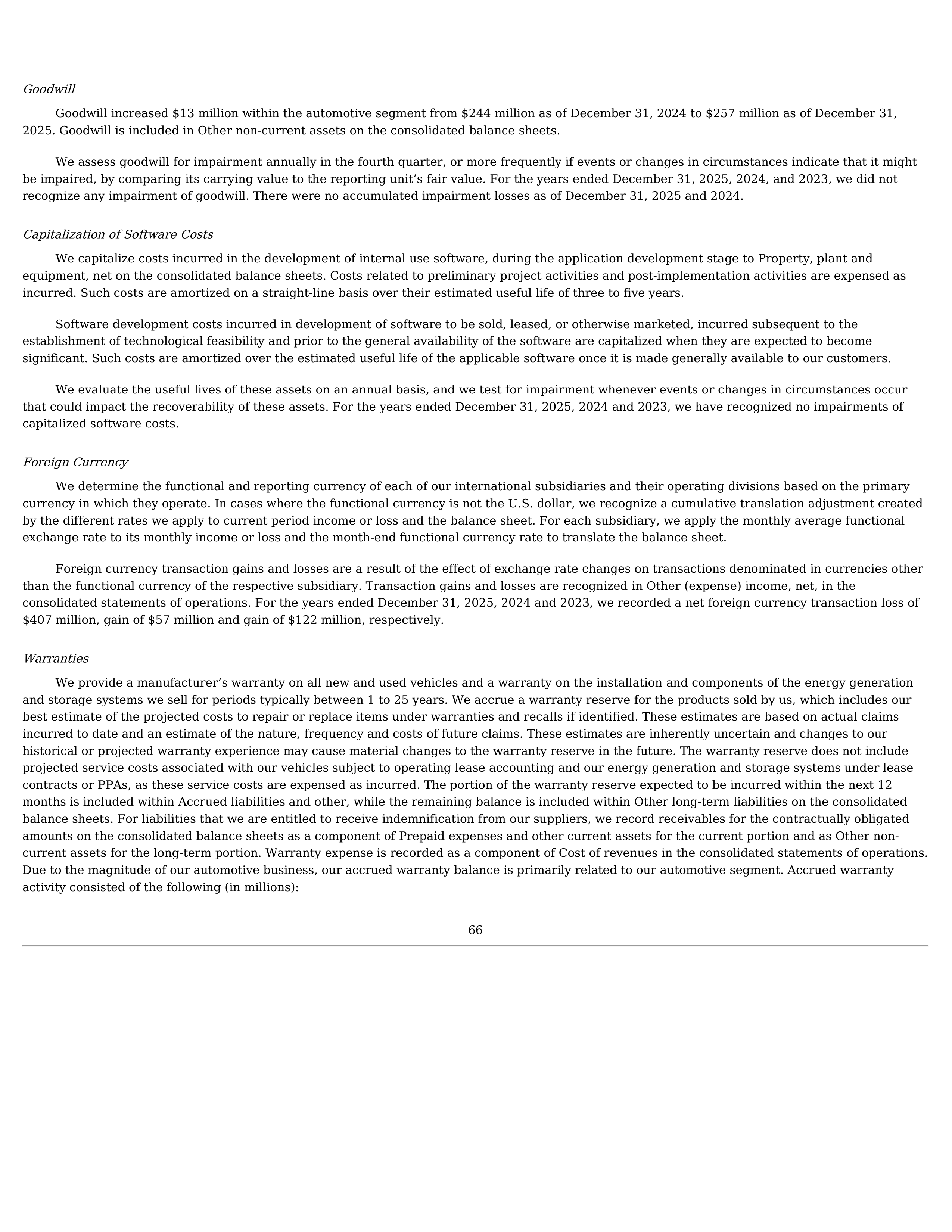
Goodwill
Goodwill increased $13 million within the automotive segment from $244 million as of December 31, 2024 to $257 million as of December 31,
2025. Goodwill is included in Other non-current assets on the consolidated balance sheets.
We assess goodwill for impairment annually in the fourth quarter, or more frequently if events or changes in circumstances indicate that it might
be impaired, by comparing its carrying value to the reporting unit’s fair value. For the years ended December 31, 2025, 2024, and 2023, we did not
recognize any impairment of goodwill. There were no accumulated impairment losses as of December 31, 2025 and 2024.
Capitalization of Software Costs
We capitalize costs incurred in the development of internal use software, during the application development stage to Property, plant and
equipment, net on the consolidated balance sheets. Costs related to preliminary project activities and post-implementation activities are expensed as
incurred. Such costs are amortized on a straight-line basis over their estimated useful life of three to five years.
Software development costs incurred in development of software to be sold, leased, or otherwise marketed, incurred subsequent to the
establishment of technological feasibility and prior to the general availability of the software are capitalized when they are expected to become
significant. Such costs are amortized over the estimated useful life of the applicable software once it is made generally available to our customers.
We evaluate the useful lives of these assets on an annual basis, and we test for impairment whenever events or changes in circumstances occur
that could impact the recoverability of these assets. For the years ended December 31, 2025, 2024 and 2023, we have recognized no impairments of
capitalized software costs.
Foreign Currency
We determine the functional and reporting currency of each of our international subsidiaries and their operating divisions based on the primary
currency in which they operate. In cases where the functional currency is not the U.S. dollar, we recognize a cumulative translation adjustment created
by the different rates we apply to current period income or loss and the balance sheet. For each subsidiary, we apply the monthly average functional
exchange rate to its monthly income or loss and the month-end functional currency rate to translate the balance sheet.
Foreign currency transaction gains and losses are a result of the effect of exchange rate changes on transactions denominated in currencies other
than the functional currency of the respective subsidiary. Transaction gains and losses are recognized in Other (expense) income, net, in the
consolidated statements of operations. For the years ended December 31, 2025, 2024 and 2023, we recorded a net foreign currency transaction loss of
$407 million, gain of $57 million and gain of $122 million, respectively.
Warranties
We provide a manufacturer’s warranty on all new and used vehicles and a warranty on the installation and components of the energy generation
and storage systems we sell for periods typically between 1 to 25 years. We accrue a warranty reserve for the products sold by us, which includes our
best estimate of the projected costs to repair or replace items under warranties and recalls if identified. These estimates are based on actual claims
incurred to date and an estimate of the nature, frequency and costs of future claims. These estimates are inherently uncertain and changes to our
historical or projected warranty experience may cause material changes to the warranty reserve in the future. The warranty reserve does not include
projected service costs associated with our vehicles subject to operating lease accounting and our energy generation and storage systems under lease
contracts or PPAs, as these service costs are expensed as incurred. The portion of the warranty reserve expected to be incurred within the next 12
months is included within Accrued liabilities and other, while the remaining balance is included within Other long-term liabilities on the consolidated
balance sheets. For liabilities that we are entitled to receive indemnification from our suppliers, we record receivables for the contractually obligated
amounts on the consolidated balance sheets as a component of Prepaid expenses and other current assets for the current portion and as Other non-
current assets for the long-term portion. Warranty expense is recorded as a component of Cost of revenues in the consolidated statements of operations.
Due to the magnitude of our automotive business, our accrued warranty balance is primarily related to our automotive segment. Accrued warranty
activity consisted of the following (in millions):
66
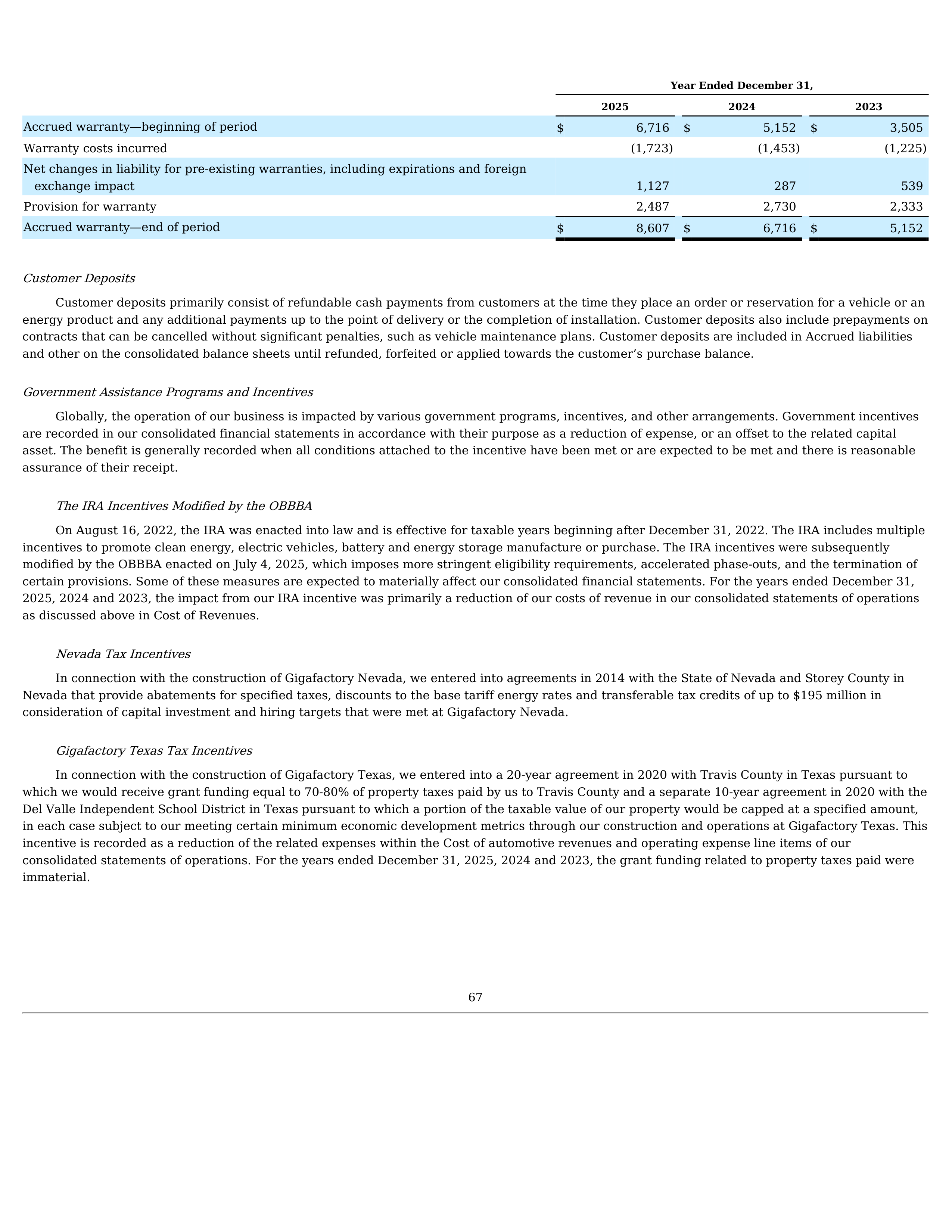
Year Ended December 31,
2025
2024
2023
Accrued warranty—beginning of period
$
6,716
$
5,152
$
3,505
Warranty costs incurred
(1,723)
(1,453)
(1,225)
Net changes in liability for pre-existing warranties, including expirations and foreign
exchange impact
1,127
287
539
Provision for warranty
2,487
2,730
2,333
Accrued warranty—end of period
$
8,607
$
6,716
$
5,152
Customer Deposits
Customer deposits primarily consist of refundable cash payments from customers at the time they place an order or reservation for a vehicle or an
energy product and any additional payments up to the point of delivery or the completion of installation. Customer deposits also include prepayments on
contracts that can be cancelled without significant penalties, such as vehicle maintenance plans. Customer deposits are included in Accrued liabilities
and other on the consolidated balance sheets until refunded, forfeited or applied towards the customer’s purchase balance.
Government Assistance Programs and Incentives
Globally, the operation of our business is impacted by various government programs, incentives, and other arrangements. Government incentives
are recorded in our consolidated financial statements in accordance with their purpose as a reduction of expense, or an offset to the related capital
asset. The benefit is generally recorded when all conditions attached to the incentive have been met or are expected to be met and there is reasonable
assurance of their receipt.
The IRA Incentives Modified by the OBBBA
On August 16, 2022, the IRA was enacted into law and is effective for taxable years beginning after December 31, 2022. The IRA includes multiple
incentives to promote clean energy, electric vehicles, battery and energy storage manufacture or purchase. The IRA incentives were subsequently
modified by the OBBBA enacted on July 4, 2025, which imposes more stringent eligibility requirements, accelerated phase-outs, and the termination of
certain provisions. Some of these measures are expected to materially affect our consolidated financial statements. For the years ended December 31,
2025, 2024 and 2023, the impact from our IRA incentive was primarily a reduction of our costs of revenue in our consolidated statements of operations
as discussed above in Cost of Revenues.
Nevada Tax Incentives
In connection with the construction of Gigafactory Nevada, we entered into agreements in 2014 with the State of Nevada and Storey County in
Nevada that provide abatements for specified taxes, discounts to the base tariff energy rates and transferable tax credits of up to $195 million in
consideration of capital investment and hiring targets that were met at Gigafactory Nevada.
Gigafactory Texas Tax Incentives
In connection with the construction of Gigafactory Texas, we entered into a 20-year agreement in 2020 with Travis County in Texas pursuant to
which we would receive grant funding equal to 70-80% of property taxes paid by us to Travis County and a separate 10-year agreement in 2020 with the
Del Valle Independent School District in Texas pursuant to which a portion of the taxable value of our property would be capped at a specified amount,
in each case subject to our meeting certain minimum economic development metrics through our construction and operations at Gigafactory Texas. This
incentive is recorded as a reduction of the related expenses within the Cost of automotive revenues and operating expense line items of our
consolidated statements of operations. For the years ended December 31, 2025, 2024 and 2023, the grant funding related to property taxes paid were
immaterial.
67
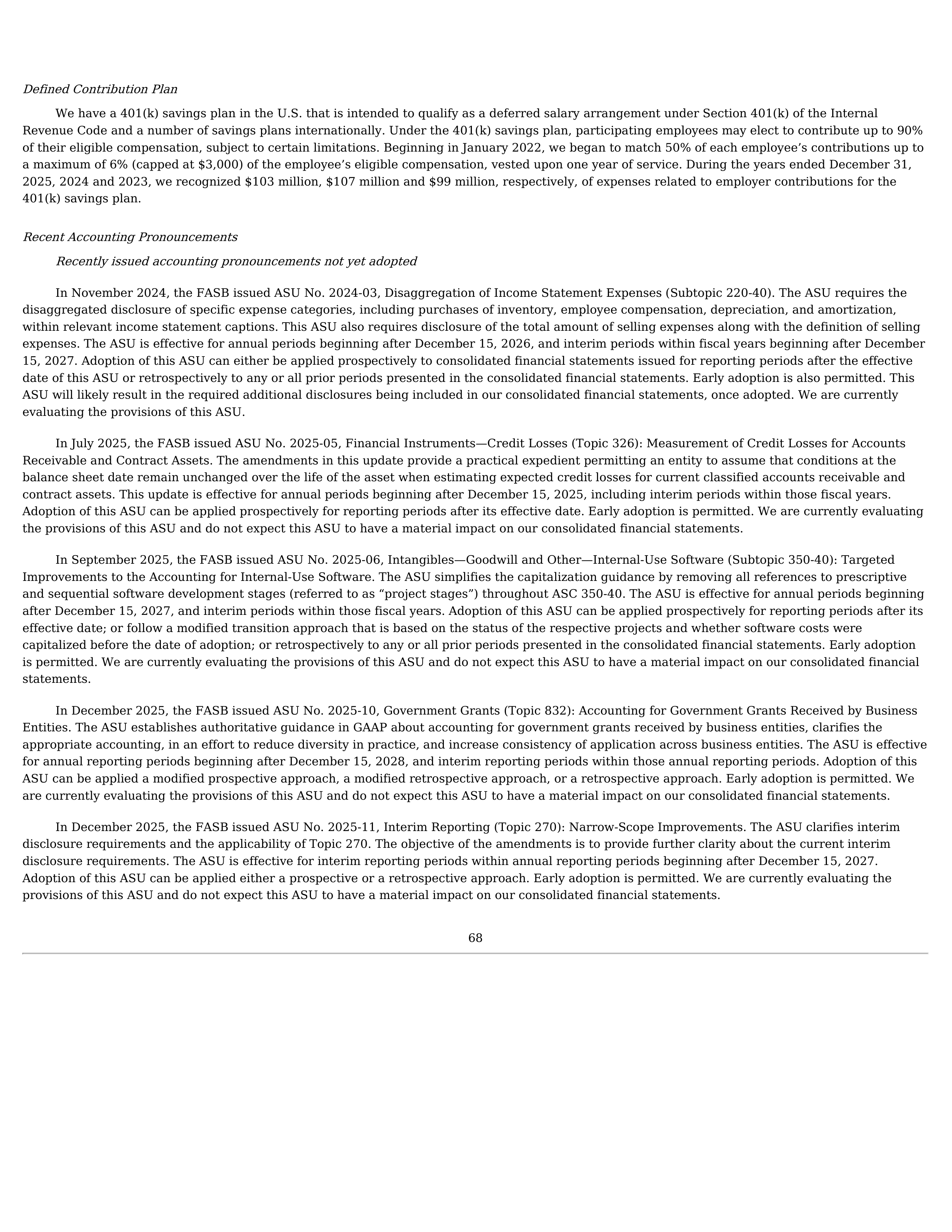
Defined Contribution Plan
We have a 401(k) savings plan in the U.S. that is intended to qualify as a deferred salary arrangement under Section 401(k) of the Internal
Revenue Code and a number of savings plans internationally. Under the 401(k) savings plan, participating employees may elect to contribute up to 90%
of their eligible compensation, subject to certain limitations. Beginning in January 2022, we began to match 50% of each employee’s contributions up to
a maximum of 6% (capped at $3,000) of the employee’s eligible compensation, vested upon one year of service. During the years ended December 31,
2025, 2024 and 2023, we recognized $103 million, $107 million and $99 million, respectively, of expenses related to employer contributions for the
401(k) savings plan.
Recent Accounting Pronouncements
Recently issued accounting pronouncements not yet adopted
In November 2024, the FASB issued ASU No. 2024-03, Disaggregation of Income Statement Expenses (Subtopic 220-40). The ASU requires the
disaggregated disclosure of specific expense categories, including purchases of inventory, employee compensation, depreciation, and amortization,
within relevant income statement captions. This ASU also requires disclosure of the total amount of selling expenses along with the definition of selling
expenses. The ASU is effective for annual periods beginning after December 15, 2026, and interim periods within fiscal years beginning after December
15, 2027. Adoption of this ASU can either be applied prospectively to consolidated financial statements issued for reporting periods after the effective
date of this ASU or retrospectively to any or all prior periods presented in the consolidated financial statements. Early adoption is also permitted. This
ASU will likely result in the required additional disclosures being included in our consolidated financial statements, once adopted. We are currently
evaluating the provisions of this ASU.
In July 2025, the FASB issued ASU No. 2025-05, Financial Instruments—Credit Losses (Topic 326): Measurement of Credit Losses for Accounts
Receivable and Contract Assets. The amendments in this update provide a practical expedient permitting an entity to assume that conditions at the
balance sheet date remain unchanged over the life of the asset when estimating expected credit losses for current classified accounts receivable and
contract assets. This update is effective for annual periods beginning after December 15, 2025, including interim periods within those fiscal years.
Adoption of this ASU can be applied prospectively for reporting periods after its effective date. Early adoption is permitted. We are currently evaluating
the provisions of this ASU and do not expect this ASU to have a material impact on our consolidated financial statements.
In September 2025, the FASB issued ASU No. 2025-06, Intangibles—Goodwill and Other—Internal-Use Software (Subtopic 350-40): Targeted
Improvements to the Accounting for Internal-Use Software. The ASU simplifies the capitalization guidance by removing all references to prescriptive
and sequential software development stages (referred to as “project stages”) throughout ASC 350-40. The ASU is effective for annual periods beginning
after December 15, 2027, and interim periods within those fiscal years. Adoption of this ASU can be applied prospectively for reporting periods after its
effective date; or follow a modified transition approach that is based on the status of the respective projects and whether software costs were
capitalized before the date of adoption; or retrospectively to any or all prior periods presented in the consolidated financial statements. Early adoption
is permitted. We are currently evaluating the provisions of this ASU and do not expect this ASU to have a material impact on our consolidated financial
statements.
In December 2025, the FASB issued ASU No. 2025-10, Government Grants (Topic 832): Accounting for Government Grants Received by Business
Entities. The ASU establishes authoritative guidance in GAAP about accounting for government grants received by business entities, clarifies the
appropriate accounting, in an effort to reduce diversity in practice, and increase consistency of application across business entities. The ASU is effective
for annual reporting periods beginning after December 15, 2028, and interim reporting periods within those annual reporting periods. Adoption of this
ASU can be applied a modified prospective approach, a modified retrospective approach, or a retrospective approach. Early adoption is permitted. We
are currently evaluating the provisions of this ASU and do not expect this ASU to have a material impact on our consolidated financial statements.
In December 2025, the FASB issued ASU No. 2025-11, Interim Reporting (Topic 270): Narrow-Scope Improvements. The ASU clarifies interim
disclosure requirements and the applicability of Topic 270. The objective of the amendments is to provide further clarity about the current interim
disclosure requirements. The ASU is effective for interim reporting periods within annual reporting periods beginning after December 15, 2027.
Adoption of this ASU can be applied either a prospective or a retrospective approach. Early adoption is permitted. We are currently evaluating the
provisions of this ASU and do not expect this ASU to have a material impact on our consolidated financial statements.
68
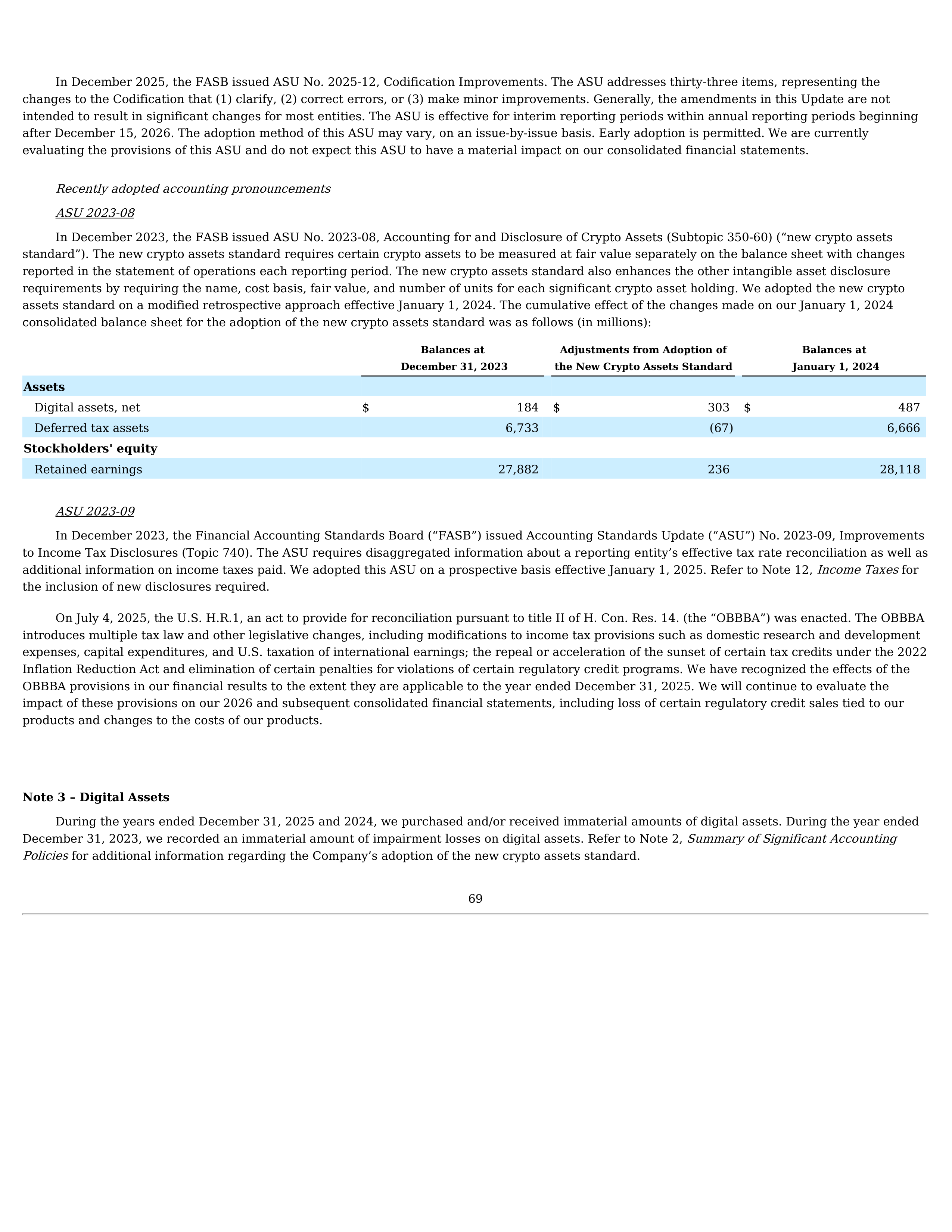
In December 2025, the FASB issued ASU No. 2025-12, Codification Improvements. The ASU addresses thirty-three items, representing the
changes to the Codification that (1) clarify, (2) correct errors, or (3) make minor improvements. Generally, the amendments in this Update are not
intended to result in significant changes for most entities. The ASU is effective for interim reporting periods within annual reporting periods beginning
after December 15, 2026. The adoption method of this ASU may vary, on an issue-by-issue basis. Early adoption is permitted. We are currently
evaluating the provisions of this ASU and do not expect this ASU to have a material impact on our consolidated financial statements.
Recently adopted accounting pronouncements
ASU 2023-08
In December 2023, the FASB issued ASU No. 2023-08, Accounting for and Disclosure of Crypto Assets (Subtopic 350-60) (“new crypto assets
standard”). The new crypto assets standard requires certain crypto assets to be measured at fair value separately on the balance sheet with changes
reported in the statement of operations each reporting period. The new crypto assets standard also enhances the other intangible asset disclosure
requirements by requiring the name, cost basis, fair value, and number of units for each significant crypto asset holding. We adopted the new crypto
assets standard on a modified retrospective approach effective January 1, 2024. The cumulative effect of the changes made on our January 1, 2024
consolidated balance sheet for the adoption of the new crypto assets standard was as follows (in millions):
Balances at
December 31, 2023
Adjustments from Adoption of
the New Crypto Assets Standard
Balances at
January 1, 2024
Assets
Digital assets, net
$
184
$
303
$
487
Deferred tax assets
6,733
(67)
6,666
Stockholders' equity
Retained earnings
27,882
236
28,118
ASU 2023-09
In December 2023, the Financial Accounting Standards Board (“FASB”) issued Accounting Standards Update (“ASU”) No. 2023-09, Improvements
to Income Tax Disclosures (Topic 740). The ASU requires disaggregated information about a reporting entity’s effective tax rate reconciliation as well as
additional information on income taxes paid. We adopted this ASU on a prospective basis effective January 1, 2025. Refer to Note 12, Income Taxes for
the inclusion of new disclosures required.
On July 4, 2025, the U.S. H.R.1, an act to provide for reconciliation pursuant to title II of H. Con. Res. 14. (the “OBBBA”) was enacted. The OBBBA
introduces multiple tax law and other legislative changes, including modifications to income tax provisions such as domestic research and development
expenses, capital expenditures, and U.S. taxation of international earnings; the repeal or acceleration of the sunset of certain tax credits under the 2022
Inflation Reduction Act and elimination of certain penalties for violations of certain regulatory credit programs. We have recognized the effects of the
OBBBA provisions in our financial results to the extent they are applicable to the year ended December 31, 2025. We will continue to evaluate the
impact of these provisions on our 2026 and subsequent consolidated financial statements, including loss of certain regulatory credit sales tied to our
products and changes to the costs of our products.
Note 3 – Digital Assets
During the years ended December 31, 2025 and 2024, we purchased and/or received immaterial amounts of digital assets. During the year ended
December 31, 2023, we recorded an immaterial amount of impairment losses on digital assets. Refer to Note 2, Summary of Significant Accounting
Policies for additional information regarding the Company’s adoption of the new crypto assets standard.
69
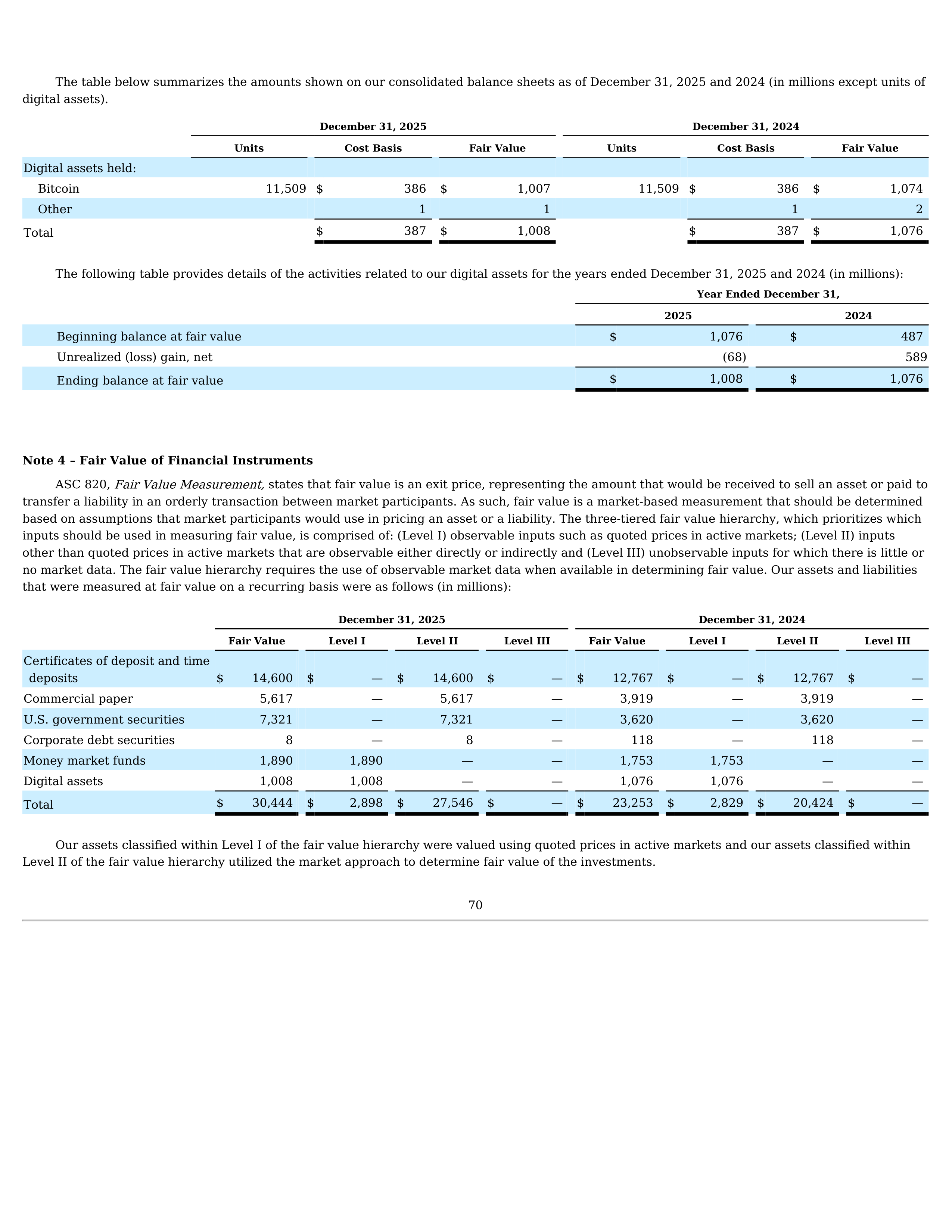
The table below summarizes the amounts shown on our consolidated balance sheets as of December 31, 2025 and 2024 (in millions except units of
digital assets).
December 31, 2025
December 31, 2024
Units
Cost Basis
Fair Value
Units
Cost Basis
Fair Value
Digital assets held:
Bitcoin
11,509
$
386
$
1,007
11,509
$
386
$
1,074
Other
1
1
1
2
Total
$
387
$
1,008
$
387
$
1,076
The following table provides details of the activities related to our digital assets for the years ended December 31, 2025 and 2024 (in millions):
Year Ended December 31,
2025
2024
Beginning balance at fair value
$
1,076
$
487
Unrealized (loss) gain, net
(68)
589
Ending balance at fair value
$
1,008
$
1,076
Note 4 – Fair Value of Financial Instruments
ASC 820, Fair Value Measurement, states that fair value is an exit price, representing the amount that would be received to sell an asset or paid to
transfer a liability in an orderly transaction between market participants. As such, fair value is a market-based measurement that should be determined
based on assumptions that market participants would use in pricing an asset or a liability. The three-tiered fair value hierarchy, which prioritizes which
inputs should be used in measuring fair value, is comprised of: (Level I) observable inputs such as quoted prices in active markets; (Level II) inputs
other than quoted prices in active markets that are observable either directly or indirectly and (Level III) unobservable inputs for which there is little or
no market data. The fair value hierarchy requires the use of observable market data when available in determining fair value. Our assets and liabilities
that were measured at fair value on a recurring basis were as follows (in millions):
December 31, 2025
December 31, 2024
Fair Value
Level I
Level II
Level III
Fair Value
Level I
Level II
Level III
Certificates of deposit and time
deposits
$
14,600
$
—
$
14,600
$
—
$
12,767
$
—
$
12,767
$
—
Commercial paper
5,617
—
5,617
—
3,919
—
3,919
—
U.S. government securities
7,321
—
7,321
—
3,620
—
3,620
—
Corporate debt securities
8
—
8
—
118
—
118
—
Money market funds
1,890
1,890
—
—
1,753
1,753
—
—
Digital assets
1,008
1,008
—
—
1,076
1,076
—
—
Total
$
30,444
$
2,898
$
27,546
$
—
$
23,253
$
2,829
$
20,424
$
—
Our assets classified within Level I of the fair value hierarchy were valued using quoted prices in active markets and our assets classified within
Level II of the fair value hierarchy utilized the market approach to determine fair value of the investments.
70
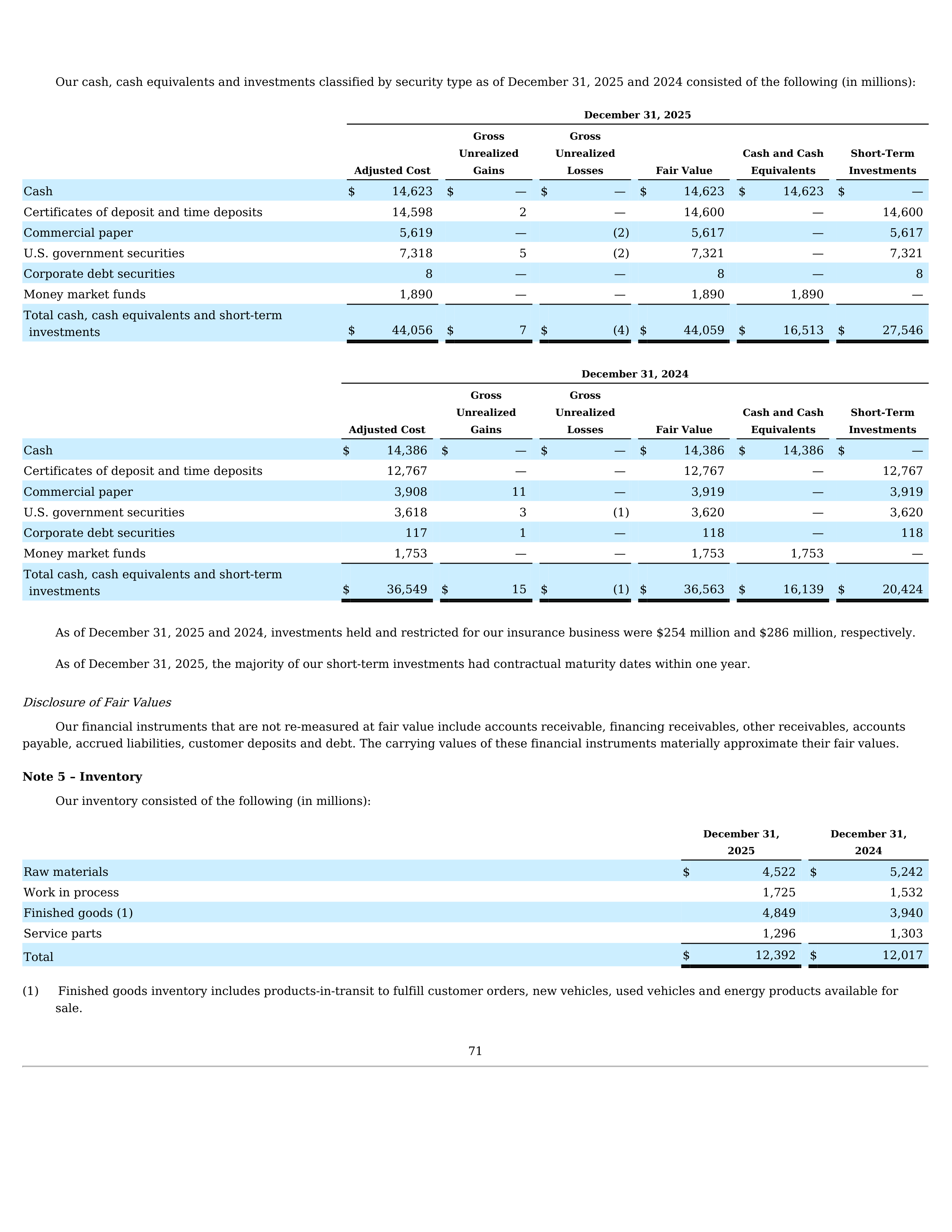
Our cash, cash equivalents and investments classified by security type as of December 31, 2025 and 2024 consisted of the following (in millions):
December 31, 2025
Adjusted Cost
Gross
Unrealized
Gains
Gross
Unrealized
Losses
Fair Value
Cash and Cash
Equivalents
Short-Term
Investments
Cash
$
14,623
$
—
$
—
$
14,623
$
14,623
$
—
Certificates of deposit and time deposits
14,598
2
—
14,600
—
14,600
Commercial paper
5,619
—
(2)
5,617
—
5,617
U.S. government securities
7,318
5
(2)
7,321
—
7,321
Corporate debt securities
8
—
—
8
—
8
Money market funds
1,890
—
—
1,890
1,890
—
Total cash, cash equivalents and short-term
investments
$
44,056
$
7
$
(4)
$
44,059
$
16,513
$
27,546
December 31, 2024
Adjusted Cost
Gross
Unrealized
Gains
Gross
Unrealized
Losses
Fair Value
Cash and Cash
Equivalents
Short-Term
Investments
Cash
$
14,386
$
—
$
—
$
14,386
$
14,386
$
—
Certificates of deposit and time deposits
12,767
—
—
12,767
—
12,767
Commercial paper
3,908
11
—
3,919
—
3,919
U.S. government securities
3,618
3
(1)
3,620
—
3,620
Corporate debt securities
117
1
—
118
—
118
Money market funds
1,753
—
—
1,753
1,753
—
Total cash, cash equivalents and short-term
investments
$
36,549
$
15
$
(1)
$
36,563
$
16,139
$
20,424
As of December 31, 2025 and 2024, investments held and restricted for our insurance business were $254 million and $286 million, respectively.
As of December 31, 2025, the majority of our short-term investments had contractual maturity dates within one year.
Disclosure of Fair Values
Our financial instruments that are not re-measured at fair value include accounts receivable, financing receivables, other receivables, accounts
payable, accrued liabilities, customer deposits and debt. The carrying values of these financial instruments materially approximate their fair values.
Note 5 – Inventory
Our inventory consisted of the following (in millions):
December 31,
2025
December 31,
2024
Raw materials
$
4,522
$
5,242
Work in process
1,725
1,532
Finished goods (1)
4,849
3,940
Service parts
1,296
1,303
Total
$
12,392
$
12,017
(1)
Finished goods inventory includes products-in-transit to fulfill customer orders, new vehicles, used vehicles and energy products available for
sale.
71
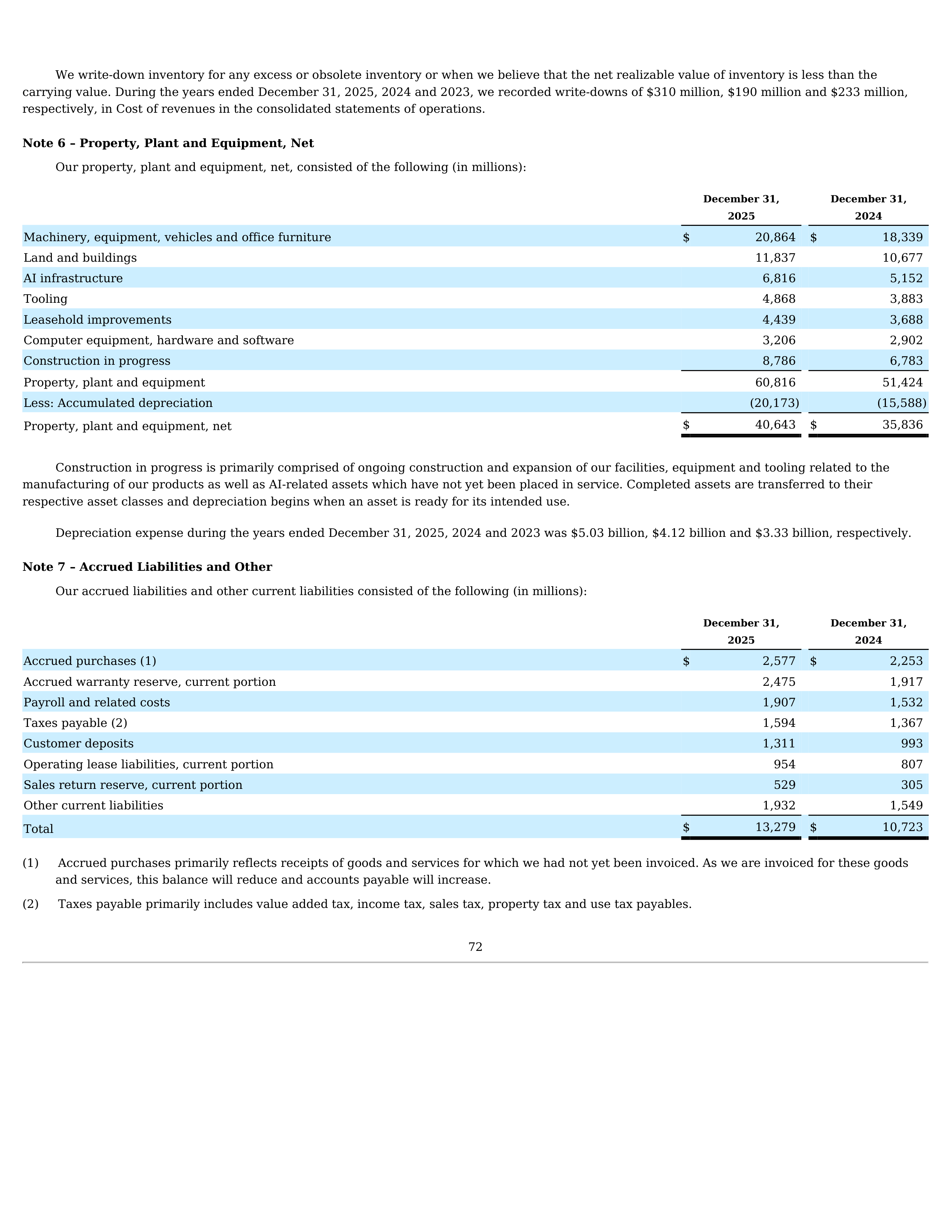
We write-down inventory for any excess or obsolete inventory or when we believe that the net realizable value of inventory is less than the
carrying value. During the years ended December 31, 2025, 2024 and 2023, we recorded write-downs of $310 million, $190 million and $233 million,
respectively, in Cost of revenues in the consolidated statements of operations.
Note 6 – Property, Plant and Equipment, Net
Our property, plant and equipment, net, consisted of the following (in millions):
December 31,
2025
December 31,
2024
Machinery, equipment, vehicles and office furniture
$
20,864
$
18,339
Land and buildings
11,837
10,677
AI infrastructure
6,816
5,152
Tooling
4,868
3,883
Leasehold improvements
4,439
3,688
Computer equipment, hardware and software
3,206
2,902
Construction in progress
8,786
6,783
Property, plant and equipment
60,816
51,424
Less: Accumulated depreciation
(20,173)
(15,588)
Property, plant and equipment, net
$
40,643
$
35,836
Construction in progress is primarily comprised of ongoing construction and expansion of our facilities, equipment and tooling related to the
manufacturing of our products as well as AI-related assets which have not yet been placed in service. Completed assets are transferred to their
respective asset classes and depreciation begins when an asset is ready for its intended use.
Depreciation expense during the years ended December 31, 2025, 2024 and 2023 was $5.03 billion, $4.12 billion and $3.33 billion, respectively.
Note 7 – Accrued Liabilities and Other
Our accrued liabilities and other current liabilities consisted of the following (in millions):
December 31,
2025
December 31,
2024
Accrued purchases (1)
$
2,577
$
2,253
Accrued warranty reserve, current portion
2,475
1,917
Payroll and related costs
1,907
1,532
Taxes payable (2)
1,594
1,367
Customer deposits
1,311
993
Operating lease liabilities, current portion
954
807
Sales return reserve, current portion
529
305
Other current liabilities
1,932
1,549
Total
$
13,279
$
10,723
(1)
Accrued purchases primarily reflects receipts of goods and services for which we had not yet been invoiced. As we are invoiced for these goods
and services, this balance will reduce and accounts payable will increase.
(2)
Taxes payable primarily includes value added tax, income tax, sales tax, property tax and use tax payables.
72
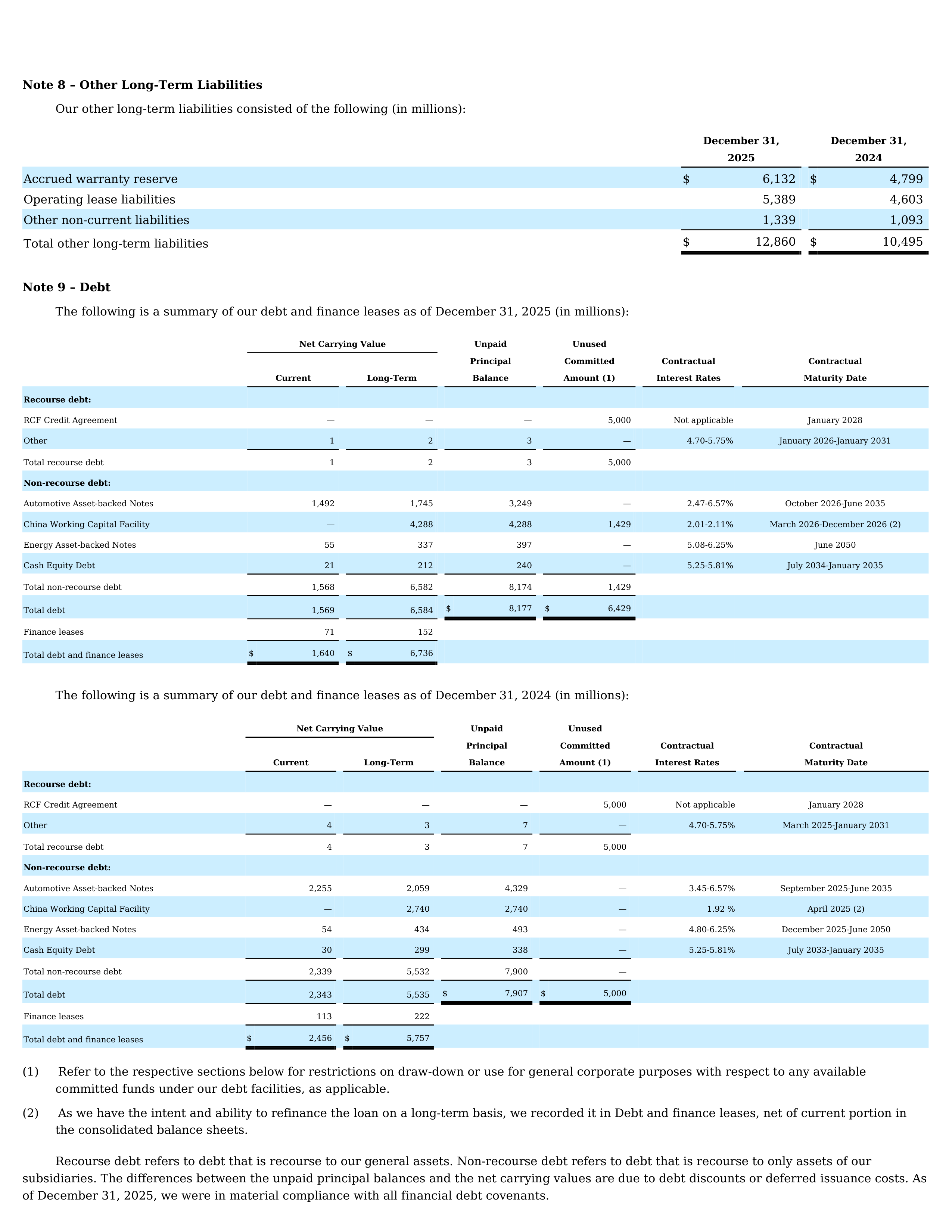
Note 8 – Other Long-Term Liabilities
Our other long-term liabilities consisted of the following (in millions):
December 31,
2025
December 31,
2024
Accrued warranty reserve
$
6,132
$
4,799
Operating lease liabilities
5,389
4,603
Other non-current liabilities
1,339
1,093
Total other long-term liabilities
$
12,860
$
10,495
Note 9 – Debt
The following is a summary of our debt and finance leases as of December 31, 2025 (in millions):
Net Carrying Value
Unpaid
Principal
Balance
Unused
Committed
Amount (1)
Contractual
Interest Rates
Contractual
Maturity Date
Current
Long-Term
Recourse debt:
RCF Credit Agreement
—
—
—
5,000
Not applicable
January 2028
Other
1
2
3
—
4.70-5.75%
January 2026-January 2031
Total recourse debt
1
2
3
5,000
Non-recourse debt:
Automotive Asset-backed Notes
1,492
1,745
3,249
—
2.47-6.57%
October 2026-June 2035
China Working Capital Facility
—
4,288
4,288
1,429
2.01-2.11%
March 2026-December 2026 (2)
Energy Asset-backed Notes
55
337
397
—
5.08-6.25%
June 2050
Cash Equity Debt
21
212
240
—
5.25-5.81%
July 2034-January 2035
Total non-recourse debt
1,568
6,582
8,174
1,429
Total debt
1,569
6,584
$
8,177
$
6,429
Finance leases
71
152
Total debt and finance leases
$
1,640
$
6,736
The following is a summary of our debt and finance leases as of December 31, 2024 (in millions):
Net Carrying Value
Unpaid
Principal
Balance
Unused
Committed
Amount (1)
Contractual
Interest Rates
Contractual
Maturity Date
Current
Long-Term
Recourse debt:
RCF Credit Agreement
—
—
—
5,000
Not applicable
January 2028
Other
4
3
7
—
4.70-5.75%
March 2025-January 2031
Total recourse debt
4
3
7
5,000
Non-recourse debt:
Automotive Asset-backed Notes
2,255
2,059
4,329
—
3.45-6.57%
September 2025-June 2035
China Working Capital Facility
—
2,740
2,740
—
1.92 %
April 2025 (2)
Energy Asset-backed Notes
54
434
493
—
4.80-6.25%
December 2025-June 2050
Cash Equity Debt
30
299
338
—
5.25-5.81%
July 2033-January 2035
Total non-recourse debt
2,339
5,532
7,900
—
Total debt
2,343
5,535
$
7,907
$
5,000
Finance leases
113
222
Total debt and finance leases
$
2,456
$
5,757
(1)
Refer to the respective sections below for restrictions on draw-down or use for general corporate purposes with respect to any available
committed funds under our debt facilities, as applicable.
(2)
As we have the intent and ability to refinance the loan on a long-term basis, we recorded it in Debt and finance leases, net of current portion in
the consolidated balance sheets.
Recourse debt refers to debt that is recourse to our general assets. Non-recourse debt refers to debt that is recourse to only assets of our
subsidiaries. The differences between the unpaid principal balances and the net carrying values are due to debt discounts or deferred issuance costs. As
of December 31, 2025, we were in material compliance with all financial debt covenants.

73
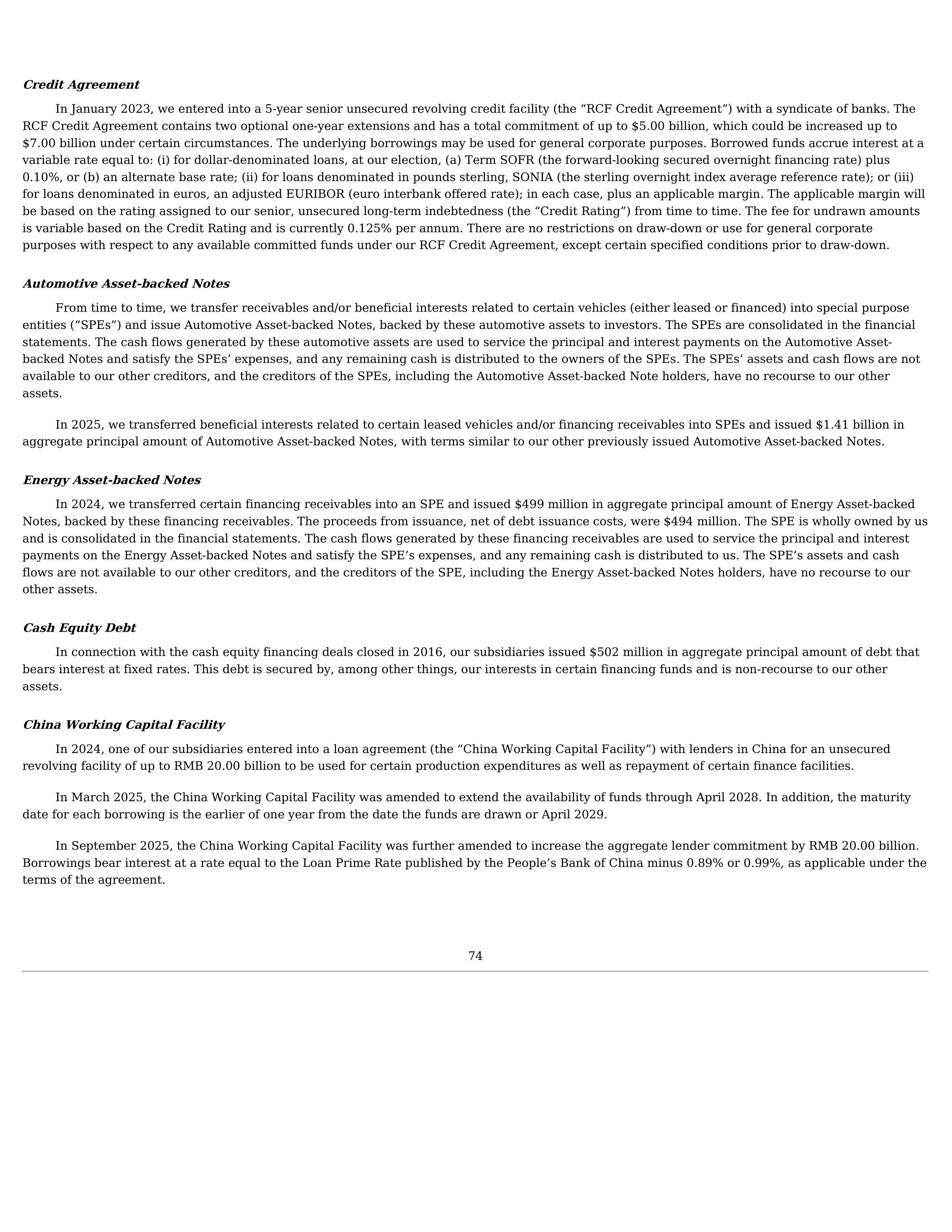
Credit Agreement
In January 2023, we entered into a 5-year senior unsecured revolving credit facility (the “RCF Credit Agreement”) with a syndicate of banks. The
RCF Credit Agreement contains two optional one-year extensions and has a total commitment of up to $5.00 billion, which could be increased up to
$7.00 billion under certain circumstances. The underlying borrowings may be used for general corporate purposes. Borrowed funds accrue interest at a
variable rate equal to: (i) for dollar-denominated loans, at our election, (a) Term SOFR (the forward-looking secured overnight financing rate) plus
0.10%, or (b) an alternate base rate; (ii) for loans denominated in pounds sterling, SONIA (the sterling overnight index average reference rate); or (iii)
for loans denominated in euros, an adjusted EURIBOR (euro interbank offered rate); in each case, plus an applicable margin. The applicable margin will
be based on the rating assigned to our senior, unsecured long-term indebtedness (the “Credit Rating”) from time to time. The fee for undrawn amounts
is variable based on the Credit Rating and is currently 0.125% per annum. There are no restrictions on draw-down or use for general corporate
purposes with respect to any available committed funds under our RCF Credit Agreement, except certain specified conditions prior to draw-down.
Automotive Asset-backed Notes
From time to time, we transfer receivables and/or beneficial interests related to certain vehicles (either leased or financed) into special purpose
entities (“SPEs”) and issue Automotive Asset-backed Notes, backed by these automotive assets to investors. The SPEs are consolidated in the financial
statements. The cash flows generated by these automotive assets are used to service the principal and interest payments on the Automotive Asset-
backed Notes and satisfy the SPEs’ expenses, and any remaining cash is distributed to the owners of the SPEs. The SPEs’ assets and cash flows are not
available to our other creditors, and the creditors of the SPEs, including the Automotive Asset-backed Note holders, have no recourse to our other
assets.
In 2025, we transferred beneficial interests related to certain leased vehicles and/or financing receivables into SPEs and issued $1.41 billion in
aggregate principal amount of Automotive Asset-backed Notes, with terms similar to our other previously issued Automotive Asset-backed Notes.
Energy Asset-backed Notes
In 2024, we transferred certain financing receivables into an SPE and issued $499 million in aggregate principal amount of Energy Asset-backed
Notes, backed by these financing receivables. The proceeds from issuance, net of debt issuance costs, were $494 million. The SPE is wholly owned by us
and is consolidated in the financial statements. The cash flows generated by these financing receivables are used to service the principal and interest
payments on the Energy Asset-backed Notes and satisfy the SPE’s expenses, and any remaining cash is distributed to us. The SPE’s assets and cash
flows are not available to our other creditors, and the creditors of the SPE, including the Energy Asset-backed Notes holders, have no recourse to our
other assets.
Cash Equity Debt
In connection with the cash equity financing deals closed in 2016, our subsidiaries issued $502 million in aggregate principal amount of debt that
bears interest at fixed rates. This debt is secured by, among other things, our interests in certain financing funds and is non-recourse to our other
assets.
China Working Capital Facility
In 2024, one of our subsidiaries entered into a loan agreement (the “China Working Capital Facility”) with lenders in China for an unsecured
revolving facility of up to RMB 20.00 billion to be used for certain production expenditures as well as repayment of certain finance facilities.
In March 2025, the China Working Capital Facility was amended to extend the availability of funds through April 2028. In addition, the maturity
date for each borrowing is the earlier of one year from the date the funds are drawn or April 2029.
In September 2025, the China Working Capital Facility was further amended to increase the aggregate lender commitment by RMB 20.00 billion.
Borrowings bear interest at a rate equal to the Loan Prime Rate published by the People’s Bank of China minus 0.89% or 0.99%, as applicable under the
terms of the agreement.
74
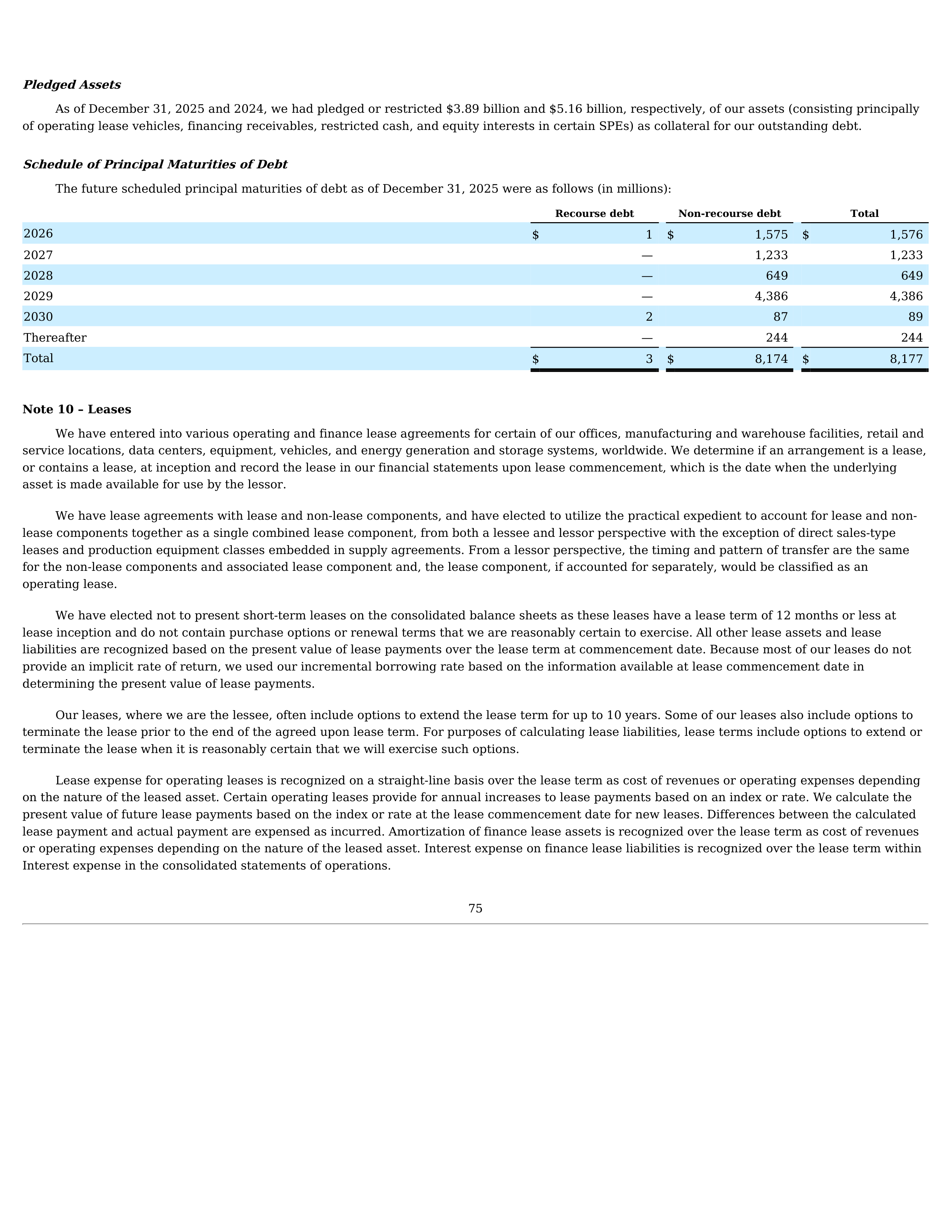
Pledged Assets
As of December 31, 2025 and 2024, we had pledged or restricted $3.89 billion and $5.16 billion, respectively, of our assets (consisting principally
of operating lease vehicles, financing receivables, restricted cash, and equity interests in certain SPEs) as collateral for our outstanding debt.
Schedule of Principal Maturities of Debt
The future scheduled principal maturities of debt as of December 31, 2025 were as follows (in millions):
Recourse debt
Non-recourse debt
Total
2026
$
1
$
1,575
$
1,576
2027
—
1,233
1,233
2028
—
649
649
2029
—
4,386
4,386
2030
2
87
89
Thereafter
—
244
244
Total
$
3
$
8,174
$
8,177
Note 10 – Leases
We have entered into various operating and finance lease agreements for certain of our offices, manufacturing and warehouse facilities, retail and
service locations, data centers, equipment, vehicles, and energy generation and storage systems, worldwide. We determine if an arrangement is a lease,
or contains a lease, at inception and record the lease in our financial statements upon lease commencement, which is the date when the underlying
asset is made available for use by the lessor.
We have lease agreements with lease and non-lease components, and have elected to utilize the practical expedient to account for lease and non-
lease components together as a single combined lease component, from both a lessee and lessor perspective with the exception of direct sales-type
leases and production equipment classes embedded in supply agreements. From a lessor perspective, the timing and pattern of transfer are the same
for the non-lease components and associated lease component and, the lease component, if accounted for separately, would be classified as an
operating lease.
We have elected not to present short-term leases on the consolidated balance sheets as these leases have a lease term of 12 months or less at
lease inception and do not contain purchase options or renewal terms that we are reasonably certain to exercise. All other lease assets and lease
liabilities are recognized based on the present value of lease payments over the lease term at commencement date. Because most of our leases do not
provide an implicit rate of return, we used our incremental borrowing rate based on the information available at lease commencement date in
determining the present value of lease payments.
Our leases, where we are the lessee, often include options to extend the lease term for up to 10 years. Some of our leases also include options to
terminate the lease prior to the end of the agreed upon lease term. For purposes of calculating lease liabilities, lease terms include options to extend or
terminate the lease when it is reasonably certain that we will exercise such options.
Lease expense for operating leases is recognized on a straight-line basis over the lease term as cost of revenues or operating expenses depending
on the nature of the leased asset. Certain operating leases provide for annual increases to lease payments based on an index or rate. We calculate the
present value of future lease payments based on the index or rate at the lease commencement date for new leases. Differences between the calculated
lease payment and actual payment are expensed as incurred. Amortization of finance lease assets is recognized over the lease term as cost of revenues
or operating expenses depending on the nature of the leased asset. Interest expense on finance lease liabilities is recognized over the lease term within
Interest expense in the consolidated statements of operations.
75
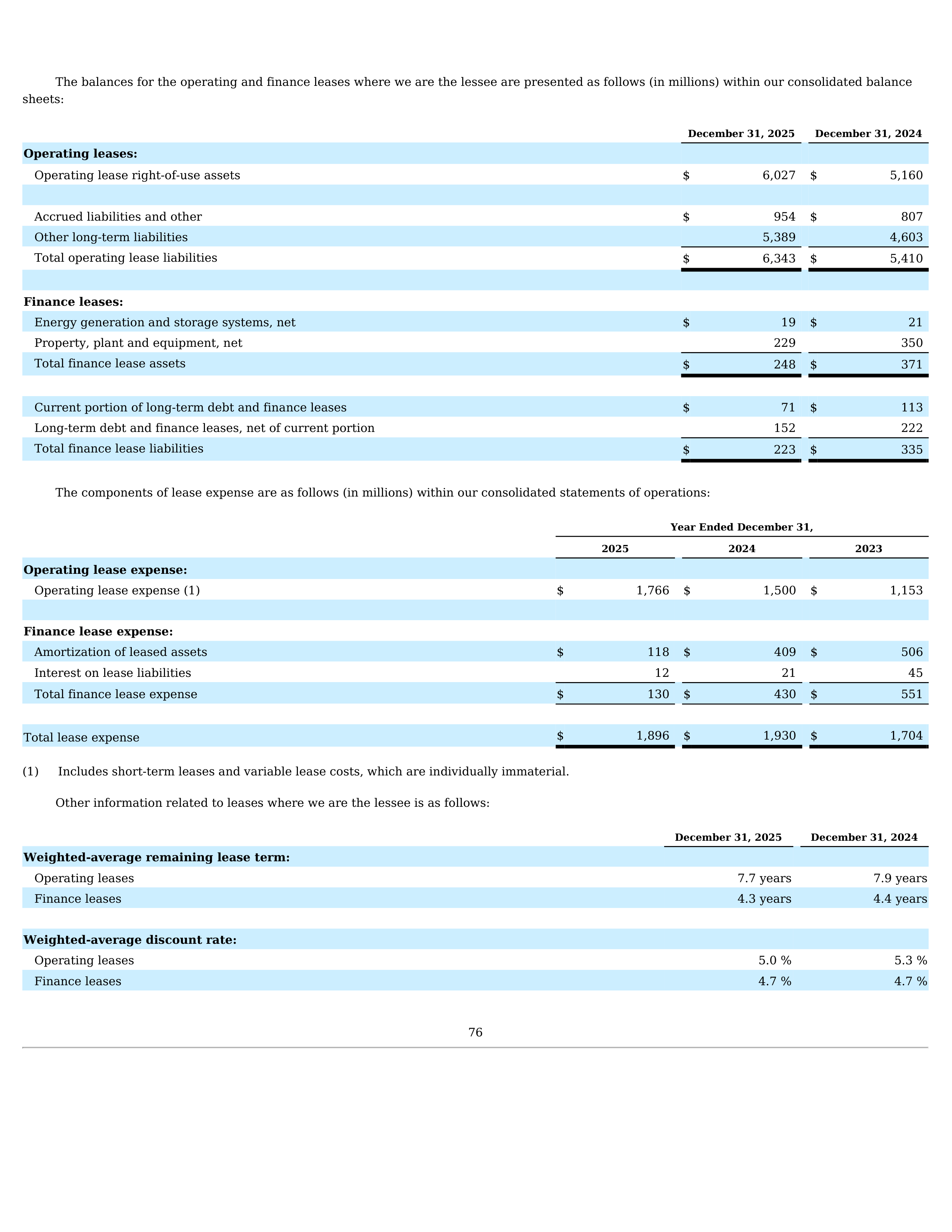
The balances for the operating and finance leases where we are the lessee are presented as follows (in millions) within our consolidated balance
sheets:
December 31, 2025
December 31, 2024
Operating leases:
Operating lease right-of-use assets
$
6,027
$
5,160
Accrued liabilities and other
$
954
$
807
Other long-term liabilities
5,389
4,603
Total operating lease liabilities
$
6,343
$
5,410
Finance leases:
Energy generation and storage systems, net
$
19
$
21
Property, plant and equipment, net
229
350
Total finance lease assets
$
248
$
371
Current portion of long-term debt and finance leases
$
71
$
113
Long-term debt and finance leases, net of current portion
152
222
Total finance lease liabilities
$
223
$
335
The components of lease expense are as follows (in millions) within our consolidated statements of operations:
Year Ended December 31,
2025
2024
2023
Operating lease expense:
Operating lease expense (1)
$
1,766
$
1,500
$
1,153
Finance lease expense:
Amortization of leased assets
$
118
$
409
$
506
Interest on lease liabilities
12
21
45
Total finance lease expense
$
130
$
430
$
551
Total lease expense
$
1,896
$
1,930
$
1,704
(1)
Includes short-term leases and variable lease costs, which are individually immaterial.
Other information related to leases where we are the lessee is as follows:
December 31, 2025
December 31, 2024
Weighted-average remaining lease term:
Operating leases
7.7 years
7.9 years
Finance leases
4.3 years
4.4 years
Weighted-average discount rate:
Operating leases
5.0 %
5.3 %
Finance leases
4.7 %
4.7 %
76
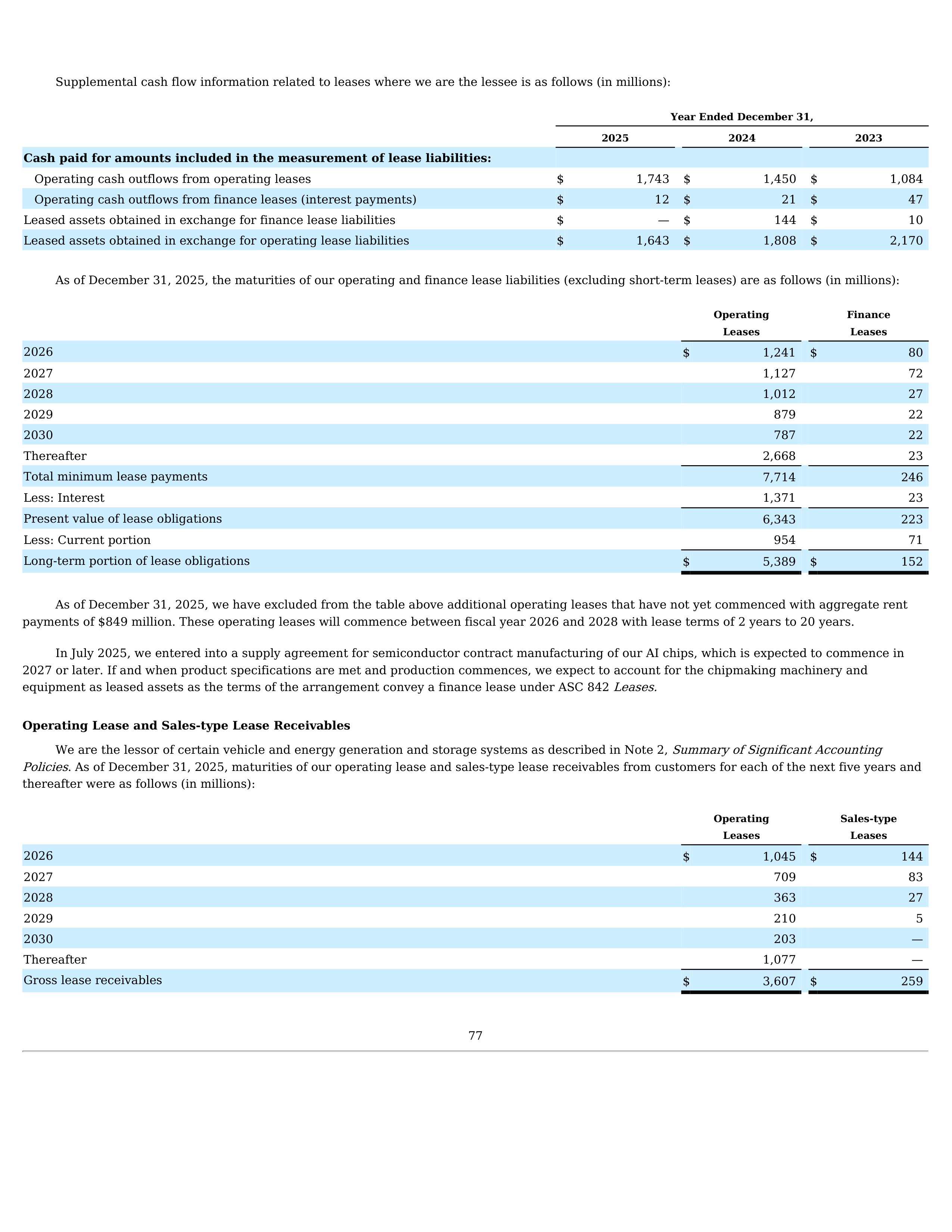
Supplemental cash flow information related to leases where we are the lessee is as follows (in millions):
Year Ended December 31,
2025
2024
2023
Cash paid for amounts included in the measurement of lease liabilities:
Operating cash outflows from operating leases
$
1,743
$
1,450
$
1,084
Operating cash outflows from finance leases (interest payments)
$
12
$
21
$
47
Leased assets obtained in exchange for finance lease liabilities
$
—
$
144
$
10
Leased assets obtained in exchange for operating lease liabilities
$
1,643
$
1,808
$
2,170
As of December 31, 2025, the maturities of our operating and finance lease liabilities (excluding short-term leases) are as follows (in millions):
Operating
Leases
Finance
Leases
2026
$
1,241
$
80
2027
1,127
72
2028
1,012
27
2029
879
22
2030
787
22
Thereafter
2,668
23
Total minimum lease payments
7,714
246
Less: Interest
1,371
23
Present value of lease obligations
6,343
223
Less: Current portion
954
71
Long-term portion of lease obligations
$
5,389
$
152
As of December 31, 2025, we have excluded from the table above additional operating leases that have not yet commenced with aggregate rent
payments of $849 million. These operating leases will commence between fiscal year 2026 and 2028 with lease terms of 2 years to 20 years.
In July 2025, we entered into a supply agreement for semiconductor contract manufacturing of our AI chips, which is expected to commence in
2027 or later. If and when product specifications are met and production commences, we expect to account for the chipmaking machinery and
equipment as leased assets as the terms of the arrangement convey a finance lease under ASC 842 Leases.
Operating Lease and Sales-type Lease Receivables
We are the lessor of certain vehicle and energy generation and storage systems as described in Note 2, Summary of Significant Accounting
Policies. As of December 31, 2025, maturities of our operating lease and sales-type lease receivables from customers for each of the next five years and
thereafter were as follows (in millions):
Operating
Leases
Sales-type
Leases
2026
$
1,045
$
144
2027
709
83
2028
363
27
2029
210
5
2030
203
—
Thereafter
1,077
—
Gross lease receivables
$
3,607
$
259
77
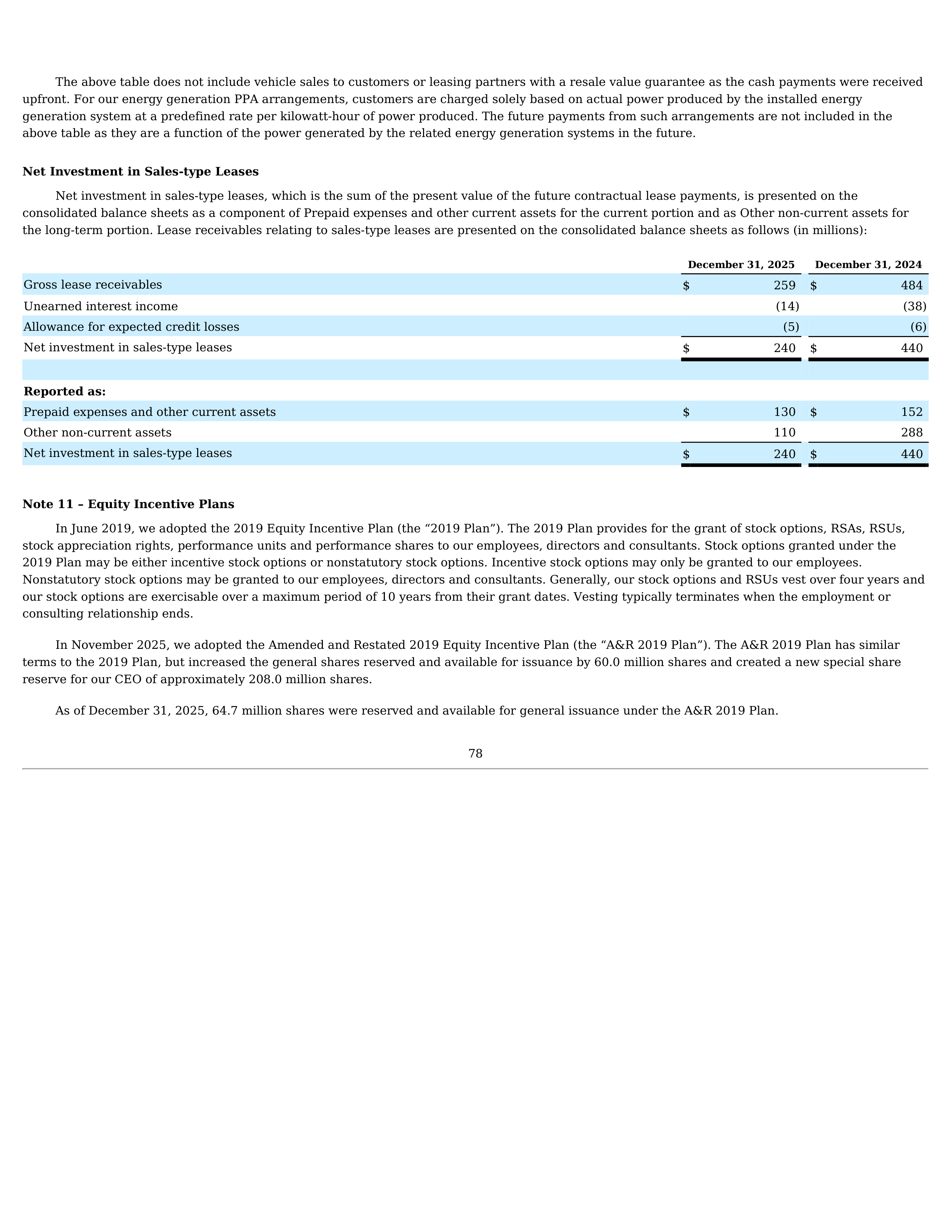
The above table does not include vehicle sales to customers or leasing partners with a resale value guarantee as the cash payments were received
upfront. For our energy generation PPA arrangements, customers are charged solely based on actual power produced by the installed energy
generation system at a predefined rate per kilowatt-hour of power produced. The future payments from such arrangements are not included in the
above table as they are a function of the power generated by the related energy generation systems in the future.
Net Investment in Sales-type Leases
Net investment in sales-type leases, which is the sum of the present value of the future contractual lease payments, is presented on the
consolidated balance sheets as a component of Prepaid expenses and other current assets for the current portion and as Other non-current assets for
the long-term portion. Lease receivables relating to sales-type leases are presented on the consolidated balance sheets as follows (in millions):
December 31, 2025
December 31, 2024
Gross lease receivables
$
259
$
484
Unearned interest income
(14)
(38)
Allowance for expected credit losses
(5)
(6)
Net investment in sales-type leases
$
240
$
440
Reported as:
Prepaid expenses and other current assets
$
130
$
152
Other non-current assets
110
288
Net investment in sales-type leases
$
240
$
440
Note 11 – Equity Incentive Plans
In June 2019, we adopted the 2019 Equity Incentive Plan (the “2019 Plan”). The 2019 Plan provides for the grant of stock options, RSAs, RSUs,
stock appreciation rights, performance units and performance shares to our employees, directors and consultants. Stock options granted under the
2019 Plan may be either incentive stock options or nonstatutory stock options. Incentive stock options may only be granted to our employees.
Nonstatutory stock options may be granted to our employees, directors and consultants. Generally, our stock options and RSUs vest over four years and
our stock options are exercisable over a maximum period of 10 years from their grant dates. Vesting typically terminates when the employment or
consulting relationship ends.
In November 2025, we adopted the Amended and Restated 2019 Equity Incentive Plan (the “A&R 2019 Plan”). The A&R 2019 Plan has similar
terms to the 2019 Plan, but increased the general shares reserved and available for issuance by 60.0 million shares and created a new special share
reserve for our CEO of approximately 208.0 million shares.
As of December 31, 2025, 64.7 million shares were reserved and available for general issuance under the A&R 2019 Plan.
78
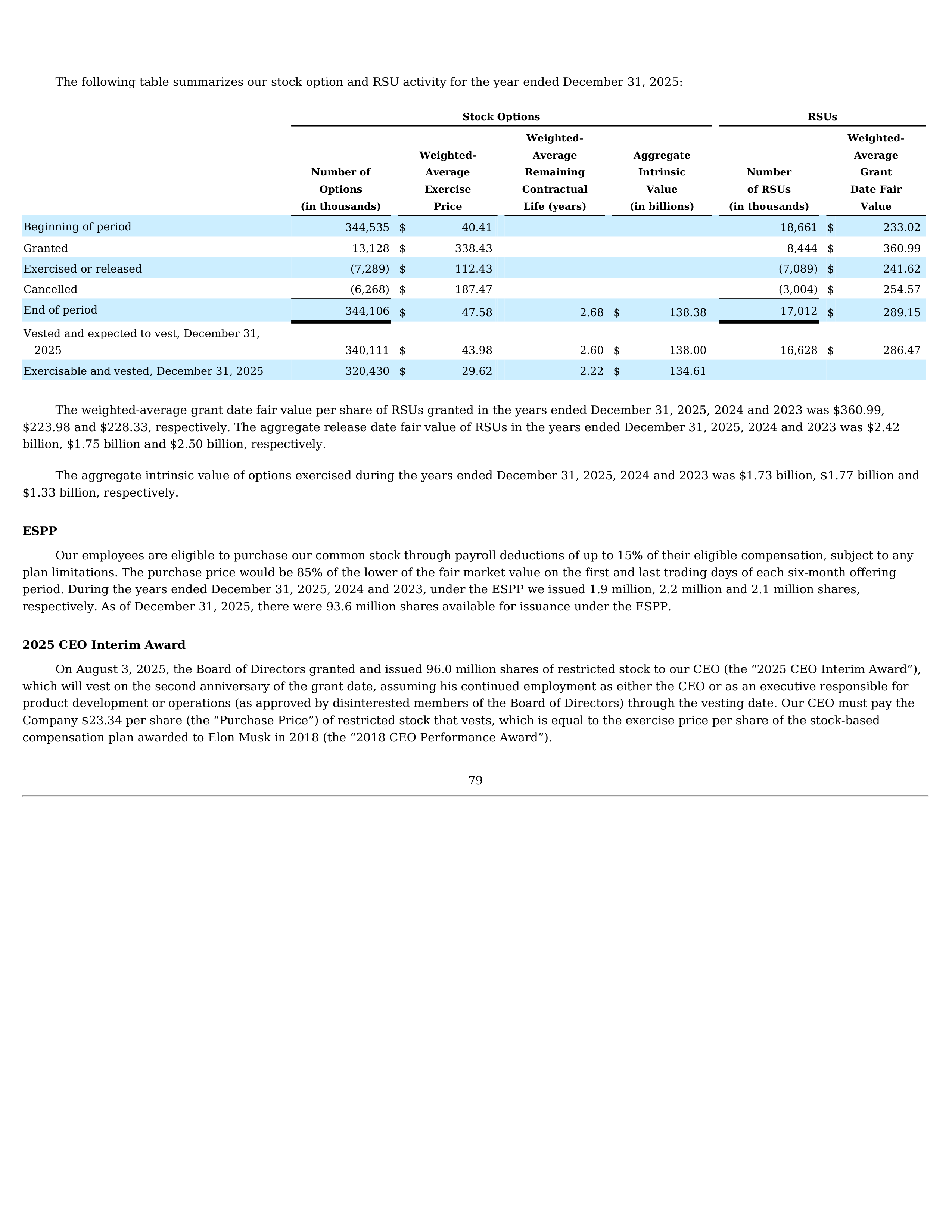
The following table summarizes our stock option and RSU activity for the year ended December 31, 2025:
Stock Options
RSUs
Number of
Options
(in thousands)
Weighted-
Average
Exercise
Price
Weighted-
Average
Remaining
Contractual
Life (years)
Aggregate
Intrinsic
Value
(in billions)
Number
of RSUs
(in thousands)
Weighted-
Average
Grant
Date Fair
Value
Beginning of period
344,535
$
40.41
18,661
$
233.02
Granted
13,128
$
338.43
8,444
$
360.99
Exercised or released
(7,289)
$
112.43
(7,089)
$
241.62
Cancelled
(6,268)
$
187.47
(3,004)
$
254.57
End of period
344,106
$
47.58
2.68
$
138.38
17,012
$
289.15
Vested and expected to vest, December 31,
2025
340,111
$
43.98
2.60
$
138.00
16,628
$
286.47
Exercisable and vested, December 31, 2025
320,430
$
29.62
2.22
$
134.61
The weighted-average grant date fair value per share of RSUs granted in the years ended December 31, 2025, 2024 and 2023 was $360.99,
$223.98 and $228.33, respectively. The aggregate release date fair value of RSUs in the years ended December 31, 2025, 2024 and 2023 was $2.42
billion, $1.75 billion and $2.50 billion, respectively.
The aggregate intrinsic value of options exercised during the years ended December 31, 2025, 2024 and 2023 was $1.73 billion, $1.77 billion and
$1.33 billion, respectively.
ESPP
Our employees are eligible to purchase our common stock through payroll deductions of up to 15% of their eligible compensation, subject to any
plan limitations. The purchase price would be 85% of the lower of the fair market value on the first and last trading days of each six-month offering
period. During the years ended December 31, 2025, 2024 and 2023, under the ESPP we issued 1.9 million, 2.2 million and 2.1 million shares,
respectively. As of December 31, 2025, there were 93.6 million shares available for issuance under the ESPP.
2025 CEO Interim Award
On August 3, 2025, the Board of Directors granted and issued 96.0 million shares of restricted stock to our CEO (the “2025 CEO Interim Award”),
which will vest on the second anniversary of the grant date, assuming his continued employment as either the CEO or as an executive responsible for
product development or operations (as approved by disinterested members of the Board of Directors) through the vesting date. Our CEO must pay the
Company $23.34 per share (the “Purchase Price”) of restricted stock that vests, which is equal to the exercise price per share of the stock-based
compensation plan awarded to Elon Musk in 2018 (the “2018 CEO Performance Award”).
79
Restricted stock under the 2025 CEO Interim Award will be immediately forfeited and returned (an “Early Forfeiture”) to the Company to preclude
a “double dip” or windfall if, prior to vesting, there is a final, non-appealable judgment, order or decision of the Delaware courts with respect to the
action captioned Tornetta v. Elon Musk et al., C.A. No. 2018-0408-KSJM (Del. Ch.), or any pending or future appeal, including In re Tesla, Inc.
Derivative Litigation, Nos. 10, 2025, 11, 2025 (Del.) (a “Tornetta Decision Event”) (see Note 13, Commitments and Contingencies), that results in our
CEO becoming able to exercise in full the 2018 CEO Performance Award. If a Tornetta Decision Event results in our CEO becoming able to exercise
options covered by the 2018 CEO Performance Award, but does not result in Early Forfeiture, then, if the Tornetta Decision Event occurs before the
2025 CEO Interim Award vests, shares covered by the 2025 CEO Interim Award will be reduced to the extent that (a) the sum of the 2025 CEO Interim
Award shares and any amount of options exercisable under the 2018 CEO Performance Award exceeds (b) the total number of options subject to the
2018 CEO Performance Award in full (the “Excess Amount”), and if the Tornetta Decision Event occurs after the 2025 CEO Interim Award vests, then
our CEO will return or otherwise repay us for shares issued under the 2025 CEO Interim Award (with us returning or repaying the Purchase Price) or
forfeit options underlying the 2018 CEO Performance Award equal to the Excess Amount. The “no double dip” provision means that if our CEO gains the
ability to exercise the 2018 CEO Performance Award, there will be no material additional benefit to him because the total number of shares awarded
under the 2025 CEO Interim Award together with the 2018 CEO Performance Award cannot exceed the number of shares underlying the 2018 CEO
Performance Award.
Our CEO must hold shares covered by the 2025 CEO Interim Award for five years from the date of grant, subject to certain exceptions, including
to satisfy taxes due in respect of vesting of the 2025 CEO Interim Award and/or to pay the Purchase Price. The 2025 CEO Interim Award will vest on an
accelerated basis prior to the second anniversary of the grant date if our CEO is in continued eligible service upon a change in control or his death.
Stock-based compensation expense associated with the 2025 CEO Interim Award is recognized over the requisite service period, based on the
grant date fair value determined on August 15, 2025 (the date the issuance of the shares of restricted stock was no longer subject to conditionality or
the “accounting grant date”), but only if and when the vesting of the award becomes probable. Additionally, our CEO stock-based compensation expense
represents a non-cash expense and is recorded as a selling, general and administrative operating expense in our consolidated statement of operations.
The grant date fair value of the 2025 CEO Interim Award is $26.06 billion. The grant date fair value is based upon the closing market price of our
common stock as of the accounting grant date, less the Purchase Price, adjusted to take into account an illiquidity discount due to the required holding
period.
As of December 31, 2025, no stock-based compensation expense has been recorded related to the 2025 CEO Interim Award as vesting was not
deemed probable. Following the Delaware Supreme Court’s recent decision reversing the Court of Chancery’s rescission order and reinstating Mr.
Musk’s 2018 compensation package, the Special Committee, consistent with its general purpose, continues to consider, evaluate and determine all
aspects of the retention and incentivization of Mr. Musk and any methods, approaches or manners for doing so, including the 2018 CEO Performance
Award and the 2025 CEO Interim Award. If the 2025 CEO Interim Award is cancelled before vesting is deemed probable, no expense will be recognized
relating to the award.
2025 CEO Performance Award
On September 3, 2025 (the “2025 CEO Performance Award Grant Date”), the Board of Directors granted approximately 423.7 million shares of
performance-based restricted stock to our CEO (the “2025 CEO Performance Award”), which was approved on November 6, 2025 by our shareholders
(the “2025 CEO Performance Award Accounting Grant Date”).
Until such time as there are no shares under the 2025 CEO Performance Award that are not earned (the “Unearned Shares”), our CEO’s Unearned
Shares will vote proportionately to the votes of all other shares of our capital stock that are present and entitled to vote at any annual or special
meeting (or similar action) of our shareholders (including our CEO). Generally, each of the 12 tranches of the 2025 CEO Performance Award will
become “Earned Shares” upon our CEO remaining in Eligible Service (as defined below) and the certification by disinterested directors that the
following have been achieved: (i) the market capitalization milestone for such tranche and (ii) any one of the twelve operational milestones (clauses (i)
and (ii), together the “Performance Milestones”). Our CEO will be able to direct the vote of such Earned Shares.
80
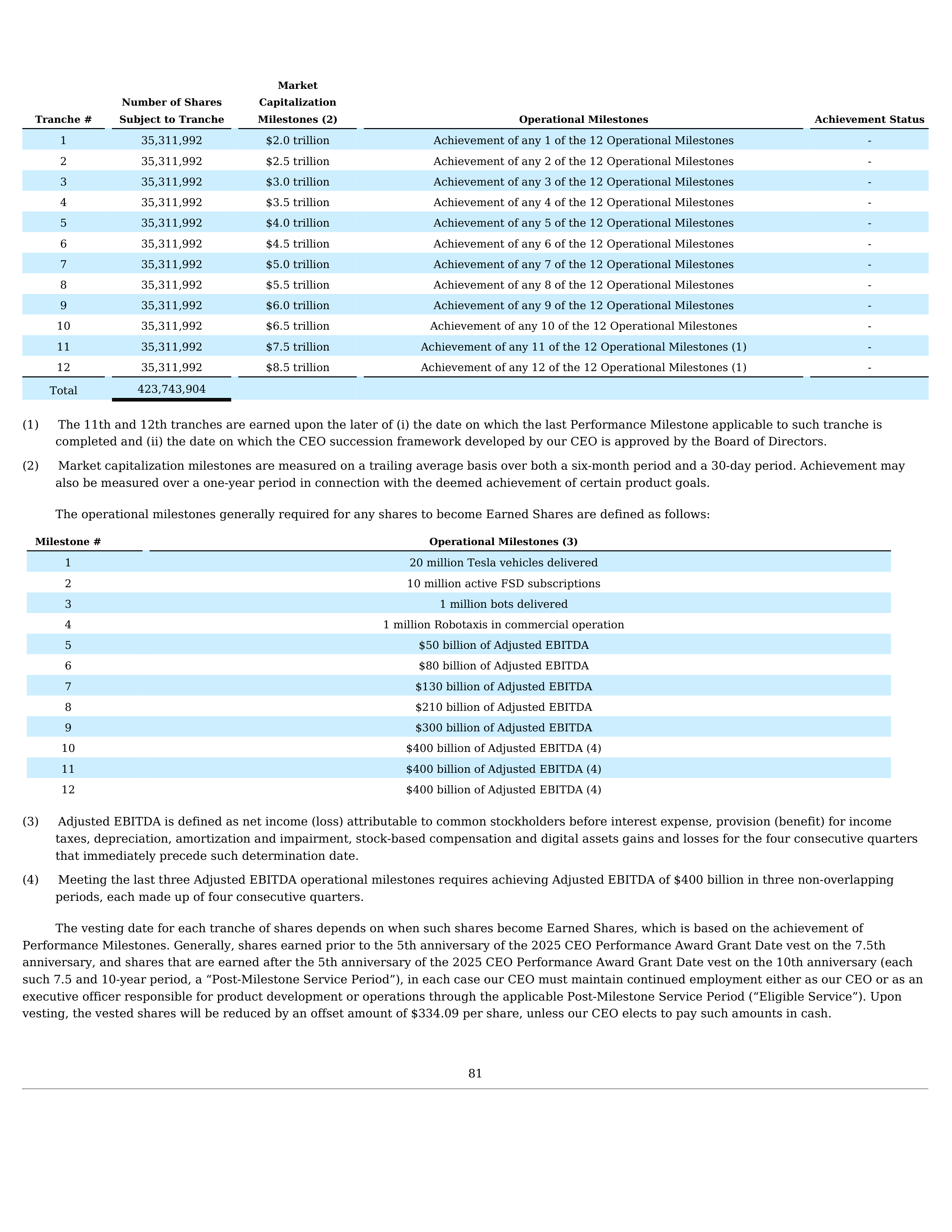
Tranche #
Number of Shares
Subject to Tranche
Market
Capitalization
Milestones (2)
Operational Milestones
Achievement Status
1
35,311,992
$2.0 trillion
Achievement of any 1 of the 12 Operational Milestones
-
2
35,311,992
$2.5 trillion
Achievement of any 2 of the 12 Operational Milestones
-
3
35,311,992
$3.0 trillion
Achievement of any 3 of the 12 Operational Milestones
-
4
35,311,992
$3.5 trillion
Achievement of any 4 of the 12 Operational Milestones
-
5
35,311,992
$4.0 trillion
Achievement of any 5 of the 12 Operational Milestones
-
6
35,311,992
$4.5 trillion
Achievement of any 6 of the 12 Operational Milestones
-
7
35,311,992
$5.0 trillion
Achievement of any 7 of the 12 Operational Milestones
-
8
35,311,992
$5.5 trillion
Achievement of any 8 of the 12 Operational Milestones
-
9
35,311,992
$6.0 trillion
Achievement of any 9 of the 12 Operational Milestones
-
10
35,311,992
$6.5 trillion
Achievement of any 10 of the 12 Operational Milestones
-
11
35,311,992
$7.5 trillion
Achievement of any 11 of the 12 Operational Milestones (1)
-
12
35,311,992
$8.5 trillion
Achievement of any 12 of the 12 Operational Milestones (1)
-
Total
423,743,904
(1)
The 11th and 12th tranches are earned upon the later of (i) the date on which the last Performance Milestone applicable to such tranche is
completed and (ii) the date on which the CEO succession framework developed by our CEO is approved by the Board of Directors.
(2)
Market capitalization milestones are measured on a trailing average basis over both a six-month period and a 30-day period. Achievement may
also be measured over a one-year period in connection with the deemed achievement of certain product goals.
The operational milestones generally required for any shares to become Earned Shares are defined as follows:
Milestone #
Operational Milestones (3)
1
20 million Tesla vehicles delivered
2
10 million active FSD subscriptions
3
1 million bots delivered
4
1 million Robotaxis in commercial operation
5
$50 billion of Adjusted EBITDA
6
$80 billion of Adjusted EBITDA
7
$130 billion of Adjusted EBITDA
8
$210 billion of Adjusted EBITDA
9
$300 billion of Adjusted EBITDA
10
$400 billion of Adjusted EBITDA (4)
11
$400 billion of Adjusted EBITDA (4)
12
$400 billion of Adjusted EBITDA (4)
(3)
Adjusted EBITDA is defined as net income (loss) attributable to common stockholders before interest expense, provision (benefit) for income
taxes, depreciation, amortization and impairment, stock-based compensation and digital assets gains and losses for the four consecutive quarters
that immediately precede such determination date.
(4)
Meeting the last three Adjusted EBITDA operational milestones requires achieving Adjusted EBITDA of $400 billion in three non-overlapping
periods, each made up of four consecutive quarters.
The vesting date for each tranche of shares depends on when such shares become Earned Shares, which is based on the achievement of
Performance Milestones. Generally, shares earned prior to the 5th anniversary of the 2025 CEO Performance Award Grant Date vest on the 7.5th
anniversary, and shares that are earned after the 5th anniversary of the 2025 CEO Performance Award Grant Date vest on the 10th anniversary (each
such 7.5 and 10-year period, a “Post-Milestone Service Period”), in each case our CEO must maintain continued employment either as our CEO or as an
executive officer responsible for product development or operations through the applicable Post-Milestone Service Period (“Eligible Service”). Upon
vesting, the vested shares will be reduced by an offset amount of $334.09 per share, unless our CEO elects to pay such amounts in cash.
81
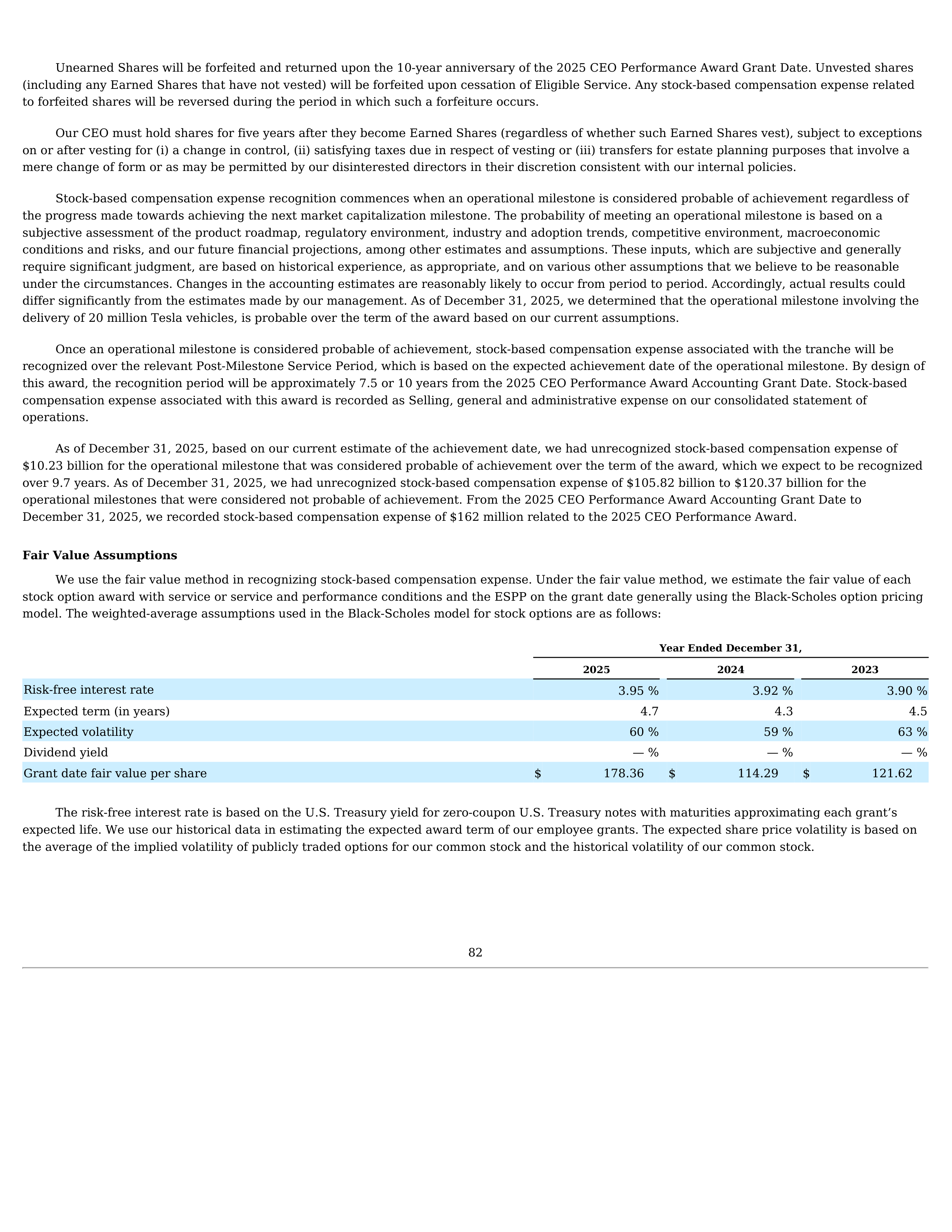
Unearned Shares will be forfeited and returned upon the 10-year anniversary of the 2025 CEO Performance Award Grant Date. Unvested shares
(including any Earned Shares that have not vested) will be forfeited upon cessation of Eligible Service. Any stock-based compensation expense related
to forfeited shares will be reversed during the period in which such a forfeiture occurs.
Our CEO must hold shares for five years after they become Earned Shares (regardless of whether such Earned Shares vest), subject to exceptions
on or after vesting for (i) a change in control, (ii) satisfying taxes due in respect of vesting or (iii) transfers for estate planning purposes that involve a
mere change of form or as may be permitted by our disinterested directors in their discretion consistent with our internal policies.
Stock-based compensation expense recognition commences when an operational milestone is considered probable of achievement regardless of
the progress made towards achieving the next market capitalization milestone. The probability of meeting an operational milestone is based on a
subjective assessment of the product roadmap, regulatory environment, industry and adoption trends, competitive environment, macroeconomic
conditions and risks, and our future financial projections, among other estimates and assumptions. These inputs, which are subjective and generally
require significant judgment, are based on historical experience, as appropriate, and on various other assumptions that we believe to be reasonable
under the circumstances. Changes in the accounting estimates are reasonably likely to occur from period to period. Accordingly, actual results could
differ significantly from the estimates made by our management. As of December 31, 2025, we determined that the operational milestone involving the
delivery of 20 million Tesla vehicles, is probable over the term of the award based on our current assumptions.
Once an operational milestone is considered probable of achievement, stock-based compensation expense associated with the tranche will be
recognized over the relevant Post-Milestone Service Period, which is based on the expected achievement date of the operational milestone. By design of
this award, the recognition period will be approximately 7.5 or 10 years from the 2025 CEO Performance Award Accounting Grant Date. Stock-based
compensation expense associated with this award is recorded as Selling, general and administrative expense on our consolidated statement of
operations.
As of December 31, 2025, based on our current estimate of the achievement date, we had unrecognized stock-based compensation expense of
$10.23 billion for the operational milestone that was considered probable of achievement over the term of the award, which we expect to be recognized
over 9.7 years. As of December 31, 2025, we had unrecognized stock-based compensation expense of $105.82 billion to $120.37 billion for the
operational milestones that were considered not probable of achievement. From the 2025 CEO Performance Award Accounting Grant Date to
December 31, 2025, we recorded stock-based compensation expense of $162 million related to the 2025 CEO Performance Award.
Fair Value Assumptions
We use the fair value method in recognizing stock-based compensation expense. Under the fair value method, we estimate the fair value of each
stock option award with service or service and performance conditions and the ESPP on the grant date generally using the Black-Scholes option pricing
model. The weighted-average assumptions used in the Black-Scholes model for stock options are as follows:
Year Ended December 31,
2025
2024
2023
Risk-free interest rate
3.95 %
3.92 %
3.90 %
Expected term (in years)
4.7
4.3
4.5
Expected volatility
60 %
59 %
63 %
Dividend yield
— %
— %
— %
Grant date fair value per share
$
178.36
$
114.29
$
121.62
The risk-free interest rate is based on the U.S. Treasury yield for zero-coupon U.S. Treasury notes with maturities approximating each grant’s
expected life. We use our historical data in estimating the expected award term of our employee grants. The expected share price volatility is based on
the average of the implied volatility of publicly traded options for our common stock and the historical volatility of our common stock.
82
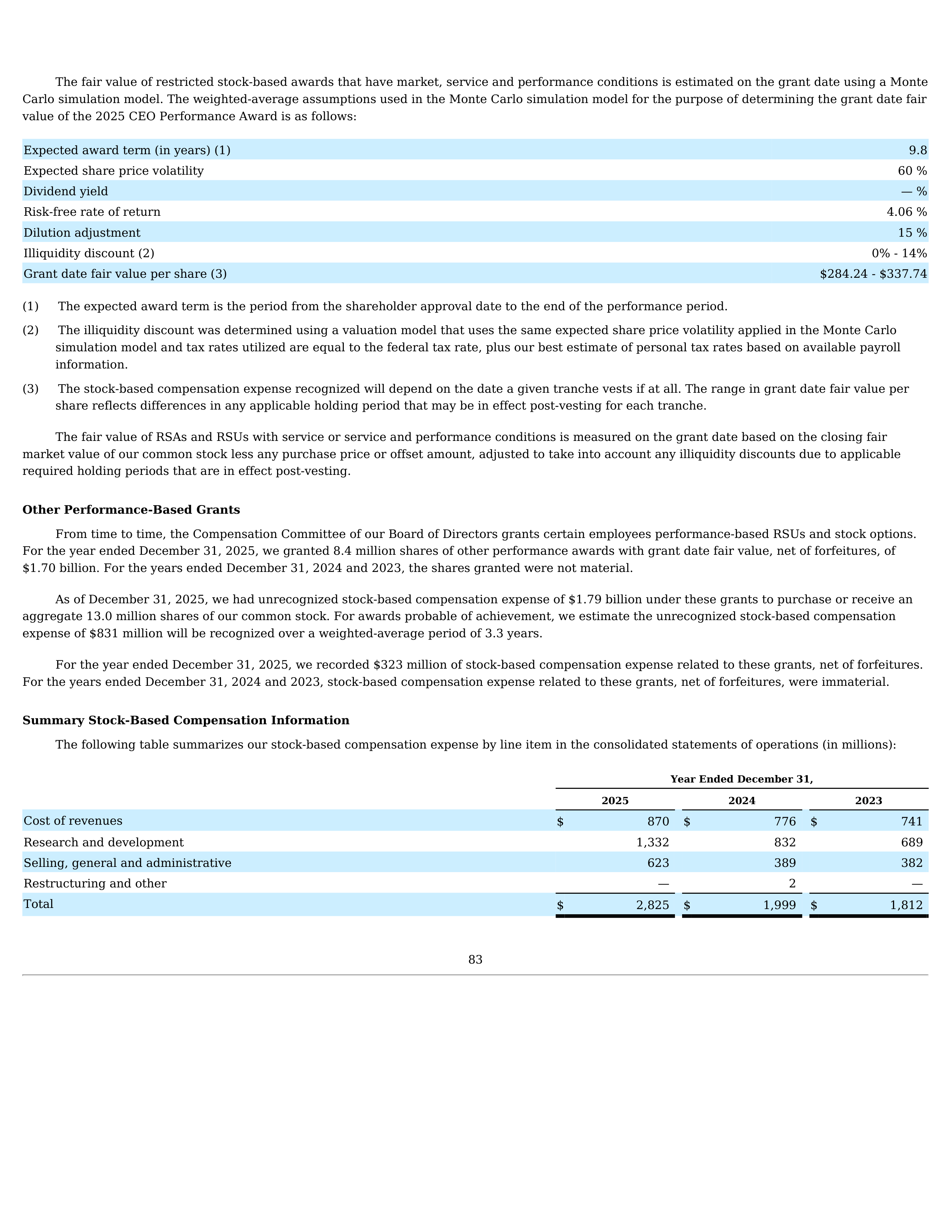
The fair value of restricted stock-based awards that have market, service and performance conditions is estimated on the grant date using a Monte
Carlo simulation model. The weighted-average assumptions used in the Monte Carlo simulation model for the purpose of determining the grant date fair
value of the 2025 CEO Performance Award is as follows:
Expected award term (in years) (1)
9.8
Expected share price volatility
60 %
Dividend yield
— %
Risk-free rate of return
4.06 %
Dilution adjustment
15 %
Illiquidity discount (2)
0% - 14%
Grant date fair value per share (3)
$284.24 - $337.74
(1)
The expected award term is the period from the shareholder approval date to the end of the performance period.
(2)
The illiquidity discount was determined using a valuation model that uses the same expected share price volatility applied in the Monte Carlo
simulation model and tax rates utilized are equal to the federal tax rate, plus our best estimate of personal tax rates based on available payroll
information.
(3)
The stock-based compensation expense recognized will depend on the date a given tranche vests if at all. The range in grant date fair value per
share reflects differences in any applicable holding period that may be in effect post-vesting for each tranche.
The fair value of RSAs and RSUs with service or service and performance conditions is measured on the grant date based on the closing fair
market value of our common stock less any purchase price or offset amount, adjusted to take into account any illiquidity discounts due to applicable
required holding periods that are in effect post-vesting.
Other Performance-Based Grants
From time to time, the Compensation Committee of our Board of Directors grants certain employees performance-based RSUs and stock options.
For the year ended December 31, 2025, we granted 8.4 million shares of other performance awards with grant date fair value, net of forfeitures, of
$1.70 billion. For the years ended December 31, 2024 and 2023, the shares granted were not material.
As of December 31, 2025, we had unrecognized stock-based compensation expense of $1.79 billion under these grants to purchase or receive an
aggregate 13.0 million shares of our common stock. For awards probable of achievement, we estimate the unrecognized stock-based compensation
expense of $831 million will be recognized over a weighted-average period of 3.3 years.
For the year ended December 31, 2025, we recorded $323 million of stock-based compensation expense related to these grants, net of forfeitures.
For the years ended December 31, 2024 and 2023, stock-based compensation expense related to these grants, net of forfeitures, were immaterial.
Summary Stock-Based Compensation Information
The following table summarizes our stock-based compensation expense by line item in the consolidated statements of operations (in millions):
Year Ended December 31,
2025
2024
2023
Cost of revenues
$
870
$
776
$
741
Research and development
1,332
832
689
Selling, general and administrative
623
389
382
Restructuring and other
—
2
—
Total
$
2,825
$
1,999
$
1,812
83
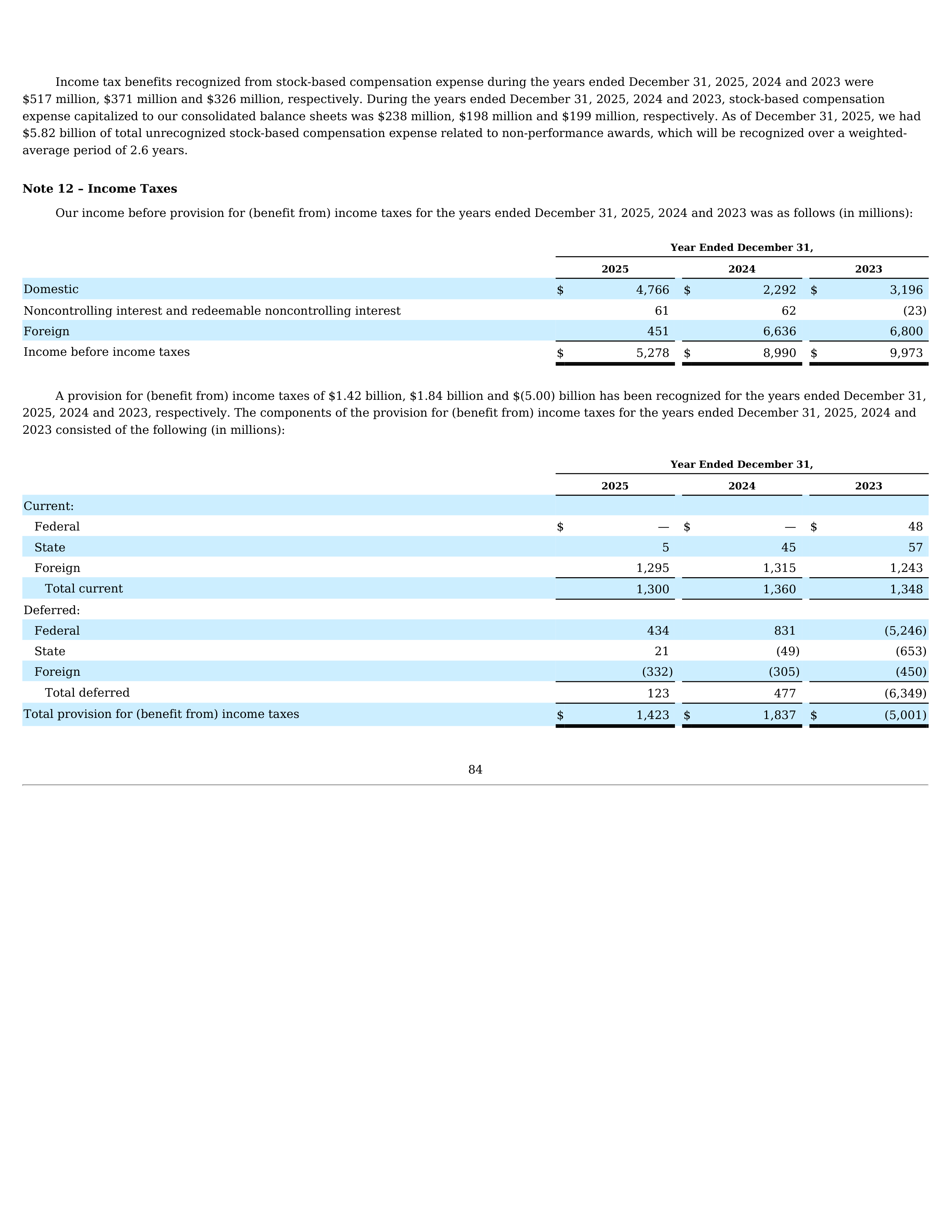
Income tax benefits recognized from stock-based compensation expense during the years ended December 31, 2025, 2024 and 2023 were
$517 million, $371 million and $326 million, respectively. During the years ended December 31, 2025, 2024 and 2023, stock-based compensation
expense capitalized to our consolidated balance sheets was $238 million, $198 million and $199 million, respectively. As of December 31, 2025, we had
$5.82 billion of total unrecognized stock-based compensation expense related to non-performance awards, which will be recognized over a weighted-
average period of 2.6 years.
Note 12 – Income Taxes
Our income before provision for (benefit from) income taxes for the years ended December 31, 2025, 2024 and 2023 was as follows (in millions):
Year Ended December 31,
2025
2024
2023
Domestic
$
4,766
$
2,292
$
3,196
Noncontrolling interest and redeemable noncontrolling interest
61
62
(23)
Foreign
451
6,636
6,800
Income before income taxes
$
5,278
$
8,990
$
9,973
A provision for (benefit from) income taxes of $1.42 billion, $1.84 billion and $(5.00) billion has been recognized for the years ended December 31,
2025, 2024 and 2023, respectively. The components of the provision for (benefit from) income taxes for the years ended December 31, 2025, 2024 and
2023 consisted of the following (in millions):
Year Ended December 31,
2025
2024
2023
Current:
Federal
$
—
$
—
$
48
State
5
45
57
Foreign
1,295
1,315
1,243
Total current
1,300
1,360
1,348
Deferred:
Federal
434
831
(5,246)
State
21
(49)
(653)
Foreign
(332)
(305)
(450)
Total deferred
123
477
(6,349)
Total provision for (benefit from) income taxes
$
1,423
$
1,837
$
(5,001)
84
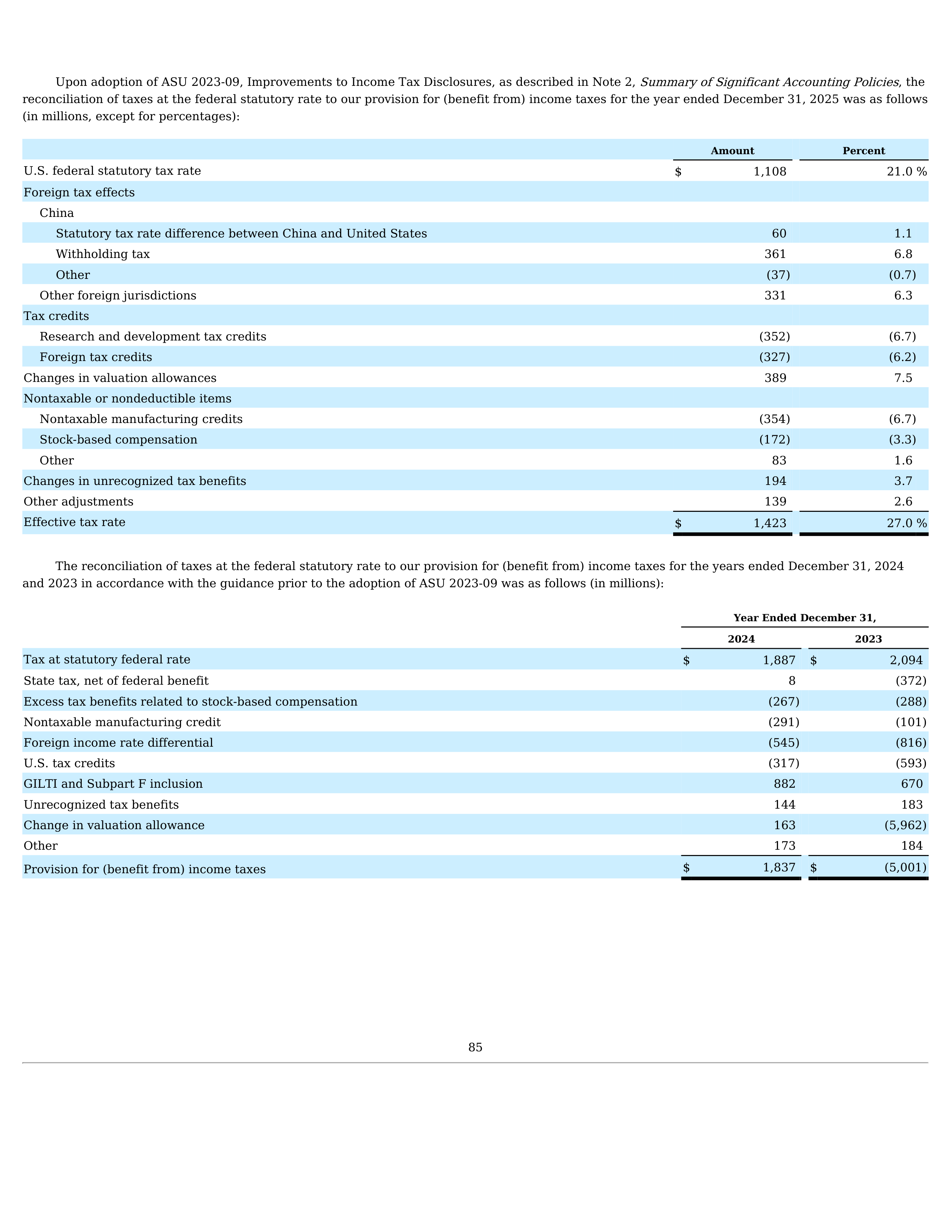
Upon adoption of ASU 2023-09, Improvements to Income Tax Disclosures, as described in Note 2, Summary of Significant Accounting Policies, the
reconciliation of taxes at the federal statutory rate to our provision for (benefit from) income taxes for the year ended December 31, 2025 was as follows
(in millions, except for percentages):
Amount
Percent
U.S. federal statutory tax rate
$
1,108
21.0 %
Foreign tax effects
China
Statutory tax rate difference between China and United States
60
1.1
Withholding tax
361
6.8
Other
(37)
(0.7)
Other foreign jurisdictions
331
6.3
Tax credits
Research and development tax credits
(352)
(6.7)
Foreign tax credits
(327)
(6.2)
Changes in valuation allowances
389
7.5
Nontaxable or nondeductible items
Nontaxable manufacturing credits
(354)
(6.7)
Stock-based compensation
(172)
(3.3)
Other
83
1.6
Changes in unrecognized tax benefits
194
3.7
Other adjustments
139
2.6
Effective tax rate
$
1,423
27.0 %
The reconciliation of taxes at the federal statutory rate to our provision for (benefit from) income taxes for the years ended December 31, 2024
and 2023 in accordance with the guidance prior to the adoption of ASU 2023-09 was as follows (in millions):
Year Ended December 31,
2024
2023
Tax at statutory federal rate
$
1,887
$
2,094
State tax, net of federal benefit
8
(372)
Excess tax benefits related to stock-based compensation
(267)
(288)
Nontaxable manufacturing credit
(291)
(101)
Foreign income rate differential
(545)
(816)
U.S. tax credits
(317)
(593)
GILTI and Subpart F inclusion
882
670
Unrecognized tax benefits
144
183
Change in valuation allowance
163
(5,962)
Other
173
184
Provision for (benefit from) income taxes
$
1,837
$
(5,001)
85
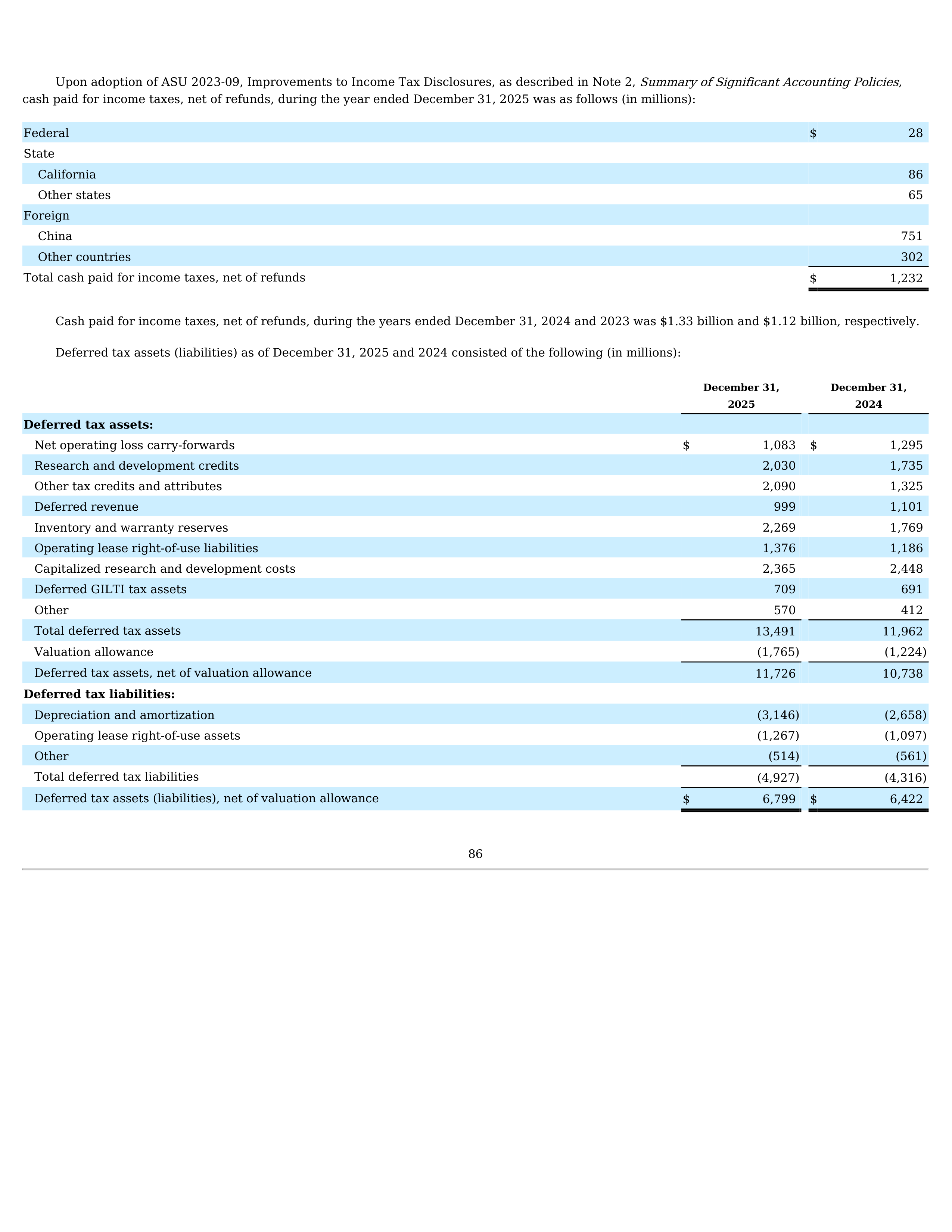
Upon adoption of ASU 2023-09, Improvements to Income Tax Disclosures, as described in Note 2, Summary of Significant Accounting Policies,
cash paid for income taxes, net of refunds, during the year ended December 31, 2025 was as follows (in millions):
Federal
$
28
State
California
86
Other states
65
Foreign
China
751
Other countries
302
Total cash paid for income taxes, net of refunds
$
1,232
Cash paid for income taxes, net of refunds, during the years ended December 31, 2024 and 2023 was $1.33 billion and $1.12 billion, respectively.
Deferred tax assets (liabilities) as of December 31, 2025 and 2024 consisted of the following (in millions):
December 31,
2025
December 31,
2024
Deferred tax assets:
Net operating loss carry-forwards
$
1,083
$
1,295
Research and development credits
2,030
1,735
Other tax credits and attributes
2,090
1,325
Deferred revenue
999
1,101
Inventory and warranty reserves
2,269
1,769
Operating lease right-of-use liabilities
1,376
1,186
Capitalized research and development costs
2,365
2,448
Deferred GILTI tax assets
709
691
Other
570
412
Total deferred tax assets
13,491
11,962
Valuation allowance
(1,765)
(1,224)
Deferred tax assets, net of valuation allowance
11,726
10,738
Deferred tax liabilities:
Depreciation and amortization
(3,146)
(2,658)
Operating lease right-of-use assets
(1,267)
(1,097)
Other
(514)
(561)
Total deferred tax liabilities
(4,927)
(4,316)
Deferred tax assets (liabilities), net of valuation allowance
$
6,799
$
6,422
86
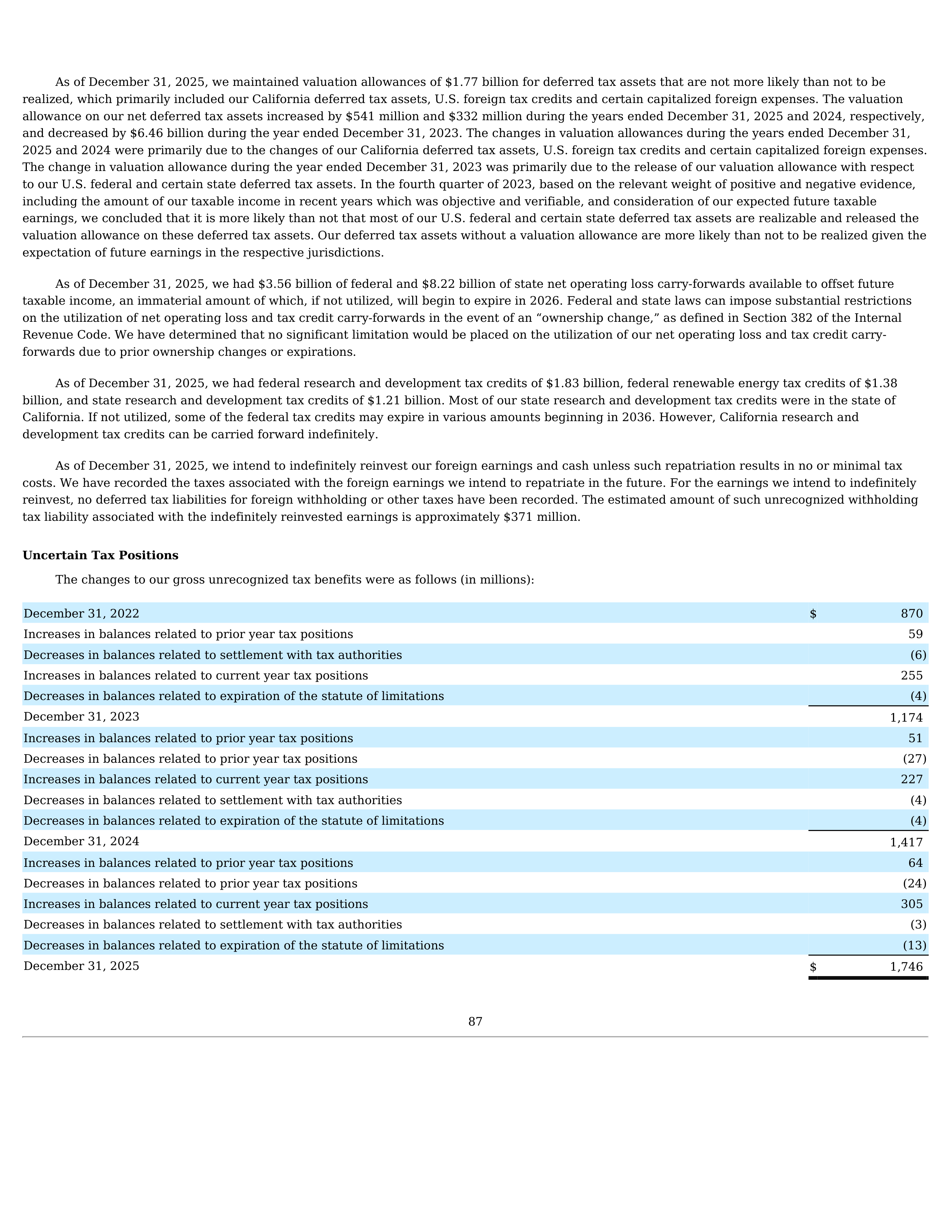
As of December 31, 2025, we maintained valuation allowances of $1.77 billion for deferred tax assets that are not more likely than not to be
realized, which primarily included our California deferred tax assets, U.S. foreign tax credits and certain capitalized foreign expenses. The valuation
allowance on our net deferred tax assets increased by $541 million and $332 million during the years ended December 31, 2025 and 2024, respectively,
and decreased by $6.46 billion during the year ended December 31, 2023. The changes in valuation allowances during the years ended December 31,
2025 and 2024 were primarily due to the changes of our California deferred tax assets, U.S. foreign tax credits and certain capitalized foreign expenses.
The change in valuation allowance during the year ended December 31, 2023 was primarily due to the release of our valuation allowance with respect
to our U.S. federal and certain state deferred tax assets. In the fourth quarter of 2023, based on the relevant weight of positive and negative evidence,
including the amount of our taxable income in recent years which was objective and verifiable, and consideration of our expected future taxable
earnings, we concluded that it is more likely than not that most of our U.S. federal and certain state deferred tax assets are realizable and released the
valuation allowance on these deferred tax assets. Our deferred tax assets without a valuation allowance are more likely than not to be realized given the
expectation of future earnings in the respective jurisdictions.
As of December 31, 2025, we had $3.56 billion of federal and $8.22 billion of state net operating loss carry-forwards available to offset future
taxable income, an immaterial amount of which, if not utilized, will begin to expire in 2026. Federal and state laws can impose substantial restrictions
on the utilization of net operating loss and tax credit carry-forwards in the event of an “ownership change,” as defined in Section 382 of the Internal
Revenue Code. We have determined that no significant limitation would be placed on the utilization of our net operating loss and tax credit carry-
forwards due to prior ownership changes or expirations.
As of December 31, 2025, we had federal research and development tax credits of $1.83 billion, federal renewable energy tax credits of $1.38
billion, and state research and development tax credits of $1.21 billion. Most of our state research and development tax credits were in the state of
California. If not utilized, some of the federal tax credits may expire in various amounts beginning in 2036. However, California research and
development tax credits can be carried forward indefinitely.
As of December 31, 2025, we intend to indefinitely reinvest our foreign earnings and cash unless such repatriation results in no or minimal tax
costs. We have recorded the taxes associated with the foreign earnings we intend to repatriate in the future. For the earnings we intend to indefinitely
reinvest, no deferred tax liabilities for foreign withholding or other taxes have been recorded. The estimated amount of such unrecognized withholding
tax liability associated with the indefinitely reinvested earnings is approximately $371 million.
Uncertain Tax Positions
The changes to our gross unrecognized tax benefits were as follows (in millions):
December 31, 2022
$
870
Increases in balances related to prior year tax positions
59
Decreases in balances related to settlement with tax authorities
(6)
Increases in balances related to current year tax positions
255
Decreases in balances related to expiration of the statute of limitations
(4)
December 31, 2023
1,174
Increases in balances related to prior year tax positions
51
Decreases in balances related to prior year tax positions
(27)
Increases in balances related to current year tax positions
227
Decreases in balances related to settlement with tax authorities
(4)
Decreases in balances related to expiration of the statute of limitations
(4)
December 31, 2024
1,417
Increases in balances related to prior year tax positions
64
Decreases in balances related to prior year tax positions
(24)
Increases in balances related to current year tax positions
305
Decreases in balances related to settlement with tax authorities
(3)
Decreases in balances related to expiration of the statute of limitations
(13)
December 31, 2025
$
1,746
87
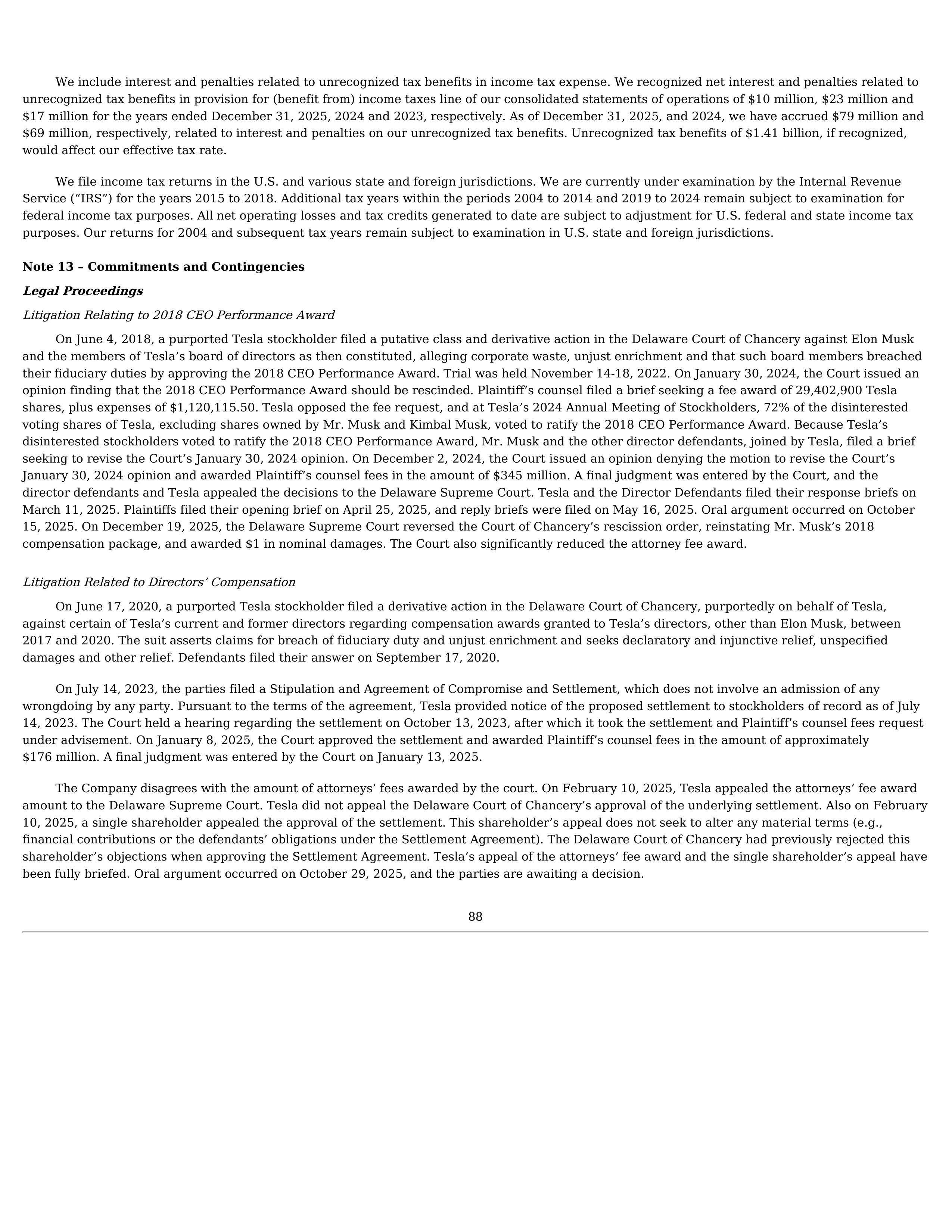
We include interest and penalties related to unrecognized tax benefits in income tax expense. We recognized net interest and penalties related to
unrecognized tax benefits in provision for (benefit from) income taxes line of our consolidated statements of operations of $10 million, $23 million and
$17 million for the years ended December 31, 2025, 2024 and 2023, respectively. As of December 31, 2025, and 2024, we have accrued $79 million and
$69 million, respectively, related to interest and penalties on our unrecognized tax benefits. Unrecognized tax benefits of $1.41 billion, if recognized,
would affect our effective tax rate.
We file income tax returns in the U.S. and various state and foreign jurisdictions. We are currently under examination by the Internal Revenue
Service (“IRS”) for the years 2015 to 2018. Additional tax years within the periods 2004 to 2014 and 2019 to 2024 remain subject to examination for
federal income tax purposes. All net operating losses and tax credits generated to date are subject to adjustment for U.S. federal and state income tax
purposes. Our returns for 2004 and subsequent tax years remain subject to examination in U.S. state and foreign jurisdictions.
Note 13 – Commitments and Contingencies
Legal Proceedings
Litigation Relating to 2018 CEO Performance Award
On June 4, 2018, a purported Tesla stockholder filed a putative class and derivative action in the Delaware Court of Chancery against Elon Musk
and the members of Tesla’s board of directors as then constituted, alleging corporate waste, unjust enrichment and that such board members breached
their fiduciary duties by approving the 2018 CEO Performance Award. Trial was held November 14-18, 2022. On January 30, 2024, the Court issued an
opinion finding that the 2018 CEO Performance Award should be rescinded. Plaintiff’s counsel filed a brief seeking a fee award of 29,402,900 Tesla
shares, plus expenses of $1,120,115.50. Tesla opposed the fee request, and at Tesla’s 2024 Annual Meeting of Stockholders, 72% of the disinterested
voting shares of Tesla, excluding shares owned by Mr. Musk and Kimbal Musk, voted to ratify the 2018 CEO Performance Award. Because Tesla’s
disinterested stockholders voted to ratify the 2018 CEO Performance Award, Mr. Musk and the other director defendants, joined by Tesla, filed a brief
seeking to revise the Court’s January 30, 2024 opinion. On December 2, 2024, the Court issued an opinion denying the motion to revise the Court’s
January 30, 2024 opinion and awarded Plaintiff’s counsel fees in the amount of $345 million. A final judgment was entered by the Court, and the
director defendants and Tesla appealed the decisions to the Delaware Supreme Court. Tesla and the Director Defendants filed their response briefs on
March 11, 2025. Plaintiffs filed their opening brief on April 25, 2025, and reply briefs were filed on May 16, 2025. Oral argument occurred on October
15, 2025. On December 19, 2025, the Delaware Supreme Court reversed the Court of Chancery’s rescission order, reinstating Mr. Musk’s 2018
compensation package, and awarded $1 in nominal damages. The Court also significantly reduced the attorney fee award.
Litigation Related to Directors’ Compensation
On June 17, 2020, a purported Tesla stockholder filed a derivative action in the Delaware Court of Chancery, purportedly on behalf of Tesla,
against certain of Tesla’s current and former directors regarding compensation awards granted to Tesla’s directors, other than Elon Musk, between
2017 and 2020. The suit asserts claims for breach of fiduciary duty and unjust enrichment and seeks declaratory and injunctive relief, unspecified
damages and other relief. Defendants filed their answer on September 17, 2020.
On July 14, 2023, the parties filed a Stipulation and Agreement of Compromise and Settlement, which does not involve an admission of any
wrongdoing by any party. Pursuant to the terms of the agreement, Tesla provided notice of the proposed settlement to stockholders of record as of July
14, 2023. The Court held a hearing regarding the settlement on October 13, 2023, after which it took the settlement and Plaintiff’s counsel fees request
under advisement. On January 8, 2025, the Court approved the settlement and awarded Plaintiff’s counsel fees in the amount of approximately
$176 million. A final judgment was entered by the Court on January 13, 2025.
The Company disagrees with the amount of attorneys’ fees awarded by the court. On February 10, 2025, Tesla appealed the attorneys’ fee award
amount to the Delaware Supreme Court. Tesla did not appeal the Delaware Court of Chancery’s approval of the underlying settlement. Also on February
10, 2025, a single shareholder appealed the approval of the settlement. This shareholder’s appeal does not seek to alter any material terms (e.g.,
financial contributions or the defendants’ obligations under the Settlement Agreement). The Delaware Court of Chancery had previously rejected this
shareholder’s objections when approving the Settlement Agreement. Tesla’s appeal of the attorneys’ fee award and the single shareholder’s appeal have
been fully briefed. Oral argument occurred on October 29, 2025, and the parties are awaiting a decision.
88
Because neither Tesla’s appeal nor the shareholder’s appeal seeks to vacate the Settlement Agreement or materially modify its terms, the
Company implemented the provisions of the Settlement Agreement in May 2025 by cancelling the options requiring cancellation under its terms.
In connection with the settlement, Tesla received $277 million from certain directors and paid Plaintiff’s counsel fees of $176 million (which, as
noted above, the Company is appealing) in the three months ended March 31, 2025. We recorded a $31 million reversal of previously recognized stock-
based compensation expense in association with the returned awards and increased our provision for income taxes in relation to the return of directors’
compensation. As the settlement was an equity transaction, the net impact to additional paid-in-capital was $110 million in the three months ended
March 31, 2025.
Litigation Relating to Potential Going Private Transaction
Between October 17, 2018 and March 8, 2021, seven derivative lawsuits were filed in the Delaware Court of Chancery, purportedly on behalf of
Tesla, against Mr. Musk and the members of Tesla’s board of directors, as constituted at relevant times, in relation to statements made and actions
connected to a potential going private transaction, with certain of the lawsuits challenging additional Twitter posts by Mr. Musk, among other things.
Several of those actions were consolidated. All the non-consolidated cases have been dismissed with prejudice through a stipulation and order. A
stipulation for dismissal with prejudice of the consolidated case was filed on December 24, 2025, and the parties are waiting for the court to approve it.
In addition to these cases, two derivative lawsuits were filed on October 25, 2018 and February 11, 2019 in the U.S. District Court for the District of
Delaware, purportedly on behalf of Tesla, against Mr. Musk and the members of the Tesla board of directors as then constituted. Those cases were also
consolidated, and on April 25, 2025, were dismissed with prejudice through a stipulation and order.
On October 21, 2022, a lawsuit was filed in the Delaware Court of Chancery by a purported shareholder of Tesla alleging, among other things, that
board members breached their fiduciary duties in connection with their oversight of the Company’s 2018 settlement with the SEC, as amended. Among
other things, the plaintiff seeks reforms to the Company’s corporate governance and internal procedures, unspecified damages, and attorneys’ fees. The
lawsuit has been stayed.
Certain Derivative Lawsuits in Delaware
Before converting from a Delaware to Texas corporation on June 13, 2024, three separate derivative actions brought by purported Tesla
stockholders were filed in the Delaware Court of Chancery on May 24, June 10 and June 13, 2024, purportedly on behalf of Tesla, against current and
former directors regarding topics involving Elon Musk and others, X Corp. (formerly Twitter) and xAI. These suits assert various claims, including
breach of fiduciary duty and breach of contract, and seek unspecified damages and other relief. On August 6, 2024, the plaintiffs in these three actions
moved to consolidate the matters into a single case. The Court consolidated two of the three cases. Tesla and the directors filed motions to dismiss, and
oral argument on those motions occurred on October 22, 2025.
Litigation and Investigations Relating to Alleged Discrimination and Harassment
On February 9, 2022, the California Civil Rights Department (“CRD,” formerly “DFEH”) filed a civil complaint against Tesla in Alameda County,
California Superior Court, alleging systemic race discrimination, hostile work environment and pay equity claims, among others. CRD’s amended
complaint seeks monetary damages and injunctive relief. The trial is currently set for July 20, 2026.
Additionally, on June 1, 2022 the Equal Employment Opportunity Commission (“EEOC”) issued a cause finding against Tesla that closely parallels
the CRD’s allegations. On September 28, 2023, the EEOC filed a civil complaint against Tesla in the United States District Court for the Northern
District of California asserting claims for race harassment and retaliation and seeking, among other things, monetary and injunctive relief. The case is
in discovery with no trial date set.
89
Other Litigation Related to Our Products and Services
We are also subject to various lawsuits that seek monetary and other injunctive relief. These lawsuits include proposed class actions and other
consumer claims that allege, among other things, purported defects and misrepresentations related to our products and services. For example, on
September 14, 2022, a proposed class action was filed against Tesla, Inc. and related entities in the U.S. District Court for the Northern District of
California, alleging various claims about the Company’s driver assistance technology systems under state and federal law. This case was later
consolidated with several other proposed class actions, and a Consolidated Amended Complaint was filed on October 28, 2022, which seeks damages
and other relief on behalf of all persons who purchased or leased from Tesla between January 1, 2016, to the present. On March 22, 2023, the plaintiffs
filed a motion for a preliminary injunction to order Tesla to (1) cease using the term “Full Self-Driving Capability” (FSD Capability), (2) cease the sale
and activation of FSD Capability and deactivate FSD Capability on Tesla vehicles, and (3) provide certain notices to consumers about proposed court-
findings about the accuracy of the use of the terms Autopilot and FSD Capability. Tesla opposed the motion. On September 30, 2023, the Court denied
the request for a preliminary injunction, compelled four of five plaintiffs to arbitration, and dismissed the claims of the fifth plaintiff with leave to amend
the complaint. On October 31, 2023, the remaining plaintiff filed an amended complaint, which Tesla moved to dismiss, and on May 15, 2024, the Court
granted in part and denied in part Tesla’s motion. On May 6, 2025, the plaintiff filed a motion for class certification, which Tesla opposed, and on
August 18, 2025, the Court certified a limited class comprised of California consumers who are not subject to an arbitration agreement. On September
1, 2025, Tesla filed a petition in the United States Court of Appeals for the Ninth Circuit for permission to appeal the class certification order, and on
December 18, 2025, the Ninth Circuit granted Tesla’s petition. On January 5, 2026, the district court stayed the case pending resolution of the
proceedings before the Ninth Circuit. Tesla’s opening brief in the Ninth Circuit is due on March 12, 2026. On October 2, 2023, a similar proposed class
action was filed in San Diego County Superior Court in California. Tesla subsequently removed the San Diego County case to federal court and on
January 8, 2024, the federal court granted Tesla’s motion to transfer the case to the U.S. District Court for the Northern District of California. Tesla
moved to compel arbitration, which the plaintiff did not oppose, and on June 27, 2024, the Court stayed the case pending arbitration.
On February 27, 2023, a proposed class action was filed in the U.S. District Court for the Northern District of California against Tesla, Inc., Elon
Musk and certain current and former Company executives. The complaint alleges that the defendants made material misrepresentations and omissions
about the Company’s Autopilot and FSD Capability technologies and seeks money damages and other relief on behalf of persons who purchased Tesla
stock between February 19, 2019, and February 17, 2023. An amended complaint was filed on September 5, 2023, naming only Tesla, Inc. and Elon
Musk as defendants. On November 6, 2023, Tesla moved to dismiss the amended complaint. On September 30, 2024, the Court granted Tesla’s motion
to dismiss without prejudice. On November 26, 2024, the court issued a final judgment in Tesla’s favor, and on December 23, 2024, the plaintiffs filed a
notice of appeal to the United States Court of Appeals for the Ninth Circuit. Oral argument occurred on November 20, 2025, and on December 2, 2025,
the Ninth Circuit issued a memorandum decision affirming the district court’s dismissal of the amended complaint. On December 29, 2025, the Court’s
clerk issued a mandate closing the case.
On August 4, 2025, a proposed class action was filed in the U.S. District Court Western District of Texas against Tesla, Inc., Elon Musk, and
certain current and former Company executives. The complaint alleges that the defendants violated federal securities laws through alleged material
misrepresentations in public filings regarding the effectiveness of Autopilot, Full-Self Driving (Supervised), and Robotaxi. The complaint seeks monetary
damages and other relief on behalf of persons who purchased Tesla stock between April 19, 2023, and June 22, 2025.
The Company intends to vigorously defend itself in these matters; however, we cannot predict the outcome or impact. We are unable to reasonably
estimate the possible loss or range of loss, if any, associated with these claims, unless noted.
90
Benavides v. Tesla, Inc.
On August 1, 2025, a jury in the U.S. District Court for the Southern District of Florida reached a verdict in a product liability trial relating to
certain allegations regarding the use of our Autopilot technology in a 2019 accident that resulted in a fatality and injuries. The jury awarded
$129 million in total compensatory damages, finding the driver 67% at fault and the Company 33% at fault. The jury also awarded $200 million in
punitive damages. On September 15, 2025, the Company filed a post-trial motion for judgment as a matter of law or, in the alternative, a new trial on all
issues or an amended judgment to lesser compensatory and punitive damages. Although we believe that the facts and law do not justify the damages
awarded, the Company has recorded an immaterial accrual.
We have experienced, and we expect to continue to face, claims and regulatory scrutiny arising from or related to misuse or claimed failures or
alleged misrepresentations of new technologies that we are pioneering. We are unable to reasonably estimate the possible loss or range of loss, if any,
associated with these claims, unless noted. An unfavorable outcome in some or all of these proceedings could have a material adverse impact on results
of operations or cash flows for a particular period. Our view of these matters is subject to inherent uncertainties and may change in the future.
Certain Investigations and Other Matters
We regularly receive requests for information, including subpoenas, from regulators and governmental authorities such as the National Highway
Traffic Safety Administration, the National Transportation Safety Board, the SEC, the Department of Justice (“DOJ”), and various local, state, federal,
and international agencies. The ongoing requests for information include topics such as operations, technology (e.g., vehicle functionality, vehicle
incidents, Autopilot and FSD Capability and Robotaxi), compliance, finance, data privacy, and other matters related to Tesla’s business, its personnel,
and related parties. We routinely cooperate with such formal and informal requests for information, investigations, and other inquiries. To our
knowledge no government agency in any ongoing investigation has concluded that any wrongdoing occurred. We cannot predict the outcome or impact
of any ongoing matters. Should the government decide to pursue an enforcement action, there exists the possibility of a material adverse impact on our
business, results of operations, prospects, cash flows, financial position or brand.
We are also subject to various other legal proceedings, risks and claims that arise from the normal course of business activities. For example, on
August 5, 2023, a putative class action was filed in the United States District Court for the Northern District of California, purportedly on behalf of all
U.S. individuals impacted by a data misappropriation incident earlier that year. Several additional lawsuits followed, each asserting claims under
various state laws and seeking monetary damages and other relief. If an unfavorable ruling or development were to occur in these or other possible
legal proceedings, risks and claims, there exists the possibility of a material adverse impact on our business, results of operations, prospects, cash
flows, financial position or brand.
Letters of Credit
As of December 31, 2025, we had $556 million of unused letters of credit outstanding.
Note 14 – Variable Interest Entity Arrangements
We have entered into various arrangements with investors to facilitate the funding and monetization of our energy generation systems and
vehicles. In particular, our wholly owned subsidiaries and fund investors have formed and contributed cash and assets into various financing funds and
entered into related agreements. We have determined that the funds are VIEs and we are the primary beneficiary of these VIEs by reference to the
power and benefits criterion under ASC 810, Consolidation. We have considered the provisions within the agreements, which grant us the power to
manage and make decisions that affect the operation of these VIEs, including determining the energy generation systems and the associated customer
contracts to be sold or contributed to these VIEs, redeploying energy generation systems and managing customer receivables. We consider that the
rights granted to the fund investors under the agreements are more protective in nature rather than participating.
As the primary beneficiary of these VIEs, we consolidate in the financial statements the financial position, results of operations and cash flows of
these VIEs, and all intercompany balances and transactions between us and these VIEs are eliminated in the consolidated financial statements. Cash
distributions of income and other receipts by a fund, net of agreed upon expenses, estimated expenses, tax benefits and detriments of income and loss
and tax credits, are allocated to the fund investor and our subsidiary as specified in the agreements.
Generally, our subsidiary has the option to acquire the fund investor’s interest in the fund for an amount based on the market value of the fund or
the formula specified in the agreements.
91
Upon the sale or liquidation of a fund, distributions would occur in the order and priority specified in the agreements.
Pursuant to management services, maintenance and warranty arrangements, we have been contracted to provide services to the funds, such as
operations and maintenance support, accounting, lease servicing and performance reporting. In some instances, we have guaranteed payments to the
fund investors as specified in the agreements. A fund’s creditors have no recourse to our general credit or to that of other funds. Certain assets of the
funds have been pledged as collateral for their obligations.
The aggregate carrying values of the VIEs’ assets and liabilities, after elimination of any intercompany transactions and balances, in the
consolidated balance sheets were as follows (in millions):
December 31,
2025
December 31,
2024
Assets
Current assets
Cash and cash equivalents
$
109
$
49
Accounts receivable, net
11
18
Prepaid expenses and other current assets
198
276
Total current assets
318
343
Operating lease vehicles, net
456
392
Energy generation and storage systems, net
2,177
2,310
Other non-current assets
183
183
Total assets
$
3,134
$
3,228
Liabilities
Current liabilities
Accrued liabilities and other
$
49
$
32
Deferred revenue
6
6
Current portion of debt and finance leases
1,364
2,114
Total current liabilities
1,419
2,152
Deferred revenue, net of current portion
60
71
Debt and finance leases, net of current portion
1,679
1,834
Total liabilities
$
3,158
$
4,057
Note 15 – Related Party Transactions
Tesla periodically does business with certain entities with which its CEO and directors are affiliated, such as xAI, SpaceX, The Boring Company
and Redwood Materials, in accordance with our Related Person Transactions Policy. During the year ended December 31, 2025, we recognized $430
million of revenues and $285 million of cost of revenues from xAI for its purchase of our Megapack products in the ordinary course of business. Other
transactions with xAI and other related parties during the year ended December 31, 2025 were immaterial. During the years ended December 31, 2024
and 2023, transactions with related parties were immaterial.
In January 2026, the Company entered into an agreement with xAI to invest approximately $2 billion to acquire shares of Series E Preferred Stock
of xAI. As the investment is not in-substance common stock and the fair value is not readily determinable, we will account for the equity investment
using the measurement alternative in accordance with ASC 321, Investments – Equity Securities. The equity investment will be initially recorded at cost
on our consolidated balance sheet as a long-term investment subsequently adjusted only for observable price changes for identical or similar securities,
net of any potential impairment, which will be evaluated quarterly. We will recognize any changes in the basis of the equity investment in Other
(expense) income, net in the consolidated statements of operations.
92
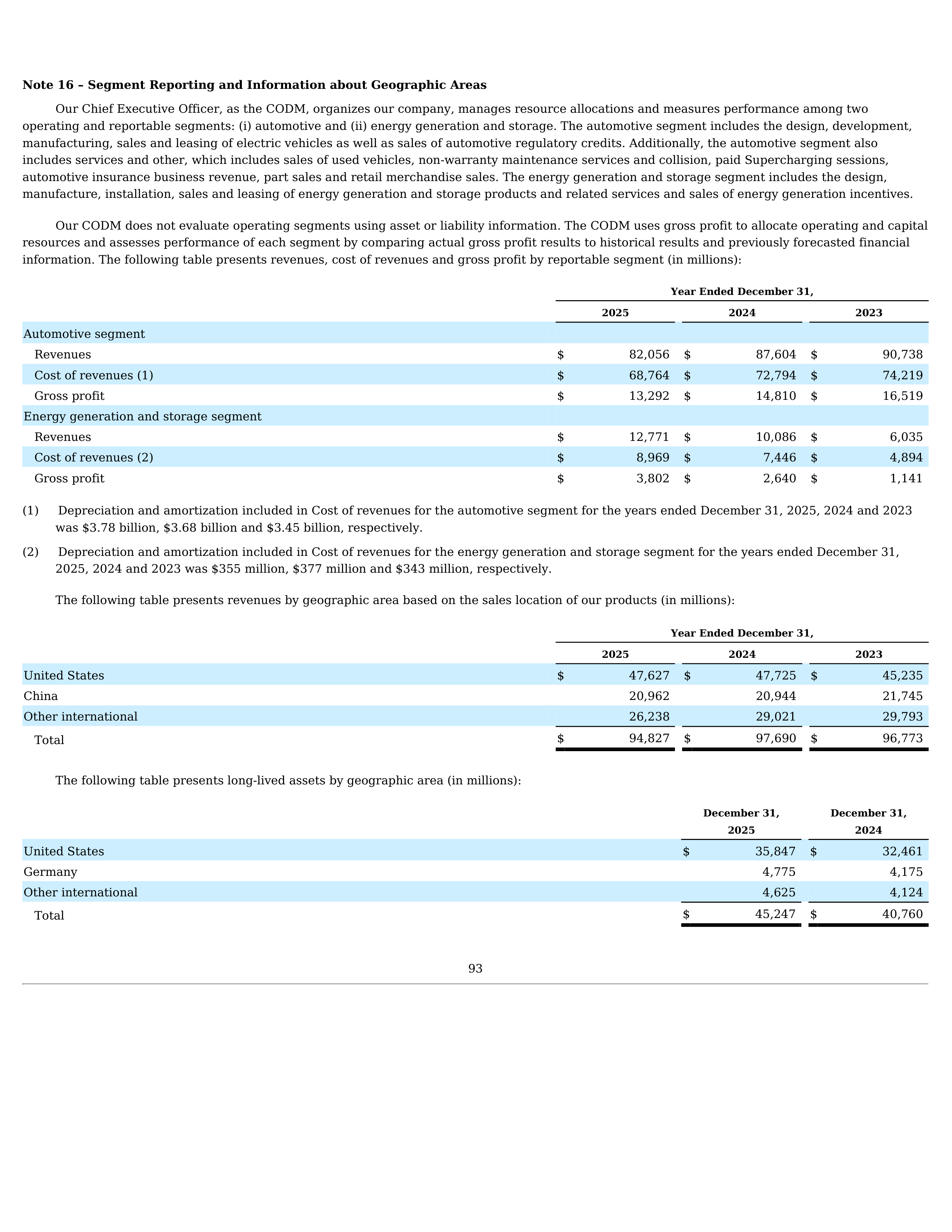
Note 16 – Segment Reporting and Information about Geographic Areas
Our Chief Executive Officer, as the CODM, organizes our company, manages resource allocations and measures performance among two
operating and reportable segments: (i) automotive and (ii) energy generation and storage. The automotive segment includes the design, development,
manufacturing, sales and leasing of electric vehicles as well as sales of automotive regulatory credits. Additionally, the automotive segment also
includes services and other, which includes sales of used vehicles, non-warranty maintenance services and collision, paid Supercharging sessions,
automotive insurance business revenue, part sales and retail merchandise sales. The energy generation and storage segment includes the design,
manufacture, installation, sales and leasing of energy generation and storage products and related services and sales of energy generation incentives.
Our CODM does not evaluate operating segments using asset or liability information. The CODM uses gross profit to allocate operating and capital
resources and assesses performance of each segment by comparing actual gross profit results to historical results and previously forecasted financial
information. The following table presents revenues, cost of revenues and gross profit by reportable segment (in millions):
Year Ended December 31,
2025
2024
2023
Automotive segment
Revenues
$
82,056
$
87,604
$
90,738
Cost of revenues (1)
$
68,764
$
72,794
$
74,219
Gross profit
$
13,292
$
14,810
$
16,519
Energy generation and storage segment
Revenues
$
12,771
$
10,086
$
6,035
Cost of revenues (2)
$
8,969
$
7,446
$
4,894
Gross profit
$
3,802
$
2,640
$
1,141
(1)
Depreciation and amortization included in Cost of revenues for the automotive segment for the years ended December 31, 2025, 2024 and 2023
was $3.78 billion, $3.68 billion and $3.45 billion, respectively.
(2)
Depreciation and amortization included in Cost of revenues for the energy generation and storage segment for the years ended December 31,
2025, 2024 and 2023 was $355 million, $377 million and $343 million, respectively.
The following table presents revenues by geographic area based on the sales location of our products (in millions):
Year Ended December 31,
2025
2024
2023
United States
$
47,627
$
47,725
$
45,235
China
20,962
20,944
21,745
Other international
26,238
29,021
29,793
Total
$
94,827
$
97,690
$
96,773
The following table presents long-lived assets by geographic area (in millions):
December 31,
2025
December 31,
2024
United States
$
35,847
$
32,461
Germany
4,775
4,175
Other international
4,625
4,124
Total
$
45,247
$
40,760
93
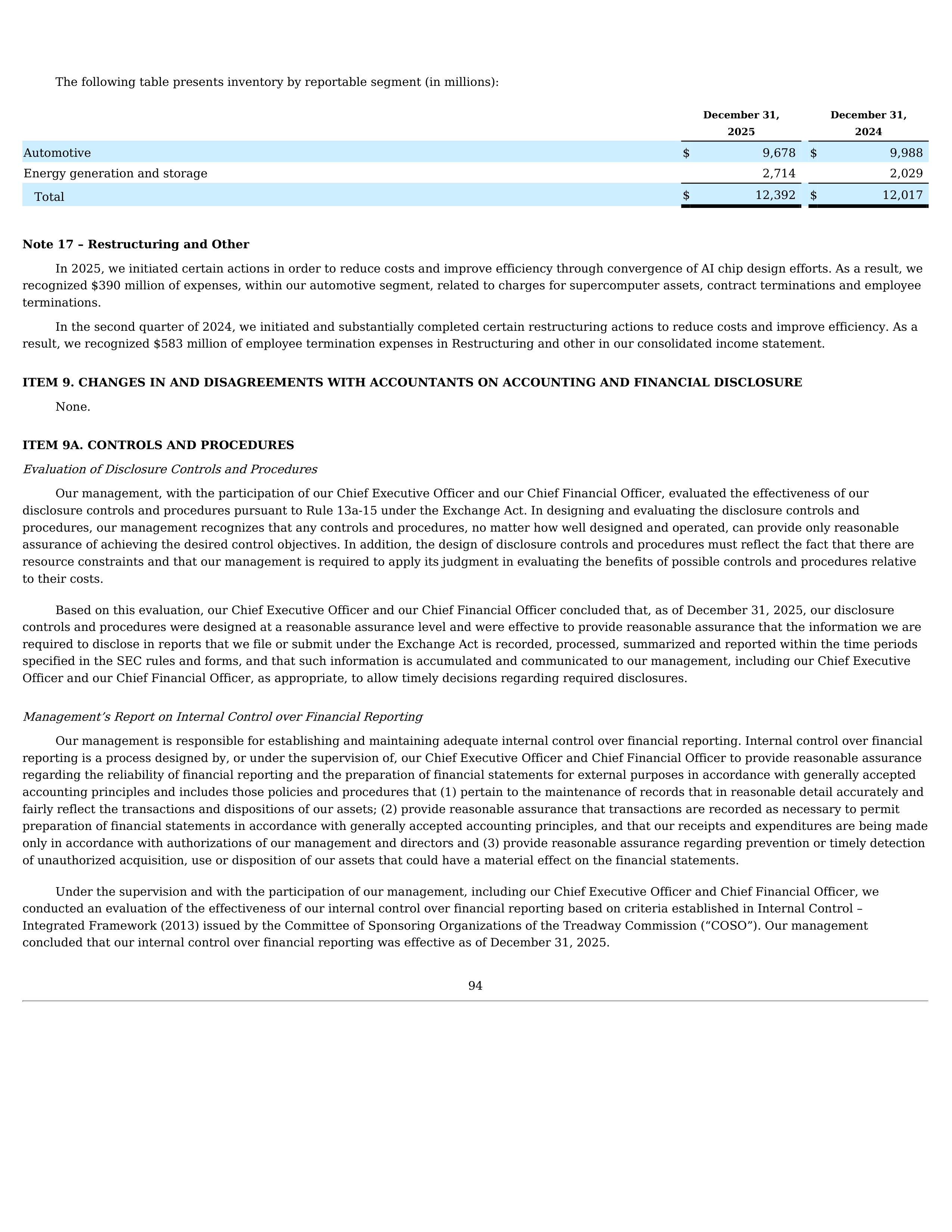
The following table presents inventory by reportable segment (in millions):
December 31,
2025
December 31,
2024
Automotive
$
9,678
$
9,988
Energy generation and storage
2,714
2,029
Total
$
12,392
$
12,017
Note 17 – Restructuring and Other
In 2025, we initiated certain actions in order to reduce costs and improve efficiency through convergence of AI chip design efforts. As a result, we
recognized $390 million of expenses, within our automotive segment, related to charges for supercomputer assets, contract terminations and employee
terminations.
In the second quarter of 2024, we initiated and substantially completed certain restructuring actions to reduce costs and improve efficiency. As a
result, we recognized $583 million of employee termination expenses in Restructuring and other in our consolidated income statement.
ITEM 9. CHANGES IN AND DISAGREEMENTS WITH ACCOUNTANTS ON ACCOUNTING AND FINANCIAL DISCLOSURE
None.
ITEM 9A. CONTROLS AND PROCEDURES
Evaluation of Disclosure Controls and Procedures
Our management, with the participation of our Chief Executive Officer and our Chief Financial Officer, evaluated the effectiveness of our
disclosure controls and procedures pursuant to Rule 13a-15 under the Exchange Act. In designing and evaluating the disclosure controls and
procedures, our management recognizes that any controls and procedures, no matter how well designed and operated, can provide only reasonable
assurance of achieving the desired control objectives. In addition, the design of disclosure controls and procedures must reflect the fact that there are
resource constraints and that our management is required to apply its judgment in evaluating the benefits of possible controls and procedures relative
to their costs.
Based on this evaluation, our Chief Executive Officer and our Chief Financial Officer concluded that, as of December 31, 2025, our disclosure
controls and procedures were designed at a reasonable assurance level and were effective to provide reasonable assurance that the information we are
required to disclose in reports that we file or submit under the Exchange Act is recorded, processed, summarized and reported within the time periods
specified in the SEC rules and forms, and that such information is accumulated and communicated to our management, including our Chief Executive
Officer and our Chief Financial Officer, as appropriate, to allow timely decisions regarding required disclosures.
Management’s Report on Internal Control over Financial Reporting
Our management is responsible for establishing and maintaining adequate internal control over financial reporting. Internal control over financial
reporting is a process designed by, or under the supervision of, our Chief Executive Officer and Chief Financial Officer to provide reasonable assurance
regarding the reliability of financial reporting and the preparation of financial statements for external purposes in accordance with generally accepted
accounting principles and includes those policies and procedures that (1) pertain to the maintenance of records that in reasonable detail accurately and
fairly reflect the transactions and dispositions of our assets; (2) provide reasonable assurance that transactions are recorded as necessary to permit
preparation of financial statements in accordance with generally accepted accounting principles, and that our receipts and expenditures are being made
only in accordance with authorizations of our management and directors and (3) provide reasonable assurance regarding prevention or timely detection
of unauthorized acquisition, use or disposition of our assets that could have a material effect on the financial statements.
Under the supervision and with the participation of our management, including our Chief Executive Officer and Chief Financial Officer, we
conducted an evaluation of the effectiveness of our internal control over financial reporting based on criteria established in Internal Control –
Integrated Framework (2013) issued by the Committee of Sponsoring Organizations of the Treadway Commission (“COSO”). Our management
concluded that our internal control over financial reporting was effective as of December 31, 2025.
94
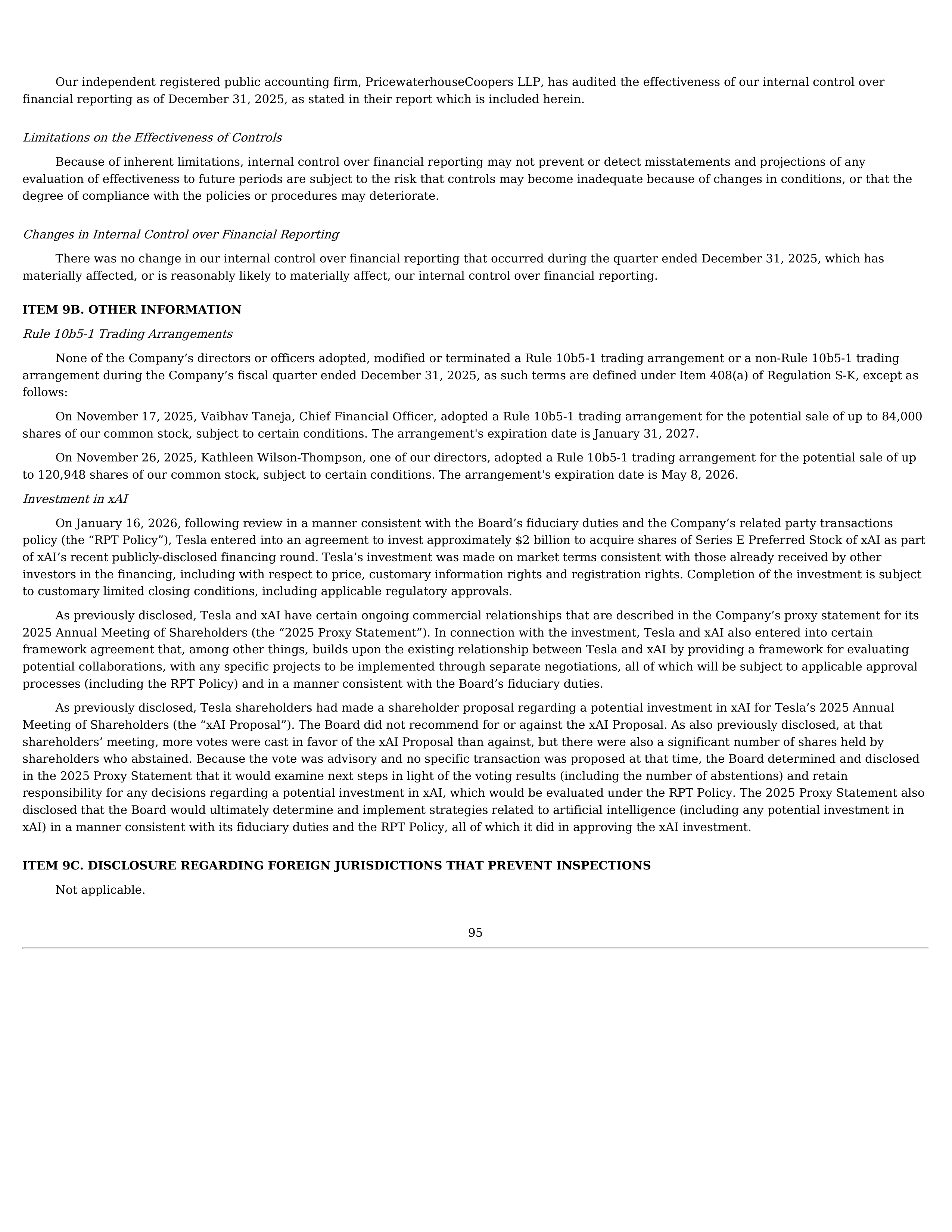
Our independent registered public accounting firm, PricewaterhouseCoopers LLP, has audited the effectiveness of our internal control over
financial reporting as of December 31, 2025, as stated in their report which is included herein.
Limitations on the Effectiveness of Controls
Because of inherent limitations, internal control over financial reporting may not prevent or detect misstatements and projections of any
evaluation of effectiveness to future periods are subject to the risk that controls may become inadequate because of changes in conditions, or that the
degree of compliance with the policies or procedures may deteriorate.
Changes in Internal Control over Financial Reporting
There was no change in our internal control over financial reporting that occurred during the quarter ended December 31, 2025, which has
materially affected, or is reasonably likely to materially affect, our internal control over financial reporting.
ITEM 9B. OTHER INFORMATION
Rule 10b5-1 Trading Arrangements
None of the Company’s directors or officers adopted, modified or terminated a Rule 10b5-1 trading arrangement or a non-Rule 10b5-1 trading
arrangement during the Company’s fiscal quarter ended December 31, 2025, as such terms are defined under Item 408(a) of Regulation S-K, except as
follows:
On November 17, 2025, Vaibhav Taneja, Chief Financial Officer, adopted a Rule 10b5-1 trading arrangement for the potential sale of up to 84,000
shares of our common stock, subject to certain conditions. The arrangement's expiration date is January 31, 2027.
On November 26, 2025, Kathleen Wilson-Thompson, one of our directors, adopted a Rule 10b5-1 trading arrangement for the potential sale of up
to 120,948 shares of our common stock, subject to certain conditions. The arrangement's expiration date is May 8, 2026.
Investment in xAI
On January 16, 2026, following review in a manner consistent with the Board’s fiduciary duties and the Company’s related party transactions
policy (the “RPT Policy”), Tesla entered into an agreement to invest approximately $2 billion to acquire shares of Series E Preferred Stock of xAI as part
of xAI’s recent publicly-disclosed financing round. Tesla’s investment was made on market terms consistent with those already received by other
investors in the financing, including with respect to price, customary information rights and registration rights. Completion of the investment is subject
to customary limited closing conditions, including applicable regulatory approvals.
As previously disclosed, Tesla and xAI have certain ongoing commercial relationships that are described in the Company’s proxy statement for its
2025 Annual Meeting of Shareholders (the “2025 Proxy Statement”). In connection with the investment, Tesla and xAI also entered into certain
framework agreement that, among other things, builds upon the existing relationship between Tesla and xAI by providing a framework for evaluating
potential collaborations, with any specific projects to be implemented through separate negotiations, all of which will be subject to applicable approval
processes (including the RPT Policy) and in a manner consistent with the Board’s fiduciary duties.
As previously disclosed, Tesla shareholders had made a shareholder proposal regarding a potential investment in xAI for Tesla’s 2025 Annual
Meeting of Shareholders (the “xAI Proposal”). The Board did not recommend for or against the xAI Proposal. As also previously disclosed, at that
shareholders’ meeting, more votes were cast in favor of the xAI Proposal than against, but there were also a significant number of shares held by
shareholders who abstained. Because the vote was advisory and no specific transaction was proposed at that time, the Board determined and disclosed
in the 2025 Proxy Statement that it would examine next steps in light of the voting results (including the number of abstentions) and retain
responsibility for any decisions regarding a potential investment in xAI, which would be evaluated under the RPT Policy. The 2025 Proxy Statement also
disclosed that the Board would ultimately determine and implement strategies related to artificial intelligence (including any potential investment in
xAI) in a manner consistent with its fiduciary duties and the RPT Policy, all of which it did in approving the xAI investment.
ITEM 9C. DISCLOSURE REGARDING FOREIGN JURISDICTIONS THAT PREVENT INSPECTIONS
Not applicable.
95
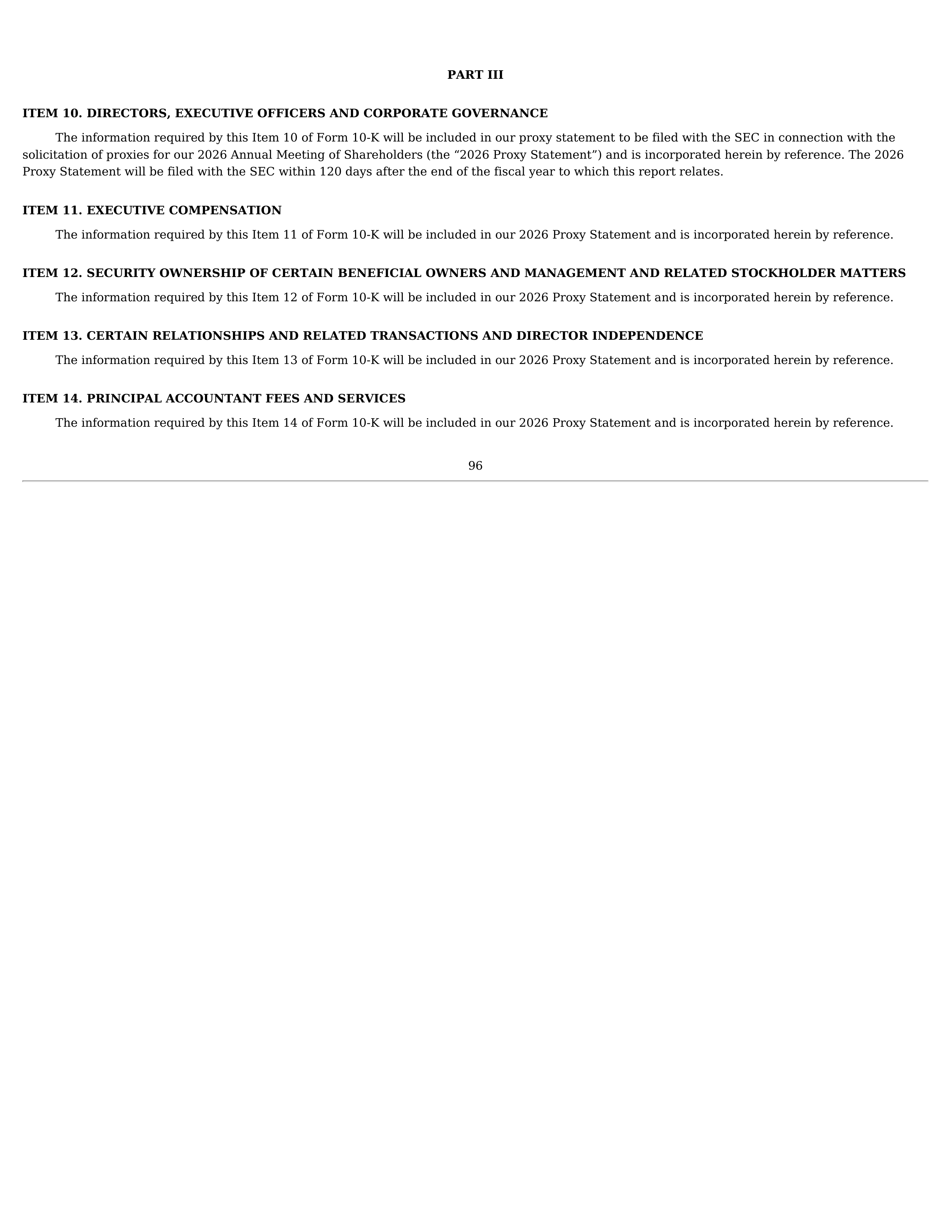
PART III
ITEM 10. DIRECTORS, EXECUTIVE OFFICERS AND CORPORATE GOVERNANCE
The information required by this Item 10 of Form 10-K will be included in our proxy statement to be filed with the SEC in connection with the
solicitation of proxies for our 2026 Annual Meeting of Shareholders (the “2026 Proxy Statement”) and is incorporated herein by reference. The 2026
Proxy Statement will be filed with the SEC within 120 days after the end of the fiscal year to which this report relates.
ITEM 11. EXECUTIVE COMPENSATION
The information required by this Item 11 of Form 10-K will be included in our 2026 Proxy Statement and is incorporated herein by reference.
ITEM 12. SECURITY OWNERSHIP OF CERTAIN BENEFICIAL OWNERS AND MANAGEMENT AND RELATED STOCKHOLDER MATTERS
The information required by this Item 12 of Form 10-K will be included in our 2026 Proxy Statement and is incorporated herein by reference.
ITEM 13. CERTAIN RELATIONSHIPS AND RELATED TRANSACTIONS AND DIRECTOR INDEPENDENCE
The information required by this Item 13 of Form 10-K will be included in our 2026 Proxy Statement and is incorporated herein by reference.
ITEM 14. PRINCIPAL ACCOUNTANT FEES AND SERVICES
The information required by this Item 14 of Form 10-K will be included in our 2026 Proxy Statement and is incorporated herein by reference.
96
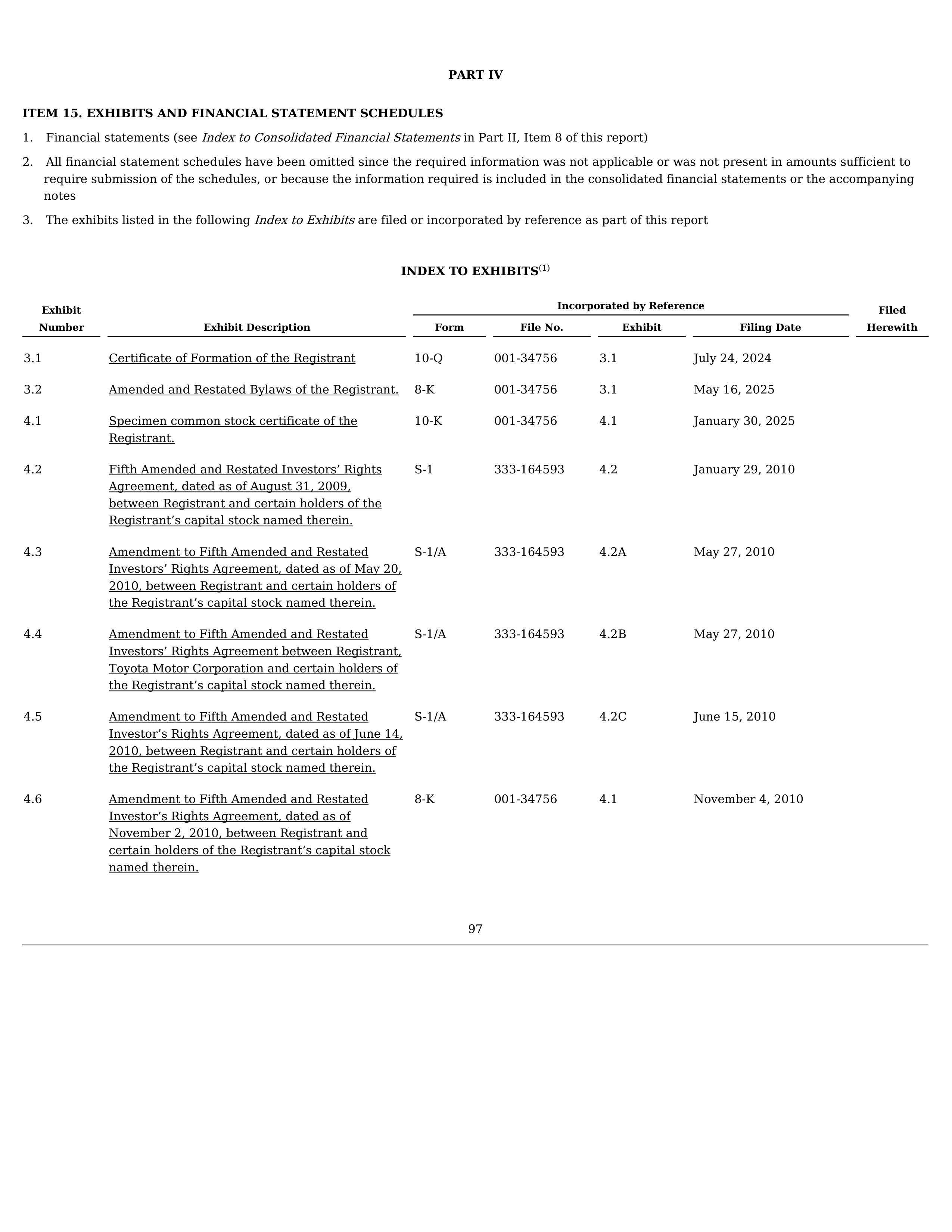
PART IV
ITEM 15. EXHIBITS AND FINANCIAL STATEMENT SCHEDULES
1.
Financial statements (see Index to Consolidated Financial Statements in Part II, Item 8 of this report)
2.
All financial statement schedules have been omitted since the required information was not applicable or was not present in amounts sufficient to
require submission of the schedules, or because the information required is included in the consolidated financial statements or the accompanying
notes
3.
The exhibits listed in the following Index to Exhibits are filed or incorporated by reference as part of this report
INDEX TO EXHIBITS
Exhibit
Number
Incorporated by Reference
Filed
Herewith
Exhibit Description
Form
File No.
Exhibit
Filing Date
3.1
Certificate of Formation of the Registrant
10-Q
001-34756
3.1
July 24, 2024
3.2
Amended and Restated Bylaws of the Registrant.
8-K
001-34756
3.1
May 16, 2025
4.1
Specimen common stock certificate of the
Registrant.
10-K
001-34756
4.1
January 30, 2025
4.2
Fifth Amended and Restated Investors’ Rights
Agreement, dated as of August 31, 2009,
between Registrant and certain holders of the
Registrant’s capital stock named therein.
S-1
333-164593
4.2
January 29, 2010
4.3
Amendment to Fifth Amended and Restated
Investors’ Rights Agreement, dated as of May 20,
2010, between Registrant and certain holders of
the Registrant’s capital stock named therein.
S-1/A
333-164593
4.2A
May 27, 2010
4.4
Amendment to Fifth Amended and Restated
Investors’ Rights Agreement between Registrant,
Toyota Motor Corporation and certain holders of
the Registrant’s capital stock named therein.
S-1/A
333-164593
4.2B
May 27, 2010
4.5
Amendment to Fifth Amended and Restated
Investor’s Rights Agreement, dated as of June 14,
2010, between Registrant and certain holders of
the Registrant’s capital stock named therein.
S-1/A
333-164593
4.2C
June 15, 2010
4.6
Amendment to Fifth Amended and Restated
Investor’s Rights Agreement, dated as of
November 2, 2010, between Registrant and
certain holders of the Registrant’s capital stock
named therein.
8-K
001-34756
4.1
November 4, 2010
(1)
97
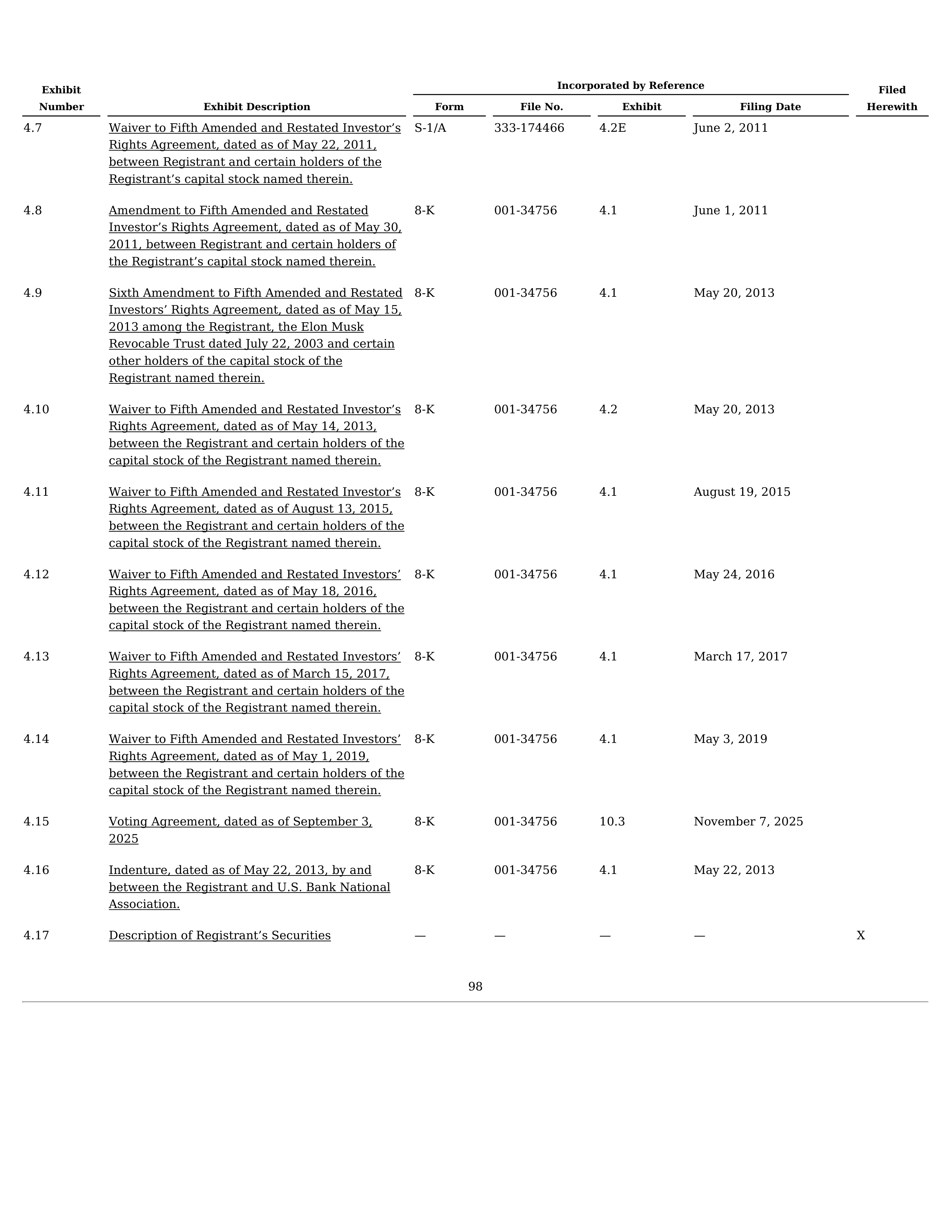
Exhibit
Number
Incorporated by Reference
Filed
Herewith
Exhibit Description
Form
File No.
Exhibit
Filing Date
4.7
Waiver to Fifth Amended and Restated Investor’s
Rights Agreement, dated as of May 22, 2011,
between Registrant and certain holders of the
Registrant’s capital stock named therein.
S-1/A
333-174466
4.2E
June 2, 2011
4.8
Amendment to Fifth Amended and Restated
Investor’s Rights Agreement, dated as of May 30,
2011, between Registrant and certain holders of
the Registrant’s capital stock named therein.
8-K
001-34756
4.1
June 1, 2011
4.9
Sixth Amendment to Fifth Amended and Restated
Investors’ Rights Agreement, dated as of May 15,
2013 among the Registrant, the Elon Musk
Revocable Trust dated July 22, 2003 and certain
other holders of the capital stock of the
Registrant named therein.
8-K
001-34756
4.1
May 20, 2013
4.10
Waiver to Fifth Amended and Restated Investor’s
Rights Agreement, dated as of May 14, 2013,
between the Registrant and certain holders of the
capital stock of the Registrant named therein.
8-K
001-34756
4.2
May 20, 2013
4.11
Waiver to Fifth Amended and Restated Investor’s
Rights Agreement, dated as of August 13, 2015,
between the Registrant and certain holders of the
capital stock of the Registrant named therein.
8-K
001-34756
4.1
August 19, 2015
4.12
Waiver to Fifth Amended and Restated Investors’
Rights Agreement, dated as of May 18, 2016,
between the Registrant and certain holders of the
capital stock of the Registrant named therein.
8-K
001-34756
4.1
May 24, 2016
4.13
Waiver to Fifth Amended and Restated Investors’
Rights Agreement, dated as of March 15, 2017,
between the Registrant and certain holders of the
capital stock of the Registrant named therein.
8-K
001-34756
4.1
March 17, 2017
4.14
Waiver to Fifth Amended and Restated Investors’
Rights Agreement, dated as of May 1, 2019,
between the Registrant and certain holders of the
capital stock of the Registrant named therein.
8-K
001-34756
4.1
May 3, 2019
4.15
Voting Agreement, dated as of September 3,
2025
8-K
001-34756
10.3
November 7, 2025
4.16
Indenture, dated as of May 22, 2013, by and
between the Registrant and U.S. Bank National
Association.
8-K
001-34756
4.1
May 22, 2013
4.17
Description of Registrant’s Securities
—
—
—
—
X
98
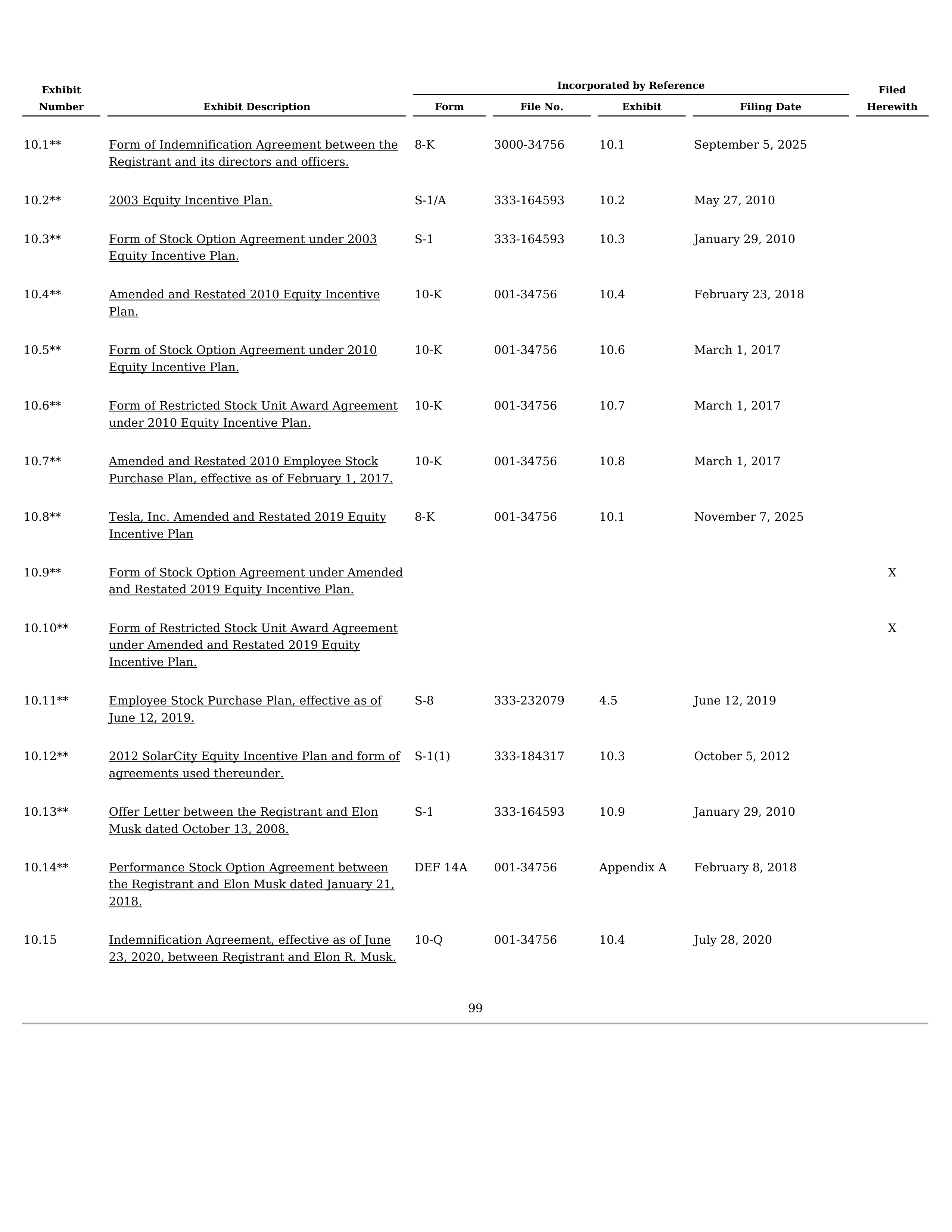
Exhibit
Number
Incorporated by Reference
Filed
Herewith
Exhibit Description
Form
File No.
Exhibit
Filing Date
10.1**
Form of Indemnification Agreement between the
Registrant and its directors and officers.
8-K
3000-34756
10.1
September 5, 2025
10.2**
2003 Equity Incentive Plan.
S-1/A
333-164593
10.2
May 27, 2010
10.3**
Form of Stock Option Agreement under 2003
Equity Incentive Plan.
S-1
333-164593
10.3
January 29, 2010
10.4**
Amended and Restated 2010 Equity Incentive
Plan.
10-K
001-34756
10.4
February 23, 2018
10.5**
Form of Stock Option Agreement under 2010
Equity Incentive Plan.
10-K
001-34756
10.6
March 1, 2017
10.6**
Form of Restricted Stock Unit Award Agreement
under 2010 Equity Incentive Plan.
10-K
001-34756
10.7
March 1, 2017
10.7**
Amended and Restated 2010 Employee Stock
Purchase Plan, effective as of February 1, 2017.
10-K
001-34756
10.8
March 1, 2017
10.8**
Tesla, Inc. Amended and Restated 2019 Equity
Incentive Plan
8-K
001-34756
10.1
November 7, 2025
10.9**
Form of Stock Option Agreement under Amended
and Restated 2019 Equity Incentive Plan.
X
10.10**
Form of Restricted Stock Unit Award Agreement
under Amended and Restated 2019 Equity
Incentive Plan.
X
10.11**
Employee Stock Purchase Plan, effective as of
June 12, 2019.
S-8
333-232079
4.5
June 12, 2019
10.12**
2012 SolarCity Equity Incentive Plan and form of
agreements used thereunder.
S-1(1)
333-184317
10.3
October 5, 2012
10.13**
Offer Letter between the Registrant and Elon
Musk dated October 13, 2008.
S-1
333-164593
10.9
January 29, 2010
10.14**
Performance Stock Option Agreement between
the Registrant and Elon Musk dated January 21,
2018.
DEF 14A
001-34756
Appendix A
February 8, 2018
10.15
Indemnification Agreement, effective as of June
23, 2020, between Registrant and Elon R. Musk.
10-Q
001-34756
10.4
July 28, 2020
99
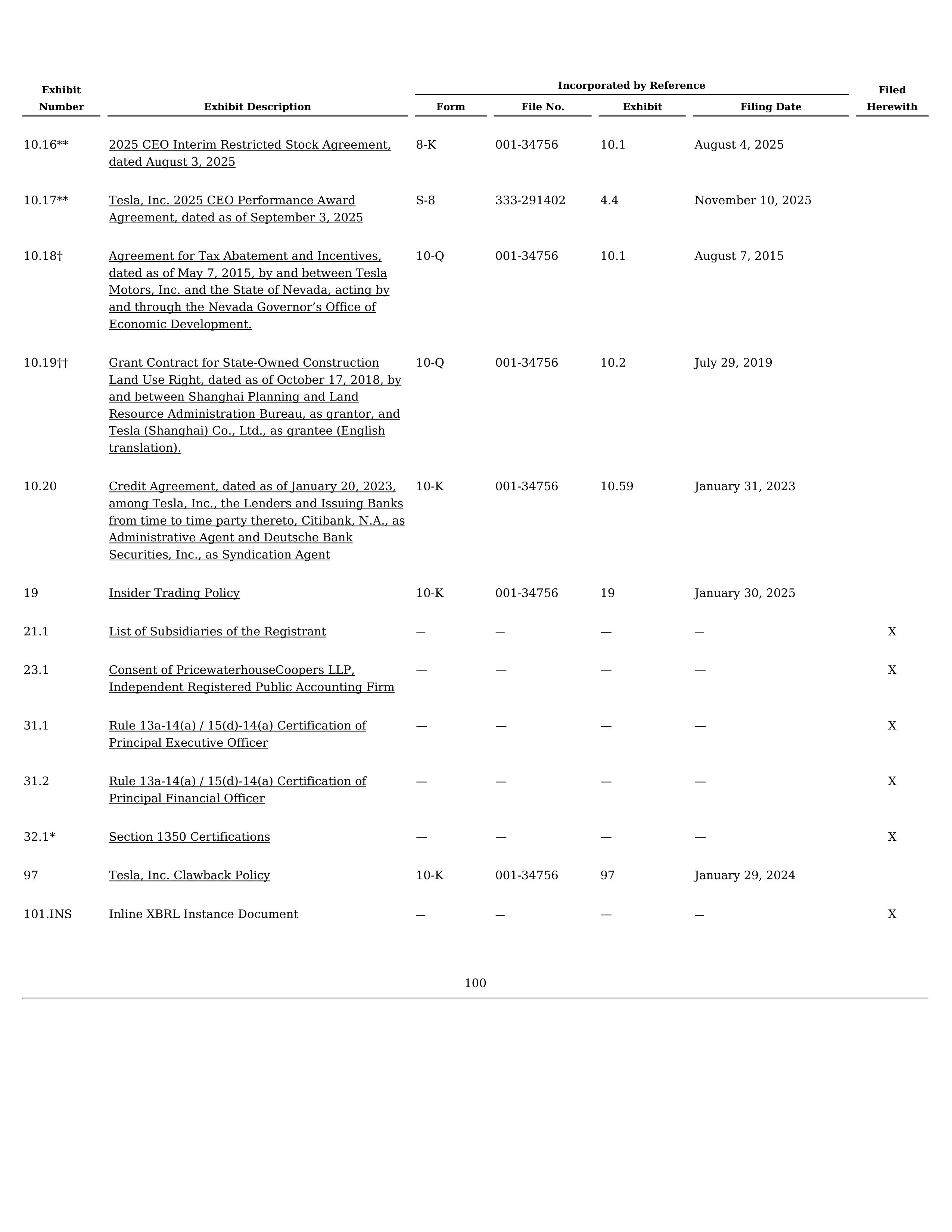
Exhibit
Number
Incorporated by Reference
Filed
Herewith
Exhibit Description
Form
File No.
Exhibit
Filing Date
10.16**
2025 CEO Interim Restricted Stock Agreement,
dated August 3, 2025
8-K
001-34756
10.1
August 4, 2025
10.17**
Tesla, Inc. 2025 CEO Performance Award
Agreement, dated as of September 3, 2025
S-8
333-291402
4.4
November 10, 2025
10.18†
Agreement for Tax Abatement and Incentives,
dated as of May 7, 2015, by and between Tesla
Motors, Inc. and the State of Nevada, acting by
and through the Nevada Governor’s Office of
Economic Development.
10-Q
001-34756
10.1
August 7, 2015
10.19††
Grant Contract for State-Owned Construction
Land Use Right, dated as of October 17, 2018, by
and between Shanghai Planning and Land
Resource Administration Bureau, as grantor, and
Tesla (Shanghai) Co., Ltd., as grantee (English
translation).
10-Q
001-34756
10.2
July 29, 2019
10.20
Credit Agreement, dated as of January 20, 2023,
among Tesla, Inc., the Lenders and Issuing Banks
from time to time party thereto, Citibank, N.A., as
Administrative Agent and Deutsche Bank
Securities, Inc., as Syndication Agent
10-K
001-34756
10.59
January 31, 2023
19
Insider Trading Policy
10-K
001-34756
19
January 30, 2025
21.1
List of Subsidiaries of the Registrant
—
—
—
—
X
23.1
Consent of PricewaterhouseCoopers LLP,
Independent Registered Public Accounting Firm
—
—
—
—
X
31.1
Rule 13a-14(a) / 15(d)-14(a) Certification of
Principal Executive Officer
—
—
—
—
X
31.2
Rule 13a-14(a) / 15(d)-14(a) Certification of
Principal Financial Officer
—
—
—
—
X
32.1*
Section 1350 Certifications
—
—
—
—
X
97
Tesla, Inc. Clawback Policy
10-K
001-34756
97
January 29, 2024
101.INS
Inline XBRL Instance Document
—
—
—
—
X
100
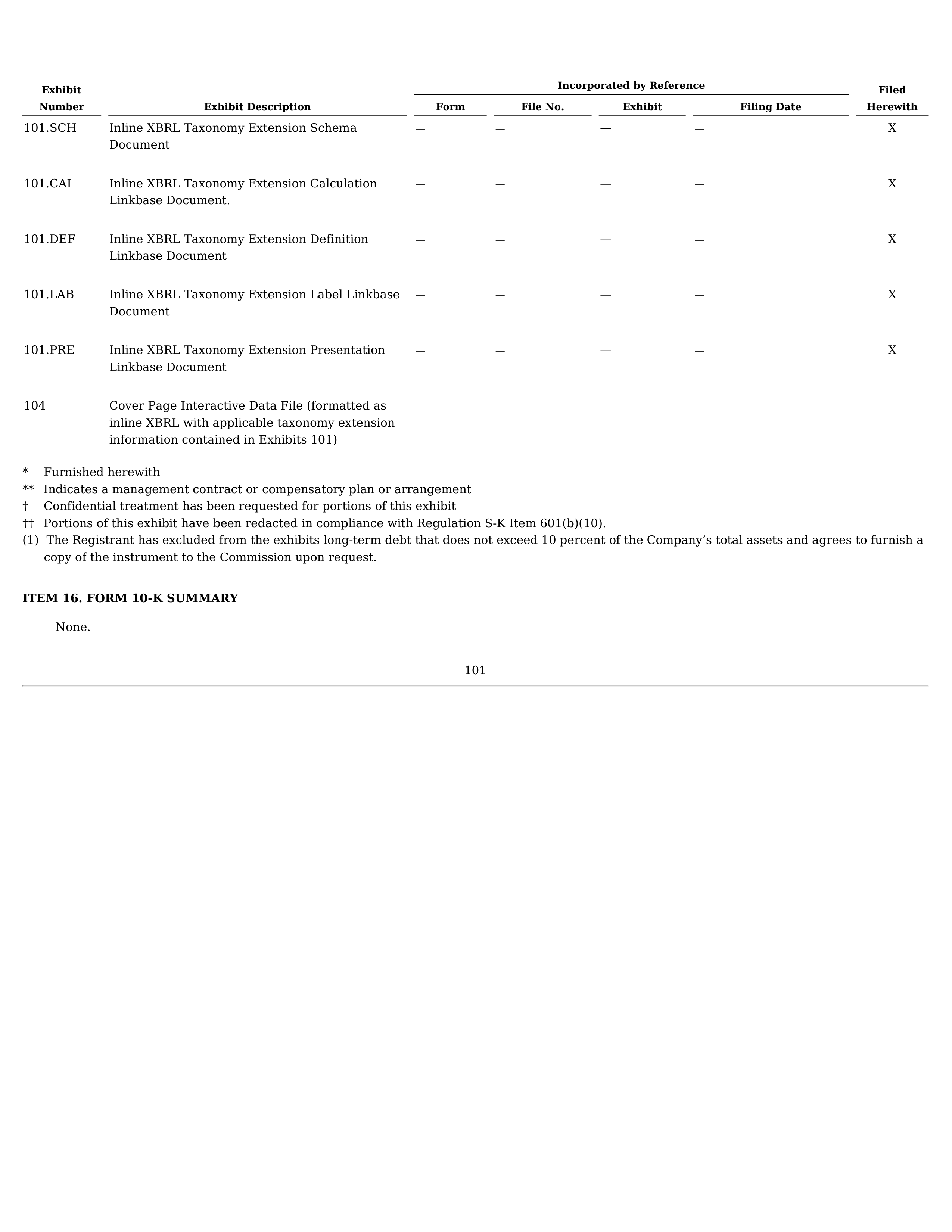
Exhibit
Number
Incorporated by Reference
Filed
Herewith
Exhibit Description
Form
File No.
Exhibit
Filing Date
101.SCH
Inline XBRL Taxonomy Extension Schema
Document
—
—
—
—
X
101.CAL
Inline XBRL Taxonomy Extension Calculation
Linkbase Document.
—
—
—
—
X
101.DEF
Inline XBRL Taxonomy Extension Definition
Linkbase Document
—
—
—
—
X
101.LAB
Inline XBRL Taxonomy Extension Label Linkbase
Document
—
—
—
—
X
101.PRE
Inline XBRL Taxonomy Extension Presentation
Linkbase Document
—
—
—
—
X
104
Cover Page Interactive Data File (formatted as
inline XBRL with applicable taxonomy extension
information contained in Exhibits 101)
*
Furnished herewith
**
Indicates a management contract or compensatory plan or arrangement
†
Confidential treatment has been requested for portions of this exhibit
††
Portions of this exhibit have been redacted in compliance with Regulation S-K Item 601(b)(10).
(1)
The Registrant has excluded from the exhibits long-term debt that does not exceed 10 percent of the Company’s total assets and agrees to furnish a
copy of the instrument to the Commission upon request.
ITEM 16. FORM 10-K SUMMARY
None.
101
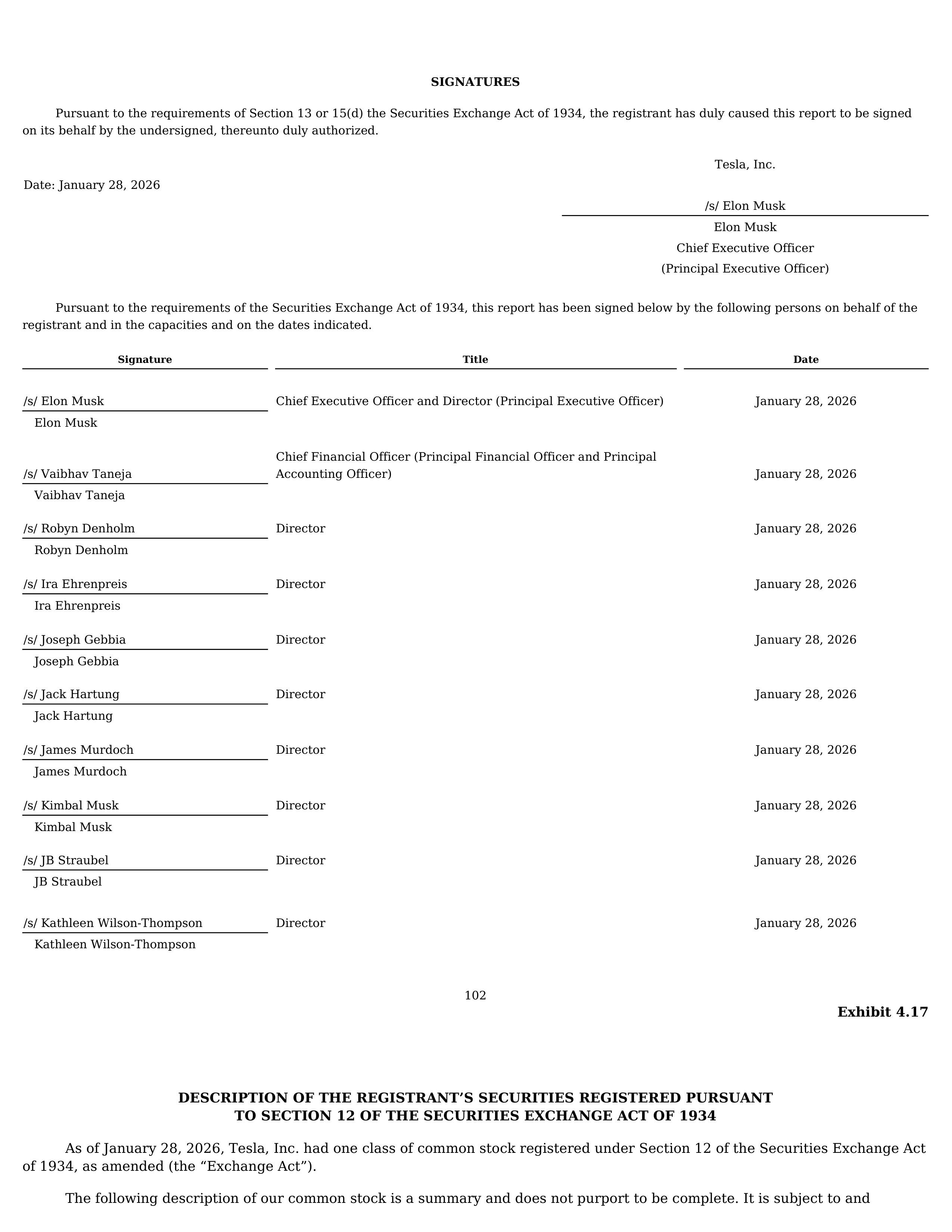
SIGNATURES
Pursuant to the requirements of Section 13 or 15(d) the Securities Exchange Act of 1934, the registrant has duly caused this report to be signed
on its behalf by the undersigned, thereunto duly authorized.
Tesla, Inc.
Date: January 28, 2026
/s/ Elon Musk
Elon Musk
Chief Executive Officer
(Principal Executive Officer)
Pursuant to the requirements of the Securities Exchange Act of 1934, this report has been signed below by the following persons on behalf of the
registrant and in the capacities and on the dates indicated.
Signature
Title
Date
/s/ Elon Musk
Chief Executive Officer and Director (Principal Executive Officer)
January 28, 2026
Elon Musk
/s/ Vaibhav Taneja
Chief Financial Officer (Principal Financial Officer and Principal
Accounting Officer)
January 28, 2026
Vaibhav Taneja
/s/ Robyn Denholm
Director
January 28, 2026
Robyn Denholm
/s/ Ira Ehrenpreis
Director
January 28, 2026
Ira Ehrenpreis
/s/ Joseph Gebbia
Director
January 28, 2026
Joseph Gebbia
/s/ Jack Hartung
Director
January 28, 2026
Jack Hartung
/s/ James Murdoch
Director
January 28, 2026
James Murdoch
/s/ Kimbal Musk
Director
January 28, 2026
Kimbal Musk
/s/ JB Straubel
Director
January 28, 2026
JB Straubel
/s/ Kathleen Wilson-Thompson
Director
January 28, 2026
Kathleen Wilson-Thompson
Exhibit 4.17
DESCRIPTION OF THE REGISTRANT’S SECURITIES REGISTERED PURSUANT
TO SECTION 12 OF THE SECURITIES EXCHANGE ACT OF 1934
As of January 28, 2026, Tesla, Inc. had one class of common stock registered under Section 12 of the Securities Exchange Act
of 1934, as amended (the “Exchange Act”).
The following description of our common stock is a summary and does not purport to be complete. It is subject to and
102
qualified in its entirety by reference to our certificate of formation (the “Certificate of Formation”) and our bylaws (the “Bylaws”),
each of which is incorporated herein by reference as an exhibit to the Annual Report on Form 10-K filed with the Securities and
Exchange Commission, of which this Exhibit 4.17 is a part. We encourage you to read our Certificate of Formation, our Bylaws and
the applicable provisions of the Texas Business Organizations Code (the “TBOC”) for additional information.
Authorized Capital Stock
Our authorized capital stock consists of 6,100,000,000 shares, with a par value of $0.001 per share, of which 6,000,000,000
shares are designated as common stock.
The holders of common stock are entitled to one vote per share on all matters submitted to a vote of our shareholders and do
not have cumulative voting rights. Accordingly, holders of a majority of the shares of common stock entitled to vote in any election
of directors have the power to elect all of the directors standing for election. Subject to preferences that may be applicable to any
preferred stock outstanding at the time, the holders of outstanding shares of common stock are entitled to receive ratably any
dividends declared by our board of directors out of assets legally available. Upon our liquidation, dissolution or winding up, holders
of our common stock are entitled to share ratably in all assets remaining after payment of liabilities and the liquidation preference
of any then outstanding shares of preferred stock. Holders of common stock have no preemptive or conversion rights or other
subscription rights. There are no redemption or sinking fund provisions applicable to the common stock.
We have certain outstanding securities that may be converted, exercised or exchanged into shares of our common stock.
Registration Rights
Certain holders of unregistered common stock purchased in private placements, or their permitted transferees, are entitled
to rights with respect to the registration of such shares under the Securities Act of 1933, as amended, or the Securities Act. These
rights are provided under the terms of an investors’ rights agreement between us and the holders of these shares, or the investors’
rights agreement, and include demand registration rights, short-form registration rights and piggyback registration rights. All fees,
costs and expenses of underwritten registrations will be borne by us and all selling expenses, including underwriting discounts and
selling commissions, will be borne by the holders of the shares being sold.
The registration rights terminate with respect to an individual holder after the date that is five years following such time
when the holder can sell all of the holder’s shares in any three month period under Rule 144 or another similar exemption under
the Securities Act, unless such holder holds at least 2% of our voting stock.
Listing
Our common stock is listed on the Nasdaq Global Select Market under the symbol “TSLA.”
Transfer Agent and Registrar
The transfer agent and registrar for our common stock is Computershare Trust Company, N.A.
Anti-Takeover Effects of Texas Law and Our Certificate of Formation and Bylaws
Our Certificate of Formation and our Bylaws contain certain provisions that could have the effect of delaying, deterring or
preventing another party from acquiring control of us. These provisions and certain provisions of Texas law, which are summarized
below, are expected to discourage coercive takeover practices and inadequate takeover bids. These provisions are also designed, in
part, to encourage persons seeking to acquire control of us to negotiate first with our board of directors. We believe that the
benefits of increased protection of our potential ability to negotiate more favorable terms with an unfriendly or unsolicited acquirer
outweigh the disadvantages of discouraging a proposal to acquire us.
Limits on Ability of Shareholders to Act by Written Consent or Call a Special Meeting
Our Certificate of Formation provides that our shareholders may act by written consent only if all holders of shares entitled
to vote on such action adopts a resolution by unanimous written consent. This may deter action by written consent or lengthen the
amount of time required to take shareholder actions. As a result, even a holder controlling a majority of our capital stock would not
be able to amend our Bylaws or remove directors without holding a meeting of our shareholders called in accordance with our
Bylaws.
In addition, our Certificate of Formation provides that special meetings of shareholders may be called by the chairperson of
the board, the chief executive officer, the president (to the extent required by the TBOC), our board of directors, or by shareholders
holding not less than 50% (or the highest percentage of ownership that may be set under the TBOC) of the Corporation’s then
outstanding shares of capital stock entitled to vote at such meeting. The threshold required for shareholders to call a special
meeting may delay the ability of our shareholders to force consideration of a proposal or for holders controlling a majority of our
capital stock to take any action, including the removal of directors.
Requirements for Advance Notification of Shareholder Nominations and Proposals
Our Bylaws establish advance notice procedures with respect to shareholder proposals and the nomination of candidates for
election as directors, other than nominations made by or at the direction of our board of directors or a committee of our board of
directors. These provisions may have the effect of
2
precluding the conduct of certain business at a meeting if the proper procedures are not followed. These provisions may also
discourage or deter a potential acquirer from conducting a solicitation of proxies to elect the acquirer’s own slate of directors or
otherwise attempting to obtain control of our company.
Board Classification
Our board of directors is divided into three classes, one of which classes is elected each year by our shareholders to serve for
a three-year term. A third party may be discouraged from making a tender offer or otherwise attempting to obtain control of us as it
is more difficult and time-consuming for shareholders to replace a majority of the directors on a classified board.
No Cumulative Voting
Our Certificate of Formation and Bylaws do not permit cumulative voting in the election of directors. Cumulative voting
allows a shareholder to vote a portion or all of its shares for one or more candidates for seats on the board of directors. Without
cumulative voting, a minority stockholder may not be able to gain as many seats on our board of directors as the shareholder would
be able to gain if cumulative voting were permitted. The absence of cumulative voting makes it more difficult for a minority
shareholder to gain a seat on our board of directors to influence our board’s decision regarding a takeover.
Amendment of Certificate of Formation Provisions
The amendment of our Certificate of Formation requires approval by holders of at least two-thirds of our outstanding capital
stock entitled to vote generally in the election of directors.
Texas Anti-Takeover Statute
We are subject to the provisions of Section 21.606 of the TBOC regulating corporate takeovers. In general, Section 21.606
prohibits a publicly held Texas corporation from engaging, under certain circumstances, in a business combination with an
affiliated shareholder for a period of three years following the date the person became an affiliated shareholder unless:
•
prior to the date of the transaction, our board of directors approved either the business combination or the transaction
that resulted in the shareholder becoming an affiliated stockholder; or
•
at or subsequent to the date of the transaction, the business combination is approved by our board of directors and
authorized at an annual or special meeting of shareholders, and not by written consent, by the affirmative vote of at
least two-thirds of the outstanding voting stock which is not owned by the affiliated stockholder at a meeting of
shareholders called for that purpose not less than six months after the affiliated shareholder’s share acquisition date.
Generally, a business combination includes a merger, share exchange, asset or stock sale, or other transaction resulting in a
financial benefit to the interested stockholder. An interested shareholder is a person who, together with affiliates and associates,
owns or, within three years prior to the determination
3
of interested shareholder status did own, 15% or more of a corporation’s outstanding voting stock. We expect the existence of this
provision to have an anti-takeover effect with respect to transactions our board of directors does not approve in advance. We also
anticipate that Section 21.606 may also discourage attempts that might result in a premium over the market price for the shares of
common stock held by shareholders.
The provisions of Texas law and the provisions of our Certificate of Formation and Bylaws could have the effect of
discouraging others from attempting hostile takeovers and, as a consequence, they might also inhibit temporary fluctuations in the
market price of our common stock that often result from actual or rumored hostile takeover attempts. These provisions might also
have the effect of preventing changes in our management. It is possible that these provisions could make it more difficult to
accomplish transactions that shareholders might otherwise deem to be in their best interests.
Exhibit 10.9
TESLA, INC.
AMENDED AND RESTATED 2019 EQUITY INCENTIVE PLAN
STOCK OPTION AWARD AGREEMENT
Unless otherwise defined herein, the terms defined in the Tesla, Inc. Amended and Restated 2019 Equity Incentive Plan
(the “Plan”) will have the same defined meanings in this Stock Option Award Agreement (the “Award Agreement”).
NOTICE OF STOCK OPTION GRANT
Participant Name:
Address:
Participant has been granted an Option to purchase Common Stock of Tesla, Inc. (the “Company”), subject to the
terms and conditions of the Plan and this Award Agreement, as follows:
Grant Number
Date of Grant
Vesting Commencement Date
Exercise Price per Share
Total Number of Shares Granted
Total Exercise Price
Type of Option
Term/Expiration date
Vesting Schedule:
Subject to any acceleration provisions contained in the Plan or set forth below, the Option may be exercised, in whole
or in part, in accordance with the following schedule:
[insert vesting schedule]
Termination Period:
The Option will be exercisable for three (3) months after Participant ceases to be a Service Provider, unless such
termination is due to Participant’s death or Disability, in which case the Option will be exercisable for twelve (12) months
after Participant ceases to be a Service Provider. Notwithstanding the forgoing, in no event may the Option be exercised
after the Term/Expiration date as provided above and may be subject to earlier termination as provided in Section 14 of the
Plan.
4

By Participant’s acceptance of this Award Agreement either electronically through the electronic acceptance
procedure established by the Company or through a written acceptance delivered to the Company in a form satisfactory to
the Company, Participant agrees that the Option is granted under and governed by the terms and conditions of the Plan
and this Award Agreement, including the Terms and Conditions of Stock Option Grant, attached hereto as Exhibit A, all of
which are made a part of this document. Participant has reviewed the Plan and this Award Agreement in their entirety, has
had an opportunity to obtain the advice of counsel prior to executing this Award Agreement and fully understands all
provisions of the Plan and Award Agreement. Participant hereby agrees to accept as final and binding and non-reviewable
and non-appealable all decisions or interpretations of the Administrator upon any questions relating to the Plan and Award
Agreement. Participant further agrees to notify the Company upon any change in the residence address indicated below.
In witness whereof, Tesla, Inc. has caused this Agreement to be executed on its behalf by its duly-authorized officer
on the day and year first indicated above.
TESLA, INC.
By:
Title
EXHIBIT A
TERMS AND CONDITIONS OF STOCK OPTION GRANT
1. Grant of Option. The Company hereby grants to Participant named in the Notice of Grant attached as Part I of
this Award Agreement (“Participant”) an option (the “Option”) to purchase the number of Shares, as set forth in the Notice
of Grant, at the exercise price per Share set forth in the Notice of Grant (the “Exercise Price”), subject to all of the terms
and conditions in this Award Agreement and the Plan, which is incorporated herein by reference. Subject to Section 19(c)
of the Plan, in the event of a conflict between the terms and conditions of the Plan and the terms and conditions of this
Award Agreement, the terms and conditions of the Plan will prevail.
If designated in the Notice of Grant as an Incentive Stock Option (“ISO”), the Option is intended to qualify as an
ISO under Section 422 of the Internal Revenue Code of 1986, as amended (the “Code”). However, if the Option is intended
to be an ISO, to the extent that it exceeds the $100,000 rule of Code Section 422(d) it will be treated as a Nonstatutory
Stock Option (“NSO”). Further, if for any reason the Option (or portion thereof) will not qualify as an ISO, then, to the
extent of such nonqualification, such Option (or portion thereof) shall be regarded as a NSO granted under the Plan. In no
event will the Administrator, the Company or any Parent or Subsidiary or any of their respective employees or directors
have any liability to Participant (or any other person) due to the failure of the Option to qualify for any reason as an ISO.
2. Vesting Schedule. Except as provided in Section 3, the Option awarded by this Award Agreement will vest in
accordance with the vesting provisions set forth in the Notice of Grant. Shares scheduled to vest on a certain date or upon
the occurrence of a certain condition will not vest in accordance with any of the provisions of this Award Agreement unless
Participant will have been continuously a Service Provider from the Date of Grant until the date such vesting occurs.
3. Administrator Discretion. The Administrator, in its discretion, may accelerate the vesting of the balance, or some
lesser portion of the balance, of the unvested Option at any time, subject to the terms of the Plan. If so accelerated, such
Option will be considered as having vested as of the date specified by the Administrator.
4. Exercise of Option.
(a) Right to Exercise. The Option may be exercised only within the term set out in the Notice of Grant, and may be
exercised during such term only in accordance with the Plan and the terms of this Award Agreement.
(b) Method of Exercise. The Option is exercisable by delivery of an exercise notice, in the form attached as Exhibit
B (the “Exercise Notice”) or in a manner and pursuant to such procedures as the Administrator may determine, which will
state the election to exercise the Option, the number of Shares in respect of which the Option is being exercised (the
“Exercised Shares”), and such other representations and agreements as may be required by the Company
pursuant to the provisions of the Plan. The Exercise Notice will be completed by Participant and delivered to the Company.
The Exercise Notice will be accompanied by payment of the aggregate Exercise Price as to all Exercised Shares together
with any applicable tax withholding. The Option will be deemed to be exercised upon receipt by the Company of such fully
executed Exercise Notice accompanied by such aggregate Exercise Price.
5. Method of Payment. Payment of the aggregate Exercise Price will be by any of the following, or a combination
thereof, at the election of Participant:
(a) cash;
(b) check;
(c) consideration received by the Company under a formal cashless exercise program adopted by the Company in
connection with the Plan; or
(d) surrender of other Shares which have a Fair Market Value on the date of surrender equal to the aggregate
Exercise Price of the Exercised Shares, provided that accepting such Shares, in the sole discretion of the Administrator,
will not result in any adverse accounting consequences to the Company.
6. Tax Obligations.
(a) Withholding Taxes. Notwithstanding any contrary provision of this Award Agreement, no certificate
representing the Shares will be issued to Participant, unless and until satisfactory arrangements (as determined by the
Administrator) will have been made by Participant with respect to the payment of income, employment and other taxes
which the Company determines must be withheld with respect to such Shares. To the extent determined appropriate by the
Company in its discretion, it will have the right (but not the obligation) to satisfy any tax withholding obligations by
reducing the number of Shares otherwise deliverable to Participant. If Participant fails to make satisfactory arrangements
for the payment of any required tax withholding obligations hereunder at the time of the Option exercise, Participant
acknowledges and agrees that the Company may refuse to honor the exercise and refuse to deliver Shares if such
withholding amounts are not delivered at the time of exercise.
(b) Notice of Disqualifying Disposition of ISO Shares. If the Option granted to Participant herein is an ISO, and if
Participant sells or otherwise disposes of any of the Shares acquired pursuant to the ISO on or before the later of (i) the
date two (2) years after the Grant Date, or (ii) the date one (1) year after the date of exercise, Participant will immediately
notify the Company in writing (which, for clarity, includes electronic communications) of such disposition. Participant
agrees that Participant may be subject to income tax withholding by the Company on the compensation income recognized
by Participant.
(c) Code Section 409A. Under Code Section 409A, an option that vests after December 31, 2004 (or that vested on
or prior to such date but which was materially modified after October 3, 2004) that was granted with a per Share exercise
price that is determined by the Internal Revenue Service (the “IRS”) to be less than the Fair Market Value of a Share on the
date of grant (a “Discount Option”) may be considered “deferred compensation.” A Discount Option
may result in (i) income recognition by Participant prior to the exercise of the option, (ii) an additional twenty percent
(20%) federal income tax, and (iii) potential penalty and interest charges. The Discount Option may also result in additional
state income, penalty and interest charges to Participant. Participant acknowledges that the Company cannot and has not
guaranteed that the IRS will agree that the per Share exercise price of the Option equals or exceeds the Fair Market Value
of a Share on the Date of Grant in a later examination. Participant agrees that if the IRS determines that the Option was
granted with a per Share exercise price that was less than the Fair Market Value of a Share on the date of grant,
Participant will be solely responsible for Participant’s costs related to such a determination.
7. Rights as Shareholder. Neither Participant nor any person claiming under or through Participant will have any of
the rights or privileges of a shareholder of the Company in respect of any Shares deliverable hereunder unless and until
certificates representing such Shares will have been issued, recorded on the records of the Company or its transfer agents
or registrars, and delivered to Participant. After such issuance, recordation and delivery, Participant will have all the rights
of a shareholder of the Company with respect to voting such Shares and receipt of dividends and distributions on such
Shares.
8. No Guarantee of Continued Service. PARTICIPANT ACKNOWLEDGES AND AGREES THAT THE VESTING OF
SHARES PURSUANT TO THE VESTING SCHEDULE HEREOF IS EARNED ONLY BY CONTINUING AS A SERVICE
PROVIDER AT THE WILL OF THE COMPANY (OR THE PARENT OR SUBSIDIARY EMPLOYING OR RETAINING
PARTICIPANT) AND NOT THROUGH THE ACT OF BEING HIRED, BEING GRANTED THE OPTION OR ACQUIRING
SHARES HEREUNDER. PARTICIPANT FURTHER ACKNOWLEDGES AND AGREES THAT THIS AWARD AGREEMENT,
THE TRANSACTIONS CONTEMPLATED HEREUNDER AND THE VESTING SCHEDULE SET FORTH HEREIN DO NOT
CONSTITUTE AN EXPRESS OR IMPLIED PROMISE OF CONTINUED ENGAGEMENT AS A SERVICE PROVIDER FOR THE
VESTING PERIOD, FOR ANY PERIOD, OR AT ALL, AND WILL NOT INTERFERE IN ANY WAY WITH PARTICIPANT’S
RIGHT OR THE RIGHT OF THE COMPANY (OR THE PARENT OR SUBSIDIARY EMPLOYING OR RETAINING
PARTICIPANT) TO TERMINATE PARTICIPANT’S RELATIONSHIP AS A SERVICE PROVIDER AT ANY TIME, WITH OR
WITHOUT CAUSE.
9. Address for Notices. Any notice to be given to the Company under the terms of this Award Agreement will be
addressed to the Company at Tesla, Inc., Attention: Stock Administrator, 1 Tesla Road, Austin, TX 78725, or at such other
address as the Company may hereafter designate in writing (which, for clarity, includes electronic communications).
10. Non-Transferability of Option. The Option may not be transferred in any manner otherwise than by will or by the
laws of descent or distribution and may be exercised during the lifetime of Participant only by Participant.
11. Binding Agreement. Subject to the limitation on the transferability of the Option contained herein, this Award
Agreement will be binding upon and inure to the benefit of the heirs, legatees, legal representatives, successors and
assigns of the parties hereto.
12. Additional Conditions to Issuance of Stock. If at any time the Administrator will determine, in its sole discretion,
that the listing, registration or qualification of the Shares upon any securities exchange or under any state or federal law,
or the consent or approval of any governmental regulatory authority is necessary or desirable as a condition to the issuance
of Shares to Participant (or his or her estate), such issuance will not occur unless and until such listing, registration,
qualification, consent or approval will have been effected or obtained free of any conditions not acceptable to the
Administrator. The Company will make all reasonable efforts to meet the requirements of any such state or federal law or
securities exchange and to obtain any such consent or approval of any such governmental authority. Assuming such
compliance, for income tax purposes the Exercised Shares will be considered transferred to Participant on the date the
Option is exercised with respect to such Exercised Shares.
13. Recoupment. Notwithstanding any other provision herein, the Option and any Shares or other amount or property
that may be issued, delivered or paid in respect of the Option, as well as any consideration that may be received in respect
of a sale or other disposition of any such Shares or property, shall be subject to any recoupment, “clawback” or similar
provisions of applicable law, as well as any recoupment or “clawback” policies of the Company that may be in effect from
time to time. In addition, the Company may require Participant to deliver or otherwise repay to the Company the Option
and any Shares or other amount or property that may be issued, delivered or paid in respect of the Option, as well as any
consideration that may be received in respect of a sale or other disposition of any such Shares or property, if the Company
reasonably determines that one or more of the following has occurred:
(a) during the period of Participant’s status as a Service Provider with the Company or any of its Subsidiaries (the
“Service Period”), Participant has committed a felony (under the laws of the United States or any relevant state, or a
similar crime or offense under the applicable laws of any relevant foreign jurisdiction);
(b) during the Service Period or at any time thereafter, Participant has committed or engaged in a breach of
confidentiality, or an unauthorized disclosure or use of inside information, customer lists, trade secrets or other
confidential information of the Company or any of its Subsidiaries; or
(c) during the Service Period or at any time thereafter, Participant has committed or engaged in an act of theft,
embezzlement or fraud, or materially breached any agreement to which Participant is a party with the Company or any of
its Subsidiaries.
14. Plan Governs. This Award Agreement is subject to all terms and provisions of the Plan. In the event of a conflict
between one or more provisions of this Award Agreement and one or more provisions of the Plan, the provisions of the Plan
will govern. Capitalized terms used and not defined in this Award Agreement will have the meaning set forth in the Plan.
15. Administrator Authority. The Administrator will have the power to interpret the Plan and this Award Agreement
and to adopt such rules for the administration, interpretation and application of the Plan as are consistent therewith and to
interpret or revoke any such rules (including, but not limited to, the determination of whether or not any Shares subject to
the Option have vested). All actions taken and all interpretations and determinations made by the
Administrator in good faith will be final and binding and non-reviewable and non-appealable upon Participant, the Company
and all other interested persons. No member of the Administrator will be personally liable for any action, determination or
interpretation made in good faith with respect to the Plan or this Award Agreement.
16. Electronic Delivery. The Company may, in its sole discretion, decide to deliver any documents related to Options
awarded under the Plan or future options that may be awarded under the Plan by electronic means or request Participant’s
consent to participate in the Plan by electronic means. Participant hereby consents to receive such documents by electronic
delivery and agrees to participate in the Plan through any on-line or electronic system established and maintained by the
Company or another third party designated by the Company.
17. Captions. Captions provided herein are for convenience only and are not to serve as a basis for interpretation or
construction of this Award Agreement.
18. Agreement Severable. In the event that any provision in this Award Agreement will be held invalid or
unenforceable, such provision will be severable from, and such invalidity or unenforceability will not be construed to have
any effect on, the remaining provisions of this Award Agreement.
19. Modifications to the Agreement. This Award Agreement constitutes the entire understanding of the parties on the
subjects covered. Participant expressly warrants that he or she is not accepting this Award Agreement in reliance on any
promises, representations, or inducements other than those contained herein. Modifications to this Award Agreement or
the Plan can be made only in an express written contract executed by a duly authorized officer of the Company.
Notwithstanding anything to the contrary in the Plan or this Award Agreement, the Company reserves the right to revise
this Award Agreement as it deems necessary or advisable, in its sole discretion and without the consent of Participant, to
comply with Code Section 409A or to otherwise avoid imposition of any additional tax or income recognition under Code
Section 409A in connection to the Option.
20. Amendment, Suspension or Termination of the Plan. By accepting this Award, Participant expressly warrants that
he or she has received an Option under the Plan, and has received, read and understood a description of the Plan.
Participant understands that the Plan is discretionary in nature and may be amended, suspended or terminated by the
Company at any time.
21. Governing Law. This Award Agreement will be governed by the laws of the State of Texas, without giving effect to
the conflict of law principles thereof. For purposes of litigating any dispute that arises under the Option or this Award
Agreement, the parties hereby submit to and consent to the jurisdiction of the State of Texas, and agree that such litigation
will be conducted in the courts of Travis County, Texas, or the federal courts for the United States District Court for the
Western District of Texas, Austin Division, and no other courts, where the Option is made and/or to be performed.

EXHIBIT B
TESLA, INC.
AMENDED AND RESTATED 2019 EQUITY INCENTIVE PLAN
EXERCISE NOTICE
ATTN: Stock Administrator
Tesla, Inc.
1 Tesla Road
Austin, Texas 78725
1. Exercise of Option. Effective as of today, _________________, _________ , the undersigned (“Purchaser”) hereby elects
to purchase ___________ shares (the “Shares”) of the Common Stock of Tesla, Inc. (the “Company”) under and pursuant to
the Amended and Restated 2019 Equity Incentive Plan (the “Plan”) and the Stock Option Award Agreement dated (the
“Award Agreement”). The purchase price for the Shares will be per Share, as required by the Award Agreement.
2. Delivery of Payment. Purchaser herewith delivers to the Company the full purchase price of the Shares and any
required tax withholding to be paid in connection with the exercise of the Option.
3. Representations of Purchaser. Purchaser acknowledges that Purchaser has received, read and understood the Plan
and the Award Agreement and agrees to abide by and be bound by their terms and conditions.
4. Rights as Shareholder. Until the issuance (as evidenced by the appropriate entry on the books of the Company or of a
duly authorized transfer agent of the Company) of the Shares, no right to vote or receive dividends or any other rights as a
shareholder will exist with respect to the Shares subject to the Option, notwithstanding the exercise of the Option. The
Shares so acquired will be issued to Purchaser as soon as practicable after exercise of the Option. No adjustment will be
made for a dividend or other right for which the record date is prior to the date of issuance, except as provided in
Section 14 of the Plan.
5. Tax Consultation. Purchaser understands that Purchaser may suffer adverse tax consequences as a result of
Purchaser’s purchase or disposition of the Shares. Purchaser represents that Purchaser has consulted with any tax
consultants Purchaser deems advisable in connection with the purchase or disposition of the Shares and that Purchaser is
not relying on the Company for any tax advice.
6. Entire Agreement; Governing Law. The Plan and Award Agreement are incorporated herein by reference. This
Exercise Notice, the Plan and the Award Agreement constitute the entire agreement of the parties with respect to the
subject matter hereof and supersede in their entirety all prior undertakings and agreements of the Company and Purchaser
with respect to the subject matter hereof, and may not be modified adversely to Purchaser’s interest except by means of a
writing (which, for clarity, includes electronic communications) signed by the Company and Purchaser. This agreement is
governed by the internal substantive laws, but not the choice of law rules, of the State of Texas.
PARTICIPANT:
TESLA, INC.
Signature
By:
Print Name
Title
Exhibit 10.10
TESLA, INC.
AMENDED AND RESTATED 2019 EQUITY INCENTIVE PLAN
RESTRICTED STOCK UNIT AGREEMENT
Unless otherwise defined herein, the terms defined in the Tesla, Inc. Amended and Restated 2019 Equity Incentive
Plan (the “Plan”) will have the same defined meanings in this Restricted Stock Unit Agreement (the “Award Agreement”),
which includes the Notice of Restricted Stock Unit Grant (the “Notice of Grant”) and Terms and Conditions of Restricted
Stock Unit Grant, attached hereto as Exhibit A.
NOTICE OF RESTRICTED STOCK UNIT GRANT
Participant Name:
Address:
Participant has been granted the right to receive an Award of Restricted Stock Units, subject to the terms and
conditions of the Plan and this Award Agreement, as follows:
Grant Number
Date of Grant
Date of Hire
Vesting Commencement Date
Number of Restricted Stock Units
Vesting Schedule:
Subject to any acceleration provisions contained in the Plan or set forth below, the Restricted Stock Units will vest in
accordance with the following schedule:
[insert vesting schedule]
In the event Participant ceases to be a Service Provider for any or no reason before Participant vests in the Restricted

Stock Units, the Restricted Stock Units and Participant’s right to acquire any Shares hereunder will immediately terminate.
By Participant’s signature and the signature of the representative of Tesla, Inc. (the “Company”) below, Participant
and the Company agree that this Award of Restricted Stock Units is granted under and governed by the terms and
conditions of the Plan and this Award Agreement, including the Terms and Conditions of Restricted Stock Unit Grant,
attached hereto as Exhibit A, all of which are made a part of this document. Participant acknowledges and agrees that by
accepting this Award Agreement on the E*TRADE on-line grant agreement response page, such acceptance will act as
Participant’s electronic signature to this Agreement and will constitute Participant’s acceptance of and agreement with all
of the terms and conditions
of this Award Agreement and the Plan. Participant has reviewed the Plan and this Award
Agreement in their entirety, has
had an opportunity to obtain the advice of counsel prior to executing this Award Agreement and fully understands all
provisions of the Plan and Award Agreement. Participant hereby agrees to accept as final and binding and non-reviewable
and non-appealable all decisions or interpretations of the Administrator upon any questions relating to the Plan and Award
Agreement. Participant further agrees to notify the Company upon any change in the residence address indicated below.
PARTICIPANT:
TESLA, INC.
Signature
By:
Print Name
Title
Residence Address:
EXHIBIT A
TERMS AND CONDITIONS OF RESTRICTED STOCK UNIT GRANT
1. Grant. The Company hereby grants to the individual named in the Notice of Grant (“Participant”) under the Plan
an Award of Restricted Stock Units, subject to all of the terms and conditions in this Award Agreement and the Plan, which
is incorporated herein by reference. Subject to Section 19(c) of the Plan, in the event of a conflict between the terms and
conditions of the Plan and the terms and conditions of this Award Agreement, the terms and conditions of the Plan will
prevail.
2. Company’s Obligation to Pay. Each Restricted Stock Unit represents the right to receive a Share on the date it
vests. Unless and until the Restricted Stock Units will have vested in the manner set forth in Sections 3 or 4, Participant
will have no right to payment of any such Restricted Stock Units. Prior to actual payment of any vested Restricted Stock
Units, such Restricted Stock Units will represent an unsecured obligation of the Company, payable (if at all) only from the
general assets of the Company. Any Restricted Stock Units that vest in accordance with Sections 3 or 4 will be paid to
Participant (or in the event of Participant’s death, to his or her estate) in whole Shares, subject to Participant satisfying any
applicable tax withholding obligations as set forth in Section 7. Subject to the provisions of Section 4, such vested
Restricted Stock Units shall be paid in whole Shares as soon as practicable after vesting, but in each such case within the
period of sixty (60) days following the vesting date. In no event will Participant be permitted, directly or indirectly, to
specify the taxable year of the payment of any Restricted Stock Units payable under this Award Agreement.
3. Vesting Schedule. Except as provided in Section 4, and subject to Section 5, the Restricted Stock Units awarded
by this Award Agreement will vest in accordance with the vesting provisions set forth in the Notice of Grant. Restricted
Stock Units scheduled to vest on a certain date or upon the occurrence of a certain condition will not vest in accordance
with any of the provisions of this Award Agreement, unless Participant will have been continuously a Service Provider from
the Date of Grant until the date such vesting occurs.
4. Administrator Discretion. The Administrator, in its discretion, may accelerate the vesting of the balance, or some
lesser portion of the balance, of the unvested Restricted Stock Units at any time, subject to the terms of the Plan. If so
accelerated, such Restricted Stock Units will be considered as having vested as of the date specified by the Administrator.
The payment of Shares pursuant to this Section 4 shall in all cases be paid at a time or in a manner that is exempt from, or
complies with, Code Section 409A.
Notwithstanding anything in the Plan or this Award Agreement to the contrary, if the vesting of the balance, or
some lesser portion of the balance, of the Restricted Stock Units is accelerated in connection with Participant’s termination
as a Service Provider (provided that such termination is a “separation from service” within the meaning of Code Section
409A, as
determined by the Company), other than due to death
,
and if (x) Participant is a “specified employee” within the meaning of
Code Section 409A at the time of such termination as a Service Provider and (y) the payment of such accelerated Restricted
Stock Units will result in the imposition of additional tax under Code Section 409A if paid to Participant on or within the six
(6) month period following Participant’s termination as a Service Provider, then the payment of such accelerated Restricted
Stock Units will not be made until the date six (6) months and one (1) day following the date of Participant’s termination as
a Service Provider, unless the Participant dies following his or her termination as a Service Provider, in which case, the
Restricted Stock Units will be paid in Shares to the Participant’s estate as soon as practicable following his or her death. It
is the intent of this Award Agreement that it and all payments and benefits hereunder be exempt from, or comply with, the
requirements of Code Section 409A so that none of the Restricted Stock Units provided under this Award Agreement or
Shares issuable thereunder will be subject to the additional tax imposed under Code Section 409A, and any ambiguities
herein will be interpreted to be so exempt or so comply. Each payment payable under this Award Agreement is intended to
constitute a separate payment for purposes of Treasury Regulation Section 1.409A-2(b)(2).
5. Forfeiture upon Termination of Status as a Service Provider. Notwithstanding any contrary provision of this
Award Agreement, the balance of the Restricted Stock Units that have not vested as of the time of Participant’s termination
as a Service Provider for any or no reason and Participant’s right to acquire any Shares hereunder will immediately
terminate.
6. Death of Participant. Any distribution or delivery to be made to Participant under this Award Agreement will, if
Participant is then deceased, be made to Participant’s designated beneficiary, or if no beneficiary survives Participant, the
administrator or executor of Participant’s estate. Any such transferee must furnish the Company with (a) written notice of
his or her status as transferee, and (b) evidence satisfactory to the Company to establish the validity of the transfer and
compliance with any laws or regulations pertaining to said transfer.
7. Withholding of Taxes. Notwithstanding any contrary provision of this Award Agreement, no certificate
representing the Shares will be issued to Participant, unless and until satisfactory arrangements (as determined by the
Company) will have been made by Participant with respect to the payment of income, employment, social insurance, payroll
and other taxes which the Company determines must be withheld with respect to such Shares. Prior to vesting and/or
settlement of the Restricted Stock Units, Participant will pay or make adequate arrangements satisfactory to the Company
and/or Participant’s employer (the “Employer”) to satisfy all withholding and payment obligations of the Company and/or
the Employer. In this regard, Participant authorizes the Company and/or the Employer to withhold all applicable tax
withholding obligations legally payable by Participant from his or her wages or other cash compensation paid to Participant
by the Company and/or the Employer or from proceeds of the sale of Shares. Alternatively, or in addition, if permissible
under applicable local law, the Company, in its sole discretion and pursuant to such procedures as it may specify from time
to time, may permit or require Participant to satisfy such tax withholding obligation, in whole or in part, (without limitation)
by (a) paying cash, (b) electing to have the Company withhold otherwise deliverable Shares having a Fair Market Value
equal to the amount required to be
withheld, (c) delivering to the Company already vested and owned Shares having a Fair Market Value equal to the amount
required to be withheld, or (d) selling a sufficient number of such Shares otherwise deliverable to Participant through such
means as the Company may determine in its sole discretion (whether through a broker or otherwise) equal to the amount
required to be withheld. To the extent determined appropriate by the Company in its discretion, it will have the right (but
not the obligation) to satisfy any tax withholding obligations by reducing the number of Shares otherwise deliverable to
Participant. If Participant fails to make satisfactory arrangements for the payment of any required tax withholding
obligations hereunder at the time any applicable Restricted Stock Units otherwise are scheduled to vest pursuant to
Sections 3 or 4 or tax withholding obligations related to Restricted Stock Units otherwise are due, Participant will
permanently forfeit such Restricted Stock Units and any right to receive Shares thereunder and the Restricted Stock Units
will be returned to the Company at no cost to the Company.
8. Rights as Shareholder. Neither Participant nor any person claiming under or through Participant will have any of
the rights or privileges of a shareholder of the Company in respect of any Shares deliverable hereunder unless and until
certificates representing such Shares will have been issued, recorded on the records of the Company or its transfer agents
or registrars, and delivered to Participant. After such issuance, recordation and delivery, Participant will have all the rights
of a shareholder of the Company with respect to voting such Shares and receipt of dividends and distributions on such
Shares.
9. No Guarantee of Continued Service. PARTICIPANT ACKNOWLEDGES AND AGREES THAT THE VESTING OF
THE RESTRICTED STOCK UNITS PURSUANT TO THE VESTING SCHEDULE HEREOF IS EARNED ONLY BY
CONTINUING AS A SERVICE PROVIDER AT THE WILL OF THE COMPANY (OR THE PARENT OR SUBSIDIARY
EMPLOYING OR RETAINING PARTICIPANT) AND NOT THROUGH THE ACT OF BEING HIRED, BEING GRANTED THIS
AWARD OF RESTRICTED STOCK UNITS OR ACQUIRING SHARES HEREUNDER. PARTICIPANT FURTHER
ACKNOWLEDGES AND
AGREES
THAT THIS
AWARD
AGREEMENT, THE
TRANSACTIONS
CONTEMPLATED
HEREUNDER AND THE VESTING SCHEDULE SET FORTH HEREIN DO NOT CONSTITUTE AN EXPRESS OR IMPLIED
PROMISE OF CONTINUED ENGAGEMENT AS A SERVICE PROVIDER FOR THE VESTING PERIOD, FOR ANY PERIOD, OR
AT ALL, AND WILL NOT INTERFERE IN ANY WAY WITH PARTICIPANT’S RIGHT OR THE RIGHT OF THE COMPANY (OR
THE PARENT OR SUBSIDIARY EMPLOYING OR RETAINING PARTICIPANT) TO TERMINATE PARTICIPANT’S
RELATIONSHIP AS A SERVICE PROVIDER AT ANY TIME, WITH OR WITHOUT CAUSE.
10. Address for Notices. Any notice to be given to the Company under the terms of this Award Agreement will be
addressed to the Company at Tesla, Inc. Attention: Stock Administrator, Tesla, Inc. 1 Tesla Road, Austin, TX 78725, or at
such other address as the Company may hereafter designate in writing (which, for clarity, includes electronic
communications).
11. Grant is Not Transferable. Except to the limited extent provided in Section 6, this grant and the rights and
privileges conferred hereby will not be transferred, assigned, pledged or hypothecated in any way (whether by operation of
law or otherwise) and will not be subject to sale under execution, attachment or similar process. Upon any attempt to
transfer, assign, pledge, hypothecate or otherwise dispose of this grant, or any right or privilege conferred hereby, or upon
any attempted sale under any execution, attachment or similar process, this grant and the rights and privileges conferred
hereby immediately will become null and void.
12. Binding Agreement. Subject to the limitation on the transferability of this grant contained herein, this Award
Agreement will be binding upon and inure to the benefit of the heirs, legatees, legal representatives, successors and
assigns of the parties hereto.
13. Additional Conditions to Issuance of Stock. If at any time the Administrator will determine, in its sole discretion,
that the listing, registration, qualification or rule compliance of the Shares upon any securities exchange or under any
state, federal or foreign law, the tax code and related regulations or the consent or approval of any governmental
regulatory authority is necessary or desirable as a condition to the issuance of Shares to Participant (or his or her estate)
hereunder, such issuance will not occur unless and until such listing, registration, qualification, rule compliance, consent or
approval will have been completed, effected or obtained free of any conditions not acceptable to the Administrator. Where
the Administrator determines that the delivery of the payment of any Shares will violate federal securities laws or other
applicable laws, the Company will defer delivery until the earliest date at which the Administrator reasonably anticipates
that the delivery of Shares will no longer cause such violation. The Company will make all reasonable efforts to meet the
requirements of any such state, federal or foreign law or securities exchange and to obtain any such consent or approval of
any such governmental authority or securities exchange.
14. Recoupment. Notwithstanding any other provision herein, the Restricted Stock Units and any Shares or other
amount or property that may be issued, delivered or paid in respect of the Restricted Stock Units, as well as any
consideration that may be received in respect of a sale or other disposition of any such Shares or property, shall be subject
to any recoupment, “clawback” or similar provisions of applicable law, as well as any recoupment or “clawback” policies of
the Company that may be in effect from time to time. In addition, the Company may require Participant to deliver or
otherwise repay to the Company the Restricted Stock Units and any Shares or other amount or property that may be
issued, delivered or paid in respect of the Restricted Stock Units, as well as any consideration that may be received in
respect of a sale or other disposition of any such Shares or property, if the Company reasonably determines that one or
more of the following has occurred:
(a) during the period of Participant’s status as a Service Provider with the Company or any of its Subsidiaries (the
“Service Period”), Participant has committed a felony (under the laws of the United States or any relevant state, or a
similar crime or offense under the applicable laws of any relevant foreign jurisdiction);
(b) during the Service Period or at any time thereafter, Participant has committed or engaged in a breach of
confidentiality, or an unauthorized disclosure or use of inside
information, customer lists, trade secrets or other confidential information of the Company or any of its Subsidiaries; or
(c) during the Service Period or at any time thereafter, Participant has committed or engaged in an act of theft,
embezzlement or fraud, or materially breached any agreement to which Participant is a party with the Company or any
of its Subsidiaries.
15. Plan Governs. This Award Agreement is subject to all terms and provisions of the Plan. In the event of a conflict
between one or more provisions of this Award Agreement and one or more provisions of the Plan, the provisions of the Plan
will govern. Capitalized terms used and not defined in this Award Agreement will have the meaning set forth in the Plan.
16. Administrator Authority. The Administrator will have the power to interpret the Plan and this Award Agreement
and to adopt such rules for the administration, interpretation and application of the Plan as are consistent therewith and to
interpret or revoke any such rules (including, but not limited to, the determination of whether or not any Restricted Stock
Units have vested). All actions taken and all interpretations and determinations made by the Administrator in good faith
will be final and binding and non-reviewable and non-appealable upon Participant, the Company and all other interested
persons. No member of the Administrator will be personally liable for any action, determination or interpretation made in
good faith with respect to the Plan or this Award Agreement.
17. Electronic Delivery. The Company may, in its sole discretion, decide to deliver any documents related to
Restricted Stock Units awarded under the Plan or future Restricted Stock Units that may be awarded under the Plan by
electronic means or request Participant’s consent to participate in the Plan by electronic means. Participant hereby
consents to receive such documents by electronic delivery and agrees to participate in the Plan through any on-line or
electronic system established and maintained by the Company or another third party designated by the Company.
18. Captions. Captions provided herein are for convenience only and are not to serve as a basis for interpretation or
construction of this Award Agreement.
19. Agreement Severable. In the event that any provision in this Award Agreement will be held invalid or
unenforceable, such provision will be severable from, and such invalidity or unenforceability will not be construed to have
any effect on, the remaining provisions of this Award Agreement.
20. Modifications to the Award Agreement. This Award Agreement constitutes the entire understanding of the
parties on the subjects covered. Participant expressly warrants that he or she is not accepting this Award Agreement in
reliance on any promises, representations, or inducements other than those contained herein. Modifications to this Award
Agreement or the Plan can be made only in an express written contract executed by a duly authorized officer of the
Company. Notwithstanding anything to the contrary in the Plan or this Award Agreement, the Company reserves the right
to revise this Award Agreement as it deems necessary or advisable, in its sole discretion and without the consent of
Participant, to comply with Code Section 409A
or to otherwise avoid imposition of any additional tax or income recognition under Code Section 409A in connection to this
Award of Restricted Stock Units.
21. Amendment, Suspension or Termination of the Plan. By accepting this Award, Participant expressly warrants
that he or she has received an Award of Restricted Stock Units under the Plan, and has received, read and understood a
description of the Plan. Participant understands that the Plan is discretionary in nature and may be amended, suspended or
terminated by the Company at any time.
22. Governing Law. This Award Agreement will be governed by the laws of the state of Texas, but without giving
effect to the conflict of law principles thereof. For purposes of litigating any dispute that arises under this Award of
Restricted Stock Units or this Award Agreement, the parties hereby submit to and consent to the jurisdiction of the State of
Texas, and agree that such litigation will be conducted in the courts of Travis County, Texas or the federal courts for the
United States District Court for the Western District of Texas, Austin Division, and no other courts, where this Award of
Restricted Stock Units is made and/or to be performed.
Exhibit 21.1
SUBSIDIARIES OF TESLA, INC.
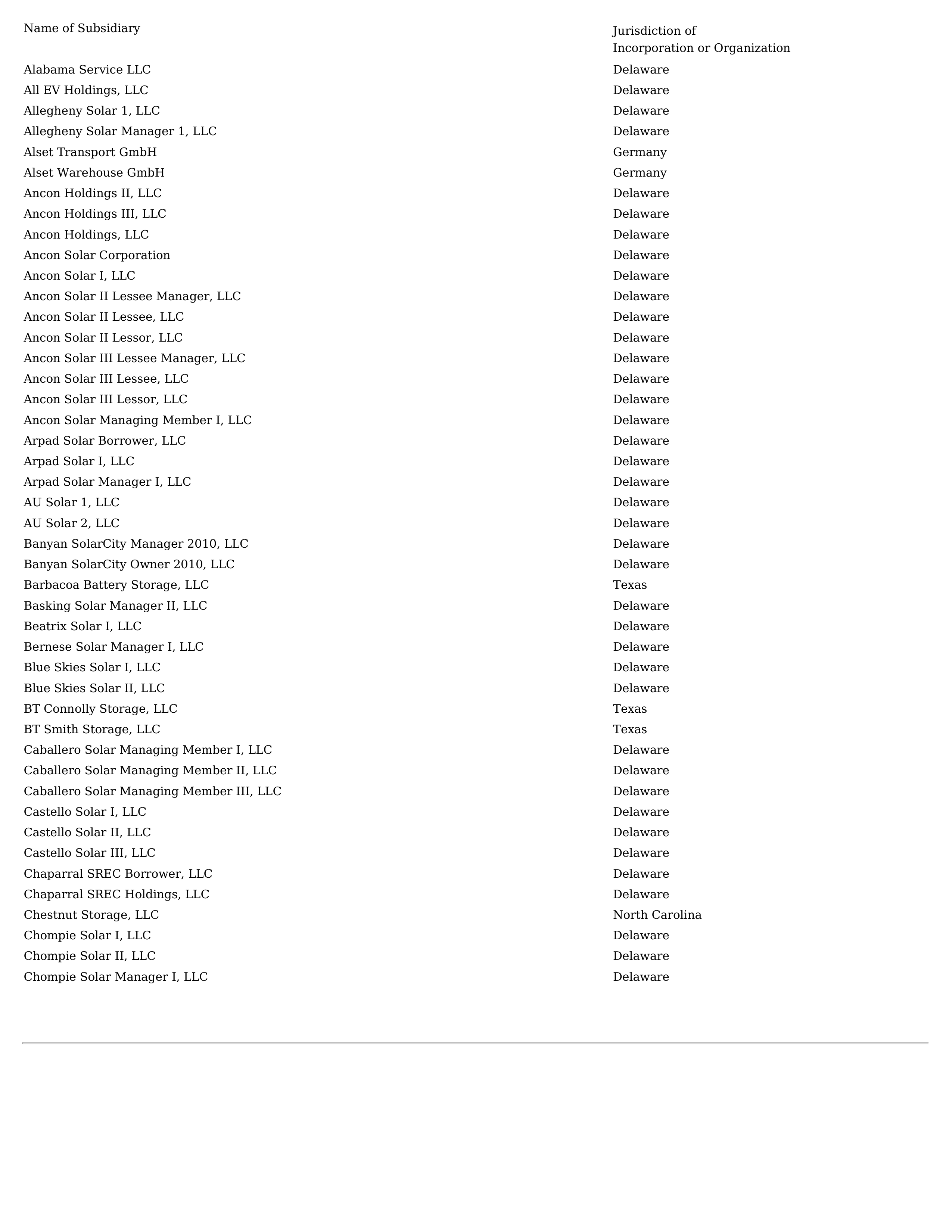
Name of Subsidiary
Jurisdiction of
Incorporation or Organization
Alabama Service LLC
Delaware
All EV Holdings, LLC
Delaware
Allegheny Solar 1, LLC
Delaware
Allegheny Solar Manager 1, LLC
Delaware
Alset Transport GmbH
Germany
Alset Warehouse GmbH
Germany
Ancon Holdings II, LLC
Delaware
Ancon Holdings III, LLC
Delaware
Ancon Holdings, LLC
Delaware
Ancon Solar Corporation
Delaware
Ancon Solar I, LLC
Delaware
Ancon Solar II Lessee Manager, LLC
Delaware
Ancon Solar II Lessee, LLC
Delaware
Ancon Solar II Lessor, LLC
Delaware
Ancon Solar III Lessee Manager, LLC
Delaware
Ancon Solar III Lessee, LLC
Delaware
Ancon Solar III Lessor, LLC
Delaware
Ancon Solar Managing Member I, LLC
Delaware
Arpad Solar Borrower, LLC
Delaware
Arpad Solar I, LLC
Delaware
Arpad Solar Manager I, LLC
Delaware
AU Solar 1, LLC
Delaware
AU Solar 2, LLC
Delaware
Banyan SolarCity Manager 2010, LLC
Delaware
Banyan SolarCity Owner 2010, LLC
Delaware
Barbacoa Battery Storage, LLC
Texas
Basking Solar Manager II, LLC
Delaware
Beatrix Solar I, LLC
Delaware
Bernese Solar Manager I, LLC
Delaware
Blue Skies Solar I, LLC
Delaware
Blue Skies Solar II, LLC
Delaware
BT Connolly Storage, LLC
Texas
BT Smith Storage, LLC
Texas
Caballero Solar Managing Member I, LLC
Delaware
Caballero Solar Managing Member II, LLC
Delaware
Caballero Solar Managing Member III, LLC
Delaware
Castello Solar I, LLC
Delaware
Castello Solar II, LLC
Delaware
Castello Solar III, LLC
Delaware
Chaparral SREC Borrower, LLC
Delaware
Chaparral SREC Holdings, LLC
Delaware
Chestnut Storage, LLC
North Carolina
Chompie Solar I, LLC
Delaware
Chompie Solar II, LLC
Delaware
Chompie Solar Manager I, LLC
Delaware
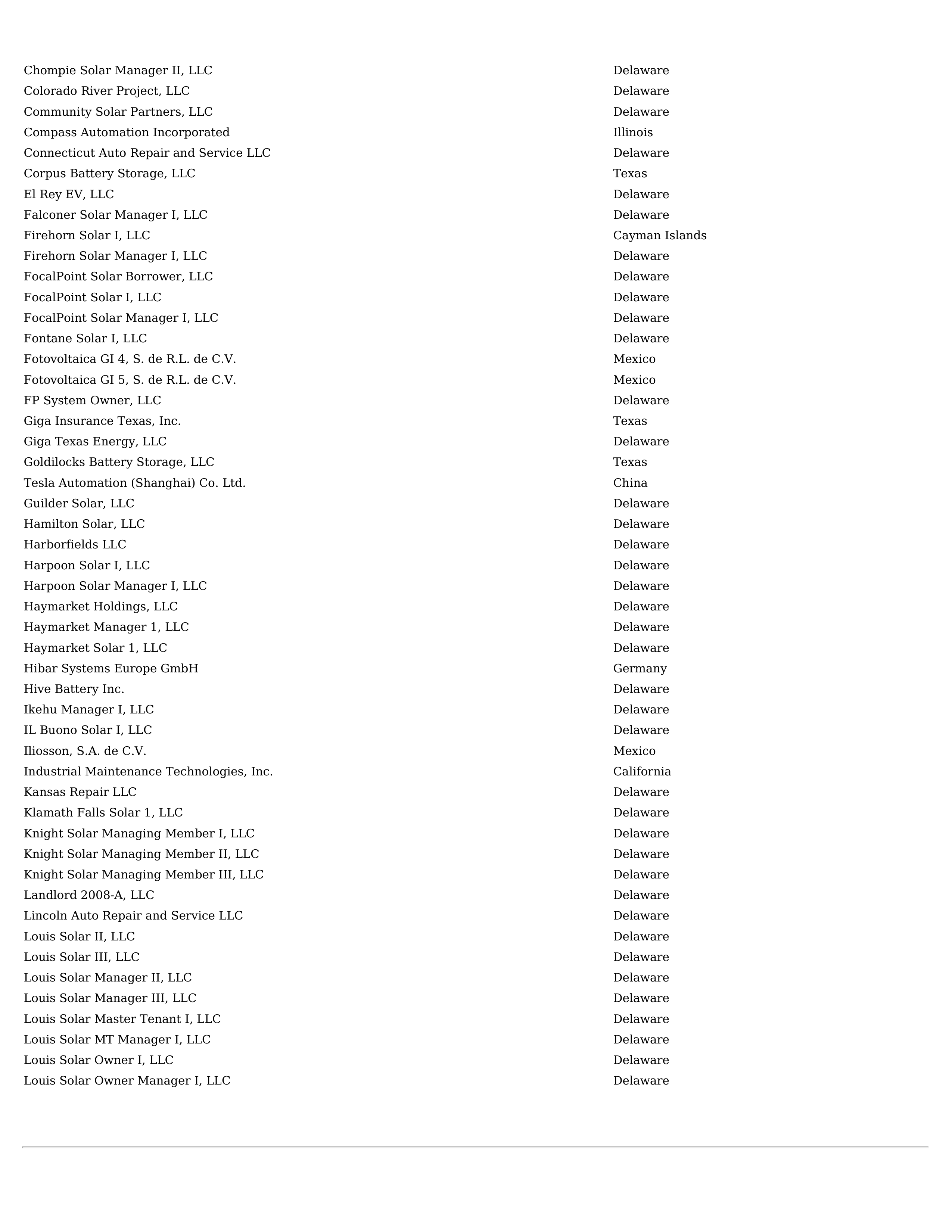
Chompie Solar Manager II, LLC
Delaware
Colorado River Project, LLC
Delaware
Community Solar Partners, LLC
Delaware
Compass Automation Incorporated
Illinois
Connecticut Auto Repair and Service LLC
Delaware
Corpus Battery Storage, LLC
Texas
El Rey EV, LLC
Delaware
Falconer Solar Manager I, LLC
Delaware
Firehorn Solar I, LLC
Cayman Islands
Firehorn Solar Manager I, LLC
Delaware
FocalPoint Solar Borrower, LLC
Delaware
FocalPoint Solar I, LLC
Delaware
FocalPoint Solar Manager I, LLC
Delaware
Fontane Solar I, LLC
Delaware
Fotovoltaica GI 4, S. de R.L. de C.V.
Mexico
Fotovoltaica GI 5, S. de R.L. de C.V.
Mexico
FP System Owner, LLC
Delaware
Giga Insurance Texas, Inc.
Texas
Giga Texas Energy, LLC
Delaware
Goldilocks Battery Storage, LLC
Texas
Tesla Automation (Shanghai) Co. Ltd.
China
Guilder Solar, LLC
Delaware
Hamilton Solar, LLC
Delaware
Harborfields LLC
Delaware
Harpoon Solar I, LLC
Delaware
Harpoon Solar Manager I, LLC
Delaware
Haymarket Holdings, LLC
Delaware
Haymarket Manager 1, LLC
Delaware
Haymarket Solar 1, LLC
Delaware
Hibar Systems Europe GmbH
Germany
Hive Battery Inc.
Delaware
Ikehu Manager I, LLC
Delaware
IL Buono Solar I, LLC
Delaware
Iliosson, S.A. de C.V.
Mexico
Industrial Maintenance Technologies, Inc.
California
Kansas Repair LLC
Delaware
Klamath Falls Solar 1, LLC
Delaware
Knight Solar Managing Member I, LLC
Delaware
Knight Solar Managing Member II, LLC
Delaware
Knight Solar Managing Member III, LLC
Delaware
Landlord 2008-A, LLC
Delaware
Lincoln Auto Repair and Service LLC
Delaware
Louis Solar II, LLC
Delaware
Louis Solar III, LLC
Delaware
Louis Solar Manager II, LLC
Delaware
Louis Solar Manager III, LLC
Delaware
Louis Solar Master Tenant I, LLC
Delaware
Louis Solar MT Manager I, LLC
Delaware
Louis Solar Owner I, LLC
Delaware
Louis Solar Owner Manager I, LLC
Delaware
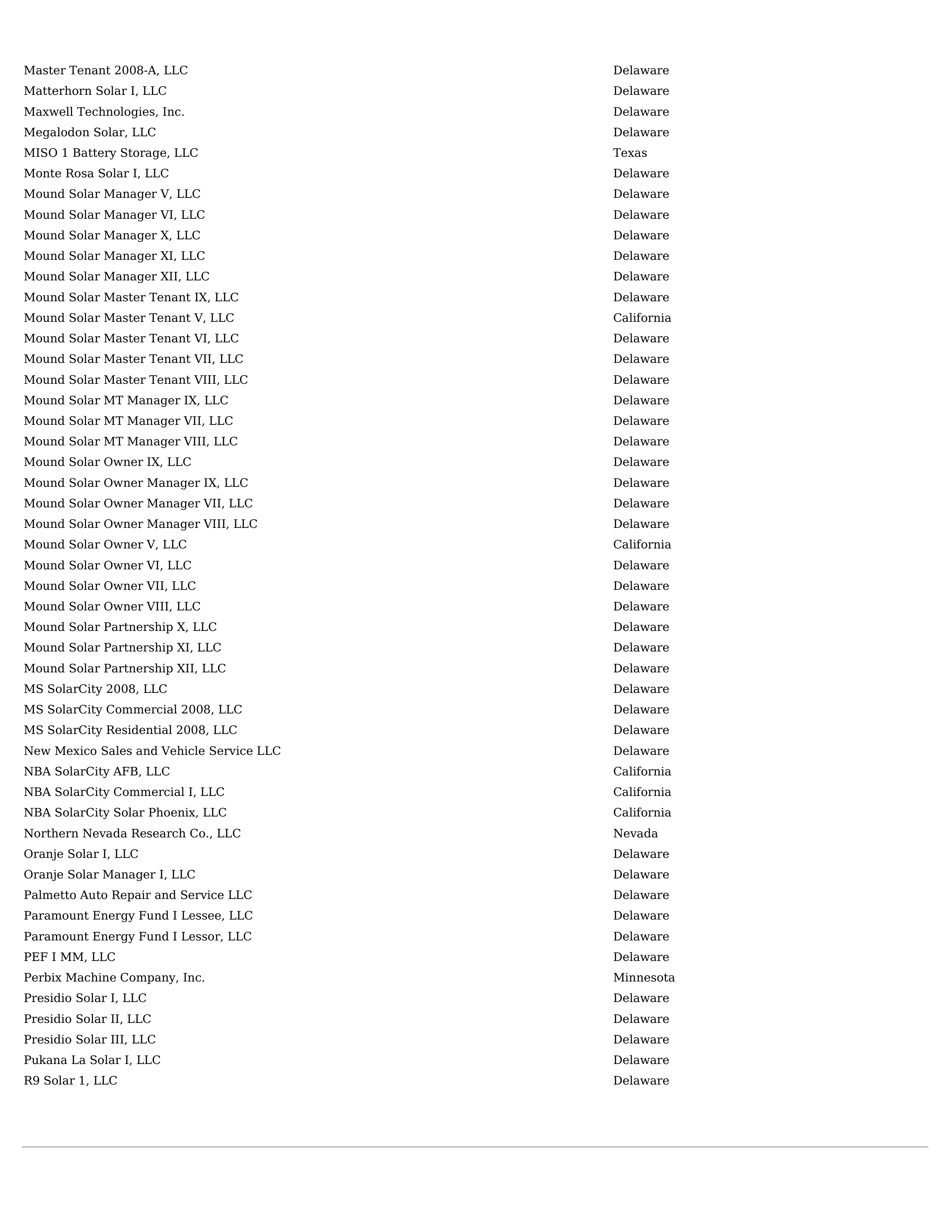
Master Tenant 2008-A, LLC
Delaware
Matterhorn Solar I, LLC
Delaware
Maxwell Technologies, Inc.
Delaware
Megalodon Solar, LLC
Delaware
MISO 1 Battery Storage, LLC
Texas
Monte Rosa Solar I, LLC
Delaware
Mound Solar Manager V, LLC
Delaware
Mound Solar Manager VI, LLC
Delaware
Mound Solar Manager X, LLC
Delaware
Mound Solar Manager XI, LLC
Delaware
Mound Solar Manager XII, LLC
Delaware
Mound Solar Master Tenant IX, LLC
Delaware
Mound Solar Master Tenant V, LLC
California
Mound Solar Master Tenant VI, LLC
Delaware
Mound Solar Master Tenant VII, LLC
Delaware
Mound Solar Master Tenant VIII, LLC
Delaware
Mound Solar MT Manager IX, LLC
Delaware
Mound Solar MT Manager VII, LLC
Delaware
Mound Solar MT Manager VIII, LLC
Delaware
Mound Solar Owner IX, LLC
Delaware
Mound Solar Owner Manager IX, LLC
Delaware
Mound Solar Owner Manager VII, LLC
Delaware
Mound Solar Owner Manager VIII, LLC
Delaware
Mound Solar Owner V, LLC
California
Mound Solar Owner VI, LLC
Delaware
Mound Solar Owner VII, LLC
Delaware
Mound Solar Owner VIII, LLC
Delaware
Mound Solar Partnership X, LLC
Delaware
Mound Solar Partnership XI, LLC
Delaware
Mound Solar Partnership XII, LLC
Delaware
MS SolarCity 2008, LLC
Delaware
MS SolarCity Commercial 2008, LLC
Delaware
MS SolarCity Residential 2008, LLC
Delaware
New Mexico Sales and Vehicle Service LLC
Delaware
NBA SolarCity AFB, LLC
California
NBA SolarCity Commercial I, LLC
California
NBA SolarCity Solar Phoenix, LLC
California
Northern Nevada Research Co., LLC
Nevada
Oranje Solar I, LLC
Delaware
Oranje Solar Manager I, LLC
Delaware
Palmetto Auto Repair and Service LLC
Delaware
Paramount Energy Fund I Lessee, LLC
Delaware
Paramount Energy Fund I Lessor, LLC
Delaware
PEF I MM, LLC
Delaware
Perbix Machine Company, Inc.
Minnesota
Presidio Solar I, LLC
Delaware
Presidio Solar II, LLC
Delaware
Presidio Solar III, LLC
Delaware
Pukana La Solar I, LLC
Delaware
R9 Solar 1, LLC
Delaware
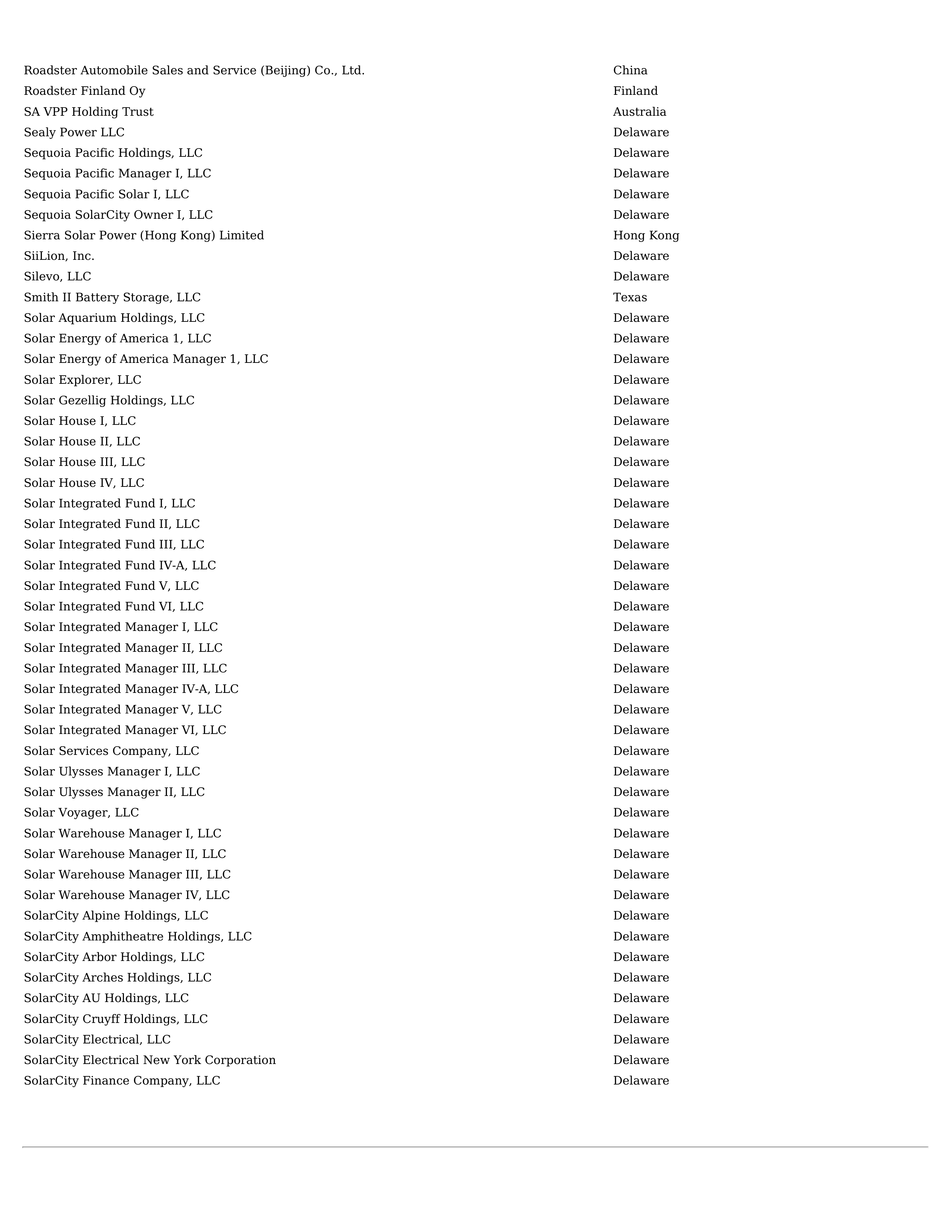
Roadster Automobile Sales and Service (Beijing) Co., Ltd.
China
Roadster Finland Oy
Finland
SA VPP Holding Trust
Australia
Sealy Power LLC
Delaware
Sequoia Pacific Holdings, LLC
Delaware
Sequoia Pacific Manager I, LLC
Delaware
Sequoia Pacific Solar I, LLC
Delaware
Sequoia SolarCity Owner I, LLC
Delaware
Sierra Solar Power (Hong Kong) Limited
Hong Kong
SiiLion, Inc.
Delaware
Silevo, LLC
Delaware
Smith II Battery Storage, LLC
Texas
Solar Aquarium Holdings, LLC
Delaware
Solar Energy of America 1, LLC
Delaware
Solar Energy of America Manager 1, LLC
Delaware
Solar Explorer, LLC
Delaware
Solar Gezellig Holdings, LLC
Delaware
Solar House I, LLC
Delaware
Solar House II, LLC
Delaware
Solar House III, LLC
Delaware
Solar House IV, LLC
Delaware
Solar Integrated Fund I, LLC
Delaware
Solar Integrated Fund II, LLC
Delaware
Solar Integrated Fund III, LLC
Delaware
Solar Integrated Fund IV-A, LLC
Delaware
Solar Integrated Fund V, LLC
Delaware
Solar Integrated Fund VI, LLC
Delaware
Solar Integrated Manager I, LLC
Delaware
Solar Integrated Manager II, LLC
Delaware
Solar Integrated Manager III, LLC
Delaware
Solar Integrated Manager IV-A, LLC
Delaware
Solar Integrated Manager V, LLC
Delaware
Solar Integrated Manager VI, LLC
Delaware
Solar Services Company, LLC
Delaware
Solar Ulysses Manager I, LLC
Delaware
Solar Ulysses Manager II, LLC
Delaware
Solar Voyager, LLC
Delaware
Solar Warehouse Manager I, LLC
Delaware
Solar Warehouse Manager II, LLC
Delaware
Solar Warehouse Manager III, LLC
Delaware
Solar Warehouse Manager IV, LLC
Delaware
SolarCity Alpine Holdings, LLC
Delaware
SolarCity Amphitheatre Holdings, LLC
Delaware
SolarCity Arbor Holdings, LLC
Delaware
SolarCity Arches Holdings, LLC
Delaware
SolarCity AU Holdings, LLC
Delaware
SolarCity Cruyff Holdings, LLC
Delaware
SolarCity Electrical, LLC
Delaware
SolarCity Electrical New York Corporation
Delaware
SolarCity Finance Company, LLC
Delaware
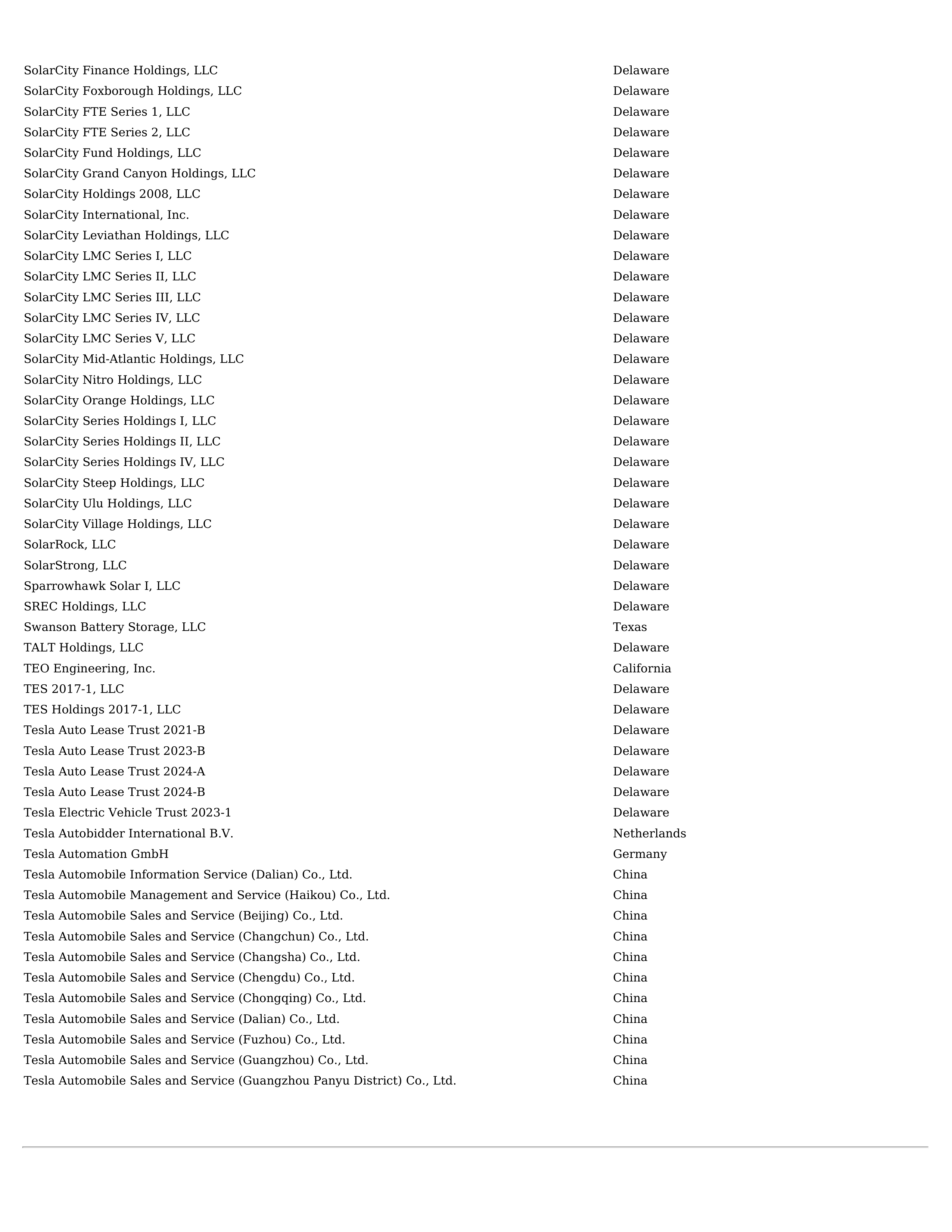
SolarCity Finance Holdings, LLC
Delaware
SolarCity Foxborough Holdings, LLC
Delaware
SolarCity FTE Series 1, LLC
Delaware
SolarCity FTE Series 2, LLC
Delaware
SolarCity Fund Holdings, LLC
Delaware
SolarCity Grand Canyon Holdings, LLC
Delaware
SolarCity Holdings 2008, LLC
Delaware
SolarCity International, Inc.
Delaware
SolarCity Leviathan Holdings, LLC
Delaware
SolarCity LMC Series I, LLC
Delaware
SolarCity LMC Series II, LLC
Delaware
SolarCity LMC Series III, LLC
Delaware
SolarCity LMC Series IV, LLC
Delaware
SolarCity LMC Series V, LLC
Delaware
SolarCity Mid-Atlantic Holdings, LLC
Delaware
SolarCity Nitro Holdings, LLC
Delaware
SolarCity Orange Holdings, LLC
Delaware
SolarCity Series Holdings I, LLC
Delaware
SolarCity Series Holdings II, LLC
Delaware
SolarCity Series Holdings IV, LLC
Delaware
SolarCity Steep Holdings, LLC
Delaware
SolarCity Ulu Holdings, LLC
Delaware
SolarCity Village Holdings, LLC
Delaware
SolarRock, LLC
Delaware
SolarStrong, LLC
Delaware
Sparrowhawk Solar I, LLC
Delaware
SREC Holdings, LLC
Delaware
Swanson Battery Storage, LLC
Texas
TALT Holdings, LLC
Delaware
TEO Engineering, Inc.
California
TES 2017-1, LLC
Delaware
TES Holdings 2017-1, LLC
Delaware
Tesla Auto Lease Trust 2021-B
Delaware
Tesla Auto Lease Trust 2023-B
Delaware
Tesla Auto Lease Trust 2024-A
Delaware
Tesla Auto Lease Trust 2024-B
Delaware
Tesla Electric Vehicle Trust 2023-1
Delaware
Tesla Autobidder International B.V.
Netherlands
Tesla Automation GmbH
Germany
Tesla Automobile Information Service (Dalian) Co., Ltd.
China
Tesla Automobile Management and Service (Haikou) Co., Ltd.
China
Tesla Automobile Sales and Service (Beijing) Co., Ltd.
China
Tesla Automobile Sales and Service (Changchun) Co., Ltd.
China
Tesla Automobile Sales and Service (Changsha) Co., Ltd.
China
Tesla Automobile Sales and Service (Chengdu) Co., Ltd.
China
Tesla Automobile Sales and Service (Chongqing) Co., Ltd.
China
Tesla Automobile Sales and Service (Dalian) Co., Ltd.
China
Tesla Automobile Sales and Service (Fuzhou) Co., Ltd.
China
Tesla Automobile Sales and Service (Guangzhou) Co., Ltd.
China
Tesla Automobile Sales and Service (Guangzhou Panyu District) Co., Ltd.
China
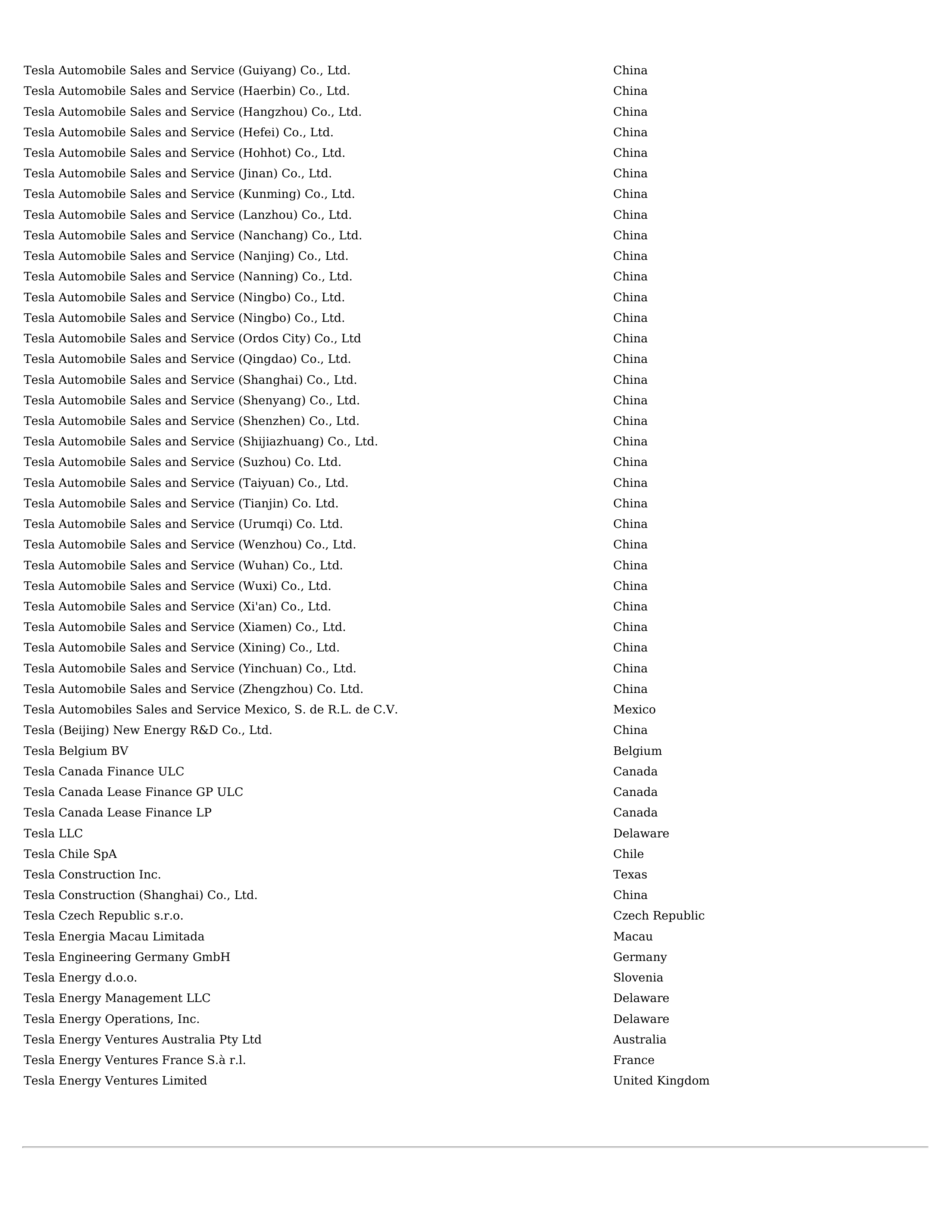
Tesla Automobile Sales and Service (Guiyang) Co., Ltd.
China
Tesla Automobile Sales and Service (Haerbin) Co., Ltd.
China
Tesla Automobile Sales and Service (Hangzhou) Co., Ltd.
China
Tesla Automobile Sales and Service (Hefei) Co., Ltd.
China
Tesla Automobile Sales and Service (Hohhot) Co., Ltd.
China
Tesla Automobile Sales and Service (Jinan) Co., Ltd.
China
Tesla Automobile Sales and Service (Kunming) Co., Ltd.
China
Tesla Automobile Sales and Service (Lanzhou) Co., Ltd.
China
Tesla Automobile Sales and Service (Nanchang) Co., Ltd.
China
Tesla Automobile Sales and Service (Nanjing) Co., Ltd.
China
Tesla Automobile Sales and Service (Nanning) Co., Ltd.
China
Tesla Automobile Sales and Service (Ningbo) Co., Ltd.
China
Tesla Automobile Sales and Service (Ningbo) Co., Ltd.
China
Tesla Automobile Sales and Service (Ordos City) Co., Ltd
China
Tesla Automobile Sales and Service (Qingdao) Co., Ltd.
China
Tesla Automobile Sales and Service (Shanghai) Co., Ltd.
China
Tesla Automobile Sales and Service (Shenyang) Co., Ltd.
China
Tesla Automobile Sales and Service (Shenzhen) Co., Ltd.
China
Tesla Automobile Sales and Service (Shijiazhuang) Co., Ltd.
China
Tesla Automobile Sales and Service (Suzhou) Co. Ltd.
China
Tesla Automobile Sales and Service (Taiyuan) Co., Ltd.
China
Tesla Automobile Sales and Service (Tianjin) Co. Ltd.
China
Tesla Automobile Sales and Service (Urumqi) Co. Ltd.
China
Tesla Automobile Sales and Service (Wenzhou) Co., Ltd.
China
Tesla Automobile Sales and Service (Wuhan) Co., Ltd.
China
Tesla Automobile Sales and Service (Wuxi) Co., Ltd.
China
Tesla Automobile Sales and Service (Xi'an) Co., Ltd.
China
Tesla Automobile Sales and Service (Xiamen) Co., Ltd.
China
Tesla Automobile Sales and Service (Xining) Co., Ltd.
China
Tesla Automobile Sales and Service (Yinchuan) Co., Ltd.
China
Tesla Automobile Sales and Service (Zhengzhou) Co. Ltd.
China
Tesla Automobiles Sales and Service Mexico, S. de R.L. de C.V.
Mexico
Tesla (Beijing) New Energy R&D Co., Ltd.
China
Tesla Belgium BV
Belgium
Tesla Canada Finance ULC
Canada
Tesla Canada Lease Finance GP ULC
Canada
Tesla Canada Lease Finance LP
Canada
Tesla LLC
Delaware
Tesla Chile SpA
Chile
Tesla Construction Inc.
Texas
Tesla Construction (Shanghai) Co., Ltd.
China
Tesla Czech Republic s.r.o.
Czech Republic
Tesla Energia Macau Limitada
Macau
Tesla Engineering Germany GmbH
Germany
Tesla Energy d.o.o.
Slovenia
Tesla Energy Management LLC
Delaware
Tesla Energy Operations, Inc.
Delaware
Tesla Energy Ventures Australia Pty Ltd
Australia
Tesla Energy Ventures France S.à r.l.
France
Tesla Energy Ventures Limited
United Kingdom
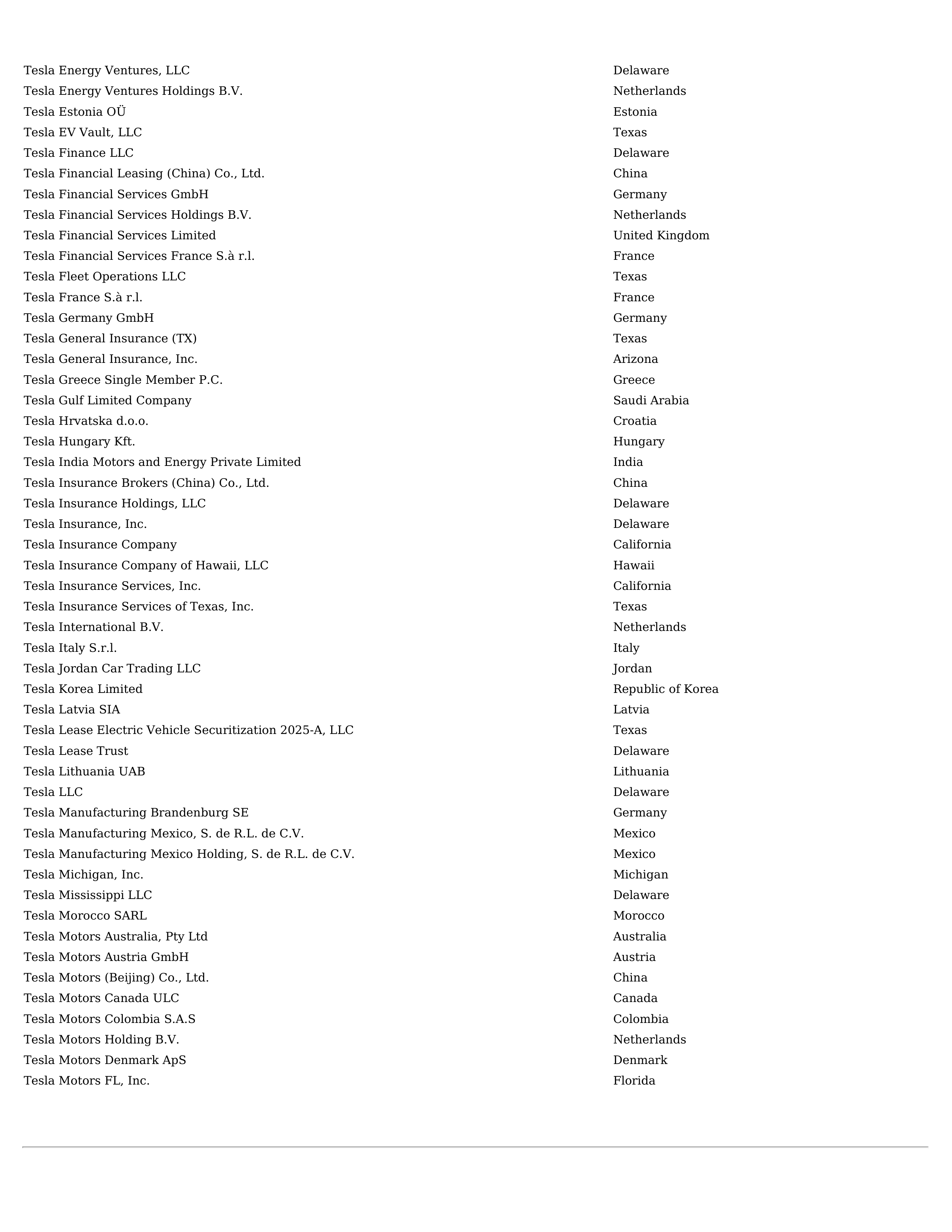
Tesla Energy Ventures, LLC
Delaware
Tesla Energy Ventures Holdings B.V.
Netherlands
Tesla Estonia OÜ
Estonia
Tesla EV Vault, LLC
Texas
Tesla Finance LLC
Delaware
Tesla Financial Leasing (China) Co., Ltd.
China
Tesla Financial Services GmbH
Germany
Tesla Financial Services Holdings B.V.
Netherlands
Tesla Financial Services Limited
United Kingdom
Tesla Financial Services France S.à r.l.
France
Tesla Fleet Operations LLC
Texas
Tesla France S.à r.l.
France
Tesla Germany GmbH
Germany
Tesla General Insurance (TX)
Texas
Tesla General Insurance, Inc.
Arizona
Tesla Greece Single Member P.C.
Greece
Tesla Gulf Limited Company
Saudi Arabia
Tesla Hrvatska d.o.o.
Croatia
Tesla Hungary Kft.
Hungary
Tesla India Motors and Energy Private Limited
India
Tesla Insurance Brokers (China) Co., Ltd.
China
Tesla Insurance Holdings, LLC
Delaware
Tesla Insurance, Inc.
Delaware
Tesla Insurance Company
California
Tesla Insurance Company of Hawaii, LLC
Hawaii
Tesla Insurance Services, Inc.
California
Tesla Insurance Services of Texas, Inc.
Texas
Tesla International B.V.
Netherlands
Tesla Italy S.r.l.
Italy
Tesla Jordan Car Trading LLC
Jordan
Tesla Korea Limited
Republic of Korea
Tesla Latvia SIA
Latvia
Tesla Lease Electric Vehicle Securitization 2025-A, LLC
Texas
Tesla Lease Trust
Delaware
Tesla Lithuania UAB
Lithuania
Tesla LLC
Delaware
Tesla Manufacturing Brandenburg SE
Germany
Tesla Manufacturing Mexico, S. de R.L. de C.V.
Mexico
Tesla Manufacturing Mexico Holding, S. de R.L. de C.V.
Mexico
Tesla Michigan, Inc.
Michigan
Tesla Mississippi LLC
Delaware
Tesla Morocco SARL
Morocco
Tesla Motors Australia, Pty Ltd
Australia
Tesla Motors Austria GmbH
Austria
Tesla Motors (Beijing) Co., Ltd.
China
Tesla Motors Canada ULC
Canada
Tesla Motors Colombia S.A.S
Colombia
Tesla Motors Holding B.V.
Netherlands
Tesla Motors Denmark ApS
Denmark
Tesla Motors FL, Inc.
Florida
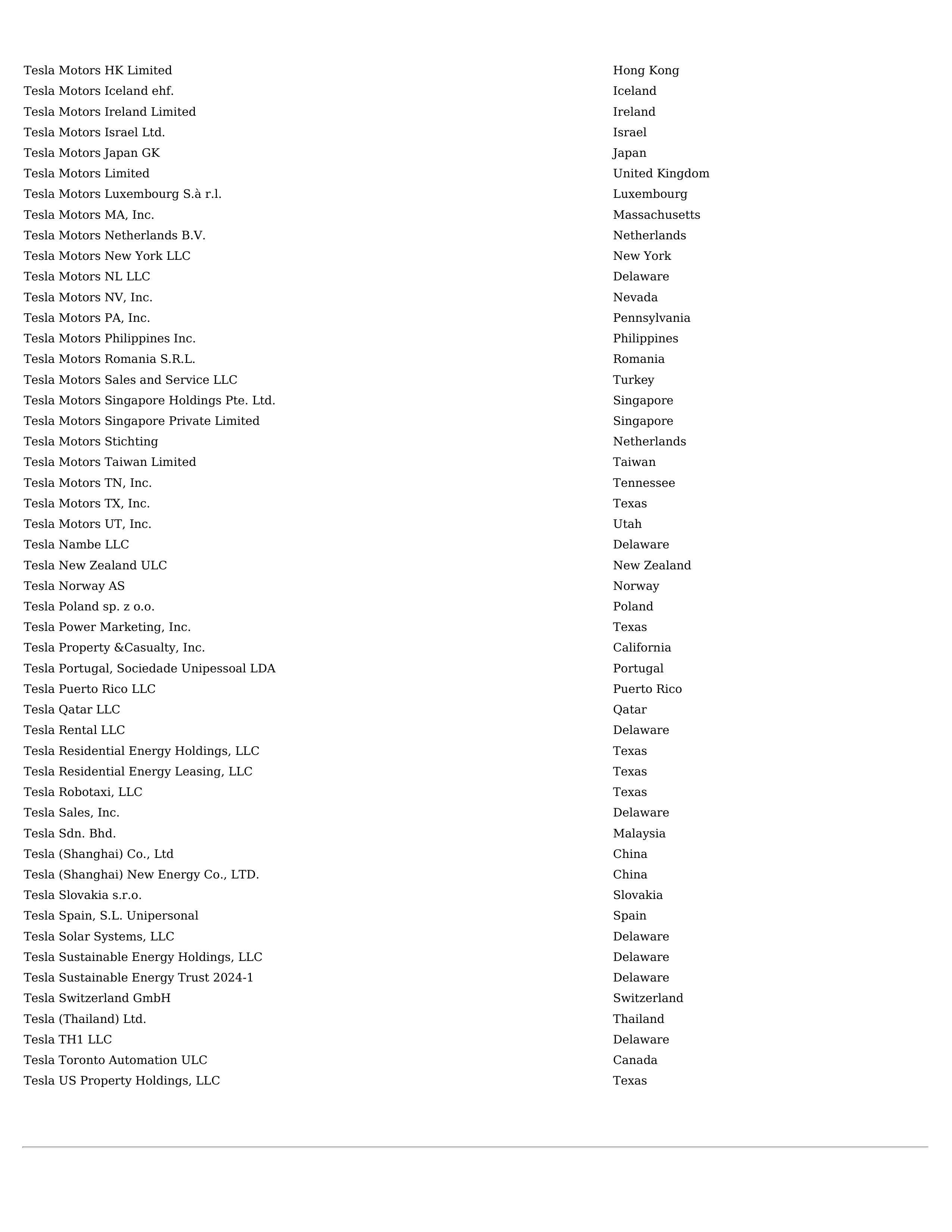
Tesla Motors HK Limited
Hong Kong
Tesla Motors Iceland ehf.
Iceland
Tesla Motors Ireland Limited
Ireland
Tesla Motors Israel Ltd.
Israel
Tesla Motors Japan GK
Japan
Tesla Motors Limited
United Kingdom
Tesla Motors Luxembourg S.à r.l.
Luxembourg
Tesla Motors MA, Inc.
Massachusetts
Tesla Motors Netherlands B.V.
Netherlands
Tesla Motors New York LLC
New York
Tesla Motors NL LLC
Delaware
Tesla Motors NV, Inc.
Nevada
Tesla Motors PA, Inc.
Pennsylvania
Tesla Motors Philippines Inc.
Philippines
Tesla Motors Romania S.R.L.
Romania
Tesla Motors Sales and Service LLC
Turkey
Tesla Motors Singapore Holdings Pte. Ltd.
Singapore
Tesla Motors Singapore Private Limited
Singapore
Tesla Motors Stichting
Netherlands
Tesla Motors Taiwan Limited
Taiwan
Tesla Motors TN, Inc.
Tennessee
Tesla Motors TX, Inc.
Texas
Tesla Motors UT, Inc.
Utah
Tesla Nambe LLC
Delaware
Tesla New Zealand ULC
New Zealand
Tesla Norway AS
Norway
Tesla Poland sp. z o.o.
Poland
Tesla Power Marketing, Inc.
Texas
Tesla Property &Casualty, Inc.
California
Tesla Portugal, Sociedade Unipessoal LDA
Portugal
Tesla Puerto Rico LLC
Puerto Rico
Tesla Qatar LLC
Qatar
Tesla Rental LLC
Delaware
Tesla Residential Energy Holdings, LLC
Texas
Tesla Residential Energy Leasing, LLC
Texas
Tesla Robotaxi, LLC
Texas
Tesla Sales, Inc.
Delaware
Tesla Sdn. Bhd.
Malaysia
Tesla (Shanghai) Co., Ltd
China
Tesla (Shanghai) New Energy Co., LTD.
China
Tesla Slovakia s.r.o.
Slovakia
Tesla Spain, S.L. Unipersonal
Spain
Tesla Solar Systems, LLC
Delaware
Tesla Sustainable Energy Holdings, LLC
Delaware
Tesla Sustainable Energy Trust 2024-1
Delaware
Tesla Switzerland GmbH
Switzerland
Tesla (Thailand) Ltd.
Thailand
Tesla TH1 LLC
Delaware
Tesla Toronto Automation ULC
Canada
Tesla US Property Holdings, LLC
Texas
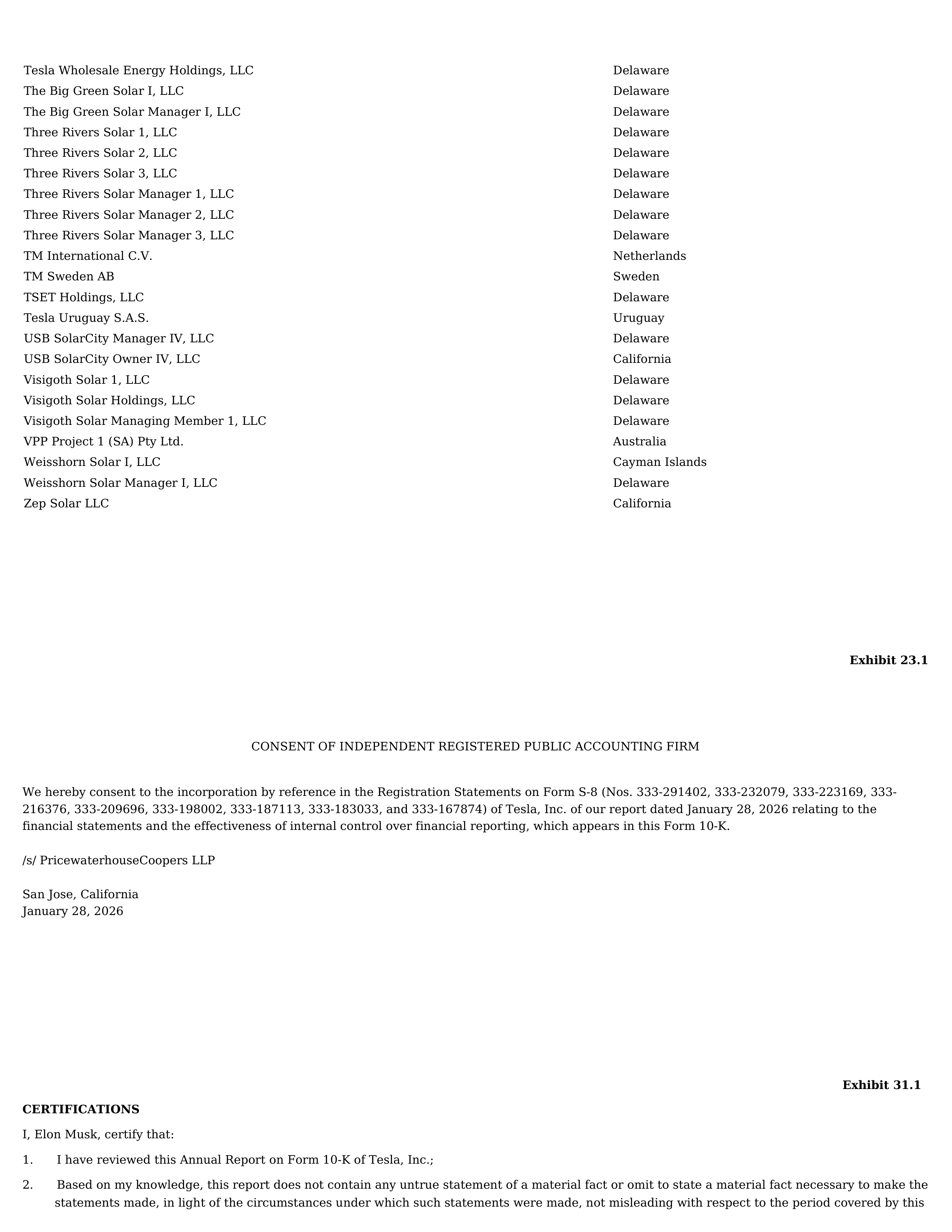
Tesla Wholesale Energy Holdings, LLC
Delaware
The Big Green Solar I, LLC
Delaware
The Big Green Solar Manager I, LLC
Delaware
Three Rivers Solar 1, LLC
Delaware
Three Rivers Solar 2, LLC
Delaware
Three Rivers Solar 3, LLC
Delaware
Three Rivers Solar Manager 1, LLC
Delaware
Three Rivers Solar Manager 2, LLC
Delaware
Three Rivers Solar Manager 3, LLC
Delaware
TM International C.V.
Netherlands
TM Sweden AB
Sweden
TSET Holdings, LLC
Delaware
Tesla Uruguay S.A.S.
Uruguay
USB SolarCity Manager IV, LLC
Delaware
USB SolarCity Owner IV, LLC
California
Visigoth Solar 1, LLC
Delaware
Visigoth Solar Holdings, LLC
Delaware
Visigoth Solar Managing Member 1, LLC
Delaware
VPP Project 1 (SA) Pty Ltd.
Australia
Weisshorn Solar I, LLC
Cayman Islands
Weisshorn Solar Manager I, LLC
Delaware
Zep Solar LLC
California
Exhibit 23.1
CONSENT OF INDEPENDENT REGISTERED PUBLIC ACCOUNTING FIRM
We hereby consent to the incorporation by reference in the Registration Statements on Form S-8 (Nos. 333-291402, 333-232079, 333-223169, 333-
216376, 333-209696, 333-198002, 333-187113, 333-183033, and 333-167874) of Tesla, Inc. of our report dated January 28, 2026 relating to the
financial statements and the effectiveness of internal control over financial reporting, which appears in this Form 10-K.
/s/ PricewaterhouseCoopers LLP
San Jose, California
January 28, 2026
Exhibit 31.1
CERTIFICATIONS
I, Elon Musk, certify that:
1.
I have reviewed this Annual Report on Form 10-K of Tesla, Inc.;
2.
Based on my knowledge, this report does not contain any untrue statement of a material fact or omit to state a material fact necessary to make the
statements made, in light of the circumstances under which such statements were made, not misleading with respect to the period covered by this
report;
3.
Based on my knowledge, the financial statements, and other financial information included in this report, fairly present in all material respects the
financial condition, results of operations and cash flows of the registrant as of, and for, the periods presented in this report;
4.
The registrant’s other certifying officer and I are responsible for establishing and maintaining disclosure controls and procedures (as defined in
Exchange Act Rules 13a-15(e) and 15d-15(e)) and internal control over financial reporting (as defined in Exchange Act Rules 13a-15(f) and 15d-
15(f)) for the registrant and have:
(a)
Designed such disclosure controls and procedures, or caused such disclosure controls and procedures to be designed under our
supervision, to ensure that material information relating to the registrant, including its consolidated subsidiaries, is made known to us
by others within those entities, particularly during the period in which this report is being prepared;
(b)
Designed such internal control over financial reporting, or caused such internal control over financial reporting to be designed under
our supervision, to provide reasonable assurance regarding the reliability of financial reporting and the preparation of financial
statements for external purposes in accordance with generally accepted accounting principles;
(c)
Evaluated the effectiveness of the registrant’s disclosure controls and procedures and presented in this report our conclusions about
the effectiveness of the disclosure controls and procedures, as of the end of the period covered by this report based on such
evaluation; and
(d)
Disclosed in this report any change in the registrant’s internal control over financial reporting that occurred during the registrant’s
most recent fiscal quarter (the registrant’s fourth fiscal quarter in the case of an annual report) that has materially affected, or is
reasonably likely to materially affect, the registrant’s internal control over financial reporting; and
5.
The registrant’s other certifying officer and I have disclosed, based on our most recent evaluation of internal control over financial reporting, to
the registrant’s auditors and the audit committee of the registrant’s Board of Directors (or persons performing the equivalent functions):
(a)
All significant deficiencies and material weaknesses in the design or operation of internal control over financial reporting which are
reasonably likely to adversely affect the registrant’s ability to record, process, summarize and report financial information; and
(b)
Any fraud, whether or not material, that involves management or other employees who have a significant role in the registrant’s
internal control over financial reporting.
Date: January 28, 2026
/s/ Elon Musk
Elon Musk
Chief Executive Officer
(Principal Executive Officer)
Exhibit 31.2
CERTIFICATIONS
I, Vaibhav Taneja, certify that:
1.
I have reviewed this Annual Report on Form 10-K of Tesla, Inc.;
2.
Based on my knowledge, this report does not contain any untrue statement of a material fact or omit to state a material fact necessary to make the
statements made, in light of the circumstances under which such statements were made, not misleading with respect to the period covered by this
report;
3.
Based on my knowledge, the financial statements, and other financial information included in this report, fairly present in all material respects the
financial condition, results of operations and cash flows of the registrant as of, and for, the periods presented in this report;
4.
The registrant’s other certifying officer and I are responsible for establishing and maintaining disclosure controls and procedures (as defined in
Exchange Act Rules 13a-15(e) and 15d-15(e)) and internal control over financial reporting (as defined in Exchange Act Rules 13a-15(f) and 15d-
15(f)) for the registrant and have:
(a)
Designed such disclosure controls and procedures, or caused such disclosure controls and procedures to be designed under our
supervision, to ensure that material information relating to the registrant, including its consolidated subsidiaries, is made known to us
by others within those entities, particularly during the period in which this report is being prepared;
(b)
Designed such internal control over financial reporting, or caused such internal control over financial reporting to be designed under
our supervision, to provide reasonable assurance regarding the reliability of financial reporting and the preparation of financial
statements for external purposes in accordance with generally accepted accounting principles;
(c)
Evaluated the effectiveness of the registrant’s disclosure controls and procedures and presented in this report our conclusions about
the effectiveness of the disclosure controls and procedures, as of the end of the period covered by this report based on such
evaluation; and
(d)
Disclosed in this report any change in the registrant’s internal control over financial reporting that occurred during the registrant’s
most recent fiscal quarter (the registrant’s fourth fiscal quarter in the case of an annual report) that has materially affected, or is
reasonably likely to materially affect, the registrant’s internal control over financial reporting; and
5.
The registrant’s other certifying officer and I have disclosed, based on our most recent evaluation of internal control over financial reporting, to
the registrant’s auditors and the audit committee of the registrant’s Board of Directors (or persons performing the equivalent functions):
(a)
All significant deficiencies and material weaknesses in the design or operation of internal control over financial reporting which are
reasonably likely to adversely affect the registrant’s ability to record, process, summarize and report financial information; and
(b)
Any fraud, whether or not material, that involves management or other employees who have a significant role in the registrant’s
internal control over financial reporting.
Date: January 28, 2026
/s/ Vaibhav Taneja
Vaibhav Taneja
Chief Financial Officer
(Principal Financial Officer and
Principal Accounting Officer)
Exhibit 32.1
SECTION 1350 CERTIFICATIONS
I, Elon Musk, certify, pursuant to 18 U.S.C. Section 1350, that, to my knowledge, the Annual Report of Tesla, Inc. on Form 10-K for the annual period
ended December 31, 2025, (i) fully complies with the requirements of Section 13(a) or 15(d) of the Securities Exchange Act of 1934 and (ii) that the
information contained in such Form 10-K fairly presents, in all material respects, the financial condition and results of operations of Tesla, Inc.
Date: January 28, 2026
/s/ Elon Musk
Elon Musk
Chief Executive Officer
(Principal Executive Officer)
I, Vaibhav Taneja, certify, pursuant to 18 U.S.C. Section 1350, that, to my knowledge, the Annual Report of Tesla, Inc. on Form 10-K for the annual
period ended December 31, 2025, (i) fully complies with the requirements of Section 13(a) or 15(d) of the Securities Exchange Act of 1934 and (ii) that
the information contained in such Form 10-K fairly presents, in all material respects, the financial condition and results of operations of Tesla, Inc.
Date: January 28, 2026
/s/ Vaibhav Taneja
Vaibhav Taneja
Chief Financial Officer
(Principal Financial Officer and
Principal Accounting Officer)