

Summary
Annual Report
2025
03
About Cencora
05
CEO letter
11
Cencora highlights and strategic
overview
12
Management team
13
Board of Directors
14
GAAP/Non - GAAP financial measures
17
Corporate information
Table of
contents
02


03
About
Cencora
Cencora is a leading global pharmaceutical solutions
organization centered on improving the lives of people
and animals around the world. We partner with
pharmaceutical innovators across the value chain to
facilitate and optimize market access to therapies.
Care providers depend on us for the secure, reliable
delivery of pharmaceuticals, healthcare products, and
solutions.


04
05
05
To our shareholders
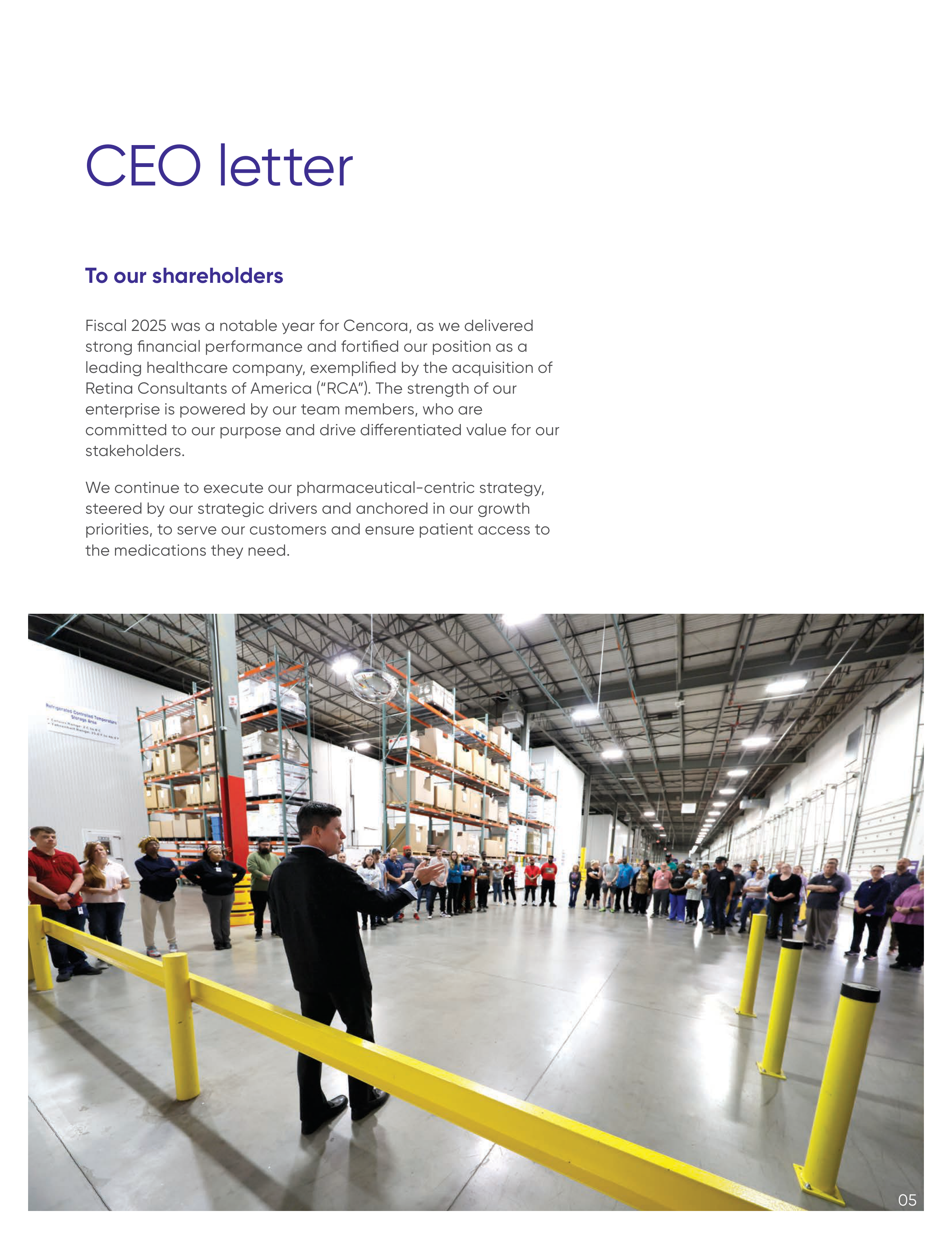
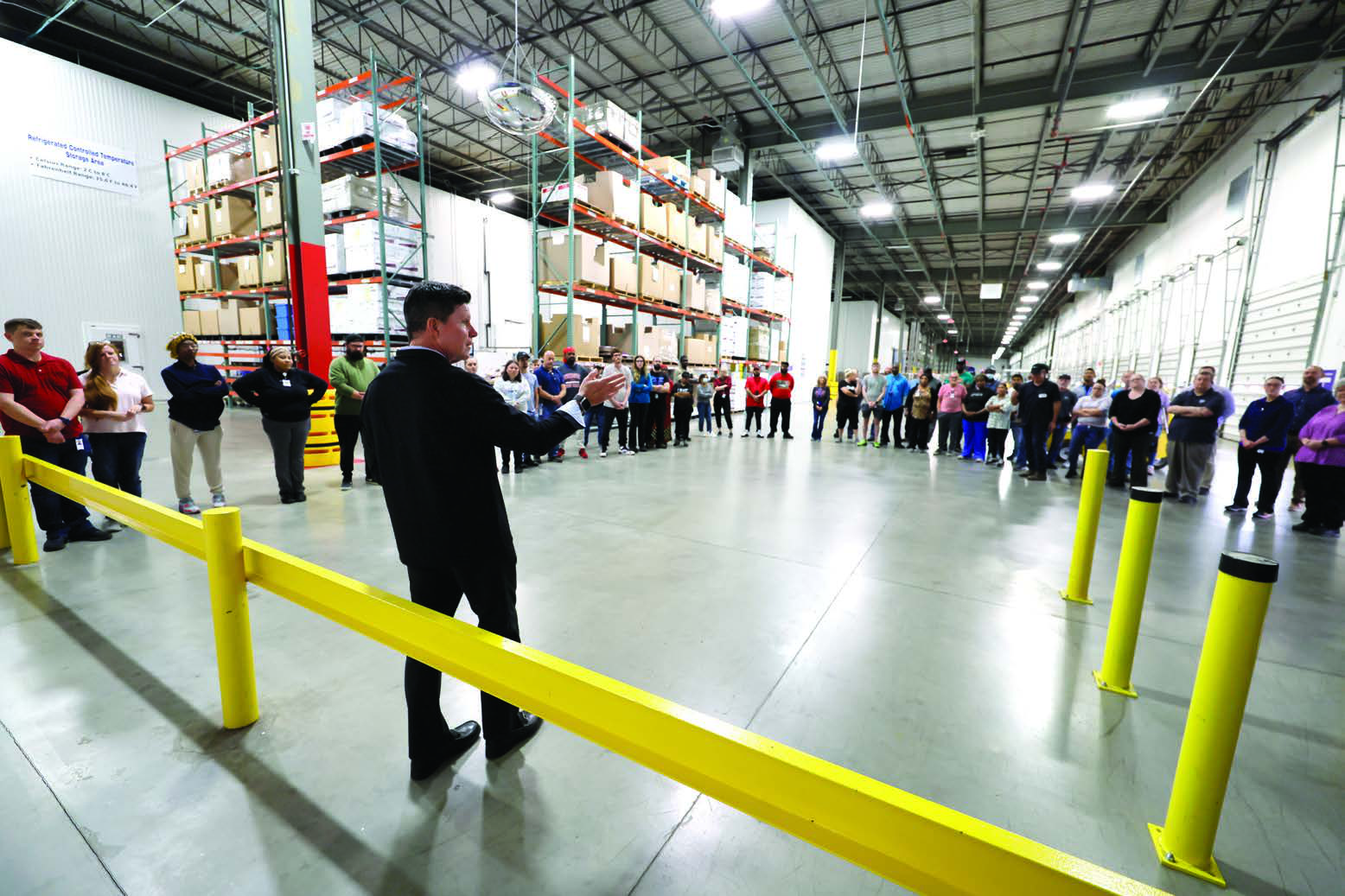
Fiscal 2025 was a notable year for Cencora, as we delivered
strong financial performance and fortified our position as a
leading healthcare company, exemplified by the acquisition of
Retina Consultants of America (“RCA”). The strength of our
enterprise is powered by our team members, who are
committed to our purpose and drive differentiated value for our
stakeholders.
We continue to execute our pharmaceutical-centric strategy,
steered by our strategic drivers and anchored in our growth
priorities, to serve our customers and ensure patient access to
the medications they need.
CEO letter
06
In fiscal 2025, Cencora delivered adjusted diluted
earnings per share of $16.00, growing 16 percent
year-over-year. Consolidated revenue was $321
billion, representing a nine percent increase
year - over - year, and adjusted operating income
increased 16 percent to $4.2 billion.
In the U.S. Healthcare Solutions segment, operating
income grew 22 percent, as we capitalized on positive
pharmaceutical trends, the unique solutions we
provide, and our leadership in specialty. The segment
benefited from continued, broad-based strength in
utilization trends, including specialty volumes to our
health system and physician customers, and the
January 2025 acquisition of RCA.
While our International Healthcare Solutions segment
experienced softer performance in fiscal 2025 due to
market pressure in clinical trial activity, we believe our
global footprint uniquely positions us to support
pharmaceutical manufacturers and their innovative
products as they come to market. This is evidenced
by the strong demand we noticed for our global
third-party logistics (“3PL”) offering. Our differentiated
specialty logistics business has delivered strong
growth over the last decade, and we believe it is
positioned to win as the market rebounds. We have
also taken action to simplify and better position our
specialized consulting business in areas where we are
best equipped to drive results.
Cencora continues to generate robust free cash flow
that enables us to make investments that advance
our strategy. The $3 billion in adjusted free cash flow
we delivered in fiscal 2025 fueled key investments to
strengthen our infrastructure and supported our
acquisition of RCA. Additionally, we built on our
track record of returning capital to shareholders with
nearly $900 million in dividends and opportunistic
share repurchases completed during the fiscal year.
On November 5, 2025, we announced a nine percent
increase in our quarterly dividend, reflecting our
ongoing commitment to maintaining a reasonable,
Driving strong growth and enhancing our position as
a leading healthcare solutions company:
in adjusted free cash flow
$3.0B
returned to shareholders
~$900M
invested in business through
capital expenditures
~$700M
growing dividend that is aligned with our long-term
adjusted diluted earnings per share guidance.
Our dedication to disciplined execution and building
strategic partnerships with market leaders has
resulted in growth above the long-term guidance we
introduced in 2022. To reflect our proven execution,
our conviction in the strength of Cencora, and the
expected benefits from the recently announced
transaction to acquire the remaining interest in
OneOncology, we were pleased to raise our long-
term adjusted diluted EPS guidance range to now
reflect growth of 10 to 14 percent. With our durable
core in pharmaceutical distribution and higher-
margin, high growth services and solutions, we are
confident that we will continue to capture
opportunities from market growth and
pharmaceutical innovation while making growth-
oriented investments to further our strategic
positioning.
In an effort to provide additional and useful information regarding Cencora’s financial results and other financial information as determined by
generally accepted accounting principles (GAAP), certain information presented in this report includes non - GAAP information. A reconciliation of
that information to GAAP and other related information is available on pages 14 and 15 of this report.



07
Advancing our pharmaceutical-centric
strategy:
At Cencora, our strategy is grounded in the belief that
pharmaceuticals are the most efficient form of
healthcare. We are intentionally positioned to
support the growing use of pharmaceuticals,
beginning with the early phases of innovation and
continuing through to the ultimate distribution of
products to thousands of downstream providers.
Our go-forward strategy focuses on three growth
priorities – leading with market leaders, enhancing
patient access to pharmaceuticals, and
strengthening our position in specialty – and four
strategic drivers enabling our execution – prioritizing
growth-oriented investments, accelerating our use of
advanced technologies to support our enterprise,
identifying ongoing process and capability
improvements, and fostering a best-in-class talent
and culture experience.
With our focus on Cencora’s digital transformation,
we will utilize data and advanced analytics to
enhance the customer experience through expanded
services and solutions. We are investing in our team
members’ development and strengthening our
purpose-driven culture, establishing Cencora as a
place where best-in-class talent come to grow their
careers. We have elevated our concentration on
productivity, equipping us to better serve the
dynamic, global pharmaceutical supply chain. And
finally, we must invest in areas we believe will
advance our strategy and amplify our growth in an
evolving market.


08
By prioritizing growth-oriented investments, we are
focused on advancing capabilities in areas that will
support our long-term success. As a healthcare
company, it is our responsibility to evolve with the
industry to support our partners’ needs. As we
evaluated how the market is changing, we
determined that concentrating on our services and
solutions to our biopharma and provider customers in
our U.S. Healthcare Solutions segment and
International Healthcare Solutions segment best align
with our long-term vision. We are committed to
investing in areas that strengthen our value
proposition to our stakeholders and believe that
enhancing our core and furthering our high growth,
higher margin businesses are key to our success.
Through this thorough review, we also identified
businesses that do not align as closely with our
go-forward strategy, and we are actively evaluating
alternative long-term partners for these businesses
where we believe they will be better positioned to
capitalize on the strength of their offerings.
This renewed prioritization will enable us to deploy
capital against our key growth priorities, including
reinforcing our leadership in specialty. The acquisition
of RCA and recent announcement that we intend to
accelerate our full ownership of OneOncology are
key examples of how we put this approach into
practice to extend Cencora’s offering to physicians in
high growth specialty channels. RCA brings
differentiated leadership, clinical excellence, and
premier research capabilities that position the
organization at the forefront of retina innovation. The
organization continues to attract leading physicians
and practices to its network, demonstrating the
unique value proposition it provides to partner
practices. Since our initial investment in
OneOnoclogy in 2023, the platform has seen strong
growth as community oncologists continue to seek
additional solutions to drive their continued success
and improve patient outcomes. The acquisition of
RCA and our pending transaction to acquire full
ownership of OneOncology build on our growth
priorities and strategic drivers. The value we can drive
through management service organizations in retina
and oncology will expand our leadership in high-
growth specialties that continue to see treatment
innovation; broaden the services we offer to our
customers; and ultimately enhance patient access to
pharmaceutical treatment as community practices
offer the most cost-effective care.
We are also investing in our distribution infrastructure
to ensure we are equipped to handle the growing
demand for pharmaceuticals. Cencora is proud of our
commitment to make significant investments to
amplify our network. Opening a second national
distribution center will enable us to more efficiently
serve the supply chain, and we intend to expand our
capacity to handle complex medications as they
become a larger portion of the market’s volumes.
These investments support our business’s long-term
growth and will further our operational resiliency and
efficiency as we serve the supply chain.
Prioritizing growth-oriented investments to power our future:




09
Driving differentiated value through our commitment to our
purpose and our team members’ focused execution:
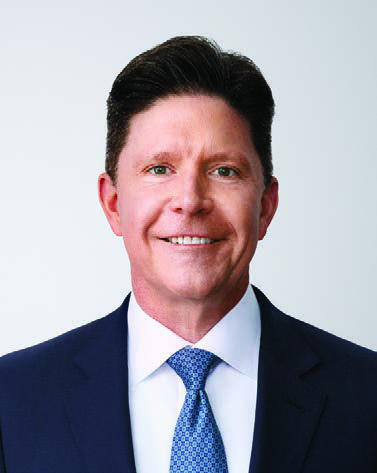
Robert P. Mauch Pharm.D., Ph.D.
President and Chief Executive Officer
Our fiscal 2025 performance showcases the strength of Cencora’s underlying
business and the value of the investments we have made that enhance our value
proposition to both biopharma and providers. As we move into fiscal 2026 and
beyond, our strategy – informed by our strategic drivers and growth priorities – will
position us for long-term value creation for all our stakeholders. Cencora is a vital
leader in ensuring patient access to care, and we remain steadfast in our purpose
and committed to our critical responsibility of delivering life-saving medications
safely, securely, and efficiently. We are united in our responsibility to create
healthier futures


10
11
11
Cencora highlights
and strategic overview
*Growth rates provided on a constant currency basis.
In an effort to provide additional and useful information regarding Cencora’s financial results and other financial information as determined by
generally accepted accounting principles (GAAP), certain information presented in this report includes non-GAAP information. A reconciliation
of that information to GAAP and other related information is available on pages 14 and 15 of this report.
Financial highlights
Sharpened our focus to
invest
in areas aligned with our
pharmaceutical-centric
strategy
to amplify growth
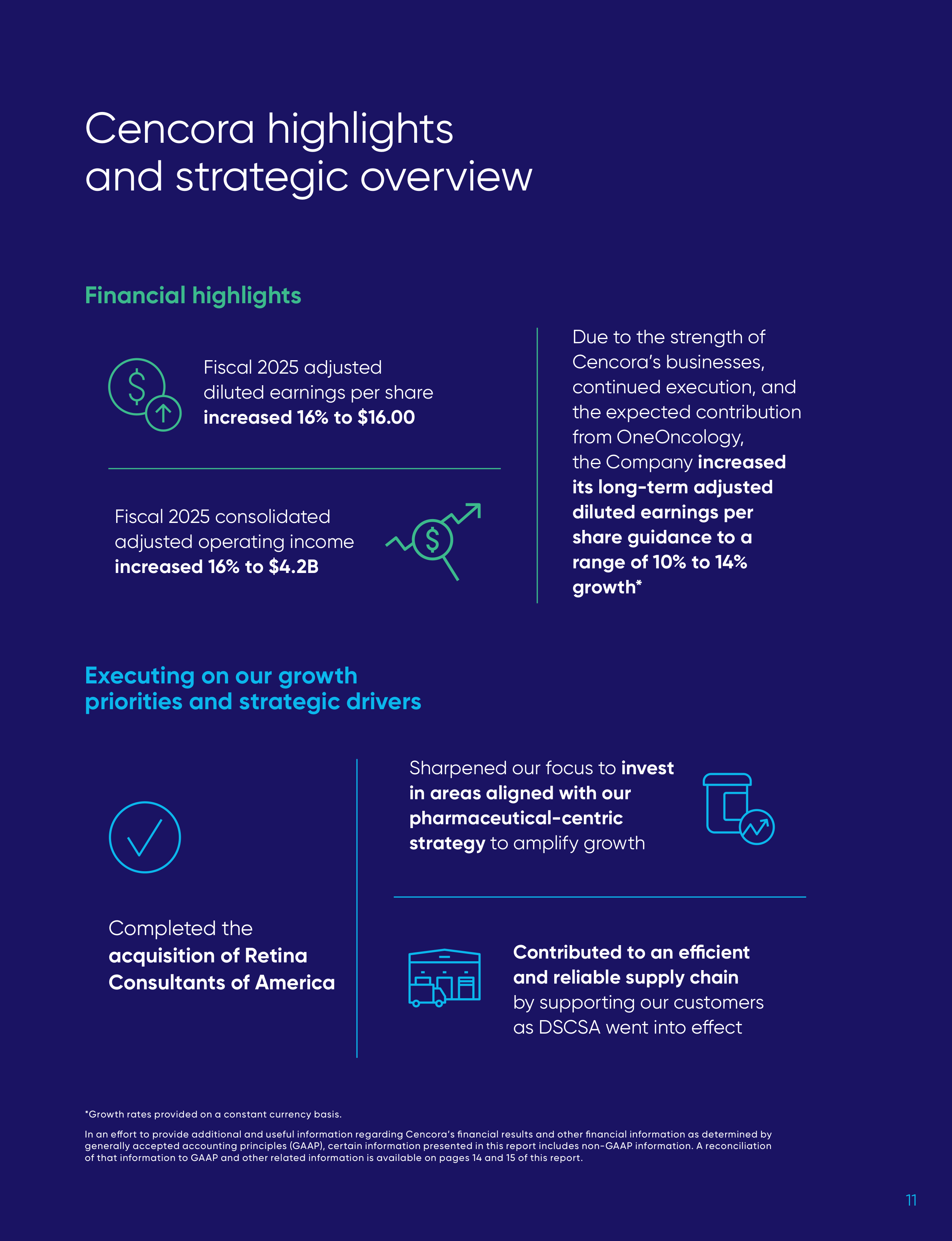
Fiscal 2025 adjusted
diluted earnings per share
increased 16% to $16.00
Executing on our growth
priorities and strategic drivers
Due to the strength of
Cencora’s businesses,
continued execution, and
the expected contribution
from OneOncology,
the Company
increased
its long-term adjusted
diluted earnings per
share guidance to a
range of 10% to 14%
growth*
Fiscal 2025 consolidated
adjusted operating income
increased 16% to
$4.2B
Completed the
acquisition of Retina
Consultants of America
Contributed to an efficient
and reliable supply chain
by supporting our customers
as DSCSA went into effect
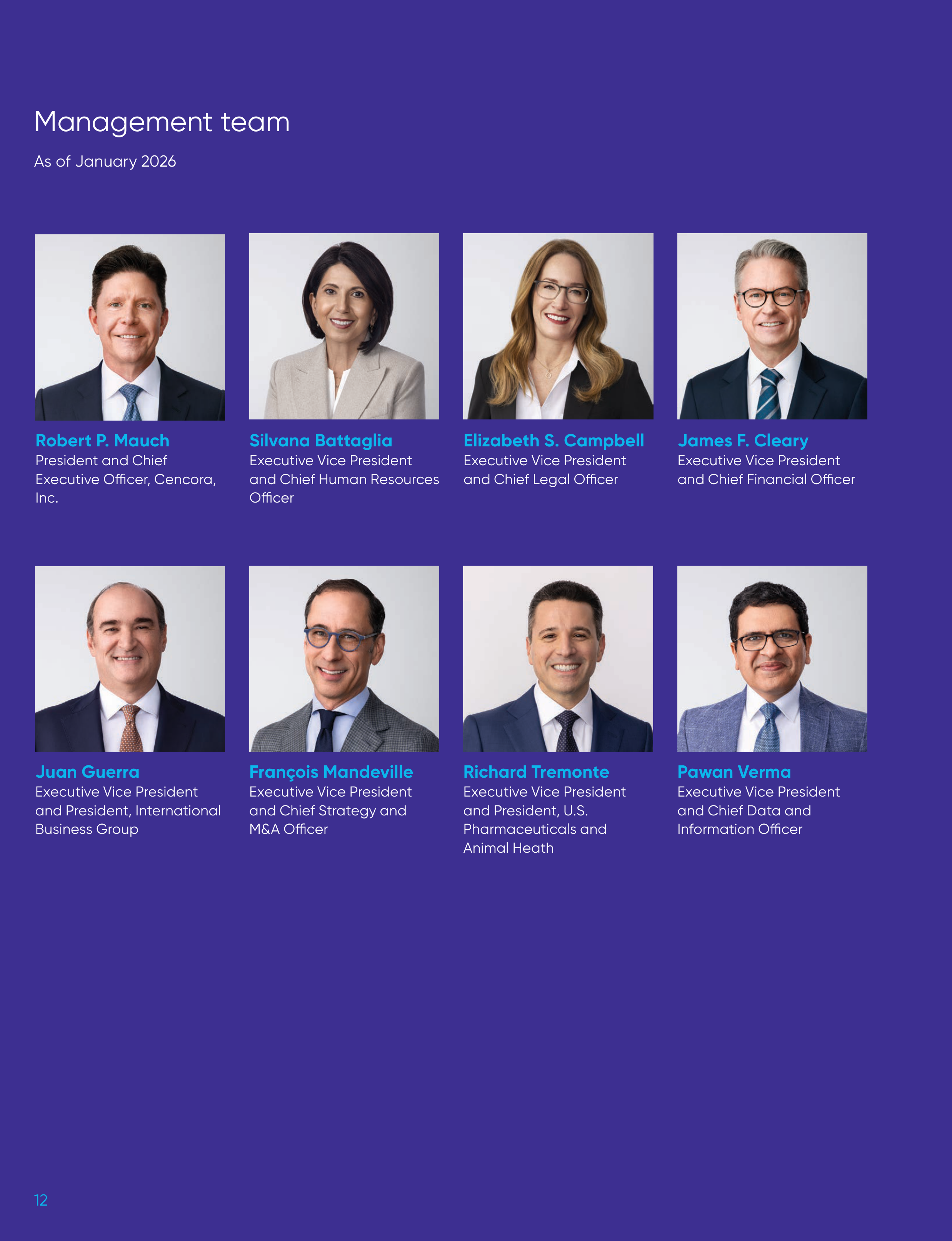
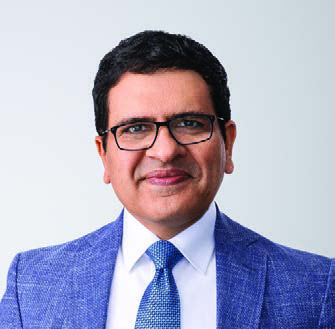
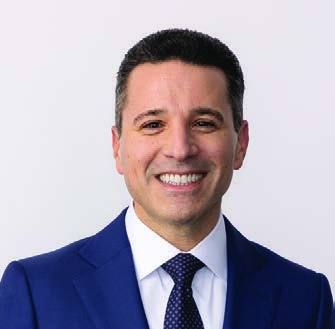




Management team
As of January 2026
Pawan Verma
Executive Vice President
and Chief Data and
Information Officer
Richard Tremonte
Executive Vice President
and President, U.S.
Pharmaceuticals and
Animal Heath
Elizabeth S. Campbell
Executive Vice President
and Chief Legal Officer
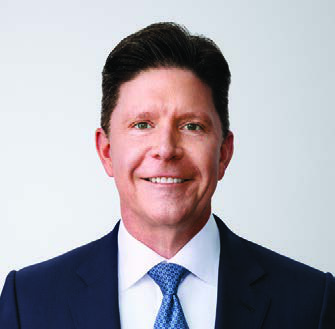
James F. Cleary
Executive Vice President
and Chief Financial Officer
Juan Guerra
Executive Vice President
and President, International
Business Group
Silvana Battaglia
Executive Vice President
and Chief Human Resources
Officer
Robert P. Mauch
President and Chief
Executive Officer, Cencora,
Inc.
François Mandeville
Executive Vice President
and Chief Strategy and
M&A Officer
12



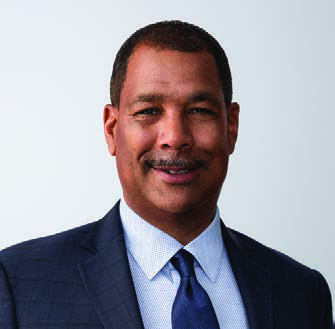



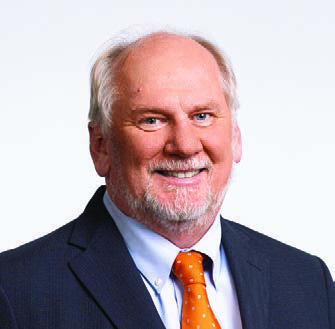
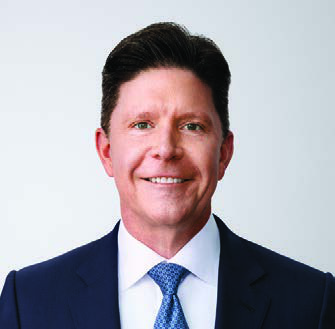
Board of Directors
13
As of January 22, 2026
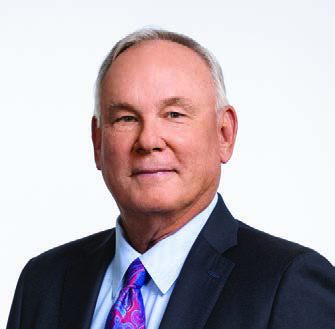
Dennis M. Nally
Retired Chairman
PricewaterhouseCoopers
International Ltd.
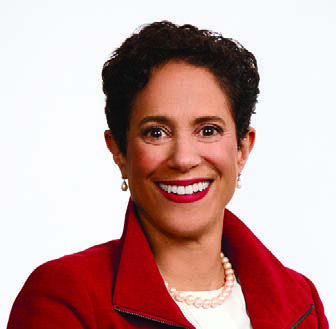
Lori J. Ryerkerk
Retired Chairman and Chief
Executive Officer Celanese
Corporation
Lauren M. Tyler
Retired Executive Vice
President and Global Head
of Human Resources J.P.
Morgan Asset and Wealth
Management
Redonda G. Miller, M.D.
President The Johns
Hopkins Hospital
Frank K. Clyburn
Retired Chief Executive
Officer International
Flavors and Fragrances Inc.
Ellen G. Cooper
Chairman, President, and
Chief Executive Officer
Lincoln National
Corporation
Lorence H. Kim, M.D.
Co - Founder and Managing
Partner Ascenta Capital
D. Mark Durcan
Chair of the Board and
Retired Chief Executive
Officer Micron Technology,
Inc.
Werner Baumann
Retired Chairman and Chief
Executive Officer Bayer AG
Robert P. Mauch
President and Chief
Executive Officer Cencora,
Inc.
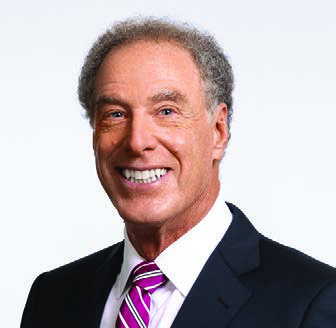
Lon R. Greenberg
Retired Chief Executive
Officer UGI Corporation

14
GAAP/Non - GAAP financial measures
To supplement the financial measures prepared in
accordance with U.S. generally accepted accounting
principles (GAAP), the Company uses the non-GAAP
financial measures described below. The non-GAAP
financial measures should be viewed in addition to, and
not in lieu of, financial measures calculated in
accordance with GAAP. These supplemental measures
may vary from, and may not be comparable to, similarly
titled measures by other companies.
Adjusted operating income is a non-GAAP financial
measure that excludes gains from antitrust litigation
settlements; LIFO credit; Turkey highly inflationary impact;
acquisition-related intangibles amortization; litigation
and opioid- related expenses; acquisition-related deal
and integration expenses; restructuring and other
expenses; and the impairment of goodwill. Management
believes that these non-GAAP financial measures are
useful to investors as a supplemental way to evaluate the
Company’s performance because the adjustments are
unusual, non-operating, unpredictable, non-recurring or
non-cash in nature.
Adjusted diluted earnings per share excludes the per
share impact of adjustments including gains from
antitrust litigation settlements; LIFO credit; Turkey highly
inflationary impact; acquisition-related intangibles
amortization; litigation and opioid expenses; acquisition-
related deal and integration expenses; restructuring and
other expenses; impairment of goodwill and an equity
investment; the Company's portion of an equity method
investment's gain on the sale of a business; the loss on
the divestiture of non-core businesses; the foreign
currency remeasurement related to 2020 Swiss tax reform
and the amortization of those deferred tax assets; in
each case net of the tax effect calculated using the
applicable effective tax rate for those items.
Management believes that this non-GAAP financial
measure is useful to investors because it eliminates the
per share impact of the items that are outside the control
of the Company or that we consider to not be indicative
of our ongoing operating performance due to their
inherent unusual, non-operating, unpredictable, non-
recurring, or non-cash nature. Management believes that
adjusted diluted shares outstanding is useful to investors
because it facilitates the calculation of adjusted diluted
earnings per share.
Adjusted free cash flow is a non-GAAP financial measure
defined as net cash provided by operating activities,
excluding significant unpredictable or non-recurring cash
payments or receipts relating to legal settlements, minus
capital expenditures. Adjusted free cash flow is used
internally by management for measuring operating cash
flow generation and setting performance targets and has
historically been used as one of the means of providing
guidance on possible future cash flows. For the fiscal year
ended September 30, 2025, adjusted free cash flow of
$2,970.8 million consisted of net cash provided by operating
activities of $3,875.1 million, minus capital expenditures of
$668.0 million and the gains from antitrust litigation
settlements of $236.4 million. The Company does not
provide forward looking guidance on a GAAP basis for free
cash flow because the timing and amount of favorable
and unfavorable settlements excluded from this metric, the
probable significance of which cannot be determined, are
unavailable and cannot be reasonably estimated.
The Company also presents revenue and operating
income on a “constant currency” basis, which are non-
GAAP financial measures. These amounts are calculated
by translating current period GAAP results at the foreign
currency exchange rates used in the comparable period
in the prior year. The Company presents such constant
currency financial information because it has significant
operations outside of the United States reporting in
currencies other than the U.S. dollar and management
believes that this presentation provides a framework to
assess how its business performed excluding the impact
of foreign currency exchange rate fluctuations.
15
For more information related to non-GAAP financial measures, refer to the section
titled “Supplemental Information Regarding Non-GAAP Financial Measures”
attached as an appendix to our Q4 2025 quarterly results presentation posted
on our website, investor.cencora.com
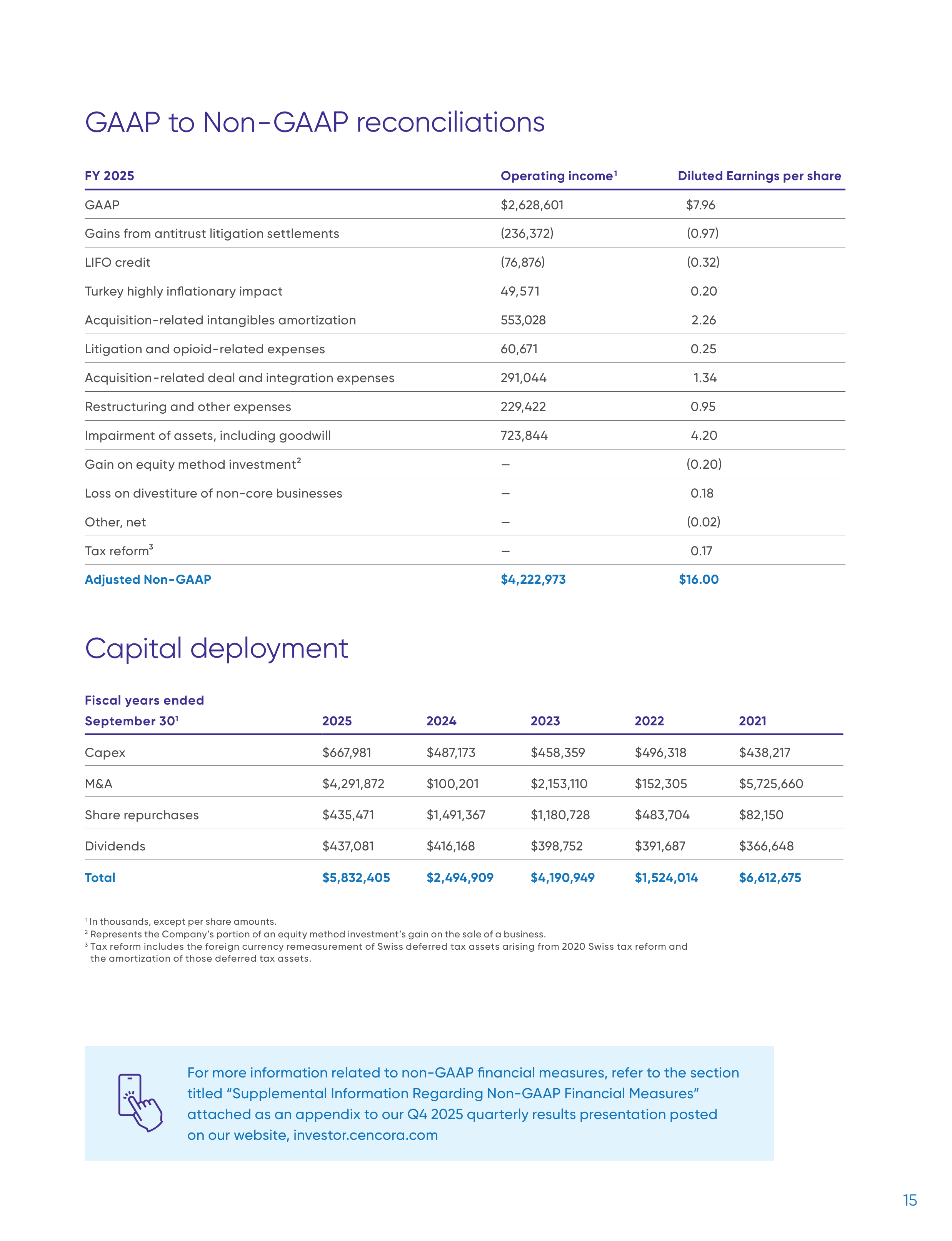
GAAP to Non - GAAP reconciliations
Capital deployment
1
In thousands, except per share amounts.
2
Represents the Company’s portion of an equity method investment’s gain on the sale of a business.
3
Tax reform includes the foreign currency remeasurement of Swiss deferred tax assets arising from 2020 Swiss tax reform and
the amortization of those deferred tax assets.
FY 2025
Operating income
1
Diluted Earnings per share
GAAP
$2,628,601
$7.96
Gains from antitrust litigation settlements
(236,372)
(0.97)
LIFO credit
(76,876)
(0.32)
Turkey highly inflationary impact
49,571
0.20
Acquisition - related intangibles amortization
553,028
2.26
Litigation and opioid - related expenses
60,671
0.25
Acquisition - related deal and integration expenses
291,044
1.34
Restructuring and other expenses
229,422
0.95
Impairment of assets, including goodwill
723,844
4.20
Gain on equity method investment2
—
(0.20)
Loss on divestiture of non-core businesses
—
0.18
Other, net
—
(0.02)
Tax reform3
—
0.17
Adjusted Non - GAAP
$4,222,973
$16.00
Fiscal years ended
September 30
1
2025
2024
2023
2022
2021
Capex
$667,981
$487,173
$458,359
$496,318
$438,217
M&A
$4,291,872
$100,201
$2,153,110
$152,305
$5,725,660
Share repurchases
$435,471
$1,491,367
$1,180,728
$483,704
$82,150
Dividends
$437,081
$416,168
$398,752
$391,687
$366,648
Total
$5,832,405
$2,494,909
$4,190,949
$1,524,014
$6,612,675

Corporate information
Cautionary note regarding forward - looking statements
Certain of the statements contained in this report are
“forward-looking statements” within the meaning of
Section 27A of the Securities Act of 1933, as amended,
and Section 21E of the Securities Exchange Act of 1934,
as amended (the “Securities Exchange Act”). Words
such as "aim," "anticipate," "believe," "can," "continue,"
"could," "estimate," "expect," "intend," "may," "might," "on
track," "opportunity," "plan," "possible," "potential,"
"predict," "project,” "seek," "should," "strive," "sustain,"
"synergy," "target," "will," "would" and similar expressions
are intended to identify such forward-looking
statements, but the absence of these words does not
mean the statement is not forward-looking. These
statements are based on management’s current
expectations and are subject to uncertainty and
changes in circumstances and speak only as of the
date hereof. These statements are not guarantees of
future performance and are based on assumptions
and estimates that could prove incorrect or could
cause actual results to vary materially from those
indicated. A more detailed discussion of the risks and
uncertainties that could cause our actual results to
differ materially from those indicated is included (i) in
the "Risk Factors" and "Management's Discussion and
Analysis" sections in the Company’s Annual Report on
Form 10-K for the fiscal year ended September 30,
2025 and elsewhere in that report and (ii) in other
reports filed by the Company pursuant to the
Securities Exchange Act. The Company undertakes no
obligation to publicly update or revise any forward-
looking statements, except as required by the federal
securities laws.”
16
17
Stockholder services
Our transfer agent, Computershare, can help you with a variety
of stockholder services, including:
• Change of address
• Stock transfer
• Lost stock certificates
• Account consolidation
Computershare
Telephone
: 866.233.1957 or TDD 800.231.5469
Outside U.S.
: 201.680.6578 or TDD 201.680.6610
Internet
: www.computershare.com/investor
Mail
: Cencora, Inc.
c/o Computershare Investor Services
P.O. Box 43006, Providence, RI 02940-3006
Email
: Support.ServiceCenter@cpushareownerservices.com
Additional
information
Financial documents, such as our Annual Report on Form 10
-
K, and
Quarterly Reports on Form 10
-
Q, and other reports and filings, such as the
Company’s Code of Ethics and Business Conduct, may be obtained from
the Company investor relations website at
investor.cencora.com
, or by
calling the Company’s Investor Relations Department at 610.727.7000.
Investor
Relations
Stockholders, security analysts, portfolio managers and other investors
desiring further information about the Company should contact:
Bennett S. Murphy
, SVP, Investor Relations and Enterprise Productivity
Email
: bennett.murphy@cencora.com
Annual meeting
of shareholders
Thursday, March 5, 2026 3:30pm, ET
virtualshareholdermeeting.com/COR2026
Independent
registered public
accounting firm
Ernst & Young LLP
Philadelphia, Pennsylvania
Stock listing
Cencora, Inc. is listed on The New York Stock Exchange under the
ticker symbol COR.

© 2026 Cencora, Inc.
We are united in our responsibility
to create healthier futures

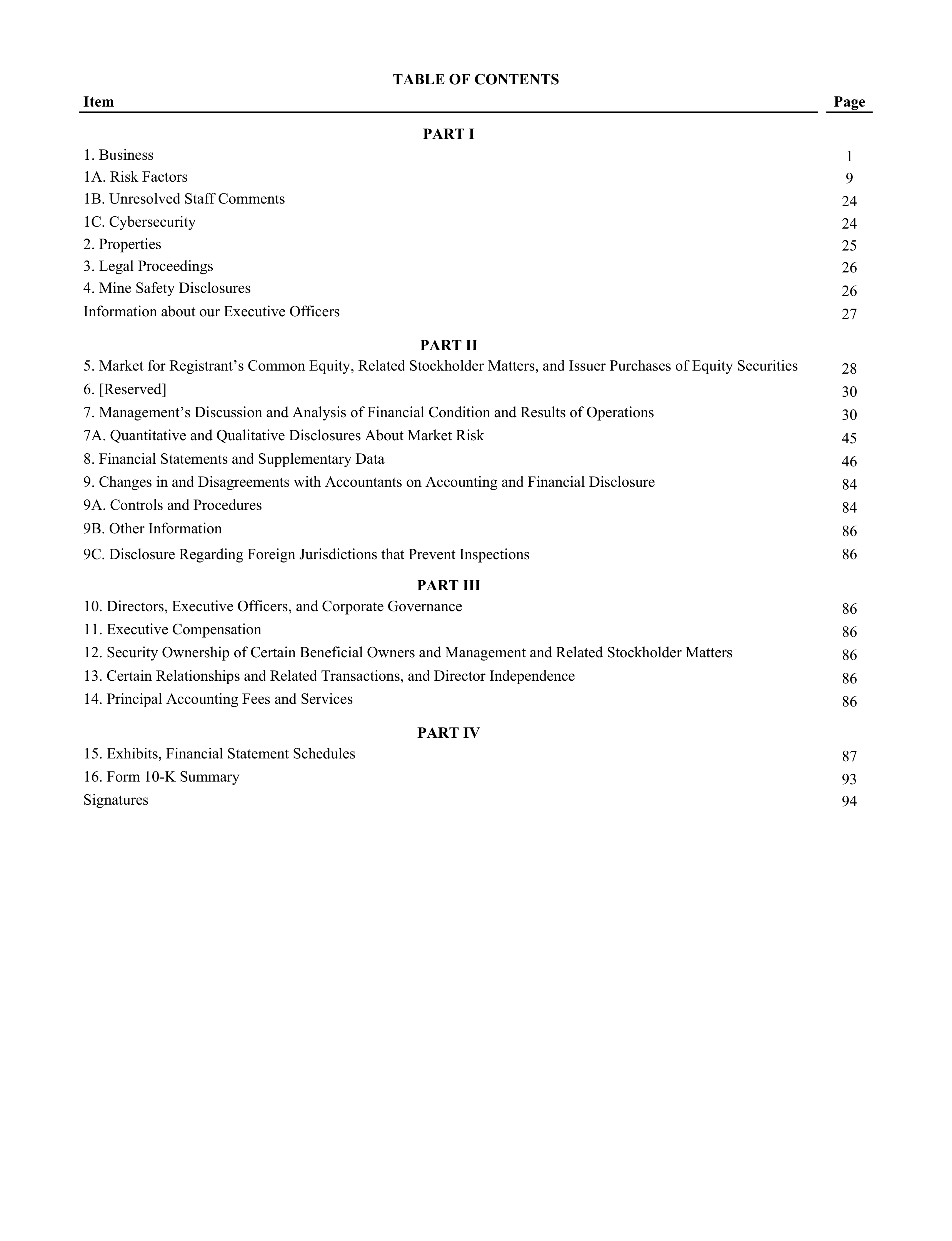
(!'&''&
&(%'&!+!" &&"!
*.?56:4@;:
;>9
!!(%#"%'#(%&(!''"&'"!
"%
1"'&(%'&+!'"
"%'&,%!&2
'%!&'"! %#"%' #(%&(!' '" &'"!
"%
1 " ' &(%'& +! '
"
"%''%!&'"!#%"%" -----------'"-----------
;996??6;:3682:A9/2>
!"%!
2.('!)",!#%-.,(.--*!%"%! %(%.-$,.!,
28.C.>2
+I6I:DGDI=:G?JG>H9>8I>DCD;
!*+BEADN:G
>C8DGEDG6I>DCDGDGO6I>DC
!9:CI>;>86I>DC&D
*2?@6>?@B2:A2
;:?5;5;072:
#
99G:HHD;EG>C8>E6A:M:8JI>K:D;;>8:H
2>ED9:
*:HIG6CIXHI:A:E=DC:CJB7:G >C8AJ9>C<6G:68D9:
&20A>6@62?%246?@2>21#A>?A.:@@;&20@6;:
/;3@520@
'6@82;32.0508.??
'>.16:4&E9/;8?
!.92;32D05.:42;:C5605>246?@2>21
DBBDCHID8@ E6GK6AJ:
E:GH=6G:
'*
&:L1DG@+ID8@M8=6C<:
&1+
+:C>DG&DI:H9J:
'*
&:L1DG@+ID8@M8=6C<:
&1+
+:C>DG&DI:H9J:
'*
&:L1DG@+ID8@M8=6C<:
&1+
-------------------------------------------------
!C9>86I:7N8=:8@B6G@>;I=:G:HIG6CI>H6L:AA
@CDLCH:6HDC:9>HHJ:G6H9:;>C:9>C*JA:
D;I=:+:8JG>I>:H8I1:H
&D
!C9>86I:7N8=:8@B6G@>;I=:G:HIG6CI>HCDIG:FJ>G:9ID;>A:G:EDGIHEJGHJ6CIID+:8I>DCDG9D;I=:+:8JG>I>:HM8=6C<:8ID;1:H
&D
!C9>86I:7N8=:8@B6G@L=:I=:GI=:G:HIG6CI=6H;>A:96AAG:EDGIHG:FJ>G:9ID7:;>A:97N+:8I>DCDG9D;I=:+:8JG>I>:HM8=6CC<I=:
EG:8:9>CD9I=6II=:G:HIG6CIL6HG:FJ>G:9ID;>A:HJ8=G:EDGIH 6C9=6H7::CHJ7?:8IIDHJ8=;>A>CG:B:CIH;DGI=:E6HI
96NH1:H
&D
!C9>86I:7N8=:8@B6G@L=:I=:GI=:G:HIG6CI=6HHJ7B>II:9:A:8IGDC>86AAN:K:GN!CI:G68I>K:6I6>A:G:FJ>G:9ID7:HJ7B>II:9EJGHJ6CIID*JA:
D;*:DC+
,
+:8I>DC
D;I=>H8=6EI:G9JG>CCD9I=6II=:G:HIG6CIL6HG:FJ>G:9IDHJ7B>IHJ8=;>A:H1:H
&D
!C9>86I:7N8=:8@B6G@L=:I=:GI=:G:HIG6CI>H6A6GA:G 6C688:A:G6I:9;>A:G 6CDC
688:A:G6I:9;>A:G 6HB6AA:GG:EDGI>C<8DBE6CN DG6C:B:GC<<GDLI=
8DBE6CN +:: I=: 9:;>C>I>DCH D; VA6GA:G W V688:A:G6I:9 ;>A:G W VHB6AA:G G:EDGI>C< 8DBE6CN W 6C9 V:B:GC< C *JA: 7
D; I=:
M8=6C<:8I$6GA:G
88:A:G6I:9;>A:G
&DC
688:A:G6I:9;>A:G
+B6AA:GG:EDGI>C<8DBE6CN
!;6C:B:GC<C9>86I:7N8=:8@B6G@>;I=:G:HIG6CI=6H:A:8I:9CDIIDJH:I=::MI:C9:9IG6CH>I>DCE:G>D9;DG8DBEAN>CI=6CNC:LDGG:K>H:9
;>C6C8>6A688DJCI>C9:9EJGHJ6CIID+:8I>DC6D;I=:M8=6C<:8I
!C9>86I:7N8=:8@B6G@L=:I=:GI=:G:HIG6CI=6H;>A:96G:EDGIDC6C96II:HI6I>DCID>IHB6C6K:C:HHD;>IH>CI:GC6A8DCIGDADK:G;>C6C8>6A
G:EDGI>CDC
7D;I=:+6G76C:H
'MA:N8I-+77NI=:G:HI:G:9EJ7A>8688DJCI>CGBI=6IEG:E6G:9DG>HHJ:9>IH6J9>IG:EDGI
!;H:8JG>I>:H6G:G:HI:G:9EJGHJ6CIID+:8I>DC7D;I=:8I >C9>86I:7N8=:8@B6G@L=:I=:GI=:;>C6C8>6AHI6I:B:CIHD;I=:G:HIG6CI>C8AJ9:9>CI=:;>A>C<G:;A:8II=:
8DGG:8I>DCD;6C:GGDGIDEG:K>DJHAN>HHJ:9;>C6C8>6AHI6I:B:CIH
!C9>86I:7N8=:8@B6G@L=:I=:G6CND;I=DH::GGDG8DGG:8I>DCH6G:G:HI6I:B:CIHI=6IG:FJ>G:96G:8DK:GN6C6ANH>HD;>C8:CI>K:
76H:98DBE:CH6I>DCG:8:>K:97N6CND;I=:
G:HIG6CIXH:M:8JI>K:D;;>8:GH9JG>CD9EJGHJ6CIIDQ
7
!C9>86I:7N8=:8@B6G@L=:I=:GI=:G:HIG6CI>H6H=:AA8DBE6CN6H9:;>C:9>C*JA:7
D;I=:+:8JG>I>:HM8=6C<:8ID;1:H
&D
,=:6<<G:CA>6I:HD;I=:G:HIG6CIDC%6G8=
76H:9JEDCI=:8ADH>C8:D;HJ8=HID8@DCI=:&:L1DG@+ID8@
M8=6C<:DC%6G8=
L6H
,=:CJB7:GD;H=6G:HD;8DBBDCHID8@D;:C8DG6 !C8DJIHI6C9>C<6HD;'8ID7:G
L6H
;0A92:@?:0;>.@21/E%232>2:02
(DGI>DCHD;I=:G:HIG6CIXH(GDMN+I6I:B:CI;DGI=:
CCJ6A%::I>CC8DGEDG6I:97NG:;:G:C8:>C(6GI!!!D;I=>HCCJ6A*:EDGIDCDGB
#
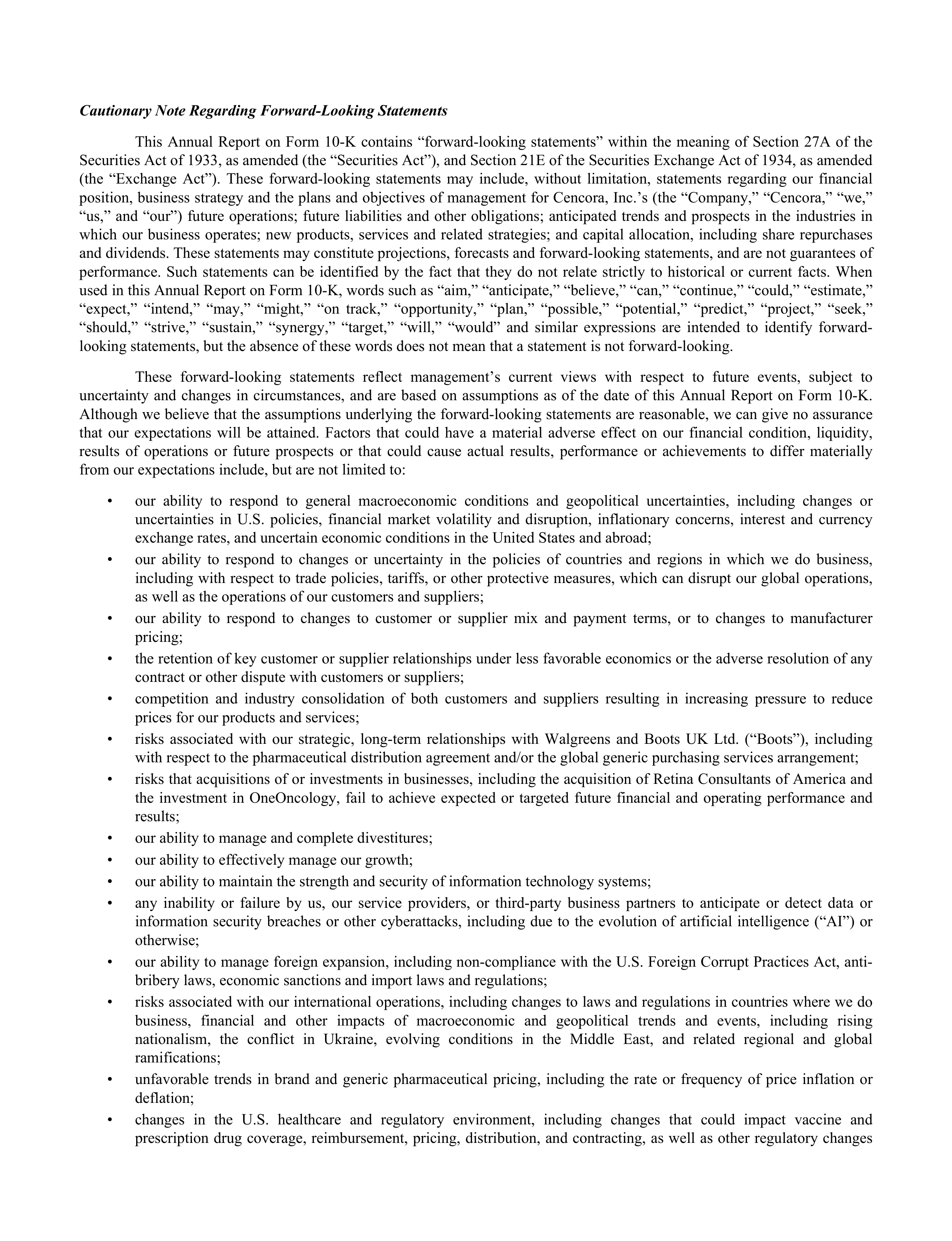
'""!'!'&
@29
#.42
#%'
JH>C:HH
*>H@68IDGH
-CG:HDAK:9+I6;;DBB:CIH
N7:GH:8JG>IN
(GDE:GI>:H
$:C<H
%>C:+6;:IN>H8ADHJG:H
!C;DGB6I>DC67DJIDJGM:8JI>K:';;>8:GH
#%'
%6G@:I;DG*:HIG6CIXHDBBDCFJ>IN *:A6I:9+ID8@=DA9:G%6II:GH 6C9!HHJ:G(JG8=6H:HD;FJ>IN+:8JG>I>:H
3*:H:GK:94
%6C6H8JHH>DC6C9C6ANH>HD;>C6C8>6ADC9>I>DC6C9*:HJAIHD;'E:G6I>DCH
)J6CI>I6I>K:6C9)J6A>I6I>K:>H8ADHJG:H7DJI%6G@:I*>H@
>C6C8>6A+I6I:B:CIH6C9+JEEA:B:CI6GN6I6
=6CC6C9>H6I=88DJCI6CIHDC88DJCI>CC6C8>6A>H8ADHJG:
DCIGDAH6C9(GD8:9JG:H
'I=:G!C;DGB6I>DC
>H8ADHJG:*:CH9>8I>DCHI=6I(G:K:CI!CHE:8I>DCH
#%'
>G:8IDGH M:8JI>K:';;>8:GH 6C9DGEDG6I:DK:GC6C8:
M:8JI>K:DBE:CH6I>DC
+:8JG>IN'LC:GH=>ED;:GI6>C:C:;>8>6A'LC:GH6C9%6C6<:B:CI6C9*:A6I:9+ID8@=DA9:G%6II:GH
:GI6>C*:A6I>DCH=>EH6C9*:A6I:9,G6CH68I>DCH 6C9>G:8IDG!C9:E:C9:C8:
(G>C8>E6A88DJCI>C8:H
#%')
M=>7>IH >C6C8>6A+I6I:B:CI+8=:9JA:H
DGB
#+JBB6GN
+><C6IJG:H
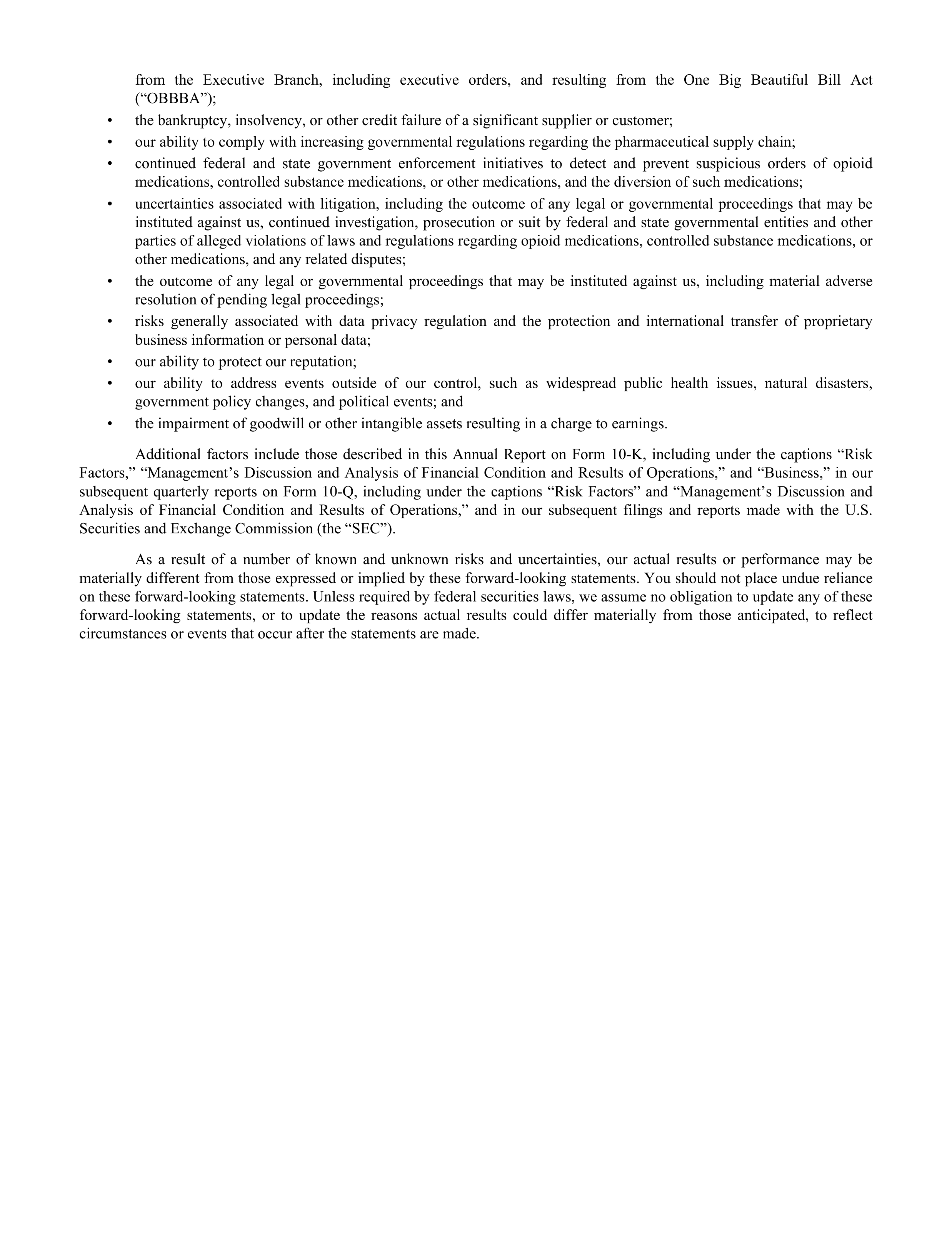
Cautionary Note Regarding Forward-Looking Statements
This Annual Report on Form 10-K contains “forward-looking statements” within the meaning of Section 27A of the
Securities Act of 1933, as amended (the “Securities Act”), and Section 21E of the Securities Exchange Act of 1934, as amended
(the “Exchange Act”). These forward-looking statements may include, without limitation, statements regarding our financial
position, business strategy and the plans and objectives of management for Cencora, Inc.’s (the “Company,” “Cencora,” “we,”
“us,” and “our”) future operations; future liabilities and other obligations; anticipated trends and prospects in the industries in
which our business operates; new products, services and related strategies; and capital allocation, including share repurchases
and dividends. These statements may constitute projections, forecasts and forward-looking statements, and are not guarantees of
performance. Such statements can be identified by the fact that they do not relate strictly to historical or current facts. When
used in this Annual Report on Form 10-K, words such as “aim,” “anticipate,” “believe,” “can,” “continue,” “could,” “estimate,”
“expect,” “intend,” “may,” “might,” “on track,” “opportunity,” “plan,” “possible,” “potential,” “predict,” “project,” “seek,”
“should,” “strive,” “sustain,” “synergy,” “target,” “will,” “would” and similar expressions are intended to identify forward-
looking statements, but the absence of these words does not mean that a statement is not forward-looking.
These forward-looking statements reflect management’s current views with respect to future events, subject to
uncertainty and changes in circumstances, and are based on assumptions as of the date of this Annual Report on Form 10-K.
Although we believe that the assumptions underlying the forward-looking statements are reasonable, we can give no assurance
that our expectations will be attained. Factors that could have a material adverse effect on our financial condition, liquidity,
results of operations or future prospects or that could cause actual results, performance or achievements to differ materially
from our expectations include, but are not limited to:
•
our ability to respond to general macroeconomic conditions and geopolitical uncertainties, including changes or
uncertainties in U.S. policies, financial market volatility and disruption, inflationary concerns, interest and currency
exchange rates, and uncertain economic conditions in the United States and abroad;
•
our ability to respond to changes or uncertainty in the policies of countries and regions in which we do business,
including with respect to trade policies, tariffs, or other protective measures, which can disrupt our global operations,
as well as the operations of our customers and suppliers;
•
our ability to respond to changes to customer or supplier mix and payment terms, or to changes to manufacturer
pricing;
•
the retention of key customer or supplier relationships under less favorable economics or the adverse resolution of any
contract or other dispute with customers or suppliers;
•
competition and industry consolidation of both customers and suppliers resulting in increasing pressure to reduce
prices for our products and services;
•
risks associated with our strategic, long-term relationships with Walgreens and Boots UK Ltd. (“Boots”), including
with respect to the pharmaceutical distribution agreement and/or the global generic purchasing services arrangement;
•
risks that acquisitions of or investments in businesses, including the acquisition of Retina Consultants of America and
the investment in OneOncology, fail to achieve expected or targeted future financial and operating performance and
results;
•
our ability to manage and complete divestitures;
•
our ability to effectively manage our growth;
•
our ability to maintain the strength and security of information technology systems;
•
any inability or failure by us, our service providers, or third-party business partners to anticipate or detect data or
information security breaches or other cyberattacks, including due to the evolution of artificial intelligence (“AI”) or
otherwise;
•
our ability to manage foreign expansion, including non-compliance with the U.S. Foreign Corrupt Practices Act, anti-
bribery laws, economic sanctions and import laws and regulations;
•
risks associated with our international operations, including changes to laws and regulations in countries where we do
business, financial and other impacts of macroeconomic and geopolitical trends and events, including rising
nationalism, the conflict in Ukraine, evolving conditions in the Middle East, and related regional and global
ramifications;
•
unfavorable trends in brand and generic pharmaceutical pricing, including the rate or frequency of price inflation or
deflation;
•
changes in the U.S. healthcare and regulatory environment, including changes that could impact vaccine and
prescription drug coverage, reimbursement, pricing, distribution, and contracting, as well as other regulatory changes
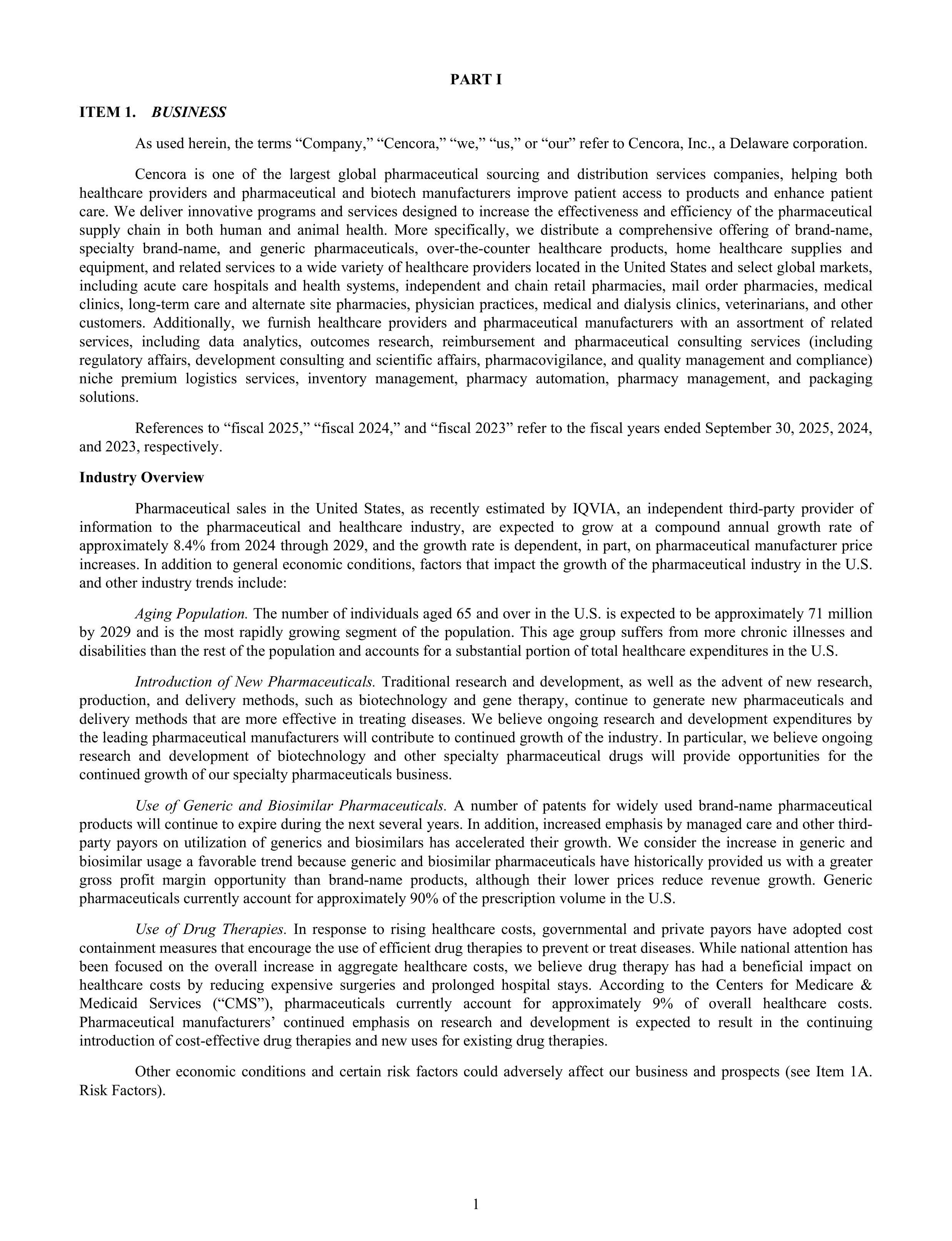
from the Executive Branch, including executive orders, and resulting from the One Big Beautiful Bill Act
(“OBBBA”);
•
the bankruptcy, insolvency, or other credit failure of a significant supplier or customer;
•
our ability to comply with increasing governmental regulations regarding the pharmaceutical supply chain;
•
continued federal and state government enforcement initiatives to detect and prevent suspicious orders of opioid
medications, controlled substance medications, or other medications, and the diversion of such medications;
•
uncertainties associated with litigation, including the outcome of any legal or governmental proceedings that may be
instituted against us, continued investigation, prosecution or suit by federal and state governmental entities and other
parties of alleged violations of laws and regulations regarding opioid medications, controlled substance medications, or
other medications, and any related disputes;
•
the outcome of any legal or governmental proceedings that may be instituted against us, including material adverse
resolution of pending legal proceedings;
•
risks generally associated with data privacy regulation and the protection and international transfer of proprietary
business information or personal data;
•
our ability to protect our reputation;
•
our ability to address events outside of our control, such as widespread public health issues, natural disasters,
government policy changes, and political events; and
•
the impairment of goodwill or other intangible assets resulting in a charge to earnings.
Additional factors include those described in this Annual Report on Form 10-K, including under the captions “Risk
Factors,” “Management’s Discussion and Analysis of Financial Condition and Results of Operations,” and “Business,” in our
subsequent quarterly reports on Form 10-Q, including under the captions “Risk Factors” and “Management’s Discussion and
Analysis of Financial Condition and Results of Operations,” and in our subsequent filings and reports made with the U.S.
Securities and Exchange Commission (the “SEC”).
As a result of a number of known and unknown risks and uncertainties, our actual results or performance may be
materially different from those expressed or implied by these forward-looking statements. You should not place undue reliance
on these forward-looking statements. Unless required by federal securities laws, we assume no obligation to update any of these
forward-looking statements, or to update the reasons actual results could differ materially from those anticipated, to reflect
circumstances or events that occur after the statements are made.
PART I
ITEM 1.
BUSINESS
As used herein, the terms “Company,” “Cencora,” “we,” “us,” or “our” refer to Cencora, Inc., a Delaware corporation.
Cencora is one of the largest global pharmaceutical sourcing and distribution services companies, helping both
healthcare providers and pharmaceutical and biotech manufacturers improve patient access to products and enhance patient
care. We deliver innovative programs and services designed to increase the effectiveness and efficiency of the pharmaceutical
supply chain in both human and animal health. More specifically, we distribute a comprehensive offering of brand-name,
specialty brand-name, and generic pharmaceuticals, over-the-counter healthcare products, home healthcare supplies and
equipment, and related services to a wide variety of healthcare providers located in the United States and select global markets,
including acute care hospitals and health systems, independent and chain retail pharmacies, mail order pharmacies, medical
clinics, long-term care and alternate site pharmacies, physician practices, medical and dialysis clinics, veterinarians, and other
customers. Additionally, we furnish healthcare providers and pharmaceutical manufacturers with an assortment of related
services, including data analytics, outcomes research, reimbursement and pharmaceutical consulting services (including
regulatory affairs, development consulting and scientific affairs, pharmacovigilance, and quality management and compliance)
niche premium logistics services, inventory management, pharmacy automation, pharmacy management, and packaging
solutions.
References to “fiscal 2025,” “fiscal 2024,” and “fiscal 2023” refer to the fiscal years ended September 30, 2025, 2024,
and 2023, respectively.
Industry Overview
Pharmaceutical sales in the United States, as recently estimated by IQVIA, an independent third-party provider of
information to the pharmaceutical and healthcare industry, are expected to grow at a compound annual growth rate of
approximately 8.4% from 2024 through 2029, and the growth rate is dependent, in part, on pharmaceutical manufacturer price
increases. In addition to general economic conditions, factors that impact the growth of the pharmaceutical industry in the U.S.
and other industry trends include:
Aging Population.
The number of individuals aged 65 and over in the U.S. is expected to be approximately 71 million
by 2029 and is the most rapidly growing segment of the population. This age group suffers from more chronic illnesses and
disabilities than the rest of the population and accounts for a substantial portion of total healthcare expenditures in the U.S.
Introduction of New Pharmaceuticals.
Traditional research and development, as well as the advent of new research,
production, and delivery methods, such as biotechnology and gene therapy, continue to generate new pharmaceuticals and
delivery methods that are more effective in treating diseases. We believe ongoing research and development expenditures by
the leading pharmaceutical manufacturers will contribute to continued growth of the industry. In particular, we believe ongoing
research and development of biotechnology and other specialty pharmaceutical drugs will provide opportunities for the
continued growth of our specialty pharmaceuticals business.
Use of Generic and Biosimilar Pharmaceuticals.
A number of patents for widely used brand-name pharmaceutical
products will continue to expire during the next several years. In addition, increased emphasis by managed care and other third-
party payors on utilization of generics and biosimilars has accelerated their growth. We consider the increase in generic and
biosimilar usage a favorable trend because generic and biosimilar pharmaceuticals have historically provided us with a greater
gross profit margin opportunity than brand-name products, although their lower prices reduce revenue growth. Generic
pharmaceuticals currently account for approximately 90% of the prescription volume in the U.S.
Use of Drug Therapies.
In response to rising healthcare costs, governmental and private payors have adopted cost
containment measures that encourage the use of efficient drug therapies to prevent or treat diseases. While national attention has
been focused on the overall increase in aggregate healthcare costs, we believe drug therapy has had a beneficial impact on
healthcare costs by reducing expensive surgeries and prolonged hospital stays. According to the Centers for Medicare &
Medicaid Services (“CMS”), pharmaceuticals currently account for approximately 9% of overall healthcare costs.
Pharmaceutical manufacturers’ continued emphasis on research and development is expected to result in the continuing
introduction of cost-effective drug therapies and new uses for existing drug therapies.
Other economic conditions and certain risk factors could adversely affect our business and prospects (see Item 1A.
Risk Factors).
1
The Company
We serve our customers (healthcare providers and pharmaceutical and biotech manufacturers) through a
geographically diverse network of distribution service centers and other operations in the United States and select global
markets. In our pharmaceutical distribution businesses, we are typically the primary supplier of pharmaceutical and related
products to our healthcare provider customers. We offer a broad range of services to our customers designed to enhance the
efficiency and effectiveness of their operations, which allow them to improve the delivery of healthcare to patients and to lower
overall costs in the pharmaceutical supply chain.
Strategy
Our business strategy is focused on the global pharmaceutical supply chain where we provide distribution and value-
added services to healthcare providers (primarily pharmacies, health systems, medical and dialysis clinics, physicians, and
veterinarians) and pharmaceutical manufacturers to improve channel efficiencies and support positive patient outcomes. Our
strategy is one of driving executional excellence in our core distribution solutions business in the U.S. and internationally, while
also investing in higher-margin, high-growth adjacencies where we provide solutions to pharmaceutical manufacturers to
support the clinical development and commercialization of their therapies and support providers in driving efficiency and
effectiveness of their operations. Implementing this disciplined and focused strategy in a seamless and unified way has allowed
us to significantly expand our business. We are well positioned to grow revenue and increase operating income through the
execution of the following key elements of our business strategy:
•
Optimize and Grow U.S. Healthcare Solutions Businesses.
We are well positioned in size and market breadth to
continue to grow our U.S. Healthcare Solutions businesses as we make investments to improve our operating and
capital efficiencies. Our U.S. human health distribution businesses, including specialty pharmaceuticals, anchor our
growth and position in the pharmaceutical supply chain as we provide distribution services and deliver value-added
solutions that improve the efficiency and competitiveness of both healthcare providers and pharmaceutical
manufacturers, ultimately driving better healthcare for patients.
We are a leader in distribution and services to health systems, community oncologists, and retina specialists and have
leading positions in other physician-administered products. We distribute plasma and other blood products, injectable
pharmaceuticals, vaccines, and other specialty products. We are well positioned to service and support biotechnology
therapies and advanced technologies such as cell and gene therapies.
We have introduced strategies to enhance our position in the generic marketplace, including our generic product
private label program based in Ireland. We source generics globally, offer a value-added generic formulary program to
our healthcare provider customers, and monitor our customers’ compliance with our generics program. We also
provide data and other valuable services to our manufacturer customers.
We offer value-added services and solutions to assist healthcare providers and pharmaceutical manufacturers to
improve their efficiency and their patient outcomes. Services for manufacturers include assistance with new product
launches, product data reporting, and logistical support.
Our provider solutions include: our Good Neighbor Pharmacy® program, which enables independent community
pharmacies to compete more effectively through pharmaceutical benefit and merchandising programs; Elevate
Provider Network®, our managed care network, which connects our retail pharmacy customers to payor plans
throughout the country and is one of the largest in the United States; generic product purchasing and private label
services; hospital pharmacy consulting designed to improve operational efficiencies; and packaging solutions for
institutional and retail healthcare providers. We also offer services that optimize patient access and provide purchasing
power to providers.
We believe we have one of the lowest operating cost structures among pharmaceutical distributors. Our robust
distribution facility network includes a national distribution center in Columbus, Ohio, which offers pharmaceutical
manufacturers a single shipping destination. We continue to seek opportunities to achieve increased productivity and
drive operating income gains as we invest in and continue to implement warehouse automation technology, adopt “best
practices” in warehousing activities, and increase operating leverage by increasing volume per full-service distribution
facility. We continue to seek opportunities to expand our offerings in our human health distribution businesses.
Our animal health business sells pharmaceuticals, vaccines, parasiticides, diagnostics, micro feed ingredients, and
various other products to customers in both the companion animal and production animal markets. It also offers its
customers a variety of value-added services, including its e-commerce platform, technology management systems,
pharmacy fulfillment, inventory management system, equipment procurement consultation, special order fulfillment,
2
and educational seminars, which we believe closely integrate the animal health business with its customers’ day-to-day
operations and provide them with meaningful incentives to remain customers.
Our consulting service businesses provide reimbursement services that assist pharmaceutical companies in supporting
access to branded drugs, contract field staffing, patient assistance and copay assistance programs, adherence programs,
and other market access programs to pharmaceutical companies.
•
Optimize and Grow Our International Healthcare Solutions Businesses.
We are well positioned in size and market
breadth to continue to grow our International Healthcare Solutions businesses as we invest to improve our operating
and capital efficiencies. The International Healthcare Solutions reportable segment consists of businesses that focus on
international pharmaceutical wholesale and related service operations and global commercialization services. The
International Healthcare Solutions reportable segment distributes pharmaceuticals and other healthcare products and
provides related services to healthcare providers, including pharmacies, doctors, health centers and hospitals primarily
in Europe. It is a leading global specialty transportation and logistics provider for the biopharmaceutical industry. It
also is a provider of specialized services, including regulatory affairs, market access, pharmacovigilance, development
consulting and scientific affairs, and quality management and compliance, for the life sciences industry. The Canada
business drives innovative partnerships with manufacturers, providers, and pharmacies to improve product access and
efficiency throughout the healthcare supply chain.
•
Acquisitions and Investments.
In order to grow our core strategic offerings and to enter related markets, we have
acquired and invested in businesses and will continue to consider additional acquisitions and investments.
On January 2, 2025, we acquired an 85% interest in Retina Consultants of America (“RCA”) for $4,042.0 million in
cash, $694.4 million of contingent consideration related to equity units for certain RCA physicians and members of
management that retained the remaining 15% interest in RCA, $545.7 million for the settlement of a net receivable
resulting from a pre-existing commercial relationship between us and RCA, and $393.1 million for contingent
consideration payable to the sellers associated with RCA’s achievement of certain predetermined business objectives
in fiscal 2027 and fiscal 2028. We funded the cash purchase price through a combination of cash on hand and new debt
financing. We believe the acquisition of RCA allows us to broaden our relationships with community providers and to
build on our leadership in specialty pharmaceuticals within our U.S. Healthcare Solutions reportable segment.
•
Divestitures.
In order to ensure alignment with our growth priorities, we have divested certain non-core businesses and
may, from time to time, consider additional divestitures.
•
New Reporting Structure.
Recently, we undertook a strategic review of our business to ensure alignment with our
growth priorities and strategic drivers. As a result of this review, we have reorganized certain business components
within our reporting structure. Beginning in the first quarter of fiscal 2026, our reporting structure will be comprised of
U.S. Healthcare Solutions, International Healthcare Solutions, and Other. The U.S. Healthcare Solutions reportable
segment will consist of U.S. Human Health (excluding legacy U.S. Consulting Services). The International Healthcare
Solutions reportable segment will consist of Alliance Healthcare, Innomar, World Courier, and strategic components
of PharmaLex. Other, which is not considered a reportable segment, will consist of businesses for which we have
begun to explore strategic alternatives and includes MWI Animal Health, Profarma, U.S. Consulting Services and the
other components of PharmaLex.
Operations
Operating Structure
We are organized geographically based upon the products and services we provide to our customers. Our operations
are comprised of two reportable segments: U.S. Healthcare Solutions and International Healthcare Solutions.
U.S. Healthcare Solutions Segment
The U.S. Healthcare Solutions reportable segment distributes a comprehensive offering of brand-name, specialty
brand-name and generic pharmaceuticals, over-the-counter healthcare products, home healthcare supplies and equipment, and
related services to a wide variety of healthcare providers, including acute care hospitals and health systems, independent and
chain retail pharmacies, mail order pharmacies, medical clinics, long-term care and alternate site pharmacies, and other
customers. The U.S. Healthcare Solutions reportable segment also provides pharmaceutical distribution (including plasma and
other blood products, injectable pharmaceuticals, vaccines, and other specialty pharmaceutical products) and additional services
to physicians who specialize in a variety of disease states, especially oncology and retina, and to other healthcare providers,
including hospitals, retinal practices, and dialysis clinics. The U.S. Healthcare Solutions reportable segment also provides
pharmacy management, staffing and additional consulting services, and supply management software to a variety of retail and
3
institutional healthcare providers. Additionally, it delivers packaging solutions to institutional and retail healthcare providers.
Through its animal health business, the U.S. Healthcare Solutions reportable segment sells pharmaceuticals, vaccines,
parasiticides, diagnostics, micro feed ingredients, and various other products to customers in both the companion animal and
production animal markets. It also offers demand-creating sales force services to manufacturers.
International Healthcare Solutions Segment
The International Healthcare Solutions reportable segment consists of businesses that focus on international
pharmaceutical wholesale and related service operations and global commercialization services. The International Healthcare
Solutions reportable segment distributes pharmaceuticals, other healthcare products, and related services to healthcare
providers, including pharmacies, doctors, health centers and hospitals primarily in Europe. It is a leading global specialty
transportation and logistics provider for the biopharmaceutical industry. It also is a provider of specialized services, including
regulatory affairs, market access, pharmacovigilance, development consulting and scientific affairs, and quality management
and compliance, for the life sciences industry. In Canada, the business drives innovative partnerships with manufacturers,
providers, and pharmacies to improve product access and efficiency throughout the healthcare supply chain.
Sales and Marketing
The majority of U.S. Healthcare Solutions’ sales force is led nationally, with geographic focus and specialized by
either healthcare provider type or size. Customer service representatives are centralized to respond to customer needs in a
timely and effective manner. U.S. Healthcare Solutions also has support professionals focused on its various technologies and
service offerings. U.S. Healthcare Solutions’ sales teams also serve national account customers through close coordination with
local distribution centers and ensure that our customers are receiving service offerings that meet their needs. Our International
Healthcare Solutions’ businesses each have independent sales forces that specialize in their respective product and service
offerings. In addition, we have an enterprise-wide marketing team that coordinates branding and all other marketing activities
across the Company.
Customers
We have a diverse customer base that includes institutional and retail healthcare providers as well as pharmaceutical
manufacturers. Institutional healthcare providers include acute care hospitals, health systems, mail order pharmacies, long-term
care and other alternate care pharmacies, providers of pharmacy services to such facilities, physicians, and physician group
practices. Retail healthcare providers include national and regional retail drugstore chains, independent community pharmacies,
pharmacy departments of supermarkets and mass merchandisers, and veterinarians. We are typically the primary source of
supply for our healthcare provider customers. Our manufacturer customers include branded, generic, and biotechnology
manufacturers of prescription pharmaceuticals, as well as over-the-counter product and health and beauty aid manufacturers. In
addition, we offer a broad range of value-added solutions designed to enhance the operating efficiencies and competitive
positions of our customers, thereby allowing them to improve the delivery of healthcare to patients and consumers.
We continually seek to strengthen our existing customer relationships and seek new customers to enhance our
revenues, results of operations, financial position, and cash flows. Our top 10 customers, including governmental agencies and
group purchasing organizations (“GPO”), represented approximately 66% of revenue in fiscal 2025. In fiscal 2025, Walgreens
and Boots together accounted for approximately 25% of revenue and Evernorth Health Services accounted for approximately
13% of revenue. The loss of any key customer or GPO relationship could adversely affect future revenue and results of
operations. Additionally, from time to time, key contracts may be terminated in accordance with their terms or extended,
renewed, or replaced prior to their expiration dates. If those contracts are not renewed, or are extended, renewed, or replaced at
less favorable terms, they may negatively impact our revenue, results of operations, financial position, and cash flows.
Suppliers
We obtain pharmaceutical and other products from manufacturers, none of which accounted for 10% or more of our
purchases in fiscal 2025. The loss of a supplier could adversely affect our business if alternate sources of supply are unavailable
since we are committed to be the primary source of pharmaceutical products for a majority of our customers. We believe that
our relationships with our suppliers are generally good. The 10 largest suppliers in fiscal 2025 accounted for approximately
57% of our purchases.
Information Systems
The U.S. Healthcare Solutions operating segment’s distribution facilities in the U.S. primarily operate under a single
enterprise resource planning (“ERP”) system. U.S. Healthcare Solutions’ ERP system provides for, among other things,
electronic order entry by customers, invoice preparation and purchasing, and inventory tracking. Our International Healthcare
Solutions operating segment operates under various operating systems. We continue to make investments to enhance and
4
upgrade the operating systems utilized by our International Healthcare Solutions operating segments, including, but not limited
to, Alliance Healthcare. We also continue to invest in cybersecurity capabilities as a key priority to improve and enhance our
cyber resiliency.
Additionally, we continue to improve our entity-wide infrastructure environment to drive efficiency, capabilities, and
speed to market, and we are seeking to use AI to improve our business operations, financial position, and results of operations.
To comply with pedigree and other supply chain custody requirements, we have made significant investments in our
secure supply chain information systems (see Item 1A. Risk Factors -
Increasing governmental efforts to regulate the
pharmaceutical supply chain may increase our costs and reduce our profitability)
. We will continue to invest in advanced
information systems and automated warehouse technology.
U.S. Healthcare Solutions has made significant investments in its electronic ordering systems. U.S. Healthcare
Solutions’ systems are intended to strengthen customer relationships by helping customers to reduce operating costs, and by
providing them a platform for various basic and value-added services, including product demand data, inventory replenishment,
single-source billing, third-party claims processing, real-time price and incentive updates, and price labels.
U.S. Healthcare Solutions processes a substantial portion of its purchase orders, invoices, and payments electronically,
and it continues to make substantial investments to expand its electronic interface with its suppliers. U.S. Healthcare Solutions
has warehouse operating systems, which are used to manage the majority of its transactional volume. The warehouse operating
systems have improved U.S. Healthcare Solutions’ productivity and operating leverage.
Competition
We operate in a highly competitive global environment in the distribution of pharmaceuticals and related healthcare
services. Our largest competitors are McKesson Corporation (“McKesson”), Cardinal Health, Inc. (“Cardinal”), and UPS
Logistics, among others. Our U.S. human health distribution businesses compete with both McKesson and Cardinal, as well as
national generic distributors and regional distributors within pharmaceutical distribution. In addition, we compete with
manufacturers who sell directly to customers, chain drugstores who manage their own warehousing, specialty distributors, and
packaging and healthcare technology companies. Alliance Healthcare, MWI Animal Health, World Courier, and our consulting
businesses also face competition from a variety of entities. In all areas, competitive factors include price, product offerings,
value-added service programs, service and delivery, credit terms, and customer support.
Intellectual Property
We use a number of trademarks and service marks. All of the principal trademarks and service marks used in the
course of our business have been registered in the U.S. and, in some cases, in foreign jurisdictions, or are the subject of pending
applications for registration.
We have developed or acquired various proprietary products, processes, software, and other intellectual property that
are used either to facilitate the conduct of our business or that are made available as products or services to customers. We
generally seek to protect such intellectual property through a combination of trade secret, patent and copyright laws, and
through confidentiality and other contractually imposed protections.
We hold patents and have patent applications pending that relate to certain of our products, particularly our automated
pharmacy dispensing equipment, our medication and supply dispensing equipment, certain warehousing equipment, and some
of our proprietary packaging solutions. We seek patent protection for our proprietary intellectual property from time to time as
appropriate.
Although we believe that our patents or other proprietary products and processes do not infringe upon the intellectual
property rights of any third parties, third parties may assert infringement claims against us from time to time.
Human Capital Resources
We believe our success in the global marketplace depends on our ability to attract and retain a talented and skilled
workforce. We aspire to accelerate business results by fostering a dynamic workplace, with the aim of supporting employees to
perform at their full potential, contribute to our success, and pursue opportunities for professional development and career
advancement.
Workforce
As of September 30, 2025, we had more than 51,000 employees globally, of which approximately 47,000 were full-
time employees and approximately 41% were U.S.-based employees.
5
As of September 30, 2025, approximately 24% of our global employees were covered by collective bargaining
agreements, nearly all of whom were employees located outside of the U.S.
Investment in Team Members and Culture
We consider talent attraction, retention, and development opportunities to be key drivers in pursuit of our strategic
priorities. We support employee growth and advancement by offering a variety of benefits to eligible employees including:
•
Leadership and professional development programs and resources;
•
Leadership and executive coaching;
•
Tuition reimbursement;
•
Opportunities to volunteer and participate in mentorship and support programs, such as our employee resource groups,
which celebrate the shared backgrounds and experiences of our team members and aim to strengthen our intersecting
communities inside and outside of Cencora;
•
Recognition opportunities for excellence, such as our True Blue team member recognition program; and
•
Personalized learning and skill-building programs offered through our global learning experience platform.
Our goal is to provide our team members with pathways for career development, access to programs and benefits that
are designed to promote fuller, healthier lives and opportunities to meaningfully participate in their respective communities.
Our talent development programs are designed to help provide a supportive and engaging work environment where team
members can excel. Additionally, the Cencora Team Assistance Fund exists to help employees who are experiencing extreme
financial hardship due to a catastrophic event outside of their control.
We are focused on helping our team members create healthier futures for themselves and their families, including by
offering competitive and comprehensive compensation and benefits packages tailored to the specific needs of our employee
populations in the various countries where we have operations.
Recognizing the importance of investing in the health and wellness of our team members, our comprehensive benefits
packages attempt to address the physical, emotional, financial, and social dimensions of wellness. Our offerings, which vary in
the different geographic locations of our workforce, include (i) health and insurance benefits; (ii) paid time off; (iii) flexible
work arrangements based on role; (iv) retirement and employee stock purchase plans; (v) paid parental and caregiver leave
programs; and (vi) back-up child and elder care. We believe that these programs are important in supporting our team members’
overall well-being and professional growth.
Importantly, we continue to make meaningful investments in supporting and building our talent and enhancing our
culture. We conduct annual, Company-wide surveys to gauge employee satisfaction and identify areas in which we can enhance
and improve employee experience. Employee surveys allow employee voices to be heard and are valuable in shaping our
Company’s culture.
Team Member Safety
We strive to make our workplaces safe for all team members. In addition to utilizing a peer-to-peer safety program, we
regularly convene Company leaders to review and evaluate safety data and issue operational excellence scorecards. Distribution
center team members receive training on proper safety procedures and incentive opportunities, with safety performance tracked
and shared across the organization.
Government Regulation
We are subject to, and affected by, a variety of laws, regulations, and policies from many countries, including
extensive oversight by U.S., United Kingdom (“U.K.”) and European Union (“EU”) governmental entities.
The U.S. Drug Enforcement Administration (“DEA”), the U.S. Food and Drug Administration (“FDA”), the U.S.
Department of Justice, and various other federal and state authorities regulate the purchase, storage, and/or distribution of
pharmaceutical products, including controlled substances. Wholesale distributors of controlled substances must hold valid DEA
licenses, meet various security and operating standards, and comply with regulations governing the sale, marketing, packaging,
holding, and distribution of controlled substances.
We and our customers are subject to fraud and abuse laws, including the federal anti-kickback statute and the False
Claims Act. The anti-kickback statute prohibits persons from soliciting, offering, receiving, or paying any remuneration in order
6
to induce the purchasing, leasing, or ordering, or arrange for or recommend purchasing, leasing, or ordering items or services
that are in any way paid for by Medicare, Medicaid, or other federal healthcare programs. The False Claims Act prohibits
knowingly submitting, or causing the submission, of false or fraudulent claims for payment to the government and authorizes
treble damages and substantial civil penalties in the case of violations. The fraud and abuse laws and regulations are broad in
scope and are subject to frequent and varied interpretation.
In recent years, some states have passed or proposed laws and regulations that are intended to protect the safety of the
pharmaceutical supply chain. These laws and regulations are designed to prevent the introduction of counterfeit, diverted,
adulterated, or mislabeled pharmaceuticals into the distribution system. At the federal level, the supply chain security legislation
known as the Drug Quality and Security Act (“DQSA”) became law in 2013. Title II of the DQSA, known as the Drug Supply
Chain Security Act (“DSCSA”), establishes federal traceability standards requiring drugs to be labeled and tracked at the lot
level, preempts state drug pedigree requirements, and requires all supply-chain stakeholders to participate in an electronic,
interoperable prescription drug traceability system. The DSCSA also establishes requirements for drug wholesale distributors
and third-party logistics providers, including licensing requirements applicable in states that had not previously licensed third-
party logistics providers. The FDA issued a proposed rule on February 4, 2022, which, when finalized, will establish national
standards for the licensure of wholesale drug distributors and third-party logistics providers. The standards, terms, and
conditions established for licensure under this regulation would be applicable to both federal and state licenses. There can be no
assurance that we are fully compliant with DQSA and DSCSA requirements, or with additional related state regulatory and
licensing requirements, and any failure to comply may result in suspension or delay of certain operations and additional costs to
bring our operations into compliance. These and other requirements will continue to increase the cost of our operations.
The regulation of public and private health insurance and benefit programs can also affect our business, and scrutiny of
the healthcare delivery and reimbursement systems in the U.S., including those related to the importation and reimportation of
certain drugs from foreign markets, can be expected to continue at both the state and federal levels. This process may result in
additional legislation and/or regulation governing the production, delivery, or pricing of pharmaceutical products and other
healthcare services. In addition, changes in the interpretations of existing regulations may result in significant additional
compliance costs or the discontinuation of our ability to continue to operate certain of our distribution centers, which may have
a material adverse effect on our financial condition and results of operations.
Any future reductions in Medicare or Medicaid reimbursement rates could negatively impact our customers’
businesses and their ability to continue to purchase drugs from us. We cannot predict what additional initiatives, if any, will be
adopted, when they may be adopted, or what impact they may have on us.
We are subject to various federal, state, and local environmental laws, including with respect to the sale,
transportation, storage, handling, and disposal of hazardous or potentially hazardous substances, as well as laws relating to safe
working conditions and laboratory practices.
The costs, burdens, and/or impacts of complying with federal and state regulations could be significant and the failure
to comply with any such legal requirements could have a significant impact on our financial position, results of operations, and
cash flows.
See “Risk Factors” for a discussion of additional legal and regulatory developments, as well as potential enforcement
actions or other litigation that could arise out of our failure to adequately comply with applicable laws and regulations that may
negatively affect our financial position, results of operations, and cash flows.
Data Privacy and Security Regulation
Our businesses, depending upon their operations and locations, may be subject to foreign, federal, and local privacy
and security laws, regulations, and directives concerning the collection, use, analysis, retention, storage, protection, transfer,
disclosure, and/or disposal of personal data including, without limitation, the Health Insurance Portability and Accountability
Act of 1996, as amended by the final regulations promulgated pursuant to the Health Information Technology for Economic
and Clinical Health Act (“HITECH Act”) found in the American Recovery and Reinvestment Act of 2009 (collectively,
“HIPAA”), the EU General Data Protection Regulation (“GDPR”), the U.K. GDPR, the Personal Information Protection and
Electronic Documents Act of 2000 (“PIPEDA”), U.S. state, U.S. city, and Canadian provincial privacy, consumer protection,
cybersecurity, AI, and breach notification laws, regulations, and directives, and equivalent foreign laws. These laws, regulations
and directives impose complex, inconsistent, stringent, and evolving privacy and security standards and potentially significant
liability, including criminal and civil penalties for noncompliance. We have a global privacy compliance program to facilitate
our ongoing efforts to comply with these laws, regulations, and directives. There is also an emerging trend of governmental
entities proposing and providing regulatory guidance related to AI, including generative AI. If we or our third-party providers
are restricted from using AI as a result of any regulatory views, laws or other measures, it could impact our operations, increase
our compliance expense and burden, and cause us to incur costs to replace or modify our use of AI.
7
Available Information
The Company’s Annual Reports on Form 10-K, Quarterly Reports on Form 10-Q, Current Reports on Form 8-K, and
any amendments to such reports filed pursuant to Sections 13(a) and 15(d) of the Exchange Act, are filed with the SEC. Such
reports and other information filed or furnished by the Company with the SEC are available free of charge through our website
at
investor.cencora.com
after we electronically file with or furnish them to the SEC and may also be viewed using the SEC’s
website at
www.sec.gov
.
The Company periodically provides certain information for investors on its corporate website,
www.cencora.com
, and
its investor relations website,
investor.cencora.com
. This includes press releases and other information about financial
performance, information on corporate responsibility matters, and details related to the Company’s annual meeting of
stockholders. The information contained on the websites referenced in this Annual Report on Form 10-K is not incorporated by
reference into this filing. Further, the Company’s references to website URLs are intended to be inactive textual references
only.
8
ITEM 1A.
RISK FACTORS
Investing in our securities involves risk. The following discussion describes certain risk factors that we believe could
affect our business and prospects. The following risk factors should be read carefully in connection with evaluating our
business and the forward-looking statements contained in this Annual Report on Form 10-K. Any of these risk factors could
lead to material adverse effects on our business, financial position, results of operations, and cash flows. Our business
operations could also be affected by additional factors that are not presently known to us or that we currently consider not to be
material. The reader should not consider this list to be a complete statement of all risks and uncertainties.
Business and Operational Risks
Our revenue, financial position, results of operations, and cash flows may suffer upon the loss, or renewal at less favorable
terms, of a key customer or group purchasing organization.
Walgreens and Boots together accounted for approximately 25% of our revenue in fiscal 2025 and, as of September
30, 2025, accounted for approximately 38% of our accounts receivable, net. Evernorth Health Services accounted for
approximately 13% of our revenue in fiscal 2025. Our top ten customers, including governmental agencies, represented
approximately 66% of revenue in fiscal 2025. We have distributor relationships with GPOs in multiple distribution segments.
We may lose a key customer or GPO relationship if any existing contract with such customer or GPO expires without being
extended, renewed, renegotiated or replaced or is terminated by the customer or GPO prior to expiration, to the extent such
early termination is permitted by the contract. A number of our contracts with key customers or GPOs are typically subject to
expiration each year, and we may lose any of these customers or GPO relationships if we are unable to extend, renew,
renegotiate or replace such expired contracts. The loss of any key customer or GPO relationship could adversely affect our
revenue, results of operations, and cash flows. Additionally, from time to time, key contracts may be renewed or modified prior
to their expiration date in furtherance of our strategic objectives or those of our customers. If those contracts are renewed or
modified at less favorable terms, they may also negatively impact our revenue, financial position, results of operations, and cash
flows.
The anticipated ongoing benefits of our relationship with Walgreens and Boots may not be realized.
On August 28, 2025, Sycamore Partners, a private equity firm, acquired Walgreens Boots Alliance, Inc. (“WBA”). We
have a distribution agreement in the U.S. pursuant to which we distribute pharmaceuticals to Walgreens pharmacies as well as a
generics purchasing services arrangement under which Walgreens Boots Alliance Development GmbH (“WBAD”) provides a
variety of services to us, including negotiating acquisition pricing with generic manufacturers on our behalf. Each of these
agreements has a stated term that does not expire until 2029. We also have an international distribution agreement pursuant to
which we supply brand-name and generic pharmaceutical products to Boots until 2031. In light of the reorganization of WBA
and its subsidiaries into distinct business units by WBA’s new owners, such new owners may seek changes to WBA’s
operations or our relationship with WBA that could affect our agreements with Walgreens, WBAD, and/or Boots. For example,
WBA’s new owners may expand or accelerate WBA’s plan disclosed in October 2024 to close approximately 1,200 retail stores
in the U.S. over a three-year period. There can be no assurance that potential changes to our relationship with WBA, and/or its
business and operations under new ownership, will not have an adverse effect on our contractual arrangements with WBA or
our business.
In addition, the processes needed to achieve and maintain the expected cost savings, growth initiatives and efficiencies
in sourcing, logistics and distribution associated with our relationship with Walgreens and Boots are complex, costly, and time
consuming. Achieving the anticipated benefits from the arrangements on an ongoing basis is subject to a number of significant
challenges and uncertainties, including, without limitation: (i) the potential inability to realize and/or delays in realizing
potential benefits resulting from participation in our generics purchasing services arrangement with WBAD, including
improved generic drug pricing and terms, improved service fees from generic manufacturers, cost savings, innovations, or other
benefits due to its potential inability to negotiate successfully with generic manufacturers or otherwise to perform as expected;
(ii) potential changes in supplier relationships and terms; (iii) unexpected or unforeseen costs, fees, expenses and charges
incurred by us related to the transaction or the overall strategic relationship; (iv) changes in the economic terms under which we
distribute pharmaceuticals to Walgreens pharmacies in the U.S. or to pharmacies operated by Boots. in the U.K., including
changes necessitated by changing market conditions or other unforeseen developments that may arise during the term of either
distribution agreement, to the extent that any such changes are not offset by other financial benefits that we are able to obtain
through collaboration in other aspects of our strategic relationship with Walgreens and Boots; and (v) any potential issues that
could impede our ability to continue to work collaboratively with Walgreens and Boots in an efficient and effective manner in
furtherance of the anticipated strategic and financial benefits of the relationship.
9
A disruption in our distribution or generic purchasing services arrangements with Walgreens or WBAD could adversely
affect our business and financial results.
From an operational perspective, we are the primary distributor of pharmaceutical products for Walgreens in the U.S.
and Boots in the U.K. If our operations are seriously disrupted for any reason deemed within our control, we may have an
obligation to pay or credit Walgreens or Boots for any resulting failure or delay in supplying products. Conversely, if the
operations of Walgreens, Boots, or WBAD are seriously disrupted for any reason, whether by a pandemic, natural disaster,
labor disruption, regulatory or governmental action, or otherwise, it could adversely affect our business and our sales and
profitability. In addition, if the economics of the generics purchasing services arrangement with WBAD decline due to changes
in market conditions or other changes impacting the fees and rebates that generic manufacturers make available through the
arrangement, our margins and results of operations could also be adversely affected.
Our business may also be adversely affected by any operational, financial, or regulatory difficulties that Walgreens or
Boots experience, including any disruptions of certain of their existing distribution facilities or retail pharmacies resulting from
ongoing inspections by the DEA and/or other regulatory agencies and possible revocation of the controlled substance
registrations for such facilities and pharmacies.
Our results of operations and financial position may be adversely affected if we acquire or invest in businesses that do not
perform as we expect or that are difficult for us to integrate.
As part of our strategy, we seek to pursue acquisitions of and investments in other businesses. At any particular time,
we may be in various stages of assessment, discussion, and negotiation with regard to one or more potential acquisitions or
investments, not all of which will be consummated. We make public disclosure of pending and completed acquisitions when
appropriate and required by applicable securities laws and regulations. In June 2023, we invested $718.4 million (representing a
34.9% interest) in a joint venture to acquire OneOncology, a network of leading oncology practices, with TPG Inc., a global
alternative asset management firm, holding the majority interest in the joint venture. Further, on January 2, 2025, we acquired
RCA, a leading management services organization of retina specialists. Each of OneOncology and RCA may fail to achieve
their respective future financial and operating performance and results, and consequently we may fail to achieve the expected
benefits of these acquisitions within the expected timeframes or at all. Acquisitions of and investments in other businesses may
also have the effect of disrupting relationships with employees, suppliers, and other business partners.
We may find that our ability to integrate or achieve the benefits we anticipate from RCA and other acquisitions is more
difficult, time consuming, or costly than expected. Furthermore, acquisitions and investments involve numerous risks and
uncertainties and may be of businesses or in regions in which we lack operational or market experience. Acquired companies
may have business practices or operational requirements that we are not accustomed to or have unique terms and conditions
with their business partners. As a result of the acquisition of RCA, the investment in OneOncology, and our entry into new
markets, our results of operations and financial position may be adversely affected by a number of factors, including, without
limitation: (i) regulatory or compliance issues, including new or increased focus on billing and coding, patient referrals, health
and safety, health data privacy, quality standards, corporate practice of medicine and other forms of ownership regulation; (ii)
changes in laws and regulations applicable to the acquired businesses, including with respect to management services
organizations (“MSOs”); (iii) the failure of the acquired businesses or investments to achieve the results that we have projected
in either the near or long term; (iv) the assumption of unknown liabilities, including litigation risks; (v) the fair value of assets
acquired and liabilities assumed not being properly estimated; (vi) the difficulties of imposing adequate financial and operating
controls on such businesses and their respective management teams and the potential liabilities that might arise pending the
imposition of adequate controls; (vii) the difficulties in the integration of or the introduction to the operations, technologies,
compliance requirements (including with respect to regulatory, health and safety, and quality standards), services and products
of such businesses, including, in connection with the RCA acquisition, those related to clinical trial sites and their obligations
under FDA and other applicable healthcare regulations; (viii) the failure to achieve the strategic objectives of these acquisitions
and investments; and (ix) substantial costs and the diversion of management’s time to address the foregoing difficulties.
Our business and results of operations may be adversely affected if we fail to manage and complete divestitures.
We regularly evaluate our portfolio to determine whether an asset or business may no longer help us meet our
objectives. When we decide to divest assets or a business, we may encounter difficulty finding buyers or alternative exit
strategies, which could delay the achievement of our strategic objectives. Further, divestitures may be delayed due to failure to
obtain required approvals on a timely basis, if at all, from governmental authorities or third parties. They may also become
more difficult to execute due to conditions placed upon any approval that could, among other things, delay or prevent us from
completing a transaction, negatively impact the value of a divested business due to the effect on relationships with personnel or
customers, or otherwise restrict our ability to realize the expected financial or strategic goals of a transaction. We may continue
to have exposure in a divested business, such as through ongoing financial, ownership or operational obligations or transition
10
services, and, as a result, conditions outside of our control might limit the expected benefits of the divestiture.
Following a
divestiture, we may be restricted from re-entering applicable markets for a period of time due to non-competition restrictions.
The impact of a divestiture on our results of operations could also be less than anticipated.
We face geopolitical and other risks associated with our international operations, which could materially adversely impact
our financial position, results of operations, and cash flows.
We conduct operations in over 50 countries and, in fiscal 2025, approximately 9% of our revenue was derived from
our international operations, which subjects us to various risks inherent in global operations. In the future, we may conduct
business in additional foreign jurisdictions, which may present new or different risks associated with such foreign operations.
At any particular time, our global operations may be affected by local changes in laws, regulations, and political and
economic environments, including inflation, recession, currency volatility, and competition, as well as business and operational
decisions made by joint venture partners. For example, Turkey remains a “highly inflationary economy,” as defined under
GAAP, which impacted our consolidated financial statements. Refer to the Foreign Currency accounting policy in Note 1 of the
Notes to Consolidated Financial Statements for the incremental expenses recorded related to Turkey’s highly inflationary
accounting impact on our consolidated financial statements.
Furthermore, geopolitical dynamics caused by changes or uncertainty in U.S. policies or the political, economic, social
or other conditions or policies in foreign countries and regions in which we do business may impact or disrupt our business, as
well as the operations of our customers, suppliers, service providers, or other third-party business partners. During fiscal 2025,
we continued to experience increased costs, including for fuel, and it is possible that we could experience supply disruptions,
shortages, or additional costs (including with respect to packaging, materials, and other equipment) resulting from U.S. tariffs
or other protective measures. These tariffs and protective measures may include (i) the existing fentanyl tariffs, reciprocal
tariffs, or secondary tariffs imposed on Indian or Brazilian-origin goods; (ii) the threatened tariffs on imports of
pharmaceuticals and pharmaceutical ingredients under Section 232 of the Trade Expansion Act of 1962 (as amended); or (iii)
additional tariffs imposed by the U.S. Executive Branch or Congress. We cannot predict how or when these tariffs may be
implemented or modified. Moreover, other countries may impose counter-tariffs or measures that could impact our operations
and pricing. The current environment relating to tariffs is highly dynamic, and tariff policies may be interrelated with other
regulatory and foreign policy initiatives of the Executive Branch and/or Congress.
Significantly higher and sustained rates of inflation, with subsequent increases in operational costs, could have a
material adverse effect on our business. The continued threat of terrorism and heightened security and military action in
response thereto, or any other current or future acts of terrorism, war or other geopolitical developments (such as rising
nationalism, the conflict in Ukraine, and evolving conditions in the Middle East), and other events (such as economic sanctions
and trade restrictions) may cause further disruptions to the economies of the U.S. and other countries and create further
uncertainties. Any disruption may inhibit our access to, or require us to spend more money to source, certain products that we
use in our operations. Any of these factors could adversely affect our business.
We might be adversely impacted by fluctuations in foreign currency exchange rates.
We conduct our business in various currencies, including the U.S. Dollar, the U.K. Pound Sterling, the Euro, the
Turkish Lira, the Brazilian Real, and the Canadian Dollar. Changes in foreign currency exchange rates could reduce our
revenues, increase our costs or otherwise adversely affect our financial results reported in U.S. dollars. We may from time to
time enter into foreign currency contracts, foreign currency borrowings or other techniques intended to hedge a portion of our
foreign currency exchange rate risks. These hedging activities may not completely offset the adverse financial effects of
unfavorable movements in foreign currency exchange rates during the time the hedges are in place. Any of these risks might
have an adverse impact on our business operations and our financial position, results of operations, or cash flows.
We are subject to operational and logistical risks that might not be covered by insurance.
We have distribution centers and facilities located in the U.S., the U.K., the EU, and throughout the world. Our
business exposes us to risks that are inherent in the distribution of pharmaceuticals and the provision of related services,
including cold chain storage and shipping. The volume of cold chain storage and shipping has increased, and we expect this
trend to continue. Although we seek to maintain adequate insurance coverage, coverage on acceptable terms might be
unavailable, might not cover our losses, might be significantly more costly or may require large, self-insured retentions.
Additionally, we seek to maintain coverage for risks associated with cybersecurity, but such insurance comes with increasingly
high self-insured retentions and, in some cases, policies may not provide adequate coverage for possible losses. Uninsured
losses or operational losses that result from large, self-insured retentions under commercial insurance coverage might have an
adverse impact on our business.
11
We are subject to industry risks that might not be covered by insurance nor indemnification obligations of our contracted
parties.
We are exposed to risks inherent to the healthcare industry, including, without limitation, the distribution,
administration, ancillary services, and related consultation services provided to our customers, providers, or manufacturers of
pharmaceutical products. We seek indemnification from our third-party business partners, including the vendors of the products
that we distribute, and seek to limit liability of our contractual exposure with our third-party business partners, but any
indemnification or limitation of liability contained in such contractual provisions may not be enforceable, or the contracted
party may not be financially capable of meeting its contractual obligations or adequately protecting us from liability. While we
maintain various insurance policies, including product liability, professional liability, and cyber liability policies, adverse losses
might be uninsured, not have sufficient insurance limits, or have high self-insured retentions that could have a materially
adverse impact on our business.
We might be unable to successfully recruit and retain qualified employees.
Our ability to attract, engage, develop and retain qualified and experienced employees, including key executives and
other talent, is essential for us to meet our objectives. We compete with many other businesses to attract and retain employees.
Competition among potential employers might result in increased salaries, benefits or other employee-related costs, or in our
failure to recruit and retain employees. Additionally, we may experience sudden, unexpected loss of key personnel due to a
variety of causes, such as illness or death, and we must adequately plan for succession of key management roles. However, our
succession plans may not be effective if, for example, an employee does not successfully transition into a new role. Any of
these risks might have a materially adverse impact on our business operations and our financial position or results of operations.
Additionally, approximately 24% of our employees are covered by collective bargaining agreements, nearly all of
whom are employees located outside of the U.S. We work to maintain strong relationships with our employees; however, if any
of our employees in the locations that are unionized should engage in strikes or other such bargaining tactics in connection with
the negotiation of collective bargaining agreements, such tactics could be disruptive to our operations, adversely affect our
results of operations, and cause reputational harm.
The loss or disruption of information systems could disrupt our operations and have a material adverse effect on our
business.
Our businesses rely on sophisticated information systems and AI to obtain, rapidly process, analyze, and manage data
to facilitate the purchase and distribution of thousands of inventory items from numerous distribution centers; to receive,
process, and ship orders on a timely basis; to account for other product and service transactions with customers; to manage the
accurate billing and collections for thousands of customers; and to process payments to suppliers. We continue to make
substantial investments in our data centers, third-party cloud-based environments and services, distribution centers and
information systems, including, but not limited to, those relating to our acquisition of RCA. The implementation of new
information systems may be more time consuming or costly than we anticipate. To the extent our information systems,
including any new information systems, are not successfully implemented or fail, or to the extent there are data center failures,
interruptions, or outages caused by factors such as infrastructure overload, ransomware attacks, security breaches or natural
disasters, our business and results of operations may be materially adversely affected. Our business and results of operations
may also be adversely affected if a third-party business partner does not perform satisfactorily and/or is impacted by a
cybersecurity incident, or if information systems fail or are interrupted or damaged by unforeseen events, including due to the
actions of third parties.
Information security risks have generally increased in recent years because of the changing threat landscape, evolving
vulnerabilities, proliferation of cloud-based infrastructure and other information technology services, new technologies, supply
chain dependencies and the increased sophistication and activities of perpetrators of cyberattacks. Security incidents such as
ransomware attacks are becoming increasingly prevalent and severe, as well as increasingly difficult to detect. These risks have
increased with the growth of our business, the interconnected nature of our supply chain and partnerships, and the breadth and
scope of our information systems, including as we acquire or integrate the information systems of acquired businesses, such as
RCA, into our enterprise. As we continue to integrate the information systems of different business units, there is an increasing
possibility that a security incident in one business unit will affect others.
In addition, security incidents may disrupt our businesses and require that we expend substantial additional resources
related to the security and recovery of information systems. Companies in our industry have increasingly been targeted for
cyberattacks, and we operate in one of the most frequently targeted industries due to the attractiveness and value of proprietary
business information, personal health information and other sensitive health data, as perceived by bad actors and criminals on
the dark web. We, and our third-party business partners, have experienced detrimental cyberattacks. For example, we
previously disclosed cybersecurity incidents in February 2024 and in March 2023. Although the prior incidents did not have a
material adverse impact on us, either individually or in the aggregate, similar incidents or events in the future may do so.
12
Security breaches can occur as a result of technical and non-technical issues, including intentional or inadvertent
actions by our personnel, service providers, or third-party business partners, or the exploitation of known or unknown
vulnerabilities by a threat actor. A failure, interruption, or breach of our operational or information security systems, or those of
our service providers or third-party business partners, as a result of cyberattacks or security breaches could disrupt our business,
result in the loss, corruption, unplanned unavailability, disclosure or misuse of confidential or proprietary information or
personal data, damage our reputation, cause loss of customers or revenue, increase our costs, result in litigation and/or
regulatory action, and/or cause other losses, any of which, whether they involve us or our service providers or third-party
business partners, might have a materially adverse impact on our business operations, business strategy, our ability to provide
products/services to our customers and our financial position or results of operations.
We may not be aware of all vulnerabilities and cannot anticipate, detect, or implement fully effective preventative
measures against all security threats, particularly because the techniques used are increasingly sophisticated and constantly
evolving. For example, as AI continues to evolve, cyber attackers could also use AI to develop malicious code and sophisticated
phishing attempts, and our use of AI could increase cybersecurity and data protection risks. As a result, cyber security and the
continued development and enhancement of the security controls and processes designed to protect our systems, computers,
software, data, and networks from attack, damage, failure, interruption, or unauthorized access remain a priority for us.
Although we believe that we have robust security controls, processes, and other safeguards in place, as cyber threats continue to
evolve, we may be required to expend additional resources to continue to enhance our security measures and to investigate and
remediate information security vulnerabilities.
Industry and Economic Risks
Our results of operations could be adversely impacted by manufacturer pricing changes.
Our contractual arrangements with pharmaceutical manufacturers for the purchase of brand-name pharmaceutical
products in the United States generally use wholesale acquisition cost (“WAC”) as the reference price. We sell brand-name
pharmaceutical products to many of our customers using WAC as the reference price and to other customers based on their
negotiated contract price. If manufacturers change their pricing policies or practices with regard to WAC or if prices charged by
manufacturers do not align with prices negotiated to be paid by our customers, and we are unable to negotiate alternative ways
to be compensated by manufacturers or customers for the value of our services, our results of operations could be adversely
affected. Additionally, there are a number of U.S. government policy initiatives being considered that, if enacted, could directly
or indirectly regulate or impact WAC prices. If such initiatives are passed or finalized and we are unable to negotiate equitable
changes with our suppliers and/or customers, our results of operations could be adversely impacted.
The pharmaceutical products that we purchase are also subject to price inflation and deflation, as well as the threatened
and enacted tariffs described above. Additionally, certain distribution service agreements that we have entered into with brand-
name and generic pharmaceutical manufacturers have a price appreciation component to them. As a result, our gross profit from
brand-name and generic pharmaceuticals continues to be subject to fluctuation based upon the timing and extent of
manufacturer price increases, which we do not control. If the frequency or rate of brand-name and generic pharmaceutical price
increases slows, whether due to regulatory mandates, the implementation of legislative proposals, policy initiatives or voluntary
manufacturer actions, our results of operations could be adversely affected. In addition, generic pharmaceuticals are also subject
to price deflation. If the frequency or rate of generic pharmaceutical price deflation accelerates, the negative impact on our
results of operations would increase.
On May 12, 2025, the Executive Branch issued Executive Order 14297, “Delivering Most-Favored-Nation
Prescription Drug Pricing to American Patients” (“Executive Order 14297”). Executive Order 14297 seeks to reduce
prescription drug costs in the U.S. by requiring manufacturers to sell certain drugs in the U.S. at no higher than the lowest
prices paid for those same drugs in other developed countries. Executive Order 14297 directs the U.S. Department of Health
and Human Services (“HHS”) to facilitate direct-to-consumer (“DTC”) purchasing programs for prescription drugs at the most-
favored-nation (“MFN”) price that may bypass traditional supply chain intermediaries. The U.S. Office of Management and
Budget received a proposed rule for review to implement a “Global Benchmark for Efficient Drug Pricing (GLOBE) Model” on
September 25, 2025, and another proposed rule to implement a “Guarding U.S. Medicare Against Rising Drug Costs (GUARD)
Model” on October 2, 2025, but neither proposed rule has been published. Although HHS has not yet otherwise issued any
substantive regulatory proposals for DTC mechanisms, both the Executive Branch and the pharmaceutical manufacturers trade
association have announced DTC websites for manufacturer DTC discounting programs. Further, some manufacturers have
already announced alternative DTC models for a limited number of products in parallel to traditional retail distribution that may
employ product shipment mechanisms that do not incorporate traditional wholesale distribution. MFN pricing pressures and
DTC mechanisms could lead to voluntary or involuntary manufacturer price changes, which could be either temporary or long
term, but all of which could adversely affect our business.
13
Competition and industry consolidation may erode our profit.
As described in greater detail in the “Competition” section of Item 1.
Business
of this Annual Report on Form 10-K,
the industries in which we operate are highly competitive. Our pharmaceutical distribution businesses not only compete with
other pharmaceutical distributors, but also with manufacturers who sell directly to customers, chain drugstores who manage
their own warehousing, specialty distributors, and packaging and healthcare technology companies. In addition, the healthcare
industry continues to experience increasing consolidation, including through the formation of strategic alliances among
pharmaceutical manufacturers, retail pharmacies, healthcare providers and health insurers, which may create further
competitive pressures on our pharmaceutical distribution business. Continued consolidation within the healthcare industry could
adversely affect our results of operations, to the extent we experience reduced negotiating power or possible customer losses.
Our revenue and results of operations may suffer upon the bankruptcy, insolvency, or other credit failure of a significant
customer or supplier.
Most of our customers buy pharmaceuticals and other products and services from us on credit. Credit is made available
to customers based upon our assessment and analysis of their creditworthiness. Although we often try to obtain a security
interest in assets and other arrangements intended to protect our credit exposure, we generally are either subordinated to the
position of the primary lenders to our customers or substantially unsecured. Volatility of the capital and credit markets, general
economic conditions including elevated interest rates, changes in customer payment terms, and regulatory changes (such as
changes in reimbursement), may adversely affect the solvency or creditworthiness of our customers and their ability to maintain
liquidity sufficient to repay their obligations to us as they become due. The bankruptcy, insolvency, or other credit failure of
any customer that has a substantial amount owed to us, including our largest customer, could have a material adverse effect on
our revenue, results of operations, financial position, and cash flows. As of September 30, 2025, our two largest trade
receivable balances due from customers (Walgreens and Boots together and Evernorth Health Services) represented
approximately 38% and 5% of our accounts receivable, net.
Our relationships with pharmaceutical suppliers give rise to substantial amounts that are due to us from the suppliers,
including amounts owed to us for returned goods or defective goods, chargebacks, and amounts due to us for services provided
to the suppliers. Volatility of the capital and credit markets, general economic conditions, pending litigation, and regulatory
changes may adversely affect the solvency or creditworthiness of our suppliers. The bankruptcy, insolvency, or other credit
failure of any supplier at a time when the supplier has a substantial account payable balance due to us could have a material
adverse effect on our business. Furthermore, the bankruptcy, insolvency or other credit failure of a significant supplier could
have an adverse effect on the supply or availability of products which may cause supply chain disruptions and increases in the
price of substitutes or alternatives.
Our stock price and our ability to access credit markets may be adversely affected by financial market volatility and
disruption or a downgrade in our credit ratings.
If the capital and credit markets experience significant disruption and volatility in the future, we could experience
downward movement in our stock price without regard to our financial position or results of operations or an adverse effect,
which may be material, on our ability to access credit. While we believe that our operating cash flow and existing credit
arrangements give us the ability to meet our financing needs, disruption and volatility could increase our costs of borrowing,
impair our liquidity, or adversely impact our business. Additionally, rating agencies continually review the ratings that they
have assigned to us and our outstanding debt securities. To maintain our ratings, we are required to meet certain financial
performance ratios. Liabilities related to litigation or any significant related settlement, an increase in our debt or a decline in
our earnings could result in downgrades in our credit ratings. Actual or anticipated changes or downgrades in our credit ratings,
including any announcement that our ratings are under review for a downgrade or have been assigned a negative outlook, could
hinder our access to public debt markets, limit the institutions willing to provide credit to us, result in more restrictive financial
and other covenants in our public and private debt, and would likely increase our overall borrowing costs and adversely affect
our earnings.
Declining economic conditions could adversely affect our results of operations and financial position.
Our operations and performance depend on the economic conditions in the U.S. and other countries or regions where
we do business. Deterioration in general economic conditions could adversely affect the number of prescriptions that are filled
and the number of pharmaceutical products purchased by consumers and, therefore, could reduce purchases by our customers,
which would negatively affect our revenue growth and cause a decrease in our profitability. Negative trends in the general
economy, including interest rate fluctuations, inflation, financial market volatility, or credit market disruptions, may also affect
our customers’ ability to obtain credit to finance their businesses on acceptable terms and could result in reduced discretionary
spending on health products by consumers. Reduced purchases by our customers or changes in payment terms could adversely
affect our revenue growth and cause a decrease in our cash flows from operations. Bankruptcies or similar events affecting our
14
customers may cause us to incur bad debt expense at levels higher than historically experienced. Declining economic conditions
or increases in inflation may also increase our costs.
Litigation and Regulatory Risks
Increasing governmental efforts to regulate the pharmaceutical supply chain may increase our costs and reduce our
profitability.
The healthcare industry in the U.S., as well as in the other countries and regions in which we do business, is highly
regulated at many levels of government. There have been increasing efforts in the U.S. by Congress, the Executive Branch, and
state and federal agencies, including state boards of pharmacy, departments of health, the FDA, DEA, Department of
Commerce, HHS, Transportation Security Administration, and Federal Trade Commission (“FTC”), and by similar regulators
in the U.K., the EU, and other countries, to regulate the pharmaceutical supply chain. Regulation of pharmaceutical distribution
is intended to prevent diversion and the introduction of counterfeit, adulterated, and/or mislabeled drugs into the pharmaceutical
distribution system, as well as ensure the integrity of products traversing the supply chain. Consequently, we are subject to the
risk of changes in various laws, which include operating, record keeping, and security standards of the DEA, the FDA, HHS,
various state boards of pharmacy and comparable agencies. In recent years, some governments have passed or proposed laws
and regulations intended to protect the safety and security of the supply chain that could substantially increase the costs and
burden of pharmaceutical distribution.
At the federal level, in the U.S., the DSCSA establishes national traceability standards requiring drugs to be labeled
and tracked at the bottle level, preempts state drug pedigree requirements, and requires all supply-chain stakeholders to
participate in an electronic, interoperable prescription drug traceability system. The DSCSA also establishes requirements for
drug wholesale distributors and third-party logistics providers, including licensing requirements applicable in states that had not
previously licensed third-party logistics providers. The FDA issued a proposed rule on February 4, 2022, which, when finalized,
will establish national standards for the licensure of wholesale drug distributors and third-party logistics providers.
In addition, failure to comply with the DQSA requirements or with additional similar governmental regulatory and
licensing requirements may result in suspension or delay of certain operations and additional costs to bring our facilities into
compliance. Our international operations may also be subject to local regulations containing record-keeping and other
obligations related to our distribution operations in those locations. For example, the safety features of the Falsified Medicines
Directive for EU member states consists of placing a unique identifier (a two-dimensional barcode) and an anti-tampering
device on the outer packaging of medicines. Pedigree tracking laws increase our compliance burden and our pharmaceutical
distribution costs and could have an adverse impact on our financial position or results of operations.
Several EU member states have adopted or are considering adopting laws and regulations aimed at mitigating or
controlling drug supply shortages, and the EU’s proposal of the Critical Medicines Act in March 2025 as well as the ongoing
comprehensive reform of EU pharmaceutical legislation (referred to as the “EU pharmaceutical package”) propose more
stringent notification duties, mandatory stockpiling and detailed shortage prevention plans for certain drugs. These measures
could require us and our partners to hold higher inventories, alter production and distribution plans, prioritize certain markets,
and incur additional compliance and logistics costs, and non-compliance could result in fines, product seizures, operating
restrictions, litigation, reputational harm, and loss of market access. The evolving and fragmented nature of such requirements
increases operational complexity and forecasting uncertainty, and could materially and adversely affect our business, financial
condition, results of operations, and cash flows.
As discussed in the “Public concern over the abuse of medications could negatively affect our business” risk factor,
certain governmental and regulatory agencies, as well as state and local jurisdictions, are focused on the abuse of opioid
medications in the U.S. In addition to conducting investigations and participating in litigation related to the misuse of
prescription opioid medications, federal, state and local governmental and regulatory agencies are considering legislation and
regulatory measures to limit opioid prescriptions and more closely monitor distribution, prescribing, and dispensing of these
drugs.
Any failures or delays in compliance by us, manufacturers, or others in our supply chain with the DQSA and DSCSA
requirements, and other chain of custody and pharmaceutical distribution requirements, including follow-on actions related to
current public concern over the abuse of opioid medications, could result in suspension or delays in our production and
distribution activities or have an adverse effect on our ability to manage the supply of products, which may increase our costs
and could otherwise adversely affect our results of operations.
In addition to the regulation of supply chain distribution arrangements, the products we sell may be subject to
production, marketing, clinical or coverage restrictions through the FDA and HHS regulatory processes. For example, recent
limitations on COVID-19 vaccinations and changes to pediatric vaccination schedules may have an adverse impact on the
15
availability or access to certain products that we distribute. There can be no assurance such regulations will not have an adverse
effect on our or our customers’ business.
Legal, regulatory, and legislative changes with respect to coverage, reimbursement, pricing, and contracting may adversely
affect our business and results of operations, including through declining reimbursement rates.
Both our business and our customers’ businesses may be adversely affected by laws and regulations reducing coverage
or reimbursement rates for pharmaceuticals and/or medical treatments or services, changing the methodology by which
reimbursement levels are determined, or regulating pricing, contracting, and discounting practices with respect to medical
products and services. Additionally, on occasion, price increases and pricing practices with respect to certain brand-name and
generic pharmaceuticals have been the subject of governmental inquiries, national, federal and state investigations and private
litigation. Any law or regulation impacting pharmaceutical pricing or reimbursement, such as pricing controls or indexing
models at a national, federal or state level, could adversely affect our operations.
In the EU, many governments provide or subsidize healthcare to consumers and regulate pharmaceutical prices, patient
eligibility, and reimbursement levels in order to control government healthcare system costs. For example, in most EU member
states, the government often regulates pricing of a new pharmaceutical product at launch through direct price controls,
international price comparisons, and controlling profits and/or reference pricing. Some European governments and statutory
health insurers and payers have implemented or are considering austerity measures to reduce healthcare spending, such as price
volume discounts or tiered rebates, cost caps, regulated wholesale margins, cost sharing for increases in excess of prior year
costs for individual products or aggregated market level spending, outcome-based pricing schemes, and free products for a
portion of the expected therapy period. The new EU Health Technology Assessment (HTA) Regulation 2021/2282 became
applicable on January 12, 2025 and aims at harmonizing HTA processes across EU member states, including by conducting
joint clinical assessments of new drugs. The outcome of such joint clinical assessments is expected to influence national
reimbursement decisions. All of these measures exert pressure on the pricing and reimbursement levels for pharmaceuticals and
may cause our customers to purchase fewer of our products and services or influence us to reduce prices for our services.
In the U.S., the Affordable Care Act (“ACA”) included numerous reforms broadening healthcare access and changing
Medicare and Medicaid reimbursement, pricing, and contracting for prescription drugs, including changes to the Medicaid
rebate statute. We cannot predict the impact of any efforts to change or repeal any provisions of the ACA or that of any other
healthcare legislation and regulation. In addition, current federal ACA premium subsidies are set to expire at the end of 2025
which, unless renewed, may contribute to increased premiums and/or loss of healthcare insurance coverage for certain patients.
These outcomes could produce greater financial strains on our business and our customers (e.g., through increased
uncompensated care) and could adversely affect demand for our products and services.
The federal government and state governments could take actions that impact Medicaid reimbursement and rebate
amounts or the cost of drugs. Any reduction in the Medicaid reimbursement rates to our customers or changes affecting
manufacturer rebate liabilities may indirectly impact the prices that we can charge our customers for multiple source
pharmaceuticals or our distribution relationships and cause corresponding declines in our profitability. There can be no
assurance that recent or future changes in Medicaid prescription drug reimbursement policies will not have an adverse impact
on our business. Among other things, the removal of the ceiling on manufacturer Medicaid rebate amounts, effective January 1,
2024, has led to WAC price reductions and affected manufacturer price increases for certain products.
The Inflation Reduction Act (“IRA”) made significant reforms affecting prescription drug pricing and reimbursement.
These reforms include: (i) manufacturer inflation rebates on drugs covered under Medicare Part B and Medicare Part D, to the
extent such products’ prices increase faster than the rate of consumer price inflation; (ii) limits on Medicare Part B and Part D
patients’ cost sharing for insulin; (iii) Medicare Part D benefit redesign, including replacement of the “coverage gap discounts”
that pharmaceutical manufacturers previously paid with new mandatory manufacturer discounts applicable during all phases of
the Part D benefit after satisfaction of the deductible; and (iv) federal price negotiation of “maximum fair prices” for certain
“selected” high-expenditure drugs under Medicare Parts D and B, applicable beginning in 2026 for Part D drugs and 2028 for
Part B drugs, under which maximum fair prices must be made available to pharmacies, physicians, and other entities dispensing
or providing drugs covered under Medicare Parts D and B. Although the primary effects of the IRA reforms will be felt by
manufacturers, these changes may impact our customer pricing structures, our manufacturer distribution relationships and
revenue, our customers’ billing processes and reimbursement amounts, the market shares of competing products, and drug
prices more generally (including outside of the Medicare context). Among other issues, the mechanisms by which maximum
fair prices will be made available to pharmacies, physicians and other purchasers of selected drugs, and our associated role and
responsibilities, remain to be determined. CMS has proposed a mechanism under which manufacturers would issue rebates or
credits to effectuate the maximum fair prices to pharmaceutical purchasers, directly or indirectly through a third-party
clearinghouse, but has left open the option of manufacturers utilizing distribution mechanisms such as chargebacks.
Manufacturers are required to choose their methodology for price access compliance by December 2, 2025 for the first year of
maximum fair pricing implementation starting January 1, 2026. More broadly, the law contains reimbursement and pricing
16
incentives intended to promote biosimilar introduction and competition which may affect our customers’ selection of products.
Each of these considerations, as well as other issues that may arise in connection with the implementation of the IRA, may
adversely affect our operations and profitability as well as our customers’ operations, profitability, and cash flow. In addition, at
least eight federal lawsuits have been filed by manufacturers seeking to invalidate the negotiated drug pricing features of the
IRA. To date, none of the manufacturers has prevailed in such litigation, but some cases may proceed to appellate review. The
uncertainties associated with this litigation may create disruption with respect to both implementation of the law and pricing
practices.
OBBBA, enacted in July 2025, includes a number of provisions that may affect access, coverage, and payment for
medical products and services. For example, the legislation: (i) implements work requirements for certain Medicaid patients to
maintain eligibility and expands cost-sharing for certain Medicaid-eligible individuals; (ii) allows Medicare payment cuts to
certain hospitals and other providers to take effect; and (iii) tightens eligibility standards for ACA exchange subsidies. These
provisions may impact the financial stability of our customers, and may limit coverage or payment, and therefore affect
demand, for our products and services.
In addition to legislation affecting coverage and reimbursement, federal agency rules governing reimbursement and
pricing programs may impact our business. For example, our businesses also sell specialty and other drugs to hospitals,
specialty community physician practices (including oncology and retina specialists), and other providers that are reimbursed
under Part B of the Medicare program. In November 2023, CMS finalized a retrospective refund rule that provides for lump-
sum refund payments totaling approximately $9 billion to be made to affected 340B hospitals and requires budget neutrality for
the hospital outpatient payment system as a whole, reducing Medicare payments to all hospitals for other hospital outpatient
services by 0.5% for calendar years 2026-2040. However, in July 2025, CMS issued a proposed rule which (i) would accelerate
the recapture of refund amounts by ten years by increasing the payment reduction for other outpatient services to 2.0%, and (ii)
proposes a new survey of hospitals’ 340B acquisition costs, which could be used as a basis for future Part B or other program
payment reductions. There can be no assurance that the corresponding offsets, or other recent or future rules established by
CMS will not have an adverse impact on our business.
In addition to the proposed Part B payment changes in the hospital outpatient context, CMS also finalized a separate
rule in October 2025 which may affect the manner in which manufacturers calculate the average sales price (“ASP”) for their
drugs, which is used to determine Medicare Part B payment amounts. Under current law, “bona fide service fees” (“BFSFs”)
paid by manufacturers, including but not limited to distribution service fees paid to wholesalers, generally do not affect ASP
calculations. The final rule would, among other things, tighten the standards for the BFSF exemptions by requiring
certifications that fee recipients will not pass fees through to downstream customers or clients. These changes could result in
reduced Part B payments for specialty products to our customers, and some manufacturers may seek to implement alternative
pricing or contracting structures for their service fee relationships with wholesalers, providers, and other entities. There can be
no assurance that such outcomes will not have an adverse impact on our business (especially the practice management and
physician specialty network organizations that we have recently invested in or acquired).
Further, even where a government entity does not affirmatively change drug price regulation standards, other parties in
the drug manufacturing and distribution system may change their interpretation or approach to implementing or complying with
those standards in a manner that may adversely affect our business. For example, the 340B drug discount program requires
manufacturers to provide discounts on outpatient drugs to “covered entity” safety net providers, and there are significant
ongoing disputes and emerging developments relating to that program. First, previous Health Resources and Services
Administration (“HRSA”) guidance has allowed covered entities to dispense 340B discounted drugs through arrangements with
multiple “contract pharmacies.” Beginning in 2020, numerous manufacturers announced initiatives that inhibit or limit covered
entities’ ability to use any, or multiple, contract pharmacies, place conditions on the use of contract pharmacies, or direct us not
to honor 340B discounted pricing requests on orders to be shipped to contract pharmacies (or the manufacturers may not honor
chargebacks where such discounts are extended to contract pharmacies). While HRSA and the federal government are no longer
challenging these manufacturers’ policies, a number of states have enacted legislation that would restrict such policies, and
these new laws are the subject of ongoing litigation by manufacturers. To date, the states have generally prevailed in these
actions in the lower courts, except that manufacturers have prevailed in litigation challenging West Virginia’s law, and several
of these cases are now pending in the federal appellate courts. Our customers include covered entities and organizations with
significant participation as contract pharmacies, and the unavailability of 340B discounts through contract pharmacy
arrangements may adversely affect such customers and, therefore, could adversely affect our business.
Second, and relatedly, HRSA has finalized a rule that allows 340B program covered entities to bring administrative
dispute claims against manufacturers for alleged 340B overcharges, including overcharges relating to contract pharmacy limits
or other matters. A few covered entities have filed claims, and one decision has been issued in favor of a manufacturer based on
the outcome of parallel federal court litigation described above, but such proceedings are otherwise in their early stages. While
wholesale distributors are not parties to these proceedings, it is possible that either manufacturers or covered entities may seek
data relating to underlying claims, which could indirectly increase our operational costs.
17
Third, manufacturers have proposed to implement rebate programs (in lieu of up-front discounts administered through
wholesaler chargebacks) to alleviate some of the effects of the 340B price rule changes. The federal government refused to
approve such proposals, and manufacturers have challenged these refusals in federal court. To date, the government has
prevailed in all of these challenges in the lower courts, which have held that the agency has discretion to approve or disapprove
rebate models, but one matter was remanded to the agency and other manufacturers have appealed these decisions. However, on
August 1, 2025, the U.S. federal government announced that it would consider applications for a limited 340B rebate model on
a demonstration basis, available solely for drugs that are subject to “negotiated pricing” under Medicare beginning in 2026, and
HRSA subsequently announced that it had approved pilot 340B rebate programs for nine of the ten drugs subject to negotiated
prices. We cannot predict whether manufacturers will continue to propose rebate programs, the outcome of potential
enforcement actions or litigation relating to those approaches, the effects of potential rebate models approved under the August
1, 2025 notice, or the potential for rebate models to expand beyond the products that are subject to negotiated pricing. Like the
contract pharmacy restrictions, the rebate model described above may limit access to 340B pricing to covered entities and may
also supplant 340B chargeback mechanisms that we administer, which could adversely affect our business and the business of
our customers.
The federal government may adopt measures in the future that would further reduce Medicare and/or Medicaid
spending or impose additional requirements on healthcare entities, including entities we manage or with which we are directly
engaged through our recent MSO acquisition and investment. Any future reductions in Medicare reimbursement rates or
modifications to Medicare drug pricing regulations, such as ASP calculations, or the extension of IRA pricing reforms to
commercial health plans, could negatively impact our and our customers’ businesses and their ability to continue to purchase
such drugs from us, or could indirectly affect the structure of our relationships with manufacturers and our customers. In
addition, as noted, broader health policy changes, such as those contained in the OBBBA, may affect eligibility for and access
to insurance coverage, eligibility for participation in the 340B drug pricing programs, and other reimbursement matters that
may have adverse impacts on our cash flow and on our customers. We can provide no assurances that future Medicare,
Medicaid or other insurance payment or policy changes, if adopted, would not have a material adverse effect on our business.
Finally, federal and state governments may adopt policies affecting drug pricing and contracting practices outside of
the context of federal programs such as Medicare and Medicaid, which may adversely affect our business. For example, several
states have adopted laws that require drug manufacturers to provide advance notice of certain price increases and to report
information relating to those price increases, while others have taken legislative or administrative action to establish
prescription drug affordability boards or multi-payer purchasing pools to reduce the cost of prescription drugs. If such programs
were to proliferate, they have the potential to create significant channel disruption, with manufacturers seeking tighter controls
for product access at the state level to ensure availability within each state rather than enabling arbitrage across state lines.
There can be no assurances that future changes to drug reimbursement policies, drug pricing and contracting practices
outside of federal healthcare programs, or to government drug price regulation programs, such as the Medicaid rebate, ASP, or
340B program, will not have an adverse impact on our business.
If we fail to comply with laws and regulations in respect of healthcare fraud and abuse, we could suffer penalties or be
required to make significant changes to our operations.
We are subject to extensive and frequently changing laws and regulations relating to healthcare fraud and abuse, both
in the U.S. and abroad. The U.S. federal government continues to strengthen its scrutiny of practices potentially involving
healthcare fraud affecting Medicare, Medicaid and other government healthcare programs. Our relationships with healthcare
providers and pharmaceutical manufacturers subject our business to laws and regulations on fraud and abuse which, among
other things, (i) prohibit persons from soliciting, offering, receiving or paying any remuneration in order to induce the referral
of a patient for treatment or the ordering or purchasing of items or services that are in any way paid for by Medicare, Medicaid
or other government-sponsored healthcare programs, (ii) impose a number of restrictions upon referring physicians and
providers of designated health services under Medicare and Medicaid programs, and (iii) authorize substantial civil money
penalties and other remedies for submitting or causing the submission of false or fraudulent claims to the government. Laws
relating to healthcare fraud and abuse give federal enforcement personnel substantially increased funding, powers and remedies
to pursue suspected fraud and abuse, and these enforcement authorities were further expanded by the ACA. Many states have
enacted similar statutes, which are not necessarily limited to items and services for which payment is made by federal
healthcare programs. While we believe that we are in compliance with applicable laws and regulations, many of the regulations
applicable to us, including those relating to certain incentives offered in connection with sales of pharmaceutical products and
related services, are vague or indefinite, and have not been interpreted by the courts. They may be interpreted or applied by a
prosecutorial, regulatory or judicial authority in a manner that could require us to make changes in our operations. If we fail to
comply with applicable laws and regulations in the U.S. and other countries, we could be subject to administrative, civil and
criminal penalties, including, in the U.S., the loss of licenses or our ability to participate in Medicare, Medicaid, and other
federal or state healthcare programs.
18
Our business, results of operations, and cash flows could be adversely affected by legal proceedings.
Due to the nature of our operations, which we conduct through a variety of businesses, including the distribution of
pharmaceuticals, the dispensing of healthcare products, and the provision of services to the pharmaceutical industry, each of our
businesses may become involved in government investigations, legal disputes, or proceedings. These investigations, disputes or
proceedings in the U.S. or other jurisdictions have involved or may involve healthcare fraud and abuse, the False Claims Act,
antitrust, competition, class actions, commercial, cybersecurity and data privacy, employment, environmental, intellectual
property, licensing, public disclosures and various other claims, including claims related to opioid medications. The Company’s
Board of Directors and/or management team may also be the subject of derivative litigation, which can require significant time,
attention and resources to resolve. In addition, we may become involved in disputes with our manufacturers, customers, service
providers, or other third-party business partners, including with respect to contract, pricing, or reimbursement matters, which
we generally seek to resolve through commercial negotiations. If such negotiations are unsuccessful, the parties may litigate the
dispute or otherwise attempt to settle the matter.
Litigation is inherently unpredictable, and the unfavorable outcome of legal proceedings could adversely affect our
financial position, results of operations, and cash flows. Litigation is costly, time-consuming, and disruptive to ordinary
business operations. The defense and resolution of these current and future proceedings could have a material adverse effect on
our financial position, results of operations, and cash flows. Violations of various laws, including with respect to the marketing,
sale, purchase, and dispensing of pharmaceutical products and the provision of services to the pharmaceutical industry, can
result in criminal, civil, and administrative liability, for which there can be significant financial damages, criminal and civil
penalties, and possible exclusion from participation in federal and state health programs. Any settlement, judgment or fine
could materially adversely affect our results of operations.
Statutory and/or regulatory violations could also form the basis for qui tam complaints. The qui tam provisions of the
federal and various state civil False Claims Acts authorize a private person, known as a relator, to file civil actions under these
statutes on behalf of the federal and state governments. Under False Claims Acts, the filing of a qui tam complaint by a relator
imposes obligations on government authorities to investigate the allegations and determine whether to intervene in the action.
Such cases may involve allegations around the marketing, sale, purchase, and/or dispensing of brand-name and/or generic
pharmaceutical products, the provision of services to the pharmaceutical industry, or misrepresentations on documents filed
with U.S. Customs and Border Protection that results in the underpayment of duties and tariffs. Qui tam complaints are filed
under seal and remain sealed until the applicable court orders otherwise. Our business and results of operations could be
adversely affected if qui tam complaints are filed against us for alleged violations of any health or customs laws and regulations
and damages arising from resultant false claims, if the litigation proceeds whether government authorities decide to intervene in
any such matters, and/or if we are found liable for all or any portion of violations alleged in any such matters.
Opioid-related legal proceedings and the Distributor Settlement Agreement that we have entered into could adversely impact
our cash flows or results of operations.
The Distributor Settlement Agreement, which we and the other two national pharmaceutical distributors negotiated to
resolve a substantial majority of opioid lawsuits filed by state and local government entities, became effective on April 2, 2022,
and as of September 30, 2025, it included 48 of 49 eligible states (the “Settling States”) as well as 99% by population of the
eligible political subdivisions in the Settling States. Our accrued litigation liability related to the Distributor Settlement
Agreement, including the State of Alabama and an estimate for non-participating government subdivisions (with whom we
have not reached a settlement agreement), as well as other opioid-related litigation for which we have reached settlement
agreements was $4.3 billion as of September 30, 2025. The $4.3 billion liability will be paid over 13 years. We currently
estimate that $416.0 million will be paid prior to September 30, 2026, which is recorded in Accrued Expenses and Other on our
Consolidated Balance Sheet. The remaining long-term liability of $3.9 billion is recorded in Accrued Litigation Liability on our
Consolidated Balance Sheet. While we have accrued our estimated liability for opioid litigation, we are unable to estimate the
range of possible loss associated with the matters that are not included in the accrual. Because loss contingencies are inherently
unpredictable and unfavorable developments or resolutions can occur, the assessment is highly subjective and requires
significant judgments about future events. We regularly review opioid litigation matters to determine whether an accrual is
adequate. The amount of ultimate loss may differ materially from the amount accrued to date. Until such time as otherwise
resolved, we will continue to litigate and prepare for trial and to vigorously defend ourselves in all such matters. Since these
matters are still developing, we are unable to predict the outcome, but the result of these lawsuits could include excessive
monetary verdicts and/or injunctive relief, which could have a material adverse effect on our business, financial position, results
of operations, and cash flows and could result in a lower than historical level of capital available for deployment, including a
19
lower level of capital returned to stockholders. Further details on the Distributor Settlement Agreement and opioid-related legal
proceedings are provided in Note 12 of the Notes to Consolidated Financial Statements.
Public concern over the abuse of medications could negatively affect our business.
Certain governmental and regulatory agencies, as well as state and local jurisdictions, are focused on the abuse of
opioid medications, controlled substance medications, and other medications. Federal, state and local governmental and
regulatory agencies are conducting investigations of us and others in the pharmaceutical supply chain, including pharmaceutical
manufacturers, national retail pharmacy chains, independent pharmacies, prescribers, and other pharmaceutical wholesale
distributors, regarding the manufacture, dispensing, and distribution of opioid medications, controlled substance medications,
and other medications subject to abuse. In addition, a significant number of lawsuits have been filed against us, other
pharmaceutical wholesale distributors, and others in the pharmaceutical supply chain by state and local governmental entities
and other plaintiffs for claims related to the Company’s distribution of opioid medications. These lawsuits allege, among other
claims, that we failed to provide effective controls and procedures to guard against the diversion of controlled substances, acted
negligently by distributing controlled substances to pharmacies that serve individuals who abuse controlled substances, and
failed to report suspicious orders of controlled substances in accordance with regulations. Additional governmental and
regulatory entities have indicated an intent to sue and may conduct investigations of us in the future, and lawsuits could be
brought against the Company by other plaintiffs under other theories related to opioid abuse. We are deeply committed to
diversion control efforts, have sophisticated systems to identify orders placed warranting further review to determine if they are
suspicious (including through the use of data analytics), and engage in due diligence and ongoing monitoring of customers. We
are also being sued by private plaintiffs, such as unions, other health and welfare funds, hospital systems, third-party payors,
other healthcare providers and individuals alleging personal injury for the same activities and continue to be named as a
defendant in additional opioid-related lawsuits. Further details on opioid-related legal proceedings are provided in Note 12 of
the Notes to Consolidated Financial Statements.
The Distributor Settlement Agreement includes injunctive relief terms relating to distributors’ controlled substance
anti-diversion programs. A monitor is overseeing compliance with these provisions for a period of five years. In addition, the
distributors have engaged a third-party vendor to act as a clearinghouse for data aggregation and reporting, which the
distributors will fund for ten years. It is possible that the implementation and maintenance of the required changes to
distributors’ controlled substance anti-diversion programs may result in unforeseen costs or operational challenges that could
have an adverse impact on our results of operations or performance.
Legislative, regulatory or industry measures to address the misuse of prescription opioid medications may also affect
our business in ways that we are not be able to predict. Certain jurisdictions have enacted, and others are considering,
legislation that could require entities to pay an assessment or tax on the sale or distribution of opioid medications in those states.
If additional state or local jurisdictions enact legislation that taxes or assesses the sale or distribution of opioid medications and
we are not able to mitigate the impact on our business through operational changes or commercial arrangements where
permitted, such legislation in the aggregate may have a material adverse effect on the Company’s financial position, results of
operations, and cash flows.
Ongoing unfavorable publicity regarding the abuse or misuse of prescription opioid pain medications and the role of
wholesale distributors in the supply chain of such prescription medications, as well as the continued proliferation of opioid
lawsuits, investigations, regulations and legislative actions, and unfavorable publicity in relation to those lawsuits, could
continue to have a material adverse effect on our reputation or results of operations.
Tax legislation or challenges to our tax positions could adversely affect our results of operations and financial position.
We are subject to tax laws and regulations of the U.S. federal, state and local governments, and various foreign
jurisdictions. From time to time, various legislative initiatives are proposed that could adversely affect our tax positions and/or
our tax liabilities. This includes, for example, increases to U.S. or foreign income tax rates and taxes based on gross revenues.
In addition, several jurisdictions have enacted or proposed changes to global income taxation, which could have a negative
impact on our effective tax rate. There can be no assurance that our effective tax rate or tax payments will not be adversely
affected by legislation resulting from these initiatives both within the U.S. and other foreign jurisdictions in which we operate.
In addition, we are subject to the examination of our income and non-income tax returns by the U.S. Internal Revenue
Service, U.S. states and foreign tax authorities. Due to the ambiguity of tax laws and regulations, the subjectivity of factual
interpretations, and the complexity of our business and intercompany arrangements, there can be no assurance that our tax
positions will not be challenged by relevant tax authorities or that we would be successful in any such challenge. These
examinations may result in unforeseen tax-related liabilities, which may negatively impact our future financial results.
20
Violations of anti-bribery, anti-corruption, and/or international trade laws that we are subject to could have a material
adverse effect on our business, financial position, and results of operations.
We are subject to laws concerning our business operations and marketing activities in foreign countries where we
conduct business. For example, we are subject to the U.S. Foreign Corrupt Practices Act (the “FCPA”), U.S. export control and
trade sanction laws, and similar anti-corruption and international trade laws in certain foreign countries, such as the U.K.
Bribery Act, any violation of which could create substantial liability for us and also cause a loss of reputation in the market. We
may also have substantial liability if a third party acting on our behalf or on the behalf of our subsidiaries (including our joint
venture partners) is in violation of these laws. In connection with our acquisitions, our results of operations and financial
position may be adversely affected if we are not able to put in place effective financial controls and compliance policies to
safeguard against risks of violating the FCPA or other anti-corruption and international trade laws as part of our integration of
acquired businesses. If we are found to have violated the FCPA, we may face sanctions including civil and criminal fines,
disgorgement of profits, and suspension or debarment of our ability to contract with government agencies or receive export
licenses. We have business operations in many countries worldwide, including in China, India, Turkey, and other countries that
are considered to have higher risk business environments that could give rise to potential violations of, and liabilities in
connection with, applicable anti-bribery, anti-corruption, and/or international trade law, and we must maintain effective internal
controls, policies, and procedures in such jurisdictions. We cannot guarantee that such internal controls, policies and procedures
will always prevent and protect us from such potential violations or liabilities. From time to time, we may face audits or
investigations by one or more domestic or foreign government agencies relating to our international business activities,
compliance with which could be costly and time-consuming, and could divert the attention of our management and key
personnel from our business operations. An adverse outcome under any such investigation or audit could subject us to fines or
other penalties, which could adversely affect our business, financial position, and results of operations.
Any actual or perceived failure to adequately protect proprietary business information or personal data could result in
claims of liability against us, damage our reputation or otherwise materially harm our business.
Given the nature of our business, we, together with our service providers and third-party business partners, receive,
collect, process, use, and retain sensitive and confidential customer, patient, personnel, and business partner data, in addition to
proprietary business information. Additionally, we maintain other confidential, proprietary, or otherwise sensitive information
relating to our business and received from third parties.
Global privacy, cybersecurity, data protection and AI-related laws, regulations, and best practices are evolving,
extensive, and complex. Compliance with these laws and regulations is challenging and costly. The interpretation and
application of these laws in some instances is uncertain, and our legal and regulatory obligations are subject to frequent
changes. We are required to comply with increasingly complex and changing data privacy regulations both in the U.S. and
beyond that regulate the collection, storage, use, security, processing, and transfer of personal data, including particularly the
transfer of personal data between or among countries. Many of these regulations also grant rights to individuals. Many foreign
data privacy regulations (including, without limitation, the EU GDPR, the U.K. GDPR, Brazil’s General Data Protection Law
(“LGPD”), and the Personal Information Protection and Electronic Documents Act in Canada) and certain U.S. state laws and
regulations impose requirements beyond those enacted under United States federal law and, in some instances, allow for a
private right of action. For example, the EU GDPR imposes more stringent data protection requirements, including a broader
scope of protected data, restrictions on cross-border transfers of personal data and more onerous breach reporting requirements,
and imposes greater penalties for non-compliance than the federal data protection laws in the U.S. States and other countries
continue to enact similar legislation. We are also required to comply with expanding and increasingly complex cybersecurity
laws and regulations in the U.S. and abroad (including the EU) with respect to reporting information security incidents and
additional requirements for avoiding or responding to an adverse event. We may also face audits or investigations by domestic
or foreign government agencies relating to our compliance with these regulations. An adverse outcome under any such
investigation or audit could subject us to fines or other penalties. We also have contractual obligations to our customers related
to the protection of personal data and compliance with privacy and cybersecurity laws.
A threat actor who is able to compromise the security measures of our networks and systems, or those of our service
providers or third-party business partners, could misappropriate either proprietary business information or the personal data of
our customers, patients, or personnel. Our use of AI, or the use of AI by our service providers or third-party business partners,
could also result in the misappropriation of, unauthorized access to, or disclosure of such information. Any actual or perceived
breach of proprietary business information or personal data could expose us to increased risk of lawsuits, regulatory penalties,
loss of existing or potential customers, harm to our business relationships, damage relating to loss of proprietary information,
harm to our reputation and increases in our security, legal, and insurance costs.
The foregoing or other circumstances related to our collection, use, and transfer of proprietary business information or
personal data could cause a loss of reputation in the market and/or adversely affect our business and financial position.
21
Regulatory frameworks governing AI are rapidly evolving and may impose significant obligations on our
development, deployment, and use of AI. In particular, the EU’s Artificial Intelligence Act imposes requirements on AI system
providers, importers, distributors, and users, as well as on general-purpose AI systems. Non-compliance may be subject to
fines. U.S. federal, state, and local laws and regulations applicable to AI and the expansion of existing laws and regulations to
AI continue to increase and have focused, in particular, on the use and impact of AI in the healthcare industry. While we have
an AI policy in place, the complicated and changing nature of AI technology and related laws and regulations increase our
compliance costs and may result in changes to our operations, products and services, complicate compliance efforts, and
increase risk of enforcement, penalties, or other legal proceedings.
Other Risks
Our third-party business partners are vulnerable to cybersecurity risks, and any cyber incident affecting our third-party
business partners could significantly disrupt our operations.
We heavily depend on our supply chain to provide our products and services to customers, and a cybersecurity
incident involving a supplier, subcontractor, or other service provider or third-party business partner could significantly affect
us. To evaluate third-party cybersecurity controls, we utilize third-party cybersecurity monitoring and alerting tools,
cybersecurity due diligence questionnaires, and request and review independent third-party audit reports and assurance
certifications if they exist. Based on these reviews, we collaborate directly with our third-party business partners to address
identified deficiencies and also incorporate security and privacy addenda into our contracts when applicable. We also ensure
that our third-party business partners adhere to cybersecurity requirements as mandated by laws and regulations. This includes
requiring our third-party business partners to implement specific security controls and to report any cybersecurity incidents to
us, allowing us to assess the potential impact on our organization. Despite our comprehensive approach to conducting diligence
on the cybersecurity controls of our third-party business partners, we may not be able to prevent a third-party business partner
from experiencing a cybersecurity incident and any cyber incident affecting our third-party business partners could significantly
disrupt our operations.
Any actual or perceived failure to protect our reputation could have a material adverse effect on our business and
operations.
We believe that maintaining and enhancing our reputation is critical to our ability to expand and retain our customer
base, strategic partnerships and other key relationships. Any negative publicity about us or our industry may adversely impact
our business and operations. Furthermore, any actual or perceived failure to comply with ethical, social, regulatory, product,
labor, health and safety, quality, accounting, or environmental requirements or standards could also jeopardize our reputation
and potentially lead to various adverse actions, including litigation, audits, investigations, or adverse stakeholder action.
Negative claims or publicity, including on social media, could adversely affect our reputation and business, regardless of their
accuracy. Our reputation may also depend on the success of our corporate responsibility initiatives that require Company-wide
coordination and alignment among varying jurisdictions. For example, there continues to be an increased focus by
governmental and nongovernmental organizations on corporate responsibility and sustainability-related actions, targets, and
disclosures; increased costs and investment associated with corporate responsibility efforts (including supply chain due
diligence); and increasing compliance obligations with related laws, regulations, and standards (including the Corporate
Sustainability Reporting Directive and the Corporate Sustainability Due Diligence Directive in the EU). Given the varied and at
times divergent views of different stakeholder groups, any action or inaction by us with respect to corporate responsibility
initiatives may be perceived negatively by some stakeholders. Furthermore, the regulatory landscape surrounding corporate
responsibility matters continues to evolve and remains uncertain. All of the foregoing could expose us to market, operational
and execution costs or risks, as well as litigation, audits, investigations, or adverse stakeholder action. Any corporate
responsibility or sustainability metrics that we currently or may in the future disclose, whether based on the standards that we
set for ourselves or those set by third parties, may influence our reputation and the value of our brands. There is also continued
focus, including by investors, customers, and other stakeholders, on corporate responsibility matters, including with respect to
the use of certain materials and minerals, fleet electrification, sustainable packaging, emissions reporting, waste generation,
supply chain diligence, human capital, and health and safety. Our reputation could be damaged if we do not, or are perceived
not to, act in a way that is aligned with stakeholder expectations with respect to corporate responsibility matters, which could
have a material adverse effect on the Company.
Our intellectual property rights may not provide meaningful commercial protection.
We rely on trade secret, trademark, patent, and copyright laws, nondisclosure obligations, and other contractual
provisions and technical measures to protect our proprietary rights in our services, solutions, products, and brands. We may be
unable to prevent third parties from using our intellectual property without our authorization, and we might initiate costly and
time-consuming litigation or other proceedings to protect our trade secrets, to enforce our intellectual property rights, and/or to
determine the scope and validity of the proprietary rights of others. Our competitors might develop non-infringing services and
22
solutions equivalent or superior to ours. Our intellectual property protection efforts might be inadequate to protect our rights or
prevent third-party claims of infringement. In addition, the laws of some non-U.S. jurisdictions, particularly those of certain
emerging markets, may provide less protection for our proprietary rights than the laws of the U.S. and present greater risks of
infringement. As we expand our services in various markets, we may not be able to secure intellectual property protection,
including trademark protection, in some markets or categories of products or services. To the extent we cannot protect our
intellectual property, unauthorized use and misuse of our intellectual property could harm our competitive position and have a
material adverse impact on the Company.
We have been and may in the future be adversely impacted by events outside of our control.
We have been and may in the future be adversely affected by events outside of our control, including: widespread
public health issues, such as infectious diseases; natural disasters and other catastrophic events such as earthquakes, floods, or
severe weather, including as a result of climate change; government policy changes; and political events such as terrorism,
political tensions, military conflicts, civil unrest, sanctions, tariffs or other trade restrictions, and trade wars. These events can
disrupt operations for us, our suppliers, our service providers, and our customers, as well as impair product manufacturing,
supply, and transport availability and cost in unpredictable ways that depend on highly uncertain future developments. They
might affect consumer confidence levels and spending or the availability of certain goods or commodities. In response to these
types of events, we might suspend operations, implement extraordinary procedures, incur increased costs, or seek alternate
sources for product supply, or suffer consequences that are unexpected and difficult to mitigate. Any of these risks might have a
material adverse impact on the Company.
Our goodwill or long-lived assets may become impaired, which may require us to record a significant charge to earnings in
accordance with generally accepted accounting principles.
U.S. generally accepted accounting principles (“GAAP”) require us to test our goodwill for impairment on an annual
basis, or more frequently if indicators for potential impairment exist. Indicators that are considered include significant changes
in performance relative to expected operating results, significant negative industry or economic trends, including rising interest
rates, or a significant decline in our stock price and/or market capitalization for a sustained period of time. In addition, we
periodically review our long-lived assets for impairment when events or changes in circumstances indicate the carrying value
may not be recoverable. Factors that may be considered a change in circumstances indicating that the carrying value of our
long-lived assets may not be recoverable include slower growth rates, the loss of a significant customer, or divestiture of a
business or asset for below its carrying value. The testing required by GAAP involves estimates and judgments by management.
We have recorded, and may be required to record, a significant charge to earnings in our consolidated financial
statements during the period in which any impairment of our goodwill or long-lived assets is determined. Any such charge
could have a material adverse impact on our results of operations. For example, we continued to experience a weakening in
demand for specialized services in the life sciences industry, which has negatively impacted the operating results of PharmaLex.
In the fourth quarter of fiscal 2025 and in connection with the Company’s annual budgeting process, the Company revised
PharmaLex’s long-range forecast. In connection with the Company’s annual goodwill impairment assessment, it recorded a full
impairment of the remaining goodwill of $723.9 million in the PharmaLex reporting unit.
Exclusive forum provisions in our amended and restated bylaws (
“
Bylaws
”
) could limit our stockholders’ ability to choose
their preferred judicial forum for disputes with us or our directors, officers, or employees.
Our Bylaws provide that unless the Company consents in writing to the selection of an alternative forum, the sole and
exclusive forum for any (i) derivative action or proceeding brought on behalf of the Company; (ii) action asserting a claim for
or based on a breach of a fiduciary duty owed by any current or former director, officer or other employee or stockholder to the
Company or the Company’s stockholders; (iii) action asserting a claim arising pursuant to any provision of the Delaware
General Corporation Law (“DGCL”), or our Certificate of Incorporation or Bylaws or as to which the DGCL confers
jurisdiction on the Court of Chancery of the State of Delaware; or (iv) action asserting a claim governed by the internal affairs
doctrine of the law of the State of Delaware, shall, to the fullest extent permitted by law, be the Delaware Court of Chancery
located within the State of Delaware (or, if such court does not have subject matter jurisdiction thereof, the federal district court
of the District of Delaware). Additionally, our Bylaws provide that unless the Company consents in writing to the selection of
an alternative forum, U.S. federal district courts shall be the sole and exclusive forum for the resolution of any complaint
asserting a cause of action arising under the Securities Act. The choice of forum provisions may increase costs to bring a claim,
discourage claims or limit a stockholder’s ability to bring a claim in a judicial forum that it finds favorable for disputes with the
Company or our directors, officers or other employees, which may discourage such lawsuits. Alternatively, if a court were to
find the choice-of-forum provisions contained in our Bylaws to be inapplicable or unenforceable in an action, we may incur
additional costs associated with resolving such action in other jurisdictions. The exclusive forum provisions in our Bylaws will
not preclude or contract the scope of exclusive federal or concurrent jurisdiction for actions brought under the federal securities
laws, including the Exchange Act or the Securities Act, or the respective rules and regulations promulgated thereunder.
23
ITEM 1B.
UNRESOLVED STAFF COMMENTS
None.
ITEM 1C.
CYBERSECURITY
As one of the largest global pharmaceutical sourcing and distribution services companies engaged in helping both
healthcare providers and pharmaceutical and biotechnology manufacturers, we are exposed to various cybersecurity threats.
These threats include both those typical of companies operating in many industries, like ransomware and denial-of-service
attacks, as well as more sophisticated and persistent threats from highly organized adversaries that specifically target the
healthcare sector and other critical infrastructure. The emergence of artificial intelligence has provided additional tools for those
who perpetrate these attacks, including through social engineering, the development of customized malware, and an enhanced
ability to evade detection.
Our suppliers, third-party vendors, service providers, customers, contractors, those who work for our
contractors, and other business partners (collectively, our “third-party business partners”) are also vulnerable to similar
cybersecurity risks, and any cyber incident affecting us and/or our third-party business partners could significantly disrupt our
operations. In light of these risks, cybersecurity is a priority for the Company, management, and our Board of Directors (the
“Board”), and we believe that it is essential for us to invest substantial resources in our cybersecurity efforts.
Risk Management and Strategy
Cybersecurity risk management is integral to our enterprise risk management strategy. Our management, with
involvement and input from external consultants and advisors, and oversight from our Board, regularly performs an enterprise-
wide risk assessment to identify key existing and emerging risks.
To oversee cybersecurity risk at the management level, we employ a Chief Data and Information Officer (“CDIO”)
and a Chief Information Security Officer (“CISO”). The CDIO is responsible for the global data landscape and IT systems
across our business units, including information security. The CISO leads our Information Security team. The CISO and his
team are responsible for administering our comprehensive, company-wide information security program, which includes
strategy, regulatory intelligence, IT risk management, policy development, security engineering, cyber threat detection,
response, and operations. Our information security program is based upon, informed by, and responsive to industry best
practice frameworks such as HITRUST CSF and ISO 27001. Our program undergoes an internal annual review that is
conducted by our CISO, as well as an annual third-party external review. Additionally, we leverage a diverse array of internal
and external assessors, consultants, auditors, and other third parties to identify opportunities for improvements to our
information security program through methods such as penetration testing, independent audits, and consulting on best practices
to address emerging risks and challenges. These assessments encompass evaluations of both the design and operational
effectiveness of our security measures. They also consider the evolution of different cybersecurity threats, including through
artificial intelligence. Additionally, we are a member of H-ISAC, an industry cybersecurity intelligence and risk-sharing
organization, which enables us to stay informed about developments, trends, and risks in the cybersecurity threat landscape and
consider any necessary updates to our information security program related thereto. We are committed to employing
cybersecurity best practices and have obtained and maintain multiple industry best practice cybersecurity certifications such as
ISO 27001and SOC1/SOC2.
Under the leadership of our CDIO and CISO, and with oversight, as appropriate, from the Board’s Audit Committee,
we have developed a Cybersecurity Incident Response Process (the “Response Process”), which sets forth a framework for the
actions to be taken in response to a cybersecurity incident and includes appropriate escalations to the Company’s senior
management, including our ECCRT (as defined below), and the Board. Under the guidance of our CISO, the Response Process
is routinely evaluated, tested and updated as appropriate.
In addition to our Response Process, which is employed in the event of a cybersecurity incident, we take preventative
measures that are designed to mitigate the likelihood and prevalence of cybersecurity incidents. For example, we believe that
enterprise-wide cybersecurity and privacy training serve an important role in risk reduction. Accordingly, we require employees
to complete periodic access-based and role-based privacy and cybersecurity training. These trainings are routinely updated to
reflect changes in the threat environment, assessment, and/or audit findings, laws, and regulations. We also engage and educate
employees through cybersecurity and privacy awareness programs and communication campaigns.
We recognize that our cybersecurity risk profile extends beyond our organization. As such, we strive to manage
cybersecurity risks associated with our third-party business partners and external users of our systems. Our third-party business
partner risk management program is built upon, informed by, and responsive to industry best practices. This program is
designed to conduct appropriate due diligence on the third-party business partners with whom we engage and conduct business,
as well as on the systems and the cybersecurity controls of such third-party business partners. Specifically, to evaluate third-
24
party cybersecurity controls, we utilize third-party cybersecurity monitoring and alerting tools, cybersecurity due diligence
questionnaires, and request and review third-party audit reports and assurance certifications if they exist.
Our information systems have been subject to cybersecurity incidents in the past. To date, we are not aware of
cybersecurity incidents that have materially affected or are reasonably likely to materially affect us. However, there is no
guarantee that future cybersecurity incidents will not have a material impact. Despite our comprehensive approach to
cybersecurity, we may not be able to prevent or mitigate a cybersecurity incident that could materially impact our business,
results of operations, or financial condition. While we hold cybersecurity insurance, the expenses associated with cybersecurity
threats or disruptions may not be completely covered by our policy. See “Risk Factors” in Item 1A of Part I above for
additional information on risks related to our business, including for example, risks related to privacy and data protection,
cybersecurity incidents, third-party relationships, and continuity of our information systems and networks, operational
technology, and technology products or services.
Board Governance and Management
As described above, our CDIO leads management’s assessment and management of cybersecurity with the assistance
of our CISO, who reports directly to the CDIO and meets with the CDIO on a regular basis to discuss pertinent risks, mitigation
factors, remediation status, and risk acceptance. The CDIO, who reports directly to our President and Chief Executive Officer,
is a member of the Enterprise Leadership Team (the “ELT”) and provides updates to the ELT about cybersecurity matters. Our
CDIO has more than 25 plus years of experience managing technology and risks and advising on cybersecurity issues, and our
CISO has more than 20 plus years of IT and relevant cybersecurity experience.
Additionally, we have an Extended Cyber Crisis Response Team (“ECCRT”), which is a cross-functional team
comprised of senior leaders that, in the event of a cyber incident, help lead the decision-making process for the execution of
containment and recovery processes and incident communications, including reporting to senior management and, in turn, the
Board, as appropriate, in each case in accordance with the protocols set forth in our Response Process.
Cybersecurity is among the risks identified by our Enterprise Risk Management Team for Board-level oversight.
While the full Board retains overall oversight over cybersecurity, the Board has delegated to its Audit Committee oversight of
the Company’s information technology security program and the controls around cybersecurity, and to its Compliance and Risk
Committee oversight of an enterprise risk management program that is designed to assist with monitoring and mitigating
operational risks. The Audit Committee and Compliance and Risk Committee meet every quarter. The Audit Committee is
updated as needed on cybersecurity threats, incidents, and programs, and the Compliance and Risk Committee is updated as
needed on new developments in our cybersecurity risk profile. After each such meeting, the respective chairs of the Audit
Committee and Compliance and Risk Committee provide a report to the full Board on the committee meeting.
Senior leadership, including our CDIO and CISO, routinely update and report to the Board, the Audit Committee, and
the Compliance and Risk Committee, as applicable, on our cybersecurity and information security risks and the management of
such risks, our data governance and usage, our technology infrastructure, our training and compliance efforts, and implications
for our business strategy. In addition to the information provided in these meetings, members of our Board have access to
continuing education, which includes topics relating to cybersecurity risks.
ITEM 2.
PROPERTIES
As of September 30, 2025, we conducted our business from office and operating facilities at owned and leased
locations throughout the United States (including Puerto Rico) and select global markets. We lease a facility in Conshohocken,
Pennsylvania for our corporate headquarters.
U.S. Healthcare Solutions’ human health distribution businesses have a robust distribution facility network in the
United States. Significant leased facilities are located in Puerto Rico plus the following states: Arizona, California, Colorado,
Florida, Georgia, Hawaii, Indiana, Kentucky, Minnesota, Mississippi, New York, North Carolina, Ohio, Utah, and Washington.
Owned facilities are located in the following states: Alabama, California, Illinois, Massachusetts, Michigan, Missouri, Ohio,
Pennsylvania, Texas, and Virginia.
As of September 30, 2025, our animal health business operations were conducted in the United States and in the
United Kingdom. Leased facilities are located in California, Colorado, Florida, Idaho, Indiana, Kansas, Massachusetts,
Minnesota, North Carolina, Pennsylvania, Texas, Washington, and internationally in the United Kingdom. Significant owned
facilities are located in Alabama, Idaho, Texas, and Virginia and internationally in the United Kingdom. Its headquarters is
located in Idaho.
As of September 30, 2025, the International Healthcare Solutions distribution operations were conducted in Canada,
the Czech Republic, France, Lithuania, Netherlands, Norway, Romania, Spain, Turkey, and the United Kingdom. Its global
25
specialty transportation and logistics operating facilities are located in over 50 countries. The International Healthcare Solutions
businesses have leased and owned properties.
We consider our operating and office properties to be in satisfactory condition.
ITEM 3.
LEGAL PROCEEDINGS
Legal proceedings in which we are involved are discussed in Note 12 (Legal Matters and Contingencies) and Note 13
(Antitrust Litigation Settlements) of the Notes to Consolidated Financial Statements appearing in this Annual Report on
Form 10-K.
ITEM 4.
MINE SAFETY DISCLOSURES
Not applicable.
26
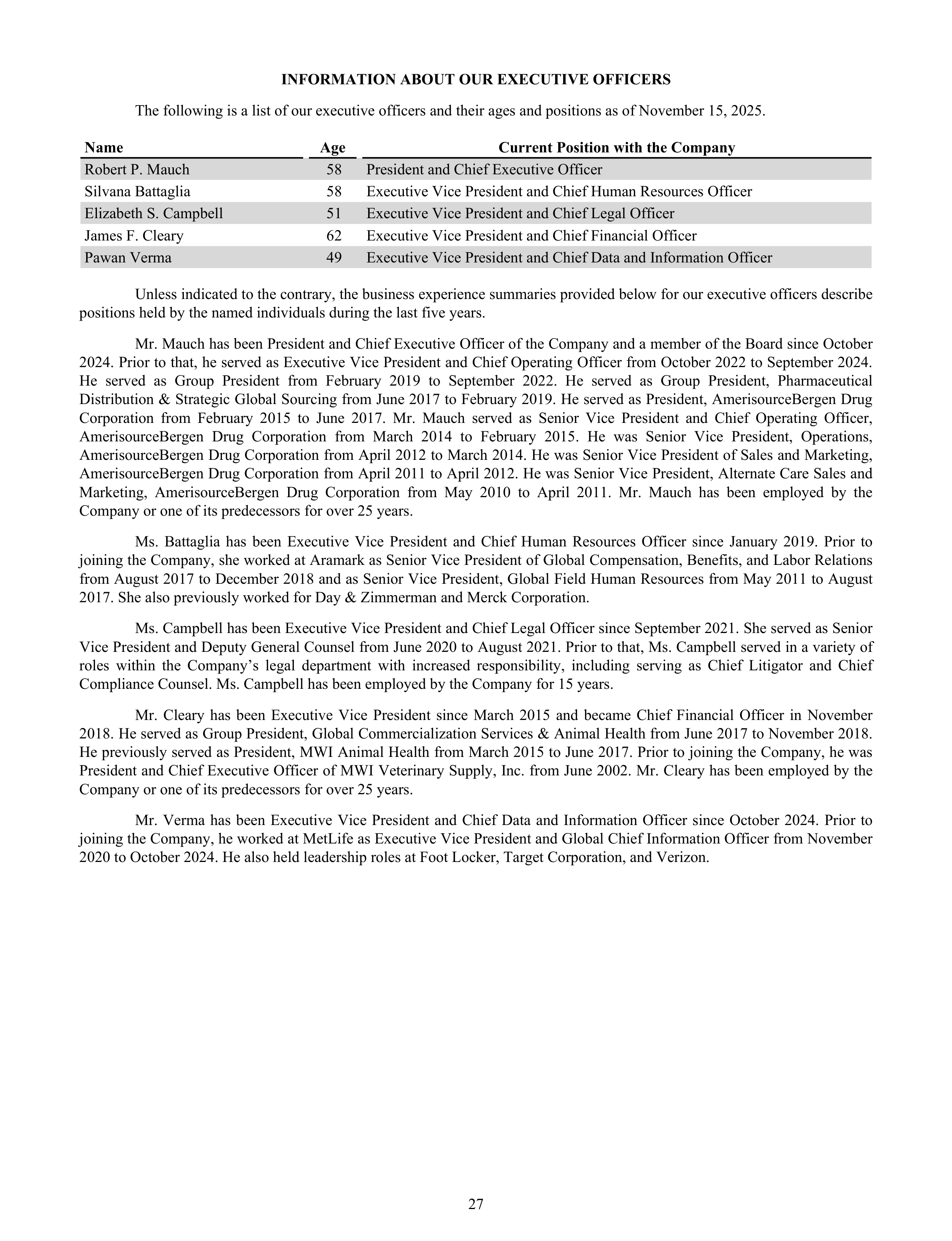
!"% '"!"('"(%+(')"%&
,=:;DAADL>CH6A>HID;DJG:M:8JI>K:D;;>8:GH6C9I=:>G6I>DCH6HD;&DK:B7:G
!.92
42
A>>2:@#;?6@6;:C6@5@52;9<.:E
*D7:GI(%6J8=
(G:H>9:CI6C9=>:;M:8JI>K:';;>8:G
+>AK6C66II66
M:8JI>K:.>8:(G:H>9:CI6C9=>:; JB6C*:HDJG8:H';;>8:G
A>O67:I=+6BE7:AA
M:8JI>K:.>8:(G:H>9:CI6C9=>:;$:8:G
"6B:HA:6GN
M:8JI>K:.>8:(G:H>9:CI6C9=>:;>C6C8>6A';;>8:G
(6L6C.:GB6
M:8JI>K:.>8:(G:H>9:CI6C9=>:;6I66C9!C;DGB6I>DC';;>8:G
-CA:HH>C9>86I:9IDI=:8DCIG6GN I=:7JH>C:HH:ME:G>:C8:HJBB6G>:HEGDK>9:97:ADL;DGDJG:M:8JI>K:D;;>8:GH9:H8G>7:
EDH>I>DCH=:A97NI=:C6B:9>C9>K>9J6AH9JG>CK:N:6GH
%G%6J8==6H7::C(G:H>9:CI6C9=>:;M:8JI>K:';;>8:GD;I=:DBE6CN6C96B:B7:GD;I=:D6G9H>C8:'8ID7:G
(G>DGIDI=6I =:H:GK:96HM:8JI>K:.>8:(G:H>9:CI6C9=>:;'E:G6I>C8:G;GDB'8ID7:G
ID+:EI:B7:G
: H:GK:9 6H GDJE (G:H>9:CI ;GDB :7GJ6GN
ID +:EI:B7:G
: H:GK:9 6H GDJE (G:H>9:CI (=6GB68:JI>86A
>HIG>7JI>DC+IG6I:8AD76A+DJG8>C9:CI B:G>HDJG8::G<:CGJ<
DGEDG6I>DC ;GDB :7GJ6GN
ID "JC:
%G %6J8= H:GK:9 6H +:C>DG .>8: (G:H>9:CI 6C9 =>:; 'E:G6I>C8:G
B:G>HDJG8::G<:C GJDC ;GDB %6G8=
ID :7GJ6GN
: L6H +:C>DG .>8: (G:H>9:CI 'E:G6I>DCH
B:G>HDJG8::G<:CGJDC;GDBEG>A
ID%6G8=
:L6H+:C>DG.>8:(G:H>9:CID;+6A:H6C9%6G@:I>C<
B:G>HDJG8::G<:CGJDC;GDBEG>A
IDEG>A
:L6H+:C>DG.>8:(G:H>9:CI AI:GC6I:6G:+6A:H6C9
%6G@:I>CHDJG8::G<:C GJDC ;GDB %6N
ID EG>A
%G %6J8= =6H 7::C :BEADN:9 7N I=:
DBE6CNDGDC:D;>IHEG:9:8:HHDGH;DGDK:GN:6GH
?D>C>CDG.>8:(G:H>9:CID;AD76ADBE:CH6I>DC :C:;>IH 6C9$67DG*:A6I>DCH
;GDBJDG.>8:(G:H>9:CI AD76A>:A9 JB6C*:HDJG8:H;GDB%6N
IDJ<JHI
+=:6AHDEG:K>DJHANLDG@:9;DG6N2>BB:GB6C6C9%:G8@DGEDG6I>DC
%H6BE7:AA=6H7::CM:8JI>K:.>8:(G:H>9:CI6C9=>:;$:8:GH>C8:+:EI:B7:G
+=:H:GK:96H+:C>DG
.>8:(G:H>9:CI6C9:EJIN:C:G6ADJCH:A;GDB"JC:
IDJDGIDI=6I %H6BE7:AAH:GK:9>C6K6G>:IND;
GDA:H L>I=>C I=: DBE6CNXH A:I= >C8G:6H:9 G:HEDCH>7>A>IN >C8AJ9>CC:; $>I>:;
DBEA>6C8:DJCH:A%H6BE7:AA=6H7::C:BEADN:97NI=:DBE6CN;DGN:6GH
%GA:6GN=6H7::CM:8JI>K:.>8:(G:H>9:CIH>C8:%6G8=
6C97:86B:=>:;>C6C8>6A';;>8:G>C&DK:B7:G
:H:GK:96HGDJE(G:H>9:CI AD76ADBB:G8>6A>O6I>DC+:GK>8:HC>B6A :6AI=;GDB"JC:
ID&DK:B7:G
:EG:K>DJHANH:GK:96H(G:H>9:CI %/!C>B6A :6AI=;GDB%6G8=
ID"JC:
(G>DGID?D>C>C<I=:DBE6CN =:L6H
(G:H>9:CI6C9=>:;M:8JI>K:';;>8:GD;%/!.:I:G>C6GN+JEEAN !C8;GDB"JC:
%GA:6GN=6H7::C:BEADN:97NI=:
DBE6CNDGDC:D;>IHEG:9:8:HHDGH;DGDK:GN:6GH
%G.:GB6=6H7::CM:8JI>K:.>8:(G:H>9:CI6C9=>:;6I66C9!C;DGB6I>DC';;>8:GH>C8:'8ID7:G
(G>DGID
?D>C>C;:6HM:8JI>K:.>8:(G:H>9:CI6C9AD76A=>:;!C;DGB6I>DC';;>8:G;GDB&DK:B7:G
ID'8ID7:G
:6AHD=:A9A:69:GH=>EGDA:H6IDDI$D8@:G ,6GDC 6C9.:G>ODC
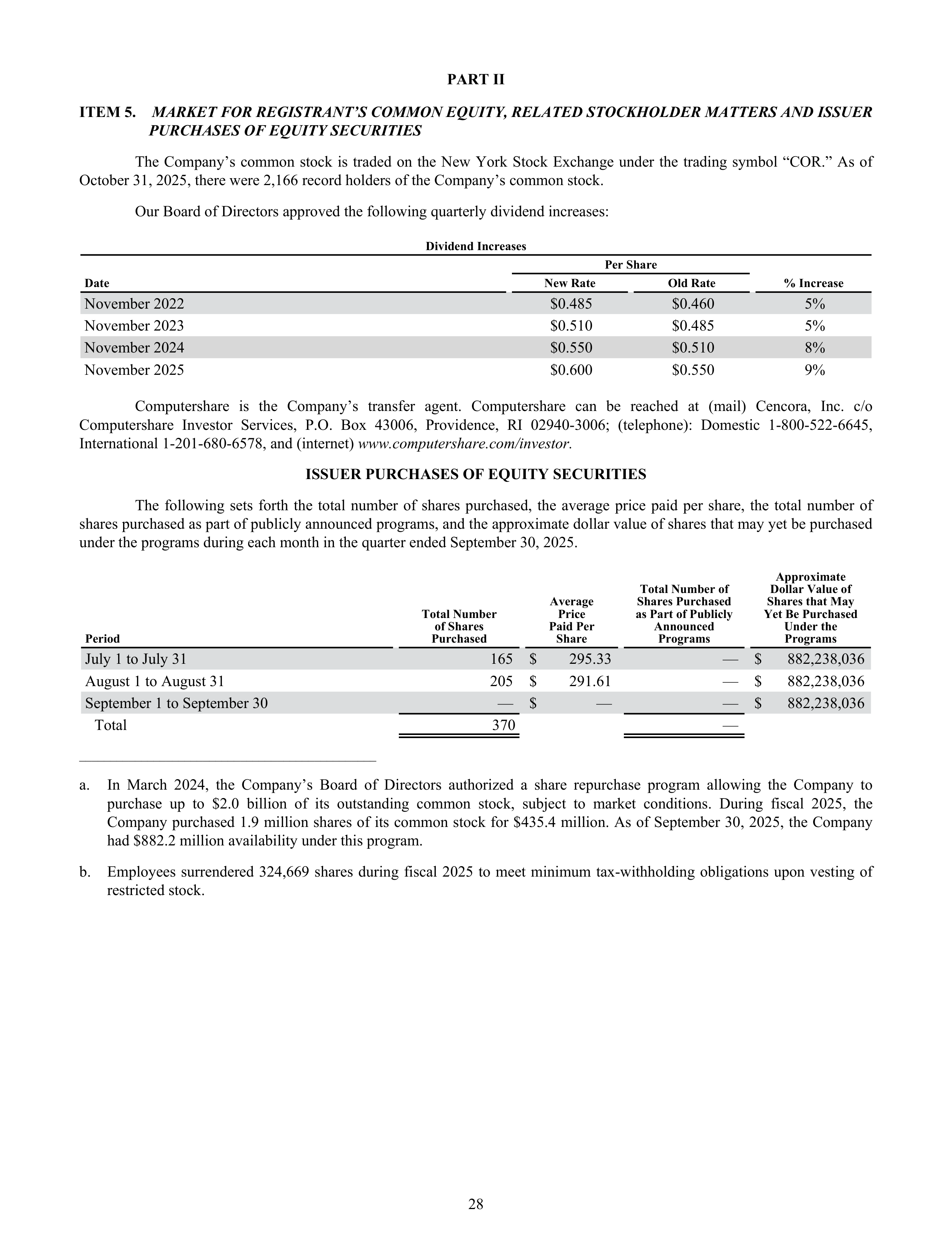
#%'
'
" !" "E!#"' "!" "" !!!#
# !!#"'!# "!
,=:DBE6CNXH8DBBDCHID8@>HIG69:9DCI=:&:L1DG@+ID8@M8=6CC<HNB7DAV'*WHD;
'8ID7:G
I=:G:L:G: G:8DG9=DA9:GHD;I=:DBE6CNXH8DBBDCHID8@
'JGD6G9D;>G:8IDGH6EEGDK:9I=:;DAADL>CK>9:C9>C8G:6H:H
6B612:1:0>2.?2?
#2>&5.>2
.@2
!2C%.@2
"81%.@2
:0>2.?2
&DK:B7:G
&DK:B7:G
&DK:B7:G
&DK:B7:G
DBEJI:GH=6G:
>H
I=:
DBE6CNXH
IG6CH;:G
6<:CI
DBEJI:GH=6G:
86C
7:
G:68=:9
6I
B6>A
:C8DG6
!C8
8D
DBEJI:GH=6G: !CK:HIDG +:GK>8:H (' DM
(GDK>9:C8: *!
I:A:E=DC: DB:HI>8
!CI:GC6I>DC6A
6C9>CI:GC:I
111)'*/.!,-$,!)'%(0!-.),
&&(%#(%&&"$(',&(%'&
,=:;DAADL>C<H:IH;DGI=I=:IDI6ACJB7:GD;H=6G:HEJG8=6H:9 I=:6K:G68:E6>9E:GH=6G: I=:IDI6ACJB7:GD;
H=6G:HEJG8=6H:96HE6GID;EJ7A>8AN6CCDJC8:9EGDB6I:9DAA6GK6AJ:D;H=6G:HI=6IB6NN:I7:EJG8=6H:9
JC9:GI=:EGDCCI=:FJ6GI:G:C9:9+:EI:B7:G
#2>6;1
';@.8!A9/2>
;3&5.>2?
#A>05.?21
B2>.42
#>602
#.61#2>
&5.>2
';@.8!A9/2>;3
&5.>2?#A>05.?21
.?#.>@;3#A/8608E
::;A:021
#>;4>.9?
<;D69.@2
;88.>).8A2;3
&5.>2?@5.@ .E
,2@2#A>05.?21
(:12>@52
#>;4>.9?
"JANID"JAN
U
J<JHIIDJ<JHI
U
+:EI:B7:GID+:EI:B7:G
U
U
U
,DI6A
U
555555555555555555555555555555555555555555555555
6
!C %6G8=
I=: DBE6CNXH D6G9 D; >G:8IDGH 6JI=DG>O:9 6 H=6G: G:EJG8=6H: EGDC< I=: DBE6CN ID
EJG8=6H: JE ID
7>AA>DC D; >IH DJIHI6C9>CI>DCH JG>CH86A
I=:
DBE6CNEJG8=6H:9B>AA>DCH=6G:HD;>IH8DBBDCHID8@;DGB>AA>DCHD;+:EI:B7:G
I=:DBE6CN
=69B>AA>DC6K6>A67>A>INJC9:GI=>HEGD<G6B
7
BEADN::HHJGG:C9:G:9 H=6G:H9JG>CH86A
IDB::IB>C>BJBI6M
L>I==DA9>CDCHJEDCK:HI>C<D;
G:HIG>8I:9HID8@
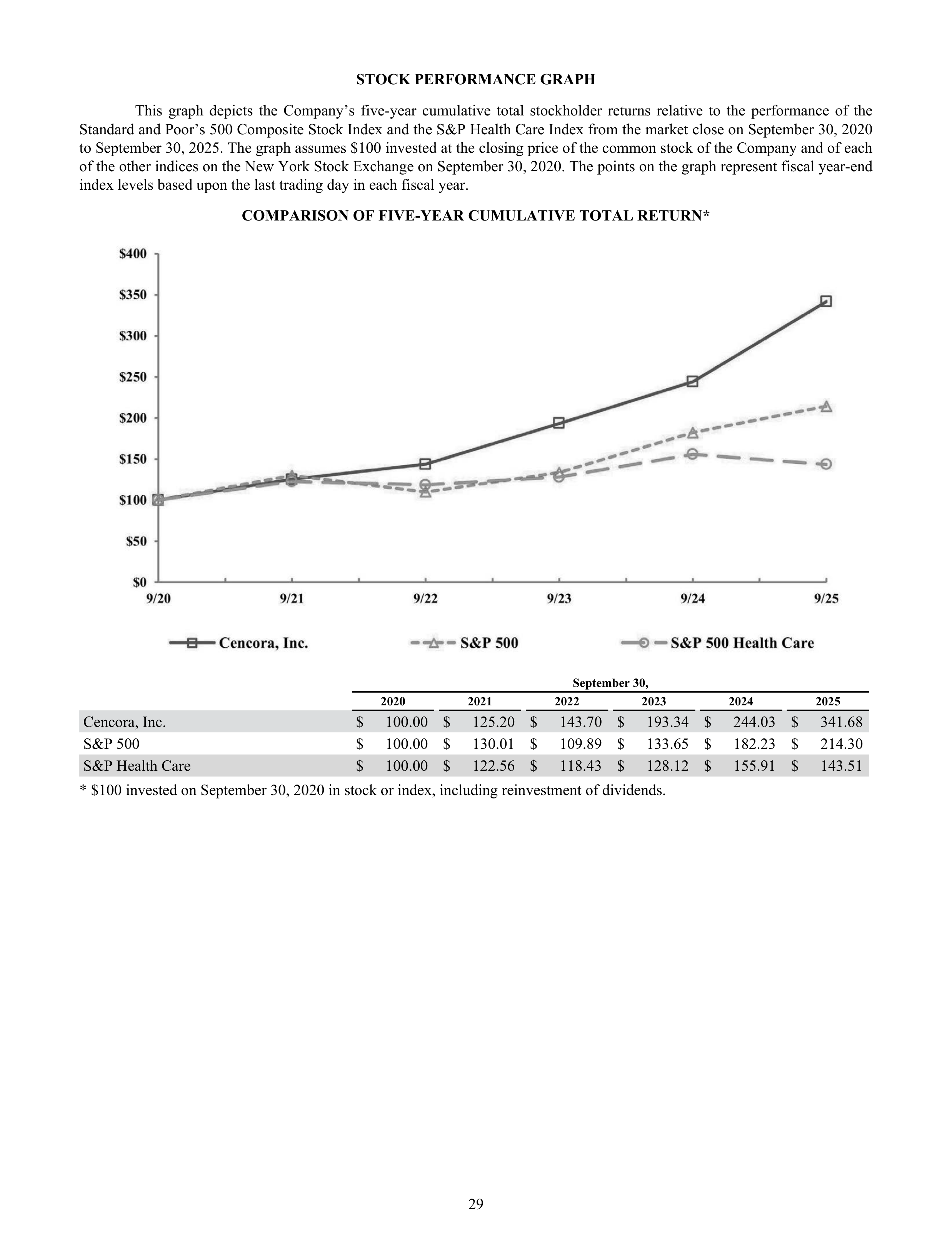
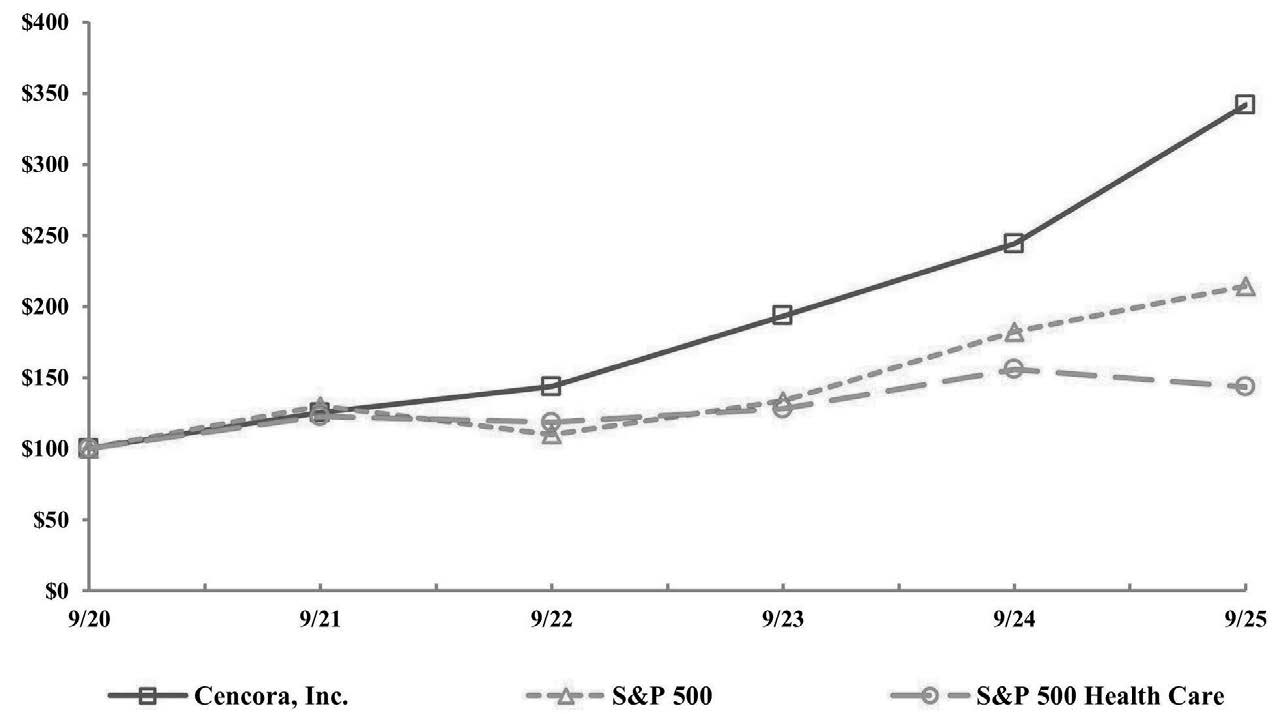
&'"#%"% !%#
,=>H8IHI=:DBE6CNXH;>K:
N:6G8JBJA6I>K:IDI6AHID8@=DA9:GG:IJGCHG:A6I>K:IDI=:E:G;DGB6C8:D;I=:
+I6C96G96C9(DDGXH
DBEDH>I:+ID8@!C9:M6C9I=:+( :6AI=6G:!C9:M;GDBI=:B6G@:I8ADH:DC+:EI:B7:G
ID+:EI:B7:G
,=:CK:HI:96II=:8ADH>C8:D;I=:8DBBDCHID8@D;I=:DBE6CN6C9D;:68=
D;I=:DI=:G>C9>8:HDCI=:&:L1DG@+ID8@M8=6CCIHDCI=:H86AN:6G
:C9
>C9:MA:K:AH76H:9JEDCI=:A6HIIG69>CC:68=;>H86AN:6G
" #%&"!"),%( (')'"'%'(%!
&2
:C8DG6 !C8
+(
+( :6AI=6G:
>CK:HI:9DC+:EI:B7:G
>CHID8@DG>C9:M >C8AJ9>CCK:HIB:CID;9>K>9:C9H
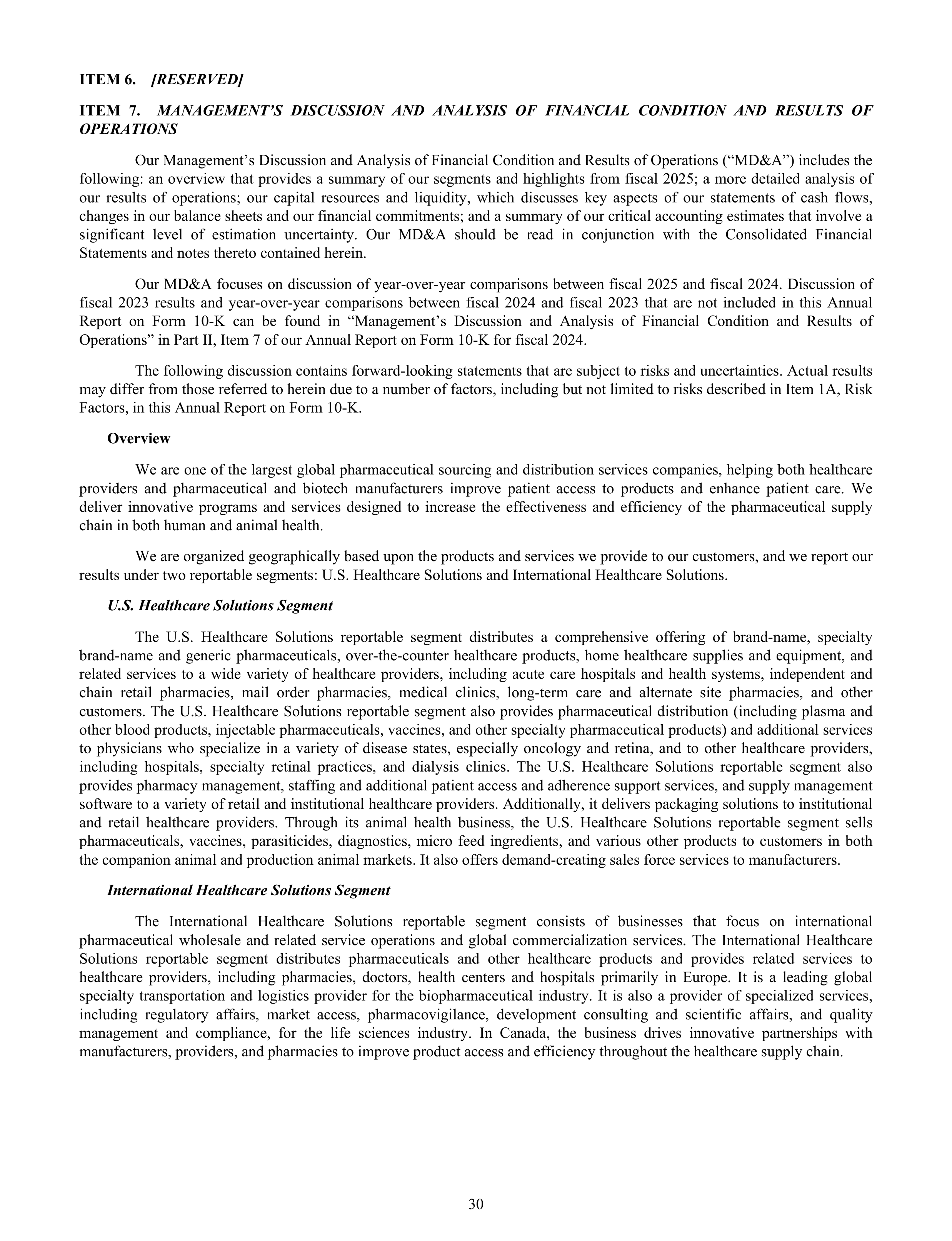
ITEM 6.
[RESERVED]
ITEM 7.
MANAGEMENT’S DISCUSSION AND ANALYSIS OF FINANCIAL CONDITION AND RESULTS OF
OPERATIONS
Our Management’s Discussion and Analysis of Financial Condition and Results of Operations (“MD&A”) includes the
following: an overview that provides a summary of our segments and highlights from fiscal 2025; a more detailed analysis of
our results of operations; our capital resources and liquidity, which discusses key aspects of our statements of cash flows,
changes in our balance sheets and our financial commitments; and a summary of our critical accounting estimates that involve a
significant level of estimation uncertainty. Our MD&A should be read in conjunction with the Consolidated Financial
Statements and notes thereto contained herein.
Our MD&A focuses on discussion of year-over-year comparisons between fiscal 2025 and fiscal 2024. Discussion of
fiscal 2023 results and year-over-year comparisons between fiscal 2024 and fiscal 2023 that are not included in this Annual
Report on Form 10-K can be found in “Management’s Discussion and Analysis of Financial Condition and Results of
Operations” in Part II, Item 7 of our Annual Report on Form 10-K for fiscal 2024.
The following discussion contains forward-looking statements that are subject to risks and uncertainties. Actual results
may differ from those referred to herein due to a number of factors, including but not limited to risks described in Item 1A, Risk
Factors, in this Annual Report on Form 10-K.
Overview
We are one of the largest global pharmaceutical sourcing and distribution services companies, helping both healthcare
providers and pharmaceutical and biotech manufacturers improve patient access to products and enhance patient care. We
deliver innovative programs and services designed to increase the effectiveness and efficiency of the pharmaceutical supply
chain in both human and animal health.
We are organized geographically based upon the products and services we provide to our customers, and we report our
results under two reportable segments: U.S. Healthcare Solutions and International Healthcare Solutions.
U.S. Healthcare Solutions Segment
The U.S. Healthcare Solutions reportable segment distributes a comprehensive offering of brand-name, specialty
brand-name and generic pharmaceuticals, over-the-counter healthcare products, home healthcare supplies and equipment, and
related services to a wide variety of healthcare providers, including acute care hospitals and health systems, independent and
chain retail pharmacies, mail order pharmacies, medical clinics, long-term care and alternate site pharmacies, and other
customers. The U.S. Healthcare Solutions reportable segment also provides pharmaceutical distribution (including plasma and
other blood products, injectable pharmaceuticals, vaccines, and other specialty pharmaceutical products) and additional services
to physicians who specialize in a variety of disease states, especially oncology and retina, and to other healthcare providers,
including hospitals, specialty retinal practices, and dialysis clinics. The U.S. Healthcare Solutions reportable segment also
provides pharmacy management, staffing and additional patient access and adherence support services, and supply management
software to a variety of retail and institutional healthcare providers. Additionally, it delivers packaging solutions to institutional
and retail healthcare providers. Through its animal health business, the U.S. Healthcare Solutions reportable segment sells
pharmaceuticals, vaccines, parasiticides, diagnostics, micro feed ingredients, and various other products to customers in both
the companion animal and production animal markets. It also offers demand-creating sales force services to manufacturers.
International Healthcare Solutions Segment
The International Healthcare Solutions reportable segment consists of businesses that focus on international
pharmaceutical wholesale and related service operations and global commercialization services. The International Healthcare
Solutions reportable segment distributes pharmaceuticals and other healthcare products and provides related services to
healthcare providers, including pharmacies, doctors, health centers and hospitals primarily in Europe. It is a leading global
specialty transportation and logistics provider for the biopharmaceutical industry. It is also a provider of specialized services,
including regulatory affairs, market access, pharmacovigilance, development consulting and scientific affairs, and quality
management and compliance, for the life sciences industry. In Canada, the business drives innovative partnerships with
manufacturers, providers, and pharmacies to improve product access and efficiency throughout the healthcare supply chain.
30
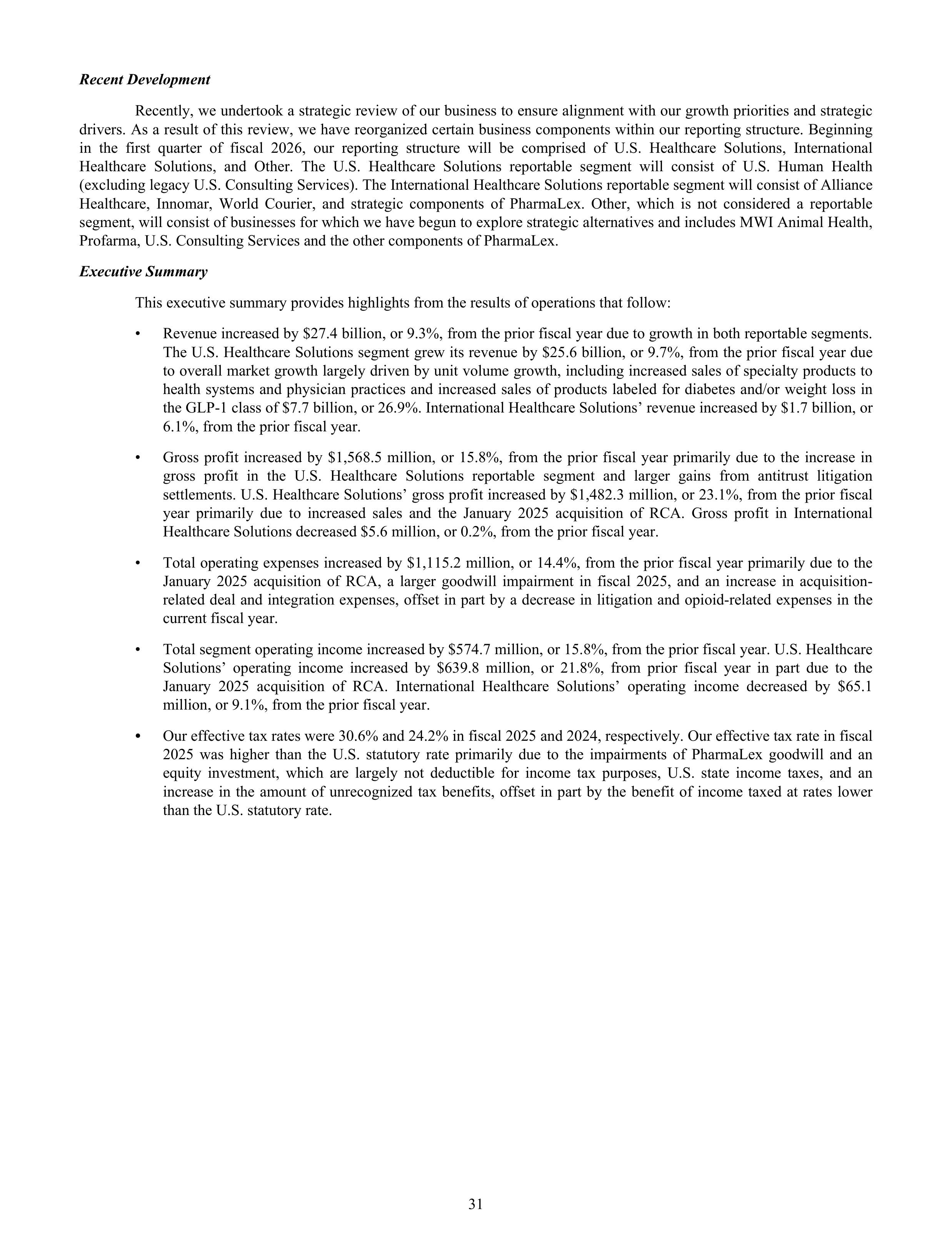
Recent Development
Recently, we undertook a strategic review of our business to ensure alignment with our growth priorities and strategic
drivers. As a result of this review, we have reorganized certain business components within our reporting structure. Beginning
in the first quarter of fiscal 2026, our reporting structure will be comprised of U.S. Healthcare Solutions, International
Healthcare Solutions, and Other. The U.S. Healthcare Solutions reportable segment will consist of U.S. Human Health
(excluding legacy U.S. Consulting Services). The International Healthcare Solutions reportable segment will consist of Alliance
Healthcare, Innomar, World Courier, and strategic components of PharmaLex. Other, which is not considered a reportable
segment, will consist of businesses for which we have begun to explore strategic alternatives and includes MWI Animal Health,
Profarma, U.S. Consulting Services and the other components of PharmaLex.
Executive Summary
This executive summary provides highlights from the results of operations that follow:
•
Revenue increased by $27.4 billion, or 9.3%, from the prior fiscal year due to growth in both reportable segments.
The U.S. Healthcare Solutions segment grew its revenue by $25.6 billion, or 9.7%, from the prior fiscal year due
to overall market growth largely driven by unit volume growth, including increased sales of specialty products to
health systems and physician practices and increased sales of products labeled for diabetes and/or weight loss in
the GLP-1 class of $7.7 billion, or 26.9%. International Healthcare Solutions’ revenue increased by $1.7 billion, or
6.1%, from the prior fiscal year.
•
Gross profit increased by $1,568.5 million, or 15.8%, from the prior fiscal year primarily due to the increase in
gross profit in the U.S. Healthcare Solutions reportable segment and larger gains from antitrust litigation
settlements. U.S. Healthcare Solutions’ gross profit increased by $1,482.3 million, or 23.1%, from the prior fiscal
year primarily due to increased sales and the January 2025 acquisition of RCA. Gross profit in International
Healthcare Solutions decreased $5.6 million, or 0.2%, from the prior fiscal year.
•
Total operating expenses increased by $1,115.2 million, or 14.4%, from the prior fiscal year primarily due to the
January 2025 acquisition of RCA, a larger goodwill impairment in fiscal 2025, and an increase in acquisition-
related deal and integration expenses, offset in part by a decrease in litigation and opioid-related expenses in the
current fiscal year.
•
Total segment operating income increased by $574.7 million, or 15.8%, from the prior fiscal year. U.S. Healthcare
Solutions’ operating income increased by $639.8 million, or 21.8%, from prior fiscal year in part due to the
January 2025 acquisition of RCA. International Healthcare Solutions’ operating income decreased by $65.1
million, or 9.1%, from the prior fiscal year.
•
Our effective tax rates were 30.6% and 24.2% in fiscal 2025 and 2024, respectively. Our effective tax rate in fiscal
2025 was higher than the U.S. statutory rate primarily due to the impairments of PharmaLex goodwill and an
equity investment, which are largely not deductible for income tax purposes, U.S. state income taxes, and an
increase in the amount of unrecognized tax benefits, offset in part by the benefit of income taxed at rates lower
than the U.S. statutory rate.
31
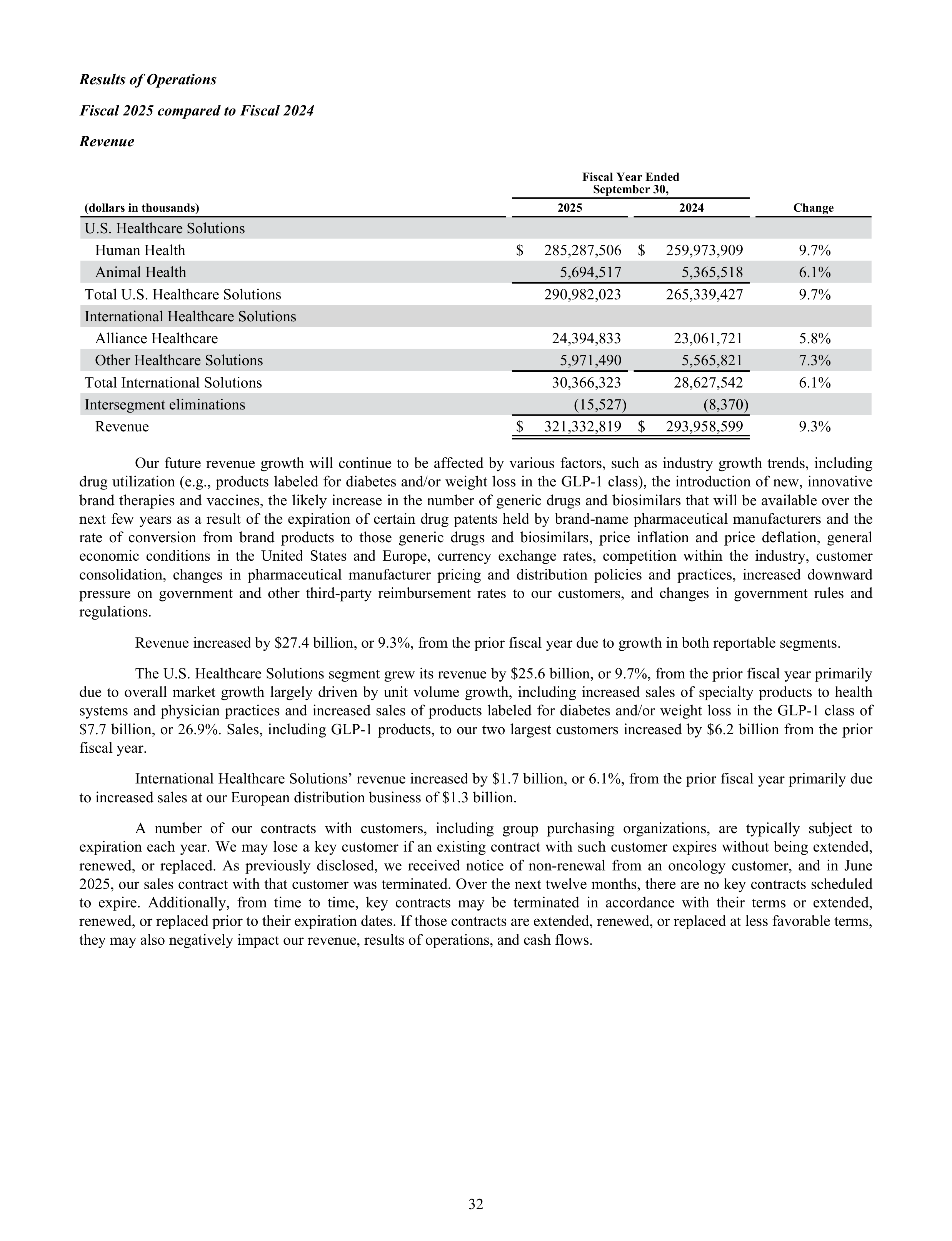
.5=<8/9.;*=287<
2<,*5
,869*;.-=82<,*5
.?.7>.
6?0.8,2.>:121
&2
1;88.>?6:@5;A?.:1?
5.:42
-+ :6AI=86G:+DAJI>DCH
JB6C :6AI=
C>B6A :6AI=
,DI6A-+ :6AI=86G:+DAJI>DCH
!CI:GC6I>DC6A :6AI=86G:+DAJI>DCH
AA>6C8: :6AI=86G:
'I=:G :6AI=86G:+DAJI>DCH
,DI6A!CI:GC6I>DC6A+DAJI>DCH
!CI:GH:B>C6I>DCH
*:K:CJ:
'JG;JIJG:G:K:CJ:AA8DCI>CJ:ID7:6;;:8I:97NK6G>DJH;68IDGH HJ8=6H>C9JHIGNC8AJ9>C<
9GJA>O6I>DC:67:I:H6C9DGL:>CI=:$(
8A6HH I=:>CIGD9J8I>DCD;C:L >CCDK6I>K:
7G6C9I=:G6E>:H6C9K688>C:H I=:A>@:AN>C8G:6H:>CI=:CJB7:GD;89GJDH>B>A6GHI=6IL>AA7:6K6>A67A:DK:GI=:
C:MI;:LN:6GH6H6G:HJAID;I=::ME>G6I>DCD;8:GI6>C9GJ86AB6CJ;68IJG:GH6C9I=:
G6I: D; 8DCK:GH>DC ;GDB 7G6C9 EGD9J8IH ID I=DH: 8 9GJDH>B>A6GH EG>8: >C;A6I>DC 6C9 EG>8: 9:;A6I>DC <:C:G6A
:8DCDB>8 8DC9>I>DCH >C I=: -C>I:9 +I6I:H 6C9 JGDE: 8JGG:C8N :M8=6CI>DC L>I=>C I=: >C9JHIGN 8JHIDB:G
8DCHDA>96I>DC 8=6CC E=6GB68:JI>86A B6CJ;68IJG:G EG>8>CHIG>7JI>DC EDA>8>:H 6C9 EG68I>8:H >C8G:6H:9 9DLCL6G9
EG:HHJG: DC G9
E6GIN G:>B7JGH:B:CI G6I:H ID DJG 8JHIDB:GH 6C9 8=6CC <DK:GCB:CI GJA:H 6C9
G:DCH
*:K:CJ:>C8G:6H:97N7>AA>DC DG ;GDBI=:EG>DG;>H86AN:6G9J:IDC7DI=G:EDGI67A:H:<B:CIH
,=:-+ :6AI=86G:+DAJI>DCHH:<B:CIIHG:K:CJ:7N7>AA>DC DG ;GDBI=:EG>DG;>H86AN:6GEG>B6G>AN
9J:IDDK:G6AAB6G@:I<GDLI=A6GK:C7NJC>IKDAJB:C8AJ9>CC8G:6H:9H6A:HD;HE:8>6AINEGD9J8IHID=:6AI=
HNHI:BH6C9E=NH>8>6CEG68I>8:H6C9>C8G:6H:9H6A:HD;EGD9J8IHA67:A:9;DG9>67:I:H6C9DGL:>CI=:$(
8A6HHD;
7>AA>DC DG+6A:H >C8AJ9>C<$(
EGD9J8IH IDDJGILDA6GC8G:6H:97N7>AA>DC;GDBI=:EG>DG
;>H86AN:6G
!CI:GC6I>DC6A :6AI=86G:+DAJI>DCHXG:K:CJ:>C8G:6H:97N7>AA>DC DG ;GDBI=:EG>DG;>H86AN:6GEG>B6G>AN9J:
ID>C8G:6H:9H6A:H6IDJGJGDE:6C9>HIG>7JI>DC7JH>C:HHD;7>AA>DC
CJB7:G D; DJG 8DCIG68IH L>I= 8JHIDB:GH >C8AJ9>C< C< DGO6I>DCH 6G: INE>86AAN HJ7?:8I ID
:ME>G6I>DC:68=N:6G/:B6NADH:6@:N8JHIDB:G>;6C:M>HI>CI=HJ8=8JHIDB:G:ME>G:HL>I=DJI7:>C<:MI:C9:9
G:C:L:9 DGG:EA68:9HEG:K>DJHAN9>H8ADH:9 L:G:8:>K:9CDI>8:D;CDC
G:C:L6A;GDB6CDC8DADC"JC:
DJGH6A:H8DCIG68IL>I=I=6I8JHIDB:GL6HI:GB>C6I:9'K:GI=:C:MIIL:AK:BDCI=H I=:G:6G:CD@:N8DCIG68IHH8=:9JA:9
ID :ME>G: 99>I>DC6AAN ;GDB I>B: ID I>B: @:N 8DCIG68IH B6N 7: I:GB>C6I:9 >C 688DG96C8: L>I= I=:>G I:GBH DG :MI:C9:9
G:C:L:9 DGG:EA68:9EG>DGIDI=:>G:ME>G6I>DC96I:H!;I=DH:8DCIG68IH6G::MI:C9:9 G:C:L:9 DGG:EA68:96IA:HH;6KDG67A:I:GBH
I=:NB6N6AHDC:K:AN>BE68IDJGG:K:CJ: G:HJAIHD;DE:G6I>DCH 6C986H=;ADLH
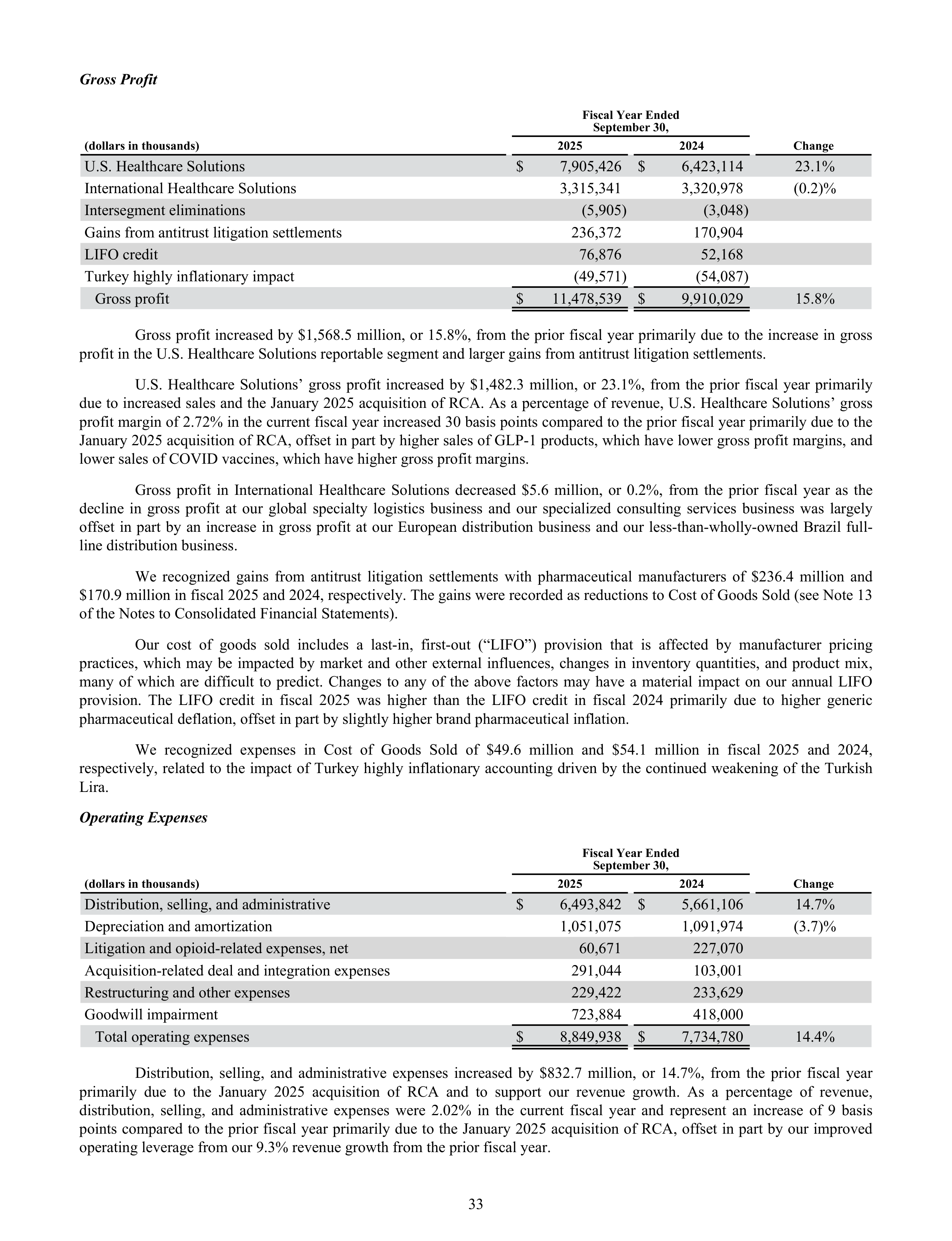
;8<<;8/2=
6?0.8,2.>:121
&2
1;88.>?6:@5;A?.:1?
5.:42
-+ :6AI=86G:+DAJI>DCH
!CI:GC6I>DC6A :6AI=86G:+DAJI>DCH
!CI:GH:B>C6I>DCH
6>CH;GDB6CI>IGJHIA>I>DCH:IIA:B:CIH
$!'8G:9>I
,JG@:N=>C;A6I>DC6GN>BE68I
GDHHEGD;>I
GDHHEGD;>I>C8G:6H:97N B>AA>DC DG ;GDBI=:EG>DG;>H86AN:6GEG>B6G>AN9J:IDI=:>C8G:6H:>C<GDHH
EGD;>I>CI=:-+ :6AI=86G:+DAJI>DCHG:EDGI67A:H:<B:CI6C9A6G<:GCH;GDB6CI>IGJHIA>I>DCH:IIA:B:CIH
-+ :6AI=86G:+DAJI>DCHXI>C8G:6H:97N B>AA>DC DG ;GDBI=:EG>DG;>H86AN:6GEG>B6G>AN
9J:ID>C8G:6H:9H6A:H6C9I=:"6CJ6GN
68FJ>H>I>DCD;*H6E:G8:CI6DCHX<GDHH
EGD;>IB6GCD;>CI=:8JGG:CI;>H86AN:6G>C8G:6H:9
76H>HED>CIH8DBE6G:9IDI=:EG>DG;>H86AN:6GEG>B6G>AN9J:IDI=:
"6CJ6GN
68FJ>H>I>DCD;* D;;H:I>CE6GI7N=>8==6K:ADL:GIB6GCH 6C9
ADL:GH6A:HD;'.!K688>C:H L=>8==6K:=><=:GIB6GCH
GDHHEGD;>I>C!CI:GC6I>DC6A :6AI=86G:+DAJI>DCH9:8G:6H:9
B>AA>DC DG
;GDBI=:EG>DG;>H86AN:6G6HI=:
9:8A>C:>CI6IDJG6AINADHI>8H7JH>C:HH6C9DJGHE:8>6A>O:98DCHJAI>C8:H7JH>C:HHL6HA6G<:AN
D;;H:I>CE6GI7N6C>C8G:6H:>CI6IDJGJGDE:6C9>HIG>7JI>DC7JH>C:HH6C9DJGA:HH
I=6C
L=DAAN
DLC:9G6O>A;JAA
A>C:9>HIG>7JI>DC7JH>C:HH
/:G:8DO:9CH;GDB6CI>IGJHIA>I>DCH:IIA:B:CIHL>I=E=6GB68:JI>86AB6CJ;68IJG:GHD;B>AA>DC6C9
B>AA>DC>C;>H86A
6C9
G:HE:8I>K:AN,=:CHL:G:G:8DG9:96HG:9J8I>DCHIDDHID;DD9H+DA9H::&DI:
D;I=:&DI:HIDDCHDA>96I:9>C6C8>6A+I6I:B:CIH
'JG 8DHI D; C8AJ9:H 6 A6HI
>C ;>GHI
DJI V$!'W EGDK>H>DC I=6I >H 6;;:8I:9 7N B6CJ;68IJG:G EG>8>C<
EG68I>8:H L=>8=B6N7:>BE68I:97NB6G@:I6C9DI=:G:MI:GC6A>C;AJ:C8:H 8=6CC>CK:CIDGNFJ6CI>I>:H 6C9EGD9J8IB>M
B6CND;L=>8=6G:9>;;>8JAIIDEG:9>8I=6C6A>BE68IDCDJG6CCJ6A$!'
EGDK>H>DC ,=: $!' 8G:9>I >C ;>H86A
L6H =>I >C ;>H86A
EG>B6G>AN 9J: ID =><=:G 8
E=6GB68:JI>86A9:;A6I>DC D;;H:I>CE6GI7NHA>86A>C;A6I>DC
/: G:8DO:9 :ME:CH:H >C DHI D; DD9H +DA9 D; B>AA>DC 6C9 B>AA>DC >C ;>H86A
6C9
G:HE:8I>K:AN G:A6I:9IDI=:>BE68ID;,JG@:N=>C;A6I>DC6GN688DJCI>CK:C7NI=:8DCI>CJ:9L:6@:C>CH=
$>G6
9.;*=270A9.7<.<
6?0.8,2.>:121
&2
1;88.>?6:@5;A?.:1?
5.:42
>HIG>7JI>DC H:AA>CC>HIG6I>K:
:EG:8>6I>DC6C96BDGI>O6I>DC
$>I>DC6C9DE>D>9
G:A6I:9:ME:CH:H C:I
8FJ>H>I>DC
G:A6I:99:6A6C9>CI:DC:ME:CH:H
*:HIGJ8IJG>C<6C9DI=:G:ME:CH:H
DD9L>AA>BE6>GB:CI
,DI6ADE:G6I>C<:ME:CH:H
>HIG>7JI>DC H:AA>CC>HIG6I>K::ME:CH:H>C8G:6H:97NB>AA>DC DG ;GDBI=:EG>DG;>H86AN:6G
EG>B6G>AN 9J: ID I=: "6CJ6GN
68FJ>H>I>DC D; * 6C9 ID HJEEDGI DJG G:K:CJ: <GDLI= H 6 E:G8:CI6<: D; G:K:CJ:
9>HIG>7JI>DC H:AA>CC>HIG6I>K::ME:CH:HL:G:
>CI=:8JGG:CI;>H86AN:6G6C9G:EG:H:CI6C>C8G:6H:D;76H>H
ED>CIH8DBE6G:9IDI=:EG>DG;>H86AN:6GEG>B6G>AN9J:IDI=:"6CJ6GN
68FJ>H>I>DCD;* D;;H:I>CE6GI7NDJG>BEGDK:9
DE:G6I>C<A:K:G6<:;GDBDJGG:K:CJ:DG;>H86AN:6G
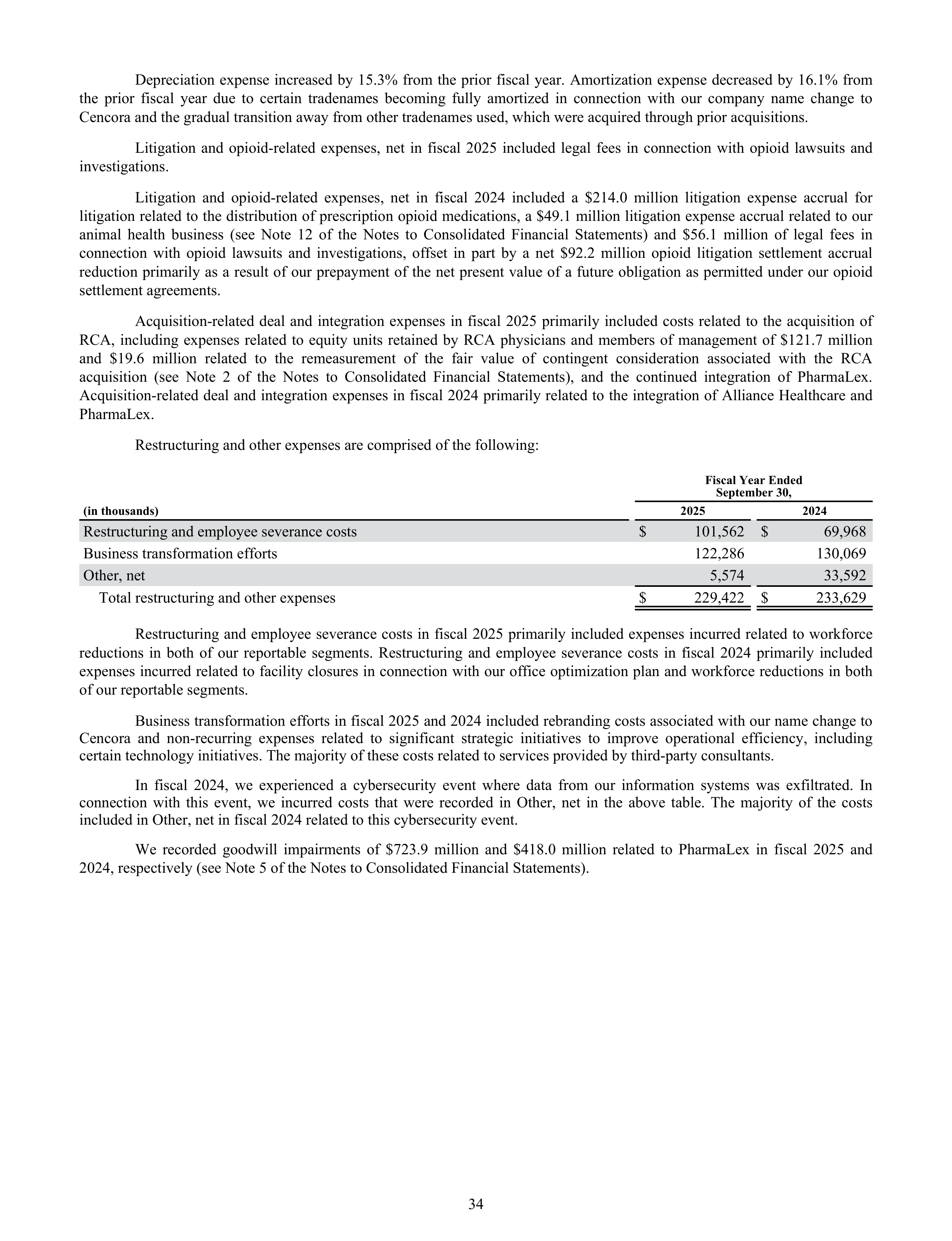
:EG:8>6I>DC:ME:CH:>C8G:6H:97N;GDBI=:EG>DG;>H86AN:6GBDGI>O6I>DC:ME:CH:9:8G:6H:97N;GDB
I=: EG>DG ;>H86A N:6G 9J: ID 8:GI6>C IG69:C6B:H 7:8DB>CO:9 >C 8DCC:8I>DC L>I= DJG 8DBE6CN C6B: 8=6C<: ID
:C8DG66C9I=:I>DC6L6N;GDBDI=:GIG69:C6B:HJH:9 L=>8=L:G:68FJ>G:9I=GDJDG68FJ>H>I>DCH
$>I>DC6C9DE>D>9
G:A6I:9:ME:CH:H C:I>C;>H86A
>C8AJ9:9A:C8DCC:8I>DCL>I=DE>D>9A6LHJ>IH6C9
>CK:HI>DCH
$>I>DC 6C9 DE>D>9
G:A6I:9 :ME:CH:H C:I >C ;>H86A
>C8AJ9:9 6
B>AA>DC A>I>DC :ME:CH: 688GJ6A ;DG
A>I>DCG:A6I:9IDI=:9>HIG>7JI>DCD;EG:H8G>EI>DCDE>D>9B:9>86I>DCH 6B>AA>DCA>I>DC:ME:CH:688GJ6AG:A6I:9IDDJG
6C>B6A =:6AI= 7JH>C:HHH::&DI:D; I=:&DI:HID DCHDA>96I:9 >C6C8>6A +I6I:B:CIH 6C9 B>AA>DC D; A:C
8DCC:8I>DCL>I=DE>D>9A6LHJ>IH6C9>CK:HI>DCH D;;H:I>CE6GI7N6C:IB>AA>DCDE>D>9A>I>DCH:IIA:B:CI688GJ6A
G:9J8I>DCEG>B6G>AN6H6G:HJAID;DJGEG:E6NB:CID;I=:C:IEG:H:CIK6AJ:D;6;JIJG:D7A>DC6HE:GB>II:9JC9:GDJGDE>D>9
H:IIA:B:CI6<G::B:CIH
8FJ>H>I>DC
G:A6I:99:6A6C9>CI:DC:ME:CH:H>C;>H86A
EG>B6G>AN>C8AJ9:98DHIHG:A6I:9IDI=:68FJ>H>I>DCD;
* >C8AJ9>CINJC>IHG:I6>C:97N*E=NH>8>6CH6C9B:B7:GHD;B6C6AA>DC
6C9 B>AA>DC G:A6I:9 ID I=: G:B:6HJG:B:CI D; I=: ;6>G K6AJ: D; 8DCI>C9:G6I>DC 6HHD8>6I:9 L>I= I=: *
68FJ>H>I>DC H:: &DI: D; I=: &DI:H ID DCHDA>96I:9 >C6C8>6A +I6I:B:CIH 6C9 I=: 8DCI>CJ:9 >CI:DC D; (=6GB6$:M
8FJ>H>I>DC
G:A6I:99:6A6C9>CI:DC:ME:CH:H>C;>H86A
EG>B6G>ANG:A6I:9IDI=:>CI:DCD;AA>6C8: :6AI=86G:6C9
(=6GB6$:M
*:HIGJ8IJG>CH:9D;I=:;DAADL>C<
6?0.8,2.>:121
&2
6:@5;A?.:1?
*:HIGJ8IJG>C<6C9:BEADN::H:K:G6C8:8DHIH
JH>C:HHIG6CH;DGB6I>DC:;;DGIH
'I=:G C:I
,DI6AG:HIGJ8IJG>C<6C9DI=:G:ME:CH:H
*:HIGJ8IJG>CC;>H86A
EG>B6G>AN>C8AJ9:9:ME:CH:H>C8JGG:9G:A6I:9IDLDG@;DG8:
G:9J8I>DCH>C7DI=D;DJGG:EDGI67A:H:CC;>H86A
EG>B6G>AN>C8AJ9:9
:ME:CH:H>C8JGG:9G:A6I:9ID;68>A>IN8ADHJG:H>C8DCC:8I>DCL>I=DJGD;;>8:DEI>B>O6I>DCEA6C6C9LDG@;DG8:G:9J8I>DCH>C7DI=
D;DJGG:EDGI67A:H:<B:CIH
JH>C:HHIG6CH;DGB6I>DC:;;DGIH>C;>H86A
6C9
>C8AJ9:9G:7G6C9>C6I:9L>I=DJGC6B:8=6C<:ID
:C8DG6 6C9 CDC
G:8JGG>C;>86CI HIG6I:8 >C>I>6I>K:H ID >BEGDK: DE:G6I>DC6A :;;>8>:C8N >C8AJ9>C<
8:GI6>CI:8=CDADC>I>6I>K:H,=:B6?DG>IND;I=:H:8DHIHG:A6I:9IDH:GK>8:HEGDK>9:97NI=>G9
E6GIN8DCHJAI6CIH
!C ;>H86A
L: :ME:G>:C8:9 6 8N7:GH:8JG>IN :K:CI L=:G: 96I6 ;GDB DJG >C;DGB6I>DC HNHI:BH L6H :M;>AIG6I:9 !C
8DCC:8I>DCL>I=I=>H:K:CI L:>C8JGG:98DHIHI=6IL:G:G:8DG9:9>C'I=:G C:I>CI=:67DK:I67A:,=:B6?DG>IND;I=:8DHIH
>C8AJ9:9>C'I=:G C:I>C;>H86A
G:A6I:9IDI=>H8N7:GH:8JG>IN:K:CI
/:G:8DG9:9AA>BE6>GB:CIHD;B>AA>DC6C9
B>AA>DCG:A6I:9ID(=6GB6$:M>C;>H86A
6C9
G:HE:8I>K:ANH::&DI:D;I=:&DI:HIDDCHDA>96I:9>C6C8>6A+I6I:B:CIH
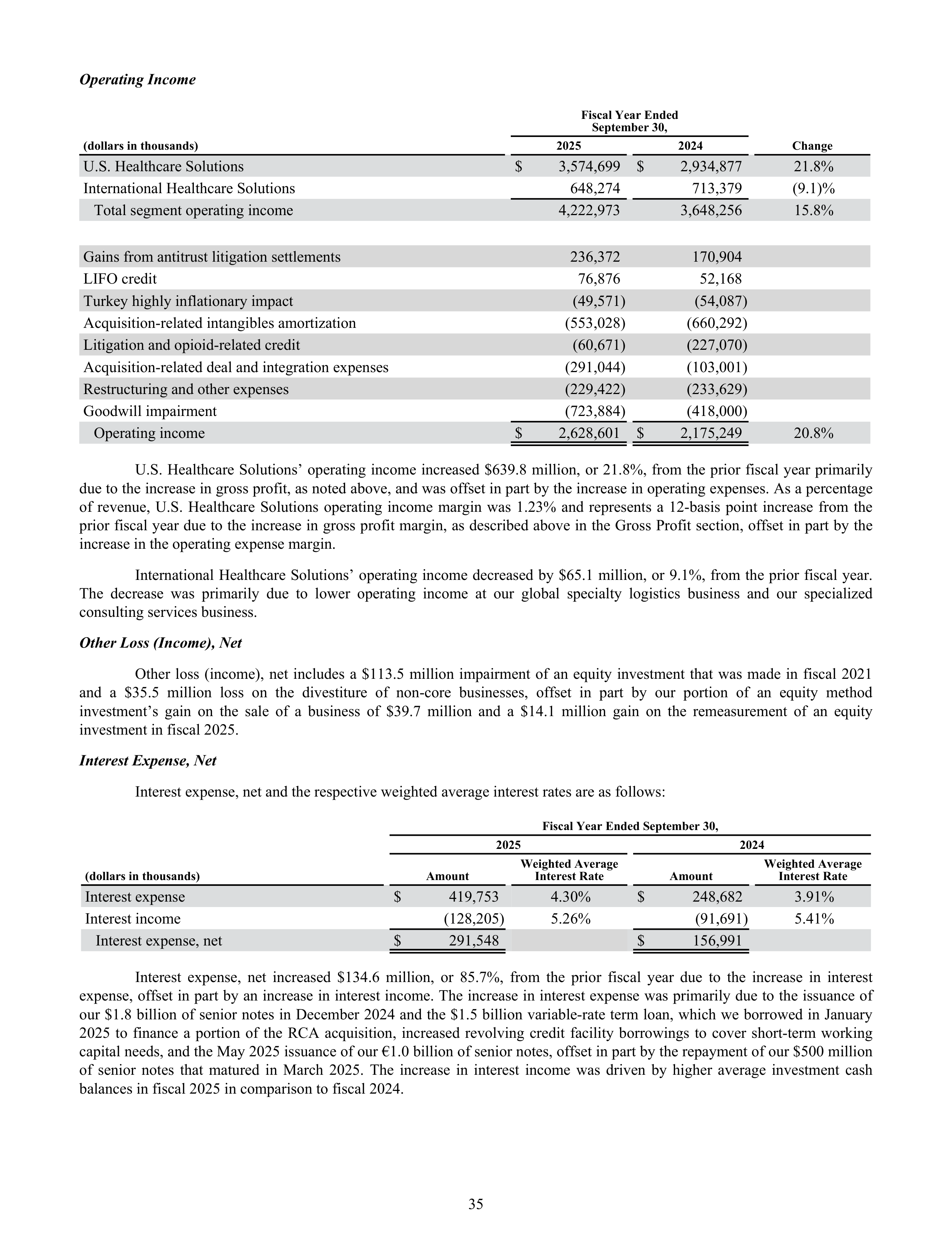
9.;*=2707,86.
6?0.8,2.>:121
&2
1;88.>?6:@5;A?.:1?
5.:42
-+ :6AI=86G:+DAJI>DCH
!CI:GC6I>DC6A :6AI=86G:+DAJI>DCH
,DI6AH:CC8DB:
6>CH;GDB6CI>IGJHIA>I>DCH:IIA:B:CIH
$!'8G:9>I
,JG@:N=>C;A6I>DC6GN>BE68I
8FJ>H>I>DC
G:A6I:9>CI6C7A:H6BDGI>O6I>DC
$>I>DC6C9DE>D>9
G:A6I:98G:9>I
8FJ>H>I>DC
G:A6I:99:6A6C9>CI:DC:ME:CH:H
*:HIGJ8IJG>C<6C9DI=:G:ME:CH:H
DD9L>AA>BE6>GB:CI
'E:G6I>CC8DB:
-+ :6AI=86G:+DAJI>DCHXDE:G6I>CC8DB:>C8G:6H:9
B>AA>DC DG ;GDBI=:EG>DG;>H86AN:6GEG>B6G>AN
9J:IDI=:>C8G:6H:>CI 6HCDI:967DK: 6C9L6HD;;H:I>CE6GI7NI=:>C8G:6H:>CDE:G6I>C<:ME:CH:HH6E:G8:CI6<:
D;G:K:CJ: -+ :6AI=86G:+DAJI>DCHDE:G6I>CC8DB:B6GCL6H6C9G:EG:H:CIH6
76H>HED>CI>C8G:6H:;GDBI=:
EG>DG;>H86AN:6G9J:IDI=:>C8G:6H:>CIB6GC 6H9:H8G>7:967DK:>CI=:GDHH(GD;>IH:8I>DC D;;H:I>CE6GI7NI=:
>C8G:6H:>CI=:DE:G6I>C<:ME:CH:B6GC
!CI:GC6I>DC6A :6AI=86G:+DAJI>DCHXDE:G6I>CC8DB:9:8G:6H:97NB>AA>DC DG ;GDBI=:EG>DG;>H86AN:6G
,=: 9:8G:6H: L6H EG>B6G>AN 9J: ID ADL:G DE:G6I>CC8DB: 6I DJG 6AIN ADHI>8H 7JH>C:HH 6C9 DJG HE:8>6A>O:9
8DCHJAI>C8:H7JH>C:HH
=1.;8<<7,86..=
'I=:GADHH>C8DB: C:I>C8AJ9:H6B>AA>DC>BE6>GB:CID;6C:FJ>IN>CK:HIB:CII=6IL6HB69:>C;>H86A
6C9 6 B>AA>DC ADHH DC I=: 9>K:HI>IJG: D; CDC
8DG: 7JH>C:HH:H D;;H:I >C E6GI 7N DJG EDGI>DC D; 6C :FJ>IN B:I=D9
>CK:HIB:CIXH C DC I=: H6A: D; 6 7JH>C:HH D; B>AA>DC 6C9 6 B>AA>DC C DC I=: G:B:6HJG:B:CI D; 6C :FJ>IN
>CK:HIB:CI>C;>H86A
7=.;.<=A9.7<..=
!CI:G:HI:ME:CH: C:I6C9I=:G:HE:8I>K:L:><=I:96K:G6CI:G:HIG6I:H6G:6H;DAADLH
6?0.8,2.>:121&2
1;88.>?6:@5;A?.:1?
9;A:@
*2645@21B2>.42
:@2>2?@%.@2
9;A:@
*2645@21B2>.42
:@2>2?@%.@2
!CI:G:HI:ME:CH:
!CI:G:HI>C8DB:
!CI:G:HI:ME:CH: C:I
!CI:G:HI :ME:CH: C:I >C8G:6H:9
B>AA>DC DG ;GDB I=: EG>DG ;>H86A N:6G 9J: ID I=: >C8G:6H: >C >CI:G:HI
:ME:CH: D;;H:I>CE6GI7N6C>C8G:6H:>C>CI:G:HI>C8DB:,=:>C8G:6H:>C>CI:G:HI:ME:CH:L6HEG>B6G>AN9J:IDI=:>HHJ6C8:D;
DJG7>AA>DCD;H:C>DGCDI:H>C:8:B7:G
6C9I=:7>AA>DCK6G>67A:
G6I:I:GBAD6C L=>8=L:7DGGDL:9>C"6CJ6GN
ID;>C6C8:6EDGI>DCD;I=:*68FJ>H>I>DC >C8G:6H:9G:KDAK>CI;68>A>IN7DGGDL>CC<
86E>I6AC::9H 6C9I=:%6N
>HHJ6C8:D;DJGY
7>AA>DCD;H:C>DGCDI:H D;;H:I>CE6GI7NI=:G:E6NB:CID;DJG
B>AA>DC
D;H:C>DGCDI:HI=6IB6IJG:9>C%6G8=
,=:>C8G:6H:>C>CI:G:HI>C8DB:L6H9G>K:C7N=><=:G6K:G6CK:HIB:CI86H=
76A6C8:H>C;>H86A
>C8DBE6G>HDCID;>H86A
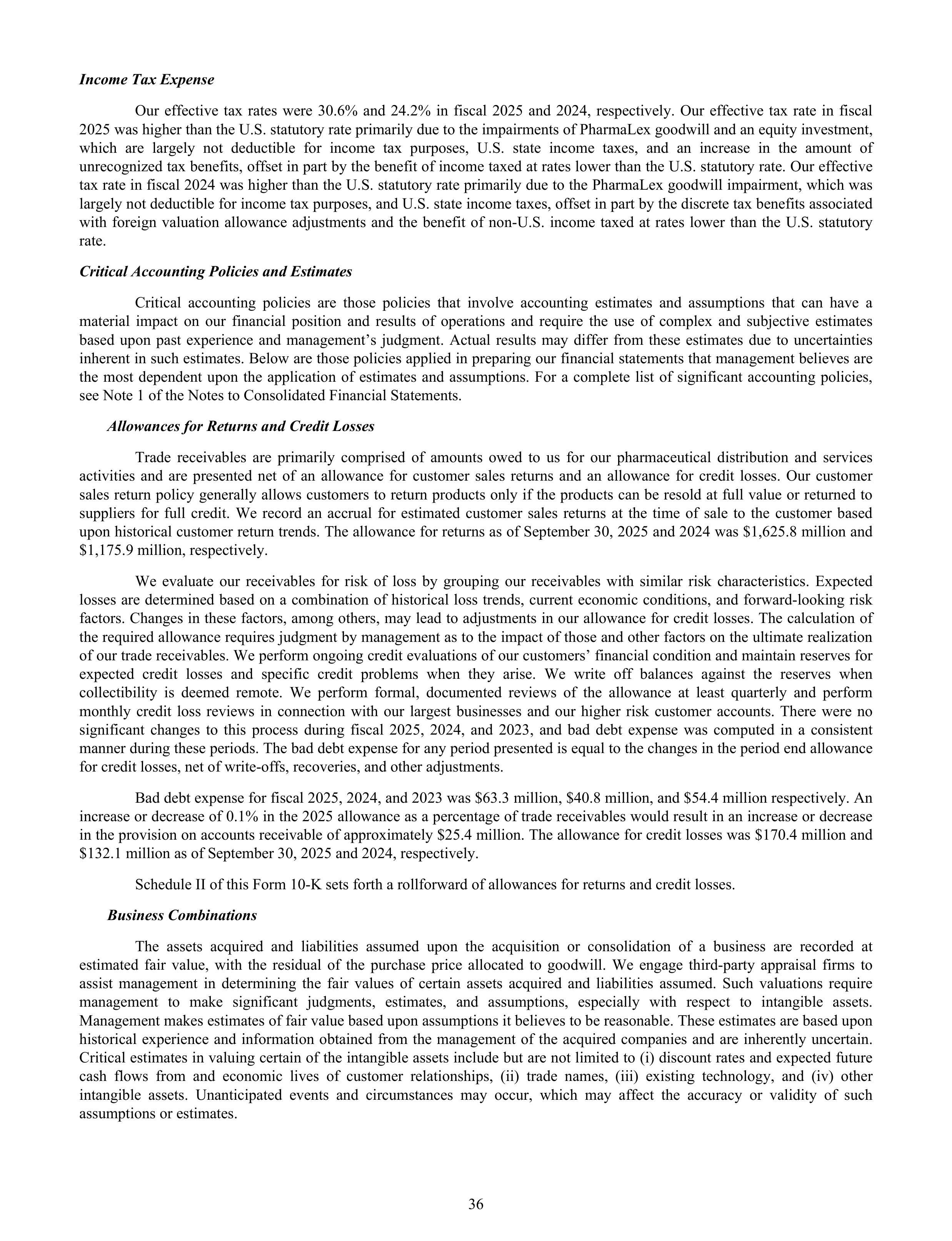
Income Tax Expense
Our effective tax rates were 30.6% and 24.2% in fiscal 2025 and 2024, respectively. Our effective tax rate in fiscal
2025 was higher than the U.S. statutory rate primarily due to the impairments of PharmaLex goodwill and an equity investment,
which are largely not deductible for income tax purposes, U.S. state income taxes, and an increase in the amount of
unrecognized tax benefits, offset in part by the benefit of income taxed at rates lower than the U.S. statutory rate. Our effective
tax rate in fiscal 2024 was higher than the U.S. statutory rate primarily due to the PharmaLex goodwill impairment, which was
largely not deductible for income tax purposes, and U.S. state income taxes, offset in part by the discrete tax benefits associated
with foreign valuation allowance adjustments and the benefit of non-U.S. income taxed at rates lower than the U.S. statutory
rate.
Critical Accounting Policies and Estimates
Critical accounting policies are those policies that involve accounting estimates and assumptions that can have a
material impact on our financial position and results of operations and require the use of complex and subjective estimates
based upon past experience and management’s judgment. Actual results may differ from these estimates due to uncertainties
inherent in such estimates. Below are those policies applied in preparing our financial statements that management believes are
the most dependent upon the application of estimates and assumptions. For a complete list of significant accounting policies,
see Note 1 of the Notes to Consolidated Financial Statements.
Allowances for Returns and Credit Losses
Trade receivables are primarily comprised of amounts owed to us for our pharmaceutical distribution and services
activities and are presented net of an allowance for customer sales returns and an allowance for credit losses. Our customer
sales return policy generally allows customers to return products only if the products can be resold at full value or returned to
suppliers for full credit. We record an accrual for estimated customer sales returns at the time of sale to the customer based
upon historical customer return trends. The allowance for returns as of September 30, 2025 and 2024 was $1,625.8 million and
$1,175.9 million, respectively.
We evaluate our receivables for risk of loss by grouping our receivables with similar risk characteristics. Expected
losses are determined based on a combination of historical loss trends, current economic conditions, and forward-looking risk
factors. Changes in these factors, among others, may lead to adjustments in our allowance for credit losses. The calculation of
the required allowance requires judgment by management as to the impact of those and other factors on the ultimate realization
of our trade receivables. We perform ongoing credit evaluations of our customers’ financial condition and maintain reserves for
expected credit losses and specific credit problems when they arise. We write off balances against the reserves when
collectibility is deemed remote. We perform formal, documented reviews of the allowance at least quarterly and perform
monthly credit loss reviews in connection with our largest businesses and our higher risk customer accounts. There were no
significant changes to this process during fiscal 2025, 2024, and 2023, and bad debt expense was computed in a consistent
manner during these periods. The bad debt expense for any period presented is equal to the changes in the period end allowance
for credit losses, net of write-offs, recoveries, and other adjustments.
Bad debt expense for fiscal 2025, 2024, and 2023 was $63.3 million, $40.8 million, and $54.4 million respectively. An
increase or decrease of 0.1% in the 2025 allowance as a percentage of trade receivables would result in an increase or decrease
in the provision on accounts receivable of approximately $25.4 million. The allowance for credit losses was $170.4 million and
$132.1 million as of September 30, 2025 and 2024, respectively.
Schedule II of this Form 10-K sets forth a rollforward of allowances for returns and credit losses.
Business Combinations
The assets acquired and liabilities assumed upon the acquisition or consolidation of a business are recorded at
estimated fair value, with the residual of the purchase price allocated to goodwill. We engage third-party appraisal firms to
assist management in determining the fair values of certain assets acquired and liabilities assumed. Such valuations require
management to make significant judgments, estimates, and assumptions, especially with respect to intangible assets.
Management makes estimates of fair value based upon assumptions it believes to be reasonable. These estimates are based upon
historical experience and information obtained from the management of the acquired companies and are inherently uncertain.
Critical estimates in valuing certain of the intangible assets include but are not limited to (i) discount rates and expected future
cash flows from and economic lives of customer relationships, (ii) trade names, (iii) existing technology, and (iv) other
intangible assets. Unanticipated events and circumstances may occur, which may affect the accuracy or validity of such
assumptions or estimates.
36
Goodwill and Other Intangible Assets
Goodwill arises from acquisitions or consolidations of specific operating companies and is assigned to the reporting
unit in which a particular operating company resides. We identify our reporting units based upon our management reporting
structure, beginning with our operating segments. We evaluate whether the components within our operating segments have
similar economic characteristics, which include the similarity of long-term gross margins, the nature of the components’
products, services, and production processes, the types of customers and the methods by which products or services are
delivered to customers, and the components’ regulatory environment and aggregate two or more components within an
operating segment that have similar economic characteristics. As of September 30, 2025, our reporting units included U.S.
Pharmaceutical Distribution Services, U.S. Consulting Services, MWI Animal Health, Alliance Healthcare, Innomar, World
Courier, PharmaLex, and Profarma.
Goodwill and other intangible assets with indefinite lives, such as certain trademarks and trade names, are not
amortized; rather, they are tested for impairment at least annually. For the purpose of these impairment tests, we can elect to
perform a qualitative assessment to determine if it is more likely than not that the fair values of our reporting units and
indefinite-lived intangible assets are less than the respective carrying values of those reporting units and indefinite-lived
intangible assets, respectively. Such qualitative factors can include, among others, industry and market conditions, overall
financial performance, and relevant entity-specific events. If we conclude based on our qualitative assessment that it is more
likely than not that the fair value of a reporting unit is less than its carrying value, we perform a quantitative analysis. We
elected to perform quantitative impairment assessments of goodwill for all our reporting units in fiscal 2025, 2024, and 2023
with the exception of our PharmaLex reporting unit in fiscal 2023 since it was acquired in fiscal 2023. We elected to perform
qualitative impairment assessments of indefinite-lived intangible assets in fiscal 2025, 2024, and 2023.
The quantitative goodwill impairment test requires us to compare the carrying value of the reporting unit’s net assets to
the fair value of the reporting unit. If the fair value exceeds the carrying value, no further evaluation is required, and no
impairment loss is recognized. If the carrying amount exceeds the fair value, the difference between the carrying value and the
fair value is recorded as an impairment loss, the amount of which may not exceed the total amount of goodwill allocated to the
reporting unit.
When performing a quantitative impairment assessment, we utilize an income approach or a weighted average of an
income and market approach to value our reporting units. The income approach relies on a discounted cash flow analysis,
which considers forecasted cash flows discounted at an appropriate discount rate, to determine the fair value of each reporting
unit. We generally believe that market participants would use a discounted cash flow analysis to determine the fair value of our
reporting units in a sale transaction. The annual goodwill impairment test requires us to make a number of assumptions and
estimates concerning future levels of revenue growth, earnings before interest, taxes, depreciation and amortization
(“EBITDA”), EBITDA margins, capital expenditures, and working capital requirements, which are based upon our long-range
plan. The discount rate is an estimate of the overall after-tax rate of return required by a market participant whose weighted
average cost of capital includes both debt and equity, including a risk premium. While we use the best available information to
prepare our forecasted cash flows and discount rate assumptions, actual future cash flows and/or market conditions could differ
significantly resulting in future impairment charges related to recorded goodwill balances. While there are always changes in
assumptions to reflect changing business and market conditions, our overall methodology and the population of assumptions
used have remained unchanged.
We completed our required annual impairment assessments relating to goodwill and indefinite-lived intangible assets
in fiscal 2025, 2024, and 2023 and, as a result, recorded goodwill impairments (see Note 5 of the Notes to Consolidated
Financial Statements
)
of $723.9 million and $418.0 million in our PharmaLex reporting unit in fiscal 2025 and 2024,
respectively. No goodwill impairments were recorded in fiscal 2023 and no indefinite-lived intangible asset impairments were
recorded in fiscal 2025, 2024, or 2023.
Finite-lived intangible assets are amortized using the straight-line method over the estimated useful lives of the assets.
We perform a recoverability assessment of our long-lived assets when impairment indicators are present. We performed a
recoverability assessment of PharmaLex’s long-lived asset group as of July 1, 2025, and it was determined to be recoverable.
Income Taxes
Our income tax expense, deferred tax assets and liabilities, and uncertain tax positions reflect management’s
assessment of estimated future taxes to be paid on items in the financial statements. Deferred income taxes arise from
temporary differences between financial reporting and tax reporting bases of assets and liabilities, as well as net operating loss
and tax credit carryforwards for tax purposes.
We have established a valuation allowance against certain deferred tax assets for which the ultimate realization of
future benefits is uncertain. Expiring carryforwards and the required valuation allowances are adjusted annually. After
37
application of the valuation allowances described above, we anticipate that no limitations will apply with respect to utilization
of any of the other deferred income tax assets described above.
We prepare and file tax returns based upon our interpretation of tax laws and regulations and record estimates based
upon these judgments and interpretations. In the normal course of business, our tax returns are subject to examination by
various taxing authorities. Such examinations may result in future tax and interest assessments by these taxing authorities.
Inherent uncertainties exist in estimates of tax contingencies due to changes in tax law resulting from legislation, regulation,
and/or as concluded through the various jurisdictions’ tax court systems. Significant judgment is exercised in applying complex
tax laws and regulations across multiple global jurisdictions where we conduct our operations. We recognize the tax benefit
from an uncertain tax position only if it is more likely than not that the tax position will be sustained upon examination by the
taxing authorities, including resolutions of any related appeals or litigation processes, based upon the technical merits of the
position.
We believe that our estimates for the valuation allowances against deferred tax assets and the amount of benefits
recognized in our financial statements for uncertain tax positions are appropriate based upon current facts and circumstances.
However, others applying reasonable judgment to the same facts and circumstances could develop a different estimate and the
amount ultimately paid upon resolution of issues raised may differ from the amounts accrued.
The significant assumptions and estimates described in the preceding paragraphs are important contributors to the
ultimate effective tax rate in each year. If any of our assumptions or estimates were to change, an increase or decrease in our
effective tax rate by 1% on income before income taxes would have caused income tax expense to change by $22.6 million in
fiscal 2025.
Inventories
Inventories are stated at the lower of cost or market. Cost for approximately 63% and 65% of our inventories as of
September 30, 2025 and 2024, respectively, has been determined using the LIFO method. If we had used the first-in, first-out
method of inventory valuation, which approximates current replacement cost, inventories would have been approximately
$1,458.9 million and $1,535.8 million higher than the amounts reported as of September 30, 2025 and 2024, respectively. We
recorded LIFO credits of $76.9 million and $52.2 million in fiscal 2025 and 2024, respectively, and LIFO expense of $204.6
million in fiscal 2023. The annual LIFO provision is affected by manufacturer pricing practices, which may be impacted by
market and other external influences, changes in inventory quantities, and product mix, many of which are difficult to predict.
Changes to any of the above factors can have a material impact on our annual LIFO provision. Cost for our inventory that is not
determined using the LIFO method is stated at the lower of cost or market using the first-in, first-out method or moving average
price method.
Loss Contingencies
In the ordinary course of business, we become involved in lawsuits, administrative proceedings, government
subpoenas, government investigations, stockholder demands, and other disputes, including antitrust, commercial, data privacy
and security, product liability, intellectual property, regulatory, employment discrimination, and other matters. Significant
damages or penalties may be sought in some matters, and some matters may require years to resolve. We record a reserve for
these matters when it is both probable that a loss has been incurred and the amount can be reasonably estimated. We also
perform an assessment of the materiality of loss contingencies where a loss is either not probable or it is reasonably possible
that a loss could be incurred in excess of amounts accrued. If a loss or an additional loss has at least a reasonable possibility of
occurring and the impact on the financial statements would be material, we provide disclosure of the loss contingency and
whether a reasonable estimate of the loss or the range of the loss can made in the notes to our financial statements. We review
all contingencies at least quarterly to determine whether the likelihood of loss has changed and to assess whether a reasonable
estimate of the loss or the range of the loss can be made. Among the loss contingencies we considered in accordance with the
foregoing in connection with the preparation of the accompanying financial statements were the opioid matters described in
Note 12 of the Notes to Consolidated Financial Statements.
38
Liquidity and Capital Resources
Our operating results have generated cash flows, which, together with availability under our debt agreements and
credit terms from suppliers, have provided sufficient capital resources to finance working capital and cash operating
requirements, and to fund capital expenditures, acquisitions, repayment of debt, the payment of interest on outstanding debt,
dividends, and purchases of shares of our common stock.
Our primary ongoing cash requirements will be to finance working capital, fund the repayment of debt, fund the
payment of interest on debt, fund the payment of dividends, fund purchases of our common stock, finance acquisitions, and
fund capital expenditures and routine growth and expansion through new business opportunities. Future cash flows from
operations and borrowings are expected to be sufficient to fund our ongoing cash requirements, including the opioid litigation
payments that will be made over the next 13 years (see below).
As of September 30, 2025 and 2024, our cash and cash equivalents held by foreign subsidiaries were $957.7 million
and $851.3 million, respectively. We have the ability to repatriate the majority of our cash and cash equivalents held by our
foreign subsidiaries without incurring significant additional taxes upon repatriation.
Our cash balances in fiscal 2025 and 2024 were supplemented by intra-period credit facility borrowings to cover short-
term working capital needs. The largest amount of intra-period borrowings under our revolving and securitization credit
facilities that was outstanding at any one time during fiscal 2025 and 2024 was $5.1 billion and $3.2 billion, respectively. We
had $132.2 billion, $69.7 billion, and $77.9 billion of cumulative intra-period borrowings that were repaid under our credit
facilities during fiscal 2025, 2024, and 2023, respectively.
Cash Flows
Our net cash provided by operating activities increased by $390.4 million in fiscal 2025 compared to fiscal 2024
largely due to our growth, which resulted from an increase in net income, plus non-cash items of $653.7 million, offset in part
by a decrease in cash generated from our working capital accounts due to the timing of cash receipts and disbursements. More
specifically, in fiscal 2025, the increase of our accounts receivable, inventories, and accounts payable balances provided $500.5
million of cash from operations compared to $704.2 million in fiscal 2024.
During fiscal 2025, our operating activities provided cash of $3.9 billion and was principally the result of the
following:
•
An increase in accounts payable of $3.7 billion primarily due to the increase in our inventory balances and the timing
of scheduled payments to our suppliers;
•
Positive non-cash items of $2.3 billion, which was primarily comprised of asset impairments of $837.4 million,
amortization expense of $567.1 million, and depreciation expense of $501.3 million; and
•
Net income of $1.6 billion.
The cash provided by the above items was offset in part by the following:
•
An increase in accounts receivable of $1.9 billion primarily due to an increase in sales and the timing of scheduled
payments from our customers;
•
An increase in inventories of $1.3 billion to support the increase in business volume; and
•
A decrease in long-term accrued litigation liability of $404.1 million due to opioid litigation settlement payments.
During fiscal 2024, our operating activities provided cash of $3.5 billion and was principally the result of the
following:
•
An increase in accounts payable of $5.0 billion primarily due to the increase in our inventory balances and the timing
of scheduled payments to our suppliers;
•
Positive non-cash items of $1.7 billion, which was primarily comprised of amortization expense of $670.6 million,
depreciation expense of $448.2 million, and a $418.0 million goodwill impairment; and
•
Net income of $1.5 billion.
The cash provided by the above items was offset in part by the following:
•
An increase in accounts receivable of $2.8 billion primarily due to an increase in sales and the timing of scheduled
payments from our customers;
•
An increase in inventories of $1.5 billion to support the increase in business volume; and
•
A decrease in long-term accrued litigation liability of $506.2 million due to opioid litigation settlement payments.
39
/:JH:96NHH6A:HDJIHI6C9>CCK:CIDGNDC=6C9 6C996NHE6N67A:DJIHI6C9>CCI6A
E:G;DGB6C8:,=:7:ADL;>C6C8>6AB:IG>8H6G:86A8JA6I:976H:9JEDC6FJ6GI:GAN6K:G6BE68I:97NI=:I>B>C<D;
86H=G:8:>EIH6C99>H7JGH:B:CIH L=>8=86CK6GNH>;>86CIAN9:E:C9>C8=I=:E:G>D9:C9H
6?0.8,2.>:121&2
6NHH6A:HDJIHI6C9>C<
6NH>CK:CIDGNDC=6C9
6NHE6N67A:DJIHI6C9>C<
'JG86H=;ADLH;GDBDE:G6I>CK>I>:H86CK6GNH>;>86CIAN;GDBE:G>D9IDE:G>D976H:9JEDC;AJ8IJ6I>DCH>CDJG
E:G>D9
:C9LDG@>CI6A688DJCI76A6C8:HCN8=6CI=6@:N8JHIDB:GDGB6CJ;68IJG:GHJEEA>:G
8DJA9=6K:6B6I:G>6A>BE68IDCDJG86H=;ADLH;GDBDE:G6I>DCH,=:699>I>DCD;6CNC:L@:N8JHIDB:GDGI=:ADHHD;6CN
:M>HI>C6A>BE68IDCDJG86H=;ADLH;GDBDE:G6I>DCH
'E:G6I>CCH86A
>C8AJ9:9B>AA>DCD;>CI:G:HIE6NB:CIH6C9B>AA>DCD;>C8DB:
I6ME6NB:CIH C:ID;G:;JC9H'E:G6I>CCH86A
>C8AJ9:9
B>AA>DCD;>CI:G:HIE6NB:CIH6C9
B>AA>DCD;>C8DB:I6ME6NB:CIH C:ID;G:;JC9H'E:G6I>CCH86A
>C8AJ9:9B>AA>DCD;>CI:G:HI
E6NB:CIH6C9B>AA>DCD;>C8DB:I6ME6NB:CIH C:ID;G:;JC9H
6E>I6A :ME:C9>IJG:H >C ;>H86A
6C9
L:G:
B>AA>DC B>AA>DC 6C9 B>AA>DC
G:HE:8I>K:AN+>;>86CI86E>I6A:ME:C9>IJG:H>C;>H86A
>C8AJ9:9>CK:HIB:CIHG:A6I>CDC6C9:C=6C8:B:CID;
DJG9>HIG>7JI>DCC:ILDG@6C9K6G>DJHI:8=CDADC>I>6I>K:H+>;>86CI86E>I6A:ME:C9>IJG:H>C;>H86A
6C9
>C8AJ9:9
>CK:HIB:CIH>CK6G>DJHI:8=CDADC>I>6I>K:H >C8AJ9>C<I:8=CDADC>I>6I>K:H6IAA>6C8: :6AI=86G:
/::ME:8IIDHE:C96EEGDM>B6I:AN
B>AA>DCDC86E>I6A:ME:C9>IJG:H9JG>CH86A
$6GH86A
86E>I6A
:ME:C9>IJG:HL>AA>C8AJ9:>CK:HIB:CIHG:A6I>CCJ:9:ME6CH>DC6C9:C=6C8:B:CID;DJG9>HIG>7JI>DCC:ILDG@6C9
K6G>DJHI:8=CDADC>I>6I>K:H
!C699>I>DCID86E>I6A:ME:C9>IJG:H C:I86H=JH:9>C>CK:HI>CK>I>:H>C;>H86A
>C8AJ9:97>AA>DC;DGI=:
68FJ>H>I>DCD;*6C9B>AA>DC;DG:FJ>IN>CK:HIB:CIH
!C699>I>DCID86E>I6A:ME:C9>IJG:H C:I86H=JH:9>C>CK:HI>CK>I>:H>C;>H86A
>C8AJ9:97>AA>DC;DGI=:
68FJ>H>I>DCD;(=6GB6$:M6C9B>AA>DC;DGDJG>CK:HIB:CI>C'C:'C8DAD<N
&:I86H=EGDK>9:97N;>C6C8>CK>I>:H>C;>H86A
EG>C8>E6AANG:HJAI:9;GDBI=:7>AA>DC>HHJ6C8:D;H:C>DG
CDI:H6C97>AA>DCD;I:GBAD6C7DGGDL>CC6C8:6EDGI>DCD;I=:68FJ>H>I>DCD;* 6HL:AA6HI=:>HHJ6C8:D;Y
7>AA>DCD;H:C>DGCDI:HI=6IL:G:JH:9;DGCE6GI7N
B>AA>DCD;
I:GBAD6CG:E6NB:CIH I=:G:E6NB:CID;DJG
B>AA>DCD;
H:C>DGCDI:HI=6IB6IJG:9>C%6G8=
B>AA>DC>C
86H=9>K>9:C9HE6>9DCDJG8DBBDCHID8@ 6C9B>AA>DC>CEJG8=6H:HD;DJG8DBBDCHID8@
&:I 86H= JH:9 >C ;>C6C8>CK>I>:H >C ;>H86A
>C8AJ9:9 7>AA>DC >C EJG8=6H:H D; DJG 8DBBDC HID8@ I=:
G:E6NB:CID;DJG
B>AA>DCD;
H:C>DGCDI:HI=6IB6IJG:9>C%6N
B>AA>DC>C86H=9>K>9:C9HE6>9DCDJG
8DBBDCHID8@ 6C96
B>AA>DCG:E6NB:CIDCDJG*:8:>K67A:H+:8JG>I>O6I>DC68>A>IN6H9:;>C:97:ADL D;;H:I>CE6GI7N
I=:>HHJ6C8:D;DJG
B>AA>DCD;H:C>DGCDI:H>C:7GJ6GN
&:I 86H= JH:9 >C ;>C6C8>CK>I>:H >C ;>H86A
>C8AJ9:9 7>AA>DC >C EJG8=6H:H D; DJG 8DBBDC HID8@ 6
B>AA>DCG:E6NB:CID;DJG
H:C>DGCDI:HI=6IB6IJG:9>C%6G8=
6C9B>AA>DC>C86H=9>K>9:C9HE6>9DC
DJG8DBBDCHID8@
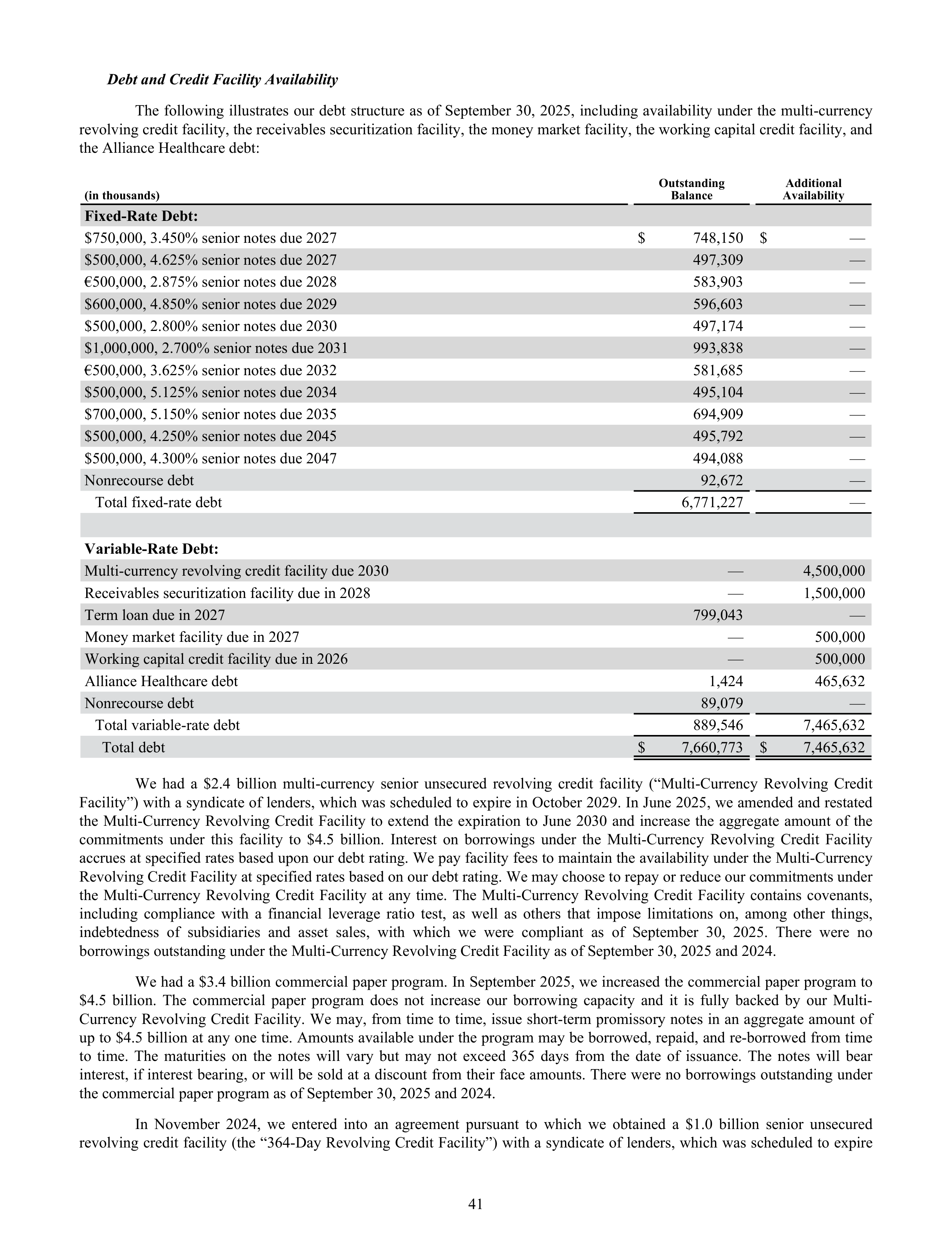
.+=*7-;.-2=*,252=B?*25*+252=B
,=:;DAADL>CAAJHIG6I:HDJG9:7IHIGJ8IJG:6HD;+:EI:B7:G
>C8AJ9>CA67>A>INJC9:GI=:BJAI>
8JGG:C8N
G:KDAK>CI;68>A>IN I=:G:8:>K67A:HH:8JG>I>O6I>DC;68>A>IN I=:BDC:NB6G@:I;68>A>IN I=:LDG@>CI6A8G:9>I;68>A>IN 6C9
I=:AA>6C8: :6AI=86G:9:7I
6:@5;A?.:1?
"A@?@.:16:4
.8.:02
116@6;:.8
B.68./686@E
6D21%.@22/@
H:C>DGCDI:H9J:
U
H:C>DGCDI:H9J:
U
Y
H:C>DGCDI:H9J:
U
H:C>DGCDI:H9J:
U
H:C>DGCDI:H9J:
U
H:C>DGCDI:H9J:
U
Y
H:C>DGCDI:H9J:
U
H:C>DGCDI:H9J:
U
H:C>DGCDI:H9J:
U
H:C>DGCDI:H9J:
U
H:C>DGCDI:H9J:
U
&DCG:8DJGH:9:7I
U
,DI6A;>M:9
G6I:9:7I
U
).>6./82%.@22/@
%JAI>
8JGG:C8NG:KDAK>CI;68>A>IN9J:
U
*:8:>K67A:HH:8JG>I>O6I>DC;68>A>IN9J:>C
U
,:GBAD6C9J:>C
U
%DC:NB6G@:I;68>A>IN9J:>C
U
/DG@>CI6A8G:9>I;68>A>IN9J:>C
U
AA>6C8: :6AI=86G:9:7I
&DCG:8DJGH:9:7I
U
,DI6AK6G>67A:
G6I:9:7I
,DI6A9:7I
/:=6967>AA>DCBJAI>
8JGG:C8NH:C>DGJCH:8JG:9G:KDAK>CI;68>A>INV%JAI>
JGG:C8N*:KDAK>CI
68>A>INWL>I=6HNC9>86I:D;A:C9:GH L=>8=L6HH8=:9JA:9ID:ME>G:>C'8ID7:G
!C"JC:
L:6B:C9:96C9G:HI6I:9
I=:%JAI>
JGG:C8N*:KDAK>CI68>A>INID:MI:C9I=::ME>G6I>DCID"JC:
6C9>C8G:6H:I=:6<<G:<6I:6BDJCID;I=:
8DBB>IB:CIHJC9:GI=>H;68>A>INID7>AA>DC!CI:G:HIDC7DGGDL>C
JGG:C8N*:KDAK>CI68>A>IN
688GJ:H6IHE:8>;>:9G6I:H76H:9JEDCDJG9:7IG6I>CA>IN;::HIDB6>CI6>CI=:6K6>A67>A>INJC9:GI=:%JAI>
JGG:C8N
*:KDAK>CI68>A>IN6IHE:8>;>:9G6I:H76H:9DCDJG9:7IG6I>CIB:CIHJC9:G
I=:%JAI>
JGG:C8N*:KDAK>CI68>A>IN6I6CNI>B:,=:%JAI>
JGG:C8N*:KDAK>CI68>A>IN8DCI6>CH8DK:C6CIH
>C8AJ9>C6C8:L>I=6;>C6C8>6AA:K:G6DI:HI 6HL:AA6HDI=:GHI=6I>BEDH:A>B>I6I>DCHDC 6BDCC<H
>C9:7I:9C:HH D; HJ7H>9>6G>:H 6C9 6HH:I H6A:H L>I= L=>8= L: L:G: 8DBEA>6CI 6H D; +:EI:B7:G
,=:G: L:G: CD
7DGGDL>CC
JGG:C8N*:KDAK>CI68>A>IN6HD;+:EI:B7:G
6C9
/:=6967>AA>DC8DBB:G8>6AE6E:GEGDC8G:6H:9I=:8DBB:G8>6AE6E:GEGD<G6BID
7>AA>DC,=:8DBB:G8>6AE6E:GEGDC8G:6H:DJG7DGGDL>CIN6C9>I>H;JAAN768@:97NDJG%JAI>
JGG:C8N*:KDAK>CI68>A>IN/:B6N ;GDBI>B:IDI>B: >HHJ:H=DGI
I:GBEGDB>HHDGNCDI:H>C6C6<<G:<6I:6BDJCID;
JEID7>AA>DC6I6CNDC:I>B:BDJCIH6K6>A67A:JC9:GI=:EGD9 6C9G:
7DGGDL:9;GDBI>B:
IDI>B:,=:B6IJG>I>:HDCI=:CDI:HL>AAK6GN7JIB6NCDI:M8::996NH;GDBI=:96I:D;>HHJ6C8:,=:CDI:HL>AA7:6G
>CI:G:HI >;>CI:G:HI7:6G>CAA7:HDA96I69>H8DJCI;GDBI=:>G;68:6BDJCIH,=:G:L:G:CD7DGGDL>CC<JC9:G
I=:8DBB:G8>6AE6E:GEGD<G6B6HD;+:EI:B7:G
6C9
!C &DK:B7:G
L: :CI:G:9 >CID 6C 68= L: D7I6>C:9 6
7>AA>DC H:C>DG JCH:8JG:9
G:KDAK>CI;68>A>INI=:V
6N*:KDAK>CI68>A>INWL>I=6HNC9>86I:D;A:C9:GH L=>8=L6HH8=:9JA:9ID:ME>G:
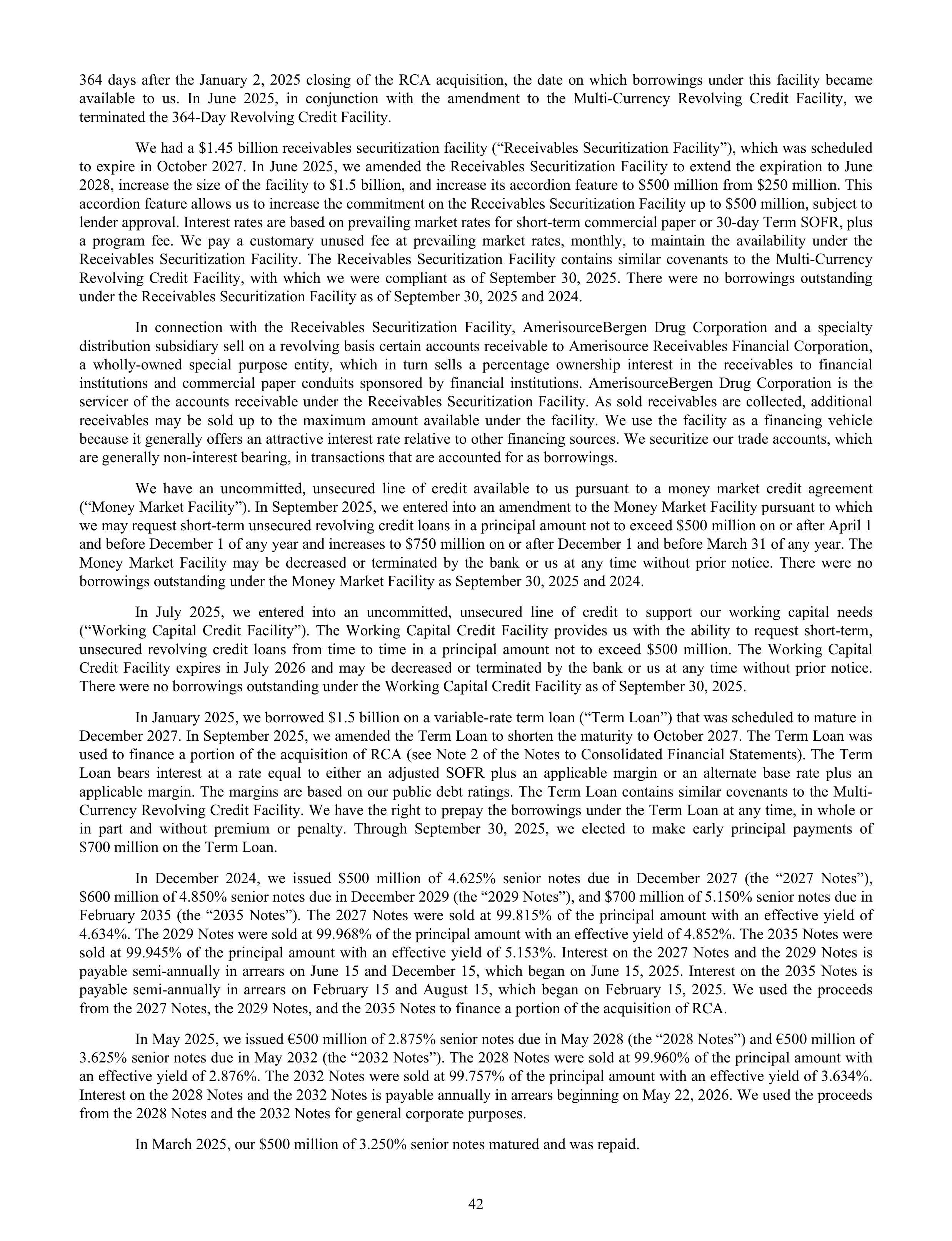
364 days after the January 2, 2025 closing of the RCA acquisition, the date on which borrowings under this facility became
available to us. In June 2025, in conjunction with the amendment to the Multi-Currency Revolving Credit Facility, we
terminated the 364-Day Revolving Credit Facility.
We had a $1.45 billion receivables securitization facility (“Receivables Securitization Facility”), which was scheduled
to expire in October 2027. In June 2025, we amended the Receivables Securitization Facility to extend the expiration to June
2028, increase the size of the facility to $1.5 billion, and increase its accordion feature to $500 million from $250 million. This
accordion feature allows us to increase the commitment on the Receivables Securitization Facility up to $500 million, subject to
lender approval. Interest rates are based on prevailing market rates for short-term commercial paper or 30-day Term SOFR, plus
a program fee. We pay a customary unused fee at prevailing market rates, monthly, to maintain the availability under the
Receivables Securitization Facility. The Receivables Securitization Facility contains similar covenants to the Multi-Currency
Revolving Credit Facility, with which we were compliant as of September 30, 2025. There were no borrowings outstanding
under the Receivables Securitization Facility as of September 30, 2025 and 2024.
In connection with the Receivables Securitization Facility, AmerisourceBergen Drug Corporation and a specialty
distribution subsidiary sell on a revolving basis certain accounts receivable to Amerisource Receivables Financial Corporation,
a wholly-owned special purpose entity, which in turn sells a percentage ownership interest in the receivables to financial
institutions and commercial paper conduits sponsored by financial institutions. AmerisourceBergen Drug Corporation is the
servicer of the accounts receivable under the Receivables Securitization Facility. As sold receivables are collected, additional
receivables may be sold up to the maximum amount available under the facility. We use the facility as a financing vehicle
because it generally offers an attractive interest rate relative to other financing sources. We securitize our trade accounts, which
are generally non-interest bearing, in transactions that are accounted for as borrowings.
We have an uncommitted, unsecured line of credit available to us pursuant to a money market credit agreement
(“Money Market Facility”). In September 2025, we entered into an amendment to the Money Market Facility pursuant to which
we may request short-term unsecured revolving credit loans in a principal amount not to exceed $500 million on or after April 1
and before December 1 of any year and increases to $750 million on or after December 1 and before March 31 of any year. The
Money Market Facility may be decreased or terminated by the bank or us at any time without prior notice. There were no
borrowings outstanding under the Money Market Facility as September 30, 2025 and 2024.
In July 2025, we entered into an uncommitted, unsecured line of credit to support our working capital needs
(“Working Capital Credit Facility”). The Working Capital Credit Facility provides us with the ability to request short-term,
unsecured revolving credit loans from time to time in a principal amount not to exceed $500 million. The Working Capital
Credit Facility expires in July 2026 and may be decreased or terminated by the bank or us at any time without prior notice.
There were no borrowings outstanding under the Working Capital Credit Facility as of September 30, 2025.
In January 2025, we borrowed $1.5 billion on a variable-rate term loan (“Term Loan”) that was scheduled to mature in
December 2027. In September 2025, we amended the Term Loan to shorten the maturity to October 2027. The Term Loan was
used to finance a portion of the acquisition of RCA (see Note 2 of the Notes to Consolidated Financial Statements). The Term
Loan bears interest at a rate equal to either an adjusted SOFR plus an applicable margin or an alternate base rate plus an
applicable margin. The margins are based on our public debt ratings. The Term Loan contains similar covenants to the Multi-
Currency Revolving Credit Facility. We have the right to prepay the borrowings under the Term Loan at any time, in whole or
in part and without premium or penalty. Through September 30, 2025, we elected to make early principal payments of
$700 million on the Term Loan.
In December 2024, we issued $500 million of 4.625% senior notes due in December 2027 (the “2027 Notes”),
$600 million of 4.850% senior notes due in December 2029 (the “2029 Notes”), and $700 million of 5.150% senior notes due in
February 2035 (the “2035 Notes”). The 2027 Notes were sold at 99.815% of the principal amount with an effective yield of
4.634%. The 2029 Notes were sold at 99.968% of the principal amount with an effective yield of 4.852%. The 2035 Notes were
sold at 99.945% of the principal amount with an effective yield of 5.153%. Interest on the 2027 Notes and the 2029 Notes is
payable semi-annually in arrears on June 15 and December 15, which began on June 15, 2025. Interest on the 2035 Notes is
payable semi-annually in arrears on February 15 and August 15, which began on February 15, 2025. We used the proceeds
from the 2027 Notes, the 2029 Notes, and the 2035 Notes to finance a portion of the acquisition of RCA.
In May 2025, we issued €500 million of 2.875% senior notes due in May 2028 (the “2028 Notes”) and €500 million of
3.625% senior notes due in May 2032 (the “2032 Notes”). The 2028 Notes were sold at 99.960% of the principal amount with
an effective yield of 2.876%. The 2032 Notes were sold at 99.757% of the principal amount with an effective yield of 3.634%.
Interest on the 2028 Notes and the 2032 Notes is payable annually in arrears beginning on May 22, 2026. We used the proceeds
from the 2028 Notes and the 2032 Notes for general corporate purposes.
In March 2025, our $500 million of 3.250% senior notes matured and was repaid.
42
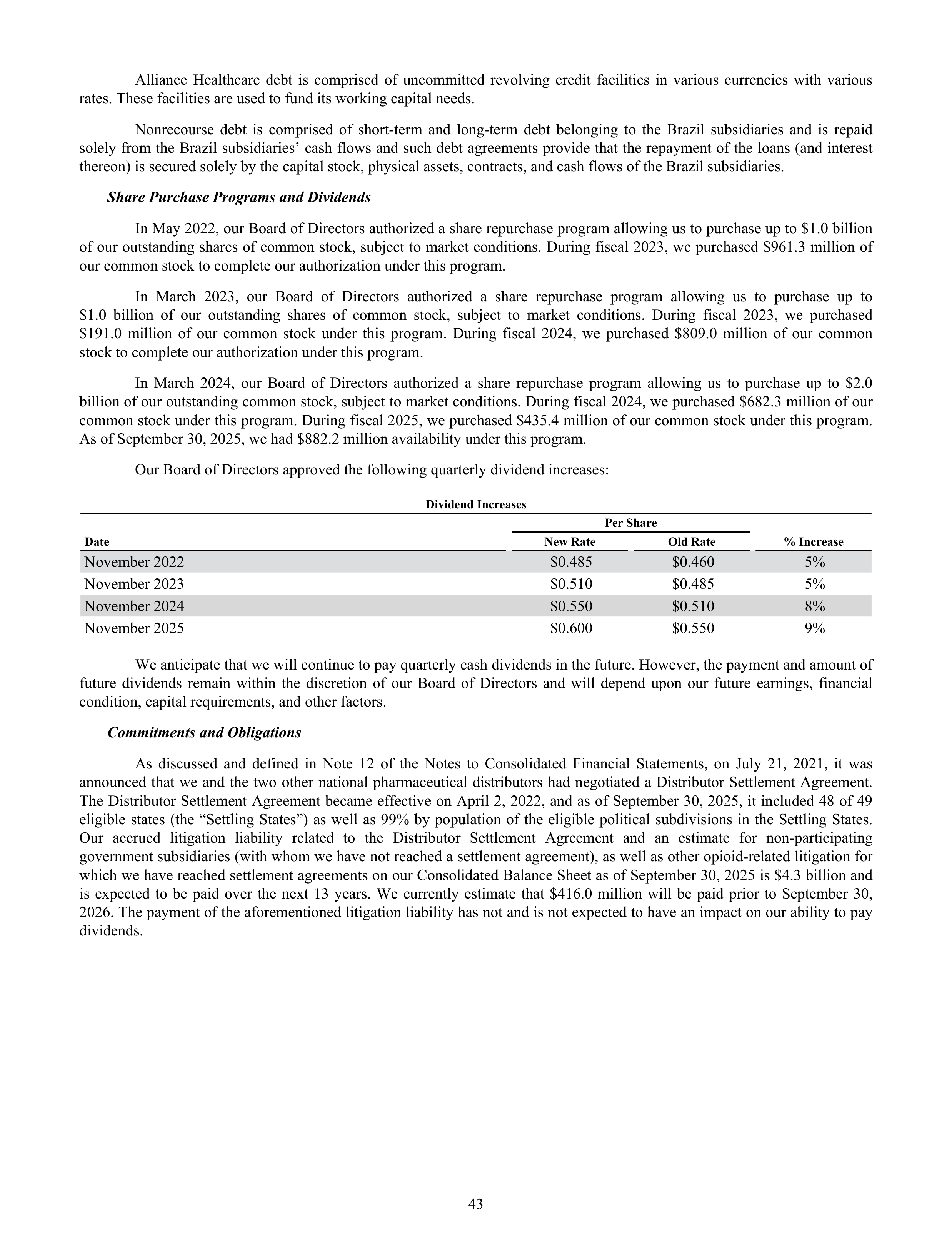
AA>6C8: :6AI=86G:9:7I>H8DBEG>H:9D;JC8DBB>II:9G:KDAK>CI;68>A>I>:H>CK6G>DJH8JGG:C8>:HL>I=K6G>DJH
G6I:H,=:H:;68>A>I>:H6G:JH:9ID;JC9>IHLDG@>CI6AC::9H
&DCG:8DJGH:9:7I>H8DBEG>H:9D;H=DGI
I:GB6C9ADC<
I:GB9:7I7:ADCCAHJ7H>9>6G>:H6C9>HG:E6>9
HDA:AN;GDBI=:G6O>AHJ7H>9>6G>:HX86H=;ADLH6C9HJ8=9:7I69:I=6II=:G:E6NB:CID;I=:AD6CH6C9>CI:G:HI
I=:G:DC>HH:8JG:9HDA:AN7NI=:86E>I6AHID8@ E=NH>86A6HH:IH 8DCIG68IH 6C986H=;ADLHD;I=:G6O>AHJ7H>9>6G>:H
!1*;.>;,1*<.;80;*6<*7-2?2-.7-<
!C%6N
DJGD6G9D;>G:8IDGH6JI=DG>O:96H=6G:G:EJG8=6H:EGDCAA>DC
D;DJGDJIHI6C9>CI>DCHJG>CH86A
L:EJG8=6H:9B>AA>DCD;
DJG8DBBDCHID8@ID8DBEA:I:DJG6JI=DG>O6I>DCJC9:GI=>HEGD<G6B
!C %6G8=
DJG D6G9 D; >G:8IDGH 6JI=DG>O:9 6 H=6G: G:EJG8=6H: EGDC< JH ID EJG8=6H: JE ID
7>AA>DC D; DJG DJIHI6C9>CI>DCH JG>CH86A
L: EJG8=6H:9
B>AA>DCD;DJG8DBBDCHID8@JC9:GI=>HEGDCH86A
L:EJG8=6H:9
B>AA>DCD;DJG8DBBDC
HID8@ID8DBEA:I:DJG6JI=DG>O6I>DCJC9:GI=>HEGD<G6B
!C%6G8=
DJGD6G9D;>G:8IDGH6JI=DG>O:96H=6G:G:EJG8=6H:EGDC<JHIDEJG8=6H:JEID
7>AA>DCD;DJGDJIHI6C9>CI>DCHJG>CH86A
L:EJG8=6H:9B>AA>DCD;DJG
8DBBDCHID8@JC9:GI=>HEGDCH86A
L:EJG8=6H:9B>AA>DCD;DJG8DBBDCHID8@JC9:GI=>HEGD<G6B
HD;+:EI:B7:G
L:=69B>AA>DC6K6>A67>A>INJC9:GI=>HEGD<G6B
'JGD6G9D;>G:8IDGH6EEGDK:9I=:;DAADL>CK>9:C9>C8G:6H:H
6B612:1:0>2.?2?
#2>&5.>2
.@2
!2C%.@2
"81%.@2
:0>2.?2
&DK:B7:G
&DK:B7:G
&DK:B7:G
&DK:B7:G
/:6CI>8>E6I:I=6IL:L>AA8DCI>CJ:IDE6NFJ6GI:GAN86H=9>K>9:C9H>CI=:;JIJG: DL:K:G I=:E6NB:CI6C96BDJCID;
;JIJG:9>K>9:C9HG:B6>CL>I=>CI=:9>H8G:I>DCD;DJGD6G9D;>G:8IDGH6C9L>AA9:E:C9JEDCDJG;JIJG::6GC>CC6C8>6A
8DC9>I>DC 86E>I6AG:FJ>G:B:CIH 6C9DI=:G;68IDGH
8662=6.7=<*7-+520*=287<
H9>H8JHH:96C99:;>C:9>C&DI:D;I=:&DI:HIDDCHDA>96I:9>C6C8>6A+I6I:B:CIH DC"JAN
>IL6H
6CCDJC8:9I=6IL:6C9I=:ILDDI=:GC6I>DC6AE=6GB68:JI>86A9>HIG>7JIDGH=69C:6I:96>HIG>7JIDG+:IIA:B:CI<G::B:CI
,=:>HIG>7JIDG+:IIA:B:CIK:DCEG>A
6C96HD;+:EI:B7:G
>I>C8AJ9:9D;
:A>7A:HI6I:HI=:V+:IIA>CDCD;I=::A>7A:EDA>I>86AHJ79>K>H>DCH>CI=:+:IIA>C<+I6I:H
'JG
688GJ:9
A>I>DC
A>67>A>IN
G:A6I:9
ID
I=:
>HIG>7JIDG
+:IIA:B:CI
<G::B:CI
6C9
6C
:HI>B6I:
;DG
CDC
E6GI>8>E6I>C<
9>6G>:HL>I=L=DBL:=6K:CDIG:68=:96H:IIA:B:CI6D>9
G:A6I:9A>I>DC;DG
L=>8=L:=6K:G:68=:9H:IIA:B:CI696I:96A6C8:+=::I6HD;+:EI:B7:G
>H7>AA>DC6C9
>H:ME:8I:9ID7:E6>9DK:GI=:C:MIN:6GH/:8JGG:CIAN:HI>B6I:I=6I
B>AA>DCL>AA7:E6>9EG>DGID+:EI:B7:G
,=:E6NB:CID;I=:6;DG:B:CI>DC:9A>I>DCA>67>A>IN=6HCDI6C9>HCDI:ME:8I:9ID=6K:6C>BE68IDCDJG67>A>INIDE6N
9>K>9:C9H
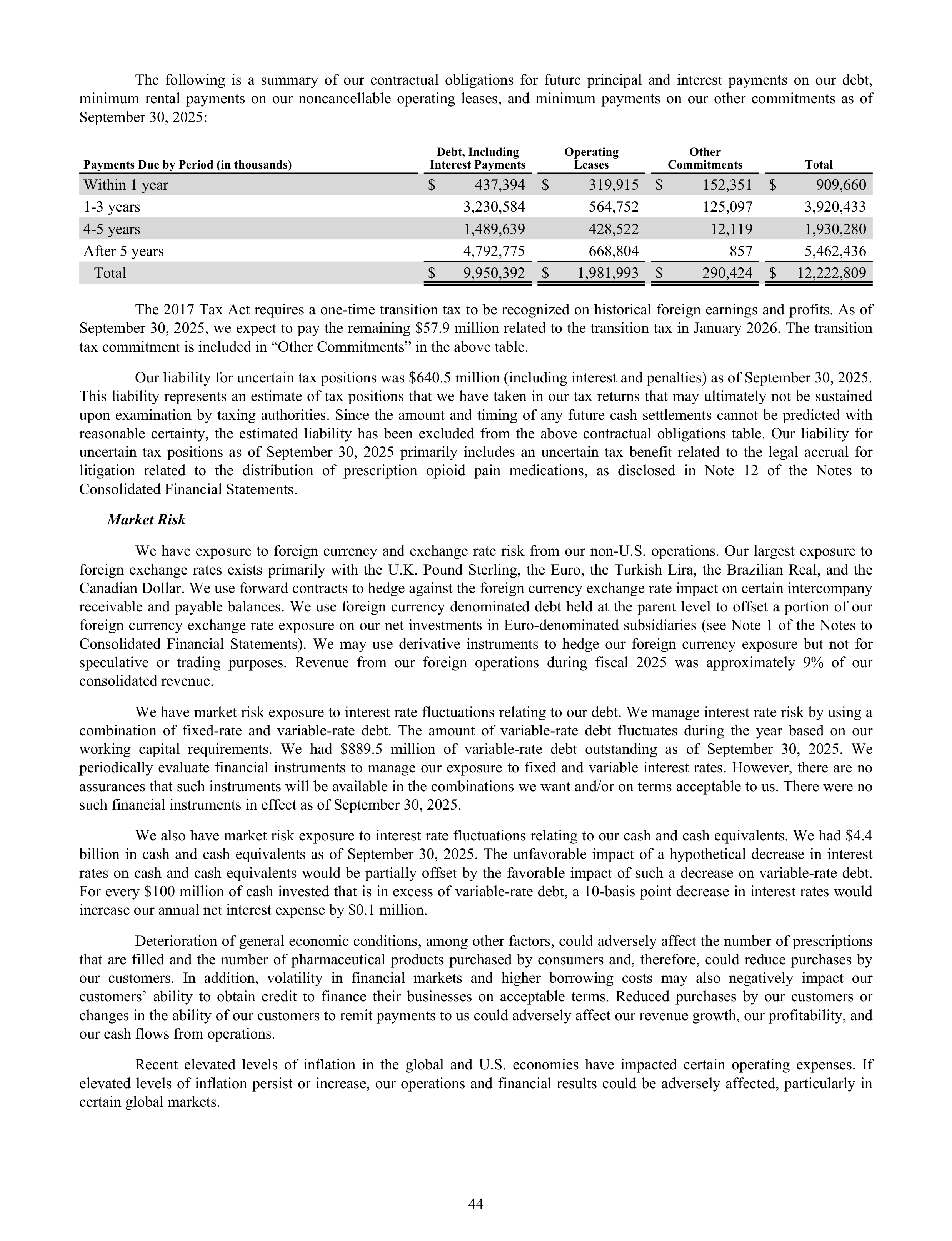
,=:;DAADL>CH6HJBB6GND;DJG8DCIG68IJ6AD7A>DCH;DG;JIJG:EG>C8>E6A6C9>CI:G:HIE6NB:CIHDCDJG9:7I
B>C>BJBG:CI6AE6NB:CIHDCDJGCDC86C8:AA67A:DE:G6I>CC>BJBE6NB:CIHDCDJGDI=:G8DBB>IB:CIH6HD;
+:EI:B7:G
#.E92:@?A2/E#2>6;16:@5;A?.:1?
2/@:08A16:4
:@2>2?@#.E92:@?
".@6:4
2.?2?
"@52>
;996@92:@?
';@.8
/>I=>CN:6G
N:6GH
N:6GH
;I:GN:6GH
,DI6A
,=:
,6M8IG:FJ>G:H6DC:
I>B:IG6CH>I>DCI6MID7:G:8DO:9DC=>HIDG>86A;DG:>CIHHD;
+:EI:B7:G
L::ME:8IIDE6NI=:G:B6>C>CAA>DCG:A6I:9IDI=:IG6CH>I>DCI6M>C"6CJ6GN
,=:IG6CH>I>DC
I6M8DBB>IB:CI>H>C8AJ9:9>CV'I=:GDBB>IB:CIHW>CI=:67DK:I67A:
'JGA>67>A>IN;DGJC8:GI6>CI6MEDH>I>DCHL6H
B>AA>DC>C8AJ9>CCI:G:HI6C9E:C6AI>:H6HD;+:EI:B7:G
,=>HA>67>A>ING:EG:H:CIH6C:HI>B6I:D;I6MEDH>I>DCHI=6IL:=6K:I6@:C>CDJGI6MG:IJGCHI=6IB6NJAI>B6I:ANCDI7:HJHI6>C:9
JEDC:M6B>C6I>DC7NI6M>CI>:H+>C8:I=:6BDJCI6C9I>B>C8I:9L>I=
G:6HDC67A:8:GI6>CIN I=::HI>B6I:9A>67>A>IN=6H7::C:M8AJ9:9;GDBI=:67DK:8DCIG68IJ6AD7A>DCHI67A:'JGA>67>A>IN;DG
JC8:GI6>CI6MEDH>I>DCH6HD;+:EI:B7:G
EG>B6G>AN>C8AJ9:H6CJC8:GI6>CI6M7:C:;>IG:A6I:9IDI=:A:<6A688GJ6A;DG
A>I>DC
G:A6I:9
ID
I=:
9>HIG>7JI>DC
D;
EG:H8G>EI>DC
DE>D>9
E6>C
B:9>86I>DCH
6H
9>H8ADH:9
>C
&DI:
D;
I=:
&DI:H
ID
DCHDA>96I:9>C6C8>6A+I6I:B:CIH
*;4.= 2<4
/:=6K::MEDHJG:ID;DG:><C8JGG:C8N6C9:M8=6CH@;GDBDJGCDC
-+DE:G6I>DCH'JGA6G<:HI:MEDHJG:ID
;DG:><C:M8=6CHIHEG>B6G>ANL>I=I=:-#(DJC9+I:GA>CH=$>G6 I=:G6O>A>6C*:6A 6C9I=:
6C69>6CDAA6G/:JH:;DGL6G98DCIG68IHID=:9<:6CHII=:;DG:><C8JGG:C8N:M8=6CBE68IDC8:GI6>C>CI:G8DBE6CN
G:8:>K67A:6C9E6N67A:76A6C8:H/:JH:;DG:>C6I:99:7I=:A96II=:E6G:CIA:K:AIDD;;H:I6EDGI>DCD;DJG
;DG:><C8JGG:C8N:M8=6CCK:HIB:CIH>CJGD
9:CDB>C6I:9HJ7H>9>6G>:HH::&DI:D;I=:&DI:HID
DCHDA>96I:9>C6C8>6A+I6I:B:CIH/:B6NJH:9:G>K6I>K:>CHIGJB:CIHID=:9<C8JGG:C8N:MEDHJG:7JICDI;DG
HE:8JA6I>K: DG IG69>CDCH 9JG>CH86A
L6H 6EEGDM>B6I:AN D; DJG
8DCHDA>96I:9G:K:CJ:
/:=6K:B6G@:IG>H@:MEDHJG:ID>CI:G:HIG6I:;AJ8IJ6I>DCHG:A6I>C<IDDJG9:7I/:B6C6CI:G:HIG6I:G>H@7NJH>C<6
8DB7>C6I>DC D; ;>M:9
G6I: 6C9 K6G>67A:
G6I: 9:7I ,=: 6BDJCI D; K6G>67A:
G6I: 9:7I ;AJ8IJ6I:H 9JG>C< I=: N:6G 76H:9 DC DJG
LDG@>CI6A G:FJ>G:B:CIH /: =69 B>AA>DC D; K6G>67A:
G6I: 9:7I DJIHI6C9>C< 6H D; +:EI:B7:G
/:
E:G>D9>86AAN:K6AJ6I:;>C6C8>6A>CHIGJB:CIHIDB6C6M:96C9K6G>67A:>CI:G:HIG6I:H DL:K:G I=:G:6G:CD
6HHJG6C8:HI=6IHJ8=>CHIGJB:CIHL>AA7:6K6>A67A:>CI=:8DB7>C6I>DCHL:L6CI6C9DGDCI:GBH688:EI67A:IDJH,=:G:L:G:CD
HJ8=;>C6C8>6A>CHIGJB:CIH>C:;;:8I6HD;+:EI:B7:G
/:6AHD=6K:B6G@:IG>H@:MEDHJG:ID>CI:G:HIG6I:;AJ8IJ6I>DCHG:A6I>CK6A:CIH/:=69
7>AA>DC>C86H=6C986H=:FJ>K6A:CIH6HD;+:EI:B7:G
,=:JC;6KDG67A:>BE68ID;6=NEDI=:I>86A9:8G:6H:>C>CI:G:HI
G6I:HDC86H=6C986H=:FJ>K6A:CIHLDJA97:E6GI>6AAND;;H:I7NI=:;6KDG67A:>BE68ID;HJ8=69:8G:6H:DCK6G>67A:
G6I:9:7I
DG:K:GN
B>AA>DCD;86H=>CK:HI:9I=6I>H>C:M8:HHD;K6G>67A:
G6I:9:7I 6
76H>HED>CI9:8G:6H:>C>CI:G:HIG6I:HLDJA9
>C8G:6H:DJG6CCJ6AC:I>CI:G:HI:ME:CH:7N
B>AA>DC
:I:G>DG6I>DCD;88DC9>I>DCH 6BDCEI>DCH
I=6I6G:;>AA:96C9I=:CJB7:GD;E=6GB68:JI>86AEGD9J8IHEJG8=6H:97N8DCHJB:GH6C9 I=:G:;DG: 8DJA9G:9J8:EJG8=6H:H7N
DJG 8JHIDB:GH !C 699>I>DC KDA6I>A>IN >C ;>C6C8>6A B6G@:IH 6C9 =>C< 8DHIH B6N 6AHD C:K:AN >BE68I DJG
8JHIDB:GHX67>A>INIDD7I6>C8G:9>IID;>C6C8:I=:>G7JH>C:HH:HDC688:EI67A:I:GBH*:9J8:9EJG8=6H:H7NDJG8JHIDB:GHDG
8=6CCI=:67>A>IND;DJG8JHIDB:GHIDG:B>IE6NB:CIHIDJH8DJA969K:GH:AN6;;:8IDJGG:K:CJ:I67>A>IN 6C9
DJG86H=;ADLH;GDBDE:G6I>DCH
*:8:CI :A:K6I:9 A:K:AH D; >C;A6I>DC >C I=: :H =6K: >BE68I:9 8:GI6>C DE:G6I>C< :ME:CH:H !;
:A:K6I:9A:K:AHD;>C;A6I>DCE:GH>HIDG>C8G:6H: DJGDE:G6I>DCH6C9;>C6C8>6AG:HJAIH8DJA97:69K:GH:AN6;;:8I:9 E6GI>8JA6GAN>C
8:GI6>C<AD76AB6G@:IH
We have risks from other geopolitical trends and events, such as rising nationalism, the conflict in Ukraine, and
evolving conditions in the Middle East. Although the long-term implications of these conflicts are difficult to predict at this
time, the financial impact of these conflicts has not been material to our financial results.
ITEM 7A.
QUANTITATIVE AND QUALITATIVE DISCLOSURES ABOUT MARKET RISK
The Company’s most significant market risks are the effects of changing interest rates, foreign currency risk, and the
changes in the price of the Company’s common stock. See discussion under the heading “Market Risk,” which is incorporated
by reference herein.
45
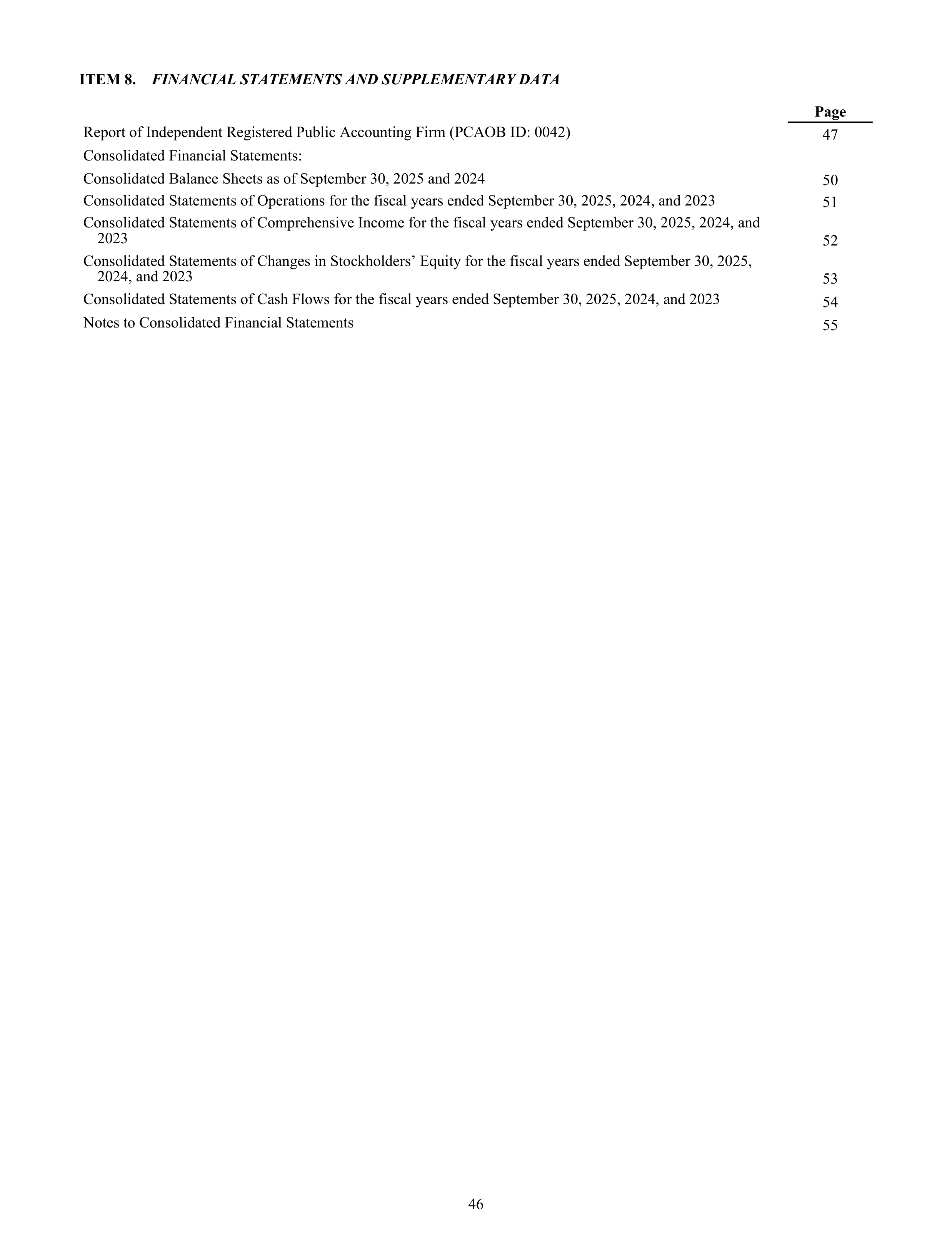
'
!"""!!#" '"
#.42
*:EDGID;!C9:E:C9:CI*:HI:G:9(J7A>888DJCI>CGB('!
DCHDA>96I:9>C6C8>6A+I6I:B:CIH
DCHDA>96I:96A6C8:+=::IH6HD;+:EI:B7:G
6C9
DCHDA>96I:9+I6I:B:CIHD;'E:G6I>DCH;DGI=:;>H86AN:6GH:C9:9+:EI:B7:G
6C9
DCHDA>96I:9+I6I:B:CIHD;DBEG:=:CH>K:!C8DB:;DGI=:;>H86AN:6GH:C9:9+:EI:B7:G
6C9
DCHDA>96I:9+I6I:B:CIHD;=6CC+ID8@=DA9:GHXFJ>IN;DGI=:;>H86AN:6GH:C9:9+:EI:B7:G
6C9
DCHDA>96I:9+I6I:B:CIHD;6H=ADLH;DGI=:;>H86AN:6GH:C9:9+:EI:B7:G
6C9
&DI:HIDDCHDA>96I:9>C6C8>6A+I6I:B:CIH
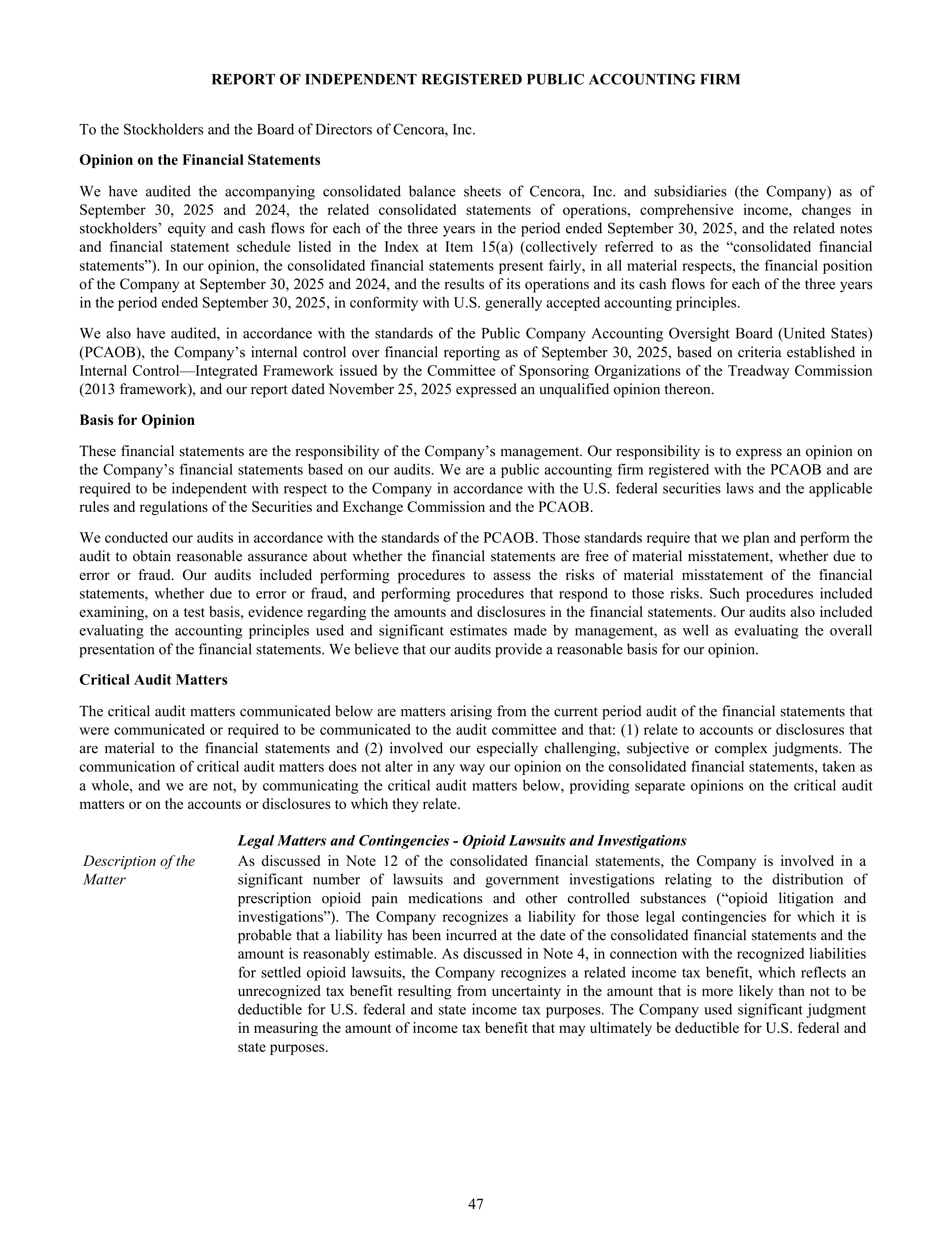
REPORT OF INDEPENDENT REGISTERED PUBLIC ACCOUNTING FIRM
To the Stockholders and the Board of Directors of Cencora, Inc.
Opinion on the Financial Statements
We have audited the accompanying consolidated balance sheets of Cencora, Inc. and subsidiaries (the Company) as of
September 30, 2025 and 2024, the related consolidated statements of operations, comprehensive income, changes in
stockholders’ equity and cash flows for each of the three years in the period ended September 30, 2025, and the related notes
and financial statement schedule listed in the Index at Item 15(a) (collectively referred to as the “consolidated financial
statements”). In our opinion, the consolidated financial statements present fairly, in all material respects, the financial position
of the Company at September 30, 2025 and 2024, and the results of its operations and its cash flows for each of the three years
in the period ended September 30, 2025, in conformity with U.S. generally accepted accounting principles.
We also have audited, in accordance with the standards of the Public Company Accounting Oversight Board (United States)
(PCAOB), the Company’s internal control over financial reporting as of September 30, 2025, based on criteria established in
Internal Control—Integrated Framework issued by the Committee of Sponsoring Organizations of the Treadway Commission
(2013 framework), and our report dated November 25, 2025 expressed an unqualified opinion thereon.
Basis for Opinion
These financial statements are the responsibility of the Company’s management. Our responsibility is to express an opinion on
the Company’s financial statements based on our audits. We are a public accounting firm registered with the PCAOB and are
required to be independent with respect to the Company in accordance with the U.S. federal securities laws and the applicable
rules and regulations of the Securities and Exchange Commission and the PCAOB.
We conducted our audits in accordance with the standards of the PCAOB. Those standards require that we plan and perform the
audit to obtain reasonable assurance about whether the financial statements are free of material misstatement, whether due to
error or fraud. Our audits included performing procedures to assess the risks of material misstatement of the financial
statements, whether due to error or fraud, and performing procedures that respond to those risks. Such procedures included
examining, on a test basis, evidence regarding the amounts and disclosures in the financial statements. Our audits also included
evaluating the accounting principles used and significant estimates made by management, as well as evaluating the overall
presentation of the financial statements. We believe that our audits provide a reasonable basis for our opinion.
Critical Audit Matters
The critical audit matters communicated below are matters arising from the current period audit of the financial statements that
were communicated or required to be communicated to the audit committee and that: (1) relate to accounts or disclosures that
are material to the financial statements and (2) involved our especially challenging, subjective or complex judgments. The
communication of critical audit matters does not alter in any way our opinion on the consolidated financial statements, taken as
a whole, and we are not, by communicating the critical audit matters below, providing separate opinions on the critical audit
matters or on the accounts or disclosures to which they relate.
Legal Matters and Contingencies - Opioid Lawsuits and Investigations
Description of the
Matter
As discussed in Note 12 of the consolidated financial statements, the Company is involved in a
significant number of lawsuits and government investigations relating to the distribution of
prescription opioid pain medications and other controlled substances (“opioid litigation and
investigations”). The Company recognizes a liability for those legal contingencies for which it is
probable that a liability has been incurred at the date of the consolidated financial statements and the
amount is reasonably estimable. As discussed in Note 4, in connection with the recognized liabilities
for settled opioid lawsuits, the Company recognizes a related income tax benefit, which reflects an
unrecognized tax benefit resulting from uncertainty in the amount that is more likely than not to be
deductible for U.S. federal and state income tax purposes. The Company used significant judgment
in measuring the amount of income tax benefit that may ultimately be deductible for U.S. federal and
state purposes.
47
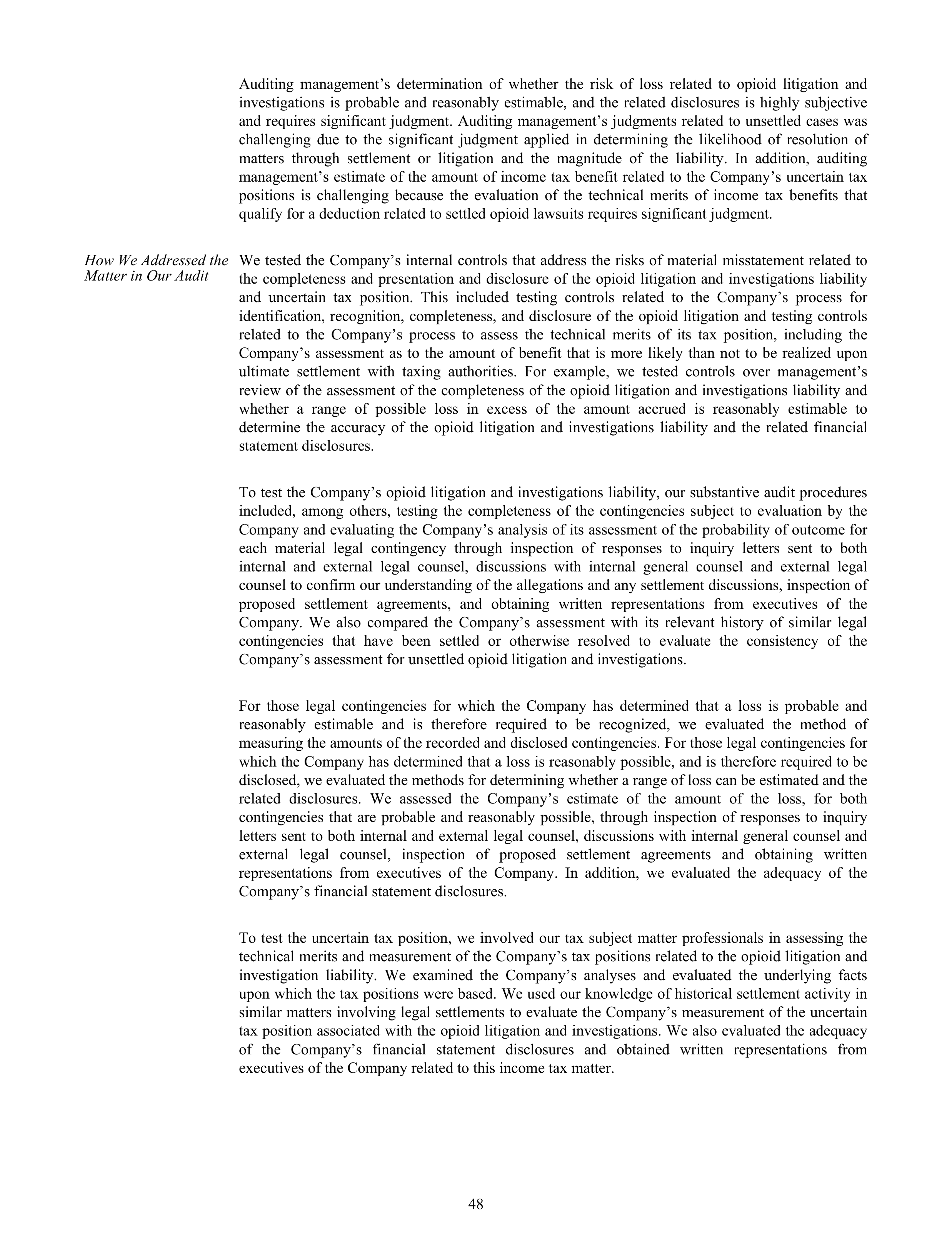
Auditing management’s determination of whether the risk of loss related to opioid litigation and
investigations is probable and reasonably estimable, and the related disclosures is highly subjective
and requires significant judgment. Auditing management’s judgments related to unsettled cases was
challenging due to the significant judgment applied in determining the likelihood of resolution of
matters through settlement or litigation and the magnitude of the liability. In addition, auditing
management’s estimate of the amount of income tax benefit related to the Company’s uncertain tax
positions is challenging because the evaluation of the technical merits of income tax benefits that
qualify for a deduction related to settled opioid lawsuits requires significant judgment.
How We Addressed the
Matter in Our Audit
We tested the Company’s internal controls that address the risks of material misstatement related to
the completeness and presentation and disclosure of the opioid litigation and investigations liability
and uncertain tax position. This included testing controls related to the Company’s process for
identification, recognition, completeness, and disclosure of the opioid litigation and testing controls
related to the Company’s process to assess the technical merits of its tax position, including the
Company’s assessment as to the amount of benefit that is more likely than not to be realized upon
ultimate settlement with taxing authorities. For example, we tested controls over management’s
review of the assessment of the completeness of the opioid litigation and investigations liability and
whether a range of possible loss in excess of the amount accrued is reasonably estimable to
determine the accuracy of the opioid litigation and investigations liability and the related financial
statement disclosures.
To test the Company’s opioid litigation and investigations liability, our substantive audit procedures
included, among others, testing the completeness of the contingencies subject to evaluation by the
Company and evaluating the Company’s analysis of its assessment of the probability of outcome for
each material legal contingency through inspection of responses to inquiry letters sent to both
internal and external legal counsel, discussions with internal general counsel and external legal
counsel to confirm our understanding of the allegations and any settlement discussions, inspection of
proposed settlement agreements, and obtaining written representations from executives of the
Company. We also compared the Company’s assessment with its relevant history of similar legal
contingencies that have been settled or otherwise resolved to evaluate the consistency of the
Company’s assessment for unsettled opioid litigation and investigations.
For those legal contingencies for which the Company has determined that a loss is probable and
reasonably estimable and is therefore required to be recognized, we evaluated the method of
measuring the amounts of the recorded and disclosed contingencies. For those legal contingencies for
which the Company has determined that a loss is reasonably possible, and is therefore required to be
disclosed, we evaluated the methods for determining whether a range of loss can be estimated and the
related disclosures. We assessed the Company’s estimate of the amount of the loss, for both
contingencies that are probable and reasonably possible, through inspection of responses to inquiry
letters sent to both internal and external legal counsel, discussions with internal general counsel and
external legal counsel, inspection of proposed settlement agreements and obtaining written
representations from executives of the Company. In addition, we evaluated the adequacy of the
Company’s financial statement disclosures.
To test the uncertain tax position, we involved our tax subject matter professionals in assessing the
technical merits and measurement of the Company’s tax positions related to the opioid litigation and
investigation liability. We examined the Company’s analyses and evaluated the underlying facts
upon which the tax positions were based. We used our knowledge of historical settlement activity in
similar matters involving legal settlements to evaluate the Company’s measurement of the uncertain
tax position associated with the opioid litigation and investigations. We also evaluated the adequacy
of the Company’s financial statement disclosures and obtained written representations from
executives of the Company related to this income tax matter.
48
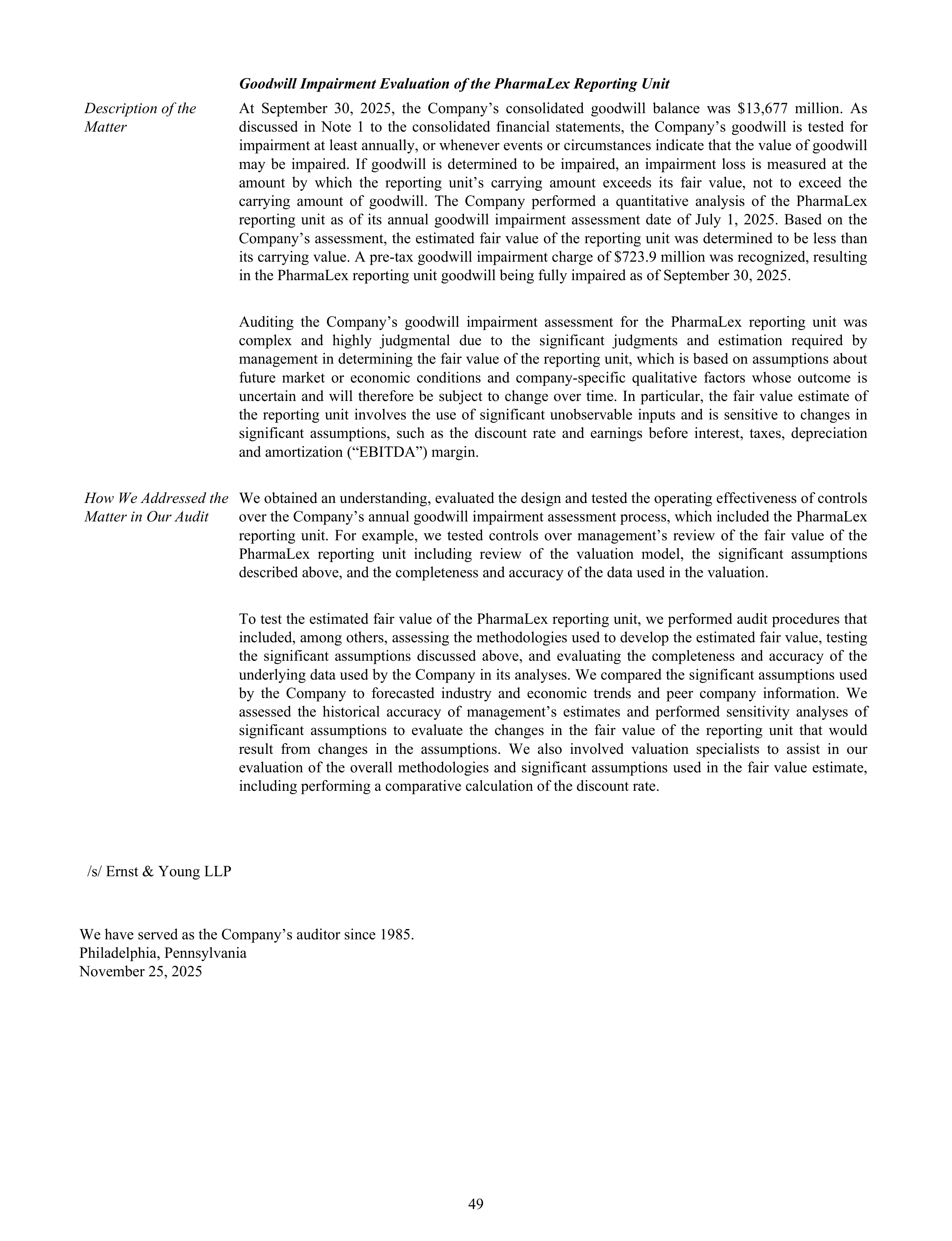
Goodwill Impairment Evaluation of the PharmaLex Reporting Unit
Description of the
Matter
At September 30, 2025, the Company’s consolidated goodwill balance was $13,677 million. As
discussed in Note 1 to the consolidated financial statements, the Company’s goodwill is tested for
impairment at least annually, or whenever events or circumstances indicate that the value of goodwill
may be impaired. If goodwill is determined to be impaired, an impairment loss is measured at the
amount by which the reporting unit’s carrying amount exceeds its fair value, not to exceed the
carrying amount of goodwill. The Company performed a quantitative analysis of the PharmaLex
reporting unit as of its annual goodwill impairment assessment date of July 1, 2025. Based on the
Company’s assessment, the estimated fair value of the reporting unit was determined to be less than
its carrying value. A pre-tax goodwill impairment charge of $723.9 million was recognized, resulting
in the PharmaLex reporting unit goodwill being fully impaired as of September 30, 2025.
Auditing the Company’s goodwill impairment assessment for the PharmaLex reporting unit was
complex and highly judgmental due to the significant judgments and estimation required by
management in determining the fair value of the reporting unit, which is based on assumptions about
future market or economic conditions and company-specific qualitative factors whose outcome is
uncertain and will therefore be subject to change over time. In particular, the fair value estimate of
the reporting unit involves the use of significant unobservable inputs and is sensitive to changes in
significant assumptions, such as the discount rate and earnings before interest, taxes, depreciation
and amortization (“EBITDA”) margin.
How We Addressed the
Matter in Our Audit
We obtained an understanding, evaluated the design and tested the operating effectiveness of controls
over the Company’s annual goodwill impairment assessment process, which included the PharmaLex
reporting unit. For example, we tested controls over management’s review of the fair value of the
PharmaLex reporting unit including review of the valuation model, the significant assumptions
described above, and the completeness and accuracy of the data used in the valuation.
To test the estimated fair value of the PharmaLex reporting unit, we performed audit procedures that
included, among others, assessing the methodologies used to develop the estimated fair value, testing
the significant assumptions discussed above, and evaluating the completeness and accuracy of the
underlying data used by the Company in its analyses. We compared the significant assumptions used
by the Company to forecasted industry and economic trends and peer company information. We
assessed the historical accuracy of management’s estimates and performed sensitivity analyses of
significant assumptions to evaluate the changes in the fair value of the reporting unit that would
result from changes in the assumptions. We also involved valuation specialists to assist in our
evaluation of the overall methodologies and significant assumptions used in the fair value estimate,
including performing a comparative calculation of the discount rate.
/s/ Ernst & Young LLP
We have served as the Company’s auditor since 1985.
Philadelphia, Pennsylvania
November 25, 2025
49
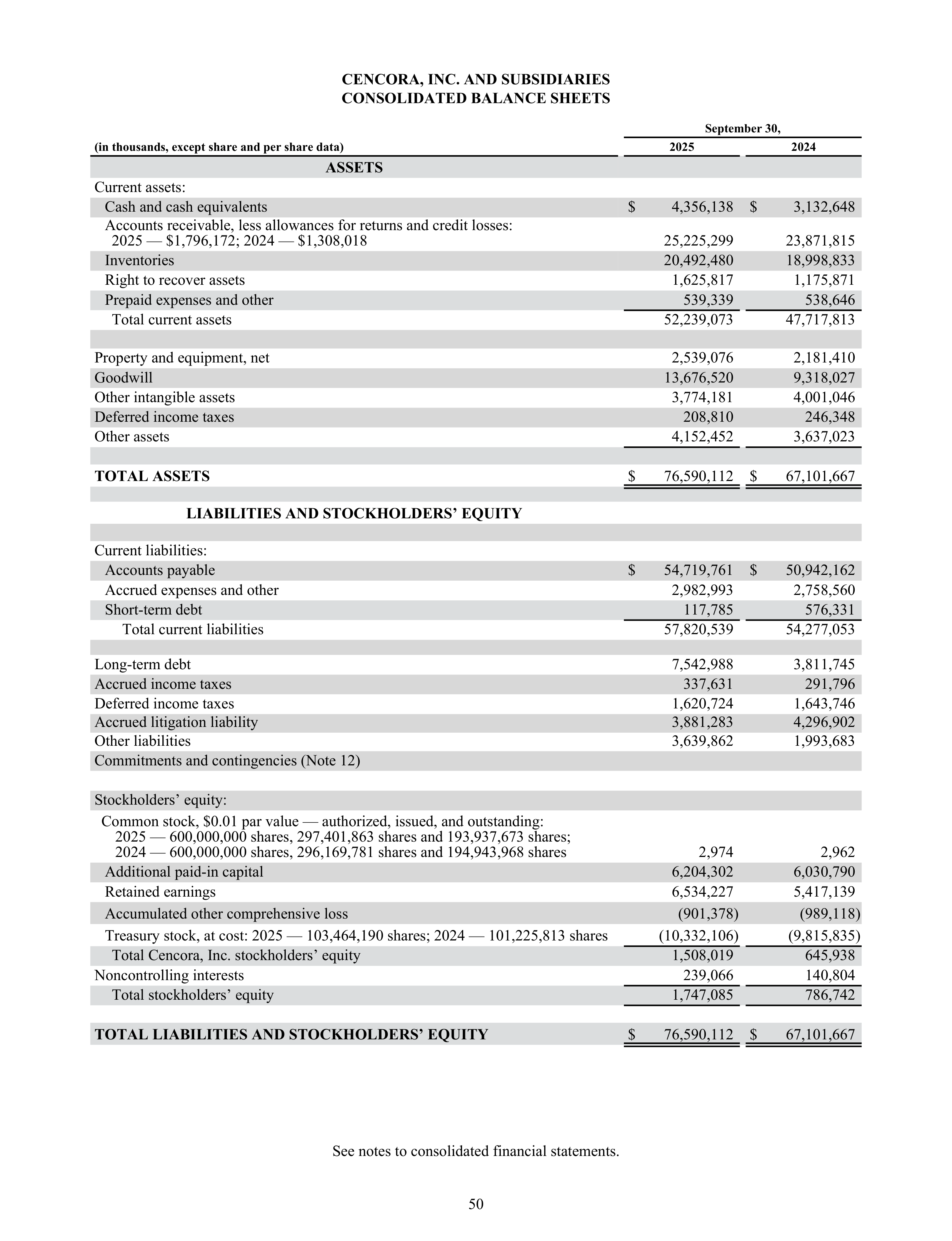
!"%!!&(&%&
"!&"'!&'&
&2
6:@5;A?.:1?2D022.:1?5.>21.@.
&&'&
JGG:CI6HH:IH
6H=6C986H=:FJ>K6A:CIH
88DJCIHG:8:>K67A: A:HH6AADL6C8:H;DGG:IJGCH6C98G:9>IADHH:H
U
U
!CK:CIDG>:H
*><=IIDG:8DK:G6HH:IH
(G:E6>9:ME:CH:H6C9DI=:G
,DI6A8JGG:CI6HH:IH
(GDE:GIN6C9:FJ>EB:CI C:I
DD9L>AA
'I=:G>CI6C7A:6HH:IH
:;:GG:9>C8DB:I6M:H
'I=:G6HH:IH
'"'&&'&
'&!&'""%&H$(',
JGG:CIA>67>A>I>:H
88DJCIHE6N67A:
88GJ:9:ME:CH:H6C9DI=:G
+=DGI
I:GB9:7I
,DI6A8JGG:CIA>67>A>I>:H
$DC<
I:GB9:7I
88GJ:9>C8DB:I6M:H
:;:GG:9>C8DB:I6M:H
88GJ:9A>I>DCA>67>A>IN
'I=:GA>67>A>I>:H
DBB>IB:CIH6C98DCI>C:H&DI:
+ID8@=DA9:GHX:FJ>IN
DBBDCHID8@
E6GK6AJ:U6JI=DG>O:9 >HHJ:9 6C9DJIHI6C9>C<
U
H=6G:H
H=6G:H6C9 H=6G:H
U
H=6G:H H=6G:H6C9 H=6G:H
99>I>DC6AE6>9
>C86E>I6A
*:I6>C:9:6GC>C<H
88JBJA6I:9DI=:G8DBEG:=:CH>K:ADHH
,G:6HJGNHID8@ 6I8DHI
U
H=6G:H
U
H=6G:H
,DI6A:C8DG6 !C8HID8@=DA9:GHX:FJ>IN
&DC8DCIGDAA>CCI:G:HIH
,DI6AHID8@=DA9:GHX:FJ>IN
'"''&!&'""%&H$(',
+::CDI:HID8DCHDA>96I:9;>C6C8>6AHI6I:B:CIH
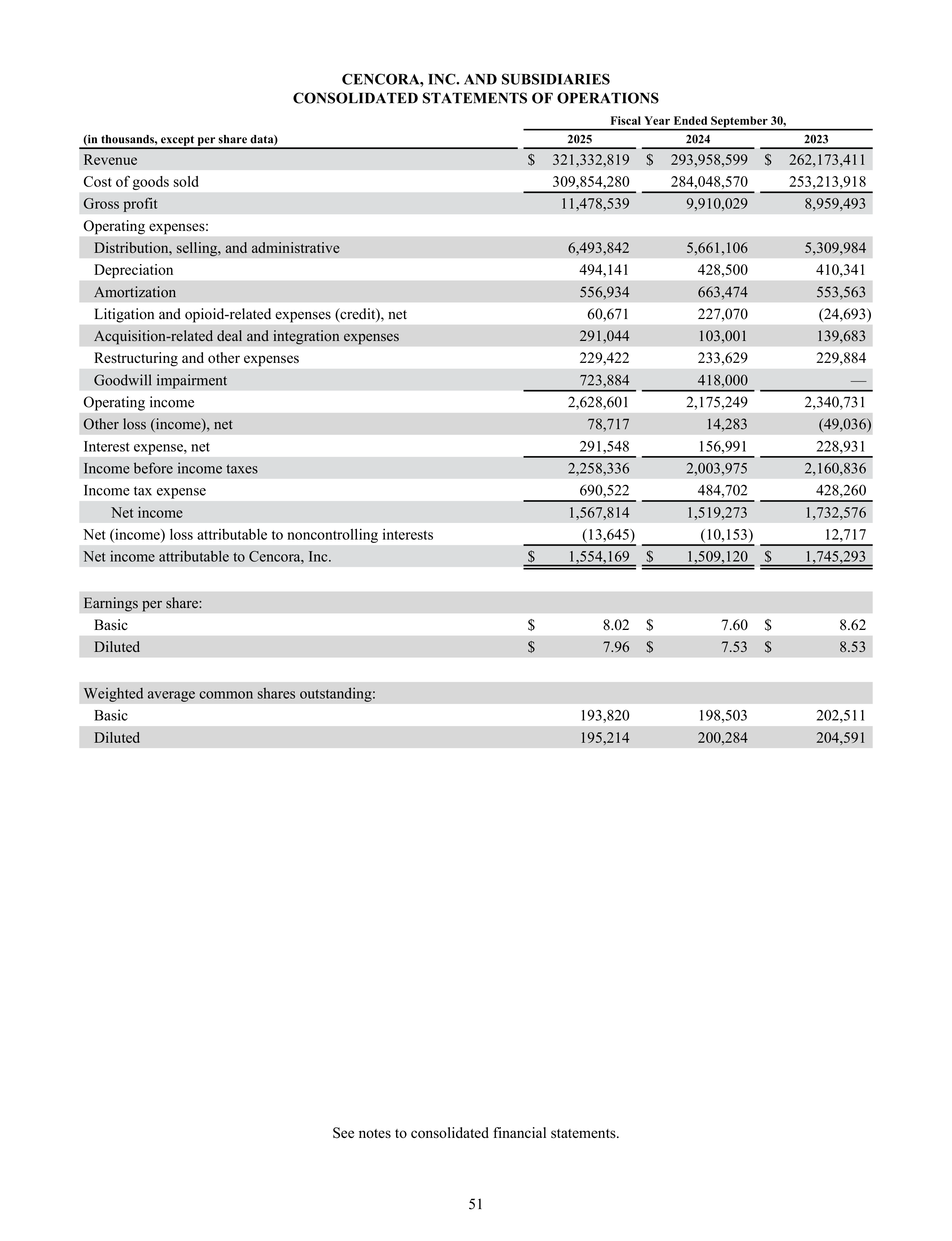
!"%!!&(&%&
"!&"'&'' !'&""#%'"!&
6?0.8,2.>:121&2
6:@5;A?.:1?2D02<@?5.>21.@.
*:K:CJ:
DHID;<DD9HHDA9
GDHHEGD;>I
'E:G6I>C<:ME:CH:H
>HIG>7JI>DC H:AA>CC>HIG6I>K:
:EG:8>6I>DC
BDGI>O6I>DC
$>I>DC6C9DE>D>9
G:A6I:9:ME:CH:H8G:9>I C:I
8FJ>H>I>DC
G:A6I:99:6A6C9>CI:DC:ME:CH:H
*:HIGJ8IJG>C<6C9DI=:G:ME:CH:H
DD9L>AA>BE6>GB:CI
U
'E:G6I>CC8DB:
'I=:GADHH>C8DB: C:I
!CI:G:HI:ME:CH: C:I
!C8DB:7:;DG:>C8DB:I6M:H
!C8DB:I6M:ME:CH:
&:I>C8DB:
&:I>C8DB:ADHH6IIG>7JI67A:IDCDC8DCIGDAA>CCI:G:HIH
&:I>C8DB:6IIG>7JI67A:ID:C8DG6 !C8
6GC>C<HE:GH=6G:
6H>8
>AJI:9
/:><=I:96K:G6C<
6H>8
>AJI:9
+::CDI:HID8DCHDA>96I:9;>C6C8>6AHI6I:B:CIH
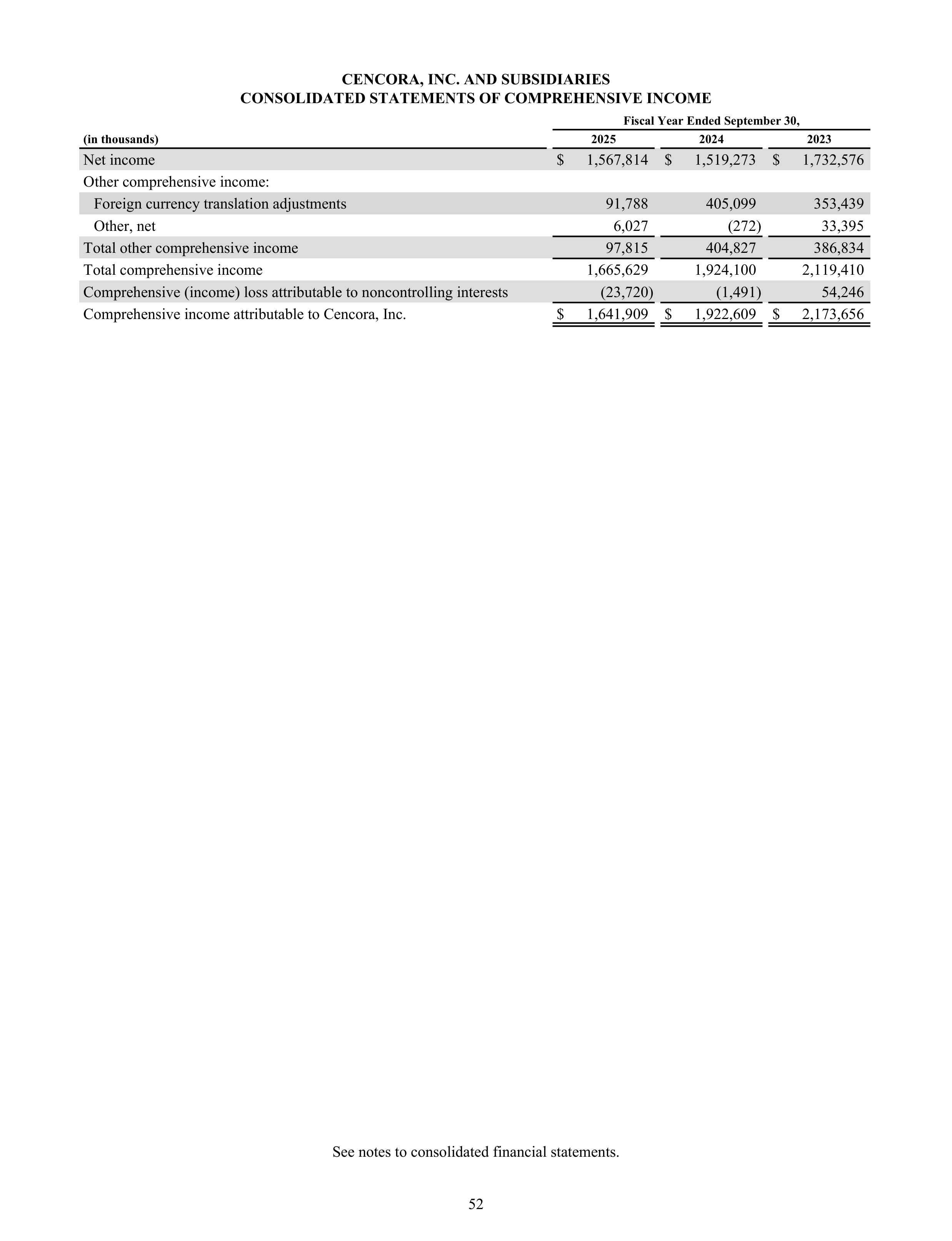
!"%!!&(&%&
"!&"'&'' !'&"" #%!&)!"
6?0.8,2.>:121&2
6:@5;A?.:1?
&:I>C8DB:
'I=:G8DBEG:=:CH>K:>C8DB:
DG:>DC69?JHIB:CIH
'I=:G C:I
,DI6ADI=:G8DBEG:=:CH>K:>C8DB:
,DI6A8DBEG:=:CH>K:>C8DB:
DBEG:=:CH>K:>C8DB:ADHH6IIG>7JI67A:IDCDC8DCIGDAA>CCI:G:HIH
DBEG:=:CH>K:>C8DB:6IIG>7JI67A:ID:C8DG6 !C8
+::CDI:HID8DCHDA>96I:9;>C6C8>6AHI6I:B:CIH
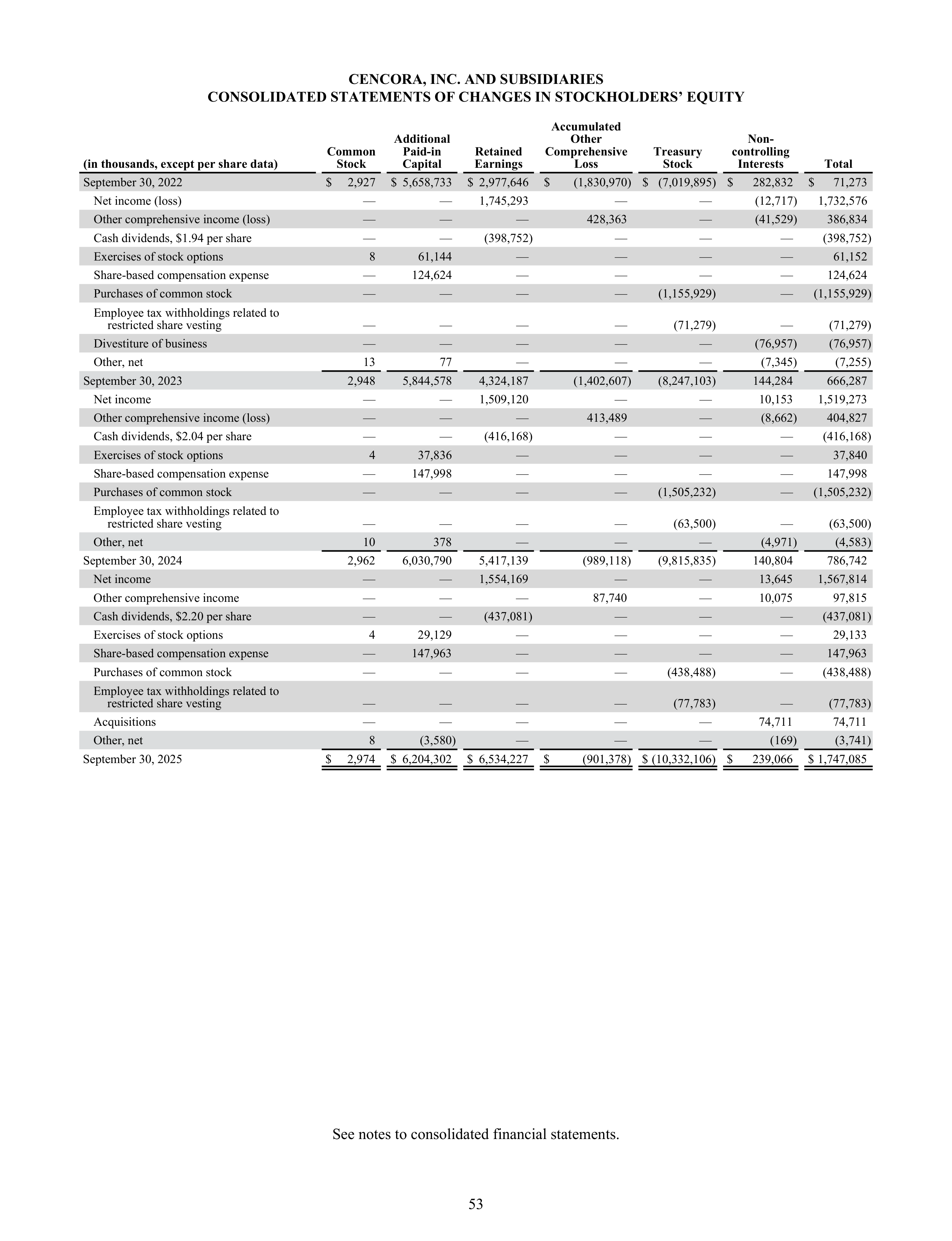
!"%!!&(&%&
"!&"'&'' !'&"!&!&'""%&H$(',
6:@5;A?.:1?2D02<@?5.>21.@.
;99;:
&@;07
116@6;:.8
#.616:
.<6@.8
%2@.6:21
.>:6:4?
00A9A8.@21
"@52>
;9252:?6B2
;??
'>2.?A>E
&@;07
!;:
0;:@>;886:4
:@2>2?@?
';@.8
+:EI:B7:G
&:I>C8DB:ADHH
U
U
U
U
'I=:G8DBEG:=:CH>K:>C8DB:ADHH
U
U
U
U
6H=9>K>9:C9H E:GH=6G:
U
U
U
U
U
M:G8>H:HD;HID8@DEI>DCH
U
U
U
U
+=6G:
76H:98DBE:CH6I>DC:ME:CH:
U
U
U
U
U
(JG8=6H:HD;8DBBDCHID8@
U
U
U
U
U
BEADN::I6ML>I==DA9>C<HG:A6I:9ID
G:HIG>8I:9H=6G:K:HI>C<
U
U
U
U
U
>K:HI>IJG:D;7JH>C:HH
U
U
U
U
U
'I=:G C:I
U
U
U
+:EI:B7:G
&:I>C8DB:
U
U
U
U
'I=:G8DBEG:=:CH>K:>C8DB:ADHH
U
U
U
U
6H=9>K>9:C9H
E:GH=6G:
U
U
U
U
U
M:G8>H:HD;HID8@DEI>DCH
U
U
U
U
+=6G:
76H:98DBE:CH6I>DC:ME:CH:
U
U
U
U
U
(JG8=6H:HD;8DBBDCHID8@
U
U
U
U
U
BEADN::I6ML>I==DA9>C<HG:A6I:9ID
G:HIG>8I:9H=6G:K:HI>C<
U
U
U
U
U
'I=:G C:I
U
U
U
+:EI:B7:G
&:I>C8DB:
U
U
U
U
'I=:G8DBEG:=:CH>K:>C8DB:
U
U
U
U
6H=9>K>9:C9H
E:GH=6G:
U
U
U
U
U
M:G8>H:HD;HID8@DEI>DCH
U
U
U
U
+=6G:
76H:98DBE:CH6I>DC:ME:CH:
U
U
U
U
U
(JG8=6H:HD;8DBBDCHID8@
U
U
U
U
U
BEADN::I6ML>I==DA9>C<HG:A6I:9ID
G:HIG>8I:9H=6G:K:HI>C<
U
U
U
U
U
8FJ>H>I>DCH
U
U
U
U
U
'I=:G C:I
U
U
U
+:EI:B7:G
+::CDI:HID8DCHDA>96I:9;>C6C8>6AHI6I:B:CIH
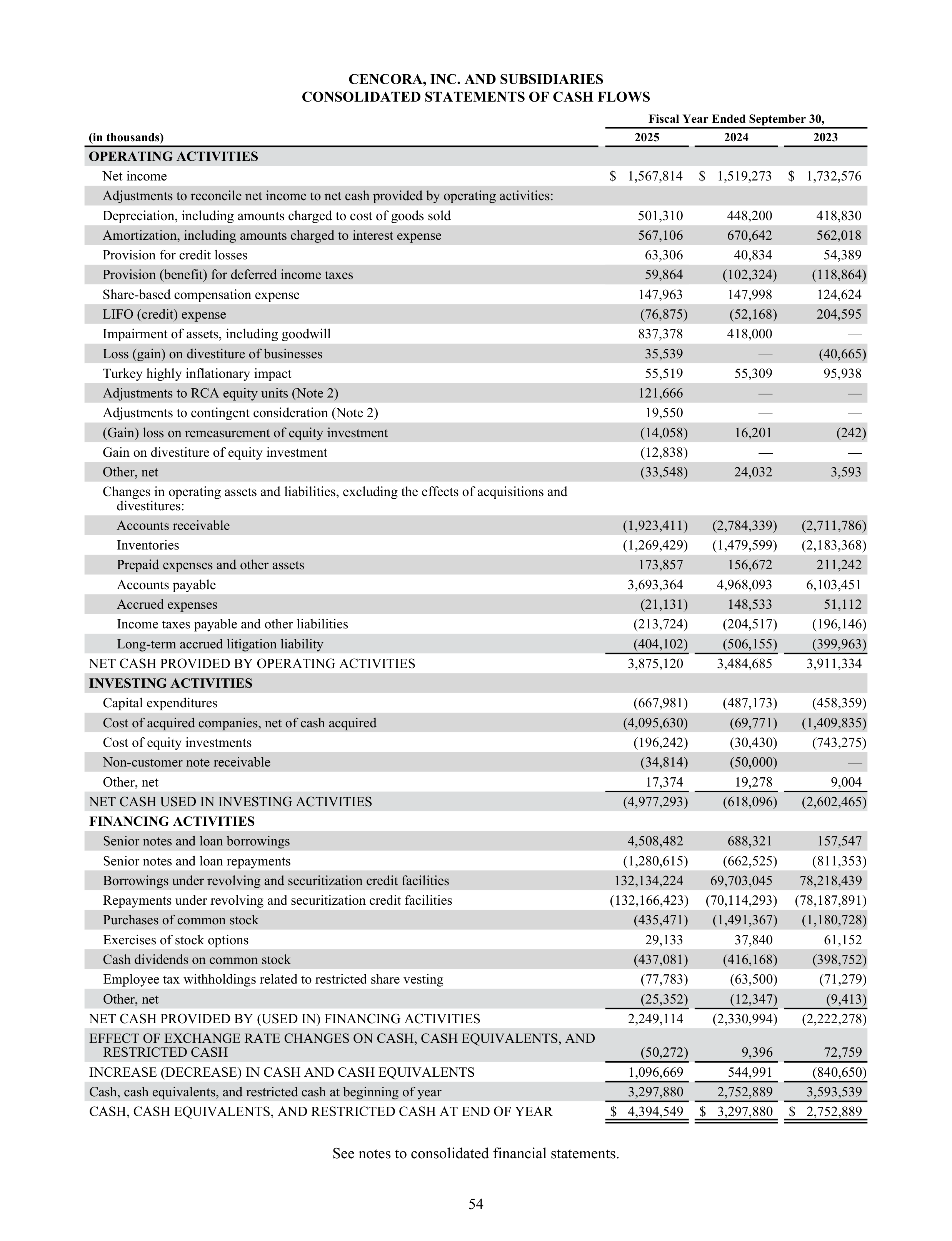
!"%!!&(&%&
"!&"'&'' !'&"&"*&
6?0.8,2.>:121&2
6:@5;A?.:1?
"#%'!')'&
&:I>C8DB:
9?JHIB:CIHIDG:8DC8>A:C:I>C8DB:IDC:I86H=EGDK>9:97NDE:G6I>CK>I>:H
:EG:8>6I>DC >C8AJ9>C<6BDJCIH8=6G<:9ID8DHID;<DD9HHDA9
BDGI>O6I>DC >C8AJ9>C<6BDJCIH8=6GCI:G:HI:ME:CH:
(GDK>H>DC;DG8G:9>IADHH:H
(GDK>H>DC7:C:;>I;DG9:;:GG:9>C8DB:I6M:H
+=6G:
76H:98DBE:CH6I>DC:ME:CH:
$!'8G:9>I:ME:CH:
!BE6>GB:CID;6HH:IH >C8AJ9>C<AA
U
$DHHCDC9>K:HI>IJG:D;7JH>C:HH:H
U
,JG@:N=>C;A6I>DC6GN>BE68I
9?JHIB:CIHID*:FJ>INJC>IH&DI:
U
U
9?JHIB:CIHID8DCI>C9:G6I>DC&DI:
U
U
6>CADHHDCG:B:6HJG:B:CID;:FJ>IN>CK:HIB:CI
6>CDC9>K:HI>IJG:D;:FJ>IN>CK:HIB:CI
U
U
'I=:G C:I
=6CCDE:G6I>C67>A>I>:H :M8AJ9>CH>I>DCH6C9
9>K:HI>IJG:H
88DJCIHG:8:>K67A:
!CK:CIDG>:H
(G:E6>9:ME:CH:H6C9DI=:G6HH:IH
88DJCIHE6N67A:
88GJ:9:ME:CH:H
!C8DB:I6M:HE6N67A:6C9DI=:GA>67>A>I>:H
$DCI>DCA>67>A>IN
&,+ (*'.!1'(*,!&,!.!,!+
!)&'!')'&
6E>I6A:ME:C9>IJG:H
DHID;68FJ>G:98DBE6C>:H C:ID;86H=68FJ>G:9
DHID;:FJ>IN>CK:HIB:CIH
&DC
8JHIDB:GCDI:G:8:>K67A:
U
'I=:G C:I
&,+ -+!&!&.+,!&,!.!,!+
!!!')'&
+:C>DGCDI:H6C9AD6C7DGGDL>C<H
+:C>DGCDI:H6C9AD6CG:E6NB:CIH
DGGDL>CCI>O6I>DC8G:9>I;68>A>I>:H
*:E6NB:CIHJC9:GG:KDAK>CI>O6I>DC8G:9>I;68>A>I>:H
(JG8=6H:HD;8DBBDCHID8@
M:G8>H:HD;HID8@DEI>DCH
6H=9>K>9:C9HDC8DBBDCHID8@
BEADN::I6ML>I==DA9>C8I:9H=6G:K:HI>C<
'I=:G C:I
&,+ (*'.!1-+!&!&&!&,!.!,!+
,'0 &*, &+'&+ + )-!.$&,+ &
*+,*!,+
!&*+*+!&+ &+ )-!.$&,+
6H= 86H=:FJ>K6A:CIH 6C9G:HIG>8I:986H=6I7:CC>C<D;N:6G
+ + )-!.$&,+ &*+,*!,+ ,&'1*
+::CDI:HID8DCHDA>96I:9;>C6C8>6AHI6I:B:CIH
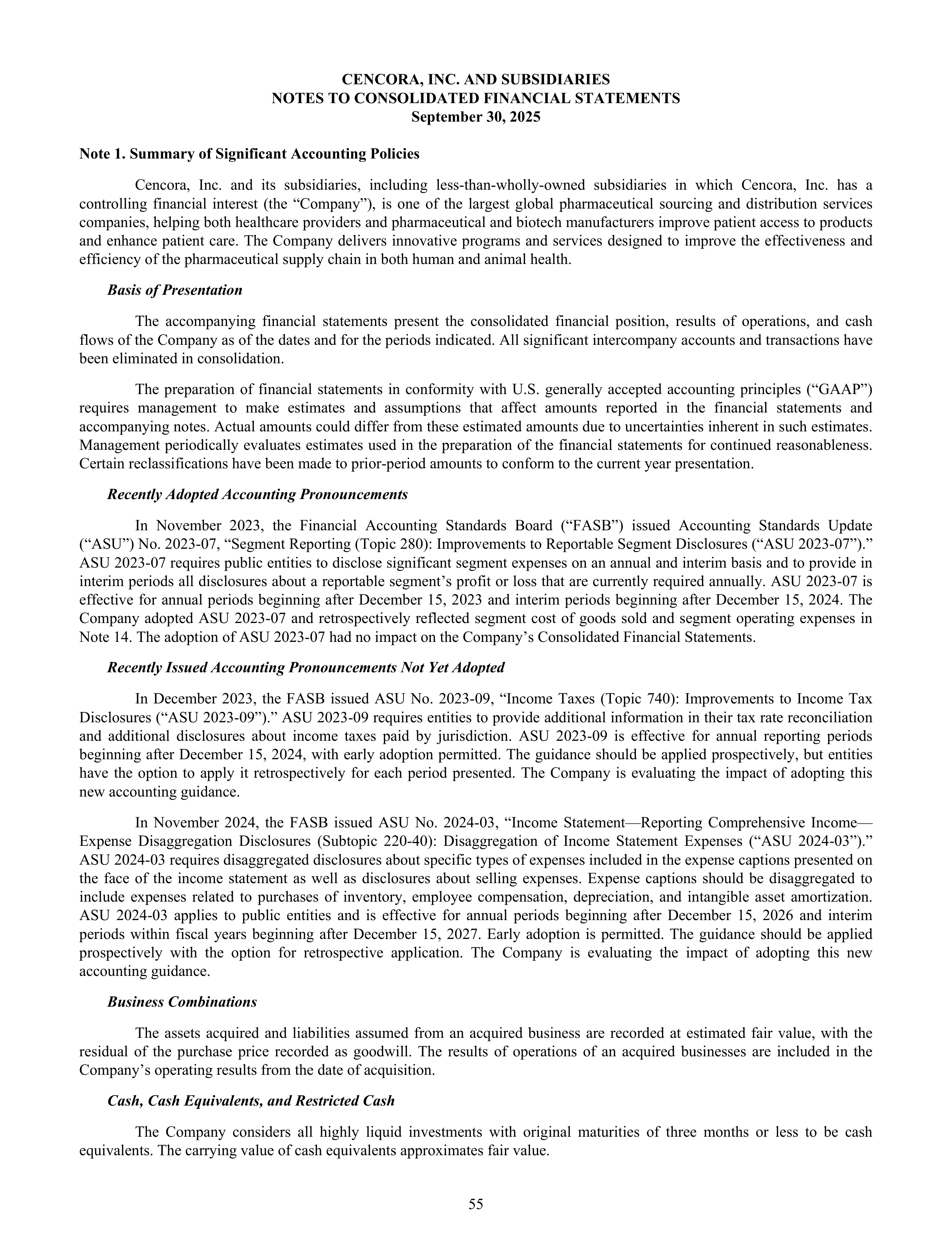
CENCORA, INC. AND SUBSIDIARIES
NOTES TO CONSOLIDATED FINANCIAL STATEMENTS
September 30, 2025
Note 1. Summary of Significant Accounting Policies
Cencora, Inc. and its subsidiaries, including less-than-wholly-owned subsidiaries in which Cencora, Inc. has a
controlling financial interest (the “Company”), is one of the largest global pharmaceutical sourcing and distribution services
companies, helping both healthcare providers and pharmaceutical and biotech manufacturers improve patient access to products
and enhance patient care. The Company delivers innovative programs and services designed to improve the effectiveness and
efficiency of the pharmaceutical supply chain in both human and animal health.
Basis of Presentation
The accompanying financial statements present the consolidated financial position, results of operations, and cash
flows of the Company as of the dates and for the periods indicated. All significant intercompany accounts and transactions have
been eliminated in consolidation.
The preparation of financial statements in conformity with U.S. generally accepted accounting principles (“GAAP”)
requires management to make estimates and assumptions that affect amounts reported in the financial statements and
accompanying notes. Actual amounts could differ from these estimated amounts due to uncertainties inherent in such estimates.
Management periodically evaluates estimates used in the preparation of the financial statements for continued reasonableness.
Certain reclassifications have been made to prior-period amounts to conform to the current year presentation.
Recently Adopted Accounting Pronouncements
In November 2023, the Financial Accounting Standards Board (“FASB”) issued Accounting Standards Update
(“ASU”) No. 2023-07, “Segment Reporting (Topic 280): Improvements to Reportable Segment Disclosures (“ASU 2023-07”).”
ASU 2023-07 requires public entities to disclose significant segment expenses on an annual and interim basis and to provide in
interim periods all disclosures about a reportable segment’s profit or loss that are currently required annually. ASU 2023-07 is
effective for annual periods beginning after December 15, 2023 and interim periods beginning after December 15, 2024. The
Company adopted ASU 2023-07 and retrospectively reflected segment cost of goods sold and segment operating expenses in
Note 14. The adoption of ASU 2023-07 had no impact on the Company’s Consolidated Financial Statements.
Recently Issued Accounting Pronouncements Not Yet Adopted
In December 2023, the FASB issued ASU No. 2023-09, “Income Taxes (Topic 740): Improvements to Income Tax
Disclosures (“ASU 2023-09”).” ASU 2023-09 requires entities to provide additional information in their tax rate reconciliation
and additional disclosures about income taxes paid by jurisdiction. ASU 2023-09 is effective for annual reporting periods
beginning after December 15, 2024, with early adoption permitted. The guidance should be applied prospectively, but entities
have the option to apply it retrospectively for each period presented. The Company is evaluating the impact of adopting this
new accounting guidance.
In November 2024, the FASB issued ASU No. 2024-03, “Income Statement—Reporting Comprehensive Income—
Expense Disaggregation Disclosures (Subtopic 220-40): Disaggregation of Income Statement Expenses (“ASU 2024-03”).”
ASU 2024-03 requires disaggregated disclosures about specific types of expenses included in the expense captions presented on
the face of the income statement as well as disclosures about selling expenses. Expense captions should be disaggregated to
include expenses related to purchases of inventory, employee compensation, depreciation, and intangible asset amortization.
ASU 2024-03 applies to public entities and is effective for annual periods beginning after December 15, 2026 and interim
periods within fiscal years beginning after December 15, 2027. Early adoption is permitted. The guidance should be applied
prospectively with the option for retrospective application. The Company is evaluating the impact of adopting this new
accounting guidance.
Business Combinations
The assets acquired and liabilities assumed from an acquired business are recorded at estimated fair value, with the
residual of the purchase price recorded as goodwill. The results of operations of an acquired businesses are included in the
Company’s operating results from the date of acquisition.
Cash, Cash Equivalents, and Restricted Cash
The Company considers all highly liquid investments with original maturities of three months or less to be cash
equivalents. The carrying value of cash equivalents approximates fair value.
55
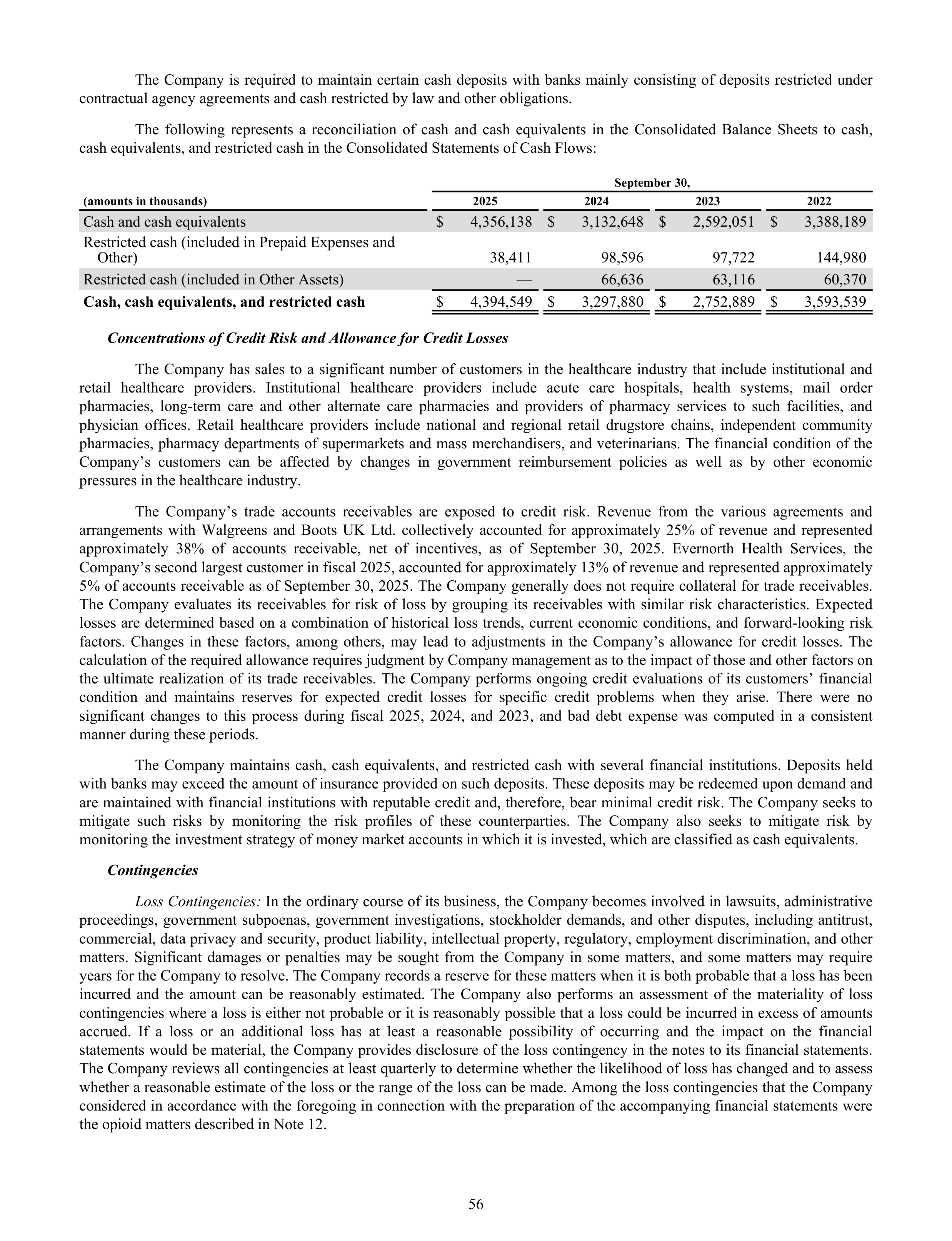
,=:DBE6CN>HG:FJ>G:9IDB6>CI6>C8:GI6>C86H=9:EDH>IHL>I=76C@HB6>CAN8DCH>HI>CIHG:HIG>8I:9JC9:G
8DCIG68IJ6A6<:C8N68I:97NA6L6C9DI=:GD7A>DCH
,=:;DAADL>CA>6I>DCD;86H=6C986H=:FJ>K6A:CIH>CI=:DCHDA>96I:96A6C8:+=::IHID86H=
86H=:FJ>K6A:CIH 6C9G:HIG>8I:986H=>CI=:DCHDA>96I:9+I6I:B:CIHD;6H=ADLH
&2
.9;A:@?6:@5;A?.:1?
6H=6C986H=:FJ>K6A:CIH
*:HIG>8I:986H=>C8AJ9:9>C(G:E6>9ME:CH:H6C9
'I=:G
*:HIG>8I:986H=>C8AJ9:9>C'I=:GHH:IH
U
.?50.?52=A6B.82:@?.:1>2?@>60@210.?5
87,.7=;*=287<8/;.-2= 2<4*7-558@*7,./8;;.-2=8<<.<
,=:DBE6CN=6HH6A:HID6H>;>86CICJB7:GD;8JHIDB:GH>CI=:=:6AI=86G:>C9JHIGNI=6I>C8AJ9:>CHI>IJI>DC6A6C9
G:I6>A
=:6AI=86G:
EGDK>9:GH
!CHI>IJI>DC6A
=:6AI=86G:
EGDK>9:GH
>C8AJ9:
68JI:
86G:
=DHE>I6AH
=:6AI=
HNHI:BH
B6>A
DG9:G
E=6GB68>:H ADC:H 6C9 EGDK>9:GH D; E=6GB68N H:GK>8:H ID HJ8= ;68>A>I>:H 6C9
E=NH>8>6C D;;>8:H *:I6>A =:6AI=86G: EGDK>9:GH >C8AJ9: C6I>DC6A 6C9 G:DC6A G:I6>A 9GJCH >C9:E:C9:CI 8DBBJC>IN
E=6GB68>:H E=6GB68N9:E6GIB:CIHD;HJE:GB6G@:IH6C9B6HHB:G8=6C9>H:GH 6C9K:I:G>C6G>6CH,=:;>C6C8>6A8DC9>I>DCD;I=:
DBE6CNXH 8JHIDB:GH 86C 7: 6;;:8I:9 7N 8=6CC B7JGH:B:CI EDA>8>:H 6H L:AA 6H 7N DI=:G :8DCDB>8
EG:HHJG:H>CI=:=:6AI=86G:>C9JHIGN
,=: DBE6CNXH IG69: 688DJCIH G:8:>K67A:H 6G: :MEDH:9 ID 8G:9>I G>H@ *:K:CJ: ;GDB I=: K6G>DJH 6<G::B:CIH 6C9
6GG6CI=/6AK:AN688DJCI:9;DG6EEGDM>B6I:AND;G:K:CJ:6C9G:EG:H:CI:9
6EEGDM>B6I:AN D; 688DJCIH G:8:>K67A: C:I D; >C8:CI>K:H 6H D; +:EI:B7:G
K:GCDGI= :6AI= +:GK>8:H I=:
DBE6CNXHH:8DC9A6GC;>H86A
688DJCI:9;DG6EEGDM>B6I:AND;G:K:CJ:6C9G:EG:H:CI:96EEGDM>B6I:AN
D;688DJCIHG:8:>K67A:6HD;+:EI:B7:G
,=:DBE6CNG:8DAA6I:G6A;DGIG69:G:8:>K67A:H
,=:DBE6CN:K6AJ6I:H>IHG:8:>K67A:H;DGG>H@D;ADHH7NCIHG:8:>K67A:HL>I=H>B>A6GG>H@8=6G68I:G>HI>8HME:8I:9
ADHH:H6G:9:I:GB>C:976H:9DC68DB7>C6I>DCD;=>HIDG>86AADHHIG:C9H 8JGG:CI:8DCDB>88DC9>I>DCH 6C9;DGL6G9
ADD@>CH@
;68IDGH=6CCI=:H:;68IDGH 6BDCCI=:DBE6CNXH6AADL6C8:;DG8G:9>IADHH:H,=:
86A8JA6I>DCD;I=:G:FJ>G:96AADL6C8:G:FJ>G:H?J9<B:CI7NDBE6CNB6C6BE68ID;I=DH:6C9DI=:G;68IDGHDC
I=:JAI>B6I:G:6A>O6I>DCD;>IHIG69:G:8:>K67A:H,=:DBE6CNE:G;DGBHDCCI:K6AJ6I>DCHD;>IH8JHIDB:GHX;>C6C8>6A
8DC9>I>DC 6C9 B6>CI6>CH G:H:GK:H ;DG :ME:8I:9 8G:9>I ADHH:H ;DG HE:8>;>8 8G:9>I EGD7A:BH L=:C I=:N 6G>H: ,=:G: L:G: CD
H>;>86CI8=6CHEGD8:HH9JG>CH86A
6C9
6C97699:7I:ME:CH:L6H8DBEJI:9>C68DCH>HI:CI
B6CC:G9JG>CD9H
,=:DBE6CNB6>CI6>CH86H= 86H=:FJ>K6A:CIH 6C9G:HIG>8I:986H=L>I=H:K:G6A;>C6C8>6A>CHI>IJI>DCH:EDH>IH=:A9
L>I=76C@HB6N:M8::9I=:6BDJCID;>CHJG6C8:EGDK>9:9DCHJ8=9:EDH>IH,=:H:9:EDH>IHB6N7:G:9::B:9JEDC9:B6C96C9
6G:B6>CI6>C:9L>I=;>C6C8>6A>CHI>IJI>DCHL>I=G:EJI67A:8G:9>I6C9 I=:G:;DG: 7:6GB>C>B6A8G:9>IG>H@,=:DBE6CNH::@HID
B>I>H@H 7N BDC>IDG>CH@ EGD;>A:H D; I=:H: 8DJCI:GE6GI>:H ,=: DBE6CN 6AHD H::@H ID B>I>H@ 7N
BDC>IDG>CCK:HIB:CIHIG6I:CL=>8=>I>H>CK:HI:9 L=>8=6G:8A6HH>;>:96H86H=:FJ>K6A:CIH
87=270.7,2.<
)--)(.%(#!(%!-
!CI=:DG9>C6GN8DJGH:D;>IH7JH>C:HH I=:DBE6CN7:8DB:H>CKDAK:9>CA6LHJ>IH 69B>C>HIG6I>K:
EGD8::9>C<H <DK:GCB:CIHJ7ED:C6H CK:HI>DCH HID8@=DA9:G9:B6C9H 6C9DI=:G9>HEJI:H >C8AJ9>CIGJHI
8DBB:G8>6A 96I6EG>K68N6C9H:8JG>IN EGD9J8IA>67>A>IN >CI:AA:8IJ6AEGDE:GIN G:H8G>B>C6I>DC 6C9DI=:G
B6II:GH+>;>86CI96B6:HB6N7:HDJCHDB:B6II:GH 6C9HDB:B6II:GHB6NG:FJ>G:
N:6GH;DGI=:DBE6CNIDG:HDAK:,=:DBE6CNG:8DG9H6G:H:GK:;DGI=:H:B6II:GHL=:C>I>H7DI=EGD767A:I=6I6ADHH=6H7::C
>C8JGG:96C9I=:6BDJCI86C7:G:6HDC67AN:HI>B6I:9,=:DBE6CN6AHDE:G;DGBH6C6HH:HHB:CID;I=:B6I:G>6A>IND;ADHH
8DCI>C:HL=:G:6ADHH>H:>I=:GCDIEGD767A:DG>I>HG:6HDC67ANEDHH>7A:I=6I6ADHH8DJA97:>C8JGG:9>C:M8:HHD;6BDJCIH
688GJ:9 !; 6 ADHH DG 6C 699>I>DC6A ADHH =6H 6I A:6HI 6 G:6HDC67A: EDHH>7>A>IN D; D88JGG>CBE68I DC I=: ;>C6C8>6A
HI6I:B:CIHLDJA97:B6I:G>6A I=:DBE6CNEGDK>9:H9>H8ADHJG:D;I=:ADHH8DCI>CCI=:CDI:HID>IH;>C6C8>6AHI6I:B:CIH
,=:DBE6CNG:K>:LH6AA8DCI>C:H6IA:6HIFJ6GI:GANID9:I:GB>C:L=:I=:GI=:A>@:A>=DD9D;ADHH=6H8=6C<:96C9ID6HH:HH
L=:I=:G6G:6HDC67A::HI>B6I:D;I=:ADHHDGI=:G6C<:D;I=:ADHH86C7:B69:BDCC:HI=6II=:DBE6CN
8DCH>9:G:9>C688DG96C8:L>I=I=:;DG:CC8DCC:8I>DCL>I=I=:EG:E6G6I>DCD;I=:688DBE6CN>CC6C8>6AHI6I:B:CIHL:G:
I=:DE>D>9B6II:GH9:H8G>7:9>C&DI:
Gain Contingencies:
The Company records gain contingencies when they are realized. Gains from antitrust litigation
settlements are realized upon the receipt of cash and recorded as a reduction to cost of goods sold because they represent a
recovery of amounts historically paid to manufacturers to originally acquire the pharmaceuticals that were the subject of the
antitrust litigation settlements (see Note 13).
Derivative Financial Instruments and Nonderivative Hedges
The Company utilizes derivative financial instruments to manage exposures to foreign currency. The Company records
all derivative financial instruments on the balance sheet at fair value and complies with established criteria for designation and
effectiveness of hedging relationships. The Company’s policy prohibits it from entering into derivative financial instruments for
speculative or trading purposes.
The Company uses foreign currency denominated debt held at the parent level to offset a portion of its foreign
currency exchange rate exposure on its net investments in Euro-denominated subsidiaries. The Company’s €1.0 billion of senior
notes (Note 6
)
are designated as nonderivative hedging instruments that are remeasured each reporting period to reflect changes
in the foreign currency exchange spot rate, with changes since the last remeasurement date recorded as foreign currency
translation adjustments as a component of other comprehensive income/loss. The Company recorded losses on its nonderivative
hedges of $55.3 million in Foreign Currency Translation Adjustments in the Consolidated Statement of Comprehensive Income
in fiscal 2025.
Foreign Currency
When the functional currency of the Company’s foreign operations is the applicable local currency, assets and
liabilities are translated into U.S. dollars using the current exchange rates in effect at the balance sheet date, while revenues and
expenses are translated at the weighted average exchange rates for the period. The resulting asset and liability translation
adjustments are recorded as a component of Accumulated Other Comprehensive Loss within Stockholders’ Equity.
During the quarter ended March 31, 2022, Turkey became a highly inflationary economy, as defined under GAAP. As
a result, effective April 1, 2022, and until such time as the applicable economy is no longer considered highly inflationary,
Turkish Lira-denominated assets and liabilities are remeasured using the Company’s reporting currency in accordance with
Accounting Standards Codification (“ASC”) 830, “Foreign Currency Matters.” Turkish Lira denominated monetary assets and
liabilities (primarily cash, accounts receivables, and accounts payables) are remeasured at each balance sheet date using the
currency exchange rate then in effect, with currency remeasurement gains and losses recognized in Other Income in the
Statement of Operations. Turkish Lira-denominated nonmonetary assets and liabilities (primarily inventories, goodwill, and
other intangible assets) are translated at the currency exchange rate in effect prior to highly inflation accounting commencement
or at the exchange rate in effect at their date of acquisition if subsequent to April 1, 2022. As such, nonmonetary assets and
liabilities retain a higher historical basis when currencies are devalued. This higher historical basis results in incremental
expense being recognized when nonmonetary assets are consumed (i.e., sale of inventory). During fiscal 2025, 2024, and 2023,
the Company recorded incremental expenses of $49.6 million, $54.1 million, and $87.0 million, respectively, in Cost of Goods
Sold related to the consumption of inventory and expenses of $5.9 million, $1.2 million, and $9.0 million, respectively, within
Other Loss (Income), Net related to the currency remeasurement of monetary assets and liabilities.
Goodwill and Other Intangible Assets
Goodwill arises from acquisitions or consolidations of specific operating companies and is assigned to the reporting
unit in which a particular operating company resides. The Company identifies its reporting units based upon the Company’s
management reporting structure, beginning with its operating segments. The Company evaluates whether the components
within its operating segments have similar economic characteristics, which include the similarity of long-term gross margins,
the nature of the components’ products, services, and production processes, the types of customers and the methods by which
products or services are delivered to customers, and the components’ regulatory environment and aggregates two or more
components within an operating segment that have similar economic characteristics. As of September 30, 2025, the Company’s
reporting units included U.S. Pharmaceutical Distribution Services, U.S. Consulting Services, MWI Animal Health, Alliance
Healthcare, Innomar, World Courier, PharmaLex, and Profarma.
57
Goodwill and other intangible assets with indefinite lives, such as certain trademarks and trade names, are not
amortized; rather, they are tested for impairment at least annually. For the purpose of these impairment tests, the Company can
elect to perform a qualitative assessment to determine if it is more likely than not that the fair values of its reporting units and
indefinite-lived intangible assets are less than the respective carrying values of those reporting units and indefinite-lived
intangible assets, respectively. Such qualitative factors can include, among others, industry and market conditions, overall
financial performance, and relevant entity-specific events. If the Company concludes based on its qualitative assessment that it
is more likely than not that the fair value of a reporting unit is less than its carrying value, it performs a quantitative analysis.
The Company elected to perform quantitative impairment assessments of goodwill for all its reporting units in fiscal 2025,
2024, and 2023 with the exception of its PharmaLex reporting unit in fiscal 2023 since it was acquired in fiscal 2023. The
Company elected to perform qualitative impairment assessments of indefinite-lived intangible assets in fiscal 2025, 2024, and
2023.
The quantitative goodwill impairment test requires the Company to compare the carrying value of the reporting unit’s
net assets to the fair value of the reporting unit. If the fair value exceeds the carrying value, no further evaluation is required,
and no impairment loss is recognized. If the carrying amount exceeds the fair value, the difference between the carrying value
and the fair value is recorded as an impairment loss, the amount of which may not exceed the total amount of goodwill allocated
to the reporting unit.
When performing a quantitative impairment assessment, the Company utilizes an income approach or a weighted
average of an income and market approach to value its reporting units. The income approach relies on a discounted cash flow
analysis, which considers forecasted cash flows discounted at an appropriate discount rate, to determine the fair value of each
reporting unit. The Company generally believes that market participants would use a discounted cash flow analysis to determine
the fair value of the Company’s reporting units in a sale transaction. The annual goodwill impairment test requires the Company
to make several assumptions and estimates concerning future levels of revenue growth, earnings before interest, taxes,
depreciation and amortization (“EBITDA”), EBITDA margins, capital expenditures, and working capital requirements, which
are based upon the Company’s long-range plan. The discount rate is an estimate of the overall after-tax rate of return required
by a market participant whose weighted average cost of capital includes both debt and equity, including a risk premium. While
the Company uses the best available information to prepare its forecasted cash flows and discount rate assumptions, actual
future cash flows and/or market conditions could differ significantly resulting in future impairment charges related to recorded
goodwill balances. While there are always changes in assumptions to reflect changing business and market conditions, the
Company’s overall methodology and the population of assumptions used have remained unchanged.
The Company completed its required annual impairment assessments relating to goodwill and indefinite-lived
intangible assets in fiscal 2025, 2024, and 2023 and, as a result, recorded goodwill impairments (see Note 5
)
of $723.9 million
and $418.0 million in its PharmaLex reporting unit in fiscal 2025 and 2024, respectively. No goodwill impairments were
recorded in fiscal 2023 and no indefinite-lived intangible asset impairments were recorded in fiscal 2025, 2024, or 2023.
Finite-lived intangible assets are amortized using the straight-line method over the estimated useful lives of the assets.
The Company performs a recoverability assessment of its long-lived assets when impairment indicators are present. The
Company performed a recoverability assessment of PharmaLex’s long-lived asset group as of July 1, 2025, and it was
determined to be recoverable.
Income Taxes
The Company accounts for income taxes using a method that requires recognition of deferred tax assets and liabilities
for expected future tax consequences of temporary differences that currently exist between tax bases and financial reporting
bases of the Company’s assets and liabilities (commonly known as the asset and liability method). In assessing the need to
establish a valuation allowance on deferred tax assets, the Company considers whether it is more likely than not that some
portion or all of the deferred tax assets will not be realized.
The Company recognizes the tax benefit from an uncertain tax position only if it is more likely than not that the tax
position will be sustained upon examination by the taxing authorities, including settlements with tax authorities or resolutions
of any related appeals or litigation processes, based upon the technical merits of the position. Tax benefits associated with
uncertain tax positions that have met the recognition criteria are measured and recorded based upon the highest probable
outcome that is more than 50% likely to be realized after full disclosure and resolution of a tax examination.
58
Inventories
Inventories are stated at the lower of cost or market. Cost for approximately 63% and 65% of the Company’s
inventories as of September 30, 2025 and 2024, respectively, has been determined using the last-in, first-out (“LIFO”) method.
If the Company had used the first-in, first-out method of inventory valuation, which approximates current replacement cost,
inventories would have been approximately $1,458.9 million and $1,535.8 million higher than the amounts reported as of
September 30, 2025 and 2024, respectively. The Company recorded LIFO credits of $76.9 million and $52.2 million in fiscal
2025 and 2024, respectively, and LIFO expense of $204.6 million in fiscal 2023. The annual LIFO provision is affected by
manufacturer pricing practices, which may be impacted by market and other external influences, changes in inventory
quantities, and product mix, many of which are difficult to predict. Changes to any of the above factors can have a material
impact on the Company’s annual LIFO provision. Cost for the Company’s inventory that is not determined using the LIFO
method is stated at the lower of cost or market using the first-in, first-out method or moving average price method.
Investments
The Company first evaluates its investments in accordance with the variable interest model to determine whether it has
a controlling financial interest in an investment. This evaluation is made as of the date on which the Company makes its initial
investment, and subsequent evaluations are made if the structure of the investment changes. If it has determined that an
investment is a variable interest entity (“VIE”), the Company evaluates whether the VIE is required to be consolidated. When
the Company holds rights that give it the power to direct the activities of an entity that most significantly impact the entity’s
economic performance, combined with the obligation to absorb an entity’s losses and the right to receive benefits, the Company
consolidates a VIE. If it is determined that an investment is not a VIE, the Company then evaluates its investments under the
voting interest model and generally consolidates investments in which it holds an ownership interest of greater than 50%. When
the Company consolidates less-than-wholly-owned subsidiaries, it records its noncontrolling interest in its consolidated
financial statements.
For equity securities without a readily determinable fair value, the Company uses the fair value measurement
alternative and measures the securities at cost less impairment, if any, including adjustments for observable price changes in
orderly transactions for an identical or similar investment of the same issuer. For investments in which the Company can
exercise significant influence but does not control, it uses the equity method of accounting. The Company’s share of earnings
and losses of its investments is recorded in Other Loss (Income), Net in the Consolidated Statements of Operations. The
Company monitors its investments for impairment by considering factors such as the operating performance of the investment
and current economic and market conditions. In fiscal 2025, the Company recorded a $113.5 million impairment of an equity
investment that was made in fiscal 2021 in Other Loss (Income), Net in its Consolidated Statement of Operations.
Leases
At the inception of an arrangement, the Company determines whether the arrangement is or contains a lease based on
the facts and circumstances present. Leases are classified as either finance or operating, with classification affecting the pattern
of expense recognition in the income statement. At the lease commencement date, operating and finance lease liabilities and
their corresponding right-of-use (“ROU”) assets are recorded based on the present value of lease payments over the expected
lease term. The interest rate implicit in lease contracts is typically not readily determinable and, as such, the Company uses its
incremental borrowing rate to discount the lease liabilities, which is the rate incurred to borrow on a collateralized basis over a
similar term in a similar economic environment. Certain adjustments to the ROU asset may be required for items such as
incentives received. The Company does not recognize on the balance sheet leases with terms of one year or less.
The Company has operating leases that are primarily comprised of buildings, office equipment, distribution center
equipment, and vehicles. Some of the Company’s leases include options to extend or early terminate the lease, which are
included in the lease term when it is reasonably certain to exercise and there is a significant economic incentive to exercise that
option. Certain lease agreements contain provisions for future rent increases. Lease payments included in the measurement of
the lease liability comprise fixed payments. The Company combines lease and non-lease components as a single component.
Operating lease cost is recognized over the expected lease term on a straight-line basis and is recorded in Distribution, Selling,
and Administrative in the Company’s Consolidated Statements of Operations. Variable lease payments, which are primarily
comprised of maintenance, taxes, and other payments based on usage, are recognized when the expense is incurred. The
Company’s leases do not contain residual value guarantees.
Manufacturer Incentives
The Company considers fees and other incentives received from its suppliers relating to the purchase and distribution
of inventory to represent product discounts, and, as a result, they are recognized within cost of goods sold upon the sale of the
related inventory.
59
;89.;=B*7-:>296.7=
(GDE:GIN6C9:FJ>EB:CI6G:HI6I:96I8DHI6C99:EG:8>6I:9JH>CC:B:I=D9DK:GI=::HI>B6I:9JH:;JAA>K:H
D;I=:6HH:IH L=>8=G6CA9>CBEGDK:B:CIH6C9;GDBID
N:6GH;DGB68=>C:GN :FJ>EB:CI
6C9DI=:G,=:8DHIHD;G:E6>GH6C9B6>CI:C6C8:6G:8=6GC8JGG:9
,=:DBE6CN86E>I6A>O:HEGD?:8I8DHIHG:A6I>CC:9;DG>CI:GC6AJH:L=:CI=:
68I>K>I>:H G:A6I:9 ID I=: EGD?:8I G:68= I=: 6EEA>86I>DC 9:K:ADEB:CI HI66I:9 L>I= EG:A>B>C6GN HI6<:
68I>K>I>:H IG6>C>CCI:C6C8: 6C96AADI=:GEDHI
>BEA:B:CI6I>DCHI6K>I>:H6G::ME:CH:96HI=:N6G:>C8JGG:9+D;IL6G:
9:K:ADEB:CI 8DHIH 6G: 9:EG:8>6I:9 JH>CC: B:I=D9 DK:G I=: :HI>B6I:9 JH:;JA A>K:H L=>8= G6C<: ;GDB ID
N:6GH
,=:;DAADL>CO:HI=:DBE6CNXHEGDE:GIN6C9:FJ>EB:CI76A6C8:H;DGI=:E:G>D9H>C9>86I:9
&2
6:@5;A?.:1?
(GDE:GIN6C9:FJ>EB:CI 6I8DHI
$6C9
J>A9>CBEGDK:B:CIH
%68=>C:GN :FJ>EB:CI 6C9DI=:G
,DI6AEGDE:GIN6C9:FJ>EB:CI
$:HH688JBJA6I:99:EG:8>6I>DC
(GDE:GIN6C9:FJ>EB:CI C:I
.?.7>. .,8072=287
,=:DBE6CNXHG:K:CJ:H6G:EG>B6G>ANHIG>7JI>DCD;E=6GB68:JI>86AEGD9J8IH,=:DBE6CN6AHD
<:C:G6I:H
G:K:CJ:H
;GDB
<AD76A
8DBB:G8>6A>O6I>DC
H:GK>8:H
L=>8=
>C8AJ9:
8A>C>86A
IG>6A
HJEEDGI
EDHI
6EEGDK6A
6C9
8DBB:G8>6A>O6I>DCHJEEDGI 6C96AINIG6CHEDGI6I>DC6C9ADHI>8H;DGI=:7>DE=6GB68:JI>86A>C9JHIGN+::&DI:;DG
I=:DBE6CNXH9>H6<<G:<6I:9G:K:CJ:
,=: DBE6CN G:8DO:H G:K:CJ: G:A6I:9 ID I=: 9>HIG>7JI>DC D; EGD9J8IH 6I 6 ED>CI >C I>B: L=:C I>IA: 6C9 8DCIGDA
IG6CH;:GH ID 8JHIDB:GH 6C9 I=:G: >H CD ;JGI=:G D7A>DC ID EGDK>9: H:GK>8:H G:A6I:9 ID HJ8= EGD9J8IH +:GK>8: G:K:CJ: >H
G:8DO:9DK:GI=:E:G>D9I=6IH:GK>8:H6G:EGDK>9:9IDI=:8JHIDB:G,=:DBE6CN>HC8>E6A>C6IG6CH68I>DC
I=:G:;DG: G:K:CJ:>HEG>B6G>ANG:8DG9:9DC6H/=:CI=:DBE6CN>HI=:EG>C8>E6A>C6IG6CH68I>DC >I=6H9:I:GB>C:9
I=6I>I8DCIGDAHI=:67>A>INID9>G:8II=:JH:D;I=:EGD9J8IDGH:GK>8:EG>DGIDI=:IG6CH;:GID68JHIDB:G >I>HEG>B6G>ANG:HEDCH>7A:
;DG ;JA;>AA>CH: ID EGDK>9: I=: EGD9J8I DG H:GK>8: ID >IH 8JHIDB:G >I =6H 9>H8G:I>DC >C :HI67A>H=>C8>CI
8DCIGDAHI=:G:A6I>DCH=>EL>I=I=:8JHIDB:G*:K:CJ:>HG:8DO:96II=:6BDJCID;8DCH>9:G6I>DC:ME:8I:9ID7:G:8:>K:9DG
I=:9>HIG>7JI>DC7JH>C:HH G:K:CJ:>HEG>B6G>ANGB:9EJG8=6H:DG9:GL>I=68JHIDB:G
>C69>HIG>7JI>DC6GG6CHC:ID;:HI>B6I:9H6A:HG:IJGCH6C96AADL6C8:H DI=:G8JHIDB:G>C8:CI>K:H 6C9H6A:HI6M
/=:CI=:DBE6CN>HI=:6C6IG6CH68I>DC I=:;::G:8:>K:9;GDB6B6CJ;68IJG:G8JHIDB:G>HG:8DO:9L>I=>C
G:K:CJ:6HI=:H:GK>8:>HE:G;DGB:9
,=:DBE6CNXH8JHIDB:GH6A:HG:IJGCEDA>8N;I=:EGD9J8IH86C7:
G:HDA96I;JAAK6AJ:DGG:IJGC:9IDHJEEA>:GH;DG;JAA8G:9>I,=:DBE6CNG:8DG9H6C688GJ6A;DG:HI>B6I:98JHIDB:GH6A:HG:IJGCH
6II=:I>B:D;H6A:IDI=:8JHIDB:G76H:9JEDC=>HIDG>86AG:IJGCIG:C9HHD;+:EI:B7:G
6C9
I=:DBE6CNXH
688GJ6A;DG:HI>B6I:98JHIDB:GH6A:HG:IJGCHL6H B>AA>DC6C9 B>AA>DC G:HE:8I>K:AN
!1*;.*<.-869.7<*=287
,=:DBE6CN688DJCIH;DGI=:8DBE:CH6I>DC8DHID;6AAH=6G:
76H:9E6NB:CIH6I;6>GK6AJ:,=:;6>GK6AJ:D;G:HIG>8I:9
HID8@JC>IH6C9E:G;DGB6C8:HID8@JC>IH>H76H:9JEDCI=:8:D;I=:DBE6CNXH8DBBDCHID8@
+=6G:
76H:98DBE:CH6I>DC:ME:CH:>HG:8DO:9DK:GI=:G:FJ>H>I:H:GK>8:E:G>D9L>I=>C>HIG>7JI>DC +:AA>C< 6C9
9B>C>HIG6I>K:>CI=:DCHDA>96I:9+I6I:B:CIHD;'E:G6I>DCHID8DGG:HEDC9L>I=I=:H6B:A>C:>I:B6HI=:86H=8DBE:CH6I>DC
E6>9
ID
:BEADN::H
DBE:CH6I>DC
:ME:CH:
6HHD8>6I:9
L>I=
CDCK:HI:9
E:G;DGB6C8:
HID8@
JC>IH
>H
9:E:C9:CI
JEDC
I=:
DBE6CNXHE:G>D9>86HH:HHB:CID;I=:EGD767>A>IND;I=:I6GC:K:96C9>IH:HI>B6I:D;I=:CJB7:GD;H=6G:HI=6I
L>AAJAI>B6I:AN7:>HHJ:9
The income tax effects of awards are recognized when the awards vest or are settled and are recognized in Income Tax
Expense in the Company’s Consolidated Statements of Operations.
Shipping and Handling Costs
Shipping and handling costs include all costs to warehouse, pick, pack, and deliver inventory to customers. These
costs, which were $1,294.4 million, $1,265.7 million, and $1,200.0 million for fiscal 2025, 2024, and 2023, respectively, are
included in Distribution, Selling, and Administrative in the Company’s Consolidated Statements of Operations.
Supplier Reserves
The Company establishes reserves against amounts due from its suppliers relating to various price and rebate
incentives, including deductions or billings taken against payments otherwise due to them from the Company. These reserve
estimates are established based upon the judgment of Company management after carefully considering the status of current
outstanding claims, historical experience with the suppliers, the specific incentive programs, and any other pertinent
information available to the Company. The Company evaluates the amounts due from its suppliers on a continual basis and
adjusts the reserve estimates when appropriate based upon changes in circumstances. The ultimate outcome of any outstanding
claim may be different than the Company’s estimate.
Note 2. Acquisitions and Equity Method Investment
RCA Acquisition
On January 2, 2025, the Company acquired an 85% interest in Retina Consultants of America (“RCA”) for $4,042.0
million in cash, $694.4 million of contingent consideration related to equity units for certain RCA physicians and members of
management that retained the remaining 15% interest in RCA, $545.7 million for the settlement of a net receivable resulting
from a pre-existing commercial relationship between the Company and RCA, and $393.1 million for contingent consideration
payable to the sellers associated with RCA’s achievement of certain predefined business objectives in fiscal 2027 and fiscal
2028. The Company funded the cash purchase price through a combination of cash on hand and new debt financing (see
Note 6). The Company believes the acquisition of RCA allows it to broaden its relationships with community providers and to
build on its leadership in specialty pharmaceuticals within its U.S. Healthcare Solutions reportable segment.
As part of the acquisition, certain RCA physicians and members of management retained equity in RCA. The
Company evaluated the equity unit arrangements to determine if the contingent payments were part of the purchase price or
post-acquisition compensation expense, which would be recognized over any future service period. The $694.4 million of
contingent consideration for the retained equity units was concluded to be a part of the purchase price and initially recorded at
its fair value at the time of the acquisition based on the unit price that the Company paid to acquire RCA times the number of
equity units retained by RCA physicians and members of management, and represents a Level 3 fair value measurement. The
equity units retained by RCA physicians have an embedded option feature that is a liability classified compensation
arrangement and is being expensed ratably over a period of 1.5 years. The fair value of the embedded option feature was
determined using a Black-Scholes model that included assumptions for the equity unit value, expected life, and volatility and
represents a Level 3 fair value measurement. During fiscal 2025, the Company recognized an expense of $121.7 million related
to this embedded option feature and other incentive units granted in conjunction with the acquisition of RCA in Acquisition-
Related Deal and Integration Expenses in its Consolidated Statement of Operations. The liability and associated future expenses
may vary based on the change in the estimated fair value and payments made. The Company’s estimated liability related to the
equity units is $815.2 million and is recorded in Other Liabilities on the Company’s Consolidated Balance Sheet, as of
September 30, 2025.
The $393.1 million of contingent consideration represented an initial estimate for RCA’s achievement of certain
predefined business objectives in fiscal 2027 and fiscal 2028 and provides for the potential payment to the sellers of up to
$500 million in the aggregate. The fair value of this liability was determined based on a weighted probability of the
achievement of these objectives and represents a Level 3 fair value measurement. During the fourth quarter of fiscal 2025, the
Company increased the estimated fair value of the liability related to the achievement of the predetermined business objectives
from the initial estimated value and recorded an expense of $19.6 million in Acquisition-Related Deal and Integration Expenses
in its Consolidated Statement of Operations. The Company’s estimated liability related to the achievement of the predetermined
business objectives is $412.6 million and is recorded in Other Liabilities on the Company’s Consolidated Balance Sheet, as of
September 30, 2025.
The purchase price has been preliminarily allocated to the underlying assets acquired and liabilities assumed based
upon their estimated fair values at the date of the acquisition in the table that follows. The allocation as of September 30, 2025
is pending the finalization of working capital and tax account balances. There can be no assurance that the estimated amounts
recorded will represent the final purchase price allocation.
61
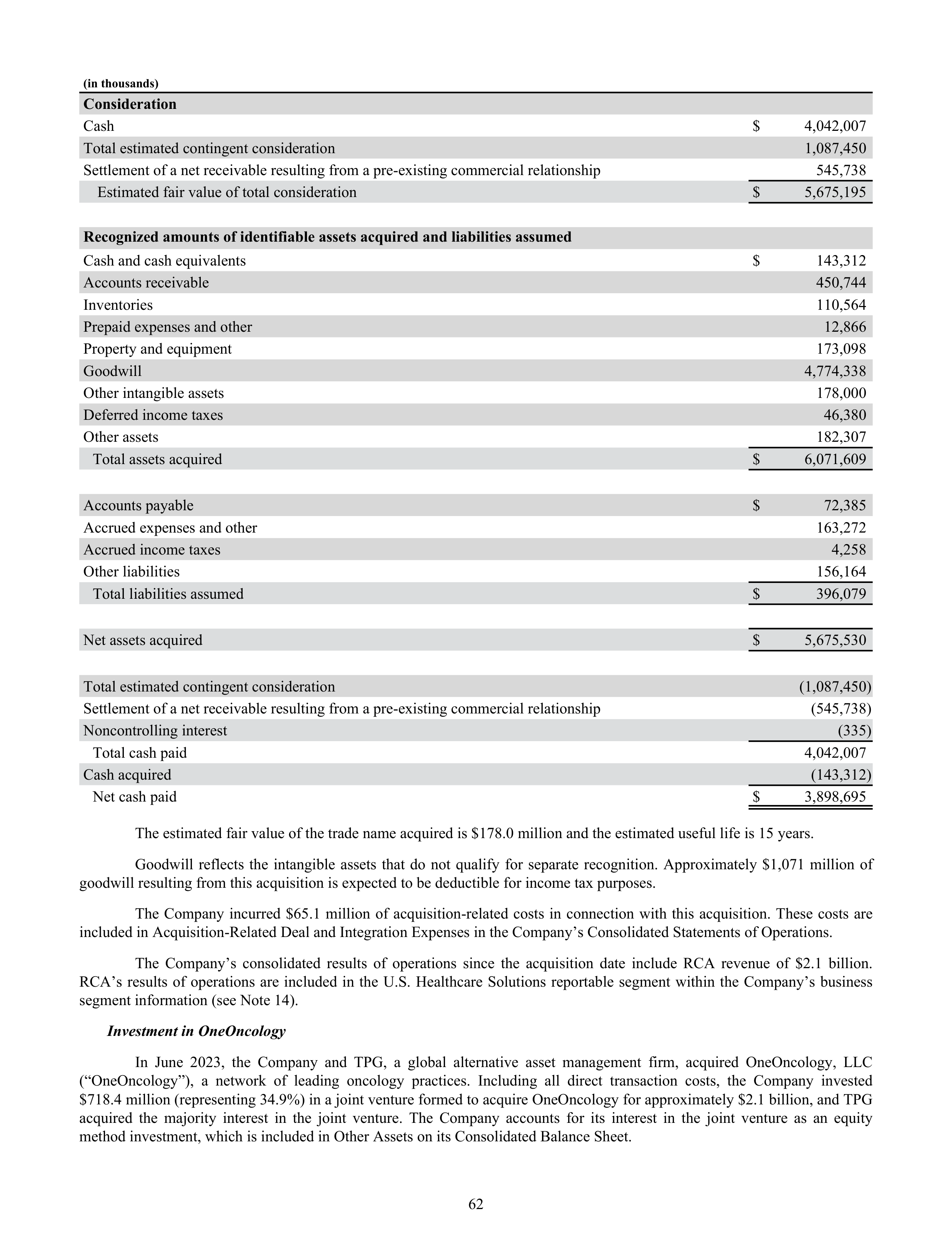
6:@5;A?.:1?
;:?612>.@6;:
6H=
,DI6A:HI>B6I:98DCI>C9:G6I>DC
+:IIA:B:CID;6C:IG:8:>K67A:G:HJAI>CHI>C6AG:A6I>DCH=>E
HI>B6I:9;6>GK6AJ:D;IDI6A8DCH>9:G6I>DC
%20;4:6F21.9;A:@?;3612:@636./82.??2@?.0=A6>21.:186./686@62?.??A921
6H=6C986H=:FJ>K6A:CIH
88DJCIHG:8:>K67A:
!CK:CIDG>:H
(G:E6>9:ME:CH:H6C9DI=:G
(GDE:GIN6C9:FJ>EB:CI
DD9L>AA
'I=:G>CI6C7A:6HH:IH
:;:GG:9>C8DB:I6M:H
'I=:G6HH:IH
,DI6A6HH:IH68FJ>G:9
88DJCIHE6N67A:
88GJ:9:ME:CH:H6C9DI=:G
88GJ:9>C8DB:I6M:H
'I=:GA>67>A>I>:H
,DI6AA>67>A>I>:H6HHJB:9
&:I6HH:IH68FJ>G:9
,DI6A:HI>B6I:98DCI>C9:G6I>DC
+:IIA:B:CID;6C:IG:8:>K67A:G:HJAI>CHI>C6AG:A6I>DCH=>E
&DC8DCIGDAA>CCI:G:HI
,DI6A86H=E6>9
6H=68FJ>G:9
&:I86H=E6>9
,=::HI>B6I:9;6>GK6AJ:D;I=:IG69:C6B:68FJ>G:9>H
B>AA>DC6C9I=::HI>B6I:9JH:;JAA>;:>HN:6GH
DD9L>AAG:;A:8IHI=:>CI6C7A:6HH:IHI=6I9DCDIFJ6A>;N;DGH:E6G6I:G:8DI>DCEEGDM>B6I:AN
B>AA>DCD;
AAG:HJAI>CH68FJ>H>I>DC>H:ME:8I:9ID7:9:9J8I>7A:;DG>C8DB:I6MEJGEDH:H
,=:DBE6CN>C8JGG:9B>AA>DCD;68FJ>H>I>DC
G:A6I:98DHIH>C8DCC:8I>DCL>I=I=>H68FJ>H>I>DC,=:H:8DHIH6G:
>C8AJ9:9>C8FJ>H>I>DC
*:A6I:9:6A6C9!CI:DCME:CH:H>CI=:DBE6CNXHDCHDA>96I:9+I6I:B:CIHD;'E:G6I>DCH
,=:DBE6CNXH8DCHDA>96I:9G:HJAIHD;DE:G6I>DCHH>C8:I=:68FJ>H>I>DC96I:>C8AJ9:*G:K:CJ:D;7>AA>DC
*XHG:HJAIHD;DE:G6I>DCH6G:>C8AJ9:9>CI=:-+ :6AI=86G:+DAJI>DCHG:EDGI67A:H:I=>CI=:DBE6CNXH7JH>C:HH
H:C;DGB6I>DCH::&DI:
7?.<=6.7=277.7,8580B
!C "JC:
I=: DBE6CN 6C9 ,( 6 K: 6HH:I B6C6GB 68FJ>G:9 'C:'C8DAD<N $$
V'C:'C8DADC< DC8DAD8:H !C8AJ9>CG:8I IG6CH68I>DC 8DHIH I=: DBE6CN >CK:HI:9
B>AA>DCG:EG:H:CI>CC6?D>CIK:CIJG:;DGB:9ID68FJ>G:'C:'C8DADB6I:AN7>AA>DC 6C9,(
68FJ>G:9 I=: B6?DG>IN >CI:G:HI >C I=: ?D>CI K:CIJG: ,=: DBE6CN 688DJCIH ;DG >IH >CI:G:HI >C I=: ?D>CI K:CIJG: 6H 6C :FJ>IN
B:I=D9>CK:HIB:CI L=>8=>H>C8AJ9:9>C'I=:GHH:IHDC>IHDCHDA>96I:96A6C8:+=::I
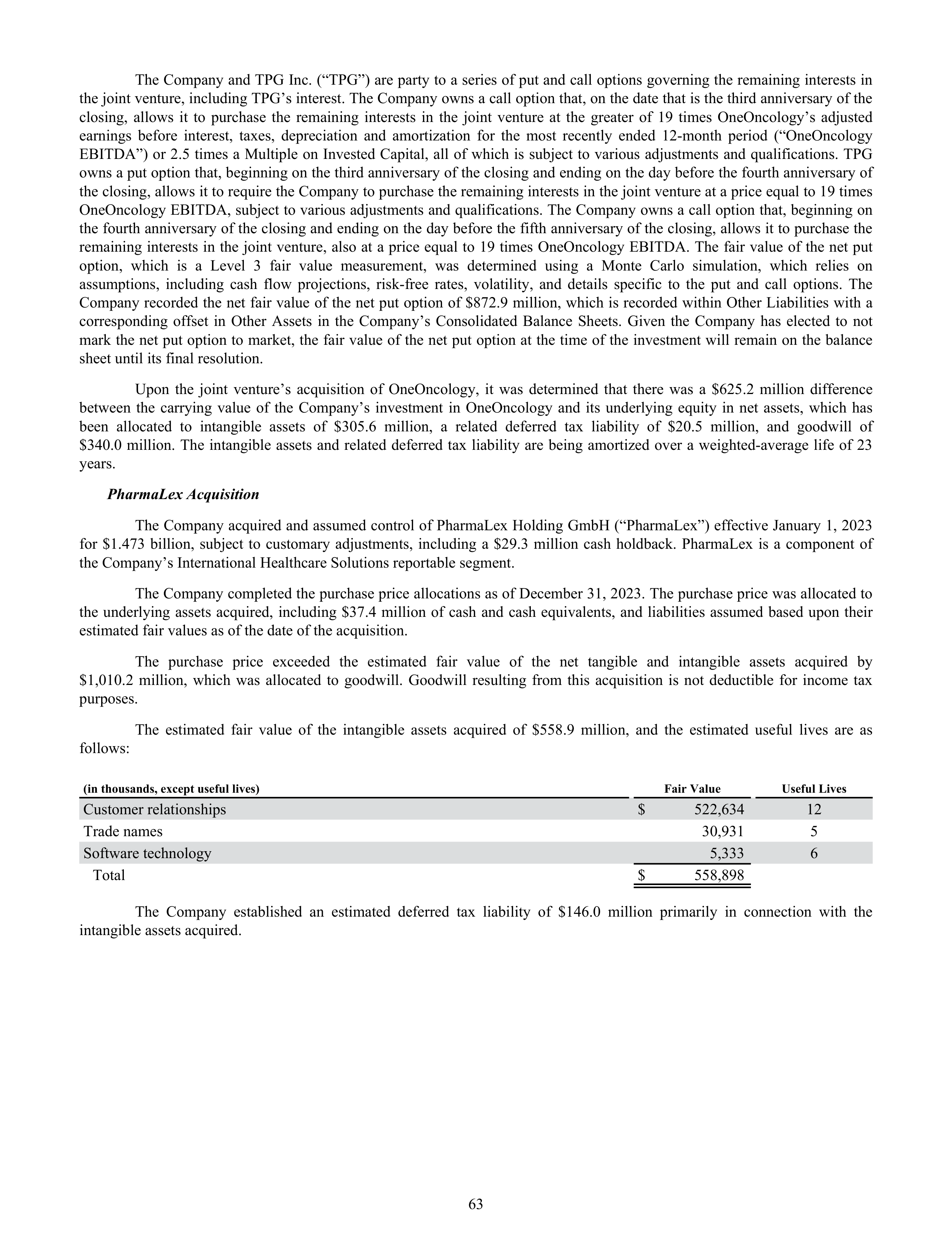
,=:DBE6CN6C9,(!C8V,(W6G:E6GINID6H:G>:HD;EJI6C986AADEI>DCHCC>CCI:G:HIH>C
I=:?D>CIK:CIJG: >C8AJ9>CCI:G:HI,=:DBE6CNDLCH686AADEI>DCI=6I DCI=:96I:I=6I>HI=:I=>G96CC>K:GH6GND;I=:
8ADH>CIIDEJG8=6H:I=:G:B6>C>CCI:G:HIH>CI=:?D>CIK:CIJG:6II=:B:H'C:'C8DAD<NXH69?JHI:9
:6GC>CCI:G:HI I6M:H 9:EG:8>6I>DC 6C9 6BDGI>O6I>DC ;DG I=: BDHI G:8:CIAN :C9:9
BDCI= E:G>D9 V'C:'C8DAD<N
!,WDGI>B:H6%JAI>EA:DC!CK:HI:96E>I6A 6AAD;L=>8=>HHJ7?:8IIDK6G>DJH69?JHIB:CIH6C9FJ6A>;>86I>DCH,(
DLCH6EJIDEI>DCI=6I 7:CC>CG96CC>K:GH6GND;I=:8ADH>CCK:GH6GND;
I=:8ADH>CIIDG:FJ>G:I=:DBE6CNIDEJG8=6H:I=:G:B6>C>CCI:G:HIH>CI=:?D>CIK:CIJG:6I6EG>8::FJ6AIDI>B:H
'C:'C8DADDJH69?JHIB:CIH6C9FJ6A>;>86I>DCH,=:DBE6CNDLCH686AADEI>DCI=6I 7:CC>C<DC
I=:;DJGI=6CC>K:GH6GND;I=:8ADH>CC;I=6CC>K:GH6GND;I=:8ADH>CIIDEJG8=6H:I=:
G:B6>C>CCI:G:HIH>CI=:?D>CIK:CIJG: 6AHD6I6EG>8::FJ6AIDI>B:H'C:'C8DADGK6AJ:D;I=:C:IEJI
DEI>DC L=>8= >H 6 $:K:A ;6>G K6AJ: B:6HJG:B:CI L6H 9:I:GB>C:9 JH>CBJA6I>DC L=>8= G:A>:H DC
6HHJBEI>DCH >C8AJ9>CDCH G>H@
;G::G6I:H KDA6I>A>IN 6C99:I6>AHHE:8>;>8IDI=:EJI6C986AADEI>DCH,=:
DBE6CNG:8DG9:9I=:C:I;6>GK6AJ:D;I=:C:IEJIDEI>DCD;B>AA>DC L=>8=>HG:8DG9:9L>I=>C'I=:G$>67>A>I>:HL>I=6
8DGG:HEDC9>CC'I=:GHH:IH>CI=:DBE6CNXHDCHDA>96I:96A6C8:+=::IH>K:CI=:DBE6CN=6H:A:8I:9IDCDI
B6G@I=:C:IEJIDEI>DCIDB6G@:I I=:;6>GK6AJ:D;I=:C:IEJIDEI>DC6II=:I>B:D;I=:>CK:HIB:CIL>AAG:B6>CDCI=:76A6C8:
H=::IJCI>A>IH;>C6AG:HDAJI>DC
-EDCI=:?D>CIK:CIJG:XH68FJ>H>I>DCD;'C:'C8DADIL6H9:I:GB>C:9I=6II=:G:L6H6B>AA>DC9>;;:G:C8:
7:IL::CI=:86GGN>CCK:HIB:CI>C'C:'C8DADIHJC9:GAN>CIN>CC:I6HH:IH L=>8==6H
7::C 6AAD86I:9 ID >CI6C7A: 6HH:IH D;
B>AA>DC 6 G:A6I:9 9:;:GG:9 I6M A>67>A>IN D;
B>AA>DC 6C9 AA D;
B>AA>DC,=:>CI6C7A:6HH:IH6C9G:A6I:99:;:GG:9I6MA>67>A>IN6G:7:>CO:9DK:G6L:><=I:9
6K:G6;:D;
N:6GH
1*;6*.A,:>2<2=287
,=:DBE6CN68FJ>G:96C96HHJB:98DCIGDAD;(=6GB6$:M DA9>CK:"6CJ6GN
;DG7>AA>DC HJ7?:8IID8JHIDB6GN69?JHIB:CIH >C8AJ9>CAA>DC86H==DA9768@(=6GB6$:M>H68DBEDC:CID;
I=:DBE6CNXH!CI:GC6I>DC6A :6AI=86G:+DAJI>DCHG:EDGI67A:H:<B:CI
,=:DBE6CN8DBEA:I:9I=:EJG8=6H:EG>8:6AAD86I>DCH6HD;:8:B7:G
,=:EJG8=6H:EG>8:L6H6AAD86I:9ID
I=:JC9:GAN>CG:9 >C8AJ9>CAA>DCD;86H=6C986H=:FJ>K6A:CIH 6C9A>67>A>I>:H6HHJB:976H:9JEDCI=:>G
:HI>B6I:9;6>GK6AJ:H6HD;I=:96I:D;I=:68FJ>H>I>DC
,=:
EJG8=6H:
EG>8:
:M8::9:9
I=:
:HI>B6I:9
;6>G
K6AJ:
D;
I=:
C:I
I6C7A:
6C9
>CI6C7A:
6HH:IH
68FJ>G:9
7N
B>AA>DC L=>8=L6H6AAD86I:9IDAADD9L>AAG:HJAI>CH68FJ>H>I>DC>HCDI9:9J8I>7A:;DG>C8DB:I6M
EJGEDH:H
,=: :HI>B6I:9 ;6>G K6AJ: D; I=: >CI6C7A: 6HH:IH 68FJ>G:9 D; B>AA>DC 6C9 I=: :HI>B6I:9 JH:;JA A>K:H 6G: 6H
;DAADLH
6:@5;A?.:1?2D02<@A?23A886B2?
.6>).8A2
(?23A86B2?
JHIDB:GG:A6I>DCH=>EH
,G69:C6B:H
+D;IL6G:I:8=CDAD<N
,DI6A
,=: DBE6CN :HI67A>H=:9 6C :HI>B6I:9 9:;:GG:9 I6M A>67>A>IN D;
B>AA>DC EG>B6G>AN >C 8DCC:8I>DC L>I= I=:
>CI6C7A:6HH:IH68FJ>G:9
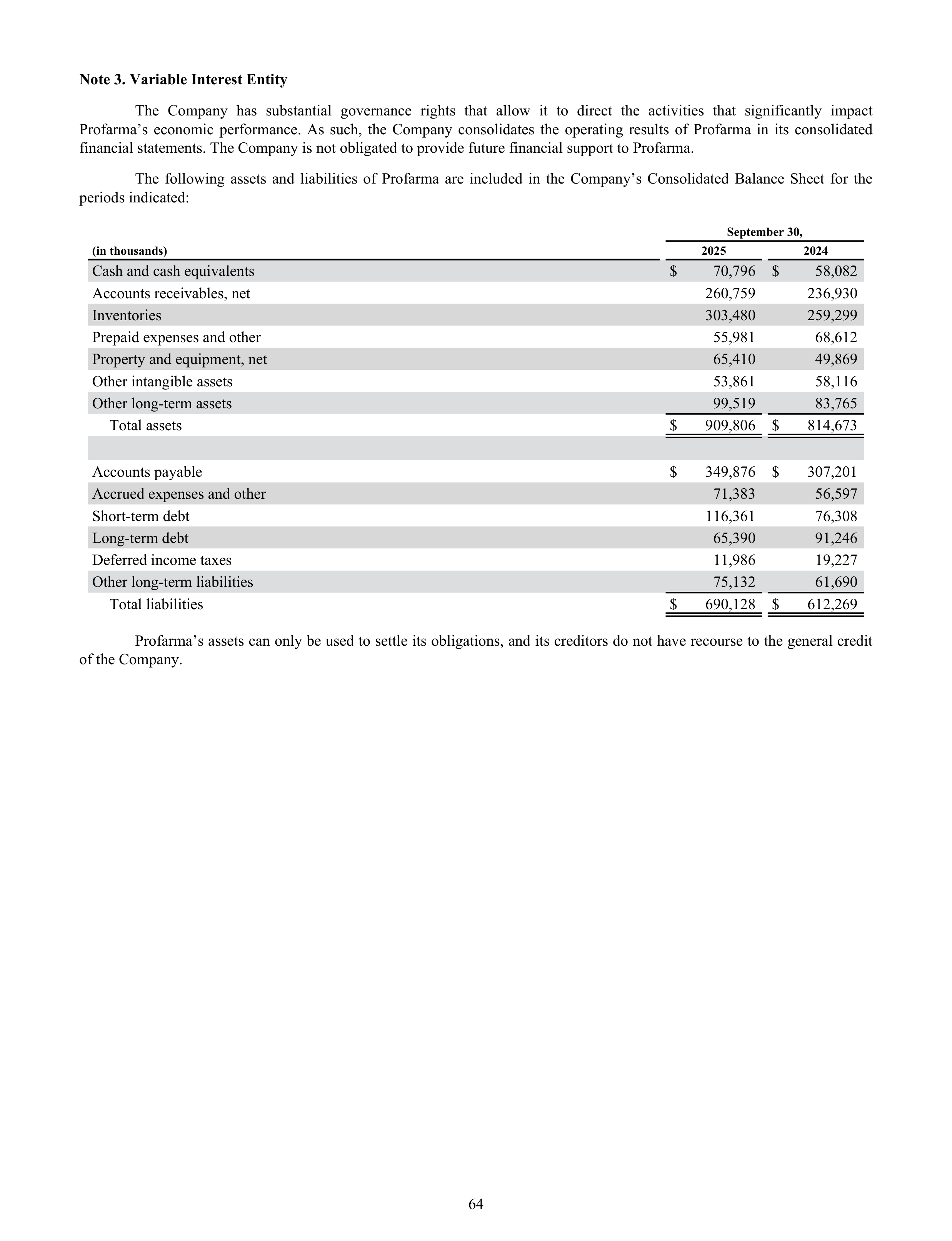
!;@2).>6./82:@2>2?@:@6@E
,=:
DBE6CN
=6H
HJ7HI6CI>6A
<DK:GC6C8:
G><=IH
I=6I
6AADL
>I
ID
9>G:8I
I=:
68I>K>I>:H
I=6I
H>;>86CIAN
>BE68I
(GD;6GB6XH:8DCDB>8E:G;DGB6C8:HHJ8= I=:DBE6CN8DCHDA>96I:HI=:DE:G6I>CC>IH8DCHDA>96I:9
;>C6C8>6AHI6I:B:CIH,=:DBE6CN>HCDID7A>9:;JIJG:;>C6C8>6AHJEEDGIID(GD;6GB6
,=:;DAADL>C67>A>I>:HD;(GD;6GB66G:>C8AJ9:9>CI=:DBE6CNXHDCHDA>96I:96A6C8:+=::I;DGI=:
E:G>D9H>C9>86I:9
&2
6:@5;A?.:1?
6H=6C986H=:FJ>K6A:CIH
88DJCIHG:8:>K67A:H C:I
!CK:CIDG>:H
(G:E6>9:ME:CH:H6C9DI=:G
(GDE:GIN6C9:FJ>EB:CI C:I
'I=:G>CI6C7A:6HH:IH
'I=:GADC<
I:GB6HH:IH
,DI6A6HH:IH
88DJCIHE6N67A:
88GJ:9:ME:CH:H6C9DI=:G
+=DGI
I:GB9:7I
$DC<
I:GB9:7I
:;:GG:9>C8DB:I6M:H
'I=:GADC67>A>I>:H
,DI6AA>67>A>I>:H
(GD;6GB6XH6HH:IH86CDCAN7:JH:9IDH:IIA:>IHD7A>DCH 6C9>IH8G:9>IDGH9DCDI=6K:G:8DJGH:IDI=:I
D;I=:DBE6CN
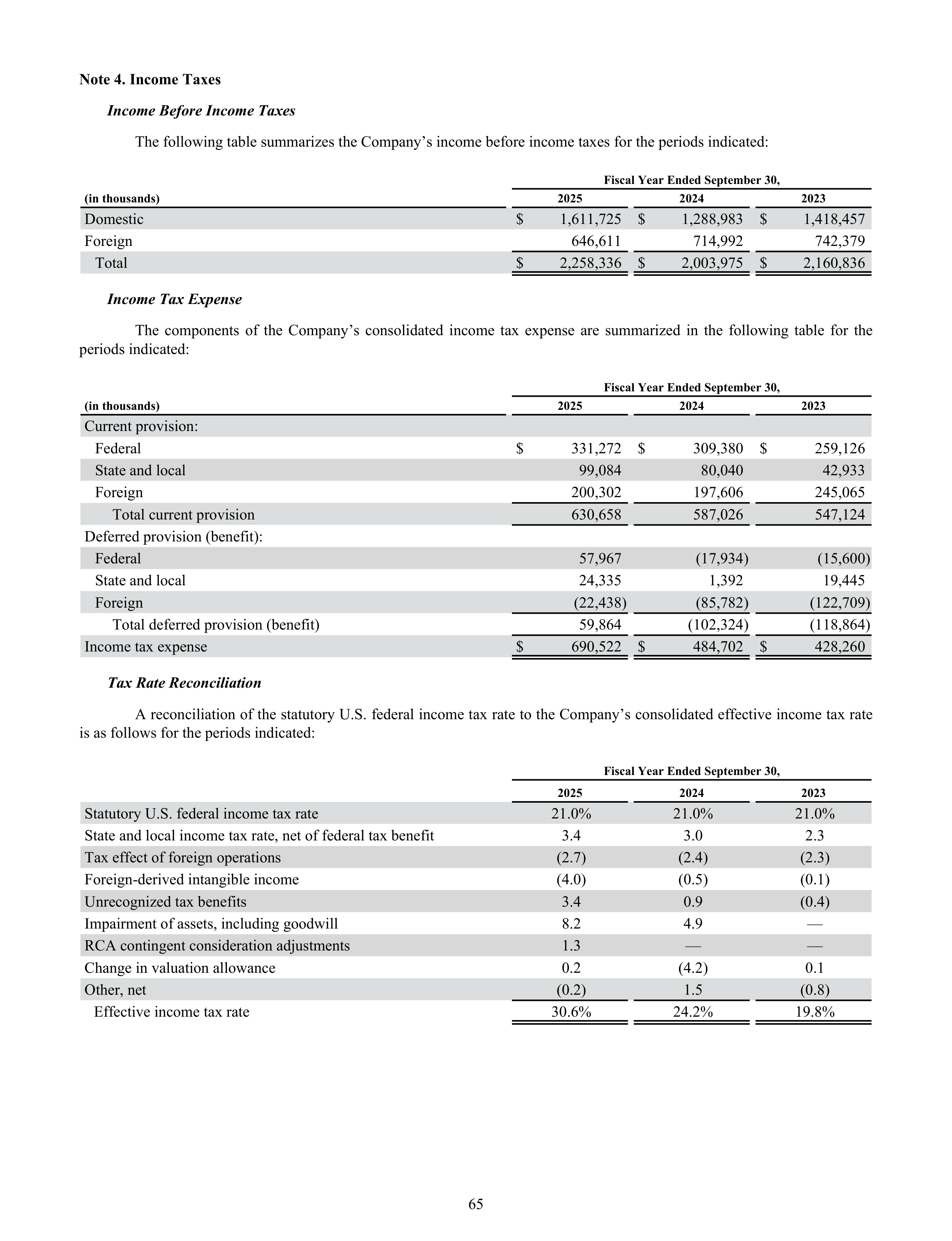
!;@2
:0;92'.D2?
7,86../8;.7,86."*A.<
,=:;DAADL>CO:HI=:DBE6CNXH>C8DB:7:;DG:>C8DB:I6M:H;DGI=:E:G>D9H>C9>86I:9
6?0.8,2.>:121&2
6:@5;A?.:1?
DB:HI>8
DG:><C
,DI6A
7,86."*AA9.7<.
,=:8DBEDC:CIHD;I=:DBE6CNXH8DCHDA>96I:9>C8DB:I6M:ME:CH:6G:HJBB6G>O:9>CI=:;DAADL>C<I67A:;DGI=:
E:G>D9H>C9>86I:9
6?0.8,2.>:121&2
6:@5;A?.:1?
JGG:CIEGDK>H>DC
:9:G6A
+I6I:6C9AD86A
DG:><C
,DI6A8JGG:CIEGDK>H>DC
:;:GG:9EGDK>H>DC7:C:;>I
:9:G6A
+I6I:6C9AD86A
DG:><C
,DI6A9:;:GG:9EGDK>H>DC7:C:;>I
!C8DB:I6M:ME:CH:
"*A *=. .,87,252*=287
G:8DC8>A>6I>DCD;I=:HI6IJIDGN-+;:9:G6A>C8DB:I6MG6I:IDI=:DBE6CNXH8DCHDA>96I:9:;;:8I>K:>C8DB:I6MG6I:
>H6H;DAADLH;DGI=:E:G>D9H>C9>86I:9
6?0.8,2.>:121&2
+I6IJIDGN-+;:9:G6A>C8DB:I6MG6I:
+I6I:6C9AD86A>C8DB:I6MG6I: C:ID;;:9:G6AI6M7:C:;>I
,6M:;;:8ID;;DG:>DCH
DG:>K:9>CI6C7A:>C8DB:
-CG:8DO:9I6M7:C:;>IH
!BE6>GB:CID;6HH:IH >C8AJ9>C<AA
U
*8DCI>C9:G6I>DC69?JHIB:CIH
U
U
=6CCK6AJ6I>DC6AADL6C8:
'I=:G C:I
;;:8I>K:>C8DB:I6MG6I:
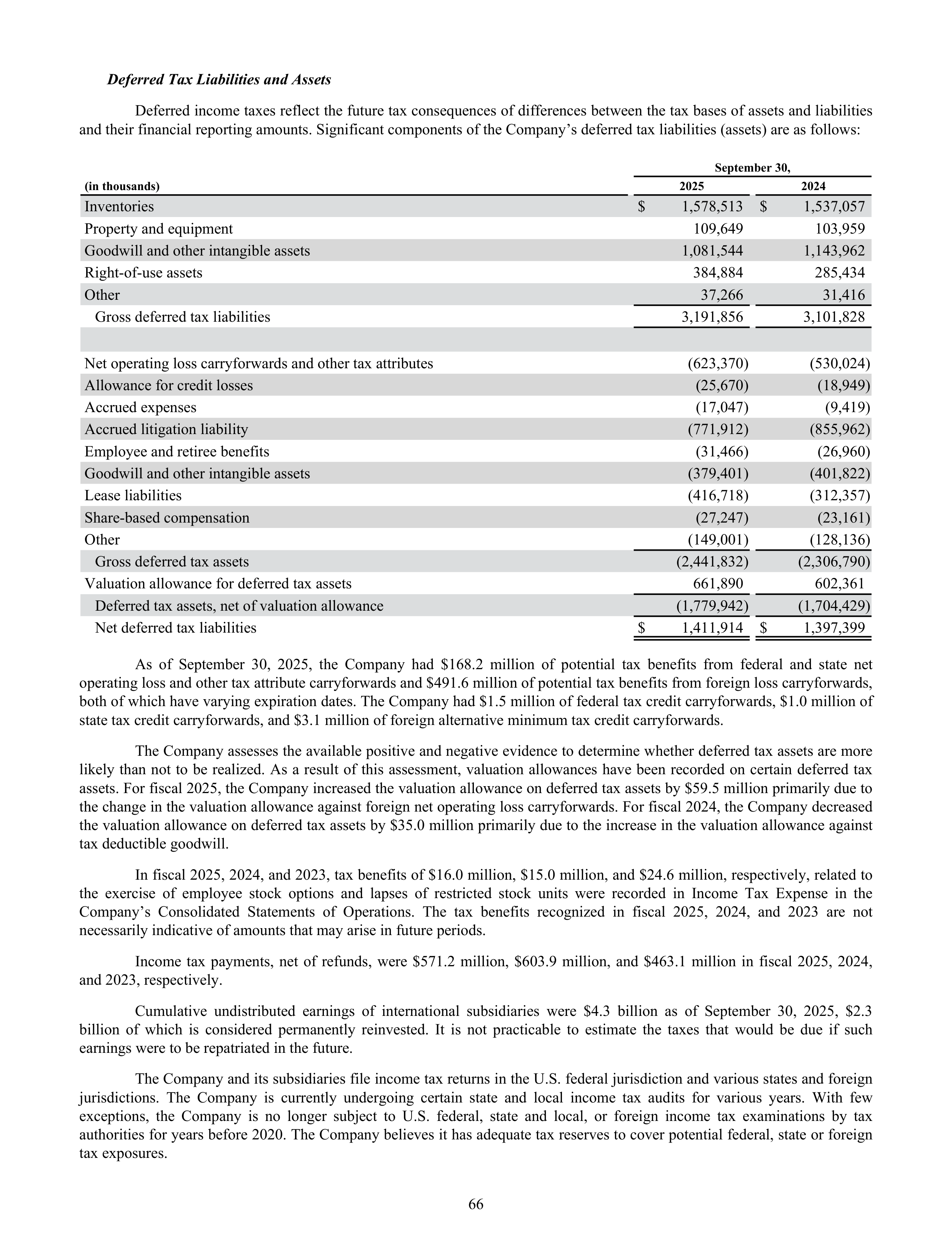
./.;;.-"*A2*+252=2.<*7-<<.=<
:;:GG:9>C8DB:I6M:HG:;A:8II=:;JIJG:I6M8DCH:FJ:C8:HD;9>;;:G:C8:H7:IL::CI=:I6M76H:HD;6HH:IH6C9A>67>A>I>:H
6C9I=:>G;>C6C8>6AG:EDGI>C;>86CI8DBEDC:CIHD;I=:DBE6CNXH9:;:GG:9I6MA>67>A>I>:H6HH:IH6G:6H;DAADLH
&2
6:@5;A?.:1?
!CK:CIDG>:H
(GDE:GIN6C9:FJ>EB:CI
DD9L>AA6C9DI=:G>CI6C7A:6HH:IH
*><=I
D;
JH:6HH:IH
'I=:G
GDHH9:;:GG:9I6MA>67>A>I>:H
&:IDE:G6I>C7JI:H
AADL6C8:;DG8G:9>IADHH:H
88GJ:9:ME:CH:H
88GJ:9A>I>DCA>67>A>IN
BEADN::6C9G:I>G::7:C:;>IH
DD9L>AA6C9DI=:G>CI6C7A:6HH:IH
$:6H:A>67>A>I>:H
+=6G:
76H:98DBE:CH6I>DC
'I=:G
GDHH9:;:GG:9I6M6HH:IH
.6AJ6I>DC6AADL6C8:;DG9:;:GG:9I6M6HH:IH
:;:GG:9I6M6HH:IH C:ID;K6AJ6I>DC6AADL6C8:
&:I9:;:GG:9I6MA>67>A>I>:H
H D; +:EI:B7:G
I=: DBE6CN =69 B>AA>DC D; EDI:CI>6A I6M 7:C:;>IH ;GDB ;:9:G6A 6C9 HI6I: C:I
DE:G6I>C7JI:86GGN;DGL6G9H6C9B>AA>DCD;EDI:CI>6AI6M7:C:;>IH;GDB;DG:><CADHH86GGN;DGL6G9H
7DI=D;L=>8==6K:K6GN>CG6I>DC96I:H,=:DBE6CN=69B>AA>DCD;;:9:G6AI6M8G:9>I86GGN;DGL6G9H
B>AA>DCD;
HI6I:I6M8G:9>I86GGN;DGL6G9H 6C9B>AA>DCD;;DG:>K:B>C>BJBI6M8G:9>I86GGN;DGL6G9H
,=:DBE6CN6HH:HH:HI=:6K6>A67A:EDH>I>K:6C9C:K::K>9:C8:ID9:I:GB>C:L=:I=:G9:;:GG:9I6M6HH:IH6G:BDG:
A>@:ANI=6CCDIID7:G:6A>O:9H6G:HJAID;I=>H6HH:HHB:CI K6AJ6I>DC6AADL6C8:H=6K:7::CG:8DG9:9DC8:GI6>C9:;:GG:9I6M
6HH:IHDG;>H86A
I=:DBE6CN>C8G:6H:9I=:K6AJ6I>DC6AADL6C8:DC9:;:GG:9I6M6HH:IH7NB>AA>DCEG>B6G>AN9J:ID
I=:8=6CCI=:K6AJ6I>DC6AADL6C8:6CHI;DG:>CH86A
I=:DBE6CN9:8G:6H:9
I=:K6AJ6I>DC6AADL6C8:DC9:;:GG:9I6M6HH:IH7N
B>AA>DCEG>B6G>AN9J:IDI=:>C8G:6H:>CI=:K6AJ6I>DC6AADL6C8:6CHI
I6M9:9J8I>7A:AA
!C;>H86A
6C9
I6M7:C:;>IHD;
B>AA>DC
B>AA>DC 6C9B>AA>DC G:HE:8I>K:AN G:A6I:9ID
I=: :M:G8>H: D; :BEADN:: HID8@ DEI>DCH 6C9 A6EH:H D; G:HIG>8I:9 HID8@ JC>IH L:G: G:8DG9:9 >C !C8DB: ,6M ME:CH: >C I=:
DBE6CNXH DCHDA>96I:9 +I6I:B:CIH D; 'E:G6I>DCH ,=: I6M 7:C:;>IH G:8DO:9 >C ;>H86A
6C9
6G: CDI
C:8:HH6G>AN>C9>86I>K:D;6BDJCIHI=6IB6N6G>H:>C;JIJG:E:G>D9H
!C8DB:I6ME6NB:CIH C:ID;G:;JC9H L:G:B>AA>DC
B>AA>DC 6C9B>AA>DC>C;>H86A
6C9
G:HE:8I>K:AN
JBJA6I>K: JC9>HIG>7JI:9 :6GC>CCI:GC6I>DC6A HJ7H>9>6G>:H L:G: 7>AA>DC 6H D; +:EI:B7:G
7>AA>DCD;L=>8=>H8DCH>9:G:9E:GB6C:CIANG:>CK:HI:9!I>HCDIEG68I>867A:ID:HI>B6I:I=:I6M:HI=6ILDJA97:9J:>;HJ8=
:6GC>C6I:9>CI=:;JIJG:
,=:DBE6CN6C9>IHHJ7H>9>6G>:H;>A:>C8DB:I6MG:IJGCH>CI=:-+;:9:G6A?JG>H9>8I>DC6C9K6G>DJHHI6I:H6C9;DG:><C
?JG>H9>8I>DCH ,=: DBE6CN >H 8JGG:CIAN JC9:GCC HI6I: 6C9 AD86A >C8DB: I6M 6J9>IH ;DG K6G>DJH N:6GH />I= ;:L
:M8:EI>DCH I=: DBE6CN >H CD ADCC8DB: I6M :M6B>C6I>DCH 7N I6M
6JI=DG>I>:H;DGN:6GH7:;DG:
,=:DBE6CN7:A>:K:H>I=6H69:FJ6I:I6MG:H:GK:HID8DK:GEDI:CI>6A;:9:G6A HI6I:DG;DG:><C
I6M:MEDHJG:H
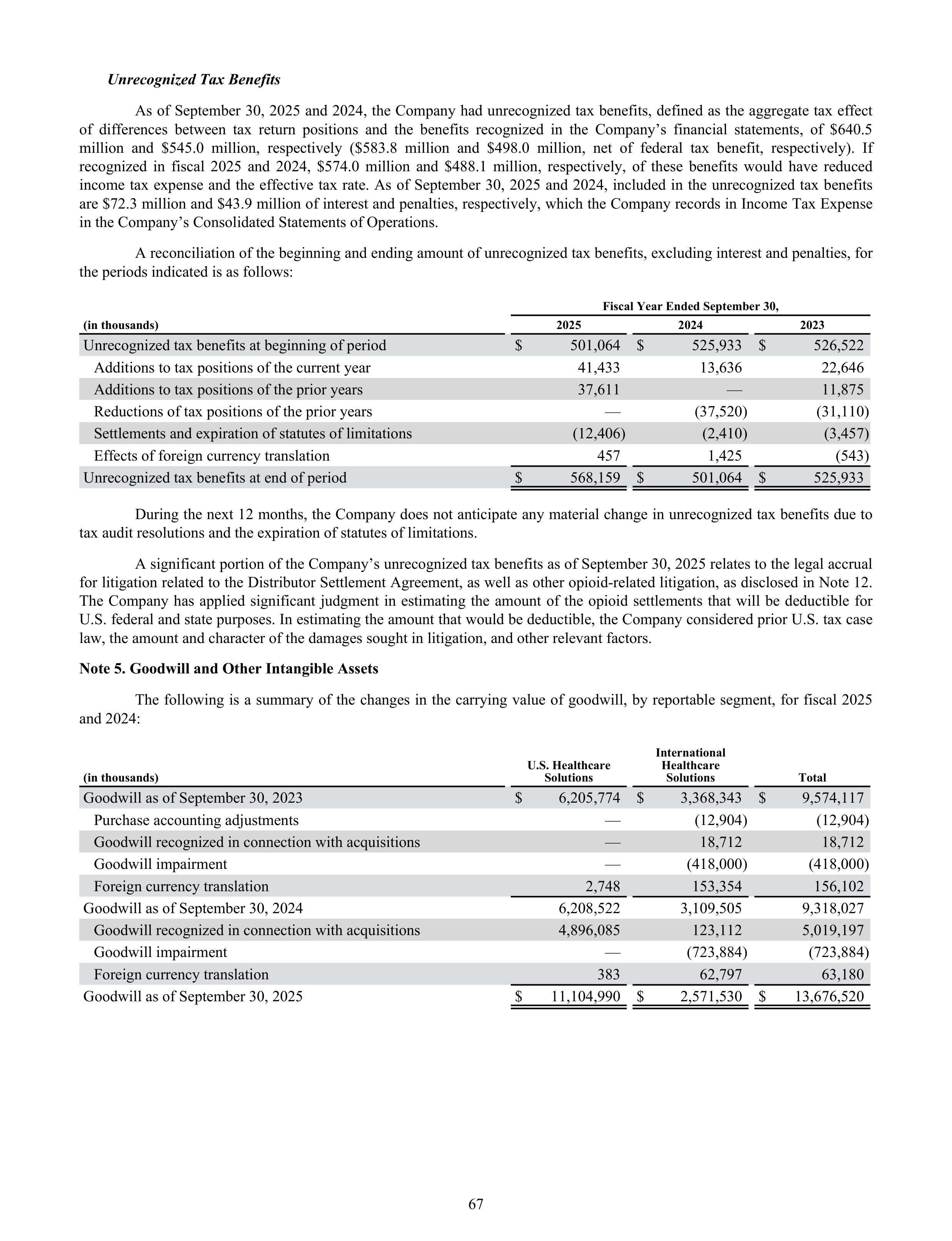
#7;.,8072C.-"*A.7./2=<
HD;+:EI:B7:G
6C9
I=:DBE6CN=69JCG:8DO:9I6M7:C:;>IH 9:;>C:96HI=:6<<G:<6I:I6M:;;:8I
D; 9>;;:G:C8:H 7:IL::C I6M G:IJGC EDH>I>DCH 6C9 I=: 7:C:;>IH G:8DO:9 >C I=: DBE6CNXH ;>C6C8>6A HI6I:B:CIH D;
B>AA>DC 6C9
B>AA>DC G:HE:8I>K:AN B>AA>DC 6C9
B>AA>DC C:I D; ;:9:G6A I6M 7:C:;>I G:HE:8I>K:AN !;
G:8DO:9>C;>H86A
6C9
B>AA>DC6C9B>AA>DC G:HE:8I>K:AN D;I=:H:7:C:;>IHLDJA9=6K:G:9J8:9
>C8DB:I6M:ME:CH:6C9I=::;;:8I>K:I6MG6I:HD;+:EI:B7:G
6C9
>C8AJ9:9>CI=:JCG:8DO:9I6M7:C:;>IH
6G:B>AA>DC6C9B>AA>DCD;>CI:G:HI6C9E:C6AI>:H G:HE:8I>K:AN L=>8=I=:DBE6CNG:8DG9H>C!C8DB:,6MME:CH:
>CI=:DBE6CNXHDCHDA>96I:9+I6I:B:CIHD;'E:G6I>DCH
G:8DC8>A>6I>DCD;I=:7:CC>CC<6BDJCID;JCG:8DO:9I6M7:C:;>IH :M8AJ9>CCI:G:HI6C9E:C6AI>:H ;DG
I=:E:G>D9H>C9>86I:9>H6H;DAADLH
6?0.8,2.>:121&2
6:@5;A?.:1?
-CG:8DO:9I6M7:C:;>IH6I7:CC>CD9
99>I>DCHIDI6MEDH>I>DCHD;I=:8JGG:CIN:6G
99>I>DCHIDI6MEDH>I>DCHD;I=:EG>DGN:6GH
U
*:9J8I>DCHD;I6MEDH>I>DCHD;I=:EG>DGN:6GH
U
+:IIA:B:CIH6C9:ME>G6I>DCD;HI6IJI:HD;A>B>I6I>DCH
;;:8IHD;;DG:>DC
-CG:8DO:9I6M7:C:;>IH6I:C9D;E:G>D9
JG>C8>E6I:6CNB6I:G>6A8=6CCJCG:8DO:9I6M7:C:;>IH9J:ID
I6M6J9>IG:HDAJI>DCH6C9I=::ME>G6I>DCD;HI6IJI:HD;A>B>I6I>DCH
H>;>86CIEDGI>DCD;I=:DBE6CNXHJCG:8DO:9I6M7:C:;>IH6HD;+:EI:B7:G
G:A6I:HIDI=:A:<6A688GJ6A
;DGA>I>DCG:A6I:9IDI=:>HIG>7JIDG+:IIA:B:CID>9
G:A6I:9A>I>DC 6H9>H8ADH:9>C&DI:
,=:DBE6CN=6H6EEA>:9H>;>86CI?J9C:HI>B6I>CD>9H:IIA:B:CIHI=6IL>AA7:9:9J8I>7A:;DG
-+;:9:G6A6C9HI6I:EJGEDH:H!C:HI>B6I>C7A: I=:DBE6CN8DCH>9:G:9EG>DG-+I6M86H:
A6L I=:6BDJCI6C98=6G68I:GD;I=:96B6<:HHDJCA>I>DC 6C9DI=:GG:A:K6CI;68IDGH
!;@2;;1C688.:1"@52>:@.:46/82??2@?
,=:;DAADL>CH6HJBB6GND;I=:8=6CCI=:86GGN>C<K6AJ:D;AA 7NG:EDGI67A:H:H86A
6C9
6:@5;A?.:1?
(&2.8@50.>2
&;8A@6;:?
:@2>:.@6;:.8
2.8@50.>2
&;8A@6;:?
';@.8
DD9L>AA6HD;+:EI:B7:G
(JG8=6H:688DJCI>C<69?JHIB:CIH
U
DD9L>AAG:8DO:9>C8DCC:8I>DCL>I=68FJ>H>I>DCH
U
DD9L>AA>BE6>GB:CI
U
DG:>DC
DD9L>AA6HD;+:EI:B7:G
DD9L>AAG:8DO:9>C8DCC:8I>DCL>I=68FJ>H>I>DCH
DD9L>AA>BE6>GB:CI
U
DG:>DC
DD9L>AA6HD;+:EI:B7:G
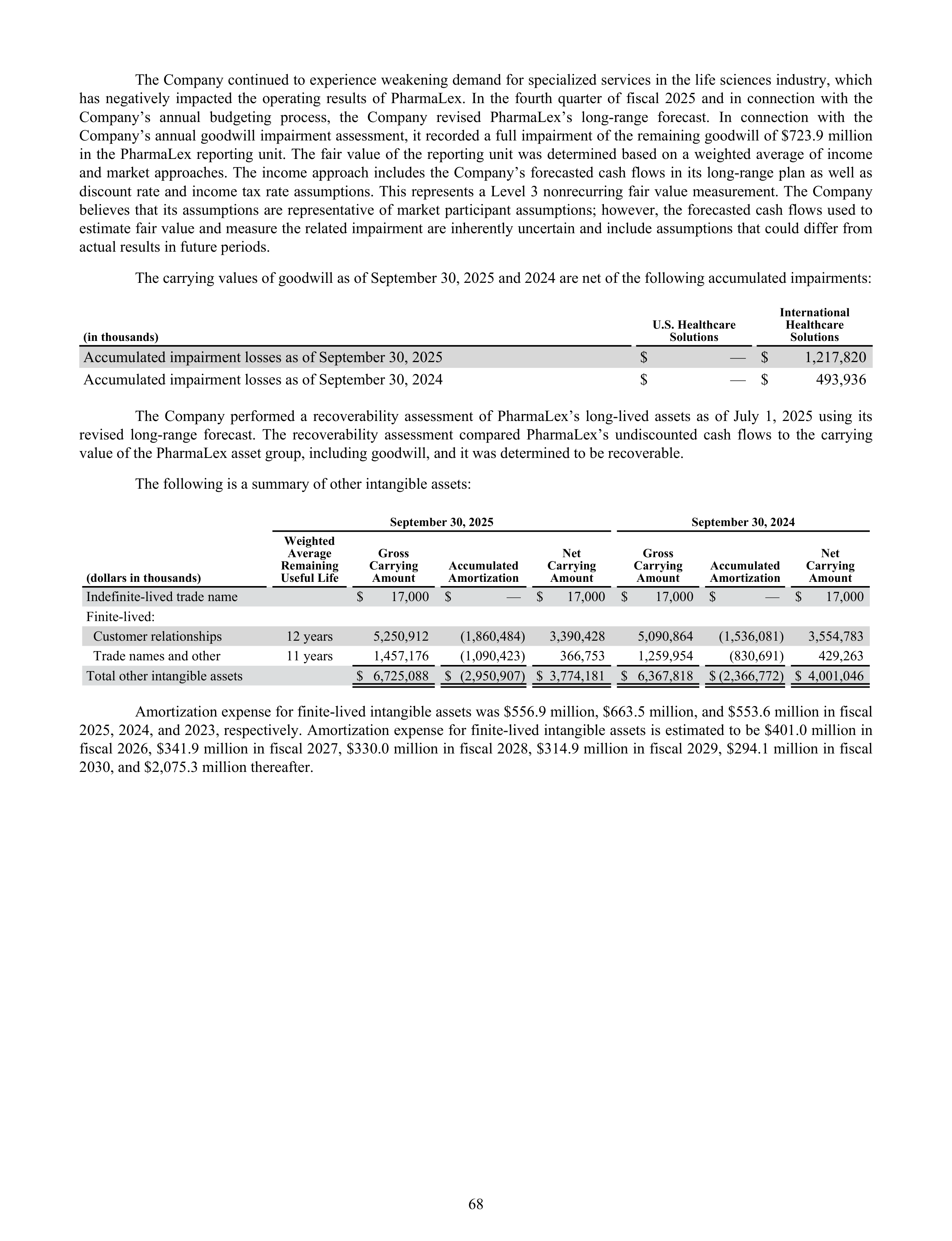
,=:DBE6CN8DCI>CJ:9ID:ME:G>:C8:L:6@:C>C6A>O:9H:GK>8:H>CI=:A>;:H8>:C8:H>C9JHIGN L=>8=
=6HC:K:AN>BE68I:9I=:DE:G6I>CH86A
6C9>C8DCC:8I>DCL>I=I=:
DBE6CNXH
6CCJ6A
7J9C<
EGD8:HH
I=:
DBE6CN
G:K>H:9
(=6GB6$:MXH
ADC<
G6C<:
;DG:86HI
!C
8DCC:8I>DC
L>I=
I=:
DBE6CNXH6CCJ6AAA>BE6>GB:CI6HH:HHB:CI >IG:8DG9:96;JAA>BE6>GB:CID;I=:G:B6>C>C<AAD;B>AA>DC
>CI=:(=6GB6$:MG:EDGI>CI,=:;6>GK6AJ:D;I=:G:EDGI>CIL6H9:I:GB>C:976H:9DC6L:><=I:96K:G6C8DB:
6C9B6G@:I6EEGD68=:H,=:>C8DB:6EEGD68=>C8AJ9:HI=:DBE6CNXH;DG:86HI:986H=;ADLH>C>IHADC<
G6C<:EA6C6HL:AA6H
9>H8DJCIG6I:6C9>C8DB:I6MG6I:6HHJBEI>DCH,=>HG:EG:H:CIH6$:K:ACDCG:8JGG>CGK6AJ:B:6HJG:B:CI,=:DBE6CN
7:A>:K:HI=6I>IH6HHJBEI>DCH6G:G:EG:H:CI6I>K:D;B6G@:IE6GI>8>E6CI6HHJBEI>DCH=DL:K:G I=:;DG:86HI:986H=;ADLHJH:9ID
:HI>B6I:;6>GK6AJ:6C9B:6HJG:I=:G:A6I:9>BE6>GB:CI6G:>C=:G:CIANJC8:GI6>C6C9>C8AJ9:6HHJBEI>DCHI=6I8DJA99>;;:G;GDB
68IJ6AG:HJAIH>C;JIJG:E:G>D9H
,=:86GGN>C<K6AJ:HD;AA6HD;+:EI:B7:G
6C9
6G:C:ID;I=:;DAADL>CBE6>GB:CIH
6:@5;A?.:1?
(&2.8@50.>2
&;8A@6;:?
:@2>:.@6;:.8
2.8@50.>2
&;8A@6;:?
88JBJA6I:9>BE6>GB:CIADHH:H6HD;+:EI:B7:G
U
88JBJA6I:9>BE6>GB:CIADHH:H6HD;+:EI:B7:G
U
,=:DBE6CNE:G;DGB:96G:8DK:G67>A>IN6HH:HHB:CID;(=6GB6$:MXHADCK:96HH:IH6HD;"JAN
JH>CIH
G:K>H:9 ADC<
G6CA>IN 6HH:HHB:CI 8DBE6G:9 (=6GB6$:MXH JC9>H8DJCI:9 86H= ;ADLH ID I=: 86GGN>C<
K6AJ:D;I=:(=6GB6$:M6HH:IC8AJ9>C<AA 6C9>IL6H9:I:GB>C:9ID7:G:8DK:G67A:
,=:;DAADL>CH6HJBB6GND;DI=:G>CI6C7A:6HH:IH
&2
&2
1;88.>?6:@5;A?.:1?
*2645@21
B2>.42
%29.6:6:4
(?23A8632
>;??
.>>E6:4
9;A:@
00A9A8.@21
9;>@6F.@6;:
!2@
.>>E6:4
9;A:@
>;??
.>>E6:4
9;A:@
00A9A8.@21
9;>@6F.@6;:
!2@
.>>E6:4
9;A:@
!C9:;>C>I:
A>K:9IG69:C6B:
U
U
>C>I:
A>K:9
JHIDB:GG:A6I>DCH=>EH
N:6GH
,G69:C6B:H6C9DI=:G
N:6GH
,DI6ADI=:G>CI6C7A:6HH:IH
BDGI>O6I>DC:ME:CH:;DG;>C>I:
A>K:9>CI6C7A:6HH:IHL6HB>AA>DC B>AA>DC 6C9B>AA>DC>C;>H86A
6C9
G:HE:8I>K:ANBDGI>O6I>DC:ME:CH:;DG;>C>I:
A>K:9>CI6C7A:6HH:IH>H:HI>B6I:9ID7:
B>AA>DC>C
;>H86A
B>AA>DC>C;>H86A
B>AA>DC>C;>H86A
B>AA>DC>C;>H86A
B>AA>DC>C;>H86A
6C9
B>AA>DCI=:G:6;I:G
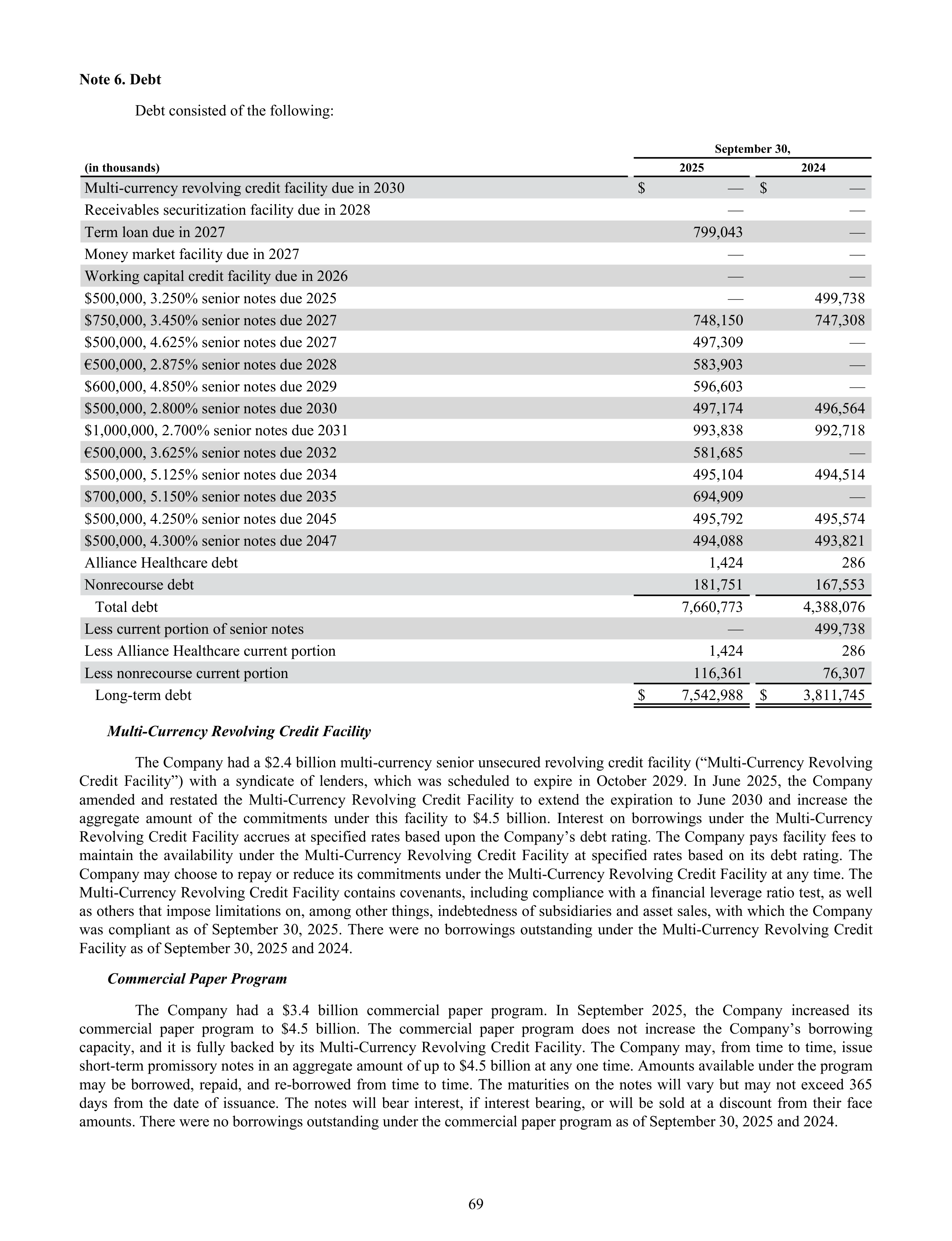
!;@22/@
:7I8DCH>HI:9D;I=:;DAADL>C<
&2
6:@5;A?.:1?
%JAI>
8JGG:C8NG:KDAK>CI;68>A>IN9J:>C
U
U
*:8:>K67A:HH:8JG>I>O6I>DC;68>A>IN9J:>C
U
U
,:GBAD6C9J:>C
U
%DC:NB6G@:I;68>A>IN9J:>C
U
U
/DG@>CI6A8G:9>I;68>A>IN9J:>C
U
U
H:C>DGCDI:H9J:
U
H:C>DGCDI:H9J:
H:C>DGCDI:H9J:
U
Y
H:C>DGCDI:H9J:
U
H:C>DGCDI:H9J:
U
H:C>DGCDI:H9J:
H:C>DGCDI:H9J:
Y
H:C>DGCDI:H9J:
U
H:C>DGCDI:H9J:
H:C>DGCDI:H9J:
U
H:C>DGCDI:H9J:
H:C>DGCDI:H9J:
AA>6C8: :6AI=86G:9:7I
&DCG:8DJGH:9:7I
,DI6A9:7I
$:HH8JGG:CIEDGI>DCD;H:C>DGCDI:H
U
$:HHAA>6C8: :6AI=86G:8JGG:CIEDGI>DC
$:HHCDCG:8DJGH:8JGG:CIEDGI>DC
$DC<
I:GB9:7I
>5=2>;;.7,B .?85?270;.-2=*,252=B
,=:DBE6CN=6967>AA>DCBJAI>
8JGG:C8NH:C>DGJCH:8JG:9G:KDAK>CI;68>A>INV%JAI>
JGG:C8N*:KDAK>C<
G:9>I68>A>INWL>I=6HNC9>86I:D;A:C9:GH L=>8=L6HH8=:9JA:9ID:ME>G:>C'8ID7:G
!C"JC:
I=:DBE6CN
6B:C9:96C9G:HI6I:9I=:%JAI>
JGG:C8N*:KDAK>CI68>A>INID:MI:C9I=::ME>G6I>DCID"JC:
6C9>C8G:6H:I=:
6<<G:IB:CIH JC9:G I=>H ;68>A>IN ID 7>AA>DC !CI:G:HI DC 7DGGDL>C
JGG:C8N
*:KDAK>CI68>A>IN688GJ:H6IHE:8>;>:9G6I:H76H:9JEDCI=:DBE6CNXH9:7IG6I>CA>IN;::HID
B6>CI6>CI=:6K6>A67>A>INJC9:GI=:%JAI>
JGG:C8N*:KDAK>CI68>A>IN6IHE:8>;>:9G6I:H76H:9DC>IH9:7IG6I>C<,=:
DBE6CNB6N8=DDH:IDG:E6NDGG:9J8:>IH8DBB>IB:CIHJC9:GI=:%JAI>
JGG:C8N*:KDAK>CI68>A>IN6I6CNI>B:,=:
%JAI>
JGG:C8N*:KDAK>CI68>A>IN8DCI6>CH8DK:C6CIH >C8AJ9>C6C8:L>I=6;>C6C8>6AA:K:G6DI:HI 6HL:AA
6HDI=:GHI=6I>BEDH:A>B>I6I>DCHDC 6BDCCC9:7I:9C:HHD;HJ7H>9>6G>:H6C96HH:IH6A:H L>I=L=>8=I=:DBE6CN
L6H8DBEA>6CI6HD;+:EI:B7:G
,=:G:L:G:CD7DGGDL>CC
JGG:C8N*:KDAK>CI
68>A>IN6HD;+:EI:B7:G
6C9
866.;,2*5*9.;;80;*6
,=:
DBE6CN
=69
6
7>AA>DC
8DBB:G8>6A
E6E:G
EGD<G6B
!C
+:EI:B7:G
I=:
DBE6CN
>C8G:6H:9
>IH
8DBB:G8>6A E6E:G EGDAA>DC ,=: 8DBB:G8>6A E6E:G EGDC8G:6H: I=: DBE6CNXH 7DGGDL>C<
86E68>IN 6C9>I>H;JAAN768@:97N>IH%JAI>
JGG:C8N*:KDAK>CI68>A>IN,=:DBE6CNB6N ;GDBI>B:IDI>B: >HHJ:
H=DGI
I:GBEGDB>HHDGNCDI:H>C6C6<<G:AA>DC6I6CNDC:I>B:BDJCIH6K6>A67A:JC9:GI=:EGD<G6B
B6N7:7DGGDL:9 G:E6>9 6C9G:
7DGGDL:9;GDBI>B:IDI>B:,=:B6IJG>I>:HDCI=:CDI:HL>AAK6GN7JIB6NCDI:M8::9
96NH;GDBI=:96I:D;>HHJ6C8:,=:CDI:HL>AA7:6G>CI:G:HI >;>CI:G:HI7:6G>CAA7:HDA96I69>H8DJCI;GDBI=:>G;68:
6BDJCIH,=:G:L:G:CD7DGGDL>CC6AE6E:GEGD<G6B6HD;+:EI:B7:G
6C9
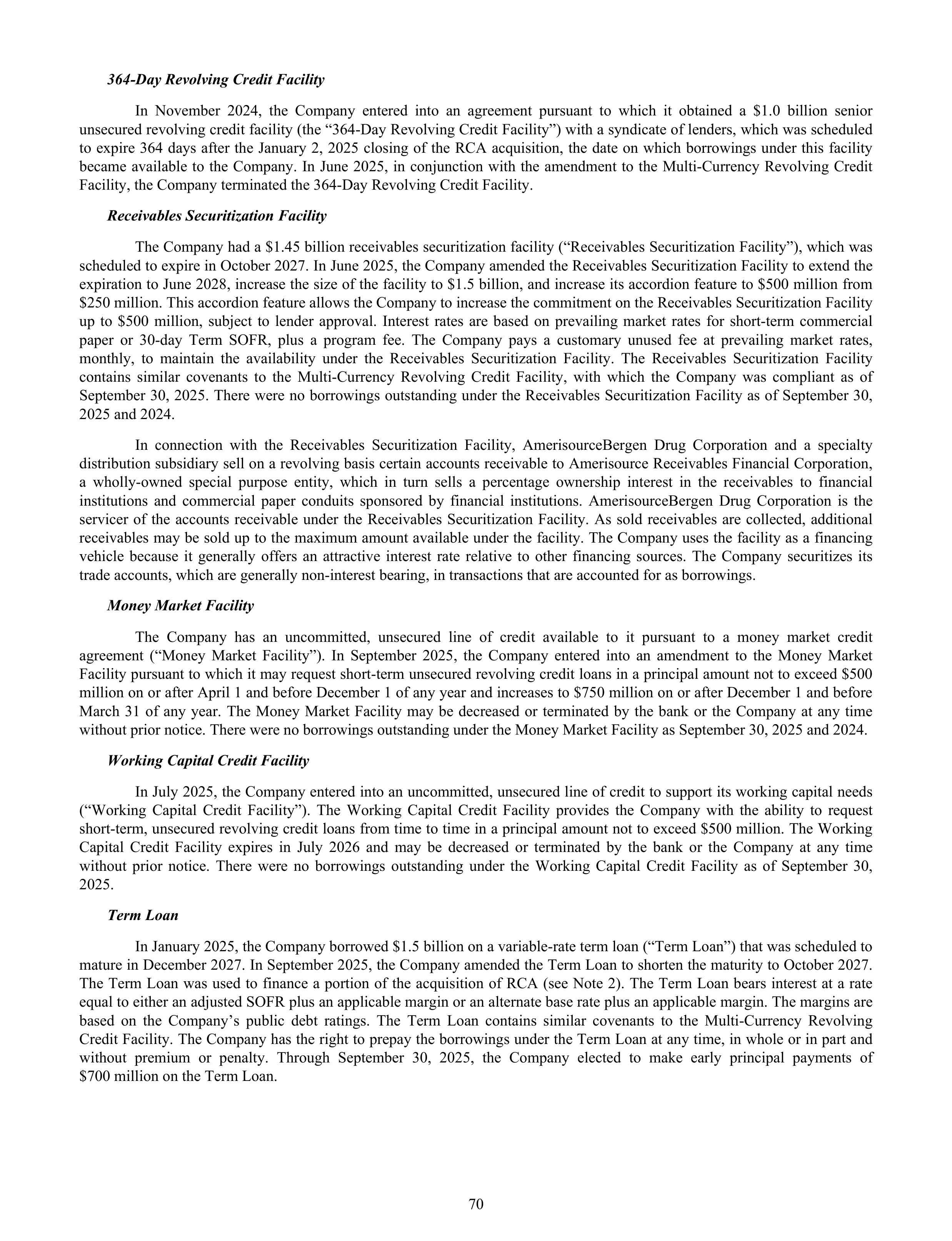
364-Day Revolving Credit Facility
In November 2024, the Company entered into an agreement pursuant to which it obtained a $1.0 billion senior
unsecured revolving credit facility (the “364-Day Revolving Credit Facility”) with a syndicate of lenders, which was scheduled
to expire 364 days after the January 2, 2025 closing of the RCA acquisition, the date on which borrowings under this facility
became available to the Company. In June 2025, in conjunction with the amendment to the Multi-Currency Revolving Credit
Facility, the Company terminated the 364-Day Revolving Credit Facility.
Receivables Securitization Facility
The Company had a $1.45 billion receivables securitization facility (“Receivables Securitization Facility”), which was
scheduled to expire in October 2027. In June 2025, the Company amended the Receivables Securitization Facility to extend the
expiration to June 2028, increase the size of the facility to $1.5 billion, and increase its accordion feature to $500 million from
$250 million. This accordion feature allows the Company to increase the commitment on the Receivables Securitization Facility
up to $500 million, subject to lender approval. Interest rates are based on prevailing market rates for short-term commercial
paper or 30-day Term SOFR, plus a program fee. The Company pays a customary unused fee at prevailing market rates,
monthly, to maintain the availability under the Receivables Securitization Facility. The Receivables Securitization Facility
contains similar covenants to the Multi-Currency Revolving Credit Facility, with which the Company was compliant as of
September 30, 2025. There were no borrowings outstanding under the Receivables Securitization Facility as of September 30,
2025 and 2024.
In connection with the Receivables Securitization Facility, AmerisourceBergen Drug Corporation and a specialty
distribution subsidiary sell on a revolving basis certain accounts receivable to Amerisource Receivables Financial Corporation,
a wholly-owned special purpose entity, which in turn sells a percentage ownership interest in the receivables to financial
institutions and commercial paper conduits sponsored by financial institutions. AmerisourceBergen Drug Corporation is the
servicer of the accounts receivable under the Receivables Securitization Facility. As sold receivables are collected, additional
receivables may be sold up to the maximum amount available under the facility. The Company uses the facility as a financing
vehicle because it generally offers an attractive interest rate relative to other financing sources. The Company securitizes its
trade accounts, which are generally non-interest bearing, in transactions that are accounted for as borrowings.
Money Market Facility
The Company has an uncommitted, unsecured line of credit available to it pursuant to a money market credit
agreement (“Money Market Facility”). In September 2025, the Company entered into an amendment to the Money Market
Facility pursuant to which it may request short-term unsecured revolving credit loans in a principal amount not to exceed $500
million on or after April 1 and before December 1 of any year and increases to $750 million on or after December 1 and before
March 31 of any year. The Money Market Facility may be decreased or terminated by the bank or the Company at any time
without prior notice. There were no borrowings outstanding under the Money Market Facility as September 30, 2025 and 2024.
Working Capital Credit Facility
In July 2025, the Company entered into an uncommitted, unsecured line of credit to support its working capital needs
(“Working Capital Credit Facility”). The Working Capital Credit Facility provides the Company with the ability to request
short-term, unsecured revolving credit loans from time to time in a principal amount not to exceed $500 million. The Working
Capital Credit Facility expires in July 2026 and may be decreased or terminated by the bank or the Company at any time
without prior notice. There were no borrowings outstanding under the Working Capital Credit Facility as of September 30,
2025.
Term Loan
In January 2025, the Company borrowed $1.5 billion on a variable-rate term loan (“Term Loan”) that was scheduled to
mature in December 2027. In September 2025, the Company amended the Term Loan to shorten the maturity to October 2027.
The Term Loan was used to finance a portion of the acquisition of RCA (see Note 2). The Term Loan bears interest at a rate
equal to either an adjusted SOFR plus an applicable margin or an alternate base rate plus an applicable margin. The margins are
based on the Company’s public debt ratings. The Term Loan contains similar covenants to the Multi-Currency Revolving
Credit Facility. The Company has the right to prepay the borrowings under the Term Loan at any time, in whole or in part and
without premium or penalty. Through September 30, 2025, the Company elected to make early principal payments of
$700 million on the Term Loan.
70
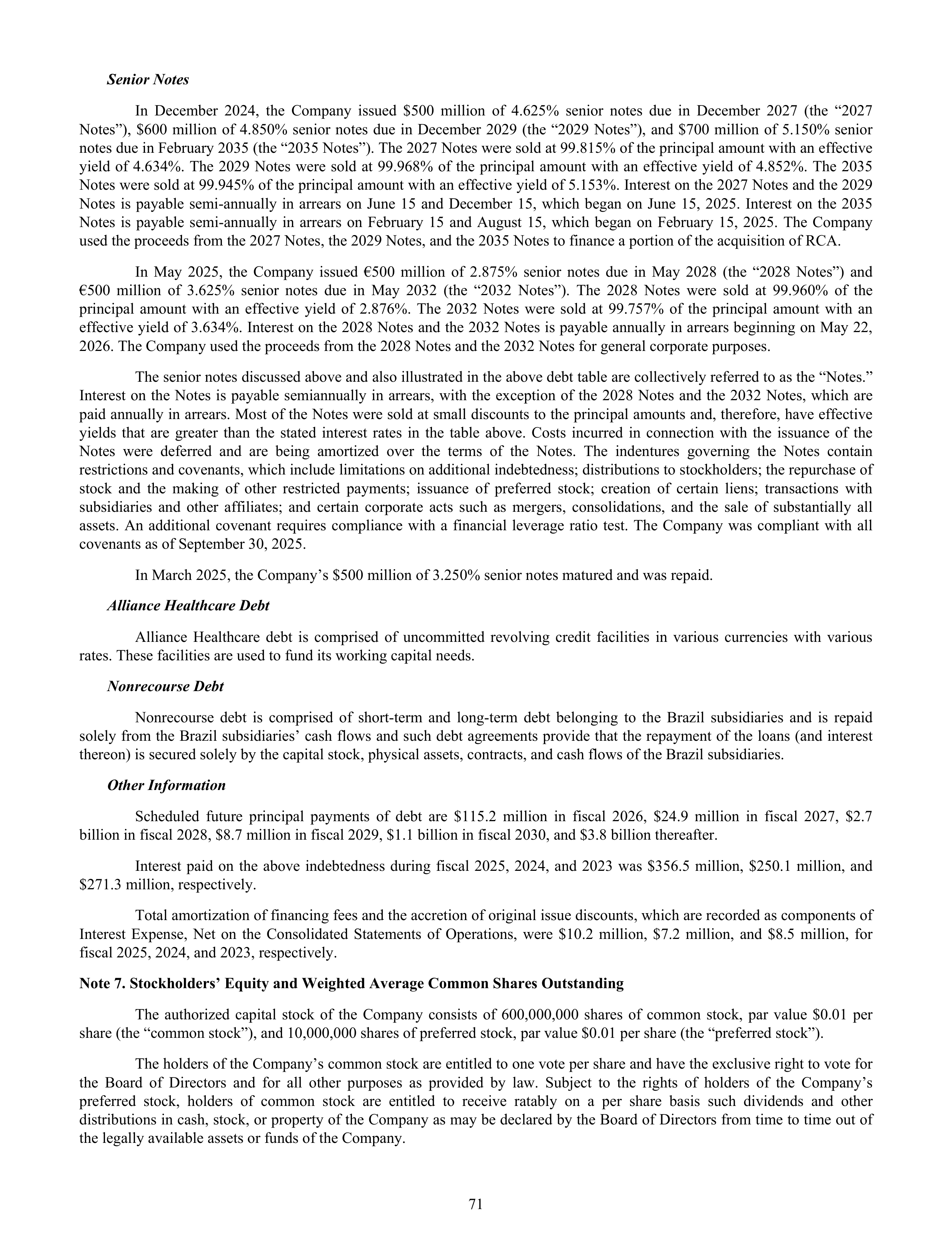
Senior Notes
In December 2024, the Company issued $500 million of 4.625% senior notes due in December 2027 (the “2027
Notes”), $600 million of 4.850% senior notes due in December 2029 (the “2029 Notes”), and $700 million of 5.150% senior
notes due in February 2035 (the “2035 Notes”). The 2027 Notes were sold at 99.815% of the principal amount with an effective
yield of 4.634%. The 2029 Notes were sold at 99.968% of the principal amount with an effective yield of 4.852%. The 2035
Notes were sold at 99.945% of the principal amount with an effective yield of 5.153%. Interest on the 2027 Notes and the 2029
Notes is payable semi-annually in arrears on June 15 and December 15, which began on June 15, 2025. Interest on the 2035
Notes is payable semi-annually in arrears on February 15 and August 15, which began on February 15, 2025. The Company
used the proceeds from the 2027 Notes, the 2029 Notes, and the 2035 Notes to finance a portion of the acquisition of RCA.
In May 2025, the Company issued €500 million of 2.875% senior notes due in May 2028 (the “2028 Notes”) and
€500 million of 3.625% senior notes due in May 2032 (the “2032 Notes”). The 2028 Notes were sold at 99.960% of the
principal amount with an effective yield of 2.876%. The 2032 Notes were sold at 99.757% of the principal amount with an
effective yield of 3.634%. Interest on the 2028 Notes and the 2032 Notes is payable annually in arrears beginning on May 22,
2026. The Company used the proceeds from the 2028 Notes and the 2032 Notes for general corporate purposes.
The senior notes discussed above and also illustrated in the above debt table are collectively referred to as the “Notes.”
Interest on the Notes is payable semiannually in arrears, with the exception of the 2028 Notes and the 2032 Notes, which are
paid annually in arrears. Most of the Notes were sold at small discounts to the principal amounts and, therefore, have effective
yields that are greater than the stated interest rates in the table above. Costs incurred in connection with the issuance of the
Notes were deferred and are being amortized over the terms of the Notes. The indentures governing the Notes contain
restrictions and covenants, which include limitations on additional indebtedness; distributions to stockholders; the repurchase of
stock and the making of other restricted payments; issuance of preferred stock; creation of certain liens; transactions with
subsidiaries and other affiliates; and certain corporate acts such as mergers, consolidations, and the sale of substantially all
assets. An additional covenant requires compliance with a financial leverage ratio test. The Company was compliant with all
covenants as of September 30, 2025.
In March 2025, the Company’s $500 million of 3.250% senior notes matured and was repaid.
Alliance Healthcare Debt
Alliance Healthcare debt is comprised of uncommitted revolving credit facilities in various currencies with various
rates. These facilities are used to fund its working capital needs.
Nonrecourse Debt
Nonrecourse debt is comprised of short-term and long-term debt belonging to the Brazil subsidiaries and is repaid
solely from the Brazil subsidiaries’ cash flows and such debt agreements provide that the repayment of the loans (and interest
thereon) is secured solely by the capital stock, physical assets, contracts, and cash flows of the Brazil subsidiaries.
Other Information
Scheduled future principal payments of debt are $115.2 million in fiscal 2026, $24.9 million in fiscal 2027, $2.7
billion in fiscal 2028, $8.7 million in fiscal 2029, $1.1 billion in fiscal 2030, and $3.8 billion thereafter.
Interest paid on the above indebtedness during fiscal 2025, 2024, and 2023 was $356.5 million, $250.1 million, and
$271.3 million, respectively.
Total amortization of financing fees and the accretion of original issue discounts, which are recorded as components of
Interest Expense, Net on the Consolidated Statements of Operations, were $10.2 million, $7.2 million, and $8.5 million, for
fiscal 2025, 2024, and 2023, respectively.
Note 7. Stockholders’ Equity and Weighted Average Common Shares Outstanding
The authorized capital stock of the Company consists of 600,000,000 shares of common stock, par value $0.01 per
share (the “common stock”), and 10,000,000 shares of preferred stock, par value $0.01 per share (the “preferred stock”).
The holders of the Company’s common stock are entitled to one vote per share and have the exclusive right to vote for
the Board of Directors and for all other purposes as provided by law. Subject to the rights of holders of the Company’s
preferred stock, holders of common stock are entitled to receive ratably on a per share basis such dividends and other
distributions in cash, stock, or property of the Company as may be declared by the Board of Directors from time to time out of
the legally available assets or funds of the Company.
71
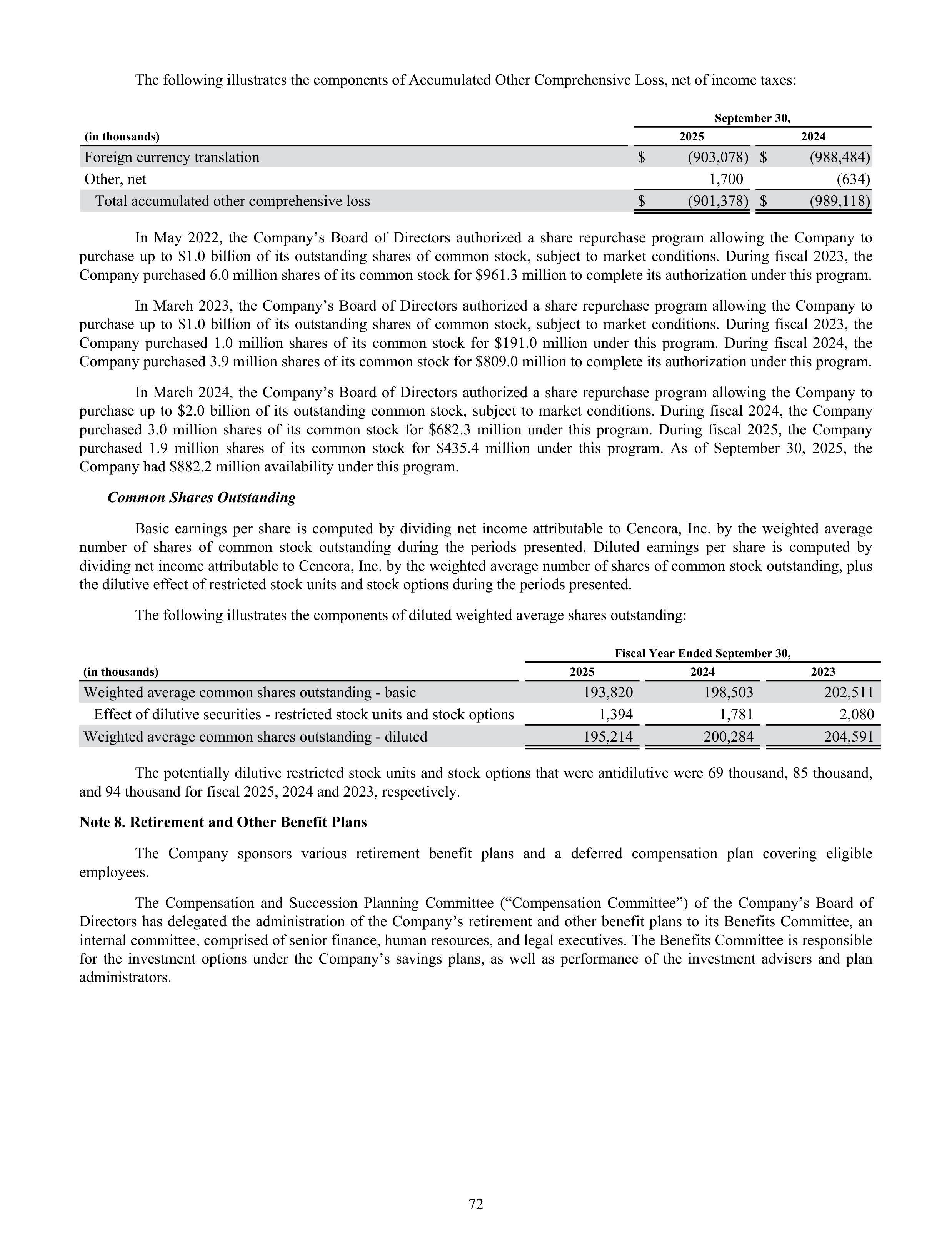
,=:;DAADL>CAAJHIG6I:HI=:8DBEDC:CIHD;88JBJA6I:9'I=:GDBEG:=:CH>K:$DHH C:ID;>C8DB:I6M:H
&2
6:@5;A?.:1?
DG:>DC
'I=:G C:I
,DI6A688JBJA6I:9DI=:G8DBEG:=:CH>K:ADHH
!C%6N
I=:DBE6CNXHD6G9D;>G:8IDGH6JI=DG>O:96H=6G:G:EJG8=6H:EGDC<I=:DBE6CNID
EJG8=6H:JEID
7>AA>DCD;>IHDJIHI6C9>CI>DCHJG>CH86A
I=:
DBE6CNEJG8=6H:9
B>AA>DCH=6G:HD;>IH8DBBDCHID8@;DGB>AA>DCID8DBEA:I:>IH6JI=DG>O6I>DCJC9:GI=>HEGD<G6B
!C%6G8=
I=:DBE6CNXHD6G9D;>G:8IDGH6JI=DG>O:96H=6G:G:EJG8=6H:EGDC<I=:DBE6CNID
EJG8=6H:JEID
7>AA>DCD;>IHDJIHI6C9>CI>DCHJG>CH86A
I=:
DBE6CNEJG8=6H:9
B>AA>DCH=6G:HD;>IH8DBBDCHID8@;DG
B>AA>DCJC9:GI=>HEGDCH86A
I=:
DBE6CNEJG8=6H:9B>AA>DCH=6G:HD;>IH8DBBDCHID8@;DG
B>AA>DCID8DBEA:I:>IH6JI=DG>O6I>DCJC9:GI=>HEGD<G6B
!C%6G8=
I=:DBE6CNXHD6G9D;>G:8IDGH6JI=DG>O:96H=6G:G:EJG8=6H:EGDC<I=:DBE6CNID
EJG8=6H:JEID
7>AA>DCD;>IHDJIHI6C9>CI>DCHJG>CH86A
I=:DBE6CN
EJG8=6H:9
B>AA>DCH=6G:HD;>IH8DBBDCHID8@;DGB>AA>DCJC9:GI=>HEGDCH86A
I=:DBE6CN
EJG8=6H:9 B>AA>DC H=6G:H D; >IH 8DBBDC HID8@ ;DG B>AA>DC JC9:G I=>H EGD<G6B H D; +:EI:B7:G
I=:
DBE6CN=69B>AA>DC6K6>A67>A>INJC9:GI=>HEGD<G6B
86687!1*;.=<=*7-270
6H>8:6GC>CH8DBEJI:97N9>K>9>CC8DB:6IIG>7JI67A:ID:C8DG6 !C87NI=:L:><=I:96K:G6<:
CJB7:G D; H=6G:H D; 8DBBDC HID8@ DJIHI6C9>CCD9H EG:H:CI:9 >AJI:9 :6GC>CH 8DBEJI:9 7N
9>K>9>CC8DB:6IIG>7JI67A:ID:C8DG6 !C87NI=:L:><=I:96K:G6C< EAJH
I=:9>AJI>K::;;:8ID;G:HIG>8I:9HID8@JC>IH6C9HID8@DEI>DCH9JG>CD9HEG:H:CI:9
,=:;DAADL>CAAJHIG6I:HI=:8DBEDC:CIHD;9>AJI:9L:><=I:96K:G6C<
6?0.8,2.>:121&2
6:@5;A?.:1?
/:><=I:96K:G6C8
;;:8ID;9>AJI>K:H:8JG>I>:H
G:HIG>8I:9HID8@JC>IH6C9HID8@DEI>DCH
/:><=I:96K:G6CAJI:9
,=:EDI:CI>6AAN9>AJI>K:G:HIG>8I:9HID8@JC>IH6C9HID8@DEI>DCHI=6IL:G:6CI>9>AJI>K:L:G:I=DJH6C9 I=DJH6C9
6C9I=DJH6C9;DG;>H86A
6C9
G:HE:8I>K:AN
!;@2%2@6>292:@.:1"@52>2:236@#8.:?
,=:
DBE6CN
HEDCHDGH
K6G>DJH
G:I>G:B:CI
7:C:;>I
EA6CH
6C9
6
9:;:GG:9
8DBE:CH6I>DC
EA6C
8DK:G>C<
:A>7A:
:BEADN::H
,=: DBE:CH6I>DC6C9+J88:HH>DC(A6CC>CII:: VDBE:CH6I>DC DBB>II::W D; I=: DBE6CNXH D6G9 D;
>G:8IDGH=6H9:A:C>HIG6I>DCD;I=:DBE6CNXHG:I>G:B:CI6C9DI=:G7:C:;>IEA6CHID>IH:C:;>IHDBB>II:: 6C
>CI:GC6A8DBB>II:: 8DBEG>H:9D;H:C>DG;>C6C8: =JB6CG:HDJG8:H 6C9A:K:H,=::C:;>IHDBB>II::>HG:HEDCH>7A:
;DGI=:>CK:HIB:CIDEI>DCHJC9:GI=:DBE6CNXHH6K>CCK:HIB:CI69K>H:GH6C9EA6C
69B>C>HIG6IDGH
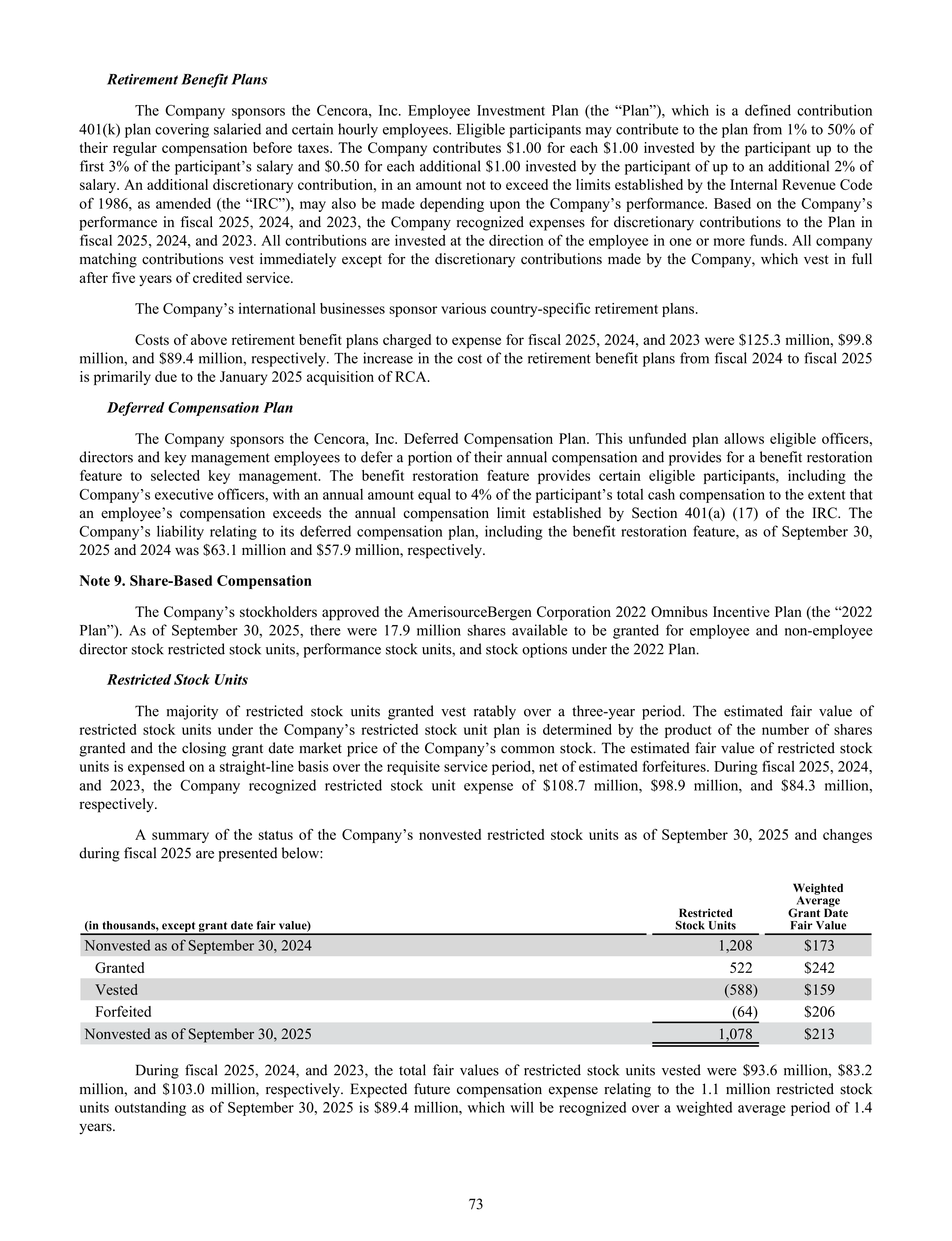
.=2;.6.7=.7./2=5*7<
,=:DBE6CNHEDCHDGHI=::C8DG6 !C8BEADN::!CK:HIB:CI(A6CI=:V(A6CW L=>8=>H69:;>C:98DCIG>7JI>DC
@EA6C8DK:G>C:96C98:GI6>C=DJGAN:BEADN::HA>7A:E6GI>8>E6CIHB6N8DCIG>7JI:IDI=:EA6C;GDBID
D;
I=:>GG:DC7:;DG:I6M:H,=:DBE6CN8DCIG>7JI:H
;DG:68=
>CK:HI:97NI=:E6GI>8>E6CIJEIDI=:
;>GHID;I=:E6GI>8>E6CIXHH6A6GN6C9
;DG:68=699>I>DC6A
>CK:HI:97NI=:E6GI>8>E6CID;JEID6C699>I>DC6AD;
H6A6GNC699>I>DC6A9>H8G:I>DC6GN8DCIG>7JI>DC >C6C6BDJCICDIID:M8::9I=:A>B>IH:HI67A>H=:97NI=:!CI:GC6A*:K:CJ:D9:
D; 6H6B:C9:9I=:V!*W B6N6AHD7:B69:9:E:C9>C<JEDCI=:DBE6CNXHE:G;DGB6C8:6H:9DCI=:DBE6CNXH
E:G;DGB6C8:>C;>H86A
6C9
I=:DBE6CNG:8DO:9:ME:CH:H;DG9>H8G:I>DC6GN8DCIG>7JI>DCHIDI=:(A6C>C
;>H86A
6C9
AA8DCIG>7JI>DCH6G:>CK:HI:96II=:9>G:8I>DCD;I=::BEADN::>CDC:DGBDG:;JC9HAA8DBE6CN
B6I8=>C7JI>DCHK:HI>BB:9>6I:AN:M8:EI;DGI=:9>H8G:I>DC6GN8DCIG>7JI>DCHB69:7NI=:DBE6CN L=>8=K:HI>C;JAA
6;I:G;>K:N:6GHD;8G:9>I:9H:GK>8:
,=:DBE6CNXH>CI:GC6I>DC6A7JH>C:HH:HHEDCHDGK6G>DJH8DJCIGN
HE:8>;>8G:I>G:B:CIEA6CH
DHIHD;67DK:G:I>G:B:CI7:C:;>IEA6CH8=6GH86A
6C9
L:G:B>AA>DC
B>AA>DC 6C9B>AA>DC G:HE:8I>K:AN,=:>C8G:6H:>CI=:8DHID;I=:G:I>G:B:CI7:C:;>IEA6CH;GDB;>H86A
ID;>H86A
>HEG>B6G>AN9J:IDI=:"6CJ6GN
68FJ>H>I>DCD;*
./.;;.-869.7<*=2875*7
,=:DBE6CNHEDCHDGHI=::C8DG6 !C8:;:GG:9DBE:CH6I>DC(A6C,=>HJC;JC9:9EA6C6AADLH:A>7A:D;;>8:GH
9>G:8IDGH6C9@:NB6C6DCD;I=:>G6CCJ6A8DBE:CH6I>DC6C9EGDK>9:H;DG67:C:;>IG:HIDG6I>DC
;:6IJG: ID H:A:8I:9 @:N B6C6I G:HIDG6I>DC ;:6IJG: EGDK>9:H 8:GI6>C :A>7A: E6GI>8>E6CIH >C8AJ9>C< I=:
DBE6CNXH:M:8JI>K:D;;>8:GH L>I=6C6CCJ6A6BDJCI:FJ6AIDD;I=:E6GI>8>E6CIXHIDI6A86H=8DBE:CH6I>DCIDI=::MI:CII=6I
6C :BEADN::XH 8DBE:CH6I>DC :M8::9H I=: 6CCJ6A 8DBE:CH6I>DC A>B>I :HI67A>H=:9 7N +:8I>DC
6 D; I=: !* ,=:
DBE6CNXHA>67>A>ING:A6I>CIH9:;:GG:98DBE:CH6I>DCEA6C >C8AJ9>CIG:HIDG6I>DC;:6IJG: 6HD;+:EI:B7:G
6C9
L6HB>AA>DC6C9B>AA>DC G:HE:8I>K:AN
!;@2&5.>2.?21;9<2:?.@6;:
,=:DBE6CNXHHID8@=DA9:GH6EEGDK:9I=:B:G>HDJG8::GDC
'BC>7JH!C8:CI>K:(A6CI=:V
(A6CWHD;+:EI:B7:G
I=:G:L:G:B>AA>DCH=6G:H6K6>A67A:ID7:<G6CI:9;DG:BEADN::6C9CDC
:BEADN::
9>G:8IDGHID8@G:HIG>8I:9HID8@JC>IH E:G;DGB6C8:HID8@JC>IH 6C9HID8@DEI>DCHJC9:GI=:
(A6C
.<=;2,=.-!=8,4#72=<
,=: B6?DG>IN D; G:HIG>8I:9 HID8@ JC>IH D9 ,=: :HI>B6I:9 ;6>G K6AJ: D;
G:HIG>8I:9HID8@JC>IHJC9:GI=:DBE6CNXHG:HIG>8I:9HID8@JC>IEA6C>H9:I:GB>C:97NI=:EGD9J8ID;I=:CJB7:GD;H=6G:H
C<8:D;I=:DBE6CNXH8DBBDCHID8@,=::HI>B6I:9;6>GK6AJ:D;G:HIG>8I:9HID8@
JC>IH>H:ME:CH:9DC6HIG6>C:76H>HDK:GI=:G:FJ>H>I:H:GK>8:E:G>D9 C:ID;:HI>B6I:9;DG;:>IJG:HJG>CH86A
6C9
I=: DBE6CN G:8DO:9 G:HIG>8I:9 HID8@ JC>I :ME:CH: D;
B>AA>DC B>AA>DC 6C9 B>AA>DC
G:HE:8I>K:AN
HJBB6GND;I=:HI6IJHD;I=:DBE6CNXHCDCK:HI:9G:HIG>8I:9HID8@JC>IH6HD;+:EI:B7:G
6C98=6C<:H
9JG>CH86A
6G:EG:H:CI:97:ADL
6:@5;A?.:1?2D02.:@1.@23.6>B.8A2
%2?@>60@21
&@;07(:6@?
*2645@21
B2>.42
>.:@.@2
.6>).8A2
&DCK:HI:96HD;+:EI:B7:G
G6CI:9
.:HI:9
DG;:>I:9
&DCK:HI:96HD;+:EI:B7:G
JG>CH86A
6C9
I=:IDI6A;6>GK6AJ:HD;G:HIG>8I:9HID8@JC>IHK:HI:9L:G:B>AA>DC
B>AA>DC 6C9
B>AA>DC G:HE:8I>K:ANME:8I:9;JIJG:8DBE:CH6I>DC:ME:CH:G:A6I>CAA>DCG:HIG>8I:9HID8@
JC>IHDJIHI6C9>CHB>AA>DC L=>8=L>AA7:G:8DO:9DK:G6L:><=I:96K:G6D9D;
N:6GH
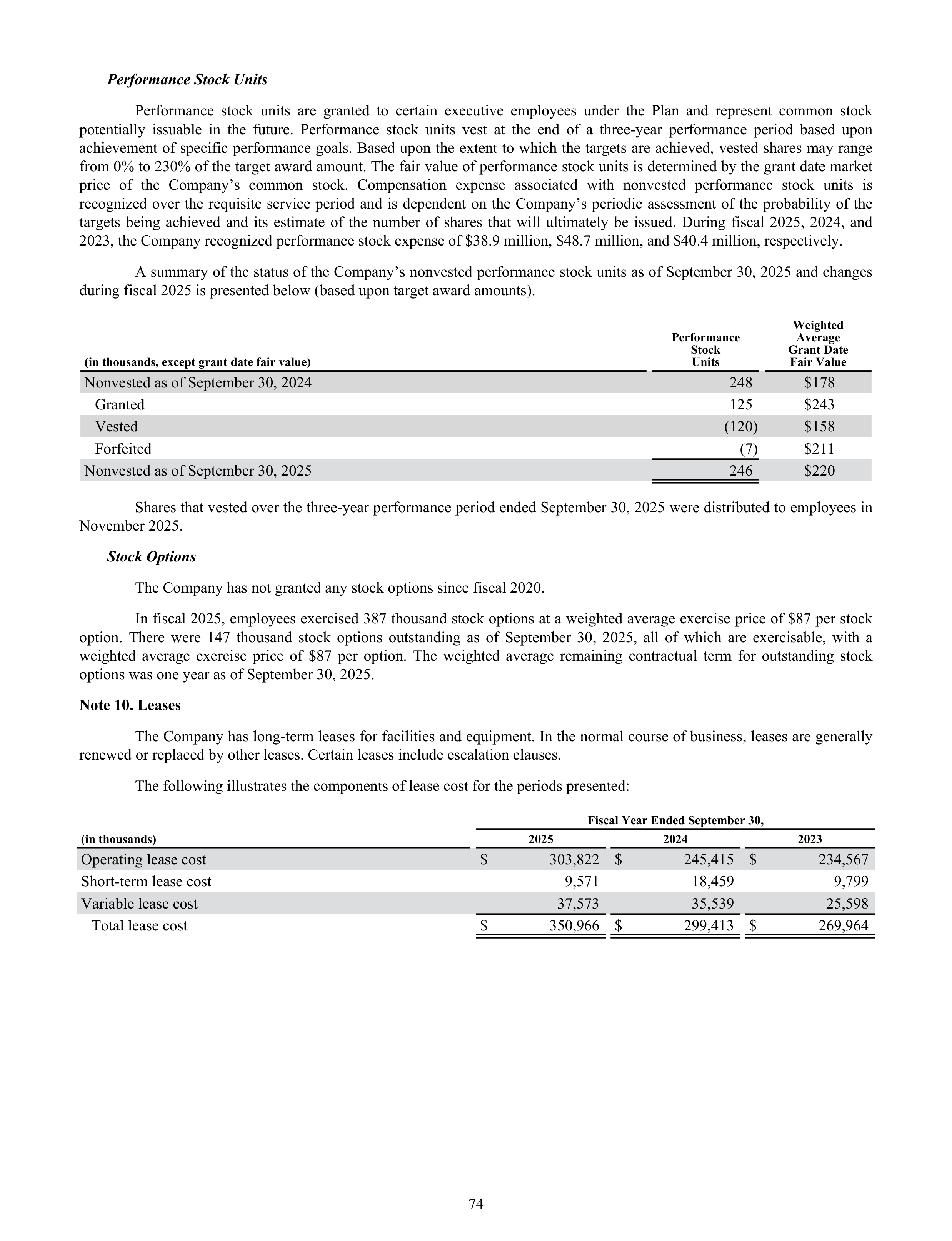
.;/8;6*7,.!=8,4#72=<
(:G;DGB6C8: HID8@ JC>IH 6G: C :M:8JI>K: :BEADN::H JC9:G I=: (A6C 6C9 G:EG:H:CI 8DBBDC HID8@
EDI:CI>6AAN >HHJ67A: >C I=: ;JIJG: (:G;DGB6C8: HID8@ JC>IH K:HI 6I I=: :C9 D; 6 I=G::
N:6G E:G;DGB6C8: E:G>D9 76H:9 JEDC
68=>:K:B:CID;HE:8>;>8E:G;DGB6C8:8=I=:I6G:K:9 K:HI:9H=6G:HB6NG6C<:
;GDB
ID
D;I=:I6GGK6AJ:D;E:G;DGB6C8:HID8@JC>IH>H9:I:GB>C:97NI=:<G6CI96I:B6G@:I
EG>8:
D;
I=:
DBE6CNXH
8DBBDC
HID8@
DBE:CH6I>DC
:ME:CH:
6HHD8>6I:9
L>I=
CDCK:HI:9
E:G;DGB6C8:
HID8@
JC>IH
>H
G:8DO:9DK:GI=:G:FJ>H>I:H:GK>8:E:G>D96C9>H9:E:C9:CIDCI=:DBE6CNXHE:G>D9>86HH:HHB:CID;I=:EGD767>A>IND;I=:
I6GC:K:96C9>IH:HI>B6I:D;I=:CJB7:GD;H=6G:HI=6IL>AAJAI>B6I:AN7:>HHJ:9JG>CH86A
6C9
I=:DBE6CNG:8DO:9E:G;DGB6C8:HID8@:ME:CH:D;B>AA>DC B>AA>DC 6C9
B>AA>DC G:HE:8I>K:AN
HJBB6GND;I=:HI6IJHD;I=:DBE6CNXHCDCK:HI:9E:G;DGB6C8:HID8@JC>IH6HD;+:EI:B7:G
6C98=6C<:H
9JG>CH86A
>HEG:H:CI:97:ADL76H:9JEDCI6G<:I6L6G96BDJCIH
6:@5;A?.:1?2D02.:@1.@23.6>B.8A2
#2>3;>9.:02
&@;07
(:6@?
*2645@21
B2>.42
>.:@.@2
.6>).8A2
&DCK:HI:96HD;+:EI:B7:G
G6CI:9
.:HI:9
DG;:>I:9
&DCK:HI:96HD;+:EI:B7:G
+=6G:HI=6IK:HI:9DK:GI=:I=G::
N:6GE:G;DGB6C8:E:G>D9:C9:9+:EI:B7:G
L:G:9>HIG>7JI:9ID:BEADN::H>C
&DK:B7:G
!=8,49=287<
,=:DBE6CN=6HCDIDCHH>C8:;>H86A
!C;>H86A
:BEADN::H:M:G8>H:9I=DJH6C9HID8@DEI>DCH6I6L:><=I:96K:G6H:EG>8:D;E:GHID8@
DEI>DC,=:G:L:G:I=DJH6C9HID8@DEI>DCHDJIHI6C9>C8=6G::M:G8>H67A: L>I=6
L:><=I:96K:G6H:EG>8:D;E:GDEI>DC,=:L:><=I:96K:G6C>CC<HID8@
DEI>DCHL6HDC:N:6G6HD;+:EI:B7:G
!;@2
2.?2?
,=:DBE6CN=6HADCA>I>:H6C9:FJ>EB:CI!CI=:CDGB6A8DJGH:D;7JH>C:HH A:6H:H6G:<:C:G6AAN
G:C:L:9DGG:EA68:97NDI=:GA:6H:H:GI6>CA:6H:H>C8AJ9::H86A6I>DC8A6JH:H
,=:;DAADL>CAAJHIG6I:HI=:8DBEDC:CIHD;A:6H:8DHI;DGI=:E:G>D9HEG:H:CI:9
6?0.8,2.>:121&2
6:@5;A?.:1?
'E:G6I>C<A:6H:8DHI
+=DGI
I:GBA:6H:8DHI
.6G>67A:A:6H:8DHI
,DI6AA:6H:8DHI
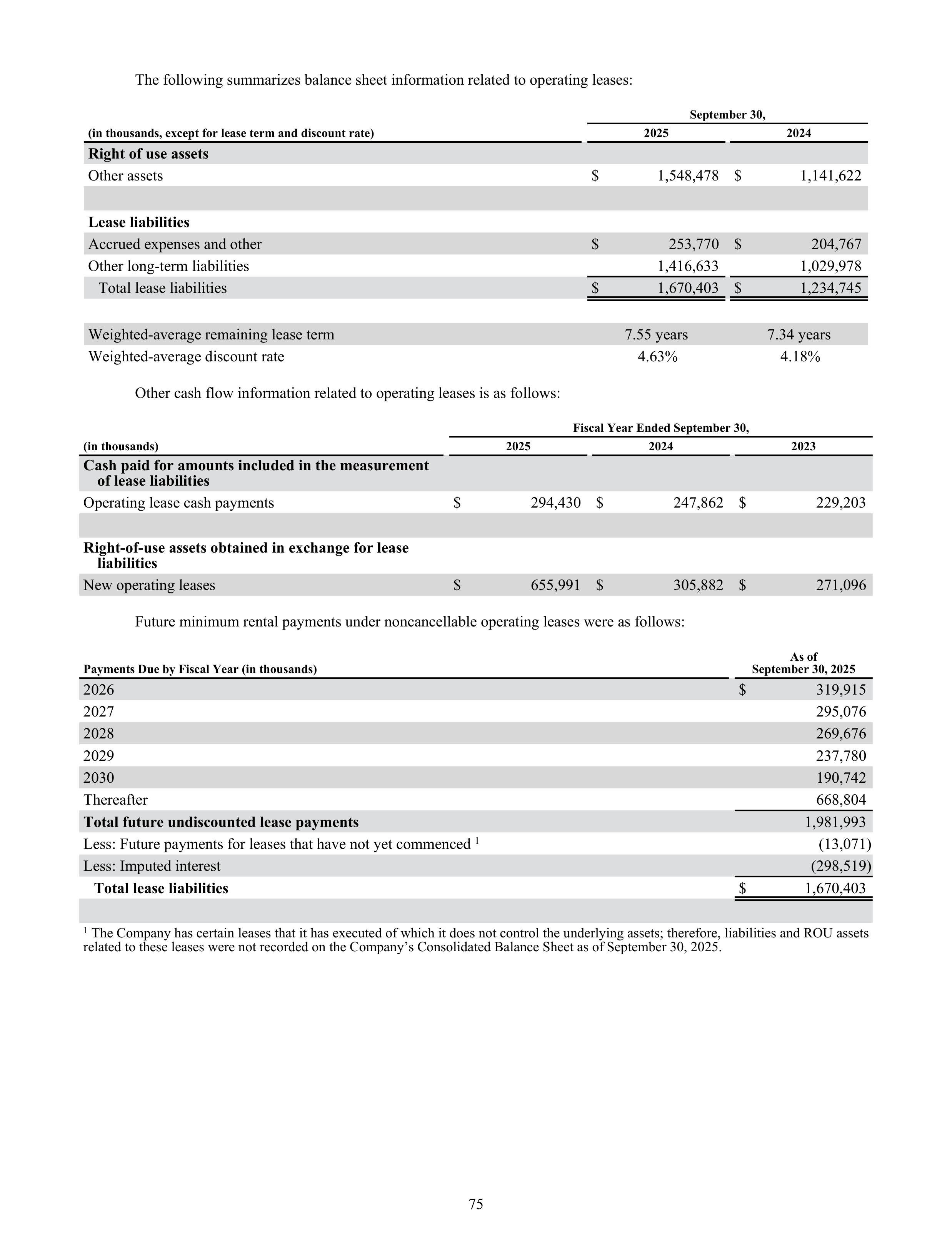
,=:;DAADL>CO:H76A6C8:H=::I>C;DGB6I>DCG:A6I:9IDDE:G6I>C<A:6H:H
&2
6:@5;A?.:1?2D0282.?2@2>9.:116?0;A:@>.@2
%645@;3A?2.??2@?
'I=:G6HH:IH
2.?286./686@62?
88GJ:9:ME:CH:H6C9DI=:G
'I=:GADC67>A>I>:H
,DI6AA:6H:A>67>A>I>:H
/:><=I:9
6K:G6C>C<A:6H:I:GB
N:6GH
N:6GH
/:><=I:9
6K:G6H8DJCIG6I:
'I=:G86H=;ADL>C;DGB6I>DCG:A6I:9IDDE:G6I>CH6H;DAADLH
6?0.8,2.>:121&2
6:@5;A?.:1?
.?5.9;A:@?6:08A1216:@5292.?A>292:@
;382.?286./686@62?
'E:G6I>C<A:6H:86H=E6NB:CIH
%645@;3A?2.??2@?;/@.6:216:2D05.:423;>82.?2
86./686@62?
&:LDE:G6I>C<A:6H:H
JIJG:B>C>BJBG:CI6AE6NB:CIHJC9:GCDC86C8:AA67A:DE:G6I>C<A:6H:HL:G:6H;DAADLH
#.E92:@?A2/E6?0.8,2.>6:@5;A?.:1?
?;3
&2
,=:G:6;I:G
';@.83A@A>2A:16?0;A:@2182.?2<.E92:@?
$:HHJIJG:E6NB:CIH;DGA:6H:HI=6I=6K:CDIN:I8DBB:C8:9
$:HH!BEJI:9>CI:G:HI
';@.882.?286./686@62?
,=:DBE6CN=6H8:GI6>CA:6H:HI=6I>I=6H:M:8JI:9D;L=>8=>I9D:HCDI8DCIGDAI=:JC9:GAN>C67>A>I>:H6C9*'-6HH:IH
G:A6I:9IDI=:H:A:6H:HL:G:CDIG:8DG9:9DCI=:DBE6CNXHDCHDA>96I:96A6C8:+=::I6HD;+:EI:B7:G
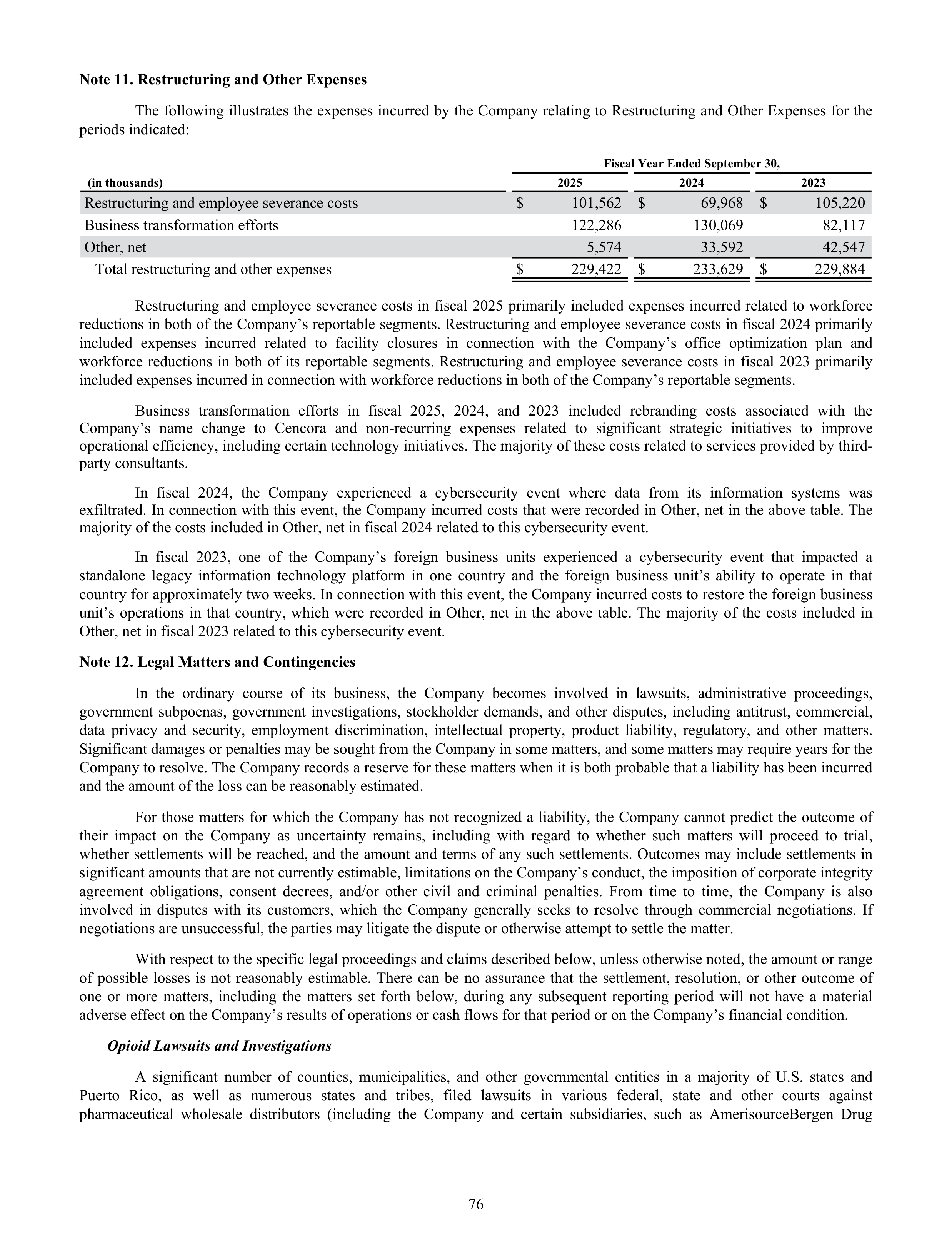
!;@2
%2?@>A0@A>6:4.:1"@52>D<2:?2?
,=:;DAADL>CAAJHIG6I:HI=::ME:CH:H>C8JGG:97NI=:DBE6CNG:A6I>CC<6C9'I=:GME:CH:H;DGI=:
E:G>D9H>C9>86I:9
6?0.8,2.>:121&2
6:@5;A?.:1?
*:HIGJ8IJG>C<6C9:BEADN::H:K:G6C8:8DHIH
JH>C:HHIG6CH;DGB6I>DC:;;DGIH
'I=:G C:I
,DI6AG:HIGJ8IJG>C<6C9DI=:G:ME:CH:H
*:HIGJ8IJG>CC;>H86A
EG>B6G>AN>C8AJ9:9:ME:CH:H>C8JGG:9G:A6I:9IDLDG@;DG8:
G:9J8I>DCH>C7DI=D;I=:DBE6CNXHG:EDGI67A:H:CC;>H86A
EG>B6G>AN
>C8AJ9:9 :ME:CH:H >C8JGG:9 G:A6I:9 ID ;68>A>IN 8ADHJG:H >C 8DCC:8I>DC L>I= I=: DBE6CNXH D;;>8: DEI>B>O6I>DC EA6C 6C9
LDG@;DG8:G:9J8I>DCH>C7DI=D;>IHG:EDGI67A:H:CC;>H86A
EG>B6G>AN
>C8AJ9:9:ME:CH:H>C8JGG:9>C8DCC:8I>DCL>I=LDG@;DG8:G:9J8I>DCH>C7DI=D;I=:DBE6CNXHG:EDGI67A:H:<B:CIH
JH>C:HH
IG6CH;DGB6I>DC
:;;DGIH
>C
;>H86A
6C9
>C8AJ9:9
G:7G6C9>C<
8DHIH
6HHD8>6I:9
L>I=
I=:
DBE6CNXH
C6B:
8=6C<:
ID
:C8DG6
6C9
CDC
G:8JGG>C<
:ME:CH:H
G:A6I:9
ID
H>;>86CI
HIG6I:8
>C>I>6I>K:H
ID
>BEGDK:
DE:G6I>DC6A:;;>8>:C8N >C8AJ9>CCI:8=CDADC>I>6I>K:H,=:B6?DG>IND;I=:H:8DHIHG:A6I:9IDH:GK>8:HEGDK>9:97NI=>G9
E6GIN8DCHJAI6CIH
!C ;>H86A
I=: DBE6CN :ME:G>:C8:9 6 8N7:GH:8JG>IN :K:CI L=:G: 96I6 ;GDB >IH >C;DGB6I>DC HNHI:BH L6H
:M;>AIG6I:9!C8DCC:8I>DCL>I=I=>H:K:CI I=:DBE6CN>C8JGG:98DHIHI=6IL:G:G:8DG9:9>C'I=:G C:I>CI=:67DK:I67A:,=:
B6?DG>IND;I=:8DHIH>C8AJ9:9>C'I=:G C:I>C;>H86A
G:A6I:9IDI=>H8N7:GH:8JG>IN:K:CI
!C ;>H86A
DC: D; I=: DBE6CNXH ;DG:>C:HH JC>IH :ME:G>:C8:9 6 8N7:GH:8JG>IN :K:CI I=6I >BE68I:9 6
HI6C96ADC:A:C;DGB6I>DCI:8=CDADCDC:8DJCIGN6C9I=:;DG:>C:HHJC>IXH67>A>INIDDE:G6I:>CI=6I
8DJCIGN;DG6EEGDM>B6I:ANILDL::@H!C8DCC:8I>DCL>I=I=>H:K:CI I=:DBE6CN>C8JGG:98DHIHIDG:HIDG:I=:;DG:>C:HH
JC>IXHDE:G6I>DCH>CI=6I8DJCIGN L=>8=L:G:G:8DG9:9>C'I=:G C:I>CI=:67DK:I67A:,=:B6?DG>IND;I=:8DHIH>C8AJ9:9>C
'I=:G C:I>C;>H86A
G:A6I:9IDI=>H8N7:GH:8JG>IN:K:CI
!;@2
24.8 .@@2>?.:1;:@6:42:062?
!C I=: DG9>C6GN 8DJGH: D; >IH 7JH>C:HH I=: DBE6CN 7:8DB:H >CKDAK:9 >C A6LHJ>IH 69B>C>HIG6I>K: EGD8::9>C<H
<DK:GCB:CIHJ7ED:C6H CK:HI>DCH HID8@=DA9:G9:B6C9H 6C9DI=:G9>HEJI:H >C8AJ9>CIGJHI 8DBB:G8>6A
96I6 EG>K68N 6C9 H:8JG>IN :BEADNB:CI 9>H8G>B>C6I>DC >CI:AA:8IJ6A EGDE:GIN EGD9J8I A>67>A>IN G:<JA6IDGN 6C9 DI=:G B6II:GH
+>;>86CI96B6:HB6N7:HDJCHDB:B6II:GH 6C9HDB:B6II:GHB6NG:FJ>G:N:6GH;DGI=:
DBE6CNIDG:HDAK:,=:DBE6CNG:8DG9H6G:H:GK:;DGI=:H:B6II:GHL=:C>I>H7DI=EGD767A:I=6I6A>67>A>IN=6H7::C>C8JGG:9
6C9I=:6BDJCID;I=:ADHH86C7:G:6HDC67AN:HI>B6I:9
DGI=DH:B6II:GH;DGL=>8=I=:DBE6CN=6HCDIG:8DO:96A>67>A>IN I=:DBE6CN86CCDIEG:9>8II=:DJI8DB:D;
I=:>G >BE68I DC I=: DBE6CN 6H JC8:GI6>CIN G:B6>CH >C8AJ9>CI= G:AA EGD8::9 ID IG>6A
L=:I=:GH:IIA:B:CIHL>AA7:G:68=:9 6C9I=:6BDJCI6C9I:GBHD;6CNHJ8=H:IIA:B:CIH'JI8DB:HB6N>C8AJ9:H:IIA:B:CIH>C
H>;>86CI6BDJCIHI=6I6G:CDI8JGG:CIAN:HI>B67A: A>B>I6I>DCHDCI=:DBE6CNXH8DC9J8I I=:>BEDH>I>DCD;8DGEDG6I:>CI:IN
6DCH 8DCH:CI 9:8G::H 6C9DG DI=:G 8>K>A 6C9 8G>B>C6A E:C6AI>:H GDB I>B: ID I>B: I=: DBE6CN >H 6AHD
>CKDAK:9>C9>HEJI:HL>I=>IH8JHIDB:GH L=>8=I=:DBE6CN<:C:G6AANH::@HIDG:HDAK:I=GDJ6AC:6I>DCH!;
C:6I>DCH6G:JCHJ88:HH;JA I=:E6GI>:HB6NA>I>HEJI:DGDI=:GL>H:6II:BEIIDH:IIA:I=:B6II:G
/>I=G:HE:8IIDI=:HE:8>;>8A:CBH9:H8G>7:97:ADL JCA:HHDI=:GL>H:CDI:9 I=:6BDJCIDGG6C<:
D;EDHH>7A:ADHH:H>HCDIG:6HDC67AN:HI>B67A:,=:G:86C7:CD6HHJG6C8:I=6II=:H:IIA:B:CI G:HDAJI>DC DGDI=:GDJI8DB:D;
DC:DGBDG:B6II:GH >C8AJ9>CCCD9L>AACDI=6K:6B6I:G>6A
69K:GH::;;:8IDCI=:DBE6CNXHG:HJAIHD;DE:G6I>DCHDG86H=;ADLH;DGI=6IE:G>D9DGDCI=:DBE6CNXH;>C6C8>6A8DC9>I>DC
9282-*@2=<*7-7?.<=20*=287<
H>;>86CI CJB7:G D; 8DJCI>:H BJC>8>E6A>I>:H 6C9 DI=:G I>:H >C 6 B6?DG>IN D; -+ HI6I:H 6C9
(J:GID
*>8D
6H
L:AA
6H
CJB:GDJH
HI6I:H
6C9
IG>7:H
;>A:9
A6LHJ>IH
>C
K6G>DJH
;:9:G6A
HI6I:
6C9
DI=:G
8DJGIH
6CHI
E=6GB68:JI>86A L=DA:H6A: 9>HIG>7JIDGH >C8AJ9>CC HJ7H>9>6G>:H HJ8= 6H B:G>HDJG8::G<:C GJ<
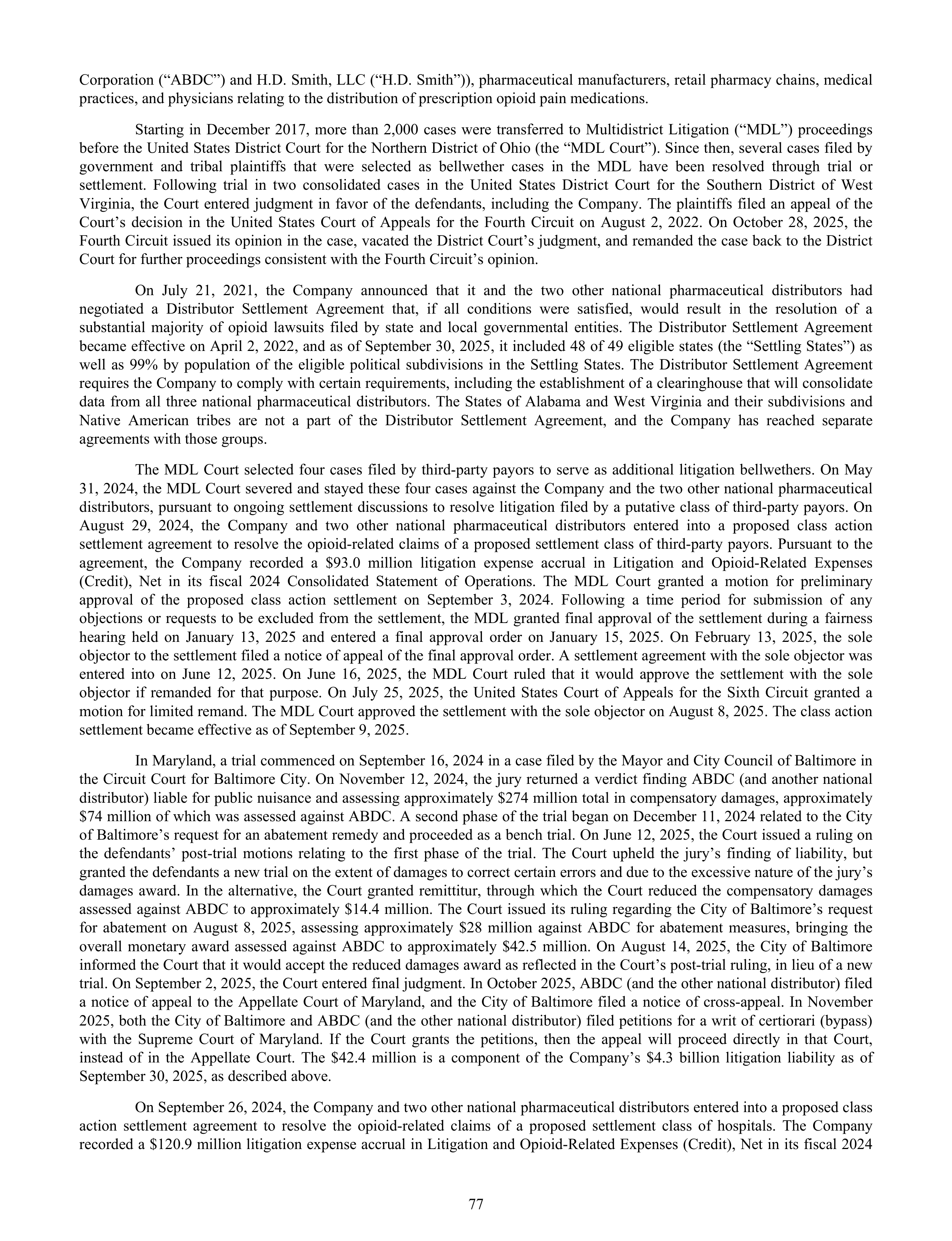
Corporation (“ABDC”) and H.D. Smith, LLC (“H.D. Smith”)), pharmaceutical manufacturers, retail pharmacy chains, medical
practices, and physicians relating to the distribution of prescription opioid pain medications.
Starting in December 2017, more than 2,000 cases were transferred to Multidistrict Litigation (“MDL”) proceedings
before the United States District Court for the Northern District of Ohio (the “MDL Court”). Since then, several cases filed by
government and tribal plaintiffs that were selected as bellwether cases in the MDL have been resolved through trial or
settlement. Following trial in two consolidated cases in the United States District Court for the Southern District of West
Virginia, the Court entered judgment in favor of the defendants, including the Company. The plaintiffs filed an appeal of the
Court’s decision in the United States Court of Appeals for the Fourth Circuit on August 2, 2022. On October 28, 2025, the
Fourth Circuit issued its opinion in the case, vacated the District Court’s judgment, and remanded the case back to the District
Court for further proceedings consistent with the Fourth Circuit’s opinion.
On July 21, 2021, the Company announced that it and the two other national pharmaceutical distributors had
negotiated a Distributor Settlement Agreement that, if all conditions were satisfied, would result in the resolution of a
substantial majority of opioid lawsuits filed by state and local governmental entities. The Distributor Settlement Agreement
became effective on April 2, 2022, and as of September 30, 2025, it included 48 of 49 eligible states (the “Settling States”) as
well as 99% by population of the eligible political subdivisions in the Settling States. The Distributor Settlement Agreement
requires the Company to comply with certain requirements, including the establishment of a clearinghouse that will consolidate
data from all three national pharmaceutical distributors. The States of Alabama and West Virginia and their subdivisions and
Native American tribes are not a part of the Distributor Settlement Agreement, and the Company has reached separate
agreements with those groups.
The MDL Court selected four cases filed by third-party payors to serve as additional litigation bellwethers. On May
31, 2024, the MDL Court severed and stayed these four cases against the Company and the two other national pharmaceutical
distributors, pursuant to ongoing settlement discussions to resolve litigation filed by a putative class of third-party payors. On
August 29, 2024, the Company and two other national pharmaceutical distributors entered into a proposed class action
settlement agreement to resolve the opioid-related claims of a proposed settlement class of third-party payors. Pursuant to the
agreement, the Company recorded a $93.0 million litigation expense accrual in Litigation and Opioid-Related Expenses
(Credit), Net in its fiscal 2024 Consolidated Statement of Operations. The MDL Court granted a motion for preliminary
approval of the proposed class action settlement on September 3, 2024. Following a time period for submission of any
objections or requests to be excluded from the settlement, the MDL granted final approval of the settlement during a fairness
hearing held on January 13, 2025 and entered a final approval order on January 15, 2025. On February 13, 2025, the sole
objector to the settlement filed a notice of appeal of the final approval order. A settlement agreement with the sole objector was
entered into on June 12, 2025. On June 16, 2025, the MDL Court ruled that it would approve the settlement with the sole
objector if remanded for that purpose. On July 25, 2025, the United States Court of Appeals for the Sixth Circuit granted a
motion for limited remand. The MDL Court approved the settlement with the sole objector on August 8, 2025. The class action
settlement became effective as of September 9, 2025.
In Maryland, a trial commenced on September 16, 2024 in a case filed by the Mayor and City Council of Baltimore in
the Circuit Court for Baltimore City. On November 12, 2024, the jury returned a verdict finding ABDC (and another national
distributor) liable for public nuisance and assessing approximately $274 million total in compensatory damages, approximately
$74 million of which was assessed against ABDC. A second phase of the trial began on December 11, 2024 related to the City
of Baltimore’s request for an abatement remedy and proceeded as a bench trial. On June 12, 2025, the Court issued a ruling on
the defendants’ post-trial motions relating to the first phase of the trial. The Court upheld the jury’s finding of liability, but
granted the defendants a new trial on the extent of damages to correct certain errors and due to the excessive nature of the jury’s
damages award. In the alternative, the Court granted remittitur, through which the Court reduced the compensatory damages
assessed against ABDC to approximately $14.4 million. The Court issued its ruling regarding the City of Baltimore’s request
for abatement on August 8, 2025, assessing approximately $28 million against ABDC for abatement measures, bringing the
overall monetary award assessed against ABDC to approximately $42.5 million. On August 14, 2025, the City of Baltimore
informed the Court that it would accept the reduced damages award as reflected in the Court’s post-trial ruling, in lieu of a new
trial. On September 2, 2025, the Court entered final judgment. In October 2025, ABDC (and the other national distributor) filed
a notice of appeal to the Appellate Court of Maryland, and the City of Baltimore filed a notice of cross-appeal. In November
2025, both the City of Baltimore and ABDC (and the other national distributor) filed petitions for a writ of certiorari (bypass)
with the Supreme Court of Maryland. If the Court grants the petitions, then the appeal will proceed directly in that Court,
instead of in the Appellate Court. The $42.4 million is a component of the Company’s $4.3 billion litigation liability as of
September 30, 2025, as described above.
On September 26, 2024, the Company and two other national pharmaceutical distributors entered into a proposed class
action settlement agreement to resolve the opioid-related claims of a proposed settlement class of hospitals. The Company
recorded a $120.9 million litigation expense accrual in Litigation and Opioid-Related Expenses (Credit), Net in its fiscal 2024
77
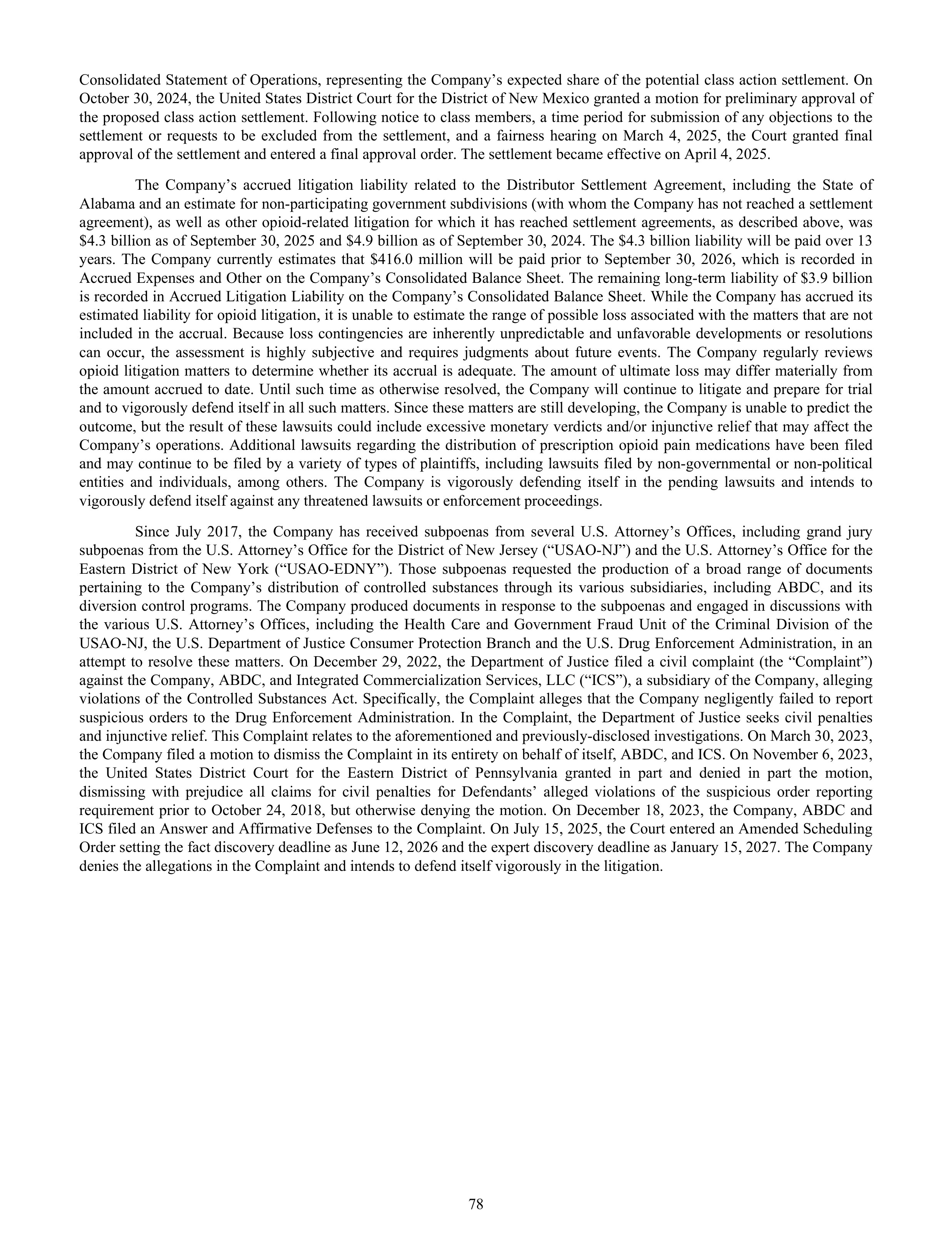
Consolidated Statement of Operations, representing the Company’s expected share of the potential class action settlement. On
October 30, 2024, the United States District Court for the District of New Mexico granted a motion for preliminary approval of
the proposed class action settlement. Following notice to class members, a time period for submission of any objections to the
settlement or requests to be excluded from the settlement, and a fairness hearing on March 4, 2025, the Court granted final
approval of the settlement and entered a final approval order. The settlement became effective on April 4, 2025.
The Company’s accrued litigation liability related to the Distributor Settlement Agreement, including the State of
Alabama and an estimate for non-participating government subdivisions (with whom the Company has not reached a settlement
agreement), as well as other opioid-related litigation for which it has reached settlement agreements, as described above, was
$4.3 billion as of September 30, 2025 and $4.9 billion as of September 30, 2024. The $4.3 billion liability will be paid over 13
years. The Company currently estimates that $416.0 million will be paid prior to September 30, 2026, which is recorded in
Accrued Expenses and Other on the Company’s Consolidated Balance Sheet. The remaining long-term liability of $3.9 billion
is recorded in Accrued Litigation Liability on the Company’s Consolidated Balance Sheet. While the Company has accrued its
estimated liability for opioid litigation, it is unable to estimate the range of possible loss associated with the matters that are not
included in the accrual. Because loss contingencies are inherently unpredictable and unfavorable developments or resolutions
can occur, the assessment is highly subjective and requires judgments about future events. The Company regularly reviews
opioid litigation matters to determine whether its accrual is adequate. The amount of ultimate loss may differ materially from
the amount accrued to date. Until such time as otherwise resolved, the Company will continue to litigate and prepare for trial
and to vigorously defend itself in all such matters. Since these matters are still developing, the Company is unable to predict the
outcome, but the result of these lawsuits could include excessive monetary verdicts and/or injunctive relief that may affect the
Company’s operations. Additional lawsuits regarding the distribution of prescription opioid pain medications have been filed
and may continue to be filed by a variety of types of plaintiffs, including lawsuits filed by non-governmental or non-political
entities and individuals, among others. The Company is vigorously defending itself in the pending lawsuits and intends to
vigorously defend itself against any threatened lawsuits or enforcement proceedings.
Since July 2017, the Company has received subpoenas from several U.S. Attorney’s Offices, including grand jury
subpoenas from the U.S. Attorney’s Office for the District of New Jersey (“USAO-NJ”) and the U.S. Attorney’s Office for the
Eastern District of New York (“USAO-EDNY”). Those subpoenas requested the production of a broad range of documents
pertaining to the Company’s distribution of controlled substances through its various subsidiaries, including ABDC, and its
diversion control programs. The Company produced documents in response to the subpoenas and engaged in discussions with
the various U.S. Attorney’s Offices, including the Health Care and Government Fraud Unit of the Criminal Division of the
USAO-NJ, the U.S. Department of Justice Consumer Protection Branch and the U.S. Drug Enforcement Administration, in an
attempt to resolve these matters. On December 29, 2022, the Department of Justice filed a civil complaint (the “Complaint”)
against the Company, ABDC, and Integrated Commercialization Services, LLC (“ICS”), a subsidiary of the Company, alleging
violations of the Controlled Substances Act. Specifically, the Complaint alleges that the Company negligently failed to report
suspicious orders to the Drug Enforcement Administration. In the Complaint, the Department of Justice seeks civil penalties
and injunctive relief. This Complaint relates to the aforementioned and previously-disclosed investigations. On March 30, 2023,
the Company filed a motion to dismiss the Complaint in its entirety on behalf of itself, ABDC, and ICS. On November 6, 2023,
the United States District Court for the Eastern District of Pennsylvania granted in part and denied in part the motion,
dismissing with prejudice all claims for civil penalties for Defendants’ alleged violations of the suspicious order reporting
requirement prior to October 24, 2018, but otherwise denying the motion. On December 18, 2023, the Company, ABDC and
ICS filed an Answer and Affirmative Defenses to the Complaint. On July 15, 2025, the Court entered an Amended Scheduling
Order setting the fact discovery deadline as June 12, 2026 and the expert discovery deadline as January 15, 2027. The Company
denies the allegations in the Complaint and intends to defend itself vigorously in the litigation.
78
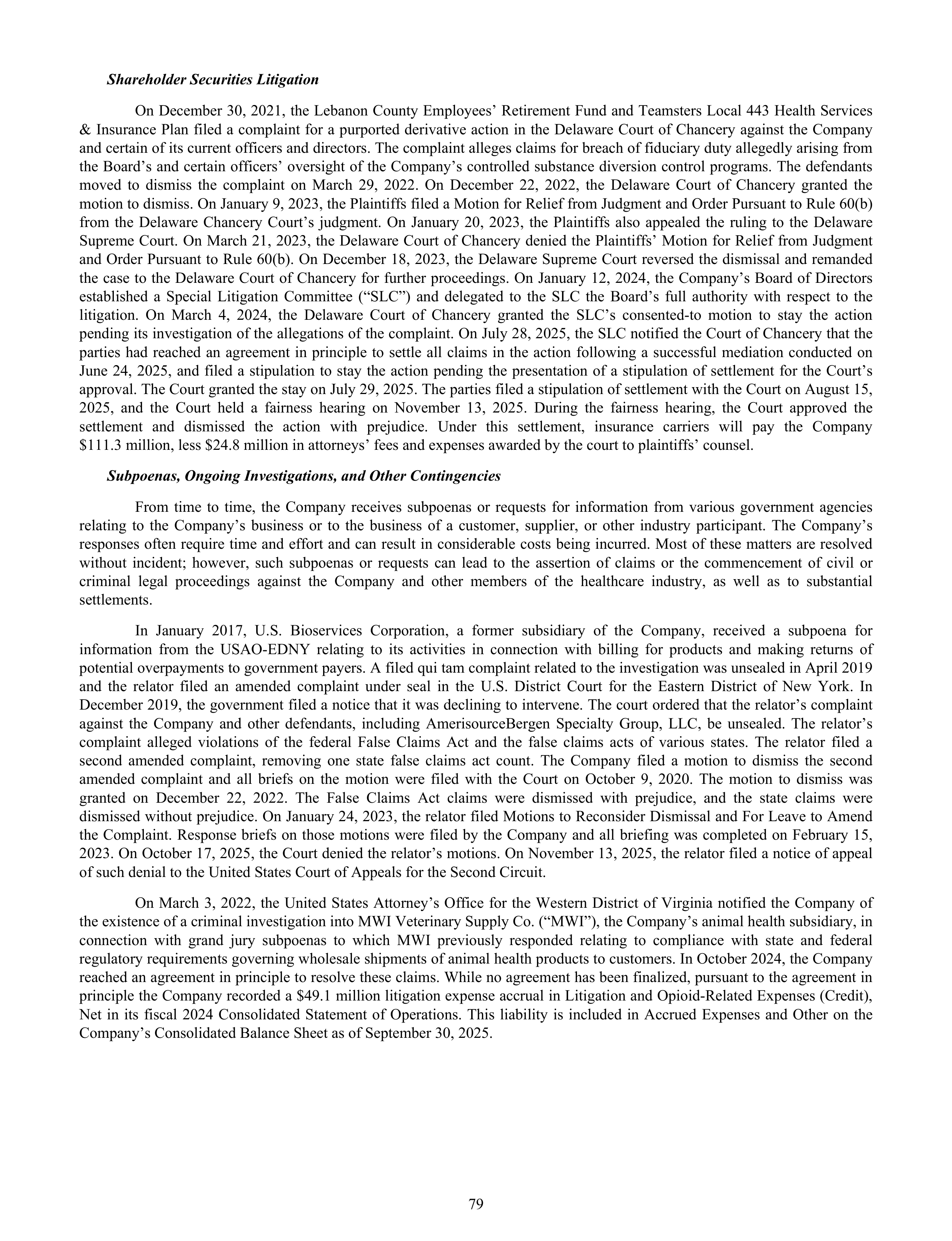
Shareholder Securities Litigation
On December 30, 2021, the Lebanon County Employees’ Retirement Fund and Teamsters Local 443 Health Services
& Insurance Plan filed a complaint for a purported derivative action in the Delaware Court of Chancery against the Company
and certain of its current officers and directors. The complaint alleges claims for breach of fiduciary duty allegedly arising from
the Board’s and certain officers’ oversight of the Company’s controlled substance diversion control programs. The defendants
moved to dismiss the complaint on March 29, 2022. On December 22, 2022, the Delaware Court of Chancery granted the
motion to dismiss. On January 9, 2023, the Plaintiffs filed a Motion for Relief from Judgment and Order Pursuant to Rule 60(b)
from the Delaware Chancery Court’s judgment. On January 20, 2023, the Plaintiffs also appealed the ruling to the Delaware
Supreme Court. On March 21, 2023, the Delaware Court of Chancery denied the Plaintiffs’ Motion for Relief from Judgment
and Order Pursuant to Rule 60(b). On December 18, 2023, the Delaware Supreme Court reversed the dismissal and remanded
the case to the Delaware Court of Chancery for further proceedings. On January 12, 2024, the Company’s Board of Directors
established a Special Litigation Committee (“SLC”) and delegated to the SLC the Board’s full authority with respect to the
litigation. On March 4, 2024, the Delaware Court of Chancery granted the SLC’s consented-to motion to stay the action
pending its investigation of the allegations of the complaint. On July 28, 2025, the SLC notified the Court of Chancery that the
parties had reached an agreement in principle to settle all claims in the action following a successful mediation conducted on
June 24, 2025, and filed a stipulation to stay the action pending the presentation of a stipulation of settlement for the Court’s
approval. The Court granted the stay on July 29, 2025. The parties filed a stipulation of settlement with the Court on August 15,
2025, and the Court held a fairness hearing on November 13, 2025. During the fairness hearing, the Court approved the
settlement and dismissed the action with prejudice. Under this settlement, insurance carriers will pay the Company
$111.3 million, less $24.8 million in attorneys’ fees and expenses awarded by the court to plaintiffs’ counsel.
Subpoenas, Ongoing Investigations, and Other Contingencies
From time to time, the Company receives subpoenas or requests for information from various government agencies
relating to the Company’s business or to the business of a customer, supplier, or other industry participant. The Company’s
responses often require time and effort and can result in considerable costs being incurred. Most of these matters are resolved
without incident; however, such subpoenas or requests can lead to the assertion of claims or the commencement of civil or
criminal legal proceedings against the Company and other members of the healthcare industry, as well as to substantial
settlements.
In January 2017, U.S. Bioservices Corporation, a former subsidiary of the Company, received a subpoena for
information from the USAO-EDNY relating to its activities in connection with billing for products and making returns of
potential overpayments to government payers. A filed qui tam complaint related to the investigation was unsealed in April 2019
and the relator filed an amended complaint under seal in the U.S. District Court for the Eastern District of New York. In
December 2019, the government filed a notice that it was declining to intervene. The court ordered that the relator’s complaint
against the Company and other defendants, including AmerisourceBergen Specialty Group, LLC, be unsealed. The relator’s
complaint alleged violations of the federal False Claims Act and the false claims acts of various states. The relator filed a
second amended complaint, removing one state false claims act count. The Company filed a motion to dismiss the second
amended complaint and all briefs on the motion were filed with the Court on October 9, 2020. The motion to dismiss was
granted on December 22, 2022. The False Claims Act claims were dismissed with prejudice, and the state claims were
dismissed without prejudice. On January 24, 2023, the relator filed Motions to Reconsider Dismissal and For Leave to Amend
the Complaint. Response briefs on those motions were filed by the Company and all briefing was completed on February 15,
2023. On October 17, 2025, the Court denied the relator’s motions. On November 13, 2025, the relator filed a notice of appeal
of such denial to the United States Court of Appeals for the Second Circuit.
On March 3, 2022, the United States Attorney’s Office for the Western District of Virginia notified the Company of
the existence of a criminal investigation into MWI Veterinary Supply Co. (“MWI”), the Company’s animal health subsidiary, in
connection with grand jury subpoenas to which MWI previously responded relating to compliance with state and federal
regulatory requirements governing wholesale shipments of animal health products to customers. In October 2024, the Company
reached an agreement in principle to resolve these claims. While no agreement has been finalized, pursuant to the agreement in
principle the Company recorded a $49.1 million litigation expense accrual in Litigation and Opioid-Related Expenses (Credit),
Net in its fiscal 2024 Consolidated Statement of Operations. This liability is included in Accrued Expenses and Other on the
Company’s Consolidated Balance Sheet as of September 30, 2025.
79
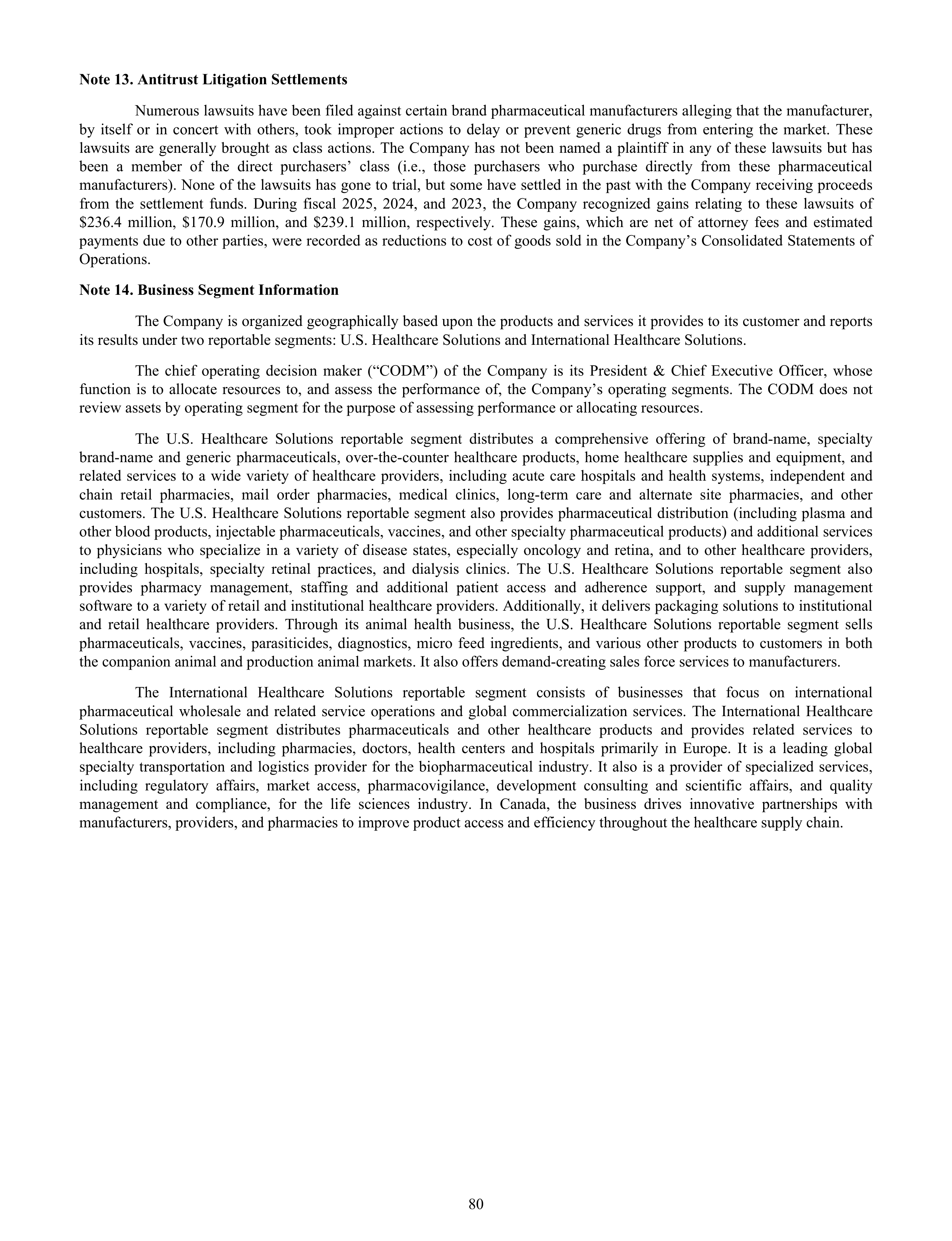
Note 13. Antitrust Litigation Settlements
Numerous lawsuits have been filed against certain brand pharmaceutical manufacturers alleging that the manufacturer,
by itself or in concert with others, took improper actions to delay or prevent generic drugs from entering the market. These
lawsuits are generally brought as class actions. The Company has not been named a plaintiff in any of these lawsuits but has
been a member of the direct purchasers’ class (i.e., those purchasers who purchase directly from these pharmaceutical
manufacturers). None of the lawsuits has gone to trial, but some have settled in the past with the Company receiving proceeds
from the settlement funds. During fiscal 2025, 2024, and 2023, the Company recognized gains relating to these lawsuits of
$236.4 million, $170.9 million, and $239.1 million, respectively. These gains, which are net of attorney fees and estimated
payments due to other parties, were recorded as reductions to cost of goods sold in the Company’s Consolidated Statements of
Operations.
Note 14. Business Segment Information
The Company is organized geographically based upon the products and services it provides to its customer and reports
its results under two reportable segments: U.S. Healthcare Solutions and International Healthcare Solutions.
The chief operating decision maker (“CODM”) of the Company is its President & Chief Executive Officer, whose
function is to allocate resources to, and assess the performance of, the Company’s operating segments. The CODM does not
review assets by operating segment for the purpose of assessing performance or allocating resources.
The U.S. Healthcare Solutions reportable segment distributes a comprehensive offering of brand-name, specialty
brand-name and generic pharmaceuticals, over-the-counter healthcare products, home healthcare supplies and equipment, and
related services to a wide variety of healthcare providers, including acute care hospitals and health systems, independent and
chain retail pharmacies, mail order pharmacies, medical clinics, long-term care and alternate site pharmacies, and other
customers. The U.S. Healthcare Solutions reportable segment also provides pharmaceutical distribution (including plasma and
other blood products, injectable pharmaceuticals, vaccines, and other specialty pharmaceutical products) and additional services
to physicians who specialize in a variety of disease states, especially oncology and retina, and to other healthcare providers,
including hospitals, specialty retinal practices, and dialysis clinics. The U.S. Healthcare Solutions reportable segment also
provides pharmacy management, staffing and additional patient access and adherence support, and supply management
software to a variety of retail and institutional healthcare providers. Additionally, it delivers packaging solutions to institutional
and retail healthcare providers. Through its animal health business, the U.S. Healthcare Solutions reportable segment sells
pharmaceuticals, vaccines, parasiticides, diagnostics, micro feed ingredients, and various other products to customers in both
the companion animal and production animal markets. It also offers demand-creating sales force services to manufacturers.
The International Healthcare Solutions reportable segment consists of businesses that focus on international
pharmaceutical wholesale and related service operations and global commercialization services. The International Healthcare
Solutions reportable segment distributes pharmaceuticals and other healthcare products and provides related services to
healthcare providers, including pharmacies, doctors, health centers and hospitals primarily in Europe. It is a leading global
specialty transportation and logistics provider for the biopharmaceutical industry. It also is a provider of specialized services,
including regulatory affairs, market access, pharmacovigilance, development consulting and scientific affairs, and quality
management and compliance, for the life sciences industry. In Canada, the business drives innovative partnerships with
manufacturers, providers, and pharmacies to improve product access and efficiency throughout the healthcare supply chain.
80
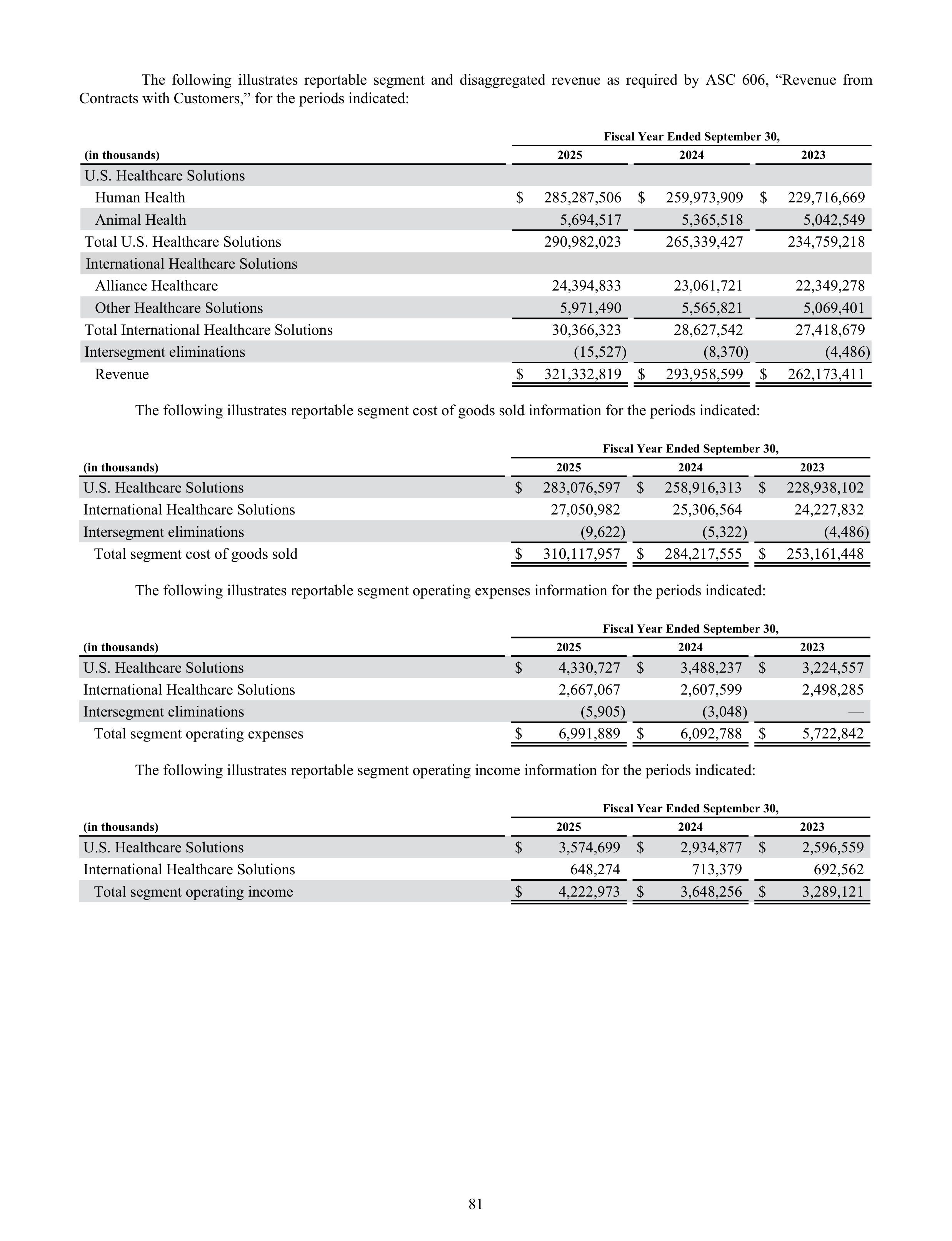
,=: ;DAADL>CAAJHIG6I:H G:EDGI67A: H:H6<<G:G:9 7N +
V*:K:CJ: ;GDB
DCIG68IHL>I=JHIDB:GH W;DGI=:E:G>D9H>C9>86I:9
6?0.8,2.>:121&2
6:@5;A?.:1?
-+ :6AI=86G:+DAJI>DCH
JB6C :6AI=
C>B6A :6AI=
,DI6A-+ :6AI=86G:+DAJI>DCH
!CI:GC6I>DC6A :6AI=86G:+DAJI>DCH
AA>6C8: :6AI=86G:
'I=:G :6AI=86G:+DAJI>DCH
,DI6A!CI:GC6I>DC6A :6AI=86G:+DAJI>DCH
!CI:GH:B>C6I>DCH
*:K:CJ:
,=:;DAADL>CAAJHIG6I:HG:EDGI67A:H:<B:CI8DHID;C;DGB6I>DC;DGI=:E:G>D9H>C9>86I:9
6?0.8,2.>:121&2
6:@5;A?.:1?
-+ :6AI=86G:+DAJI>DCH
!CI:GC6I>DC6A :6AI=86G:+DAJI>DCH
!CI:GH:B>C6I>DCH
,DI6AH:<B:CI8DHID;<DD9HHDA9
,=:;DAADL>CAAJHIG6I:HG:EDGI67A:H:CC;DGB6I>DC;DGI=:E:G>D9H>C9>86I:9
6?0.8,2.>:121&2
6:@5;A?.:1?
-+ :6AI=86G:+DAJI>DCH
!CI:GC6I>DC6A :6AI=86G:+DAJI>DCH
!CI:GH:B>C6I>DCH
U
,DI6AH:C<:ME:CH:H
,=:;DAADL>CAAJHIG6I:HG:EDGI67A:H:CC8DB:>C;DGB6I>DC;DGI=:E:G>D9H>C9>86I:9
6?0.8,2.>:121&2
6:@5;A?.:1?
-+ :6AI=86G:+DAJI>DCH
!CI:GC6I>DC6A :6AI=86G:+DAJI>DCH
,DI6AH:CC8DB:
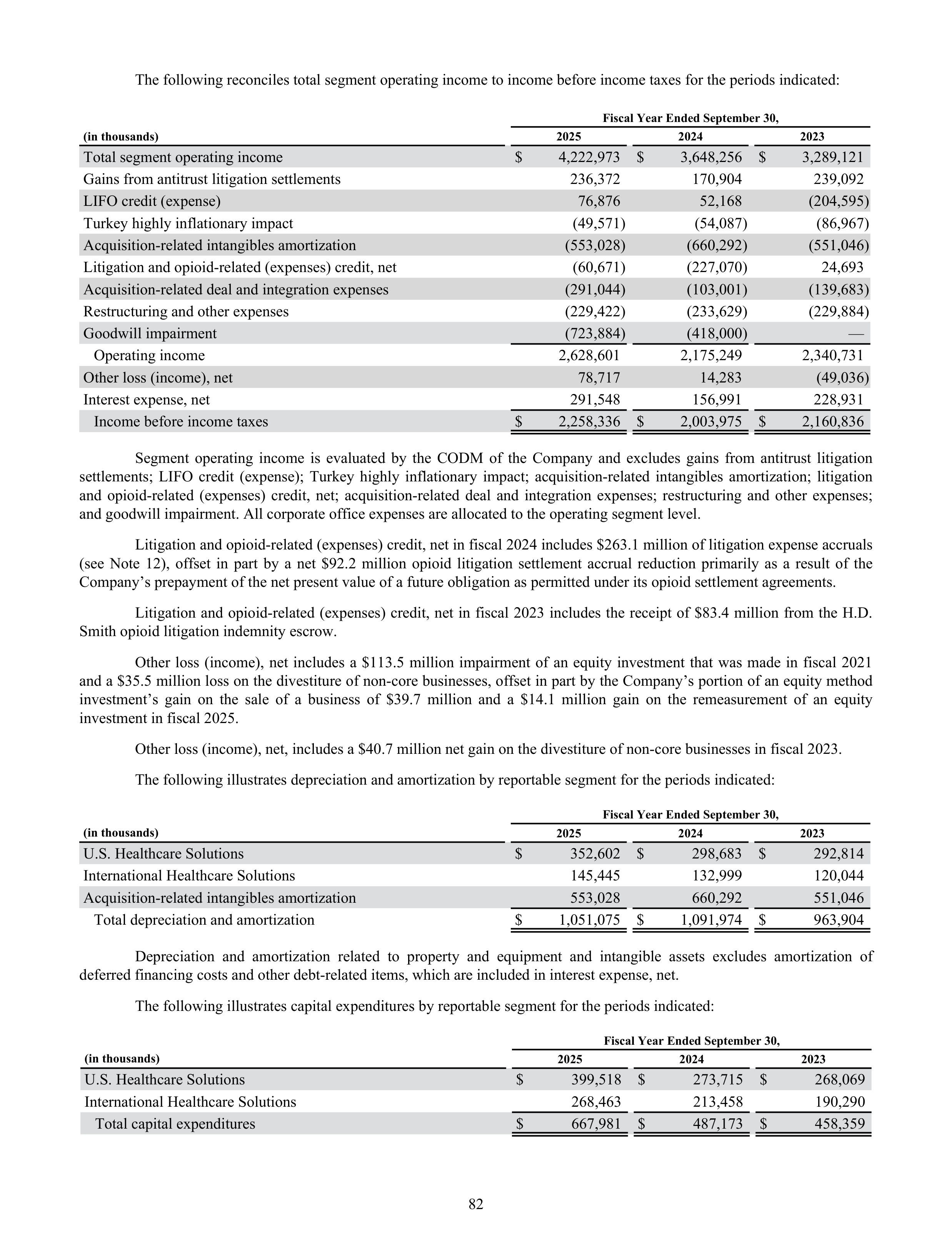
,=:;DAADL>CA:HIDI6AH:CC8DB:ID>C8DB:7:;DG:>C8DB:I6M:H;DGI=:E:G>D9H>C9>86I:9
6?0.8,2.>:121&2
6:@5;A?.:1?
,DI6AH:CC8DB:
6>CH;GDB6CI>IGJHIA>I>DCH:IIA:B:CIH
$!'8G:9>I:ME:CH:
,JG@:N=>C;A6I>DC6GN>BE68I
8FJ>H>I>DC
G:A6I:9>CI6C7A:H6BDGI>O6I>DC
$>I>DC6C9DE>D>9
G:A6I:9:ME:CH:H8G:9>I C:I
8FJ>H>I>DC
G:A6I:99:6A6C9>CI:DC:ME:CH:H
*:HIGJ8IJG>C<6C9DI=:G:ME:CH:H
DD9L>AA>BE6>GB:CI
U
'E:G6I>CC8DB:
'I=:GADHH>C8DB: C:I
!CI:G:HI:ME:CH: C:I
!C8DB:7:;DG:>C8DB:I6M:H
+:CC8DB:>H:K6AJ6I:97NI=:'%D;I=:DBE6CN6C9:M8AJ9:HCH;GDB6CI>IGJHIA>I>DC
H:IIA:B:CIH$!'8G:9>I:ME:CH:,JG@:N=>C;A6I>DC6GN>BE68I68FJ>H>I>DC
G:A6I:9>CI6C7A:H6BDGI>O6I>DCA>I>DC
6C9DE>D>9
G:A6I:9:ME:CH:H8G:9>I C:I68FJ>H>I>DC
G:A6I:99:6A6C9>CI:DC:ME:CH:HG:HIGJ8IJG>C<6C9DI=:G:ME:CH:H
6C9AA>BE6>GB:CIAA8DGEDG6I:D;;>8::ME:CH:H6G:6AAD86I:9IDI=:DE:G6I>C<H:<B:CIA:K:A
$>I>DC6C9DE>D>9
G:A6I:9:ME:CH:H8G:9>I C:I>C;>H86A
>C8AJ9:HB>AA>DCD;A>I>DC:ME:CH:688GJ6AH
H::&DI: D;;H:I>CE6GI7N6C:IB>AA>DCDE>D>9A>I>DCH:IIA:B:CI688GJ6AG:9J8I>DCEG>B6G>AN6H6G:HJAID;I=:
DBE6CNXHEG:E6NB:CID;I=:C:IEG:H:CIK6AJ:D;6;JIJG:D7A>DC6HE:GB>II:9JC9:G>IHDE>D>9H:IIA:B:CI6<G::B:CIH
$>I>DC6C9DE>D>9
G:A6I:9:ME:CH:H8G:9>I C:I>C;>H86A
>C8AJ9:HI=:G:8:>EID;B>AA>DC;GDBI=:
+B>I=DE>D>9A>I>DC>C9:BC>IN:H8GDL
'I=:GADHH>C8DB: C:I>C8AJ9:H6B>AA>DC>BE6>GB:CID;6C:FJ>IN>CK:HIB:CII=6IL6HB69:>C;>H86A
6C96B>AA>DCADHHDCI=:9>K:HI>IJG:D;CDC
8DG:7JH>C:HH:H D;;H:I>CE6GI7NI=:DBE6CNXHEDGI>DCD;6C:FJ>INB:I=D9
>CK:HIB:CIXH C DC I=: H6A: D; 6 7JH>C:HH D; B>AA>DC 6C9 6 B>AA>DC C DC I=: G:B:6HJG:B:CI D; 6C :FJ>IN
>CK:HIB:CI>C;>H86A
'I=:GADHH>C8DB: C:I >C8AJ9:H6
B>AA>DCC:ICDCI=:9>K:HI>IJG:D;CDC
8DG:7JH>C:HH:H>C;>H86A
,=:;DAADL>CAAJHIG6I:H9:EG:8>6I>DC6C96BDGI>O6I>DC7NG:EDGI67A:H:D9H>C9>86I:9
6?0.8,2.>:121&2
6:@5;A?.:1?
-+ :6AI=86G:+DAJI>DCH
!CI:GC6I>DC6A :6AI=86G:+DAJI>DCH
8FJ>H>I>DC
G:A6I:9>CI6C7A:H6BDGI>O6I>DC
,DI6A9:EG:8>6I>DC6C96BDGI>O6I>DC
:EG:8>6I>DC 6C9 6BDGI>O6I>DC G:A6I:9 ID EGDE:GIN 6C9 :FJ>EB:CI 6C9 >CI6C7A: 6HH:IH :M8AJ9:H 6BDGI>O6I>DC D;
9:;:GG:9;>C6C8>CI:BH L=>8=6G:>C8AJ9:9>C>CI:G:HI:ME:CH: C:I
,=:;DAADL>CAAJHIG6I:H86E>I6A:ME:C9>IJG:H7NG:EDGI67A:H:D9H>C9>86I:9
6?0.8,2.>:121&2
6:@5;A?.:1?
-+ :6AI=86G:+DAJI>DCH
!CI:GC6I>DC6A :6AI=86G:+DAJI>DCH
,DI6A86E>I6A:ME:C9>IJG:H
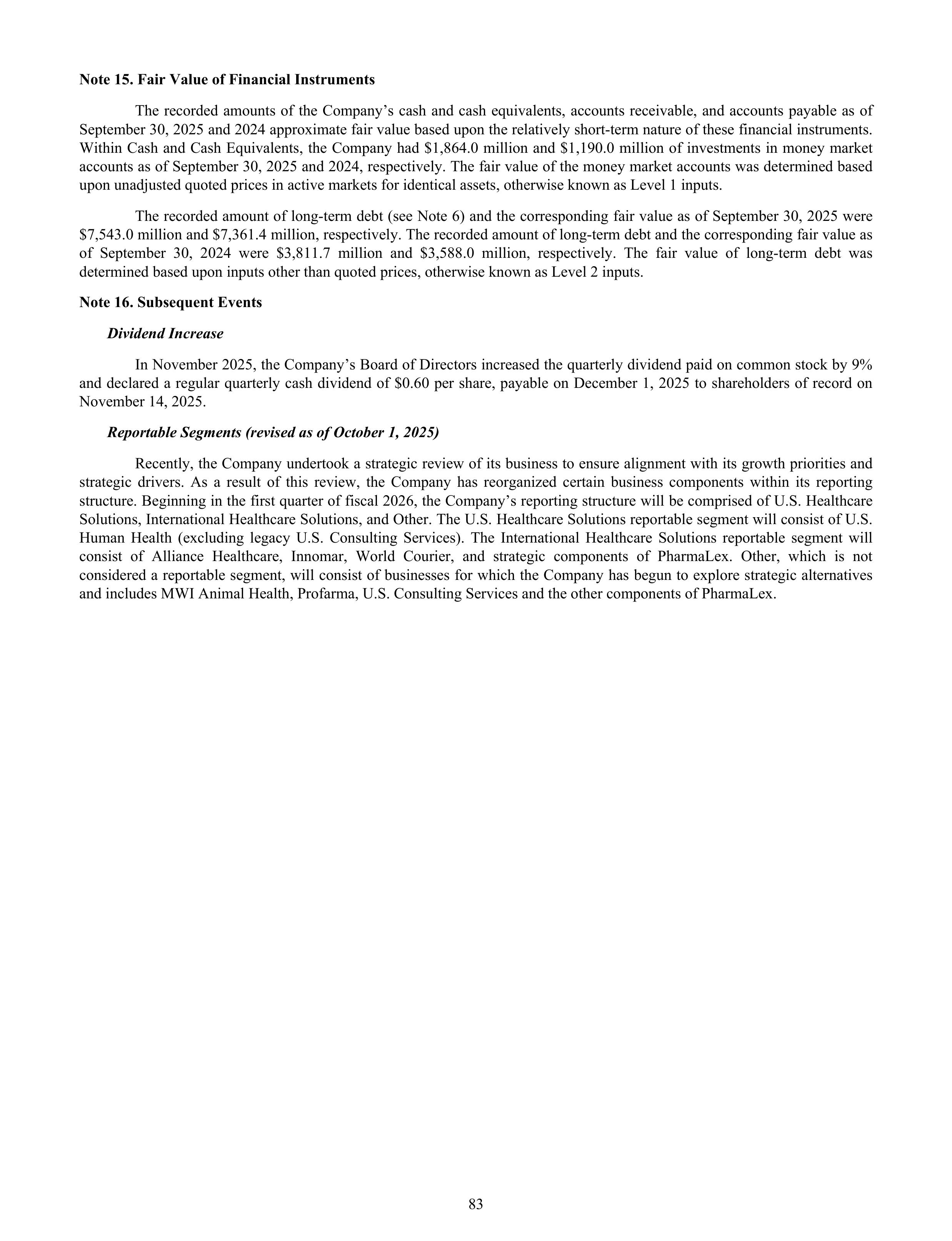
Note 15. Fair Value of Financial Instruments
The recorded amounts of the Company’s cash and cash equivalents, accounts receivable, and accounts payable as of
September 30, 2025 and 2024 approximate fair value based upon the relatively short-term nature of these financial instruments.
Within Cash and Cash Equivalents, the Company had $1,864.0 million and $1,190.0 million of investments in money market
accounts as of September 30, 2025 and 2024, respectively. The fair value of the money market accounts was determined based
upon unadjusted quoted prices in active markets for identical assets, otherwise known as Level 1 inputs.
The recorded amount of long-term debt (see Note 6) and the corresponding fair value as of September 30, 2025 were
$7,543.0 million and $7,361.4 million, respectively. The recorded amount of long-term debt and the corresponding fair value as
of September 30, 2024 were $3,811.7 million and $3,588.0 million, respectively. The fair value of long-term debt was
determined based upon inputs other than quoted prices, otherwise known as Level 2 inputs.
Note 16. Subsequent Events
Dividend Increase
In November 2025, the Company’s Board of Directors increased the quarterly dividend paid on common stock by 9%
and declared a regular quarterly cash dividend of $0.60 per share, payable on December 1, 2025 to shareholders of record on
November 14, 2025.
Reportable Segments (revised as of October 1, 2025)
Recently, the Company undertook a strategic review of its business to ensure alignment with its growth priorities and
strategic drivers. As a result of this review, the Company has reorganized certain business components within its reporting
structure. Beginning in the first quarter of fiscal 2026, the Company’s reporting structure will be comprised of U.S. Healthcare
Solutions, International Healthcare Solutions, and Other. The U.S. Healthcare Solutions reportable segment will consist of U.S.
Human Health (excluding legacy U.S. Consulting Services). The International Healthcare Solutions reportable segment will
consist of Alliance Healthcare, Innomar, World Courier, and strategic components of PharmaLex. Other, which is not
considered a reportable segment, will consist of businesses for which the Company has begun to explore strategic alternatives
and includes MWI Animal Health, Profarma, U.S. Consulting Services and the other components of PharmaLex.
83
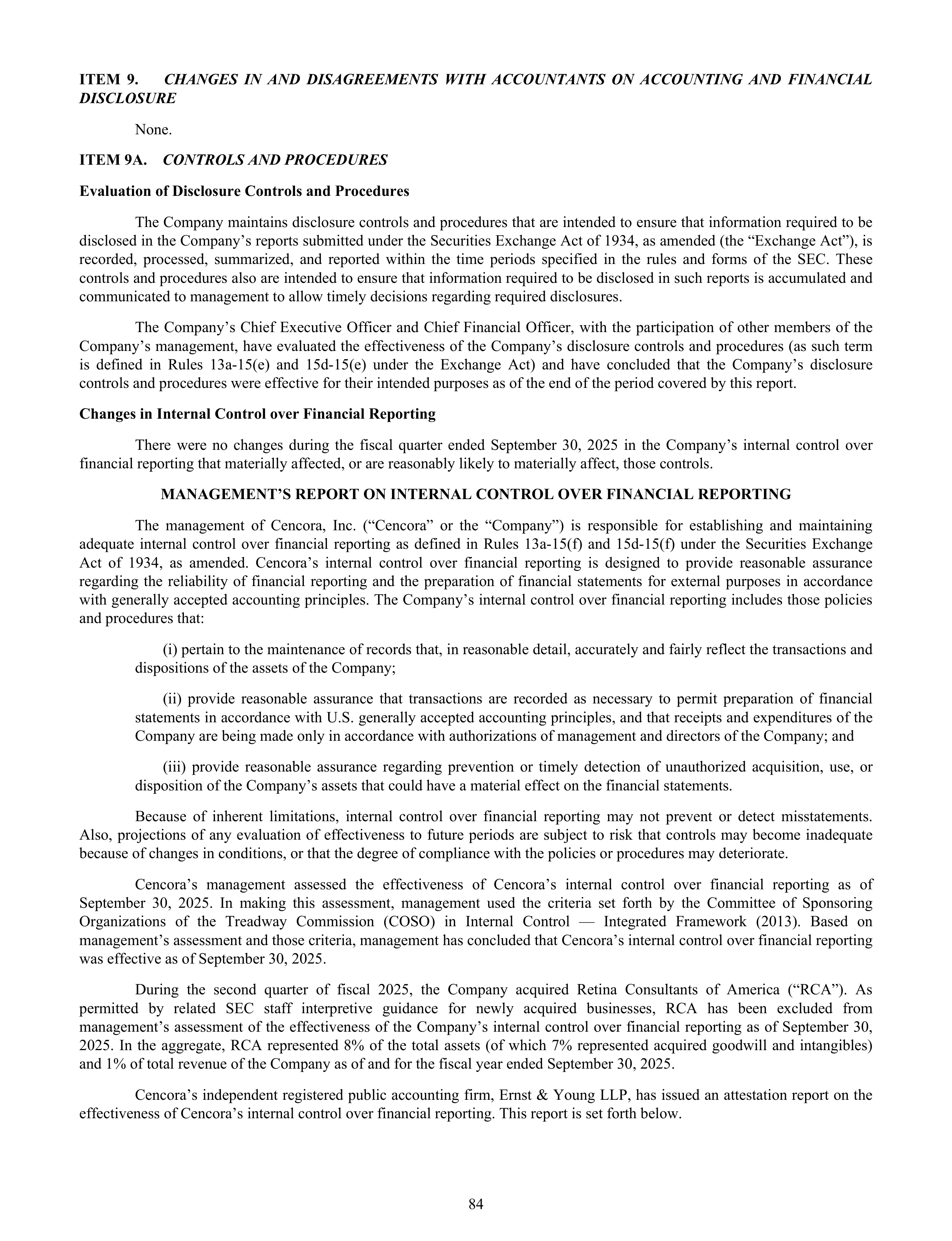
ITEM 9.
CHANGES IN AND DISAGREEMENTS WITH ACCOUNTANTS ON ACCOUNTING AND FINANCIAL
DISCLOSURE
None.
ITEM 9A.
CONTROLS AND PROCEDURES
Evaluation of Disclosure Controls and Procedures
The Company maintains disclosure controls and procedures that are intended to ensure that information required to be
disclosed in the Company’s reports submitted under the Securities Exchange Act of 1934, as amended (the “Exchange Act”), is
recorded, processed, summarized, and reported within the time periods specified in the rules and forms of the SEC. These
controls and procedures also are intended to ensure that information required to be disclosed in such reports is accumulated and
communicated to management to allow timely decisions regarding required disclosures.
The Company’s Chief Executive Officer and Chief Financial Officer, with the participation of other members of the
Company’s management, have evaluated the effectiveness of the Company’s disclosure controls and procedures (as such term
is defined in Rules 13a-15(e) and 15d-15(e) under the Exchange Act) and have concluded that the Company’s disclosure
controls and procedures were effective for their intended purposes as of the end of the period covered by this report.
Changes in Internal Control over Financial Reporting
There were no changes during the fiscal quarter ended September 30, 2025 in the Company’s internal control over
financial reporting that materially affected, or are reasonably likely to materially affect, those controls.
MANAGEMENT’S REPORT ON INTERNAL CONTROL OVER FINANCIAL REPORTING
The management of Cencora, Inc. (“Cencora” or the “Company”) is responsible for establishing and maintaining
adequate internal control over financial reporting as defined in Rules 13a-15(f) and 15d-15(f) under the Securities Exchange
Act of 1934, as amended. Cencora’s internal control over financial reporting is designed to provide reasonable assurance
regarding the reliability of financial reporting and the preparation of financial statements for external purposes in accordance
with generally accepted accounting principles. The Company’s internal control over financial reporting includes those policies
and procedures that:
(i) pertain to the maintenance of records that, in reasonable detail, accurately and fairly reflect the transactions and
dispositions of the assets of the Company;
(ii) provide reasonable assurance that transactions are recorded as necessary to permit preparation of financial
statements in accordance with U.S. generally accepted accounting principles, and that receipts and expenditures of the
Company are being made only in accordance with authorizations of management and directors of the Company; and
(iii) provide reasonable assurance regarding prevention or timely detection of unauthorized acquisition, use, or
disposition of the Company’s assets that could have a material effect on the financial statements.
Because of inherent limitations, internal control over financial reporting may not prevent or detect misstatements.
Also, projections of any evaluation of effectiveness to future periods are subject to risk that controls may become inadequate
because of changes in conditions, or that the degree of compliance with the policies or procedures may deteriorate.
Cencora’s management assessed the effectiveness of Cencora’s internal control over financial reporting as of
September 30, 2025. In making this assessment, management used the criteria set forth by the Committee of Sponsoring
Organizations of the Treadway Commission (COSO) in Internal Control — Integrated Framework (2013). Based on
management’s assessment and those criteria, management has concluded that Cencora’s internal control over financial reporting
was effective as of September 30, 2025.
During the second quarter of fiscal 2025, the Company acquired Retina Consultants of America (“RCA”). As
permitted by related SEC staff interpretive guidance for newly acquired businesses, RCA has been excluded from
management’s assessment of the effectiveness of the Company’s internal control over financial reporting as of September 30,
2025. In the aggregate, RCA represented 8% of the total assets (of which 7% represented acquired goodwill and intangibles)
and 1% of total revenue of the Company as of and for the fiscal year ended September 30, 2025.
Cencora’s independent registered public accounting firm, Ernst & Young LLP, has issued an attestation report on the
effectiveness of Cencora’s internal control over financial reporting. This report is set forth below.
84
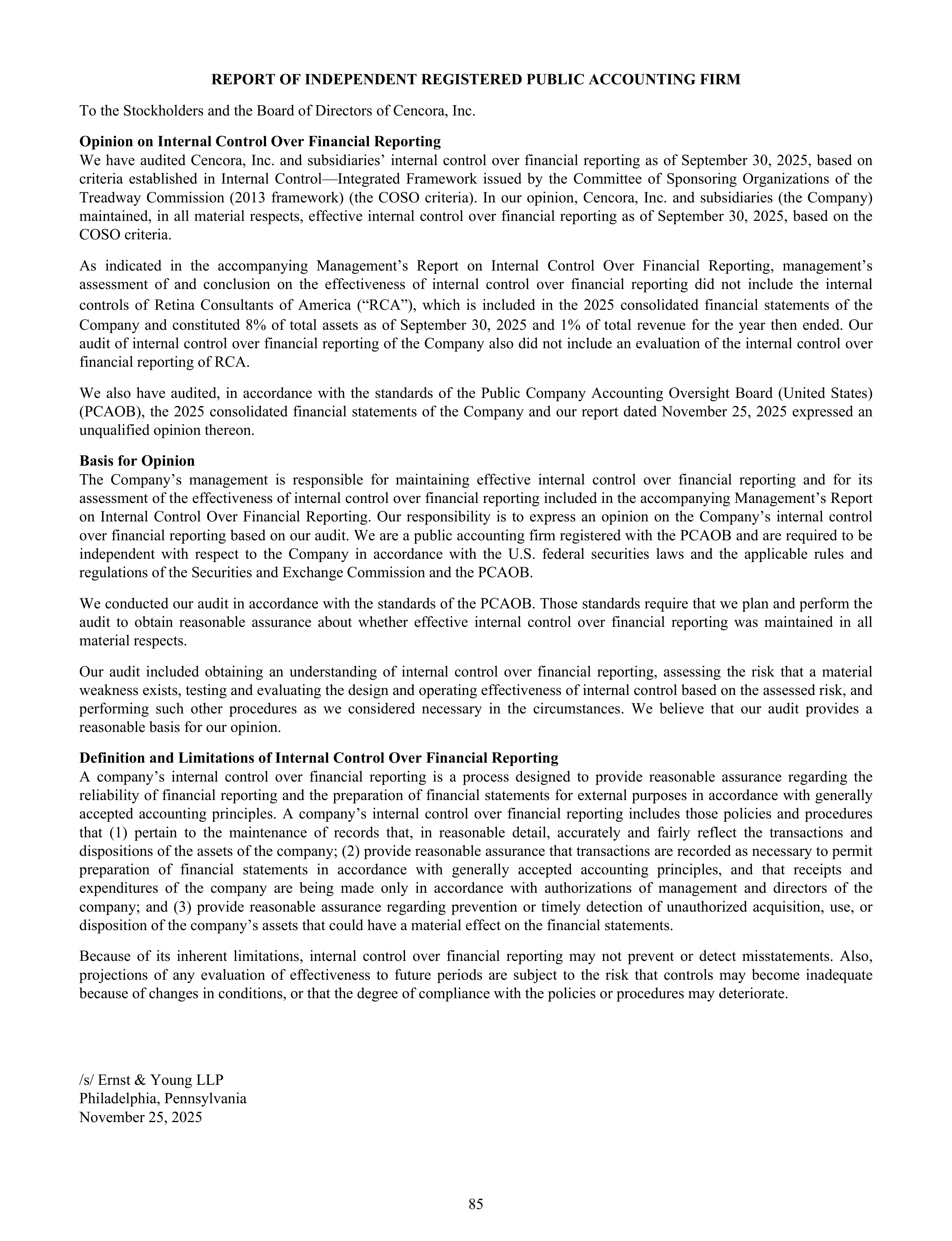
REPORT OF INDEPENDENT REGISTERED PUBLIC ACCOUNTING FIRM
To the Stockholders and the Board of Directors of Cencora, Inc.
Opinion on Internal Control Over Financial Reporting
We have audited Cencora, Inc. and subsidiaries’ internal control over financial reporting as of September 30, 2025, based on
criteria established in Internal Control—Integrated Framework issued by the Committee of Sponsoring Organizations of the
Treadway Commission (2013 framework) (the COSO criteria). In our opinion, Cencora, Inc. and subsidiaries (the Company)
maintained, in all material respects, effective internal control over financial reporting as of September 30, 2025, based on the
COSO criteria.
As indicated in the accompanying Management’s Report on Internal Control Over Financial Reporting, management’s
assessment of and conclusion on the effectiveness of internal control over financial reporting did not include the internal
controls of
Retina Consultants of America (“RCA”), which is included in the 2025 consolidated financial statements of the
Company and constituted 8% of total assets as of September 30, 2025 and 1% of total revenue for the year then ended. Our
audit of internal control over financial reporting of the Company also did not include an evaluation of the internal control over
financial reporting of RCA.
We also have audited, in accordance with the standards of the Public Company Accounting Oversight Board (United States)
(PCAOB), the 2025 consolidated financial statements of the Company and our report dated November 25, 2025 expressed an
unqualified opinion thereon.
Basis for Opinion
The Company’s management is responsible for maintaining effective internal control over financial reporting and for its
assessment of the effectiveness of internal control over financial reporting included in the accompanying Management’s Report
on Internal Control Over Financial Reporting. Our responsibility is to express an opinion on the Company’s internal control
over financial reporting based on our audit. We are a public accounting firm registered with the PCAOB and are required to be
independent with respect to the Company in accordance with the U.S. federal securities laws and the applicable rules and
regulations of the Securities and Exchange Commission and the PCAOB.
We conducted our audit in accordance with the standards of the PCAOB. Those standards require that we plan and perform the
audit to obtain reasonable assurance about whether effective internal control over financial reporting was maintained in all
material respects.
Our audit included obtaining an understanding of internal control over financial reporting, assessing the risk that a material
weakness exists, testing and evaluating the design and operating effectiveness of internal control based on the assessed risk, and
performing such other procedures as we considered necessary in the circumstances. We believe that our audit provides a
reasonable basis for our opinion.
Definition and Limitations of Internal Control Over Financial Reporting
A company’s internal control over financial reporting is a process designed to provide reasonable assurance regarding the
reliability of financial reporting and the preparation of financial statements for external purposes in accordance with generally
accepted accounting principles. A company’s internal control over financial reporting includes those policies and procedures
that (1) pertain to the maintenance of records that, in reasonable detail, accurately and fairly reflect the transactions and
dispositions of the assets of the company; (2) provide reasonable assurance that transactions are recorded as necessary to permit
preparation of financial statements in accordance with generally accepted accounting principles, and that receipts and
expenditures of the company are being made only in accordance with authorizations of management and directors of the
company; and (3) provide reasonable assurance regarding prevention or timely detection of unauthorized acquisition, use, or
disposition of the company’s assets that could have a material effect on the financial statements.
Because of its inherent limitations, internal control over financial reporting may not prevent or detect misstatements. Also,
projections of any evaluation of effectiveness to future periods are subject to the risk that controls may become inadequate
because of changes in conditions, or that the degree of compliance with the policies or procedures may deteriorate.
/s/ Ernst & Young LLP
Philadelphia, Pennsylvania
November 25, 2025
85
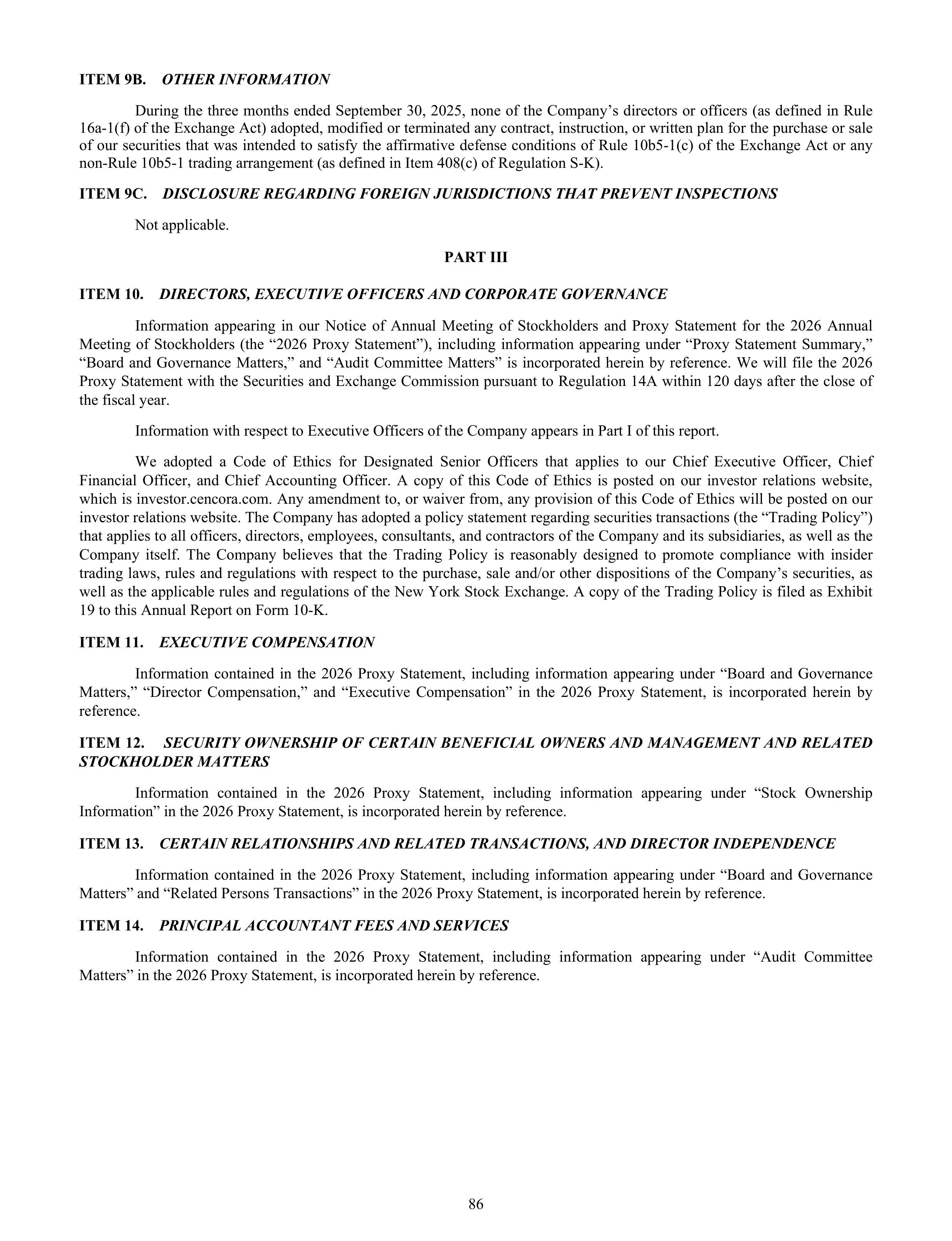
ITEM 9B.
OTHER INFORMATION
During the three months ended September 30, 2025, none of the Company’s directors or officers (as defined in Rule
16a-1(f) of the Exchange Act) adopted, modified or terminated any contract, instruction, or written plan for the purchase or sale
of our securities that was intended to satisfy the affirmative defense conditions of Rule 10b5-1(c) of the Exchange Act or any
non-Rule 10b5-1 trading arrangement (as defined in Item 408(c) of Regulation S-K).
ITEM 9C.
DISCLOSURE REGARDING FOREIGN JURISDICTIONS THAT PREVENT INSPECTIONS
Not applicable.
PART III
ITEM 10.
DIRECTORS, EXECUTIVE OFFICERS AND CORPORATE GOVERNANCE
Information appearing in our Notice of Annual Meeting of Stockholders and Proxy Statement for the 2026 Annual
Meeting of Stockholders (the “2026 Proxy Statement”), including information appearing under “Proxy Statement Summary,”
“Board and Governance Matters,” and “Audit Committee Matters” is incorporated herein by reference. We will file the 2026
Proxy Statement with the Securities and Exchange Commission pursuant to Regulation 14A within 120 days after the close of
the fiscal year.
Information with respect to Executive Officers of the Company appears in Part I of this report.
We adopted a Code of Ethics for Designated Senior Officers that applies to our Chief Executive Officer, Chief
Financial Officer, and Chief Accounting Officer. A copy of this Code of Ethics is posted on our investor relations website,
which is investor.cencora.com. Any amendment to, or waiver from, any provision of this Code of Ethics will be posted on our
investor relations website. The Company has adopted a policy statement regarding securities transactions (the “Trading Policy”)
that applies to all officers, directors, employees, consultants, and contractors of the Company and its subsidiaries, as well as the
Company itself. The Company believes that the Trading Policy is reasonably designed to promote compliance with insider
trading laws, rules and regulations with respect to the purchase, sale and/or other dispositions of the Company’s securities, as
well as the applicable rules and regulations of the New York Stock Exchange. A copy of the Trading Policy is filed as Exhibit
19 to this Annual Report on Form 10-K.
ITEM 11.
EXECUTIVE COMPENSATION
Information contained in the 2026 Proxy Statement, including information appearing under “Board and Governance
Matters,” “Director Compensation,” and “Executive Compensation” in the 2026 Proxy Statement, is incorporated herein by
reference.
ITEM 12.
SECURITY OWNERSHIP OF CERTAIN BENEFICIAL OWNERS AND MANAGEMENT AND RELATED
STOCKHOLDER MATTERS
Information contained in the 2026 Proxy Statement, including information appearing under “Stock Ownership
Information” in the 2026 Proxy Statement, is incorporated herein by reference.
ITEM 13.
CERTAIN RELATIONSHIPS AND RELATED TRANSACTIONS, AND DIRECTOR INDEPENDENCE
Information contained in the 2026 Proxy Statement, including information appearing under “Board and Governance
Matters” and “Related Persons Transactions” in the 2026 Proxy Statement, is incorporated herein by reference.
ITEM 14.
PRINCIPAL ACCOUNTANT FEES AND SERVICES
Information contained in the 2026 Proxy Statement, including information appearing under “Audit Committee
Matters” in the 2026 Proxy Statement, is incorporated herein by reference.
86
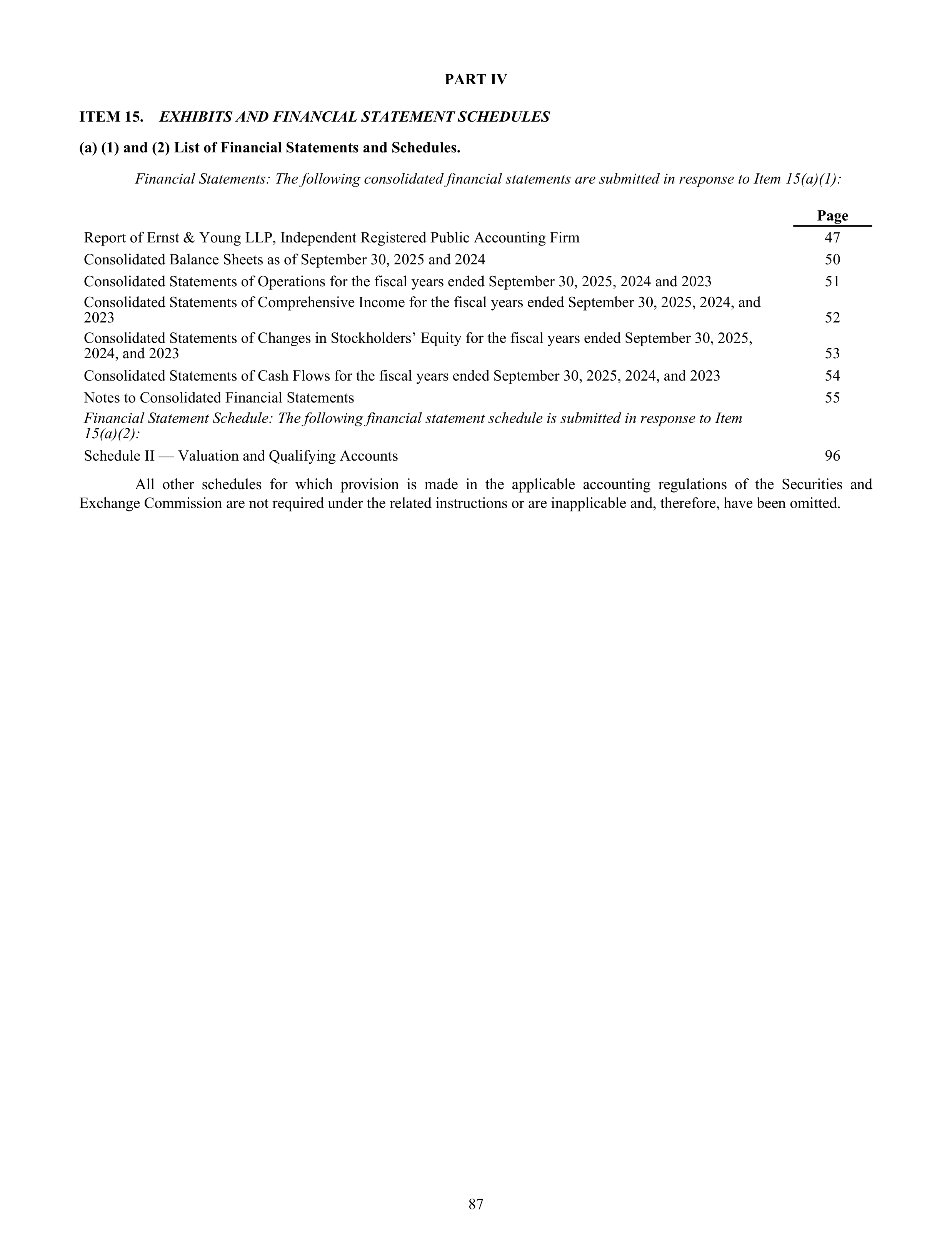
#%')
'
&"!!"""!#!
.
.:16?@;36:.:06.8&@.@292:@?.:1&0521A82?
%((%&..!'!(.- $!")&&)1%(#)(-)&% .! "%((%&-..!'!(.-,!-/'%..! %(,!-*)(-!.).!'
#.42
*:EDGID;GCHI1DJC<$$( !C9:E:C9:CI*:HI:G:9(J7A>888DJCI>CGB
DCHDA>96I:96A6C8:+=::IH6HD;+:EI:B7:G
6C9
DCHDA>96I:9+I6I:B:CIHD;'E:G6I>DCH;DGI=:;>H86AN:6GH:C9:9+:EI:B7:G
6C9
DCHDA>96I:9+I6I:B:CIHD;DBEG:=:CH>K:!C8DB:;DGI=:;>H86AN:6GH:C9:9+:EI:B7:G
6C9
DCHDA>96I:9+I6I:B:CIHD;=6CC+ID8@=DA9:GHXFJ>IN;DGI=:;>H86AN:6GH:C9:9+:EI:B7:G
6C9
DCHDA>96I:9+I6I:B:CIHD;6H=ADLH;DGI=:;>H86AN:6GH:C9:9+:EI:B7:G
6C9
&DI:HIDDCHDA>96I:9>C6C8>6A+I6I:B:CIH
%((%&..!'!(.$! /&! $!")&&)1%(#"%((%&-..!'!(.-$! /&!%--/'%..! %(,!-*)(-!.).!'
+8=:9JA:!!U.6AJ6I>DC6C9)J6A>;N>C<88DJCIH
AA DI=:G H8=:9JA:H ;DG L=>8= EGDK>H>DC >H B69: >C I=: 6EEA>867A: 688DJCI>C< G:DCH D; I=: +:8JG>I>:H 6C9
M8=6CHH>DC6G:CDIG:FJ>G:9JC9:GI=:G:A6I:9>CHIGJ8I>DCHDG6G:>C6EEA>867A:6C9 I=:G:;DG: =6K:7::CDB>II:9
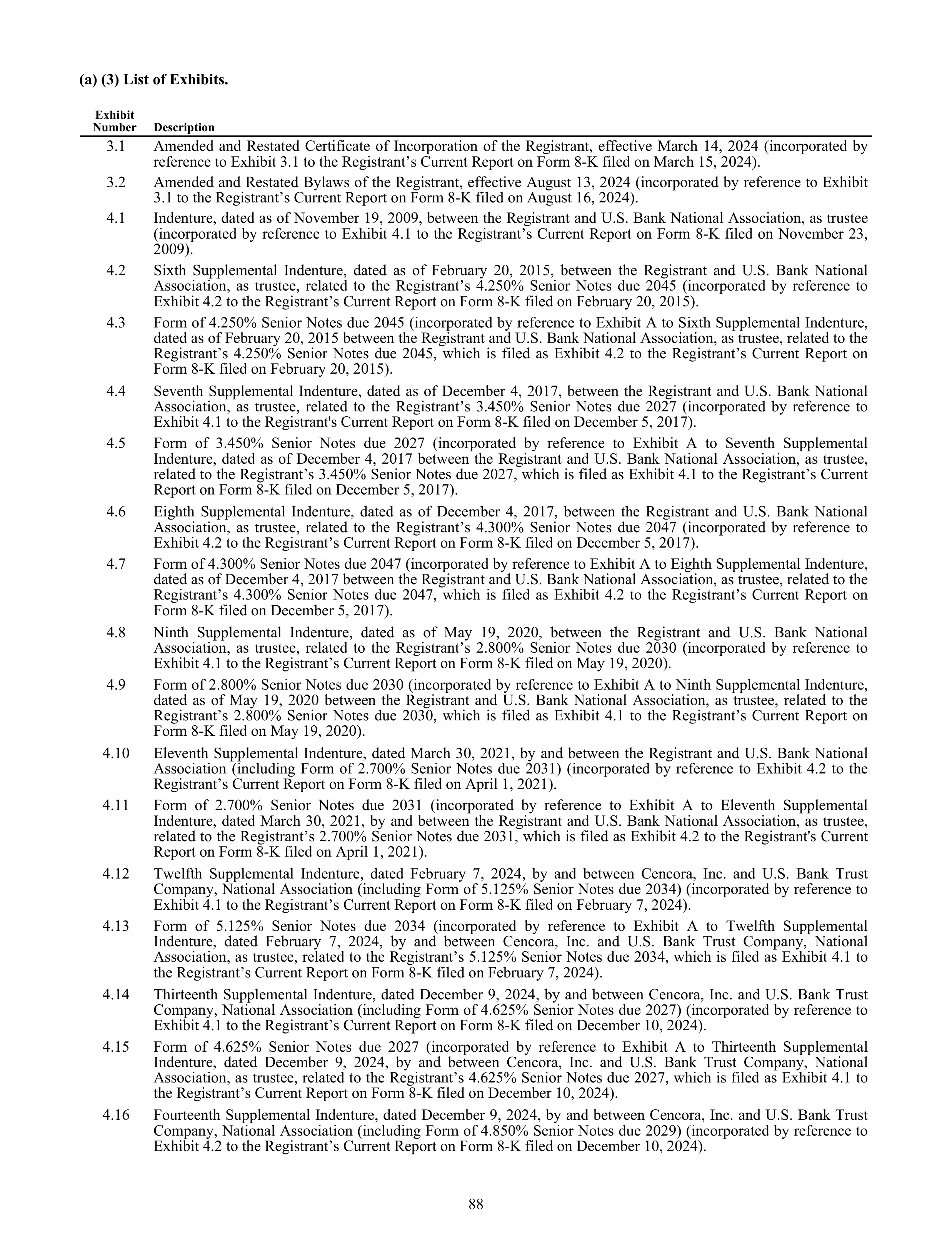
.6?@;3D56/6@?
B:C9:96C9*:HI6I:9:GI>;>86I:D;!C8DGEDG6I>DCD;I=:*:HIG6CI :;;:8I>K:%6G8=
>C8DGEDG6I:97N
G:;:G:C8:IDM=>7>IIDI=:*:HIG6CIXHJGG:CI*:EDGIDCDGB
#;>A:9DC%6G8=
B:C9:96C9*:HI6I:9NA6LHD;I=:*:HIG6CI :;;:8I>K:JC8DGEDG6I:97NG:;:G:C8:IDM=>7>I
IDI=:*:HIG6CIXHJGG:CI*:EDGIDCDGB
#;>A:9DCJ<JHI
!C9:CIJG: 96I:96HD;&DK:B7:G
7:IL::CI=:*:HIG6CI6C9-+6C@&6I>DC6AHHD8>6I>DC 6HIGJHI::
>C8DGEDG6I:97NG:;:G:C8:IDM=>7>IIDI=:*:HIG6CIXHJGG:CI*:EDGIDCDGB
#;>A:9DC&DK:B7:G
+>MI= +JEEA:B:CI6A !C9:CIJG: 96I:9 6H D; :7GJ6GN
7:IL::C I=: *:HIG6CI 6C9 -+ 6C@ &6I>DC6A
HHD8>6I>DC 6HIGJHI:: G:A6I:9IDI=:*:HIG6CIXH
+:C>DG&DI:H9J:
>C8DGEDG6I:97NG:;:G:C8:ID
M=>7>IIDI=:*:HIG6CIXHJGG:CI*:EDGIDCDGB
#;>A:9DC:7GJ6GN
DGBD;
+:C>DG&DI:H9J:
>C8DGEDG6I:97NG:;:G:C8:IDM=>7>IID+>MI=+JEEA:B:CI6A!C9:CIJG:
96I:96HD;:7GJ6GN
7:IL::CI=:*:HIG6CI6C9-+6C@&6I>DC6AHHD8>6I>DC 6HIGJHI:: G:A6I:9IDI=:
*:HIG6CIXH
+:C>DG&DI:H9J:
L=>8=>H;>A:96HM=>7>IIDI=:*:HIG6CIXHJGG:CI*:EDGIDC
DGB
#;>A:9DC:7GJ6GN
+:K:CI=+JEEA:B:CI6A!C9:CIJG: 96I:96HD;:8:B7:G
7:IL::CI=:*:HIG6CI6C9-+6C@&6I>DC6A
HHD8>6I>DC 6HIGJHI:: G:A6I:9IDI=:*:HIG6CIXH
+:C>DG&DI:H9J:
>C8DGEDG6I:97NG:;:G:C8:ID
M=>7>IIDI=:*:HIG6CIHJGG:CI*:EDGIDCDGB
#;>A:9DC:8:B7:G
DGB D;
+:C>DG &DI:H 9J:
>C8DGEDG6I:9 7N G:;:G:C8: ID M=>7>I ID +:K:CI= +JEEA:B:CI6A
!C9:CIJG: 96I:96HD;:8:B7:G
7:IL::CI=:*:HIG6CI6C9-+6C@&6I>DC6AHHD8>6I>DC 6HIGJHI::
G:A6I:9IDI=:*:HIG6CIXH
+:C>DG&DI:H9J:
L=>8=>H;>A:96HM=>7>IIDI=:*:HIG6CIXHJGG:CI
*:EDGIDCDGB
#;>A:9DC:8:B7:G
><=I=+JEEA:B:CI6A!C9:CIJG: 96I:96HD;:8:B7:G
7:IL::CI=:*:HIG6CI6C9-+6C@&6I>DC6A
HHD8>6I>DC 6HIGJHI:: G:A6I:9IDI=:*:HIG6CIXH
+:C>DG&DI:H9J:
>C8DGEDG6I:97NG:;:G:C8:ID
M=>7>IIDI=:*:HIG6CIXHJGG:CI*:EDGIDCDGB
#;>A:9DC:8:B7:G
DGBD;
+:C>DG&DI:H9J:
>C8DGEDG6I:97NG:;:G:C8:IDM=>7>IID><=I=+JEEA:B:CI6A!C9:CIJG:
96I:96HD;:8:B7:G
7:IL::CI=:*:HIG6CI6C9-+6C@&6I>DC6AHHD8>6I>DC 6HIGJHI:: G:A6I:9IDI=:
*:HIG6CIXH
+:C>DG&DI:H9J:
L=>8=>H;>A:96HM=>7>IIDI=:*:HIG6CIXHJGG:CI*:EDGIDC
DGB
#;>A:9DC:8:B7:G
&>CI= +JEEA:B:CI6A !C9:CIJG: 96I:9 6H D; %6N
7:IL::C I=: *:HIG6CI 6C9 -+ 6C@ &6I>DC6A
HHD8>6I>DC 6HIGJHI:: G:A6I:9IDI=:*:HIG6CIXH
+:C>DG&DI:H9J:
>C8DGEDG6I:97NG:;:G:C8:ID
M=>7>IIDI=:*:HIG6CIXHJGG:CI*:EDGIDCDGB
#;>A:9DC%6N
DGBD;
+:C>DG&DI:H9J:
>C8DGEDG6I:97NG:;:G:C8:IDM=>7>IID&>CI=+JEEA:B:CI6A!C9:CIJG:
96I:96HD;%6N
7:IL::CI=:*:HIG6CI6C9-+6C@&6I>DC6AHHD8>6I>DC 6HIGJHI:: G:A6I:9IDI=:
*:HIG6CIXH
+:C>DG&DI:H9J:
L=>8=>H;>A:96HM=>7>IIDI=:*:HIG6CIXHJGG:CI*:EDGIDC
DGB
#;>A:9DC%6N
A:K:CI=+JEEA:B:CI6A!C9:CIJG: 96I:9%6G8=
7N6C97:IL::CI=:*:HIG6CI6C9-+6C@&6I>DC6A
HHD8>6I>DC>C8AJ9>CDG&DI:H9J:
>C8DGEDG6I:97NG:;:G:C8:IDM=>7>IIDI=:
*:HIG6CIXHJGG:CI*:EDGIDCDGB
#;>A:9DCEG>A
DGB D;
+:C>DG &DI:H 9J:
>C8DGEDG6I:9 7N G:;:G:C8: ID M=>7>I ID A:K:CI= +JEEA:B:CI6A
!C9:CIJG: 96I:9%6G8=
7N6C97:IL::CI=:*:HIG6CI6C9-+6C@&6I>DC6AHHD8>6I>DC 6HIGJHI::
G:A6I:9IDI=:*:HIG6CIXH
+:C>DG&DI:H9J:
L=>8=>H;>A:96HM=>7>IIDI=:*:HIG6CIHJGG:CI
*:EDGIDCDGB
#;>A:9DCEG>A
,L:A;I= +JEEA:B:CI6A !C9:CIJG: 96I:9 :7GJ6GN
7N 6C9 7:IL::C :C8DG6 !C8 6C9 -+ 6C@ ,GJHI
DBE6CN &6I>DC6AHHD8>6I>DC>C8AJ9>CDG&DI:H9J:
>C8DGEDG6I:97NG:;:G:C8:ID
M=>7>IIDI=:*:HIG6CIXHJGG:CI*:EDGIDCDGB
#;>A:9DC:7GJ6GN
DGB D; +:C>DG &DI:H 9J:
>C8DGEDG6I:9 7N G:;:G:C8: ID M=>7>I ID ,L:A;I= +JEEA:B:CI6A
!C9:CIJG: 96I:9 :7GJ6GN
7N 6C9 7:IL::C :C8DG6 !C8 6C9 -+ 6C@ ,GJHI DBE6CN &6I>DC6A
HHD8>6I>DC 6HIGJHI:: G:A6I:9IDI=:*:HIG6CIXH+:C>DG&DI:H9J:
L=>8=>H;>A:96HM=>7>IID
I=:*:HIG6CIXHJGG:CI*:EDGIDCDGB
#;>A:9DC:7GJ6GN
,=>GI::CI=+JEEA:B:CI6A!C9:CIJG: 96I:9:8:B7:G
7N6C97:IL::C:C8DG6 !C86C9-+6C@,GJHI
DBE6CN &6I>DC6AHHD8>6I>DC>C8AJ9>CDG&DI:H9J:
>C8DGEDG6I:97NG:;:G:C8:ID
M=>7>IIDI=:*:HIG6CIXHJGG:CI*:EDGIDCDGB
#;>A:9DC:8:B7:G
DGB D; +:C>DG &DI:H 9J:
>C8DGEDG6I:9 7N G:;:G:C8: ID M=>7>I ID ,=>GI::CI= +JEEA:B:CI6A
!C9:CIJG: 96I:9 :8:B7:G
7N 6C9 7:IL::C :C8DG6 !C8 6C9 -+ 6C@ ,GJHI DBE6CN &6I>DC6A
HHD8>6I>DC 6HIGJHI:: G:A6I:9IDI=:*:HIG6CIXH+:C>DG&DI:H9J:
L=>8=>H;>A:96HM=>7>IID
I=:*:HIG6CIXHJGG:CI*:EDGIDCDGB
#;>A:9DC:8:B7:G
DJGI::CI=+JEEA:B:CI6A!C9:CIJG: 96I:9:8:B7:G
7N6C97:IL::C:C8DG6 !C86C9-+6C@,GJHI
DBE6CN &6I>DC6AHHD8>6I>DC>C8AJ9>CDG&DI:H9J:
>C8DGEDG6I:97NG:;:G:C8:ID
M=>7>IIDI=:*:HIG6CIXHJGG:CI*:EDGIDCDGB
#;>A:9DC:8:B7:G
D56/6@
!A9/2>
2?0>6<@6;:
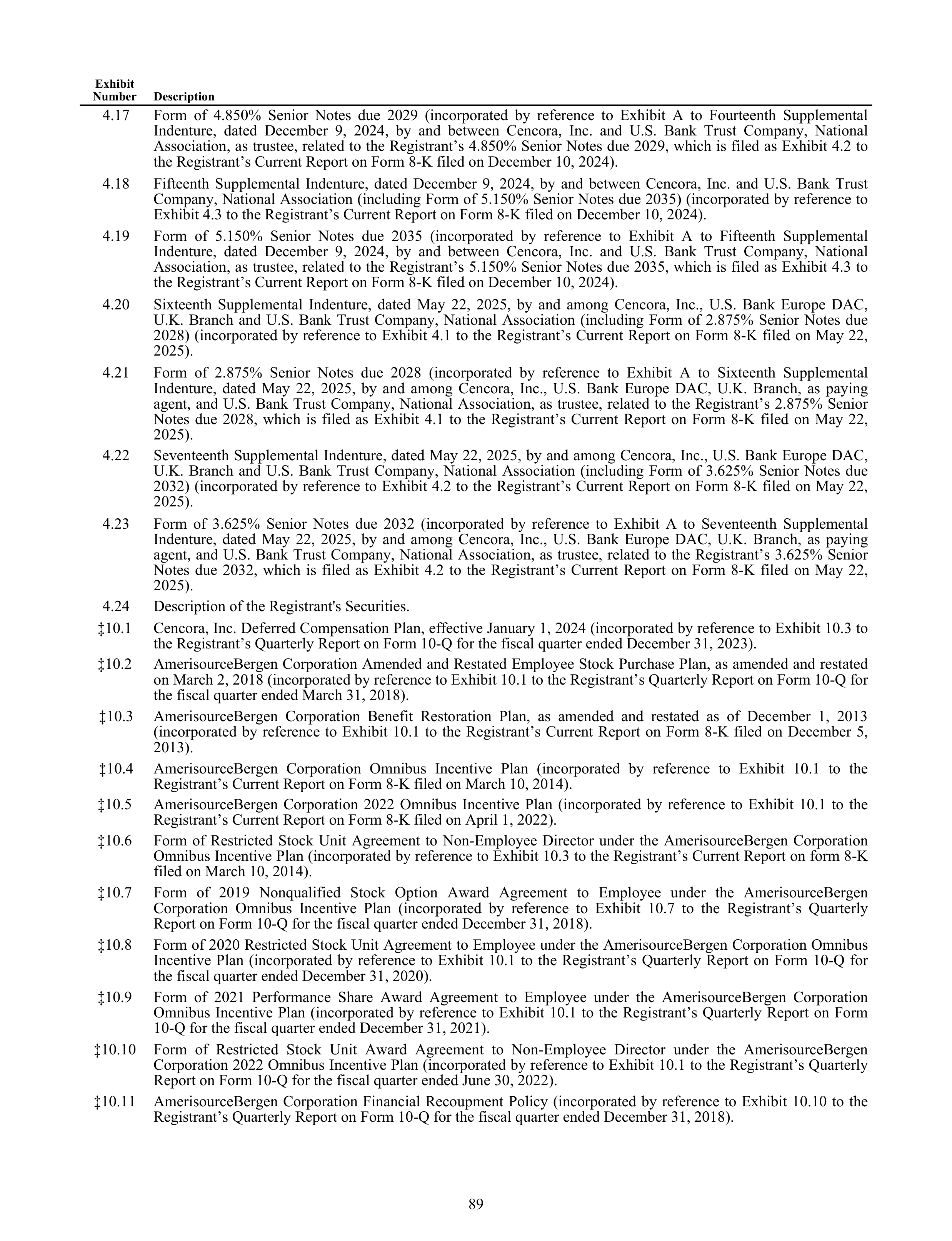
DGB D;
+:C>DG &DI:H 9J:
>C8DGEDG6I:9 7N G:;:G:C8: ID M=>7>I ID DJGI::CI= +JEEA:B:CI6A
!C9:CIJG: 96I:9 :8:B7:G
7N 6C9 7:IL::C :C8DG6 !C8 6C9 -+ 6C@ ,GJHI DBE6CN &6I>DC6A
HHD8>6I>DC 6HIGJHI:: G:A6I:9IDI=:*:HIG6CIXH
+:C>DG&DI:H9J:
L=>8=>H;>A:96HM=>7>IID
I=:*:HIG6CIXHJGG:CI*:EDGIDCDGB
#;>A:9DC:8:B7:G
>;I::CI=+JEEA:B:CI6A!C9:CIJG: 96I:9:8:B7:G
7N6C97:IL::C:C8DG6 !C86C9-+6C@,GJHI
DBE6CN &6I>DC6AHHD8>6I>DC>C8AJ9>CDG&DI:H9J:
>C8DGEDG6I:97NG:;:G:C8:ID
M=>7>IIDI=:*:HIG6CIXHJGG:CI*:EDGIDCDGB
#;>A:9DC:8:B7:G
DGB D;
+:C>DG &DI:H 9J:
>C8DGEDG6I:9 7N G:;:G:C8: ID M=>7>I ID >;I::CI= +JEEA:B:CI6A
!C9:CIJG: 96I:9 :8:B7:G
7N 6C9 7:IL::C :C8DG6 !C8 6C9 -+ 6C@ ,GJHI DBE6CN &6I>DC6A
HHD8>6I>DC 6HIGJHI:: G:A6I:9IDI=:*:HIG6CIXH
+:C>DG&DI:H9J:
L=>8=>H;>A:96HM=>7>IID
I=:*:HIG6CIXHJGG:CI*:EDGIDCDGB
#;>A:9DC:8:B7:G
+>MI::CI=+JEEA:B:CI6A!C9:CIJG: 96I:9%6N
7N6C96BDC<:C8DG6 !C8 -+6C@JGDE:
-#G6C8=6C9-+6C@,GJHIDBE6CN &6I>DC6AHHD8>6I>DC>C8AJ9>CDG&DI:H9J:
>C8DGEDG6I:97NG:;:G:C8:IDM=>7>IIDI=:*:HIG6CIXHJGG:CI*:EDGIDCDGB
#;>A:9DC%6N
DGB D; +:C>DG &DI:H 9J:
>C8DGEDG6I:9 7N G:;:G:C8: ID M=>7>I ID +>MI::CI= +JEEA:B:CI6A
!C9:CIJG: 96I:9%6N
7N6C96BDCC<
6DC6AHHD8>6I>DC 6HIGJHI:: G:A6I:9IDI=:*:HIG6CIXH+:C>DG
&DI:H9J:
L=>8=>H;>A:96HM=>7>IIDI=:*:HIG6CIXHJGG:CI*:EDGIDCDGB
#;>A:9DC%6N
+:K:CI::CI=+JEEA:B:CI6A!C9:CIJG: 96I:9%6N
7N6C96BDC<:C8DG6 !C8 -+6C@JGDE:
-#G6C8=6C9-+6C@,GJHIDBE6CN &6I>DC6AHHD8>6I>DC>C8AJ9>CDG&DI:H9J:
>C8DGEDG6I:97NG:;:G:C8:IDM=>7>IIDI=:*:HIG6CIXHJGG:CI*:EDGIDCDGB
#;>A:9DC%6N
DGB D; +:C>DG &DI:H 9J:
>C8DGEDG6I:9 7N G:;:G:C8: ID M=>7>I ID +:K:CI::CI= +JEEA:B:CI6A
!C9:CIJG: 96I:9%6N
7N6C96BDCC<
6DC6AHHD8>6I>DC 6HIGJHI:: G:A6I:9IDI=:*:HIG6CIXH+:C>DG
&DI:H9J:
L=>8=>H;>A:96HM=>7>IIDI=:*:HIG6CIXHJGG:CI*:EDGIDCDGB
#;>A:9DC%6N
:H8G>EI>DCD;I=:*:HIG6CIH+:8JG>I>:H
Z
:C8DG6 !C8:;:GG:9DBE:CH6I>DC(A6C :;;:8I>K:"6CJ6GN
>C8DGEDG6I:97NG:;:G:C8:IDM=>7>I
ID
I=:*:HIG6CIXH)J6GI:GAN*:EDGIDCDGB
);DGI=:;>H86AFJ6GI:G:C9:9:8:B7:G
Z
B:G>HDJG8::GDCB:C9:96C9*:HI6I:9BEADN::+ID8@(JG8=6H:(A6C 6H6B:C9:96C9G:HI6I:9
DC%6G8=
>C8DGEDG6I:97NG:;:G:C8:IDM=>7>I
IDI=:*:HIG6CIXH)J6GI:GAN*:EDGIDCDGB
);DG
I=:;>H86AFJ6GI:G:C9:9%6G8=
Z
B:G>HDJG8::GDC :C:;>I *:HIDG6I>DC (A6C 6H 6B:C9:9 6C9 G:HI6I:9 6H D; :8:B7:G
>C8DGEDG6I:97NG:;:G:C8:IDM=>7>I
IDI=:*:HIG6CIXHJGG:CI*:EDGIDCDGB
#;>A:9DC:8:B7:G
Z
B:G>HDJG8::G<:C
DGEDG6I>DC
'BC>7JH !C8:CI>K: (A6C >C8DGEDG6I:9 7N G:;:G:C8: ID M=>7>I
ID
I=:
*:HIG6CIXHJGG:CI*:EDGIDCDGB
#;>A:9DC%6G8=
Z
B:G>HDJG8::GDC
'BC>7JH!C8:CI>K:(A6C>C8DGEDG6I:97NG:;:G:C8:IDM=>7>I
IDI=:
*:HIG6CIXHJGG:CI*:EDGIDCDGB
#;>A:9DCEG>A
Z
DGBD;*:HIG>8I:9+ID8@-C>IG:8IDGJC9:GI=:B:G>HDJG8::GDC
'BC>7JH!C8:CI>K:(A6C>C8DGEDG6I:97NG:;:G:C8:IDM=>7>I
IDI=:*:HIG6CIXHJGG:CI*:EDGIDC;DGB
#
;>A:9DC%6G8=
Z
DGB
D;
&DCFJ6A>;>:9
+ID8@
'EI>DC
L6G9
<G::B:CI
ID
BEADN::
JC9:G
I=:
B:G>HDJG8::G<:C
DGEDG6I>DC 'BC>7JH !C8:CI>K: (A6C >C8DGEDG6I:9 7N G:;:G:C8: ID M=>7>I
ID I=: *:HIG6CIXH )J6GI:GAN
*:EDGIDCDGB
);DGI=:;>H86AFJ6GI:G:C9:9:8:B7:G
Z
DGBD;
*:HIG>8I:9+ID8@-C>IHDJG8::GDC'BC>7JH
!C8:CI>K:(A6C>C8DGEDG6I:97NG:;:G:C8:IDM=>7>I
IDI=:*:HIG6CIXH)J6GI:GAN*:EDGIDCDGB
);DG
I=:;>H86AFJ6GI:G:C9:9:8:B7:G
Z
DGB D;
(:G;DGB6C8: +=6G: L6G9 HDJG8::GDC
'BC>7JH!C8:CI>K:(A6C>C8DGEDG6I:97NG:;:G:C8:IDM=>7>I
IDI=:*:HIG6CIXH)J6GI:GAN*:EDGIDCDGB
);DGI=:;>H86AFJ6GI:G:C9:9:8:B7:G
Z
DGB D; *:HIG>8I:9 +ID8@ -C>I L6G9 G:8IDG JC9:G I=: B:G>HDJG8::G<:C
DGEDG6I>DC
'BC>7JH!C8:CI>K:(A6C>C8DGEDG6I:97NG:;:G:C8:IDM=>7>I
IDI=:*:HIG6CIXH)J6GI:GAN
*:EDGIDCDGB
);DGI=:;>H86AFJ6GI:G:C9:9"JC:
Z
B:G>HDJG8::GDC>C6C8>6A*:8DJEB:CI(DA>8N>C8DGEDG6I:97NG:;:G:C8:IDM=>7>I
IDI=:
*:HIG6CIXH)J6GI:GAN*:EDGIDCDGB
);DGI=:;>H86AFJ6GI:G:C9:9:8:B7:G
D56/6@
!A9/2>
2?0>6<@6;:
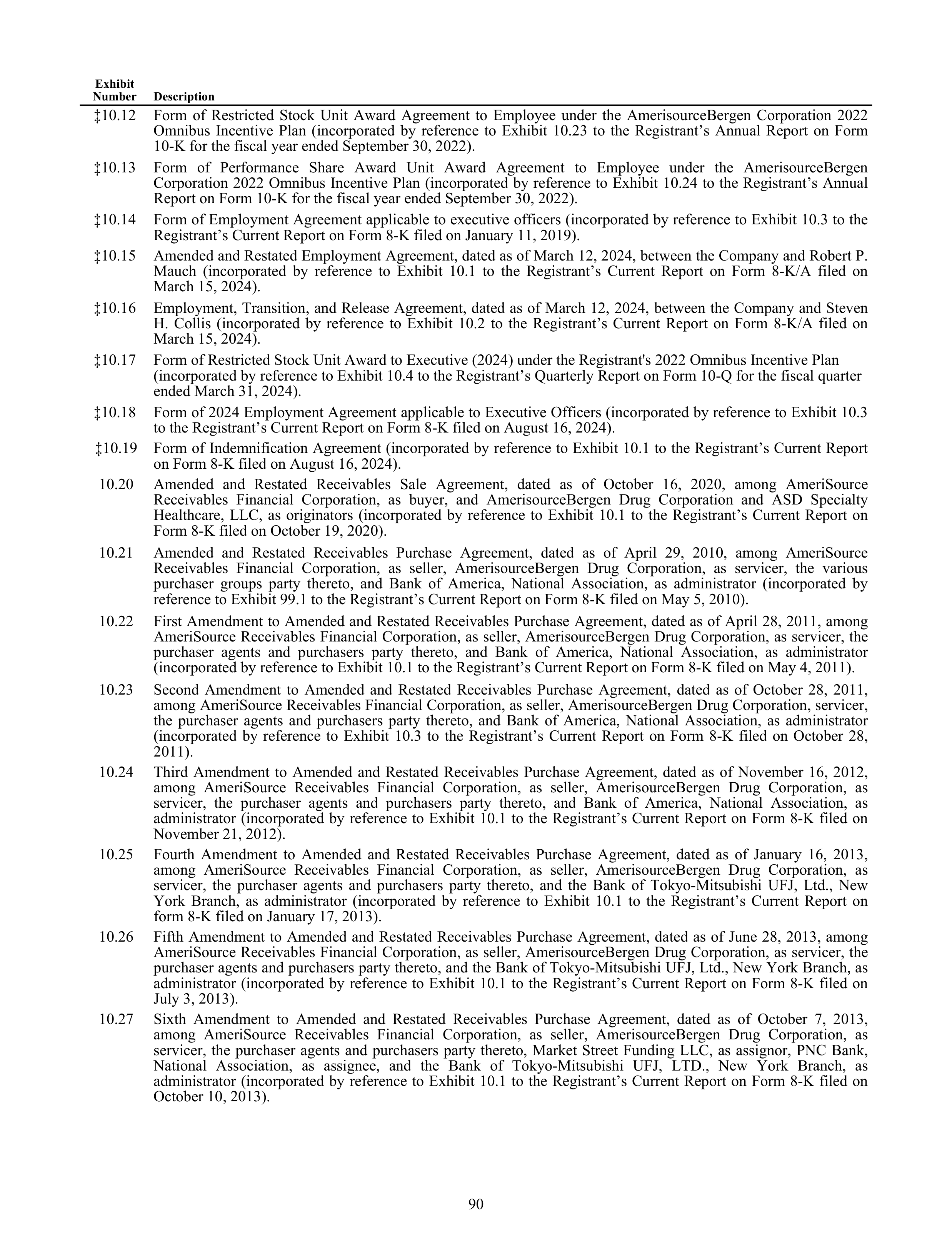
Z
DGBD;*:HIG>8I:9+ID8@-C>IL6G9HDJG8::GDC
'BC>7JH!C8:CI>K:(A6C>C8DGEDG6I:97NG:;:G:C8:IDM=>7>I
IDI=:*:HIG6CIXHCCJ6A*:EDGIDCDGB
#;DGI=:;>H86AN:6G:C9:9+:EI:B7:G
Z
DGB
D;
(:G;DGB6C8:
+=6G:
L6G9
-C>I
L6G9
<G::B:CI
ID
BEADN::
JC9:G
I=:
B:G>HDJG8::G<:C
DGEDG6I>DC
'BC>7JH!C8:CI>K:(A6C>C8DGEDG6I:97NG:;:G:C8:IDM=>7>I
IDI=:*:HIG6CIXHCCJ6A
*:EDGIDCDGB
#;DGI=:;>H86AN:6G:C9:9+:EI:B7:G
Z
DGBD;BEADNB:CI867A:ID:M:8JI>K:D;;>8:GH>C8DGEDG6I:97NG:;:G:C8:IDM=>7>I
IDI=:
*:HIG6CIXHJGG:CI*:EDGIDCDGB
#;>A:9DC"6CJ6GN
Z
B:C9:96C9*:HI6I:9BEADNB:CI<G::B:CI 96I:96HD;%6G8=
7:IL::CI=:DBE6CN6C9*D7:GI(
%6J8= >C8DGEDG6I:9 7N G:;:G:C8: ID M=>7>I
ID I=: *:HIG6CIXH JGG:CI *:EDGI DC DGB
# ;>A:9 DC
%6G8=
Z
BEADNB:CI ,G6CH>I>DC 6C9*:A:6H:<G::B:CI 96I:96HD;%6G8=
7:IL::CI=:DBE6CN6C9+I:K:C
DAA>H>C8DGEDG6I:97NG:;:G:C8:IDM=>7>I
IDI=:*:HIG6CIXHJGG:CI*:EDGIDCDGB
#;>A:9DC
%6G8=
Z
DGBD;*:HIG>8I:9+ID8@-C>IL6G9IDM:8JI>K:
JC9:GI=:*:HIG6CIH
'BC>7JH!C8:CI>K:(A6C
>C8DGEDG6I:97NG:;:G:C8:IDM=>7>I
IDI=:*:HIG6CIXH)J6GI:GAN*:EDGIDCDGB
);DGI=:;>H86AFJ6GI:G
:C9:9%6G8=
Z
DGBD;
BEADNB:CI867A:IDM:8JI>K:';;>8:GH>C8DGEDG6I:97NG:;:G:C8:IDM=>7>I
IDI=:*:HIG6CIXHJGG:CI*:EDGIDCDGB
#;>A:9DCJ<JHI
Z
DGBD;!C9:BC>;>86I>DCC8DGEDG6I:97NG:;:G:C8:IDM=>7>I
IDI=:*:HIG6CIXHJGG:CI*:EDGI
DCDGB
#;>A:9DCJ<JHI
B:C9:9
6C9
*:HI6I:9
*:8:>K67A:H
+6A:
<G::B:CI
96I:9
6H
D;
'8ID7:G
6BDC<
B:G>+DJG8:
*:8:>K67A:H >C6C8>6A DGEDG6I>DC 6H 7JN:G 6C9 B:G>HDJG8::G<:C GJDC 6C9 + +E:8>6AIN
:6AI=86G: $$ 6HDG>C6IDGH>C8DGEDG6I:97NG:;:G:C8:IDM=>7>I
IDI=:*:HIG6CIXHJGG:CI*:EDGIDC
DGB
#;>A:9DC'8ID7:G
B:C9:9 6C9 *:HI6I:9 *:8:>K67A:H (JG8=6H: A
6BDC+DJG8:
*:8:>K67A:H >C6C8>6A DGEDG6I>DC 6H H:AA:G B:G>HDJG8::G<:C GJDC 6H H:GK>8:G I=: K6G>DJH
EJG8=6H:G 86 &6I>DC6A HHD8>6I>DC 6H 69B>C>HIG6IDG >C8DGEDG6I:9 7N
G:;:G:C8:IDM=>7>IIDI=:*:HIG6CIXHJGG:CI*:EDGIDCDGB
#;>A:9DC%6N
>GHIB:C9B:CIIDB:C9:96C9*:HI6I:9*:8:>K67A:H(JG8=6H:A
6BDC<
B:G>+DJG8:*:8:>K67A:H>C6C8>6ADGEDG6I>DC 6HH:AA:G B:G>HDJG8::G<:CGJDC 6HH:GK>8:G I=:
EJG8=6H:G 686 &6I>DC6A HHD8>6I>DC 6H 69B>C>HIG6IDG
>C8DGEDG6I:97NG:;:G:C8:IDM=>7>I
IDI=:*:HIG6CIXHJGG:CI*:EDGIDCDGB
#;>A:9DC%6N
+:8DC9B:C9B:CIIDB:C9:96C9*:HI6I:9*:8:>K67A:H(JG8=6H:<G::B:CI 96I:96HD;'8ID7:G
6BDC+DJG8:*:8:>K67A:H>C6C8>6ADGEDG6I>DC 6HH:AA:G B:G>HDJG8::G<:CGJDC H:GK>8:G
I=:EJG8=6H:G686 &6I>DC6AHHD8>6I>DC 6H69B>C>HIG6IDG
>C8DGEDG6I:97NG:;:G:C8:IDM=>7>I
IDI=:*:HIG6CIXHJGG:CI*:EDGIDCDGB
#;>A:9DC'8ID7:G
,=>G9B:C9B:CIIDB:C9:96C9*:HI6I:9*:8:>K67A:H(JG8=6H:<G::B:CI 96I:96HD;&DK:B7:G
6BDC+DJG8: *:8:>K67A:H >C6C8>6A DGEDG6I>DC 6H H:AA:G B:G>HDJG8::G<:C GJDC 6H
H:GK>8:G I=: EJG8=6H:G 686 &6I>DC6A HHD8>6I>DC 6H
69B>C>HIG6IDG>C8DGEDG6I:97NG:;:G:C8:IDM=>7>I
IDI=:*:HIG6CIXHJGG:CI*:EDGIDCDGB
#;>A:9DC
&DK:B7:G
DJGI=B:C9B:CIIDB:C9:96C9*:HI6I:9*:8:>K67A:H(JG8=6H:<G::B:CI 96I:96HD;"6CJ6GN
6BDC+DJG8: *:8:>K67A:H >C6C8>6A DGEDG6I>DC 6H H:AA:G B:G>HDJG8::G<:C GJDC 6H
H:GK>8:G I=:EJG8=6H:G6IHJ7>H=>-" $I9 &:L
1DG@G6C8= 6H69B>C>HIG6IDG>C8DGEDG6I:97NG:;:G:C8:IDM=>7>I
IDI=:*:HIG6CIXHJGG:CI*:EDGIDC
;DGB
#;>A:9DC"6CJ6GN
>;I=B:C9B:CIIDB:C9:96C9*:HI6I:9*:8:>K67A:H(JG8=6H:<G::B:CI 96I:96HD;"JC:
6BDC<
B:G>+DJG8:*:8:>K67A:H>C6C8>6ADGEDG6I>DC 6HH:AA:G B:G>HDJG8::G<:CGJDC 6HH:GK>8:G I=:
EJG8=6H:G6IHJ7>H=>-" $I9 &:L1DG@G6C8= 6H
69B>C>HIG6IDG>C8DGEDG6I:97NG:;:G:C8:IDM=>7>I
IDI=:*:HIG6CIXHJGG:CI*:EDGIDCDGB
#;>A:9DC
"JAN
+>MI= B:C9B:CI ID B:C9:9 6C9 *:HI6I:9 *:8:>K67A:H (JG8=6H: <G::B:CI 96I:9 6H D; '8ID7:G
6BDC+DJG8: *:8:>K67A:H >C6C8>6A DGEDG6I>DC 6H H:AA:G B:G>HDJG8::G<:C GJDC 6H
H:GK>8:G I=:EJG8=6H:G6C<CDG (&6C@
&6I>DC6A
HHD8>6I>DC
6H
6HH><C::
6C9
I=:
6C@
D;
,D@ND
%>IHJ7>H=>
-"
$,
&:L
1DG@
G6C8=
6H
69B>C>HIG6IDG>C8DGEDG6I:97NG:;:G:C8:IDM=>7>I
IDI=:*:HIG6CIXHJGG:CI*:EDGIDCDGB
#;>A:9DC
'8ID7:G
D56/6@
!A9/2>
2?0>6<@6;:
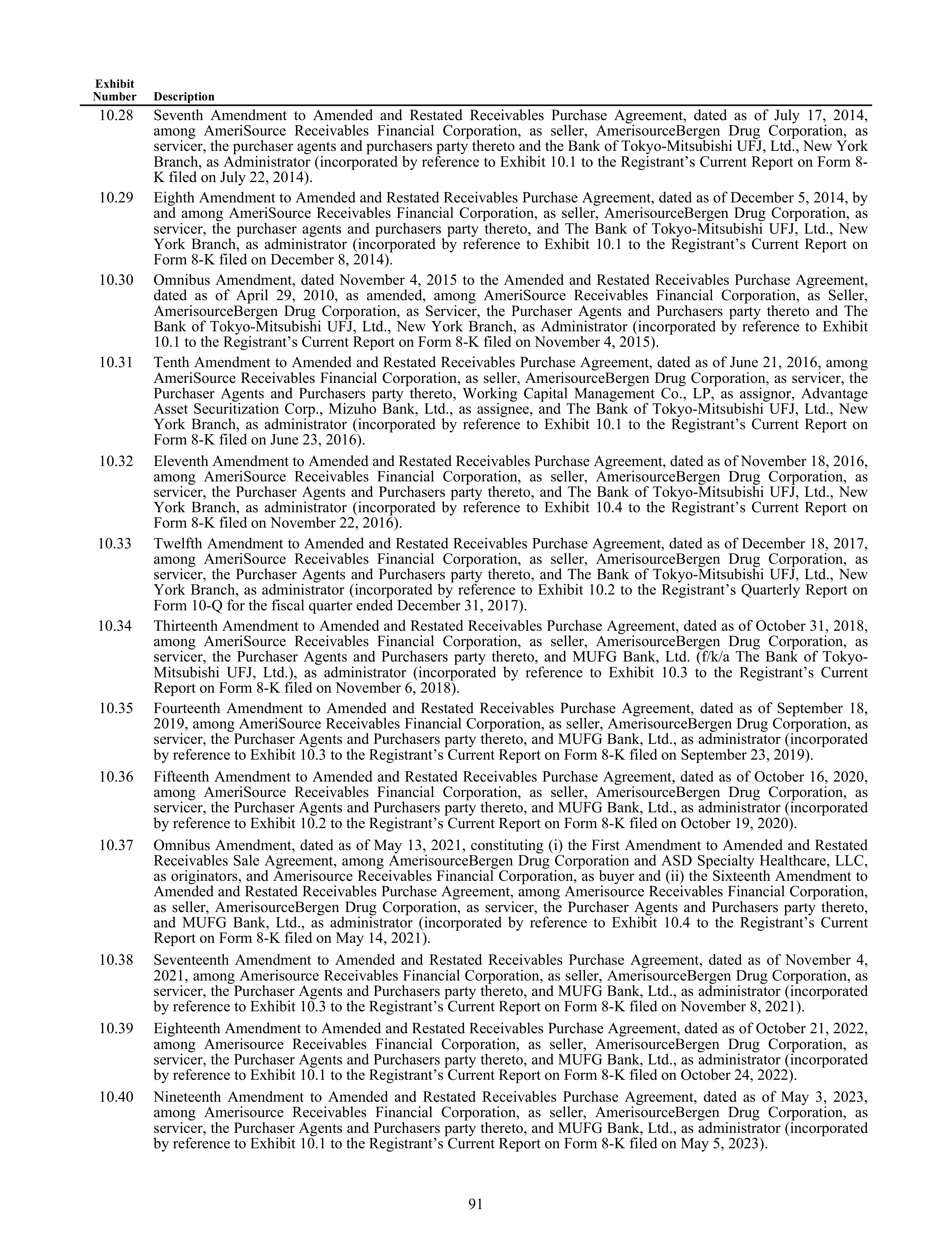
+:K:CI= B:C9B:CI ID B:C9:9 6C9 *:HI6I:9 *:8:>K67A:H (JG8=6H: <G::B:CI 96I:9 6H D; "JAN
6BDC+DJG8: *:8:>K67A:H >C6C8>6A DGEDG6I>DC 6H H:AA:G B:G>HDJG8::G<:C GJDC 6H
H:GK>8:G I=:EJG8=6H:G6IHJ7>H=>-" $I9 &:L1DG@
G6C8= 6H9B>C>HIG6IDG>C8DGEDG6I:97NG:;:G:C8:IDM=>7>I
IDI=:*:HIG6CIXHJGG:CI*:EDGIDCDGB
#;>A:9DC"JAN
>K67A:H(JG8=6H:<G::B:CI 96I:96HD;:8:B7:G
7N
6C96BDC+DJG8:*:8:>K67A:H>C6C8>6ADGEDG6I>DC 6HH:AA:G B:G>HDJG8::G<:CGJDC 6H
H:GK>8:G I=:EJG8=6H:G6IHJ7>H=>-" $I9 &:L
1DG@G6C8= 6H69B>C>HIG6IDG>C8DGEDG6I:97NG:;:G:C8:IDM=>7>I
IDI=:*:HIG6CIXHJGG:CI*:EDGIDC
DGB
#;>A:9DC:8:B7:G
'BC>7JHB:C9B:CI 96I:9&DK:B7:G
IDI=:B:C9:96C9*:HI6I:9*:8:>K67A:H(JG8=6H:<G::B:CI
96I:9 6H D; EG>A
6H 6B:C9:9 6BDC+DJG8: *:8:>K67A:H >C6C8>6A DGEDG6I>DC 6H +:AA:G
B:G>HDJG8::G<:CGJDC 6H+:GK>8:G I=:(JG8=6H:G<:CIH6C9(JG8=6H:GHE6GINI=:G:ID6C9,=:
6C@D;,D@ND
%>IHJ7>H=>-" $I9 &:L1DG@G6C8= 6H9B>C>HIG6IDG>C8DGEDG6I:97NG:;:G:C8:IDM=>7>I
IDI=:*:HIG6CIXHJGG:CI*:EDGIDCDGB
#;>A:9DC&DK:B7:G
,:CI=B:C9B:CIIDB:C9:96C9*:HI6I:9*:8:>K67A:H(JG8=6H:<G::B:CI 96I:96HD;"JC:
6BDC<
B:G>+DJG8:*:8:>K67A:H>C6C8>6ADGEDG6I>DC 6HH:AA:G B:G>HDJG8::G<:CGJDC 6HH:GK>8:G I=:
(JG8=6H:GCI6A%6C6<CDG 9K6CI6<:
HH:I+:8JG>I>O6I>DCDGE %>OJ=D6C@ $I9 6H6HH>IHJ7>H=>-" $I9 &:L
1DG@G6C8= 6H69B>C>HIG6IDG>C8DGEDG6I:97NG:;:G:C8:IDM=>7>I
IDI=:*:HIG6CIXHJGG:CI*:EDGIDC
DGB
#;>A:9DC"JC:
A:K:CI=B:C9B:CIIDB:C9:96C9*:HI6I:9*:8:>K67A:H(JG8=6H:<G::B:CI 96I:96HD;&DK:B7:G
6BDC+DJG8: *:8:>K67A:H >C6C8>6A DGEDG6I>DC 6H H:AA:G B:G>HDJG8::G<:C GJDC 6H
H:GK>8:G I=:(JG8=6H:GIHJ7>H=>-" $I9 &:L
1DG@G6C8= 6H69B>C>HIG6IDG>C8DGEDG6I:97NG:;:G:C8:IDM=>7>I
IDI=:*:HIG6CIXHJGG:CI*:EDGIDC
DGB
#;>A:9DC&DK:B7:G
,L:A;I=B:C9B:CIIDB:C9:96C9*:HI6I:9*:8:>K67A:H(JG8=6H:<G::B:CI 96I:96HD;:8:B7:G
6BDC+DJG8: *:8:>K67A:H >C6C8>6A DGEDG6I>DC 6H H:AA:G B:G>HDJG8::G<:C GJDC 6H
H:GK>8:G I=:(JG8=6H:GIHJ7>H=>-" $I9 &:L
1DG@G6C8= 6H69B>C>HIG6IDG>C8DGEDG6I:97NG:;:G:C8:IDM=>7>I
IDI=:*:HIG6CIXH)J6GI:GAN*:EDGIDC
DGB
);DGI=:;>H86AFJ6GI:G:C9:9:8:B7:G
,=>GI::CI=B:C9B:CIIDB:C9:96C9*:HI6I:9*:8:>K67A:H(JG8=6H:<G::B:CI 96I:96HD;'8ID7:G
6BDC+DJG8: *:8:>K67A:H >C6C8>6A DGEDG6I>DC 6H H:AA:G B:G>HDJG8::G<:C GJDC 6H
H:GK>8:G I=:(JG8=6H:G<:CIH6C9(JG8=6H:GHE6GINI=:G:ID 6C9%-6C@ $I9;@6,=:6C@D;,D@ND
%>IHJ7>H=> -" $I9 6H 69B>C>HIG6IDG >C8DGEDG6I:9 7N G:;:G:C8: ID M=>7>I
ID I=: *:HIG6CIXH JGG:CI
*:EDGIDCDGB
#;>A:9DC&DK:B7:G
DJGI::CI=B:C9B:CIIDB:C9:96C9*:HI6I:9*:8:>K67A:H(JG8=6H:<G::B:CI 96I:96HD;+:EI:B7:G
6BDC+DJG8:*:8:>K67A:H>C6C8>6ADGEDG6I>DC 6HH:AA:G B:G>HDJG8::G<:CGJDC 6H
H:GK>8:G I=:(JG8=6H:GC>HIG6IDG>C8DGEDG6I:9
7NG:;:G:C8:IDM=>7>I
IDI=:*:HIG6CIXHJGG:CI*:EDGIDCDGB
#;>A:9DC+:EI:B7:G
>;I::CI=B:C9B:CIIDB:C9:96C9*:HI6I:9*:8:>K67A:H(JG8=6H:<G::B:CI 96I:96HD;'8ID7:G
6BDC+DJG8: *:8:>K67A:H >C6C8>6A DGEDG6I>DC 6H H:AA:G B:G>HDJG8::G<:C GJDC 6H
H:GK>8:G I=:(JG8=6H:GC>HIG6IDG>C8DGEDG6I:9
7NG:;:G:C8:IDM=>7>I
IDI=:*:HIG6CIXHJGG:CI*:EDGIDCDGB
#;>A:9DC'8ID7:G
'BC>7JHB:C9B:CI 96I:96HD;%6N
8DCHI>IJI>CI=:>GHIB:C9B:CIIDB:C9:96C9*:HI6I:9
*:8:>K67A:H+6A:<G::B:CI 6BDCHDJG8::G<:CGJDC6C9++E:8>6AIN :6AI=86G: $$
6HDG>C6IDGH 6C9B:G>HDJG8:*:8:>K67A:H>C6C8>6ADGEDG6I>DC 6H7JN:G6C9>>I=:+>MI::CI=B:C9B:CIID
B:C9:96C9*:HI6I:9*:8:>K67A:H(JG8=6H:<G::B:CI 6BDCHDJG8:*:8:>K67A:H>C6C8>6ADGEDG6I>DC
6HH:AA:G B:G>HDJG8::G<:CGJDC 6HH:GK>8:G I=:(JG8=6H:G<:CIH6C9(JG8=6H:GHE6GINI=:G:ID
6C9 %- 6C@ $I9 6H 69B>C>HIG6IDG >C8DGEDG6I:9 7N G:;:G:C8: ID M=>7>I
ID I=: *:HIG6CIXH JGG:CI
*:EDGIDCDGB
#;>A:9DC%6N
+:K:CI::CI=B:C9B:CIIDB:C9:96C9*:HI6I:9*:8:>K67A:H(JG8=6H:<G::B:CI 96I:96HD;&DK:B7:G
6BDCHDJG8:*:8:>K67A:H>C6C8>6ADGEDG6I>DC 6HH:AA:G B:G>HDJG8::G<:CGJDC 6H
H:GK>8:G I=:(JG8=6H:GC>HIG6IDG>C8DGEDG6I:9
7NG:;:G:C8:IDM=>7>I
IDI=:*:HIG6CIXHJGG:CI*:EDGIDCDGB
#;>A:9DC&DK:B7:G
>K67A:H(JG8=6H:<G::B:CI 96I:96HD;'8ID7:G
6BDCHDJG8: *:8:>K67A:H >C6C8>6A DGEDG6I>DC 6H H:AA:G B:G>HDJG8::G<:C GJDC 6H
H:GK>8:G I=:(JG8=6H:GC>HIG6IDG>C8DGEDG6I:9
7NG:;:G:C8:IDM=>7>I
IDI=:*:HIG6CIXHJGG:CI*:EDGIDCDGB
#;>A:9DC'8ID7:G
&>C:I::CI=B:C9B:CIIDB:C9:96C9*:HI6I:9*:8:>K67A:H(JG8=6H:<G::B:CI 96I:96HD;%6N
6BDCHDJG8: *:8:>K67A:H >C6C8>6A DGEDG6I>DC 6H H:AA:G B:G>HDJG8::G<:C GJDC 6H
H:GK>8:G I=:(JG8=6H:GC>HIG6IDG>C8DGEDG6I:9
7NG:;:G:C8:IDM=>7>I
IDI=:*:HIG6CIXHJGG:CI*:EDGIDCDGB
#;>A:9DC%6N
D56/6@
!A9/2>
2?0>6<@6;:
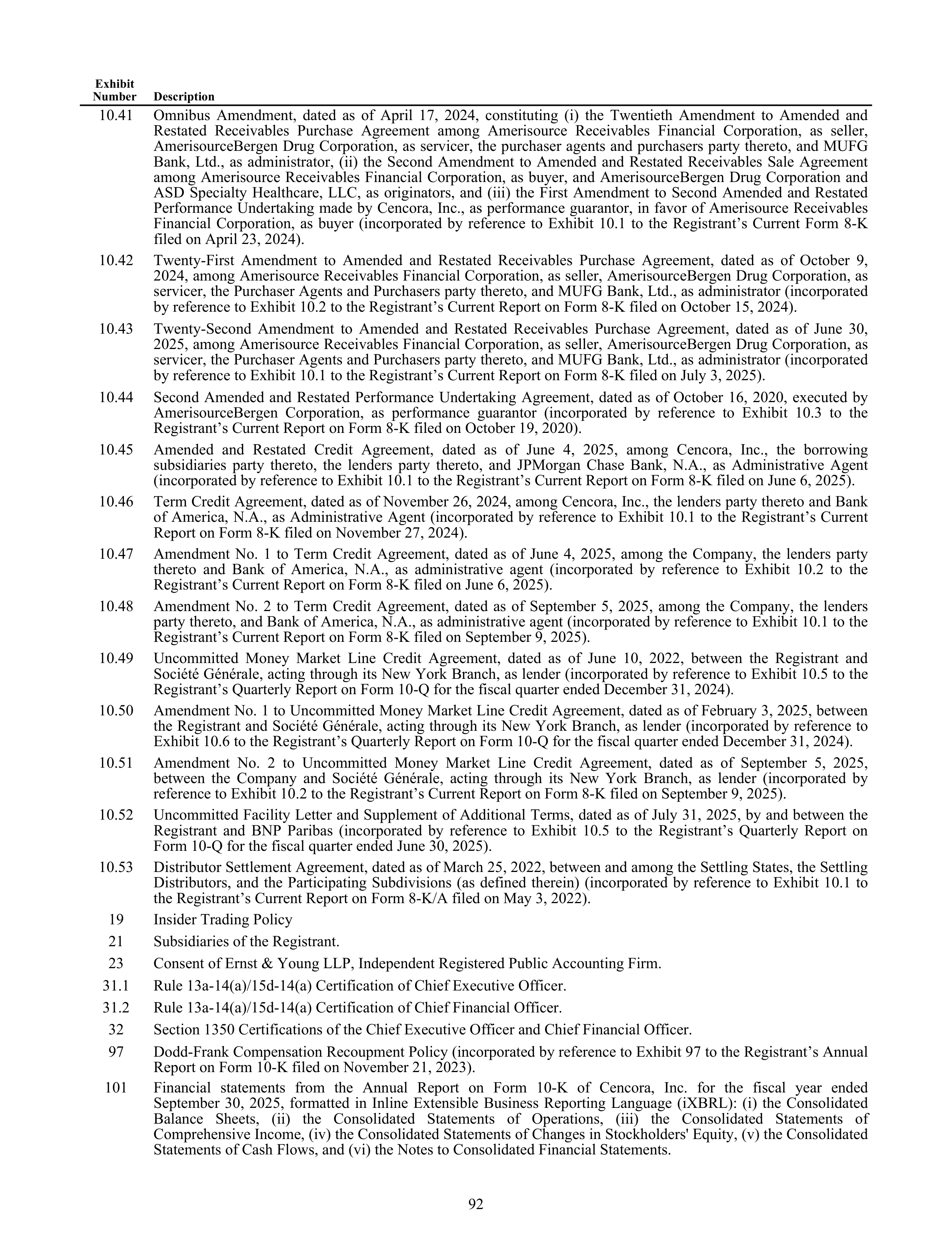
'BC>7JHB:C9B:CI 96I:96HD;EG>A
8DCHI>IJI>CI=:,L:CI>:I=B:C9B:CIIDB:C9:96C9
*:HI6I:9 *:8:>K67A:H (JG8=6H: <G::B:CI 6BDCHDJG8: *:8:>K67A:H >C6C8>6A DGEDG6I>DC 6H H:AA:G
B:G>HDJG8::G<:CGJDC 6HH:GK>8:G I=:EJG8=6H:G6<:CIH6C9EJG8=6H:GHE6GINI=:G:ID 6C9%-
6C@ $I9 6H69B>C>HIG6IDG >>I=:+:8DC9B:C9B:CIIDB:C9:96C9*:HI6I:9*:8:>K67A:H+6A:<G::B:CI
6BDCHDJG8:*:8:>K67A:H>C6C8>6ADGEDG6I>DC 6H7JN:G 6C9B:G>HDJG8::G<:CGJDC6C9
++E:8>6AIN :6AI=86G: $$ 6HDG>C6IDGH 6C9>>>I=:>GHIB:C9B:CIID+:8DC9B:C9:96C9*:HI6I:9
(:G;DGB6C8:-C9:GI6@>C<B69:7N:C8DG6 !C8 6HE:G;DGB6C8:C;6KDGD;B:G>HDJG8:*:8:>K67A:H
>C6C8>6ADGEDG6I>DC 6H7JN:G>C8DGEDG6I:97NG:;:G:C8:IDM=>7>I
IDI=:*:HIG6CIXHJGG:CIDGB
#
;>A:9DCEG>A
,L:CIN
>GHI B:C9B:CI ID B:C9:9 6C9 *:HI6I:9 *:8:>K67A:H (JG8=6H: <G::B:CI 96I:9 6H D; '8ID7:G
6BDCHDJG8:*:8:>K67A:H>C6C8>6ADGEDG6I>DC 6HH:AA:G B:G>HDJG8::G<:CGJDC 6H
H:GK>8:G I=:(JG8=6H:GC>HIG6IDG>C8DGEDG6I:9
7NG:;:G:C8:IDM=>7>I
IDI=:*:HIG6CIXHJGG:CI*:EDGIDCDGB
#;>A:9DC'8ID7:G
,L:CIN
+:8DC9 B:C9B:CI ID B:C9:9 6C9 *:HI6I:9 *:8:>K67A:H (JG8=6H: <G::B:CI 96I:9 6H D; "JC:
6BDCHDJG8:*:8:>K67A:H>C6C8>6ADGEDG6I>DC 6HH:AA:G B:G>HDJG8::G<:CGJDC 6H
H:GK>8:G I=:(JG8=6H:GC>HIG6IDG>C8DGEDG6I:9
7NG:;:G:C8:IDM=>7>I
IDI=:*:HIG6CIXHJGG:CI*:EDGIDCDGB
#;>A:9DC"JAN
+:8DC9B:C9:96C9*:HI6I:9(:G;DGB6C8:-C9:GI6@>C<<G::B:CI 96I:96HD;'8ID7:G
:M:8JI:97N
B:G>HDJG8::GDC 6H E:G;DGB6C8: C8DGEDG6I:9 7N G:;:G:C8: ID M=>7>I
ID I=:
*:HIG6CIXHJGG:CI*:EDGIDCDGB
#;>A:9DC'8ID7:G
B:C9:9 6C9 *:HI6I:9 G:9>I <G::B:CI 96I:9 6H D; "JC:
6BDCC<
HJ7H>9>6G>:HE6GINI=:G:ID I=:A:C9:GHE6GINI=:G:ID 6C9"(%DGC>HIG6I>K:<:CI
>C8DGEDG6I:97NG:;:G:C8:IDM=>7>I
IDI=:*:HIG6CIXHJGG:CI*:EDGIDCDGB
#;>A:9DC"JC:
,:GBG:9>I<G::B:CI 96I:96HD;&DK:B7:G
6BDC<:C8DG6 !C8 I=:A:C9:GHE6GINI=:G:ID6C96C@
D;B:G>86 & 6H9B>C>HIG6I>K:C8DGEDG6I:97NG:;:G:C8:IDM=>7>I
IDI=:*:HIG6CIXHJGG:CI
*:EDGIDCDGB
#;>A:9DC&DK:B7:G
B:C9B:CI&DID,:GBG:9>I<G::B:CI 96I:96HD;"JC:
6BDC<I=:DBE6CN I=:A:C9:GHE6GIN
I=:G:ID 6C9 6C@ D; B:G>86 & 6H 69B>C>HIG6I>K: 6C8DGEDG6I:9 7N G:;:G:C8: ID M=>7>I
ID I=:
*:HIG6CIXHJGG:CI*:EDGIDCDGB
#;>A:9DC"JC:
B:C9B:CI&DID,:GBG:9>I<G::B:CI 96I:96HD;+:EI:B7:G
6BDC<I=:DBE6CN I=:A:C9:GH
E6GINI=:G:ID 6C96C@D;B:G>86 & 6H69B>C>HIG6I>K:6C8DGEDG6I:97NG:;:G:C8:IDM=>7>I
IDI=:
*:HIG6CIXHJGG:CI*:EDGIDCDGB
#;>A:9DC+:EI:B7:G
-C8DBB>II:9 %DC:N %6G@:I $>C: G:9>I <G::B:CI 96I:9 6H D; "JC:
7:IL::C I=: *:HIG6CI 6C9
+D8>PIPPCPG6A: 68I>C<I=GDJIH&:L1DG@G6C8= 6HA:C9:G>C8DGEDG6I:97NG:;:G:C8:IDM=>7>I
IDI=:
*:HIG6CIXH)J6GI:GAN*:EDGIDCDGB
);DGI=:;>H86AFJ6GI:G:C9:9:8:B7:G
B:C9B:CI&DID-C8DBB>II:9%DC:N%6G@:I$>C:G:9>I<G::B:CI 96I:96HD;:7GJ6GN
7:IL::C
I=:*:HIG6CI6C9+D8>PIPPCPG6A: 68I>C<I=GDJIH&:L1DG@G6C8= 6HA:C9:G>C8DGEDG6I:97NG:;:G:C8:ID
M=>7>I
IDI=:*:HIG6CIXH)J6GI:GAN*:EDGIDCDGB
);DGI=:;>H86AFJ6GI:G:C9:9:8:B7:G
B:C9B:CI &D ID -C8DBB>II:9 %DC:N %6G@:I $>C: G:9>I <G::B:CI 96I:9 6H D; +:EI:B7:G
7:IL::C I=: DBE6CN 6C9 +D8>PIP PCPG6A: 68I>C< I=GDJIH &:L 1DG@ G6C8= 6H A:C9:G >C8DGEDG6I:9 7N
G:;:G:C8:IDM=>7>I
IDI=:*:HIG6CIXHJGG:CI*:EDGIDCDGB
#;>A:9DC+:EI:B7:G
-C8DBB>II:968>A>IN$:II:G6C9+JEEA:B:CID;99>I>DC6A,:GBH 96I:96HD;"JAN
7N6C97:IL::CI=:
*:HIG6CI6C9&((6G>76H>C8DGEDG6I:97NG:;:G:C8:IDM=>7>I
IDI=:*:HIG6CIXH)J6GI:GAN*:EDGIDC
DGB
);DGI=:;>H86AFJ6GI:G:C9:9"JC:
>HIG>7JIDG+:IIA:B:CI<G::B:CI 96I:96HD;%6G8=
7:IL::C6C96BDCCC<
>HIG>7JIDGH 6C9I=:(6GI>8>E6I>CK>H>DCH6H9:;>C:9I=:G:>C>C8DGEDG6I:97NG:;:G:C8:IDM=>7>I
ID
I=:*:HIG6CIXHJGG:CI*:EDGIDCDGB
#;>A:9DC%6N
!CH>9:G,G69>C8N
+J7H>9>6G>:HD;I=:*:HIG6CI
DCH:CID;GCHI1DJC<$$( !C9:E:C9:CI*:HI:G:9(J7A>888DJCI>CGB
*JA:6
69
6:GI>;>86I>DCD;=>:;M:8JI>K:';;>8:G
*JA:6
69
6:GI>;>86I>DCD;=>:;>C6C8>6A';;>8:G
+:8I>DC
:GI>;>86I>DCHD;I=:=>:;M:8JI>K:';;>8:G6C9=>:;>C6C8>6A';;>8:G
D99
G6C@DBE:CH6I>DC*:8DJEB:CI(DA>8N>C8DGEDG6I:97NG:;:G:C8:IDM=>7>IIDI=:*:HIG6CIXHCCJ6A
*:EDGIDCDGB
#;>A:9DC&DK:B7:G
>C6C8>6A
HI6I:B:CIH
;GDB
I=:
CCJ6A
*:EDGI
DC
DGB
#
D;
:C8DG6
!C8
;DG
I=:
;>H86A
N:6G
:C9:9
+:EI:B7:G
;DGB6II:9>C!CA>C:MI:CH>7A:JH>C:HH*:EDGI>C<$6C<J60*$>I=:DCHDA>96I:9
6A6C8:
+=::IH
>>
I=:
DCHDA>96I:9
+I6I:B:CIH
D;
'E:G6I>DCH
>>>
I=:
DCHDA>96I:9
+I6I:B:CIH
D;
DBEG:=:CH>K:!C8DB: >KI=:DCHDA>96I:9+I6I:B:CIHD;=6CC+ID8@=DA9:GHFJ>IN KI=:DCHDA>96I:9
+I6I:B:CIHD;6H=ADLH 6C9K>I=:&DI:HIDDCHDA>96I:9>C6C8>6A+I6I:B:CIH
D56/6@
!A9/2>
2?0>6<@6;:
DK:G(6K:6I6>A:;DGB6II:96H>CA>C:0*$6C98DCI6>C:9>CM=>7>I
D56/6@
!A9/2>
2?0>6<@6;:
5555555555555555555555555555555555555555555555555555555555
Z
68=B6G@:9:M=>7>I>H6B6C6<:B:CI8DCIG68IDG68DBE:CH6IDGNEA6C 8DCIG68IDG6GG6CCL=>8=69>G:8IDGDG
:M:8JI>K:D;;>8:GD;I=:*:HIG6CIE6GI>8>E6I:HDG=6HE6GI>8>E6I:9
'
!# '
&DI6EEA>867A:
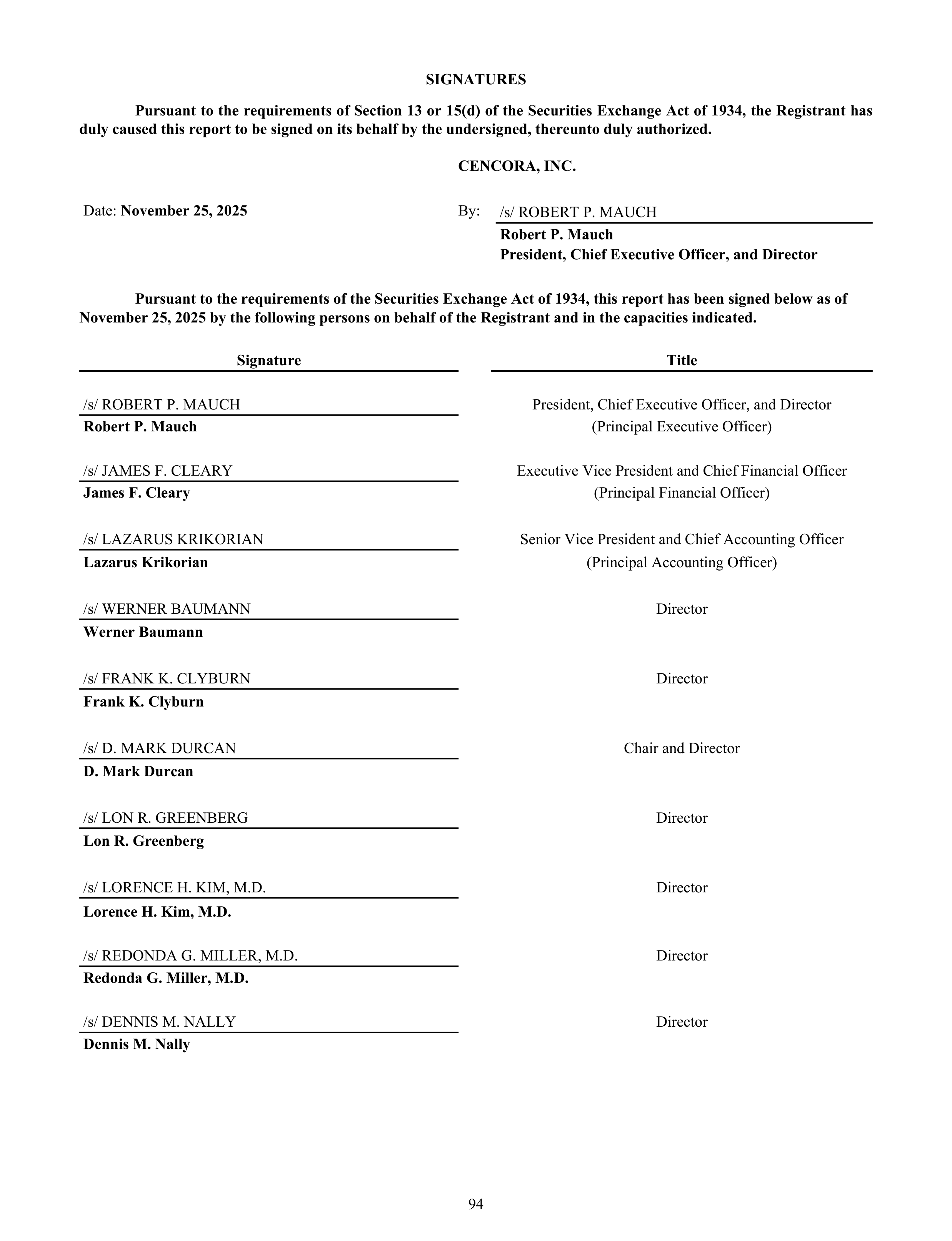
&!'(%&
#A>?A.:@@;@52>2=A6>292:@?;3&20@6;:
;>
1;3@52&20A>6@62?D05.:420@;3
@52%246?@>.:@5.?
1A8E0.A?21@56?>2@@;/2?64:21;:6@?/25.83/E@52A:12>?64:21@52>2A:@;1A8E.A@5;>6F21
!"%!
6I:
!;B29/2>
N
H*'*,(%-
%;/2>@# .A05
#>2?612:@5623D20A@6B2"33602>.:16>20@;>
#A>?A.:@@;@52>2=A6>292:@?;3@52&20A>6@62?D05.:420@;3
@56?>2@5.?/22:?64:21/28;C.?;3
!;B29/2> /E@523;88;C6:4?;:?;:/25.83;3@52%246?@>.:@.:16:@520.<.06@62?6:160.@21
&64:.@A>2
'6@82
H*'*,(%-
(G:H>9:CI =>:;M:8JI>K:';;>8:G 6C9>G:8IDG
%;/2>@# .A05
(G>C8>E6AM:8JI>K:';;>8:G
H"%+$*1
M:8JI>K:.>8:(G:H>9:CI6C9=>:;>C6C8>6A';;>8:G
.92?82.>E
(G>C8>E6A>C6C8>6A';;>8:G
H$2*-+#*!#'*!&
+:C>DG.>8:(G:H>9:CI6C9=>:;88DJCI>C8:G
.F.>A?>67;>6.:
(G>C8>E6A88DJCI>C8:G
H/*&*-%&&
>G:8IDG
*2>:2>.A9.::
H*&##$1-*&
>G:8IDG
>.:78E/A>:
H%*#-*&
=6>G6C9>G:8IDG
.>7A>0.:
H$'&**&*
>G:8IDG
;:%>22:/2>4
H$'*& #!% %
>G:8IDG
;>2:0269
H*'&%!$$* %
>G:8IDG
%21;:1. 6882>
H&&!+%&$$1
>G:8IDG
2::6? !.88E
&64:.@A>2
'6@82
H$'*!"*1*#*#
>G:8IDG
;>6%E2>72>7
H$-*&%,1$*
>G:8IDG
.A>2: 'E82>
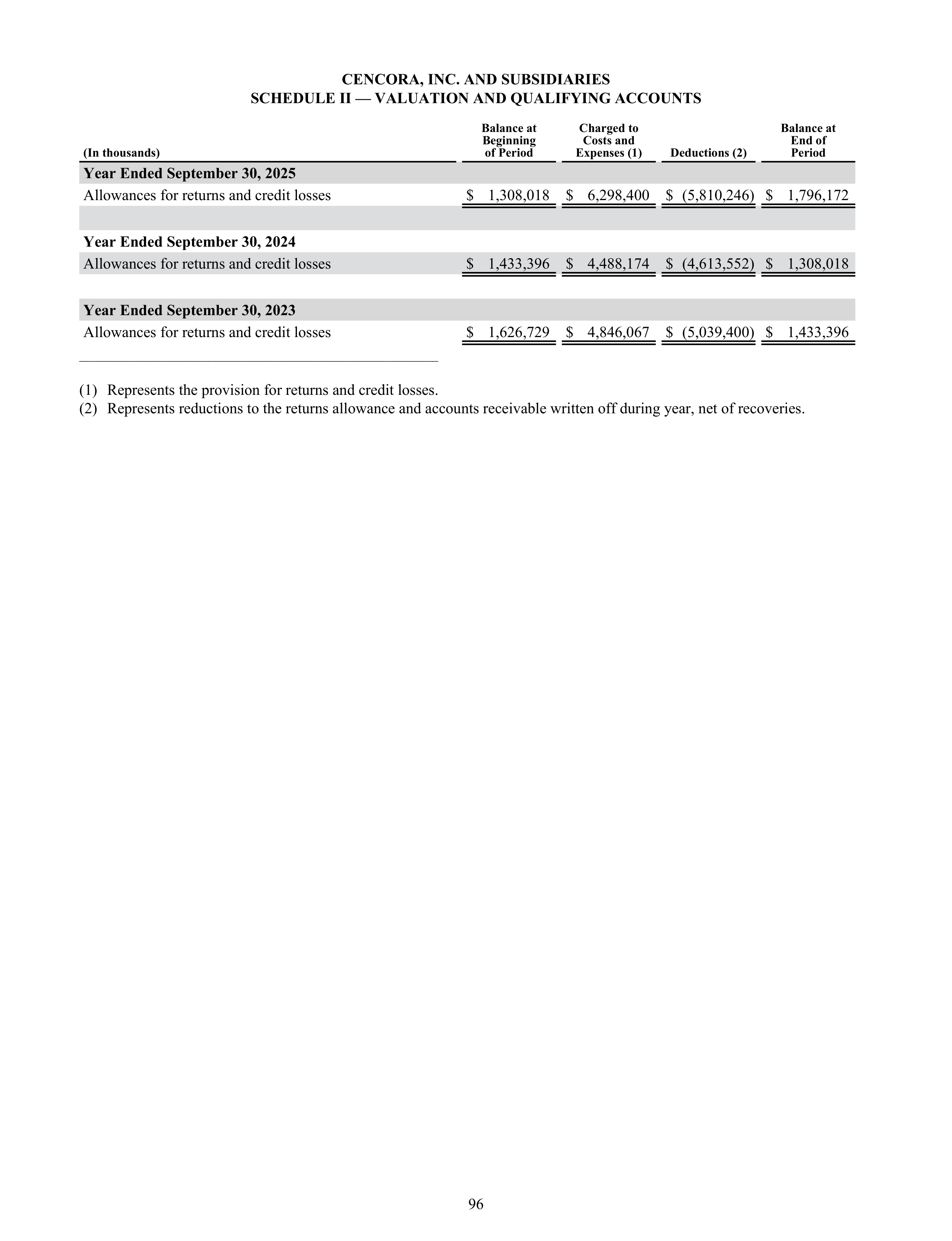
!"%!!&(&%&
&(G)('"!!$(,!"(!'&
:@5;A?.:1?
.8.:02.@
246::6:4
;3#2>6;1
5.>421@;
;?@?.:1
D<2:?2?
21A0@6;:?
.8.:02.@
:1;3
#2>6;1
,2.>:121&2
AADL6C8:H;DGG:IJGCH6C98G:9>IADHH:H
,2.>:121&2
AADL6C8:H;DGG:IJGCH6C98G:9>IADHH:H
,2.>:121&2
AADL6C8:H;DGG:IJGCH6C98G:9>IADHH:H
5555555555555555555555555555555555555555555555555555555555
*:EG:H:CIHI=:EGDK>H>DC;DGG:IJGCH6C98G:9>IADHH:H
*:EG:H:CIHG:9J8I>DCHIDI=:G:IJGCH6AADL6C8:6C9688DJCIHG:8:>K67A:LG>II:CD;;9JG>C:H