

2023 corporate sustainability report
Energy
for
a growing world
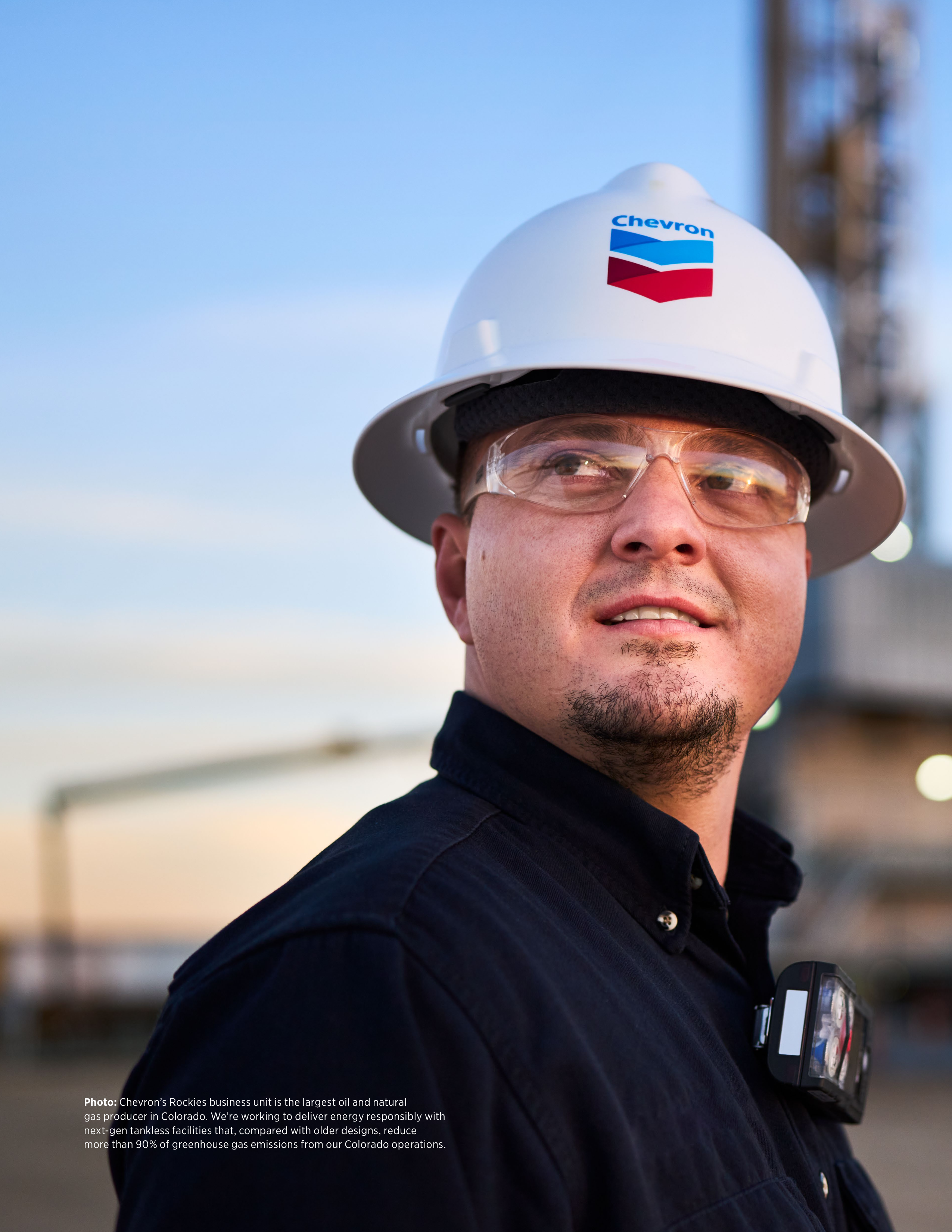
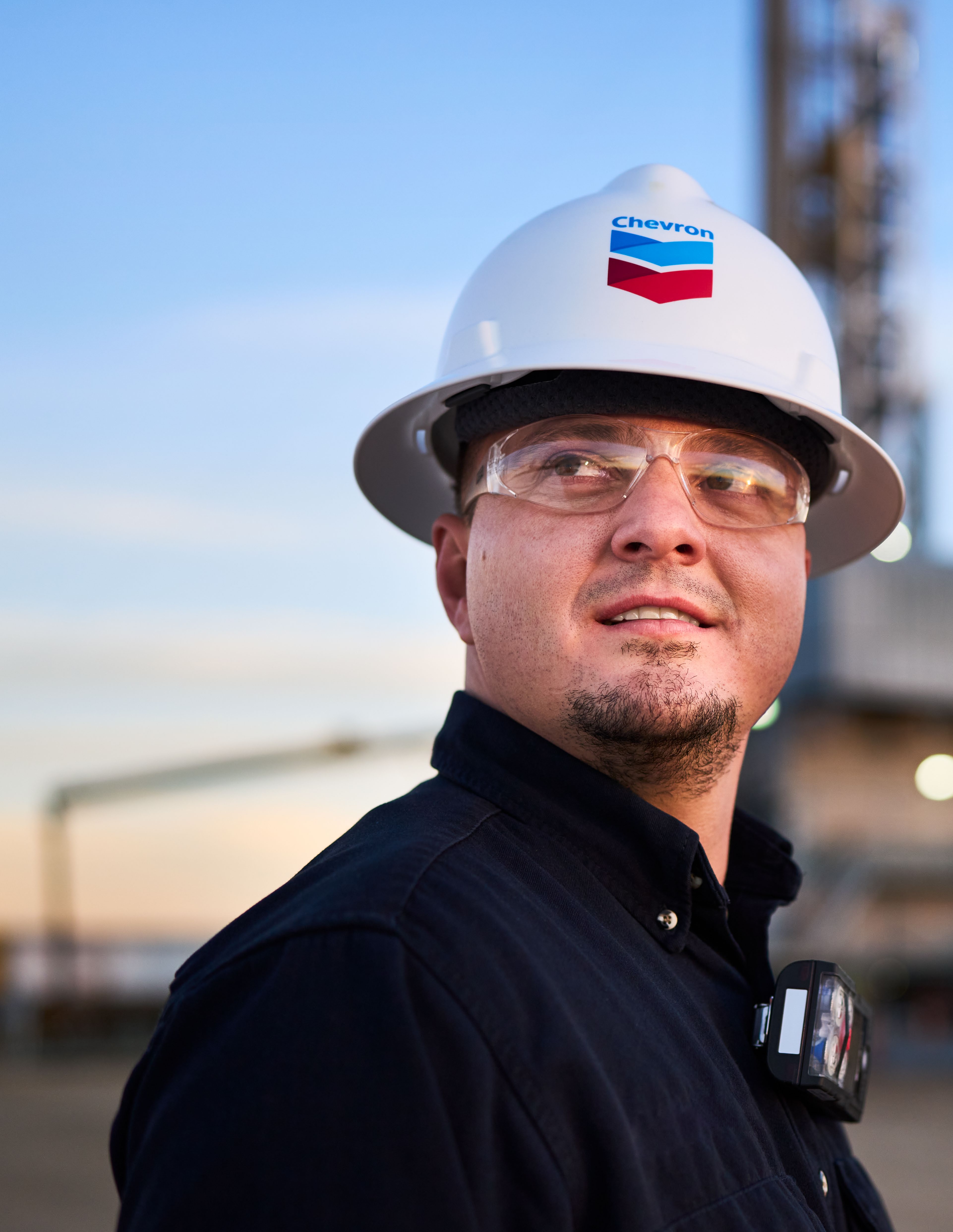
Photo:
Chevron’s Rockies business unit is the largest oil and natural
gas producer in Colorado. We’re working to deliver energy responsibly with
next-gen tankless facilities that, compared with older designs, reduce
more than 90% of greenhouse gas emissions from our Colorado operations.

We believe the world’s continued demand for oil, natural gas and other energy products should be supplied by
the most responsible producers. We work to achieve progress and deliver value, consistent with our vision to be the
global energy company most admired for its people, partnership and performance.
higher returns,
lower carbon
Chevron 2023 Corporate Sustainability Report
1
Chevron 2023 Corporate Sustainability Report
1
introduction
At Chevron, our purpose is to provide the affordable,
reliable, ever-cleaner energy that enables human
progress. Our sustainability reporting focuses on
environmental, social and governance (ESG) issues
that matter to our business and our stakeholders.
2023 sustainability highlights............................................. 3
message from our chairman and CEO..............................4
board of directors..................................................................6
director Q&A............................................................................ 7
our business.............................................................................8
sustainability......................................................................... 10
our reporting...........................................................................11
social investment...................................................................13
advancing energy progress
climate......................................................................................15
lower carbon...................................................................16
methane...........................................................................18
lifecycle analysis............................................................19
new energies................................................................ 20
protecting the environment
environment..........................................................................23
air......................................................................................24
water................................................................................25
waste................................................................................27
biodiversity....................................................................29
empowering people
safety and health..................................................................32
people and culture...............................................................36
human rights..........................................................................39
getting results the right way
governance............................................................................43
lobbying..................................................................................47
technology............................................................................ 50
performance
performance data................................................................53
glossary...................................................................................55
about this report...................................................................57
in this report
Chevron 2023 Corporate Sustainability Report
2
introduction
social
climate
environment
governance
performance
2023 sustainability highlights
getting results
the right way
empowering
people
protecting the
environment
Somos employee network recognized as Hispanic Employee Resource Group of the Year by Society of Hispanic Professional Engineers
Somos employee network recognized as Hispanic Employee Resource Group of the Year by Society of Hispanic Professional Engineers
Somos employee network recognized as Hispanic Employee Resource Group of the Year by Society of Hispanic Professional Engineers
Somos employee network recognized as Hispanic Employee Resource Group of the Year by Society of Hispanic Professional Engineers
Somos employee network recognized as Hispanic Employee Resource Group of the Year by Society of Hispanic Professional Engineers
Somos employee network recognized as Hispanic Employee Resource Group of the Year by Society of Hispanic Professional Engineers
Somos employee network recognized as Hispanic Employee Resource Group of the Year by Society of Hispanic Professional Engineers
read more
95,829
U.S. employee
and retiree volunteer
hours during 2023
Chevron has fully funded 151 employees to participate in our Digital Scholar master’s degree program since 2019
Chevron has fully funded 151 employees to participate in our Digital Scholar master’s degree program since 2019
Chevron has fully funded 151 employees to participate in our Digital Scholar master’s degree program since 2019
Chevron has fully funded 151 employees to participate in our Digital Scholar master’s degree program since 2019
Chevron has fully funded 151 employees to participate in our Digital Scholar master’s degree program since 2019
read more
USD 1.2 billion+ social investment in communities where we operate since 2016
USD 1.2 billion+ social investment in communities where we operate since 2016
USD 1.2 billion+ social investment in communities where we operate since 2016
USD 1.2 billion+ social investment in communities where we operate since 2016
6th publication of our
publication of our
Climate Change Resilience
Report
detailing the actions
we take to advance
our lower carbon ambitions
U.S. Fish and Wildlife Service
recognized Chevron with
a Conservation Award
for outstanding stewardship of
natural resources and long-
term dedication to endangered
thistle recovery
Upgraded the diesel hydrotreater at the
Upgraded the diesel hydrotreater at the
Upgraded the diesel hydrotreater at th
e El Segundo
Refinery, California to process either 100% renewable or traditional feedstocks
Refinery, California to process either 100% renewable or traditional feedstocks Refinery, California to process either 100% renewable or traditional feedstocks
Refinery, California to process either 100% renewable or traditional feedstocks
Refinery, California to process either 100% renewable or traditional feedstocks
Completed acquisition of a
majority stake in ACES Delta,
LLC
which is developing
a green hydrogen storage
project in Utah
read more
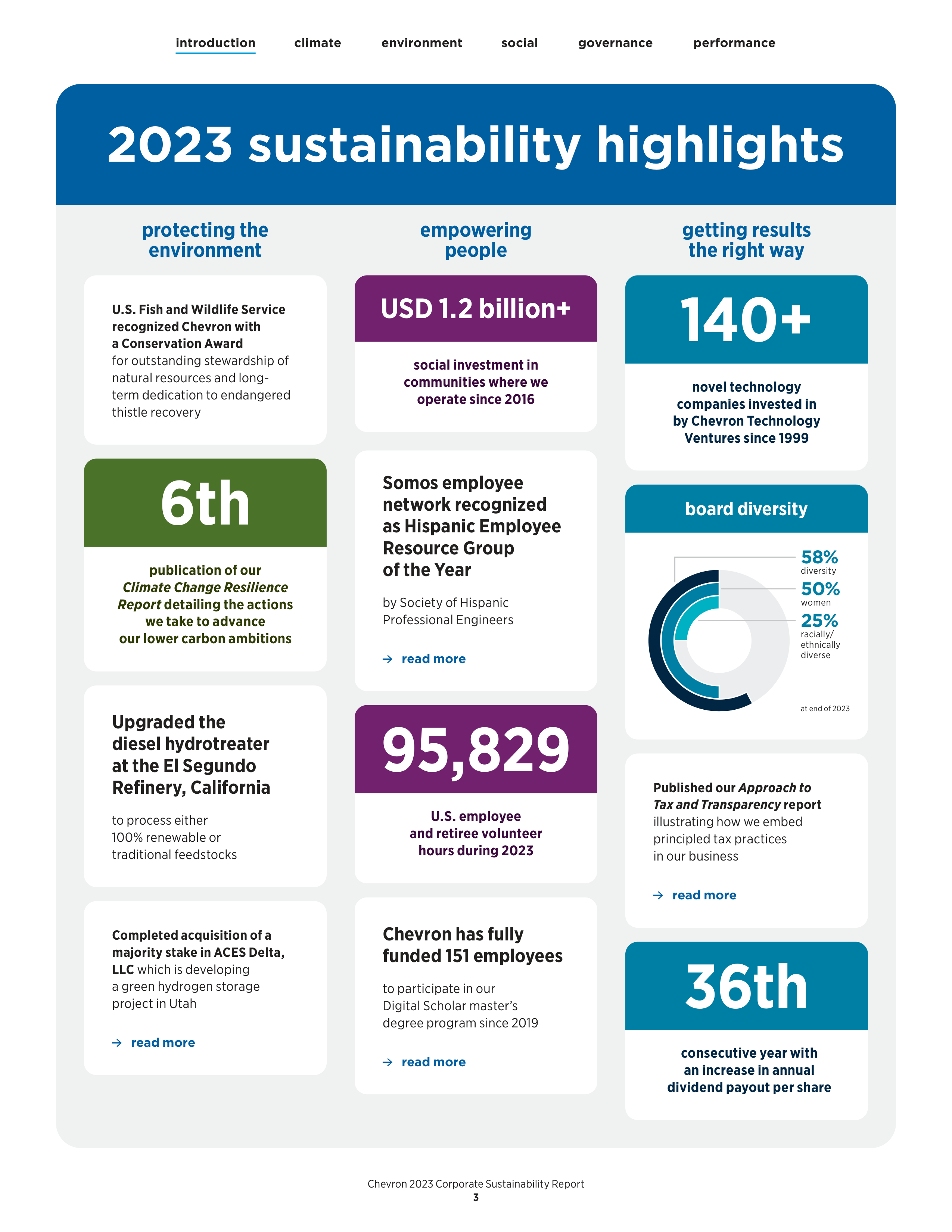
58% diversity
58% diversity
50% women
50% women
25% racially/ethnically diverse
25% racially/ethnically diverse
25% racially/ethnically diverse
25% racially/ethnically diverse
at end of 2023
board diversity
140+ novel technology companies invested in by Chevron Technology Ventures since 1999
140+ novel technology companies invested in by Chevron Technology Ventures since 1999
140+ novel technology companies invested in by Chevron Technology Ventures since 1999
140+ novel technology companies invested in by Chevron Technology Ventures since 1999
140+ novel technology companies invested in by Chevron Technology Ventures since 1999
Published our
Approach to
Tax and Transparency
report
illustrating how we embed
principled tax practices
in our business
read more
36th consecutive year with an increase in annual dividend payout per share
36th consecutive year with an increase in annual dividend payout per share
36th consecutive year with an increase in annual dividend payout per share
36th consecutive year with an increase in annual dividend payout per share
Chevron 2023 Corporate Sustainability Report
3
introduction
social
climate
environment
governance
performance
In 2023, Chevron continued producing the energy that
enables human progress. Amid global volatility, our
strategy remained consistent: leverage our strengths to
safely deliver lower carbon energy to a growing world.
“Affordable, reliable
and ever-cleaner
energy is required
to achieve economic
prosperity, energy
security and
environmental
protection.”
Our approach to sustainability is integrated through?
out our business. For over two decades, we’ve
communicated sustainability-related performance
to our stakeholders. This report reflects our
annual performance.
advancing environmental protection
Many energy solutions will be required to achieve
the world’s energy and environmental goals.
Chevron works to develop better processes, deploy
new technologies and invest in innovations to
advance environmental protection.
We have allocated $10 billion from 2021 through 2028
in lower carbon investments to reduce the carbon
intensity of our operations and to help our customers
meet their own lower carbon ambitions. Last year,
we expanded acreage at our Bayou Bend Carbon
Capture and Storage Hub project, positioning it to be
one of the largest carbon capture projects in the
United States. We acquired a majority stake in ACES
Delta, a hydrogen hub in Utah, designed to store
hydrogen made from renewable energy and dispatch
it to generate reliable power. We successfully
upgraded the diesel hydrotreater at our El Segundo
Refinery to process either 100% renewable or
petroleum feedstocks.
We are also focused on identifying opportunities to
conserve and enhance biodiversity where we operate.
Last year, we expanded our global biodiversity
database, creating more insights and new opportunities
for action.
engaging our people
We believe human ingenuity has the power to solve
any challenge and overcome any obstacle.
We seek to engage the full potential of our employees
by bringing together diverse viewpoints, ideas and
experiences in an inclusive environment. Chevron invests
to build leadership capabilities across our workforce
and create programs and experiences that give
employees the skills to thrive. We also empower our
people to make a difference in communities where we
operate – which is reflected in the nearly 100,000 hours
of volunteerism by our United States employees and
retirees in 2023. And we continue to focus on the safety
of our operations and the health and well-being of
our workforce and communities.
message from our
chairman and CEO
Chevron 2023 Corporate Sustainability Report
4
introduction
social
climate
environment
governance
performance
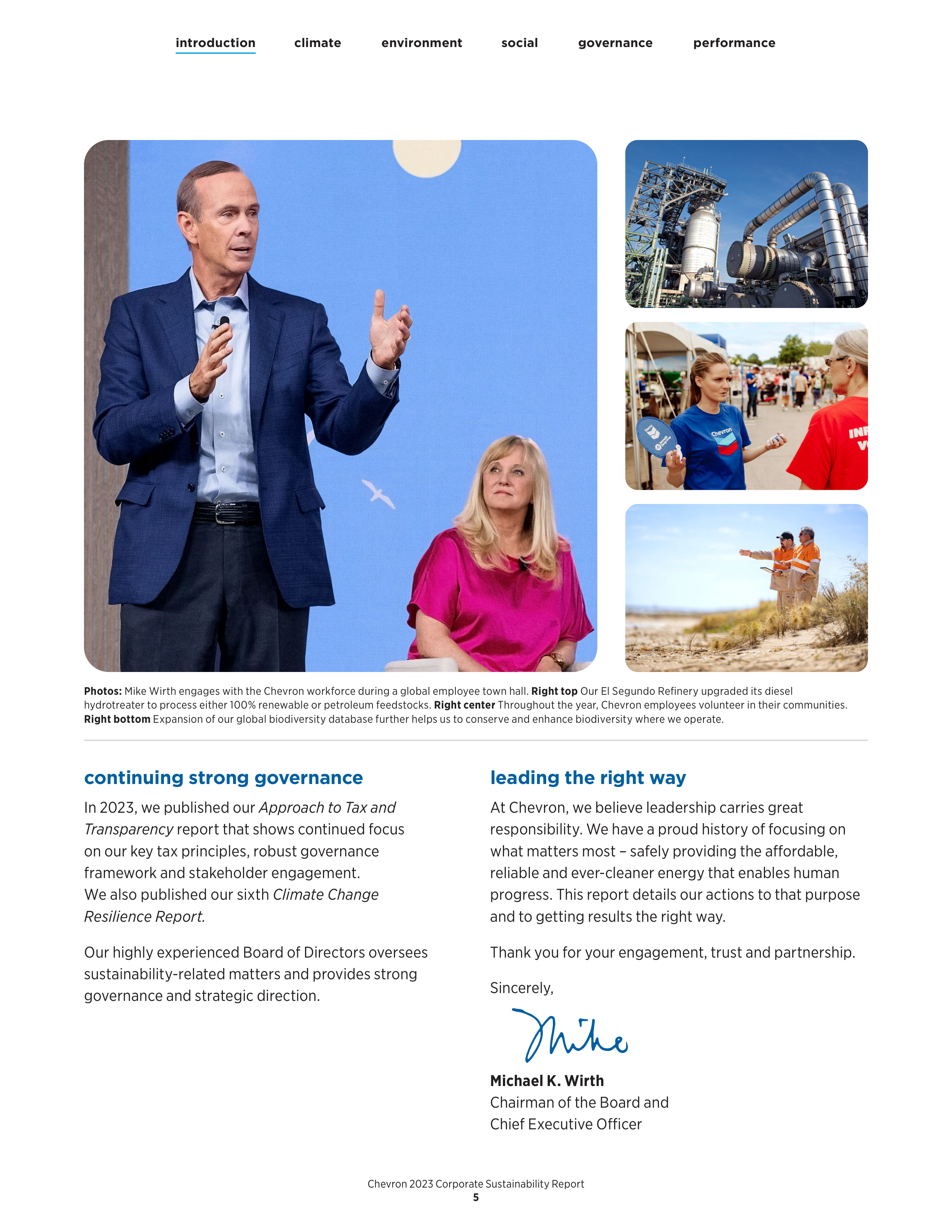
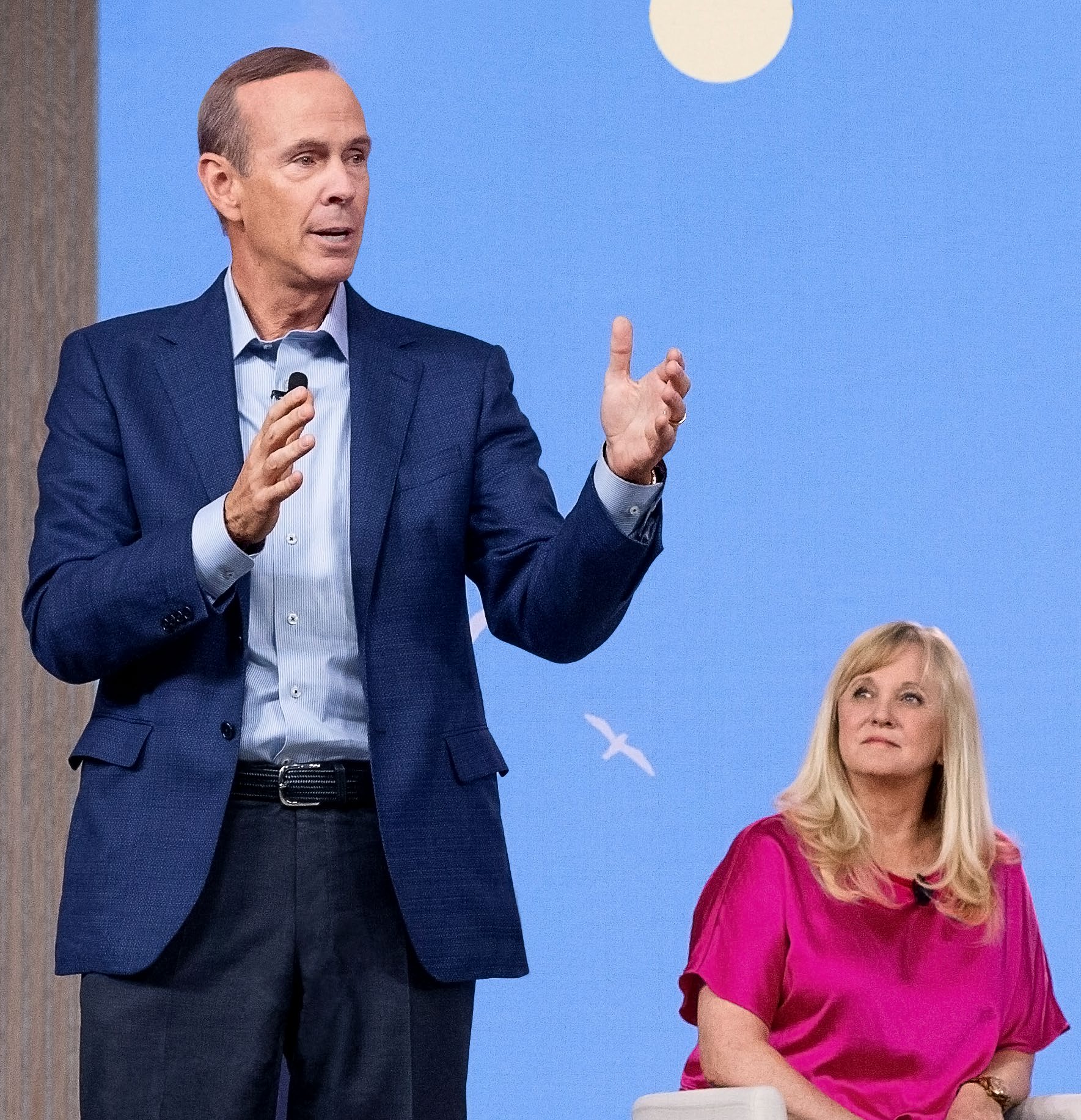
Photos:
Mike Wirth engages with the Chevron workforce during a global employee town hall.
Right top
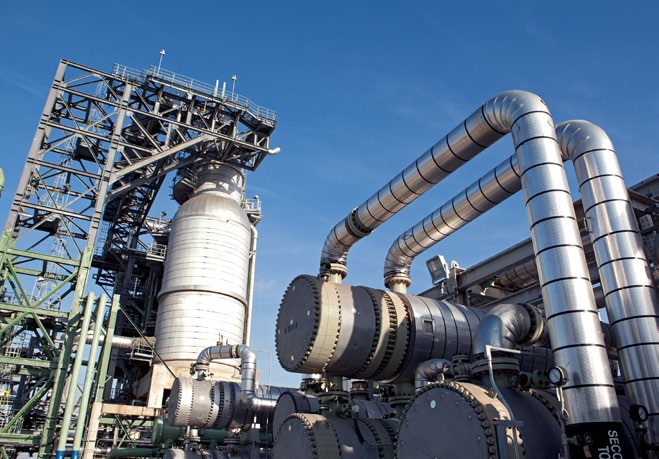
Our El Segundo Refinery upgraded its diesel
hydrotreater to process either 100% renewable or petroleum feedstocks.
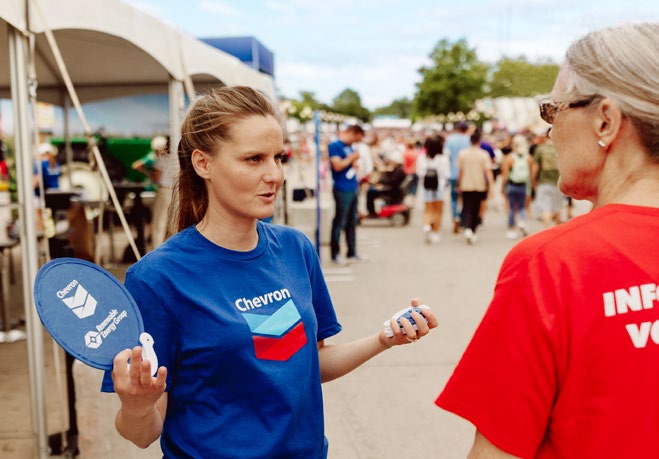
Right center
Throughout the year, Chevron employees volunteer in their communities.
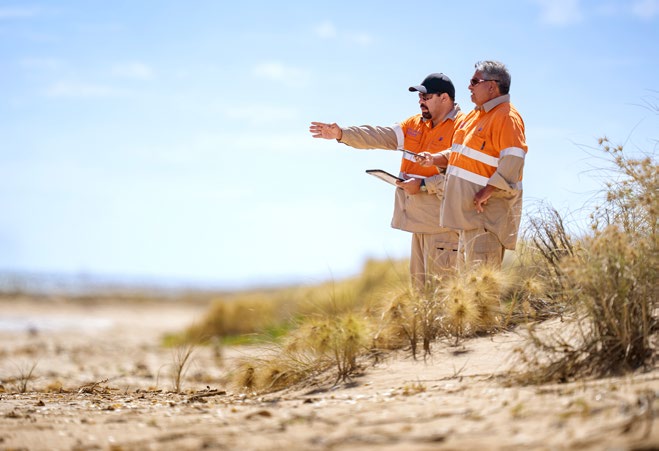
Right bottom
Expansion of our global biodiversity database further helps us to conserve and enhance biodiversity where we operate.
leading the right way
At Chevron, we believe leadership carries great
responsibility. We have a proud history of focusing on
what matters most – safely providing the affordable,
reliable and ever-cleaner energy that enables human
progress. This report details our actions to that purpose
and to getting results the right way.
Thank you for your engagement, trust and partnership.
Sincerely,
Michael K. Wirth
Chairman of the Board and
Chief Executive Officer
continuing strong governance
In 2023, we published our
Approach to Tax and
Transparency
report that shows continued focus
on our key tax principles, robust governance
framework and stakeholder engagement.
We also published our sixth
Climate Change
Resilience Report.
Our highly experienced Board of Directors oversees
sustainability-related matters and provides strong
governance and strategic direction.
Chevron 2023 Corporate Sustainability Report
5
introduction
social
climate
environment
governance
performance
board of directors
Our Board is committed to strong corporate governance
structures and practices that help Chevron achieve
business results the right way. Elements of strategy are
discussed at every regular Board meeting, as well
as at meetings of the Board’s Committees. At least one
Board meeting each year is dedicated primarily to
stra?tegy. To assess performance against the plan, the
Board receives regular updates on progress and
execution and provides oversight and direction through?
out the year. Meetings also include updates from
external subject matter experts on a range of issues
pertinent to Chevron’s strategy.
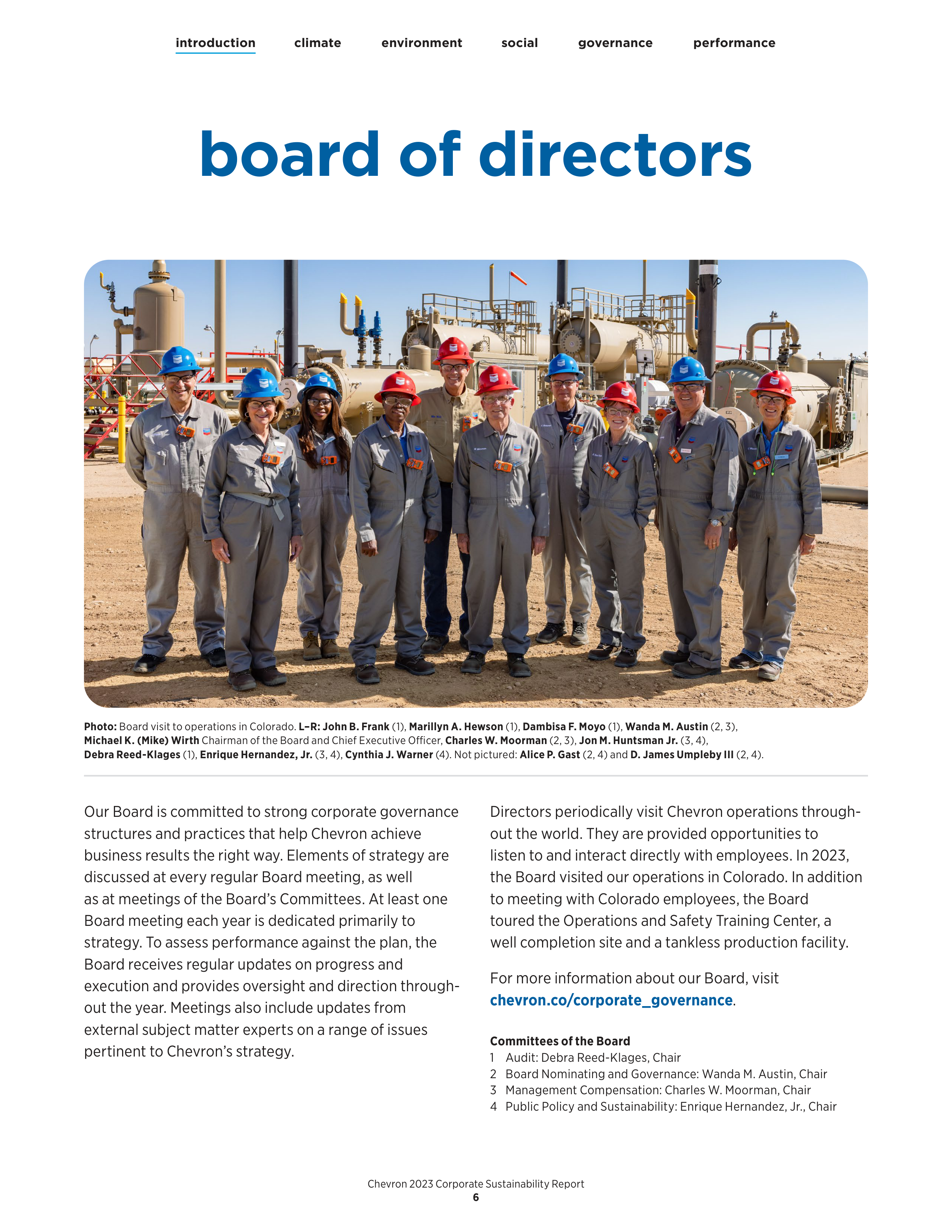
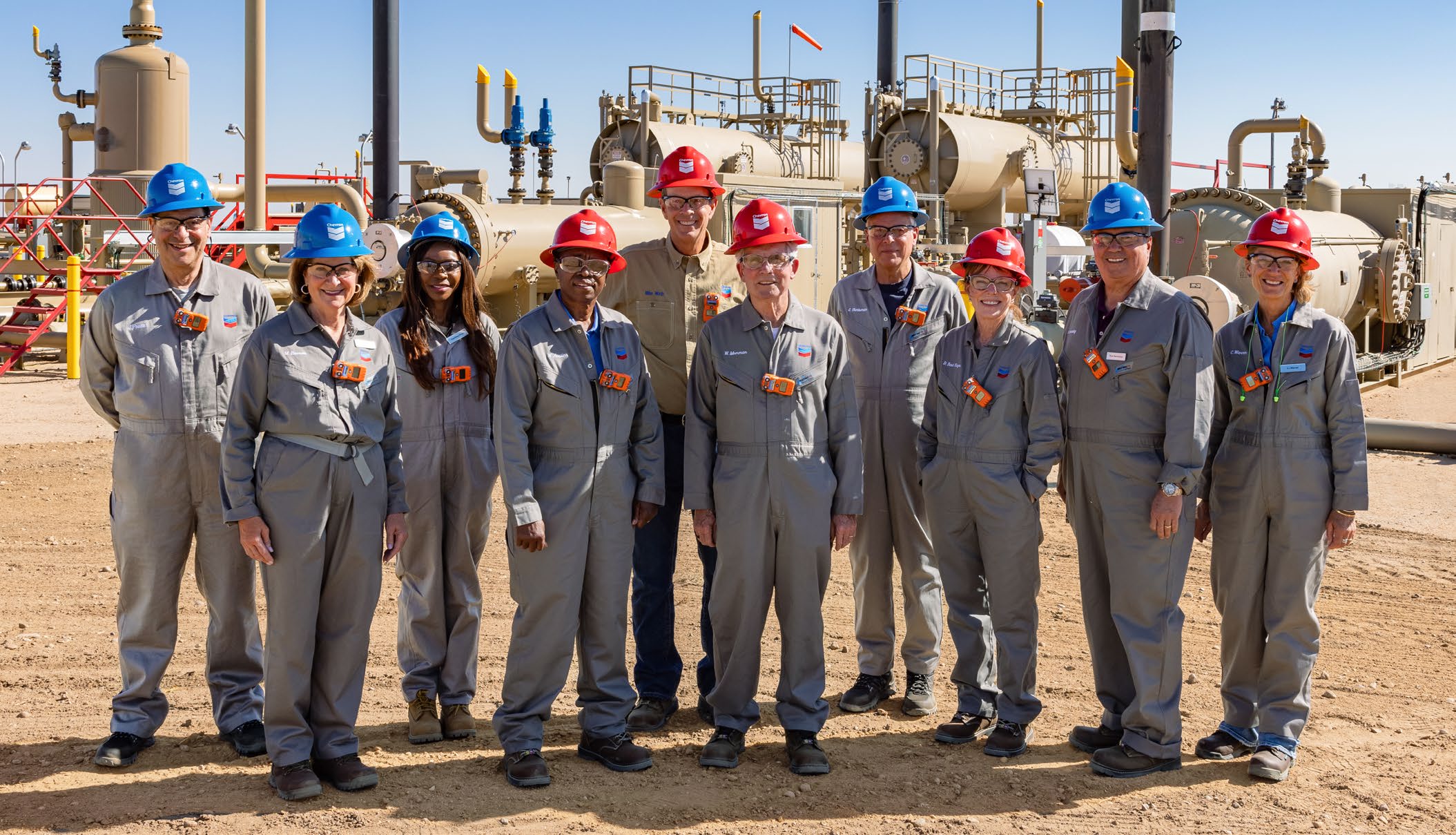
Directors periodically visit Chevron operations through?
out the world. They are provided opportunities to
listen to and interact directly with employees. In 2023,
the Board visited our operations in Colorado. In addition
to meeting with Colorado employees, the Board
toured the Operations and Safety Training Center, a
well completion site and a tankless production facility.
For more information about our Board, visit
chevron.co/corporate_governance
.
Committees of the Board
1
Audit: Debra Reed-Klages, Chair
2
Board Nominating and Governance: Wanda M. Austin, Chair
3
Management Compensation: Charles W. Moorman, Chair
4 ?
?Public Policy and Sustainability: Enrique Hernandez, Jr., Chair
Photo:
Board visit to operations in Colorado.
L–R: John B. Frank
(1),
Marillyn A. Hewson
(1),
Dambisa F. Moyo
(1),
Wanda M. Austin
(2, 3),
Michael K. (Mike) Wirth
Chairman of the Board and Chief Executive Officer,
Charles W. Moorman
(2, 3),
Jon M. Huntsman Jr.
(3, 4),
Debra Reed-Klages
(1),
Enrique Hernandez, Jr.
(3, 4),
Cynthia J. Warner
(4). Not pictured:
Alice P. Gast
(2, 4) and
D. James Umpleby III
(2, 4).
Chevron 2023 Corporate Sustainability Report
6
introduction
social
climate
environment
governance
performance
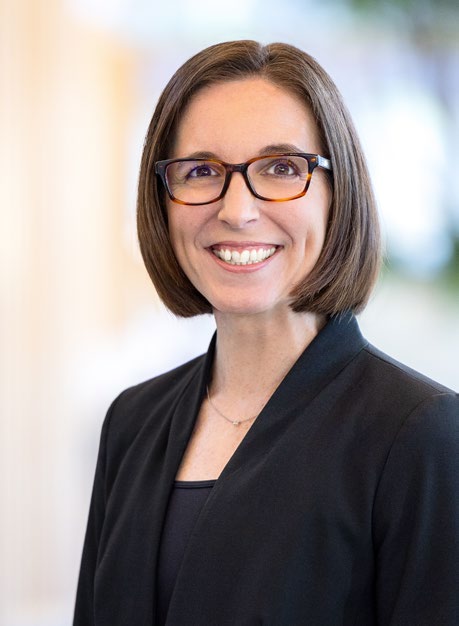
molly laegeler
VP Strategy & Sustainability,
and Secretary PPSC
Joining Chevron in 2005,
Laegeler guides the company’s
key strategies, including capital
allocation and sustainability efforts.
Laegeler earned her bachelor’s
degree in petroleum engineering
from Missouri University of
Science and Technology and her
MBA from Tulane University.
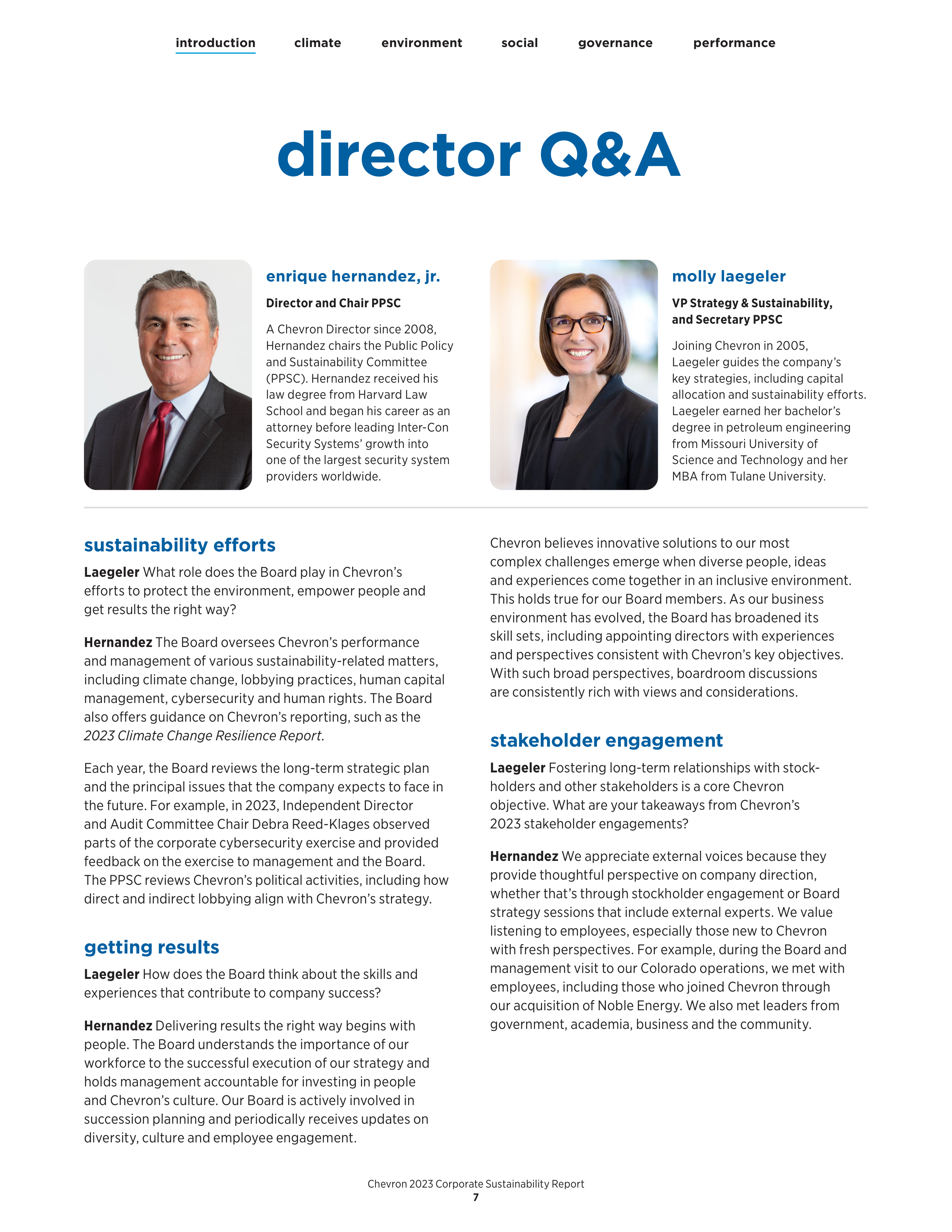
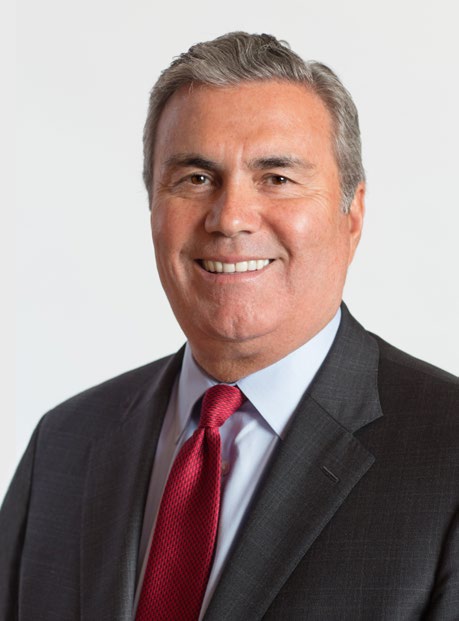
enrique hernandez, jr.
Director and Chair PPSC
A Chevron Director since 2008,
Hernandez chairs the Public Policy
and Sustainability Committee
(PPSC). Hernandez received his
law degree from Harvard Law
School and began his career as an
attorney before leading Inter-Con
Security Systems’ growth into
one of the largest security system
providers worldwide.
sustainability efforts
Laegeler
What role does the Board play in Chevron’s
efforts to protect the environment, empower people and
get results the right way?
Hernandez
The Board oversees Chevron’s performance
and management of various sustainability-related matters,
including climate change, lobbying practices, human capital
management, cybersecurity and human rights. The Board
also offers guidance on Chevron’s reporting, such as the
2023 Climate Change Resilience Report
.
Each year, the Board reviews the long-term strategic plan
and the principal issues that the company expects to face in
the future. For example, in 2023, Independent Director
and Audit Committee Chair Debra Reed-Klages observed
parts of the corporate cybersecurity exercise and provided
feedback on the exercise to management and the Board.
The PPSC reviews Chevron’s political activities, including how
direct and indirect lobbying align with Chevron’s strategy.
getting results
Laegeler
How does the Board think about the skills and
experiences that contribute to company success?
Hernandez
Delivering results the right way begins with
people. The Board understands the importance of our
workforce to the successful execution of our strategy and
holds management accountable for investing in people
and Chevron’s culture. Our Board is actively involved in
succession planning and periodically receives updates on
diversity, culture and employee engagement.
Chevron believes innovative solutions to our most
complex challenges emerge when diverse people, ideas
and experiences come together in an inclusive environment.
This holds true for our Board members. As our business
environment has evolved, the Board has broadened its
skill sets, including appointing directors with experiences
and perspectives consistent with Chevron’s key objectives.
With such broad perspectives, boardroom discussions
are consistently rich with views and considerations.
stakeholder engagement
Laegeler
Fostering long-term relationships with stock -
holders and other stakeholders is a core Chevron
objective. What are your takeaways from Chevron’s
2023 stakeholder engagements?
Hernandez
We appreciate external voices because they
provide thoughtful perspective on company direction,
whether that’s through stockholder engagement or Board
strategy sessions that include external experts. We value
listening to employees, especially those new to Chevron
with fresh perspectives. For example, during the Board and
management visit to our Colorado operations, we met with
employees, including those who joined Chevron through
our acquisition of Noble Energy. We also met leaders from
government, academia, business and the community.
director Q&A
Chevron 2023 Corporate Sustainability Report
7
introduction
social
climate
environment
governance
performance
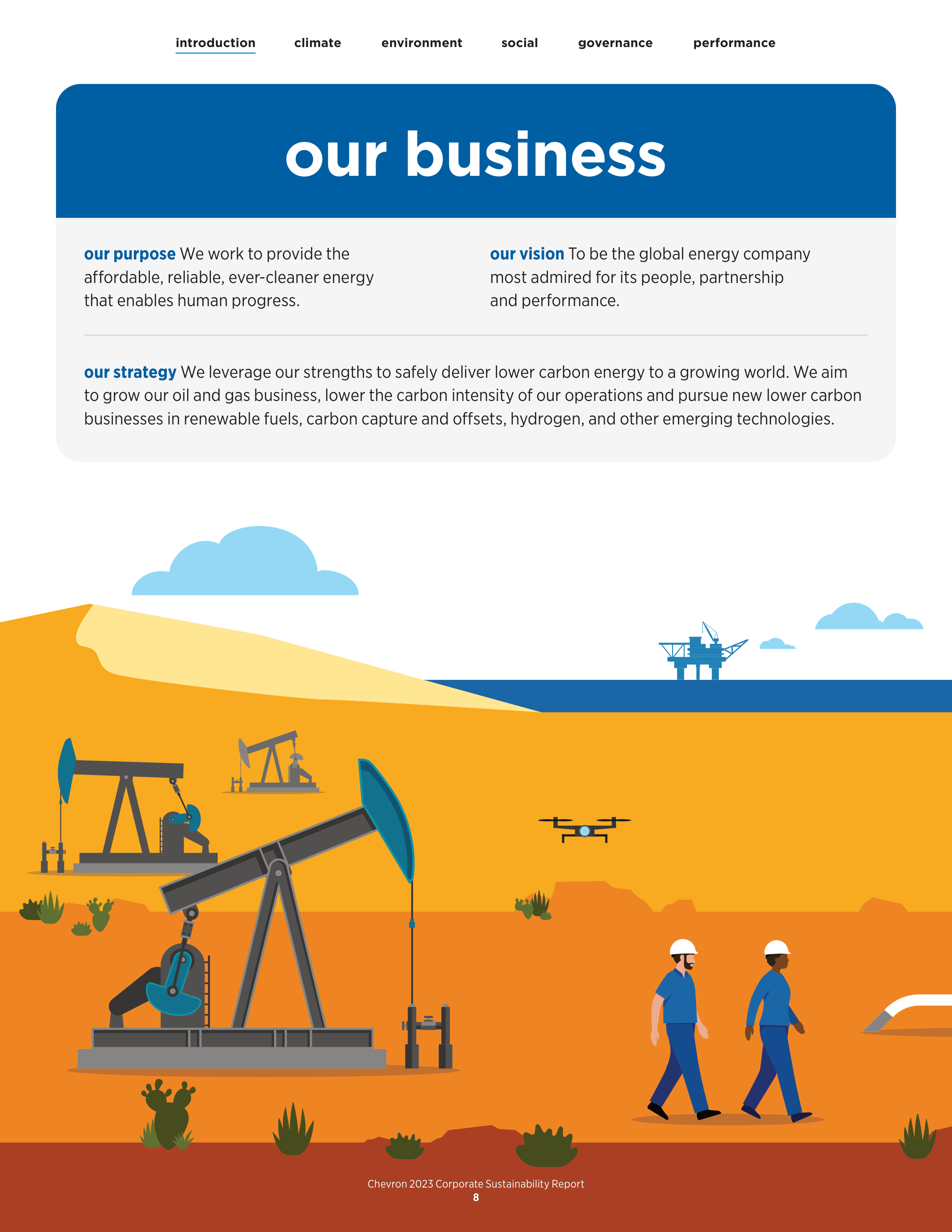
our strategy
We leverage our strengths to safely deliver lower carbon energy to a growing world. We aim
to grow our oil and gas business, lower the carbon intensity of our operations and pursue new lower carbon
businesses in renewable fuels, carbon capture and offsets, hydrogen, and other emerging technologies.
our purpose
We work to provide the
affordable, reliable, ever-cleaner energy
that enables human progress.
our vision
To be the global energy company
most admired for its people, partnership
and performance.
Chevron 2023 Corporate Sustainability Report
8
Chevron 2023 Corporate Sustainability Report
8
our business
introduction
social
climate
environment
governance
performance
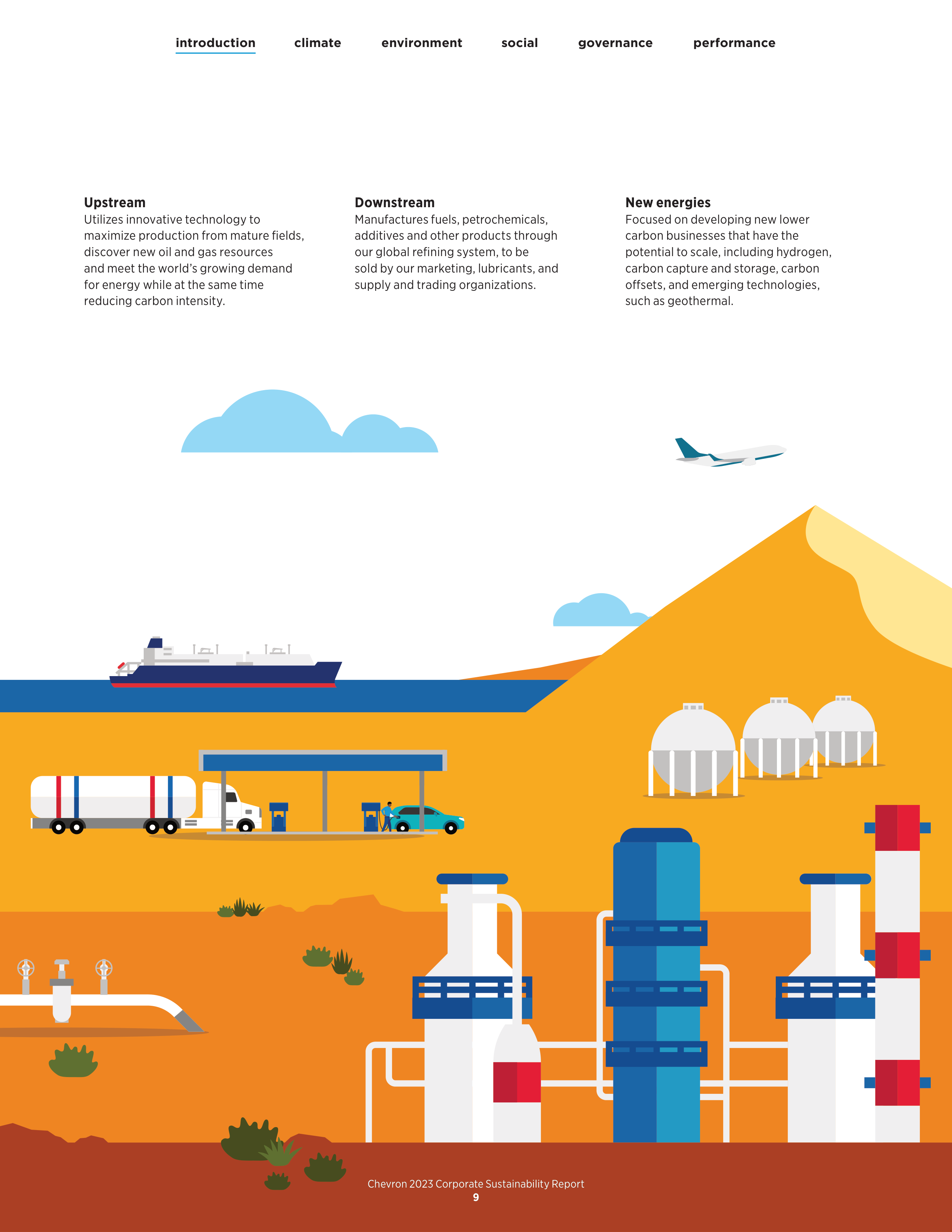
Upstream
Utilizes innovative technology to
maximize production from mature fields,
discover new oil and gas resources
and meet the world’s growing demand
for energy while at the same time
reducing carbon intensity.
Downstream
Manufactures fuels, petrochemicals,
additives and other products through
our global refining system, to be
sold by our marketing, lubricants, and
supply and trading organizations.
New energies
Focused on developing new lower
carbon businesses that have the
potential to scale, including hydrogen,
carbon capture and storage, carbon
offsets, and emerging technologies,
such as geothermal.
Chevron 2023 Corporate Sustainability Report
9
Chevron 2023 Corporate Sustainability Report
9
OEM
S f
ocus areas
Environment
Workforce
safety
and health
Process safety,
reliability
and integrity
Security
Efficiency
Stakeholders
introduction
social
climate
environment
governance
performance
sustainability
our approach
Chevron’s approach to sustainability is integrated
throughout our business. We strive to protect
the environment, empower people and get results
the right way. The Chevron Way guides how we
work and establishes a common understanding of
our culture, vision and values. To learn more, visit
chevron.co/chevron_way
.
Oversight
The Board oversees Chevron’s performance and
management of various sustainability-related issues,
including climate change, reporting, lobbying
practices, human capital management, cybersecurity
and human rights. The Board’s four standing
Committees provide oversight and guidance over
different aspects of sustain?ability. For example, the
Public Policy and Sustainability Committee assesses
and advises on risks that may arise in connection
with social, political, environmental and public policy
aspects of Chevron’s business and helps management
evaluate trends and potential impli?cations. To learn
more, visit
chevron.co/governance
.
Risk management
Chevron employs risk management processes for
identifying, assessing and managing the risks
to our business, including potential risks related
to sustainability matters. For example, our
Operational Excellence Management System
(OEMS) helps us systematically realize our values
and achieve our vision. A number of risks,
including those related to sustainability matters,
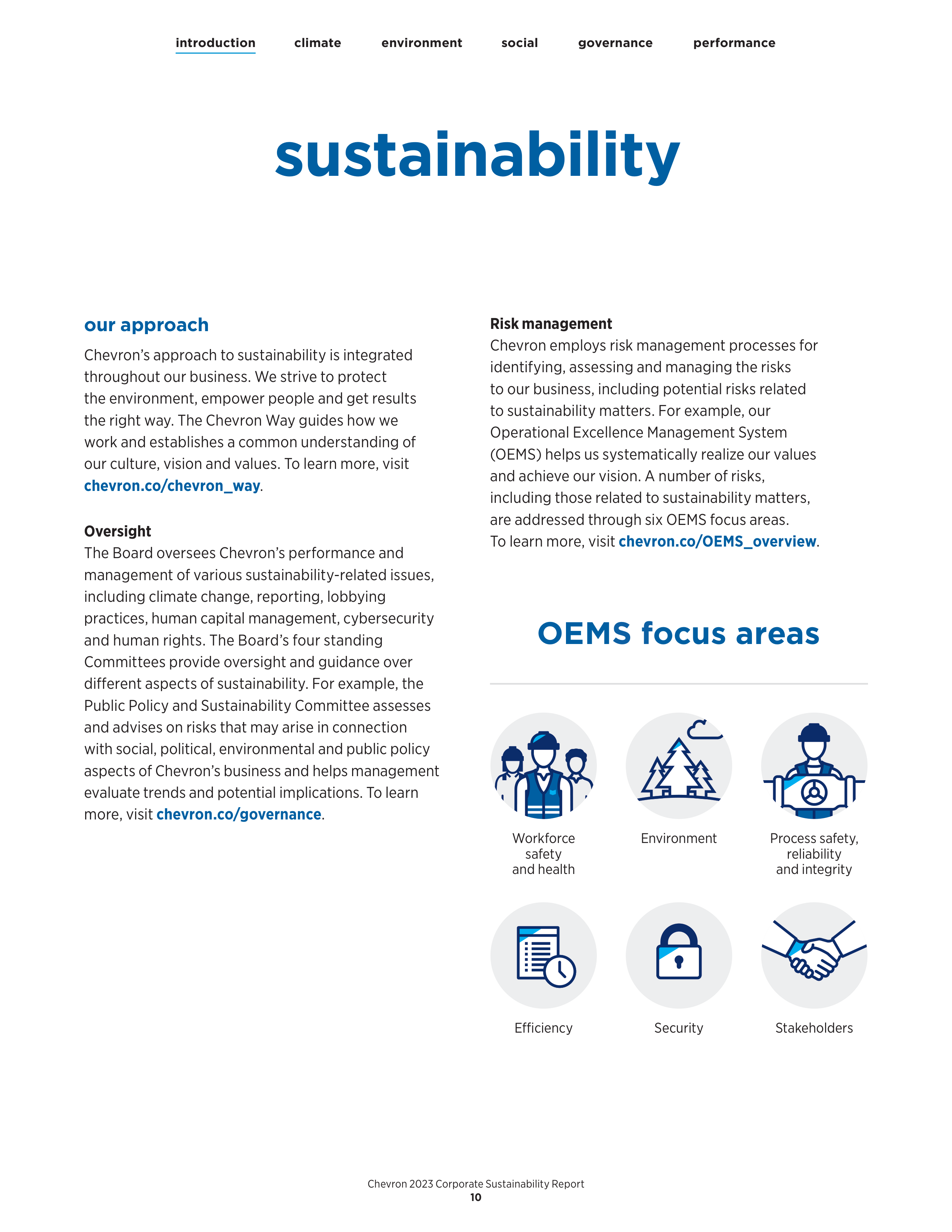
are addressed through six OEMS focus areas.
To learn more, visit
chevron.co/OEMS_overview
.
Chevron 2023 Corporate Sustainability Report
10
introduction
social
climate
environment
governance
performance
our approach
We identified the content for our
2023 Corporate
Sustainability Report
by monitoring issues and trends
and engaging throughout the year with stakeholders.
Thoughtful engagement on priority issues (sometimes
called “material issues”* in the context of ESG reporting
frameworks) helps Chevron assess and, where
appropriate, refresh our ESG reporting.
Members of the Enterprise Leadership Team, the
Global Issues Committee, and the Board’s Public Policy
and Sustainability Committee have opportunities to
provide input for our sustainability reporting.
insights
To gain insight into ESG issues and reporting trends,
we work with third-party groups, including the
World Business Council for Sustainable Develop?ment,
BSR and Ipieca. We engage external consultants to
benchmark our reporting with peers’ sustainability
reports. Our ESG rater performance is used to identify
opportunities for potential disclosure enhance?ments.
We also work with Datamaran, an ESG risk identification
and monitoring software company that uses artificial
intelligence to identify, prioritize and monitor
ESG issues.
stakeholders
We meet with stakeholders to foster trust, build
relationships and engage in two-way dialogue
to understand their insights. These interactions, in
addition to survey results, help us learn what matters
to our stakeholders and refine which topics to
include in each year’s report.
Investors
In 2023, we interacted with the investment community
through Quarterly Earnings calls, Chevron Investor
Day, management roundtable and the Annual Meeting
of Stockholders. In addition to these events, Chevron
conducts extensive engagements with investors as part
of gaining insights on sustainability-related issues. These
engage?ments routinely cover issues including strategy,
climate change, energy transition, workplace culture,
human rights, human capital management, lobbying
and governance.
Our Board also directly engages with investors. Lead
Independent Director Dr. Wanda Austin met with
11 investors in the off-season. Stockholder engagement
following the 2023 Annual Meeting of Stockholders
was robust, and our response to stockholder feedback
is summarized in the
2024 Proxy Statement
.
Employees
We actively seek insights from employees. Our engage?
ments provide an indicator of employee well-being
and commitment to the company’s values, purpose and
strategies. We track performance by regularly conducting
surveys to assess the health of the company’s culture.
Throughout the year, the survey results allow us
to better understand employee sentiment about the
company, including sustainability-related matters.
In 2023, in addition to employee surveys, we interacted
with employees through our Shared Energy Town
Halls, a Board visit to Colorado operations and our
employee networks. Our Chairman’s Inclusion Council
provides employee network presidents with a direct
line of communication to executives, including the
Chairman, to engage on diversity and inclusion matters.
our reporting
*
For purposes of this report, the concept of “material issues” generally refers to ESG reporting guidance such as that provided by Ipieca and the Sustainability Accounting Standards Board and does
not correspond to the concept of materiality used in the securities laws and disclosures required by the U.S. Securities and Exchange Commission (SEC). With respect to the term “material,” individual
companies are best suited to determine which information is material under the long-standing U.S. Supreme Court definition of that term and whether to disclose this information in SEC filings.
Chevron 2023 Corporate Sustainability Report
11
introduction
social
climate
environment
governance
performance
Communities
We work with local stakeholders, governments and
nongovernmental organizations in communities
near our operations who share insights on matters
important to them. Our engagement with communities
is guided by a process to identify and manage
potential impacts.
For example, business units may engage local staff
dedicated to community engagement or sponsor
community advisory panels to serve as liaisons.
Our social investment strategy seeks to respond to
needs in the communities where we operate around
the world. We seek to work with communities and
partners to promote self-sufficiency, job growth and
economic development.
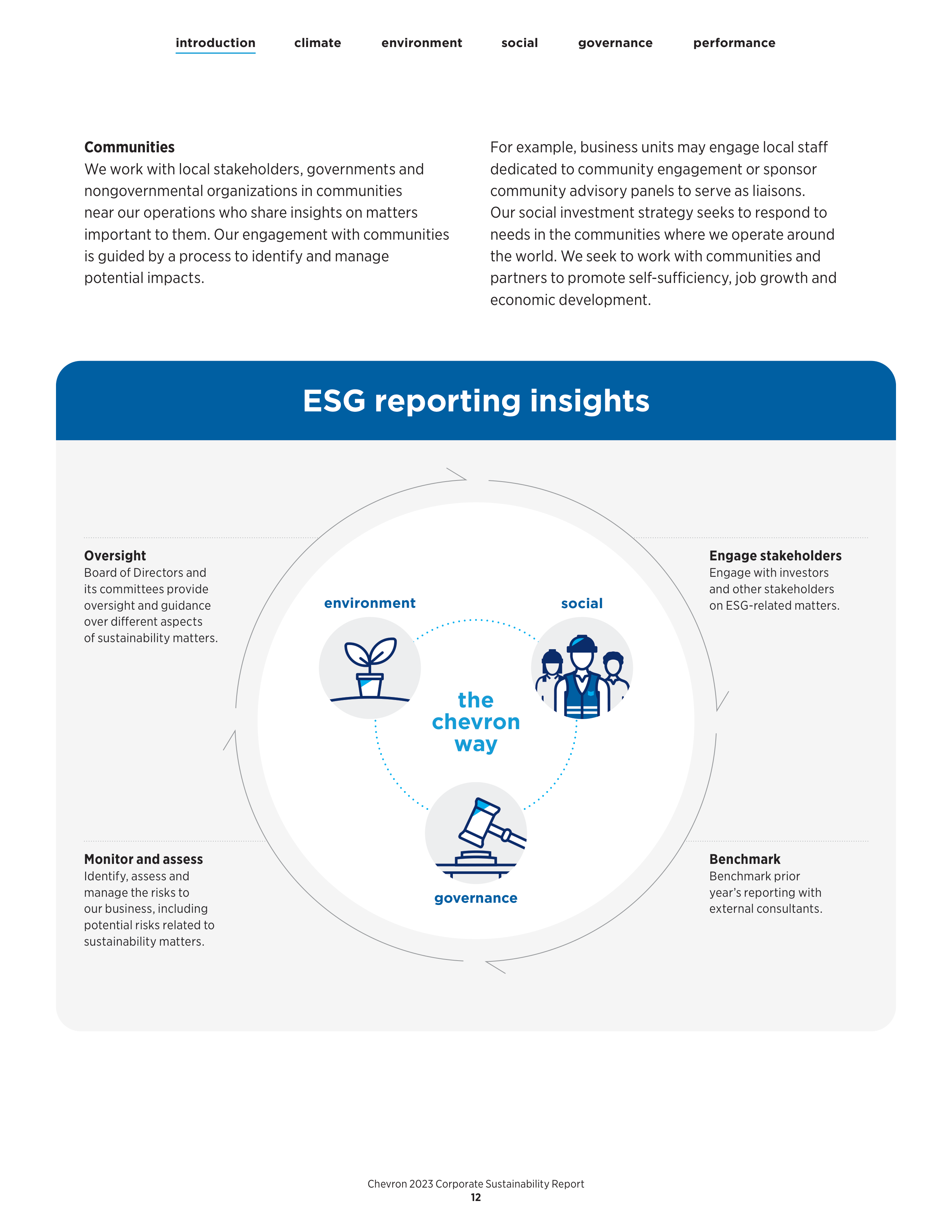
ESG reporting insights
Oversight
Board of Directors and
its committees provide
oversight and guidance
over different aspects
of sustainability matters.
Monitor and assess
Identify, assess and
manage the risks to
our business, including
potential risks related to
sustainability matters.
Benchmark
Benchmark prior
year’s reporting with
external consultants.
Engage stakeholders
Engage with investors
and other stakeholders
on ESG-related matters.
the
chevron
way
environment
social
governance
Chevron 2023 Corporate Sustainability Report
12
introduction
social
climate
environment
governance
performance
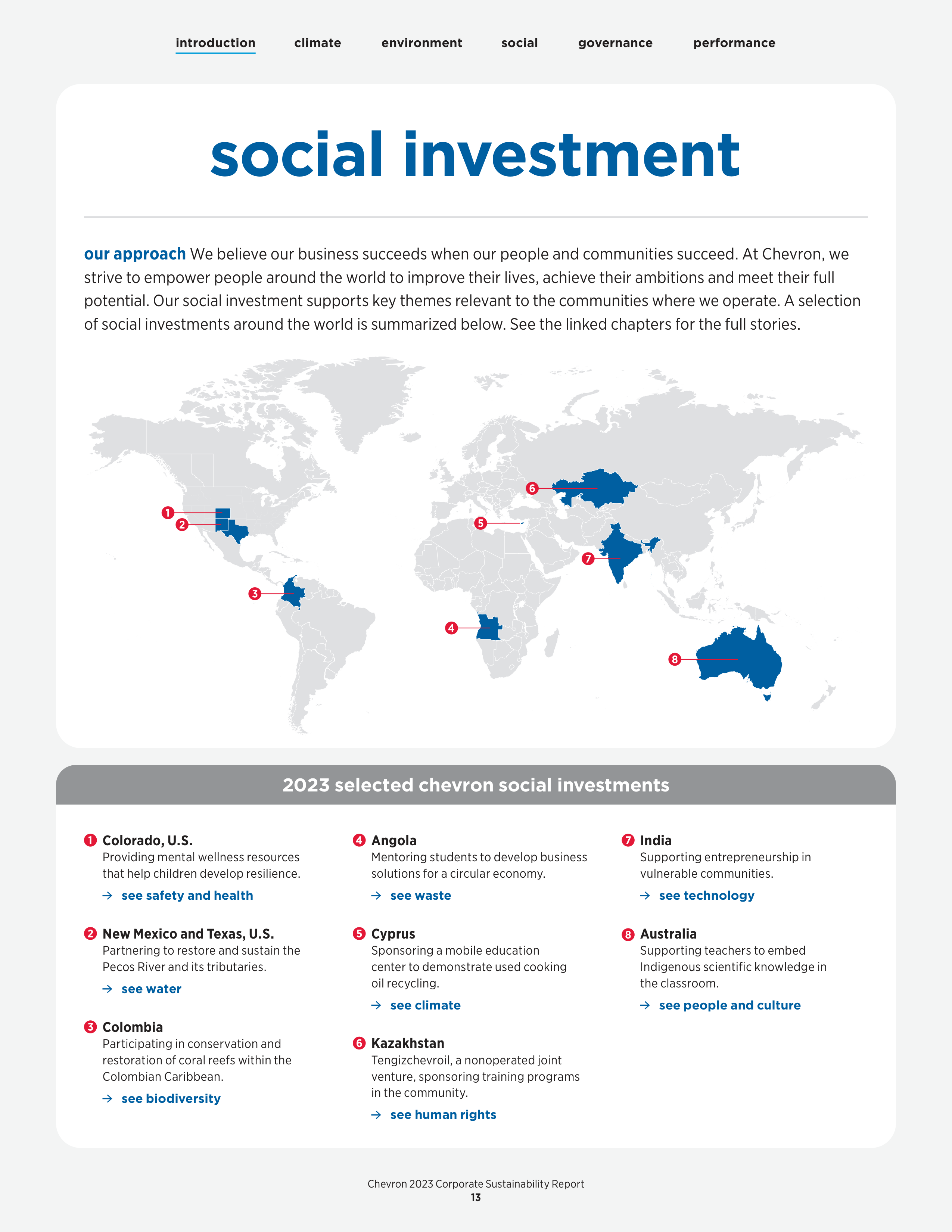
2023 selected chevron social investments
social investment
our approach
We believe our business succeeds when our people and communities succeed. At Chevron, we
strive to empower people around the world to improve their lives, achieve their ambitions and meet their full
potential. Our social investment supports key themes relevant to the communities where we operate. A selection
of social investments around the world is summarized below. See the linked chapters for the full stories.
Colorado, U.S.
Providing mental wellness resources
that help children develop resilience.
see safety and health
New Mexico and Texas, U.S.
Partnering to restore and sustain the
Pecos River and its tributaries.
see water
Colombia
Participating in conservation and
restoration of coral reefs within the
Colombian Caribbean.
see biodiversity
Angola
Mentoring students to develop business
solutions for a circular economy.
see waste
Cyprus
Sponsoring a mobile education
center to demonstrate used cooking
oil recycling.
see climate
Kazakhstan
Tengizchevroil, a nonoperated joint
venture, sponsoring training programs
in the community.
see human rights
India
Supporting entrepreneurship in
vulnerable communities.
see technology
Australia
Supporting teachers to embed
Indigenous scientific knowledge in
the classroom.
see people and culture
Chevron 2023 Corporate Sustainability Report
13
1
2
3
4
5
6
7
8
introduction
social
climate
environment
governance
performance
advancing energy
progress
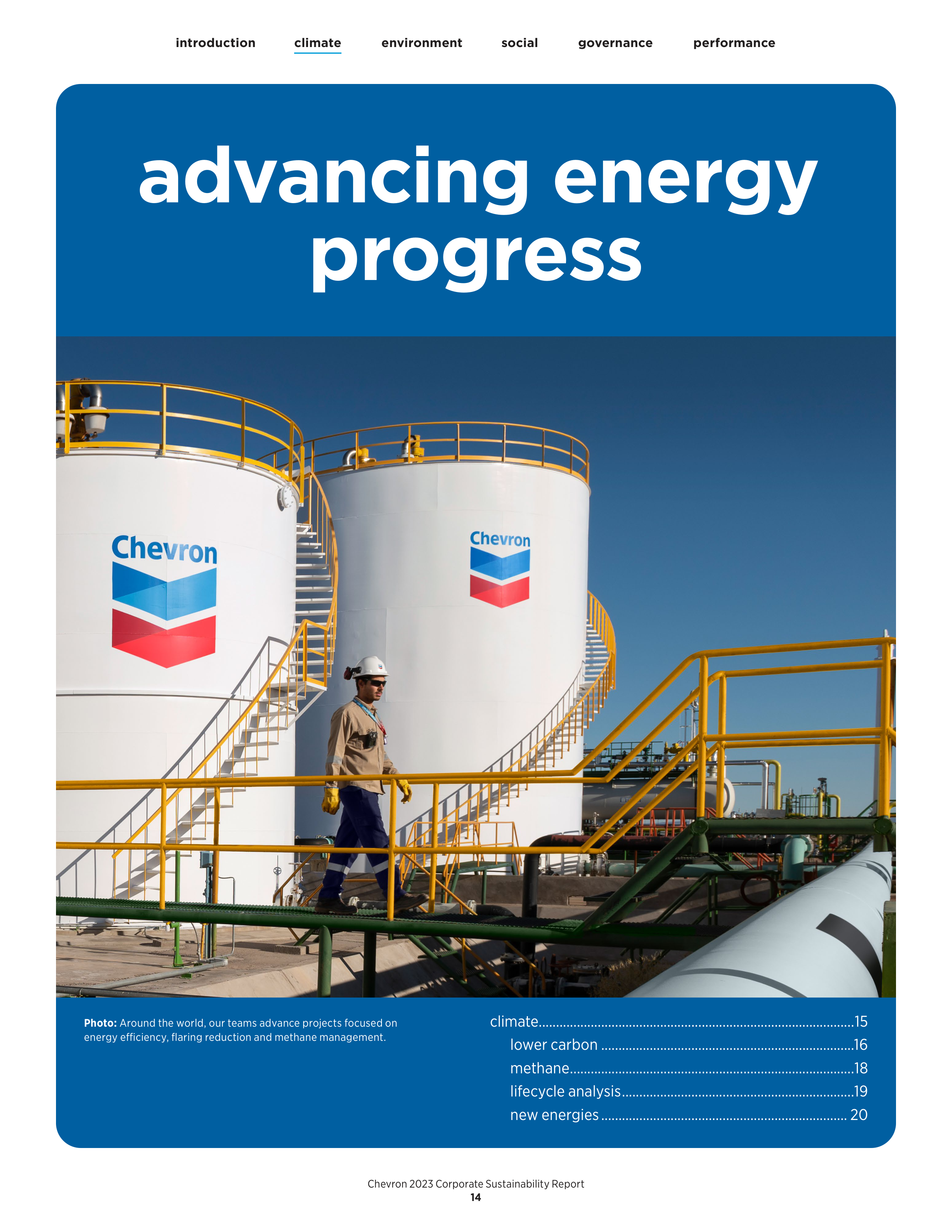
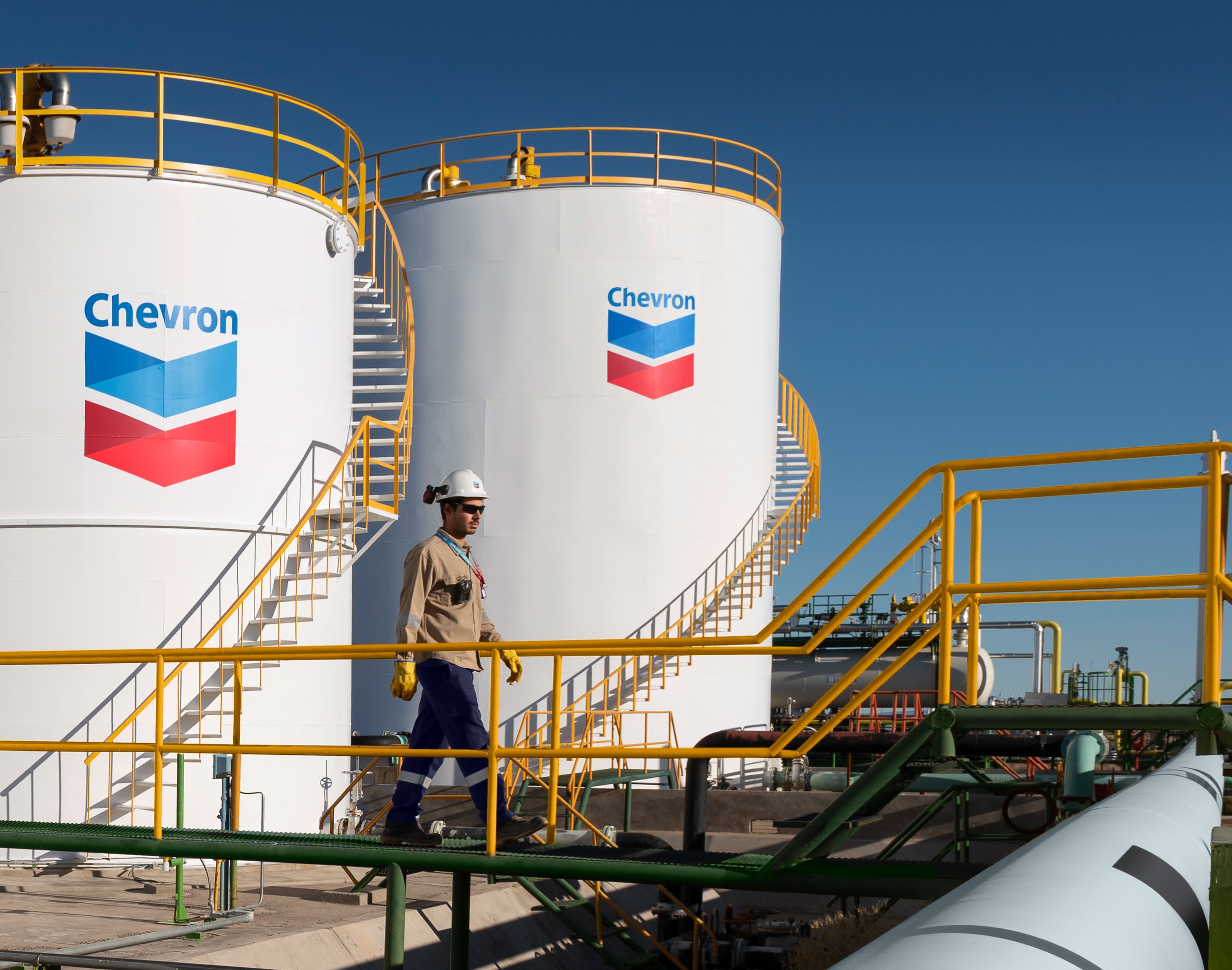
Photo:
Around the world, our teams advance projects focused on
energy efficiency, flaring reduction and methane management.
climate...........................................................................................15
lower carbon..........................................................................16
methane..................................................................................18
lifecycle analysis...................................................................19
new energies........................................................................ 20
Chevron 2023 Corporate Sustainability Report
14
introduction
social
climate
environment
governance
performance
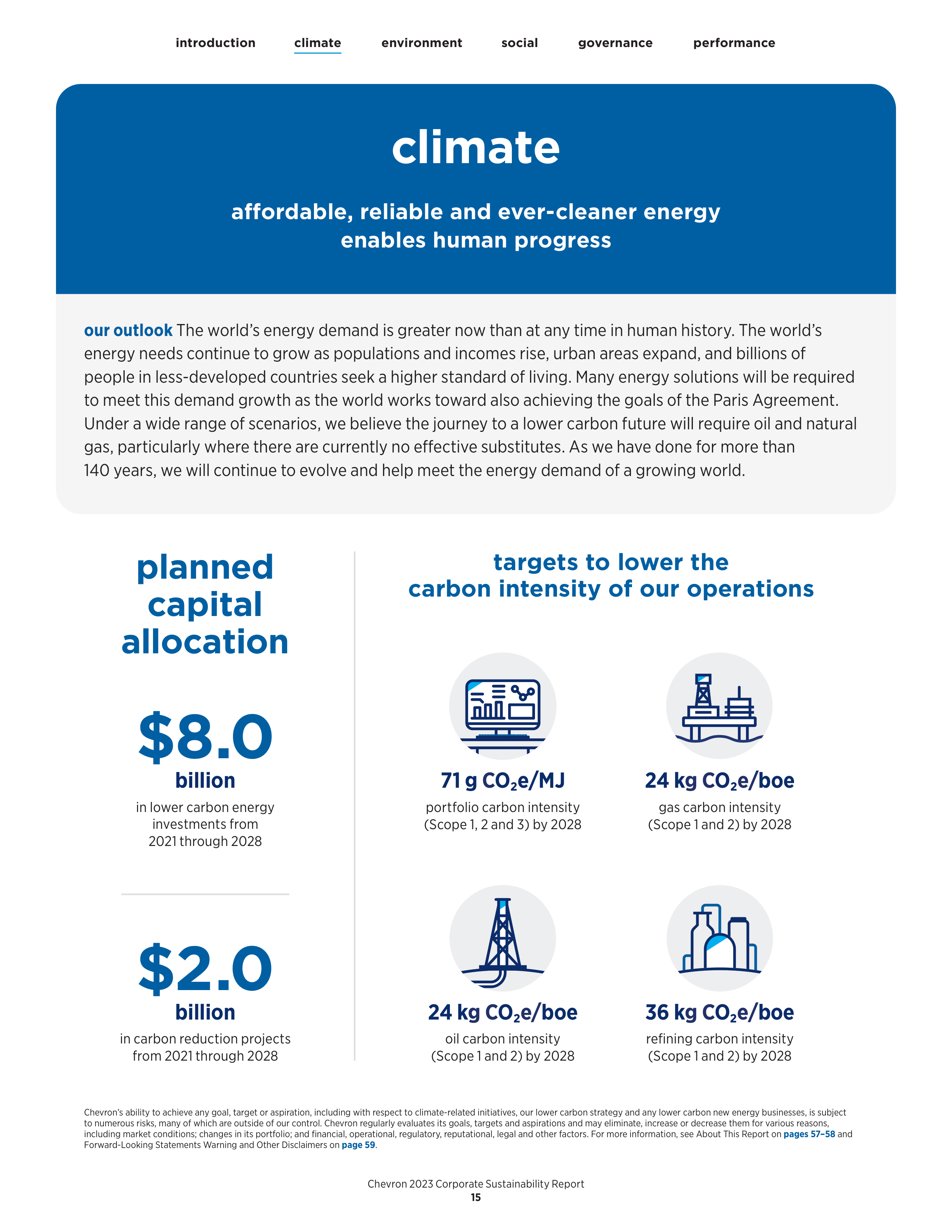
targets to lower the
carbon intensity of our operations
$2.0 billion in carbon reduction projects from 2021 through 2028
$2.0 billion in carbon reduction projects from 2021 through 2028
$2.0 billion in carbon reduction projects from 2021 through 2028
$2.0 billion in carbon reduction projects from 2021 through 2028
$8.0 billion in lower carbon energy investments from 2021 through 2028
$8.0 billion in lower carbon energy investments from 2021 through 2028
$8.0 billion in lower carbon energy investments from 2021 through 2028
$8.0 billion in
$8.0 billion in lower carbon energy investments from 2021 through 2028
71 g CO₂e/MJ
portfolio carbon intensity
(Scope 1, 2 and 3) by 2028
24 kg CO2e/boe
gas carbon intensity
(Scope 1 and 2) by 2028
36 kg CO₂e/boe
refining carbon intensity
(Scope 1 and 2) by 2028
24 kg CO₂e/boe
oil carbon intensity
(Scope 1 and 2) by 2028
planned
capital
allocation
our outlook
The world’s energy demand is greater now than at any time in human history. The world’s
energy needs continue to grow as populations and incomes rise, urban areas expand, and billions of
people in less-developed countries seek a higher standard of living. Many energy solutions will be required
to meet this demand growth as the world works toward also achieving the goals of the Paris Agreement.
Under a wide range of scenarios, we believe the journey to a lower carbon future will require oil and natural
gas, particularly where there are currently no effective substitutes. As we have done for more than
140 years, we will continue to evolve and help meet the energy demand of a growing world.
climate
affordable, reliable and ever-cleaner energy
enables human progress
Chevron’s ability to achieve any goal, target or aspiration, including with respect to climate-related initiatives, our lower carbon strategy and any lower carbon new energy businesses, is subject
to numerous risks, many of which are outside of our control. Chevron regularly evaluates its goals, targets and aspirations and may eliminate, increase or decrease them for various reasons,
including market conditions; changes in its portfolio; and financial, operational, regulatory, reputational, legal and other factors. For more information, see About This Report on
pages 57–58
and
Forward-Looking Statements Warning and Other Disclaimers on
page 59
.
Chevron 2023 Corporate Sustainability Report
15
introduction
social
climate
environment
governance
performance
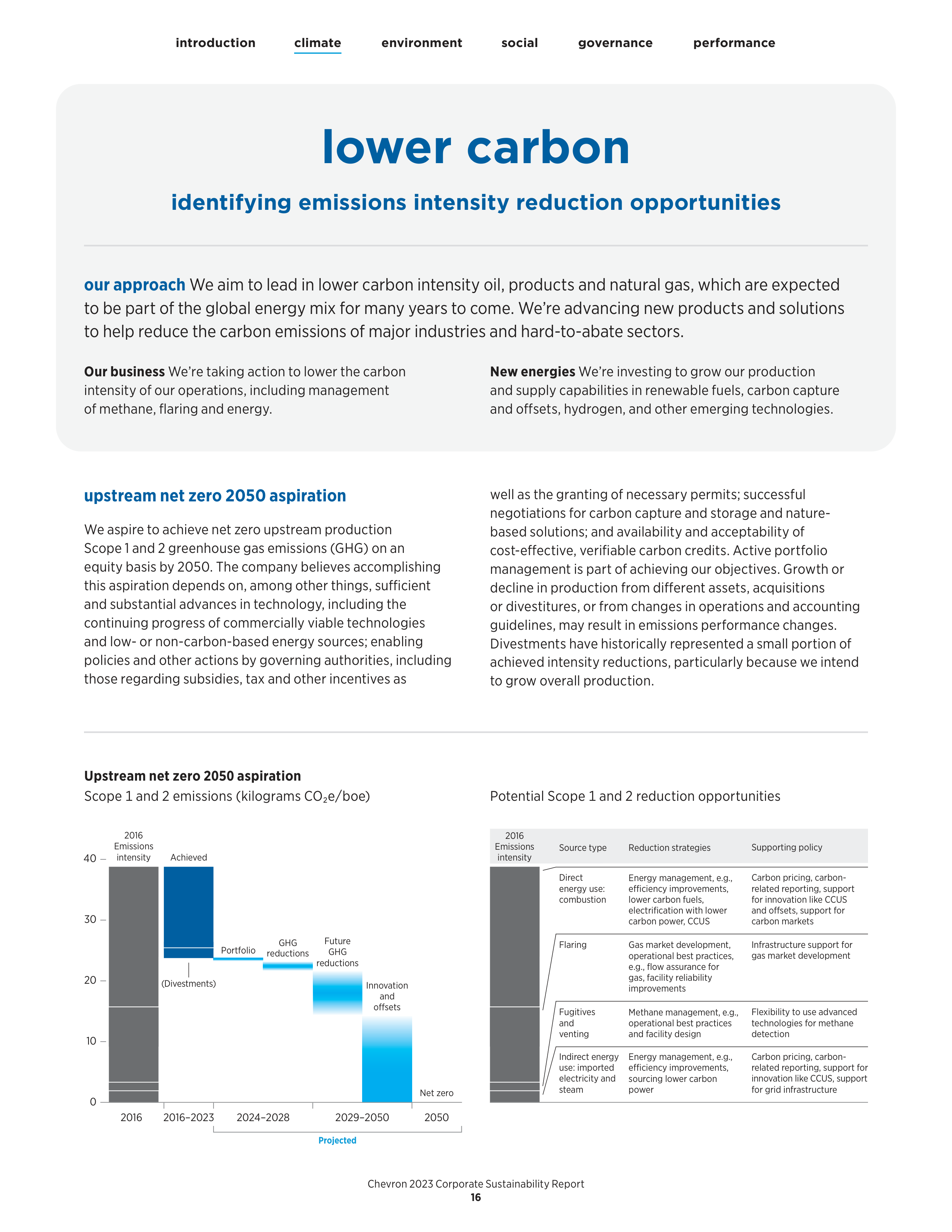
upstream net zero 2050 aspiration
We aspire to achieve net zero upstream production
Scope 1 and 2 greenhouse gas emissions (GHG) on an
equity basis by 2050. The company believes accomplishing
this aspiration depends on, among other things, sufficient
and substantial advances in technology, including the
continuing progress of commercially viable technologies
and low- or non-carbon-based energy sources; enabling
policies and other actions by governing authorities, including
those regarding subsidies, tax and other incentives as
lower carbon
identifying emissions intensity reduction opportunities
our approach
We aim to lead in lower carbon intensity oil, products and natural gas, which are expected
to be part of the global energy mix for many years to come. We’re advancing new products and solutions
to help reduce the carbon emissions of major industries and hard-to-abate sectors.
Our business
We’re taking action to lower the carbon
intensity of our operations, including management
of methane, flaring and energy.
New energies
We’re investing to grow our production
and supply capabilities in renewable fuels, carbon capture
and offsets, hydrogen, and other emerging technologies.
well as the granting of necessary permits; successful
negotiations for carbon capture and storage and nature-
based solutions; and availability and acceptability of
cost-effective, verifiable carbon credits. Active portfolio
management is part of achieving our objectives. Growth or
decline in production from different assets, acquisitions
or divestitures, or from changes in operations and accounting
guidelines, may result in emissions performance changes.
Divestments have historically represented a small portion of
achieved intensity reductions, particularly because we intend
to grow overall production.
30
20
10
0
40
2016
2016–2023
2024–2028
2029–2050
2050
Projected
2016
Emission
s intensity
Achieved
(Divestments)
Future
GHG
reductions
Innovation
and offsets
Innovation and offsets
Net zero
GHG
reductions
Portfolio
Upstream net zero 2050 aspiration
Scope 1 and 2 emissions (kilograms CO₂e/boe)
Potential Scope 1 and 2 reduction opportunities
Carbon pricing, carbon-
related reporting, support for
innovation like CCUS, support
for grid infrastructure
Infrastructure support for
gas market development
Flexibility to use advanced
technologies for methane
detection
Carbon pricing, carbon-
related reporting, support
for innovation like CCUS
and offsets, support for
carbon markets
Supporting policy
Direct
energy use:
combustion
Indirect energy
use: imported
electricity and
steam
Flaring
Fugitives
and
venting
Source type
Energy management, e.g.,
efficiency improvements,
lower carbon fuels,
electrification with lower
carbon power, CCUS
Energy management, e.g.,
efficiency improvements,
sourcing lower carbon
power
Gas market development,
operational best practices,
e.g., flow assurance for
gas, facility reliability
improvements
Methane management, e.g.,
operational best practices
and facility design
Reduction strategies
2016
Emissions
intensity
Chevron 2023 Corporate Sustainability Report
16

introduction
social
climate
environment
governance
performance
GHG management
We are taking actions to reduce carbon intensity by high-
grading our portfolio, improving operations and using our
marginal abatement cost curve (MACC) process to drive
emissions reductions on existing facilities. Our MACC process
is a disciplined approach to get the most impact for each
dollar spent. To cost-effectively reduce the carbon intensity
of our operations and assets, we seek to optimize carbon
reduction opportunities and integrate GHG mitigation
technologies across the enterprise.
We assess reduction opportunities in the key areas of
energy management; methane management, consisting of
venting, fugitives and flaring reductions; carbon capture,
utilization and storage (CCUS); and offsets. These GHG
reduction approaches can be supported by policy on carbon
pricing, well-designed carbon-related reporting, support
for technologies like CCUS, and offsets.
Optimizing carbon reduction opportunities
Our MACC process has identified more than 150 GHG abate?
ment projects for development. To advance these projects,
we have a planned spend of over $600 million in 2024. In 2023,
we made progress on nearly 100 projects and completed
“Advancing solutions takes partnership.” — Laura Kurt Senior GHG Specialist
“Advancing solutions takes partnership.” — Laura Kurt Senior GHG Specialist
“Advancing solutions takes partnership.” — Laura Kurt Senior GHG Specialist
“Advancing solutions takes partnership.” — Laura Kurt Senior GHG Specialist
“Advancing solutions takes partnership.” — Laura Kurt Senior GHG Specialist
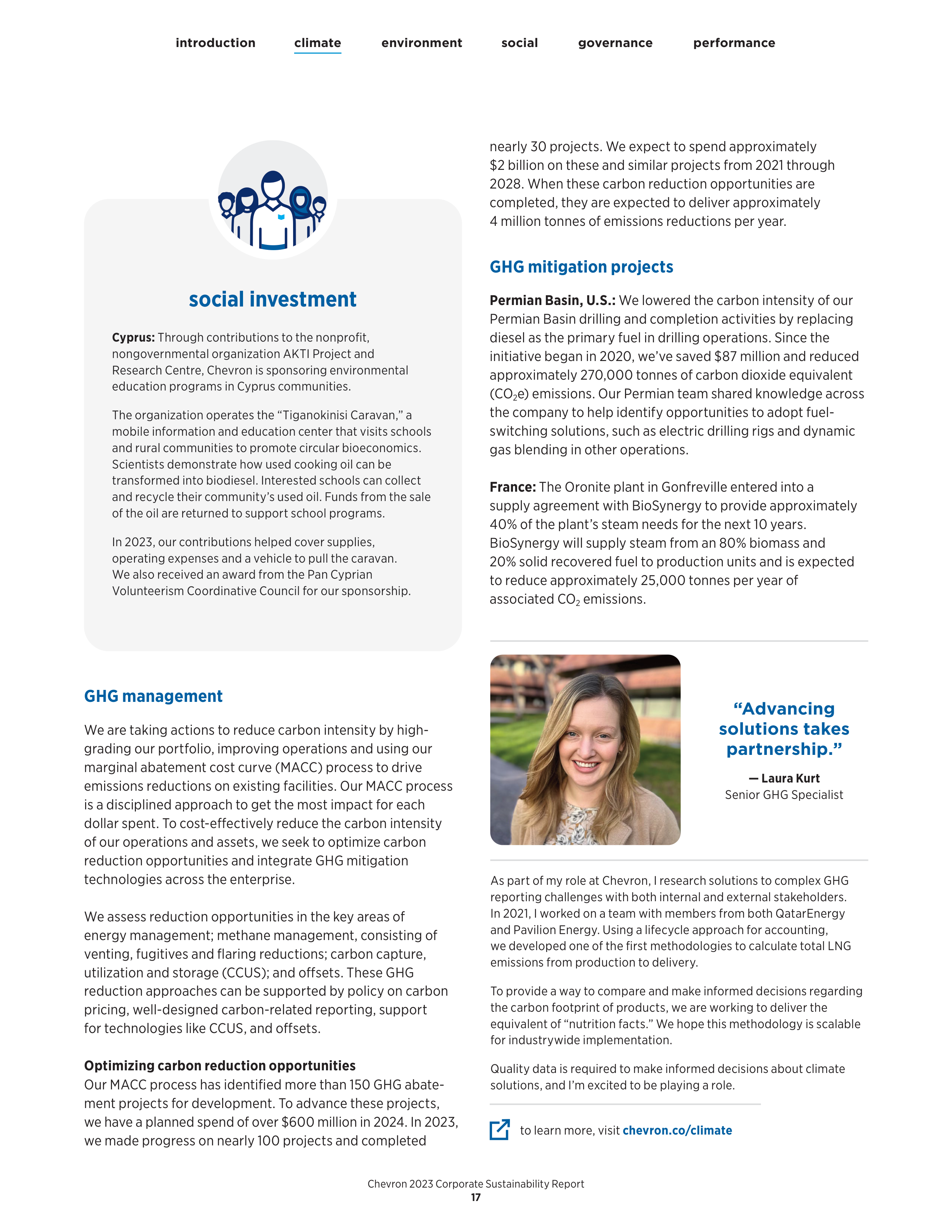
As part of my role at Chevron, I research solutions to complex GHG
reporting challenges with both internal and external stakeholders.
In 2021, I worked on a team with members from both QatarEnergy
and Pavilion Energy. Using a lifecycle approach for accounting,
we developed one of the first methodologies to calculate total LNG
emissions from production to delivery.
To provide a way to compare and make informed decisions regarding
the carbon footprint of products, we are working to deliver the
equivalent of “nutrition facts.” We hope this methodology is scalable
for industrywide implementation.
Quality data is required to make informed decisions about climate
solutions, and I’m excited to be playing a role.
social investment
Cyprus:
Through contributions to the nonprofit,
nongovernmental organization AKTI Project and
Research Centre, Chevron is sponsoring environmental
education programs in Cyprus communities.
The organization operates the “Tiganokinisi Caravan,” a
mobile information and education center that visits schools
and rural communities to promote circular bioeconomics.
Scientists demonstrate how used cooking oil can be
transformed into biodiesel. Interested schools can collect
and recycle their community’s used oil. Funds from the sale
of the oil are returned to support school programs.
In 2023, our contributions helped cover supplies,
operating expenses and a vehicle to pull the caravan.
We also received an award from the Pan Cyprian
Volunteerism Coordinative Council for our sponsorship.
nearly 30 projects. We expect to spend approximately
$2 billion on these and similar projects from 2021 through
2028. When these carbon reduction opportunities are
completed, they are expected to deliver approximately
4 million tonnes of emissions reductions per year.
GHG mitigation projects
Permian Basin, U.S.:
We lowered the carbon intensity of our
Permian Basin drilling and completion activities by replacing
diesel as the primary fuel in drilling operations. Since the
initiative began in 2020, we’ve saved $87 million and reduced
approximately 270,000 tonnes of carbon dioxide equivalent
(CO
2
e) emissions. Our Permian team shared knowledge across
the company to help identify opportunities to adopt fuel-
switching solutions, such as electric drilling rigs and dynamic
gas blending in other operations.
France:
The Oronite plant in Gonfreville entered into a
supply agreement with BioSynergy to provide approximately
40% of the plant’s steam needs for the next 10 years.
BioSynergy will supply steam from an 80% biomass and
20% solid recovered fuel to production units and is expected
to reduce approximately 25,000 tonnes per year of
associated CO
2
emissions.
to learn more, visit
chevron.co/climate
Chevron 2023 Corporate Sustainability Report
17
introduction
social
climate
environment
governance
performance
methane
our goal is simple – keep methane in the pipe
our approach
Chevron’s ambition is to be a global leader in methane emissions performance.
We believe addressing methane emissions has become a key part of being a responsible producer
of oil, products and natural gas.
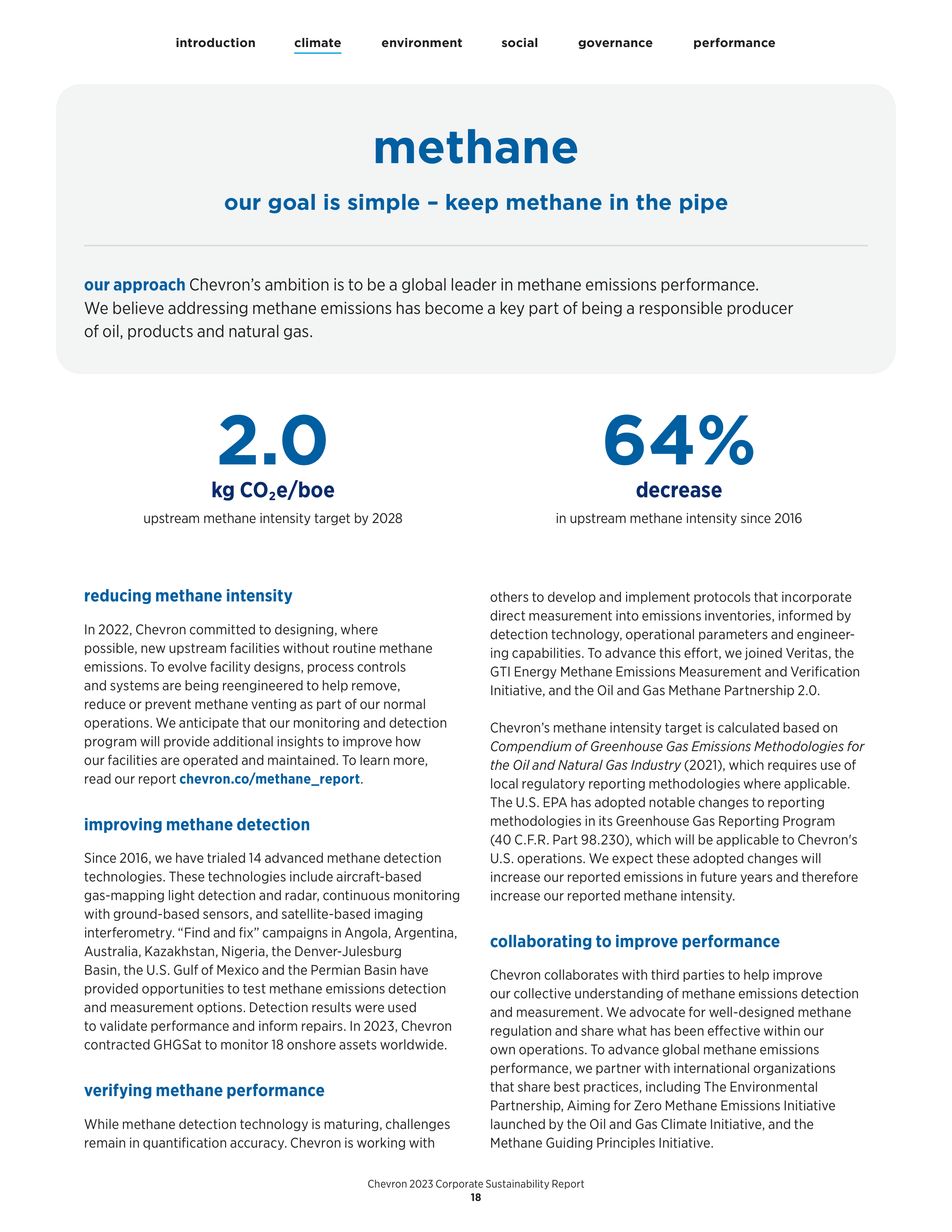
2.0
kg CO₂e/boe
upstream methane intensity target by 2028
64% decrease in upstream methane intensity since 2016
64% decrease in upstream methane intensity since 2016
64% decrease in upstream methane intensity since 2016
reducing methane intensity
In 2022, Chevron committed to designing, where
possible, new upstream facilities without routine methane
emissions. To evolve facility designs, process controls
and systems are being reengineered to help remove,
reduce or prevent methane vent?ing as part of our normal
operations. We anticipate that our monitoring and detection
program will provide additional insights to improve how
our facilities are operated and maintained. To learn more,
read our report
chevron.co/methane_report
.
improving methane detection
Since 2016, we have trialed 14 advanced methane detection
technologies. These technologies include aircraft-based
gas-mapping light detection and radar, continuous monitoring
with ground-based sensors, and satellite-based imaging
inter?ferometry. “Find and fix” campaigns in Angola, Argentina,
Australia, Kazakhstan, Nigeria, the Denver-Julesburg
Basin, the U.S. Gulf of Mexico and the Permian Basin have
provided opportunities to test methane emissions detection
and measure?ment options. Detection results were used
to validate performance and inform repairs. In 2023, Chevron
contracted GHGSat to monitor 18 onshore assets worldwide.
verifying methane performance
While methane detection technology is maturing, challenges
remain in quantification accuracy. Chevron is working with
others to develop and implement protocols that incorporate
direct measurement into emissions inventories, informed by
detection technology, operational parameters and engineer-
ing capabilities. To advance this effort, we joined Veritas, the
GTI Energy Methane Emissions Measurement and Verification
Initiative, and the Oil and Gas Methane Partnership 2.0.
Chevron’s methane intensity target is calculated based on
Compendium of Greenhouse Gas Emissions Methodologies for
the Oil and Natural Gas Industry
(2021), which requires use of
local regulatory reporting methodologies where applicable.
The U.S. EPA has adopted notable changes to reporting
methodologies in its Greenhouse Gas Reporting Program
(40 C.F.R. Part 98.230), which will be applicable to Chevron's
U.S. operations. We expect these adopted changes will
increase our reported emissions in future years and therefore
increase our reported methane intensity.
collaborating to improve performance
Chevron collaborates with third parties to help improve
our collective understanding of methane emissions detection
and measurement. We advocate for well-designed methane
regulation and share what has been effective within our
own operations. To advance global methane emissions
perform?ance, we partner with international organizations
that share best practices, including The Environmental
Partnership, Aiming for Zero Methane Emissions Initiative
launched by the Oil and Gas Climate Initiative, and the
Methane Guiding Principles Initiative.
Chevron 2023 Corporate Sustainability Report
18
introduction
social
climate
environment
governance
performance
lifecycle analysis
supporting a lifecycle approach to carbon accounting
our approach
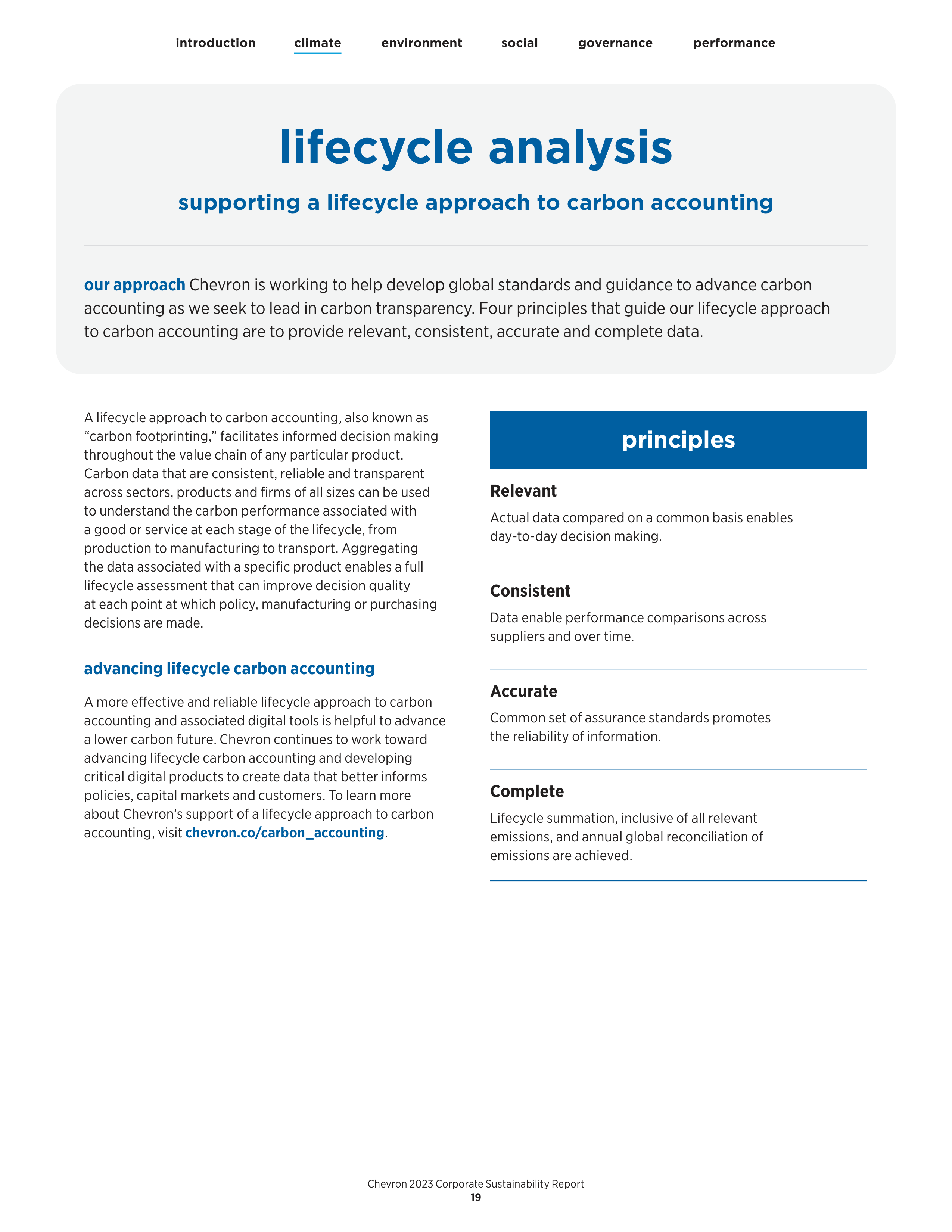
Chevron is working to help develop global standards and guidance to advance carbon
accounting as we seek to lead in carbon transparency. Four principles that guide our lifecycle approach
to carbon accounting are to provide relevant, consistent, accurate and complete data.
A lifecycle approach to carbon accounting, also known as
“carbon footprinting,” facilitates informed decision making
throughout the value chain of any particular product.
Carbon data that are consistent, reliable and transparent
across sectors, products and firms of all sizes can be used
to understand the carbon performance associated with
a good or service at each stage of the lifecycle, from
production to manufacturing to transport. Aggregating
the data associated with a specific product enables a full
lifecycle assessment that can improve decision quality
at each point at which policy, manufacturing or purchasing
decisions are made.
advancing lifecycle carbon accounting
A more effective and reliable lifecycle approach to carbon
accounting and associated digital tools is helpful to advance
a lower carbon future. Chevron continues to work toward
advancing lifecycle carbon accounting and developing
critical digital products to create data that better informs
policies, capital markets and customers. To learn more
about Chevron’s support of a lifecycle approach to carbon
accounting, visit
chevron.co/carbon_accounting
.
principles
Relevant
Actual data compared on a common basis enables
day-to-day decision making.
Consistent
Data enable performance comparisons across
suppliers and over time.
Accurate
Common set of assurance standards promotes
the reliability of information.
Complete
Lifecycle summation, inclusive of all relevant
emissions, and annual global reconciliation of
emissions are achieved.
Chevron 2023 Corporate Sustainability Report
19
introduction
social
climate
environment
governance
performance
new energies
building businesses to help reduce the carbon emissions
of major industries and hard-to-abate sectors
our approach
We aim to help customers meet their lower carbon ambitions and reduce the carbon
intensity of our own operations while pursuing opportunities that generate competitive returns. We believe
innovation, technology and policy will be key drivers of change. Chevron regularly evaluates its goals,
targets and aspirations and may eliminate, increase or decrease them for various reasons.
renewable fuels
We believe renewable fuels can help reduce the lifecycle
carbon intensity of transportation fuels today. Leveraging our
existing refining system, we are aiming to produce capacity of
roughly 100 mbd of renewable fuels, which includes renewable
diesel, sustainable aviation fuel, biodiesel and other biofuels,
by 2030. Through the capabilities and assets of Chevron
Renewable Energy Group, we are approximately halfway to
achieving our 2030 capacity target.
Louisiana, U.S.:
With a renewable diesel project in Geismar
expected to come online in 2024, our renewable fuels
nameplate capacity will increase by approximately 30%.
Argentina:
Chevron Renewable Energy Group and Bunge
acquired Chacraservicios S.r.l., which cultivates novel oil
seeds. This investment supports both Chevron and Bunge’s
work to meet the growing demand for lower carbon
renewable feedstocks.
California, U.S.:
Our El Segundo Refinery completed the
upgrade of its diesel hydrotreater to enable it to process
either 100% renewable or petroleum feedstocks. We
distributed our renewable diesel from El Segundo to limited
suppliers and retailers in California.
Renewable natural gas
We are developing renewable natural gas (RNG) projects that
capture dairy methane that would otherwise be emitted to
the atmosphere. This produces a valuable fuel with negative
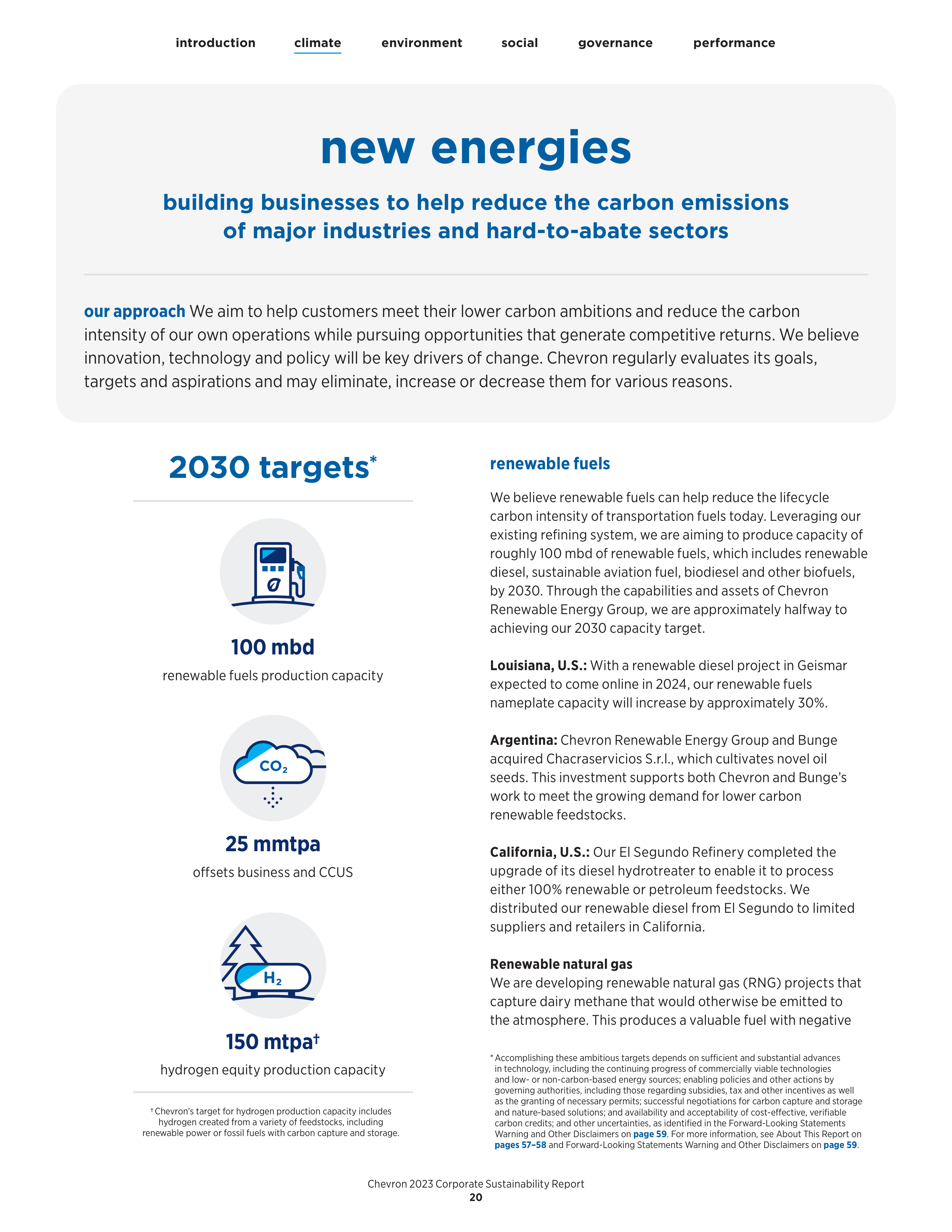
2030 targets
*
100 mbd
renewable fuels production capacity
25 mmtpa
offsets business and CCUS
150 mtpa†
hydrogen equity production capacity
* Accomplishing these ambitious targets depends on sufficient and substantial advances
in technology, including the continuing progress of commercially viable technologies
and low- or non-carbon-based energy sources; enabling policies and other actions by
governing authorities, including those regarding subsidies, tax and other incentives as well
as the granting of necessary permits; successful negotiations for carbon capture and storage
and nature-based solutions; and availability and acceptability of cost-effective, verifiable
carbon credits; and other uncertainties, as identified in the Forward-Looking Statements
Warning and Other Disclaimers on
page 59
. For more information, see About This Report on
pages 57–58
and Forward-Looking Statements Warning and Other Disclaimers on
page 59
.
† Chevron’s target for hydrogen production capacity includes
hydrogen created from a variety of feedstocks, including
renewable power or fossil fuels with carbon capture and storage.
Chevron 2023 Corporate Sustainability Report
20
introduction
social
climate
environment
governance
performance
Chevron Australia New Energies Pty Ltd has invested with
Carbon Sync to provide critical learning and insight related to
the commercial and technical aspects of soil carbon projects.
Through holistic management and regenerative farming
practices, Carbon Sync aims to improve the soil’s ability to
capture and sequester carbon.
hydrogen
Chevron has decades of knowledge and experience with
hydrogen. We are developing a lower carbon hydrogen and
ammonia business where Chevron can build competitive
advantages over time. To develop a profitable, at-scale
hydrogen business, we are pursuing commercial opportunities
through collaborations that connect supply chains and
advance technologies. Currently, Chevron has filed patent
applications or holds granted patents on approximately
20 inventions applicable to hydrogen development plans.
Utah, U.S.:
Chevron has a majority interest in ACES Delta,
LLC, a joint venture developing the Advanced Clean Energy
Storage Project (ACES I) in Delta, Utah. Currently under
construction, ACES I is designed to produce hydrogen,
converted primarily from renewable energy, and store it in
two salt caverns. The hydrogen will be dispatched to the
anchor customer for use in specialized turbines to generate
power when needed. ACES I is expected to start up in 2025.
Gulf Coast, U.S.:
Chevron is a founding member of the
HyVelocity Hub, comprised of leading energy companies
and organizations working to accelerate the development of
hydrogen hubs in Texas, Southwest Louisiana and the U.S.
Gulf Coast. HyVelocity Hub is one of seven hubs selected as
a candidate for U.S. Department of Energy funding.
emerging technologies
Chevron has a long history of identifying and driving
innovation through investments in emerging technologies,
research and development, and university partnerships.
We are currently exploring opportunities to commercialize
the next generation of emerging technologies to grow our
offering of lower carbon solutions.
Nevada, U.S.:
Chevron is invested in Baseload Capital,
a private investment company focused on the development
and operation of low- and medium-temperature geothermal
and heat power assets. We also have a joint venture with
Baseload’s U.S. subsidiary to develop geothermal projects in
the United States, the first of these starting in Nevada.
carbon intensity on a lifecycle basis under the California Low
Carbon Fuel Standard.
We are evaluating opportunities to
diversify our feedstock mix over time, which may include
wastewater and landfill gas.
California, U.S.:
Chevron and Brightmark LLC have formed
Brightmark RNG Holdings LLC. The joint venture funds the
construction of infrastructure and the commercial operation
of dairy biomethane projects in multiple states. We purchase
RNG from these projects and market the RNG volumes for
use in vehicles operating on compressed natural gas (CNG).
U.S.:
Chevron has acquired full ownership of Beyond6, LLC
and its network of 56 CNG stations across the United States.
With this acquisition, we can market the RNG we either
produce or procure through a nationwide network of
CNG locations.
carbon capture, utilization and storage
and offsets
Chevron is working to develop and deploy carbon capture,
utilization, and storage (CCUS) technologies. We see CCUS
opportunities in two areas: lowering the carbon intensity of
our existing assets and growing a CCUS business that helps
reduce emissions of other industries.
We are growing a carbon offsets business to meet a range
of internal and external needs. This includes investing in
compliance markets where we are regulated.
Chevron established its offsets business and CCUS target
based on a number of assumptions about future market,
technology, and policy conditions, some of which are
developing more slowly than expected. We will continue
to evaluate this target while monitoring market conditions,
customer demand, regulatory and policy frameworks, and the
competitive landscape.
Texas, U.S.:
Chevron is the operator of and has a 50%
ownership interest in the Bayou Bend joint venture with
TotalEnergies and Equinor. Bayou Bend is a carbon capture
and storage (CCS) project along the Texas Gulf Coast. In early
2023, the project was expanded to cover nearly 140,000 acres
of geological formation both onshore and offshore.
Australia:
Chevron Australia Pty Ltd operates Gorgon,
which includes one of the world’s largest integrated CCS
projects. Since the system started up in mid-2019 and
through 2023, more than 9 million tonnes of CO
2
emissions
have been injected.
Chevron 2023 Corporate Sustainability Report
21
introduction
social
climate
environment
governance
performance
protecting the
environment
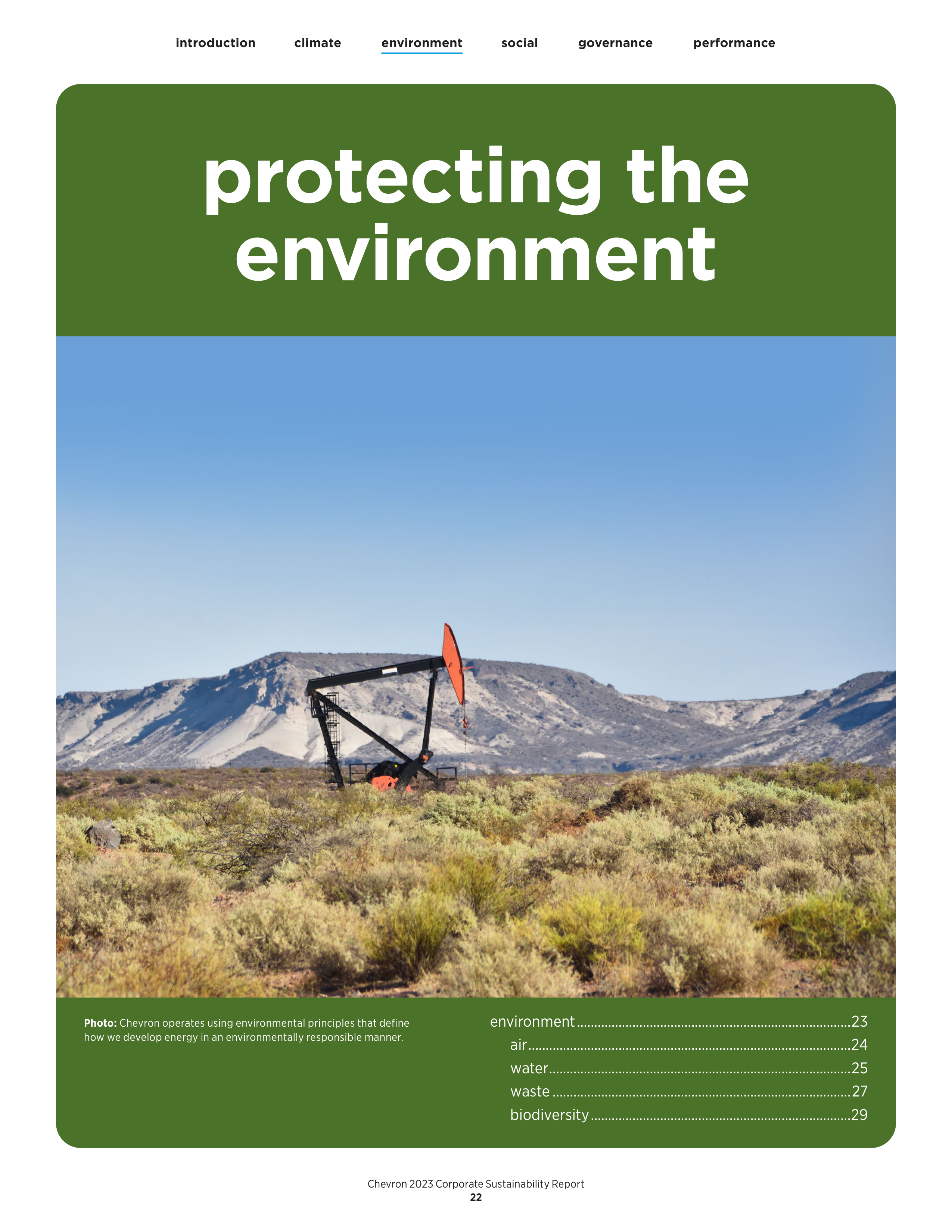
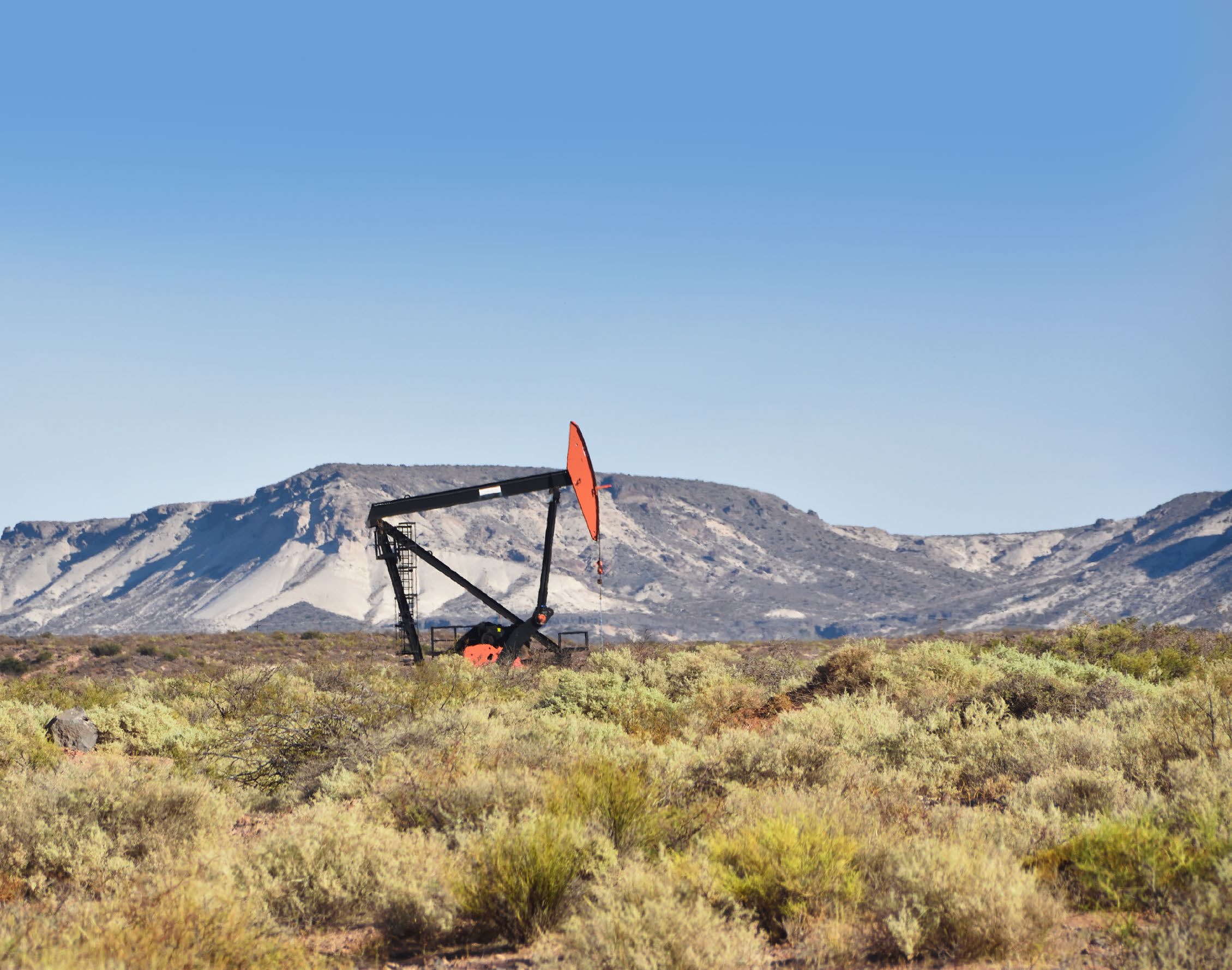
Photo:
Chevron operates using environmental principles that define
how we develop energy in an environmentally responsible manner.
environment...............................................................................23
air.............................................................................................24
water.......................................................................................25
waste.......................................................................................27
biodiversity...........................................................................29
Chevron 2023 Corporate Sustainability Report
22
introduction
social
climate
environment
governance
performance
Strategy
The environment strategy endeavors to
further our ability to help protect and enhance biodiversity,
manage waste generation and circularity, reduce air
emissions, manage water resources and manage asset
retirement requirements.
Risk management
The Environment Risk Management
Process is our framework to identify, assess,
mitigate and manage environmental risks through?
out an asset’s lifecycle.
our approach
At Chevron, one of our priorities is to help protect the environment through responsible
design, development, operations and retirement of assets. By considering potential environmental
risks during planning, we aim to enhance our environmental performance around the world. We identify
and manage safeguards designed to prevent or mitigate potential environmental impacts. The Operational
Excellence Management System (OEMS) environment focus area promotes systematic consideration
of business risks and environmental performance alongside stakeholder expectations.
environment
protecting the environment takes dedicated people,
effective processes and leading technologies
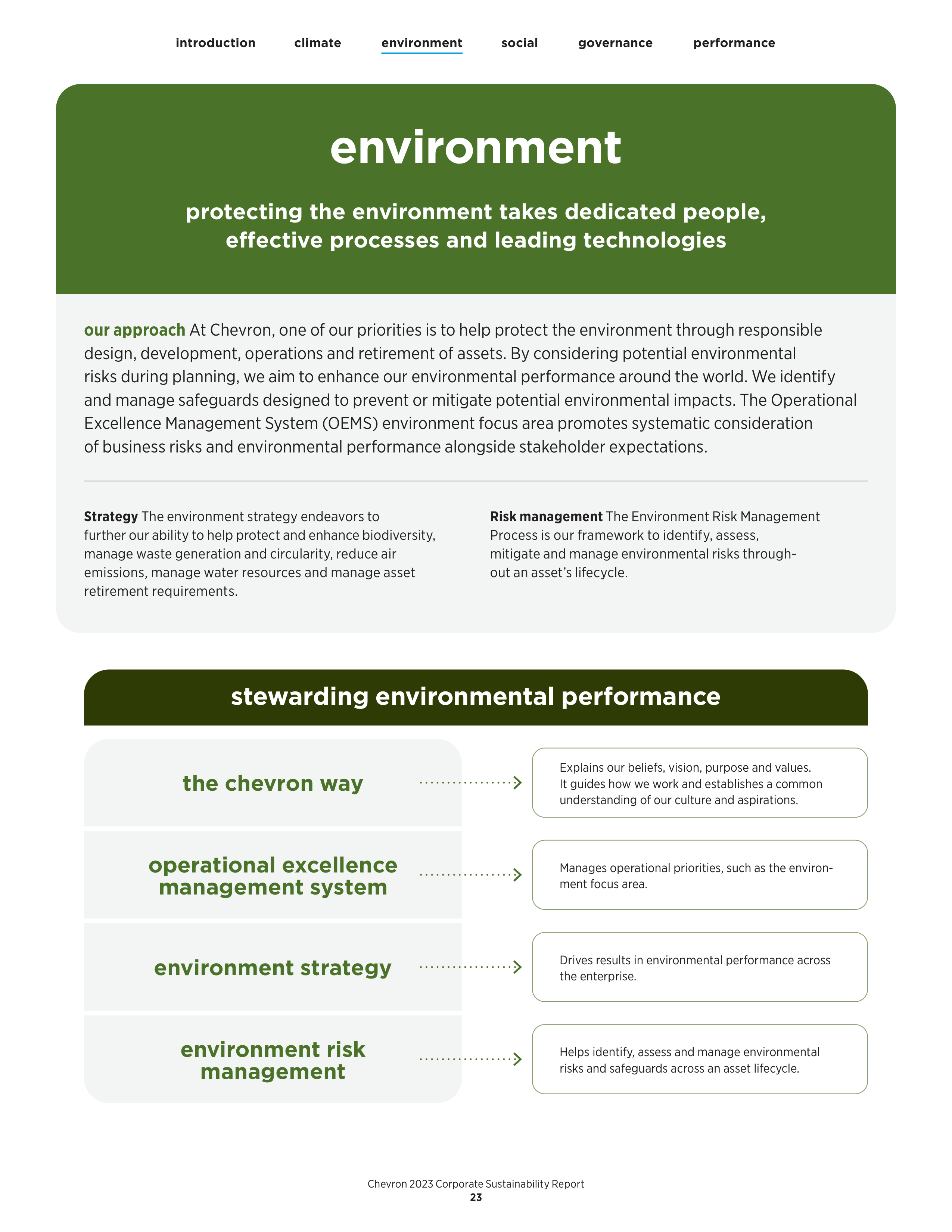
stewarding environmental performance
the chevron way
operational excellence
management system
environment strategy
environment risk
management
Explains our beliefs, vision, purpose and values.
It guides how we work and establishes a common
understanding of our culture and aspirations.
Manages operational priorities, such as the environ?
ment focus area.
Drives results in environmental performance across
the enterprise.
Helps identify, assess and manage environmental
risks and safeguards across an asset lifecycle.
Chevron 2023 Corporate Sustainability Report
23
introduction
social
climate
environment
governance
performance
air
managing emissions from our operations
our approach
Chevron seeks to identify and implement technologies and management practices related
to the reduction of sulfur oxides (SOx), nitrogen oxides (NOx) and volatile organic compounds (VOCs).
managing air emissions
Chevron aims to:
• Standardize reporting to further improve accuracy of our
enterprise air emissions inventories.
• Conduct comprehensive fenceline monitoring and air
dispersion modeling to help understand air emissions
sources, concentrations and types.
• Undertake both internal and external benchmarking of
air emissions to better understand relative performance
and identify key improvement opportunities.
• Share technologies and operation and maintenance
practices across our operations that mitigate air emissions.
improving air emissions inventories
In 2023, we updated our air emissions reporting protocol
to further improve the transparency and consistency
of reporting across the enterprise. Chevron uses data to
inform environmental performance ambitions, opportunities
and risks at the enterprise and business unit levels. Data
are used to balance management of operational needs and
regulatory, community or other key stakeholder issues.
measuring air emissions
Advancements in detection and measurement continue
to shape our approach as we aim to improve performance.
Achieving effective measurement starts with designing
and operating facilities to mitigate emissions and includes
deploying technologies to validate performance, inform
repairs and improve inventories.
Fenceline monitoring
California, U.S.:
Consistent with local regulatory
requirements, air quality data are collected and reported
from stations along the Richmond and El Segundo refineries’
fencelines, providing near real-time data 24 hours a day.
Fenceline monitoring is one of the tools used to understand
local air quality. Since 2013, our refinery in Richmond has
had an air monitoring program. Since 2020, our El Segundo
Refinery has had a fenceline moni?toring program.
To learn more, visit
richmondairmonitoring.org
and
elsegundo1180.com
.
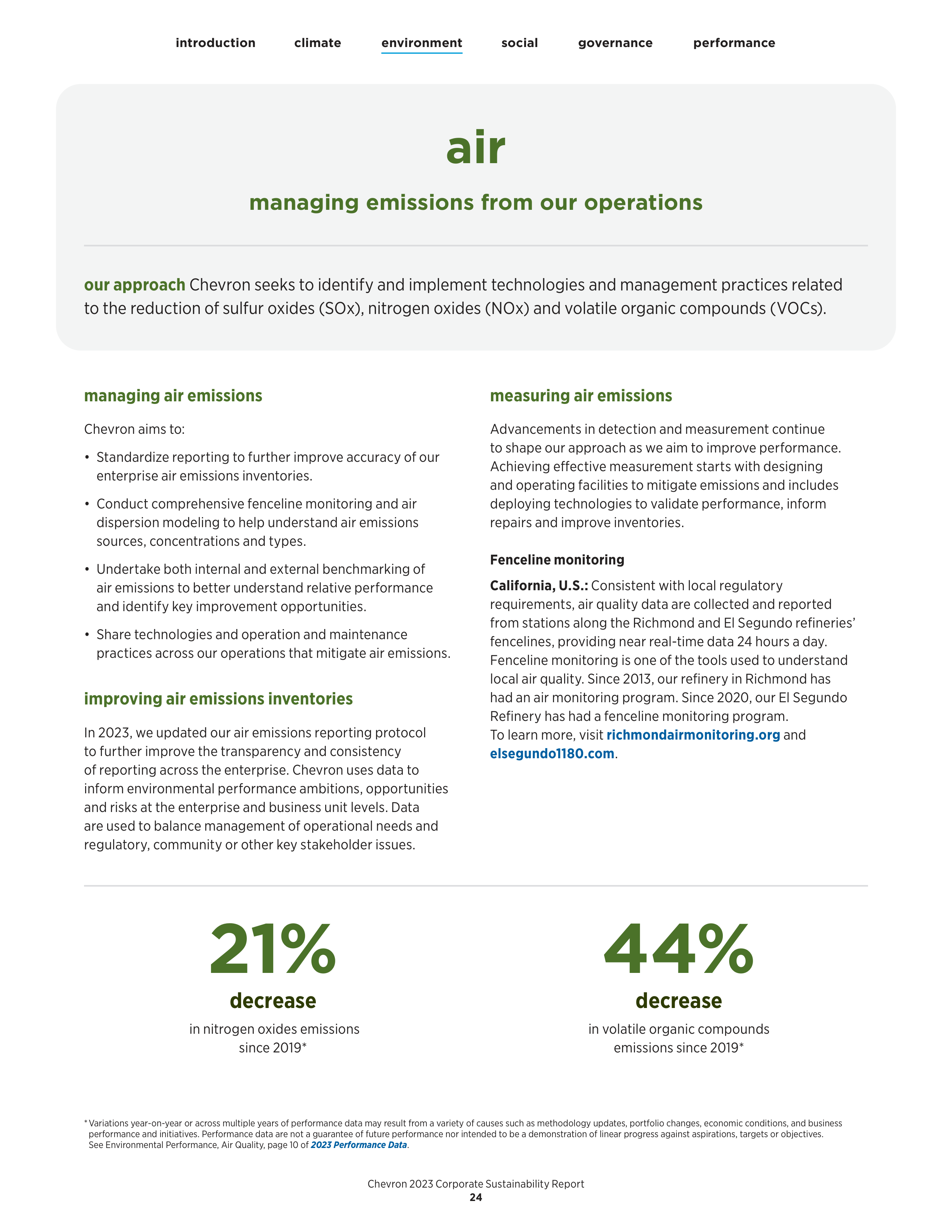
21% decrease in nitrogen oxides emissions since 2019
21% decrease in nitrogen oxides emissions since 2019
21% decrease in nitrogen oxides emissions since 2019
21% decrease in nitrogen oxides emissions since 2019 *
44% decrease in volatile organic compounds emissions since 2019
44% decrease in volatile organic compounds emissions since 2019
44% decrease in volatile organic compounds emissions since 2019
44% decrease in volatile organic compounds emissions since 2019 *
* Variations year-on-year or across multiple years of performance data may result from a variety of causes such as methodology updates, portfolio changes, economic conditions, and business
performance and initiatives. Performance data are not a guarantee of future performance nor intended to be a demonstration of linear progress against aspirations, targets or objectives.
See Environmental Performance, Air Quality, page 10 of
2023 Performance Data
.
Chevron 2023 Corporate Sustainability Report
24
introduction
social
climate
environment
governance
performance
water
stewarding water management
our approach
Water is vital to our operations as we develop and supply energy around the world. We aim
to drive efficient and responsible water use, reuse, recycling and conservation. Chevron recognizes that
collaboration with the communities where we operate is important to strengthening water stewardship.
strengthening water stewardship
To advance our water stewardship, Chevron aims to:
• Evaluate, implement and maintain safeguards designed to
prevent or mitigate potential impacts to the environment
and surrounding communities, including potential impacts
to water resources, throughout the lifecycle of our assets.
• Identify solutions to reduce water withdrawals for our
operations, especially in high water stress areas.
• Assess water treatment technology solutions to mitigate
potential wastewater-related impacts to the environment.
• Measure the effectiveness of our management practices,
drive accountability within our operations and communicate
performance to stakeholders.
• Build partnerships with stakeholders and participate in
industry water resources initiatives to share best practices
in water management and support the development of
industry standards and related policy.
mapping our operations
We use the World Resources Institute (WRI) Aqueduct tool
to map operated assets in water-stressed areas. In 2023,
nine upstream facilities, three biorefineries, two oil refineries
and one additives facility were located in areas of high or
extremely high water stress, according to the WRI tool.
To learn more, visit
chevron.co/watermap
.
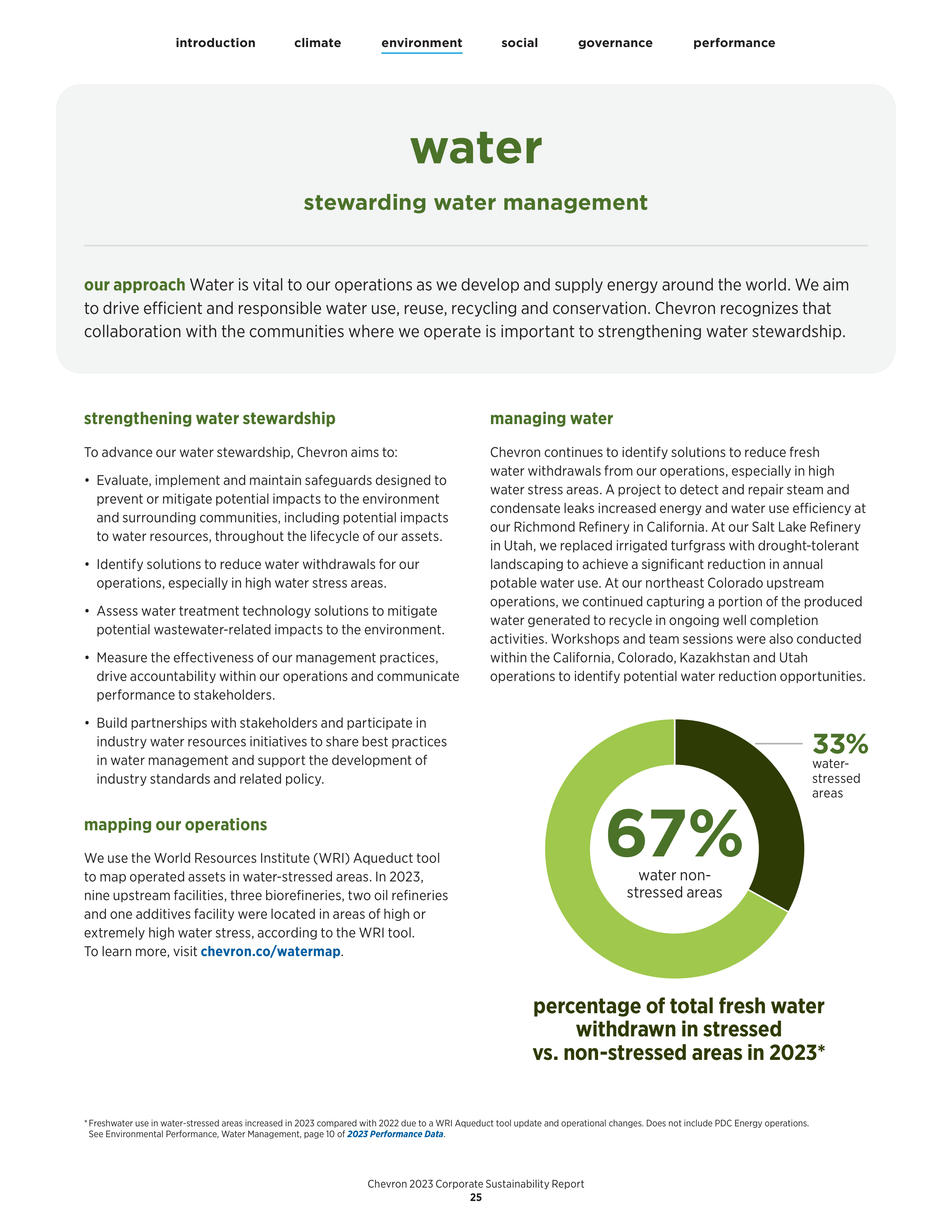
percentage of total fresh water
withdrawn in stressed
vs. non-stressed areas in 2023*
33% water- stressed areas
33% water- stressed areas
33% water- stressed areas
33% water- stressed areas
67% water non- stressed areas
67% water non- stressed areas
67% water non- stressed areas
* Freshwater use in water-stressed areas increased in 2023 compared with 2022 due to a WRI Aqueduct tool update and operational changes. Does not include PDC Energy operations.
See Environmental Performance, Water Management, page 10 of
2023 Performance Data
.
managing water
Chevron continues to identify solutions to reduce fresh
water withdrawals from our operations, especially in high
water stress areas. A project to detect and repair steam and
condensate leaks increased energy and water use efficiency at
our Richmond Refinery in California. At our Salt Lake Refinery
in Utah, we replaced irrigated turfgrass with drought-tolerant
landscaping to achieve a significant reduction in annual
potable water use. At our northeast Colorado upstream
operations, we continued capturing a portion of the produced
water generated to recycle in ongoing well completion
activities. Workshops and team sessions were also conducted
within the California, Colorado, Kazakhstan and Utah
operations to identify potential water reduction opportunities.
Chevron 2023 Corporate Sustainability Report
25
introduction
social
climate
environment
governance
performance
social investment
New Mexico and Texas, U.S.:
Chevron contributes funding
and support to the Pecos Watershed Conservation
Initiative, a public-private partnership that aims to restore
and sustain the health of the Pecos River and its tributaries
in the Permian Basin. The initiative is focused on habitat
restoration and improving the management of grasslands,
agricultural lands and riparian areas in the region.
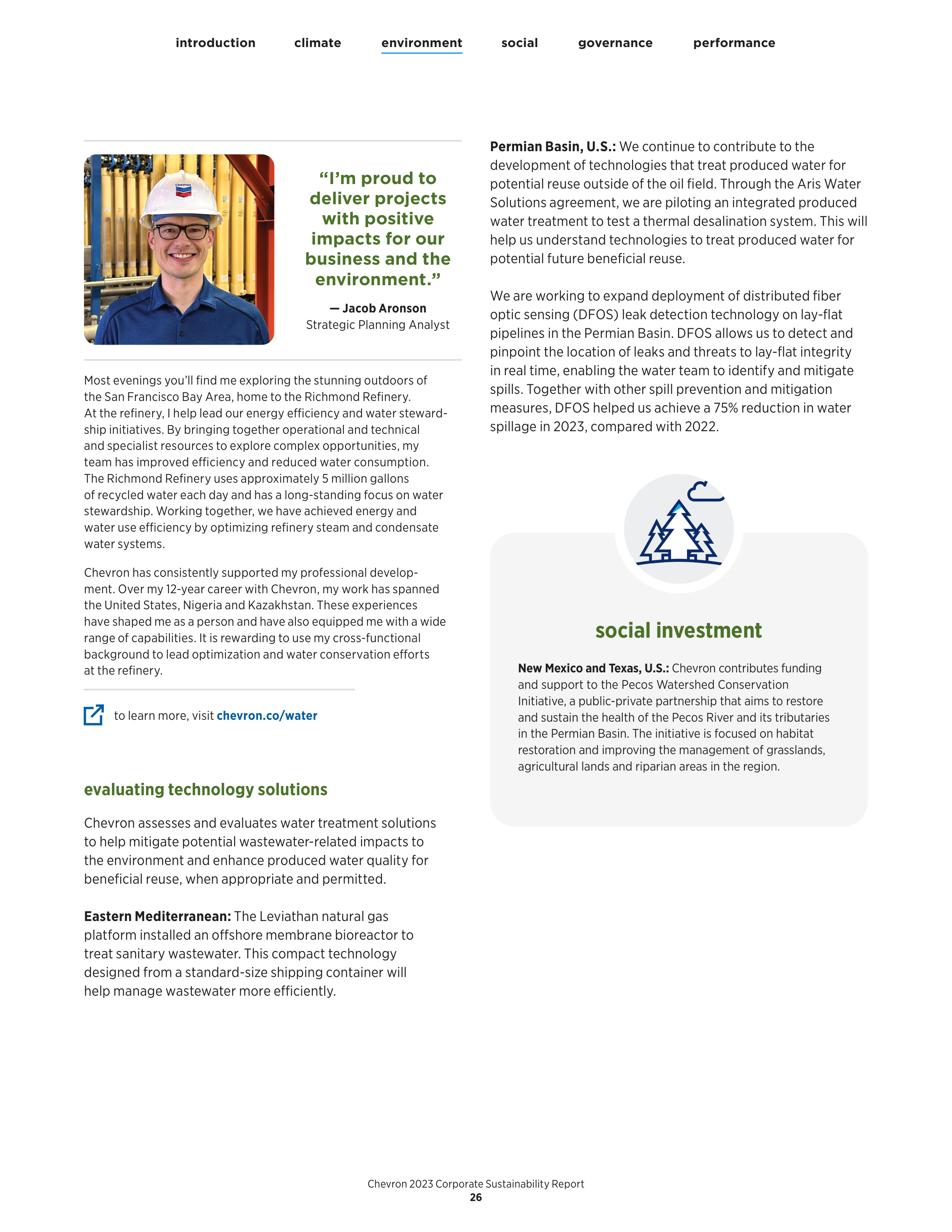
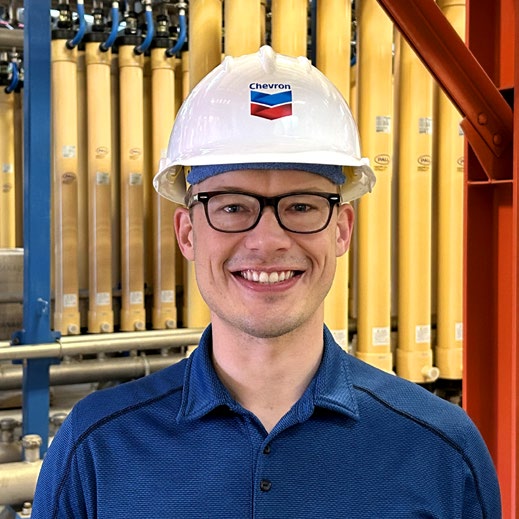
“I’m proud to deliver projects with positive impacts for our business and the environment.” — Jacob Aronson Strategic Planning Analyst
“I’m proud to deliver projects with positive impacts for our business and the environment.” — Jacob Aronson Strategic Planning Analyst
“I’m proud to deliver projects with positive impacts for our business and the environment.” — Jacob Aronson Strategic Planning Analyst
“I’m proud to deliver projects with positive impacts for our business and the environment.” — Jacob Aronson Strategic Planning Analyst
“I’m proud to deliver projects with positive impacts for our business and the environment.” — Jacob Aronson Strategic Planning Analyst
“I’m proud to deliver projects with positive impacts for our business and the environment.” — Jacob Aronson Strategic Planning Analyst
“I’m proud to deliver projects with positive impacts for our business and the environment.” — Jacob Aronson Strategic Planning Analyst
“I’m proud to deliver projects with positive impacts for our business and the environment.” — Jacob Aronson Strategic Planning Analyst
Permian Basin, U.S.:
We continue to contribute to the
development of technologies that treat produced water for
potential reuse outside of the oil field. Through the Aris Water
Solutions agreement, we are piloting an integrated produced
water treatment to test a thermal desalination system. This will
help us understand technologies to treat produced water for
potential future beneficial reuse.
We are working to expand deployment of distributed fiber
optic sensing (DFOS) leak detection technology on lay-flat
pipelines in the Permian Basin. DFOS allows us to detect and
pinpoint the location of leaks and threats to lay-flat integrity
in real time, enabling the water team to identify and mitigate
spills. Together with other spill prevention and mitigation
measures, DFOS helped us achieve a 75% reduction in water
spillage in 2023, compared with 2022.
evaluating technology solutions
Chevron assesses and evaluates water treatment solutions
to help mitigate potential wastewater-related impacts to
the environment and enhance produced water quality for
beneficial reuse, when appropriate and permitted.
Eastern Mediterranean:
The Leviathan natural gas
platform installed an offshore membrane bioreactor to
treat sanitary wastewater. This compact technology
designed from a standard-size shipping container will
help manage wastewater more efficiently.
to learn more, visit
chevron.co/water
Most evenings you’ll find me exploring the stunning outdoors of
the San Francisco Bay Area, home to the Richmond Refinery.
At the refinery, I help lead our energy efficiency and water steward?
ship initiatives. By bringing together operational and technical
and specialist resources to explore complex opportunities, my
team has improved efficiency and reduced water consumption.
The Richmond Refinery uses approximately 5 million gallons
of recycled water each day and has a long-standing focus on water
stewardship. Working together, we have achieved energy and
water use efficiency by optimizing refinery steam and condensate
water systems.
Chevron has consistently supported my professional develop?
ment. Over my 12-year career with Chevron, my work has spanned
the United States, Nigeria and Kazakhstan. These experiences
have shaped me as a person and have also equipped me with a wide
range of capabilities. It is rewarding to use my cross-functional
background to lead optimization and water conservation efforts
at the refinery.
Chevron 2023 Corporate Sustainability Report
26
introduction
social
climate
environment
governance
performance
waste
conducting waste management
our approach
Chevron strives to implement business practices that improve waste management activities
and reduce associated potential environmental, health and safety impacts.
managing waste
To advance our waste stewardship, Chevron aims to:
• Identify and manage safeguards designed to
protect the environment.
• Use third-party waste management facilities that
meet our waste treatment and disposal criteria.
• Participate in trade groups and industry task forces
focused on waste management.
• Advance circular economy and innovative waste
management technologies through partnerships.
• Engage stakeholders and peers to share waste
management best practices.
reducing plastic waste
Chevron U.S.A. Inc. is a co-owner of Chevron Phillips
Chemical Company LLC (CPChem), a 50-50 joint venture.
In 2023, CPChem published its 12th sustainability report,
which includes outlining how the company is working to
drive plastics circularity. To learn more, visit
cpchem.com/
sustainability/sustainability-reporting
.
Belgium:
In 2023, the Chevron Belgium BV lubricants
facility in Ghent began using a different type of “stretch
foil,” a plastic film that stretches tight to wrap packaging.
The facility used approximately 1.1 tonnes less plastic in
2023. This resulted in an estimated 7% reduction over the
year as compared with the previous plastic film usage.
Europe:
In Europe, the carton liner bags used in the Texaco®
Havoline PitPack® system contain 85% less plastic compared
with the previous conventional plastic pails. The reduction
also lessens energy consumption during manufacturing.
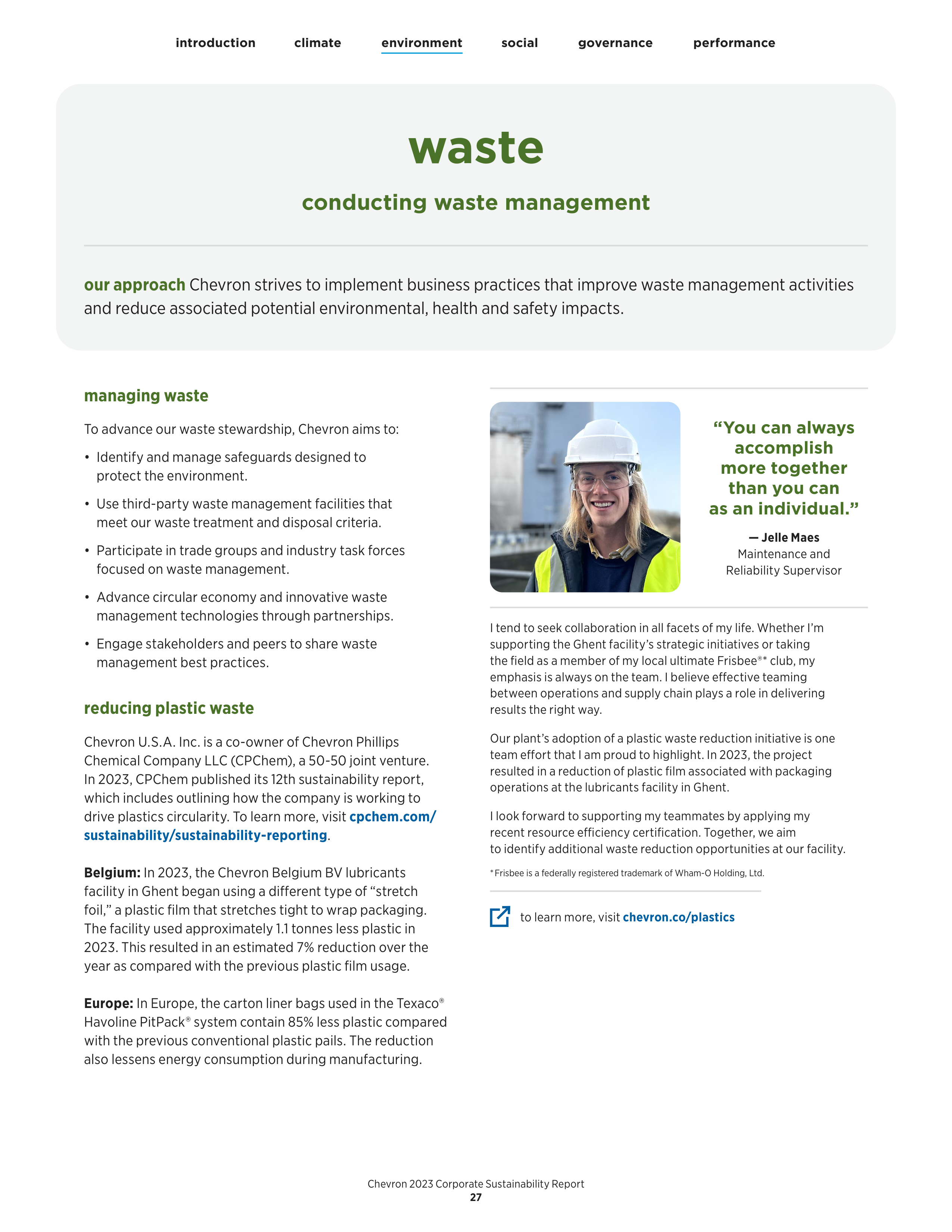
“You can always accomplish more together than you can as an individual.”— Jelle Maes Maintenance and Reliability Supervisor
“You can always accomplish more together than you can as an individual.”— Jelle Maes Maintenance and Reliability Supervisor “You can always accomplish more together than you can as an individual.”— Jelle Maes Maintenance and Reliability Supervisor
“You can always accomplish more together than you can as an individual.”— Jelle Maes Maintenance and Reliability Supervisor r
“You can always accomplish more together than you can as an individual.”— Jelle Maes Maintenance and Reliability Supervisor “You can always accomplish more together than you can as an individual.”— Jelle Maes Maintenance and Reliability Supervisor
“You can always accomplish more together than you can as an individual.”— Jelle Maes Maintenance and Reliability Supervisor
“You can always accomplish more together than you can as an individual.”— Jelle Maes Maintenance and Reliability Supervisor
“You can always accomplish more together than you can as an individual.”— Jelle Maes Maintenance and Reliability Supervisor “You can always accomplish more together than you can as an individual.”— Jelle Maes Maintenance and Reliability Supervisor
“You can always accomplish more together than you can as an individual.”— Jelle Maes Maintenance and Reliability Supervisor
to learn more, visit
chevron.co/plastics
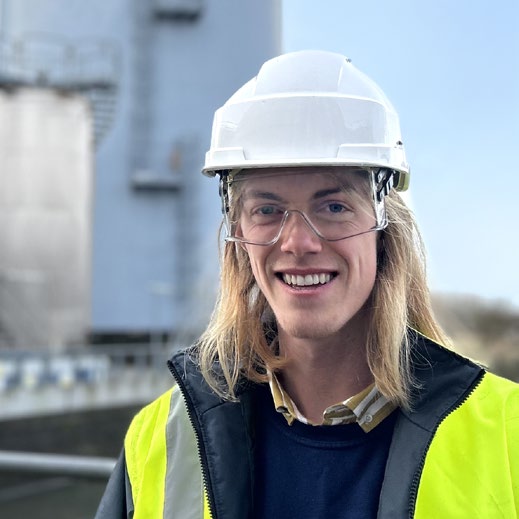
I tend to seek collaboration in all facets of my life. Whether I’m
supporting the Ghent facility’s strategic initiatives or taking
the field as a member of my local ultimate Frisbee®* club, my
emphasis is always on the team. I believe effective teaming
between operations and supply chain plays a role in delivering
results the right way.
Our plant’s adoption of a plastic waste reduction initiative is one
team effort that I am proud to highlight. In 2023, the project
resulted in a reduction of plastic film associated with packaging
operations at the lubricants facility in Ghent.
I look forward to supporting my teammates by applying my
recent resource efficiency certification. Together, we aim
to identify additional waste reduction opportunities at our facility.
* Frisbee is a federally registered trademark of Wham-O Holding, Ltd.
Chevron 2023 Corporate Sustainability Report
27
introduction
social
climate
environment
governance
performance
upcycling waste
Chevron seeks to explore alternatives to improve circularity
in its waste management by reusing, recycling or recovering
materials previously destined for disposal.
Nigeria:
Since 2021, one of the Chevron Nigeria Limited
operations has been diverting incinerator ash destined for
landfill disposal to a third-party waste management facility.
The facility is processing the ash into base material for cement
production. In 2023, the operation was able to begin diverting
additional batches of ash, which had been stored onsite in
anticipation of such waste upcycling opportunities.
social investment
Angola:
Students from across Africa participated in
the Chevron Engineering Leadership Program.
The program ran for two weeks at the African Leader?-
ship Academy in South Africa. Participants were
tasked with a “Waste to Wealth” design challenge to
convert waste material into a useful product for a
potential circular economy business.
The STEM-centric program delved into the engineering
design process and focused on asking critical questions,
solving problems and refining creative ideas. Prototypes
were brought to life through 3D printing and laser-
cutting technology. At the end, student teams presented
their concepts for a circular economy business.
In addition to our financial support, Chevron waste
engineering and management specialists shared
experiences and helped guide students through project
planning. A graduate of the academy, now employed
at Chevron Angola, credits this program for inspiring their
pursuit of a facilities engineering career.
remediating soil and groundwater
We seek to promote long-term solutions and advance
innovative technologies. Two such examples include
enhancing natural processes to address soil and groundwater
impacts and reducing the volume of materials that would
require offsite disposal.
To address petroleum hydrocarbon impacts to groundwater,
Chevron has developed and deployed bioremediation
technologies. One such technology delivers sulfate to the
remediation site to break down benzene in groundwater
up to 10 times faster than natural means. In 2023, our insights
on the sulfate delivery technology were published in
L.U.S.T. Line, an underground storage tank publication that
serves regulators and other external stakeholders.
California, U.S.:
At the Guadalupe Restoration Project site,
construction of an onsite nonhazardous petroleum
hydrocarbon-impacted soil management area (SMA) is
underway. Nutrients will be used to enhance biodegradation
of the petroleum hydrocarbon-impacted soil. Disposal of
impacted soil to the SMA will eliminate haul truck trips
to an offsite landfill. This will reduce emissions, offsite traffic
congestion and potential safety concerns resulting from
hauling the soil.
Chevron 2023 Corporate Sustainability Report
28
introduction
social
climate
environment
governance
performance
biodiversity
working to protect biodiversity through
our operating practices and innovative solutions
our approach
Chevron works with communities, regulatory agencies, industry groups and conservation
organizations to take action to help protect and enhance biodiversity.
stewarding biodiversity
We aim to help protect biodiversity by:
• Identifying opportunities to manage potential risks
in protected or sensitive areas through our screening
for biodiversity.
• Using the mitigation hierarchy to avoid, reduce, restore
or offset potential impacts to biodiversity across the
lifecycle of our assets.
• Identifying potential opportunities to conserve and
enhance biodiversity where we operate.
screening for biodiversity
At Chevron, we use tools and technologies to help us under?
stand potential impacts to biodiversity. The output from these
tools and technologies helps provide insights and identify
potential opportunities for improvement. During project
planning stages, Chevron identifies measures designed to
avoid or reduce potential impacts to biodiversity.
Our global geospatial database, which previously included
only upstream onshore operations, has been expanded to
include upstream offshore operations, downstream operations
and major capital projects. The expanded database was used
to screen our 2023 major operating sites and major capital
projects against protected area and biodiversity datasets
from the IBAT Alliance’s integrated biodiversity assessment
tool. This tool is available to us through the Proteus Partner?
ship and includes the World Database on Protected Areas, the
International Union for Conservation of Nature (IUCN) Red
List of Threatened Species and the World Database of Key
Biodiversity Areas.
Australia:
Our geospatial database helps us understand
potential biodiversity impacts and benefits at the site level.
Consistent with the 2022 results, screening of our major
operating sites in 2023 identified one upstream onshore
operating site, in Barrow Island, Australia, that is located
within an IUCN I–IV* protected area. No upstream offshore
or downstream major operating sites were identified in
IUCN I–IV areas.
following mitigation processes
Our Environment Risk Management Process integrates the
environmental mitigation hierarchy concept. The mitigation
hierarchy is a sequence of considerations starting with
the most effective mitigation measures. These considerations
include avoidance, reduction, restoration and offsetting.
Preventive and remediative measures
To protect biodiversity during planning stages, Chevron
prioritizes preventive measures to avoid or reduce potential
impacts. Avoidance measures may include site selection,
design and scheduling. Reduction measures may include
physical, operational and abatement controls.
Chevron may also implement remediative measures,
such as restoration and offsets, that may help achieve a net
positive impact on local biodiversity. Restoration may include
reestablishment of habitat types, biodiversity or ecosystem
services. Offsets may include restoration offsets or averted
loss offsets to compensate for biodiversity impacts.
* IUCN I–IV protected areas per IUCN definition, 2008 and 2013.
Chevron 2023 Corporate Sustainability Report
29
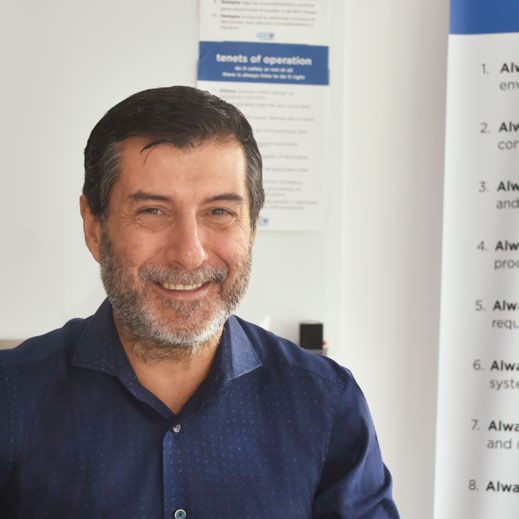
introduction
social
climate
environment
governance
performance
endangered plant recovery
California, U.S.:
La Graciosa thistle, a spiny wetland
plant with white, lavender-tinged flowers, occurs only
in coastal southern California. Listed as threatened at the
state level, the thistle is a U.S. Fish and Wildlife Service
(USFWS) endangered species. There are eight known
locations where the thistle still occurs, and four of those
locations are within our former Guadalupe oil field.
As part of our Guadalupe Restoration Project, we have
reestablished nearly 24 acres of the thistle’s natural habitat
and successfully transplanted approximately 1,135 thistles
onsite. Over 2,800 thistles were grown at an onsite native
seed nursery for local planting. In 2023, Chevron received a
USFWS conservation award for outstanding stewardship
of natural resources and our long-term dedication to thistle
recovery efforts.
social investment
Colombia:
At Chevron, we work with communities,
regulatory agencies and conservation organizations to
take measures designed to protect and enhance biodiversity
in parts of the world where we operate. In 2023, the
Chevron Petroleum Company provided funding to help
Corales de Paz develop Energy Reefs, a project
supporting the Reef Check citizen science program.
Reef Check educates communities on coral health and
reef conservation and conducts monitoring and data
collection expeditions. Approximately 5,600 square meters
of coral reef were monitored in 2023, and two coral
bleaching discoveries were shared with authorities to
support conservation efforts.
Reef Check expeditions include local community members
and environmental authorities, plus a Chevron volunteer.
Chevron Colombia’s work on the Energy Reefs project was
recognized with an Hechos de Sostenibilidad Award
in the category of Alliances for Sustainable Development.
Since childhood, I have been passionate about environmental
science and photography. The wonders of biology ignited a lifelong
fascination, leading me to pursue a degree in biological science at
the University of Buenos Aires.
In 2022, my interests converged when I was entrusted with leading
the implementation of Chevron’s environmental risk assessment
and management procedure in Argentina. This opportunity allowed
me to impart expertise and creativity in developing the plant guide
for Chevron’s El Trapial field in Argentina. The plant guide serves
as an important tool when establishing environmental baselines for
El Trapial. By the end of 2023, we had identified approximately
230 species, including over 60 plants, 60 vertebrates and
100 invertebrates.
I am proud to share that one of my photographs from El Trapial
was selected as the cover photo for the
2024 Wildlife Habitat
Council Calendar
. This recognition not only validates our team’s
dedication to capturing the beauty of our natural world but
also highlights the importance of helping to preserve and protect
wildlife habitats.
“I started photographing insects, and I discovered a new world.”— Diego Alfonso Rosa HSE Regulatory Coordinator
“I started photographing insects, and I discovered a new world.”— Diego Alfonso Rosa HSE Regulatory Coordinator
“I started photographing insects, and I discovered a new world.”— Diego Alfonso Rosa HSE Regulatory Coordinator
“I started photographing insects, and I discovered a new world.”— Diego Alfonso Rosa HSE Regulatory Coordinator
“I started photographing insects, and I discovered a new world.”— Diego Alfonso Rosa HSE Regulatory Coordinator
“I started photographing insects, and I discovered a new world.”— Diego Alfonso Rosa HSE Regulatory Coordinator
“I started photographing insects, and I discovered a new world.”— Diego Alfonso Rosa HSE Regulatory Coordinator
to learn more, visit
chevron.co/biodiversity
Chevron 2023 Corporate Sustainability Report
30
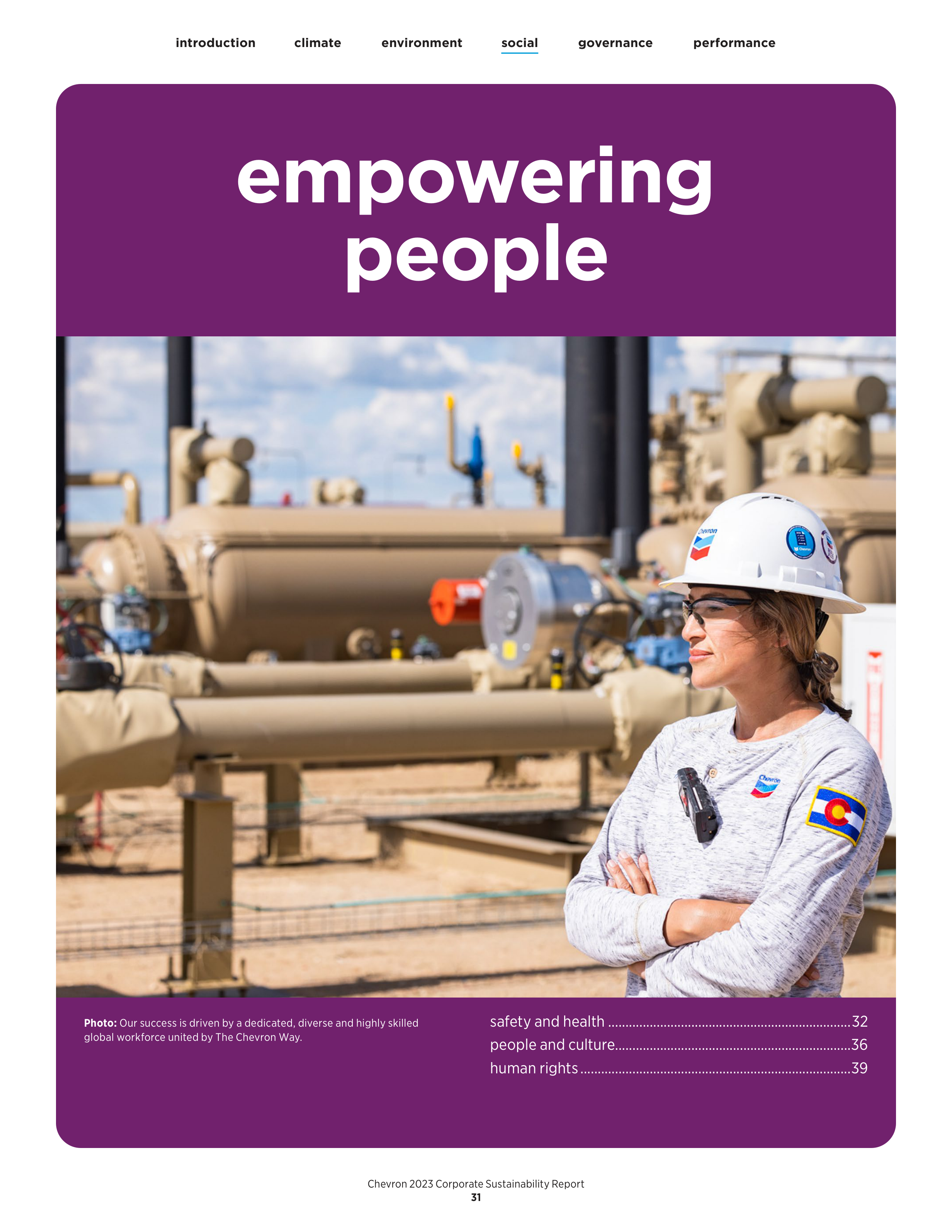
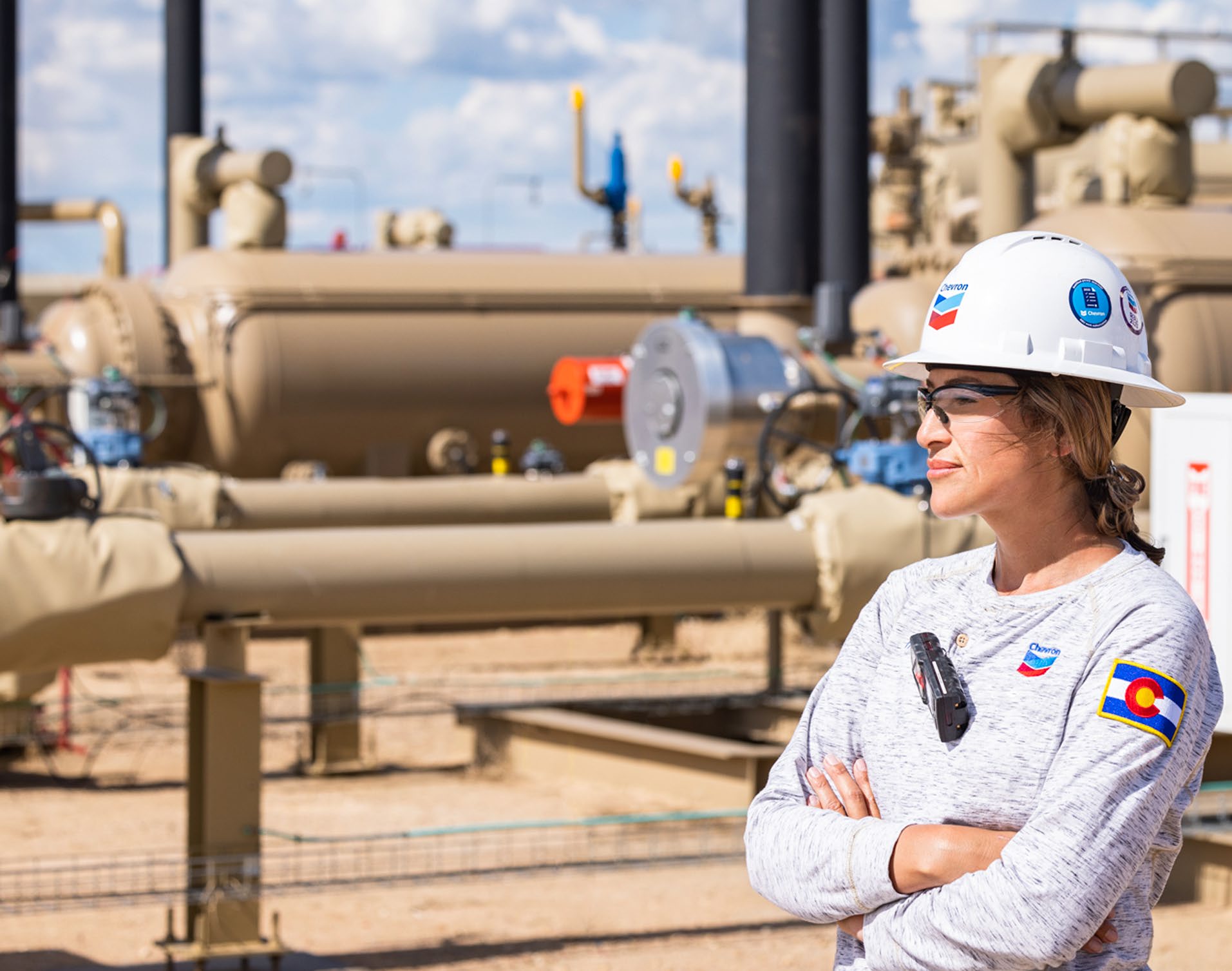
introduction
social
climate
environment
governance
performance
empowering
people
Photo:
Our success is driven by a dedicated, diverse and highly skilled
global workforce united by The Chevron Way.
safety and health.......................................................................32
people and culture....................................................................36
human rights...............................................................................39
Chevron 2023 Corporate Sustainability Report
31
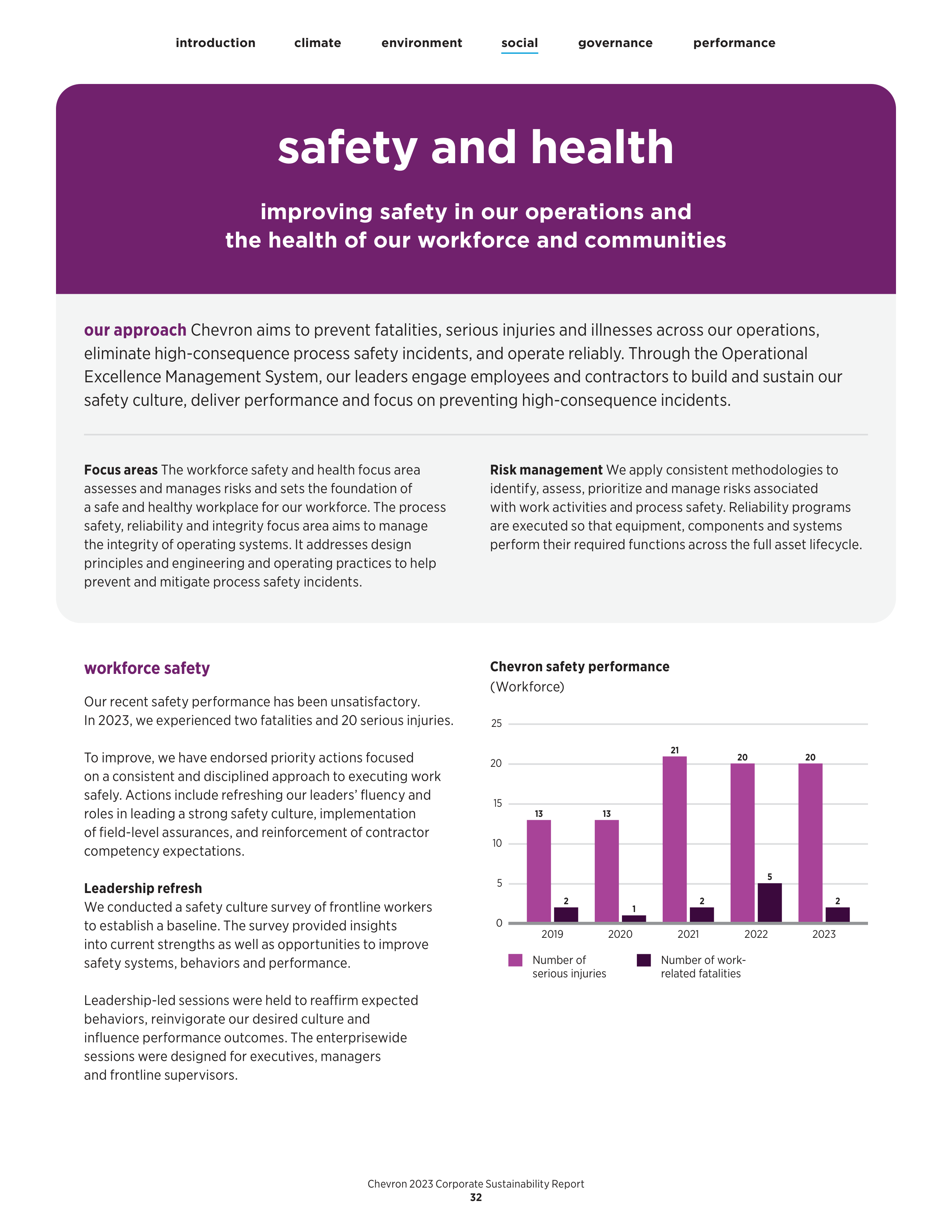
introduction
social
climate
environment
governance
performance
Focus areas
The workforce safety and health focus area
assesses and manages risks and sets the foundation of
a safe and healthy workplace for our workforce. The process
safety, reliability and integrity focus area aims to manage
the integrity of operating systems. It addresses design
principles and engineering and operating practices to help
prevent and mitigate process safety incidents.
Risk management
We apply consistent methodologies to
identify, assess, prioritize and manage risks associated
with work activities and process safety. Reliability programs
are executed so that equipment, components and systems
perform their required functions across the full asset lifecycle.
our approach
Chevron aims to prevent fatalities, serious injuries and illnesses across our operations,
eliminate high-consequence process safety incidents, and operate reliably. Through the Operational
Excellence Management System, our leaders engage employees and contractors to build and sustain our
safety culture, deliver performance and focus on preventing high-consequence incidents.
safety and health
improving safety in our operations and
the health of our workforce and communities
workforce safety
Our recent safety performance has been unsatisfactory.
In 2023, we experienced two fatalities and 20 serious injuries.
To improve, we have endorsed priority actions focused
on a consistent and disciplined approach to executing work
safely. Actions include refreshing our leaders’ fluency and
roles in leading a strong safety culture, implementation
of field-level assurances, and reinforcement of contractor
competency expectations.
Leadership refresh
We conducted a safety culture survey of frontline workers
to establish a baseline. The survey provided insights
into current strengths as well as opportunities to improve
safety systems, behaviors and performance.
Leadership-led sessions were held to reaffirm expected
behaviors, reinvigorate our desired culture and
influence performance outcomes. The enterprisewide
sessions were designed for executives, managers
and frontline supervisors.
0
5
10
15
20
25
2019
2020
2021
2022
2023
Number of
serious injuries
Number of work-
related fatalities
13
2
13
1
21
2
20
5
20
2
Chevron safety performance
(Workforce)
Chevron 2023 Corporate Sustainability Report
32
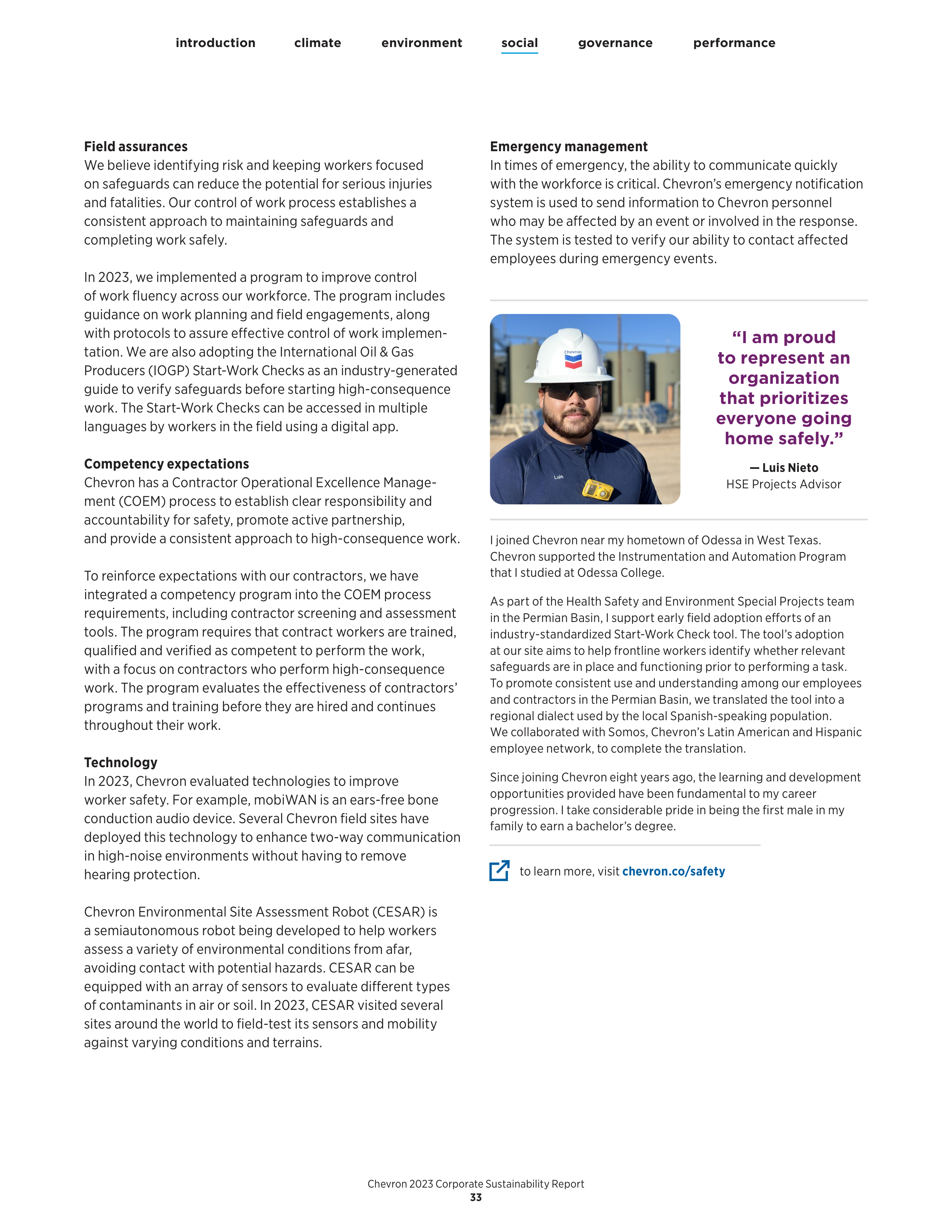
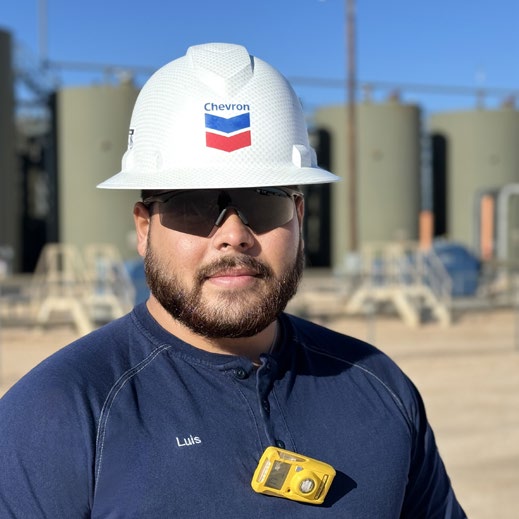
introduction
social
climate
environment
governance
performance
Field assurances
We believe identifying risk and keeping workers focused
on safeguards can reduce the potential for serious injuries
and fatalities. Our control of work process establishes a
consis?tent approach to maintaining safe?guards and
completing work safely.
In 2023, we implemented a program to improve control
of work fluency across our workforce. The program includes
guidance on work planning and field engagements, along
with protocols to assure effective control of work implemen?
tation. We are also adopting the International Oil & Gas
Producers (IOGP) Start-Work Checks as an industry-generated
guide to verify safeguards before starting high-consequence
work. The Start-Work Checks can be accessed in multiple
languages by workers in the field using a digital app.
Competency expectations
Chevron has a Contractor Operational Excellence Manage-
ment (COEM) process to establish clear responsibility and
accountability for safety, promote active partnership,
and provide a consistent approach to high-consequence work.
To reinforce expectations with our contractors, we have
integrated a competency program into the COEM process
requirements, including contractor screening and assessment
tools. The program requires that contract workers are trained,
qualified and verified as competent to perform the work,
with a focus on contractors who perform high-consequence
work. The program evaluates the effectiveness of contractors’
programs and training before they are hired and continues
throughout their work.
Technology
In 2023, Chevron evaluated technologies to improve
worker safety. For example, mobiWAN is an ears-free bone
conduction audio device. Several Chevron field sites have
deployed this technology to enhance two-way communication
in high-noise environments without having to remove
hearing protection.
Chevron Environmental Site Assessment Robot (CESAR) is
a semiautonomous robot being developed to help workers
assess a variety of environmental conditions from afar,
avoiding contact with potential hazards. CESAR can be
equipped with an array of sensors to evaluate different types
of contaminants in air or soil. In 2023, CESAR visited several
sites around the world to field-test its sensors and mobility
against varying conditions and terrains.
Emergency management
In times of emergency, the ability to communicate quickly
with the workforce is critical. Chevron’s emergency notification
system is used to send information to Chevron personnel
who may be affected by an event or involved in the response.
The system is tested to verify our ability to contact affected
employees during emergency events.
“I am proud to represent an organization that prioritizes everyone going home safely.”— Luis Nieto HSE Projects Advisor
“I am proud to represent an organization that prioritizes everyone going home safely.”— Luis Nieto HSE Projects Advisor
“I am proud to represent an organization that prioritizes everyone going home safely.”— Luis Nieto HSE Projects Advisor
“I am proud to represent an organization that prioritizes everyone going home safely.”— Luis Nieto HSE Projects Advisor
“I am proud to represent an organization that prioritizes everyone going home safely.”— Luis Nieto HSE Projects Advisor
“I am proud to represent an organization that prioritizes everyone going home safely.”— Luis Nieto HSE Projects Advisor
“I am proud to represent an organization that prioritizes everyone going home safely.”— Luis Nieto HSE Projects Advisor
“I am proud to represent an organization that prioritizes everyone going home safely.”— Luis Nieto HSE Projects Advisor
to learn more, visit
chevron.co/safety
I joined Chevron near my hometown of Odessa in West Texas.
Chevron supported the Instrumentation and Automation Program
that I studied at Odessa College.
As part of the Health Safety and Environment Special Projects team
in the Permian Basin, I support early field adoption efforts of an
industry-standardized Start-Work Check tool. The tool’s adoption
at our site aims to help frontline workers identify whether relevant
safeguards are in place and functioning prior to performing a task.
To promote consistent use and understanding among our employees
and contractors in the Permian Basin, we translated the tool into a
regional dialect used by the local Spanish-speaking population.
We collaborated with Somos, Chevron’s Latin American and Hispanic
employee network, to complete the translation.
Since joining Chevron eight years ago, the learning and development
opportunities provided have been fundamental to my career
progression. I take considerable pride in being the first male in my
family to earn a bachelor’s degree.
Chevron 2023 Corporate Sustainability Report
33
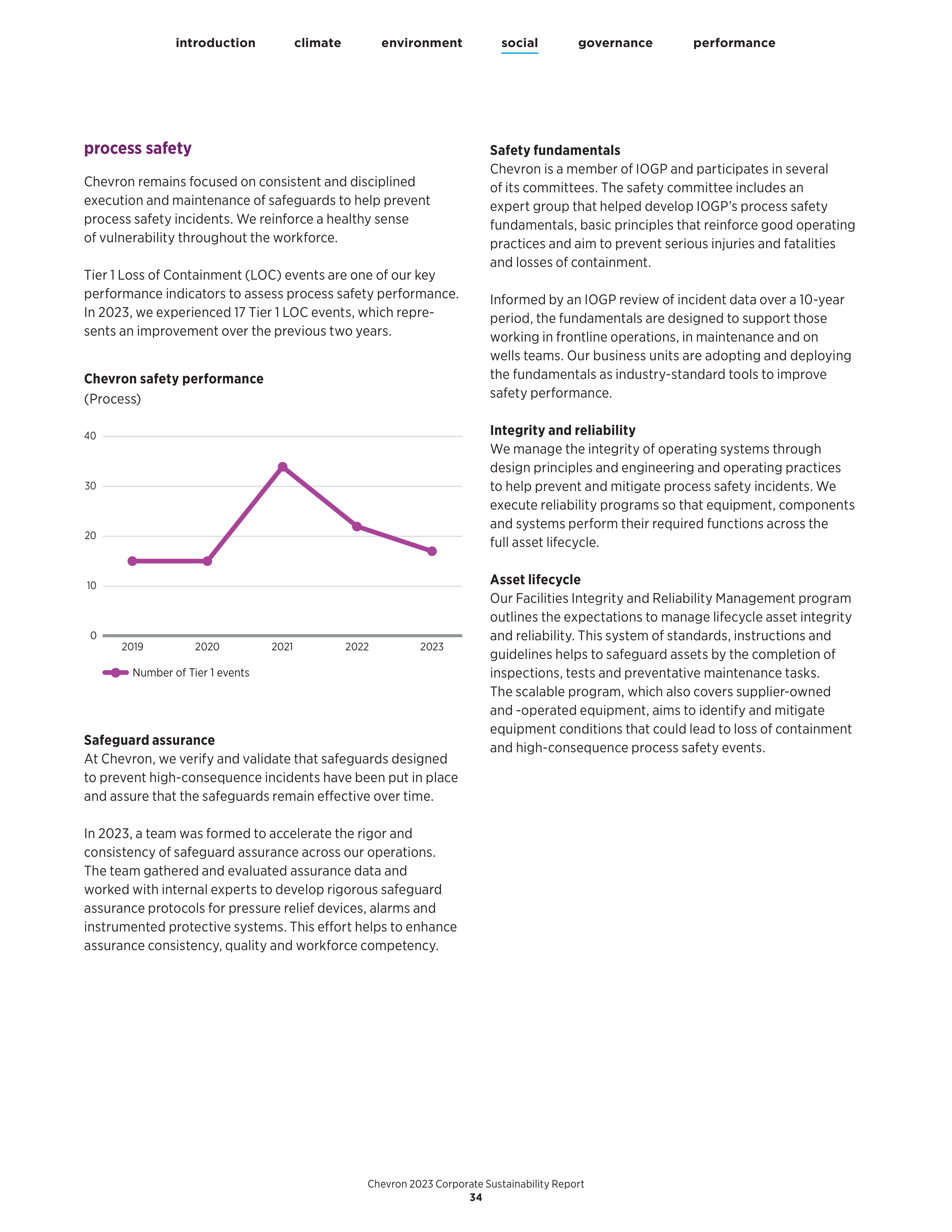
introduction
social
climate
environment
governance
performance
Safeguard assurance
At Chevron, we verify and validate that safeguards designed
to prevent high-consequence incidents have been put in place
and assure that the safeguards remain effective over time.
In 2023, a team was formed to accelerate the rigor and
consistency of safeguard assurance across our operations.
The team gathered and evaluated assurance data and
worked with internal experts to develop rigorous safeguard
assurance protocols for pressure relief devices, alarms and
instrumented protective systems. This effort helps to enhance
assurance consistency, quality and workforce competency.
process safety
Chevron remains focused on consistent and disciplined
execution and maintenance of safeguards to help prevent
process safety incidents. We reinforce a healthy sense
of vulnerability throughout the workforce.
Tier 1 Loss of Containment (LOC) events are one of our key
performance indicators to assess process safety performance.
In 2023, we experienced 17 Tier 1 LOC events, which repre?
sents an improvement over the previous two years.
Chevron safety performance
(Process)
Safety fundamentals
Chevron is a member of IOGP and participates in several
of its committees. The safety committee includes an
expert group that helped develop IOGP’s process safety
fundamentals, basic principles that reinforce good operating
practices and aim to prevent serious injuries and fatalities
and losses of containment.
Informed by an IOGP review of incident data over a 10-year
period, the fundamentals are designed to support those
working in frontline operations, in maintenance and on
wells teams. Our business units are adopting and deploying
the fundamentals as industry-standard tools to improve
safety performance.
Integrity and reliability
We manage the integrity of operating systems through
design principles and engineering and operating practices
to help prevent and mitigate process safety incidents. We
execute reliability programs so that equipment, components
and systems perform their required functions across the
full asset lifecycle.
Asset lifecycle
Our Facilities Integrity and Reliability Management pro?gram
outlines the expectations to manage lifecycle asset integrity
and reliability. This system of standards, instructions and
guide?lines helps to safeguard assets by the completion of
inspections, tests and preventative maintenance tasks.
The scalable program, which also covers supplier-owned
and -operated equipment, aims to identify and mitigate
equipment conditions that could lead to loss of containment
and high-consequence process safety events.
0
10
20
30
40
2019
2020
2021
2022
2023
Number of Tier 1 events
Chevron 2023 Corporate Sustainability Report
34
introduction
social
climate
environment
governance
performance
social investment
Colorado, U.S.:
Mental health is essential for overall
wellness. We invest in local community programs that
provide resources and expertise to individuals and
families seeking help. Started in May 2023 during National
Mental Health Awareness Month, the Youth Resilience
Program provides mental wellness resources to Colorado
communities. Through support of behavioral and
mental health foundations and public broadcasting,
parents and caregivers can access videos, a social
media toolkit and other online resources to help children
develop skills and resiliency to deal with challenges.
community health
Private sector partnerships can help address factors that
affect health, such as income barriers, social determinants,
education, housing and access to health care. Through
our partnerships, we bring global experience, leadership and
financial resources to assist in addressing the health risks
having the greatest potential impact in the communities
where we operate.
Chevron partners with Friends of the Global Fight
Against AIDS, Tuberculosis and Malaria, whose goals are to
end related epidemics and build stronger health systems.
We are a member of and co-chair its Private Sector Advisory
Council (PSAC). In 2023, the PSAC convened on several
occasions, including a session on how innovation can help
accelerate health access and equity in Africa. Chevron
participated in discussions with local innovators and with
representatives from government, civil society and academia.
Conclusions influenced a report on how digitizing health
care demand and supply in Africa may help free resources to
accelerate wider and more equitable access to care.
workforce health
We care about our employees’ health and well-being in
all its forms – physical, mental, social – so they can lead full
lives on and off the job. We seek to secure long-term benefits
for our workforce through our culture of health. Our Health
& Medical team considers health equity when assessing
workforce health strategies and in supporting prevention,
education and treatment.
Enterprise health index
We engage our employees to help us assess how well
we are supporting workforce health and encouraging
healthy behaviors.
Our Enterprise Health Index collects organizational health
measurements annually over eight different dimensions
to help us identify opportunities to adapt and improve
our culture of health. Overall, trends have improved from
pandemic lows, including scores in our organizational
commitment to health and individual well-being.
Global wellness programs
Mental health and emotional well-being programs
are offered around the world, with resources available to
employees and their families.
Chevron’s global wellness program, Healthy You, empowers
employees to take control of their health and well-being
by learning how personal choices regarding diet, exercise,
tobacco use and work-life balance influence health. In the
United States and Canada, employees and adult dependents
have access to a coaching resource that promotes proactive
mental health, inclusion and belonging.
Workplace
Australia:
After moving into a new headquarters, Chevron
Australia’s entire Perth-based workforce is together in a single
location for the first time in a decade. Designed with inclusivity
and technology at the forefront, the flexible workplace also
takes a biophilic–focused approach to health and well-being.
Thousands of plants are installed throughout the building,
and floor-to-ceiling windows provide natural light and views
of the nearby river and parklands. Artwork publicly displayed
celebrates the Whadjuk people’s culture, traditions and
connection to the waterfront.
Chevron 2023 Corporate Sustainability Report
35
introduction
social
climate
environment
governance
performance
our approach
At Chevron, we believe human ingenuity has the power to solve any challenge
and overcome any obstacle. Together, the people of Chevron work in pursuit of a common purpose:
to provide the affordable, reliable, ever-cleaner energy that enables human progress.
Strategy
Our people strategy seeks to engage the full
potential of our employees to deliver the future of energy.
A compelling employee experience supports the pursuit
of meaningful careers. We aspire to achieve this by attracting
and retaining talent, strengthening core and emerging
skills, and advancing our culture through the three pillars of
worker, workforce and workplace.
Culture
We promote a culture that values a diversity
of perspectives, productive dialogue and teaming.
We also promote resources for good health, well-being
and work-life balance. We develop leaders to sustain
and strengthen our culture for the future.
people and culture
investing in people and fostering a culture of inclusion
worker
At Chevron, we seek to attract and retain talent to build
high-performing teams in critical areas of our business.
By engaging their full potential, we aim to develop
employees and inspiring leaders who are held to a common
standard of behavior and integrity.
Talent pipeline
In 2023, United States university student acceptance rates
remained in line with our historical percentages. Of those
offered full-time employment, 76% accepted, and of
those offered an internship, 70% accepted.
Employee engagement
Chevron regularly conducts employee surveys to assess
the health of the company culture. Our surveys indicate
high levels of employee engagement, an indicator of
willingness to invest energy toward positive organizational
out?comes. Our survey frequency helps us understand
employee sentiment throughout the year and gain insights
into employee well-being.
workforce
We support every employee’s pursuit of a career that’s right
for them. Various career paths, learning opportunities and
mentoring programs are offered to promote skill development
and high performance.
Energy transition fluency
Chevron provides lower carbon and energy transition fluency
and skill-building resources for our workforce. Developed
internally using in-house expertise, learning sessions
are available to employees via our online learning platform.
annual surveys indicate employees are increasingly positive about their career development opportunities
annual surveys indicate employees are increasingly positive about their career development opportunities
annual surveys indicate employees are increasingly positive about their career development opportunities
Chevron 2023 Corporate Sustainability Report
36
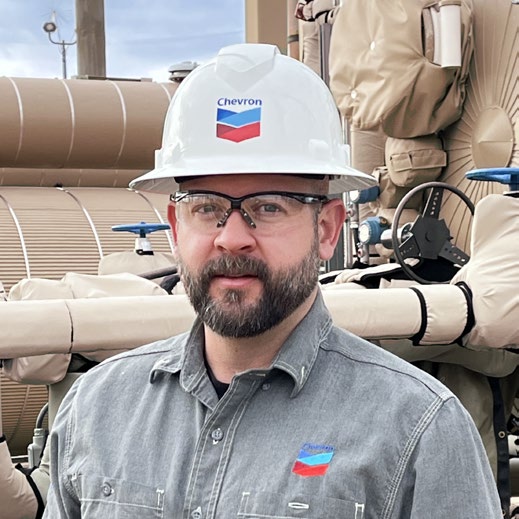
introduction
social
climate
environment
governance
performance
“Shared experience helps build trust.” — Zach Yearous Operations Advisor
“Shared experience helps build trust.” — Zach Yearous Operations Advisor
“Shared experience helps build trust.” — Zach Yearous Operations Advisor
“Shared experience helps build trust.” — Zach Yearous Operations Advisor
“Shared experience helps build trust.” — Zach Yearous Operations Advisor
Over the past 18 years, I have worked across the oil and gas
industry on assets throughout their lifecycle, from design to
decommissioning. I like to say that I have “well to sell” experience.
Most recently, I worked as a foreman at our Central Gathering
Facility in Colorado. As a hands-on learner, I discovered my career
path during the summer of 2006. After high school, I worked on
an oil rig in the Denver-Julesburg Basin – a region I knew well
from growing up in Colorado. I found myself drawn to the oil and
gas industry’s dynamic environment. It continuously presents
opportunities to learn, grow and adapt.
My career, much like our industry, has continued to evolve.
In 2023, I led efforts to provide business units with practical ideas
to reduce methane intensity. My real-world experience helps
me relate to fellow operations and maintenance folks as we work
to implement our enterprise methane reduction strategy.
to learn more, visit
chevron.co/learning_development
Supervisor training
In 2023, we focused on supervisor development. The training
is based on business needs and aligned with industry trends,
new technologies and new ways of learning. We aim to help
supervisors develop skills for meeting their responsibilities,
enriching performance and career development conversations,
and enhancing mindsets and behaviors.
Leadership programs
Chevron offers leadership programs to encourage professional
development. In recognition of the diverse backgrounds of
our global employee base, we believe inclusive leadership
development enhances performance and innovation. In 2023,
nearly 90 Chevron employees participated in the Global
Women’s Leadership Development Program and Transforma?
tional Leadership® for Multicultural Women. These programs
provide forums to discuss headwinds, advance professional
growth and foster a more inclusive work environment.
Somos, Chevron’s Latin American and Hispanic
employee network, held their first Latina Summit, with
over 930 employees attending. The summit focused
on inspiring and empowering Latina employees to reach
their full potential.
We offer one-on-one and small-group coaching sessions
designed to improve the effectiveness of our leaders.
Since its launch in 2020, this coaching initiative has
reached nearly 4,500 frontline supervisors, managers and
individual contributors in 57 countries and 22 languages.
workplace
We advance our safety and inclusion culture by continuing
to shape a workplace environment where a commitment
to integrity and ingenuity endures. Chevron aims to provide
employees a safe, inclusive community, no matter who
they are, what they do or where they work.
Chevron develops workplaces, tools and technologies that
are designed for productivity and problem-solving.
We invest in digital technologies that support flexibility,
collaboration and learning. Offices are designed to foster
human connection and spark ingenuity – places that
make the employee feel they want to come to work and
help them get the job done.
Inclusion
In 2023, Chevron’s ENABLED (ENhancing ABilities and
LEveraging Disabilities) employee network chapters around
the world collaborated to host their inaugural summit.
Employees from more than 30 countries participated in this
first-ever, two-day event designed to amplify the contri?
butions, knowledge and experiences of people affected or
otherwise touched by disabilities.
employee resource group of the year ENABLED was recognized by Disability:IN for our programming and practices that promote disability awareness and education
employee resource group of the year ENABLED was recognized by Disability:IN for our programming and practices that promote disability awareness and education
employee resource group of the year ENABLED was recognized by Disability:IN for our programming and practices that promote disability awareness and education
employee resource group of the year ENABLED was recognized by Disability:IN for our programming and practices that promote disability awareness and education
employee resource group of the year ENABLED was recognized by Disability:IN for our programming and practices that promote disability awareness and education
Chevron 2023 Corporate Sustainability Report
37
introduction
social
climate
environment
governance
performance
social investment
Australia:
Chevron recognizes that STEM education
plays an important role in advancing innovation, research
and technology. We support teacher training programs
to inspire the next generation of scientists, engineers and
problem-solvers.
Chevron Australia is funding a three-year program to help
primary and secondary school teachers embed Aboriginal
and Torres Strait Islander scientific knowledge into their
STEM curriculum. Implemented by the Commonwealth
Scientific and Industrial Research Organisation, the program
provides training and resources for teachers and schools
in the Pilbara region.
The program is being developed in collaboration with
regional schools and communities. Indigenous-led
knowledge sharing includes traditional water filtration
techniques, exploring the cultural and ecological value of
mangrove systems, and uses for native plants.
our racial equity strategy
Chevron continues its efforts to support the Black community
in the United States. We address barriers to equity through
community partnerships, talent and leadership development,
education and job creation.
Hiring
Chevron actively recruits interns and employees from
historically Black colleges and universities. Since 2022,
50 students have accepted internships and 17 have
accepted full-time positions.
Community partnership
In 2023, Chevron and Fab Foundation partnered with two
historically Black universities, Fort Valley State University
and Florida Agricultural and Mechanical University. The part?
nership delivered digital fabrication programs and equipment
to communities in middle Georgia and Tallahassee, Florida.
This included Fab Labs, small-scale workshops equipped with
a suite of digital fabrication and rapid prototyping machines
such as 3D printers.
Leadership development
Through our four-year agreement with The Executive
Leadership Council, Chevron has sponsored leadership
development training for over 135 employees, with nearly
40 attending in 2023.
advancing our supplier diversity
Chevron aims to support a diverse and inclusive supply
chain – one that is reflective of the communities where we live
and work. We believe a diverse supply chain contributes to
our success and growth.
In 2023, Chevron maintained its long-standing partnerships
with nonprofit organizations that have helped thousands
of diverse businesses grow. Among others, these include the
National Minority Supplier Development Council, the
Women’s Business Enterprise National Council and the
National LGBT Chamber of Commerce.
We successfully deployed a new registration portal for
prospective small and diverse companies. We also collabo?
rated with existing suppliers to better understand their
utilization of small and diverse companies to support our
supply chain.
Chevron 2023 Corporate Sustainability Report
38
introduction
social
climate
environment
governance
performance
our approach
Chevron’s commitment to respecting human rights is embodied in our Human
Rights Policy, The Chevron Way, our Operational Excellence Management System and our Business
Conduct and Ethics Code.
human rights
enabling human progress begins with respecting human rights
Policy
Chevron’s Human Rights Policy provides a framework
for identifying and managing potential human rights impacts
across the enterprise and throughout the lifecycle of our
projects. The policy is shaped around groups of stakeholders
most relevant to our business and operations: employees,
communities, security, suppliers and contractors, and other
business partners.
Risk management
Management of human rights issues at
Chevron is based on the totality of our efforts. Our corporate
policies, management processes, community investment
programs, participation in voluntary initiatives and efforts
to gain cross-functional input on human rights matters
are intended to complement each other and reinforce our
commitment to respecting human rights.
chevron human rights policy
The implementation of our policy fosters greater awareness
of human rights issues throughout the company.
suppliers and
contractors
We expect our suppliers
and contractors to
respect human rights
and adhere to applicable
international principles.
communities
We commit to regularly
engage communities
near our operational
and project areas in
meaningful conversations.
security
We protect personnel
and assets and provide a
secure environment for
business operations.
other business
partners
We encourage our
customers and business
partners to respect
human rights and to
adhere to applicable
international principles.
employees
We treat all employees
with respect and dignity
and promote diversity
in the workplace.
Chevron 2023 Corporate Sustainability Report
39
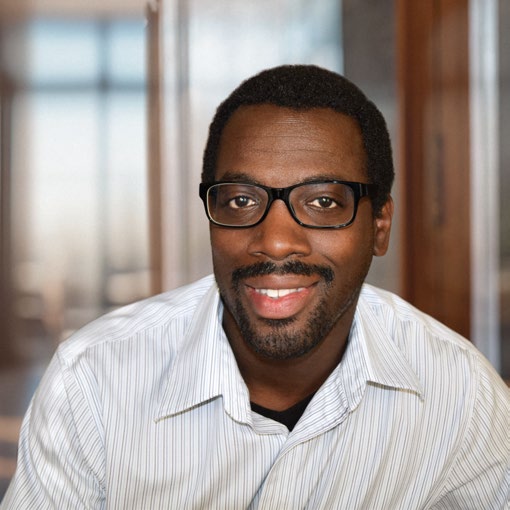
introduction
social
climate
environment
governance
performance
employees
As reflected in The Chevron Way and our policies, we treat
all of our employees with respect and dignity and promote
diversity and inclusion in the workplace. Our company
policies and procedures adhere to all applicable domestic
laws, and we commit to respecting human rights as set
out in the
International Labour Organization Declaration
on Fundamental Principles and Rights at Work.
These rights
include freedom of association and collective bargaining,
nondiscrimination, and the elimination of forced labor
and underage workers in the workplace.
For example, our enterprise labor relations policy is focused
on constructive partnership with our employees and, where
present, the unions that represent them. It also accounts
for workers’ rights to freedom of association and collective
bargaining. Our labor relations guidance provides a fit-
for-purpose approach for addressing and managing labor
concerns consistent with The Chevron Way, the business unit’s
strategies and plans, and applicable laws and regulations.
Workplace diversity
At Chevron, we promote workplace diversity and treat our
employees with respect and dignity. As part of efforts to
increase hiring diversity, Chevron is expanding the number
of countries from which we historically recruit. In addition
to participation in career and recruitment events, we also
support career development groups such as the non?
profit Women Offshore Foundation. The foundation helps
com?panies and their employees with mentorship and
career development opportunities.
According to the International Maritime Organization,
women make up only 1.2% of the global mariner workforce.
The percentage of women in the Chevron mariner work?
?force is double that amount, and we are working to further
increase this number. We are proud that nearly 20% of
our newly recruited cadets are women, an increase
from 12 women recruits in 2021 to 23 in 2023. Additionally,
Chevron Transport Corporation Limited has recruited
experienced women mariners from outside the oil and
gas industry.
I have always been fascinated by the long and rich history
of partnership between Chevron and the Richmond, California,
community. For more than a hundred years, this partnership
has evolved through our efforts to build trust and collaboration.
In my role at the Richmond Refinery, I work with community
stakeholders to understand their needs and priorities and to
identify opportunities for partnership and education that
contribute to environmental, economic and social well-being.
I grew up in a city similar to Richmond, with cultural diversity and
large industrial plants. I saw firsthand the value that comes with
building trust within the community. That experience taught
me the importance of giving a voice to those who feel unheard
and working together for positive change. After I finished my
undergraduate studies, I was motivated to pursue a career in
advocacy. I wanted to use my skills and experience to help create
win-win solutions for industry and the community.
One of the most rewarding events that our team helped organize
in 2023 was the “Community Tour Day.” We hosted several
hundred people from the surrounding area to take educational
bus tours of the Richmond Refinery. It was a great way to
show members of the community our operations and the safety
measures we have in place across the refinery. We had the
opportunity to listen to the community’s perspectives and
concerns and to answer their questions. I believe events like this
strengthen our relationship with the community.
“Advocating for positive change is in my DNA.” — Hakim Johnson Public Affairs Representative
“Advocating for positive change is in my DNA.” — Hakim Johnson Public Affairs Representative e “Advocating for positive change is in my DNA.” — Hakim Johnson Public Affairs Representative
“Advocating for positive change is in my DNA.” — Hakim Johnson Public Affairs Representative
“Advocating for positive change is in my DNA.” — Hakim Johnson Public Affairs Representative
“Advocating for positive change is in my DNA.” — Hakim Johnson Public Affairs Representative
to learn more, visit
chevron.co/community_engagement
Chevron 2023 Corporate Sustainability Report
40
introduction
social
climate
environment
governance
performance
security
We conduct our operations and execute projects consistent
with the
Voluntary Principles on Security and Human Rights.
These principles guide companies in their engagements
with security providers on respecting human rights in the
protection of company facilities and premises.
Voluntary Principles
Chevron supports the implementation of responsible security
practices throughout the industry and across other related
human rights forums, such as Voluntary Principles Initiative
In-Country Working Groups and the Ipieca Responsible
Security Task Force. To commemorate International Human
Rights Day and reiterate Chevron’s expectations, including
alignment with the Voluntary Principles, Chevron’s Chief
Procurement Officer and Vice President of Corporate Affairs
sent a letter to several hundred key suppliers and contractors,
including security providers.
communities
The OEMS puts into action our Chevron Way value of
protecting people and the environment. We operationalize
our commitment to respecting human rights in communities
through the stakeholders focus area.
Since 2021, stakeholder and human rights-related safeguards
and practices have been formally audited across 24 business
units. Specific actions have been identified to continue
improving the design, effectiveness and execution of these
safeguards and practices.
Engaging during decommissioning
Chevron works to interact with Indigenous communities
in a way that respects their history, culture and customs.
We engage communities and other stakeholders in
meaningful discussions and planning where there may be
asset retirement.
California, U.S.:
Chevron established the West Coast
Decommissioning Program in 2017 to retire five oil platforms
and related onshore processing facilities and pipelines.
One facility, the Carpinteria Gas Plant, resides on land formerly
known as the Chumash village of Mishopshno.
Public agencies leading remediation projects on such
historical sites are generally required to offer consultation to
tribes that are traditionally and culturally affiliated with the
area. While the city of Carpinteria’s environmental reporting
and decommissioning permitting is underway, Chevron
has opted to voluntarily engage with additional bands of the
tribe that are not directly consulting with the city.
Engagement began in 2022 and continued in 2023, with
assistance from Strategic Earth Consulting, specialists
in Tribal community relationship building. Early and ongoing
dialogue includes roundtables and listening sessions, one-
on-one conversations, site visits, and knowledge sharing with
Tribal leaders. We believe early engagement helps us better
understand Chumash heritage and the bands’ priorities and
potential impacts to sensitive locations and artifacts.
social investment
Kazakhstan:
Chevron engages governments and the
communities where we operate to understand community
needs. As part of planned project work Tengizchevroil
LLP (TCO), a nonoperated joint venture, is implementing
a phased demobilization of thousands of workers
and contractors.
Continuing its efforts to support the community, including
during the demobilization, TCO is sponsoring training
programs on entrepreneurial skills. Some training program
participants have started their own businesses. TCO is
also sharing information through local media to educate
the public on labor rights and how to start a new business.
Chevron 2023 Corporate Sustainability Report
41
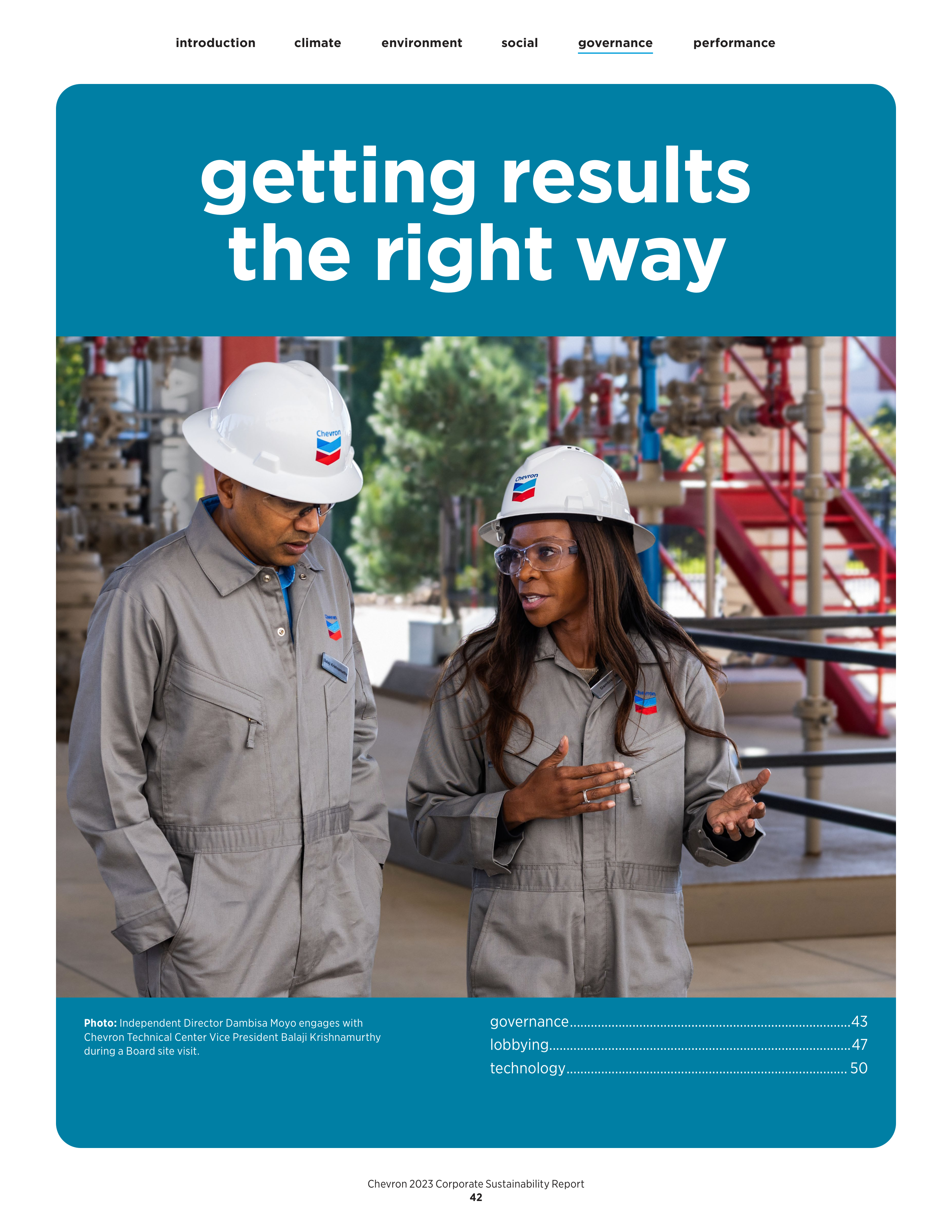
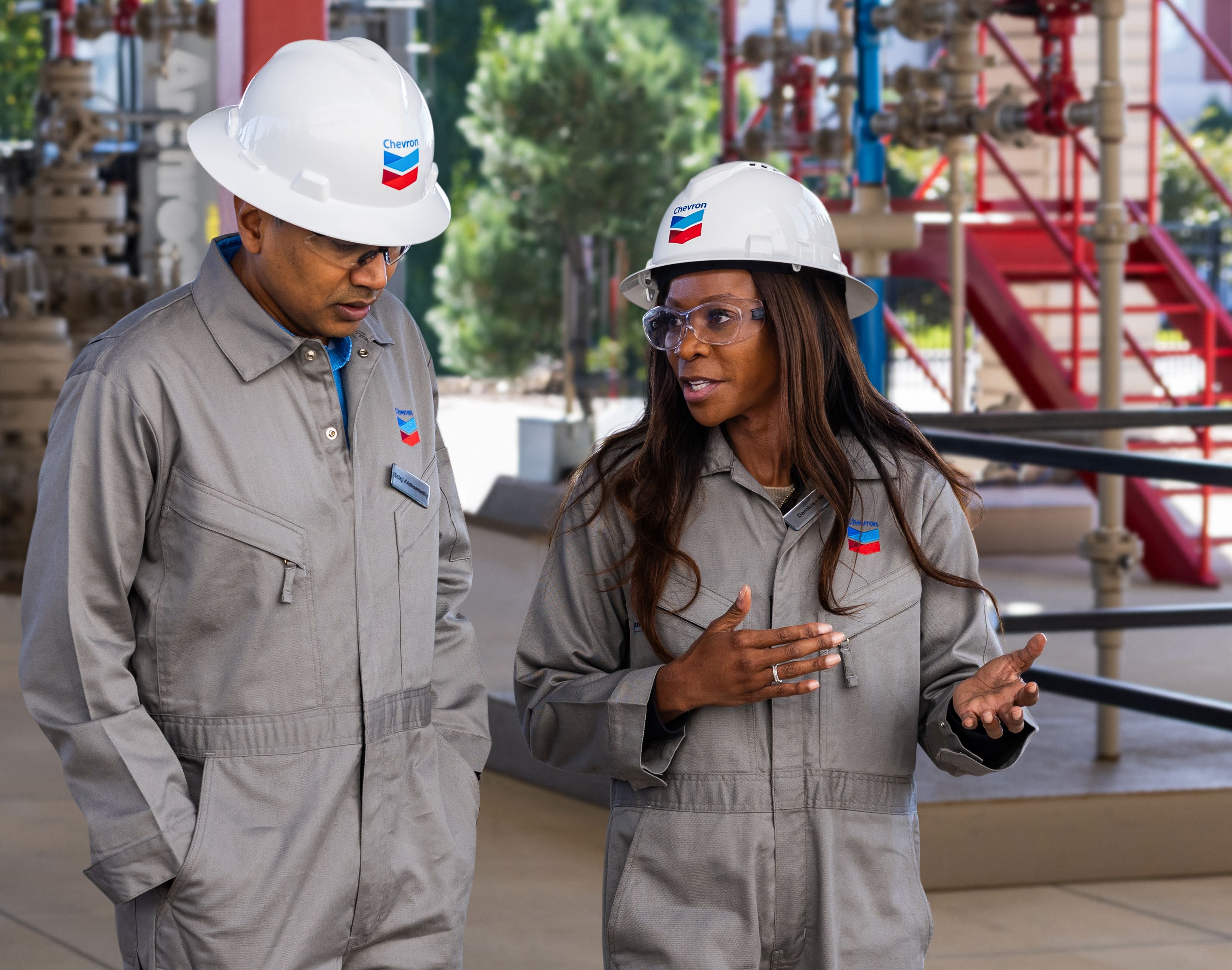
introduction
social
climate
environment
governance
performance
getting results
the right way
Photo:
Independent Director Dambisa Moyo engages with
Chevron Technical Center Vice President Balaji Krishnamurthy
during a Board site visit.
governance.................................................................................43
lobbying.......................................................................................47
technology................................................................................. 50
Chevron 2023 Corporate Sustainability Report
42
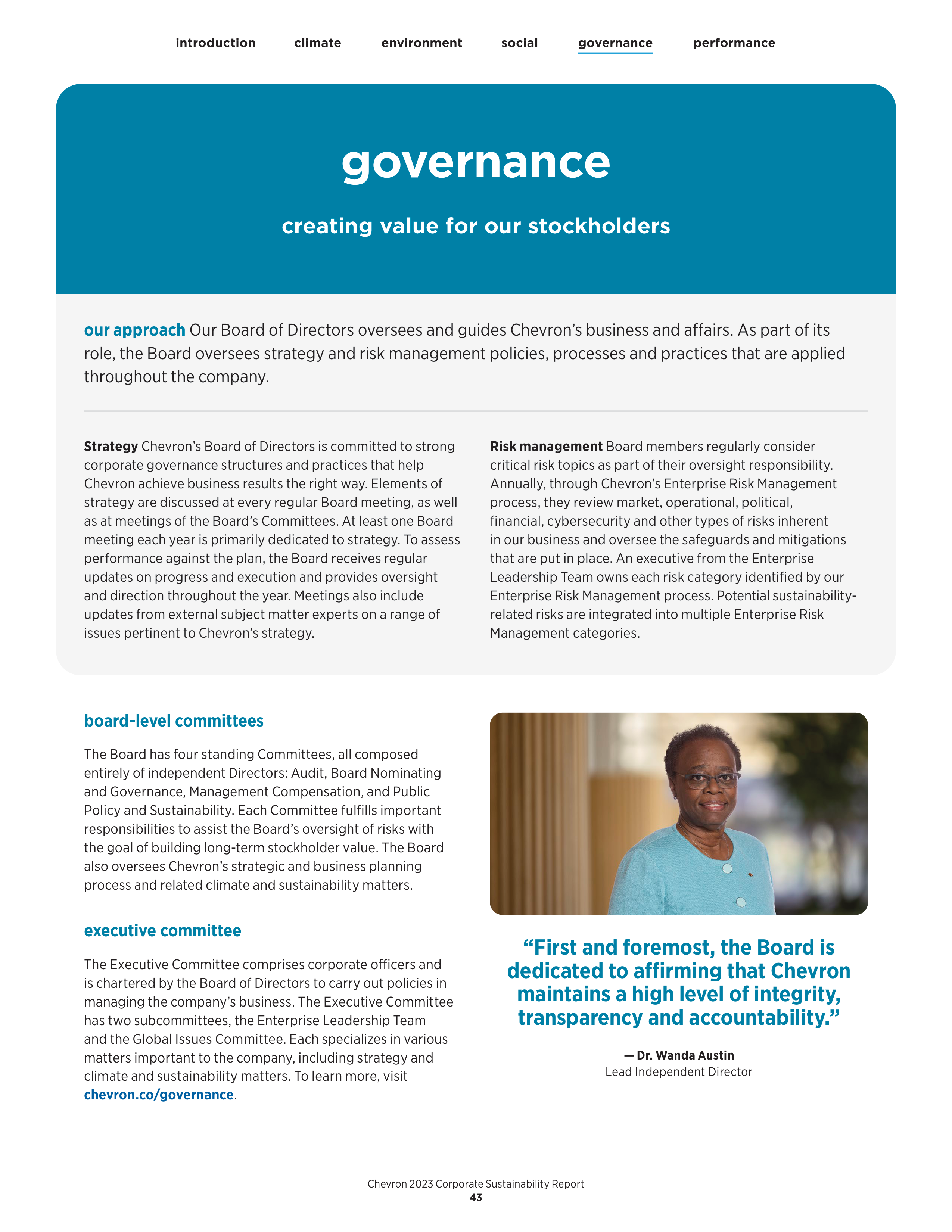
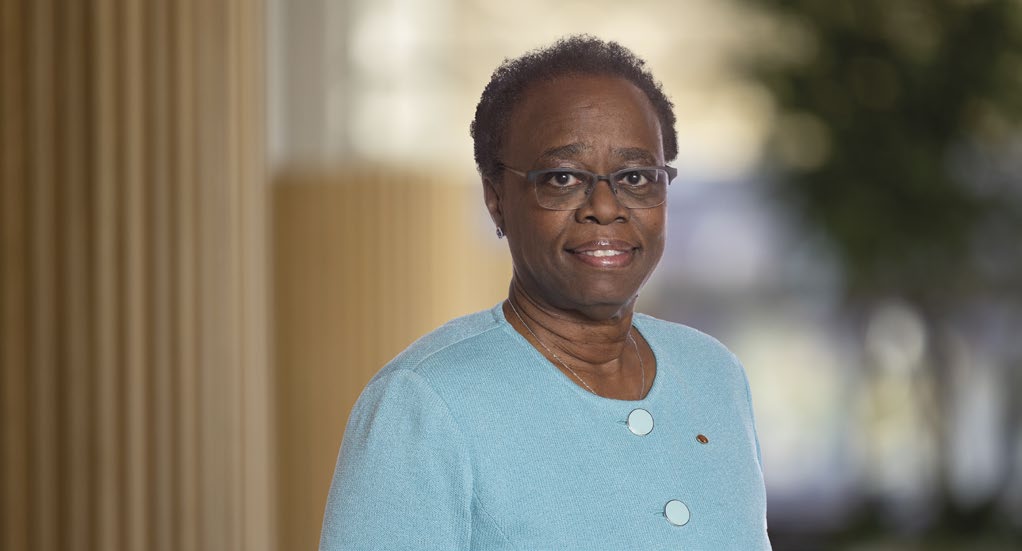
introduction
social
climate
environment
governance
performance
Strategy
Chevron’s Board of Directors is committed to strong
corporate governance structures and practices that help
Chevron achieve business results the right way. Elements of
strategy are discussed at every regular Board meeting, as well
as at meetings of the Board’s Committees. At least one Board
meeting each year is primarily dedicated to strategy. To assess
performance against the plan, the Board receives regular
updates on progress and execution and provides oversight
and direction throughout the year. Meetings also include
updates from external subject matter experts on a range of
issues pertinent to Chevron’s strategy.
Risk management
Board members regularly consider
critical risk topics as part of their oversight responsibility.
Annually, through Chevron’s Enterprise Risk Management
process, they review market, operational, political,
financial, cybersecurity and other types of risks inherent
in our business and oversee the safeguards and mitigations
that are put in place. An executive from the Enterprise
Leadership Team owns each risk category identified by our
Enterprise Risk Management process. Potential sustainability-
related risks are integrated into multiple Enterprise Risk
Management categories.
our approach
Our Board of Directors oversees and guides Chevron’s business and affairs. As part of its
role, the Board oversees strategy and risk management policies, processes and practices that are applied
throughout the company.
governance
creating value for our stockholders
board-level committees
The Board has four standing Committees, all composed
entirely of independent Directors: Audit, Board Nominating
and Governance, Management Compensation, and Public
Policy and Sustainability. Each Committee fulfills important
responsibilities to assist the Board’s oversight of risks with
the goal of building long-term stockholder value. The Board
also oversees Chevron’s strategic and business planning
process and related climate and sustainability matters.
executive committee
The Executive Committee comprises corporate officers and
is chartered by the Board of Directors to carry out policies in
managing the company’s business. The Executive Committee
has two subcommittees, the Enterprise Leadership Team
and the Global Issues Committee. Each specializes in various
matters important to the company, including strategy and
climate and sustainability matters. To learn more, visit
chevron.co/governance
.
“First and foremost, the Board is dedicated to affirming that Chevron maintains a high level of integrity, transparency and accountability.”— Dr. Wanda Austin Lead Independent Director
“First and foremost, the Board is dedicated to affirming that Chevron maintains a high level of integrity, transparency and accountability.”— Dr. Wanda Austin Lead Independent Director
“First and foremost, the Board is dedicated to affirming that Chevron maintains a high level of integrity, transparency and accountability.”— Dr. Wanda Austin Lead Independent Director
“First and foremost, the Board is dedicated to affirming that Chevron maintains a high level of integrity, transparency and accountability.”— Dr. Wanda Austin Lead Independent Director
“First and foremost, the Board is dedicated to affirming that Chevron maintains a high level of integrity, transparency and accountability.”— Dr. Wanda Austin Lead Independent Director
“First and foremost, the Board is dedicated to affirming that Chevron maintains a high level of integrity, transparency and accountability.”— Dr. Wanda Austin Lead Independent Director
Chevron 2023 Corporate Sustainability Report
43
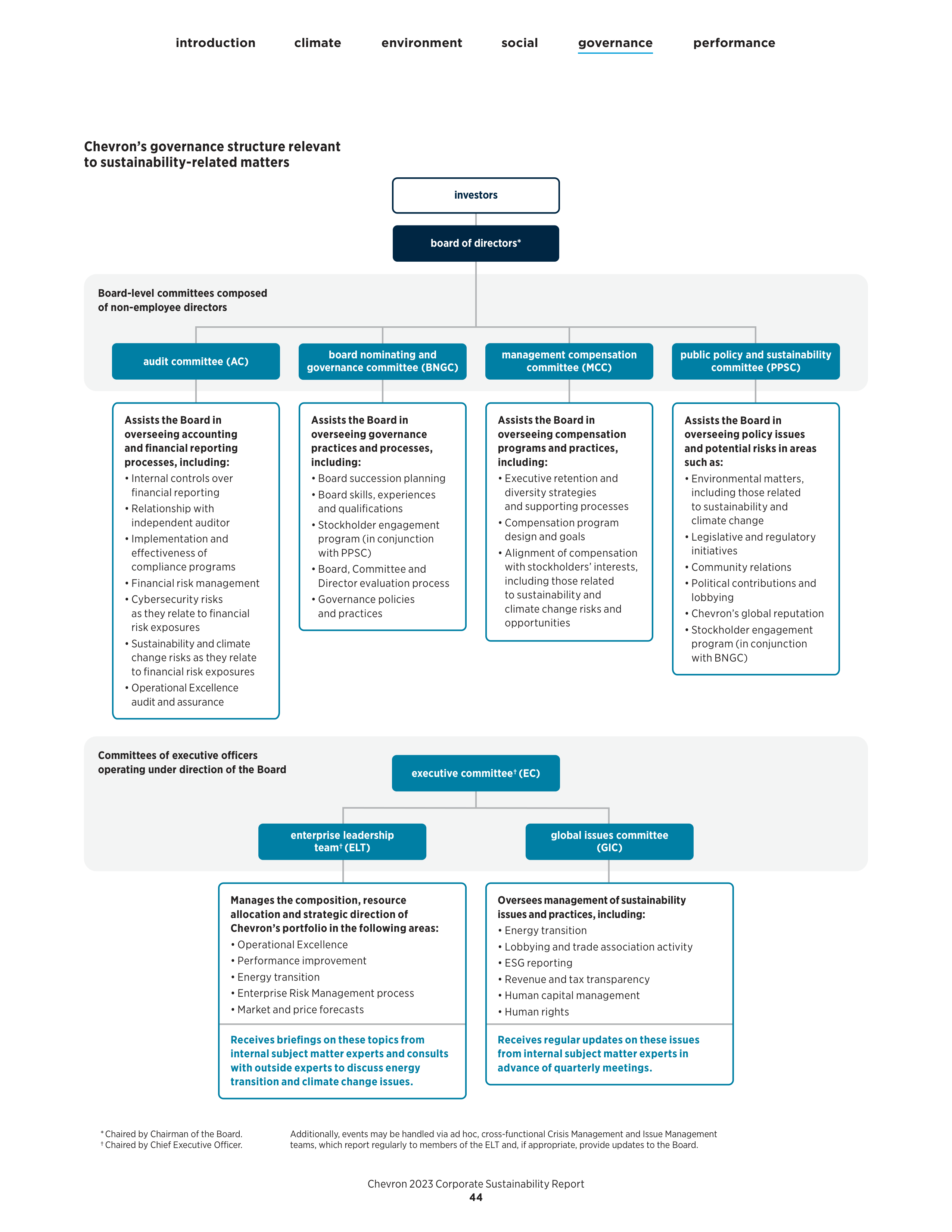
introduction
social
climate
environment
governance
performance
Chevron’s governance structure relevant
to sustainability-related matters
* Chaired by Chairman of the Board.
† Chaired by Chief Executive Officer.
Board-level committees composed
of non-employee directors
Assists the Board in
overseeing accounting
and financial reporting
processes, including:
• ?Internal controls over
financial reporting
• ?Relationship with
independent auditor
• ?Implementation and
effectiveness of
compliance programs
• ?Financial risk management
• ?Cybersecurity risks
as they relate to financial
risk exposures
• ?Sustainability and climate
change risks as they relate
to financial risk exposures
• ?Operational Excellence
audit and assurance
Assists the Board in
overseeing governance
practices and processes,
including:
• ?Board succession planning
• ?Board skills, experiences
and qualifications
• ?Stockholder engagement
program (in conjunction
with PPSC)
• ?Board, Committee and
Director evaluation process
• ?Governance policies
and practices
Assists the Board in
overseeing compensation
programs and practices,
including:
• ?Executive retention and
diversity strategies
and supporting processes
• ?Compensation program
design and goals
• ?Alignment of compensation
with stockholders’ interests,
including those related
to sustainability and
climate change risks and
opportunities
Assists the Board in
overseeing policy issues
and potential risks in areas
such as:
• ?Environmental matters,
including those related
to sustainability and
climate change
• ?Legislative and regulatory
initiatives
• ?Community relations
• ?Political contributions and
lobbying
• ?Chevron’s global reputation
• ?Stockholder engagement
program (in conjunction
with BNGC)
audit committee (AC)
board of directors*
board nominating and
governance committee (BNGC)
management compensation
committee (MCC)
public policy and sustainability
committee (PPSC)
Committees of executive officers
operating under direction of the Board
executive committee† (EC)
enterprise leadership
team† (ELT)
global issues committee
(GIC)
investors
Manages the composition, resource
allocation and strategic direction of
Chevron’s portfolio in the following areas:
• ?Operational Excellence
• ?Performance improvement
• ?Energy transition
• ?Enterprise Risk Management process
• ?Market and price forecasts
Receives briefings on these topics from
internal subject matter experts and consults
with outside experts to discuss energy
transition and climate change issues.
Oversees management of sustainability
issues and practices, including:
• ?Energy transition
• ?Lobbying and trade association activity
• ?ESG reporting
• Revenue and tax transparency
• ?Human capital management
• ?Human rights
Receives regular updates on these issues
from internal subject matter experts in
advance of quarterly meetings.
Additionally, events may be handled via ad hoc, cross-functional Crisis Management and Issue Management
teams, which report regularly to members of the ELT and, if appropriate, provide updates to the Board.
Chevron 2023 Corporate Sustainability Report
44
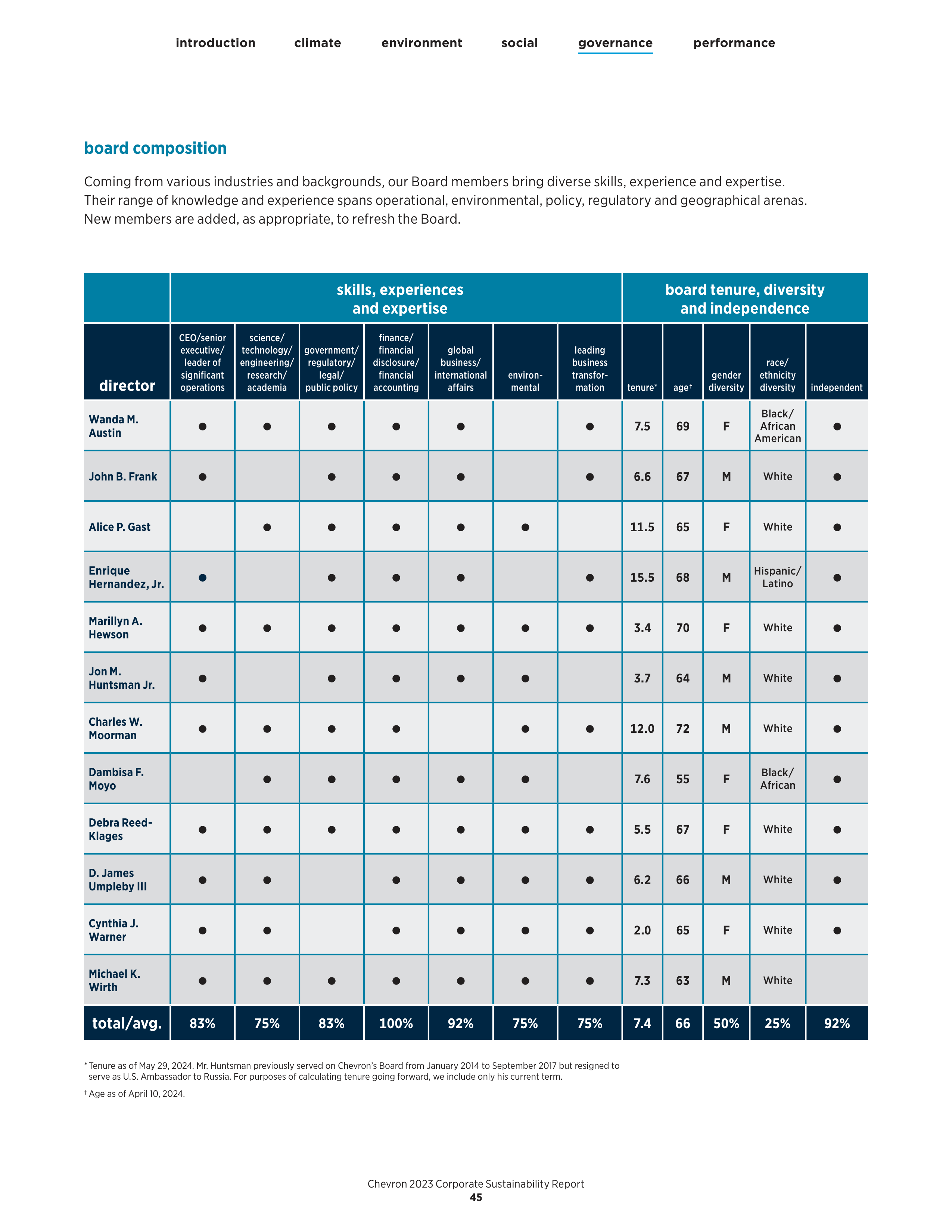
introduction
social
climate
environment
governance
performance
board composition
Coming from various industries and backgrounds, our Board members bring diverse skills, experience and expertise.
Their range of knowledge and experience spans operational, environmental, policy, regulatory and geographical arenas.
New members are added, as appropriate, to refresh the Board.
skills, experiences and expertise CEO/senior executive/leader of significant operations
skills, experiences and expertise CEO/senior executive/leader of significant operations
board tenure, diversity and independence independent
board tenure, diversity and independence independent
director
skills, experiences and expertise CEO/senior executive/leader of significant operations
skills, experiences and expertise CEO/senior executive/leader of significant operations
skills, experiences and expertise CEO/senior executive/leader of significant operations
skills, experiences and expertise CEO/senior executive/leader of significant operations
skills, experiences and expertise CEO/senior executive/leader of significant operations
skills, experiences and expertise science/technology/engineering/research/ academia
skills, experiences and expertise science/technology/engineering/research/ academia
skills, experiences and expertise science/technology/engineering/research/ academia
skills, experiences and expertise science/technology/engineering/research/ academia
skills, experiences and expertise science/technology/engineering/research/ academia
skills, experiences and expertise government/regulatory/legal/public policy
skills, experiences and expertise government/regulatory/legal/public policy
skills, experiences and expertise government/regulatory/legal/public policy
skills, experiences and expertise government/regulatory/legal/public policy
skills, experiences and expertise finance/financial disclosure/financial accounting
skills, experiences and expertise finance/financial disclosure/financial accounting
skills, experiences and expertise finance/financial disclosure/financial accounting
skills, experiences and expertise finance/financial disclosure/financial accounting
skills, experiences and expertise finance/financial disclosure/financial accounting
skills, experiences and expertise global business/international affairs
skills, experiences and expertise global business/international affairs
skills, experiences and expertise global business/international affairs
skills, experiences and expertise global business/international affairs
skills, experiences and expertise environ-mental
skills, experiences and expertise environ-mental
skills, experiences and expertise leading business transfor-mation
skills, experiences and expertise leading business transfor-mation
skills, experiences and expertise leading business transfor-mation
skills, experiences and expertise leading business transfor-mation
tenure*
board tenure, diversity and independence age†
board tenure, diversity and independence gender diversity
diversity
board tenure, diversity and independence race/ethnicity diversity
board tenure, diversity and independence race/ethnicity divers
ity
diversity
board tenure, diversity and independence independent
Wanda M.
Austin
7.5
69
F
Black/
African
American
John B. Frank
6.6
67
M
White
Alice P. Gast
11.5
65
F
White
Enrique
Hernandez, Jr.
15.5
68
M
Hispanic/
Latino
Marillyn A.
Hewson
3.4
70
F
White
Jon M.
Huntsman Jr.
3.7
64
M
White
Charles W.
Moorman
12.0
72
M
White
Dambisa F.
Moyo
7.6
55
F
Black/
African
Debra Reed-
Klages
5.5
67
F
White
D. James
Umpleby
III
6.2
66
M
White
Cynthia J.
Warner
2.0
65
F
White
Michael K.
Wirth
7.3
63
M
White
total/avg.
83%
75%
83%
100%
92%
75%
75%
7.4
66
50%
25%
92%
* Tenure as of May 29, 2024. Mr. Huntsman previously served on Chevron’s Board from January 2014 to September 2017 but resigned to
serve as U.S. Ambassador to Russia. For purposes of calculating tenure going forward, we include only his current term.
† Age as of April 10, 2024.
Chevron 2023 Corporate Sustainability Report
45
•
•
•
•
•
•
•
•
•
•
•
•
•
•
•
•
•
•
•
•
•
•
•
•
•
•
•
•
•
•
•
•
•
•
•
•
•
•
•
•
•
•
•
•
•
•
•
•
•
•
•
•
•
•
•
•
•
•
•
•
•
•
•
•
•
•
•
•
•
•
•
•
•
•
•
•
•
•
•
•
•
skills, experiences
and expertise science/technology/engineering/research/ academia
skills, experiences
and expertise government/regulatory/legal/public policy
skills, experiences
and expertise finance/financial disclosure/financial accounting
skills, experiences
and expertise global business/international affairs
skills, experiences
and expertise environ-mental
skills, experiences
and expertise leading business transfor-mation
board tenure, diversity
and independence tenure
board tenure, diversity
and independence ag
e
board tenure, diversity
and independence gender diversity
board tenure, diversity
and independence race/ethnicity diversity
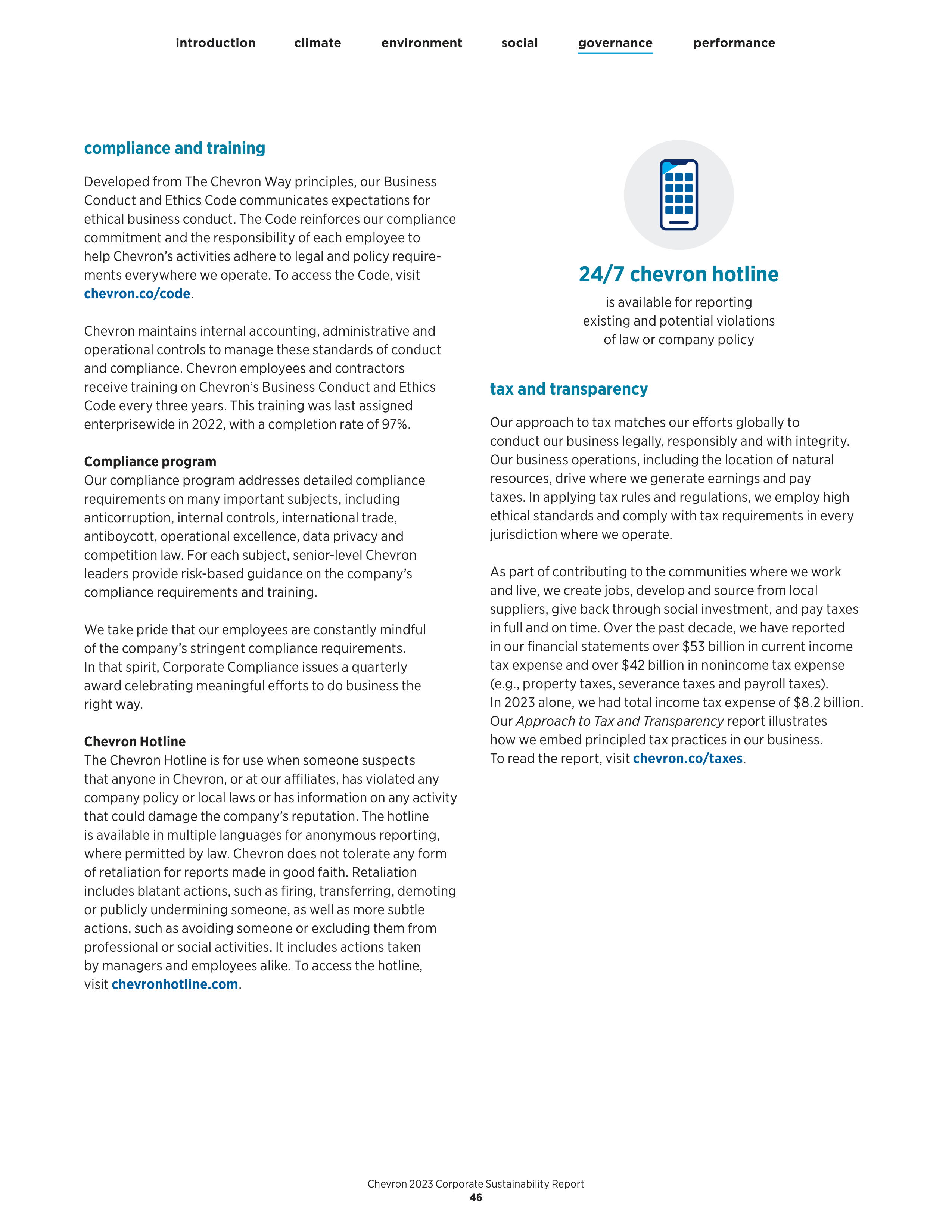
introduction
social
climate
environment
governance
performance
compliance and training
Developed from The Chevron Way principles, our Business
Conduct and Ethics Code communicates expectations for
ethical business conduct. The Code reinforces our compliance
commitment and the responsibility of each employee to
help Chevron’s activities adhere to legal and policy require?
ments everywhere we operate. To access the Code, visit
chevron.co/code
.
Chevron maintains internal accounting, administrative and
operational controls to manage these standards of conduct
and compliance. Chevron employees and contractors
receive training on Chevron’s Business Conduct and Ethics
Code every three years. This training was last assigned
enterprisewide in 2022, with a completion rate of 97%.
Compliance program
Our compliance program addresses detailed compliance
requirements on many important subjects, including
anticorruption, internal controls, international trade,
antiboycott, operational excellence, data privacy and
competition law. For each subject, senior-level Chevron
leaders provide risk-based guidance on the company’s
compliance requirements and training.
We take pride that our employees are constantly mindful
of the company’s stringent compliance requirements.
In that spirit, Corporate Compliance issues a quarterly
award celebrating meaningful efforts to do business the
right way.
Chevron Hotline
The Chevron Hotline is for use when someone suspects
that anyone in Chevron, or at our affiliates, has violated any
company policy or local laws or has information on any activity
that could damage the company’s reputation. The hotline
is available in multiple languages for anonymous reporting,
where permitted by law. Chevron does not tolerate any form
of retaliation for reports made in good faith. Retaliation
includes blatant actions, such as firing, transferring, demoting
or publicly undermining someone, as well as more subtle
actions, such as avoiding someone or excluding them from
professional or social activities. It includes actions taken
by managers and employees alike. To access the hotline,
visit
chevronhotline.com
.
tax and transparency
Our approach to tax matches our efforts globally to
conduct our business legally, responsibly and with integrity.
Our business operations, including the location of natural
resources, drive where we generate earnings and pay
taxes. In applying tax rules and regulations, we employ high
ethical standards and comply with tax requirements in every
jurisdiction where we operate.
As part of contributing to the communities where we work
and live, we create jobs, develop and source from local
suppliers, give back through social investment, and pay taxes
in full and on time. Over the past decade, we have reported
in our financial statements over $53 billion in current income
tax expense and over $42 billion in nonincome tax expense
(e.g., property taxes, severance taxes and payroll taxes).
In 2023 alone, we had total income tax expense of $8.2 billion.
Our
Approach to Tax and Transparency
report illustrates
how we embed principled tax practices in our business.
To read the report, visit
chevron.co/taxes
.
24/7 chevron hotline is available for reporting existing and potential violations of law or company policy
24/7 chevron hotline is available for reporting existing and potential violations of law or company policy
24/7 chevron hotline is available for reporting existing and potential violations of law or company policy
24/7 chevron hotline is available for reporting existing and potential violations of law or company policy
Chevron 2023 Corporate Sustainability Report
46
introduction
social
climate
environment
governance
performance
our approach
Lobbying is an important way for Chevron to participate in the political process.
In the United States, Chevron engages with executive and legislative branches of federal, state and
local governments to provide perspective on energy issues affecting the nation and the world.
Chevron strives to maintain positive, constructive relationships with policymakers and their staffs.
In our engagements, we talk about the economy, regulations, energy security, foreign policy, research
and energy development. Chevron also works with trade associations to advocate for effective,
responsible and nonpartisan standards, regulations and energy policies.
lobbying
participating in the political process
oversight
Chevron has both executive management and Board over?
sight of lobbying and trade association activities. The Public
Policy and Sustainability Committee (PPSC) has primary
responsibility for assisting Chevron’s Board of Directors
in overseeing lobbying policy and reporting, as well as
Chevron’s response to stockholder concerns regarding such
activities. The PPSC annually reviews the policies, procedures
and expenditures related to the company’s lobbying to
assess the value of these activities and alignment with
Chevron’s positions and interests, including those related
to sustainability.
lobbying activities
Lobbying activities, in the United States and elsewhere, are
highly regulated. Each jurisdiction sets forth regulations
and establishes the policies and guidelines associated with
reporting and disclosure. Chevron has an effective program
to comply with all laws and regulations, including complete
and timely lobbying registration and reporting. Prior to
engaging in lobbying activities, employees must obtain
guidance from Chevron’s Vice President and General
Manager of Government Affairs, Chevron’s political law
counsel and Chevron’s political compliance team.
European Union:
The European Union (EU) recognizes
the importance of lobbying activities as a legitimate
and necessary part of the decision-making process.
The EU established the transparency register to provide
for oversight of lobbying activities and allow for public
scrutiny. The transparency register is an online database
listing associations, groups, self-employed individuals and
organizations, including Chevron, who conduct lobbying
activities toward the EU. Registration with the transparency
register was originally voluntary and became mandatory
in 2021.
Registrants disclose what interests are being represented at
the EU level, by whom and on whose behalf. The register also
discloses the resources supporting lobbying activities, which
may include financial support, donations and sponsorships.
trade associations
Chevron holds memberships in industry and other associa?
tions that provide expert perspectives on a broad range of
issues including safety, business, technical and industry best
practices. Chevron does not control, and may not always
agree with, positions taken by trade associations of which
we are members. Trade associations provide a unique venue
to engage with other companies and industry experts.
Executive management and the PPSC have oversight of our
trade association activities and evaluate the business case and
alignment with Chevron’s positions and interests, including
those related to climate. To learn more, visit
chevron.co/trade
.
Chevron 2023 Corporate Sustainability Report
47
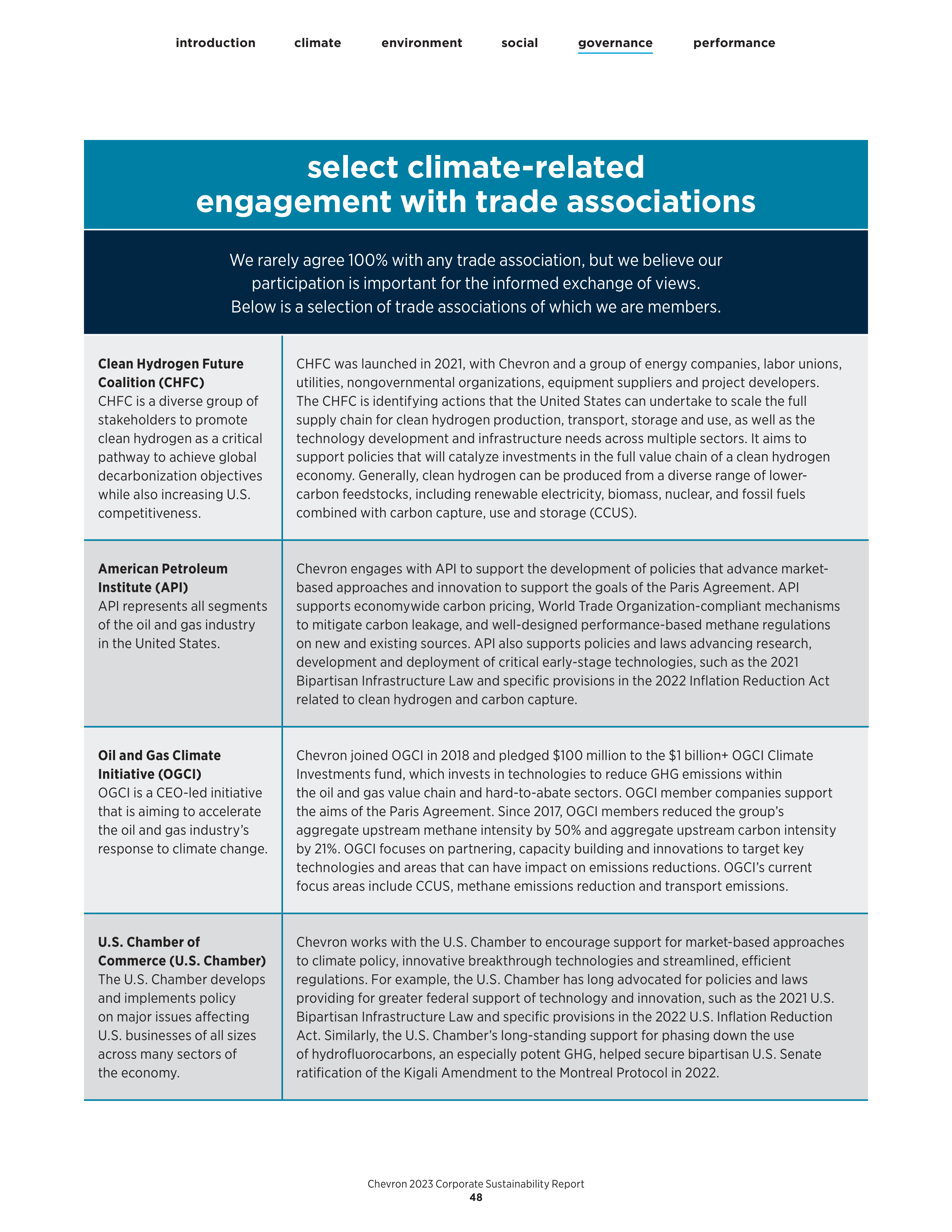
introduction
social
climate
environment
governance
performance
select climate-related
engagement with trade associations
We rarely agree 100% with any trade association, but we believe our
participation is important for the informed exchange of views.
Below is a selection of trade associations of which we are members.
Clean Hydrogen Future
Coalition (CHFC)
CHFC is a diverse group of
stakeholders to promote
clean hydrogen as a critical
pathway to achieve global
decarbonization objectives
while also increasing U.S.
competitiveness.
CHFC was launched in 2021, with Chevron and a group of energy companies, labor unions,
utilities, nongovernmental organizations, equipment suppliers and project developers.
The CHFC is identifying actions that the United States can undertake to scale the full
supply chain for clean hydrogen production, transport, storage and use, as well as the
technology development and infrastructure needs across multiple sectors. It aims to
support policies that will catalyze investments in the full value chain of a clean hydrogen
economy. Generally, clean hydrogen can be produced from a diverse range of lower-
carbon feedstocks, including renewable electricity, biomass, nuclear, and fossil fuels
combined with carbon capture, use and storage (CCUS).
American Petroleum
Institute (API)
API represents all segments
of the oil and gas industry
in the United States.
Chevron engages with API to support the development of policies that advance market-
based approaches and innovation to support the goals of the Paris Agreement. API
supports economywide carbon pricing, World Trade Organization-compliant mechanisms
to mitigate carbon leakage, and well-designed performance-based methane regulations
on new and existing sources. API also supports policies and laws advancing research,
development and deployment of critical early-stage technologies, such as the 2021
Bipartisan Infrastructure Law and specific provisions in the 2022 Inflation Reduction Act
related to clean hydrogen and carbon capture.
Oil and Gas Climate
Initiative (OGCI)
OGCI is a CEO-led initiative
that is aiming to accelerate
the oil and gas industry’s
response to climate change.
Chevron joined OGCI in 2018 and pledged $100 million to the $1 billion+ OGCI Climate
Investments fund, which invests in technologies to reduce GHG emissions within
the oil and gas value chain and hard-to-abate sectors. OGCI member companies support
the aims of the Paris Agreement. Since 2017, OGCI members reduced the group’s
aggregate upstream methane intensity by 50% and aggregate upstream carbon intensity
by 21%. OGCI focuses on partnering, capacity building and innovations to target key
technologies and areas that can have impact on emissions reductions. OGCI’s current
focus areas include CCUS, methane emissions reduction and transport emissions.
U.S. Chamber of
Commerce (U.S. Chamber)
The U.S. Chamber develops
and implements policy
on major issues affecting
U.S. businesses of all sizes
across many sectors of
the economy.
Chevron works with the U.S. Chamber to encourage support for market-based approaches
to climate policy, innovative breakthrough technologies and streamlined, efficient
regulations. For example, the U.S. Chamber has long advocated for policies and laws
providing for greater federal support of technology and innovation, such as the 2021 U.S.
Bipartisan Infrastructure Law and specific provisions in the 2022 U.S. Inflation Reduction
Act. Similarly, the U.S. Chamber’s long-standing support for phasing down the use
of hydrofluorocarbons, an especially potent GHG, helped secure bipartisan U.S. Senate
ratification of the Kigali Amendment to the Montreal Protocol in 2022.
Chevron 2023 Corporate Sustainability Report
48
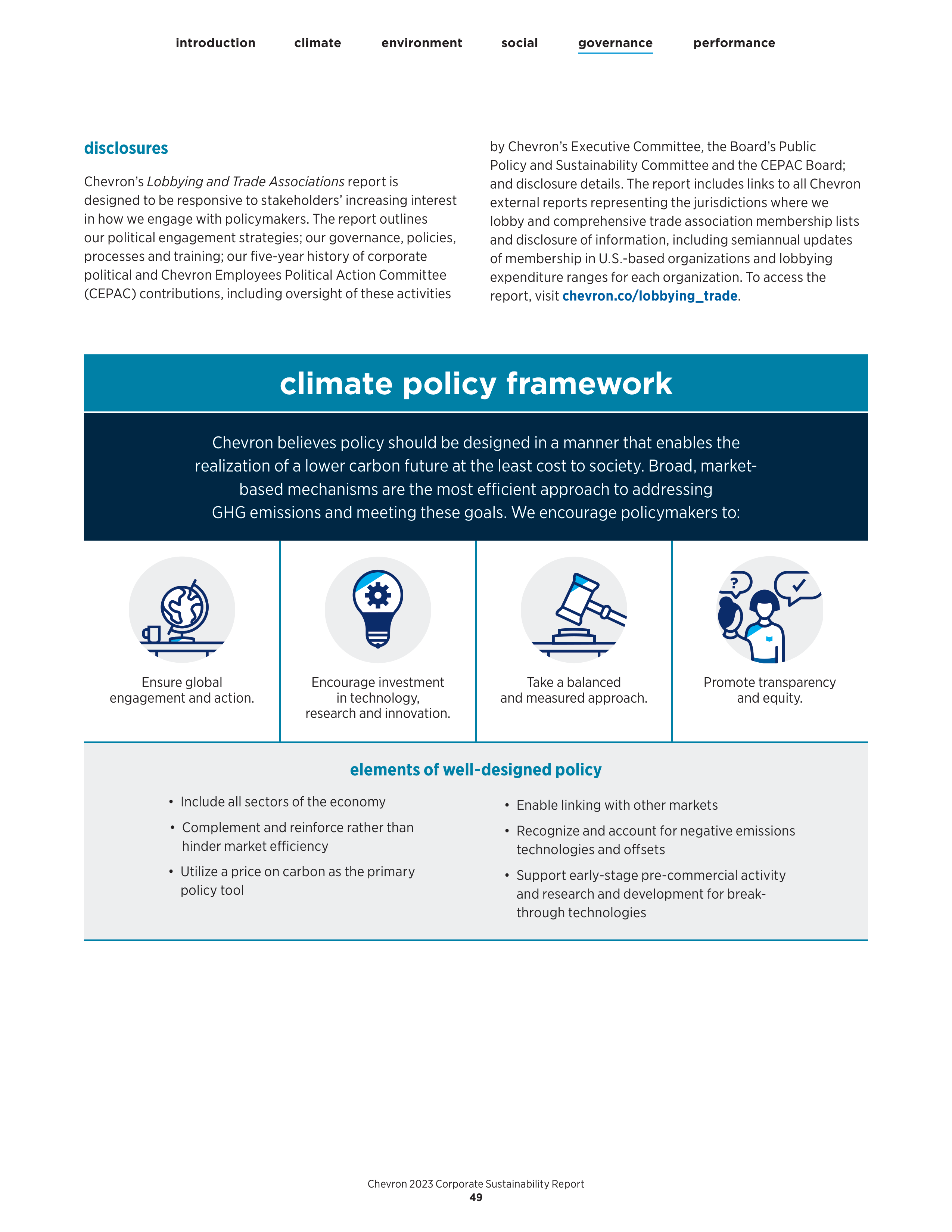
introduction
social
climate
environment
governance
performance
disclosures
Chevron’s
Lobbying and Trade Associations
report is
designed to be responsive to stakeholders’ increasing interest
in how we engage with policymakers. The report outlines
our political engagement strategies; our governance, policies,
processes and training; our five-year history of corporate
political and Chevron Employees Political Action Committee
(CEPAC) contributions, including oversight of these activities
by Chevron’s Executive Committee, the Board’s Public
Policy and Sustainability Committee and the CEPAC Board;
and disclosure details. The report includes links to all Chevron
external reports representing the jurisdictions where we
lobby and comprehensive trade association membership lists
and disclosure of information, including semiannual updates
of membership in U.S.-based organizations and lobbying
expenditure ranges for each organization. To access the
report, visit
chevron.co/lobbying_trade
.
climate policy framework
Chevron believes policy should be designed in a manner that enables the
realization of a lower carbon future at the least cost to society. Broad, market-
based mechanisms are the most efficient approach to addressing
GHG emissions and meeting these goals. We encourage policymakers to:
elements of well-designed policy
• Include all sectors of the economy
• Complement and reinforce rather than
hinder market efficiency
• Utilize a price on carbon as the primary
policy tool
• Enable linking with other markets
• Recognize and account for negative emissions
technologies and offsets
• Support early-stage pre-commercial activity
and research and development for break-
through technologies
Ensure global
engagement and action.
Encourage investment
in technology,
research and innovation.
Take a balanced
and measured approach.
Promote transparency
and equity.
Chevron 2023 Corporate Sustainability Report
49
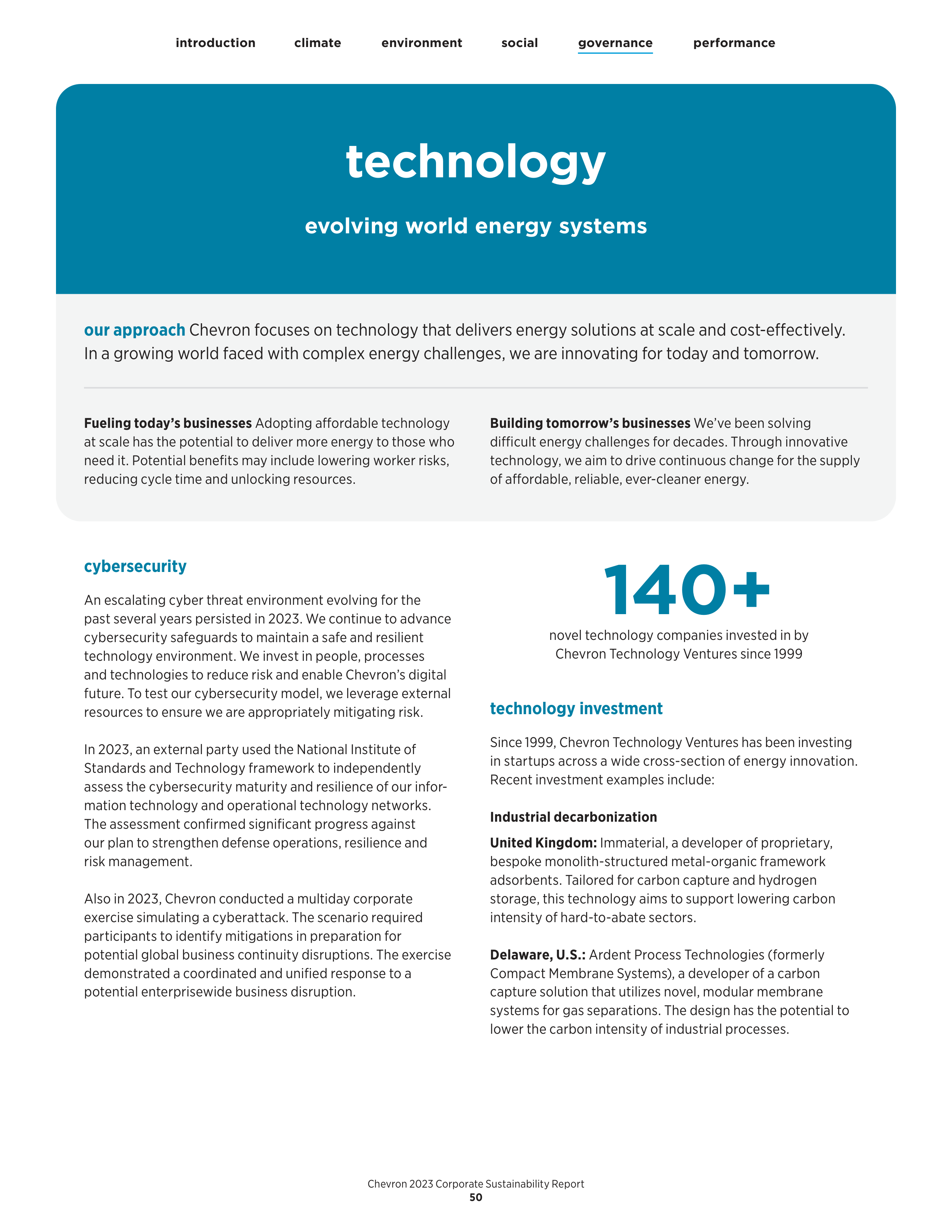
introduction
social
climate
environment
governance
performance
Fueling today’s businesses
Adopting affordable technology
at scale has the potential to deliver more energy to those who
need it. Potential benefits may include lowering worker risks,
reducing cycle time and unlocking resources.
Building tomorrow’s businesses
We’ve been solving
difficult energy challenges for decades. Through innovative
technology, we aim to drive continuous change for the supply
of affordable, reliable, ever-cleaner energy.
our approach
Chevron focuses on technology that delivers energy solutions at scale and cost-effectively.
In a growing world faced with complex energy challenges, we are innovating for today and tomorrow.
technology
evolving world energy systems
cybersecurity
An escalating cyber threat environment evolving for the
past several years persisted in 2023. We continue to advance
cybersecurity safeguards to maintain a safe and resilient
technology environment. We invest in people, processes
and technologies to reduce risk and enable Chevron’s digital
future. To test our cybersecurity model, we leverage external
resources to ensure we are appropriately mitigating risk.
In 2023, an external party used the National Institute of
Standards and Technology framework to independently
assess the cybersecurity maturity and resilience of our infor?
mation technology and operational technology networks.
The assessment confirmed significant progress against
our plan to strengthen defense operations, resilience and
risk management.
Also in 2023, Chevron conducted a multiday corporate
exercise simulating a cyberattack. The scenario required
participants to identify mitigations in preparation for
potential global business continuity disruptions. The exercise
demonstrated a coordinated and unified response to a
potential enterprisewide business disruption.
140+ novel technology companies invested in by Chevron Technology Ventures since 1999
140+ novel technology companies invested in by Chevron Technology Ventures since 1999
140+ novel technology companies invested in by Chevron Technology Ventures since 1999
technology investment
Since 1999, Chevron Technology Ventures has been investing
in startups across a wide cross-section of energy innovation.
Recent investment examples include:
Industrial decarbonization
United Kingdom:
Immaterial, a developer of proprietary,
bespoke monolith-structured metal-organic framework
adsorbents. Tailored for carbon capture and hydrogen
storage, this technology aims to support lowering carbon
intensity of hard-to-abate sectors.
Delaware, U.S.:
Ardent Process Technologies (formerly
Compact Membrane Systems), a developer of a carbon
capture solution that utilizes novel, modular membrane
systems for gas separations. The design has the potential to
lower the carbon intensity of industrial processes.
Chevron 2023 Corporate Sustainability Report
50
introduction
social
climate
environment
governance
performance
Emerging mobility
Washington, U.S.:
Electric Era, a company commercializing a
fast-charging solution for electric vehicles that leverages a
proprietary software platform to enable real-time optimization
and increased reliability.
Operational enhancement
Switzerland:
Flyability, a developer of aerial confined?space
inspection drones for industrial environments that are
hard to reach or without access to global positioning system
signals. The technology has the potential to reduce worker
risk in confined space inspections.
Digitalization
United Kingdom:
Oxford Quantum Circuits, the developer
of a novel, commercially available quantum computer.
Their product offers the potential to help customers enable
new forms of information processing.
Massachusetts, U.S.:
Aperio, a developer of a scalable data
quality platform for industrial data that uses machine learning.
The platform has the potential to solve a range of operational
data quality matters.
digital scholars
We believe in the power of human ingenuity to advance
and scale energy solutions that will drive the world
forward. To prepare for the future of digital innovation,
Chevron’s Digital Scholar Program supports employees
who wish to pursue a one-year Master of Science degree
with Massachusetts Institute of Technology’s System
Design and Management. The program seeks to integrate
a scholar’s domain knowledge and industry experience
with emerging digital skill sets.
Scholars are selected from among early- to mid-career
full-time employees who have a STEM background. Fully
funded by Chevron, scholars devote one year to this learning
experience, in residence at the academic institution, while
continuing to receive regular employee pay and benefits.
Since program inception in 2019, 151 employees have taken
part, with 31 enrolled for the 2023–2024 academic year.
artificial intelligence
Artificial intelligence (AI) carries enormous potential as well
as complex risks. We have joined the Responsible AI Institute,
a community of business leaders focused on successful,
responsible AI integration. Chevron aims to deploy AI
technologies in a way that aligns with our core values and
The Chevron Way.
social investment
India:
Chevron contributed to Miller Center for Social
Entrepreneurship to support Asia-Pacific enterprises that
have the potential to grow and scale their social and
economic impact. With our three-year gift of $1 million,
Miller Center aims to provide focused support for entre?
preneurs and share insights with other accelerator programs
and the larger social entrepreneurship ecosystem.
The entrepreneurship program provides a suite of support
services, including capacity and leadership development,
training and mentoring, and investment readiness and
facilitation. Through this effort, Miller Center aims to
support a cohort of social enterprises to accelerate inno?
vative, bottom-up solutions for vulnerable communities
in the region.
We intend to apply AI efficiently and responsibly, leveraging
the technology across our value chain. A cross-functional
team composed of Chevron Digital Scholars and a network
of experts is evolving the adoption and development of
AI governance and capabilities. This includes working with
technology partners and providers on human-centric AI tools
that augment our creativity and intelligence and enhance
the way we work across the enterprise.
We believe we have an opportunity to be a leader in driving
the future of energy with AI. By building on our strengths in
digital transformation, cloud computing and analytics, we see
potential to deliver business value and advance the future of
energy. AI and machine learning are being used to create more
representative subsurface models for well placement, improve
well production and optimize operations. Deep learning is
helping to advance carbon capture and storage techniques in
support of lower carbon ambitions.
Chevron 2023 Corporate Sustainability Report
51
introduction
social
climate
environment
governance
performance
performance
Photo:
We’re working to achieve progress and deliver value,
consistent with our vision to be the global energy company most
admired for its people, partnership and performance.
performance data.....................................................................53
glossary........................................................................................55
about this report........................................................................57
Chevron 2023 Corporate Sustainability Report
52
introduction
social
climate
environment
governance
performance
* Unless otherwise noted, this section reflects 2023 data collected as of April 11, 2024. All data are reported on an operated basis unless otherwise noted. Data from Renewable Energy Group, Inc.
and PDC Energy, Inc. are included in this section unless otherwise noted. Operated GHG emissions, environmental performance, and workforce health and safety tables include data from
Tengizchevroil LLP and the Partitioned Zone between Saudi Arabia and Kuwait (SAPZ). Although Chevron has traditionally included Tengizchevroil LLP data as if operated in this report, Chevron
does not own a controlling interest in, does not operate and does not have the authority to force implementation of Chevron management systems within Tengizchevroil LLP. Tengizchevroil LLP
is a separate legal entity operated under the direction of a partnership council that Chevron does not control. Inclusion of SAPZ data within the operational data is a reflection of alignment to
Operational Excellence reporting and not reflective of the underlying legal structure or governance practices. All restatements are restated against the May 2023 release of the
2022 Corporate
Sustainability Report
. Variations year-on-year or across multiple years of performance data may result from a variety of causes such as methodology updates, portfolio changes, economic
conditions, and business performance and initiatives. Performance data are not a guarantee of future performance nor intended to be a demonstration of linear progress against aspirations,
targets or objectives. See Forward-Looking Statements Warning and Other Disclaimers on
page 59
of this report. Numbers in table may not sum due to rounding.
our approach
We consider various reporting frameworks to determine which data to include in our tables.
These frameworks include the Sustainability Accounting Standards Board (SASB), Task Force for
Climate-related Financial Disclosures (TCFD), the
Sustainability Reporting Guidance for the Oil & Gas
Industry
by Ipieca, the International Association of Oil and Gas Producers (IOGP) and the American
Petroleum Institute (API), as well as other reporting frameworks.
performance data
reporting metrics and performance data*
For our latest performance data tables, visit
chevron.co/performance_data
.
data tables
Our data tables present our greenhouse gas (GHG)
emissions and other operated-basis metrics for
environmental per?formance, employee and supplier
diversity, and workforce health and safety. To promote
comparability, we map our reporting data to the
relevant SASB and Ipieca frameworks to help provide
information for investors and other stakeholders.
The references in index columns are based solely on
Chevron’s interpretation and judgment and do not
indicate application of definitions, metrics, measurements,
standards or approaches set forth by third-party groups,
including the SASB and Ipieca frameworks. Qualitative
metrics and links to other Chevron resources are included
in this section.
assurance
The accuracy of the information we report is important
to us. We conduct independent third-party assurance for
the process used to create the
2023 Corporate Sustainability
Report
. For our most recent ESG assurance statement,
visit
chevron.co/ESG_assurance
.
We obtained reasonable assurance of GHG emissions
from both operated and nonoperated assets. The scope
of the GHG emissions assurance for 2023 is on both an
equity share and operational control basis, and excludes
Chevron Phillips Chemical Company, LLC and PDC Energy,
Inc. For our most recent GHG assurance statements,
visit
chevron.co/GHG_assurance
.
We have also obtained verification that our environ?
mental and safety management system (i.e., our
Operational Excellence Management System, or OEMS)
meets interna?tional standards and specifications and
has obtained a Certificate of Approval for alignment with
ISO 14001:2015 and 45001:2018. For our most recent
certificate, visit
chevron.co/OEMS_ISO_certification
.
Chevron 2023 Corporate Sustainability Report
53
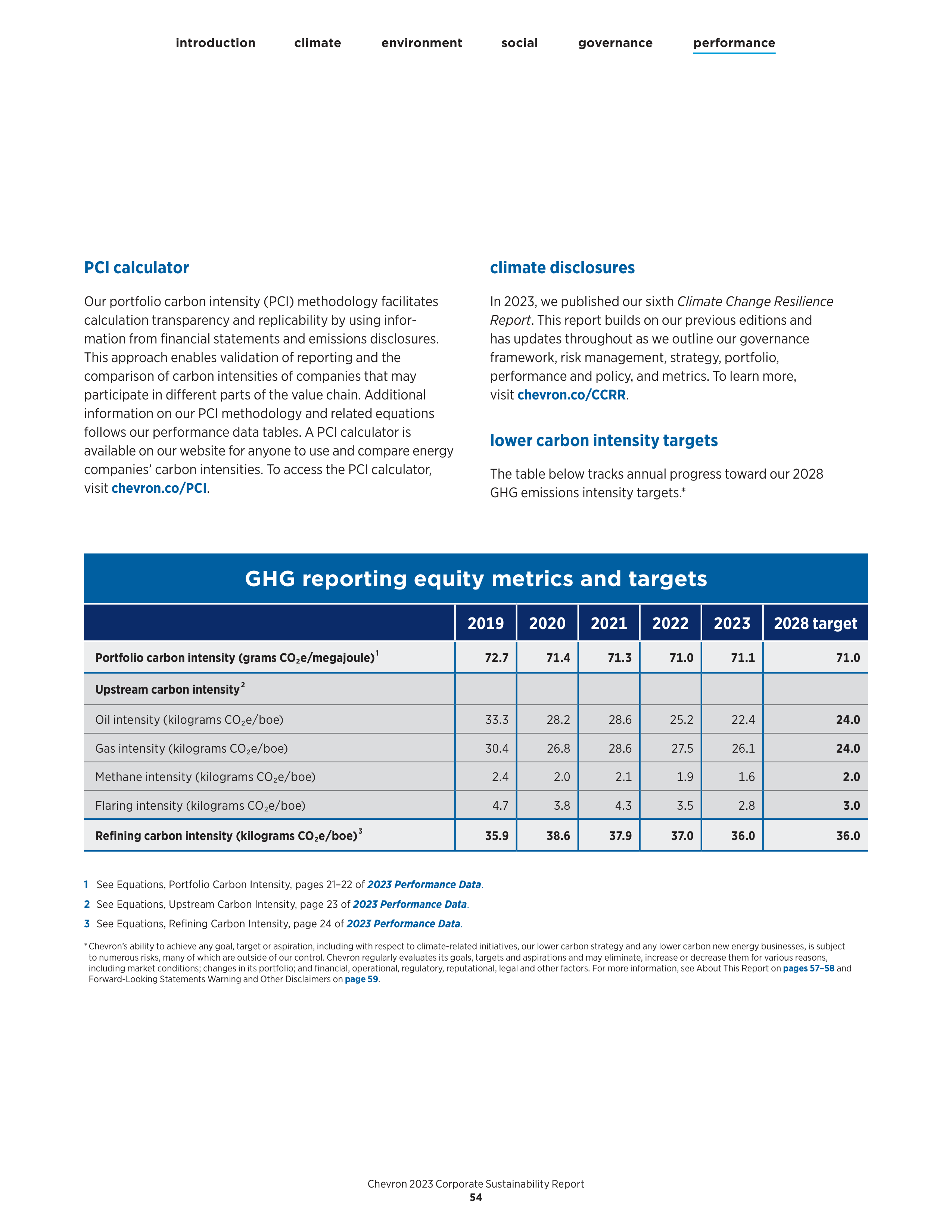
introduction
social
climate
environment
governance
performance
PCI calculator
Our portfolio carbon intensity (PCI) methodology facilitates
calculation transparency and replicability by using infor?
mation from financial statements and emissions disclosures.
This approach enables validation of reporting and the
comparison of carbon intensities of companies that may
participate in different parts of the value chain. Additional
information on our PCI methodology and related equations
follows our performance data tables. A PCI calculator is
available on our website for anyone to use and compare energy
companies’ carbon intensities. To access the PCI calculator,
visit
chevron.co/PCI
.
climate disclosures
In 2023, we published our sixth
Climate Change Resilience
Report
. This report builds on our previous editions and
has updates throughout as we outline our governance
framework, risk management, strategy, portfolio,
performance and policy, and metrics. To learn more,
visit
chevron.co/CCRR
.
lower carbon intensity targets
The table below tracks annual progress toward our 2028
GHG emissions intensity targets.*
GHG reporting equity metrics and targets
2019
2020
2021
2022
2023
2028 target
Portfolio carbon intensity (grams CO₂e/megajoule)
1
72.7
71.4
71.3
71.0
71.1
71.0
Upstream carbon intensity
2
Oil intensity (kilograms CO₂e/boe)
33.3
28.2
28.6
25.2
22.4
24.0
Gas intensity (kilograms CO₂e/boe)
30.4
26.8
28.6
27.5
26.1
24.0
Methane intensity (kilograms CO₂e/boe)
2.4
2.0
2.1
1.9
1.6
2.0
Flaring intensity (kilograms CO₂e/boe)
4.7
3.8
4.3
3.5
2.8
3.0
Refining carbon intensity (kilograms CO₂e/boe)
3
35.9
38.6
37.9
37.0
36.0
36.0
1
See Equations, Portfolio Carbon Intensity, pages 21–22 of
2023 Performance Data
.
2
See Equations, Upstream Carbon Intensity, page 23 of
2023 Performance Data
.
3
See Equations, Refining Carbon Intensity, page 24 of
2023 Performance Data
.
* Chevron’s ability to achieve any goal, target or aspiration, including with respect to climate-related initiatives, our lower carbon strategy and any lower carbon new energy businesses, is subject
to numerous risks, many of which are outside of our control. Chevron regularly evaluates its goals, targets and aspirations and may eliminate, increase or decrease them for various reasons,
including market conditions; changes in its portfolio; and financial, operational, regulatory, reputational, legal and other factors. For more information, see About This Report on
pages 57–58
and
Forward-Looking Statements Warning and Other Disclaimers on
page 59
.
Chevron 2023 Corporate Sustainability Report
54
introduction
social
climate
environment
governance
performance
efficiency of a well-designed and -operated flare is generally
assumed to be greater than 98%, meaning that less than
2% of the gas passes through the flare stack unburnt. At the
individual flare level, local parameters, such as gas content and
quality, flare design, flow rates, exit velocities and steam use,
contribute to overall combustion efficiency. There are currently
no straightforward methods to continuously measure or monitor
the actual combus?tion efficiency or destruction and removal
efficiency of a flare.
Hydrogen, lower carbon intensity (LCI) ?
LCI hydrogen includes
specified hydrogen production pathways like steam methane
reforming with carbon capture and storage and electrolysis with
lower carbon power.
Lifecycle analysis/assessment (LCA) ?
A tool that can be used
to evaluate the potential environmental impacts of a product,
material, process or activity. An LCA is a comprehensive method
for assessing a range of environmental impacts across the full
lifecycle of a product system, from materials acquisition to
manufacturing, use and final disposition.
Liquefied natural gas (LNG) ?
Natural gas that is liquefied
under extremely cold temperatures to facilitate storage or
transportation in specially designed vessels.
Lower carbon ?
A term describing environments, technologies,
business sectors, markets, energy sources and mixes of energy
sources, including traditional energy sources, among other things,
characterized by or enabling the reduction of carbon emissions
or carbon intensities.
Lower carbon energy ?
Energy sources and mixes of energy
sources, including traditional energy sources, that, in their
production and use, emit less carbon emissions or have lower
carbon intensity than other forms.
Lower carbon intensity oil, products and natural gas ?
Oil, natural
gas and hydrocarbon-based products that are produced and
sold to customers with a carbon intensity below that of traditional
oil, natural gas and hydrocarbon-based products.
Methane intensity ?
The amount of methane per unit of measure.
Methane intensity can be determined for a facility (e.g., com?
pressor station), an area (e.g., production basin) or even an entire
value chain (e.g., from natural gas production to distribution).
Methane management ?
A holistic approach to addressing
methane emissions performance across multiple dimensions,
including actions to reduce methane emissions intensity through
facility design and operational best practices; deployment of
advanced technology to detect, measure and quantify site- and
source-level emissions; and development and assurance of
methane emissions inventories for reporting and disclosures.
definitions of selected industry terms
Barrels of oil-equivalent (boe) ?
A unit of measure to quantify
crude oil, natural gas liquids and natural gas amounts using the
same basis. Natural gas volumes are converted to barrels on
the basis of energy content.
Carbon capture, utilization and storage (CCUS) ?
The process of
capturing carbon dioxide emissions and either using them as a
feedstock (utilization) or permanently storing them in geological
formations deep underground (storage).
Carbon footprint (of product) ?
Sum of greenhouse gas emissions
and greenhouse gas removals in a product system expressed
as CO₂e based on a lifecycle assessment using the simple impact
category of climate change. A carbon footprint can represent
the complete lifecycle of a product or a partial lifecycle based
on selected lifecycle stages (sometimes referred to as a “partial
carbon footprint”).
Carbon intensity ?
The amount of carbon dioxide or carbon
dioxide-equivalent (CO₂e) per unit of measure.
Combustion ?
The combustion of gas in fuel-burning equipment
is not 100% efficient, and some methane emissions occur as
a result of uncombusted gas being released via the equipment
exhaust stream. The uncombusted proportion of gas varies
between internal and external combustion sources (engines,
tur?bines, heaters and boilers); therefore, equipment-specific data
or emission factors are typically used for emissions quantification.
Decarbonization ?
Generally refers to the process of stopping or
reducing release of greenhouse gases, especially carbon dioxide,
into the atmosphere as the result of a process. For Chevron,
decarbonization can refer to reducing absolute emissions or
reducing the carbon intensity of a process or asset.
Emission factor ?
A numerical factor relating activity data (e.g.,
tonnes of fuel consumed, tonnes of product produced or number
of pneumatic controllers) to emissions. Emission factors generally
represent the amount of emissions per activity unit, for example
standard cubic feet of gas per hour per pneumatic controller.
Emission factors are typically developed based on a population
of direct measurements of emission sources or activities.
Flaring?
The controlled burning of gas, including associated
gas, in the course of oil and gas operations. In many types of
opera?tions, including those where gas is sold, reinjected or
otherwise utilized, safety flaring can be an important and
necessary activity to enable safe operations. The combustion
glossary
Chevron 2023 Corporate Sustainability Report
55
introduction
social
climate
environment
governance
performance
Operational Excellence Management System (OEMS) ?
A Chevron
risk-based and systematic approach to identify, assess, prioritize
and manage risks related to workforce safety and health; process
safety, reliability and integrity; environment; efficiency; security;
and stakeholders.
Pneumatic controller ?
An automated instrument used for
maintaining a process condition such as liquid level, pressure,
delta pressure and temperature.
Portfolio carbon intensity (PCI) ?
Representation of the estimated
energy-weighted average greenhouse gas emissions intensity
from a simplified value chain from the production, refinement,
distribution and end use of marketed energy products per unit of
energy delivered.
definitions of selected units
mbd ?
thousands of barrels per day
MJ ?
megajoule
mmtpa ?
millions of tonnes per annum
mtpa ?
thousands of tonnes per annum
Methane measurement ?
The process of taking a reading of
the methane concentration or methane emissions rate within
an air sample at a specific point in time. Typical measurement
units are parts per million, parts per billion and kilograms per
hour. Understanding global and local background methane
concentrations is necessary to contextualize the data. Emissions
measurements may be performed as one-time activities, at
regular intervals or on a continuous basis, but whatever the
frequency, obtaining representative measurements is important.
Methane quantification ?
Methods for determining the size of a
methane emission source in customary units of emissions rate,
such as mass per time (e.g., kilograms per hour) or volume per
time (e.g., standard cubic meters per hour). Methane can be
quantified through engineering estimations, direct measurement
of a methane source (e.g., by utilizing bagging procedures) and
modeling that uses ambient measurements and meteorological
data to infer an emissions rate.
Natural climate solutions ?
Actions that reduce or avoid emissions
and/or enhance the capture and storage of carbon in nature,
including conservation, restoration and improved land manage?
ment interventions on natural and agricultural lands.
Nature-based solutions ?
Per the International Energy Agency,
these include the repurposing of land use by growing forests
where there were none before (afforestation) or reestablishing
a forest where there was one in the past (reforestation). Other
nature-based solutions include restoration of coastal and marine
habitats so that they continue to draw CO
2
from the air.
Net positive impact ?
Per the Ipieca
Guide to developing
biodiversity action plans
, a target for project outcomes in which
the impacts on biodiversity (i.e., the variety of ecosystems and
living things) caused by the project are outweighed by the actions
taken to avoid and reduce such impacts, rehabilitate affected
species and landscapes, and offset any residual impacts.
Net zero upstream aspiration (Scope 1 and 2) ?
Chevron aspires
to reach net zero upstream emissions (Scope 1 and 2) by
2050. Accomplishing this aspiration depends on sufficient and
substantial advances in technology, including the continuing
progress of commercially viable technologies and low- or non-
carbon-based energy sources; enabling policies and other actions
by governing authorities, including those regarding subsidies,
tax and other incentives as well as the granting of necessary
permits; successful negotiations for carbon capture and storage
and nature-based solutions; and availability and acceptability
of cost-effective, verifiable carbon credits.
Chevron 2023 Corporate Sustainability Report
56
introduction
social
climate
environment
governance
performance
This report covers our owned and operated businesses
and does not address the performance or operations of
our suppliers, contractors and partners unless otherwise
noted. In the case of certain joint ventures for which
Chevron is the operator, we exercise influence but not
control. Thus, the governance, processes, management
and strategy for those joint ventures are known to differ
from those detailed in this report. At the time of writing,
Chevron has completed acquisitions of Beyond6, LLC,
Chacraservicios S.r.l. (with Bunge) and PDC Energy, Inc.
This report does not speak to these companies’ historic
governance, risk management, strategy approaches
or emissions performance unless specifically referenced.
All financial information is presented in U.S. dollars
unless otherwise noted.
This report contains forward-looking statements
relating to the manner in which Chevron intends to
conduct certain of its activities, based on management’s
current expectations, estimates and projections.
These statements are not guarantees of future conduct,
performance or policy and are subject to numerous
risks, uncertainties and other factors, many of which are
beyond our control and are difficult to predict, including
government regulation and oil and gas prices. See
the Forward-Looking Statements Warning and Other
Disclaimers on
page 59
of this report.
The actual conduct of our activities, including the
development, implementation or continuation of any
program, policy or initiative discussed or forecasted
in this report, may differ materially in the future. As with
any projections, estimates or plans, actual results or
numbers may vary. The regulations, methodologies and
standards (“methodologies”) for tracking, reporting,
and marketing and advertising related to ESG matters,
including emissions, emissions reductions, offsets
and related issues, are relatively new, have not been
harmonized and continue to evolve. Our selection of
disclosure frameworks that seek to align with various
voluntary reporting standards may change from time
to time and may result in a lack of comparative data
for different periods. Our processes and controls may
not always align with evolving voluntary standards
for identifying, measuring and reporting metrics, our
interpretation of reporting standards may differ from
those of others, and such standards may change over
time, including through nonpublic processes, any of
which could result in significant revisions to our goals,
targets and aspirations or reported progress in achieving
them. The statements of intention in this report speak
only as of the date of this report. Chevron undertakes
no obligation to publicly update any statements in
this report.
This report contains information from third parties,
such as the International Energy Agency. Chevron
makes no representation or warranty as to the
third-party information. Where necessary, Chevron
received permission to cite third-party sources, but
the information and data remain under the control
and direction of the third parties. Where Chevron has
used information, such as displaying data from third
parties in graphical form, it has noted the source.
Chevron has also provided links in this report to third-
party websites for ease of reference. Chevron’s use
of the third-party information in this report and the
inclusion of links to third-party content is not an
endorsement or adoption of such information. This
report contains terms used by the Task Force for
Climate-related Financial Disclosures (TCFD), as well
as information about how the disclosures in this report
about this report
Chevron 2023 Corporate Sustainability Report
57
introduction
social
climate
environment
governance
performance
may align with the recommendations of the TCFD, as it
has described the categories. In doing so, Chevron does
not intend to endorse or adopt and is not endorsing or
adopting these phrases or recommendations. In using
these terms and referencing the recommendations,
Chevron is not obligating itself to use the terms in the
way defined by the TCFD, nor is it obligating itself
to comply with any specific recommendations or
to provide any specific disclosure. Chevron makes no
representation or warranty as to the TCFD’s use or
definition of specific terms or recommendations. For
example, with respect to the use of the term “material,”
individual companies are best suited to determine what
information is material, under the long-standing U.S.
Supreme Court definition of that term, and whether to
disclose this information in U.S. Securities and Exchange
financial filings.
Chevron participates, along with other companies,
institutes, universities, trades and other organizations,
in various initiatives, campaigns and other projects
that express various ambitions, aspirations and goals
related to climate change, emissions and energy
transition. Chevron’s individual ambitions, future
performance or policies may differ from the ambitions
of such organizations or the individual ambitions of
other participants in these various initiatives, campaigns,
and other projects.
Chevron regularly evaluates its goals, targets and
aspirations and may eliminate, increase or decrease
them for various reasons, including market conditions;
changes in its portfolio; and financial, operational,
regulatory, reputational, legal and other factors.
Chevron’s individual ambitions and goals, and its
progress toward reaching those ambitions and goals,
are stated in its own corporate reports, including
this report, Chevron’s
2023 Climate Change Resilience
Report
and Chevron’s
Methane Report
, which contain
necessary context and disclaimers regarding Chevron’s
aspirations and goals and how Chevron measures its
progress toward reaching them.
As used in this report, the term “Chevron” and such
terms as “the company,” “the corporation,” “our,” “its,”
“we” and “us” may refer to one or more of Chevron’s
consolidated subsidiaries or affiliates or to all of them
taken as a whole. All of these terms are used for
convenience only and are not intended as a precise
description of any of the separate entities, each of
which manages its own affairs.
If you have questions about this report, contact:
?
Strategy and Sustainability
Chevron Corporation
5001 Executive Parkway, Suite 200
San Ramon, CA 94583 USA
Produced by
Corporate Strategy and Sustainability,
Chevron Corporation
Design
Sequel Studio, New York,
sequelstudio.com
Photo credits
Cover and first spread, back cover: Steve Babuljak
and George Rosales; 5: Richard Morgenstein (left), Marc Marriott (top
right), Jeanett Mulder (center right), Jim Erickson (bottom right);
6, 31, 42: George Rosales; 14: Juan Cruz Raña; 22: Diego Alfonso Rosa;
52: Jim Erickson
Chevron 2023 Corporate Sustainability Report
58
introduction
social
climate
environment
governance
performance
forward-looking statements warning and other disclaimers
CAUTIONARY STATEMENTS RELEVANT TO FORWARD-LOOKING INFORMATION FOR THE PURPOSE OF “SAFE HARBOR” PROVISIONS OF
THE PRIVATE SECURITIES LITIGATION REFORM ACT OF 1995 AND OTHER IMPORTANT LEGAL DISCLAIMERS
This report contains forward-looking images and statements relating to Chevron’s
lower carbon strategy and operations that are based on management’s current
expectations, estimates, and projections about the petroleum, chemicals, and
other energy-related industries. Words or phrases such as “anticipates,” “expects,”
“intends,” “plans,” “targets,” “advances,” “commits,” “drives,” “aims,” “forecasts,”
“projects,” “believes,” “approaches,” “seeks,” “schedules,” “estimates,” “positions,”
“pursues,” “progress,” “may,” “can,” “could,” “should,” “will,” “budgets,” “outlook,”
“trends,” “guidance,” “focus,” “on track,” “goals,” “objectives,” “strategies,”
“opportunities,” “poised,” “potential,” “ambitions,” “aspires” and similar expressions,
and variations or negatives of these words, are intended to identify such forward-
looking statements, but not all forward-looking statements include such words.
These statements are not guarantees of future performance and are subject to
numerous risks, uncertainties and other factors, many of which are beyond
the company’s control and are difficult to predict. Therefore, actual outcomes and
results may differ materially from what is expressed or forecasted in such forward-
looking statements. Our ability to achieve any aspiration, target or objective
outlined in this report is subject to numerous risks, many of which are outside of our
control. Examples of such risks include: (1) sufficient and substantial advances in
technology, including the continuing progress of commercially viable technologies
and low- or non-carbon-based energy sources; (2) laws, governmental regulation,
policies, and other enabling actions, including those regarding subsidies, tax
and other incentives as well as the granting of necessary permits by governing
authorities; (3) the availability and acceptability of cost-effective, verifiable carbon
credits; (4) the availability of suppliers that can meet our sustainability-related
standards; (5) evolving regulatory requirements, including changes to IPCC’s
Global Warming Potentials and U.S. EPA Greenhouse Gas Reporting Program,
affecting ESG standards or disclosures; (6) evolving standards for tracking and
reporting on emissions and emissions reductions and removals; (7) customers’ and
consumers’ preferences and use of the company’s products or substitute products;
(8) actions taken by the company’s competitors in response to legislation and
regulations; and (9) successful negotiations for carbon capture and storage and
nature-based solutions. Further, standards of measurement and performance set
forth in this report made in reference to our environmental, social, governance, and
other sustainability plans, goals and targets may be based on protocols, processes
and assumptions that continue to evolve and are subject to change in the future,
including due to the impact of future regulation. The reader should not place undue
reliance on these forward-looking statements, which speak only as of the date
of this report. Unless legally required, Chevron undertakes no obligation to update
publicly any forward-looking statements, whether as a result of new information,
future events or otherwise.
Among the important factors that could cause actual results to differ materially
from those in the forward-looking statements are: changing crude oil and natural
gas prices and demand for the company’s products, and production curtailments
due to market conditions; crude oil production quotas or other actions that might be
imposed by the Organization of Petroleum Exporting Countries and other producing
countries; technological advancements; changes to government policies in the
countries in which the company operates; public health crises, such as pandemics
and epidemics, and any related government policies and actions; disruptions in the
company’s global supply chain, including supply chain constraints and escalation
of the cost of goods and services; changing economic, regulatory and political
environments in the various countries in which the company operates; general
domestic and international economic, market and political conditions, including the
military conflict between Russia and Ukraine, the conflict in Israel and the global
response to these hostilities; changing refining, marketing and chemicals margins;
actions of competitors or regulators; timing of exploration expenses; timing of
crude oil liftings; the competitiveness of alternate-energy sources or product
substitutes; development of large carbon capture and offset markets; the results
of operations and financial condition of the company’s suppliers, vendors, partners
and equity affiliates; the inability or failure of the company’s joint venture partners
to fund their share of operations and development activities; the potential failure
to achieve expected net production from existing and future crude oil and natural
gas development projects; potential delays in the development, construction
or startup of planned projects; the potential disruption or interruption of the
company’s operations due to war, accidents, political events, civil unrest, severe
weather, cyber threats, terrorist acts, or other natural or human causes beyond the
company’s control; the potential liability for remedial actions or assessments under
existing or future environmental regulations and litigation; significant operational,
investment, or product changes undertaken or required by existing or future
environmental statutes and regulations, including international agreements and
national or regional legislation and regulatory measures related to greenhouse
gas emissions and climate change; the potential liability resulting from pending or
future litigation; the ability to successfully integrate the operations of the company
and PDC Energy, Inc. and achieve the anticipated benefits from the transaction,
including the expected incremental annual free cash flow; the risk that Hess
Corporation (Hess) stockholders do not approve the potential transaction, and the
risk that regulatory approvals are not obtained or are obtained subject to conditions
that are not anticipated by the company and Hess; potential delays in consummating
the Hess transaction, including as a result of regulatory proceedings or the ongoing
arbitration proceedings regarding preemptive rights in the Stabroek Block joint
operating agreement; risks that such ongoing arbitration is not satisfactorily
resolved and the potential transaction fails to be consummated; uncertainties as
to whether the potential transaction, if consummated, will achieve its anticipated
economic benefits, including as a result of regulatory proceedings and risks
associated with third-party contracts containing material consent, anti-assignment,
transfer or other provisions that may be related to the potential transaction that
are not waived or otherwise satisfactorily resolved; the company’s ability to
integrate Hess’ operations in a successful manner and in the expected time period;
the possibility that any of the anticipated benefits and projected synergies of the
potential transaction will not be realized or will not be realized within the expected
time period; the company’s future acquisitions or dispositions of assets or shares
or the delay or failure of such transactions to close based on required closing
conditions; the potential for gains and losses from asset dispositions or impairments;
government-mandated sales, divestitures, recapitalizations, taxes and tax audits,
tariffs, sanctions, changes in fiscal terms, or restrictions on scope of company
operations; foreign currency movements compared with the U.S. dollar; higher
inflation and related impacts; material reductions in corporate liquidity and
access to debt markets; changes to the company’s capital allocation strategies;
the effects of changed accounting rules under generally accepted accounting
principles promulgated by rule-setting bodies; the company’s ability to identify and
mitigate the risks and hazards inherent in operating in the global energy industry;
and the factors set forth under the heading “Risk Factors” on pages 20 through
26 of the company’s 2023 Annual Report on Form 10-K and in subsequent filings
with the U.S. Securities and Exchange Commission. Other unpredictable or unknown
factors not discussed in this report could also have material adverse effects on
forward-looking statements.
Chevron 2023 Corporate Sustainability Report
59
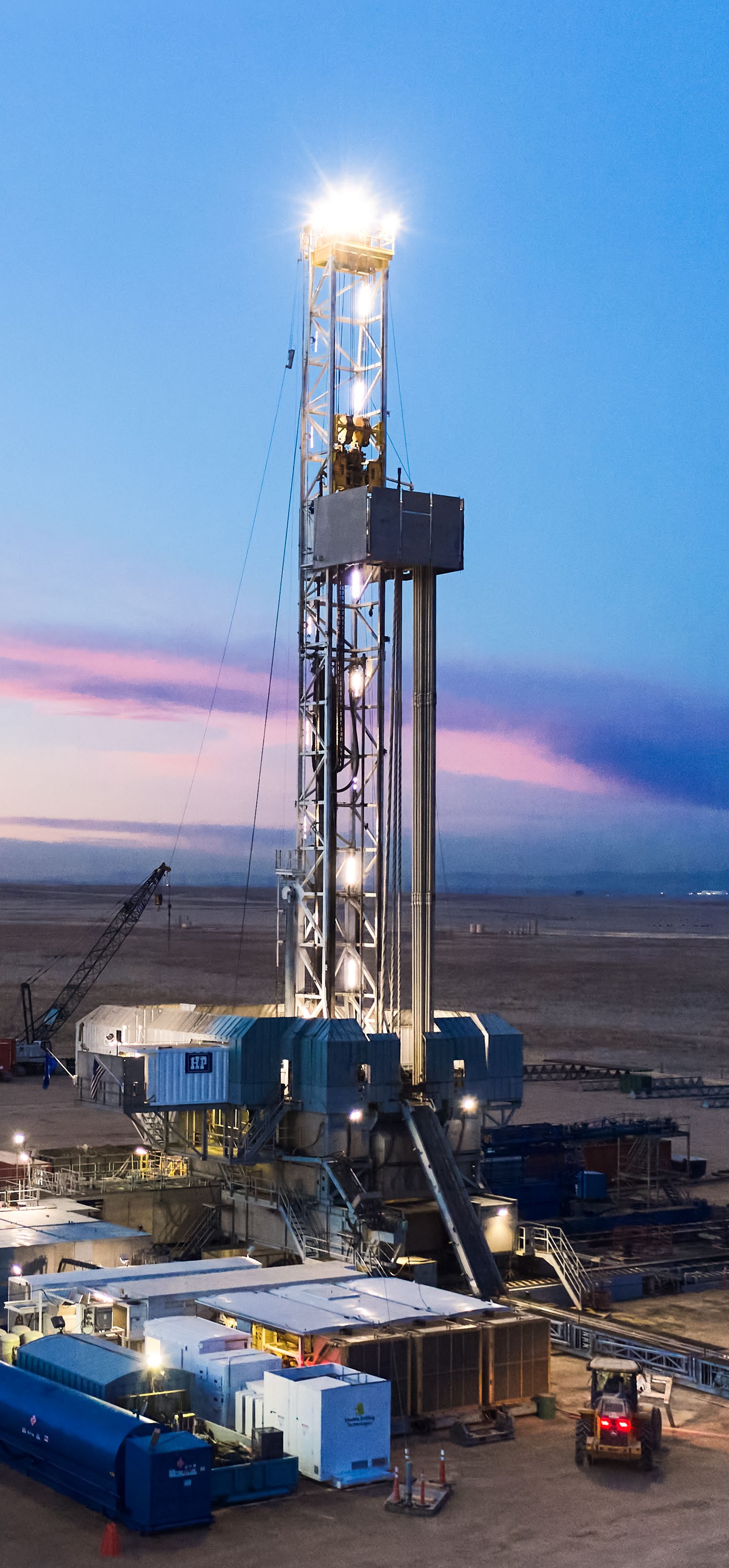
Chevron Corporation 5001 Executive Parkway, Suite 200, San Ramon, CA 94583 USA
Chevron Corporation 5001 Executive Parkway, Suite 200, San Ramon, CA 94583 USA
Chevron Corporation 5001 Executive Parkway, Suite 200, San Ramon, CA 94583 USA
www.chevron.com
© 2024 Chevron Corporation.
All Rights Reserved.
The world demands energy to
advance human progress, and we
are proud to focus on providing
it – affordably, reliably and in
ever-cleaner ways. We believe in
the power of human ingenuity
to produce and deliver energy
more efficiently and to help build
a resilient, lower carbon energy
system that can continue to meet
growing energy demand and
advance human progress.
learn more
chevron.com/sustainability
chevron.com/investors/ESG