



Microsoft Digital
Defense Report 2025
Lighting the path to a secure future
A Microsoft Threat Intelligence report

Microsoft Digital Defense Report 2025
02
Contents
Introduction
The threat landscape
The defense landscape
Appendix
How to navigate this report
Use the navigation bar above
to jump between different
sections of the report.
Read more outside this report
Read more in this report
Previous page
Next page
For more news on cybersecurity, visit:
https://microsoft.com/corporate-responsibility/cybersecurity
For more report insights, visit:
https://microsoft.com/mddr
For more news on cybersecurity policy, follow us on LinkedIn:
https://aka.ms/MOILinkedin
User impersonation tactics
17
Access brokers: The hidden gatekeepers of cybercrime 19
Introduction
Introductory statement by Amy Hogan-Burney
and Igor Tsyganskiy
04
About this report
05
Our unique vantage point
06
Top 10 recommendations from this report
07
Part I. The threat landscape
Key takeaways
09
How threat actors are shaping the cyber
risk environment
10
A ransomware attack with potential global
impact stopped in under two minutes
12
Logging in: The new playbook for initial access
13
Emerging threats: What’s next from attackers
14
Identity, access, and the cybercrime economy
16
From end users to workloads: The new horizon
in identity threats
17
Strategic threats to the research and academia sector 18
Password spray: Anatomy of a high-volume attack
21
Human-operated attacks and ransomware
24
Human-operated intrusions
24
Ransomware’s shifting tactics
27
Data exfiltration and impact: Are you prepared?
29
A study in time: What happens when you hesitate?
30
Fraud and social engineering
32
The rise of deepfakes and synthetic identities:
How AI is fueling identity fraud at scale
33
Virtual credit cards and the shifting fraud landscape
34
Domain impersonation in the age of AI:
Defending against scale and speed
35
Social engineering exploits
36
The rise of ClickFix
36
Phishing landscape
37
Email bombing as a precursor
to social engineering attacks
37
BEC: A high-impact threat driven
by identity compromise
38
Device code phishing: The next generation
of credential theft
40
Cloud threat trends
41
Cloud under fire: Escalating attacks
in cloud environments
41
Container security in focus
42
Nation-state adversary threats
43
Regional sample of nation-state
activity levels observed
44
China: Global espionage at scale
45
Iran: Persistent and adaptive
46
Russia: Expanding its target set but still focused
on Ukraine
47
North Korea: Revenue generation and remote workers 48
Nation-state abuse of AI in influence operations:
Emerging tactics and strategic implications
49
Insider risk in the age of strategic geopolitical
competition
50
AI’s double-edged influence: Defending
and disrupting the digital landscape
52
Traditional cybersecurity
52
Adversarial exploitation of inherent risks
54
Dangerous capabilities
55
Operational issues
55
Emerging threats
55
Storm-2139: How Microsoft disrupted
an AI exploitation and abuse ring
56
Quantum technologies: Strategic
priority in a new era of competition
57
Part II. The defense landscape
Key takeaways: Insights and
actions for cyber defense
59
AI and advanced defense
60
AI-powered defense
60
Securing identity in the age of AI
61
Cloud-scale AI defense
62
Securing AI systems
63
AI vs. cybercrime
63
Countering nation-state and emerging threats
64
Disrupting cybercrime ecosystems
64
Deterrence in action
66
Addressing the geopolitical enablers
of ransomware operations
67
Combating cyber mercenaries
67
Intelligent signals
68
Collaboration as a counter measure
69
Policy, capacity, and future readiness
70
Securing the digital frontier
70
Resilience by design
72
Building resilience in critical infrastructure
73
Microsoft’s strategic path to quantum safety
74
Strategic vision and global commitments
76
Secure Future Initiative: progress and priorities
76
Microsoft’s commitment to strengthening
global cybersecurity
77
Closing
78
Appendix
Glossary
80
Contributing teams
82
References
84

04 Introductory statement
By Amy Hogan-Burney and Igor Tsyganskiy
05 About this report
06 Our unique vantage point
07 Top 10 recommendations from this report
Microsoft Digital Defense Report 2025
Contents
The threat landscape
The defense landscape
Appendix
03
Introduction
Introduction


Introductory statement by Amy Hogan-Burney and Igor Tsyganskiy
Mobilizing for impact:
Cybersecurity leadership in a defining era
Amy Hogan-Burney
Corporate Vice President,
Customer Security & Trust
Igor Tsyganskiy
Corporate Vice President and
Chief Information Security Officer
We are living through a defining moment
in cybersecurity. As digital transformation
accelerates, supercharged by AI, cyber
threats increasingly challenge economic
stability and individual safety. Cyber
threats are rapidly evolving from technical
problems affecting business to events
impacting all aspects of our society.
The pace of change in the threat landscape has
pushed us to rethink traditional defenses. The growth
and adoption of AI by both defenders and threat
actors benefits both sides. AI in cybersecurity
is already creating new challenges for security
organizations as they rush to adapt systems,
understand new threats, and equip their people with
new knowledge to keep pace.
Cyber threats are also playing an increasingly
significant role in geopolitical conflicts and criminal
activities, creating both a wide and deep scope of
responsibility for defenders. AI will play a critical role
in helping security professionals productively address
the growing threat landscape, but as an industry
we must step into this new paradigm cautiously.
With the increased speed of an AI-centric world, the
impact of action–whether by security organizations,
criminal actors, or nation states–will have faster and
potentially greater second, third, or fourth-order
effects. It is imperative that defenders consider
these ripple effects as they implement new security
controls, share security research, fix new security
vulnerabilities, and collaborate with each other.
Adversaries, whether nation-states, criminal
syndicates, or commercial cyber mercenaries, are
leveraging emerging technologies to attack with
both greater volume and more precision than ever
before, often by exploiting the trust that underpins
our digital lives. International collaboration among
defenders will be critical to define new coordinated
defenses and set new international norms that
enforce consequences for cyberattacks targeting the
global critical infrastructure or essential services.
For security leaders, the imperative is clear:
cybersecurity must be a priority, embedded
into the fabric of organizational strategy and
addressed regularly as part of risk management.
Global partnerships across industry peers and even
competitors must be established to coordinate and
collaborate on defenses against common adversaries.
Traditional perimeter defenses are no longer
sufficient. Resilience must be designed into systems,
supply chains, processes, and governance. New types
of threats will emerge with increasing frequency;
being informed and prepared is critical.
What’s new in this year’s report
AI as both a defensive necessity and a target
We’re witnessing adversaries deploy generative AI
for a variety of activities, including scaling social
engineering, automating lateral movement, engaging
in vulnerability discovery, and even real-time evasion
of security controls. Autonomous malware and AI-
powered agents are now capable of adapting their
tactics on the fly, challenging defenders to move
beyond static detection and embrace behavior-
based, anticipatory defense.
At the same time, AI systems themselves have
become high-value targets, with adversaries amping
up use of methods like prompt injection and data
poisoning to attack both models and systems, which
could lead to unauthorized actions, data leaks, theft,
or reputational damage.
Microsoft Digital Defense Report 2025
04
Contents
The threat landscape
The defense landscape
Appendix
Introduction


Introductory statement
continued
Diverse vectors for initial access
In today’s world, campaigns rely on multi-stage
attack chains that mix tactics and techniques such as
social engineering and technical exploits. This year,
we saw the widespread adoption of “ClickFix,” a social
engineering technique that tricks users into executing
malicious code themselves, bypassing traditional
phishing protections. We also saw the incorporation
of new access methods like device code phishing by
both cybercriminal and nation-state actors.
The pervasive threat of infostealers
Increasingly, adversaries aren’t breaking in, they’re
logging in. In today’s specialized cybercrime
economy, access is essential, and infostealers are a
way for operators to collect credentials and tokens
for sale on the dark web. Follow-on activities by
the buyers of compromised credentials can include
ransomware, data exfiltration, and/or extortion.
Overall, this means that organizations that
experience an infostealer infection are at high risk of
future breaches.
Nation-state actors expanding operations
Geopolitical objectives continue to drive a surge
in state-sponsored cyber activity, with a notable
expansion in targeting the communications, research,
and academia sectors. These expansions are mostly
within expected scope and volume, and primarily
focused on using cyber espionage against typical
targets to complement traditional intelligence
operations. Building on a trend we first noted last
year, nation states continue to accelerate AI use to
evolve their cyber and influence operations, making
them more scalable, advanced, and targeted.
We urge you to read this report with a bias toward
action. It is not just a reflection of the challenges both
past and future; it is a call to mobilize, prepare, and
confront. Innovation, resilience, and partnership are
the pillars of a secure digital future. By embracing
these principles, we can navigate uncertainty and
build a world where technology empowers and
protects us against the rising tide of threats.
Amy Hogan-Burney
Corporate Vice President,
Customer Security & Trust
Igor Tsyganskiy
Corporate Vice President and
Chief Information Security Officer
About this report
Commitment to responsible and
ethical practices
Our approach to cybersecurity is grounded in our
core values of responsibility, transparency, and
ethical business conduct. We are dedicated to:
• Upholding the highest standards of privacy and
data protection.
• Advancing responsible AI and quantum
safety initiatives.
• Collaborating across sectors and borders
to harmonize standards and share
threat intelligence.
• Supporting global efforts to combat cyber
mercenaries, safeguard human rights, and foster
trust in digital content.
Report scope
Microsoft fiscal year 2025 (July 1, 2024-June 30,
2025) unless otherwise stated.
Please note that due to rounding, the percentages
in some charts may not total 100%.
Our commitment to preserving
privacy
Any and all data included in this report is
presented in alignment to our privacy principles.
Microsoft is committed to its focus on preserving
customers’ control over their data and their ability
to make informed choices that protect their
privacy. We advocate for strong global privacy
and data protection laws requiring companies,
including ours, to only collect and use personal
data in responsible, accountable ways.
Setting the stage for stakeholders
As you read this report, you will find actionable
insights and recommendations designed to help
leaders across government, industry, and civil
society navigate the new realities of cybersecurity.
Our commitment is clear: to build trust, drive
innovation, and secure the digital future through
responsible leadership and collaborative action.
We invite you to explore the findings, strategies,
and vision outlined in this report—and to join us
in shaping a safer, more resilient digital world.
Microsoft Digital Defense Report 2025
05
Contents
The threat landscape
The defense landscape
Appendix
Introduction
Our unique vantage point
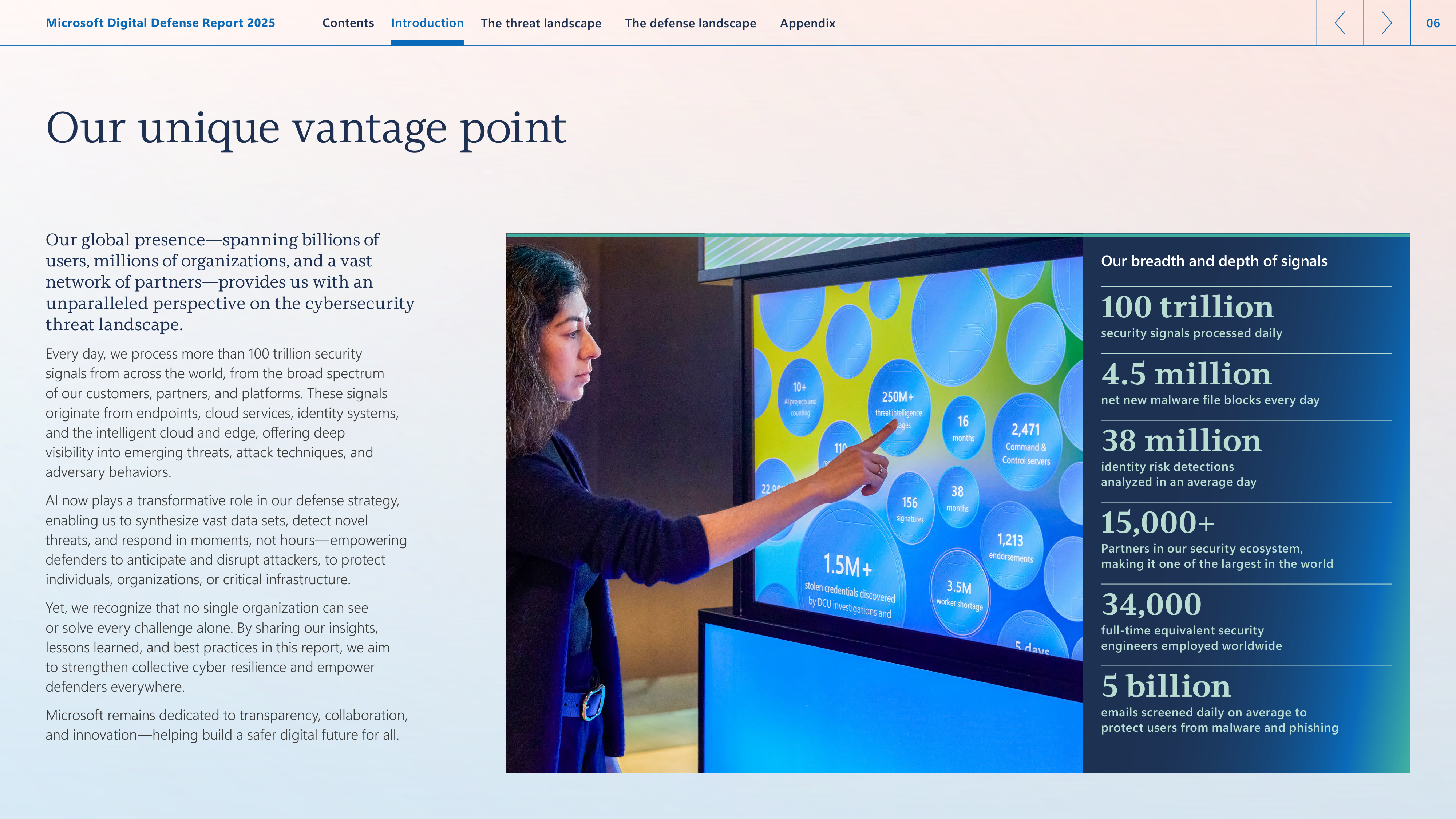
Our global presence—spanning billions of
users, millions of organizations, and a vast
network of partners—provides us with an
unparalleled perspective on the cybersecurity
threat landscape.
Every day, we process more than 100 trillion security
signals from across the world, from the broad spectrum
of our customers, partners, and platforms. These signals
originate from endpoints, cloud services, identity systems,
and the intelligent cloud and edge, offering deep
visibility into emerging threats, attack techniques, and
adversary behaviors.
AI now plays a transformative role in our defense strategy,
enabling us to synthesize vast data sets, detect novel
threats, and respond in moments, not hours—empowering
defenders to anticipate and disrupt attackers, to protect
individuals, organizations, or critical infrastructure.
Yet, we recognize that no single organization can see
or solve every challenge alone. By sharing our insights,
lessons learned, and best practices in this report, we aim
to strengthen collective cyber resilience and empower
defenders everywhere.
Microsoft remains dedicated to transparency, collaboration,
and innovation—helping build a safer digital future for all.
Our breadth and depth of signals
100 trillion
security signals processed daily
4.5 million
net new malware file blocks every day
38 million
identity risk detections
analyzed in an average day
15,000+
Partners in our security ecosystem,
making it one of the largest in the world
34,000
full-time equivalent security
engineers employed worldwide
5 billion
emails screened daily on average to
protect users from malware and phishing
Microsoft Digital Defense Report 2025
06
Contents
The threat landscape
The defense landscape
Appendix
Introduction

Top 10
recommendations
from this report
1. Manage cyber risk at the
boardroom level
Treat cybersecurity as a business risk on par with
financial or legal challenges. It is important that
corporate boards and CEOs understand the security
weaknesses of their organization. Track and report
metrics like multifactor authentication (MFA) coverage,
patch latency, incident counts, and incident response
time to develop a comprehensive understanding of
both your organization’s potential vulnerabilities and its
preparedness in the event of a cybersecurity incident.
2. Prioritize protecting identities
Since identity is the top attack vector, enforce
phishing-resistant multifactor authentication across
all accounts, including administrative accounts.
3. Invest in people, not just tools
Cybersecurity is a whole-of-organization effort.
Find ways to upskill your workforce and consider making
security part of performance reviews. Culture and
readiness—not just technology—are primary factors in
both an organization’s defenses and its resilience.
4. Defend your perimeter
A third of attackers use crude tactics as the easy path
into an organization’s exposed footprint, often looking
beyond what you deploy to the vendors and supply
chain you trust, including perimeter web-facing assets
(18%), external remote services (12%), and supply chains
(3%). Knowing the full scope of your perimeter, auditing
the accesses you grant to trusted partners, and patching
any exposed attack surface forces attackers to work
harder to be successful.
5. Know your weaknesses
and pre-plan for breach
Combine knowledge of the organization’s exposure
footprint with organizational risk awareness to develop
a proactive plan for responding to future breach.
Tie security controls to business risks in terms the board
can understand. Since a breach is a matter of when, not
if, develop, test, and practice your incident response
(IR) plan—including specific scenarios for ransomware
attacks, which remain one of the most disruptive and
costly threats to operations. How fast can you isolate a
system or revoke credentials?
6. Map and monitor cloud assets
Since the cloud is now a primary target for adversaries,
conduct an inventory on every cloud workload,
application programming interface (API), and identity
within the organization, and monitor for rogue virtual
machines, misconfigurations, and unauthorized access.
At the same time, work proactively to enforce app
governance, conditional access policies, and continuous
token monitoring.
7. Build and train for resiliency
If breaches are all but inevitable, resilience and
recovery become key. Backups must be tested,
isolated, and restorable, and organizations should
have clean rebuild procedures for identity systems
and cloud environments.
8. Participate in intelligence sharing
Cyber defense is a team, not individual, sport.
By sharing and receiving real-time threat data with
peers, industry groups, and government, we can make
it harder for cyber adversaries to achieve their goals.
9. Prepare for regulatory changes
It’s more important than ever for organizations to
align with emerging laws like the European Union
(EU) Cyber Resilience Act or United States (US)
critical infrastructure mandates, which may require
reporting cyber incidents within a certain timeframe
or Secure by Design practices. These regulations
reinforce the importance of timely incident reporting
and stronger internal oversight of an organization’s
cybersecurity practices.
10. Start AI and quantum
risk planning now
Stay ahead of emerging technologies. Understand
both the benefits and risks of AI use within an
organization and adjust your risk planning, attack
surface exposure, and threat models appropriately.
Prepare for a post-quantum cryptography (PQC)
world by taking the time to inventory where
encryption is used and create a plan to upgrade to
modern standards as they evolve.
Microsoft Digital Defense Report 2025
07
Contents
The threat landscape
The defense landscape
Appendix
Introduction

Part I
The threat
landscape
09 Key takeaways
10
How threat actors are shaping the cyber risk environment
16
Identity, access, and the cybercrime economy
24 Human-operated attacks and ransomware
32 Fraud and social engineering
36 Social engineering exploits
41
Cloud threat trends
43
Nation-state adversary threats
52
AI’s
double-edged
influence:
Defending
and
disrupting
the digital landscape
57
Quantum
technologies:
Strategic
priority
in
a
new
era
of
competition
Microsoft Digital Defense Report 2025
Introduction
Contents
The defense landscape
Appendix
08
The threat landscape


Key
takeaways
What every leader needs to know
about today’s threat landscape
1. Phishing-resistant MFA is the gold
standard for security
No matter how much the cyber threat landscape
changes, multifactor authentication (MFA) still blocks
over 99% of unauthorized access attempts, making
it the single most important security measure an
organization can implement. Phishing-resistance
provides an even more secure solution.
Read more on p23
2. Adversaries are targeting identities
that enable access to data
Government organizations, information technology
(IT) companies, and research and academic institutions
were the most impacted by cyber threats this year.
Among other data they hold that might interest
adversaries, these organizations store vast amounts
of personally identifiable information (PII), whose theft
enables future attacks. Accessing organizational data
has become a primary objective for threat actors.
Government, NGO, and academic entities using legacy
systems or operating with small IT teams and limited
incident response capabilities should prioritize securing
data and identity-facing assets.
Read more on p17
3. Adversaries are using diverse—but
well-known—initial access routes
Incident response investigations found that 28% of
breaches were initiated through phishing or social
engineering, 18% were via unpatched web assets, and
12% leveraged exposed remote services. Not only
are adversaries heavily leveraging the ClickFix social
engineering method to deliver malware this year, but
threat actors are incorporating exploits for known
vulnerabilities faster than ever.
Read more on p13
4. Most attacks are for money,
not espionage
More than half of cyberattacks with known motives had
financial objectives such as extortion or ransom, while
only 4% were motivated solely by espionage.
Read more on p11
5. Data exfiltration is the norm
Regardless of adversary motivations, accessing
organizational data is now a primary goal for attacks.
In the past year, we observed data collection in 80% of
reactive engagements.
Read more on p29
6. Workload identities are
under threat
As organizations implement phishing-resistant MFA
and conditional access policies, adversaries are pivoting
to targeting identities and elevated privileges granted
to service-to-service workloads like apps, services, and
scripts that access cloud resources because service-
based workloads are often implemented with elevated
privileges but weak security controls.
Read more on p17
7. Adversaries are conducting
destructive attacks in the cloud
We have seen an 87% increase in campaigns aimed at
disrupting Azure cloud customer environments through
destructive actions such as ransomware or mass
deletion. Additionally, over 40% of ransomware attacks
now involve hybrid components.
Read more on p41
8. Adversaries are already
using AI as a multiplier
Adversaries have begun implementing AI across a
range of malicious activities, including for automated
vulnerability discovery or phishing campaigns,
malware or deepfake generation, data analysis, and
to craft highly convincing fraudulent messages.
Read more on p52
9. Using AI can be both a benefit
and a vulnerability
AI is driving rapid, substantial change. While it offers
many benefits for organizations, particularly in cyber
defense, AI can be attacked as well. As organizations
implement the strengths of AI, they should also
manage the weaknesses and potential exposure of
sensitive data by protecting against threats like prompt
injection, malicious tool invocation, and training
data poisoning.
Read more on p52
10. Quantum computing could
challenge cybersecurity
Quantum computing has vast economic potential,
but if used by malicious actors, it could threaten the
encryption of sensitive data.
Read more on p57
Microsoft Digital Defense Report 2025
Introduction
Contents
The defense landscape
Appendix
09
The threat landscape

How threat actors are shaping the cyber risk environment
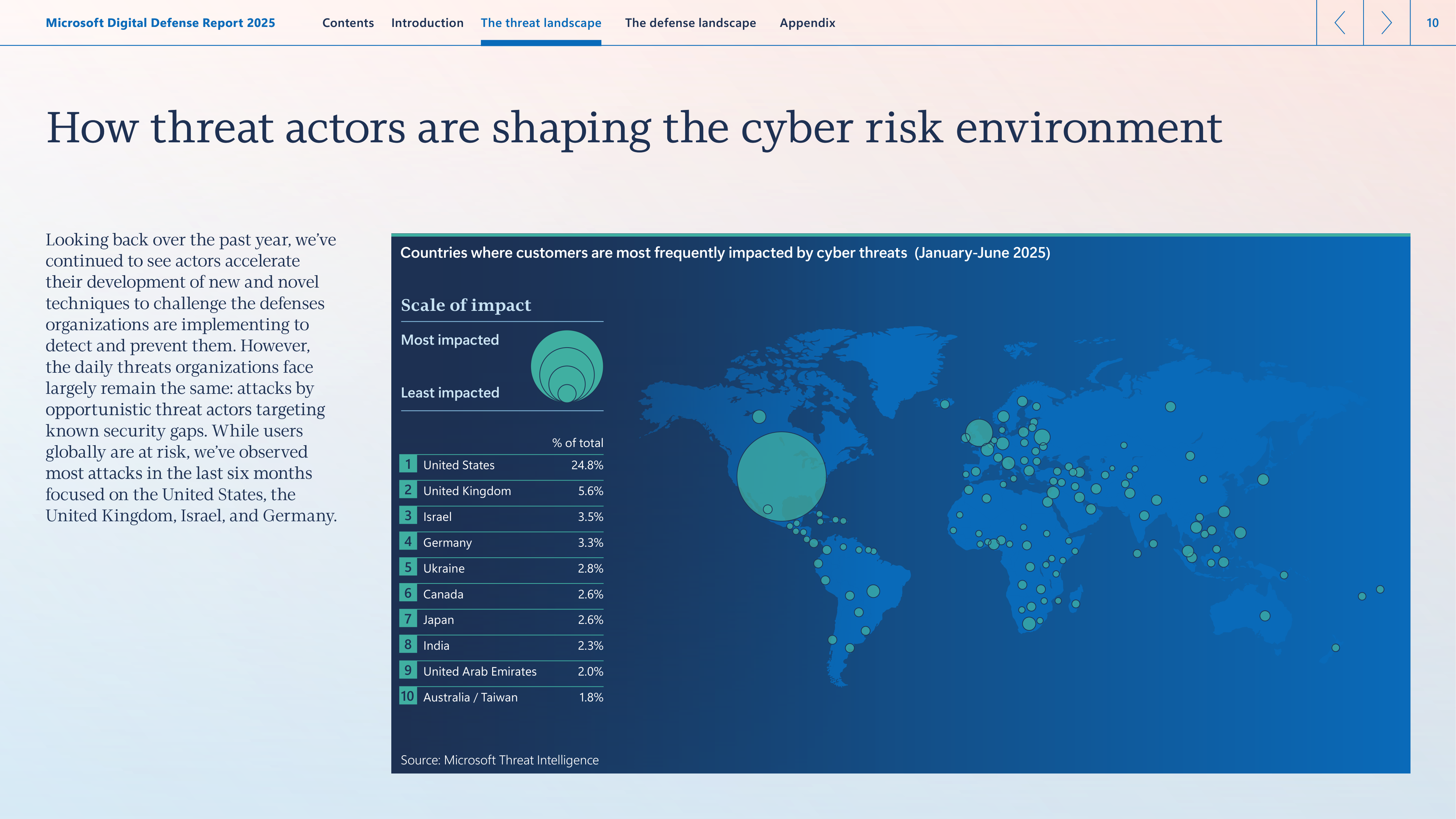
Looking back over the past year, we’ve
continued to see actors accelerate
their development of new and novel
techniques to challenge the defenses
organizations are implementing to
detect and prevent them. However,
the daily threats organizations face
largely remain the same: attacks by
opportunistic threat actors targeting
known security gaps. While users
globally are at risk, we’ve observed
most attacks in the last six months
focused on the United States, the
United Kingdom, Israel, and Germany.
Countries where customers are most frequently impacted by cyber threats (January-June 2025)
Scale of impact
Most impacted
Least impacted
% of total
1
United States
24.8%
2
United Kingdom
5.6%
3
Israel
3.5%
4
Germany
3.3%
5
Ukraine
2.8%
6
Canada
2.6%
7
Japan
2.6%
8
India
2.3%
9
United Arab Emirates
2.0%
10
Australia / Taiwan
1.8%
Source: Microsoft Threat Intelligence
Microsoft Digital Defense Report 2025
10
Introduction
Contents
The defense landscape
Appendix
The threat landscape
How threat actors are shaping the cyber risk environment
Looking back over the past year, we’ve
continued to see actors accelerate
their development of new and novel
techniques to challenge the defenses
organizations are implementing to
detect and prevent them. However,
the daily threats organizations face
largely remain the same: attacks by
opportunistic threat actors targeting
known security gaps. While users
globally are at risk, we’ve observed
most attacks in the last six months
focused on the United States, the
United Kingdom, Israel, and Germany.
Microsoft Digital Defense Report 2025
10
Introduction
Contents
The defense landscape
Appendix
The threat landscape
% of total
1
United States
24.8%
2
United Kingdom
5.6%
3
Israel
3.5%
4
Germany
3.3%
5
Ukraine
2.8%
6
Canada
2.6%
7
Japan
2.6%
8
India
2.3%
9
United Arab Emirates
2.0%
10
Australia / Taiwan
1.8%
Scale of impact
Least impacted
Most impacted
Countries where customers are most frequently impacted by cyber threats (January-June 2025)
Source: Microsoft Threat Intelligence
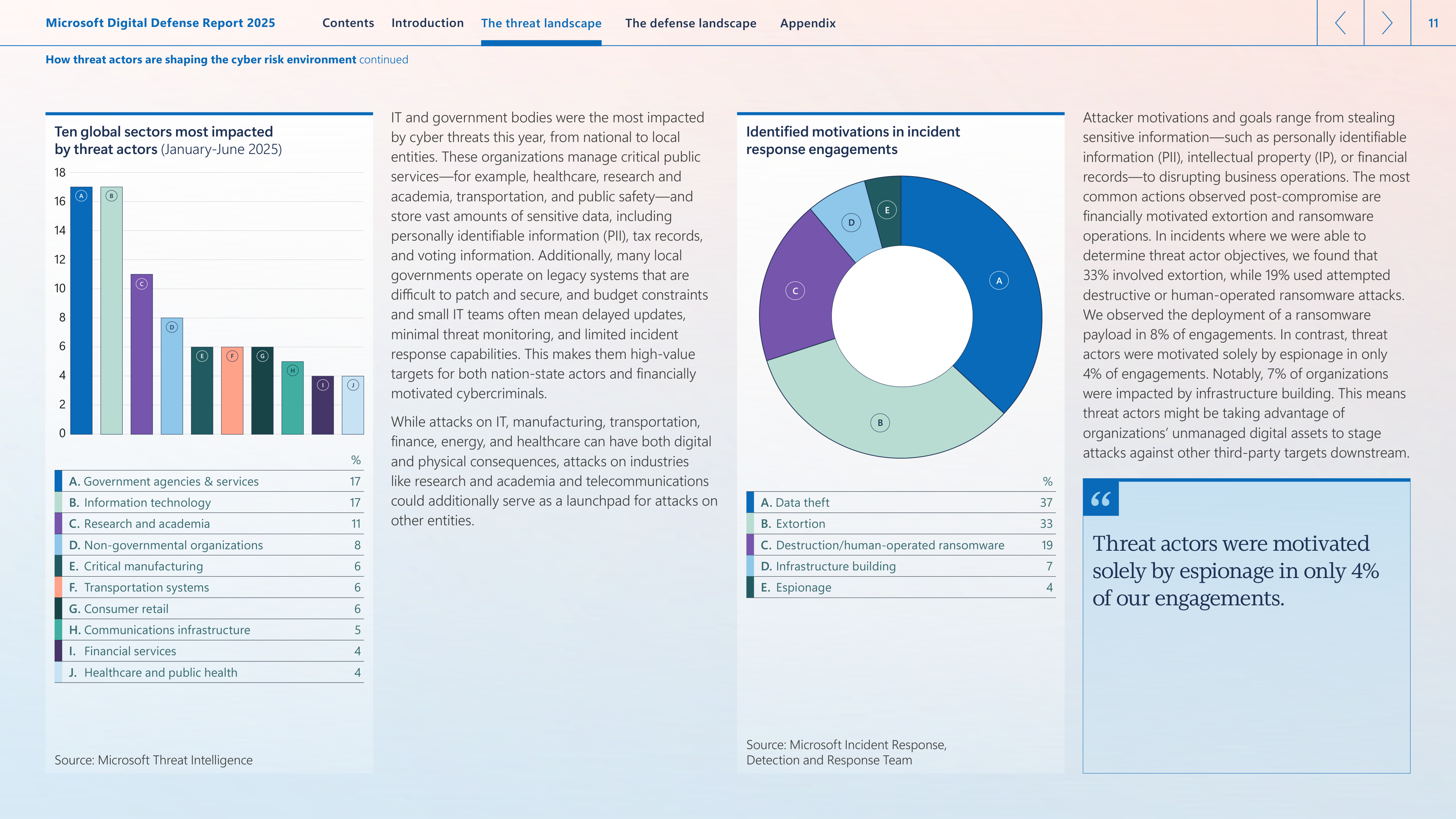


Ten global sectors most impacted
by threat actors
(January-June 2025)
18
16
14
12
10
8
6
4
2
0
A
C
E
G
I
B
D
F
H
J
%
A.
Government agencies & services
17
B.
Information
technology
17
C.
Research and academia
11
D.
Non-governmental organizations
8
E.
Critical
manufacturing
6
F.
Transportation systems
6
G.
Consumer retail
6
H.
Communications
infrastructure
5
I.
Financial services
4
J.
Healthcare and public health
4
Source: Microsoft Threat Intelligence
How threat actors are shaping the cyber risk environment
continued
IT and government bodies were the most impacted
by cyber threats this year, from national to local
entities. These organizations manage critical public
services—for example, healthcare, research and
academia, transportation, and public safety—and
store vast amounts of sensitive data, including
personally identifiable information (PII), tax records,
and voting information. Additionally, many local
governments operate on legacy systems that are
difficult to patch and secure, and budget constraints
and small IT teams often mean delayed updates,
minimal threat monitoring, and limited incident
response capabilities. This makes them high-value
targets for both nation-state actors and financially
motivated cybercriminals.
While attacks on IT, manufacturing, transportation,
finance, energy, and healthcare can have both digital
and physical consequences, attacks on industries
like research and academia and telecommunications
could additionally serve as a launchpad for attacks on
other entities.
Identified motivations in incident
response engagements
B
A
C
D
E
%
A.
Data
theft
37
B.
Extortion
33
C.
Destruction/human-operated
ransomware
19
D.
Infrastructure
building
7
E.
Espionage
4
Source: Microsoft Incident Response,
Detection and Response Team
Attacker motivations and goals range from stealing
sensitive information—such as personally identifiable
information (PII), intellectual property (IP), or financial
records—to disrupting business operations. The most
common actions observed post-compromise are
financially motivated extortion and ransomware
operations. In incidents where we were able to
determine threat actor objectives, we found that
33% involved extortion, while 19% used attempted
destructive or human-operated ransomware attacks.
We observed the deployment of a ransomware
payload in 8% of engagements. In contrast, threat
actors were motivated solely by espionage in only
4% of engagements. Notably, 7% of organizations
were impacted by infrastructure building. This means
threat actors might be taking advantage of
organizations’ unmanaged digital assets to stage
attacks against other third-party targets downstream.
“
Threat actors were motivated
solely by espionage in only 4%
of our engagements.
Microsoft Digital Defense Report 2025
11
Introduction
Contents
The defense landscape
Appendix
The threat landscape
Threat actors were motivated
solely by espionage in only 4%
of our engagements.
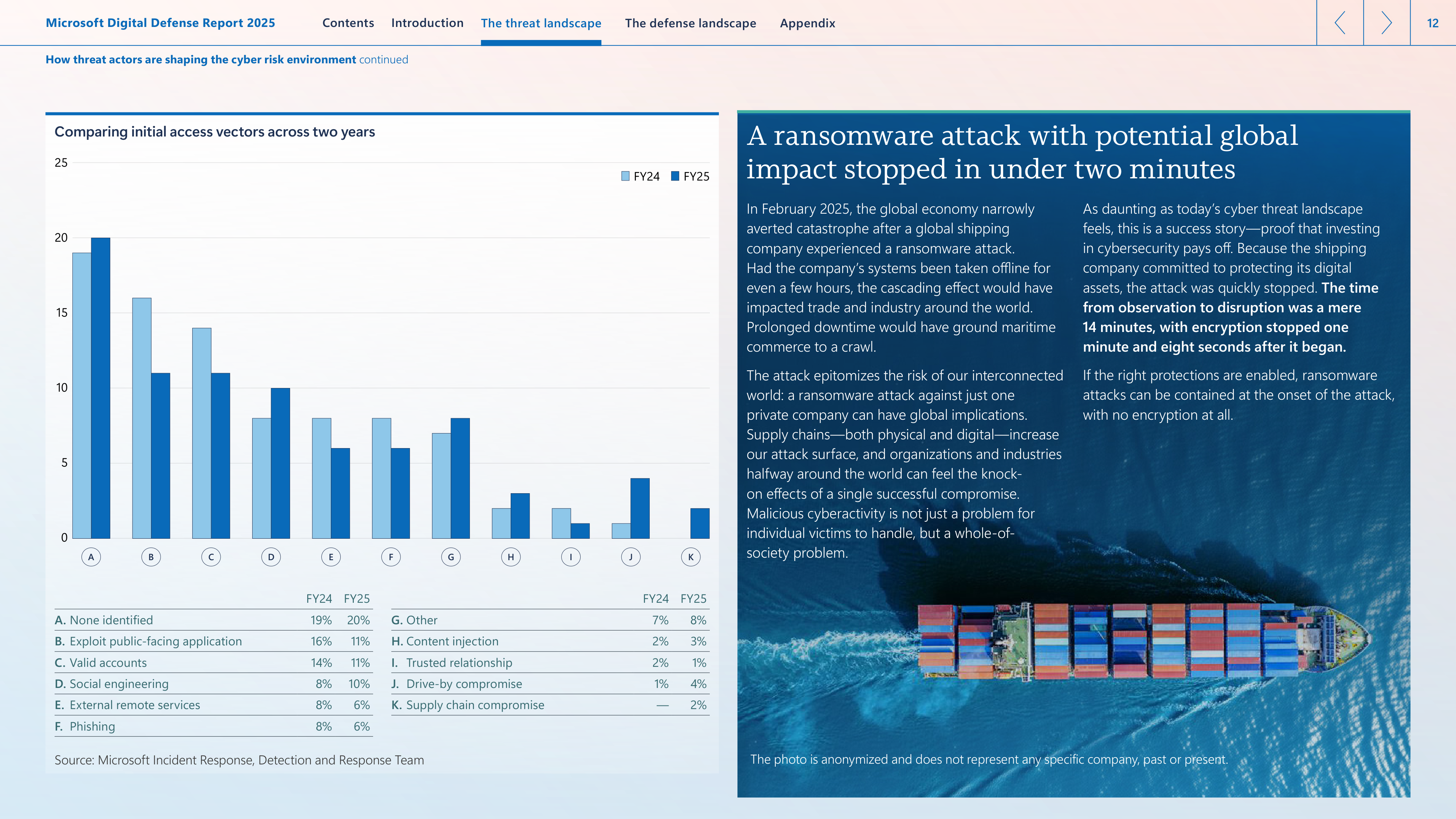



Comparing initial access vectors across two years
25
20
15
10
5
0
A
B
C
D
E
F
G
H
I
J
K
FY24
FY25
FY24 FY25
A.
None
identified
19%
20%
B.
Exploit
public-facing
application
16%
11%
C.
Valid accounts
14%
11%
D.
Social engineering
8%
10%
E.
External remote services
8%
6%
F.
Phishing
8%
6%
FY24 FY25
G.
Other
7%
8%
H.
Content injection
2%
3%
I.
Trusted relationship
2%
1%
J.
Drive-by
compromise
1%
4%
K.
Supply chain compromise
—
2%
Source: Microsoft Incident Response, Detection and Response Team
A ransomware attack with potential global
impact stopped in under two minutes
In February 2025, the global economy narrowly
averted catastrophe after a global shipping
company experienced a ransomware attack.
Had the company’s systems been taken offline for
even a few hours, the cascading effect would have
impacted trade and industry around the world.
Prolonged downtime would have ground maritime
commerce to a crawl.
The attack epitomizes the risk of our interconnected
world: a ransomware attack against just one
private company can have global implications.
Supply chains—both physical and digital—increase
our attack surface, and organizations and industries
halfway around the world can feel the knock-
on effects of a single successful compromise.
Malicious cyberactivity is not just a problem for
individual victims to handle, but a whole-of-
society problem.
As daunting as today’s cyber threat landscape
feels, this is a success story—proof that investing
in cybersecurity pays off. Because the shipping
company committed to protecting its digital
assets, the attack was quickly stopped.
The time
from observation to disruption was a mere
14 minutes, with encryption stopped one
minute and eight seconds after it began.
If the right protections are enabled, ransomware
attacks can be contained at the onset of the attack,
with no encryption at all.
The photo is anonymized and does not represent any specific company, past or present.
How threat actors are shaping the cyber risk environment
continued
Microsoft Digital Defense Report 2025
12
Introduction
Contents
The defense landscape
Appendix
The threat landscape
The attack epitomizes the risk of our interconnected
world: a ransomware attack against just one
private company can have global implications.
Supply chains—both physical and digital—increase
our attack surface, and organizations and industries
halfway around the world can feel the knock-
on effects of a single successful compromise.
Malicious cyberactivity is not just a problem for
individual victims to handle, but a whole-of-
society problem.
How threat actors are shaping the cyber risk environment
continued
While attack tactics, techniques, and procedures
(TTPs) continue to evolve at a rapid pace, over
the past year, attackers nevertheless persisted
in targeting well-known pain points, regardless
of targeted industry or attacker motivation.
According to our incident response engagements,
a significant portion of attacks begin by targeting
an organization’s exposure footprint: perimeter
web-facing assets (18%) and external remote
services (12%) as well as—to a lesser degree—
supply chains (3%).
Threat actors are incorporating exploits for known
vulnerabilities at a faster pace than before to target
misconfigured or vulnerable web-facing applications
and remote services. The rapid weaponization of
exploits has increasingly impacted the windows
between vulnerability disclosure, patch availability,
and patch deployment. Ransomware operators
and botnet distributors often choose targets of
opportunity, using scanning tools or services
to identify unpatched systems or copying the
successful publicized attacks of other threat actors.
Sophisticated threat actors are also targeting supply
chains and trusted third-party relationships, which
can affect downstream customers. By compromising
a less secure partner or vendor in the supply chain,
attackers could potentially impact more hardened
targets in multistage attacks.
Managing an organization’s footprint has
become increasingly complex due to difficulties in
understanding true exposure. Organizations can
guard the wrong assets, lack a complete picture of
their exposure, or struggle to address vulnerable
devices. For cloud environments in particular,
organizations might struggle to properly determine
who has what access within their cloud tenant
across the trust chain of software-as-a-service
(SaaS) applications, guest accounts, and delegated
privileges. This complexity is compounded by the
fragmented nature of many security measures, as
the lack of integration between security tools adds to
the complexity and creates potential blind spots for
attackers to exploit.
The abuse of valid accounts is also a frequently
observed technique (17%). This can be the result
of several types of attacks that maliciously gain
access to user credentials—for example, theft,
phishing, brute force, or social engineering—and
use them to infiltrate systems without triggering
traditional security alerts. As will be discussed
later in this report, Microsoft has seen attackers
acquiring stolen credentials on underground criminal
forums to sign in directly to networks. And in cloud
environments, we have identified multiple criminal
and nation-state actors conducting entire end-to-
end attacks as legitimate users or resources, with
the ability to manipulate any resource or process
that the compromised identity is trusted to access,
including email, other cloud services, or the on-
premises environment.
Logging in: Today’s playbook for
initial access
This year, Microsoft Defender Experts observed a
sharp change in how threat actors achieve initial
access. Campaigns are no longer dominated by
simple phishing and instead rely on multi-stage
attack chains that mix technical exploits, social
engineering, infrastructure abuse, and evasion
through legitimate platforms. Specific initial access
tactics observed include:
• ClickFix, an approach in which users are tricked
into copying and pasting malicious code into their
systems themselves (discussed more on page 36).
• Attacks combining email bombing, voice phishing
(vishing) calls, and Microsoft Teams impersonation
to convincingly pose as IT support and gain
remote access.
• The deployment of rogue virtual machines using
the open-source Quick Emulator (QEMU), giving
attackers an isolated space to operate completely
out of sight from traditional security tools.
• The exploitation of zero-day vulnerabilities in
commonly used tools like SimpleHelp, BeyondTrust,
Fortinet, Cleo, and Apache Tomcat.
• Use of malvertising, especially where malware
is hosted on trusted platforms like GitHub and
Discord and delivered through deceptive ads on
high-traffic sites.
• The deployment of commodity infostealers to
harvest credentials for future intrusions or resale by
access brokers (discussed more on page 24).
These trends reveal a key shift in attacker strategy.
Threat actors are no longer trying to force their
way in—they’re blending in. By abusing legitimate
tools, platforms, and user behaviors, they gain
access quietly, often without tripping standard
detection mechanisms.
What these trends mean for defenders:
•
Trust is not enough.
Familiar platforms
and tools could be—and are—abused. It’s
crucial to apply zero trust principles in your
security model.
•
Endpoint visibility is insufficient.
Critical attack
activity might occur outside the reach of endpoint
detection and response (EDR).
•
Early-stage threats are critical signals.
Infostealers and credential theft should trigger
investigation, not be dismissed as routine.
In 2025, initial access is no longer a single event—it’s
an extended process, carefully staged and tailored to
avoid detection at every layer.
Microsoft Digital Defense Report 2025
13
Introduction
Contents
The defense landscape
Appendix
The threat landscape
How threat actors are shaping the cyber risk environment
continued
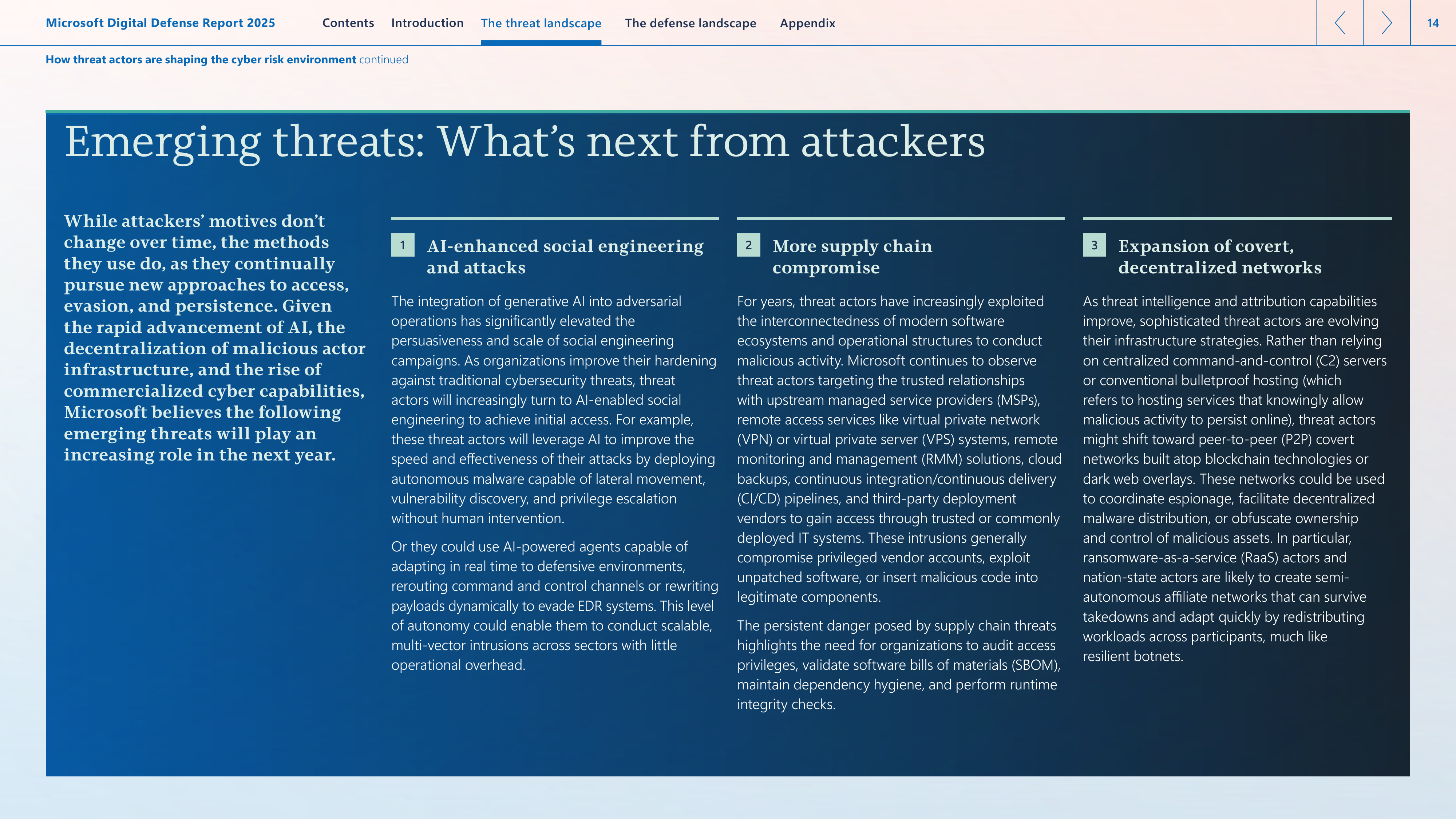
Emerging threats: What’s next from attackers
While attackers’ motives don’t
change over time, the methods
they use do, as they continually
pursue new approaches to access,
evasion, and persistence. Given
the rapid advancement of AI, the
decentralization of malicious actor
infrastructure, and the rise of
commercialized cyber capabilities,
Microsoft believes the following
emerging threats will play an
increasing role in the next year.
1
AI-enhanced social engineering
and attacks
The integration of generative AI into adversarial
operations has significantly elevated the
persuasiveness and scale of social engineering
campaigns. As organizations improve their hardening
against traditional cybersecurity threats, threat
actors will increasingly turn to AI-enabled social
engineering to achieve initial access. For example,
these threat actors will leverage AI to improve the
speed and effectiveness of their attacks by deploying
autonomous malware capable of lateral movement,
vulnerability discovery, and privilege escalation
without human intervention.
Or they could use AI-powered agents capable of
adapting in real time to defensive environments,
rerouting command and control channels or rewriting
payloads dynamically to evade EDR systems. This level
of autonomy could enable them to conduct scalable,
multi-vector intrusions across sectors with little
operational overhead.
2
More supply chain
compromise
For years, threat actors have increasingly exploited
the interconnectedness of modern software
ecosystems and operational structures to conduct
malicious activity. Microsoft continues to observe
threat actors targeting the trusted relationships
with upstream managed service providers (MSPs),
remote access services like virtual private network
(VPN) or virtual private server (VPS) systems, remote
monitoring and management (RMM) solutions, cloud
backups, continuous integration/continuous delivery
(CI/CD) pipelines, and third-party deployment
vendors to gain access through trusted or commonly
deployed IT systems. These intrusions generally
compromise privileged vendor accounts, exploit
unpatched software, or insert malicious code into
legitimate components.
The persistent danger posed by supply chain threats
highlights the need for organizations to audit access
privileges, validate software bills of materials (SBOM),
maintain dependency hygiene, and perform runtime
integrity checks.
3
Expansion of covert,
decentralized networks
As threat intelligence and attribution capabilities
improve, sophisticated threat actors are evolving
their infrastructure strategies. Rather than relying
on centralized command-and-control (C2) servers
or conventional bulletproof hosting (which
refers to hosting services that knowingly allow
malicious activity to persist online), threat actors
might shift toward peer-to-peer (P2P) covert
networks built atop blockchain technologies or
dark web overlays. These networks could be used
to coordinate espionage, facilitate decentralized
malware distribution, or obfuscate ownership
and control of malicious assets. In particular,
ransomware-as-a-service (RaaS) actors and
nation-state actors are likely to create semi-
autonomous affiliate networks that can survive
takedowns and adapt quickly by redistributing
workloads across participants, much like
resilient botnets.
Microsoft Digital Defense Report 2025
14
Introduction
Contents
The defense landscape
Appendix
The threat landscape

4
Increasing cloud identity abuse
Cloud identity systems are a primary target
for attackers seeking persistent, covert access.
Attackers are targeting these systems by
deploying malicious OAuth apps, abusing legacy
authentication, and evolving device code phishing
and adversary-in-the-middle (AiTM) attacks.
These methods bypass MFA and enable long-term
access and data exfiltration without triggering
alerts. To confront this threat, defenders must
enforce app governance, conditional access
policies, and continuous token monitoring.
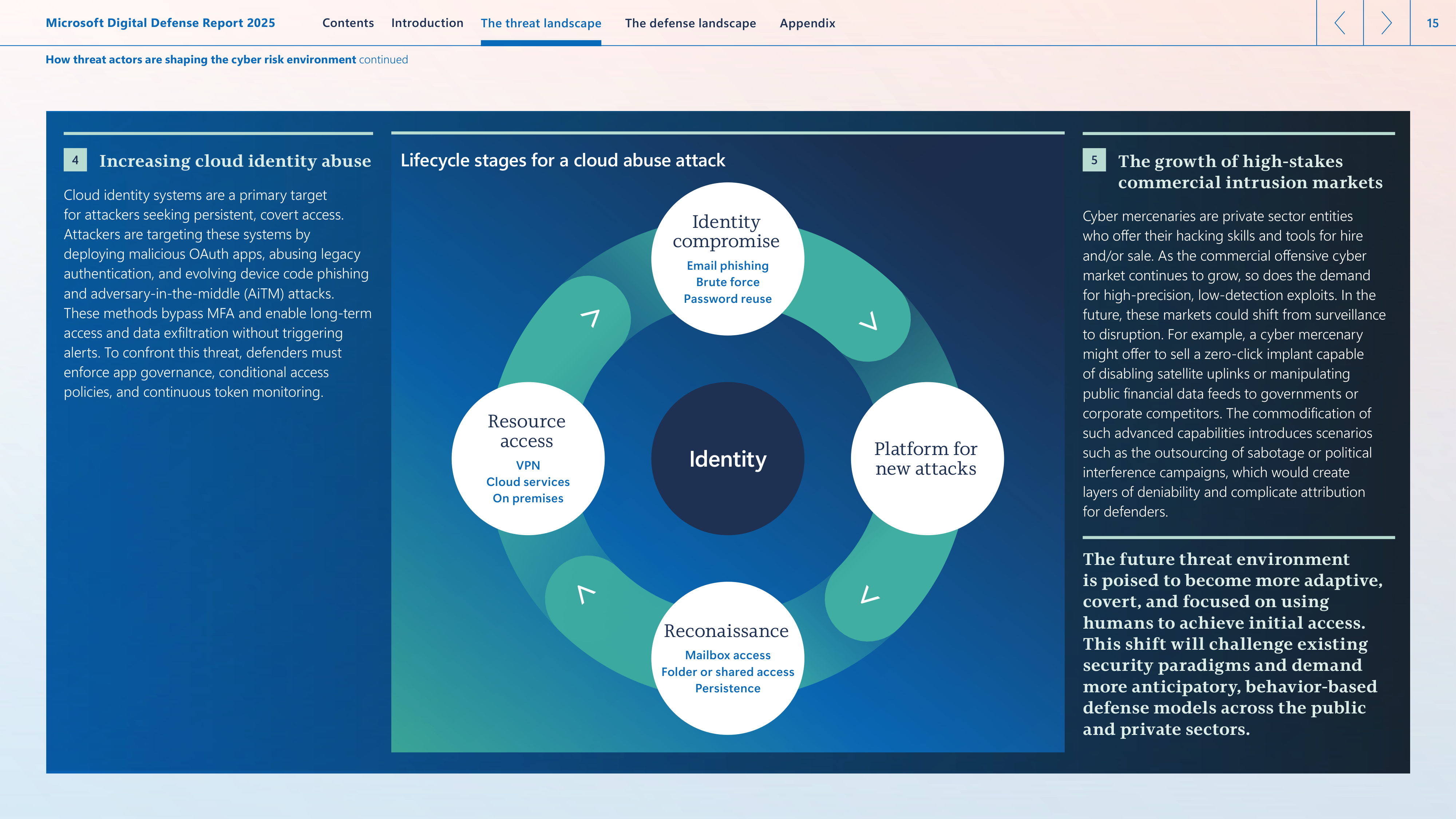
Lifecycle stages for a cloud abuse attack
>
>
>
>
How threat actors are shaping the cyber risk environment
continued
Microsoft Digital Defense Report 2025
15
Introduction
Contents
The defense landscape
Appendix
The threat landscape
Identity
Identity
compromise
Email phishing
Brute force
Password reuse
Platform for
new attacks
Reconaissance
Mailbox access
Folder or shared access
Persistence
Resource
access
VPN
Cloud services
On premises
5
The growth of high-stakes
commercial intrusion markets
Cyber mercenaries are private sector entities
who offer their hacking skills and tools for hire
and/or sale. As the commercial offensive cyber
market continues to grow, so does the demand
for high-precision, low-detection exploits. In the
future, these markets could shift from surveillance
to disruption. For example, a cyber mercenary
might offer to sell a zero-click implant capable
of disabling satellite uplinks or manipulating
public financial data feeds to governments or
corporate competitors. The commodification of
such advanced capabilities introduces scenarios
such as the outsourcing of sabotage or political
interference campaigns, which would create
layers of deniability and complicate attribution
for defenders.
The future threat environment
is poised to become more adaptive,
covert, and focused on using
humans to achieve initial access.
This shift will challenge existing
security paradigms and demand
more anticipatory, behavior-based
defense models across the public
and private sectors.

Identity, access, and the cybercrime economy
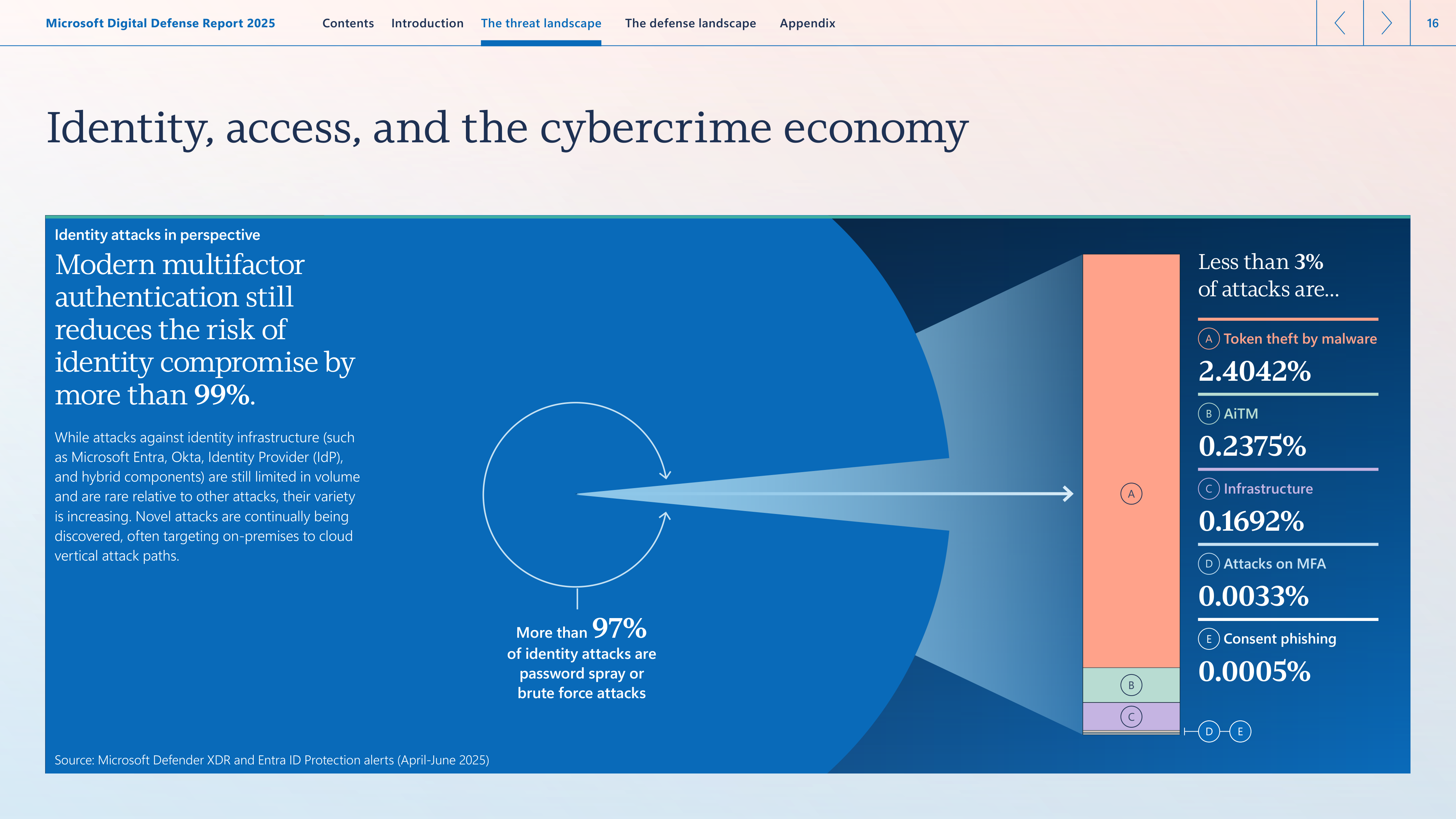
Identity attacks in perspective
Modern multifactor
authentication still
reduces the risk of
identity compromise by
more than
99%
.
While attacks against identity infrastructure (such
as Microsoft Entra, Okta, Identity Provider (IdP),
and hybrid components) are still limited in volume
and are rare relative to other attacks, their variety
is increasing. Novel attacks are continually being
discovered, often targeting on-premises to cloud
vertical attack paths.
Source: Microsoft Defender XDR and Entra ID Protection alerts (April-June 2025)
More than
97%
of identity attacks are
password spray or
brute force attacks
A
B
D
C
Less than
3%
of attacks are…
A
Token theft by malware
2.4042%
B
AiTM
C
D
Attacks on MFA
0.0033%
0.2375%
Infrastructure
0.1692%
E
Consent phishing
0.0005%
Microsoft Digital Defense Report 2025
16
Introduction
Contents
The defense landscape
Appendix
The threat landscape
Identity attacks in perspective
Modern multifactor
authentication still
reduces the risk of
identity compromise by
more than
99%
.
While attacks against identity infrastructure (such
as Microsoft Entra, Okta, Identity Provider (IdP),
and hybrid components) are still limited in volume
and are rare relative to other attacks, their variety
is increasing. Novel attacks are continually being
discovered, often targeting on-premises to cloud
vertical attack paths.
Source: Microsoft Defender XDR and Entra ID Protection alerts (April-June 2025)
A
B
C
D
E

Identity, access, and the cybercrime economy
continued
From end users to workloads:
The new horizon in identity threats
As phishing-resistant MFA and conditional access
strengthen user defenses, attackers are pivoting to
workload identities—apps, services, and scripts that
access cloud resources. These non-human identities
often hold elevated privileges but lack sufficient
security controls, resulting in a growing blind spot
that attackers are exploiting.
App consent phishing tricks users into granting
malicious apps OAuth permissions, bypassing MFA
and persisting beyond password resets. Key Vault
pivoting involves compromising apps with access
to secrets, enabling lateral movement and privilege
escalation, often undetected. Microsoft has observed
layered attacks that combine device code phishing
and OAuth consent phishing, sometimes redirecting
users to AiTM sites. Compromised identities are also
used for internal phishing and lateral movement.
Identity protection must extend to every
identity—including non-human identities—by
verifying explicitly, enforcing least privilege, and
assuming breach.
Learn more
https://aka.ms/identity-attack-techniques
Configure cryptographic key auto-rotation in
Azure Key Vault | Microsoft learn (May 2025)
*
In the first half of
2025, identity-based
attacks rose by 32%.
This escalation may
reflect adversaries’
increasing use of
AI to craft highly
convincing social
engineering
lures—posing
new challenges
for detection and
response at scale.
User impersonation tactics
User impersonation
As organizations move to technologies like
phishing-resistant MFA which make the hacking
or phishing of passwords exponentially more
difficult, adversaries are being forced to use
more sophisticated methods to compromise user
accounts. These include:
•
Token theft
. Stealing a user’s token after they’ve
authenticated, meaning no password compromise
is necessary.
•
Slow password spray.
Trying multiple passwords
over an extended period to avoid detection.
•
Location proximity emulation.
Mimicking a
legitimate user’s location to bypass policies with
geographical restrictions.
•
One-time code (OTC) intercept.
Tricking a user
into generating an OTC and then intercepting it
to authenticate.
Secret store compromise
A secret store is a secure, local vault that
protects sensitive information—including API
keys, passwords, tokens, and certificates—
from unauthorized access, allowing only
approved systems to retrieve them as necessary.
While platforms like Microsoft Azure Key Vault,
AWS Secret Manager, and HashiCorp Vault
offer significant improvements over patchwork
solutions of the 2010s, they’ve also become highly
valuable targets.
Application impersonation and malicious
applications abuse
Attackers compromise applications and users
with the same toolbox. Apps often have more
permissions than they need—the exact elevated
permissions that attackers seek. Another attack
vector lures users into installing malicious apps and
granting them broad permissions that the attacker
can use until the user or the administrator explicitly
revokes them. Application consent screens look
legitimate and seem benign because they don’t ask
for credentials.
Authentication system impersonation
The most catastrophic scenario in identity security
is the theft of a signing key, which compromises
the trust and integrity of entire identity systems.
A signing key is the private half of a public-private
cryptography key pair used to encrypt and decrypt
data. It signs messages so that systems can verify
their authenticity using the pair’s public key. With a
captured signing key, attackers can impersonate
the authentication system itself, forging credentials
to gain access to protected resources and high-
value data.
Microsoft Digital Defense Report 2025
17
Introduction
Contents
The defense landscape
Appendix
The threat landscape


Identity, access, and the cybercrime economy
continued
Microsoft Digital Defense Report 2025
Introduction
Contents
The defense landscape
Appendix
The threat landscape
18
Strategic threats to the research
and academia sector
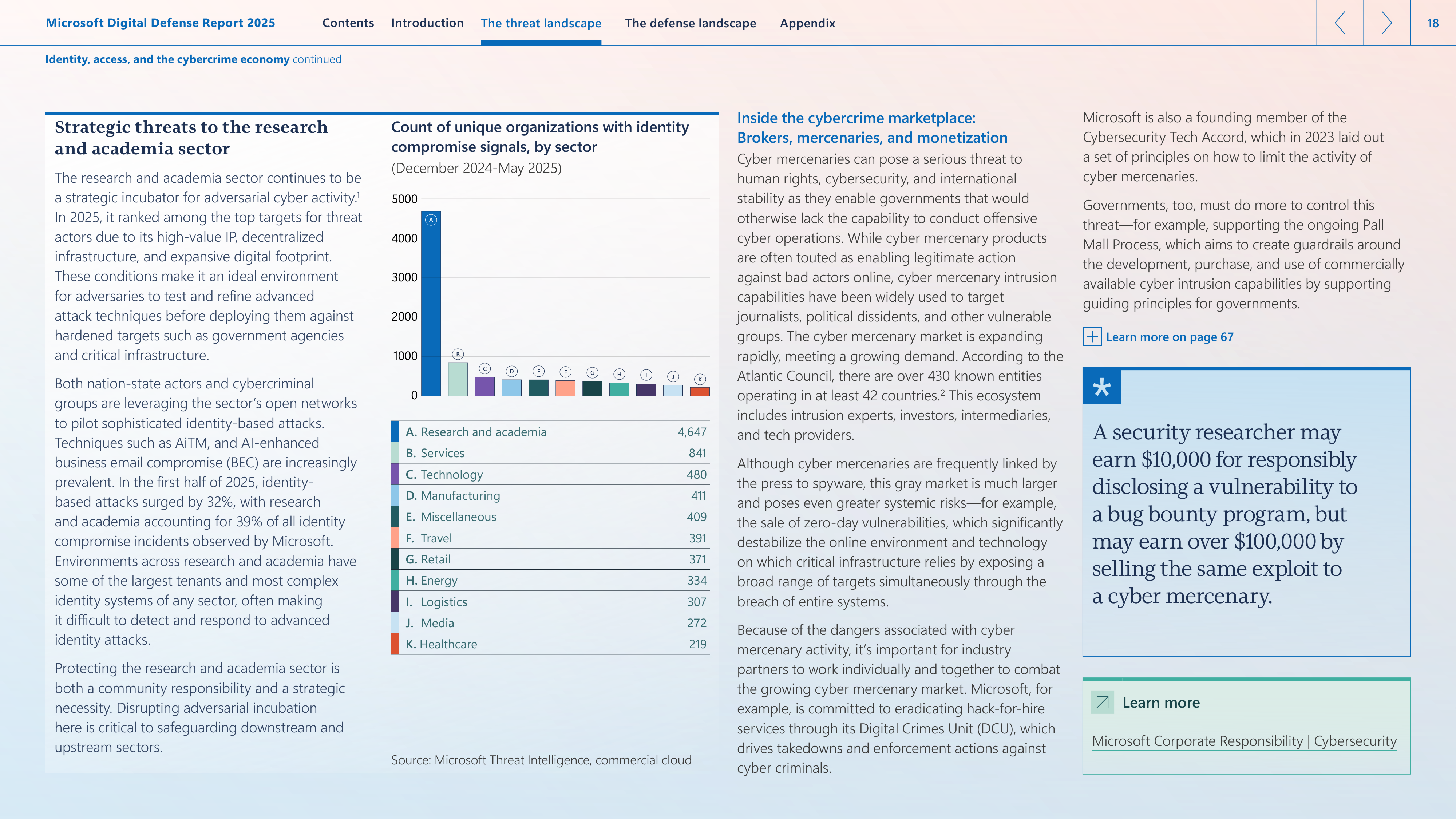
The research and academia sector continues to be
a strategic incubator for adversarial cyber activity.
1
In 2025, it ranked among the top targets for threat
actors due to its high-value IP, decentralized
infrastructure, and expansive digital footprint.
These conditions make it an ideal environment
for adversaries to test and refine advanced
attack techniques before deploying them against
hardened targets such as government agencies
and critical infrastructure.
Both nation-state actors and cybercriminal
groups are leveraging the sector’s open networks
to pilot sophisticated identity-based attacks.
Techniques such as AiTM, and AI-enhanced
business email compromise (BEC) are increasingly
prevalent. In the first half of 2025, identity-
based attacks surged by 32%, with research
and academia accounting for 39% of all identity
compromise incidents observed by Microsoft.
Environments across research and academia have
some of the largest tenants and most complex
identity systems of any sector, often making
it difficult to detect and respond to advanced
identity attacks.
Protecting the research and academia sector is
both a community responsibility and a strategic
necessity. Disrupting adversarial incubation
here is critical to safeguarding downstream and
upstream sectors.
Count of unique organizations with identity
compromise signals, by sector
(December 2024-May 2025)
5000
A
D
B
4000
3000
2000
1000
0
C
E
F
G
H
I
J
K
A.
Research and academia
4,647
B.
Services
841
C.
Technology
480
D.
Manufacturing
411
E.
Miscellaneous
409
F.
Travel
391
G.
Retail
371
H.
Energy
334
I.
Logistics
307
J.
Media
272
K.
Healthcare
219
Source: Microsoft Threat Intelligence, commercial cloud
Inside the cybercrime marketplace:
Brokers, mercenaries, and monetization
Cyber mercenaries can pose a serious threat to
human rights, cybersecurity, and international
stability as they enable governments that would
otherwise lack the capability to conduct offensive
cyber operations. While cyber mercenary products
are often touted as enabling legitimate action
against bad actors online, cyber mercenary intrusion
capabilities have been widely used to target
journalists, political dissidents, and other vulnerable
groups. The cyber mercenary market is expanding
rapidly, meeting a growing demand. According to the
Atlantic Council, there are over 430 known entities
operating in at least 42 countries.
Note 2
This ecosystem
includes intrusion experts, investors, intermediaries,
and tech providers.
Although cyber mercenaries are frequently linked by
the press to spyware, this gray market is much larger
and poses even greater systemic risks—for example,
the sale of zero-day vulnerabilities, which significantly
destabilize the online environment and technology
on which critical infrastructure relies by exposing a
broad range of targets simultaneously through the
breach of entire systems.
Because of the dangers associated with cyber
mercenary activity, it’s important for industry
partners to work individually and together to combat
the growing cyber mercenary market. Microsoft, for
example, is committed to eradicating hack-for-hire
services through its Digital Crimes Unit (DCU), which
drives takedowns and enforcement actions against
cyber criminals.
Microsoft is also a founding member of the
Cybersecurity Tech Accord, which in 2023 laid out
a set of principles on how to limit the activity of
cyber mercenaries.
Governments, too, must do more to control this
threat—for example, supporting the ongoing Pall
Mall Process, which aims to create guardrails around
the development, purchase, and use of commercially
available cyber intrusion capabilities by supporting
guiding principles for governments.
Learn more on page 67
*
A security researcher may
earn $10,000 for responsibly
disclosing a vulnerability to
a bug bounty program, but
may earn over $100,000 by
selling the same exploit to
a cyber mercenary.
Learn more
Microsoft Corporate Responsibility
|
Cybersecurity

H
G
F
B
D
A
C
E
Access brokers: The hidden
gatekeepers of cybercrime
In the cybercrime economy’s highly specialized and
scalable ecosystem, access brokers play a pivotal
role. These actors specialize in breaching enterprise
environments and selling persistent access to
other criminals, including ransomware operators,
data extortion groups, and cyber mercenaries.
Their services are foundational to the cybercrime-
as-a-service (CaaS) model, enabling threat actors to
outsource initial access and focus on monetization
instead. These brokers often bundle access with
reconnaissance data, making it even easier for buyers
to deploy ransomware or exfiltrate data.
As part of a wider strategy to degrade infrastructure
supporting large-scale cybercrime, Microsoft’s DCU
has intensified its focus on disrupting access brokers
through a combination of legal, technical, and
intelligence-driven actions.
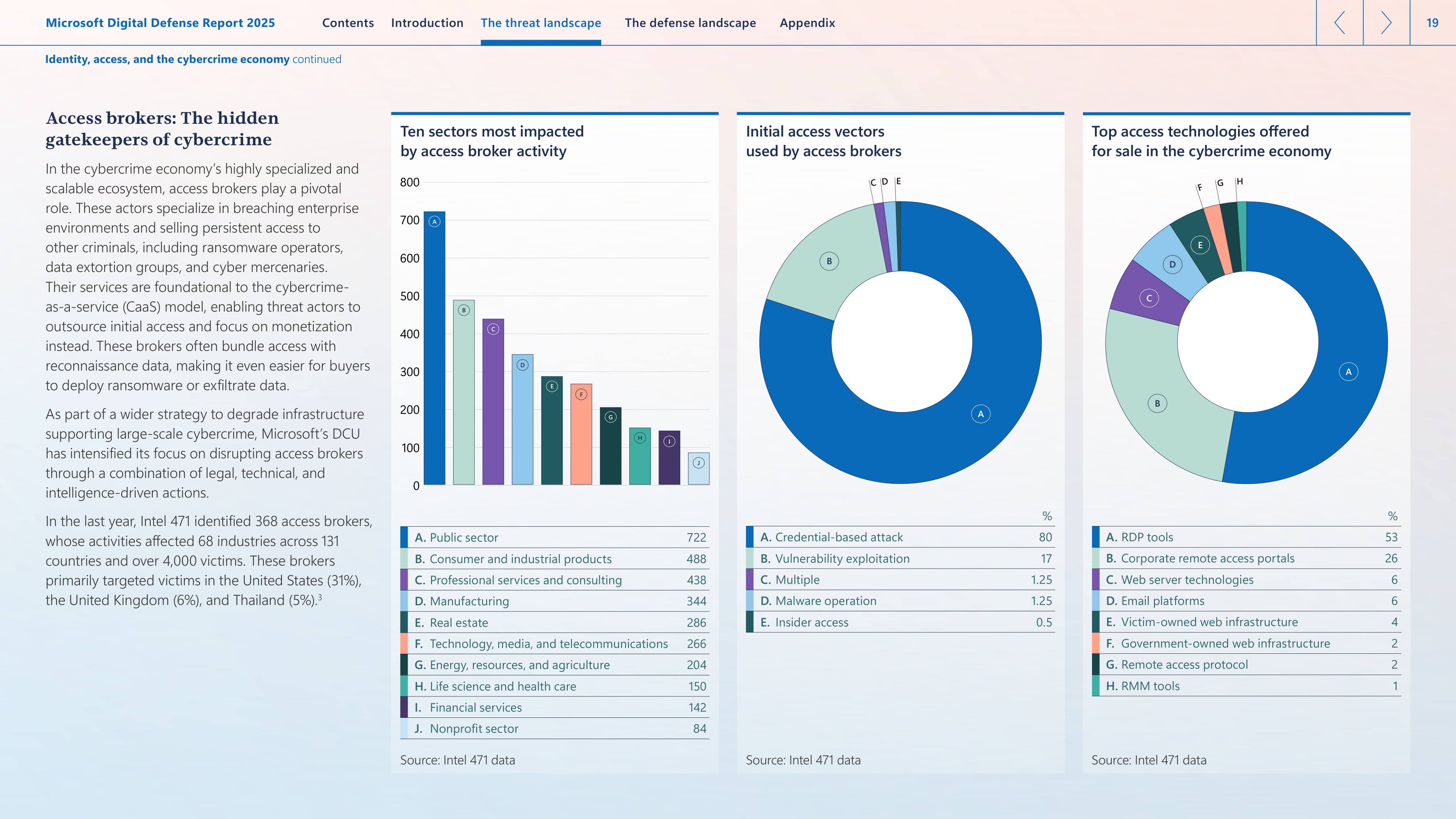
In the last year, Intel 471 identified 368 access brokers,
whose activities affected 68 industries across 131
countries and over 4,000 victims. These brokers
primarily targeted victims in the United States (31%),
the United Kingdom (6%), and Thailand (5%).
3
Ten sectors most impacted
by access broker activity
A.
Public sector
722
B.
Consumer and industrial products
488
C.
Professional
services
and
consulting
438
D.
Manufacturing
344
E.
Real estate
286
F.
Technology, media, and telecommunications
266
G.
Energy, resources, and agriculture
204
H.
Life
science
and
health
care
150
I.
Financial services
142
J.
Nonprofit
sector
84
Source: Intel 471 data
Initial access vectors
used by access brokers
%
A.
Credential-based attack
80
B.
Vulnerability exploitation
17
C.
Multiple
1.25
D.
Malware operation
1.25
E.
Insider access
0.5
Source: Intel 471 data
Top access technologies offered
for sale in the cybercrime economy
%
A.
RDP
tools
53
B.
Corporate remote access portals
26
C.
Web server technologies
6
D.
Email
platforms
6
E.
Victim-owned
web
infrastructure
4
F.
Government-owned
web
infrastructure
2
G.
Remote access protocol
2
H.
RMM tools
1
Source: Intel 471 data
Identity, access, and the cybercrime economy
continued
Microsoft Digital Defense Report 2025
Introduction
Contents
The defense landscape
Appendix
The threat landscape
19
800
700
600
500
400
300
200
100
0
A
C
E
G
I
B
D
F
H
J
E
D
C
B
A
Microsoft Digital Defense Report 2025
Introduction
Contents
The defense landscape
Appendix
The threat landscape
20
Identity, access, and the cybercrime economy
continued
Exploiting vulnerabilities: The persistent threat
of unpatched systems
Vulnerability exploitation remains one of the most
reliable, scalable, and silent methods of initial access
for threat actors. In the last year, Microsoft Defender
Experts observed a surge in exploitation campaigns
targeting known flaws in widely used enterprise
systems and third-party IT tools. In most cases,
exploitation achieves one of three outcomes:
• initial access into protected environments,
• privilege escalation from user to admin
• arbitrary code execution to enable lateral
movement or persistence
This activity demonstrates that a strategic pivot
toward infrastructure-level compromise is the new
baseline for initial access.
What makes this threat vector especially dangerous
is its lack of dependency on user interaction.
From remote code execution (RCE) in infrastructure
software to logic flaws in authentication mechanisms,
attackers are increasingly skipping phishing and
going straight for the code. Even misconfigurations
in trusted platforms become high-value entry points.
Most of these attacks start with a known Common
Vulnerabilities and Exposures (CVE) exploit and end
in compromise.
This year, key vulnerability exploitations that our
Defender Experts observed included:
• SimpleHelp RCE chain (CVE-2024-57726/27/28)
• BeyondTrust Privileged Remote Access (PRA)
and Remote Support (RS) Command Injection
Vulnerability (CVE-2024-12356)
• Fortinet FortiClient EMS SQL Injection Vulnerability
(CVE-2023-48788)
• Cleo Multiple Products Unrestricted File Upload
Vulnerability (CVE-2024-50623)
• Apache Tomcat Path Equivalence Vulnerability
(CVE-2025-24813)
Effective defense isn’t just patching fast—it’s
expecting gaps and building layers of resilience
through anomaly detection, behavior-based
analytics, and hardening high-risk assets.
“
Vulnerability
exploitation remains
one of the most
reliable, scalable,
and silent methods
of initial access for
threat actors.
Recommendations
Patch fast, patch early
Prioritize patching for high-impact CVEs,
especially in internet-facing infrastructure
and remote access tools.
Isolate management interfaces.
Where possible, restrict RMM tools and
administrative consoles to management
networks or VPN-only access.
Employ exploit detection.
Use behavior-based analytics to flag
abnormal post-exploitation behavior
(for example, Local Security Authority
Subsystem Service (LSASS) access, registry
dumping, and outbound tunnelling).


Password spray: Anatomy
of a high-volume attack
Despite their low per-attempt success rate,
password spray attacks remain a persistent
and high-volume threat.
These attacks rely on substantial infrastructure,
allowing adversaries to distribute their activity across
numerous IP addresses (IP).
Autonomous System Numbers (ASNs) are unique
identifiers for collections of IP networks managed
by single organizations. While over 50,000 ASNs
carry authentication traffic daily, just 20 ASNs—only
0.04%—account for more than 80% of malicious
password spray activity. This concentration
underscores the importance of targeted threat
intelligence and infrastructure-aware defenses.
Microsoft uses AI to analyze authentication data and
detect subtle patterns of password spray activity
hidden within legitimate traffic. When suspicious
IPs are identified, authentication attempts can be
temporarily blocked, disrupting attacker operations
without affecting legitimate users. This approach
enables real-time protection and adapts to evolving
attacker tactics like automation and rapid IP rotation.
To avoid detection, attackers often employ a “low
and slow” strategy, using a single IP address to target
a small number of identities over extended periods.
To reach a larger scale, they automate attacks across
many IP addresses. Cloud-based infrastructure
is particularly attractive to attackers, as it offers
virtualization, orchestration, and access to a wide
range of distinct IP addresses.
Learn more on page 72
“
Just 20 ASNs—only 0.04%—
account for more than
80% of malicious password
spray activity.
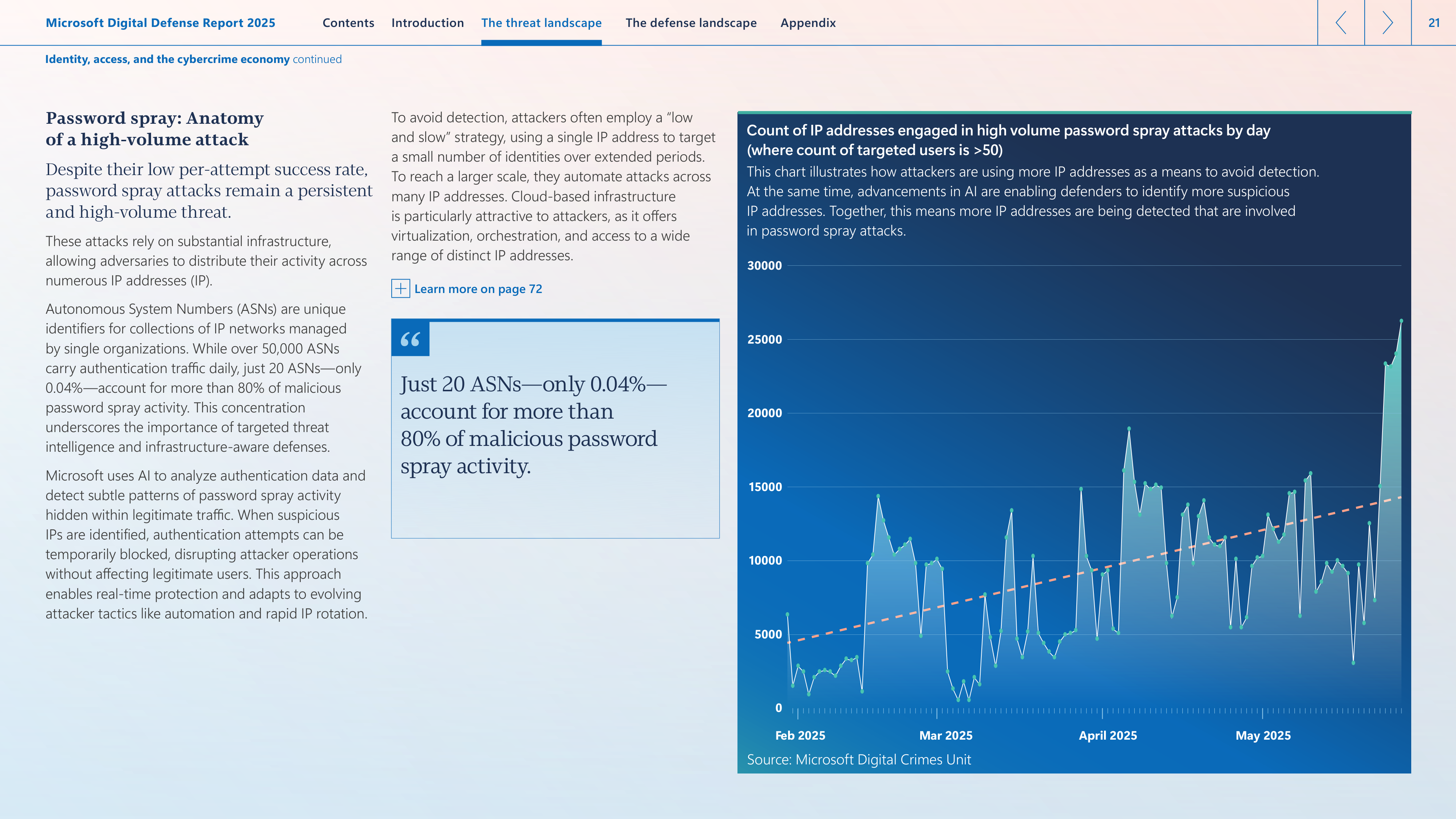
Count of IP addresses engaged in high volume password spray attacks by day
(where count of targeted users is >50)
This chart illustrates how attackers are using more IP addresses as a means to avoid detection.
At the same time, advancements in AI are enabling defenders to identify more suspicious
IP addresses. Together, this means more IP addresses are being detected that are involved
in password spray attacks.
Source: Microsoft Digital Crimes Unit
Identity, access, and the cybercrime economy
continued
0
5000
10000
15000
20000
25000
30000
Feb 2025
Mar 2025
April 2025
May 2025
Microsoft Digital Defense Report 2025
Introduction
Contents
The defense landscape
Appendix
The threat landscape
21
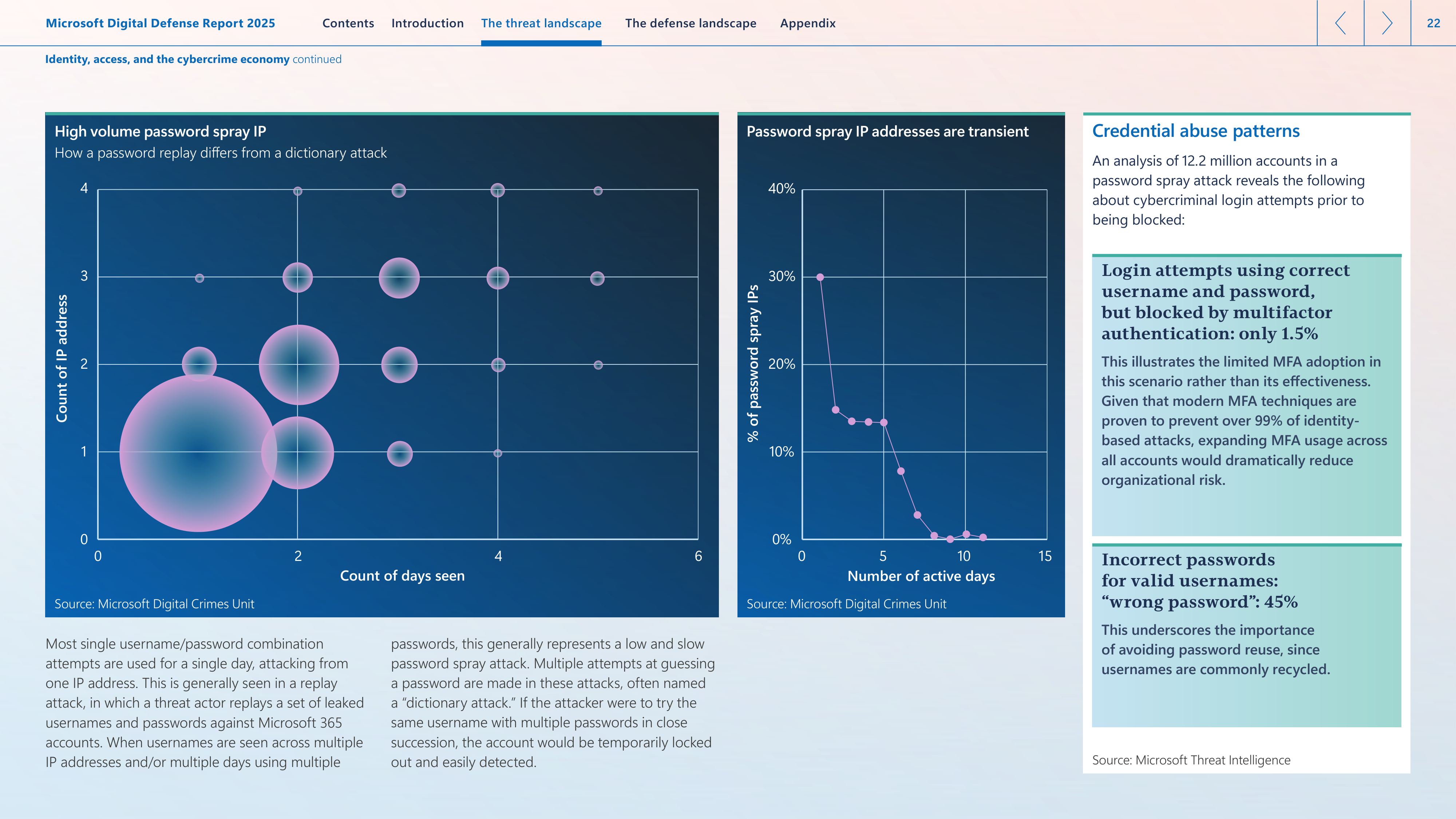

High volume password spray IP
How a password replay differs from a dictionary attack
0
2
4
6
0
2
1
3
4
Count of IP address
Count of days seen
Identity, access, and the cybercrime economy
continued
Source: Microsoft Digital Crimes Unit
Most single username/password combination
attempts are used for a single day, attacking from
one IP address. This is generally seen in a replay
attack, in which a threat actor replays a set of leaked
usernames and passwords against Microsoft 365
accounts. When usernames are seen across multiple
IP addresses and/or multiple days using multiple
passwords, this generally represents a low and slow
password spray attack. Multiple attempts at guessing
a password are made in these attacks, often named
a “dictionary attack.” If the attacker were to try the
same username with multiple passwords in close
succession, the account would be temporarily locked
out and easily detected.
Password spray IP addresses are transient
Source: Microsoft Digital Crimes Unit
Credential abuse patterns
An
analysis
of
12.2
million
accounts
in
a
password
spray
attack
reveals
the
following
about cybercriminal login attempts prior to
being
blocked:
Login attempts using correct
username and password,
but blocked by multifactor
authentication: only 1.5%
This illustrates the limited MFA adoption in
this scenario rather than its effectiveness.
Given that modern MFA techniques are
proven to prevent over 99% of identity-
based attacks, expanding MFA usage across
all accounts would dramatically reduce
organizational risk.
Incorrect passwords
for valid usernames:
“wrong password”: 45%
This underscores the importance
of avoiding password reuse, since
usernames are commonly recycled.
Source: Microsoft Threat Intelligence
0
5
10
15
0%
20%
10%
30%
40%
% of password spray IPs
Number of active days
Microsoft Digital Defense Report 2025
Introduction
Contents
The defense landscape
Appendix
The threat landscape
22
23
Microsoft Digital Defense Report 2025
Contents
Introduction
The threat landscape
The defense landscape
Appendix
Identity, access, and the cybercrime economy
continued
Target demographics and exposure
Research and academic environments remain
disproportionately targeted in password spray
attacks, accounting for 52% of observed spray
attempts. Factors contributing to this include
decentralized IT management, high user turnover,
and inconsistent MFA enforcement—conditions also
observed in other vulnerable sectors such as rural
healthcare. A May 2025 comparative analysis with
the Have I Been Pwned database revealed that 85%
of usernames targeted in spray attacks appeared
in known credential leaks. On average, each
compromised username appeared in three separate
logs, highlighting the magnitude of the global
credential leak problem and the importance of users
regularly changing passwords.
Recommendations
To reduce the risk and impact of password spray attacks, organizations should adopt
a multi-layered identity protection strategy. This includes taking the following measures:
Enforce phishing-resistant MFA for all users
Phishing-resistant MFA remains the most
effective control against unauthorized access
using compromised credentials. Even when
attackers possess valid usernames and passwords,
MFA blocks access in over 99% of cases.
Organizations should monitor for accounts
with valid credentials but unenrolled MFA
and enforce enrollment policies to close this
gap. Organizations should also implement
conditional access policies and use risk-based
conditional access to block or challenge sign-ins
from suspicious IP addresses, geographies, or
device types.
Monitor and block malicious IP addresses
and ASNs
Continuously monitor authentication logs for error
code 50053 and other indicators of spray activity.
Block IP addresses and ASNs with repeated failed
sign-in attempts or known malicious behavior.
Audit and decommission stale accounts
Regularly review and disable inactive accounts,
which are often targeted in spray attacks.
Ensure that deprovisioned accounts are removed
from all authentication systems.
Educate users on credential hygiene
Promote the use of strong, unique passwords and
discourage password reuse. Encourage users to
check their credentials against breach databases
such as Have I Been Pwned.
Note 4
Deploy AI-based detection and response
Use AI-driven tools to detect anomalous sign-
in patterns and flag potential spray attacks in
real time.
“
On average, each
compromised
username appeared
in three separate
logs, highlighting
the magnitude
of the global
credential
leak problem.

24
Microsoft Digital Defense Report 2025
Contents
Introduction
The threat landscape
The defense landscape
Appendix
Human-operated attacks and ransomware
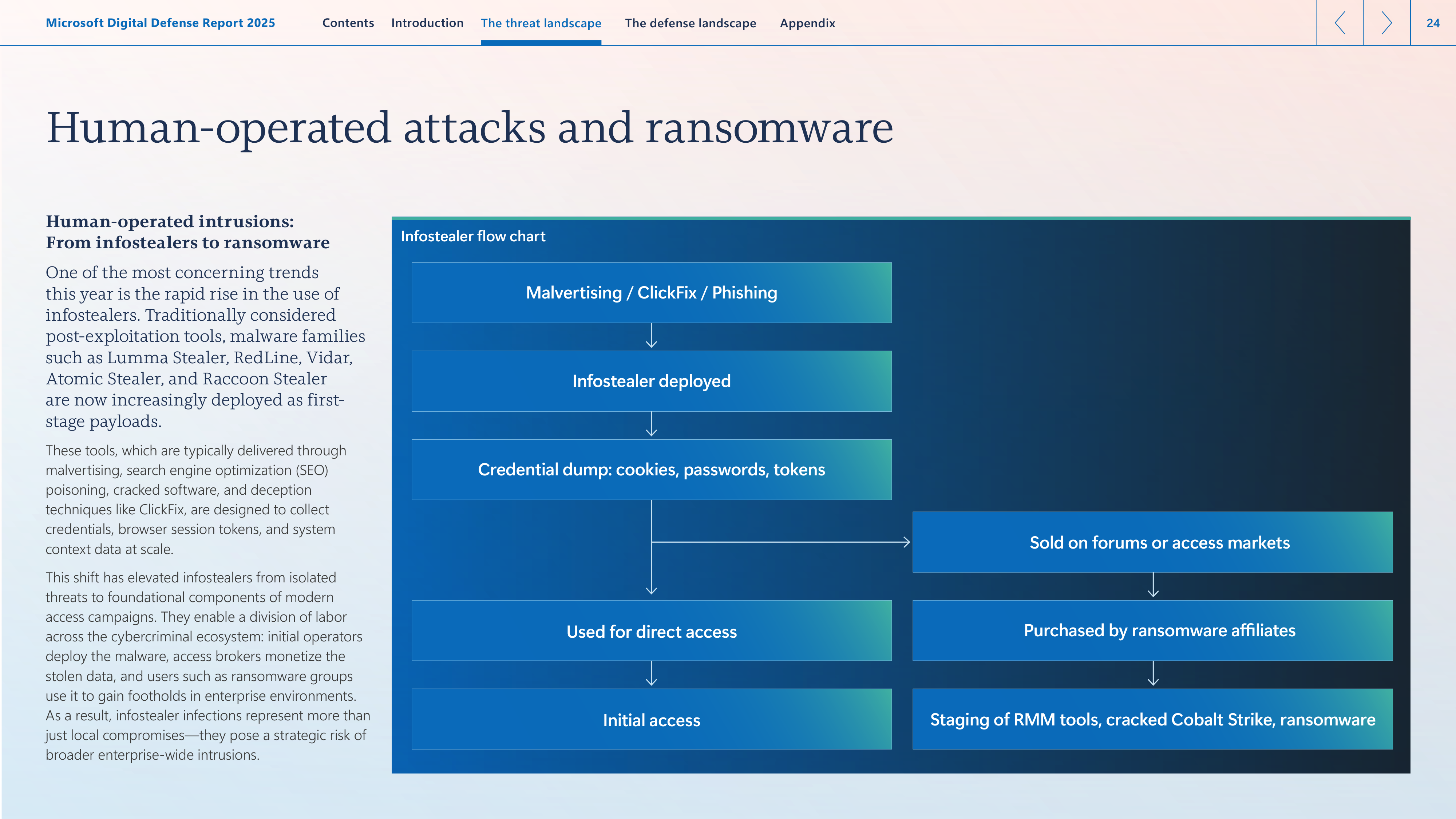
Human-operated intrusions:
From infostealers to ransomware
One of the most concerning trends
this year is the rapid rise in the use of
infostealers. Traditionally considered
post-exploitation tools, malware families
such as Lumma Stealer, RedLine, Vidar,
Atomic Stealer, and Raccoon Stealer
are now increasingly deployed as first-
stage payloads.
These tools, which are typically delivered through
malvertising, search engine optimization (SEO)
poisoning, cracked software, and deception
techniques like ClickFix, are designed to collect
credentials, browser session tokens, and system
context data at scale.
This shift has elevated infostealers from isolated
threats to foundational components of modern
access campaigns. They enable a division of labor
across the cybercriminal ecosystem: initial operators
deploy the malware, access brokers monetize the
stolen data, and users such as ransomware groups
use it to gain footholds in enterprise environments.
As a result, infostealer infections represent more than
just local compromises—they pose a strategic risk of
broader enterprise-wide intrusions.
Infostealer flow chart
Malvertising / ClickFix / Phishing
Infostealer deployed
Credential dump: cookies, passwords, tokens
Used for direct access
Initial access
Sold on forums or access markets
Purchased by ransomware affiliates
Staging of RMM tools, cracked Cobalt Strike, ransomware


25
Microsoft Digital Defense Report 2025
Contents
Introduction
The threat landscape
The defense landscape
Appendix
Human-operated attacks and ransomware
continued
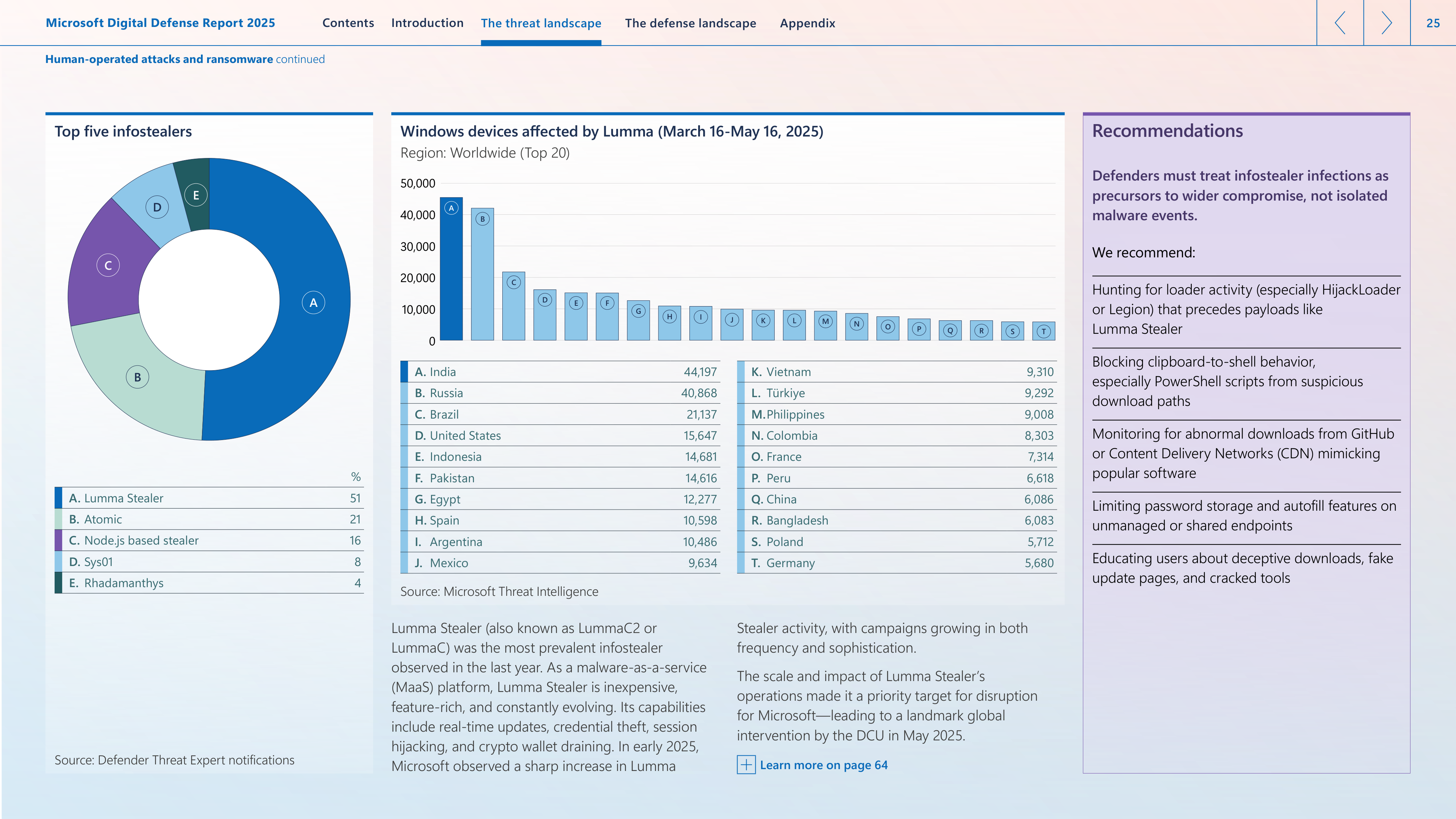
Top five infostealers
B
D
A
C
E
%
A.
Lumma Stealer
51
B.
Atomic
21
C.
Node.js based stealer
16
D.
Sys01
8
E.
Rhadamanthys
4
Source: Defender Threat Expert notifications
Windows devices affected by Lumma (March 16-May 16, 2025)
Region: Worldwide (Top 20)
50,000
40,000
30,000
20,000
10,000
0
T
S
R
Q
P
O
N
M
L
K
J
I
H
G
F
E
D
C
B
A
A.
India
44,197
B.
Russia
40,868
C.
Brazil
21,137
D.
United States
15,647
E.
Indonesia
14,681
F.
Pakistan
14,616
G.
Egypt
12,277
H.
Spain
10,598
I.
Argentina
10,486
J.
Mexico
9,634
K.
Vietnam
9,310
L.
Türkiye
9,292
M.
Philippines
9,008
N.
Colombia
8,303
O.
France
7,314
P.
Peru
6,618
Q.
China
6,086
R.
Bangladesh
6,083
S.
Poland
5,712
T.
Germany
5,680
Source: Microsoft Threat Intelligence
Lumma Stealer (also known as LummaC2 or
LummaC) was the most prevalent infostealer
observed in the last year. As a malware-as-a-service
(MaaS) platform, Lumma Stealer is inexpensive,
feature-rich, and constantly evolving. Its capabilities
include real-time updates, credential theft, session
hijacking, and crypto wallet draining. In early 2025,
Microsoft observed a sharp increase in Lumma
Stealer activity, with campaigns growing in both
frequency and sophistication.
The scale and impact of Lumma Stealer’s
operations made it a priority target for disruption
for Microsoft—leading to a landmark global
intervention by the DCU in May 2025.
Learn more on page 64
Recommendations
Defenders must treat infostealer infections as
precursors to wider compromise, not isolated
malware
events.
We recommend:
Hunting for loader activity (especially HijackLoader
or Legion) that precedes payloads like
Lumma Stealer
Blocking clipboard-to-shell behavior,
especially PowerShell scripts from suspicious
download paths
Monitoring for abnormal downloads from GitHub
or Content Delivery Networks (CDN) mimicking
popular software
Limiting password storage and autofill features on
unmanaged or shared endpoints
Educating users about deceptive downloads, fake
update pages, and cracked tools
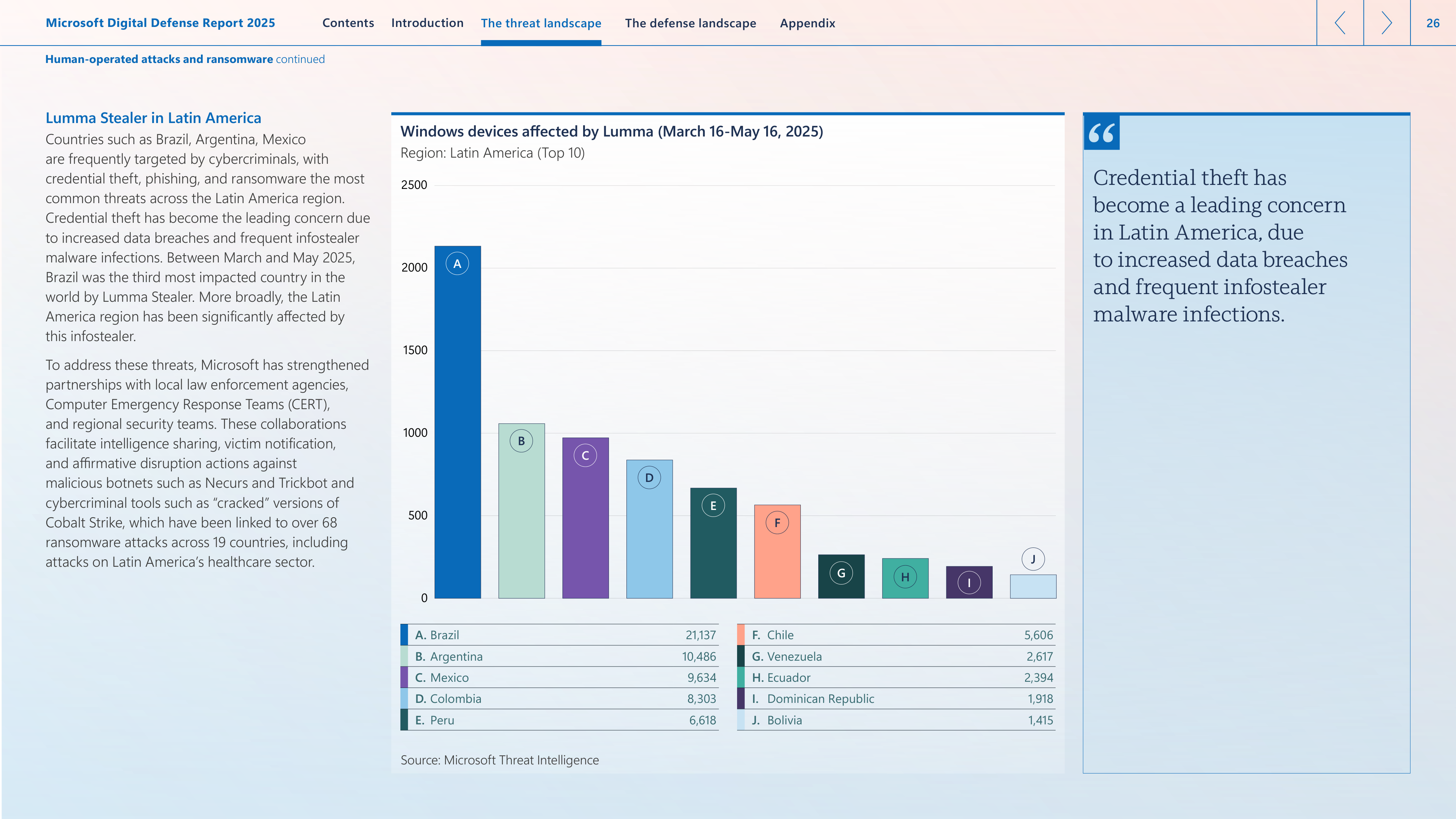

26
Microsoft Digital Defense Report 2025
Contents
Introduction
The threat landscape
The defense landscape
Appendix
Human-operated attacks and ransomware
continued
Lumma Stealer in Latin America
Countries such as Brazil, Argentina, Mexico
are frequently targeted by cybercriminals, with
credential theft, phishing, and ransomware the most
common threats across the Latin America region.
Credential theft has become the leading concern due
to increased data breaches and frequent infostealer
malware infections. Between March and May 2025,
Brazil was the third most impacted country in the
world by Lumma Stealer. More broadly, the Latin
America region has been significantly affected by
this infostealer.
To address these threats, Microsoft has strengthened
partnerships with local law enforcement agencies,
Computer Emergency Response Teams (CERT),
and regional security teams. These collaborations
facilitate intelligence sharing, victim notification,
and affirmative disruption actions against
malicious botnets such as Necurs and Trickbot and
cybercriminal tools such as “cracked” versions of
Cobalt Strike, which have been linked to over 68
ransomware attacks across 19 countries, including
attacks on Latin America’s healthcare sector.
Windows devices affected by Lumma (March 16-May 16, 2025)
Region: Latin America (Top 10)
2500
2000
1500
1000
500
0
A
C
E
G
I
D
F
H
B
J
A.
Brazil
21,137
B.
Argentina
10,486
C.
Mexico
9,634
D.
Colombia
8,303
E.
Peru
6,618
F.
Chile
5,606
G.
Venezuela
2,617
H.
Ecuador
2,394
I.
Dominican Republic
1,918
J.
Bolivia
1,415
Source: Microsoft Threat Intelligence
“
Credential theft has
become a leading concern
in Latin America, due
to increased data breaches
and frequent infostealer
malware infections.
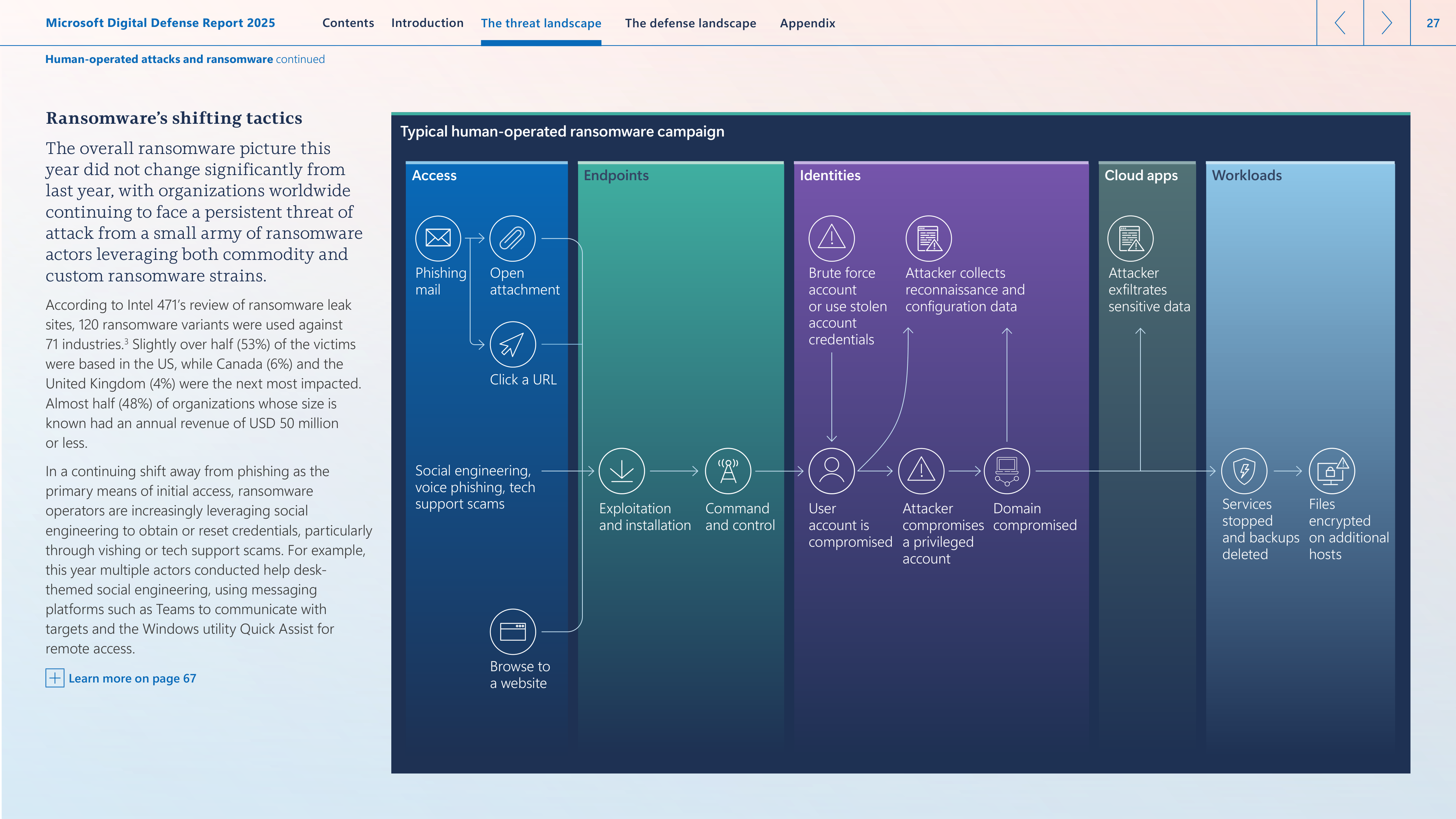

27
Microsoft Digital Defense Report 2025
Contents
Introduction
The threat landscape
The defense landscape
Appendix
Human-operated attacks and ransomware
continued
Ransomware’s shifting tactics
The overall ransomware picture this
year did not change significantly from
last year, with organizations worldwide
continuing to face a persistent threat of
attack from a small army of ransomware
actors leveraging both commodity and
custom ransomware strains.
According to Intel 471’s review of ransomware leak
sites, 120 ransomware variants were used against
71 industries.
Note 3
Slightly over half (53%) of the victims
were based in the US, while Canada (6%) and the
United Kingdom (4%) were the next most impacted.
Almost half (48%) of organizations whose size is
known had an annual revenue of USD 50 million
or less.
In a continuing shift away from phishing as the
primary means of initial access, ransomware
operators are increasingly leveraging social
engineering to obtain or reset credentials, particularly
through vishing or tech support scams. For example,
this year multiple actors conducted help desk-
themed social engineering, using messaging
platforms such as Teams to communicate with
targets and the Windows utility Quick Assist for
remote access.
Learn more on page 67
Typical
human-operated
ransomware
campaign
Phishing
mail
Access
Endpoints
Identities
Cloud
apps
Workloads
Social engineering,
voice phishing, tech
support scams
Exploitation
and installation
Command
and control
User
account is
compromised
Brute force
account
or use stolen
account
credentials
Attacker collects
reconnaissance and
configuration
data
Attacker
compromises
a privileged
account
Domain
compromised
Attacker
exfiltrates
sensitive data
Services
stopped
and backups
deleted
Files
encrypted
on additional
hosts
Browse to
a website
Open
attachment
Click a URL
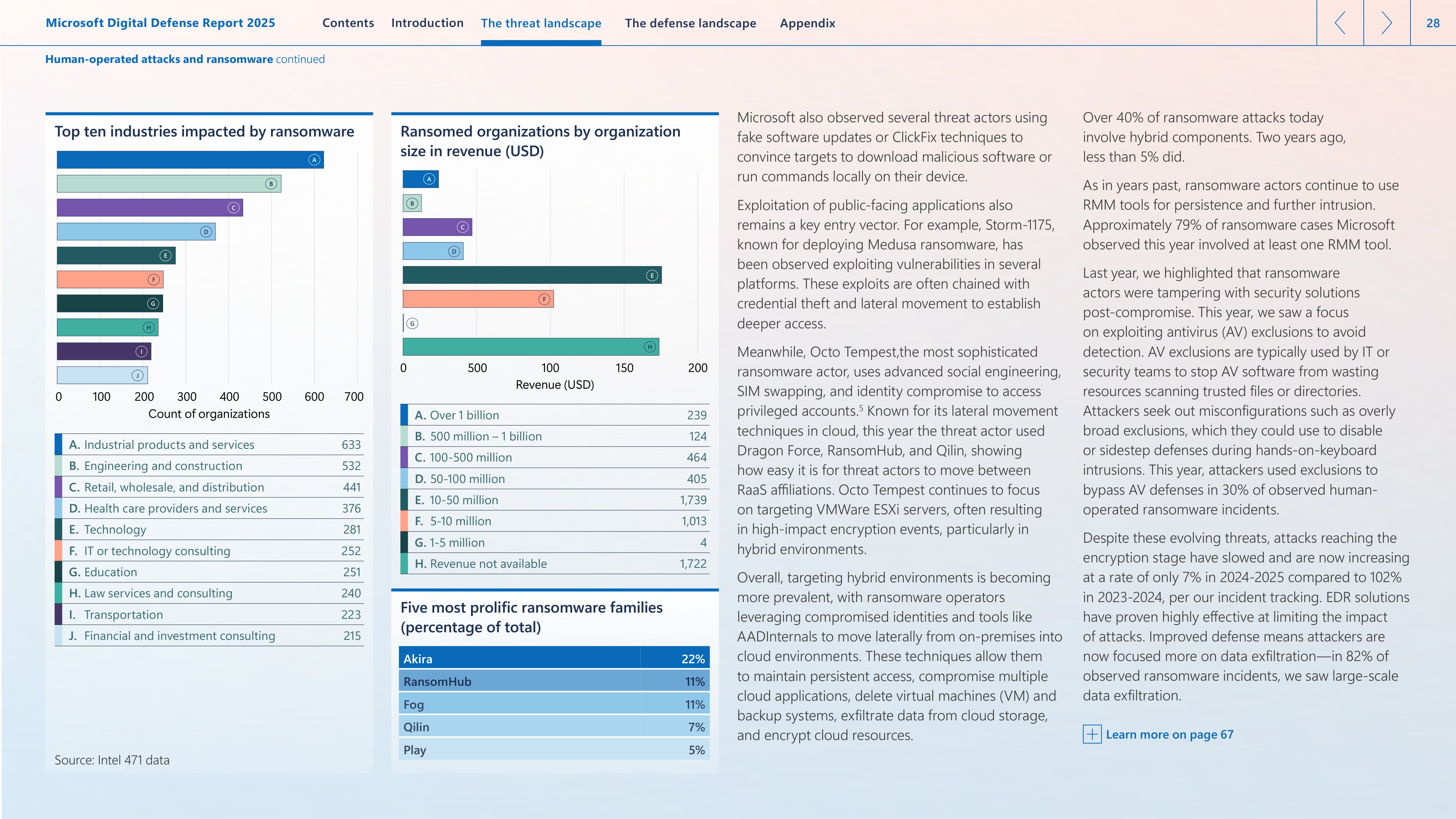

28
Microsoft Digital Defense Report 2025
Contents
Introduction
The threat landscape
The defense landscape
Appendix
Human-operated attacks and ransomware
continued
Top ten industries impacted by ransomware
Count of organizations
A.
Industrial products and services
633
B.
Engineering and construction
532
C.
Retail, wholesale, and distribution
441
D.
Health care providers and services
376
E.
Technology
281
F.
IT or technology consulting
252
G.
Education
251
H.
Law services and consulting
240
I.
Transportation
223
J.
Financial and investment consulting
215
Source: Intel 471 data
Ransomed organizations by organization
size in revenue (USD)
A
B
D
F
I
J
C
E
G
H
0
500
100
150
200
Revenue (USD)
G
C
H
E
D
F
B
A
0
100
200
300
400
500
600
700
A.
Over 1 billion
239
B.
500 million – 1 billion
124
C.
100-500 million
464
D.
50-100 million
405
E.
10-50 million
1,739
F.
5-10 million
1,013
G.
1-5 million
4
H.
Revenue not available
1,722
Five most prolific ransomware families
(percentage of total)
Akira
22%
RansomHub
11%
Fog
11%
Qilin
7%
Play
5%
Microsoft also observed several threat actors using
fake software updates or ClickFix techniques to
convince targets to download malicious software or
run commands locally on their device.
Exploitation of public-facing applications also
remains a key entry vector. For example, Storm-1175,
known for deploying Medusa ransomware, has
been observed exploiting vulnerabilities in several
platforms. These exploits are often chained with
credential theft and lateral movement to establish
deeper access.
Meanwhile, Octo Tempest,
the most sophisticated
ransomware actor, uses advanced social engineering,
SIM swapping, and identity compromise to access
privileged accounts.
Note 5
Known for its lateral movement
techniques in cloud, this year the threat actor used
Dragon Force, RansomHub, and Qilin, showing
how easy it is for threat actors to move between
RaaS affiliations. Octo Tempest continues to focus
on targeting VMWare ESXi servers, often resulting
in high-impact encryption events, particularly in
hybrid environments.
Overall, targeting hybrid environments is becoming
more prevalent, with ransomware operators
leveraging compromised identities and tools like
AADInternals to move laterally from on-premises into
cloud environments. These techniques allow them
to maintain persistent access, compromise multiple
cloud applications, delete virtual machines (VM) and
backup systems, exfiltrate data from cloud storage,
and encrypt cloud resources.
Over 40% of ransomware attacks today
involve hybrid components. Two years ago,
less than 5% did.
As in years past, ransomware actors continue to use
RMM tools for persistence and further intrusion.
Approximately 79% of ransomware cases Microsoft
observed this year involved at least one RMM tool.
Last year, we highlighted that ransomware
actors were tampering with security solutions
post-compromise. This year, we saw a focus
on exploiting antivirus (AV) exclusions to avoid
detection. AV exclusions are typically used by IT or
security teams to stop AV software from wasting
resources scanning trusted files or directories.
Attackers seek out misconfigurations such as overly
broad exclusions, which they could use to disable
or sidestep defenses during hands-on-keyboard
intrusions. This year, attackers used exclusions to
bypass AV defenses in 30% of observed human-
operated ransomware incidents.
Despite these evolving threats, attacks reaching the
encryption stage have slowed and are now increasing
at a rate of only 7% in 2024-2025 compared to 102%
in 2023-2024, per our incident tracking. EDR solutions
have proven highly effective at limiting the impact
of attacks. Improved defense means attackers are
now focused more on data exfiltration—in 82% of
observed ransomware incidents, we saw large-scale
data
exfiltration.
Learn more on page 67
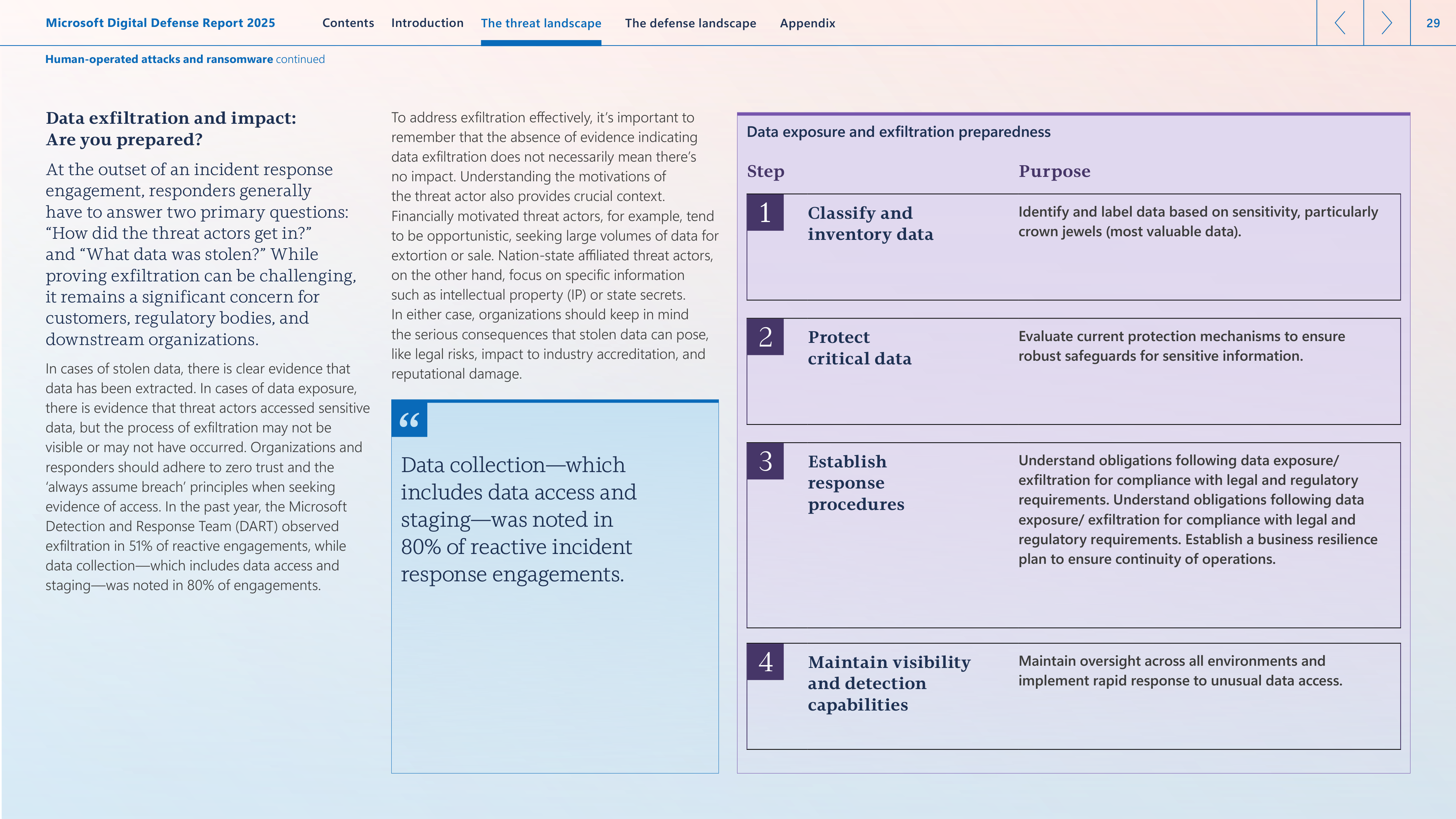
29
Microsoft Digital Defense Report 2025
Contents
Introduction
The threat landscape
The defense landscape
Appendix
Human-operated attacks and ransomware
continued
Data exfiltration and impact:
Are you prepared?
At the outset of an incident response
engagement, responders generally
have to answer two primary questions:
“How did the threat actors get in?”
and “What data was stolen?” While
proving exfiltration can be challenging,
it remains a significant concern for
customers, regulatory bodies, and
downstream organizations.
In cases of stolen data, there is clear evidence that
data has been extracted. In cases of data exposure,
there is evidence that threat actors accessed sensitive
data, but the process of exfiltration may not be
visible or may not have occurred. Organizations and
responders should adhere to zero trust and the
‘always assume breach’ principles when seeking
evidence of access. In the past year, the Microsoft
Detection and Response Team (DART) observed
exfiltration in 51% of reactive engagements, while
data collection—which includes data access and
staging—was noted in 80% of engagements.
To address exfiltration effectively, it’s important to
remember that the absence of evidence indicating
data exfiltration does not necessarily mean there’s
no impact. Understanding the motivations of
the threat actor also provides crucial context.
Financially motivated threat actors, for example, tend
to be opportunistic, seeking large volumes of data for
extortion or sale. Nation-state affiliated threat actors,
on the other hand, focus on specific information
such as intellectual property (IP) or state secrets.
In either case, organizations should keep in mind
the serious consequences that stolen data can pose,
like legal risks, impact to industry accreditation, and
reputational damage.
“
Data collection—which
includes data access and
staging—was noted in
80% of reactive incident
response engagements.
Data exposure and exfiltration preparedness
Step
Purpose
1
Classify and
inventory data
Identify and label data based on sensitivity, particularly
crown jewels (most valuable data).
2
Protect
critical data
Evaluate current protection mechanisms to ensure
robust safeguards for sensitive information.
3
Establish
response
procedures
Understand obligations following data exposure/
exfiltration for compliance with legal and regulatory
requirements. Understand obligations following data
exposure/ exfiltration for compliance with legal and
regulatory requirements. Establish a business resilience
plan to ensure continuity of operations.
4
Maintain visibility
and detection
capabilities
Maintain oversight across all environments and
implement rapid response to unusual data access.
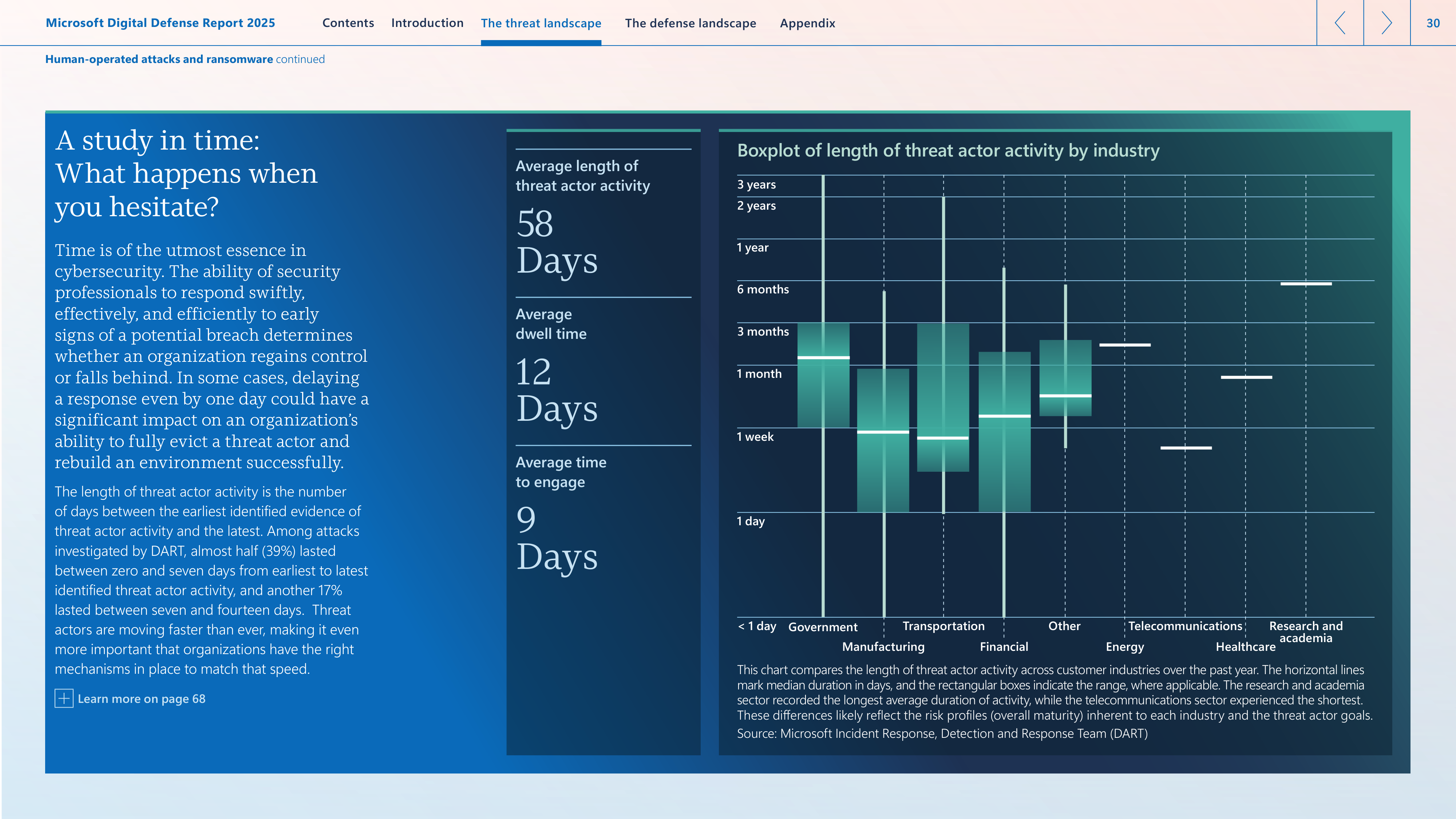

30
Microsoft Digital Defense Report 2025
Contents
Introduction
The threat landscape
The defense landscape
Appendix
Human-operated attacks and ransomware
continued
A study in time:
What happens when
you hesitate?
Time is of the utmost essence in
cybersecurity. The ability of security
professionals to respond swiftly,
effectively, and efficiently to early
signs of a potential breach determines
whether an organization regains control
or falls behind. In some cases, delaying
a response even by one day could have a
significant impact on an organization’s
ability to fully evict a threat actor and
rebuild an environment successfully.
The length of threat actor activity is the number
of days between the earliest identified evidence of
threat actor activity and the latest. Among attacks
investigated by DART, almost half (39%) lasted
between zero and seven days from earliest to latest
identified threat actor activity, and another 17%
lasted between seven and fourteen days. Threat
actors are moving faster than ever, making it even
more important that organizations have the right
mechanisms in place to match that speed.
Learn more on page 68
Average length of
threat actor activity
58
Days
Average
dwell time
12
Days
Average time
to engage
9
Days
Boxplot of length of threat actor activity by industry
3 years
2 years
1 year
6 months
3 months
1 month
1 week
1 day
< 1 day
Government
Transportation
Other
Telecommunications
Research and
academia
Manufacturing
Financial
Energy
Healthcare
This chart compares the length of threat actor activity across customer industries over the past year. The horizontal lines
mark median duration in days, and the rectangular boxes indicate the range, where applicable. The research and academia
sector recorded the longest average duration of activity, while the telecommunications sector experienced the shortest.
These differences likely reflect the risk profiles (overall maturity) inherent to each industry and the threat actor goals.
Source: Microsoft Incident Response, Detection and Response Team (DART)
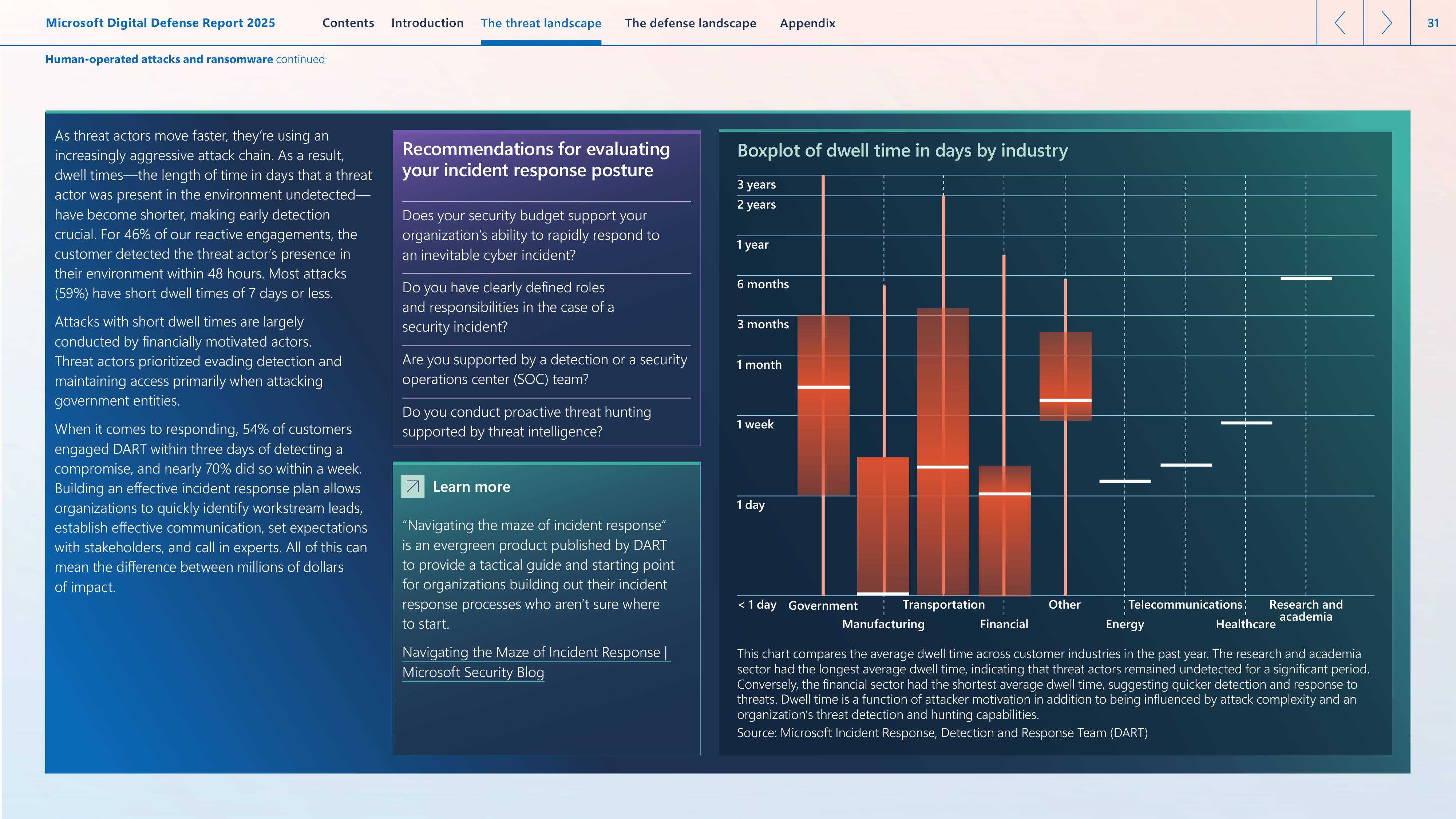

’
—
—
’
’
“
”
’
31
Microsoft Digital Defense Report 2025
Contents
Introduction
The threat landscape
The defense landscape
Appendix
Human-operated attacks and ransomware
continued
As threat actors move faster, they’re using an
increasingly aggressive attack chain. As a result,
dwell times—the length of time in days that a threat
actor was present in the environment undetected—
have become shorter, making early detection
crucial. For 46% of our reactive engagements, the
customer detected the threat actor’s presence in
their environment within 48 hours. Most attacks
(59%) have short dwell times of 7 days or less.
Attacks with short dwell times are largely
conducted by financially motivated actors.
Threat actors prioritized evading detection and
maintaining access primarily when attacking
government entities.
When it comes to responding, 54% of customers
engaged DART within three days of detecting a
compromise, and nearly 70% did so within a week.
Building an effective incident response plan allows
organizations to quickly identify workstream leads,
establish effective communication, set expectations
with stakeholders, and call in experts. All of this can
mean the difference between millions of dollars
of impact.
Recommendations for evaluating
your incident response posture
Does your security budget support your
organization’s ability to rapidly respond to
an inevitable cyber incident?
Do you have clearly defined roles
and responsibilities in the case of a
security incident?
Are you supported by a detection or a security
operations center (SOC) team?
Do you conduct proactive threat hunting
supported by threat intelligence?
Learn more
“Navigating the maze of incident response”
is an evergreen product published by DART
to provide a tactical guide and starting point
for organizations building out their incident
response processes who aren
’
t sure where
to start.
Navigating the Maze of Incident Response |
Microsoft Security Blog
Boxplot of dwell time in days by industry
3 years
2 years
1 year
6 months
3 months
1 month
1 week
1 day
< 1 day
Government
Transportation
Other
Telecommunications
Research and
academia
Manufacturing
Financial
Energy
Healthcare
This chart compares the average dwell time across customer industries in the past year. The research and academia
sector had the longest average dwell time, indicating that threat actors remained undetected for a significant period.
Conversely, the financial sector had the shortest average dwell time, suggesting quicker detection and response to
threats. Dwell time is a function of attacker motivation in addition to being influenced by attack complexity and an
organization’s threat detection and hunting capabilities.
Source: Microsoft Incident Response, Detection and Response Team (DART)
’
32
Microsoft Digital Defense Report 2025
Contents
Introduction
The threat landscape
The defense landscape
Appendix
Fraud and social engineering
The new age of super-charged fraud
and what to do about it
Fraud is as old as commerce itself, rooted in
the exploitation of trust and information gaps.
Throughout history, fraudsters have adapted,
leveraging new technologies and systems to deceive
individuals, businesses, and governments.
Today, we face a pivotal shift: AI is amplifying
the scale, speed, and sophistication of fraud and
social engineering. While the core tactics remain
unchanged—manipulating trust and exploiting
human psychology—the risks are now global,
immediate, and increasingly targeted.
Malicious bot protection
As ecommerce and digital platforms continue to
scale, so too does the sophistication of fraudsters
who exploit automation to bypass traditional
defenses. This is done through bots.
Bots themselves are neither good nor bad. They can
be used to automate repetitive tasks, provide instant
access to information, and enhance user experiences
through personalized, real-time support. Bots can
improve efficiency, reduce human error, and free up
valuable time for more strategic work. Their ability
to operate 24/7 and scale effortlessly makes them a
powerful tool across industries.
At the same time, bot-assisted attacks are a rapidly
evolving threat in the digital fraud landscape.
More than 90% of the 15.9 billion Microsoft account
creation requests in the first half of 2025 were from
bad bots. Across the entire year, Microsoft’s anti-
fraud systems blocked approximately 1.6 million
bot-driven or fake account signup attempts per hour
across its services—an astounding volume indicating
how attackers are abusing automation and false
identities at scale.
Bots are increasingly used to execute high-speed
credential stuffing, inventory hoarding, fake account
creation, and card testing—often at a scale and
frequency beyond human capability.
Recommendations
Microsoft recommends organizations implement the following strategies to help identify
malicious bots and detect bot-assisted cyber fraud:
Residential
proxy
detection
Integrate third-party proxy intelligence databases.
Build an internal proxy reputation system based on
labeled “bot-assisted” transactions.
Customer input pattern analysis
Detect automation by analyzing patterns in user-
submitted data (e.g., names and addresses).
Behavioral
biometrics
Monitor mouse movement, click timing,
and keystroke dynamics to distinguish bots
from humans.
Retrospective
remediation
Deactivate accounts or subscriptions identified
through offline detection.
Advanced machine learning (ML) approaches
Use AI and ML to make sense of complex data—
turning things like email addresses or product
descriptions into comparable data points and
analyzing user actions over time to spot unusual
patterns or behaviors.

33
Microsoft Digital Defense Report 2025
Contents
Introduction
The threat landscape
The defense landscape
Appendix
Fraud and social engineering
continued
The rise of deepfakes and synthetic
identities: How AI is fueling identity
fraud at scale
Using AI, scammers can quickly generate entire fake
websites, profiles, and customer service chats to
impersonate real businesses or use deepfake voices
and videos to appear as trusted individuals, all at
minimal cost.
In the past year, Microsoft thwarted USD 4 billion worth
of fraudulent transactions and scams, many likely aided
by AI content, and rejected 49,000 bogus enrollment
attempts in its partner programs, stopping threat actors
who were using fake or stolen identities to pretend to be
legitimate partners.
Deepfakes involve using AI to create highly realistic
audio and visual content, which can be used for
malicious purposes such as impersonation, fraud, and
misinformation. A deepfake impersonation can lead to
business email compromise (BEC) or result in leaked
information or the resetting of a password or two-factor
authentication (2FA) for an important account.
Another area where AI deepfakes can be used is in tech
support scams, where fraudsters impersonate a tech
support agent to trick users (often seniors) into paying
for fake support or installing malware. Traditionally,
these scams used phone calls, emails, and pop-up
ads; now threat actors are leveraging AI-modified
voices when impersonating support agents for phone
or video calls. These customer-facing deepfake tech
scams directly impact not only the victims, but the
impersonated company’s reputation and customer trust.
Microsoft fraud
attempts
thwarted
Value of fraud schemes
(many AI-enabled) blocked
by Microsoft in one year
(Apr 2024–Apr 2025)
USD 4B
Automated bot
sign-ups
blocked
Fake account creation attempts
(bots/synthetic) blocked on
Microsoft services per hour
1.6M
per hour
On platforms like LinkedIn, there may exist fake
profiles that use AI-generated portrait photos.
6
These fake LinkedIn personas might carry out data
scraping or other abuses like social engineering (for
example, posing as recruiters or vendors). This not
only threatens LinkedIn’s integrity but also can spill
over into direct attacks on Microsoft employees or
partners who might connect with a convincing fake
profile.
Note 7
Synthetic identities are also a rising risk. In the digital
services realm, verifying user identity is a cornerstone
of security. Deepfakes and AI-generated documents
threaten to weaken those verification checkpoints.
For example, attackers often try to register new
Microsoft accounts using fake or stolen identities.
Their goal might be to obtain free trial resources for
spam/scams or establish throwaway tenant accounts
to launch attacks. Many of these sign-up attempts
use bots—and probably synthetic information
(such as random names and AI-generated email
addresses)—to get past basic filters. The scale of this
activity indicates a systematic attempt to create fake
identities at volume.
AI-generated IDs are now often more convincing
than real forgeries, growing by 195% globally in
usage.
Note 8
In situations where organizations use selfie
checks or document uploads to verify new users,
deepfake techniques can even defeat liveness tests
(for example, a deepfake video can simulate a person
blinking and turning their head).
“
AI-generated IDs are
now often more convincing
than real forgeries, growing by
195% globally in usage.
Learn more
AI-powered Deception: Emerging Fraud Threats
and Countermeasures Cyber Signals Issue 9
|
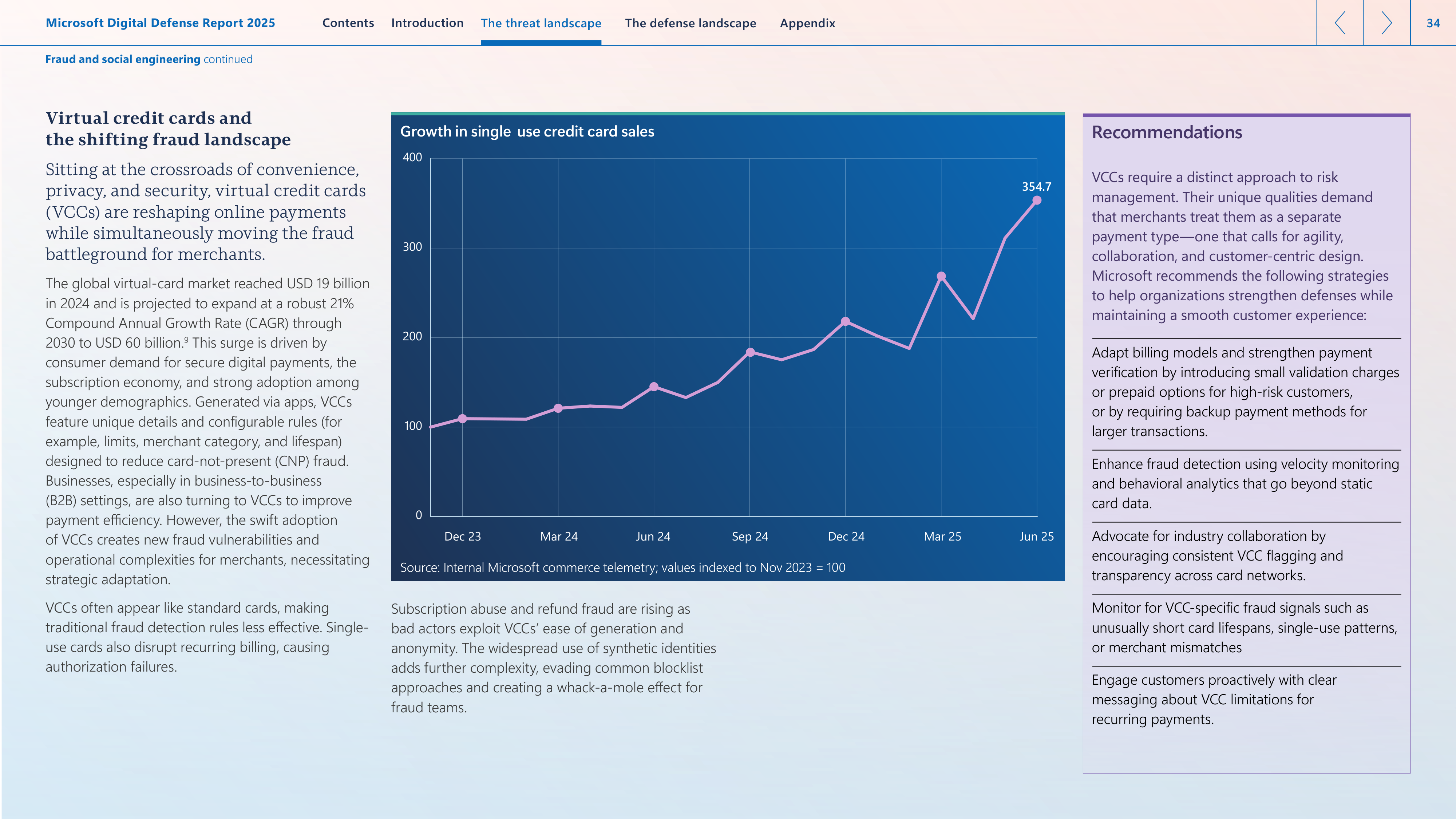

-
34
Microsoft Digital Defense Report 2025
Contents
Introduction
The threat landscape
The defense landscape
Appendix
Fraud and social engineering
continued
Virtual credit cards and
the shifting fraud landscape
Sitting at the crossroads of convenience,
privacy, and security, virtual credit cards
(VCCs) are reshaping online payments
while simultaneously moving the fraud
battleground for merchants.
The global virtual-card market reached USD 19 billion
in 2024 and is projected to expand at a robust 21%
Compound Annual Growth Rate (CAGR) through
2030 to USD 60 billion.
Note 9
This surge is driven by
consumer demand for secure digital payments, the
subscription economy, and strong adoption among
younger demographics. Generated via apps, VCCs
feature unique details and configurable rules (for
example, limits, merchant category, and lifespan)
designed to reduce card-not-present (CNP) fraud.
Businesses, especially in business-to-business
(B2B) settings, are also turning to VCCs to improve
payment efficiency. However, the swift adoption
of VCCs creates new fraud vulnerabilities and
operational complexities for merchants, necessitating
strategic adaptation.
VCCs often appear like standard cards, making
traditional fraud detection rules less effective. Single-
use cards also disrupt recurring billing, causing
authorization failures.
Growth in single
use credit card sales
Source: Internal Microsoft commerce telemetry; values indexed to Nov 2023 = 100
Subscription abuse and refund fraud are rising as
bad actors exploit VCCs’ ease of generation and
anonymity. The widespread use of synthetic identities
adds further complexity, evading common blocklist
approaches and creating a whack-a-mole effect for
fraud teams.
Recommendations
400
354.7
VCCs require a distinct approach to risk
management. Their unique qualities demand
that merchants treat them as a separate
payment type—one that calls for agility,
collaboration, and customer-centric design.
Microsoft recommends the following strategies
to help organizations strengthen defenses while
maintaining a smooth customer experience:
300
200
Adapt billing models and strengthen payment
verification by introducing small validation charges
or prepaid options for high-risk customers,
or by requiring backup payment methods for
larger transactions.
100
Enhance fraud detection using velocity monitoring
and behavioral analytics that go beyond static
card data.
0
Dec 23
Mar 24
Jun 24
Sep 24
Dec 24
Mar 25
Jun 25
Advocate for industry collaboration by
encouraging consistent VCC flagging and
transparency across card networks.
Monitor for VCC-specific fraud signals such as
unusually short card lifespans, single-use patterns,
or merchant mismatches
Engage customers proactively with clear
messaging about VCC limitations for
recurring payments.
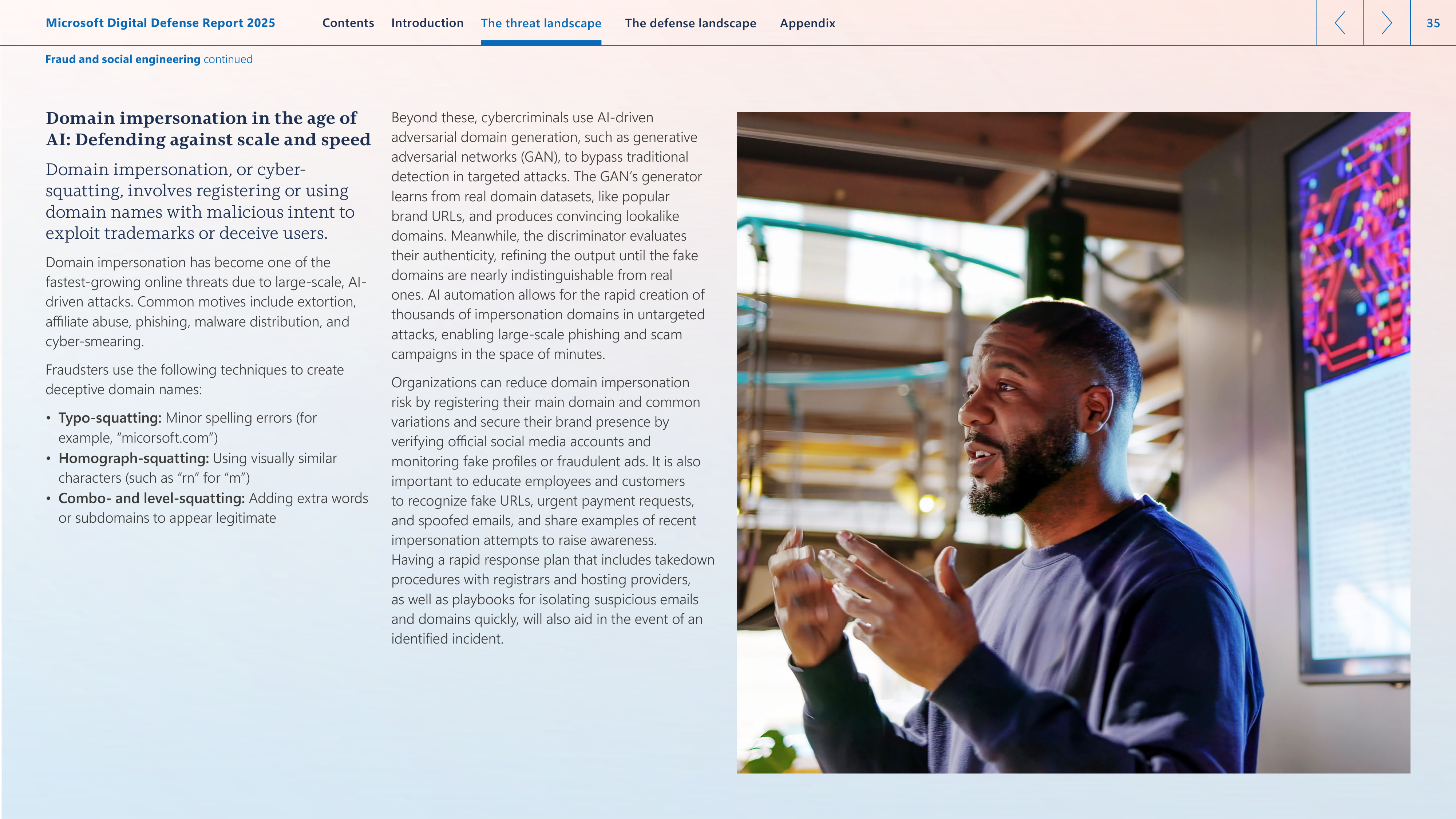

35
Microsoft Digital Defense Report 2025
Contents
Introduction
The threat landscape
The defense landscape
Appendix
Fraud and social engineering
continued
Domain impersonation in the age of
AI: Defending against scale and speed
Domain impersonation, or cyber
squatting, involves registering or using
domain names with malicious intent to
exploit trademarks or deceive users.
-
Domain impersonation has become one of the
fastest-growing online threats due to large-scale, AI-
driven attacks. Common motives include extortion,
affiliate abuse, phishing, malware distribution, and
cyber-smearing.
Fraudsters use the following techniques to create
deceptive domain names:
•
Typo-squatting:
Minor spelling errors (for
example, “micorsoft.com”)
•
Homograph-squatting:
Using visually similar
characters (such as “rn” for “m”)
•
Combo- and level-squatting:
Adding extra words
or subdomains to appear legitimate
Beyond these, cybercriminals use AI-driven
adversarial domain generation, such as generative
adversarial networks (GAN), to bypass traditional
detection in targeted attacks. The GAN’s generator
learns from real domain datasets, like popular
brand URLs, and produces convincing lookalike
domains. Meanwhile, the discriminator evaluates
their authenticity, refining the output until the fake
domains are nearly indistinguishable from real
ones. AI automation allows for the rapid creation of
thousands of impersonation domains in untargeted
attacks, enabling large-scale phishing and scam
campaigns in the space of minutes.
Organizations can reduce domain impersonation
risk by registering their main domain and common
variations and secure their brand presence by
verifying official social media accounts and
monitoring fake profiles or fraudulent ads. It is also
important to educate employees and customers
to recognize fake URLs, urgent payment requests,
and spoofed emails, and share examples of recent
impersonation attempts to raise awareness.
Having a rapid response plan that includes takedown
procedures with registrars and hosting providers,
as well as playbooks for isolating suspicious emails
and domains quickly, will also aid in the event of an
identified
incident.
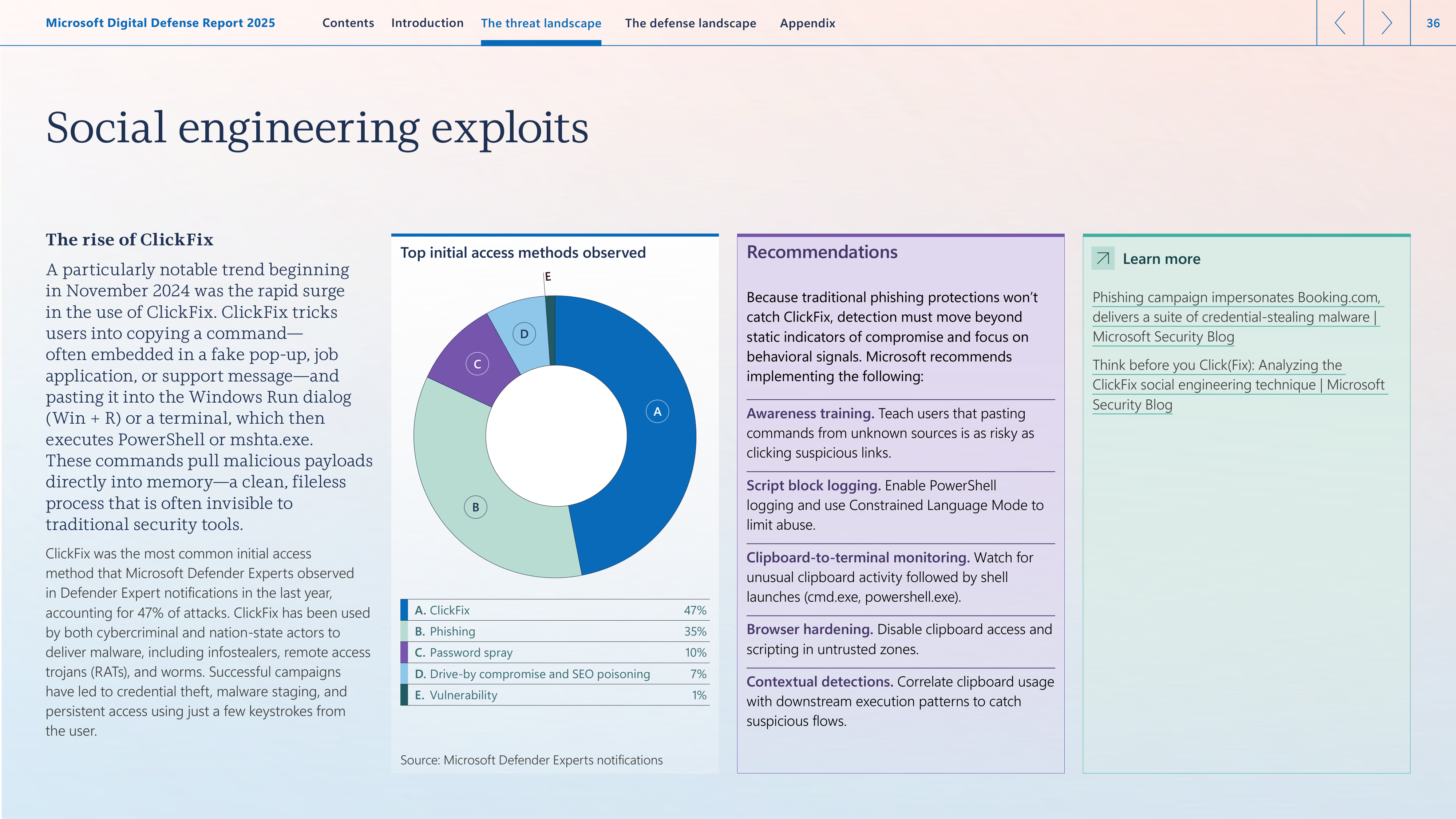

36
Microsoft Digital Defense Report 2025
Contents
Introduction
The threat landscape
The defense landscape
Appendix
Social engineering exploits
The rise of ClickFix
A particularly notable trend beginning
in November 2024 was the rapid surge
in the use of ClickFix. ClickFix tricks
users into copying a command—
often embedded in a fake pop-up, job
application, or support message—and
pasting it into the Windows Run dialog
(Win + R) or a terminal, which then
executes PowerShell or mshta.exe.
These commands pull malicious payloads
directly into memory—a clean, fileless
process that is often invisible to
traditional security tools.
ClickFix was the most common initial access
method that Microsoft Defender Experts observed
in Defender Expert notifications in the last year,
accounting for 47% of attacks. ClickFix has been used
by both cybercriminal and nation-state actors to
deliver malware, including infostealers, remote access
trojans (RATs), and worms. Successful campaigns
have led to credential theft, malware staging, and
persistent access using just a few keystrokes from
the user.
Top initial access methods observed
E
A
D
C
B
A.
ClickFix
47%
B.
Phishing
35%
C.
Password spray
10%
D.
Drive-by compromise and SEO poisoning
7%
E.
Vulnerability
1%
Source: Microsoft Defender Experts notifications
Recommendations
Because traditional phishing protections won’t
catch ClickFix, detection must move beyond
static indicators of compromise and focus on
behavioral signals. Microsoft recommends
implementing the following:
Awareness
training.
Teach users that pasting
commands from unknown sources is as risky as
clicking suspicious links.
Script block logging.
Enable PowerShell
logging and use Constrained Language Mode to
limit abuse.
Clipboard-to-terminal
monitoring.
Watch for
unusual clipboard activity followed by shell
launches (cmd.exe, powershell.exe).
Browser hardening.
Disable clipboard access and
scripting in untrusted zones.
Contextual
detections.
Correlate clipboard usage
with downstream execution patterns to catch
suspicious flows.
Learn more
Phishing campaign impersonates Booking.com,
delivers a suite of credential-stealing malware |
Microsoft Security Blog
Think before you Click(Fix): Analyzing the
ClickFix social engineering technique | Microsoft
Security Blog
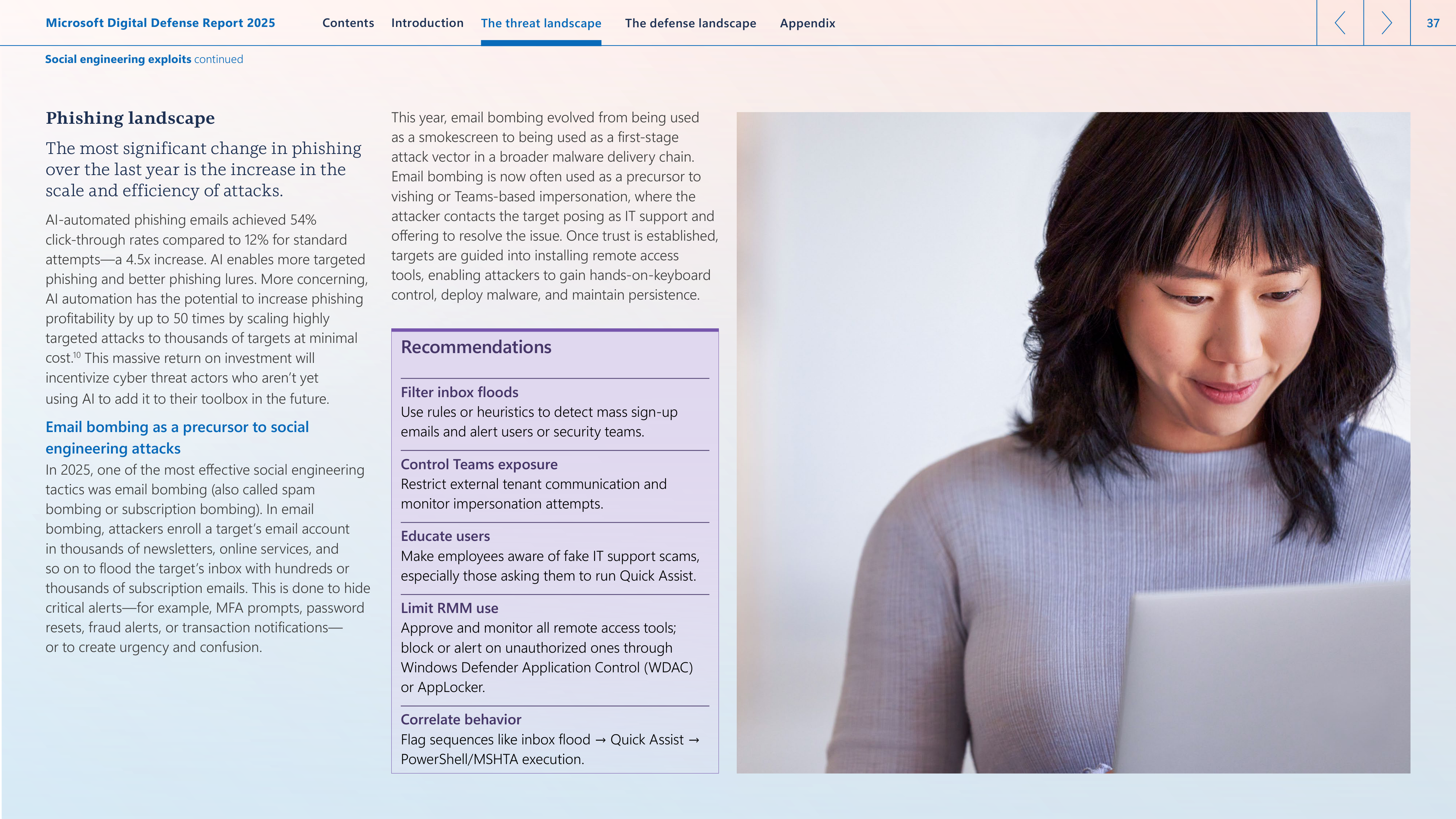

37
Microsoft Digital Defense Report 2025
Contents
Introduction
The threat landscape
The defense landscape
Appendix
Social engineering exploits
continued
Phishing landscape
The most significant change in phishing
over the last year is the increase in the
scale and efficiency of attacks.
AI-automated phishing emails achieved 54%
click-through rates compared to 12% for standard
attempts—a 4.5x increase. AI enables more targeted
phishing and better phishing lures. More concerning,
AI automation has the potential to increase phishing
profitability by up to 50 times by scaling highly
targeted attacks to thousands of targets at minimal
cost.
Note 10
This massive return on investment will
incentivize cyber threat actors who aren’t yet
using AI to add it to their toolbox in the future.
Email bombing as a precursor to social
engineering
attacks
In 2025, one of the most effective social engineering
tactics was email bombing (also called spam
bombing or subscription bombing). In email
bombing, attackers enroll a target’s email account
in thousands of newsletters, online services, and
so on to flood the target’s inbox with hundreds or
thousands of subscription emails. This is done to hide
critical alerts—for example, MFA prompts, password
resets, fraud alerts, or transaction notifications—
or to create urgency and confusion.
This year, email bombing evolved from being used
as a smokescreen to being used as a first-stage
attack vector in a broader malware delivery chain.
Email bombing is now often used as a precursor to
vishing or Teams-based impersonation, where the
attacker contacts the target posing as IT support and
offering to resolve the issue. Once trust is established,
targets are guided into installing remote access
tools, enabling attackers to gain hands-on-keyboard
control, deploy malware, and maintain persistence.
Recommendations
Filter inbox floods
Use rules or heuristics to detect mass sign-up
emails and alert users or security teams.
Control Teams exposure
Restrict external tenant communication and
monitor impersonation attempts.
Educate users
Make employees aware of fake IT support scams,
especially those asking them to run Quick Assist.
Limit RMM use
Approve and monitor all remote access tools;
block or alert on unauthorized ones through
Windows Defender Application Control (WDAC)
or AppLocker.
Correlate
behavior
Flag sequences like inbox flood → Quick Assist →
PowerShell/MSHTA execution.
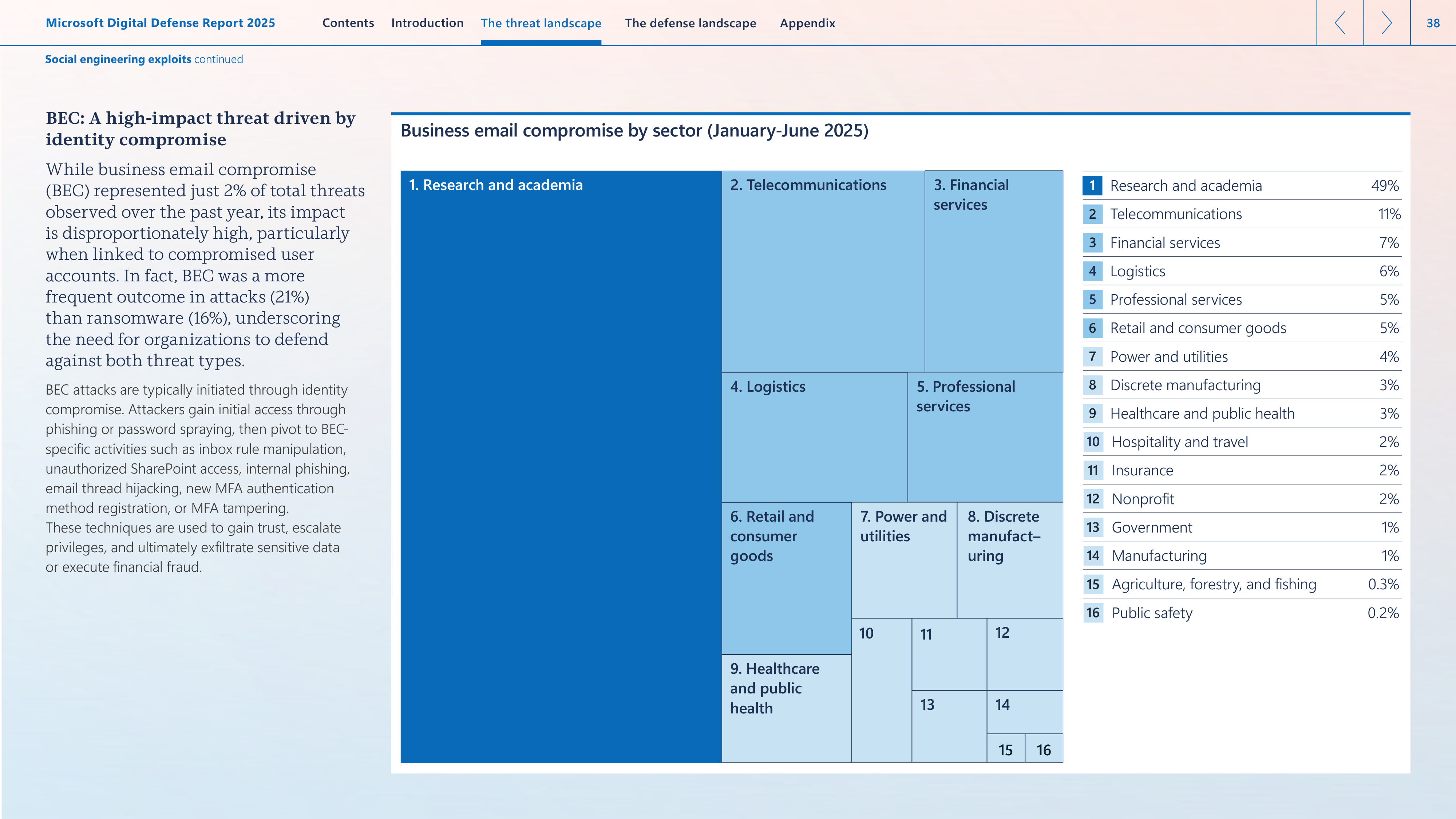

38
Microsoft Digital Defense Report 2025
Contents
Introduction
The threat landscape
The defense landscape
Appendix
Social engineering exploits
continued
BEC: A high-impact threat driven by
identity compromise
While business email compromise
(BEC) represented just 2% of total threats
observed over the past year, its impact
is disproportionately high, particularly
when linked to compromised user
accounts. In fact, BEC was a more
frequent outcome in attacks (21%)
than ransomware (16%), underscoring
the need for organizations to defend
against both threat types.
BEC attacks are typically initiated through identity
compromise. Attackers gain initial access through
phishing or password spraying, then pivot to BEC-
specific activities such as inbox rule manipulation,
unauthorized SharePoint access, internal phishing,
email thread hijacking, new MFA authentication
method registration, or MFA tampering.
These techniques are used to gain trust, escalate
privileges, and ultimately exfiltrate sensitive data
or execute financial fraud.
Business email compromise by sector (January-June 2025)
3. Financial
services
7. Power and
utilities
8. Discrete
manufact–
uring
5. Professional
services
1
Research and academia
49%
2
Telecommunications
11%
3
Financial services
7%
4
Logistics
6%
5
Professional services
5%
6
Retail and consumer goods
5%
7
Power and utilities
4%
8
Discrete manufacturing
3%
9
Healthcare and public health
3%
10
Hospitality and travel
2%
11
Insurance
2%
12
Nonprofit
2%
13
Government
1%
14
Manufacturing
1%
15
Agriculture, forestry, and fishing
0.3%
16
Public safety
0.2%
1. Research and academia
2. Telecommunications
4. Logistics
6. Retail and
consumer
goods
9. Healthcare
and public
health
10
11
13
14
15
16
12
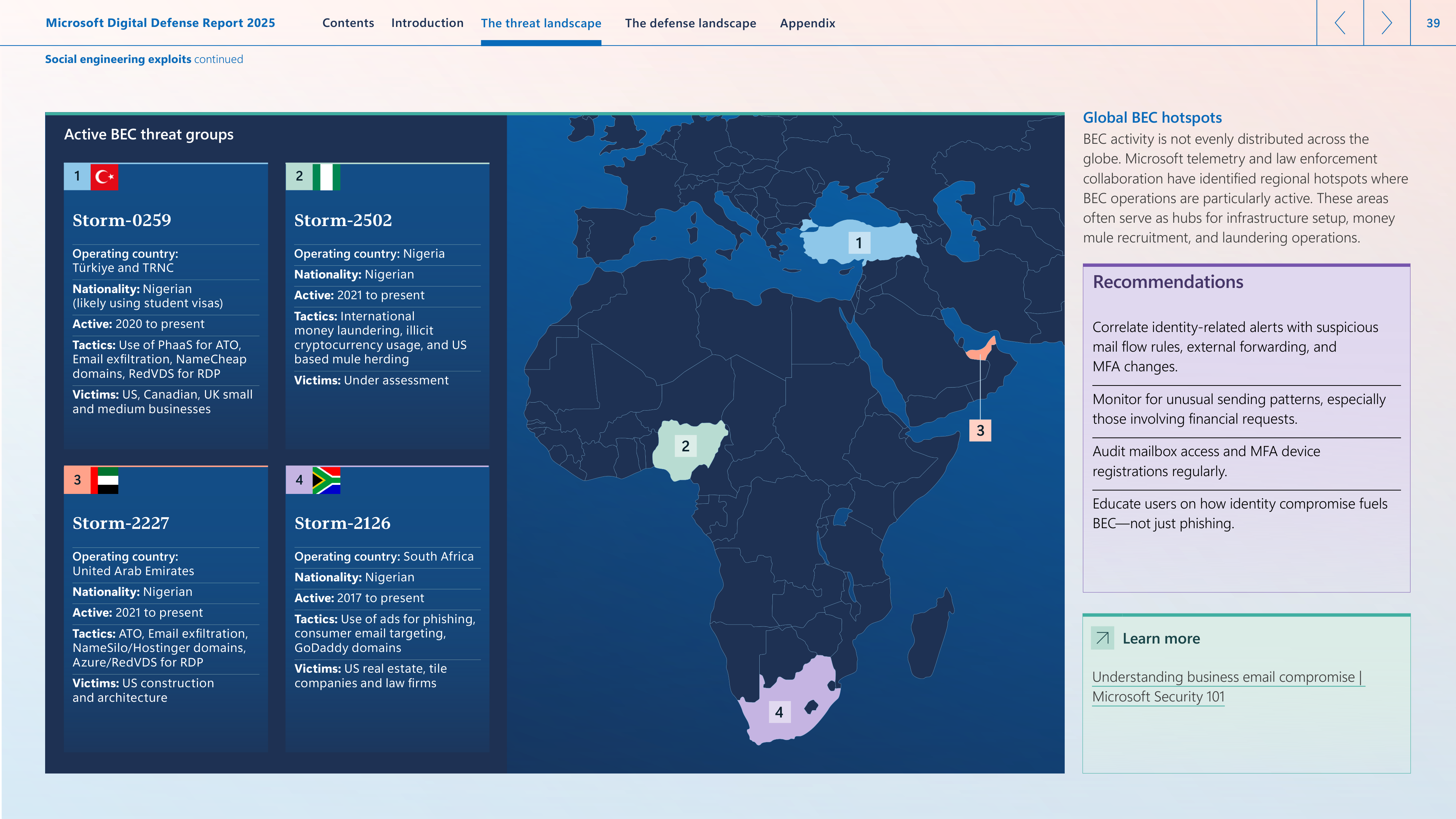





39
Microsoft Digital Defense Report 2025
Social engineering exploits
continued
Active BEC threat groups
1
Storm-0259
Operating country:
Türkiye and TRNC
Nationality:
Nigerian
(likely using student visas)
Active:
2020 to present
Tactics:
Use of PhaaS for ATO,
Email exfiltration, NameCheap
domains, RedVDS for RDP
Victims:
US, Canadian, UK small
and medium businesses
2
Storm-2502
Operating country:
Nigeria
Nationality:
Nigerian
Active:
2021 to present
Tactics:
International
money laundering, illicit
cryptocurrency usage, and US
based mule herding
Victims:
Under assessment
3
Storm-2227
Operating country:
United Arab Emirates
Nationality:
Nigerian
Active:
2021 to present
Tactics:
ATO, Email exfiltration,
NameSilo/Hostinger domains,
Azure/RedVDS for RDP
Victims:
US construction
and architecture
Contents
Introduction
The threat landscape
The defense landscape
Appendix
4
Storm-2126
Operating country:
South Africa
Nationality:
Nigerian
Active:
2017 to present
Tactics:
Use of ads for phishing,
consumer email targeting,
GoDaddy domains
Victims:
US real estate, tile
companies and law firms
1
2
Global BEC hotspots
BEC activity is not evenly distributed across the
globe. Microsoft telemetry and law enforcement
collaboration have identified regional hotspots where
BEC operations are particularly active. These areas
often serve as hubs for infrastructure setup, money
mule recruitment, and laundering operations.
Recommendations
Correlate identity-related alerts with suspicious
mail flow rules, external forwarding, and
MFA changes.
Monitor for unusual sending patterns, especially
those involving financial requests.
3
Audit mailbox access and MFA device
registrations regularly.
Educate users on how identity compromise fuels
BEC—not just phishing.
Learn more
Understanding business email compromise
Microsoft Security 101
|
4

40
Microsoft Digital Defense Report 2025
Contents
Introduction
The threat landscape
The defense landscape
Appendix
Social engineering exploits
continued
Device code phishing: The next
generation of credential theft
This year, Microsoft observed a notable
uptick in threat actors conducting device
code phishing campaigns worldwide.
In device code phishing, attackers exploit the device
code authentication flow to capture access and
refresh tokens, which could then be used to access
target accounts, data, and other services linked to
the compromised accounts. This technique could also
enable persistent access or lateral movement as long
as the token remains valid.
Threat actors exploit the device code authentication
flow by tricking users into entering a device code
on seemingly legitimate authentication portals
that the actor provided in phishing emails or other
communications. Most threat actors first contact
victims using third-party messaging applications,
at times posing as trusted contacts such as an
administrator or program organizer. Once the user
enters the code into the portal, the actor is granted
access and can capture the access and refresh tokens
that are generated.
Threat actors have been particularly successful
combining targeted social engineering with out-
of-band communications, which allow these actors
to circumvent antivirus or other detection systems
that would typically identify such activity as spam
or phishing.
Device code phishing poses a high risk of data theft
and exfiltration, since it grants threat actors access to
data where the compromised user has permissions,
such as email or cloud storage, without needing a
password. In a recent and concerning development,
Microsoft observed a threat actor prompting
a victim to enter the device code into a Teams
invitation, making it harder for users to identify
fraudulent activity.
Device code phishing poses a considerable threat to
organizations in all sectors worldwide. Microsoft has
observed nation-state actors from Russia, Iran, and
China as well as cybercriminal groups like Octo
Tempest using this technique to access targets in the
IT sector, NGOs, government agencies, and private
businesses. Ninety-three percent (93%) of the device
code phishing events that Microsoft observed in the
last twelve months occurred in the second half of the
year, indicating the rapid adoption of this technique.
*
While device code phishing
is not new, most users have
not been taught to look for
attacks that target the device
code flow, and because the
attacker authentication is
through legitimate codes and
tokens, traditional phishing
detection tools often miss
it, making it a particularly
dangerous phishing evolution.
Learn more
Storm-2372 conducts device code phishing
campaign | Microsoft Security Blog
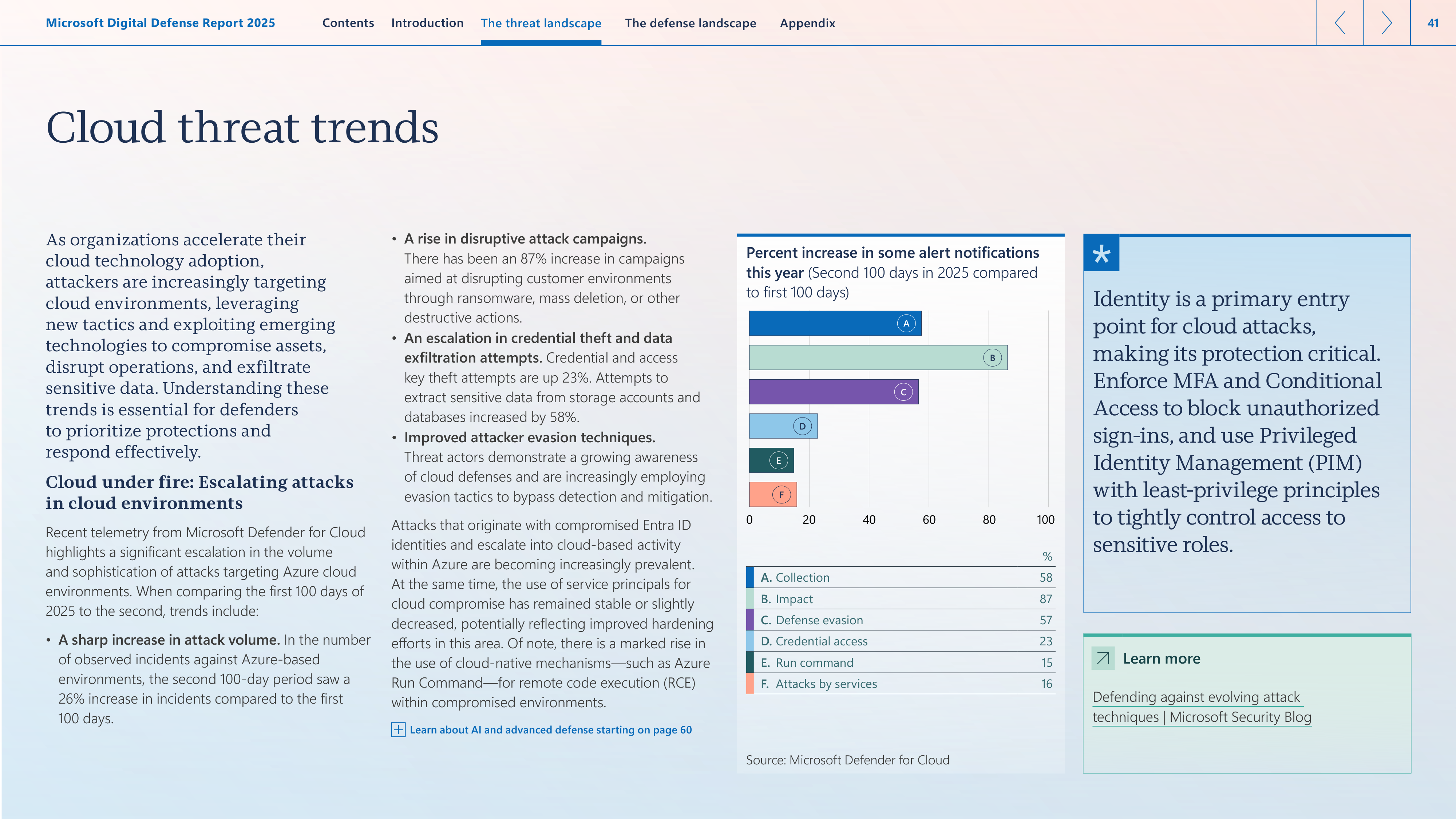

41
Microsoft Digital Defense Report 2025
Contents
Introduction
The threat landscape
The defense landscape
Appendix
Cloud threat trends
As organizations accelerate their
cloud technology adoption,
attackers are increasingly targeting
cloud environments, leveraging
new tactics and exploiting emerging
technologies to compromise assets,
disrupt operations, and exfiltrate
sensitive data. Understanding these
trends is essential for defenders
to prioritize protections and
respond effectively.
Cloud under fire: Escalating attacks
in cloud environments
Recent telemetry from Microsoft Defender for Cloud
highlights a significant escalation in the volume
and sophistication of attacks targeting Azure cloud
environments. When comparing the first 100 days of
2025 to the second, trends include:
•
A sharp increase in attack volume.
In the number
of observed incidents against Azure-based
environments, the second 100-day period saw a
26% increase in incidents compared to the first
100 days.
•
A rise in disruptive attack campaigns.
There has been an 87% increase in campaigns
aimed at disrupting customer environments
through ransomware, mass deletion, or other
destructive actions.
•
An escalation in credential theft and data
exfiltration attempts.
Credential and access
key theft attempts are up 23%. Attempts to
extract sensitive data from storage accounts and
databases increased by 58%.
•
Improved attacker evasion techniques.
Threat actors demonstrate a growing awareness
of cloud defenses and are increasingly employing
evasion tactics to bypass detection and mitigation.
Attacks that originate with compromised Entra ID
identities and escalate into cloud-based activity
within Azure are becoming increasingly prevalent.
At the same time, the use of service principals for
cloud compromise has remained stable or slightly
decreased, potentially reflecting improved hardening
efforts in this area. Of note, there is a marked rise in
the use of cloud-native mechanisms—such as Azure
Run Command—for remote code execution (RCE)
within compromised environments.
Percent increase in some alert notifications
this year
(Second 100 days in 2025 compared
to first 100 days)
A
D
C
F
B
E
0
20
40
60
80
100
%
A.
Collection
58
B.
Impact
87
C.
Defense evasion
57
D.
Credential access
23
E.
Run command
15
F.
Attacks by services
16
Learn about AI and advanced defense starting on page 60
Source: Microsoft Defender for Cloud
*
Identity is a primary entry
point for cloud attacks,
making its protection critical.
Enforce MFA and Conditional
Access to block unauthorized
sign-ins, and use Privileged
Identity Management (PIM)
with least-privilege principles
to tightly control access to
sensitive roles.
Learn more
Defending against evolving attack
techniques | Microsoft Security Blog
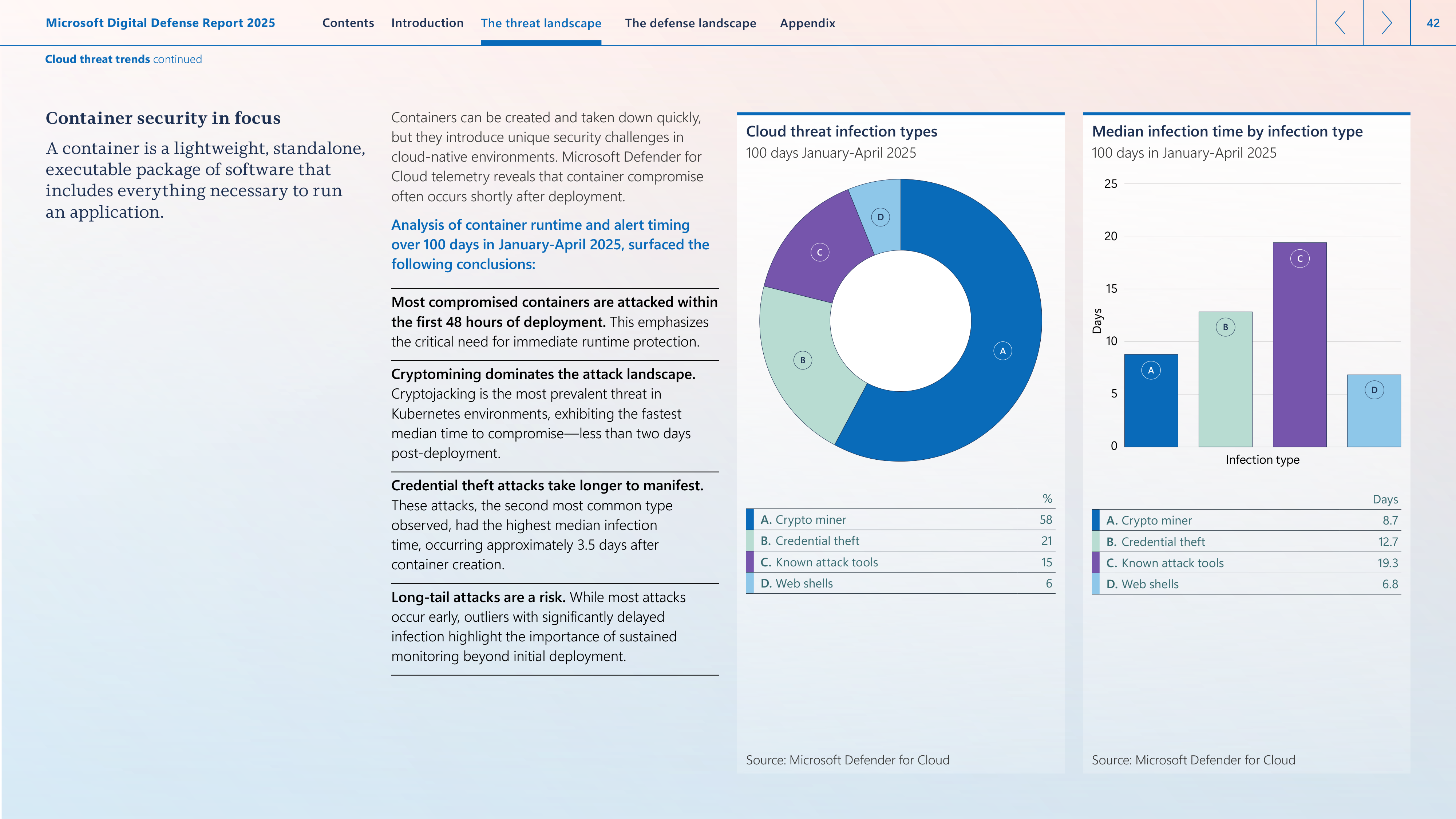

42
Microsoft Digital Defense Report 2025
Contents
Introduction
The threat landscape
The defense landscape
Appendix
Cloud threat trends
continued
Container security in focus
A container is a lightweight, standalone,
executable package of software that
includes everything necessary to run
an application.
Containers can be created and taken down quickly,
but they introduce unique security challenges in
cloud-native environments. Microsoft Defender for
Cloud telemetry reveals that container compromise
often occurs shortly after deployment.
Analysis of container runtime and alert timing
over 100 days in January-April 2025, surfaced the
following conclusions:
Most compromised containers are attacked within
the first 48 hours of deployment.
This emphasizes
the critical need for immediate runtime protection.
Cryptomining dominates the attack landscape.
Cryptojacking is the most prevalent threat in
Kubernetes environments, exhibiting the fastest
median time to compromise—less than two days
post-deployment.
Credential theft attacks take longer to manifest.
These attacks, the second most common type
observed, had the highest median infection
time, occurring approximately 3.5 days after
container creation.
Long-tail attacks are a risk.
While most attacks
occur early, outliers with significantly delayed
infection highlight the importance of sustained
monitoring beyond initial deployment.
Cloud threat infection types
100 days January-April 2025
%
A.
Crypto miner
58
B.
Credential theft
21
C.
Known attack tools
15
D.
Web shells
6
Source: Microsoft Defender for Cloud
Median infection time by infection type
100 days in January-April 2025
D
A
C
B
25
20
15
10
5
0
B
D
A
C
Infection type
Days
Days
A.
Crypto miner
8.7
B.
Credential theft
12.7
C.
Known attack tools
19.3
D.
Web shells
6.8
Source: Microsoft Defender for Cloud
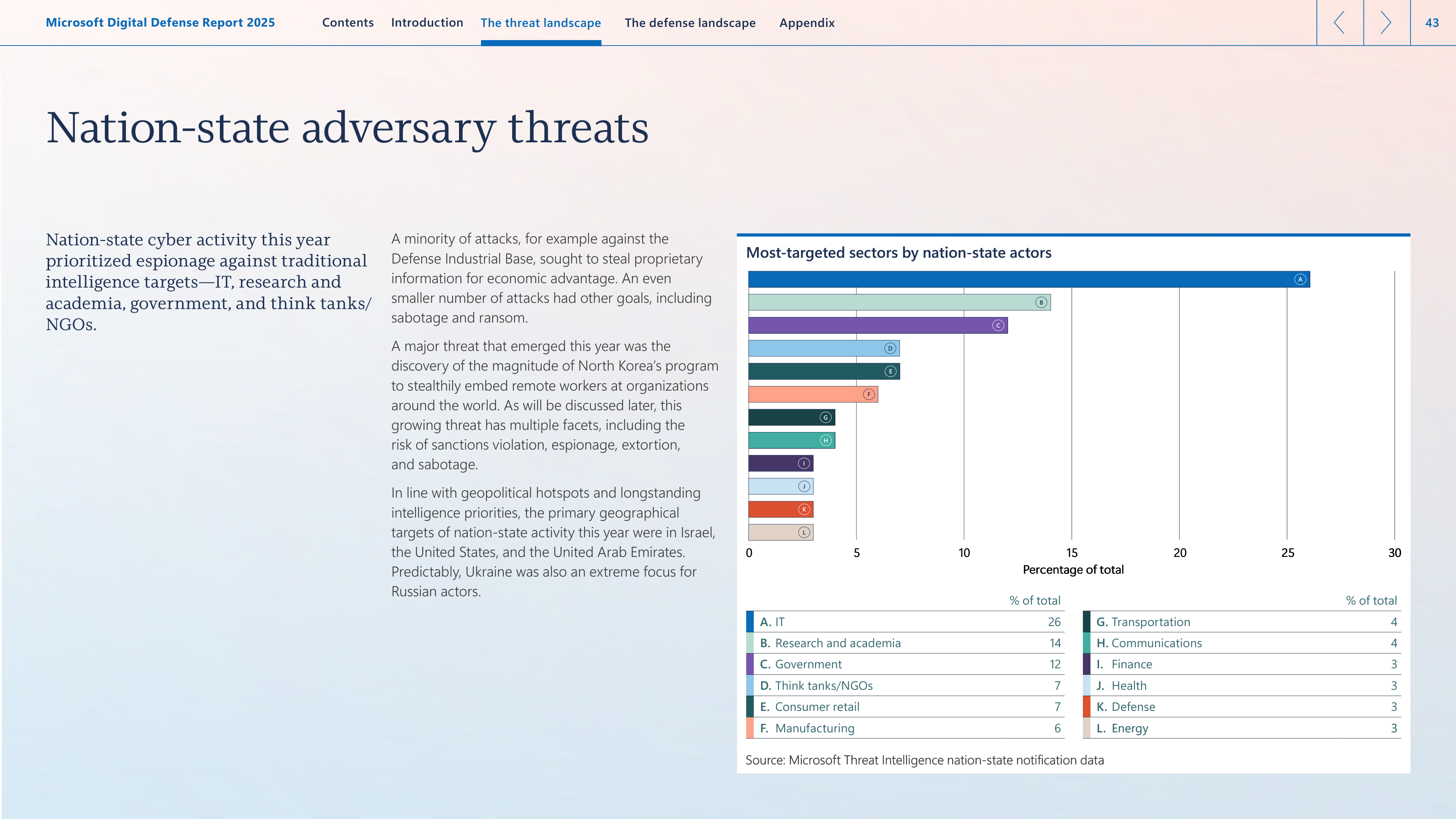

C
E
G
H
0
5
10
15
20
25
30
Percentage of total
Nation-state adversary threats
Nation-state cyber activity this year
prioritized espionage against traditional
intelligence targets—IT, research and
academia, government, and think tanks/
NGOs.
A minority of attacks, for example against the
Defense Industrial Base, sought to steal proprietary
information for economic advantage. An even
smaller number of attacks had other goals, including
sabotage and ransom.
A major threat that emerged this year was the
discovery of the magnitude of North Korea’s program
to stealthily embed remote workers at organizations
around the world. As will be discussed later, this
growing threat has multiple facets, including the
risk of sanctions violation, espionage, extortion,
and sabotage.
In line with geopolitical hotspots and longstanding
intelligence priorities, the primary geographical
targets of nation-state activity this year were in Israel,
the United States, and the United Arab Emirates.
Predictably, Ukraine was also an extreme focus for
Russian actors.
Most-targeted sectors by nation-state actors
% of total
A.
IT
26
B.
Research and academia
14
C.
Government
12
D.
Think tanks/NGOs
7
E.
Consumer retail
7
F.
Manufacturing
6
% of total
G.
Transportation
4
H.
Communications
4
I.
Finance
3
J.
Health
3
K.
Defense
3
L.
Energy
3
Source: Microsoft Threat Intelligence nation-state notification data
Microsoft Digital Defense Report 2025
Introduction
Contents
The defense landscape
Appendix
The threat landscape
43
Energy
3
Source: Microsoft Threat Intelligence nation-state notification data
0
5
10
15
20
25
30
A
C
E
G
K
I
H
B
D
F
J
L
Percentage of total
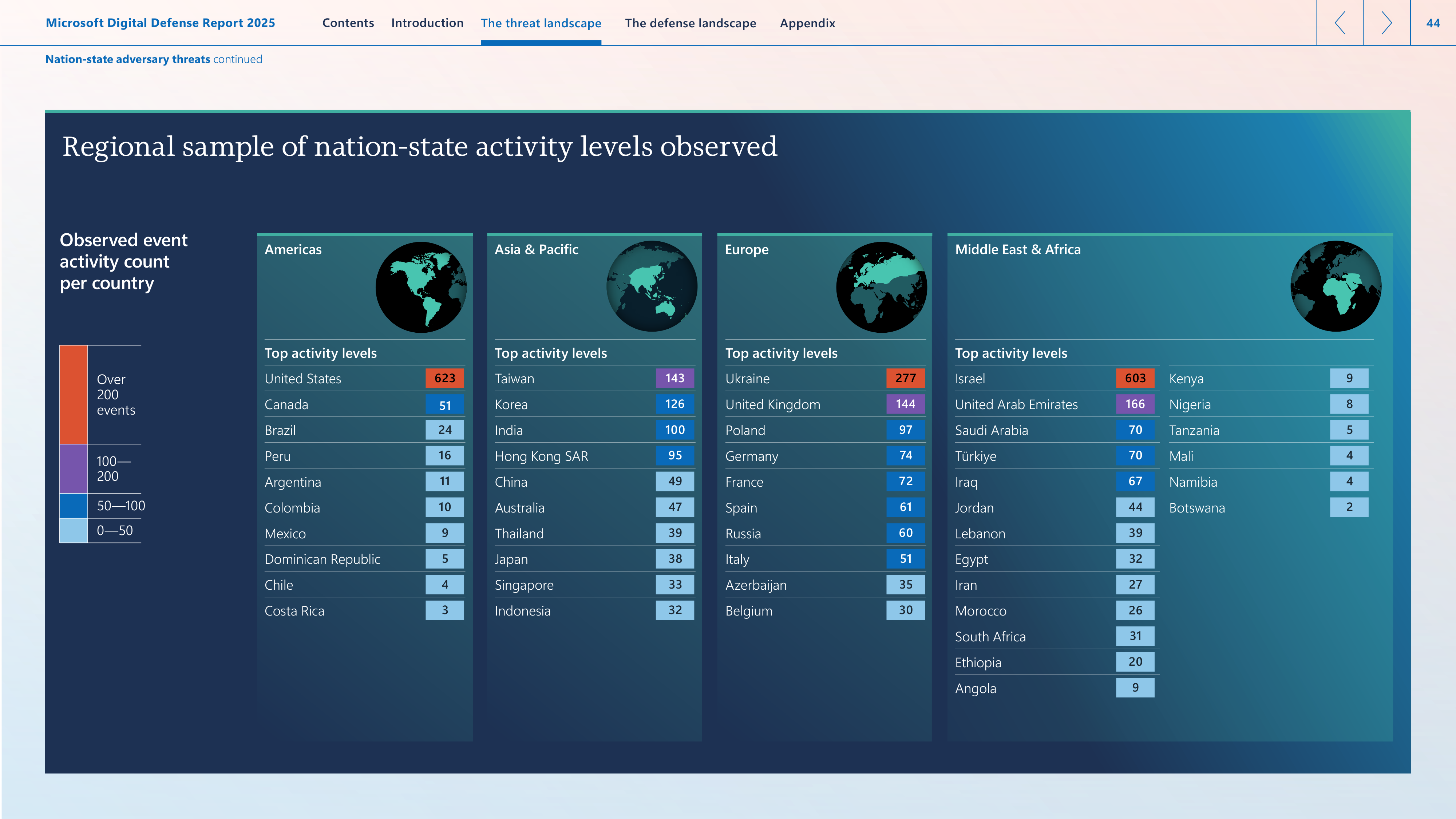

44
Microsoft Digital Defense Report 2025
Contents
Introduction
The threat landscape
The defense landscape
Appendix
Nation-state adversary threats
continued
Regional sample of nation-state activity levels observed
Observed event
activity count
per country
Over
200
events
100
—
200
50—100
0—50
Americas
Top activity levels
United States
623
Canada
51
24
Peru
Brazil
16
Argentina
11
Colombia
10
Mexico
9
Dominican Republic
5
Chile
4
Costa Rica
3
Asia & Pacific
Top activity levels
Taiwan
143
Korea
126
India
100
Hong Kong SAR
95
China
49
Australia
47
Thailand
39
Japan
38
Singapore
33
Indonesia
32
Europe
Top activity levels
Ukraine
277
United Kingdom
144
Poland
97
Germany
74
France
72
Spain
61
Russia
60
Italy
51
Azerbaijan
35
Belgium
30
Middle East & Africa
Top activity levels
Israel
603
United Arab Emirates
166
Saudi Arabia
70
Türkiye
70
Iraq
67
Jordan
44
Lebanon
39
Egypt
32
Iran
27
Morocco
26
South Africa
31
Ethiopia
20
Angola
9
Kenya
9
Nigeria
8
Tanzania
5
Mali
4
Namibia
4
Botswana
2
—
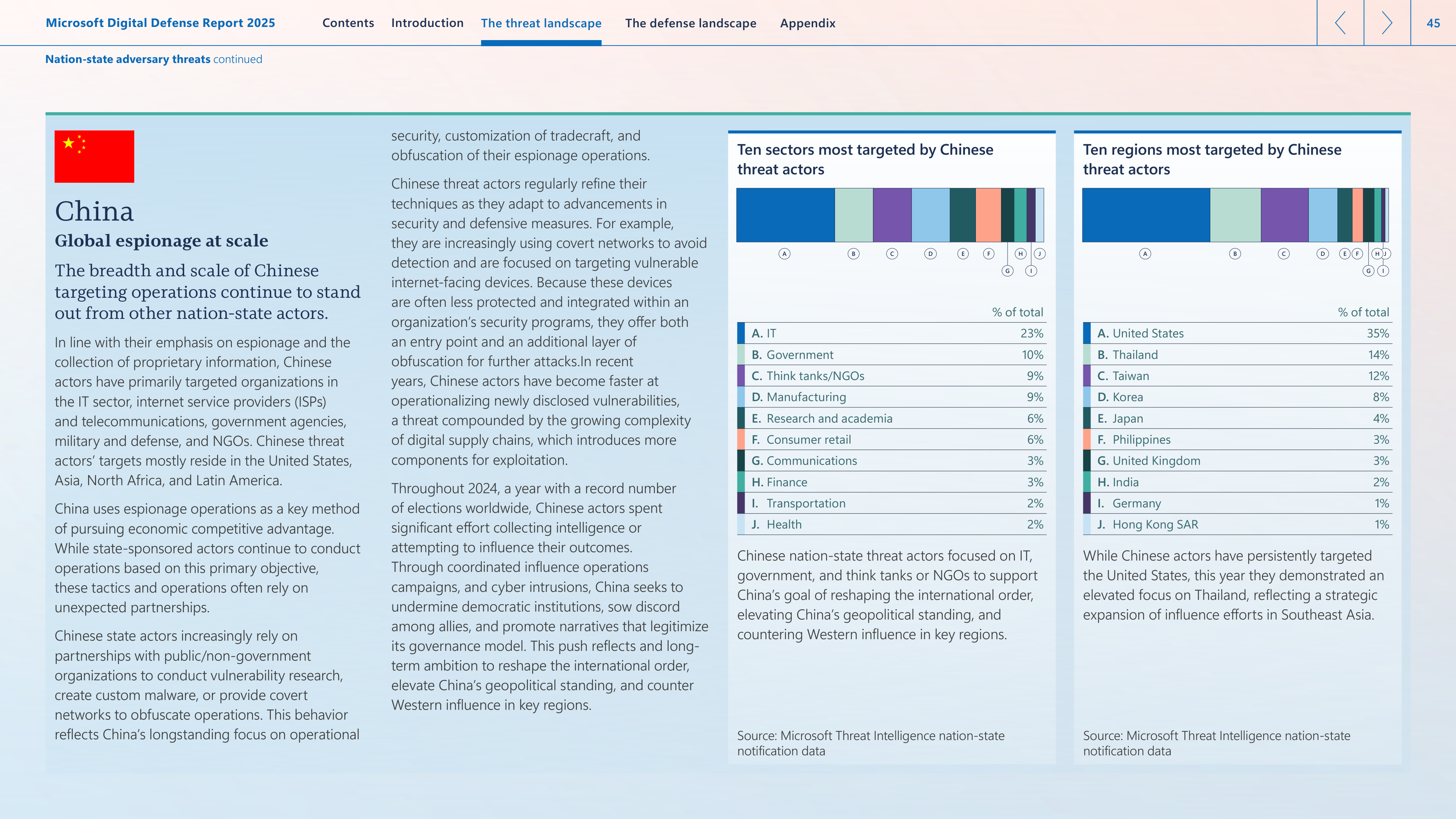

China
Global espionage at scale
The breadth and scale of Chinese
targeting operations continue to stand
out from other nation-state actors.
In line with their emphasis on espionage and the
collection of proprietary information, Chinese
actors have primarily targeted organizations in
the IT sector, internet service providers (ISPs)
and telecommunications, government agencies,
military and defense, and NGOs. Chinese threat
actors’ targets mostly reside in the United States,
Asia, North Africa, and Latin America.
China uses espionage operations as a key method
of pursuing economic competitive advantage.
While state-sponsored actors continue to conduct
operations based on this primary objective,
these tactics and operations often rely on
unexpected partnerships.
Chinese state actors increasingly rely on
partnerships with public/non-government
organizations to conduct vulnerability research,
create custom malware, or provide covert
networks to obfuscate operations. This behavior
reflects China’s longstanding focus on operational
security, customization of tradecraft, and
obfuscation of their espionage operations.
Chinese threat actors regularly refine their
techniques as they adapt to advancements in
security and defensive measures. For example,
they are increasingly using covert networks to avoid
detection and are focused on targeting vulnerable
internet-facing devices. Because these devices
are often less protected and integrated within an
organization’s security programs, they offer both
an entry point and an additional layer of
obfuscation for further attacks.
In recent
years, Chinese actors have become faster at
operationalizing newly disclosed vulnerabilities,
a threat compounded by the growing complexity
of digital supply chains, which introduces more
components for exploitation.
Throughout 2024, a year with a record number
of elections worldwide, Chinese actors spent
significant effort collecting intelligence or
attempting to influence their outcomes.
Through coordinated influence operations
campaigns, and cyber intrusions, China seeks to
undermine democratic institutions, sow discord
among allies, and promote narratives that legitimize
its governance model. This push reflects and long-
term ambition to reshape the international order,
elevate China’s geopolitical standing, and counter
Western influence in key regions.
Ten sectors most targeted by Chinese
threat actors
% of total
A.
IT
23%
B.
Government
10%
C.
Think tanks/NGOs
9%
D.
Manufacturing
9%
E.
Research and academia
6%
F.
Consumer retail
6%
G.
Communications
3%
H.
Finance
3%
I.
Transportation
2%
J.
Health
2%
Chinese nation-state threat actors focused on IT,
government, and think tanks or NGOs to support
China’s goal of reshaping the international order,
elevating China’s geopolitical standing, and
countering Western influence in key regions.
Source: Microsoft Threat Intelligence nation-state
notification data
Ten regions most targeted by Chinese
threat actors
% of total
A.
United States
35%
B.
Thailand
14%
C.
Taiwan
12%
D.
Korea
8%
E.
Japan
4%
F.
Philippines
3%
G.
United Kingdom
3%
H.
India
2%
I.
Germany
1%
J.
Hong Kong SAR
1%
While Chinese actors have persistently targeted
the United States, this year they demonstrated an
elevated focus on Thailand, reflecting a strategic
expansion of influence efforts in Southeast Asia.
Source: Microsoft Threat Intelligence nation-state
notification data
Nation-state adversary threats
continued
security, customization of tradecraft, and
obfuscation of their espionage operations.
Chinese threat actors regularly refine their
techniques as they adapt to advancements in
security and defensive measures. For example,
they are increasingly using covert networks to avoid
detection and are focused on targeting vulnerable
internet-facing devices. Because these devices
are often less protected and integrated within an
organization’s security programs, they offer both
an entry point and an additional layer of
obfuscation for further attacks.In recent
years, Chinese actors have become faster at
operationalizing newly disclosed vulnerabilities,
a threat compounded by the growing complexity
of digital supply chains, which introduces more
components for exploitation.
Throughout 2024, a year with a record number
of elections worldwide, Chinese actors spent
significant effort collecting intelligence or
attempting to influence their outcomes.
Through coordinated influence operations
campaigns, and cyber intrusions, China seeks to
undermine democratic institutions, sow discord
among allies, and promote narratives that legitimize
its governance model. This push reflects and long-
term ambition to reshape the international order,
elevate China’s geopolitical standing, and counter
Western influence in key regions.
Ten regions most targeted by Chinese
threat actors
G
I
D
C
E
F
B
A
J
H
% of total
A.
United States
35%
B.
Thailand
14%
C.
Taiwan
12%
D.
Korea
8%
E.
Japan
4%
F.
Philippines
3%
G.
United Kingdom
3%
H.
India
2%
I.
Germany
1%
J.
Hong Kong SAR
1%
While Chinese actors have persistently targeted
the United States, this year they demonstrated an
elevated focus on Thailand, reflecting a strategic
expansion of influence efforts in Southeast Asia.
Ten sectors most targeted by Chinese
threat actors
G
D
C
E
F
H
I
J
B
A
% of total
A.
IT
23%
B.
Government
10%
C.
Think tanks/NGOs
9%
D.
Manufacturing
9%
E.
Research and academia
6%
F.
Consumer retail
6%
G.
Communications
3%
H.
Finance
3%
I.
Transportation
2%
J.
Health
2%
Chinese nation-state threat actors focused on IT,
government, and think tanks or NGOs to support
China’s goal of reshaping the international order,
elevating China’s geopolitical standing, and
countering Western influence in key regions.
Source: Microsoft Threat Intelligence nation-state
notification data
Source: Microsoft Threat Intelligence nation-state
notification data
China
Global espionage at scale
The breadth and scale of Chinese
targeting operations continue to stand
out from other nation-state actors.
In line with their emphasis on espionage and the
collection of proprietary information, Chinese
actors have primarily targeted organizations in
the IT sector, internet service providers (ISPs)
and telecommunications, government agencies,
military and defense, and NGOs. Chinese threat
actors’ targets mostly reside in the United States,
Asia, North Africa, and Latin America.
China uses espionage operations as a key method
of pursuing economic competitive advantage.
While state-sponsored actors continue to conduct
operations based on this primary objective,
these tactics and operations often rely on
unexpected partnerships.
Chinese state actors increasingly rely on
partnerships with public/non-government
organizations to conduct vulnerability research,
create custom malware, or provide covert
networks to obfuscate operations. This behavior
reflects China’s longstanding focus on operational
Microsoft Digital Defense Report 2025
45
Introduction
Contents
The defense landscape
Appendix
The threat landscape
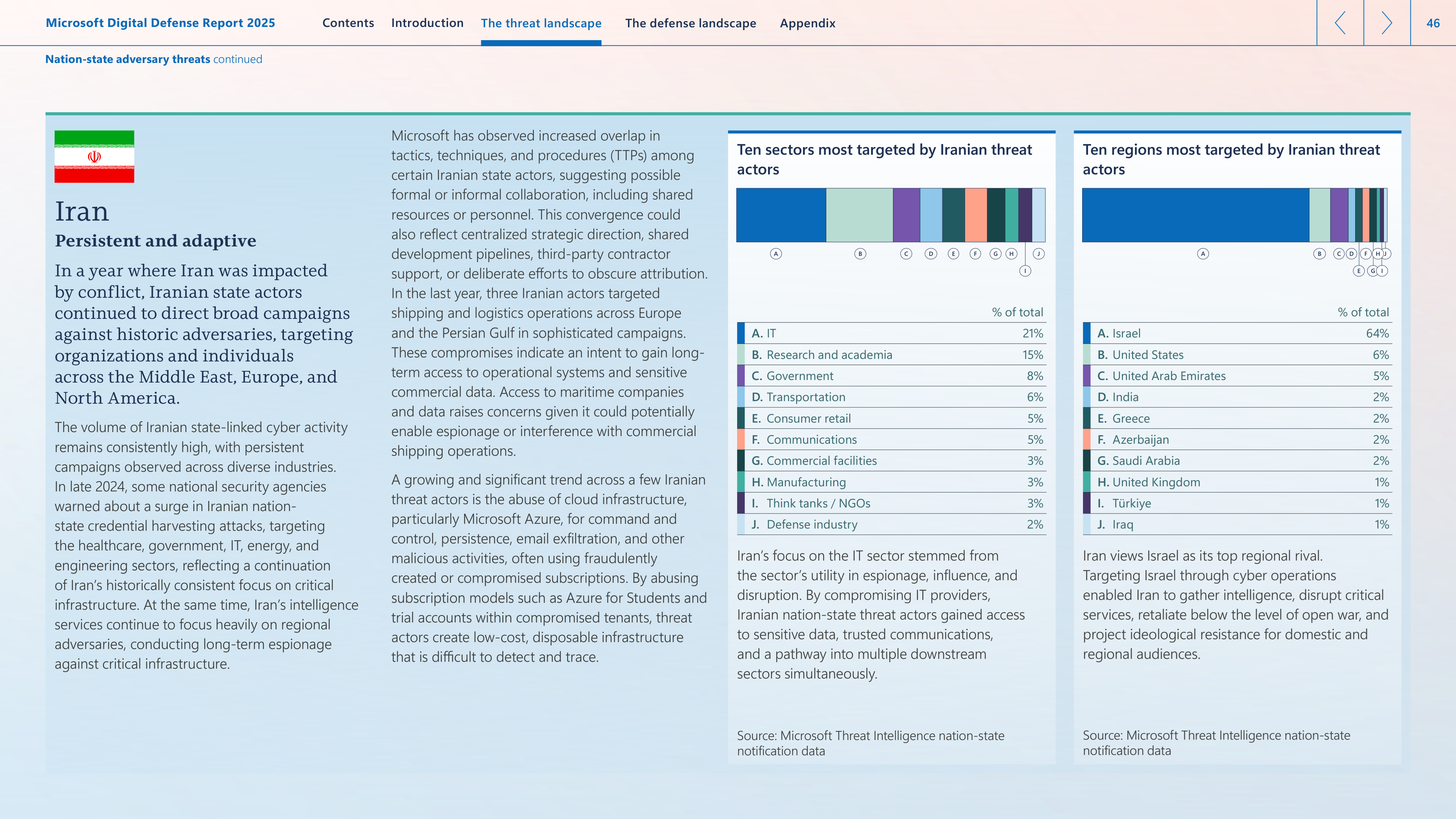

Iran
Persistent and adaptive
In a year where Iran was impacted
by conflict, Iranian state actors
continued to direct broad campaigns
against historic adversaries, targeting
organizations and individuals
across the Middle East, Europe, and
North America.
The volume of Iranian state-linked cyber activity
remains consistently high, with persistent
campaigns observed across diverse industries.
In late 2024, some national security agencies
warned about a surge in Iranian nation-
state credential harvesting attacks, targeting
the healthcare, government, IT, energy, and
engineering sectors, reflecting a continuation
of Iran’s historically consistent focus on critical
infrastructure. At the same time, Iran’s intelligence
services continue to focus heavily on regional
adversaries, conducting long-term espionage
against critical infrastructure.
Microsoft has observed increased overlap in
tactics, techniques, and procedures (TTPs) among
certain Iranian state actors, suggesting possible
formal or informal collaboration, including shared
resources or personnel. This convergence could
also reflect centralized strategic direction, shared
development pipelines, third-party contractor
support, or deliberate efforts to obscure attribution.
In the last year, three Iranian actors targeted
shipping and logistics operations across Europe
and the Persian Gulf in sophisticated campaigns.
These compromises indicate an intent to gain long-
term access to operational systems and sensitive
commercial data. Access to maritime companies
and data raises concerns given it could potentially
enable espionage or interference with commercial
shipping operations.
A growing and significant trend across a few Iranian
threat actors is the abuse of cloud infrastructure,
particularly Microsoft Azure, for command and
control, persistence, email exfiltration, and other
malicious activities, often using fraudulently
created or compromised subscriptions. By abusing
subscription models such as Azure for Students and
trial accounts within compromised tenants, threat
actors create low-cost, disposable infrastructure
that is difficult to detect and trace.
Ten sectors most targeted by Iranian threat
actors
% of total
A.
IT
21%
B.
Research and academia
15%
C.
Government
8%
D.
Transportation
6%
E.
Consumer retail
5%
F.
Communications
5%
G.
Commercial facilities
3%
H.
Manufacturing
3%
I.
Think tanks / NGOs
3%
J.
Defense industry
2%
Iran’s focus on the IT sector stemmed from
the sector’s utility in espionage, influence, and
disruption. By compromising IT providers,
Iranian nation-state threat actors gained access
to sensitive data, trusted communications,
and a pathway into multiple downstream
sectors simultaneously.
Source: Microsoft Threat Intelligence nation-state
notification data
Ten regions most targeted by Iranian threat
actors
% of total
A.
Israel
64%
B.
United States
6%
C.
United Arab Emirates
5%
D.
India
2%
E.
Greece
2%
F.
Azerbaijan
2%
G.
Saudi Arabia
2%
H.
United Kingdom
1%
I.
Türkiye
1%
J.
Iraq
1%
Iran views Israel as its top regional rival.
Targeting Israel through cyber operations
enabled Iran to gather intelligence, disrupt critical
services, retaliate below the level of open war, and
project ideological resistance for domestic and
regional audiences.
Source: Microsoft Threat Intelligence nation-state
notification data
Nation-state adversary threats
continued
Ten regions most targeted by Iranian threat
actors
E
B
C
D
F
G
J
A
H
I
% of total
A.
Israel
64%
B.
United States
6%
C.
United Arab Emirates
5%
D.
India
2%
E.
Greece
2%
F.
Azerbaijan
2%
G.
Saudi Arabia
2%
H.
United Kingdom
1%
I.
Türkiye
1%
J.
Iraq
1%
Iran views Israel as its top regional rival.
Targeting Israel through cyber operations
enabled Iran to gather intelligence, disrupt critical
services, retaliate below the level of open war, and
project ideological resistance for domestic and
regional audiences.
Ten sectors most targeted by Iranian threat
actors
D
C
E
F
G
H
I
J
B
A
% of total
A.
IT
21%
B.
Research and academia
15%
C.
Government
8%
D.
Transportation
6%
E.
Consumer retail
5%
F.
Communications
5%
G.
Commercial facilities
3%
H.
Manufacturing
3%
I.
Think tanks / NGOs
3%
J.
Defense industry
2%
Iran’s focus on the IT sector stemmed from
the sector’s utility in espionage, influence, and
disruption. By compromising IT providers,
Iranian nation-state threat actors gained access
to sensitive data, trusted communications,
and a pathway into multiple downstream
sectors simultaneously.
Microsoft has observed increased overlap in
tactics, techniques, and procedures (TTPs) among
certain Iranian state actors, suggesting possible
formal or informal collaboration, including shared
resources or personnel. This convergence could
also reflect centralized strategic direction, shared
development pipelines, third-party contractor
support, or deliberate efforts to obscure attribution.
In the last year, three Iranian actors targeted
shipping and logistics operations across Europe
and the Persian Gulf in sophisticated campaigns.
These compromises indicate an intent to gain long-
term access to operational systems and sensitive
commercial data. Access to maritime companies
and data raises concerns given it could potentially
enable espionage or interference with commercial
shipping operations.
A growing and significant trend across a few Iranian
threat actors is the abuse of cloud infrastructure,
particularly Microsoft Azure, for command and
control, persistence, email exfiltration, and other
malicious activities, often using fraudulently
created or compromised subscriptions. By abusing
subscription models such as Azure for Students and
trial accounts within compromised tenants, threat
actors create low-cost, disposable infrastructure
that is difficult to detect and trace.
Source: Microsoft Threat Intelligence nation-state
notification data
Source: Microsoft Threat Intelligence nation-state
notification data
Iran
Persistent and adaptive
In a year where Iran was impacted
by conflict, Iranian state actors
continued to direct broad campaigns
against historic adversaries, targeting
organizations and individuals
across the Middle East, Europe, and
North America.
The volume of Iranian state-linked cyber activity
remains consistently high, with persistent
campaigns observed across diverse industries.
In late 2024, some national security agencies
warned about a surge in Iranian nation-
state credential harvesting attacks, targeting
the healthcare, government, IT, energy, and
engineering sectors, reflecting a continuation
of Iran’s historically consistent focus on critical
infrastructure. At the same time, Iran’s intelligence
services continue to focus heavily on regional
adversaries, conducting long-term espionage
against critical infrastructure.
Microsoft Digital Defense Report 2025
46
Introduction
Contents
The defense landscape
Appendix
The threat landscape
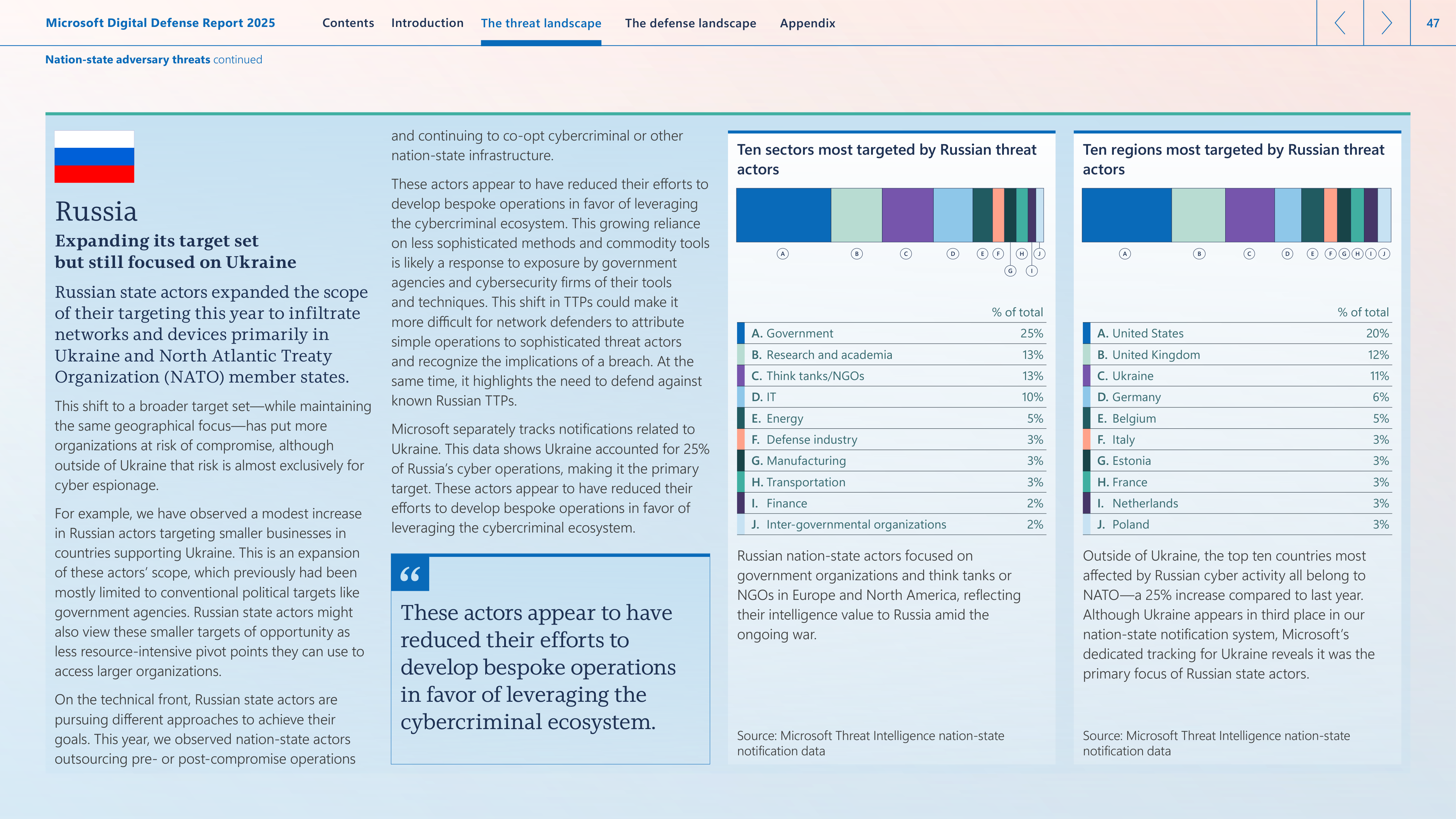

Russia
Expanding its target set
but still focused on Ukraine
Russian state actors expanded the scope
of their targeting this year to infiltrate
networks and devices primarily in
Ukraine and North Atlantic Treaty
Organization (NATO) member states.
This shift to a broader target set—while maintaining
the same geographical focus—has put more
organizations at risk of compromise, although
outside of Ukraine that risk is almost exclusively for
cyber espionage.
For example, we have observed a modest increase
in Russian actors targeting smaller businesses in
countries supporting Ukraine. This is an expansion
of these actors’ scope, which previously had been
mostly limited to conventional political targets like
government agencies. Russian state actors might
also view these smaller targets of opportunity as
less resource-intensive pivot points they can use to
access larger organizations.
On the technical front, Russian state actors are
pursuing different approaches to achieve their
goals. This year, we observed nation-state actors
outsourcing pre- or post-compromise operations
and continuing to co-opt cybercriminal or other
nation-state infrastructure.
These actors appear to have reduced their efforts to
develop bespoke operations in favor of leveraging
the cybercriminal ecosystem. This growing reliance
on less sophisticated methods and commodity tools
is likely a response to exposure by government
agencies and cybersecurity firms of their tools
and techniques. This shift in TTPs could make it
more difficult for network defenders to attribute
simple operations to sophisticated threat actors
and recognize the implications of a breach. At the
same time, it highlights the need to defend against
known Russian TTPs.
Microsoft separately tracks notifications related to
Ukraine. This data shows Ukraine accounted for 25%
of Russia’s cyber operations, making it the primary
target. These actors appear to have reduced their
efforts to develop bespoke operations in favor of
leveraging the cybercriminal ecosystem.
“
These actors appear to have
reduced their efforts to
develop bespoke operations
in favor of leveraging the
cybercriminal ecosystem.
Ten sectors most targeted by Russian threat
actors
% of total
A.
Government
25%
B.
Research and academia
13%
C.
Think tanks/NGOs
13%
D.
IT
10%
E.
Energy
5%
F.
Defense industry
3%
G.
Manufacturing
3%
H.
Transportation
3%
I.
Finance
2%
J.
Inter-governmental organizations
2%
Russian nation-state actors focused on
government organizations and think tanks or
NGOs in Europe and North America, reflecting
their intelligence value to Russia amid the
ongoing war.
Source: Microsoft Threat Intelligence nation-state
notification data
Ten regions most targeted by Russian threat
actors
% of total
A.
United States
20%
B.
United Kingdom
12%
C.
Ukraine
11%
D.
Germany
6%
E.
Belgium
5%
F.
Italy
3%
G.
Estonia
3%
H.
France
3%
I.
Netherlands
3%
J.
Poland
3%
Outside of Ukraine, the top ten countries most
affected by Russian cyber activity all belong to
NATO—a 25% increase compared to last year.
Although Ukraine appears in third place in our
nation-state notification system, Microsoft’s
dedicated tracking for Ukraine reveals it was the
primary focus of Russian state actors.
Source: Microsoft Threat Intelligence nation-state
notification data
Nation-state adversary threats
continued
Ten regions most targeted by Russian threat
actors
F
H
B
C
D
E
G
I
J
A
% of total
A.
United States
20%
B.
United Kingdom
12%
C.
Ukraine
11%
D.
Germany
6%
E.
Belgium
5%
F.
Italy
3%
G.
Estonia
3%
H.
France
3%
I.
Netherlands
3%
J.
Poland
3%
Outside of Ukraine, the top ten countries most
affected by Russian cyber activity all belong to
NATO—a 25% increase compared to last year.
Although Ukraine appears in third place in our
nation-state notification system, Microsoft’s
dedicated tracking for Ukraine reveals it was the
primary focus of Russian state actors.
Ten sectors most targeted by Russian threat
actors
G
D
C
E
F
H
I
J
B
A
% of total
A.
Government
25%
B.
Research and academia
13%
C.
Think tanks/NGOs
13%
D.
IT
10%
E.
Energy
5%
F.
Defense industry
3%
G.
Manufacturing
3%
H.
Transportation
3%
I.
Finance
2%
J.
Inter-governmental organizations
2%
Russian nation-state actors focused on
government organizations and think tanks or
NGOs in Europe and North America, reflecting
their intelligence value to Russia amid the
ongoing war.
and continuing to co-opt cybercriminal or other
nation-state infrastructure.
These actors appear to have reduced their efforts to
develop bespoke operations in favor of leveraging
the cybercriminal ecosystem. This growing reliance
on less sophisticated methods and commodity tools
is likely a response to exposure by government
agencies and cybersecurity firms of their tools
and techniques. This shift in TTPs could make it
more difficult for network defenders to attribute
simple operations to sophisticated threat actors
and recognize the implications of a breach. At the
same time, it highlights the need to defend against
known Russian TTPs.
Microsoft separately tracks notifications related to
Ukraine. This data shows Ukraine accounted for 25%
of Russia’s cyber operations, making it the primary
target. These actors appear to have reduced their
efforts to develop bespoke operations in favor of
leveraging the cybercriminal ecosystem.
These actors appear to have
reduced their efforts to
develop bespoke operations
in favor of leveraging the
cybercriminal ecosystem.
Source: Microsoft Threat Intelligence nation-state
notification data
Source: Microsoft Threat Intelligence nation-state
notification data
Russia
Expanding its target set
but still focused on Ukraine
Russian state actors expanded the scope
of their targeting this year to infiltrate
networks and devices primarily in
Ukraine and North Atlantic Treaty
Organization (NATO) member states.
This shift to a broader target set—while maintaining
the same geographical focus—has put more
organizations at risk of compromise, although
outside of Ukraine that risk is almost exclusively for
cyber espionage.
For example, we have observed a modest increase
in Russian actors targeting smaller businesses in
countries supporting Ukraine. This is an expansion
of these actors’ scope, which previously had been
mostly limited to conventional political targets like
government agencies. Russian state actors might
also view these smaller targets of opportunity as
less resource-intensive pivot points they can use to
access larger organizations.
On the technical front, Russian state actors are
pursuing different approaches to achieve their
goals. This year, we observed nation-state actors
outsourcing pre- or post-compromise operations
Microsoft Digital Defense Report 2025
47
Introduction
Contents
The defense landscape
Appendix
The threat landscape
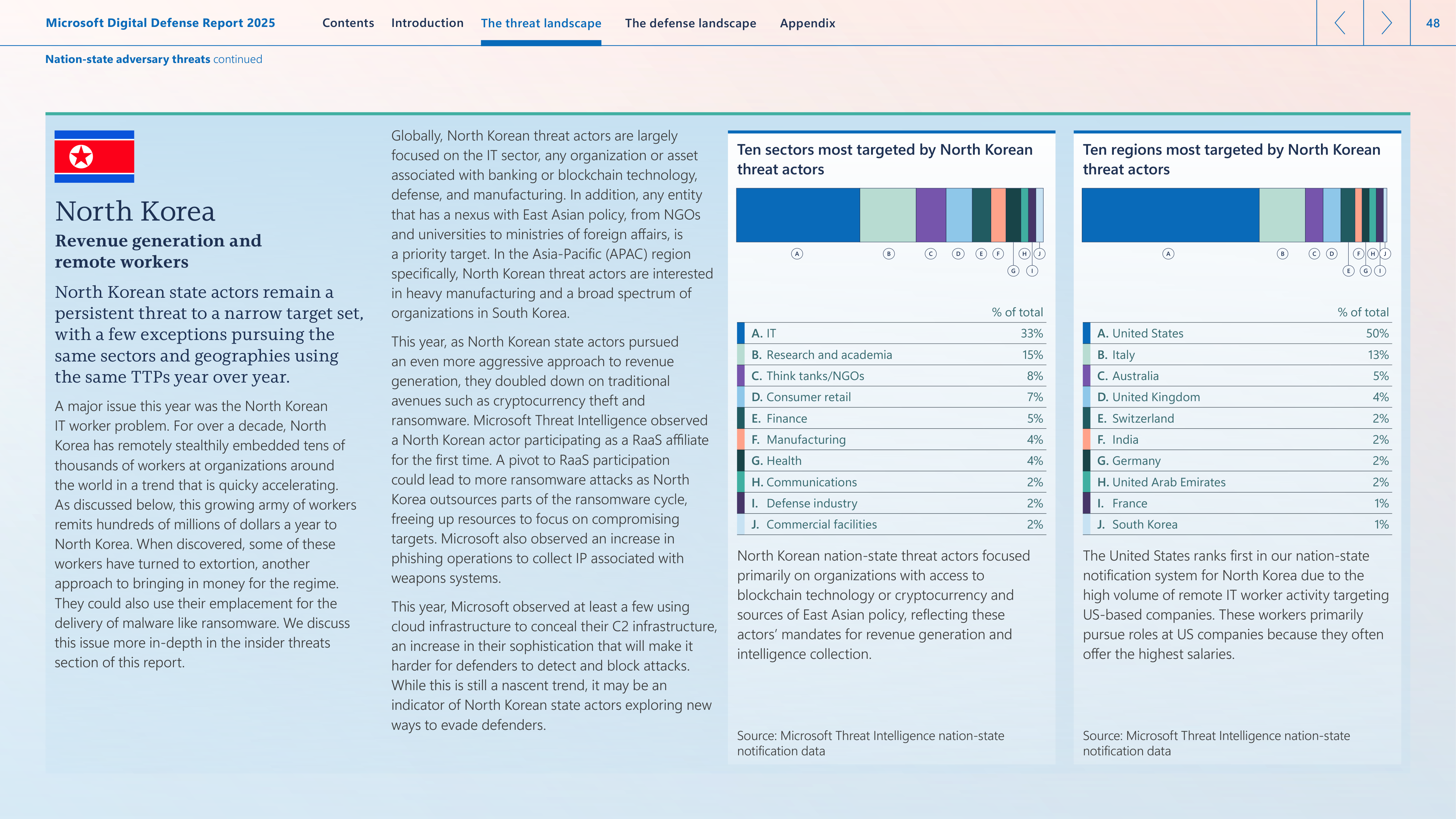

North Korea
Revenue generation and
remote workers
North Korean state actors remain a
persistent threat to a narrow target set,
with a few exceptions pursuing the
same sectors and geographies using
the same TTPs year over year.
A major issue this year was the North Korean
IT worker problem. For over a decade, North
Korea has remotely stealthily embedded tens of
thousands of workers at organizations around
the world in a trend that is quicky accelerating.
As discussed below, this growing army of workers
remits hundreds of millions of dollars a year to
North Korea. When discovered, some of these
workers have turned to extortion, another
approach to bringing in money for the regime.
They could also use their emplacement for the
delivery of malware like ransomware. We discuss
this issue more in-depth in the insider threats
section of this report.
Globally, North Korean threat actors are largely
focused on the IT sector, any organization or asset
associated with banking or blockchain technology,
defense, and manufacturing. In addition, any entity
that has a nexus with East Asian policy, from NGOs
and universities to ministries of foreign affairs, is
a priority target. In the Asia-Pacific (APAC) region
specifically, North Korean threat actors are interested
in heavy manufacturing and a broad spectrum of
organizations in South Korea.
This year, as North Korean state actors pursued
an even more aggressive approach to revenue
generation, they doubled down on traditional
avenues such as cryptocurrency theft and
ransomware. Microsoft Threat Intelligence observed
a North Korean actor participating as a RaaS affiliate
for the first time. A pivot to RaaS participation
could lead to more ransomware attacks as North
Korea outsources parts of the ransomware cycle,
freeing up resources to focus on compromising
targets. Microsoft also observed an increase in
phishing operations to collect IP associated with
weapons systems.
This year, Microsoft observed at least a few using
cloud infrastructure to conceal their C2 infrastructure,
an increase in their sophistication that will make it
harder for defenders to detect and block attacks.
While this is still a nascent trend, it may be an
indicator of North Korean state actors exploring new
ways to evade defenders.
Ten sectors most targeted by North Korean
threat actors
% of total
A.
IT
33%
B.
Research and academia
15%
C.
Think tanks/NGOs
8%
D.
Consumer retail
7%
E.
Finance
5%
F.
Manufacturing
4%
G.
Health
4%
H.
Communications
2%
I.
Defense industry
2%
J.
Commercial facilities
2%
North Korean nation-state threat actors focused
primarily on organizations with access to
blockchain technology or cryptocurrency and
sources of East Asian policy, reflecting these
actors’ mandates for revenue generation and
intelligence collection.
Source: Microsoft Threat Intelligence nation-state
notification data
Ten regions most targeted by North Korean
threat actors
% of total
A.
United States
50%
B.
Italy
13%
C.
Australia
5%
D.
United Kingdom
4%
E.
Switzerland
2%
F.
India
2%
G.
Germany
2%
H.
United Arab Emirates
2%
I.
France
1%
J.
South Korea
1%
The United States ranks first in our nation-state
notification system for North Korea due to the
high volume of remote IT worker activity targeting
US-based companies. These workers primarily
pursue roles at US companies because they often
offer the highest salaries.
Source: Microsoft Threat Intelligence nation-state
notification data
Nation-state adversary threats
continued
Ten regions most targeted by North Korean
threat actors
G
E
I
B
C
D
F
H
J
A
% of total
A.
United States
50%
B.
Italy
13%
C.
Australia
5%
D.
United Kingdom
4%
E.
Switzerland
2%
F.
India
2%
G.
Germany
2%
H.
United Arab Emirates
2%
I.
France
1%
J.
South Korea
1%
The United States ranks first in our nation-state
notification system for North Korea due to the
high volume of remote IT worker activity targeting
US-based companies. These workers primarily
pursue roles at US companies because they often
offer the highest salaries.
Ten sectors most targeted by North Korean
threat actors
G
D
C
E
F
H
I
J
B
A
% of total
A.
IT
33%
B.
Research and academia
15%
C.
Think tanks/NGOs
8%
D.
Consumer retail
7%
E.
Finance
5%
F.
Manufacturing
4%
G.
Health
4%
H.
Communications
2%
I.
Defense industry
2%
J.
Commercial facilities
2%
North Korean nation-state threat actors focused
primarily on organizations with access to
blockchain technology or cryptocurrency and
sources of East Asian policy, reflecting these
actors’ mandates for revenue generation and
intelligence collection.
Globally, North Korean threat actors are largely
focused on the IT sector, any organization or asset
associated with banking or blockchain technology,
defense, and manufacturing. In addition, any entity
that has a nexus with East Asian policy, from NGOs
and universities to ministries of foreign affairs, is
a priority target. In the Asia-Pacific (APAC) region
specifically, North Korean threat actors are interested
in heavy manufacturing and a broad spectrum of
organizations in South Korea.
This year, as North Korean state actors pursued
an even more aggressive approach to revenue
generation, they doubled down on traditional
avenues such as cryptocurrency theft and
ransomware. Microsoft Threat Intelligence observed
a North Korean actor participating as a RaaS affiliate
for the first time. A pivot to RaaS participation
could lead to more ransomware attacks as North
Korea outsources parts of the ransomware cycle,
freeing up resources to focus on compromising
targets. Microsoft also observed an increase in
phishing operations to collect IP associated with
weapons systems.
This year, Microsoft observed at least a few using
cloud infrastructure to conceal their C2 infrastructure,
an increase in their sophistication that will make it
harder for defenders to detect and block attacks.
While this is still a nascent trend, it may be an
indicator of North Korean state actors exploring new
ways to evade defenders.
Source: Microsoft Threat Intelligence nation-state
notification data
Source: Microsoft Threat Intelligence nation-state
notification data
North Korea
Revenue generation and
remote workers
North Korean state actors remain a
persistent threat to a narrow target set,
with a few exceptions pursuing the
same sectors and geographies using
the same TTPs year over year.
A major issue this year was the North Korean
IT worker problem. For over a decade, North
Korea has remotely stealthily embedded tens of
thousands of workers at organizations around
the world in a trend that is quicky accelerating.
As discussed below, this growing army of workers
remits hundreds of millions of dollars a year to
North Korea. When discovered, some of these
workers have turned to extortion, another
approach to bringing in money for the regime.
They could also use their emplacement for the
delivery of malware like ransomware. We discuss
this issue more in-depth in the insider threats
section of this report.
Microsoft Digital Defense Report 2025
48
Introduction
Contents
The defense landscape
Appendix
The threat landscape
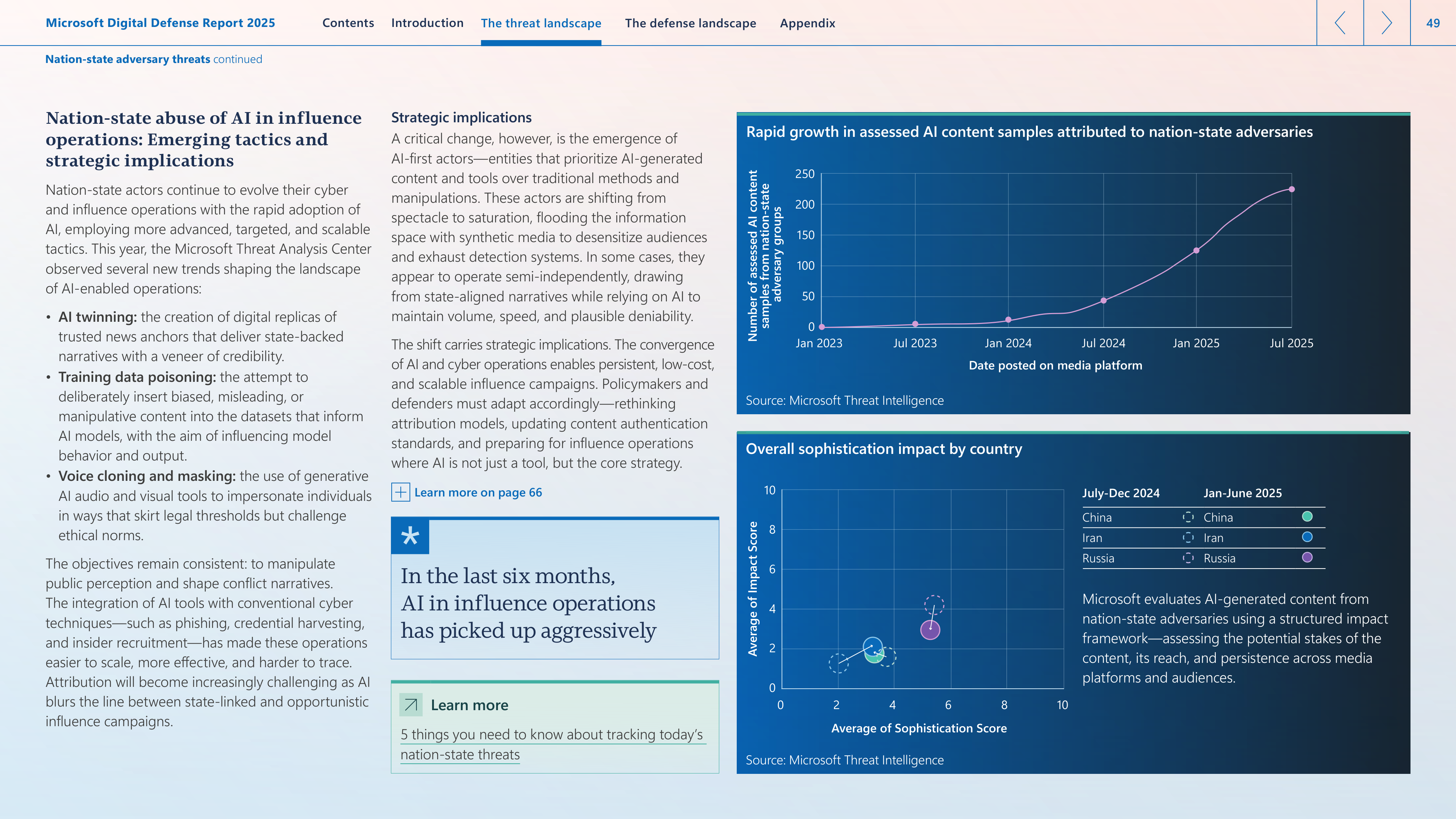

Nation-state adversary threats
continued
250
200
150
100
50
0
Jul 2023
Jan 2023
Jan 2024
Jul 2024
Jan 2025
Jul 2025
Date posted on media platform
Number of assessed AI content
samples from nation-state
adversary groups
Average of Sophistication Score
0
2
4
6
8
10
10
8
6
4
2
0
Average of Impact Score
Microsoft Digital Defense Report 2025
49
Contents
Introduction
The threat landscape
The defense landscape
Appendix
Nation-state abuse of AI in influence
operations: Emerging tactics and
strategic implications
Nation-state actors continue to evolve their cyber
and influence operations with the rapid adoption of
AI, employing more advanced, targeted, and scalable
tactics. This year, the Microsoft Threat Analysis Center
observed several new trends shaping the landscape
of AI-enabled operations:
•
AI twinning:
the creation of digital replicas of
trusted news anchors that deliver state-backed
narratives with a veneer of credibility.
•
Training data poisoning:
the attempt to
deliberately insert biased, misleading, or
manipulative content into the datasets that inform
AI models, with the aim of influencing model
behavior and output.
•
Voice cloning and masking:
the use of generative
AI audio and visual tools to impersonate individuals
in ways that skirt legal thresholds but challenge
ethical norms.
The objectives remain consistent: to manipulate
public perception and shape conflict narratives.
The integration of AI tools with conventional cyber
techniques—such as phishing, credential harvesting,
and insider recruitment—has made these operations
easier to scale, more effective, and harder to trace.
Attribution will become increasingly challenging as AI
blurs the line between state-linked and opportunistic
influence campaigns.
Strategic implications
A critical change, however, is the emergence of
AI-first actors—entities that prioritize AI-generated
content and tools over traditional methods and
manipulations. These actors are shifting from
spectacle to saturation, flooding the information
space with synthetic media to desensitize audiences
and exhaust detection systems. In some cases, they
appear to operate semi-independently, drawing
from state-aligned narratives while relying on AI to
maintain volume, speed, and plausible deniability.
The shift carries strategic implications. The convergence
of AI and cyber operations enables persistent, low-cost,
and scalable influence campaigns. Policymakers and
defenders must adapt accordingly—rethinking
attribution models, updating content authentication
standards, and preparing for influence operations
where AI is not just a tool, but the core strategy.
Learn more on page 66
*
In the last six months,
AI in influence operations
has picked up aggressively
Learn more
5 things you need to know about tracking today’s
nation-state threats
Rapid growth in assessed AI content samples attributed to nation-state adversaries
Source: Microsoft Threat Intelligence
Overall sophistication impact by country
July-Dec 2024
Jan-June 2025
China
China
Iran
Iran
Russia
Russia
Microsoft evaluates AI-generated content from
nation-state adversaries using a structured impact
framework—assessing the potential stakes of the
content, its reach, and persistence across media
platforms and audiences.
Source: Microsoft Threat Intelligence
Nation-state adversary threats
continued
Microsoft Digital Defense Report 2025
50
Contents
Introduction
The threat landscape
The defense landscape
Appendix
Insider risk in the age of strategic
geopolitical competition
Insider threats: Emerging dimensions
and mitigations
In an era of increasing geopolitical tensions and
blurring of public and private sector interests, nation-
state actors have increased their use of insiders to
gain access to intelligence. These efforts are often
long-term operations that are more difficult to detect
than traditional hacks. Nation-states increasingly
use non-state actors—including cyber mercenaries,
criminal syndicates, and front organizations—to
conduct insider threat operations that target private
sector entities.
Note 11
These proxies obscure attribution
while enabling scalable, persistent campaigns.
China and Russia have both cultivated ecosystems
to infiltrate corporate environments, often using
academic or professional affiliations to identify and
exploit vulnerable insiders.
Note 12
The sectors most at
risk—AI, quantum technologies, biotechnology, and
defense—have both economic and military value.
Insider espionage can cause immediate financial loss
and long-term competitive harm, erasing years of
innovation and market advantage through stolen
research and development.
Most organizations’ cybersecurity frameworks
were not initially built with an insider threat in mind.
Compliance standards and cybersecurity best
practices traditionally assume that the attacker is
an outsider trying to break in, but when the threat
actor is an insider with valid access, many of those
measures could be bypassed by default.
Additionally, many internal cybersecurity tools are not
designed to detect trusted insiders working covertly
with sophisticated external actors. For example,
data loss prevention (DLP) tools that would flag
large, suspicious file transfers often miss the slow,
stealthy exfiltration of an espionage-minded
insider. While zero trust network architecture adds
protection against unauthorized devices and external
connections, it requires consistent operationalization
on the comprehensive zero trust principles and
security strategy to prevent unauthorized use of a
legitimate user account.
According to DTEX Systems and the Ponemon
Institute, companies take 81 days on average to
contain an identified insider incident.
Note 13
This long dwell
time gives nation-state actors a persistent foothold
to expand their access, cover their tracks, and even
establish back doors for future use.
Layoffs and workforce reductions across government
and private industry add another dimension to
the insider landscape. Such workforce adjustments
can inadvertently exacerbate insider threat risks
through disgruntled employees or weakened security
oversight due to budget cuts and staff reductions.
Malicious insiders can leak sensitive data or redirect
corporate assets to corporate adversaries. Third-party
suppliers with privileged access might unknowingly
introduce vulnerabilities, making rigorous vetting
and alignment with internal security policies essential
to mitigating insider-driven exposure. Facing this
threat requires an intentional strategy. For businesses,
the issue of insider risk should be elevated to
the boardroom and C-suite. Executives should
include insider risk in regular risk assessments and
incorporate insider risk programs information when
business decisions may impact the workforce.
Key recommendations for enterprise leaders include:
•
Identify your crown jewels.
Pinpoint the data
or technologies that would be most devastating
to lose (for example, trade secrets, source code,
formulas, merger and acquisition plans) and
implement extra safeguards around these assets
such as strict need-to-know access, encryption,
and monitoring of access logs in real time.
•
Implement continuous identity verification.
Move beyond one-time sign-ins and use adaptive
authentication and behavioral biometrics (like
typing patterns or mouse movements) to
continuously verify that the person behind an
account is the genuine user. If an account starts
behaving oddly—for example, a finance employee
begins downloading large engineering design
files—require immediate re-authentication or
manager approval.
•
Divide and limit access.
Architect your systems
on the assumption that an insider might turn
malicious. No single individual should be able to
access all critical data. Use segregation of duties
and data fragmentation so that even if one
account is compromised, an attacker can’t sweep
up everything.
•
Foster a vigilant culture.
Employees are often the
first to notice unusual behavior in a peer. Create a
culture where reporting a concern is encouraged
and rewarded.
•
Conduct exit interviews and post-employment
monitoring.
Exit interviews are an effective
safeguard against insider risk. They provide a final
opportunity to detect warning signs, reinforce
confidentiality and data protection obligations,
and ensure access to sensitive information is
revoked. These conversations also reduce the
risk of disgruntled retaliation, highlight potential
process weaknesses, and remind departing staff
of their continuing obligations at a time when
adversarial entities may seek to recruit them (this
is more specific to those with security clearances).
Documenting the exchange creates an audit trail,
demonstrating that the organization has taken
prudent steps to protect its assets, reputation, and
people during workforce transitions.
•
Engage in holistic insider risk management.
Effective insider risk management requires a
blend of technology, culture, and collaboration.
Deploy behavioral analytics and DLP solutions
to detect unusual data transfers or privilege
escalations, particularly among highly privileged
users. Intelligence sharing between government,
private industry, and recruiting platforms also helps
expose fake companies and protect organizations
from risky potential hires.
Additionally, companies can use dedicated insider
threat monitoring tools to reduce the overarching
risk profile. As an example, companies utilizing
Communications Compliance
can be notified of
potential talent recruitment outreach.
Note 14
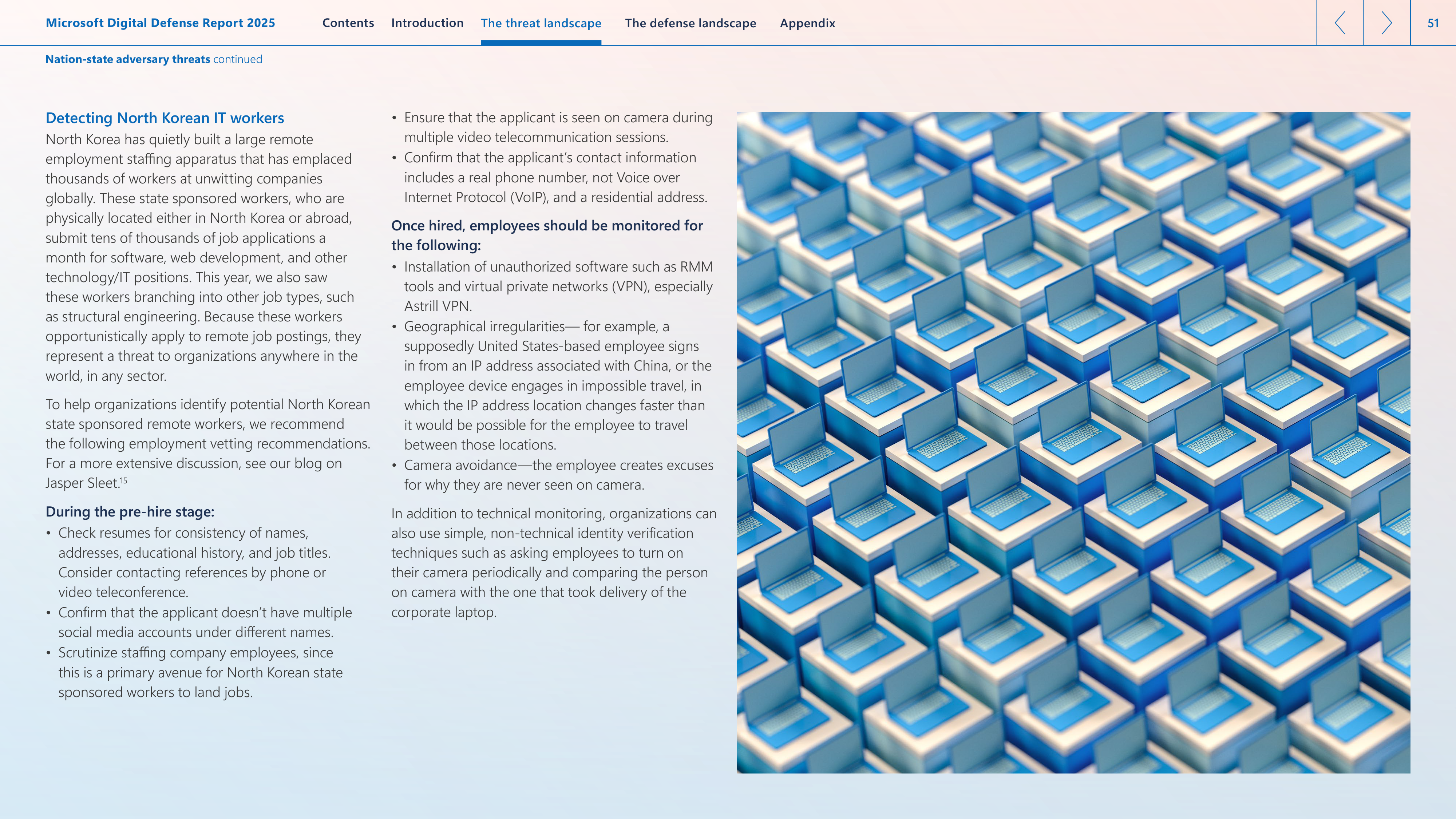

Nation-state adversary threats
continued
Microsoft Digital Defense Report 2025
51
Contents
Introduction
The threat landscape
The defense landscape
Appendix
Detecting North Korean IT workers
North Korea has quietly built a large remote
employment staffing apparatus that has emplaced
thousands of workers at unwitting companies
globally. These state sponsored workers, who are
physically located either in North Korea or abroad,
submit tens of thousands of job applications a
month for software, web development, and other
technology/IT positions. This year, we also saw
these workers branching into other job types, such
as structural engineering. Because these workers
opportunistically apply to remote job postings, they
represent a threat to organizations anywhere in the
world, in any sector.
To help organizations identify potential North Korean
state sponsored remote workers, we recommend
the following employment vetting recommendations.
For a more extensive discussion, see our blog on
Jasper Sleet.
15
During the pre-hire stage:
• Check resumes for consistency of names,
addresses, educational history, and job titles.
Consider contacting references by phone or
video teleconference.
• Confirm that the applicant doesn’t have multiple
social media accounts under different names.
• Scrutinize staffing company employees, since
this is a primary avenue for North Korean state
sponsored workers to land jobs.
• Ensure that the applicant is seen on camera during
multiple video telecommunication sessions.
• Confirm that the applicant’s contact information
includes a real phone number, not Voice over
Internet Protocol (VoIP), and a residential address.
Once hired, employees should be monitored for
the following:
• Installation of unauthorized software such as RMM
tools and virtual private networks (VPN), especially
Astrill VPN.
• Geographical irregularities— for example, a
supposedly United States-based employee signs
in from an IP address associated with China, or the
employee device engages in impossible travel, in
which the IP address location changes faster than
it would be possible for the employee to travel
between those locations.
• Camera avoidance—the employee creates excuses
for why they are never seen on camera.
In addition to technical monitoring, organizations can
also use simple, non-technical identity verification
techniques such as asking employees to turn on
their camera periodically and comparing the person
on camera with the one that took delivery of the
corporate laptop.
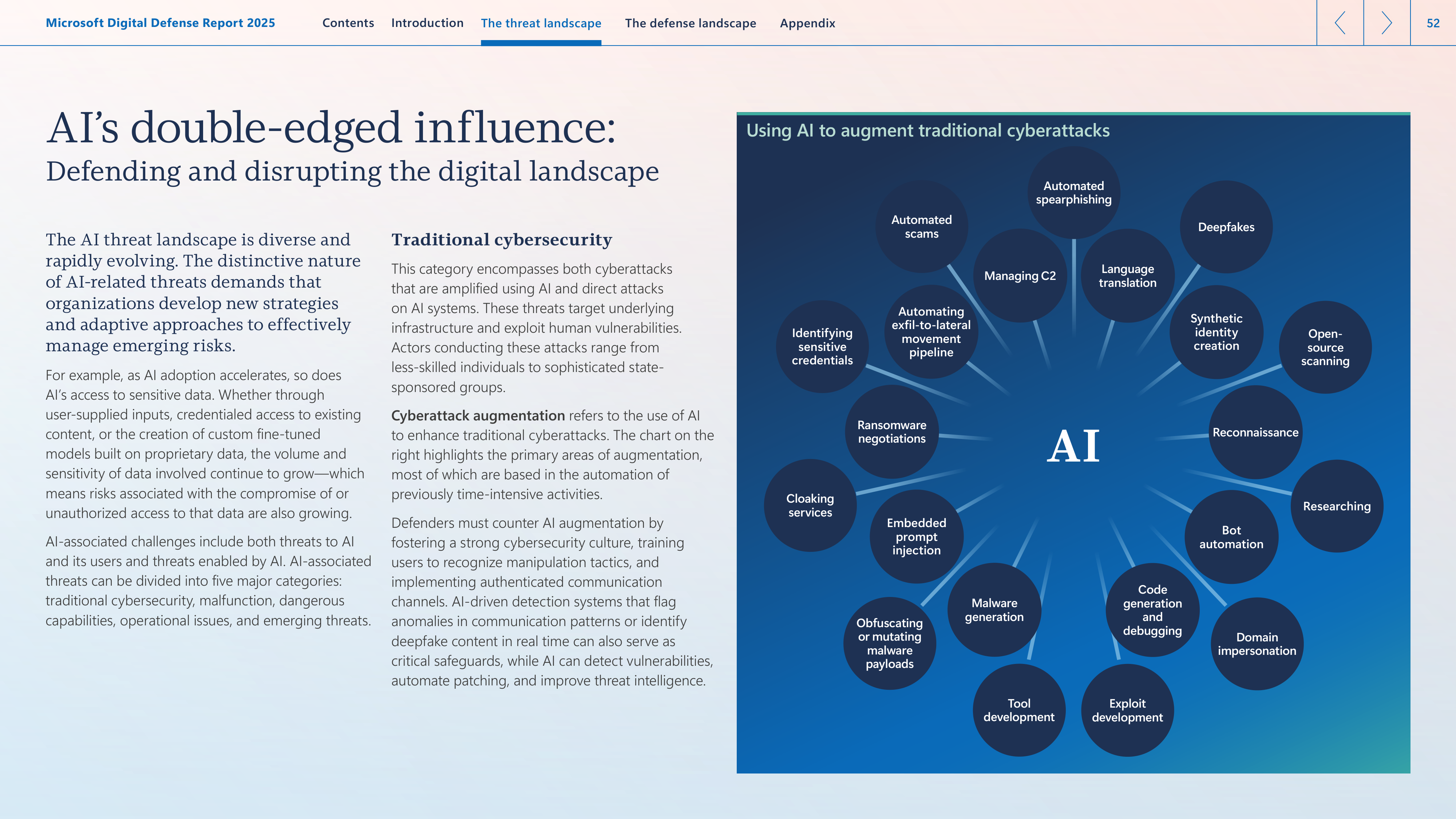

Microsoft Digital Defense Report 2025
52
Contents
Introduction
The threat landscape
The defense landscape
Appendix
AI’s double-edged influence:
Defending and disrupting the digital landscape
The AI threat landscape is diverse and
rapidly evolving. The distinctive nature
of AI-related threats demands that
organizations develop new strategies
and adaptive approaches to effectively
manage emerging risks.
For example, as AI adoption accelerates, so does
AI’s access to sensitive data. Whether through
user-supplied inputs, credentialed access to existing
content, or the creation of custom fine-tuned
models built on proprietary data, the volume and
sensitivity of data involved continue to grow—which
means risks associated with the compromise of or
unauthorized access to that data are also growing.
AI-associated challenges include both threats to AI
and its users and threats enabled by AI. AI-associated
threats can be divided into five major categories:
traditional cybersecurity, malfunction, dangerous
capabilities, operational issues, and emerging threats.
Traditional cybersecurity
This category encompasses both cyberattacks
that are amplified using AI and direct attacks
on AI systems. These threats target underlying
infrastructure and exploit human vulnerabilities.
Actors conducting these attacks range from
less-skilled individuals to sophisticated state-
sponsored groups.
Cyberattack augmentation
refers to the use of AI
to enhance traditional cyberattacks. The chart on the
right highlights the primary areas of augmentation,
most of which are based in the automation of
previously time-intensive activities.
Defenders must counter AI augmentation by
fostering a strong cybersecurity culture, training
users to recognize manipulation tactics, and
implementing authenticated communication
channels. AI-driven detection systems that flag
anomalies in communication patterns or identify
deepfake content in real time can also serve as
critical safeguards, while AI can detect vulnerabilities,
automate patching, and improve threat intelligence.
Using AI to augment traditional cyberattacks
AI
Automated
spearphishing
Language
translation
Deepfakes
Synthetic
identity
creation
Open-
source
scanning
Reconnaissance
Researching
Bot
automation
Domain
impersonation
Code
generation
and
debugging
Exploit
development
Tool
development
Malware
generation
Obfuscating
or mutating
malware
payloads
Embedded
prompt
injection
Cloaking
services
Ransomware
negotiations
Identifying
sensitive
credentials
Automating
exfil-to-lateral
movement
pipeline
Automated
scams
Managing C2
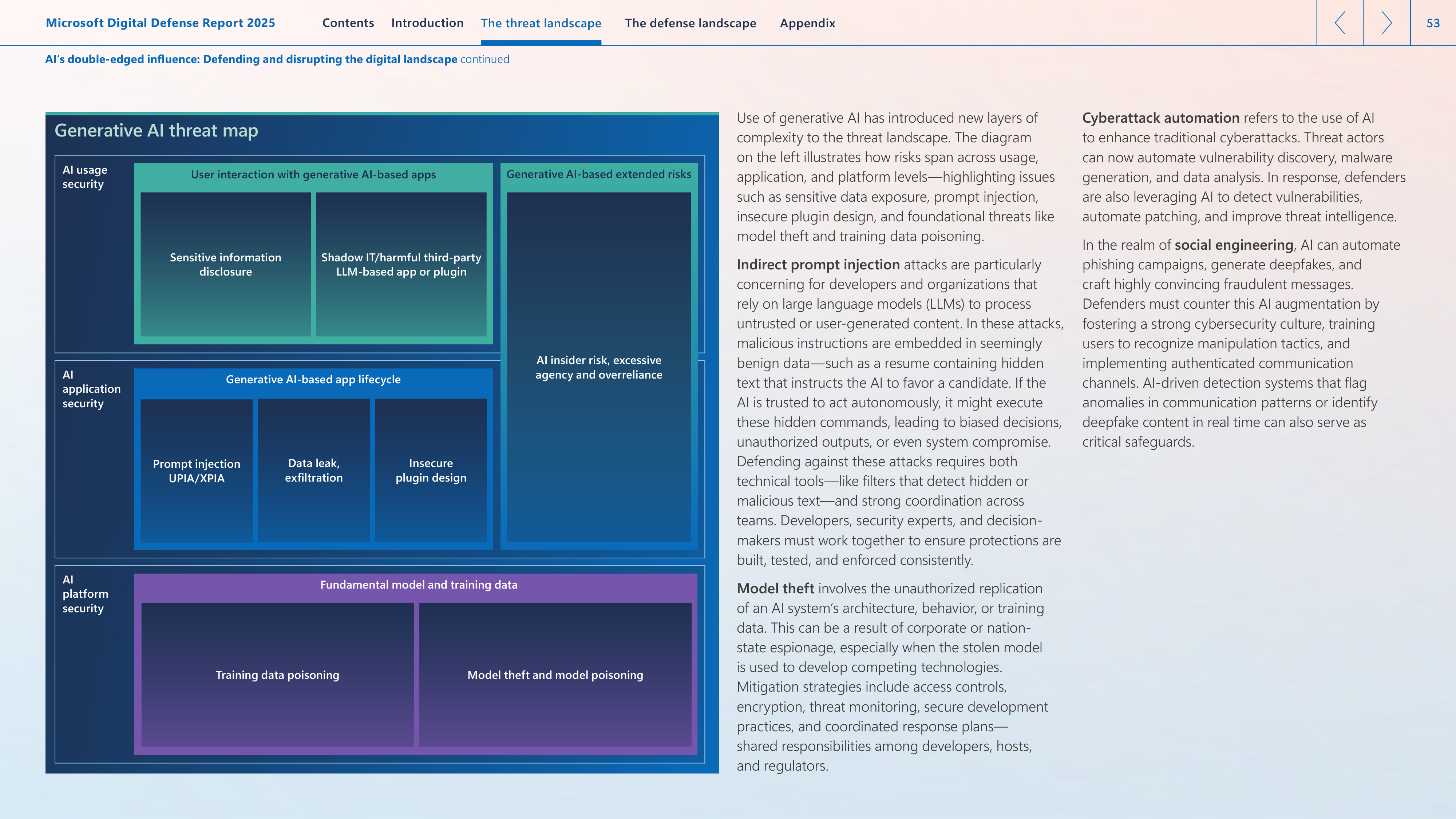

AI’s double-edged influence: Defending and disrupting the digital landscape
continued
Generative AI threat map
AI usage
security
AI
application
security
AI
platform
security
User interaction with generative AI-based apps
Generative AI-based app lifecycle
Fundamental model and training data
Generative AI-based extended risks
Sensitive information
disclosure
Prompt injection
UPIA/XPIA
Training data poisoning
Model theft and model poisoning
Shadow IT/harmful third-party
LLM-based app or plugin
AI insider risk, excessive
agency and overreliance
Data leak,
exfiltration
Insecure
plugin design
Microsoft Digital Defense Report 2025
53
Contents
Introduction
The threat landscape
The defense landscape
Appendix
Use of generative AI has introduced new layers of
complexity to the threat landscape. The diagram
on the left illustrates how risks span across usage,
application, and platform levels—highlighting issues
such as sensitive data exposure, prompt injection,
insecure plugin design, and foundational threats like
model theft and training data poisoning.
Indirect prompt injection
attacks are particularly
concerning for developers and organizations that
rely on large language models (LLMs) to process
untrusted or user-generated content. In these attacks,
malicious instructions are embedded in seemingly
benign data—such as a resume containing hidden
text that instructs the AI to favor a candidate. If the
AI is trusted to act autonomously, it might execute
these hidden commands, leading to biased decisions,
unauthorized outputs, or even system compromise.
Defending against these attacks requires both
technical tools—like filters that detect hidden or
malicious text—and strong coordination across
teams. Developers, security experts, and decision-
makers must work together to ensure protections are
built, tested, and enforced consistently.
Model theft
involves the unauthorized replication
of an AI system’s architecture, behavior, or training
data. This can be a result of corporate or nation-
state espionage, especially when the stolen model
is used to develop competing technologies.
Mitigation strategies include access controls,
encryption, threat monitoring, secure development
practices, and coordinated response plans—
shared responsibilities among developers, hosts,
and regulators.
Cyberattack automation
refers to the use of AI
to enhance traditional cyberattacks. Threat actors
can now automate vulnerability discovery, malware
generation, and data analysis. In response, defenders
are also leveraging AI to detect vulnerabilities,
automate patching, and improve threat intelligence.
In the realm of
social engineering
, AI can automate
phishing campaigns, generate deepfakes, and
craft highly convincing fraudulent messages.
Defenders must counter this AI augmentation by
fostering a strong cybersecurity culture, training
users to recognize manipulation tactics, and
implementing authenticated communication
channels. AI-driven detection systems that flag
anomalies in communication patterns or identify
deepfake content in real time can also serve as
critical safeguards.
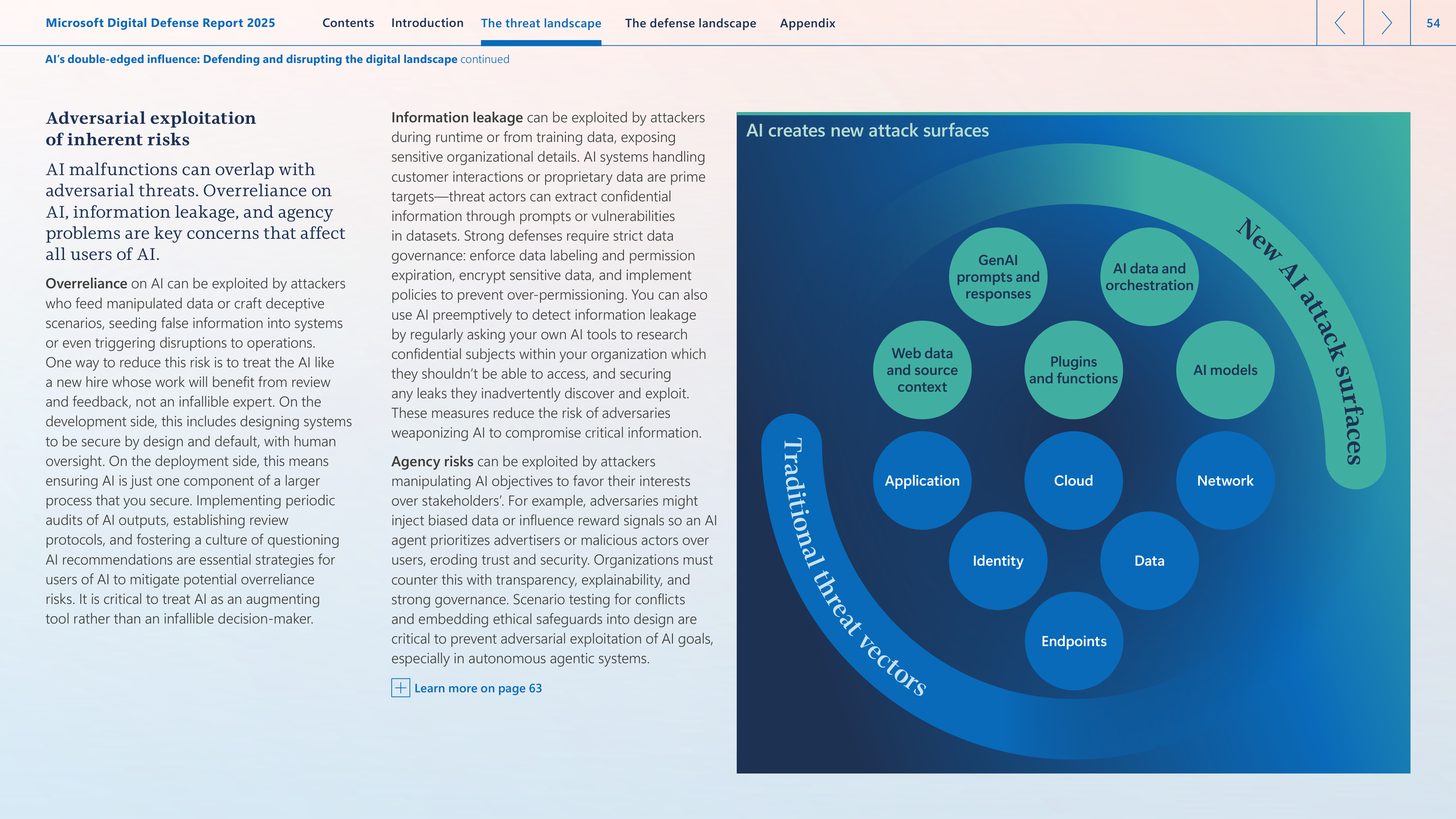

AI’s double-edged influence: Defending and disrupting the digital landscape
continued
Identity
GenAI
prompts and
responses
Data
AI data and
orchestration
Cloud
Plugins
and functions
Web data
and source
context
AI models
Endpoints
Application
Network
T
r
a
d
i
t
i
o
n
a
l
t
h
r
e
a
t
v
e
c
t
o
r
s
N
e
w
A
I
a
t
t
a
c
k
s
u
r
f
a
c
e
s
Microsoft Digital Defense Report 2025
54
Contents
Introduction
The threat landscape
The defense landscape
Appendix
Adversarial exploitation
of inherent risks
AI malfunctions can overlap with
adversarial threats. Overreliance on
AI, information leakage, and agency
problems are key concerns that affect
all users of AI.
Overreliance
on AI can be exploited by attackers
who feed manipulated data or craft deceptive
scenarios, seeding false information into systems
or even triggering disruptions to operations.
One way to reduce this risk is to treat the AI like
a new hire whose work will benefit from review
and feedback, not an infallible expert. On the
development side, this includes designing systems
to be secure by design and default, with human
oversight. On the deployment side, this means
ensuring AI is just one component of a larger
process that you secure. Implementing periodic
audits of AI outputs, establishing review
protocols, and fostering a culture of questioning
AI recommendations are essential strategies for
users of AI to mitigate potential overreliance
risks. It is critical to treat AI as an augmenting
tool rather than an infallible decision-maker.
Information leakage
can be exploited by attackers
during runtime or from training data, exposing
sensitive organizational details. AI systems handling
customer interactions or proprietary data are prime
targets—threat actors can extract confidential
information through prompts or vulnerabilities
in datasets. Strong defenses require strict data
governance: enforce data labeling and permission
expiration, encrypt sensitive data, and implement
policies to prevent over-permissioning. You can also
use AI preemptively to detect information leakage
by regularly asking your own AI tools to research
confidential subjects within your organization which
they shouldn’t be able to access, and securing
any leaks they inadvertently discover and exploit.
These measures reduce the risk of adversaries
weaponizing AI to compromise critical information.
Agency risks
can be exploited by attackers
manipulating AI objectives to favor their interests
over stakeholders’. For example, adversaries might
inject biased data or influence reward signals so an AI
agent prioritizes advertisers or malicious actors over
users, eroding trust and security. Organizations must
counter this with transparency, explainability, and
strong governance. Scenario testing for conflicts
and embedding ethical safeguards into design are
critical to prevent adversarial exploitation of AI goals,
especially in autonomous agentic systems.
Learn more on page 63
AI creates new attack surfaces

AI’s double-edged influence: Defending and disrupting the digital landscape
continued
Microsoft Digital Defense Report 2025
55
Contents
Introduction
The threat landscape
The defense landscape
Appendix
Dangerous capabilities
AI’s powerful capabilities extend to producing
sensitive materials and enhancing skills in ways that, if
misused, pose significant security risks. As a result, it
is essential for developers of AI and policymakers to
establish clear guidelines to ensure appropriate use
while minimizing the risk of misuse.
Production of sensitive materials
refers to the
generation of content such as manipulated imagery
or videos that could be used unethically, such as
child sexual abuse material (CSAM). As previously
mentioned, deepfakes also pose serious risks in
areas like financial fraud, corporate espionage,
and spreading false information during crises,
which can cause confusion and hinder emergency
responses. Deepfakes can also facilitate identity
theft and nonconsensual intimate imagery (NCII).
NCII is frequently used to facilitate harassment and
extortion, especially of minors.
Skill uplift
through AI can empower individuals to
acquire new knowledge, but it does require oversight
to ensure that those skills are not used for malicious
purposes. For example, bad actors could use AI to
learn how to develop chemical weapons or plan
mass-casualty attacks. AI should be designed with
strict filters and intent detections to block requests
for harmful knowledge, with suspicious queries
reviewed by humans.
Operational issues
Addressing operational issues in AI systems requires
robust strategies that balance technical precision with
business demands. Issues that might arise during the
use of AI include logging and monitoring, ensuring
model integrity, and equipping product teams with
the skills to manage AI-associated risks effectively.
Logging and monitoring
of AI use are foundational
for incident detection, response, and compliance, but
they can also expose sensitive data, create security
risks, and overwhelm teams with unfiltered or biased
information. When done correctly, the process of
logging and monitoring involves systematically
recording user inputs, system outputs, and internal
behaviors of AI systems to ensure transparency and
accountability. At the same time, logging conversations
might raise privacy concerns. While the volume and
sensitivity of this data can pose challenges, solutions
such as advanced analytics and automated auditing
tools can streamline the process. For example,
implementing systems that track anomalies in real
time can help detect fraudulent activities or unusual
system behaviors before they escalate.
Model integrity
ensures that the AI systems operate
reliably and as intended over time. However, AI
models are subject to the same supply-chain risks as
other software. “Time bomb” attacks, in particular,
modify the model during training to cause it to
produce attacker-prescribed outputs when specific
inputs appear, such as when the model is used by a
particular company, past a particular date, or when
an image includes a certain embedded visual trigger.
The relative opacity of model files makes compromise
of a model very difficult to detect after the fact,
making securing of the build process especially
important. Common model-building tools
should produce dependable artifacts, such as a
comprehensive software bill of materials (SBOM)
that can be used to verify the authenticity and
functionality of deployed models. For instance,
frequent integrity checks can ensure that no
unauthorized alterations have been made to the
system, safeguarding against potential breaches.
Emerging threats
New threats related to AI and its use are continually
emerging as AI technology evolves. Current research to
mitigate these threats includes securing long-running
agents and managing risks from read-write memory.
Securing long-running agents
involves ensuring
agents remain aligned to their goals and managing
errors and confusion from hostile data (which might
come from external manipulation). This focus area
is particularly relevant for industries relying on
automation and AI-based decision-making or for
companies that use AI agents to automate customer
service. Corrupted data or adversarial attacks can
disrupt operational efficiency or lead to a reputational
loss. Enterprise users of AI can implement strategies
like continuous goal verification protocols, anomaly-
detection systems, and adaptive learning algorithms
which are essential to maintain reliability and enhance
trust in agents.
Risks from read-write memory
include issues such
as data corruption, latent poisoning attacks, and
positive-feedback loops. These can erode a system’s
reliability, particularly when it relies on dynamic
memory updates, and are a pressing concern for
developers and security professionals who manage
AI-driven systems. AI developers and platform
providers should implement strict data validation, use
immutable data structures, and employ advanced
monitoring tools to help mitigate these risks.
Learn more
Researchers find—and help fix—a hidden
biosecurity threat | Microsoft Signal Blog
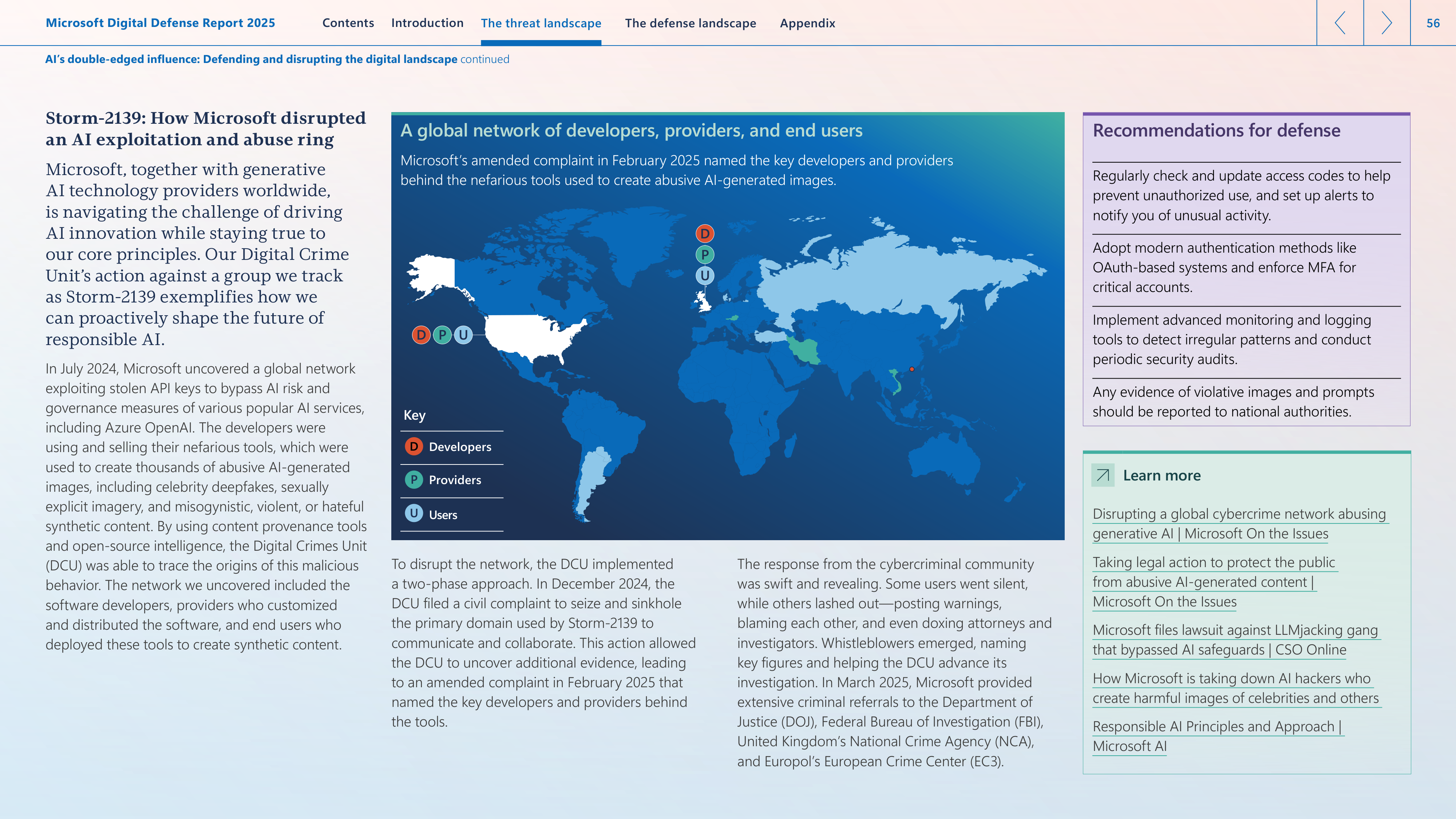

AI’s double-edged influence: Defending and disrupting the digital landscape
continued
Microsoft Digital Defense Report 2025
56
Contents
Introduction
The threat landscape
The defense landscape
Appendix
Key
D
Developers
P
Providers
U
Users
D
U
P
D
U
P
Storm-2139: How Microsoft disrupted
an AI exploitation and abuse ring
Microsoft, together with generative
AI technology providers worldwide,
is navigating the challenge of driving
AI innovation while staying true to
our core principles. Our Digital Crime
Unit’s action against a group we track
as Storm-2139 exemplifies how we
can proactively shape the future of
responsible AI.
In July 2024, Microsoft uncovered a global network
exploiting stolen API keys to bypass AI risk and
governance measures of various popular AI services,
including Azure OpenAI. The developers were
using and selling their nefarious tools, which were
used to create thousands of abusive AI-generated
images, including celebrity deepfakes, sexually
explicit imagery, and misogynistic, violent, or hateful
synthetic content. By using content provenance tools
and open-source intelligence, the Digital Crimes Unit
(DCU) was able to trace the origins of this malicious
behavior. The network we uncovered included the
software developers, providers who customized
and distributed the software, and end users who
deployed these tools to create synthetic content.
A global network of developers, providers, and end users
Microsoft’s amended complaint in February 2025 named the key developers and providers
behind the nefarious tools used to create abusive AI-generated images.
To disrupt the network, the DCU implemented
a two-phase approach. In December 2024, the
DCU filed a civil complaint to seize and sinkhole
the primary domain used by Storm-2139 to
communicate and collaborate. This action allowed
the DCU to uncover additional evidence, leading
to an amended complaint in February 2025 that
named the key developers and providers behind
the tools.
The response from the cybercriminal community
was swift and revealing. Some users went silent,
while others lashed out—posting warnings,
blaming each other, and even doxing attorneys and
investigators. Whistleblowers emerged, naming
key figures and helping the DCU advance its
investigation. In March 2025, Microsoft provided
extensive criminal referrals to the Department of
Justice (DOJ), Federal Bureau of Investigation (FBI),
United Kingdom’s National Crime Agency (NCA),
and Europol’s European Crime Center (EC3).
Recommendations for defense
Regularly check and update access codes to help
prevent unauthorized use, and set up alerts to
notify you of unusual activity.
Adopt modern authentication methods like
OAuth-based systems and enforce MFA for
critical accounts.
Implement advanced monitoring and logging
tools to detect irregular patterns and conduct
periodic security audits.
Any evidence of violative images and prompts
should be reported to national authorities.
Learn more
Disrupting a global cybercrime network abusing
generative AI | Microsoft On the Issues
Taking legal action to protect the public
from abusive AI-generated content |
Microsoft On the Issues
Microsoft files lawsuit against LLMjacking gang
that bypassed AI safeguards | CSO Online
How Microsoft is taking down AI hackers who
create harmful images of celebrities and others
Responsible AI Principles and Approach |
Microsoft AI
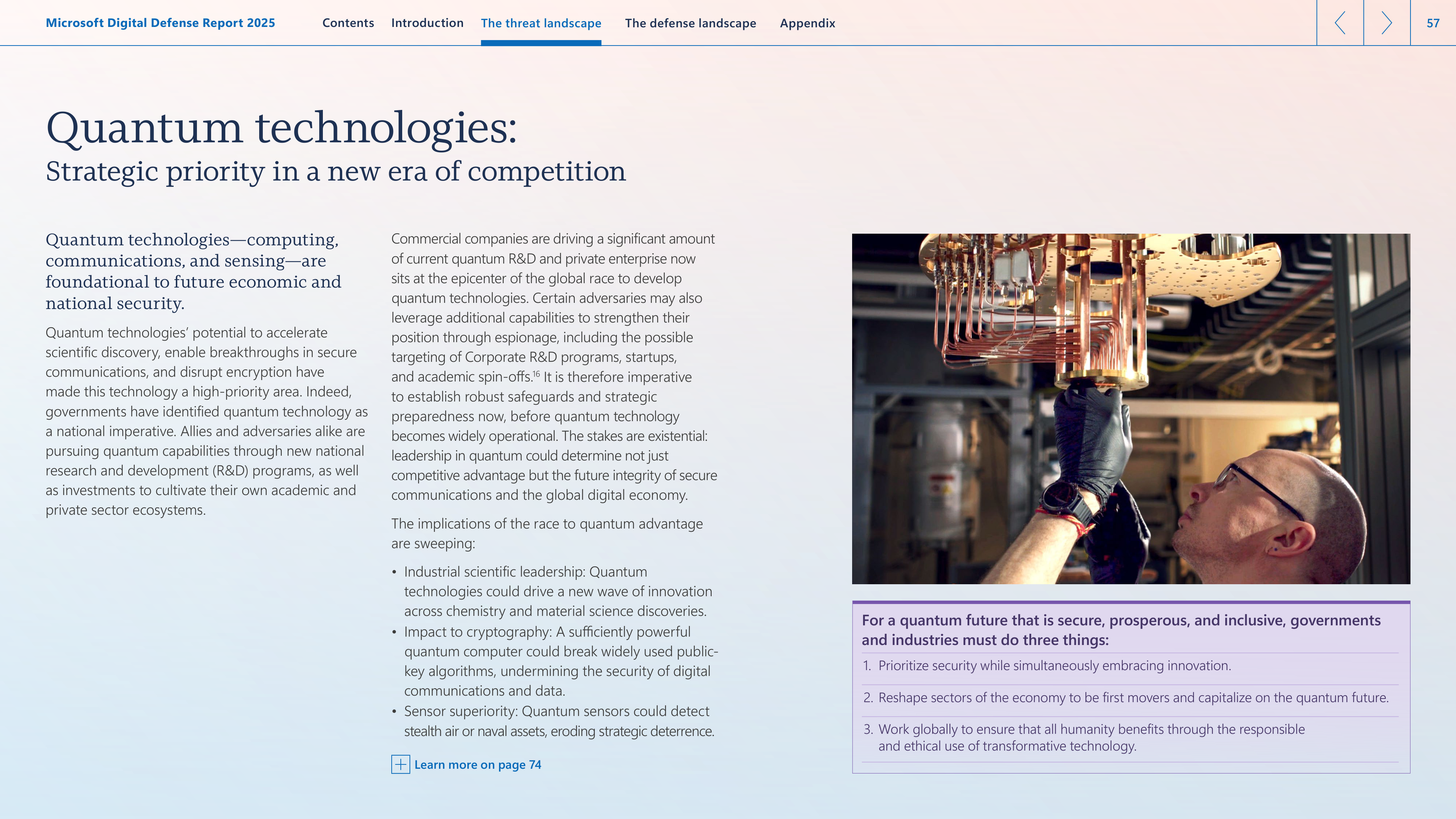


Microsoft Digital Defense Report 2025
57
Contents
Introduction
The threat landscape
The defense landscape
Appendix
Quantum technologies:
Strategic priority in a new era of competition
Quantum technologies—computing,
communications, and sensing—are
foundational to future economic and
national security.
Quantum technologies’ potential to accelerate
scientific discovery, enable breakthroughs in secure
communications, and disrupt encryption have
made this technology a high-priority area. Indeed,
governments have identified quantum technology as
a national imperative. Allies and adversaries alike are
pursuing quantum capabilities through new national
research and development (R&D) programs, as well
as investments to cultivate their own academic and
private sector ecosystems.
Commercial companies are driving a significant amount
of current quantum R&D and private enterprise now
sits at the epicenter of the global race to develop
quantum technologies. Certain adversaries may also
leverage additional capabilities to strengthen their
position through espionage, including the possible
targeting of Corporate R&D programs, startups,
and academic spin-offs.
Note 16
It is therefore imperative
to establish robust safeguards and strategic
preparedness now, before quantum technology
becomes widely operational. The stakes are existential:
leadership in quantum could determine not just
competitive advantage but the future integrity of secure
communications and the global digital economy.
The implications of the race to quantum advantage
are sweeping:
• Industrial scientific leadership: Quantum
technologies could drive a new wave of innovation
across chemistry and material science discoveries.
• Impact to cryptography: A sufficiently powerful
quantum computer could break widely used public-
key algorithms, undermining the security of digital
communications and data.
• Sensor superiority: Quantum sensors could detect
stealth air or naval assets, eroding strategic deterrence.
Learn more on page 74
For a quantum future that is secure, prosperous, and inclusive, governments
and industries must do three things:
1. Prioritize security while simultaneously embracing innovation.
2. Reshape sectors of the economy to be first movers and capitalize on the quantum future.
3. Work globally to ensure that all humanity benefits through the responsible
and ethical use of transformative technology.

Microsoft Digital Defense Report 2025
58
Contents
Introduction
The threat landscape
The defense landscape
Appendix
Part II
The defense
landscape
60 AI and advanced defense
64 Countering nation-state and emerging threats
70
Policy, capacity, and future readiness
76
Strategic vision and global commitments
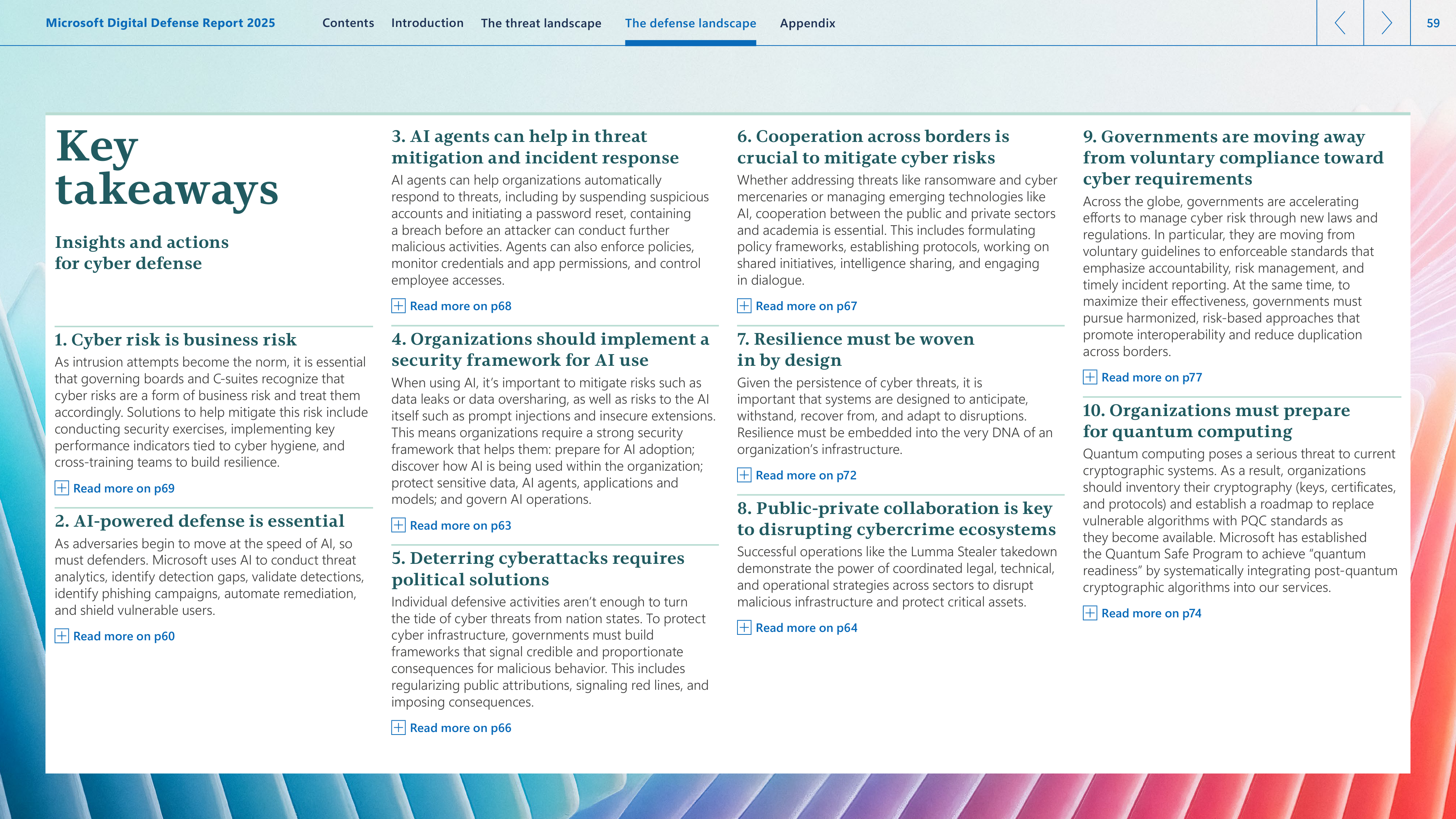


Microsoft Digital Defense Report 2025
59
Contents
Introduction
The threat landscape
The defense landscape
Appendix
Key
takeaways
Insights and actions
for cyber defense
1. Cyber risk is business risk
As intrusion attempts become the norm, it is essential
that governing boards and C-suites recognize that
cyber risks are a form of business risk and treat them
accordingly. Solutions to help mitigate this risk include
conducting security exercises, implementing key
performance indicators tied to cyber hygiene, and
cross-training teams to build resilience.
Read more on p69
2. AI-powered defense is essential
As adversaries begin to move at the speed of AI, so
must defenders. Microsoft uses AI to conduct threat
analytics, identify detection gaps, validate detections,
identify phishing campaigns, automate remediation,
and shield vulnerable users.
Read more on p60
3. AI agents can help in threat
mitigation and incident response
AI agents can help organizations automatically
respond to threats, including by suspending suspicious
accounts and initiating a password reset, containing
a breach before an attacker can conduct further
malicious activities. Agents can also enforce policies,
monitor credentials and app permissions, and control
employee accesses.
Read more on p68
4. Organizations should implement a
security framework for AI use
When using AI, it’s important to mitigate risks such as
data leaks or data oversharing, as well as risks to the AI
itself such as prompt injections and insecure extensions.
This means organizations require a strong security
framework that helps them: prepare for AI adoption;
discover how AI is being used within the organization;
protect sensitive data, AI agents, applications and
models; and govern AI operations.
Read more on p63
5. Deterring cyberattacks requires
political solutions
Individual defensive activities aren’t enough to turn
the tide of cyber threats from nation states. To protect
cyber infrastructure, governments must build
frameworks that signal credible and proportionate
consequences for malicious behavior. This includes
regularizing public attributions, signaling red lines, and
imposing consequences.
Read more on p66
6. Cooperation across borders is
crucial to mitigate cyber risks
Whether addressing threats like ransomware and cyber
mercenaries or managing emerging technologies like
AI, cooperation between the public and private sectors
and academia is essential. This includes formulating
policy frameworks, establishing protocols, working on
shared initiatives, intelligence sharing, and engaging
in dialogue.
Read more on p67
7. Resilience must be woven
in by design
Given the persistence of cyber threats, it is
important that systems are designed to anticipate,
withstand, recover from, and adapt to disruptions.
Resilience must be embedded into the very DNA of an
organization’s infrastructure.
Read more on p72
8. Public-private collaboration is key
to disrupting cybercrime ecosystems
Successful operations like the Lumma Stealer takedown
demonstrate the power of coordinated legal, technical,
and operational strategies across sectors to disrupt
malicious infrastructure and protect critical assets.
Read more on p64
9. Governments are moving away
from voluntary compliance toward
cyber requirements
Across the globe, governments are accelerating
efforts to manage cyber risk through new laws and
regulations. In particular, they are moving from
voluntary guidelines to enforceable standards that
emphasize accountability, risk management, and
timely incident reporting. At the same time, to
maximize their effectiveness, governments must
pursue harmonized, risk-based approaches that
promote interoperability and reduce duplication
across borders.
Read more on p77
10. Organizations must prepare
for quantum computing
Quantum computing poses a serious threat to current
cryptographic systems. As a result, organizations
should inventory their cryptography (keys, certificates,
and protocols) and establish a roadmap to replace
vulnerable algorithms with PQC standards as
they become available. Microsoft has established
the Quantum Safe Program to achieve “quantum
readiness” by systematically integrating post-quantum
cryptographic algorithms into our services.
Read more on p74
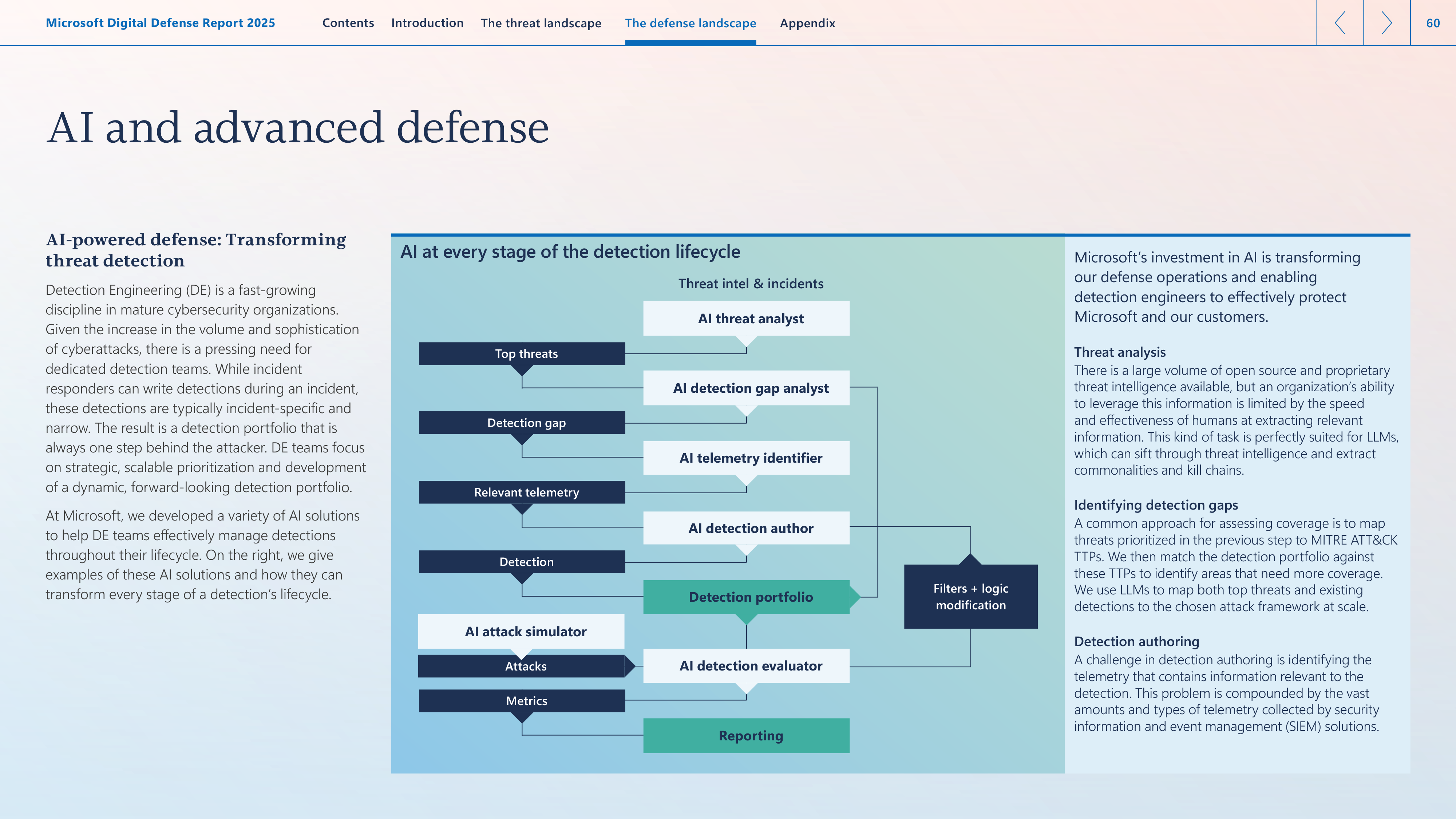

Filters + logic
modification
AI detection gap analyst
AI telemetry identifier
Threat intel & incidents
Attacks
AI attack simulator
Reporting
Detection
AI detection evaluator
Detection portfolio
AI detection author
Top threats
AI threat analyst
Metrics
Relevant telemetry
Detection gap
Microsoft Digital Defense Report 2025
60
Introduction
Contents
The threat landscape
Appendix
The defense landscape
AI and advanced defense
AI-powered defense: Transforming
threat detection
Detection Engineering (DE) is a fast-growing
discipline in mature cybersecurity organizations.
Given the increase in the volume and sophistication
of cyberattacks, there is a pressing need for
dedicated detection teams. While incident
responders can write detections during an incident,
these detections are typically incident-specific and
narrow. The result is a detection portfolio that is
always one step behind the attacker. DE teams focus
on strategic, scalable prioritization and development
of a dynamic, forward-looking detection portfolio.
At Microsoft, we developed a variety of AI solutions
to help DE teams effectively manage detections
throughout their lifecycle. On the right, we give
examples of these AI solutions and how they can
transform every stage of a detection’s lifecycle.
AI at every stage of the detection lifecycle
Microsoft’s investment in AI is transforming
our defense operations and enabling
detection engineers to effectively protect
Microsoft and our customers.
Threat analysis
There is a large volume of open source and proprietary
threat intelligence available, but an organization’s ability
to leverage this information is limited by the speed
and effectiveness of humans at extracting relevant
information. This kind of task is perfectly suited for LLMs,
which can sift through threat intelligence and extract
commonalities and kill chains.
Identifying detection gaps
A common approach for assessing coverage is to map
threats prioritized in the previous step to MITRE ATT&CK
TTPs. We then match the detection portfolio against
these TTPs to identify areas that need more coverage.
We use LLMs to map both top threats and existing
detections to the chosen attack framework at scale.
Detection authoring
A challenge in detection authoring is identifying the
telemetry that contains information relevant to the
detection. This problem is compounded by the vast
amounts and types of telemetry collected by security
information and event management (SIEM) solutions.
AI and advanced defense
continued
Microsoft Digital Defense Report 2025
61
The defense landscape
Introduction
Contents
The threat landscape
Appendix
We are developing AI solutions that create detections
at different levels of sophistication. For basic
tests, for example, AI can generate rule-based
logic that checks for a small set of specific events.
For correlation detections, AI leverages telemetry
metadata to identify candidates, then generates
the logic that correlates them with malicious
activity. For behavioral detections, we use machine
learning to establish baseline behaviors and identify
anomalies that can signal malicious activity.
Rapid advances in the development of code-
generating LLMs means that whatever the level
of sophistication of the detection logic, we can
automate its implementation of it in our chosen
coding language.
Detection validation
Detection Engineering must test the artifacts they
generate. A simple test injects or executes the events
or behaviors the detection is intended to catch.
This is the DE equivalent of unit tests.
However, attackers use sophisticated multi-stage
approaches and decide what to do in later stages
based on information gained in earlier stages.
While unit tests validate individual detections, we
need end-to-end testing to ensure the detection
portfolio as a whole is effective. Microsoft has
developed agentic red teaming approaches where
autonomous AI agents simulate complex, adaptive
multi-stage attacks, enabling effective validation
at scale.
Securing identity in the age of AI:
Proactive and automated protection
AI and machine learning are revolutionizing how
we detect identity threats by finding subtle patterns
humans miss. Modern AI-driven identity protection
systems continuously analyze billions of sign-ins and
user signals, learning what normal behavior looks like
for each user and entity so they can spot the early
signs of an attack. For example, AI can detect a slow
password spray attack by recognizing a coordinated
pattern of sign-in attempts spaced out over a long
duration, a pattern that would slip past traditional
rate-limit rules. Similarly, AI models evaluate each
sign-in against dozens of risk factors (impossible
travel, unfamiliar devices, abnormal time of access,
etc.) to assign a risk score in milliseconds. With this
information, advanced anomaly detection algorithms
can instantly flag a threat actor using a stolen token
from an unusual location or attempting to mimic a
user’s typical location.
While AI is still new, its impact is already significant:
thanks to AI-based protections, providers report
automatically neutralizing the vast majority of identity
attacks. With the assistance of AI, security teams can
remediate threats before they cause damage, with
minimal false alarms or missed detections, making
defenses both faster and smarter.
AI agents for response and remediation
Beyond using AI to detect identity threats,
organizations are increasingly using AI agents to
respond automatically to threats. These agents can
act in the identity environment with minimal human
guidance—sometimes even on their own. When they
either confirm or strongly suspect a threat, they can
act within seconds—far faster than a human can
respond manually. For example, if multiple high-risk
signals indicate an account compromise, an AI agent
can immediately suspend the account, initiate a
password reset, and notify administrators, containing
the breach before an attacker can escalate their
access privileges.
AI agents also tackle preventative maintenance,
working continuously to reduce the attack surface
and fix security gaps that attackers might exploit.
•
Policy enforcement agents
review identity
configurations and policies like MFA enrollment or
conditional access rules and automatically reinforce
any weak spots. After the agent flags users not
covered by MFA, it can help enroll them or adjust
the policy scope. This ensures security policies
cover every user and scenario as intended.
•
Credential hygiene agents
monitor secrets and
credentials. If an API key or client secret not used
in months still sits in an app configuration, the
agent might recommend rotating or removing
it to prevent potential abuse. Similarly, this
agent can monitor for leaked credentials or
known compromised passwords and trigger
immediate remediation.
•
Application risk detection agents
keep an eye
on app permissions and behaviors. Should an app
request higher privileges or exhibit anomalous
behavior with user-granted access, the agent
will alert security and preemptively revoke or
quarantine the app. This will swiftly reverse
unauthorized access, nullifying the malicious
consent threat vector.
•
User lifecycle agents
govern access by
automatically assigning the right permissions
based on attributes such as role, department,
group, and certifications. For instance, when
an employee leaves, the agent revokes all their
sessions and removes all access, closing a common
gap that turns lingering accounts into backdoors.
If an employee changes roles, the agent could
suggest removing permissions no longer needed,
preventing accumulation of privileges.
AI-driven agents operate under strict policies, only
taking well-defined actions and requiring human-in-
the-loop.
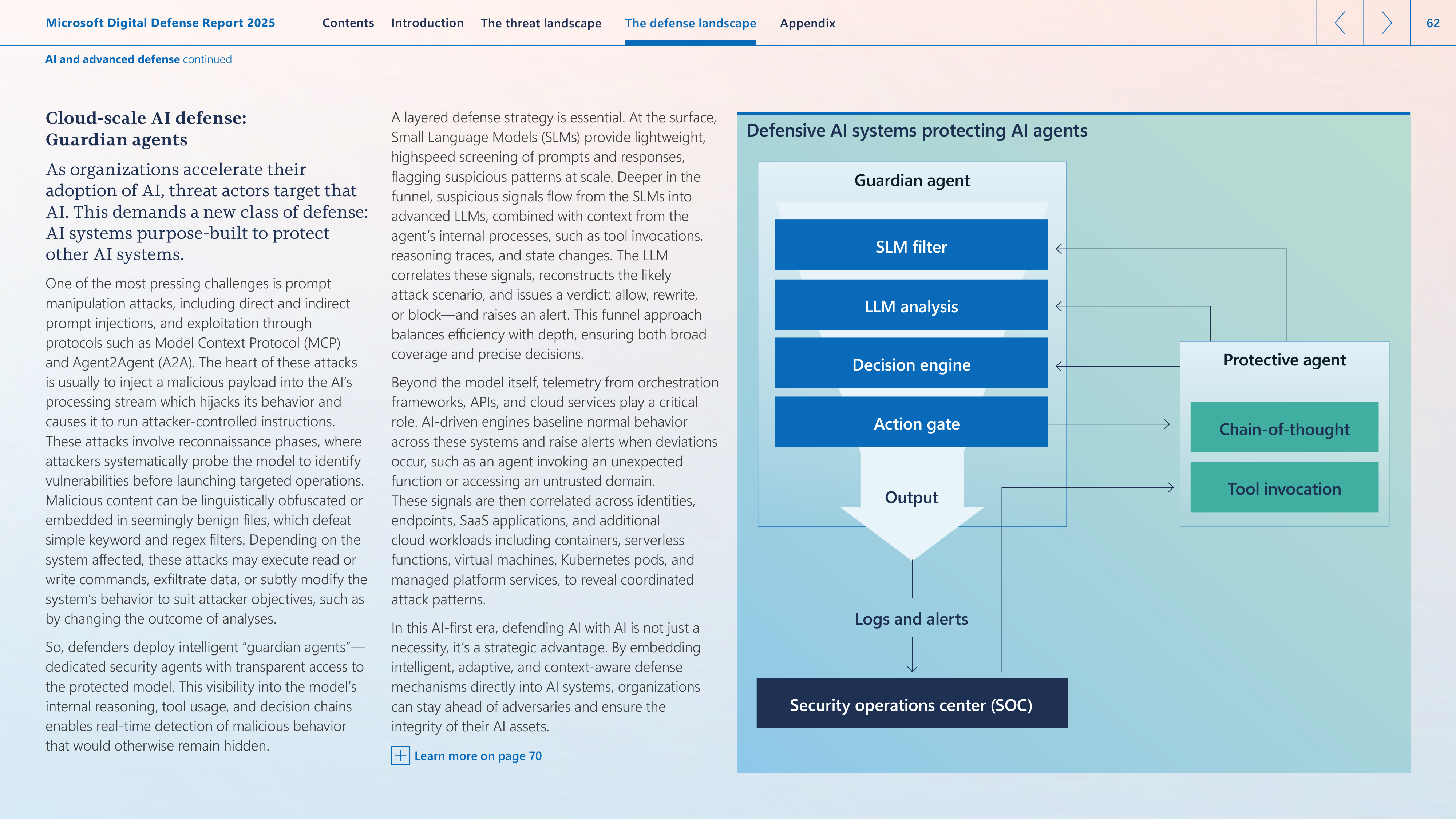

AI and advanced defense
continued
Guardian agent
SLM filter
LLM analysis
Decision engine
Action gate
Security operations center (SOC)
Output
Logs and alerts
Protective agent
Chain-of-thought
Tool invocation
Microsoft Digital Defense Report 2025
62
Introduction
Contents
The threat landscape
Appendix
The defense landscape
Cloud-scale AI defense:
Guardian agents
As organizations accelerate their
adoption of AI, threat actors target that
AI. This demands a new class of defense:
AI systems purpose-built to protect
other AI systems.
One of the most pressing challenges is prompt
manipulation attacks, including direct and indirect
prompt injections, and exploitation through
protocols such as Model Context Protocol (MCP)
and Agent2Agent (A2A). The heart of these attacks
is usually to inject a malicious payload into the AI’s
processing stream which hijacks its behavior and
causes it to run attacker-controlled instructions.
These attacks involve reconnaissance phases, where
attackers systematically probe the model to identify
vulnerabilities before launching targeted operations.
Malicious content can be linguistically obfuscated or
embedded in seemingly benign files, which defeat
simple keyword and regex filters. Depending on the
system affected, these attacks may execute read or
write commands, exfiltrate data, or subtly modify the
system’s behavior to suit attacker objectives, such as
by changing the outcome of analyses.
So, defenders deploy intelligent ”guardian agents”—
dedicated security agents with transparent access to
the protected model. This visibility into the model’s
internal reasoning, tool usage, and decision chains
enables real-time detection of malicious behavior
that would otherwise remain hidden.
A layered defense strategy is essential. At the surface,
Small Language Models (SLMs) provide lightweight,
highspeed screening of prompts and responses,
flagging suspicious patterns at scale. Deeper in the
funnel, suspicious signals flow from the SLMs into
advanced LLMs, combined with context from the
agent’s internal processes, such as tool invocations,
reasoning traces, and state changes. The LLM
correlates these signals, reconstructs the likely
attack scenario, and issues a verdict: allow, rewrite,
or block—and raises an alert. This funnel approach
balances efficiency with depth, ensuring both broad
coverage and precise decisions.
Beyond the model itself, telemetry from orchestration
frameworks, APIs, and cloud services play a critical
role. AI-driven engines baseline normal behavior
across these systems and raise alerts when deviations
occur, such as an agent invoking an unexpected
function or accessing an untrusted domain.
These signals are then correlated across identities,
endpoints, SaaS applications, and additional
cloud workloads including containers, serverless
functions, virtual machines, Kubernetes pods, and
managed platform services, to reveal coordinated
attack patterns.
In this AI-first era, defending AI with AI is not just a
necessity, it’s a strategic advantage. By embedding
intelligent, adaptive, and context-aware defense
mechanisms directly into AI systems, organizations
can stay ahead of adversaries and ensure the
integrity of their AI assets.
Learn more on page 70
Defensive AI systems protecting AI agents
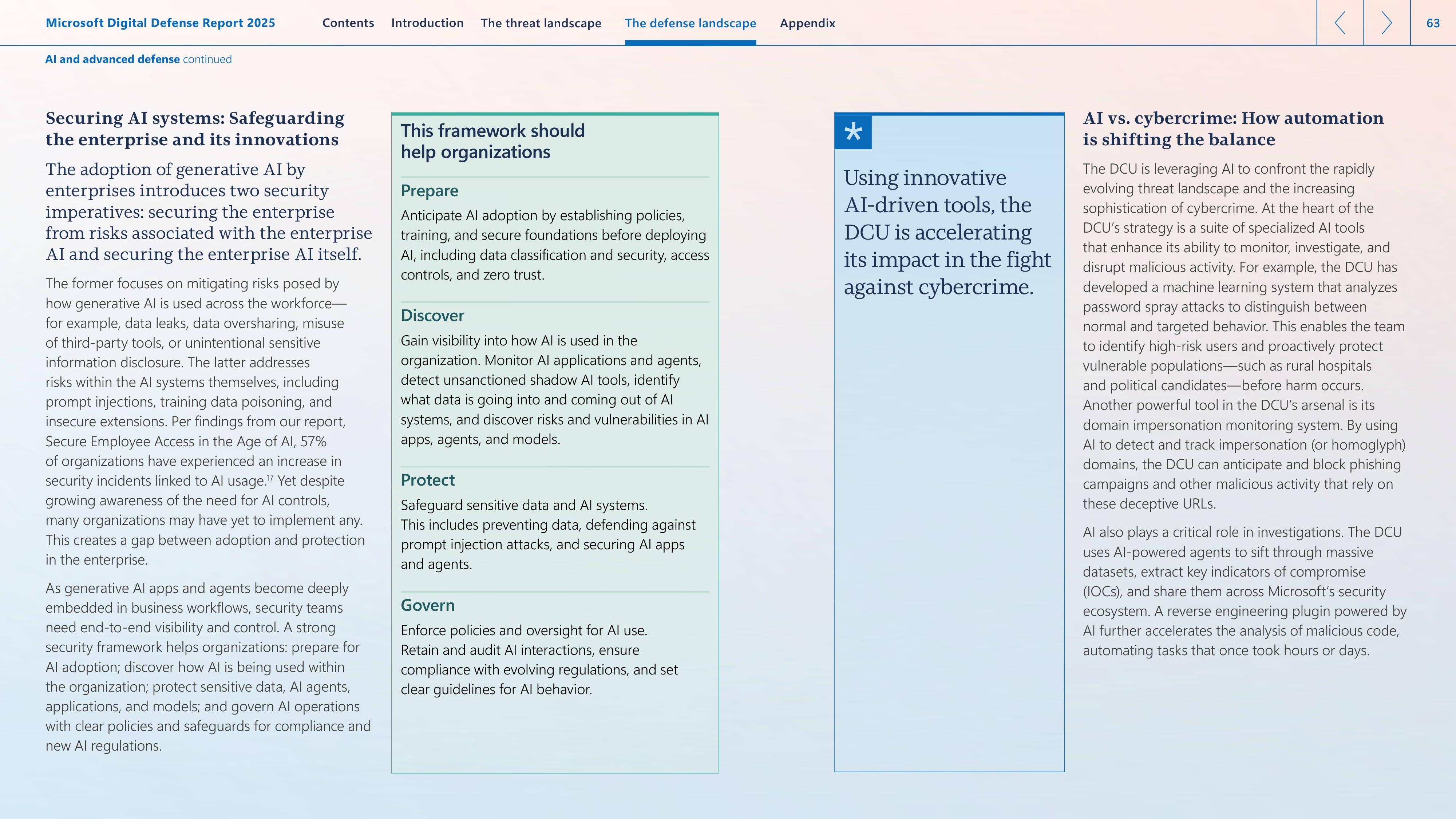
AI and advanced defense
continued
Microsoft Digital Defense Report 2025
63
The defense landscape
Introduction
Contents
The threat landscape
Appendix
Securing AI systems: Safeguarding
the enterprise and its innovations
The adoption of generative AI by
enterprises introduces two security
imperatives: securing the enterprise
from risks associated with the enterprise
AI and securing the enterprise AI itself.
The former focuses on mitigating risks posed by
how generative AI is used across the workforce—
for example, data leaks, data oversharing, misuse
of third-party tools, or unintentional sensitive
information disclosure. The latter addresses
risks within the AI systems themselves, including
prompt injections, training data poisoning, and
insecure extensions. Per findings from our report,
Secure Employee Access in the Age of AI, 57%
of organizations have experienced an increase in
security incidents linked to AI usage.
Note 17
Yet despite
growing awareness of the need for AI controls,
many organizations may have yet to implement any.
This creates a gap between adoption and protection
in the enterprise.
As generative AI apps and agents become deeply
embedded in business workflows, security teams
need end-to-end visibility and control. A strong
security framework helps organizations: prepare for
AI adoption; discover how AI is being used within
the organization; protect sensitive data, AI agents,
applications, and models; and govern AI operations
with clear policies and safeguards for compliance and
new AI regulations.
This framework should
help organizations
Prepare
Anticipate AI adoption by establishing policies,
training, and secure foundations before deploying
AI, including data classification and security, access
controls, and zero trust.
Discover
Gain visibility into how AI is used in the
organization. Monitor AI applications and agents,
detect unsanctioned shadow AI tools, identify
what data is going into and coming out of AI
systems, and discover risks and vulnerabilities in AI
apps, agents, and models.
Protect
Safeguard sensitive data and AI systems.
This includes preventing data, defending against
prompt injection attacks, and securing AI apps
and agents.
Govern
Enforce policies and oversight for AI use.
Retain and audit AI interactions, ensure
compliance with evolving regulations, and set
clear guidelines for AI behavior.
*
Using innovative
AI-driven tools, the
DCU is accelerating
its impact in the fight
against cybercrime.
AI vs. cybercrime: How automation
is shifting the balance
The DCU is leveraging AI to confront the rapidly
evolving threat landscape and the increasing
sophistication of cybercrime. At the heart of the
DCU’s strategy is a suite of specialized AI tools
that enhance its ability to monitor, investigate, and
disrupt malicious activity. For example, the DCU has
developed a machine learning system that analyzes
password spray attacks to distinguish between
normal and targeted behavior. This enables the team
to identify high-risk users and proactively protect
vulnerable populations—such as rural hospitals
and political candidates—before harm occurs.
Another powerful tool in the DCU’s arsenal is its
domain impersonation monitoring system. By using
AI to detect and track impersonation (or homoglyph)
domains, the DCU can anticipate and block phishing
campaigns and other malicious activity that rely on
these deceptive URLs.
AI also plays a critical role in investigations. The DCU
uses AI-powered agents to sift through massive
datasets, extract key indicators of compromise
(IOCs), and share them across Microsoft’s security
ecosystem. A reverse engineering plugin powered by
AI further accelerates the analysis of malicious code,
automating tasks that once took hours or days.
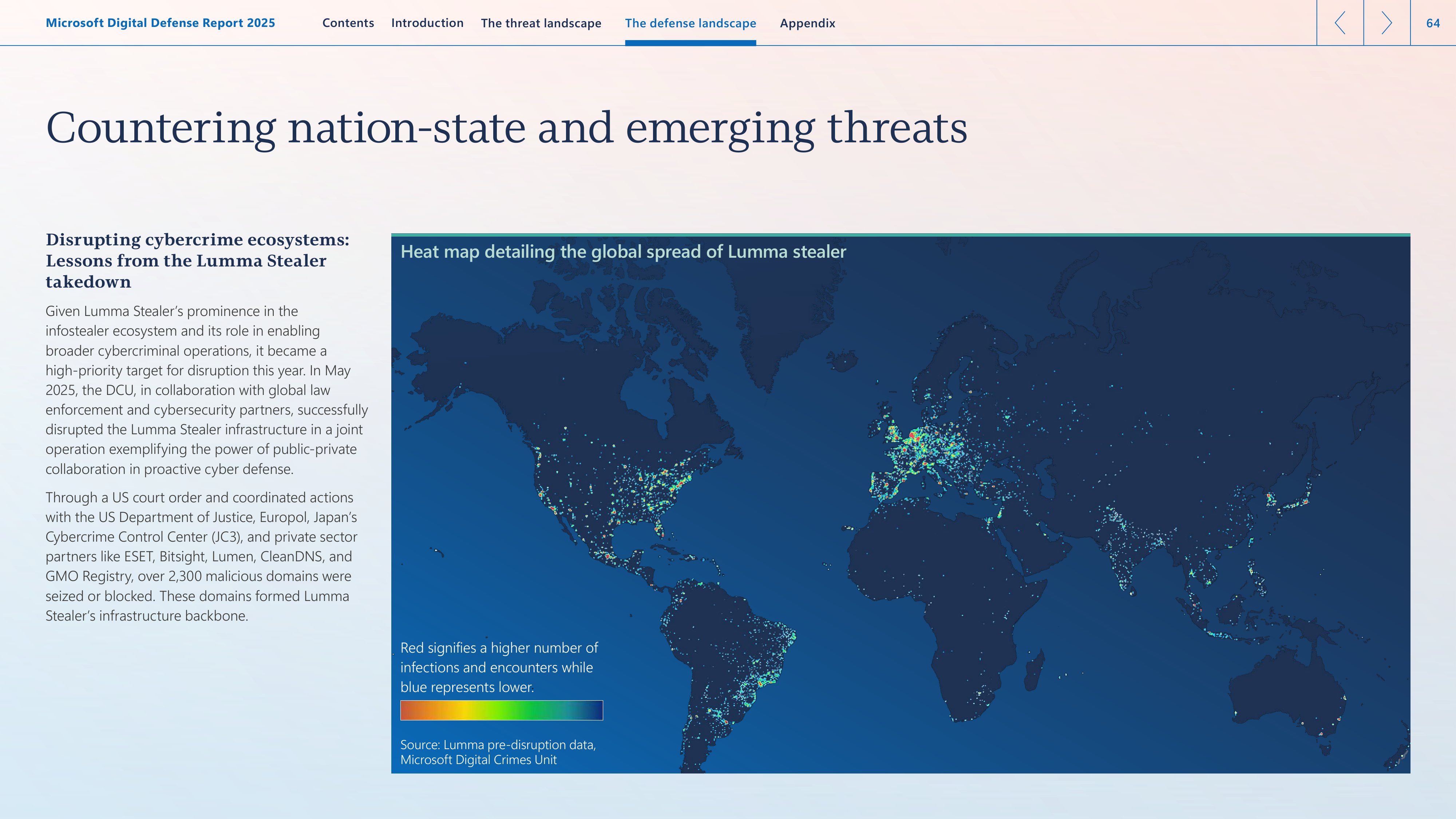


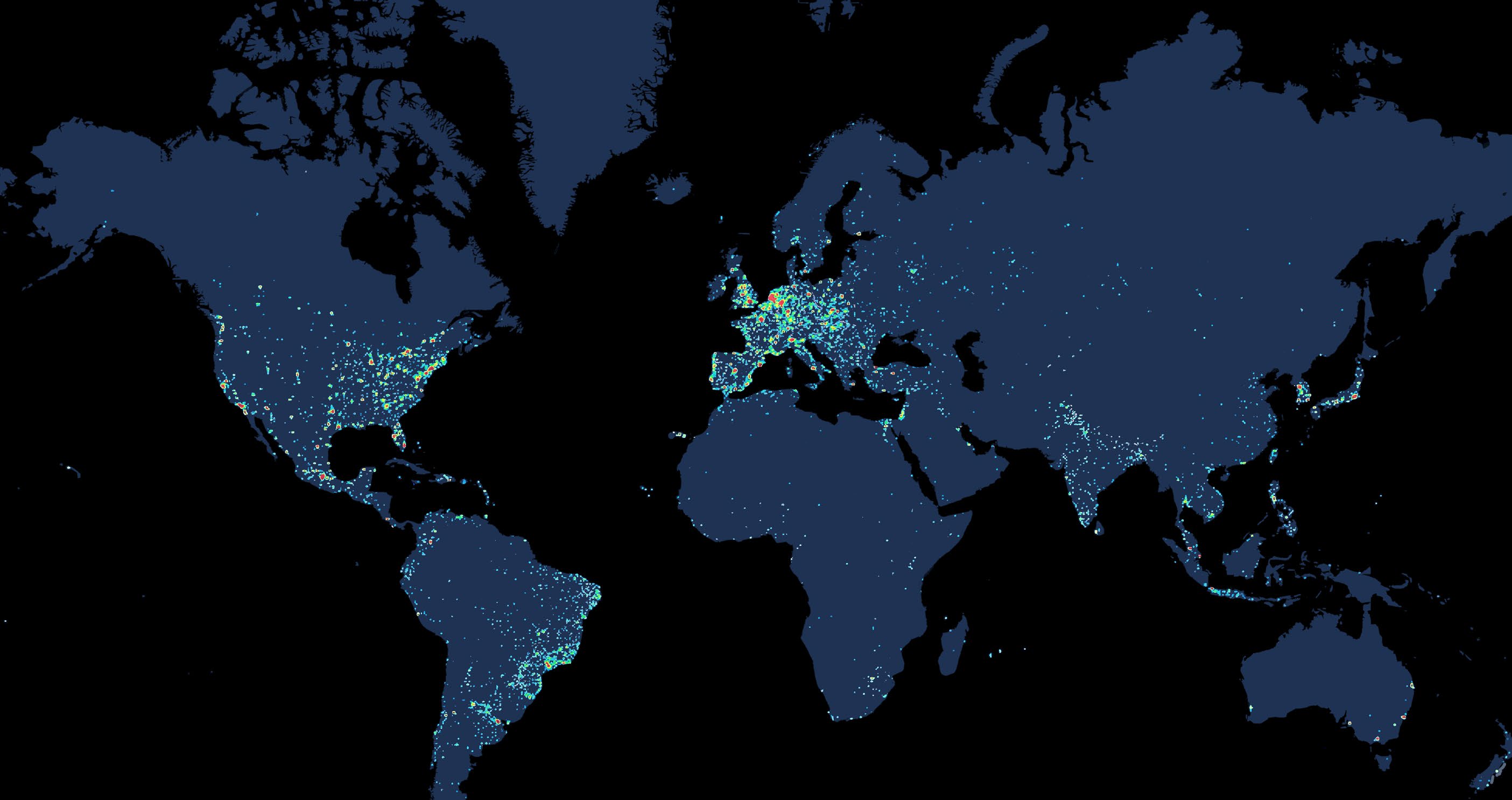
Red signifies a higher number of
infections and encounters while
blue represents lower.
Microsoft Digital Defense Report 2025
64
Introduction
Contents
The threat landscape
Appendix
The defense landscape
Countering nation-state and emerging threats
Disrupting cybercrime ecosystems:
Lessons from the Lumma Stealer
takedown
Given Lumma Stealer’s prominence in the
infostealer ecosystem and its role in enabling
broader cybercriminal operations, it became a
high-priority target for disruption this year. In May
2025, the DCU, in collaboration with global law
enforcement and cybersecurity partners, successfully
disrupted the Lumma Stealer infrastructure in a joint
operation exemplifying the power of public-private
collaboration in proactive cyber defense.
Through a US court order and coordinated actions
with the US Department of Justice, Europol, Japan’s
Cybercrime Control Center (JC3), and private sector
partners like ESET, Bitsight, Lumen, CleanDNS, and
GMO Registry, over 2,300 malicious domains were
seized or blocked. These domains formed Lumma
Stealer’s infrastructure backbone.
Heat map detailing the global spread of Lumma stealer
Source: Lumma pre-disruption data,
Microsoft Digital Crimes Unit
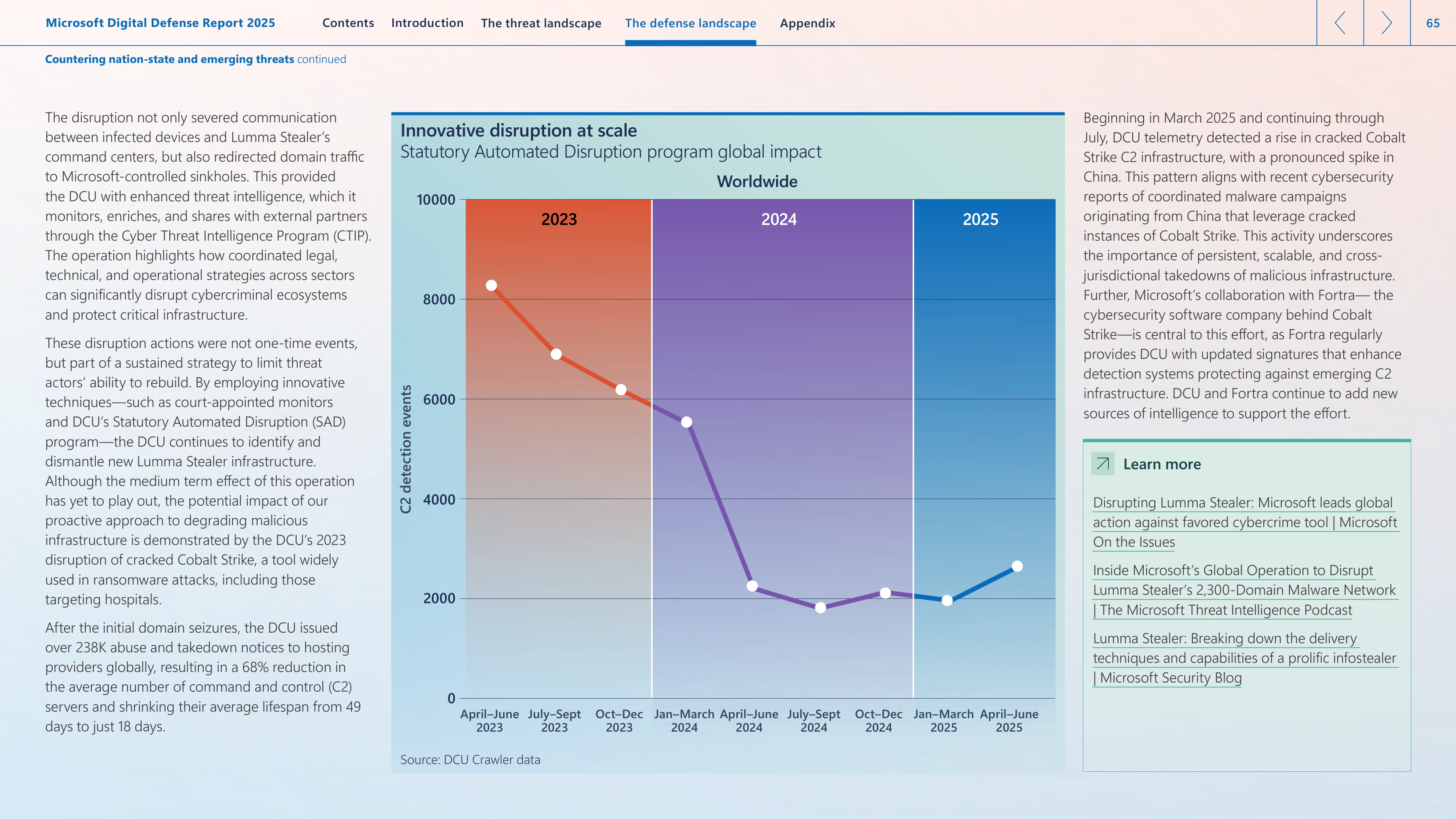

Countering nation-state and emerging threats
continued
April–June
2023
April–June
2024
April–June
2025
2000
4000
6000
8000
10000
0
July–Sept
2023
July–Sept
2024
Worldwide
Oct–Dec
2023
Oct–Dec
2024
Jan–March
2024
Jan–March
2025
2024
C2 detection events
2025
2023
Microsoft Digital Defense Report 2025
65
Introduction
Contents
The threat landscape
Appendix
The defense landscape
The disruption not only severed communication
between infected devices and Lumma Stealer’s
command centers, but also redirected domain traffic
to Microsoft-controlled sinkholes. This provided
the DCU with enhanced threat intelligence, which it
monitors, enriches, and shares with external partners
through the Cyber Threat Intelligence Program (CTIP).
The operation highlights how coordinated legal,
technical, and operational strategies across sectors
can significantly disrupt cybercriminal ecosystems
and protect critical infrastructure.
These disruption actions were not one-time events,
but part of a sustained strategy to limit threat
actors’ ability to rebuild. By employing innovative
techniques—such as court-appointed monitors
and DCU’s Statutory Automated Disruption (SAD)
program—the DCU continues to identify and
dismantle new Lumma Stealer infrastructure.
Although the medium term effect of this operation
has yet to play out, the potential impact of our
proactive approach to degrading malicious
infrastructure is demonstrated by the DCU’s 2023
disruption of cracked Cobalt Strike, a tool widely
used in ransomware attacks, including those
targeting hospitals.
After the initial domain seizures, the DCU issued
over 238K abuse and takedown notices to hosting
providers globally, resulting in a 68% reduction in
the average number of command and control (C2)
servers and shrinking their average lifespan from 49
days to just 18 days.
Innovative disruption at scale
Statutory Automated Disruption program global impact
Source: DCU Crawler data
Beginning in March 2025 and continuing through
July, DCU telemetry detected a rise in cracked Cobalt
Strike C2 infrastructure, with a pronounced spike in
China. This pattern aligns with recent cybersecurity
reports of coordinated malware campaigns
originating from China that leverage cracked
instances of Cobalt Strike. This activity underscores
the importance of persistent, scalable, and cross-
jurisdictional takedowns of malicious infrastructure.
Further, Microsoft’s collaboration with Fortra— the
cybersecurity software company behind Cobalt
Strike—is central to this effort, as Fortra regularly
provides DCU with updated signatures that enhance
detection systems protecting against emerging C2
infrastructure. DCU and Fortra continue to add new
sources of intelligence to support the effort.
Learn more
Disrupting Lumma Stealer: Microsoft leads global
action against favored cybercrime tool | Microsoft
On the Issues
Inside Microsoft’s Global Operation to Disrupt
Lumma Stealer’s 2,300-Domain Malware Network
| The Microsoft Threat Intelligence Podcast
Lumma Stealer: Breaking down the delivery
techniques and capabilities of a prolific infostealer
| Microsoft Security Blog
Countering nation-state and emerging threats
continued
Microsoft Digital Defense Report 2025
66
The defense landscape
Introduction
Contents
The threat landscape
Appendix
Deterrence in action: Building
consequences for nation-state actors
As infrastructure essential to daily life—including
water, food, healthcare, communications, and
transportation systems—becomes increasingly
dependent on digital technology, nation-state
cyber operations targeting these systems cannot
be permissible; in particular those prepositioning
for disruptive or destructive cyberattacks in case of
future conflicts.
Defensive actions alone to protect critical
infrastructure are unlikely to deter nation-state threat
adversaries. These are politically motivated activities
that must be addressed with political solutions
as well. To protect critical infrastructure, political
institutions, and civilian systems, governments
must build frameworks that signal credible and
proportionate consequences for malicious activity
that violate international rules.
Over the past year, there has been a marked increase
in recognition of the need for such cyber deterrence,
with governments and industry aligning more closely
to response to malicious activity. For example:
•
NATO
has advanced coalition-based attribution
frameworks and is exploring collective
countermeasures in response to cyberattacks.
In July, the alliance released a statement
recognizing and condemning malicious cyber
activities attributed to Russia by member states.
• The
US administration
has issued strong
public statements and indictments tied to cyber
operations and has publicly attributed cyberattacks
in coordination with allies and partners.
• The
EU
is increasingly leveraging its Cyber
Diplomacy Toolbox and sanctions regime to hold
bad actors accountable, though implementation
remains uneven.
Looking ahead, these are important foundations to
build upon. To further strengthen a cyber deterrence
framework, like-minded governments should work to:
•
Regularize public attributions.
States should
more consistently issue public attribution
statements, leveraging insights from other
governments and partners in the private sector
and establishing a more uniform process for doing
so. Such statements should always indicate if
international laws or norms were violated during a
cyber incident.
•
Signal red lines.
States should make clear they
will impose increasingly severe consequences
in response to a spectrum of malicious nation-
state cyber activity, ranging from espionage to
prepositioning to disruptive and or destructive
cyber operations.
•
Impose diverse consequences.
Responses to
nation-state cyberattacks should not be constrained
to the cyber domain or prescribed in a one-size-
fits-all model. Different threat actors will be deterred
by different consequences. These could include
economic measures, diplomatic sanctions, naming
and shaming, posturing, or targeted declassification.
•
Prohibit retaliatory cyber operations.
Private companies are not in the position to
independently hack back against malicious nation-
state actors, and doing so can risk unintended
escalation and harm. While industry can support
attributions and partner with government to take
action, imposing consequences for internationally
wrongful behavior by states will always need to be
led by governments.
A viable model for cyber deterrence is a necessity
for the stability of the online world and will require
innovations in statecraft and diplomacy in the years
ahead. This is why Microsoft is supporting ongoing
research by the Royal United Services Institute (RUSI)
to explore novel approaches to deterring malicious
activity online.

67
Microsoft Digital Defense Report 2025
Contents
Introduction
The threat landscape
The defense landscape
Appendix
Countering nation-state and emerging threats
continued
Addressing the geopolitical enablers
of ransomware operations
Many of the most prolific ransomware groups
avoid consequences by targeting victims in other
countries while their own governments turn a blind
eye. Whether they are state-affiliated groups or their
government simply ignores their activity, the result
is the existence of “safe haven” states that enable
ransomware attacks abroad and violate international
norms of due diligence which oblige governments
to take action to prevent illegal cyber activity within
their borders.
As a result, addressing ransomware operations
requires a more coordinated international effort
and political pressure that holds governments
accountable for both direct and indirect support of
ransomware attacks. Designating state sponsors of
ransomware, for example, similar to state sponsors
of terror, with associated stigmas and penalties, is
one way to incentivize states to confront ransomware
groups operating within their borders.
Other approaches to address escalating
ransomware include:
•
Legal action:
Ransomware is a form of extortion
which, in most cases, violates existing laws.
These should be applied whenever possible.
By designating state sponsors of ransomware,
civilians might be able to take further legal action
against those governments following ransomware
attacks to seek damages in civil courts.
•
Public-private partnerships:
Encourage industry
partnerships with law enforcement to improve
cooperation against cybercrime. Examples include
the International Counter Ransomware Initiative
(CRI)
18
and the Institute for Security and Technology
(IST) Ransomware Task Force.
19
•
Deterrent consequences:
Governments should set
clear expectations around what is responsible state
behavior, reinforced by escalating consequences
across domains sufficient to deter state-sponsored,
or enabled, ransomware attacks.
Combating cyber mercenaries:
Closing the gaps in global regulation
Cyber mercenaries, private firms that sell offensive
cyber capabilities, operate in legal gray zones, often
across borders. Their cross-jurisdictional nature and
a lack of oversight make them difficult to trace or
prosecute, allowing them to act with near impunity.
Many also rebrand frequently, shift operations across
jurisdictions, and use complex financial networks to
further evade detection and regulation.
To counter this growing threat, governments
and industry must collaborate further to disrupt
the enabling market through intelligence
sharing, coordinated responses, and regulation.
International norms should also prohibit the use of
cyber mercenaries and close legal loopholes that
allow them to persist. Governments need to put in
place severe limitations—or outright bans—on the
cyber mercenary market to ensure their products,
including spyware, cannot be used in violation of
domestic or international law, human rights, or to
significantly undermine product security.
Examples already exist of states taking effective
action. The US has placed restrictions on when
federal agencies can solicit the services of cyber
mercenaries and banned firms that operate
irresponsibly, meaningfully impacting the bottom
lines of some cyber mercenary firms. Meanwhile,
the UK and France have made strides over the past
year in their stewardship of the Pall Mall Process,
an international multistakeholder dialogue that
includes more than 20 government participants and
which seeks to regulate Commercial Cyber Intrusion
Capabilities (CCIC) with shared frameworks. In April
2025, the Pall Mall Process produced a first-of-its-
kind Code of Practice for governments to follow in
order to limit harmful impacts of CCICs.
20
Transparency is key. Governments should expose
vendors and intermediaries, enforce sanctions, and
lead by example by refraining from using cyber
mercenaries themselves. Meanwhile, industry must
enhance platform security, monitor abuse, and
act swiftly to disrupt cyber mercenary operations.
Through due diligence and collaboration, both
sectors can help shrink the space in which cyber
mercenaries operate—protecting national security,
human rights, and global digital stability.
Learn more
Protecting users and reaffirming
our
commitment to combatting cyber mercenaries |
Microsoft On the Issues
Protecting the public from abusive
AI-generated content across the EU |
EU Policy Blog (March 2025)
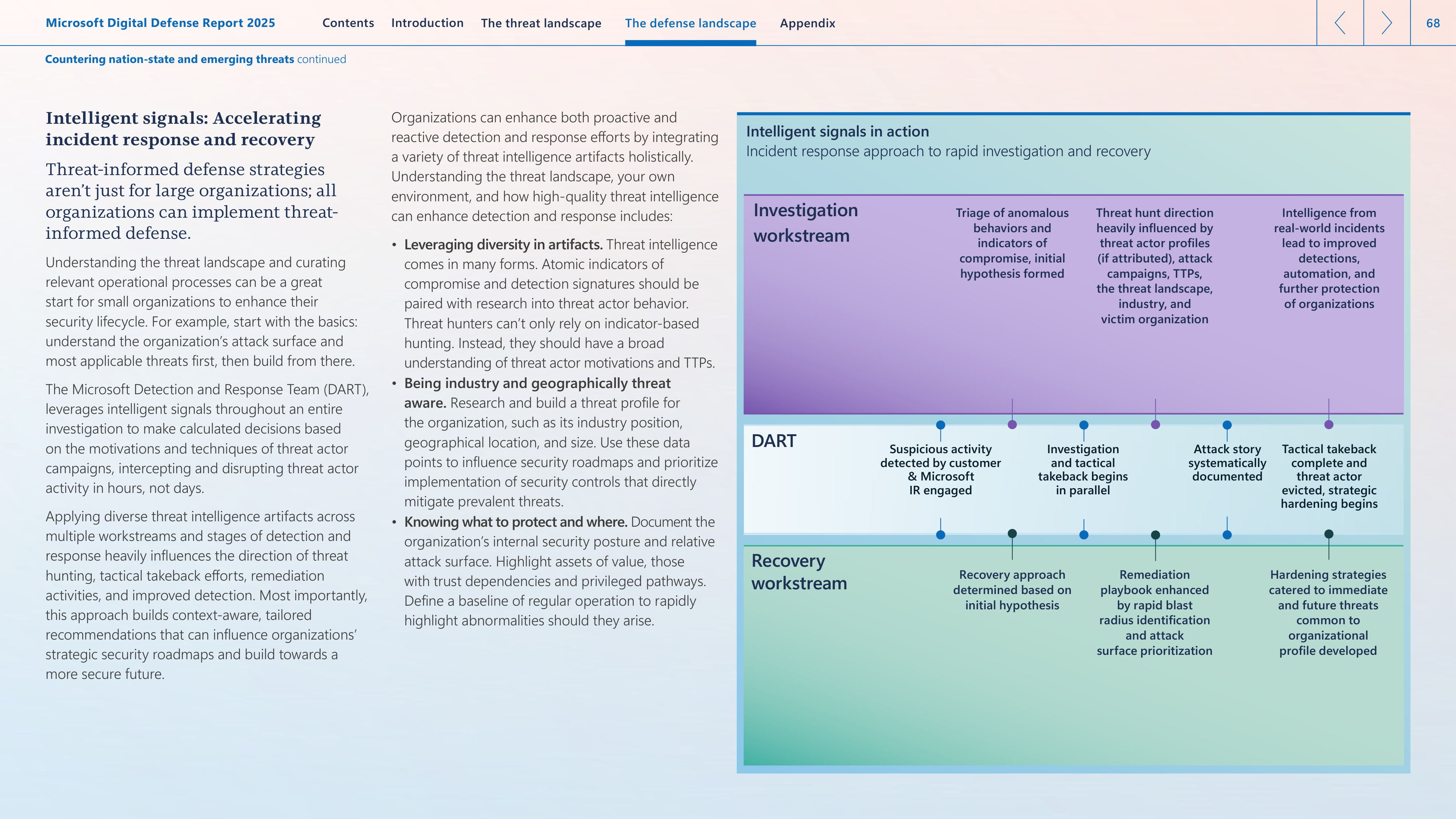

68
Microsoft Digital Defense Report 2025
Contents
Introduction
The threat landscape
The defense landscape
Appendix
Countering nation-state and emerging threats
continued
Intelligent signals: Accelerating
incident response and recovery
Threat-informed defense strategies
aren’t just for large organizations; all
organizations can implement threat-
informed defense.
Understanding the threat landscape and curating
relevant operational processes can be a great
start for small organizations to enhance their
security lifecycle. For example, start with the basics:
understand the organization’s attack surface and
most applicable threats first, then build from there.
The Microsoft Detection and Response Team (DART),
leverages intelligent signals throughout an entire
investigation to make calculated decisions based
on the motivations and techniques of threat actor
campaigns, intercepting and disrupting threat actor
activity in hours, not days.
Applying diverse threat intelligence artifacts across
multiple workstreams and stages of detection and
response heavily influences the direction of threat
hunting, tactical takeback efforts, remediation
activities, and improved detection. Most importantly,
this approach builds context-aware, tailored
recommendations
that
can
influence
organizations’
strategic security roadmaps and build towards a
more secure future.
Organizations can enhance both proactive and
reactive detection and response efforts by integrating
a variety of threat intelligence artifacts holistically.
Understanding the threat landscape, your own
environment, and how high-quality threat intelligence
can enhance detection and response includes:
•
Leveraging diversity in artifacts.
Threat intelligence
comes in many forms. Atomic indicators of
compromise and detection signatures should be
paired with research into threat actor behavior.
Threat hunters can’t only rely on indicator-based
hunting. Instead, they should have a broad
understanding of threat actor motivations and TTPs.
•
Being industry and geographically threat
aware.
Research and build a threat profile for
the organization, such as its industry position,
geographical location, and size. Use these data
points to influence security roadmaps and prioritize
implementation of security controls that directly
mitigate prevalent threats.
•
Knowing what to protect and where.
Document the
organization’s internal security posture and relative
attack surface. Highlight assets of value, those
with trust dependencies and privileged pathways.
Define a baseline of regular operation to rapidly
highlight abnormalities should they arise.
Intelligent signals in action
Incident response approach to rapid investigation and recovery
Investigation
workstream
Triage of anomalous
behaviors and
indicators of
compromise, initial
hypothesis formed
Threat hunt direction
heavily influenced by
threat actor profiles
(if attributed), attack
campaigns, TTPs,
the threat landscape,
industry, and
victim organization
Intelligence from
real-world incidents
lead to improved
detections,
automation, and
further protection
of organizations
DART
Suspicious activity
detected by customer
& Microsoft
IR engaged
Investigation
and tactical
takeback begins
in parallel
Attack story
systematically
documented
Tactical takeback
complete and
threat actor
evicted, strategic
hardening begins
Recovery
workstream
Recovery approach
determined based on
initial hypothesis
Remediation
playbook enhanced
by rapid blast
radius
identification
and attack
surface prioritization
Hardening strategies
catered to immediate
and future threats
common to
organizational
profile
developed

69
Microsoft Digital Defense Report 2025
Contents
Introduction
The threat landscape
The defense landscape
Appendix
Countering nation-state and emerging threats
continued
While creating a dedicated threat detection
and intelligence function is valuable, it can be
costly. Nevertheless, security must be seen
as an investment. Cybersecurity risks are
business continuity risks. Building useful threat
intelligence artifacts is a cyclical, collaborative
effort. Knowledge sharing and partnerships are
of paramount importance. Incident responders
have a unique viewpoint of an organization’s
data—contextual artifacts can be continuously
reported back into overall research efforts cyclically.
This informs threat hunting, improves detections,
and maintains cross-team awareness of the threat
landscape. Extending collaboration with external
partnerships also builds a stronger, collective defense
against threats.
“
Security must be seen
as an investment.
Cybersecurity
risks are business
continuity risks.
Collaboration as a counter measure:
Breaking down fraud silos
Cyber fraud is growing more scalable and sophisticated,
outpacing traditional defenses. A key vulnerability
is the lack of robust, real-time data-sharing across
sectors. Fragmented systems and siloed insights
hinder early detection and coordinated response.
One of the most effective countermeasures
is structured collaboration between financial
institutions, technology platforms, regulators, and
law enforcement. Sharing fraud signals enables faster
disruption of criminal activity—but it requires more
than isolated partnerships. A unified approach that
integrates diverse data sources is essential to expose
abuse patterns and reduce harm.
Global efforts are gaining momentum. Initiatives like
the Global Signal Exchange
21
promote standardized,
privacy-conscious frameworks for multi-sector
cooperation. Governments are responding to the
trillions of USD lost to scams with legislation mandating
reporting, liability reform, and stronger public-private
collaboration.
22
Australia’s Scam Prevention Framework
Act 2025, for example, introduces sector-specific codes
for fraud prevention.
23
The UK’s national strategy,
meanwhile, expands accountability to tech and telecom
sectors and accelerates data-sharing mandates.
24
Singapore and Japan are tightening laws to counter
digital payment fraud and cross-border scams.
25
While approaches vary, these developments reflect a
growing recognition of the need for more proactive,
coordinated, and enforceable national responses
to fraud. Looking ahead, we anticipate a significant
acceleration in the implementation of these
legislative frameworks as governments seek to close
the regulatory gaps, enhance consumer protections,
and build a more resilient digital economy.
Learn more
Cross-border collaboration: International
law enforcement and Microsoft dismantle
transnational scam network targeting older
adults | Microsoft On the Issues
(June 2025)
Disrupting Lumma Stealer: Microsoft
leads global action against favored
cybercrime tool | Microsoft On the Issues
(May 2025)
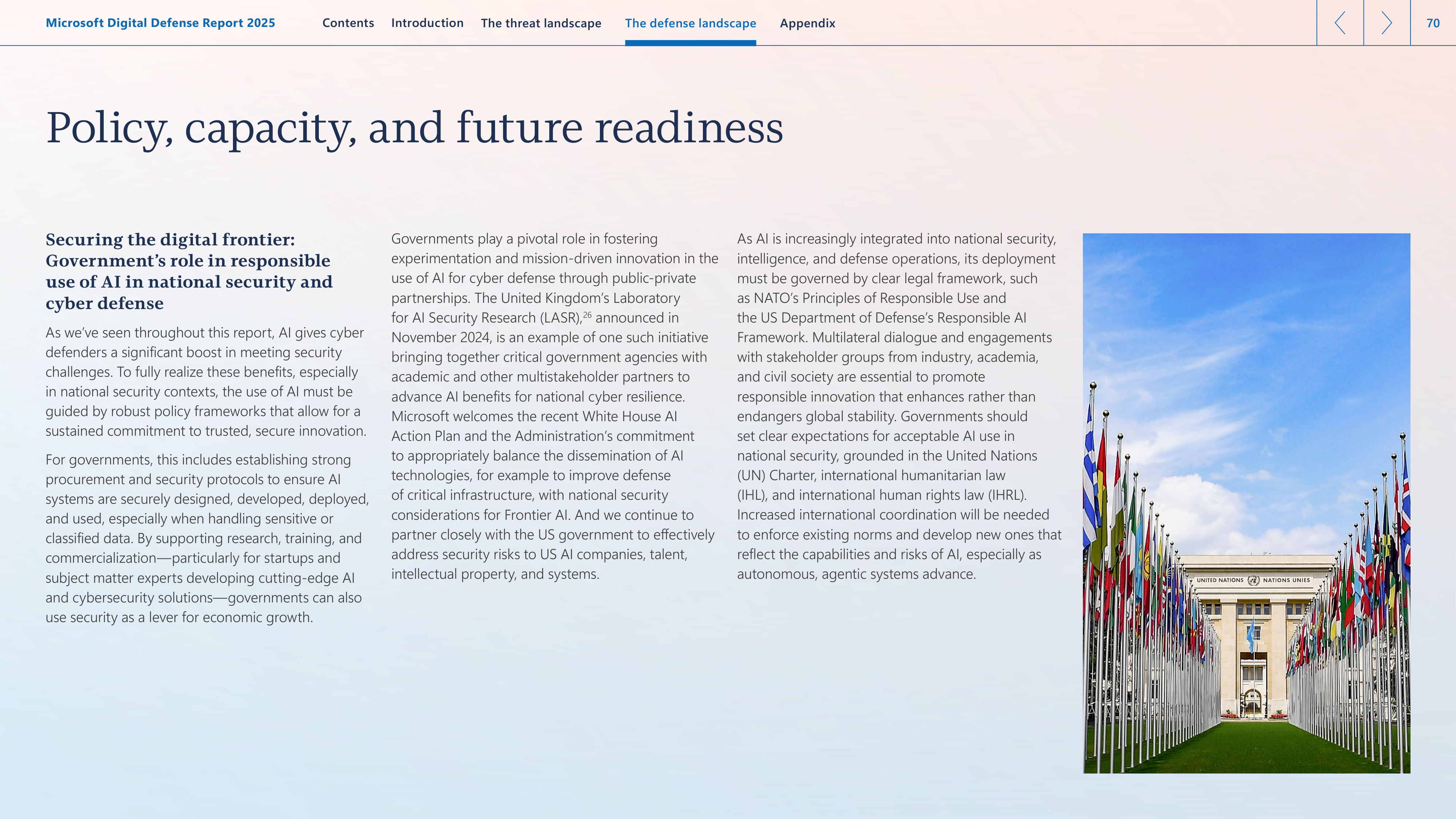

70
Microsoft Digital Defense Report 2025
Contents
Introduction
The threat landscape
The defense landscape
Appendix
Policy, capacity, and future readiness
Securing the digital frontier:
Government’s role in responsible
use of AI in national security and
cyber defense
As we’ve seen throughout this report, AI gives cyber
defenders a significant boost in meeting security
challenges. To fully realize these benefits, especially
in national security contexts, the use of AI must be
guided by robust policy frameworks that allow for a
sustained commitment to trusted, secure innovation.
For governments, this includes establishing strong
procurement and security protocols to ensure AI
systems are securely designed, developed, deployed,
and used, especially when handling sensitive or
classified data. By supporting research, training, and
commercialization—particularly for startups and
subject matter experts developing cutting-edge AI
and cybersecurity solutions—governments can also
use security as a lever for economic growth.
Governments play a pivotal role in fostering
experimentation and mission-driven innovation in the
use of AI for cyber defense through public-private
partnerships. The United Kingdom’s Laboratory
for AI Security Research (LASR),
26
announced in
November 2024, is an example of one such initiative
bringing together critical government agencies with
academic and other multistakeholder partners to
advance AI benefits for national cyber resilience.
Microsoft welcomes the recent White House AI
Action Plan and the Administration’s commitment
to appropriately balance the dissemination of AI
technologies, for example to improve defense
of critical infrastructure, with national security
considerations for Frontier AI. And we continue to
partner closely with the US government to effectively
address security risks to US AI companies, talent,
intellectual property, and systems.
As AI is increasingly integrated into national security,
intelligence, and defense operations, its deployment
must be governed by clear legal framework, such
as NATO’s Principles of Responsible Use and
the US Department of Defense’s Responsible AI
Framework. Multilateral dialogue and engagements
with stakeholder groups from industry, academia,
and civil society are essential to promote
responsible innovation that enhances rather than
endangers global stability. Governments should
set clear expectations for acceptable AI use in
national security, grounded in the United Nations
(UN) Charter, international humanitarian law
(IHL), and international human rights law (IHRL).
Increased international coordination will be needed
to enforce existing norms and develop new ones that
reflect the capabilities and risks of AI, especially as
autonomous, agentic systems advance.

71
Microsoft Digital Defense Report 2025
Contents
Introduction
The threat landscape
The defense landscape
Appendix
Policy, capacity, and future readiness
continued
Implementing responsible AI in national
security
At Microsoft, we expanded our responsible AI tools to
better assess and manage adversarial risks in model
development and deployment. Microsoft launched
our Frontier Governance Framework,
27
which serves
as a monitoring function, tracking the emergence of
new and advanced AI model capabilities that could
be misused to threaten national security or pose at-
scale public safety risks. It also sets out a process for
assessing and mitigating these risks so that frontier AI
models can be deployed in a secure and trustworthy
way. We are also developing engineering guidance
and responsible AI policies to support emerging
agentic systems, as these will play a growing role in
AI development and deployment.
Microsoft maintains a consistent risk review process
across AI releases, including red teaming and pre-
deployment assessments for high-impact systems.
This includes all generative AI systems and models,
including Azure OpenAI and Phi family of models to
help product teams safely deploy their generative
AI applications and models. Microsoft’s Sensitive
Uses and Emerging Technologies team continues to
advise on high-risk AI and high-impact applications—
especially in healthcare and science—helping teams
navigate novel risks and shape internal guidance.
To streamline documentation, we introduced an
internal tool that brings together all responsible AI
requirements outlined in the Responsible AI Standard.
To stay ahead of evolving regulations such as
the EU AI Act, Microsoft has taken a layered
approach to compliance, in line with the AI Act’s
staggered compliance deadlines. Microsoft has
undertaken multiple initiatives to promote AI
literacy in accordance with the Act, empowering our
employees, customers, and others to responsibly
leverage AI technologies.
28
Microsoft also proactively
took a layered approach to prepare for compliance
with the Act’s prohibited practices provisions.
29
In July 2025, we signed the General-Purpose AI
(GPAI) Code of Practice, which includes a set of
guidelines for compliance with the AI Act’s GPAI
model provider obligations, which came into effect
in August 2025.
30
Microsoft continues to engage
with the central EU regulator, the AI Office, and other
relevant authorities in EU Member States to share
insights from our AI development, governance, and
compliance experience, as well as insights we hear
from our customers.
Microsoft also worked with global partners to
support more consistent governance approaches
aligned with technical standards, including working
closely with industry partners in the Frontier Model
Forum and the Coalition for Secure AI.
Learn more
Responsible AI Transparency Report | Microsoft
Securing AI and Cloud with the Zero Day Quest | MSRC Blog | Microsoft Security
Response Center
Microsoft commits to skilling one million people for digital skills through Artificial
Intelligence skilling initiative in South Africa - Source EMEA
Unlocking data to advance European commerce and culture | Microsoft On the Issues
(July 2025)
Microsoft announces AI skilling opportunities for 2.5 million people in the ASEAN region
by 2025 | Microsoft Stories Asia
Microsoft Elevate: Putting people first | Microsoft On the Issues (July
2025)
Unlocking AI’s global potential: progress, productivity, and workforce development |
Microsoft On the Issues (April 2025)
Microsoft announces ARC Initiative to strengthen cybersecurity in Kenya | Microsoft On
the Issues (May 2025)
The Accra Call for Cyber Resilient Development | GC3B
Home - The GFCE
microsoft/llmail-inject-challenge · Datasets at Hugging Face
72
Microsoft Digital Defense Report 2025
Contents
Introduction
The threat landscape
The defense landscape
Appendix
Policy, capacity, and future readiness
continued
Resilience by design: Strengthening
critical infrastructure for the next
wave of threats
In today’s hyper-connected world, new
vulnerabilities are constantly emerging.
As a result, cybersecurity expectations,
practices, and oversight must evolve to
prioritize resilience.
Cyber–physical threats can arise from a variety
of sources, including natural disasters, industrial
accidents, human error, technical errors, or malicious
activities such as cyberattacks, terrorism, or armed
conflict. These threats have the potential to disrupt
the business and operations of critical infrastructures.
Given the interconnected nature of these risks,
cyber–physical resilience encompasses both technical
and organizational measures. Its goal is to prevent,
protect against, respond to, resist, mitigate, absorb,
accommodate, and recover from incidents.
31
Cyberattacks are inevitable. Whether due to
sophisticated threat actors, human error, or system
complexity, breaches will occur. The key question is
therefore not if a system will be attacked, but how
well it can withstand attacks and recover. This is the
essence of cyber-physical resilience: the ability of
systems to anticipate, withstand, recover from, and
adapt to disruptions—regardless of the cause.
Leaders should shift from a purely defensive posture
to one that embraces resilience as a core design
principle. This means building systems that can
continue to operate under duress, recover quickly,
and evolve to meet future threats. For leaders, this
is not just a technical issue—it’s a strategic one.
The resilience of our infrastructure directly impacts
national security, economic stability, and public trust.
By embedding resilience into the DNA of an
organization’s infrastructure, we not only protect our
assets but also enhance our ability to compete and
thrive in a volatile world.
Cyber-physical resilience is not just a technical
challenge, it’s a leadership imperative.
32
CEOs and
CFOs must recognize that downtime, data loss, and
reputational damage from cyber incidents can have
profound financial consequences. Simultaneously,
government leaders must ensure that national
infrastructure can withstand and recover from attacks
that could otherwise disrupt societal functions
at scale. Maintaining a robust defensive posture
will be especially important for owners of critical
infrastructure, many of whom operate with limited
financial
resources.
By embedding resilience into the DNA of an
organization’s infrastructure, we not only protect our
assets but also enhance our ability to compete and
thrive in a volatile world.
Key recommendations for leaders
Invest in resilience by design
Encourage the development of infrastructure that is inherently resilient. This includes
modular systems, redundancy, and fail-safes that allow for graceful degradation and
rapid recovery.
Foster public-private collaboration
Resilience is a shared responsibility. Governments and industries must work together to
set standards, share threat intelligence, and coordinate responses to disruptions.
Support innovation and workforce development
Resilience requires cutting-edge technologies and a skilled workforce. Leaders should
champion investments in research and development and education to build
national capacity.
Incentivize resilience through policy and regulation
Financial and regulatory frameworks should reward organizations that prioritize
resilience, much like how safety and environmental standards are incentivized today.
Measure and monitor resilience
Establish clear metrics and benchmarks to assess the resilience of critical systems.
Transparency and accountability are essential for continuous improvement.
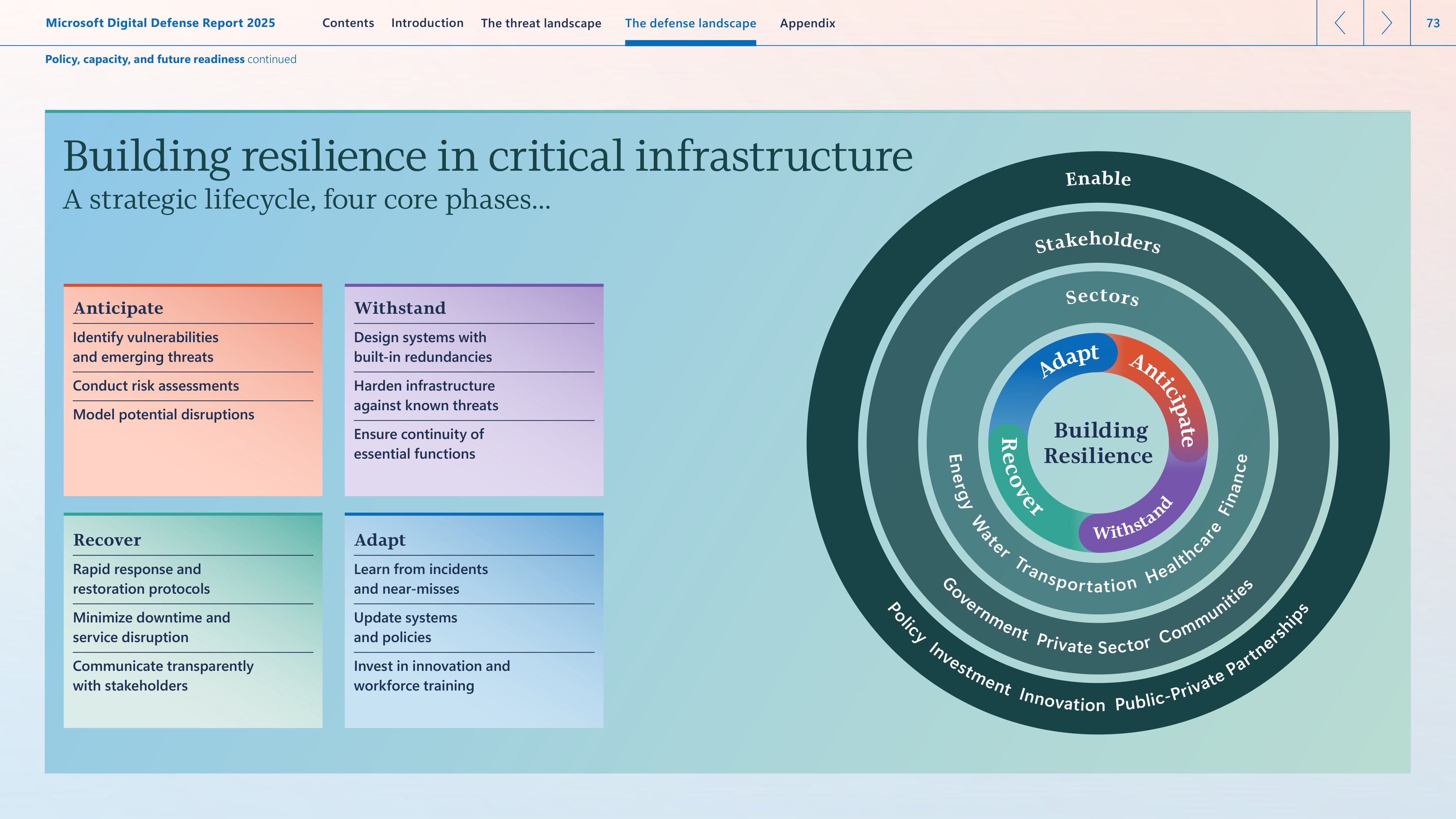

73
e
c
o
v
e
r
W
i
t
h
s
t
a
n
d
A
n
t
i
c
i
p
a
t
e
A
d
a
p
t
P
o
l
i
c
y
I
n
v
e
s
t
m
e
n
t
I
n
n
o
v
a
t
i
o
n
P
u
b
l
i
c
-
P
r
i
v
a
t
e
P
a
r
t
n
e
r
sh
i
p
s
S
e
c
t
o
r
s
Building
Resilience
G
t
o
v
r
T
r
a
n
s
p
o
r
t
a
t
i
o
n
H
e
a
l
t
h
c
e
r
n
m
e
n
t
P
r
i
v
a
t
e
S
e
c
t
o
r
C
o
m
m
u
n
i
t
i
e
s
E
n
a
b
l
e
S
t
a
k
e
h
o
l
d
e
r
s
E
n
e
r
g
y
W
a
e
a
r
e
F
i
n
a
n
c
e
R
Microsoft Digital Defense Report 2025
Contents
Introduction
The threat landscape
The defense landscape
Appendix
Policy, capacity, and future readiness
continued
Building resilience in critical infrastructure
A strategic lifecycle, four core phases…
Anticipate
Identify vulnerabilities
and emerging threats
Conduct risk assessments
Model potential disruptions
Withstand
Design systems with
built-in redundancies
Harden infrastructure
against known threats
Ensure continuity of
essential functions
Recover
Rapid response and
restoration protocols
Minimize downtime and
service disruption
Communicate transparently
with stakeholders
Adapt
Learn from incidents
and near-misses
Update systems
and policies
Invest in innovation and
workforce training
74
Microsoft Digital Defense Report 2025
Contents
Introduction
The threat landscape
The defense landscape
Appendix
Policy, capacity, and future readiness
continued
Microsoft’s strategic
path to quantum safety
Much of modern cryptography relies on
mathematical puzzles that are practically
impossible for classical computers
to solve—for instance, cracking the
standard encryption behind a secure
website or messaging app would take
millions of years with today’s computers.
Quantum computing is novel that can consider many
possibilities at once, allowing quantum computers
to process complex problems much faster than
classical systems.
Quantum computing poses a serious threat to
current cryptographic systems. While still an
emerging technology, the expected development
of a powerful cryptographically relevant quantum
computer (CRQC) means that if organizations don’t
update our cryptography in time, we risk a scenario
like the early days of the internet, when websites
were on unencrypted HTTP and attackers could
eavesdrop on information in transit. In the lead up to
this potential data exposure, Harvest Now, Decrypt
Later (HNDL) is a real concern: attackers can hoard
encrypted data today so they can decrypt it in the
future with quantum power.
Every organization should inventory its
cryptography
(keys, certificates, and protocols)
and establish a roadmap to replace vulnerable
algorithms with Post-Quantum Cryptography (PQC)
standards as they become available. At Microsoft,
there is a dedicated program to make sure our
own products and services—and customers—stay
safe in the quantum era. Microsoft established the
Quantum Safe Program (QSP) to coordinate all its
quantum security efforts across the company and
achieve quantum readiness by gradually integrating
PQC algorithms into Microsoft’s services. As part of
our efforts:
• We updated SymCrypt, Microsoft’s core
cryptographic library, to support new post-
quantum algorithms. SymCrypt is like the engine
that handles encryption under the hood in
Windows, Azure, and many Microsoft products.
We also enabled PQC support in Windows and
Azure Linux (using SymCrypt OpenSSL).
• Microsoft Research has contributed to the design
and analysis of PQC algorithms. Through blogs and
publications, Microsoft shares these developments
with the community, helping to lead the
conversation on how to protect information in the
quantum age.
Governments and industries worldwide are actively
preparing for the quantum era by upgrading their
cryptographic algorithms to quantum-resistant
alternatives. Standards bodies like National Institute
of Standards and Technology (NIST) and International
Organization for Standardization (ISO) have been
running global competitions to select robust PQC
algorithms, and international groups are working
on standards to integrate these algorithms into
our software so that everyone’s systems can work
together. In everyday terms, it’s like the world has
agreed to upgrade all its locks and keys and is now in
the process of implementing the change.
During the last year, multiple governments have also
published guidance and requirements to spur the
transition, with most identifying 2035 as the deadline
for completing transition. In the United States,
European Union, and Australia, changes to some of
the highest risk systems should be made by 2030,
while in Canada and the UK, that date is 2031.

75
Microsoft Digital Defense Report 2025
Contents
Introduction
The threat landscape
The defense landscape
Appendix
Policy, capacity, and future readiness
continued
Recommendations
Governments play a critical role in enabling a quantum-safe future through strong collaboration
with industry and effective policies. To accelerate readiness, we recommend governments take the
following actions:
Establish quantum safety as a national cybersecurity priority.
Position quantum-safe cryptography as a
strategic imperative and embed it into national cybersecurity frameworks.
Align quantum-safe strategies across
jurisdictions.
Harmonize public policies, standards, and transition
timelines. The G7 should lead by expanding its financial sector post-quantum cryptography workstream to
align G7 members’ broader quantum-safe strategies.
Adopt international standards.
Support global standards development and avoid fragmented, region-
specific approaches that hinder interoperability, innovation, and security.
Set early and progressive timelines.
Drive action well before 2030. For instance, the US Committee on
National Security Systems Policy 15 (CNSSP -
15) mandates quantum-safe algorithms in all new products
and services for national security systems by January 2027.
Lead by example with transparent transition plans.
Publish and regularly update government transition
roadmaps—including timelines, milestones, and budgets—to foster knowledge sharing and best practices.
Raise awareness and build workforce capacity.
Educate the public and critical infrastructure sectors
on quantum risks and readiness. Invest in skilling programs to equip the workforce for a quantum-
safe transition.
Modernize through cloud adoption
Promote cloud migration as a strategic enabler. Cloud platforms
can streamline the transition by embedding quantum-safe capabilities, reducing the burden on
individual organizations.
Learn more
Post-quantum resilience: building secure
foundations | Microsoft On the Issues
Quantum-safe security: Progress towards
next-generation cryptographyQuantum-
safe security: Progress towards next-
generation cryptography
Quantum-safe
security: Progress towards next-
generation cryptography
Quantum-safe security:
Progress towards next-generation cryptography
https://quantum.microsoft.com
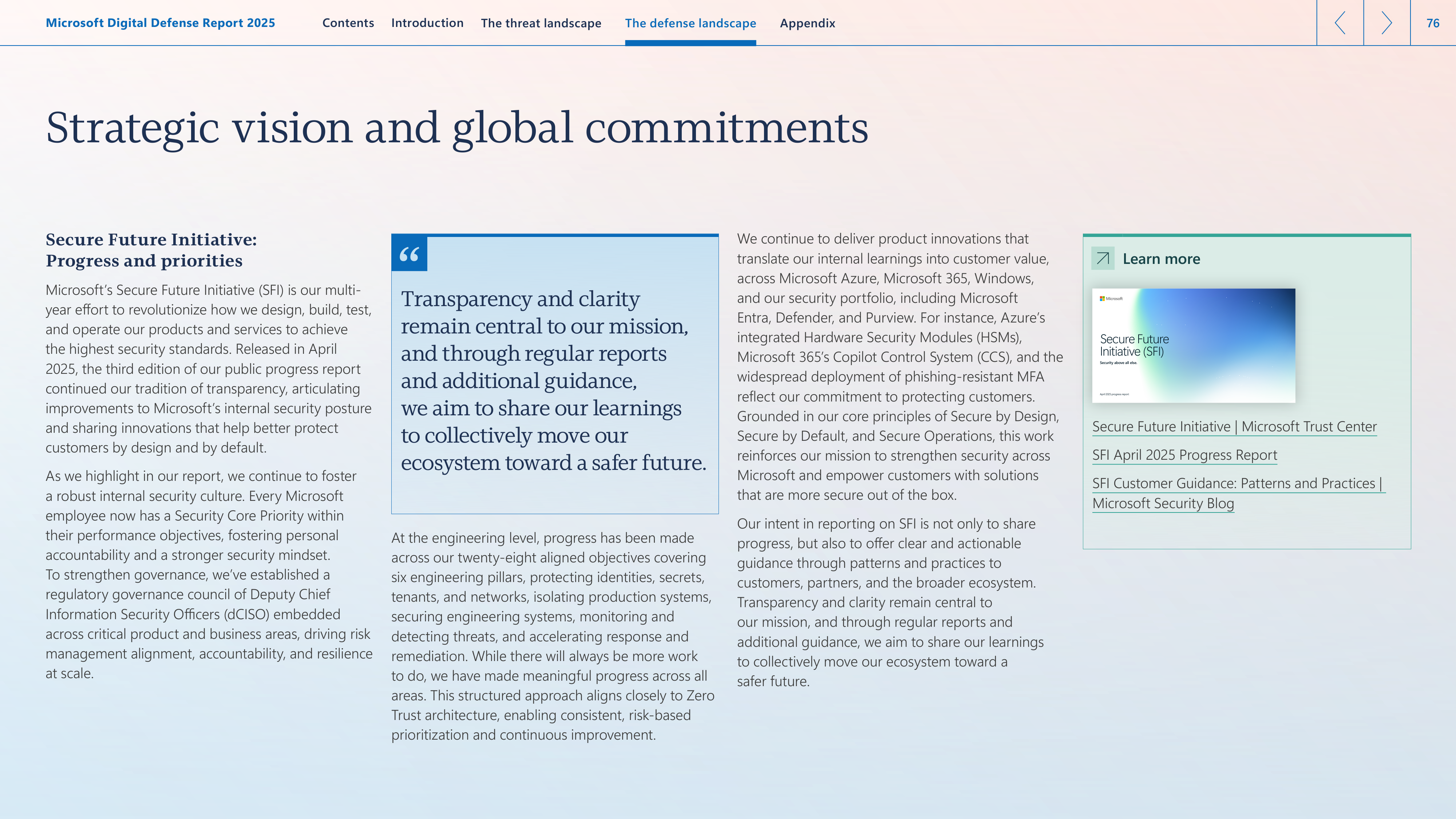


Microsoft 365’s Copilot Control System (CCS), and the
Grounded in our core principles of Secure by Design,
76
Microsoft Digital Defense Report 2025
Contents
Introduction
The threat landscape
The defense landscape
Appendix
Strategic vision and global commitments
Secure Future Initiative:
Progress and priorities
Microsoft’s Secure Future Initiative (SFI) is our multi-
year effort to revolutionize how we design, build, test,
and operate our products and services to achieve
the highest security standards. Released in April
2025, the third edition of our public progress report
continued our tradition of transparency, articulating
improvements to Microsoft’s internal security posture
and sharing innovations that help better protect
customers by design and by default.
As we highlight in our report, we continue to foster
a robust internal security culture. Every Microsoft
employee now has a Security Core Priority within
their performance objectives, fostering personal
accountability and a stronger security mindset.
To strengthen governance, we’ve established a
regulatory governance council of Deputy Chief
Information Security Officers (dCISO) embedded
across critical product and business areas, driving risk
management alignment, accountability, and resilience
at scale.
“
Transparency and clarity
remain central to our mission,
and through regular reports
and additional guidance,
we aim to share our learnings
to collectively move our
ecosystem toward a safer future.
At the engineering level, progress has been made
across our twenty-eight aligned objectives covering
six engineering pillars, protecting identities, secrets,
tenants, and networks, isolating production systems,
securing engineering systems, monitoring and
detecting threats, and accelerating response and
remediation. While there will always be more work
to do, we have made meaningful progress across all
areas. This structured approach aligns closely to Zero
Trust architecture, enabling consistent, risk-based
prioritization and continuous improvement.
We continue to deliver product innovations that
translate our internal learnings into customer value,
across Microsoft Azure, Microsoft 365, Windows,
and our security portfolio, including Microsoft
Entra, Defender, and Purview. For instance, Azure’s
integrated Hardware Security Modules (HSMs),
widespread deployment of phishing-resistant MFA
reflect our commitment to protecting customers.
Secure by Default, and Secure Operations, this work
reinforces our mission to strengthen security across
Microsoft and empower customers with solutions
that are more secure out of the box.
Our intent in reporting on SFI is not only to share
progress, but also to offer clear and actionable
guidance through patterns and practices to
customers, partners, and the broader ecosystem.
Transparency and clarity remain central to
our mission, and through regular reports and
additional guidance, we aim to share our learnings
to collectively move our ecosystem toward a
safer future.
Learn more
Secure Future
Initiative (SFI)
Security above all else.
April 2025 progress report
Secure Future Initiative | Microsoft Trust Center
SFI April 2025 Progress Report
SFI Customer Guidance: Patterns and Practices |
Microsoft Security Blog

77
Microsoft Digital Defense Report 2025
Contents
Introduction
The threat landscape
The defense landscape
Appendix
Strategic vision and global commitments
continued
Microsoft’s commitment to
strengthening global cybersecurity
Microsoft is deeply committed to supporting the
global effort to counter cyber threats by fostering
strong partnerships with governments and
advocating for cybersecurity laws and regulations
that promote a safer digital ecosystem for all.
A regional focus: Europe’s cybersecurity
imperative
The EU has enacted the Cyber Resilience Act (CRA),
a landmark regulation poised to become the gold
standard for cybersecurity, much like the General
Data Protection Regulation (GDPR) did for data
privacy. The CRA is expected to elevate global
security standards, influencing how secure products
are built even beyond Europe’s borders.
But regulation alone isn’t enough. Protecting Europe’s
digital infrastructure requires deep collaboration
between governments and industry. Microsoft is
actively contributing to this shared mission by:
• Appointing a European dCISO to its cybersecurity
governance council.
• Launching a European Security Program to provide
EU governments with real-time threat intelligence
and response capabilities.
• Contributing guidance to help manufacturers
comply with the CRA—including the development
of harmonized standards by European Standards
Organizations and EU Commission guidance
and supporting legislation through the CRA
Expert Group.
These efforts reflect Microsoft’s belief that collective
security is only possible through trusted partnerships
and shared responsibility.
Global trends: Cybersecurity policies and laws
As governments accelerate efforts to manage cyber
risk through new laws and policies, two key trends
have emerged:
•
Regulatory expansion and enforcement
Governments are shifting from voluntary
guidelines to enforceable standards, emphasizing
accountability, risk management, and timely
incident reporting.
•
Securing the digital supply chain
New mandates are driving secure by design
principles, transparency through clearer support
lifecycles and forward leaning efforts such as
encouraging the generation of SBOMs, and
robust post-market monitoring.
While regulatory expansion and enforcement and
efforts to secure the digital supply chain are well
intended, they can also introduce complexity.
Fragmented regulatory frameworks can slow down
incident response and ultimately weaken defenses.
As a global company, Microsoft sees firsthand
how inconsistent cybersecurity regulations
across jurisdictions can hinder resilience. That is
why efforts to establish international regulatory
cooperation, such as the effort led by Germany and
South Korea, are important. To truly strengthen
global cybersecurity, governments must pursue
harmonized, risk-based approaches that promote
interoperability and reduce duplication.
Key opportunities for regulatory alignment include:
• Incident reporting: Standardizing timelines,
definitions, thresholds, and formats to enable
faster, coordinated responses.
• Emerging technologies: Aligning approaches
to AI and post-quantum cryptography to avoid
innovation silos.
• Supply chains and vulnerability management:
Encouraging technology suppliers to inventory
their supply chain dependencies and strengthen
practices of coordinated vulnerability disclosure
to improve the identification, communication, and
remediation of vulnerabilities across the supply
chain promptly.
Microsoft urges governments to prioritize regulatory
harmonization and supports the Organisation for
Economic Co-operation and Development (OECD)
as a key convener in this effort. The organization’s
multilateral structure and digital security expertise
make it well-positioned to:
• Develop principles for regulatory alignment.
• Establish a forum for regulators and experts
representing various jurisdictions across the
multistakeholder cybersecurity community.
• Commission research to map overlaps and gaps in
global cybersecurity policy.
Earlier this year, Microsoft joined dozens of
technology leaders in signing an open letter
to the Group of Seven (G7) and OECD, calling
for coordinated action to reduce cyber risk and
foster innovation.
Learn more
Microsoft launches new European Security
Program | Microsoft On the Issues
EU Data Resiliency | Microsoft Trust Center
The CyberPeace Institute is helping NGOs defend
themselves—before it’s too late (August 2025)
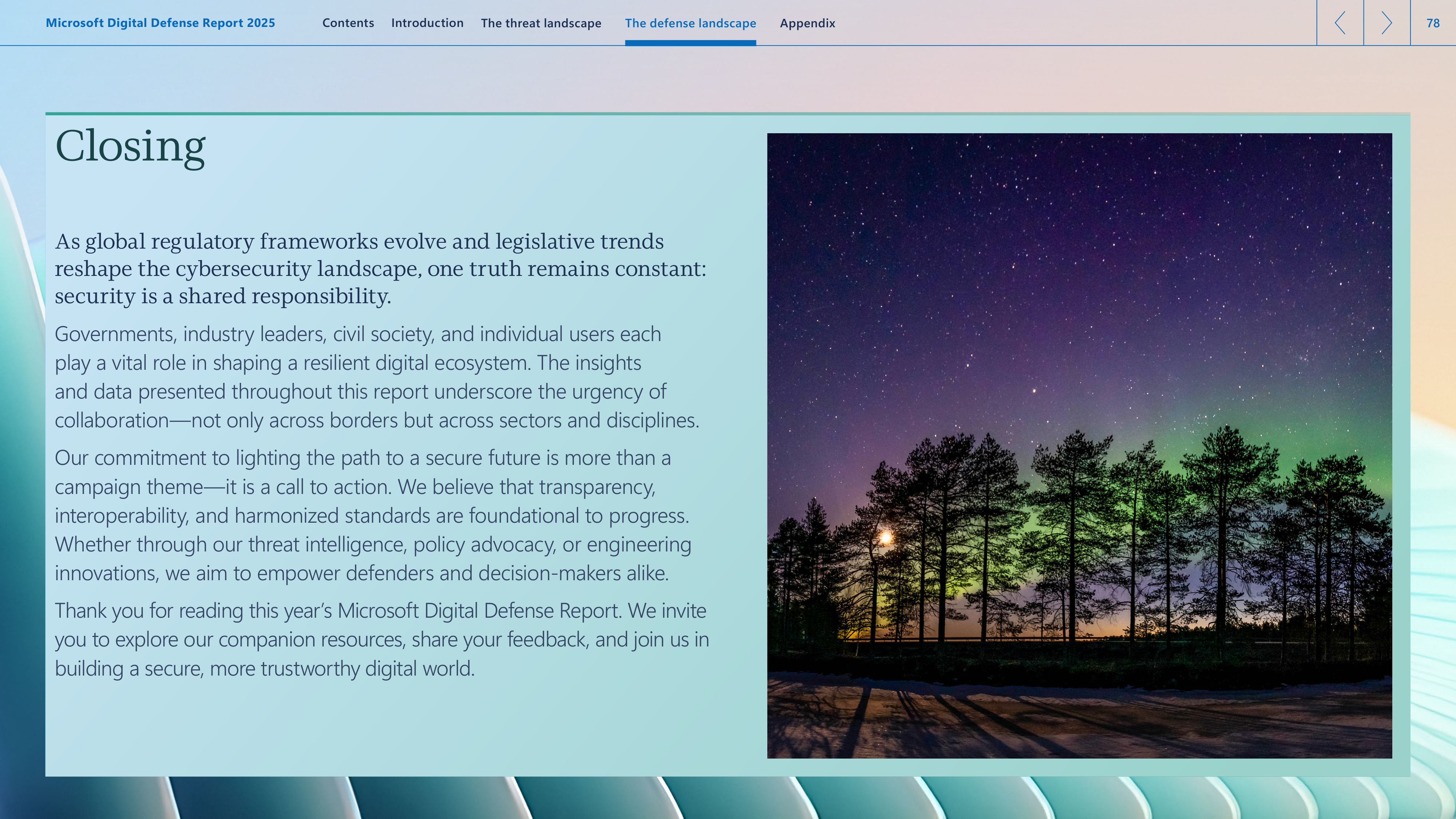


78
Microsoft Digital Defense Report 2025
Contents
Introduction
The threat landscape
The defense landscape
Appendix
Closing
As global regulatory frameworks evolve and legislative trends
reshape the cybersecurity landscape, one truth remains constant:
security is a shared responsibility.
Governments, industry leaders, civil society, and individual users each
play a vital role in shaping a resilient digital ecosystem. The insights
and data presented throughout this report underscore the urgency of
collaboration—not only across borders but across sectors and disciplines.
Our commitment to lighting the path to a secure future is more than a
campaign theme—it is a call to action. We believe that transparency,
interoperability, and harmonized standards are foundational to progress.
Whether through our threat intelligence, policy advocacy, or engineering
innovations, we aim to empower defenders and decision-makers alike.
Thank you for reading this year’s Microsoft Digital Defense Report. We invite
you to explore our companion resources, share your feedback, and join us in
building a secure, more trustworthy digital world.

79
Microsoft Digital Defense Report 2025
Contents
Introduction
The threat landscape
The defense landscape
Appendix
Appendix
80 Glossary
82 Contributing teams
84 References
80
Microsoft Digital Defense Report 2025
Contents
Introduction
The threat landscape
The defense landscape
Appendix
Glossary
Access broker
A cybercriminal who gains unauthorized access to
organizations and sells that access to other criminals,
enabling further attacks such as ransomware or
data theft.
AI deepfake
Artificial Intelligence-generated audio, video, or
images that convincingly mimic real people or events
can be used to impersonate individuals, fabricate
scenarios, or manipulate public perception—
often contributing to fraud, misinformation,
or disinformation.
Attack surface
The total set of points where an unauthorized user
can try to enter or extract data from an environment.
BEC (Business Email Compromise)
A targeted attack where criminals gain access to
business email accounts to defraud organizations,
often by manipulating financial transactions.
Botnet
A network of computers infected with malware and
controlled as a group to perform malicious activities,
such as launching attacks or sending spam.
Cloud security
Protecting data, applications, and systems hosted
in cloud environments. As organizations move to
the cloud, attackers increasingly target cloud assets
and identities.
Cloud workload
Applications, services, or processes running in a cloud
environment, which can be targeted by attackers.
Container (in cybersecurity context)
A lightweight, standalone package of software
that includes everything needed to run an
application. Containers are widely used in cloud
environments and can be targeted by attackers
if not properly secured.
Credential theft
Stealing usernames, passwords, or other
authentication information to gain unauthorized
access to systems or data.
Critical infrastructure
Essential systems and assets (energy, water,
transportation, healthcare, etc.) whose disruption
would have significant societal impact.
Cyber mercenary
A private entity that sells hacking tools or services to
governments or criminals, often operating in legal
gray zones.
Cyber resilience
The ability of an organization to anticipate, withstand,
recover
from,
and
adapt
to
cyberattacks
or
disruptions.
Cyber-enabled
influence
operations
Efforts by threat actors to manipulate public opinion
or behavior using digital tools, such as social media,
fake news, or deepfakes.
Data
exfiltration
The unauthorized transfer or theft of data from an
organization, often as part of a cyberattack.
Data theft
Stealing sensitive or valuable information, such as
intellectual property, personal data, or financial records.
Device code phishing
A phishing technique where attackers trick users
into entering authentication codes on fake portals,
allowing them to hijack accounts.
Endpoint
Any device (such as a computer, smartphone, or
server) that connects to a network and can be
targeted by cyberattacks.
Espionage
The act of spying to obtain confidential information,
often for political, economic, or military advantage.
Exploit
A method or tool used by attackers to take
advantage of vulnerabilities in software or systems.
Fraud
Deceptive practices intended to gain financial or
personal benefit, often involving manipulation
or
impersonation.
Human-operated attack
A cyberattack where humans, rather than automated
tools, actively control the intrusion, often adapting
tactics in real time.
Human-operated ransomware
A ransomware attack in which cybercriminals
actively control the intrusion, moving through
networks, stealing data, and manually deploying
ransomware for maximum impact. These attacks
are more targeted and damaging than automated
ransomware, often combining extortion with data
theft or disruption of critical services.
81
Microsoft Digital Defense Report 2025
Contents
Introduction
The threat landscape
The defense landscape
Appendix
Glossary
continued
Identity compromise
When an attacker gains control of a user’s digital
identity, allowing unauthorized access to systems
or data.
Identity platform
A system or service that manages digital identities,
authentication, and access controls for users
and devices.
Incident response (IR)
A structured approach to managing and mitigating
the impact of cybersecurity incidents.
Infostealer
Malware designed to collect credentials, tokens, and
other sensitive information from infected devices.
Influence
operations
Coordinated efforts to affect public perception or
behavior, often using digital channels and sometimes
involving misinformation or manipulation.
Infrastructure building
A tactic where attackers use compromised systems
to stage further attacks against other targets, often
creating a base for future operations.
Insider threat
A risk posed by individuals within an organization
who may intentionally or unintentionally cause harm
by leaking data or facilitating attacks.
LLM (Large Language Model)
A type of AI model trained on vast amounts of
text data to understand and generate human-like
language. LLMs can answer questions, summarize
documents, and assist with decision-making, but can
also be targeted or manipulated by cyber attackers.
Malvertising
Malicious advertising that delivers malware to users
through deceptive online ads.
Malware
Software designed to disrupt, damage, or gain
unauthorized access to computer systems.
MFA (multifactor authentication)
A security process requiring two or more verification
factors to access systems or data.
Mule herding
The recruitment and management of individuals
(“money mules”) who move or launder stolen funds
on behalf of cybercriminals.
Nation-state actor
A cyber threat actor sponsored or directed by a
government, often targeting other countries for
espionage, disruption, or influence.
Password spray attack
A technique where attackers try common passwords
against many accounts to gain unauthorized access.
Phishing
A cyberattack where attackers impersonate
trusted entities to trick individuals into revealing
sensitive
information.
Post-quantum cryptography (PQC)
Encryption methods designed to be secure against
quantum computing attacks.
Prompt injection
A type of attack on AI systems where malicious
instructions are hidden in user input or data, causing
the AI to behave in unintended or harmful ways.
Quantum computing
Advanced computing technology that could
break current encryption methods, requiring new
security standards.
Ransomware
Malicious software that encrypts data and demands
payment for its release.
Remote access tool
Software that allows remote control of a computer,
often used legitimately but also abused by attackers.
Resilience by design
Building systems and processes that can
withstand, recover from, and adapt to cyberattacks
or disruptions.
Social engineering
Manipulating people into performing actions or
divulging confidential information, often used in
phishing and fraud.
SLM (Small Language Model)
A more compact version of a language model,
designed to perform language-related tasks efficiently
with fewer computational resources. SLMs are often
used for specific, focused applications where speed
and efficiency are important, but they may have more
limited capabilities compared to LLMs.
Supply chain attack
Targeting less secure elements in an organization’s
supply chain (vendors, partners) to gain access to the
primary
organization.
Threat intelligence
Information about current and emerging cyber
threats, used to inform security strategies and
improve
defenses.
Token theft
Stealing authentication tokens (digital keys) to gain
unauthorized access without needing a password.
Vishing
Voice phishing; using phone calls to trick individuals
into revealing sensitive information or performing
risky actions.
Virtual credit card (VCC)
A digital payment card generated for online
transactions, often with unique details and limited
lifespan to reduce fraud risk.
Workload identities
Digital identities assigned to applications, services,
or automated processes (not people), which can be
targeted by attackers if not properly secured.
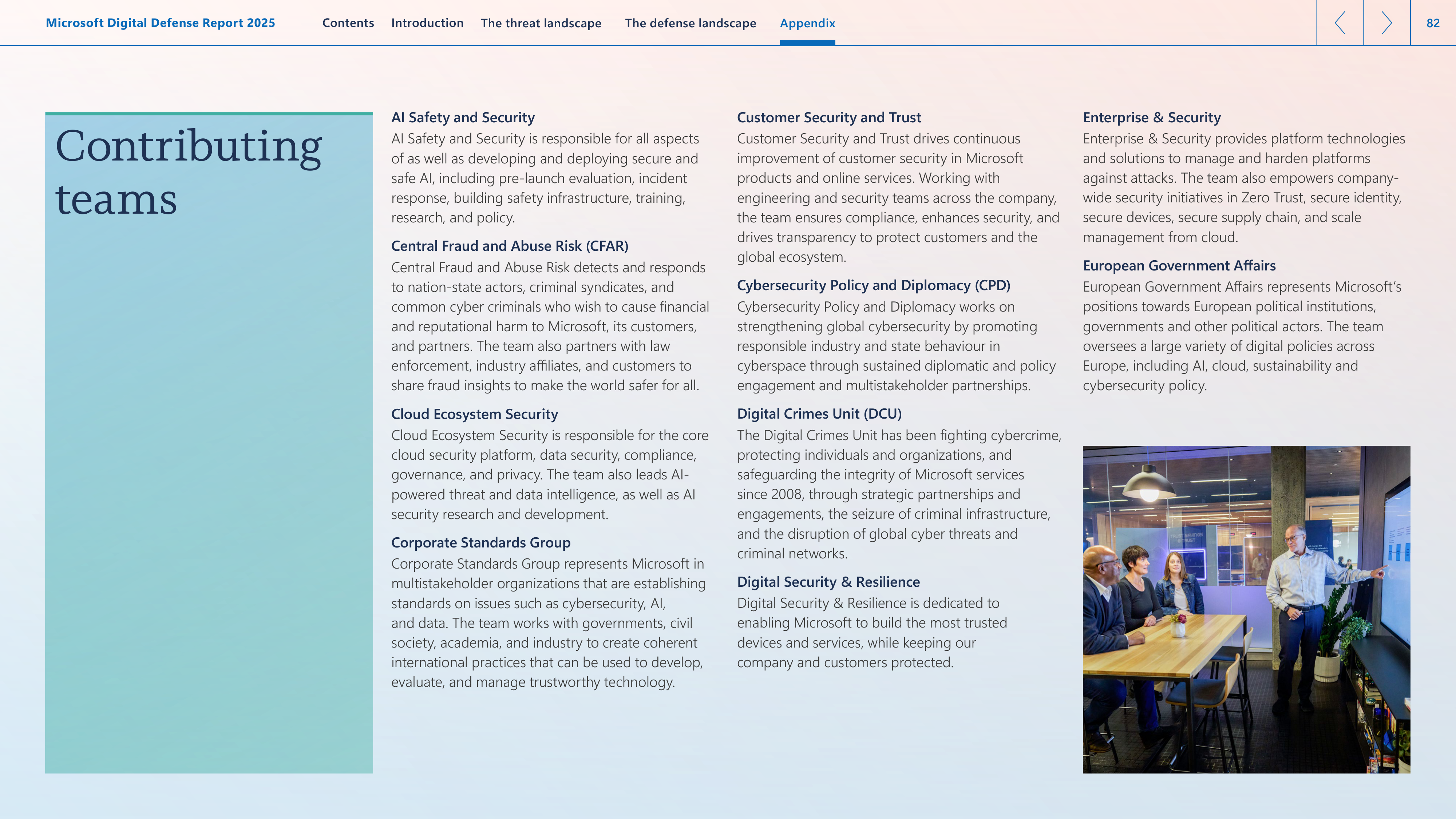

82
Microsoft Digital Defense Report 2025
Contents
Introduction
The threat landscape
The defense landscape
Appendix
Contributing
teams
AI Safety and Security
AI Safety and Security is responsible for all aspects
of as well as developing and deploying secure and
safe AI, including pre-launch evaluation, incident
response,
building
safety
infrastructure,
training,
research, and policy.
Central Fraud and Abuse Risk (CFAR)
Central Fraud and Abuse Risk detects and responds
to nation-state actors, criminal syndicates, and
common cyber criminals who wish to cause financial
and reputational harm to Microsoft, its customers,
and partners. The team also partners with law
enforcement, industry affiliates, and customers to
share fraud insights to make the world safer for all.
Cloud Ecosystem Security
Cloud Ecosystem Security is responsible for the core
cloud security platform, data security, compliance,
governance, and privacy. The team also leads AI-
powered threat and data intelligence, as well as AI
security research and development.
Corporate Standards Group
Corporate Standards Group represents Microsoft in
multistakeholder organizations that are establishing
standards on issues such as cybersecurity, AI,
and data. The team works with governments, civil
society, academia, and industry to create coherent
international practices that can be used to develop,
evaluate, and manage trustworthy technology.
Customer Security and Trust
Customer Security and Trust drives continuous
improvement of customer security in Microsoft
products and online services. Working with
engineering and security teams across the company,
the team ensures compliance, enhances security, and
drives transparency to protect customers and the
global ecosystem.
Cybersecurity Policy and Diplomacy (CPD)
Cybersecurity Policy and Diplomacy works on
strengthening global cybersecurity by promoting
responsible industry and state behaviour in
cyberspace through sustained diplomatic and policy
engagement
and
multistakeholder
partnerships.
Digital Crimes Unit (DCU)
The Digital Crimes Unit has been fighting cybercrime,
protecting individuals and organizations, and
safeguarding the integrity of Microsoft services
since 2008, through strategic partnerships and
engagements, the seizure of criminal infrastructure,
and the disruption of global cyber threats and
criminal networks.
Digital Security & Resilience
Digital Security & Resilience is dedicated to
enabling Microsoft to build the most trusted
devices and services, while keeping our
company and customers protected.
Enterprise & Security
Enterprise & Security provides platform technologies
and solutions to manage and harden platforms
against attacks. The team also empowers company-
wide security initiatives in Zero Trust, secure identity,
secure devices, secure supply chain, and scale
management from cloud.
European Government Affairs
European Government Affairs represents Microsoft’s
positions towards European political institutions,
governments and other political actors. The team
oversees a large variety of digital policies across
Europe, including AI, cloud, sustainability and
cybersecurity
policy.
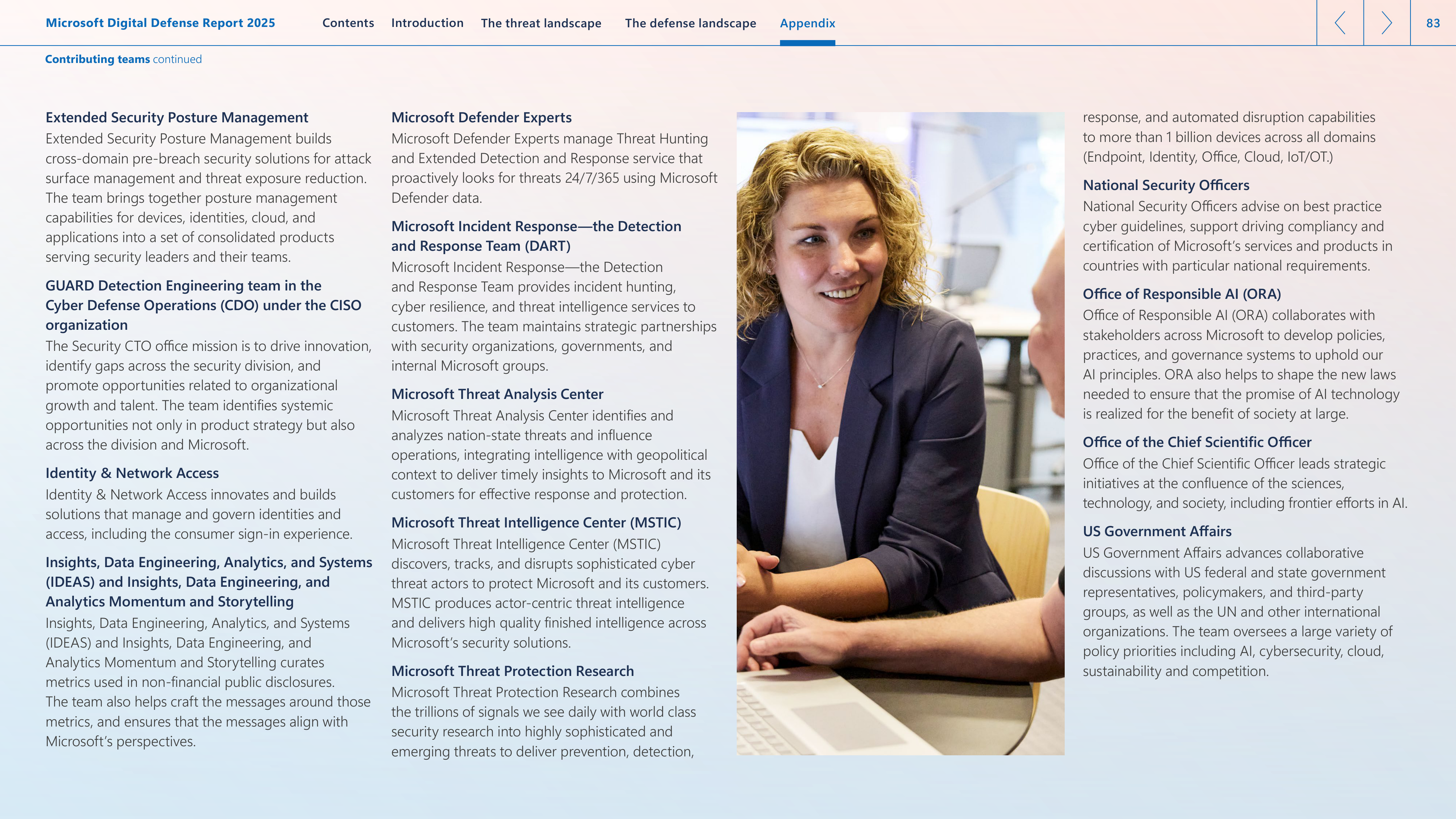

83
Microsoft Digital Defense Report 2025
Contents
Introduction
The threat landscape
The defense landscape
Appendix
Contributing teams
continued
Extended Security Posture Management
Extended Security Posture Management builds
cross-domain pre-breach security solutions for attack
surface management and threat exposure reduction.
The team brings together posture management
capabilities for devices, identities, cloud, and
applications into a set of consolidated products
serving security leaders and their teams.
GUARD Detection Engineering team in the
Cyber Defense Operations (CDO) under the CISO
organization
The Security CTO office mission is to drive innovation,
identify gaps across the security division, and
promote opportunities related to organizational
growth and talent. The team identifies systemic
opportunities not only in product strategy but also
across the division and Microsoft.
Identity & Network Access
Identity & Network Access innovates and builds
solutions that manage and govern identities and
access, including the consumer sign-in experience.
Insights, Data Engineering, Analytics, and Systems
(IDEAS) and Insights, Data Engineering, and
Analytics Momentum and Storytelling
Insights, Data Engineering, Analytics, and Systems
(IDEAS) and Insights, Data Engineering, and
Analytics Momentum and Storytelling curates
metrics used in non-financial public disclosures.
The team also helps craft the messages around those
metrics, and ensures that the messages align with
Microsoft’s
perspectives.
Microsoft Defender Experts
Microsoft Defender Experts manage Threat Hunting
and Extended Detection and Response service that
proactively looks for threats 24/7/365 using Microsoft
Defender data.
Microsoft Incident Response—the Detection
and Response Team (DART)
Microsoft Incident Response—the Detection
and Response Team provides incident hunting,
cyber resilience, and threat intelligence services to
customers. The team maintains strategic partnerships
with security organizations, governments, and
internal Microsoft groups.
Microsoft Threat Analysis Center
Microsoft Threat Analysis Center identifies and
analyzes nation-state threats and influence
operations, integrating intelligence with geopolitical
context to deliver timely insights to Microsoft and its
customers for effective response and protection.
Microsoft Threat Intelligence Center (MSTIC)
Microsoft Threat Intelligence Center (MSTIC)
discovers, tracks, and disrupts sophisticated cyber
threat actors to protect Microsoft and its customers.
MSTIC produces actor-centric threat intelligence
and delivers high quality finished intelligence across
Microsoft’s security solutions.
Microsoft Threat Protection Research
Microsoft Threat Protection Research combines
the trillions of signals we see daily with world class
security research into highly sophisticated and
emerging threats to deliver prevention, detection,
response, and automated disruption capabilities
to more than 1 billion devices across all domains
(Endpoint, Identity, Office, Cloud, IoT/OT.)
National Security Officers
National Security Officers advise on best practice
cyber guidelines, support driving compliancy and
certification of Microsoft’s services and products in
countries with particular national requirements.
Office of Responsible AI (ORA)
Office of Responsible AI (ORA) collaborates with
stakeholders across Microsoft to develop policies,
practices, and governance systems to uphold our
AI principles. ORA also helps to shape the new laws
needed to ensure that the promise of AI technology
is realized for the benefit of society at large.
Office of the Chief Scientific Officer
Office of the Chief Scientific Officer leads strategic
initiatives at the confluence of the sciences,
technology, and society, including frontier efforts in AI.
US Government Affairs
US Government Affairs advances collaborative
discussions with US federal and state government
representatives, policymakers, and third-party
groups, as well as the UN and other international
organizations. The team oversees a large variety of
policy priorities including AI, cybersecurity, cloud,
sustainability and competition.
84
Microsoft Digital Defense Report 2025
Contents
Introduction
The threat landscape
The defense landscape
Appendix
References
Part I: The threat landscape
1
Cyber Signals: Cyberthreats in K-12 and higher
education | Microsoft Security Blog
2
Mythical Beasts and where to find them: Mapping
the global spyware market and its threats to national
security and human rights | Atlantic Council
3
Intelligence-Driven Cyber Security | Intel 471
4
Have I Been Pwned: Check if your email address has
been exposed in a data breach
5
Protecting customers from Octo Tempest attacks
across multiple industries | Microsoft Security Blog
(July 2025)
6
The latest marketing tactic on LinkedIn: AI-generated
faces | NPR
7
Cybersecurity Information Sheet: Contextualizing
Deepfake Threats to Organizations | National
Security Agency
8
Synthetic ID document fraud is exploding worldwide
thanks entirely to Generative AI: here’s how to stay
safe | TechRadarr
9
Grand View Research
10
Harvard Kennedy School et al., “Evaluating Large
Language Models’ Capability to Launch Fully
Automated Spear Phishing Campaigns: Validated
on Human Subjects,” arXiv preprint, Nov. 30, 2024.
Study found AI-automated phishing can be up to
50x more profitable than traditional methods when
targeting large groups
11
States’ use of non-state actors in cyberspace |
Observer Research Foundation
12
Nation-State Threats | Cybersecurity and
Infrastructure Security Agency (CISA)
13
2025 Ponemon Cost of Insider Threats Global Report
14
15
Communication
Compliance
|
Microsoft
Learn
Jasper Sleet: North Korean remote IT workers’
evolving tactics to infiltrate organizations | Microsoft
Security Blog
16
Protecting Quantum Science and Technology |
FBI.gov
Part II – The defense landscape
17
Secure employee access in the age of AI |
Microsoft
(2025)
18
International Counter Ransomware Initiative
19
Ransomware Task Force (RTF) | Institute for Security
+ Technology
20
The Pall Mall Process Code of Practice for States |
GOV.UK
21
A global clearing house for real-time sharing of scam
and fraud signals | Global Signal Exchange
22
International Scammers Steal Over $1 Trillion
in 12 Months in Global State of Scams Report |
Global Anti-Scam Alliance
23
Scams Prevention Framework – Protecting
Australians from scams | Treasury.gov.au
24
APP fraud reimbursement protections | Payment
Systems
Regulator
25
Combatting Scams | Monetary Authority
of
Singapore
26
Mitigating AI Security Risks for UK Prosperity &
National Resilience | LASR
27
Frontier Governance Framework | Microsoft
(February 2025)
28
AI Literacy Starting Guide | Microsoft (June 2025)
29
30
The EU AI Act: Prohibited Practices |
Microsoft
(January
2025)
The General-Purpose AI Code of Practice:
Shaping Europe’s digital future | Microsoft AI
Transparency
Report
31
Cyber–Physical Resilience: Evolution of Concept,
Indicators, and Legal Frameworks
32
Fortifying the Resilience of our Critical Infrastructure



-
-
Microsoft Digital
Defense Report 2025
Lighting the path to a secure future
For more news on cybersecurity, visit:
https://microsoft.com/corporate-responsibility/cybersecurity
For more report insights, visit:
https://microsoft.com/mddr
For more news on cybersecurity
policy, follow us on LinkedIn:
https://aka.ms/MOILinkedin
For insights and trends for security leaders, visit:
https://www.microsoft.com/security/security-insider
A Microsoft Threat Intelligence report
October 2025
v3