
2025 Responsible Business Report

We are pleased to share the Kroger
Family of Companies’ latest progress
on sustainability and community
engagement for the 2024 reporting
period with our stakeholders.
Kroger’s
Thriving Together
strategy reflects how our
company supports and serves our associates and
customers every day, lifting up our neighbors and
creating stronger communities.
Our Responsible Business strategy includes a wide
range of topics affecting people and our planet.
Informed by a double materiality assessment and
ongoing engagement with leaders inside and outside
our company, these insights help shape our approach
and progress as outlined in this report.
Our
Thriving Together
strategy continues to evolve
over time to complement and integrate with Kroger’s
core business and go-to-market strategy. We believe
a strong, thriving company means stronger, thriving
communities wherever we operate.
Strategic Oversight
The Board of Directors oversees Kroger’s
management approach to our Responsible
Business strategy and key sustainability and
social responsibility topics. A dedicated Public
Responsibilities Committee of the Board—established
in 1977—engages leaders and reviews progress on
the company’s sustainability and social responsibility
goals, including our Zero Hunger | Zero Waste plan.
Welcome to Our Report
2
Introduction
2
Welcome to Our Report
3
About Kroger
4
Our Business
5
Key Highlights
6
Our Value Chain
7
Our Approach
8
Material Topics
10
Thriving Together
Strategy
11
Zero Hunger | Zero Waste Impact Plan
12
Zero Hunger | Zero Waste Progress
13
2024 Progress Highlights
14
Stakeholder Engagement
15
Recognition
16
People
17
2024 Highlights
18
Our Associates
24
Our Customers
28
Our Communities
32
Planet
33
2024 Highlights
34
Climate Impact
38
Waste & Circularity
43
Biodiversity & Resource Conservation
47
Governance
48
Corporate Governance
55
Responsible Supply Chain
& Sourcing
60
Appendix
61
Key Performance Data Tables
65
Material Topics Summary
67
TCFD Index
68
SASB Index
70
2024 Supplemental Data Tables
71
Forward-Looking Statements
Contents
Kroger’s leadership team is accountable for
implementing our Responsible Business strategy and
driving performance to achieve goals. Sustainability
and community engagement priorities are developed
and managed by a centralized team, led by our group
vice president of Communications & Public Affairs, who
serves as chief sustainability officer, in collaboration
with an internal network of business leaders and
subject matter experts across many disciplines.
Report Scope
This report covers Kroger’s 2024 fiscal year from
February 4, 2024, to February 1, 2025. Unless
otherwise noted, data included in the report reflects
this period. The report incorporates most of our
operations, except for certain datasets related to
integrating banners from mergers into our tracking
systems. Where appropriate, we note the scope
of specific performance tracking in the relevant
report section.
Reporting Approach
The content in this report reflects leading reporting
practices with modifications, as previously noted and
in the pages that follow. Our approach to defining
content reflects insights from our most recent double
materiality assessment.
We continue to monitor developments in reporting
standards and best practices. We provide a
Sustainability Accounting Standards Board (SASB)
Index at the end of this report to provide additional
disclosures in alignment with the SASB Food Retailers
& Distributors Standard.
We comply with applicable federal and state laws
regarding relevant disclosures. We continue to align
with the Task Force on Climate-related Financial
Disclosures (TCFD) and monitor developments in
other emerging frameworks.
People
Our Approach
Planet
Appendix
Governance
Introduction
2
2025 Kroger Responsible Business Report


Our Family of Companies
About Kroger
Honesty
We insist on truthfulness with each other,
with our customers, with our vendors
and in our business records. We expect
and value openness.
Inclusion
We encourage and expect collaboration,
teamwork and the active involvement of
all associates.
Integrity
We act in accordance with Our Values,
even when it’s difficult.
Diversity
We seek and embrace differences in the
backgrounds, cultures and ethnicities of
all associates, customers and vendors.
Safety
We protect our customers and each
other from injury with a safe and secure
workplace and shopping environment.
Respect
We treat all with dignity and value the
opinions and perspectives of others.
In fulfilling Our Purpose—To Feed the Human
Spirit™—we live by Kroger’s long-standing Values:
MARKETING
Since Kroger’s earliest days, we have
prioritized offering convenience and
value to our customers. We remain
focused on our purpose-driven plan to
increase access to quality, affordable
fresh food for everyone.
Our Values
People
Our Approach
Planet
2025 Kroger Responsible Business Report
3
Appendix
Governance
Introduction
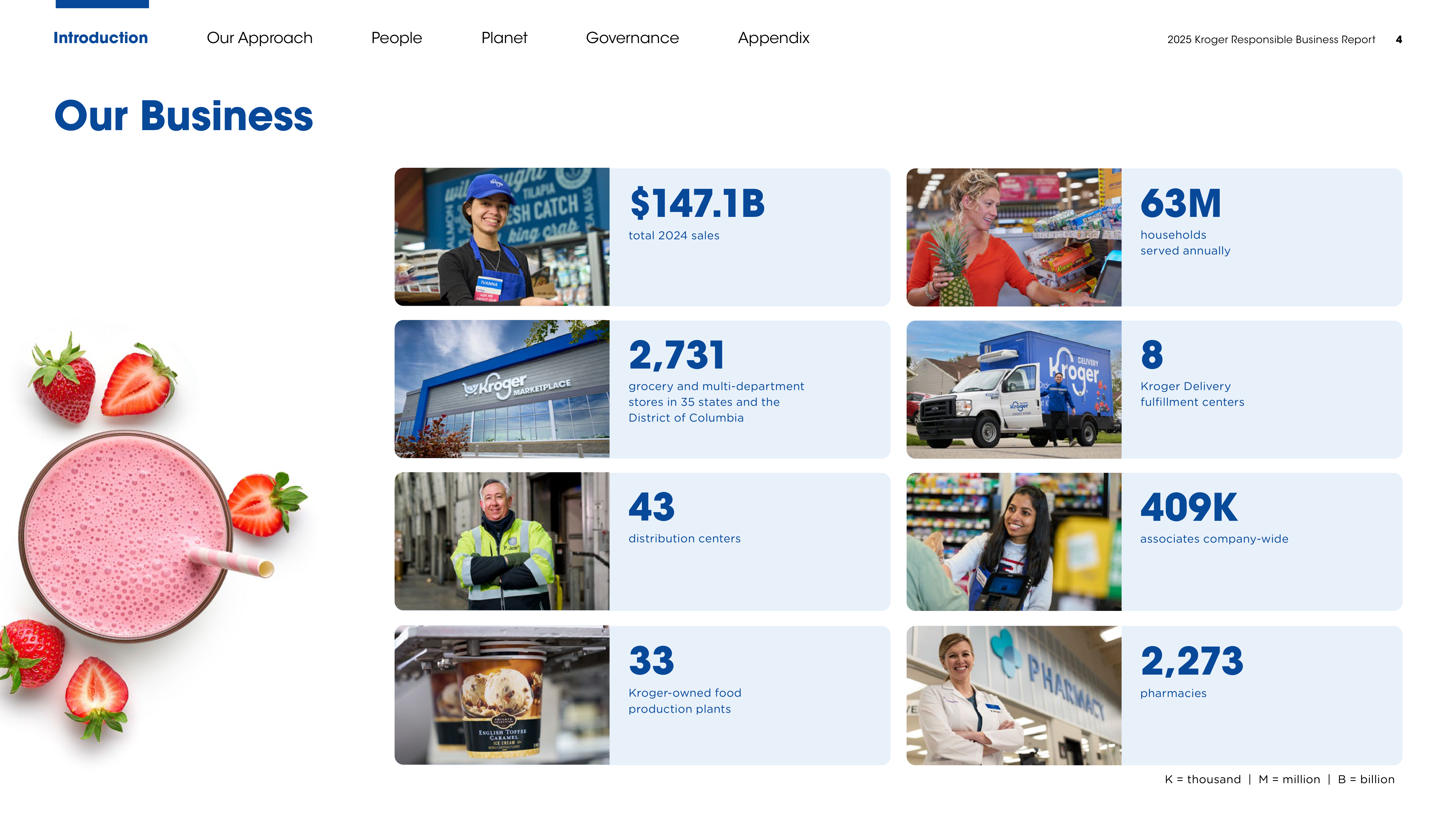

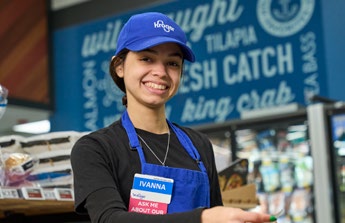
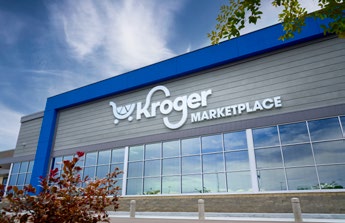
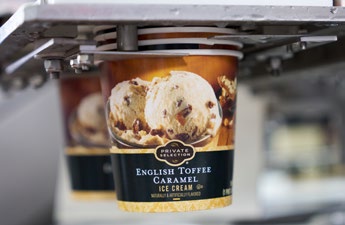
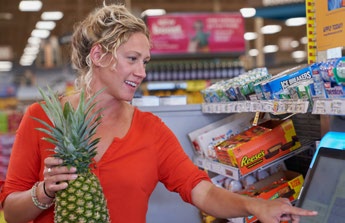
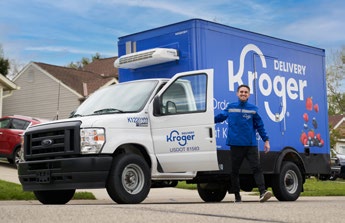
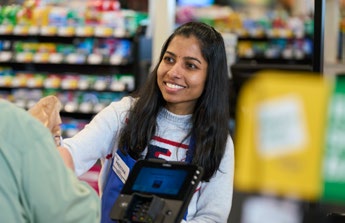
Our Business
K = thousand | M = million | B = billion
$147.1B
total 2024 sales
2,731
grocery and multi-department
stores in 35 states and the
District of Columbia
distribution centers
33
Kroger-owned food
production plants
63M
households
served annually
8
Kroger Delivery
fulfillment centers
409K
43
associates company-wide
2,273
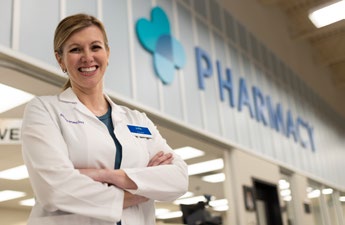
pharmacies
People
Our Approach
Planet
2025 Kroger Responsible Business Report
4
Appendix
Governance
Introduction












Key Highlights
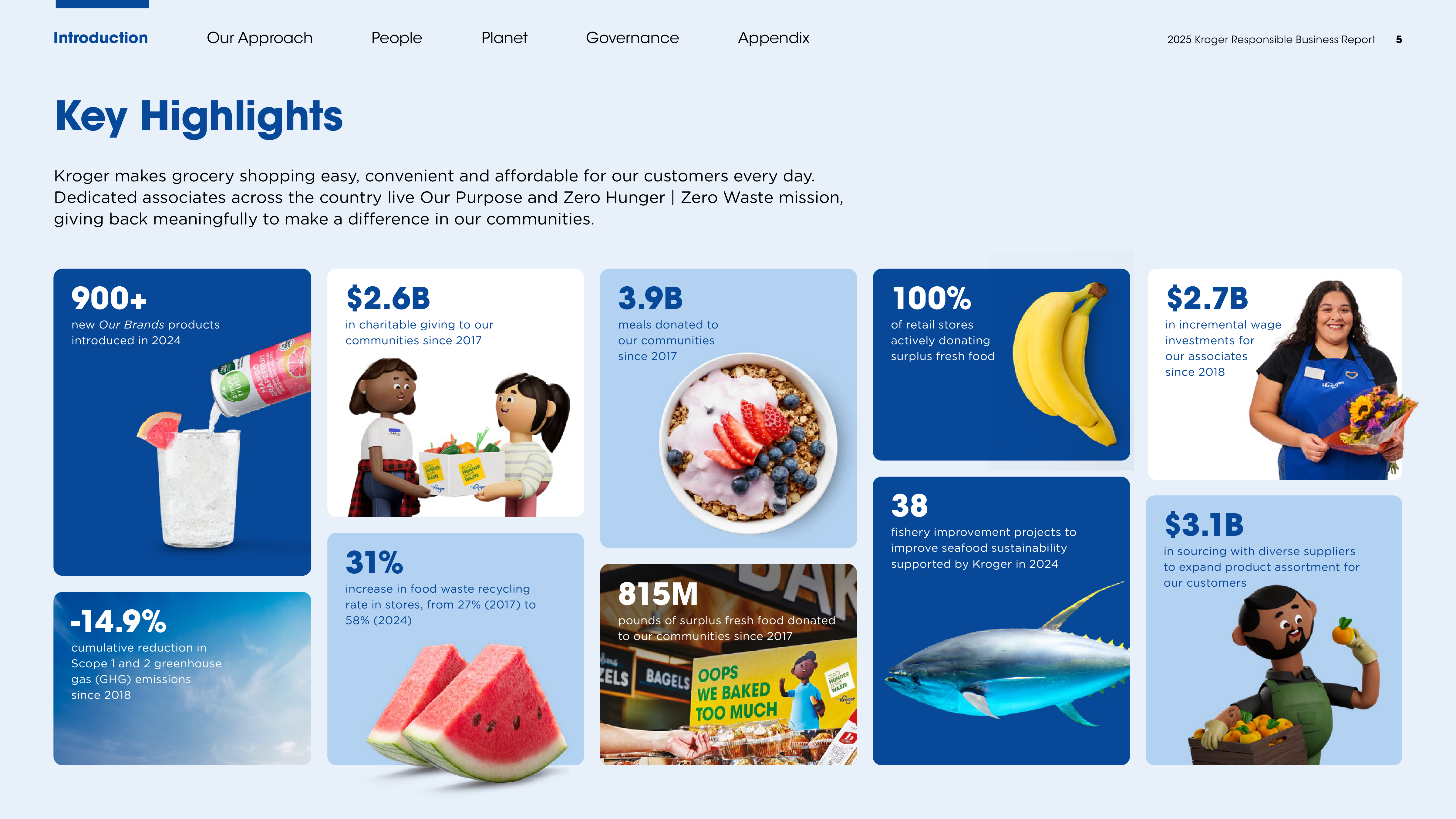
900+
new
Our Brands
products
introduced in 2024
31%
increase in food waste recycling
rate in stores, from 27% (2017) to
58% (2024)
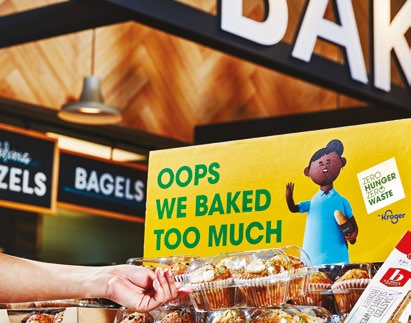
815M
pounds of surplus fresh food donated
to our communities since 2017
$3.1B
in sourcing with diverse suppliers
to expand product assortment for
our customers
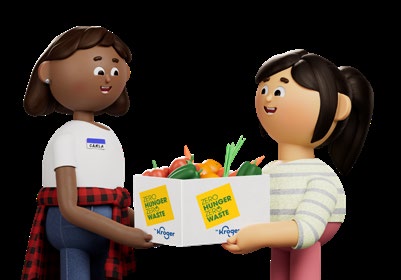
$2.6B
in charitable giving to our
communities since 2017
3.9B
meals donated to
our communities
since 2017
100%
of retail stores
actively donating
surplus fresh food
Kroger makes grocery shopping easy, convenient and affordable for our customers every day.
Dedicated associates across the country live Our Purpose and Zero Hunger | Zero Waste mission,
giving back meaningfully to make a difference in our communities.
-14.9%
cumulative reduction in
Scope 1 and 2 greenhouse
gas (GHG) emissions
since 2018
$2.7B
in incremental wage
investments for
our associates
since 2018
38
fishery improvement projects to
improve seafood sustainability
supported by Kroger in 2024
People
Our Approach
Planet
2025 Kroger Responsible Business Report
5
Appendix
Governance
Introduction
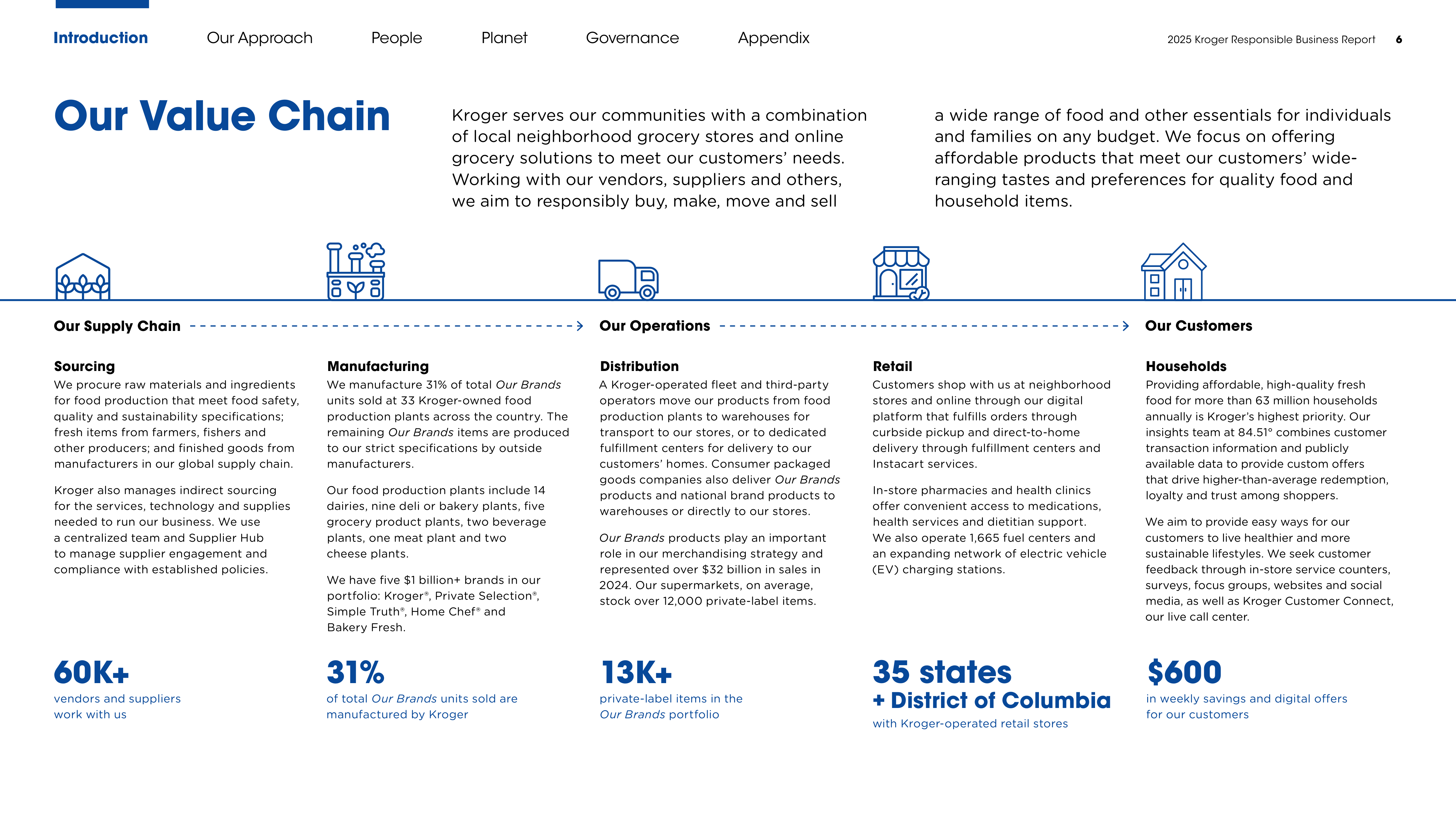
Our Value Chain
Kroger serves our communities with a combination
of local neighborhood grocery stores and online
grocery solutions to meet our customers’ needs.
Working with our vendors, suppliers and others,
we aim to responsibly buy, make, move and sell
a wide range of food and other essentials for individuals
and families on any budget. We focus on offering
affordable products that meet our customers’ wide-
ranging tastes and preferences for quality food and
household items.
Our Supply Chain
Sourcing
We procure raw materials and ingredients
for food production that meet food safety,
quality and sustainability specifications;
fresh items from farmers, fishers and
other producers; and finished goods from
manufacturers in our global supply chain.
Kroger also manages indirect sourcing
for the services, technology and supplies
needed to run our business. We use
a centralized team and Supplier Hub
to manage supplier engagement and
compliance with established policies.
Manufacturing
We manufacture 31% of total
Our Brands
units sold at 33 Kroger-owned food
production plants across the country. The
remaining
Our Brands
items are produced
to our strict specifications by outside
manufacturers.
Our food production plants include 14
dairies, nine deli or bakery plants, five
grocery product plants, two beverage
plants, one meat plant and two
cheese plants.
We have five $1 billion+ brands in our
portfolio: Kroger®, Private Selection®,
Simple Truth®, Home Chef® and
Bakery Fresh.
Distribution
A Kroger-operated fleet and third-party
operators move our products from food
production plants to warehouses for
transport to our stores, or to dedicated
fulfillment centers for delivery to our
customers’ homes. Consumer packaged
goods companies also deliver
Our Brands
products and national brand products to
warehouses or directly to our stores.
Our Brands
products play an important
role in our merchandising strategy and
represented over $32 billion in sales in
2024. Our supermarkets, on average,
stock over 12,000 private-label items.
Retail
Customers shop with us at neighborhood
stores and online through our digital
platform that fulfills orders through
curbside pickup and direct-to-home
delivery through fulfillment centers and
Instacart services.
In-store pharmacies and health clinics
offer convenient access to medications,
health services and dietitian support.
We also operate 1,665 fuel centers and
an expanding network of electric vehicle
(EV) charging stations.
Households
Providing affordable, high-quality fresh
food for more than 63 million households
annually is Kroger’s highest priority. Our
insights team at 84.51° combines customer
transaction information and publicly
available data to provide custom offers
that drive higher-than-average redemption,
loyalty and trust among shoppers.
We aim to provide easy ways for our
customers to live healthier and more
sustainable lifestyles. We seek customer
feedback through in-store service counters,
surveys, focus groups, websites and social
media, as well as Kroger Customer Connect,
our live call center.
Our Operations
Our Customers
60K+
vendors and suppliers
work with us
31%
of total
Our Brands
units sold are
manufactured by Kroger
13K+
private-label items in the
Our Brands
portfolio
35 states
+ District of Columbia
with Kroger-operated retail stores
$600
in weekly savings and digital offers
for our customers
People
Our Approach
Planet
2025 Kroger Responsible Business Report
6
Appendix
Governance
Introduction
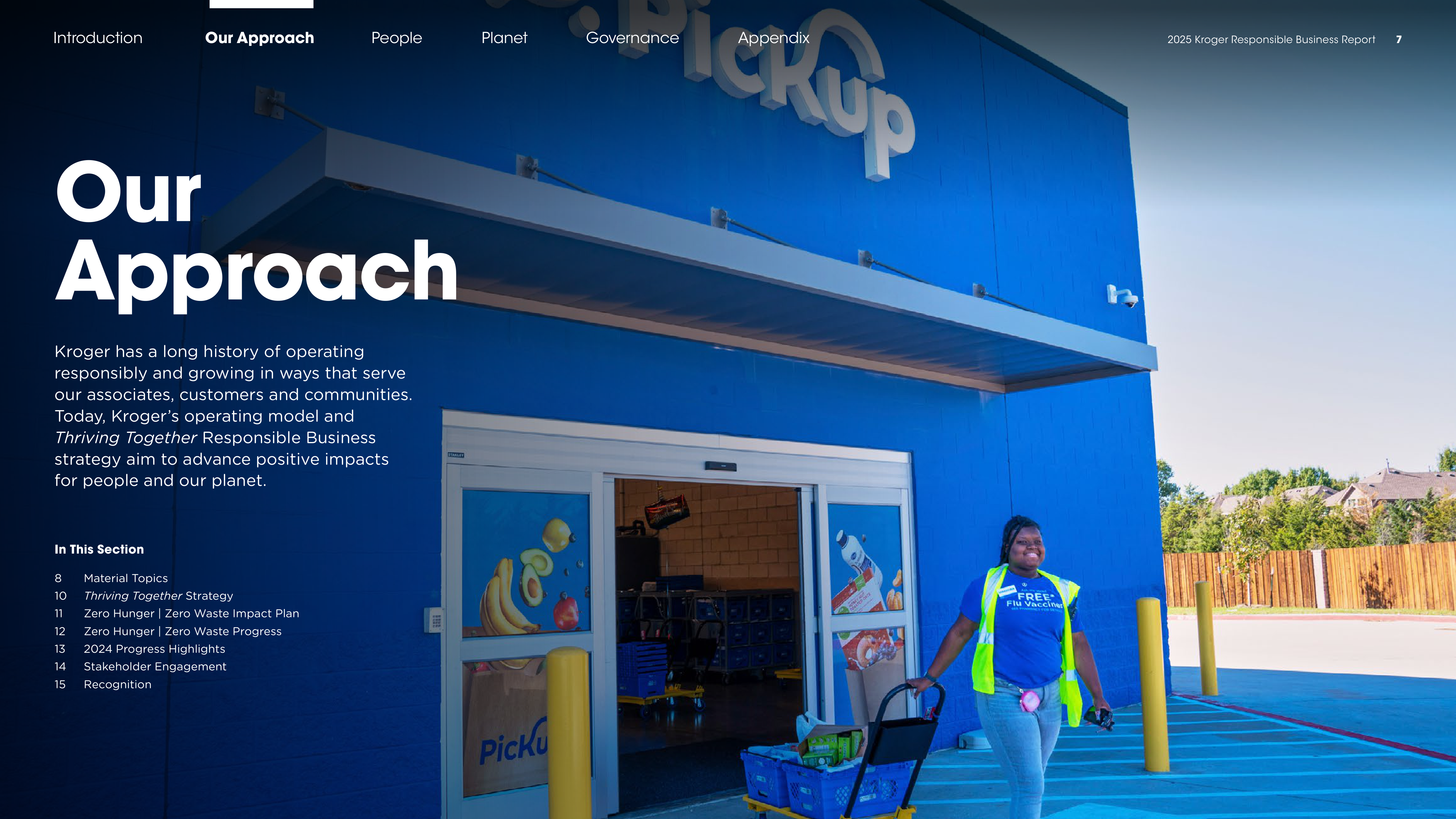
Our
Approach
Kroger has a long history of operating
responsibly and growing in ways that serve
our associates, customers and communities.
Today, Kroger’s operating model and
Thriving Together
Responsible Business
strategy aim to advance positive impacts
for people and our planet.
In This Section
8
Material Topics
10
Thriving Together
Strategy
11
Zero Hunger | Zero Waste Impact Plan
12
Zero Hunger | Zero Waste Progress
13
2024 Progress Highlights
14
Stakeholder Engagement
15
Recognition
7
2025 Kroger Responsible Business Report
People
Introduction
Planet
Appendix
Governance
Our Approach

Material Topics
Kroger’s Responsible Business
strategy is informed by a
comprehensive risk assessment
completed in alignment with
principles of double materiality.
Valuable insights from this process
and ongoing engagement with our
internal and external stakeholders
shape our future ambitions and
public disclosures.
Double Materiality Assessment
Double materiality, the leading methodology for
assessments, evaluates topics relevant to companies
and is increasingly included in reporting guidelines and
frameworks. This approach contemplates two different
lenses through which material sustainability and social
topics can be viewed and disclosed, including:
•
Outward impact:
The potential impact of a
company’s activities on people, the environment
and the economy. For example, managing GHG
emissions has an impact on our planet.
•
Inward impact:
Topics or matters that may affect a
company’s ability to operate and deliver business
value in the future. For example, changing weather
patterns and temperatures may pose potential risks
to the company’s business operations over time.
Kroger’s most recent formal materiality assessment
—completed in 2023—aligned with the principles of
double materiality.
Determining Material Topics
We determined relevant topics by reviewing the
priorities of key stakeholders through ongoing dialogue,
sustainability reports, sustainability ratings and rankings,
reporting frameworks, industry reports, consumer
surveys and media scans. The result was a list of 26
topics identified for further assessment. We identified
boundaries for each topic based on stakeholder
expectations and our management practices.
To prioritize these topics and apply the Stakeholder
Inclusiveness Principle outlined in the GRI Standards,
consultant Environmental Resources Management
(ERM) conducted in-depth interviews with 32 internal
and external stakeholders. We invited approximately
60 additional subject matter experts and stakeholders
to complete a quantitative online survey. Based
on these insights, we prioritized eight topics as
most “material,” or foundational to our business or
presenting higher levels of risk or opportunity.
High-priority topics were discussed and validated
through a series of meetings with internal leaders
and the Public Responsibilities Committee of the
Board. The validated topics shaped the content of this
report, detailing our management approach, goals
and performance. Topic placement on the matrix and
changes over time also may inform the company’s
management approach.
Topic prioritization
Topic ranking, summary report
Double Materiality Assessment Process
Assess outward impact
Value chain mapping, external
stakeholder engagement
Assess inward impact
Internal & external
stakeholder engagement
Validation
Leadership engagement & review,
validation workshop
Discovery
Source review, trends analysis,
defined topic list
People
Introduction
Planet
2025 Kroger Responsible Business Report
8
Appendix
Governance
Our Approach

Local Communities
Data Privacy & Cybersecurity
Agricultural Practices
Talent Attraction,
Engagement & Retention
Waste & Circularity
Food Waste
Food & Product
Access & Affordability
Outward impact:
Kroger’s impact on people and planet
Increasing importance to external stakeholders
Energy & GHG Emissions
Food Safety
Responsible Supply Chain & Sourcing
Health & Nutrition
Labor Relations
Employee Health, Safety & Well-Being
Diversity &
Inclusion
Human Rights
Water
Biodiversity & Conservation
Climate Change Resilience
Public Policy Practices
Animal Welfare
Marketing Practices
& Product Labeling
Corporate Governance
Business Ethics & Compliance
Customer Experience
Non-Food
Product Safety
Retail Security
Material Responsible Business Topics
Tier 3
Tier 2
Tier 1
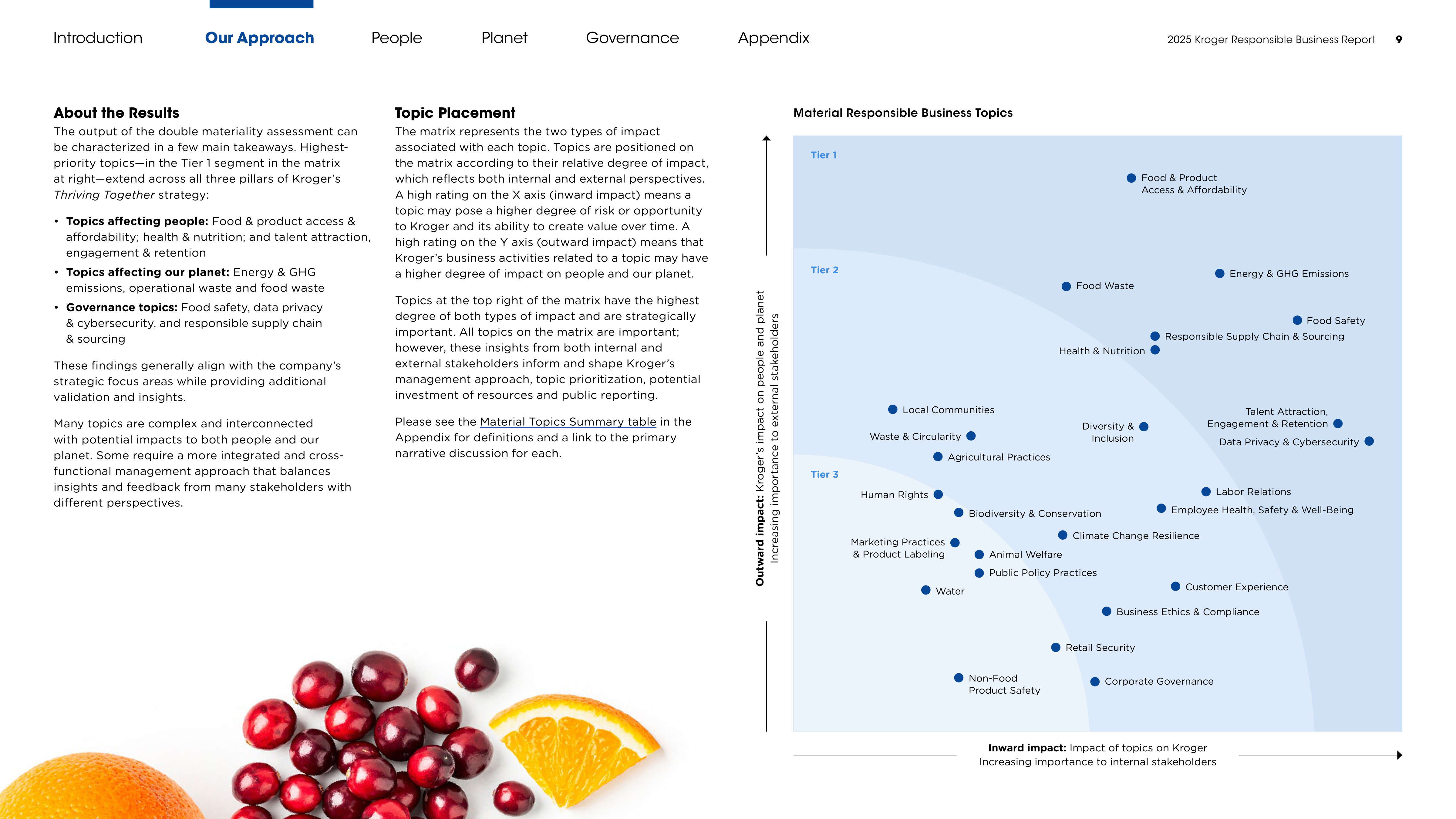
About the Results
The output of the double materiality assessment can
be characterized in a few main takeaways. Highest-
priority topics—in the Tier 1 segment in the matrix
at right—extend across all three pillars of Kroger’s
Thriving Together
strategy:
•
Topics affecting people:
Food & product access &
affordability; health & nutrition; and talent attraction,
engagement & retention
•
Topics affecting our planet:
Energy & GHG
emissions, operational waste and food waste
•
Governance topics:
Food safety, data privacy
& cybersecurity, and responsible supply chain
& sourcing
These findings generally align with the company’s
strategic focus areas while providing additional
validation and insights.
Many topics are complex and interconnected
with potential impacts to both people and our
planet. Some require a more integrated and cross-
functional management approach that balances
insights and feedback from many stakeholders with
different perspectives.
Topic Placement
The matrix represents the two types of impact
associated with each topic. Topics are positioned on
the matrix according to their relative degree of impact,
which reflects both internal and external perspectives.
A high rating on the X axis (inward impact) means a
topic may pose a higher degree of risk or opportunity
to Kroger and its ability to create value over time. A
high rating on the Y axis (outward impact) means that
Kroger’s business activities related to a topic may have
a higher degree of impact on people and our planet.
Topics at the top right of the matrix have the highest
degree of both types of impact and are strategically
important. All topics on the matrix are important;
however, these insights from both internal and
external stakeholders inform and shape Kroger’s
management approach, topic prioritization, potential
investment of resources and public reporting.
Please see the Material Topics Summary table in the
Appendix for definitions and a link to the primary
narrative discussion for each.
Inward impact:
Impact of topics on Kroger
Increasing importance to internal stakeholders
People
Introduction
Planet
2025 Kroger Responsible Business Report
9
Appendix
Governance
Our Approach

Climate Impact
We manage energy
use and reduce GHG
emissions in our own
operations, and we
collaborate with others
to create a cleaner
energy future and a
healthier planet.
Waste & Circularity
Kroger aims to minimize
waste in our operations
and achieve our zero
waste ambition. We also
focus on improving
Our
Brands
packaging and
encourage our customers
to try more sustainable
product options.
Biodiversity & Resource
Conservation
We promote responsible
land use and more
sustainable production
methods to protect
pollinators, natural
habitats, and life on
land and in water.
Planet
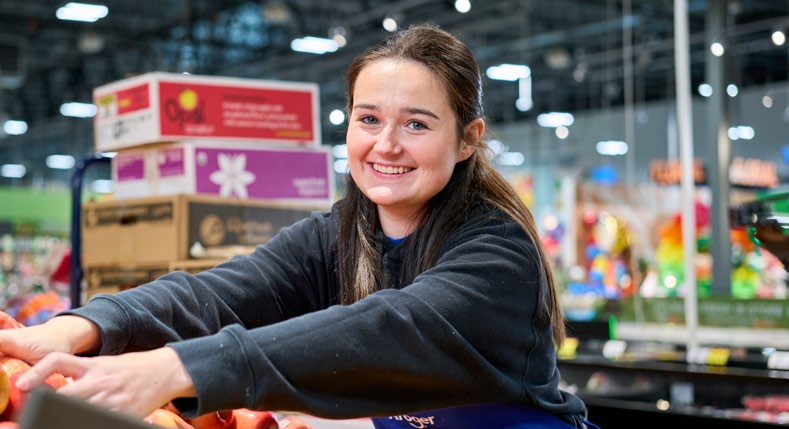
Our Associates
We value our associates
because they are the
foundation of our
success. We create a
brighter future for our
associates by investing
in wages, industry-
leading benefits and
opportunities to learn,
grow and succeed.
Our Customers
We make it easy for our
customers to shop for
fresh, quality, affordable
food and other essentials.
Investing in lower
grocery prices, weekly
promotions, personalized
offers and rewards is
a key part of Kroger’s
business model.
Our Communities
We strengthen our
communities by offering
access to employment
and convenient ways
to shop, and by giving
back generously through
Kroger’s Zero Hunger |
Zero Waste impact plan
to end hunger and waste.
People
Our Purpose
To Feed the Human Spirit
Our Brand Promise
Fresh for Everyone™
Responsible Business Strategy
Thriving Together
Impact Plan
Thriving
Together
Strategy
We imagine a future where
everyone is thriving together.
We build stronger communities
by growing our business,
operating responsibly and
advancing sustainability as
we grow.
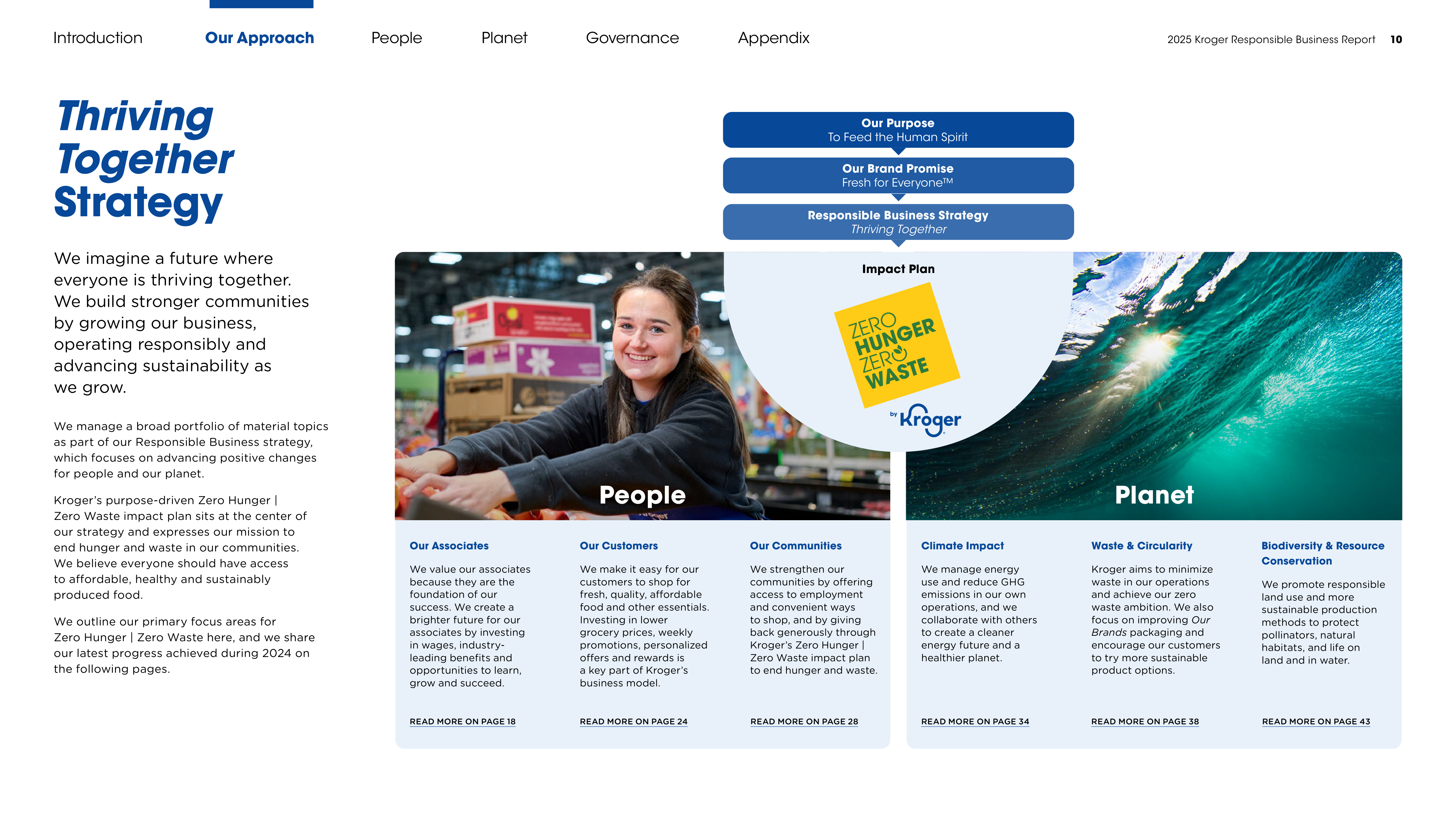
We manage a broad portfolio of material topics
as part of our Responsible Business strategy,
which focuses on advancing positive changes
for people and our planet.
Kroger’s purpose-driven Zero Hunger |
Zero Waste impact plan sits at the center of
our strategy and expresses our mission to
end hunger and waste in our communities.
We believe everyone should have access
to affordable, healthy and sustainably
produced food.
We outline our primary focus areas for
Zero Hunger | Zero Waste here, and we share
our latest progress achieved during 2024 on
the following pages.
READ MORE ON PAGE 18
READ MORE ON PAGE 24
READ MORE ON PAGE 28
READ MORE ON PAGE 34
READ MORE ON PAGE 38
READ MORE ON PAGE 43
People
Introduction
Planet
2025 Kroger Responsible Business Report
10
Appendix
Governance
Our Approach
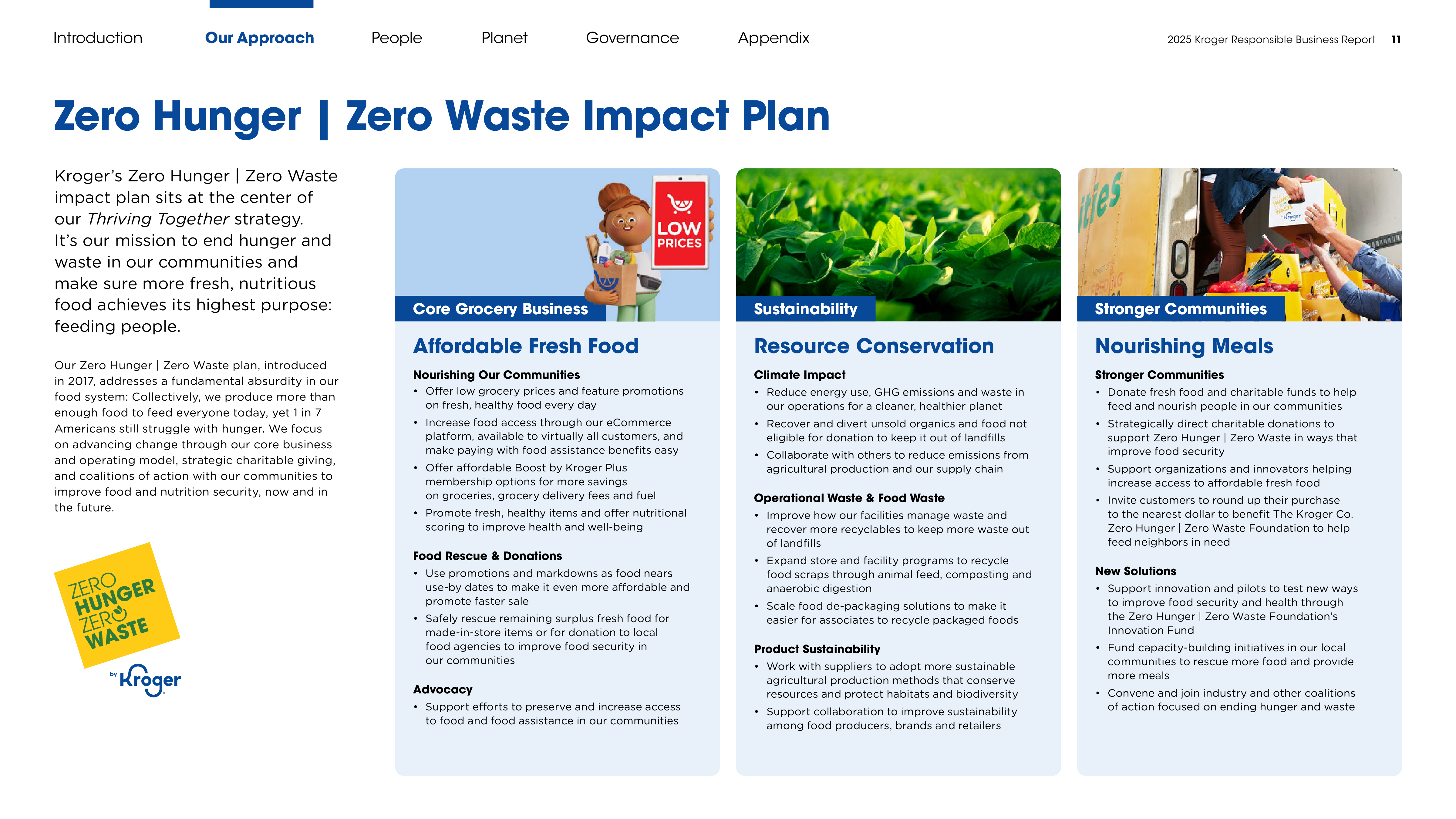

Affordable Fresh Food
Nourishing Our Communities
•
Offer low grocery prices and feature promotions
on fresh, healthy food every day
•
Increase food access through our eCommerce
platform, available to virtually all customers, and
make paying with food assistance benefits easy
•
Offer affordable Boost by Kroger Plus
membership options for more savings
on groceries, grocery delivery fees and fuel
•
Promote fresh, healthy items and offer nutritional
scoring to improve health and well-being
Food Rescue & Donations
•
Use promotions and markdowns as food nears
use-by dates to make it even more affordable and
promote faster sale
•
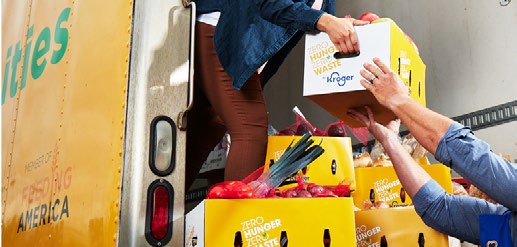
Safely rescue remaining surplus fresh food for
made-in-store items or for donation to local
food agencies to improve food security in
our communities
Advocacy
•
Support efforts to preserve and increase access
to food and food assistance in our communities
Nourishing Meals
Stronger Communities
•
Donate fresh food and charitable funds to help
feed and nourish people in our communities
•
Strategically direct charitable donations to
support Zero Hunger | Zero Waste in ways that
improve food security
•
Support organizations and innovators helping
increase access to affordable fresh food
•
Invite customers to round up their purchase
to the nearest dollar to benefit The Kroger Co.
Zero Hunger | Zero Waste Foundation to help
feed neighbors in need
New Solutions
•
Support innovation and pilots to test new ways
to improve food security and health through
the Zero Hunger | Zero Waste Foundation’s
Innovation Fund
•
Fund capacity-building initiatives in our local
communities to rescue more food and provide
more meals
•
Convene and join industry and other coalitions
of action focused on ending hunger and waste
Resource Conservation
Climate Impact
•
Reduce energy use, GHG emissions and waste in
our operations for a cleaner, healthier planet
•
Recover and divert unsold organics and food not
eligible for donation to keep it out of landfills
•
Collaborate with others to reduce emissions from
agricultural production and our supply chain
Operational Waste & Food Waste
•
Improve how our facilities manage waste and
recover more recyclables to keep more waste out
of landfills
•
Expand store and facility programs to recycle
food scraps through animal feed, composting and
anaerobic digestion
•
Scale food de‑packaging solutions to make it
easier for associates to recycle packaged foods
Product Sustainability
•
Work with suppliers to adopt more sustainable
agricultural production methods that conserve
resources and protect habitats and biodiversity
•
Support collaboration to improve sustainability
among food producers, brands and retailers
Zero Hunger | Zero Waste Impact Plan
Kroger’s Zero Hunger | Zero Waste
impact plan sits at the center of
our
Thriving Together
strategy.
It’s our mission to end hunger and
waste in our communities and
make sure more fresh, nutritious
food achieves its highest purpose:
feeding people.
Our Zero Hunger | Zero Waste plan, introduced
in 2017, addresses a fundamental absurdity in our
food system: Collectively, we produce more than
enough food to feed everyone today, yet 1 in 7
Americans still struggle with hunger. We focus
on advancing change through our core business
and operating model, strategic charitable giving,
and coalitions of action with our communities to
improve food and nutrition security, now and in
the future.
Sustainability
Stronger Communities
Core Grocery Business
People
Introduction
Planet
2025 Kroger Responsible Business Report
11
Appendix
Governance
Our Approach








119M
pounds of surplus
fresh food donated
We are grateful to countless community leaders, nonprofit
organizations and innovators working with Kroger to achieve our
mission. Together, we imagine a future without hunger and waste.
Zero Hunger | Zero Waste Progress
Our Zero Hunger | Zero Waste impact plan is designed
to advance positive changes wherever we operate. The
persistent problems surrounding hunger and waste are
complex and interconnected—at global, national and
local levels. We continue to focus on improving our
own operations and working with others in our value
chain to drive greater positive impacts in our local
communities and beyond.
With more than 140 years of experience in the food
business, Kroger is uniquely positioned to help solve
this big problem. We focus on:
• Making it easy for more people to shop for fresh,
affordable food
• Donating surplus fresh food to feed our neighbors
• Reducing the amount of operational waste and retail
food waste sent to landfills
• Reducing emissions for a healthier planet
• Offering more sustainable
Our Brands
packaging
• Giving our customers easy ways to support our
mission and live healthier lifestyles
Key Highlights
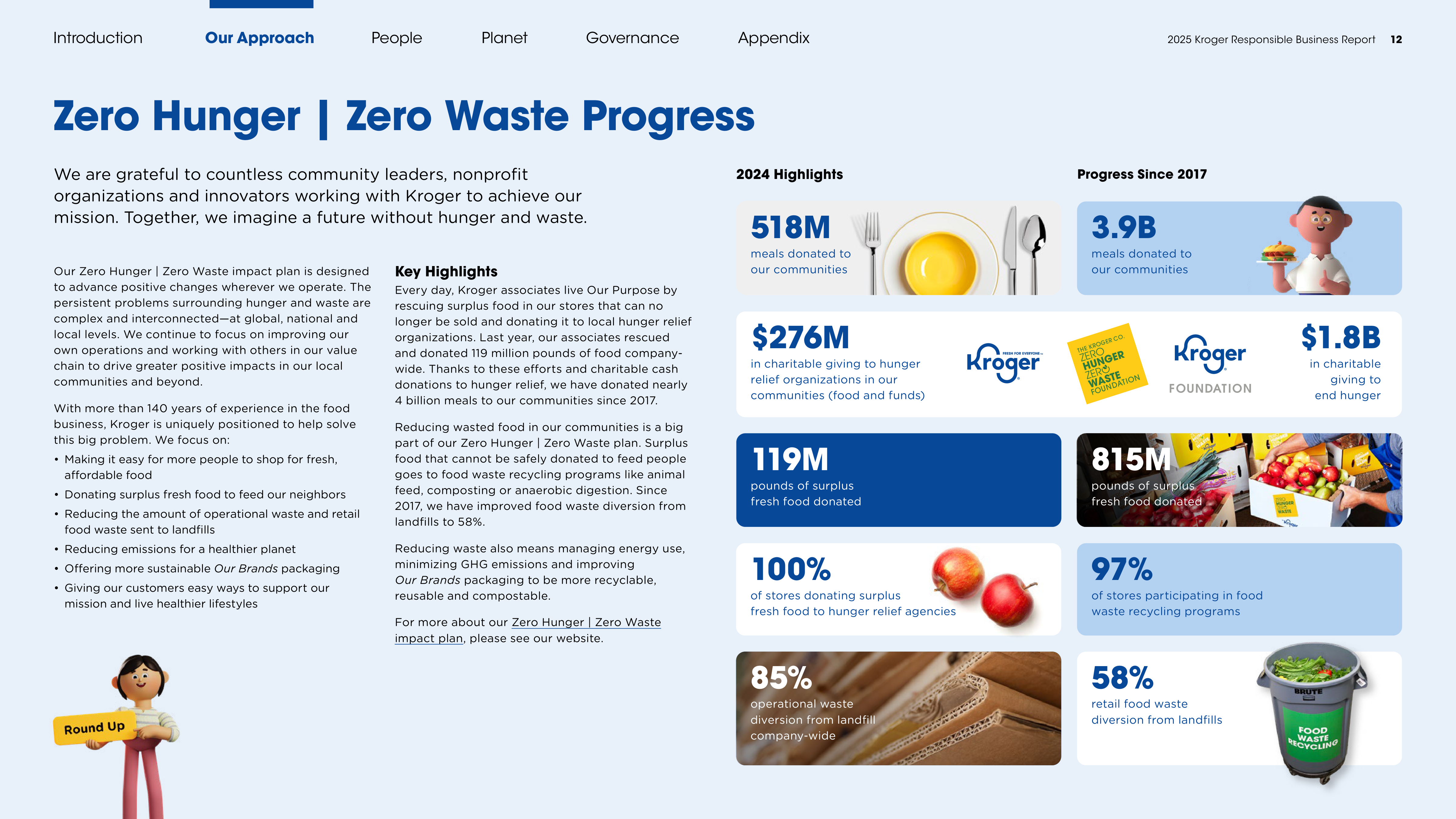
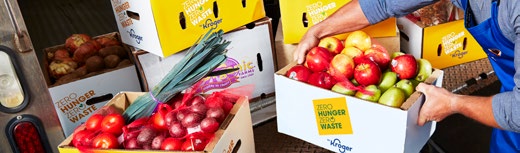
Every day, Kroger associates live Our Purpose by
rescuing surplus food in our stores that can no
longer be sold and donating it to local hunger relief
organizations. Last year, our associates rescued
and donated 119 million pounds of food company-
wide. Thanks to these efforts and charitable cash
donations to hunger relief, we have donated nearly
4 billion meals to our communities since 2017.
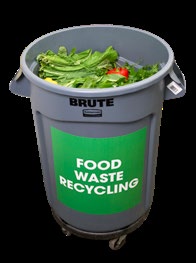
Reducing wasted food in our communities is a big
part of our Zero Hunger | Zero Waste plan. Surplus
food that cannot be safely donated to feed people
goes to food waste recycling programs like animal
feed, composting or anaerobic digestion. Since
2017, we have improved food waste diversion from
landfills to 58%.
Reducing waste also means managing energy use,
minimizing GHG emissions and improving
Our Brands
packaging to be more recyclable,
reusable and compostable.
For more about our Zero Hunger | Zero Waste
impact plan, please see our website.
2024 Highlights
Progress Since 2017
$276M
in charitable giving to hunger
relief organizations in our
communities (food and funds)
100%
of stores donating surplus
fresh food to hunger relief agencies
3.9B
meals donated to
our communities
$1.8B
in charitable
giving to
end hunger
815M
pounds of surplus
fresh food donated
97%
of stores participating in food
waste recycling programs
58%
retail food waste
diversion from landfills
518M
meals donated to
our communities
85%
operational waste
diversion from landfill
company-wide
People
Introduction
Planet
2025 Kroger Responsible Business Report
12
Appendix
Governance
Our Approach
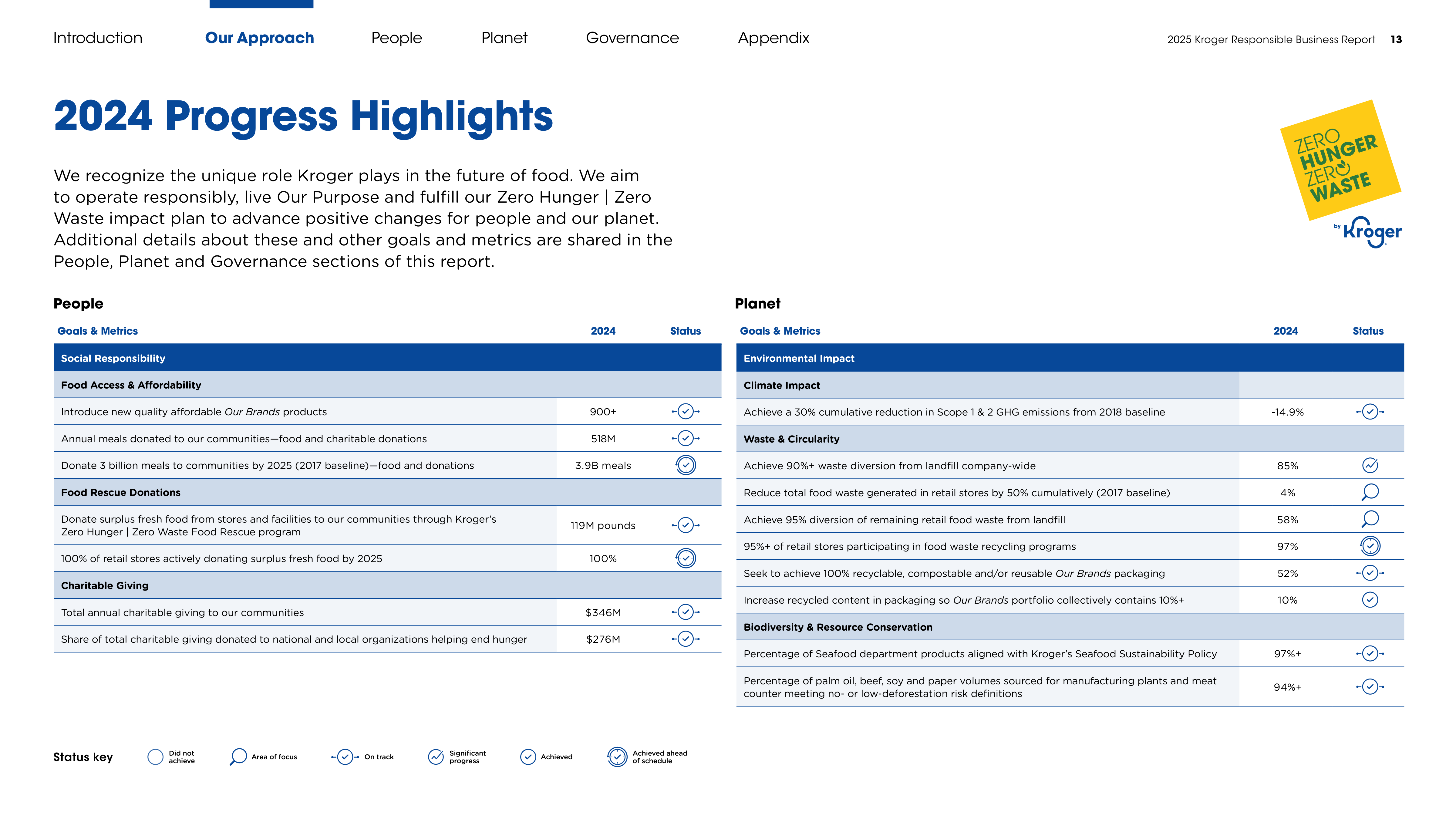
Goals & Metrics
2024
Status
Social Responsibility
Food Access & Affordability
Introduce new quality affordable
Our Brands
products
900+
Annual meals donated to our communities—food and charitable donations
518M
Donate 3 billion meals to communities by 2025 (2017 baseline)—food and donations
3.9B meals
Food Rescue Donations
Donate surplus fresh food from stores and facilities to our communities through Kroger’s
Zero Hunger | Zero Waste Food Rescue program
119M pounds
100% of retail stores actively donating surplus fresh food by 2025
100%
Charitable Giving
Total annual charitable giving to our communities
$346M
Share of total charitable giving donated to national and local organizations helping end hunger
$276M
2024 Progress Highlights
Goals & Metrics
2024
Status
Environmental Impact
Climate Impact
Achieve a 30% cumulative reduction in Scope 1 & 2 GHG emissions from 2018 baseline
-14.9%
Waste & Circularity
Achieve 90%+ waste diversion from landfill company-wide
85%
Reduce total food waste generated in retail stores by 50% cumulatively (2017 baseline)
4%
Achieve 95% diversion of remaining retail food waste from landfill
58%
95%+ of retail stores participating in food waste recycling programs
97%
Seek to achieve 100% recyclable, compostable and/or reusable
Our Brands
packaging
52%
Increase recycled content in packaging so
Our Brands
portfolio collectively contains 10%+
10%
Biodiversity & Resource Conservation
Percentage of Seafood department products aligned with Kroger’s Seafood Sustainability Policy
97%+
Percentage of palm oil, beef, soy and paper volumes sourced for manufacturing plants and meat
counter meeting no- or low-deforestation risk definitions
94%+
We recognize the unique role Kroger plays in the future of food. We aim
to operate responsibly, live Our Purpose and fulfill our Zero Hunger | Zero
Waste impact plan to advance positive changes for people and our planet.
Additional details about these and other goals and metrics are shared in the
People, Planet and Governance sections of this report.
People
Planet
Status key
Did not
achieve
On track
Area of focus
Achieved
Achieved ahead
of schedule
Significant
progress
People
Introduction
Planet
2025 Kroger Responsible Business Report
13
Appendix
Governance
Our Approach
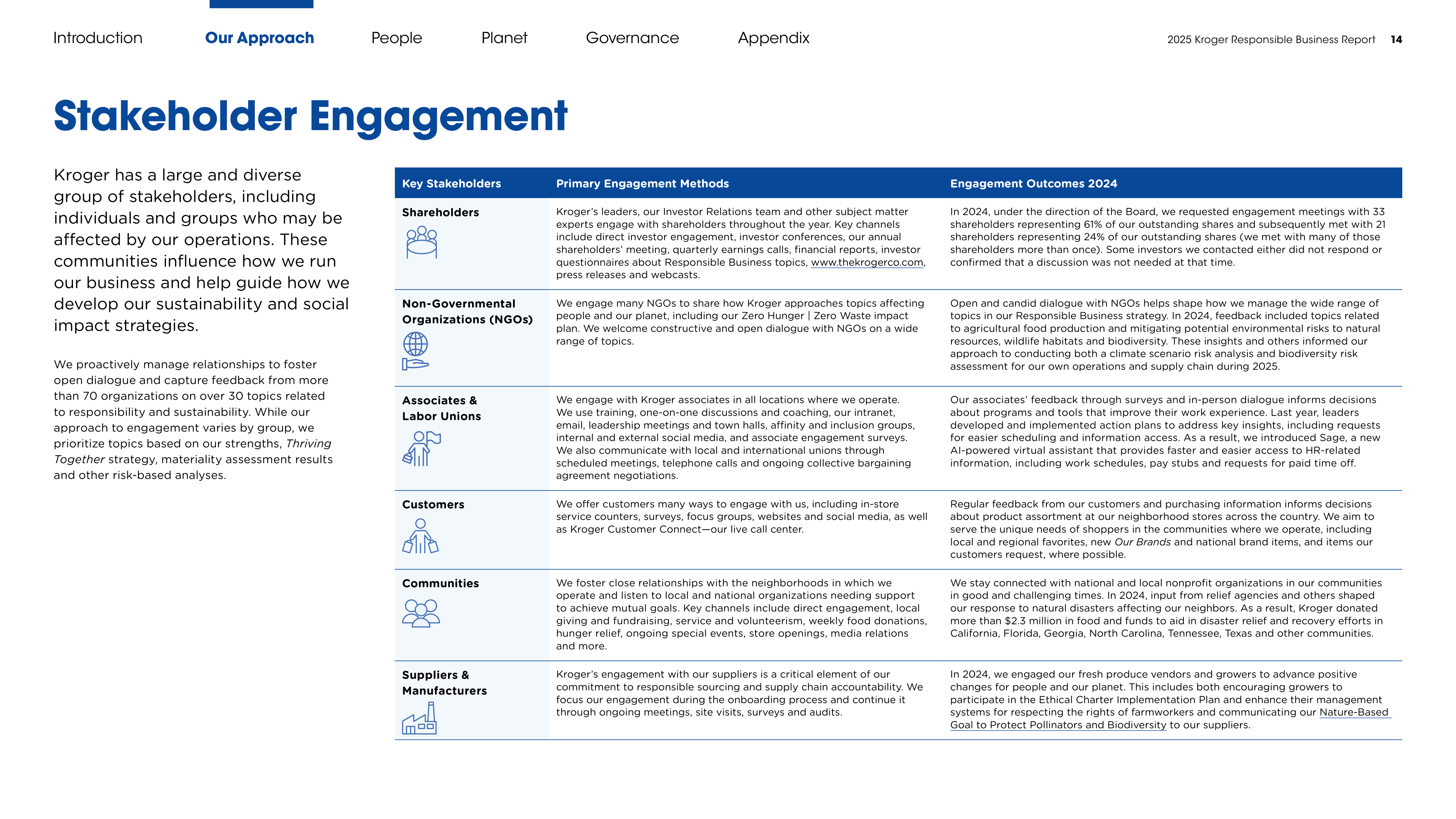
Stakeholder Engagement
Kroger has a large and diverse
group of stakeholders, including
individuals and groups who may be
affected by our operations. These
communities influence how we run
our business and help guide how we
develop our sustainability and social
impact strategies.
We proactively manage relationships to foster
open dialogue and capture feedback from more
than 70 organizations on over 30 topics related
to responsibility and sustainability. While our
approach to engagement varies by group, we
prioritize topics based on our strengths,
Thriving
Together
strategy, materiality assessment results
and other risk-based analyses.
Key Stakeholders
Primary Engagement Methods
Engagement Outcomes 2024
Shareholders
Kroger’s leaders, our Investor Relations team and other subject matter
experts engage with shareholders throughout the year. Key channels
include direct investor engagement, investor conferences, our annual
shareholders’ meeting, quarterly earnings calls, financial reports, investor
questionnaires about Responsible Business topics, www.thekrogerco.com,
press releases and webcasts.
In 2024, under the direction of the Board, we requested engagement meetings with 33
shareholders representing 61% of our outstanding shares and subsequently met with 21
shareholders representing 24% of our outstanding shares (we met with many of those
shareholders more than once). Some investors we contacted either did not respond or
confirmed that a discussion was not needed at that time.
Non-Governmental
Organizations (NGOs)
We engage many NGOs to share how Kroger approaches topics affecting
people and our planet, including our Zero Hunger | Zero Waste impact
plan. We welcome constructive and open dialogue with NGOs on a wide
range of topics.
Open and candid dialogue with NGOs helps shape how we manage the wide range of
topics in our Responsible Business strategy. In 2024, feedback included topics related
to agricultural food production and mitigating potential environmental risks to natural
resources, wildlife habitats and biodiversity. These insights and others informed our
approach to conducting both a climate scenario risk analysis and biodiversity risk
assessment for our own operations and supply chain during 2025.
Associates &
Labor Unions
We engage with Kroger associates in all locations where we operate.
We use training, one-on-one discussions and coaching, our intranet,
email, leadership meetings and town halls, affinity and inclusion groups,
internal and external social media, and associate engagement surveys.
We also communicate with local and international unions through
scheduled meetings, telephone calls and ongoing collective bargaining
agreement negotiations.
Our associates’ feedback through surveys and in-person dialogue informs decisions
about programs and tools that improve their work experience. Last year, leaders
developed and implemented action plans to address key insights, including requests
for easier scheduling and information access. As a result, we introduced Sage, a new
AI-powered virtual assistant that provides faster and easier access to HR-related
information, including work schedules, pay stubs and requests for paid time off.
Customers
We offer customers many ways to engage with us, including in-store
service counters, surveys, focus groups, websites and social media, as well
as Kroger Customer Connect—our live call center.
Regular feedback from our customers and purchasing information informs decisions
about product assortment at our neighborhood stores across the country. We aim to
serve the unique needs of shoppers in the communities where we operate, including
local and regional favorites, new
Our Brands
and national brand items, and items our
customers request, where possible.
Communities
We foster close relationships with the neighborhoods in which we
operate and listen to local and national organizations needing support
to achieve mutual goals. Key channels include direct engagement, local
giving and fundraising, service and volunteerism, weekly food donations,
hunger relief, ongoing special events, store openings, media relations
and more.
We stay connected with national and local nonprofit organizations in our communities
in good and challenging times. In 2024, input from relief agencies and others shaped
our response to natural disasters affecting our neighbors. As a result, Kroger donated
more than $2.3 million in food and funds to aid in disaster relief and recovery efforts in
California, Florida, Georgia, North Carolina, Tennessee, Texas and other communities.
Suppliers &
Manufacturers
Kroger’s engagement with our suppliers is a critical element of our
commitment to responsible sourcing and supply chain accountability. We
focus our engagement during the onboarding process and continue it
through ongoing meetings, site visits, surveys and audits.
In 2024, we engaged our fresh produce vendors and growers to advance positive
changes for people and our planet. This includes both encouraging growers to
participate in the Ethical Charter Implementation Plan and enhance their management
systems for respecting the rights of farmworkers and communicating our Nature-Based
Goal to Protect Pollinators and Biodiversity to our suppliers.
People
Introduction
Planet
2025 Kroger Responsible Business Report
14
Appendix
Governance
Our Approach
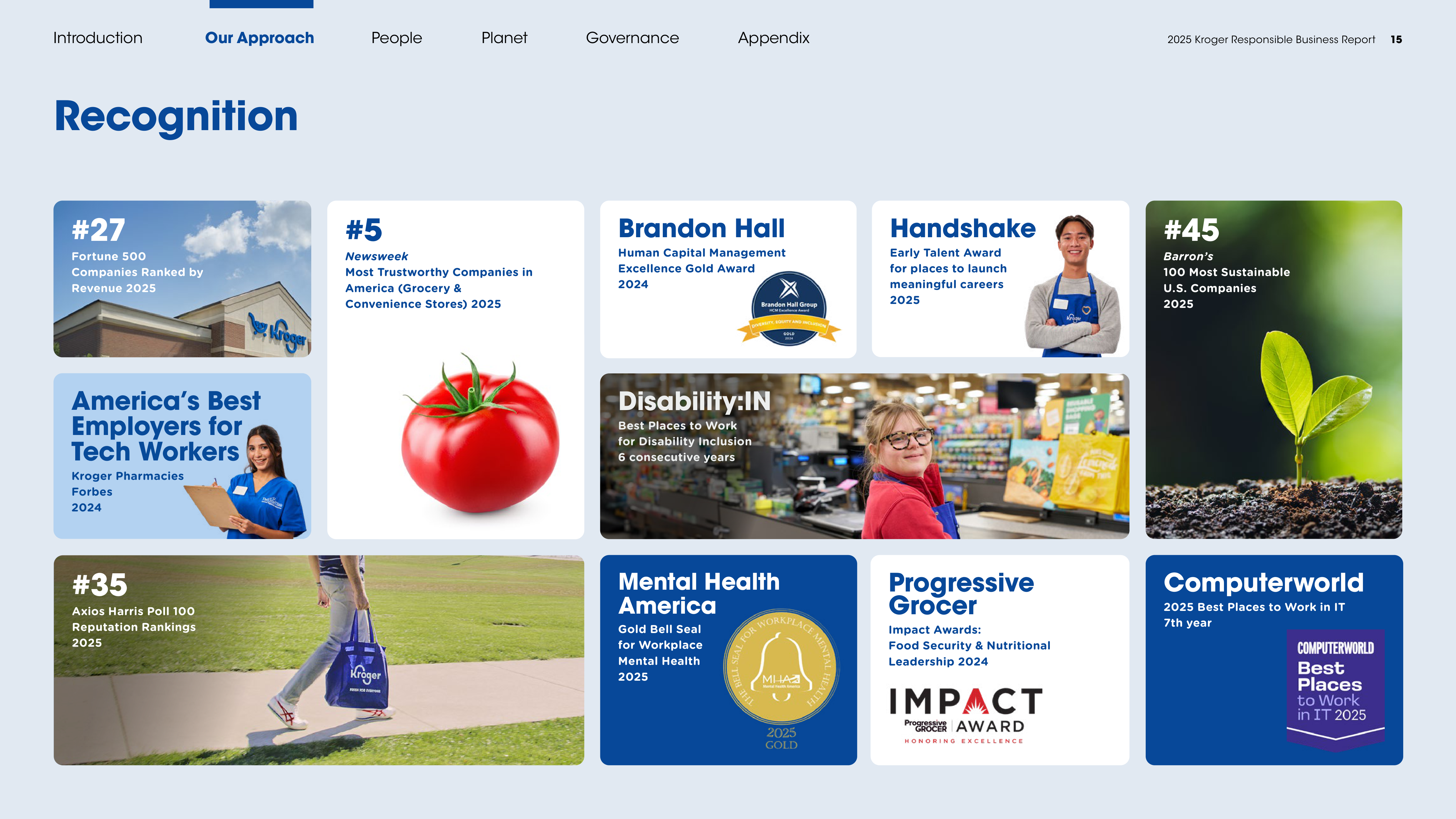






#27
Fortune 500
Companies Ranked by
Revenue 2025
#5
Newsweek
Most Trustworthy Companies in
America (Grocery &
Convenience Stores) 2025
Handshake
Early Talent Award
for places to launch
meaningful careers
2025
America’s Best
Employers for
Tech Workers
Kroger Pharmacies
Forbes
2024
Brandon Hall
Human Capital Management
Excellence Gold Award
2024
#45
Barron’s
100 Most Sustainable
U.S. Companies
2025
Mental Health
America
Gold Bell Seal
for Workplace
Mental Health
2025
Recognition
Disability:IN
Best Places to Work
for Disability Inclusion
6 consecutive years
Computerworld
2025 Best Places to Work in IT
7th year
Progressive
Grocer
Impact Awards:
Food Security & Nutritional
Leadership 2024
#35
Axios Harris Poll 100
Reputation Rankings
2025
People
Introduction
Planet
2025 Kroger Responsible Business Report
15
Appendix
Governance
Our Approach
People
Food is at the heart of every community, and
so is Kroger. We serve and strengthen the places
we call home—for our associates and customers,
for local businesses and farmers, and for towns
and cities wanting to grow and thrive.
In This Section
17
2024 Highlights
18
Our Associates
24
Our Customers
28
Our Communities
Material Topics
• Talent Attraction, Engagement & Retention
• Labor Relations
• Diversity & Inclusion
• Employee Health, Safety & Well-Being
• Customer Experience
• Health & Nutrition
• Food & Product Access & Affordability
• Local Communities
16
2025 Kroger Responsible Business Report
Our Approach
Introduction
Planet
Appendix
Governance
People
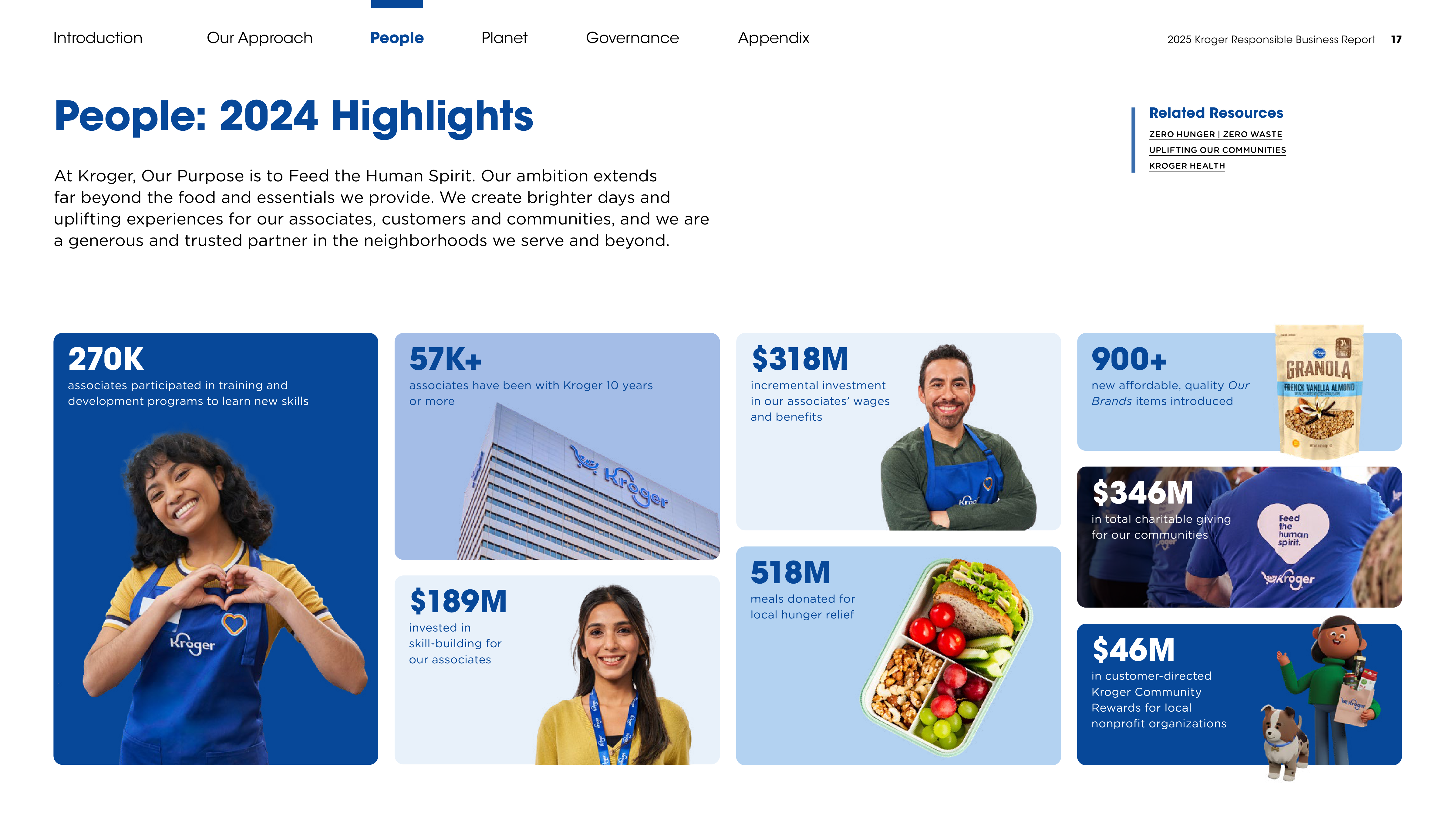




$46M
in customer-directed
Kroger Community
Rewards for local
nonprofit organizations
270K
associates participated in training and
development programs to learn new skills
900+
new affordable, quality
Our
Brands
items introduced
People: 2024 Highlights
Related Resources
ZERO HUNGER | ZERO WASTE
UPLIFTING OUR COMMUNITIES
KROGER HEALTH
$189M
invested in
skill-building for
our associates
$318M
incremental investment
in our associates’ wages
and benefits
At Kroger, Our Purpose is to Feed the Human Spirit. Our ambition extends
far beyond the food and essentials we provide. We create brighter days and
uplifting experiences for our associates, customers and communities, and we are
a generous and trusted partner in the neighborhoods we serve and beyond.
$346M
in total charitable giving
for our communities
518M
meals donated for
local hunger relief
57K+
associates have been with Kroger 10 years
or more
Our Approach
Introduction
Planet
2025 Kroger Responsible Business Report
17
Appendix
Governance
People

Kroger offers jobs, skill-building and career opportunities for thousands of
people in our communities every year. Many associates join for a part-time
job and discover a fulfilling career at Kroger. We strive to hire people who
reflect the communities we serve and create a respectful and welcoming
work environment where everyone can thrive.
Our Associates
Our Approach
Kroger’s success and growth are possible because
of our dedicated associates who choose to build
their careers with us. They are the heartbeat of our
stores, our distribution and fulfillment centers, our
manufacturing plants and our offices. They are what
make Kroger such a special place. Every day, our
associates deliver fresh and friendly experiences for
our customers, serve our communities and live Our
Purpose. We continue to invest in ways that help them
grow and learn with Kroger.
Kroger’s chief associate experience officer leads
efforts to support, inform and advocate for our
associates by overseeing the company’s Associate
Experience, Labor Relations, and Communications
and Public Affairs teams. Guided by Our Purpose and
Values, these teams—along with people champions
across the business—focus on advancing our human
capital management strategy to support individual and
company success. We monitor and measure progress
on key metrics and identify opportunities to increase
associate engagement, well-being and belonging.
The Compensation and Talent Development
Committee of the Board oversees progress on topics
related to our associates’ experience.
$64M
in Continuing Education
Program tuition reimbursements
to associates since 2018
64%
of our associates are covered by
collective bargaining agreements
negotiated with local unions
15
Associate Resource Groups
to promote inclusion
and belonging
Because of our unique business model, we help unlock
economic opportunity for nearly half a million people
of various ages and aspirations—from those seeking
entry-level part‑time jobs to graduate-degree specialists
across corporate functions. In 2024, a total of 409,000
associates were part of the Kroger family of companies.
Our People Strategy
We value and respect our associates, and we want
to connect meaningfully with them throughout
their employment journey, providing important
opportunities to learn, grow and advance.
Kroger’s people strategy focuses on four priorities:
•
Attract, develop and retain best-fit talent
•
Develop effective leaders
•
Advocate for our associates’ well-being
•
Create a high-performing culture
This strategy is designed to improve associate
engagement, reduce turnover and develop a strong
workforce. It requires a holistic approach, focusing on
every stage of our associates’ journey from candidate
to alumni, including the care they need to grow and
the skill-building resources they need to deliver on our
business strategies.
This journey begins with a consistent and effective
onboarding experience and continues through
ongoing connections to support performance and
yearly training and development focused on skills and
capabilities for success.
Investing in Our Associates
Kroger continues to invest in our associates—
through wages, benefits, training, safety, well-being
and more—because we know that when they have a
better experience, our customers have a better
experience too.
A key component of these efforts is continually
refining our competitive Total Rewards programs,
which include compensation, healthcare benefits,
retirement benefits and perks available to our
associates, including those covered by collective
bargaining agreements. We offer competitive pay and
benefits in our stores, distribution centers, dedicated
fulfillment centers, manufacturing plants, technology
hubs and administrative offices.
Material Topics
TALENT ATTRACTION, ENGAGEMENT & RETENTION
LABOR RELATIONS
DIVERSITY & INCLUSION
EMPLOYEE HEALTH, SAFETY & WELL-BEING
Nearly
$25.35/hour
average retail hourly wage including
comprehensive benefits; nearly
$19.50/hour without benefits
Our Approach
Introduction
Planet
2025 Kroger Responsible Business Report
18
Appendix
Governance
People
In 2024, we invested an incremental $318 million
in our associates’ wages, increasing average hourly
wage rates. Since 2018, we have made a total of
$2.7 billion in incremental wage investments,
increasing wages by 38%. As a result, our average
hourly wage is now nearly $19.50, and nearly $25.35
including comprehensive benefits. We are committed
to sustainably increasing associate wages over time in
ways that support our business model and preserve
affordability for our customers.
We offer high-quality healthcare coverage for our
associates and their families. We listen to our associates
and invest in healthcare benefits that they consider
to be most meaningful, including comprehensive and
affordable healthcare coverage with support for family
members and domestic partners.
In 2024, we introduced Sage, a new AI-powered
virtual assistant for our associates. Sage provides
real-time access to scheduling information for Kroger
leaders and associates so they can easily access
work schedules, see pay stubs, request time off,
review training information and more. Today, more
than 68,000 associates actively use Sage to manage
some associate experience-related interactions
and questions.
In early 2025, Kroger integrated our
Fresh Start
training application and Sage Virtual Assistant to make
it even easier for associates to access training and for
leaders to manage new hires’ onboarding and training.
More information about how Kroger supports our
associates’ well-being.
Hiring & Engaging
Associates
We offer every associate opportunities to develop
skills and discover a rewarding career at Kroger. We
provide accessible and flexible employment options
for people of all ages and backgrounds, including
candidates looking for a part-time job or building a
fulfilling professional career.
The Kroger Family of Companies aims to be an
employer of choice in our communities and across the
country, and we continue to adapt and improve how
we attract and tap into sources of talent. This includes
enhancing our recruiting systems and early talent
pipeline. We know that for many associates, Kroger is
their first job.
In 2024, we added a recruiting module to our new
MyInfo HR technology platform to enhance our talent
attraction systems. With this added functionality,
Kroger’s hiring and management teams have a new
suite of tools to enhance the candidate experience and
improve our time-to-hire and time-to-start metrics.
Gen Z accounts for a growing share of today’s
workforce and tomorrow’s leaders, and Kroger
continues to invest in our internship program and early
talent pipeline. In 2024, we welcomed more than 450
students who worked as interns and received on-the-
job learning opportunities. Kroger interns work on real
projects and produce real results across all areas of
the business, from store and supply chain operations
to corporate functions. We continue to increase the
number of interns in our program and extend it to all
lines of business.
Reflecting Our Communities
We hire and welcome new associates of all backgrounds
in the neighborhoods we serve. This includes candidates
like mature adults, military service veterans and those
seeking employment reentry. We work with many
other groups to recruit new talent, including veterans’
organizations and multicultural universities and colleges.
We offer jobs that support the unique needs of our
military veterans, service members transitioning from
active duty and their families. In 2024, our Associate
Experience team hosted hiring events so veterans
and their families could learn more about career
opportunities at Kroger. Candidates participated in
one-on-one conversations about their interests to
help match them to a wide range of career paths
and opportunities.
Kroger also further expanded our collaboration
with justice-impacted organizations through our
New Beginnings program, which includes all food
processing plants, warehouses and fulfillment centers.
Powered by collaboration with more than 75 trusted
community partners, we help create second-chance
opportunities for certain individuals to start fresh and
become financially stable through employment and
access to benefits, depending on the role. In 2024,
we welcomed more than 270 new associates to Day 1
orientation through New Beginnings.
Engaging Our People
Listening plays a critical role in our ability to retain
and develop our associates. We gather feedback
throughout the year in a variety of forms, including
a company-wide Associate Insights Survey. Overall
associate engagement has improved in recent
years. The engagement score from our most recent
full survey in 2023 was 57, an increase from the
prior two years. Our next full survey is in 2025.
Our survey results tell us that key drivers of
engagement include: a sense of belonging,
confidence in the future of the company, positive
changes being made to address survey feedback,
the company’s genuine interest in our associates’
well-being and having a friendly and caring place
to work.
While overall engagement has improved, we
continue to listen and respond to our associates’
input. After reviewing company-wide and team
results, leaders develop and implement site- and
team-based action plans to address feedback
on key themes, including associate belonging,
overall well-being and supervisor effectiveness. In
2024, we conducted pulse surveys instead of a full
engagement survey to give leaders more time to
develop and implement action plans to address our
associates’ input.
We may conduct other pulse surveys throughout
the year to check our progress, measure well-being
and see how our associates are feeling. Based on
these insights, we can offer additional resources
for leaders and associates to respond to feedback
more quickly.
Our Approach
Introduction
Planet
2025 Kroger Responsible Business Report
19
Appendix
Governance
People
Associate Resource Groups
To support our associates and foster inclusion, Kroger
offers 15 Associate Resource Groups (ARGs), or affinity
groups, with chapters across the country. These groups
enable personal connections across the Kroger Family
of Companies, facilitate shared experiences, encourage
cross-ARG membership for awareness, and promote
personal and professional growth.
Kroger leaders sponsor the ARGs and personally
engage with members, allies and other associates
who are interested in learning more. All associates are
welcome to join any of the ARGs to listen, learn and
meet other associates.
An ARG Steering Committee of diverse leaders helps
review and establish consistent principles to advance
associate engagement, professional development
and community outreach, and to foster a sense
of belonging.
Improving Retention
Many associates come to Kroger for a first or part-
time job and discover a rewarding career. These first
jobs form a strong foundation of real-world job skills
and experience that serves our associates in any
next job in store operations or across the business
in Supply Chain, Technology, Finance or other
corporate functions.
Developing Associates
& Leaders
We aim to cultivate a culture of opportunity where
everyone can thrive. This includes providing tools
and resources to help our associates learn new skills,
expand capabilities and grow their careers.
Kroger offers a range of comprehensive training and
development opportunities for all associates, from
entry-level new hires to corporate and executive
leaders. We support the learning, growth and
development of our associates to build skills that
serve them well at Kroger or elsewhere. In 2024, we
invested $189 million in training for our associates
company-wide.
We continue to accelerate the use of our digital
learning app
Fresh Start
for a better onboarding and
learning experience.
Fresh Start
—available on shared
company-owned technology or associates’ personal
mobile devices—provides quick and effective training
to frontline associates in an engaging format, helping
them develop important skills, build confidence
and more effectively serve our customers. This new
platform makes new-hire onboarding easier and
enables us to deliver training in the flow of associates’
everyday work.
With
Fresh Start
and more traditional training
modalities, we deliver a wide range of information to
associates at all levels, including role-based training,
leadership development opportunities, and courses
on Our Purpose and Values, associate well-being
and safety, service excellence, our Zero Hunger |
Zero Waste impact plan and more.
In 2024, we introduced several enhancements to the
Fresh Start
app, including new skills-based onboarding
paths and digital quizzes to assess our new hires’
proficiency levels. We also launched new communication
functionality to more easily share local division and
facility news, tasks, recognition and other content.
Continuing Education
To help associates achieve their learning goals,
we offer an industry-leading continuing education
assistance benefit that provides up to $3,500 annually
(and up to $21,000 over the course of a career). Today,
nearly all part-time and full-time associates are eligible
for this benefit after 60 days of service. In 2024, we
expanded this program to interns with 120 days of
service or more.
Approximately 5,500 associates, 89% of whom are
hourly, took advantage of the Continuing Education
Program in 2024. Since inception in 2018, Kroger has
invested over $64 million in tuition reimbursements.
Effective Leaders
Developing highly effective leaders is critical to
Kroger’s overall associate and customer experience.
We continue our positive momentum with strategies
and initiatives that support our current leaders, retain
talent, and develop strong and capable leaders to
enable our future success.
We build and strengthen our leaders’ capability and
effectiveness through our Career Track Leadership
Development framework. This framework outlines
both leadership and technical development
requirements so our people lead highly effective
teams at every step of their career. We release
new content each quarter with training, tools and
resources to build key leadership skills. We want our
leaders to have a deep sense of ownership in the
business and passion to improve every day while
keeping people at the heart of everything we do.
Associates tell us they value our Total Rewards
programs, which include competitive wages, quality
healthcare, retirement benefits, well-being resources
and more. We believe investing in these programs
enables associates to grow and thrive and improves
retention over time.
We aim to improve associate experiences at every
stage of their time with us, from the hiring and
pre-boarding process to onboarding, training,
performance management and feedback experiences.
We continue to enhance internal metrics to align
teams at all levels, track our progress and improve
common measures that affect retention, including time
to hire, time to start, the onboarding experience and
participation in user-friendly training modules.
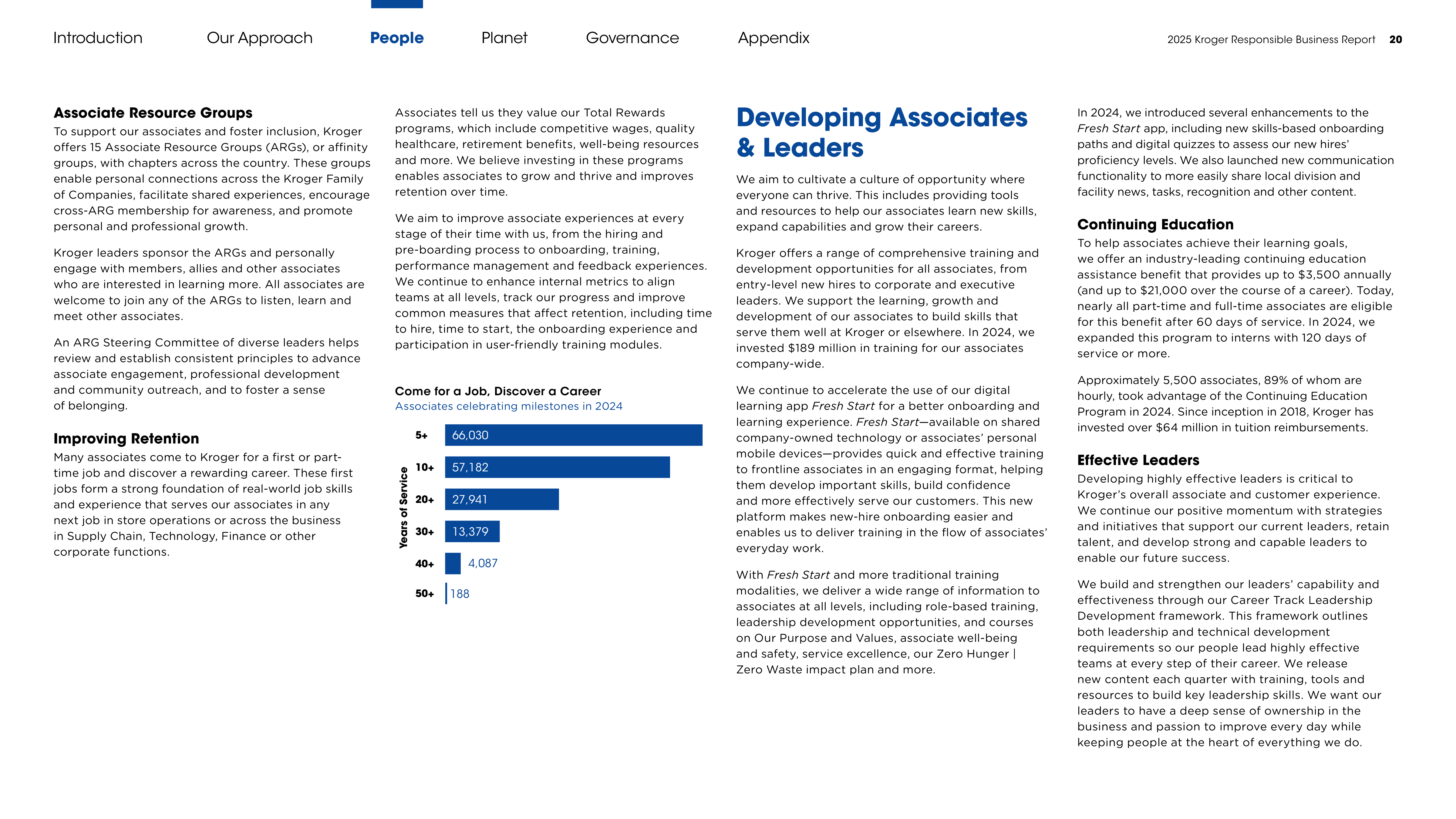
Come for a Job, Discover a Career
Associates celebrating milestones in 2024
5+
10+
20+
30+
66,030
57,182
27,941
13,379
40+
50+
4,087
188
Years of Service
Our Approach
Introduction
Planet
2025 Kroger Responsible Business Report
20
Appendix
Governance
People
We invest in our leaders’ development by:
•
Offering an extensive catalogue of on-demand and
instructor-led development courses designed to
support leaders at every career level
•
Conducting formal internal development programs
and experiences
•
Inviting leaders to participate in regional and
industry development programs
We continually enhance role-based development
programs for store department leaders, management
trainees and district managers working across our
retail divisions. Our comprehensive 15-week Store
Management Training Program includes real-world
store experiences, one-on-one coaching, virtual
sessions and digital assessments to gauge proficiency
and readiness. Our District Manager Development
Program also helps associates in these critical roles
build the people, financial and technical skills needed
to be successful leaders.
Championing Performance
We believe regular, meaningful feedback is critical to
personal development and growth. To ensure associates
receive timely coaching and conversations regarding
their performance, we ask all managers to dedicate
time and attention to coaching and developing team
members. Through Kroger’s Ongoing Connections
performance management approach, associates have
regular performance and development conversations
to set expectations, facilitate career development and
discuss potential advancement over time.
To learn more about our continued commitment to
improving our associates’ experience, please visit the
Kroger Careers page on our website.
Labor Relations
Kroger respects our associates’ rights to form and join
representative organizations of their own choosing.
We do not prevent, retaliate or discriminate against
workers choosing to associate with any group (or not)
or bargain collectively (or not).
Collective bargaining agreements are a regular part
of our business and cover many associate matters,
including wages, healthcare and pensions. These
contracts are regularly negotiated by Kroger’s team of
labor negotiators who follow a consistent process and
take a measured approach to each.
Approximately 64% of our associates are covered by
collective bargaining agreements negotiated with
local unions affiliated with one of several different
international unions. There are approximately 350 such
agreements, usually with three- to five-year terms.
In addition to wage investments noted earlier in
this section, we invested more than $398 million
in our associates’ multi-employer pension plans
in 2024. Kroger also provides affordable, high-
quality healthcare benefits to eligible associates,
investing $1.2 billion annually in their health and
wellness benefits.
Our Approach
Introduction
Planet
2025 Kroger Responsible Business Report
21
Appendix
Governance
People
Diversity & Inclusion
Kroger’s long-standing Values have guided what we
do for half a century. Two of these enduring Values
are Diversity and Inclusion, which are embedded in
our business through access and equal opportunity
for everyone. We aim to create an environment of
mutual respect for all people in every community we
serve and to be a company where everyone has an
equal opportunity to build a fulfilling career.
These Values also bring meaningful benefits
to our business. When our associates reflect
the communities we serve, they choose to stay
with us longer and deliver a better customer
experience. By offering a wide range of products
from a variety of farms and suppliers, more
customers choose to shop with our family of
companies to nourish their families.
We focus on creating welcoming places, offering
equal access to opportunities and building thriving
communities wherever we operate.
Welcoming Places
We aim to create a work environment for associates
where everyone feels respected, appreciated and
that they belong. We foster a sense of connection
and belonging among our associates through team-
building, associate resource groups where all are
welcome and more. We also create spaces to listen,
talk openly and work together.
Equal Opportunities
We strive to offer our associates equal access to
opportunities for jobs, skill-building and engagement.
We offer accessible employment for people across
the country, and we offer opportunities for all
associates to learn and grow. We value and reward
associates who are friendly, dedicated and deliver
measurable contributions to our business.
Thriving Communities
We extend our focus on creating welcoming places
and an environment of mutual respect to everyone in
every community we serve. We feed our communities
and give back meaningfully through Kroger’s Zero
Hunger | Zero Waste plan. We offer friendly and
engaging places to shop where customers can find
the products they love.
We also share opportunities for all potential suppliers
to bid for Kroger’s business. We believe working with
a variety of national and local suppliers helps expand
our product assortment to meet our customers’ wide-
ranging needs.
Learn more about our Supplier Inclusion Program.
Pay Equity
Kroger aims to offer fair and equal pay for all men,
women and people of color. We review our associates’
total compensation on both an adjusted and
unadjusted basis annually and publicly disclose results.
See our Update on Pay Equity for details.
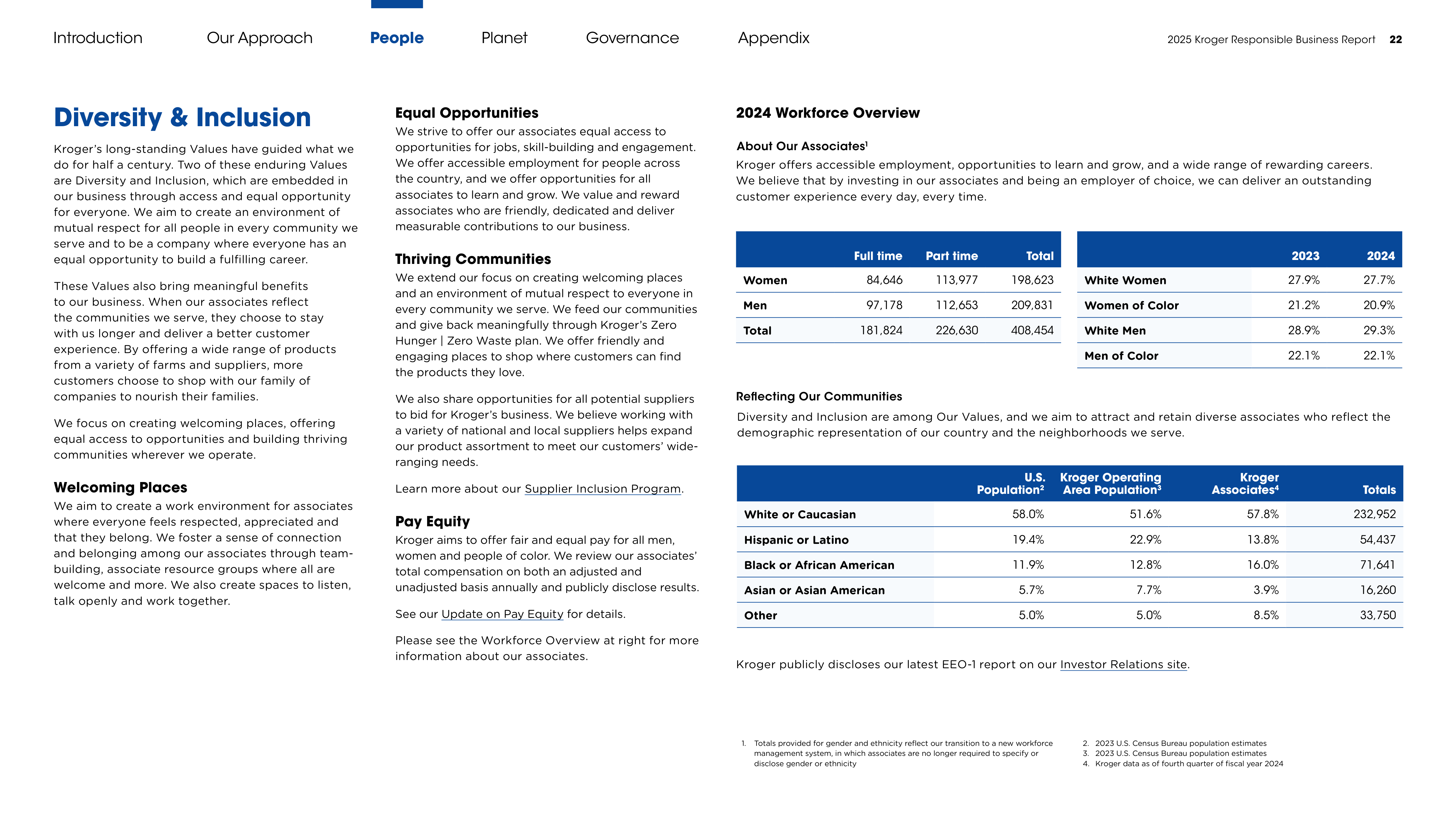
Please see the Workforce Overview at right for more
information about our associates.
2024 Workforce Overview
About Our Associates
1
Full time
Part time
Total
Women
84,646
113,977
198,623
Men
97,178
112,653
209,831
Total
181,824
226,630
408,454
2023
2024
White Women
27.9%
27.7%
Women of Color
21.2%
20.9%
White Men
28.9%
29.3%
Men of Color
22.1%
22.1%
Kroger offers accessible employment, opportunities to learn and grow, and a wide range of rewarding careers.
We believe that by investing in our associates and being an employer of choice, we can deliver an outstanding
customer experience every day, every time.
Reflecting Our Communities
U.S.
Population
2
Kroger Operating
Area Population
3
Kroger
Associates
4
Totals
White or Caucasian
58.0%
51.6%
57.8%
232,952
Hispanic or Latino
19.4%
22.9%
13.8%
54,437
Black or African American
11.9%
12.8%
16.0%
71,641
Asian or Asian American
5.7%
7.7%
3.9%
16,260
Other
5.0%
5.0%
8.5%
33,750
Diversity and Inclusion are among Our Values, and we aim to attract and retain diverse associates who reflect the
demographic representation of our country and the neighborhoods we serve.
1.
Totals provided for gender and ethnicity reflect our transition to a new workforce
management system, in which associates are no longer required to specify or
disclose gender or ethnicity
2.
2023 U.S. Census Bureau population estimates
3.
2023 U.S. Census Bureau population estimates
4.
Kroger data as of fourth quarter of fiscal year 2024
Kroger publicly discloses our latest EEO-1 report on our Investor Relations site.
Our Approach
Introduction
Planet
2025 Kroger Responsible Business Report
22
Appendix
Governance
People
Associate Health,
Safety & Well-Being
Safety is one of Kroger’s long-standing values, and
we believe managing personal health and safety is
important to our company’s success.
Kroger’s senior leadership team and operating unit
leaders are responsible for our management approach
to associate health and safety, with additional oversight
from the Public Responsibilities Committee of the
Board. Business units and administrative functions
follow an established approach to help protect
associates’ health and safety.
OSHA Standards
Kroger follows established policies and standards
to meet or exceed relevant Occupational Safety
and Health Administration (OSHA) requirements,
including comprehensive hazard communications
and lockout/tagout plans, as well as guidelines for
emergency evacuation, personal safety and personal
protective equipment (PPE).
In 2024, Kroger improved our safety performance
company-wide versus the prior year. Key metrics show
improvement in company-wide OSHA reportable
injuries, which declined 5.8%, driven by an 8.4%
reduction in injuries in supermarket operations. Lost
day rates improved for associates.
Safety measures are included in prioritized metrics
for facility operations. We continue to deploy virtual,
classroom and mobile training through our
Fresh
Start
app for safety requirements to reach even more
associates and provide reminders about safe work habits.
Learn more about our safety performance.
Retail Stores
In 2024, we continued to refine our company’s safety
program—AllSafe!—for associates in Retail Operations,
Fred Meyer Jewelers and Pharmacy Central Fill
operations. The program is in its third year and is
designed to increase associates’ awareness and
attention to personal safety and well‑being.
AllSafe! is grounded in four principles:
•
Nothing we do is worth risking injury
•
Accidents can be prevented
•
Safety will be managed
•
Safe behavior is a condition of employment for
all associates
Kroger has detailed requirements and processes in
place to minimize, review and address safety concerns
in stores. Through clearly communicated expectations,
routine monitoring, and regular safety behavior training
and reinforcement, we continue to reduce the number
of injuries and accidents in our stores. We provide PPE
for associates where appropriate, and we require store
leaders to conduct a thorough PPE assessment at least
annually to verify it is available and in use.
Any accidents are reported within 24 hours to determine
the root cause. The AllSafe! Injury Review helps identify
the root cause and accelerates the process to ensure
any hazards are identified and addressed quickly
and efficiently. Dedicated on-site safety teams meet
routinely to review recent injury root causes and safety
audit results, and to resolve any issues.
Think AllSafe!
In 2024, Think AllSafe! launched for all retail stores.
Think AllSafe! is a web-based platform that houses
store-related OSHA training courses to promote
safety, including:
•
Bloodborne Pathogens Safety Plans
•
Emergency Plans and Procedures
•
Hazard Communications (chemical safety)
•
Hazardous Energy Lockout/Tagout Safety Plans
•
Heat Illness Prevention
•
Powered Industrial Truck Safety (safe
forklift operations)
•
Wildfire Safety Plans
Think AllSafe! enables stores to use a digital entry
and tracking system to manage OSHA compliance.
The platform offers greater visibility to store
compliance and makes it easier to provide required
information during OSHA inspections.
Supply Chain
Leaders focus on measures to improve associates’
health and safety at Kroger-operated food
processing facilities, distribution centers and
dedicated fulfillment centers, as well as in transit
between locations. We extended an existing
program for our manufacturing facilities with Safety
in Motion®, Inc. to support Kroger’s integrated
Supply Chain function.
Kroger expects third-party contractors supporting
supply chain operations to uphold the same level
of worker health and safety standards. With the
expansion of Kroger Delivery, we developed
additional training resources to help keep
associates safe in our fulfillment centers and on
the road.
Supporting Well-Being
To enable our associates to thrive, we take a holistic
approach to well-being, aiming to deliver experiences
that support and enhance their life, mind and body. We
also offer resources that enable managers to create a
supportive environment within their teams.
Decisions to refine and expand the range of well-being
initiatives reflect our associates’ feedback. During the
past three years, we expanded access to mental health
providers for company healthcare plan participants and
created easy-to-navigate guides to available resources,
including self-help apps, confidential counseling, family
support services, fitness discounts and more. An online
benefits guide offers associates a one-stop shop for all
well-being resources.
Kroger received Gold in the 2025 Bell Seal for
Workplace Mental Health. This program recognizes
Kroger as an employer that creates a mentally healthy
workplace for our associates through culture, benefits,
compliance and wellness programs for the fourth
consecutive year.
To promote financial well-being, our financial coaching
benefit through Fidelity Investments is available
to virtually all associates, including frontline hourly
associates. This first-of-its-kind, one-on-one coaching
program provides free confidential coaching to help
associates navigate a variety of financial topics.
Kroger associates have access to free,
confidential counseling 24 hours a day,
seven days a week, through Magellan
Health. Services generally include short-
term counseling and referrals for associates
and their household members who might be
dealing with stress, anxiety, depression, grief,
relationship challenges and more.
Our Approach
Introduction
Planet
2025 Kroger Responsible Business Report
23
Appendix
Governance
People


Our neighborhood stores are welcoming places where shoppers see friendly faces,
stock up on affordable essentials, grab meals on the go, find nourishing food and
medications to improve health, and so much more.
Our Customers
Our Approach
Kroger is in the meal solution business, and we know
many families feel overwhelmed and are looking for
help. We work to solve “What’s for dinner?” for our
customers by making meals easier, fresher and more
affordable. When meals are a problem to solve,
families come to Kroger for the answer.
Keeping our prices low is the foundation of our
strategy. Lower prices attract more loyal customers
who help us grow our business. This allows us to
reinvest in even lower prices, an ever-improving
shopping experience, and higher wages for
our associates.
Our focus on operational excellence means
our customers can enjoy value, selection and
convenience. We make it easy and affordable for
more customers to shop with us anytime, anywhere.
Kroger’s approach to serving our customers is
shared across lines of business and corporate
functions, including Retail Operations, Merchandising,
Marketing, Sourcing, Supply Chain, eCommerce, and
Communications & Public Affairs. The company’s
senior leadership team and Board of Directors
provide additional oversight.
63M
total households
served annually
Customer Experience
Kroger’s brand promise—Fresh For Everyone—
expresses our commitment to bringing affordable
fresh food to more people in neighborhoods across
the country. Today, we serve more than 63 million
households annually through convenient local stores
and online shopping with Kroger Pickup and Delivery,
plus valuable rewards and membership options.
In 2024, we helped customers save through affordable
products and promotions, including loyalty discounts,
relevant offers and fuel rewards, as well as through
Our Brands
products, which are priced well below
national brands at equal or greater quality.
Fresh in Focus
Our customers prioritize fresh when they shop. Kroger
has long been a leader in affordable fresh produce and
proteins, including expanding access to natural and
organic options many years ago.
We want customers to trust the quality and freshness
of every item they purchase. To do this, we have
strong relationships with regional and local farmers
and suppliers, enabling Kroger to source the freshest
products. We expanded the
Our Brands
portfolio to
include Field and Vine™, which offers regionally grown
berries picked at peak freshness.
We are also changing the way we bring fresh to life in
our stores. In 2024, we completed the rollout of our
End-to-End Fresh initiative to all stores, enhancing
operational processes to give our customers more
days of freshness in homes. End-to-End Fresh uses
technology to improve the in-store shopping as
well as order pickup and delivery options. Sourcing
more locally grown products also increases days of
freshness in our customers’ homes and reduces waste.
Our Technology and Supply Chain teams continue to
work together to develop new ways to add even more
days of freshness to our products. From optimizing
delivery routes to simplifying our associates’ tasks, we
want to ensure our customers can buy food at peak
freshness and trust those items will remain fresh in
their homes.
We consider efforts to advance food and product
safety and quality for our customers as foundational
to our business. Read more about our approach to
food safety.
Material Topics
CUSTOMER EXPERIENCE
FOOD & PRODUCT ACCESS & AFFORDABILITY
HEALTH & NUTRITION
$13B
in digital sales in 2024
370+
new fresh items introduced
in
Our Brands
portfolio
23K
healthcare providers in
Kroger Family of Pharmacies &
The Little Clinic® locations
Our Approach
Introduction
Planet
2025 Kroger Responsible Business Report
24
Appendix
Governance
People
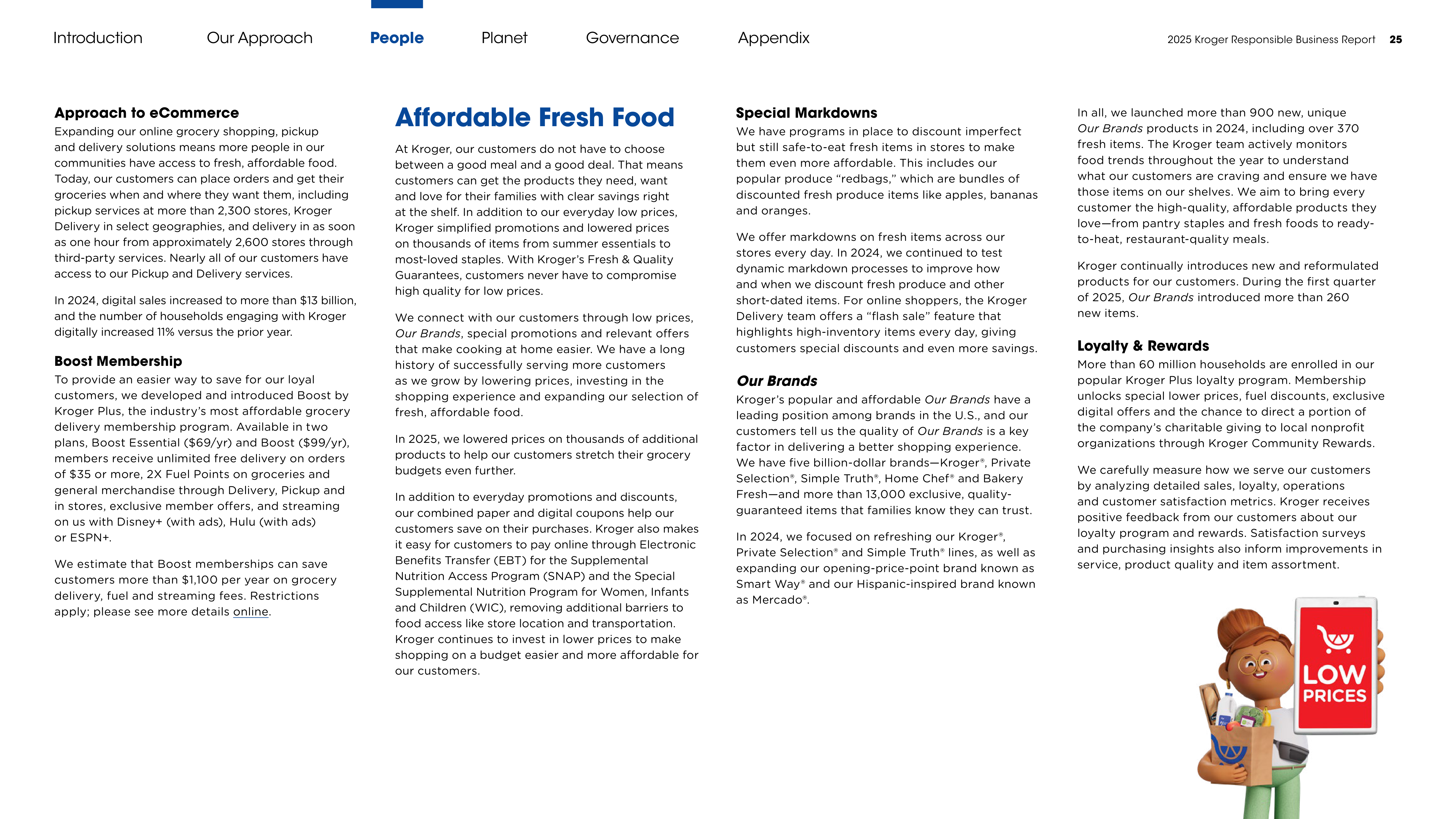
Approach to eCommerce
Expanding our online grocery shopping, pickup
and delivery solutions means more people in our
communities have access to fresh, affordable food.
Today, our customers can place orders and get their
groceries when and where they want them, including
pickup services at more than 2,300 stores, Kroger
Delivery in select geographies, and delivery in as soon
as one hour from approximately 2,600 stores through
third-party services. Nearly all of our customers have
access to our Pickup and Delivery services.
In 2024, digital sales increased to more than $13 billion,
and the number of households engaging with Kroger
digitally increased 11% versus the prior year.
Boost Membership
To provide an easier way to save for our loyal
customers, we developed and introduced Boost by
Kroger Plus, the industry’s most affordable grocery
delivery membership program. Available in two
plans, Boost Essential ($69/yr) and Boost ($99/yr),
members receive unlimited free delivery on orders
of $35 or more, 2X Fuel Points on groceries and
general merchandise through Delivery, Pickup and
in stores, exclusive member offers, and streaming
on us with Disney+ (with ads), Hulu (with ads)
or ESPN+.
We estimate that Boost memberships can save
customers more than $1,100 per year on grocery
delivery, fuel and streaming fees. Restrictions
apply; please see more details online.
Affordable Fresh Food
At Kroger, our customers do not have to choose
between a good meal and a good deal. That means
customers can get the products they need, want
and love for their families with clear savings right
at the shelf. In addition to our everyday low prices,
Kroger simplified promotions and lowered prices
on thousands of items from summer essentials to
most-loved staples. With Kroger’s Fresh & Quality
Guarantees, customers never have to compromise
high quality for low prices.
We connect with our customers through low prices,
Our Brands
, special promotions and relevant offers
that make cooking at home easier. We have a long
history of successfully serving more customers
as we grow by lowering prices, investing in the
shopping experience and expanding our selection of
fresh, affordable food.
In 2025, we lowered prices on thousands of additional
products to help our customers stretch their grocery
budgets even further.
In addition to everyday promotions and discounts,
our combined paper and digital coupons help our
customers save on their purchases. Kroger also makes
it easy for customers to pay online through Electronic
Benefits Transfer (EBT) for the Supplemental
Nutrition Access Program (SNAP) and the Special
Supplemental Nutrition Program for Women, Infants
and Children (WIC), removing additional barriers to
food access like store location and transportation.
Kroger continues to invest in lower prices to make
shopping on a budget easier and more affordable for
our customers.
Special Markdowns
We have programs in place to discount imperfect
but still safe-to-eat fresh items in stores to make
them even more affordable. This includes our
popular produce “redbags,” which are bundles of
discounted fresh produce items like apples, bananas
and oranges.
We offer markdowns on fresh items across our
stores every day. In 2024, we continued to test
dynamic markdown processes to improve how
and when we discount fresh produce and other
short-dated items. For online shoppers, the Kroger
Delivery team offers a “flash sale” feature that
highlights high-inventory items every day, giving
customers special discounts and even more savings.
Our Brands
Kroger’s popular and affordable
Our Brands
have a
leading position among brands in the U.S., and our
customers tell us the quality of
Our Brands
is a key
factor in delivering a better shopping experience.
We have five billion-dollar brands—Kroger®, Private
Selection®, Simple Truth®, Home Chef® and Bakery
Fresh—and more than 13,000
exclusive, quality-
guaranteed items that families know they can trust.
In 2024, we focused on refreshing our Kroger®,
Private Selection® and Simple Truth® lines, as well as
expanding our opening-price-point brand known as
Smart Way® and our Hispanic-inspired brand known
as Mercado®.
In all, we launched more than 900 new, unique
Our Brands
products in 2024, including over 370
fresh items. The Kroger team actively monitors
food trends throughout the year to understand
what our customers are craving and ensure we have
those items on our shelves. We aim to bring every
customer the high-quality, affordable products they
love—from pantry staples and fresh foods to ready-
to-heat, restaurant-quality meals.
Kroger continually introduces new and reformulated
products for our customers. During the first quarter
of 2025,
Our Brands
introduced more than 260
new items.
Loyalty & Rewards
More than 60 million households are enrolled in our
popular Kroger Plus loyalty program. Membership
unlocks special lower prices, fuel discounts, exclusive
digital offers and the chance to direct a portion of
the company’s charitable giving to local nonprofit
organizations through Kroger Community Rewards.
We carefully measure how we serve our customers
by analyzing detailed sales, loyalty, operations
and customer satisfaction metrics. Kroger receives
positive feedback from our customers about our
loyalty program and rewards. Satisfaction surveys
and purchasing insights also inform improvements in
service, product quality and item assortment.
Our Approach
Introduction
Planet
2025 Kroger Responsible Business Report
25
Appendix
Governance
People
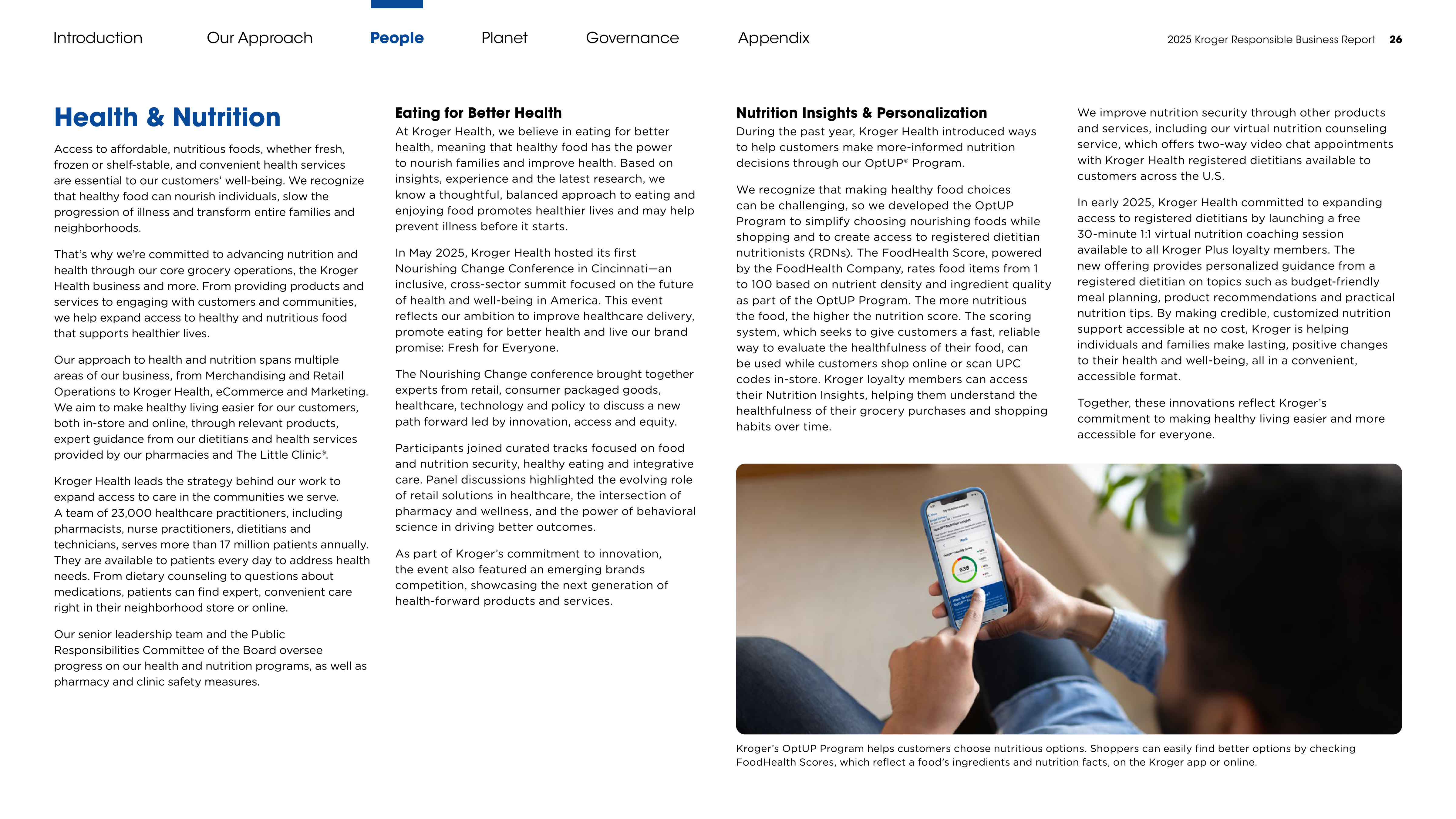
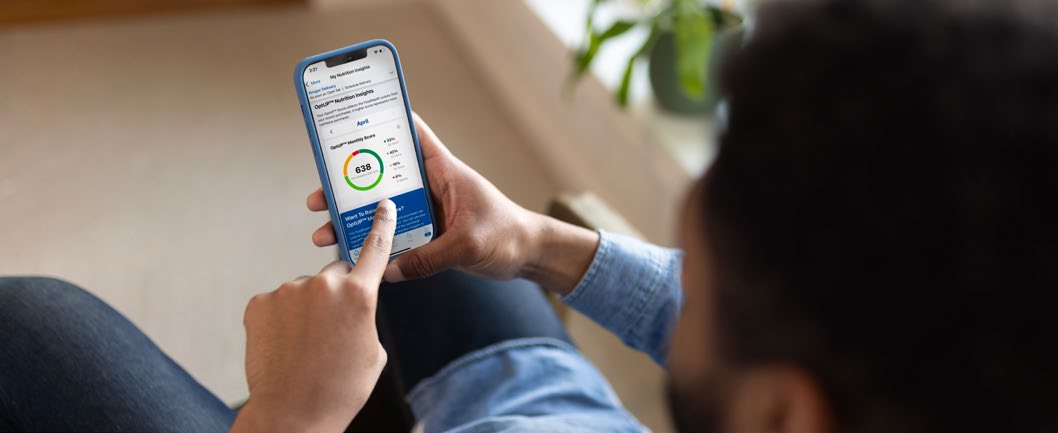
Health & Nutrition
Access to affordable, nutritious foods, whether fresh,
frozen or shelf-stable, and convenient health services
are essential to our customers’ well-being. We recognize
that healthy food can nourish individuals, slow the
progression of illness and transform entire families and
neighborhoods.
That’s why we’re committed to advancing nutrition and
health through our core grocery operations, the Kroger
Health business and more. From providing products and
services to engaging with customers and communities,
we help expand access to healthy and nutritious food
that supports healthier lives.
Our approach to health and nutrition spans multiple
areas of our business, from Merchandising and Retail
Operations to Kroger Health, eCommerce and Marketing.
We aim to make healthy living easier for our customers,
both in-store and online, through relevant products,
expert guidance from our dietitians and health services
provided by our pharmacies and The Little Clinic®.
Kroger Health leads the strategy behind our work to
expand access to care in the communities we serve.
A team of 23,000 healthcare practitioners, including
pharmacists, nurse practitioners, dietitians and
technicians, serves more than 17 million patients annually.
They are available to patients every day to address health
needs. From dietary counseling to questions about
medications, patients can find expert, convenient care
right in their neighborhood store or online.
Our senior leadership team and the Public
Responsibilities Committee of the Board oversee
progress on our health and nutrition programs, as well as
pharmacy and clinic safety measures.
Eating for Better Health
At Kroger Health, we believe in eating for better
health, meaning that healthy food has the power
to nourish families and improve health. Based on
insights, experience and the latest research, we
know a thoughtful, balanced approach to eating and
enjoying food promotes healthier lives and may help
prevent illness before it starts.
In May 2025, Kroger Health hosted its first
Nourishing Change Conference in Cincinnati—an
inclusive, cross-sector summit focused on the future
of health and well-being in America. This event
reflects our ambition to improve healthcare delivery,
promote eating for better health and live our brand
promise: Fresh for Everyone.
The Nourishing Change conference brought together
experts from retail, consumer packaged goods,
healthcare, technology and policy to discuss a new
path forward led by innovation, access and equity.
Participants joined curated tracks focused on food
and nutrition security, healthy eating and integrative
care. Panel discussions highlighted the evolving role
of retail solutions in healthcare, the intersection of
pharmacy and wellness, and the power of behavioral
science in driving better outcomes.
As part of Kroger’s commitment to innovation,
the event also featured an emerging brands
competition, showcasing the next generation of
health-forward products and services.
Nutrition Insights & Personalization
During the past year, Kroger Health introduced ways
to help customers make more-informed nutrition
decisions through our OptUP® Program.
We recognize that making healthy food choices
can be challenging, so we developed the OptUP
Program to simplify choosing nourishing foods while
shopping and to create access to registered dietitian
nutritionists (RDNs). The FoodHealth Score, powered
by the FoodHealth Company, rates food items from 1
to 100 based on nutrient density and ingredient quality
as part of the OptUP Program. The more nutritious
the food, the higher the nutrition score. The scoring
system, which seeks to give customers a fast, reliable
way to evaluate the healthfulness of their food, can
be used while customers shop online or scan UPC
codes in-store. Kroger loyalty members can access
their Nutrition Insights, helping them understand the
healthfulness of their grocery purchases and shopping
habits over time.
We improve nutrition security through other products
and services, including our virtual nutrition counseling
service, which offers two-way video chat appointments
with Kroger Health registered dietitians available to
customers across the U.S.
In early 2025, Kroger Health committed to expanding
access to registered dietitians by launching a free
30-minute 1:1 virtual nutrition coaching session
available to all Kroger Plus loyalty members. The
new offering provides personalized guidance from a
registered dietitian on topics such as budget-friendly
meal planning, product recommendations and practical
nutrition tips. By making credible, customized nutrition
support accessible at no cost, Kroger is helping
individuals and families make lasting, positive changes
to their health and well-being, all in a convenient,
accessible format.
Together, these innovations reflect Kroger’s
commitment to making healthy living easier and more
accessible for everyone.
Kroger’s OptUP Program helps customers choose nutritious options. Shoppers can easily find better options by checking
FoodHealth Scores, which reflect a food’s ingredients and nutrition facts, on the Kroger app or online.
Our Approach
Introduction
Planet
2025 Kroger Responsible Business Report
26
Appendix
Governance
People
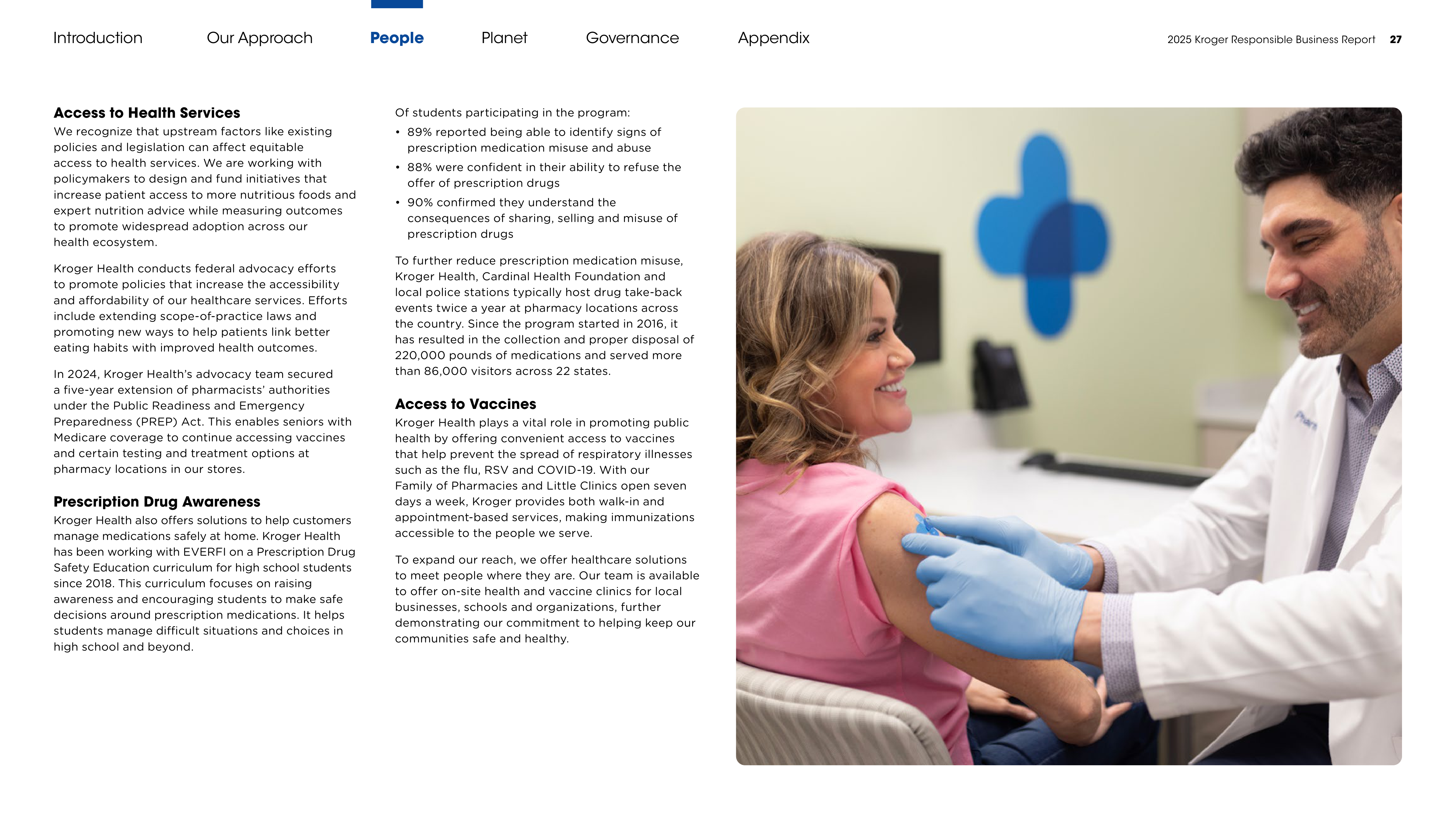
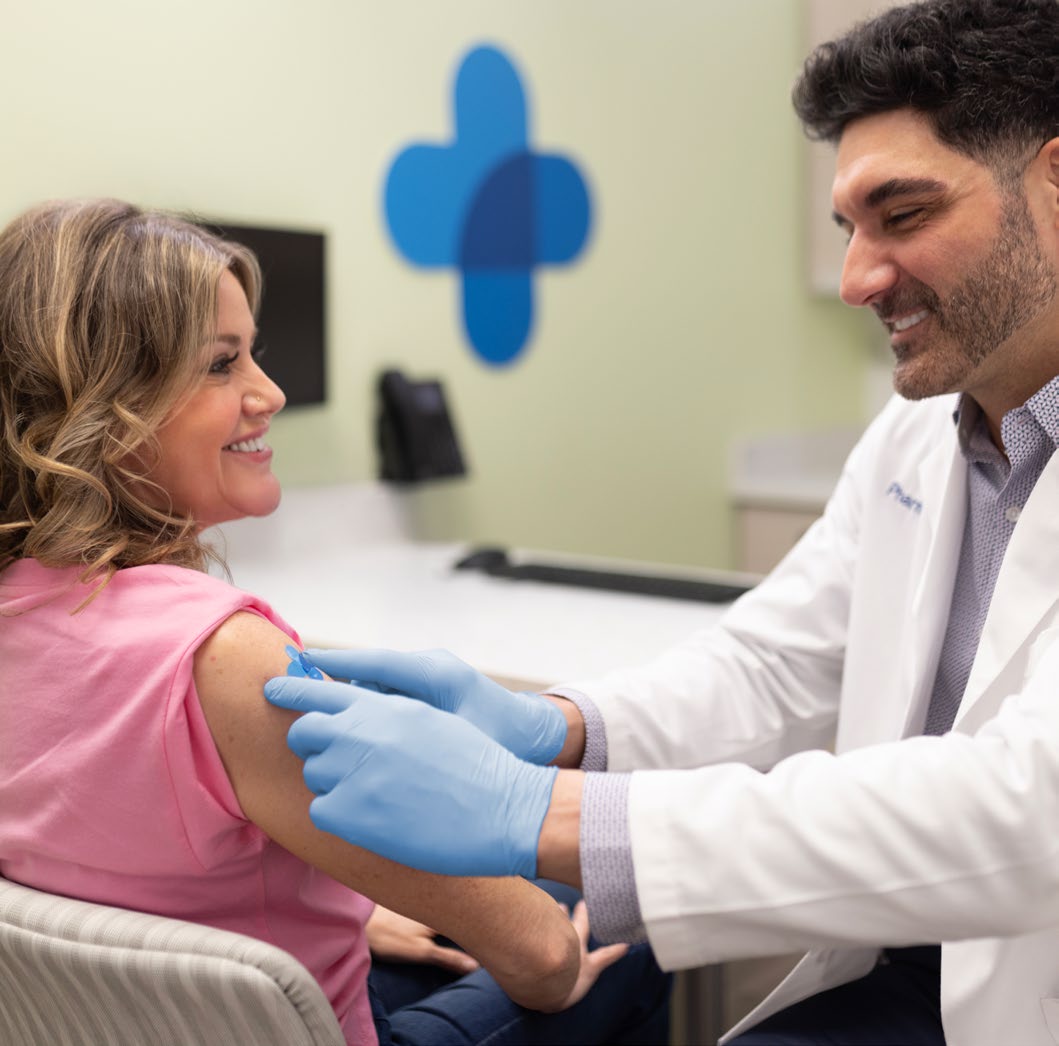
Of students participating in the program:
•
89% reported being able to identify signs of
prescription medication misuse and abuse
•
88% were confident in their ability to refuse the
offer of prescription drugs
•
90% confirmed they understand the
consequences of sharing, selling and misuse of
prescription drugs
To further reduce prescription medication misuse,
Kroger Health, Cardinal Health Foundation and
local police stations typically host drug take-back
events twice a year at pharmacy locations across
the country. Since the program started in 2016, it
has resulted in the collection and proper disposal of
220,000 pounds of medications and served more
than 86,000 visitors across 22 states.
Access to Vaccines
Kroger Health plays a vital role in promoting public
health by offering convenient access to vaccines
that help prevent the spread of respiratory illnesses
such as the flu, RSV and COVID-19. With our
Family of Pharmacies and Little Clinics open seven
days a week, Kroger provides both walk-in and
appointment-based services, making immunizations
accessible to the people we serve.
To expand our reach, we offer healthcare solutions
to meet people where they are. Our team is available
to offer on-site health and vaccine clinics for local
businesses, schools and organizations, further
demonstrating our commitment to helping keep our
communities safe and healthy.
Access to Health Services
We recognize that upstream factors like existing
policies and legislation can affect equitable
access to health services. We are working with
policymakers to design and fund initiatives that
increase patient access to more nutritious foods and
expert nutrition advice while measuring outcomes
to promote widespread adoption across our
health ecosystem.
Kroger Health conducts federal advocacy efforts
to promote policies that increase the accessibility
and affordability of our healthcare services. Efforts
include extending scope-of-practice laws and
promoting new ways to help patients link better
eating habits with improved health outcomes.
In 2024, Kroger Health’s advocacy team secured
a five-year extension of pharmacists’ authorities
under the Public Readiness and Emergency
Preparedness (PREP) Act. This enables seniors with
Medicare coverage to continue accessing vaccines
and certain testing and treatment options at
pharmacy locations in our stores.
Prescription Drug Awareness
Kroger Health also offers solutions to help customers
manage medications safely at home. Kroger Health
has been working with EVERFI on a Prescription Drug
Safety Education curriculum for high school students
since 2018. This curriculum focuses on raising
awareness and encouraging students to make safe
decisions around prescription medications. It helps
students manage difficult situations and choices in
high school and beyond.
Our Approach
Introduction
Planet
2025 Kroger Responsible Business Report
27
Appendix
Governance
People
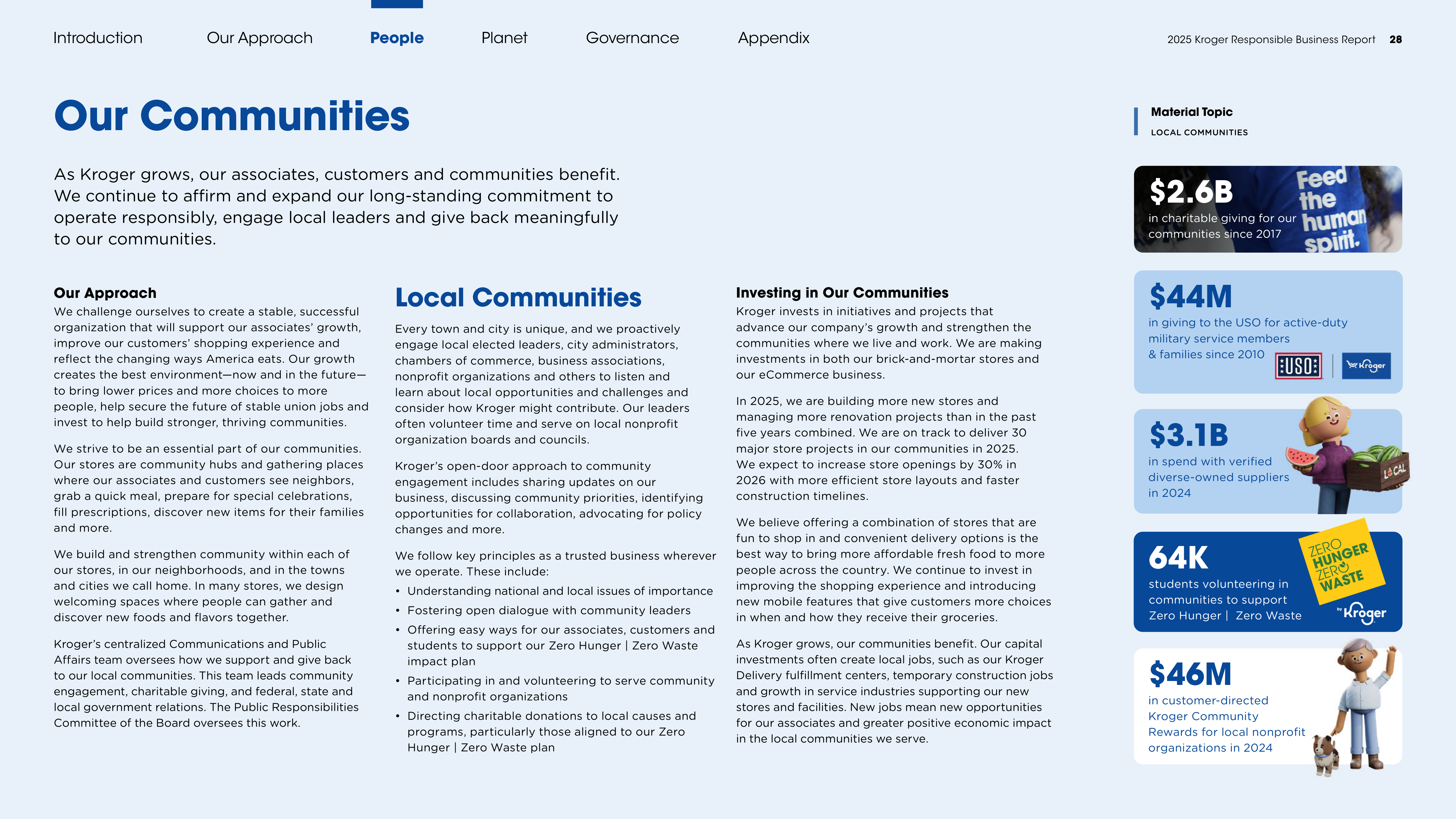




As Kroger grows, our associates, customers and communities benefit.
We continue to affirm and expand our long-standing commitment to
operate responsibly, engage local leaders and give back meaningfully
to our communities.
Our Communities
Our Approach
We challenge ourselves to create a stable, successful
organization that will support our associates’ growth,
improve our customers’ shopping experience and
reflect the changing ways America eats. Our growth
creates the best environment—now and in the future—
to bring lower prices and more choices to more
people, help secure the future of stable union jobs and
invest to help build stronger, thriving communities.
We strive to be an essential part of our communities.
Our stores are community hubs and gathering places
where our associates and customers see neighbors,
grab a quick meal, prepare for special celebrations,
fill prescriptions, discover new items for their families
and more.
We build and strengthen community within each of
our stores, in our neighborhoods, and in the towns
and cities we call home. In many stores, we design
welcoming spaces where people can gather and
discover new foods and flavors together.
Kroger’s centralized Communications and Public
Affairs team oversees how we support and give back
to our local communities. This team leads community
engagement, charitable giving, and federal, state and
local government relations. The Public Responsibilities
Committee of the Board oversees this work.
Local Communities
Every town and city is unique, and we proactively
engage local elected leaders, city administrators,
chambers of commerce, business associations,
nonprofit organizations and others to listen and
learn about local opportunities and challenges and
consider how Kroger might contribute. Our leaders
often volunteer time and serve on local nonprofit
organization boards and councils.
Kroger’s open-door approach to community
engagement includes sharing updates on our
business, discussing community priorities, identifying
opportunities for collaboration, advocating for policy
changes and more.
We follow key principles as a trusted business wherever
we operate. These include:
•
Understanding national and local issues of importance
•
Fostering open dialogue with community leaders
•
Offering easy ways for our associates, customers and
students to support our Zero Hunger | Zero Waste
impact plan
•
Participating in and volunteering to serve community
and nonprofit organizations
•
Directing charitable donations to local causes and
programs, particularly those aligned to our Zero
Hunger | Zero Waste plan
$2.6B
in charitable giving for our
communities since 2017
Investing in Our Communities
Kroger invests in initiatives and projects that
advance our company’s growth and strengthen the
communities where we live and work. We are making
investments in both our brick-and-mortar stores and
our eCommerce business.
In 2025, we are building more new stores and
managing more renovation projects than in the past
five years combined. We are on track to deliver 30
major store projects in our communities in 2025.
We expect to increase store openings by 30% in
2026 with more efficient store layouts and faster
construction timelines.
We believe offering a combination of stores that are
fun to shop in and convenient delivery options is the
best way to bring more affordable fresh food to more
people across the country. We continue to invest in
improving the shopping experience and introducing
new mobile features that give customers more choices
in when and how they receive their groceries.
As Kroger grows, our communities benefit. Our capital
investments often create local jobs, such as our Kroger
Delivery fulfillment centers, temporary construction jobs
and growth in service industries supporting our new
stores and facilities. New jobs mean new opportunities
for our associates and greater positive economic impact
in the local communities we serve.
$3.1B
in spend with verified
diverse-owned suppliers
in 2024
$44M
in giving to the USO for active-duty
military service members
& families since 2010
Material Topic
LOCAL COMMUNITIES
64K
students volunteering in
communities to support
Zero Hunger | Zero Waste
$46M
in customer-directed
Kroger Community
Rewards for local nonprofit
organizations in 2024
Our Approach
Introduction
Planet
2025 Kroger Responsible Business Report
28
Appendix
Governance
People
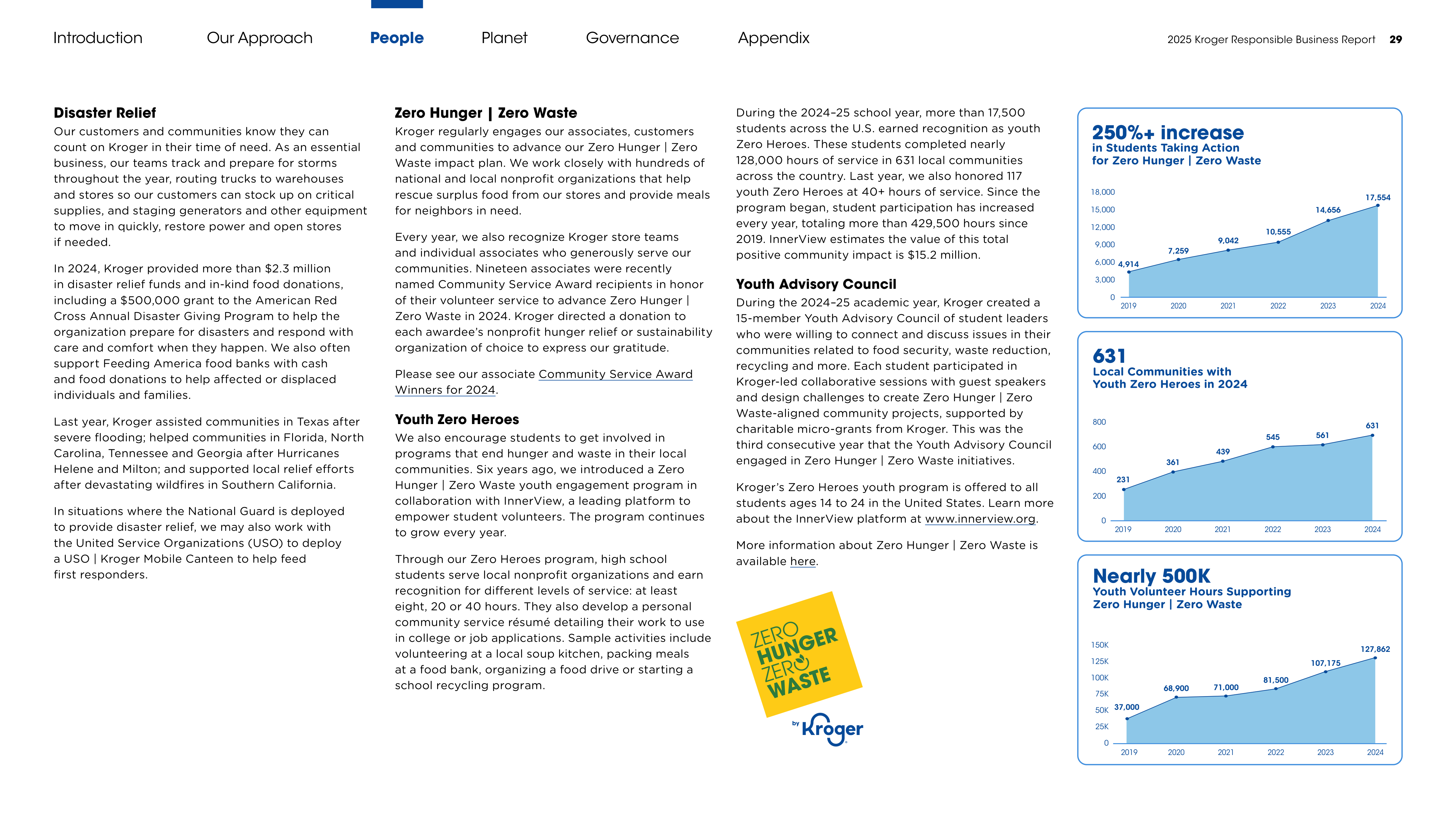
Disaster Relief
Our customers and communities know they can
count on Kroger in their time of need. As an essential
business, our teams track and prepare for storms
throughout the year, routing trucks to warehouses
and stores so our customers can stock up on critical
supplies, and staging generators and other equipment
to move in quickly, restore power and open stores
if needed.
In 2024, Kroger provided more than $2.3 million
in disaster relief funds and in-kind food donations,
including a $500,000 grant to the American Red
Cross Annual Disaster Giving Program to help the
organization prepare for disasters and respond with
care and comfort when they happen. We also often
support Feeding America food banks with cash
and food donations to help affected or displaced
individuals and families.
Last year, Kroger assisted communities in Texas after
severe flooding; helped communities in Florida, North
Carolina, Tennessee and Georgia after Hurricanes
Helene and Milton; and supported local relief efforts
after devastating wildfires in Southern California.
In situations where the National Guard is deployed
to provide disaster relief, we may also work with
the United Service Organizations (USO) to deploy
a USO | Kroger Mobile Canteen to help feed
first responders.
During the 2024–25 school year, more than 17,500
students across the U.S. earned recognition as youth
Zero Heroes. These students completed nearly
128,000 hours of service in 631 local communities
across the country. Last year, we also honored 117
youth Zero Heroes at 40+ hours of service. Since the
program began, student participation has increased
every year, totaling more than 429,500 hours since
2019. InnerView estimates the value of this total
positive community impact is $15.2 million.
Youth Advisory Council
During the 2024–25 academic year, Kroger created a
15-member Youth Advisory Council of student leaders
who were willing to connect and discuss issues in their
communities related to food security, waste reduction,
recycling and more. Each student participated in
Kroger-led collaborative sessions with guest speakers
and design challenges to create Zero Hunger | Zero
Waste-aligned community projects, supported by
charitable micro-grants from Kroger. This was the
third consecutive year that the Youth Advisory Council
engaged in Zero Hunger | Zero Waste initiatives.
Kroger’s Zero Heroes youth program is offered to all
students ages 14 to 24 in the United States. Learn more
about the InnerView platform at www.innerview.org.
More information about Zero Hunger | Zero Waste is
available here.
Zero Hunger | Zero Waste
Kroger regularly engages our associates, customers
and communities to advance our Zero Hunger | Zero
Waste impact plan. We work closely with hundreds of
national and local nonprofit organizations that help
rescue surplus food from our stores and provide meals
for neighbors in need.
Every year, we also recognize Kroger store teams
and individual associates who generously serve our
communities. Nineteen associates were recently
named Community Service Award recipients in honor
of their volunteer service to advance Zero Hunger |
Zero Waste in 2024. Kroger directed a donation to
each awardee’s nonprofit hunger relief or sustainability
organization of choice to express our gratitude.
Please see our associate Community Service Award
Winners for 2024.
Youth Zero Heroes
We also encourage students to get involved in
programs that end hunger and waste in their local
communities. Six years ago, we introduced a Zero
Hunger | Zero Waste youth engagement program in
collaboration with InnerView, a leading platform to
empower student volunteers. The program continues
to grow every year.
Through our Zero Heroes program, high school
students serve local nonprofit organizations and earn
recognition for different levels of service: at least
eight, 20 or 40 hours. They also develop a personal
community service résumé detailing their work to use
in college or job applications. Sample activities include
volunteering at a local soup kitchen, packing meals
at a food bank, organizing a food drive or starting a
school recycling program.
2019
2020
2021
2022
2023
2024
4,914
7,259
9,042
10,555
14,656
17,554
2019
2020
2021
2022
2023
2024
2019
2020
2021
2022
2023
2024
231
361
439
545
561
631
37,000
68,900
71,000
81,500
107,175
127,862
250%+ increase
in Students Taking Action
for Zero Hunger | Zero Waste
631
Local Communities with
Youth Zero Heroes in 2024
Nearly 500K
Youth Volunteer Hours Supporting
Zero Hunger | Zero Waste
18,000
0
3,000
6,000
12,000
15,000
9,000
600
150K
800
25K
0
0
200
50K
400
100K
125K
75K
Our Approach
Introduction
Planet
2025 Kroger Responsible Business Report
29
Appendix
Governance
People
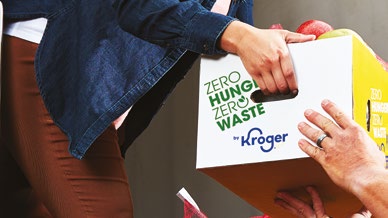

Charitable Giving
Kroger has a long history of giving back generously
to our communities. We support national and local
nonprofit organizations by donating food and funds to
help our neighbors and neighborhoods.
In 2024, Kroger donated a total of $346 million to our
communities in food and funds combined, including
$276 million to hunger relief. Our strategic approach
to charitable giving includes several ways we support
national partners and local communities:
•
In-kind food and product donations to advance
Zero Hunger | Zero Waste
•
Company-funded donations to nonprofit
organizations that meet our Charitable
Giving Guidelines
•
Grants from The Kroger Co. Foundation, the
company’s private foundation established in 1987
•
Grants from The Kroger Co. Zero Hunger |
Zero Waste Foundation, a nonprofit public charity
established in 2018
•
Local customer-directed donations to nonprofit
organizations through Kroger Community Rewards
We align the majority of the company’s charitable
giving to national, regional and local organizations
and programs that feed people. In 2024, we directed a
total of 518 million meals to our communities, bringing
our cumulative total to 3.9 billion meals since 2017.
This includes work with local food banks and pantries
to support innovative food delivery models, including
mobile or stationary food pantries that increase access
to fresh food.
We maintain long-standing relationships with national
organizations that support our local communities.
These include the American Red Cross, Feeding
America and its network of affiliated local food banks,
World Wildlife Fund and the USO, among others.
Prioritizing Hunger Relief
Several years ago, we began aligning more of Kroger’s
total charitable giving to our Zero Hunger | Zero Waste
impact plan. This includes cash donations and gift
cards, foundation grants, surplus fresh food donations
through our Zero Hunger | Zero Waste Food Rescue
program, and other food and product donations.
At the local level, our charitable dollars help Feeding
America-affiliated food banks and other nonprofit
organizations build capacity to pick up more surplus
fresh food from our stores, test and implement new
food recovery and delivery models, and feed more
people in need.
In addition to company donations, we invite our
customers to round up their purchase to the nearest
dollar when they shop with Kroger or donate directly to
the Zero Hunger | Zero Waste Foundation to support
our mission to end hunger and waste. Funds help
provide grants to eligible organizations aligned with
our impact plan.
In 2024, our generous customers donated a total of
$8 million to the Zero Hunger | Zero Waste Foundation,
which directed grants to designated local food banks
and hunger relief agencies.
For more details on the work of our nonprofit
foundations and examples of specific grants, please
see The Kroger Co. Foundation 2025 Report and
The Kroger Co. Zero Hunger | Zero Waste Foundation
2025 Report.
Donating Surplus Food
Every day, associates across our family of companies
recover and donate surplus fresh food for our
communities through our Zero Hunger | Zero Waste
Food Rescue program. Kroger developed and
introduced this industry-leading program in
collaboration with Feeding America more than 16 years
ago, then called the Perishable Donations Partnership.
Every Kroger-operated store is linked to a local hunger
relief agency with the capacity to safely pick up
and redistribute surplus fresh food. Our distribution
centers, fulfillment centers and food production plants
also donate surplus food when possible.
We work closely with the Feeding America network
of food banks and other hunger relief partners to
continually improve our Food Rescue program, expand
the number of items eligible for donation and recover
more fresh, nutritious food.
In 2024, 100% of our stores actively participated in
the Food Rescue program. Including surplus food
recovered from all facilities company-wide, Kroger
donated a total of 119 million pounds of surplus food
for our communities. Since 2017, our associates have
donated nearly 815 million pounds of surplus food for
our neighbors.
For more information about Kroger’s Food Rescue
program and how donating fresh surplus food feeds
people and supports our sustainability goals, see the
Waste & Circularity section of this report.
3.9B
meals
donated
since 2017
Made possible
through a
combination of:
$1.8B
in charitable monetary donations to
food banks and other hunger relief
agencies in our local communities
815M
pounds of surplus
food donated to
our communities
Our Approach
Introduction
Planet
2025 Kroger Responsible Business Report
30
Appendix
Governance
People
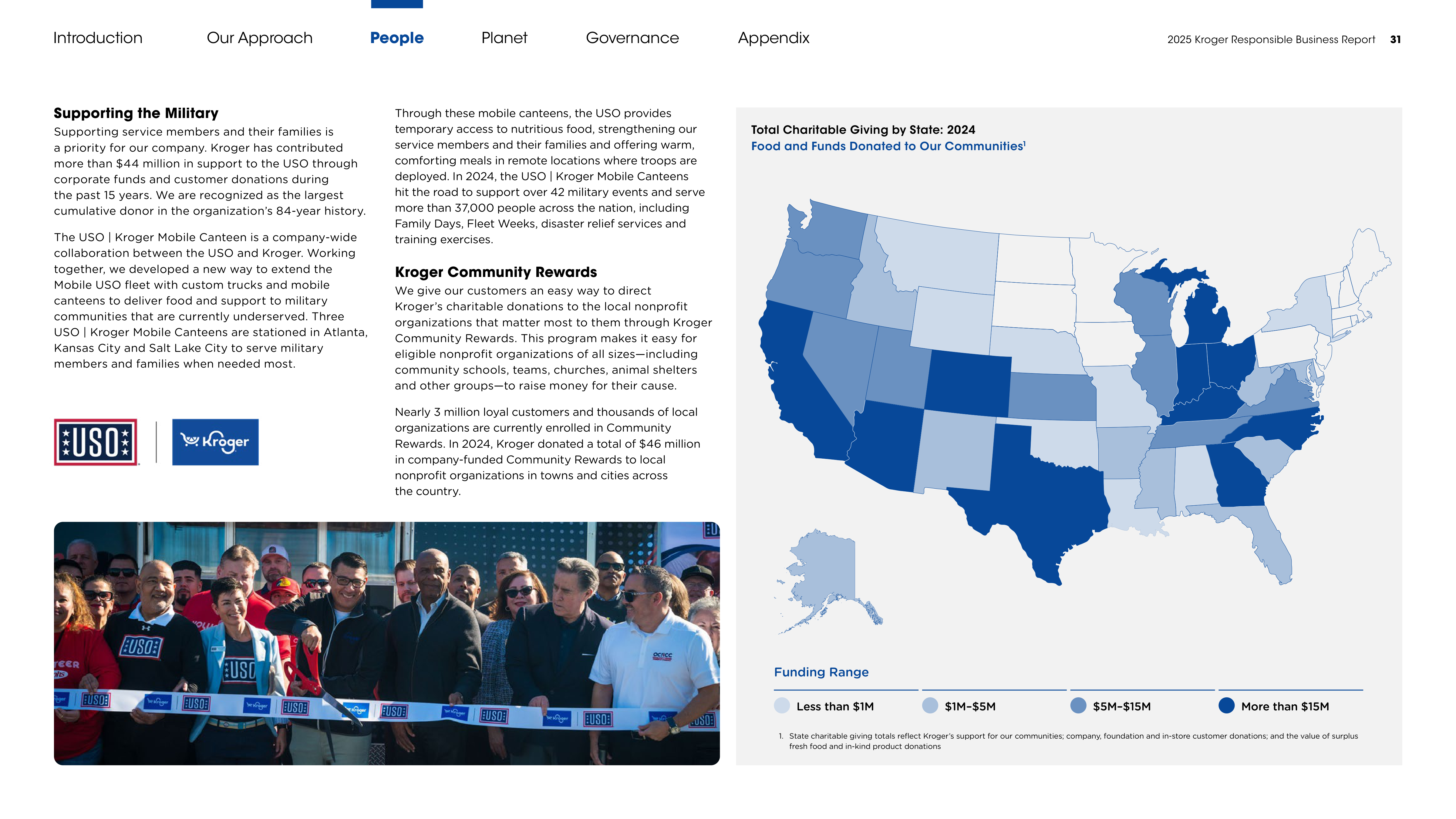
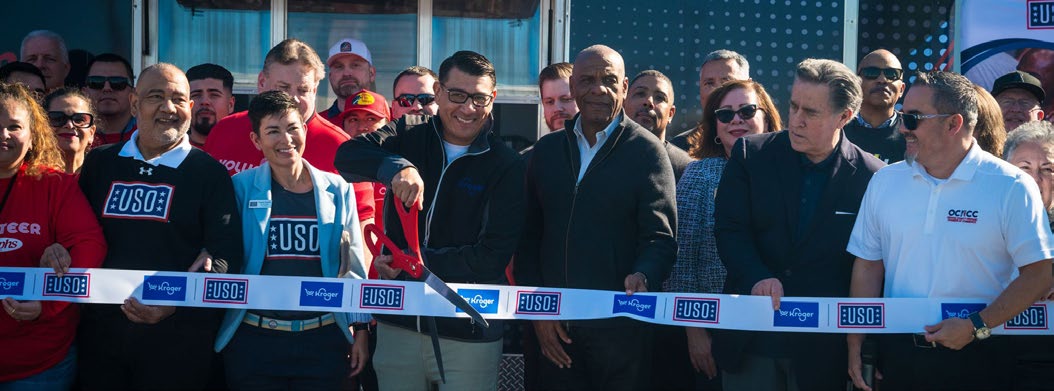
Through these mobile canteens, the USO provides
temporary access to nutritious food, strengthening our
service members and their families and offering warm,
comforting meals in remote locations where troops are
deployed. In 2024, the USO | Kroger Mobile Canteens
hit the road to support over 42 military events and serve
more than 37,000 people across the nation, including
Family Days, Fleet Weeks, disaster relief services and
training exercises.
Kroger Community Rewards
We give our customers an easy way to direct
Kroger’s charitable donations to the local nonprofit
organizations that matter most to them through Kroger
Community Rewards. This program makes it easy for
eligible nonprofit organizations of all sizes—including
community schools, teams, churches, animal shelters
and other groups—to raise money for their cause.
Nearly 3 million loyal customers and thousands of local
organizations are currently enrolled in Community
Rewards. In 2024, Kroger donated a total of $46 million
in company-funded Community Rewards to local
nonprofit organizations in towns and cities across
the country.
Supporting the Military
Supporting service members and their families is
a priority for our company. Kroger has contributed
more than $44 million in support to the USO through
corporate funds and customer donations during
the past 15 years. We are recognized as the largest
cumulative donor in the organization’s 84-year history.
The USO | Kroger Mobile Canteen is a company-wide
collaboration between the USO and Kroger. Working
together, we developed a new way to extend the
Mobile USO fleet with custom trucks and mobile
canteens to deliver food and support to military
communities that are currently underserved. Three
USO | Kroger Mobile Canteens are stationed in Atlanta,
Kansas City and Salt Lake City to serve military
members and families when needed most.
Total Charitable Giving by State: 2024
Food and Funds Donated to Our Communities
1
Funding Range
Less than $1M
$1M–$5M
$5M–$15M
More than $15M
1. State charitable giving totals reflect Kroger’s support for our communities; company, foundation and in-store customer donations; and the value of surplus
fresh food and in-kind product donations
Our Approach
Introduction
Planet
2025 Kroger Responsible Business Report
31
Appendix
Governance
People

Planet
Kroger aims to do our part to protect natural resources
and create a cleaner energy future. We focus on
reducing greenhouse gas (GHG) emissions and waste
in our operations, and we encourage our suppliers
to adopt more sustainable ways to grow, make and
package products for our customers.
In This Section
33
2024 Highlights
34
Climate Impact
38
Waste & Circularity
43
Biodiversity & Resource
Conservation
Material Topics
• Energy & GHG Emissions
• Climate Change Resilience
• Waste & Circularity
• Food Waste
• Biodiversity & Conservation
• Agricultural Practices
• Water
32
2025 Kroger Responsible Business Report
People
Our Approach
Introduction
Appendix
Governance
Planet
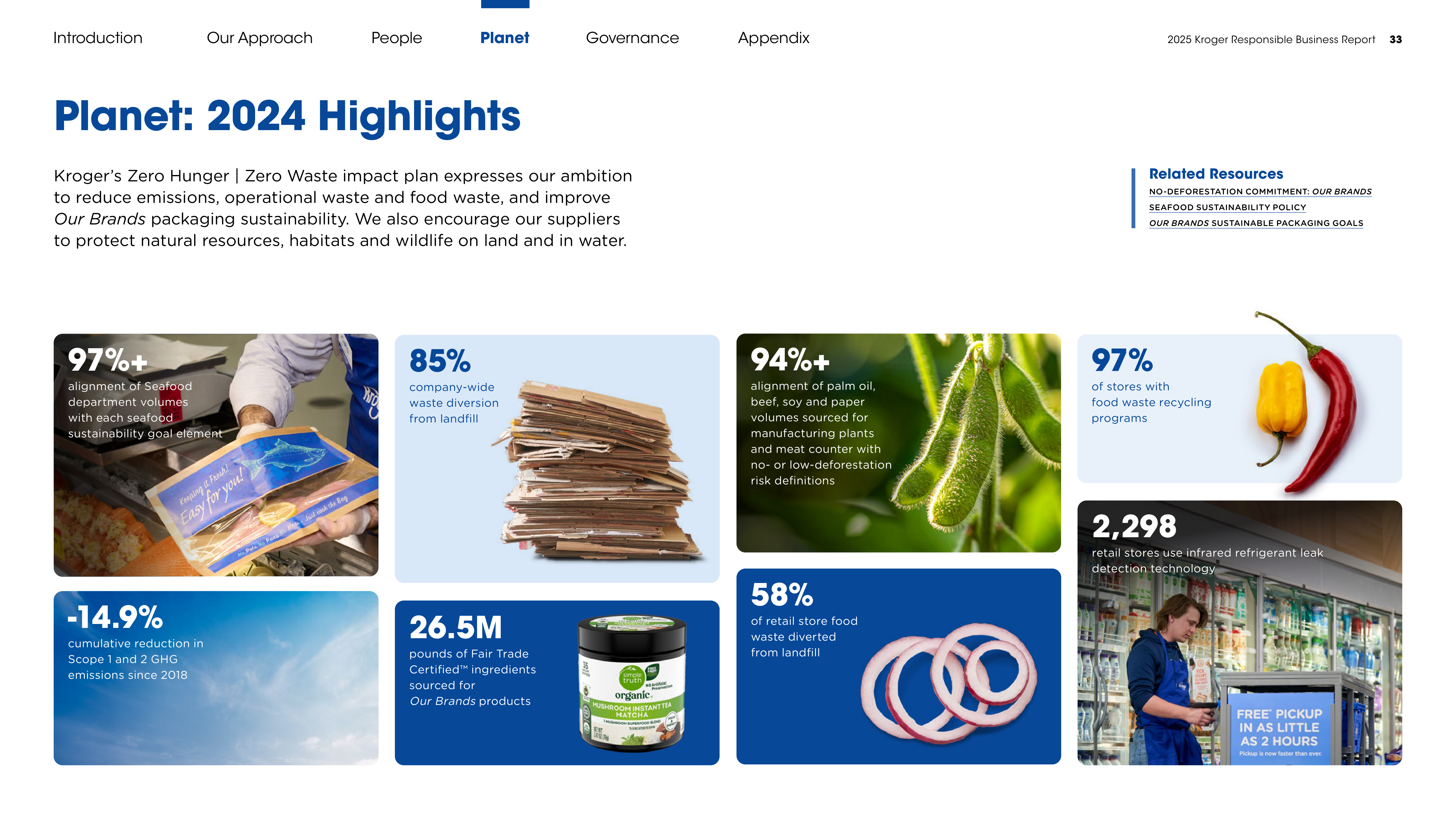

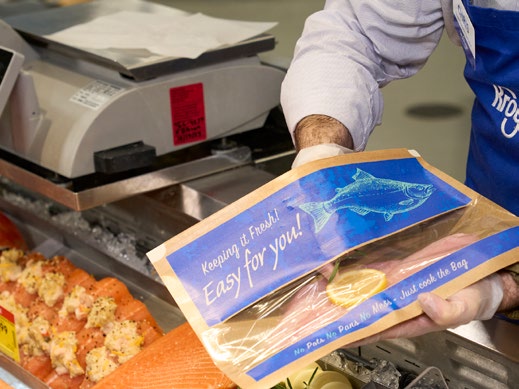

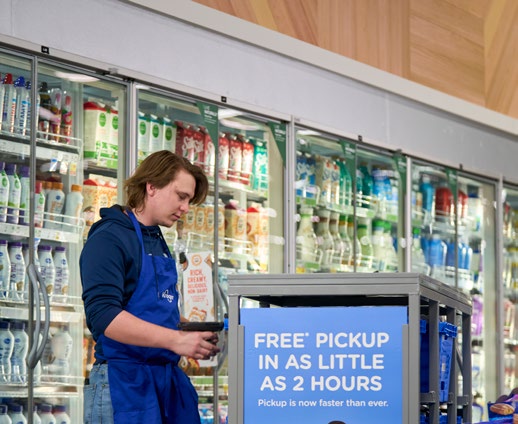






26.5M
pounds of Fair Trade
Certified™ ingredients
sourced for
Our Brands products
Planet: 2024 Highlights
Related Resources
NO-DEFORESTATION COMMITMENT:
OUR BRANDS
SEAFOOD SUSTAINABILITY POLICY
OUR BRANDS
SUSTAINABLE PACKAGING GOALS
85%
company-wide
waste diversion
from landfill
Kroger’s Zero Hunger | Zero Waste impact plan expresses our ambition
to reduce emissions, operational waste and food waste, and improve
Our Brands
packaging sustainability. We also encourage our suppliers
to protect natural resources, habitats and wildlife on land and in water.
2,298
retail stores use infrared refrigerant leak
detection technology
58%
of retail store food
waste diverted
from landfill
97%+
alignment of Seafood
department volumes
with each seafood
sustainability goal element
97%
of stores with
food waste recycling
programs
94%+
alignment of palm oil,
beef, soy and paper
volumes sourced for
manufacturing plants
and meat counter with
no- or low-deforestation
risk definitions
-14.9%
cumulative reduction in
Scope 1 and 2 GHG
emissions since 2018
People
Our Approach
Introduction
2025 Kroger Responsible Business Report
33
Appendix
Governance
Planet
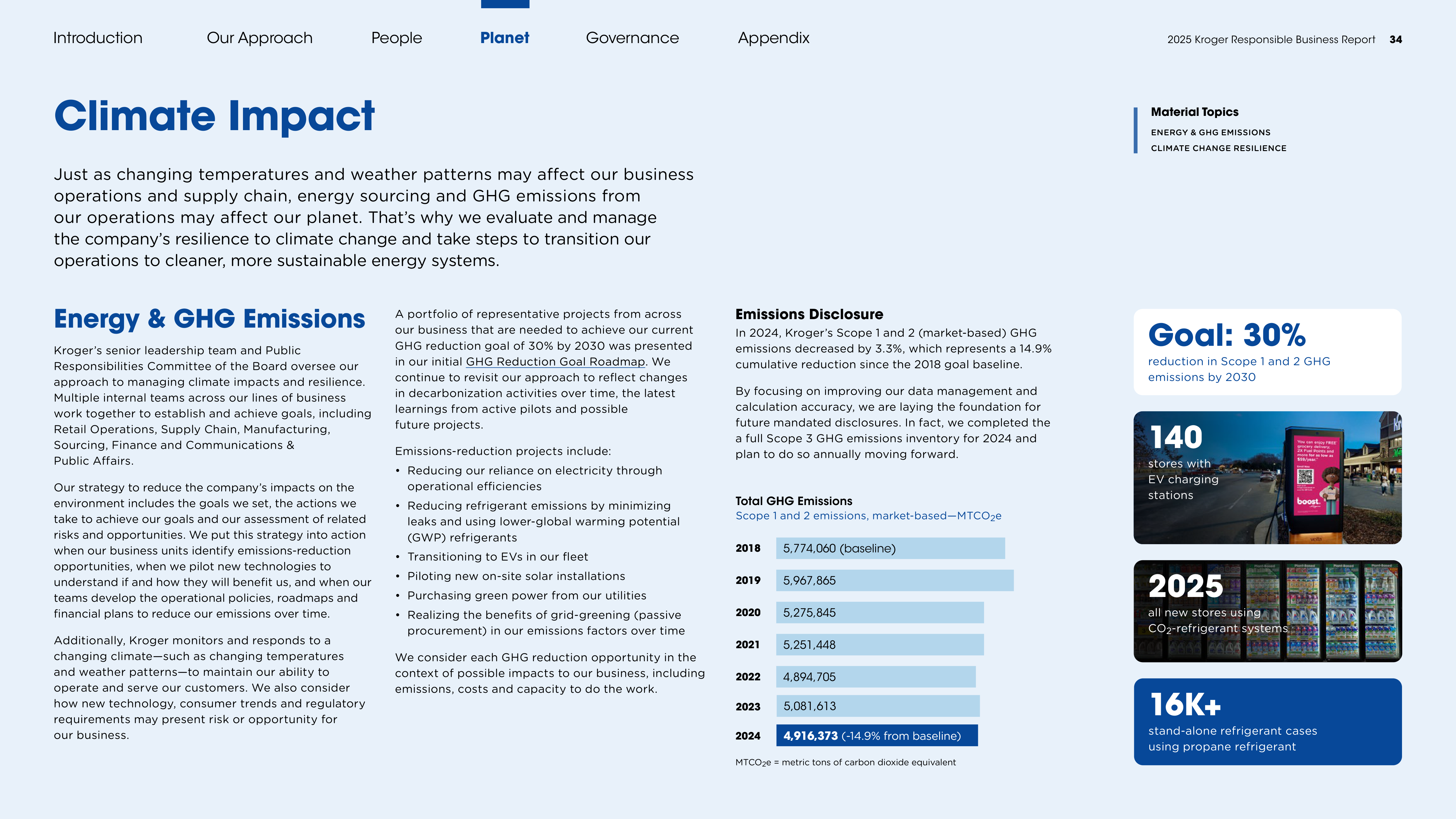
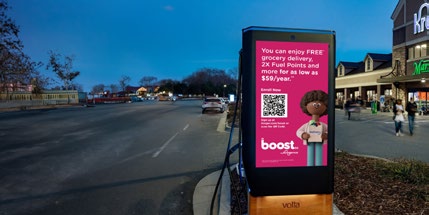
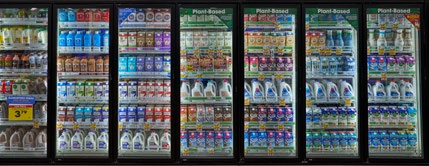
16K+
stand-alone refrigerant cases
using propane refrigerant
Just as changing temperatures and weather patterns may affect our business
operations and supply chain, energy sourcing and GHG emissions from
our operations may affect our planet. That’s why we evaluate and manage
the company’s resilience to climate change and take steps to transition our
operations to cleaner, more sustainable energy systems.
Climate Impact
Goal: 30%
reduction in Scope 1 and 2 GHG
emissions by 2030
Energy & GHG Emissions
Kroger’s senior leadership team and Public
Responsibilities Committee of the Board oversee our
approach to managing climate impacts and resilience.
Multiple internal teams across our lines of business
work together to establish and achieve goals, including
Retail Operations, Supply Chain, Manufacturing,
Sourcing, Finance and Communications &
Public Affairs.
Our strategy to reduce the company’s impacts on the
environment includes the goals we set, the actions we
take to achieve our goals and our assessment of related
risks and opportunities. We put this strategy into action
when our business units identify emissions-reduction
opportunities, when we pilot new technologies to
understand if and how they will benefit us, and when our
teams develop the operational policies, roadmaps and
financial plans to reduce our emissions over time.
Additionally, Kroger monitors and responds to a
changing climate—such as changing temperatures
and weather patterns—to maintain our ability to
operate and serve our customers. We also consider
how new technology, consumer trends and regulatory
requirements may present risk or opportunity for
our business.
Emissions Disclosure
In 2024, Kroger’s Scope 1 and 2 (market-based) GHG
emissions decreased by 3.3%, which represents a 14.9%
cumulative reduction since the 2018 goal baseline.
By focusing on improving our data management and
calculation accuracy, we are laying the foundation for
future mandated disclosures. In fact, we completed the
a full Scope 3 GHG emissions inventory for 2024 and
plan to do so annually moving forward.
Material Topics
ENERGY & GHG EMISSIONS
CLIMATE CHANGE RESILIENCE
140
stores with
EV charging
stations
MTCO
2
e = metric tons of carbon dioxide equivalent
Total GHG Emissions
Scope 1 and 2 emissions, market-based—MTCO
2
e
2018
2019
2020
2021
5,774,060 (baseline)
5,967,865
5,275,845
5,251,448
2022
2023
4,894,705
5,081,613
2025
all new stores using
CO
2
-refrigerant systems
A portfolio of representative projects from across
our business that are needed to achieve our current
GHG reduction goal of 30% by 2030 was presented
in our initial GHG Reduction Goal Roadmap. We
continue to revisit our approach to reflect changes
in decarbonization activities over time, the latest
learnings from active pilots and possible
future projects.
Emissions-reduction projects include:
•
Reducing our reliance on electricity through
operational efficiencies
•
Reducing refrigerant emissions by minimizing
leaks and using lower-global warming potential
(GWP) refrigerants
•
Transitioning to EVs in our fleet
•
Piloting new on-site solar installations
•
Purchasing green power from our utilities
•
Realizing the benefits of grid-greening (passive
procurement) in our emissions factors over time
We consider each GHG reduction opportunity in the
context of possible impacts to our business, including
emissions, costs and capacity to do the work.
2024
4,916,373
(-14.9% from baseline)
People
Our Approach
Introduction
2025 Kroger Responsible Business Report
34
Appendix
Governance
Planet
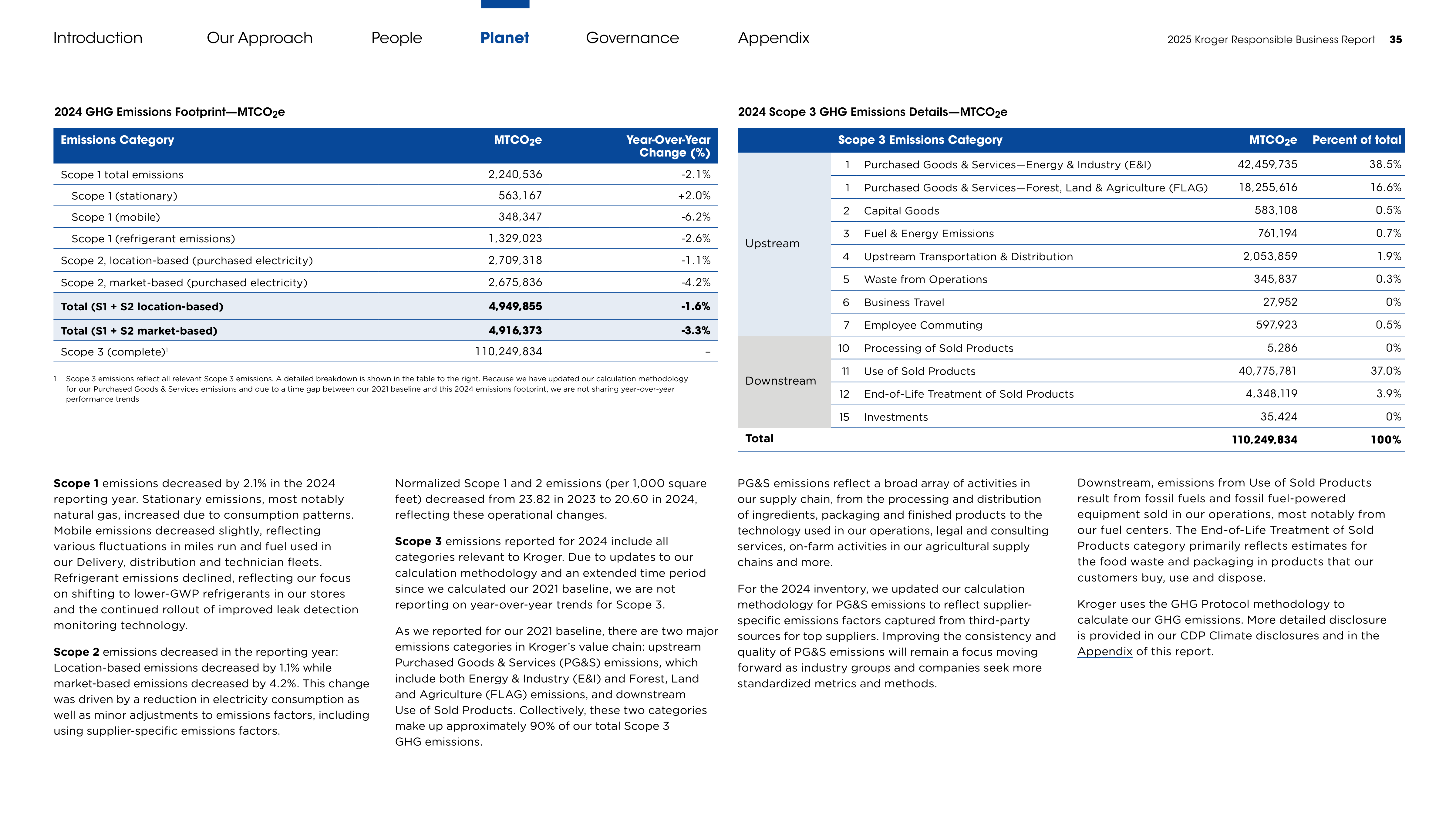
Emissions Category
MTCO
2
e
Year-Over-Year
Change (%)
Scope 1 total emissions
2,240,536
-2.1%
Scope 1 (stationary)
563,167
+2.0%
Scope 1 (mobile)
348,347
-6.2%
Scope 1 (refrigerant emissions)
1,329,023
-2.6%
Scope 2, location-based (purchased electricity)
2,709,318
-1.1%
Scope 2, market-based (purchased electricity)
2,675,836
-4.2%
Total (S1 + S2 location-based)
4,949,855
-1.6%
Total (S1 + S2 market-based)
4,916,373
-3.3%
Scope 3 (complete)
1
110,249,834
–
2024 GHG Emissions Footprint—MTCO
2
e
1.
Scope 3 emissions reflect all relevant Scope 3 emissions. A detailed breakdown is shown in the table to the right. Because we have updated our calculation methodology
for our Purchased Goods & Services emissions and due to a time gap between our 2021 baseline and this 2024 emissions footprint, we are not sharing year-over-year
performance trends
Scope 1
emissions decreased by 2.1% in the 2024
reporting year. Stationary emissions, most notably
natural gas, increased due to consumption patterns.
Mobile emissions decreased slightly, reflecting
various fluctuations in miles run and fuel used in
our Delivery, distribution and technician fleets.
Refrigerant emissions declined, reflecting our focus
on shifting to lower-GWP refrigerants in our stores
and the continued rollout of improved leak detection
monitoring technology.
Scope 2
emissions decreased in the reporting year:
Location-based emissions decreased by 1.1% while
market-based emissions decreased by 4.2%. This change
was driven by a reduction in electricity consumption as
well as minor adjustments to emissions factors, including
using supplier-specific emissions factors.
Normalized Scope 1 and 2 emissions (per 1,000 square
feet) decreased from 23.82 in 2023 to 20.60 in 2024,
reflecting these operational changes.
Scope 3
emissions reported for 2024 include all
categories relevant to Kroger. Due to updates to our
calculation methodology and an extended time period
since we calculated our 2021 baseline, we are not
reporting on year-over-year trends for Scope 3.
As we reported for our 2021 baseline, there are two major
emissions categories in Kroger’s value chain: upstream
Purchased Goods & Services (PG&S) emissions, which
include both Energy & Industry (E&I) and Forest, Land
and Agriculture (FLAG) emissions, and downstream
Use of Sold Products. Collectively, these two categories
make up approximately 90% of our total Scope 3
GHG emissions.
PG&S emissions reflect a broad array of activities in
our supply chain, from the processing and distribution
of ingredients, packaging and finished products to the
technology used in our operations, legal and consulting
services, on-farm activities in our agricultural supply
chains and more.
For the 2024 inventory, we updated our calculation
methodology for PG&S emissions to reflect supplier-
specific emissions factors captured from third-party
sources for top suppliers. Improving the consistency and
quality of PG&S emissions will remain a focus moving
forward as industry groups and companies seek more
standardized metrics and methods.
Downstream, emissions from Use of Sold Products
result from fossil fuels and fossil fuel-powered
equipment sold in our operations, most notably from
our fuel centers. The End-of-Life Treatment of Sold
Products category primarily reflects estimates for
the food waste and packaging in products that our
customers buy, use and dispose.
Kroger uses the GHG Protocol methodology to
calculate our GHG emissions. More detailed disclosure
is provided in our CDP Climate disclosures and in the
Appendix of this report.
Scope 3 Emissions Category
MTCO
2
e
Percent of total
Upstream
1
Purchased Goods & Services—Energy & Industry (E&I)
42,459,735
38.5%
1
Purchased Goods & Services—Forest, Land & Agriculture (FLAG)
18,255,616
16.6%
2
Capital Goods
583,108
0.5%
3
Fuel & Energy Emissions
761,194
0.7%
4
Upstream Transportation & Distribution
2,053,859
1.9%
5
Waste from Operations
345,837
0.3%
6
Business Travel
27,952
0%
7
Employee Commuting
597,923
0.5%
Downstream
10
Processing of Sold Products
5,286
0%
11
Use of Sold Products
40,775,781
37.0%
12
End-of-Life Treatment of Sold Products
4,348,119
3.9%
15
Investments
35,424
0%
Total
110,249,834
100%
2024 Scope 3 GHG Emissions Details—MTCO
2
e
People
Our Approach
Introduction
2025 Kroger Responsible Business Report
35
Appendix
Governance
Planet
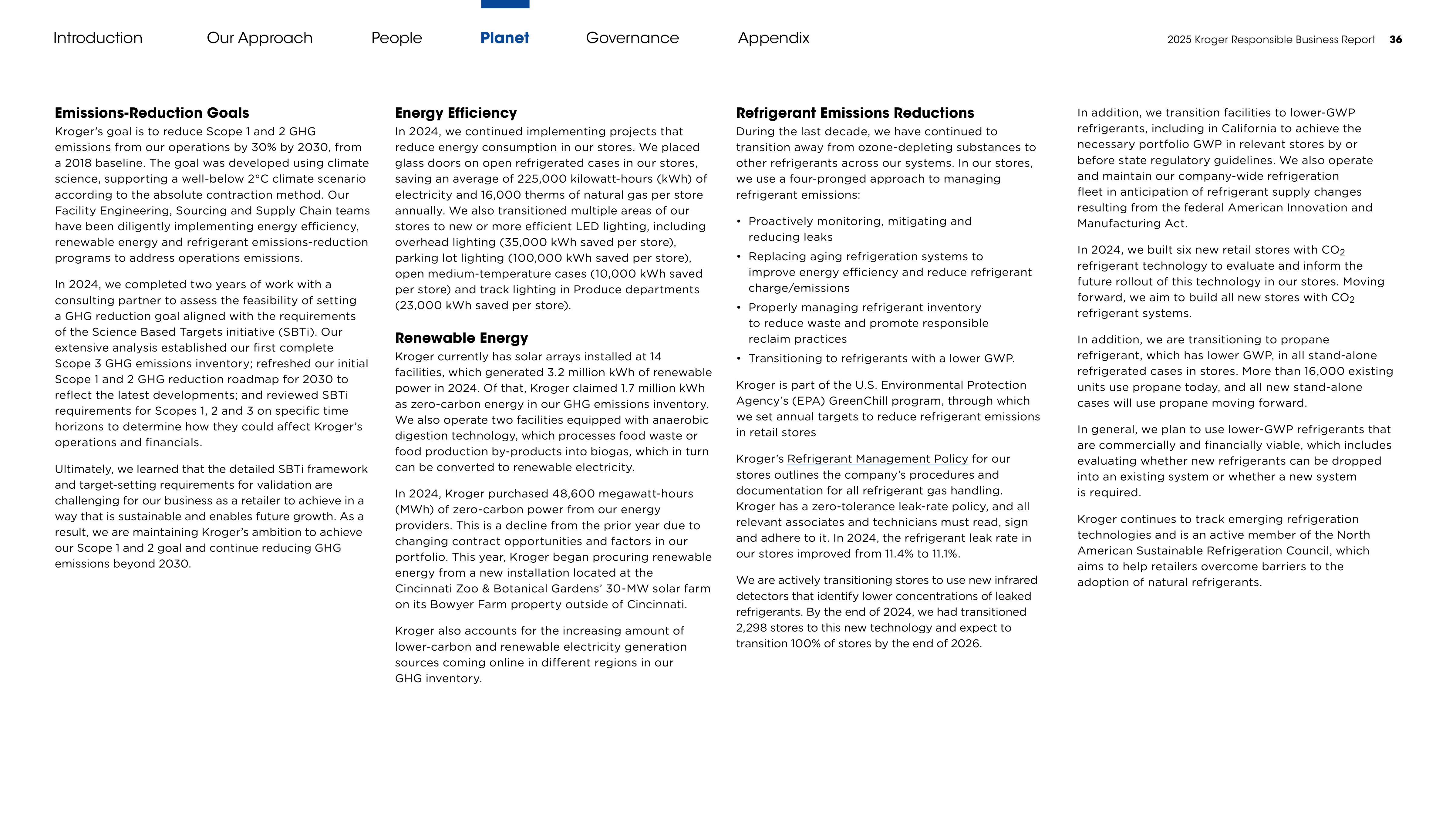
Energy Efficiency
In 2024, we continued implementing projects that
reduce energy consumption in our stores. We placed
glass doors on open refrigerated cases in our stores,
saving an average of 225,000 kilowatt-hours (kWh) of
electricity and 16,000 therms of natural gas per store
annually. We also transitioned multiple areas of our
stores to new or more efficient LED lighting, including
overhead lighting (35,000 kWh saved per store),
parking lot lighting (100,000 kWh saved per store),
open medium-temperature cases (10,000 kWh saved
per store) and track lighting in Produce departments
(23,000 kWh saved per store).
Renewable Energy
Kroger currently has solar arrays installed at 14
facilities, which generated 3.2 million kWh of renewable
power in 2024. Of that, Kroger claimed 1.7 million kWh
as zero-carbon energy in our GHG emissions inventory.
We also operate two facilities equipped with anaerobic
digestion technology, which processes food waste or
food production by-products into biogas, which in turn
can be converted to renewable electricity.
In 2024, Kroger purchased 48,600 megawatt-hours
(MWh) of zero-carbon power from our energy
providers. This is a decline from the prior year due to
changing contract opportunities and factors in our
portfolio. This year, Kroger began procuring renewable
energy from a new installation located at the
Cincinnati Zoo & Botanical Gardens’ 30-MW solar farm
on its Bowyer Farm property outside of Cincinnati.
Kroger also accounts for the increasing amount of
lower-carbon and renewable electricity generation
sources coming online in different regions in our
GHG inventory.
Refrigerant Emissions Reductions
During the last decade, we have continued to
transition away from ozone-depleting substances to
other refrigerants across our systems. In our stores,
we use a four-pronged approach to managing
refrigerant emissions:
•
Proactively monitoring, mitigating and
reducing leaks
•
Replacing aging refrigeration systems to
improve energy efficiency and reduce refrigerant
charge/emissions
•
Properly managing refrigerant inventory
to reduce waste and promote responsible
reclaim practices
•
Transitioning to refrigerants with a lower GWP.
Kroger is part of the U.S. Environmental Protection
Agency’s (EPA) GreenChill program, through which
we set annual targets to reduce refrigerant emissions
in retail stores
Kroger’s Refrigerant Management Policy for our
stores outlines the company’s procedures and
documentation for all refrigerant gas handling.
Kroger has a zero-tolerance leak-rate policy, and all
relevant associates and technicians must read, sign
and adhere to it. In 2024, the refrigerant leak rate in
our stores improved from 11.4% to 11.1%.
We are actively transitioning stores to use new infrared
detectors that identify lower concentrations of leaked
refrigerants. By the end of 2024, we had transitioned
2,298 stores to this new technology and expect to
transition 100% of stores by the end of 2026.
In addition, we transition facilities to lower-GWP
refrigerants, including in California to achieve the
necessary portfolio GWP in relevant stores by or
before state regulatory guidelines. We also operate
and maintain our company-wide refrigeration
fleet in anticipation of refrigerant supply changes
resulting from the federal American Innovation and
Manufacturing Act.
In 2024, we built six new retail stores with CO
2
refrigerant technology to evaluate and inform the
future rollout of this technology in our stores. Moving
forward, we aim to build all new stores with CO
2
refrigerant systems.
In addition, we are transitioning to propane
refrigerant, which has lower GWP, in all stand-alone
refrigerated cases in stores. More than 16,000 existing
units use propane today, and all new stand-alone
cases will use propane moving forward.
In general, we plan to use lower-GWP refrigerants that
are commercially and financially viable, which includes
evaluating whether new refrigerants can be dropped
into an existing system or whether a new system
is required.
Kroger continues to track emerging refrigeration
technologies and is an active member of the North
American Sustainable Refrigeration Council, which
aims to help retailers overcome barriers to the
adoption of natural refrigerants.
Emissions-Reduction Goals
Kroger’s goal is to reduce Scope 1 and 2 GHG
emissions from our operations by 30% by 2030, from
a 2018 baseline. The goal was developed using climate
science, supporting a well-below 2°C climate scenario
according to the absolute contraction method. Our
Facility Engineering, Sourcing and Supply Chain teams
have been diligently implementing energy efficiency,
renewable energy and refrigerant emissions-reduction
programs to address operations emissions.
In 2024, we completed two years of work with a
consulting partner to assess the feasibility of setting
a GHG reduction goal aligned with the requirements
of the Science Based Targets initiative (SBTi). Our
extensive analysis established our first complete
Scope 3 GHG emissions inventory; refreshed our initial
Scope 1 and 2 GHG reduction roadmap for 2030 to
reflect the latest developments; and reviewed SBTi
requirements for Scopes 1, 2 and 3 on specific time
horizons to determine how they could affect Kroger’s
operations and financials.
Ultimately, we learned that the detailed SBTi framework
and target-setting requirements for validation are
challenging for our business as a retailer to achieve in a
way that is sustainable and enables future growth. As a
result, we are maintaining Kroger’s ambition to achieve
our Scope 1 and 2 goal and continue reducing GHG
emissions beyond 2030.
People
Our Approach
Introduction
2025 Kroger Responsible Business Report
36
Appendix
Governance
Planet
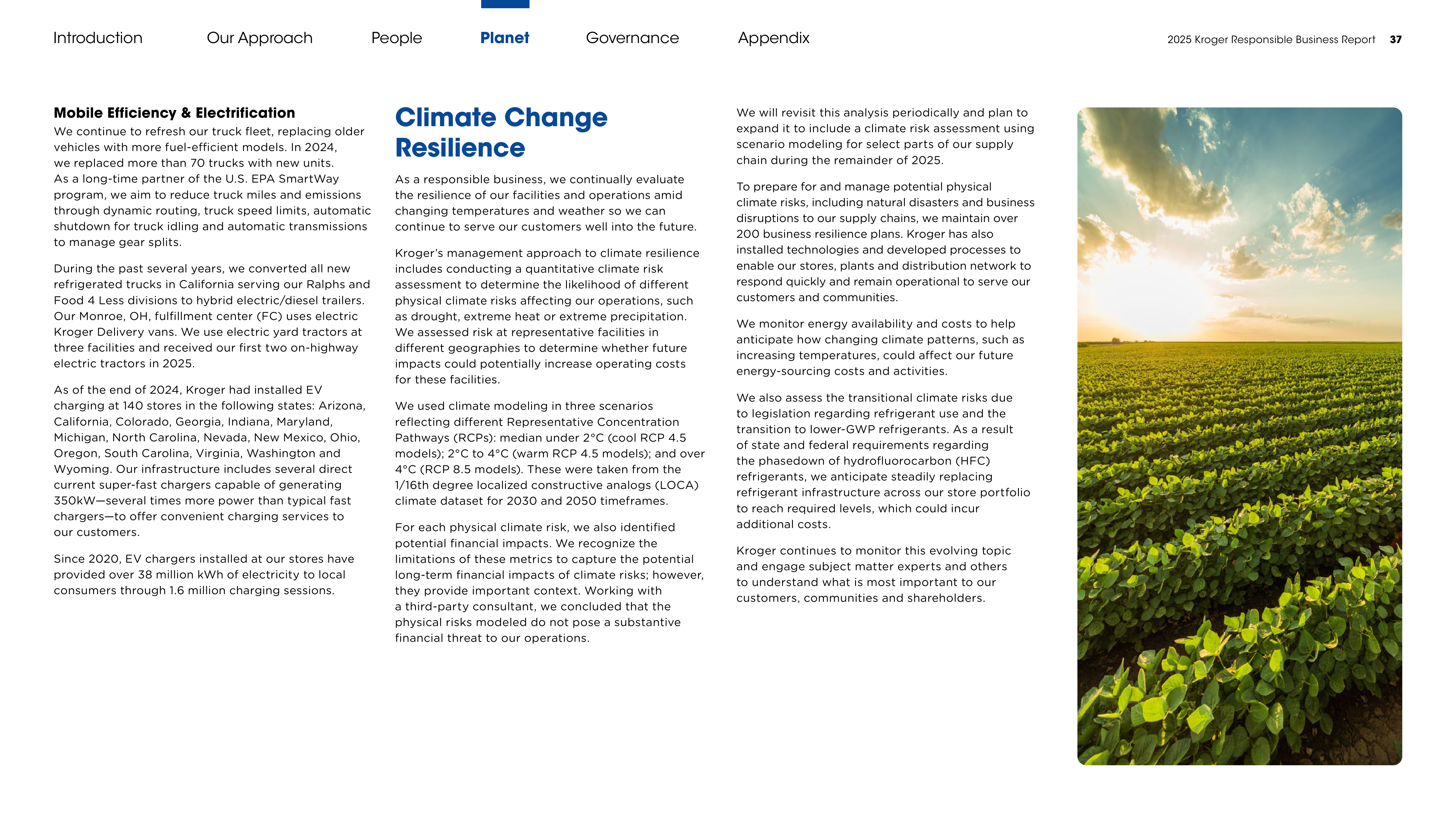

Mobile Efficiency & Electrification
We continue to refresh our truck fleet, replacing older
vehicles with more fuel-efficient models. In 2024,
we replaced more than 70 trucks with new units.
As a long-time partner of the U.S. EPA SmartWay
program, we aim to reduce truck miles and emissions
through dynamic routing, truck speed limits, automatic
shutdown for truck idling and automatic transmissions
to manage gear splits.
During the past several years, we converted all new
refrigerated trucks in California serving our Ralphs and
Food 4 Less divisions to hybrid electric/diesel trailers.
Our Monroe, OH, fulfillment center (FC) uses electric
Kroger Delivery vans. We use electric yard tractors at
three facilities and received our first two on-highway
electric tractors in 2025.
As of the end of 2024, Kroger had installed EV
charging at 140 stores in the following states: Arizona,
California, Colorado, Georgia, Indiana, Maryland,
Michigan, North Carolina, Nevada, New Mexico, Ohio,
Oregon, South Carolina, Virginia, Washington and
Wyoming. Our infrastructure includes several direct
current super-fast chargers capable of generating
350kW—several times more power than typical fast
chargers—to offer convenient charging services to
our customers.
Since 2020, EV chargers installed at our stores have
provided over 38 million kWh of electricity to local
consumers through 1.6 million charging sessions.
Climate Change
Resilience
As a responsible business, we continually evaluate
the resilience of our facilities and operations amid
changing temperatures and weather so we can
continue to serve our customers well into the future.
Kroger’s management approach to climate resilience
includes conducting a quantitative climate risk
assessment to determine the likelihood of different
physical climate risks affecting our operations, such
as drought, extreme heat or extreme precipitation.
We assessed risk at representative facilities in
different geographies to determine whether future
impacts could potentially increase operating costs
for these facilities.
We used climate modeling in three scenarios
reflecting different Representative Concentration
Pathways (RCPs): median under 2°C (cool RCP 4.5
models); 2°C to 4°C (warm RCP 4.5 models); and over
4°C (RCP 8.5 models). These were taken from the
1/16th degree localized constructive analogs (LOCA)
climate dataset for 2030 and 2050 timeframes.
For each physical climate risk, we also identified
potential financial impacts. We recognize the
limitations of these metrics to capture the potential
long-term financial impacts of climate risks; however,
they provide important context. Working with
a third-party consultant, we concluded that the
physical risks modeled do not pose a substantive
financial threat to our operations.
We will revisit this analysis periodically and plan to
expand it to include a climate risk assessment using
scenario modeling for select parts of our supply
chain during the remainder of 2025.
To prepare for and manage potential physical
climate risks, including natural disasters and business
disruptions to our supply chains, we maintain over
200 business resilience plans. Kroger has also
installed technologies and developed processes to
enable our stores, plants and distribution network to
respond quickly and remain operational to serve our
customers and communities.
We monitor energy availability and costs to help
anticipate how changing climate patterns, such as
increasing temperatures, could affect our future
energy-sourcing costs and activities.
We also assess the transitional climate risks due
to legislation regarding refrigerant use and the
transition to lower-GWP refrigerants. As a result
of state and federal requirements regarding
the phasedown of hydrofluorocarbon (HFC)
refrigerants, we anticipate steadily replacing
refrigerant infrastructure across our store portfolio
to reach required levels, which could incur
additional costs.
Kroger continues to monitor this evolving topic
and engage subject matter experts and others
to understand what is most important to our
customers, communities and shareholders.
People
Our Approach
Introduction
2025 Kroger Responsible Business Report
37
Appendix
Governance
Planet
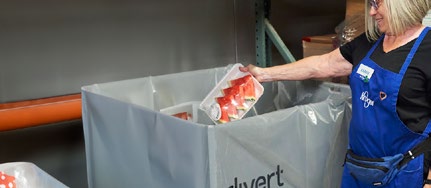


We are moving toward more circular systems in our operations and in
Our Brands
product packaging to reduce the impact of waste on our planet.
We focus on waste reduction, reuse and recycling opportunities to advance
progress on our goals.
Waste & Circularity
52%
percentage of
Our Brands
product
packaging that is recyclable, reusable
or compostable
2.7M
pieces of
Our Brands
plastic
packaging our customers sent
to TerraCycle® for recycling
since 2021
Our Approach
Leaders across our lines of business work collaboratively
to reduce waste company-wide. Guided by our
strategic approach to waste reduction and diversion,
each supermarket division has an Expense, Sanitation
and Sustainability Manager who implements programs
with oversight from a centralized Retail Operations
team. These division managers oversee waste diversion
efforts, including operational waste recycling and food
waste recycling.
Retail store managers support the everyday execution
of these programs to make sure we are making progress
on our goals. Similarly, our Supply Chain team has
sustainability leads who help guide waste reduction and
waste recovery initiatives in these facilities.
We express our ambition through Kroger’s Zero
Hunger | Zero Waste impact plan, aiming to achieve
a 90%+ waste diversion rate across the company. We
expect to continue increasing waste diversion from
landfills through enhanced collaboration across our
facilities, convenient food waste recycling programs
and the expanding role of reusable plastic containers.
In 2024, our company-wide waste diversion rate
improved to 85%, up from 82% a year ago. Total waste
generated increased (regardless of destination);
however, the amount of waste sent to landfills and
waste-to-energy processing decreased as recycling
and data quality improved.
The total volume of food waste diverted from landfills
improved by 17% in 2024. We saw year-over-year
variation in waste volumes sent to different food
waste recycling outlets, reflecting the expanding role
of anaerobic digestion (AD) programs in our stores.
Total annual food and non-food donations increased.
In-store pharmacy teams piloted solutions to recycle
stock pill bottles during 2024 and continue to expand
this program to more locations in 2025.
We continue to expand the use of reusable plastic
containers (RPCs)—used to distribute produce, eggs,
milk, meat and bread—to more functions and facilities
to reduce the amount of waste generated. Since 2024,
we grew the use of produce RPCs by more than half,
and expect to double their use by the end of 2026.
To enhance responsible disposal practices, our
Environmental Compliance team oversees processes
for our stores to properly manage unsalable products,
store-use chemicals and other products that have
reached the end of their useful life. Licensed hazardous
waste vendors collect materials from our sites for
appropriate disposal, reuse, recycling or destruction in
full compliance with applicable regulations.
Engaging Our Associates
Kroger’s associates help achieve our Zero Hunger |
Zero Waste mission by implementing store and supply
chain facility programs every day to reduce waste.
Our Zero Hunger | Zero Waste retail store certification
program is designed to engage more associates through
our training platform and connect everyday work to
Our Purpose and impact plan. The six training modules
include: general markdowns, produce markdowns, Food
Rescue (surplus food donations), food waste recycling,
plastic film recycling and cardboard recycling programs.
New associates are expected to complete all six training
modules listed above to become certified.
In 2025, we introduced an advanced version of this
certification with new department-specific training
modules for all store leaders and departments. We also
recognized retail divisions for top performance in food
donations and food waste recycling programs, as well as
stores achieving 90%+ diversion from landfill.
We use “always-on” information-sharing tools with our
associates to improve program execution, including more
centralized and comprehensive metrics dashboards.
2,213
stores with food waste
de-packaging programs
by end of 2025
Material Topics
WASTE & CIRCULARITY
FOOD WASTE
Company-Wide Waste Diversion-from-Landfill Rate
2022
2023
2024
82%
82%
85%
17%
increase in food
waste recycling
volume in 2024
People
Our Approach
Introduction
2025 Kroger Responsible Business Report
38
Appendix
Governance
Planet
2023 Weight
(short tons)
2024 Weight
(short tons)
2023 to 2024 Year-
Over-Year Change
(%)
Reuse (RPCs)
2
347,634
419,769
+21%
Donations
3
61,983
63,770
+3%
Animal feed
62,418
56,164
-10%
Anaerobic digestion (AD)
4
118,138
151,875
+29%
Composting
102,415
122,986
+20%
Baled cardboard
749,722
781,120
+4%
Baled plastic
29,215
44,659
+53%
Wood & pallets
738,876
926,034
+25%
Other recycling
5
219,705
283,041
+29%
Waste to energy
6
5,254
7,921
+51%
Landfill
526,978
490,867
-7%
Total waste (excluding reuse)
2,614,703
2,928,437
+12.0%
Total waste footprint
(including reuse)
2,962,337
3,348,206
+13.0%
Diversion
82.0%
85.1%
+3.8%
Waste Management Data
1
2024 performance—short tons
1.
Data reflects calendar year with the exception of construction waste, which reflects fiscal year. Waste is managed and reported to Kroger by our different waste and
recycling haulers. Waste data excludes office locations and salvage centers, which represent very small proportions of our waste footprint. Table may not sum due
to rounding
2.
Total waste generated excludes the reuse of reusable plastic containers (RPCs) in our supply chain network, though we do include these in our waste
diversion calculation
3.
Donation data primarily reflects food donations, with a small amount of non-food donations
4.
AD weights increased significantly in 2024 as Kroger expanded the use of AD programs and de-packaging solutions in our stores
5.
Construction project waste and recycling data excludes minor capital projects
6.
In the 2023 data, some volume classified as waste-to-energy in previous years was found to be going to AD (a by-product of which is fuel that is used to generate
energy on-site). A small portion of the volume ended up going to compost and animal feed
Managing Food Waste
Keeping food waste out of landfills is a key part of
Kroger’s Zero Hunger | Zero Waste impact plan.
Our current ambition focuses on two main areas for
improvements through 2025:
•
Reducing the total amount of food waste generated
in our stores by 50% (2017 baseline)
•
Improving how we manage remaining food
waste by diverting 95% or more from landfills
We do this by selling through as much food as we can,
safely donating eligible food that can no longer be sold,
and increasing the amount of remaining unsold food
directed to food waste recycling programs to ensure
as little food as possible ends up in landfills, where it
produces GHG emissions.
Food Waste Reduction
To prevent fresh food from being wasted in the
first place, we aim to sell as much as possible in
our stores. Established markdown programs in all
fresh departments make items more affordable and
encourage faster sale. Our produce markdown (redbag)
program, through which we discount and sell imperfect
produce, is a customer favorite. Kroger also developed
automated and dynamic markdown systems for more
consistent program execution.
Every day, our associates rescue remaining surplus fresh
food to feed people in our communities. Kroger donates
eligible fresh, safe food to hunger relief organizations in
our local communities. In 2024, we donated 119 million
pounds of surplus food to Feeding America’s network
of food banks and agency partners through our Zero
Hunger | Zero Waste Food Rescue program.
Improving Diversion
We aim to divert remaining unsold food that cannot be
donated to our communities through a combination of
animal feed programs, composting, AD and biodiesel
generation, each with their own benefits for Kroger and
the environment.
In 2024, we operated food waste recycling programs
in 97% of our stores, achieving our goal of 95% store
participation two years ahead of schedule. In 2024, we
launched food waste recycling programs in more than
100 retail stores.
Kroger also introduced a new AD recovery program in
a significant number of stores last year. Our primary
AD program provider, Divert, Inc., offers innovative
de-packaging technology that eliminates the need to
remove food from packaging on-site before recycling,
simplifying the process for our store associates and
making it easier to recycle store food waste in day-to-
day operations.
By the end of 2024, this Divert de-packaging solution
was in place at 1,324 Kroger-operated stores. In 2025,
we are expanding the program to include more than
400 additional stores.
As a result of increased access to these recycling
programs and improved store execution and data
quality, Kroger increased the total amount of food
waste recycled by 17% in 2024.
People
Our Approach
Introduction
2025 Kroger Responsible Business Report
39
Appendix
Governance
Planet
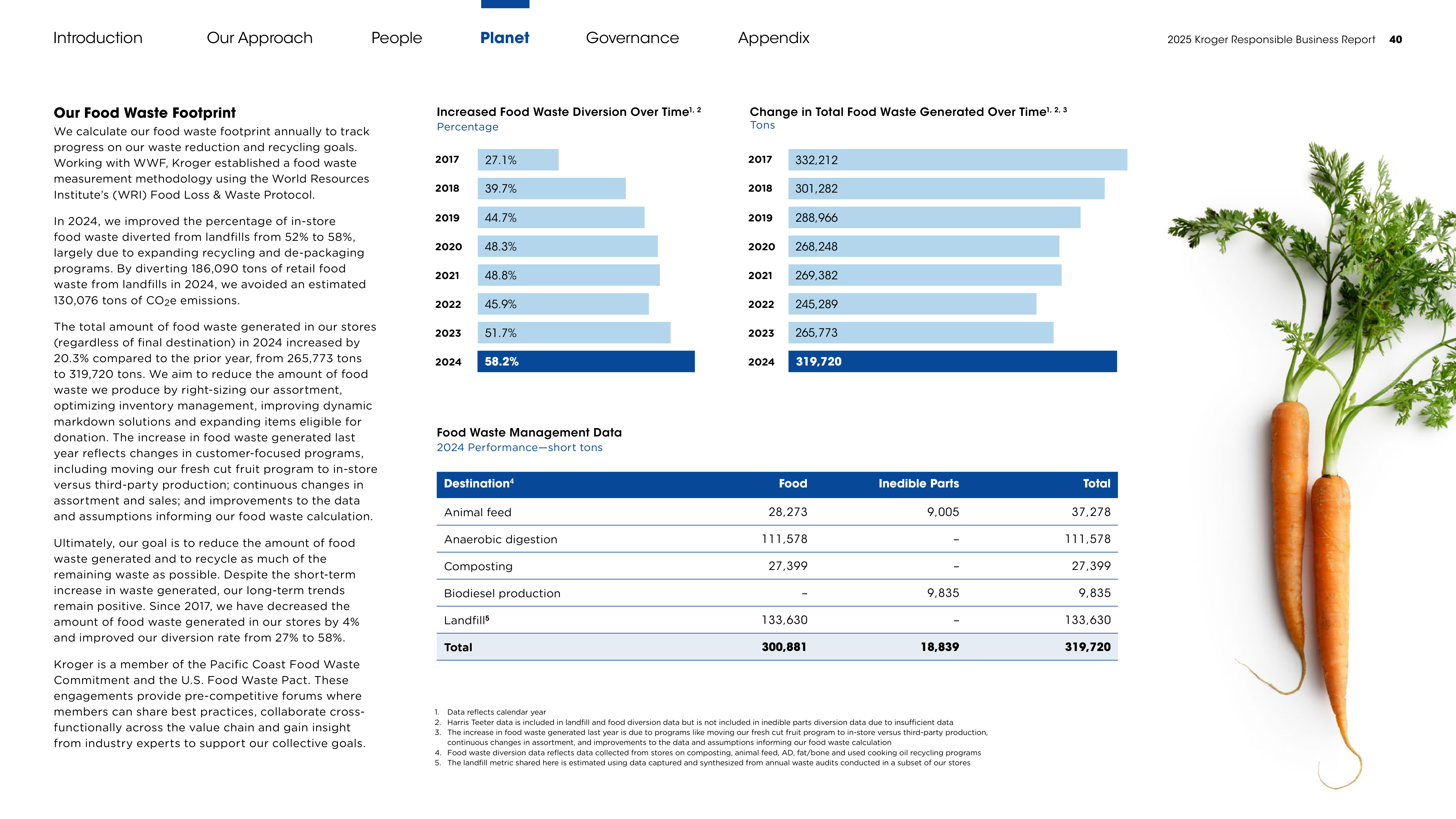

Our Food Waste Footprint
We calculate our food waste footprint annually to track
progress on our waste reduction and recycling goals.
Working with WWF, Kroger established a food waste
measurement methodology using the World Resources
Institute’s (WRI) Food Loss & Waste Protocol.
In 2024, we improved the percentage of in-store
food waste diverted from landfills from 52% to 58%,
largely due to expanding recycling and de-packaging
programs. By diverting 186,090 tons of retail food
waste from landfills in 2024, we avoided an estimated
130,076 tons of CO
2
e emissions.
The total amount of food waste generated in our stores
(regardless of final destination) in 2024 increased by
20.3% compared to the prior year, from 265,773 tons
to 319,720 tons. We aim to reduce the amount of food
waste we produce by right-sizing our assortment,
optimizing inventory management, improving dynamic
markdown solutions and expanding items eligible for
donation. The increase in food waste generated last
year reflects changes in customer-focused programs,
including moving our fresh cut fruit program to in-store
versus third-party production; continuous changes in
assortment and sales; and improvements to the data
and assumptions informing our food waste calculation.
Ultimately, our goal is to reduce the amount of food
waste generated and to recycle as much of the
remaining waste as possible. Despite the short-term
increase in waste generated, our long-term trends
remain positive. Since 2017, we have decreased the
amount of food waste generated in our stores by 4%
and improved our diversion rate from 27% to 58%.
Kroger is a member of the Pacific Coast Food Waste
Commitment and the U.S. Food Waste Pact. These
engagements provide pre-competitive forums where
members can share best practices, collaborate cross-
functionally across the value chain and gain insight
from industry experts to support our collective goals.
Destination
4
Food
Inedible Parts
Total
Animal feed
28,273
9,005
37,278
Anaerobic digestion
111,578
–
111,578
Composting
27,399
–
27,399
Biodiesel production
–
9,835
9,835
Landfill
5
133,630
–
133,630
Total
300,881
18,839
319,720
Food Waste Management Data
2024 Performance—short tons
Increased Food Waste Diversion Over Time
1, 2
Percentage
1.
Data reflects calendar year
2.
Harris Teeter data is included in landfill and food diversion data but is not included in inedible parts diversion data due to insufficient data
3.
The increase in food waste generated last year is due to programs like moving our fresh cut fruit program to in-store versus third-party production,
continuous changes in assortment, and improvements to the data and assumptions informing our food waste calculation
4.
Food waste diversion data reflects data collected from stores on composting, animal feed, AD, fat/bone and used cooking oil recycling programs
5.
The landfill metric shared here is estimated using data captured and synthesized from annual waste audits conducted in a subset of our stores
Change in Total Food Waste Generated Over Time
1, 2, 3
Tons
2020
2021
2019
2017
2018
288,966
332,212
301,282
268,248
269,382
2022
2023
2024
245,289
265,773
319,720
2020
2021
2019
2017
2018
2022
2023
2024
44.7%
27.1%
39.7%
48.3%
48.8%
45.9%
51.7%
58.2%
People
Our Approach
Introduction
2025 Kroger Responsible Business Report
40
Appendix
Governance
Planet
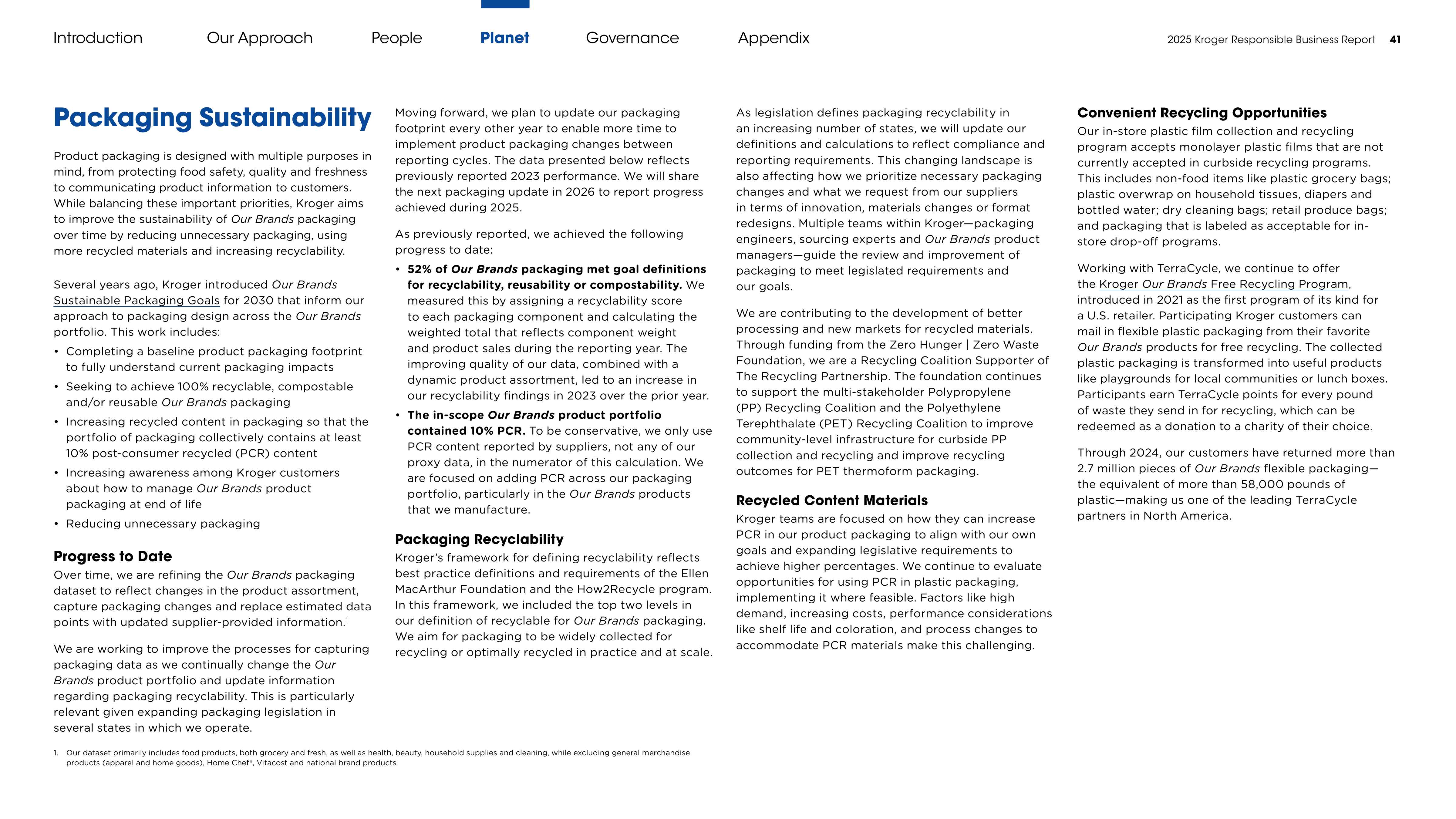
Packaging Sustainability
Product packaging is designed with multiple purposes in
mind, from protecting food safety, quality and freshness
to communicating product information to customers.
While balancing these important priorities, Kroger aims
to improve the sustainability of
Our Brands
packaging
over time by reducing unnecessary packaging, using
more recycled materials and increasing recyclability.
Several years ago, Kroger introduced
Our Brands
Sustainable Packaging Goals for 2030 that inform our
approach to packaging design across the
Our Brands
portfolio. This work includes:
•
Completing a baseline product packaging footprint
to fully understand current packaging impacts
•
Seeking to achieve 100% recyclable, compostable
and/or reusable
Our Brands
packaging
•
Increasing recycled content in packaging so that the
portfolio of packaging collectively contains at least
10% post-consumer recycled (PCR) content
•
Increasing awareness among Kroger customers
about how to manage
Our Brands
product
packaging at end of life
•
Reducing unnecessary packaging
Progress to Date
Over time, we are refining the
Our Brands
packaging
dataset to reflect changes in the product assortment,
capture packaging changes and replace estimated data
points with updated supplier-provided information.
1
We are working to improve the processes for capturing
packaging data as we continually change the
Our
Brands
product portfolio and update information
regarding packaging recyclability. This is particularly
relevant given expanding packaging legislation in
several states in which we operate.
Moving forward, we plan to update our packaging
footprint every other year to enable more time to
implement product packaging changes between
reporting cycles. The data presented below reflects
previously reported 2023 performance. We will share
the next packaging update in 2026 to report progress
achieved during 2025.
As previously reported, we achieved the following
progress to date:
•
52% of
Our Brands
packaging met goal definitions
for recyclability, reusability or compostability.
We
measured this by assigning a recyclability score
to each packaging component and calculating the
weighted total that reflects component weight
and product sales during the reporting year. The
improving quality of our data, combined with a
dynamic product assortment, led to an increase in
our recyclability findings in 2023 over the prior year.
•
The in-scope
Our Brands
product portfolio
contained 10% PCR.
To be conservative, we only use
PCR content reported by suppliers, not any of our
proxy data, in the numerator of this calculation. We
are focused on adding PCR across our packaging
portfolio, particularly in the
Our Brands
products
that we manufacture.
Packaging Recyclability
Kroger’s framework for defining recyclability reflects
best practice definitions and requirements of the Ellen
MacArthur Foundation and the How2Recycle program.
In this framework, we included the top two levels in
our definition of recyclable for
Our Brands
packaging.
We aim for packaging to be widely collected for
recycling or optimally recycled in practice and at scale.
1.
Our dataset primarily includes food products, both grocery and fresh, as well as health, beauty, household supplies and cleaning, while excluding general merchandise
products (apparel and home goods), Home Chef®, Vitacost and national brand products
As legislation defines packaging recyclability in
an increasing number of states, we will update our
definitions and calculations to reflect compliance and
reporting requirements. This changing landscape is
also affecting how we prioritize necessary packaging
changes and what we request from our suppliers
in terms of innovation, materials changes or format
redesigns. Multiple teams within Kroger—packaging
engineers, sourcing experts and
Our Brands
product
managers—guide the review and improvement of
packaging to meet legislated requirements and
our goals.
We are contributing to the development of better
processing and new markets for recycled materials.
Through funding from the Zero Hunger | Zero Waste
Foundation, we are a Recycling Coalition Supporter of
The Recycling Partnership. The foundation continues
to support the multi-stakeholder Polypropylene
(PP) Recycling Coalition and the Polyethylene
Terephthalate (PET) Recycling Coalition to improve
community-level infrastructure for curbside PP
collection and recycling and improve recycling
outcomes for PET thermoform packaging.
Recycled Content Materials
Kroger teams are focused on how they can increase
PCR in our product packaging to align with our own
goals and expanding legislative requirements to
achieve higher percentages. We continue to evaluate
opportunities for using PCR in plastic packaging,
implementing it where feasible. Factors like high
demand, increasing costs, performance considerations
like shelf life and coloration, and process changes to
accommodate PCR materials make this challenging.
Convenient Recycling Opportunities
Our in-store plastic film collection and recycling
program accepts monolayer plastic films that are not
currently accepted in curbside recycling programs.
This includes non-food items like plastic grocery bags;
plastic overwrap on household tissues, diapers and
bottled water; dry cleaning bags; retail produce bags;
and packaging that is labeled as acceptable for in-
store drop-off programs.
Working with TerraCycle, we continue to offer
the Kroger
Our Brands
Free Recycling Program,
introduced in 2021 as the first program of its kind for
a U.S. retailer. Participating Kroger customers can
mail in flexible plastic packaging from their favorite
Our Brands
products for free recycling. The collected
plastic packaging is transformed into useful products
like playgrounds for local communities or lunch boxes.
Participants earn TerraCycle points for every pound
of waste they send in for recycling, which can be
redeemed as a donation to a charity of their choice.
Through 2024, our customers have returned more than
2.7 million pieces of
Our Brands
flexible packaging—
the equivalent of more than 58,000 pounds of
plastic—making us one of the leading TerraCycle
partners in North America.
People
Our Approach
Introduction
2025 Kroger Responsible Business Report
41
Appendix
Governance
Planet
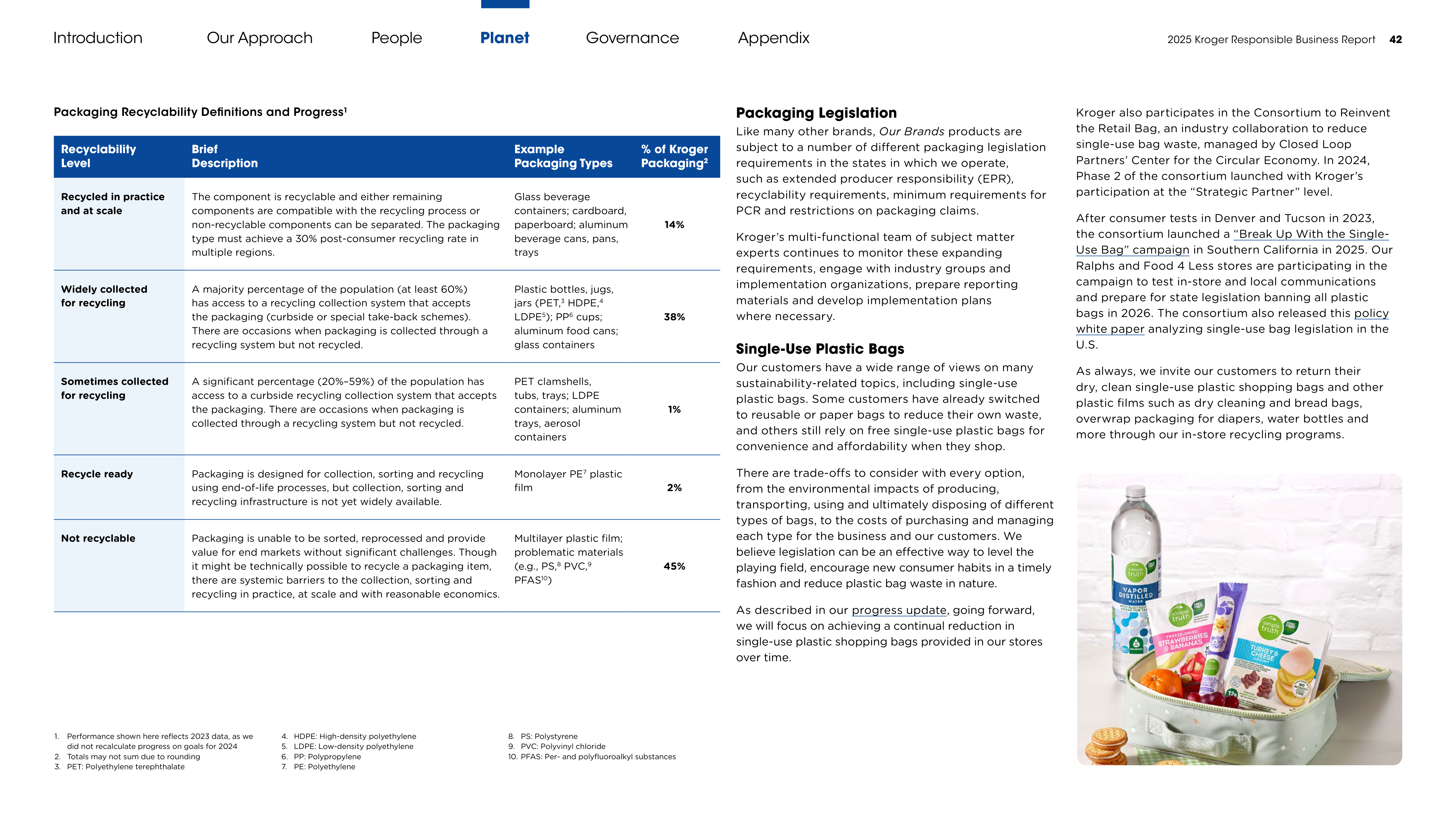
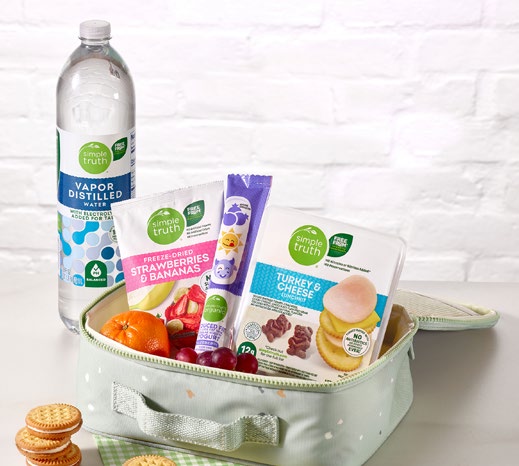
Packaging Legislation
Like many other brands,
Our Brands
products are
subject to a number of different packaging legislation
requirements in the states in which we operate,
such as extended producer responsibility (EPR),
recyclability requirements, minimum requirements for
PCR and restrictions on packaging claims.
Kroger’s multi-functional team of subject matter
experts continues to monitor these expanding
requirements, engage with industry groups and
implementation organizations, prepare reporting
materials and develop implementation plans
where necessary.
Single-Use Plastic Bags
Our customers have a wide range of views on many
sustainability-related topics, including single-use
plastic bags. Some customers have already switched
to reusable or paper bags to reduce their own waste,
and others still rely on free single-use plastic bags for
convenience and affordability when they shop.
There are trade-offs to consider with every option,
from the environmental impacts of producing,
transporting, using and ultimately disposing of different
types of bags, to the costs of purchasing and managing
each type for the business and our customers. We
believe legislation can be an effective way to level the
playing field, encourage new consumer habits in a timely
fashion and reduce plastic bag waste in nature.
As described in our progress update, going forward,
we will focus on achieving a continual reduction in
single-use plastic shopping bags provided in our stores
over time.
Kroger also participates in the Consortium to Reinvent
the Retail Bag, an industry collaboration to reduce
single-use bag waste, managed by Closed Loop
Partners’ Center for the Circular Economy. In 2024,
Phase 2 of the consortium launched with Kroger’s
participation at the “Strategic Partner” level.
After consumer tests in Denver and Tucson in 2023,
the consortium launched a “Break Up With the Single-
Use Bag” campaign in Southern California in 2025. Our
Ralphs and Food 4 Less stores are participating in the
campaign to test in-store and local communications
and prepare for state legislation banning all plastic
bags in 2026. The consortium also released this policy
white paper analyzing single-use bag legislation in the
U.S.
As always, we invite our customers to return their
dry, clean single-use plastic shopping bags and other
plastic films such as dry cleaning and bread bags,
overwrap packaging for diapers, water bottles and
more through our in-store recycling programs.
Recyclability
Level
Brief
Description
Example
Packaging Types
% of Kroger
Packaging
2
Recycled in practice
and at scale
The component is recyclable and either remaining
components are compatible with the recycling process or
non-recyclable components can be separated. The packaging
type must achieve a 30% post-consumer recycling rate in
multiple regions.
Glass beverage
containers; cardboard,
paperboard; aluminum
beverage cans, pans,
trays
14%
Widely collected
for recycling
A majority percentage of the population (at least 60%)
has access to a recycling collection system that accepts
the packaging (curbside or special take-back schemes).
There are occasions when packaging is collected through a
recycling system but not recycled.
Plastic bottles, jugs,
jars (PET,
3
HDPE,
4
LDPE
5
); PP
6
cups;
aluminum food cans;
glass containers
38%
Sometimes collected
for recycling
A significant percentage (20%–59%) of the population has
access to a curbside recycling collection system that accepts
the packaging. There are occasions when packaging is
collected through a recycling system but not recycled.
PET clamshells,
tubs, trays; LDPE
containers; aluminum
trays, aerosol
containers
1%
Recycle ready
Packaging is designed for collection, sorting and recycling
using end-of-life processes, but collection, sorting and
recycling infrastructure is not yet widely available.
Monolayer PE
7
plastic
film
2%
Not recyclable
Packaging is unable to be sorted, reprocessed and provide
value for end markets without significant challenges. Though
it might be technically possible to recycle a packaging item,
there are systemic barriers to the collection, sorting and
recycling in practice, at scale and with reasonable economics.
Multilayer plastic film;
problematic materials
(e.g., PS,
8
PVC,
9
PFAS
10
)
45%
Packaging Recyclability Definitions and Progress¹
1.
Performance shown here reflects 2023 data, as we
did not recalculate progress on goals for 2024
2.
Totals may not sum due to rounding
3.
PET: Polyethylene terephthalate
4.
HDPE: High-density polyethylene
5.
LDPE: Low-density polyethylene
6.
PP: Polypropylene
7.
PE: Polyethylene
8.
PS: Polystyrene
9.
PVC: Polyvinyl chloride
10. PFAS: Per- and polyfluoroalkyl substances
People
Our Approach
Introduction
2025 Kroger Responsible Business Report
42
Appendix
Governance
Planet



Kroger relies on natural resources to operate our business and bring a wide
range of products from around the world to our customers. Our goals to protect
biodiversity, improve agricultural practices and conserve water reflect our ambition
to work with suppliers to ensure these resources are available far into the future.
Biodiversity & Resource Conservation
38
fishery improvement projects
supported in 2024
5K+
natural and organic
items in the average
Kroger-operated store
Our Approach
Kroger’s Zero Hunger | Zero Waste impact plan and
other public goals—including emissions reduction,
no-deforestation, seafood sustainability, pollinator
protection and dairy stewardship goals—support a
wide range of positive changes in our supply chain.
Leaders in Merchandising, Sourcing and
Communications & Public Affairs work together
to manage key product categories that may pose
higher risk and where we identify opportunities for
change. Kroger’s senior leadership team and Public
Responsibilities Committee of the Board provide
additional direction and oversight.
Kroger continues to monitor emerging nature-
based frameworks for sustainability, including
those designed for target-setting and disclosure, so
we can evaluate the potential impact to Kroger of
new guidelines and expectations on this complex
topic. We also engage our suppliers for insights and
feedback when setting expectations in key categories.
An ongoing biodiversity risk assessment conducted in
tandem with a refreshed climate risk assessment—now
including select commodities from our supply chain—
will help Kroger better understand the types and
magnitudes of risks in our commodity supply chains.
Supply Chain
Sustainability
As a leading manufacturer, retailer and distributor of
food products and other essentials, we believe it is
important for our business to maintain healthy natural
ecosystems that sustain our supply chain and support
our global food system.
Agricultural Practices
Encouraging our suppliers to adopt more sustainable
agricultural practices in ways that work for their
business is an important part of our approach. We
believe collaboration with our vendors, suppliers
and the broader value chain is critical for achieving
meaningful changes over time and building a more
resilient food system for the future.
As a dairy processor, Kroger is a signatory of the
U.S. Dairy Stewardship Commitment, which seeks
to monitor and reduce the environmental impacts
of the dairy industry. We are also members of Field
to Market: The Alliance for Sustainable Agriculture,
which develops science-driven and outcomes-based
programs and tools for industry collaboration.
Material Topics
BIODIVERSITY & CONSERVATION
AGRICULTURAL PRACTICES
WATER
Integrated Pest Management Practices
In 2024, we shared Kroger’s Goal to Protect Pollinators
& Biodiversity, which requires fresh produce suppliers to
implement Integrated Pest Management (IPM) practices
for all products supplied to Kroger. We expect medium-
to large-sized suppliers to meet this requirement by the
end of 2028, with smaller suppliers to follow by 2030.
We worked with Sustainable Food Group, a branch of
the IPM Institute of North America, to develop this goal.
We surveyed a sample of suppliers—representing about
40% of Kroger’s fresh produce spend—on topics like
pest management, soil health, biodiversity and water
conservation. From this survey, we also learned that
suppliers would appreciate efforts to streamline produce
growing requirements across retailers and other food
buyers, if it could be done in a pre-competitive manner.
Kroger is developing our approach for implementing
this goal for the coming years. We believe engaging our
suppliers, carefully reviewing certifications and making
informed sourcing decisions will advance progress
toward our goal and reduce supply chain impacts on
pollinators.
$1.45M
contributed to
Community Development
Funds from Kroger’s
Fair Trade Certified
purchases in 2024
Biodiversity
risk assessment
in process
People
Our Approach
Introduction
2025 Kroger Responsible Business Report
43
Appendix
Governance
Planet
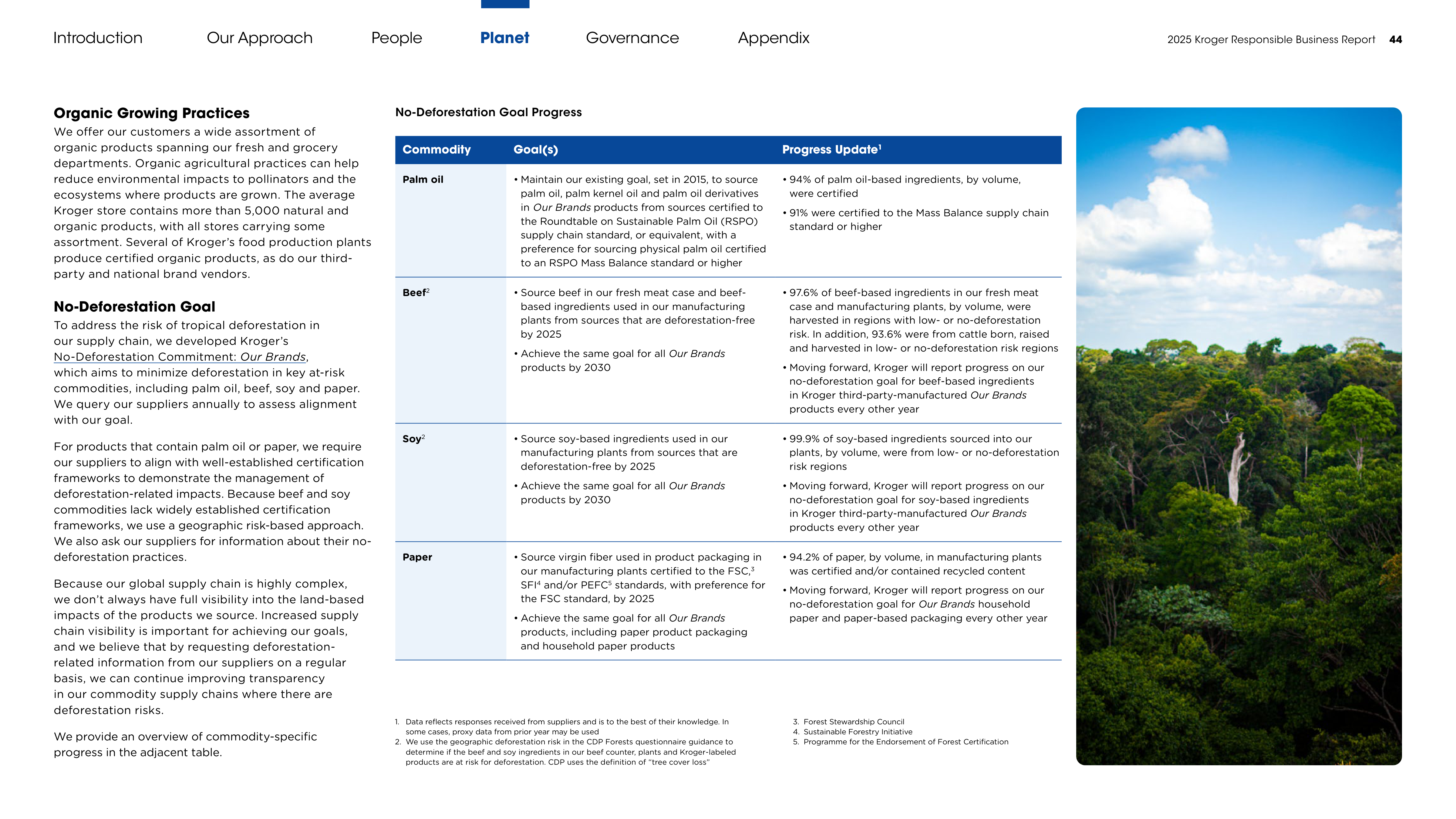

Commodity
Goal(s)
Progress Update
1
Palm oil
• Maintain our existing goal, set in 2015, to source
palm oil, palm kernel oil and palm oil derivatives
in Our Brands products from sources certified to
the Roundtable on Sustainable Palm Oil (RSPO)
supply chain standard, or equivalent, with a
preference for sourcing physical palm oil certified
to an RSPO Mass Balance standard or higher
• 94% of palm oil-based ingredients, by volume,
were certified
• 91% were certified to the Mass Balance supply chain
standard or higher
Beef
2
• Source beef in our fresh meat case and beef-
based ingredients used in our manufacturing
plants from sources that are deforestation-free
by 2025
• Achieve the same goal for all
Our Brands
products by 2030
• 97.6% of beef-based ingredients in our fresh meat
case and manufacturing plants, by volume, were
harvested in regions with low- or no-deforestation
risk. In addition, 93.6% were from cattle born, raised
and harvested in low- or no-deforestation risk regions
• Moving forward, Kroger will report progress on our
no-deforestation goal for beef-based ingredients
in Kroger third-party-manufactured
Our Brands
products every other year
Soy
2
• Source soy-based ingredients used in our
manufacturing plants from sources that are
deforestation-free by 2025
• Achieve the same goal for all
Our Brands
products by 2030
• 99.9% of soy-based ingredients sourced into our
plants, by volume, were from low- or no-deforestation
risk regions
• Moving forward, Kroger will report progress on our
no-deforestation goal for soy-based ingredients
in Kroger third-party-manufactured
Our Brands
products every other year
Paper
• Source virgin fiber used in product packaging in
our manufacturing plants certified to the FSC,
3
SFI
4
and/or PEFC
5
standards, with preference for
the FSC standard, by 2025
• Achieve the same goal for all
Our Brands
products, including paper product packaging
and household paper products
• 94.2% of paper, by volume, in manufacturing plants
was certified and/or contained recycled content
• Moving forward, Kroger will report progress on our
no-deforestation goal for
Our Brands
household
paper and paper-based packaging every other year
No-Deforestation Goal Progress
1.
Data reflects responses received from suppliers and is to the best of their knowledge. In
some cases, proxy data from prior year may be used
2. We use the geographic deforestation risk in the CDP Forests questionnaire guidance to
determine if the beef and soy ingredients in our beef counter, plants and Kroger-labeled
products are at risk for deforestation. CDP uses the definition of “tree cover loss”
Organic Growing Practices
We offer our customers a wide assortment of
organic products spanning our fresh and grocery
departments. Organic agricultural practices can help
reduce environmental impacts to pollinators and the
ecosystems where products are grown. The average
Kroger store contains more than 5,000 natural and
organic products, with all stores carrying some
assortment. Several of Kroger’s food production plants
produce certified organic products, as do our third-
party and national brand vendors.
No-Deforestation Goal
To address the risk of tropical deforestation in
our supply chain, we developed Kroger’s
No-Deforestation Commitment:
Our Brands
,
which aims to minimize deforestation in key at-risk
commodities, including palm oil, beef, soy and paper.
We query our suppliers annually to assess alignment
with our goal.
For products that contain palm oil or paper, we require
our suppliers to align with well-established certification
frameworks to demonstrate the management of
deforestation-related impacts. Because beef and soy
commodities lack widely established certification
frameworks, we use a geographic risk-based approach.
We also ask our suppliers for information about their no-
deforestation practices.
Because our global supply chain is highly complex,
we don’t always have full visibility into the land-based
impacts of the products we source. Increased supply
chain visibility is important for achieving our goals,
and we believe that by requesting deforestation-
related information from our suppliers on a regular
basis, we can continue improving transparency
in our commodity supply chains where there are
deforestation risks.
We provide an overview of commodity-specific
progress in the adjacent table.
3. Forest Stewardship Council
4. Sustainable Forestry Initiative
5. Programme for the Endorsement of Forest Certification
People
Our Approach
Introduction
2025 Kroger Responsible Business Report
44
Appendix
Governance
Planet
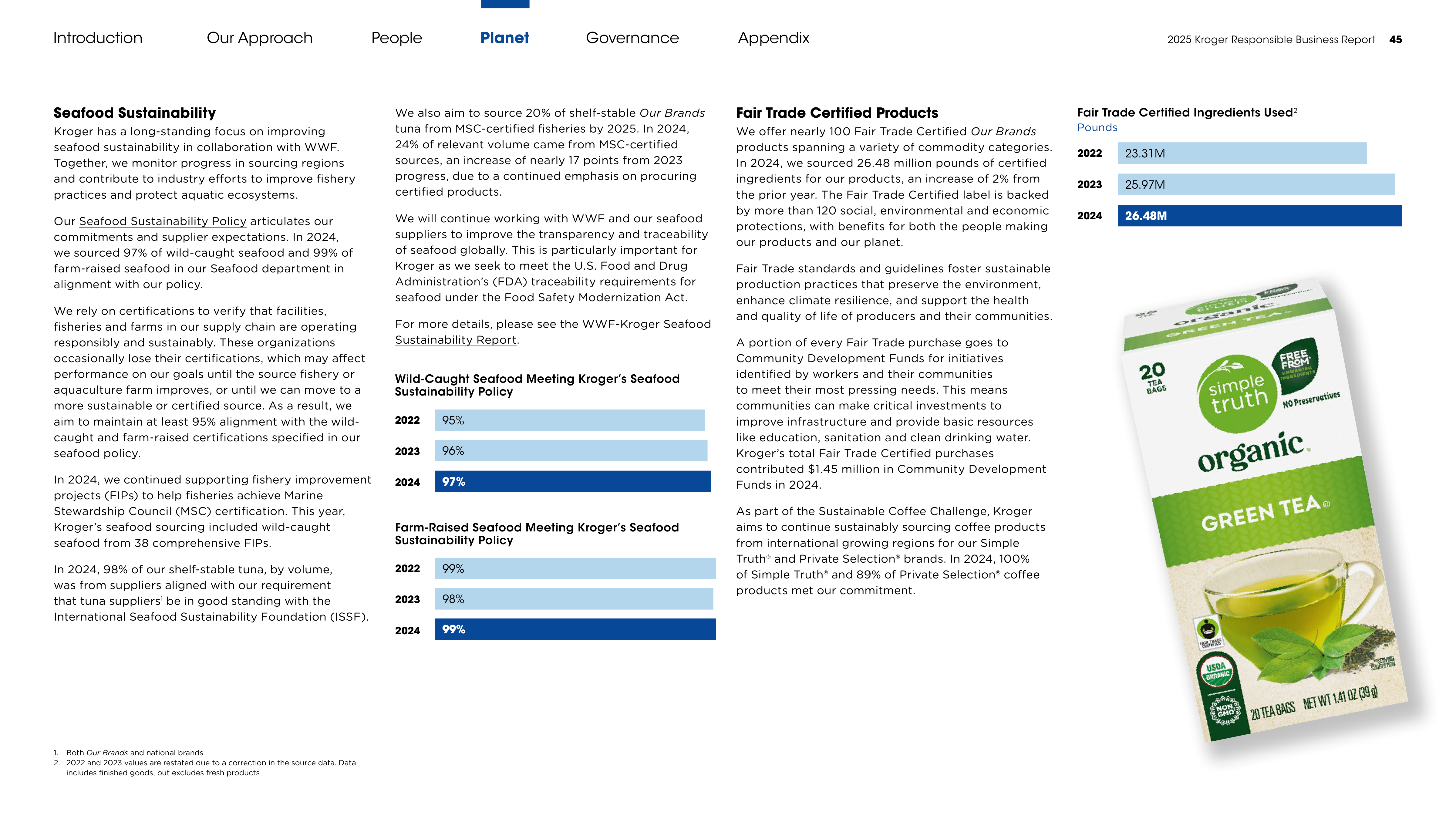
Fair Trade Certified Products
We offer nearly 100 Fair Trade Certified
Our Brands
products spanning a variety of commodity categories.
In 2024, we sourced 26.48 million pounds of certified
ingredients for our products, an increase of 2% from
the prior year. The Fair Trade Certified label is backed
by more than 120 social, environmental and economic
protections, with benefits for both the people making
our products and our planet.
Fair Trade standards and guidelines foster sustainable
production practices that preserve the environment,
enhance climate resilience, and support the health
and quality of life of producers and their communities.
A portion of every Fair Trade purchase goes to
Community Development Funds for initiatives
identified by workers and their communities
to meet their most pressing needs. This means
communities can make critical investments to
improve infrastructure and provide basic resources
like education, sanitation and clean drinking water.
Kroger’s total Fair Trade Certified purchases
contributed $1.45 million in Community Development
Funds in 2024.
As part of the Sustainable Coffee Challenge, Kroger
aims to continue sustainably sourcing coffee products
from international growing regions for our Simple
Truth® and Private Selection® brands. In 2024, 100%
of Simple Truth® and 89% of Private Selection® coffee
products met our commitment.
Fair Trade Certified Ingredients Used
2
Pounds
2022
2023
23.31M
25.97M
2024
26.48M
Seafood Sustainability
Kroger has a long-standing focus on improving
seafood sustainability in collaboration with WWF.
Together, we monitor progress in sourcing regions
and contribute to industry efforts to improve fishery
practices and protect aquatic ecosystems.
Our Seafood Sustainability Policy articulates our
commitments and supplier expectations. In 2024,
we sourced 97% of wild-caught seafood and 99% of
farm-raised seafood in our Seafood department in
alignment with our policy.
We rely on certifications to verify that facilities,
fisheries and farms in our supply chain are operating
responsibly and sustainably. These organizations
occasionally lose their certifications, which may affect
performance on our goals until the source fishery or
aquaculture farm improves, or until we can move to a
more sustainable or certified source. As a result, we
aim to maintain at least 95% alignment with the wild-
caught and farm-raised certifications specified in our
seafood policy.
In 2024, we continued supporting fishery improvement
projects (FIPs) to help fisheries achieve Marine
Stewardship Council (MSC) certification. This year,
Kroger’s seafood sourcing included wild-caught
seafood from 38 comprehensive FIPs.
In 2024, 98% of our shelf-stable tuna, by volume,
was from suppliers aligned with our requirement
that tuna suppliers
1
be in good standing with the
International Seafood Sustainability Foundation (ISSF).
We also aim to source 20% of shelf-stable
Our Brands
tuna from MSC-certified fisheries by 2025. In 2024,
24% of relevant volume came from MSC-certified
sources, an increase of nearly 17 points from 2023
progress, due to a continued emphasis on procuring
certified products.
We will continue working with WWF and our seafood
suppliers to improve the transparency and traceability
of seafood globally. This is particularly important for
Kroger as we seek to meet the U.S. Food and Drug
Administration’s (FDA) traceability requirements for
seafood under the Food Safety Modernization Act.
For more details, please see the WWF-Kroger Seafood
Sustainability Report.
Farm-Raised Seafood Meeting Kroger’s Seafood
Sustainability Policy
2022
99%
2023
2024
98%
99%
Wild-Caught Seafood Meeting Kroger’s Seafood
Sustainability Policy
2022
95%
2023
2024
96%
97%
1.
Both
Our Brands
and national brands
2.
2022 and 2023 values are restated due to a correction in the source data. Data
includes finished goods, but excludes fresh products
People
Our Approach
Introduction
2025 Kroger Responsible Business Report
45
Appendix
Governance
Planet
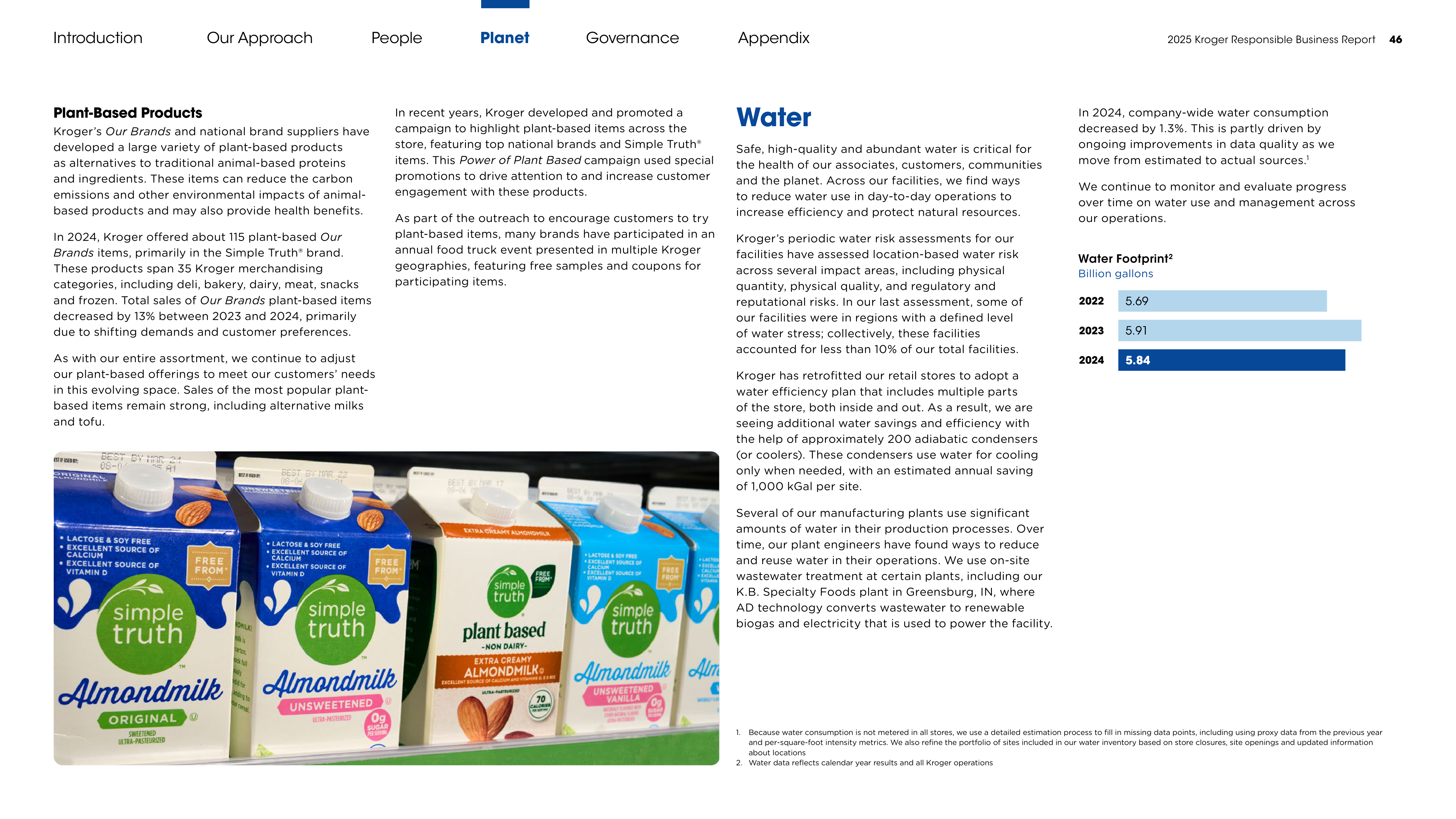
Water
Safe, high-quality and abundant water is critical for
the health of our associates, customers, communities
and the planet. Across our facilities, we find ways
to reduce water use in day-to-day operations to
increase efficiency and protect natural resources.
Kroger’s periodic water risk assessments for our
facilities have assessed location-based water risk
across several impact areas, including physical
quantity, physical quality, and regulatory and
reputational risks. In our last assessment, some of
our facilities were in regions with a defined level
of water stress; collectively, these facilities
accounted for less than 10% of our total facilities.
Kroger has retrofitted our retail stores to adopt a
water efficiency plan that includes multiple parts
of the store, both inside and out. As a result, we are
seeing additional water savings and efficiency with
the help of approximately 200 adiabatic condensers
(or coolers). These condensers use water for cooling
only when needed, with an estimated annual saving
of 1,000 kGal per site.
Several of our manufacturing plants use significant
amounts of water in their production processes. Over
time, our plant engineers have found ways to reduce
and reuse water in their operations. We use on-site
wastewater treatment at certain plants, including our
K.B. Specialty Foods plant in Greensburg, IN, where
AD technology converts wastewater to renewable
biogas and electricity that is used to power the facility.
1.
Because water consumption is not metered in all stores, we use a detailed estimation process to fill in missing data points, including using proxy data from the previous year
and per-square-foot intensity metrics. We also refine the portfolio of sites included in our water inventory based on store closures, site openings and updated information
about locations
2.
Water data reflects calendar year results and all Kroger operations
Water Footprint
2
Billion gallons
2022
2023
5.69
5.91
2024
5.84
In 2024, company-wide water consumption
decreased by 1.3%. This is partly driven by
ongoing improvements in data quality as we
move from estimated to actual sources.
1
We continue to monitor and evaluate progress
over time on water use and management across
our operations.
Plant-Based Products
Kroger’s
Our Brands
and national brand suppliers have
developed a large variety of plant-based products
as alternatives to traditional animal-based proteins
and ingredients. These items can reduce the carbon
emissions and other environmental impacts of animal-
based products and may also provide health benefits.
In 2024, Kroger offered about 115 plant-based
Our
Brands
items, primarily in the Simple Truth® brand.
These products span 35 Kroger merchandising
categories, including deli, bakery, dairy, meat, snacks
and frozen. Total sales of
Our Brands
plant-based items
decreased by 13% between 2023 and 2024, primarily
due to shifting demands and customer preferences.
As with our entire assortment, we continue to adjust
our plant-based offerings to meet our customers’ needs
in this evolving space. Sales of the most popular plant-
based items remain strong, including alternative milks
and tofu.
In recent years, Kroger developed and promoted a
campaign to highlight plant-based items across the
store, featuring top national brands and Simple Truth®
items. This Power of Plant Based campaign used special
promotions to drive attention to and increase customer
engagement with these products.
As part of the outreach to encourage customers to try
plant-based items, many brands have participated in an
annual food truck event presented in multiple Kroger
geographies, featuring free samples and coupons for
participating items.
People
Our Approach
Introduction
2025 Kroger Responsible Business Report
46
Appendix
Governance
Planet
Governance
We offer a wide range of affordable food and other
essentials to serve millions of customers every day.
Our strong corporate governance enables us to operate
responsibly and improve how we manage a complex
global supply chain.
In This Section
48
Corporate Governance
55
Responsible Supply Chain
& Sourcing
Material Topics
• Corporate Governance
• Business Ethics & Compliance
• Food Safety
• Non-Food Product Safety
• Data Privacy & Cybersecurity
• Public Policy Practices
• Marketing Practices & Product Labeling
• Retail Security
• Responsible Supply Chain & Sourcing
• Human Rights
• Animal Welfare
47
2025 Kroger Responsible Business Report
People
Our Approach
Introduction
Planet
Appendix
Governance
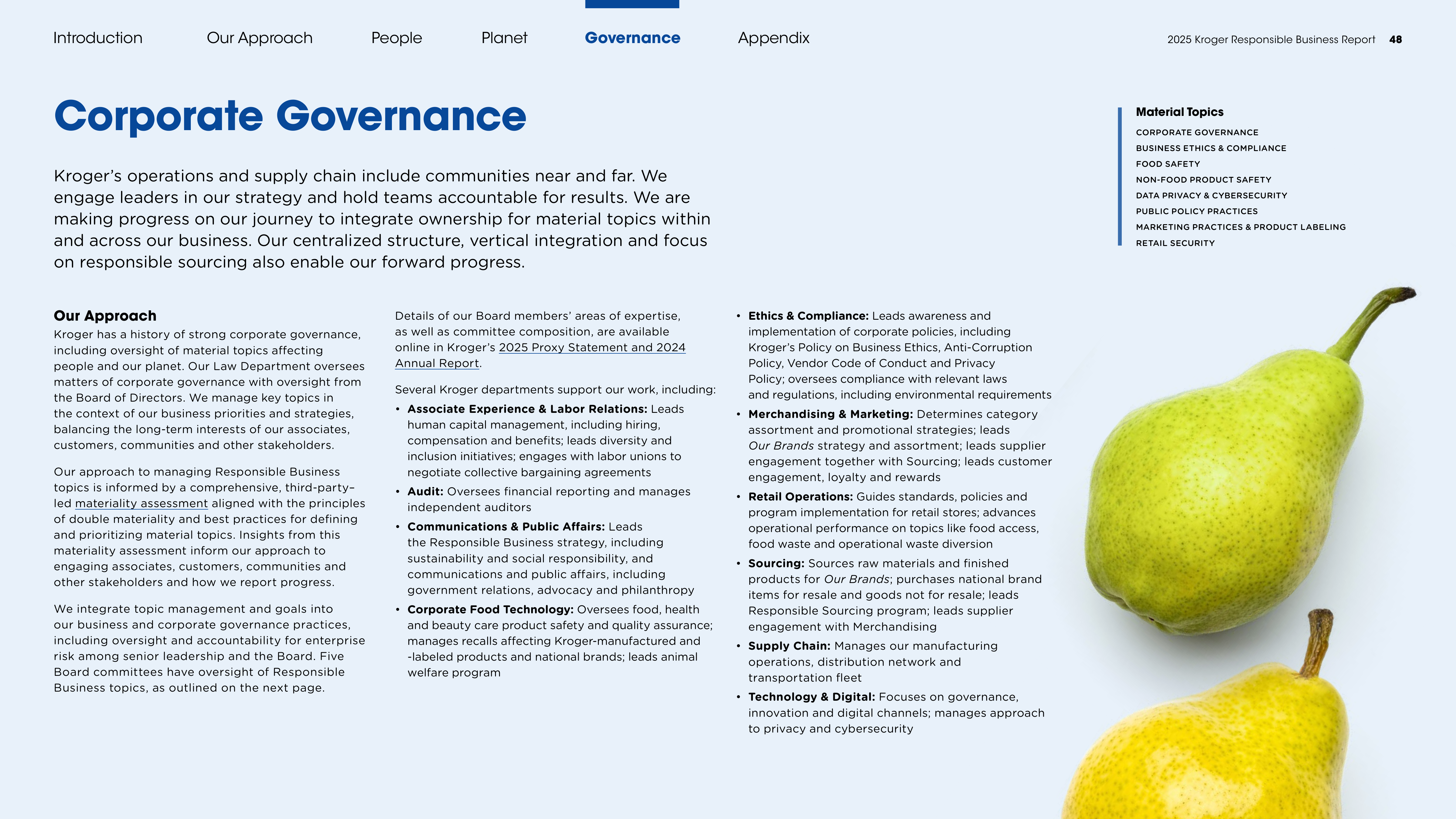




Kroger’s operations and supply chain include communities near and far. We
engage leaders in our strategy and hold teams accountable for results. We are
making progress on our journey to integrate ownership for material topics within
and across our business. Our centralized structure, vertical integration and focus
on responsible sourcing also enable our forward progress.
Corporate Governance
Our Approach
Kroger has a history of strong corporate governance,
including oversight of material topics affecting
people and our planet. Our Law Department oversees
matters of corporate governance with oversight from
the Board of Directors. We manage key topics in
the context of our business priorities and strategies,
balancing the long-term interests of our associates,
customers, communities and other stakeholders.
Our approach to managing Responsible Business
topics is informed by a comprehensive, third-party–
led materiality assessment aligned with the principles
of double materiality and best practices for defining
and prioritizing material topics. Insights from this
materiality assessment inform our approach to
engaging associates, customers, communities and
other stakeholders and how we report progress.
We integrate topic management and goals into
our business and corporate governance practices,
including oversight and accountability for enterprise
risk among senior leadership and the Board. Five
Board committees have oversight of Responsible
Business topics, as outlined on the next page.
Details of our Board members’ areas of expertise,
as well as committee composition, are available
online in Kroger’s 2025 Proxy Statement and 2024
Annual Report.
Several Kroger departments support our work, including:
•
Associate Experience & Labor Relations:
Leads
human capital management, including hiring,
compensation and benefits; leads diversity and
inclusion initiatives; engages with labor unions to
negotiate collective bargaining agreements
•
Audit:
Oversees financial reporting and manages
independent auditors
•
Communications & Public Affairs:
Leads
the Responsible Business strategy, including
sustainability and social responsibility, and
communications and public affairs, including
government relations, advocacy and philanthropy
•
Corporate Food Technology:
Oversees food, health
and beauty care product safety and quality assurance;
manages recalls affecting Kroger-manufactured and
-labeled products and national brands; leads animal
welfare program
•
Ethics & Compliance:
Leads awareness and
implementation of corporate policies, including
Kroger’s Policy on Business Ethics, Anti-Corruption
Policy, Vendor Code of Conduct and Privacy
Policy; oversees compliance with relevant laws
and regulations, including environmental requirements
•
Merchandising & Marketing:
Determines category
assortment and promotional strategies; leads
Our Brands
strategy and assortment; leads supplier
engagement together with Sourcing; leads customer
engagement, loyalty and rewards
•
Retail Operations:
Guides standards, policies and
program implementation for retail stores; advances
operational performance on topics like food access,
food waste and operational waste diversion
•
Sourcing:
Sources raw materials and finished
products for
Our Brands
; purchases national brand
items for resale and goods not for resale; leads
Responsible Sourcing program; leads supplier
engagement with Merchandising
•
Supply Chain:
Manages our manufacturing
operations, distribution network and
transportation fleet
•
Technology & Digital:
Focuses on governance,
innovation and digital channels; manages approach
to privacy and cybersecurity
Material Topics
CORPORATE GOVERNANCE
BUSINESS ETHICS & COMPLIANCE
FOOD SAFETY
NON-FOOD PRODUCT SAFETY
DATA PRIVACY & CYBERSECURITY
PUBLIC POLICY PRACTICES
MARKETING PRACTICES & PRODUCT LABELING
RETAIL SECURITY
People
Our Approach
Introduction
Planet
2025 Kroger Responsible Business Report
48
Appendix
Governance
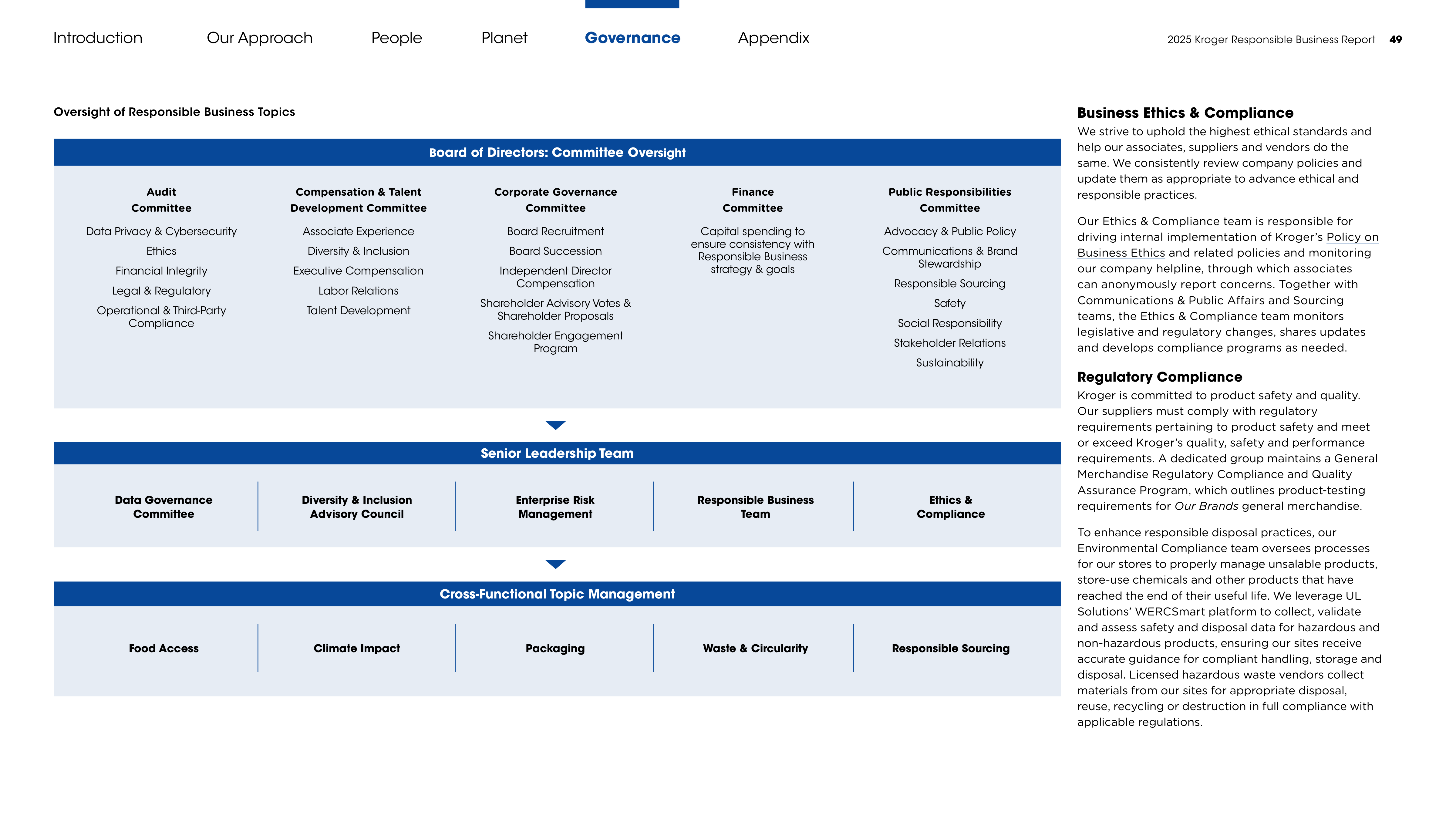
Business Ethics & Compliance
We strive to uphold the highest ethical standards and
help our associates, suppliers and vendors do the
same. We consistently review company policies and
update them as appropriate to advance ethical and
responsible practices.
Our Ethics & Compliance team is responsible for
driving internal implementation of Kroger’s Policy on
Business Ethics and related policies and monitoring
our company helpline, through which associates
can anonymously report concerns. Together with
Communications & Public Affairs and Sourcing
teams, the Ethics & Compliance team monitors
legislative and regulatory changes, shares updates
and develops compliance programs as needed.
Regulatory Compliance
Kroger is committed to product safety and quality.
Our suppliers must comply with regulatory
requirements pertaining to product safety and meet
or exceed Kroger’s quality, safety and performance
requirements. A dedicated group maintains a General
Merchandise Regulatory Compliance and Quality
Assurance Program, which outlines product-testing
requirements for
Our Brands
general merchandise.
To enhance responsible disposal practices, our
Environmental Compliance team oversees processes
for our stores to properly manage unsalable products,
store-use chemicals and other products that have
reached the end of their useful life. We leverage UL
Solutions’ WERCSmart platform to collect, validate
and assess safety and disposal data for hazardous and
non-hazardous products, ensuring our sites receive
accurate guidance for compliant handling, storage and
disposal. Licensed hazardous waste vendors collect
materials from our sites for appropriate disposal,
reuse, recycling or destruction in full compliance with
applicable regulations.
Oversight of Responsible Business Topics
B
oard of Directors: Committee Ove
rsight
Senior Leadership Team
Cross-Functional Topic Management
Audit
Committee
Data Privacy & Cybersecurity
Ethics
Financial Integrity
Legal & Regulatory
Operational & Third-Party
Compliance
Compensation & Talent
Development Committee
Associate Experience
Diversity & Inclusion
Executive Compensation
Labor Relations
Talent Development
Corporate Governance
Committee
Board Recruitment
Board Succession
Independent Director
Compensation
Shareholder Advisory Votes &
Shareholder Proposals
Shareholder Engagement
Program
Finance
Committee
Capital spending to
ensure consistency with
Responsible Business
strategy & goals
Public Responsibilities
Committee
Advocacy & Public Policy
Communications & Brand
Stewardship
Responsible Sourcing
Safety
Social Responsibility
Stakeholder Relations
Sustainability
Food Access
Data Governance
Committee
Climate Impact
Diversity & Inclusion
Advisory Council
Packaging
Enterprise Risk
Management
Waste & Circularity
Responsible Business
Team
Responsible Sourcing
Ethics &
Compliance
People
Our Approach
Introduction
Planet
2025 Kroger Responsible Business Report
49
Appendix
Governance
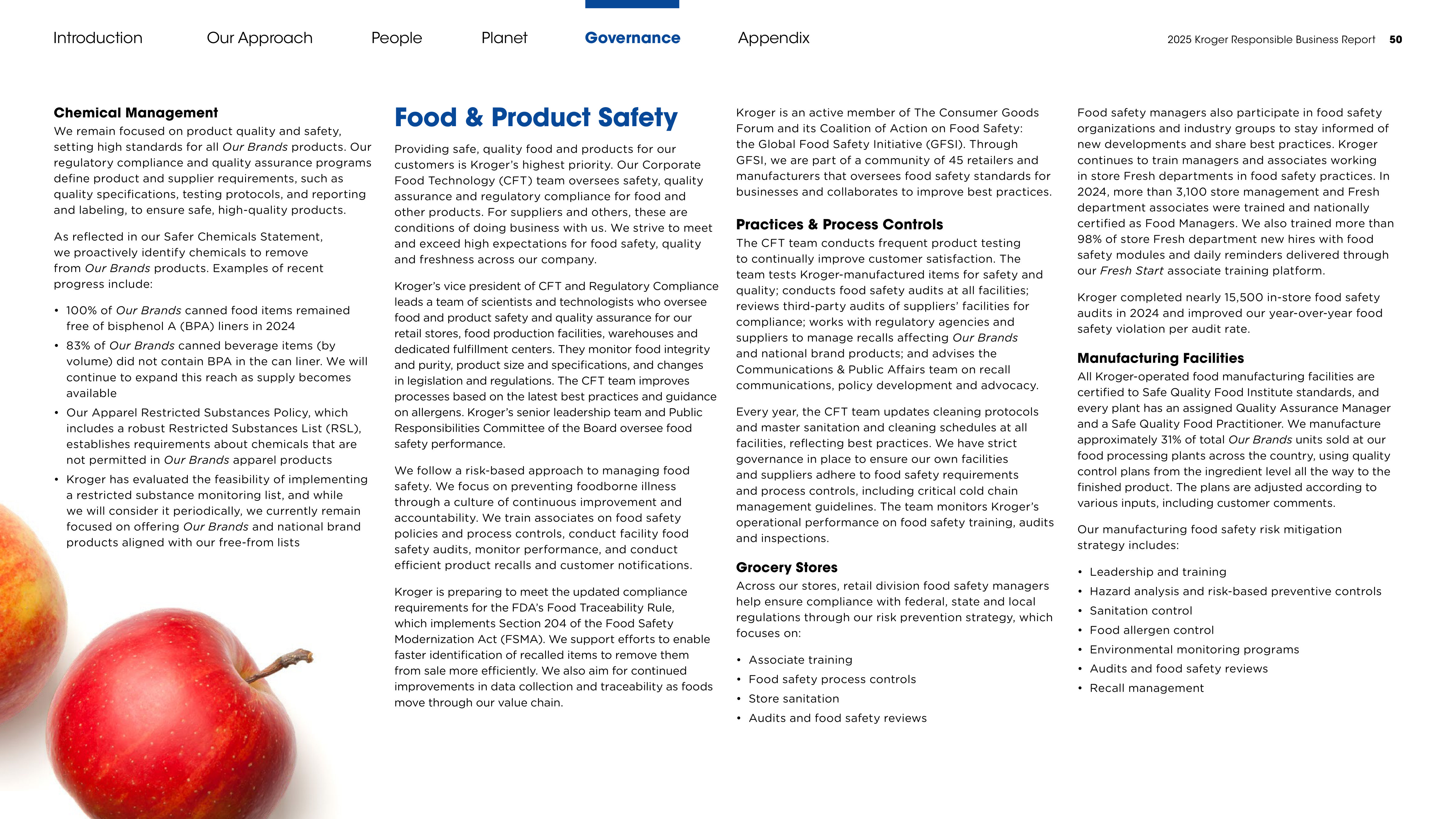




Chemical Management
We remain focused on product quality and safety,
setting high standards for all
Our Brands
products. Our
regulatory compliance and quality assurance programs
define product and supplier requirements, such as
quality specifications, testing protocols, and reporting
and labeling, to ensure safe, high-quality products.
As reflected in our Safer Chemicals Statement,
we proactively identify chemicals to remove
from
Our Brands
products. Examples of recent
progress include:
•
100% of
Our Brands
canned food items remained
free of bisphenol A (BPA) liners in 2024
•
83% of
Our Brands
canned beverage items (by
volume) did not contain BPA in the can liner. We will
continue to expand this reach as supply becomes
available
•
Our Apparel Restricted Substances Policy, which
includes a robust Restricted Substances List (RSL),
establishes requirements about chemicals that are
not permitted in
Our Brands
apparel products
•
Kroger has evaluated the feasibility of implementing
a restricted substance monitoring list, and while
we will consider it periodically, we currently remain
focused on offering
Our Brands
and national brand
products aligned with our free-from lists
Food & Product Safety
Providing safe, quality food and products for our
customers is Kroger’s highest priority. Our Corporate
Food Technology (CFT) team oversees safety, quality
assurance and regulatory compliance for food and
other products. For suppliers and others, these are
conditions of doing business with us. We strive to meet
and exceed high expectations for food safety, quality
and freshness across our company.
Kroger’s vice president of CFT and Regulatory Compliance
leads a team of scientists and technologists who oversee
food and product safety and quality assurance for our
retail stores, food production facilities, warehouses and
dedicated fulfillment centers. They monitor food integrity
and purity, product size and specifications, and changes
in legislation and regulations. The CFT team improves
processes based on the latest best practices and guidance
on allergens. Kroger’s senior leadership team and Public
Responsibilities Committee of the Board oversee food
safety performance.
We follow a risk-based approach to managing food
safety. We focus on preventing foodborne illness
through a culture of continuous improvement and
accountability. We train associates on food safety
policies and process controls, conduct facility food
safety audits, monitor performance, and conduct
efficient product recalls and customer notifications.
Kroger is preparing to meet the updated compliance
requirements for the FDA’s Food Traceability Rule,
which implements Section 204 of the Food Safety
Modernization Act (FSMA). We support efforts to enable
faster identification of recalled items to remove them
from sale more efficiently. We also aim for continued
improvements in data collection and traceability as foods
move through our value chain.
Kroger is an active member of The Consumer Goods
Forum and its Coalition of Action on Food Safety:
the Global Food Safety Initiative (GFSI). Through
GFSI, we are part of a community of 45 retailers and
manufacturers that oversees food safety standards for
businesses and collaborates to improve best practices.
Practices & Process Controls
The CFT team conducts frequent product testing
to continually improve customer satisfaction. The
team tests Kroger-manufactured items for safety and
quality; conducts food safety audits at all facilities;
reviews third-party audits of suppliers’ facilities for
compliance; works with regulatory agencies and
suppliers to manage recalls affecting
Our Brands
and national brand products; and advises the
Communications & Public Affairs team on recall
communications, policy development and advocacy.
Every year, the CFT team updates cleaning protocols
and master sanitation and cleaning schedules at all
facilities, reflecting best practices. We have strict
governance in place to ensure our own facilities
and suppliers adhere to food safety requirements
and process controls, including critical cold chain
management guidelines. The team monitors Kroger’s
operational performance on food safety training, audits
and inspections.
Grocery Stores
Across our stores, retail division food safety managers
help ensure compliance with federal, state and local
regulations through our risk prevention strategy, which
focuses on:
•
Associate training
•
Food safety process controls
•
Store sanitation
•
Audits and food safety reviews
Food safety managers also participate in food safety
organizations and industry groups to stay informed of
new developments and share best practices. Kroger
continues to train managers and associates working
in store Fresh departments in food safety practices. In
2024, more than 3,100 store management and Fresh
department associates were trained and nationally
certified as Food Managers. We also trained more than
98% of store Fresh department new hires with food
safety modules and daily reminders delivered through
our
Fresh Start
associate training platform.
Kroger completed nearly 15,500 in-store food safety
audits in 2024 and improved our year-over-year food
safety violation per audit rate.
Manufacturing Facilities
All Kroger-operated food manufacturing facilities are
certified to Safe Quality Food Institute standards, and
every plant has an assigned Quality Assurance Manager
and a Safe Quality Food Practitioner. We manufacture
approximately 31% of total
Our Brands
units sold at our
food processing plants across the country, using quality
control plans from the ingredient level all the way to the
finished product. The plans are adjusted according to
various inputs, including customer comments.
Our manufacturing food safety risk mitigation
strategy includes:
•
Leadership and training
•
Hazard analysis and risk-based preventive controls
•
Sanitation control
•
Food allergen control
•
Environmental monitoring programs
•
Audits and food safety reviews
•
Recall management
People
Our Approach
Introduction
Planet
2025 Kroger Responsible Business Report
50
Appendix
Governance
Supply Chain
Kroger seeks to have our distribution and fulfillment
centers that store food achieve GFSI standards for
warehouse and distribution facilities by the end of
2025. To support this transition, a new Corporate
Supply Chain Food Safety Manager oversees all food
safety and regulatory programs in these facilities. In
2024, we conducted external audits for 38 warehouses
that store and distribute food.
Distribution Centers
Management responsibilities are outlined in our
food safety and sanitation standards, and associates
implement formal documented programs, including
site-specific Food Safety Plans. Kroger’s distribution
centers follow established cold chain management
standards to help ensure temperature-sensitive
products are managed properly in transit and storage.
This is of particular importance during inbound and
outbound transportation.
Key elements of these standards include:
•
Food safety responsibility and documented practices
•
Proper receipt and storage of materials
•
Cleaning practices
•
Maintenance for food safety
•
Pest prevention to avoid food adulteration
Fulfillment Centers
Our fleet of refrigerated Kroger Delivery trucks, which
can store up to 20 orders, is designed to keep food
safe and fresh for customers while being delivered
to their doorstep. In addition to our warehouse food
safety standards, we implement additional process
controls to manage ambient, chilled and frozen
products at our dedicated Kroger Delivery fulfillment
centers. Powerful machine learning algorithms
optimize delivery routes, considering factors such as
road conditions and optimal fuel use to deliver food
safely and efficiently.
Allergens
Kroger carefully manages federal requirements for
food safety regarding allergens. Known allergens
required on labels include peanuts, tree nuts, dairy,
egg, wheat, fish, crustacean shellfish, soy and sesame.
Product Reformulations
We review
Our Brands
items regularly and reformulate
products in ways that improve taste and quality for our
customers. In 2025, we are preparing for additional
product reformulations to comply with new federal
guidance from the U.S. Department of Health and
Human Services and FDA on timelines to phase out
petroleum-based synthetic dyes from food products.
Non-Food Product Safety & Quality
Our Brands
non-food products adhere to a
multifaceted program to help ensure quality. We
work with carefully selected suppliers that have been
vetted and that adhere to compliance requirements
as outlined in our centralized Supplier Hub,
including third-party Good Manufacturing Practice
(GMP) certifications.
All products undergo evaluation and standard setting
during the development process. Product quality
is designed into the process from the start through
preliminary analytical testing, technical document review,
product specification concurrence between Kroger
and the supplier, and a first production review prior to
release. After introducing the product to market, we
continue to monitor and maintain quality. New products
are tested by a third-party laboratory after six months
in market, and we use a risk-based approach to conduct
third-party testing for mature products.
We monitor and document customer feedback, which
is also reviewed and addressed by our technical team
and the relevant supplier for continual improvement.
Kroger’s CFT and Regulatory Compliance teams also
monitor regulatory activity over time related to product
safety and ingredients to help ensure continued product
safety and compliance. Information about product
regulatory compliance is available in the Business Ethics
& Compliance section.
Recall Management
Products are removed from sale for many reasons,
including incorrect package labels, undeclared
allergens and, on rare occasions, the risk of illness or
injury. Because our customers’ safety is our highest
priority, Kroger is a leader in recall management and
communications. We consistently meet and exceed
industry and government standards for recalls and
product withdrawals.
Our experienced team coordinates recalls with suppliers,
regulatory agencies and an internal network of food
safety specialists and recall managers. This 24-hour-a-
day, seven-day-a-week process focuses on identifying
items to be recalled or withdrawn from our distribution
network and retail stores and working with appropriate
teams to ensure the recalled items are quickly removed
from sale. We also investigate the issue, take corrective
actions and modify or create programs to minimize or
eliminate similar issues in the future.
Kroger was one of the first retailers to implement a
personalized customer notification system for certain
types of recalls. Using our customer loyalty database,
we can identify shoppers who may have purchased
a specific recalled item. If a recall involves a possible
health risk—such as an undeclared allergen or potential
foodborne illness—we activate our notification systems
to alert customers quickly through register receipts and
email messages. Kroger also offers a toll-free Customer
Service Center and information line staffed with
professionals who can answer questions about food
safety and items that may have been recalled.
In 2024, the Kroger team managed a total of 57 recall
events. Of these, 25 were Class I product recalls,
including 19 related to food products. None of these
Class I recalls involved
Our Brands
items produced in a
Kroger-operated manufacturing facility. As in previous
years, recalls for undeclared allergens continue to be a
primary cause of Class I food recalls.
Enabling Faster Recalls
We continue to explore new ways to improve our
recall management systems. The Kroger Technology
& Digital team is working with the CFT team and other
departments to develop systems to enable product and
data mapping at every step of an item’s journey through
the supply chain. This will enable future compliance
with the FSMA Food Traceability Rule. In 2025, the
FDA extended the compliance date for this rule by
30 months.
Kroger continues to design technology systems to
enable future compliance, prioritizing high-risk products
identified on the FDA’s Food Traceability List. In addition
to enabling faster recalls, we expect this work to
improve supply chain oversight and accountability for
key sourcing-related goals.
Number of Class I recall events involving
Kroger-manufactured Our Brands items
2022
2023
0
0
2024
0
People
Our Approach
Introduction
Planet
2025 Kroger Responsible Business Report
51
Appendix
Governance
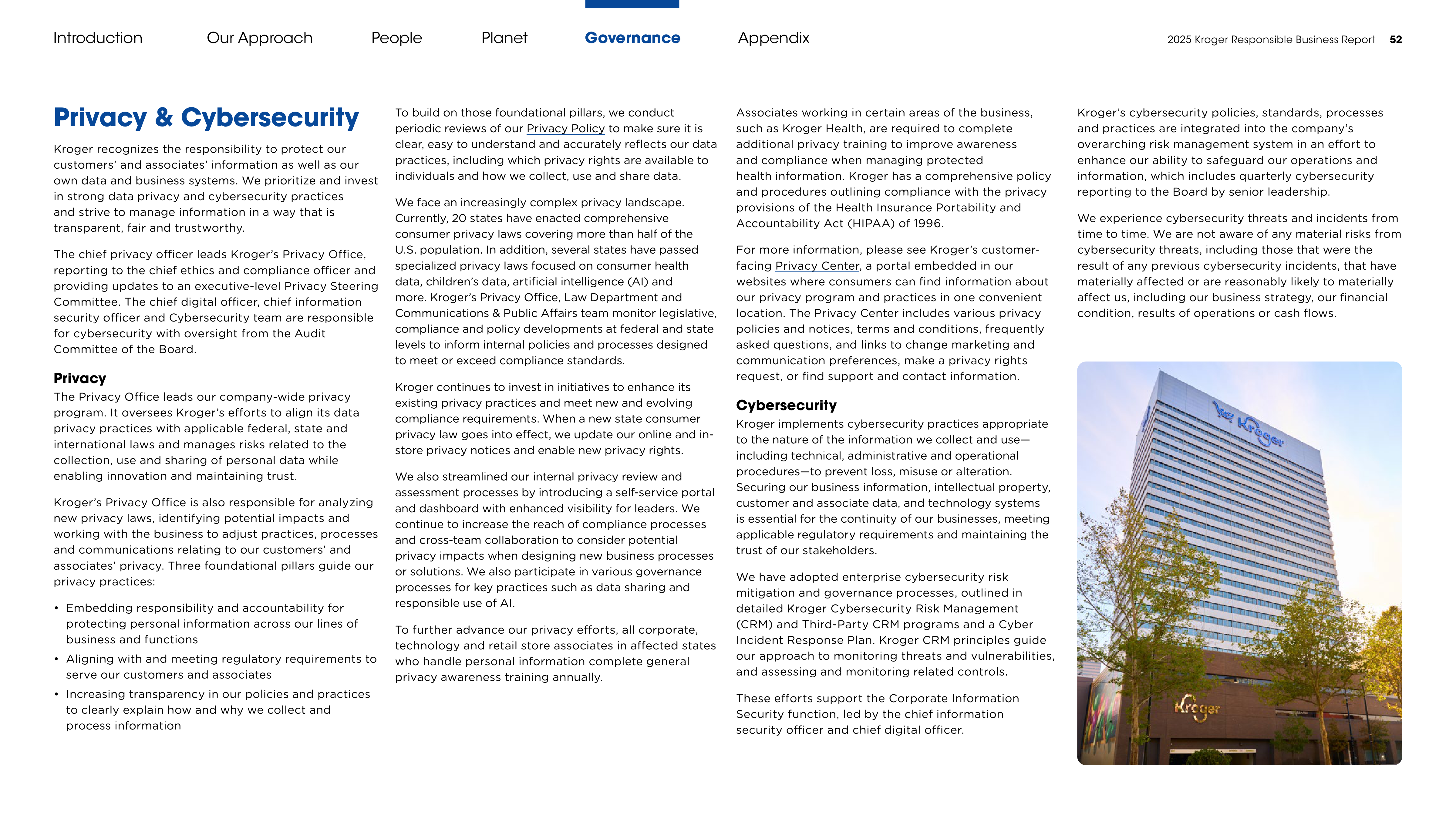
Privacy & Cybersecurity
Kroger recognizes the responsibility to protect our
customers’ and associates’ information as well as our
own data and business systems. We prioritize and invest
in strong data privacy and cybersecurity practices
and strive to manage information in a way that is
transparent, fair and trustworthy.
The chief privacy officer leads Kroger’s Privacy Office,
reporting to the chief ethics and compliance officer and
providing updates to an executive-level Privacy Steering
Committee. The chief digital officer, chief information
security officer and Cybersecurity team are responsible
for cybersecurity with oversight from the Audit
Committee of the Board.
Privacy
The Privacy Office leads our company-wide privacy
program. It oversees Kroger’s efforts to align its data
privacy practices with applicable federal, state and
international laws and manages risks related to the
collection, use and sharing of personal data while
enabling innovation and maintaining trust.
Kroger’s Privacy Office is also responsible for analyzing
new privacy laws, identifying potential impacts and
working with the business to adjust practices, processes
and communications relating to our customers’ and
associates’ privacy. Three foundational pillars guide our
privacy practices:
•
Embedding responsibility and accountability for
protecting personal information across our lines of
business and functions
•
Aligning with and meeting regulatory requirements to
serve our customers and associates
•
Increasing transparency in our policies and practices
to clearly explain how and why we collect and
process information
To build on those foundational pillars, we conduct
periodic reviews of our Privacy Policy to make sure it is
clear, easy to understand and accurately reflects our data
practices, including which privacy rights are available to
individuals and how we collect, use and share data.
We face an increasingly complex privacy landscape.
Currently, 20 states have enacted comprehensive
consumer privacy laws covering more than half of the
U.S. population. In addition, several states have passed
specialized privacy laws focused on consumer health
data, children’s data, artificial intelligence (AI) and
more. Kroger’s Privacy Office, Law Department and
Communications & Public Affairs team monitor legislative,
compliance and policy developments at federal and state
levels to inform internal policies and processes designed
to meet or exceed compliance standards.
Kroger continues to invest in initiatives to enhance its
existing privacy practices and meet new and evolving
compliance requirements. When a new state consumer
privacy law goes into effect, we update our online and in-
store privacy notices and enable new privacy rights.
We also streamlined our internal privacy review and
assessment processes by introducing a self-service portal
and dashboard with enhanced visibility for leaders. We
continue to increase the reach of compliance processes
and cross-team collaboration to consider potential
privacy impacts when designing new business processes
or solutions. We also participate in various governance
processes for key practices such as data sharing and
responsible use of AI.
To further advance our privacy efforts, all corporate,
technology and retail store associates in affected states
who handle personal information complete general
privacy awareness training annually.
Associates working in certain areas of the business,
such as Kroger Health, are required to complete
additional privacy training to improve awareness
and compliance when managing protected
health information. Kroger has a comprehensive policy
and procedures outlining compliance with the privacy
provisions of the Health Insurance Portability and
Accountability Act (HIPAA) of 1996.
For more information, please see Kroger’s customer-
facing Privacy Center, a portal embedded in our
websites where consumers can find information about
our privacy program and practices in one convenient
location. The Privacy Center includes various privacy
policies and notices, terms and conditions, frequently
asked questions, and links to change marketing and
communication preferences, make a privacy rights
request, or find support and contact information.
Cybersecurity
Kroger implements cybersecurity practices appropriate
to the nature of the information we collect and use—
including technical, administrative and operational
procedures—to prevent loss, misuse or alteration.
Securing our business information, intellectual property,
customer and associate data, and technology systems
is essential for the continuity of our businesses, meeting
applicable regulatory requirements and maintaining the
trust of our stakeholders.
We have adopted enterprise cybersecurity risk
mitigation and governance processes, outlined in
detailed Kroger Cybersecurity Risk Management
(CRM) and Third-Party CRM programs and a Cyber
Incident Response Plan. Kroger CRM principles guide
our approach to monitoring threats and vulnerabilities,
and assessing and monitoring related controls.
These efforts support the Corporate Information
Security function, led by the chief information
security officer and chief digital officer.
Kroger’s cybersecurity policies, standards, processes
and practices are integrated into the company’s
overarching risk management system in an effort to
enhance our ability to safeguard our operations and
information, which includes quarterly cybersecurity
reporting to the Board by senior leadership.
We experience cybersecurity threats and incidents from
time to time. We are not aware of any material risks from
cybersecurity threats, including those that were the
result of any previous cybersecurity incidents, that have
materially affected or are reasonably likely to materially
affect us, including our business strategy, our financial
condition, results of operations or cash flows.
People
Our Approach
Introduction
Planet
2025 Kroger Responsible Business Report
52
Appendix
Governance
Public Policy Practices
Kroger actively engages in public policy and
advocacy in ways that support the interests of our
associates, customers, communities and company.
We recognize that public policy and legislation at the
federal, state and local levels can affect our business
operations and our future ability to provide economic
opportunities in our communities and create value for
our shareholders.
Kroger’s Communications & Public Affairs team leads
the government relations strategy and management
approach to align with responsible business practices
and reflect Our Values, with oversight from the Public
Responsibilities Committee of the Board. Advocacy
efforts cover a wide range of topics, including topics
affecting people and our planet and aligned with our
Zero Hunger | Zero Waste impact plan. These include
policies that increase food safety, access and security
while preserving affordability for our customers.
In 2024, we expanded Kroger’s Government
Relations team to focus additional resources on
federal policies and state legislative activity affecting
our company.
KroPAC
KroPAC is the company’s federal political action
committee (PAC) funded by voluntary contributions
from salaried management associates. PAC
contributions are conducted in compliance with
Federal Election Committee regulations governing
solicitations. KroPAC makes contributions, where
allowed, to federal, state and local political
candidates, initiatives and organizations.
Other Contributions
Occasionally, and where permitted by law,
Kroger may make political contributions directly
to state or local candidates using corporate funds
and following relevant laws and regulations.
We do not use corporate funds to air advertisements
or finance specific activities in favor of or in
opposition to particular candidates. For more
details, see our Political Contribution Policy.
We comply with applicable laws and required
reporting governing political contributions, and we
publish a Political Contribution Report that outlines
the source of funds for contributions, giving by
political party and giving by state. This report also
includes a list of national trade associations of
which Kroger is a member. These associations help
represent the company’s perspectives to legislators
and regulators; however, we do not always share
the same perspectives on policy matters as these
associations.
Marketing Practices
& Product Labeling
Kroger develops marketing communications and
integrated campaigns to help customers make
purchase decisions that are right for them. We follow
applicable laws, regulations and best practices
and strive to work with others that do the same.
Our Brands
, Marketing, Media Services, 84.51° and
Merchandising teams lead this work in partnership
with the Kroger Technology & Digital team, Ethics &
Compliance team and our Privacy Office.
Our customers tell us they value receiving
personalized recommendations that deliver savings
on items they purchase regularly. We use information
from our loyalty program to develop personalized
recommendations every week to save our customers
time and money and to enhance their shopping
experience. We clearly share why and how we may
collect and use this information in our customer-
facing Privacy Policy and Privacy Center.
To fulfill our brand promise—Fresh for Everyone—we
promote healthy options like fresh, natural and organic
choices across all customer segments and geographies.
We work with national, regional and local media and
advertising companies to connect with customers
through traditional, digital and social media channels.
A defined request for information process governs how
we select media companies. We ask specific questions
to understand their privacy practices and how they
create models and expand audiences without bias. In
the increasingly complex media landscape and digital
ecosystem, we ask vendors to share best practices in
communicating organically with multicultural audiences.
Across our operations, we avoid targeted marketing
to minors of products intended for adult purchase
and consumption, including adult beverages and
nicotine products.
Kroger Precision Marketing
Kroger Precision Marketing (KPM) is Kroger’s retail
media business. By applying 84.51° data science and
Kroger’s popular loyalty card program, KPM connects
customers to brands through advertising.
KPM is among a small group of media publishers to
achieve Platinum certification from the Trustworthy
Accountability Group. The certification demonstrates a
commitment to upholding brand safety, eliminating ad
fraud and combating malware. In 2023, KPM became
the first retail media business to join Ad Net Zero,
a trade association focused on sustainability in the
advertising industry.
Product Labeling
Kroger adheres to the food labeling requirements
outlined by the FDA and the U.S. Department of
Agriculture (USDA), including the USDA’s Agricultural
Marketing Service, which oversees the National
Organic Program and food grading system, and the
Food Safety Inspection Service, which regulates the
labeling of meat, poultry and shelled egg products.
We also adhere to the Federal Trade Commission’s
Fair Packaging and Labeling Act, which requires that
package labels identify the commodity; the name
and place of business of the manufacturer, packer or
distributor; and the net quantity in weight, measure
or numerical count. For general merchandise items,
we adhere to the requirements and guidelines set
by the Consumer Products Safety Commission and
state regulations to provide consumers with safe
use information.
Labeling practices for items we sell in stores and
online are overseen by several teams, including
CFT, Ethics & Compliance, Merchandising and
Our
Brands
. We focus first on products in the
Our Brands
portfolio, including Kroger-manufactured items and
other items sourced or produced under contract with
third-party manufacturers. For
Our Brands
, Kroger
aims to develop accurate on-pack messages and
labels that include required information and, where
relevant, clear and supported claims to help inform
customers of product safety information or benefits,
such as allergens or health, nutrition or environmental
attributes.
We expect consumer packaged goods and national
brand suppliers to be responsible and accountable
for complying with relevant labeling requirements.
Additional information about product nutrition and
sustainability is available in the Health & Nutrition and
Supply Chain Sustainability sections.
People
Our Approach
Introduction
Planet
2025 Kroger Responsible Business Report
53
Appendix
Governance
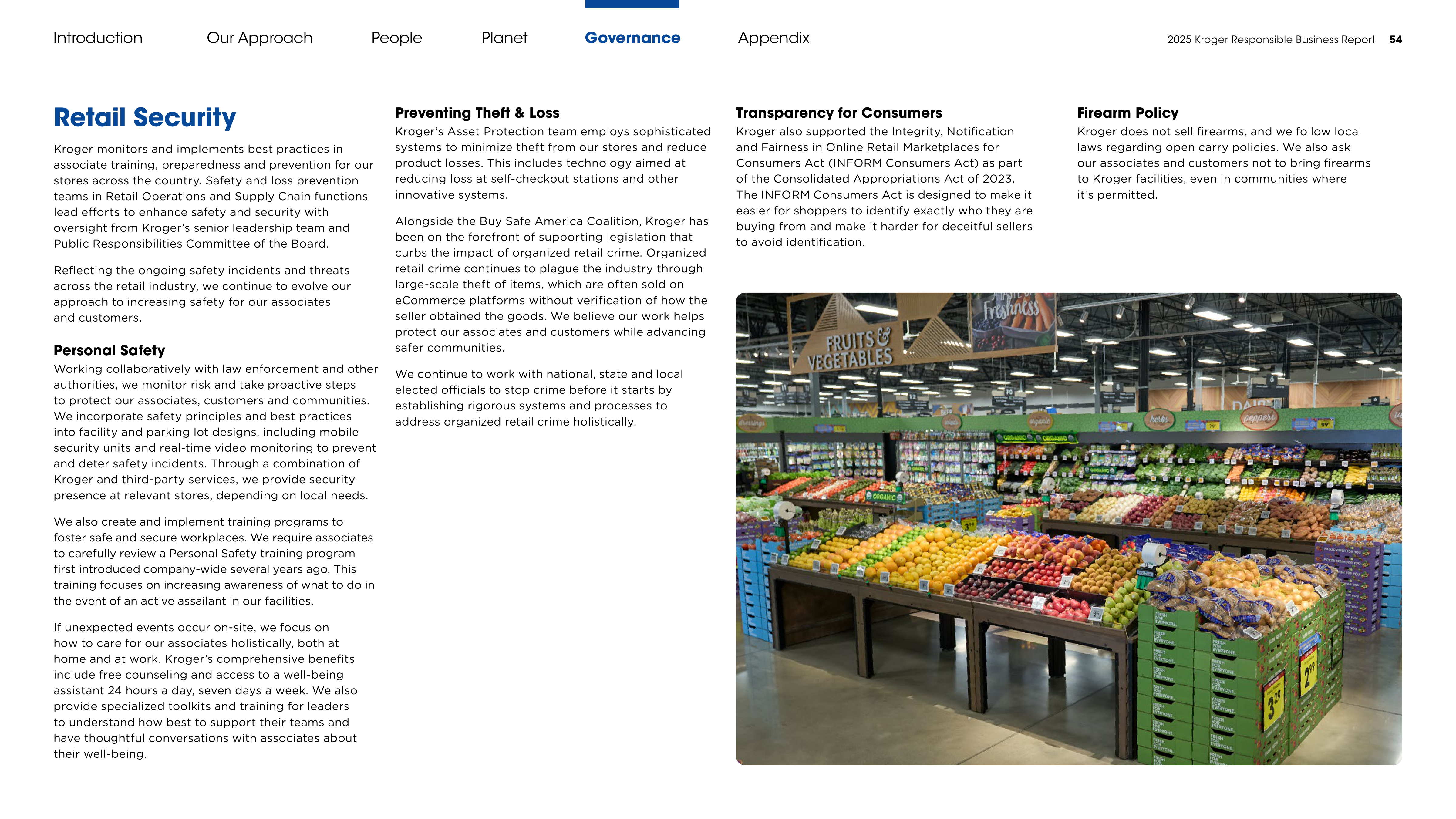
Retail Security
Kroger monitors and implements best practices in
associate training, preparedness and prevention for our
stores across the country. Safety and loss prevention
teams in Retail Operations and Supply Chain functions
lead efforts to enhance safety and security with
oversight from Kroger’s senior leadership team and
Public Responsibilities Committee of the Board.
Reflecting the ongoing safety incidents and threats
across the retail industry, we continue to evolve our
approach to increasing safety for our associates
and customers.
Personal Safety
Working collaboratively with law enforcement and other
authorities, we monitor risk and take proactive steps
to protect our associates, customers and communities.
We incorporate safety principles and best practices
into facility and parking lot designs, including mobile
security units and real-time video monitoring to prevent
and deter safety incidents. Through a combination of
Kroger and third-party services, we provide security
presence at relevant stores, depending on local needs.
We also create and implement training programs to
foster safe and secure workplaces. We require associates
to carefully review a Personal Safety training program
first introduced company-wide several years ago. This
training focuses on increasing awareness of what to do in
the event of an active assailant in our facilities.
If unexpected events occur on-site, we focus on
how to care for our associates holistically, both at
home and at work. Kroger’s comprehensive benefits
include free counseling and access to a well-being
assistant 24 hours a day, seven days a week. We also
provide specialized toolkits and training for leaders
to understand how best to support their teams and
have thoughtful conversations with associates about
their well-being.
Preventing Theft & Loss
Kroger’s Asset Protection team employs sophisticated
systems to minimize theft from our stores and reduce
product losses. This includes technology aimed at
reducing loss at self-checkout stations and other
innovative systems.
Alongside the Buy Safe America Coalition, Kroger has
been on the forefront of supporting legislation that
curbs the impact of organized retail crime. Organized
retail crime continues to plague the industry through
large-scale theft of items, which are often sold on
eCommerce platforms without verification of how the
seller obtained the goods. We believe our work helps
protect our associates and customers while advancing
safer communities.
We continue to work with national, state and local
elected officials to stop crime before it starts by
establishing rigorous systems and processes to
address organized retail crime holistically.
Transparency for Consumers
Kroger also supported the Integrity, Notification
and Fairness in Online Retail Marketplaces for
Consumers Act (INFORM Consumers Act) as part
of the Consolidated Appropriations Act of 2023.
The INFORM Consumers Act is designed to make it
easier for shoppers to identify exactly who they are
buying from and make it harder for deceitful sellers
to avoid identification.
Firearm Policy
Kroger does not sell firearms, and we follow local
laws regarding open carry policies. We also ask
our associates and customers not to bring firearms
to Kroger facilities, even in communities where
it’s permitted.
People
Our Approach
Introduction
Planet
2025 Kroger Responsible Business Report
54
Appendix
Governance


Kroger is part of—and dependent on—global food and consumer
goods supply chains. We aim to do our part to build more
responsible, resilient supply chains for people and our planet.
Responsible Supply Chain & Sourcing
Our Approach
We believe responsible and more sustainable sourcing
enables us to continue offering our customers a wide
range of affordable products. We manage sourcing
topics and issues within the context of our business
and
Thriving Together
strategies, recognizing there
may be trade-offs and unintended consequences of
specific single-topic decisions or policy changes.
Kroger’s centralized Merchandising team selects the
desired product assortment by category and works
closely with Sourcing leaders to determine and review
potential suppliers, sourcing regions and contract
terms. Our management approach to responsible
sourcing is led by a cross-functional Responsible
Sourcing Steering Committee comprising leaders in
Ethics & Compliance, Merchandising, Sourcing and
Communications & Public Affairs. Kroger’s senior
leadership team and the Public Responsibilities
Committee of the Board provide additional oversight.
Information about product sustainability and supplier
expectations is included in the Planet section.
Managing Our Supply Chain
Our customers trust that the products we offer come
from reputable suppliers who operate responsibly. We
have relationships with many strategic, long-standing
vendors, and we also welcome new vendors to bid for
business. Kroger’s Sourcing and Merchandising teams
lead processes to identify, evaluate and onboard
new suppliers to advance progress on our social and
environmental goals.
Kroger has a long-standing focus on responsibly
sourcing products to manage and mitigate potential
supply chain risks to people and our planet. As a
retailer with thousands of products in wide-ranging
categories across our stores and seamless ecosystem,
responsible sourcing discussions increasingly include
both social and environmental topics.
Supplier Expectations
An evolving risk-based approach informs program
management and responsible sourcing policies,
practices and oversight. All suppliers, including
those providing
Our Brands
ingredients and finished
products, are expected to:
•
Comply with the Kroger Vendor Code of Conduct,
including establishing effective management systems
to maintain safe, fair working environments in
facilities and manage risks
•
Accurately disclose and update production facilities
and locations in Kroger’s Supplier Hub centralized
vendor management system
•
Respond promptly to Kroger requests for information
about potential allegations and issues
•
Complete and submit required documentation,
assessments and certifications upon the required
schedule and agree to additional compliance
assessments upon request
Many large, established Kroger suppliers already have
robust management systems in place to comply with
applicable laws, regulations and the Code of Conduct.
We recognize that newer or smaller suppliers may need
additional resources to clarify expectations and enhance
their management systems in ways that work for their
business. We welcome the opportunity to engage
and include new brands, local farmers and growers,
diverse-owned businesses and others to help them
operate responsibly and have a positive impact in our
communities.
Vendor Code of Conduct
Suppliers are expected to comply with the Kroger Vendor
Code of Conduct as a condition of doing business with
us. The Code of Conduct, which outlines expectations
for responsibly managing operations and respecting
the rights of workers, is informed by internationally
agreed-upon standards, including the United Nations
Guiding Principles on Business and Human Rights, the
International Bill of Human Rights and the International
Labour Organization Declaration on Fundamental
Principles and Rights at Work.
We continue to develop new training resources for our
leaders and associates who are involved in the selection
and oversight of suppliers through our responsible
sourcing management systems and practices. As part of
our Social Compliance Program, Kroger published a new
Social Compliance Assessment Guide to help suppliers
understand Kroger’s expectations in respecting human
rights across our supply chain.
Material Topics
RESPONSIBLE SUPPLY CHAIN & SOURCING
HUMAN RIGHTS
ANIMAL WELFARE
Select Responsible Sourcing
Policies
Kroger Vendor Code of Conduct
Social Compliance Assessment Guide
Human Rights Policy
No-Deforestation Commitment:
Our Brands
Seafood Sustainability Policy
Goal to Protect Pollinators & Biodiversity
Animal Welfare Policy
People
Our Approach
Introduction
Planet
2025 Kroger Responsible Business Report
55
Appendix
Governance
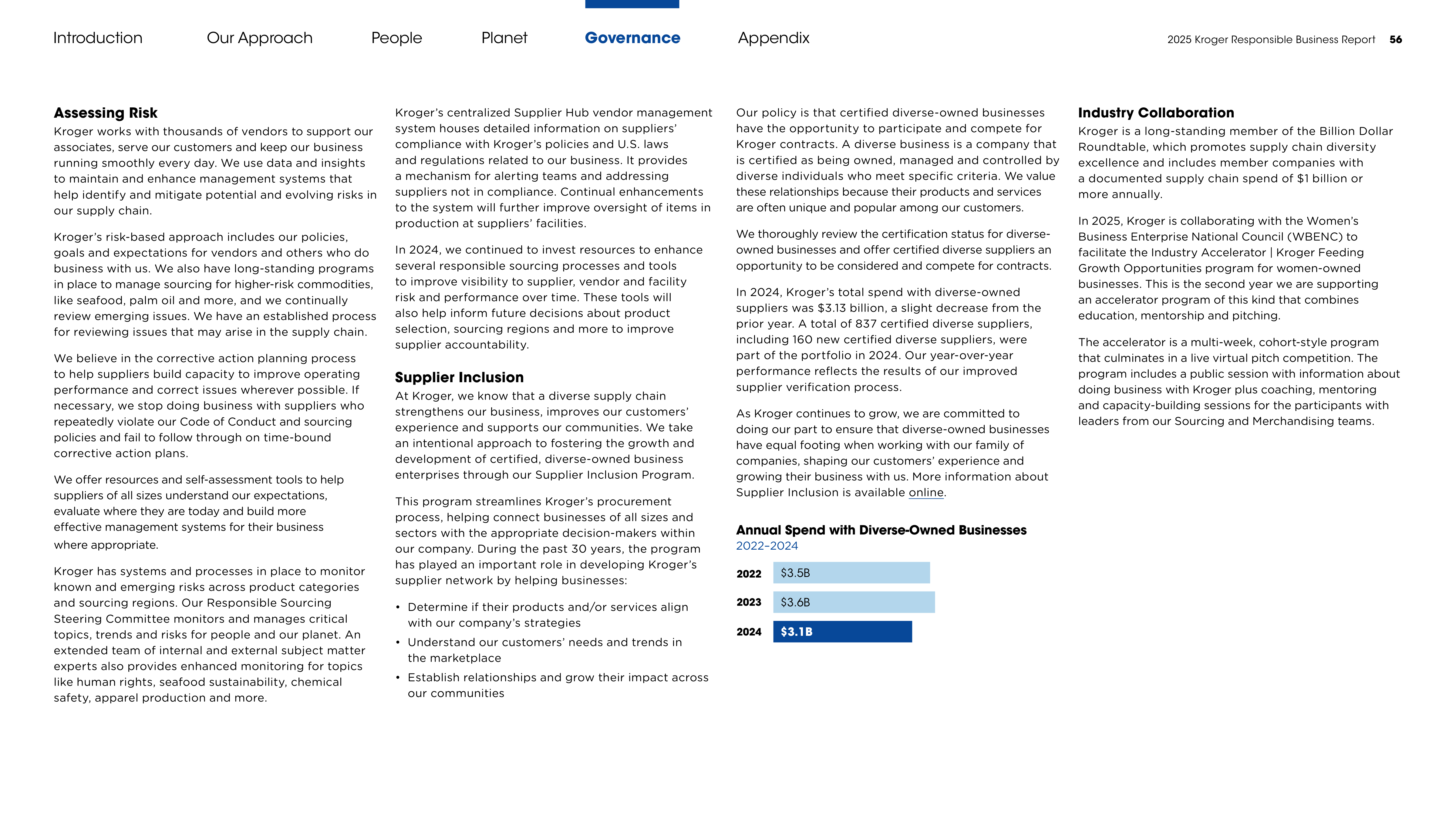
Kroger’s centralized Supplier Hub vendor management
system houses detailed information on suppliers’
compliance with Kroger’s policies and U.S. laws
and regulations related to our business. It provides
a mechanism for alerting teams and addressing
suppliers not in compliance. Continual enhancements
to the system will further improve oversight of items in
production at suppliers’ facilities.
In 2024, we continued to invest resources to enhance
several responsible sourcing processes and tools
to improve visibility to supplier, vendor and facility
risk and performance over time. These tools will
also help inform future decisions about product
selection, sourcing regions and more to improve
supplier accountability.
Supplier Inclusion
At Kroger, we know that a diverse supply chain
strengthens our business, improves our customers’
experience and supports our communities. We take
an intentional approach to fostering the growth and
development of certified, diverse-owned business
enterprises through our Supplier Inclusion Program.
This program streamlines Kroger’s procurement
process, helping connect businesses of all sizes and
sectors with the appropriate decision-makers within
our company. During the past 30 years, the program
has played an important role in developing Kroger’s
supplier network by helping businesses:
•
Determine if their products and/or services align
with our company’s strategies
•
Understand our customers’ needs and trends in
the marketplace
•
Establish relationships and grow their impact across
our communities
Assessing Risk
Kroger works with thousands of vendors to support our
associates, serve our customers and keep our business
running smoothly every day. We use data and insights
to maintain and enhance management systems that
help identify and mitigate potential and evolving risks in
our supply chain.
Kroger’s risk-based approach includes our policies,
goals and expectations for vendors and others who do
business with us. We also have long-standing programs
in place to manage sourcing for higher-risk commodities,
like seafood, palm oil and more, and we continually
review emerging issues. We have an established process
for reviewing issues that may arise in the supply chain.
We believe in the corrective action planning process
to help suppliers build capacity to improve operating
performance and correct issues wherever possible. If
necessary, we stop doing business with suppliers who
repeatedly violate our Code of Conduct and sourcing
policies and fail to follow through on time-bound
corrective action plans.
We offer resources and self-assessment tools to help
suppliers of all sizes understand our expectations,
evaluate where they are today and build more
effective management systems for their business
where appropriate.
Kroger has systems and processes in place to monitor
known and emerging risks across product categories
and sourcing regions. Our Responsible Sourcing
Steering Committee monitors and manages critical
topics, trends and risks for people and our planet. An
extended team of internal and external subject matter
experts also provides enhanced monitoring for topics
like human rights, seafood sustainability, chemical
safety, apparel production and more.
Industry Collaboration
Kroger is a long-standing member of the Billion Dollar
Roundtable, which promotes supply chain diversity
excellence and includes member companies with
a documented supply chain spend of $1 billion or
more annually.
In 2025, Kroger is collaborating with the Women’s
Business Enterprise National Council (WBENC) to
facilitate the Industry Accelerator | Kroger Feeding
Growth Opportunities program for women-owned
businesses. This is the second year we are supporting
an accelerator program of this kind that combines
education, mentorship and pitching.
The accelerator is a multi-week, cohort-style program
that culminates in a live virtual pitch competition. The
program includes a public session with information about
doing business with Kroger plus coaching, mentoring
and capacity-building sessions for the participants with
leaders from our Sourcing and Merchandising teams.
Our policy is that certified diverse-owned businesses
have the opportunity to participate and compete for
Kroger contracts. A diverse business is a company that
is certified as being owned, managed and controlled by
diverse individuals who meet specific criteria. We value
these relationships because their products and services
are often unique and popular among our customers.
We thoroughly review the certification status for diverse-
owned businesses and offer certified diverse suppliers an
opportunity to be considered and compete for contracts.
In 2024, Kroger’s total spend with diverse-owned
suppliers was $3.13 billion, a slight decrease from the
prior year. A total of 837 certified diverse suppliers,
including 160 new certified diverse suppliers, were
part of the portfolio in 2024. Our year-over-year
performance reflects the results of our improved
supplier verification process.
As Kroger continues to grow, we are committed to
doing our part to ensure that diverse-owned businesses
have equal footing when working with our family of
companies, shaping our customers’ experience and
growing their business with us. More information about
Supplier Inclusion is available online.
2024
$3.1B
2023
2022
$3.6B
$3.5B
Annual Spend with Diverse-Owned Businesses
2022–2024
People
Our Approach
Introduction
Planet
2025 Kroger Responsible Business Report
56
Appendix
Governance
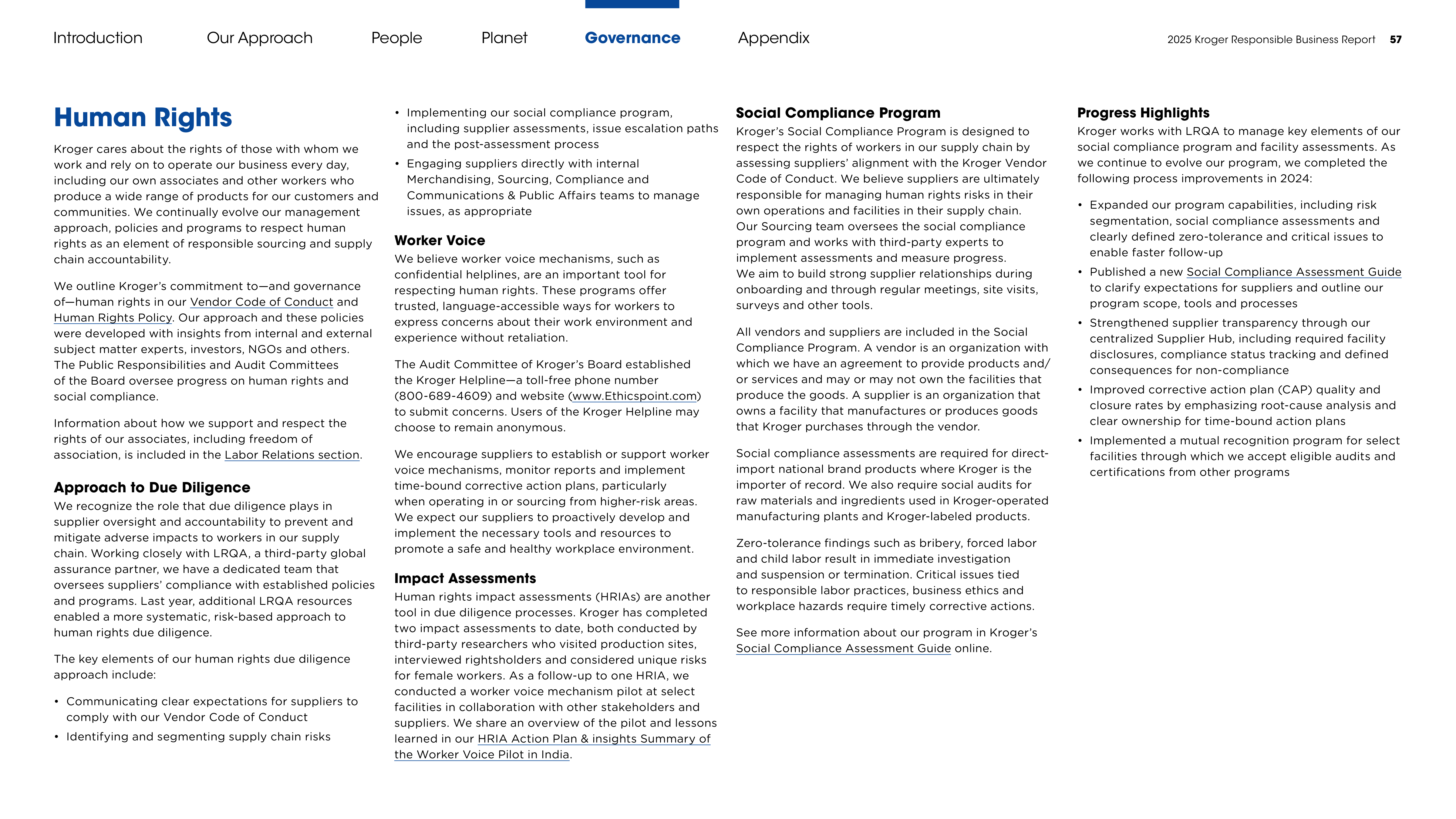
Human Rights
Kroger cares about the rights of those with whom we
work and rely on to operate our business every day,
including our own associates and other workers who
produce a wide range of products for our customers and
communities. We continually evolve our management
approach, policies and programs to respect human
rights as an element of responsible sourcing and supply
chain accountability.
We outline Kroger’s commitment to—and governance
of—human rights in our Vendor Code of Conduct and
Human Rights Policy. Our approach and these policies
were developed with insights from internal and external
subject matter experts, investors, NGOs and others.
The Public Responsibilities and Audit Committees
of the Board oversee progress on human rights and
social compliance.
Information about how we support and respect the
rights of our associates, including freedom of
association, is included in the Labor Relations section.
Approach to Due Diligence
We recognize the role that due diligence plays in
supplier oversight and accountability to prevent and
mitigate adverse impacts to workers in our supply
chain. Working closely with LRQA, a third-party global
assurance partner, we have a dedicated team that
oversees suppliers’ compliance with established policies
and programs. Last year, additional LRQA resources
enabled a more systematic, risk-based approach to
human rights due diligence.
The key elements of our human rights due diligence
approach include:
•
Communicating clear expectations for suppliers to
comply with our Vendor Code of Conduct
•
Identifying and segmenting supply chain risks
•
Implementing our social compliance program,
including supplier assessments, issue escalation paths
and the post-assessment process
•
Engaging suppliers directly with internal
Merchandising, Sourcing, Compliance and
Communications & Public Affairs teams to manage
issues, as appropriate
Worker Voice
We believe worker voice mechanisms, such as
confidential helplines, are an important tool for
respecting human rights. These programs offer
trusted, language-accessible ways for workers to
express concerns about their work environment and
experience without retaliation.
The Audit Committee of Kroger’s Board established
the Kroger Helpline—a toll-free phone number
(800-689-4609) and website (www.Ethicspoint.com)
to submit concerns. Users of the Kroger Helpline may
choose to remain anonymous.
We encourage suppliers to establish or support worker
voice mechanisms, monitor reports and implement
time-bound corrective action plans, particularly
when operating in or sourcing from higher-risk areas.
We expect our suppliers to proactively develop and
implement the necessary tools and resources to
promote a safe and healthy workplace environment.
Impact Assessments
Human rights impact assessments (HRIAs) are another
tool in due diligence processes. Kroger has completed
two impact assessments to date, both conducted by
third-party researchers who visited production sites,
interviewed rightsholders and considered unique risks
for female workers. As a follow-up to one HRIA, we
conducted a worker voice mechanism pilot at select
facilities in collaboration with other stakeholders and
suppliers. We share an overview of the pilot and lessons
learned in our HRIA Action Plan & insights Summary of
the Worker Voice Pilot in India.
Social Compliance Program
Kroger’s Social Compliance Program is designed to
respect the rights of workers in our supply chain by
assessing suppliers’ alignment with the Kroger Vendor
Code of Conduct. We believe suppliers are ultimately
responsible for managing human rights risks in their
own operations and facilities in their supply chain.
Our Sourcing team oversees the social compliance
program and works with third-party experts to
implement assessments and measure progress.
We aim to build strong supplier relationships during
onboarding and through regular meetings, site visits,
surveys and other tools.
All vendors and suppliers are included in the Social
Compliance Program. A vendor is an organization with
which we have an agreement to provide products and/
or services and may or may not own the facilities that
produce the goods. A supplier is an organization that
owns a facility that manufactures or produces goods
that Kroger purchases through the vendor.
Social compliance assessments are required for direct-
import national brand products where Kroger is the
importer of record. We also require social audits for
raw materials and ingredients used in Kroger-operated
manufacturing plants and Kroger-labeled products.
Zero-tolerance findings such as bribery, forced labor
and child labor result in immediate investigation
and suspension or termination. Critical issues tied
to responsible labor practices, business ethics and
workplace hazards require timely corrective actions.
See more information about our program in Kroger’s
Social Compliance Assessment Guide online.
Progress Highlights
Kroger works with LRQA to manage key elements of our
social compliance program and facility assessments. As
we continue to evolve our program, we completed the
following process improvements in 2024:
•
Expanded our program capabilities, including risk
segmentation, social compliance assessments and
clearly defined zero-tolerance and critical issues to
enable faster follow-up
•
Published a new Social Compliance Assessment Guide
to clarify expectations for suppliers and outline our
program scope, tools and processes
•
Strengthened supplier transparency through our
centralized Supplier Hub, including required facility
disclosures, compliance status tracking and defined
consequences for non-compliance
•
Improved corrective action plan (CAP) quality and
closure rates by emphasizing root-cause analysis and
clear ownership for time-bound action plans
•
Implemented a mutual recognition program for select
facilities through which we accept eligible audits and
certifications from other programs
People
Our Approach
Introduction
Planet
2025 Kroger Responsible Business Report
57
Appendix
Governance
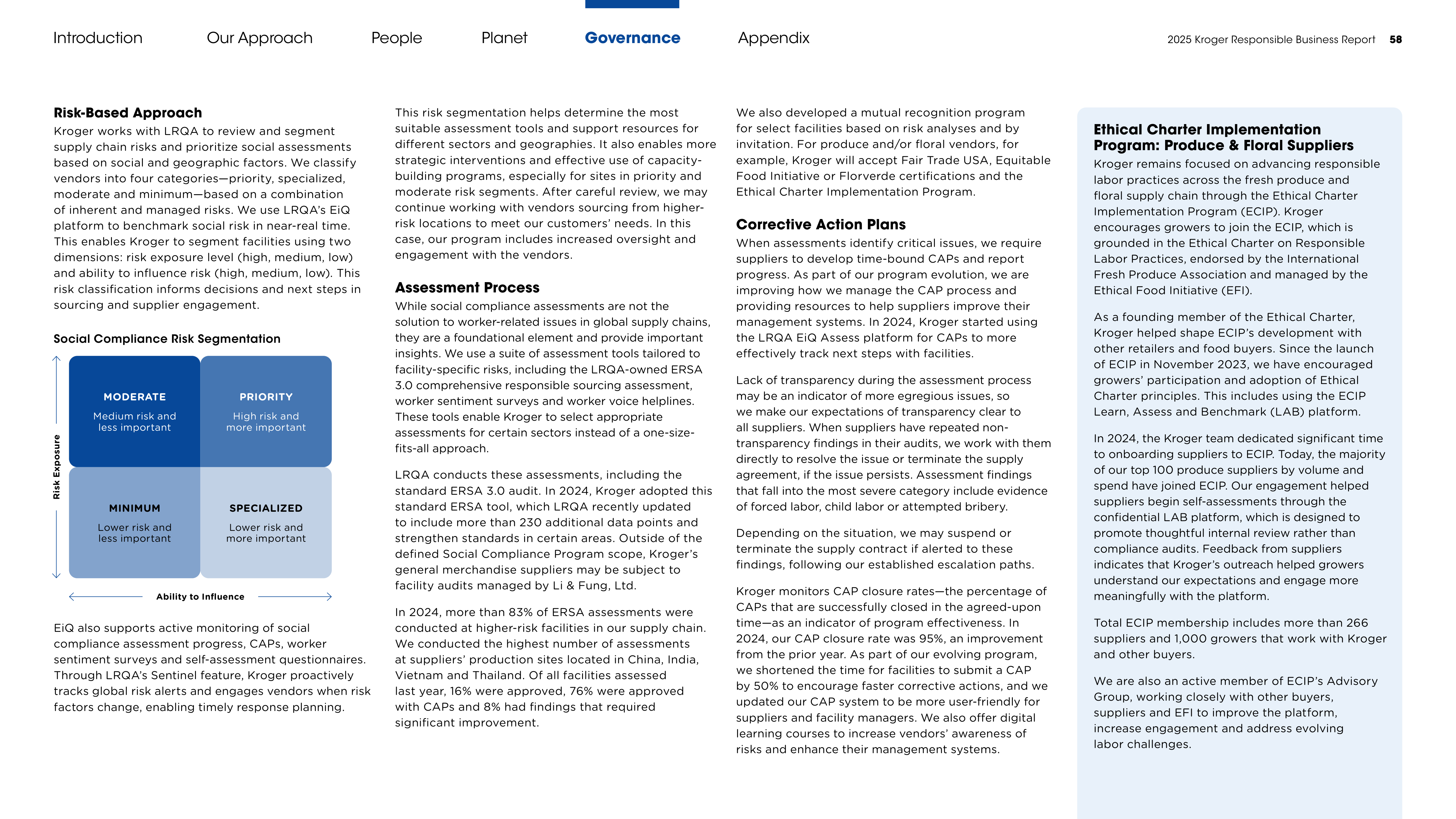
Risk-Based Approach
Kroger works with LRQA to review and segment
supply chain risks and prioritize social assessments
based on social and geographic factors. We classify
vendors into four categories—priority, specialized,
moderate and minimum—based on a combination
of inherent and managed risks. We use LRQA’s EiQ
platform to benchmark social risk in near-real time.
This enables Kroger to segment facilities using two
dimensions: risk exposure level (high, medium, low)
and ability to influence risk (high, medium, low). This
risk classification informs decisions and next steps in
sourcing and supplier engagement.
This risk segmentation helps determine the most
suitable assessment tools and support resources for
different sectors and geographies. It also enables more
strategic interventions and effective use of capacity-
building programs, especially for sites in priority and
moderate risk segments. After careful review, we may
continue working with vendors sourcing from higher-
risk locations to meet our customers’ needs. In this
case, our program includes increased oversight and
engagement with the vendors.
Assessment Process
While social compliance assessments are not the
solution to worker-related issues in global supply chains,
they are a foundational element and provide important
insights. We use a suite of assessment tools tailored to
facility-specific risks, including the LRQA-owned ERSA
3.0 comprehensive responsible sourcing assessment,
worker sentiment surveys and worker voice helplines.
These tools enable Kroger to select appropriate
assessments for certain sectors instead of a one-size-
fits-all approach.
LRQA conducts these assessments, including the
standard ERSA 3.0 audit. In 2024, Kroger adopted this
standard ERSA tool, which LRQA recently updated
to include more than 230 additional data points and
strengthen standards in certain areas. Outside of the
defined Social Compliance Program scope, Kroger’s
general merchandise suppliers may be subject to
facility audits managed by Li & Fung, Ltd.
In 2024, more than 83% of ERSA assessments were
conducted at higher-risk facilities in our supply chain.
We conducted the highest number of assessments
at suppliers’ production sites located in China, India,
Vietnam and Thailand. Of all facilities assessed
last year, 16% were approved, 76% were approved
with CAPs and 8% had findings that required
significant improvement.
We also developed a mutual recognition program
for select facilities based on risk analyses and by
invitation. For produce and/or floral vendors, for
example, Kroger will accept Fair Trade USA, Equitable
Food Initiative or Florverde certifications and the
Ethical Charter Implementation Program.
Corrective Action Plans
When assessments identify critical issues, we require
suppliers to develop time-bound CAPs and report
progress. As part of our program evolution, we are
improving how we manage the CAP process and
providing resources to help suppliers improve their
management systems. In 2024, Kroger started using
the LRQA EiQ Assess platform for CAPs to more
effectively track next steps with facilities.
Lack of transparency during the assessment process
may be an indicator of more egregious issues, so
we make our expectations of transparency clear to
all suppliers. When suppliers have repeated non-
transparency findings in their audits, we work with them
directly to resolve the issue or terminate the supply
agreement, if the issue persists. Assessment findings
that fall into the most severe category include evidence
of forced labor, child labor or attempted bribery.
Depending on the situation, we may suspend or
terminate the supply contract if alerted to these
findings, following our established escalation paths.
Kroger monitors CAP closure rates—the percentage of
CAPs that are successfully closed in the agreed-upon
time—as an indicator of program effectiveness. In
2024, our CAP closure rate was 95%, an improvement
from the prior year. As part of our evolving program,
we shortened the time for facilities to submit a CAP
by 50% to encourage faster corrective actions, and we
updated our CAP system to be more user-friendly for
suppliers and facility managers. We also offer digital
learning courses to increase vendors’ awareness of
risks and enhance their management systems.
Social Compliance Risk Segmentation
Risk Exposure
Ability to Influence
MINIMUM
Lower risk and
less important
MODERATE
Medium risk and
less important
SPECIALIZED
Lower risk and
more important
PRIORITY
High risk and
more important
Ethical Charter Implementation
Program: Produce & Floral Suppliers
Kroger remains focused on advancing responsible
labor practices across the fresh produce and
floral supply chain through the Ethical Charter
Implementation Program (ECIP). Kroger
encourages growers to join the ECIP, which is
grounded in the Ethical Charter on Responsible
Labor Practices, endorsed by the International
Fresh Produce Association and managed by the
Ethical Food Initiative (EFI).
As a founding member of the Ethical Charter,
Kroger helped shape ECIP’s development with
other retailers and food buyers. Since the launch
of ECIP in November 2023, we have encouraged
growers’ participation and adoption of Ethical
Charter principles. This includes using the ECIP
Learn, Assess and Benchmark (LAB) platform.
In 2024, the Kroger team dedicated significant time
to onboarding suppliers to ECIP. Today, the majority
of our top 100 produce suppliers by volume and
spend have joined ECIP. Our engagement helped
suppliers begin self-assessments through the
confidential LAB platform, which is designed to
promote thoughtful internal review rather than
compliance audits. Feedback from suppliers
indicates that Kroger’s outreach helped growers
understand our expectations and engage more
meaningfully with the platform.
Total ECIP membership includes more than 266
suppliers and 1,000 growers that work with Kroger
and other buyers.
We are also an active member of ECIP’s Advisory
Group, working closely with other buyers,
suppliers and EFI to improve the platform,
increase engagement and address evolving
labor challenges.
EiQ also supports active monitoring of social
compliance assessment progress, CAPs, worker
sentiment surveys and self-assessment questionnaires.
Through LRQA’s Sentinel feature, Kroger proactively
tracks global risk alerts and engages vendors when risk
factors change, enabling timely response planning.
People
Our Approach
Introduction
Planet
2025 Kroger Responsible Business Report
58
Appendix
Governance
Animal Welfare
The welfare of animals in our protein supply chain has
long been a priority for Kroger. We aim to advance the
welfare of animals that produce food while balancing
other strategic priorities that affect people and our
planet. We work with suppliers, animal welfare experts
and other stakeholders to advance standards that
protect workers and animals and that preserve access
to affordable proteins for our customers.
The company’s Corporate Food Technology team
leads our approach to animal welfare in the context of
animal agriculture and sustainable protein production,
with oversight from senior leaders and the Public
Responsibilities Committee of the Board.
Our Approach
We outline our approach in Kroger’s Animal Welfare
Policy, which was developed with insights from internal
and external subject matter experts. Our policy reflects
the Five Domains of Animal Welfare, an internationally
respected approach that emphasizes current animal
science and outcome-based standards.
Our primary focus remains advancing welfare for
laying hens, pigs, broiler chickens and dairy cattle in
ways that preserve affordability for our customers.
Kroger is not directly involved in raising or harvesting any
animals in our protein supply chain. We require suppliers
to adopt industry-accepted animal welfare standards and
provide welfare audit results. We comply with applicable
laws and regulations.
We participate in industry groups and collaborative
platforms to stay informed of key developments in animal
welfare and protein production. This includes the Global
Coalition for Animal Welfare (GCAW), a multi-stakeholder
group of protein producers, foodservice companies,
restaurants and retailers. GCAW is administered by a
secretariat and has dedicated working groups to advance
welfare for laying hens, pigs and broiler chickens.
Laying Hens
Kroger is working with suppliers, animal welfare experts
and other stakeholders to support the transition to
cage-free or higher-welfare laying hen housing systems
over time. We will continue to offer a variety of eggs
to ensure that affordable, healthy protein options are
accessible for all Kroger customers.
Given the current rate of industry progress and our
customers’ desire for affordability, Kroger plans to
transition about 70% of eggs sold (by units) to cage-free
or higher-welfare standards by 2030. We established the
following tentative milestones along the way: 2022: 33%
(achieved); 2024: 41% (achieved); 2025: 54%; and 2028:
61%. We will determine whether continued progress
beyond 2030 is feasible and if so, by when, based on
customer insights, regulatory timelines and industry
transition. Kroger plans to invest about $45 million
in support of this roadmap, including investments
in sourcing agreements, pricing, promotions
and merchandising.
In 2024, cage-free eggs represented 55.9% of total egg
revenue company-wide (2023: 54.1%). On a volume basis,
units of shell eggs sourced from laying hens in cage-
free housing systems increased to 43.3% in 2024 (2023:
36.1%).
1
We exceeded our 2024 roadmap milestone
despite the widespread impacts from avian influenza,
which significantly affected domestic flocks, available
egg supplies, and wholesale and retail prices.
Kroger continues to encourage our customers to trade
up to higher-welfare egg options where feasible. Based
on availability, we offer affordable Simple Truth® cage-
free eggs, promote cage-free or higher-welfare eggs
in weekly advertising circulars, and dedicate preferred
shelf space to higher-welfare options.
In 2022, Kroger and Kipster Farms, the innovative
egg production system founded in the Netherlands,
introduced next-level cage-free eggs to customers in
the U.S. The Simple Truth® + Kipster eggs are currently
available for customers in western U.S. states.
Late last year, the Kroger team introduced a pilot
to test at-shelf signs that more clearly explain
different hen housing systems and egg carton labels
for customers. The signs included descriptions for
conventional, cage-free, Simple Truth® + Kipster, free-
range, pasture-raised and organic eggs.
Our goal was to learn whether more descriptive at-shelf
signs would motivate customers to buy higher-welfare
egg options. We planned to evaluate test results after
six months; however, supply chain impacts from avian
influenza in 2025 affected our customers’ purchasing
behavior and test results. We will conduct another test
in early 2026 if egg supply is stable after the winter
avian influenza season.
Pigs
We encourage suppliers to use group housing systems
for sows to shorten time in individual stalls, enhance
health and welfare, protect workers and preserve
access to affordable fresh pork for our customers. We
define group housing as systems where sows are moved
to group pens for the middle phase of gestation as early
as possible, no later than six weeks after breeding.
Kroger’s goal is to source 100% of fresh pork from
sows in group housing systems by the end of 2025.
We established the following milestones: 65% by 2023
(achieved); 75% by 2024 (achieved); and 100% by 2025.
In 2024, 90% of our fresh pork volume was sourced
from sows in group housing, exceeding our milestone.
We are on track to achieve 100% by the end of 2025.
Our current goal does not include processed pork
items like bacon and cooked ham. Focusing on fresh
pork is positively affecting other pork products. Due to
our current labeling practices, we are unable to report
revenue from fresh pork from sows in group housing
systems as a percentage of total fresh pork revenue.
Broiler Chickens
Kroger aimed to achieve progress on four welfare
enhancements for at least 50% of our Simple Truth
Organic® and Simple Truth Natural® fresh chicken by
the end of 2024. The following are our 2024 year-
end results:
•
Prohibit broiler cages (achieved)
•
Maximum stocking density of 6.0 pounds per square
foot (36.6%)
•
Enriched environments, including litter and lighting
(71.4%)
•
Processing in a manner that avoids pre-stun
handling and uses a controlled atmosphere system
(CAS) to induce an irreversible stun (16.9%)
Progress on our broiler chicken welfare goals was
affected by producers’ slower-than-anticipated pace of
infrastructure investments, as well as their heightened
focus on preventing the spread of avian influenza
among domestic flocks.
Dairy Cattle
Cooperatives supplying milk to Kroger’s manufacturing
plants and
Our Brands
grocery assortment must be in
good standing with the National Dairy Farmers Assuring
Responsible Management (FARM) Animal Welfare
Program. We encourage suppliers to adopt updated
versions of the FARM Animal Care standard. FARM
Animal Care Version 5, released in 2024, focuses on
refining and clarifying previous standards surrounding
euthanasia, fitness for transport, calf management and
continuing education, among others.
Kroger is a signatory to the U.S. Dairy Stewardship
Commitment, supporting efforts to minimize dairy
production impacts on people and our planet.
1. 2023 volume figure is restated from 33.6% to 36.1% to reflect revised data
People
Our Approach
Introduction
Planet
2025 Kroger Responsible Business Report
59
Appendix
Governance
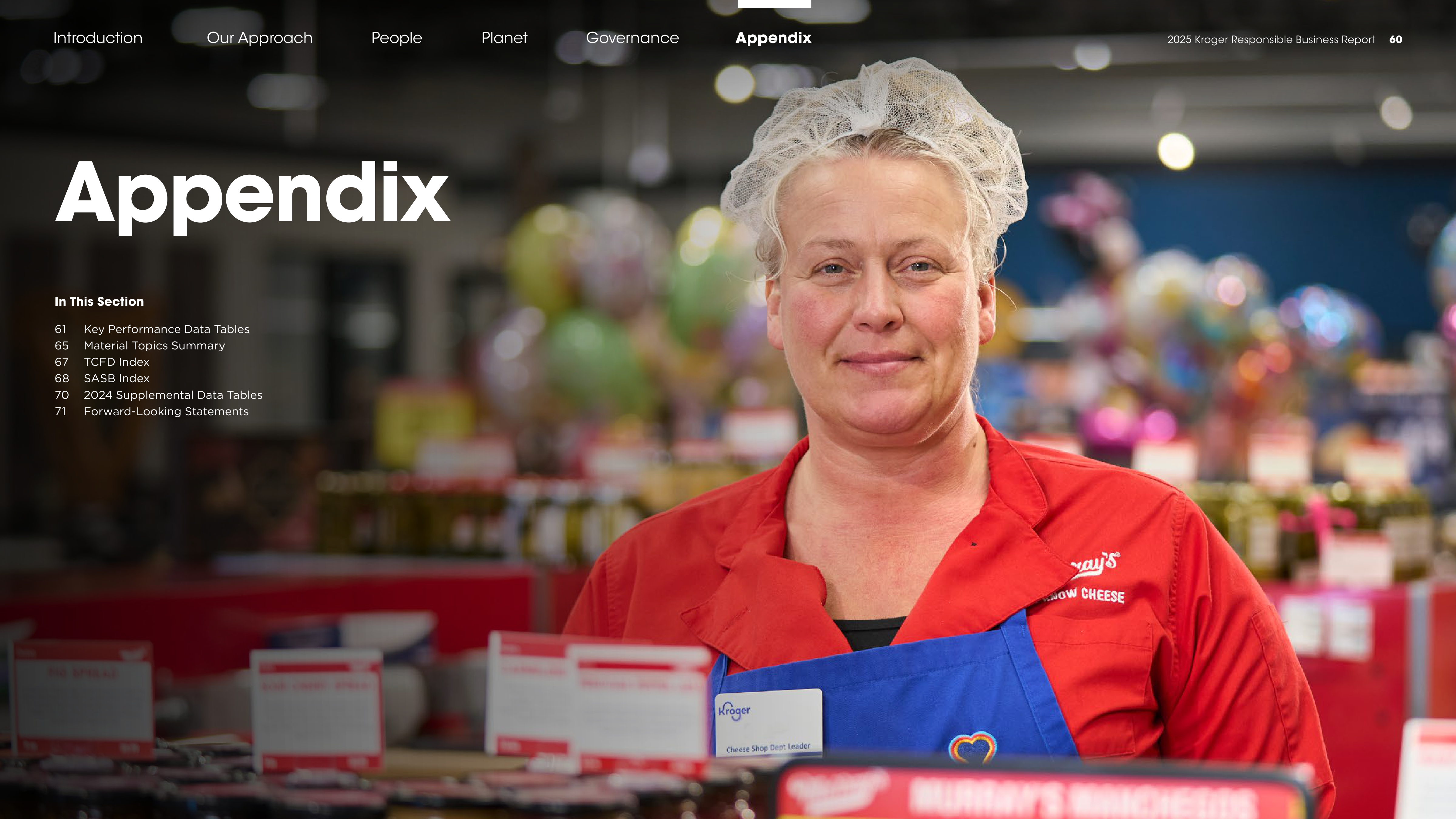
Appendix
In This Section
61
Key Performance Data Tables
65
Material Topics Summary
67
TCFD Index
68
SASB Index
70
2024 Supplemental Data Tables
71
Forward-Looking Statements
60
2025 Kroger Responsible Business Report
People
Our Approach
Introduction
Planet
Governance
Appendix
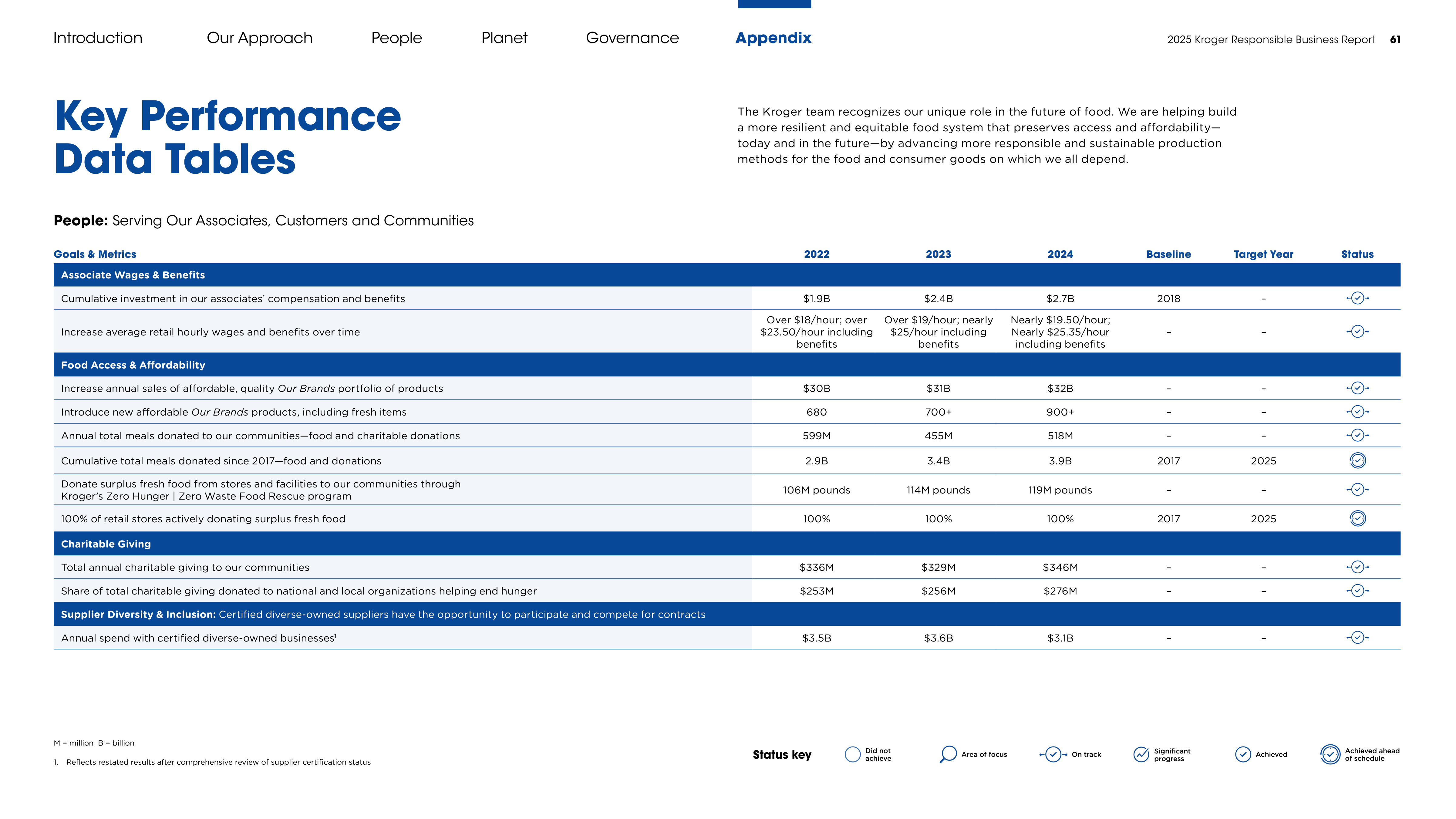
Key Performance
Data Tables
The Kroger team recognizes our unique role in the future of food. We are helping build
a more resilient and equitable food system that preserves access and affordability—
today and in the future—by advancing more responsible and sustainable production
methods for the food and consumer goods on which we all depend.
Goals & Metrics
2022
2023
2024
Baseline
Target Year
Status
Associate Wages & Benefits
Cumulative investment in our associates’ compensation and benefits
$1.9B
$2.4B
$2.7B
2018
–
Increase average retail hourly wages and benefits over time
Over $18/hour; over
$23.50/hour including
benefits
Over $19/hour; nearly
$25/hour including
benefits
Nearly $19.50/hour;
Nearly $25.35/hour
including benefits
–
–
Food Access & Affordability
Increase annual sales of affordable, quality
Our Brands
portfolio of products
$30B
$31B
$32B
–
–
Introduce new affordable
Our Brands
products, including fresh items
680
700+
900+
–
–
Annual total meals donated to our communities—food and charitable donations
599M
455M
518M
–
–
Cumulative total meals donated since 2017—food and donations
2.9B
3.4B
3.9B
2017
2025
Donate surplus fresh food from stores and facilities to our communities through
Kroger’s Zero Hunger | Zero Waste Food Rescue program
106M pounds
114M pounds
119M pounds
–
–
100% of retail stores actively donating surplus fresh food
100%
100%
100%
2017
2025
Charitable Giving
Total annual charitable giving to our communities
$336M
$329M
$346M
–
–
Share of total charitable giving donated to national and local organizations helping end hunger
$253M
$256M
$276M
–
–
Supplier Diversity & Inclusion:
Certified diverse-owned suppliers have the opportunity to participate and compete for contracts
Annual spend with certified diverse-owned businesses
1
$3.5B
$3.6B
$3.1B
–
–
People:
Serving Our Associates, Customers and Communities
M = million B = billion
1.
Reflects restated results after comprehensive review of supplier certification status
Achieved
Did not
achieve
On track
Area of focus
Achieved ahead
of schedule
Significant
progress
Status key
People
Our Approach
Introduction
Planet
2025 Kroger Responsible Business Report
61
Governance
Appendix
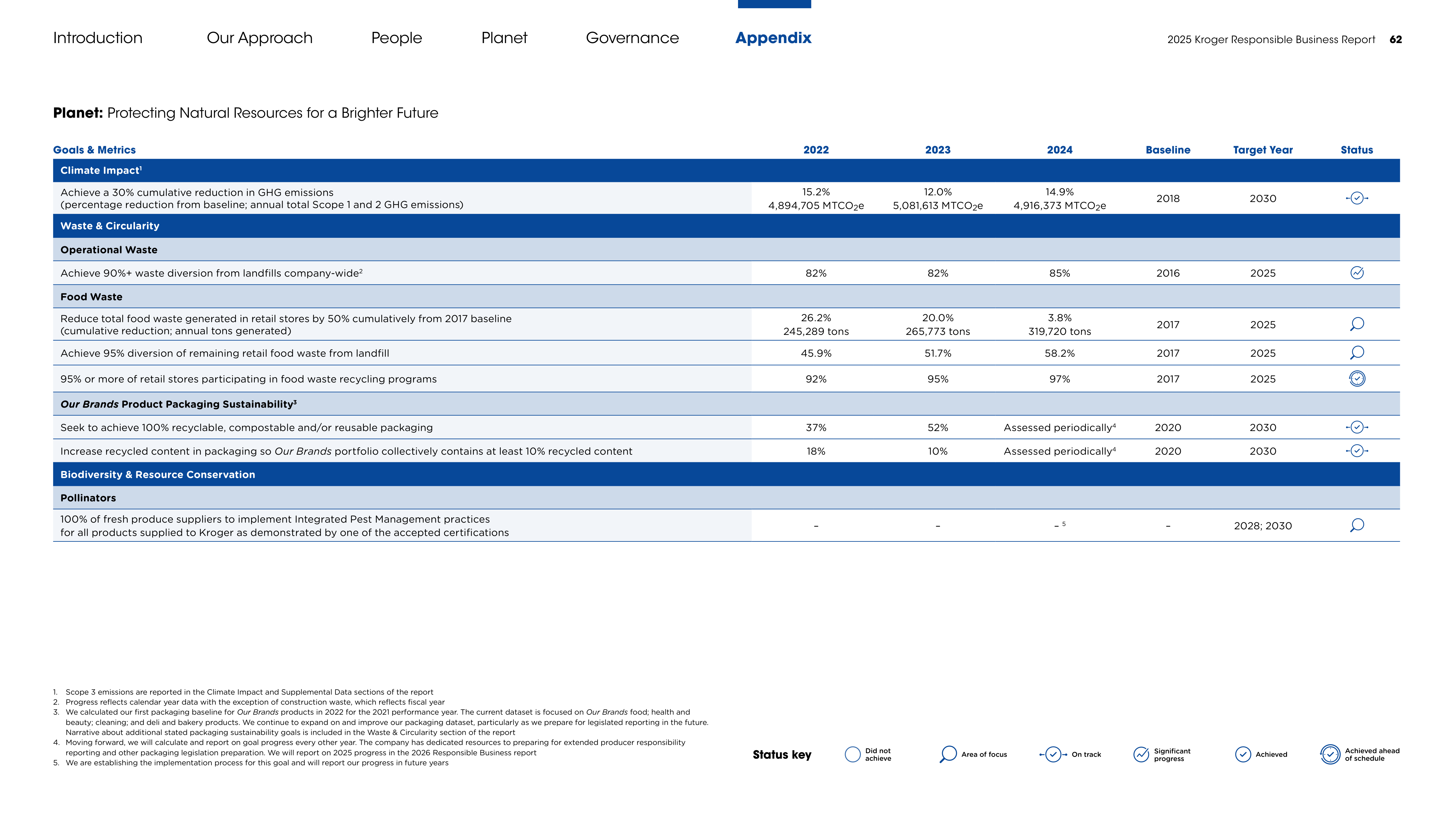
1.
Scope 3 emissions are reported in the Climate Impact and Supplemental Data sections of the report
2.
Progress reflects calendar year data with the exception of construction waste, which reflects fiscal year
3.
We calculated our first packaging baseline for
Our Brands
products in 2022 for the 2021 performance year. The current dataset is focused on
Our Brands
food; health and
beauty; cleaning; and deli and bakery products. We continue to expand on and improve our packaging dataset, particularly as we prepare for legislated reporting in the future.
Narrative about additional stated packaging sustainability goals is included in the Waste & Circularity section of the report
4.
Moving forward, we will calculate and report on goal progress every other year. The company has dedicated resources to preparing for extended producer responsibility
reporting and other packaging legislation preparation. We will report on 2025 progress in the 2026 Responsible Business report
5.
We are establishing the implementation process for this goal and will report our progress in future years
Planet:
Protecting Natural Resources for a Brighter Future
Goals & Metrics
2022
2023
2024
Baseline
Target Year
Status
Climate Impact
1
Achieve a 30% cumulative reduction in GHG emissions
(percentage reduction from baseline; annual total Scope 1 and 2 GHG emissions)
15.2%
4,894,705 MTCO
2
e
12.0%
5,081,613 MTCO
2
e
14.9%
4,916,373 MTCO
2
e
2018
2030
Waste & Circularity
Operational Waste
Achieve 90%+ waste diversion from landfills company-wide
2
82%
82%
85%
2016
2025
Food Waste
Reduce total food waste generated in retail stores by 50% cumulatively from 2017 baseline
(cumulative reduction; annual tons generated)
26.2%
245,289 tons
20.0%
265,773 tons
3.8%
319,720 tons
2017
2025
Achieve 95% diversion of remaining retail food waste from landfill
45.9%
51.7%
58.2%
2017
2025
95% or more of retail stores participating in food waste recycling programs
92%
95%
97%
2017
2025
Our Brands
Product Packaging Sustainability
3
Seek to achieve 100% recyclable, compostable and/or reusable packaging
37%
52%
Assessed periodically
4
2020
2030
Increase recycled content in packaging so
Our Brands
portfolio collectively contains at least 10% recycled content
18%
10%
Assessed periodically
4
2020
2030
Biodiversity & Resource Conservation
Pollinators
100% of fresh produce suppliers to implement Integrated Pest Management practices
for all products supplied to Kroger as demonstrated by one of the accepted certifications
–
–
–
5
–
2028; 2030
Achieved
Did not
achieve
On track
Area of focus
Achieved ahead
of schedule
Significant
progress
Status key
People
Our Approach
Introduction
Planet
2025 Kroger Responsible Business Report
62
Governance
Appendix
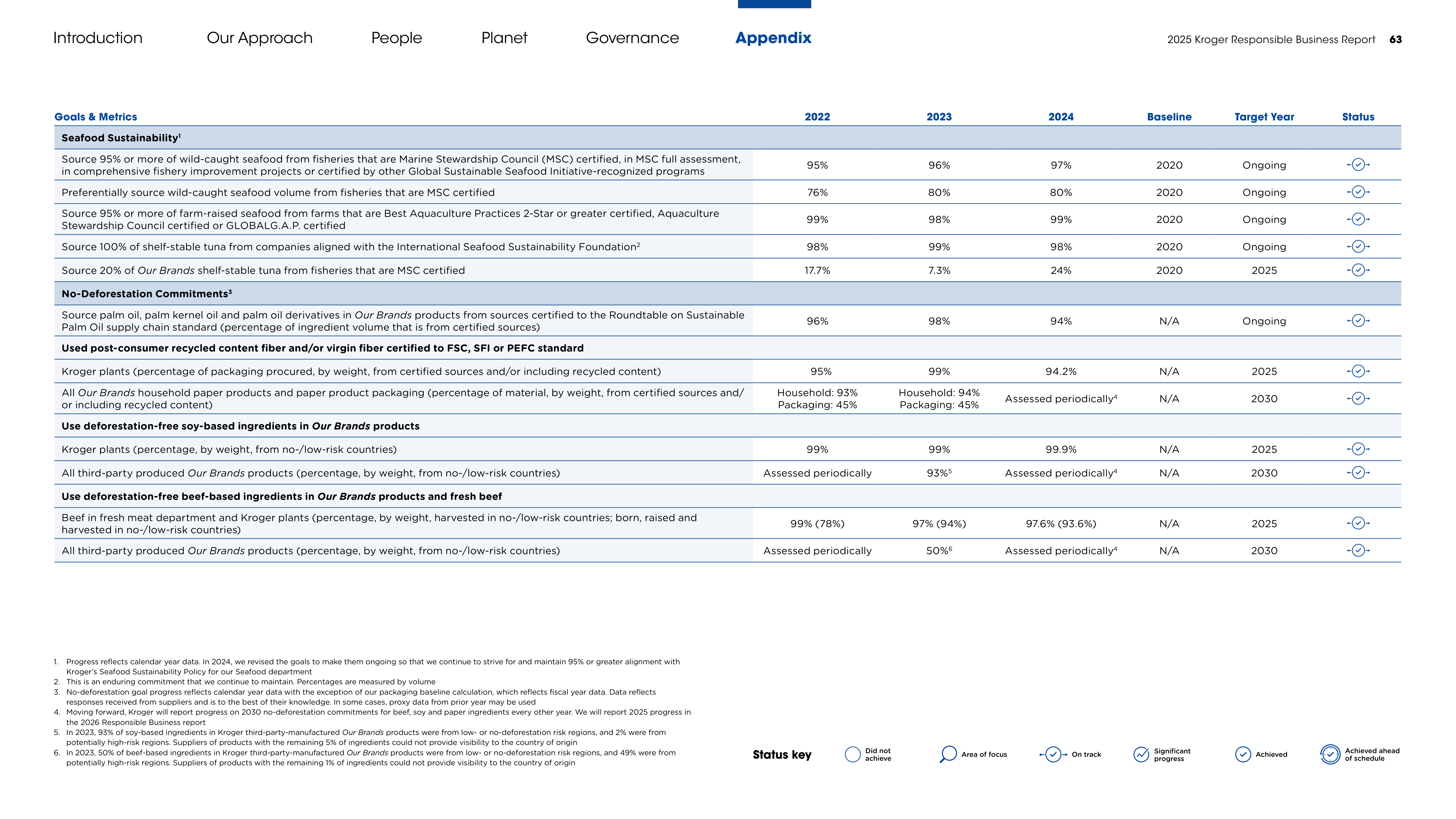
Goals & Metrics
2022
2023
2024
Baseline
Target Year
Status
Seafood Sustainability
1
Source 95% or more of wild-caught seafood from fisheries that are Marine Stewardship Council (MSC) certified, in MSC full assessment,
in comprehensive fishery improvement projects or certified by other Global Sustainable Seafood Initiative-recognized programs
95%
96%
97%
2020
Ongoing
Preferentially source wild-caught seafood volume from fisheries that are MSC certified
76%
80%
80%
2020
Ongoing
Source 95% or more of farm-raised seafood from farms that are Best Aquaculture Practices 2-Star or greater certified, Aquaculture
Stewardship Council certified or GLOBALG.A.P. certified
99%
98%
99%
2020
Ongoing
Source 100% of shelf-stable tuna from companies aligned with the International Seafood Sustainability Foundation
2
98%
99%
98%
2020
Ongoing
Source 20% of
Our Brands
shelf-stable tuna from fisheries that are MSC certified
17.7%
7.3%
24%
2020
2025
No-Deforestation Commitments
3
Source palm oil, palm kernel oil and palm oil derivatives in
Our Brands
products from sources certified to the Roundtable on Sustainable
Palm Oil supply chain standard (percentage of ingredient volume that is from certified sources)
96%
98%
94%
N/A
Ongoing
Used post-consumer recycled content fiber and/or virgin fiber certified to FSC, SFI or PEFC standard
Kroger plants (percentage of packaging procured, by weight, from certified sources and/or including recycled content)
95%
99%
94.2%
N/A
2025
All
Our Brands
household paper products and paper product packaging (percentage of material, by weight, from certified sources and/
or including recycled content)
Household: 93%
Packaging: 45%
Household: 94%
Packaging: 45%
Assessed periodically
4
N/A
2030
Use deforestation-free soy-based ingredients in
Our Brands
products
Kroger plants (percentage, by weight, from no-/low-risk countries)
99%
99%
99.9%
N/A
2025
All third-party produced
Our Brands
products (percentage, by weight, from no-/low-risk countries)
Assessed periodically
93%
5
Assessed periodically
4
N/A
2030
Use deforestation-free beef-based ingredients in
Our Brands
products and fresh beef
Beef in fresh meat department and Kroger plants (percentage, by weight, harvested in no-/low-risk countries; born, raised and
harvested in no-/low-risk countries)
99% (78%)
97% (94%)
97.6% (93.6%)
N/A
2025
All third-party produced
Our Brands
products (percentage, by weight, from no-/low-risk countries)
Assessed periodically
50%
6
Assessed periodically
4
N/A
2030
1.
Progress reflects calendar year data. In 2024, we revised the goals to make them ongoing so that we continue to strive for and maintain 95% or greater alignment with
Kroger’s Seafood Sustainability Policy for our Seafood department
2.
This is an enduring commitment that we continue to maintain. Percentages are measured by volume
3.
No-deforestation goal progress reflects calendar year data with the exception of our packaging baseline calculation, which reflects fiscal year data. Data reflects
responses received from suppliers and is to the best of their knowledge. In some cases, proxy data from prior year may be used
4. Moving forward, Kroger will report progress on 2030 no-deforestation commitments for beef, soy and paper ingredients every other year. We will report 2025 progress in
the 2026 Responsible Business report
5.
In 2023, 93% of soy-based ingredients in Kroger third-party-manufactured
Our Brands
products were from low- or no-deforestation risk regions, and 2% were from
potentially high-risk regions. Suppliers of products with the remaining 5% of ingredients could not provide visibility to the country of origin
6. In 2023, 50% of beef-based ingredients in Kroger third-party-manufactured
Our Brands
products were from low- or no-deforestation risk regions, and 49% were from
potentially high-risk regions. Suppliers of products with the remaining 1% of ingredients could not provide visibility to the country of origin
Achieved
Did not
achieve
On track
Area of focus
Achieved ahead
of schedule
Significant
progress
Status key
People
Our Approach
Introduction
Planet
2025 Kroger Responsible Business Report
63
Governance
Appendix
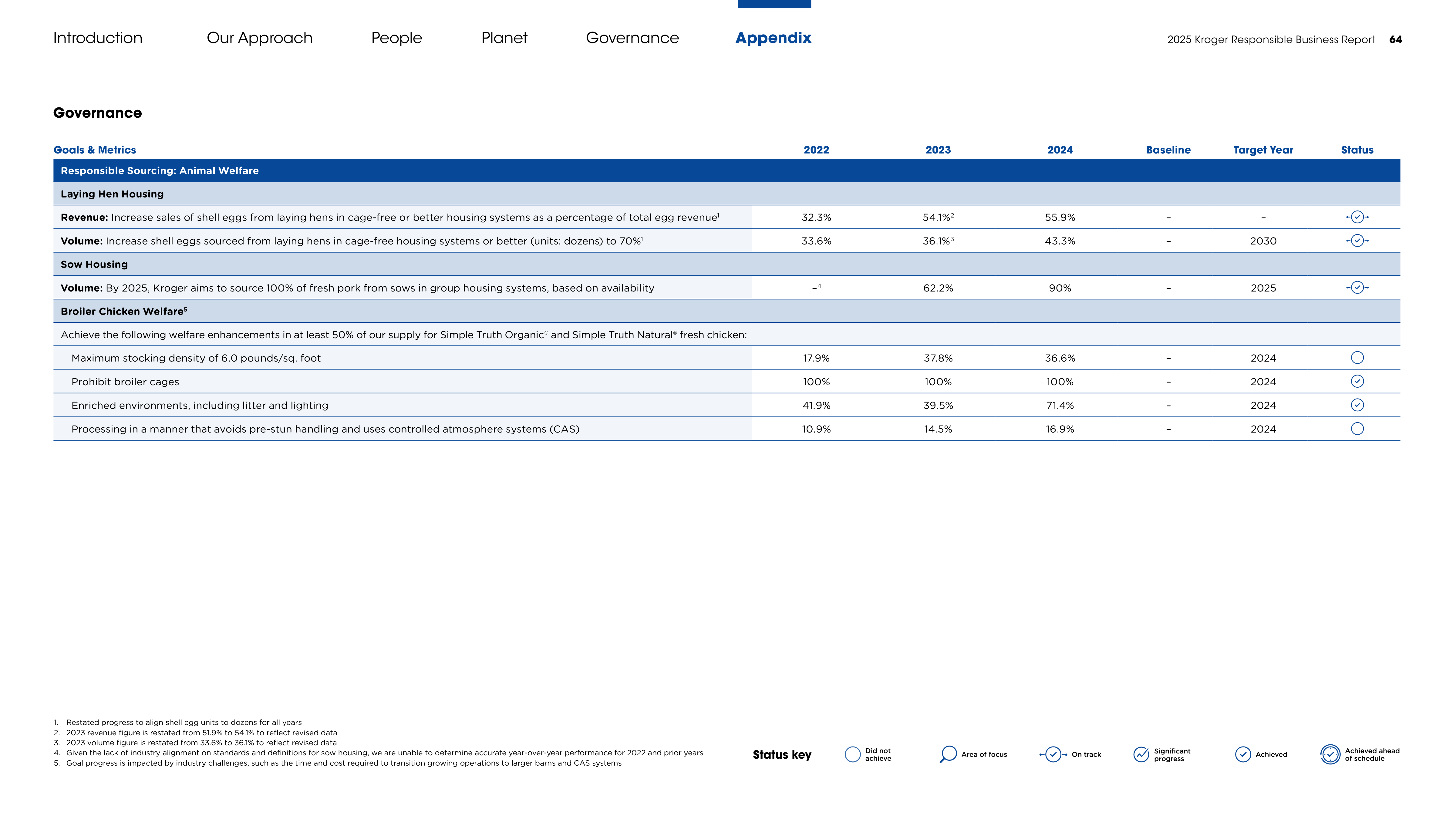
Goals & Metrics
2022
2023
2024
Baseline
Target Year
Status
Responsible Sourcing: Animal Welfare
Laying Hen Housing
Revenue:
Increase sales of shell eggs from laying hens in cage-free or better housing systems as a percentage of total egg revenue
1
32.3%
54.1%
2
55.9%
–
–
Volume:
Increase shell eggs sourced from laying hens in cage-free housing systems or better (units: dozens) to 70%
1
33.6%
36.1%
3
43.3%
–
2030
Sow Housing
Volume:
By 2025, Kroger aims to source 100% of fresh pork from sows in group housing systems, based on availability
–
4
62.2%
90%
–
2025
Broiler Chicken Welfare
5
Achieve the following welfare enhancements in at least 50% of our supply for Simple Truth Organic® and Simple Truth Natural® fresh chicken:
Maximum stocking density of 6.0 pounds/sq. foot
17.9%
37.8%
36.6%
–
2024
Prohibit broiler cages
100%
100%
100%
–
2024
Enriched environments, including litter and lighting
41.9%
39.5%
71.4%
–
2024
Processing in a manner that avoids pre-stun handling and uses controlled atmosphere systems (CAS)
10.9%
14.5%
16.9%
–
2024
1.
Restated progress to align shell egg units to dozens for all years
2.
2023 revenue figure is restated from 51.9% to 54.1% to reflect revised data
3.
2023 volume figure is restated from 33.6% to 36.1% to reflect revised data
4.
Given the lack of industry alignment on standards and definitions for sow housing, we are unable to determine accurate year-over-year performance for 2022 and prior years
5.
Goal progress is impacted by industry challenges, such as the time and cost required to transition growing operations to larger barns and CAS systems
Governance
Achieved
Did not
achieve
On track
Area of focus
Achieved ahead
of schedule
Significant
progress
Status key
People
Our Approach
Introduction
Planet
2025 Kroger Responsible Business Report
64
Governance
Appendix
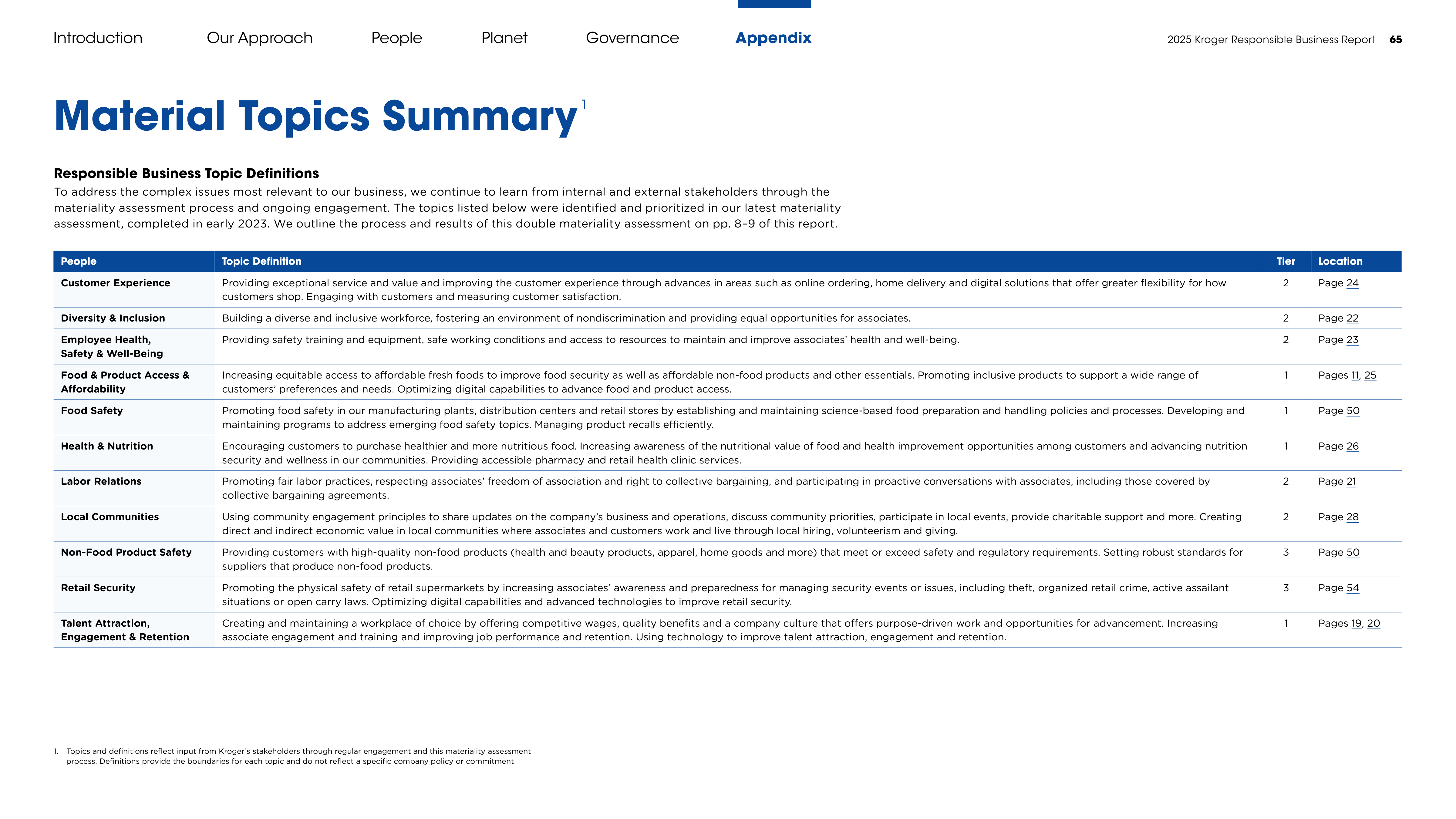
People
Topic Definition
Tier
Location
Customer Experience
Providing exceptional service and value and improving the customer experience through advances in areas such as online ordering, home delivery and digital solutions that offer greater flexibility for how
customers shop. Engaging with customers and measuring customer satisfaction.
2
Page 24
Diversity & Inclusion
Building a diverse and inclusive workforce, fostering an environment of nondiscrimination and providing equal opportunities for associates.
2
Page 22
Employee Health,
Safety & Well-Being
Providing safety training and equipment, safe working conditions and access to resources to maintain and improve associates’ health and well-being.
2
Page 23
Food & Product Access &
Affordability
Increasing equitable access to affordable fresh foods to improve food security as well as affordable non-food products and other essentials. Promoting inclusive products to support a wide range of
customers’ preferences and needs. Optimizing digital capabilities to advance food and product access.
1
Pages 11, 25
Food Safety
Promoting food safety in our manufacturing plants, distribution centers and retail stores by establishing and maintaining science-based food preparation and handling policies and processes. Developing and
maintaining programs to address emerging food safety topics. Managing product recalls efficiently.
1
Page 50
Health & Nutrition
Encouraging customers to purchase healthier and more nutritious food. Increasing awareness of the nutritional value of food and health improvement opportunities among customers and advancing nutrition
security and wellness in our communities. Providing accessible pharmacy and retail health clinic services.
1
Page 26
Labor Relations
Promoting fair labor practices, respecting associates’ freedom of association and right to collective bargaining, and participating in proactive conversations with associates, including those covered by
collective bargaining agreements.
2
Page 21
Local Communities
Using community engagement principles to share updates on the company’s business and operations, discuss community priorities, participate in local events, provide charitable support and more. Creating
direct and indirect economic value in local communities where associates and customers work and live through local hiring, volunteerism and giving.
2
Page 28
Non-Food Product Safety
Providing customers with high-quality non-food products (health and beauty products, apparel, home goods and more) that meet or exceed safety and regulatory requirements. Setting robust standards for
suppliers that produce non-food products.
3
Page 50
Retail Security
Promoting the physical safety of retail supermarkets by increasing associates’ awareness and preparedness for managing security events or issues, including theft, organized retail crime, active assailant
situations or open carry laws. Optimizing digital capabilities and advanced technologies to improve retail security.
3
Page 54
Talent Attraction,
Engagement & Retention
Creating and maintaining a workplace of choice by offering competitive wages, quality benefits and a company culture that offers purpose-driven work and opportunities for advancement. Increasing
associate engagement and training and improving job performance and retention. Using technology to improve talent attraction, engagement and retention.
1
Pages 19, 20
Responsible Business Topic Definitions
To address the complex issues most relevant to our business, we continue to learn from internal and external stakeholders through the
materiality assessment process and ongoing engagement. The topics listed below were identified and prioritized in our latest materiality
assessment, completed in early 2023. We outline the process and results of this double materiality assessment on pp. 8–9 of this report.
Material Topics Summary
1
1.
Topics and definitions reflect input from Kroger’s stakeholders through regular engagement and this materiality assessment
process. Definitions provide the boundaries for each topic and do not reflect a specific company policy or commitment
People
Our Approach
Introduction
Planet
2025 Kroger Responsible Business Report
65
Governance
Appendix
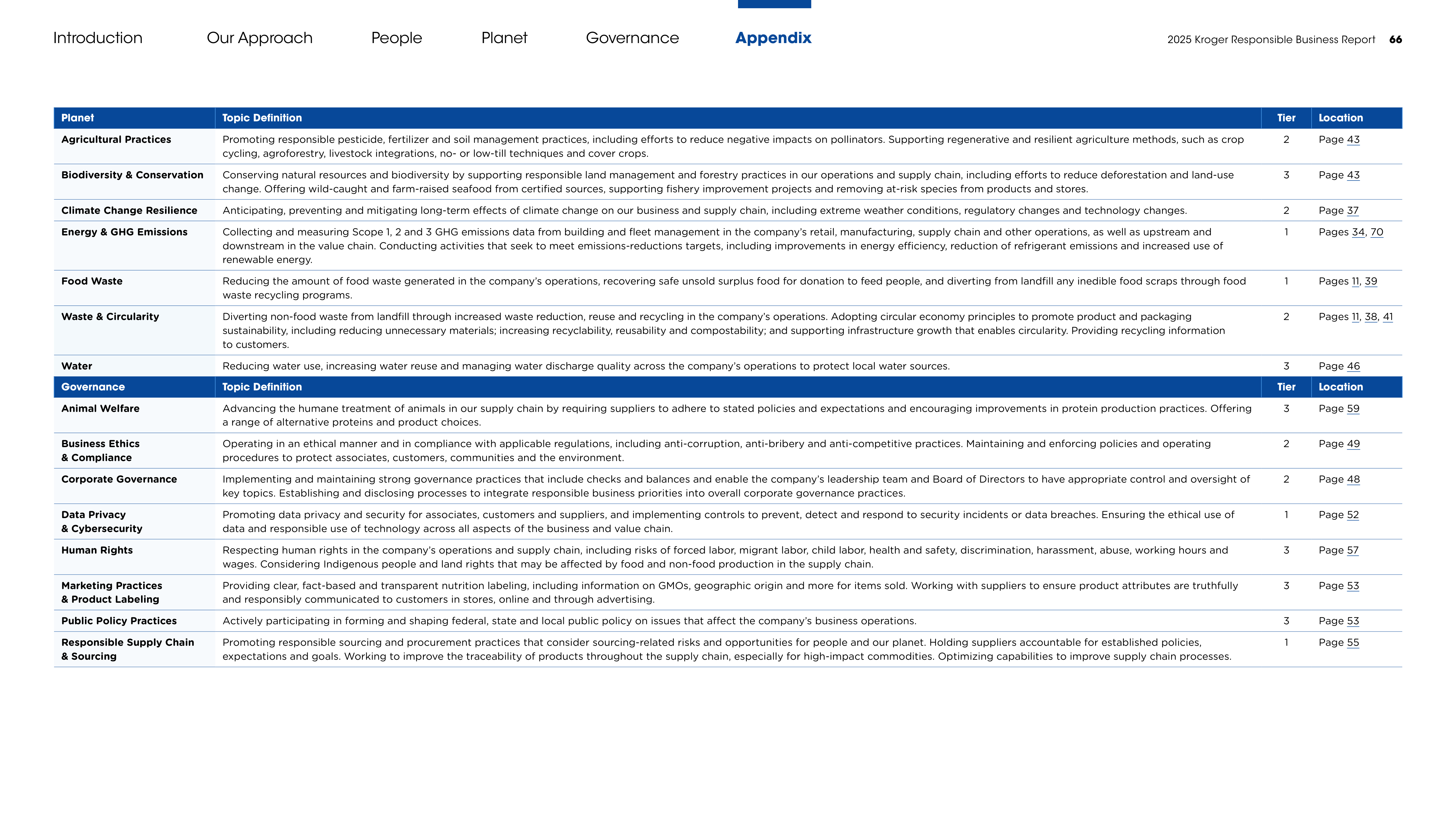
Planet
Topic Definition
Tier
Location
Agricultural Practices
Promoting responsible pesticide, fertilizer and soil management practices, including efforts to reduce negative impacts on pollinators. Supporting regenerative and resilient agriculture methods, such as crop
cycling, agroforestry, livestock integrations, no- or low-till techniques and cover crops.
2
Page 43
Biodiversity & Conservation
Conserving natural resources and biodiversity by supporting responsible land management and forestry practices in our operations and supply chain, including efforts to reduce deforestation and land-use
change. Offering wild-caught and farm-raised seafood from certified sources, supporting fishery improvement projects and removing at-risk species from products and stores.
3
Page 43
Climate Change Resilience
Anticipating, preventing and mitigating long-term effects of climate change on our business and supply chain, including extreme weather conditions, regulatory changes and technology changes.
2
Page 37
Energy & GHG Emissions
Collecting and measuring Scope 1, 2 and 3 GHG emissions data from building and fleet management in the company’s retail, manufacturing, supply chain and other operations, as well as upstream and
downstream in the value chain. Conducting activities that seek to meet emissions-reductions targets, including improvements in energy efficiency, reduction of refrigerant emissions and increased use of
renewable energy.
1
Pages 34, 70
Food Waste
Reducing the amount of food waste generated in the company’s operations, recovering safe unsold surplus food for donation to feed people, and diverting from landfill any inedible food scraps through food
waste recycling programs.
1
Pages 11, 39
Waste & Circularity
Diverting non-food waste from landfill through increased waste reduction, reuse and recycling in the company’s operations. Adopting circular economy principles to promote product and packaging
sustainability, including reducing unnecessary materials; increasing recyclability, reusability and compostability; and supporting infrastructure growth that enables circularity. Providing recycling information
to customers.
2
Pages 11, 38, 41
Water
Reducing water use, increasing water reuse and managing water discharge quality across the company’s operations to protect local water sources.
3
Page 46
Governance
Topic Definition
Tier
Location
Animal Welfare
Advancing the humane treatment of animals in our supply chain by requiring suppliers to adhere to stated policies and expectations and encouraging improvements in protein production practices. Offering
a range of alternative proteins and product choices.
3
Page 59
Business Ethics
& Compliance
Operating in an ethical manner and in compliance with applicable regulations, including anti-corruption, anti-bribery and anti-competitive practices. Maintaining and enforcing policies and operating
procedures to protect associates, customers, communities and the environment.
2
Page 49
Corporate Governance
Implementing and maintaining strong governance practices that include checks and balances and enable the company’s leadership team and Board of Directors to have appropriate control and oversight of
key topics. Establishing and disclosing processes to integrate responsible business priorities into overall corporate governance practices.
2
Page 48
Data Privacy
& Cybersecurity
Promoting data privacy and security for associates, customers and suppliers, and implementing controls to prevent, detect and respond to security incidents or data breaches. Ensuring the ethical use of
data and responsible use of technology across all aspects of the business and value chain.
1
Page 52
Human Rights
Respecting human rights in the company’s operations and supply chain, including risks of forced labor, migrant labor, child labor, health and safety, discrimination, harassment, abuse, working hours and
wages. Considering Indigenous people and land rights that may be affected by food and non-food production in the supply chain.
3
Page 57
Marketing Practices
& Product Labeling
Providing clear, fact-based and transparent nutrition labeling, including information on GMOs, geographic origin and more for items sold. Working with suppliers to ensure product attributes are truthfully
and responsibly communicated to customers in stores, online and through advertising.
3
Page 53
Public Policy Practices
Actively participating in forming and shaping federal, state and local public policy on issues that affect the company’s business operations.
3
Page 53
Responsible Supply Chain
& Sourcing
Promoting responsible sourcing and procurement practices that consider sourcing-related risks and opportunities for people and our planet. Holding suppliers accountable for established policies,
expectations and goals. Working to improve the traceability of products throughout the supply chain, especially for high-impact commodities. Optimizing capabilities to improve supply chain processes.
1
Page 55
People
Our Approach
Introduction
Planet
2025 Kroger Responsible Business Report
66
Governance
Appendix
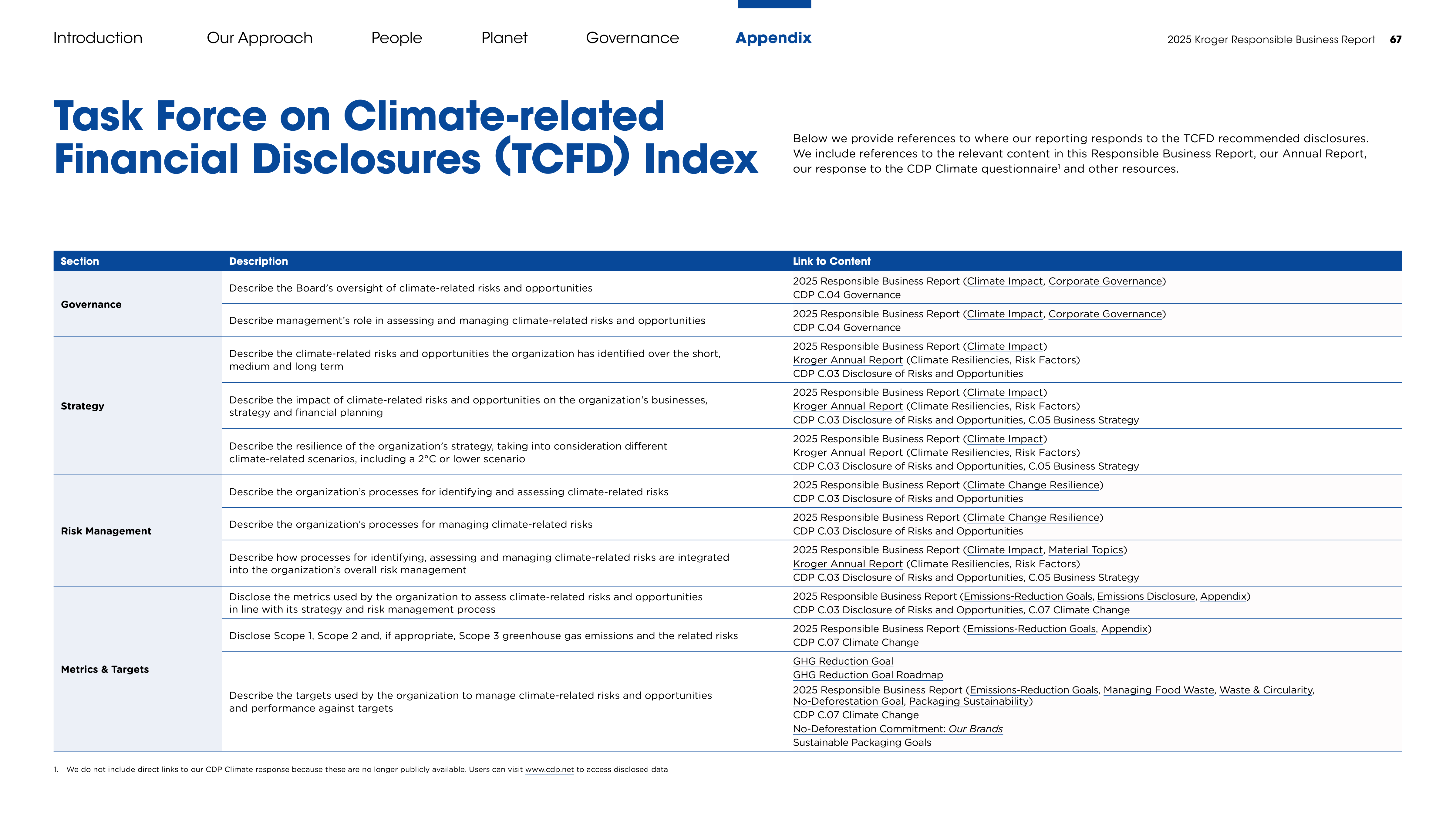
Section
Description
Link to Content
Governance
Describe the Board’s oversight of climate-related risks and opportunities
2025 Responsible Business Report (Climate Impact, Corporate Governance)
CDP C.04 Governance
Describe management’s role in assessing and managing climate-related risks and opportunities
2025 Responsible Business Report (Climate Impact, Corporate Governance)
CDP C.04 Governance
Strategy
Describe the climate-related risks and opportunities the organization has identified over the short,
medium and long term
2025 Responsible Business Report (Climate Impact)
Kroger Annual Report (Climate Resiliencies, Risk Factors)
CDP C.03 Disclosure of Risks and Opportunities
Describe the impact of climate-related risks and opportunities on the organization’s businesses,
strategy and financial planning
2025 Responsible Business Report (Climate Impact)
Kroger Annual Report (Climate Resiliencies, Risk Factors)
CDP C.03 Disclosure of Risks and Opportunities, C.05 Business Strategy
Describe the resilience of the organization’s strategy, taking into consideration different
climate-related scenarios, including a 2°C or lower scenario
2025 Responsible Business Report (Climate Impact)
Kroger Annual Report (Climate Resiliencies, Risk Factors)
CDP C.03 Disclosure of Risks and Opportunities, C.05 Business Strategy
Risk Management
Describe the organization’s processes for identifying and assessing climate-related risks
2025 Responsible Business Report (Climate Change Resilience)
CDP C.03 Disclosure of Risks and Opportunities
Describe the organization’s processes for managing climate-related risks
2025 Responsible Business Report (Climate Change Resilience)
CDP C.03 Disclosure of Risks and Opportunities
Describe how processes for identifying, assessing and managing climate-related risks are integrated
into the organization’s overall risk management
2025 Responsible Business Report (Climate Impact, Material Topics)
Kroger Annual Report (Climate Resiliencies, Risk Factors)
CDP C.03 Disclosure of Risks and Opportunities, C.05 Business Strategy
Metrics & Targets
Disclose the metrics used by the organization to assess climate-related risks and opportunities
in line with its strategy and risk management process
2025 Responsible Business Report (Emissions-Reduction Goals, Emissions Disclosure, Appendix)
CDP C.03 Disclosure of Risks and Opportunities, C.07 Climate Change
Disclose Scope 1, Scope 2 and, if appropriate, Scope 3 greenhouse gas emissions and the related risks
2025 Responsible Business Report (Emissions-Reduction Goals, Appendix)
CDP C.07 Climate Change
Describe the targets used by the organization to manage climate-related risks and opportunities
and performance against targets
GHG Reduction Goal
GHG Reduction Goal Roadmap
2025 Responsible Business Report (Emissions-Reduction Goals, Managing Food Waste, Waste & Circularity,
No-Deforestation Goal, Packaging Sustainability)
CDP C.07 Climate Change
No-Deforestation Commitment:
Our Brands
Sustainable Packaging Goals
Task Force on Climate-related
Financial Disclosures
(
TCFD
)
Index
Below we provide references to where our reporting responds to the TCFD recommended disclosures.
We include references to the relevant content in this Responsible Business Report, our Annual Report,
our response to the CDP Climate questionnaire
1
and other resources.
1.
We do not include direct links to our CDP Climate response because these are no longer publicly available. Users can visit www.cdp.net to access disclosed data
People
Our Approach
Introduction
Planet
2025 Kroger Responsible Business Report
67
Governance
Appendix
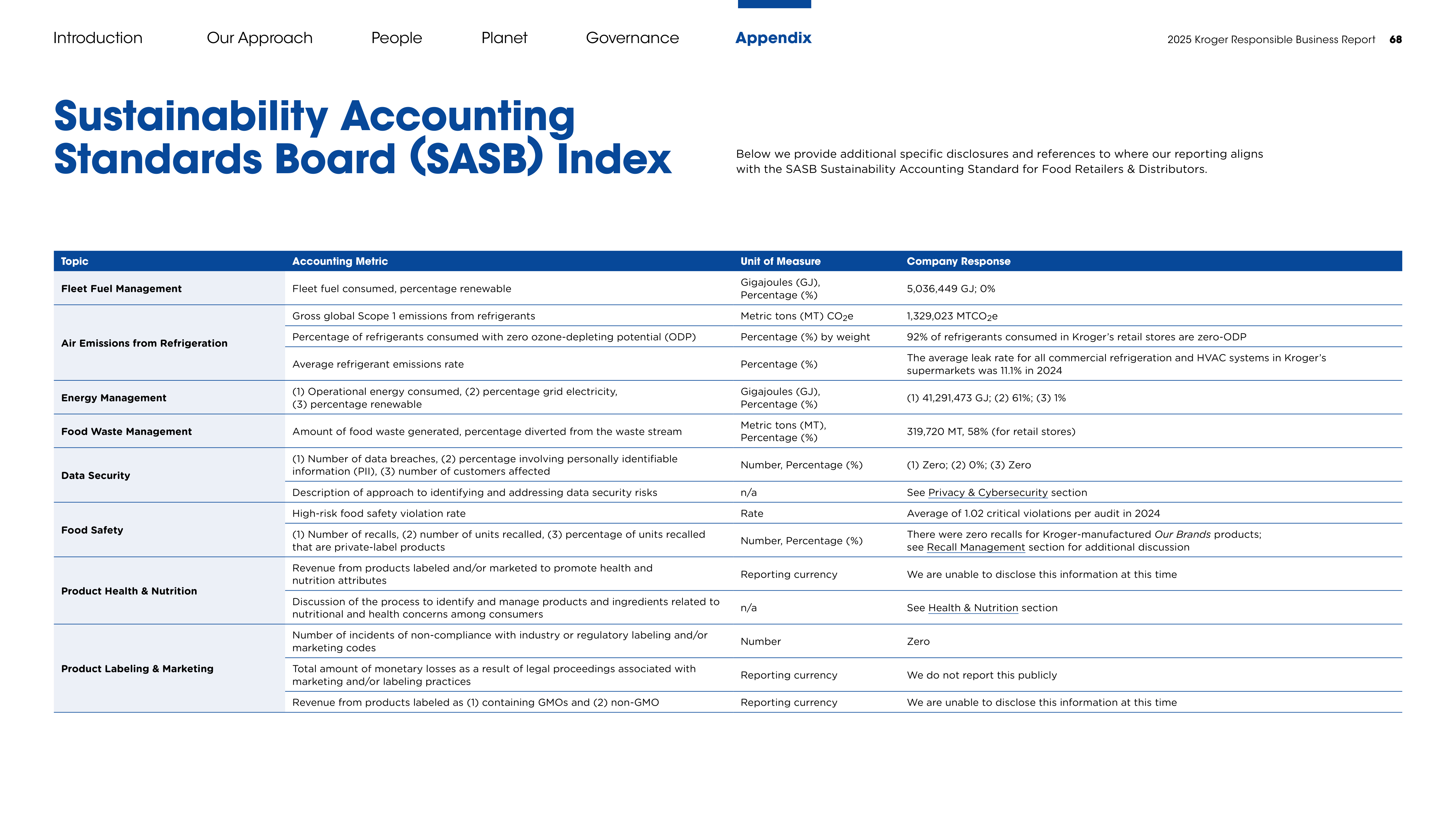
Topic
Accounting Metric
Unit of Measure
Company Response
Fleet Fuel Management
Fleet fuel consumed, percentage renewable
Gigajoules (GJ),
Percentage (%)
5,036,449 GJ; 0%
Air Emissions from Refrigeration
Gross global Scope 1 emissions from refrigerants
Metric tons (MT) CO
2
e
1,329,023 MTCO
2
e
Percentage of refrigerants consumed with zero ozone-depleting potential (ODP)
Percentage (%) by weight
92% of refrigerants consumed in Kroger’s retail stores are zero-ODP
Average refrigerant emissions rate
Percentage (%)
The average leak rate for all commercial refrigeration and HVAC systems in Kroger’s
supermarkets was 11.1% in 2024
Energy Management
(1) Operational energy consumed, (2) percentage grid electricity,
(3) percentage renewable
Gigajoules (GJ),
Percentage (%)
(1) 41,291,473 GJ; (2) 61%; (3) 1%
Food Waste Management
Amount of food waste generated, percentage diverted from the waste stream
Metric tons (MT),
Percentage (%)
319,720 MT, 58% (for retail stores)
Data Security
(1) Number of data breaches, (2) percentage involving personally identifiable
information (PII), (3) number of customers affected
Number, Percentage (%)
(1) Zero; (2) 0%; (3) Zero
Description of approach to identifying and addressing data security risks
n/a
See Privacy & Cybersecurity section
Food Safety
High-risk food safety violation rate
Rate
Average of 1.02 critical violations per audit in 2024
(1) Number of recalls, (2) number of units recalled, (3) percentage of units recalled
that are private-label products
Number, Percentage (%)
There were zero recalls for Kroger-manufactured
Our Brands
products;
see Recall Management section for additional discussion
Product Health & Nutrition
Revenue from products labeled and/or marketed to promote health and
nutrition attributes
Reporting currency
We are unable to disclose this information at this time
Discussion of the process to identify and manage products and ingredients related to
nutritional and health concerns among consumers
n/a
See Health & Nutrition section
Product Labeling & Marketing
Number of incidents of non-compliance with industry or regulatory labeling and/or
marketing codes
Number
Zero
Total amount of monetary losses as a result of legal proceedings associated with
marketing and/or labeling practices
Reporting currency
We do not report this publicly
Revenue from products labeled as (1) containing GMOs and (2) non-GMO
Reporting currency
We are unable to disclose this information at this time
Sustainability Accounting
Standards Board
(
SASB
)
Index
Below we provide additional specific disclosures and references to where our reporting aligns
with the SASB Sustainability Accounting Standard for Food Retailers & Distributors.
People
Our Approach
Introduction
Planet
2025 Kroger Responsible Business Report
68
Governance
Appendix
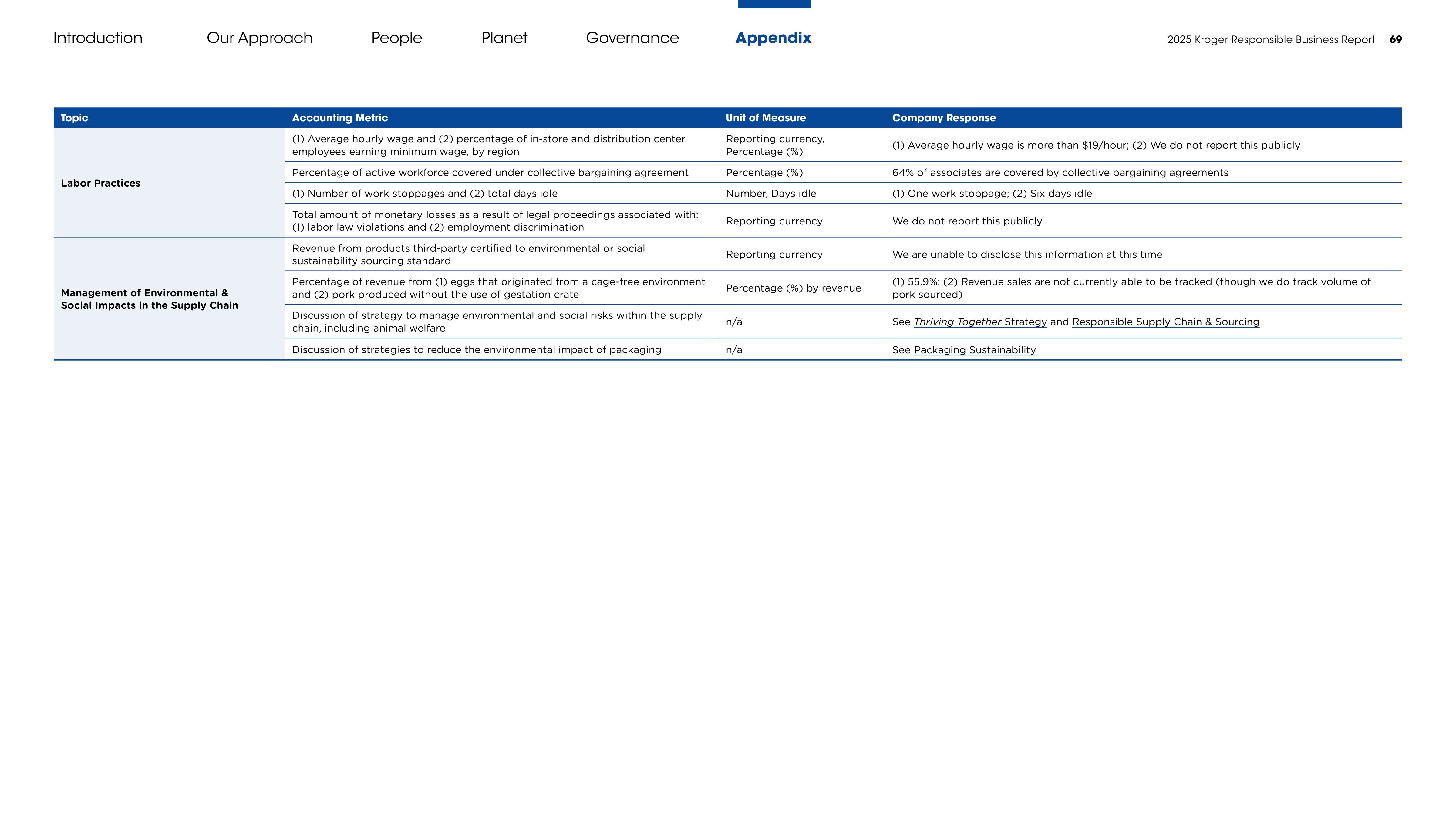
Topic
Accounting Metric
Unit of Measure
Company Response
Labor Practices
(1) Average hourly wage and (2) percentage of in-store and distribution center
employees earning minimum wage, by region
Reporting currency,
Percentage (%)
(1) Average hourly wage is more than $19/hour; (2) We do not report this publicly
Percentage of active workforce covered under collective bargaining agreement
Percentage (%)
64% of associates are covered by collective bargaining agreements
(1) Number of work stoppages and (2) total days idle
Number, Days idle
(1) One work stoppage; (2) Six days idle
Total amount of monetary losses as a result of legal proceedings associated with:
(1) labor law violations and (2) employment discrimination
Reporting currency
We do not report this publicly
Management of Environmental &
Social Impacts in the Supply Chain
Revenue from products third-party certified to environmental or social
sustainability sourcing standard
Reporting currency
We are unable to disclose this information at this time
Percentage of revenue from (1) eggs that originated from a cage-free environment
and (2) pork produced without the use of gestation crate
Percentage (%) by revenue
(1) 55.9%; (2) Revenue sales are not currently able to be tracked (though we do track volume of
pork sourced)
Discussion of strategy to manage environmental and social risks within the supply
chain, including animal welfare
n/a
See
Thriving Together
Strategy and Responsible Supply Chain & Sourcing
Discussion of strategies to reduce the environmental impact of packaging
n/a
See
Packaging Sustainability
People
Our Approach
Introduction
Planet
2025 Kroger Responsible Business Report
69
Governance
Appendix
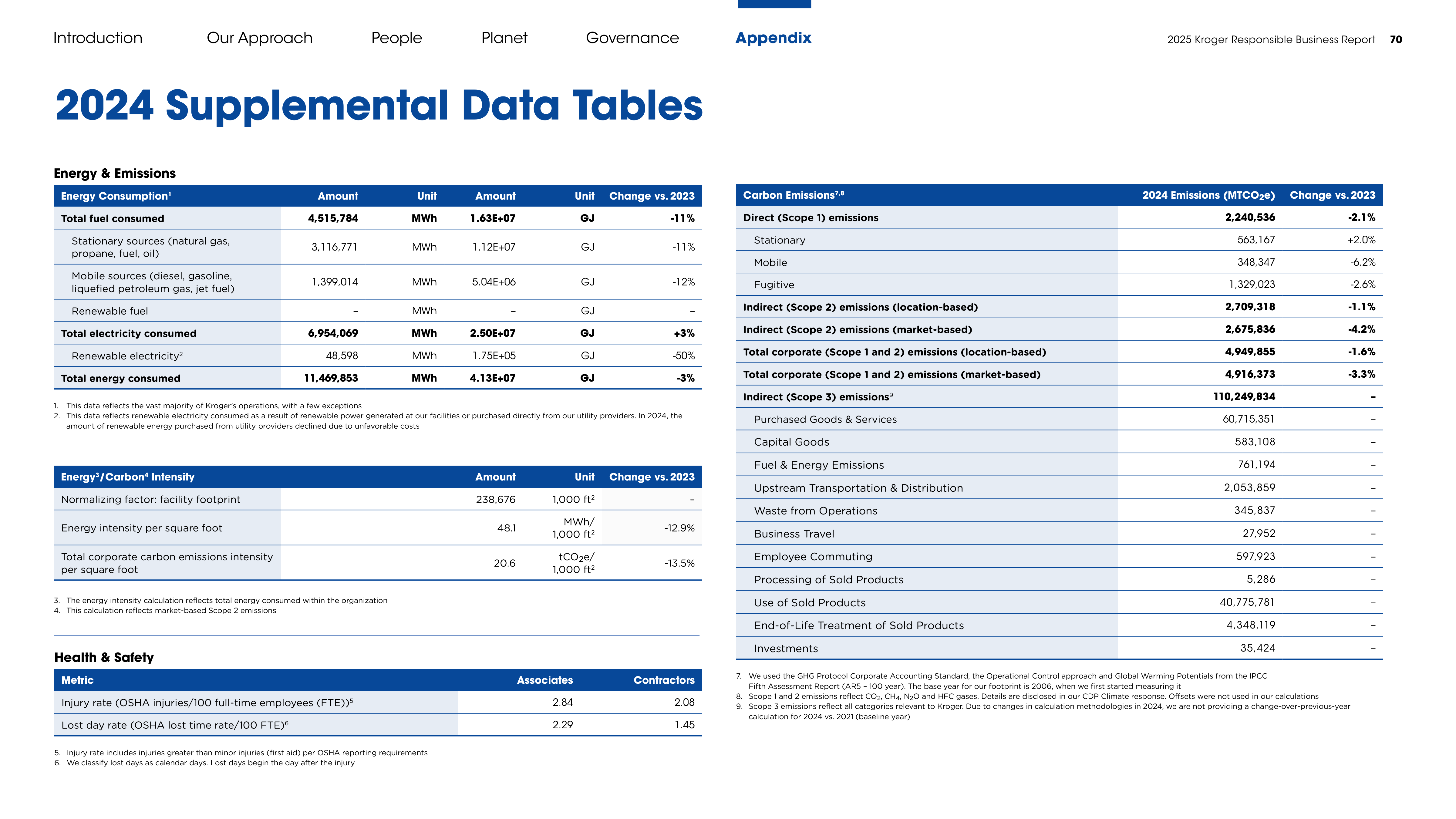
2024 Supplemental Data Tables
Energy & Emissions
Energy Consumption
1
Amount
Unit
Amount
Unit
Change vs. 2023
Total fuel consumed
4,515,784
MWh
1.63E+07
GJ
-11%
Stationary sources (natural gas,
propane, fuel, oil)
3,116,771
MWh
1.12E+07
GJ
-11%
Mobile sources (diesel, gasoline,
liquefied petroleum gas, jet fuel)
1,399,014
MWh
5.04E+06
GJ
-12%
Renewable fuel
–
MWh
–
GJ
–
Total electricity consumed
6,954,069
MWh
2.50E+07
GJ
+3%
Renewable electricity
2
48,598
MWh
1.75E+05
GJ
-50%
Total energy consumed
11,469,853
MWh
4.13E+07
GJ
-3%
1.
This data reflects the vast majority of Kroger’s operations, with a few exceptions
2.
This data reflects renewable electricity consumed as a result of renewable power generated at our facilities or purchased directly from our utility providers. In 2024, the
amount of renewable energy purchased from utility providers declined due to unfavorable costs
Health & Safety
Metric
Associates
Contractors
Injury rate (OSHA injuries/100 full-time employees (FTE))
5
2.84
2.08
Lost day rate (OSHA lost time rate/100 FTE)
6
2.29
1.45
5.
Injury rate includes injuries greater than minor injuries (first aid) per OSHA reporting requirements
6.
We classify lost days as calendar days. Lost days begin the day after the injury
Energy
3
/Carbon
4
Intensity
Amount
Unit
Change vs. 2023
Normalizing factor: facility footprint
238,676
1,000 ft
2
–
Energy intensity per square foot
48.1
MWh/
1,000 ft
2
-12.9%
Total corporate carbon emissions intensity
per square foot
20.6
tCO
2
e/
1,000 ft
2
-13.5%
3.
The energy intensity calculation reflects total energy consumed within the organization
4.
This calculation reflects market-based Scope 2 emissions
Carbon Emissions
7,8
2024 Emissions (MTCO
2
e)
Change vs. 2023
Direct (Scope 1) emissions
2,240,536
-2.1%
Stationary
563,167
+2.0%
Mobile
348,347
-6.2%
Fugitive
1,329,023
-2.6%
Indirect (Scope 2) emissions (location-based)
2,709,318
-1.1%
Indirect (Scope 2) emissions (market-based)
2,675,836
-4.2%
Total corporate (Scope 1 and 2) emissions (location-based)
4,949,855
-1.6%
Total corporate (Scope 1 and 2) emissions (market-based)
4,916,373
-3.3%
Indirect (Scope 3) emissions
9
110,249,834
–
Purchased Goods & Services
60,715,351
–
Capital Goods
583,108
–
Fuel & Energy Emissions
761,194
–
Upstream Transportation & Distribution
2,053,859
–
Waste from Operations
345,837
–
Business Travel
27,952
–
Employee Commuting
597,923
–
Processing of Sold Products
5,286
–
Use of Sold Products
40,775,781
–
End-of-Life Treatment of Sold Products
4,348,119
–
Investments
35,424
–
7.
We used the GHG Protocol Corporate Accounting Standard, the Operational Control approach and Global Warming Potentials from the IPCC
Fifth Assessment Report (AR5 – 100 year). The base year for our footprint is 2006, when we first started measuring it
8.
Scope 1 and 2 emissions reflect CO
2
, CH
4
, N
2
O and HFC gases. Details are disclosed in our CDP Climate response. Offsets were not used in our calculations
9.
Scope 3 emissions reflect all categories relevant to Kroger. Due to changes in calculation methodologies in 2024, we are not providing a change-over-previous-year
calculation for 2024 vs. 2021 (baseline year)
People
Our Approach
Introduction
Planet
2025 Kroger Responsible Business Report
70
Governance
Appendix
This Responsible Business Report does not cover all information
about our business, and inclusion of information herein is not an
indication that the subject or information is material to Kroger’s
business or operating results for purposes of U.S. securities
laws and regulations. Statements other than statements of
historical or current facts, including statements and images
about our Responsible Business targets, goals, aspirations,
commitments and programs, and other business plans, initiatives
and objectives are forward-looking statements and are based on
Kroger’s management’s current assumptions and expectations.
These statements are typically accompanied by the words “aim,”
“ambition,” “anticipate,” “approach,” “believe,” “commitment/
committed,” “continue,” “estimate,” “expect,” “expectation,”
“framework,” “focus,” “future,” “goals,” “may,” “on track,”
“plan,” “program,” “strategy,” “strive,” “targets,” “will” or other
similar words. All such statements are intended to enjoy the
protection of the safe harbor for forward-looking statements
within the meaning of Section 21E of the Securities Exchange
Act of 1934, as amended. Our actual future results, including the
achievement of our targets, goals or commitments, could differ
materially from our projected results as the result of a variety of
factors, including, but not limited to, changes in circumstances,
assumptions not being realized, or other risks, uncertainties, and
factors, many of which are outside of our control.
Such risks, uncertainties and factors include the risk factors
discussed in Item 1A of our most recent Report on Form 10-K
and in subsequent filings with the Securities and Exchange
Commission (SEC); they also include the challenges,
assumptions and dependencies identified in this report.
We urge you to consider all of the risks, uncertainties and
factors identified above or discussed in this report carefully in
evaluating the forward-looking statements herein. Kroger cannot
assure you that the results reflected or implied by any forward-
looking statement will be realized or, even if substantially
realized, that those results will have the forecasted or expected
consequences and effects. Unless expressly stated otherwise,
the forward-looking statements in this report are made as of the
effective date identified herein, and we undertake no obligation
to update or revise these forward-looking statements to reflect
subsequent events or circumstances. Standards of measurement
and performance made in reference to the goals, aspirations and
objectives referred to in this report are developing and based on
protocols, processes and assumptions that continue to evolve
and are subject to change in the future, and no assurances can
be given that any plan, initiative, projection, goal, commitment,
expectation or prospect set forth in this report can or will be
achieved.
Forward-Looking Statements
People
Our Approach
Introduction
Planet
2025 Kroger Responsible Business Report
71
Governance
Appendix