



CORPORATE
RESPONSIBILITY
REPORT
2025
REPORT
CORPORATE
RESPONSIBILITY


CONTENTS
CONTENTS
Introduction ....................................3
About this report .......................................................................... 3
About FedEx ................................................................................... 4
Letter from the CEO ................................................................... 5
Our principles .................................6
Governance structure ................................................................ 6
Risk management and materiality ....................................... 8
Corporate integrity and compliance ................................... 9
Cybersecurity and data privacy ......................................... 11
Public policy and advocacy .................................................. 12
Supply chain ................................................................................. 12
Just transition ............................................................................. 14
Our planet ..................................... 15
Environmental governance structure.............................. 15
Letter from the CSO ................................................................ 16
Our environmental progress ................................................ 17
Strategic approach to climate change ........................... 18
Air operations .............................................................................. 20
Surface operations ................................................................... 22
Facilities .......................................................................................... 24
Sustainable customer solutions ......................................... 26
Select sustainability initiatives across the globe ....... 27
Our people .................................... 28
Social governance structure ................................................ 28
Human resource management ........................................... 29
Our culture and people .......................................................... 32
Health and safety ...................................................................... 35
Data appendix ............................. 37
Environment ................................................................................. 37
Social ................................................................................................ 41
Governance .................................................................................. 41
FedEx
2025 Corporate Responsibility Report
2

INTRODUCTION
INTRODUCTION
Key links
Sustainability Reporting
webpage
Reporting Framework Index
2024 Selected GHG
Emissions Independent
Accountants’ Review Report
Corporate Social
Responsibility webpage
Global Economic
Impact Report
In this section
About this report
About FedEx
Letter from the CEO
About this report
We are proud to present the FedEx 2025 Corporate
Responsibility Report, which describes our progress to
create an even more connected and sustainable world.
This report covers FedEx environmental and social
performance across all geographic regions for fiscal year
2024 (FY24) unless otherwise specified. FY24 ended
on May 31, 2024, and all references to “FY” denote the
12-month period ending on May 31 of the specified
year. In connection with our one FedEx consolidation,
on June 1, 2024, FedEx Ground, FedEx Express, and
FedEx Services were consolidated into Federal Express
Corporation. This will be reflected in our next report.
Additionally, we will transition to a December 31 fiscal
year-end following the end of FY26.
External assurance
For detailed insights into our environmental, social,
and governance (ESG) performance and progress,
including year-over-year data, please refer to our Data
appendix. Review level of assurance under attestation
standards of the American Institute of Certified Public
Accountants over FY24 Scope 1, Scope 2, and Scope 3
Categories 3, 4, and 6 greenhouse gas (GHG) emissions
was obtained from Ernst & Young LLP (as indicated
in the 2024 Selected GHG Emissions Independent
Accountants’ Review Report).
ESG reporting frameworks
This report references indicators from the Global
Reporting Initiative (GRI) Standards and aligns with
applicable industry-specific standards provided by the
Sustainability Accounting Standards Board (SASB),
along with recommendations from the Task Force on
Climate-related Financial Disclosures (TCFD). See our
Reporting framework index for relevant disclosures
related to these frameworks.
FedEx
2025 Corporate Responsibility Report
3
About FedEx
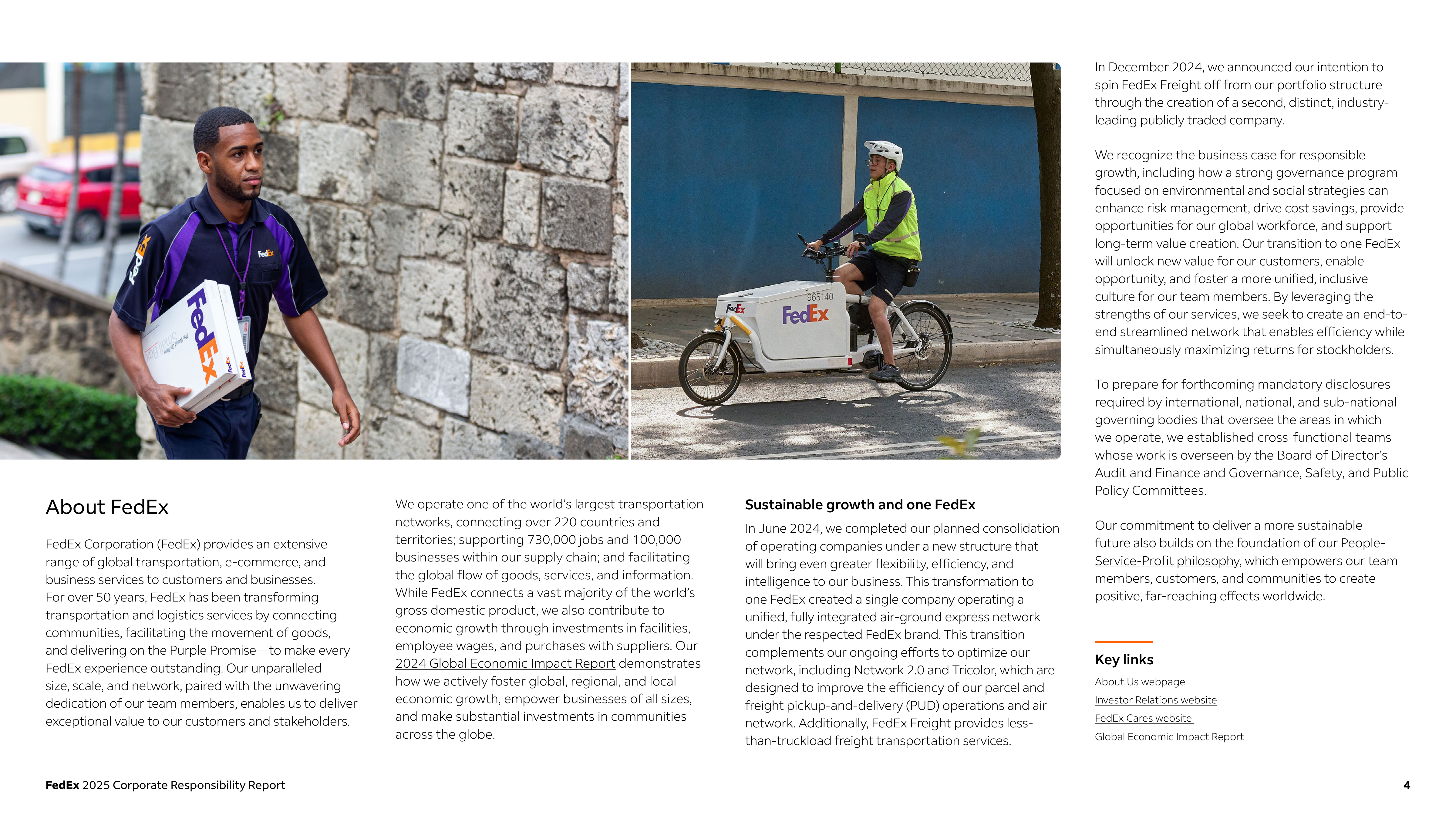
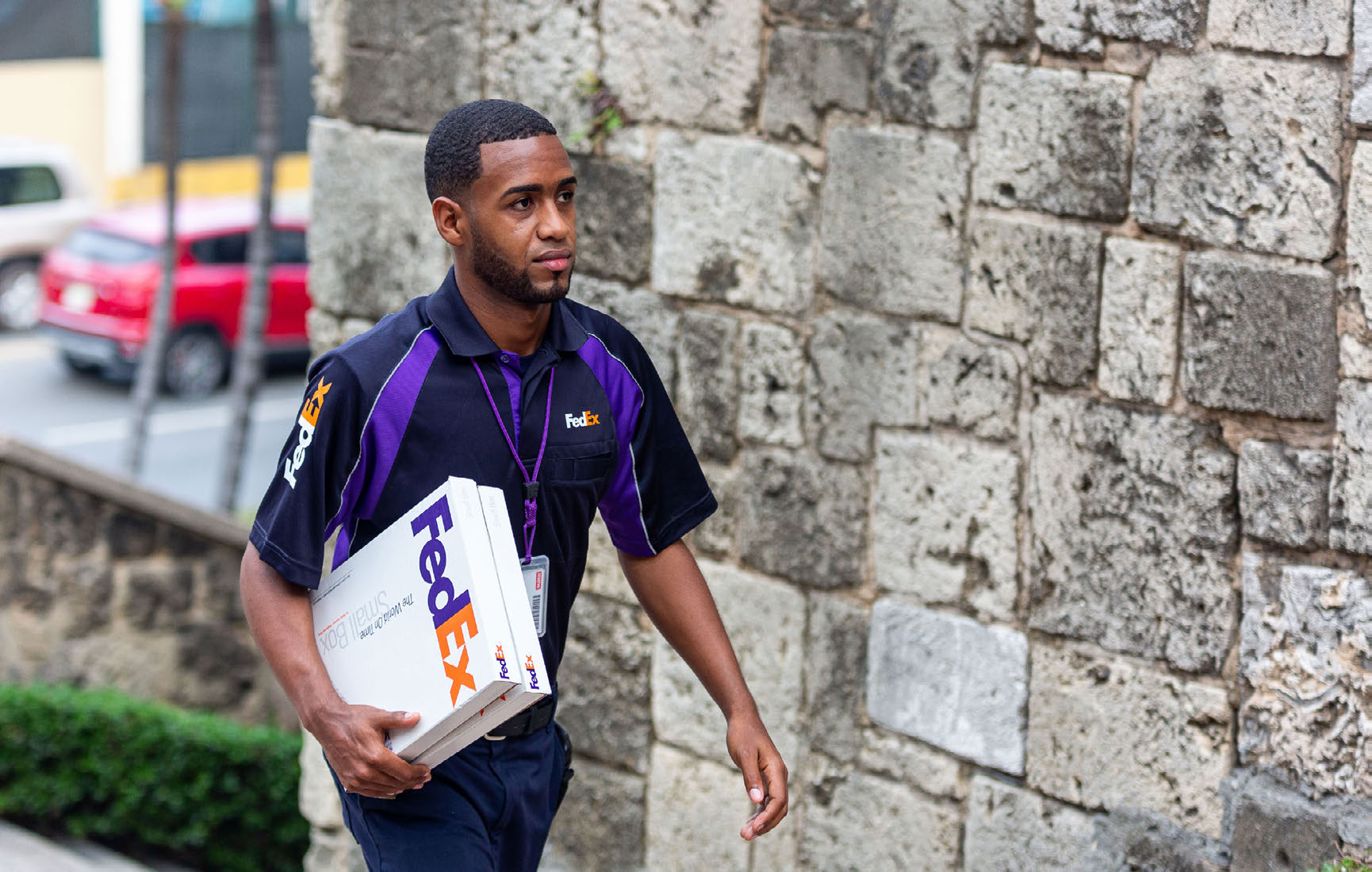
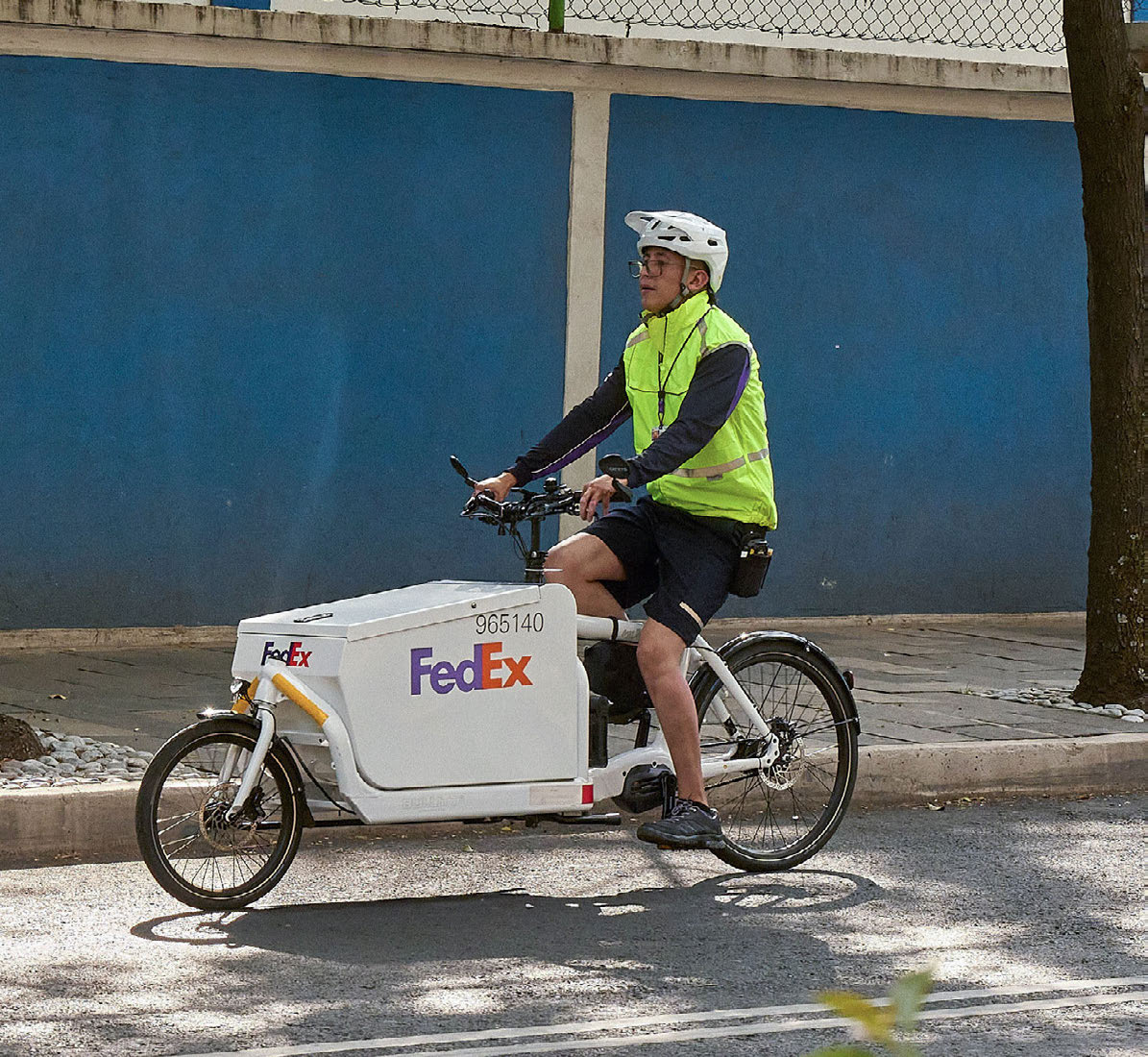
FedEx Corporation (FedEx) provides an extensive
range of global transportation, e-commerce, and
business services to customers and businesses.
For over 50 years, FedEx has been transforming
transportation and logistics services by connecting
communities, facilitating the movement of goods,
and delivering on the Purple Promise—to make every
FedEx experience outstanding. Our unparalleled
size, scale, and network, paired with the unwavering
dedication of our team members, enables us to deliver
exceptional value to our customers and stakeholders.
We operate one of the world’s largest transportation
networks, connecting over 220 countries and
territories; supporting 730,000 jobs and 100,000
businesses within our supply chain; and facilitating
the global flow of goods, services, and information.
While FedEx connects a vast majority of the world’s
gross domestic product, we also contribute to
economic growth through investments in facilities,
employee wages, and purchases with suppliers. Our
2024 Global Economic Impact Report demonstrates
how we actively foster global, regional, and local
economic growth, empower businesses of all sizes,
and make substantial investments in communities
across the globe.
Key links
About Us webpage
Investor Relations website
FedEx Cares website
Global Economic Impact Report
Sustainable growth and one FedEx
In June 2024, we completed our planned consolidation
of operating companies under a new structure that
will bring even greater flexibility, efficiency, and
intelligence to our business. This transformation to
one FedEx created a single company operating a
unified, fully integrated air-ground express network
under the respected FedEx brand. This transition
complements our ongoing efforts to optimize our
network, including Network 2.0 and Tricolor, which are
designed to improve the efficiency of our parcel and
freight pickup-and-delivery (PUD) operations and air
network. Additionally, FedEx Freight provides less-
than-truckload freight transportation services.
In December 2024, we announced our intention to
spin FedEx Freight off from our portfolio structure
through the creation of a second, distinct, industry-
leading publicly traded company.
We recognize the business case for responsible
growth, including how a strong governance program
focused on environmental and social strategies can
enhance risk management, drive cost savings, provide
opportunities for our global workforce, and support
long-term value creation. Our transition to one FedEx
will unlock new value for our customers, enable
opportunity, and foster a more unified, inclusive
culture for our team members. By leveraging the
strengths of our services, we seek to create an end-to-
end streamlined network that enables efficiency while
simultaneously maximizing returns for stockholders.
To prepare for forthcoming mandatory disclosures
required by international, national, and sub-national
governing bodies that oversee the areas in which
we operate, we established cross-functional teams
whose work is overseen by the Board of Director’s
Audit and Finance and Governance, Safety, and Public
Policy Committees.
Our commitment to deliver a more sustainable
future also builds on the foundation of our People-
Service-Profit philosophy, which empowers our team
members, customers, and communities to create
positive, far-reaching effects worldwide.
FedEx
2025 Corporate Responsibility Report
4
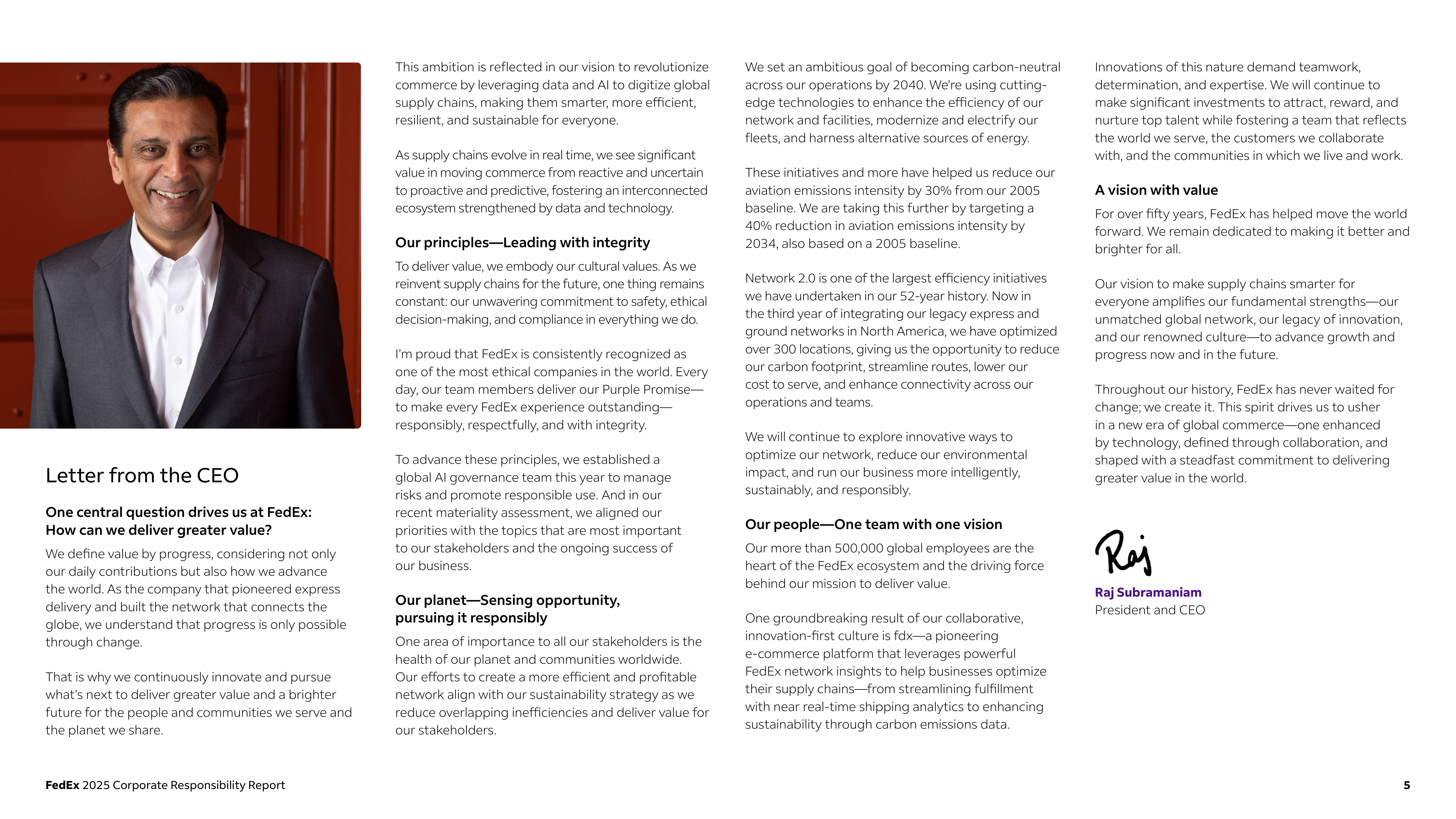


Raj Subramaniam
President and CEO
Letter from the CEO
One central question drives us at FedEx:
How can we deliver greater value?
We define value by progress, considering not only
our daily contributions but also how we advance
the world. As the company that pioneered express
delivery and built the network that connects the
globe, we understand that progress is only possible
through change.
That is why we continuously innovate and pursue
what’s next to deliver greater value and a brighter
future for the people and communities we serve and
the planet we share.
This ambition is reflected in our vision to revolutionize
commerce by leveraging data and AI to digitize global
supply chains, making them smarter, more efficient,
resilient, and sustainable for everyone.
As supply chains evolve in real time, we see significant
value in moving commerce from reactive and uncertain
to proactive and predictive, fostering an interconnected
ecosystem strengthened by data and technology.
Our principles—Leading with integrity
To deliver value, we embody our cultural values. As we
reinvent supply chains for the future, one thing remains
constant: our unwavering commitment to safety, ethical
decision-making, and compliance in everything we do.
I’m proud that FedEx is consistently recognized as
one of the most ethical companies in the world. Every
day, our team members deliver our Purple Promise—
to make every FedEx experience outstanding—
responsibly, respectfully, and with integrity.
To advance these principles, we established a
global AI governance team this year to manage
risks and promote responsible use. And in our
recent materiality assessment, we aligned our
priorities with the topics that are most important
to our stakeholders and the ongoing success of
our business.
Our planet—Sensing opportunity,
pursuing it responsibly
One area of importance to all our stakeholders is the
health of our planet and communities worldwide.
Our efforts to create a more efficient and profitable
network align with our sustainability strategy as we
reduce overlapping inefficiencies and deliver value for
our stakeholders.
We set an ambitious goal of becoming carbon-neutral
across our operations by 2040. We’re using cutting-
edge technologies to enhance the efficiency of our
network and facilities, modernize and electrify our
fleets, and harness alternative sources of energy.
These initiatives and more have helped us reduce our
aviation emissions intensity by 30% from our 2005
baseline. We are taking this further by targeting a
40% reduction in aviation emissions intensity by
2034, also based on a 2005 baseline.
Network 2.0 is one of the largest efficiency initiatives
we have undertaken in our 52-year history. Now in
the third year of integrating our legacy express and
ground networks in North America, we have optimized
over 300 locations, giving us the opportunity to reduce
our carbon footprint, streamline routes, lower our
cost to serve, and enhance connectivity across our
operations and teams.
We will continue to explore innovative ways to
optimize our network, reduce our environmental
impact, and run our business more intelligently,
sustainably, and responsibly.
Our people—One team with one vision
Our more than 500,000 global employees are the
heart of the FedEx ecosystem and the driving force
behind our mission to deliver value.
One groundbreaking result of our collaborative,
innovation-first culture is fdx—a pioneering
e-commerce platform that leverages powerful
FedEx network insights to help businesses optimize
their supply chains—from streamlining fulfillment
with near real-time shipping analytics to enhancing
sustainability through carbon emissions data.
Innovations of this nature demand teamwork,
determination, and expertise. We will continue to
make significant investments to attract, reward, and
nurture top talent while fostering a team that reflects
the world we serve, the customers we collaborate
with, and the communities in which we live and work.
A vision with value
For over fifty years, FedEx has helped move the world
forward. We remain dedicated to making it better and
brighter for all.
Our vision to make supply chains smarter for
everyone amplifies our fundamental strengths—our
unmatched global network, our legacy of innovation,
and our renowned culture—to advance growth and
progress now and in the future.
Throughout our history, FedEx has never waited for
change; we create it. This spirit drives us to usher
in a new era of global commerce—one enhanced
by technology, defined through collaboration, and
shaped with a steadfast commitment to delivering
greater value in the world.
FedEx
2025 Corporate Responsibility Report
5

OUR PRINCIPLES
OUR PRINCIPLES
DELIVERING ON STAKEHOLDER EXPECTATIONS
Governance structure
At FedEx, we understand that integrating corporate
responsibility principles into our company’s strategic
focus is essential to mitigating business risks,
enhancing long-term financial performance, and
delivering positive value for our business, customers,
team members, and stockholders. These principles are
woven into every component of the FedEx culture—
from efficient resource management to connected
support for all our team members, to the highest
standards of business conduct. To help ensure these
principles are part of our everyday operations, we align
our sustainability approach with our mission, values,
and long-term strategy.
The FedEx Board of Directors and its committees
oversee enterprise corporate responsibility initiatives
and programs, including reviewing and guiding our
sustainability strategy, supervising corporate target
setting, and monitoring progress towards our goals.
Our Board also provides oversight of environmental
risks, including climate change. Further, our Chief
Sustainability Officer (CSO) provides updates to
the Governance, Safety, and Public Policy and Audit
and Finance Committees of the Board in addition to
developing, implementing, and managing our overall
sustainability strategy and initiatives.
Our Board of Directors works to uphold the highest
quality of corporate governance. The Board seeks
in its members a blend of personal and professional
experiences, perspectives, and backgrounds, as well
as institutional knowledge and personal chemistry,
resulting in a high-performing Board that provides
sound and prudent guidance with respect to all of
the company’s operations and interests.
Our sustainability strategy aims to drive efficiency
and opportunity. See the Our planet and Our people
sections for more details on our environmental and
social governance approaches.
In this section
Governance structure
Risk management
and materiality
Corporate integrity
and compliance
Cybersecurity and
data privacy
Public policy and advocacy
Supply chain
Just transition
FedEx
2025 Corporate Responsibility Report
6


The Board has four standing committees comprised
entirely of independent members, each entrusted with
oversight of specific corporate responsibility aspects.
The Governance, Safety, and Public Policy
Committee
actively oversees our sustainability
goals, strategies, programs, and disclosures, and
management of our sustainability- and climate-
related risks. This committee is also responsible
for reviewing and discussing with management
our safety strategies, policies, programs, and
practices, and steps taken by management to
identify, assess, and manage risks relating to the
company’s political activities and expenditures.
The Compensation and Human Resources
Committee
reviews and discusses with our
management team key human resource
management strategies and programs.
The Audit and Finance Committee
is responsible
for oversight of the implementation and
effectiveness of the company’s corporate
integrity and compliance programs. Furthermore,
it holds regular discussions with management on
sustainability reporting and disclosures, including
aligning financial reporting with sustainability
disclosures, as well as internal controls and
procedures related to those disclosures.
The Cyber and Technology Oversight
Committee
reviews and discusses with
management the company’s cyber and
technology-related risks, including network
security, information and digital security,
data privacy and protection, and risks related
to emerging technologies such as artificial
intelligence (AI) and machine learning. The
committee also reviews aspects of the
company’s business continuity and disaster
recovery capabilities and contingency plans.
In 2024, the Board and its committees oversaw key
sustainable growth priorities, including upholding
our commitment to safety and our People-Service-
Profit cultural principles and values during the
one FedEx transition. Our Audit and Finance and
Governance, Safety, and Public Policy Committees
have reviewed this report and discussed its contents
with management.
Key links
Board of Directors webpage
Corporate Governance Guidelines
Commitee Charters
Sustainability | Investor Relations webpage
2024 Proxy Statement
FedEx
2025 Corporate Responsibility Report
7

Risk management
and materiality
Sustainable growth and risk management
Our Enterprise Risk Management (ERM) program
establishes a unified framework for supporting
consistency in the identification, reporting, and
management of key risks across our business
and value chain. Annually, we determine our core
business risks through analysis of industry research,
stakeholder engagement, surveys, and workshops and
direct consultation with senior leadership. We classify
risks into five groups—External, Strategic, Operational,
Financial, and Technology—and prioritize them
based on potential financial effects, the likelihood of
occurrence within the next fiscal year, and the level of
current controls in place to manage those risks.
The Enterprise Risk Council then meets to review the
risk assessment results and validate top enterprise
risks and emerging trends. Key enterprise risks are
discussed with the Board and the Audit and Finance
Committee at least annually, and any significant
changes to these risks are reported to the Board and
the Audit and Finance Committee. We embed short-,
medium-, and long-term risk management into our
strategic financial planning process and business
decision-making.
FedEx also evaluates climate-change-related
risks and opportunities as part of our annual
assessment process. These include the potential
for severe weather disruption, regulatory changes,
and reputational risks as public awareness grows
around the environmental impacts of our industry.
We address these risks through proactive public
policy and external stakeholder engagement and
by closely monitoring global social perspectives,
geopolitical issues, and regulatory developments.
We also implement a strategic approach to minimize
the environmental impact of our operations as we work
toward carbon-neutral operations. See the Facilities
section for more details on our resiliency efforts.
Material topics and double
materiality approach
FedEx conducts regular materiality assessments to
help prioritize sustainable growth topics that are most
important to our business and stakeholders. In FY24,
we refreshed our assessment, which was informed by
voluntary and regulatory reporting frameworks, including
the European Sustainability Reporting Standards (ESRS).
Our double materiality assessment considered both
the impacts our operations have on people and the
environment (impact materiality) and how sustainability
matters affect our development, performance, and
financial position (financial materiality). We expect to
refresh these results on an annual basis.
During the assessment, we conducted desktop
research, consulted internal stakeholders, and
engaged external stakeholders to identify, evaluate,
and prioritize related impacts, risks, and opportunities
(IROs) across our value chain. Engaging key
stakeholders enabled us to help ensure the list of
IROs was complete and accurate, the assessment of
IROs was appropriate, and the conclusions reached
were reasonable. Through this double materiality
assessment, we are best able to understand
our impacts, proactively mitigate risks, pursue
opportunities, and manage key topics relevant to
our global business and value chain.
The results reconfirmed our continued efforts to
focus on areas such as climate change, energy use,
working conditions, business conduct, and effective
management of supplier relationships. We look forward
to leveraging learnings from this process to enhance
upcoming assessments and our strategy.
Key links
2024 CDP Corporate Questionnaire > Modules 2 and 3
FedEx
2025 Corporate Responsibility Report
8

36
Corporate integrity
and compliance
Our commitment to integrity and compliance fosters
trust and reliability with our customers, team members,
and the communities we serve. The Corporate
Integrity and Compliance department, led by our Chief
Compliance Officer, oversees our ethics and compliance
programs and works with stakeholders inside and
outside the enterprise to help ensure operations are
conducted with integrity. We implement a risk-based
approach to prevent, identify, and mitigate compliance
risks common within the transportation and logistics
sector as well as risks unique to FedEx. We routinely
review and update our policies and programs to align
with global standards and emerging regulations.
Ethisphere recognized FedEx as one
of the
2025 World’s Most Ethical
Companies®
, our third consecutive
year achieving this accomplishment
36
languages offered for
risk-based compliance training
to all employees worldwide
within our operations. We provide fair wages, comply
with applicable wage-and-hour laws in the areas
where we operate, and require all team members
to communicate any suspected violations of human
rights. We also do not tolerate discrimination,
harassment, violence, or bullying based on any
characteristic protected under national, state, or
local laws. We hold our third-party contractors and
suppliers to these same standards.
We provide a comprehensive set of compliance
resources on our Corporate Integrity and
Compliance website, including global policies,
guidelines, and resources.
Integrity and compliance
education and training
FedEx is one of the world’s most trusted and
admired companies because of the dedication
of our team members. We provide employees
with accessible and clear ethics and compliance
education to mitigate potential risks and deter
non-compliance. Our Corporate Integrity and
Compliance department oversees these trainings
to ensure they are accurate, effective, up-to-date,
and accessible to all employees across the globe.
These trainings cover topics such as anti-corruption,
antitrust, conflicts of interest, and data privacy, as
well as compliance behaviors and responsibilities
related to our culture values, the Code, and
compliance policies.
In 2025, we updated our Code training course, which
covers essential integrity and compliance policies and
incorporates key themes such as respect, trust, legal
compliance, raising concerns, and non-retaliation.
In the spring of 2025, we expanded our established
program of holding regional and subsidiary
Compliance Week events and held our first annual
enterprise-wide global Compliance Week, which
offered live, interactive risk-mitigation education
through a virtual conference platform.
FedEx Code of Conduct and
global compliance policies
Our FedEx Code of Conduct (Code) publicly states
our stance on ethics and compliance and reminds
us why reliability and trust are important to our
company, customers, and stakeholders. The Code
outlines the legal, ethical, and behavioral expectations
we mandate for all team members to uphold across
our global operations. The Code applies to all FedEx
officers, directors, managers, and employees. It also
applies to members of the FedEx Board of Directors
when acting in their roles as Board members or
in any other capacities related to FedEx. Certain
sections also apply to third parties providing
services on behalf of FedEx.
In 2024, we developed a stand-alone Human Rights
Policy to reinforce our commitment to protecting
and advancing human rights across our global
operations and value chain. We have zero tolerance
for the use of illegal child, compulsory, or forced labor
and strictly prohibit human slavery and trafficking
Guided by a strategic communication plan, our team
communicates elements of our Code and compliance
principles through regular, enterprise-wide emails,
newsletters, videos, and digital signage. We provide
FedEx managers with a compliance toolkit, which
includes resources like our Ethical Leadership Guide,
to communicate best ethics practices to their teams.
Every year, we administer a Code of Conduct
Questionnaire for officers, directors, and senior
managers to gauge their awareness of and
compliance with the Code. We also conduct a
comprehensive, company-wide integrity survey for
all employees every other year. This survey helps
us evaluate the effectiveness of our compliance
program and highlights where we may adjust our
approach as needed.
FedEx
2025 Corporate Responsibility Report
9


Key links
Corporate Integrity and Compliance website
Code of Conduct
Supplier Code of Conduct
Human Rights Policy
Global Antitrust and Competition Law Policy
Policy Prohibiting Trafficking in Persons
Global Conflicts of Interest Policy
Global Gifts and Entertainment Policy
Global Anti-Corruption Policy
FedEx Alert Line
Global Privacy Policy
Social Media Guidelines
2024 Proxy Statement
Speaking up
We have an open-door policy at FedEx, which means
any team member can speak with a manager, human
resources, or a legal representative at any time to
report known or suspected legal, policy, or ethical
violations. Our confidential 24/7 FedEx Alert Line
call center and web portal are also available for
reporting concerns and are accessible in over 35
languages. In addition to our team members, these
reporting mechanisms are available to third parties,
business partners, customers, and community
members who wish to flag concerns. FedEx prohibits
retaliation against those who report violations in
good faith, and we investigate any violation of policy,
procedure, or law. Proven violations result in tailored
discipline or other remedial measures, up to and
including termination.
In FY24, we received more than 18,700 reports from
team members, customers, and the public concerning
employee relations, safety and security issues, and
other corporate integrity matters. We used coaching,
discipline, training, and termination of employment as
appropriate to remedy situations.
We also track and celebrate team members’ positive
compliance actions, achievements, and metrics
to encourage value-based behavior through our
Integrity Champions program.
Assessing integrity and compliance risk
We conduct integrity and compliance risk assessments
to evaluate core risks across the enterprise. These
assessments include global collaboration with team
members and leadership to identify and prioritize
risks and facilitate strategic planning to manage
any identified risks. We present the results of risk
assessments to executive management and the
Board’s Audit and Finance Committee. We also
distribute employee questionnaires to identify
violations or potential control deficiencies in our
major compliance risk areas.
FedEx
2025 Corporate Responsibility Report
10


Cybersecurity and data privacy
It is essential for FedEx to secure our digital
environments against threats to uphold the trust
of our stakeholders and enable business continuity.
The Board’s Cyber and Technology Oversight
Committee routinely reviews and discusses with
management our cyber- and technology-related
risks. Our Information Security (InfoSec) team
audits our projects to assess information security
compliance while our Global Privacy Office evaluates
compliance of FedEx practices and policies with
relevant privacy regulations. Additionally, our Internal
Audit team regularly assesses the effectiveness
of our information security and privacy controls
and programs.
Responsible use of AI
FedEx is committed to the responsible use of
generative AI to help drive workplace efficiencies.
In FY24, we created a global AI governance team to
manage risks and monitor compliance with relevant
regulations. The Cyber and Technology Oversight
Committee reviews and discusses with management
the incorporation of AI into our operations, services,
and strategies, along with related risks.
In FY24, we implemented an enterprise-wide AI policy
that defines principles, applicable regulations, and
internal roles to promote the ethical and lawful use
of generative AI. Using these guidelines, our Data
Privacy and Legal teams work with InfoSec and FedEx
Dataworks to manage AI requests. With support
from FedEx Dataworks, our teams also use a secure,
internal AI tool, GenAIHub, for operational process
efficiencies and to create accessible applications for
team members across the enterprise. We are working
to create a unified data enablement team to make
data collection consistent and accessible across our
operations. We continue to review and update our
policies to align with emerging regulations, and we
implemented additional measures to support our
mandatory compliance program in FY25.
Cybersecurity and data privacy
education and training
To best equip our team members for responding to
threats, we conduct annual mandatory information
security, data privacy, and incident reporting training.
We also periodically organize online safety training
exercises focused on phishing education and strong
password and coding practices.
We extend our cybersecurity and data privacy
trainings to business partners and affinity groups,
such as the FedEx Culture Ambassadors and
Cybersecurity Champions. Additionally, our FedEx
Trust Center website provides customers with
guidance on how we safeguard their privacy and
how to facilitate personal data requests.
Key links
Global Privacy Policy
FedEx Privacy Notice
Cyber and Technology Oversight Committee Charter
Binding Corporate Rules for Customer, Supplier, and Vendor Data
FedEx Trust Center
Information Privacy webpage
In FY24, we revised our data privacy training to
incorporate a risk-based data breach module, including
steps on how to properly identify and report a data
breach. We also updated our personal data incident
response procedures to better delineate roles and
responsibilities of internal stakeholders, align incident
response processes between various stakeholder
incident response playbooks, and streamline reporting
incidents to proper regulatory bodies.
We conducted multiple cybersecurity simulations in
FY24, ranging from high-impact ransomware events to
contained data breach events. Members of the Cyber
and Technology Oversight Committee participated
in one of these simulations. The worldwide FedEx
Information Security Management System has earned
the International Organization for Standardization
(ISO) and International Electrotechnical Commission
(IEC) 27001:2022 Information Security Management
certification, demonstrating our continued commitment
to top-tier information security practices.
FedEx
2025 Corporate Responsibility Report
11

Small Business
Grants Program
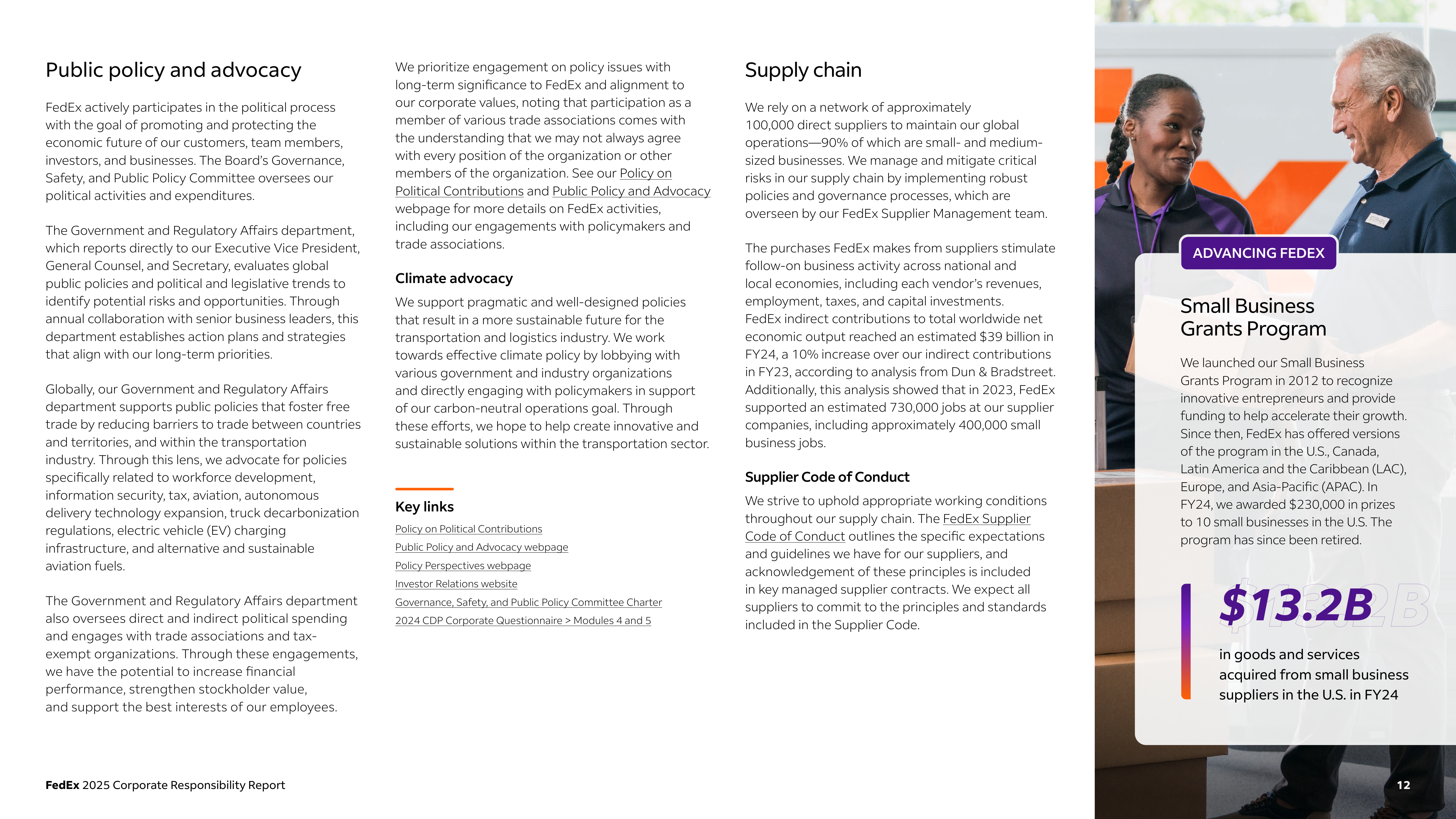
We launched our Small Business
Grants Program in 2012 to recognize
innovative entrepreneurs and provide
funding to help accelerate their growth.
Since then, FedEx has offered versions
of the program in the U.S., Canada,
Latin America and the Caribbean (LAC),
Europe, and Asia-Pacific (APAC). In
FY24, we awarded $230,000 in prizes
to 10 small businesses in the U.S. The
program has since been retired.
Public policy and advocacy
FedEx actively participates in the political process
with the goal of promoting and protecting the
economic future of our customers, team members,
investors, and businesses. The Board’s Governance,
Safety, and Public Policy Committee oversees our
political activities and expenditures.
The Government and Regulatory Affairs department,
which reports directly to our Executive Vice President,
General Counsel, and Secretary, evaluates global
public policies and political and legislative trends to
identify potential risks and opportunities. Through
annual collaboration with senior business leaders, this
department establishes action plans and strategies
that align with our long-term priorities.
Globally, our Government and Regulatory Affairs
department supports public policies that foster free
trade by reducing barriers to trade between countries
and territories, and within the transportation
industry. Through this lens, we advocate for policies
specifically related to workforce development,
information security, tax, aviation, autonomous
delivery technology expansion, truck decarbonization
regulations, electric vehicle (EV) charging
infrastructure, and alternative and sustainable
aviation fuels.
The Government and Regulatory Affairs department
also oversees direct and indirect political spending
and engages with trade associations and tax-
exempt organizations. Through these engagements,
we have the potential to increase financial
performance, strengthen stockholder value,
and support the best interests of our employees.
We prioritize engagement on policy issues with
long-term significance to FedEx and alignment to
our corporate values, noting that participation as a
member of various trade associations comes with
the understanding that we may not always agree
with every position of the organization or other
members of the organization. See our Policy on
Political Contributions and Public Policy and Advocacy
webpage for more details on FedEx activities,
including our engagements with policymakers and
trade associations.
Climate advocacy
We support pragmatic and well-designed policies
that result in a more sustainable future for the
transportation and logistics industry. We work
towards effective climate policy by lobbying with
various government and industry organizations
and directly engaging with policymakers in support
of our carbon-neutral operations goal. Through
these efforts, we hope to help create innovative and
sustainable solutions within the transportation sector.
Key links
Policy on Political Contributions
Public Policy and Advocacy webpage
Policy Perspectives webpage
Investor Relations website
Governance, Safety, and Public Policy Committee Charter
2024 CDP Corporate Questionnaire > Modules 4 and 5
Supply chain
We rely on a network of approximately
100,000 direct suppliers to maintain our global
operations—90% of which are small- and medium-
sized businesses. We manage and mitigate critical
risks in our supply chain by implementing robust
policies and governance processes, which are
overseen by our FedEx Supplier Management team.
The purchases FedEx makes from suppliers stimulate
follow-on business activity across national and
local economies, including each vendor’s revenues,
employment, taxes, and capital investments.
FedEx indirect contributions to total worldwide net
economic output reached an estimated $39 billion in
FY24, a 10% increase over our indirect contributions
in FY23, according to analysis from Dun & Bradstreet.
Additionally, this analysis showed that in 2023, FedEx
supported an estimated 730,000 jobs at our supplier
companies, including approximately 400,000 small
business jobs.
Supplier Code of Conduct
We strive to uphold appropriate working conditions
throughout our supply chain. The FedEx Supplier
Code of Conduct outlines the specific expectations
and guidelines we have for our suppliers, and
acknowledgement of these principles is included
in key managed supplier contracts. We expect all
suppliers to commit to the principles and standards
included in the Supplier Code.
ADVANCING FEDEX
$13.2B
$13.2B
in goods and services
acquired from small business
suppliers in the U.S. in FY24
FedEx
2025 Corporate Responsibility Report
12
Some of our initiatives include:
FedEx E-Commerce Learning Lab:
FedEx
teamed up with Accion Opportunity Fund to
help small business owners develop or grow their
e-commerce presence through the Learning Lab.
Now in its fourth year, the program has reached
more than 5,700 business owners with workshops,
webinars, coaching, and fulfillment support, and
awarded over $1 million in small business grants.
Inner City Capital Connection:
Since 2017,
FedEx has supported 11 cohorts in Memphis and
Dallas through this program, helping more than
600 businesses raise $41.5 million in new capital,
increase revenues by 119% on average, and
create over 900 new jobs.
FedEx Entrepreneur Fund & Boost Camp:
Through this program developed with Hello Alice
and the Global Entrepreneurship Network, FedEx
helped provide $600,000 to 60 small businesses
owned by military veterans and/or entrepreneurs
with disabilities. Small business leaders are also
invited to participate in the FedEx Boost Camp for
monthly coaching, workshops, and mentoring.
Sustainability integration in our supply chain
Throughout our procurement process, FedEx screens
key managed suppliers against our standards for
environmental and social sustainability. We work
closely with our suppliers and internal stakeholders to
advance our corporate responsibility goals throughout
the value chain, focusing on sustainability. For example,
we are investigating opportunities to engage with
priority suppliers to develop sustainability action plans.
Further, the transition to one FedEx enables us to align
our sustainable sourcing metrics and goals across the
enterprise to broaden our impact.
We are founding members of the Sustainable
Purchasing Leadership Council and continue to be an
active member of their Strategic Advisory Committee.
We follow ISO 20400 guidance for corporate-
responsibility-related metrics surrounding our
sourcing practices across the enterprise and regularly
request information from key managed suppliers to
understand and plan for potential sourcing risks.
Support for small businesses
Sourcing from small suppliers increases the resiliency
of our supply chain and enables us to better serve our
customers. The extensive FedEx network is a vital part
of the global supply chain for small businesses and a key
distribution network for these companies. At the same
time, we directly enable small business suppliers to grow
their own operations through our annual spending.
Small businesses also fuel economic growth and are
essential to the overall health and financial well-being
of communities. Through FedEx Cares, we empower
entrepreneurs from all backgrounds with the training,
connections, and capital they need to compete in the
global marketplace.
Key links
Supplier Code of Conduct
Global Economic Impact Report
FedEx Cares Report
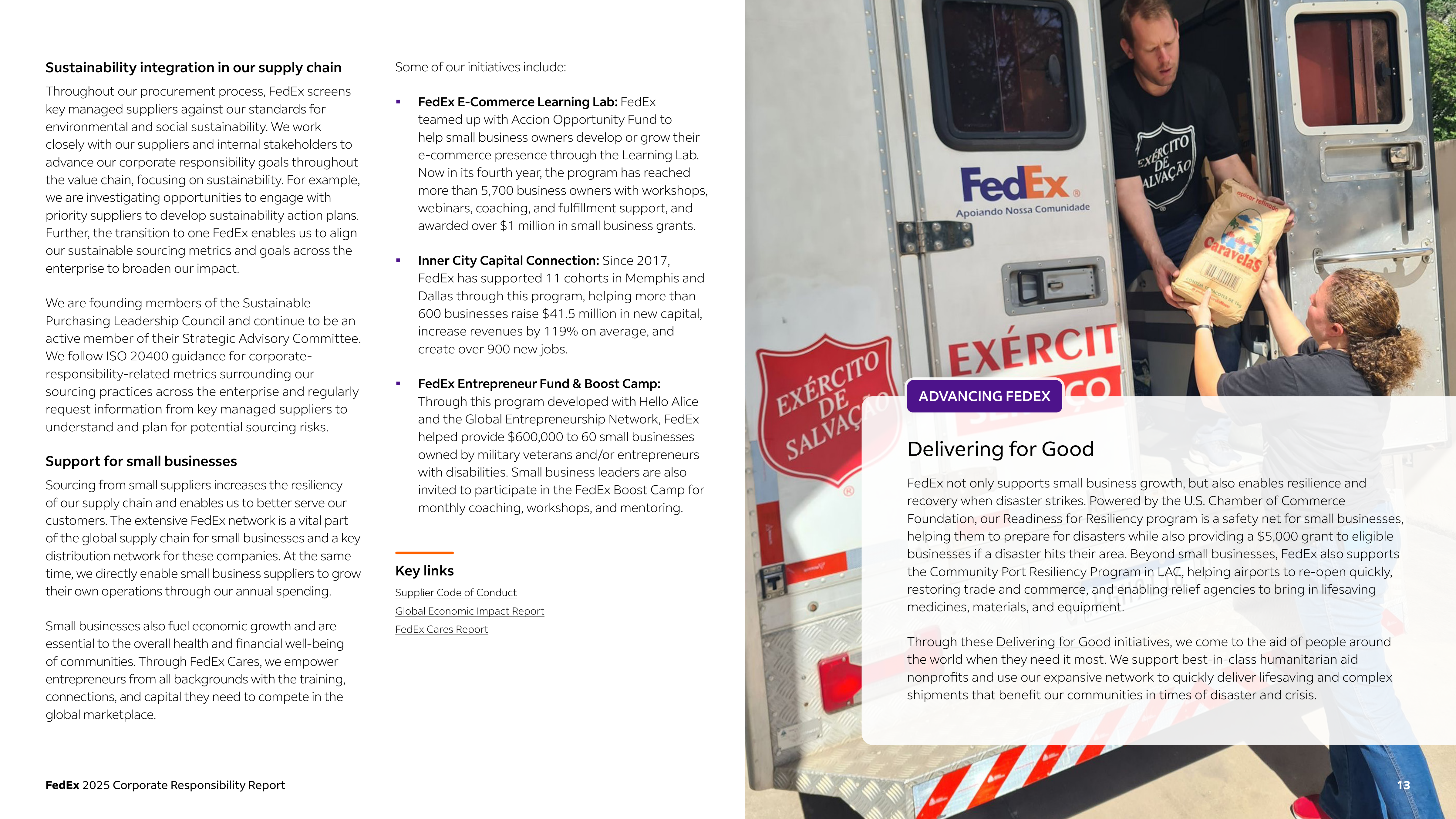
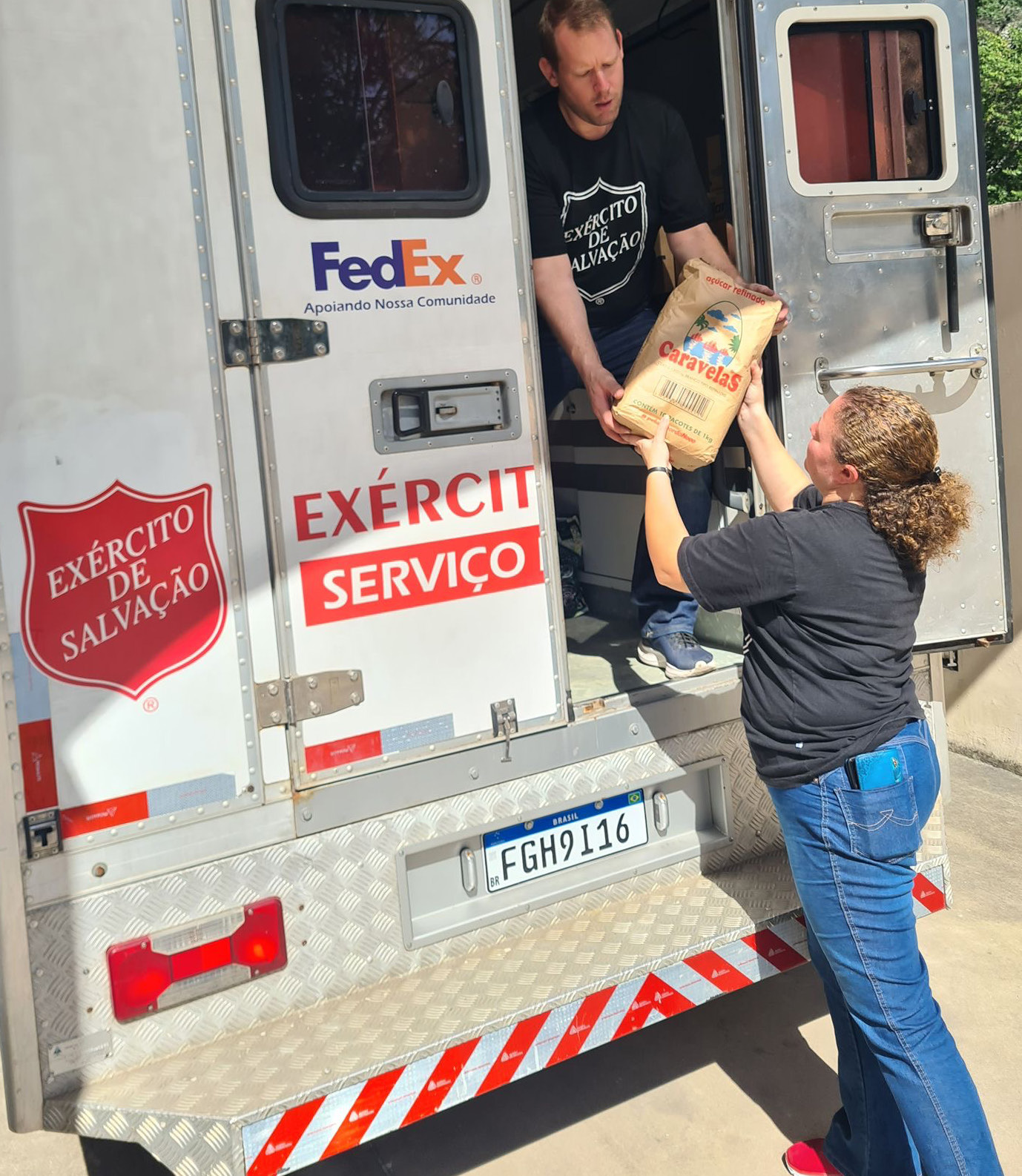
Delivering for Good
FedEx not only supports small business growth, but also enables resilience and
recovery when disaster strikes. Powered by the U.S. Chamber of Commerce
Foundation, our Readiness for Resiliency program is a safety net for small businesses,
helping them to prepare for disasters while also providing a $5,000 grant to eligible
businesses if a disaster hits their area. Beyond small businesses, FedEx also supports
the Community Port Resiliency Program in LAC, helping airports to re-open quickly,
restoring trade and commerce, and enabling relief agencies to bring in lifesaving
medicines, materials, and equipment.
Through these Delivering for Good initiatives, we come to the aid of people around
the world when they need it most. We support best-in-class humanitarian aid
nonprofits and use our expansive network to quickly deliver lifesaving and complex
shipments that benefit our communities in times of disaster and crisis.
ADVANCING FEDEX
FedEx
2025 Corporate Responsibility Report
13
Key links
FedEx Cares website
FedEx Cares Report
Just transition
Our goal of achieving carbon-neutral operations
and our overall climate change strategy offer
significant opportunities for creating value for
our stakeholders. The innovative solutions we are
developing have the potential to generate ongoing
employment opportunities, enhance our customers’
environmental performance, and improve living
standards in the communities where we operate.
However, we are aware of the potential challenges
we may face on this journey and in the broader
transition to a low-carbon economy.
FedEx recognizes the importance of a just
transition and seeks to ensure the benefits of
a low-carbon economy are shared across all the
communities in which we operate. Our purpose
is to connect people and possibilities; therefore, it
is essential we work with multiple stakeholders to
co-create and scale the most promising climate
solutions. We support the just transition within
our own operations by communicating with and
offering our employees comprehensive benefits
and providing trainings on necessary skills for a
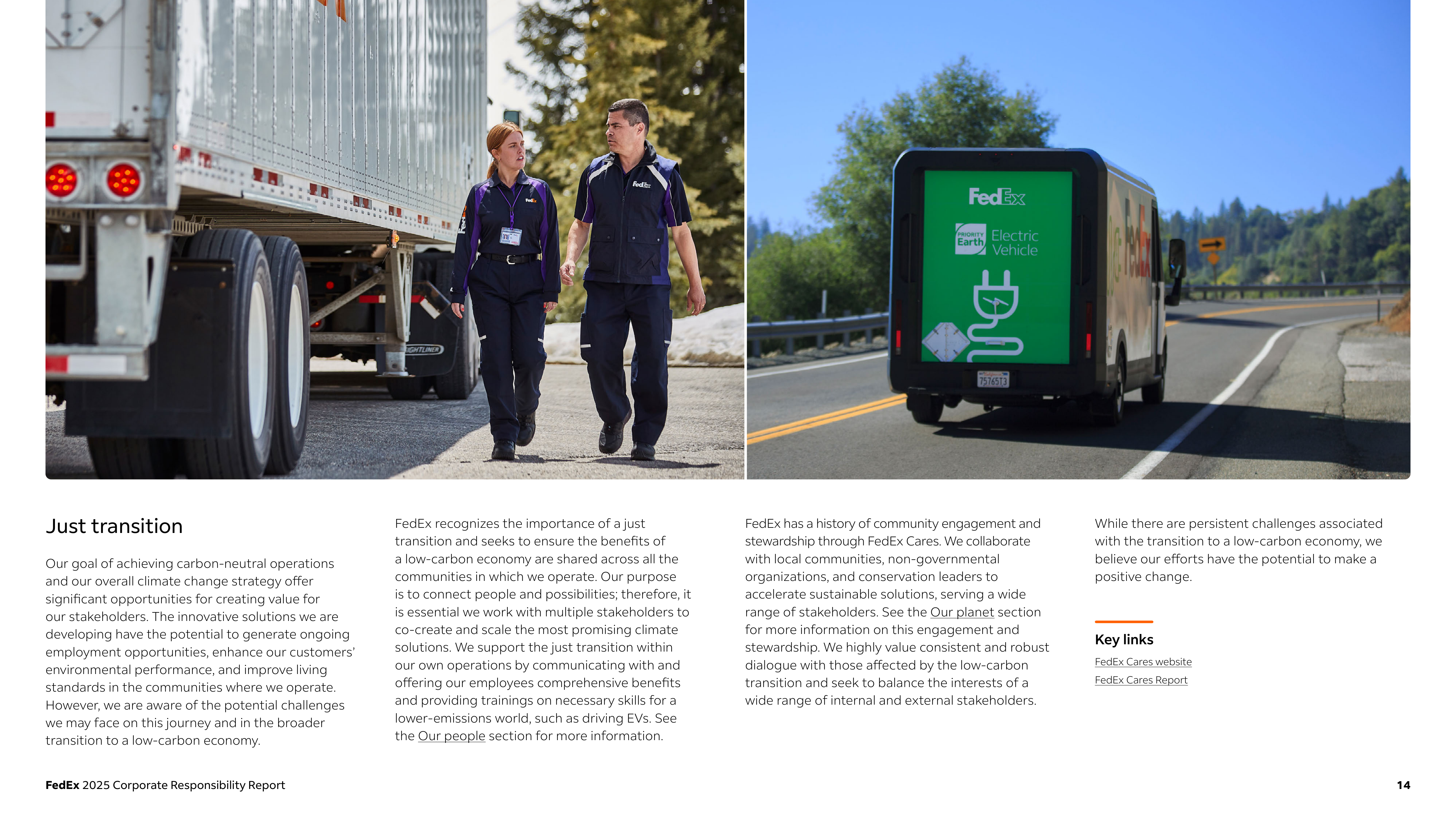
lower-emissions world, such as driving EVs. See
the Our people section for more information.
FedEx has a history of community engagement and
stewardship through FedEx Cares. We collaborate
with local communities, non-governmental
organizations, and conservation leaders to
accelerate sustainable solutions, serving a wide
range of stakeholders. See the Our planet section
for more information on this engagement and
stewardship. We highly value consistent and robust
dialogue with those affected by the low-carbon
transition and seek to balance the interests of a
wide range of internal and external stakeholders.
While there are persistent challenges associated
with the transition to a low-carbon economy, we
believe our efforts have the potential to make a
positive change.
FedEx
2025 Corporate Responsibility Report
14

OUR PLANET
OUR PLANET
DELIVERING A SUSTAINABLE FUTURE
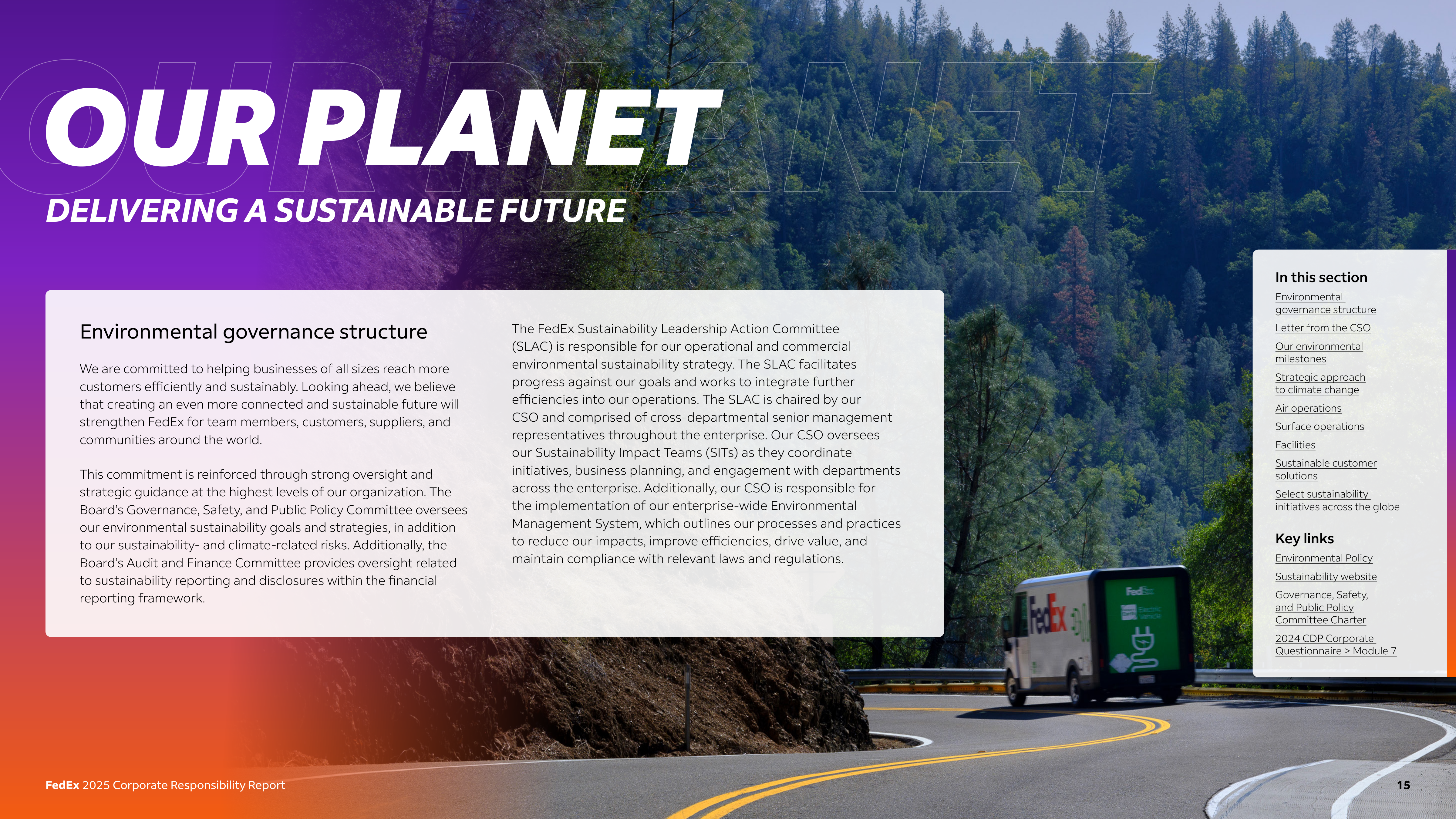
Environmental governance structure
We are committed to helping businesses of all sizes reach more
customers efficiently and sustainably. Looking ahead, we believe
that creating an even more connected and sustainable future will
strengthen FedEx for team members, customers, suppliers, and
communities around the world.
This commitment is reinforced through strong oversight and
strategic guidance at the highest levels of our organization. The
Board’s Governance, Safety, and Public Policy Committee oversees
our environmental sustainability goals and strategies, in addition
to our sustainability- and climate-related risks. Additionally, the
Board’s Audit and Finance Committee provides oversight related
to sustainability reporting and disclosures within the financial
reporting framework.
The FedEx Sustainability Leadership Action Committee
(SLAC) is responsible for our operational and commercial
environmental sustainability strategy. The SLAC facilitates
progress against our goals and works to integrate further
efficiencies into our operations. The SLAC is chaired by our
CSO and comprised of cross-departmental senior management
representatives throughout the enterprise. Our CSO oversees
our Sustainability Impact Teams (SITs) as they coordinate
initiatives, business planning, and engagement with departments
across the enterprise. Additionally, our CSO is responsible for
the implementation of our enterprise-wide Environmental
Management System, which outlines our processes and practices
to reduce our impacts, improve efficiencies, drive value, and
maintain compliance with relevant laws and regulations.
Key links
Environmental Policy
Sustainability website
Governance, Safety,
and Public Policy
Committee Charter
2024 CDP Corporate
Questionnaire > Module 7
In this section
Environmental
governance structure
Letter from the CSO
Our environmental
milestones
Strategic approach
to climate change
Air operations
Surface operations
Facilities
Sustainable customer
solutions
Select sustainability
initiatives across the globe
FedEx
2025 Corporate Responsibility Report
15
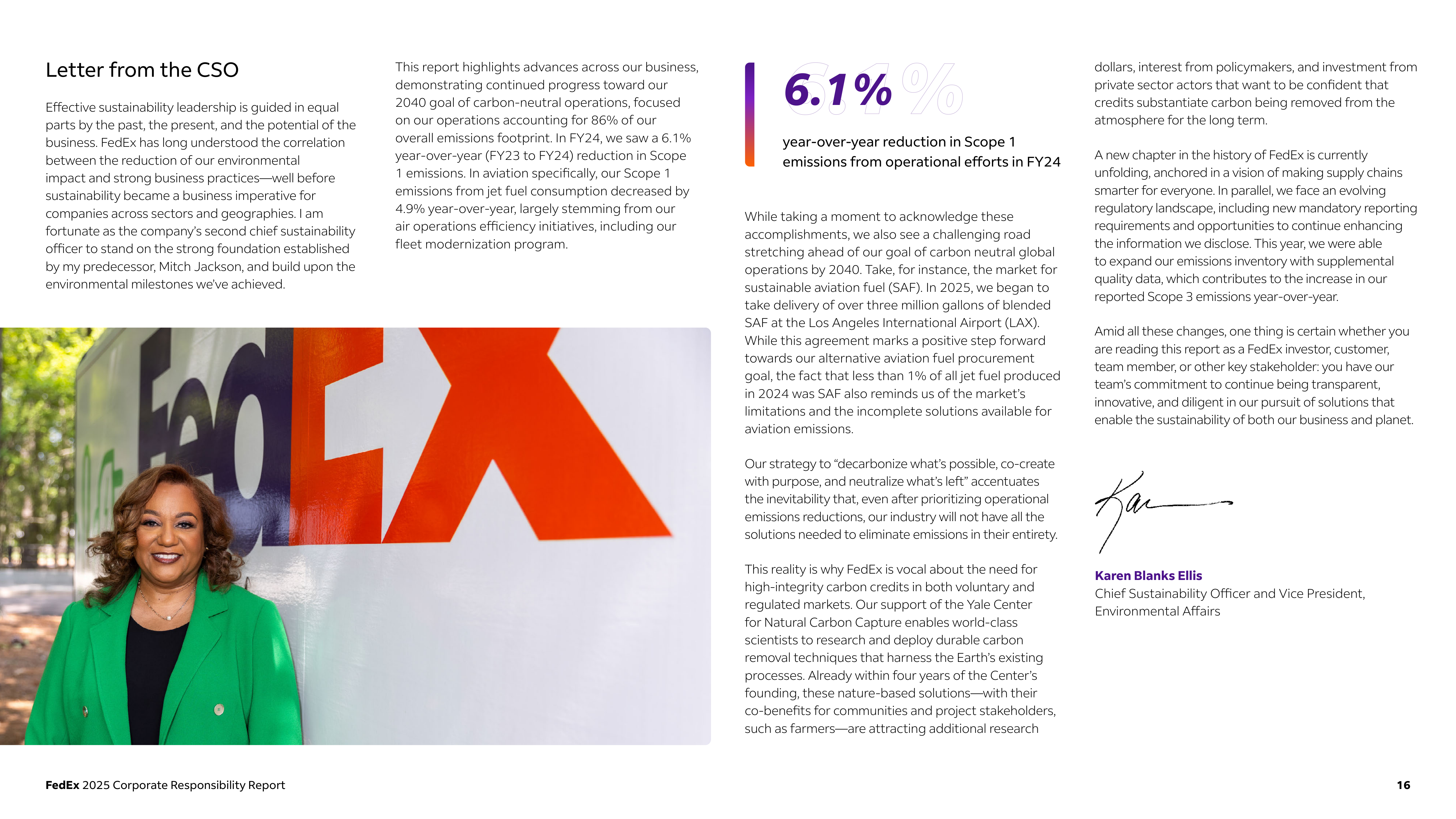


Karen Blanks Ellis
Chief Sustainability Officer and Vice President,
Environmental Affairs
Letter from the CSO
Effective sustainability leadership is guided in equal
parts by the past, the present, and the potential of the
business. FedEx has long understood the correlation
between the reduction of our environmental
impact and strong business practices—well before
sustainability became a business imperative for
companies across sectors and geographies. I am
fortunate as the company’s second chief sustainability
officer to stand on the strong foundation established
by my predecessor, Mitch Jackson, and build upon the
environmental milestones we’ve achieved.
This report highlights advances across our business,
demonstrating continued progress toward our
2040 goal of carbon-neutral operations, focused
on our operations accounting for 86% of our
overall emissions footprint. In FY24, we saw a 6.1%
year-over-year (FY23 to FY24) reduction in Scope
1 emissions. In aviation specifically, our Scope 1
emissions from jet fuel consumption decreased by
4.9% year-over-year, largely stemming from our
air operations efficiency initiatives, including our
fleet modernization program.
While taking a moment to acknowledge these
accomplishments, we also see a challenging road
stretching ahead of our goal of carbon neutral global
operations by 2040. Take, for instance, the market for
sustainable aviation fuel (SAF). In 2025, we began to
take delivery of over three million gallons of blended
SAF at the Los Angeles International Airport (LAX).
While this agreement marks a positive step forward
towards our alternative aviation fuel procurement
goal, the fact that less than 1% of all jet fuel produced
in 2024 was SAF also reminds us of the market’s
limitations and the incomplete solutions available for
aviation emissions.
Our strategy to “decarbonize what’s possible, co-create
with purpose, and neutralize what’s left” accentuates
the inevitability that, even after prioritizing operational
emissions reductions, our industry will not have all the
solutions needed to eliminate emissions in their entirety.
This reality is why FedEx is vocal about the need for
high-integrity carbon credits in both voluntary and
regulated markets. Our support of the Yale Center
for Natural Carbon Capture enables world-class
scientists to research and deploy durable carbon
removal techniques that harness the Earth’s existing
processes. Already within four years of the Center’s
founding, these nature-based solutions—with their
co-benefits for communities and project stakeholders,
such as farmers—are attracting additional research
dollars, interest from policymakers, and investment from
private sector actors that want to be confident that
credits substantiate carbon being removed from the
atmosphere for the long term.
A new chapter in the history of FedEx is currently
unfolding, anchored in a vision of making supply chains
smarter for everyone. In parallel, we face an evolving
regulatory landscape, including new mandatory reporting
requirements and opportunities to continue enhancing
the information we disclose. This year, we were able
to expand our emissions inventory with supplemental
quality data, which contributes to the increase in our
reported Scope 3 emissions year-over-year.
Amid all these changes, one thing is certain whether you
are reading this report as a FedEx investor, customer,
team member, or other key stakeholder: you have our
team’s commitment to continue being transparent,
innovative, and diligent in our pursuit of solutions that
enable the sustainability of both our business and planet.
6.1%
6.1%
year-over-year reduction in Scope 1
emissions from operational efforts in FY24
FedEx
2025 Corporate Responsibility Report
16
6.1%








Packaging
General sustainability
Surface operations
Air operations
Facilities
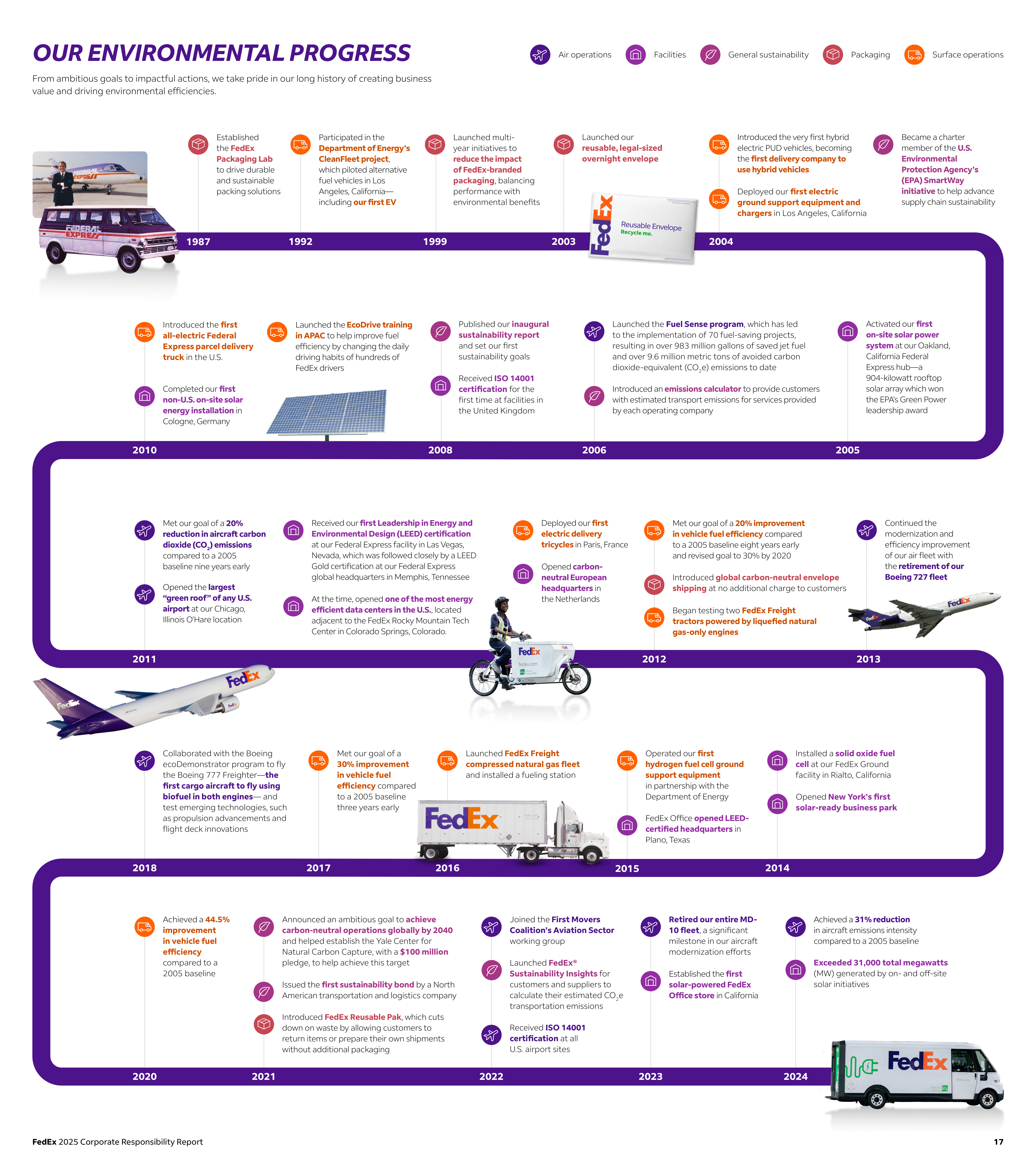
OUR ENVIRONMENTAL PROGRESS
From ambitious goals to impactful actions, we take pride in our long history of creating business
value and driving environmental efficiencies.
Established
the
FedEx
Packaging Lab
to drive durable
and sustainable
packing solutions
Participated in the
Department of Energy’s
CleanFleet project
,
which piloted alternative
fuel vehicles in Los
Angeles, California—
including
our first EV
Launched multi-
year initiatives to
reduce the impact
of FedEx-branded
packaging
, balancing
performance with
environmental benefits
Published our
inaugural
sustainability report
and set our first
sustainability goals
Received
ISO 14001
certification
for the
first time at facilities in
the United Kingdom
Introduced the
first
all-electric Federal
Express parcel delivery
truck
in the U.S.
Completed our
first
non-U.S. on-site solar
energy installation
in
Cologne, Germany
Launched the
EcoDrive training
in APAC
to help improve fuel
efficiency by changing the daily
driving habits of hundreds of
FedEx drivers
Introduced the very first hybrid
electric PUD vehicles, becoming
the
first delivery company to
use hybrid vehicles
Launched our
reusable, legal-sized
overnight envelope
Deployed our
first electric
ground support equipment and
chargers
in Los Angeles, California
Became a charter
member of the
U.S.
Environmental
Protection Agency’s
(EPA) SmartWay
initiative
to help advance
supply chain sustainability
Activated our
first
on-site solar power
system
at our Oakland,
California Federal
Express hub—a
904-kilowatt rooftop
solar array which won
the EPA’s Green Power
leadership award
Received our
first Leadership in Energy and
Environmental Design (LEED) certification
at our Federal Express facility in Las Vegas,
Nevada, which was followed closely by a LEED
Gold certification at our Federal Express
global headquarters in Memphis, Tennessee
At the time, opened
one of the most energy
efficient data centers in the U.S.
, located
adjacent to the FedEx Rocky Mountain Tech
Center in Colorado Springs, Colorado.
Deployed our
first
electric delivery
tricycles
in Paris, France
Opened
carbon-
neutral European
headquarters
in
the Netherlands
2012
2011
2010
2008
2006
2005
2004
2003
1999
1992
1987
2021
2022
2023
2024
2020
2013
Met our goal of a
20%
reduction in aircraft carbon
dioxide (CO
2
) emissions
compared to a 2005
baseline nine years early
Opened the
largest
“green roof” of any U.S.
airport
at our Chicago,
Illinois O’Hare location
Launched the
Fuel Sense program
, which has led
to the implementation of 70 fuel-saving projects,
resulting in over 983 million gallons of saved jet fuel
and over 9.6 million metric tons of avoided carbon
dioxide-equivalent (CO
2
e) emissions to date
Introduced an
emissions calculator
to provide customers
with estimated transport emissions for services provided
by each operating company
Introduced
global carbon-neutral envelope
shipping
at no additional charge to customers
Began testing two
FedEx Freight
tractors powered by liquefied natural
gas-only engines
Met our goal of a
20% improvement
in vehicle fuel efficiency
compared
to a 2005 baseline eight years early
and revised goal to 30% by 2020
Achieved a
44.5%
improvement
in vehicle fuel
efficiency
compared to a
2005 baseline
Continued the
modernization and
efficiency improvement
of our air fleet with
the
retirement of our
Boeing 727 fleet
Introduced
FedEx Reusable Pak
, which cuts
down on waste by allowing customers to
return items or prepare their own shipments
without additional packaging
Issued the
first sustainability bond
by a North
American transportation and logistics company
Announced an ambitious goal to
achieve
carbon-neutral operations globally by 2040
and helped establish the Yale Center for
Natural Carbon Capture, with a
$100 million
pledge, to help achieve this target
Exceeded 31,000 total megawatts
(MW) generated by on- and off-site
solar initiatives
Achieved a
31% reduction
in aircraft emissions intensity
compared to a 2005 baseline
Retired our entire MD-
10 fleet
, a significant
milestone in our aircraft
modernization efforts
Established the
first
solar-powered FedEx
Office store
in California
Joined the
First Movers
Coalition’s Aviation Sector
working group
Received
ISO 14001
certification
at all
U.S. airport sites
Launched
FedEx®
Sustainability Insights
for
customers and suppliers to
calculate their estimated CO
2
e
transportation emissions
2018
Collaborated with the Boeing
ecoDemonstrator program to fly
the Boeing 777 Freighter—
the
first cargo aircraft to fly using
biofuel in both engines
— and
test emerging technologies, such
as propulsion advancements and
flight deck innovations
2017
Met our goal of a
30% improvement
in vehicle fuel
efficiency
compared
to a 2005 baseline
three years early
2016
Launched
FedEx Freight
compressed natural gas fleet
and installed a fueling station
2014
Opened
New York’s first
solar-ready business park
Installed a
solid oxide fuel
cell
at our FedEx Ground
facility in Rialto, California
2015
Operated our
first
hydrogen fuel cell ground
support equipment
in partnership with the
Department of Energy
FedEx Office
opened LEED-
certified headquarters
in
Plano, Texas
FedEx
2025 Corporate Responsibility Report
17

Strategic approach
to climate change
We play a crucial role in connecting people with
possibilities across the globe, and doing so efficiently
can drive cost savings, unlock new opportunities, and
secure long-term sustainable growth. Connecting the
world’s economies is also resource intensive, and the
impacts our operations generate contribute to climate
change through the emission of greenhouse gases.
In 2021, we set an ambitious goal to achieve
carbon-neutral operations by 2040 across our
global operations’ Scope 1 and 2 GHG emissions
and our gross Scope 3 contracted transportation
emissions. We also set interim targets across our
main decarbonization levers including: parcel PUD
EV purchases, aviation fleet emissions intensity and
fleet retirement, and sustainable energy and fuel
procurement to help us progress toward our carbon-
neutral operations target.
Our strategic approach to achieving carbon-neutral
operations by 2040 is built on three principles:
1) Decarbonize what’s possible, 2) Co-create with
purpose, and 3) Neutralize what’s left. Our strategy
guides us as we implement comprehensive,
long-term actions and interim goals to achieve
carbon neutrality in our own operations, as well as
support the low-carbon transition of the broader
transportation and logistics industry.
Key links
Sustainability website
2024 CDP Corporate Questionnaire
Network optimization
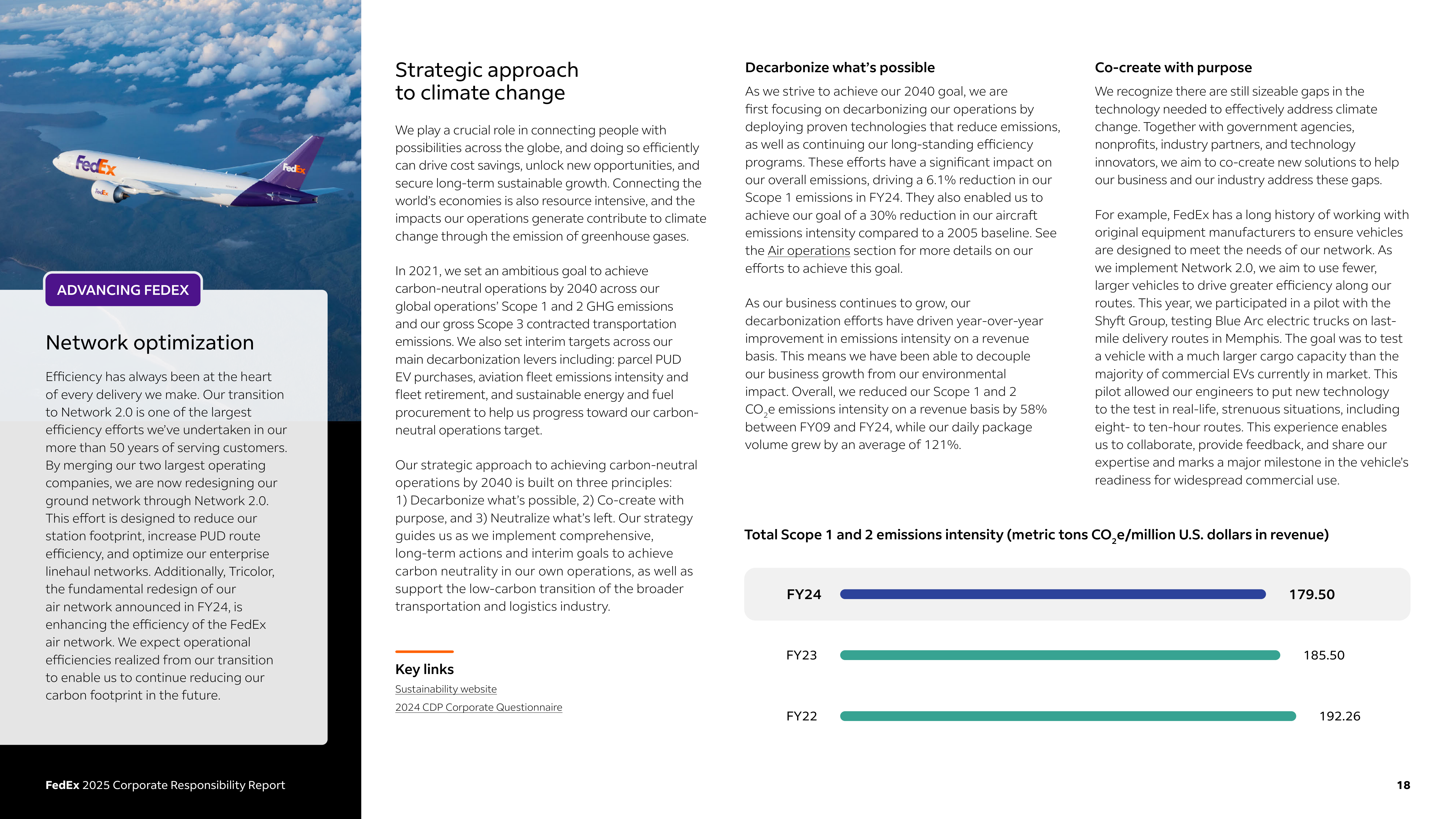
Efficiency has always been at the heart
of every delivery we make. Our transition
to Network 2.0 is one of the largest
efficiency efforts we’ve undertaken in our
more than 50 years of serving customers.
By merging our two largest operating
companies, we are now redesigning our
ground network through Network 2.0.
This effort is designed to reduce our
station footprint, increase PUD route
efficiency, and optimize our enterprise
linehaul networks. Additionally, Tricolor,
the fundamental redesign of our
air network announced in FY24, is
enhancing the efficiency of the FedEx
air network. We expect operational
efficiencies realized from our transition
to enable us to continue reducing our
carbon footprint in the future.
ADVANCING FEDEX
Decarbonize what’s possible
As we strive to achieve our 2040 goal, we are
first focusing on decarbonizing our operations by
deploying proven technologies that reduce emissions,
as well as continuing our long-standing efficiency
programs. These efforts have a significant impact on
our overall emissions, driving a 6.1% reduction in our
Scope 1 emissions in FY24. They also enabled us to
achieve our goal of a 30% reduction in our aircraft
emissions intensity compared to a 2005 baseline. See
the Air operations section for more details on our
efforts to achieve this goal.
As our business continues to grow, our
decarbonization efforts have driven year-over-year
improvement in emissions intensity on a revenue
basis. This means we have been able to decouple
our business growth from our environmental
impact. Overall, we reduced our Scope 1 and 2
CO
2
e emissions intensity on a revenue basis by 58%
between FY09 and FY24, while our daily package
volume grew by an average of 121%.
Co-create with purpose
We recognize there are still sizeable gaps in the
technology needed to effectively address climate
change. Together with government agencies,
nonprofits, industry partners, and technology
innovators, we aim to co-create new solutions to help
our business and our industry address these gaps.
For example, FedEx has a long history of working with
original equipment manufacturers to ensure vehicles
are designed to meet the needs of our network. As
we implement Network 2.0, we aim to use fewer,
larger vehicles to drive greater efficiency along our
routes. This year, we participated in a pilot with the
Shyft Group, testing Blue Arc electric trucks on last-
mile delivery routes in Memphis. The goal was to test
a vehicle with a much larger cargo capacity than the
majority of commercial EVs currently in market. This
pilot allowed our engineers to put new technology
to the test in real-life, strenuous situations, including
eight- to ten-hour routes. This experience enables
us to collaborate, provide feedback, and share our
expertise and marks a major milestone in the vehicle’s
readiness for widespread commercial use.
Total Scope 1 and 2 emissions intensity (metric tons CO
2
e/million U.S. dollars in revenue)
FY22
192.26
185.50
FY23
179.50
FY24
FedEx
2025 Corporate Responsibility Report
18


Neutralize what’s left
We understand that reduction alone will not
be enough to reach our goal of carbon-neutral
operations. In the latter part of the next decade, we
will need to offset remaining emissions that cannot
be fully reduced through technological innovations,
particularly those associated with our air operations.
Anticipating future needs, in 2021, we committed
$100 million to establish the Yale Center for Natural
Carbon Capture, empowering Yale scientists to
rapidly advance research on nature-based, durable
carbon dioxide removal (CDR) solutions. We believe
that supporting a robust pipeline of solutions via
the Center will help add future supply of carbon
credits that are measurable, verifiable, and durable
to both the compliance and voluntary marketplace.
Already, Yale faculty and graduates are serving
important roles with CDR start-ups, project registries,
government and non-governmental organizations,
and research institutions worldwide.
One of the most promising solutions for scalable
CDR is enhanced weathering, which involves
spreading finely ground alkaline materials— such as
basalt rock—over agricultural fields. This method
offers scalable and low-cost carbon removal with
significant co-benefits, including reduced soil
acidification, increased crop yields, and the potential
to create meaningful income for farmers around the
world. Today, Yale scientists are advising enhanced
weathering agricultural project developers on how
to measure and scale their projects, including Lithos,
Silica, and Mati Carbon, and exploring how enhanced
weathering can be integrated into industrial and
agricultural processes, such as wastewater treatment
and irrigation systems.
Enhancing footprint data collection
2025 marks our 18
th
year of disclosing our emissions
in line with the GHG Protocol. With enhanced data
collection and a new platform that increases our
measurement capacity, we have expanded the
completeness of our measured footprint, particularly
with Scope 3 emissions. This year, we are reporting
Scope 3, Category 3: Fuel- and energy-related
activities, for the first time. Additionally, we added
FedEx Logistics Air and Ocean transactions to
our Scope 3, Category 4 emissions. We have also
expanded Scope 3, Category 6 to include emissions
associated with employee hotel stays and updated
Key links
Carbon Neutral Operations Goal Announcement
Yale Center for Natural Carbon Capture Fact Sheet
Yale Center for Natural Carbon Capture
our employee air travel methodology to take fare
class into account. These additions are largely
responsible for the overall increase in our emissions
reporting year-over-year. We are committed to
further enhancing our emissions disclosures as
quality data becomes available and will continue to
share progress on this front.
Evolving our targets
FedEx recently committed to set a science-based
target with the Science Based Targets initiative (SBTi).
This effort builds on our goal to achieve carbon-
neutral operations globally by 2040. We look forward
to sharing further updates pending SBTi’s validation
process. During this interim period, we will continue
to work across our sector to find achievable solutions
and intervening initiatives to support our carbon-
neutral operations goal.
Expanding our climate risk management
This calendar year, we are conducting a climate risk
and scenario analysis to identify, assess, and manage
risks that could affect our operations, financial
performance, and long-term resilience. As a result of
this analysis, we will be publishing a climate transition
plan that will outline our plans to address any
potential risks identified. See the Risk management
and materiality and Public policy and advocacy
sections for more information.
FedEx emissions footprint FY24
(metric tons of CO
2
e)
Scope 1: Direct emissions
1
Scope 3—Category 3: Fuel-
and energy-related activities
Scope 3—Category 4:
Upstream transportation
and distribution
Scope 3— Category 6:
Business travel
Scope 2 (location-based):
2
Indirect emissions
14,842,148
898,484
3,301,621
6,361,186
176,273
1
Total Scope 1 emissions include additional sources like
fugitive emissions.
2
Our FY24 Scope 2 (market-based) emissions were
966,871 metric tons of CO
2
e.
FedEx
2025 Corporate Responsibility Report
19



Air operations
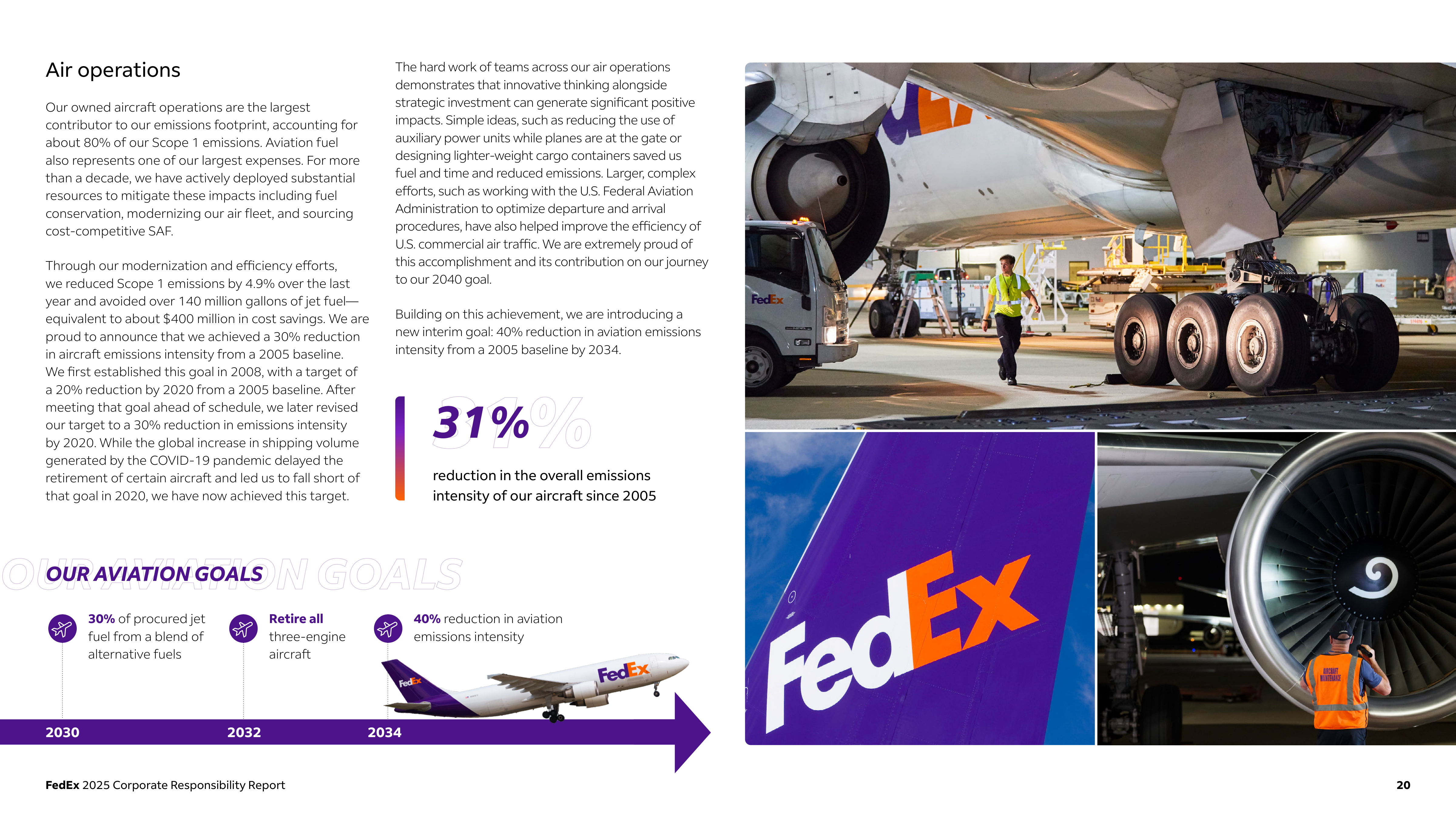
Our owned aircraft operations are the largest
contributor to our emissions footprint, accounting for
about 80% of our Scope 1 emissions. Aviation fuel
also represents one of our largest expenses. For more
than a decade, we have actively deployed substantial
resources to mitigate these impacts including fuel
conservation, modernizing our air fleet, and sourcing
cost-competitive SAF.
Through our modernization and efficiency efforts,
we reduced Scope 1 emissions by 4.9% over the last
year and avoided over 140 million gallons of jet fuel—
equivalent to about $400 million in cost savings. We are
proud to announce that we achieved a 30% reduction
in aircraft emissions intensity from a 2005 baseline.
We first established this goal in 2008, with a target of
a 20% reduction by 2020 from a 2005 baseline. After
meeting that goal ahead of schedule, we later revised
our target to a 30% reduction in emissions intensity
by 2020. While the global increase in shipping volume
generated by the COVID-19 pandemic delayed the
retirement of certain aircraft and led us to fall short of
that goal in 2020, we have now achieved this target.
The hard work of teams across our air operations
demonstrates that innovative thinking alongside
strategic investment can generate significant positive
impacts. Simple ideas, such as reducing the use of
auxiliary power units while planes are at the gate or
designing lighter-weight cargo containers saved us
fuel and time and reduced emissions. Larger, complex
efforts, such as working with the U.S. Federal Aviation
Administration to optimize departure and arrival
procedures, have also helped improve the efficiency of
U.S. commercial air traffic. We are extremely proud of
this accomplishment and its contribution on our journey
to our 2040 goal.
Building on this achievement, we are introducing a
new interim goal: 40% reduction in aviation emissions
intensity from a 2005 baseline by 2034.
OUR AVIATION GOALS
Retire all
three-engine
aircraft
2032
40%
reduction in aviation
emissions intensity
2034
30%
of procured jet
fuel from a blend of
alternative fuels
2030
31%
31%
reduction in the overall emissions
intensity of our aircraft since 2005
OUR AVIATION GOALS
FedEx
2025 Corporate Responsibility Report
20

Key links
Our Approach | Sustainability webpage
Our Approach | Aircraft webpage
Aircraft fleet modernization
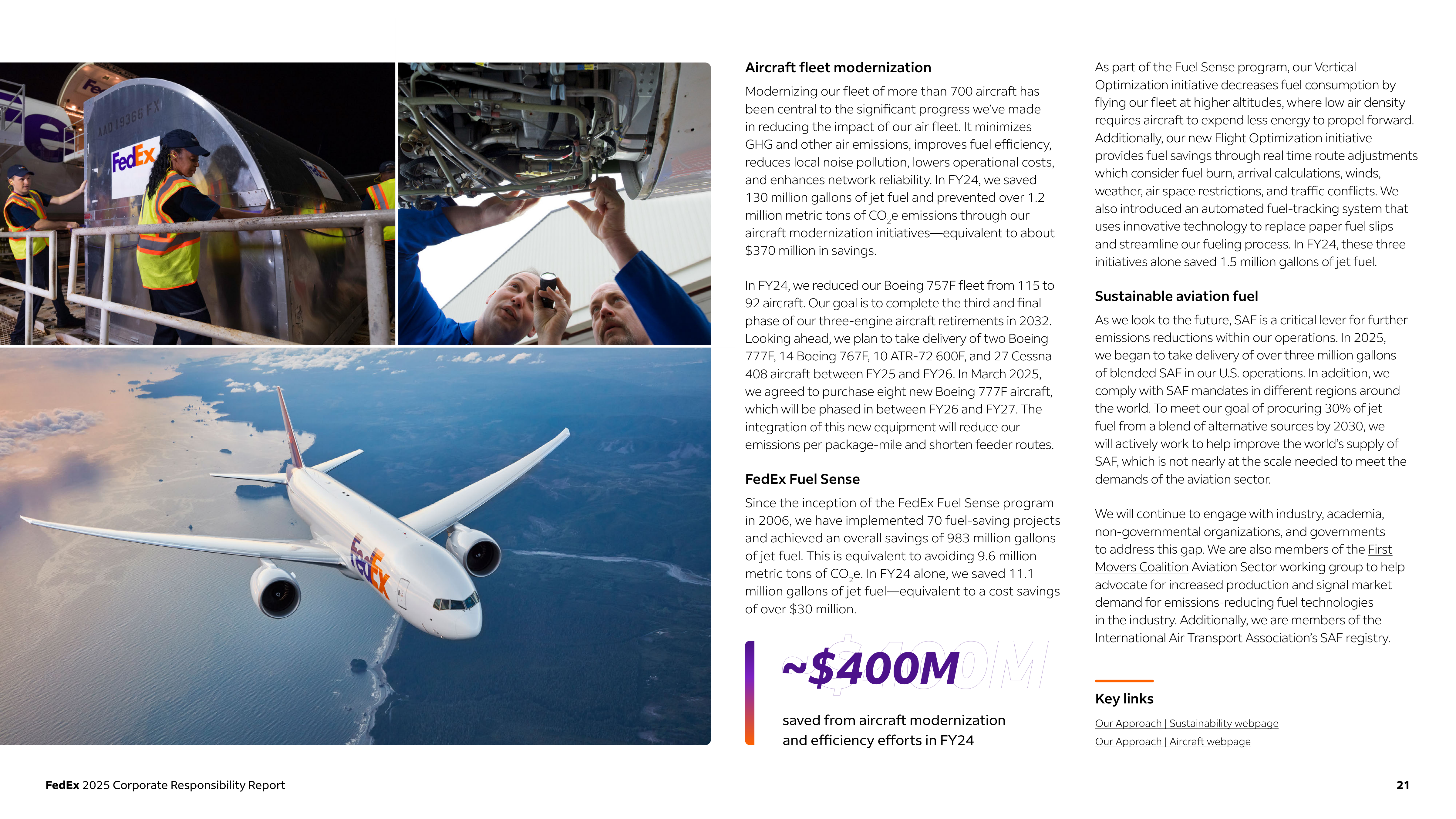
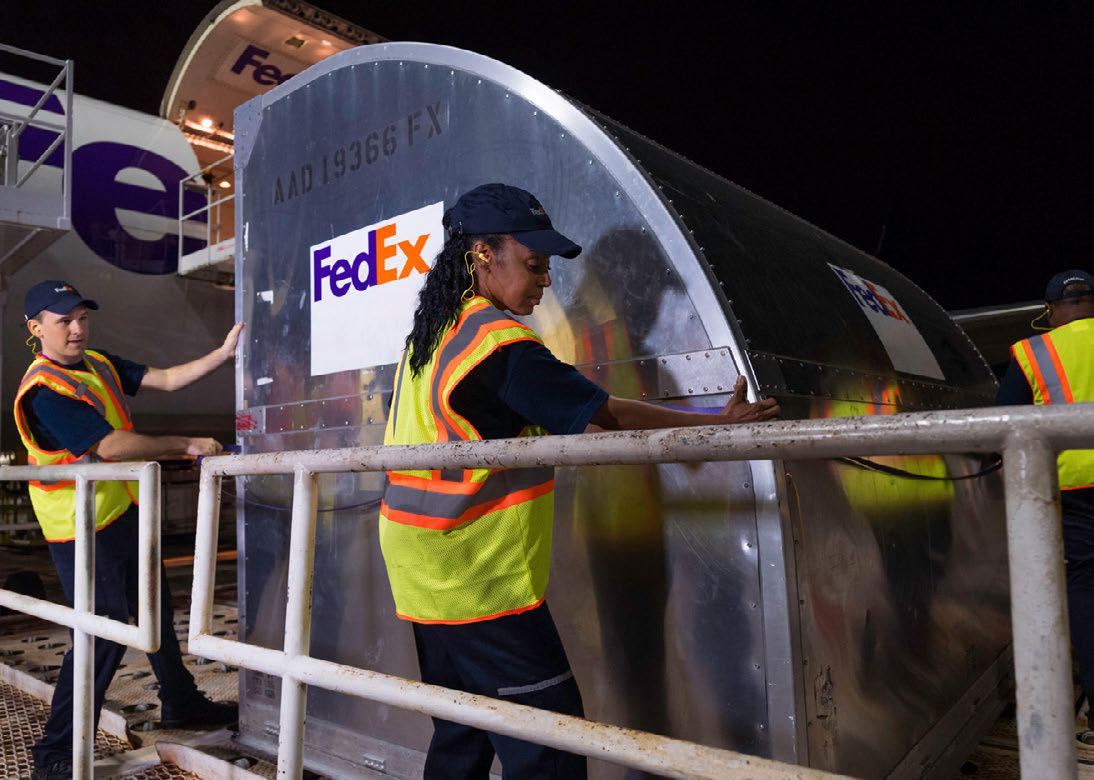
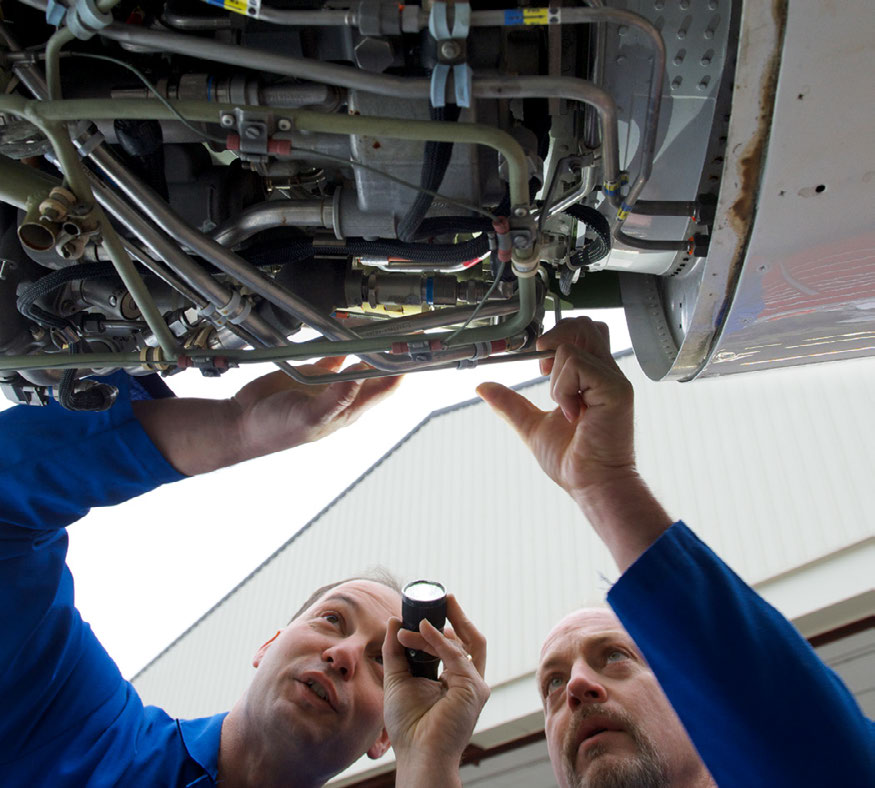
Modernizing our fleet of more than 700 aircraft has
been central to the significant progress we’ve made
in reducing the impact of our air fleet. It minimizes
GHG and other air emissions, improves fuel efficiency,
reduces local noise pollution, lowers operational costs,
and enhances network reliability. In FY24, we saved
130 million gallons of jet fuel and prevented over 1.2
million metric tons of CO
2
e emissions through our
aircraft modernization initiatives—equivalent to about
$370 million in savings.
In FY24, we reduced our Boeing 757F fleet from 115 to
92 aircraft. Our goal is to complete the third and final
phase of our three-engine aircraft retirements in 2032.
Looking ahead, we plan to take delivery of two Boeing
777F, 14 Boeing 767F, 10 ATR-72 600F, and 27 Cessna
408 aircraft between FY25 and FY26. In March 2025,
we agreed to purchase eight new Boeing 777F aircraft,
which will be phased in between FY26 and FY27. The
integration of this new equipment will reduce our
emissions per package-mile and shorten feeder routes.
FedEx Fuel Sense
Since the inception of the FedEx Fuel Sense program
in 2006, we have implemented 70 fuel-saving projects
and achieved an overall savings of 983 million gallons
of jet fuel. This is equivalent to avoiding 9.6 million
metric tons of CO
2
e. In FY24 alone, we saved 11.1
million gallons of jet fuel—equivalent to a cost savings
of over $30 million.
As part of the Fuel Sense program, our Vertical
Optimization initiative decreases fuel consumption by
flying our fleet at higher altitudes, where low air density
requires aircraft to expend less energy to propel forward.
Additionally, our new Flight Optimization initiative
provides fuel savings through real time route adjustments
which consider fuel burn, arrival calculations, winds,
weather, air space restrictions, and traffic conflicts. We
also introduced an automated fuel-tracking system that
uses innovative technology to replace paper fuel slips
and streamline our fueling process. In FY24, these three
initiatives alone saved 1.5 million gallons of jet fuel.
Sustainable aviation fuel
As we look to the future, SAF is a critical lever for further
emissions reductions within our operations. In 2025,
we began to take delivery of over three million gallons
of blended SAF in our U.S. operations. In addition, we
comply with SAF mandates in different regions around
the world. To meet our goal of procuring 30% of jet
fuel from a blend of alternative sources by 2030, we
will actively work to help improve the world’s supply of
SAF, which is not nearly at the scale needed to meet the
demands of the aviation sector.
We will continue to engage with industry, academia,
non-governmental organizations, and governments
to address this gap. We are also members of the First
Movers Coalition Aviation Sector working group to help
advocate for increased production and signal market
demand for emissions-reducing fuel technologies
in the industry. Additionally, we are members of the
International Air Transport Association’s SAF registry.
~$400M
~$400M
saved from aircraft modernization
and efficiency efforts in FY24
FedEx
2025 Corporate Responsibility Report
21

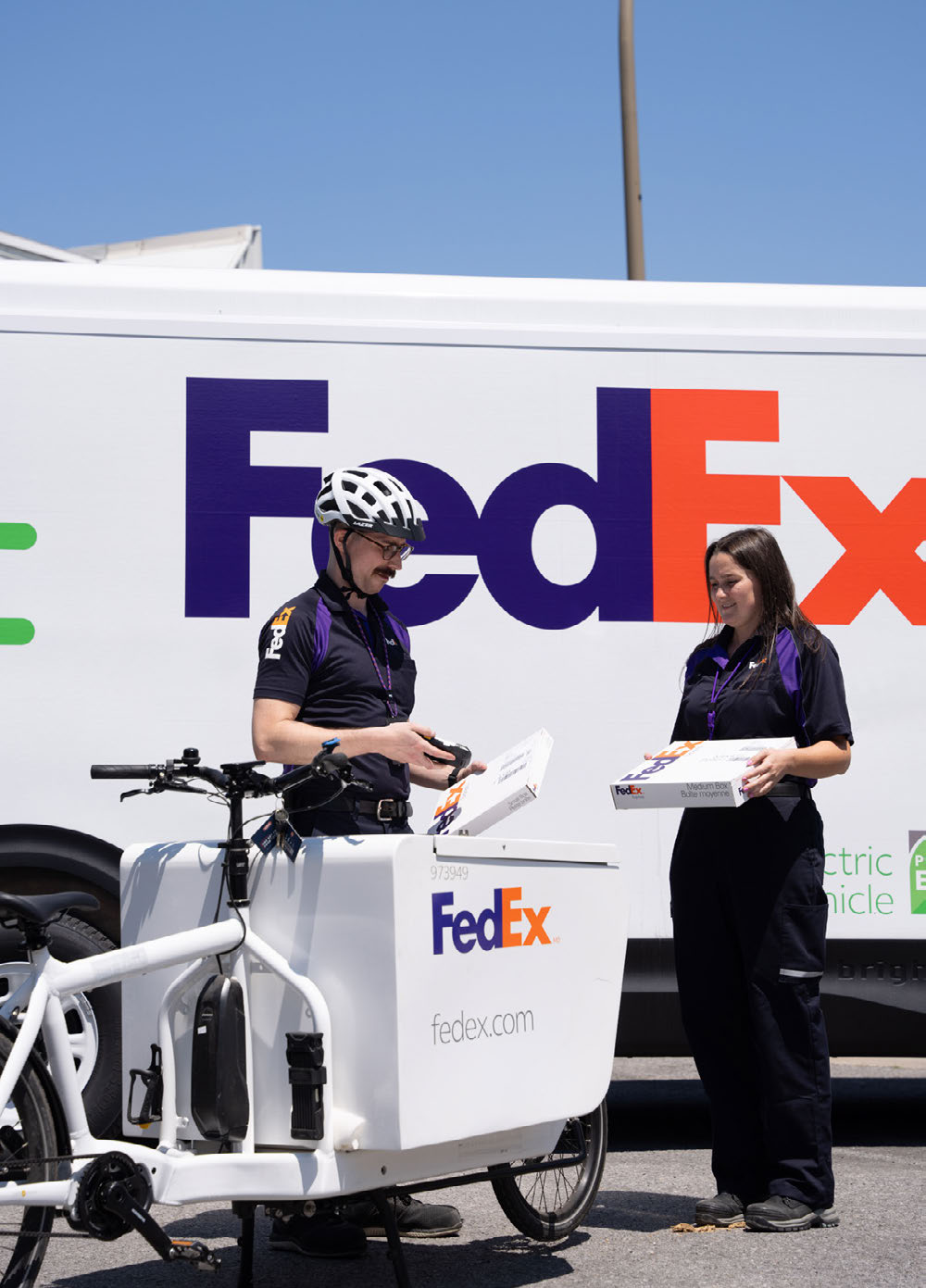
Surface operations
Across FedEx, we aim to build a ground fleet that
is efficient, sustainable, and tailored to meet our
operational and customer needs. In selecting the
ideal vehicle solution for each application, we
carefully consider local regulatory requirements,
manufacturing options, vehicle use, and operating
and maintenance costs.
Emissions related to our owned and contracted
vehicles account for about 25% of our total footprint.
In FY24, we achieved 40% improvement in vehicle
fuel efficiency compared to a 2005 baseline. Due to
changes in the mix of vehicles needed as a result of
Network 2.0 and other ongoing strategic initiatives,
we do not believe we will be able to achieve our goal
of a 50% increase in vehicle fuel efficiency by 2025.
We continue to review and optimize our sustainability
strategies regarding surface operations to determine
our best path towards our goal of achieving carbon-
neutral operations by 2040.
Electrification and alternative fuels present a
significant opportunity to reduce the environmental
impact of our global ground fleet further, which
includes more than 200,000 motorized vehicles
across several vehicle classes, including PUD vehicles,
long-haul trucks, forklifts, airport ground services
equipment, and other off-road vehicles.
Our transition to one FedEx has changed our fleet
makeup and vehicle dispersion, bringing new
opportunities. Our PUD EVs will need to be larger to
accommodate the volume of packages we transport,
which requires larger capacity batteries and higher
energy usage to charge. We are focused on optimizing
the efficiency of our routes by pairing the right vehicle
with the right route to increase efficiency per package.
Pickup and delivery
The continued growth of e-commerce means that the
electrification of our PUD fleet presents a significant
opportunity to address last-mile emissions. Our
owned and contracted PUD fleet accounts for about
18% of our total emissions footprint. Electrification
of PUDs also makes long-term sense for our
business. In addition to reducing tailpipe emissions,
we anticipate a considerable return on investment.
Early analysis demonstrates that the costs related
to electric PUDs are up to 30% less compared
to their combustion engine counterparts. This
number could increase as the cost to purchase EVs
drops over time.
While we are in our transformation, we will continue
to take a phased approach to electrification: 50%
of all FedEx PUD purchase orders are targeted to
be electric in 2025, and this is targeted to rise to
100% by 2030. Our goal is to transform our entire
PUD fleet to all electric vehicles by 2040, including
owned and contracted vehicles.
After concluding our executive-level review, we
now anticipate meeting our 2025 goal, while
continuing to work to fine-tune the size and
makeup of our fleet. After a successful U.S. pilot,
OUR SURFACE OPERATIONS GOALS
100%
of FedEx
parcel PUD purchase
orders are EVs
2030
100%
of all FedEx parcel
PUDs are electric including
contracted transportation
2040
OUR SURFACE OPERATIONS GOALS
2025
50%
increase in owned
vehicle fuel efficiency
50%
of FedEx parcel PUD
purchase orders are EVs
we now have 150 Shyft Group Blue Arc trucks on
order which introduce larger capacity EVs to our
network. In FY24, we also continued to add EVs
across international markets including Australia,
Brazil, Canada, France, the Netherlands, New
Zealand, Singapore, Spain, and the United Kingdom.
Additionally, we added e-cargo bicycles and tricycles
in Canada, Taiwan, and the United Kingdom in FY24.
FedEx
2025 Corporate Responsibility Report
22
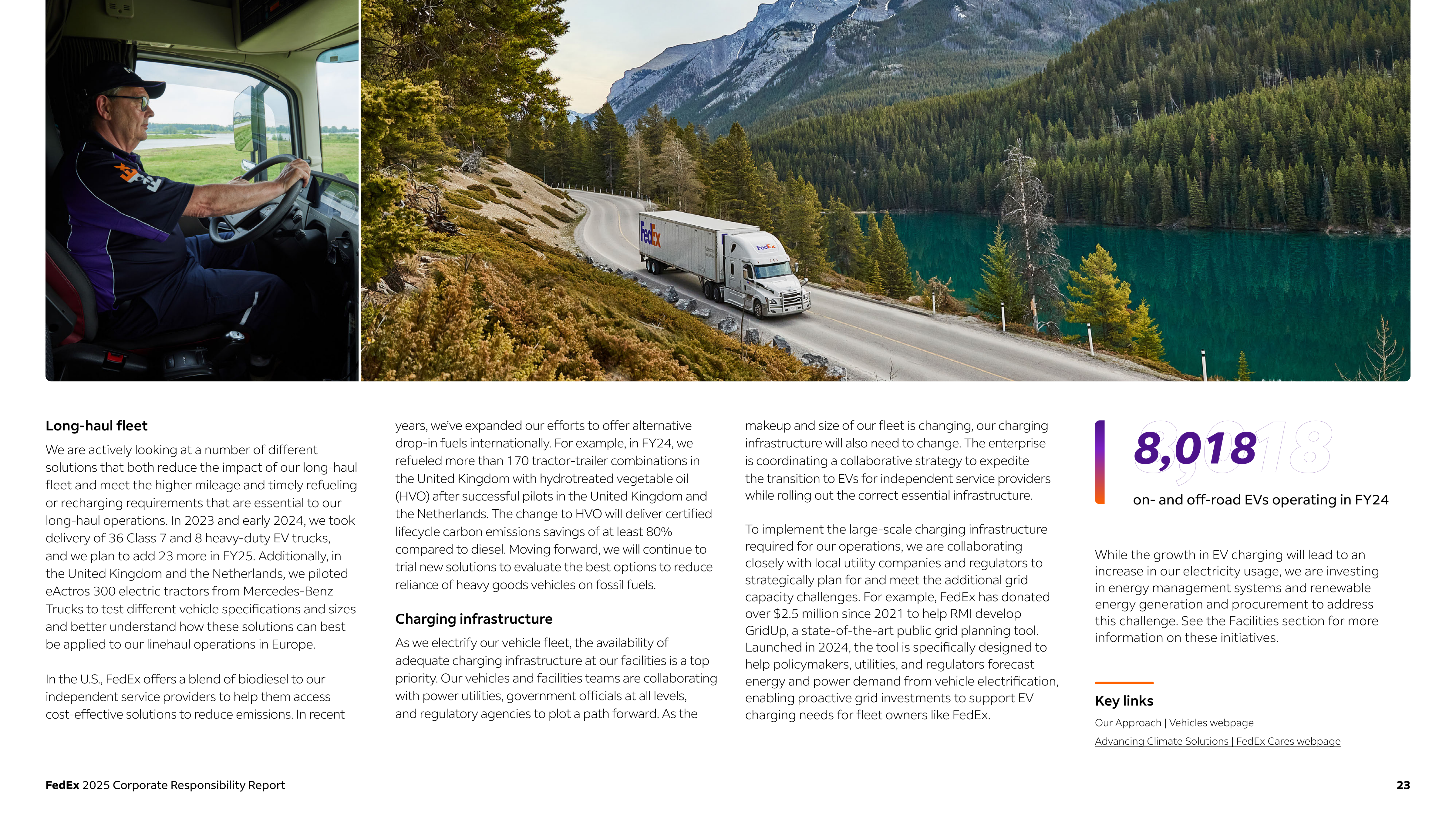


years, we’ve expanded our efforts to offer alternative
drop-in fuels internationally. For example, in FY24, we
refueled more than 170 tractor-trailer combinations in
the United Kingdom with hydrotreated vegetable oil
(HVO) after successful pilots in the United Kingdom and
the Netherlands. The change to HVO will deliver certified
lifecycle carbon emissions savings of at least 80%
compared to diesel. Moving forward, we will continue to
trial new solutions to evaluate the best options to reduce
reliance of heavy goods vehicles on fossil fuels.
Charging infrastructure
As we electrify our vehicle fleet, the availability of
adequate charging infrastructure at our facilities is a top
priority. Our vehicles and facilities teams are collaborating
with power utilities, government officials at all levels,
and regulatory agencies to plot a path forward. As the
8,018
8,018
on- and off-road EVs operating in FY24
Long-haul fleet
We are actively looking at a number of different
solutions that both reduce the impact of our long-haul
fleet and meet the higher mileage and timely refueling
or recharging requirements that are essential to our
long-haul operations. In 2023 and early 2024, we took
delivery of 36 Class 7 and 8 heavy-duty EV trucks,
and we plan to add 23 more in FY25. Additionally, in
the United Kingdom and the Netherlands, we piloted
eActros 300 electric tractors from Mercedes-Benz
Trucks to test different vehicle specifications and sizes
and better understand how these solutions can best
be applied to our linehaul operations in Europe.
In the U.S., FedEx offers a blend of biodiesel to our
independent service providers to help them access
cost-effective solutions to reduce emissions. In recent
makeup and size of our fleet is changing, our charging
infrastructure will also need to change. The enterprise
is coordinating a collaborative strategy to expedite
the transition to EVs for independent service providers
while rolling out the correct essential infrastructure.
To implement the large-scale charging infrastructure
required for our operations, we are collaborating
closely with local utility companies and regulators to
strategically plan for and meet the additional grid
capacity challenges. For example, FedEx has donated
over $2.5 million since 2021 to help RMI develop
GridUp, a state-of-the-art public grid planning tool.
Launched in 2024, the tool is specifically designed to
help policymakers, utilities, and regulators forecast
energy and power demand from vehicle electrification,
enabling proactive grid investments to support EV
charging needs for fleet owners like FedEx.
While the growth in EV charging will lead to an
increase in our electricity usage, we are investing
in energy management systems and renewable
energy generation and procurement to address
this challenge. See the Facilities section for more
information on these initiatives.
Key links
Our Approach | Vehicles webpage
Advancing Climate Solutions | FedEx Cares webpage
FedEx
2025 Corporate Responsibility Report
23
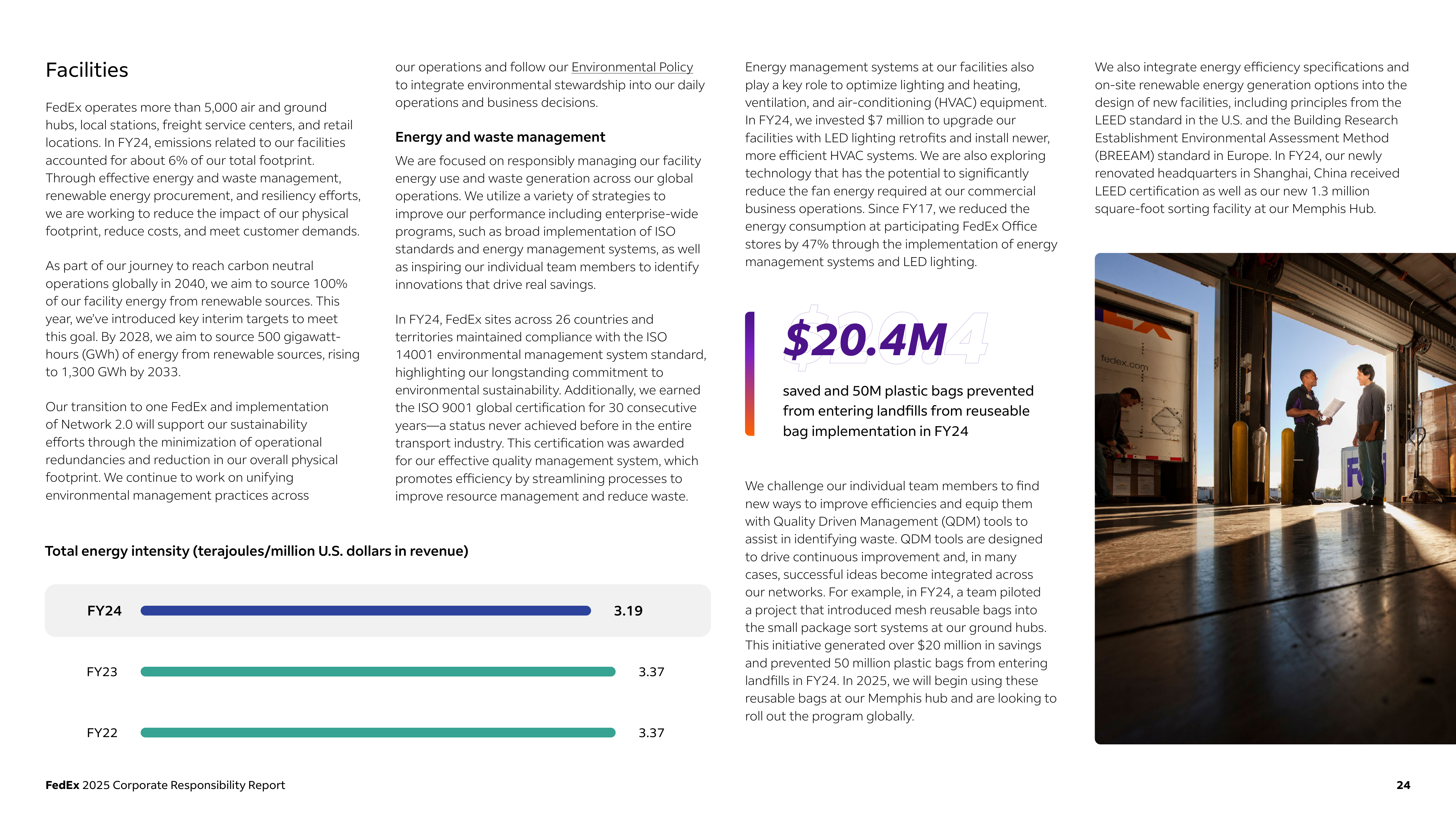
Facilities
FedEx operates more than 5,000 air and ground
hubs, local stations, freight service centers, and retail
locations. In FY24, emissions related to our facilities
accounted for about 6% of our total footprint.
Through effective energy and waste management,
renewable energy procurement, and resiliency efforts,
we are working to reduce the impact of our physical
footprint, reduce costs, and meet customer demands.
As part of our journey to reach carbon neutral
operations globally in 2040, we aim to source 100%
of our facility energy from renewable sources. This
year, we’ve introduced key interim targets to meet
this goal. By 2028, we aim to source 500 gigawatt-
hours (GWh) of energy from renewable sources, rising
to 1,300 GWh by 2033.
Our transition to one FedEx and implementation
of Network 2.0 will support our sustainability
efforts through the minimization of operational
redundancies and reduction in our overall physical
footprint. We continue to work on unifying
environmental management practices across
our operations and follow our Environmental Policy
to integrate environmental stewardship into our daily
operations and business decisions.
Energy and waste management
We are focused on responsibly managing our facility
energy use and waste generation across our global
operations. We utilize a variety of strategies to
improve our performance including enterprise-wide
programs, such as broad implementation of ISO
standards and energy management systems, as well
as inspiring our individual team members to identify
innovations that drive real savings.
In FY24, FedEx sites across 26 countries and
territories maintained compliance with the ISO
14001 environmental management system standard,
highlighting our longstanding commitment to
environmental sustainability. Additionally, we earned
the ISO 9001 global certification for 30 consecutive
years—a status never achieved before in the entire
transport industry. This certification was awarded
for our effective quality management system, which
promotes efficiency by streamlining processes to
improve resource management and reduce waste.
Energy management systems at our facilities also
play a key role to optimize lighting and heating,
ventilation, and air-conditioning (HVAC) equipment.
In FY24, we invested $7 million to upgrade our
facilities with LED lighting retrofits and install newer,
more efficient HVAC systems. We are also exploring
technology that has the potential to significantly
reduce the fan energy required at our commercial
business operations. Since FY17, we reduced the
energy consumption at participating FedEx Office
stores by 47% through the implementation of energy
management systems and LED lighting.
We challenge our individual team members to find
new ways to improve efficiencies and equip them
with Quality Driven Management (QDM) tools to
assist in identifying waste. QDM tools are designed
to drive continuous improvement and, in many
cases, successful ideas become integrated across
our networks. For example, in FY24, a team piloted
a project that introduced mesh reusable bags into
the small package sort systems at our ground hubs.
This initiative generated over $20 million in savings
and prevented 50 million plastic bags from entering
landfills in FY24. In 2025, we will begin using these
reusable bags at our Memphis hub and are looking to
roll out the program globally.
$20.4
saved and 50M plastic bags prevented
from entering landfills from reuseable
bag implementation in FY24
$20.4M
Total energy intensity (terajoules/million U.S. dollars in revenue)
FY22
3.37
3.37
FY23
3.19
FY24
We also integrate energy efficiency specifications and
on-site renewable energy generation options into the
design of new facilities, including principles from the
LEED standard in the U.S. and the Building Research
Establishment Environmental Assessment Method
(BREEAM) standard in Europe. In FY24, our newly
renovated headquarters in Shanghai, China received
LEED certification as well as our new 1.3 million
square-foot sorting facility at our Memphis Hub.
FedEx
2025 Corporate Responsibility Report
24
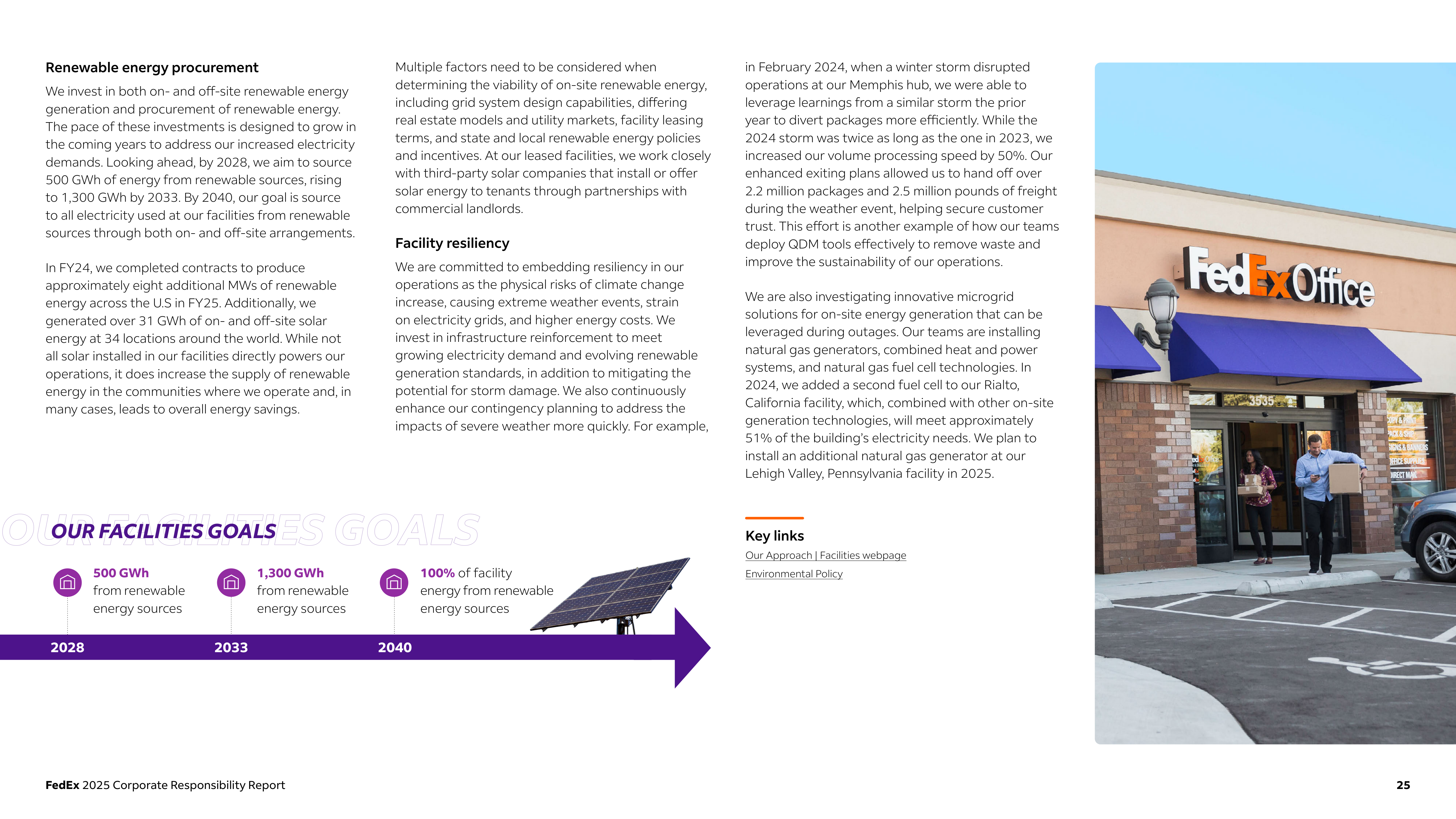

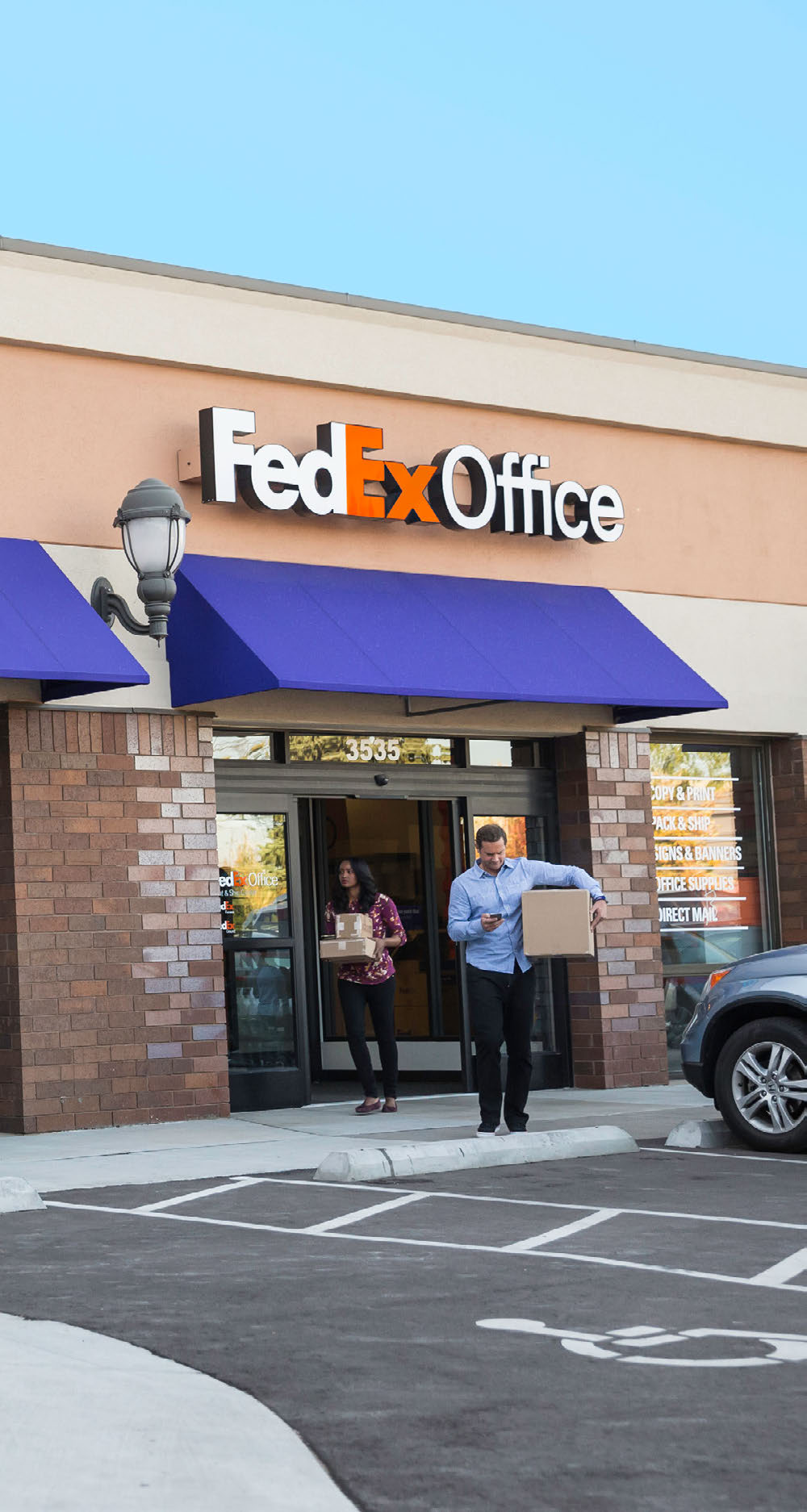
OUR FACILITIES GOALS
Renewable energy procurement
We invest in both on- and off-site renewable energy
generation and procurement of renewable energy.
The pace of these investments is designed to grow in
the coming years to address our increased electricity
demands. Looking ahead, by 2028, we aim to source
500 GWh of energy from renewable sources, rising
to 1,300 GWh by 2033. By 2040, our goal is source
to all electricity used at our facilities from renewable
sources through both on- and off-site arrangements.
In FY24, we completed contracts to produce
approximately eight additional MWs of renewable
energy across the U.S in FY25. Additionally, we
generated over 31 GWh of on- and off-site solar
energy at 34 locations around the world. While not
all solar installed in our facilities directly powers our
operations, it does increase the supply of renewable
energy in the communities where we operate and, in
many cases, leads to overall energy savings.
Multiple factors need to be considered when
determining the viability of on-site renewable energy,
including grid system design capabilities, differing
real estate models and utility markets, facility leasing
terms, and state and local renewable energy policies
and incentives. At our leased facilities, we work closely
with third-party solar companies that install or offer
solar energy to tenants through partnerships with
commercial landlords.
Facility resiliency
We are committed to embedding resiliency in our
operations as the physical risks of climate change
increase, causing extreme weather events, strain
on electricity grids, and higher energy costs. We
invest in infrastructure reinforcement to meet
growing electricity demand and evolving renewable
generation standards, in addition to mitigating the
potential for storm damage. We also continuously
enhance our contingency planning to address the
impacts of severe weather more quickly. For example,
Key links
Our Approach | Facilities webpage
Environmental Policy
OUR FACILITIES GOALS
500 GWh
from renewable
energy sources
2028
1,300 GWh
from renewable
energy sources
2033
100%
of facility
energy from renewable
energy sources
2040
in February 2024, when a winter storm disrupted
operations at our Memphis hub, we were able to
leverage learnings from a similar storm the prior
year to divert packages more efficiently. While the
2024 storm was twice as long as the one in 2023, we
increased our volume processing speed by 50%. Our
enhanced exiting plans allowed us to hand off over
2.2 million packages and 2.5 million pounds of freight
during the weather event, helping secure customer
trust. This effort is another example of how our teams
deploy QDM tools effectively to remove waste and
improve the sustainability of our operations.
We are also investigating innovative microgrid
solutions for on-site energy generation that can be
leveraged during outages. Our teams are installing
natural gas generators, combined heat and power
systems, and natural gas fuel cell technologies. In
2024, we added a second fuel cell to our Rialto,
California facility, which, combined with other on-site
generation technologies, will meet approximately
51% of the building’s electricity needs. We plan to
install an additional natural gas generator at our
Lehigh Valley, Pennsylvania facility in 2025.
FedEx
2025 Corporate Responsibility Report
25
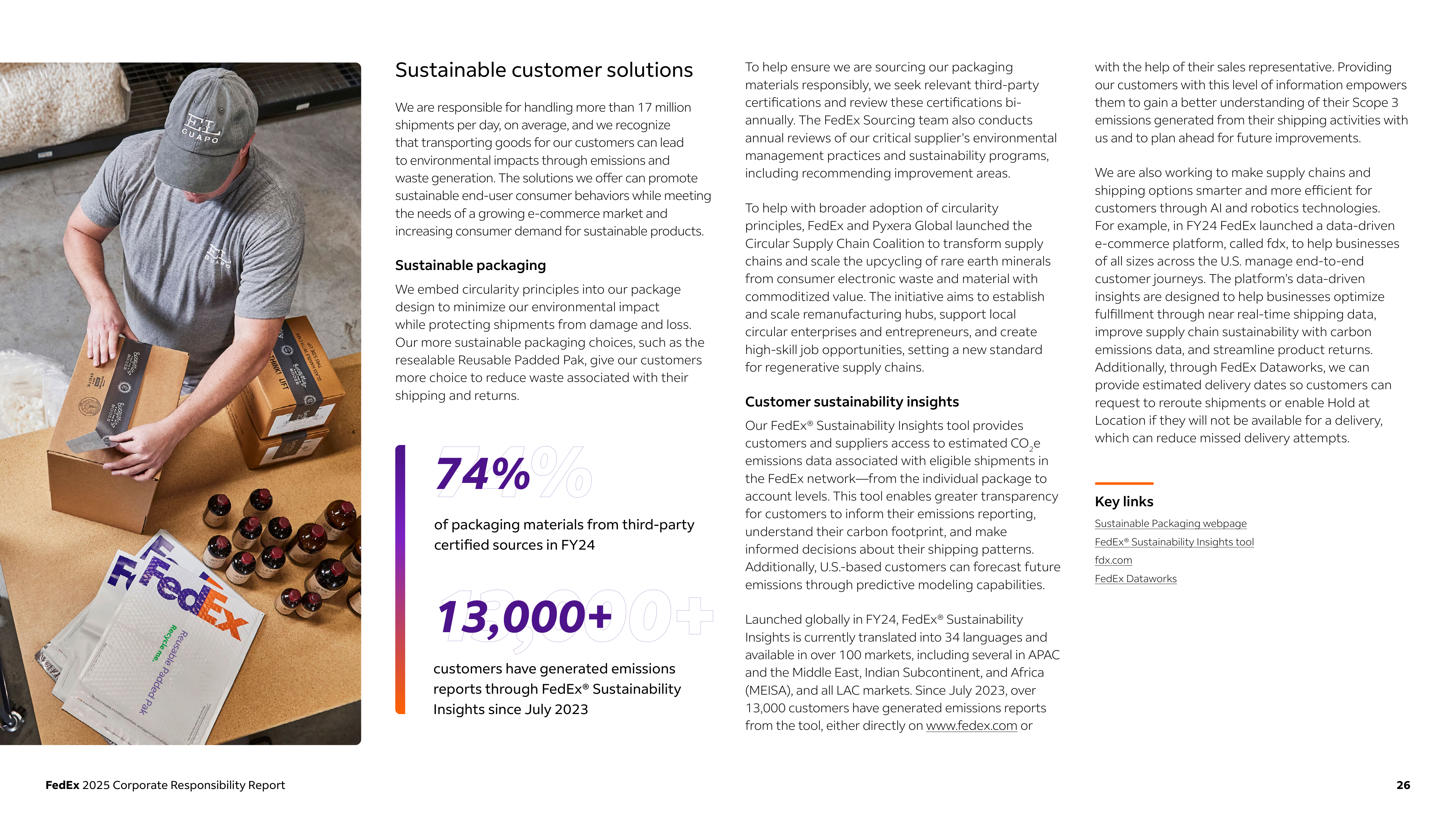
Sustainable customer solutions
We are responsible for handling more than 17 million
shipments per day, on average, and we recognize
that transporting goods for our customers can lead
to environmental impacts through emissions and
waste generation. The solutions we offer can promote
sustainable end-user consumer behaviors while meeting
the needs of a growing e-commerce market and
increasing consumer demand for sustainable products.
Sustainable packaging
We embed circularity principles into our package
design to minimize our environmental impact
while protecting shipments from damage and loss.
Our more sustainable packaging choices, such as the
resealable Reusable Padded Pak, give our customers
more choice to reduce waste associated with their
shipping and returns.
To help ensure we are sourcing our packaging
materials responsibly, we seek relevant third-party
certifications and review these certifications bi-
annually. The FedEx Sourcing team also conducts
annual reviews of our critical supplier’s environmental
management practices and sustainability programs,
including recommending improvement areas.
To help with broader adoption of circularity
principles, FedEx and Pyxera Global launched the
Circular Supply Chain Coalition to transform supply
chains and scale the upcycling of rare earth minerals
from consumer electronic waste and material with
commoditized value. The initiative aims to establish
and scale remanufacturing hubs, support local
circular enterprises and entrepreneurs, and create
high-skill job opportunities, setting a new standard
for regenerative supply chains.
Customer sustainability insights
Our FedEx® Sustainability Insights tool provides
customers and suppliers access to estimated CO
2
e
emissions data associated with eligible shipments in
the FedEx network—from the individual package to
account levels. This tool enables greater transparency
for customers to inform their emissions reporting,
understand their carbon footprint, and make
informed decisions about their shipping patterns.
Additionally, U.S.-based customers can forecast future
emissions through predictive modeling capabilities.
Launched globally in FY24, FedEx® Sustainability
Insights is currently translated into 34 languages and
available in over 100 markets, including several in APAC
and the Middle East, Indian Subcontinent, and Africa
(MEISA), and all LAC markets. Since July 2023, over
13,000 customers have generated emissions reports
from the tool, either directly on www.fedex.com or
Key links
Sustainable Packaging webpage
FedEx® Sustainability Insights tool
fdx.com
FedEx Dataworks
with the help of their sales representative. Providing
our customers with this level of information empowers
them to gain a better understanding of their Scope 3
emissions generated from their shipping activities with
us and to plan ahead for future improvements.
We are also working to make supply chains and
shipping options smarter and more efficient for
customers through AI and robotics technologies.
For example, in FY24 FedEx launched a data-driven
e-commerce platform, called fdx, to help businesses
of all sizes across the U.S. manage end-to-end
customer journeys. The platform’s data-driven
insights are designed to help businesses optimize
fulfillment through near real-time shipping data,
improve supply chain sustainability with carbon
emissions data, and streamline product returns.
Additionally, through FedEx Dataworks, we can
provide estimated delivery dates so customers can
request to reroute shipments or enable Hold at
Location if they will not be available for a delivery,
which can reduce missed delivery attempts.
13,000+
13,000+
74%
74%
customers have generated emissions
reports through FedEx® Sustainability
Insights since July 2023
of packaging materials from third-party
certified sources in FY24
FedEx
2025 Corporate Responsibility Report
26
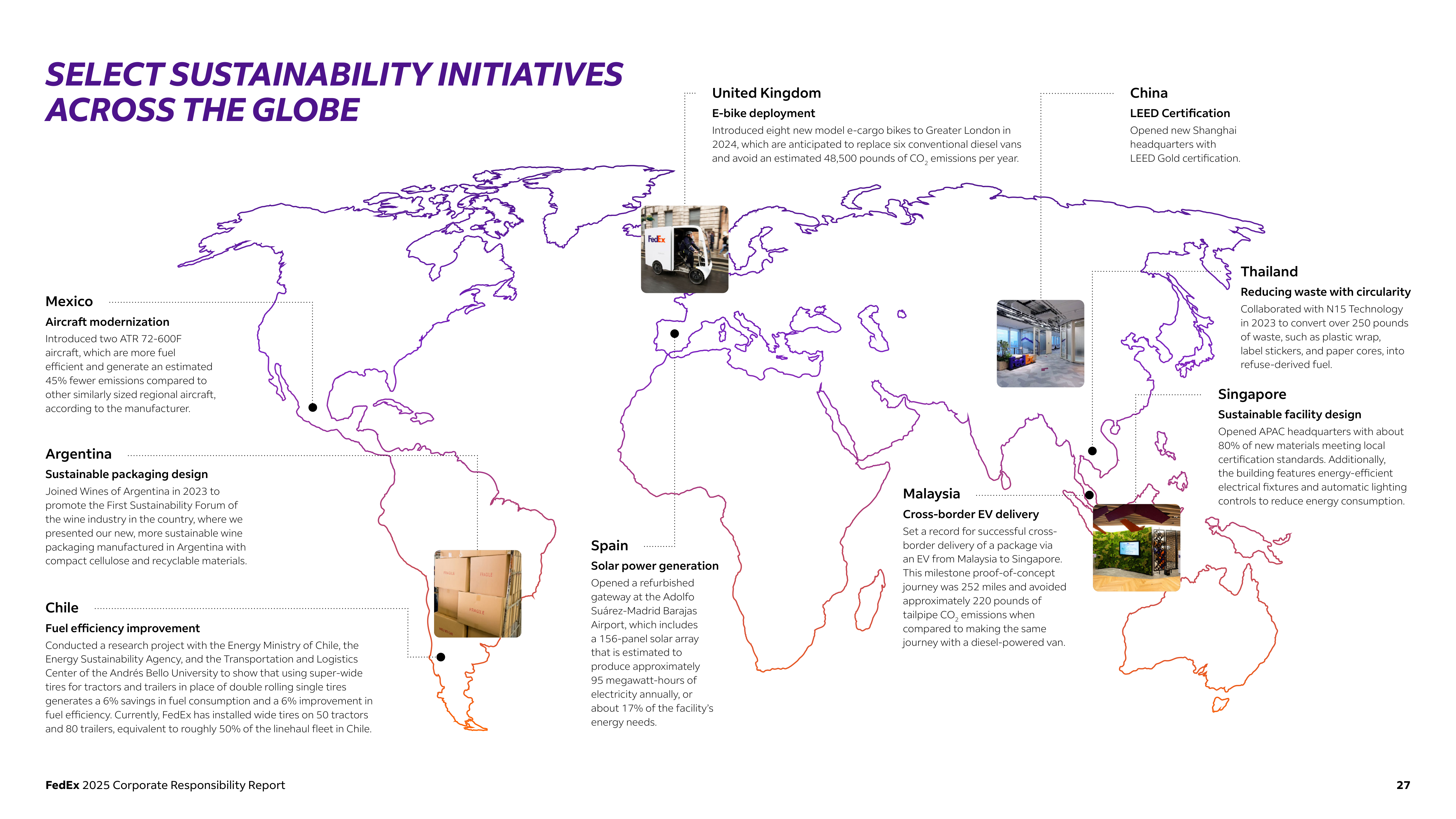
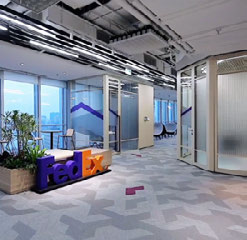
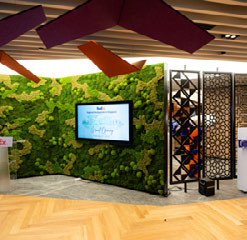

SELECT SUSTAINABILITY INITIATIVES
ACROSS THE GLOBE
Argentina
Sustainable packaging design
Joined Wines of Argentina in 2023 to
promote the First Sustainability Forum of
the wine industry in the country, where we
presented our new, more sustainable wine
packaging manufactured in Argentina with
compact cellulose and recyclable materials.
Chile
Fuel efficiency improvement
Conducted a research project with the Energy Ministry of Chile, the
Energy Sustainability Agency, and the Transportation and Logistics
Center of the Andrés Bello University to show that using super-wide
tires for tractors and trailers in place of double rolling single tires
generates a 6% savings in fuel consumption and a 6% improvement in
fuel efficiency. Currently, FedEx has installed wide tires on 50 tractors
and 80 trailers, equivalent to roughly 50% of the linehaul fleet in Chile.
Mexico
Aircraft modernization
Introduced two ATR 72-600F
aircraft, which are more fuel
efficient and generate an estimated
45% fewer emissions compared to
other similarly sized regional aircraft,
according to the manufacturer.
Spain
Solar power generation
Opened a refurbished
gateway at the Adolfo
Suárez-Madrid Barajas
Airport, which includes
a 156-panel solar array
that is estimated to
produce approximately
95 megawatt-hours of
electricity annually, or
about 17% of the facility’s
energy needs.
United Kingdom
E-bike deployment
Introduced eight new model e-cargo bikes to Greater London in
2024, which are anticipated to replace six conventional diesel vans
and avoid an estimated 48,500 pounds of CO
2
emissions per year.
China
LEED Certification
Opened new Shanghai
headquarters with
LEED Gold certification.
Malaysia
Cross-border EV delivery
Set a record for successful cross-
border delivery of a package via
an EV from Malaysia to Singapore.
This milestone proof-of-concept
journey was 252 miles and avoided
approximately 220 pounds of
tailpipe CO
2
emissions when
compared to making the same
journey with a diesel-powered van.
Singapore
Sustainable facility design
Opened APAC headquarters with about
80% of new materials meeting local
certification standards. Additionally,
the building features energy-efficient
electrical fixtures and automatic lighting
controls to reduce energy consumption.
Thailand
Reducing waste with circularity
Collaborated with N15 Technology
in 2023 to convert over 250 pounds
of waste, such as plastic wrap,
label stickers, and paper cores, into
refuse-derived fuel.
FedEx
2025 Corporate Responsibility Report
27
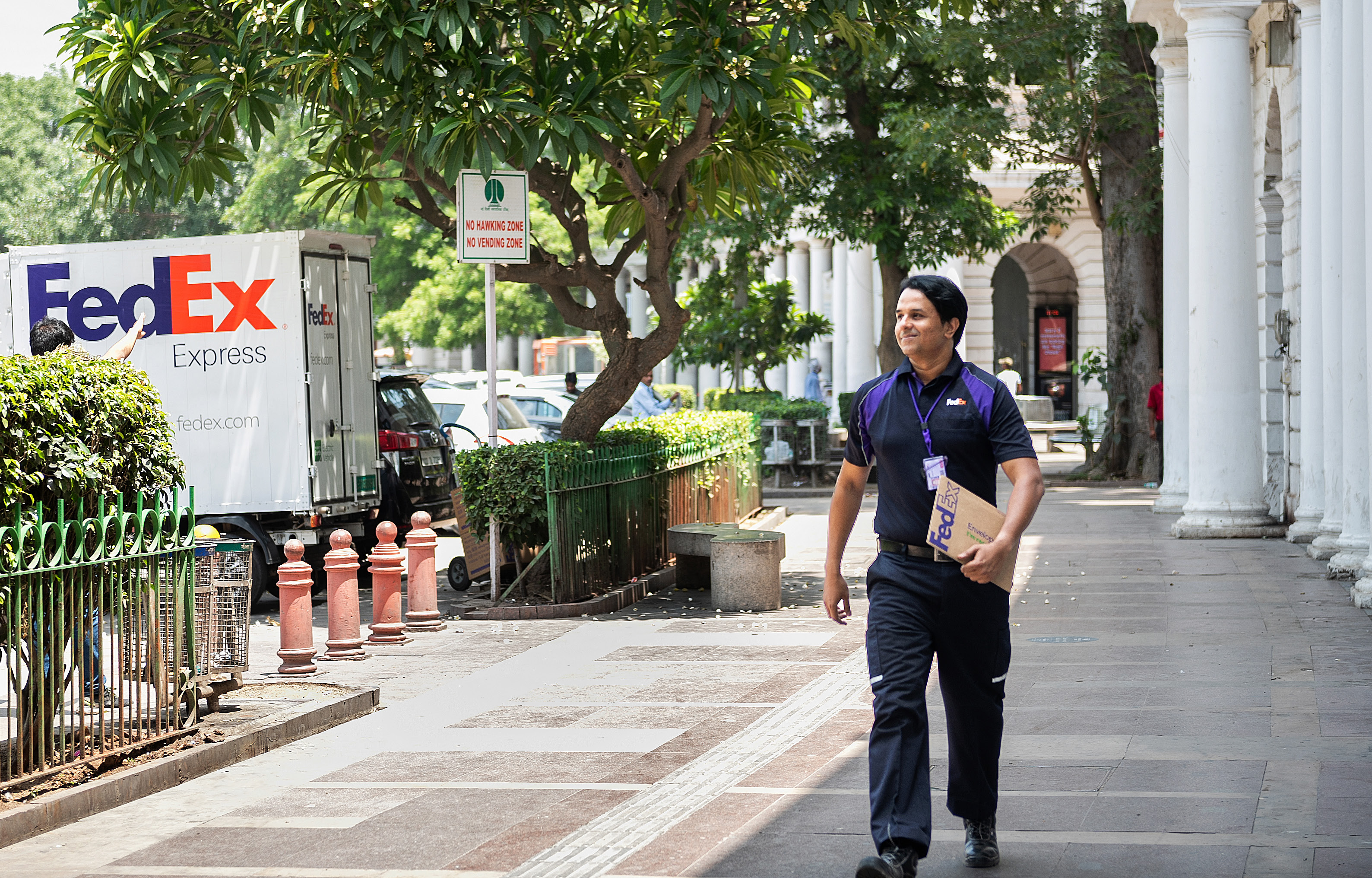
OUR PEOPLE
OUR PEOPLE
DELIVERING ON OUR CULTURE
Social governance structure
Our team members are critical to our success, and
it is important that they uphold FedEx values to
maintain our strong reputation and cohesive culture.
Management works with our Board of Directors to
promote alignment of our corporate strategy with
our culture values and behaviors.
The Board’s Compensation and Human Resources
Committee oversees our key human resource
management strategies and initiatives. The
Governance, Safety, and Public Policy Committee
oversees our safety strategies, policies, programs,
and practices. We strive for proper safety
management across all operations by using the
FedEx
Safety Above All
philosophy to guide our
policies and programs.
Our human resources team manages a variety of
social initiatives, including career development,
training, health, well-being, and team member
engagement. As part of the transition to one FedEx,
we are working to harmonize our social governance
structures across the enterprise at the management
level to improve team collaboration and enable more
effective sharing of knowledge, resources,
and strategies.
In this section
Social governance structure
Human resource management
Our culture and people
Health and safety
FedEx
2025 Corporate Responsibility Report
28
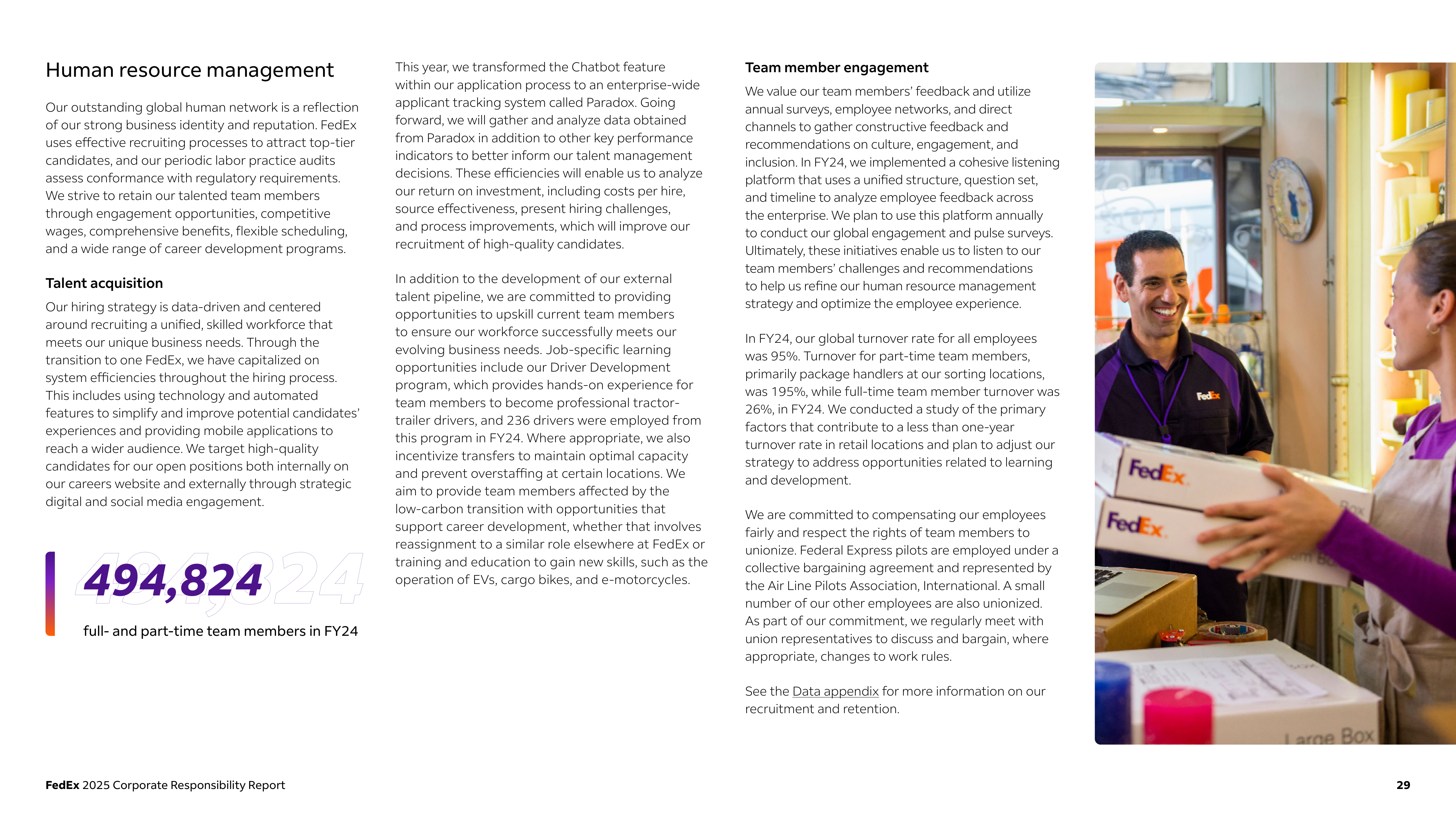
Human resource management
Our outstanding global human network is a reflection
of our strong business identity and reputation. FedEx
uses effective recruiting processes to attract top-tier
candidates, and our periodic labor practice audits
assess conformance with regulatory requirements.
We strive to retain our talented team members
through engagement opportunities, competitive
wages, comprehensive benefits, flexible scheduling,
and a wide range of career development programs.
Talent acquisition
Our hiring strategy is data-driven and centered
around recruiting a unified, skilled workforce that
meets our unique business needs. Through the
transition to one FedEx, we have capitalized on
system efficiencies throughout the hiring process.
This includes using technology and automated
features to simplify and improve potential candidates’
experiences and providing mobile applications to
reach a wider audience. We target high-quality
candidates for our open positions both internally on
our careers website and externally through strategic
digital and social media engagement.
This year, we transformed the Chatbot feature
within our application process to an enterprise-wide
applicant tracking system called Paradox. Going
forward, we will gather and analyze data obtained
from Paradox in addition to other key performance
indicators to better inform our talent management
decisions. These efficiencies will enable us to analyze
our return on investment, including costs per hire,
source effectiveness, present hiring challenges,
and process improvements, which will improve our
recruitment of high-quality candidates.
In addition to the development of our external
talent pipeline, we are committed to providing
opportunities to upskill current team members
to ensure our workforce successfully meets our
evolving business needs. Job-specific learning
opportunities include our Driver Development
program, which provides hands-on experience for
team members to become professional tractor-
trailer drivers, and 236
drivers were employed from
this program in FY24. Where appropriate, we also
incentivize transfers to maintain optimal capacity
and prevent overstaffing at certain locations. We
aim to provide team members affected by the
low-carbon transition with opportunities that
support career development, whether that involves
reassignment to a similar role elsewhere at FedEx or
training and education to gain new skills, such as the
operation of EVs, cargo bikes, and e-motorcycles.
494,824
full- and part-time team members in FY24
494,824
Team member engagement
We value our team members’ feedback and utilize
annual surveys, employee networks, and direct
channels to gather constructive feedback and
recommendations on culture, engagement, and
inclusion. In FY24, we implemented a cohesive listening
platform that uses a unified structure, question set,
and timeline to analyze employee feedback across
the enterprise. We plan to use this platform annually
to conduct our global engagement and pulse surveys.
Ultimately, these initiatives enable us to listen to our
team members’ challenges and recommendations
to help us refine our human resource management
strategy and optimize the employee experience.
In FY24, our global turnover rate for all employees
was 95%. Turnover for part-time team members,
primarily package handlers at our sorting locations,
was 195%, while full-time team member turnover was
26%, in FY24. We conducted a study of the primary
factors that contribute to a less than one-year
turnover rate in retail locations and plan to adjust our
strategy to address opportunities related to learning
and development.
We are committed to compensating our employees
fairly and respect the rights of team members to
unionize. Federal Express pilots are employed under a
collective bargaining agreement and represented by
the Air Line Pilots Association, International. A small
number of our other employees are also unionized.
As part of our commitment, we regularly meet with
union representatives to discuss and bargain, where
appropriate, changes to work rules.
See the Data appendix for more information on our
recruitment and retention.
FedEx
2025 Corporate Responsibility Report
29
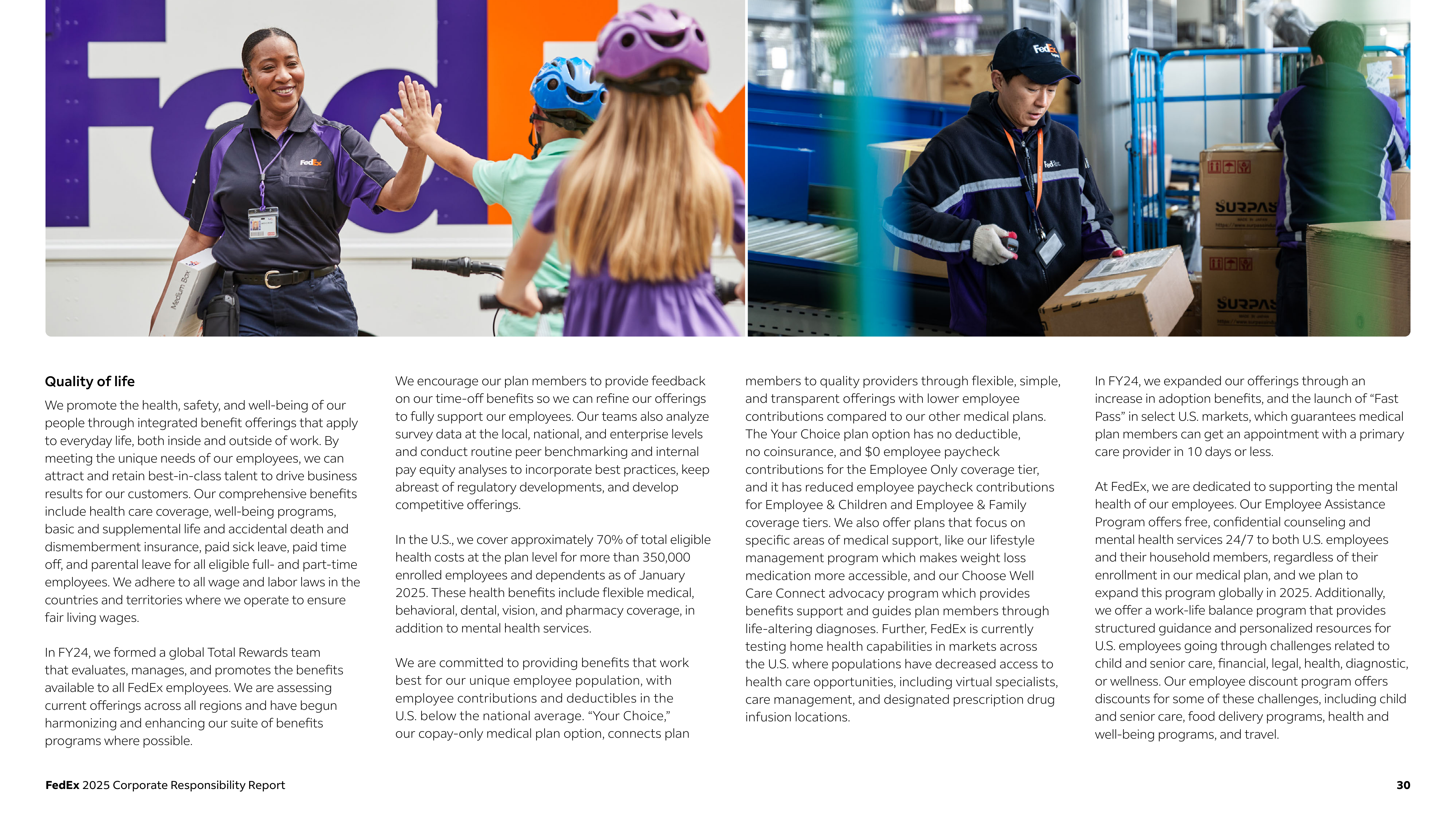

Quality of life
We promote the health, safety, and well-being of our
people through integrated benefit offerings that apply
to everyday life, both inside and outside of work. By
meeting the unique needs of our employees, we can
attract and retain best-in-class talent to drive business
results for our customers. Our comprehensive benefits
include health care coverage, well-being programs,
basic and supplemental life and accidental death and
dismemberment insurance, paid sick leave, paid time
off, and parental leave for all eligible full- and part-time
employees. We adhere to all wage and labor laws in the
countries and territories where we operate to ensure
fair living wages.
In FY24, we formed a global Total Rewards team
that evaluates, manages, and promotes the benefits
available to all FedEx employees. We are assessing
current offerings across all regions and have begun
harmonizing and enhancing our suite of benefits
programs where possible.
We encourage our plan members to provide feedback
on our time-off benefits so we can refine our offerings
to fully support our employees. Our teams also analyze
survey data at the local, national, and enterprise levels
and conduct routine peer benchmarking and internal
pay equity analyses to incorporate best practices, keep
abreast of regulatory developments, and develop
competitive offerings.
In the U.S., we cover approximately 70% of total eligible
health costs at the plan level for more than 350,000
enrolled employees and dependents as of January
2025. These health benefits include flexible medical,
behavioral, dental, vision, and pharmacy coverage, in
addition to mental health services.
We are committed to providing benefits that work
best for our unique employee population, with
employee contributions and deductibles in the
U.S. below the national average. “Your Choice,”
our copay-only medical plan option, connects plan
members to quality providers through flexible, simple,
and transparent offerings with lower employee
contributions compared to our other medical plans.
The Your Choice plan option has no deductible,
no coinsurance, and $0 employee paycheck
contributions for the Employee Only coverage tier,
and it has reduced employee paycheck contributions
for Employee & Children and Employee & Family
coverage tiers. We also offer plans that focus on
specific areas of medical support, like our lifestyle
management program which makes weight loss
medication more accessible, and our Choose Well
Care Connect advocacy program which provides
benefits support and guides plan members through
life-altering diagnoses. Further, FedEx is currently
testing home health capabilities in markets across
the U.S. where populations have decreased access to
health care opportunities, including virtual specialists,
care management, and designated prescription drug
infusion locations.
In FY24, we expanded our offerings through an
increase in adoption benefits, and the launch of “Fast
Pass” in select U.S. markets, which guarantees medical
plan members can get an appointment with a primary
care provider in 10 days or less.
At FedEx, we are dedicated to supporting the mental
health of our employees. Our Employee Assistance
Program offers free, confidential counseling and
mental health services 24/7 to both U.S. employees
and their household members, regardless of their
enrollment in our medical plan, and we plan to
expand this program globally in 2025. Additionally,
we offer a work-life balance program that provides
structured guidance and personalized resources for
U.S. employees going through challenges related to
child and senior care, financial, legal, health, diagnostic,
or wellness. Our employee discount program offers
discounts for some of these challenges, including child
and senior care, food delivery programs, health and
well-being programs, and travel.
FedEx
2025 Corporate Responsibility Report
30
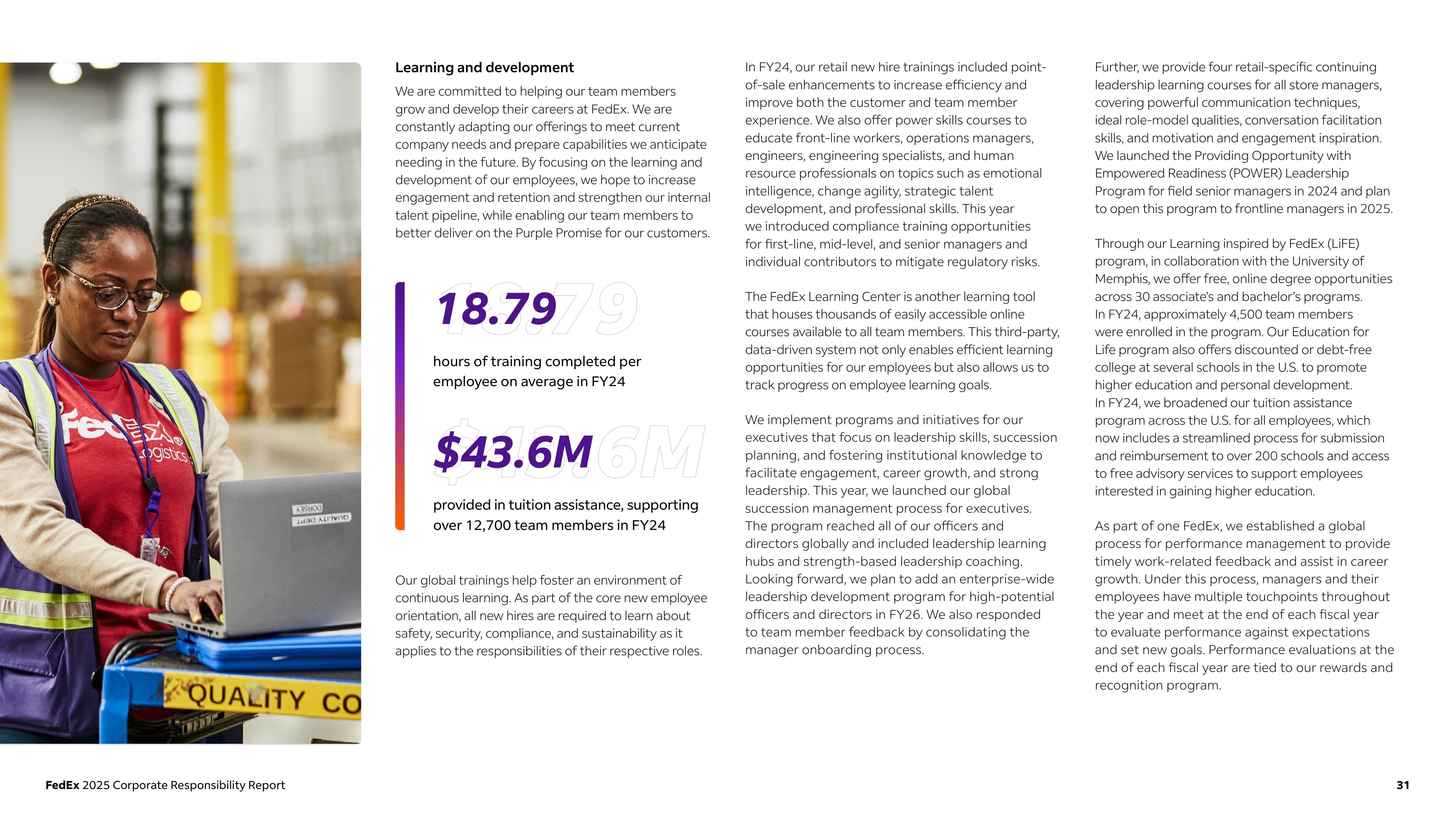
18.79
hours of training completed per
employee on average in FY24
18.79
$43.6M
provided in tuition assistance, supporting
over 12,700 team members in FY24
$43.6M
Our global trainings help foster an environment of
continuous learning. As part of the core new employee
orientation, all new hires are required to learn about
safety, security, compliance, and sustainability as it
applies to the responsibilities of their respective roles.
Further, we provide four retail-specific continuing
leadership learning courses for all store managers,
covering powerful communication techniques,
ideal role-model qualities, conversation facilitation
skills, and motivation and engagement inspiration.
We launched the Providing Opportunity with
Empowered Readiness (POWER) Leadership
Program for field senior managers in 2024 and plan
to open this program to frontline managers in 2025.
Through our Learning inspired by FedEx (LiFE)
program, in collaboration with the University of
Memphis, we offer free, online degree opportunities
across 30 associate’s and bachelor’s programs.
In FY24, approximately 4,500 team members
were enrolled in the program. Our Education for
Life program also offers discounted or debt-free
college at several schools in the U.S. to promote
higher education and personal development.
In FY24, we broadened our tuition assistance
program across the U.S. for all employees, which
now includes a streamlined process for submission
and reimbursement to over 200 schools and access
to free advisory services to support employees
interested in gaining higher education.
As part of one FedEx, we established a global
process for performance management to provide
timely work-related feedback and assist in career
growth. Under this process, managers and their
employees have multiple touchpoints throughout
the year and meet at the end of each fiscal year
to evaluate performance against expectations
and set new goals. Performance evaluations at the
end of each fiscal year are tied to our rewards and
recognition program.
Learning and development
We are committed to helping our team members
grow and develop their careers at FedEx. We are
constantly adapting our offerings to meet current
company needs and prepare capabilities we anticipate
needing in the future. By focusing on the learning and
development of our employees, we hope to increase
engagement and retention and strengthen our internal
talent pipeline, while enabling our team members to
better deliver on the Purple Promise for our customers.
In FY24, our retail new hire trainings included point-
of-sale enhancements to increase efficiency and
improve both the customer and team member
experience. We also offer power skills courses to
educate front-line workers, operations managers,
engineers, engineering specialists, and human
resource professionals on topics such as emotional
intelligence, change agility, strategic talent
development, and professional skills. This year
we introduced compliance training opportunities
for first-line, mid-level, and senior managers and
individual contributors to mitigate regulatory risks.
The FedEx Learning Center is another learning tool
that houses thousands of easily accessible online
courses available to all team members. This third-party,
data-driven system not only enables efficient learning
opportunities for our employees but also allows us to
track progress on employee learning goals.
We implement programs and initiatives for our
executives that focus on leadership skills, succession
planning, and fostering institutional knowledge to
facilitate engagement, career growth, and strong
leadership. This year, we launched our global
succession management process for executives.
The program reached all of our officers and
directors globally and included leadership learning
hubs and strength-based leadership coaching.
Looking forward, we plan to add an enterprise-wide
leadership development program for high-potential
officers and directors in FY26. We also responded
to team member feedback by consolidating the
manager onboarding process.
FedEx
2025 Corporate Responsibility Report
31
18.79
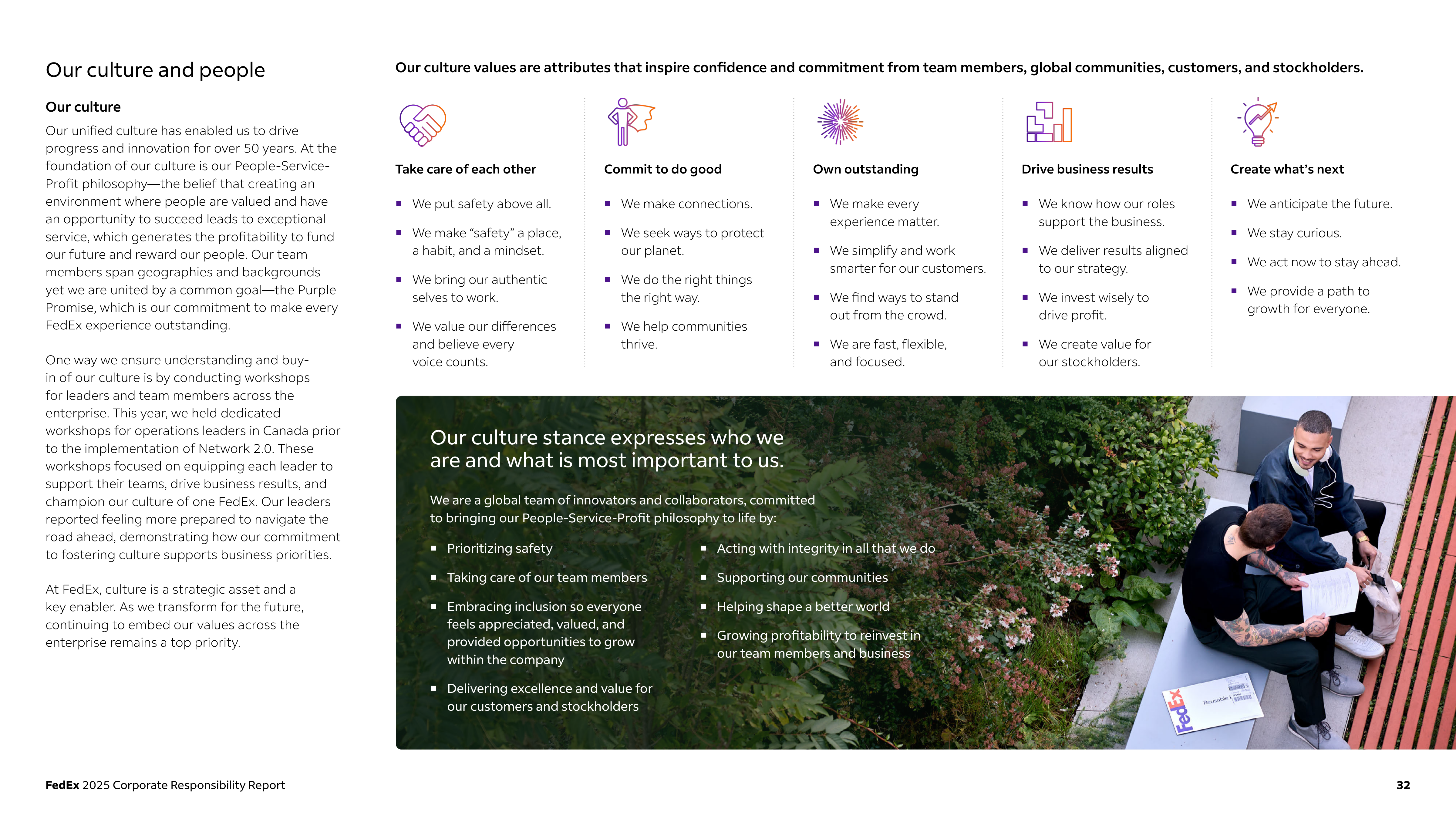






Our culture and people
Our culture
Our unified culture has enabled us to drive
progress and innovation for over 50 years. At the
foundation of our culture is our People-Service-
Profit philosophy—the belief that creating an
environment where people are valued and have
an opportunity to succeed leads to exceptional
service, which generates the profitability to fund
our future and reward our people. Our team
members span geographies and backgrounds
yet we are united by a common goal—the Purple
Promise, which is our commitment to make every
FedEx experience outstanding.
One way we ensure understanding and buy-
in of our culture is by conducting workshops
for leaders and team members across the
enterprise. This year, we held dedicated
workshops for operations leaders in Canada prior
to the implementation of Network 2.0. These
workshops focused on equipping each leader to
support their teams, drive business results, and
champion our culture of one FedEx. Our leaders
reported feeling more prepared to navigate the
road ahead, demonstrating how our commitment
to fostering culture supports business priorities.
At FedEx, culture is a strategic asset and a
key enabler. As we transform for the future,
continuing to embed our values across the
enterprise remains a top priority.
Our culture values are attributes that inspire confidence and commitment from team members, global communities, customers, and stockholders.
Our culture stance expresses who we
are and what is most important to us.
We are a global team of innovators and collaborators, committed
to bringing our People-Service-Profit philosophy to life by:
Prioritizing safety
Taking care of our team members
Embracing inclusion so everyone
feels appreciated, valued, and
provided opportunities to grow
within the company
Delivering excellence and value for
our customers and stockholders
Acting with integrity in all that we do
Supporting our communities
Helping shape a better world
Growing profitability to reinvest in
our team members and business
Take care of each other
We put safety above all.
We make “safety” a place,
a habit, and a mindset.
We bring our authentic
selves to work.
We value our differences
and believe every
voice counts.
Commit to do good
We make connections.
We seek ways to protect
our planet.
We do the right things
the right way.
We help communities
thrive.
Drive business results
We know how our roles
support the business.
We deliver results aligned
to our strategy.
We invest wisely to
drive profit.
We create value for
our stockholders.
Own outstanding
We make every
experience matter.
We simplify and work
smarter for our customers.
We find ways to stand
out from the crowd.
We are fast, flexible,
and focused.
Create what’s next
We anticipate the future.
We stay curious.
We act now to stay ahead.
We provide a path to
growth for everyone.
FedEx
2025 Corporate Responsibility Report
32
STRATEGIC PILLARS
Equality, Opportunity, and Diversity are the bedrock of our culture
FedEx is—and has been since its founding in 1971—committed to equality, opportunity, and diversity. This is about
much more than our policies and practices. This is about our long-standing culture and steadfast belief that when we
give everyone the opportunity to grow and advance in their careers, our team members thrive and FedEx prospers.
Equality, opportunity, and diversity are interwoven across our four strategic pillars which are: Our People; Our
Education and Engagement; Our Communities, Customers, and Suppliers; and Our Story.
Our people
We value our differences and believe every voice
counts. With more than 500,000 team members in
over 220 countries and territories, these differences
are a source of strength and creativity. Each
international region has councils that leverage these
unique perspectives and embed culture, equality,
opportunity, and diversity across business operations.
In FY24, the APAC and MEISA regions partnered with
the Stanford Neurodiversity Project, which develops
the skills of neurodiverse individuals to empower
success in their daily lives. In LAC, we released the
“MY VOICE” podcast to facilitate fresh conversations
with frontline employees and individual contributors
to increase awareness and education about inclusion
and opportunities.
See the Human resource management section for
more details on our hiring practices and the Data
appendix and our EEO-1 Reports for additional
information.
Our education and engagement
At FedEx, we take care of each other by providing
continuing education opportunities to progress all
team members’ careers and enhancing our culture in
which everyone is treated with dignity, courtesy, and
respect across the enterprise. Our learning platform
provides simplified content for all career levels.
We also cultivate a learning environment for
leadership by providing resources such as equality,
opportunity, and diversity practice toolkits and
forums where leaders share insights and best
practices to build trust.
The Purple Pathways Program is an internal career
track program to provide opportunities for the
development and growth of our team members.
Supported by over 4,800 Purple Pathways mentors
and champions, more than 62,000 team members
have enrolled as participants in the program since
its inception.
FedEx offers a variety of Employee Resource Groups
(ERGs), which are open to all FedEx employees, and
provide a unique blend of social, educational, and
professional opportunities that support personal
and professional growth and business objectives.
We also include culture equality, opportunity and
diversity-related questions within our engagement
surveys to better understand all perspectives in our
workforce and integrate employee feedback into
our initiatives.
See the Learning and development section for
more information regarding employee training and
initiatives to support continued employee education.
STRATEGIC PILLARS
Opportunities
for our education
and engagement
Enrich, expand, and
enhance our culture
through education
Opportunities
for our people
Recruit, retain, develop,
and provide advancement
opportunities for team
members
Opportunities
to tell our story
Amplify the stories
of our people and
celebrate differences
Opportunities
for our community
Serve and support our
communities, customers,
and suppliers
FedEx
2025 Corporate Responsibility Report
33
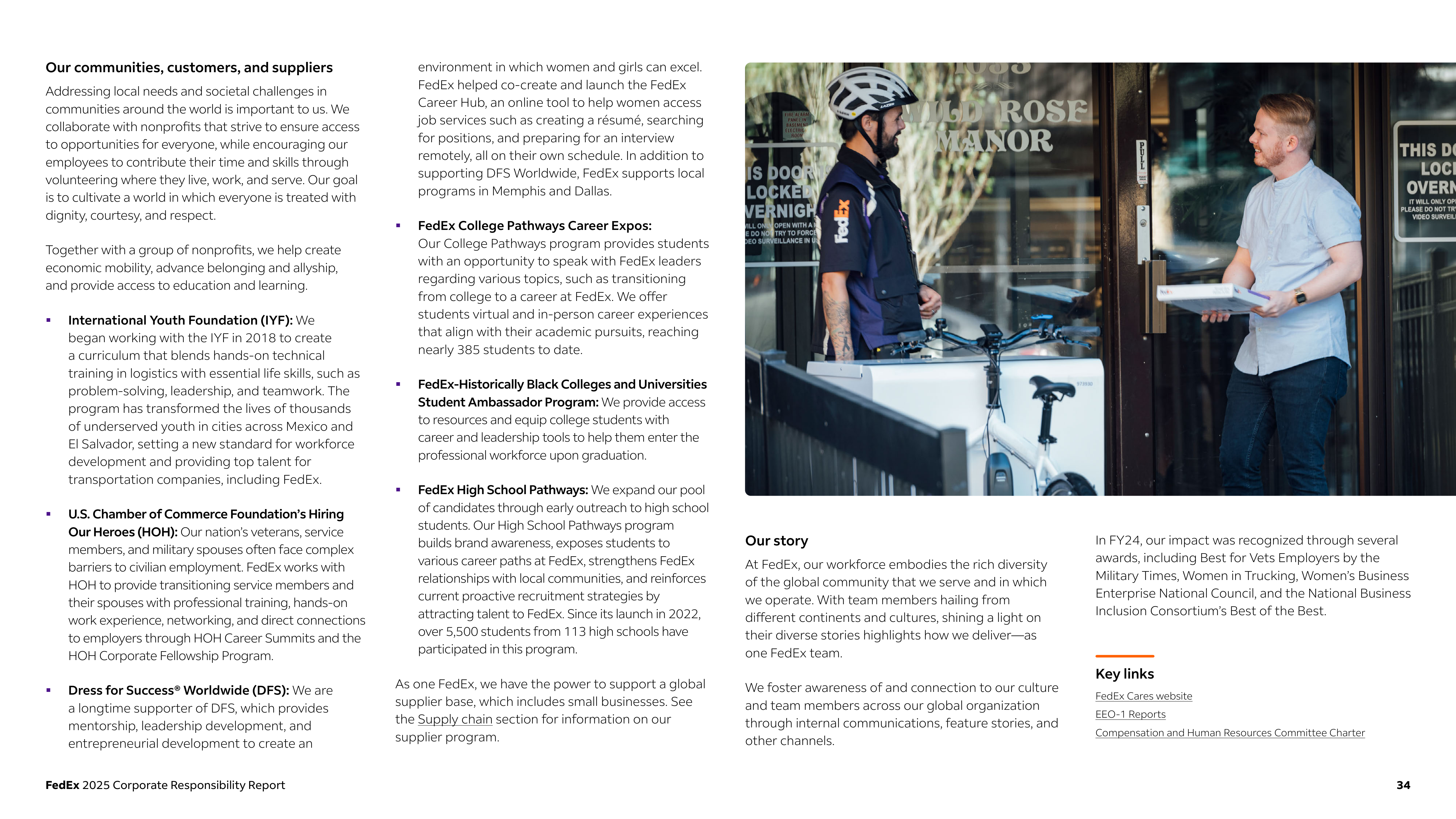
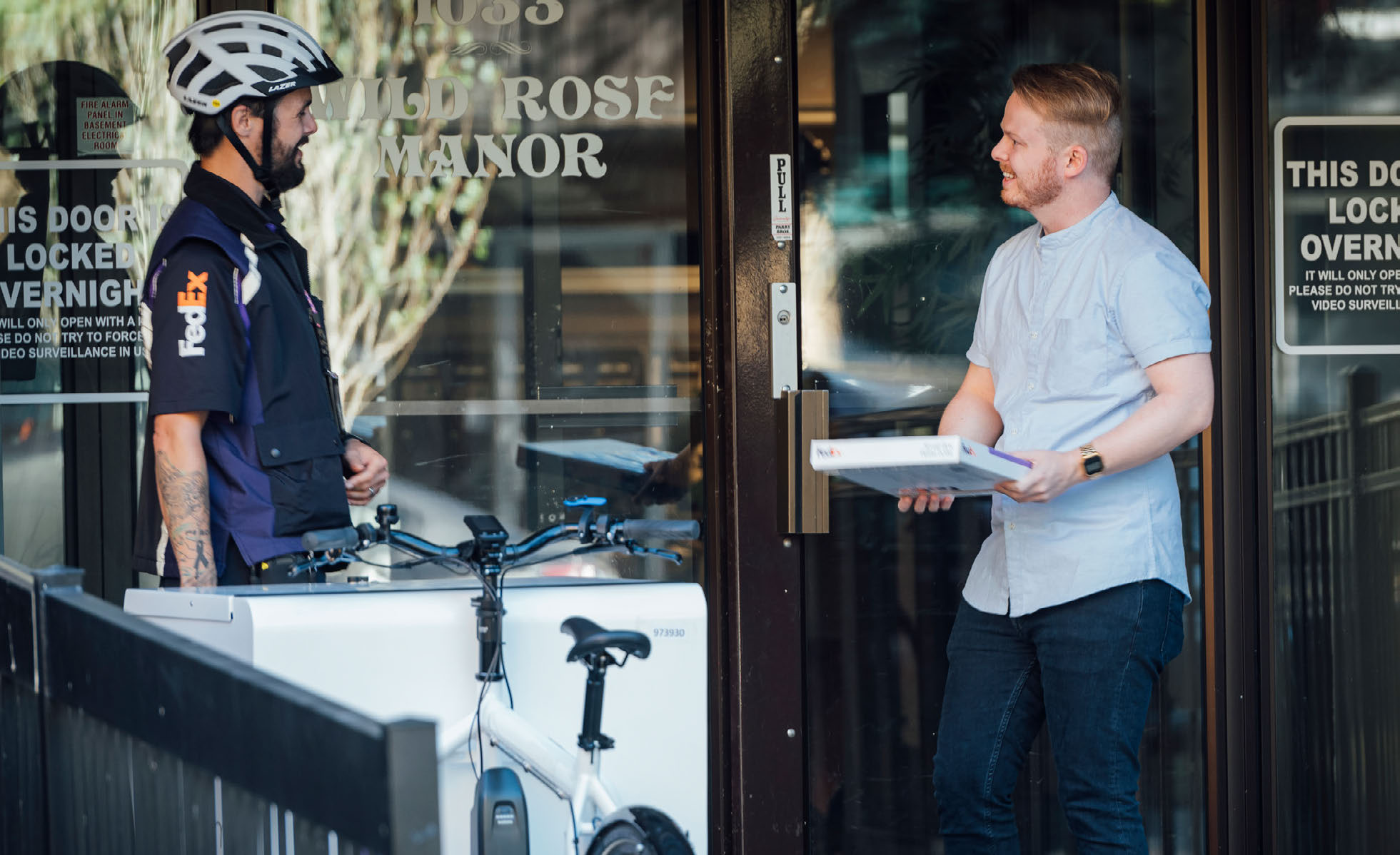
Our communities, customers, and suppliers
Addressing local needs and societal challenges in
communities around the world is important to us. We
collaborate with nonprofits that strive to ensure access
to opportunities for everyone, while encouraging our
employees to contribute their time and skills through
volunteering where they live, work, and serve. Our goal
is to cultivate a world in which everyone is treated with
dignity, courtesy, and respect.
Together with a group of nonprofits, we help create
economic mobility, advance belonging and allyship,
and provide access to education and learning.
International Youth Foundation (IYF):
We
began working with the IYF in 2018 to create
a curriculum that blends hands-on technical
training in logistics with essential life skills, such as
problem-solving, leadership, and teamwork. The
program has transformed the lives of thousands
of underserved youth in cities across Mexico and
El Salvador, setting a new standard for workforce
development and providing top talent for
transportation companies, including FedEx.
U.S. Chamber of Commerce Foundation’s Hiring
Our Heroes (HOH):
Our nation’s veterans, service
members, and military spouses often face complex
barriers to civilian employment. FedEx works with
HOH to provide transitioning service members and
their spouses with professional training, hands-on
work experience, networking, and direct connections
to employers through HOH Career Summits and the
HOH Corporate Fellowship Program.
Dress for Success® Worldwide (DFS):
We are
a longtime supporter of DFS, which provides
mentorship, leadership development, and
entrepreneurial development to create an
environment in which women and girls can excel.
FedEx helped co-create and launch the FedEx
Career Hub, an online tool to help women access
job services such as creating a résumé, searching
for positions, and preparing for an interview
remotely, all on their own schedule. In addition to
supporting DFS Worldwide, FedEx supports local
programs in Memphis and Dallas.
FedEx College Pathways Career Expos:
Our College Pathways program provides students
with an opportunity to speak with FedEx leaders
regarding various topics, such as transitioning
from college to a career at FedEx. We offer
students virtual and in-person career experiences
that align with their academic pursuits, reaching
nearly 385 students to date.
FedEx-Historically Black Colleges and Universities
Student Ambassador Program:
We provide access
to resources and equip college students with
career and leadership tools to help them enter the
professional workforce upon graduation.
FedEx High School Pathways:
We expand our pool
of candidates through early outreach to high school
students. Our High School Pathways program
builds brand awareness, exposes students to
various career paths at FedEx, strengthens FedEx
relationships with local communities, and reinforces
current proactive recruitment strategies by
attracting talent to FedEx. Since its launch in 2022,
over 5,500 students from 113 high schools have
participated in this program.
As one FedEx, we have the power to support a global
supplier base, which includes small businesses. See
the Supply chain section for information on our
supplier program.
Our story
At FedEx, our workforce embodies the rich diversity
of the global community that we serve and in which
we operate. With team members hailing from
different continents and cultures, shining a light on
their diverse stories highlights how we deliver—as
one FedEx team.
We foster awareness of and connection to our culture
and team members across our global organization
through internal communications, feature stories, and
other channels.
In FY24, our impact was recognized through several
awards, including Best for Vets Employers by the
Military Times, Women in Trucking, Women’s Business
Enterprise National Council, and the National Business
Inclusion Consortium’s Best of the Best.
Key links
FedEx Cares website
EEO-1 Reports
Compensation and Human Resources Committee Charter
FedEx
2025 Corporate Responsibility Report
34
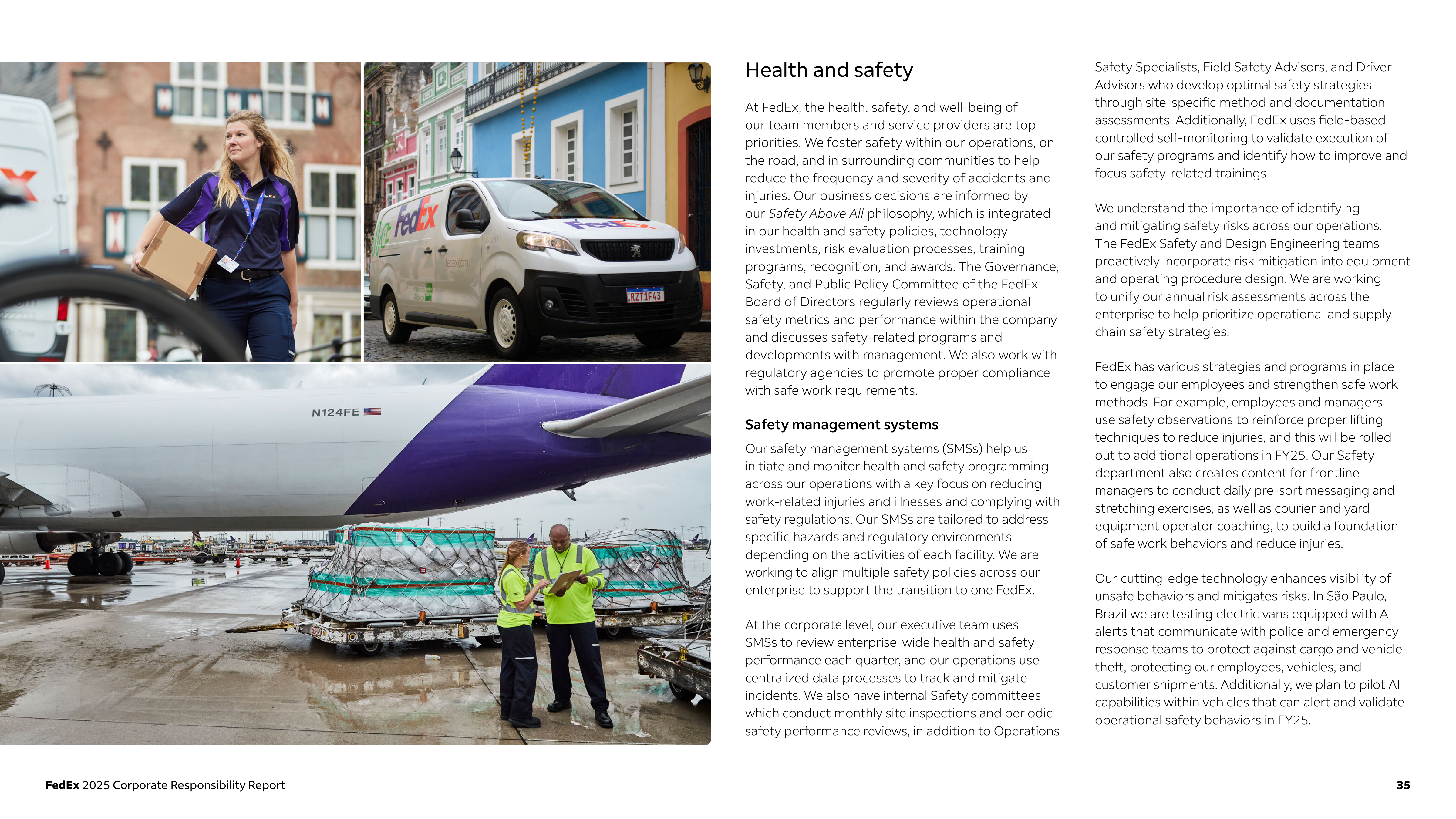
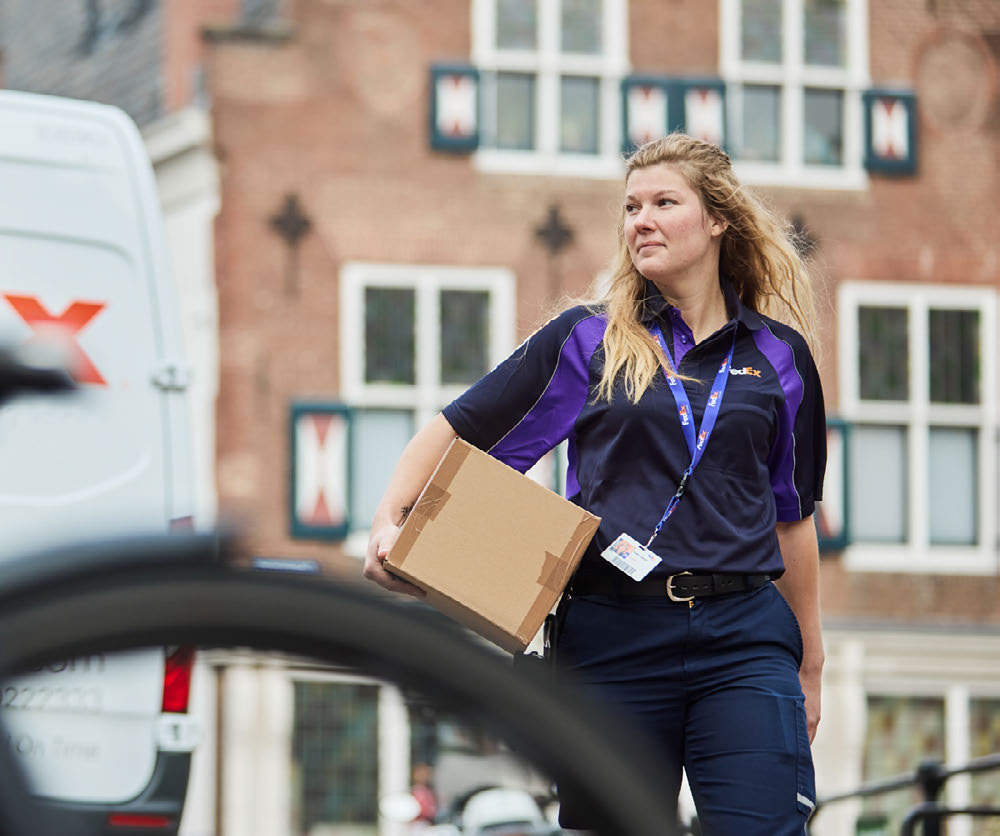
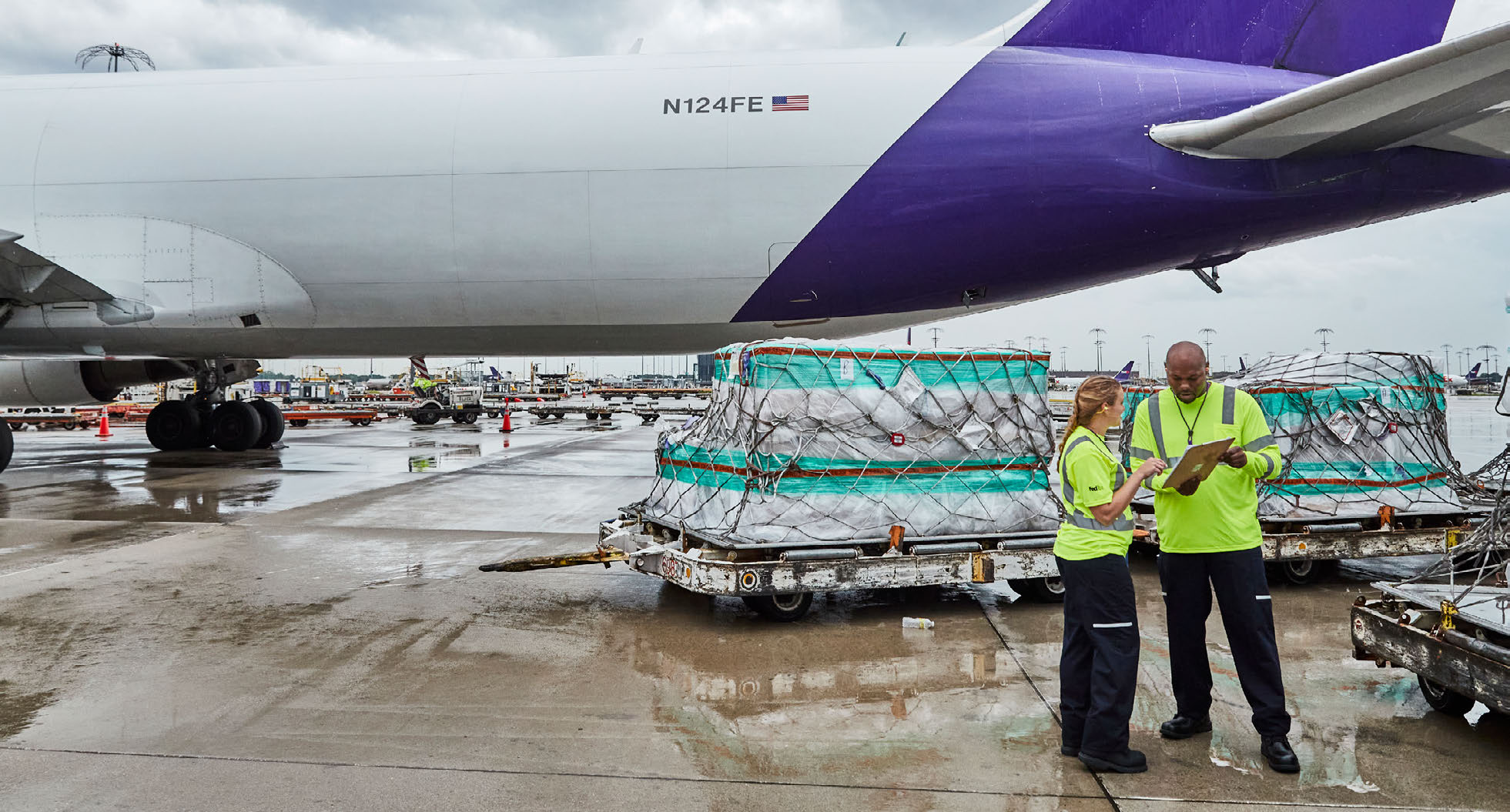
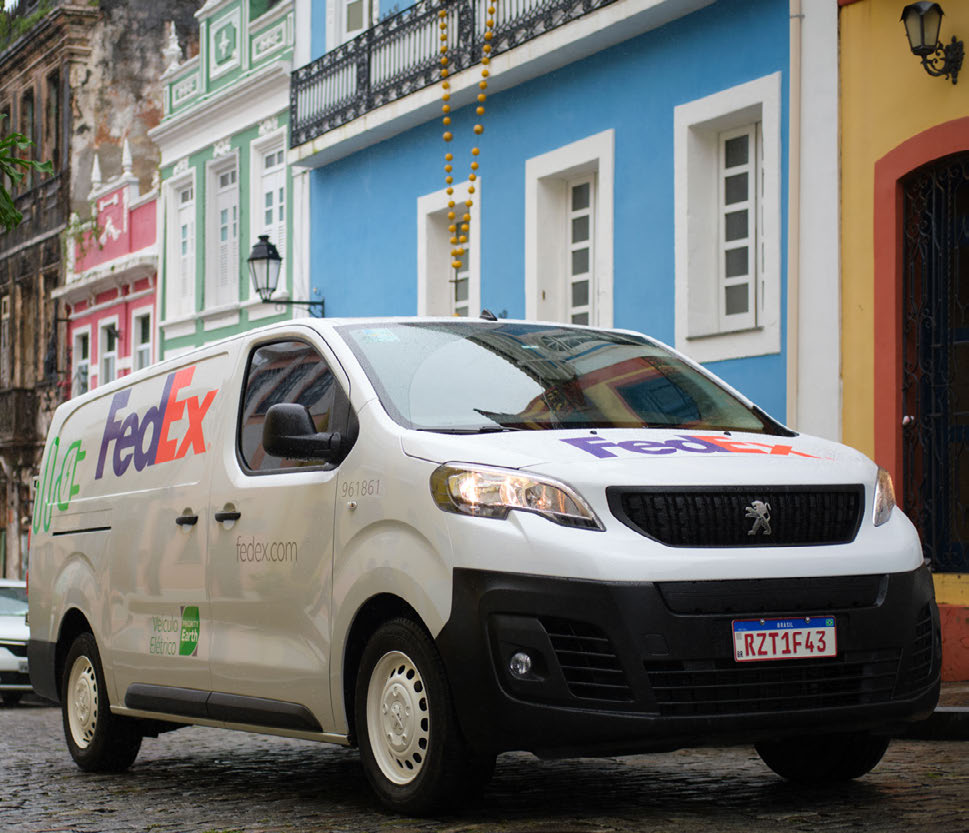
Health and safety
At FedEx, the health, safety, and well-being of
our team members and service providers are top
priorities. We foster safety within our operations, on
the road, and in surrounding communities to help
reduce the frequency and severity of accidents and
injuries. Our business decisions are informed by
our
Safety Above All
philosophy, which is integrated
in our health and safety policies, technology
investments, risk evaluation processes, training
programs, recognition, and awards. The Governance,
Safety, and Public Policy Committee of the FedEx
Board of Directors regularly reviews operational
safety metrics and performance within the company
and discusses safety-related programs and
developments with management. We also work with
regulatory agencies to promote proper compliance
with safe work requirements.
Safety management systems
Our safety management systems (SMSs) help us
initiate and monitor health and safety programming
across our operations with a key focus on reducing
work-related injuries and illnesses and complying with
safety regulations. Our SMSs are tailored to address
specific hazards and regulatory environments
depending on the activities of each facility. We are
working to align multiple safety policies across our
enterprise to support the transition to one FedEx.
At the corporate level, our executive team uses
SMSs to review enterprise-wide health and safety
performance each quarter, and our operations use
centralized data processes to track and mitigate
incidents. We also have internal Safety committees
which conduct monthly site inspections and periodic
safety performance reviews, in addition to Operations
Safety Specialists, Field Safety Advisors, and Driver
Advisors who develop optimal safety strategies
through site-specific method and documentation
assessments. Additionally, FedEx uses field-based
controlled self-monitoring to validate execution of
our safety programs and identify how to improve and
focus safety-related trainings.
We understand the importance of identifying
and mitigating safety risks across our operations.
The FedEx Safety and Design Engineering teams
proactively incorporate risk mitigation into equipment
and operating procedure design. We are working
to unify our annual risk assessments across the
enterprise to help prioritize operational and supply
chain safety strategies.
FedEx has various strategies and programs in place
to engage our employees and strengthen safe work
methods. For example, employees and managers
use safety observations to reinforce proper lifting
techniques to reduce injuries, and this will be rolled
out to additional operations in FY25. Our Safety
department also creates content for frontline
managers to conduct daily pre-sort messaging and
stretching exercises, as well as courier and yard
equipment operator coaching, to build a foundation
of safe work behaviors and reduce injuries.
Our cutting-edge technology enhances visibility of
unsafe behaviors and mitigates risks. In São Paulo,
Brazil we are testing electric vans equipped with AI
alerts that communicate with police and emergency
response teams to protect against cargo and vehicle
theft, protecting our employees, vehicles, and
customer shipments. Additionally, we plan to pilot AI
capabilities within vehicles that can alert and validate
operational safety behaviors in FY25.
FedEx
2025 Corporate Responsibility Report
35
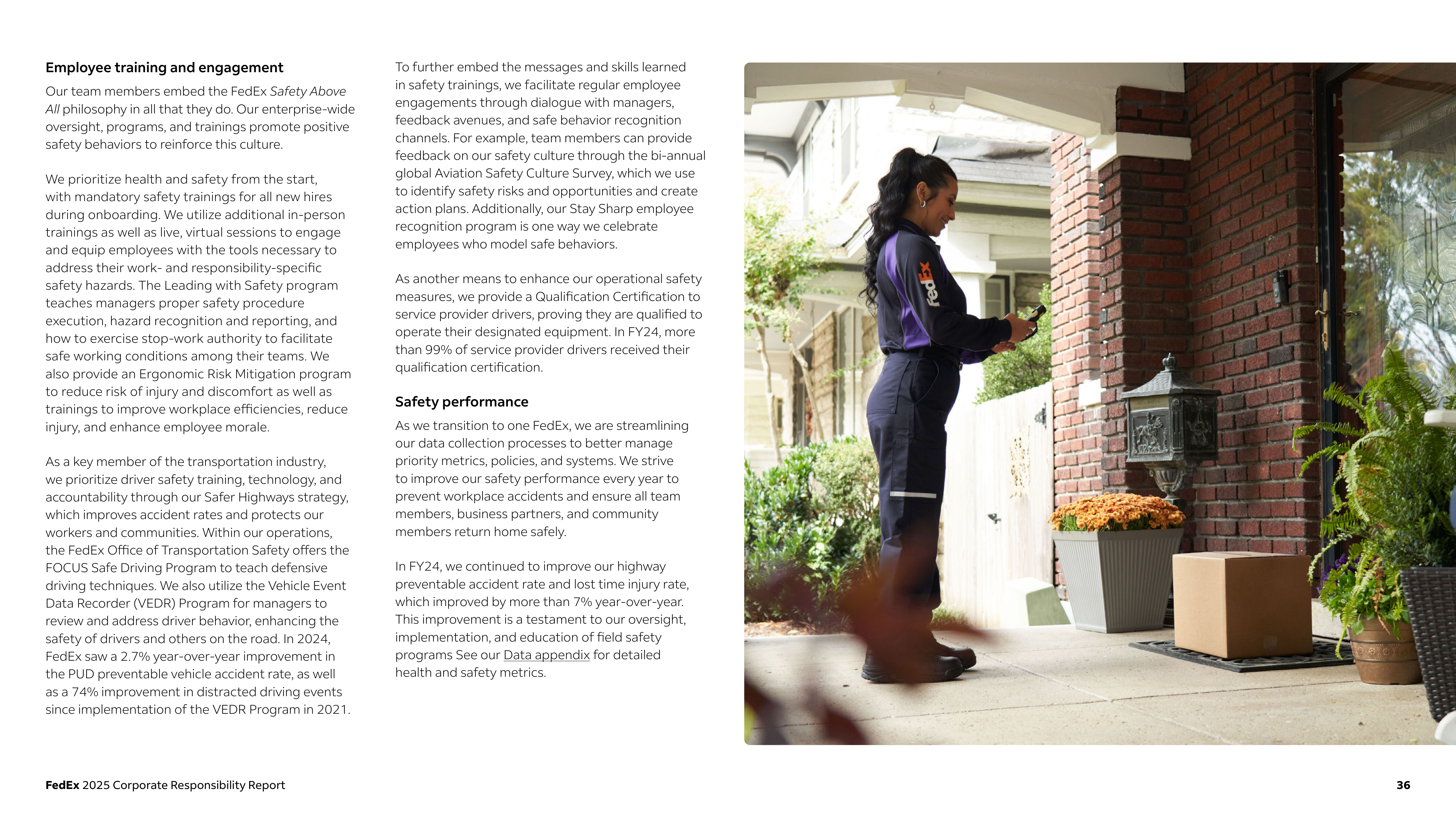
Employee training and engagement
Our team members embed the FedEx
Safety Above
All
philosophy in all that they do. Our enterprise-wide
oversight, programs, and trainings promote positive
safety behaviors to reinforce this culture.
We prioritize health and safety from the start,
with mandatory safety trainings for all new hires
during onboarding. We utilize additional in-person
trainings as well as live, virtual sessions to engage
and equip employees with the tools necessary to
address their work- and responsibility-specific
safety hazards. The Leading with Safety program
teaches managers proper safety procedure
execution, hazard recognition and reporting, and
how to exercise stop-work authority to facilitate
safe working conditions among their teams. We
also provide an Ergonomic Risk Mitigation program
to reduce risk of injury and discomfort as well as
trainings to improve workplace efficiencies, reduce
injury, and enhance employee morale.
As a key member of the transportation industry,
we prioritize driver safety training, technology, and
accountability through our Safer Highways strategy,
which improves accident rates and protects our
workers and communities. Within our operations,
the FedEx Office of Transportation Safety offers the
FOCUS Safe Driving Program to teach defensive
driving techniques. We also utilize the Vehicle Event
Data Recorder (VEDR) Program for managers to
review and address driver behavior, enhancing the
safety of drivers and others on the road. In 2024,
FedEx saw a 2.7% year-over-year improvement in
the PUD preventable vehicle accident rate, as well
as a 74% improvement in distracted driving events
since implementation of the VEDR Program in 2021.
To further embed the messages and skills learned
in safety trainings, we facilitate regular employee
engagements through dialogue with managers,
feedback avenues, and safe behavior recognition
channels. For example, team members can provide
feedback on our safety culture through the bi-annual
global Aviation Safety Culture Survey, which we use
to identify safety risks and opportunities and create
action plans. Additionally, our Stay Sharp employee
recognition program is one way we celebrate
employees who model safe behaviors.
As another means to enhance our operational safety
measures, we provide a Qualification Certification to
service provider drivers, proving they are qualified to
operate their designated equipment. In FY24, more
than 99% of service provider drivers received their
qualification certification.
Safety performance
As we transition to one FedEx, we are streamlining
our data collection processes to better manage
priority metrics, policies, and systems. We strive
to improve our safety performance every year to
prevent workplace accidents and ensure all team
members, business partners, and community
members return home safely.
In FY24, we continued to improve our highway
preventable accident rate and lost time injury rate,
which improved by more than 7% year-over-year.
This improvement is a testament to our oversight,
implementation, and education of field safety
programs See our Data appendix for detailed
health and safety metrics.
FedEx
2025 Corporate Responsibility Report
36
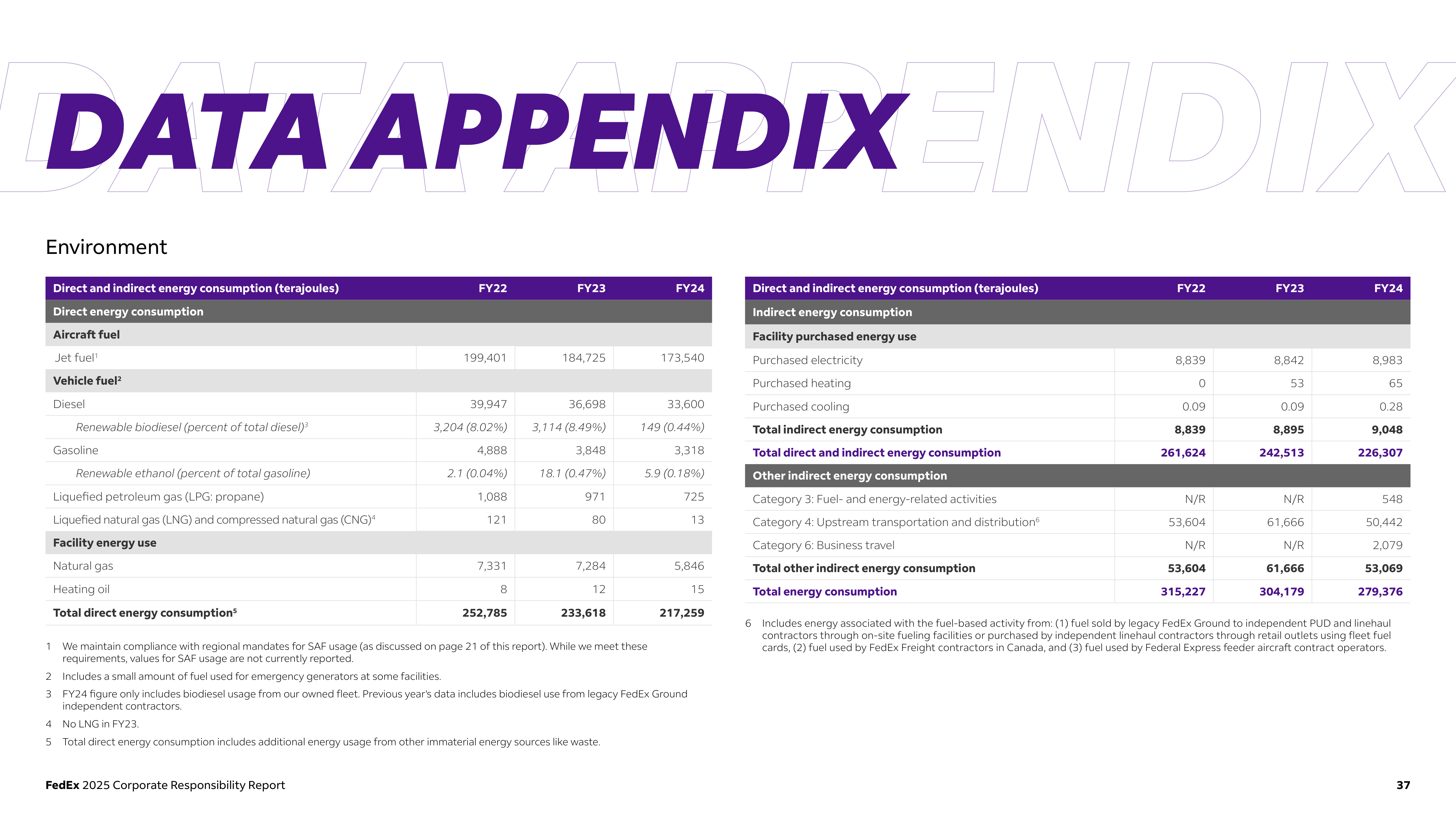
DATA APPENDIX
DATA APPENDIX
Environment
Direct and indirect energy consumption (terajoules)
FY22
FY23
FY24
Direct energy consumption
Aircraft fuel
Jet fuel
1
199,401
184,725
173,540
Vehicle fuel
2
Diesel
39,947
36,698
33,600
Renewable biodiesel (percent of total diesel)
3
3,204 (8.02%)
3,114 (8.49%)
149 (0.44%)
Gasoline
4,888
3,848
3,318
Renewable ethanol (percent of total gasoline)
2.1 (0.04%)
18.1 (0.47%)
5.9 (0.18%)
Liquefied petroleum gas (LPG: propane)
1,088
971
725
Liquefied natural gas (LNG) and compressed natural gas (CNG)
4
121
80
13
Facility energy use
Natural gas
7,331
7,284
5,846
Heating oil
8
12
15
Total direct energy consumption
5
252,785
233,618
217,259
1
We maintain compliance with regional mandates for SAF usage (as discussed on page 21 of this report). While we meet these
requirements, values for SAF usage are not currently reported.
2
Includes a small amount of fuel used for emergency generators at some facilities.
3
FY24 figure only includes biodiesel usage from our owned fleet. Previous year's data includes biodiesel use from legacy FedEx Ground
independent contractors.
4
No LNG in FY23.
5
Total direct energy consumption includes additional energy usage from other immaterial energy sources like waste.
Direct and indirect energy consumption (terajoules)
FY22
FY23
FY24
Indirect energy consumption
Facility purchased energy use
Purchased electricity
8,839
8,842
8,983
Purchased heating
0
53
65
Purchased cooling
0.09
0.09
0.28
Total indirect energy consumption
8,839
8,895
9,048
Total direct and indirect energy consumption
261,624
242,513
226,307
Other indirect energy consumption
Category 3: Fuel- and energy-related activities
N/R
N/R
548
Category 4: Upstream transportation and distribution
6
53,604
61,666
50,442
Category 6: Business travel
N/R
N/R
2,079
Total other indirect energy consumption
53,604
61,666
53,069
Total energy consumption
315,227
304,179
279,376
6
Includes energy associated with the fuel-based activity from: (1) fuel sold by legacy FedEx Ground to independent PUD and linehaul
contractors through on-site fueling facilities or purchased by independent linehaul contractors through retail outlets using fleet fuel
cards, (2) fuel used by FedEx Freight contractors in Canada, and (3) fuel used by Federal Express feeder aircraft contract operators.
FedEx
2025 Corporate Responsibility Report
37
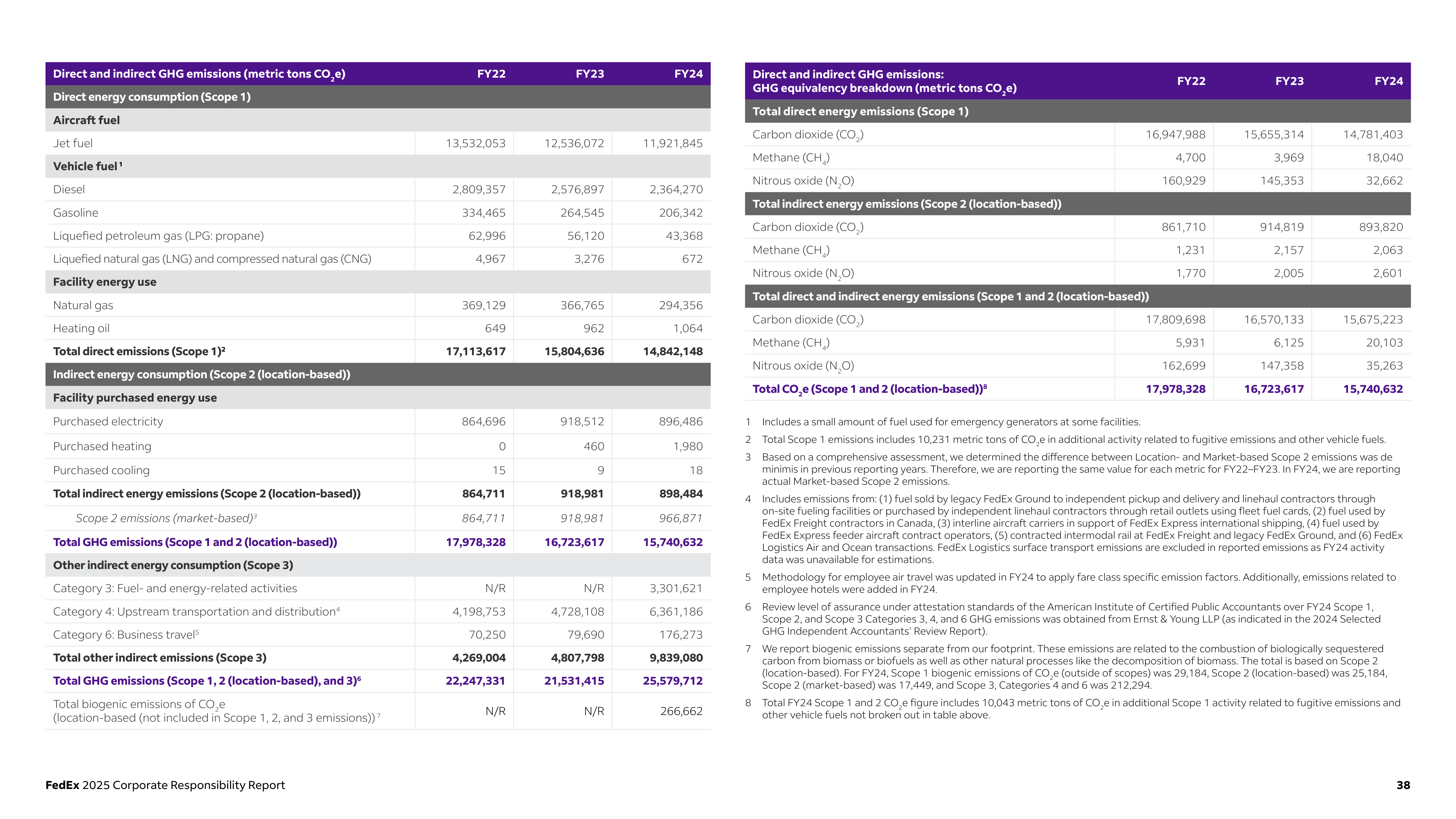
Direct and indirect GHG emissions
Direct and indirect GHG emissions (metric tons CO
2
e)
FY22
FY23
FY24
Direct energy consumption (Scope 1)
Aircraft fuel
Jet fuel
13,532,053
12,536,072
11,921,845
Vehicle fuel
1
Diesel
2,809,357
2,576,897
2,364,270
Gasoline
334,465
264,545
206,342
Liquefied petroleum gas (LPG: propane)
62,996
56,120
43,368
Liquefied natural gas (LNG) and compressed natural gas (CNG)
4,967
3,276
672
Facility energy use
Natural gas
369,129
366,765
294,356
Heating oil
649
962
1,064
Total direct emissions (Scope 1)
2
17,113,617
15,804,636
14,842,148
Indirect energy consumption (Scope 2 (location-based))
Facility purchased energy use
Purchased electricity
864,696
918,512
896,486
Purchased heating
0
460
1,980
Purchased cooling
15
9
18
Total indirect energy emissions (Scope 2 (location-based))
864,711
918,981
898,484
Scope 2 emissions (market-based)
3
864,711
918,981
966,871
Total GHG emissions (Scope 1 and 2 (location-based))
17,978,328
16,723,617
15,740,632
Other indirect energy consumption (Scope 3)
Category 3: Fuel- and energy-related activities
N/R
N/R
3,301,621
Category 4: Upstream transportation and distribution
4
4,198,753
4,728,108
6,361,186
Category 6: Business travel
5
70,250
79,690
176,273
Total other indirect emissions (Scope 3)
4,269,004
4,807,798
9,839,080
Total GHG emissions (Scope 1, 2 (location-based), and 3)
6
22,247,331
21,531,415
25,579,712
Total biogenic emissions of CO
2
e
(location-based (not included in Scope 1, 2, and 3 emissions))
7
N/R
N/R
266,662
Direct and indirect GHG emissions:
GHG equivalency breakdown (metric tons CO
2
e)
FY22
FY23
FY24
Total direct energy emissions (Scope 1)
Carbon dioxide (CO
2
)
16,947,988
15,655,314
14,781,403
Methane (CH
4
)
4,700
3,969
18,040
Nitrous oxide (N
2
O)
160,929
145,353
32,662
Total indirect energy emissions (Scope 2 (location-based))
Carbon dioxide (CO
2
)
861,710
914,819
893,820
Methane (CH
4
)
1,231
2,157
2,063
Nitrous oxide (N
2
O)
1,770
2,005
2,601
Total direct and indirect energy emissions (Scope 1 and 2 (location-based))
Carbon dioxide (CO
2
)
17,809,698
16,570,133
15,675,223
Methane (CH
4
)
5,931
6,125
20,103
Nitrous oxide (N
2
O)
162,699
147,358
35,263
Total CO
2
e (Scope 1 and 2 (location-based))
8
17,978,328
16,723,617
15,740,632
1
Includes a small amount of fuel used for emergency generators at some facilities.
2
Total Scope 1 emissions includes 10,231 metric tons of CO
2
e in additional activity related to fugitive emissions and other vehicle fuels.
3
Based on a comprehensive assessment, we determined the difference between Location- and Market-based Scope 2 emissions was de
minimis in previous reporting years. Therefore, we are reporting the same value for each metric for FY22–FY23. In FY24, we are reporting
actual Market-based Scope 2 emissions.
4
Includes emissions from: (1) fuel sold by legacy FedEx Ground to independent pickup and delivery and linehaul contractors through
on-site fueling facilities or purchased by independent linehaul contractors through retail outlets using fleet fuel cards, (2) fuel used by
FedEx Freight contractors in Canada, (3) interline aircraft carriers in support of FedEx Express international shipping, (4) fuel used by
FedEx Express feeder aircraft contract operators, (5) contracted intermodal rail at FedEx Freight and legacy FedEx Ground, and (6) FedEx
Logistics Air and Ocean transactions. FedEx Logistics surface transport emissions are excluded in reported emissions as FY24 activity
data was unavailable for estimations.
5
Methodology for employee air travel was updated in FY24 to apply fare class specific emission factors. Additionally, emissions related to
employee hotels were added in FY24.
6
Review level of assurance under attestation standards of the American Institute of Certified Public Accountants over FY24 Scope 1,
Scope 2, and Scope 3 Categories 3, 4, and 6 GHG emissions was obtained from Ernst & Young LLP (as indicated in the 2024 Selected
GHG Independent Accountants’ Review Report).
7
We report biogenic emissions separate from our footprint. These emissions are related to the combustion of biologically sequestered
carbon from biomass or biofuels as well as other natural processes like the decomposition of biomass. The total is based on Scope 2
(location-based). For FY24, Scope 1 biogenic emissions of CO
2
e (outside of scopes) was 29,184, Scope 2 (location-based) was 25,184,
Scope 2 (market-based) was 17,449, and Scope 3, Categories 4 and 6 was 212,294.
8
Total FY24 Scope 1 and 2 CO
2
e figure includes 10,043 metric tons of CO
2
e in additional Scope 1 activity related to fugitive emissions and
other vehicle fuels not broken out in table above.
FedEx
2025 Corporate Responsibility Report
38
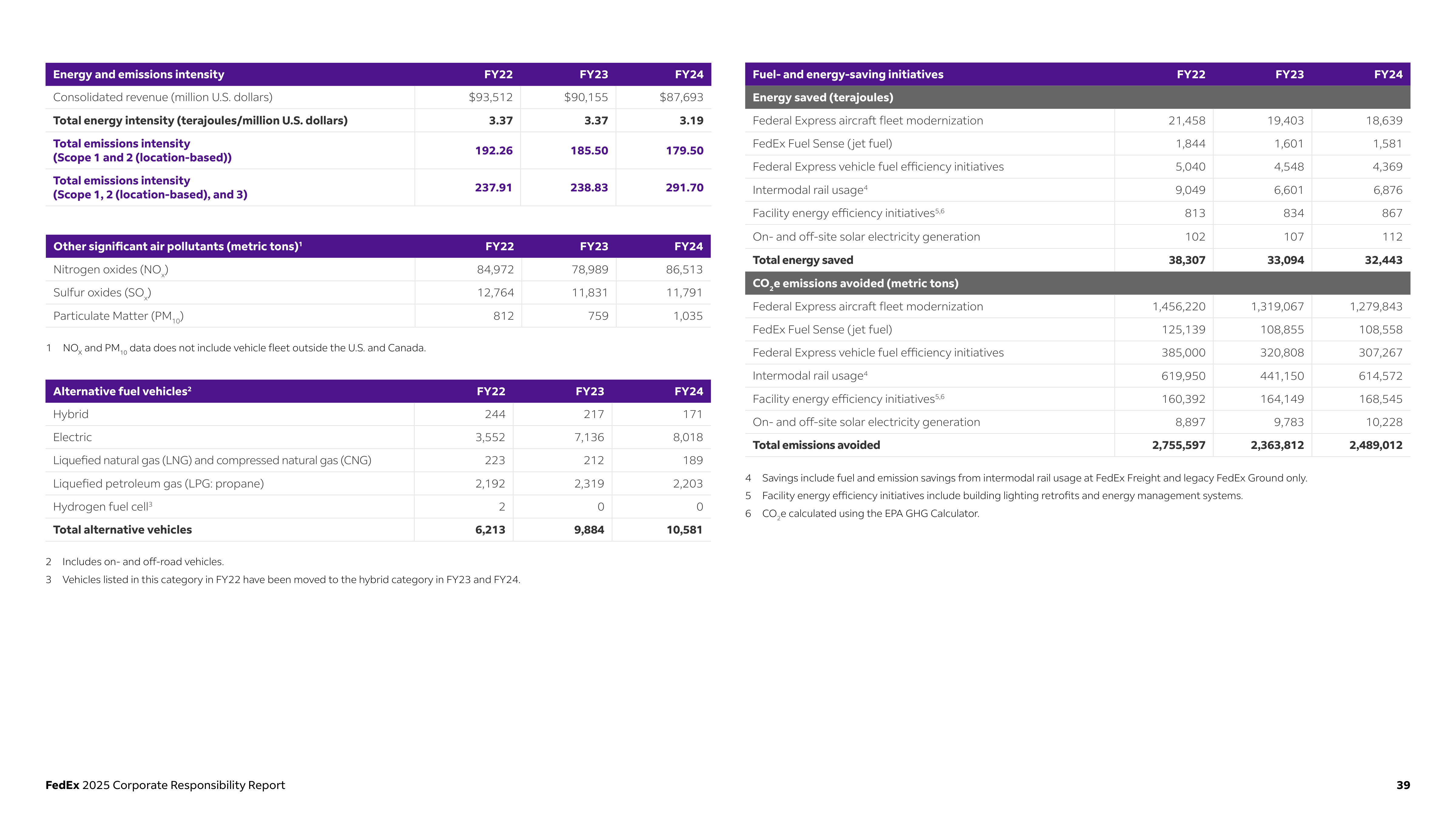
Energy and emissions intensity
FY22
FY23
FY24
Consolidated revenue (million U.S. dollars)
$93,512
$90,155
$87,693
Total energy intensity (terajoules/million U.S. dollars)
3.37
3.37
3.19
Total emissions intensity
(Scope 1 and 2 (location-based))
192.26
185.50
179.50
Total emissions intensity
(Scope 1, 2 (location-based), and 3)
237.91
238.83
291.70
Other significant air pollutants (metric tons)
1
FY22
FY23
FY24
Nitrogen oxides (NO
x
)
84,972
78,989
86,513
Sulfur oxides (SO
x
)
12,764
11,831
11,791
Particulate Matter (PM
10
)
812
759
1,035
1
NO
X
and PM
10
data does not include vehicle fleet outside the U.S. and Canada.
Fuel- and energy-saving initiatives
FY22
FY23
FY24
Energy saved (terajoules)
Federal Express aircraft fleet modernization
21,458
19,403
18,639
FedEx Fuel Sense (jet fuel)
1,844
1,601
1,581
Federal Express vehicle fuel efficiency initiatives
5,040
4,548
4,369
Intermodal rail usage
4
9,049
6,601
6,876
Facility energy efficiency initiatives
5,6
813
834
867
On- and off-site solar electricity generation
102
107
112
Total energy saved
38,307
33,094
32,443
CO
2
e emissions avoided (metric tons)
Federal Express aircraft fleet modernization
1,456,220
1,319,067
1,279,843
FedEx Fuel Sense (jet fuel)
125,139
108,855
108,558
Federal Express vehicle fuel efficiency initiatives
385,000
320,808
307,267
Intermodal rail usage
4
619,950
441,150
614,572
Facility energy efficiency initiatives
5,6
160,392
164,149
168,545
On- and off-site solar electricity generation
8,897
9,783
10,228
Total emissions avoided
2,755,597
2,363,812
2,489,012
4
Savings include fuel and emission savings from intermodal rail usage at FedEx Freight and legacy FedEx Ground only.
5
Facility energy efficiency initiatives include building lighting retrofits and energy management systems.
6
CO
2
e calculated using the EPA GHG Calculator.
Alternative fuel vehicles
2
FY22
FY23
FY24
Hybrid
244
217
171
Electric
3,552
7,136
8,018
Liquefied natural gas (LNG) and compressed natural gas (CNG)
223
212
189
Liquefied petroleum gas (LPG: propane)
2,192
2,319
2,203
Hydrogen fuel cell
3
2
0
0
Total alternative vehicles
6,213
9,884
10,581
2
Includes on- and off-road vehicles.
3
Vehicles listed in this category in FY22 have been moved to the hybrid category in FY23 and FY24.
FedEx
2025 Corporate Responsibility Report
39
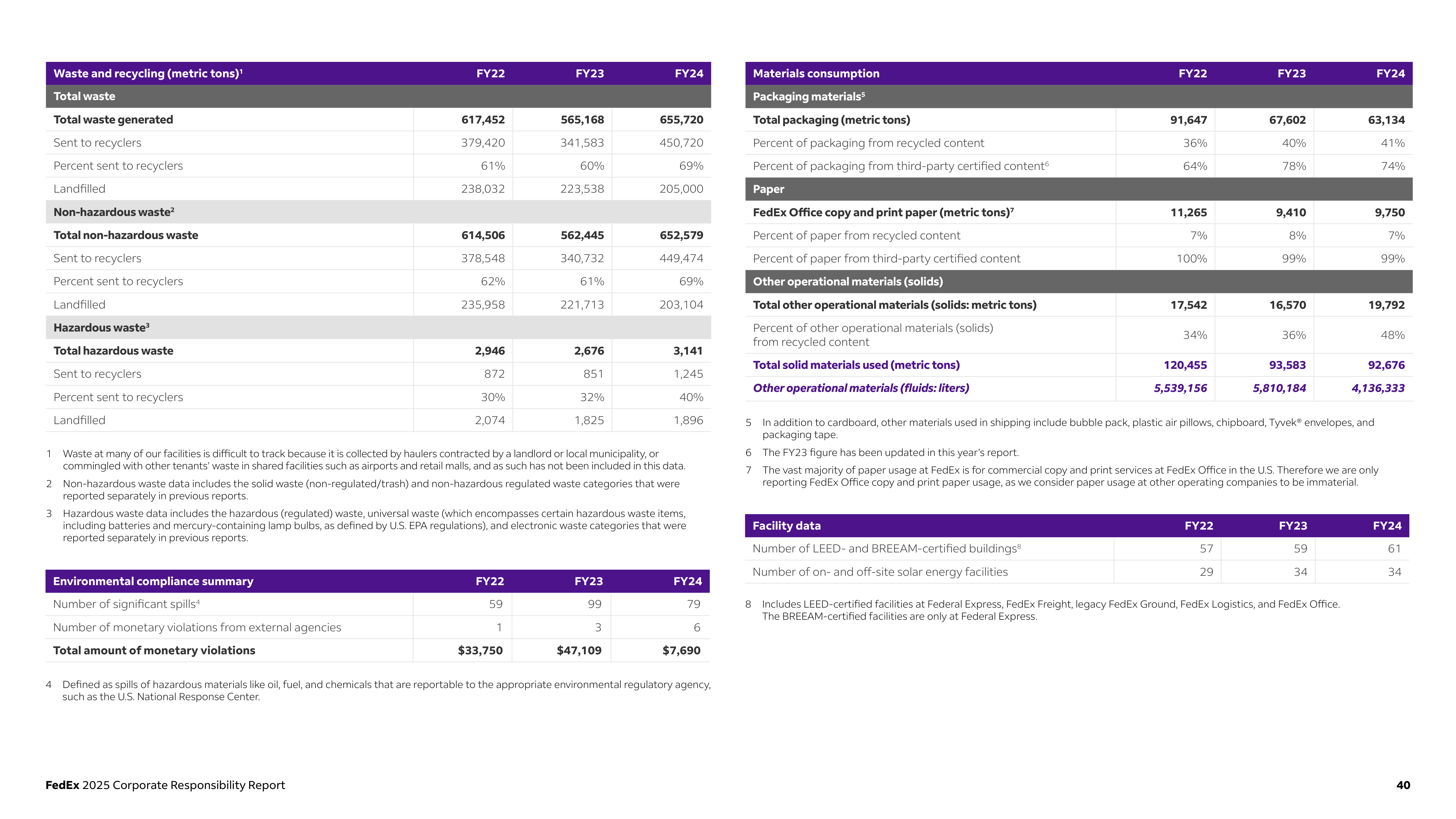
Materials consumption
FY22
FY23
FY24
Packaging materials
5
Total packaging (metric tons)
91,647
67,602
63,134
Percent of packaging from recycled content
36%
40%
41%
Percent of packaging from third-party certified content
6
64%
78%
74%
Paper
FedEx Office copy and print paper (metric tons)
7
11,265
9,410
9,750
Percent of paper from recycled content
7%
8%
7%
Percent of paper from third-party certified content
100%
99%
99%
Other operational materials (solids)
Total other operational materials (solids: metric tons)
17,542
16,570
19,792
Percent of other operational materials (solids)
from recycled content
34%
36%
48%
Total solid materials used (metric tons)
120,455
93,583
92,676
Other operational materials (fluids: liters)
5,539,156
5,810,184
4,136,333
5
In addition to cardboard, other materials used in shipping include bubble pack, plastic air pillows, chipboard, Tyvek® envelopes, and
packaging tape.
6
The FY23 figure has been updated in this year’s report.
7
The vast majority of paper usage at FedEx is for commercial copy and print services at FedEx Office in the U.S. Therefore we are only
reporting FedEx Office copy and print paper usage, as we consider paper usage at other operating companies to be immaterial.
Environmental compliance summary
FY22
FY23
FY24
Number of significant spills
4
59
99
79
Number of monetary violations from external agencies
1
3
6
Total amount of monetary violations
$33,750
$47,109
$7,690
4
Defined as spills of hazardous materials like oil, fuel, and chemicals that are reportable to the appropriate environmental regulatory agency,
such as the U.S. National Response Center.
Facility data
FY22
FY23
FY24
Number of LEED- and BREEAM-certified buildings
8
57
59
61
Number of on- and off-site solar energy facilities
29
34
34
8
Includes LEED-certified facilities at Federal Express, FedEx Freight, legacy FedEx Ground, FedEx Logistics, and FedEx Office.
The BREEAM-certified facilities are only at Federal Express.
Waste and recycling (metric tons)
1
FY22
FY23
FY24
Total waste
Total waste generated
617,452
565,168
655,720
Sent to recyclers
379,420
341,583
450,720
Percent sent to recyclers
61%
60%
69%
Landfilled
238,032
223,538
205,000
Non-hazardous waste
2
Total non-hazardous waste
614,506
562,445
652,579
Sent to recyclers
378,548
340,732
449,474
Percent sent to recyclers
62%
61%
69%
Landfilled
235,958
221,713
203,104
Hazardous waste
3
Total hazardous waste
2,946
2,676
3,141
Sent to recyclers
872
851
1,245
Percent sent to recyclers
30%
32%
40%
Landfilled
2,074
1,825
1,896
1
Waste at many of our facilities is difficult to track because it is collected by haulers contracted by a landlord or local municipality, or
commingled with other tenants’ waste in shared facilities such as airports and retail malls, and as such has not been included in this data.
2
Non-hazardous waste data includes the solid waste (non-regulated/trash) and non-hazardous regulated waste categories that were
reported separately in previous reports.
3
Hazardous waste data includes the hazardous (regulated) waste, universal waste (which encompasses certain hazardous waste items,
including batteries and mercury-containing lamp bulbs, as defined by U.S. EPA regulations), and electronic waste categories that were
reported separately in previous reports.
FedEx
2025 Corporate Responsibility Report
40
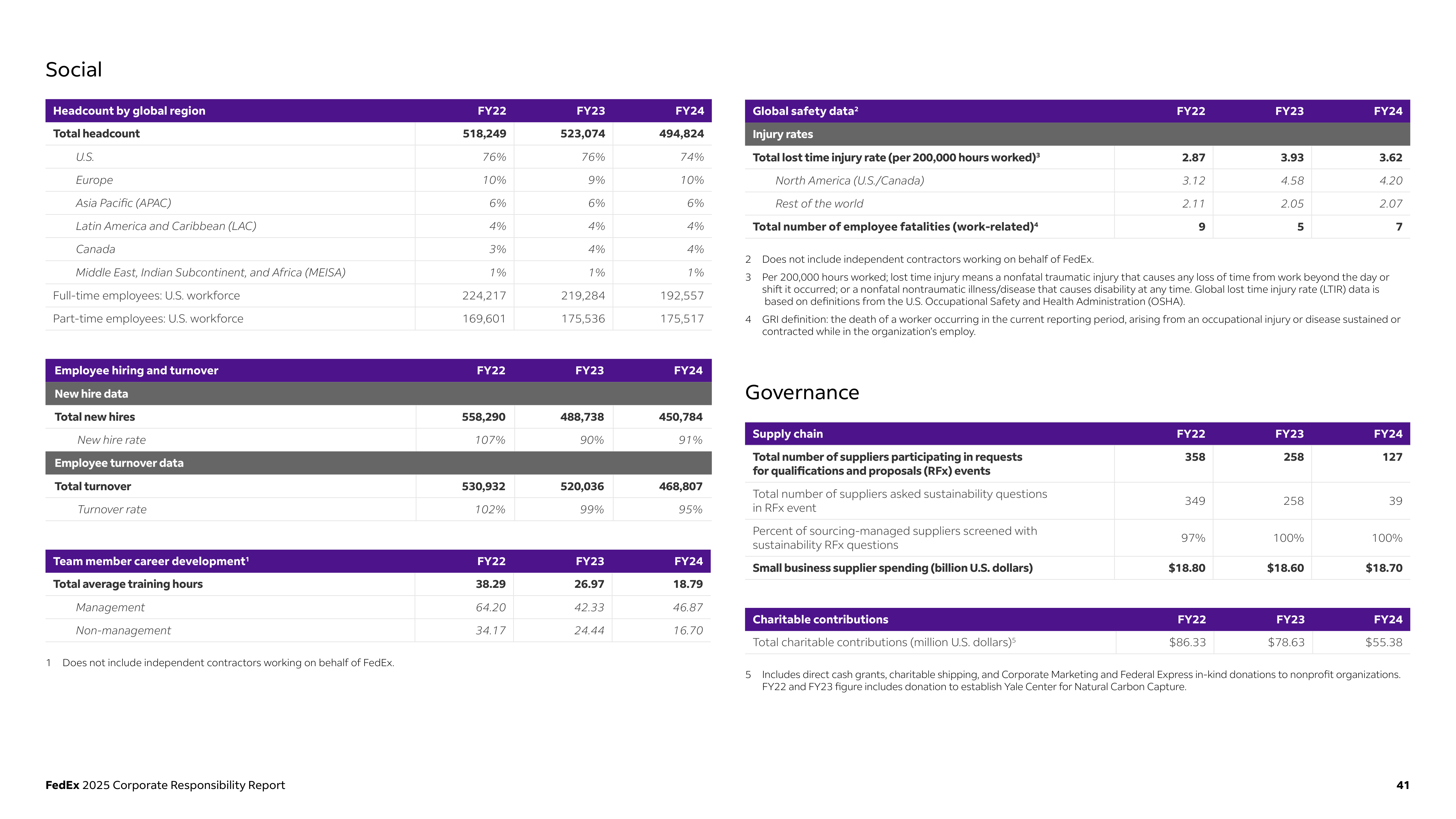
Headcount by global region
FY22
FY23
FY24
Total headcount
518,249
523,074
494,824
U.S.
76%
76%
74%
Europe
10%
9%
10%
Asia Pacific (APAC)
6%
6%
6%
Latin America and Caribbean (LAC)
4%
4%
4%
Canada
3%
4%
4%
Middle East, Indian Subcontinent, and Africa (MEISA)
1%
1%
1%
Full-time employees: U.S. workforce
224,217
219,284
192,557
Part-time employees: U.S. workforce
169,601
175,536
175,517
Social
Team member career development
1
FY22
FY23
FY24
Total average training hours
38.29
26.97
18.79
Management
64.20
42.33
46.87
Non-management
34.17
24.44
16.70
1
Does not include independent contractors working on behalf of FedEx.
Governance
Employee hiring and turnover
FY22
FY23
FY24
New hire data
Total new hires
558,290
488,738
450,784
New hire rate
107%
90%
91%
Employee turnover data
Total turnover
530,932
520,036
468,807
Turnover rate
102%
99%
95%
Global safety data
2
FY22
FY23
FY24
Injury rates
Total lost time injury rate (per 200,000 hours worked)
3
2.87
3.93
3.62
North America (U.S./Canada)
3.12
4.58
4.20
Rest of the world
2.11
2.05
2.07
Total number of employee fatalities (work-related)
4
9
5
7
2
Does not include independent contractors working on behalf of FedEx.
3
Per 200,000 hours worked; lost time injury means a nonfatal traumatic injury that causes any loss of time from work beyond the day or
shift it occurred; or a nonfatal nontraumatic illness/disease that causes disability at any time. Global lost time injury rate (LTIR) data is
based on definitions from the U.S. Occupational Safety and Health Administration (OSHA).
4
GRI definition: the death of a worker occurring in the current reporting period, arising from an occupational injury or disease sustained or
contracted while in the organization’s employ.
Supply chain
FY22
FY23
FY24
Total number of suppliers participating in requests
for qualifications and proposals (RFx) events
358
258
127
Total number of suppliers asked sustainability questions
in RFx event
349
258
39
Percent of sourcing-managed suppliers screened with
sustainability RFx questions
97%
100%
100%
Small business supplier spending (billion U.S. dollars)
$18.80
$18.60
$18.70
Charitable contributions
FY22
FY23
FY24
Total charitable contributions (million U.S. dollars)
5
$86.33
$78.63
$55.38
5
Includes direct cash grants, charitable shipping, and Corporate Marketing and Federal Express in-kind donations to nonprofit organizations.
FY22 and FY23 figure includes donation to establish Yale Center for Natural Carbon Capture.
FedEx
2025 Corporate Responsibility Report
41

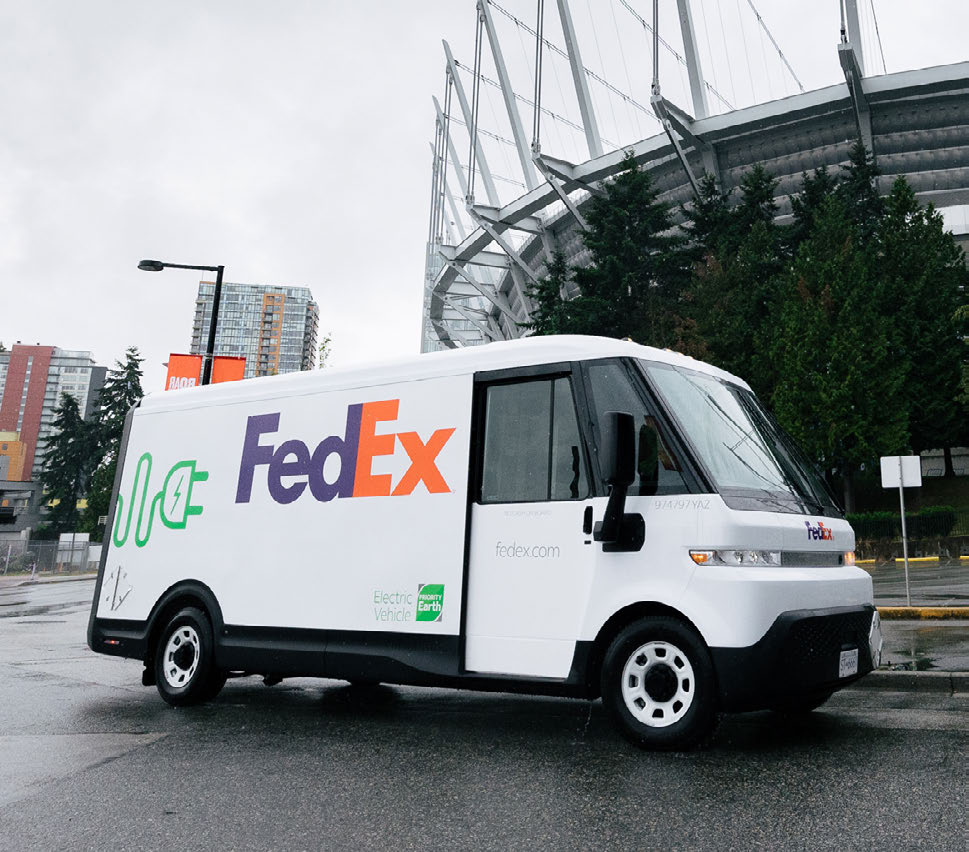
CAUTIONARY NOTE
Certain statements in this report may be considered forward-looking statements within the meaning of the Private
Securities Litigation Reform Act of 1995, such as statements relating to expected cost savings, the optimization
of our network through Network 2.0, the planned spin-off of the FedEx Freight business into a new independent
publicly traded company, future financial and operational targets, business strategies, management’s views with
respect to future events and financial performance, and underlying assumptions. Forward-looking statements include
those preceded by, followed by, or that include the words “will,” “may,” “could,” “would,” “should,” “believes,” “expects,”
“forecasts,” “anticipates,” “plans,” “estimates,” “targets,” “projects,” “intends,” or similar expressions. Such forward-
looking statements are subject to risks, uncertainties, and other factors which could cause actual results to differ
materially from historical experience or from future results expressed or implied by such forward-looking statements.
Potential risks and uncertainties include, but are not limited to, our ability to successfully implement our business
strategy (including with respect to sustainability, human resource management, and safety), effectively respond to
changes in market dynamics and achieve the anticipated benefits and associated cost savings of such strategies
and actions; our ability to meet certain goals relating to aircraft emissions, vehicle fuel efficiency, alternative fuels
and renewable energy, and aircraft and vehicle fleet modernization within the currently projected costs and the
expected timeframes, including our goal of carbon-neutral operations by 2040; the availability and cost of and our
ability to acquire and/or leverage alternative fuel vehicles, alternative fuels, fuel-efficient aircraft, global electrical
charging infrastructure and requisite power grid capacity, off-site renewable energy, and other materials and
components, which may be adversely affected by ongoing international conflicts or terrorist activities and disruptions
in global supply chains; changes in U.S. or international trade policy; unforeseen production, design, operational, and
technological difficulties; the outcome of research efforts and future technology developments, including the ability
to scale projects and technologies on a commercially competitive basis such as carbon sequestration and/or other
related processes and projects utilizing artificial intelligence and machine learning; compliance with, and changes or
additions to, global and regional regulations, taxes, charges, mandates, or requirements relating to GHG emissions,
carbon costs, or climate-related goals; labor-related regulations and requirements that restrict or prohibit our ability
to impose requirements on third parties who provide contracted transportation for our transportation networks;
adapting products to customer preferences and customer acceptance of sustainable supply chain solutions; the
actions of competitors and competitive pressures; the development and perception of markets for carbon offset
credits; and other factors which can be found in FedEx Corp.’s and our subsidiaries’ press releases and FedEx Corp.’s
filings with the Securities and Exchange Commission (SEC). Any forward-looking statement speaks only as of the
date on which it is made. We do not undertake or assume any obligation to update or revise any forward-looking
statement, whether as a result of new information, future events, or otherwise.
Note on materiality: Materiality, as used in this report, and our ESG priority assessment process, is different from the
definition used in the context of filings with the SEC. Issues deemed material for purposes of this report may not be
considered material for SEC reporting purposes.
Cost savings related to aircraft modernization and efficiency efforts are calculated by multiplying the total gallons
saved by the average price of jet fuel per gallon in the respective year.
FedEx
2025 Corporate Responsibility Report
42


FedEx Corporation
942 South Shady Grove Road
Memphis, Tennessee 38120
Please visit fedex.com/sustainability