Annual Report
2026






A message from our CEO
John’s letter
“Walmart is leading the next chapter of retail. We are at a pivotal moment, not just for our company, but for the
industry, as artificial intelligence fundamentally reshapes how customers shop and how associates work. We
are harnessing its power to enhance our business, guided by our foundational values of service, excellence,
respect, and integrity. In this new era, our purpose positions us to set the standard – making it a perfect time
to be an omnichannel retailer dedicated to helping people save money and live better.”
John Furner
President and Chief Executive Officer
Walmart Inc.
1
Our global advertising business is recorded in either net sales or as a reduction to cost of sales, depending on the nature of the advertising arrangement.
2
Total global giving includes cash donations made by Walmart Inc. & subsidiaries and related charitable entities, and estimated value of in-kind donations.
+4.7%
+1.6%
+30 bps
$42B
Revenues
Operating Income
Returns
Operating Cash Flow
$150.4B
+46%
+15.5%
~$2B
eCommerce Sales
Advertising
1
Membership Fee Revenue
Global Giving
2

UNITED STATES
SECURITIES AND EXCHANGE COMMISSION
Washington, D.C. 20549
___________________________________________
FORM 10-K
___________________________________________
☒
Annual report pursuant to section 13 or 15(d) of the Securities Exchange Act of 1934
For the fiscal year ended January 31, 2026, or
☐
Transition report pursuant to section 13 or 15(d) of the Securities Exchange Act of 1934
Commission file number 001-06991.
___________________________________________
WALMART INC.
(Exact name of registrant as specified in its charter)
___________________________________________
Delaware
71-0415188
(State or other jurisdiction of
incorporation or organization)
(IRS Employer Identification No.)
1 Customer Drive
72716
Bentonville,
AR
(Address of principal executive offices)
(Zip Code)
Registrant's telephone number, including area code: (479) 273-4000
Securities registered pursuant to Section 12(b) of the Act:
Title of each class
Trading Symbol(s)
Name of each exchange on which registered
Common Stock, par value $0.10 per share
WMT
The Nasdaq Stock Market LLC
2.550% Notes due 2026
WMT26
The Nasdaq Stock Market LLC
1.050% Notes due 2026
WMT26A
The Nasdaq Stock Market LLC
1.500% Notes due 2028
WMT28C
The Nasdaq Stock Market LLC
4.875% Notes due 2029
WMT29B
The Nasdaq Stock Market LLC
5.750% Notes due 2030
WMT30B
The Nasdaq Stock Market LLC
1.800% Notes due 2031
WMT31A
The Nasdaq Stock Market LLC
5.625% Notes due 2034
WMT34
The Nasdaq Stock Market LLC
5.250% Notes due 2035
WMT35A
The Nasdaq Stock Market LLC
4.875% Notes due 2039
WMT39
The Nasdaq Stock Market LLC
Securities registered pursuant to Section 12(g) of the Act: None
___________________________________________
Indicate by check mark if the registrant is a well-known seasoned issuer, as defined in Rule 405 of the Securities Act.
Yes
ý
No
¨
Indicate by check mark if the registrant is not required to file reports pursuant to Section 13 or Section 15(d) of the
Exchange Act.
Yes
¨
No
ý
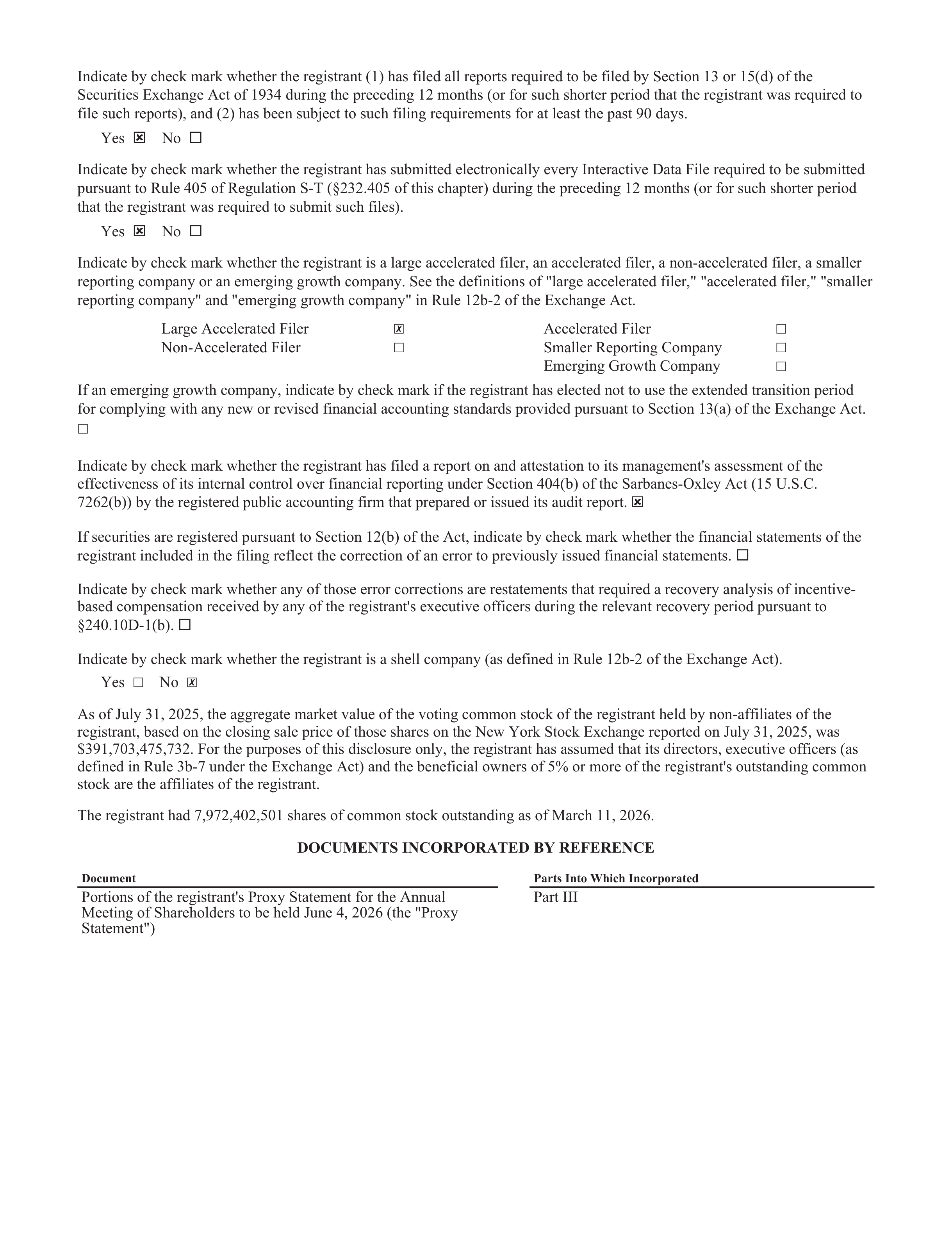
Indicate by check mark whether the registrant (1) has filed all reports required to be filed by Section 13 or 15(d) of the
Securities Exchange Act of 1934 during the preceding 12 months (or for such shorter period that the registrant was required to
file such reports), and (2) has been subject to such filing requirements for at least the past 90 days.
Yes
ý
No
¨
Indicate by check mark whether the registrant has submitted electronically every Interactive Data File required to be submitted
pursuant to Rule 405 of Regulation S-T (§232.405 of this chapter) during the preceding 12 months (or for such shorter period
that the registrant was required to submit such files).
Yes
ý
No
¨
Indicate by check mark whether the registrant is a large accelerated filer, an accelerated filer, a non-accelerated filer, a smaller
reporting company or an emerging growth company. See the definitions of "large accelerated filer," "accelerated filer," "smaller
reporting company" and "emerging growth company" in Rule 12b-2 of the Exchange Act.
Large Accelerated Filer
☒
Accelerated Filer
☐
Non-Accelerated Filer
☐
Smaller Reporting Company
☐
Emerging Growth Company
☐
If an emerging growth company, indicate by check mark if the registrant has elected not to use the extended transition period
for complying with any new or revised financial accounting standards provided pursuant to Section 13(a) of the Exchange Act.
☐
Indicate by check mark whether the registrant has filed a report on and attestation to its management's assessment of the
effectiveness of its internal control over financial reporting under Section 404(b) of the Sarbanes-Oxley Act (15 U.S.C.
7262(b)) by the registered public accounting firm that prepared or issued its audit report.
☒
If securities are registered pursuant to Section 12(b) of the Act, indicate by check mark whether the financial statements of the
registrant included in the filing reflect the correction of an error to previously issued financial statements.
¨
Indicate by check mark whether any of those error corrections are restatements that required a recovery analysis of incentive-
based compensation received by any of the registrant's executive officers during the relevant recovery period pursuant to
§240.10D-1(b).
¨
Indicate by check mark whether the registrant is a shell company (as defined in Rule 12b-2 of the Exchange Act).
Yes
☐
No
☒
As of July 31, 2025, the aggregate market value of the voting common stock of the registrant held by non-affiliates of the
registrant, based on the closing sale price of those shares on the New York Stock Exchange reported on July 31, 2025, was
$391,703,475,732. For the purposes of this disclosure only, the registrant has assumed that its directors, executive officers (as
defined in Rule 3b-7 under the Exchange Act) and the beneficial owners of 5% or more of the registrant's outstanding common
stock are the affiliates of the registrant.
The registrant had 7,972,402,501 shares of common stock outstanding as of March 11, 2026.
DOCUMENTS INCORPORATED BY REFERENCE
Document
Parts Into Which Incorporated
Portions of the registrant's Proxy Statement for the Annual
Meeting of Shareholders to be held June 4, 2026 (the "Proxy
Statement")
Part III
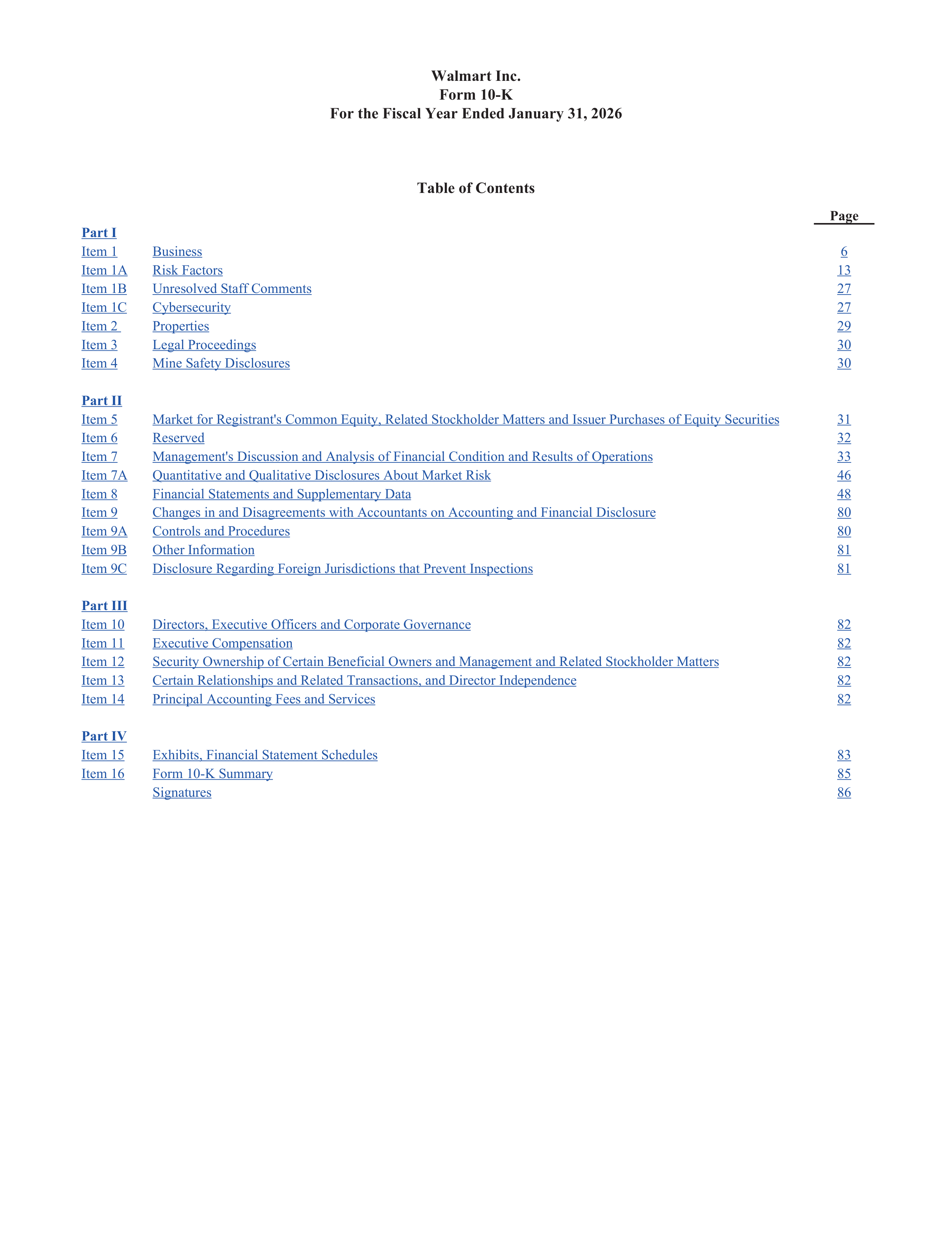
Walmart Inc.
Form 10-K
For the Fiscal Year Ended January 31, 2026
Table of Contents
Page
Part I
Item 1
Business
6
Item 1A
Risk Factors
13
Item 1B
Unresolved Staff Comments
27
Item 1C
Cybersecurity
27
Item 2
Properties
29
Item 3
Legal Proceedings
30
Item 4
Mine Safety Disclosures
30
Part II
Item 5
Market for Registrant's Common Equity, Related Stockholder Matters and Issuer Purchases of Equity Securities
31
Item 6
Reserved
32
Item 7
Management's Discussion and Analysis of Financial Condition and Results of Operations
33
Item 7A
Quantitative and Qualitative Disclosures About Market Risk
46
Item 8
Financial Statements and Supplementary Data
48
Item 9
Changes in and Disagreements with Accountants on Accounting and Financial Disclosure
80
Item 9A
Controls and Procedures
80
Item 9B
Other Information
81
Item 9C
Disclosure Regarding Foreign Jurisdictions that Prevent Inspections
81
Part III
Item 10
Directors, Executive Officers and Corporate Governance
82
Item 11
Executive Compensation
82
Item 12
Security Ownership of Certain Beneficial Owners and Management and Related Stockholder Matters
82
Item 13
Certain Relationships and Related Transactions, and Director Independence
82
Item 14
Principal Accounting Fees and Services
82
Part IV
Item 15
Exhibits, Financial Statement Schedules
83
Item 16
Form 10-K Summary
85
Signatures
86
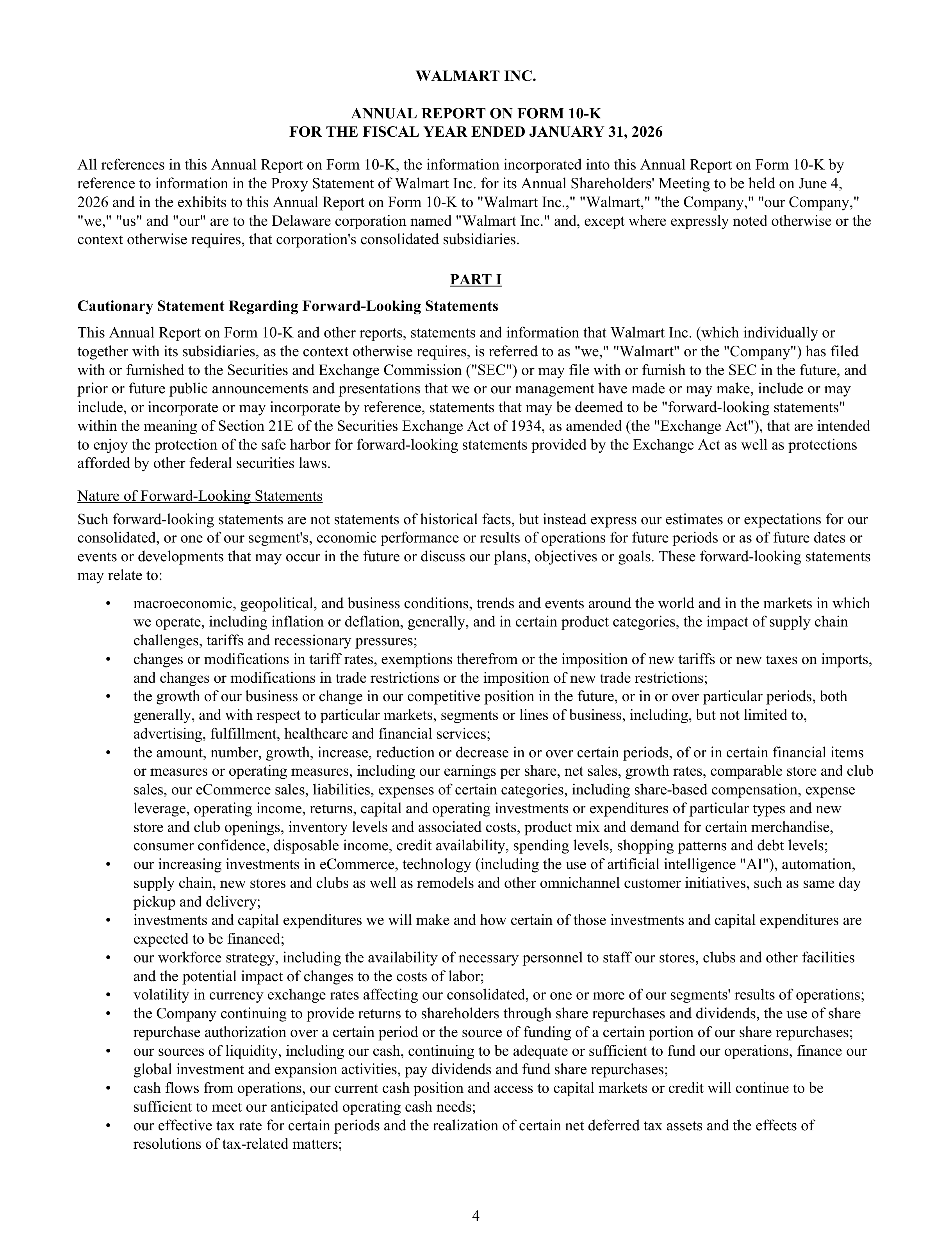
WALMART INC.
ANNUAL REPORT ON FORM 10-K
FOR THE FISCAL YEAR ENDED JANUARY 31, 2026
All references in this Annual Report on Form 10-K, the information incorporated into this Annual Report on Form 10-K by
reference to information in the Proxy Statement of Walmart Inc. for its Annual Shareholders' Meeting to be held on June 4,
2026 and in the exhibits to this Annual Report on Form 10-K to "Walmart Inc.," "Walmart," "the Company," "our Company,"
"we," "us" and "our" are to the Delaware corporation named "Walmart Inc." and, except where expressly noted otherwise or the
context otherwise requires, that corporation's consolidated subsidiaries.
PART I
Cautionary Statement Regarding Forward-Looking Statements
This Annual Report on Form 10-K and other reports, statements and information that Walmart Inc. (which individually or
together with its subsidiaries, as the context otherwise requires, is referred to as "we," "Walmart" or the "Company") has filed
with or furnished to the Securities and Exchange Commission ("SEC") or may file with or furnish to the SEC in the future, and
prior or future public announcements and presentations that we or our management have made or may make, include or may
include, or incorporate or may incorporate by reference, statements that may be deemed to be "forward-looking statements"
within the meaning of Section 21E of the Securities Exchange Act of 1934, as amended (the "Exchange Act"), that are intended
to enjoy the protection of the safe harbor for forward-looking statements provided by the Exchange Act as well as protections
afforded by other federal securities laws.
Nature of Forward-Looking Statements
Such forward-looking statements are not statements of historical facts, but instead express our estimates or expectations for our
consolidated, or one of our segment's, economic performance or results of operations for future periods or as of future dates or
events or developments that may occur in the future or discuss our plans, objectives or goals. These forward-looking statements
may relate to:
•
macroeconomic, geopolitical, and business conditions, trends and events around the world and in the markets in which
we operate, including inflation or deflation, generally, and in certain product categories, the impact of supply chain
challenges, tariffs and recessionary pressures;
•
changes or modifications in tariff rates, exemptions therefrom or the imposition of new tariffs or new taxes on imports,
and changes or modifications in trade restrictions or the imposition of new trade restrictions;
•
the growth of our business or change in our competitive position in the future, or in or over particular periods, both
generally, and with respect to particular markets, segments or lines of business, including, but not limited to,
advertising, fulfillment, healthcare and financial services;
•
the amount, number, growth, increase, reduction or decrease in or over certain periods, of or in certain financial items
or measures or operating measures, including our earnings per share, net sales, growth rates, comparable store and club
sales, our eCommerce sales, liabilities, expenses of certain categories, including share-based compensation, expense
leverage, operating income, returns, capital and operating investments or expenditures of particular types and new
store and club openings, inventory levels and associated costs, product mix and demand for certain merchandise,
consumer confidence, disposable income, credit availability, spending levels, shopping patterns and debt levels;
•
our increasing investments in eCommerce, technology (including the use of artificial intelligence "AI"), automation,
supply chain, new stores and clubs as well as remodels and other omnichannel customer initiatives, such as same day
pickup and delivery;
•
investments and capital expenditures we will make and how certain of those investments and capital expenditures are
expected to be financed;
•
our workforce strategy, including the availability of necessary personnel to staff our stores, clubs and other facilities
and the potential impact of changes to the costs of labor;
•
volatility in currency exchange rates affecting our consolidated, or one or more of our segments' results of operations;
•
the Company continuing to provide returns to shareholders through share repurchases and dividends, the use of share
repurchase authorization over a certain period or the source of funding of a certain portion of our share repurchases;
•
our sources of liquidity, including our cash, continuing to be adequate or sufficient to fund our operations, finance our
global investment and expansion activities, pay dividends and fund share repurchases;
•
cash flows from operations, our current cash position and access to capital markets or credit will continue to be
sufficient to meet our anticipated operating cash needs;
•
our effective tax rate for certain periods and the realization of certain net deferred tax assets and the effects of
resolutions of tax-related matters;
4
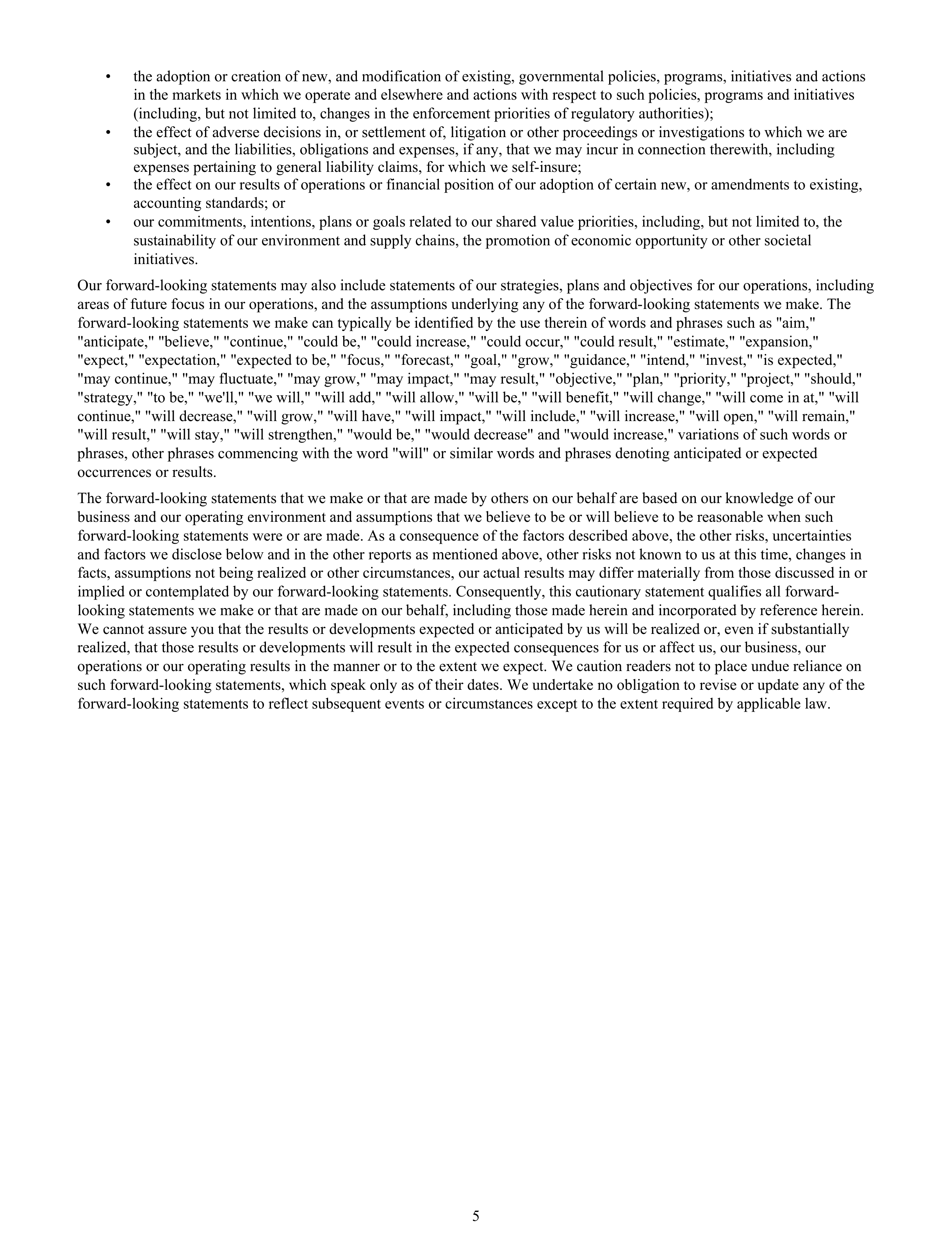
•
the adoption or creation of new, and modification of existing, governmental policies, programs, initiatives and actions
in the markets in which we operate and elsewhere and actions with respect to such policies, programs and initiatives
(including, but not limited to, changes in the enforcement priorities of regulatory authorities);
•
the effect of adverse decisions in, or settlement of, litigation or other proceedings or investigations to which we are
subject, and the liabilities, obligations and expenses, if any, that we may incur in connection therewith, including
expenses pertaining to general liability claims, for which we self-insure;
•
the effect on our results of operations or financial position of our adoption of certain new, or amendments to existing,
accounting standards; or
•
our commitments, intentions, plans or goals related to our shared value priorities, including, but not limited to, the
sustainability of our environment and supply chains, the promotion of economic opportunity or other societal
initiatives.
Our forward-looking statements may also include statements of our strategies, plans and objectives for our operations, including
areas of future focus in our operations, and the assumptions underlying any of the forward-looking statements we make. The
forward-looking statements we make can typically be identified by the use therein of words and phrases such as "aim,"
"anticipate," "believe," "continue," "could be," "could increase," "could occur," "could result," "estimate," "expansion,"
"expect," "expectation," "expected to be," "focus," "forecast," "goal," "grow," "guidance," "intend," "invest," "is expected,"
"may continue," "may fluctuate," "may grow," "may impact," "may result," "objective," "plan," "priority," "project," "should,"
"strategy," "to be," "we'll," "we will," "will add," "will allow," "will be," "will benefit," "will change," "will come in at," "will
continue," "will decrease," "will grow," "will have," "will impact," "will include," "will increase," "will open," "will remain,"
"will result," "will stay," "will strengthen," "would be," "would decrease" and "would increase," variations of such words or
phrases, other phrases commencing with the word "will" or similar words and phrases denoting anticipated or expected
occurrences or results.
The forward-looking statements that we make or that are made by others on our behalf are based on our knowledge of our
business and our operating environment and assumptions that we believe to be or will believe to be reasonable when such
forward-looking statements were or are made. As a consequence of the factors described above, the other risks, uncertainties
and factors we disclose below and in the other reports as mentioned above, other risks not known to us at this time, changes in
facts, assumptions not being realized or other circumstances, our actual results may differ materially from those discussed in or
implied or contemplated by our forward-looking statements. Consequently, this cautionary statement qualifies all forward-
looking statements we make or that are made on our behalf, including those made herein and incorporated by reference herein.
We cannot assure you that the results or developments expected or anticipated by us will be realized or, even if substantially
realized, that those results or developments will result in the expected consequences for us or affect us, our business, our
operations or our operating results in the manner or to the extent we expect. We caution readers not to place undue reliance on
such forward-looking statements, which speak only as of their dates. We undertake no obligation to revise or update any of the
forward-looking statements to reflect subsequent events or circumstances except to the extent required by applicable law.
5
ITEM 1.
BUSINESS
General
Walmart Inc. ("Walmart," the "Company" or "we") is a people-led, technology-powered omnichannel retailer dedicated to
helping people around the world save money and live better by providing the opportunity to shop in both retail stores and
through eCommerce, and to access our other service offerings. Through innovation, we strive to continuously improve a
customer-centric experience that seamlessly integrates our eCommerce and retail stores in an omnichannel offering that saves
time for our customers. Each week, we serve approximately 280 million customers who visit more than 10,900 stores in 19
countries and through our numerous eCommerce websites and mobile applications.
Our strategy is to make every day easier for busy families, operate with discipline, sharpen our culture and become more digital,
and make trust a competitive advantage. Making life easier for busy families includes our commitment to price leadership,
which has been and will remain a cornerstone of our business, as well as increasing convenience to save our customers time. By
leading on price, we earn the trust of our customers every day by providing a broad assortment of quality merchandise and
services at everyday low prices ("EDLP"). EDLP is our pricing philosophy under which we price items at a low price every day
so our customers trust that our prices will not change under frequent promotional activity. Everyday low cost ("EDLC") is our
commitment to control expenses so our cost savings can be passed along to our customers.
Our operations comprise three reportable segments: Walmart U.S., Walmart International and Sam's Club U.S. Our fiscal year
ends on January 31 for our United States ("U.S.") and Canadian operations. We consolidate all other operations generally using
a one-month lag and on a calendar year basis. Our discussion is as of, and for the fiscal years ended, January 31, 2026 ("fiscal
2026"), January 31, 2025 ("fiscal 2025") and January 31, 2024 ("fiscal 2024"). During fiscal 2026, we generated total revenues
of $713.2 billion, which primarily comprised net sales of $706.4 billion.
We maintain our principal offices in Bentonville, Arkansas. Our common stock trades on the Nasdaq Global Select Market
under the symbol "WMT."
The Development of Our Company
The businesses conducted by our founders began in 1945 when Sam M. Walton opened a franchise Ben Franklin variety store
in Newport, Arkansas. In 1946, his brother, James L. Walton, opened a similar store in Versailles, Missouri. Until 1962, our
founders' business was devoted entirely to the operation of variety stores, at which time we began to open discount stores. We
completed our initial public offering in 1970. In 1983, we opened our first Sam's Club, and in 1988, we opened our first
supercenter. In 1998, we opened our first Walmart Neighborhood Market. In 1991, we began our first international initiative
when we entered into a joint venture in Mexico and, as of January 31, 2026, our Walmart International segment conducted
business in 18 countries.
In 1996, we began our first eCommerce initiative by creating both walmart.com and samsclub.com. Since then, our eCommerce
presence has continued to grow. In 2007, leveraging our physical stores, walmart.com launched its Site-to-Store service,
enabling customers to make a purchase online and pick up merchandise in stores. Today, customers can access pickup or
delivery services at over 8,400 locations globally, reflecting our ability to leverage our store and club footprint to expand
customer access. In 2018, we expanded our eCommerce and digital presence through acquisitions with our majority stakes in
Flipkart and PhonePe in India. We continue to heavily invest in omnichannel and eCommerce innovation, as well as supply
chain capabilities, which enables us to leverage technology, talent and expertise, and expand our assortment and service
offerings, including through the integration of advanced technologies such as AI.
We are enhancing our omnichannel capabilities through a combination of stores, eCommerce websites, mobile applications and
service offerings, as well as our supply chain, combined with approximately 2.1 million associates as of January 31, 2026, to
better serve our customers. Our strategies increasingly include the use of AI-powered tools to support customer and member-
facing experiences, associate productivity and operational efficiency across our ecosystem. Together, these elements produce a
global retail ecosystem that we believe allows customers to view Walmart as their primary retail destination. As we execute on
our strategy globally, our business continues to expand through offerings such as membership, advertising, marketplace and
fulfillment services, and financial services. These offerings represent mutually reinforcing pieces of our omnichannel model
centered on our customers around the world who are increasingly seeking convenience.
Information About Our Segments
We are engaged in global operations of retail, wholesale and other units, as well as eCommerce, located throughout the U.S.,
Africa, Canada, Central America, Chile, China, India and Mexico. Our operations are conducted in three reportable segments:
Walmart U.S., Walmart International and Sam's Club U.S., which are further described below. Each segment contributes to the
Company's operating results differently. However, each has generally maintained a consistent contribution rate to the
Company's net sales in recent years other than minor changes to the contribution rate for the Walmart International segment due
to fluctuations in currency exchange rates. Additional information on our operating segments and geographic information is
contained in
Note 11
to our Consolidated Financial Statements.
6
Walmart U.S. Segment
Walmart U.S. is our largest segment and operates 4,611 stores in the U.S., including in all 50 states, Washington D.C. and
Puerto Rico. Walmart U.S. is a mass merchandiser of consumer products, operating under the "Walmart" and "Walmart
Neighborhood Market" brands, as well as walmart.com and the Walmart mobile application. Walmart U.S. had net sales of
$483.0 billion for fiscal 2026, representing 68% of our fiscal 2026 consolidated net sales, and had net sales of $462.4 billion
and $441.8 billion for fiscal 2025 and 2024, respectively.
Omnichannel.
Walmart U.S. provides a convenient and seamless omnichannel experience to customers, integrating retail
stores and eCommerce. Substantially all our stores provide same-day pickup and delivery, offering expedited delivery options
that enable us to reach customers faster and in the ways they prefer, including in-home delivery and digital pharmacy
fulfillment. Our Walmart+ membership offering provides enhanced omnichannel shopping benefits including unlimited free
shipping on eligible items with no order minimum, unlimited delivery from store, fuel discounts, mobile Scan & Go and access
to additional member benefits.
Merchandise and Other Offerings.
Walmart U.S. does business primarily in three strategic merchandise units, listed below:
•
Grocery consists of a full line of grocery items, including dry grocery, snacks, dairy, meat, produce, deli and bakery,
frozen foods, alcoholic and nonalcoholic beverages, as well as consumables such as health and beauty aids, pet
supplies, household chemicals, paper goods and baby products;
•
General merchandise includes:
◦
Entertainment (e.g., electronics, toys, seasonal merchandise, wireless, video games, movies, music and
books);
◦
Hardlines (e.g., automotive, hardware and paint, sporting goods, outdoor living and stationery);
◦
Fashion (e.g., apparel for adults and children, as well as shoes, jewelry and accessories); and
◦
Home (e.g., housewares and small appliances, bed and bath, furniture and home organization, home
furnishings, home decor, fabrics and crafts).
•
Health and wellness includes pharmacy, over-the-counter drugs and other medical products, and optical services.
Periodically, revisions are made to the categorization of the components comprising our strategic merchandise units. When
revisions are made, the previous periods' presentation is adjusted to maintain comparability.
Brand name merchandise represents a significant portion of the merchandise sold in Walmart U.S. We also market lines of
merchandise under our private brands, including brands such as: "Athletic Works," "bettergoods," "Equate," "Free Assembly,"
"Freshness Guaranteed," "George," "Great Value," "Holiday Time," "Hyper Tough," "Joyspun," "Kid Connection,"
"Mainstays," "Marketside," "No Boundaries," "onn.," "Ozark Trail," "Parent's Choice," "Sam's Choice," "Scoop," "Spring
Valley," "Time and Tru," "Way to Celebrate" and "Wonder Nation." The Company also markets lines of merchandise under
licensed brands, some of which include: "Avia," "Better Homes & Gardens," "Sofia Jeans by Sofia Vergara" and "The Pioneer
Woman."
Other offerings in the Walmart U.S. business include advertising solutions for brands and online marketplace sellers, supply
chain and fulfillment capabilities to online marketplace sellers, and data analytics and insights for suppliers and brands.
Additional offerings include fuel, financial services and related products such as money orders, prepaid access, money transfers,
check cashing, bill payment and certain types of installment lending.
Walmart International Segment
Walmart International is our second largest segment and operates 5,743 stores across 18 countries outside of the U.S. Walmart
International operates through our wholly-owned subsidiaries in Canada, Chile, China, and Africa (which includes Botswana,
Eswatini, Lesotho, Malawi, Mozambique, Namibia, South Africa and Zambia), and our majority-owned subsidiaries in India, as
well as Mexico and Central America (which includes Costa Rica, El Salvador, Guatemala, Honduras and Nicaragua).
Walmart International includes numerous formats divided into two major categories: retail and wholesale. These categories
consist of many formats, including: supercenters, supermarkets, warehouse clubs (including our membership-only Sam's Club
format) and cash and carry, as well as eCommerce through websites and mobile applications, including walmart.com.mx,
walmart.ca, flipkart.com, PhonePe, samclub.cn and other sites. Walmart International had net sales of $130.4 billion for fiscal
2026, representing 19% of our fiscal 2026 consolidated net sales, and had net sales of $121.9 billion and $114.6 billion for
fiscal 2025 and 2024, respectively.
Walmart International's purpose is to help millions of customers and members save money and live better every day by
leveraging our global ecosystem and deep local expertise to provide access to affordable products and services. In addition, we
share what we learn in our markets to help the enterprise innovate and grow even faster. We are deliberate about where and how
we choose to operate to best enable long-term, sustainable and profitable growth.
7
Omnichannel.
Walmart International provides a convenient and seamless omnichannel experience to customers, integrating
retail stores and eCommerce, such as through our pickup and delivery services from approximately 3,300 locations across all of
our markets, including same-day and expedited delivery options across our markets. We continue to expand our marketplace
offerings, which further enhances our fulfillment and advertising services.
Merchandise and Other Offerings.
The merchandising strategy for Walmart International is similar to that of our operations
in the U.S. in terms of the breadth and scope of merchandise offered for sale. While brand name merchandise accounts for a
majority of our sales, we have both leveraged U.S. private brands and developed market specific private brands to serve our
customers with high quality, low priced items. Along with the private brands we market globally, such as "Equate," "George,"
"Great Value," "Holiday Time," "Mainstays," "Marketside," "Member's Mark" and "Parent's Choice," our international markets
have developed market specific brands including "Aurrera" and "Lider." In addition, we have developed and continue to grow
our relationships with regional and local suppliers in each market to ensure reliable sources of quality merchandise that is equal
to national brands at low prices. Consistent with its strategy, Walmart International continues to build mutually reinforcing
businesses in areas such as advertising, marketplace and fulfillment services, financial services and healthcare.
Sam's Club U.S. Segment
Sam's Club U.S. is a membership-only warehouse club that operates 601 clubs in 44 states in the U.S. and Puerto Rico and also
operates samsclub.com and the Sam's Club mobile application. Sam's Club U.S. had net sales of $93.0 billion for fiscal 2026,
representing 13% of our consolidated fiscal 2026 net sales, and had net sales of $90.2 billion and $86.2 billion for fiscal 2025
and 2024, respectively. As a membership-only club, membership income is a significant component of the segment's operating
income.
Membership.
The following two membership tiers are available: Club membership for a $50 annual fee and Plus membership
for a $110 annual fee. All memberships include a spouse/household card at no additional cost, and members may purchase add-
on memberships for $45 each, subject to tier-based limits. Club members are eligible for free curbside pickup, and Plus
members receive additional benefits including free delivery-from-club and free shipping on orders of $50 or greater, exclusive
discounts and convenience offers, and the ability to shop before regular shopping hours. Members may also earn Sam's Cash
rewards on qualifying purchases that can be redeemed for cash, used for purchases, or used to pay membership fees.
Omnichannel.
Sam's Club U.S. provides a fast and seamless omnichannel experience to members, integrating physical clubs
and eCommerce. Club-fulfilled curbside pickup and delivery provides fast and convenient ways to shop for members; Scan &
Go mobile checkout and payment solution allows members to bypass the checkout line; and Just Go provides members with a
friction-free exit experience.
Merchandise and Other Offerings.
Sam's Club U.S. offers merchandise in the following four merchandise categories:
•
Grocery consists of dairy, meat, bakery, deli, produce, dry, chilled or frozen packaged foods, alcoholic and
nonalcoholic beverages, floral, snack foods, candy, other grocery items, as well as consumables such as health and
beauty aids, protein and nutrition, paper goods, laundry and home care, baby care, pet supplies and other consumable
items;
•
General merchandise includes:
◦
Home, hardlines and seasonal items (such as home improvement, outdoor living, gardening, furniture,
apparel, jewelry, tools and power equipment, housewares, toys and mattresses); and
◦
Technology and entertainment items (such as consumer electronics and accessories, software, video games,
office supplies, appliances and third-party gift cards).
•
Health and wellness includes pharmacy, optical and hearing services, and over-the-counter drugs; and
•
Fuel and other categories.
Periodically, revisions are made to the categorization of the components comprising our strategic merchandise units. When
revisions are made, the previous periods' presentation is adjusted to maintain comparability.
Within the categories above, the Sam's Club Member's Mark private label brand offers premium-quality, "Made Without"
products across a wide range of categories at competitive, value-driven prices, designed to meet the needs of members. We
continue to expand its assortment to reinforce Sam's Club value proposition to our members.
Other offerings in the Sam's Club U.S. business include advertising solutions for brands as well as operational insights and
analytics for suppliers. Additional offerings include tire and battery installation services, photo and tech assistance, home and
auto solutions, and certain financial services and related products.
8
Additional Information About Our Business
Competition.
We compete with brick and mortar, eCommerce and omnichannel retailers operating discount, department, retail
and wholesale grocery, drug, dollar, variety and specialty stores, supermarkets, supercenter-type stores, membership-only
warehouse clubs, gasoline stations and social commerce platforms, as well as companies that offer services in digital
advertising, fulfillment and delivery services, health and wellness and financial services. Our ability to develop and effectively
operate different formats at the right locations and to deliver a customer-centric omnichannel experience largely determines our
competitive position in the retail industry within the markets where we operate. Each of these landscapes is highly competitive
and rapidly evolving, and new business models and the entry of new, well-funded competitors continue to intensify this
competition. Some of our competitors have longer histories in these lines of business, more customers and greater brand
recognition. They may be able to obtain more favorable terms from suppliers and business partners and to devote greater
resources to the development of these businesses. In addition, for eCommerce and other internet-based businesses, newer or
smaller businesses may be better able to innovate and compete with us.
We compete in a variety of ways, including the prices at which we sell our merchandise, merchandise and selection availability,
services offered to customers, the quality of the products and services we offer, location, store and club hours, on-site amenities,
the shopping convenience and overall shopping experience we offer, the attractiveness and ease of use of our digital platforms,
cost and speed of and options for delivery to customers of merchandise purchased through our digital platforms or through our
omnichannel integration of our physical and digital operations. We employ many strategies and programs designed to meet
competitive pressures within our industry, which increasingly incorporate the use of AI-powered tools. These strategies include
the following:
•
EDLP: our pricing philosophy under which we price items at everyday low prices so our customers trust that our prices
will not change under frequent promotional activity;
•
EDLC: everyday low cost is our commitment to control expenses so our cost savings can be passed along to our
customers;
•
Omnichannel offerings such as pickup and delivery, all of which enhance convenience and seek to serve customers in the
ways they want to be served;
•
Expanding our ecosystem and the products and services we offer in areas such as digital advertising, marketplace and
fulfillment services, health and wellness, and financial services to provide our customers a broader set of offerings to meet
expanding needs;
•
Opening new stores and clubs, as well as remodeling existing locations, to enhance the customer experience, support
omnichannel capabilities, and strengthen our physical footprint in existing and new markets; and
•
Investing in technology, automation, and our associates to deliver growth, expand operating margins and improve returns.
Seasonal Aspects of Operations.
Our business is seasonal to a certain extent and varies by country due to different national
and religious holidays, festivals and customs, as well as different weather patterns. Historically, our highest sales volume for
each segment has occurred in the fourth quarter of our fiscal year.
Suppliers, Supply Chain and Distribution.
As a retailer and warehouse club operator, we utilize a global supply chain that
includes both U.S. and international suppliers from whom we purchase the merchandise that we sell in our stores, clubs and
online. In many instances, we purchase merchandise from producers located near the stores and clubs in which such
merchandise will be sold, particularly perishable items. Consistent with applicable laws, we offer our suppliers the opportunity
to efficiently sell significant quantities of their products to us. These relationships enable us to obtain pricing that reflects the
volume, certainty and cost-effectiveness these arrangements provide to such suppliers, which in turn enables us to provide low
prices to our customers. Our suppliers are subject to standards of conduct, including requirements that they comply with local
labor laws, local worker safety laws and other applicable laws. Our ability to acquire from our suppliers the assortment and
volume of products we wish to offer to our customers, to receive those products within the required time through our supply
chain and to distribute those products to our stores and clubs, determines, along with other supply chain logistics matters (such
as containers or port access for example), in part, our in-stock levels in our stores and clubs and the attractiveness of our
merchandise assortment we offer to our customers and members.
We continue to invest in supply chain automation and our fulfillment and delivery capabilities to better serve our customers. In
the U.S., we utilize a network of 192 distribution facilities located strategically throughout the country using a combination of
our private truck fleet as well as contracting with common carriers. During fiscal 2026, we began combining the Sam's Club
U.S. supply chain function with Walmart U.S. to streamline operations and leverage our enterprise systems and infrastructure
over time. Outside the U.S., we utilize a total of 179 distribution facilities strategically located in Africa, Canada, Central
America, Chile, China, India and Mexico, which process and distribute both imported and domestic products to where our
customers live. For fiscal 2026, the majority of our purchases of store and club merchandise were shipped through these
facilities, while most of the remaining merchandise we purchased was shipped directly from suppliers to our stores and clubs.
As an omnichannel retailer, we ship merchandise purchased by customers on our eCommerce platforms by a number of
methods from multiple locations, including leveraging our network of stores and clubs to fulfill and deliver customer orders, as
well as shipping directly from eCommerce fulfillment centers and other distribution facilities.
9
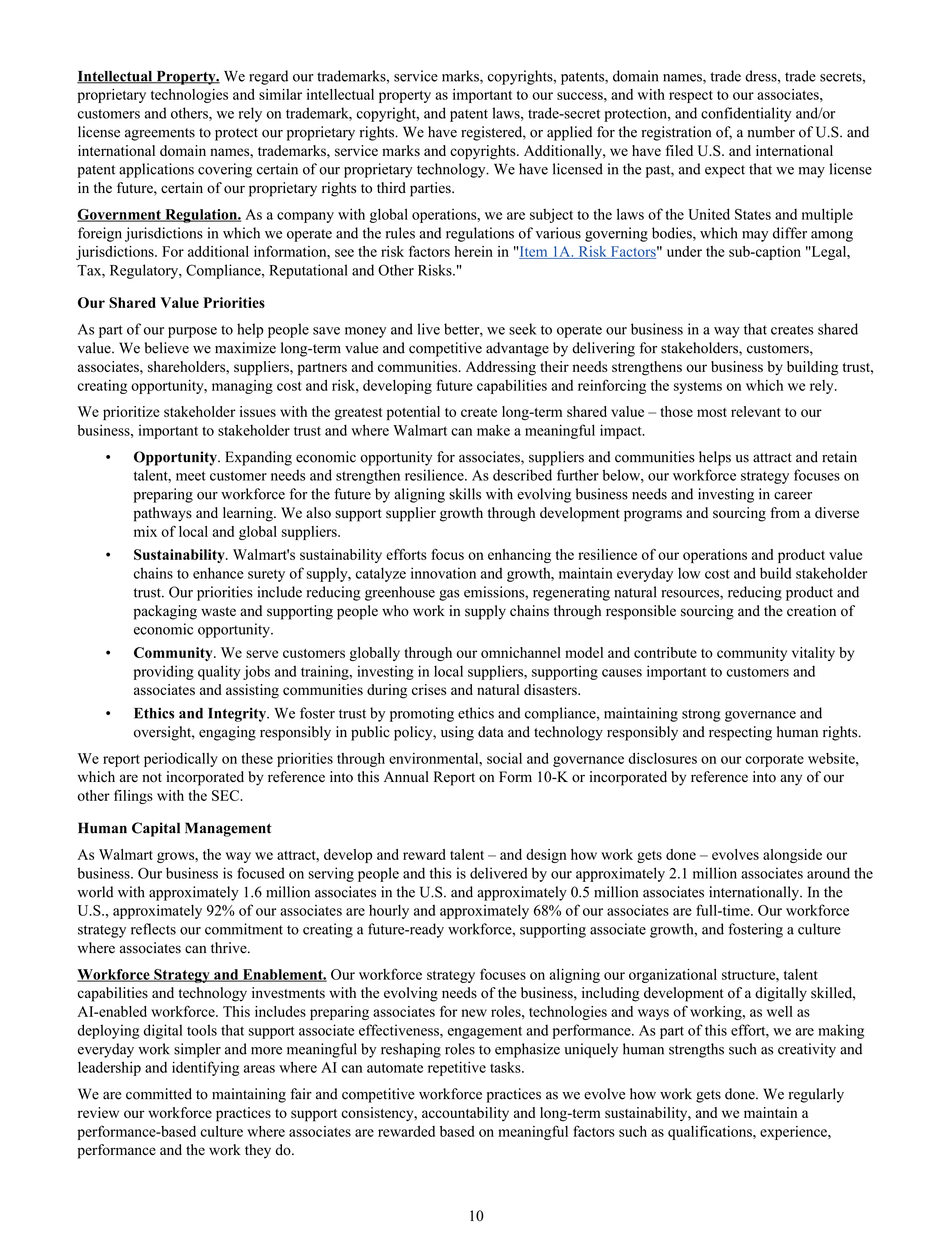
Intellectual Property.
We regard our trademarks, service marks, copyrights, patents, domain names, trade dress, trade secrets,
proprietary technologies and similar intellectual property as important to our success, and with respect to our associates,
customers and others, we rely on trademark, copyright, and patent laws, trade-secret protection, and confidentiality and/or
license agreements to protect our proprietary rights. We have registered, or applied for the registration of, a number of U.S. and
international domain names, trademarks, service marks and copyrights. Additionally, we have filed U.S. and international
patent applications covering certain of our proprietary technology. We have licensed in the past, and expect that we may license
in the future, certain of our proprietary rights to third parties.
Government Regulation.
As a company with global operations, we are subject to the laws of the United States and multiple
foreign jurisdictions in which we operate and the rules and regulations of various governing bodies, which may differ among
jurisdictions. For additional information, see the risk factors herein in "
Item 1A. Risk Factors
" under the sub-caption "Legal,
Tax, Regulatory, Compliance, Reputational and Other Risks."
Our Shared Value Priorities
As part of our purpose to help people save money and live better, we seek to operate our business in a way that creates shared
value. We believe we maximize long-term value and competitive advantage by delivering for stakeholders, customers,
associates, shareholders, suppliers, partners and communities. Addressing their needs strengthens our business by building trust,
creating opportunity, managing cost and risk, developing future capabilities and reinforcing the systems on which we rely.
We prioritize stakeholder issues with the greatest potential to create long-term shared value – those most relevant to our
business, important to stakeholder trust and where Walmart can make a meaningful impact.
•
Opportunity
. Expanding economic opportunity for associates, suppliers and communities helps us attract and retain
talent, meet customer needs and strengthen resilience. As described further below, our workforce strategy focuses on
preparing our workforce for the future by aligning skills with evolving business needs and investing in career
pathways and learning. We also support supplier growth through development programs and sourcing from a diverse
mix of local and global suppliers.
•
Sustainability
. Walmart's sustainability efforts focus on enhancing the resilience of our operations and product value
chains to enhance surety of supply, catalyze innovation and growth, maintain everyday low cost and build stakeholder
trust. Our priorities include reducing greenhouse gas emissions, regenerating natural resources, reducing product and
packaging waste and supporting people who work in supply chains through responsible sourcing and the creation of
economic opportunity.
•
Community
. We serve customers globally through our omnichannel model and contribute to community vitality by
providing quality jobs and training, investing in local suppliers, supporting causes important to customers and
associates and assisting communities during crises and natural disasters.
•
Ethics and Integrity
. We foster trust by promoting ethics and compliance, maintaining strong governance and
oversight, engaging responsibly in public policy, using data and technology responsibly and respecting human rights.
We report periodically on these priorities through environmental, social and governance disclosures on our corporate website,
which are not incorporated by reference into this Annual Report on Form 10-K or incorporated by reference into any of our
other filings with the SEC.
Human Capital Management
As Walmart grows, the way we attract, develop and reward talent – and design how work gets done – evolves alongside our
business. Our business is focused on serving people and this is delivered by our approximately 2.1 million associates around the
world with approximately 1.6 million associates in the U.S. and approximately 0.5 million associates internationally. In the
U.S., approximately 92% of our associates are hourly and approximately 68% of our associates are full-time. Our workforce
strategy reflects our commitment to creating a future-ready workforce, supporting associate growth, and fostering a culture
where associates can thrive.
Workforce Strategy and Enablement.
Our workforce strategy focuses on aligning our organizational structure, talent
capabilities and technology investments with the evolving needs of the business, including development of a digitally skilled,
AI-enabled workforce. This includes preparing associates for new roles, technologies and ways of working, as well as
deploying digital tools that support associate effectiveness, engagement and performance. As part of this effort, we are making
everyday work simpler and more meaningful by reshaping roles to emphasize uniquely human strengths such as creativity and
leadership and identifying areas where AI can automate repetitive tasks.
We are committed to maintaining fair and competitive workforce practices as we evolve how work gets done. We regularly
review our workforce practices to support consistency, accountability and long-term sustainability, and we maintain a
performance-based culture where associates are rewarded based on meaningful factors such as qualifications, experience,
performance and the work they do.
10
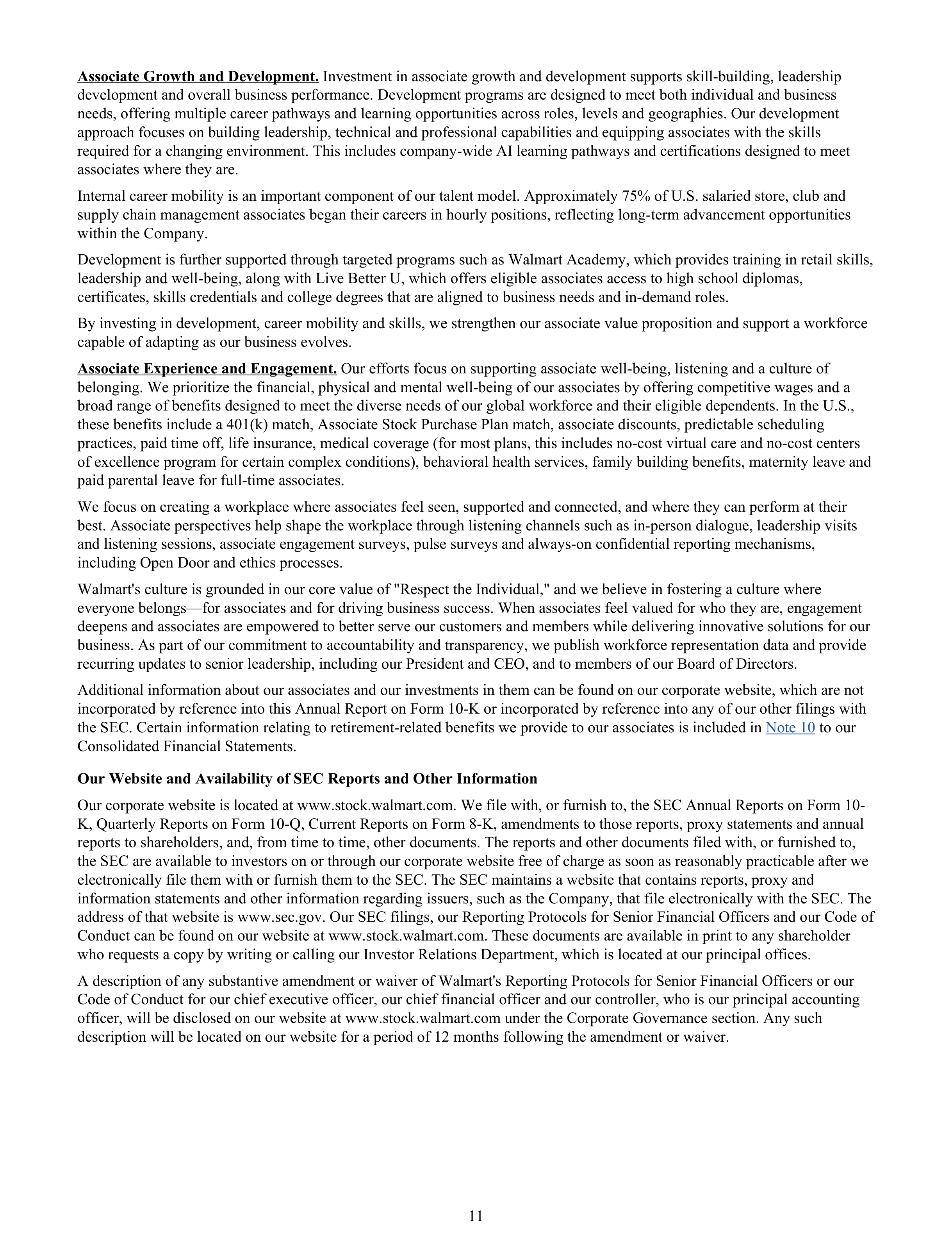
Associate Growth and Development.
Investment in associate growth and development supports skill-building, leadership
development and overall business performance. Development programs are designed to meet both individual and business
needs, offering multiple career pathways and learning opportunities across roles, levels and geographies. Our development
approach focuses on building leadership, technical and professional capabilities and equipping associates with the skills
required for a changing environment. This includes company
-
wide AI learning pathways and certifications designed to meet
associates where they are.
Internal career mobility is an important component of our talent model. Approximately 75% of U.S. salaried store, club and
supply chain management associates began their careers in hourly positions, reflecting long
-
term advancement opportunities
within the Company.
Development is further supported through targeted programs such as Walmart Academy, which provides training in retail skills,
leadership and well
-
being, along with Live Better U, which offers eligible associates access to high school diplomas,
certificates, skills credentials and college degrees that are aligned to business needs and in-demand roles.
By investing in development, career mobility and skills, we strengthen our associate value proposition and support a workforce
capable of adapting as our business evolves.
Associate Experience and Engagement.
Our efforts focus on supporting associate well-being, listening and a culture of
belonging. We prioritize the financial, physical and mental well-being of our associates by offering competitive wages and a
broad range of benefits designed to meet the diverse needs of our global workforce and their eligible dependents. In the U.S.,
these benefits include a 401(k) match, Associate Stock Purchase Plan match, associate discounts, predictable scheduling
practices, paid time off, life insurance, medical coverage (for most plans, this includes no-cost virtual care and no-cost centers
of excellence program for certain complex conditions), behavioral health services, family building benefits, maternity leave and
paid parental leave for full-time associates.
We focus on creating a workplace where associates feel seen, supported and connected, and where they can perform at their
best. Associate perspectives help shape the workplace through listening channels such as in-person dialogue, leadership visits
and listening sessions, associate engagement surveys, pulse surveys and always-on confidential reporting mechanisms,
including Open Door and ethics processes.
Walmart's culture is grounded in our core value of "Respect the Individual," and we believe in fostering a culture where
everyone belongs—for associates and for driving business success. When associates feel valued for who they are, engagement
deepens and associates are empowered to better serve our customers and members while delivering innovative solutions for our
business. As part of our commitment to accountability and transparency, we publish workforce representation data and provide
recurring updates to senior leadership, including our President and CEO, and to members of our Board of Directors.
Additional information about our associates and our investments in them can be found on our corporate website, which are not
incorporated by reference into this Annual Report on Form 10-K or incorporated by reference into any of our other filings with
the SEC. Certain information relating to retirement-related benefits we provide to our associates is included in
Note 10
to our
Consolidated Financial Statements.
Our Website and Availability of SEC Reports and Other Information
Our corporate website is located at www.stock.walmart.com. We file with, or furnish to, the SEC Annual Reports on Form 10-
K, Quarterly Reports on Form 10-Q, Current Reports on Form 8-K, amendments to those reports, proxy statements and annual
reports to shareholders, and, from time to time, other documents. The reports and other documents filed with, or furnished to,
the SEC are available to investors on or through our corporate website free of charge as soon as reasonably practicable after we
electronically file them with or furnish them to the SEC. The SEC maintains a website that contains reports, proxy and
information statements and other information regarding issuers, such as the Company, that file electronically with the SEC. The
address of that website is www.sec.gov. Our SEC filings, our Reporting Protocols for Senior Financial Officers and our Code of
Conduct can be found on our website at www.stock.walmart.com. These documents are available in print to any shareholder
who requests a copy by writing or calling our Investor Relations Department, which is located at our principal offices.
A description of any substantive amendment or waiver of Walmart's Reporting Protocols for Senior Financial Officers or our
Code of Conduct for our chief executive officer, our chief financial officer and our controller, who is our principal accounting
officer, will be disclosed on our website at www.stock.walmart.com under the Corporate Governance section. Any such
description will be located on our website for a period of 12 months following the amendment or waiver.
11
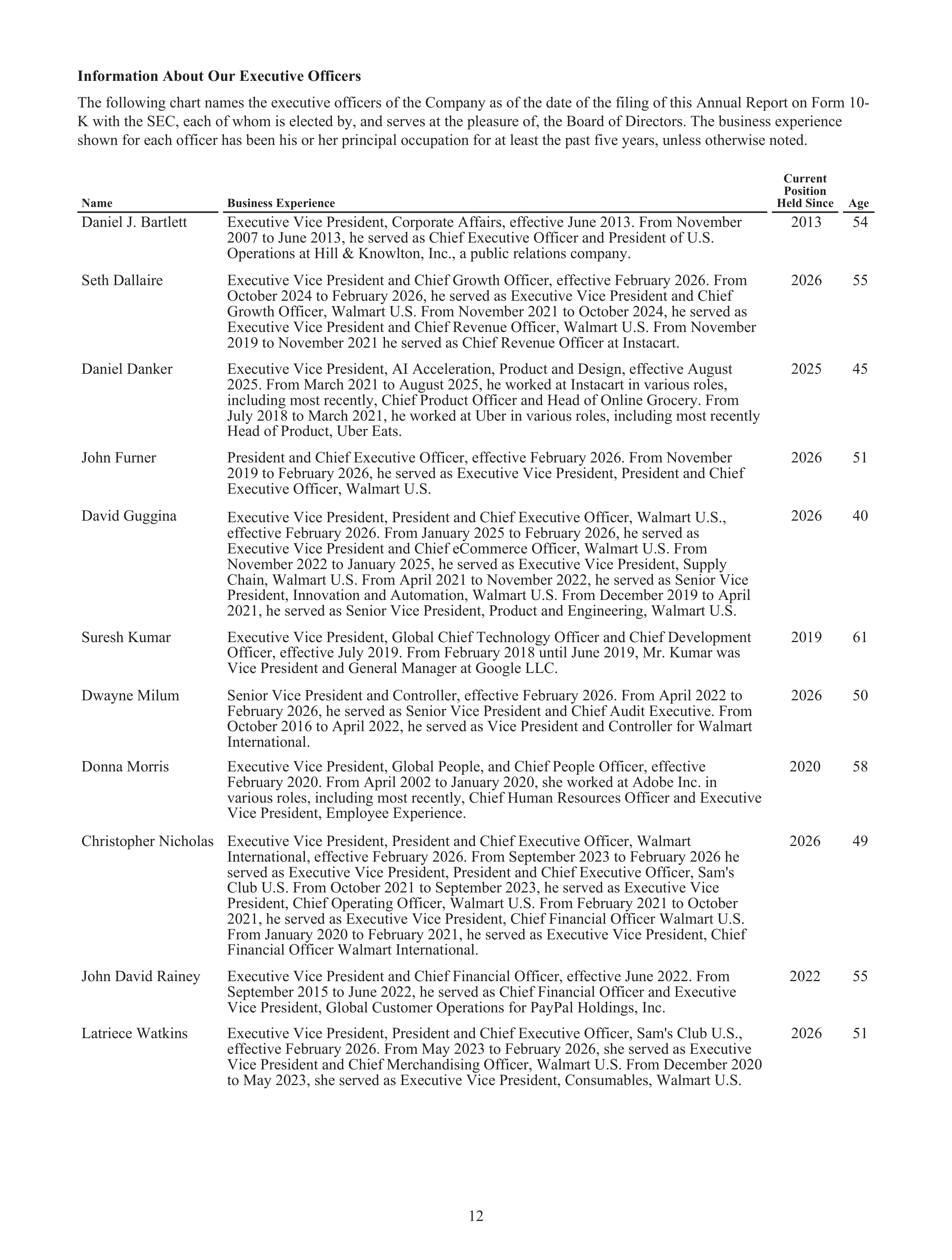
Information About Our Executive Officers
The following chart names the executive officers of the Company as of the date of the filing of this Annual Report on Form 10-
K with the SEC, each of whom is elected by, and serves at the pleasure of, the Board of Directors. The business experience
shown for each officer has been his or her principal occupation for at least the past five years, unless otherwise noted.
Name
Business Experience
Current
Position
Held Since
Age
Daniel J. Bartlett
Executive Vice President, Corporate Affairs, effective June 2013. From November
2007 to June 2013, he served as Chief Executive Officer and President of U.S.
Operations at Hill & Knowlton, Inc., a public relations company.
2013
54
Seth Dallaire
Executive Vice President and Chief Growth Officer, effective February 2026. From
October 2024 to February 2026, he served as Executive Vice President and Chief
Growth Officer, Walmart U.S. From November 2021 to October 2024, he served as
Executive Vice President and Chief Revenue Officer, Walmart U.S. From November
2019 to November 2021 he served as Chief Revenue Officer at Instacart.
2026
55
Daniel Danker
Executive Vice President, AI Acceleration, Product and Design, effective August
2025. From March 2021 to August 2025, he worked at Instacart in various roles,
including most recently, Chief Product Officer and Head of Online Grocery. From
July 2018 to March 2021, he worked at Uber in various roles, including most recently
Head of Product, Uber Eats.
2025
45
John Furner
President and Chief Executive Officer, effective February 2026. From November
2019 to February 2026, he served as Executive Vice President, President and Chief
Executive Officer, Walmart U.S.
2026
51
David Guggina
Executive Vice President, President and Chief Executive Officer, Walmart U.S.,
effective February 2026. From January 2025 to February 2026, he served as
Executive Vice President and Chief eCommerce Officer, Walmart U.S. From
November 2022 to January 2025, he served as Executive Vice President, Supply
Chain, Walmart U.S. From April 2021 to November 2022, he served as Senior Vice
President, Innovation and Automation, Walmart U.S. From December 2019 to April
2021, he served as Senior Vice President, Product and Engineering, Walmart U.S.
2026
40
Suresh Kumar
Executive Vice President, Global Chief Technology Officer and Chief Development
Officer, effective July 2019. From February 2018 until June 2019, Mr. Kumar was
Vice President and General Manager at Google LLC.
2019
61
Dwayne Milum
Senior Vice President and Controller, effective February 2026. From April 2022 to
February 2026, he served as Senior Vice President and Chief Audit Executive. From
October 2016 to April 2022, he served as Vice President and Controller for Walmart
International.
2026
50
Donna Morris
Executive Vice President, Global People, and Chief People Officer, effective
February 2020. From April 2002 to January 2020, she worked at Adobe Inc. in
various roles, including most recently, Chief Human Resources Officer and Executive
Vice President, Employee Experience.
2020
58
Christopher Nicholas
Executive Vice President, President and Chief Executive Officer, Walmart
International, effective February 2026. From September 2023 to February 2026 he
served as Executive Vice President, President and Chief Executive Officer, Sam's
Club U.S. From October 2021 to September 2023, he served as Executive Vice
President, Chief Operating Officer, Walmart U.S. From February 2021 to October
2021, he served as Executive Vice President, Chief Financial Officer Walmart U.S.
From January 2020 to February 2021, he served as Executive Vice President, Chief
Financial Officer Walmart International.
2026
49
John David Rainey
Executive Vice President and Chief Financial Officer, effective June 2022. From
September 2015 to June 2022, he served as Chief Financial Officer and Executive
Vice President, Global Customer Operations for PayPal Holdings, Inc.
2022
55
Latriece Watkins
Executive Vice President, President and Chief Executive Officer, Sam's Club U.S.,
effective February 2026. From May 2023 to February 2026, she served as Executive
Vice President and Chief Merchandising Officer, Walmart U.S. From December 2020
to May 2023, she served as Executive Vice President, Consumables, Walmart U.S.
2026
51
12
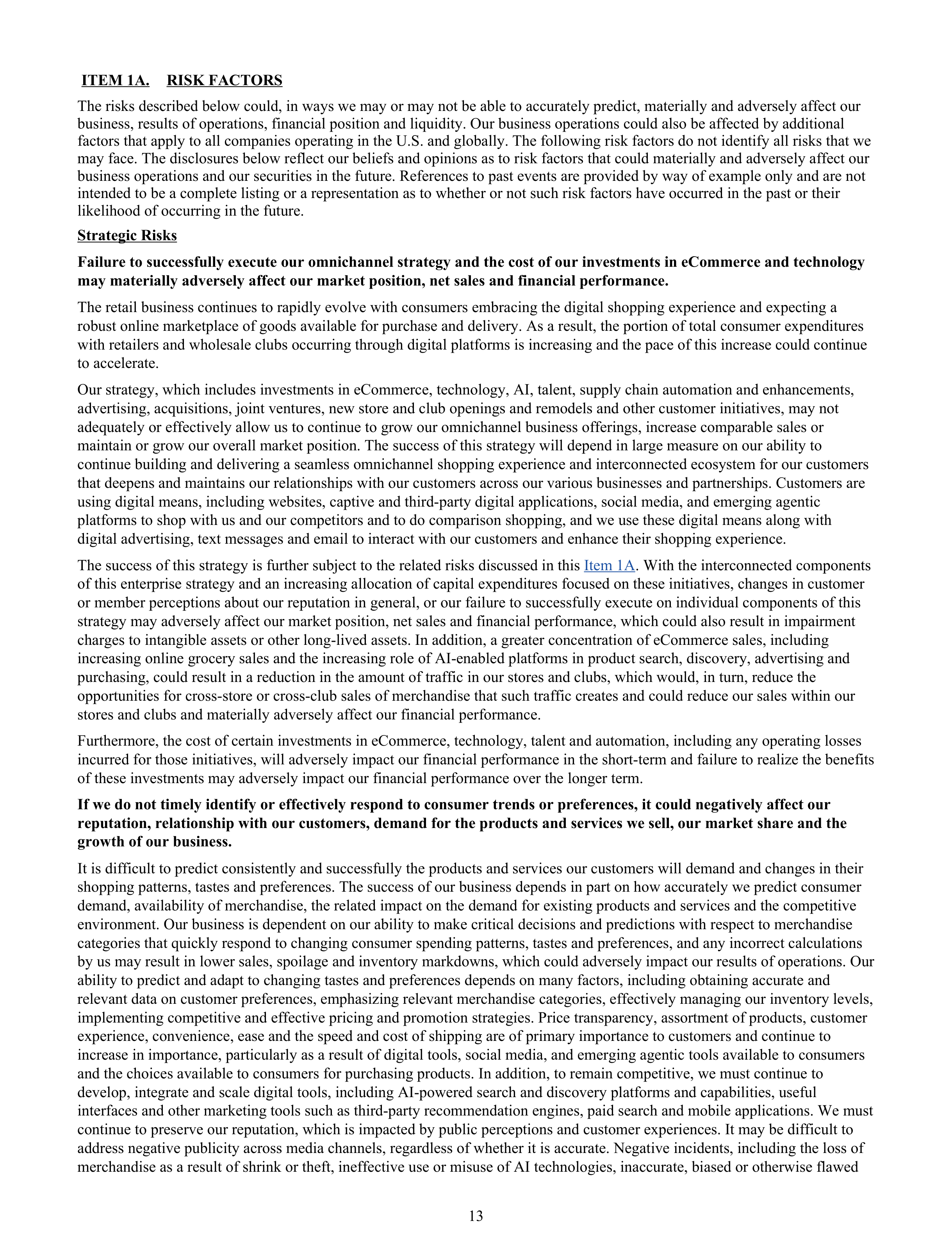
ITEM 1A.
RISK FACTORS
The risks described below could, in ways we may or may not be able to accurately predict, materially and adversely affect our
business, results of operations, financial position and liquidity. Our business operations could also be affected by additional
factors that apply to all companies operating in the U.S. and globally. The following risk factors do not identify all risks that we
may face. The disclosures below reflect our beliefs and opinions as to risk factors that could materially and adversely affect our
business operations and our securities in the future. References to past events are provided by way of example only and are not
intended to be a complete listing or a representation as to whether or not such risk factors have occurred in the past or their
likelihood of occurring in the future.
Strategic Risks
Failure to successfully execute our omnichannel strategy and the cost of our investments in eCommerce and technology
may materially adversely affect our market position, net sales and financial performance.
The retail business continues to rapidly evolve with consumers embracing the digital shopping experience and expecting a
robust online marketplace of goods available for purchase and delivery. As a result, the portion of total consumer expenditures
with retailers and wholesale clubs occurring through digital platforms is increasing and the pace of this increase could continue
to accelerate.
Our strategy, which includes investments in eCommerce, technology, AI, talent, supply chain automation and enhancements,
advertising, acquisitions, joint ventures, new store and club openings and remodels and other customer initiatives, may not
adequately or effectively allow us to continue to grow our omnichannel business offerings, increase comparable sales or
maintain or grow our overall market position. The success of this strategy will depend in large measure on our ability to
continue building and delivering a seamless omnichannel shopping experience and interconnected ecosystem for our customers
that deepens and maintains our relationships with our customers across our various businesses and partnerships. Customers are
using digital means, including websites, captive and third-party digital applications, social media, and emerging agentic
platforms to shop with us and our competitors and to do comparison shopping, and we use these digital means along with
digital advertising, text messages and email to interact with our customers and enhance their shopping experience.
The success of this strategy is further subject to the related risks discussed in this
Item 1A
. With the interconnected components
of this enterprise strategy and an increasing allocation of capital expenditures focused on these initiatives, changes in customer
or member perceptions about our reputation in general, or our failure to successfully execute on individual components of this
strategy may adversely affect our market position, net sales and financial performance, which could also result in impairment
charges to intangible assets or other long-lived assets. In addition, a greater concentration of eCommerce sales, including
increasing online grocery sales and the increasing role of AI-enabled platforms in product search, discovery, advertising and
purchasing, could result in a reduction in the amount of traffic in our stores and clubs, which would, in turn, reduce the
opportunities for cross-store or cross-club sales of merchandise that such traffic creates and could reduce our sales within our
stores and clubs and materially adversely affect our financial performance.
Furthermore, the cost of certain investments in eCommerce, technology, talent and automation, including any operating losses
incurred for those initiatives, will adversely impact our financial performance in the short-term and failure to realize the benefits
of these investments may adversely impact our financial performance over the longer term.
If we do not timely identify or effectively respond to consumer trends or preferences, it could negatively affect our
reputation, relationship with our customers, demand for the products and services we sell, our market share and the
growth of our business.
It is difficult to predict consistently and successfully the products and services our customers will demand and changes in their
shopping patterns, tastes and preferences. The success of our business depends in part on how accurately we predict consumer
demand, availability of merchandise, the related impact on the demand for existing products and services and the competitive
environment. Our business is dependent on our ability to make critical decisions and predictions with respect to merchandise
categories that quickly respond to changing consumer spending patterns, tastes and preferences, and any incorrect calculations
by us may result in lower sales, spoilage and inventory markdowns, which could adversely impact our results of operations. Our
ability to predict and adapt to changing tastes and preferences depends on many factors, including obtaining accurate and
relevant data on customer preferences, emphasizing relevant merchandise categories, effectively managing our inventory levels,
implementing competitive and effective pricing and promotion strategies. Price transparency, assortment of products, customer
experience, convenience, ease and the speed and cost of shipping are of primary importance to customers and continue to
increase in importance, particularly as a result of digital tools, social media, and emerging agentic tools available to consumers
and the choices available to consumers for purchasing products. In addition, to remain competitive, we must continue to
develop, integrate and scale digital tools, including AI-powered search and discovery platforms and capabilities, useful
interfaces and other marketing tools such as third-party recommendation engines, paid search and mobile applications. We must
continue to preserve our reputation, which is impacted by public perceptions and customer experiences. It may be difficult to
address negative publicity across media channels, regardless of whether it is accurate. Negative incidents, including the loss of
merchandise as a result of shrink or theft, ineffective use or misuse of AI technologies, inaccurate, biased or otherwise flawed
13
AI search and discovery results, or a data breach as a result of a cyberattack could quickly erode trust and confidence in our
business and could result in customer dissatisfaction, consumer boycotts, workforce unrest and government investigations.
These incidents may involve us, our vendors that handle our data or personal information, our workforce or others with whom
we do business, including third-party service providers and independent contractors. Societal expectations, preferences, trends
and political expression are ever-changing and we try to adapt, evolve and maintain a balance that meets the acceptance of our
customers, members, associates, shareholders, suppliers and other stakeholders, but we may not always move as quickly or in
the direction that various competing interests desire or demand, which could impact our reputation. For instance, strong
opinions continue to be publicly expressed both for and against various social and environmental initiatives and positions taken
by many corporations, including Walmart, are tracked, monitored and subject to heightened scrutiny from consumers, investors,
advocacy groups and public figures, potentially leading to consumer boycotts, negative publicity campaigns, litigation and
reputational harm. Negative reputational incidents or negative perceptions of us could adversely impact our business and results
of operations, including through lower sales, the termination of business relationships and negative impacts to associate
retention and recruiting efforts. Moreover, failure to adequately predict customer demand and consumer spending patterns or
otherwise optimize and operate our distribution and fulfillment centers could result in excess or insufficient inventory, service
interruptions and increased costs, any of which could significantly harm our business. As we continue to add new fulfillment
centers, our fulfillment and technology networks become increasingly complex and operating them in a way that effectively
meets consumer demands continues to be challenging. There can be no assurance that we will be able to operate our networks
effectively.
We face strong competition from other retailers, wholesale club operators, omnichannel retailers and other businesses
which could materially adversely affect our financial performance.
Each of our segments competes for customers, employees, digital prominence, products and services and in other important
aspects of its business with many other local, regional, national and global physical, eCommerce and omnichannel retailers,
social commerce platforms, wholesale club operators and retail intermediaries, and emerging agentic shopping tools and
platforms, as well as companies that offer services in digital advertising, data analytics/insights, fulfillment and delivery
services, health and wellness and financial services. The omnichannel retail landscape is highly competitive and rapidly
evolving, and the entry of new, well-funded competitors, or more rapid development of AI capabilities and agentic tools by
these competitors to enhance productivity and the shopping experience, may increase competitive pressures. In addition, for
eCommerce and other internet-based businesses, newer or smaller businesses may be better able to innovate and compete with
us.
We compete in a variety of ways, including the prices at which we sell our merchandise, merchandise selection and availability,
services offered to customers, location, store hours, in-store amenities, the shopping convenience and overall shopping
experience we offer, the attractiveness and ease of use of our digital platforms, quality and accessibility of data for customers,
suppliers, and associates, and cost, speed of and options for accurate delivery to customers of merchandise purchased through
our digital platforms or through our omnichannel integration of our physical and digital operations.
A failure to respond effectively to these competitive pressures and changes in the retail and other markets in which we operate,
omnichannel innovations and omnichannel ecosystems developed by our competitors or delays or failure in execution of our
strategy could materially adversely affect our financial performance. See "
Item 1. Business
" above for additional discussion of
the competitive landscape of our business.
Further, the protection of our proprietary rights, including our trademarks, copyrights, domain names, patents and trade secrets,
is important to our business. Effective protection of our proprietary rights may not be available in every jurisdiction in which
we offer our products and services, and we may not be able to prevent or deter third parties from infringing or misappropriating
our intellectual property, or ensure that third parties will not independently develop equivalent or superior intellectual property
rights, which could affect our ability to maintain a competitive advantage and adversely impact our business.
Certain segments of the retail industry are undergoing consolidation or substantially reducing operations, whether due to
bankruptcy, economics or other factors. Such consolidation, or other business combinations or alliances, competitive
omnichannel ecosystems or reductions in operations may result in competitors with improved financial resources, improved
access to merchandise, greater market penetration and other improvements in their competitive positions. Such business
combinations or alliances could allow these companies to provide a wider variety of products and services at competitive prices,
which could adversely affect our financial performance.
General or macro-economic factors, both domestically and internationally, may materially adversely affect our financial
performance.
General economic conditions and other economic factors, globally or in one or more of the markets we serve, may adversely
affect our financial performance. Higher interest rates, higher prices of petroleum products, including crude oil, natural gas,
gasoline and diesel fuel, increased costs for electricity and other energy, weakness in the housing market, inflation, deflation,
increased costs of essential services, such as medical care and utilities, higher levels of unemployment, decreases in GDP and
consumer purchasing power (including from reductions resulting from changes to government programs), unavailability of
14
consumer credit, higher consumer debt levels, changes in consumer spending and shopping patterns, fluctuations in currency
exchange rates, higher tax rates, imposition of new taxes or other changes in tax laws, changes in healthcare laws, other
regulatory changes, the imposition of export and import restrictions, tariffs, trade barriers or other measures that create barriers
to or increase the costs associated with international trade, overall economic slowdown or recession and other economic factors
in the U.S., or in any of the other markets in which we operate, could adversely affect consumer demand for the products and
services we sell in the U.S. or such other markets, change the mix of products we sell to any one or more markets with a lower
average gross margin, cause a slowdown in discretionary purchases of goods, adversely affect our net sales, growth rates,
operating income and result in slower inventory turnover and greater markdowns of inventory, or otherwise materially
adversely affect our operations and operating results and could result in impairment charges to intangible assets, goodwill or
other long-lived assets.
In addition, the economic factors listed above, any other economic factors or circumstances resulting in higher transportation,
labor, insurance or healthcare costs or commodity prices, including energy prices, and other economic factors in the U.S. and
other countries in which we operate can increase our cost of sales and operating, selling, general and administrative expenses
and otherwise materially adversely affect our operations and operating results.
The economic factors that affect our operations may also adversely affect the operations of our suppliers, which can result in an
increase in the cost to us of the goods we sell to our customers or, in more extreme cases, in certain suppliers not producing
goods in the volume typically available to us for sale, or adversely impact product margins due to higher labor and material
costs of our suppliers that we are unable, or choose not, to pass on to our customers.
The performance of strategic alliances and other business relationships to support the expansion of our business could
materially adversely affect our financial performance.
We may enter into strategic alliances and other business relationships in the countries in which we have existing operations or
in other markets to expand our business. These arrangements may not generate the level of sales or profitability we anticipate
when entering into the arrangement or may otherwise adversely impact our business and competitive position relative to the
results we could have achieved in the absence of such alliance. In addition, any investment we make in connection with a
strategic alliance, business relationship or in certain of our divested markets, could materially adversely affect our financial
performance.
Operational Risks
Global or regional health pandemics or epidemics could negatively impact our business, financial position and results of
operations.
The emergence, severity, magnitude and duration of global or regional pandemics, epidemics or other health crises are
uncertain and difficult to predict. A pandemic, epidemic or contagious disease outbreak that affects humans or the food supply,
such as the avian flu impact on poultry and egg production could impact our business operations, demand for our products and
services, in-stock positions, costs of doing business, access to inventory, supply chain operations, ability to predict future
performance, exposure to litigation and financial performance, among other things. In the event of any global or regional health
crisis, customer demand for certain products may fluctuate, customer behaviors may change and consumer disposable income
could be negatively impacted, which may challenge our ability to anticipate and/or adjust inventory levels to meet that demand.
These risks and their impacts are difficult to predict and could otherwise disrupt and adversely affect our operations and our
financial performance.
To the extent that a future pandemic, epidemic or contagious disease outbreak occurs, such events may also heighten other risks
described in this Item 1A, including but not limited to those related to consumer behavior and expectations, competition, our
reputation, implementation of strategic initiatives, cybersecurity threats, payment-related risks, technology systems disruption,
supply chain disruptions, labor availability and cost, and litigation and regulatory requirements.
Natural disasters, climate change, geopolitical events, catastrophic and other events could materially adversely affect
our financial performance.
Natural disasters and weather conditions, which may include hurricanes, tropical storms, typhoons, floods, wildfires, cyclones,
tornadoes, winter storms, droughts, extreme temperatures, could have a material adverse effect on our operations and financial
performance, and a changing climate could exacerbate certain of these events and conditions. Moreover, geopolitical tensions or
events such as war; civil unrest (including theft, looting or vandalism); terrorist attacks; acts of violence, including active
shooter situations (such as those that have occurred in our U.S. stores); or similar disruptions in countries or regions in which
our suppliers operate or through which goods are transported could materially adversely affect our operations and financial
performance. Protecting the safety of our associates, including our senior leaders, is critical to preventing business disruption
and executing on our business strategies and objectives.
The occurrence of these events could result in immediate and longer-term impacts on our operations, including physical damage
or loss of properties, the closure of stores, clubs and distribution or fulfillment centers, limited operating hours, workforce
shortages and challenges in labor availability, the inability of customers and associates to reach or have transportation to our
15
stores and clubs affected by such events, the evacuation of the populace from areas in which our stores, clubs and distribution
and fulfillment centers are located, the unavailability of our digital platforms to our customers, and changes in the purchasing
patterns of consumers (including the frequency of visits by consumers to physical retail locations, whether as a result of
limitations on large gatherings, travel and movement limitations or otherwise). These events could also lead to temporary or
long-term disruption in our supply chains, including by disrupting or delaying the delivery of goods to our distribution and
fulfillment centers, stores and customers, negatively impacting consumers' disposable income; reducing the availability of
products in our stores; increasing the costs of procuring products; increasing transportation costs (whether due to fuel prices,
fuel supply or otherwise); disrupting critical infrastructure systems, banking systems, utility services or energy availability to
our stores, clubs and our facilities; and disrupting communications with our stores, clubs and our other facilities.
We bear the majority of the costs associated with adaptation and the risk of losses incurred as a result of physical damage to, or
destruction of, any stores, clubs, distribution or fulfillment centers and transportation vehicles and equipment; theft, loss or
spoilage of inventory; and business interruption caused by such events. These events and their impacts could otherwise disrupt
and adversely affect our operations and could materially adversely affect our financial performance. Moreover, our operations
in the U.S. comprise a significant portion of our financial and operational performance. Therefore, any of the above matters that
uniquely impact or are specifically concentrated in the U.S. could materially adversely affect our financial condition, results of
operations or cash flows.
Risks associated with our suppliers could materially adversely affect our financial performance.
The products we sell are sourced from a wide variety of domestic and international suppliers. Global sourcing of many of the
products we sell is an important factor in our financial performance. We expect our suppliers to comply with applicable laws,
including labor, safety, anti-corruption and environmental laws, and to otherwise meet our required supplier standards of
conduct. Our ability to find qualified suppliers who uphold our standards and to access products in a timely and efficient
manner and in the large volumes we may demand, are significant challenges, especially with respect to suppliers located and
goods sourced outside the U.S.
We are exposed to a number of risks in our relationships with our suppliers, many of which are beyond our control, and which
could adversely impact our operations and financial performance. These risks include political and economic instability, as well
as other impactful events and circumstances in the countries and regions in which our suppliers are located, goods are
manufactured and located, and through which goods are transported; the financial instability of suppliers; suppliers not having
the financial ability or capacity to fulfill their indemnification obligations to us if called upon, thereby exposing us to the full
cost of risks and claims; suppliers' failure to meet our terms and conditions or our supplier standards (including our responsible
sourcing standards); labor problems experienced by our suppliers and their manufacturers; the availability of raw materials to
suppliers; extreme weather events impacting the growing, manufacturing, mining and harvesting of commodities and products;
merchandise safety and quality issues; disruption or delay in the transportation of merchandise from the suppliers and
manufacturers to our stores, clubs and other facilities, including as a result of extreme weather or labor slowdowns; currency
exchange rates; transport availability and cost; transport security; and inflation.
In addition, U.S. and international trade policies, tariffs, trade barriers and other restrictions on the exportation and importation
of goods, trade sanctions imposed between certain countries and entities, the limitation on the exportation or importation of
certain types of goods or of goods containing certain materials from other countries and other factors relating to foreign trade
are beyond our control. These and other factors affecting our suppliers, our access to products and our access to service
providers (such as transportation and logistics providers) could adversely affect our operations and financial performance.
If the quality or safety of products we sell in stores or online fails to meet our customers' expectations or regulatory
standards, we could lose customers, incur liability for any injuries caused by a product we sell or otherwise experience a
material impact to our brand, reputation and financial performance.
Our customers count on us to provide them with quality products at an affordable price. Occasionally, the quality of products
that we source from our suppliers fails to meet customer expectations. In many cases, these products are subject to regulatory
action or recall. For general merchandise, this could be because the product fails to meet safety standards. For food products, it
could be because the product is a source of foodborne illness. For health and wellness products, it could be because the product
does not produce the expected result for the customer or harms the customer. Any of these factors could cause customers to
avoid purchasing certain products from us or to choose to buy products from a different retailer, even if the quality issue is
outside of our control. Any lost confidence on the part of our customers would be difficult and costly to reestablish. When a
product we sell does not meet quality or safety standards, there is an increased risk of liability for harm the product may cause
our customers. While we rely on our suppliers to meet our safety and quality expectations, and to indemnify us if their products
do not, certain suppliers may not have the financial capacity or ability to fulfill their indemnification obligations. In that case,
we may be exposed to the full cost of liability claims. Any issue regarding the quality or safety of products we sell, regardless
of the cause, could adversely affect our brand, reputation and financial performance.
16
If the quality or safety of products offered for sale on our third-party marketplace fails to meet our customers'
expectations or regulatory standards, we could be held directly liable, lose customers, become subject to regulatory
enforcement or otherwise experience reputational harm.
Some of the products customers buy from our website are sold by third parties, which we refer to as marketplace transactions.
While that transaction ultimately occurs between the third-party seller and the customer, some regulators and courts have taken
a view that the retailer is responsible for marketplace transactions that occur on a retailer's digital platform. Unsettled law on
whether a retailer is responsible for intellectual property or product liability claims related to marketplace transactions creates
additional risk. Any unfavorable changes or legal interpretations could further expose us to liability. Our arrangements with our
third-party marketplace sellers are complex and we may not be able to implement, maintain and develop the components of
these commercial relationships, which may include fulfillment, inventory management, tax collection, payment processing,
content and engaging other third parties to perform services.
In addition, poor quality or safety of third-party products offered for sale on our platforms could erode customer trust, leading
to loss of sales, reduction in transactions and deterioration of our competitive position. In addition, we may face reputational,
financial and other risks, including liability for third-party products offered for sale on our platform that are controversial,
counterfeit, pirated or stolen or that infringe the intellectual property rights of others. We may not be able to collect sufficient
damages for these types of breaches from third-party sellers. Furthermore, even if we are successful in negotiating a contractual
shift in risk of loss to third parties, a regulator may view us as having responsibility for regulatory compliance of the third-party
products offered for sale on our platform. Although we have marketplace compliance controls in place and impose contractual
terms on sellers to prohibit sales of non-compliant products, we may not be able prevent sellers from offering prohibited items
for sale, enforce such terms or fully protect against regulatory risk. Any of these events could have a material adverse impact on
our business and results of operations and impede the execution of our eCommerce growth and enterprise strategy.
We rely extensively on information and financial systems to process transactions, summarize results and manage our
business. Disruptions in our systems could harm our ability to conduct our operations.
Given the number of individual transactions we have each year, it is crucial that we maintain uninterrupted operation of our
business-critical information systems. Our information systems are subject to damage or interruption from power outages,
computer and telecommunications failures, computer viruses, ransomware, worms, other malicious computer programs, denial-
of-service attacks, security incidents and breaches from a variety of threat actors, including both cybercriminals and nation
state-sponsored actors and catastrophic events noted above in this
Item 1A
. The availability of our information systems and the
integrity of data are essential to our business operations, including the processing of transactions, management of our
associates, facilities, logistics, inventories, physical stores and clubs and our online operations. Our information systems are not
fully redundant and our disaster recovery planning cannot account for all eventualities. If our systems are damaged, breached,
attacked, interrupted or otherwise cease to function properly, we may have to make a significant investment to repair or replace
them, and may experience loss or corruption of data as well as suffer interruptions in our business operations in the interim.
Any interruption to the availability of our information systems or corruption of our data may have a material adverse effect on
our business or results of operations. In addition, the cost of securing our systems against failure or attack is considerable, and
increases in these costs, particularly in the wake of a breach or failure, could be significant.
In addition, we frequently update our information technology hardware, software, processes and systems. The risk of system
disruption is increased when significant system changes are undertaken. If we fail to timely or successfully integrate and update
our information systems and processes, system disruptions may occur and we may fail to realize the cost savings or operational
benefits anticipated to be derived from these initiatives and our business, results of operations, financial condition and cash
flows could be negatively impacted.
If the technology-based systems that give our customers the ability to shop with us online and enable us to deliver
products and services do not function effectively, or keep pace with similar offerings of our competitors, our operating
results, as well as our ability to grow our omnichannel business globally, could be materially adversely affected.
As noted above, customers are using digital means, including websites, captive and third-party digital applications, social
media, and emerging agentic platforms to shop with us and our competitors and to do comparison shopping, and we use these
digital means along with digital advertising, text messages and email to interact with our customers and enhance their shopping
experience. As a part of our omnichannel sales strategy, we offer various pickup, delivery and shipping programs including
options where many products available for purchase online can be picked up by the customer or member at a local Walmart
store or Sam's Club, which provides additional customer traffic at such stores and clubs. Omnichannel retailing is a rapidly
evolving part of the retail industry and of our operations around the world, and we continue to make investments in supply
chain automation and enhancements to support our omnichannel strategy. We must anticipate and meet our customers' changing
expectations while adjusting for technology investments and developments in our competitors' operations through focusing on
the building and delivery of a seamless shopping experience across all channels by each operating segment, and structuring
these offerings in a manner that allows us to maintain a direct relationship with our customers. We continue to invest in AI to
enhance our customers' shopping experience and our associate work experience and to improve efficiencies of our supply chain,
operations, management functions and talent recruitment and development; however, these are evolving technologies, there are
17
inherent operational and legal complexities associated with implementation of these technologies within our business, and there
can be no assurance that these investments will deliver the anticipated benefits, or that we will be able to adopt and leverage
these technologies as quickly or effectively as our competitors. When integrating and introducing AI technologies into our
platforms, processes and systems, we may be exposed to new or expanded liabilities and risks due to elevated governmental
scrutiny and monitoring, litigation, data privacy risks and compliance issues in a disparate and at times conflicting regulatory
environment, all of which could negatively affect our financial performance and business reputation.
Some of the various technology systems and services on which we rely are provided and managed by an increasing number of
third-party service providers. To the extent either our or such other third-party systems and services do not perform or function
as anticipated, whether because of an inherent flaw in the technology, faulty implementation or a cybersecurity incident, such
failure can significantly interfere with our ability to meet our customers' changing expectations. Any disruption or failure on our
part to provide attractive, user-friendly and secure digital platforms that offer a wide assortment of merchandise and services at
competitive prices and with low cost and rapid delivery options and that continually meet the changing expectations of online
shoppers and developments in online, digital, and agentic merchandising and related technology in a cost-efficient manner
could place us at a competitive disadvantage, result in the loss of eCommerce and other sales, harm our reputation with
customers, have a material adverse impact on the growth of our eCommerce business globally and have a material adverse
impact on our business and results of operations.
Any failure to maintain the privacy or security of the information relating to our company, customers, members,
associates, business partners and vendors, whether as a result of cyberattacks on our information systems or otherwise,
could damage our reputation, result in litigation or other legal actions against us, result in fines, penalties, and liability,
cause us to incur substantial additional costs and materially adversely affect our business and operating results.
Like most retailers, we process in our information systems personal information and/or payment information about our
customers and members, and we also process information concerning our associates and vendors. In addition, our health and
wellness business operations and third-party service providers who handle information on our behalf store and maintain
protected health information. We also collect certain consumer data, which is stored digitally and used to conduct and facilitate
our businesses. We utilize third-party service providers for a variety of reasons, including, without limitation, for digital storage
technology, compute capacity, medical record documentation, content delivery to customers and members, back-office support
and other functions. Such providers may have access to information we hold about our customers, members, associates,
business partners or vendors. In addition, our eCommerce operations depend upon the secure transmission of confidential
information over public networks, including information permitting cashless payments.
Cyber threats are rapidly evolving and those threats and the means for disrupting or obtaining access to information systems or
information stored in digital and other storage media are becoming increasingly sophisticated and frequent, and in some cases,
they may lead to successful attacks. Unauthorized activities directed against information systems and devices, whether our own
or those of our third-party service providers and vendors, have resulted in cybersecurity incidents, including malware,
ransomware, denial of service attacks or phishing incidents. We expect that our information systems and those of our third-
party service providers, vendors and suppliers will continue to experience such attacks in the future, which could include
disruptions to our supply chain system. Cyberattacks and threat actors can be sponsored by particular nation-states, or be the
work of sophisticated criminal organizations, insiders (including our associates or contractors) or third parties, each with a wide
range of motives and expertise. We and the businesses with which we interact have experienced and continue to experience
incidents and threats to data and information systems. These incidents and threats have included and are likely to continue to
include both random and targeted cyberattacks, computer viruses, phishing incidents, worms, bot attacks, ransomware or other
destructive or disruptive software and attempts to misappropriate customer information, including credit card and payment
information, and cause system failures and disruptions. The use of remote work infrastructure in recent years has also increased
the possible attack surfaces to be exploited. Our logging capabilities, or the logging capabilities of third parties, are also not
always complete or sufficiently detailed, affecting our ability to fully investigate and understand the scope of security events.
Continued advancements and increased use of AI have intensified existing cybersecurity risks by enabling faster and more
automated attack techniques, lowering the barrier to creating sophisticated threats, and further compressing the time in which
we must detect and respond to potential threats. Advances in AI are also creating novel categories of cyber threats in which
attackers use AI systems to autonomously conduct reconnaissance, generate and tailor exploit code, harvest credentials, craft
highly convincing social
-
engineering content, and execute large
-
scale intrusion or extortion campaigns with minimal human
involvement. As noted above, some of our information systems and those of our third-party service providers have experienced
cybersecurity incidents or breaches, including during fiscal 2026, and, although to date they have not had a material adverse
effect on our operating results or business, there can be no assurance of a similar result in the future.
Our digital platforms, which are increasingly important to our business and continue to grow in complexity and scope, and the
systems on which they run, including those applications and systems used in legacy operations and acquired eCommerce,
technology or other businesses, are regularly subject to cyberattacks. Those attacks involve attempts to impede the operations of
our system or gain unauthorized access to our eCommerce websites (including marketplace platforms) or mobile commerce
applications to obtain and misuse customers' or members' information including personal information and/or payment
information, and related risks discussed in this
Item 1A
. Such attacks, if successful, may result in potential data and personal
18
information misuse and/or loss and may create denials of service or otherwise disable, degrade or sabotage the information
systems that enable or support one or more of our digital platforms or otherwise significantly disrupt our customers' and
members' shopping experience, our supply chain integrity and continuity and our ability to efficiently operate our business. If
we are unable to maintain the security of the information systems that enable or support our digital platforms and keep them
operating within acceptable parameters, we could be subject to regulatory fines, suffer loss of sales, reductions in transactions,
reputational damage and deterioration of our competitive position and incur liability for any damage to customers, members or
others whose personal or confidential information is unlawfully obtained and misused, any of which events could have a
material adverse impact on our business and results of operations and impede the execution of our strategy for the growth of our
business.
Associate error or malfeasance, faulty password and identity management, social engineering or other vulnerabilities and
irregularities may also result in a defeat of our security measures or those of our third-party service providers and a compromise
or breach of our or their information systems. Moreover, the hardware, software or applications that comprise our information
system and networked environment may have vulnerabilities or defects of design, coding, manufacture or operations that could
be intentionally exploited or inadvertently used in a manner that could compromise information security. Given the age, size
and complexity of these information systems and our networked environment, patches for certain vulnerabilities may not exist
and, even where patches or other risk-mitigating activities are available, the deployment of patches or execution of risk-
mitigating actions may not occur before an underlying vulnerability is exploited by threat actors or inadvertently results in the
compromise of our information systems or data.
Any compromise of our information systems or of those of businesses with which we interact, which results in regulated data or
confidential information being accessed, obtained, damaged, disclosed, destroyed, modified, lost or used by unauthorized
persons could harm our reputation and expose us to regulatory actions (including, with respect to health information, liability
under the Health Insurance Portability and Accountability Act of 1996, as amended by the American Recovery and
Reinvestment Act of 2009, collectively known as "HIPAA" and with respect to personal information, liability under
international and state data breach notification laws), customer attrition, remediation expenses and claims from customers,
members, associates, vendors, financial institutions, payment card networks and other persons, any of which could materially
and adversely affect our business operations, reputation, financial position and results of operations.
Because the techniques used to obtain unauthorized access, disable or degrade service, or sabotage systems or data change
frequently and may not immediately produce signs of a compromise, we may be unable to anticipate these techniques or
implement adequate preventative measures, or detect the activities of a threat actor. Moreover, the increasing sophistication of
AI technologies poses a greater risk of identity fraud, as malicious actors may exploit AI to create convincing false identities or
manipulate verification processes. Even if we detect a fraudulent or cybersecurity incident, the nature and extent of that incident
may not be immediately clear. Based on the sophistication of the threat actors and the size and complexity of our information
systems and networked environment, among other factors, an investigation into a cybersecurity incident could take a significant
amount of time to complete. We may not understand or appreciate that what is detected and treated as multiple individual
cybersecurity incidents or events may be associated with the coordinated actions of a single threat actor or group. In addition,
while our investigation of a cybersecurity incident is ongoing, we may not know the full extent of the harm caused by a threat
actor, and such harm may spread both internally and to certain customers, vendors or other third parties. These factors may
inhibit our ability to provide rapid, complete and reliable information about the cybersecurity incident to customers,
counterparties and regulators, as well as the public. It may also not be clear how best to contain and remediate any harm caused
by the cybersecurity incident, and certain errors or actions could be repeated or compounded before they are discovered and
remediated. Any or all of these factors could further increase the costs and consequences of a cybersecurity incident on our
business operations, financial position and results of operations.
To the extent that any cyberattack, ransomware or incursion in our or one of our third-party service provider's information
systems results in the loss, damage, misappropriation or other compromise of information, we may be materially adversely
affected by claims from customers, members, financial institutions, regulatory authorities, payment card networks and others.
Our compliance programs, information technology and enterprise risk management efforts cannot eliminate all systemic risk.
Disruptions in our systems caused by associate error or malfeasance, security incidents, breaches or cyberattacks – including
attacks on those parties we do business with (such as strategic partners, suppliers, banks or utility companies) – could harm our
ability to conduct our operations, which may have a material effect on us, may result in losses that could have a material
adverse effect on our financial position or results of operations, or may have a cascading effect that adversely impacts our
partners, third-party service providers, customers, members, financial services firms and other third parties that we interact with
on a regular basis.
Our reputation with our customers and members is important to the success of our enterprise strategy, which combines
traditional retail, membership models, marketplaces, financial services, health and wellness and other customer and business
services into a series of interconnected assets to make it seamless for customers to interact with us. Security-related events
could be widely publicized and could materially adversely affect our reputation with our customers, members, associates,
vendors and shareholders, could harm our competitive position particularly with respect to our eCommerce operations, and
19
could result in a material reduction in our net sales in our eCommerce operations, as well as in our stores, thereby materially
adversely affecting our operations, net sales, growth rates, operating income, results of operations, financial position, cash flows
and liquidity. Such events could also result in the release to the public of confidential information about our operations and
financial position and performance and could result in litigation or other legal actions against us or the imposition of penalties,
fines, fees or liabilities, which may not be covered by our insurance policies. Moreover, a security compromise or operationally
impactful malware event, such as ransomware, could require us to devote significant management resources to address the
problems created by the issue and to expend significant additional resources to upgrade further the security measures we
employ to guard personal and confidential information against cyberattacks and other attempts to access or otherwise
compromise such information and could result in a disruption of our operations, particularly our digital operations.
We accept payments using a variety of methods, including cash, checks, credit and debit cards, electronic benefits transfer
(EBT) cards, mobile payments and our private label credit cards and gift cards, and we may offer new payment options over
time, which may have information security risk implications. As a retailer accepting debit and credit cards for payment, we are
subject to various industry data protection standards and protocols, such as payment network security operating guidelines and
the Payment Card Industry Data Security Standard. We cannot be certain that the security measures we or our third-party
suppliers maintain are able to detect, prevent or contain cyberattacks, cyberterrorism, security incidents, breaches or other
compromises from malware, ransomware or other threats that are known or may be developed in the future. In certain
circumstances, our contracts with payment card processors and payment card networks (such as Visa, Mastercard, American
Express and Discover) generally require us to adhere to payment card network rules which could make us liable to payment
card issuers and others if information in connection with payment cards and payment card transactions that we process is
compromised, which liabilities could be substantial.
We also have compliance obligations associated with privacy laws enacted to protect and regulate the collection, use, retention,
disclosure and transfer of personal information, which include liability for security and privacy breaches. A growing patchwork
of AI laws and targeted privacy and consumer protection statutes may also create varying obligations around notice, customer
rights and appeals, data minimization, restrictions on sensitive data, targeted advertising and certain forms of profiling, and
these requirements continue to evolve. Among other obligations, breaches may trigger obligations under U.S. federal and state
laws and laws in certain other countries to notify affected individuals, government agencies and the media. Consequently,
cybersecurity incidents that result in a data breach or our failure to comply with such laws could subject us to fines, sanctions
and other legal liability and harm our reputation.
Changes in third-party reimbursements and contracts, type, or scope of offerings of our health and wellness business
could adversely affect our overall results of operations, cash flows and liquidity.
We have retail pharmacy operations in our Walmart U.S. and Sam's Club U.S. segments across the U.S. and in various of our
international markets such as Canada and Mexico.
A large majority of our retail pharmacy net sales are generated by filling prescriptions for which we receive payment through
established contractual relationships with third-party payers and payment administrators, such as private insurers, governmental
agencies and pharmacy benefit managers ("PBMs"). Our retail pharmacy operations are subject to numerous risks, including:
reductions in the third-party reimbursement rates for drugs; changes in our payer mix (i.e., shifts in the relative distribution of
our pharmacy customers across drug insurance plans and programs toward plans and programs with less favorable
reimbursement terms); changes in third-party payer drug formularies (i.e., the schedule of prescription drugs approved for
reimbursement or which otherwise receive preferential coverage treatment); growth in, and our participation in or exclusion
from, pharmacy payer network arrangements, including exclusive and preferred pharmacy network arrangements operated by
PBMs and/or any insurance plan or program; increases in the prices we pay for brand name and generic prescription drugs we
sell; increases in the administrative burdens associated with seeking third-party reimbursement; changes in the frequency with
which new brand name pharmaceuticals become available to consumers; introduction of lower cost generic drugs as substitutes
for existing brand name drugs for which there was no prior generic drug competition; changes in drug mix (i.e., the relative
distribution of drugs customers purchase at our pharmacies between brands and generics); changes in the health insurance
market generally; increased governmental focus on reducing drug prices including most favored nation pricing policies,
maximum fair price negotiations, and direct-to-consumer pharmacy delivery models; changes in the scope of or the elimination
of Medicare Part D or Medicaid drug programs; increased competition from other retail pharmacy operations including
competitors offering online retail pharmacy options and/or home delivery options; further consolidation and strategic alliances
among third-party payers, PBMs or purchasers of drugs; overall economic conditions and the ability of our pharmacy customers
to pay for drugs prescribed for them to the extent the costs are not reimbursed by a third-party; failure to meet any performance
or incentive thresholds to which our level of third-party reimbursement may be subject; changes in laws or regulations or the
practices of third-party payers and PBMs related to the use of third-party financial assistance to assist our pharmacy customers
with paying for drugs prescribed for them; and any additional
changes in the state or federal regulatory environment for the
retail pharmacy industry and the pharmaceutical industry, including as a result of health reform efforts and other changes to or
novel interpretations of existing state or federal laws, rules and regulations that affect our retail pharmacy business.
20
If the supply of certain pharmaceuticals provided by one or more of our vendors were to be disrupted for any reason, our
pharmacy operations could be severely affected until at least such time as we could obtain a new supplier for such
pharmaceuticals. Any such disruption could cause reputational damage and result in a significant number of our pharmacy
customers transferring their prescriptions to other pharmacies.
One or a combination of the factors above may adversely affect the volumes of brand name and generic pharmaceuticals we
sell, our cost of sales associated with our retail pharmacy operations, the net sales and gross margin of those operations or result
in the loss of cross-store or cross-club selling opportunities. In addition, these and other factors may adversely affect the type,
volume and mix of services we provide and the reimbursement we receive for health and wellness services rendered. Any of
these developments could, in turn, adversely affect our overall net sales, other results of operations, cash flows and liquidity.
Our failure to attract and retain qualified associates, increases in wage and benefit costs, changes in laws and other
labor issues could materially adversely affect our financial performance.
Our ability to continue to conduct and expand our operations depends on our ability to attract and retain a large and growing
number of qualified associates globally. Our ability to meet our labor needs, including our ability to find qualified personnel to
fill positions that become vacant at our existing stores, clubs, distribution and fulfillment centers and corporate offices, while
controlling our associate wage and related labor costs, is generally subject to numerous external factors, including the
availability of a sufficient number of qualified persons in the work force of the markets in which we operate, unemployment
levels within those markets, prevailing wage rates, changing demographics, health and other insurance costs and adoption of
new or revised employment and labor laws and regulations. Additionally, our ability to successfully execute organizational
changes, including our enterprise strategy and management transitions within our senior leadership, and to effectively motivate
and retain associates are critical to our business success. We compete for talent with other retail and non-retail businesses,
including, for example, technology, health and wellness and fintech businesses, and invest significant resources in training and
motivating our associates. Increased competition among potential employers at all levels, including senior management and
executive levels, could result in increased associate costs or make it more difficult to recruit and retain associates. If we are
unable to locate, attract or retain qualified personnel, or manage leadership transition successfully, the quality of service we
provide to our customers may decrease and our financial performance may be adversely affected.
In addition, if our costs of labor or related costs increase for other reasons or if new, revised or novel interpretations of existing
labor laws, rules or regulations or healthcare laws, including those related to worker classification, are adopted or implemented
that further increase our labor costs, our financial performance could be materially adversely affected.
Illegal or inappropriate activity of our independent contractors or third-party service providers could expose us to
liability and adversely affect our business, reputation and financial performance.
We are subject to risks related to our engagement of independent contractors or other third-party service providers. The
qualification processes and background checks we utilize when engaging independent contractors may not reveal all potentially
relevant information, including accurate worker authorization information and criminal history. If these independent contractors
engage in misconduct, consumers may not consider our goods and services safe, and we may receive negative press coverage.
Further, we have in the past incurred, and may in the future incur, losses from various types of fraud with respect to
unauthorized uses of another person's identity and use of fraudulent identification documents. Any physical injury, loss of life,
fraud, property and/or financial damage caused by our independent contractors or third-party service providers could adversely
affect our business reputation, which could negatively affect demand for our goods and services, lead to increased regulatory or
litigation exposure and adversely affect our financial performance.
Financial Risks
Failure to meet market expectations for our financial performance could adversely affect the market price and volatility
of our stock.
We believe that the price of our stock generally reflects high market expectations for our future operating results. Any failure to
meet or delay in meeting these expectations, including our consolidated net sales, consolidated operating income, growth rates,
eCommerce growth rates, advertising and other higher-margin initiatives (which are expected to help drive our operating
income growth at a rate faster than net sales over the long term), capital expenditures, comparable store and club sales growth
rates or earnings and adjusted earnings per share could cause the market price of our stock to decline, as could changes in our
dividend or stock repurchase programs or policies, changes in our effective tax rates, changes in our financial estimates and
recommendations by securities analysts or, failure of our performance to compare favorably to that of other retailers may have a
negative effect on the price of our stock.
Fluctuations in foreign exchange rates may materially adversely affect our financial performance and our reported
results of operations.
Our operations in countries other than the U.S. are conducted primarily in the local currencies of those countries. Our
Consolidated Financial Statements are denominated in U.S. dollars, and to prepare those financial statements we must translate
the amounts of the assets, liabilities, net sales, other revenues and expenses of our operations outside of the U.S. from local
21
currencies into U.S. dollars using exchange rates for the current period. In recent years, fluctuations in currency exchange rates
that were unfavorable have had adverse effects on our reported results of operations.
As a result of such translations, fluctuations in currency exchange rates from period-to-period that are unfavorable to us may
also result in our Consolidated Financial Statements reflecting significant adverse period-over-period changes in our financial
performance or reflecting a period-over-period improvement in our financial performance that is not as robust as it would be
without such fluctuations in the currency exchange rates. Such unfavorable currency exchange rate fluctuations will adversely
affect the reported performance of our Walmart International operating segment and have a corresponding adverse effect on our
reported consolidated results of operations.
We may pay for products we purchase for sale in our stores, clubs and eCommerce platforms around the world with a currency
other than the local currency of the country in which the goods will be sold. When we must acquire the currency to pay for such
products and the exchange rates for the payment currency fluctuate in a manner unfavorable to us, our cost of sales may
increase and we may be unable or unwilling to change the prices at which we sell those goods to address that increase in our
costs, with a corresponding adverse effect on our gross profit. Consequently, unfavorable fluctuations in currency exchange
rates have adversely affected, and may continue to adversely affect, our results of operations.
Legal, Tax, Regulatory, Compliance, Reputational and Other Risks
Our international operations subject us to legislative, judicial, accounting, legal, regulatory, tax, political and economic
risks and conditions specific to the countries or regions in which we operate, which could materially adversely affect our
business or financial performance.
In addition to our U.S. operations, we operate retail and eCommerce businesses in Africa, Canada, Central America, Chile,
China, India and Mexico.
During fiscal 2026, our Walmart International operations generated approximately 19% of our consolidated net sales. Walmart
International's operations in various countries also source goods and services from other countries. Our future operating results
in these countries could be negatively affected by a variety of factors, most of which are beyond our control. These factors
include political conditions, including political instability, local and global economic conditions; legal and regulatory
constraints, such as regulation of product and service offerings including regulatory restrictions (such as foreign ownership
restrictions) on eCommerce and retail operations in international markets, such as in India; restrictive governmental actions,
such as trade protection measures or nationalization; antitrust and competition law regulatory matters, such as those underway
in Canada, Mexico and India (relating to our Flipkart subsidiary); local product safety and environmental laws; tax regulations;
local labor laws; anti-money laundering laws and regulations; trade policies; foreign exchange or currency regulations; laws and
regulations regarding consumer and data protection; and other matters in any of the countries or regions in which we operate,
now or in the future.
Changing our operations in accordance with new or changed restrictions on international trade or newly imposed sanctions can
be expensive, time-consuming and disruptive to our operations. Such restrictions can be announced with little or no advance
notice and we may not be able to effectively mitigate all adverse impacts from such measures. In addition, tensions between
nation-state governments and conflicts of laws may lead to challenges for our operations. If disputes and conflicts further
escalate in the future, actions by governments in response, or consumer boycotts in certain regions, could be significantly more
severe and restrictive and could adversely affect our business or financial performance and our reputation. Political uncertainty
surrounding trade and other international disputes could also have a negative effect on consumer confidence and spending,
which could also adversely affect our business or financial performance and our reputation. The economies of some of the
countries in which we have operations have in the past suffered from high rates of inflation and currency devaluations, which, if
they recur, could adversely affect our financial performance. Other factors which may impact our international operations
include foreign trade, monetary and fiscal policies of the U.S. and other countries, laws, regulations and other activities of
foreign governments, agencies and similar organizations, and risks associated with having numerous facilities located in
countries that have historically been less stable than the U.S. Additional risks inherent in our international operations generally
include, among others, the costs and difficulties of managing international operations, adverse tax consequences and greater
difficulty in enforcing intellectual property rights in countries other than the U.S. The various risks inherent in doing business in
the U.S. generally also exist when doing business outside of the U.S., and may be exaggerated by the difficulty of doing
business in numerous sovereign jurisdictions due to differences in culture, geopolitical tensions or events, laws and regulations.
In foreign countries in which we have operations, a risk exists that our associates, contractors or agents could, in contravention
of our policies, engage in business practices prohibited by U.S. laws and regulations applicable to us, such as the Foreign
Corrupt Practices Act or U.S. sanctions laws and regulations or the laws and regulations of other countries. Our global policies
designed to regulate such business practices and our global compliance programs designed to ensure compliance with these
laws and regulations may not be adequate to prevent the risk that one or more of our associates, contractors or agents, including
those based in or from countries where practices that violate such U.S. laws and regulations or the laws and regulations of other
countries may be customary, will engage in business practices that are appropriately regulated by our policies, circumvent our
compliance programs and, by doing so, violate such laws and regulations. Any such violations, even if prohibited by our
22
internal policies, could subject us to fines and penalties and adversely affect our business or financial performance and our
reputation.
Changes in tax and trade laws, regulations and interpretations could materially adversely affect our financial
performance.
In fiscal 2026, our Walmart U.S. and Sam's Club U.S. operating segments generated approximately 82% of our consolidated net
sales. A significant portion of the general merchandise we sell in our U.S. stores and clubs is manufactured in other countries.
Significant changes in tax and trade policies, including tariffs, trade barriers, other restrictions on the exportation and
importation of goods and government regulations affecting trade between the U.S. and other countries where we source many
of the products we sell can impact, and have impacted, our business and profit margins, including through increases in the costs
at which we purchase merchandise and the prices at which we sell such merchandise to our customers, and the costs we incur in
pursuing our strategic initiatives, including those set forth under the headings Strategic Risks and Operational Risks above in
this Item 1A. If we are unable to successfully manage the various impacts that changes in these tax and trade policies have on
our business, our results of operations and financial performance could be impacted. We experienced the impacts noted above
during fiscal 2026 as a result of incremental import tariffs. We expect the dynamic tariff environment to continue, including in
fiscal 2027, and cannot predict with certainty the future impact that this environment will have on our results of operations or
financial performance, which could be material.
We are subject to income taxes, other taxes and tax collection and reporting obligations in both the U.S. and the foreign
jurisdictions in which we currently operate or have historically operated. The determination of our worldwide provision for
income taxes and current and deferred tax assets and liabilities requires judgment and estimation. Our taxes could be materially
adversely affected by earnings being lower than anticipated in jurisdictions that have lower statutory tax rates and higher than
anticipated in jurisdictions that have higher statutory tax rates, by changes in the valuation of our deferred tax assets and
liabilities, or by changes in worldwide tax laws, tax rates, regulations or accounting principles and the interpretations of those
rules. In addition, we also may not have sufficient notice to enable us to build systems and adopt processes to properly comply
with new reporting or collection obligations by the effective date of those obligations.
We are also exposed to future tax legislation, as well as the issuance of future regulations and changes in administrative
interpretations of existing tax laws, and changes in transfer pricing arrangements with our subsidiaries, any of which can impact
our or our subsidiaries' current and future years' tax provision. The effect of such changes in tax law, changes in administrative
interpretations of existing tax laws or changes in transfer pricing arrangements could also have a material effect on our
business, financial position and results of operations. In the U.S., the Tax Cuts and Jobs Act of 2017 (the "Tax Act")
significantly changed federal income tax laws that affect U.S. corporations. As further guidance is issued by the U.S. Treasury
Department, the Internal Revenue Service and other standard-setting bodies, any resulting changes in our estimates will be
treated in accordance with the relevant accounting guidance. Compliance with the Tax Act and any other new tax rules,
regulations, guidance and interpretations, including collecting information not regularly produced by us or unexpected changes
in our estimates, may require us to incur additional costs and could affect our results of operations.
In addition, legislatures and taxing authorities in many jurisdictions in which we operate may enact changes to, or seek to
enforce novel interpretations of, existing tax laws, including both temporary and permanent measures. For example, the
Organization for Economic Cooperation and Development (the "OECD") and other countries (including countries in which we
operate) have committed to enacting substantial changes to numerous long-standing tax principles impacting taxation of large
multinational enterprises. In particular, the OECD's Global Minimum Tax (Pillar Two) has become effective in many
jurisdictions where we operate and continues to evolve through ongoing legislative and administrative guidance. These rules are
complex, and may require significant data, systems and process changes to comply. The impact of these developments, as well
as other changes in domestic and international tax laws and regulations could have a material effect on our cash taxes, affect our
effective tax rate and increase our compliance, audit and controversy costs, any of which could materially adversely affect our
financial performance.
Furthermore, we are subject to regular review and audit by both domestic and foreign tax authorities as well as subject to the
prospective and retrospective effects of changing tax regulations, legislation and interpretations. Although we believe our tax
estimates are reasonable, the ultimate tax outcome may materially differ from the tax amounts recorded in our Consolidated
Financial Statements and may materially affect our income tax provision, net income or cash flows in the period or periods for
which such determination and settlement is made.
Changes in and/or failure to comply with other laws, regulations and interpretations of such laws and regulations
specific to the businesses and jurisdictions in which we operate
could materially adversely affect our reputation, market
position or our business and financial performance.
We operate in complex regulated environments in the U.S. and other countries in which we operate and could be materially
adversely affected by changes to existing legal requirements, including the related interpretations and enforcement practices,
new legal requirements and/or any failure to comply with applicable regulations. In addition, the degree of regulatory, political,
and media scrutiny we face increases the likelihood that our efforts to adhere to our practices and procedures to comply with
23
these laws and legal requirements may be subject to frequent or increasing challenges. If we fail to prevent independent
contractors or third-party service providers from violating our policies or applicable laws or committing any fraudulent acts
against us or our customers, it could harm our business or damage our reputation, and we could face liability for unlawful
activities by such third parties.
Our health and wellness operations in the U.S. are subject to numerous federal, state and local laws and regulations including,
but not limited to, those related to: licensing; reimbursement arrangements and other requirements and restrictions; registration
and regulation of pharmacies; dispensing and sale of controlled substances and products containing pseudoephedrine;
governmental (including Medicare and Medicaid) and commercial reimbursement; data privacy and security and the sharing
and interoperability of data, including obligations and restrictions related to health information (such as those imposed under
HIPAA); protection of consumer health data; billing and coding for healthcare services and properly handling overpayments;
debt collection; necessity and adequacy of healthcare services; relationships with referral sources and referral recipients and
other fraud and abuse issues, such as those addressed by anti-kickback and false claims laws and patient inducement
regulations; qualification of healthcare practitioners; quality and standards of medical services and equipment; and the practice
of the professions of pharmacy and optometry.
Health-related legislation at the federal and state level may have an adverse effect on our business or require us to modify
certain aspects of our operations. For example, in the U.S., the Drug Enforcement Administration ("DEA") and various other
regulatory authorities regulate the purchase, distribution, maintenance and dispensing of pharmaceuticals and controlled
substances. We are required to hold valid DEA and state-level licenses, meet various security and operating standards and
comply with the federal and various state-controlled substance acts and related regulations governing the sale, dispensing,
disposal and holding of controlled substances. The DEA, the U.S. Food and Drug Administration and state regulatory
authorities have broad enforcement powers, including the ability to seize or recall products and impose significant criminal,
civil and administrative sanctions for violations of these laws and regulations. In addition, there has been recent heightened
governmental and public scrutiny of pharmaceutical product pricing, which has resulted in federal and state legislation and
regulations, executive orders and other initiatives and proposals designed to increase transparency in pharmaceutical product
pricing and reform government program reimbursement methodologies (for example, the Inflation Reduction Act, which
includes, among other matters, policies designed to impact drug prices and reduce drug spending by the federal government).
Other health reform efforts at the federal and state levels may also impact our business or require us to modify certain aspects of
our operations. States may enact conflicting laws, mandating changes in operations that negatively impact our ability to execute
uniformly and achieve economies of scale across states. We may not be able to predict the nature or success of reform
initiatives, and the resulting uncertainties may have an adverse effect on our business.
Additionally, through various financial service partners and our OnePay fintech venture, we offer various services such as
money transfers, digital payment platforms, bill payment, money orders, check cashing, prepaid access, co-branded credit cards,
limited access to cryptocurrency and equity investment products, installment lending and earned wage access. These products
and services require us to comply with legal and regulatory requirements, including those intended to help detect and prevent
fraud and other illicit activity, the sale and custody of equity and cryptocurrency products, privacy, information security, anti-
money laundering and sanctions regimes and consumer protection under U.S. state and federal laws and regulations, as well as
those of certain other countries. Failure to comply with these laws and regulations could result in fines, sanctions, penalties and
harm to our reputation. Increased U.S. regulation of non-bank financial institutions may also result in additional requirements
and scrutiny of certain financial services we offer.
We are also governed by foreign, national and state laws and regulations of general applicability, including laws and regulations
related to competition and antitrust matters; protection of the environment and health and safety matters, including exposure to,
and the management and disposal of, hazardous substances; food and drug safety, including drug supply chain security
requirements; consumer protection, and safety, including the availability, sale, price label accuracy, membership subscription
and cancellation; advertisement and promotion of products we sell and the financial services we offer (including through our
digital channels, stores and clubs, as well as our OnePay fintech venture); anti-money laundering prohibitions; consumer
financial protection laws; economic, trade and other sanctions matters; licensure, including supply chain logistics licensure,
certification and enrollment with government programs; cross border data transfer; data privacy, cybersecurity, sharing and
interoperability of data and use of AI technology; working conditions, workplace health and safety, equal employment
opportunity, worker classification, employee benefit and other labor and employment matters; and health and wellness related
regulations for our pharmacy and optometry operations. Failure to meet these requirements could affect the profitability of our
business activities; limit our ability to pursue business opportunities or conduct business in certain jurisdictions; require changes
to business practices or governance or alter our relationships with our customers, partners and other third parties, including our
ability to continue certain relationships in Mexico, India or other international jurisdictions; result in increased costs related to
regulatory oversight and compliance, litigation-related settlements, judgments or expenses, restitution to customers or the
imposition of fines or monetary penalties.
Governmental and societal attention to social and environmental matters, including expanding mandatory and voluntary
reporting diligence, and disclosure topics such as climate change, sustainability (including with respect to our supply chain),
24
natural resources, waste reduction, energy, human capital and risk oversight could change the nature, scope and complexity of
matters that we are required to control, assess and report.
Data privacy and protection laws or customer expectations relating to the collection, use, retention, disclosure, transfer and
processing of personal information continue to undergo a rapid transformation in the U.S. and non-U.S. jurisdictions. State
laws, such as the California Consumer Privacy Act ("CCPA"), in a number of states that have become effective, or will soon be
effective, have created a substantially more complex regulatory regime associated with data-handling practices. Moreover, other
laws and regulations related to data-handling and privacy that apply to our business, such as the Illinois Biometric Information
Privacy Act, the European Union's General Data Protection Regulation ("GDPR"), the United Kingdom's General Data
Protection Regulation (which implements the GDPR into U.K. law), China's Personal Information Protection Act ("PIPL"), and
similar legislation in Quebec, Canada further increase the compliance obligations of our business. Certain of these laws have
required us to modify our data processing practices and policies and to incur substantial costs and expenses to comply, which
we anticipate will continue in the future. These and other privacy and cybersecurity laws may carry significant potential
damages and civil penalties for noncompliance. These administrative fines are discretionary and based, in each case, on a multi-
factored approach. Further, PIPL raises the requirements for processing personal information and requires our China business to
undergo a cybersecurity assessment and obtain approval from the Cyberspace Administration of China ("CAC") as well as
consent from the personal information owner before personal information collected in China may be transferred to, or accessed
from, outside of China. We obtained CAC approval in September 2023 and are required to reapply by August 2026. We have
made changes, and we may in the future make additional adjustments to our business practices, to comply with the personal
information protection laws and regulations in China as they evolve. Residents in jurisdictions with comprehensive privacy
laws generally have rights to access, correct and require deletion of their personal information, opt out of certain personal
information sharing and selling, receive detailed information about how their personal information is used and may have a
private right of action for data breaches. Furthermore, our marketing and customer engagement activities are subject to
communications privacy laws such as the Telephone Consumer Protection Act. We may be subject to penalties and other
consequences for noncompliance, including being required to change some portions of our business. Even an unsuccessful
challenge by customer or regulatory authorities of our activities could result in adverse publicity, impact our reputation and
could require a costly response from and defense by us.
The impact of new laws, regulations and policies and the related interpretations, as well as changes in enforcement practices or
regulatory scrutiny as to existing laws and regulations (including, but not limited to, in the U.S., shifting enforcement priorities
for existing antitrust, competition and pricing laws (including new or expanded laws relating to dynamic and algorithmic
pricing), use and disposal of plastics, recycled plastics or other packaging materials, social and environmental initiatives,
consumer protection and AI technology, as well as proposed new rules and regulations) generally cannot be predicted, and
changes in applicable laws, regulations and policies and the related interpretations and enforcement practices of existing laws
and regulations may require extensive system and operational changes, be difficult to implement, increase our operating costs,
require significant capital expenditures, adversely impact the cost or attractiveness of the products or services we offer, or result
in adverse publicity and harm our reputation. If we fail to predict or respond adequately to changes, including by implementing
strategic and operational initiatives, or do not respond as effectively as our competitors, our business, operations and financial
performance may be adversely affected.
VIZIO Holding Corp. and its subsidiaries (collectively "VIZIO") are subject to a stipulated order with the Federal Trade
Commission and the New Jersey Attorney General until 2037 that requires VIZIO to comply with specified obligations related
to VIZIO's collection and use of certain consumer data and information collected from a VIZIO internet-connected device.
These requirements apply to certain VIZIO entities and all other persons in active concert or participation with them. If we fail
to comply with the terms of the order, we may face additional regulatory action, penalties or monetary fines, any of which could
have a substantial negative impact on our business, operations and financial performance.
In addition, we may face audits or investigations by one or more government agencies relating to our compliance with
applicable laws and regulations. The regulatory, political and media scrutiny we face, which may continue, amplifies these
risks. To the extent a regulator or court disagrees with our interpretation of these laws and determines that our practices are not
in compliance with applicable laws and regulations, we could be subject to civil and criminal penalties that could adversely
affect the continued operation of our businesses, including: suspension of payments from government programs; loss of
required licenses and certifications; loss of authorizations to participate in or exclusion from government programs, including
the Medicare and Medicaid programs in the U.S.; termination from contractual relationships, including those with our drug
suppliers and third-party payers; and significant fines or monetary damages. Failure to comply with applicable legal or
regulatory requirements in the U.S. or in any of the countries in which we operate could result in significant legal and financial
exposure, damage to our reputation and have a material adverse effect on our business operations, financial position and results
of operations.
25
We are subject to risks related to litigation claims, and other legal proceedings that may materially adversely affect our
results of operations, financial position and liquidity.
We operate globally in a highly regulated and litigious environment. We are or may be involved in legal proceedings, including
litigation, arbitration and other claims, investigations, inspections, audits, claims, inquiries and similar actions by pharmacy,
healthcare, tax, consumer protection, employment, environmental and other governmental authorities as well as private
individuals. We may also be involved in legal proceedings brought by regulatory authorities, organizations and individuals
relating to products, product claims or product packaging, including that such products or packaging are made of plastic, do not
meet required safety standards, contain PFAS or other chemicals, are not appropriately disposed, contain incorrect weight or
measurement, or contain misrepresentations about country of origin or assembly, recyclability, compostability, biodegradability
or reusability. We may also have indemnification obligations for legal commitments of certain business customers we contract
with and businesses we have divested. Legal proceedings, in general, and securities, derivative actions, class and representative
actions and multi-district litigation, in particular, can be expensive and disruptive. Some of these suits may purport or may be
determined to be class actions and/or involve parties seeking large and/or indeterminate amounts, including punitive or
exemplary damages, and may remain unresolved for several years. For example, we are increasingly named as a defendant in
cases that allege novel theories of personal injury or economic loss from consumer products, including multidistrict litigation
relating to acetaminophen and baby food. We are a defendant in a number of cases containing class, representative or collective
action allegations in which the plaintiffs have brought claims under federal, state and local wage and hour and employment
laws, as well as a number of cases containing class-action allegations in which the plaintiffs have brought claims under federal
and state competition and consumer protection laws. We cannot provide any assurance as to the scope and outcome of these
matters and no assurance that our business, financial position, results of operations or cash flows will not be materially
adversely affected.
We are increasingly named as a defendant in cases that involve allegations relating to the retail prices charged to customers and
costs we negotiate with suppliers. These cases include purported class actions under federal and state antitrust and competition,
consumer protection and related laws brought by customers, retailers and others, including cases related to our wholesale
purchase and retail sale of batteries and soft drinks. We cannot provide any assurance as to the scope and outcome of these
matters and no assurance that our business, financial position, results of operations or cash flows will not be materially
adversely affected.
Claims for insurance-related liabilities, such as workers' compensation, general liability, auto liability, product liability and
certain employee-related healthcare benefits, are funded predominantly through self-insurance. Insurance coverage is
maintained for certain risks to limit exposures arising from significant losses. The types and amounts of insurance may vary
from time to time based on our risk-management strategy, risk tolerance, regulatory requirements, market conditions and other
factors. Significant claims or events, regulatory changes, a substantial rise in costs of health care or costs to maintain our
insurance or the failure to maintain adequate insurance coverage could have an adverse impact on our financial condition and
results of operations. Although we maintain specific coverages for catastrophic property losses, we still bear a significant
portion of the risk of losses incurred as a result of any physical damage to, or the destruction of, any stores, warehouses, depots,
manufacturing or home office facilities, loss or spoilage of inventory, and business interruption. Such losses could materially
impact our cash flows and results of operations.
For specific details and information on certain claims and litigation matters to which we are party and that could impact our
business, financial position, results of operations or cash flows, see the disclosures set forth below under the caption "
Item 3.
Legal Proceedings
" and in
Note 9
in the "Notes to our Consolidated Financial Statements," which are part of this Annual Report
on Form 10-K.
Our amended and restated bylaws designate the Court of Chancery of the State of Delaware as the sole and exclusive
forum for certain types of actions and proceedings that may be initiated by our shareholders, which could increase the
costs for our shareholders to bring claims, discourage our shareholders from bringing claims, or
limit our shareholders'
ability to obtain a favorable judicial forum for disputes with us or our directors, officers, associates or shareholders in
such capacity.
Our amended and restated bylaws designate the Delaware Court of Chancery as the exclusive forum for certain shareholder
claims, including derivative claims alleging a violation of duty by a current or former director, officer, associate or shareholder,
unless we agree otherwise in writing. This exclusive forum provision may increase the cost for shareholders to bring claims or
limit their ability to choose a favorable forum, potentially discouraging lawsuits. Alternatively, if a court finds this provision
unenforceable, we may face higher costs resolving such matters in other jurisdictions, which could negatively impact our
business and financial results. However, this provision does not affect the exclusive or concurrent jurisdiction of federal courts
over actions brought under the federal securities laws, including the Exchange Act, as amended, the Securities Act of 1933, as
amended, and the rules and regulations promulgated thereunder.
26
Not satisfying stakeholder expectations with respect to our social and environmental efforts could adversely affect our
reputation or subject us to regulatory or litigation risk.
We strive to deliver shared value through our business, although stakeholder expectations continue to evolve and are not
uniform, and our diverse stakeholders expect us to make significant progress in certain areas. We have established, and may
continue to establish, various goals and initiatives on certain matters, including with respect to climate change, waste,
packaging, plastic usage and other topics. We periodically publish information about our shared value priorities, strategies,
progress and challenges through our online social and environmental reporting, which is not incorporated by reference into and
does not form any part of this Annual Report on Form 10-K. Achievement of these aspirations and goals is subject to risks and
uncertainties, many of which are outside of our control, and we cannot guarantee that we will achieve our goals or that our
initiatives will achieve their desired results. Consequently, it is possible that we may fail, or be perceived to have failed, in the
achievement of our social and environmental goals and certain customers, associates, shareholders, investors, suppliers,
business partners, government agencies and non-governmental organizations might not be satisfied with our progress.
Furthermore, federal, state and local regulatory authorities, private organizations and individuals may challenge our approach to
social and environmental issues, including allegations that we failed in our efforts, should not have undertaken such efforts or
that we improperly engaged with other entities in our approach to social and environmental issues. These challenges could
involve administrative proceedings or litigation, including as class or mass actions. A failure or perceived failure to meet our
goals or to otherwise meet evolving and diverse stakeholder expectations could adversely affect public perception of our
business, associate morale or customer or shareholder support.
ITEM 1B.
UNRESOLVED STAFF COMMENTS
None.
ITEM 1C.
CYBERSECURITY
Walmart seeks to build and maintain the trust of customers, associates, shareholders and other stakeholders with respect to our
use of technology and data. Our digital trust commitments, in line with our Company's values of service, excellence, integrity
and respect for the individual, provide a foundation for our approach to cybersecurity.
The Board of Directors, committees of the Board of Directors and management coordinate risk oversight and management
responsibilities, and cybersecurity represents an important component of our overall approach to enterprise risk management. In
general, we seek to address cybersecurity risks through a cross-functional approach focused on protecting business operations
and preserving the confidentiality, integrity and availability of information by identifying, preventing and mitigating
cybersecurity threats and effectively responding to cybersecurity incidents when they occur.
Board of Directors' oversight of risks from cybersecurity threats
Our Board of Directors, which has primary responsibility for overseeing risk management, has delegated risk management
oversight responsibility for information systems, information security, data privacy and cybersecurity to the Audit Committee.
Several of our Board members, including certain members of our Audit Committee, have backgrounds or professional
experience in risk management, digital platforms, information technology or cybersecurity.
The Audit Committee receives periodic updates from our Chief Information Security Officer ("CISO"), Chief Technology
Officer ("CTO") and other members of management on risks related to information systems, information security, data privacy
and cybersecurity. Specific topics may include updates to our company's approach to cybersecurity risk management; recent
developments; key initiatives; the threat landscape; trends; and the results of certain assessments and testing. The Board of
Directors receives regular reports from the Audit Committee chair on these and other risk-related matters as deemed necessary.
Our CISO or other members of management provide information to the Audit Committee pursuant to risk-based escalation
protocols for cybersecurity incidents that exceed established reporting thresholds.
Management's role in assessing and managing material risks from cybersecurity threats
Our CISO leads Walmart's Information Security organization and has responsibility for overseeing our Company's
cybersecurity program. To operationalize our program, we deploy multidisciplinary teams, including cybersecurity personnel
and professionals, to address cybersecurity threats and respond to cybersecurity incidents, including for those recently acquired
and non-wholly owned subsidiaries whose systems have not been fully integrated into Walmart's networks. Through ongoing
engagement with these teams and certain third-party service providers, our CISO monitors the prevention, detection, mitigation
and remediation of cybersecurity threats and incidents. Cybersecurity incidents that reach established thresholds are reported to
senior management and the Audit Committee and are analyzed for external reporting requirements.
Our CISO has been a Walmart associate for over 30 years, has served in various roles in information technology and
information security at Walmart for more than 20 years, and has received industry-recognized information security
certifications. Our CTO, to whom the CISO reports, has served as Walmart's CTO since 2019 and prior to that had experience
managing technology and other risks at several other large public companies.
27
Risk Management and Strategy
Our cybersecurity program is informed by various industry frameworks including the National Institute of Standards and
Technology Cybersecurity Framework (NIST-CSF), which are reflected in our related policies, standards, processes and
practices. We may implement changes to our cybersecurity program when deemed appropriate based on updates to laws or
industry standards among other things. We have multiple layers of security designed to detect and prevent cybersecurity events,
as well as dedicated teams of cybersecurity personnel and professionals, which assist our CISO in helping to assess, identify,
monitor, detect and manage cybersecurity risks, threats, vulnerabilities and incidents. We collaborate with public and private
entities and industry groups and engage third-party service providers to expand the capabilities and capacity of our
cybersecurity program when deemed appropriate. Certain key components of our cybersecurity program include the following:
Protecting our technology and information systems:
When we implement significant changes to our technologies or
information systems, we conduct risk-based security and privacy impact assessments and deploy technical safeguards that are
designed to reasonably protect our technology and information systems from cybersecurity threats. We actively monitor and
proactively research potential cybersecurity threats to our technologies and information systems. We use what we learn to
evolve our security controls over time to mitigate risks posed by such threats.
Incident response and recovery planning:
We maintain incident response and recovery plans that address our response to
cybersecurity incidents, including incidents that we become aware of at third parties that support our operations. These plans
guide how we evaluate and assign incident severity levels and reporting thresholds; escalate and engage incident response
teams; and manage and mitigate the related risks.
Third-party risk management:
We maintain a risk-based approach to identifying and managing cybersecurity threats presented
to Walmart by third-party systems that support our operations, as well as third-party users of our data and systems, including
vendors, service providers and subcontractors.
Training and awareness:
We provide recurring information security training (which includes cybersecurity training) to our
associates and certain third parties based on access, risk, roles, policies, standards and behaviors.
Assessments and testing:
We engage in periodic assessment and testing of our policies, standards, processes and practices that
are designed to address cybersecurity threats. These efforts include tabletop exercises, threat modeling, vulnerability testing and
other exercises focused on evaluating the effectiveness of our cybersecurity measures and planning. We regularly engage
assessors, consultants, auditors or other third parties to assist with our assessments and testing. Where appropriate we adjust our
cybersecurity policies, standards, processes and practices accordingly based on internal and external assessment and testing
results.
Certain of Walmart's systems and those of our third-party service providers have experienced cybersecurity incidents and
threats. Based on the information available as of the date of this Annual Report on Form 10-K, we are not aware of any risks
from cybersecurity threats, including as a result of any cybersecurity incidents, which have materially affected us or are
reasonably likely to materially affect us, including our business strategy, results of operations, or financial condition. Despite
our security measures, however, there can be no assurance that we, or the third parties with which we interact, will not
experience a cybersecurity incident in the future that will materially affect us. Additional information about cybersecurity risks
we face is discussed in "
Item 1A. Risk Factors
," which should be read in conjunction with the information above.
28
ITEM 2.
PROPERTIES
As of January 31, 2026
(1)
, information on our retail units for Walmart U.S., Sam's Club U.S. and Walmart International is
summarized as follows:
Total Retail
Unit Count
Square Feet
Total
(2)
Minimum
Maximum
Average
Walmart U.S.
Supercenters
3,566
633,724
69,000
260,000
178,000
Discount Stores
351
36,609
30,000
206,000
104,000
Neighborhood Markets and other small formats
(3)
694
28,375
28,000
65,000
42,000
Walmart U.S. Total
4,611
698,708
Sam's Club U.S.
601
80,502
94,000
168,000
134,000
U.S. Total
5,212
779,210
Walmart International
(4)
Retail
5,398
236,214
1,400
186,000
29,000
Wholesale
345
41,405
25,000
202,000
86,000
Walmart International Total
5,743
277,619
Total Company
10,955
1,056,829
(1)
Walmart International unit counts, with the exception of Canada, are as of December 31, 2025, to correspond with the balance sheet date of the related
geographic market. Canada unit counts are as of January 31, 2026.
(2)
Total square feet reported in thousands.
(3)
Square feet for other small formats is excluded from the presentation of the minimum, maximum and average for Walmart U.S.
(4)
Total square feet represents gross square feet, while the minimum, maximum and average square feet amounts represent retail unit selling area.
Owned and Leased Properties
The following table provides further details of our retail units and distribution facilities, including eCommerce fulfillment
centers and return facilities, as of January 31, 2026
(1)
:
Owned
Leased
(2)
Total
Retail Units
Walmart U.S. retail units
3,728
883
4,611
Sam's Club U.S. retail units
464
137
601
Walmart International retail units
1,486
4,257
5,743
Total retail units
5,678
5,277
10,955
Distribution Facilities
U.S. distribution facilities
(3)
125
67
192
International distribution facilities
24
155
179
Total distribution facilities
149
222
371
(1)
Walmart International properties, with the exception of Canada, are as of December 31, 2025, to correspond with the balance sheet date of the related
geographic market. Canada unit counts are as of January 31, 2026.
(2)
Includes distribution facilities which are third-party owned and operated.
(3)
U.S. distribution facilities are utilized by both the Walmart U.S. and Sam's Club U.S. segments.
We own office facilities in Bentonville, Arkansas, that serve as our principal office and own and lease office facilities
throughout the U.S. and internationally for operations as well as for field and market management. The land on which our
stores are located is either owned or leased by the Company. Owned retail units on leased land are reflected as leased locations
in the table above. We use independent contractors to construct our buildings. All store leases provide for annual rentals, some
of which escalate during the original lease or provide for additional rent based on sales volume. Substantially all of the
Company's store and club leases have renewal options, some of which include rent escalation clauses. For further information
on our distribution network, see the caption "Distribution" under "
Item 1. Business
."
29
ITEM 3.
LEGAL PROCEEDINGS
I. SUPPLEMENTAL INFORMATION:
The Company is involved in legal proceedings arising in the normal course of its
business, including litigation, arbitration and other claims, and investigations, inspections, subpoenas, audits, claims, inquiries
and similar actions by governmental authorities. We discuss certain legal proceedings in
Note 9
to our Consolidated Financial
Statements included in "
Item 8. Financial Statements and Supplementary Data
," which is captioned "Contingencies," under the
sub-caption "Legal Proceedings." We refer you to that discussion for important information concerning those legal proceedings,
including the basis for such actions and, where known, the relief sought. We provide the following additional information
concerning those legal proceedings, including the name of the lawsuit, the court in which the lawsuit is pending, and the date on
which the petition commencing the lawsuit or appeal was filed, in addition to disclosure of certain other legal matters.
Opioid-Related Litigation:
In re National Prescription Opiate Litigation (MDL No. 2804)
(the "MDL") is pending in the U.S.
District Court for the Northern District of Ohio and includes approximately 230 cases with claims against the Company as of
March 6, 2026. In addition, the following 13 other opioid-related cases against the Company and its subsidiaries were pending
in U.S. state and federal courts and Canadian courts as of March 6, 2026: Baby Doe 1, et al. v. Allergan Finances, LLC, et al.,
U.S. Dist. Ct., E.D. Tenn., 4/29/25; Marshall Cty. Bd. of Educ., et al. v. Cephalon, Inc., et al., U.S. Dist. Ct., N.D. W. Va.,
10/28/24; Reiner v. CVS Pharm., Inc., et al., Nev. 5th Jud. Dist. Ct., Nye Cty., 2/26/24; Chaney v. CVS Pharm., Inc., et al., Ky.
Cir. Ct., Perry Cty., 12/11/23; City of Grande Prairie, et al. v. Apotex Inc., et al., Alta. King's Bench Ct., Calgary Jud. Ctr.,
4/27/23; Lac La Ronge Indian Band, et al. v. Apotex Inc., et al., Sask. King's Bench Ct., Prince Albert Jud. Ctr., 3/17/23;
Commonwealth of Pennsylvania ex rel. Allegheny Cty. Dist. Att'y Stephen A. Zappala, Jr. v. CVS Ind., LLC, et al., Pa. Ct.
Com. Pl., Delaware Cty., 8/8/22; Baby Doe, et al., ex rel. Their Guardian Ad Litem v. Endo Health Sols., Inc., et al., U.S. Dist.
Ct., M.D. Tenn., 8/3/22; Paynter ex rel. Minor Child(ren) Z.N.B. v. McKesson Corp., et al., W. Va. Cir. Ct., Kanawha Cty.,
3/28/22; Blankenship ex rel. Minor Child Z.D.B. v. McKesson Corp., et al., W. Va. Cir. Ct., Kanawha Cty., 1/14/22; Miss.
Baptist Med. Ctr. Inc., et al. v. Amneal Pharm., LLC, et al., Miss. 1st Jud. Dist., Hinds Cty. Cir. Ct., 5/15/20; Dallas Cty. Hosp.
Dist. d/b/a Parkland Health & Hosp. Sys., et al., v. Amneal Pharm., LLC, et al., Tex. Dist. Ct., 152nd Jud. Dist., Harris Cty.,
11/20/19; Fla. Health Scis. Ctr., Inc., et al. v. Sackler, et al., Fla. Cir. Ct., 17th Jud. Cir., Broward Cty., 9/16/19.
DOJ Opioid Civil Litigation:
United States of America v. Walmart Inc., et al.,
USDC, Dist. of DE, 12/22/20.
Settlement of Certain Opioid-Related Matters:
As described in more detail in
Note 9
to our Consolidated Financial
Statements, the Company accrued a liability of approximately $3.3 billion in fiscal year 2023 for certain opioid-related
settlements. As of January 31, 2025, all of the accrued liability has been paid.
False Claims Act Litigation:
United States of America
ex rel.
James Marcilla and Isela Chavez
, USDC, Dist. of N.M.,
8/23/19, transferred to USDC Dist. of DE 7/25/24.
ASDA Equal Value Claims:
Ms S Brierley & Others v. ASDA Stores Ltd
(2406372/2008 &
Others
– Manchester Employment
Tribunal);
Abbas & Others v Asda Stores limited
(KB-2022-003243); and
Abusubih & Others v Asda Stores limited
(KB-2022-003240).
Federal Trade Commission and State Attorneys General Driver Platform Litigation:
Federal Trade Commission, et al. v.
Walmart Inc.
, USDC, N.D. Cal., 2/26/26
.
Mexico Antitrust Matter:
Comisión Federal de Competencia Económica of México, Investigative Authority v. Nueva Wal-
Mart de México, S.de R.L. de C.V. (Docket IO-002-2020, consolidated with Docket DE-026-2020), Mexico, 10/6/23.
India Antitrust Matter:
Competition Commission of India, Case No. 40 of 2019, order initiating investigation 1/13/20.
II. ENVIRONMENTAL MATTERS:
Item 103 of SEC Regulation S-K requires disclosure of certain environmental matters
when a governmental authority is a party to the proceedings and such proceedings involve potential monetary sanctions that the
Company reasonably believes will exceed $1 million.
In October 2023, the Company received a Finding of Violation from the U.S. Environmental Protection Agency (the "EPA")
alleging violations of the Clean Air Act in connection with the Company's refrigeration leak detection and repair program at
certain of its facilities. The Company is cooperating with the EPA in its investigation. The EPA may seek to impose monetary
and non-monetary penalties for the alleged violations of the Clean Air Act. The Company is unable to predict the final outcome
of this matter, but the EPA could seek penalties in excess of $1 million. Although the Company does not believe this matter will
have a material adverse effect on its business, financial position, results of operations, or cash flows, the Company can provide
no assurance that its business, financial position, results of operations or cash flows will not be materially adversely affected.
ITEM 4.
MINE SAFETY DISCLOSURES
Not applicable.
30
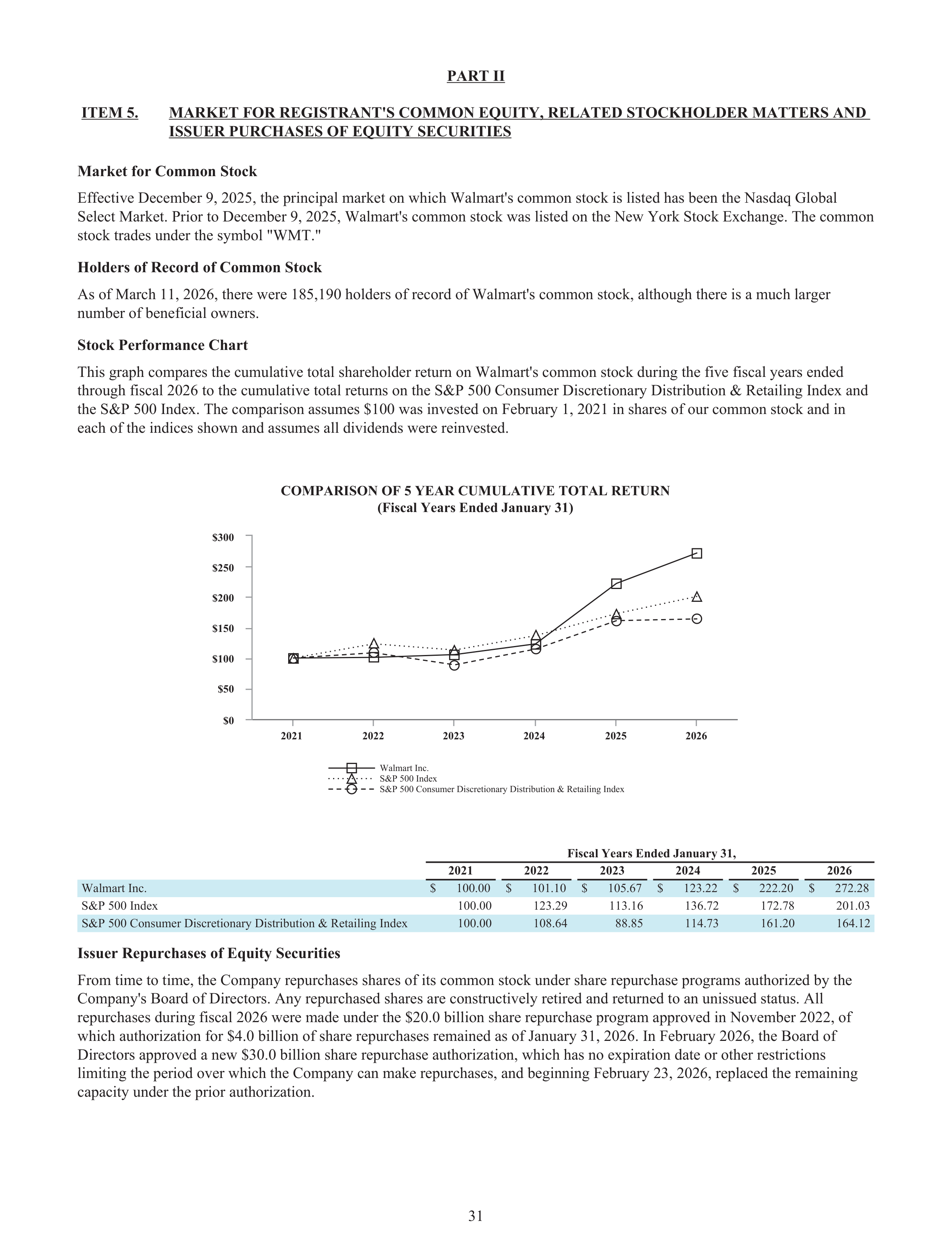
PART II
ITEM 5.
MARKET FOR REGISTRANT'S COMMON EQUITY, RELATED STOCKHOLDER MATTERS AND
ISSUER PURCHASES OF EQUITY SECURITIES
Market for Common Stock
Effective December 9, 2025, the principal market on which Walmart's common stock is listed has been the Nasdaq Global
Select Market. Prior to December 9, 2025, Walmart's common stock was listed on the New York Stock Exchange. The common
stock trades under the symbol "WMT."
Holders of Record of Common Stock
As of March 11, 2026, there were 185,190 holders of record of Walmart's common stock, although there is a much larger
number of beneficial owners.
Stock Performance Chart
This graph compares the cumulative total shareholder return on Walmart's common stock during the five fiscal years ended
through fiscal 2026 to the cumulative total returns on the S&P 500 Consumer Discretionary Distribution & Retailing Index and
the S&P 500 Index. The comparison assumes $100 was invested on February 1, 2021 in shares of our common stock and in
each of the indices shown and assumes all dividends were reinvested.
COMPARISON OF 5 YEAR CUMULATIVE TOTAL RETURN
(Fiscal Years Ended January 31)
Walmart Inc.
S&P 500 Index
S&P 500 Consumer Discretionary Distribution & Retailing Index
2021
2022
2023
2024
2025
2026
$0
$50
$100
$150
$200
$250
$300
Fiscal Years Ended January 31,
2021
2022
2023
2024
2025
2026
Walmart Inc.
$
100.00
$
101.10
$
105.67
$
123.22
$
222.20
$
272.28
S&P 500 Index
100.00
123.29
113.16
136.72
172.78
201.03
S&P 500 Consumer Discretionary Distribution & Retailing Index
100.00
108.64
88.85
114.73
161.20
164.12
Issuer Repurchases of Equity Securities
From time to time, the Company repurchases shares of its common stock under share repurchase programs authorized by the
Company's Board of Directors. Any repurchased shares are constructively retired and returned to an unissued status. All
repurchases during fiscal 2026 were made under the $20.0 billion share repurchase program approved in November 2022, of
which authorization for $4.0 billion of share repurchases remained as of January 31, 2026. In February 2026, the Board of
Directors approved a new $30.0 billion share repurchase authorization, which has no expiration date or other restrictions
limiting the period over which the Company can make repurchases, and beginning February 23, 2026, replaced the remaining
capacity under the prior authorization.
31
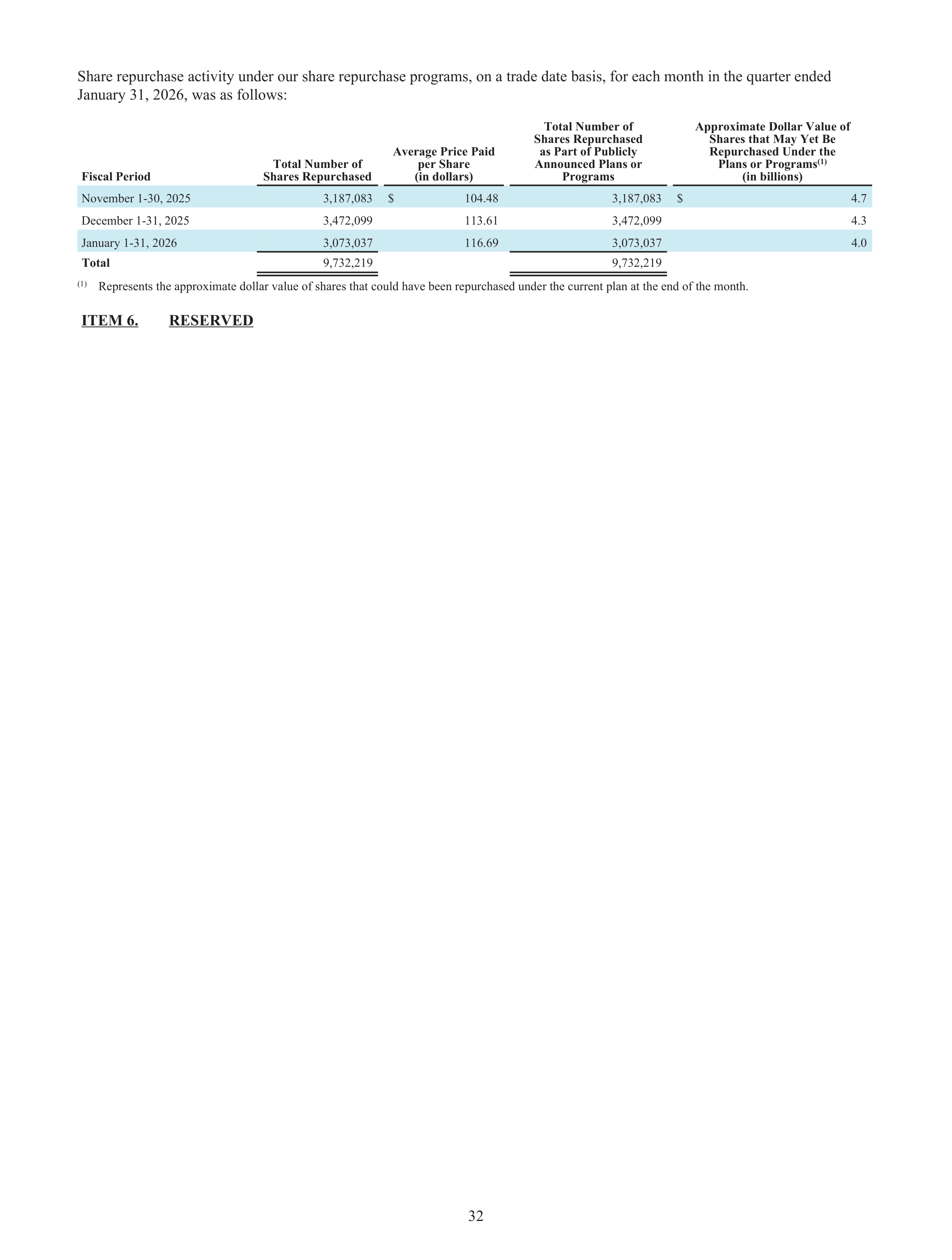
Share repurchase activity under our share repurchase programs, on a trade date basis, for each month in the quarter ended
January 31, 2026, was as follows:
Fiscal Period
Total Number of
Shares Repurchased
Average Price Paid
per Share
(in dollars)
Total Number of
Shares Repurchased
as Part of Publicly
Announced Plans or
Programs
Approximate Dollar Value of
Shares that May Yet Be
Repurchased Under the
Plans or Programs
(1)
(in billions)
November 1-30, 2025
3,187,083
$
104.48
3,187,083
$
4.7
December 1-31, 2025
3,472,099
113.61
3,472,099
4.3
January 1-31, 2026
3,073,037
116.69
3,073,037
4.0
Total
9,732,219
9,732,219
(1)
Represents the approximate dollar value of shares that could have been repurchased under the current plan at the end of the month.
ITEM 6.
RESERVED
32
ITEM 7.
MANAGEMENT'S DISCUSSION AND ANALYSIS OF FINANCIAL CONDITION AND RESULTS OF
OPERATIONS
Overview
This discussion, which presents our results for the fiscal years ended January 31, 2026 ("fiscal 2026"), January 31, 2025 ("fiscal
2025") and January 31, 2024 ("fiscal 2024"), should be read in conjunction with our Consolidated Financial Statements and the
accompanying notes. We intend for this discussion to provide the reader with information that will assist in understanding our
financial statements, the changes in certain key items in those financial statements from period to period and the primary factors
that accounted for those changes. We also discuss certain performance metrics that management uses to assess the Company's
performance. Additionally, the discussion provides information about the financial results of each of the three segments of our
business to provide a better understanding of how each of those segments and its results of operations affect the financial
condition and results of operations of the Company as a whole.
Throughout this Item 7, we discuss segment operating income, comparable store and club sales and other measures.
Management measures the results of the Company's segments using each segment's operating income, including certain
corporate overhead allocations, as well as other measures. From time to time, we revise the measurement of each segment's
operating income and other measures as determined by the information regularly reviewed by our chief operating decision
maker.
In discussing our operating results, the term currency exchange rates refers to the currency exchange rates we use to convert the
operating results for countries where the functional currency is not the U.S. dollar into U.S. dollars. We calculate the effect of
changes in currency exchange rates as the difference between current period activity translated using the current period's
currency exchange rates and the comparable prior year period's currency exchange rates. Additionally, no currency exchange
rate fluctuations are calculated for non-USD acquisitions until owned for 12 months. Throughout our discussion, we refer to the
results of this calculation as the impact of currency exchange rate fluctuations.
Recent Developments, Macroeconomic Conditions and Potential Impacts
We expect continued uncertainty in our business and the global economy due to the following factors: tariffs and trade
restrictions; inflationary trends; fluctuations in global currencies; swings in macroeconomic conditions and their effect on
consumer confidence; changes in employment trends; volatility in fuel prices; and supply chain pressures, any of which may
impact our results. While we operate in a highly dynamic tariff environment, less than one third of what we sell in the U.S. is
imported, with most of our imports coming from China, Mexico, Vietnam, India and Canada. Information on certain risks,
factors, and uncertainties that can affect our operating results and an investment in our securities can be found herein under
"
Item 1A. Risk Factors
."
Our net sales and gross profit margin are influenced in part by our pricing and merchandising strategies in response to cost
increases. Those pricing strategies include, but are not limited to: absorbing cost increases instead of passing those cost
increases on to our customers and members; reducing prices in certain merchandise categories; focusing on opening price
points for certain food categories; and when necessary, passing cost increases on to our customers and members. Merchandising
strategies include, but are not limited to: working with our suppliers to reduce product costs and share in absorbing cost
increases; focusing on private label brands and smaller pack sizes; earlier-than-usual purchasing and in greater volumes or
moderating purchasing in certain categories; and securing ocean carrier and container capacity. These strategies have and may
continue to impact gross profit as a percentage of net sales.
In July 2025, the One Big Beautiful Bill Act (the "OBBB Act") was enacted, introducing a series of corporate tax changes in
the U.S., including 100% bonus depreciation on qualified property and full expensing for research and development
expenditures. The impacts of the OBBB Act were not material to our income tax expense or effective tax rate. Certain
provisions decreased cash taxes paid in fiscal 2026 and may change the timing of cash tax payments in future periods.
For a detailed discussion on results of operations by reportable segment, refer to "
Results of Operations
" below.
Company Performance Metrics
We are committed to helping customers save money and live better through everyday low prices, supported by everyday low
costs. At times, we adjust our business strategies to maintain and strengthen our competitive positions in the countries in which
we operate. We define our financial priorities as follows:
•
Growth - serve customers through a seamless omnichannel experience;
•
Margin - improve our operating income margin through productivity initiatives as well as category and business mix;
and
•
Returns - improve our Return on Investment through margin improvement and disciplined capital spend.
33
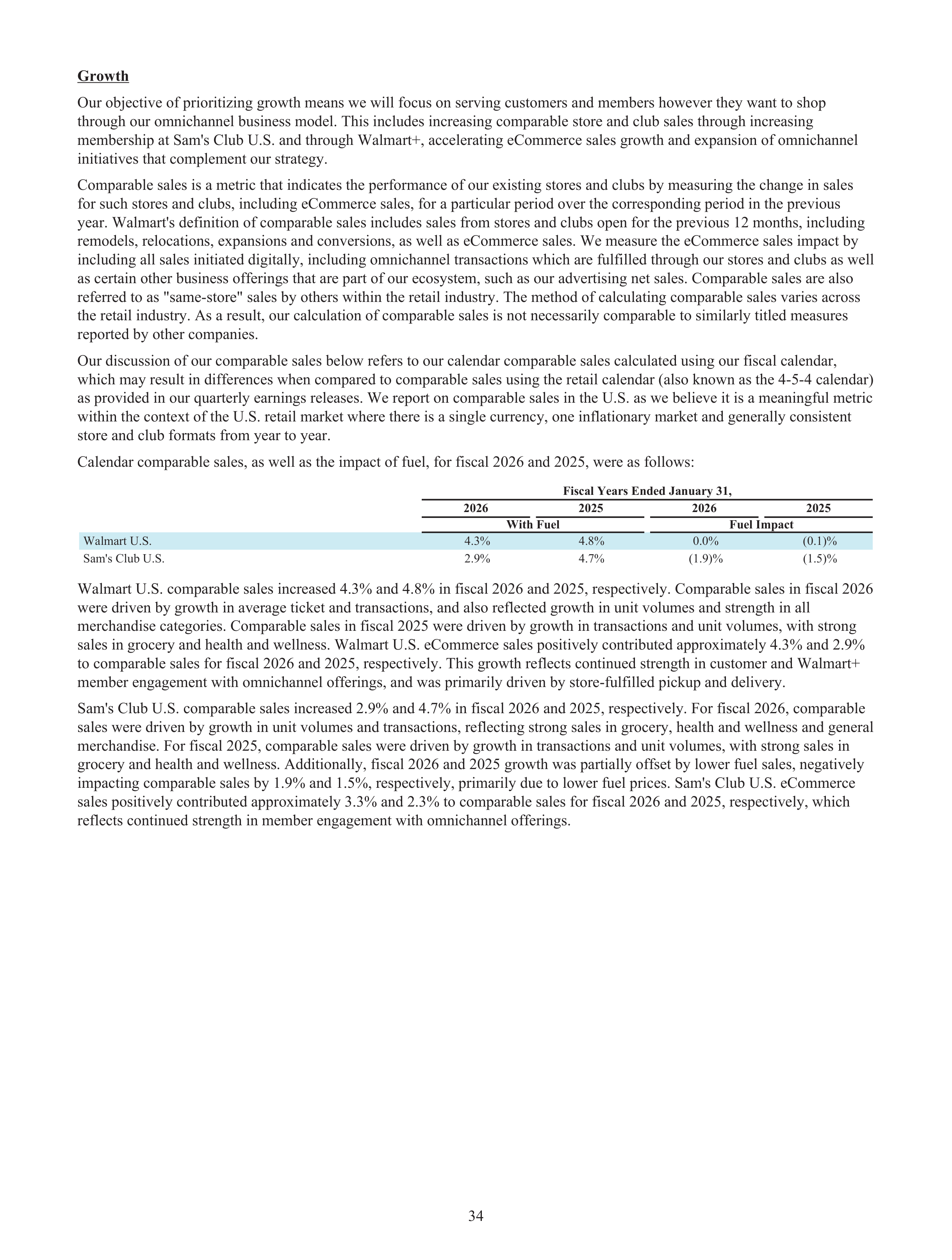
Growth
Our objective of prioritizing growth means we will focus on serving customers and members however they want to shop
through our omnichannel business model. This includes increasing comparable store and club sales through increasing
membership at Sam's Club U.S. and through Walmart+, accelerating eCommerce sales growth and expansion of omnichannel
initiatives that complement our strategy.
Comparable sales is a metric that indicates the performance of our existing stores and clubs by measuring the change in sales
for such stores and clubs, including eCommerce sales, for a particular period over the corresponding period in the previous
year. Walmart's definition of comparable sales includes sales from stores and clubs open for the previous 12 months, including
remodels, relocations, expansions and conversions, as well as eCommerce sales. We measure the eCommerce sales impact by
including all sales initiated digitally, including omnichannel transactions which are fulfilled through our stores and clubs as well
as certain other business offerings that are part of our ecosystem, such as our advertising net sales. Comparable sales are also
referred to as "same-store" sales by others within the retail industry. The method of calculating comparable sales varies across
the retail industry. As a result, our calculation of comparable sales is not necessarily comparable to similarly titled measures
reported by other companies.
Our discussion of our comparable sales below refers to our calendar comparable sales calculated using our fiscal calendar,
which may result in differences when compared to comparable sales using the retail calendar (also known as the 4-5-4 calendar)
as provided in our quarterly earnings releases. We report on comparable sales in the U.S. as we believe it is a meaningful metric
within the context of the U.S. retail market where there is a single currency, one inflationary market and generally consistent
store and club formats from year to year.
Calendar comparable sales, as well as the impact of fuel, for fiscal 2026 and 2025, were as follows:
Fiscal Years Ended January 31,
2026
2025
2026
2025
With Fuel
Fuel Impact
Walmart U.S.
4.3%
4.8%
0.0%
(0.1)%
Sam's Club U.S.
2.9%
4.7%
(1.9)%
(1.5)%
Walmart U.S. comparable sales increased 4.3% and 4.8% in fiscal 2026 and 2025, respectively. Comparable sales in fiscal 2026
were driven by growth in average ticket and transactions, and also reflected growth in unit volumes and strength in all
merchandise categories. Comparable sales in fiscal 2025 were driven by growth in transactions and unit volumes, with strong
sales in grocery and health and wellness. Walmart U.S. eCommerce sales positively contributed approximately 4.3% and 2.9%
to comparable sales for fiscal 2026 and 2025, respectively. This growth reflects continued strength in customer and Walmart+
member engagement with omnichannel offerings, and was primarily driven by store-fulfilled pickup and delivery.
Sam's Club U.S. comparable sales increased 2.9% and 4.7% in fiscal 2026 and 2025, respectively. For fiscal 2026, comparable
sales were driven by growth in unit volumes and transactions, reflecting strong sales in grocery, health and wellness and general
merchandise. For fiscal 2025, comparable sales were driven by growth in transactions and unit volumes, with strong sales in
grocery and health and wellness. Additionally, fiscal 2026 and 2025 growth was partially offset by lower fuel sales, negatively
impacting comparable sales by 1.9% and 1.5%, respectively, primarily due to lower fuel prices. Sam's Club U.S. eCommerce
sales positively contributed approximately 3.3% and 2.3% to comparable sales for fiscal 2026 and 2025, respectively, which
reflects continued strength in member engagement with omnichannel offerings.
34
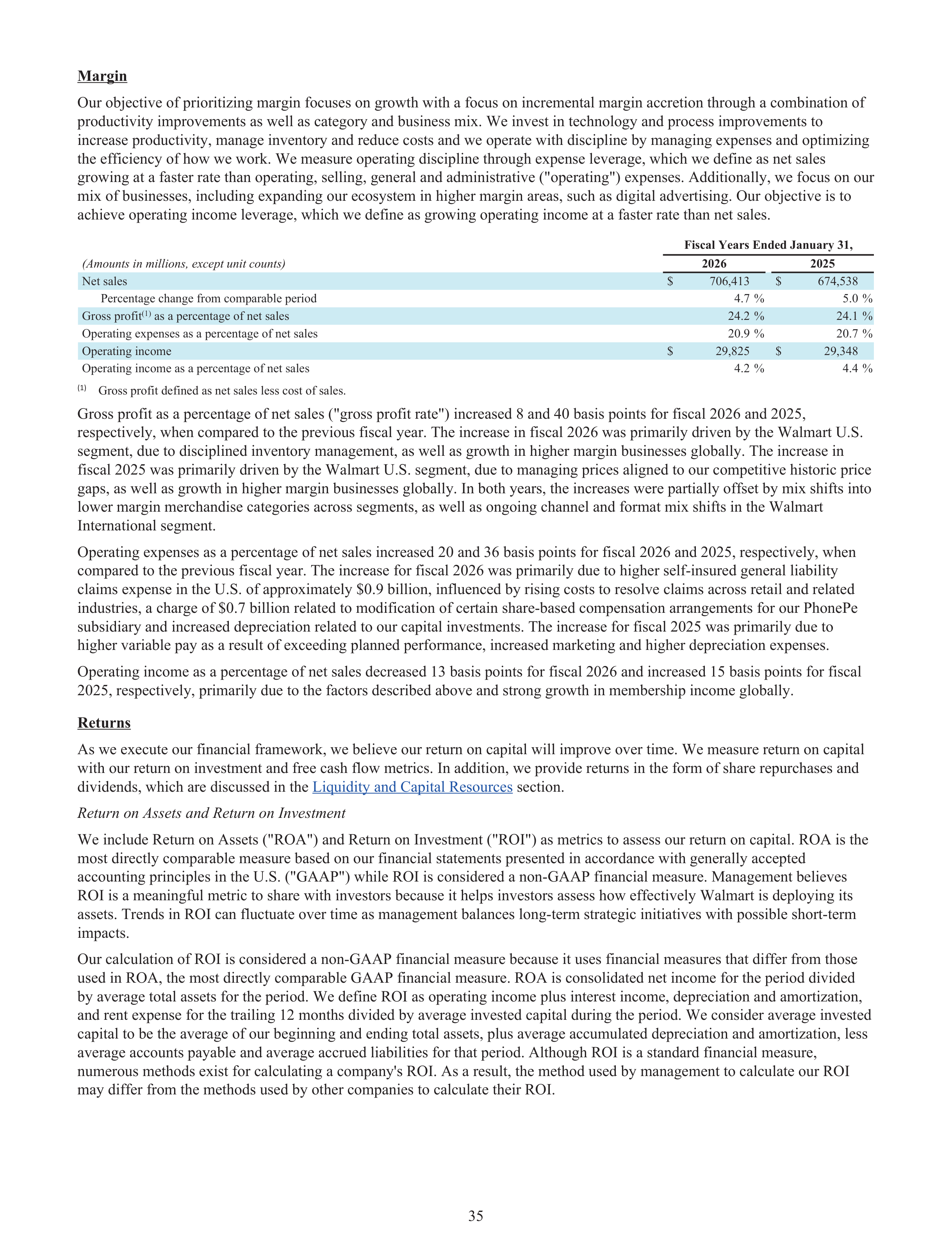
Margin
Our objective of prioritizing margin focuses on growth with a focus on incremental margin accretion through a combination of
productivity improvements as well as category and business mix. We invest in technology and process improvements to
increase productivity, manage inventory and reduce costs and we operate with discipline by managing expenses and optimizing
the efficiency of how we work. We measure operating discipline through expense leverage, which we define as net sales
growing at a faster rate than operating, selling, general and administrative ("operating") expenses. Additionally, we focus on our
mix of businesses, including expanding our ecosystem in higher margin areas, such as digital advertising. Our objective is to
achieve operating income leverage, which we define as growing operating income at a faster rate than net sales.
Fiscal Years Ended January 31,
(Amounts in millions, except unit counts)
2026
2025
Net sales
$
706,413
$
674,538
Percentage change from comparable period
4.7 %
5.0 %
Gross profit
(1)
as a percentage of net sales
24.2 %
24.1 %
Operating expenses as a percentage of net sales
20.9 %
20.7 %
Operating income
$
29,825
$
29,348
Operating income as a percentage of net sales
4.2 %
4.4 %
(1)
Gross profit defined as net sales less cost of sales.
Gross profit as a percentage of net sales ("gross profit rate") increased 8 and 40 basis points for fiscal 2026 and 2025,
respectively, when compared to the previous fiscal year. The increase in fiscal 2026 was primarily driven by the Walmart U.S.
segment, due to disciplined inventory management, as well as growth in higher margin businesses globally. The increase in
fiscal 2025 was primarily driven by the Walmart U.S. segment, due to managing prices aligned to our competitive historic price
gaps, as well as growth in higher margin businesses globally. In both years, the increases were partially offset by mix shifts into
lower margin merchandise categories across segments, as well as ongoing channel and format mix shifts in the Walmart
International segment.
Operating expenses as a percentage of net sales increased 20 and 36 basis points for fiscal 2026 and 2025, respectively, when
compared to the previous fiscal year. The increase for fiscal 2026 was primarily due to higher self-insured general liability
claims expense in the U.S. of approximately $0.9 billion, influenced by rising costs to resolve claims across retail and related
industries, a charge of $0.7 billion related to modification of certain share-based compensation arrangements for our PhonePe
subsidiary and increased depreciation related to our capital investments. The increase for fiscal 2025 was primarily due to
higher variable pay as a result of exceeding planned performance, increased marketing and higher depreciation expenses.
Operating income as a percentage of net sales decreased 13 basis points for fiscal 2026 and increased 15 basis points for fiscal
2025, respectively, primarily due to the factors described above and strong growth in membership income globally.
Returns
As we execute our financial framework, we believe our return on capital will improve over time. We measure return on capital
with our return on investment and free cash flow metrics. In addition, we provide returns in the form of share repurchases and
dividends, which are discussed in the
Liquidity and Capital Resources
section.
Return on Assets and Return on Investment
We include Return on Assets ("ROA") and Return on Investment ("ROI") as metrics to assess our return on capital. ROA is the
most directly comparable measure based on our financial statements presented in accordance with generally accepted
accounting principles in the U.S. ("GAAP") while ROI is considered a non-GAAP financial measure. Management believes
ROI is a meaningful metric to share with investors because it helps investors assess how effectively Walmart is deploying its
assets. Trends in ROI can fluctuate over time as management balances long-term strategic initiatives with possible short-term
impacts.
Our calculation of ROI is considered a non-GAAP financial measure because it uses financial measures that differ from those
used in ROA, the most directly comparable GAAP financial measure. ROA is consolidated net income for the period divided
by average total assets for the period. We define ROI as operating income plus interest income, depreciation and amortization,
and rent expense for the trailing 12 months divided by average invested capital during the period. We consider average invested
capital to be the average of our beginning and ending total assets, plus average accumulated depreciation and amortization, less
average accounts payable and average accrued liabilities for that period. Although ROI is a standard financial measure,
numerous methods exist for calculating a company's ROI. As a result, the method used by management to calculate our ROI
may differ from the methods used by other companies to calculate their ROI.
35
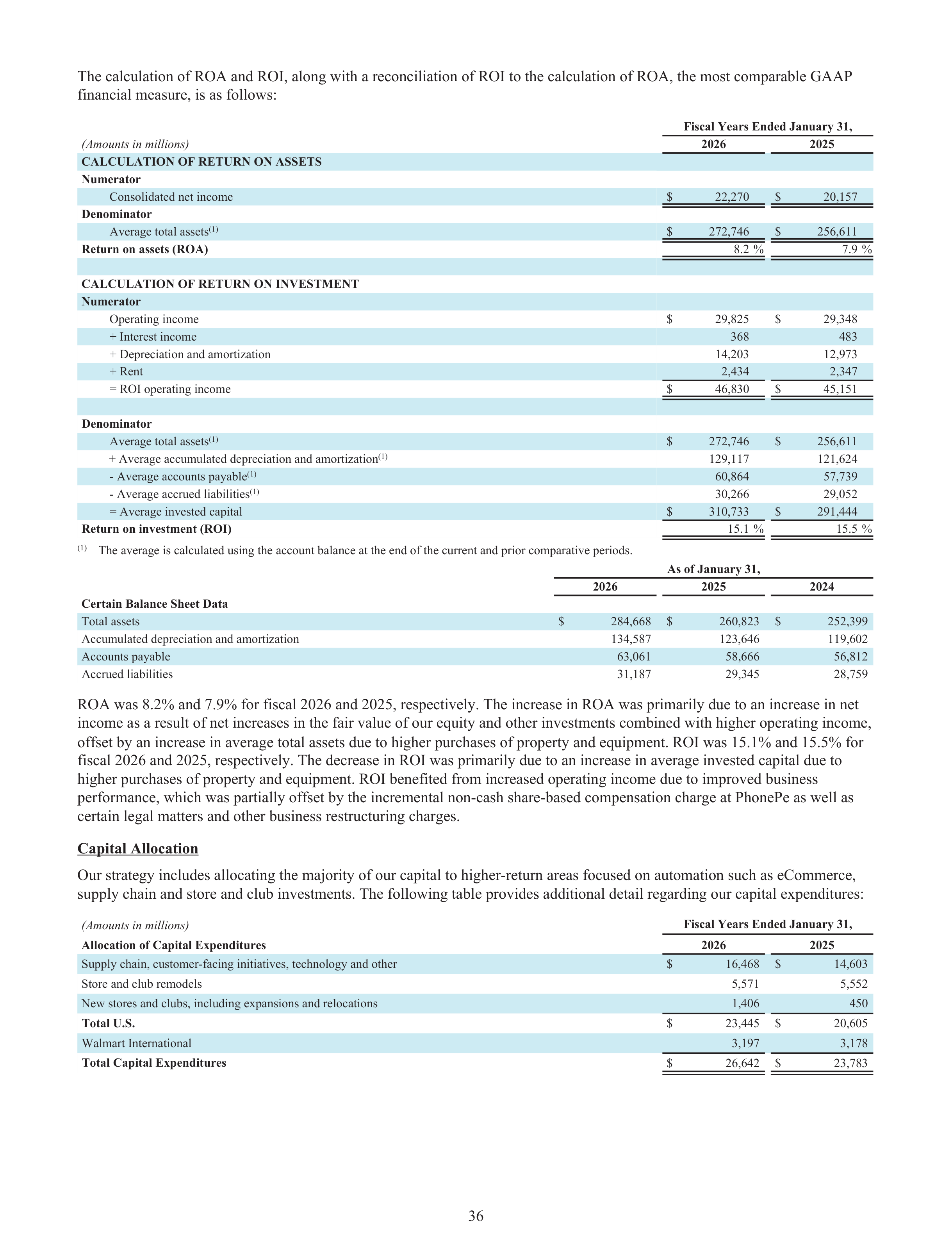
The calculation of ROA and ROI, along with a reconciliation of ROI to the calculation of ROA, the most comparable GAAP
financial measure, is as follows:
Fiscal Years Ended January 31,
(Amounts in millions)
2026
2025
CALCULATION OF RETURN ON ASSETS
Numerator
Consolidated net income
$
22,270
$
20,157
Denominator
Average total assets
(1)
$
272,746
$
256,611
Return on assets (ROA)
8.2 %
7.9 %
CALCULATION OF RETURN ON INVESTMENT
Numerator
Operating income
$
29,825
$
29,348
+ Interest income
368
483
+ Depreciation and amortization
14,203
12,973
+ Rent
2,434
2,347
= ROI operating income
$
46,830
$
45,151
Denominator
Average total assets
(1)
$
272,746
$
256,611
+ Average accumulated depreciation and amortization
(1)
129,117
121,624
- Average accounts payable
(1)
60,864
57,739
- Average accrued liabilities
(1)
30,266
29,052
= Average invested capital
$
310,733
$
291,444
Return on investment (ROI)
15.1 %
15.5 %
(1)
The average is calculated using the account balance at the end of the current and prior comparative periods.
As of January 31,
2026
2025
2024
Certain Balance Sheet Data
Total assets
$
284,668
$
260,823
$
252,399
Accumulated depreciation and amortization
134,587
123,646
119,602
Accounts payable
63,061
58,666
56,812
Accrued liabilities
31,187
29,345
28,759
ROA was 8.2% and 7.9% for fiscal 2026 and 2025, respectively. The increase in ROA was primarily due to an increase in net
income as a result of net increases in the fair value of our equity and other investments combined with higher operating income,
offset by an increase in average total assets due to higher purchases of property and equipment.
ROI was 15.1% and 15.5% for
fiscal 2026 and 2025, respectively. The decrease in ROI was primarily due to an increase in average invested capital due to
higher purchases of property and equipment. ROI benefited from increased operating income due to improved business
performance, which was partially offset by the incremental non-cash share-based compensation charge at PhonePe as well as
certain legal matters and other business restructuring charges.
Capital Allocation
Our strategy includes allocating the majority of our capital to higher-return areas focused on automation such as eCommerce,
supply chain and store and club investments. The following table provides additional detail regarding our capital expenditures:
(Amounts in millions)
Fiscal Years Ended January 31,
Allocation of Capital Expenditures
2026
2025
Supply chain, customer-facing initiatives, technology and other
$
16,468
$
14,603
Store and club remodels
5,571
5,552
New stores and clubs, including expansions and relocations
1,406
450
Total U.S.
$
23,445
$
20,605
Walmart International
3,197
3,178
Total Capital Expenditures
$
26,642
$
23,783
36
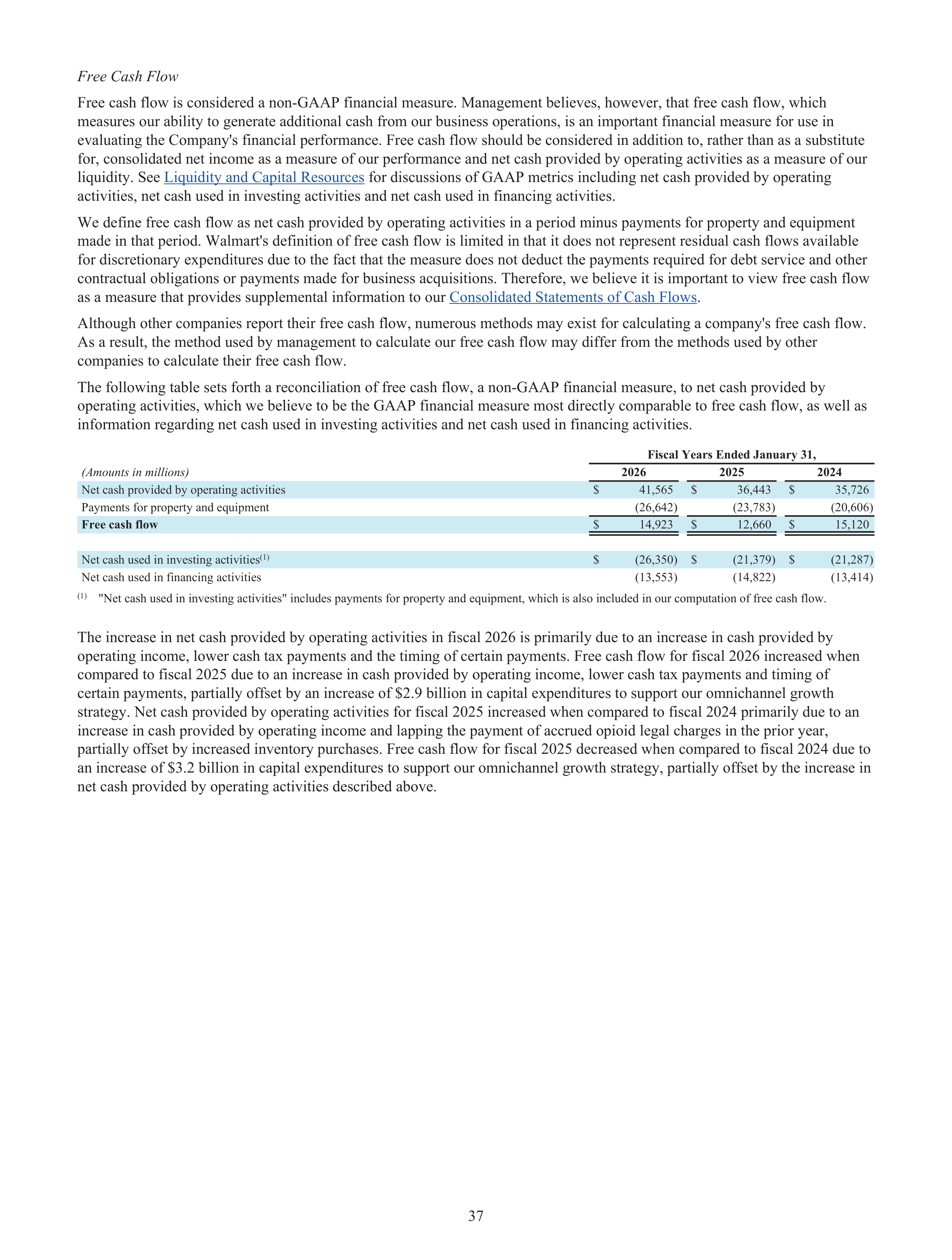
Free Cash Flow
Free cash flow is considered a non-GAAP financial measure. Management believes, however, that free cash flow, which
measures our ability to generate additional cash from our business operations, is an important financial measure for use in
evaluating the Company's financial performance. Free cash flow should be considered in addition to, rather than as a substitute
for, consolidated net income as a measure of our performance and net cash provided by operating activities as a measure of our
liquidity. See
Liquidity and Capital Resources
for discussions of GAAP metrics including net cash provided by operating
activities, net cash used in investing activities and net cash used in financing activities.
We define free cash flow as net cash provided by operating activities in a period minus payments for property and equipment
made in that period. Walmart's definition of free cash flow is limited in that it does not represent residual cash flows available
for discretionary expenditures due to the fact that the measure does not deduct the payments required for debt service and other
contractual obligations or payments made for business acquisitions. Therefore, we believe it is important to view free cash flow
as a measure that provides supplemental information to our
Consolidated Statements of Cash Flows
.
Although other companies report their free cash flow, numerous methods may exist for calculating a company's free cash flow.
As a result, the method used by management to calculate our free cash flow may differ from the methods used by other
companies to calculate their free cash flow.
The following table sets forth a reconciliation of free cash flow, a non-GAAP financial measure, to net cash provided by
operating activities, which we believe to be the GAAP financial measure most directly comparable to free cash flow, as well as
information regarding net cash used in investing activities and net cash used in financing activities.
Fiscal Years Ended January 31,
(Amounts in millions)
2026
2025
2024
Net cash provided by operating activities
$
41,565
$
36,443
$
35,726
Payments for property and equipment
(26,642)
(23,783)
(20,606)
Free cash flow
$
14,923
$
12,660
$
15,120
Net cash used in investing activities
(1)
$
(26,350)
$
(21,379)
$
(21,287)
Net cash used in financing activities
(13,553)
(14,822)
(13,414)
(1)
"Net cash used in investing activities" includes payments for property and equipment, which is also included in our computation of free cash flow.
The increase in net cash provided by operating activities in fiscal 2026 is primarily due to an increase in cash provided by
operating income, lower cash tax payments and the timing of certain payments. Free cash flow for fiscal 2026 increased when
compared to fiscal 2025 due to an increase in cash provided by operating income, lower cash tax payments and timing of
certain payments, partially offset by an increase of $2.9 billion in capital expenditures to support our omnichannel growth
strategy. Net cash provided by operating activities for fiscal 2025 increased when compared to fiscal 2024 primarily due to an
increase in cash provided by operating income and lapping the payment of accrued opioid legal charges in the prior year,
partially offset by increased inventory purchases. Free cash flow for fiscal 2025 decreased when compared to fiscal 2024 due to
an increase of $3.2 billion in capital expenditures to support our omnichannel growth strategy, partially offset by the increase in
net cash provided by operating activities described above.
37
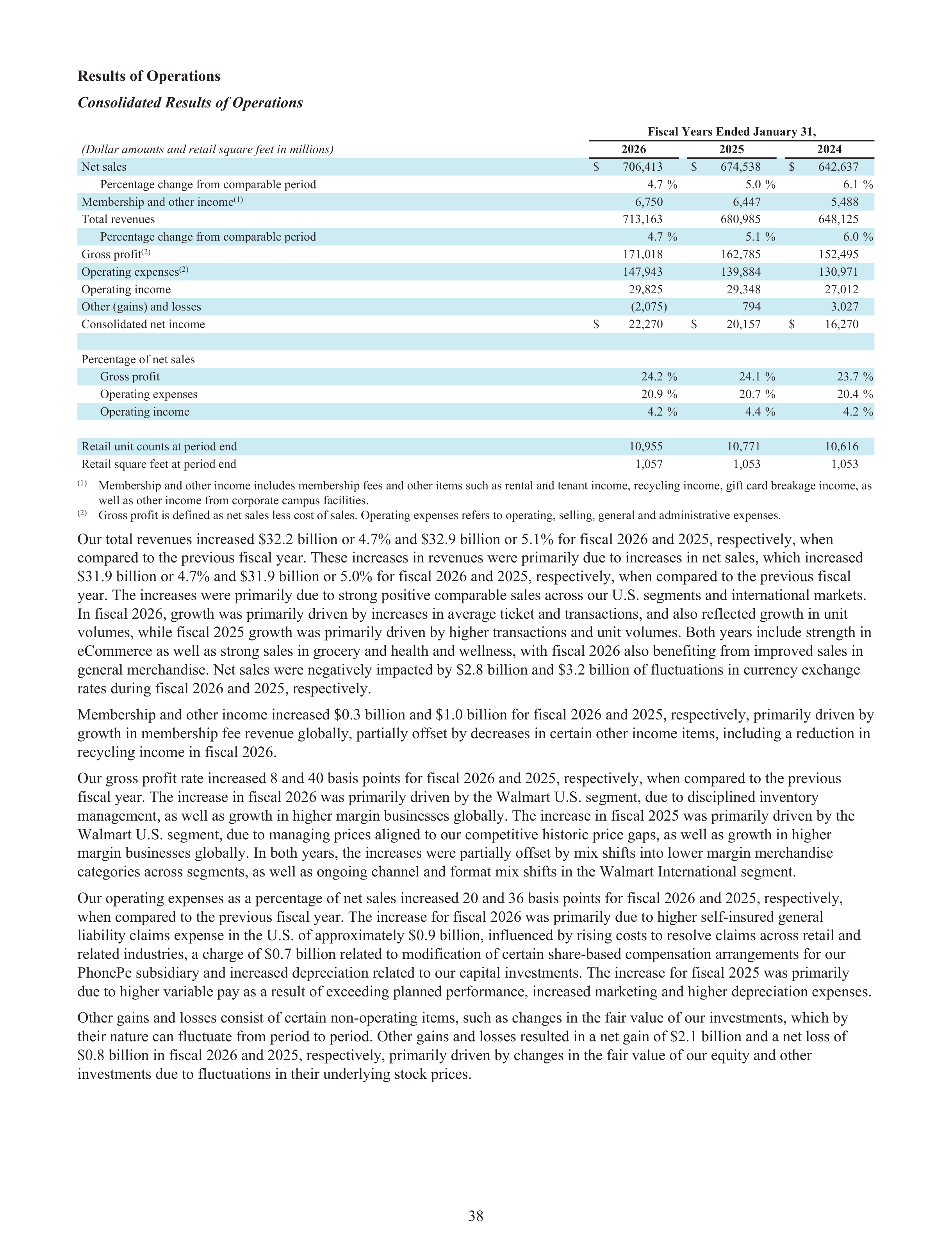
Results of Operations
Consolidated Results of Operations
Fiscal Years Ended January 31,
(Dollar amounts and retail square feet in millions)
2026
2025
2024
Net sales
$
706,413
$
674,538
$
642,637
Percentage change from comparable period
4.7 %
5.0 %
6.1 %
Membership and other income
(1)
6,750
6,447
5,488
Total revenues
713,163
680,985
648,125
Percentage change from comparable period
4.7 %
5.1 %
6.0 %
Gross profit
(2)
171,018
162,785
152,495
Operating expenses
(2)
147,943
139,884
130,971
Operating income
29,825
29,348
27,012
Other (gains) and losses
(2,075)
794
3,027
Consolidated net income
$
22,270
$
20,157
$
16,270
Percentage of net sales
Gross profit
24.2 %
24.1 %
23.7 %
Operating expenses
20.9 %
20.7 %
20.4 %
Operating income
4.2 %
4.4 %
4.2 %
Retail unit counts at period end
10,955
10,771
10,616
Retail square feet at period end
1,057
1,053
1,053
(1)
Membership and other income includes membership fees and other items such as rental and tenant income, recycling income, gift card breakage income, as
well as other income from corporate campus facilities.
(2)
Gross profit is defined as net sales less cost of sales. Operating expenses refers to operating, selling, general and administrative expenses.
Our total revenues increased $32.2 billion or 4.7% and $32.9 billion or 5.1% for fiscal 2026 and 2025, respectively, when
compared to the previous fiscal year. These increases in revenues were primarily due to increases in net sales, which increased
$31.9 billion or 4.7% and $31.9 billion or 5.0% for fiscal 2026 and 2025, respectively, when compared to the previous fiscal
year. The increases were primarily due to strong positive comparable sales across our U.S. segments and international markets.
In fiscal 2026, growth was primarily driven by increases in average ticket and transactions, and also reflected growth in unit
volumes, while fiscal 2025 growth was primarily driven by higher transactions and unit volumes. Both years include strength in
eCommerce as well as strong sales in grocery and health and wellness, with fiscal 2026 also benefiting from improved sales in
general merchandise. Net sales were negatively impacted by $2.8 billion and $3.2 billion of fluctuations in currency exchange
rates during fiscal 2026 and 2025, respectively.
Membership and other income increased $0.3 billion and $1.0 billion for fiscal 2026 and 2025, respectively, primarily driven by
growth in membership fee revenue globally, partially offset by decreases in certain other income items, including a reduction in
recycling income in fiscal 2026.
Our gross profit rate increased 8 and 40 basis points for fiscal 2026 and 2025, respectively, when compared to the previous
fiscal year. The increase in fiscal 2026 was primarily driven by the Walmart U.S. segment, due to disciplined inventory
management, as well as growth in higher margin businesses globally. The increase in fiscal 2025 was primarily driven by the
Walmart U.S. segment, due to managing prices aligned to our competitive historic price gaps, as well as growth in higher
margin businesses globally. In both years, the increases were partially offset by mix shifts into lower margin merchandise
categories across segments, as well as ongoing channel and format mix shifts in the Walmart International segment.
Our operating expenses as a percentage of net sales increased 20 and 36 basis points for fiscal 2026 and 2025, respectively,
when compared to the previous fiscal year. The increase for fiscal 2026 was primarily due to higher self-insured general
liability claims expense in the U.S. of approximately $0.9 billion, influenced by rising costs to resolve claims across retail and
related industries, a charge of $0.7 billion related to modification of certain share-based compensation arrangements for our
PhonePe subsidiary and increased depreciation related to our capital investments. The increase for fiscal 2025 was primarily
due to higher variable pay as a result of exceeding planned performance, increased marketing and higher depreciation expenses.
Other gains and losses consist of certain non-operating items, such as changes in the fair value of our investments, which by
their nature can fluctuate from period to period. Other gains and losses resulted in a net gain of $2.1 billion and a net loss of
$0.8 billion in fiscal 2026 and 2025, respectively, primarily driven by changes in the fair value of our equity and other
investments due to fluctuations in their underlying stock prices.
38
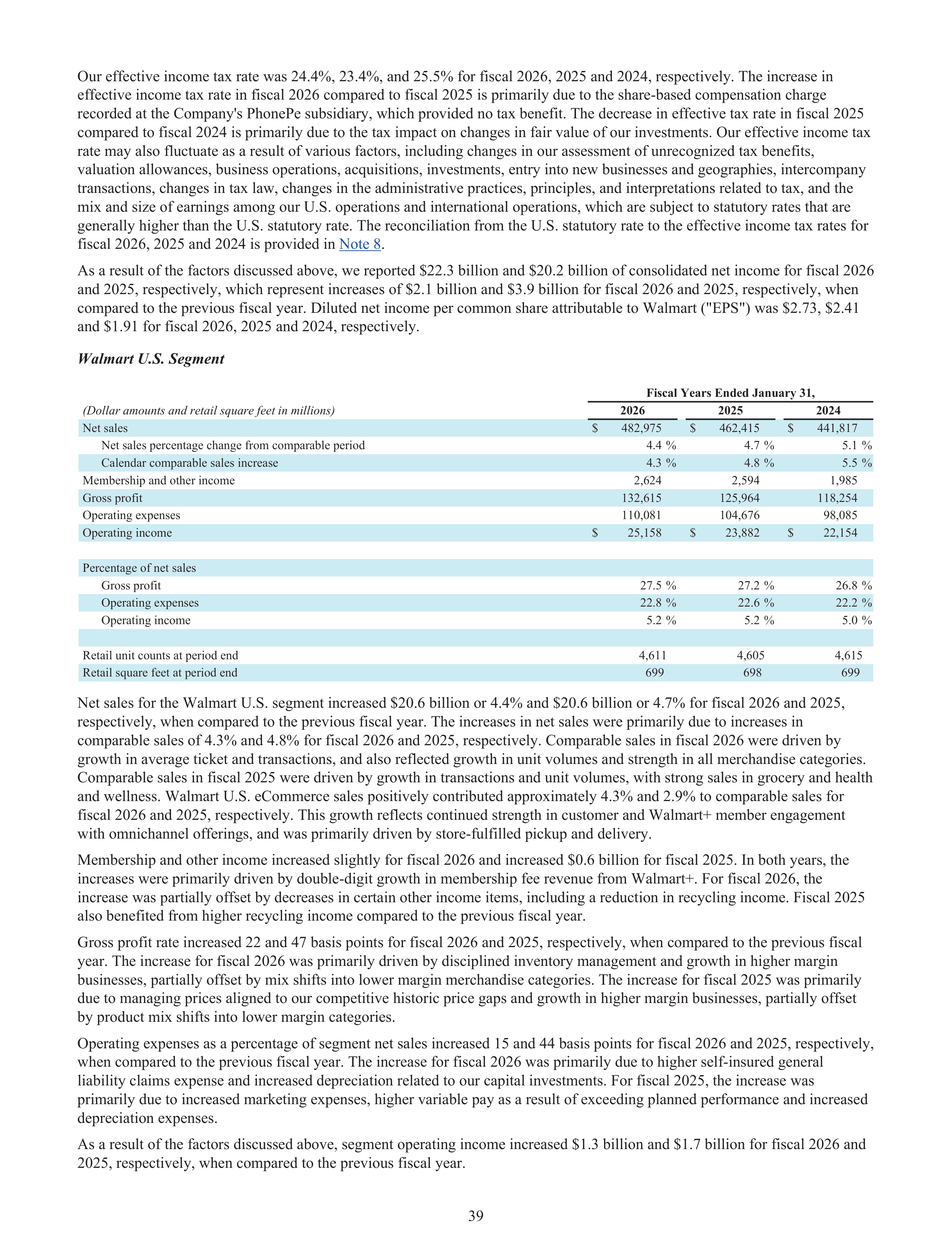
Our effective income tax rate was 24.4%, 23.4%, and 25.5% for fiscal 2026, 2025 and 2024, respectively. The increase in
effective income tax rate in fiscal 2026 compared to fiscal 2025 is primarily due to the share-based compensation charge
recorded at the Company's PhonePe subsidiary, which provided no tax benefit. The decrease in effective tax rate in fiscal 2025
compared to fiscal 2024 is primarily due to the tax impact on changes in fair value of our investments. Our effective income tax
rate may also fluctuate as a result of various factors, including changes in our assessment of unrecognized tax benefits,
valuation allowances, business operations, acquisitions, investments, entry into new businesses and geographies, intercompany
transactions, changes in tax law, changes in the administrative practices, principles, and interpretations related to tax, and the
mix and size of earnings among our U.S. operations and international operations, which are subject to statutory rates that are
generally higher than the U.S. statutory rate. The reconciliation from the U.S. statutory rate to the effective income tax rates for
fiscal 2026, 2025 and 2024 is provided in
Note 8
.
As a result of the factors discussed above, we reported $22.3 billion and $20.2 billion of consolidated net income for fiscal 2026
and 2025, respectively, which represent increases of $2.1 billion and $3.9 billion for fiscal 2026 and 2025, respectively, when
compared to the previous fiscal year. Diluted net income per common share attributable to Walmart ("EPS") was $2.73, $2.41
and $1.91 for fiscal 2026, 2025 and 2024, respectively.
Walmart U.S. Segment
Fiscal Years Ended January 31,
(Dollar amounts and retail square feet in millions)
2026
2025
2024
Net sales
$
482,975
$
462,415
$
441,817
Net sales percentage change from comparable period
4.4 %
4.7 %
5.1 %
Calendar comparable sales increase
4.3 %
4.8 %
5.5 %
Membership and other income
2,624
2,594
1,985
Gross profit
132,615
125,964
118,254
Operating expenses
110,081
104,676
98,085
Operating income
$
25,158
$
23,882
$
22,154
Percentage of net sales
Gross profit
27.5 %
27.2 %
26.8 %
Operating expenses
22.8 %
22.6 %
22.2 %
Operating income
5.2 %
5.2 %
5.0 %
Retail unit counts at period end
4,611
4,605
4,615
Retail square feet at period end
699
698
699
Net sales for the Walmart U.S. segment increased $20.6 billion or 4.4% and $20.6 billion or 4.7% for fiscal 2026 and 2025,
respectively, when compared to the previous fiscal year. The increases in net sales were primarily due to increases in
comparable sales of 4.3% and 4.8% for fiscal 2026 and 2025, respectively. Comparable sales in fiscal 2026 were driven by
growth in average ticket and transactions, and also reflected growth in unit volumes and strength in all merchandise categories.
Comparable sales in fiscal 2025 were driven by growth in transactions and unit volumes, with strong sales in grocery and health
and wellness. Walmart U.S. eCommerce sales positively contributed approximately 4.3% and 2.9% to comparable sales for
fiscal 2026 and 2025, respectively. This growth reflects continued strength in customer and Walmart+ member engagement
with omnichannel offerings, and was primarily driven by store-fulfilled pickup and delivery.
Membership and other income increased slightly for fiscal 2026 and increased $0.6 billion for fiscal 2025. In both years, the
increases were primarily driven by double-digit growth in membership fee revenue from Walmart+. For fiscal 2026, the
increase was partially offset by decreases in certain other income items, including a reduction in recycling income. Fiscal 2025
also benefited from higher recycling income compared to the previous fiscal year.
Gross profit rate increased 22 and 47 basis points for fiscal 2026 and 2025, respectively, when compared to the previous fiscal
year. The increase for fiscal 2026 was primarily driven by disciplined inventory management and growth in higher margin
businesses, partially offset by mix shifts into lower margin merchandise categories. The increase for fiscal 2025 was primarily
due to managing prices aligned to our competitive historic price gaps and growth in higher margin businesses, partially offset
by product mix shifts into lower margin categories.
Operating expenses as a percentage of segment net sales increased 15 and 44 basis points for fiscal 2026 and 2025, respectively,
when compared to the previous fiscal year. The increase for fiscal 2026 was primarily due to higher self-insured general
liability claims expense and increased depreciation related to our capital investments. For fiscal 2025, the increase was
primarily due to increased marketing expenses, higher variable pay as a result of exceeding planned performance and increased
depreciation expenses.
As a result of the factors discussed above, segment operating income increased $1.3 billion and $1.7 billion for fiscal 2026 and
2025, respectively, when compared to the previous fiscal year.
39
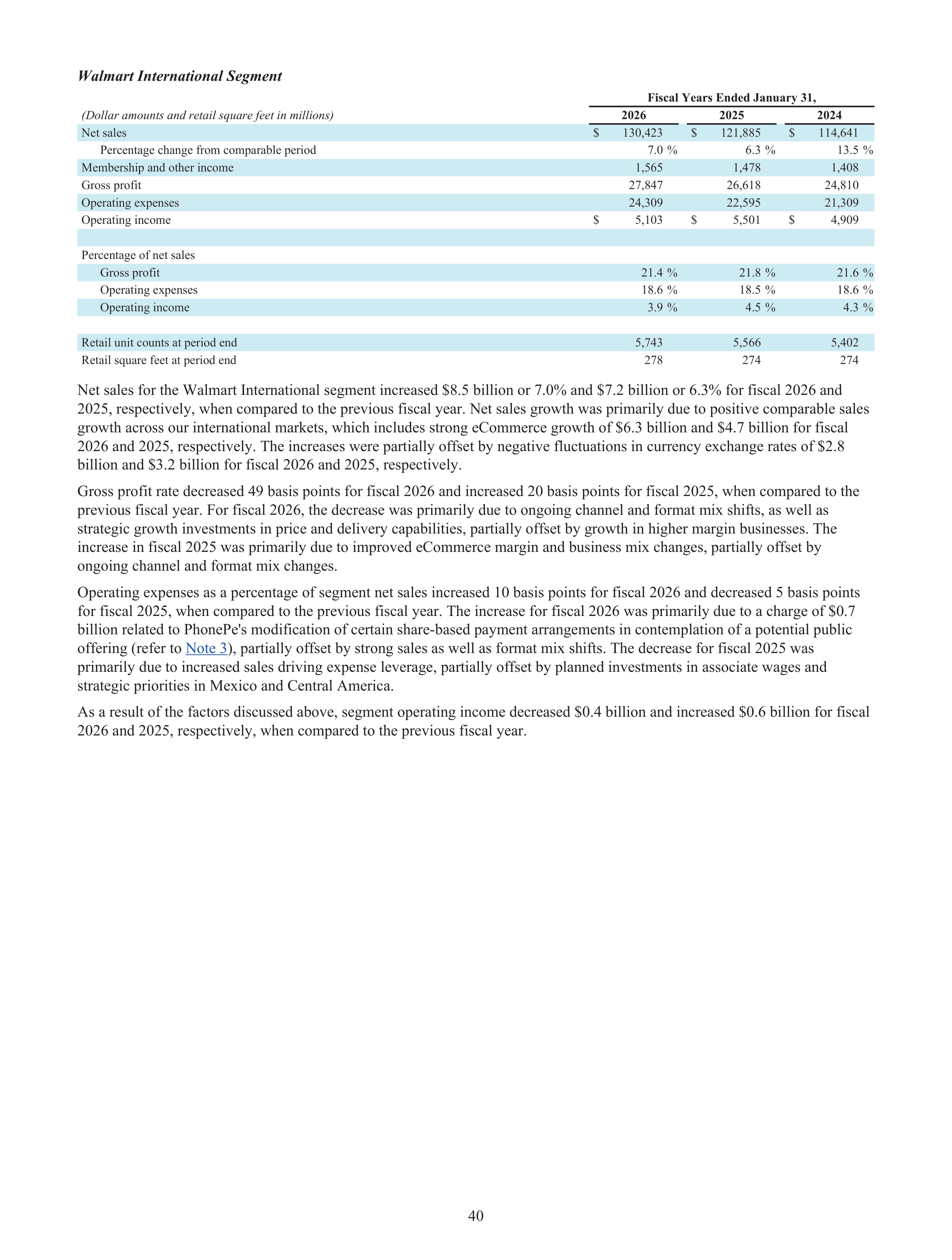
Walmart International Segment
Fiscal Years Ended January 31,
(Dollar amounts and retail square feet in millions)
2026
2025
2024
Net sales
$
130,423
$
121,885
$
114,641
Percentage change from comparable period
7.0 %
6.3 %
13.5 %
Membership and other income
1,565
1,478
1,408
Gross profit
27,847
26,618
24,810
Operating expenses
24,309
22,595
21,309
Operating income
$
5,103
$
5,501
$
4,909
Percentage of net sales
Gross profit
21.4 %
21.8 %
21.6 %
Operating expenses
18.6 %
18.5 %
18.6 %
Operating income
3.9 %
4.5 %
4.3 %
Retail unit counts at period end
5,743
5,566
5,402
Retail square feet at period end
278
274
274
Net sales for the Walmart International segment increased $8.5 billion or 7.0% and $7.2 billion or 6.3% for fiscal 2026 and
2025, respectively, when compared to the previous fiscal year. Net sales growth was primarily due to positive comparable sales
growth across our international markets, which includes strong eCommerce growth of $6.3 billion and $4.7 billion for fiscal
2026 and 2025, respectively. The increases were partially offset by negative fluctuations in currency exchange rates of $2.8
billion and $3.2 billion for fiscal 2026 and 2025, respectively.
Gross profit rate decreased 49 basis points for fiscal 2026 and increased 20 basis points for fiscal 2025, when compared to the
previous fiscal year. For fiscal 2026, the decrease was primarily due to ongoing channel and format mix shifts, as well as
strategic growth investments in price and delivery capabilities, partially offset by growth in higher margin businesses. The
increase in fiscal 2025 was primarily due to improved eCommerce margin and business mix changes, partially offset by
ongoing channel and format mix changes.
Operating expenses as a percentage of segment net sales increased 10 basis points for fiscal 2026 and decreased 5 basis points
for fiscal 2025, when compared to the previous fiscal year. The increase for fiscal 2026 was primarily due to a charge of $0.7
billion related to PhonePe's modification of certain share-based payment arrangements in contemplation of a potential public
offering (refer to
Note 3
), partially offset by strong sales as well as format mix shifts. The decrease for fiscal 2025 was
primarily due to increased sales driving expense leverage, partially offset by planned investments in associate wages and
strategic priorities in Mexico and Central America.
As a result of the factors discussed above, segment operating income decreased $0.4 billion and increased $0.6 billion for fiscal
2026 and 2025, respectively, when compared to the previous fiscal year.
40
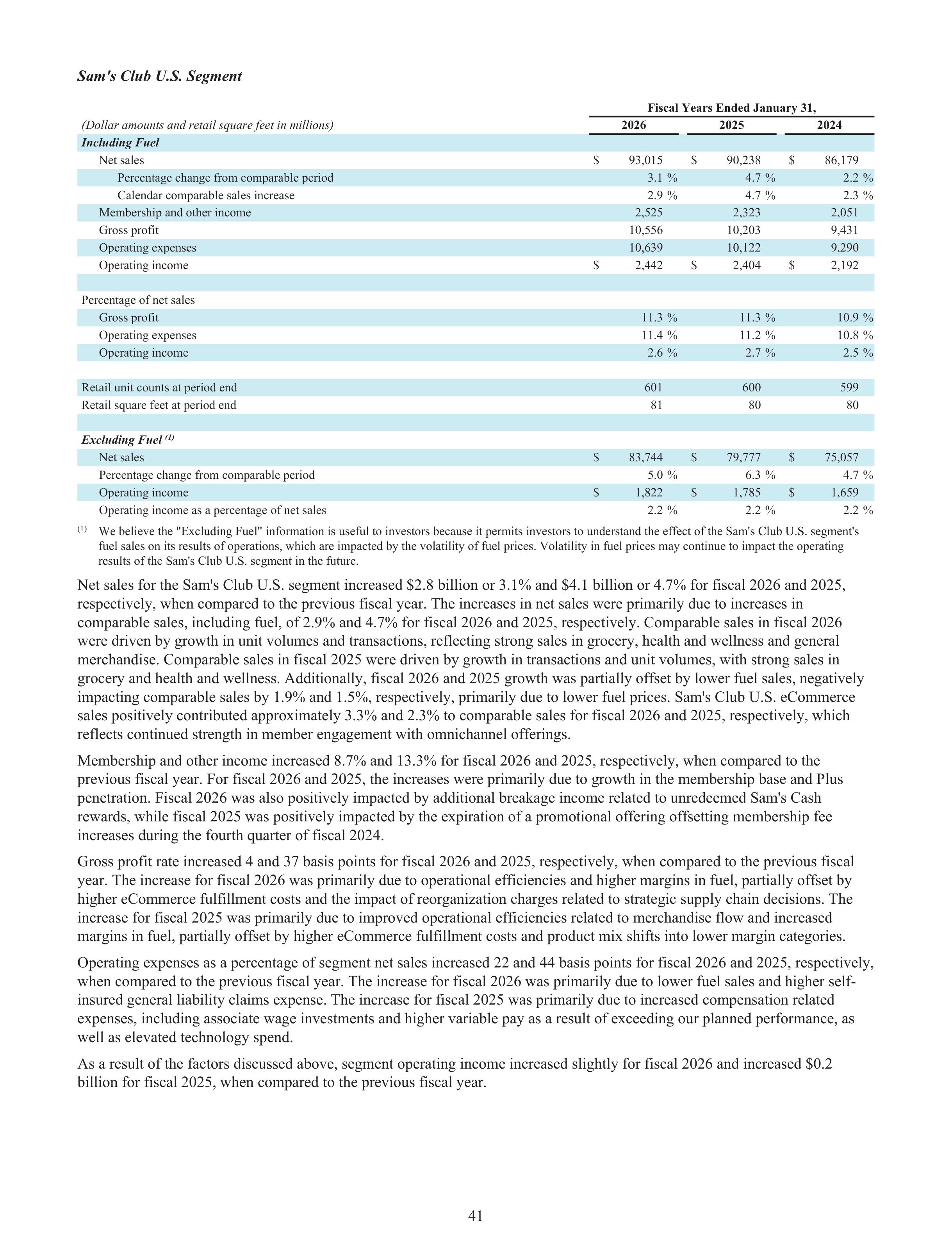
Sam's Club U.S. Segment
Fiscal Years Ended January 31,
(Dollar amounts and retail square feet in millions)
2026
2025
2024
Including Fuel
Net sales
$
93,015
$
90,238
$
86,179
Percentage change from comparable period
3.1 %
4.7 %
2.2 %
Calendar comparable sales increase
2.9 %
4.7 %
2.3 %
Membership and other income
2,525
2,323
2,051
Gross profit
10,556
10,203
9,431
Operating expenses
10,639
10,122
9,290
Operating income
$
2,442
$
2,404
$
2,192
Percentage of net sales
Gross profit
11.3 %
11.3 %
10.9 %
Operating expenses
11.4 %
11.2 %
10.8 %
Operating income
2.6 %
2.7 %
2.5 %
Retail unit counts at period end
601
600
599
Retail square feet at period end
81
80
80
Excluding Fuel
(1)
Net sales
$
83,744
$
79,777
$
75,057
Percentage change from comparable period
5.0 %
6.3 %
4.7 %
Operating income
$
1,822
$
1,785
$
1,659
Operating income as a percentage of net sales
2.2 %
2.2 %
2.2 %
(1)
We believe the "Excluding Fuel" information is useful to investors because it permits investors to understand the effect of the Sam's Club U.S. segment's
fuel sales on its results of operations, which are impacted by the volatility of fuel prices. Volatility in fuel prices may continue to impact the operating
results of the Sam's Club U.S. segment in the future.
Net sales for the Sam's Club U.S. segment increased $2.8 billion or 3.1% and $4.1 billion or 4.7% for fiscal 2026 and 2025,
respectively, when compared to the previous fiscal year. The increases in net sales were primarily due to increases in
comparable sales, including fuel, of 2.9% and 4.7% for fiscal 2026 and 2025, respectively. Comparable sales in fiscal 2026
were driven by growth in unit volumes and transactions, reflecting strong sales in grocery, health and wellness and general
merchandise. Comparable sales in fiscal 2025 were driven by growth in transactions and unit volumes, with strong sales in
grocery and health and wellness. Additionally, fiscal 2026 and 2025 growth was partially offset by lower fuel sales, negatively
impacting comparable sales by 1.9% and 1.5%, respectively, primarily due to lower fuel prices. Sam's Club U.S. eCommerce
sales positively contributed approximately 3.3% and 2.3% to comparable sales for fiscal 2026 and 2025, respectively, which
reflects continued strength in member engagement with omnichannel offerings.
Membership and other income increased 8.7% and 13.3% for fiscal 2026 and 2025, respectively, when compared to the
previous fiscal year. For fiscal 2026 and 2025, the increases were primarily due to growth in the membership base and Plus
penetration. Fiscal 2026 was also positively impacted by additional breakage income related to unredeemed Sam's Cash
rewards, while fiscal 2025 was positively impacted by the expiration of a promotional offering offsetting membership fee
increases during the fourth quarter of fiscal 2024.
Gross profit rate increased 4 and 37 basis points for fiscal 2026 and 2025, respectively, when compared to the previous fiscal
year. The increase for fiscal 2026 was primarily due to operational efficiencies and higher margins in fuel, partially offset by
higher eCommerce fulfillment costs and the impact of reorganization charges related to strategic supply chain decisions. The
increase for fiscal 2025 was primarily due to improved operational efficiencies related to merchandise flow and increased
margins in fuel, partially offset by higher eCommerce fulfillment costs and product mix shifts into lower margin categories.
Operating expenses as a percentage of segment net sales increased 22 and 44 basis points for fiscal 2026 and 2025, respectively,
when compared to the previous fiscal year. The increase for fiscal 2026 was primarily due to lower fuel sales and higher self-
insured general liability claims expense. The increase for fiscal 2025 was primarily due to increased compensation related
expenses, including associate wage investments and higher variable pay as a result of exceeding our planned performance, as
well as elevated technology spend.
As a result of the factors discussed above, segment operating income increased slightly for fiscal 2026 and increased $0.2
billion for fiscal 2025, when compared to the previous fiscal year.
41
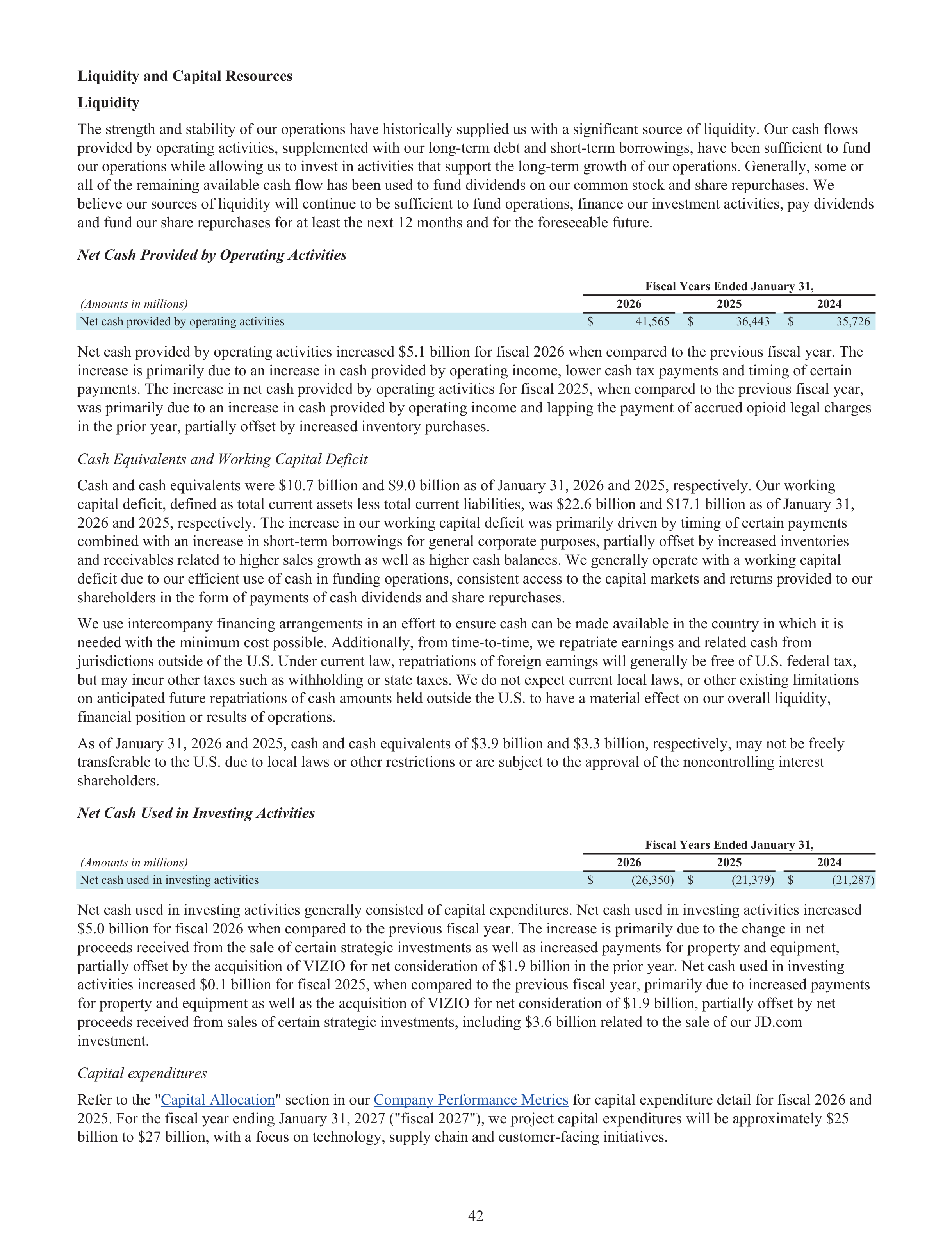
Liquidity and Capital Resources
Liquidity
The strength and stability of our operations have historically supplied us with a significant source of liquidity. Our cash flows
provided by operating activities, supplemented with our long-term debt and short-term borrowings, have been sufficient to fund
our operations while allowing us to invest in activities that support the long-term growth of our operations. Generally, some or
all of the remaining available cash flow has been used to fund dividends on our common stock and share repurchases. We
believe our sources of liquidity will continue to be sufficient to fund operations, finance our investment activities, pay dividends
and fund our share repurchases for at least the next 12 months and for the foreseeable future.
Net Cash Provided by Operating Activities
Fiscal Years Ended January 31,
(Amounts in millions)
2026
2025
2024
Net cash provided by operating activities
$
41,565
$
36,443
$
35,726
Net cash provided by operating activities increased $5.1 billion for fiscal 2026 when compared to the previous fiscal year. The
increase is primarily due to an increase in cash provided by operating income, lower cash tax payments and timing of certain
payments. The increase in net cash provided by operating activities for fiscal 2025, when compared to the previous fiscal year,
was primarily due to an increase in cash provided by operating income and lapping the payment of accrued opioid legal charges
in the prior year, partially offset by increased inventory purchases.
Cash Equivalents and Working Capital Deficit
Cash and cash equivalents were $10.7 billion and $9.0 billion as of January 31, 2026 and 2025, respectively. Our working
capital deficit, defined as total current assets less total current liabilities, was $22.6 billion and $17.1 billion as of January 31,
2026 and 2025, respectively. The increase in our working capital deficit was primarily driven by timing of certain payments
combined with an increase in short-term borrowings for general corporate purposes, partially offset by increased inventories
and receivables related to higher sales growth as well as higher cash balances. We generally operate with a working capital
deficit due to our efficient use of cash in funding operations, consistent access to the capital markets and returns provided to our
shareholders in the form of payments of cash dividends and share repurchases.
We use intercompany financing arrangements in an effort to ensure cash can be made available in the country in which it is
needed with the minimum cost possible. Additionally, from time-to-time, we repatriate earnings and related cash from
jurisdictions outside of the U.S. Under current law, repatriations of foreign earnings will generally be free of U.S. federal tax,
but may incur other taxes such as withholding or state taxes. We do not expect current local laws, or other existing limitations
on anticipated future repatriations of cash amounts held outside the U.S. to have a material effect on our overall liquidity,
financial position or results of operations.
As of January 31, 2026 and 2025, cash and cash equivalents of $3.9 billion and $3.3 billion, respectively, may not be freely
transferable to the U.S. due to local laws or other restrictions or are subject to the approval of the noncontrolling interest
shareholders.
Net Cash Used in Investing Activities
Fiscal Years Ended January 31,
(Amounts in millions)
2026
2025
2024
Net cash used in investing activities
$
(26,350)
$
(21,379)
$
(21,287)
Net cash used in investing activities generally consisted of capital expenditures. Net cash used in investing activities increased
$5.0 billion for fiscal 2026 when compared to the previous fiscal year. The increase is primarily due to the change in net
proceeds received from the sale of certain strategic investments as well as increased payments for property and equipment,
partially offset by the acquisition of VIZIO for net consideration of $1.9 billion in the prior year. Net cash used in investing
activities increased $0.1 billion for fiscal 2025, when compared to the previous fiscal year, primarily due to increased payments
for property and equipment as well as the acquisition of VIZIO for net consideration of $1.9 billion, partially offset by net
proceeds received from sales of certain strategic investments, including $3.6 billion related to the sale of our JD.com
investment.
Capital expenditures
Refer to the "
Capital Allocation
" section in our
Company Performance Metrics
for capital expenditure detail for fiscal 2026 and
2025. For the fiscal year ending January 31, 2027 ("fiscal 2027"), we project capital expenditures will be approximately $25
billion to $27 billion, with a focus on technology, supply chain and customer-facing initiatives.
42
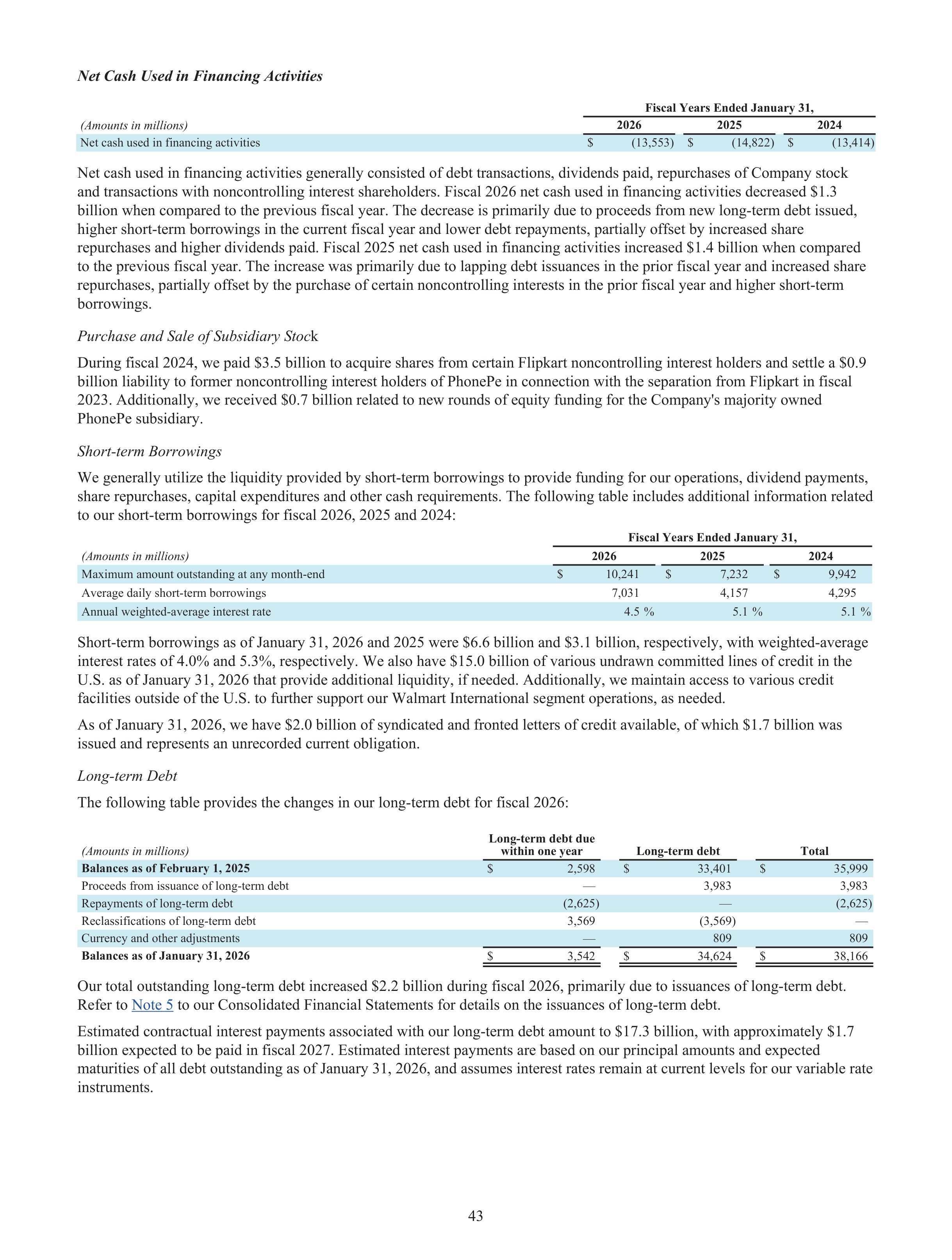
Net Cash Used in Financing Activities
Fiscal Years Ended January 31,
(Amounts in millions)
2026
2025
2024
Net cash used in financing activities
$
(13,553)
$
(14,822)
$
(13,414)
Net cash used in financing activities generally consisted of debt transactions, dividends paid, repurchases of Company stock
and transactions with noncontrolling interest shareholders. Fiscal 2026 net cash used in financing activities decreased $1.3
billion when compared to the previous fiscal year. The decrease is primarily due to proceeds from new long-term debt issued,
higher short-term borrowings in the current fiscal year and lower debt repayments, partially offset by increased share
repurchases and higher dividends paid. Fiscal 2025 net cash used in financing activities increased $1.4 billion when compared
to the previous fiscal year. The increase was primarily due to lapping debt issuances in the prior fiscal year and increased share
repurchases, partially offset by the purchase of certain noncontrolling interests in the prior fiscal year and higher short-term
borrowings.
Purchase and Sale of Subsidiary Stoc
k
During fiscal 2024, we paid $3.5 billion to acquire shares from certain Flipkart noncontrolling interest holders and settle a $0.9
billion liability to former noncontrolling interest holders of PhonePe in connection with the separation from Flipkart in fiscal
2023. Additionally, we received $0.7 billion related to new rounds of equity funding for the Company's majority owned
PhonePe subsidiary.
Short-term Borrowings
We generally utilize the liquidity provided by short-term borrowings to provide funding for our operations, dividend payments,
share repurchases, capital expenditures and other cash requirements. The following table includes additional information related
to our short-term borrowings for fiscal 2026, 2025 and 2024:
Fiscal Years Ended January 31,
(Amounts in millions)
2026
2025
2024
Maximum amount outstanding at any month-end
$
10,241
$
7,232
$
9,942
Average daily short-term borrowings
7,031
4,157
4,295
Annual weighted-average interest rate
4.5 %
5.1 %
5.1 %
Short-term borrowings as of January 31, 2026 and 2025 were $6.6 billion and $3.1 billion, respectively, with weighted-average
interest rates of 4.0% and 5.3%, respectively. We also have $15.0 billion of various undrawn committed lines of credit in the
U.S. as of January 31, 2026 that provide additional liquidity, if needed. Additionally, we maintain access to various credit
facilities outside of the U.S. to further support our Walmart International segment operations, as needed.
As of January 31, 2026, we have $2.0 billion of syndicated and fronted letters of credit available, of which $1.7 billion was
issued and represents an unrecorded current obligation.
Long-term Debt
The following table provides the changes in our long-term debt for fiscal 2026:
(Amounts in millions)
Long-term debt due
within one year
Long-term debt
Total
Balances as of February 1, 2025
$
2,598
$
33,401
$
35,999
Proceeds from issuance of long-term debt
—
3,983
3,983
Repayments of long-term debt
(2,625)
—
(2,625)
Reclassifications of long-term debt
3,569
(3,569)
—
Currency and other adjustments
—
809
809
Balances as of January 31, 2026
$
3,542
$
34,624
$
38,166
Our total outstanding long-term debt increased $2.2 billion during fiscal 2026, primarily due to issuances of long-term debt.
Refer to
Note 5
to our Consolidated Financial Statements for details on the issuances of long-term debt.
Estimated contractual interest payments associated with our long-term debt amount to $17.3 billion, with approximately $1.7
billion expected to be paid in fiscal 2027. Estimated interest payments are based on our principal amounts and expected
maturities of all debt outstanding as of January 31, 2026, and assumes interest rates remain at current levels for our variable rate
instruments.
43
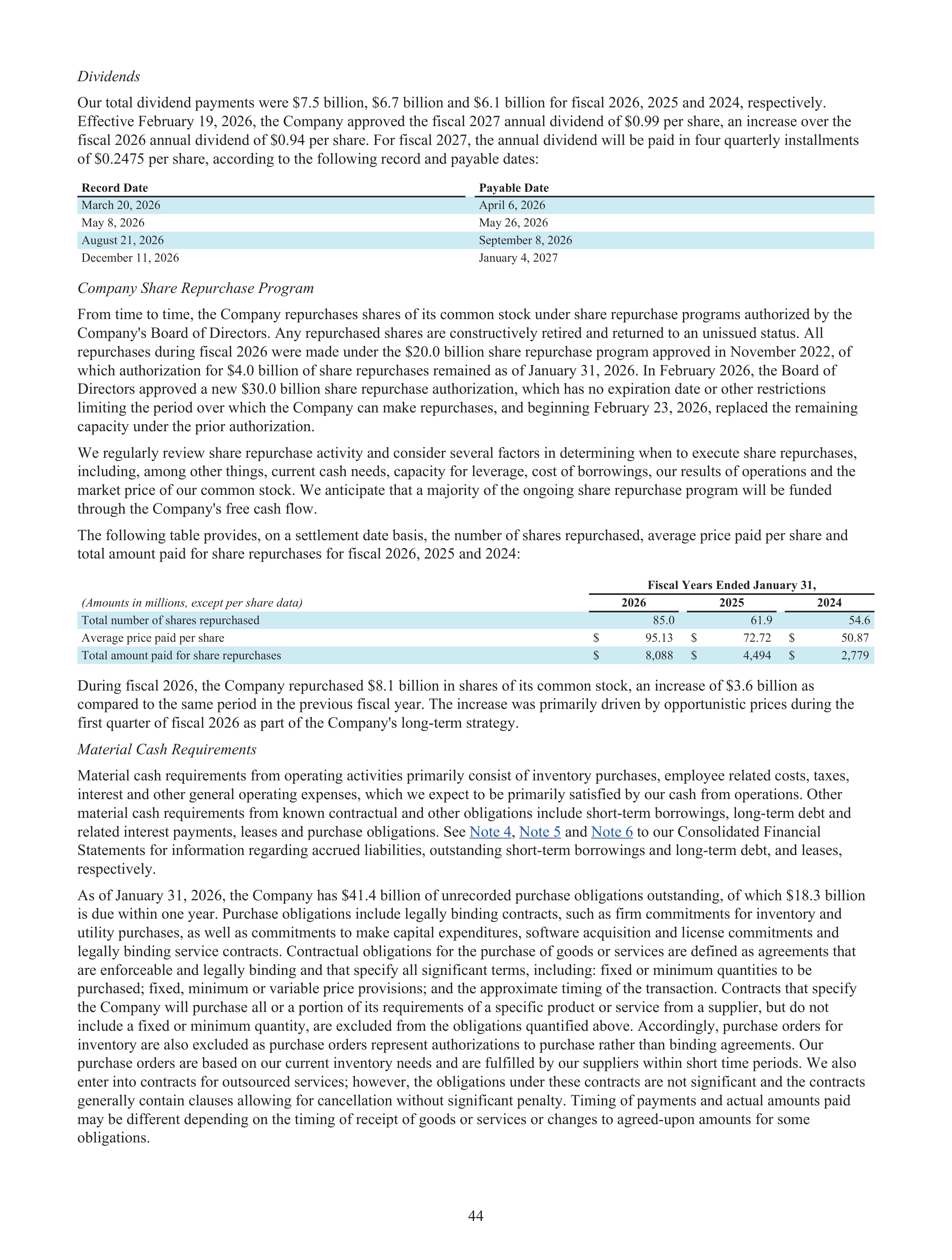
Dividends
Our total dividend payments were $7.5 billion, $6.7 billion and $6.1 billion for fiscal 2026, 2025 and 2024, respectively.
Effective February 19, 2026, the Company approved the fiscal 2027 annual dividend of $0.99 per share, an increase over the
fiscal 2026 annual dividend of $0.94 per share. For fiscal 2027, the annual dividend will be paid in four quarterly installments
of $0.2475 per share, according to the following record and payable dates:
Record Date
Payable Date
March 20, 2026
April 6, 2026
May 8, 2026
May 26, 2026
August 21, 2026
September 8, 2026
December 11, 2026
January 4, 2027
Company Share Repurchase Program
From time to time, the Company repurchases shares of its common stock under share repurchase programs authorized by the
Company's Board of Directors. Any repurchased shares are constructively retired and returned to an unissued status. All
repurchases during fiscal 2026 were made under the $20.0 billion share repurchase program approved in November 2022, of
which authorization for $4.0 billion of share repurchases remained as of January 31, 2026. In February 2026, the Board of
Directors approved a new $30.0 billion share repurchase authorization, which has no expiration date or other restrictions
limiting the period over which the Company can make repurchases, and beginning February 23, 2026, replaced the remaining
capacity under the prior authorization.
We regularly review share repurchase activity and consider several factors in determining when to execute share repurchases,
including, among other things, current cash needs, capacity for leverage, cost of borrowings, our results of operations and the
market price of our common stock. We anticipate that a majority of the ongoing share repurchase program will be funded
through the Company's free cash flow.
The following table provides, on a settlement date basis, the number of shares repurchased, average price paid per share and
total amount paid for share repurchases for fiscal 2026, 2025 and 2024:
Fiscal Years Ended January 31,
(Amounts in millions, except per share data)
2026
2025
2024
Total number of shares repurchased
85.0
61.9
54.6
Average price paid per share
$
95.13
$
72.72
$
50.87
Total amount paid for share repurchases
$
8,088
$
4,494
$
2,779
During fiscal 2026, the Company repurchased $8.1 billion in shares of its common stock, an increase of $3.6 billion as
compared to the same period in the previous fiscal year. The increase was primarily driven by opportunistic prices during the
first quarter of fiscal 2026 as part of the Company's long-term strategy.
Material Cash Requirements
Material cash requirements from operating activities primarily consist of inventory purchases, employee related costs, taxes,
interest and other general operating expenses, which we expect to be primarily satisfied by our cash from operations. Other
material cash requirements from known contractual and other obligations include short-term borrowings, long-term debt and
related interest payments, leases and purchase obligations. See
Note 4
,
Note 5
and
Note 6
to our Consolidated Financial
Statements for information regarding accrued liabilities, outstanding short-term borrowings and long-term debt, and leases,
respectively.
As of January 31, 2026, the Company has $41.4 billion of unrecorded purchase obligations outstanding, of which $18.3 billion
is due within one year. Purchase obligations include legally binding contracts, such as firm commitments for inventory and
utility purchases, as well as commitments to make capital expenditures, software acquisition and license commitments and
legally binding service contracts. Contractual obligations for the purchase of goods or services are defined as agreements that
are enforceable and legally binding and that specify all significant terms, including: fixed or minimum quantities to be
purchased; fixed, minimum or variable price provisions; and the approximate timing of the transaction. Contracts that specify
the Company will purchase all or a portion of its requirements of a specific product or service from a supplier, but do not
include a fixed or minimum quantity, are excluded from the obligations quantified above. Accordingly, purchase orders for
inventory are also excluded as purchase orders represent authorizations to purchase rather than binding agreements. Our
purchase orders are based on our current inventory needs and are fulfilled by our suppliers within short time periods. We also
enter into contracts for outsourced services; however, the obligations under these contracts are not significant and the contracts
generally contain clauses allowing for cancellation without significant penalty. Timing of payments and actual amounts paid
may be different depending on the timing of receipt of goods or services or changes to agreed-upon amounts for some
obligations.
44
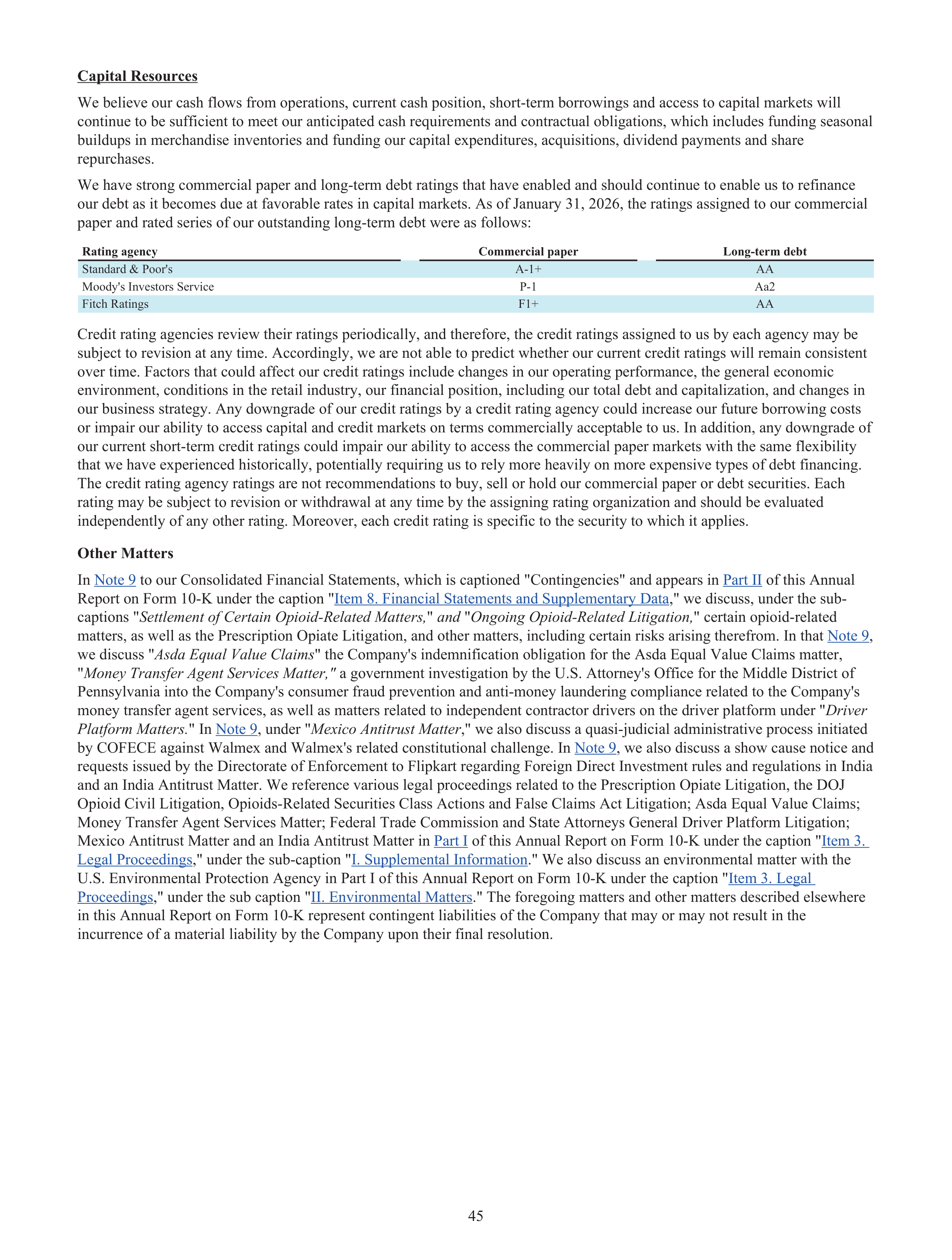
Capital Resources
We believe our cash flows from operations, current cash position, short-term borrowings and access to capital markets will
continue to be sufficient to meet our anticipated cash requirements and contractual obligations, which includes funding seasonal
buildups in merchandise inventories and funding our capital expenditures, acquisitions, dividend payments and share
repurchases.
We have strong commercial paper and long-term debt ratings that have enabled and should continue to enable us to refinance
our debt as it becomes due at favorable rates in capital markets. As of January 31, 2026, the ratings assigned to our commercial
paper and rated series of our outstanding long-term debt were as follows:
Rating agency
Commercial paper
Long-term debt
Standard & Poor's
A-1+
AA
Moody's Investors Service
P-1
Aa2
Fitch Ratings
F1+
AA
Credit rating agencies review their ratings periodically, and therefore, the credit ratings assigned to us by each agency may be
subject to revision at any time. Accordingly, we are not able to predict whether our current credit ratings will remain consistent
over time. Factors that could affect our credit ratings include changes in our operating performance, the general economic
environment, conditions in the retail industry, our financial position, including our total debt and capitalization, and changes in
our business strategy. Any downgrade of our credit ratings by a credit rating agency could increase our future borrowing costs
or impair our ability to access capital and credit markets on terms commercially acceptable to us. In addition, any downgrade of
our current short-term credit ratings could impair our ability to access the commercial paper markets with the same flexibility
that we have experienced historically, potentially requiring us to rely more heavily on more expensive types of debt financing.
The credit rating agency ratings are not recommendations to buy, sell or hold our commercial paper or debt securities. Each
rating may be subject to revision or withdrawal at any time by the assigning rating organization and should be evaluated
independently of any other rating. Moreover, each credit rating is specific to the security to which it applies.
Other Matters
In
Note 9
to our Consolidated Financial Statements, which is captioned "Contingencies" and appears in
Part II
of this Annual
Report on Form 10-K under the caption "
Item 8. Financial Statements and Supplementary Data
," we discuss, under the sub-
captions "
Settlement of Certain Opioid-Related Matters,
"
and
"
Ongoing Opioid-Related Litigation,
" certain opioid-related
matters, as well as the Prescription Opiate Litigation, and other matters, including certain risks arising therefrom. In that
Note 9
,
we discuss "
Asda Equal Value Claims
"
the Company's indemnification obligation for the Asda Equal Value Claims matter,
"
Money Transfer Agent Services Matter,"
a government investigation by the U.S. Attorney's Office for the Middle District of
Pennsylvania into the Company's consumer fraud prevention and anti-money laundering compliance related to the Company's
money transfer agent services, as well as matters related to independent contractor drivers on the driver platform under "
Driver
Platform Matters.
" In
Note 9
, under "
Mexico Antitrust Matter
," we also discuss a quasi-judicial administrative process initiated
by COFECE against Walmex and Walmex's related constitutional challenge. In
Note 9
, we also discuss a show cause notice and
requests issued by the Directorate of Enforcement to Flipkart regarding Foreign Direct Investment rules and regulations in India
and an India Antitrust Matter. We reference various legal proceedings related to the Prescription Opiate Litigation, the DOJ
Opioid Civil Litigation, Opioids-Related Securities Class Actions and False Claims Act Litigation; Asda Equal Value Claims;
Money Transfer Agent Services Matter; Federal Trade Commission and State Attorneys General Driver Platform Litigation;
Mexico Antitrust Matter and an India Antitrust Matter in
Part I
of this Annual Report on Form 10-K under the caption "
Item 3.
Legal Proceedings
," under the sub-caption "
I. Supplemental Information
." We also discuss an environmental matter with the
U.S. Environmental Protection Agency in Part I of this Annual Report on Form 10-K under the caption "
Item 3. Legal
Proceedings
," under the sub caption "
II. Environmental Matters
." The foregoing matters and other matters described elsewhere
in this Annual Report on Form 10-K represent contingent liabilities of the Company that may or may not result in the
incurrence of a material liability by the Company upon their final resolution.
45
Summary of Critical Accounting Estimates
Management strives to report our financial results in a clear and understandable manner, although in some cases accounting and
disclosure rules are complex and require us to use technical terminology. In preparing the Company's Consolidated Financial
Statements, we follow accounting principles generally accepted in the U.S. These principles require us to make certain
estimates and apply judgments that affect our financial position and results of operations as reflected in our financial statements.
These judgments and estimates are based on past events and expectations of future outcomes. Actual results may differ from
our estimates.
Management continually reviews our accounting policies including how they are applied and how they are reported and
disclosed in our financial statements. Following is a summary of our critical accounting estimates and how they are applied in
the preparation of the financial statements.
Contingencies
We are involved in a number of legal proceedings and certain regulatory matters. We record a liability when it is probable that a
loss has been incurred and the amount is reasonably estimable. We also perform an assessment of the materiality of loss
contingencies where a loss is either reasonably possible or it is reasonably possible that a loss could be incurred in excess of
amounts accrued. If a loss or an additional loss has at least a reasonable possibility of occurring and the impact on the financial
statements would be material, we provide disclosure of the loss contingency in the footnotes to our financial statements. We
review all contingencies at least quarterly to determine whether the likelihood of loss has changed and to assess whether a
reasonable estimate of the loss or the range of the loss can be made. Although we are not able to predict the outcome or
reasonably estimate a range of possible losses in certain matters described in
Note 9
to our Consolidated Financial Statements
and have not recorded an associated accrual related to these matters, an adverse judgment or negotiated resolution in any of
these matters could have a material adverse effect on our business, reputation, financial position, results of operations or cash
flows.
Uncertain Tax Positions
We are subject to income taxes in the U.S. and numerous foreign jurisdictions. Our tax returns are routinely audited and
settlements of issues raised in these audits sometimes affect our tax provisions. The benefits of uncertain tax positions are
recorded in our financial statements only after determining a more likely than not probability that the uncertain tax positions
will withstand challenge, if any, from taxing authorities. When facts and circumstances change, we reassess these probabilities
and record any changes in the financial statements as appropriate. We account for uncertain tax positions by determining the
minimum recognition threshold that a tax position is required to meet before being recognized in the financial statements.
Accordingly, the determination of our uncertain tax positions requires judgment, the use of estimates in certain cases and the
interpretation and application of complex tax laws.
ITEM 7A.
QUANTITATIVE AND QUALITATIVE DISCLOSURES ABOUT MARKET RISK
Market Risk
In addition to the risks inherent in our operations, we are exposed to certain market risks, including changes in interest rates,
currency exchange rates and the fair values of certain equity and equity method investments measured on a recurring basis.
The analysis presented below for each of our market risk sensitive instruments is based on a hypothetical scenario used to
calibrate potential risk and does not represent our view of future market changes. The effect of a change in a particular
assumption is calculated without adjusting any other assumption. In reality, however, a change in one factor could cause a
change in another, which may magnify or negate other sensitivities.
Interest Rate Risk
We are exposed to changes in interest rates as a result of our short-term borrowings and long-term debt. We hedge a portion of
our interest rate risk by managing the mix of fixed and variable rate debt and by entering into interest rate swaps. For fiscal
2026, the net fair value of our interest rate swaps increased $0.2 billion primarily due to fluctuations in market interest rates.
46
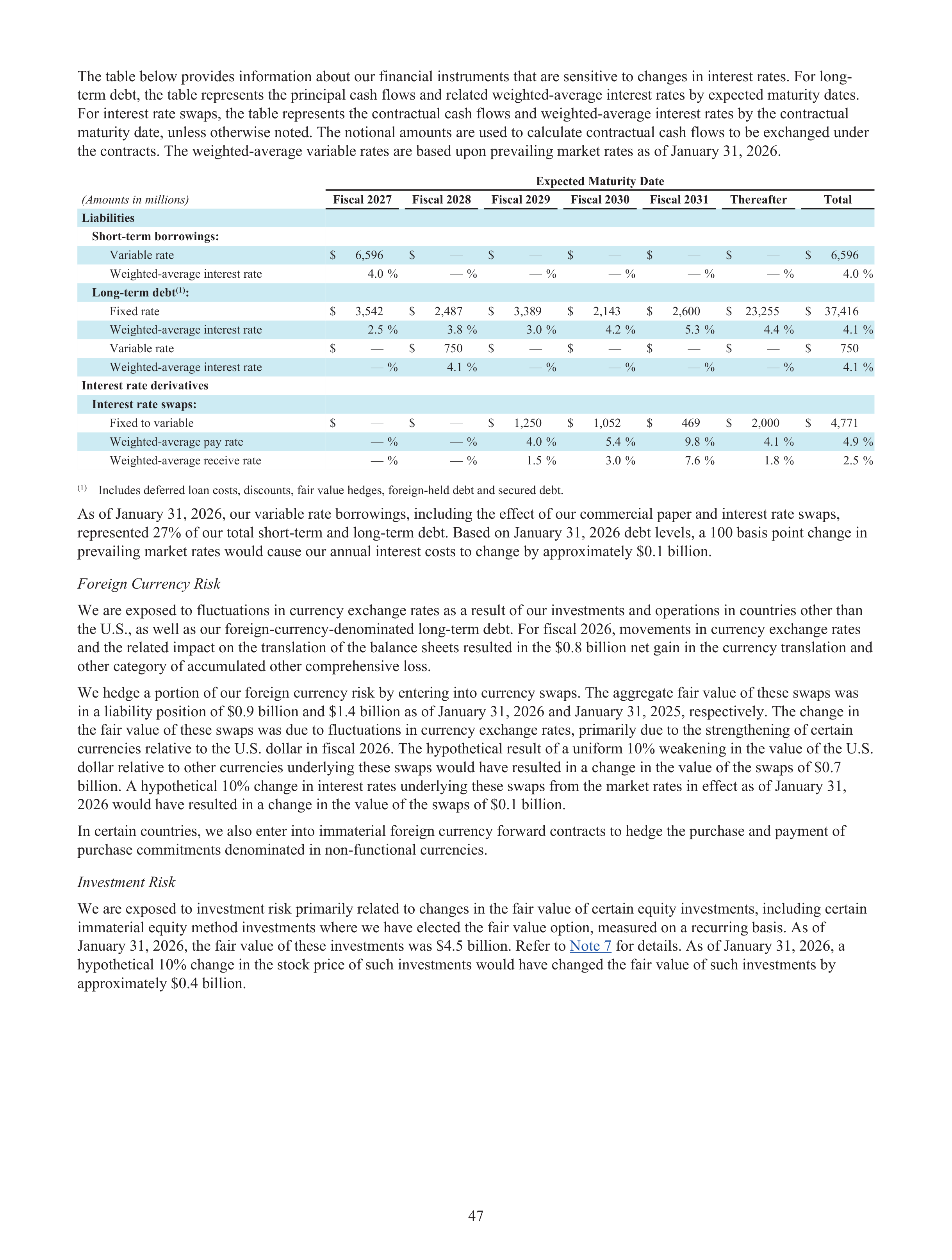
The table below provides information about our financial instruments that are sensitive to changes in interest rates. For long-
term debt, the table represents the principal cash flows and related weighted-average interest rates by expected maturity dates.
For interest rate swaps, the table represents the contractual cash flows and weighted-average interest rates by the contractual
maturity date, unless otherwise noted. The notional amounts are used to calculate contractual cash flows to be exchanged under
the contracts. The weighted-average variable rates are based upon prevailing market rates as of January 31, 2026.
Expected Maturity Date
(Amounts in millions)
Fiscal 2027
Fiscal 2028
Fiscal 2029
Fiscal 2030
Fiscal 2031
Thereafter
Total
Liabilities
Short-term borrowings:
Variable rate
$
6,596
$
—
$
—
$
—
$
—
$
—
$
6,596
Weighted-average interest rate
4.0 %
— %
— %
— %
— %
— %
4.0 %
Long-term debt
(1)
:
Fixed rate
$
3,542
$
2,487
$
3,389
$
2,143
$
2,600
$
23,255
$
37,416
Weighted-average interest rate
2.5 %
3.8 %
3.0 %
4.2 %
5.3 %
4.4 %
4.1 %
Variable rate
$
—
$
750
$
—
$
—
$
—
$
—
$
750
Weighted-average interest rate
— %
4.1 %
— %
— %
— %
— %
4.1 %
Interest rate derivatives
Interest rate swaps:
Fixed to variable
$
—
$
—
$
1,250
$
1,052
$
469
$
2,000
$
4,771
Weighted-average pay rate
— %
— %
4.0 %
5.4 %
9.8 %
4.1 %
4.9 %
Weighted-average receive rate
— %
— %
1.5 %
3.0 %
7.6 %
1.8 %
2.5 %
(1)
Includes deferred loan costs, discounts, fair value hedges, foreign-held debt and secured debt.
As of January 31, 2026, our variable rate borrowings, including the effect of our commercial paper and interest rate swaps,
represented 27% of our total short-term and long-term debt. Based on January 31, 2026 debt levels, a 100 basis point change in
prevailing market rates would cause our annual interest costs to change by approximately $0.1 billion.
Foreign Currency Risk
We are exposed to fluctuations in currency exchange rates as a result of our investments and operations in countries other than
the U.S., as well as our foreign-currency-denominated long-term debt. For fiscal 2026, movements in currency exchange rates
and the related impact on the translation of the balance sheets resulted in the $0.8 billion net gain in the currency translation and
other category of accumulated other comprehensive loss.
We hedge a portion of our foreign currency risk by entering into currency swaps. The aggregate fair value of these swaps was
in a liability position of $0.9 billion and $1.4 billion as of January 31, 2026 and January 31, 2025, respectively. The change in
the fair value of these swaps was due to fluctuations in currency exchange rates, primarily due to the strengthening of certain
currencies relative to the U.S. dollar in fiscal 2026. The hypothetical result of a uniform 10% weakening in the value of the U.S.
dollar relative to other currencies underlying these swaps would have resulted in a change in the value of the swaps of $0.7
billion. A hypothetical 10% change in interest rates underlying these swaps from the market rates in effect as of January 31,
2026 would have resulted in a change in the value of the swaps of $0.1 billion.
In certain countries, we also enter into immaterial foreign currency forward contracts to hedge the purchase and payment of
purchase commitments denominated in non-functional currencies.
Investment Risk
We are exposed to investment risk primarily related to changes in the fair value of certain equity investments, including certain
immaterial equity method investments where we have elected the fair value option, measured on a recurring basis. As of
January 31, 2026, the fair value of these investments was $4.5 billion. Refer to
Note 7
for details. As of January 31, 2026, a
hypothetical 10% change in the stock price of such investments would have changed the fair value of such investments by
approximately $0.4 billion.
47
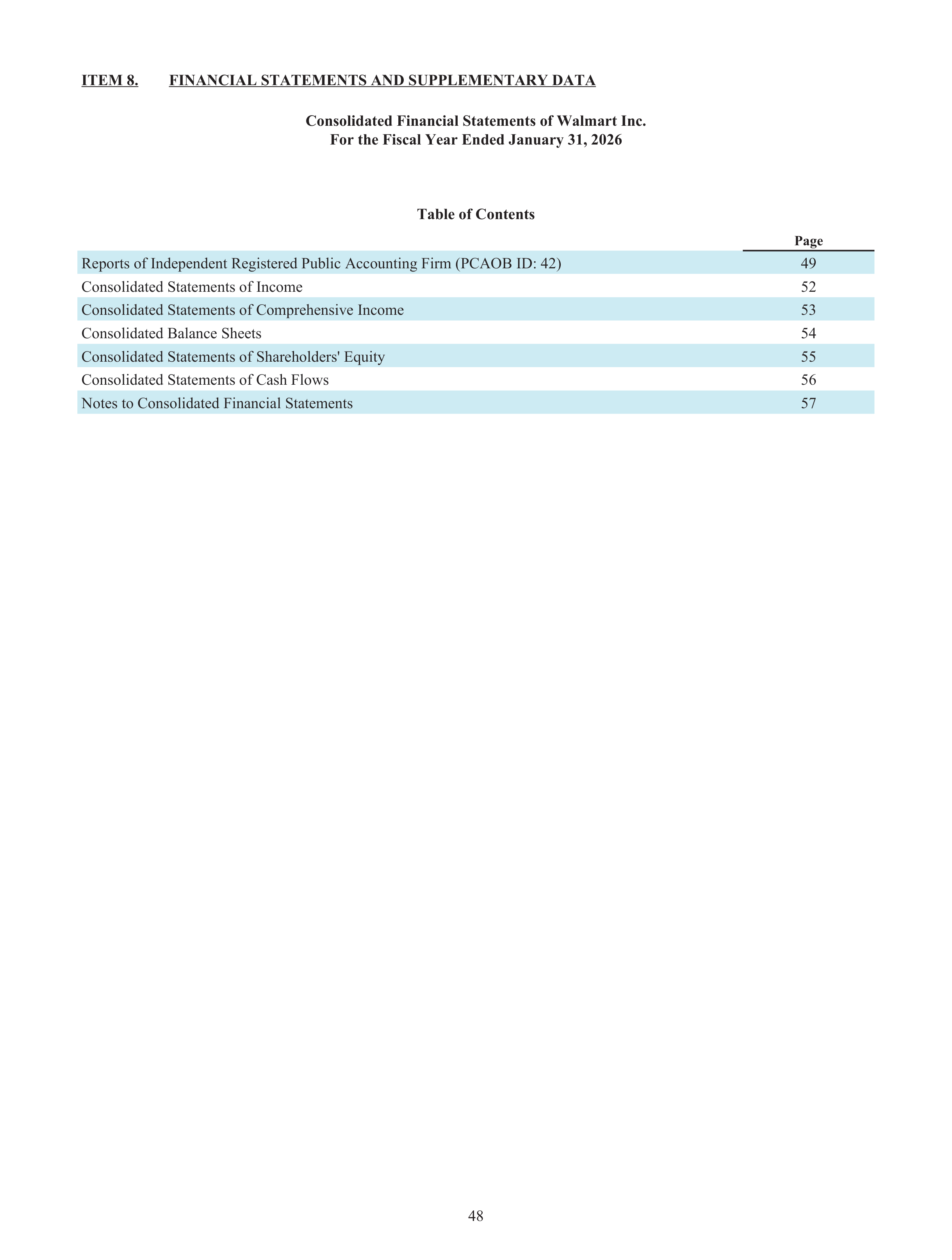
ITEM 8.
FINANCIAL STATEMENTS AND SUPPLEMENTARY DATA
Consolidated Financial Statements of Walmart Inc.
For the Fiscal Year Ended January 31, 2026
Table of Contents
Page
Reports of Independent Registered Public Accounting Firm (PCAOB ID: 42)
49
Consolidated Statements of Income
52
Consolidated Statements of Comprehensive Income
53
Consolidated Balance Sheets
54
Consolidated Statements of Shareholders' Equity
55
Consolidated Statements of Cash Flows
56
Notes to Consolidated Financial Statements
57
48
Report of Independent Registered Public Accounting Firm
To the Shareholders and the Board of Directors of Walmart Inc.
Opinion on the Financial Statements
We have audited the accompanying consolidated balance sheets of Walmart Inc. (the Company) as of January 31, 2026 and
2025, the related consolidated statements of income, comprehensive income, shareholders' equity and cash flows for each of the
three years in the period ended January 31, 2026, and the related notes (collectively referred to as the "Consolidated Financial
Statements"). In our opinion, the Consolidated Financial Statements present fairly, in all material respects, the financial position
of the Company at January 31, 2026 and 2025, and the results of its operations and its cash flows for each of the three years in
the period ended January 31, 2026, in conformity with U.S. generally accepted accounting principles.
We also have audited, in accordance with the standards of the Public Company Accounting Oversight Board (United States)
(PCAOB), the Company's internal control over financial reporting as of January 31, 2026, based on criteria established in
Internal Control-Integrated Framework issued by the Committee of Sponsoring Organizations of the Treadway Commission
(2013 framework) and our report dated March 13, 2026 expressed an unqualified opinion thereon.
Basis for Opinion
These financial statements are the responsibility of the Company's management. Our responsibility is to express an opinion on
the Company's financial statements based on our audits. We are a public accounting firm registered with the PCAOB and are
required to be independent with respect to the Company in accordance with the U.S. federal securities laws and the applicable
rules and regulations of the Securities and Exchange Commission and the PCAOB.
We conducted our audits in accordance with the standards of the PCAOB. Those standards require that we plan and perform the
audit to obtain reasonable assurance about whether the financial statements are free of material misstatement, whether due to
error or fraud. Our audits included performing procedures to assess the risks of material misstatement of the financial
statements, whether due to error or fraud, and performing procedures that respond to those risks. Such procedures included
examining, on a test basis, evidence regarding the amounts and disclosures in the financial statements. Our audits also included
evaluating the accounting principles used and significant estimates made by management, as well as evaluating the overall
presentation of the financial statements. We believe that our audits provide a reasonable basis for our opinion.
Critical Audit Matter
The critical audit matter communicated below is a matter arising from the current period audit of the financial statements that
was communicated or required to be communicated to the audit committee and that: (1) relates to accounts or disclosures that
are material to the financial statements and (2) involved our especially challenging, subjective or complex judgments. The
communication of the critical audit matter does not alter in any way our opinion on the Consolidated Financial Statements,
taken as a whole, and we are not, by communicating the critical audit matter below, providing a separate opinion on the critical
audit matter or on the account or disclosure to which it relates.
Contingencies
Description of
the Matter
As described in Note 9 to the Consolidated Financial Statements, at January 31, 2026, the Company is
involved in a number of legal proceedings and certain regulatory matters. The Company records a
liability for those legal proceedings and regulatory matters when management determines it is probable
that a loss has been incurred and the amount of the loss can be reasonably estimated. The Company also
discloses when it is reasonably possible that a material loss may be incurred. In assessing the probability
of occurrence and whether an estimate of loss can be reasonably estimated for a particular legal
proceeding, management exercises judgment on matters relevant to each proceeding. Auditing
management's accounting for, and disclosure of, loss contingencies was complex and highly judgmental
as it involved our assessment of the significant judgments made by management when assessing the
probability of loss for contingencies or when determining whether an estimate of the loss or range of loss
could be made.
49
How We
Addressed the
Matter in Our
Audit
We obtained an understanding, evaluated the design and tested the operating effectiveness of controls
over the identification and evaluation of contingencies. For example, we tested controls over the
Company's assessment of the likelihood of loss and the Company's determinations regarding the
measurement of loss.
To test the Company's assessment of the probability of loss or determination of an estimate of loss, or
range of loss, among other procedures, we read the minutes of the meetings of the board of directors and
committees of the board of directors, reviewed documents provided to the Company by certain outside
legal counsel, read letters received directly by us from internal and outside legal counsel, evaluated the
current status of contingencies based on discussions with internal legal counsel, and obtained
representations from management. We also assessed the adequacy of the related disclosures.
/s/ Ernst & Young LLP
We have served as the Company's auditor since 1969.
Rogers, Arkansas
March 13, 2026
50
Report of Independent Registered Public Accounting Firm
To the Shareholders and the Board of Directors of Walmart Inc.
Opinion on Internal Control Over Financial Reporting
We have audited Walmart Inc.'s internal control over financial reporting as of January 31, 2026, based on criteria established in
Internal Control—Integrated Framework issued by the Committee of Sponsoring Organizations of the Treadway Commission
(2013 framework) (the COSO criteria). In our opinion, Walmart Inc. (the Company) maintained, in all material respects,
effective internal control over financial reporting as of January 31, 2026, based on the COSO criteria.
We also have audited, in accordance with the standards of the Public Company Accounting Oversight Board (United States)
(PCAOB), the consolidated balance sheets of the Company as of January 31, 2026 and 2025, the related consolidated
statements of income, comprehensive income, shareholders' equity and cash flows for each of the three years in the period
ended January 31, 2026, and the related notes and our report dated March 13, 2026 expressed an unqualified opinion thereon.
Basis for Opinion
The Company's management is responsible for maintaining effective internal control over financial reporting and for its
assessment of the effectiveness of internal control over financial reporting included in the accompanying Report on Internal
Control Over Financial Reporting. Our responsibility is to express an opinion on the Company's internal control over financial
reporting based on our audit. We are a public accounting firm registered with the PCAOB and are required to be independent
with respect to the Company in accordance with the U.S. federal securities laws and the applicable rules and regulations of the
Securities and Exchange Commission and the PCAOB.
We conducted our audit in accordance with the standards of the PCAOB. Those standards require that we plan and perform the
audit to obtain reasonable assurance about whether effective internal control over financial reporting was maintained in all
material respects.
Our audit included obtaining an understanding of internal control over financial reporting, assessing the risk that a material
weakness exists, testing and evaluating the design and operating effectiveness of internal control based on the assessed risk, and
performing such other procedures as we considered necessary in the circumstances. We believe that our audit provides a
reasonable basis for our opinion.
Definition and Limitations of Internal Control Over Financial Reporting
A company's internal control over financial reporting is a process designed to provide reasonable assurance regarding the
reliability of financial reporting and the preparation of financial statements for external purposes in accordance with generally
accepted accounting principles. A company's internal control over financial reporting includes those policies and procedures
that (1) pertain to the maintenance of records that, in reasonable detail, accurately and fairly reflect the transactions and
dispositions of the assets of the company; (2) provide reasonable assurance that transactions are recorded as necessary to permit
preparation of financial statements in accordance with generally accepted accounting principles, and that receipts and
expenditures of the company are being made only in accordance with authorizations of management and directors of the
company; and (3) provide reasonable assurance regarding prevention or timely detection of unauthorized acquisition, use, or
disposition of the company's assets that could have a material effect on the financial statements.
Because of its inherent limitations, internal control over financial reporting may not prevent or detect misstatements. Also,
projections of any evaluation of effectiveness to future periods are subject to the risk that controls may become inadequate
because of changes in conditions, or that the degree of compliance with the policies or procedures may deteriorate.
/s/ Ernst & Young LLP
Rogers, Arkansas
March 13, 2026
51
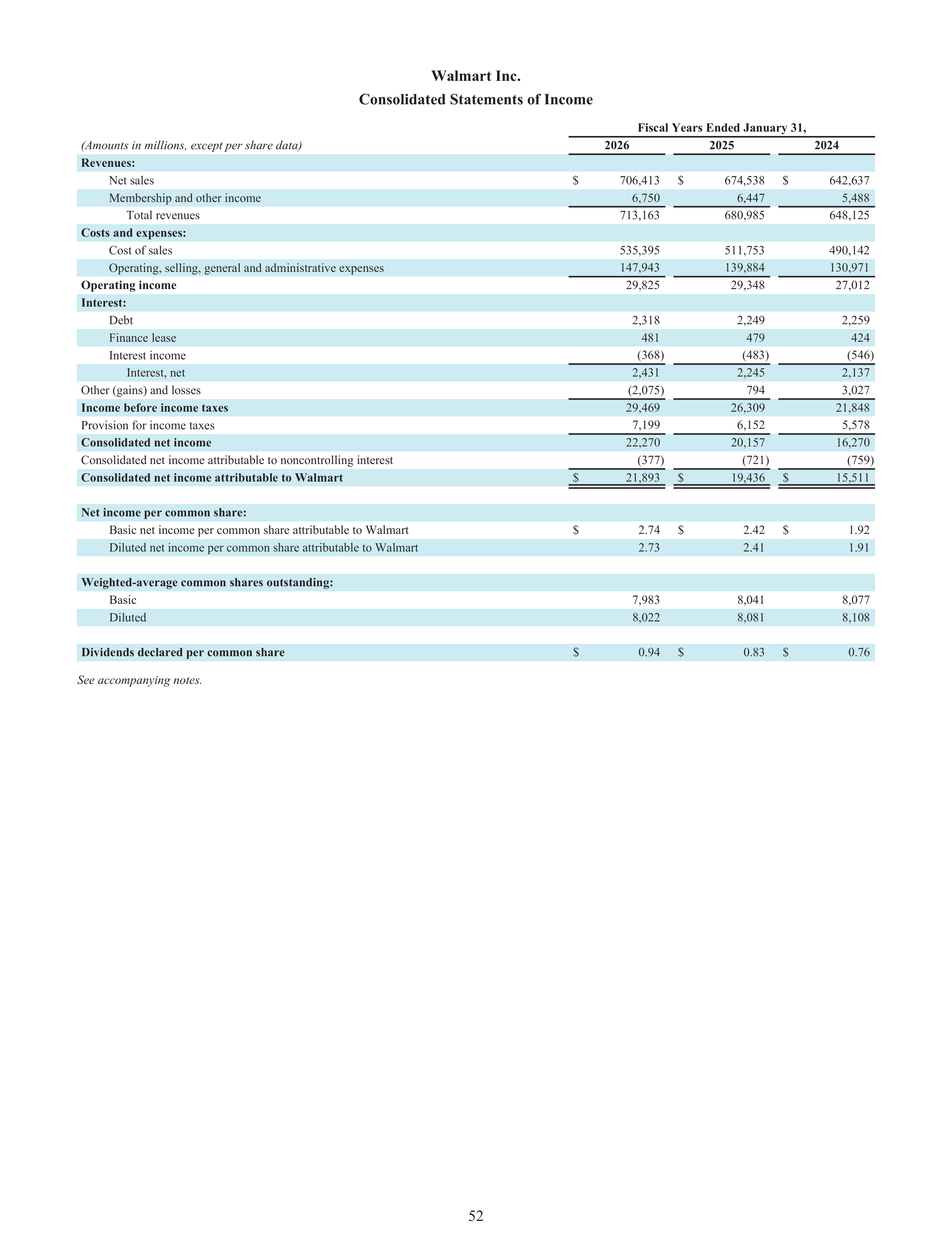
Walmart Inc.
Consolidated Statements of Income
Fiscal Years Ended January 31,
(Amounts in millions, except per share data)
2026
2025
2024
Revenues:
Net sales
$
706,413
$
674,538
$
642,637
Membership and other income
6,750
6,447
5,488
Total revenues
713,163
680,985
648,125
Costs and expenses:
Cost of sales
535,395
511,753
490,142
Operating, selling, general and administrative expenses
147,943
139,884
130,971
Operating income
29,825
29,348
27,012
Interest:
Debt
2,318
2,249
2,259
Finance lease
481
479
424
Interest income
(368)
(483)
(546)
Interest, net
2,431
2,245
2,137
Other (gains) and losses
(2,075)
794
3,027
Income before income taxes
29,469
26,309
21,848
Provision for income taxes
7,199
6,152
5,578
Consolidated net income
22,270
20,157
16,270
Consolidated net income attributable to noncontrolling interest
(377)
(721)
(759)
Consolidated net income attributable to Walmart
$
21,893
$
19,436
$
15,511
Net income per common share:
Basic net income per common share attributable to Walmart
$
2.74
$
2.42
$
1.92
Diluted net income per common share attributable to Walmart
2.73
2.41
1.91
Weighted-average common shares outstanding:
Basic
7,983
8,041
8,077
Diluted
8,022
8,081
8,108
Dividends declared per common share
$
0.94
$
0.83
$
0.76
See accompanying notes.
52
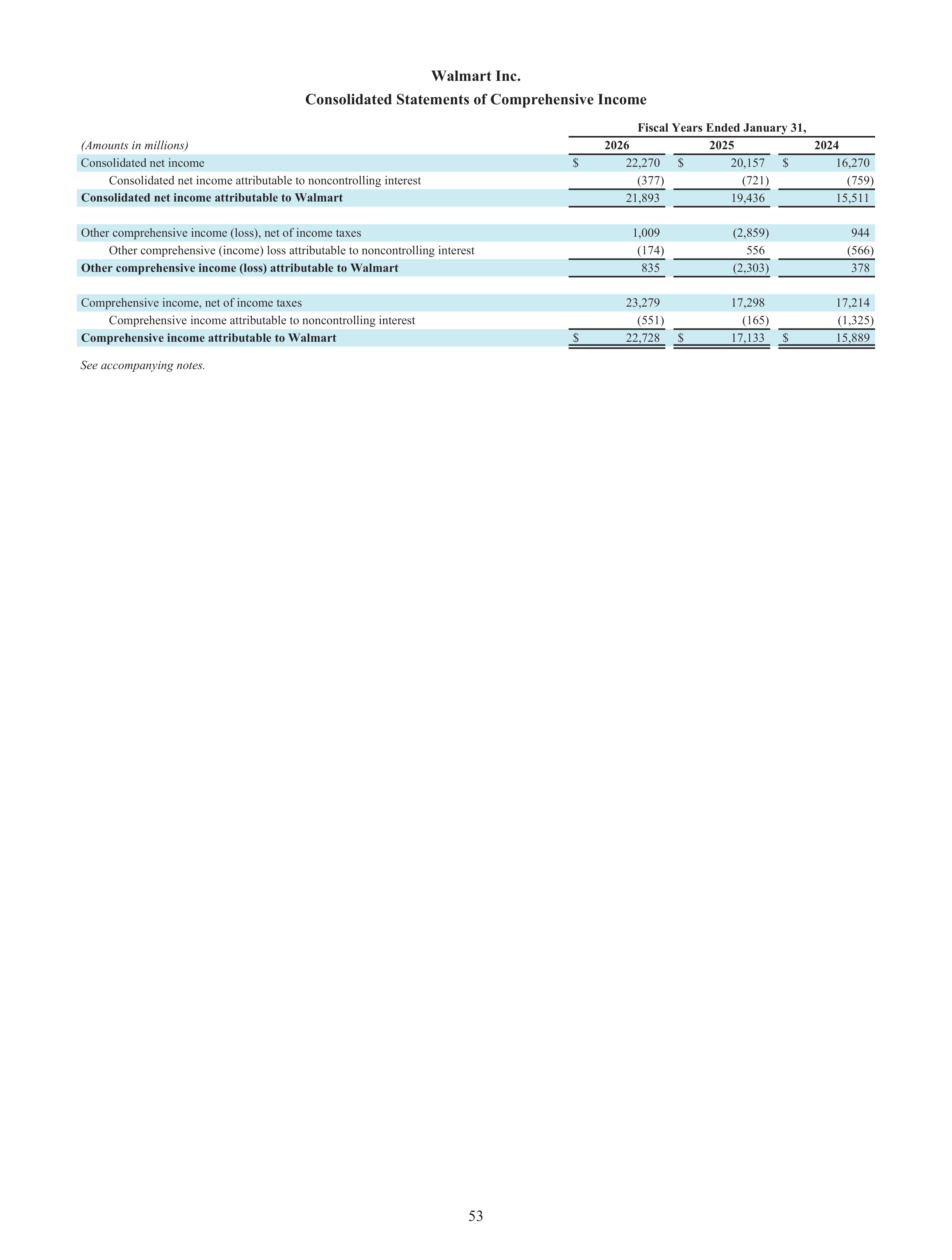
Walmart Inc.
Consolidated Statements of Comprehensive Income
Fiscal Years Ended January 31,
(Amounts in millions)
2026
2025
2024
Consolidated net income
$
22,270
$
20,157
$
16,270
Consolidated net income attributable to noncontrolling interest
(377)
(721)
(759)
Consolidated net income attributable to Walmart
21,893
19,436
15,511
Other comprehensive income (loss), net of income taxes
1,009
(2,859)
944
Other comprehensive (income) loss attributable to noncontrolling interest
(174)
556
(566)
Other comprehensive income (loss) attributable to Walmart
835
(2,303)
378
Comprehensive income, net of income taxes
23,279
17,298
17,214
Comprehensive income attributable to noncontrolling interest
(551)
(165)
(1,325)
Comprehensive income attributable to Walmart
$
22,728
$
17,133
$
15,889
See accompanying notes.
53
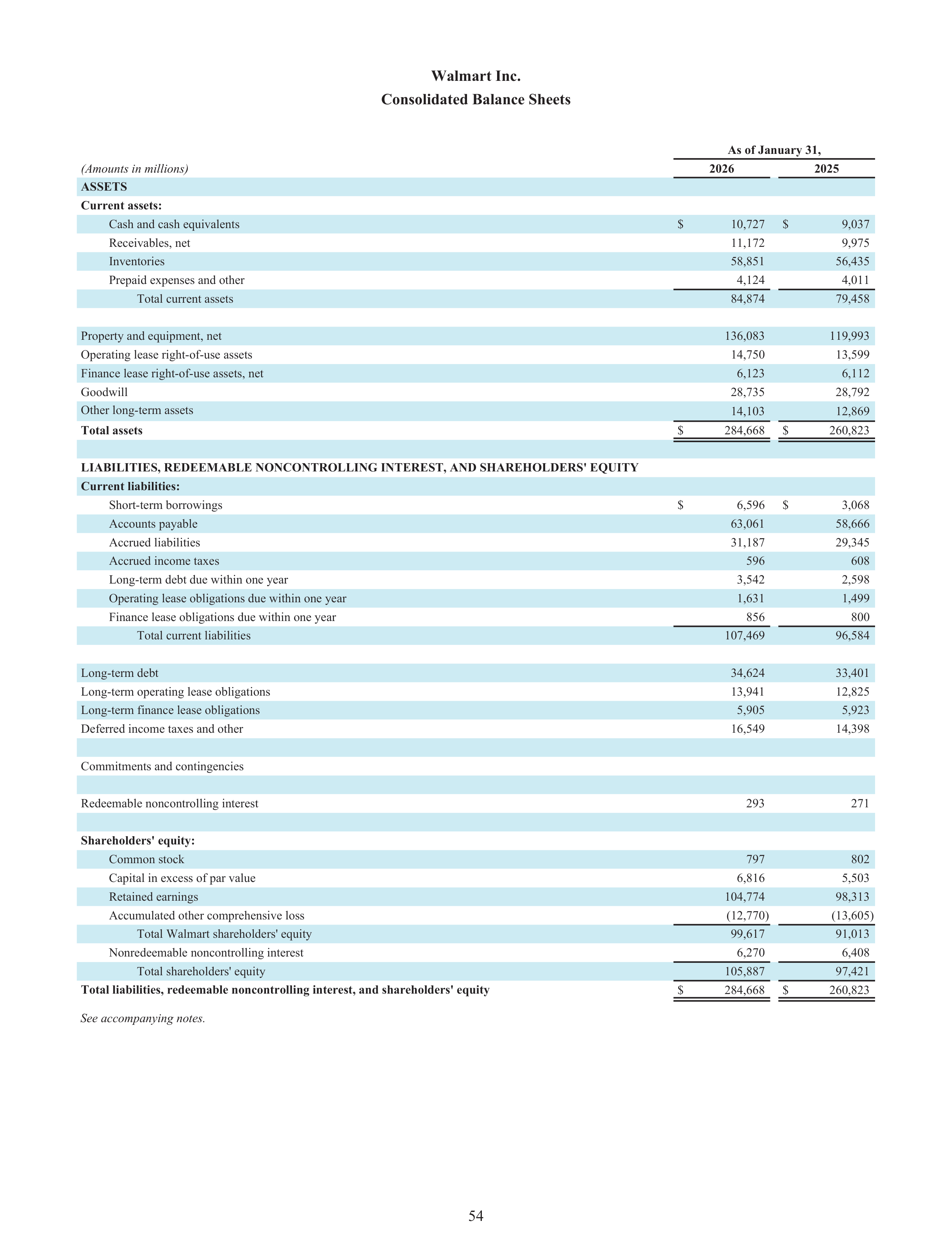
Walmart Inc.
Consolidated Balance Sheets
As of January 31,
(Amounts in millions)
2026
2025
ASSETS
Current assets:
Cash and cash equivalents
$
10,727
$
9,037
Receivables, net
11,172
9,975
Inventories
58,851
56,435
Prepaid expenses and other
4,124
4,011
Total current assets
84,874
79,458
Property and equipment, net
136,083
119,993
Operating lease right-of-use assets
14,750
13,599
Finance lease right-of-use assets, net
6,123
6,112
Goodwill
28,735
28,792
Other long-term assets
14,103
12,869
Total assets
$
284,668
$
260,823
LIABILITIES, REDEEMABLE NONCONTROLLING INTEREST, AND SHAREHOLDERS' EQUITY
Current liabilities:
Short-term borrowings
$
6,596
$
3,068
Accounts payable
63,061
58,666
Accrued liabilities
31,187
29,345
Accrued income taxes
596
608
Long-term debt due within one year
3,542
2,598
Operating lease obligations due within one year
1,631
1,499
Finance lease obligations due within one year
856
800
Total current liabilities
107,469
96,584
Long-term debt
34,624
33,401
Long-term operating lease obligations
13,941
12,825
Long-term finance lease obligations
5,905
5,923
Deferred income taxes and other
16,549
14,398
Commitments and contingencies
Redeemable noncontrolling interest
293
271
Shareholders' equity:
Common stock
797
802
Capital in excess of par value
6,816
5,503
Retained earnings
104,774
98,313
Accumulated other comprehensive loss
(12,770)
(13,605)
Total Walmart shareholders' equity
99,617
91,013
Nonredeemable noncontrolling interest
6,270
6,408
Total shareholders' equity
105,887
97,421
Total liabilities, redeemable noncontrolling interest, and shareholders' equity
$
284,668
$
260,823
See accompanying notes.
54
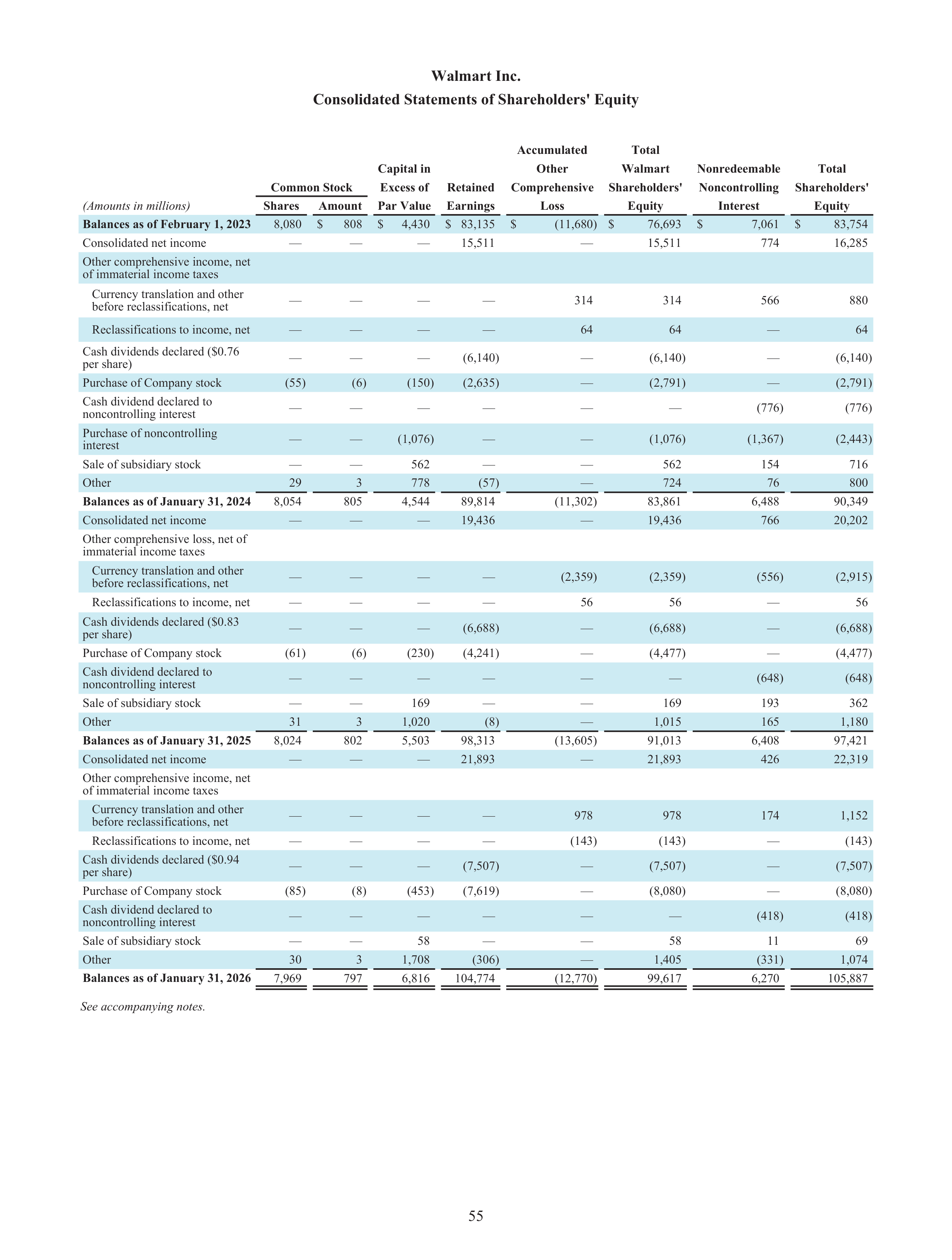
Walmart Inc.
Consolidated Statements of Shareholders' Equity
Accumulated
Total
Capital in
Other
Walmart
Nonredeemable
Total
(Amounts in millions)
Common Stock
Excess of
Retained
Comprehensive
Shareholders'
Noncontrolling
Shareholders'
Shares
Amount
Par Value
Earnings
Loss
Equity
Interest
Equity
Balances as of February 1, 2023
8,080
$
808
$
4,430
$ 83,135
$
(11,680) $
76,693
$
7,061
$
83,754
Consolidated net income
—
—
—
15,511
—
15,511
774
16,285
Other comprehensive income, net
of immaterial income taxes
Currency translation and other
before reclassifications, net
—
—
—
—
314
314
566
880
Reclassifications to income, net
—
—
—
—
64
64
—
64
Cash dividends declared ($0.76
per share)
—
—
—
(6,140)
—
(6,140)
—
(6,140)
Purchase of Company stock
(55)
(6)
(150)
(2,635)
—
(2,791)
—
(2,791)
Cash dividend declared to
noncontrolling interest
—
—
—
—
—
—
(776)
(776)
Purchase of noncontrolling
interest
—
—
(1,076)
—
—
(1,076)
(1,367)
(2,443)
Sale of subsidiary stock
—
—
562
—
—
562
154
716
Other
29
3
778
(57)
—
724
76
800
Balances as of January 31, 2024
8,054
805
4,544
89,814
(11,302)
83,861
6,488
90,349
Consolidated net income
—
—
—
19,436
—
19,436
766
20,202
Other comprehensive loss, net of
immaterial income taxes
Currency translation and other
before reclassifications, net
—
—
—
—
(2,359)
(2,359)
(556)
(2,915)
Reclassifications to income, net
—
—
—
—
56
56
—
56
Cash dividends declared ($0.83
per share)
—
—
—
(6,688)
—
(6,688)
—
(6,688)
Purchase of Company stock
(61)
(6)
(230)
(4,241)
—
(4,477)
—
(4,477)
Cash dividend declared to
noncontrolling interest
—
—
—
—
—
—
(648)
(648)
Sale of subsidiary stock
—
—
169
—
—
169
193
362
Other
31
3
1,020
(8)
—
1,015
165
1,180
Balances as of January 31, 2025
8,024
802
5,503
98,313
(13,605)
91,013
6,408
97,421
Consolidated net income
—
—
—
21,893
—
21,893
426
22,319
Other comprehensive income, net
of immaterial income taxes
Currency translation and other
before reclassifications, net
—
—
—
—
978
978
174
1,152
Reclassifications to income, net
—
—
—
—
(143)
(143)
—
(143)
Cash dividends declared ($0.94
per share)
—
—
—
(7,507)
—
(7,507)
—
(7,507)
Purchase of Company stock
(85)
(8)
(453)
(7,619)
—
(8,080)
—
(8,080)
Cash dividend declared to
noncontrolling interest
—
—
—
—
—
—
(418)
(418)
Sale of subsidiary stock
—
—
58
—
—
58
11
69
Other
30
3
1,708
(306)
—
1,405
(331)
1,074
Balances as of January 31, 2026
7,969
797
6,816
104,774
(12,770)
99,617
6,270
105,887
See accompanying notes.
55
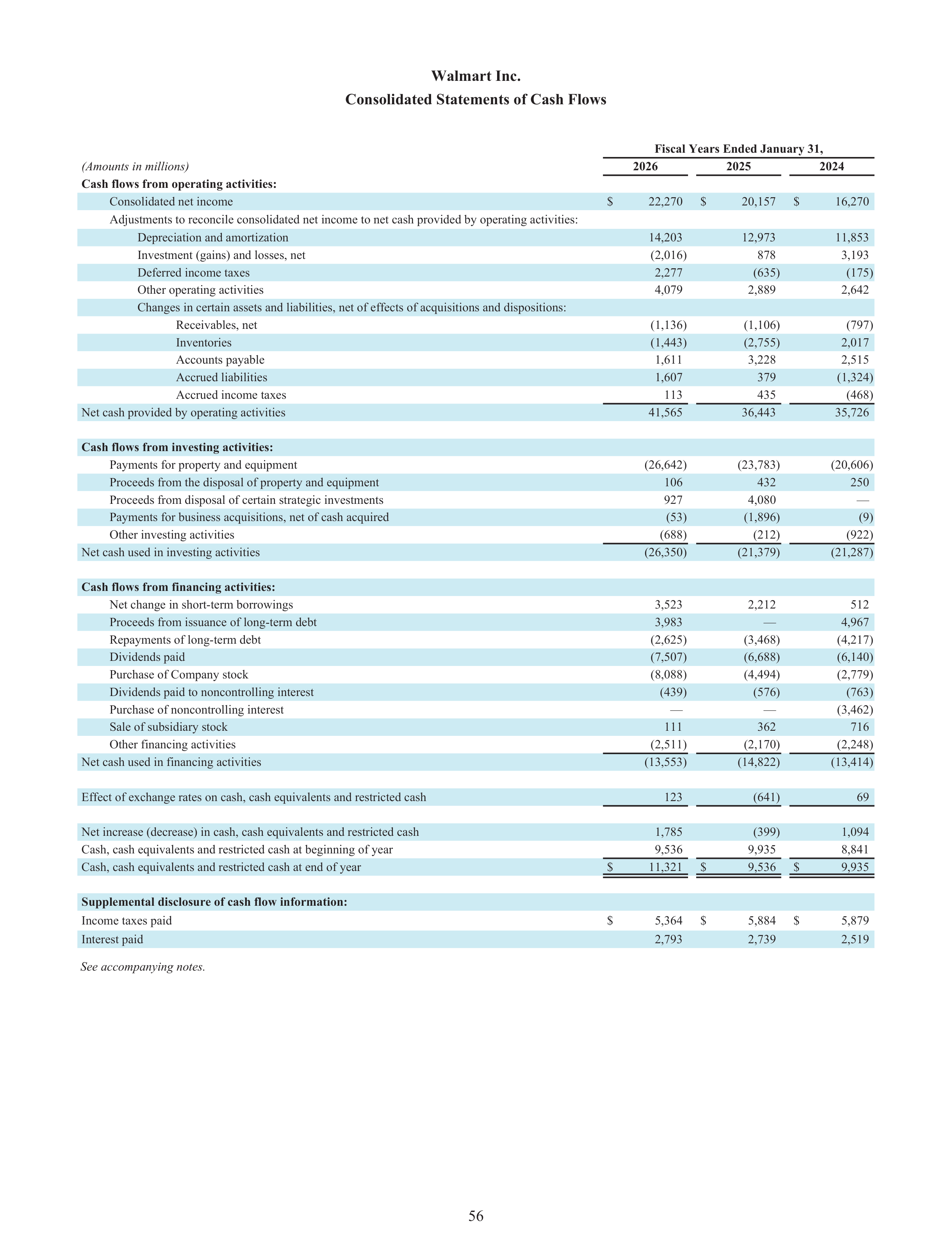
Walmart Inc.
Consolidated Statements of Cash Flows
Fiscal Years Ended January 31,
(Amounts in millions)
2026
2025
2024
Cash flows from operating activities:
Consolidated net income
$
22,270
$
20,157
$
16,270
Adjustments to reconcile consolidated net income to net cash provided by operating activities:
Depreciation and amortization
14,203
12,973
11,853
Investment (gains) and losses, net
(2,016)
878
3,193
Deferred income taxes
2,277
(635)
(175)
Other operating activities
4,079
2,889
2,642
Changes in certain assets and liabilities, net of effects of acquisitions and dispositions:
Receivables, net
(1,136)
(1,106)
(797)
Inventories
(1,443)
(2,755)
2,017
Accounts payable
1,611
3,228
2,515
Accrued liabilities
1,607
379
(1,324)
Accrued income taxes
113
435
(468)
Net cash provided by operating activities
41,565
36,443
35,726
Cash flows from investing activities:
Payments for property and equipment
(26,642)
(23,783)
(20,606)
Proceeds from the disposal of property and equipment
106
432
250
Proceeds from disposal of certain strategic investments
927
4,080
—
Payments for business acquisitions, net of cash acquired
(53)
(1,896)
(9)
Other investing activities
(688)
(212)
(922)
Net cash used in investing activities
(26,350)
(21,379)
(21,287)
Cash flows from financing activities:
Net change in short-term borrowings
3,523
2,212
512
Proceeds from issuance of long-term debt
3,983
—
4,967
Repayments of long-term debt
(2,625)
(3,468)
(4,217)
Dividends paid
(7,507)
(6,688)
(6,140)
Purchase of Company stock
(8,088)
(4,494)
(2,779)
Dividends paid to noncontrolling interest
(439)
(576)
(763)
Purchase of noncontrolling interest
—
—
(3,462)
Sale of subsidiary stock
111
362
716
Other financing activities
(2,511)
(2,170)
(2,248)
Net cash used in financing activities
(13,553)
(14,822)
(13,414)
Effect of exchange rates on cash, cash equivalents and restricted cash
123
(641)
69
Net increase (decrease) in cash, cash equivalents and restricted cash
1,785
(399)
1,094
Cash, cash equivalents and restricted cash at beginning of year
9,536
9,935
8,841
Cash, cash equivalents and restricted cash at end of year
$
11,321
$
9,536
$
9,935
Supplemental disclosure of cash flow information:
Income taxes paid
$
5,364
$
5,884
$
5,879
Interest paid
2,793
2,739
2,519
See accompanying notes.
56
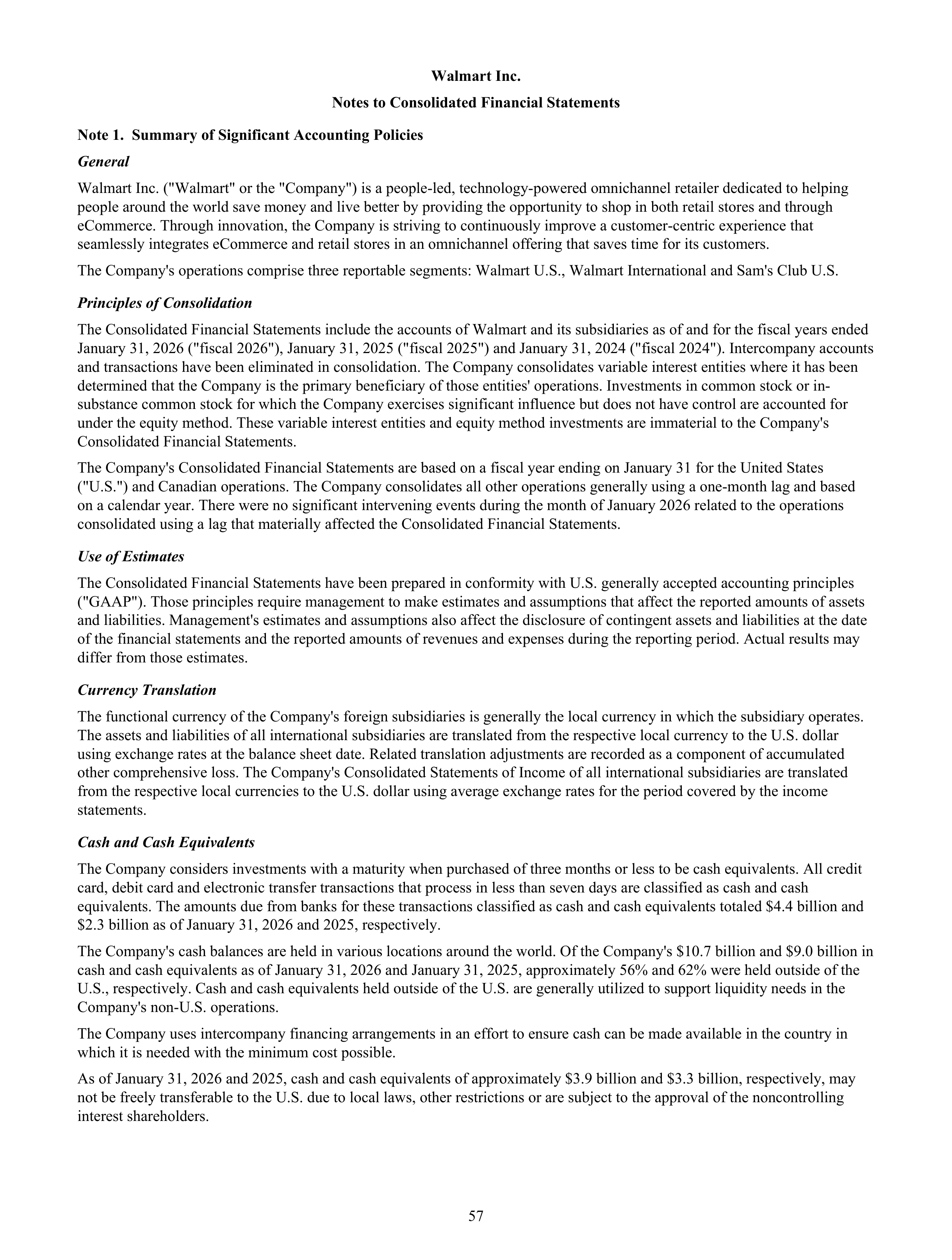
Walmart Inc.
Notes to Consolidated Financial Statements
Note 1. Summary of Significant Accounting Policies
General
Walmart Inc. ("Walmart" or the "Company") is a people-led, technology-powered omnichannel retailer dedicated to helping
people around the world save money and live better by providing the opportunity to shop in both retail stores and through
eCommerce. Through innovation, the Company is striving to continuously improve a customer-centric experience that
seamlessly integrates eCommerce and retail stores in an omnichannel offering that saves time for its customers.
The Company's operations comprise three reportable segments: Walmart U.S., Walmart International and Sam's Club U.S.
Principles of Consolidation
The Consolidated Financial Statements include the accounts of Walmart and its subsidiaries as of and for the fiscal years ended
January 31, 2026 ("fiscal 2026"), January 31, 2025 ("fiscal 2025") and January 31, 2024 ("fiscal 2024"). Intercompany accounts
and transactions have been eliminated in consolidation. The Company consolidates variable interest entities where it has been
determined that the Company is the primary beneficiary of those entities' operations. Investments in common stock or in-
substance common stock for which the Company exercises significant influence but does not have control are accounted for
under the equity method. These variable interest entities and equity method investments are immaterial to the Company's
Consolidated Financial Statements.
The Company's Consolidated Financial Statements are based on a fiscal year ending on January 31 for the United States
("U.S.") and Canadian operations. The Company consolidates all other operations generally using a one-month lag and based
on a calendar year. There were no significant intervening events during the month of January 2026 related to the operations
consolidated using a lag that materially affected the Consolidated Financial Statements.
Use of Estimates
The Consolidated Financial Statements have been prepared in conformity with U.S. generally accepted accounting principles
("GAAP"). Those principles require management to make estimates and assumptions that affect the reported amounts of assets
and liabilities. Management's estimates and assumptions also affect the disclosure of contingent assets and liabilities at the date
of the financial statements and the reported amounts of revenues and expenses during the reporting period. Actual results may
differ from those estimates.
Currency Translation
The functional currency of the Company's foreign subsidiaries is generally the local currency in which the subsidiary operates.
The assets and liabilities of all international subsidiaries are translated from the respective local currency to the U.S. dollar
using exchange rates at the balance sheet date. Related translation adjustments are recorded as a component of accumulated
other comprehensive loss. The Company's Consolidated Statements of Income of all international subsidiaries are translated
from the respective local currencies to the U.S. dollar using average exchange rates for the period covered by the income
statements.
Cash and Cash Equivalents
The Company considers investments with a maturity when purchased of three months or less to be cash equivalents. All credit
card, debit card and electronic transfer transactions that process in less than seven days are classified as cash and cash
equivalents. The amounts due from banks for these transactions classified as cash and cash equivalents totaled $4.4 billion and
$2.3 billion as of January 31, 2026 and 2025, respectively.
The Company's cash balances are held in various locations around the world. Of the Company's $10.7 billion and $9.0 billion in
cash and cash equivalents as of January 31, 2026 and January 31, 2025, approximately 56% and 62% were held outside of the
U.S., respectively. Cash and cash equivalents held outside of the U.S. are generally utilized to support liquidity needs in the
Company's non-U.S. operations.
The Company uses intercompany financing arrangements in an effort to ensure cash can be made available in the country in
which it is needed with the minimum cost possible.
As of January 31, 2026 and 2025, cash and cash equivalents of approximately $3.9 billion and $3.3 billion, respectively, may
not be freely transferable to the U.S. due to local laws, other restrictions or are subject to the approval of the noncontrolling
interest shareholders.
57
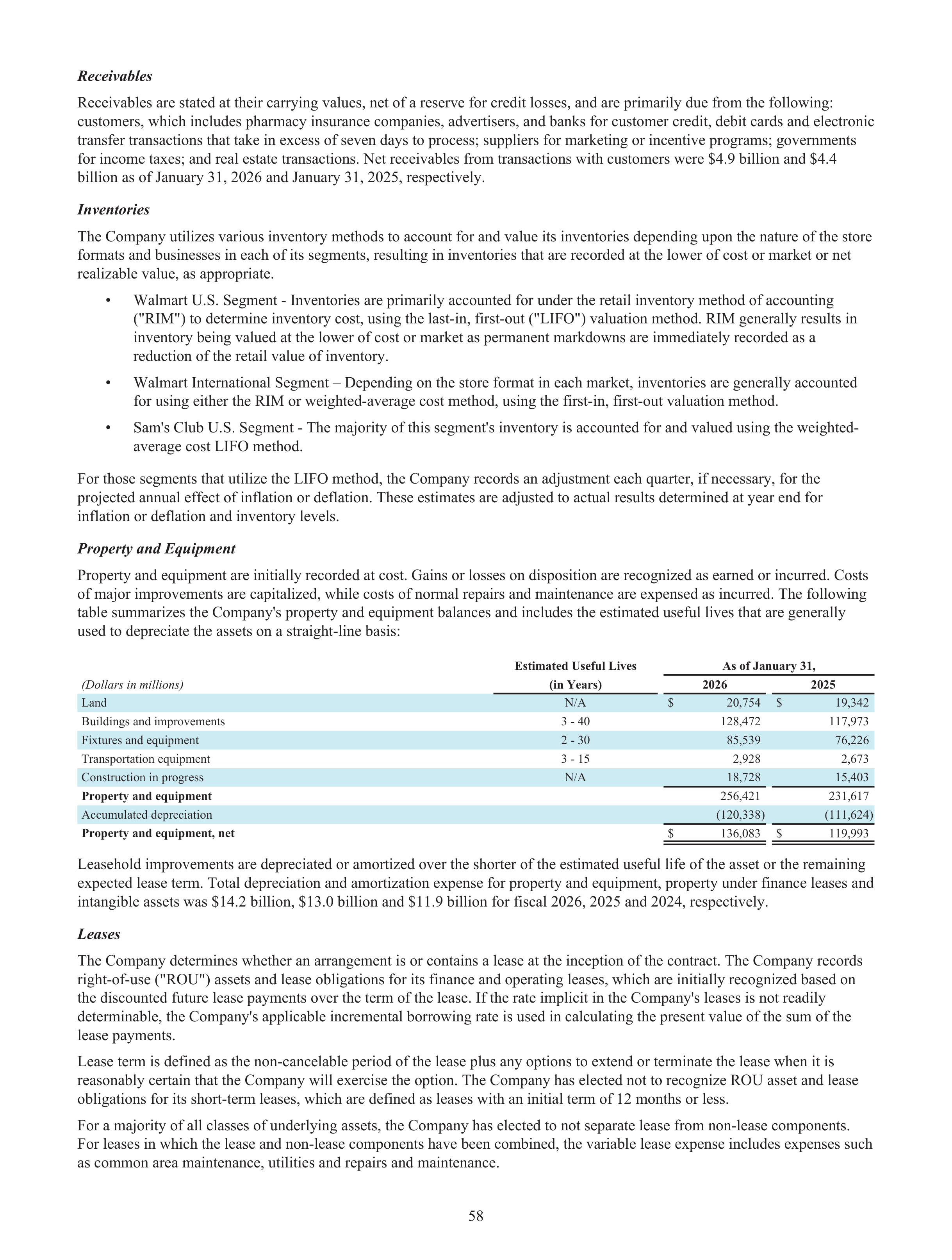
Receivables
Receivables are stated at their carrying values, net of a reserve for credit losses, and are primarily due from the following:
customers, which includes pharmacy insurance companies, advertisers, and banks for customer credit, debit cards and electronic
transfer transactions that take in excess of seven days to process; suppliers for marketing or incentive programs; governments
for income taxes; and real estate transactions. Net receivables from transactions with customers were $4.9 billion and $4.4
billion as of January 31, 2026 and January 31, 2025, respectively.
Inventories
The Company utilizes various inventory methods to account for and value its inventories depending upon the nature of the store
formats and businesses in each of its segments, resulting in inventories that are recorded at the lower of cost or market or net
realizable value, as appropriate.
•
Walmart U.S. Segment - Inventories are primarily accounted for under the retail inventory method of accounting
("RIM") to determine inventory cost, using the last-in, first-out ("LIFO") valuation method. RIM generally results in
inventory being valued at the lower of cost or market as permanent markdowns are immediately recorded as a
reduction of the retail value of inventory.
•
Walmart International Segment – Depending on the store format in each market, inventories are generally accounted
for using either the RIM or weighted-average cost method, using the first-in, first-out valuation method.
•
Sam's Club U.S. Segment - The majority of this segment's inventory is accounted for and valued using the weighted-
average cost LIFO method.
For those segments that utilize the LIFO method, the Company records an adjustment each quarter, if necessary, for the
projected annual effect of inflation or deflation. These estimates are adjusted to actual results determined at year end for
inflation or deflation and inventory levels.
Property and Equipment
Property and equipment are initially recorded at cost. Gains or losses on disposition are recognized as earned or incurred. Costs
of major improvements are capitalized, while costs of normal repairs and maintenance are expensed as incurred. The following
table summarizes the Company's property and equipment balances and includes the estimated useful lives that are generally
used to depreciate the assets on a straight-line basis:
Estimated Useful Lives
As of January 31,
(Dollars in millions)
(in Years)
2026
2025
Land
N/A
$
20,754
$
19,342
Buildings and improvements
3 - 40
128,472
117,973
Fixtures and equipment
2 - 30
85,539
76,226
Transportation equipment
3 - 15
2,928
2,673
Construction in progress
N/A
18,728
15,403
Property and equipment
256,421
231,617
Accumulated depreciation
(120,338)
(111,624)
Property and equipment, net
$
136,083
$
119,993
Leasehold improvements are depreciated or amortized over the shorter of the estimated useful life of the asset or the remaining
expected lease term. Total depreciation and amortization expense for property and equipment, property under finance leases and
intangible assets was $14.2 billion, $13.0 billion and $11.9 billion for fiscal 2026, 2025 and 2024, respectively.
Leases
The Company determines whether an arrangement is or contains a lease at the inception of the contract. The Company records
right-of-use ("ROU") assets and lease obligations for its finance and operating leases, which are initially recognized based on
the discounted future lease payments over the term of the lease. If the rate implicit in the Company's leases is not readily
determinable, the Company's applicable incremental borrowing rate is used in calculating the present value of the sum of the
lease payments.
Lease term is defined as the non-cancelable period of the lease plus any options to extend or terminate the lease when it is
reasonably certain that the Company will exercise the option. The Company has elected not to recognize ROU asset and lease
obligations for its short-term leases, which are defined as leases with an initial term of 12 months or less.
For a majority of all classes of underlying assets, the Company has elected to not separate lease from non-lease components.
For leases in which the lease and non-lease components have been combined, the variable lease expense includes expenses such
as common area maintenance, utilities and repairs and maintenance.
58
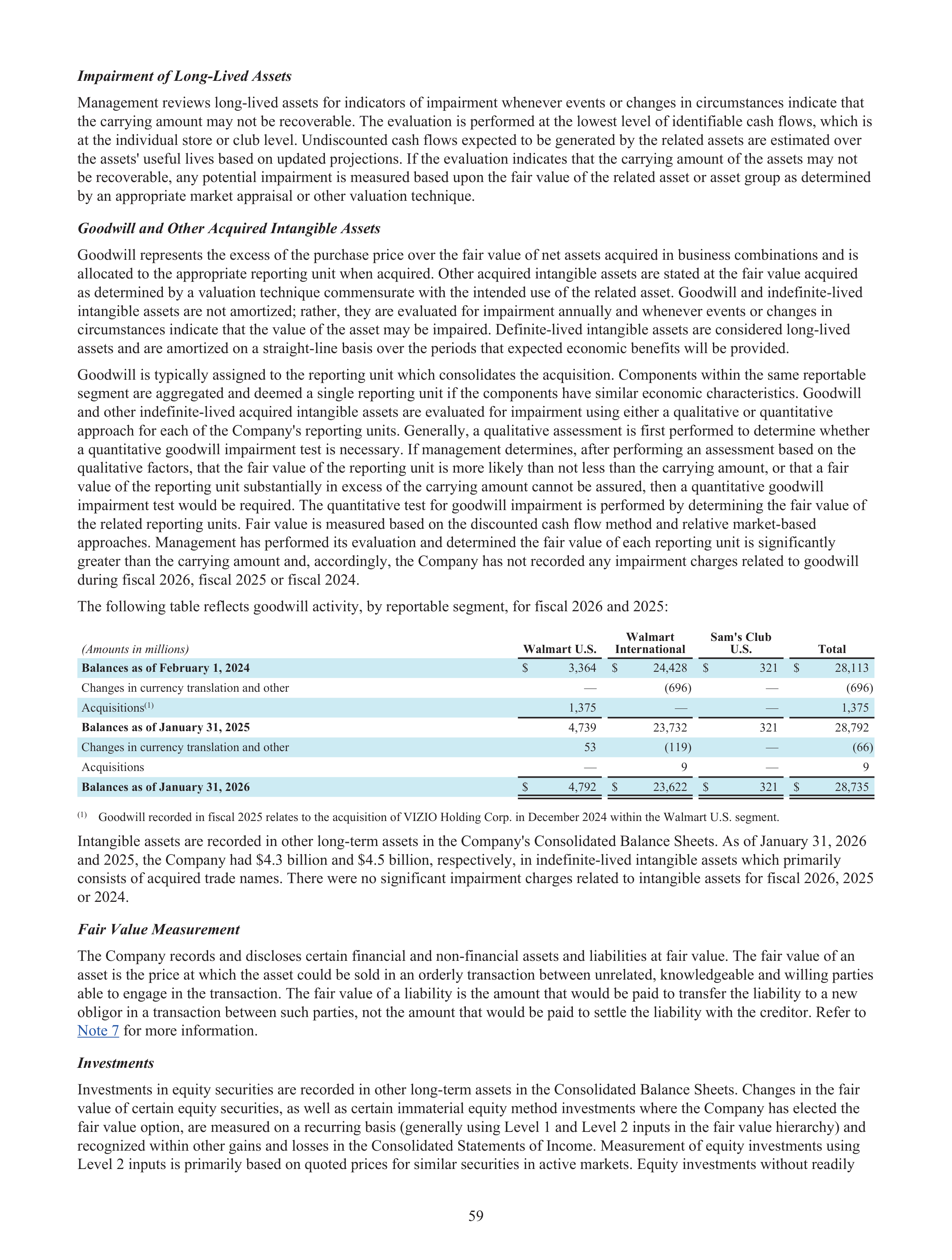
Impairment of Long-Lived Assets
Management reviews long-lived assets for indicators of impairment whenever events or changes in circumstances indicate that
the carrying amount may not be recoverable. The evaluation is performed at the lowest level of identifiable cash flows, which is
at the individual store or club level. Undiscounted cash flows expected to be generated by the related assets are estimated over
the assets' useful lives based on updated projections. If the evaluation indicates that the carrying amount of the assets may not
be recoverable, any potential impairment is measured based upon the fair value of the related asset or asset group as determined
by an appropriate market appraisal or other valuation technique.
Goodwill and Other Acquired Intangible Assets
Goodwill represents the excess of the purchase price over the fair value of net assets acquired in business combinations and is
allocated to the appropriate reporting unit when acquired. Other acquired intangible assets are stated at the fair value acquired
as determined by a valuation technique commensurate with the intended use of the related asset. Goodwill and indefinite-lived
intangible assets are not amortized; rather, they are evaluated for impairment annually and whenever events or changes in
circumstances indicate that the value of the asset may be impaired. Definite-lived intangible assets are considered long-lived
assets and are amortized on a straight-line basis over the periods that expected economic benefits will be provided.
Goodwill is typically assigned to the reporting unit which consolidates the acquisition. Components within the same reportable
segment are aggregated and deemed a single reporting unit if the components have similar economic characteristics. Goodwill
and other indefinite-lived acquired intangible assets are evaluated for impairment using either a qualitative or quantitative
approach for each of the Company's reporting units. Generally, a qualitative assessment is first performed to determine whether
a quantitative goodwill impairment test is necessary. If management determines, after performing an assessment based on the
qualitative factors, that the fair value of the reporting unit is more likely than not less than the carrying amount, or that a fair
value of the reporting unit substantially in excess of the carrying amount cannot be assured, then a quantitative goodwill
impairment test would be required. The quantitative test for goodwill impairment is performed by determining the fair value of
the related reporting units. Fair value is measured based on the discounted cash flow method and relative market-based
approaches. Management has performed its evaluation and determined the fair value of each reporting unit is significantly
greater than the carrying amount and, accordingly, the Company has not recorded any impairment charges related to goodwill
during fiscal 2026, fiscal 2025 or fiscal 2024.
The following table reflects goodwill activity, by reportable segment, for fiscal 2026 and 2025:
(Amounts in millions)
Walmart U.S.
Walmart
International
Sam's Club
U.S.
Total
Balances as of February 1, 2024
$
3,364
$
24,428
$
321
$
28,113
Changes in currency translation and other
—
(696)
—
(696)
Acquisitions
(1)
1,375
—
—
1,375
Balances as of January 31, 2025
4,739
23,732
321
28,792
Changes in currency translation and other
53
(119)
—
(66)
Acquisitions
—
9
—
9
Balances as of January 31, 2026
$
4,792
$
23,622
$
321
$
28,735
(1)
Goodwill recorded in fiscal 2025 relates to the acquisition of VIZIO Holding Corp. in December 2024 within the Walmart U.S. segment.
Intangible assets are recorded in other long-term assets in the Company's Consolidated Balance Sheets. As of January 31, 2026
and 2025, the Company had $4.3 billion and $4.5 billion, respectively, in indefinite-lived intangible assets which primarily
consists of acquired trade names. There were no significant impairment charges related to intangible assets for fiscal 2026, 2025
or 2024.
Fair Value Measurement
The Company records and discloses certain financial and non-financial assets and liabilities at fair value. The fair value of an
asset is the price at which the asset could be sold in an orderly transaction between unrelated, knowledgeable and willing parties
able to engage in the transaction. The fair value of a liability is the amount that would be paid to transfer the liability to a new
obligor in a transaction between such parties, not the amount that would be paid to settle the liability with the creditor. Refer to
Note 7
for more information.
Investments
Investments in equity securities are recorded in other long-term assets in the Consolidated Balance Sheets. Changes in the fair
value of certain equity securities, as well as certain immaterial equity method investments where the Company has elected the
fair value option, are measured on a recurring basis (generally using Level 1 and Level 2 inputs in the fair value hierarchy) and
recognized within other gains and losses in the Consolidated Statements of Income. Measurement of equity investments using
Level 2 inputs is primarily based on quoted prices for similar securities in active markets. Equity investments without readily
59
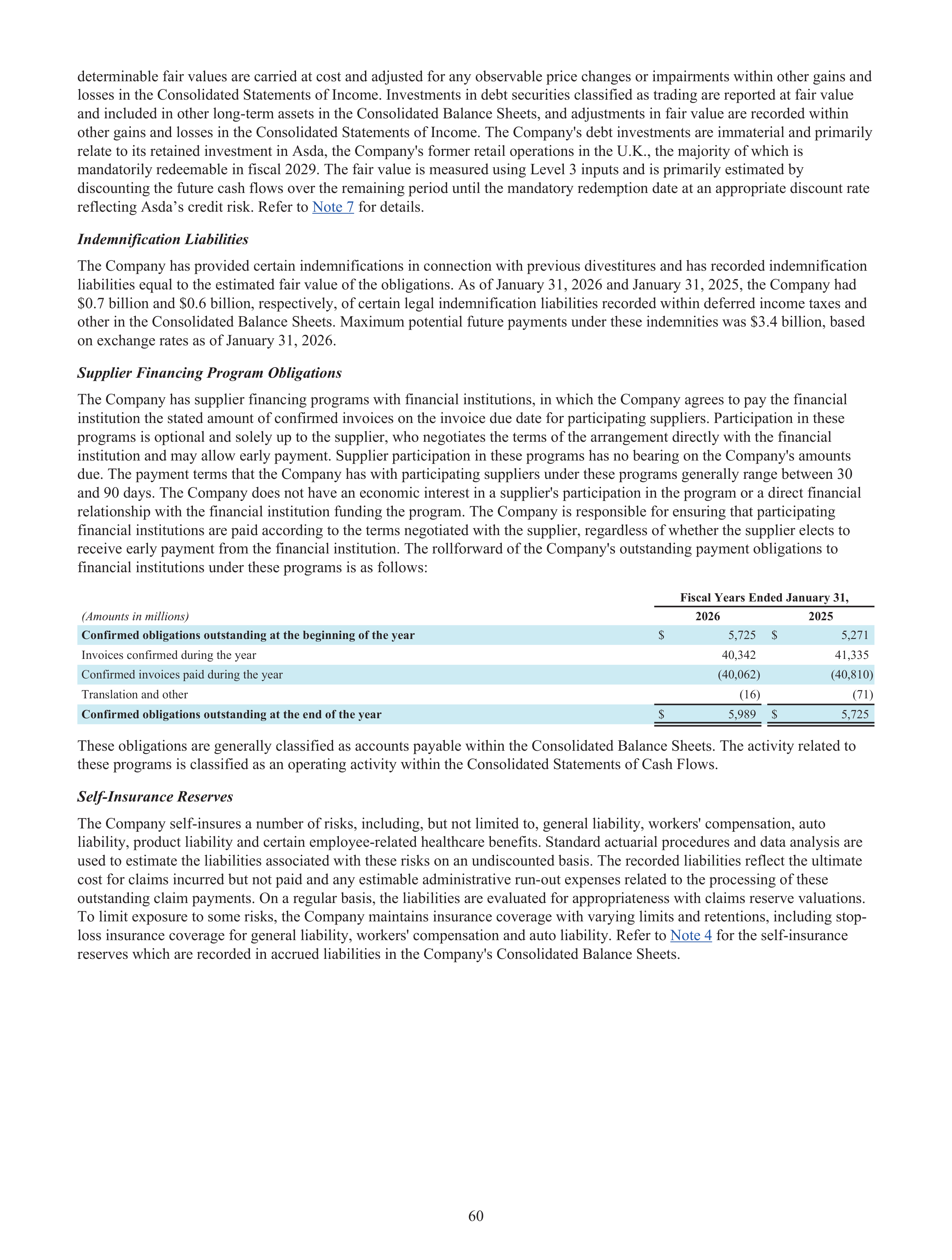
determinable fair values are carried at cost and adjusted for any observable price changes or impairments within other gains and
losses in the Consolidated Statements of Income. Investments in debt securities classified as trading are reported at fair value
and included in other long-term assets in the Consolidated Balance Sheets, and adjustments in fair value are recorded within
other gains and losses in the Consolidated Statements of Income. The Company's debt investments are immaterial and primarily
relate to its retained investment in Asda, the Company's former retail operations in the U.K., the majority of which is
mandatorily redeemable in fiscal 2029. The fair value is measured using Level 3 inputs and is primarily estimated by
discounting the future cash flows over the remaining period until the mandatory redemption date at an appropriate discount rate
reflecting Asda’s credit risk. Refer to
Note 7
for details.
Indemnification Liabilities
The Company has provided certain indemnifications in connection with previous divestitures and has recorded indemnification
liabilities equal to the estimated fair value of the obligations. As of January 31, 2026 and January 31, 2025, the Company had
$0.7 billion and $0.6 billion, respectively, of certain legal indemnification liabilities recorded within deferred income taxes and
other in the Consolidated Balance Sheets. Maximum potential future payments under these indemnities was $3.4 billion, based
on exchange rates as of January 31, 2026.
Supplier Financing Program Obligations
The Company has supplier financing programs with financial institutions, in which the Company agrees to pay the financial
institution the stated amount of confirmed invoices on the invoice due date for participating suppliers. Participation in these
programs is optional and solely up to the supplier, who negotiates the terms of the arrangement directly with the financial
institution and may allow early payment. Supplier participation in these programs has no bearing on the Company's amounts
due. The payment terms that the Company has with participating suppliers under these programs generally range between 30
and 90 days. The Company does not have an economic interest in a supplier's participation in the program or a direct financial
relationship with the financial institution funding the program. The Company is responsible for ensuring that participating
financial institutions are paid according to the terms negotiated with the supplier, regardless of whether the supplier elects to
receive early payment from the financial institution. The rollforward of the Company's outstanding payment obligations to
financial institutions under these programs is as follows:
Fiscal Years Ended January 31,
(Amounts in millions)
2026
2025
Confirmed obligations outstanding at the beginning of the year
$
5,725
$
5,271
Invoices confirmed during the year
40,342
41,335
Confirmed invoices paid during the year
(40,062)
(40,810)
Translation and other
(16)
(71)
Confirmed obligations outstanding at the end of the year
$
5,989
$
5,725
These obligations are generally classified as accounts payable within the Consolidated Balance Sheets. The activity related to
these programs is classified as an operating activity within the Consolidated Statements of Cash Flows.
Self-Insurance Reserves
The Company self-insures a number of risks, including, but not limited to, general liability, workers' compensation, auto
liability, product liability and certain employee-related healthcare benefits. Standard actuarial procedures and data analysis are
used to estimate the liabilities associated with these risks on an undiscounted basis. The recorded liabilities reflect the ultimate
cost for claims incurred but not paid and any estimable administrative run-out expenses related to the processing of these
outstanding claim payments. On a regular basis, the liabilities are evaluated for appropriateness with claims reserve valuations.
To limit exposure to some risks, the Company maintains insurance coverage with varying limits and retentions, including stop-
loss insurance coverage for general liability, workers' compensation and auto liability. Refer to
Note 4
for the self-insurance
reserves which are recorded in accrued liabilities in the Company's Consolidated Balance Sheets.
60
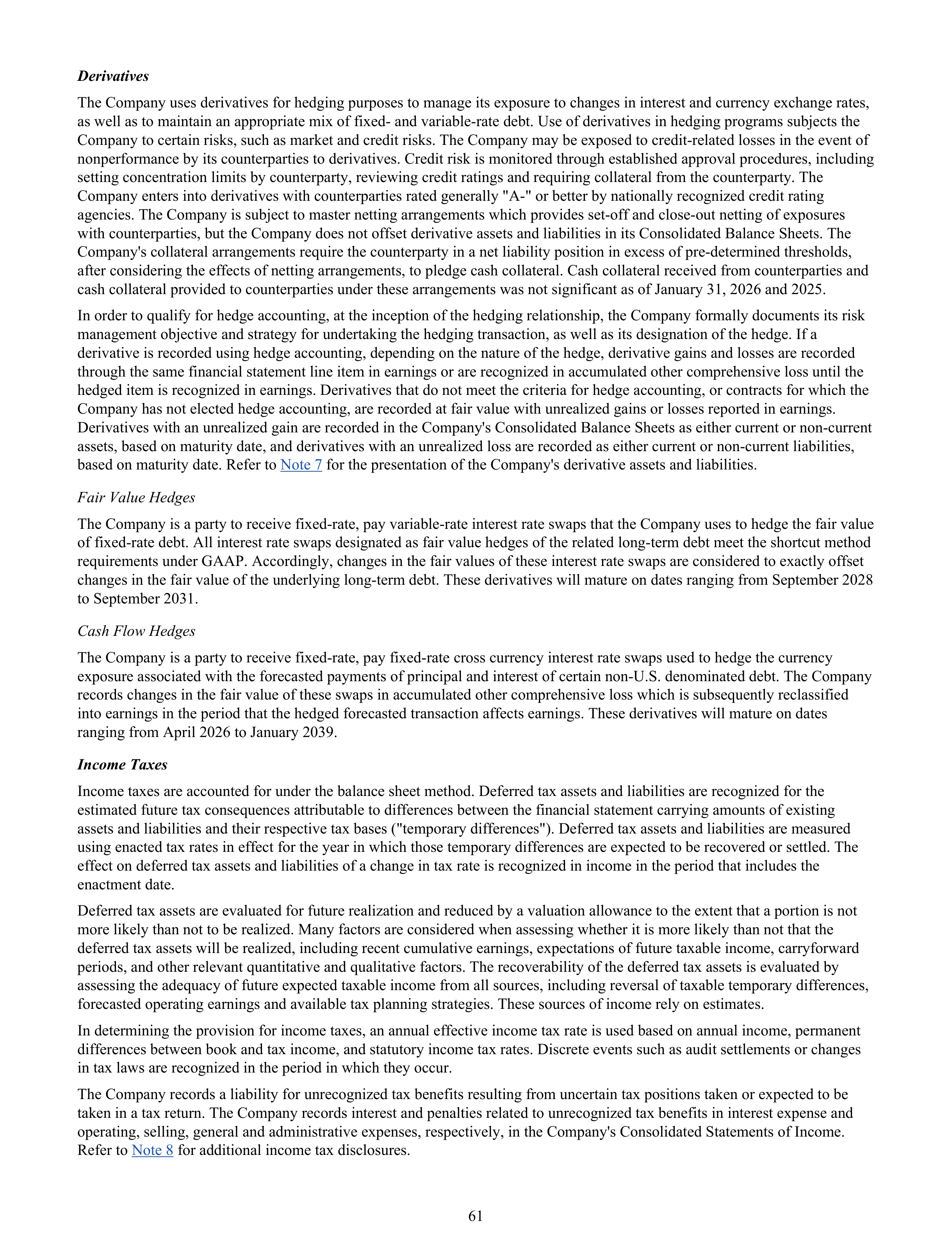
Derivatives
The Company uses derivatives for hedging purposes to manage its exposure to changes in interest and currency exchange rates,
as well as to maintain an appropriate mix of fixed- and variable-rate debt. Use of derivatives in hedging programs subjects the
Company to certain risks, such as market and credit risks. The Company may be exposed to credit-related losses in the event of
nonperformance by its counterparties to derivatives. Credit risk is monitored through established approval procedures, including
setting concentration limits by counterparty, reviewing credit ratings and requiring collateral from the counterparty. The
Company enters into derivatives with counterparties rated generally "A-" or better by nationally recognized credit rating
agencies. The Company is subject to master netting arrangements which provides set-off and close-out netting of exposures
with counterparties, but the Company does not offset derivative assets and liabilities in its Consolidated Balance Sheets. The
Company's collateral arrangements require the counterparty in a net liability position in excess of pre-determined thresholds,
after considering the effects of netting arrangements, to pledge cash collateral. Cash collateral received from counterparties and
cash collateral provided to counterparties under these arrangements was not significant as of January 31, 2026 and 2025.
In order to qualify for hedge accounting, at the inception of the hedging relationship, the Company formally documents its risk
management objective and strategy for undertaking the hedging transaction, as well as its designation of the hedge. If a
derivative is recorded using hedge accounting, depending on the nature of the hedge, derivative gains and losses are recorded
through the same financial statement line item in earnings or are recognized in accumulated other comprehensive loss until the
hedged item is recognized in earnings. Derivatives that do not meet the criteria for hedge accounting, or contracts for which the
Company has not elected hedge accounting, are recorded at fair value with unrealized gains or losses reported in earnings.
Derivatives with an unrealized gain are recorded in the Company's Consolidated Balance Sheets as either current or non-current
assets, based on maturity date, and derivatives with an unrealized loss are recorded as either current or non-current liabilities,
based on maturity date. Refer to
Note 7
for the presentation of the Company's derivative assets and liabilities.
Fair Value Hedges
The Company is a party to receive fixed-rate, pay variable-rate interest rate swaps that the Company uses to hedge the fair value
of fixed-rate debt. All interest rate swaps designated as fair value hedges of the related long-term debt meet the shortcut method
requirements under GAAP. Accordingly, changes in the fair values of these interest rate swaps are considered to exactly offset
changes in the fair value of the underlying long-term debt. These derivatives will mature on dates ranging from September 2028
to September 2031.
Cash Flow Hedges
The Company is a party to receive fixed-rate, pay fixed-rate cross currency interest rate swaps used to hedge the currency
exposure associated with the forecasted payments of principal and interest of certain non-U.S. denominated debt. The Company
records changes in the fair value of these swaps in accumulated other comprehensive loss which is subsequently reclassified
into earnings in the period that the hedged forecasted transaction affects earnings. These derivatives will mature on dates
ranging from April 2026 to January 2039.
Income Taxes
Income taxes are accounted for under the balance sheet method. Deferred tax assets and liabilities are recognized for the
estimated future tax consequences attributable to differences between the financial statement carrying amounts of existing
assets and liabilities and their respective tax bases ("temporary differences"). Deferred tax assets and liabilities are measured
using enacted tax rates in effect for the year in which those temporary differences are expected to be recovered or settled. The
effect on deferred tax assets and liabilities of a change in tax rate is recognized in income in the period that includes the
enactment date.
Deferred tax assets are evaluated for future realization and reduced by a valuation allowance to the extent that a portion is not
more likely than not to be realized. Many factors are considered when assessing whether it is more likely than not that the
deferred tax assets will be realized, including recent cumulative earnings, expectations of future taxable income, carryforward
periods, and other relevant quantitative and qualitative factors. The recoverability of the deferred tax assets is evaluated by
assessing the adequacy of future expected taxable income from all sources, including reversal of taxable temporary differences,
forecasted operating earnings and available tax planning strategies. These sources of income rely on estimates.
In determining the provision for income taxes, an annual effective income tax rate is used based on annual income, permanent
differences between book and tax income, and statutory income tax rates. Discrete events such as audit settlements or changes
in tax laws are recognized in the period in which they occur.
The Company records a liability for unrecognized tax benefits resulting from uncertain tax positions taken or expected to be
taken in a tax return. The Company records interest and penalties related to unrecognized tax benefits in interest expense and
operating, selling, general and administrative expenses, respectively, in the Company's Consolidated Statements of Income.
Refer to
Note 8
for additional income tax disclosures.
61
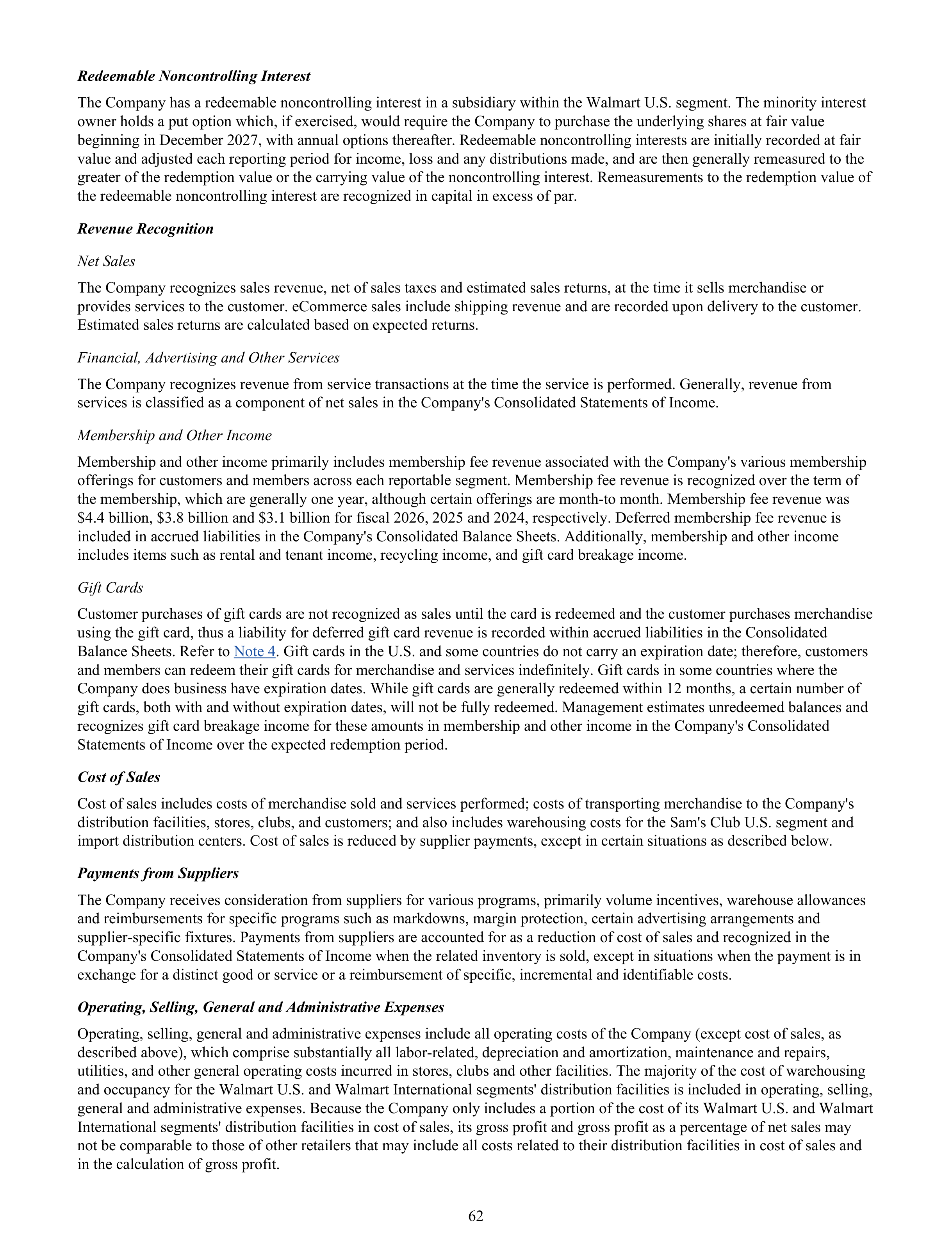
Redeemable Noncontrolling Interest
The Company has a redeemable noncontrolling interest in a subsidiary within the Walmart U.S. segment. The minority interest
owner holds a put option which, if exercised, would require the Company to purchase the underlying shares at fair value
beginning in December 2027, with annual options thereafter. Redeemable noncontrolling interests are initially recorded at fair
value and adjusted each reporting period for income, loss and any distributions made, and are then generally remeasured to the
greater of the redemption value or the carrying value of the noncontrolling interest. Remeasurements to the redemption value of
the redeemable noncontrolling interest are recognized in capital in excess of par.
Revenue Recognition
Net Sales
The Company recognizes sales revenue, net of sales taxes and estimated sales returns, at the time it sells merchandise or
provides services to the customer. eCommerce sales include shipping revenue and are recorded upon delivery to the customer.
Estimated sales returns are calculated based on expected returns.
Financial, Advertising and Other Services
The Company recognizes revenue from service transactions at the time the service is performed. Generally, revenue from
services is classified as a component of net sales in the Company's Consolidated Statements of Income.
Membership and Other Income
Membership and other income primarily includes membership fee revenue associated with the Company's various membership
offerings for customers and members across each reportable segment. Membership fee revenue is recognized over the term of
the membership, which are generally one year, although certain offerings are month-to month. Membership fee revenue was
$4.4 billion, $3.8 billion and $3.1 billion for fiscal 2026, 2025 and 2024, respectively. Deferred membership fee revenue is
included in accrued liabilities in the Company's Consolidated Balance Sheets. Additionally, membership and other income
includes items such as rental and tenant income, recycling income, and gift card breakage income.
Gift Cards
Customer purchases of gift cards are not recognized as sales until the card is redeemed and the customer purchases merchandise
using the gift card, thus a liability for deferred gift card revenue is recorded within accrued liabilities in the Consolidated
Balance Sheets. Refer to
Note 4
. Gift cards in the U.S. and some countries do not carry an expiration date; therefore, customers
and members can redeem their gift cards for merchandise and services indefinitely. Gift cards in some countries where the
Company does business have expiration dates. While gift cards are generally redeemed within 12 months, a certain number of
gift cards, both with and without expiration dates, will not be fully redeemed. Management estimates unredeemed balances and
recognizes gift card breakage income for these amounts in membership and other income in the Company's Consolidated
Statements of Income over the expected redemption period.
Cost of Sales
Cost of sales includes costs of merchandise sold and services performed; costs of transporting merchandise to the Company's
distribution facilities, stores, clubs, and customers; and also includes warehousing costs for the Sam's Club U.S. segment and
import distribution centers. Cost of sales is reduced by supplier payments, except in certain situations as described below.
Payments from Suppliers
The Company receives consideration from suppliers for various programs, primarily volume incentives, warehouse allowances
and reimbursements for specific programs such as markdowns, margin protection, certain advertising arrangements and
supplier-specific fixtures. Payments from suppliers are accounted for as a reduction of cost of sales and recognized in the
Company's Consolidated Statements of Income when the related inventory is sold, except in situations when the payment is in
exchange for a distinct good or service or a reimbursement of specific, incremental and identifiable costs.
Operating, Selling, General and Administrative Expenses
Operating, selling, general and administrative expenses include all operating costs of the Company (except cost of sales, as
described above), which comprise substantially all labor-related, depreciation and amortization, maintenance and repairs,
utilities, and other general operating costs incurred in stores, clubs and other facilities. The majority of the cost of warehousing
and occupancy for the Walmart U.S. and Walmart International segments' distribution facilities is included in operating, selling,
general and administrative expenses. Because the Company only includes a portion of the cost of its Walmart U.S. and Walmart
International segments' distribution facilities in cost of sales, its gross profit and gross profit as a percentage of net sales may
not be comparable to those of other retailers that may include all costs related to their distribution facilities in cost of sales and
in the calculation of gross profit.
62
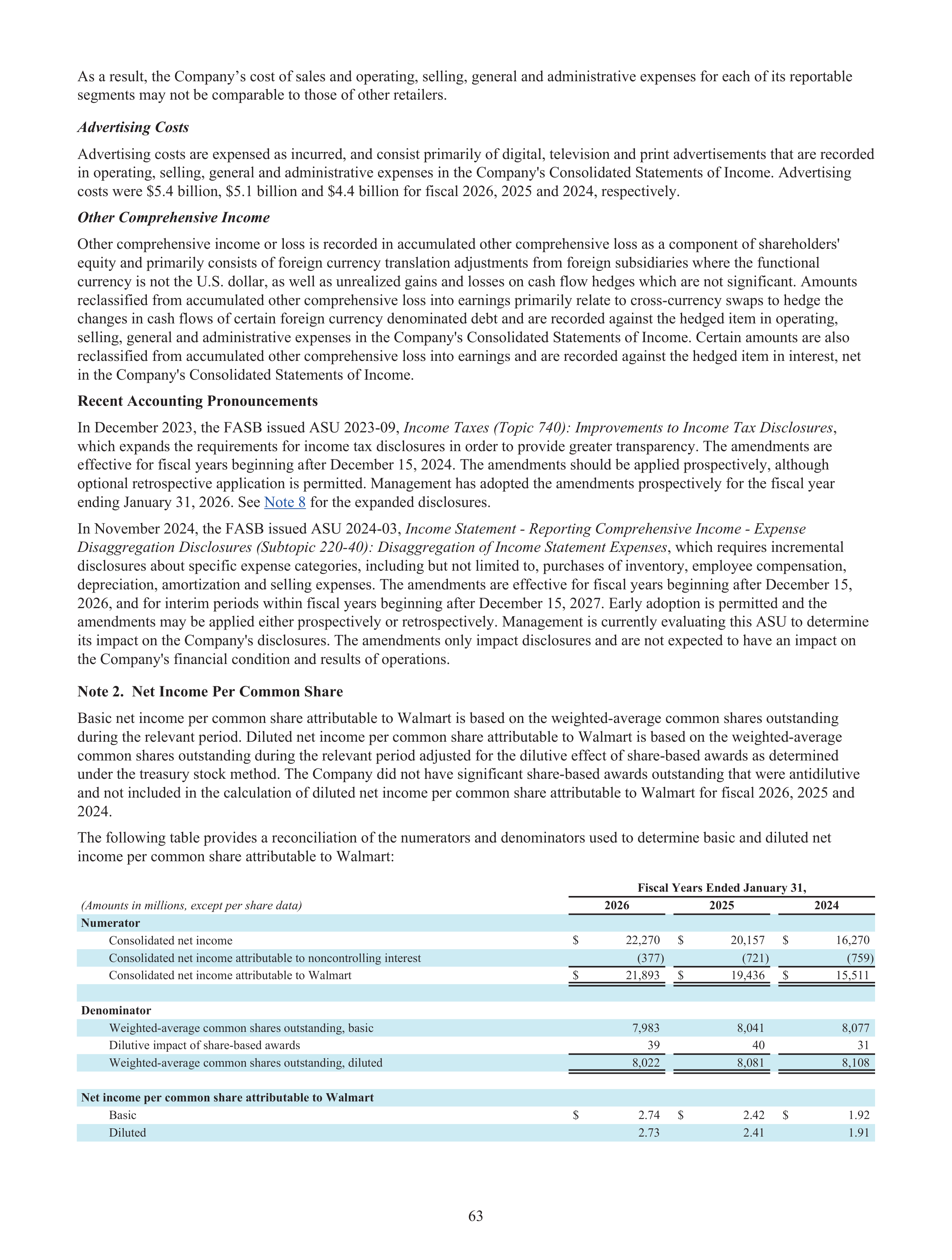
As a result, the Company’s cost of sales and operating, selling, general and administrative expenses for each of its reportable
segments may not be comparable to those of other retailers.
Advertising Costs
Advertising costs are expensed as incurred, and consist primarily of digital, television and print advertisements that are recorded
in operating, selling, general and administrative expenses in the Company's Consolidated Statements of Income. Advertising
costs were $5.4 billion, $5.1 billion and $4.4 billion for fiscal 2026, 2025 and 2024, respectively.
Other Comprehensive Income
Other comprehensive income or loss is recorded in accumulated other comprehensive loss as a component of shareholders'
equity and primarily consists of foreign currency translation adjustments from foreign subsidiaries where the functional
currency is not the U.S. dollar, as well as unrealized gains and losses on cash flow hedges which are not significant. Amounts
reclassified from accumulated other comprehensive loss into earnings primarily relate to cross-currency swaps to hedge the
changes in cash flows of certain foreign currency denominated debt and are recorded against the hedged item in operating,
selling, general and administrative expenses in the Company's Consolidated Statements of Income. Certain amounts are also
reclassified from accumulated other comprehensive loss into earnings and are recorded against the hedged item in interest, net
in the Company's Consolidated Statements of Income.
Recent Accounting Pronouncements
In December 2023, the FASB issued ASU 2023-09,
Income Taxes (Topic 740): Improvements to Income Tax Disclosures
,
which expands the requirements for income tax disclosures in order to provide greater transparency. The amendments are
effective for fiscal years beginning after December 15, 2024. The amendments should be applied prospectively, although
optional retrospective application is permitted. Management has adopted the amendments prospectively for the fiscal year
ending January 31, 2026. See
Note 8
for the expanded disclosures.
In November 2024, the FASB issued ASU 2024-03,
Income Statement - Reporting Comprehensive Income - Expense
Disaggregation Disclosures (Subtopic 220-40): Disaggregation of Income Statement Expenses
, which requires incremental
disclosures about specific expense categories, including but not limited to, purchases of inventory, employee compensation,
depreciation, amortization and selling expenses. The amendments are effective for fiscal years beginning after December 15,
2026, and for interim periods within fiscal years beginning after December 15, 2027. Early adoption is permitted and the
amendments may be applied either prospectively or retrospectively. Management is currently evaluating this ASU to determine
its impact on the Company's disclosures. The amendments only impact disclosures and are not expected to have an impact on
the Company's financial condition and results of operations.
Note 2. Net Income Per Common Share
Basic net income per common share attributable to Walmart is based on the weighted-average common shares outstanding
during the relevant period. Diluted net income per common share attributable to Walmart is based on the weighted-average
common shares outstanding during the relevant period adjusted for the dilutive effect of share-based awards as determined
under the treasury stock method. The Company did not have significant share-based awards outstanding that were antidilutive
and not included in the calculation of diluted net income per common share attributable to Walmart for fiscal 2026, 2025 and
2024.
The following table provides a reconciliation of the numerators and denominators used to determine basic and diluted net
income per common share attributable to Walmart:
Fiscal Years Ended January 31,
(Amounts in millions, except per share data)
2026
2025
2024
Numerator
Consolidated net income
$
22,270
$
20,157
$
16,270
Consolidated net income attributable to noncontrolling interest
(377)
(721)
(759)
Consolidated net income attributable to Walmart
$
21,893
$
19,436
$
15,511
Denominator
Weighted-average common shares outstanding, basic
7,983
8,041
8,077
Dilutive impact of share-based awards
39
40
31
Weighted-average common shares outstanding, diluted
8,022
8,081
8,108
Net income per common share attributable to Walmart
Basic
$
2.74
$
2.42
$
1.92
Diluted
2.73
2.41
1.91
63
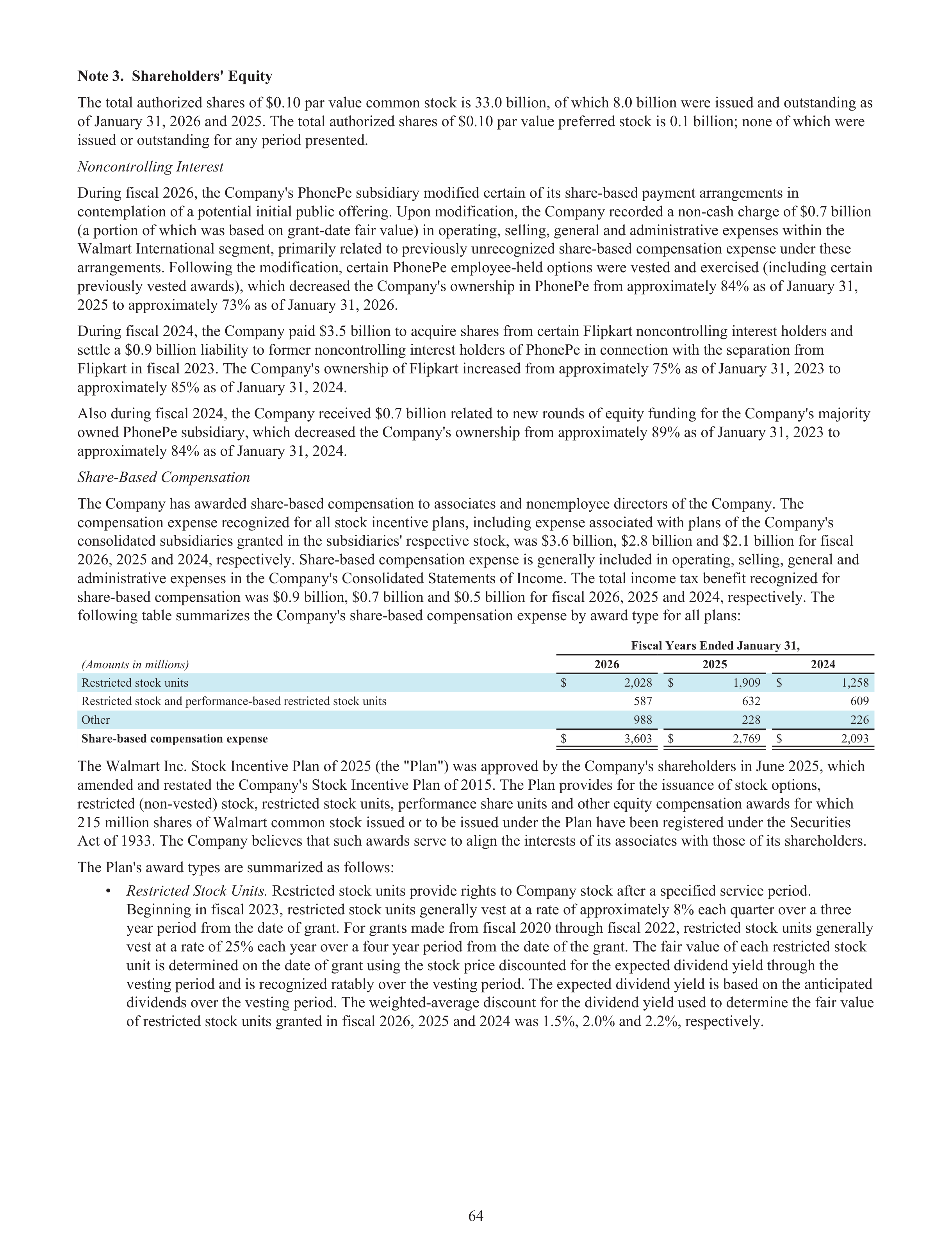
Note 3. Shareholders' Equity
The total authorized shares of $0.10 par value common stock is 33.0 billion, of which 8.0 billion were issued and outstanding as
of January 31, 2026 and 2025. The total authorized shares of $0.10 par value preferred stock is 0.1 billion; none of which were
issued or outstanding for any period presented.
Noncontrolling Interest
During fiscal 2026, the Company's PhonePe subsidiary modified certain of its share-based payment arrangements in
contemplation of a potential initial public offering. Upon modification, the Company recorded a non-cash charge of $0.7 billion
(a portion of which was based on grant-date fair value) in operating, selling, general and administrative expenses within the
Walmart International segment, primarily related to previously unrecognized share-based compensation expense under these
arrangements. Following the modification, certain PhonePe employee-held options were vested and exercised (including certain
previously vested awards), which decreased the Company's ownership in PhonePe from approximately 84% as of January 31,
2025 to approximately 73% as of January 31, 2026.
During fiscal 2024, the Company paid $3.5 billion to acquire shares from certain Flipkart noncontrolling interest holders and
settle a $0.9 billion liability to former noncontrolling interest holders of PhonePe in connection with the separation from
Flipkart in fiscal 2023. The Company's ownership of Flipkart increased from approximately 75% as of January 31, 2023 to
approximately 85% as of January 31, 2024.
Also during fiscal 2024, the Company received $0.7 billion related to new rounds of equity funding for the Company's majority
owned PhonePe subsidiary, which decreased the Company's ownership from approximately 89% as of January 31, 2023 to
approximately 84% as of January 31, 2024.
Share-Based Compensation
The Company has awarded share-based compensation to associates and nonemployee directors of the Company. The
compensation expense recognized for all stock incentive plans, including expense associated with plans of the Company's
consolidated subsidiaries granted in the subsidiaries' respective stock, was $3.6 billion, $2.8 billion and $2.1 billion for fiscal
2026, 2025 and 2024, respectively. Share-based compensation expense is generally included in operating, selling, general and
administrative expenses in the Company's Consolidated Statements of Income. The total income tax benefit recognized for
share-based compensation was $0.9 billion, $0.7 billion and $0.5 billion for fiscal 2026, 2025 and 2024, respectively. The
following table summarizes the Company's share-based compensation expense by award type for all plans:
Fiscal Years Ended January 31,
(Amounts in millions)
2026
2025
2024
Restricted stock units
$
2,028
$
1,909
$
1,258
Restricted stock and performance-based restricted stock units
587
632
609
Other
988
228
226
Share-based compensation expense
$
3,603
$
2,769
$
2,093
The Walmart Inc. Stock Incentive Plan of 2025 (the "Plan") was approved by the Company's shareholders in June 2025, which
amended and restated the Company's Stock Incentive Plan of 2015. The Plan provides for the issuance of stock options,
restricted (non-vested) stock, restricted stock units, performance share units and other equity compensation awards for which
215 million shares of Walmart common stock issued or to be issued under the Plan have been registered under the Securities
Act of 1933. The Company believes that such awards serve to align the interests of its associates with those of its shareholders.
The Plan's award types are summarized as follows:
•
Restricted Stock Units.
Restricted stock units provide rights to Company stock after a specified service period.
Beginning in fiscal 2023, restricted stock units generally vest at a rate of approximately 8% each quarter over a three
year period from the date of grant. For grants made from fiscal 2020 through fiscal 2022, restricted stock units generally
vest at a rate of 25% each year over a four year period from the date of the grant. The fair value of each restricted stock
unit is determined on the date of grant using the stock price discounted for the expected dividend yield through the
vesting period and is recognized ratably over the vesting period. The expected dividend yield is based on the anticipated
dividends over the vesting period. The weighted-average discount for the dividend yield used to determine the fair value
of restricted stock units granted in fiscal 2026, 2025 and 2024 was 1.5%, 2.0% and 2.2%, respectively.
64
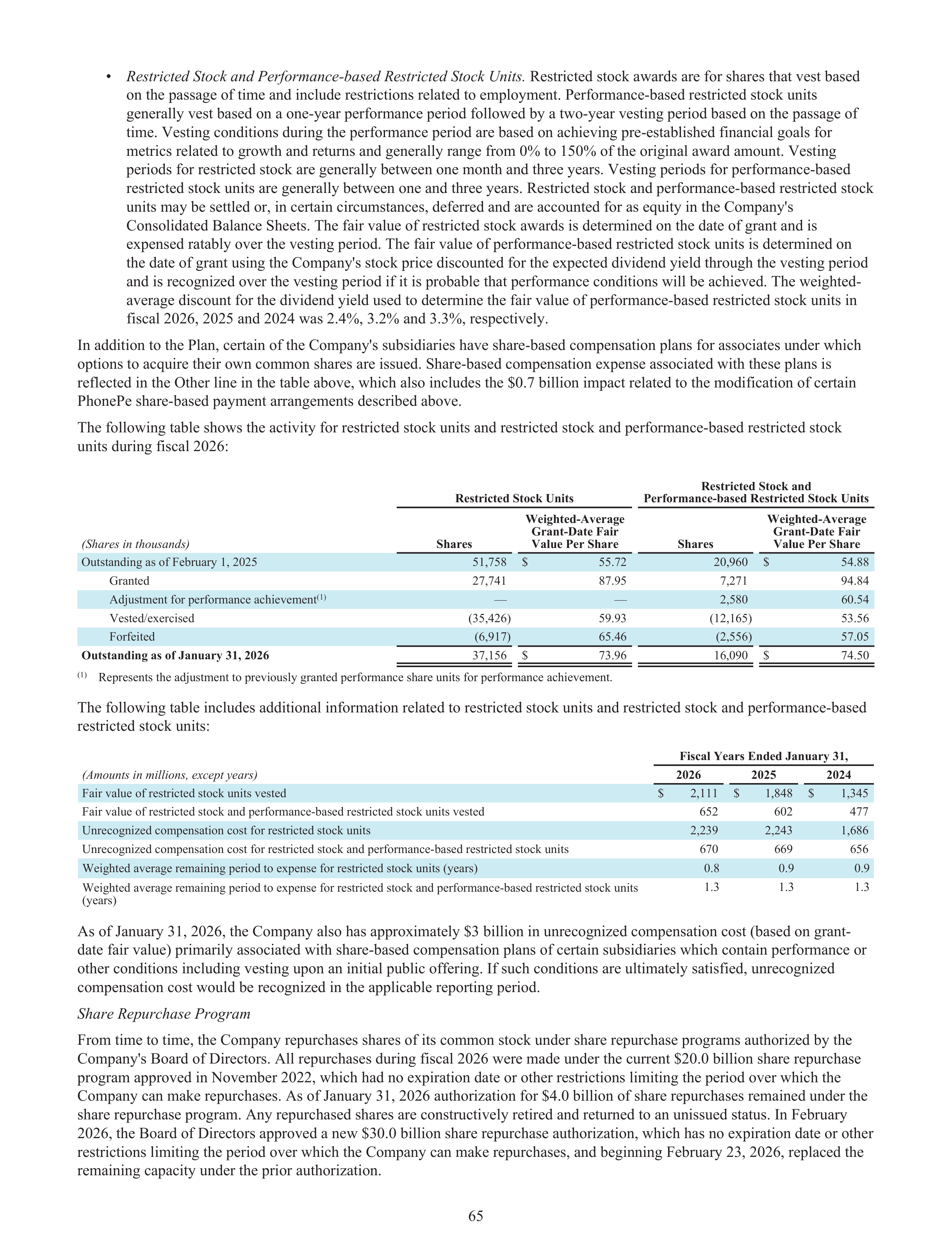
•
Restricted Stock and Performance-based Restricted Stock Units.
Restricted stock awards are for shares that vest based
on the passage of time and include restrictions related to employment. Performance-based restricted stock units
generally vest based on a one-year performance period followed by a two-year vesting period based on the passage of
time. Vesting conditions during the performance period are based on achieving pre-established financial goals for
metrics related to growth and returns and generally range from 0% to 150% of the original award amount. Vesting
periods for restricted stock are generally between one month and three years. Vesting periods for performance-based
restricted stock units are generally between one and three years. Restricted stock and performance-based restricted stock
units may be settled or, in certain circumstances, deferred and are accounted for as equity in the Company's
Consolidated Balance Sheets. The fair value of restricted stock awards is determined on the date of grant and is
expensed ratably over the vesting period. The fair value of performance-based restricted stock units is determined on
the date of grant using the Company's stock price discounted for the expected dividend yield through the vesting period
and is recognized over the vesting period if it is probable that performance conditions will be achieved. The weighted-
average discount for the dividend yield used to determine the fair value of performance-based restricted stock units in
fiscal 2026, 2025 and 2024 was 2.4%, 3.2% and 3.3%, respectively.
In addition to the Plan, certain of the Company's subsidiaries have share-based compensation plans for associates under which
options to acquire their own common shares are issued. Share-based compensation expense associated with these plans is
reflected in the Other line in the table above, which also includes the $0.7 billion impact related to the modification of certain
PhonePe share-based payment arrangements described above.
The following table shows the activity for restricted stock units and restricted stock and performance-based restricted stock
units during fiscal 2026:
Restricted Stock Units
Restricted Stock and
Performance-based Restricted Stock Units
(Shares in thousands)
Shares
Weighted-Average
Grant-Date Fair
Value Per Share
Shares
Weighted-Average
Grant-Date Fair
Value Per Share
Outstanding as of February 1, 2025
51,758
$
55.72
20,960
$
54.88
Granted
27,741
87.95
7,271
94.84
Adjustment for performance achievement
(1)
—
—
2,580
60.54
Vested/exercised
(35,426)
59.93
(12,165)
53.56
Forfeited
(6,917)
65.46
(2,556)
57.05
Outstanding as of January 31, 2026
37,156
$
73.96
16,090
$
74.50
(1)
Represents the adjustment to previously granted performance share units for performance achievement.
The following table includes additional information related to restricted stock units and restricted stock and performance-based
restricted stock units:
Fiscal Years Ended January 31,
(Amounts in millions, except years)
2026
2025
2024
Fair value of restricted stock units vested
$
2,111
$
1,848
$
1,345
Fair value of restricted stock and performance-based restricted stock units vested
652
602
477
Unrecognized compensation cost for restricted stock units
2,239
2,243
1,686
Unrecognized compensation cost for restricted stock and performance-based restricted stock units
670
669
656
Weighted average remaining period to expense for restricted stock units (years)
0.8
0.9
0.9
Weighted average remaining period to expense for restricted stock and performance-based restricted stock units
(years)
1.3
1.3
1.3
As of January 31, 2026, the Company also has approximately $3 billion in unrecognized compensation cost (based on grant-
date fair value) primarily associated with share-based compensation plans of certain subsidiaries which contain performance or
other conditions including vesting upon an initial public offering. If such conditions are ultimately satisfied, unrecognized
compensation cost would be recognized in the applicable reporting period.
Share Repurchase Program
From time to time, the Company repurchases shares of its common stock under share repurchase programs authorized by the
Company's Board of Directors. All repurchases during fiscal 2026 were made under the current $20.0 billion share repurchase
program approved in November 2022, which had no expiration date or other restrictions limiting the period over which the
Company can make repurchases. As of January 31, 2026 authorization for $4.0 billion of share repurchases remained under the
share repurchase program. Any repurchased shares are constructively retired and returned to an unissued status. In February
2026, the Board of Directors approved a new $30.0 billion share repurchase authorization, which has no expiration date or other
restrictions limiting the period over which the Company can make repurchases, and beginning February 23, 2026, replaced the
remaining capacity under the prior authorization.
65
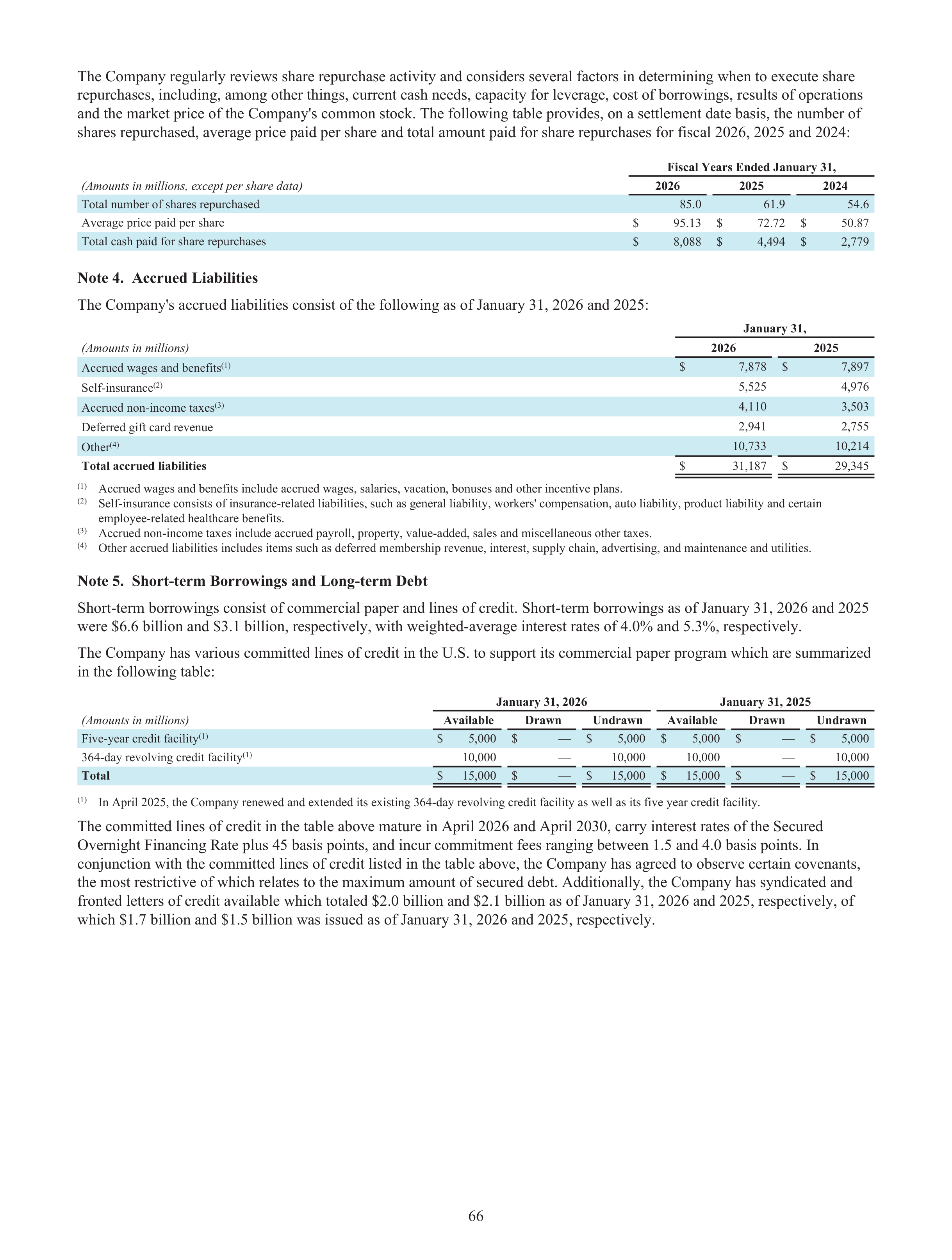
The Company regularly reviews share repurchase activity and considers several factors in determining when to execute share
repurchases, including, among other things, current cash needs, capacity for leverage, cost of borrowings, results of operations
and the market price of the Company's common stock. The following table provides, on a settlement date basis, the number of
shares repurchased, average price paid per share and total amount paid for share repurchases for fiscal 2026, 2025 and 2024:
Fiscal Years Ended January 31,
(Amounts in millions, except per share data)
2026
2025
2024
Total number of shares repurchased
85.0
61.9
54.6
Average price paid per share
$
95.13
$
72.72
$
50.87
Total cash paid for share repurchases
$
8,088
$
4,494
$
2,779
Note 4. Accrued Liabilities
The Company's accrued liabilities consist of the following as of January 31, 2026 and 2025:
January 31,
(Amounts in millions)
2026
2025
Accrued wages and benefits
(1)
$
7,878
$
7,897
Self-insurance
(2)
5,525
4,976
Accrued non-income taxes
(3)
4,110
3,503
Deferred gift card revenue
2,941
2,755
Other
(4)
10,733
10,214
Total accrued liabilities
$
31,187
$
29,345
(1)
Accrued wages and benefits include accrued wages, salaries, vacation, bonuses and other incentive plans.
(2)
Self-insurance consists of insurance-related liabilities, such as general liability, workers' compensation, auto liability, product liability and certain
employee-related healthcare benefits.
(3)
Accrued non-income taxes include accrued payroll, property, value-added, sales and miscellaneous other taxes.
(4)
Other accrued liabilities includes items such as deferred membership revenue, interest, supply chain, advertising, and maintenance and utilities.
Note 5. Short-term Borrowings and Long-term Debt
Short-term borrowings consist of commercial paper and lines of credit. Short-term borrowings as of January 31, 2026 and 2025
were $6.6 billion and $3.1 billion, respectively, with weighted-average interest rates of 4.0% and 5.3%, respectively.
The Company has various committed lines of credit in the U.S. to support its commercial paper program which are summarized
in the following table:
January 31, 2026
January 31, 2025
(Amounts in millions)
Available
Drawn
Undrawn
Available
Drawn
Undrawn
Five-year credit facility
(1)
$
5,000
$
—
$
5,000
$
5,000
$
—
$
5,000
364-day revolving credit facility
(1)
10,000
—
10,000
10,000
—
10,000
Total
$
15,000
$
—
$
15,000
$
15,000
$
—
$
15,000
(1)
In April 2025, the Company renewed and extended its existing 364-day revolving credit facility as well as its five year credit facility.
The committed lines of credit in the table above mature in April 2026 and April 2030, carry interest rates of the Secured
Overnight Financing Rate plus 45 basis points, and incur commitment fees ranging between 1.5 and 4.0 basis points. In
conjunction with the committed lines of credit listed in the table above, the Company has agreed to observe certain covenants,
the most restrictive of which relates to the maximum amount of secured debt. Additionally, the Company has syndicated and
fronted letters of credit available which totaled $2.0 billion and $2.1 billion as of January 31, 2026 and 2025, respectively, of
which $1.7 billion and $1.5 billion was issued as of January 31, 2026 and 2025, respectively.
66
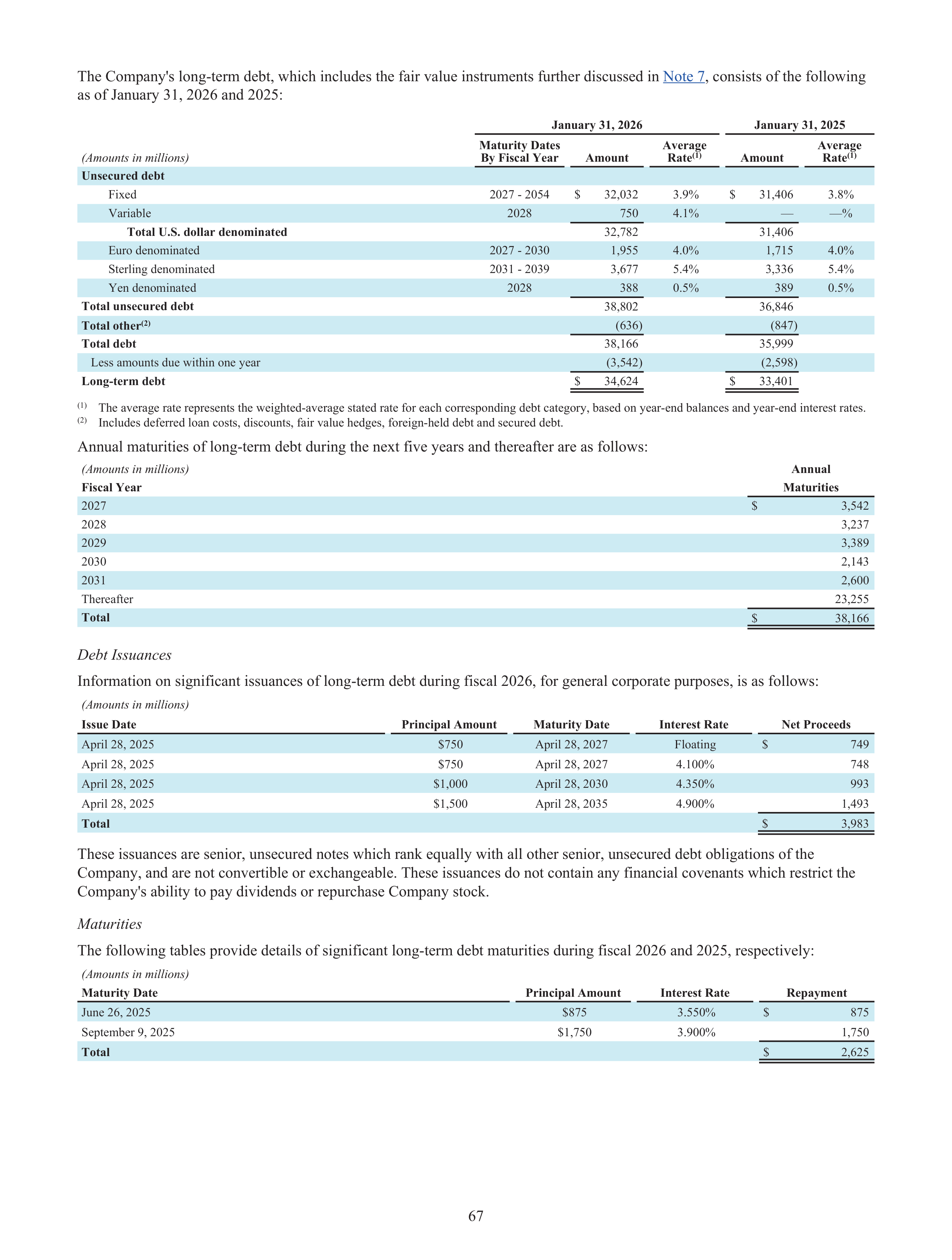
The Company's long-term debt, which includes the fair value instruments further discussed in
Note 7
, consists of the following
as of January 31, 2026 and 2025:
January 31, 2026
January 31, 2025
(Amounts in millions)
Maturity Dates
By Fiscal Year
Amount
Average
Rate
(1)
Amount
Average
Rate
(1)
Unsecured debt
Fixed
2027 - 2054
$
32,032
3.9%
$
31,406
3.8%
Variable
2028
750
4.1%
—
—%
Total U.S. dollar denominated
32,782
31,406
Euro denominated
2027 - 2030
1,955
4.0%
1,715
4.0%
Sterling denominated
2031 - 2039
3,677
5.4%
3,336
5.4%
Yen denominated
2028
388
0.5%
389
0.5%
Total unsecured debt
38,802
36,846
Total other
(2)
(636)
(847)
Total debt
38,166
35,999
Less amounts due within one year
(3,542)
(2,598)
Long-term debt
$
34,624
$
33,401
(1)
The average rate represents the weighted-average stated rate for each corresponding debt category, based on year-end balances and year-end interest rates.
(2)
Includes deferred loan costs, discounts, fair value hedges, foreign-held debt and secured debt.
Annual maturities of long-term debt during the next five years and thereafter are as follows:
(Amounts in millions)
Annual
Fiscal Year
Maturities
2027
$
3,542
2028
3,237
2029
3,389
2030
2,143
2031
2,600
Thereafter
23,255
Total
$
38,166
Debt Issuances
Information on significant issuances of long-term debt during fiscal 2026, for general corporate purposes, is as follows:
(Amounts in millions)
Issue Date
Principal Amount
Maturity Date
Interest Rate
Net Proceeds
April 28, 2025
$750
April 28, 2027
Floating
$
749
April 28, 2025
$750
April 28, 2027
4.100%
748
April 28, 2025
$1,000
April 28, 2030
4.350%
993
April 28, 2025
$1,500
April 28, 2035
4.900%
1,493
Total
$
3,983
These issuances are senior, unsecured notes which rank equally with all other senior, unsecured debt obligations of the
Company, and are not convertible or exchangeable. These issuances do not contain any financial covenants which restrict the
Company's ability to pay dividends or repurchase Company stock.
Maturities
The following tables provide details of significant long-term debt maturities during fiscal 2026 and 2025, respectively:
(Amounts in millions)
Maturity Date
Principal Amount
Interest Rate
Repayment
June 26, 2025
$875
3.550%
$
875
September 9, 2025
$1,750
3.900%
1,750
Total
$
2,625
67
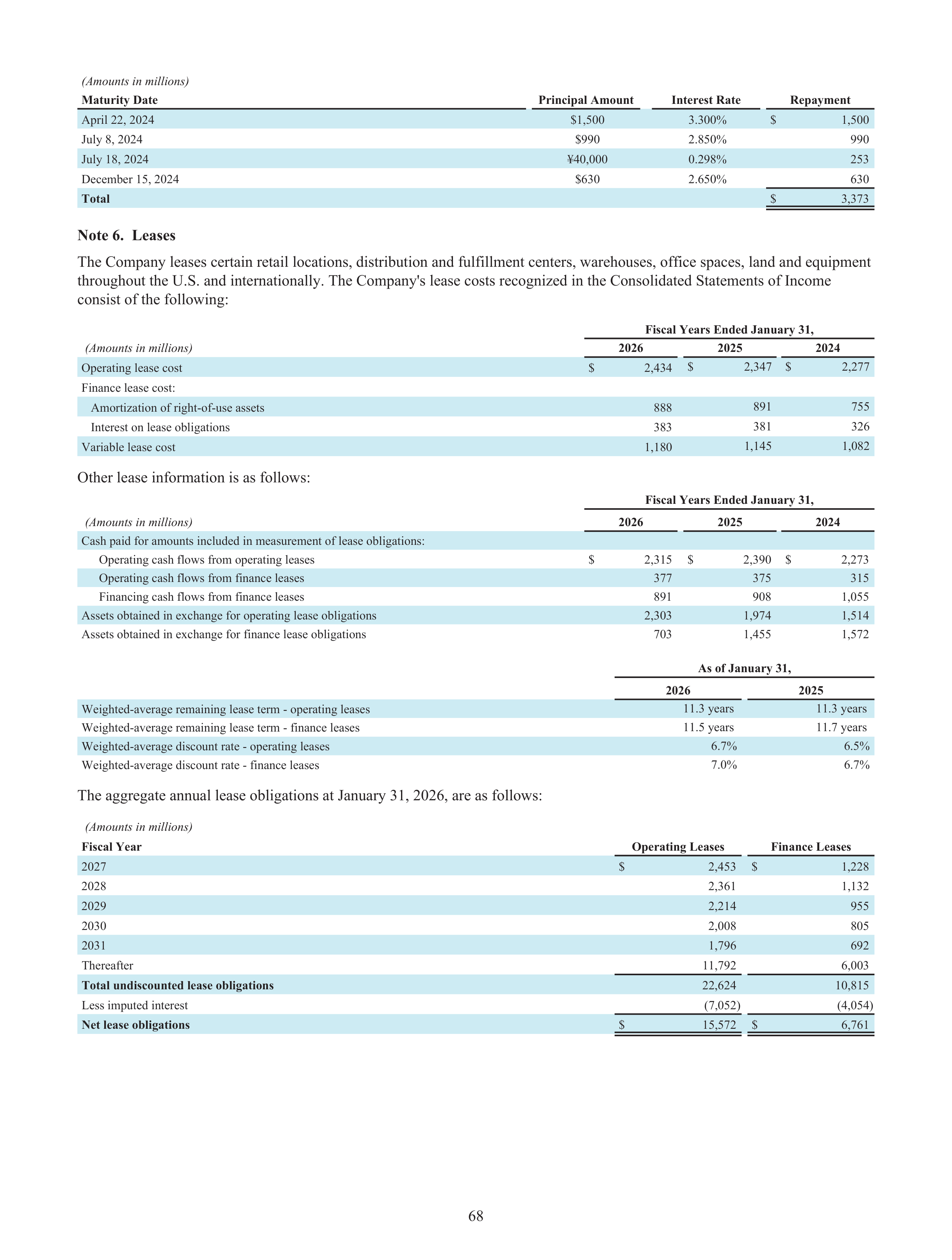
(Amounts in millions)
Maturity Date
Principal Amount
Interest Rate
Repayment
April 22, 2024
$1,500
3.300%
$
1,500
July 8, 2024
$990
2.850%
990
July 18, 2024
¥40,000
0.298%
253
December 15, 2024
$630
2.650%
630
Total
$
3,373
Note 6. Leases
The Company leases certain retail locations, distribution and fulfillment centers, warehouses, office spaces, land and equipment
throughout the U.S. and internationally. The Company's lease costs recognized in the Consolidated Statements of Income
consist of the following:
Fiscal Years Ended January 31,
(Amounts in millions)
2026
2025
2024
Operating lease cost
$
2,434
$
2,347
$
2,277
Finance lease cost:
Amortization of right-of-use assets
888
891
755
Interest on lease obligations
383
381
326
Variable lease cost
1,180
1,145
1,082
Other lease information is as follows:
Fiscal Years Ended January 31,
(Amounts in millions)
2026
2025
2024
Cash paid for amounts included in measurement of lease obligations:
Operating cash flows from operating leases
$
2,315
$
2,390
$
2,273
Operating cash flows from finance leases
377
375
315
Financing cash flows from finance leases
891
908
1,055
Assets obtained in exchange for operating lease obligations
2,303
1,974
1,514
Assets obtained in exchange for finance lease obligations
703
1,455
1,572
As of January 31,
2026
2025
Weighted-average remaining lease term - operating leases
11.3 years
11.3 years
Weighted-average remaining lease term - finance leases
11.5 years
11.7 years
Weighted-average discount rate - operating leases
6.7 %
6.5 %
Weighted-average discount rate - finance leases
7.0 %
6.7 %
The aggregate annual lease obligations at January 31, 2026, are as follows:
(Amounts in millions)
Fiscal Year
Operating Leases
Finance Leases
2027
$
2,453
$
1,228
2028
2,361
1,132
2029
2,214
955
2030
2,008
805
2031
1,796
692
Thereafter
11,792
6,003
Total undiscounted lease obligations
22,624
10,815
Less imputed interest
(7,052)
(4,054)
Net lease obligations
$
15,572
$
6,761
68
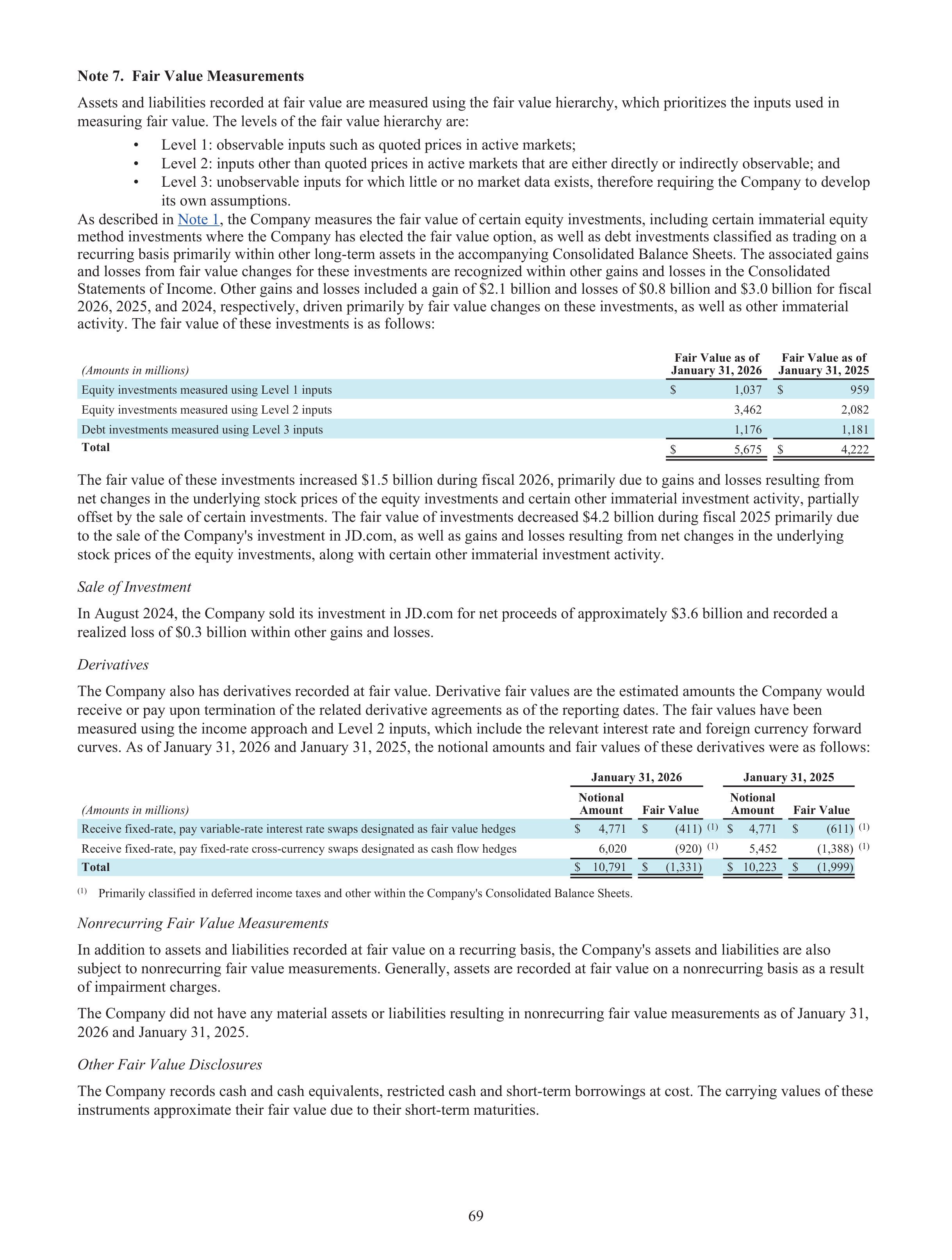
Note 7. Fair Value Measurements
Assets and liabilities recorded at fair value are measured using the fair value hierarchy, which prioritizes the inputs used in
measuring fair value. The levels of the fair value hierarchy are:
•
Level 1: observable inputs such as quoted prices in active markets;
•
Level 2: inputs other than quoted prices in active markets that are either directly or indirectly observable; and
•
Level 3: unobservable inputs for which little or no market data exists, therefore requiring the Company to develop
its own assumptions.
As described in
Note 1
, the Company measures the fair value of certain equity investments, including certain immaterial equity
method investments where the Company has elected the fair value option, as well as debt investments classified as trading on a
recurring basis primarily within other long-term assets in the accompanying Consolidated Balance Sheets. The associated gains
and losses from fair value changes for these investments are recognized within other gains and losses in the Consolidated
Statements of Income. Other gains and losses included a gain of $2.1 billion and losses of $0.8 billion and $3.0 billion for fiscal
2026, 2025, and 2024, respectively, driven primarily by fair value changes on these investments, as well as other immaterial
activity. The fair value of these investments is as follows:
(Amounts in millions)
Fair Value as of
January 31, 2026
Fair Value as of
January 31, 2025
Equity investments measured using Level 1 inputs
$
1,037
$
959
Equity investments measured using Level 2 inputs
3,462
2,082
Debt investments measured using Level 3 inputs
1,176
1,181
Total
$
5,675
$
4,222
The fair value of these investments increased $1.5 billion during fiscal 2026, primarily due to gains and losses resulting from
net changes in the underlying stock prices of the equity investments and certain other immaterial investment activity, partially
offset by the sale of certain investments. The fair value of investments decreased $4.2 billion during fiscal 2025 primarily due
to the sale of the Company's investment in JD.com, as well as gains and losses resulting from net changes in the underlying
stock prices of the equity investments, along with certain other immaterial investment activity.
Sale of Investment
In August 2024, the Company sold its investment in JD.com for net proceeds of approximately $3.6 billion and recorded a
realized loss of $0.3 billion within other gains and losses.
Derivatives
The Company also has derivatives recorded at fair value. Derivative fair values are the estimated amounts the Company would
receive or pay upon termination of the related derivative agreements as of the reporting dates. The fair values have been
measured using the income approach and Level 2 inputs, which include the relevant interest rate and foreign currency forward
curves. As of January 31, 2026 and January 31, 2025, the notional amounts and fair values of these derivatives were as follows:
January 31, 2026
January 31, 2025
(Amounts in millions)
Notional
Amount
Fair Value
Notional
Amount
Fair Value
Receive fixed-rate, pay variable-rate interest rate swaps designated as fair value hedges
$
4,771
$
(411)
(1)
$
4,771
$
(611)
(1)
Receive fixed-rate, pay fixed-rate cross-currency swaps designated as cash flow hedges
6,020
(920)
(1)
5,452
(1,388)
(1)
Total
$ 10,791
$
(1,331)
$ 10,223
$
(1,999)
(1)
Primarily classified in deferred income taxes and other within the Company's Consolidated Balance Sheets.
Nonrecurring Fair Value Measurements
In addition to assets and liabilities recorded at fair value on a recurring basis, the Company's assets and liabilities are also
subject to nonrecurring fair value measurements. Generally, assets are recorded at fair value on a nonrecurring basis as a result
of impairment charges.
The Company did not have any material assets or liabilities resulting in nonrecurring fair value measurements as of January 31,
2026 and January 31, 2025.
Other Fair Value Disclosures
The Company records cash and cash equivalents, restricted cash and short-term borrowings at cost. The carrying values of these
instruments approximate their fair value due to their short-term maturities.
69
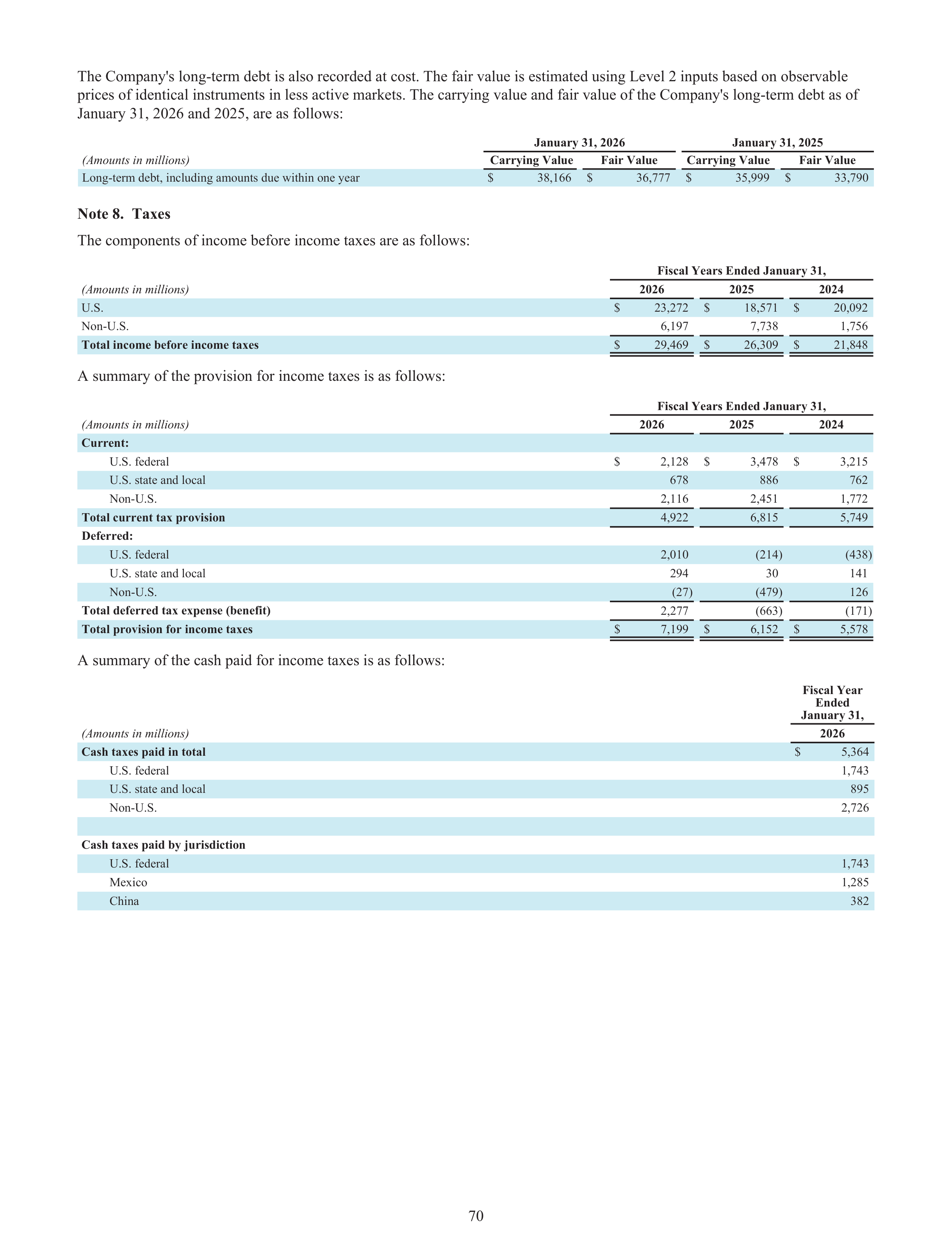
The Company's long-term debt is also recorded at cost. The fair value is estimated using Level 2 inputs based on observable
prices of identical instruments in less active markets. The carrying value and fair value of the Company's long-term debt as of
January 31, 2026 and 2025, are as follows:
January 31, 2026
January 31, 2025
(Amounts in millions)
Carrying Value
Fair Value
Carrying Value
Fair Value
Long-term debt, including amounts due within one year
$
38,166
$
36,777
$
35,999
$
33,790
Note 8. Taxes
The components of income before income taxes are as follows:
Fiscal Years Ended January 31,
(Amounts in millions)
2026
2025
2024
U.S.
$
23,272
$
18,571
$
20,092
Non-U.S.
6,197
7,738
1,756
Total income before income taxes
$
29,469
$
26,309
$
21,848
A summary of the provision for income taxes is as follows:
Fiscal Years Ended January 31,
(Amounts in millions)
2026
2025
2024
Current:
U.S. federal
$
2,128
$
3,478
$
3,215
U.S. state and local
678
886
762
Non-U.S.
2,116
2,451
1,772
Total current tax provision
4,922
6,815
5,749
Deferred:
U.S. federal
2,010
(214)
(438)
U.S. state and local
294
30
141
Non-U.S.
(27)
(479)
126
Total deferred tax expense (benefit)
2,277
(663)
(171)
Total provision for income taxes
$
7,199
$
6,152
$
5,578
A summary of the cash paid for income taxes is as follows:
Fiscal Year
Ended
January 31,
(Amounts in millions)
2026
Cash taxes paid in total
$
5,364
U.S. federal
1,743
U.S. state and local
895
Non-U.S.
2,726
Cash taxes paid by jurisdiction
U.S. federal
1,743
Mexico
1,285
China
382
70
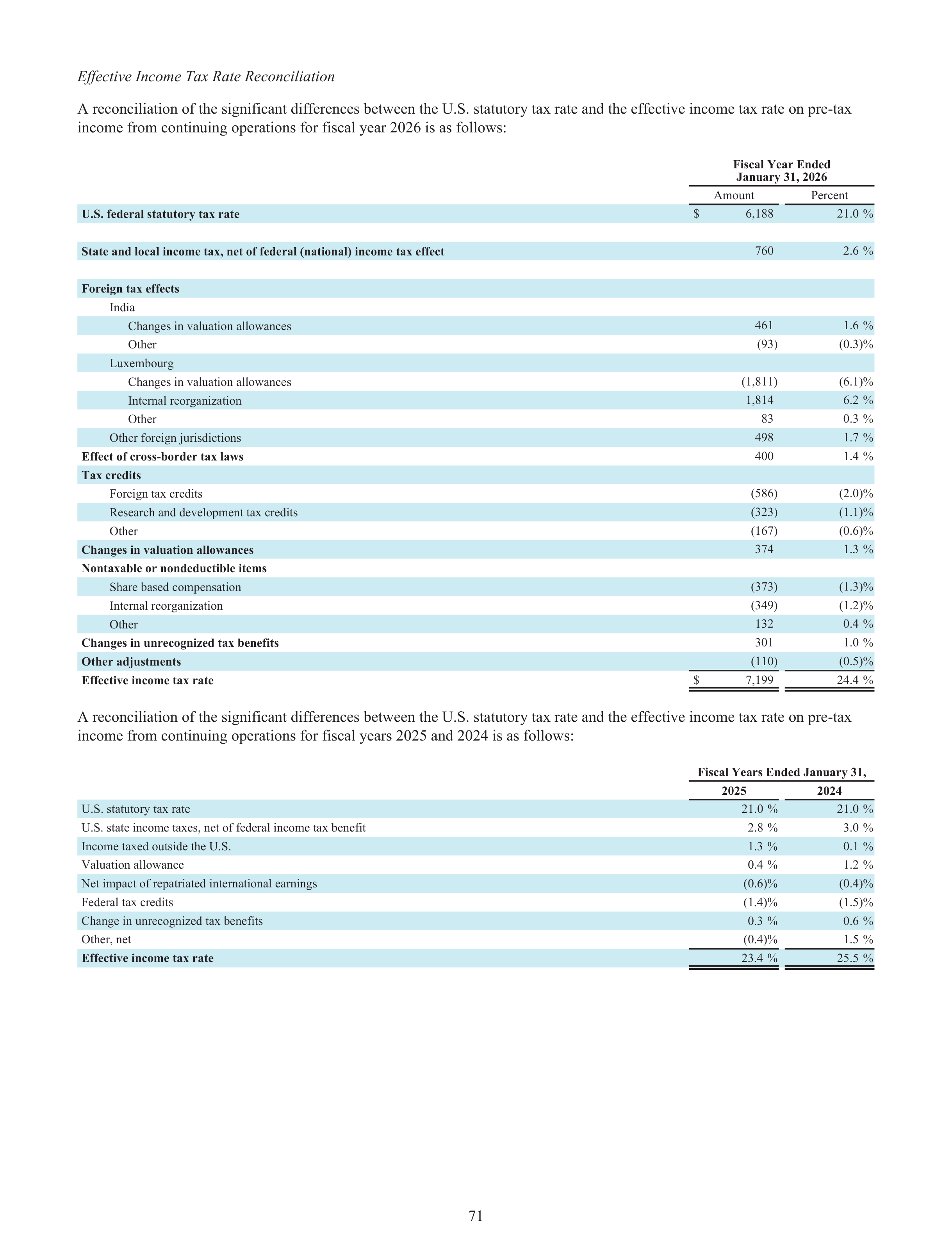
Effective Income Tax Rate Reconciliation
A reconciliation of the significant differences between the U.S. statutory tax rate and the effective income tax rate on pre-tax
income from continuing operations for fiscal year 2026 is as follows:
Fiscal Year Ended
January 31, 2026
Amount
Percent
U.S. federal statutory tax rate
$
6,188
21.0 %
State and local income tax, net of federal (national) income tax effect
760
2.6 %
Foreign tax effects
India
Changes in valuation allowances
461
1.6 %
Other
(93)
(0.3) %
Luxembourg
Changes in valuation allowances
(1,811)
(6.1) %
Internal reorganization
1,814
6.2 %
Other
83
0.3 %
Other foreign jurisdictions
498
1.7 %
Effect of cross-border tax laws
400
1.4 %
Tax credits
Foreign tax credits
(586)
(2.0) %
Research and development tax credits
(323)
(1.1) %
Other
(167)
(0.6) %
Changes in valuation allowances
374
1.3 %
Nontaxable or nondeductible items
Share based compensation
(373)
(1.3) %
Internal reorganization
(349)
(1.2) %
Other
132
0.4 %
Changes in unrecognized tax benefits
301
1.0 %
Other adjustments
(110)
(0.5) %
Effective income tax rate
$
7,199
24.4 %
A reconciliation of the significant differences between the U.S. statutory tax rate and the effective income tax rate on pre-tax
income from continuing operations for fiscal years 2025 and 2024 is as follows:
Fiscal Years Ended January 31,
2025
2024
U.S. statutory tax rate
21.0 %
21.0 %
U.S. state income taxes, net of federal income tax benefit
2.8 %
3.0 %
Income taxed outside the U.S.
1.3 %
0.1 %
Valuation allowance
0.4 %
1.2 %
Net impact of repatriated international earnings
(0.6) %
(0.4) %
Federal tax credits
(1.4) %
(1.5) %
Change in unrecognized tax benefits
0.3 %
0.6 %
Other, net
(0.4) %
1.5 %
Effective income tax rate
23.4 %
25.5 %
71
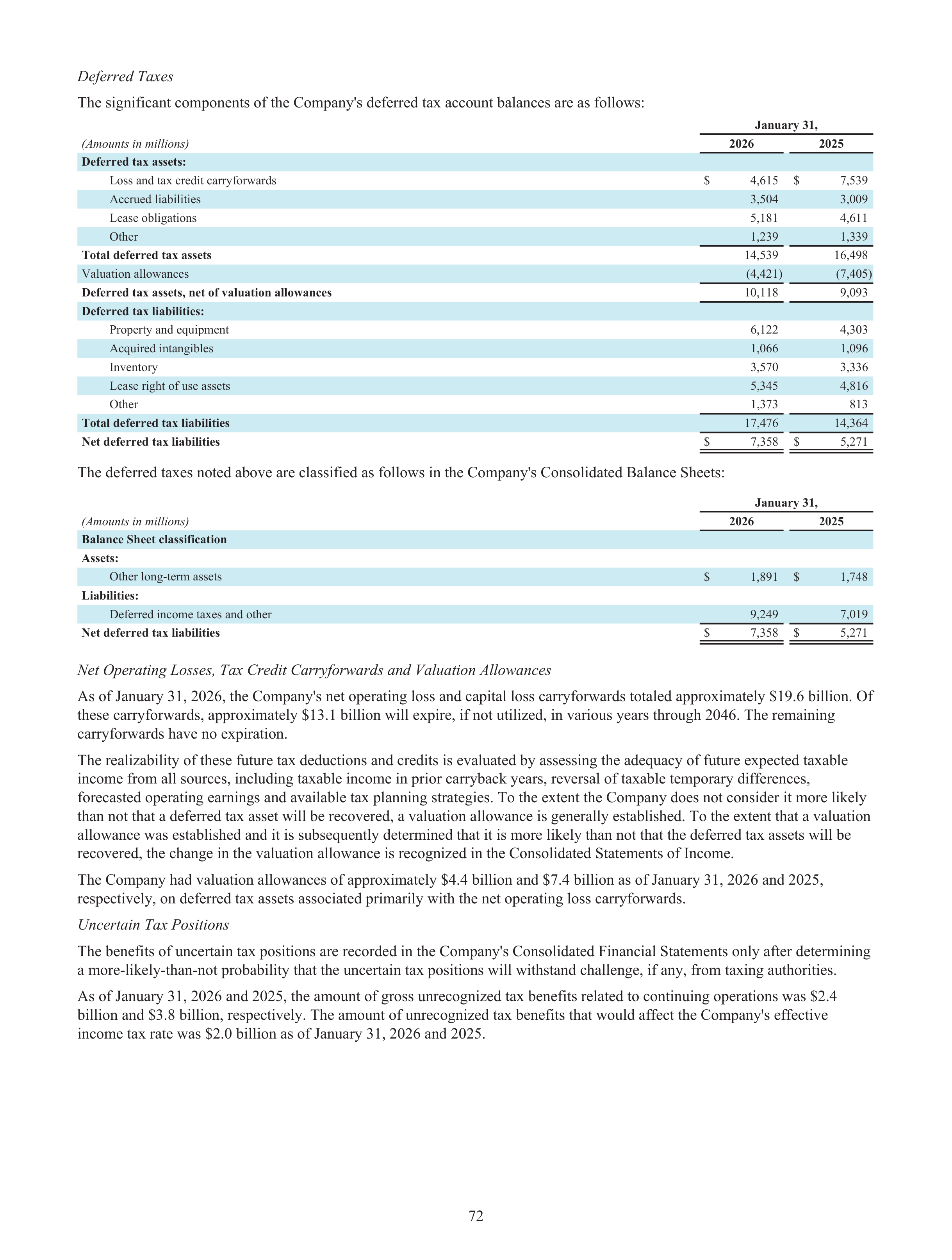
Deferred Taxes
The significant components of the Company's deferred tax account balances are as follows:
January 31,
(Amounts in millions)
2026
2025
Deferred tax assets:
Loss and tax credit carryforwards
$
4,615
$
7,539
Accrued liabilities
3,504
3,009
Lease obligations
5,181
4,611
Other
1,239
1,339
Total deferred tax assets
14,539
16,498
Valuation allowances
(4,421)
(7,405)
Deferred tax assets, net of valuation allowances
10,118
9,093
Deferred tax liabilities:
Property and equipment
6,122
4,303
Acquired intangibles
1,066
1,096
Inventory
3,570
3,336
Lease right of use assets
5,345
4,816
Other
1,373
813
Total deferred tax liabilities
17,476
14,364
Net deferred tax liabilities
$
7,358
$
5,271
The deferred taxes noted above are classified as follows in the Company's Consolidated Balance Sheets:
January 31,
(Amounts in millions)
2026
2025
Balance Sheet classification
Assets:
Other long-term assets
$
1,891
$
1,748
Liabilities:
Deferred income taxes and other
9,249
7,019
Net deferred tax liabilities
$
7,358
$
5,271
Net Operating Losses, Tax Credit Carryforwards and Valuation Allowances
As of January 31, 2026, the Company's net operating loss and capital loss carryforwards totaled approximately $19.6 billion. Of
these carryforwards, approximately $13.1 billion will expire, if not utilized, in various years through 2046. The remaining
carryforwards have no expiration.
The realizability of these future tax deductions and credits is evaluated by assessing the adequacy of future expected taxable
income from all sources, including taxable income in prior carryback years, reversal of taxable temporary differences,
forecasted operating earnings and available tax planning strategies. To the extent the Company does not consider it more likely
than not that a deferred tax asset will be recovered, a valuation allowance is generally established. To the extent that a valuation
allowance was established and it is subsequently determined that it is more likely than not that the deferred tax assets will be
recovered, the change in the valuation allowance is recognized in the Consolidated Statements of Income.
The Company had valuation allowances of approximately $4.4 billion and $7.4 billion as of January 31, 2026 and 2025,
respectively, on deferred tax assets associated primarily with the net operating loss carryforwards.
Uncertain Tax Positions
The benefits of uncertain tax positions are recorded in the Company's Consolidated Financial Statements only after determining
a more-likely-than-not probability that the uncertain tax positions will withstand challenge, if any, from taxing authorities.
As of January 31, 2026 and 2025, the amount of gross unrecognized tax benefits related to continuing operations was $2.4
billion and $3.8 billion, respectively. The amount of unrecognized tax benefits that would affect the Company's effective
income tax rate was $2.0 billion as of January 31, 2026 and 2025.
72
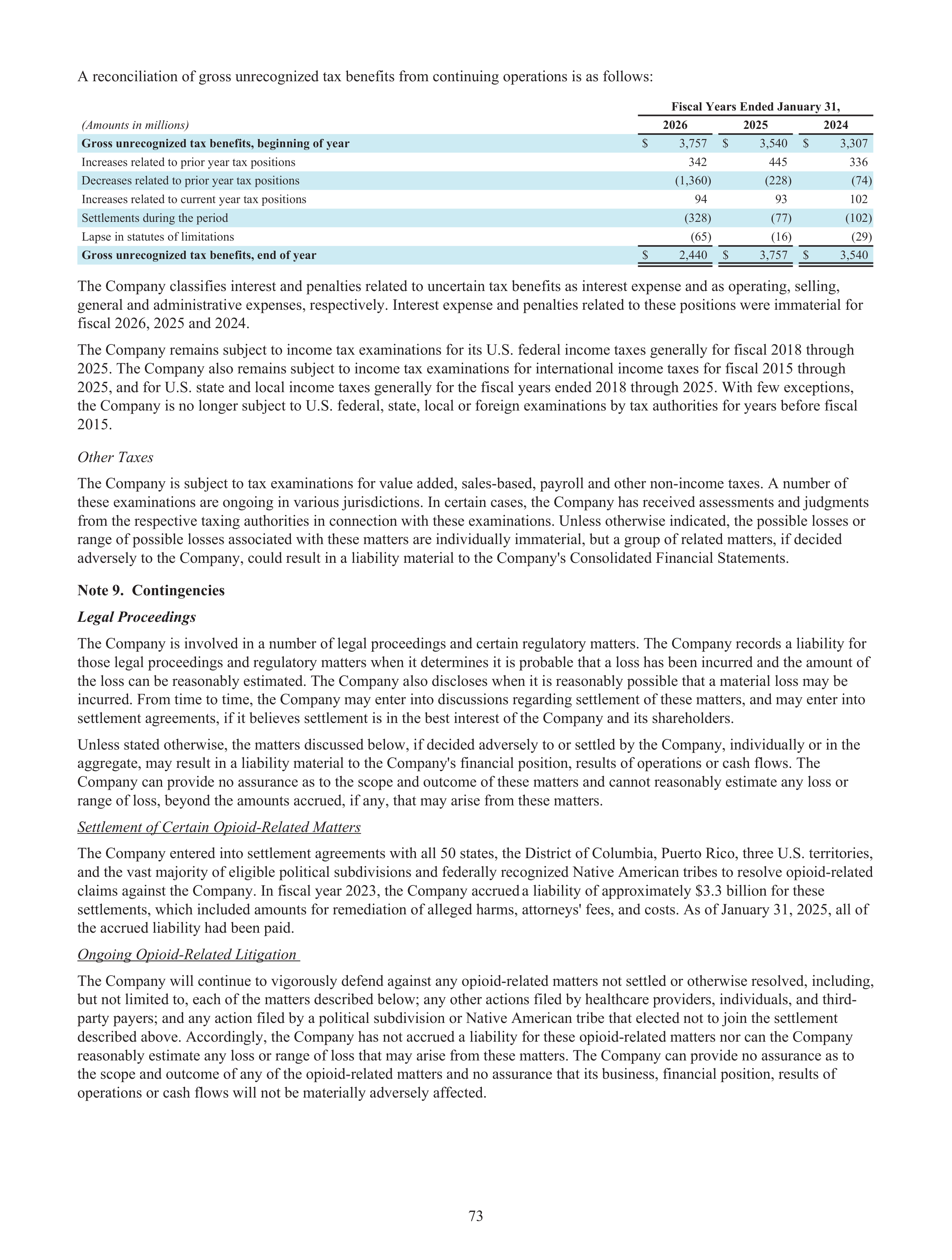
A reconciliation of gross unrecognized tax benefits from continuing operations is as follows:
Fiscal Years Ended January 31,
(Amounts in millions)
2026
2025
2024
Gross unrecognized tax benefits, beginning of year
$
3,757
$
3,540
$
3,307
Increases related to prior year tax positions
342
445
336
Decreases related to prior year tax positions
(1,360)
(228)
(74)
Increases related to current year tax positions
94
93
102
Settlements during the period
(328)
(77)
(102)
Lapse in statutes of limitations
(65)
(16)
(29)
Gross unrecognized tax benefits, end of year
$
2,440
$
3,757
$
3,540
The Company classifies interest and penalties related to uncertain tax benefits as interest expense and as operating, selling,
general and administrative expenses, respectively. Interest expense and penalties related to these positions were immaterial for
fiscal 2026, 2025 and 2024.
The Company remains subject to income tax examinations for its U.S. federal income taxes generally for fiscal 2018 through
2025. The Company also remains subject to income tax examinations for international income taxes for fiscal 2015 through
2025, and for U.S. state and local income taxes generally for the fiscal years ended 2018 through 2025. With few exceptions,
the Company is no longer subject to U.S. federal, state, local or foreign examinations by tax authorities for years before fiscal
2015.
Other Taxes
The Company is subject to tax examinations for value added, sales-based, payroll and other non-income taxes. A number of
these examinations are ongoing in various jurisdictions. In certain cases, the Company has received assessments and judgments
from the respective taxing authorities in connection with these examinations. Unless otherwise indicated, the possible losses or
range of possible losses associated with these matters are individually immaterial, but a group of related matters, if decided
adversely to the Company, could result in a liability material to the Company's Consolidated Financial Statements.
Note 9. Contingencies
Legal Proceedings
The Company is involved in a number of legal proceedings and certain regulatory matters. The Company records a liability for
those legal proceedings and regulatory matters when it determines it is probable that a loss has been incurred and the amount of
the loss can be reasonably estimated. The Company also discloses when it is reasonably possible that a material loss may be
incurred. From time to time, the Company may enter into discussions regarding settlement of these matters, and may enter into
settlement agreements, if it believes settlement is in the best interest of the Company and its shareholders.
Unless stated otherwise, the matters discussed below, if decided adversely to or settled by the Company, individually or in the
aggregate, may result in a liability material to the Company's financial position, results of operations or cash flows. The
Company can provide no assurance as to the scope and outcome of these matters and cannot reasonably estimate any loss or
range of loss, beyond the amounts accrued, if any, that may arise from these matters.
Settlement of Certain Opioid-Related Matters
The Company entered into settlement agreements with all 50 states, the District of Columbia, Puerto Rico, three U.S. territories,
and the vast majority of eligible political subdivisions and federally recognized Native American tribes to resolve opioid-related
claims against the Company. In fiscal year 2023, the Company accrued
a liability of approximately $3.3 billion for these
settlements, which included amounts for remediation of alleged harms, attorneys' fees, and costs. As of January 31, 2025, all of
the accrued liability had been paid.
Ongoing Opioid-Related Litigation
The Company will continue to vigorously defend against any opioid-related matters not settled or otherwise resolved, including,
but not limited to, each of the matters described below; any other actions filed by healthcare providers, individuals, and third-
party payers; and any action filed by a political subdivision or Native American tribe that elected not to join the settlement
described above. Accordingly, the Company has not accrued a liability for these opioid-related matters nor can the Company
reasonably estimate any loss or range of loss that may arise from these matters. The Company can provide no assurance as to
the scope and outcome of any of the opioid-related matters and no assurance that its business, financial position, results of
operations or cash flows will not be materially adversely affected.
73
Opioid Multidistrict Litigation; Other Opioid-Related Matters in the U.S. and Canada
. In December 2017, the United States
Judicial Panel on Multidistrict Litigation consolidated numerous lawsuits filed against a wide array of defendants by various
plaintiffs, including counties, cities, healthcare providers, Native American tribes, individuals and third-party payers, asserting
claims generally concerning the impacts of widespread opioid abuse. The consolidated multidistrict litigation is entitled
In re
National Prescription Opiate Litigation
(MDL No. 2804) (the "MDL") and is pending in the U.S. District Court for the
Northern District of Ohio (the "MDL Court"). The Company is named as a defendant in some cases included in the MDL.
Several opioid-related cases against the Company remain pending in the MDL and in state and federal courts. The plaintiffs
include healthcare providers, third-party payers, individuals and others and seek compensatory and punitive damages and
injunctive relief, including abatement. Four cases brought by third-party payers and one case brought by a hospital system have
been selected as bellwether cases to proceed through discovery in the MDL, and the MDL Court may designate additional
bellwether cases in the future. The
Florida Health Sciences Center
case pending in state court in Florida asserts claims on
behalf of several hospital systems against the Company and other defendants. A jury trial in this matter commenced on
September 18, 2025 and ended on December 8, 2025, at which time the Court declared a mistrial. The Court has scheduled
retrial to commence on August 27, 2026.
The Company has been responding to subpoenas, information requests, and investigations from governmental entities related to
nationwide controlled substance dispensing and distribution practices involving opioids.
Wal-Mart Canada Corp. and certain other subsidiaries of the Company have been named as defendants in two putative class
action complaints filed in Canada related to distribution practices involving opioids. These matters remain pending.
Department of Justice Opioid Civil Litigation.
On December 22, 2020, the U.S. Department of Justice (the "DOJ") filed a civil
complaint in the U.S. District Court for the District of Delaware alleging that the Company unlawfully dispensed controlled
substances from its pharmacies and unlawfully distributed controlled substances to those pharmacies. The complaint alleges
that this conduct resulted in violations of the Controlled Substances Act. The DOJ is seeking civil penalties and injunctive
relief. On March 11, 2024, the Court granted in-part Walmart's motion to dismiss by dismissing the entirety of the DOJ's claims
related to distribution and dismissing the DOJ's claims arising under one of the DOJ's two dispensing liability theories. The
DOJ's claims arising under its other dispensing liability theory remain pending. Trial is scheduled for November 2027.
False Claims Act Litigation.
On August 23, 2019, a qui tam action was filed in the U.S. District Court for the District of New
Mexico. The action was partially unsealed on April 30, 2024 after the federal government declined to intervene. The DOJ
informed the Company of its decision not to intervene on June 20, 2024. On July 25, 2024, the Court transferred the litigation to
the U.S. District Court for the District of Delaware. On January 9, 2025, the plaintiffs filed a third amended complaint on behalf
of two former pharmacists of the Company as relators that alleges the Company violated the Controlled Substances Act and
state pharmacy regulations and that such conduct constitutes violations of the federal False Claims Act. The Company has filed
a renewed motion to dismiss that is currently pending with the Court.
Other Legal Proceedings
Asda Equal Value Claims.
Asda, formerly a subsidiary of the Company, is a defendant in certain equal value claims that began
in 2008 and are proceeding in the United Kingdom before an Employment Tribunal in Manchester and before the High Court.
Claims have been brought by approximately 73,000 current and former Asda store employees who allege their work is of equal
value to the work done by employees in Asda's distribution centers and that the difference in pay and conditions between the
different jobs is not objectively justified. Additional employees may assert claims in the future. The High Court claims are
stayed pending the determination of a cohort of claims brought in the Employment Tribunal. The legal proceedings to consider
these equal value claims are in three phases, and the first two phases are complete. On January 31, 2025 and February 25, 2026,
the Employment Tribunal issued rulings that certain of the claims are permitted to advance to the third phase. The hearing on
the third phase is scheduled to begin on November 23, 2026. There are factual and legal defenses to the equal value claims, and
the Company intends to vigorously defend them. Subsequent to the divestiture of Asda in February 2021, the Company
continues to oversee the conduct of the defense of these claims. While potential liability for these claims remains with Asda, the
Company has agreed to provide indemnification with respect to certain of these claims up to a contractually determined amount.
The Company cannot predict the number of such claims that may ultimately be filed and cannot reasonably estimate any loss or
range of loss that may arise related to these proceedings. Accordingly, the Company can provide no assurance as to the scope
and outcome of these matters.
Money Transfer Agent Services Matter.
The Company has responded to grand jury subpoenas issued by the United States
Attorney's Office for the Middle District of Pennsylvania on behalf of the DOJ seeking documents regarding the Company's
consumer fraud prevention program and anti-money laundering compliance related to the Company's money transfer services,
where Walmart is an agent. The most recent subpoena was issued in August 2020. Walmart's responses to DOJ's subpoenas
have been complete since 2021. While it has cooperated with the DOJ's review, the Company intends to vigorously defend this
matter should the DOJ decide to pursue it further. The Company can provide no assurance as to the scope and outcome of this
matter and cannot reasonably estimate any loss or range of loss that may arise. Accordingly, the Company can provide no
assurance that its business, financial position, results of operations or cash flows will not be materially adversely affected.
74
Driver Platform Matters.
The Company, the Federal Trade Commission ("FTC") and certain states have reached a settlement
regarding investigations into payment and operational practices of its Spark Driver platform pursuant to a stipulated order
entered on March 3, 2026. Pursuant to the settlement and without admitting liability, the Company agreed to entry of a
judgment of $100 million and to maintain certain programmatic practices and reporting obligations for a period of 10 years.
Approximately $63 million of the judgment was suspended, pursuant to the terms of the stipulated order (reflecting amounts
that have already been paid to drivers and other considerations reflected in the settlement), and the Company accrued the
remainder of approximately $37 million as of January 31, 2026. The Company continues discussions regarding these matters
with certain other state representatives.
The Company has also been responding to subpoenas, information requests and investigations from governmental entities with
respect to the payment of drivers, independent contractor classification of drivers and certain operational issues regarding its
Spark Driver platform. The Company is defending putative representative action civil litigation relating to driver classification
and defending other civil litigation and arbitration claims in connection with the platform. The Company intends to vigorously
defend itself in these matters. However, the Company can provide no assurance as to the scope and outcome of these matters
and cannot reasonably estimate any loss or range of loss that may arise. Accordingly, the Company can provide no assurance
that its business, financial position, results of operations or cash flows will not be materially adversely affected.
Mexico Antitrust Matter.
On October 6, 2023, the Comisión Federal de Competencia Económica of México ("COFECE")
notified the main Mexican operating subsidiary of Wal-Mart de México, S.A.B. de C.V. ("Walmex"), a majority owned
subsidiary of the Company, that COFECE's Investigatory Authority ("IA") had recommended the initiation of a quasi-judicial
administrative process against Walmex's subsidiary for alleged relative monopolistic practices in connection with the supply
and wholesale distribution of certain consumer goods, retail marketing practices of such consumer goods and related services.
On December 12, 2024, after Walmex provided defenses, produced expert evidence and participated in a hearing, COFECE
issued a split decision that Walmex's subsidiary had engaged in a single relative monopolistic practice in relation to the
negotiation of two types of contributions with its suppliers. The resolution imposed a monetary penalty on Walmex's subsidiary
in the amount of $93.4 million pesos (approximately $5 million U.S. dollars) and certain non-structural conduct measures
relating to the two prohibited types of supplier contributions (while recognizing that other supplier contributions can continue).
On January 6, 2025, Walmex's subsidiary challenged COFECE's resolution through an appeal in the specialized federal courts.
Until the appeal is resolved, Walmex's subsidiary will operate in compliance with COFECE's ruling. Payment of the monetary
penalty is stayed until the lawsuit is resolved.
Foreign Direct Investment Matters.
In July 2021, the Directorate of Enforcement in India issued a show cause notice to Flipkart
Private Limited and one of its subsidiaries ("Flipkart"), and to unrelated companies and individuals, including certain current
and former shareholders and directors of Flipkart. The notice requests the recipients to show cause as to why further
proceedings under India's Foreign Direct Investment rules and regulations (the "Rules") should not be initiated against them
based on alleged violations during the period from 2009 to 2015, prior to the Company's acquisition of a majority stake in
Flipkart in 2018 (the "Notice"). In addition, there have been more recent requests for information from the Directorate of
Enforcement to Flipkart for periods prior and subsequent to April 2016 regarding the Rules, including the most recent request in
April 2025 (the "Requests"), to which Flipkart has been responding. The Notice is an initial stage of proceedings under the
Rules which could, depending upon the conclusions at the end of the initial stage, lead to a hearing to consider the merits of the
allegations described in the Notice. If a hearing on the merits is initiated, whether with respect to the Notice or pursuant to any
further proceedings related to the Requests, and if it is determined that violations of the Rules occurred, then the regulatory
authority has the authority to impose monetary and/or non-monetary relief, such as share ownership restrictions. Flipkart has
been responding to the Notice and, if the matter progresses to a consideration of the merits of the allegations described in the
Notice, Flipkart intends to defend against the allegations vigorously. Due to the fact that the process regarding the Notice is in
the early stages, the Company is unable to predict whether the Notice will lead to a hearing on the merits or, if it does, the final
outcome of the resulting proceedings, as well as whether any further proceedings will arise with respect to the Requests. The
Company cannot reasonably estimate any loss or range of loss that may arise from these matters and can provide no assurance
as to the scope or outcome of any proceeding that might result from the Notice or the Requests, or the amount of the proceeds
the Company may receive in indemnification from individuals and entities that sold shares to the Company under the 2018
agreement for the period prior to the date the Company acquired its majority stake in Flipkart, and further can provide no
assurance that its business, financial position, results of operations or cash flows will not be materially adversely affected.
India Antitrust Matter.
On January 13, 2020, the Competition Commission of India ("CCI") ordered its Director General (the
"DG") to investigate certain matters alleging competition law violations by certain subsidiaries of Flipkart in India and other
parties. On September 13, 2024, those subsidiaries received a non-confidential version of the DG's Investigation Report (the
"Report"), alleging certain competition law violations. CCI is not bound by the Report, and will conduct its independent
analysis of the allegations, including hearing objections from the subsidiaries and other parties before issuing its final order in
the matter, which could include monetary and non-monetary relief. CCI's final order would also be subject to appropriate
appellate proceedings. The Company can provide no assurance as to the scope and outcome of this matter, cannot reasonably
estimate any loss or range of loss that may arise, and can provide no assurance that its business, financial position, results of
operations or cash flows will not be materially adversely affected.
75
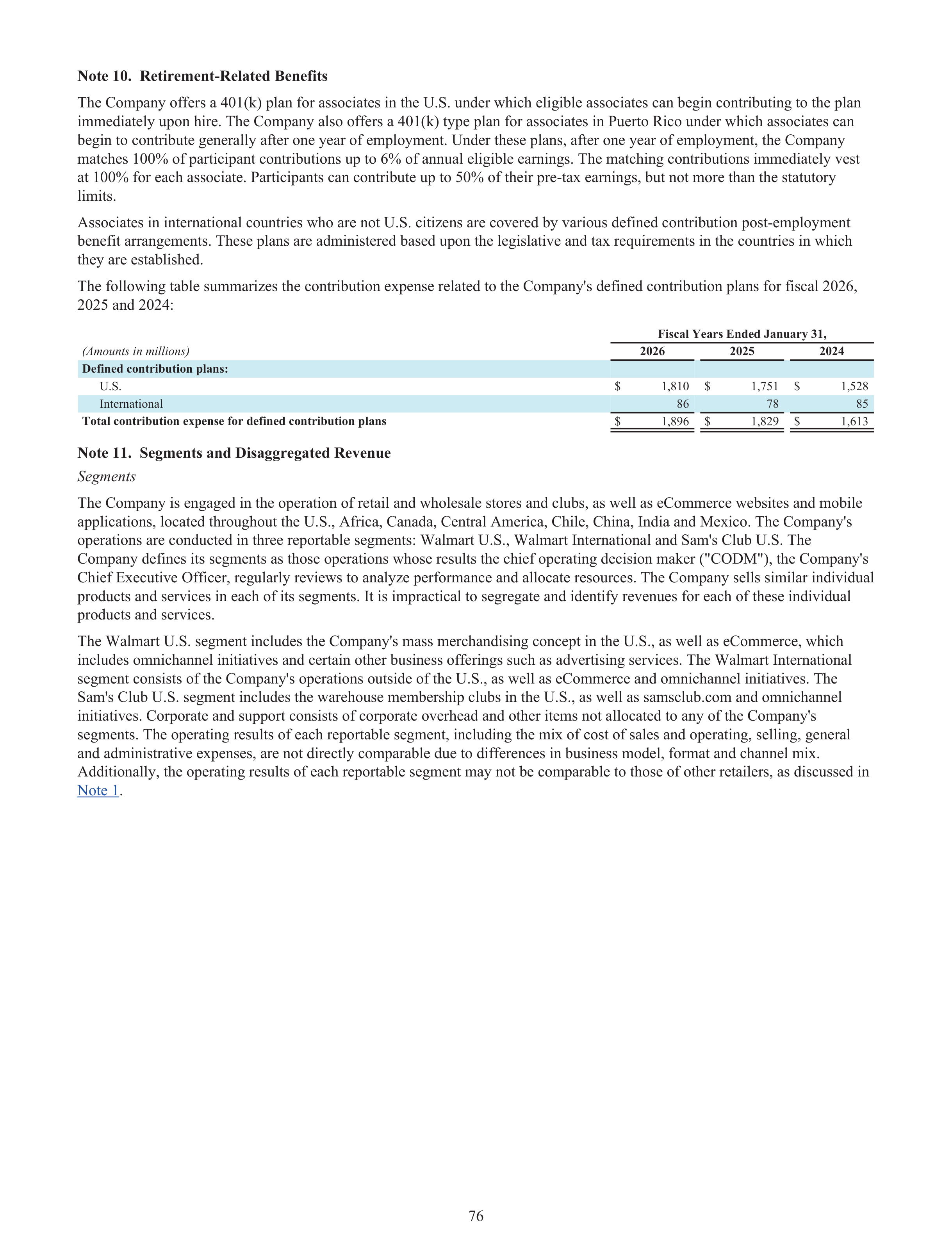
Note 10. Retirement-Related Benefits
The Company offers a 401(k) plan for associates in the U.S. under which eligible associates can begin contributing to the plan
immediately upon hire. The Company also offers a 401(k) type plan for associates in Puerto Rico under which associates can
begin to contribute generally after one year of employment. Under these plans, after one year of employment, the Company
matches 100% of participant contributions up to 6% of annual eligible earnings. The matching contributions immediately vest
at 100% for each associate. Participants can contribute up to 50% of their pre-tax earnings, but not more than the statutory
limits.
Associates in international countries who are not U.S. citizens are covered by various defined contribution post-employment
benefit arrangements. These plans are administered based upon the legislative and tax requirements in the countries in which
they are established.
The following table summarizes the contribution expense related to the Company's defined contribution plans for fiscal 2026,
2025 and 2024:
Fiscal Years Ended January 31,
(Amounts in millions)
2026
2025
2024
Defined contribution plans:
U.S.
$
1,810
$
1,751
$
1,528
International
86
78
85
Total contribution expense for defined contribution plans
$
1,896
$
1,829
$
1,613
Note 11. Segments and Disaggregated Revenue
Segments
The Company is engaged in the operation of retail and wholesale stores and clubs, as well as eCommerce websites and mobile
applications, located throughout the U.S., Africa, Canada, Central America, Chile, China, India and Mexico. The Company's
operations are conducted in three reportable segments: Walmart U.S., Walmart International and Sam's Club U.S. The
Company defines its segments as those operations whose results the chief operating decision maker ("CODM"), the Company's
Chief Executive Officer, regularly reviews to analyze performance and allocate resources. The Company sells similar individual
products and services in each of its segments. It is impractical to segregate and identify revenues for each of these individual
products and services.
The Walmart U.S. segment includes the Company's mass merchandising concept in the U.S., as well as eCommerce, which
includes omnichannel initiatives and certain other business offerings such as advertising services. The Walmart International
segment consists of the Company's operations outside of the U.S., as well as eCommerce and omnichannel initiatives. The
Sam's Club U.S. segment includes the warehouse membership clubs in the U.S., as well as samsclub.com and omnichannel
initiatives. Corporate and support consists of corporate overhead and other items not allocated to any of the Company's
segments. The operating results of each reportable segment, including the mix of cost of sales and operating, selling, general
and administrative expenses, are not directly comparable due to differences in business model, format and channel mix.
Additionally, the operating results of each reportable segment may not be comparable to those of other retailers, as discussed in
Note 1
.
76
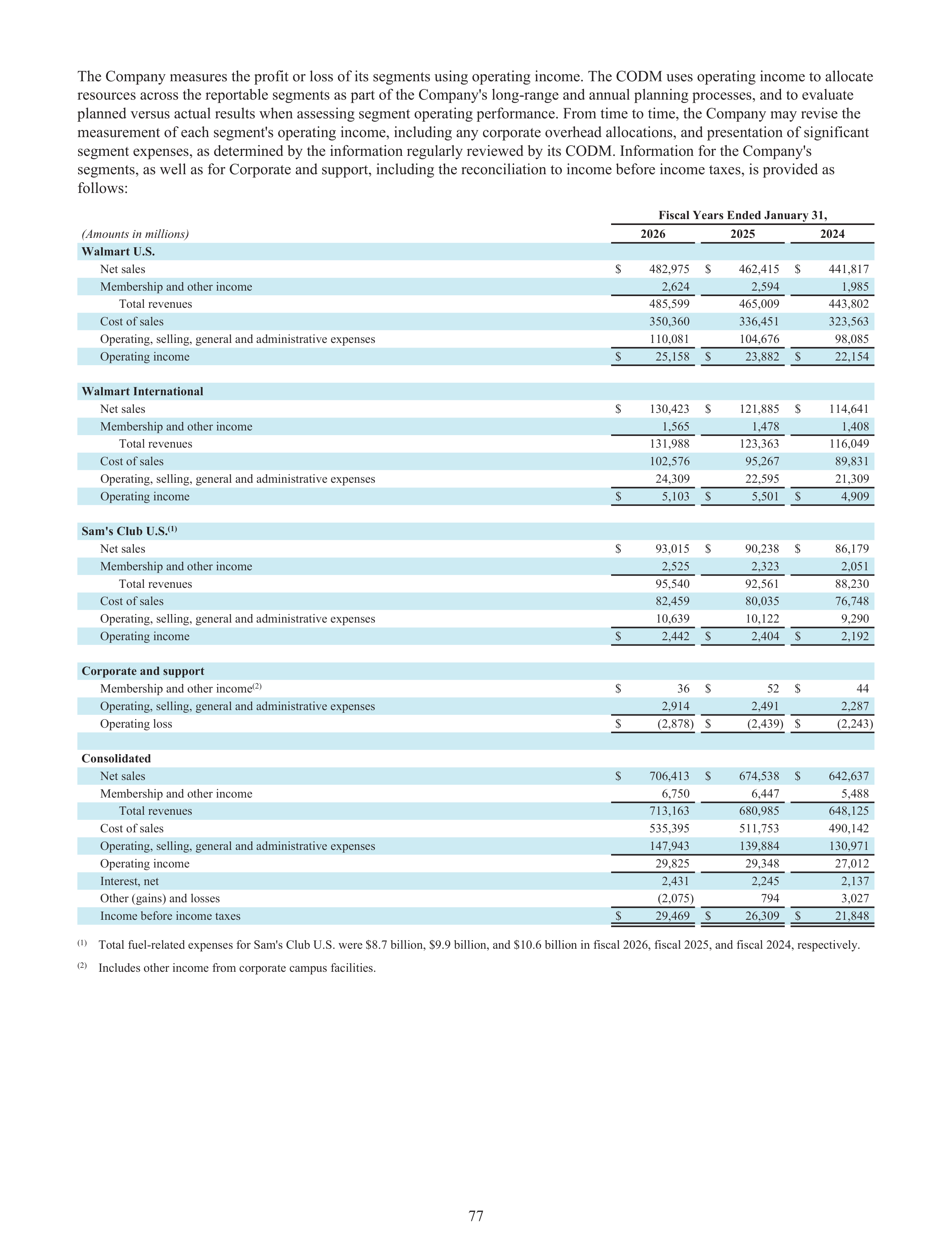
The Company measures the profit or loss of its segments using operating income. The CODM uses operating income to allocate
resources across the reportable segments as part of the Company's long-range and annual planning processes, and to evaluate
planned versus actual results when assessing segment operating performance. From time to time, the Company may revise the
measurement of each segment's operating income, including any corporate overhead allocations, and presentation of significant
segment expenses, as determined by the information regularly reviewed by its CODM. Information for the Company's
segments, as well as for Corporate and support, including the reconciliation to income before income taxes, is provided as
follows:
Fiscal Years Ended January 31,
(Amounts in millions)
2026
2025
2024
Walmart U.S.
Net sales
$
482,975
$
462,415
$
441,817
Membership and other income
2,624
2,594
1,985
Total revenues
485,599
465,009
443,802
Cost of sales
350,360
336,451
323,563
Operating, selling, general and administrative expenses
110,081
104,676
98,085
Operating income
$
25,158
$
23,882
$
22,154
Walmart International
Net sales
$
130,423
$
121,885
$
114,641
Membership and other income
1,565
1,478
1,408
Total revenues
131,988
123,363
116,049
Cost of sales
102,576
95,267
89,831
Operating, selling, general and administrative expenses
24,309
22,595
21,309
Operating income
$
5,103
$
5,501
$
4,909
Sam's Club U.S.
(1)
Net sales
$
93,015
$
90,238
$
86,179
Membership and other income
2,525
2,323
2,051
Total revenues
95,540
92,561
88,230
Cost of sales
82,459
80,035
76,748
Operating, selling, general and administrative expenses
10,639
10,122
9,290
Operating income
$
2,442
$
2,404
$
2,192
Corporate and support
Membership and other income
(2)
$
36
$
52
$
44
Operating, selling, general and administrative expenses
2,914
2,491
2,287
Operating loss
$
(2,878) $
(2,439) $
(2,243)
Consolidated
Net sales
$
706,413
$
674,538
$
642,637
Membership and other income
6,750
6,447
5,488
Total revenues
713,163
680,985
648,125
Cost of sales
535,395
511,753
490,142
Operating, selling, general and administrative expenses
147,943
139,884
130,971
Operating income
29,825
29,348
27,012
Interest, net
2,431
2,245
2,137
Other (gains) and losses
(2,075)
794
3,027
Income before income taxes
$
29,469
$
26,309
$
21,848
(1)
Total fuel-related expenses for Sam's Club U.S. were $8.7 billion, $9.9 billion, and $10.6 billion in fiscal 2026, fiscal 2025, and fiscal 2024, respectively.
(2)
Includes other income from corporate campus facilities.
77
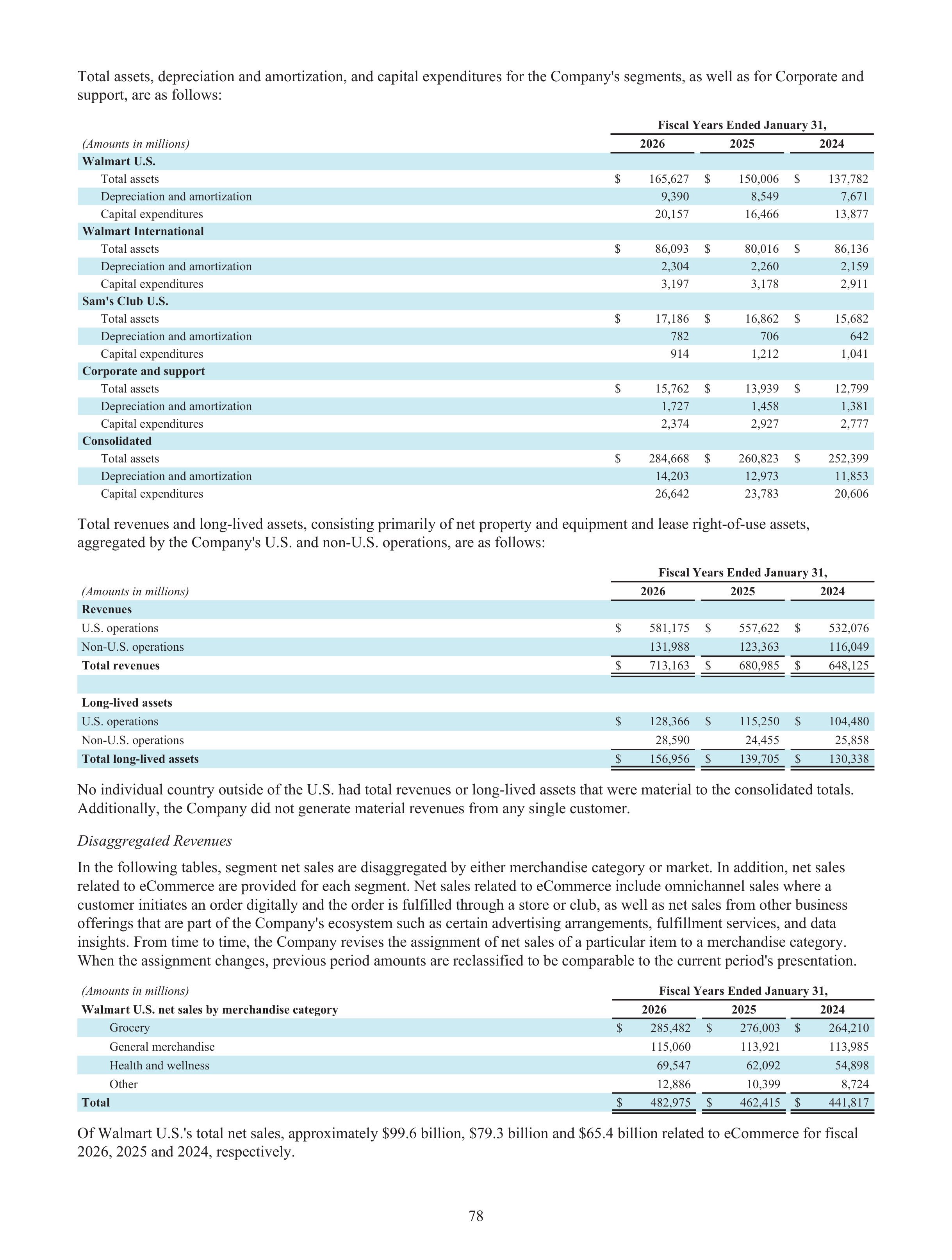
Total assets, depreciation and amortization, and capital expenditures for the Company's segments, as well as for Corporate and
support, are as follows:
Fiscal Years Ended January 31,
(Amounts in millions)
2026
2025
2024
Walmart U.S.
Total assets
$
165,627
$
150,006
$
137,782
Depreciation and amortization
9,390
8,549
7,671
Capital expenditures
20,157
16,466
13,877
Walmart International
Total assets
$
86,093
$
80,016
$
86,136
Depreciation and amortization
2,304
2,260
2,159
Capital expenditures
3,197
3,178
2,911
Sam's Club U.S.
Total assets
$
17,186
$
16,862
$
15,682
Depreciation and amortization
782
706
642
Capital expenditures
914
1,212
1,041
Corporate and support
Total assets
$
15,762
$
13,939
$
12,799
Depreciation and amortization
1,727
1,458
1,381
Capital expenditures
2,374
2,927
2,777
Consolidated
Total assets
$
284,668
$
260,823
$
252,399
Depreciation and amortization
14,203
12,973
11,853
Capital expenditures
26,642
23,783
20,606
Total revenues and long-lived assets, consisting primarily of net property and equipment and lease right-of-use assets,
aggregated by the Company's U.S. and non-U.S. operations, are as follows:
Fiscal Years Ended January 31,
(Amounts in millions)
2026
2025
2024
Revenues
U.S. operations
$
581,175
$
557,622
$
532,076
Non-U.S. operations
131,988
123,363
116,049
Total revenues
$
713,163
$
680,985
$
648,125
Long-lived assets
U.S. operations
$
128,366
$
115,250
$
104,480
Non-U.S. operations
28,590
24,455
25,858
Total long-lived assets
$
156,956
$
139,705
$
130,338
No individual country outside of the U.S. had total revenues or long-lived assets that were material to the consolidated totals.
Additionally, the Company did not generate material revenues from any single customer.
Disaggregated Revenues
In the following tables, segment net sales are disaggregated by either merchandise category or market. In addition, net sales
related to eCommerce are provided for each segment. Net sales related to eCommerce include omnichannel sales where a
customer initiates an order digitally and the order is fulfilled through a store or club, as well as net sales from other business
offerings that are part of the Company's ecosystem such as certain advertising arrangements, fulfillment services, and data
insights. From time to time, the Company revises the assignment of net sales of a particular item to a merchandise category.
When the assignment changes, previous period amounts are reclassified to be comparable to the current period's presentation.
(Amounts in millions)
Fiscal Years Ended January 31,
Walmart U.S. net sales by merchandise category
2026
2025
2024
Grocery
$
285,482
$
276,003
$
264,210
General merchandise
115,060
113,921
113,985
Health and wellness
69,547
62,092
54,898
Other
12,886
10,399
8,724
Total
$
482,975
$
462,415
$
441,817
Of Walmart U.S.'s total net sales, approximately $99.6 billion, $79.3 billion and $65.4 billion related to eCommerce for fiscal
2026, 2025 and 2024, respectively.
78
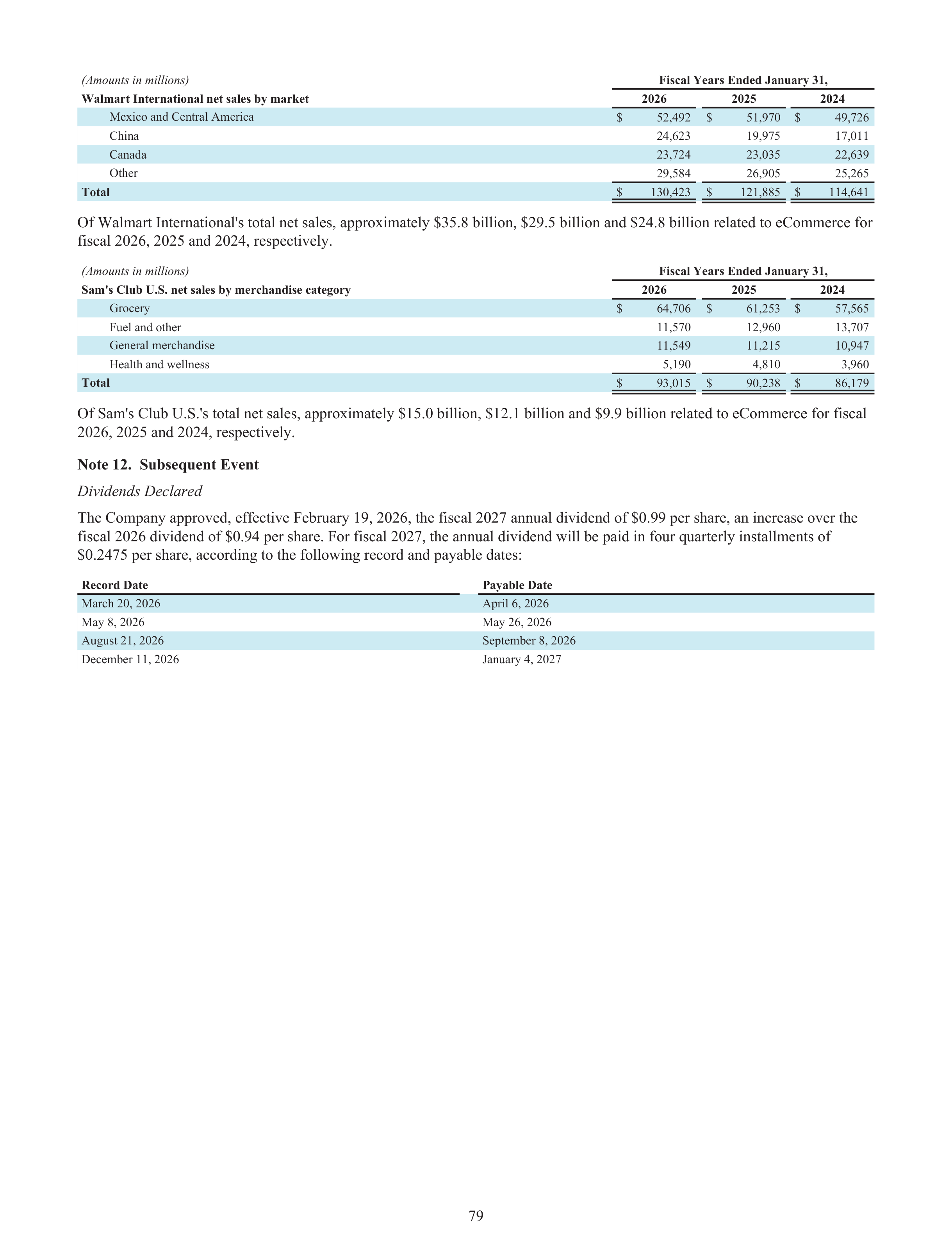
(Amounts in millions)
Fiscal Years Ended January 31,
Walmart International net sales by market
2026
2025
2024
Mexico and Central America
$
52,492
$
51,970
$
49,726
China
24,623
19,975
17,011
Canada
23,724
23,035
22,639
Other
29,584
26,905
25,265
Total
$
130,423
$
121,885
$
114,641
Of Walmart International's total net sales, approximately $35.8 billion, $29.5 billion and $24.8 billion related to eCommerce for
fiscal 2026, 2025 and 2024, respectively.
(Amounts in millions)
Fiscal Years Ended January 31,
Sam's Club U.S. net sales by merchandise category
2026
2025
2024
Grocery
$
64,706
$
61,253
$
57,565
Fuel and other
11,570
12,960
13,707
General merchandise
11,549
11,215
10,947
Health and wellness
5,190
4,810
3,960
Total
$
93,015
$
90,238
$
86,179
Of Sam's Club U.S.'s total net sales, approximately $15.0 billion, $12.1 billion and $9.9 billion related to eCommerce for fiscal
2026, 2025 and 2024, respectively.
Note 12. Subsequent Event
Dividends Declared
The Company approved, effective February 19, 2026, the fiscal 2027 annual dividend of $0.99 per share, an increase over the
fiscal 2026 dividend of $0.94 per share. For fiscal 2027, the annual dividend will be paid in four quarterly installments of
$0.2475 per share, according to the following record and payable dates:
Record Date
Payable Date
March 20, 2026
April 6, 2026
May 8, 2026
May 26, 2026
August 21, 2026
September 8, 2026
December 11, 2026
January 4, 2027
79
ITEM 9.
CHANGES IN AND DISAGREEMENTS WITH ACCOUNTANTS ON ACCOUNTING AND
FINANCIAL DISCLOSURE
None.
ITEM 9A.
CONTROLS AND PROCEDURES
Evaluation of Disclosure Controls and Procedures
We maintain disclosure controls and procedures that are designed to provide reasonable assurance that information, which is
required to be timely disclosed, is accumulated and communicated to management in a timely fashion. In designing and
evaluating such controls and procedures, we recognize that any controls and procedures, no matter how well designed and
operated, can provide only reasonable assurance of achieving the desired control objectives. Our management is necessarily
required to use judgment in evaluating controls and procedures. Also, we have investments in unconsolidated entities. Since we
do not control or manage those entities, our controls and procedures with respect to those entities are substantially more limited
than those we maintain with respect to our consolidated subsidiaries.
In the ordinary course of business, we review our internal control over financial reporting and make changes to our systems and
processes to improve such controls and increase efficiency, while ensuring that we maintain an effective internal control
environment. Changes may include such activities as implementing new, more efficient systems, updating existing systems,
automating manual processes, standardizing controls globally, migrating certain processes to our shared services organizations
and increasing monitoring controls. We are continuing to upgrade our financial systems globally, and modernize functions
across the business which will impact our internal control over financial reporting.
An evaluation of the effectiveness of the design and operation of our disclosure controls and procedures as of January 31, 2026
was performed under the supervision and with the participation of management, including our Chief Executive Officer and
Chief Financial Officer. Based upon that evaluation, our Chief Executive Officer and Chief Financial Officer concluded that our
disclosure controls and procedures are effective to provide reasonable assurance that information required to be disclosed by the
Company in the reports that it files or submits under the Securities Exchange Act of 1934, as amended, is accumulated and
communicated to management, including our Chief Executive Officer and Chief Financial Officer, as appropriate, to allow
timely decisions regarding required disclosure and are effective to provide reasonable assurance that such information is
recorded, processed, summarized and reported within the time periods specified by the SEC's rules and forms.
Report on Internal Control Over Financial Reporting
Management has responsibility for establishing and maintaining adequate internal control over financial reporting. Internal
control over financial reporting is a process designed to provide reasonable assurance regarding the reliability of financial
reporting and the preparation of financial statements for external reporting purposes in accordance with accounting principles
generally accepted in the United States. Because of its inherent limitations, internal control over financial reporting may not
prevent or detect misstatements. Management has assessed the effectiveness of the Company's internal control over financial
reporting as of January 31, 2026. In making its assessment, management has utilized the criteria set forth by the Committee of
Sponsoring Organizations ("COSO") of the Treadway Commission in Internal Control-Integrated Framework (2013).
Management concluded that based on its assessment, Walmart's internal control over financial reporting was effective as of
January 31, 2026. The Company's internal control over financial reporting as of January 31, 2026, has been audited by Ernst &
Young LLP as stated in their report which appears herein.
Changes in Internal Control Over Financial Reporting
There have been no changes in the Company's internal control over financial reporting as of January 31, 2026, that have
materially affected, or are reasonably likely to materially affect, the Company's internal control over financial reporting.
80
ITEM 9B.
OTHER INFORMATION
Security Trading Plans of Directors and Executive Officers
On December 24, 2025, Chris Nicholas, Executive Vice President, President and Chief Executive Officer, Walmart
International, entered into a stock trading plan designed to comply with Rule 10b5-1 under the Securities Exchange Act of
1934. Under the terms of the plan, Mr. Nicholas will sell an aggregate 34,800 shares of common stock in trades scheduled from
April 2026 through March 2027. The plan will terminate in March 2027.
Disclosure Pursuant to Section 13(r) of the Securities Exchange Act of 1934
Section 13(r) of the Exchange Act, requires an issuer to disclose certain information in its periodic reports if it or any of its
affiliates knowingly engaged in certain activities, transactions or dealings with individuals or entities subject to specific U.S.
economic sanctions during the reporting period.
The information provided pursuant to Section 13(r) of the Exchange Act in Part II, Item 5 Other Information of the Company's
Quarterly Reports on Form 10-Q for the quarters ended
July 31, 2025
and
October 31, 2025
, is incorporated herein by
reference.
ITEM 9C.
DISCLOSURE REGARDING FOREIGN JURISDICTIONS THAT PREVENT INSPECTIONS
Not applicable.
81
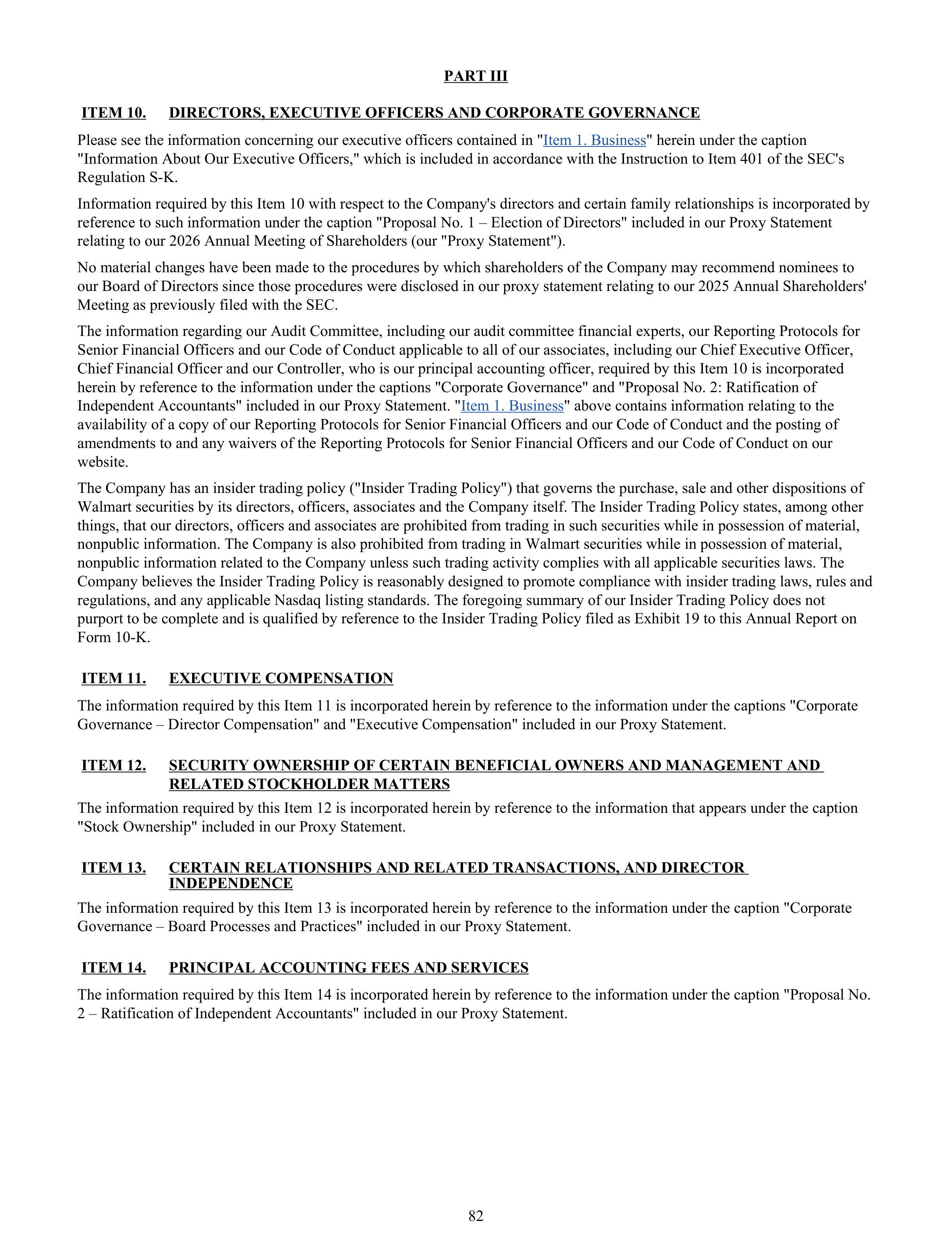
PART III
ITEM 10.
DIRECTORS, EXECUTIVE OFFICERS AND CORPORATE GOVERNANCE
Please see the information concerning our executive officers contained in "
Item 1. Business
" herein under the caption
"Information About Our Executive Officers," which is included in accordance with the Instruction to Item 401 of the SEC's
Regulation S-K.
Information required by this Item 10 with respect to the Company's directors and certain family relationships is incorporated by
reference to such information under the caption "Proposal No. 1 – Election of Directors" included in our Proxy Statement
relating to our 2026 Annual Meeting of Shareholders (our "Proxy Statement").
No material changes have been made to the procedures by which shareholders of the Company may recommend nominees to
our Board of Directors since those procedures were disclosed in our proxy statement relating to our 2025 Annual Shareholders'
Meeting as previously filed with the SEC.
The information regarding our Audit Committee, including our audit committee financial experts, our Reporting Protocols for
Senior Financial Officers and our Code of Conduct applicable to all of our associates, including our Chief Executive Officer,
Chief Financial Officer and our Controller, who is our principal accounting officer, required by this Item 10 is incorporated
herein by reference to the information under the captions "Corporate Governance" and "Proposal No. 2: Ratification of
Independent Accountants" included in our Proxy Statement. "
Item 1. Business
" above contains information relating to the
availability of a copy of our Reporting Protocols for Senior Financial Officers and our Code of Conduct and the posting of
amendments to and any waivers of the Reporting Protocols for Senior Financial Officers and our Code of Conduct on our
website.
The Company has an insider trading policy ("Insider Trading Policy") that governs the purchase, sale and other dispositions of
Walmart securities by its directors, officers, associates and the Company itself. The Insider Trading Policy states, among other
things, that our directors, officers and associates are prohibited from trading in such securities while in possession of material,
nonpublic information. The Company is also prohibited from trading in Walmart securities while in possession of material,
nonpublic information related to the Company unless such trading activity complies with all applicable securities laws. The
Company believes the Insider Trading Policy is reasonably designed to promote compliance with insider trading laws, rules and
regulations, and any applicable Nasdaq listing standards. The foregoing summary of our Insider Trading Policy does not
purport to be complete and is qualified by reference to the Insider Trading Policy filed as Exhibit 19 to this Annual Report on
Form 10-K.
ITEM 11.
EXECUTIVE COMPENSATION
The information required by this Item 11 is incorporated herein by reference to the information under the captions "Corporate
Governance – Director Compensation" and "Executive Compensation" included in our Proxy Statement.
ITEM 12.
SECURITY OWNERSHIP OF CERTAIN BENEFICIAL OWNERS AND MANAGEMENT AND
RELATED STOCKHOLDER MATTERS
The information required by this Item 12 is incorporated herein by reference to the information that appears under the caption
"Stock Ownership" included in our Proxy Statement.
ITEM 13.
CERTAIN RELATIONSHIPS AND RELATED TRANSACTIONS, AND DIRECTOR
INDEPENDENCE
The information required by this Item 13 is incorporated herein by reference to the information under the caption "Corporate
Governance – Board Processes and Practices" included in our Proxy Statement.
ITEM 14.
PRINCIPAL ACCOUNTING FEES AND SERVICES
The information required by this Item 14 is incorporated herein by reference to the information under the caption "Proposal No.
2 – Ratification of Independent Accountants" included in our Proxy Statement.
82
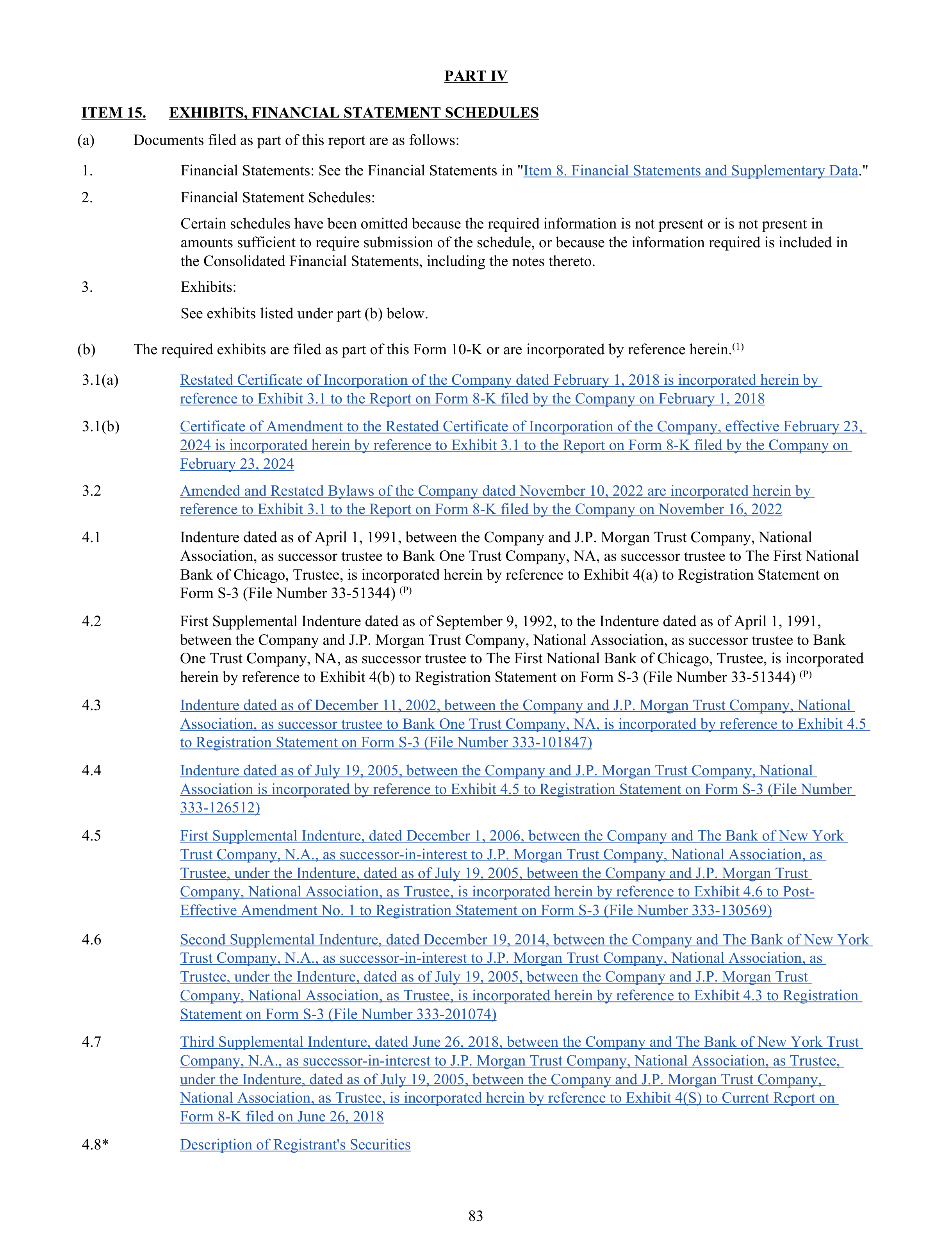
PART IV
ITEM 15.
EXHIBITS, FINANCIAL STATEMENT SCHEDULES
(a)
Documents filed as part of this report are as follows:
1.
Financial Statements: See the Financial Statements in "
Item 8. Financial Statements and Supplementary Data
."
2.
Financial Statement Schedules:
Certain schedules have been omitted because the required information is not present or is not present in
amounts sufficient to require submission of the schedule, or because the information required is included in
the Consolidated Financial Statements, including the notes thereto.
3.
Exhibits:
See exhibits listed under part (b) below.
(b)
The required exhibits are filed as part of this Form 10-K or are incorporated by reference herein.
(1)
3.1(a)
Restated Certificate of Incorporation of the Company dated February 1, 2018 is incorporated herein by
reference to Exhibit 3.1 to the Report on Form 8-K filed by the Company on February 1, 2018
3.1(b)
Certificate of Amendment to the Restated Certificate of Incorporation of the Company, effective February 23,
2024 is incorporated herein by reference to Exhibit 3.1 to the Report on Form 8-K filed by the Company on
February 23, 2024
3.2
Amended and Restated Bylaws of the Company dated November 10, 2022 are incorporated herein by
reference to Exhibit 3.1 to the Report on Form 8-K filed by the Company on November 16, 2022
4.1
Indenture dated as of April 1, 1991, between the Company and J.P. Morgan Trust Company, National
Association, as successor trustee to Bank One Trust Company, NA, as successor trustee to The First National
Bank of Chicago, Trustee, is incorporated herein by reference to Exhibit 4(a) to Registration Statement on
Form S-3 (File Number 33-51344)
(P)
4.2
First Supplemental Indenture dated as of September 9, 1992, to the Indenture dated as of April 1, 1991,
between the Company and J.P. Morgan Trust Company, National Association, as successor trustee to Bank
One Trust Company, NA, as successor trustee to The First National Bank of Chicago, Trustee, is incorporated
herein by reference to Exhibit 4(b) to Registration Statement on Form S-3 (File Number 33-51344)
(P)
4.3
Indenture dated as of December 11, 2002, between the Company and J.P. Morgan Trust Company, National
Association, as successor trustee to Bank One Trust Company, NA, is incorporated by reference to Exhibit 4.5
to Registration Statement on Form S-3 (File Number 333-101847)
4.4
Indenture dated as of July 19, 2005, between the Company and J.P. Morgan Trust Company, National
Association is incorporated by reference to Exhibit 4.5 to Registration Statement on Form S-3 (File Number
333-126512)
4.5
First Supplemental Indenture, dated December 1, 2006, between the Company and The Bank of New York
Trust Company, N.A., as successor-in-interest to J.P. Morgan Trust Company, National Association, as
Trustee, under the Indenture, dated as of July 19, 2005, between the Company and J.P. Morgan Trust
Company, National Association, as Trustee, is incorporated herein by reference to Exhibit 4.6 to Post-
Effective Amendment No. 1 to Registration Statement on Form S-3 (File Number 333-130569)
4.6
Second Supplemental Indenture, dated December 19, 2014, between the Company and The Bank of New York
Trust Company, N.A., as successor-in-interest to J.P. Morgan Trust Company, National Association, as
Trustee, under the Indenture, dated as of July 19, 2005, between the Company and J.P. Morgan Trust
Company, National Association, as Trustee, is incorporated herein by reference to Exhibit 4.3 to Registration
Statement on Form S-3 (File Number 333-201074)
4.7
Third Supplemental Indenture, dated June 26, 2018, between the Company and The Bank of New York Trust
Company, N.A., as successor-in-interest to J.P. Morgan Trust Company, National Association, as Trustee,
under the Indenture, dated as of July 19, 2005, between the Company and J.P. Morgan Trust Company,
National Association, as Trustee, is incorporated herein by reference to Exhibit 4(S) to Current Report on
Form 8-K filed on June 26, 2018
4.8*
Description of Registrant's Securities
83
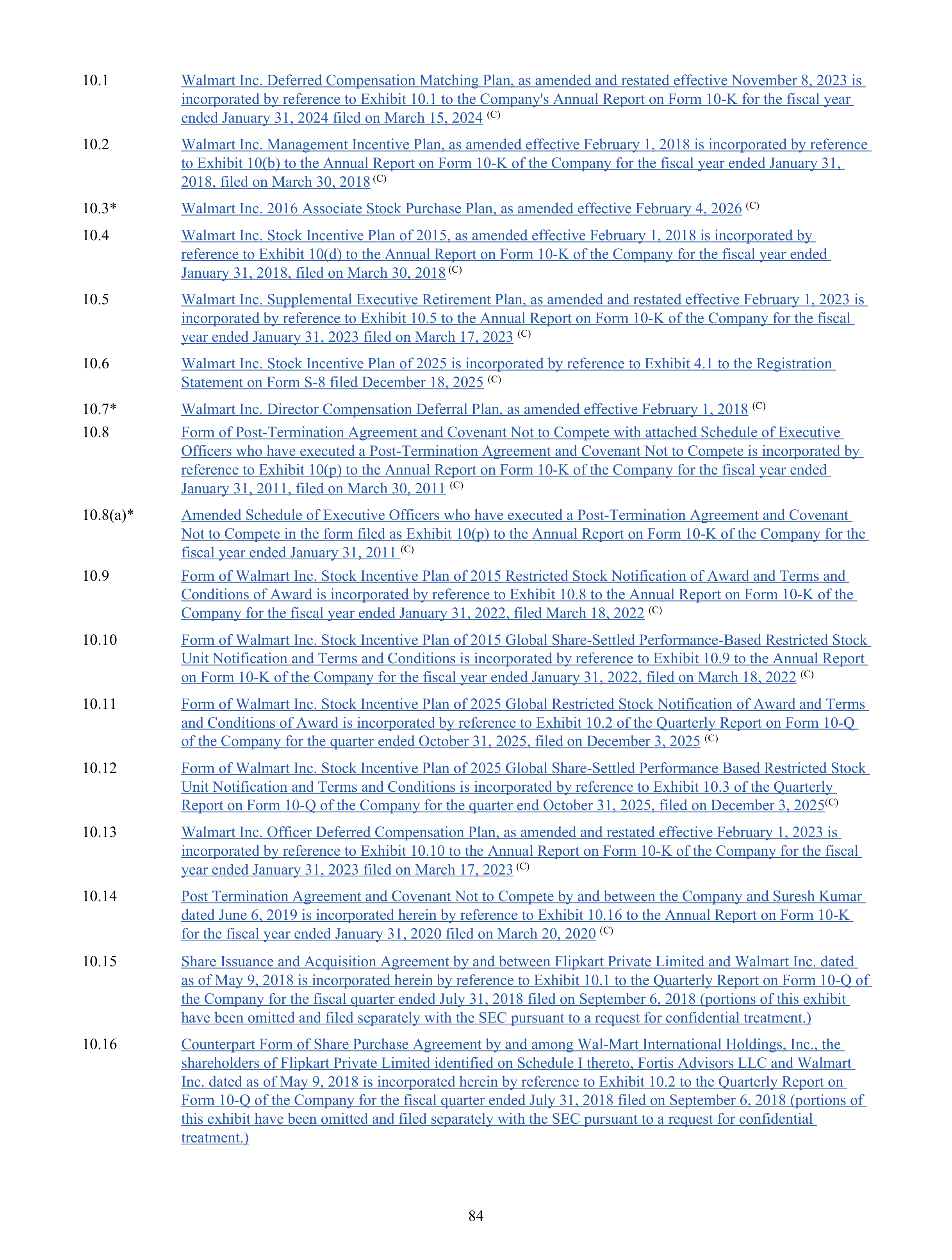
10.1
Walmart Inc. Deferred Compensation Matching Plan, as amended and restated effective November 8, 2023 is
incorporated by reference to Exhibit 10.1 to the Company's Annual Report on Form 10-K for the fiscal year
ended January 31, 2024 filed on March 15, 2024
(C)
10.2
Walmart Inc. Management Incentive Plan, as amended effective February 1, 2018 is incorporated by reference
to Exhibit 10(b) to the Annual Report on Form 10-K of the Company for the fiscal year ended January 31,
2018, filed on March 30, 2018
(C)
10.3*
Walmart Inc. 2016 Associate Stock Purchase Plan, as amended effective February 4, 2026
(C)
10.4
Walmart Inc. Stock Incentive Plan of 2015, as amended effective February 1, 2018 is incorporated by
reference to Exhibit 10(d) to the Annual Report on Form 10-K of the Company for the fiscal year ended
January 31, 2018, filed on March 30, 2018
(C)
10.5
Walmart Inc. Supplemental Executive Retirement Plan, as amended and restated effective February 1, 2023 is
incorporated by reference to Exhibit 10.5 to the Annual Report on Form 10-K of the Company for the fiscal
year ended January 31, 2023 filed on March 17, 2023
(C)
10.6
Walmart Inc. Stock Incentive Plan of 2025 is incorporated by reference to Exhibit 4.1 to the Registration
Statement on Form S-8 filed December 18, 2025
(C)
10.7*
Walmart Inc. Director Compensation Deferral Plan, as amended effective February 1, 2018
(C)
10.8
Form of Post-Termination Agreement and Covenant Not to Compete with attached Schedule of Executive
Officers who have executed a Post-Termination Agreement and Covenant Not to Compete is incorporated by
reference to Exhibit 10(p) to the Annual Report on Form 10-K of the Company for the fiscal year ended
January 31, 2011, filed on March 30, 2011
(C)
10.8(a)*
Amended Schedule of Executive Officers who have executed a Post-Termination Agreement and Covenant
Not to Compete in the form filed as Exhibit 10(p) to the Annual Report on Form 10-K of the Company for the
fiscal year ended January 31, 2011
(C)
10.9
Form of Walmart Inc. Stock Incentive Plan of 2015 Restricted Stock Notification of Award and Terms and
Conditions of Award is incorporated by reference to Exhibit 10.8 to the Annual Report on Form 10-K of the
Company for the fiscal year ended January 31, 2022, filed March 18, 2022
(C)
10.10
Form of Walmart Inc. Stock Incentive Plan of 2015 Global Share-Settled Performance-Based Restricted Stock
Unit Notification and Terms and Conditions is incorporated by reference to Exhibit 10.9 to the Annual Report
on Form 10-K of the Company for the fiscal year ended January 31, 2022, filed on March 18, 2022
(C)
10.11
Form of Walmart Inc. Stock Incentive Plan of 2025 Global Restricted Stock Notification of Award and Terms
and Conditions of Award is incorporated by reference to Exhibit 10.2 of the Quarterly Report on Form 10-Q
of the Company for the quarter ended October 31, 2025, filed on December 3, 2025
(C)
10.12
Form of Walmart Inc. Stock Incentive Plan of 2025 Global Share-Settled Performance Based Restricted Stock
Unit Notification and Terms and Conditions is incorporated by reference to Exhibit 10.3 of the Quarterly
Report on Form 10-Q of the Company for the quarter end October 31, 2025, filed on December 3, 2025
(C)
10.13
Walmart Inc. Officer Deferred Compensation Plan, as amended and restated effective February 1, 2023 is
incorporated by reference to Exhibit 10.10 to the Annual Report on Form 10-K of the Company for the fiscal
year ended January 31, 2023 filed on March 17, 2023
(C)
10.14
Post Termination Agreement and Covenant Not to Compete by and between the Company and Suresh Kumar
dated June 6, 2019 is incorporated herein by reference to Exhibit 10.16 to the Annual Report on Form 10-K
for the fiscal year ended January 31, 2020 filed on March 20, 2020
(C)
10.15
Share Issuance and Acquisition Agreement by and between Flipkart Private Limited and Walmart Inc. dated
as of May 9, 2018 is incorporated herein by reference to Exhibit 10.1 to the Quarterly Report on Form 10-Q of
the Company for the fiscal quarter ended July 31, 2018 filed on September 6, 2018 (portions of this exhibit
have been omitted and filed separately with the SEC pursuant to a request for confidential treatment.)
10.16
Counterpart Form of Share Purchase Agreement by and among Wal-Mart International Holdings, Inc., the
shareholders of Flipkart Private Limited identified on Schedule I thereto, Fortis Advisors LLC and Walmart
Inc. dated as of May 9, 2018 is incorporated herein by reference to Exhibit 10.2 to the Quarterly Report on
Form 10-Q of the Company for the fiscal quarter ended July 31, 2018 filed on September 6, 2018 (portions of
this exhibit have been omitted and filed separately with the SEC pursuant to a request for confidential
treatment.)
84
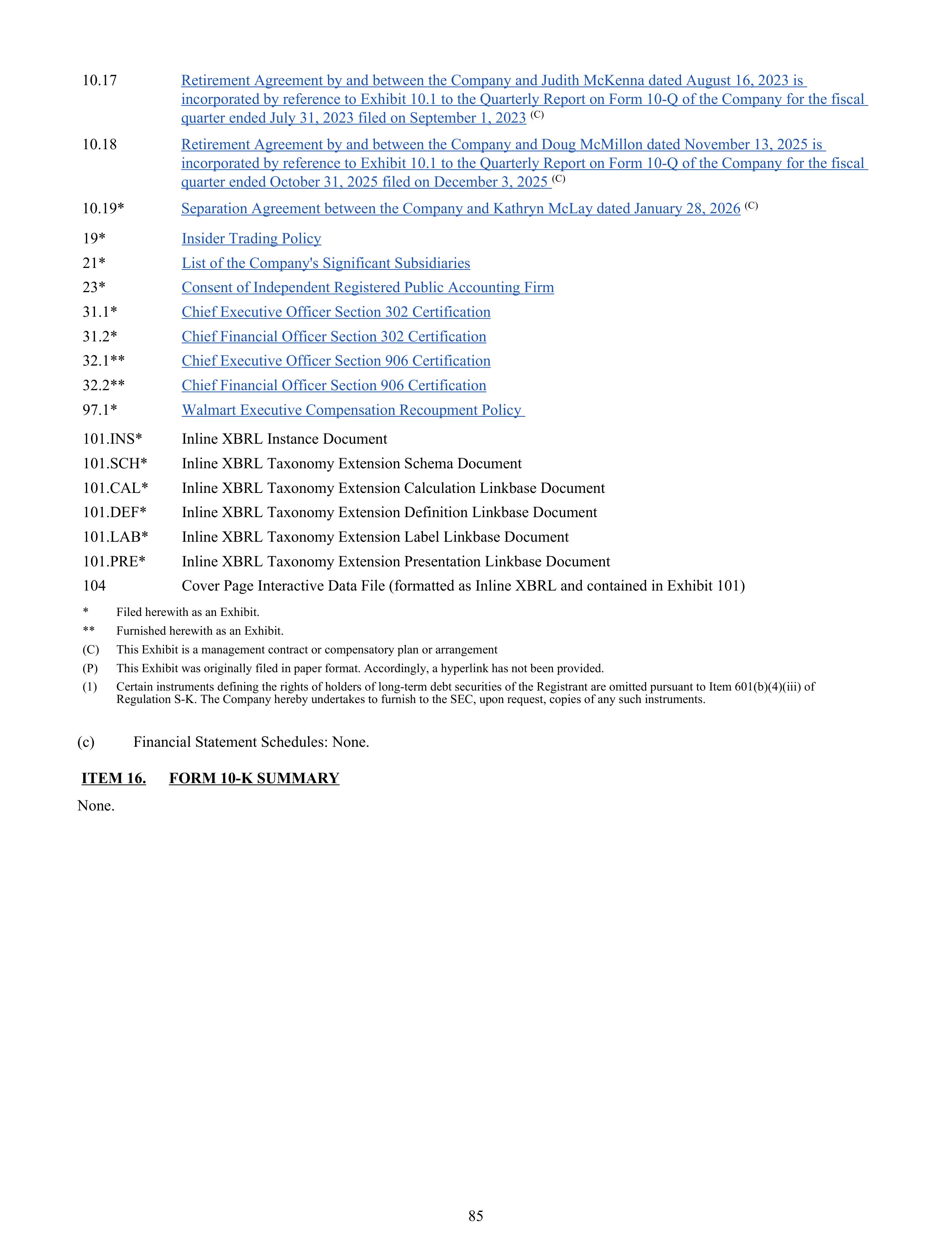
10.17
Retirement Agreement by and between the Company and Judith McKenna dated August 16, 2023 is
incorporated by reference to Exhibit 10.1 to the Quarterly Report on Form 10-Q of the Company for the fiscal
quarter ended July 31, 2023 filed on September 1, 2023
(C)
10.18
Retirement Agreement by and between the Company and Doug McMillon dated November 13, 2025 is
incorporated by reference to Exhibit 10.1 to the Quarterly Report on Form 10-Q of the Company for the fiscal
quarter ended October 31, 2025 filed on December 3, 2025
(C)
10.19*
Separation Agreement between the Company and Kathryn McLay dated January 28, 2026
(C)
19*
Insider Trading Policy
21*
List of the Company's Significant Subsidiaries
23*
Consent of Independent Registered Public Accounting Firm
31.1*
Chief Executive Officer Section 302 Certification
31.2*
Chief Financial Officer Section 302 Certification
32.1**
Chief Executive Officer Section 906 Certification
32.2**
Chief Financial Officer Section 906 Certification
97.1*
Walmart Executive Compensation Recoupment Policy
101.INS*
Inline XBRL Instance Document
101.SCH*
Inline XBRL Taxonomy Extension Schema Document
101.CAL*
Inline XBRL Taxonomy Extension Calculation Linkbase Document
101.DEF*
Inline XBRL Taxonomy Extension Definition Linkbase Document
101.LAB*
Inline XBRL Taxonomy Extension Label Linkbase Document
101.PRE*
Inline XBRL Taxonomy Extension Presentation Linkbase Document
104
Cover Page Interactive Data File (formatted as Inline XBRL and contained in Exhibit 101)
*
Filed herewith as an Exhibit.
**
Furnished herewith as an Exhibit.
(C)
This Exhibit is a management contract or compensatory plan or arrangement
(P)
This Exhibit was originally filed in paper format. Accordingly, a hyperlink has not been provided.
(1)
Certain instruments defining the rights of holders of long-term debt securities of the Registrant are omitted pursuant to Item 601(b)(4)(iii) of
Regulation S-K. The Company hereby undertakes to furnish to the SEC, upon request, copies of any such instruments.
(c)
Financial Statement Schedules: None.
ITEM 16.
FORM 10-K SUMMARY
None.
85
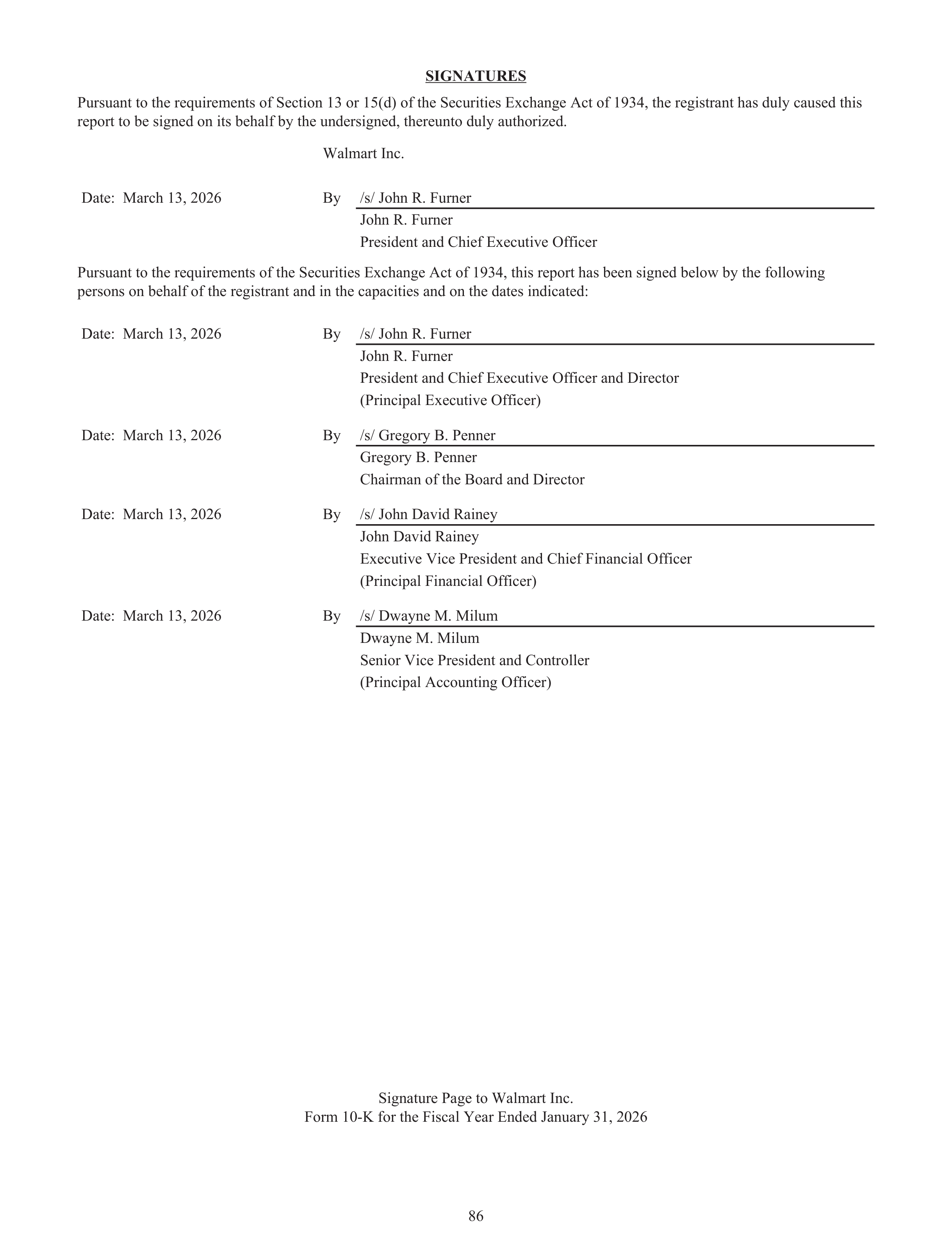
SIGNATURES
Pursuant to the requirements of Section 13 or 15(d) of the Securities Exchange Act of 1934, the registrant has duly caused this
report to be signed on its behalf by the undersigned, thereunto duly authorized.
Walmart Inc.
Date: March 13, 2026
By
/s/ John R. Furner
John R. Furner
President and Chief Executive Officer
Pursuant to the requirements of the Securities Exchange Act of 1934, this report has been signed below by the following
persons on behalf of the registrant and in the capacities and on the dates indicated:
Date: March 13, 2026
By
/s/ John R. Furner
John R. Furner
President and Chief Executive Officer and Director
(Principal Executive Officer)
Date: March 13, 2026
By
/s/ Gregory B. Penner
Gregory B. Penner
Chairman of the Board and Director
Date: March 13, 2026
By
/s/ John David Rainey
John David Rainey
Executive Vice President and Chief Financial Officer
(Principal Financial Officer)
Date: March 13, 2026
By
/s/ Dwayne M. Milum
Dwayne M. Milum
Senior Vice President and Controller
(Principal Accounting Officer)
Signature Page to Walmart Inc.
Form 10-K for the Fiscal Year Ended January 31, 2026
86
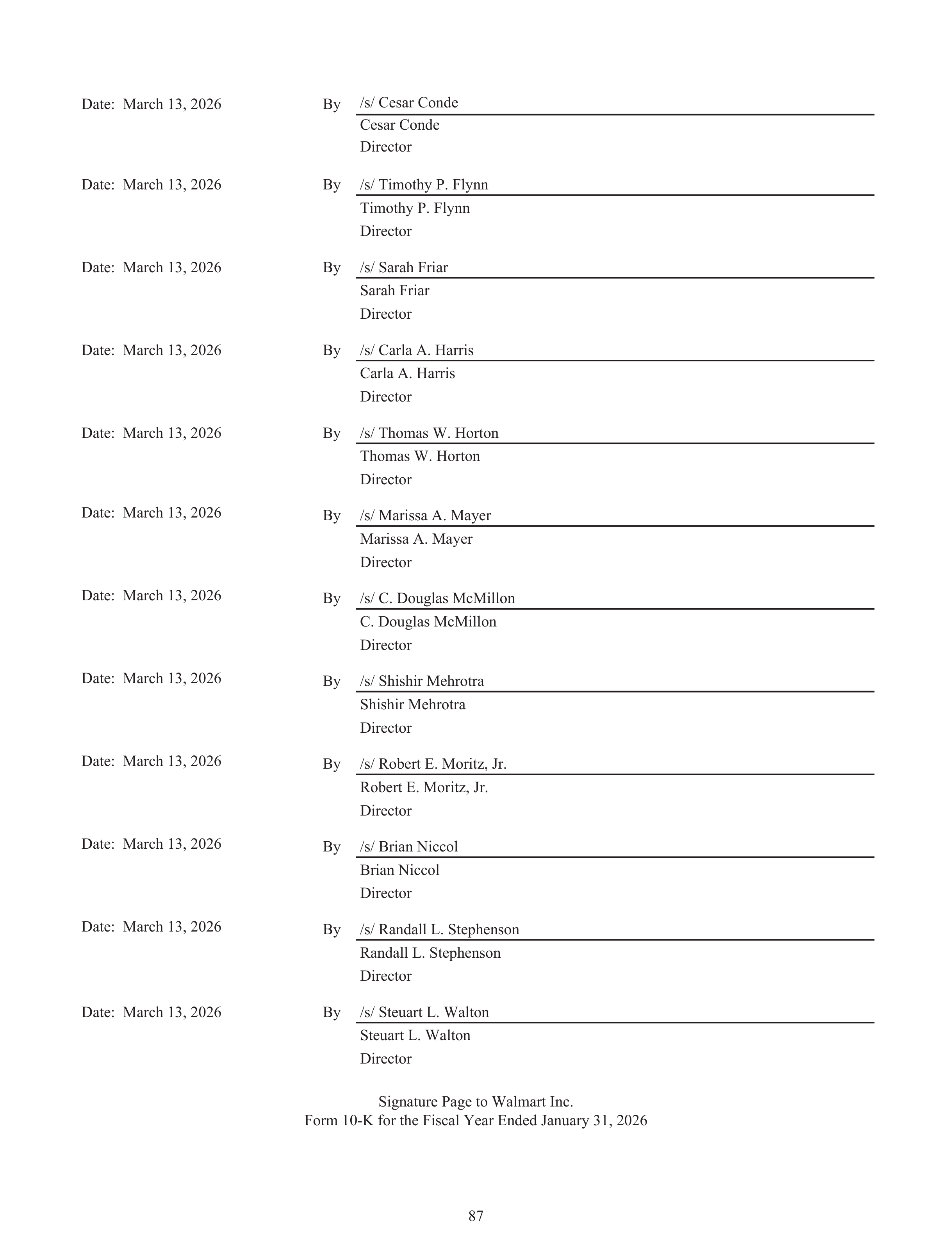
Date: March 13, 2026
By
/s/ Cesar Conde
Cesar Conde
Director
Date: March 13, 2026
By
/s/ Timothy P. Flynn
Timothy P. Flynn
Director
Date: March 13, 2026
By
/s/ Sarah Friar
Sarah Friar
Director
Date: March 13, 2026
By
/s/ Carla A. Harris
Carla A. Harris
Director
Date: March 13, 2026
By
/s/ Thomas W. Horton
Thomas W. Horton
Director
Date: March 13, 2026
By
/s/ Marissa A. Mayer
Marissa A. Mayer
Director
Date: March 13, 2026
By
/s/ C. Douglas McMillon
C. Douglas McMillon
Director
Date: March 13, 2026
By
/s/ Shishir Mehrotra
Shishir Mehrotra
Director
Date: March 13, 2026
By
/s/ Robert E. Moritz, Jr.
Robert E. Moritz, Jr.
Director
Date: March 13, 2026
By
/s/ Brian Niccol
Brian Niccol
Director
Date: March 13, 2026
By
/s/ Randall L. Stephenson
Randall L. Stephenson
Director
Date: March 13, 2026
By
/s/ Steuart L. Walton
Steuart L. Walton
Director
Signature Page to Walmart Inc.
Form 10-K for the Fiscal Year Ended January 31, 2026
87
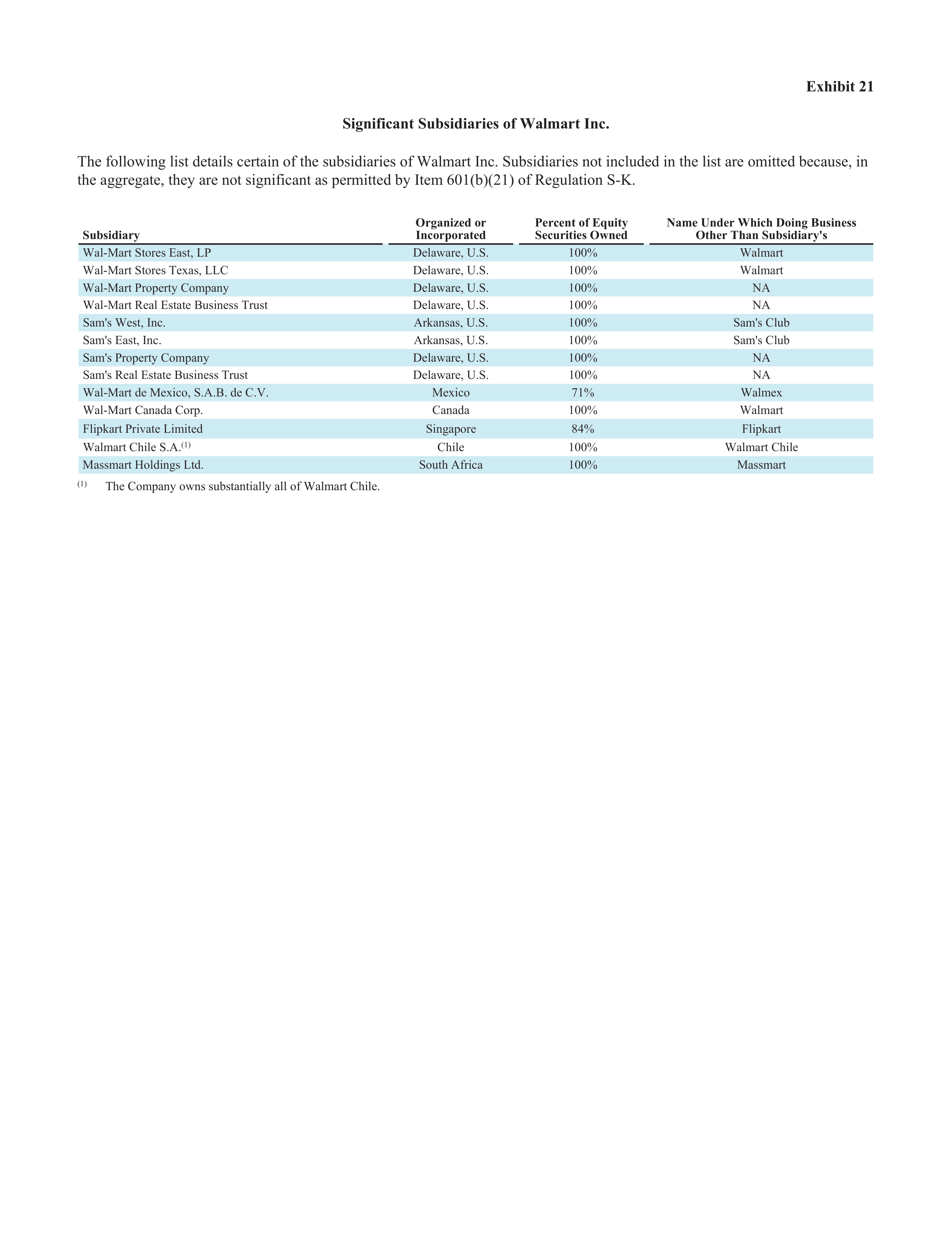
Exhibit 21
Significant Subsidiaries of Walmart Inc.
The following list details certain of the subsidiaries of Walmart Inc. Subsidiaries not included in the list are omitted because, in
the aggregate, they are not significant as permitted by Item 601(b)(21) of Regulation S-K.
Subsidiary
Organized or
Incorporated
Percent of Equity
Securities Owned
Name Under Which Doing Business
Other Than Subsidiary's
Wal-Mart Stores East, LP
Delaware, U.S.
100%
Walmart
Wal-Mart Stores Texas, LLC
Delaware, U.S.
100%
Walmart
Wal-Mart Property Company
Delaware, U.S.
100%
NA
Wal-Mart Real Estate Business Trust
Delaware, U.S.
100%
NA
Sam's West, Inc.
Arkansas, U.S.
100%
Sam's Club
Sam's East, Inc.
Arkansas, U.S.
100%
Sam's Club
Sam's Property Company
Delaware, U.S.
100%
NA
Sam's Real Estate Business Trust
Delaware, U.S.
100%
NA
Wal-Mart de Mexico, S.A.B. de C.V.
Mexico
71%
Walmex
Wal-Mart Canada Corp.
Canada
100%
Walmart
Flipkart Private Limited
Singapore
84%
Flipkart
Walmart Chile S.A.
(1)
Chile
100%
Walmart Chile
Massmart Holdings Ltd.
South Africa
100%
Massmart
(1)
The Company owns substantially all of Walmart Chile.
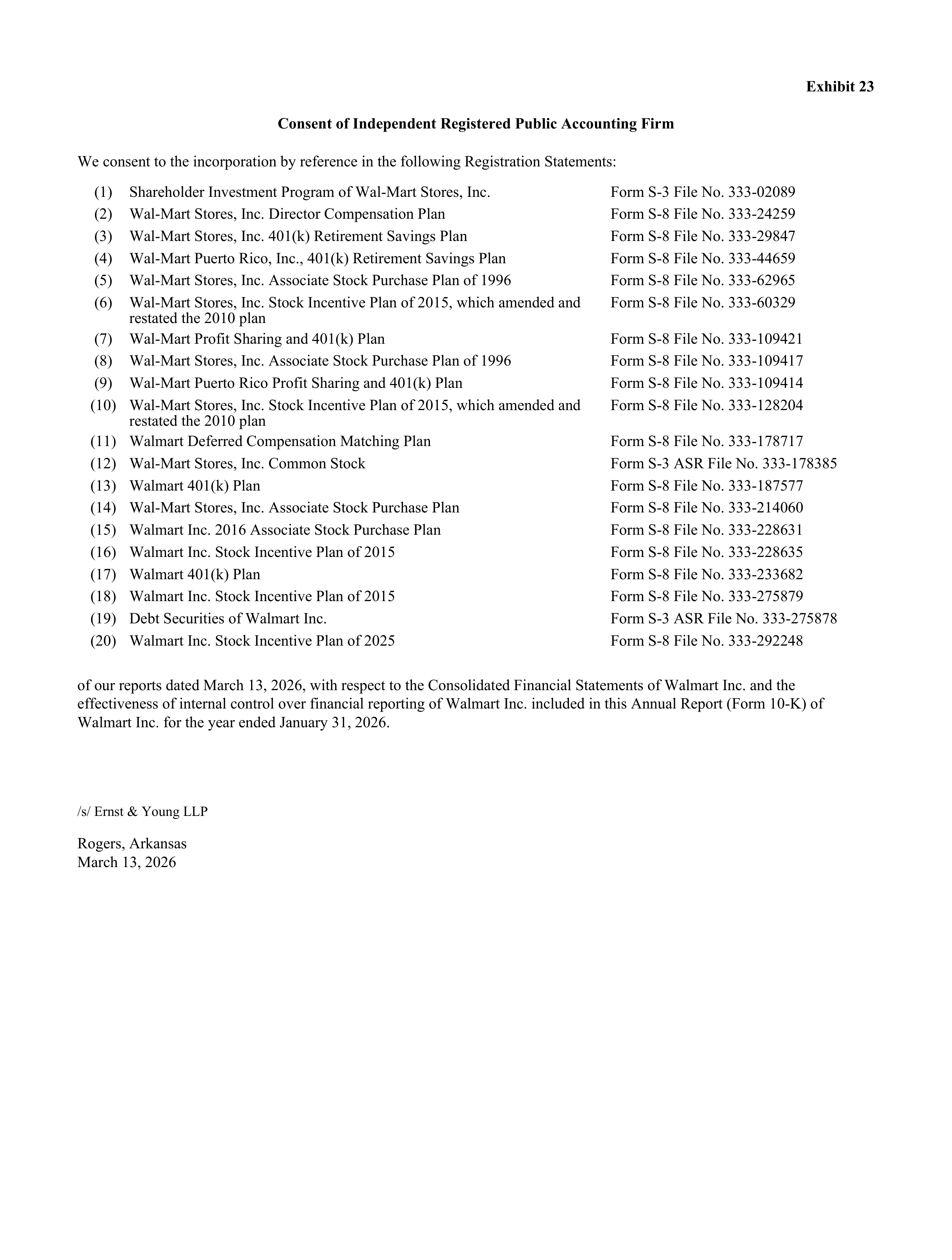
Exhibit 23
Consent of Independent Registered Public Accounting Firm
We consent to the incorporation by reference in the following Registration Statements:
(1)
Shareholder Investment Program of Wal-Mart Stores, Inc.
Form S-3 File No. 333-02089
(2)
Wal-Mart Stores, Inc. Director Compensation Plan
Form S-8 File No. 333-24259
(3)
Wal-Mart Stores, Inc. 401(k) Retirement Savings Plan
Form S-8 File No. 333-29847
(4)
Wal-Mart Puerto Rico, Inc., 401(k) Retirement Savings Plan
Form S-8 File No. 333-44659
(5)
Wal-Mart Stores, Inc. Associate Stock Purchase Plan of 1996
Form S-8 File No. 333-62965
(6)
Wal-Mart Stores, Inc. Stock Incentive Plan of 2015, which amended and
restated the 2010 plan
Form S-8 File No. 333-60329
(7)
Wal-Mart Profit Sharing and 401(k) Plan
Form S-8 File No. 333-109421
(8)
Wal-Mart Stores, Inc. Associate Stock Purchase Plan of 1996
Form S-8 File No. 333-109417
(9)
Wal-Mart Puerto Rico Profit Sharing and 401(k) Plan
Form S-8 File No. 333-109414
(10)
Wal-Mart Stores, Inc. Stock Incentive Plan of 2015, which amended and
restated the 2010 plan
Form S-8 File No. 333-128204
(11)
Walmart Deferred Compensation Matching Plan
Form S-8 File No. 333-178717
(12)
Wal-Mart Stores, Inc. Common Stock
Form S-3 ASR File No. 333-178385
(13)
Walmart 401(k) Plan
Form S-8 File No. 333-187577
(14)
Wal-Mart Stores, Inc. Associate Stock Purchase Plan
Form S-8 File No. 333-214060
(15)
Walmart Inc. 2016 Associate Stock Purchase Plan
Form S-8 File No. 333-228631
(16)
Walmart Inc. Stock Incentive Plan of 2015
Form S-8 File No. 333-228635
(17)
Walmart 401(k) Plan
Form S-8 File No. 333-233682
(18)
Walmart Inc. Stock Incentive Plan of 2015
Form S-8 File No. 333-275879
(19)
Debt Securities of Walmart Inc.
Form S-3 ASR File No. 333-275878
(20)
Walmart Inc. Stock Incentive Plan of 2025
Form S-8 File No. 333-292248
of our reports dated March 13, 2026, with respect to the Consolidated Financial Statements of Walmart Inc. and the
effectiveness of internal control over financial reporting of Walmart Inc. included in this Annual Report (Form 10-K) of
Walmart Inc. for the year ended January 31, 2026.
/s/ Ernst & Young LLP
Rogers, Arkansas
March 13, 2026
Exhibit 31.1
I, John R. Furner, certify that:
1.
I have reviewed this Annual Report on Form 10-K of Walmart Inc. (the "registrant");
2.
Based on my knowledge, this report does not contain any untrue statement of a material fact or omit to state a
material fact necessary to make the statements made, in light of the circumstances under which such statements
were made, not misleading with respect to the period covered by this report;
3.
Based on my knowledge, the financial statements, and other financial information included in this report, fairly
present in all material respects the financial condition, results of operations and cash flows of the registrant as of,
and for, the periods presented in this report;
4.
The registrant's other certifying officer and I are responsible for establishing and maintaining disclosure controls
and procedures (as defined in Exchange Act Rules 13a-15(e) and 15d-15(e)) and internal control over financial
reporting (as defined in Exchange Act Rules 13a-15(f) and 15d-15(f)) for the registrant and have:
a)
designed such disclosure controls and procedures, or caused such disclosure controls and procedures to be
designed under our supervision, to ensure that material information relating to the registrant, including its
consolidated subsidiaries, is made known to us by others within those entities, particularly during the period
in which this report is being prepared;
b)
designed such internal control over financial reporting, or caused such internal control over financial
reporting to be designed under our supervision, to provide reasonable assurance regarding the reliability of
financial reporting and the preparation of financial statements for external purposes in accordance with
generally accepted accounting principles;
c)
evaluated the effectiveness of the registrant's disclosure controls and procedures and presented in this report
our conclusions about the effectiveness of the disclosure controls and procedures, as of the end of the period
covered by this report, based on such evaluation; and
d)
disclosed in this report any change in the registrant's internal control over financial reporting that occurred
during the registrant's most recent fiscal quarter that has materially affected, or is reasonably likely to
materially affect, the registrant's internal control over financial reporting.
5.
The registrant's other certifying officer and I have disclosed, based on our most recent evaluation of internal control
over financial reporting, to the registrant's auditors and the Audit Committee of registrant's Board of Directors:
a)
all significant deficiencies and material weaknesses in the design or operation of internal control over
financial reporting which are reasonably likely to adversely affect the registrant's ability to record, process,
summarize and report financial information; and
b)
any fraud, whether or not material, that involves management or other employees who have a significant
role in the registrant's internal control over financial reporting.
Date: March 13, 2026
/s/ John R. Furner
John R. Furner
President and Chief Executive Officer
Exhibit 31.2
I, John David Rainey, certify that:
1.
I have reviewed this Annual Report on Form 10-K of Walmart Inc. (the "registrant");
2.
Based on my knowledge, this report does not contain any untrue statement of a material fact or omit to state a
material fact necessary to make the statements made, in light of the circumstances under which such statements
were made, not misleading with respect to the period covered by this report;
3.
Based on my knowledge, the financial statements, and other financial information included in this report, fairly
present in all material respects the financial condition, results of operations and cash flows of the registrant as of,
and for, the periods presented in this report;
4.
The registrant's other certifying officer and I are responsible for establishing and maintaining disclosure controls
and procedures (as defined in Exchange Act Rules 13a-15(e) and 15d-15(e)) and internal control over financial
reporting (as defined in Exchange Act Rules 13a-15(f) and 15d-15(f)) for the registrant and have:
a)
designed such disclosure controls and procedures, or caused such disclosure controls and procedures to be
designed under our supervision, to ensure that material information relating to the registrant, including its
consolidated subsidiaries, is made known to us by others within those entities, particularly during the period
in which this report is being prepared;
b)
designed such internal control over financial reporting, or caused such internal control over financial
reporting to be designed under our supervision, to provide reasonable assurance regarding the reliability of
financial reporting and the preparation of financial statements for external purposes in accordance with
generally accepted accounting principles;
c)
evaluated the effectiveness of the registrant's disclosure controls and procedures and presented in this report
our conclusions about the effectiveness of the disclosure controls and procedures, as of the end of the period
covered by this report, based on such evaluation; and
d)
disclosed in this report any change in the registrant's internal control over financial reporting that occurred
during the registrant's most recent fiscal quarter that has materially affected, or is reasonably likely to
materially affect, the registrant's internal control over financial reporting.
5.
The registrant's other certifying officer and I have disclosed, based on our most recent evaluation of internal control
over financial reporting, to the registrant's auditors and the Audit Committee of registrant's Board of Directors:
a)
all significant deficiencies and material weaknesses in the design or operation of internal control over
financial reporting which are reasonably likely to adversely affect the registrant's ability to record, process,
summarize and report financial information; and
b)
any fraud, whether or not material, that involves management or other employees who have a significant
role in the registrant's internal control over financial reporting.
Date: March 13, 2026
/s/ John David Rainey
John David Rainey
Executive Vice President and Chief Financial Officer
Exhibit 32.1
CERTIFICATION PURSUANT TO
18 U.S.C. SECTION 1350 (AS ADOPTED
PURSUANT TO SECTION 906 OF THE
SARBANES-OXLEY ACT OF 2002)
In connection with the Annual Report of Walmart Inc. (the "Company") on Form 10-K for the period ending January 31,
2026 as filed with the Securities and Exchange Commission on the date hereof (the "Report"), I, John R. Furner, President and
Chief Executive Officer of the Company, certify to my knowledge and in my capacity as an officer of the Company, pursuant to
18 U.S.C. 1350, as adopted pursuant to Section 906 of the Sarbanes-Oxley Act of 2002, that:
1. The Report fully complies with the requirements of Section 13(a) or 15(d) of the Securities Exchange Act of 1934, as
amended; and
2. The information contained in the Report fairly presents, in all material respects, the financial condition and results of
operations of the Company as of the dates and for the periods expressed in the Report.
IN WITNESS WHEREOF, the undersigned has executed this Certificate, effective as of March 13, 2026.
/s/ John R. Furner
John R. Furner
President and Chief Executive Officer
Exhibit 32.2
CERTIFICATION PURSUANT TO
18 U.S.C. SECTION 1350 (AS ADOPTED
PURSUANT TO SECTION 906 OF THE
SARBANES-OXLEY ACT OF 2002)
In connection with the Annual Report of Walmart Inc. (the "Company") on Form 10-K for the period ending January 31,
2026 as filed with the Securities and Exchange Commission on the date hereof (the "Report"), I, John David Rainey, Executive
Vice President and Chief Financial Officer of the Company, certify to my knowledge and in my capacity as an officer of the
Company, pursuant to 18 U.S.C. 1350, as adopted pursuant to Section 906 of the Sarbanes-Oxley Act of 2002, that:
1. The Report fully complies with the requirements of Section 13(a) or 15(d) of the Securities Exchange Act of 1934, as
amended; and
2. The information contained in the Report fairly presents, in all material respects, the financial condition and results of
operations of the Company as of the dates and for the periods expressed in the Report.
IN WITNESS WHEREOF, the undersigned has executed this Certificate, effective as of March 13, 2026.
/s/ John David Rainey
John David Rainey
Executive Vice President and Chief Financial Officer

THIS PAGE INTENTIONALLY LEFT BLANK

THIS PAGE INTENTIONALLY LEFT BLANK

THIS PAGE INTENTIONALLY LEFT BLANK
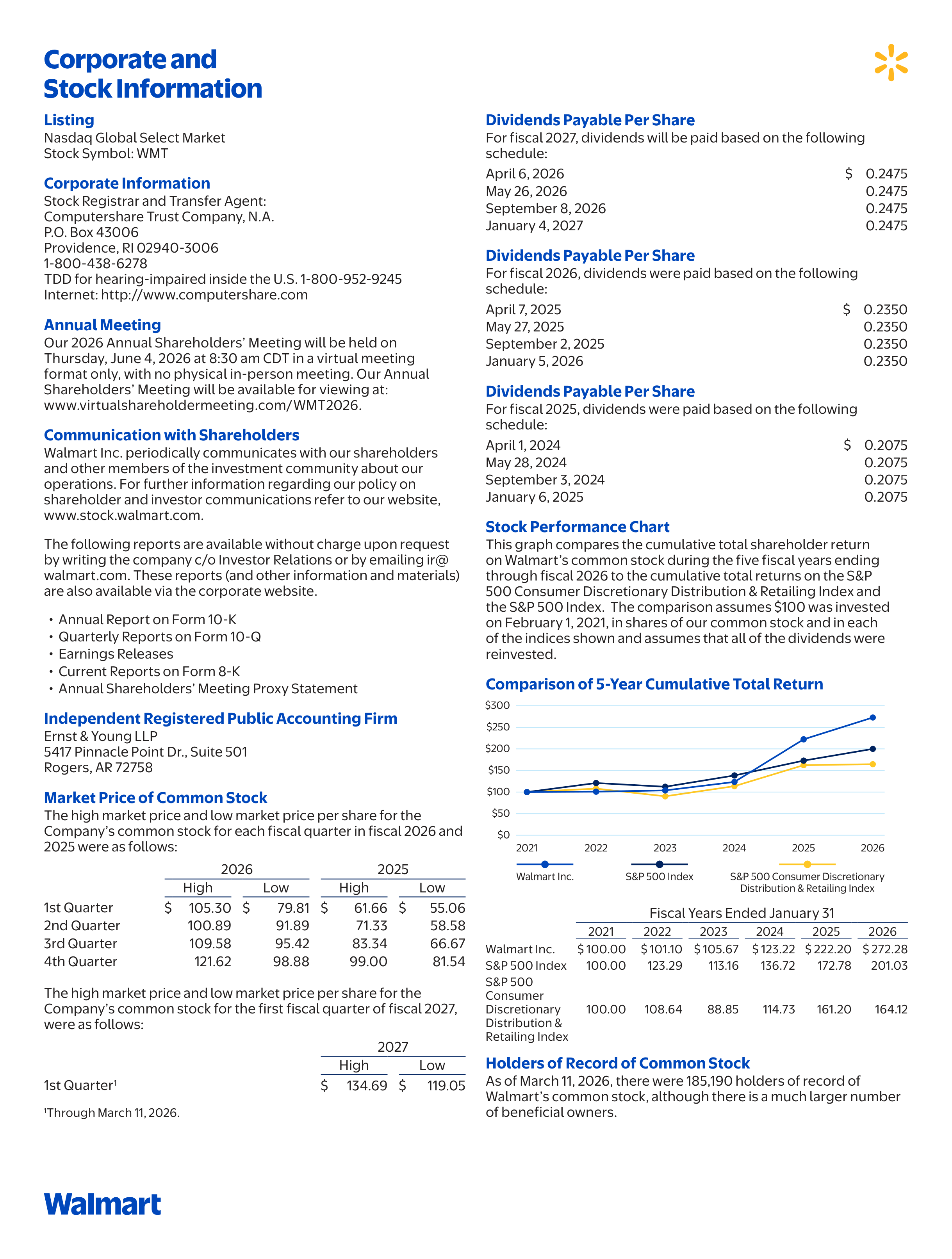
Listing
Nasdaq Global Select Market
Stock Symbol: WMT
Corporate Information
Stock Registrar and Transfer Agent:
Computershare Trust Company, N.A.
P.O. Box 43006
Providence, RI 02940-3006
1-800-438-6278
TDD for hearing-impaired inside the U.S. 1-800-952-9245
Internet: http://www.computershare.com
Annual Meeting
Our 2026 Annual Shareholders’ Meeting will be held on
Thursday, June 4, 2026 at 8:30 am CDT in a virtual meeting
format only, with no physical in-person meeting. Our Annual
Shareholders’ Meeting will be available for viewing at:
www.virtualshareholdermeeting.com/WMT2026.
Communication with Shareholders
Walmart Inc. periodically communicates with our shareholders
and other members of the investment community about our
operations. For further information regarding our policy on
shareholder and investor communications refer to our website,
www.stock.walmart.com.
The following reports are available without charge upon request
by writing the company c/o Investor Relations or by emailing ir@
walmart.com. These reports (and other information and materials)
are also available via the corporate website.
• Annual Report on Form 10-K
• Quarterly Reports on Form 10-Q
• Earnings Releases
• Current Reports on Form 8-K
• Annual Shareholders’ Meeting Proxy Statement
Independent Registered Public Accounting Firm
Ernst & Young LLP
5417 Pinnacle Point Dr., Suite 501
Rogers, AR 72758
Market Price of Common Stock
The high market price and low market price per share for the
Company’s common stock for each fiscal quarter in fiscal 2026 and
2025 were as follows:
Dividends Payable Per Share
For fiscal 2027, dividends will be paid based on the following
schedule:
April 6, 2026
$ 0.2475
May 26, 2026
0.2475
September 8, 2026
0.2475
January 4, 2027
0.2475
Dividends Payable Per Share
For fiscal 2026, dividends were paid based on the following
schedule:
April 7, 2025
$ 0.2350
May 27, 2025
0.2350
September 2, 2025
0.2350
January 5, 2026
0.2350
Dividends Payable Per Share
For fiscal 2025, dividends were paid based on the following
schedule:
April 1, 2024
$ 0.2075
May 28, 2024
0.2075
September 3, 2024
0.2075
January 6, 2025
0.2075
Stock Performance Chart
This graph compares the cumulative total shareholder return
on Walmart’s common stock during the five fiscal years ending
through fiscal 2026 to the cumulative total returns on the S&P
500 Consumer Discretionary Distribution & Retailing Index and
the S&P 500 Index. The comparison assumes $100 was invested
on February 1, 2021, in shares of our common stock and in each
of the indices shown and assumes that all of the dividends were
reinvested.
Comparison of 5-Year Cumulative Total Return
Corporate and
Stock Information
2026
2025
High
Low
High
Low
1st Quarter
$
105.30
$
79.81
$
61.66
$
55.06
2nd Quarter
100.89
91.89
71.33
58.58
3rd Quarter
109.58
95.42
83.34
66.67
4th Quarter
121.62
98.88
99.00
81.54
2027
High
Low
1st Quarter
1
$
134.69
$
119.05
The high market price and low market price per share for the
Company’s common stock for the first fiscal quarter of fiscal 2027,
were as follows:
1
Through March 11, 2026.
Fiscal Years Ended January 31
2021
2022
2023
2024
2025
2026
Walmart Inc.
$ 100.00
$ 101.10
$ 105.67
$ 123.22
$ 222.20
$ 272.28
S&P 500 Index
100.00
123.29
113.16
136.72
172.78
201.03
S&P 500
Consumer
Discretionary
Distribution &
Retailing Index
100.00
108.64
88.85
114.73
161.20
164.12
Holders of Record of Common Stock
As of March 11, 2026, there were 185,190 holders of record of
Walmart’s common stock, although there is a much larger number
of beneficial owners.