
2025
Sustainability
&
Social
Impact
Report
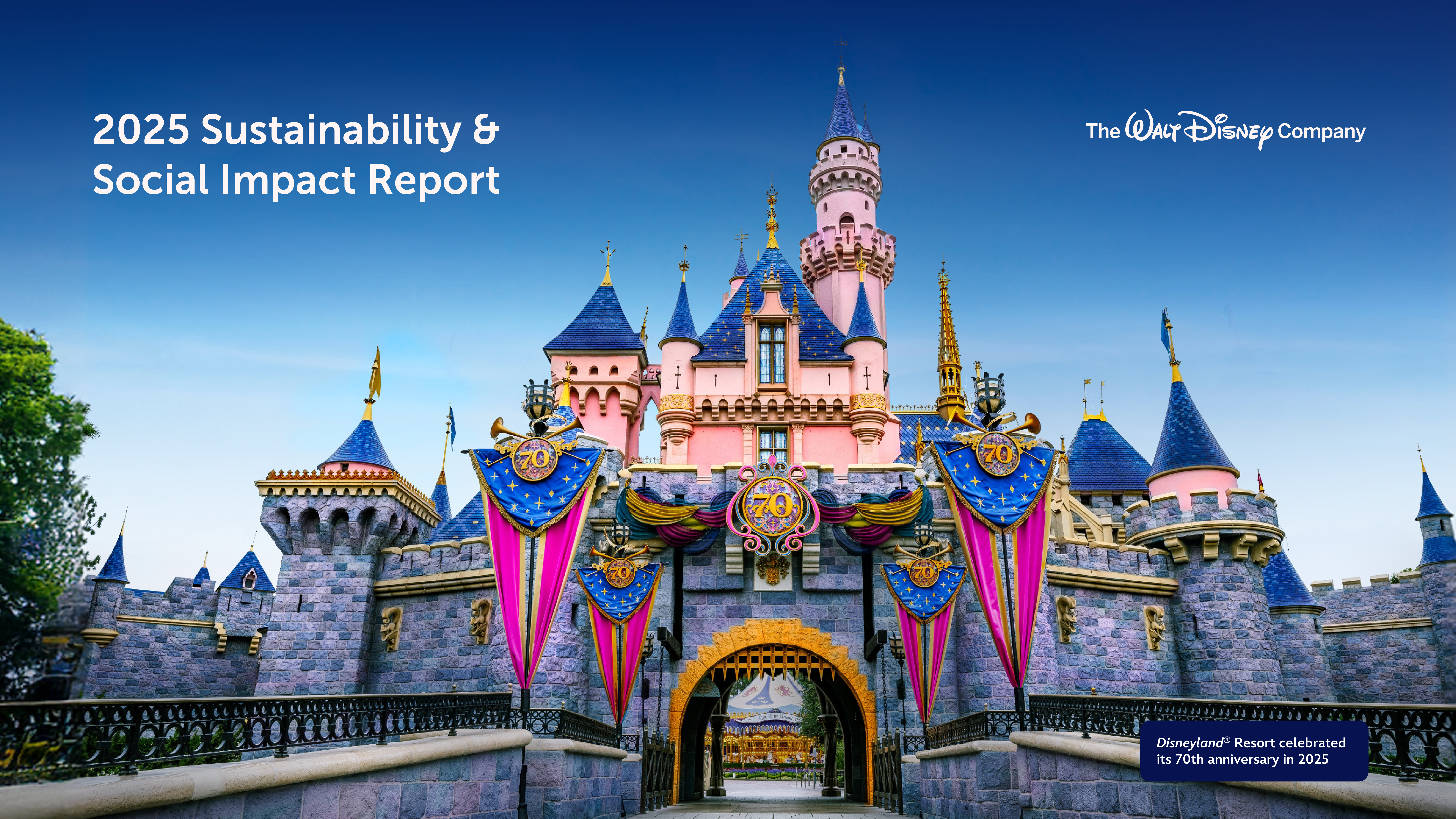
Disneyland
®
Resort
celebrated
its
70th
anniversary
in
2025

Forward-Looking
Statements
Certain
statements
and
information
in
this
communication
may
constitute
“forward-looking
statements”
within
the
meaning
of
the
Private
Securities
Litigation
Reform
Act
of
1995,
including
statements
regarding
our
plans;
beliefs;
expectations;
continuation
or
future
execution
of
initiatives,
programs,
activities,
policies,
or
disclosures;
strategies;
goals;
objectives;
intentions;
commitments;
pledges;
priorities;
targets;
and
other
statements
that
are
not
historical
in
nature.
Any
information
that
is
not
historical
in
nature
included
in
this
report
is
subject
to
change.
These
statements
are
made
on
the
basis
of
managementʼs
views
and
assumptions
regarding
future
events
and
business
performance,
as
of
the
time
the
statements
are
made.
Management
does
not
undertake
any
obligation
to
update
these
statements
unless
required
by
applicable
laws
or
regulations.
Actual
results
may
differ
materially
from
those
expressed
or
implied.
Such
differences
may
result
from
actions
taken
by
the
company—including
restructuring
or
strategic
initiatives
(including
capital
investments,
asset
acquisitions
or
dispositions,
new
or
expanded
business
lines,
or
cessation
of
certain
operations),
our
execution
of
our
business
plans
(including
the
content
we
create
and
intellectual
property
we
invest
in,
our
pricing
decisions,
our
cost
structure,
and
our
management
and
other
personnel
decisions),
our
ability
to
quickly
execute
on
cost
rationalization
while
preserving
revenue,
and
the
discovery
of
additional
information
or
other
business
decisions—as
well
as
from
developments
beyond
the
companyʼs
control,
including:
•
the
occurrence
of
subsequent
events;
•
deterioration
in
domestic
and
global
economic
conditions
or
failure
of
conditions
to
improve
as
anticipated;
•
deterioration
in
or
pressures
from
competitive
conditions,
including
competition
to
create
or
acquire
content,
competition
for
talent,
and
competition
for
advertising
revenue;
•
consumer
preferences
for
and
acceptance
of
our
content
offerings
and
the
distribution
channel
(including
pricing
and
bundling
of
our
streaming
services
and
impact
on
churn
and
subscriber
additions)
and
our
travel
destinations
•
the
market
for
advertising
sales
on
our
streaming
services
and
linear
networks;
•
health
concerns
and
their
impact
on
our
businesses
and
productions;
•
global
economy-wide
transitions
and
availability
of
economically
feasible
solutions;
•
international,
including
tariffs
and
other
trade
policies,
political
or
military
developments;
•
regulatory
and
legal
developments;
•
technological
developments;
•
labor
markets
and
activities,
including
work
stoppages;
•
adverse
weather
conditions
or
natural
disasters
and
environmental
developments;
and
•
availability
of
content.
Such
developments
may
further
affect
entertainment,
travel,
and
leisure
businesses
generally
and
may,
among
other
things,
affect
(or
further
affect,
as
applicable):
•
our
operations,
business
plans,
or
profitability;
•
demand
for
our
products
and
services;
•
the
performance
of
the
companyʼs
content;
•
our
ability
to
create
or
obtain
desirable
content
at
or
under
the
value
we
assign
the
content;
•
the
advertising
market
for
programming;
•
construction;
•
taxation;
•
expenses
of
providing
medical
and
post-
retirement
benefits;
and
•
performance
of
some
or
all
company
businesses
either
directly
or
through
their
impact
on
those
that
distribute
our
products.
•
Additional
factors
are
set
forth
in
the
companyʼs
most
recent
Annual
Report
on
Form
10-K,
including
under
the
captions
“Risk
Factors,”
“Managementʼs
Discussion
and
Analysis
of
Financial
Condition
and
Results
of
Operations,”
and
“Business”;
subsequent
quarterly
reports
on
Form
10-Q,
including
under
the
captions
“Risk
Factors”
and
“Managementʼs
Discussion
and
Analysis
of
Financial
Condition
and
Results
of
Operations”;
and
subsequent
filings
with
the
Securities
and
Exchange
Commission.


Table
of
Contents
Introduction
&
Our
Approach
4
CEO
LETTER,
HIGHLIGHTS
&
AWARDS
5
OUR
BUSINESSES
6
STRATEGY
&
DISCLOSURE
PRIORITIES
7
OVERSIGHT
&
ACCOUNTABILITY
7
STAKEHOLDER
ENGAGEMENT
&
PARTICIPATION
7
Operating
Responsibly
8
CORPORATE
GOVERNANCE
9
ETHICS
9
RISK
OVERSIGHT
9
TAX
STRATEGY
10
HUMAN
RIGHTS
10
SUPPLY
CHAIN
10
PRODUCT
SAFETY
11
GUEST
SAFETY
12
INFORMATION
SECURITY
13
PRIVACY
13
RESPONSIBLE
AI
USE
13
JOURNALISTIC
INTEGRITY
14
DIGITAL
WELLNESS
14
RESPONSIBLE
ADVERTISING
&
MARKETING
15
People
16
COMPREHENSIVE
TOTAL
REWARDS
17
EMPLOYEE
MENTAL
HEALTH
&
WELL-BEING
18
WORKPLACE
SAFETY
18
EMPLOYEE
ENGAGEMENT
&
INCLUSION
19
TALENT DEVELOPMENT & CONNECTION
21
Environmental
Sustainability
23
EMISSIONS
24
WATER
26
WASTE
27
MATERIALS
28
SUSTAINABLE
DESIGN
29
NATURE
&
BIODIVERSITY
30
Data
&
Frameworks
32
FISCAL
2025
DATA
TABLE
33
SASB
INDEX
41
TCFD
INDEX
44
SDG
INDICATORS
48
This
report
contains
links
to
websites
that
are
not
operated
by
the
company.
Each
website
ownerʼs
Terms
of
Use
and
Privacy
Policy
will
apply.
Unless
otherwise
specified,
data
and
information
in
this
report
pertain
to
efforts
in
fiscal
2025,
which
began
on
September
29,
2024,
and
ended
on
September
27,
2025.
For
the
most
part,
data
and
information
reflect
business
operations
as
of
the
end
of
the
fiscal
year.
The
terms
“company,”
“we,”
“Disney,”
"us,"
and
“our”
are
used
to
refer
collectively
to
the
parent
company
and
the
subsidiaries
through
which
our
various
businesses
are
actually
conducted.


Table
of
Contents
Introduction
&
Our
Approach
Introduction
&
Our
Approach
OVERVIEW
Our
mission
is
to
entertain,
inform,
and
inspire
people
around
the
globe
through
the
power
of
unparalleled
storytelling—reflecting
the
iconic
brands,
creative
minds,
and
innovative
technologies
that
make
ours
the
worldʼs
premier
entertainment
company.
Since
our
founding
more
than
100
years
ago,
we
have
executed
this
mission
with
integrity
and
a
deep
commitment
to
responsibly
operate
our
businesses;
invest
in
our
people
ʼs
development,
employee
experience,
and
well-being;
foster
an
inclusive
workplace;
undertake
meaningful
and
measurable
environmental
sustainability
efforts;
and
strive
to
have
a
positive
impact
in
the
communities
in
which
we
operate.
This
report
describes
select
policies,
practices,
and
programs
that
embody
these
commitments.
Learn
more:
Corporate
Governance
Oversight
&
Accountability
Stakeholder
Engagement
&
Participation
CEO
Letter,
Highlights
&
Awards
Our
Businesses
Strategy
&
Disclosure
Priorities
Oversight
&
Accountability
Stakeholder
Engagement
Operating
Responsibly
People
Environmental
Sustainability
Data
&
Frameworks
4
Table
of
Contents
Introduction
&
Our
Approach
Introduction
&
Our
Approach
OVERVIEW
Our
mission
is
to
entertain,
inform,
and
inspire
people
around
the
globe
through
the
power
of
unparalleled
storytelling—reflecting
the
iconic
brands,
creative
minds,
and
innovative
technologies
that
make
ours
the
worldʼs
premier
entertainment
company.
Since
our
founding
more
than
100
years
ago,
we
have
executed
this
mission
with
integrity
and
a
deep
commitment
to
responsibly
operate
our
businesses;
invest
in
our
people
ʼs
development,
employee
experience,
and
well-being;
foster
an
inclusive
workplace;
undertake
meaningful
and
measurable
environmental
sustainability
efforts;
and
strive
to
have
a
positive
impact
in
the
communities
in
which
we
operate.
This
report
describes
select
policies,
practices,
and
programs
that
embody
these
commitments.
Learn
more:
Corporate
Governance
Oversight
&
Accountability
Stakeholder
Engagement
&
Participation


Table
of
Contents
Introduction
&
Our
Approach
CEO
Letter,
Highlights
&
Awards
Our
Businesses
Strategy
&
Disclosure
Priorities
Oversight
&
Accountability
Stakeholder
Engagement
Operating
Responsibly
People
Environmental
Sustainability
Data
&
Frameworks
LETTER
FROM
OUR
CEO
For
more
than
a
century,
The
Walt
Disney
Company
has
been
guided
by
the
belief
that
the
stories
we
tell,
the
experiences
we
create,
and
the
way
we
conduct
our
businesses
in
the
world
all
reflect
who
we
are
and
what
we
stand
for.
At
Disney,
conducting
our
businesses
with
clarity
of
purpose
and
a
deep
sense
of
integrity
is
fundamental
to
who
we
are.
Responsible
operations,
environmental
stewardship,
and
strong
community
relationships
build
the
trust
that
audiences,
guests,
and
consumers
place
in
our
brands.
And
that
trust
is
what
allows
us
to
bring
people
together
across
cultures,
generations,
and
borders
in
ways
no
other
company
can.
The
work
highlighted
in
this
report
reflects
our
long-standing
commitment
to
operate
responsibly,
support
the
communities
where
we
live
and
work,
and
care
for
the
natural
environments
that
inspire
so
many
of
our
stories.
It
is
work
I
am
proud
to
carry
forward
—and
work
that
will
continue
to
evolve
as
we
learn,
grow,
and
find
new
ways
to
make
a
positive
difference
in
the
world.
None
of
this
happens
without
the
extraordinary
dedication
of
our
employees
and
Cast
Members
around
the
world.
Their
efforts,
day
in
and
day
out,
are
what
turn
our
values
into
action.
Sincerely,
Josh
DʼAmaro
Chief
Executive
Officer
The
Walt
Disney
Company
HIGHLIGHTS
FROM
THE
YEAR
Operating
Responsibly
Piloted
an
initiative
to
improve
cotton
supply
chains
Worked
with
the
Yarn
Ethically
&
Sustainably
Sourced
(YESS)
initiative,
supporting
due
diligence
designed
to
identify
and
reduce
forced
labor
risk
in
apparel
supply
chains
(p.
10
)
Added
accessible
options
at
Hong
Kong
Disneyland
Resort
Options
consisted
of
attraction
vehicle
models
to
help
guests
with
visual
impairments
explore
vehicles
by
touch
before
boarding
(p.
12
)
Launched
Disney
Jr.
Let’s
Play!
campaign
Campaign
is
global
and
multiplatform
and
encourages
preschoolers
to
experience
the
joy
of
play
(p.
14
)
ESPN
introduced
new
PSAs
Public
service
announcements
(PSAs)
connect
fans
to
resources
on
responsible
sports
betting
and
gaming
practices
(p.
15
)
Learn
more
People
99%+
adjusted
pay
ratios
Analysis
compares
U.S.
employee
pay
and
incentives
based
on
gender,
race,
and
ethnicity
(p.
17
)
9
in
10
employees
are
proud
to
work
at
Disney
Survey
results
indicate
strong
employee
engagement
at
Disney
(p.
19
)
Committed
$15
million
to
support
employees
and
communities
impacted
by
the
Southern
California
wildfires
Provided
support
through
targeted
relief,
housing
assistance,
and
recovery
and
rebuilding
efforts
(p.
20
)
7,500
leaders
participated
in
coaching
in
fiscal
2025
Leaders
received
personalized
support
to
inspire
teams
and
drive
innovation
(p.
22
)
Learn
more
Environmental
Sustainability
36%
progress
toward
reducing
absolute
Scope
1
and
2
emissions,
in
support
of
our
2030
target
(p.
24
)
48%
zero-carbon
electricity
Purchased
or
produced
in
our
own
operations
(p.
34
)
60%
of
total
operational
waste
diverted
From
landfill
and
incineration
toward
our
zero
waste-to-landfill
goal
†
(p.
27
)
Disney
Cruise
Line
eliminated
93%
of
single-use
plastics
Onboard
its
ships
and
at
its
island
destinations
(p.
27
)
Opened
the
Island
Tower
at
Polynesian
Villas
&
Bungalows
at
Walt
Disney
World
®
Resort
Design
and
construction
blends
Disney
storytelling
with
sustainable
design
(p.
29
)
Learn
more
Awards
and
Recognition
Dow
Jones
Best-in-Class
North
American
Index
FTSE4Good
Index
Best
for
Vets
Employers,
#62
2025
Military
Times
Best
Employers:
Excellence
in
Health
&
Well-Being
(Global
&
Mental
Health)
Business
Group
on
Health
32
Gold
and
17
Green
Seal
Awards
2025
Environmental
Media
Association
Awards
LEED
Platinum
certification
for
Core
&
Shell
and
Commercial
Interiors
awarded
to
Disney’s
New
York
City
campus
U.S.
Green
Building
Council
†
For
owned
and
operated
Disney
Parks
and
Disney
Cruise
Line.
5

Our
Businesses
OUR
BUSINESSES
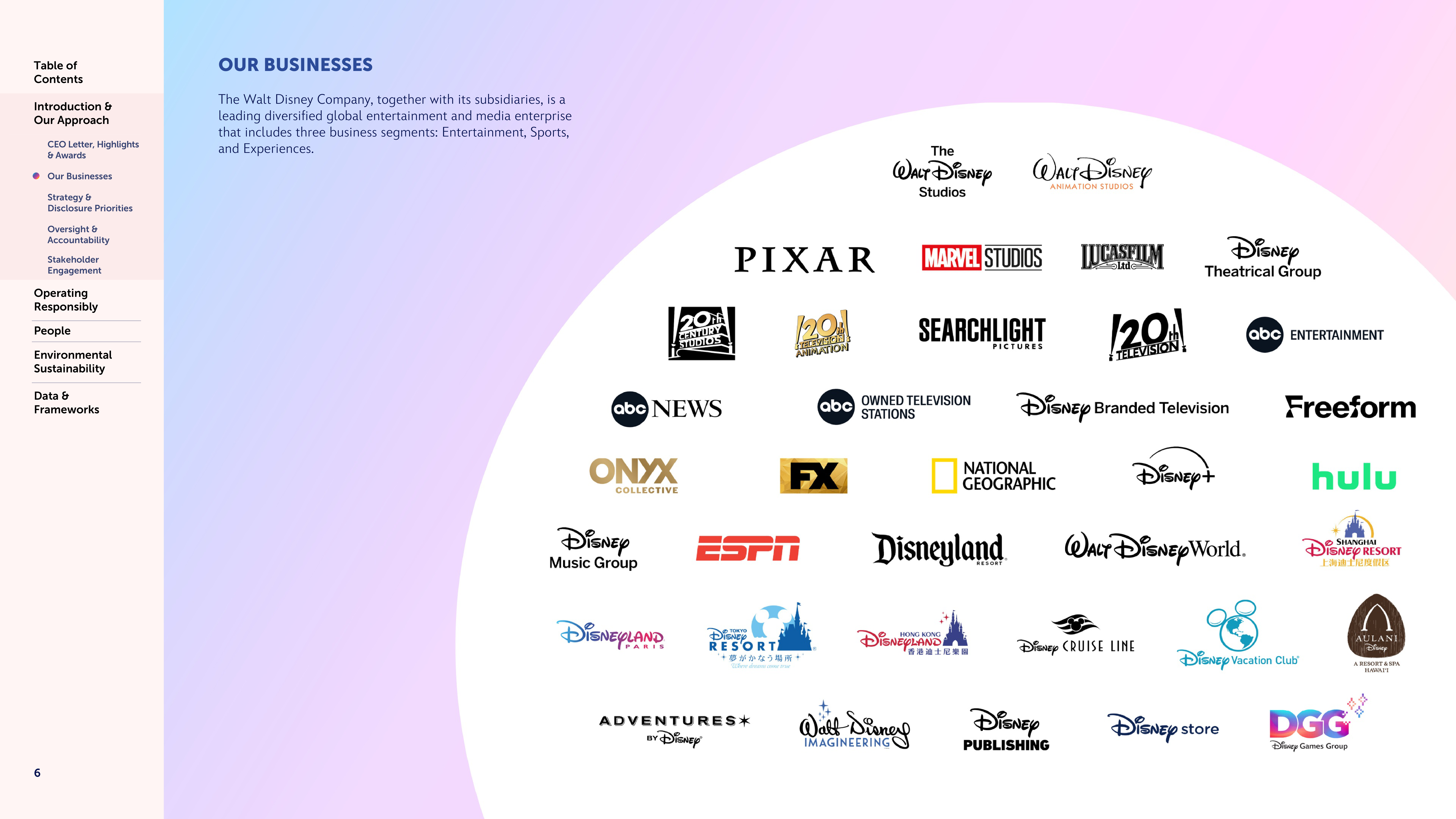
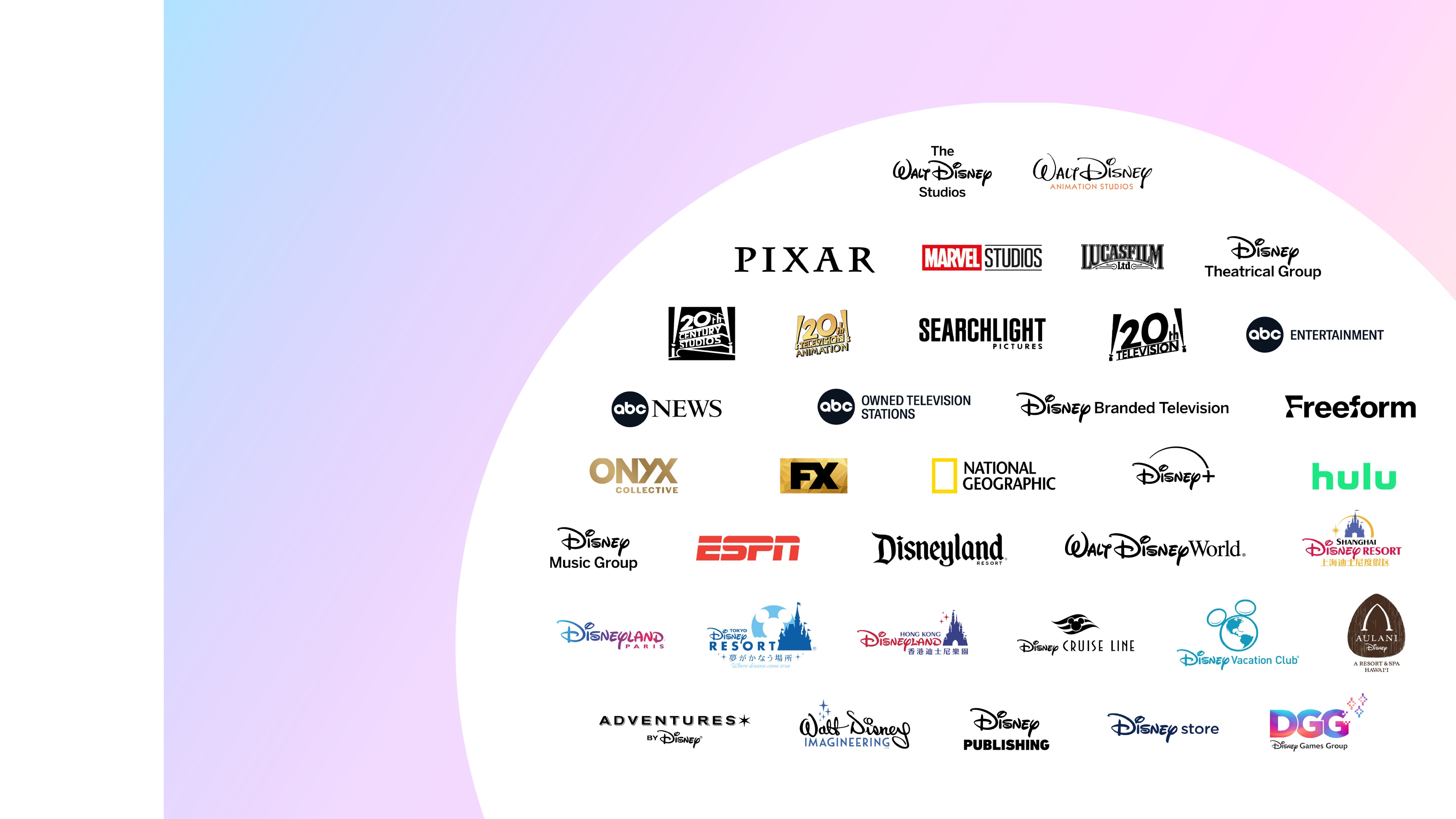
The
Walt
Disney
Company,
together
with
its
subsidiaries,
is
a
leading
diversified
global
entertainment
and
media
enterprise
that
includes
three
business
segments:
Entertainment,
Sports,
and
Experiences.
Table
of
Contents
Introduction
&
Our
Approach
CEO
Letter,
Highlights
&
Awards
Strategy
&
Disclosure
Priorities
Oversight
&
Accountability
Stakeholder
Engagement
Operating
Responsibly
People
Environmental
Sustainability
Data
&
Frameworks
6
Our
Businesses
OUR
BUSINESSES
The
Walt
Disney
Company,
together
with
its
subsidiaries,
is
a
leading
diversified
global
entertainment
and
media
enterprise
that
includes
three
business
segments:
Entertainment,
Sports,
and
Experiences.

Table
of
Contents
Introduction
&
Our
Approach
CEO
Letter,
Highlights
&
Awards
Our
Businesses
Strategy
&
Disclosure
Priorities
Oversight
&
Accountability
Stakeholder
Engagement
Operating
Responsibly
People
Environmental
Sustainability
Data
&
Frameworks
STRATEGY
&
DISCLOSURE
PRIORITIES
About
This
Report
This
report
considers
and
addresses
a
large
variety
of
topics
that
relate
to
operating
our
businesses.
To
help
inform
and
evolve
our
efforts
and
disclosures
on
select
topics,
we
evaluate
existing
and
developing
third-party
reporting
frameworks.
The
Data
&
Frameworks
section
at
the
end
of
this
report
includes
disclosures
aligned
with
the
Sustainability
Accounting
Standards
Board
(SASB)
Standards
(now
part
of
the
International
Financial
Reporting
Standards
(IFRS)
Foundation);
the
Task
Force
on
Climate-
related
Financial
Disclosures
(TCFD);
and
the
United
Nations
Sustainable
Development
Goals
(SDGs).
Additionally,
we
include
icons
in
various
sections
throughout
this
report
to
indicate
where
information
supports
specific
SDGs
and
SASB
indicators.
For
more
information,
visit
the
ESG
Reporting
Center
for
topic
briefs
and
our
Impact
webpage
for
stories
on
our
sustainability
and
social
impact
work
throughout
the
year.
Inclusion
of
information
in
this
report
should
not
be
construed
as
a
characterization
of
the
materiality
or
financial
impact
of
that
information.
OVERSIGHT
&
ACCOUNTABILITY
Our
Board
of
Directors
has
delegated
oversight
of
sustainability
and
social
impact
programs
and
reporting
to
the
Governance
and
Nominating
Committee,
including
with
respect
to
environmental
and
sustainability
policies
and
initiatives
regarding
climate
change
risks
and
human
rights
policies.
This
committee
receives
an
annual
report
on
human
rights-
related
risks,
including
those
associated
with
artificial
intelligence.
The
committee
is
updated
by
executive
management
on
these
topics
at
least
annually.
At
the
executive
level,
our
Chief
Legal
&
Global
Affairs
Officer,
Chief
Communications
Officer,
and
Chief
Financial
Officer
oversee
teams
responsible
for
environmental
sustainability,
corporate
social
responsibility,
and
sustainability
reporting,
as
applicable,
and
work
in
coordination
to
advance
our
overall
sustainability
strategy.
Oversight
and
strategic
direction
related
to
certain
policies,
practices,
and
programs
discussed
in
this
report
are
illustrated
in
a
chart
on
our
website
.
Our
Chief
People
Officer
reports
to
our
CEO
and
oversees
efforts
related
to
our
global
people
and
culture
strategy,
talent
acquisition
and
development,
compensation
and
benefits,
opportunity
and
inclusion,
organizational
effectiveness,
and
employee
services
and
systems.
This
role
periodically
updates
our
Compensation
Committee
or
full
Board
of
Directors
on
these
topics
and
is
supported
by
a
variety
of
dedicated
functions
across
our
businesses
and
regions.
Reporting
to
our
Chief
People
Officer,
our
Chief
Opportunity
&
Inclusion
Officer
leads
the
companyʼs
opportunity
and
inclusion
strategy
and
partners
closely
with
leaders
and
teams
across
all
segments
to
foster
a
culture
rooted
in
belonging.
Our
Chief
Communications
Officer
leads
our
global
communications
strategy
and
operations,
including
our
Corporate
Social
Responsibility
function.
Our
Environmental
Sustainability
team
oversees
progress
toward
our
2030
environmental
goals
and
nature-related
work.
The
Environmental
Sustainability
team
reports
to
our
Global
Public
Policy
&
Privacy
function
and
ultimately
to
our
Chief
Legal
&
Global
Affairs
Officer.
Leadership
provides
updates
on
our
environmental
goals
and
other
topics
to
the
Governance
and
Nominating
Committee
at
least
annually.
Learn
more:
Oversight
&
Accountability
Chart
Corporate
Governance
Proxy
Statement
STAKEHOLDER
ENGAGEMENT
&
PARTICIPATION
We
engage
with
a
variety
of
stakeholders,
including
employees,
shareholders,
consumers,
industry
and
business
communities,
non-
governmental
organizations
(NGOs),
and
nonprofit
organizations
to
help
inform
our
practices,
policies,
and
programs.
We
believe
this
feedback
can
enhance
our
ability
to
identify
risks
and
opportunities.
We
also
engage
with
policymakers
on
the
core
policy
areas
that
will
impact
our
business,
both
directly
and
through
trade
associations.
Learn
more:
Stakeholder
Engagement
Table
7


Operating
Responsibly
Operating
Responsibly
OVERVIEW
Disneyʼs
commitment
to
operating
responsibly
reflects
our
long-standing
commitment
to
earning
and
honoring
the
trust
of
our
customers,
shareholders,
employees,
and
business
partners.
We
work
to
maintain
this
trust
by
upholding
strong
ethical
standards,
implementing
practices
designed
to
comply
with
laws
and
regulations,
and
embedding
accountability
throughout
our
business.
Our
approach
guides
how
we
manage
risk,
promote
safety,
safeguard
data,
respect
human
rights,
and
create
our
stories,
products,
and
technologies
responsibly.
Together,
these
efforts
help
us
strengthen
our
legacy
as
a
company
committed
to
integrity.
Learn
more:
Supply
Chain
Topic
Brief
Disney
Experiences:
Guest
and
Workplace
Safety
Topic
Brief
Responsible
AI
Use
Topic
Brief
Digital
Wellness
Topic
Brief
Journalistic
Integrity
Topic
Brief
Standards
of
Business
Conduct
Code
of
Business
Conduct
and
Ethics
for
Directors
Proxy
Statement
Annual
Report
on
Form
10-K
Table
of
Contents
Introduction
&
Our
Approach
Corporate
Governance
Ethics
Risk
Oversight
Tax
Strategy
Human
Rights
Supply
Chain
Product
Safety
Guest
Safety
Information
Security
Privacy
Responsible
AI
Use
Journalistic
Integrity
Digital
Wellness
Responsible
Advertising
People
Environmental
Sustainability
Data
&
Frameworks
8
Operating
Responsibly
Operating
Responsibly
OVERVIEW
Disneyʼs
commitment
to
operating
responsibly
reflects
our
long-standing
commitment
to
earning
and
honoring
the
trust
of
our
customers,
shareholders,
employees,
and
business
partners.
We
work
to
maintain
this
trust
by
upholding
strong
ethical
standards,
implementing
practices
designed
to
comply
with
laws
and
regulations,
and
embedding
accountability
throughout
our
business.
Our
approach
guides
how
we
manage
risk,
promote
safety,
safeguard
data,
respect
human
rights,
and
create
our
stories,
products,
and
technologies
responsibly.
Together,
these
efforts
help
us
strengthen
our
legacy
as
a
company
committed
to
integrity.
Learn
more:
Supply
Chain
Topic
Brief
Disney
Experiences:
Guest
and
Workplace
Safety
Topic
Brief
Responsible
AI
Use
Topic
Brief
Journalistic
Integrity
Topic
Brief
Digital
Wellness
Topic
Brief
Standards
of
Business
Conduct
Proxy
Statement
Annual
Report
on
Form
10-K
Code
of
Business
Conduct
and
Ethics
for
Directors



Table
of
Contents
Introduction
&
Our
Approach
Operating
Responsibly
Corporate
Governance
Ethics
Risk
Oversight
Tax
Strategy
Human
Rights
Supply
Chain
Product
Safety
Guest
Safety
Information
Security
Privacy
Responsible
AI
Use
Journalistic
Integrity
Digital
Wellness
Responsible
Advertising
People
Environmental
Sustainability
Data
&
Frameworks
CORPORATE
GOVERNANCE
The
companyʼs
Board
of
Directors
has
12
talented
Directors
whose
skill
sets,
relevant
experience,
and
professional
backgrounds
represent
a
range
of
perspectives
and
characteristics
that
are
particularly
relevant
to
Disneyʼs
business
and
strategic
objectives.
Our
Directors
reflect
the
companyʼs
shareholders,
employees,
customers,
guests,
and
communities.
Four
Directors
are
women,
three
Directors
are
from
underrepresented
racial/ethnic
groups,
10
of
12
Directors
are
independent,
†
and
all
members
of
the
Audit
Committee,
Compensation
Committee,
and
Governance
and
Nominating
Committee
are
independent.
Learn
more:
Oversight
&
Accountability
Corporate
Governance
Proxy
Statement
ETHICS
SV-HL-310a.4
Disney
conducts
business
in
accordance
with
high
standards
of
business
ethics
and
adopts
policies
and
practices
designed
to
comply
with
applicable
laws,
rules,
and
regulations.
We
hold
our
Board
of
Directors
accountable
to
our
Code
of
Business
Conduct
and
Ethics
for
Directors.
Our
Standards
of
Business
Conduct
apply
to
our
employees
and
include
resources
and
tools
that
help
promote
ethical
conduct
and
compliance
with
the
law.
We
regularly
engage
our
leaders
and
employees
on
these
standards
through
training
and
other
communications.
All
U.S.-based
employees
are
covered
by
our
Equal
Employment
Opportunity
Policy,
Prohibition
of
Harassment
Policy,
and
Speak
Up
Policy.
The
Speak
Up
Policy
encourages
employees
who
observe
or
suspect
misconduct
to
speak
up,
which
provides
the
company
with
the
opportunity
to
address
concerns
regarding
adherence
to
these
policies.
Employees
can
anonymously
report
ethical
concerns,
where
allowed
by
law,
to
our
internal
alert
hotline,
The
Guideline.
Employees
outside
the
U.S.
are
covered
by
policies
reflecting
these
principles
but
tailored
to
their
specific
regions.
Anti-Corruption
As
a
global
company,
we
have
a
duty
to
comply
with
applicable
anti-corruption
laws,
including
as
outlined
in
the
companyʼs
Global
Anti-Bribery
and
Anti-Corruption
Policy.
Training
on
the
Standards
of
Business
Conduct
and
Global
Anti-
Bribery
and
Anti-Corruption
Policy
is
assigned
according
to
a
risk-based
methodology
and
completed
on
a
recurring
basis
by
employees.
Whistleblower
complaints
with
allegations
of
bribery
and
corruption,
fraud,
and/or
money
laundering
are
reviewed
and
investigated
by
the
Integrity
&
Compliance
function.
Learn
more:
Standards
of
Business
Conduct
Code
of
Business
Conduct
and
Ethics
for
Directors
RISK
OVERSIGHT
To
help
minimize
the
financial
impact
of
potential
risks
and
support
business
continuity,
we
use
risk
financing
strategies,
including
self-
insurance,
contractual
risk
transfer,
commercial
insurance,
and
alternative
risk
financing
techniques.
Our
Enterprise
Risk
Management
function
provides
insights
by
working
across
the
company
with
our
business
segments
and
units
to
help
identify,
assess,
and
mitigate
operational
risks—including
those
related
to
environmental
matters—with
these
risk
financing
strategies.
Our
Board
of
Directors,
acting
directly
or
through
its
committees,
is
responsible
for
assessing
major
risk
factors
relating
to
the
company
and
its
performance
and
for
reviewing
measures
to
address
and
mitigate
such
risks.
Learn
more:
Annual
Report
on
Form
10-K
Proxy
Statement
†
Pursuant
to
the
Boardʼs
application
of
NYSE
independence
rules.
9




Table
of
Contents
Introduction
&
Our
Approach
Operating
Responsibly
Corporate
Governance
Ethics
Risk
Oversight
Tax
Strategy
Human
Rights
Supply
Chain
Product
Safety
Guest
Safety
Information
Security
Privacy
Responsible
AI
Use
Journalistic
Integrity
Digital
Wellness
Responsible
Advertising
People
Environmental
Sustainability
Data
&
Frameworks
TAX
STRATEGY
Our
global
tax
strategy
supports
our
commitment
to
high
standards
of
corporate
governance,
transparency,
and
accountability
in
the
execution
of
our
global
business.
This
strategy
and
underlying
principles
apply
to
the
controlled
subsidiaries
of
The
Walt
Disney
Company
and
guide
the
decisions
we
make
relating
to
corporate
tax
matters.
We
incur
taxes
in
the
countries
where
our
activities
take
place,
and
our
policies
prohibit
tax
evasion
or
the
facilitation
of
tax
evasion.
We
work
proactively
and
transparently
with
tax
authorities
to
resolve
tax
positions
that
have
the
potential
to
result
in
tax
disputes.
Learn
more:
Global
Tax
Strategy
Statement
HUMAN
RIGHTS
SV-HL-310a.4
We
are
committed
to
respecting
human
rights,
including
those
of
our
employees,
our
guests
and
customers,
our
communities,
and
our
business
partners.
Our
Human
Rights
webpage
identifies
our
salient
human
rights
issues
related
to
our
people,
content,
products
and
supply
chains,
and
communities,
as
well
as
to
children
and
privacy.
We
reevaluate
our
salient
issues
as
new
information
becomes
available.
Our
commitment
is
informed
by
the
United
Nations
Guiding
Principles
on
Business
and
Human
Rights.
It
recognizes
the
human
rights
referenced
in
the
United
Nations
International
Bill
of
Human
Rights,
the
principles
referenced
in
the
International
Labour
Organizationʼs
Declaration
on
Fundamental
Principles
and
Rights
at
Work,
and
the
Convention
on
the
Rights
of
the
Child.
This
commitment,
along
with
our
focus
areas
and
governance,
is
reflected
in
our
various
practices
and
programs
and
is
outlined
in
our
Human
Rights
Policy
.
SUPPLY
CHAIN
SV-HL-310a.4,
CG-AA-430b.3
We
are
committed
to
working
within
our
global
supply
chains
to
foster
safe,
inclusive,
and
respectful
work
environments.
We
collaborate
with
suppliers
worldwide
as
part
of
our
efforts
to
prevent,
mitigate,
and
remedy
adverse
human
rights
impacts
and
to
reduce
the
environmental
impacts
of
our
operations,
products,
and
services
where
we
operate.
We
also
believe
that
by
engaging
with
a
wide
range
of
suppliers
in
our
sourcing
process,
we
can
encourage
innovative,
cost-effective,
and
high-quality
business
solutions
across
the
enterprise.
Our
Sourcing
teams
work
to
create
a
broad
array
of
potential
suppliers
of
all
kinds
in
order
to
identify
businesses
that
are
most
likely
to
possess
the
specific
expertise
to
meet
our
business
needs.
We
purchase
an
extensive
array
of
products,
materials,
and
services
from
thousands
of
suppliers
to
support
our
operations.
We
expect
our
suppliers
to
uphold
the
standards
outlined
in
our
Supply
Chain
Code
of
Conduct
,
which
is
integrated
into
our
business
operations,
as
appropriate,
including
through
a
range
of
specific
measures
to
monitor
and
assess
compliance.
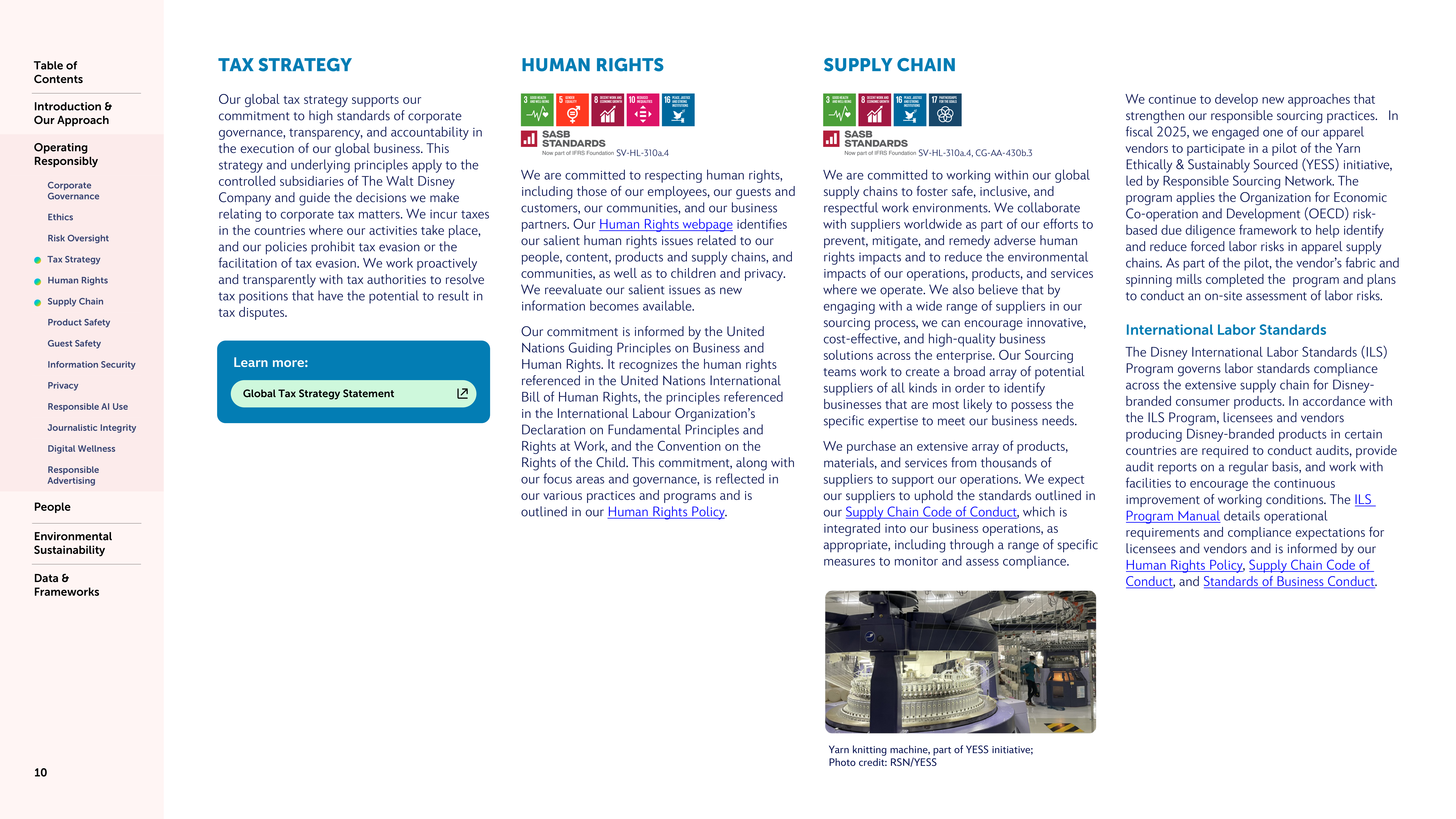
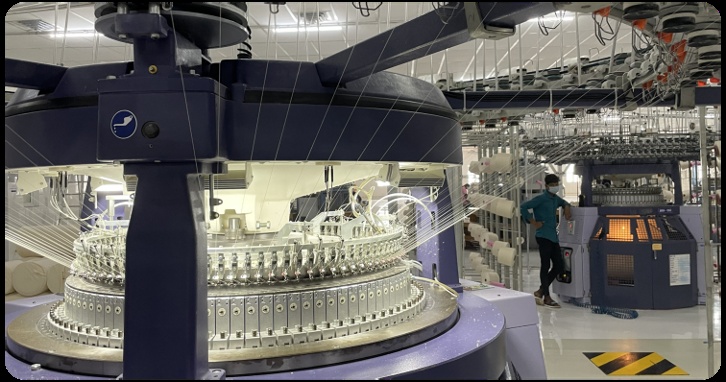
Yarn
knitting
machine,
part
of
YESS
initiative;
Photo
credit:
RSN/YESS
We
continue
to
develop
new
approaches
that
strengthen
our
responsible
sourcing
practices.
In
fiscal
2025,
we
engaged
one
of
our
apparel
vendors
to
participate
in
a
pilot
of
the
Yarn
Ethically
&
Sustainably
Sourced
(YESS)
initiative,
led
by
Responsible
Sourcing
Network.
The
program
applies
the
Organization
for
Economic
Co-operation
and
Development
(OECD)
risk-
based
due
diligence
framework
to
help
identify
and
reduce
forced
labor
risks
in
apparel
supply
chains.
As
part
of
the
pilot,
the
vendorʼs
fabric
and
spinning
mills
completed
the
program
and
plans
to
conduct
an
on-site
assessment
of
labor
risks.
International
Labor
Standards
The
Disney
International
Labor
Standards
(ILS)
Program
governs
labor
standards
compliance
across
the
extensive
supply
chain
for
Disney-
branded
consumer
products.
In
accordance
with
the
ILS
Program,
licensees
and
vendors
producing
Disney-branded
products
in
certain
countries
are
required
to
conduct
audits,
provide
audit
reports
on
a
regular
basis,
and
work
with
facilities
to
encourage
the
continuous
improvement
of
working
conditions.
The
ILS
Program
Manual
details
operational
requirements
and
compliance
expectations
for
licensees
and
vendors
and
is
informed
by
our
Human
Rights
Policy
,
Supply
Chain
Code
of
Conduct
,
and
Standards
of
Business
Conduct
.
10



Product
Safety
To
help
advance
labor
standards,
we
collaborate
with
outside
organizations
to
incubate
and
pilot
scalable
tools
and
programs
through
Disneyʼs
Supply
Chain
Investment
Program
(SCIP),
which
launched
in
2012.
As
an
example,
in
fiscal
2025,
SCIP
supported
organizations
that
included
Open
Supply
Hub,
a
nonprofit
that
operates
an
open-source
global
supply
chain
data
platform.
The
platform
harmonizes
factory
and
workplace
data
to
improve
transparency
and
collaboration
across
supply
chains.
The
funding
provided
by
SCIP
is
intended
to
help
Open
Supply
Hub
enhance
its
platform
and
expand
due
diligence
capabilities
to
incorporate
additional
social
and
environmental
metrics.
Learn
more:
Supply
Chain
Topic
Brief
Supply
Chain
Permitted
Sourcing
Countries
Policy
SCIP
Projects
Data
&
Frameworks
PRODUCT
SAFETY
The
safety
of
products
bearing
any
Disney
brand,
character,
and
other
intellectual
property
is
very
important
to
us.
Consumer
products
from
any
Disney
brand,
spanning
numerous
categories,
from
toys
and
apparel
to
books
and
fine
art,
are
produced
by
thousands
of
third-party
licensees
and
vendors
around
the
world.
Our
product
safety
program
is
designed
to
account
for
this
breadth
as
well
as
the
rapid
changes
in
scientific
knowledge,
evolving
regulations,
and
customer
and
community
feedback.
Our
Supply
Chain
Code
of
Conduct
specifies
our
expectation
that
suppliers
deliver
products
and
services
that
comply
with
our
safety
and
quality
standards.
Our
Product
Integrity
function
oversees
Disneyʼs
safety
policies,
procedures,
and
operating
requirements
for
physical
products
containing
Disney
intellectual
property
across
the
enterprise.
It
is
led
by
our
Global
Product
&
Labor
Standards
function.
We
require
that
licensees
and
vendors
contractually
commit
to
follow
procedures
to
verify
that
Disney-branded
products
comply
with
applicable
safety
regulatory
requirements
and
any
additional
requirements
that
we
may
specify.
In
conjunction
with
renowned
independent
testing
laboratories,
Disney
developed
product
guidelines
that
specify
applicable
product
safety
standards
for
numerous
product
categories
and
geographic
regions.
These
guidelines
cover
a
broad
range
of
physical,
mechanical,
toxicological,
microbiological,
flammability,
electrical,
and
chemical
safety
requirements.
They
are
available
online
for
use
by
product
designers,
licensees,
and
vendors.
We
require
compliance
with
product
guidelines
that
include
testing
performed
by
accredited
third-party
laboratories
for
Disney-branded
products
developed
and
sourced
by
Disney
entities.
We
have
policies
to
manage
the
use
of
chemicals
in
products
and
a
Priority
Chemicals
List
(PCL)
that
identifies
substances
we
are
working
to
reduce
in
our
branded
products.
For
Disney-
branded
products
developed
and
sourced
by
Disney
entities,
we
have
established
thresholds
and
timelines
to
reduce
our
use
of
these
chemicals.
For
our
licensed
products,
we
encourage
our
licensees
to
similarly
work
to
reduce
these
chemicals.
To
address
compliance
with
our
PCL
policies,
Disney
uses
a
risk-based
approach
that
includes
random
audit
testing
on
select
products
and
the
submission
of
relevant
documentation
by
vendors.
We
conduct
a
regular
review
of
our
PCL
and
consider
various
approaches
to
chemicals
management
to
determine
if
changes
are
necessary.
Learn
more:
Product
Safety
Table
of
Contents
Introduction
&
Our
Approach
Operating
Responsibly
Corporate
Governance
Ethics
Risk
Oversight
Tax
Strategy
Human
Rights
Supply
Chain
Guest
Safety
Information
Security
Privacy
Responsible
AI
Use
Journalistic
Integrity
Digital
Wellness
Responsible
Advertising
People
Environmental
Sustainability
Data
&
Frameworks
SUPPLY
CHAIN
(continued)
11
Product
Safety
To
help
advance
labor
standards,
we
collaborate
with
outside
organizations
to
incubate
and
pilot
scalable
tools
and
programs
through
Disneyʼs
Supply
Chain
Investment
Program
(SCIP),
which
launched
in
2012.
As
an
example,
in
fiscal
2025,
SCIP
supported
organizations
that
included
Open
Supply
Hub,
a
nonprofit
that
operates
an
open-source
global
supply
chain
data
platform.
The
platform
harmonizes
factory
and
workplace
data
to
improve
transparency
and
collaboration
across
supply
chains.
The
funding
provided
by
SCIP
is
intended
to
help
Open
Supply
Hub
enhance
its
platform
and
expand
due
diligence
capabilities
to
incorporate
additional
social
and
environmental
metrics.
Learn
more:
Permitted
Sourcing
Countries
Policy
SCIP
Projects
Data
&
Frameworks
Supply
Chain
Supply
Chain
Topic
Brief
PRODUCT
SAFETY
The
safety
of
products
bearing
any
Disney
brand,
character,
and
other
intellectual
property
is
very
important
to
us.
Consumer
products
from
any
Disney
brand,
spanning
numerous
categories,
from
toys
and
apparel
to
books
and
fine
art,
are
produced
by
thousands
of
third-party
licensees
and
vendors
around
the
world.
Our
product
safety
program
is
designed
to
account
for
this
breadth
as
well
as
the
rapid
changes
in
scientific
knowledge,
evolving
regulations,
and
customer
and
community
feedback.
Our
Supply
Chain
Code
of
Conduct
specifies
our
expectation
that
suppliers
deliver
products
and
services
that
comply
with
our
safety
and
quality
standards.
Our
Product
Integrity
function
oversees
Disneyʼs
safety
policies,
procedures,
and
operating
requirements
for
physical
products
containing
Disney
intellectual
property
across
the
enterprise.
It
is
led
by
our
Global
Product
&
Labor
Standards
function.
We
require
that
licensees
and
vendors
contractually
commit
to
follow
procedures
to
verify
that
Disney-branded
products
comply
with
applicable
safety
regulatory
requirements
and
any
additional
requirements
that
we
may
specify.
In
conjunction
with
renowned
independent
testing
laboratories,
Disney
developed
product
guidelines
that
specify
applicable
product
safety
standards
for
numerous
product
categories
and
geographic
regions.
These
guidelines
cover
a
broad
range
of
physical,
mechanical,
toxicological,
microbiological,
flammability,
electrical,
and
chemical
safety
requirements.
They
are
available
online
for
use
by
product
designers,
licensees,
and
vendors.
We
require
compliance
with
product
guidelines
that
include
testing
performed
by
accredited
third-party
laboratories
for
Disney-branded
products
developed
and
sourced
by
Disney
entities.
We
have
policies
to
manage
the
use
of
chemicals
in
products
and
a
Priority
Chemicals
List
(PCL)
that
identifies
substances
we
are
working
to
reduce
in
our
branded
products.
For
Disney-
branded
products
developed
and
sourced
by
Disney
entities,
we
have
established
thresholds
and
timelines
to
reduce
our
use
of
these
chemicals.
For
our
licensed
products,
we
encourage
our
licensees
to
similarly
work
to
reduce
these
chemicals.
To
address
compliance
with
our
PCL
policies,
Disney
uses
a
risk-based
approach
that
includes
random
audit
testing
on
select
products
and
the
submission
of
relevant
documentation
by
vendors.
We
conduct
a
regular
review
of
our
PCL
and
consider
various
approaches
to
chemicals
management
to
determine
if
changes
are
necessary.
Learn
more:
Product
Safety

Table
of
Contents
Introduction
&
Our
Approach
Operating
Responsibly
Corporate
Governance
Ethics
Risk
Oversight
Tax
Strategy
Human
Rights
Supply
Chain
Product
Safety
Guest
Safety
Information
Security
Privacy
Responsible
AI
Use
Journalistic
Integrity
Digital
Wellness
Responsible
Advertising
People
Environmental
Sustainability
Data
&
Frameworks
GUEST
SAFETY
Safety
is
a
top
priority
for
Disney,
including
at
our
theme
parks
and
resorts
and
cruise
line.
Our
Safety
team
is
composed
of
experts
from
a
broad
range
of
disciplines,
including
medicine,
engineering,
quality
assurance,
maintenance,
attraction
operations,
facilities,
ergonomics,
industrial
hygiene,
occupational
safety,
security,
and
food
safety.
We
conduct
inspections
at
our
properties
to
monitor
compliance
with
internal
standards
and
regulations.
We
regularly
provide
guest
safety
training
and
information
to
our
cast
and
crew
members
through
formal
instruction,
on-the-job
training,
and
ongoing
communications.
We
also
conduct
guest
safety
culture
conversations
throughout
the
year
with
salaried
leaders
at
our
theme
parks
to
share
stories,
practices,
and
learnings
designed
to
engage
our
teams.
Ride
Safety
According
to
the
annual
International
Association
of
Amusement
Parks
and
Attractions
Ride
Safety
Report,
which
is
administered
by
the
National
Safety
Council,
the
injury
rate
across
industry
was
0.78
per
million
rides
taken
in
2024.
†
During
calendar
year
2024,
our
U.S.
Disney
Parks
reported
rates
averaging
67%
below
the
industry
average.
Food
Safety
Our
parks
and
resorts
take
a
multifaceted
approach
to
food
safety,
including:
•
A
vendor
food
safety
program
requiring
suppliers
to
follow
established
food
safety
protocols
and
demonstrate
compliance
with
regulatory
requirements
•
Annual
food
safety
audits
and
thorough
measurements
across
our
properties
to
help
us
verify
adherence
to
regulations
and
company
standards,
including
a
hazard
analysis
program,
which
uses
Disney-developed
technology
to
collect
important
food
safety
data
and
improves
accuracy
and
accountability
•
Education
and
rigorous
formal
training
for
cast
members
who
work
with
food
on
topics
that
include
proper
food
handling,
storage
and
preparation,
personal
hygiene,
and
sanitation
requirements
Outside
of
parks
and
resorts,
Disney-branded
food
products,
including
promotions
with
food
services,
are
required
to
meet
or
exceed
applicable
food
safety
laws,
regulations,
and
industry
standards.
Safety
in
Our
Parks
and
Communities
Disney's
Wild
About
Safety
global
educational
program
aims
to
improve
familiesʼ
awareness
of
safety,
health,
and
environmental
issues
in
our
parks,
resorts,
and
cruise
line
and
in
our
communities
through
storytelling.
Timon
and
Pumbaa,
from
the
animated
film
The
Lion
King
,
are
on
a
mission
to
share
important
safety
and
health
messages
through
illustrations
on
tip
cards,
activity
books,
a
dedicated
resort
television
channel,
and
other
materials
worldwide.
These
important
safety
and
health
messages
help
inform
guests
about
how
to
safely
enjoy
themselves
at
our
parks,
resorts,
and
cruise
line
and
in
the
communities
in
which
we
operate.
Accessible
Experiences
Our
theme
parks
offer
guests
with
disabilities
a
range
of
tools
and
services
designed
to
create
more
inclusive
experiences.
These
include
accessibility
services
and
accommodations;
audio
descriptions;
Braille,
tactile,
and
large-print
maps
and
guides
for
guests
with
visual
or
cognitive
disabilities;
assistive
listening,
captioning,
and
sign
language
interpretation;
quiet
areas
for
guests
with
sensory
needs;
and
more.
Each
park
provides
accessibility
information
on
its
site-specific
website.
In
fiscal
2025:
•
Disneyland
Paris
became
the
first
theme
park
in
France
to
release
an
image-based
tool
to
help
guests
with
speech
challenges
better
plan
their
visits
and
communicate
their
interests.
The
tool
contains
images
of
key
experiences
across
the
resort
such
as
attractions,
shows,
Disney
characters,
dining,
and
merchandise.
The
park
also
introduced
vibrating
vests
during
select
shows,
enabling
guests
with
and
without
disabilities
to
feel
the
music
and
further
immerse
themselves
in
live
entertainment
•
The
Walt
Disney
Company
UK
and
Make-A-
Wish
®
UK
came
together
for
the
fifth
annual
A
Disney
Wish
UK—an
immersive
experience
that
brings
the
happiness,
joy,
and
magic
of
Disney
to
nearly
200
children
living
with
critical
illnesses.
With
many
Make-A-Wish
families
unable
to
travel
to
a
Disney
Park
due
to
their
circumstances,
A
Disney
Wish
brings
unforgettable
experiences
such
as
unique
Disney
shows,
character
meet-and-greets,
and
a
carnival
with
an
accessible
carousel
to
the
families
over
the
course
of
twelve
days
•
Through
its
Accessibility
Task
Force,
Hong
Kong
Disneyland
Resort
has
developed
full-
color
tactile
models
of
ride
vehicles
for
select
attractions
to
enable
guests
with
visual
impairments
to
explore
key
features
by
touch
before
boarding
Learn
more:
Disney
Experiences:
Guest
and
Workplace
Safety
Topic
Brief
Accessibility
Topic
Brief
Walt
Disney
World
Resort
Disneyland
Resort
Disneyland
Paris
Hong
Kong
Disneyland
Resort
Shanghai
Disney
Resort
Tokyo
Disney
Resort
Disney
Cruise
Line
12
†
National
Safety
Council,
“North
America
Fixed-Site
Amusement
Ride
Safety
Report,
2024
Update,
Executive
Summary.”
Page
10,
Published,
October
2025
.



Information
Security
Privacy
Responsible
AI
Use
Table
of
Contents
Introduction
&
Our
Approach
Operating
Responsibly
Corporate
Governance
Ethics
Risk
Oversight
Tax
Strategy
Human
Rights
Supply
Chain
Product
Safety
Guest
Safety
Journalistic
Integrity
Digital
Wellness
Responsible
Advertising
People
Environmental
Sustainability
Data
&
Frameworks
INFORMATION
SECURITY
TC-IM-230a.2
Information
security,
inclusive
of
cybersecurity
and
aligned
with
the
companyʼs
global
security
efforts,
is
an
important
aspect
of
operations
as
it
protects
Disneyʼs
systems,
data,
networks,
services,
and
applications
from
digital
threats.
The
companyʼs
information
security
management
system
is
designed
to
safeguard
Disneyʼs
global
digital
environment
as
our
businesses
expand.
Our
information
security
program
is
guided
by
the
National
Institute
of
Standards
and
Technology
Cybersecurity
Framework
and
other
applicable
globally
recognized
information
security
frameworks
and
their
core
principles.
The
Audit
Committee
of
our
Board
of
Directors
oversees
information
technology
risks,
including
cybersecurity
and
data
security
risks
and
mitigation
strategies.
Day-to-day
management
of
our
information
security
strategy
and
operations
is
the
responsibility
of
our
Chief
Information
Security
Officer,
who
reports
to
our
Chief
Information
&
Data
Officer
and
Chief
Security
Officer,
both
of
whom
report
to
our
Chief
Financial
Officer.
At
least
once
per
year,
the
Audit
Committee
receives
reports
from
the
Chief
Information
Security
Officer
concerning
the
companyʼs
cybersecurity
and
data
security
risks,
including
ongoing
efforts
to
prevent,
detect,
monitor,
remediate,
and
manage
such
cybersecurity
threats,
the
threat
environment,
incident
updates,
and
emerging
cybersecurity
practices
and
technologies.
Learn
more:
Cybersecurity
Topic
Brief
PRIVACY
TC-IM-220a.1
We
have
policies
designed
to
enhance
the
protection
of
the
personal
information
of
our
customers,
guests,
non-guests
(including
job
applicants
and
third-party
businesses),
and
employees.
Our
global
privacy
program
is
based
on
the
principles
of
privacy
by
design,
accountability,
transparency,
and
giving
individuals
meaningful
controls
over
their
personal
information.
We
regularly
assess
and
update
our
program
to
take
into
account
applicable
requirements
of
new
privacy
laws
and
regulations
around
the
world
and
to
keep
up
with
rapid
advancements
in
technology
and
new
business
initiatives.
This
includes
working
with
people
across
the
company
to
implement
evolving
data
protection
requirements
across
Europe,
the
UK,
Latin
America,
Asia,
and
the
United
States.
We
provide
privacy
training
to
our
employees
and
have
incorporated
privacy
topics
into
the
companyʼs
Standards
of
Business
Conduct
and
information
security
trainings—both
of
which
are
required
on
a
recurring
basis.
We
also
regularly
conduct
specialized
trainings
for
applicable
employees
on
how
to
properly
handle
the
personal
information
of
customers,
employees,
contractors,
and/or
third
parties.
Day-to-day
management
of
data
privacy
policies
is
currently
overseen
by
our
General
Counsel
-
International
and
EVP,
Global
Public
Policy
&
Privacy,
who
reports
to
our
Chief
Legal
&
Global
Affairs
Officer.
Learn
more:
Privacy
Center
Privacy
Policy
Children's
Online
Privacy
Policy
RESPONSIBLE
AI
USE
Disney
has
a
rich
history
at
the
intersection
of
creativity
and
innovation—blending
storytelling
and
technology
to
bring
imagination
to
life
and
connect
people
to
iconic
characters,
stories,
and
brands.
We
embrace
the
promise
of
artificial
intelligence
(AI)
as
a
tool
to
benefit
our
employees,
customers,
guests,
and
creators.
We
are
committed
to
using
AI
in
a
responsible,
human-centered,
and
ethical
manner
that
recognizes
the
value
of
human
creativity,
respects
intellectual
property,
and
considers
our
audiencesʼ
expectations.
While
we
recognize
AIʼs
potential,
we
also
understand
the
importance
of
responsible
development
and
use
of
AI.
We
support
a
thoughtful
approach
that
allows
both
the
AI
technology
and
creative
industries
to
flourish.
This
ultimately
promotes
a
responsible,
global
AI
ecosystem
by
design—one
that
is
based
on
trust,
safety,
privacy,
and
respect
for
intellectual
property
(IP)
rights.
This
includes
Disney
working
with
other
companies
and
organizations
to
protect
our
creators,
our
customers,
and
our
own
IP
rights.
Internally,
we
have
established
an
AI
governance
process
that
operates
pursuant
to
a
principles-
based
framework.
It
is
designed
to
identify
business,
information
integrity,
human
rights,
privacy,
legal,
and
other
risks
associated
with
a
proposed
use
as
well
as
measures
that
can
be
employed
to
satisfactorily
mitigate
them.
The
governance
model
includes
appropriate
updates
to
executive
management
and
the
Board.
In
addition,
our
use
of
AI
is
subject
to
our
generally
applicable
governance
practices
and
policies,
such
as
our
Standards
of
Business
Conduct
,
Privacy
Policy
,
Human
Rights
Policy
,
and
relevant
guild
or
collective
bargaining
agreements.
Learn
more:
Responsible
AI
Use
Topic
Brief
13
Information
Security
Privacy
Responsible
AI
Use
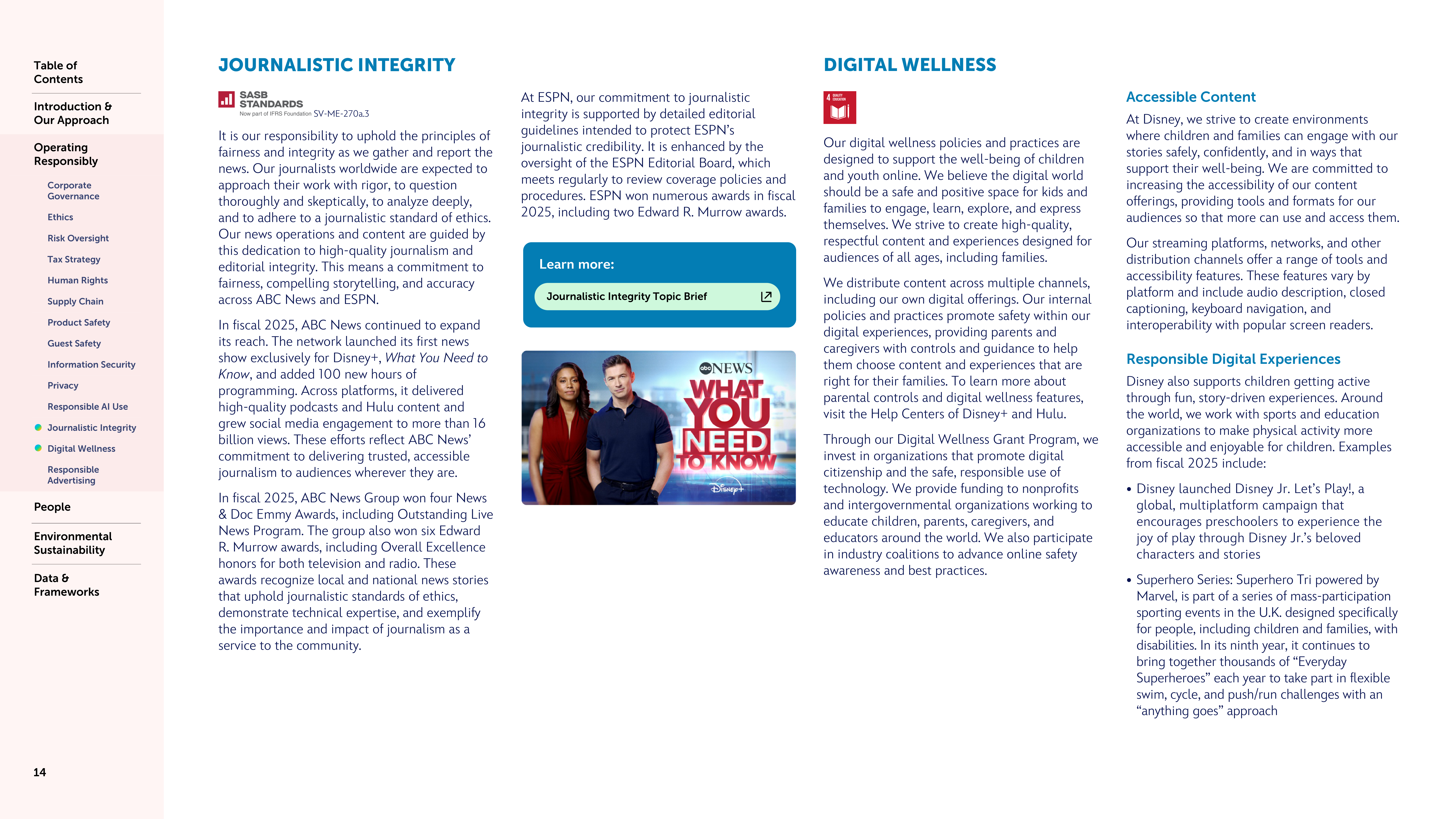


Table
of
Contents
Introduction
&
Our
Approach
Operating
Responsibly
Corporate
Governance
Ethics
Risk
Oversight
Tax
Strategy
Human
Rights
Supply
Chain
Product
Safety
Guest
Safety
Information
Security
Privacy
Responsible
AI
Use
Journalistic
Integrity
Digital
Wellness
Responsible
Advertising
People
Environmental
Sustainability
Data
&
Frameworks
JOURNALISTIC
INTEGRITY
SV-ME-270a.3
It
is
our
responsibility
to
uphold
the
principles
of
fairness
and
integrity
as
we
gather
and
report
the
news.
Our
journalists
worldwide
are
expected
to
approach
their
work
with
rigor,
to
question
thoroughly
and
skeptically,
to
analyze
deeply,
and
to
adhere
to
a
journalistic
standard
of
ethics.
Our
news
operations
and
content
are
guided
by
this
dedication
to
high-quality
journalism
and
editorial
integrity.
This
means
a
commitment
to
fairness,
compelling
storytelling,
and
accuracy
across
ABC
News
and
ESPN.
In
fiscal
2025,
ABC
News
continued
to
expand
its
reach.
The
network
launched
its
first
news
show
exclusively
for
Disney+,
What
You
Need
to
Know
,
and
added
100
new
hours
of
programming.
Across
platforms,
it
delivered
high-quality
podcasts
and
Hulu
content
and
grew
social
media
engagement
to
more
than
16
billion
views.
These
efforts
reflect
ABC
Newsʼ
commitment
to
delivering
trusted,
accessible
journalism
to
audiences
wherever
they
are.
In
fiscal
2025,
ABC
News
Group
won
four
News
&
Doc
Emmy
Awards,
including
Outstanding
Live
News
Program.
The
group
also
won
six
Edward
R.
Murrow
awards,
including
Overall
Excellence
honors
for
both
television
and
radio.
These
awards
recognize
local
and
national
news
stories
that
uphold
journalistic
standards
of
ethics,
demonstrate
technical
expertise,
and
exemplify
the
importance
and
impact
of
journalism
as
a
service
to
the
community.
At
ESPN,
our
commitment
to
journalistic
integrity
is
supported
by
detailed
editorial
guidelines
intended
to
protect
ESPNʼs
journalistic
credibility.
It
is
enhanced
by
the
oversight
of
the
ESPN
Editorial
Board,
which
meets
regularly
to
review
coverage
policies
and
procedures.
ESPN
won
numerous
awards
in
fiscal
2025,
including
two
Edward
R.
Murrow
awards.
Learn
more:
Journalistic
Integrity
Topic
Brief
DIGITAL
WELLNESS
Our
digital
wellness
policies
and
practices
are
designed
to
support
the
well-being
of
children
and
youth
online.
We
believe
the
digital
world
should
be
a
safe
and
positive
space
for
kids
and
families
to
engage,
learn,
explore,
and
express
themselves.
We
strive
to
create
high-quality,
respectful
content
and
experiences
designed
for
audiences
of
all
ages,
including
families.
We
distribute
content
across
multiple
channels,
including
our
own
digital
offerings.
Our
internal
policies
and
practices
promote
safety
within
our
digital
experiences,
providing
parents
and
caregivers
with
controls
and
guidance
to
help
them
choose
content
and
experiences
that
are
right
for
their
families.
To
learn
more
about
parental
controls
and
digital
wellness
features,
visit
the
Help
Centers
of
Disney+
and
Hulu.
Through
our
Digital
Wellness
Grant
Program,
we
invest
in
organizations
that
promote
digital
citizenship
and
the
safe,
responsible
use
of
technology.
We
provide
funding
to
nonprofits
and
intergovernmental
organizations
working
to
educate
children,
parents,
caregivers,
and
educators
around
the
world.
We
also
participate
in
industry
coalitions
to
advance
online
safety
awareness
and
best
practices.
Accessible
Content
At
Disney,
we
strive
to
create
environments
where
children
and
families
can
engage
with
our
stories
safely,
confidently,
and
in
ways
that
support
their
well-being.
We
are
committed
to
increasing
the
accessibility
of
our
content
offerings,
providing
tools
and
formats
for
our
audiences
so
that
more
can
use
and
access
them.
Our
streaming
platforms,
networks,
and
other
distribution
channels
offer
a
range
of
tools
and
accessibility
features.
These
features
vary
by
platform
and
include
audio
description,
closed
captioning,
keyboard
navigation,
and
interoperability
with
popular
screen
readers.
Responsible
Digital
Experiences
Disney
also
supports
children
getting
active
through
fun,
story-driven
experiences.
Around
the
world,
we
work
with
sports
and
education
organizations
to
make
physical
activity
more
accessible
and
enjoyable
for
children.
Examples
from
fiscal
2025
include:
•
Disney
launched
Disney
Jr.
Letʼs
Play!,
a
global,
multiplatform
campaign
that
encourages
preschoolers
to
experience
the
joy
of
play
through
Disney
Jr.ʼs
beloved
characters
and
stories
•
Superhero
Series:
Superhero
Tri
powered
by
Marvel,
is
part
of
a
series
of
mass-participation
sporting
events
in
the
U.K.
designed
specifically
for
people,
including
children
and
families,
with
disabilities.
In
its
ninth
year,
it
continues
to
bring
together
thousands
of
“Everyday
Superheroes”
each
year
to
take
part
in
flexible
swim,
cycle,
and
push/run
challenges
with
an
“anything
goes”
approach
14
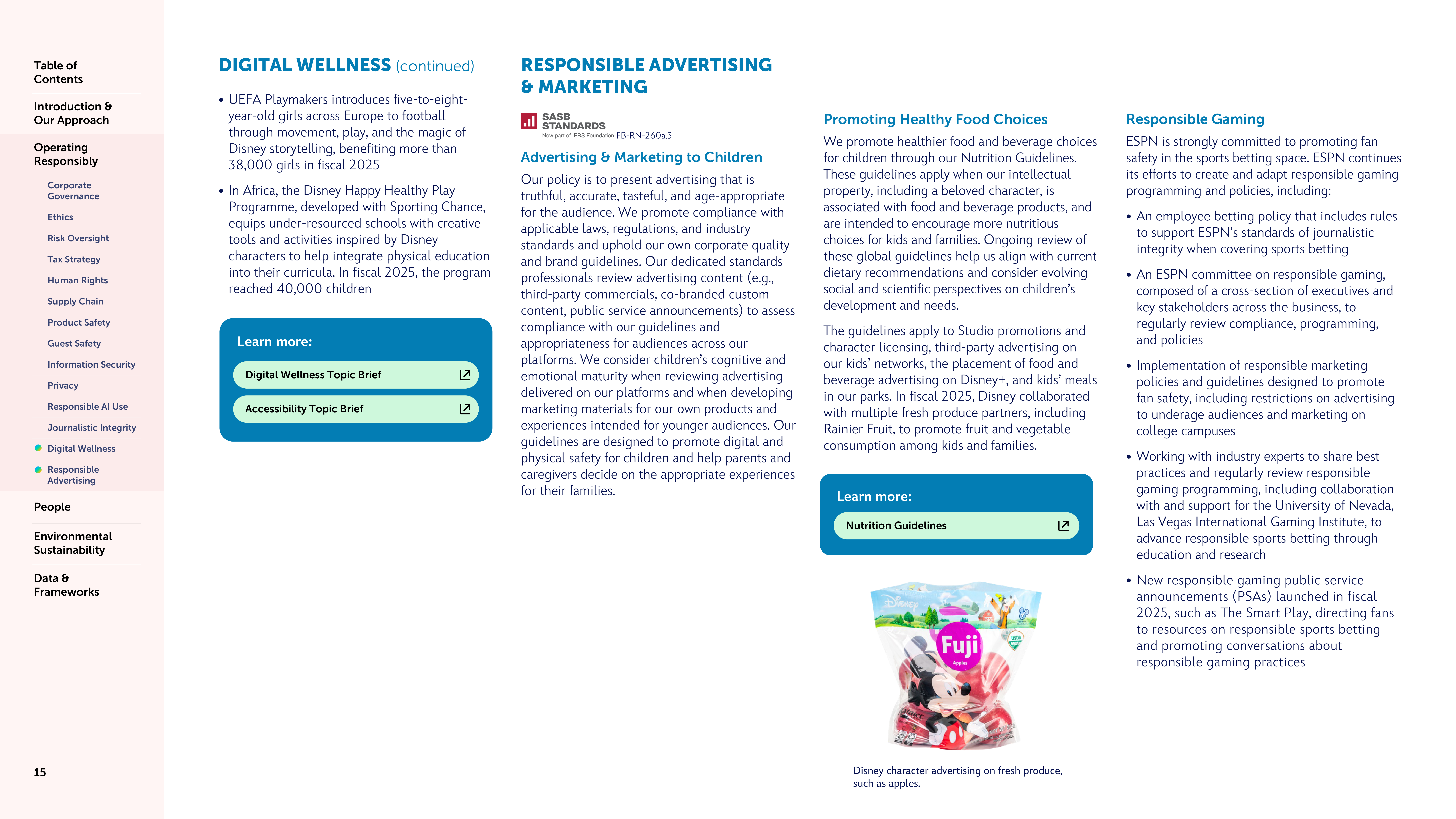

Table
of
Contents
Introduction
&
Our
Approach
Operating
Responsibly
Corporate
Governance
Ethics
Risk
Oversight
Tax
Strategy
Human
Rights
Supply
Chain
Product
Safety
Guest
Safety
Information
Security
Privacy
Responsible
AI
Use
Journalistic
Integrity
Digital
Wellness
Responsible
Advertising
People
Environmental
Sustainability
Data
&
Frameworks
DIGITAL
WELLNESS
(continued)
•
UEFA
Playmakers
introduces
five-to-eight-
year-old
girls
across
Europe
to
football
through
movement,
play,
and
the
magic
of
Disney
storytelling,
benefiting
more
than
38,000
girls
in
fiscal
2025
•
In
Africa,
the
Disney
Happy
Healthy
Play
Programme,
developed
with
Sporting
Chance,
equips
under-resourced
schools
with
creative
tools
and
activities
inspired
by
Disney
characters
to
help
integrate
physical
education
into
their
curricula.
In
fiscal
2025,
the
program
reached
40,000
children
Learn
more:
Digital
Wellness
Topic
Brief
Accessibility
Topic
Brief
RESPONSIBLE
ADVERTISING
&
MARKETING
FB-RN-260a.3
Advertising
&
Marketing
to
Children
Our
policy
is
to
present
advertising
that
is
truthful,
accurate,
tasteful,
and
age-appropriate
for
the
audience.
We
promote
compliance
with
applicable
laws,
regulations,
and
industry
standards
and
uphold
our
own
corporate
quality
and
brand
guidelines.
Our
dedicated
standards
professionals
review
advertising
content
(e.g.,
third-party
commercials,
co-branded
custom
content,
public
service
announcements)
to
assess
compliance
with
our
guidelines
and
appropriateness
for
audiences
across
our
platforms.
We
consider
childrenʼs
cognitive
and
emotional
maturity
when
reviewing
advertising
delivered
on
our
platforms
and
when
developing
marketing
materials
for
our
own
products
and
experiences
intended
for
younger
audiences.
Our
guidelines
are
designed
to
promote
digital
and
physical
safety
for
children
and
help
parents
and
caregivers
decide
on
the
appropriate
experiences
for
their
families.
Promoting
Healthy
Food
Choices
We
promote
healthier
food
and
beverage
choices
for
children
through
our
Nutrition
Guidelines.
These
guidelines
apply
when
our
intellectual
property,
including
a
beloved
character,
is
associated
with
food
and
beverage
products,
and
are
intended
to
encourage
more
nutritious
choices
for
kids
and
families.
Ongoing
review
of
these
global
guidelines
help
us
align
with
current
dietary
recommendations
and
consider
evolving
social
and
scientific
perspectives
on
childrenʼs
development
and
needs.
The
guidelines
apply
to
Studio
promotions
and
character
licensing,
third-party
advertising
on
our
kidsʼ
networks,
the
placement
of
food
and
beverage
advertising
on
Disney+,
and
kidsʼ
meals
in
our
parks.
In
fiscal
2025,
Disney
collaborated
with
multiple
fresh
produce
partners,
including
Rainier
Fruit,
to
promote
fruit
and
vegetable
consumption
among
kids
and
families.
Learn
more:
Nutrition
Guidelines
Disney
character
advertising
on
fresh
produce,
such
as
apples.
Responsible
Gaming
ESPN
is
strongly
committed
to
promoting
fan
safety
in
the
sports
betting
space.
ESPN
continues
its
efforts
to
create
and
adapt
responsible
gaming
programming
and
policies,
including:
•
An
employee
betting
policy
that
includes
rules
to
support
ESPNʼs
standards
of
journalistic
integrity
when
covering
sports
betting
•
An
ESPN
committee
on
responsible
gaming,
composed
of
a
cross-section
of
executives
and
key
stakeholders
across
the
business,
to
regularly
review
compliance,
programming,
and
policies
•
Implementation
of
responsible
marketing
policies
and
guidelines
designed
to
promote
fan
safety,
including
restrictions
on
advertising
to
underage
audiences
and
marketing
on
college
campuses
•
Working
with
industry
experts
to
share
best
practices
and
regularly
review
responsible
gaming
programming,
including
collaboration
with
and
support
for
the
University
of
Nevada,
Las
Vegas
International
Gaming
Institute,
to
advance
responsible
sports
betting
through
education
and
research
•
New
responsible
gaming
public
service
announcements
(PSAs)
launched
in
fiscal
2025,
such
as
The
Smart
Play,
directing
fans
to
resources
on
responsible
sports
betting
and
promoting
conversations
about
responsible
gaming
practices
15
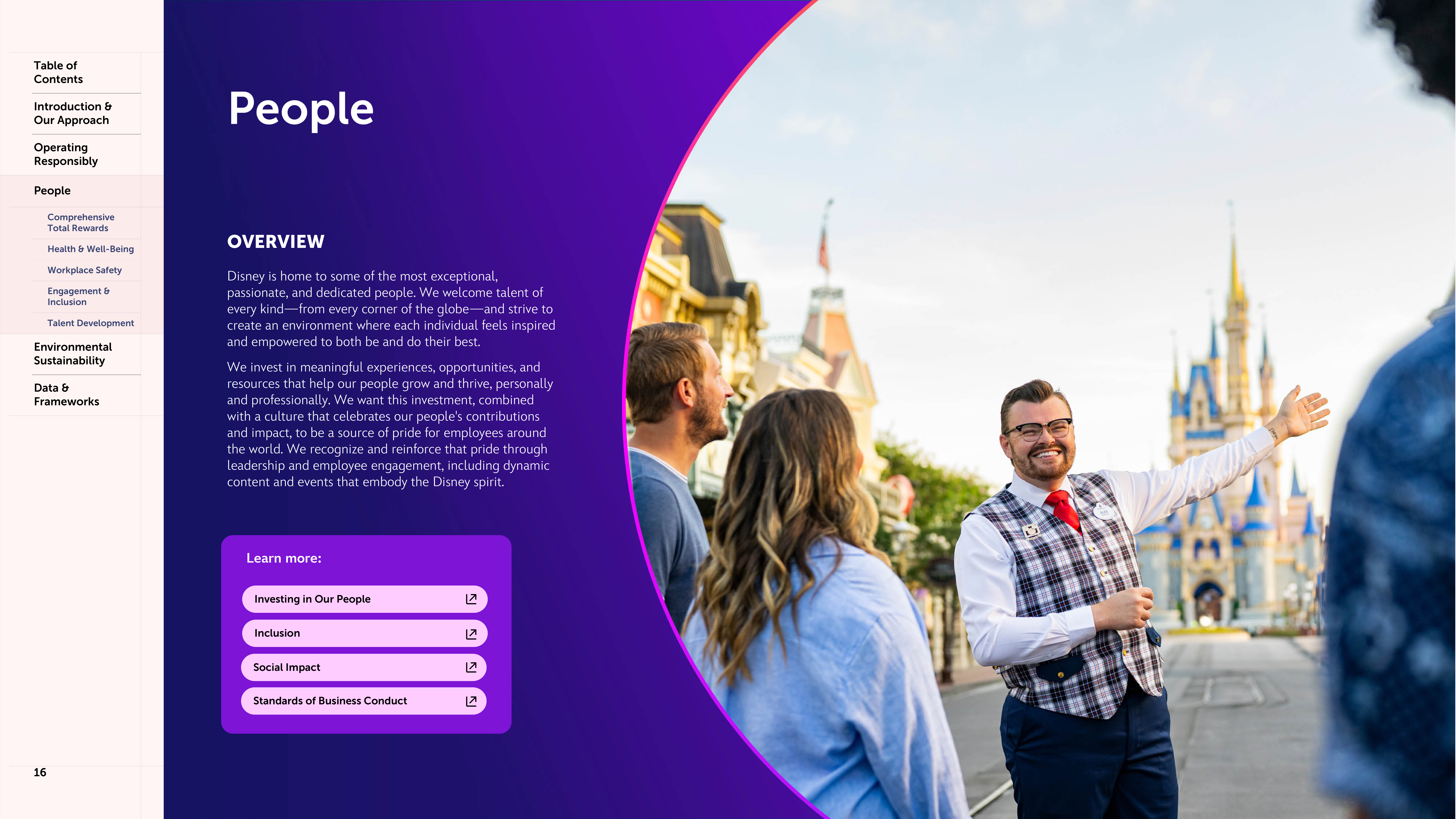


People
People
OVERVIEW
Disney
is
home
to
some
of
the
most
exceptional,
passionate,
and
dedicated
people.
We
welcome
talent
of
every
kind—from
every
corner
of
the
globe—and
strive
to
create
an
environment
where
each
individual
feels
inspired
and
empowered
to
both
be
and
do
their
best.
We
invest
in
meaningful
experiences,
opportunities,
and
resources
that
help
our
people
grow
and
thrive,
personally
and
professionally.
We
want
this
investment,
combined
with
a
culture
that
celebrates
our
people's
contributions
and
impact,
to
be
a
source
of
pride
for
employees
around
the
world.
We
recognize
and
reinforce
that
pride
through
leadership
and
employee
engagement,
including
dynamic
content
and
events
that
embody
the
Disney
spirit.
Learn
more:
Investing
in
Our
People
Inclusion
Social
Impact
Standards
of
Business
Conduct
Table
of
Contents
Introduction
&
Our
Approach
Operating
Responsibly
Comprehensive
Total
Rewards
Health
&
Well-Being
Workplace
Safety
Engagement
&
Inclusion
Talent
Development
Environmental
Sustainability
Data
&
Frameworks
16
People
People
OVERVIEW
Disney
is
home
to
some
of
the
most
exceptional,
passionate,
and
dedicated
people.
We
welcome
talent
of
every
kind—from
every
corner
of
the
globe—and
strive
to
create
an
environment
where
each
individual
feels
inspired
and
empowered
to
both
be
and
do
their
best.
We
invest
in
meaningful
experiences,
opportunities,
and
resources
that
help
our
people
grow
and
thrive,
personally
and
professionally.
We
want
this
investment,
combined
with
a
culture
that
celebrates
our
people's
contributions
and
impact,
to
be
a
source
of
pride
for
employees
around
the
world.
We
recognize
and
reinforce
that
pride
through
leadership
and
employee
engagement,
including
dynamic
content
and
events
that
embody
the
Disney
spirit.
Learn
more:
Investing
in
Our
People
Inclusion
Social
Impact
Standards
of
Business
Conduct
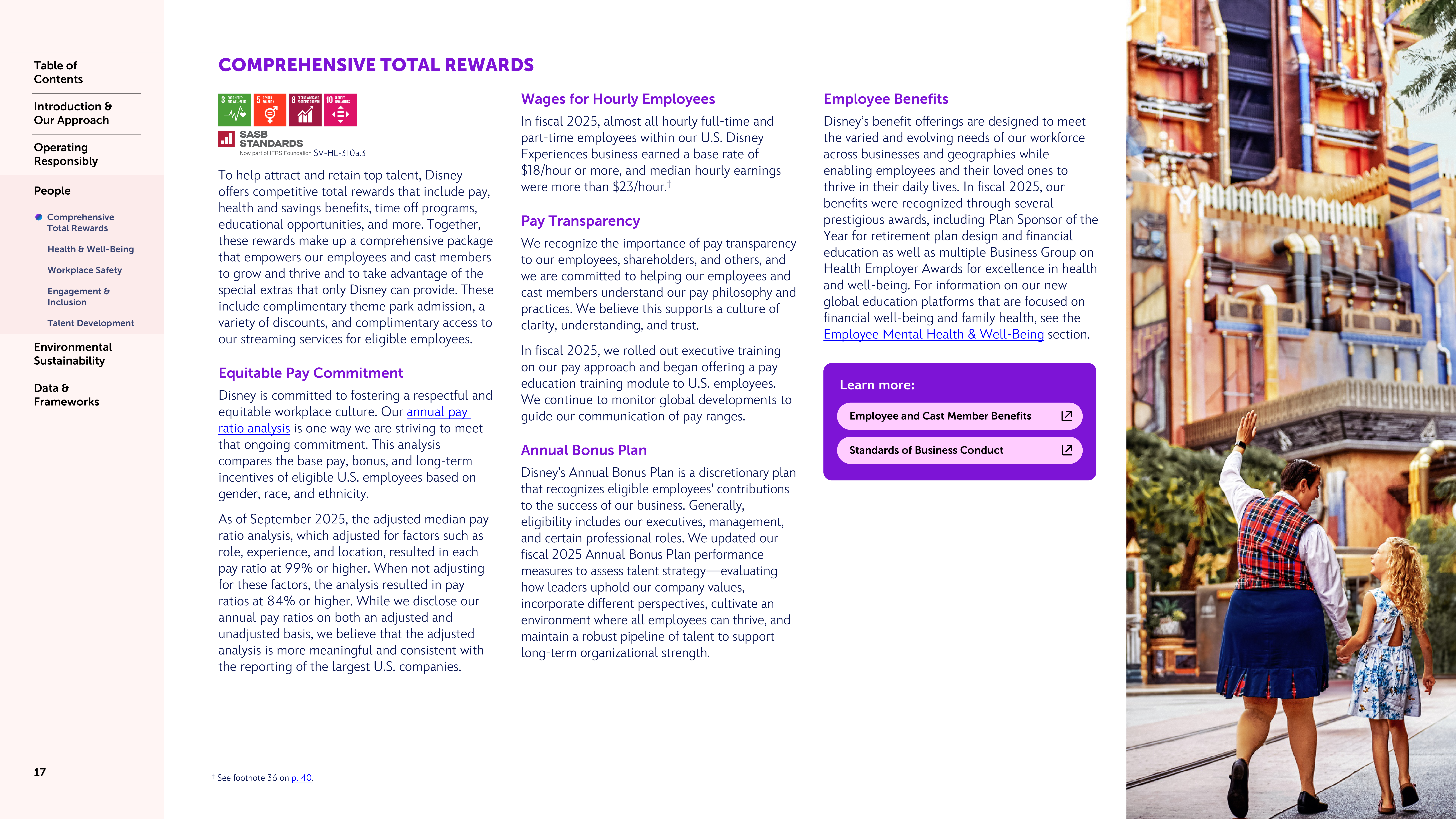



Comprehensive
Total
Rewards
COMPREHENSIVE
TOTAL
REWARDS
SV-HL-310a.3
To
help
attract
and
retain
top
talent,
Disney
offers
competitive
total
rewards
that
include
pay,
health
and
savings
benefits,
time
off
programs,
educational
opportunities,
and
more.
Together,
these
rewards
make
up
a
comprehensive
package
that
empowers
our
employees
and
cast
members
to
grow
and
thrive
and
to
take
advantage
of
the
special
extras
that
only
Disney
can
provide.
These
include
complimentary
theme
park
admission,
a
variety
of
discounts,
and
complimentary
access
to
our
streaming
services
for
eligible
employees.
Equitable
Pay
Commitment
Disney
is
committed
to
fostering
a
respectful
and
equitable
workplace
culture.
Our
annual
pay
ratio
analysis
is
one
way
we
are
striving
to
meet
that
ongoing
commitment.
This
analysis
compares
the
base
pay,
bonus,
and
long-term
incentives
of
eligible
U.S.
employees
based
on
gender,
race,
and
ethnicity.
As
of
September
2025,
the
adjusted
median
pay
ratio
analysis,
which
adjusted
for
factors
such
as
role,
experience,
and
location,
resulted
in
each
pay
ratio
at
99%
or
higher.
When
not
adjusting
for
these
factors,
the
analysis
resulted
in
pay
ratios
at
84%
or
higher.
While
we
disclose
our
annual
pay
ratios
on
both
an
adjusted
and
unadjusted
basis,
we
believe
that
the
adjusted
analysis
is
more
meaningful
and
consistent
with
the
reporting
of
the
largest
U.S.
companies.
Wages
for
Hourly
Employees
In
fiscal
2025,
almost
all
hourly
full-time
and
part-time
employees
within
our
U.S.
Disney
Experiences
business
earned
a
base
rate
of
$18/hour
or
more,
and
median
hourly
earnings
were
more
than
$23/hour.
†
Pay
Transparency
We
recognize
the
importance
of
pay
transparency
to
our
employees,
shareholders,
and
others,
and
we
are
committed
to
helping
our
employees
and
cast
members
understand
our
pay
philosophy
and
practices.
We
believe
this
supports
a
culture
of
clarity,
understanding,
and
trust.
In
fiscal
2025,
we
rolled
out
executive
training
on
our
pay
approach
and
began
offering
a
pay
education
training
module
to
U.S.
employees.
We
continue
to
monitor
global
developments
to
guide
our
communication
of
pay
ranges.
Annual
Bonus
Plan
Disneyʼs
Annual
Bonus
Plan
is
a
discretionary
plan
that
recognizes
eligible
employees'
contributions
to
the
success
of
our
business.
Generally,
eligibility
includes
our
executives,
management,
and
certain
professional
roles.
We
updated
our
fiscal
2025
Annual
Bonus
Plan
performance
measures
to
assess
talent
strategy—evaluating
how
leaders
uphold
our
company
values,
incorporate
different
perspectives,
cultivate
an
environment
where
all
employees
can
thrive,
and
maintain
a
robust
pipeline
of
talent
to
support
long-term
organizational
strength.
Employee
Benefits
Disneyʼs
benefit
offerings
are
designed
to
meet
the
varied
and
evolving
needs
of
our
workforce
across
businesses
and
geographies
while
enabling
employees
and
their
loved
ones
to
thrive
in
their
daily
lives.
In
fiscal
2025,
our
benefits
were
recognized
through
several
prestigious
awards,
including
Plan
Sponsor
of
the
Year
for
retirement
plan
design
and
financial
education
as
well
as
multiple
Business
Group
on
Health
Employer
Awards
for
excellence
in
health
and
well-being.
For
information
on
our
new
global
education
platforms
that
are
focused
on
financial
well-being
and
family
health,
see
the
Employee
Mental
Health
&
Well-Being
section.
Learn
more:
Employee
and
Cast
Member
Benefits
Standards
of
Business
Conduct
†
See
footnote
36
on
p.
40
.
Table
of
Contents
Introduction
&
Our
Approach
Operating
Responsibly
People
Health
&
Well-Being
Workplace
Safety
Engagement
&
Inclusion
Talent
Development
Environmental
Sustainability
Data
&
Frameworks
17
Comprehensive
Total
Rewards
Learn
more:
Employee
and
Cast
Member
Benefits
Standards
of
Business
Conduct
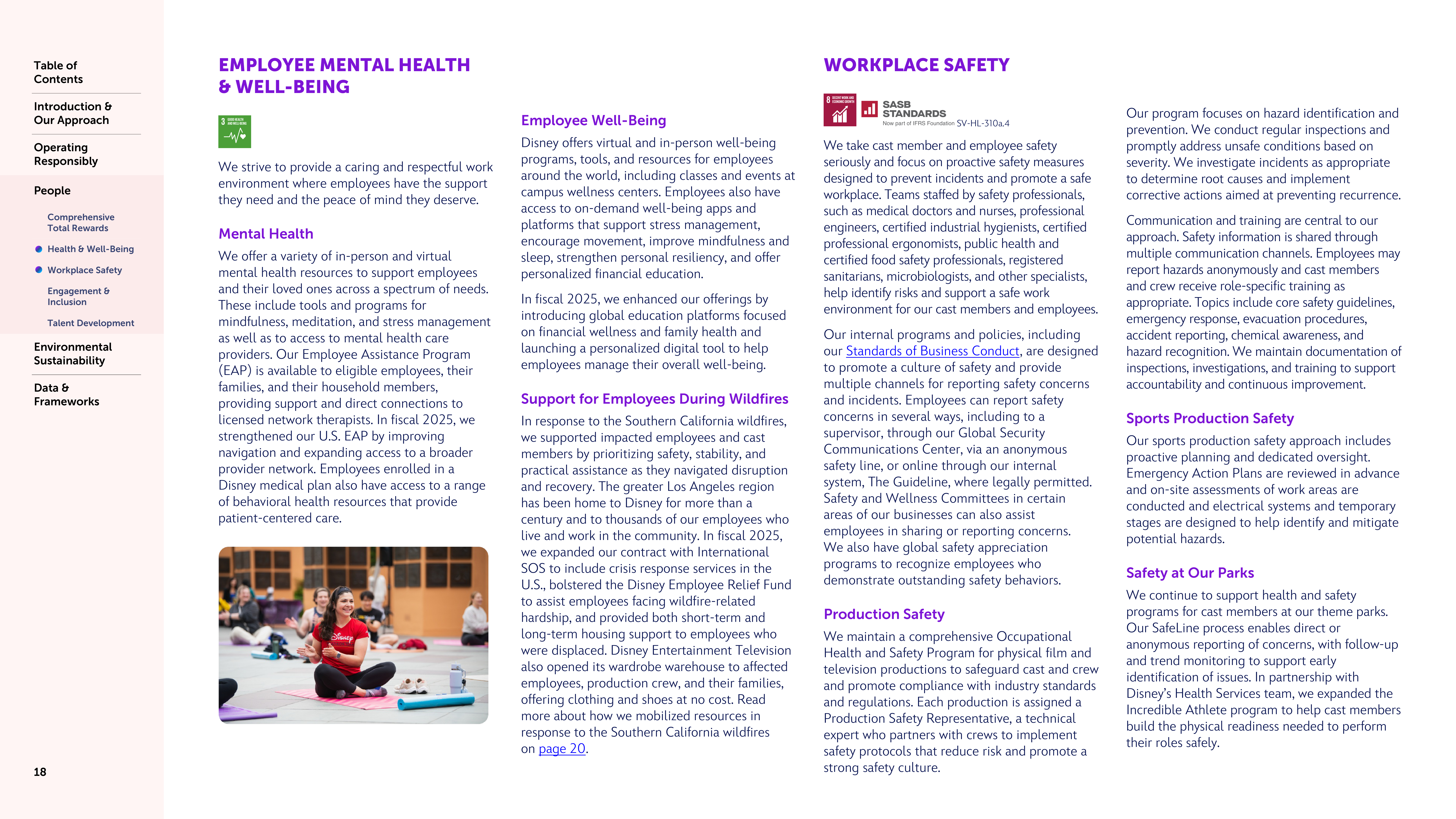


Table
of
Contents
Introduction
&
Our
Approach
Operating
Responsibly
People
Comprehensive
Total
Rewards
Health
&
Well-Being
Workplace
Safety
Engagement
&
Inclusion
Talent
Development
Environmental
Sustainability
Data
&
Frameworks
EMPLOYEE
MENTAL
HEALTH
&
WELL-BEING
We
strive
to
provide
a
caring
and
respectful
work
environment
where
employees
have
the
support
they
need
and
the
peace
of
mind
they
deserve.
Mental
Health
We
offer
a
variety
of
in-person
and
virtual
mental
health
resources
to
support
employees
and
their
loved
ones
across
a
spectrum
of
needs.
These
include
tools
and
programs
for
mindfulness,
meditation,
and
stress
management
as
well
as
to
access
to
mental
health
care
providers.
Our
Employee
Assistance
Program
(EAP)
is
available
to
eligible
employees,
their
families,
and
their
household
members,
providing
support
and
direct
connections
to
licensed
network
therapists.
In
fiscal
2025,
we
strengthened
our
U.S.
EAP
by
improving
navigation
and
expanding
access
to
a
broader
provider
network.
Employees
enrolled
in
a
Disney
medical
plan
also
have
access
to
a
range
of
behavioral
health
resources
that
provide
patient-centered
care.
Employee
Well-Being
Disney
offers
virtual
and
in-person
well-being
programs,
tools,
and
resources
for
employees
around
the
world,
including
classes
and
events
at
campus
wellness
centers.
Employees
also
have
access
to
on-demand
well-being
apps
and
platforms
that
support
stress
management,
encourage
movement,
improve
mindfulness
and
sleep,
strengthen
personal
resiliency,
and
offer
personalized
financial
education.
In
fiscal
2025,
we
enhanced
our
offerings
by
introducing
global
education
platforms
focused
on
financial
wellness
and
family
health
and
launching
a
personalized
digital
tool
to
help
employees
manage
their
overall
well-being.
Support
for
Employees
During
Wildfires
In
response
to
the
Southern
California
wildfires,
we
supported
impacted
employees
and
cast
members
by
prioritizing
safety,
stability,
and
practical
assistance
as
they
navigated
disruption
and
recovery.
The
greater
Los
Angeles
region
has
been
home
to
Disney
for
more
than
a
century
and
to
thousands
of
our
employees
who
live
and
work
in
the
community.
In
fiscal
2025,
we
expanded
our
contract
with
International
SOS
to
include
crisis
response
services
in
the
U.S.,
bolstered
the
Disney
Employee
Relief
Fund
to
assist
employees
facing
wildfire-related
hardship,
and
provided
both
short-term
and
long-term
housing
support
to
employees
who
were
displaced.
Disney
Entertainment
Television
also
opened
its
wardrobe
warehouse
to
affected
employees,
production
crew,
and
their
families,
offering
clothing
and
shoes
at
no
cost.
Read
more
about
how
we
mobilized
resources
in
response
to
the
Southern
California
wildfires
on
page
20
.
WORKPLACE
SAFETY
SV-HL-310a.4
We
take
cast
member
and
employee
safety
seriously
and
focus
on
proactive
safety
measures
designed
to
prevent
incidents
and
promote
a
safe
workplace.
Teams
staffed
by
safety
professionals,
such
as
medical
doctors
and
nurses,
professional
engineers,
certified
industrial
hygienists,
certified
professional
ergonomists,
public
health
and
certified
food
safety
professionals,
registered
sanitarians,
microbiologists,
and
other
specialists,
help
identify
risks
and
support
a
safe
work
environment
for
our
cast
members
and
employees.
Our
internal
programs
and
policies,
including
our
Standards
of
Business
Conduct
,
are
designed
to
promote
a
culture
of
safety
and
provide
multiple
channels
for
reporting
safety
concerns
and
incidents.
Employees
can
report
safety
concerns
in
several
ways,
including
to
a
supervisor,
through
our
Global
Security
Communications
Center,
via
an
anonymous
safety
line,
or
online
through
our
internal
system,
The
Guideline,
where
legally
permitted.
Safety
and
Wellness
Committees
in
certain
areas
of
our
businesses
can
also
assist
employees
in
sharing
or
reporting
concerns.
We
also
have
global
safety
appreciation
programs
to
recognize
employees
who
demonstrate
outstanding
safety
behaviors.
Production
Safety
We
maintain
a
comprehensive
Occupational
Health
and
Safety
Program
for
physical
film
and
television
productions
to
safeguard
cast
and
crew
and
promote
compliance
with
industry
standards
and
regulations.
Each
production
is
assigned
a
Production
Safety
Representative,
a
technical
expert
who
partners
with
crews
to
implement
safety
protocols
that
reduce
risk
and
promote
a
strong
safety
culture.
Our
program
focuses
on
hazard
identification
and
prevention.
We
conduct
regular
inspections
and
promptly
address
unsafe
conditions
based
on
severity.
We
investigate
incidents
as
appropriate
to
determine
root
causes
and
implement
corrective
actions
aimed
at
preventing
recurrence.
Communication
and
training
are
central
to
our
approach.
Safety
information
is
shared
through
multiple
communication
channels.
Employees
may
report
hazards
anonymously
and
cast
members
and
crew
receive
role-specific
training
as
appropriate.
Topics
include
core
safety
guidelines,
emergency
response,
evacuation
procedures,
accident
reporting,
chemical
awareness,
and
hazard
recognition.
We
maintain
documentation
of
inspections,
investigations,
and
training
to
support
accountability
and
continuous
improvement.
Sports
Production
Safety
Our
sports
production
safety
approach
includes
proactive
planning
and
dedicated
oversight.
Emergency
Action
Plans
are
reviewed
in
advance
and
on-site
assessments
of
work
areas
are
conducted
and
electrical
systems
and
temporary
stages
are
designed
to
help
identify
and
mitigate
potential
hazards.
Safety
at
Our
Parks
We
continue
to
support
health
and
safety
programs
for
cast
members
at
our
theme
parks.
Our
SafeLine
process
enables
direct
or
anonymous
reporting
of
concerns,
with
follow-up
and
trend
monitoring
to
support
early
identification
of
issues.
In
partnership
with
Disneyʼs
Health
Services
team,
we
expanded
the
Incredible
Athlete
program
to
help
cast
members
build
the
physical
readiness
needed
to
perform
their
roles
safely.
18
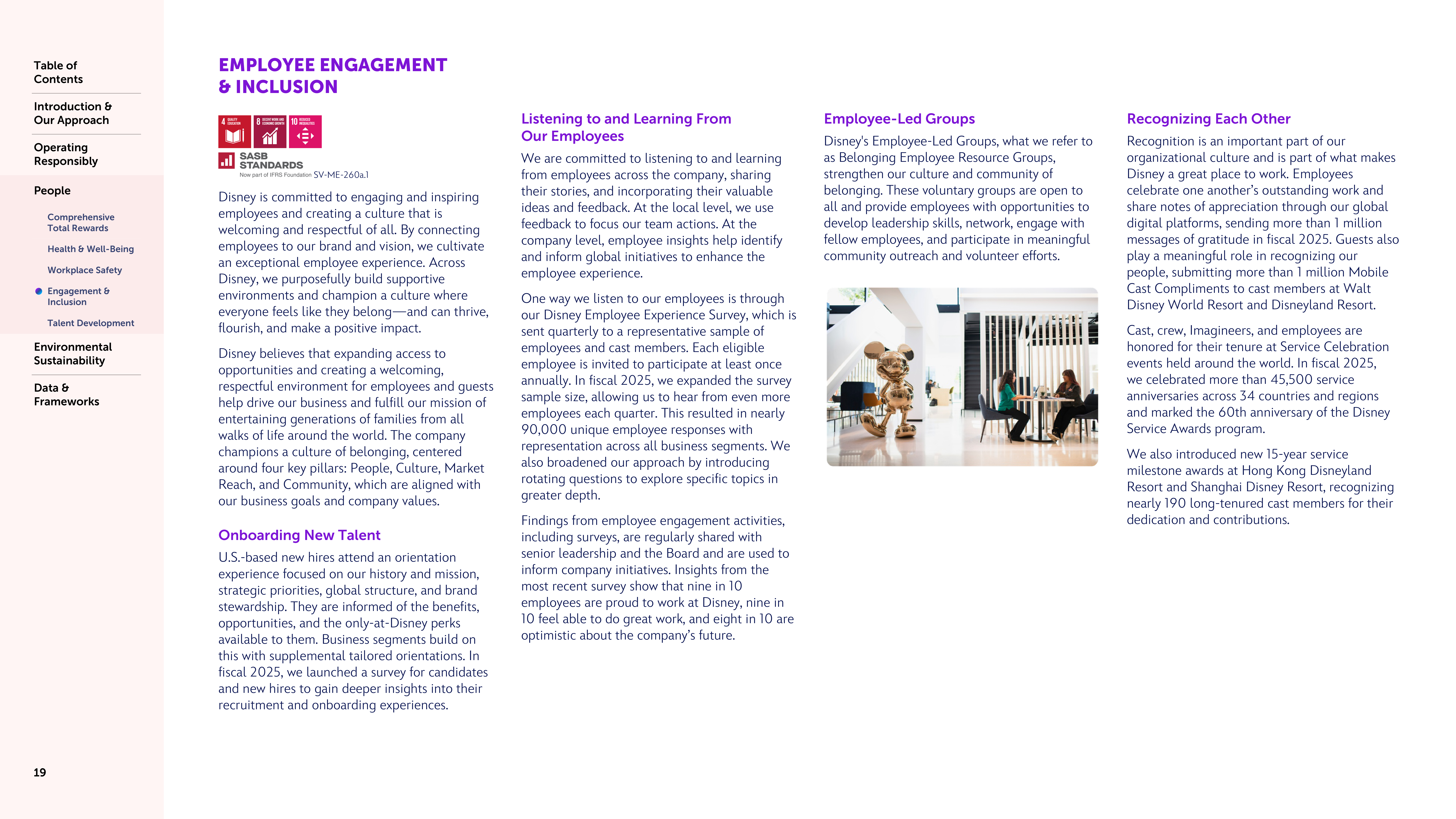


Table
of
Contents
Introduction
&
Our
Approach
Operating
Responsibly
People
Comprehensive
Total
Rewards
Health
&
Well-Being
Workplace
Safety
Engagement
&
Inclusion
Talent
Development
Environmental
Sustainability
Data
&
Frameworks
EMPLOYEE
ENGAGEMENT
&
INCLUSION
SV-ME-260a.1
Disney
is
committed
to
engaging
and
inspiring
employees
and
creating
a
culture
that
is
welcoming
and
respectful
of
all.
By
connecting
employees
to
our
brand
and
vision,
we
cultivate
an
exceptional
employee
experience.
Across
Disney,
we
purposefully
build
supportive
environments
and
champion
a
culture
where
everyone
feels
like
they
belong—and
can
thrive,
flourish,
and
make
a
positive
impact.
Disney
believes
that
expanding
access
to
opportunities
and
creating
a
welcoming,
respectful
environment
for
employees
and
guests
help
drive
our
business
and
fulfill
our
mission
of
entertaining
generations
of
families
from
all
walks
of
life
around
the
world.
The
company
champions
a
culture
of
belonging,
centered
around
four
key
pillars:
People,
Culture,
Market
Reach,
and
Community,
which
are
aligned
with
our
business
goals
and
company
values.
Onboarding
New
Talent
U.S.-based
new
hires
attend
an
orientation
experience
focused
on
our
history
and
mission,
strategic
priorities,
global
structure,
and
brand
stewardship.
They
are
informed
of
the
benefits,
opportunities,
and
the
only-at-Disney
perks
available
to
them.
Business
segments
build
on
this
with
supplemental
tailored
orientations.
In
fiscal
2025,
we
launched
a
survey
for
candidates
and
new
hires
to
gain
deeper
insights
into
their
recruitment
and
onboarding
experiences.
Listening
to
and
Learning
From
Our
Employees
We
are
committed
to
listening
to
and
learning
from
employees
across
the
company,
sharing
their
stories,
and
incorporating
their
valuable
ideas
and
feedback.
At
the
local
level,
we
use
feedback
to
focus
our
team
actions.
At
the
company
level,
employee
insights
help
identify
and
inform
global
initiatives
to
enhance
the
employee
experience.
One
way
we
listen
to
our
employees
is
through
our
Disney
Employee
Experience
Survey,
which
is
sent
quarterly
to
a
representative
sample
of
employees
and
cast
members.
Each
eligible
employee
is
invited
to
participate
at
least
once
annually.
In
fiscal
2025,
we
expanded
the
survey
sample
size,
allowing
us
to
hear
from
even
more
employees
each
quarter.
This
resulted
in
nearly
90,000
unique
employee
responses
with
representation
across
all
business
segments.
We
also
broadened
our
approach
by
introducing
rotating
questions
to
explore
specific
topics
in
greater
depth.
Findings
from
employee
engagement
activities,
including
surveys,
are
regularly
shared
with
senior
leadership
and
the
Board
and
are
used
to
inform
company
initiatives.
Insights
from
the
most
recent
survey
show
that
nine
in
10
employees
are
proud
to
work
at
Disney,
nine
in
10
feel
able
to
do
great
work,
and
eight
in
10
are
optimistic
about
the
companyʼs
future.
Employee-Led
Groups
Disney's
Employee-Led
Groups,
what
we
refer
to
as
Belonging
Employee
Resource
Groups,
strengthen
our
culture
and
community
of
belonging.
These
voluntary
groups
are
open
to
all
and
provide
employees
with
opportunities
to
develop
leadership
skills,
network,
engage
with
fellow
employees,
and
participate
in
meaningful
community
outreach
and
volunteer
efforts.
Recognizing
Each
Other
Recognition
is
an
important
part
of
our
organizational
culture
and
is
part
of
what
makes
Disney
a
great
place
to
work.
Employees
celebrate
one
anotherʼs
outstanding
work
and
share
notes
of
appreciation
through
our
global
digital
platforms,
sending
more
than
1
million
messages
of
gratitude
in
fiscal
2025.
Guests
also
play
a
meaningful
role
in
recognizing
our
people,
submitting
more
than
1
million
Mobile
Cast
Compliments
to
cast
members
at
Walt
Disney
World
Resort
and
Disneyland
Resort.
Cast,
crew,
Imagineers,
and
employees
are
honored
for
their
tenure
at
Service
Celebration
events
held
around
the
world.
In
fiscal
2025,
we
celebrated
more
than
45,500
service
anniversaries
across
34
countries
and
regions
and
marked
the
60th
anniversary
of
the
Disney
Service
Awards
program.
We
also
introduced
new
15-year
service
milestone
awards
at
Hong
Kong
Disneyland
Resort
and
Shanghai
Disney
Resort,
recognizing
nearly
190
long-tenured
cast
members
for
their
dedication
and
contributions.
19
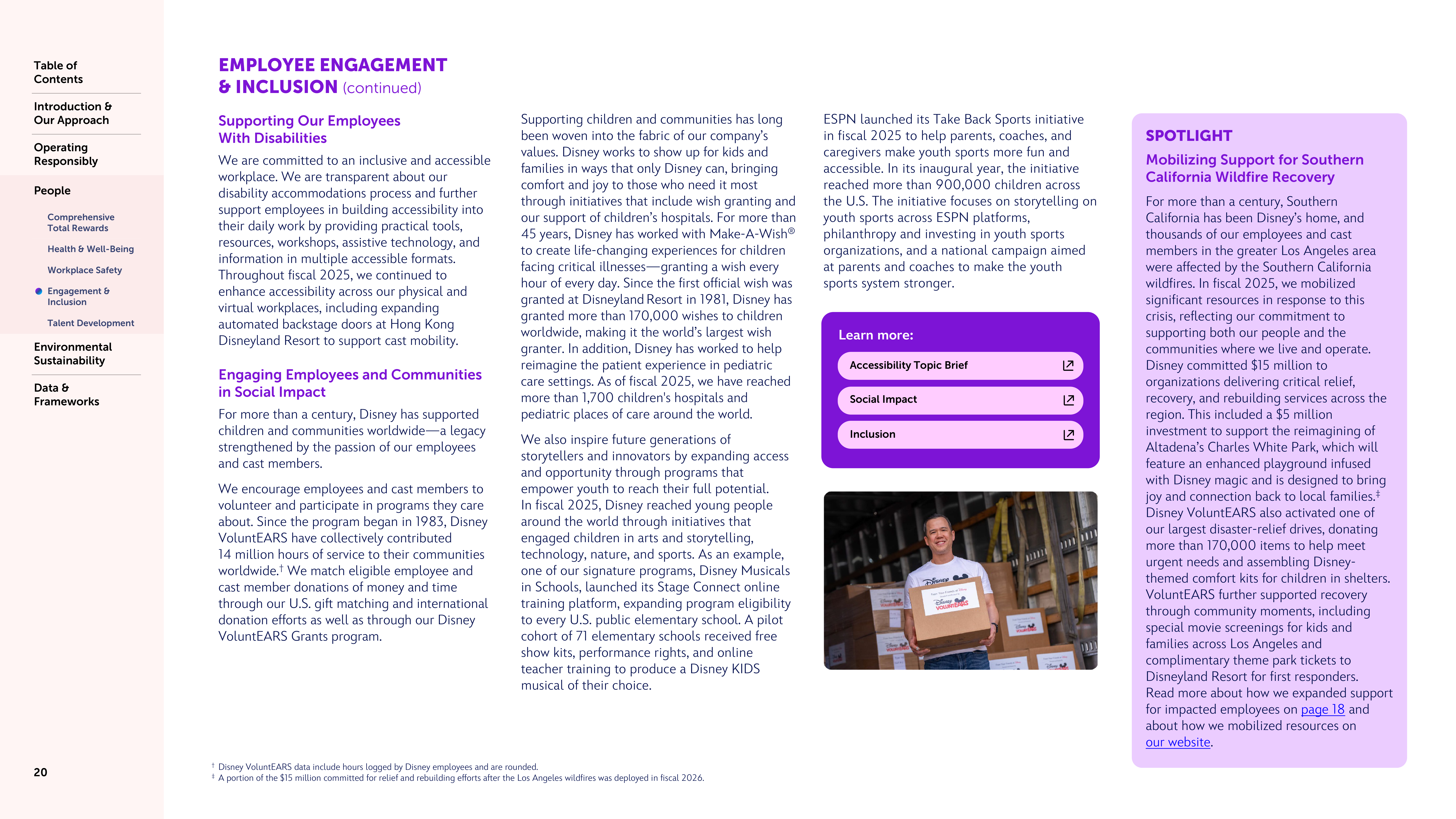
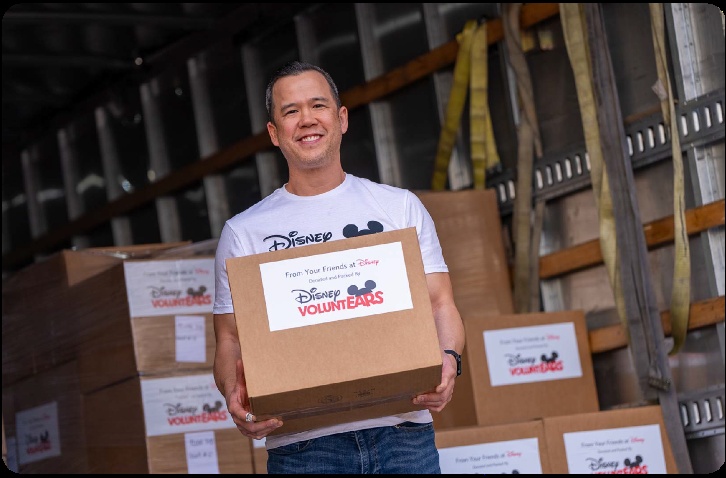
†
Table
of
Contents
Introduction
&
Our
Approach
Operating
Responsibly
People
Comprehensive
Total
Rewards
Health
&
Well-Being
Workplace
Safety
Engagement
&
Inclusion
Talent
Development
Environmental
Sustainability
Data
&
Frameworks
EMPLOYEE
ENGAGEMENT
&
INCLUSION
(continued)
Supporting
Our
Employees
With
Disabilities
We
are
committed
to
an
inclusive
and
accessible
workplace.
We
are
transparent
about
our
disability
accommodations
process
and
further
support
employees
in
building
accessibility
into
their
daily
work
by
providing
practical
tools,
resources,
workshops,
assistive
technology,
and
information
in
multiple
accessible
formats.
Throughout
fiscal
2025,
we
continued
to
enhance
accessibility
across
our
physical
and
virtual
workplaces,
including
expanding
automated
backstage
doors
at
Hong
Kong
Disneyland
Resort
to
support
cast
mobility.
Engaging
Employees
and
Communities
in
Social
Impact
For
more
than
a
century,
Disney
has
supported
children
and
communities
worldwide—a
legacy
strengthened
by
the
passion
of
our
employees
and
cast
members.
We
encourage
employees
and
cast
members
to
volunteer
and
participate
in
programs
they
care
about.
Since
the
program
began
in
1983,
Disney
VoluntEARS
have
collectively
contributed
14
million
hours
of
service
to
their
communities
worldwide.
†
We
match
eligible
employee
and
cast
member
donations
of
money
and
time
through
our
U.S.
gift
matching
and
international
donation
efforts
as
well
as
through
our
Disney
VoluntEARS
Grants
program.
Supporting
children
and
communities
has
long
been
woven
into
the
fabric
of
our
companyʼs
values.
Disney
works
to
show
up
for
kids
and
families
in
ways
that
only
Disney
can,
bringing
comfort
and
joy
to
those
who
need
it
most
through
initiatives
that
include
wish
granting
and
our
support
of
childrenʼs
hospitals.
For
more
than
45
years,
Disney
has
worked
with
Make-A-Wish
®
to
create
life-changing
experiences
for
children
facing
critical
illnesses—granting
a
wish
every
hour
of
every
day.
Since
the
first
official
wish
was
granted
at
Disneyland
Resort
in
1981,
Disney
has
granted
more
than
170,000
wishes
to
children
worldwide,
making
it
the
worldʼs
largest
wish
granter.
In
addition,
Disney
has
worked
to
help
reimagine
the
patient
experience
in
pediatric
care
settings.
As
of
fiscal
2025,
we
have
reached
more
than
1,700
children's
hospitals
and
pediatric
places
of
care
around
the
world.
We
also
inspire
future
generations
of
storytellers
and
innovators
by
expanding
access
and
opportunity
through
programs
that
empower
youth
to
reach
their
full
potential.
In
fiscal
2025,
Disney
reached
young
people
around
the
world
through
initiatives
that
engaged
children
in
arts
and
storytelling,
technology,
nature,
and
sports.
As
an
example,
one
of
our
signature
programs,
Disney
Musicals
in
Schools,
launched
its
Stage
Connect
online
training
platform,
expanding
program
eligibility
to
every
U.S.
public
elementary
school.
A
pilot
cohort
of
71
elementary
schools
received
free
show
kits,
performance
rights,
and
online
teacher
training
to
produce
a
Disney
KIDS
musical
of
their
choice.
ESPN
launched
its
Take
Back
Sports
initiative
in
fiscal
2025
to
help
parents,
coaches,
and
caregivers
make
youth
sports
more
fun
and
accessible.
In
its
inaugural
year,
the
initiative
reached
more
than
900,000
children
across
the
U.S.
The
initiative
focuses
on
storytelling
on
youth
sports
across
ESPN
platforms,
philanthropy
and
investing
in
youth
sports
organizations,
and
a
national
campaign
aimed
at
parents
and
coaches
to
make
the
youth
sports
system
stronger.
Learn
more:
Accessibility
Topic
Brief
Social
Impact
Inclusion
SPOTLIGHT
Mobilizing
Support
for
Southern
California
Wildfire
Recovery
For
more
than
a
century,
Southern
California
has
been
Disneyʼs
home,
and
thousands
of
our
employees
and
cast
members
in
the
greater
Los
Angeles
area
were
affected
by
the
Southern
California
wildfires.
In
fiscal
2025,
we
mobilized
significant
resources
in
response
to
this
crisis,
reflecting
our
commitment
to
supporting
both
our
people
and
the
communities
where
we
live
and
operate.
Disney
committed
$15
million
to
organizations
delivering
critical
relief,
recovery,
and
rebuilding
services
across
the
region.
This
included
a
$5
million
investment
to
support
the
reimagining
of
Altadenaʼs
Charles
White
Park,
which
will
feature
an
enhanced
playground
infused
with
Disney
magic
and
is
designed
to
bring
joy
and
connection
back
to
local
families.
‡
Disney
VoluntEARS
also
activated
one
of
our
largest
disaster-relief
drives,
donating
more
than
170,000
items
to
help
meet
urgent
needs
and
assembling
Disney-
themed
comfort
kits
for
children
in
shelters.
VoluntEARS
further
supported
recovery
through
community
moments,
including
special
movie
screenings
for
kids
and
families
across
Los
Angeles
and
complimentary
theme
park
tickets
to
Disneyland
Resort
for
first
responders.
Read
more
about
how
we
expanded
support
for
impacted
employees
on
page
18
and
about
how
we
mobilized
resources
on
our
website
.
†
Disney
VoluntEARS
data
include
hours
logged
by
Disney
employees
and
are
rounded.
‡
A
portion
of
the
$15
million
committed
for
relief
and
rebuilding
efforts
after
the
Los
Angeles
wildfires
was
deployed
in
fiscal
2026.
20
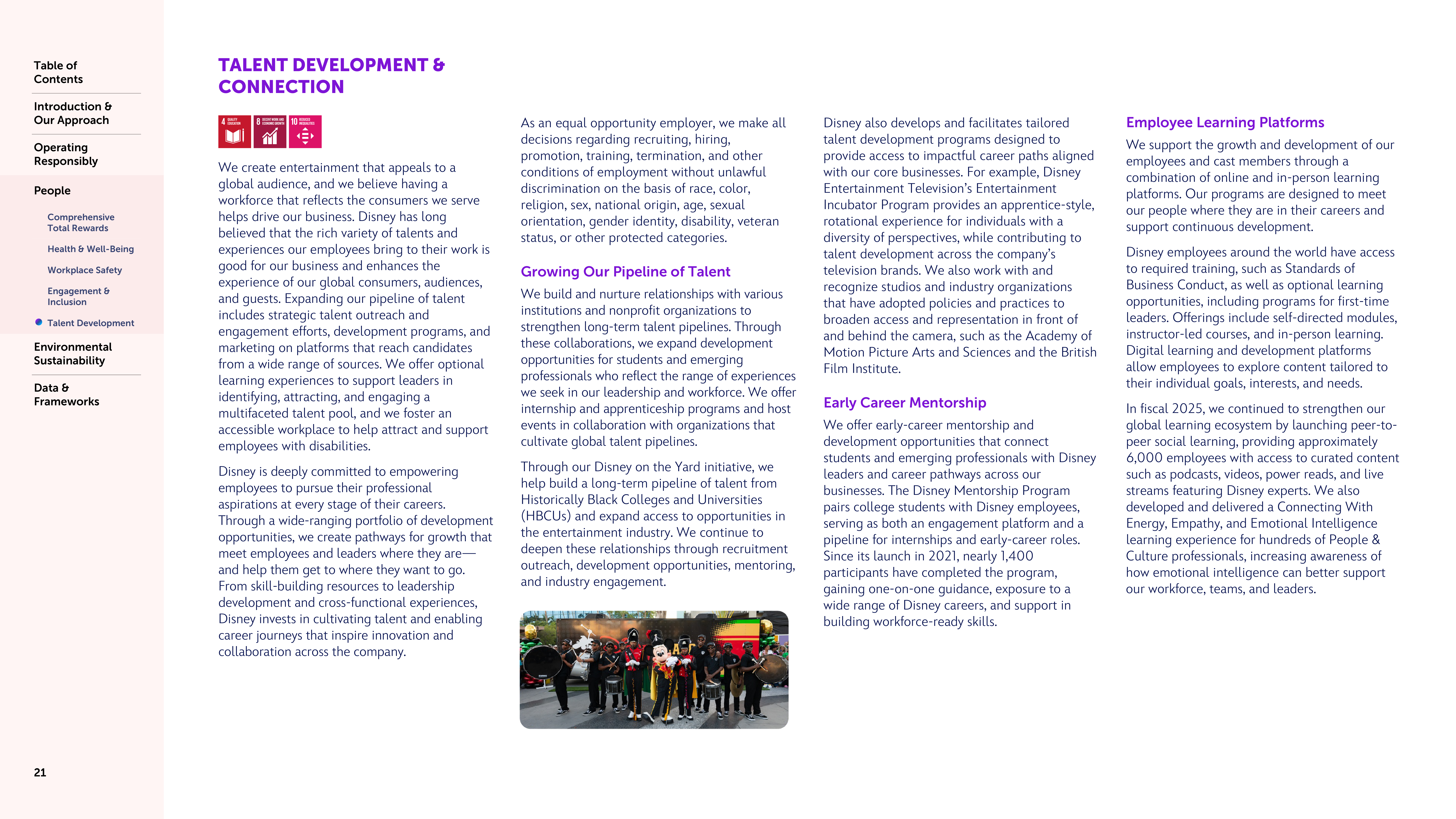

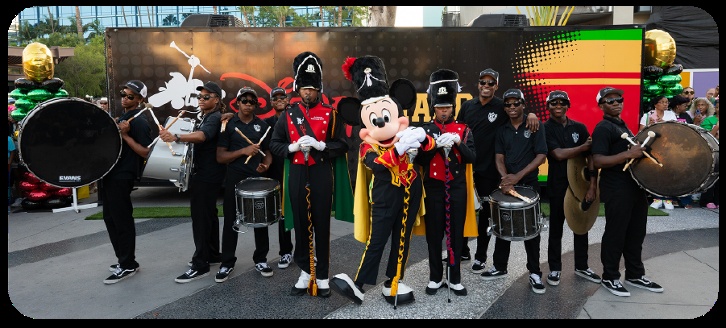
Table
of
Contents
Introduction
&
Our
Approach
Operating
Responsibly
People
Comprehensive
Total
Rewards
Health
&
Well-Being
Workplace
Safety
Engagement
&
Inclusion
Talent
Development
Environmental
Sustainability
Data
&
Frameworks
TALENT
DEVELOPMENT
&
CONNECTION
We
create
entertainment
that
appeals
to
a
global
audience,
and
we
believe
having
a
workforce
that
reflects
the
consumers
we
serve
helps
drive
our
business.
Disney
has
long
believed
that
the
rich
variety
of
talents
and
experiences
our
employees
bring
to
their
work
is
good
for
our
business
and
enhances
the
experience
of
our
global
consumers,
audiences,
and
guests.
Expanding
our
pipeline
of
talent
includes
strategic
talent
outreach
and
engagement
efforts,
development
programs,
and
marketing
on
platforms
that
reach
candidates
from
a
wide
range
of
sources.
We
offer
optional
learning
experiences
to
support
leaders
in
identifying,
attracting,
and
engaging
a
multifaceted
talent
pool,
and
we
foster
an
accessible
workplace
to
help
attract
and
support
employees
with
disabilities.
Disney
is
deeply
committed
to
empowering
employees
to
pursue
their
professional
aspirations
at
every
stage
of
their
careers.
Through
a
wide-ranging
portfolio
of
development
opportunities,
we
create
pathways
for
growth
that
meet
employees
and
leaders
where
they
are—
and
help
them
get
to
where
they
want
to
go.
From
skill-building
resources
to
leadership
development
and
cross-functional
experiences,
Disney
invests
in
cultivating
talent
and
enabling
career
journeys
that
inspire
innovation
and
collaboration
across
the
company.
As
an
equal
opportunity
employer,
we
make
all
decisions
regarding
recruiting,
hiring,
promotion,
training,
termination,
and
other
conditions
of
employment
without
unlawful
discrimination
on
the
basis
of
race,
color,
religion,
sex,
national
origin,
age,
sexual
orientation,
gender
identity,
disability,
veteran
status,
or
other
protected
categories.
Growing
Our
Pipeline
of
Talent
We
build
and
nurture
relationships
with
various
institutions
and
nonprofit
organizations
to
strengthen
long-term
talent
pipelines.
Through
these
collaborations,
we
expand
development
opportunities
for
students
and
emerging
professionals
who
reflect
the
range
of
experiences
we
seek
in
our
leadership
and
workforce.
We
offer
internship
and
apprenticeship
programs
and
host
events
in
collaboration
with
organizations
that
cultivate
global
talent
pipelines.
Through
our
Disney
on
the
Yard
initiative,
we
help
build
a
long-term
pipeline
of
talent
from
Historically
Black
Colleges
and
Universities
(HBCUs)
and
expand
access
to
opportunities
in
the
entertainment
industry.
We
continue
to
deepen
these
relationships
through
recruitment
outreach,
development
opportunities,
mentoring,
and
industry
engagement.
Disney
also
develops
and
facilitates
tailored
talent
development
programs
designed
to
provide
access
to
impactful
career
paths
aligned
with
our
core
businesses.
For
example,
Disney
Entertainment
Televisionʼs
Entertainment
Incubator
Program
provides
an
apprentice-style,
rotational
experience
for
individuals
with
a
diversity
of
perspectives,
while
contributing
to
talent
development
across
the
companyʼs
television
brands.
We
also
work
with
and
recognize
studios
and
industry
organizations
that
have
adopted
policies
and
practices
to
broaden
access
and
representation
in
front
of
and
behind
the
camera,
such
as
the
Academy
of
Motion
Picture
Arts
and
Sciences
and
the
British
Film
Institute.
Early
Career
Mentorship
We
offer
early-career
mentorship
and
development
opportunities
that
connect
students
and
emerging
professionals
with
Disney
leaders
and
career
pathways
across
our
businesses.
The
Disney
Mentorship
Program
pairs
college
students
with
Disney
employees,
serving
as
both
an
engagement
platform
and
a
pipeline
for
internships
and
early-career
roles.
Since
its
launch
in
2021,
nearly
1,400
participants
have
completed
the
program,
gaining
one-on-one
guidance,
exposure
to
a
wide
range
of
Disney
careers,
and
support
in
building
workforce-ready
skills.
Employee
Learning
Platforms
We
support
the
growth
and
development
of
our
employees
and
cast
members
through
a
combination
of
online
and
in-person
learning
platforms.
Our
programs
are
designed
to
meet
our
people
where
they
are
in
their
careers
and
support
continuous
development.
Disney
employees
around
the
world
have
access
to
required
training,
such
as
Standards
of
Business
Conduct,
as
well
as
optional
learning
opportunities,
including
programs
for
first-time
leaders.
Offerings
include
self-directed
modules,
instructor-led
courses,
and
in-person
learning.
Digital
learning
and
development
platforms
allow
employees
to
explore
content
tailored
to
their
individual
goals,
interests,
and
needs.
In
fiscal
2025,
we
continued
to
strengthen
our
global
learning
ecosystem
by
launching
peer-to-
peer
social
learning,
providing
approximately
6,000
employees
with
access
to
curated
content
such
as
podcasts,
videos,
power
reads,
and
live
streams
featuring
Disney
experts.
We
also
developed
and
delivered
a
Connecting
With
Energy,
Empathy,
and
Emotional
Intelligence
learning
experience
for
hundreds
of
People
&
Culture
professionals,
increasing
awareness
of
how
emotional
intelligence
can
better
support
our
workforce,
teams,
and
leaders.
21
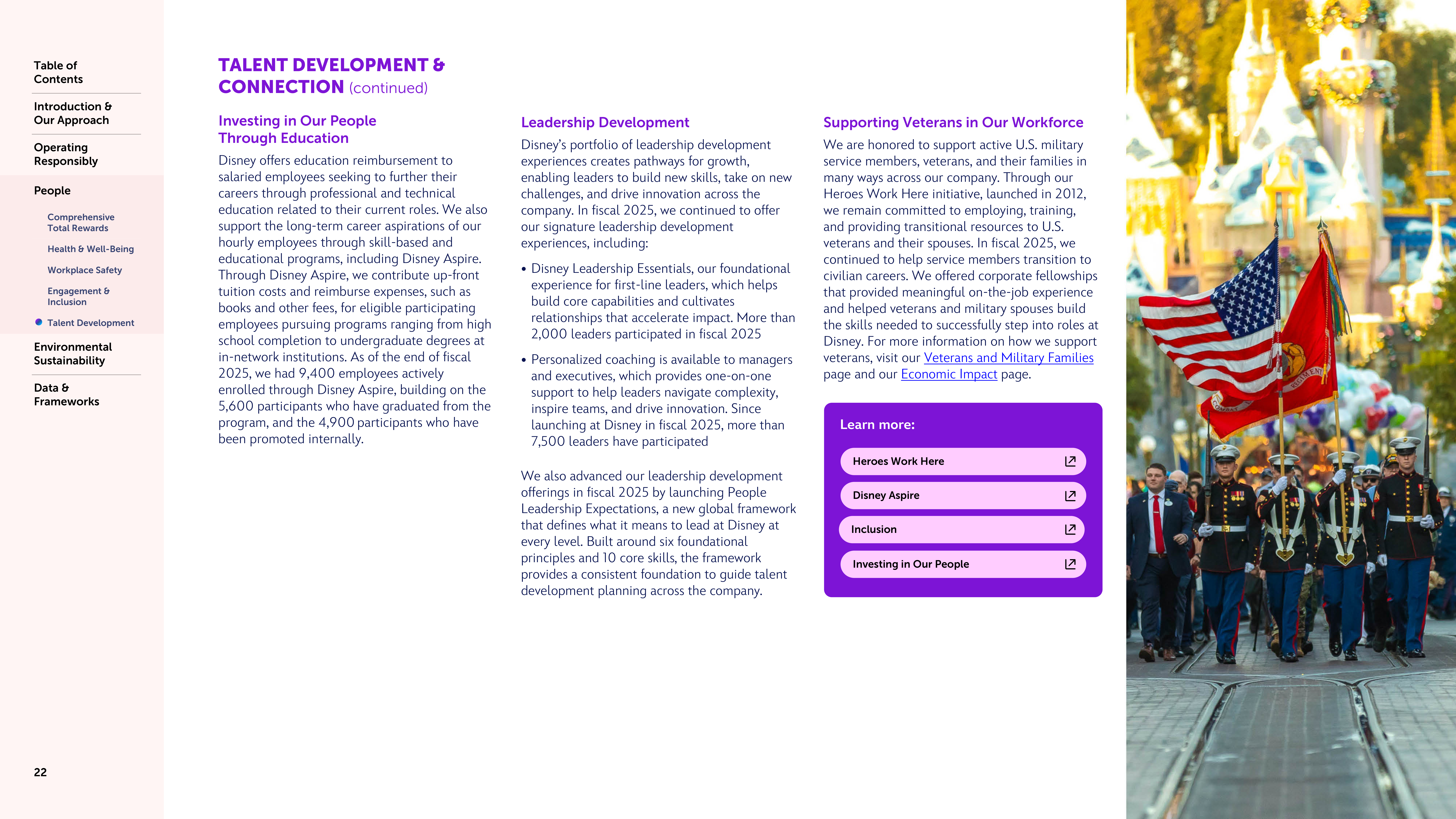


Investing
in
Our
People
Through
Education
Disney
offers
education
reimbursement
to
salaried
employees
seeking
to
further
their
careers
through
professional
and
technical
education
related
to
their
current
roles.
We
also
support
the
long-term
career
aspirations
of
our
hourly
employees
through
skill-based
and
educational
programs,
including
Disney
Aspire.
Through
Disney
Aspire,
we
contribute
up-front
tuition
costs
and
reimburse
expenses,
such
as
books
and
other
fees,
for
eligible
participating
employees
pursuing
programs
ranging
from
high
school
completion
to
undergraduate
degrees
at
in-network
institutions.
As
of
the
end
of
fiscal
2025,
we
had
9,400
employees
actively
enrolled
through
Disney
Aspire,
building
on
the
5,600
participants
who
have
graduated
from
the
program,
and
the
4,900
participants
who
have
been
promoted
internally.
Leadership
Development
Disneyʼs
portfolio
of
leadership
development
experiences
creates
pathways
for
growth,
enabling
leaders
to
build
new
skills,
take
on
new
challenges,
and
drive
innovation
across
the
company.
In
fiscal
2025,
we
continued
to
offer
our
signature
leadership
development
experiences,
including:
•
Disney
Leadership
Essentials,
our
foundational
experience
for
first-line
leaders,
which
helps
build
core
capabilities
and
cultivates
relationships
that
accelerate
impact.
More
than
2,000
leaders
participated
in
fiscal
2025
•
Personalized
coaching
is
available
to
managers
and
executives,
which
provides
one-on-one
support
to
help
leaders
navigate
complexity,
inspire
teams,
and
drive
innovation.
Since
launching
at
Disney
in
fiscal
2025,
more
than
7,500
leaders
have
participated
We
also
advanced
our
leadership
development
offerings
in
fiscal
2025
by
launching
People
Leadership
Expectations,
a
new
global
framework
that
defines
what
it
means
to
lead
at
Disney
at
every
level.
Built
around
six
foundational
principles
and
10
core
skills,
the
framework
provides
a
consistent
foundation
to
guide
talent
development
planning
across
the
company.
Supporting
Veterans
in
Our
Workforce
We
are
honored
to
support
active
U.S.
military
service
members,
veterans,
and
their
families
in
many
ways
across
our
company.
Through
our
Heroes
Work
Here
initiative,
launched
in
2012,
we
remain
committed
to
employing,
training,
and
providing
transitional
resources
to
U.S.
veterans
and
their
spouses.
In
fiscal
2025,
we
continued
to
help
service
members
transition
to
civilian
careers.
We
offered
corporate
fellowships
that
provided
meaningful
on-the-job
experience
and
helped
veterans
and
military
spouses
build
the
skills
needed
to
successfully
step
into
roles
at
Disney.
For
more
information
on
how
we
support
veterans,
visit
our
Veterans
and
Military
Families
page
and
our
Economic
Impact
page.
Learn
more:
Heroes
Work
Here
Disney
Aspire
Inclusion
Investing
in
Our
People
Table
of
Contents
Introduction
&
Our
Approach
Operating
Responsibly
People
Comprehensive
Total
Rewards
Health
&
Well-Being
Workplace
Safety
Engagement
&
Inclusion
Talent
Development
Environmental
Sustainability
Data
&
Frameworks
TALENT
DEVELOPMENT
&
CONNECTION
(continued)
22
Investing
in
Our
People
Through
Education
Disney
offers
education
reimbursement
to
salaried
employees
seeking
to
further
their
careers
through
professional
and
technical
education
related
to
their
current
roles.
We
also
support
the
long-term
career
aspirations
of
our
hourly
employees
through
skill-based
and
educational
programs,
including
Disney
Aspire.
Through
Disney
Aspire,
we
contribute
up-front
tuition
costs
and
reimburse
expenses,
such
as
books
and
other
fees,
for
eligible
participating
employees
pursuing
programs
ranging
from
high
school
completion
to
undergraduate
degrees
at
in-network
institutions.
As
of
the
end
of
fiscal
2025,
we
had
9,400
employees
actively
enrolled
through
Disney
Aspire,
building
on
the
5,600
participants
who
have
graduated
from
the
program,
and
the
4,900
participants
who
have
been
promoted
internally.
Leadership
Development
Disneyʼs
portfolio
of
leadership
development
experiences
creates
pathways
for
growth,
enabling
leaders
to
build
new
skills,
take
on
new
challenges,
and
drive
innovation
across
the
company.
In
fiscal
2025,
we
continued
to
offer
our
signature
leadership
development
experiences,
including:
•
Disney
Leadership
Essentials,
our
foundational
experience
for
first-line
leaders,
which
helps
build
core
capabilities
and
cultivates
relationships
that
accelerate
impact.
More
than
2,000
leaders
participated
in
fiscal
2025
•
Personalized
coaching
is
available
to
managers
and
executives,
which
provides
one-on-one
support
to
help
leaders
navigate
complexity,
inspire
teams,
and
drive
innovation.
Since
launching
at
Disney
in
fiscal
2025,
more
than
7,500
leaders
have
participated
We
also
advanced
our
leadership
development
offerings
in
fiscal
2025
by
launching
People
Leadership
Expectations,
a
new
global
framework
that
defines
what
it
means
to
lead
at
Disney
at
every
level.
Built
around
six
foundational
principles
and
10
core
skills,
the
framework
provides
a
consistent
foundation
to
guide
talent
development
planning
across
the
company.
Supporting
Veterans
in
Our
Workforce
We
are
honored
to
support
active
U.S.
military
service
members,
veterans,
and
their
families
in
many
ways
across
our
company.
Through
our
Heroes
Work
Here
initiative,
launched
in
2012,
we
remain
committed
to
employing,
training,
and
providing
transitional
resources
to
U.S.
veterans
and
their
spouses.
In
fiscal
2025,
we
continued
to
help
service
members
transition
to
civilian
careers.
We
offered
corporate
fellowships
that
provided
meaningful
on-the-job
experience
and
helped
veterans
and
military
spouses
build
the
skills
needed
to
successfully
step
into
roles
at
Disney.
For
more
information
on
how
we
support
veterans,
visit
our
Veterans
and
Military
Families
page
and
our
Economic
Impact
page.
Learn
more:
Heroes
Work
Here
Disney
Aspire
Inclusion
Investing
in
Our
People
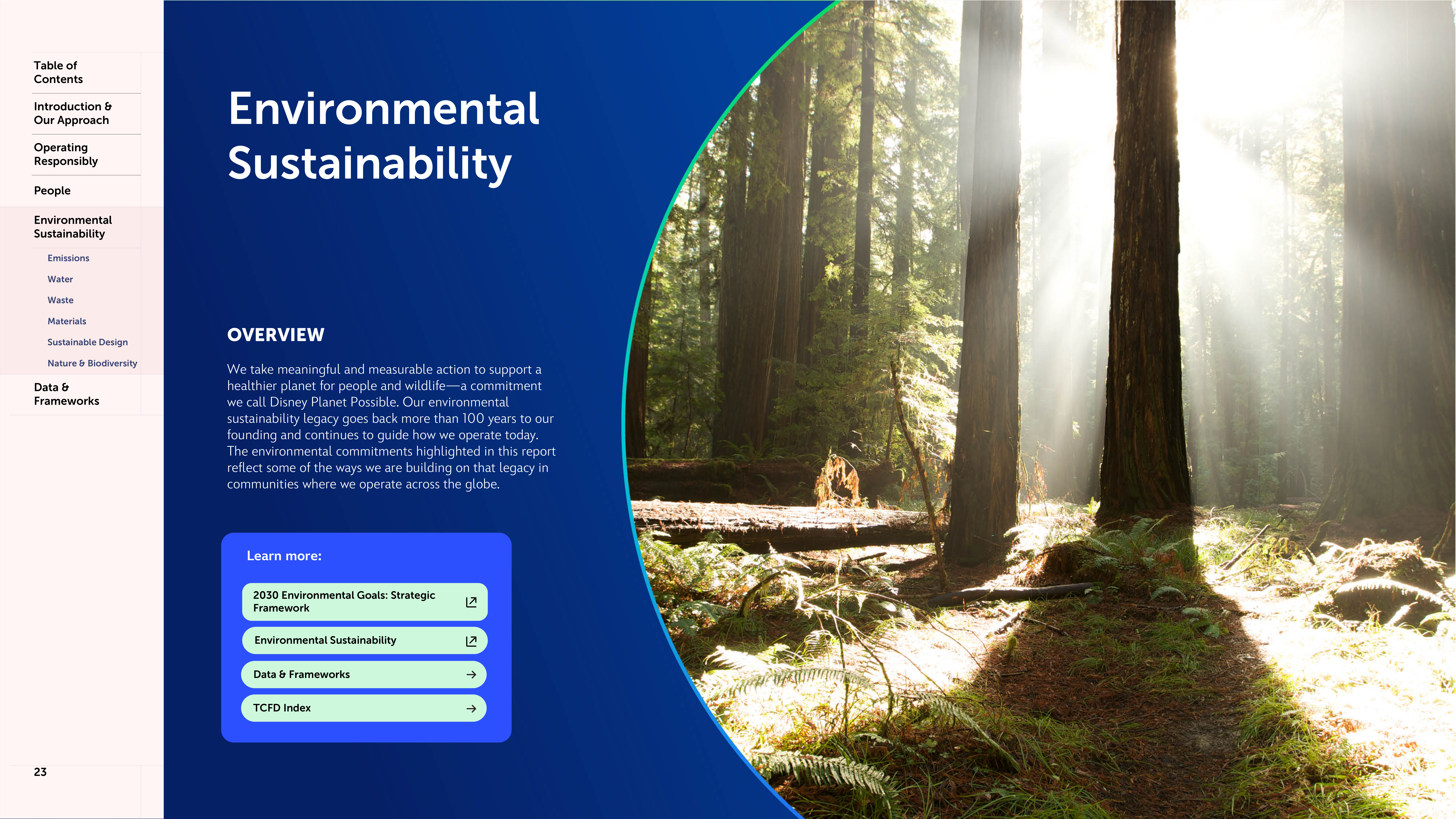


Environmental
Sustainability
Environmental
Sustainability
OVERVIEW
We
take
meaningful
and
measurable
action
to
support
a
healthier
planet
for
people
and
wildlife—a
commitment
we
call
Disney
Planet
Possible.
Our
environmental
sustainability
legacy
goes
back
more
than
100
years
to
our
founding
and
continues
to
guide
how
we
operate
today.
The
environmental
commitments
highlighted
in
this
report
reflect
some
of
the
ways
we
are
building
on
that
legacy
in
communities
where
we
operate
across
the
globe.
Learn
more:
2030
Environmental
Goals:
Strategic
Framework
Environmental
Sustainability
Data
&
Frameworks
TCFD
Index
Table
of
Contents
Introduction
&
Our
Approach
Operating
Responsibly
People
Emissions
Water
Waste
Materials
Sustainable
Design
Nature
&
Biodiversity
Data
&
Frameworks
23
Environmental
Sustainability
Environmental
Sustainability
OVERVIEW
We
take
meaningful
and
measurable
action
to
support
a
healthier
planet
for
people
and
wildlife—a
commitment
we
call
Disney
Planet
Possible.
Our
environmental
sustainability
legacy
goes
back
more
than
100
years
to
our
founding
and
continues
to
guide
how
we
operate
today.
The
environmental
commitments
highlighted
in
this
report
reflect
some
of
the
ways
we
are
building
on
that
legacy
in
communities
where
we
operate
across
the
globe.
Learn
more:
2030
Environmental
Goals:
Strategic
Framework
Environmental
Sustainability
Data
&
Frameworks
TCFD
Index
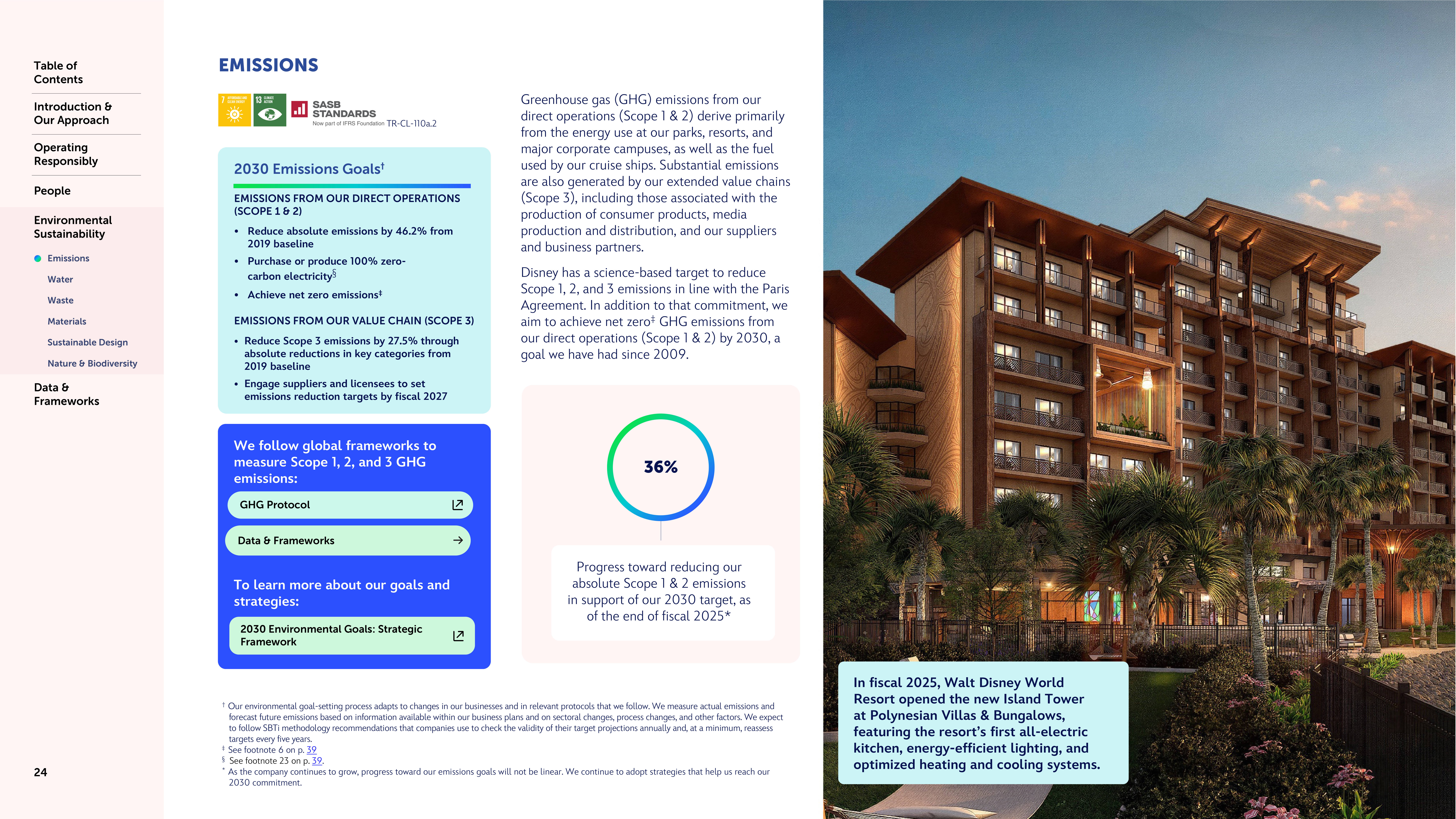



Emissions
EMISSIONS
TR-CL-110a.2
2030
Emissions
Goals
†
EMISSIONS
FROM
OUR
DIRECT
OPERATIONS
(SCOPE
1
&
2)
•
Reduce
absolute
emissions
by
46.2%
from
2019
baseline
•
Purchase
or
produce
100%
zero-
carbon
electricity
§
•
Achieve
net
zero
emissions
‡
EMISSIONS
FROM
OUR
VALUE
CHAIN
(SCOPE
3)
•
Reduce
Scope
3
emissions
by
27.5%
through
absolute
reductions
in
key
categories
from
2019
baseline
•
Engage
suppliers
and
licensees
to
set
emissions
reduction
targets
by
fiscal
2027
We
follow
global
frameworks
to
measure
Scope
1,
2,
and
3
GHG
emissions:
GHG
Protocol
Data
&
Frameworks
To
learn
more
about
our
goals
and
strategies:
2030
Environmental
Goals:
Strategic
Framework
Greenhouse
gas
(GHG)
emissions
from
our
direct
operations
(Scope
1
&
2)
derive
primarily
from
the
energy
use
at
our
parks,
resorts,
and
major
corporate
campuses,
as
well
as
the
fuel
used
by
our
cruise
ships.
Substantial
emissions
are
also
generated
by
our
extended
value
chains
(Scope
3),
including
those
associated
with
the
production
of
consumer
products,
media
production
and
distribution,
and
our
suppliers
and
business
partners.
Disney
has
a
science-based
target
to
reduce
Scope
1,
2,
and
3
emissions
in
line
with
the
Paris
Agreement.
In
addition
to
that
commitment,
we
aim
to
achieve
net
zero
‡
GHG
emissions
from
our
direct
operations
(Scope
1
&
2)
by
2030,
a
goal
we
have
had
since
2009.
36%
Progress
toward
reducing
our
absolute
Scope
1
&
2
emissions
in
support
of
our
2030
target,
as
of
the
end
of
fiscal
2025*
In
fiscal
2025,
Walt
Disney
World
Resort
opened
the
new
Island
Tower
at
Polynesian
Villas
&
Bungalows,
featuring
the
resortʼs
first
all-electric
kitchen,
energy-efficient
lighting,
and
optimized
heating
and
cooling
systems.
†
Our
environmental
goal-setting
process
adapts
to
changes
in
our
businesses
and
in
relevant
protocols
that
we
follow.
We
measure
actual
emissions
and
forecast
future
emissions
based
on
information
available
within
our
business
plans
and
on
sectoral
changes,
process
changes,
and
other
factors.
We
expect
to
follow
SBTi
methodology
recommendations
that
companies
use
to
check
the
validity
of
their
target
projections
annually
and,
at
a
minimum,
reassess
targets
every
five
years.
‡
See
footnote
6
on
p.
39
§
See
footnote
23
on
p.
39
.
*
As
the
company
continues
to
grow,
progress
toward
our
emissions
goals
will
not
be
linear.
We
continue
to
adopt
strategies
that
help
us
reach
our
2030
commitment.
Table
of
Contents
Introduction
&
Our
Approach
Operating
Responsibly
People
Environmental
Sustainability
Water
Waste
Materials
Sustainable
Design
Nature
&
Biodiversity
Data
&
Frameworks
24
Emissions
EMISSIONS
TR-CL-110a.2
2030
Emissions
Goals
†
EMISSIONS
FROM
OUR
DIRECT
OPERATIONS
(SCOPE
1
&
2)
•
Reduce
absolute
emissions
by
46.2%
from
2019
baseline
•
Purchase
or
produce
100%
zero-
carbon
electricity
§
•
Achieve
net
zero
emissions
‡
EMISSIONS
FROM
OUR
VALUE
CHAIN
(SCOPE
3)
•
Reduce
Scope
3
emissions
by
27.5%
through
absolute
reductions
in
key
categories
from
2019
baseline
•
Engage
suppliers
and
licensees
to
set
emissions
reduction
targets
by
fiscal
2027
We
follow
global
frameworks
to
measure
Scope
1,
2,
and
3
GHG
emissions:
GHG
Protocol
Data
&
Frameworks
To
learn
more
about
our
goals
and
strategies:
2030
Environmental
Goals:
Strategic
Framework
Greenhouse
gas
(GHG)
emissions
from
our
direct
operations
(Scope
1
&
2)
derive
primarily
from
the
energy
use
at
our
parks,
resorts,
and
major
corporate
campuses,
as
well
as
the
fuel
used
by
our
cruise
ships.
Substantial
emissions
are
also
generated
by
our
extended
value
chains
(Scope
3),
including
those
associated
with
the
production
of
consumer
products,
media
production
and
distribution,
and
our
suppliers
and
business
partners.
Disney
has
a
science-based
target
to
reduce
Scope
1,
2,
and
3
emissions
in
line
with
the
Paris
Agreement.
In
addition
to
that
commitment,
we
aim
to
achieve
net
zero
‡
GHG
emissions
from
our
direct
operations
(Scope
1
&
2)
by
2030,
a
goal
we
have
had
since
2009.
36%
Progress
toward
reducing
our
absolute
Scope
1
&
2
emissions
in
support
of
our
2030
target,
as
of
the
end
of
fiscal
2025*
†
Our
environmental
goal-setting
process
adapts
to
changes
in
our
businesses
and
in
relevant
protocols
that
we
follow.
We
measure
actual
emissions
and
forecast
future
emissions
based
on
information
available
within
our
business
plans
and
on
sectoral
changes,
process
changes,
and
other
factors.
We
expect
to
follow
SBTi
methodology
recommendations
that
companies
use
to
check
the
validity
of
their
target
projections
annually
and,
at
a
minimum,
reassess
targets
every
five
years.
‡
See
footnote
6
on
p.
39
§
See
footnote
23
on
p.
39
.
*
As
the
company
continues
to
grow,
progress
toward
our
emissions
goals
will
not
be
linear.
We
continue
to
adopt
strategies
that
help
us
reach
our
2030
commitment.
In
fiscal
2025,
Walt
Disney
World
Resort
opened
the
new
Island
Tower
at
Polynesian
Villas
&
Bungalows,
featuring
the
resortʼs
first
all-electric
kitchen,
energy-efficient
lighting,
and
optimized
heating
and
cooling
systems.
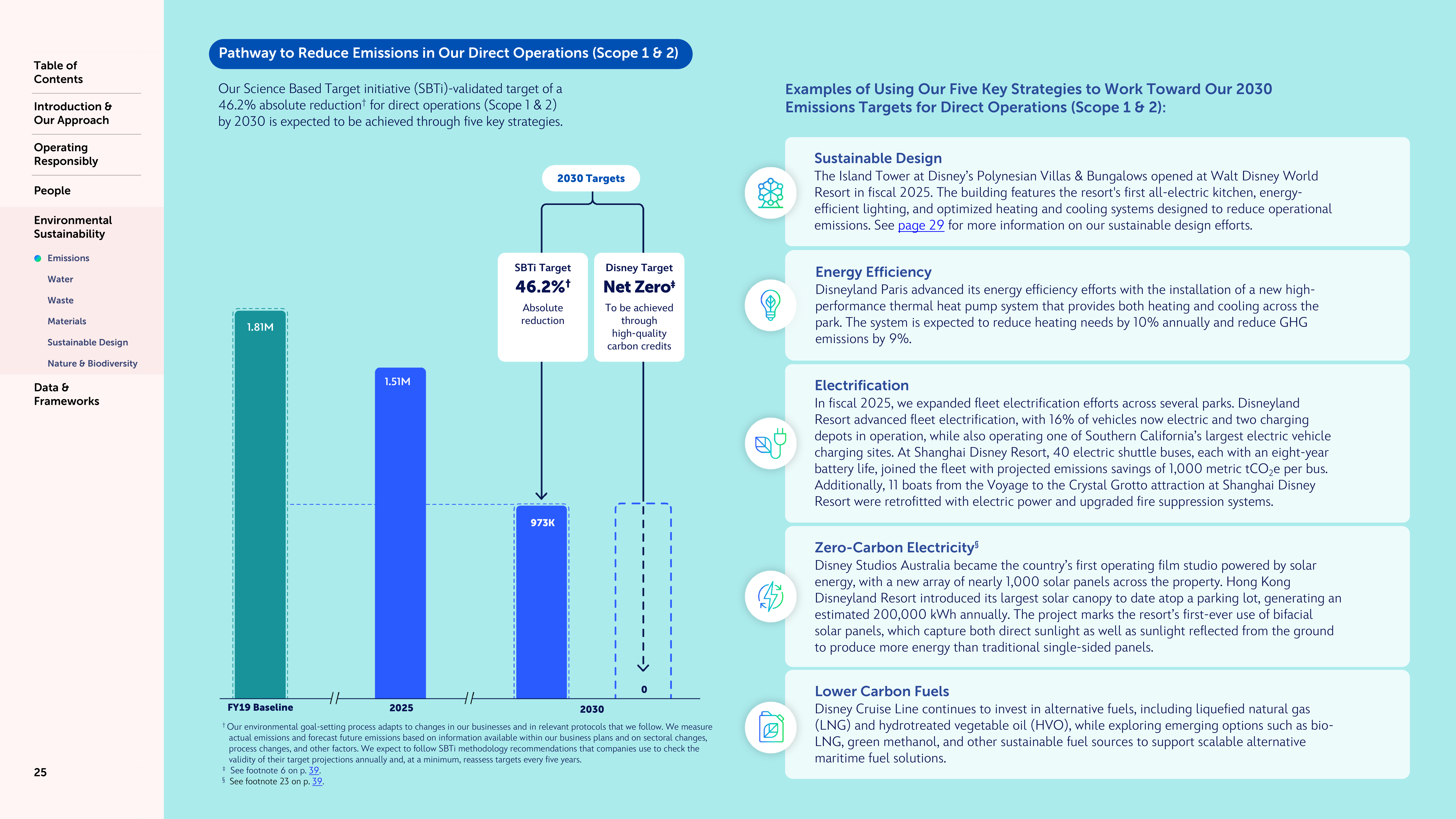

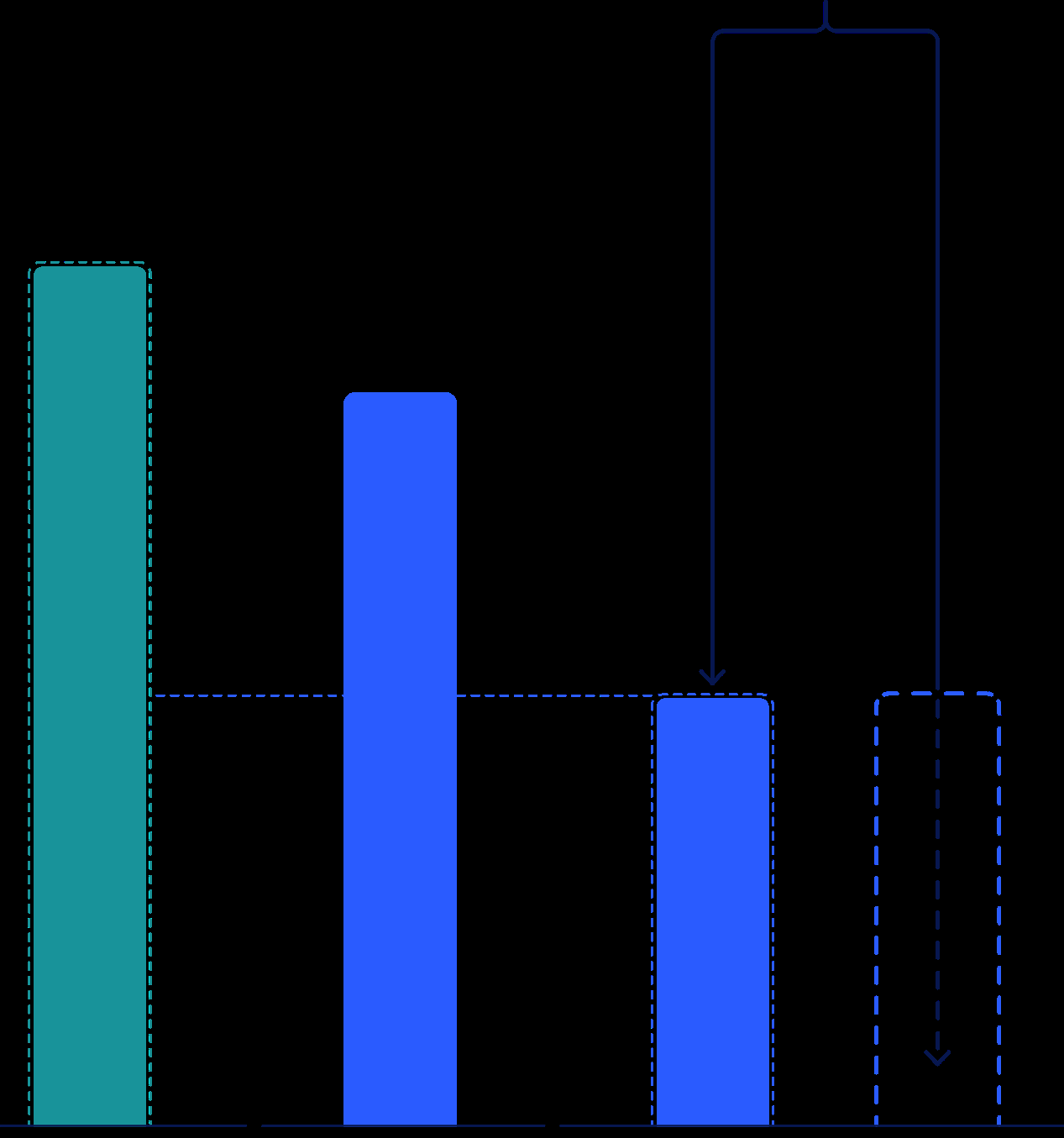





Pathway
to
Reduce
Emissions
in
Our
Direct
Operations
(Scope
1
&
2)
Our
Science
Based
Target
initiative
(SBTi)-validated
target
of
a
46.2%
absolute
reduction
†
for
direct
operations
(Scope
1
&
2)
by
2030
is
expected
to
be
achieved
through
five
key
strategies.
Table
of
Contents
Introduction
&
Our
Approach
Operating
Responsibly
People
Environmental
Sustainability
Emissions
Water
Waste
Materials
Sustainable
Design
Nature
&
Biodiversity
Data
&
Frameworks
1.81M
1.51M
973K
0
FY19
Baseline
2025
2030
Ex
amples
of
Using
Our
Five
Key
Strategies
to
Work
Toward
Our
2030
Emissions
Targets
for
Direct
Operations
(Scope
1
&
2)
:
Sustainable
Design
The
Island
Tower
at
Disneyʼs
Polynesian
Villas
&
Bungalows
opened
at
Walt
Disney
World
Resort
in
fiscal
2025.
The
building
features
the
resort's
first
all-electric
kitchen,
energy-
efficient
lighting,
and
optimized
heating
and
cooling
systems
designed
to
reduce
operational
emissions.
See
page
29
for
more
information
on
our
sustainable
design
efforts.
Energy
Efficiency
Disneyland
Paris
advanced
its
energy
efficiency
efforts
with
the
installation
of
a
new
high-
performance
thermal
heat
pump
system
that
provides
both
heating
and
cooling
across
the
park.
The
system
is
expected
to
reduce
heating
needs
by
10%
annually
and
reduce
GHG
emissions
by
9%.
Electrification
In
fiscal
2025,
we
expanded
fleet
electrification
efforts
across
several
parks.
Disneyland
Resort
advanced
fleet
electrification,
with
16%
of
vehicles
now
electric
and
two
charging
depots
in
operation,
while
also
operating
one
of
Southern
Californiaʼs
largest
electric
vehicle
charging
sites.
At
Shanghai
Disney
Resort,
40
electric
shuttle
buses,
each
with
an
eight-year
battery
life,
joined
the
fleet
with
projected
emissions
savings
of
1,000
metric
tCO
2
e
per
bus.
Additionally,
11
boats
from
the
Voyage
to
the
Crystal
Grotto
attraction
at
Shanghai
Disney
Resort
were
retrofitted
with
electric
power
and
upgraded
fire
suppression
systems.
Zero-Carbon
Electricity
§
Disney
Studios
Australia
became
the
countryʼs
first
operating
film
studio
powered
by
solar
energy,
with
a
new
array
of
nearly
1,000
solar
panels
across
the
property.
Hong
Kong
Disneyland
Resort
introduced
its
largest
solar
canopy
to
date
atop
a
parking
lot,
generating
an
estimated
200,000
kWh
annually.
The
project
marks
the
resortʼs
first-ever
use
of
bifacial
solar
panels,
which
capture
both
direct
sunlight
as
well
as
sunlight
reflected
from
the
ground
to
produce
more
energy
than
traditional
single-sided
panels.
Lower
Carbon
Fuels
Disney
Cruise
Line
continues
to
invest
in
alternative
fuels,
including
liquefied
natural
gas
(LNG)
and
hydrotreated
vegetable
oil
(HVO),
while
exploring
emerging
options
such
as
bio-
LNG,
green
methanol,
and
other
sustainable
fuel
sources
to
support
scalable
alternative
maritime
fuel
solutions.
†
Our
environmental
goal-setting
process
adapts
to
changes
in
our
businesses
and
in
relevant
protocols
that
we
follow.
We
measure
actual
emissions
and
forecast
future
emissions
based
on
information
available
within
our
business
plans
and
on
sectoral
changes,
process
changes,
and
other
factors.
We
expect
to
follow
SBTi
methodology
recommendations
that
companies
use
to
check
the
validity
of
their
target
projections
annually
and,
at
a
minimum,
reassess
targets
every
five
years.
‡
See
footnote
6
on
p.
39
.
§
See
footnote
23
on
p.
39
.
2030
Targets
SBTi
Target
46.2%
†
Absolute
reduction
Disney
Target
Net
Zero
‡
To
be
achieved
through
high-quality
carbon
credits
25
Pathway
to
Reduce
Emissions
in
Our
Direct
Operations
(Scope
1
&
2)
Our
Science
Based
Target
initiative
(SBTi)-validated
target
of
a
46.2%
absolute
reduction
†
for
direct
operations
(Scope
1
&
2)
by
2030
is
expected
to
be
achieved
through
five
key
strategies.

Table
of
Contents
Introduction
&
Our
Approach
Operating
Responsibly
People
Environmental
Sustainability
Emissions
Water
Waste
Materials
Sustainable
Design
Nature
&
Biodiversity
Data
&
Frameworks
EMISSIONS
(continued)
Reducing
Scope
3
Emissions
and
Engaging
Suppliers
and
Licensees
Addressing
Scope
3
emissions—those
generated
across
our
value
chain—is
a
complex
challenge
that
requires
coordinated
action
among
our
businesses
and
with
external
organizations.
We
collaborate
across
the
company
and
with
our
extended
value
chain
to
identify
the
most
cost-effective
and
impactful
levers
to
reduce
emissions.
As
with
many
companies
pursuing
aspirational
Scope
3
targets,
we
are
working
hard
to
achieve
these
targets
while
acknowledging
that
achieving
them
is
challenging.
Progress
will
depend
on
external
factors
beyond
our
direct
control,
including
the
pace
of
global
clean
energy
deployment,
supplier
decarbonization
efforts,
broader
economic
transitions
to
lower-carbon
fuels,
the
availability
of
scalable
and
cost-effective
solutions,
and
shifts
in
consumer
behavior.
Reducing
Absolute
Emissions
:
To
reduce
absolute
emissions
in
our
broader
value
chain,
we
work
with
strategic
suppliers
to
increase
operational
efficiency
and
renewable
energy
adoption;
explore
less
carbon-intensive
materials
for
our
products,
productions,
and
construction
projects;
and
evaluate
programs
to
reduce
emissions
associated
with
business
travel.
Engaging
Suppliers
and
Licensees
:
Since
2023,
we
have
collaborated
with
third-party
experts
to
support
suppliers
and
licensees
to
develop
and
meet
science-aligned
emissions
reduction
targets.
In
fiscal
2025,
60
suppliers
and
licensees
participated
in
the
effort.
WATER
2030
Water
Goals
•
Implement
localized
watershed
stewardship
strategies
•
Source
sustainable
seafood
†
Water
is
a
highly
localized
issue,
and
our
strategy
incorporates
individualized
considerations
in
each
geographical
region.
Watershed
Stewardship
In
fiscal
2025,
we
completed
a
series
of
water-
focused
grant
investments
across
all
eight
of
our
key
sites,
including
at
our
global
parks
and
resorts,
cruise
line
operations,
corporate
campus
in
Burbank,
California,
and
Aulani
resort
in
Hawaiʼi.
These
projects
address
local
water
challenges
such
as
drought
and
water
shortages,
flood
risk,
reduced
water
quality,
and
resulting
ecosystem
impacts.
We
advanced
water
resilience
and
workforce
development
through
a
collaboration
between
Disneyland
Resort
and
the
Orange
County
Conservation
Corps
focused
on
green
stormwater
infrastructure.
Our
investment
supported
the
construction
of
two
vegetated
channels
that
capture
and
filter
stormwater
runoff
to
help
conserve
water,
reduce
urban
flooding,
improve
water
quality,
and
replenish
local
groundwater
supplies.
We
also
supported
local
workforce
upskilling
through
training
and
certification
to
meet
growing
demand
for
sustainable
water
solutions.
Additionally,
Disney
collaborated
with
The
Nature
Conservancy
and
the
Hong
Kong
University
of
Science
and
Technology
to
develop
a
flood
mitigation
model
that
simulates
storm
surge
and
rainfall
scenarios
to
better
understand
flood
patterns
and
potential
impacts.
By
identifying
high-risk
areas
and
testing
the
effectiveness
of
nature-based
solutions—such
as
restored
habitats—the
model
helps
inform
strategies
that
reduce
flood
risk
to
the
park
while
enhancing
biodiversity,
strengthening
coastal
resilience,
and
benefiting
the
surrounding
marine
environment
and
communities.
Water
Conservation
We
continue
to
implement
water
conservation
measures
across
our
operations.
At
Shanghai
Disney
Resort,
treated
water
from
Wishing
Star
Lake
is
recycled
for
non-potable
uses,
reducing
reliance
on
municipal
potable
water
supplies.
In
2025,
we
implemented
renovations
that
supply
restrooms
with
treated
lake
water,
saving
more
than
73
million
gallons
of
potable
water
annually.
Our
commitment
to
water
stewardship
extends
to
our
productions.
In
2025,
the
Whalefall
film
crew
conserved
20,000
gallons
of
water
used
in
production
tanks
by
donating
it
to
an
initiative
supporting
urban
forestry,
stormwater
management,
and
watershed
protection
in
Los
Angeles.
In
fiscal
2025,
the
Disney
Treasure
cruise
ship
launched
its
maiden
voyage
equipped
with
an
onboard
reverse
osmosis
system
capable
of
producing
nearly
all
of
the
shipʼs
potable
water.
The
Disney
Dreamʼs
reverse
osmosis
system
was
also
upgraded
in
fiscal
2025,
enabling
the
ship
to
meet
nearly
all
of
its
potable
water
needs
at
sea.
Producing
potable
water
onboard
reduces
reliance
on
municipal
water
supplies
and
limits
the
need
to
source
water
from
port
communities.
Sustainable
Seafood
Responsibly
selecting
and
sourcing
seafood
is
an
important
part
of
our
commitment
to
protecting
the
health
of
our
oceans.
In
fiscal
2025,
95%
of
the
seafood
served
across
our
U.S.
parks,
U.S.
resorts,
and
cruise
line
was
sourced
from
sustainable
fisheries
and
aquaculture
operations.
†
†
This
target
applies
to
our
U.S.
parks,
U.S.
resorts,
and
cruise
ships.
Disneyʼs
definition
of
sustainable
seafood
can
be
found
in
our
2030
Environmental
Goals
Strategic
Framework
.
The
breakdown
of
sustainable
seafood
in
fiscal
2025
was
8%
Best
Choice,
68%
Eco-certified,
5%
Good
Alternative,
5%
Avoid,
13%
Fishery
Improvement
Projects,
and
1%
Unrated.
26
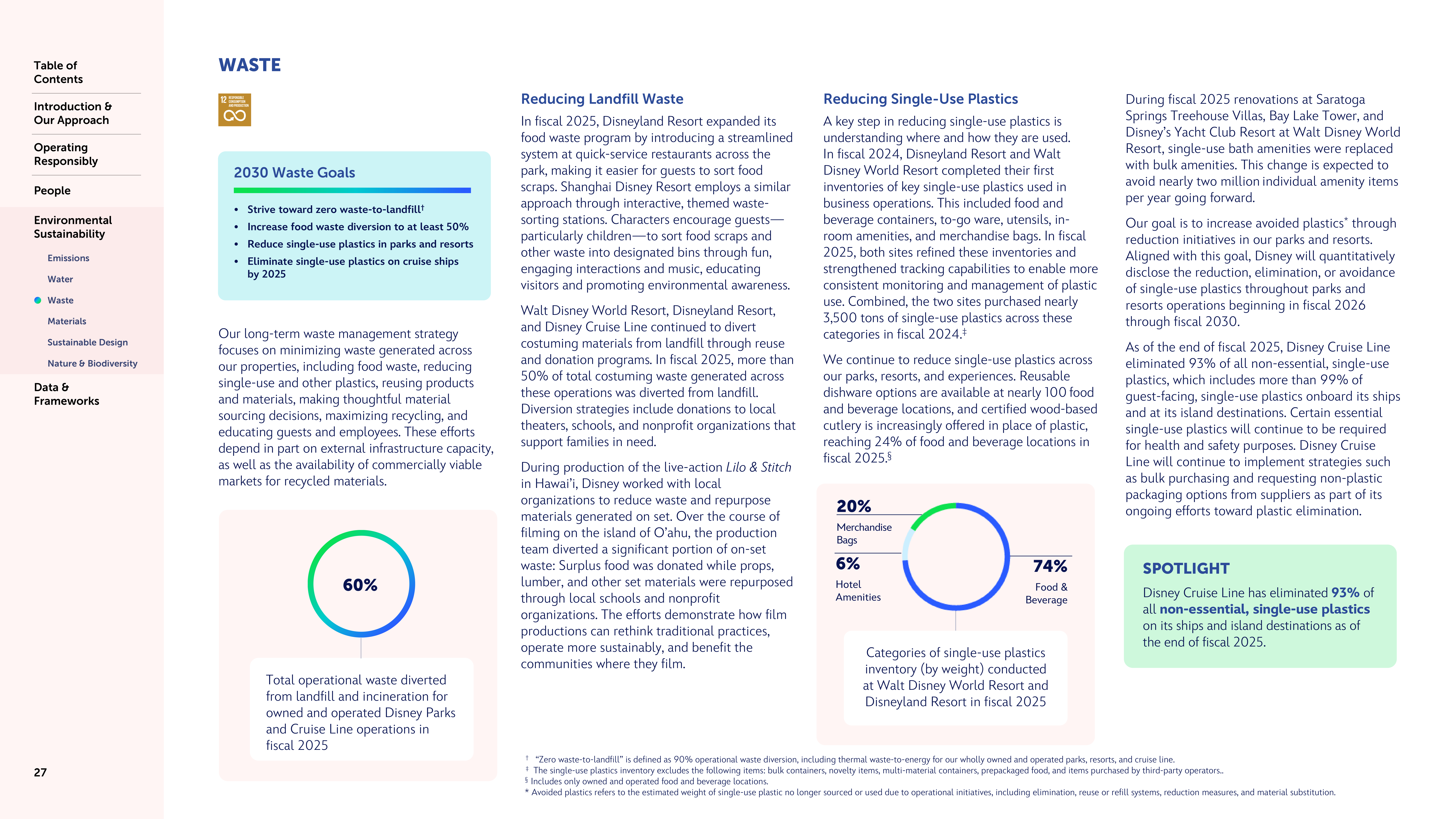


Table
of
Contents
Introduction
&
Our
Approach
Operating
Responsibly
People
Environmental
Sustainability
Emissions
Water
Waste
Materials
Sustainable
Design
Nature
&
Biodiversity
Data
&
Frameworks
WASTE
2030
Waste
Goals
•
Strive
toward
zero
waste-to-landfill
†
•
Increase
food
waste
diversion
to
at
least
50%
•
Reduce
single-use
plastics
in
parks
and
resorts
•
Eliminate
single-use
plastics
on
cruise
ships
by
2025
Our
long-term
waste
management
strategy
focuses
on
minimizing
waste
generated
across
our
properties,
including
food
waste,
reducing
single-use
and
other
plastics,
reusing
products
and
materials,
making
thoughtful
material
sourcing
decisions,
maximizing
recycling,
and
educating
guests
and
employees.
These
efforts
depend
in
part
on
external
infrastructure
capacity,
as
well
as
the
availability
of
commercially
viable
markets
for
recycled
materials.
60%
Total
operational
waste
diverted
from
landfill
and
incineration
for
owned
and
operated
Disney
Parks
and
Cruise
Line
operations
in
fiscal
2025
Reducing
Landfill
Waste
In
fiscal
2025,
Disneyland
Resort
expanded
its
food
waste
program
by
introducing
a
streamlined
system
at
quick-service
restaurants
across
the
park,
making
it
easier
for
guests
to
sort
food
scraps.
Shanghai
Disney
Resort
employs
a
similar
approach
through
interactive,
themed
waste-
sorting
stations.
Characters
encourage
guests—
particularly
children—to
sort
food
scraps
and
other
waste
into
designated
bins
through
fun,
engaging
interactions
and
music,
educating
visitors
and
promoting
environmental
awareness.
Walt
Disney
World
Resort,
Disneyland
Resort,
and
Disney
Cruise
Line
continued
to
divert
costuming
materials
from
landfill
through
reuse
and
donation
programs.
In
fiscal
2025,
more
than
50%
of
total
costuming
waste
generated
across
these
operations
was
diverted
from
landfill.
Diversion
strategies
include
donations
to
local
theaters,
schools,
and
nonprofit
organizations
that
support
families
in
need.
During
production
of
the
live-action
Lilo
&
Stitch
in
Hawaiʼi,
Disney
worked
with
local
organizations
to
reduce
waste
and
repurpose
materials
generated
on
set.
Over
the
course
of
filming
on
the
island
of
Oʼahu,
the
production
team
diverted
a
significant
portion
of
on-set
waste:
Surplus
food
was
donated
while
props,
lumber,
and
other
set
materials
were
repurposed
through
local
schools
and
nonprofit
organizations.
The
efforts
demonstrate
how
film
productions
can
rethink
traditional
practices,
operate
more
sustainably,
and
benefit
the
communities
where
they
film.
Reducing
Single-Use
Plastics
A
key
step
in
reducing
single-use
plastics
is
understanding
where
and
how
they
are
used.
In
fiscal
2024,
Disneyland
Resort
and
Walt
Disney
World
Resort
completed
their
first
inventories
of
key
single-use
plastics
used
in
business
operations.
This
included
food
and
beverage
containers,
to-go
ware,
utensils,
in-
room
amenities,
and
merchandise
bags.
In
fiscal
2025,
both
sites
refined
these
inventories
and
strengthened
tracking
capabilities
to
enable
more
consistent
monitoring
and
management
of
plastic
use.
Combined,
the
two
sites
purchased
nearly
3,500
tons
of
single-use
plastics
across
these
categories
in
fiscal
2024.
‡
We
continue
to
reduce
single-use
plastics
across
our
parks,
resorts,
and
experiences.
Reusable
dishware
options
are
available
at
nearly
100
food
and
beverage
locations,
and
certified
wood-based
cutlery
is
increasingly
offered
in
place
of
plastic,
reaching
24%
of
food
and
beverage
locations
in
fiscal
2025.
§
20%
Merchandise
Bags
6%
Hotel
Amenities
74%
Food
&
Beverage
Categories
of
single-use
plastics
inventory
(by
weight)
conducted
at
Walt
Disney
World
Resort
and
Disneyland
Resort
in
fiscal
2025
During
fiscal
2025
renovations
at
Saratoga
Springs
Treehouse
Villas,
Bay
Lake
Tower,
and
Disneyʼs
Yacht
Club
Resort
at
Walt
Disney
World
Resort,
single-use
bath
amenities
were
replaced
with
bulk
amenities.
This
change
is
expected
to
avoid
nearly
two
million
individual
amenity
items
per
year
going
forward.
Our
goal
is
to
increase
avoided
plastics
*
through
reduction
initiatives
in
our
parks
and
resorts.
Aligned
with
this
goal,
Disney
will
quantitatively
disclose
the
reduction,
elimination,
or
avoidance
of
single-use
plastics
throughout
parks
and
resorts
operations
beginning
in
fiscal
2026
through
fiscal
2030.
As
of
the
end
of
fiscal
2025,
Disney
Cruise
Line
eliminated
93%
of
all
non-essential,
single-use
plastics,
which
includes
more
than
99%
of
guest-facing,
single-use
plastics
onboard
its
ships
and
at
its
island
destinations.
Certain
essential
single-use
plastics
will
continue
to
be
required
for
health
and
safety
purposes.
Disney
Cruise
Line
will
continue
to
implement
strategies
such
as
bulk
purchasing
and
requesting
non-plastic
packaging
options
from
suppliers
as
part
of
its
ongoing
efforts
toward
plastic
elimination.
SPOTLIGHT
Disney
Cruise
Line
has
eliminated
93%
of
all
non-essential,
single-use
plastics
on
its
ships
and
island
destinations
as
of
the
end
of
fiscal
2025.
†
“Zero
waste-to-landfill”
is
defined
as
90%
operational
waste
diversion,
including
thermal
waste-to-energy
for
our
wholly
owned
and
operated
parks,
resorts,
and
cruise
line.
‡
The
single-use
plastics
inventory
excludes
the
following
items:
bulk
containers,
novelty
items,
multi-material
containers,
prepackaged
food,
and
items
purchased
by
third-party
operators..
27
§
Includes
only
owned
and
operated
food
and
beverage
locations.
*
Avoided
plastics
refers
to
the
estimated
weight
of
single-use
plastic
no
longer
sourced
or
used
due
to
operational
initiatives,
including
elimination,
reuse
or
refill
systems,
reduction
measures,
and
material
substitution.
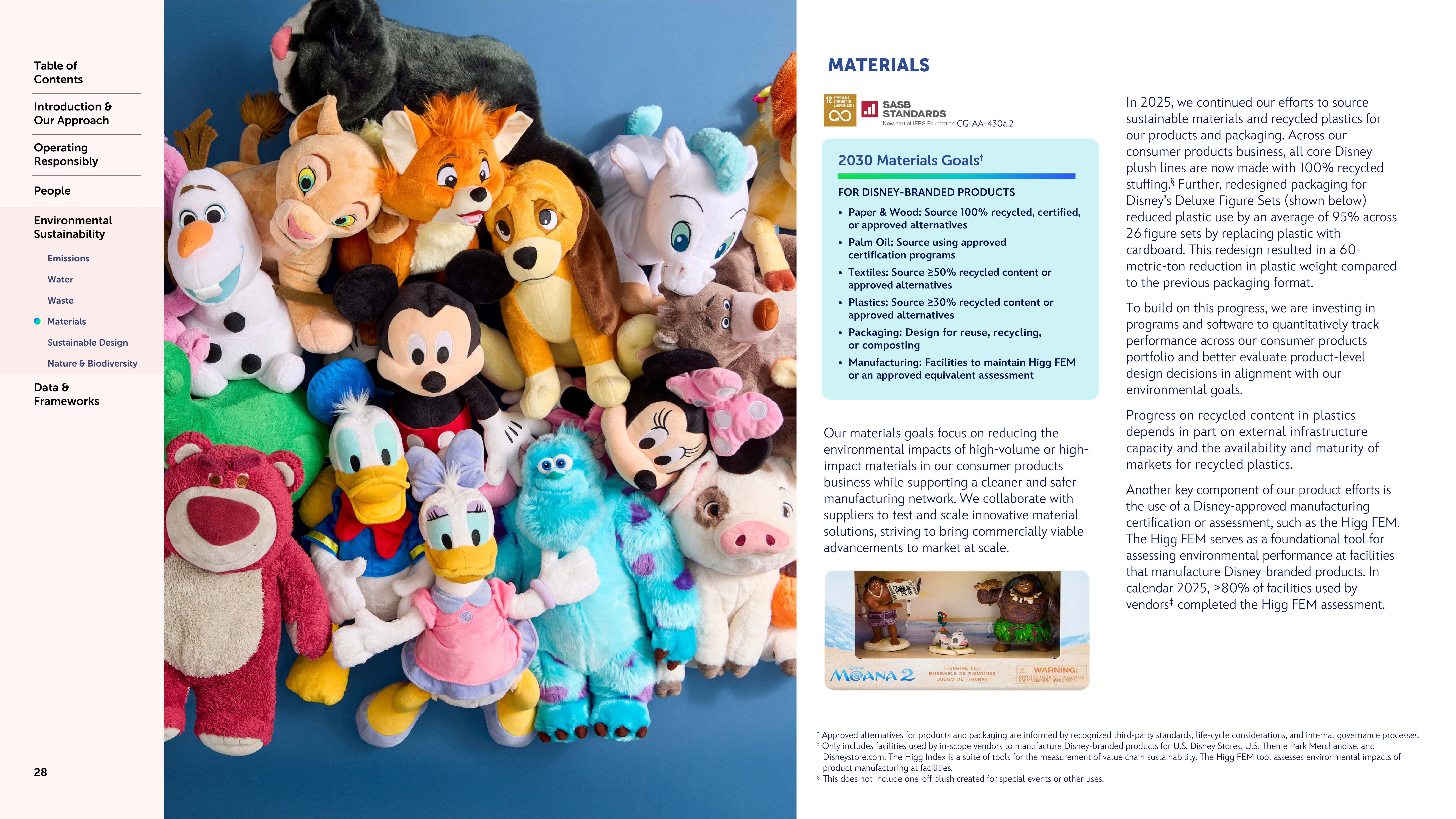


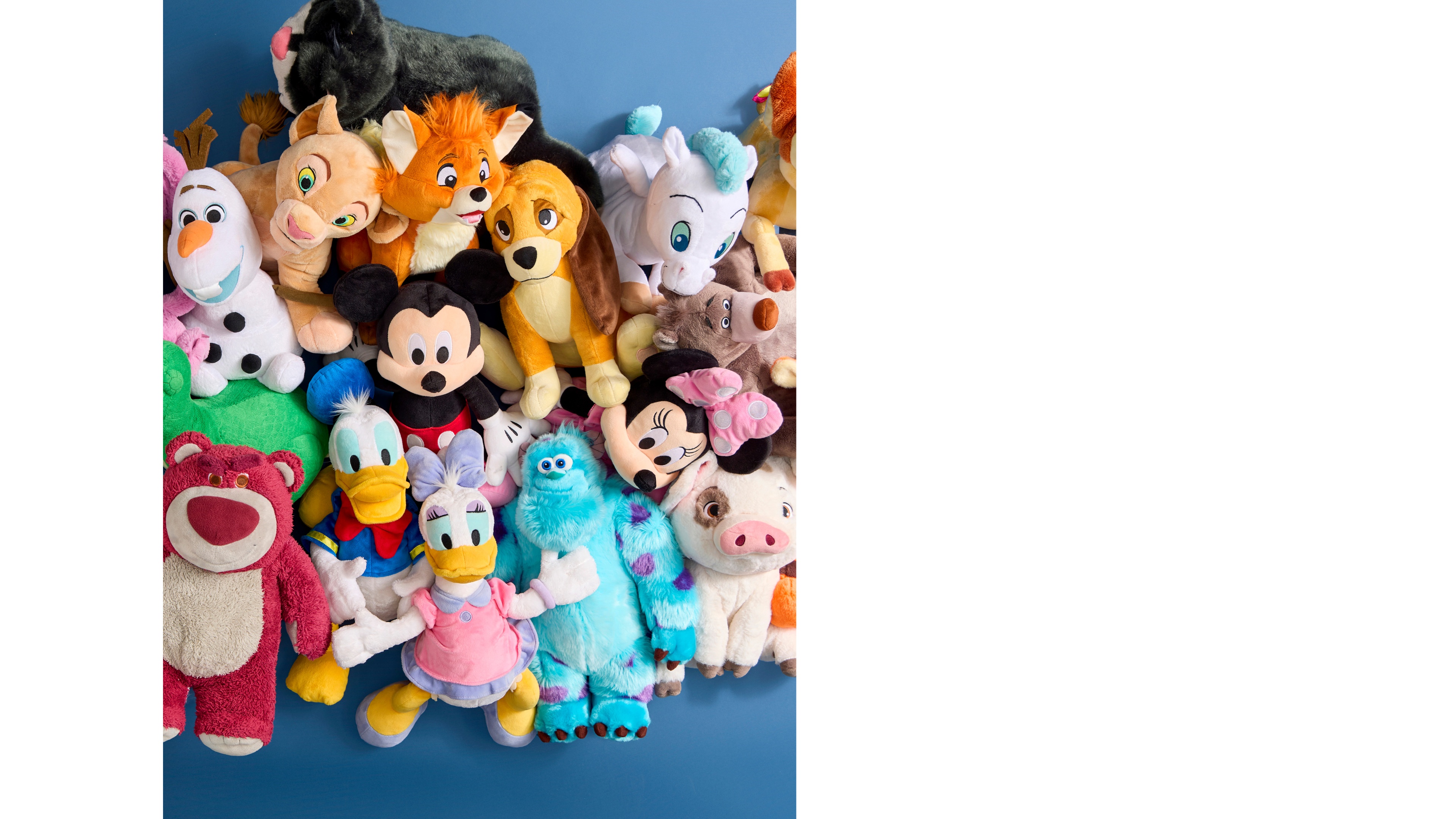
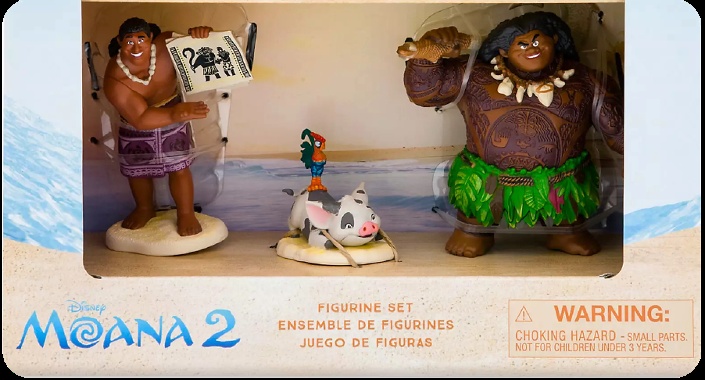
Materials
MATERIALS
Table
of
Contents
Introduction
&
Our
Approach
Operating
Responsibly
People
Environmental
Sustainability
Emissions
Water
Waste
Sustainable
Design
Nature
&
Biodiversity
Data
&
Frameworks
CG-AA-430a.2
2030
Materials
Goals
†
FOR
DISNEY-BRANDED
PRODUCTS
•
Paper
&
Wood:
Source
100%
recycled,
certified,
or
approved
alternatives
•
Palm
Oil:
Source
using
approved
certification
programs
•
Textiles:
Source
≥50%
recycled
content
or
approved
alternatives
•
Plastics:
Source
≥30%
recycled
content
or
approved
alternatives
•
Packaging:
Design
for
reuse,
recycling,
or
composting
•
Manufacturing:
Facilities
to
maintain
Higg
FEM
or
an
approved
equivalent
assessment
Our
materials
goals
focus
on
reducing
the
environmental
impacts
of
high-volume
or
high-
impact
materials
in
our
consumer
products
business
while
supporting
a
cleaner
and
safer
manufacturing
network.
We
collaborate
with
suppliers
to
test
and
scale
innovative
material
solutions,
striving
to
bring
commercially
viable
advancements
to
market
at
scale.
In
2025,
we
continued
our
efforts
to
source
sustainable
materials
and
recycled
plastics
for
our
products
and
packaging.
Across
our
consumer
products
business,
all
core
Disney
plush
lines
are
now
made
with
100%
recycled
stuffing.
§
Further,
redesigned
packaging
for
Disneyʼs
Deluxe
Figure
Sets
(shown
below)
reduced
plastic
use
by
an
average
of
95%
across
26
figure
sets
by
replacing
plastic
with
cardboard.
This
redesign
resulted
in
a
60-
metric-ton
reduction
in
plastic
weight
compared
to
the
previous
packaging
format.
To
build
on
this
progress,
we
are
investing
in
programs
and
software
to
quantitatively
track
performance
across
our
consumer
products
portfolio
and
better
evaluate
product-level
design
decisions
in
alignment
with
our
environmental
goals.
Progress
on
recycled
content
in
plastics
depends
in
part
on
external
infrastructure
capacity
and
the
availability
and
maturity
of
markets
for
recycled
plastics.
Another
key
component
of
our
product
efforts
is
the
use
of
a
Disney-approved
manufacturing
certification
or
assessment,
such
as
the
Higg
FEM.
The
Higg
FEM
serves
as
a
foundational
tool
for
assessing
environmental
performance
at
facilities
that
manufacture
Disney-branded
products.
In
calendar
2025,
>80%
of
facilities
used
by
vendors
‡
completed
the
Higg
FEM
assessment.
†
Approved
alternatives
for
products
and
packaging
are
informed
by
recognized
third-party
standards,
life-cycle
considerations,
and
internal
governance
processes.
‡
Only
includes
facilities
used
by
in-scope
vendors
to
manufacture
Disney-branded
products
for
U.S.
Disney
Stores,
U.S.
Theme
Park
Merchandise,
and
Disneystore.com.
The
Higg
Index
is
a
suite
of
tools
for
the
measurement
of
value
chain
sustainability.
The
Higg
FEM
tool
assesses
environmental
impacts
of
product
manufacturing
at
facilities.
§
This
does
not
include
one-off
plush
created
for
special
events
or
other
uses.
28
Materials
MATERIALS
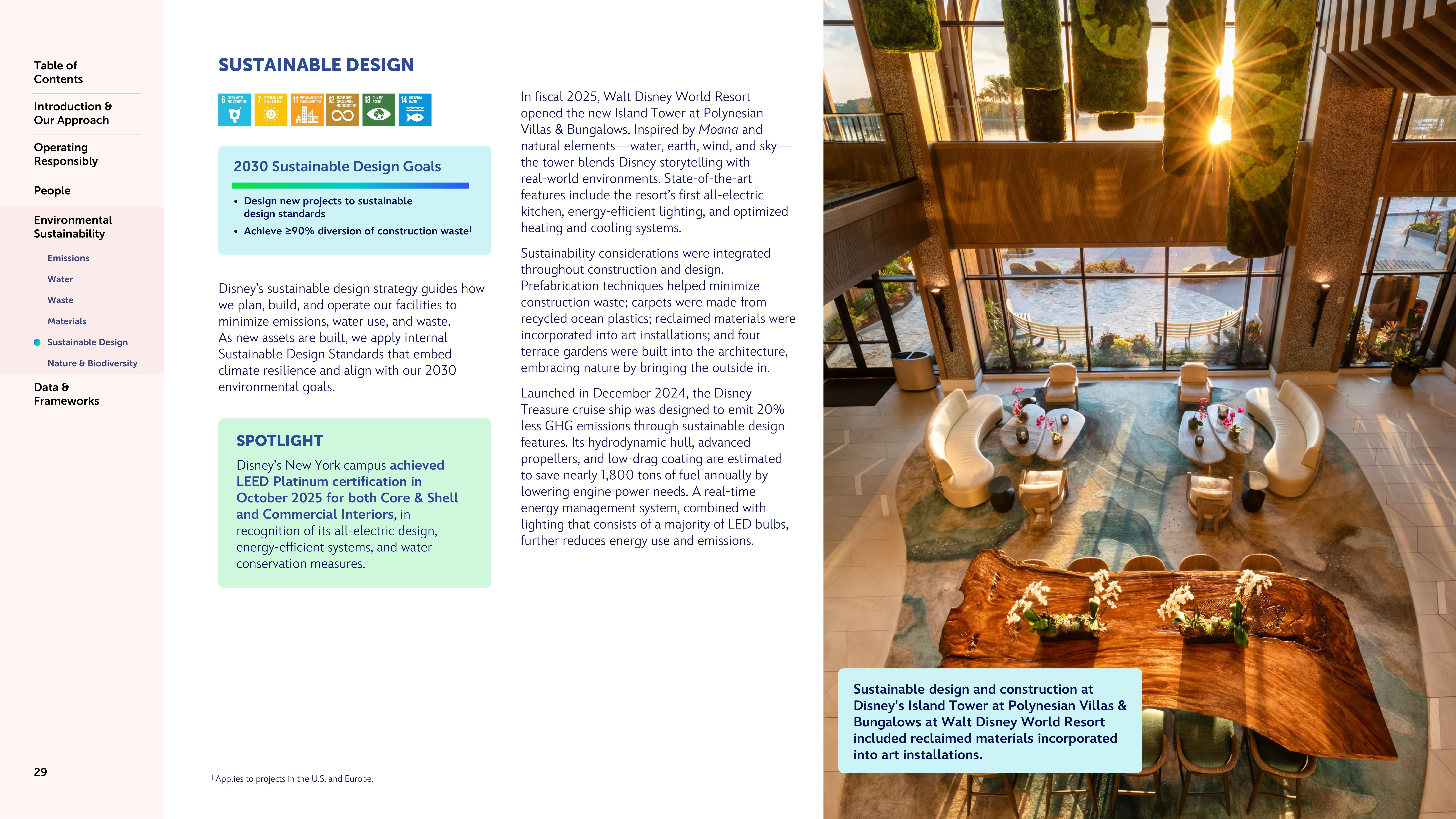



Sustainable
Design
SUSTAINABLE
DESIGN
2030
Sustainable
Design
Goals
•
Design
new
projects
to
sustainable
design
standards
•
Achieve
≥90%
diversion
of
construction
waste
†
Disneyʼs
sustainable
design
strategy
guides
how
we
plan,
build,
and
operate
our
facilities
to
minimize
emissions,
water
use,
and
waste.
As
new
assets
are
built,
we
apply
internal
Sustainable
Design
Standards
that
embed
climate
resilience
and
align
with
our
2030
environmental
goals.
SPOTLIGHT
Disneyʼs
New
York
campus
achieved
LEED
Platinum
certification
in
October
2025
for
both
Core
&
Shell
and
Commercial
Interiors
,
in
recognition
of
its
all-electric
design,
energy-efficient
systems,
and
water
conservation
measures.
In
fiscal
2025,
Walt
Disney
World
Resort
opened
the
new
Island
Tower
at
Polynesian
Villas
&
Bungalows.
Inspired
by
Moana
and
natural
elements—water,
earth,
wind,
and
sky—
the
tower
blends
Disney
storytelling
with
real-world
environments.
State-of-the-art
features
include
the
resortʼs
first
all-electric
kitchen,
energy-efficient
lighting,
and
optimized
heating
and
cooling
systems.
Sustainability
considerations
were
integrated
throughout
construction
and
design.
Prefabrication
techniques
helped
minimize
construction
waste;
carpets
were
made
from
recycled
ocean
plastics;
reclaimed
materials
were
incorporated
into
art
installations;
and
four
terrace
gardens
were
built
into
the
architecture,
embracing
nature
by
bringing
the
outside
in.
Launched
in
December
2024,
the
Disney
Treasure
cruise
ship
was
designed
to
emit
20%
less
GHG
emissions
through
sustainable
design
features.
Its
hydrodynamic
hull,
advanced
propellers,
and
low-drag
coating
are
estimated
to
save
nearly
1,800
tons
of
fuel
annually
by
lowering
engine
power
needs.
A
real-time
energy
management
system,
combined
with
lighting
that
consists
of
a
majority
of
LED
bulbs,
further
reduces
energy
use
and
emissions.
Table
of
Contents
Introduction
&
Our
Approach
Operating
Responsibly
People
Environmental
Sustainability
Emissions
Water
Waste
Materials
Nature
&
Biodiversity
Data
&
Frameworks
Sustainable
design
and
construction
at
Disney's
Island
Tower
at
Polynesian
Villas
&
Bungalows
at
Walt
Disney
World
Resort
included
reclaimed
materials
incorporated
into
art
installations.
†
Applies
to
projects
in
the
U.S.
and
Europe.
29
Sustainable
Design
SUSTAINABLE
DESIGN
2030
Sustainable
Design
Goals
•
Design
new
projects
to
sustainable
design
standards
•
Achieve
≥90%
diversion
of
construction
waste
†
Disneyʼs
sustainable
design
strategy
guides
how
we
plan,
build,
and
operate
our
facilities
to
minimize
emissions,
water
use,
and
waste.
As
new
assets
are
built,
we
apply
internal
Sustainable
Design
Standards
that
embed
climate
resilience
and
align
with
our
2030
environmental
goals.
SPOTLIGHT
Disneyʼs
New
York
campus
achieved
LEED
Platinum
certification
in
October
2025
for
both
Core
&
Shell
and
Commercial
Interiors
,
in
recognition
of
its
all-electric
design,
energy-efficient
systems,
and
water
conservation
measures.
In
fiscal
2025,
Walt
Disney
World
Resort
opened
the
new
Island
Tower
at
Polynesian
Villas
&
Bungalows.
Inspired
by
Moana
and
natural
elements—water,
earth,
wind,
and
sky—
the
tower
blends
Disney
storytelling
with
real-world
environments.
State-of-the-art
features
include
the
resortʼs
first
all-electric
kitchen,
energy-efficient
lighting,
and
optimized
heating
and
cooling
systems.
Sustainability
considerations
were
integrated
throughout
construction
and
design.
Prefabrication
techniques
helped
minimize
construction
waste;
carpets
were
made
from
recycled
ocean
plastics;
reclaimed
materials
were
incorporated
into
art
installations;
and
four
terrace
gardens
were
built
into
the
architecture,
embracing
nature
by
bringing
the
outside
in.
Launched
in
December
2024,
the
Disney
Treasure
cruise
ship
was
designed
to
emit
20%
less
GHG
emissions
through
sustainable
design
features.
Its
hydrodynamic
hull,
advanced
propellers,
and
low-drag
coating
are
estimated
to
save
nearly
1,800
tons
of
fuel
annually
by
lowering
engine
power
needs.
A
real-time
energy
management
system,
combined
with
lighting
that
consists
of
a
majority
of
LED
bulbs,
further
reduces
energy
use
and
emissions.
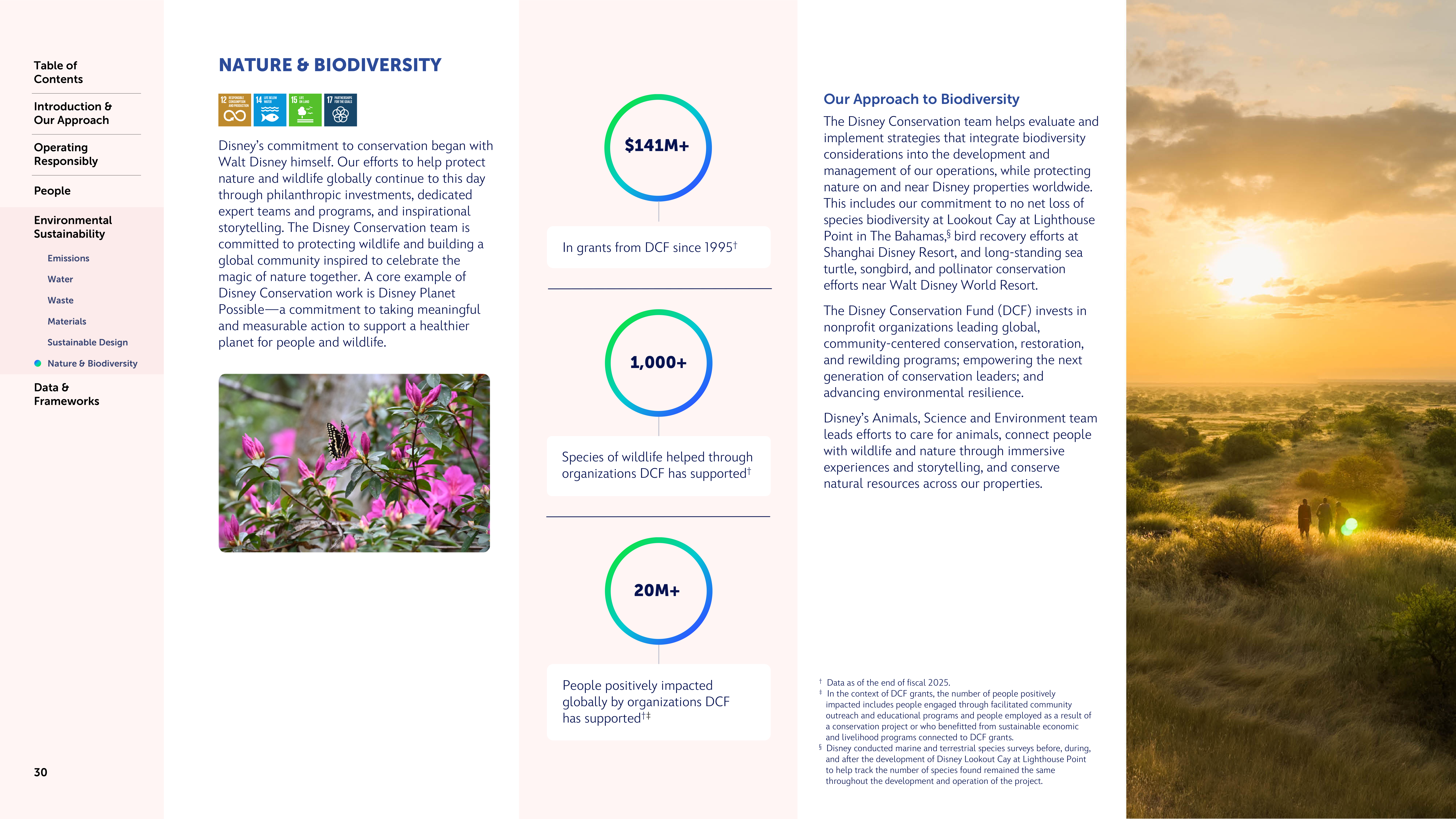




Nature
&
Biodiversity
NATURE
&
BIODIVERSITY
Disneyʼs
commitment
to
conservation
began
with
Walt
Disney
himself.
Our
efforts
to
help
protect
nature
and
wildlife
globally
continue
to
this
day
through
philanthropic
investments,
dedicated
expert
teams
and
programs,
and
inspirational
storytelling.
The
Disney
Conservation
team
is
committed
to
protecting
wildlife
and
building
a
global
community
inspired
to
celebrate
the
magic
of
nature
together.
A
core
example
of
Disney
Conservation
work
is
Disney
Planet
Possible—a
commitment
to
taking
meaningful
and
measurable
action
to
support
a
healthier
planet
for
people
and
wildlife.
$141M+
In
grants
from
DCF
since
1995
†
1,000+
Species
of
wildlife
helped
through
organizations
DCF
has
supported
†
20M+
People
positively
impacted
globally
by
organizations
DCF
has
supported
†
‡
Our
Approach
to
Biodiversity
The
Disney
Conservation
team
helps
evaluate
and
implement
strategies
that
integrate
biodiversity
considerations
into
the
development
and
management
of
our
operations,
while
protecting
nature
on
and
near
Disney
properties
worldwide.
This
includes
our
commitment
to
no
net
loss
of
species
biodiversity
at
Lookout
Cay
at
Lighthouse
Point
in
The
Bahamas,
§
bird
recovery
efforts
at
Shanghai
Disney
Resort,
and
long-standing
sea
turtle,
songbird,
and
pollinator
conservation
efforts
near
Walt
Disney
World
Resort.
The
Disney
Conservation
Fund
(DCF)
invests
in
nonprofit
organizations
leading
global,
community-centered
conservation,
restoration,
and
rewilding
programs;
empowering
the
next
generation
of
conservation
leaders;
and
advancing
environmental
resilience.
Disneyʼs
Animals,
Science
and
Environment
team
leads
efforts
to
care
for
animals,
connect
people
with
wildlife
and
nature
through
immersive
experiences
and
storytelling,
and
conserve
natural
resources
across
our
properties.
†
Data
as
of
the
end
of
fiscal
2025.
‡
In
the
context
of
DCF
grants,
the
number
of
people
positively
impacted
includes
people
engaged
through
facilitated
community
outreach
and
educational
programs
and
people
employed
as
a
result
of
a
conservation
project
or
who
benefitted
from
sustainable
economic
and
livelihood
programs
connected
to
DCF
grants.
§
Disney
conducted
marine
and
terrestrial
species
surveys
before,
during,
and
after
the
development
of
Disney
Lookout
Cay
at
Lighthouse
Point
to
help
track
the
number
of
species
found
remained
the
same
throughout
the
development
and
operation
of
the
project.
Table
of
Contents
Introduction
&
Our
Approach
Operating
Responsibly
People
Environmental
Sustainability
Emissions
Water
Waste
Materials
Sustainable
Design
Data
&
Frameworks
30
Nature
&
Biodiversity
NATURE
&
BIODIVERSITY
Disneyʼs
commitment
to
conservation
began
with
Walt
Disney
himself.
Our
efforts
to
help
protect
nature
and
wildlife
globally
continue
to
this
day
through
philanthropic
investments,
dedicated
expert
teams
and
programs,
and
inspirational
storytelling.
The
Disney
Conservation
team
is
committed
to
protecting
wildlife
and
building
a
global
community
inspired
to
celebrate
the
magic
of
nature
together.
A
core
example
of
Disney
Conservation
work
is
Disney
Planet
Possible—a
commitment
to
taking
meaningful
and
measurable
action
to
support
a
healthier
planet
for
people
and
wildlife.
$141M+
In
grants
from
DCF
since
1995
†
1,000+
Species
of
wildlife
helped
through
organizations
DCF
has
supported
†
20M+
People
positively
impacted
globally
by
organizations
DCF
has
supported
†
‡
Our
Approach
to
Biodiversity
The
Disney
Conservation
team
helps
evaluate
and
implement
strategies
that
integrate
biodiversity
considerations
into
the
development
and
management
of
our
operations,
while
protecting
nature
on
and
near
Disney
properties
worldwide.
This
includes
our
commitment
to
no
net
loss
of
species
biodiversity
at
Lookout
Cay
at
Lighthouse
Point
in
The
Bahamas,
§
bird
recovery
efforts
at
Shanghai
Disney
Resort,
and
long-standing
sea
turtle,
songbird,
and
pollinator
conservation
efforts
near
Walt
Disney
World
Resort.
The
Disney
Conservation
Fund
(DCF)
invests
in
nonprofit
organizations
leading
global,
community-centered
conservation,
restoration,
and
rewilding
programs;
empowering
the
next
generation
of
conservation
leaders;
and
advancing
environmental
resilience.
Disneyʼs
Animals,
Science
and
Environment
team
leads
efforts
to
care
for
animals,
connect
people
with
wildlife
and
nature
through
immersive
experiences
and
storytelling,
and
conserve
natural
resources
across
our
properties.
†
Data
as
of
the
end
of
fiscal
2025.
‡
In
the
context
of
DCF
grants,
the
number
of
people
positively
impacted
includes
people
engaged
through
facilitated
community
outreach
and
educational
programs
and
people
employed
as
a
result
of
a
conservation
project
or
who
benefitted
from
sustainable
economic
and
livelihood
programs
connected
to
DCF
grants.
§
Disney
conducted
marine
and
terrestrial
species
surveys
before,
during,
and
after
the
development
of
Disney
Lookout
Cay
at
Lighthouse
Point
to
help
track
the
number
of
species
found
remained
the
same
throughout
the
development
and
operation
of
the
project.
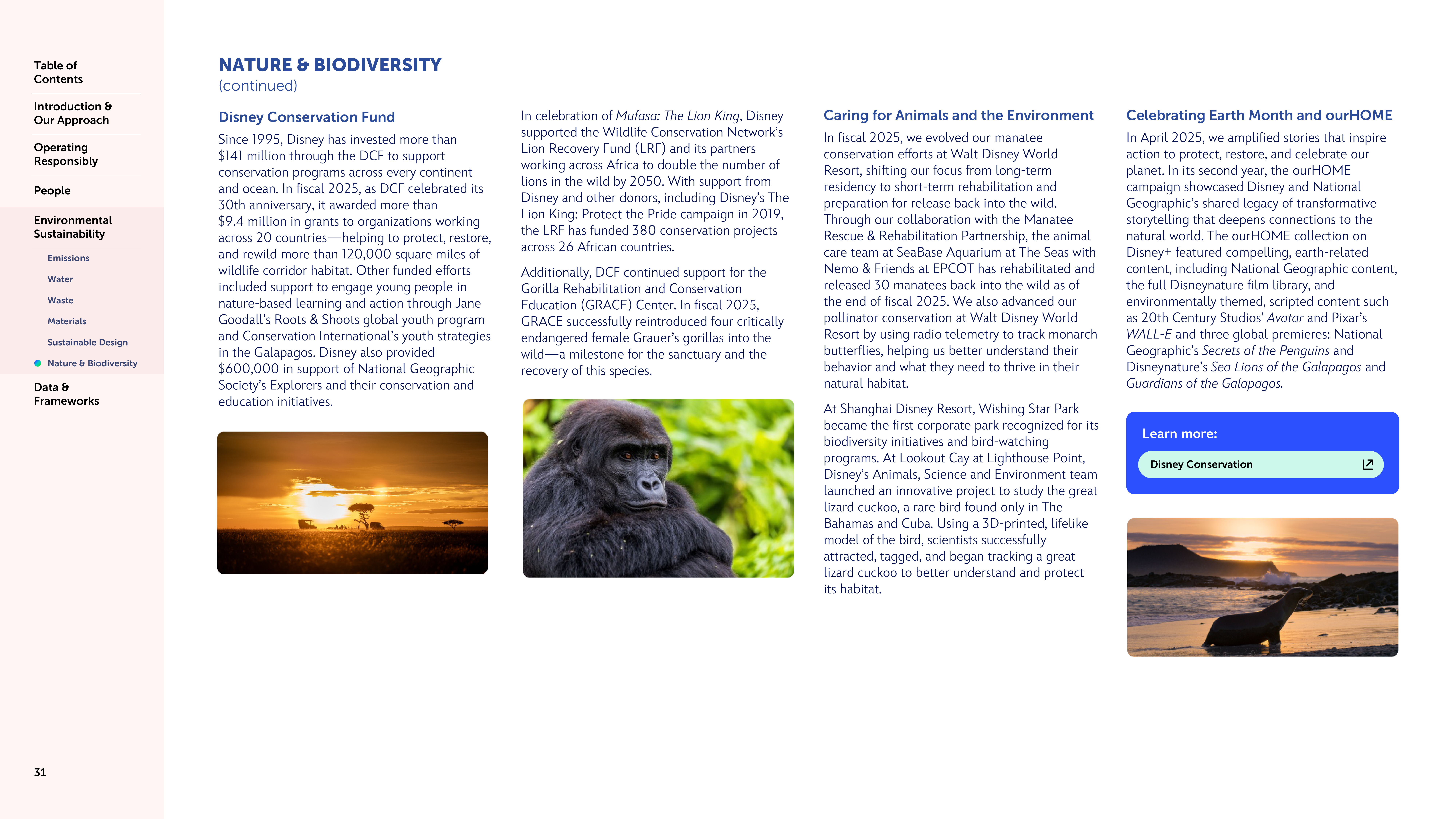

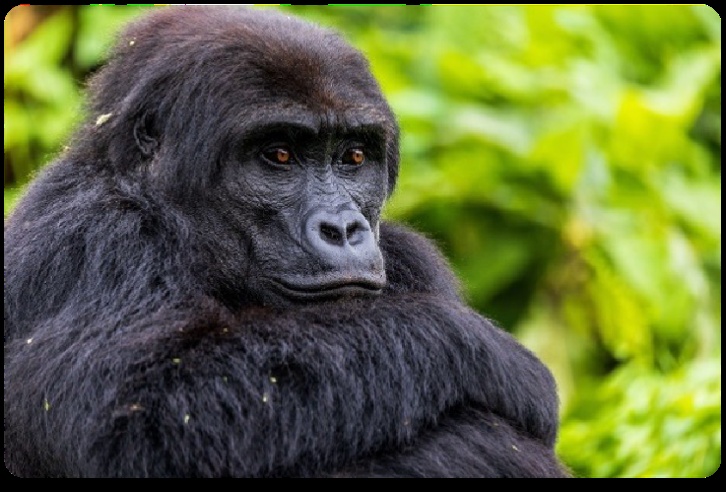
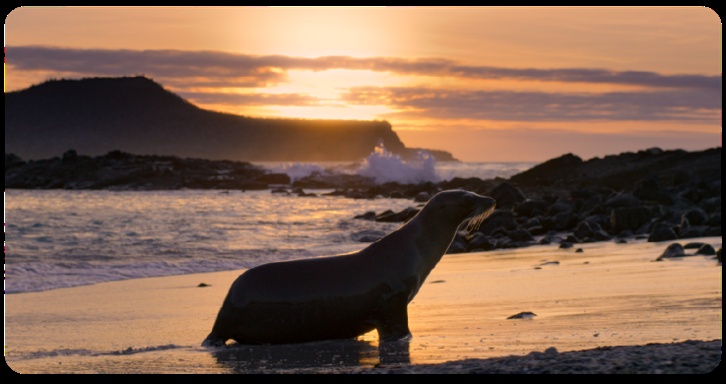
Table
of
Contents
Introduction
&
Our
Approach
Operating
Responsibly
People
Environmental
Sustainability
Emissions
Water
Waste
Materials
Sustainable
Design
Nature
&
Biodiversity
Data
&
Frameworks
NATURE
&
BIODIVERSITY
(continued)
Disney
Conservation
Fund
Since
1995,
Disney
has
invested
more
than
$141
million
through
the
DCF
to
support
conservation
programs
across
every
continent
and
ocean.
In
fiscal
2025,
as
DCF
celebrated
its
30th
anniversary,
it
awarded
more
than
$9.4
million
in
grants
to
organizations
working
across
20
countries—helping
to
protect,
restore,
and
rewild
more
than
120,000
square
miles
of
wildlife
corridor
habitat.
Other
funded
efforts
included
support
to
engage
young
people
in
nature-based
learning
and
action
through
Jane
Goodallʼs
Roots
&
Shoots
global
youth
program
and
Conservation
Internationalʼs
youth
strategies
in
the
Galapagos.
Disney
also
provided
$600,000
in
support
of
National
Geographic
Societyʼs
Explorers
and
their
conservation
and
education
initiatives.
In
celebration
of
Mufasa:
The
Lion
King
,
Disney
supported
the
Wildlife
Conservation
Networkʼs
Lion
Recovery
Fund
(LRF)
and
its
partners
working
across
Africa
to
double
the
number
of
lions
in
the
wild
by
2050.
With
support
from
Disney
and
other
donors,
including
Disneyʼs
The
Lion
King:
Protect
the
Pride
campaign
in
2019,
the
LRF
has
funded
380
conservation
projects
across
26
African
countries.
Additionally,
DCF
continued
support
for
the
Gorilla
Rehabilitation
and
Conservation
Education
(GRACE)
Center.
In
fiscal
2025,
GRACE
successfully
reintroduced
four
critically
endangered
female
Grauerʼs
gorillas
into
the
wild—a
milestone
for
the
sanctuary
and
the
recovery
of
this
species.
Caring
for
Animals
and
the
Environment
In
fiscal
2025,
we
evolved
our
manatee
conservation
efforts
at
Walt
Disney
World
Resort,
shifting
our
focus
from
long-term
residency
to
short-term
rehabilitation
and
preparation
for
release
back
into
the
wild.
Through
our
collaboration
with
the
Manatee
Rescue
&
Rehabilitation
Partnership,
the
animal
care
team
at
SeaBase
Aquarium
at
The
Seas
with
Nemo
&
Friends
at
EPCOT
has
rehabilitated
and
released
30
manatees
back
into
the
wild
as
of
the
end
of
fiscal
2025.
We
also
advanced
our
pollinator
conservation
at
Walt
Disney
World
Resort
by
using
radio
telemetry
to
track
monarch
butterflies,
helping
us
better
understand
their
behavior
and
what
they
need
to
thrive
in
their
natural
habitat.
At
Shanghai
Disney
Resort,
Wishing
Star
Park
became
the
first
corporate
park
recognized
for
its
biodiversity
initiatives
and
bird-watching
programs.
At
Lookout
Cay
at
Lighthouse
Point,
Disneyʼs
Animals,
Science
and
Environment
team
launched
an
innovative
project
to
study
the
great
lizard
cuckoo,
a
rare
bird
found
only
in
The
Bahamas
and
Cuba.
Using
a
3D-printed,
lifelike
model
of
the
bird,
scientists
successfully
attracted,
tagged,
and
began
tracking
a
great
lizard
cuckoo
to
better
understand
and
protect
its
habitat.
Celebrating
Earth
Month
and
ourHOME
In
April
2025,
we
amplified
stories
that
inspire
action
to
protect,
restore,
and
celebrate
our
planet.
In
its
second
year,
the
ourHOME
campaign
showcased
Disney
and
National
Geographicʼs
shared
legacy
of
transformative
storytelling
that
deepens
connections
to
the
natural
world.
The
ourHOME
collection
on
Disney+
featured
compelling,
earth-related
content,
including
National
Geographic
content,
the
full
Disneynature
film
library,
and
environmentally
themed,
scripted
content
such
as
20th
Century
Studiosʼ
Avatar
and
Pixarʼs
WALL-E
and
three
global
premieres:
National
Geographicʼs
Secrets
of
the
Penguins
and
Disneynatureʼs
Sea
Lions
of
the
Galapagos
and
Guardians
of
the
Galapagos.
Learn
more:
Disney
Conservation
31


Data
&
Frameworks
Data
&
Frameworks
OVERVIEW
We
believe
disclosure
frameworks
are
helpful
in
providing
our
stakeholders
with
relevant,
useful
information.
We
regularly
monitor
existing
and
emerging
standards
and
frameworks
to
inform
our
sustainability
practices
and
reporting
approach.
We
track
year-over-year
performance
of
certain
metrics
and
provide
responses
to
select
third-party,
voluntary
reporting
indicators
to
help
stakeholders
access
the
sustainability
and
social
impact
information
that
may
be
important
to
them.
As
disclosure
expectations
continue
to
evolve,
we
assess
which
frameworks
and
related
disclosures
will
serve
stakeholdersʼ
needs
over
time.
For
fiscal
2025,
our
disclosures
align
with
the
following
frameworks:
the
SASB
Standards
(now
part
of
the
IFRS
Foundation),
the
TCFD,
and
the
United
Nations
SDGs.
Learn
more
about
our
company
and
our
social
and
environmental
responsibility
efforts:
The
Walt
Disney
Company
Homepage
Disney
Impact
View
our
Annual
Report
on
Form
10-K
for
the
year
ended
September
27,
2025:
Annual
Report
on
Form
10-K
Explore
more
policies
and
practices:
ESG
Reporting
Center
Table
of
Contents
Introduction
&
Our
Approach
Operating
Responsibly
People
Environmental
Sustainability
Fiscal
2025
Data
Table
SASB
Index
TCFD
Index
SDG
Indicators
32
Data
&
Frameworks
Data
&
Frameworks
OVERVIEW
We
believe
disclosure
frameworks
are
helpful
in
providing
our
stakeholders
with
relevant,
useful
information.
We
regularly
monitor
existing
and
emerging
standards
and
frameworks
to
inform
our
sustainability
practices
and
reporting
approach.
We
track
year-over-year
performance
of
certain
metrics
and
provide
responses
to
select
third-party,
voluntary
reporting
indicators
to
help
stakeholders
access
the
sustainability
and
social
impact
information
that
may
be
important
to
them.
As
disclosure
expectations
continue
to
evolve,
we
assess
which
frameworks
and
related
disclosures
will
serve
stakeholdersʼ
needs
over
time.
For
fiscal
2025,
our
disclosures
align
with
the
following
frameworks:
the
SASB
Standards
(now
part
of
the
IFRS
Foundation),
the
TCFD,
and
the
United
Nations
SDGs.
Learn
more
about
our
company
and
our
social
and
environmental
responsibility
efforts:
The
Walt
Disney
Company
Homepage
Disney
Impact
View
our
Annual
Report
on
Form
10-K
for
the
year
ended
September
27,
2025:
Annual
Report
on
Form
10-K
Explore
more
policies
and
practices:
ESG
Reporting
Center
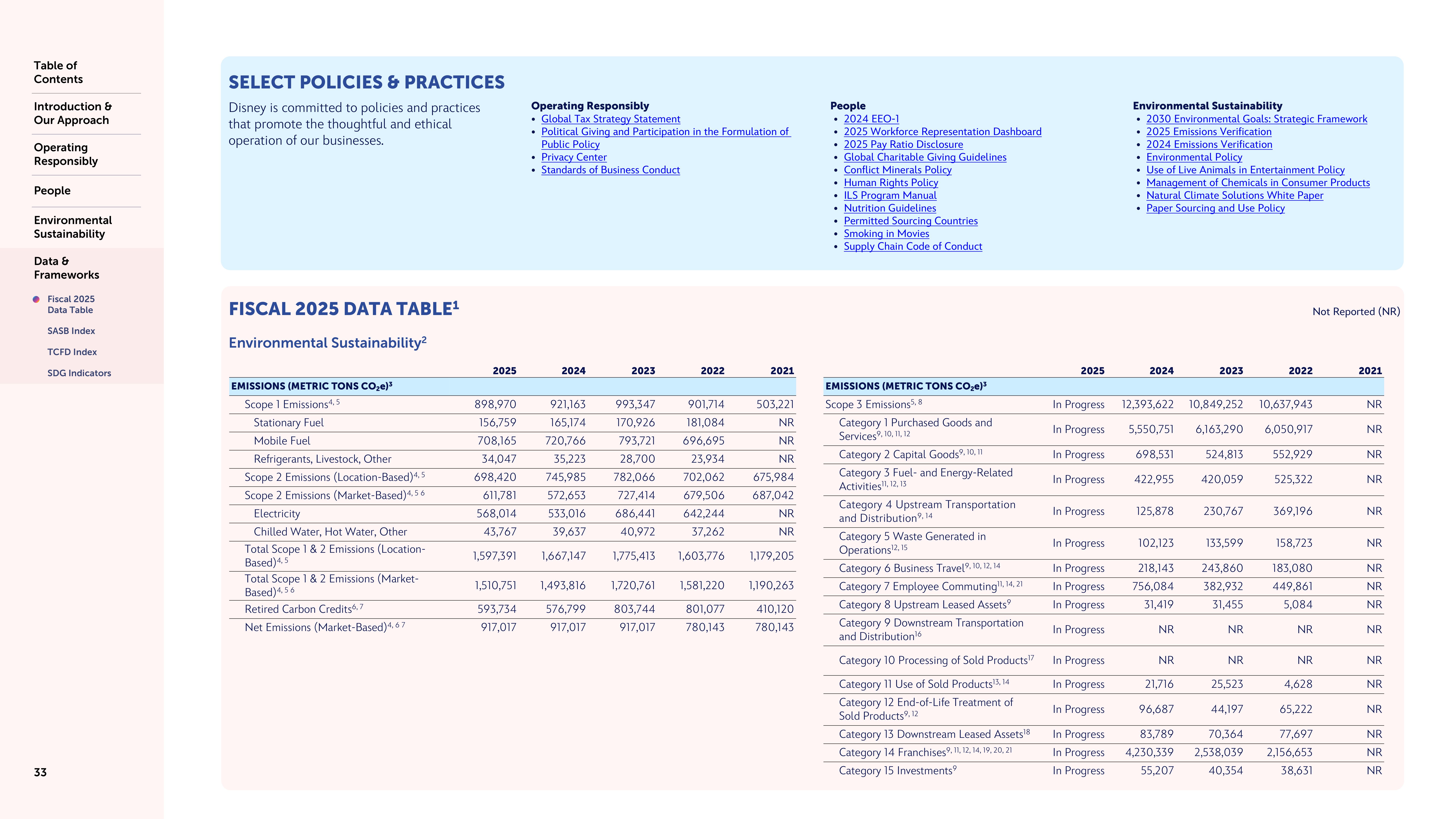
Table
of
Contents
Introduction
&
Our
Approach
Operating
Responsibly
People
Environmental
Sustainability
Data
&
Frameworks
Fiscal
2025
Data
Table
SASB
Index
TCFD
Index
SDG
Indicators
SELECT
POLICIES
&
PRACTICES
Disney
is
committed
to
policies
and
practices
that
promote
the
thoughtful
and
ethical
operation
of
our
businesses.
Operating
Responsibly
•
Global
Tax
Strategy
Statement
•
Political
Giving
and
Participation
in
the
Formulation
of
Public
Policy
•
Privacy
Center
•
Standards
of
Business
Conduct
People
•
2024
EEO-1
•
2025
Workforce
Representation
Dashboard
•
2025
Pay
Ratio
Disclosure
•
Global
Charitable
Giving
Guidelines
•
Conflict
Minerals
Policy
•
Human
Rights
Policy
•
ILS
Program
Manual
•
Nutrition
Guidelines
•
Permitted
Sourcing
Countries
•
Smoking
in
Movies
•
Supply
Chain
Code
of
Conduct
Environmental
Sustainability
•
2030
Environmental
Goals:
Strategic
Framework
•
2025
Emissions
Verification
•
2024
Emissions
Verification
•
Environmental
Policy
•
Use
of
Live
Animals
in
Entertainment
Policy
•
Management
of
Chemicals
in
Consumer
Products
•
Natural
Climate
Solutions
White
Paper
•
Paper
Sourcing
and
Use
Policy
FISCAL
2025
DATA
TABLE
1
Environmental
Sustainability
2
2025
2024
2023
2022
2021
EMISSIONS
(METRIC
TONS
CO
2
e)
3
Scope
1
Emissions
4, 5
898,970
921,163
993,347
901,714
503,221
Stationary
Fuel
156,759
165,174
170,926
181,084
NR
Mobile
Fuel
708,165
720,766
793,721
696,695
NR
Refrigerants,
Livestock,
Other
34,047
35,223
28,700
23,934
NR
Scope
2
Emissions
(Location-Based)
4,
5
698,420
745,985
782,066
702,062
675,984
Scope
2
Emissions
(Market-Based)
4,
5
6
611,781
572,653
727,414
679,506
687,042
Electricity
568,014
533,016
686,441
642,244
NR
Chilled
Water,
Hot
Water,
Other
43,767
39,637
40,972
37,262
NR
Total
Scope
1
&
2
Emissions
(Location-
Based)
4,
5
1,597,391
1,667,147
1,775,413
1,603,776
1,179,205
Total
Scope
1
&
2
Emissions
(Market-
Based)
4,
5
6
1,510,751
1,493,816
1,720,761
1,581,220
1,190,263
Retired
Carbon
Credits
6,
7
593,734
576,799
803,744
801,077
410,120
Net
Emissions
(Market-Based)
4,
6
7
917,017
917,017
917,017
780,143
780,143
2025
2024
2023
2022
2021
EMISSIONS
(METRIC
TONS
CO
2
e)
3
Scope
3
Emissions
5,
8
In
Progress
12,393,622
10,849,252
10,637,943
NR
Category
1
Purchased
Goods
and
Services
9,
10,
11,
12
In
Progress
5,550,751
6,163,290
6,050,917
NR
Category
2
Capital
Goods
9,
10,
11
In
Progress
698,531
524,813
552,929
NR
Category
3
Fuel-
and
Energy-Related
Activities
11,
12,
13
In
Progress
422,955
420,059
525,322
NR
Category
4
Upstream
Transportation
and
Distribution
9,
14
In
Progress
125,878
230,767
369,196
NR
Category
5
Waste
Generated
in
Operations
12,
15
In
Progress
102,123
133,599
158,723
NR
Category
6
Business
Travel
9,
10,
12,
14
In
Progress
218,143
243,860
183,080
NR
Category
7
Employee
Commuting
11,
14,
21
In
Progress
756,084
382,932
449,861
NR
Category
8
Upstream
Leased
Assets
9
In
Progress
31,419
31,455
5,084
NR
Category
9
Downstream
Transportation
and
Distribution
16
In
Progress
NR
NR
NR
NR
Category
10
Processing
of
Sold
Products
17
In
Progress
NR
NR
NR
NR
Category
11
Use
of
Sold
Products
13,
14
In
Progress
21,716
25,523
4,628
NR
Category
12
End-of-Life
Treatment
of
Sold
Products
9,
12
In
Progress
96,687
44,197
65,222
NR
Category
13
Downstream
Leased
Assets
18
In
Progress
83,789
70,364
77,697
NR
Category
14
Franchises
9,
11,
12,
14,
19,
20,
21
In
Progress
4,230,339
2,538,039
2,156,653
NR
Category
15
Investments
9
In
Progress
55,207
40,354
38,631
NR
Not
Reported
(NR)
33
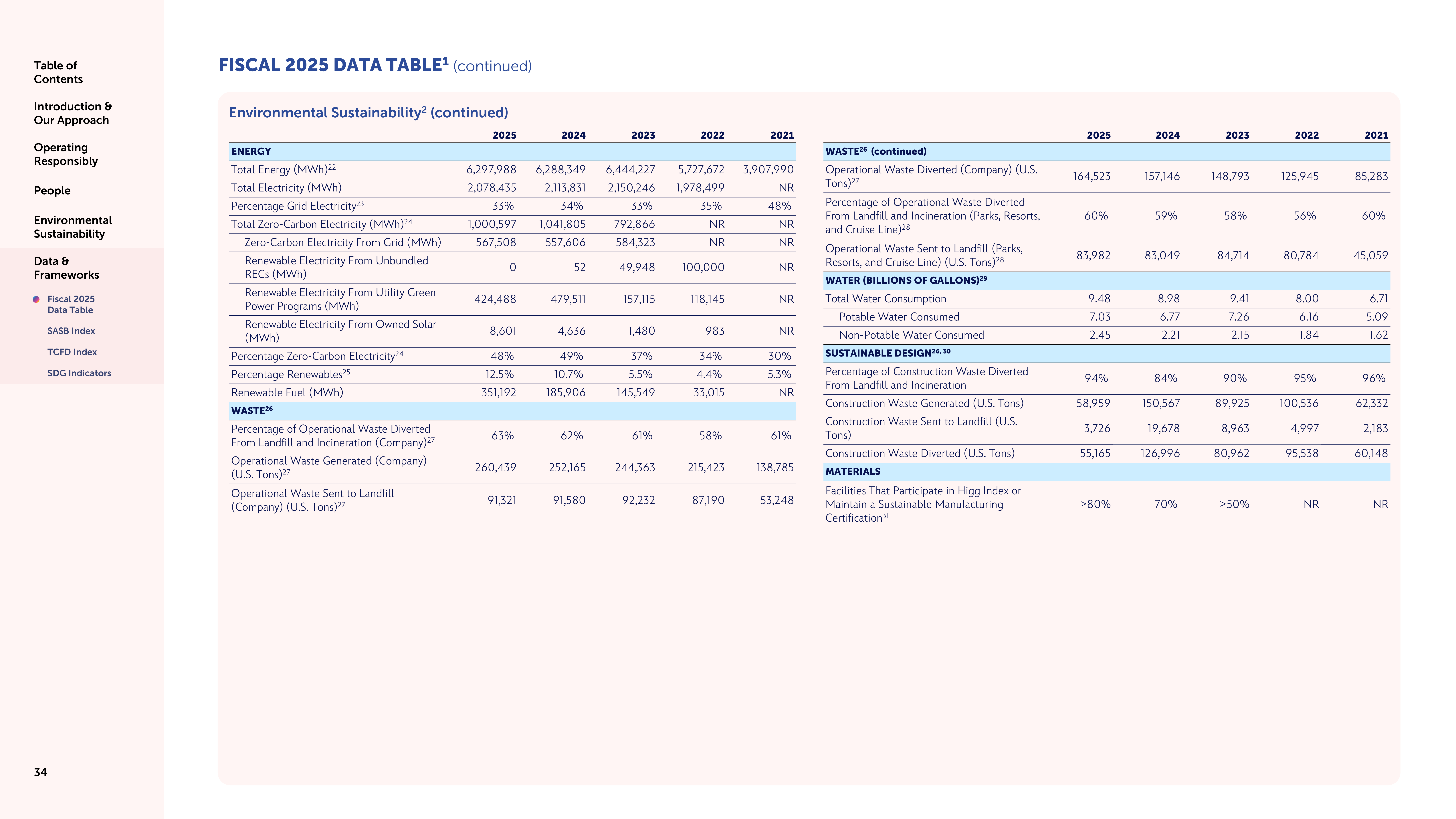
Table
of
FISCAL
2025
DATA
TABLE
1
(continued)
Contents
Introduction
&
Our
Approach
Operating
Responsibly
People
Environmental
Sustainability
Data
&
Frameworks
Fiscal
2025
Data
Table
SASB
Index
TCFD
Index
SDG
Indicators
Environmental
Sustainability
2
(continued)
2025
2024
2023
2022
2021
ENERGY
Total
Energy
(MWh)
22
6,297,988
6,288,349
6,444,227
5,727,672
3,907,990
Total
Electricity
(MWh)
2,078,435
2,113,831
2,150,246
1,978,499
NR
Percentage
Grid
Electricity
23
33%
34%
33%
35%
48%
Total
Zero-Carbon
Electricity
(MWh)
24
1,000,597
1,041,805
792,866
NR
NR
Zero-Carbon
Electricity
From
Grid
(MWh)
567,508
557,606
584,323
NR
NR
Renewable
Electricity
From
Unbundled
RECs
(MWh)
0
52
49,948
100,000
NR
Renewable
Electricity
From
Utility
Green
Power
Programs
(MWh)
424,488
479,511
157,115
118,145
NR
Renewable
Electricity
From
Owned
Solar
(MWh)
8,601
4,636
1,480
983
NR
Percentage
Zero-Carbon
Electricity
24
48%
49%
37%
34%
30%
Percentage
Renewables
25
12.5%
10.7%
5.5%
4.4%
5.3%
Renewable
Fuel
(MWh)
351,192
185,906
145,549
33,015
NR
WASTE
26
Percentage
of
Operational
Waste
Diverted
From
Landfill
and
Incineration
(Company)
27
63%
62%
61%
58%
61%
Operational
Waste
Generated
(Company)
(U.S.
Tons)
27
260,439
252,165
244,363
215,423
138,785
Operational
Waste
Sent
to
Landfill
(Company)
(U.S.
Tons)
27
91,321
91,580
92,232
87,190
53,248
2025
2024
2023
2022
2021
WASTE
26
(continued)
Operational
Waste
Diverted
(Company)
(U.S.
Tons)
27
164,523
157,146
148,793
125,945
85,283
Percentage
of
Operational
Waste
Diverted
From
Landfill
and
Incineration
(Parks,
Resorts,
and
Cruise
Line)
28
60%
59%
58%
56%
60%
Operational
Waste
Sent
to
Landfill
(Parks,
Resorts,
and
Cruise
Line)
(U.S.
Tons)
28
83,982
83,049
84,714
80,784
45,059
WATER
(BILLIONS
OF
GALLONS)
29
Total
Water
Consumption
9.48
8.98
9.41
8.00
6.71
Potable
Water
Consumed
7.03
6.77
7.26
6.16
5.09
Non-Potable
Water
Consumed
2.45
2.21
2.15
1.84
1.62
SUSTAINABLE
DESIGN
26,
30
Percentage
of
Construction
Waste
Diverted
From
Landfill
and
Incineration
94%
84%
90%
95%
96%
Construction
Waste
Generated
(U.S.
Tons)
58,959
150,567
89,925
100,536
62,332
Construction
Waste
Sent
to
Landfill
(U.S.
Tons)
3,726
19,678
8,963
4,997
2,183
Construction
Waste
Diverted
(U.S.
Tons)
55,165
126,996
80,962
95,538
60,148
MATERIALS
Facilities
That
Participate
in
Higg
Index
or
Maintain
a
Sustainable
Manufacturing
Certification
31
>80%
70%
>50%
NR
NR
34
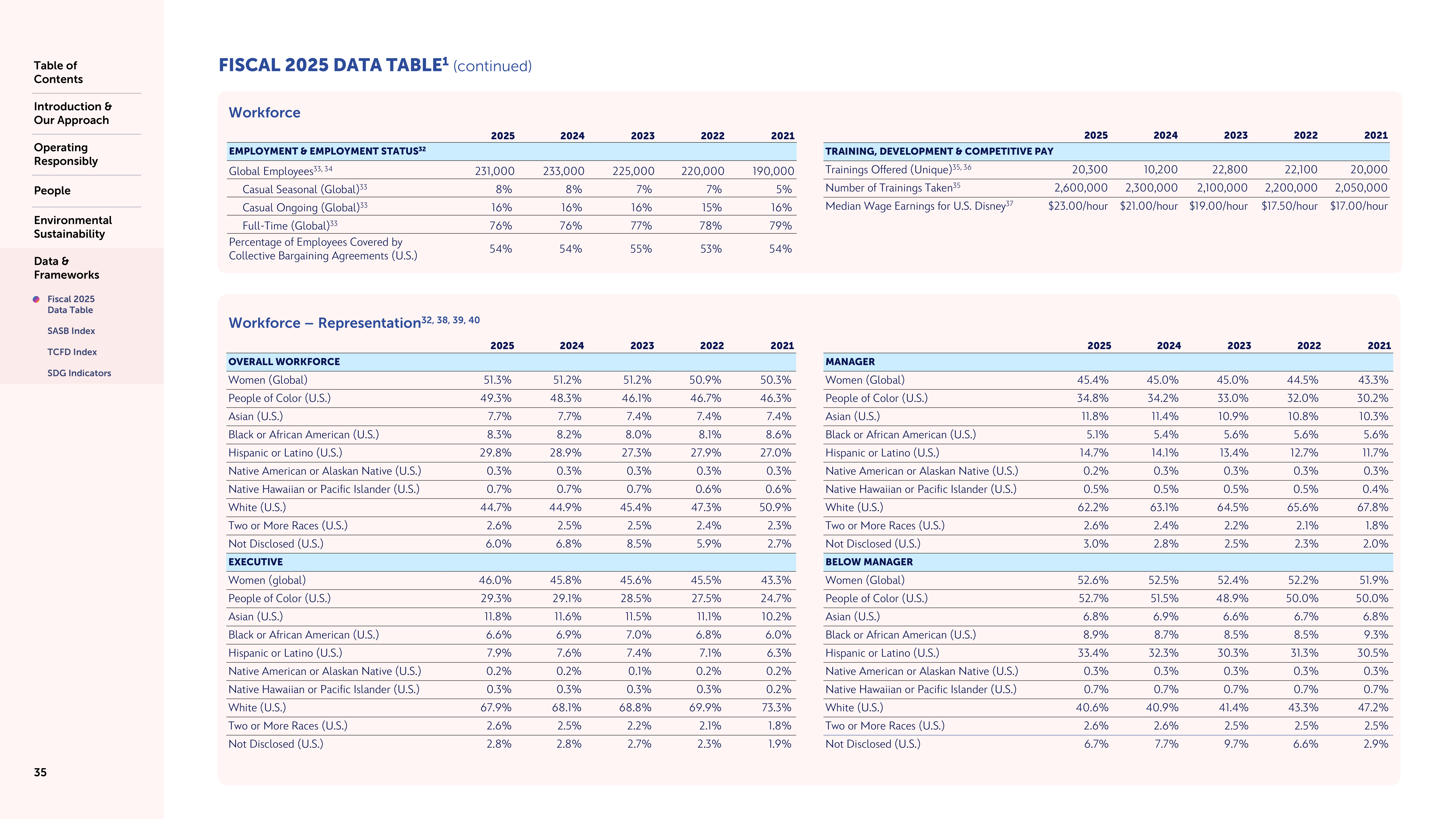
Table
of
FISCAL
2025
DATA
TABLE
1
(continued)
Contents
Introduction
&
Our
Approach
Operating
Responsibly
People
Environmental
Sustainability
Data
&
Frameworks
Fiscal
2025
Data
Table
SASB
Index
TCFD
Index
SDG
Indicators
Workforce
2025
2024
2023
2022
2021
EMPLOYMENT
&
EMPLOYMENT
STATUS
32
Global
Employees
33,
34
231,000
233,000
225,000
220,000
190,000
Casual
Seasonal
(Global)
33
8%
8%
7%
7%
5%
Casual
Ongoing
(Global)
33
16%
16%
16%
15%
16%
Full-Time
(Global)
33
76%
76%
77%
78%
79%
Percentage
of
Employees
Covered
by
Collective
Bargaining
Agreements
(U.S.)
54%
54%
55%
53%
54%
2025
2024
2023
2022
2021
TRAINING,
DEVELOPMENT
&
COMPETITIVE
PAY
Trainings
Offered
(Unique)
35,
36
20,300
10,200
22,800
22,100
20,000
Number
of
Trainings
Taken
35
2,600,000
2,300,000
2,100,000
2,200,000
2,050,000
Median
Wage
Earnings
for
U.S.
Disney
37
$23.00/hour
$21.00/hour
$19.00/hour
$17.50/hour
$17.00/hour
Workforce
–
Representation
32,
38,
39,
40
2025
2024
2023
2022
2021
OVERALL
WORKFORCE
Women
(Global)
51.3%
51.2%
51.2%
50.9%
50.3%
People
of
Color
(U.S.)
49.3%
48.3%
46.1%
46.7%
46.3%
Asian
(U.S.)
7.7%
7.7%
7.4%
7.4%
7.4%
Black
or
African
American
(U.S.)
8.3%
8.2%
8.0%
8.1%
8.6%
Hispanic
or
Latino
(U.S.)
29.8%
28.9%
27.3%
27.9%
27.0%
Native
American
or
Alaskan
Native
(U.S.)
0.3%
0.3%
0.3%
0.3%
0.3%
Native
Hawaiian
or
Pacific
Islander
(U.S.)
0.7%
0.7%
0.7%
0.6%
0.6%
White
(U.S.)
44.7%
44.9%
45.4%
47.3%
50.9%
Two
or
More
Races
(U.S.)
2.6%
2.5%
2.5%
2.4%
2.3%
Not
Disclosed
(U.S.)
6.0%
6.8%
8.5%
5.9%
2.7%
EXECUTIVE
Women
(global)
46.0%
45.8%
45.6%
45.5%
43.3%
People
of
Color
(U.S.)
29.3%
29.1%
28.5%
27.5%
24.7%
Asian
(U.S.)
11.8%
11.6%
11.5%
11.1%
10.2%
Black
or
African
American
(U.S.)
6.6%
6.9%
7.0%
6.8%
6.0%
Hispanic
or
Latino
(U.S.)
7.9%
7.6%
7.4%
7.1%
6.3%
Native
American
or
Alaskan
Native
(U.S.)
0.2%
0.2%
0.1%
0.2%
0.2%
Native
Hawaiian
or
Pacific
Islander
(U.S.)
0.3%
0.3%
0.3%
0.3%
0.2%
White
(U.S.)
67.9%
68.1%
68.8%
69.9%
73.3%
Two
or
More
Races
(U.S.)
2.6%
2.5%
2.2%
2.1%
1.8%
Not
Disclosed
(U.S.)
2.8%
2.8%
2.7%
2.3%
1.9%
2025
2024
2023
2022
2021
MANAGER
Women
(Global)
45.4%
45.0%
45.0%
44.5%
43.3%
People
of
Color
(U.S.)
34.8%
34.2%
33.0%
32.0%
30.2%
Asian
(U.S.)
11.8%
11.4%
10.9%
10.8%
10.3%
Black
or
African
American
(U.S.)
5.1%
5.4%
5.6%
5.6%
5.6%
Hispanic
or
Latino
(U.S.)
14.7%
14.1%
13.4%
12.7%
11.7%
Native
American
or
Alaskan
Native
(U.S.)
0.2%
0.3%
0.3%
0.3%
0.3%
Native
Hawaiian
or
Pacific
Islander
(U.S.)
0.5%
0.5%
0.5%
0.5%
0.4%
White
(U.S.)
62.2%
63.1%
64.5%
65.6%
67.8%
Two
or
More
Races
(U.S.)
2.6%
2.4%
2.2%
2.1%
1.8%
Not
Disclosed
(U.S.)
3.0%
2.8%
2.5%
2.3%
2.0%
BELOW
MANAGER
Women
(Global)
52.6%
52.5%
52.4%
52.2%
51.9%
People
of
Color
(U.S.)
52.7%
51.5%
48.9%
50.0%
50.0%
Asian
(U.S.)
6.8%
6.9%
6.6%
6.7%
6.8%
Black
or
African
American
(U.S.)
8.9%
8.7%
8.5%
8.5%
9.3%
Hispanic
or
Latino
(U.S.)
33.4%
32.3%
30.3%
31.3%
30.5%
Native
American
or
Alaskan
Native
(U.S.)
0.3%
0.3%
0.3%
0.3%
0.3%
Native
Hawaiian
or
Pacific
Islander
(U.S.)
0.7%
0.7%
0.7%
0.7%
0.7%
White
(U.S.)
40.6%
40.9%
41.4%
43.3%
47.2%
Two
or
More
Races
(U.S.)
2.6%
2.6%
2.5%
2.5%
2.5%
Not
Disclosed
(U.S.)
6.7%
7.7%
9.7%
6.6%
2.9%
35
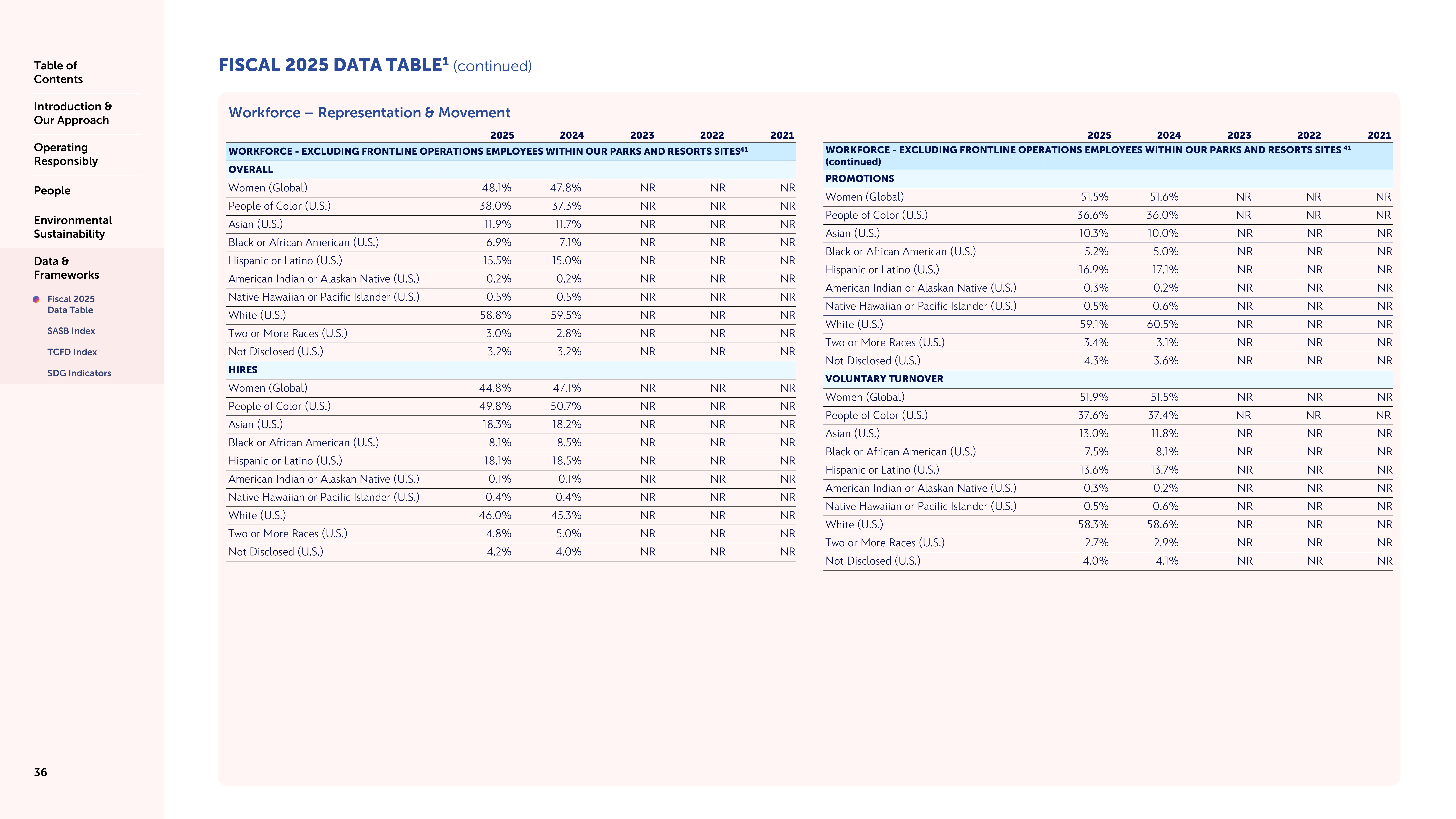
Table
of
FISCAL
2025
DATA
TABLE
1
(continued)
Contents
Introduction
&
Our
Approach
Operating
Responsibly
People
Environmental
Sustainability
Data
&
Frameworks
Fiscal
2025
Data
Table
SASB
Index
TCFD
Index
SDG
Indicators
Workforce
–
Representation
&
Movement
2025
2024
2023
2022
2021
WORKFORCE
-
EXCLUDING
FRONTLINE
OPERATIONS
EMPLOYEES
WITHIN
OUR
PARKS
AND
RESORTS
SITES
41
OVERALL
Women
(Global)
48.1%
47.8%
NR
NR
NR
People
of
Color
(U.S.)
38.0%
37.3%
NR
NR
NR
Asian
(U.S.)
11.9%
11.7%
NR
NR
NR
Black
or
African
American
(U.S.)
6.9%
7.1%
NR
NR
NR
Hispanic
or
Latino
(U.S.)
15.5%
15.0%
NR
NR
NR
American
Indian
or
Alaskan
Native
(U.S.)
0.2%
0.2%
NR
NR
NR
Native
Hawaiian
or
Pacific
Islander
(U.S.)
0.5%
0.5%
NR
NR
NR
White
(U.S.)
58.8%
59.5%
NR
NR
NR
Two
or
More
Races
(U.S.)
3.0%
2.8%
NR
NR
NR
Not
Disclosed
(U.S.)
3.2%
3.2%
NR
NR
NR
HIRES
Women
(Global)
44.8%
47.1%
NR
NR
NR
People
of
Color
(U.S.)
49.8%
50.7%
NR
NR
NR
Asian
(U.S.)
18.3%
18.2%
NR
NR
NR
Black
or
African
American
(U.S.)
8.1%
8.5%
NR
NR
NR
Hispanic
or
Latino
(U.S.)
18.1%
18.5%
NR
NR
NR
American
Indian
or
Alaskan
Native
(U.S.)
0.1%
0.1%
NR
NR
NR
Native
Hawaiian
or
Pacific
Islander
(U.S.)
0.4%
0.4%
NR
NR
NR
White
(U.S.)
46.0%
45.3%
NR
NR
NR
Two
or
More
Races
(U.S.)
4.8%
5.0%
NR
NR
NR
Not
Disclosed
(U.S.)
4.2%
4.0%
NR
NR
NR
2025
2024
2023
2022
2021
WORKFORCE
-
EXCLUDING
FRONTLINE
OPERATIONS
EMPLOYEES
WITHIN
OUR
PARKS
AND
RESORTS
SITES
41
(continued)
PROMOTIONS
Women
(Global)
51.5%
51.6%
NR
NR
NR
People
of
Color
(U.S.)
36.6%
36.0%
NR
NR
NR
Asian
(U.S.)
10.3%
10.0%
NR
NR
NR
Black
or
African
American
(U.S.)
5.2%
5.0%
NR
NR
NR
Hispanic
or
Latino
(U.S.)
16.9%
17.1%
NR
NR
NR
American
Indian
or
Alaskan
Native
(U.S.)
0.3%
0.2%
NR
NR
NR
Native
Hawaiian
or
Pacific
Islander
(U.S.)
0.5%
0.6%
NR
NR
NR
White
(U.S.)
59.1%
60.5%
NR
NR
NR
Two
or
More
Races
(U.S.)
3.4%
3.1%
NR
NR
NR
Not
Disclosed
(U.S.)
4.3%
3.6%
NR
NR
NR
VOLUNTARY
TURNOVER
Women
(Global)
51.9%
51.5%
NR
NR
NR
People
of
Color
(U.S.)
37.6%
37.4%
NR
NR
NR
Asian
(U.S.)
13.0%
11.8%
NR
NR
NR
Black
or
African
American
(U.S.)
7.5%
8.1%
NR
NR
NR
Hispanic
or
Latino
(U.S.)
13.6%
13.7%
NR
NR
NR
American
Indian
or
Alaskan
Native
(U.S.)
0.3%
0.2%
NR
NR
NR
Native
Hawaiian
or
Pacific
Islander
(U.S.)
0.5%
0.6%
NR
NR
NR
White
(U.S.)
58.3%
58.6%
NR
NR
NR
Two
or
More
Races
(U.S.)
2.7%
2.9%
NR
NR
NR
Not
Disclosed
(U.S.)
4.0%
4.1%
NR
NR
NR
36
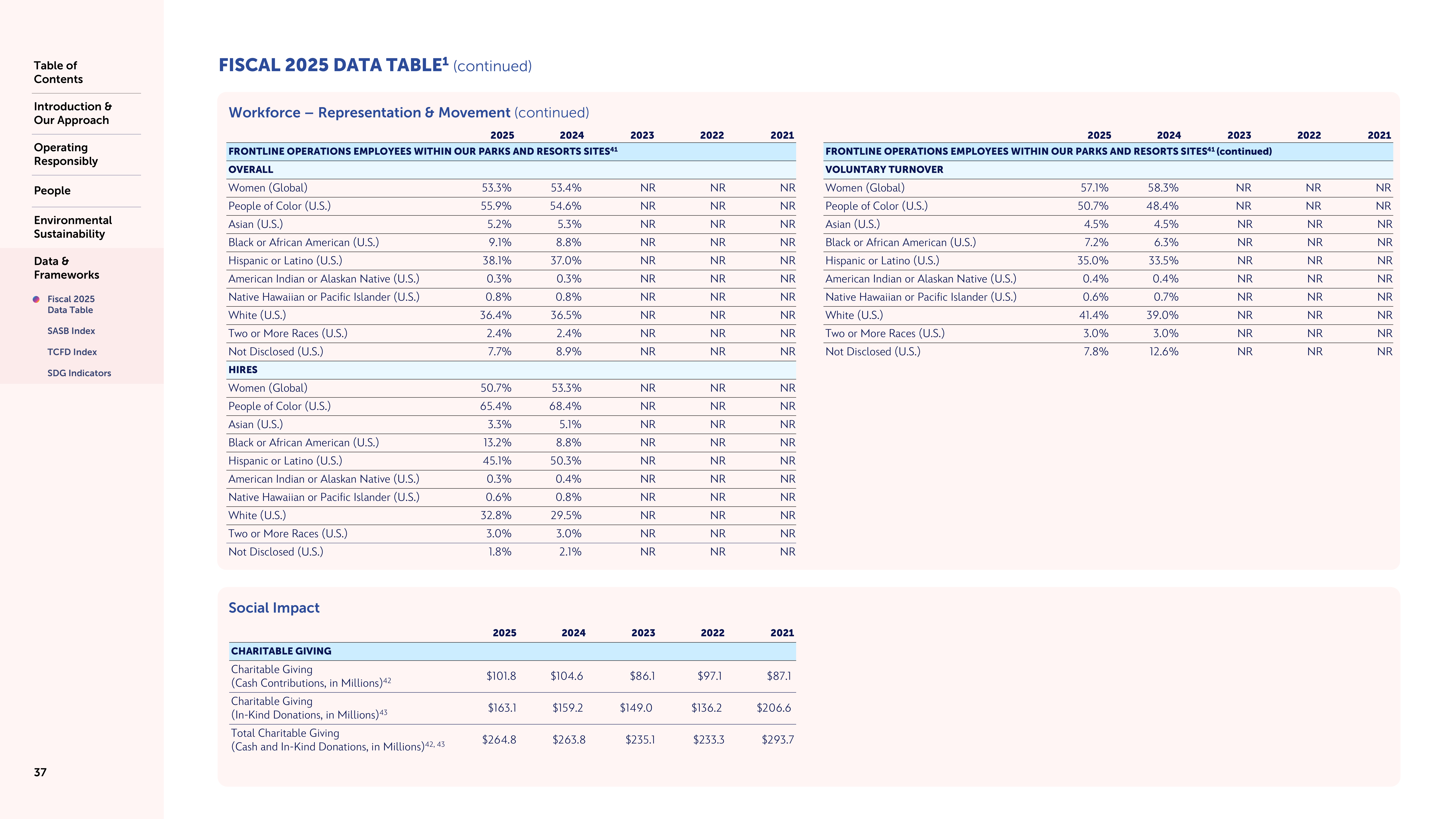
Table
of
FISCAL
2025
DATA
TABLE
1
(continued)
Contents
Introduction
&
Our
Approach
Operating
Responsibly
People
Environmental
Sustainability
Data
&
Frameworks
Fiscal
2025
Data
Table
SASB
Index
TCFD
Index
SDG
Indicators
Workforce
–
Representation
&
Movement
(continued)
2025
2024
2023
2022
2021
FRONTLINE
OPERATIONS
EMPLOYEES
WITHIN
OUR
PARKS
AND
RESORTS
SITES
41
OVERALL
Women
(Global)
53.3%
53.4%
NR
NR
NR
People
of
Color
(U.S.)
55.9%
54.6%
NR
NR
NR
Asian
(U.S.)
5.2%
5.3%
NR
NR
NR
Black
or
African
American
(U.S.)
9.1%
8.8%
NR
NR
NR
Hispanic
or
Latino
(U.S.)
38.1%
37.0%
NR
NR
NR
American
Indian
or
Alaskan
Native
(U.S.)
0.3%
0.3%
NR
NR
NR
Native
Hawaiian
or
Pacific
Islander
(U.S.)
0.8%
0.8%
NR
NR
NR
White
(U.S.)
36.4%
36.5%
NR
NR
NR
Two
or
More
Races
(U.S.)
2.4%
2.4%
NR
NR
NR
Not
Disclosed
(U.S.)
7.7%
8.9%
NR
NR
NR
HIRES
Women
(Global)
50.7%
53.3%
NR
NR
NR
People
of
Color
(U.S.)
65.4%
68.4%
NR
NR
NR
Asian
(U.S.)
3.3%
5.1%
NR
NR
NR
Black
or
African
American
(U.S.)
13.2%
8.8%
NR
NR
NR
Hispanic
or
Latino
(U.S.)
45.1%
50.3%
NR
NR
NR
American
Indian
or
Alaskan
Native
(U.S.)
0.3%
0.4%
NR
NR
NR
Native
Hawaiian
or
Pacific
Islander
(U.S.)
0.6%
0.8%
NR
NR
NR
White
(U.S.)
32.8%
29.5%
NR
NR
NR
Two
or
More
Races
(U.S.)
3.0%
3.0%
NR
NR
NR
Not
Disclosed
(U.S.)
1.8%
2.1%
NR
NR
NR
2025
2024
2023
2022
2021
FRONTLINE
OPERATIONS
EMPLOYEES
WITHIN
OUR
PARKS
AND
RESORTS
SITES
41
(continued)
VOLUNTARY
TURNOVER
Women
(Global)
57.1%
58.3%
NR
NR
NR
People
of
Color
(U.S.)
50.7%
48.4%
NR
NR
NR
Asian
(U.S.)
4.5%
4.5%
NR
NR
NR
Black
or
African
American
(U.S.)
7.2%
6.3%
NR
NR
NR
Hispanic
or
Latino
(U.S.)
35.0%
33.5%
NR
NR
NR
American
Indian
or
Alaskan
Native
(U.S.)
0.4%
0.4%
NR
NR
NR
Native
Hawaiian
or
Pacific
Islander
(U.S.)
0.6%
0.7%
NR
NR
NR
White
(U.S.)
41.4%
39.0%
NR
NR
NR
Two
or
More
Races
(U.S.)
3.0%
3.0%
NR
NR
NR
Not
Disclosed
(U.S.)
7.8%
12.6%
NR
NR
NR
Social
Impact
2025
2024
2023
2022
2021
CHARITABLE
GIVING
Charitable
Giving
(Cash
Contributions,
in
Millions)
42
$101.8
$104.6
$86.1
$97.1
$87.1
Charitable
Giving
(In-Kind
Donations,
in
Millions)
43
$163.1
$159.2
$149.0
$136.2
$206.6
Total
Charitable
Giving
(Cash
and
In-Kind
Donations,
in
Millions)
42,
43
$264.8
$263.8
$235.1
$233.3
$293.7
37
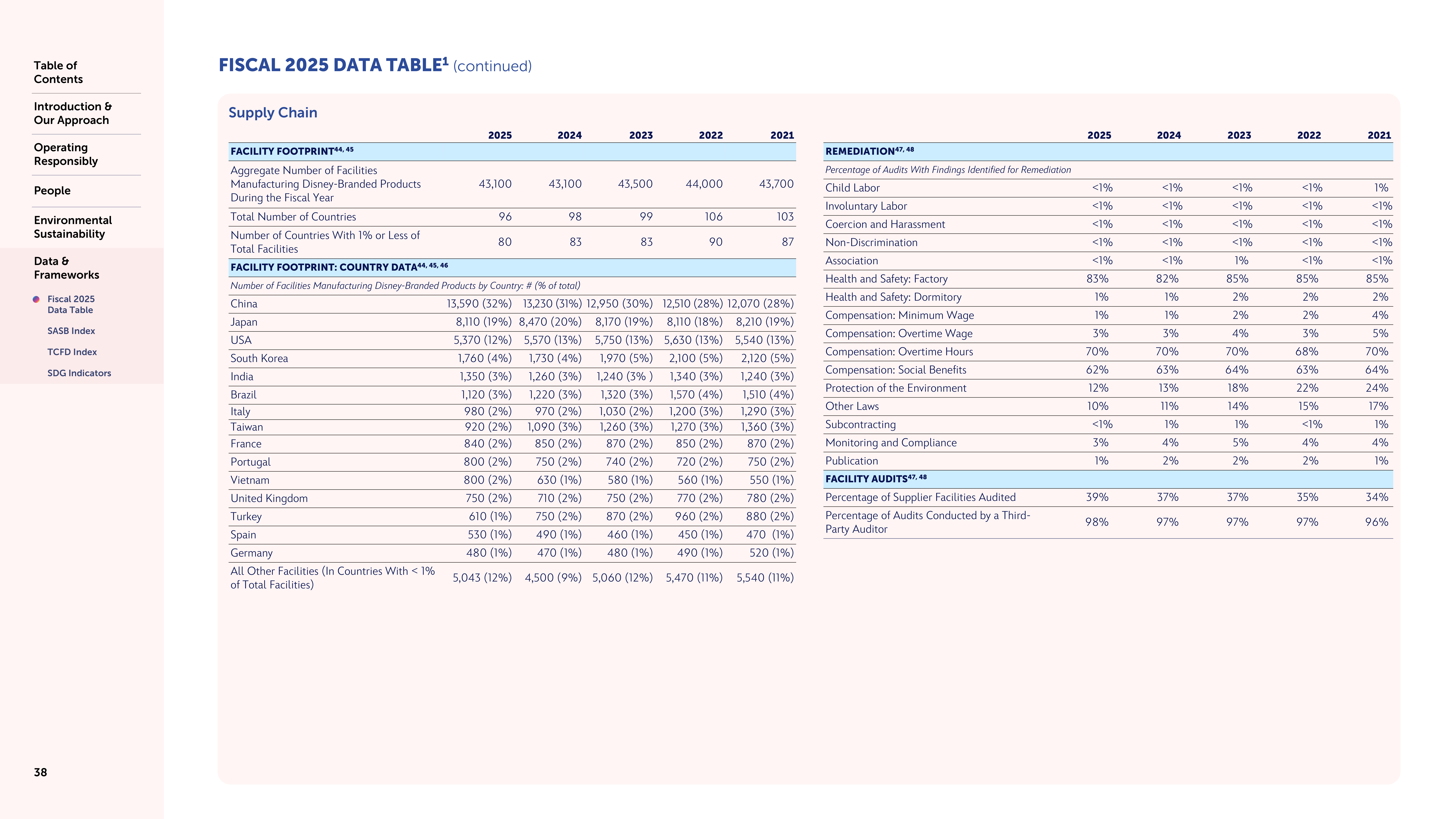
Table
of
FISCAL
2025
DATA
TABLE
1
(continued)
Contents
Introduction
&
Our
Approach
Operating
Responsibly
People
Environmental
Sustainability
Data
&
Frameworks
Fiscal
2025
Data
Table
SASB
Index
TCFD
Index
SDG
Indicators
Supply
Chain
2025
2024
2023
2022
2021
FACILITY
FOOTPRINT
44,
45
Aggregate
Number
of
Facilities
Manufacturing
Disney-Branded
Products
During
the
Fiscal
Year
43,100
43,100
43,500
44,000
43,700
Total
Number
of
Countries
96
98
99
106
103
Number
of
Countries
With
1%
or
Less
of
Total
Facilities
80
83
83
90
87
FACILITY
FOOTPRINT:
COUNTRY
DATA
44,
45,
46
Number
of
Facilities
Manufacturing
Disney-Branded
Products
by
Country:
#
(%
of
total)
China
13,590
(32%)
13,230
(31%)
12,950
(30%)
12,510
(28%)
12,070
(28%)
Japan
8,110
(19%)
8,470
(20%)
8,170
(19%)
8,110
(18%)
8,210
(19%)
USA
5,370
(12%)
5,570
(13%)
5,750
(13%)
5,630
(13%)
5,540
(13%)
South
Korea
1,760
(4%)
1,730
(4%)
1,970
(5%)
2,100
(5%)
2,120
(5%)
India
1,350
(3%)
1,260
(3%)
1,240
(3%
)
1,340
(3%)
1,240
(3%)
Brazil
1,120
(3%)
1,220
(3%)
1,320
(3%)
1,570
(4%)
1,510
(4%)
Italy
980
(2%)
970
(2%)
1,030
(2%)
1,200
(3%)
1,290
(3%)
Taiwan
920
(2%)
1,090
(3%)
1,260
(3%)
1,270
(3%)
1,360
(3%)
France
840
(2%)
850
(2%)
870
(2%)
850
(2%)
870
(2%)
Portugal
800
(2%)
750
(2%)
740
(2%)
720
(2%)
750
(2%)
Vietnam
800
(2%)
630
(1%)
580
(1%)
560
(1%)
550
(1%)
United
Kingdom
750
(2%)
710
(2%)
750
(2%)
770
(2%)
780
(2%)
Turkey
610
(1%)
750
(2%)
870
(2%)
960
(2%)
880
(2%)
Spain
530
(1%)
490
(1%)
460
(1%)
450
(1%)
470
(1%)
Germany
480
(1%)
470
(1%)
480
(1%)
490
(1%)
520
(1%)
All
Other
Facilities
(In
Countries
With
<
1%
of
Total
Facilities)
5,043
(12%)
4,500
(9%)
5,060
(12%)
5,470
(11%)
5,540
(11%)
2025
2024
2023
2022
2021
REMEDIATION
47,
48
Percentage
of
Audits
With
Findings
Identified
for
Remediation
Child
Labor
<1%
<1%
<1%
<1%
1%
Involuntary
Labor
<1%
<1%
<1%
<1%
<1%
Coercion
and
Harassment
<1%
<1%
<1%
<1%
<1%
Non-Discrimination
<1%
<1%
<1%
<1%
<1%
Association
<1%
<1%
1%
<1%
<1%
Health
and
Safety:
Factory
83%
82%
85%
85%
85%
Health
and
Safety:
Dormitory
1%
1%
2%
2%
2%
Compensation:
Minimum
Wage
1%
1%
2%
2%
4%
Compensation:
Overtime
Wage
3%
3%
4%
3%
5%
Compensation:
Overtime
Hours
70%
70%
70%
68%
70%
Compensation:
Social
Benefits
62%
63%
64%
63%
64%
Protection
of
the
Environment
12%
13%
18%
22%
24%
Other
Laws
10%
11%
14%
15%
17%
Subcontracting
<1%
1%
1%
<1%
1%
Monitoring
and
Compliance
3%
4%
5%
4%
4%
Publication
1%
2%
2%
2%
1%
FACILITY
AUDITS
47,
48
Percentage
of
Supplier
Facilities
Audited
39%
37%
37%
35%
34%
Percentage
of
Audits
Conducted
by
a
Third-
Party
Auditor
98%
97%
97%
97%
96%
38
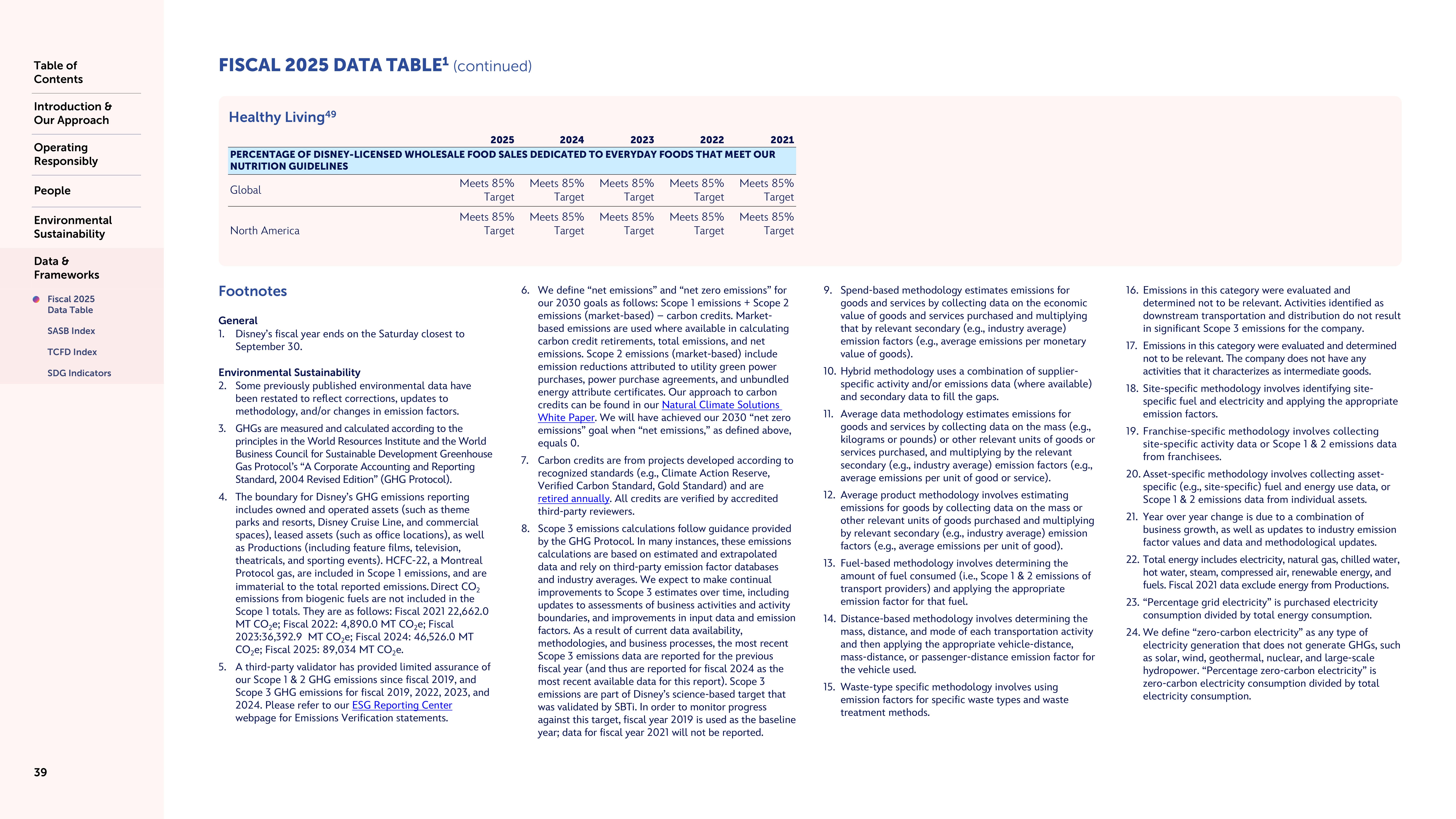
Table
of
FISCAL
2025
DATA
TABLE
1
(continued)
Contents
Introduction
&
Our
Approach
Operating
Responsibly
People
Environmental
Sustainability
Data
&
Frameworks
Healthy
Living
49
2025
2024
2023
2022
2021
PERCENTAGE
OF
DISNEY-LICENSED
WHOLESALE
FOOD
SALES
DEDICATED
TO
EVERYDAY
FOODS
THAT
MEET
OUR
NUTRITION
GUIDELINES
Global
Meets
85%
Target
Meets
85%
Target
Meets
85%
Target
Meets
85%
Target
Meets
85%
Target
North
America
Meets
85%
Target
Meets
85%
Target
Meets
85%
Target
Meets
85%
Target
Meets
85%
Target
Footnotes
General
1.
Disneyʼs
fiscal
year
ends
on
the
Saturday
closest
to
September
30.
Environmental
Sustainability
2.
Some
previously
published
environmental
data
have
been
restated
to
reflect
corrections,
updates
to
methodology,
and/or
changes
in
emission
factors.
3.
GHGs
are
measured
and
calculated
according
to
the
principles
in
the
World
Resources
Institute
and
the
World
Business
Council
for
Sustainable
Development
Greenhouse
Gas
Protocolʼs
“A
Corporate
Accounting
and
Reporting
Standard,
2004
Revised
Edition”
(GHG
Protocol).
4.
The
boundary
for
Disneyʼs
GHG
emissions
reporting
includes
owned
and
operated
assets
(such
as
theme
parks
and
resorts,
Disney
Cruise
Line,
and
commercial
spaces),
leased
assets
(such
as
office
locations),
as
well
as
Productions
(including
feature
films,
television,
theatricals,
and
sporting
events).
HCFC-22,
a
Montreal
Protocol
gas,
are
included
in
Scope
1
emissions,
and
are
immaterial
to
the
total
reported
emissions.
Direct
CO
2
emissions
from
biogenic
fuels
are
not
included
in
the
Scope
1
totals.
They
are
as
follows:
Fiscal
2021
22,662.0
MT
CO
2
e;
Fiscal
2022:
4,890.0
MT
CO
2
e;
Fiscal
2023:36,392.9
MT
CO
2
e;
Fiscal
2024:
46,526.0
MT
CO
2
e;
Fiscal
2025:
89,034
MT
CO
2
e.
5.
A
third-party
validator
has
provided
limited
assurance
of
our
Scope
1
&
2
GHG
emissions
since
fiscal
2019,
and
Scope
3
GHG
emissions
for
fiscal
2019,
2022,
2023,
and
2024.
Please
refer
to
our
ESG
Reporting
Center
webpage
for
Emissions
Verification
statements.
6.
We
define
“net
emissions”
and
“net
zero
emissions”
for
our
2030
goals
as
follows:
Scope
1
emissions
+
Scope
2
emissions
(market-based)
–
carbon
credits.
Market-
based
emissions
are
used
where
available
in
calculating
carbon
credit
retirements,
total
emissions,
and
net
emissions.
Scope
2
emissions
(market-based)
include
emission
reductions
attributed
to
utility
green
power
purchases,
power
purchase
agreements,
and
unbundled
energy
attribute
certificates.
Our
approach
to
carbon
credits
can
be
found
in
our
Natural
Climate
Solutions
White
Paper
.
We
will
have
achieved
our
2030
“net
zero
emissions”
goal
when
“net
emissions,”
as
defined
above,
equals
0.
7.
Carbon
credits
are
from
projects
developed
according
to
recognized
standards
(e.g.,
Climate
Action
Reserve,
Verified
Carbon
Standard,
Gold
Standard)
and
are
retired
annually
.
All
credits
are
verified
by
accredited
third-party
reviewers.
8.
Scope
3
emissions
calculations
follow
guidance
provided
by
the
GHG
Protocol.
In
many
instances,
these
emissions
calculations
are
based
on
estimated
and
extrapolated
data
and
rely
on
third-party
emission
factor
databases
and
industry
averages.
We
expect
to
make
continual
improvements
to
Scope
3
estimates
over
time,
including
updates
to
assessments
of
business
activities
and
activity
boundaries,
and
improvements
in
input
data
and
emission
factors.
As
a
result
of
current
data
availability,
methodologies,
and
business
processes,
the
most
recent
Scope
3
emissions
data
are
reported
for
the
previous
fiscal
year
(and
thus
are
reported
for
fiscal
2024
as
the
most
recent
available
data
for
this
report).
Scope
3
emissions
are
part
of
Disneyʼs
science-based
target
that
was
validated
by
SBTi.
In
order
to
monitor
progress
against
this
target,
fiscal
year
2019
is
used
as
the
baseline
year;
data
for
fiscal
year
2021
will
not
be
reported.
9.
Spend-based
methodology
estimates
emissions
for
goods
and
services
by
collecting
data
on
the
economic
value
of
goods
and
services
purchased
and
multiplying
that
by
relevant
secondary
(e.g.,
industry
average)
emission
factors
(e.g.,
average
emissions
per
monetary
value
of
goods).
10.
Hybrid
methodology
uses
a
combination
of
supplier-
specific
activity
and/or
emissions
data
(where
available)
and
secondary
data
to
fill
the
gaps.
11.
Average
data
methodology
estimates
emissions
for
goods
and
services
by
collecting
data
on
the
mass
(e.g.,
kilograms
or
pounds)
or
other
relevant
units
of
goods
or
services
purchased,
and
multiplying
by
the
relevant
secondary
(e.g.,
industry
average)
emission
factors
(e.g.,
average
emissions
per
unit
of
good
or
service).
12.
Average
product
methodology
involves
estimating
emissions
for
goods
by
collecting
data
on
the
mass
or
other
relevant
units
of
goods
purchased
and
multiplying
by
relevant
secondary
(e.g.,
industry
average)
emission
factors
(e.g.,
average
emissions
per
unit
of
good).
13.
Fuel-based
methodology
involves
determining
the
amount
of
fuel
consumed
(i.e.,
Scope
1
&
2
emissions
of
transport
providers)
and
applying
the
appropriate
emission
factor
for
that
fuel.
14.
Distance-based
methodology
involves
determining
the
mass,
distance,
and
mode
of
each
transportation
activity
and
then
applying
the
appropriate
vehicle-distance,
mass-distance,
or
passenger-distance
emission
factor
for
the
vehicle
used.
15.
Waste-type
specific
methodology
involves
using
emission
factors
for
specific
waste
types
and
waste
treatment
methods.
16.
Emissions
in
this
category
were
evaluated
and
determined
not
to
be
relevant.
Activities
identified
as
downstream
transportation
and
distribution
do
not
result
in
significant
Scope
3
emissions
for
the
company.
17.
Emissions
in
this
category
were
evaluated
and
determined
not
to
be
relevant.
The
company
does
not
have
any
activities
that
it
characterizes
as
intermediate
goods.
18.
Site-specific
methodology
involves
identifying
site-
specific
fuel
and
electricity
and
applying
the
appropriate
emission
factors.
19.
Franchise-specific
methodology
involves
collecting
site-specific
activity
data
or
Scope
1
&
2
emissions
data
from
franchisees.
20. Asset-specific
methodology
involves
collecting
asset-
specific
(e.g.,
site-specific)
fuel
and
energy
use
data,
or
Scope
1
&
2
emissions
data
from
individual
assets.
21.
Year
over
year
change
is
due
to
a
combination
of
business
growth,
as
well
as
updates
to
industry
emission
factor
values
and
data
and
methodological
updates.
22.
Total
energy
includes
electricity,
natural
gas,
chilled
water,
hot
water,
steam,
compressed
air,
renewable
energy,
and
fuels.
Fiscal
2021
data
exclude
energy
from
Productions.
23.
“Percentage
grid
electricity”
is
purchased
electricity
consumption
divided
by
total
energy
consumption.
24. We
define
“zero-carbon
electricity”
as
any
type
of
electricity
generation
that
does
not
generate
GHGs,
such
as
solar,
wind,
geothermal,
nuclear,
and
large-scale
hydropower.
“Percentage
zero-carbon
electricity”
is
zero-carbon
electricity
consumption
divided
by
total
electricity
consumption.
Fiscal
2025
Data
Table
SASB
Index
TCFD
Index
SDG
Indicators
39
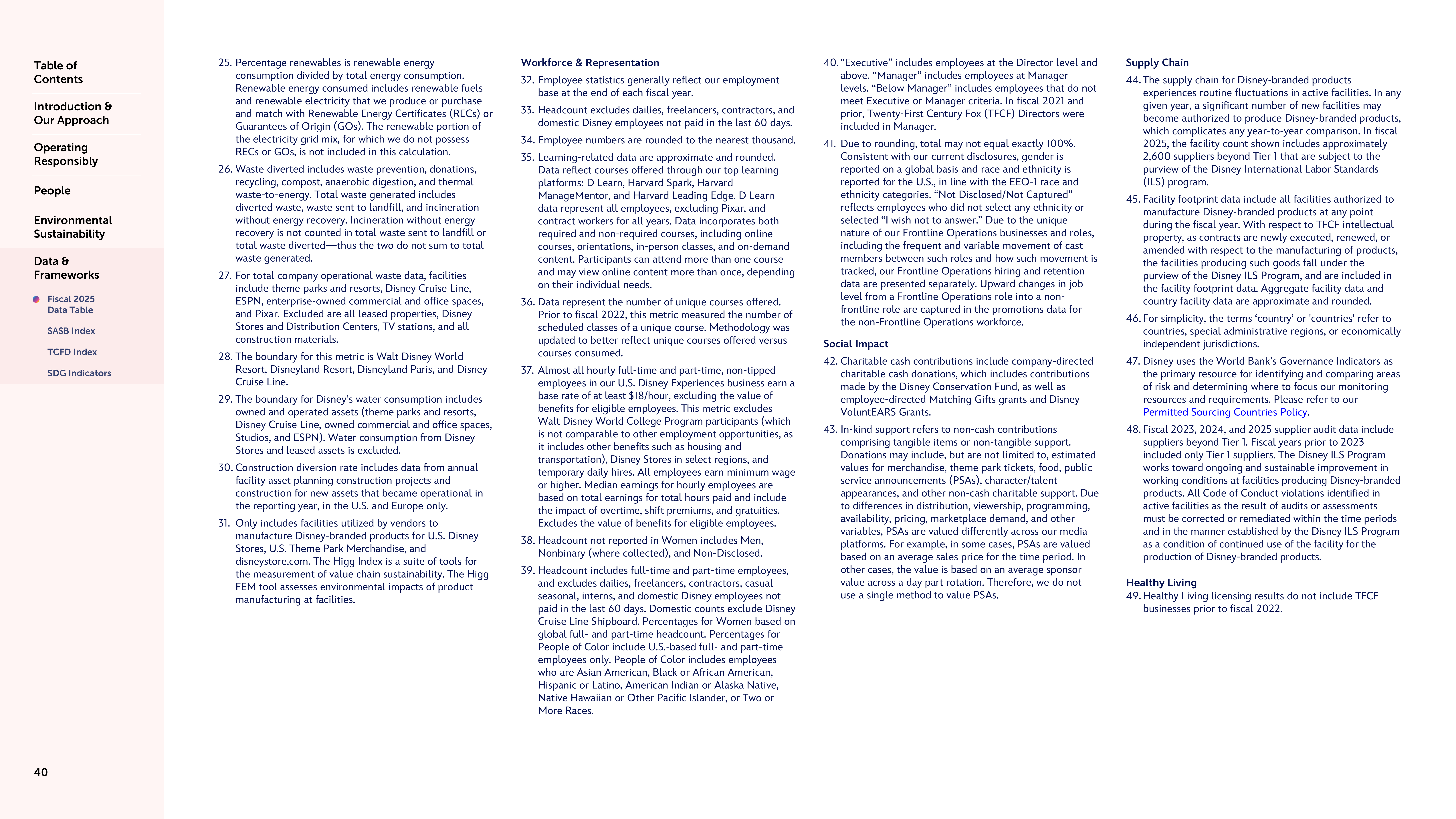
25.
Percentage
renewables
is
renewable
energy
consumption
divided
by
total
energy
consumption.
Renewable
energy
consumed
includes
renewable
fuels
and
renewable
electricity
that
we
produce
or
purchase
and
match
with
Renewable
Energy
Certificates
(RECs)
or
Guarantees
of
Origin
(GOs).
The
renewable
portion
of
the
electricity
grid
mix,
for
which
we
do
not
possess
RECs
or
GOs,
is
not
included
in
this
calculation.
26. Waste
diverted
includes
waste
prevention,
donations,
recycling,
compost,
anaerobic
digestion,
and
thermal
waste-to-energy.
Total
waste
generated
includes
diverted
waste,
waste
sent
to
landfill,
and
incineration
without
energy
recovery.
Incineration
without
energy
recovery
is
not
counted
in
total
waste
sent
to
landfill
or
total
waste
diverted—thus
the
two
do
not
sum
to
total
waste
generated.
27.
For
total
company
operational
waste
data,
facilities
include
theme
parks
and
resorts,
Disney
Cruise
Line,
ESPN,
enterprise-owned
commercial
and
office
spaces,
and
Pixar.
Excluded
are
all
leased
properties,
Disney
Stores
and
Distribution
Centers,
TV
stations,
and
all
construction
materials.
28. The
boundary
for
this
metric
is
Walt
Disney
World
Resort,
Disneyland
Resort,
Disneyland
Paris,
and
Disney
Cruise
Line.
29. The
boundary
for
Disneyʼs
water
consumption
includes
owned
and
operated
assets
(theme
parks
and
resorts,
Disney
Cruise
Line,
owned
commercial
and
office
spaces,
Studios,
and
ESPN).
Water
consumption
from
Disney
Stores
and
leased
assets
is
excluded.
30. Construction
diversion
rate
includes
data
from
annual
facility
asset
planning
construction
projects
and
construction
for
new
assets
that
became
operational
in
the
reporting
year,
in
the
U.S.
and
Europe
only.
31.
Only
includes
facilities
utilized
by
vendors
to
manufacture
Disney-branded
products
for
U.S.
Disney
Stores,
U.S.
Theme
Park
Merchandise,
and
disneystore.com.
The
Higg
Index
is
a
suite
of
tools
for
the
measurement
of
value
chain
sustainability.
The
Higg
FEM
tool
assesses
environmental
impacts
of
product
manufacturing
at
facilities.
Workforce
&
Representation
32.
Employee
statistics
generally
reflect
our
employment
base
at
the
end
of
each
fiscal
year.
33.
Headcount
excludes
dailies,
freelancers,
contractors,
and
domestic
Disney
employees
not
paid
in
the
last
60
days.
34. Employee
numbers
are
rounded
to
the
nearest
thousand.
35.
Learning-related
data
are
approximate
and
rounded.
Data
reflect
courses
offered
through
our
top
learning
platforms:
D
Learn,
Harvard
Spark,
Harvard
ManageMentor,
and
Harvard
Leading
Edge.
D
Learn
data
represent
all
employees,
excluding
Pixar,
and
contract
workers
for
all
years.
Data
incorporates
both
required
and
non-required
courses,
including
online
courses,
orientations,
in-person
classes,
and
on-demand
content.
Participants
can
attend
more
than
one
course
and
may
view
online
content
more
than
once,
depending
on
their
individual
needs.
36. Data
represent
the
number
of
unique
courses
offered.
Prior
to
fiscal
2022,
this
metric
measured
the
number
of
scheduled
classes
of
a
unique
course.
Methodology
was
updated
to
better
reflect
unique
courses
offered
versus
courses
consumed.
37.
Almost
all
hourly
full-time
and
part-time,
non-tipped
employees
in
our
U.S.
Disney
Experiences
business
earn
a
base
rate
of
at
least
$18/hour,
excluding
the
value
of
benefits
for
eligible
employees.
This
metric
excludes
Walt
Disney
World
College
Program
participants
(which
is
not
comparable
to
other
employment
opportunities,
as
it
includes
other
benefits
such
as
housing
and
transportation),
Disney
Stores
in
select
regions,
and
temporary
daily
hires.
All
employees
earn
minimum
wage
or
higher.
Median
earnings
for
hourly
employees
are
based
on
total
earnings
for
total
hours
paid
and
include
the
impact
of
overtime,
shift
premiums,
and
gratuities.
Excludes
the
value
of
benefits
for
eligible
employees.
38. Headcount
not
reported
in
Women
includes
Men,
Nonbinary
(where
collected),
and
Non-Disclosed.
39. Headcount
includes
full-time
and
part-time
employees,
and
excludes
dailies,
freelancers,
contractors,
casual
seasonal,
interns,
and
domestic
Disney
employees
not
paid
in
the
last
60
days.
Domestic
counts
exclude
Disney
Cruise
Line
Shipboard.
Percentages
for
Women
based
on
global
full-
and
part-time
headcount.
Percentages
for
People
of
Color
include
U.S.-based
full-
and
part-time
employees
only.
People
of
Color
includes
employees
who
are
Asian
American,
Black
or
African
American,
Hispanic
or
Latino,
American
Indian
or
Alaska
Native,
Native
Hawaiian
or
Other
Pacific
Islander,
or
Two
or
More
Races.
40. “Executive”
includes
employees
at
the
Director
level
and
above.
“Manager”
includes
employees
at
Manager
levels.
“Below
Manager”
includes
employees
that
do
not
meet
Executive
or
Manager
criteria.
In
fiscal
2021
and
prior,
Twenty-First
Century
Fox
(TFCF)
Directors
were
included
in
Manager.
41.
Due
to
rounding,
total
may
not
equal
exactly
100%.
Consistent
with
our
current
disclosures,
gender
is
reported
on
a
global
basis
and
race
and
ethnicity
is
reported
for
the
U.S.,
in
line
with
the
EEO-1
race
and
ethnicity
categories.
“Not
Disclosed/Not
Captured”
reflects
employees
who
did
not
select
any
ethnicity
or
selected
“I
wish
not
to
answer.”
Due
to
the
unique
nature
of
our
Frontline
Operations
businesses
and
roles,
including
the
frequent
and
variable
movement
of
cast
members
between
such
roles
and
how
such
movement
is
tracked,
our
Frontline
Operations
hiring
and
retention
data
are
presented
separately.
Upward
changes
in
job
level
from
a
Frontline
Operations
role
into
a
non-
frontline
role
are
captured
in
the
promotions
data
for
the
non-Frontline
Operations
workforce.
Social
Impact
42. Charitable
cash
contributions
include
company-directed
charitable
cash
donations,
which
includes
contributions
made
by
the
Disney
Conservation
Fund,
as
well
as
employee-directed
Matching
Gifts
grants
and
Disney
VoluntEARS
Grants.
43. In-kind
support
refers
to
non-cash
contributions
comprising
tangible
items
or
non-tangible
support.
Donations
may
include,
but
are
not
limited
to,
estimated
values
for
merchandise,
theme
park
tickets,
food,
public
service
announcements
(PSAs),
character/talent
appearances,
and
other
non-cash
charitable
support.
Due
to
differences
in
distribution,
viewership,
programming,
availability,
pricing,
marketplace
demand,
and
other
variables,
PSAs
are
valued
differently
across
our
media
platforms.
For
example,
in
some
cases,
PSAs
are
valued
based
on
an
average
sales
price
for
the
time
period.
In
other
cases,
the
value
is
based
on
an
average
sponsor
value
across
a
day
part
rotation.
Therefore,
we
do
not
use
a
single
method
to
value
PSAs.
Supply
Chain
44. The
supply
chain
for
Disney-branded
products
experiences
routine
fluctuations
in
active
facilities.
In
any
given
year,
a
significant
number
of
new
facilities
may
become
authorized
to
produce
Disney-branded
products,
which
complicates
any
year-to-year
comparison.
In
fiscal
2025,
the
facility
count
shown
includes
approximately
2,600
suppliers
beyond
Tier
1
that
are
subject
to
the
purview
of
the
Disney
International
Labor
Standards
(ILS)
program.
45. Facility
footprint
data
include
all
facilities
authorized
to
manufacture
Disney-branded
products
at
any
point
during
the
fiscal
year.
With
respect
to
TFCF
intellectual
property,
as
contracts
are
newly
executed,
renewed,
or
amended
with
respect
to
the
manufacturing
of
products,
the
facilities
producing
such
goods
fall
under
the
purview
of
the
Disney
ILS
Program,
and
are
included
in
the
facility
footprint
data.
Aggregate
facility
data
and
country
facility
data
are
approximate
and
rounded.
46. For
simplicity,
the
terms
ʻcountryʼ
or
'countries'
refer
to
countries,
special
administrative
regions,
or
economically
independent
jurisdictions.
47. Disney
uses
the
World
Bankʼs
Governance
Indicators
as
the
primary
resource
for
identifying
and
comparing
areas
of
risk
and
determining
where
to
focus
our
monitoring
resources
and
requirements.
Please
refer
to
our
Permitted
Sourcing
Countries
Policy
.
48. Fiscal
2023,
2024,
and
2025
supplier
audit
data
include
suppliers
beyond
Tier
1.
Fiscal
years
prior
to
2023
included
only
Tier
1
suppliers.
The
Disney
ILS
Program
works
toward
ongoing
and
sustainable
improvement
in
working
conditions
at
facilities
producing
Disney-branded
products.
All
Code
of
Conduct
violations
identified
in
active
facilities
as
the
result
of
audits
or
assessments
must
be
corrected
or
remediated
within
the
time
periods
and
in
the
manner
established
by
the
Disney
ILS
Program
as
a
condition
of
continued
use
of
the
facility
for
the
production
of
Disney-branded
products.
Healthy
Living
49. Healthy
Living
licensing
results
do
not
include
TFCF
businesses
prior
to
fiscal
2022.
Table
of
Contents
Introduction
&
Our
Approach
Operating
Responsibly
People
Environmental
Sustainability
Data
&
Frameworks
Fiscal
2025
Data
Table
SASB
Index
TCFD
Index
SDG
Indicators
40
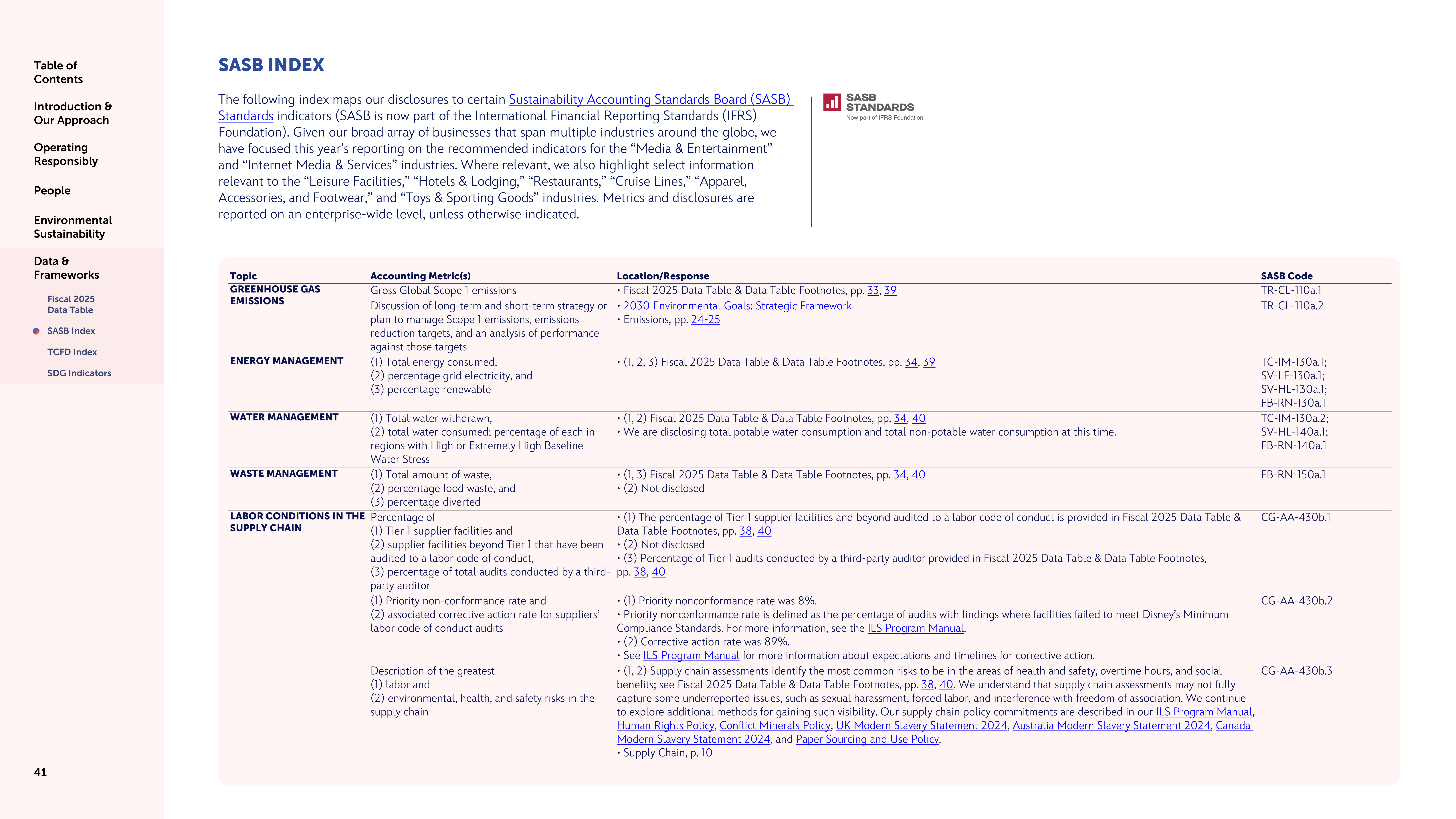

Table
of
Contents
Introduction
&
Our
Approach
Operating
Responsibly
People
Environmental
Sustainability
Data
&
Frameworks
Fiscal
2025
Data
Table
SASB
Index
TCFD
Index
SDG
Indicators
SASB
INDEX
The
following
index
maps
our
disclosures
to
certain
Sustainability
Accounting
Standards
Board
(SASB)
Standards
indicators
(SASB
is
now
part
of
the
International
Financial
Reporting
Standards
(IFRS)
Foundation).
Given
our
broad
array
of
businesses
that
span
multiple
industries
around
the
globe,
we
have
focused
this
yearʼs
reporting
on
the
recommended
indicators
for
the
“Media
&
Entertainment”
and
“Internet
Media
&
Services”
industries.
Where
relevant,
we
also
highlight
select
information
relevant
to
the
“Leisure
Facilities,”
“Hotels
&
Lodging,”
“Restaurants,”
“Cruise
Lines,”
“Apparel,
Accessories,
and
Footwear,”
and
“Toys
&
Sporting
Goods”
industries.
Metrics
and
disclosures
are
reported
on
an
enterprise-wide
level,
unless
otherwise
indicated.
Topic
Accounting
Metric(s)
Location/Response
SASB
Code
GREENHOUSE
GAS
EMISSIONS
Gross
Global
Scope
1
emissions
•
Fiscal
2025
Data
Table
&
Data
Table
Footnotes,
pp.
33
,
39
TR-CL-110a.1
Discussion
of
long-term
and
short-term
strategy
or
plan
to
manage
Scope
1
emissions,
emissions
reduction
targets,
and
an
analysis
of
performance
against
those
targets
•
2030
Environmental
Goals:
Strategic
Framework
• Emissions,
pp.
24-25
TR-CL-110a.2
ENERGY
MANAGEMENT
(1)
Total
energy
consumed,
(2) percentage
grid
electricity,
and
(3) percentage
renewable
• (1,
2,
3)
Fiscal
2025
Data
Table
&
Data
Table
Footnotes,
pp.
34
,
39
TC-IM-130a.1;
SV-LF-130a.1;
SV-HL-130a.1;
FB-RN-130a.1
WATER
MANAGEMENT
(1) Total
water
withdrawn,
(2) total
water
consumed;
percentage
of
each
in
regions
with
High
or
Extremely
High
Baseline
Water
Stress
• (1,
2)
Fiscal
2025
Data
Table
&
Data
Table
Footnotes,
pp.
34
,
40
• We
are
disclosing
total
potable
water
consumption
and
total
non-potable
water
consumption
at
this
time.
TC-IM-130a.2;
SV-HL-140a.1;
FB-RN-140a.1
WASTE
MANAGEMENT
(1) Total
amount
of
waste,
(2)
percentage
food
waste,
and
(3) percentage
diverted
• (1,
3)
Fiscal
2025
Data
Table
&
Data
Table
Footnotes,
pp.
34
,
40
• (2)
Not
disclosed
FB-RN-150a.1
LABOR
CONDITIONS
IN
THE
SUPPLY
CHAIN
Percentage
of
(1) Tier
1
supplier
facilities
and
(2) supplier
facilities
beyond
Tier
1
that
have
been
audited
to
a
labor
code
of
conduct,
(3) percentage
of
total
audits
conducted
by
a
third-
party
auditor
• (1)
The
percentage
of
Tier
1
supplier
facilities
and
beyond
audited
to
a
labor
code
of
conduct
is
provided
in
Fiscal
2025
Data
Table
&
Data
Table
Footnotes,
pp.
38
,
40
• (2)
Not
disclosed
• (3)
Percentage
of
Tier
1
audits
conducted
by
a
third-party
auditor
provided
in
Fiscal
2025
Data
Table
&
Data
Table
Footnotes,
pp.
38
,
40
CG-AA-430b.1
(1) Priority
non-conformance
rate
and
(2) associated
corrective
action
rate
for
suppliersʼ
labor
code
of
conduct
audits
• (1)
Priority
nonconformance
rate
was
8%.
• Priority
nonconformance
rate
is
defined
as
the
percentage
of
audits
with
findings
where
facilities
failed
to
meet
Disneyʼs
Minimum
Compliance
Standards.
For
more
information,
see
the
ILS
Program
Manual
.
• (2)
Corrective
action
rate
was
89%.
• See
ILS
Program
Manual
for
more
information
about
expectations
and
timelines
for
corrective
action.
CG-AA-430b.2
Description
of
the
greatest
(1) labor
and
(2) environmental,
health,
and
safety
risks
in
the
supply
chain
• (1,
2)
Supply
chain
assessments
identify
the
most
common
risks
to
be
in
the
areas
of
health
and
safety,
overtime
hours,
and
social
benefits;
see
Fiscal
2025
Data
Table
&
Data
Table
Footnotes,
pp.
38
,
40
.
We
understand
that
supply
chain
assessments
may
not
fully
capture
some
underreported
issues,
such
as
sexual
harassment,
forced
labor,
and
interference
with
freedom
of
association.
We
continue
to
explore
additional
methods
for
gaining
such
visibility.
Our
supply
chain
policy
commitments
are
described
in
our
ILS
Program
Manual
,
Human
Rights
Policy
,
Conflict
Minerals
Policy
,
UK
Modern
Slavery
Statement
2024
,
Australia
Modern
Slavery
Statement
2024
,
Canada
Modern
Slavery
Statement
2024
,
and
Paper
Sourcing
and
Use
Policy
.
• Supply
Chain,
p.
10
CG-AA-430b.3
41
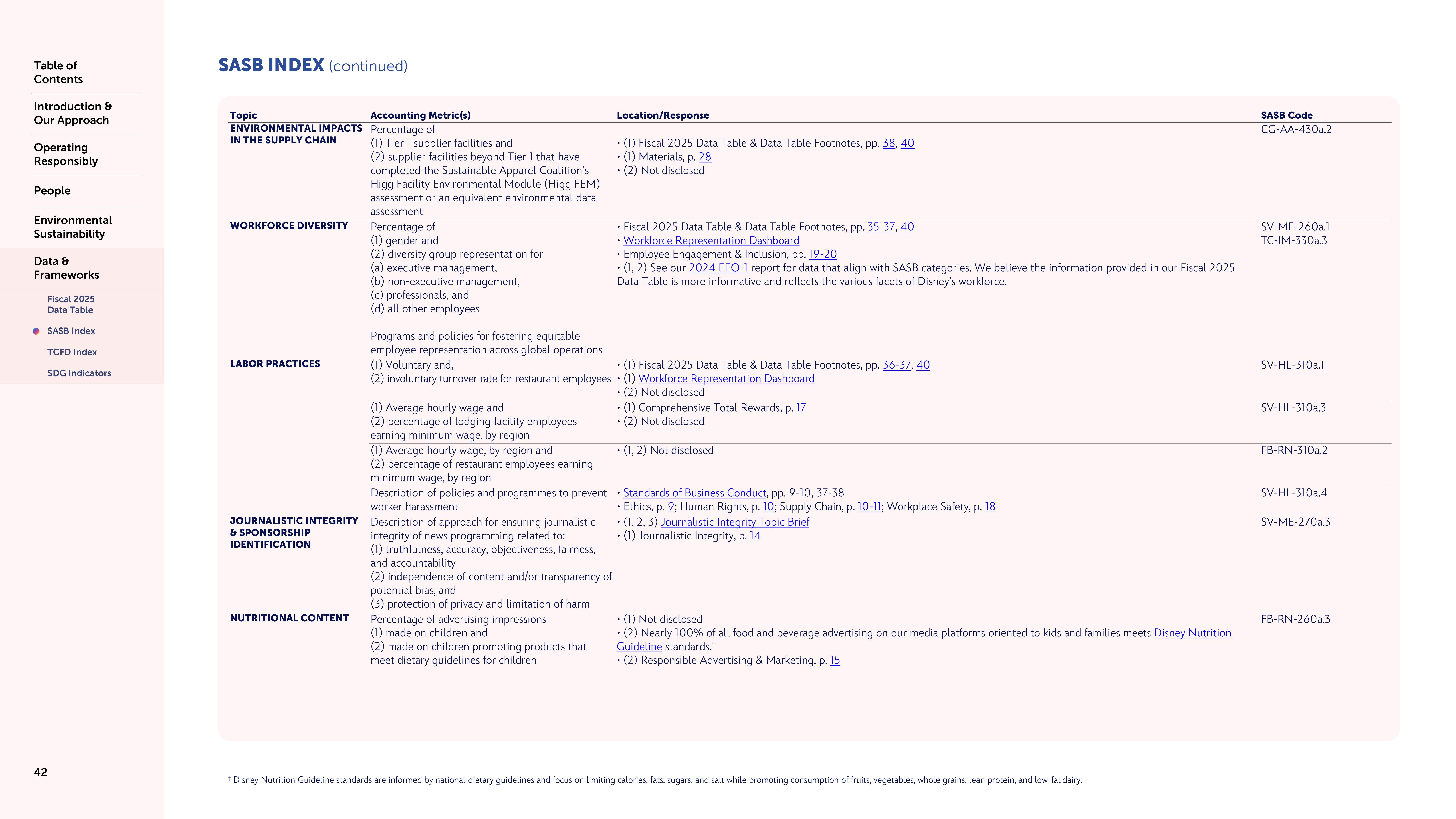
Table
of
SASB
INDEX
(continued)
Contents
Introduction
&
Our
Approach
Operating
Responsibly
People
Environmental
Sustainability
Data
&
Frameworks
Fiscal
2025
Data
Table
SASB
Index
TCFD
Index
SDG
Indicators
Topic
Accounting
Metric(s)
Location/Response
SASB
Code
ENVIRONMENTAL
IMPACTS
IN
THE
SUPPLY
CHAIN
Percentage
of
(1)
Tier
1
supplier
facilities
and
(2) supplier
facilities
beyond
Tier
1
that
have
completed
the
Sustainable
Apparel
Coalitionʼs
Higg
Facility
Environmental
Module
(Higg
FEM)
assessment
or
an
equivalent
environmental
data
assessment
•
(1)
Fiscal
2025
Data
Table
&
Data
Table
Footnotes,
pp.
38
,
40
• (1)
Materials,
p.
28
• (2)
Not
disclosed
CG-AA-430a.2
WORKFORCE
DIVERSITY
Percentage
of
(1) gender
and
(2) diversity group representation for
(a) executive
management,
(b) non-executive
management,
(c) professionals,
and
(d) all
other
employees
Programs
and
policies
for
fostering
equitable
employee
representation
across
global
operations
• Fiscal
2025
Data
Table
&
Data
Table
Footnotes,
pp.
35-37
,
40
•
Workforce
Representation
Dashboard
• Employee
Engagement
&
Inclusion,
pp.
19-20
• (1,
2)
See
our
2024
EEO-1
report
for
data
that
align
with
SASB
categories.
We
believe
the
information
provided
in
our
Fiscal
2025
Data
Table
is
more
informative
and
reflects
the
various
facets
of
Disneyʼs
workforce.
SV-ME-260a.1
TC-IM-330a.3
LABOR
PRACTICES
(1) Voluntary
and,
(2) involuntary
turnover
rate
for
restaurant
employees
• (1)
Fiscal
2025
Data
Table
&
Data
Table
Footnotes,
pp.
36-37
,
40
• (1)
Workforce
Representation
Dashboard
• (2)
Not
disclosed
SV-HL-310a.1
(1) Average
hourly
wage
and
(2) percentage
of
lodging
facility
employees
earning
minimum
wage,
by
region
• (1)
Comprehensive
Total
Rewards,
p.
17
• (2)
Not
disclosed
SV-HL-310a.3
(1) Average
hourly
wage,
by
region
and
(2) percentage
of
restaurant
employees
earning
minimum
wage,
by
region
• (1,
2)
Not
disclosed
FB-RN-310a.2
Description
of
policies
and
programmes
to
prevent
worker
harassment
•
Standards
of
Business
Conduct
,
pp.
9-10,
37-38
• Ethics,
p.
9
;
Human
Rights,
p.
10
;
Supply
Chain,
p.
10-11
;
Workplace
Safety,
p.
18
SV-HL-310a.4
JOURNALISTIC
INTEGRITY
&
SPONSORSHIP
IDENTIFICATION
Description
of
approach
for
ensuring
journalistic
integrity
of
news
programming
related
to:
(1) truthfulness,
accuracy,
objectiveness,
fairness,
and
accountability
(2) independence
of
content
and/or
transparency
of
potential
bias,
and
(3) protection
of
privacy
and
limitation
of
harm
• (1,
2,
3)
Journalistic
Integrity
Topic
Brief
• (1)
Journalistic
Integrity,
p.
14
SV-ME-270a.3
NUTRITIONAL
CONTENT
Percentage
of
advertising
impressions
(1) made
on
children
and
(2) made
on
children
promoting
products
that
meet
dietary
guidelines
for
children
• (1)
Not
disclosed
• (2)
Nearly
100%
of
all
food
and
beverage
advertising
on
our
media
platforms
oriented
to
kids
and
families
meets
Disney
Nutrition
Guideline
standards.
†
• (2)
Responsible
Advertising
&
Marketing,
p.
15
FB-RN-260a.3
†
Disney
Nutrition
Guideline
standards
are
informed
by
national
dietary
guidelines
and
focus
on
limiting
calories,
fats,
sugars,
and
salt
while
promoting
consumption
of
fruits,
vegetables,
whole
grains,
lean
protein,
and
low-fat
dairy.
42
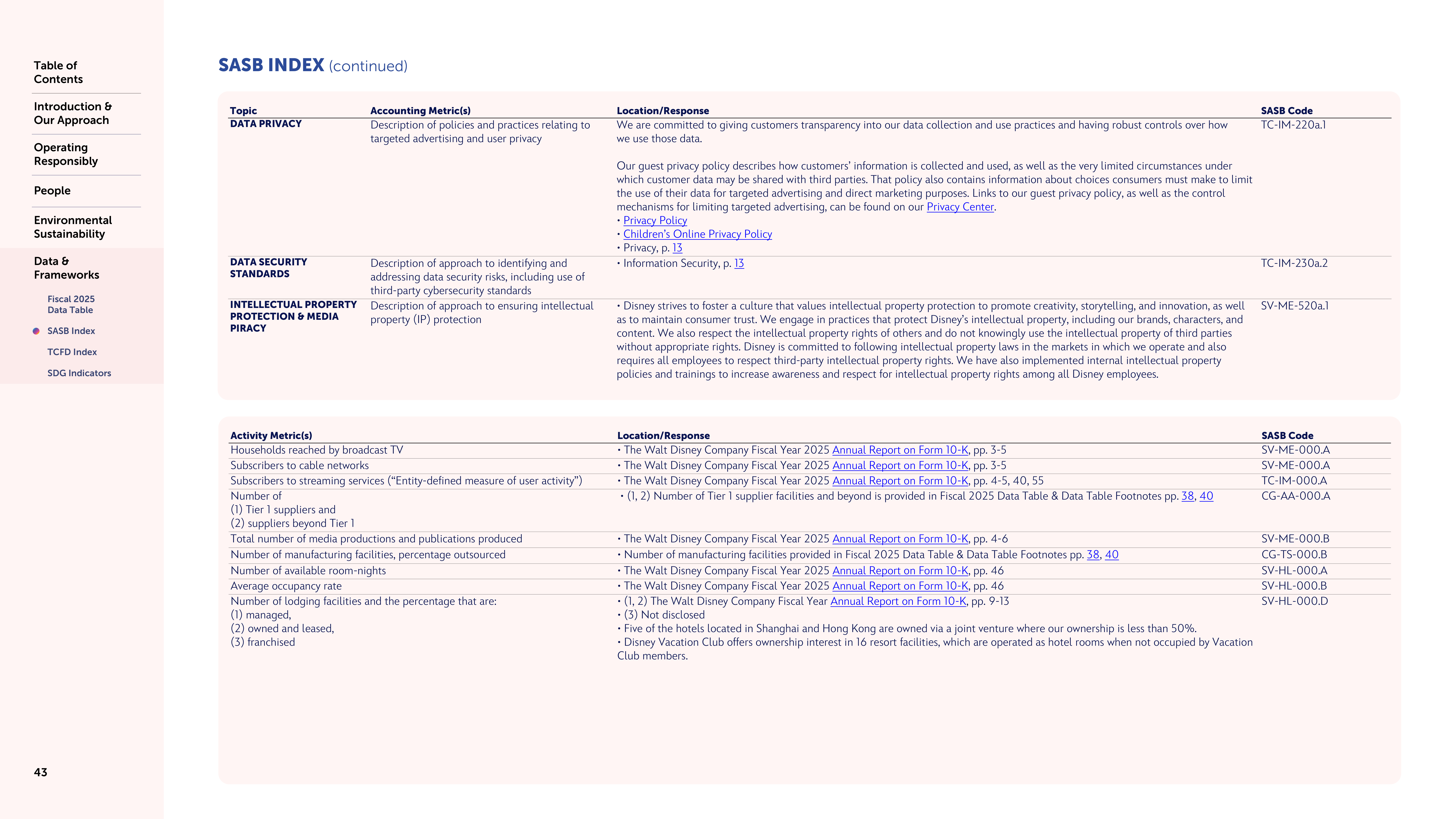
Table
of
SASB
INDEX
(continued)
Contents
Introduction
&
Our
Approach
Operating
Responsibly
People
Environmental
Sustainability
Data
&
Frameworks
Fiscal
2025
Data
Table
SASB
Index
TCFD
Index
SDG
Indicators
Topic
Accounting
Metric(s)
Location/Response
SASB
Code
DATA
PRIVACY
Description
of
policies
and
practices
relating
to
targeted
advertising
and
user
privacy
We
are
committed
to
giving
customers
transparency
into
our
data
collection
and
use
practices
and
having
robust
controls
over
how
we
use
those
data.
Our
guest
privacy
policy
describes
how
customersʼ
information
is
collected
and
used,
as
well
as
the
very
limited
circumstances
under
which
customer
data
may
be
shared
with
third
parties.
That
policy
also
contains
information
about
choices
consumers
must
make
to
limit
the
use
of
their
data
for
targeted
advertising
and
direct
marketing
purposes.
Links
to
our
guest
privacy
policy,
as
well
as
the
control
mechanisms
for
limiting
targeted
advertising,
can
be
found
on
our
Privacy
Center
.
•
Privacy
Policy
•
Childrenʼs
Online
Privacy
Policy
• Privacy,
p.
13
TC-IM-220a.1
DATA
SECURITY
STANDARDS
Description
of
approach
to
identifying
and
addressing
data
security
risks,
including
use
of
third-party
cybersecurity
standards
• Information
Security,
p.
13
TC-IM-230a.2
INTELLECTUAL
PROPERTY
PROTECTION
&
MEDIA
PIRACY
Description
of
approach
to
ensuring
intellectual
property
(IP)
protection
• Disney
strives
to
foster
a
culture
that
values
intellectual
property
protection
to
promote
creativity,
storytelling,
and
innovation,
as
well
as
to
maintain
consumer
trust.
We
engage
in
practices
that
protect
Disneyʼs
intellectual
property,
including
our
brands,
characters,
and
content.
We
also
respect
the
intellectual
property
rights
of
others
and
do
not
knowingly
use
the
intellectual
property
of
third
parties
without
appropriate
rights.
Disney
is
committed
to
following
intellectual
property
laws
in
the
markets
in
which
we
operate
and
also
requires
all
employees
to
respect
third-party
intellectual
property
rights.
We
have
also
implemented
internal
intellectual
property
policies
and
trainings
to
increase
awareness
and
respect
for
intellectual
property
rights
among
all
Disney
employees.
SV-ME-520a.1
Activity
Metric(s)
Location/Response
SASB
Code
Households
reached
by
broadcast
TV
•
The
Walt
Disney
Company
Fiscal
Year
2025
Annual
Report
on
Form
10-K
,
pp.
3-5
SV-ME-000.A
Subscribers
to
cable
networks
• The
Walt
Disney
Company
Fiscal
Year
2025
Annual
Report
on
Form
10-K
,
pp.
3-5
SV-ME-000.A
Subscribers
to
streaming
services
(“Entity-defined
measure
of
user
activity”)
• The
Walt
Disney
Company
Fiscal
Year
2025
Annual
Report
on
Form
10-K
,
pp.
4-5,
40,
55
TC-IM-000.A
Number
of
(1)
Tier
1
suppliers
and
(2)
suppliers
beyond
Tier
1
•
(1,
2)
Number
of
Tier
1
supplier
facilities
and
beyond
is
provided
in
Fiscal
2025
Data
Table
&
Data
Table
Footnotes
pp.
38
,
40
CG-AA-000.A
Total
number
of
media
productions
and
publications
produced
• The
Walt
Disney
Company
Fiscal
Year
2025
Annual
Report
on
Form
10-K
,
pp.
4-6
SV-ME-000.B
Number
of
manufacturing
facilities,
percentage
outsourced
• Number
of
manufacturing
facilities
provided
in
Fiscal
2025
Data
Table
&
Data
Table
Footnotes
pp.
38
,
40
CG-TS-000.B
Number
of
available
room-nights
• The
Walt
Disney
Company
Fiscal
Year
2025
Annual
Report
on
Form
10-K
,
pp.
46
SV-HL-000.A
Average
occupancy
rate
• The
Walt
Disney
Company
Fiscal
Year
2025
Annual
Report
on
Form
10-K
,
pp.
46
SV-HL-000.B
Number
of
lodging
facilities
and
the
percentage
that
are:
(1)
managed,
(2)
owned
and
leased,
(3)
franchised
• (1,
2)
The
Walt
Disney
Company
Fiscal
Year
Annual
Report
on
Form
10-K
,
pp.
9-13
• (3)
Not
disclosed
• Five
of
the
hotels
located
in
Shanghai
and
Hong
Kong
are
owned
via
a
joint
venture
where
our
ownership
is
less
than
50%.
• Disney
Vacation
Club
offers
ownership
interest
in
16
resort
facilities,
which
are
operated
as
hotel
rooms
when
not
occupied
by
Vacation
Club
members.
SV-HL-000.D
43
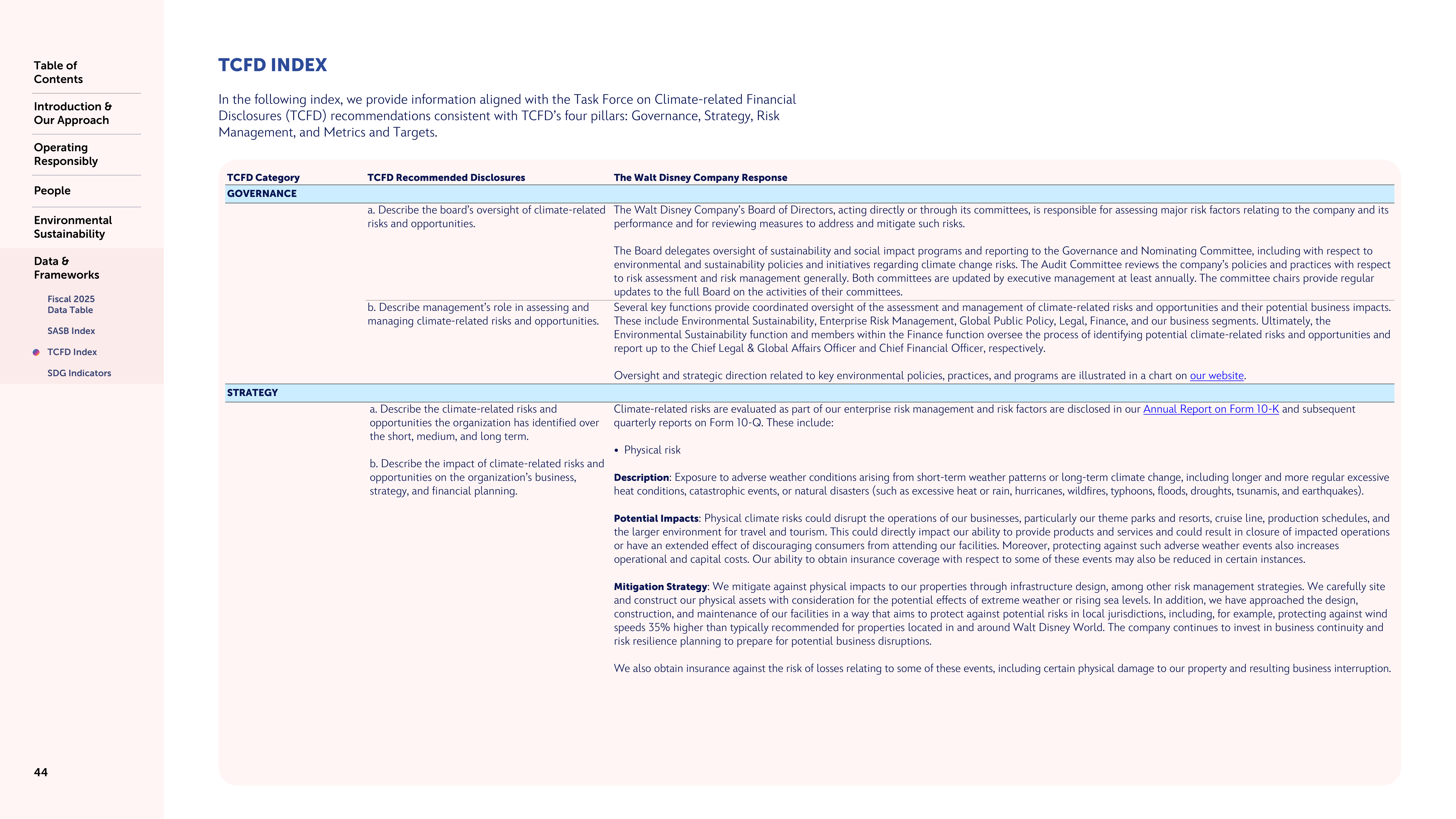
Table
of
TCFD
Index
TCFD
INDEX
Contents
In
the
following
index,
we
provide
information
aligned
with
the
Task
Force
on
Climate-related
Financial
Disclosures
(TCFD)
recommendations
consistent
with
TCFDʼs
four
pillars:
Governance,
Strategy,
Risk
Management,
and
Metrics
and
Targets.
Introduction
&
Our
Approach
Operating
Responsibly
People
Environmental
Sustainability
Data
&
Frameworks
Fiscal
2025
Data
Table
SASB
Index
SDG
Indicators
TCFD
Category
TCFD
Recommended
Disclosures
The
Walt
Disney
Company
Response
GOVERNANCE
a.
Describe
the
boardʼs
oversight
of
climate-related
risks
and
opportunities.
The
Walt
Disney
Companyʼs
Board
of
Directors,
acting
directly
or
through
its
committees,
is
responsible
for
assessing
major
risk
factors
relating
to
the
company
and
its
performance
and
for
reviewing
measures
to
address
and
mitigate
such
risks.
The
Board
delegates
oversight
of
sustainability
and
social
impact
programs
and
reporting
to
the
Governance
and
Nominating
Committee,
including
with
respect
to
environmental
and
sustainability
policies
and
initiatives
regarding
climate
change
risks.
The
Audit
Committee
reviews
the
companyʼs
policies
and
practices
with
respect
to
risk
assessment
and
risk
management
generally.
Both
committees
are
updated
by
executive
management
at
least
annually.
The
committee
chairs
provide
regular
updates
to
the
full
Board
on
the
activities
of
their
committees.
b.
Describe
managementʼs
role
in
assessing
and
managing
climate-related
risks
and
opportunities.
Several
key
functions
provide
coordinated
oversight
of
the
assessment
and
management
of
climate-related
risks
and
opportunities
and
their
potential
business
impacts.
These
include
Environmental
Sustainability,
Enterprise
Risk
Management,
Global
Public
Policy,
Legal,
Finance,
and
our
business
segments.
Ultimately,
the
Environmental
Sustainability
function
and
members
within
the
Finance
function
oversee
the
process
of
identifying
potential
climate-related
risks
and
opportunities
and
report
up
to
the
Chief
Legal
&
Global
Affairs
Officer
and
Chief
Financial
Officer,
respectively.
Oversight
and
strategic
direction
related
to
key
environmental
policies,
practices,
and
programs
are
illustrated
in
a
chart
on
our
website
.
STRATEGY
a.
Describe
the
climate-related
risks
and
opportunities
the
organization
has
identified
over
the
short,
medium,
and
long
term.
b.
Describe
the
impact
of
climate-related
risks
and
opportunities
on
the
organizationʼs
business,
strategy,
and
financial
planning.
Climate-related
risks
are
evaluated
as
part
of
our
enterprise
risk
management
and
risk
factors
are
disclosed
in
our
Annual
Report
on
Form
10-K
and
subsequent
quarterly
reports
on
Form
10-Q.
These
include:
•
Physical
risk
Description
:
Exposure
to
adverse
weather
conditions
arising
from
short-term
weather
patterns
or
long-term
climate
change,
including
longer
and
more
regular
excessive
heat
conditions,
catastrophic
events,
or
natural
disasters
(such
as
excessive
heat
or
rain,
hurricanes,
wildfires,
typhoons,
floods,
droughts,
tsunamis,
and
earthquakes).
Potential
Impacts
:
Physical
climate
risks
could
disrupt
the
operations
of
our
businesses,
particularly
our
theme
parks
and
resorts,
cruise
line,
production
schedules,
and
the
larger
environment
for
travel
and
tourism.
This
could
directly
impact
our
ability
to
provide
products
and
services
and
could
result
in
closure
of
impacted
operations
or
have
an
extended
effect
of
discouraging
consumers
from
attending
our
facilities.
Moreover,
protecting
against
such
adverse
weather
events
also
increases
operational
and
capital
costs.
Our
ability
to
obtain
insurance
coverage
with
respect
to
some
of
these
events
may
also
be
reduced
in
certain
instances.
Mitigation
Strategy
:
We
mitigate
against
physical
impacts
to
our
properties
through
infrastructure
design,
among
other
risk
management
strategies.
We
carefully
site
and
construct
our
physical
assets
with
consideration
for
the
potential
effects
of
extreme
weather
or
rising
sea
levels.
In
addition,
we
have
approached
the
design,
construction,
and
maintenance
of
our
facilities
in
a
way
that
aims
to
protect
against
potential
risks
in
local
jurisdictions,
including,
for
example,
protecting
against
wind
speeds
35%
higher
than
typically
recommended
for
properties
located
in
and
around
Walt
Disney
World.
The
company
continues
to
invest
in
business
continuity
and
risk
resilience
planning
to
prepare
for
potential
business
disruptions.
We
also
obtain
insurance
against
the
risk
of
losses
relating
to
some
of
these
events,
including
certain
physical
damage
to
our
property
and
resulting
business
interruption.
44
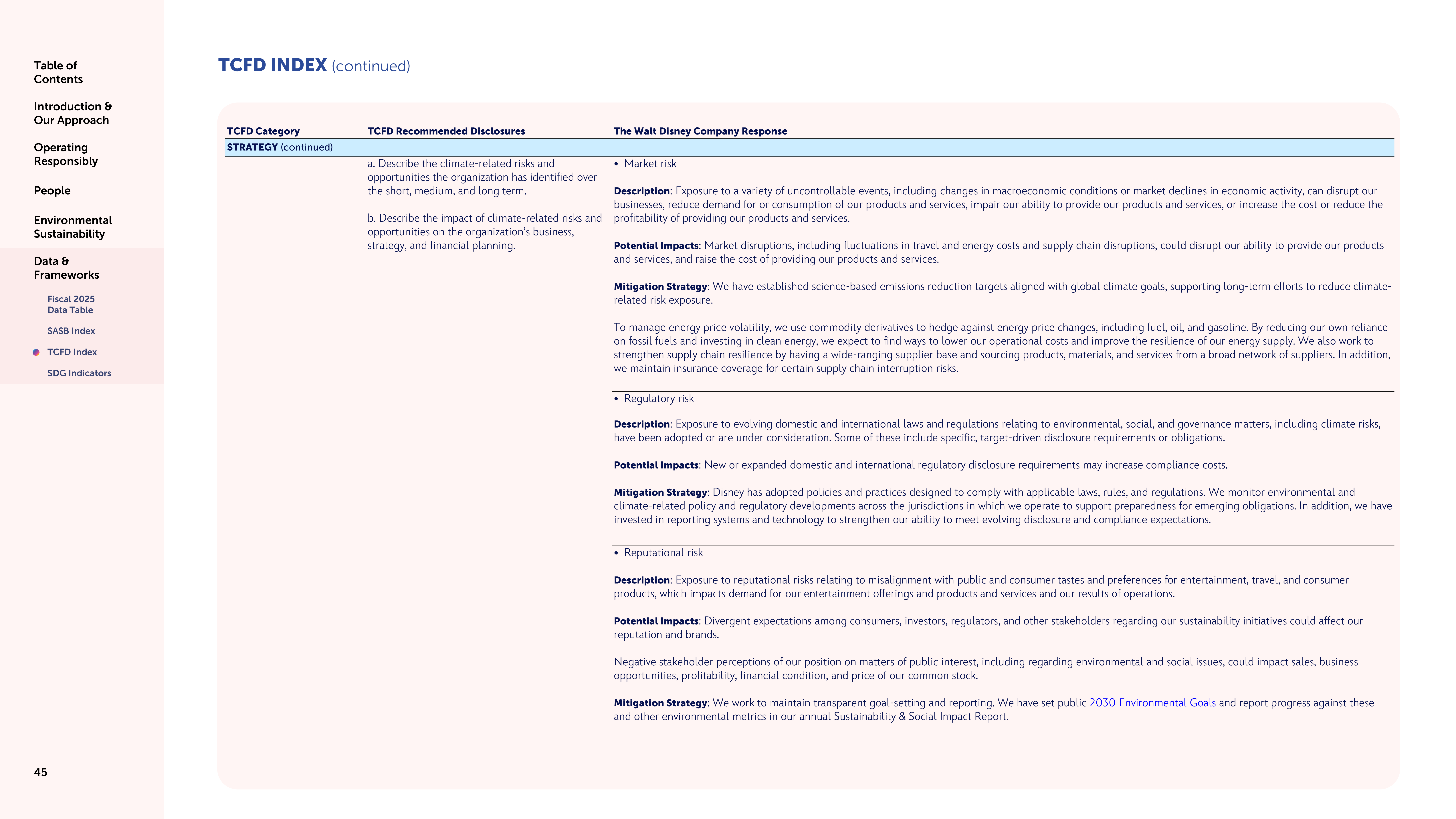
Table
of
TCFD
INDEX
(continued)
Contents
Introduction
&
Our
Approach
Operating
Responsibly
People
Environmental
Sustainability
Data
&
Frameworks
Fiscal
2025
Data
Table
SASB
Index
TCFD
Index
SDG
Indicators
TCFD
Category
TCFD
Recommended
Disclosures
The
Walt
Disney
Company
Response
STRATEGY
(continued)
a.
Describe
the
climate-related
risks
and
opportunities
the
organization
has
identified
over
the
short,
medium,
and
long
term.
b.
Describe
the
impact
of
climate-related
risks
and
opportunities
on
the
organizationʼs
business,
strategy,
and
financial
planning.
•
Market
risk
Description
:
Exposure
to
a
variety
of
uncontrollable
events,
including
changes
in
macroeconomic
conditions
or
market
declines
in
economic
activity,
can
disrupt
our
businesses,
reduce
demand
for
or
consumption
of
our
products
and
services,
impair
our
ability
to
provide
our
products
and
services,
or
increase
the
cost
or
reduce
the
profitability
of
providing
our
products
and
services.
Potential
Impacts
:
Market
disruptions,
including
fluctuations
in
travel
and
energy
costs
and
supply
chain
disruptions,
could
disrupt
our
ability
to
provide
our
products
and
services,
and
raise
the
cost
of
providing
our
products
and
services.
Mitigation
Strategy
:
We
have
established
science-based
emissions
reduction
targets
aligned
with
global
climate
goals,
supporting
long-term
efforts
to
reduce
climate-
related
risk
exposure.
To
manage
energy
price
volatility,
we
use
commodity
derivatives
to
hedge
against
energy
price
changes,
including
fuel,
oil,
and
gasoline.
By
reducing
our
own
reliance
on
fossil
fuels
and
investing
in
clean
energy,
we
expect
to
find
ways
to
lower
our
operational
costs
and
improve
the
resilience
of
our
energy
supply.
We
also
work
to
strengthen
supply
chain
resilience
by
having
a
wide-ranging
supplier
base
and
sourcing
products,
materials,
and
services
from
a
broad
network
of
suppliers.
In
addition,
we
maintain
insurance
coverage
for
certain
supply
chain
interruption
risks.
•
Regulatory
risk
Description
:
Exposure
to
evolving
domestic
and
international
laws
and
regulations
relating
to
environmental,
social,
and
governance
matters,
including
climate
risks,
have
been
adopted
or
are
under
consideration.
Some
of
these
include
specific,
target-driven
disclosure
requirements
or
obligations.
Potential
Impacts
:
New
or
expanded
domestic
and
international
regulatory
disclosure
requirements
may
increase
compliance
costs.
Mitigation
Strategy
:
Disney
has
adopted
policies
and
practices
designed
to
comply
with
applicable
laws,
rules,
and
regulations.
We
monitor
environmental
and
climate-related
policy
and
regulatory
developments
across
the
jurisdictions
in
which
we
operate
to
support
preparedness
for
emerging
obligations.
In
addition,
we
have
invested
in
reporting
systems
and
technology
to
strengthen
our
ability
to
meet
evolving
disclosure
and
compliance
expectations.
•
Reputational
risk
Description
:
Exposure
to
reputational
risks
relating
to
misalignment
with
public
and
consumer
tastes
and
preferences
for
entertainment,
travel,
and
consumer
products,
which
impacts
demand
for
our
entertainment
offerings
and
products
and
services
and
our
results
of
operations.
Potential
Impacts
:
Divergent
expectations
among
consumers,
investors,
regulators,
and
other
stakeholders
regarding
our
sustainability
initiatives
could
affect
our
reputation
and
brands.
Negative
stakeholder
perceptions
of
our
position
on
matters
of
public
interest,
including
regarding
environmental
and
social
issues,
could
impact
sales,
business
opportunities,
profitability,
financial
condition,
and
price
of
our
common
stock.
Mitigation
Strategy
:
We
work
to
maintain
transparent
goal-setting
and
reporting.
We
have
set
public
2030
Environmental
Goals
and
report
progress
against
these
and
other
environmental
metrics
in
our
annual
Sustainability
&
Social
Impact
Report.
45
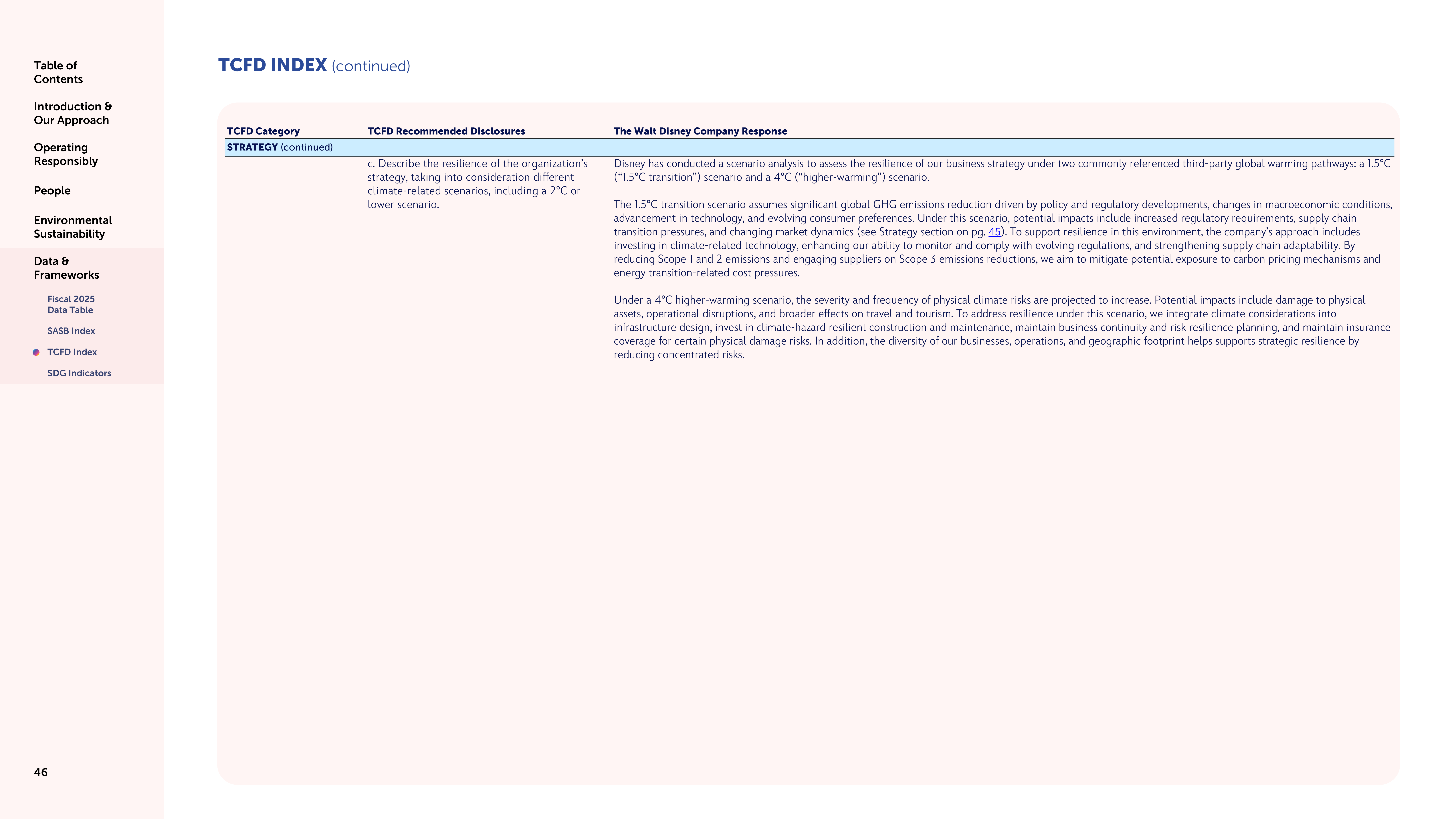
Table
of
TCFD
INDEX
(continued)
Contents
Introduction
&
Our
Approach
Operating
Responsibly
People
Environmental
Sustainability
Data
&
Frameworks
Fiscal
2025
Data
Table
SASB
Index
TCFD
Index
SDG
Indicators
TCFD
Category
TCFD
Recommended
Disclosures
The
Walt
Disney
Company
Response
STRATEGY
(continued)
c.
Describe
the
resilience
of
the
organizationʼs
strategy,
taking
into
consideration
different
climate-related
scenarios,
including
a
2°C
or
lower
scenario.
Disney
has
conducted
a
scenario
analysis
to
assess
the
resilience
of
our
business
strategy
under
two
commonly
referenced
third-party
global
warming
pathways:
a
1.5°C
(“1.5°C
transition”)
scenario
and
a
4°C
(“higher-warming”)
scenario.
The
1.5°C
transition
scenario
assumes
significant
global
GHG
emissions
reduction
driven
by
policy
and
regulatory
developments,
changes
in
macroeconomic
conditions,
advancement
in
technology,
and
evolving
consumer
preferences.
Under
this
scenario,
potential
impacts
include
increased
regulatory
requirements,
supply
chain
transition
pressures,
and
changing
market
dynamics
(see
Strategy
section
on
pg.
45
).
To
support
resilience
in
this
environment,
the
companyʼs
approach
includes
investing
in
climate-related
technology,
enhancing
our
ability
to
monitor
and
comply
with
evolving
regulations,
and
strengthening
supply
chain
adaptability.
By
reducing
Scope
1
and
2
emissions
and
engaging
suppliers
on
Scope
3
emissions
reductions,
we
aim
to
mitigate
potential
exposure
to
carbon
pricing
mechanisms
and
energy
transition-related
cost
pressures.
Under
a
4°C
higher-warming
scenario,
the
severity
and
frequency
of
physical
climate
risks
are
projected
to
increase.
Potential
impacts
include
damage
to
physical
assets,
operational
disruptions,
and
broader
effects
on
travel
and
tourism.
To
address
resilience
under
this
scenario,
we
integrate
climate
considerations
into
infrastructure
design,
invest
in
climate-hazard
resilient
construction
and
maintenance,
maintain
business
continuity
and
risk
resilience
planning,
and
maintain
insurance
coverage
for
certain
physical
damage
risks.
In
addition,
the
diversity
of
our
businesses,
operations,
and
geographic
footprint
helps
supports
strategic
resilience
by
reducing
concentrated
risks.
46
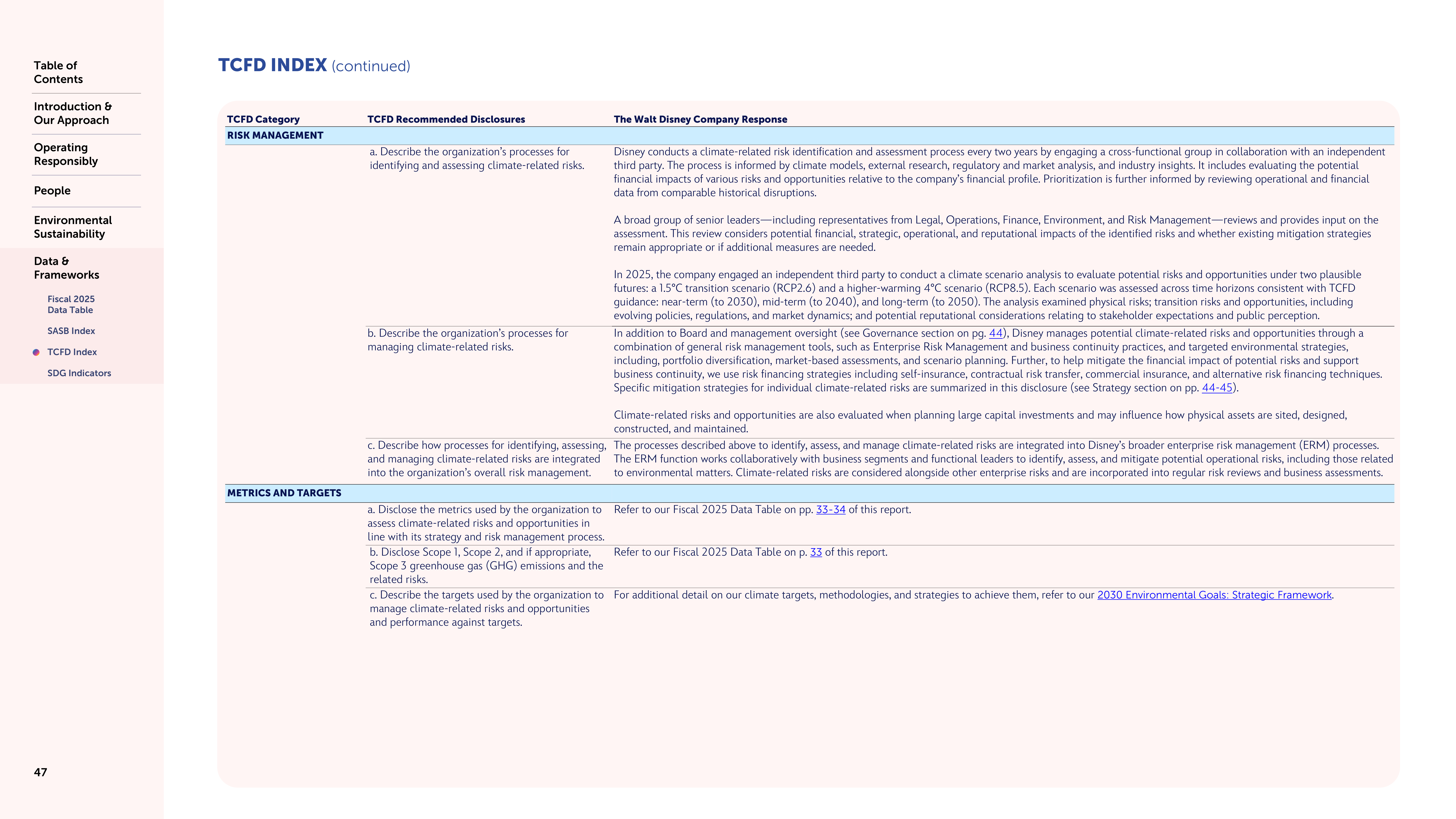
Table
of
TCFD
INDEX
(continued)
Contents
Introduction
&
Our
Approach
Operating
Responsibly
People
Environmental
Sustainability
Data
&
Frameworks
Fiscal
2025
Data
Table
SASB
Index
TCFD
Index
SDG
Indicators
TCFD
Category
TCFD
Recommended
Disclosures
The
Walt
Disney
Company
Response
RISK
MANAGEMENT
a.
Describe
the
organizationʼs
processes
for
identifying
and
assessing
climate-related
risks.
Disney
conducts
a
climate-related
risk
identification
and
assessment
process
every
two
years
by
engaging
a
cross-functional
group
in
collaboration
with
an
independent
third
party.
The
process
is
informed
by
climate
models,
external
research,
regulatory
and
market
analysis,
and
industry
insights.
It
includes
evaluating
the
potential
financial
impacts
of
various
risks
and
opportunities
relative
to
the
companyʼs
financial
profile.
Prioritization
is
further
informed
by
reviewing
operational
and
financial
data
from
comparable
historical
disruptions.
A
broad
group
of
senior
leaders—including
representatives
from
Legal,
Operations,
Finance,
Environment,
and
Risk
Management—reviews
and
provides
input
on
the
assessment.
This
review
considers
potential
financial,
strategic,
operational,
and
reputational
impacts
of
the
identified
risks
and
whether
existing
mitigation
strategies
remain
appropriate
or
if
additional
measures
are
needed.
In
2025,
the
company
engaged
an
independent
third
party
to
conduct
a
climate
scenario
analysis
to
evaluate
potential
risks
and
opportunities
under
two
plausible
futures:
a
1.5°C
transition
scenario
(RCP2.6)
and
a
higher-warming
4°C
scenario
(RCP8.5).
Each
scenario
was
assessed
across
time
horizons
consistent
with
TCFD
guidance:
near-term
(to
2030),
mid-term
(to
2040),
and
long-term
(to
2050).
The
analysis
examined
physical
risks;
transition
risks
and
opportunities,
including
evolving
policies,
regulations,
and
market
dynamics;
and
potential
reputational
considerations
relating
to
stakeholder
expectations
and
public
perception.
b.
Describe
the
organizationʼs
processes
for
managing
climate-related
risks.
In
addition
to
Board
and
management
oversight
(see
Governance
section
on
pg.
44
),
Disney
manages
potential
climate-related
risks
and
opportunities
through
a
combination
of
general
risk
management
tools,
such
as
Enterprise
Risk
Management
and
business
continuity
practices,
and
targeted
environmental
strategies,
including,
portfolio
diversification,
market-based
assessments,
and
scenario
planning.
Further,
to
help
mitigate
the
financial
impact
of
potential
risks
and
support
business
continuity,
we
use
risk
financing
strategies
including
self-insurance,
contractual
risk
transfer,
commercial
insurance,
and
alternative
risk
financing
techniques.
Specific
mitigation
strategies
for
individual
climate-related
risks
are
summarized
in
this
disclosure
(see
Strategy
section
on
pp.
44-45
).
Climate-related
risks
and
opportunities
are
also
evaluated
when
planning
large
capital
investments
and
may
influence
how
physical
assets
are
sited,
designed,
constructed,
and
maintained.
c.
Describe
how
processes
for
identifying,
assessing,
and
managing
climate-related
risks
are
integrated
into
the
organizationʼs
overall
risk
management.
The
processes
described
above
to
identify,
assess,
and
manage
climate-related
risks
are
integrated
into
Disneyʼs
broader
enterprise
risk
management
(ERM)
processes.
The
ERM
function
works
collaboratively
with
business
segments
and
functional
leaders
to
identify,
assess,
and
mitigate
potential
operational
risks,
including
those
related
to
environmental
matters.
Climate-related
risks
are
considered
alongside
other
enterprise
risks
and
are
incorporated
into
regular
risk
reviews
and
business
assessments.
METRICS
AND
TARGETS
a.
Disclose
the
metrics
used
by
the
organization
to
assess
climate-related
risks
and
opportunities
in
line
with
its
strategy
and
risk
management
process.
Refer
to
our
Fiscal
2025
Data
Table
on
pp.
33-34
of
this
report.
b.
Disclose
Scope
1,
Scope
2,
and
if
appropriate,
Scope
3
greenhouse
gas
(GHG)
emissions
and
the
related
risks.
Refer
to
our
Fiscal
2025
Data
Table
on
p.
33
of
this
report.
c.
Describe
the
targets
used
by
the
organization
to
manage
climate-related
risks
and
opportunities
and
performance
against
targets.
For
additional
detail
on
our
climate
targets,
methodologies,
and
strategies
to
achieve
them,
refer
to
our
2030
Environmental
Goals:
Strategic
Framework
.
47
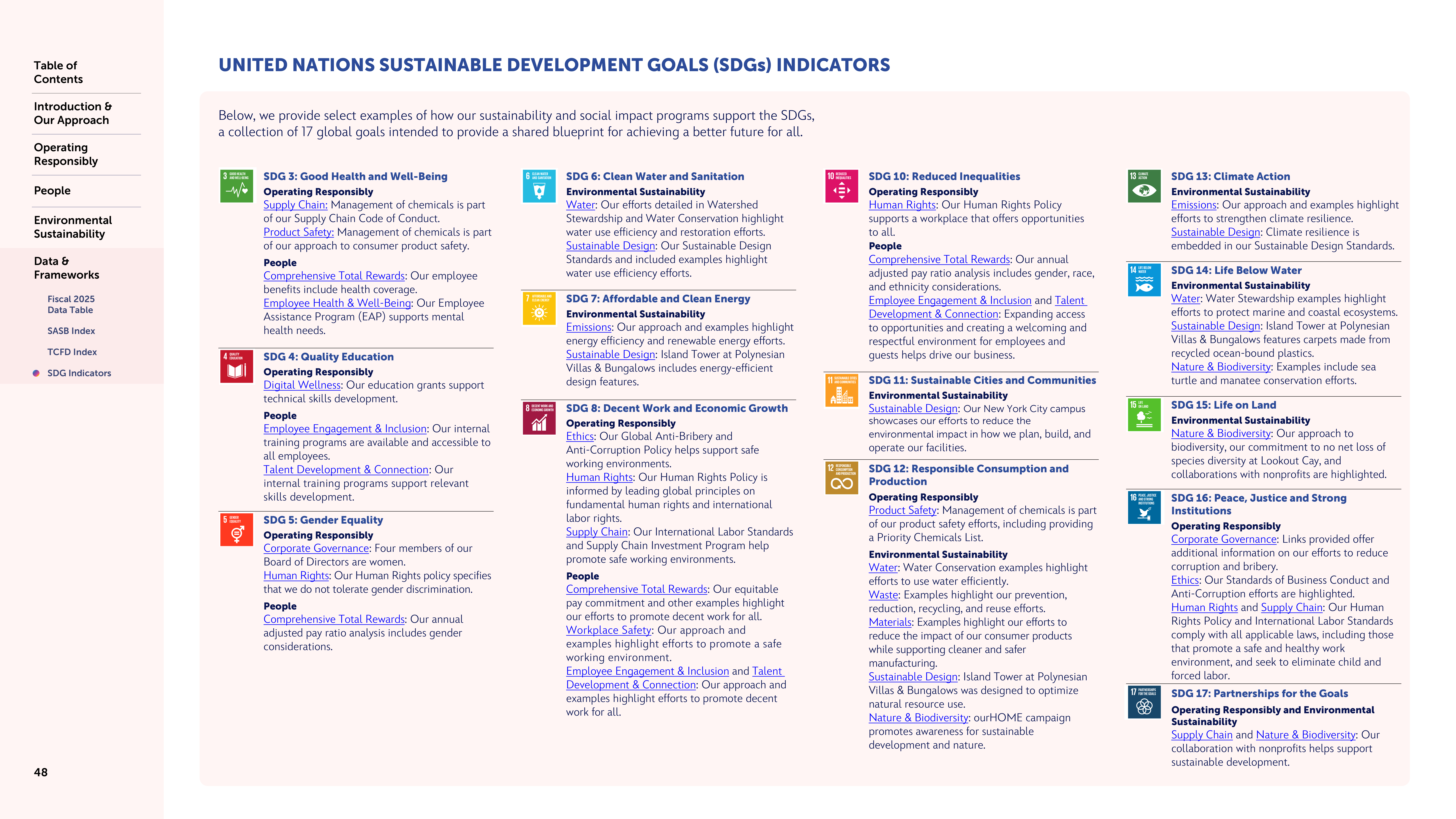

Table
of
SDG
Indicators
UNITED
NATIONS
SUSTAINABLE
DEVELOPMENT
GOALS
(SDGs)
INDICATORS
Contents
Introduction
&
Our
Approach
Operating
Responsibly
People
Environmental
Sustainability
Data
&
Frameworks
Fiscal
2025
Data
Table
SASB
Index
TCFD
Index
Below,
we
provide
select
examples
of
how
our
sustainability
and
social
impact
programs
support
the
SDGs,
a
collection
of
17
global
goals
intended
to
provide
a
shared
blueprint
for
achieving
a
better
future
for
all.
SDG
3:
Good
Health
and
Well-Being
Operating
Responsibly
Supply
Chain:
Management
of
chemicals
is
part
of
our
Supply
Chain
Code
of
Conduct.
Product
Safety:
Management
of
chemicals
is
part
of
our
approach
to
consumer
product
safety.
People
Comprehensive
Total
Rewards
:
Our
employee
benefits
include
health
coverage.
Employee
Health
&
Well-Being
:
Our
Employee
Assistance
Program
(EAP)
supports
mental
health
needs.
SDG
4:
Quality
Education
Operating
Responsibly
Digital
Wellness
:
Our
education
grants
support
technical
skills
development.
People
Employee
Engagement
&
Inclusion
:
Our
internal
training
programs
are
available
and
accessible
to
all
employees.
Talent
Development
&
Connection
:
Our
internal
training
programs
support
relevant
skills
development.
SDG
5:
Gender
Equality
Operating
Responsibly
Corporate
Governance
:
Four
members
of
our
Board
of
Directors
are
women.
Human
Rights
:
Our
Human
Rights
policy
specifies
that
we
do
not
tolerate
gender
discrimination.
People
Comprehensive
Total
Rewards
:
Our
annual
adjusted
pay
ratio
analysis
includes
gender
considerations.
SDG
6:
Clean
Water
and
Sanitation
Environmental
Sustainability
Water
:
Our
efforts
detailed
in
Watershed
Stewardship
and
Water
Conservation
highlight
water
use
efficiency
and
restoration
efforts.
Sustainable
Design
:
Our
Sustainable
Design
Standards
and
included
examples
highlight
water
use
efficiency
efforts.
SDG
7:
Affordable
and
Clean
Energy
Environmental
Sustainability
Emissions
:
Our
approach
and
examples
highlight
energy
efficiency
and
renewable
energy
efforts.
Sustainable
Design
:
Island
Tower
at
Polynesian
Villas
&
Bungalows
includes
energy-efficient
design
features.
SDG
8:
Decent
Work
and
Economic
Growth
Operating
Responsibly
Ethics
:
Our
Global
Anti-Bribery
and
Anti-Corruption
Policy
helps
support
safe
working
environments.
Human
Rights
:
Our
Human
Rights
Policy
is
informed
by
leading
global
principles
on
fundamental
human
rights
and
international
labor
rights.
Supply
Chain
:
Our
International
Labor
Standards
and
Supply
Chain
Investment
Program
help
promote
safe
working
environments.
People
Comprehensive
Total
Rewards
:
Our
equitable
pay
commitment
and
other
examples
highlight
our
efforts
to
promote
decent
work
for
all.
Workplace
Safety
:
Our
approach
and
examples
highlight
efforts
to
promote
a
safe
working
environment.
Employee
Engagement
&
Inclusion
and
Talent
Development
&
Connection
:
Our
approach
and
examples
highlight
efforts
to
promote
decent
work
for
all.
SDG
10:
Reduced
Inequalities
Operating
Responsibly
Human
Rights
:
Our
Human
Rights
Policy
supports
a
workplace
that
offers
opportunities
to
all.
People
Comprehensive
Total
Rewards
:
Our
annual
adjusted
pay
ratio
analysis
includes
gender,
race,
and
ethnicity
considerations.
Employee
Engagement
&
Inclusion
and
Talent
Development
&
Connection
:
Expanding
access
to
opportunities
and
creating
a
welcoming
and
respectful
environment
for
employees
and
guests
helps
drive
our
business.
SDG
11:
Sustainable
Cities
and
Communities
Environmental
Sustainability
Sustainable
Design
:
Our
New
York
City
campus
showcases
our
efforts
to
reduce
the
environmental
impact
in
how
we
plan,
build,
and
operate
our
facilities.
SDG
12:
Responsible
Consumption
and
Production
Operating
Responsibly
Product
Safety
:
Management
of
chemicals
is
part
of
our
product
safety
efforts,
including
providing
a
Priority
Chemicals
List.
Environmental
Sustainability
Water
:
Water
Conservation
examples
highlight
efforts
to
use
water
efficiently.
Waste
:
Examples
highlight
our
prevention,
reduction,
recycling,
and
reuse
efforts.
Materials
:
Examples
highlight
our
efforts
to
reduce
the
impact
of
our
consumer
products
while
supporting
cleaner
and
safer
manufacturing.
Sustainable
Design
:
Island
Tower
at
Polynesian
Villas
&
Bungalows
was
designed
to
optimize
natural
resource
use.
Nature
&
Biodiversity
:
ourHOME
campaign
promotes
awareness
for
sustainable
development
and
nature.
SDG
13:
Climate
Action
Environmental
Sustainability
Emissions
:
Our
approach
and
examples
highlight
efforts
to
strengthen
climate
resilience.
Sustainable
Design
:
Climate
resilience
is
embedded
in
our
Sustainable
Design
Standards.
SDG
14:
Life
Below
Water
Environmental
Sustainability
Water
:
Water
Stewardship
examples
highlight
efforts
to
protect
marine
and
coastal
ecosystems.
Sustainable
Design
:
Island
Tower
at
Polynesian
Villas
&
Bungalows
features
carpets
made
from
recycled
ocean-bound
plastics.
Nature
&
Biodiversity
:
Examples
include
sea
turtle
and
manatee
conservation
efforts.
SDG
15:
Life
on
Land
Environmental
Sustainability
Nature
&
Biodiversity
:
Our
approach
to
biodiversity,
our
commitment
to
no
net
loss
of
species
diversity
at
Lookout
Cay,
and
collaborations
with
nonprofits
are
highlighted.
SDG
16:
Peace,
Justice
and
Strong
Institutions
Operating
Responsibly
Corporate
Governance
:
Links
provided
offer
additional
information
on
our
efforts
to
reduce
corruption
and
bribery.
Ethics
:
Our
Standards
of
Business
Conduct
and
Anti-Corruption
efforts
are
highlighted.
Human
Rights
and
Supply
Chain
:
Our
Human
Rights
Policy
and
International
Labor
Standards
comply
with
all
applicable
laws,
including
those
that
promote
a
safe
and
healthy
work
environment,
and
seek
to
eliminate
child
and
forced
labor.
SDG
17:
Partnerships
for
the
Goals
Operating
Responsibly
and
Environmental
Sustainability
Supply
Chain
and
Nature
&
Biodiversity
:
Our
collaboration
with
nonprofits
helps
support
sustainable
development.
48
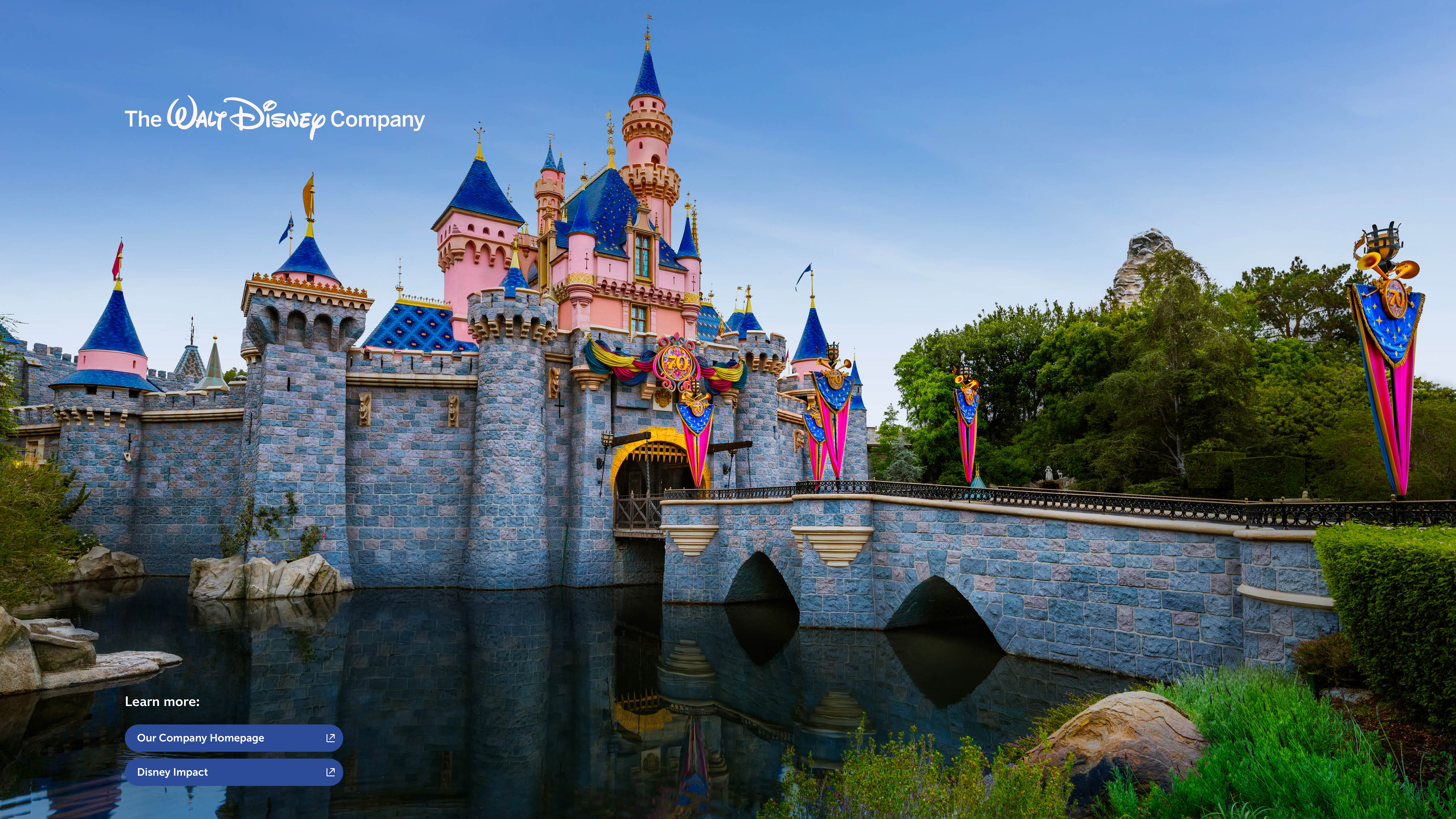
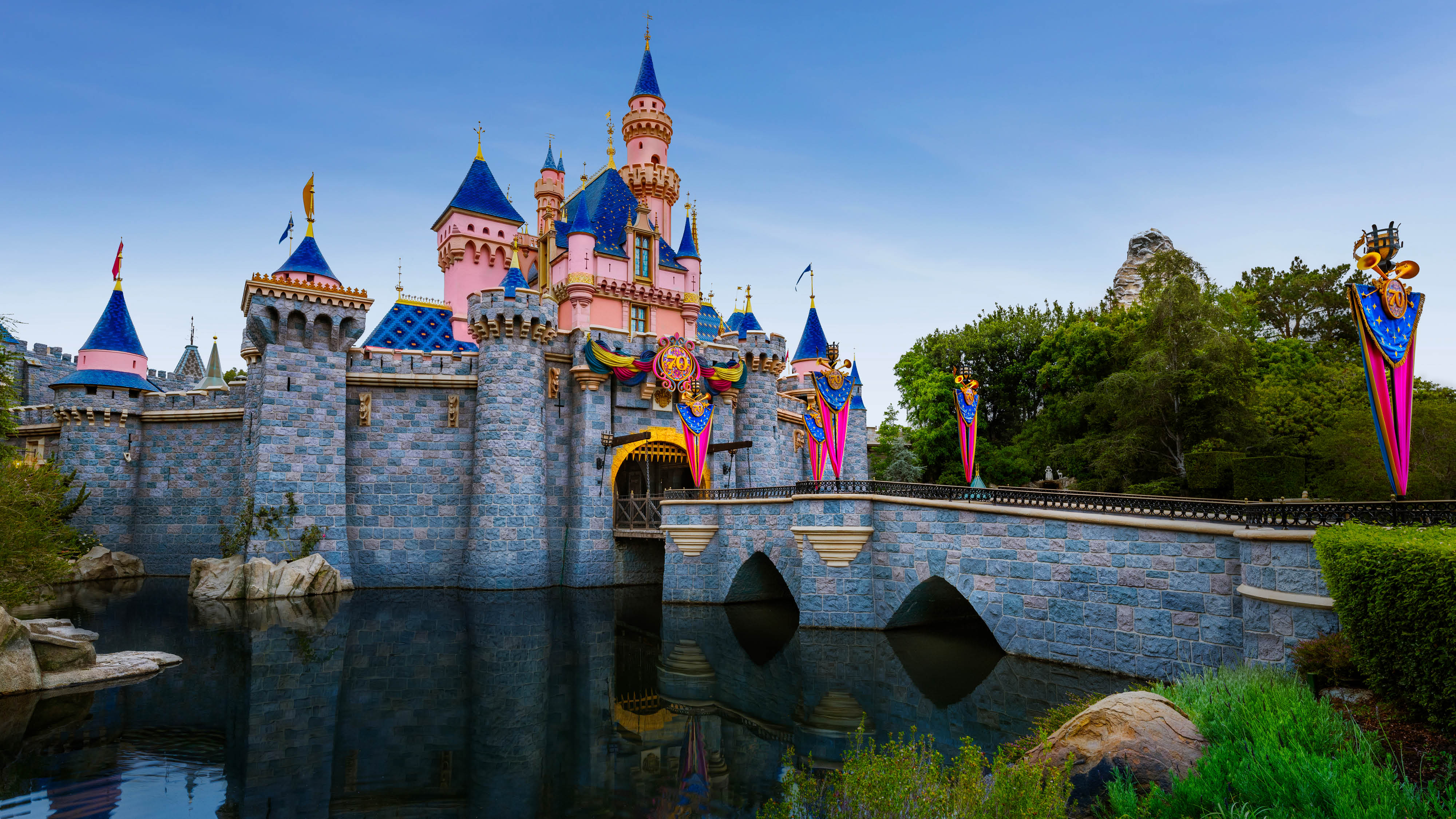
Learn
more:
Our
Company
Homepage
Disney
Impact