

Smarter
technology
for all
HKD COUNTER STOCK CODE 992
RMB COUNTER STOCK CODE 80992
2025/26 Environmental, Social and Governance Report
Lenovo Group Limited



Table of contents
A letter from the Chairman and CEO
6
A letter from our Chief Legal & Corporate Responsibility Officer
8
2.0 About this report
10
About this report
12
Organizational profile
13
Material topics
13
Aligning with the United Nations Sustainable Development Goals
16
3.0 Environmental
17
Environmental management system (EMS)
19
Climate change
19
Waste
24
Water
25
Environmentally conscious products
26
Packaging
32
Product end-of-life management (PELM)
33
Circular economy
34
Biodiversity
35
4.0 Social
36
Labor practices
38
Health and safety
39
Employment and talent management practices
43
Global philanthropy and community engagement
48
Global inclusion
51
5.0 Governance
55
ESG governance
57
Business practices
60
Product quality management
66
Innovation
68
Governance highlight
69
6.0 Global supply chain
70
Supply chain ESG practices
72
Supplier inclusion
82
7.0 Consolidated metrics
83
FY 2025/26 consolidated metrics
85
8.0 ESG KPIs and EMS targets
104
ESG KPIs and EMS targets
106
9.0 Appendix
112
Scope of the report
114
Supplemental climate-related disclosures
115
The Hong Kong Stock Exchange's ESG Reporting Code content
index
119
1.0 Executive letters
4

1.0
Executive
letters
6
A letter from the Chairman
and CEO
8
A letter from our Chief Legal
& Corporate Responsibility
Officer





A letter from our
Chairman and CEO
This fiscal year marked an important milestone for
Lenovo as we concluded our first generation of long
term ESG goals and aspirations. For 19 years, we
have reported on our impact on people, society and
the planet. In this latest phase, our holistic KPIs have
strengthened how we collaborate and focus across
our global business. We are proud of the progress
we’ve achieved, and even more, we are committed
to building on what we’ve learned from the last five
years. Our progress is not achieved in isolation. Our
goals were set to support our customers and
partners as we navigate geopolitical complexity,
environmental challenges, and the AI era. We are
also honored by the recognition we’ve received this
year and appreciate the external organizations that
continue to challenge us and our industry to build a
more sustainable future.
Holistic progress
We remain on track to reach net-zero emissions by
2050. From 2021 to 2026, we successfully converted
90% of our global operations’ electricity to
renewable sources and expanded our ability to
support customers with products and solutions that
align with their sustainability goals. We continue to
advance the circular economy by improving the of
repairability of our PCs and encouraging the reuse of
PC parts at our service centers. These efforts
enabled us to recycle or reuse 800 million pounds
(~363M kilograms) of end-of-life products. We also
integrated sustainability into our design process.
Today, 100% of our PC products include post-
consumer recycled materials. Our smartphone
packaging now uses 60% recycled materials and has
reduced single-use plastics by 50%. Overall, we have
used 300 million pounds of post-consumer recycled
content plastics in our products.
We continued to make progress toward our
aspirations of reaching 27% women executives and
35% US executives from historically
underrepresented racial and ethnic groups, and we
will continue to focus on the processes and policies
that make Lenovo a place where everyone can
succeed.
Our philanthropic efforts benefited 25 million people
from 2021 to 2026, and our annual Love on Month of
Service global volunteer event grew again through
the grassroots efforts of employees.
6
Lenovo Group Limited 2025/26 Environmental, Social and Governance Report


Innovation and collaboration
This year, a defining theme for both our
sustainability and business strategy has been the rise
of Hybrid AI. For enterprises, AI must convert data
and knowledge into actionable insights, enhance
productivity, and scale responsibly. We have applied
AI and digital transformation to drive sustainability,
from improving efficiency in our factories to using
data to identify opportunities for environmental
impact reduction and deliver real-time insights. We
are demonstrating the potential of AI as a powerful
tool to drive sustainability as we innovate with the
latest generations of Lenovo Neptune® Liquid
Cooling, empowering our customers with reduced
energy consumption compared to standard fan
cooling for more efficient data center operation.
We’re sharing our learnings with our channel
partners and customers in the Lenovo 360 Circle, a
unique, collaborative community that enables best
practice sharing, value creation, and the opportunity
to collectively contribute to a more sustainable
future.
Recognition
While we celebrate the conclusion of our first
generation of KPIs with our workforce, we are
pleased to see our ESG efforts acknowledged
externally:
•
EcoVadis awarded Lenovo with a Platinum
Medal in its global sustainability ratings.
•
CDP recognized Lenovo on the A list for climate
change leadership and water security, as well as
an A rating for supplier engagement.
•
Lenovo is ranked #8 in Gartner’s 2025 Global
Supply Chain Rankings.
As we embrace the age of AI, our long-term
sustainability commitments continue to guide
human-centered innovation toward sustainability
progress across our global business. We believe that
our Smarter AI for All vision is powered by humanity
and that our culture of inclusion is paramount in
working toward a smarter, more sustainable future
for all.
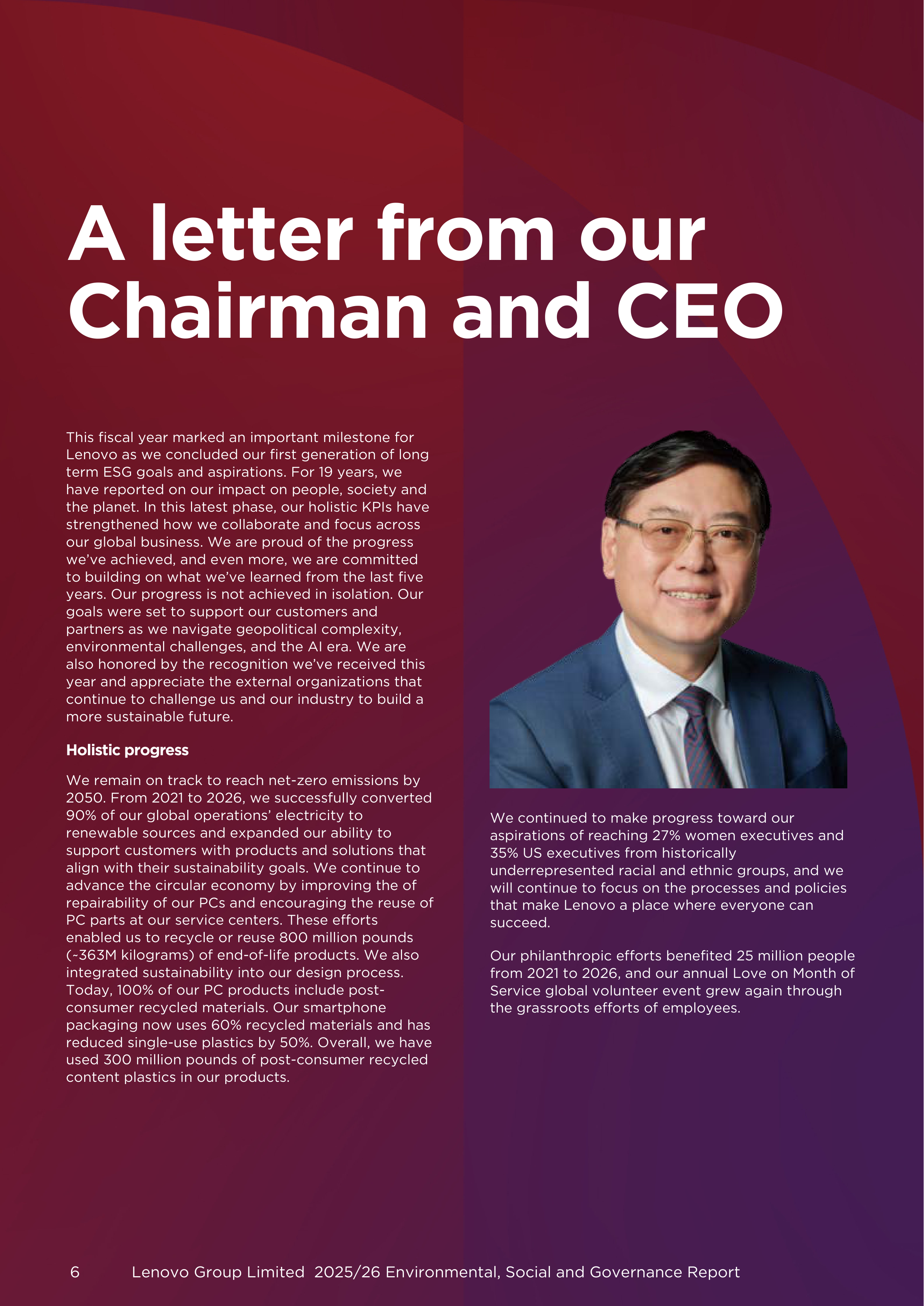
Yuanqing Yang
Chairman and Chief Executive Officer
Lenovo Group Limited
Lenovo Group Limited 2025/26 Environmental, Social and Governance Report
7


A letter from our
Chief Legal and
Corporate
Responsibility
Officer
Fiscal year 2025/26 marked another year of
meaningful progress for environmental, social, and
governance programs at Lenovo. As a global
business, Lenovo continually adapts to new laws,
regulations and policies to remain compliant
wherever we operate. But no matter how much we
adapt, some things remain constant: our
sustainability ambitions, our inclusive culture, and
the strong governance that guides us. Balancing
agility with authenticity is a challenge many global
companies face, and one we continue to navigate
with purpose. That’s why I’m especially proud to be
celebrating the completion of our first generation of
ESG KPIs, launched in FY 2021/22 with a bold new
five
-
year vision. This milestone reflects how much
we can achieve when we stay customer
-
centric,
foster an innovative culture, and act as a truly global
organization—no matter what changes around us.
The era of AI continues to welcome new
opportunities to think critically about our
innovations and their impact. Our approach to AI is
built from a foundation of strong governance,
reinforced through our Code of Conduct (the Code)
and Responsible AI Policy. The updated Code serves
as a compass to guide our ethical behavior toward
one another, our customers, partners, and
communities. It reinforces our commitment to
integrity and respect as a global organization as we
grow and innovate responsibly.
8
Lenovo Group Limited 2025/26 Environmental, Social and Governance Report


Notable innovations and commitments from FY
2025/26 include:
•
Joining the ITU AI Skills Coalition and the
Coalition for Sustainable AI led by the French
government to support the long-term success
of AI.
•
Development of the REAL framework to guide
holistic integration of circularity across our
product lifecycle. While the REAL framework
has started in our Intelligent Devices Group, it
has the potential to reframe our approach to
sustainability across all our products, solutions,
and services.
•
Continued support for initiatives around the
world that increase access to AI education and
skilling, including the Lenovo AI for Social
Impact Lab with Tech to the Rescue, the
Ashoka Communidad IA collaborative in Latin
America, and skilling initiatives to enhance
digital and AI skills in India.
While our philanthropic initiatives connect
communities to AI, our teams continue to leverage
AI for innovations like TRAdA, a solution for
predicting heart arrhythmia in athletes, and the
Indigenous Language Project, an initiative that
digitizes endangered indigenous languages and is
exploring machine translation for select
communities.
All of these efforts reflect the power of innovating
for humanity, made possible by our inclusive
workforce and culture values. We were proud to be
recognized for our workplace inclusion this year by
Disability:IN (Top employer for disability inclusion in
Brazil, the UK, and the US), Workplace Pride
(Ambassador status for LGBTIQ+ inclusion), Human
Rights Campaign (95 on the Corporate Equality
Index), and recognition from Forbes as a Top
Company for Women and Best Employer.
As we look ahead, we’re excited to build on
everything we’ve learned with a new generation of
ESG goals shaped by our subject matter experts and
championed by leaders across the company. I am
energized by the opportunity to keep learning,
making progress, and strengthening how we govern
our business against this next set of long
-
term goals.
Our commitments to credibility and collaboration
will continue to enhance our resilience, elevate our
performance, and position us for long
-
term success
in the years to come.
Dave Carroll
Chief Legal and Corporate Responsibility
Officer
Lenovo Group Limited
Lenovo Group Limited 2025/26 Environmental, Social and Governance Report
9




2.0
About this
report
12
About this report
13
Organizational profile
13
Material topics
16
Aligning with the United Nations
Sustainable Development Goals
About this report
This is the 20
th
annual Environmental, Social and
Governance (ESG) Report of Lenovo Group Limited
+
(HKD counter stock code: 992 / RMB counter stock
code: 80992) (the Company), which covers the
Fiscal Year (FY) 2025/26 (April 1, 2025 – March 31,
2026). This report is considered a companion
document to the Company’s
FY 2025/26 Annual
Report.
The annual ESG update can be found in the
Management’s discussion & analysis of the Annual
Report.
Report content
The content of this report is guided by the ESG
Reporting Code as set out in Appendix C2 to the
Rules Governing the Listing Rules of Securities
(Listing Rules) on The Stock Exchange of Hong
Kong Limited (the Hong Kong Stock Exchange), the
Global Reporting Initiative (GRI) Standards, and the
needs of Lenovo’s stakeholders. This report has been
prepared in accordance with the ESG Reporting
Code of the Hong Kong Stock Exchange and with
reference to the GRI 2021 Standards. The GRI
content index can be viewed on
Lenovo's website
and the Hong Kong Stock Exchange’s ESG
Reporting Code content index is included in the
Appendix of this report. The Company has complied
with all mandatory disclosure requirements and
“comply or explain” provisions, including following
the reporting principles, as set out in the ESG
Reporting Code of the Hong Kong Stock Exchange.
Lenovo adheres to the following reporting principles
in preparing the report:
Materiality – Lenovo conducts regular materiality
assessments and stakeholder engagement to
identify and report on material ESG issues to
investors and other stakeholders.
Quantitative – Lenovo, where appropriate, sets
targets with the aim to reduce its impacts and to
evaluate and validate its efforts in a measurable
manner.
Balance – Lenovo aims to present information in a
transparent and unbiased manner to provide a
holistic view of its overall ESG performance.
Consistency – Lenovo aims to use consistent
methodologies to allow for meaningful comparisons
of ESG data over time and provide information
where there are significant changes.
External assurance
Accredited third parties have provided verification
services for certain energy, greenhouse gas (GHG)
emissions, waste, and water data in this report. See
the Environmental section of this report for more
details.
Scope of this report
For purposes of this report, unless the context
otherwise requires, the terms “Lenovo” or “Lenovo
Group” or the “Group” refers to Lenovo Group
Limited together with its subsidiaries. The contents
of this report apply to the Company, together with
its principal Lenovo-branded and Motorola-branded
subsidiaries (the Covered Entities), except where
noted. Where certain topics also include other
principal subsidiaries, it is noted. The scope of the
Covered Entities’ material topics and the boundaries
within their value chain are detailed in the table in
the Appendix of this report. The table also includes
the scope of coverage for the information that
extends to subsidiaries directly or indirectly held by
the Company and that are identified in the
FY
2025/26 Annual Report
. All disclosures and results
are for the Group’s progress in FY 2025/26 unless
otherwise noted. The scope of this report was
determined using a financial threshold with
reference to the contributions of the subsidiaries or
operations to the total revenue of the Group.
Basis of calculations
All financial data is denoted in US Dollars. Lenovo
may in some instances face various challenges when
measuring its performance. If there are
contingencies associated with the data provided,
those contingencies will be noted in the
documentation.
Contact information
For questions or other information about this report,
please contact:
Ms. Jeannie Kwong
ESG Reporting and Controls Manager
8001 Development Drive, Morrisville, NC 27560
Email: environment@lenovo.com
+ Lenovo Group Limited is the ultimate holding company of Lenovo Group. As a holding company, it does not design, develop,
manufacture, or distribute products or services, or control any activities of the Company’s subsidiaries in the design,
development, manufacture, or distribution of products or services.
2.0 About this report
12
Lenovo Group Limited 2025/26 Environmental, Social and Governance Report
Organizational profile
Lenovo is a US$83 billion revenue global technology
powerhouse, ranked #196 in the Fortune Global 500,
and serving millions of customers every day in 180
markets. The Company is incorporated and listed in
Hong Kong SAR, China, and Lenovo's headquarters
are in Beijing, China, and North Carolina, USA.
Focused on a bold vision to deliver Smarter
Technology for All, Lenovo has built on its success
as the world’s largest PC company with a full-stack
portfolio of AI-enabled, AI-ready, and AI-optimized
devices (PCs, workstations, smartphones, tablets),
infrastructure (server, storage, edge, high
performance computing and software defined
infrastructure), software, solutions, and services.
Lenovo’s continued investment in world-changing
innovation is building a more equitable, trustworthy,
and smarter future for everyone, everywhere.
The Company acquired IBM’s PC Division in May
2005. In January 2011, Lenovo announced a joint
venture with NEC Corporation, which resulted in the
creation of the largest PC group in Japan. In October
2014, the Company acquired both Motorola Mobility
and IBM’s X86 servers. In November 2017, Lenovo
launched a joint venture with Fujitsu Limited. In
2022, the Company announced a strategic
partnership with PCCW Limited to form a
technology solutions powerhouse, leveraging the
combined strengths of both companies. Most
recently in January 2025, the Company and Alat
Technologies Company, a PIF company, announced
the completion of a US$2 billion investment and
reached strategic collaboration agreements.
Material topics
Lenovo recognizes the importance of understanding
a variety of informed perspectives as it develops and
drives its ESG programs. Through ongoing
engagement with stakeholders, Lenovo identifies
ESG-related material topics through a process that
considers a range of inputs that align with its
significant environmental, social, and governance
impacts and factors that can substantively influence
the decisions of stakeholders. The process outcomes
help guide the Group’s ESG goals, targets, disclosure
practices, and ongoing engagement with its
stakeholders.
In FY 2025/26, Lenovo engaged a third-party
consultant to conduct a double materiality
assessment (DMA). The DMA was conducted in
alignment with global reporting practices. Through
the process of identification, prioritization, and
validation, 11 topics were identified as material.
Identification
Lenovo applied a structured, multi-step approach to
identify potentially material ESG topics as part of its
DMA. Through value chain analysis, peer
benchmarking, consideration of past materiality
assessments, mandatory and voluntary reporting
requirements and standards, industry considerations,
and internal stakeholder input, 18 topics were
identified as potentially material topics. For each
topic, Lenovo identified specific impacts, risks, and
opportunities (IROs) through review of internal
policies, reports, and disclosures, and consideration
of impact and financial materiality.
A sustainability topic is impact material if Lenovo’s
activities (including across its value chain) cause or
could cause significant positive or negative impacts
on people or the environment, based on their
severity and, where relevant, likelihood.
A sustainability topic is financially material if it
creates risks or opportunities that affect or could
reasonably be expected to affect Lenovo’s financial
position, performance, cash flows, access to finance,
or cost of capital over the short, medium, or long
term.
The identification process resulted in a total of 103
IROs for further assessment.
Prioritization
Lenovo prioritized ESG factors using a structured
double materiality scoring methodology considering
both impact and financial materiality, the degree of
importance of each topic as it relates to Lenovo’s
business continuity, Lenovo’s stakeholders, and
Lenovo’s impact on the economy, environment,
people, and human rights.
Lenovo Group Limited 2025/26 Environmental, Social and Governance Report
13
Through a survey and guided by a scoring
methodology aligned with Lenovo's Enterprise Risk
Management framework, the IROs were rated and
prioritized by 41 respondents. The respondents
represent internal stakeholders and stakeholder
representatives (representatives) selected based on
considerations, as it relates to ESG, including the
extent of regular interactions between the
representatives and the represented stakeholder
groups, and the extent of knowledge of and/or
experience with or in the represented stakeholder
groups, Lenovo, and the IT industry.
As part of the scoring methodology, a materiality
threshold was established based on professional
judgment, taking into account the distribution of
scoring results and the underlying assessment
criteria. A topic was deemed material if any
associated IRO exceeded the defined threshold. This
process resulted in 11 material ESG topics being
identified.
Validation
Lenovo validated the materiality assessment results
through structured stakeholder engagement and
governance oversight. Internal calibration sessions
were conducted to ensure alignment and
consistency. To incorporate broader stakeholder
views, Lenovo conducted internal proxy interviews
with stakeholders representing investors, employees,
suppliers, partners, and customers to gather
qualitative insights on topic prioritization. The Board
of Directors and the ESG Executive Oversight
Committee (ESG EOC) of the Company have
reviewed and approved the materiality assessment
process and results, ensuring that there is alignment
with the Group’s policies, business strategies, and
risk priorities. Details regarding Lenovo’s ESG
Governance and the role of the ESG EOC are
included in the Governance section of this report.
Lenovo continues to enhance its materiality
assessment process as it aligns with various evolving
regulatory requirements including European Union's
(EU) Corporate Sustainability Reporting Directive
(CSRD).
The CSRD, first proposed in 2021, significantly
expands the scope and depth of sustainability
disclosures required of in-scope companies,
including reporting in accordance with the European
Sustainability Reporting Standards. CSRD requires
companies to assess and disclose material impacts,
risks, and opportunities across environmental, social,
and governance topics, supported by robust data,
controls, and assurance processes. Lenovo is closely
monitoring developments and assessing their
potential impacts as it prepares for CSRD readiness
by enhancing its reporting practices to respond to
evolving regulatory requirements.
Disclosures in subsequent reporting periods will
reflect any changes made.
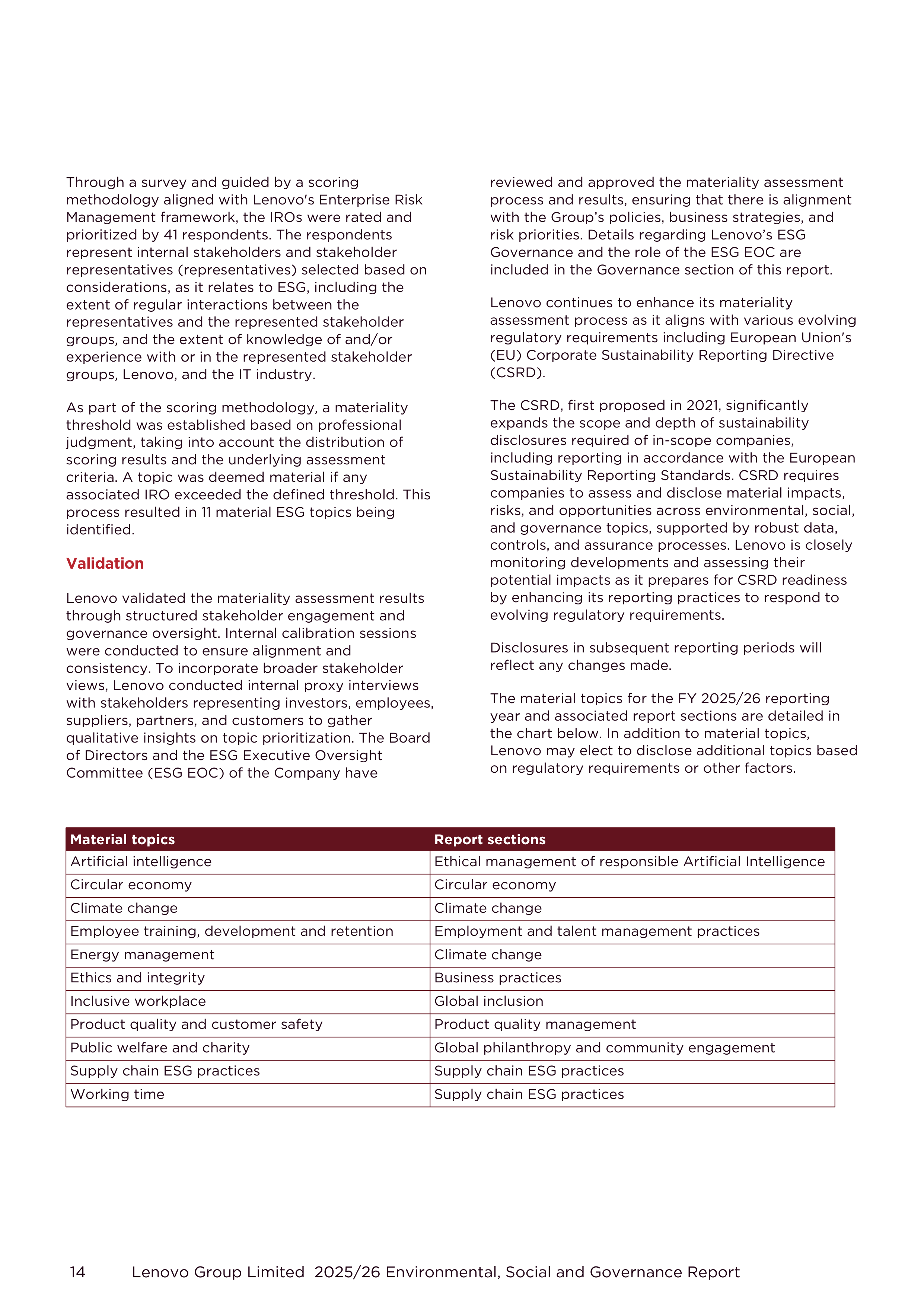
The material topics for the FY 2025/26 reporting
year and associated report sections are detailed in
the chart below. In addition to material topics,
Lenovo may elect to disclose additional topics based
on regulatory requirements or other factors.
Material topics
Report sections
Artificial intelligence
Ethical management of responsible Artificial Intelligence
Circular economy
Circular economy
Climate change
Climate change
Employee training, development and retention
Employment and talent management practices
Energy management
Climate change
Ethics and integrity
Business practices
Inclusive workplace
Global inclusion
Product quality and customer safety
Product quality management
Public welfare and charity
Global philanthropy and community engagement
Supply chain ESG practices
Supply chain ESG practices
Working time
Supply chain ESG practices
14
Lenovo Group Limited 2025/26 Environmental, Social and Governance Report
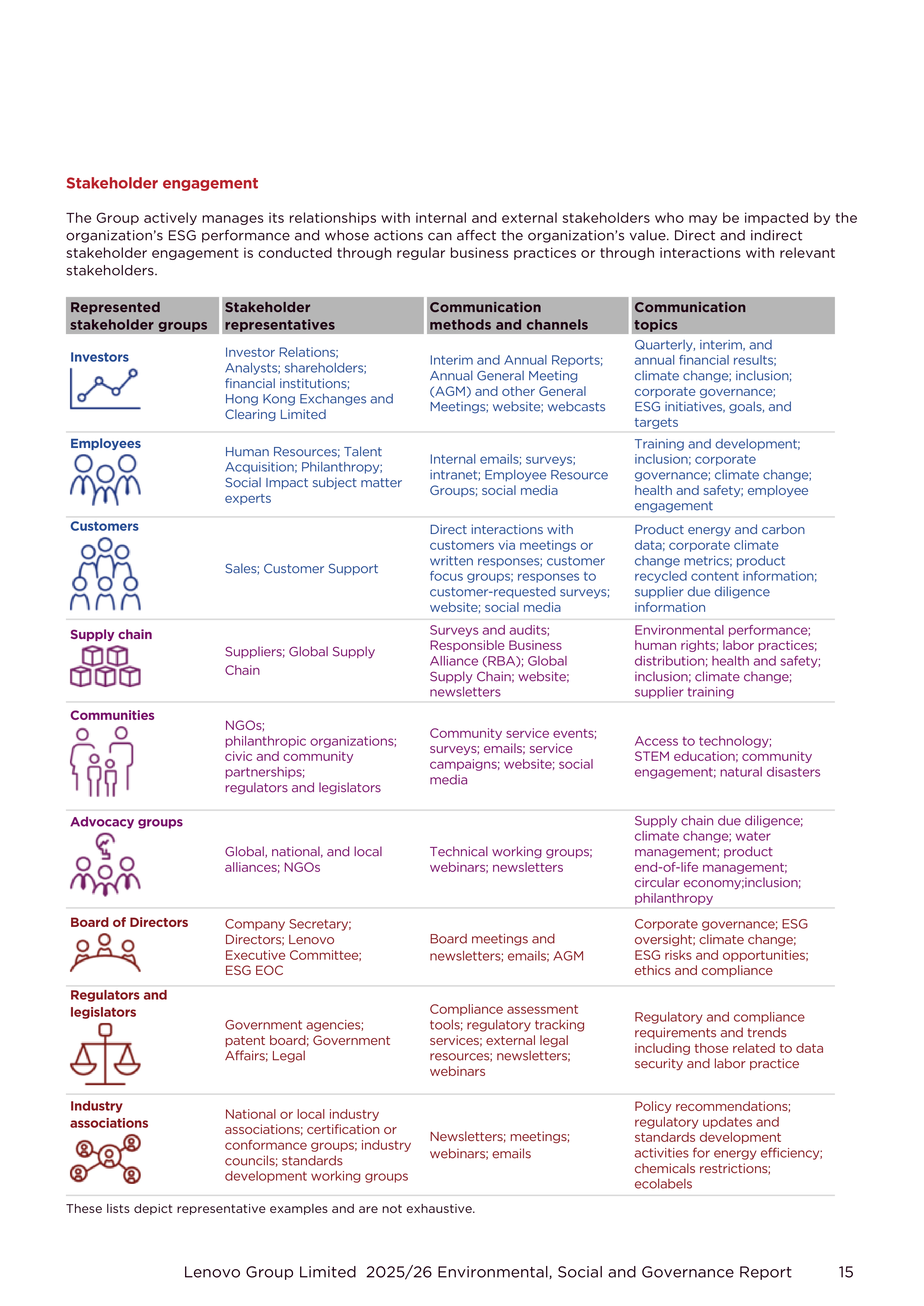


Stakeholder engagement
The Group actively manages its relationships with internal and external stakeholders who may be impacted by the
organization’s ESG performance and whose actions can affect the organization’s value. Direct and indirect
stakeholder engagement is conducted through regular business practices or through interactions with relevant
stakeholders.
Represented
stakeholder groups
Stakeholder
representatives
Communication
methods and channels
Communication
topics
Investors
Investor Relations;
Analysts; shareholders;
financial institutions;
Hong Kong Exchanges and
Clearing Limited
Interim and Annual Reports;
Annual General Meeting
(AGM) and other General
Meetings; website; webcasts
Quarterly, interim, and
annual financial results;
climate change; inclusion;
corporate governance;
ESG initiatives, goals, and
targets
Employees
Human Resources; Talent
Acquisition; Philanthropy;
Social Impact subject matter
experts
Internal emails; surveys;
intranet; Employee Resource
Groups; social media
Training and development;
inclusion; corporate
governance; climate change;
health and safety; employee
engagement
Customers
Sales; Customer Support
Direct interactions with
customers via meetings or
written responses; customer
focus groups; responses to
customer-requested surveys;
website; social media
Product energy and carbon
data; corporate climate
change metrics; product
recycled content information;
supplier due diligence
information
Supply chain
Suppliers; Global Supply
Chain
Surveys and audits;
Responsible Business
Alliance (RBA); Global
Supply Chain; website;
newsletters
Environmental performance;
human rights; labor practices;
distribution; health and safety;
inclusion; climate change;
supplier training
Communities
NGOs;
philanthropic organizations;
civic and community
partnerships;
regulators and legislators
Community service events;
surveys; emails; service
campaigns; website; social
media
Access to technology;
STEM education; community
engagement; natural disasters
Advocacy groups
Global, national, and local
alliances; NGOs
Technical working groups;
webinars; newsletters
Supply chain due diligence;
climate change; water
management; product
end-of-life management;
circular economy;inclusion;
philanthropy
Board of Directors
Company Secretary;
Directors; Lenovo
Executive Committee;
ESG EOC
Board meetings and
newsletters; emails; AGM
Corporate governance; ESG
oversight; climate change;
ESG risks and opportunities;
ethics and compliance
Regulators and
legislators
Government agencies;
patent board; Government
Affairs; Legal
Compliance assessment
tools; regulatory tracking
services; external legal
resources; newsletters;
webinars
Regulatory and compliance
requirements and trends
including those related to data
security and labor practice
Industry
associations
National or local industry
associations; certification or
conformance groups; industry
councils; standards
development working groups
Newsletters; meetings;
webinars; emails
Policy recommendations;
regulatory updates and
standards development
activities for energy efficiency;
chemicals restrictions;
ecolabels
These lists depict representative examples and are not exhaustive.
Lenovo Group Limited 2025/26 Environmental, Social and Governance Report
15
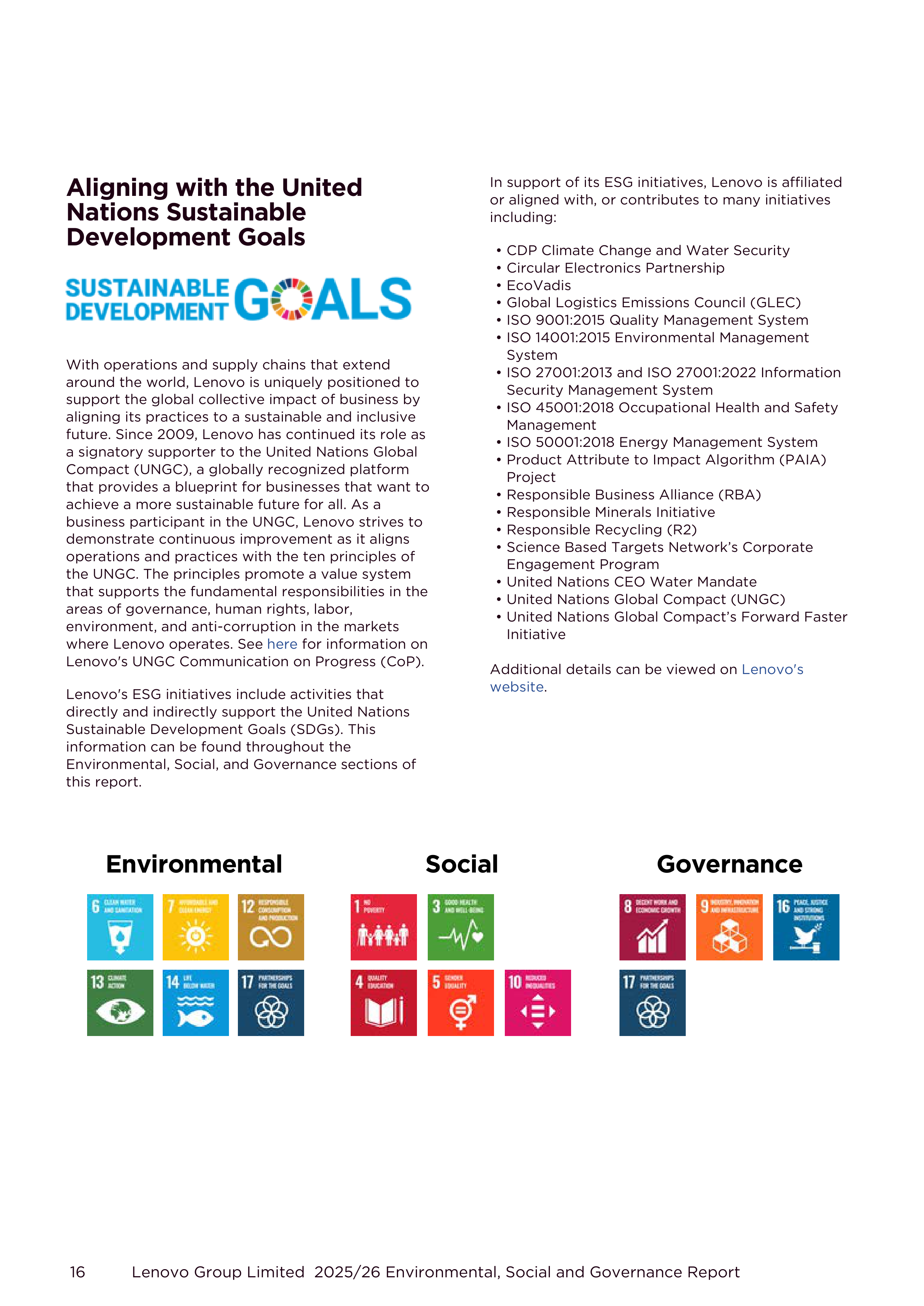



Aligning with the United
Nations Sustainable
Development Goals
With operations and supply chains that extend
around the world, Lenovo is uniquely positioned to
support the global collective impact of business by
aligning its practices to a sustainable and inclusive
future. Since 2009, Lenovo has continued its role as
a signatory supporter to the United Nations Global
Compact (UNGC), a globally recognized platform
that provides a blueprint for businesses that want to
achieve a more sustainable future for all. As a
business participant in the UNGC, Lenovo strives to
demonstrate continuous improvement as it aligns
operations and practices with the ten principles of
the UNGC. The principles promote a value system
that supports the fundamental responsibilities in the
areas of governance, human rights, labor,
environment, and anti-corruption in the markets
where Lenovo operates. See
here
for information on
Lenovo's UNGC Communication on Progress (CoP).
Lenovo's ESG initiatives include activities that
directly and indirectly support the United Nations
Sustainable Development Goals (SDGs). This
information can be found throughout the
Environmental, Social, and Governance
sections of
this report.
In support of its ESG initiatives, Lenovo is affiliated
or aligned with, or contributes to many initiatives
including:
•
CDP Climate Change and Water Security
•
Circular Electronics Partnership
•
EcoVadis
•
Global Logistics Emissions Council (GLEC)
•
ISO 9001:2015 Quality Management System
•
ISO 14001:2015 Environmental Management
System
•
ISO 27001:2013 and ISO 27001:2022 Information
Security Management System
•
ISO 45001:2018 Occupational Health and Safety
Management
•
ISO 50001:2018 Energy Management System
•
Product Attribute to Impact Algorithm (PAIA)
Project
•
Responsible Business Alliance (RBA)
•
Responsible Minerals Initiative
•
Responsible Recycling (R2)
•
Science Based Targets Network’s Corporate
Engagement Program
•
United Nations CEO Water Mandate
•
United Nations Global Compact (UNGC)
•
United Nations Global Compact’s Forward Faster
Initiative
Additional details can be viewed on
Lenovo's
website
.
16
Lenovo Group Limited 2025/26 Environmental, Social and Governance Report
Environmental
Social
Governance

3.0
Environmental
19
Environmental management system (EMS)
19
Climate change
24
Waste
25
Water
26
Environmentally conscious products
32
Packaging
33
Product end-of-life management (PELM)
34
Circular economy
35
Biodiversity



Environmental management
system (EMS)
Lenovo manages the environmental elements of its
operations through a global environmental
management system (EMS) that covers Lenovo’s
worldwide product design, development, and
manufacturing operations (including distribution,
fulfillment, and internal repair operations) for
computer products and devices, data center
products, mobile devices, smart devices,
accessories, and converged network equipment. The
scope encompasses these same activities when
performed by a subsidiary and/or affiliate
companies.
All of Lenovo’s sites in the
EMS scope
are ISO
14001:2015 certified. View Lenovo's Global ISO
14001:2015 certificates on
Lenovo's website
.
Lenovo has established, implemented, and
maintained an Environmental Affairs Policy which
can be viewed
on
Lenovo's website
.
Within the framework of Lenovo's EMS, it annually
conducts a Significant Environmental Aspect (SEA)
evaluation process where it identifies and evaluates the
aspects of its operations that have actual or potential
significant impacts on the environment using a
methodology that includes input from Lenovo's
Enterprise Risk Management (ERM) process. Metrics
and controls are established for these significant
environmental aspects. Performance relative to these
metrics is tracked and reported. Performance targets
are established for select environmental aspects
annually with considerations involving Environmental
Affairs Policy, regulatory requirements, customer
requirements, stakeholder input, environmental and
financial impact, management directives, and other
factors.
During FY 2025/26, Lenovo's significant
environmental aspects included:
•
Product materials – including use of recycled
plastics and environmentally preferable
materials where possible
•
Product packaging
•
Product energy consumption and emissions
•
Product end-of-life management
•
Site air emissions, specifically greenhouse gas
(GHG) emissions
•
Site energy consumption
•
Supplier environmental performance
•
Product transportation
•
Waste management
•
Water management
•
Impact of Lenovo’s net-zero commitment
Objective and performance targets have been
established for the aspects listed above. Lenovo's
performance against these objectives and targets is
available in Section 8.0 of this report.
Lenovo's energy, GHG emissions (Scope 1 and 2),
waste, and water data are externally verified to a
reasonable level of assurance. Lenovo's GHG
emissions (Scope 3) data is externally verified to a
limited level of assurance. The FY 2025/26
Verification Statements for GHG, Energy, Waste and
Water can be viewed on
Lenovo's website
.
Climate change
Lenovo recognizes that human activities are
contributing to climate change and concurs with the
findings of current climate science as described in
the latest assessment report from the
Intergovernmental Panel on Climate Change
. Lenovo
also recognizes that if left unchecked, current trends
in climate change present serious economic and
societal risks and agrees that specific actions are
needed to stabilize atmospheric GHG levels and hold
global average temperatures to acceptable
increases.
Lenovo is working both internally and externally to
help minimize and mitigate climate risks. It is
committed to reducing the global carbon footprint
of its business activities and has demonstrated its
commitment by:
•
Implementing a corporate
Climate and Energy
Policy;
•
Executing a long-term comprehensive
Climate
Change Strategy
aligned to validated SBTi net-
zero targets; and
•
Setting corporate-wide
objectives and targets
which support the above policy and strategy
Lenovo's Chief Legal & Corporate Responsibility
Officer provides executive leadership for its ESG
position, including climate change programs. In
addition, the ESG Executive Oversight Committee
(EOC), chaired by the Chief Legal & Corporate
Responsibility Officer, provides strategic direction
and facilitates the coordination of ESG efforts across
Lenovo, including proposing recommendations for
the effective management of ESG programs. The
ESG EOC is comprised of senior management from
across the business and functional areas and is
chartered to promote a culture that encourages
strong ESG performance, including compliance and
leadership activities. The Chief Legal & Corporate
Responsibility Officer provides regular updates on
ESG issues and ESG EOC discussion topics to the
Board of Directors and its Committees.
3.0 Environmental
Lenovo Group Limited 2025/26 Environmental, Social and Governance Report
19

Concentrated discussion on ESG issues, including
climate change, assists the Board in making
appropriate decisions and providing oversight based
on long-term risks and opportunities that impact
stakeholders and the business. The Board is briefed
on Lenovo's ESG key performance indicators (KPIs)
including Lenovo's climate strategy and progress
towards its climate change mitigation goals at least
once a year. Lenovo is currently exploring
opportunities for usage and application of internal
carbon pricing to its business practices including
decision-making.
Science-based emissions reduction targets and
net-zero strategy
Lenovo has responded to the
Science Based Targets
initiative
(SBTi)’s urgent call for corporate climate
action by committing to align with 1.5°C and net-
zero through the Business Ambition for 1.5°C
campaign, an official partner of the United Nations
Framework Convention on Climate Change
(UNFCCC) Race to Zero campaign. SBTi is a
partnership between the United Nations Global
Compact (UNGC), CDP, World Resources Institute
and World Wide Fund for Nature (WWF). Lenovo is
an early adopter of the science-based emissions
reduction approach, after receiving SBTi approval
for near-term 2030 emissions reduction targets in
2020. For near-term targets, Lenovo’s Scope 1 and 2
emissions reduction targets are consistent with
limiting warming to 1.5°C, the most ambitious goal of
the
Paris Agreement
, and its Scope 3 emissions
reduction targets meet ambitious criteria according
to the SBTi’s methodology, which means they are in
line with current best practices.
On January 19, 2023, Lenovo announced its SBTi-
validated target to reach net-zero greenhouse gas
(GHG) emissions by 2050. Lenovo was the first PC
and smartphone maker and one of the first 139
companies in the world to establish a net-zero target
validated by SBTi. Lenovo’s long-term 2050 net-
zero target coincides with its near-term, SBTi-
validated 2030 emissions reduction targets. In
September 2023, Lenovo joined the UNGC Forward
Faster initiative to accelerate private sector action
towards the United Nations Sustainable
Development Goals (SDGs), specifically committing
to the climate action and water resilience targets
within the initiative. In FY 2025/26, Lenovo
participated in the SBTi Corporate Net-Zero
Standard V2 Pilot Test Phase 2, providing input to
support the development of next-generation
science-based guidance for credible and ambitious
corporate net-zero target-setting.
By working with SBTi and aligning to their Net-Zero
Standard, which is also the world’s first framework
for corporate net-zero target setting, Lenovo is
taking a scientific, collaborative, and accountable
approach to reducing emissions. Aligning goals to
the SBTi helps hold companies accountable for their
emissions reduction. Without aligning to SBTi, it is
difficult to validate or know when a net-zero target
is reached.
Lenovo’s mature ISO 14001 Environmental
Management System (EMS) gives Lenovo a strong
framework on which to set annual targets to help
drive progress towards its 2030 and 2050 SBTi
goals.
20
Lenovo Group Limited 2025/26 Environmental, Social and Governance Report
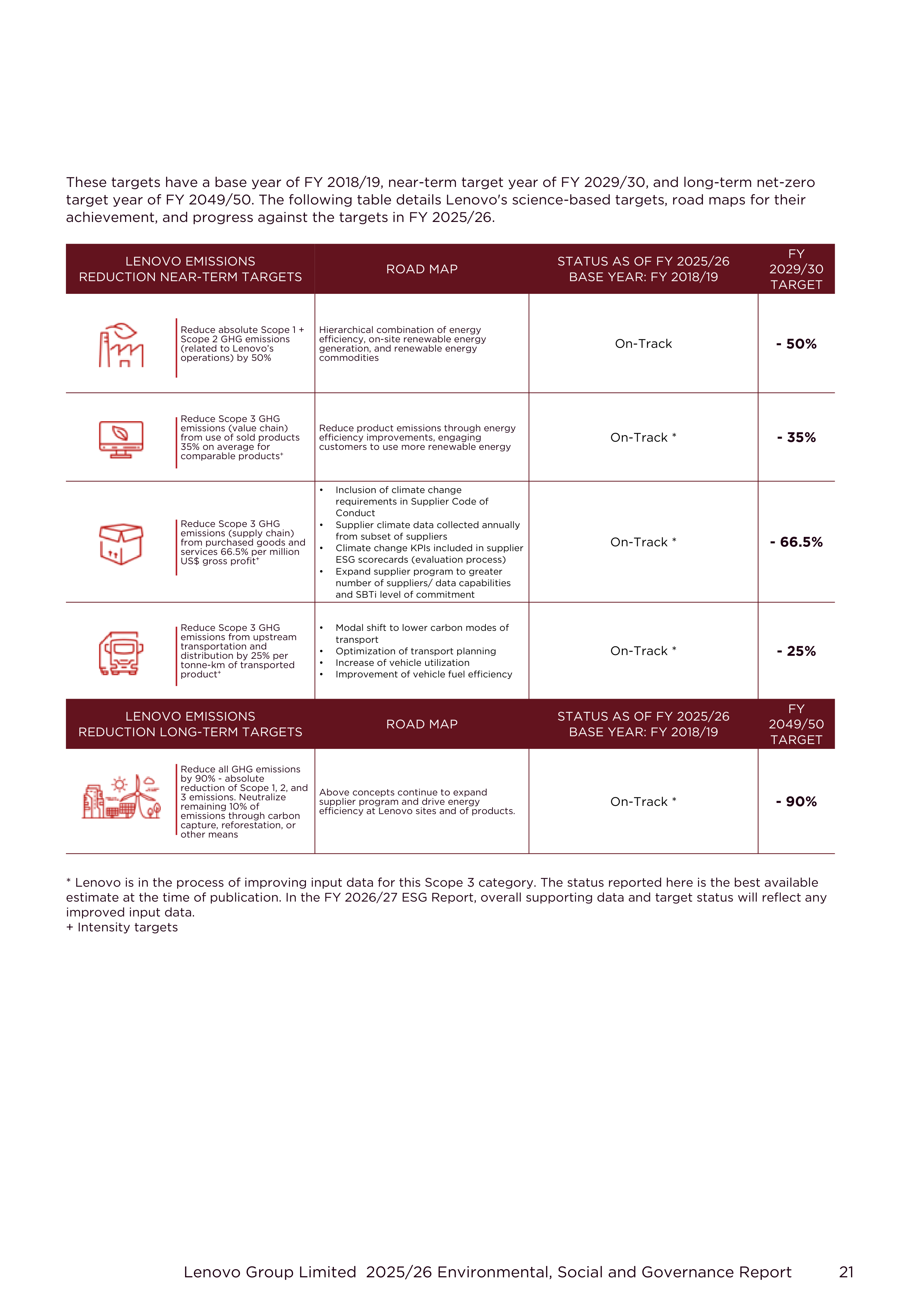


These targets have a base year of FY 2018/19, near-term target year of FY 2029/30, and long-term net-zero
target year of FY 2049/50. The following table details Lenovo's science-based targets, road maps for their
achievement, and progress against the targets in FY 2025/26.
LENOVO EMISSIONS
REDUCTION NEAR-TERM TARGETS
ROAD MAP
STATUS AS OF FY 2025/26
BASE YEAR: FY 2018/19
FY
2029/30
TARGET
Reduce absolute Scope 1 +
Scope 2 GHG emissions
(related to Lenovo’s
operations) by 50%
Hierarchical combination of energy
efficiency, on-site renewable energy
generation, and renewable energy
commodities
On-Track
- 50%
Reduce Scope 3 GHG
emissions (value chain)
from use of sold products
35% on average for
comparable products
+
Reduce product emissions through energy
efficiency improvements, engaging
customers to use more renewable energy
On-Track *
- 35%
Reduce Scope 3 GHG
emissions (supply chain)
from purchased goods and
services 66.5% per million
US$ gross profit
+
•
Inclusion of climate change
requirements in Supplier Code of
Conduct
•
Supplier climate data collected annually
from subset of suppliers
•
Climate change KPIs included in supplier
ESG scorecards (evaluation process)
•
Expand supplier program to greater
number of suppliers/ data capabilities
and SBTi level of commitment
On-Track *
- 66.5%
Reduce Scope 3 GHG
emissions from upstream
transportation and
distribution by 25% per
tonne-km of transported
product
+
•
Modal shift to lower carbon modes of
transport
•
Optimization of transport planning
•
Increase of vehicle utilization
•
Improvement of vehicle fuel efficiency
On-Track *
- 25%
LENOVO EMISSIONS
REDUCTION LONG-TERM TARGETS
ROAD MAP
STATUS AS OF FY 2025/26
BASE YEAR: FY 2018/19
FY
2049/50
TARGET
Reduce all GHG emissions
by 90% - absolute
reduction of Scope 1, 2, and
3 emissions. Neutralize
remaining 10% of
emissions through carbon
capture, reforestation, or
other means
Above concepts continue to expand
supplier program and drive energy
efficiency at Lenovo sites and of products.
On-Track *
- 90%
* Lenovo is in the process of improving input data for this Scope 3 category. The status reported here is the best available
estimate at the time of publication. In the FY 2026/27 ESG Report, overall supporting data and target status will reflect any
improved input data.
+ Intensity targets
Lenovo Group Limited 2025/26 Environmental, Social and Governance Report
21
Other air emissions
Lenovo's baseline environmental engineering
specification prohibits the use of ozone-depleting
substances in its products and manufacturing
processes (except in HVAC and fire-suppression
equipment as permitted by law and managed in
accordance with local regulations). Intentional
releases of ozone-depleting substances are
prohibited. Lenovo's EMS requires the release of
chemical substances to be reported as an
environmental incident, including unintentional
releases. Lenovo’s operational processes do not
have significant (as defined by Lenovo's SEA
process) direct air emissions such as nitrogen oxides
(NOx), sulfur oxides (SOx), and particulate matter
(PM). In addition, Lenovo has no wet chemical or
industrial processes that use volatile organic
compounds (VOC) and thus has no point sources of
VOC. Household and cleaning products that contain
small quantities of VOC are used at some of its
facilities, however, associated fugitive emissions are
minimal and are not quantified.
Climate change risks and opportunities and
management
The significant risks associated with climate change
are identified and evaluated as part of two main
processes within Lenovo's business management
systems. These include its Enterprise Risk
Management (ERM) process and its annual climate-
related risks and opportunities assessment.
These two processes are connected, meaning that if
climate change risks are identified in the global risk
registration, they are considered in the climate-
related risks and opportunities assessment – and
vice versa.
1.
Lenovo's formal risk management process covers
all areas of Lenovo's strategic, operational,
financial, legal, and regulatory and compliance
risks. Risk of natural catastrophes to the security
of people and operational efficiencies (such as
supply chain disruptions and the risk of non-
compliance with ESG requirements or regulations)
are included in regulatory and compliance risks.
Each major business unit and function is required
to identify risks and assess their impacts on
execution of Lenovo's strategy, then develop
mitigation plans for select identified risks. This
process is managed by Lenovo's Enterprise Risk
Management (ERM) team.
2.
Lenovo's climate-related risks and opportunities
assessment evaluates and prioritizes physical and
transition risks and opportunities related to
climate change, and considers the nature,
likelihood, and magnitude of the effects of those
risks and opportunities. This process is managed
by Lenovo's Global ESG team. More details about
the process are available in Section 9.0. The
results are integrated in the aforementioned risk
management process.
Lenovo’s climate risk assessment in FY 2025/26 also
included climate scenario analysis to explore the
business impacts of physical and transition risks
related to climate change. The impacts from physical
risks have increased under Representative
Concentration Pathways (RCP) scenarios that limit
warming to higher temperature, particularly in the
long term. The increased impacts from transition
risks are observed under Network for Greening the
Financial System (NGFS) scenarios that have
stringent climate policies. When Lenovo takes
proactive climate mitigation actions to reduce
emissions and limit warming to lower temperature,
the impacts associated with risks are reduced
significantly. Therefore, Lenovo has committed to
reduce 90% of Scope 1, 2, and 3 emissions by 2050
to keep global warming potential within 1.5º C and
continues to broaden its product offerings in
sustainability services and other areas.
Lenovo's ESG materiality assessment identifies energy
and emissions as material topics that it should prioritize
in its environmental programs. In support of UN
Sustainable Development Goal (SDG) 13 – Climate
Action, one of Lenovo's ESG pillars includes a climate
action goal. More details about Lenovo's materiality
assessment and how its goals align with the SDGs are
available in Section 2.0.
More information about Lenovo's identification and
assessment of climate-related risks and
opportunities, metrics, and actions to address
climate change are available in Section 9.0 and in
Lenovo's responses to the most recent
CDP
questionnaire
.
Lenovo scored an A, the “Leadership Level” for its
climate change performance in the 2025 CDP
questionnaire which reflects its performance toward
environmental stewardship through climate change
mitigation practices in its operations and supply
chain.
22
Lenovo Group Limited 2025/26 Environmental, Social and Governance Report

Energy
Under the EMS, energy-related targets are set
annually. Since emissions are impacted by energy
use reduction and increased use of renewable
energy, these energy-related targets are related to
Lenovo's Scope 1 and 2 emissions reduction targets
and similar actions are taken to achieve all three
types of targets. For Lenovo's specific energy
targets and its performance against them see
Section 8.0
.
+ May be accomplished through installation of onsite
renewable energy generation, entry into power purchase
agreements (PPA) with power providers and/or the
purchase of renewable energy credits.
Energy consumption also occurs throughout
Lenovo's value chain. Lenovo's suppliers are
encouraged to develop energy targets, use
renewable energy, and report energy usage.
Customers also use energy to power products and
Lenovo has set targets to improve energy efficiency
in many of its products.
For more information, see Section
8.0
for Lenovo's
energy-related KPIs.
Renewable energy
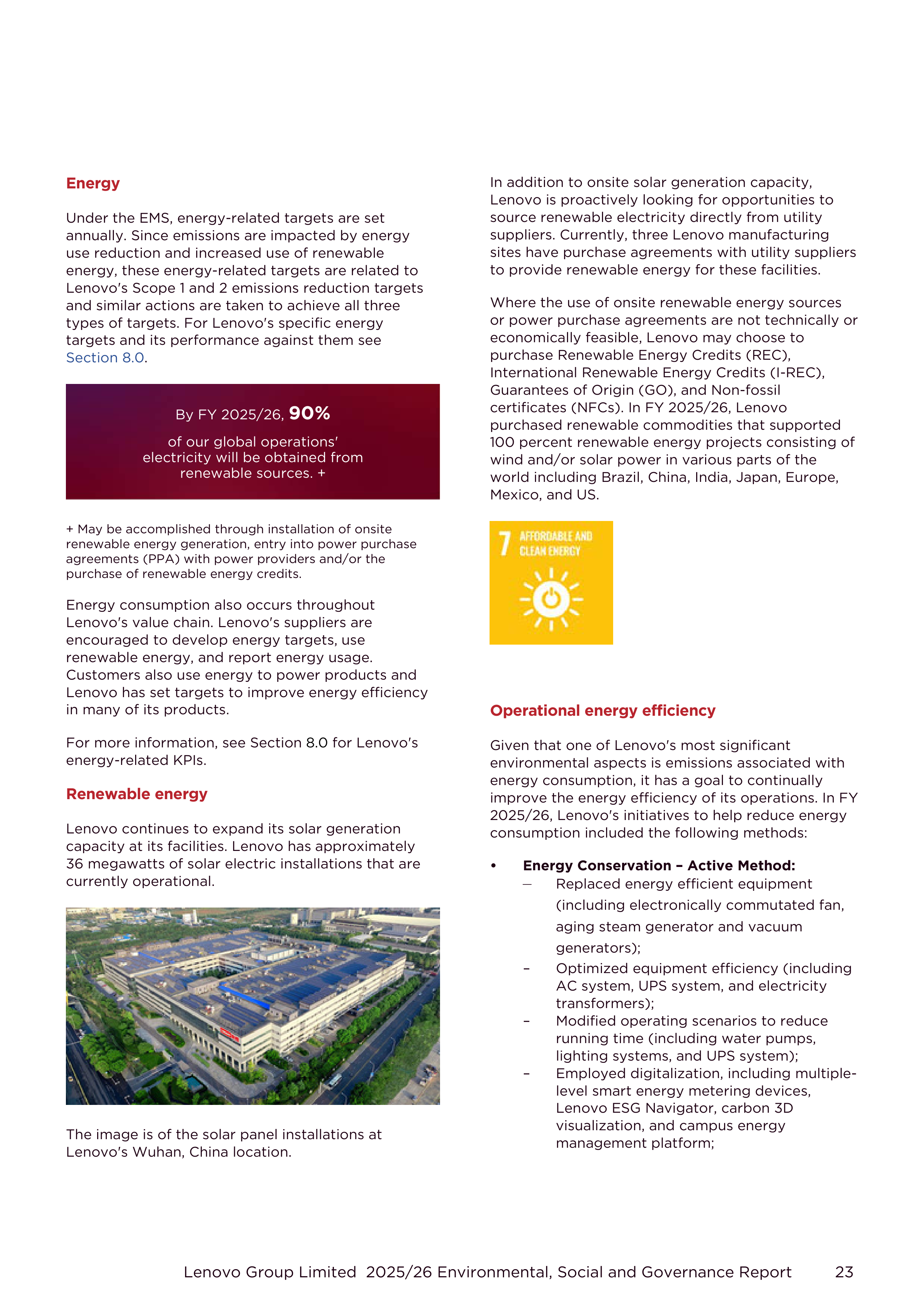
Lenovo continues to expand its solar generation
capacity at its facilities. Lenovo has approximately
36 megawatts of solar electric installations that are
currently operational.
The image is of the solar panel installations at
Lenovo's Wuhan, China location.
In addition to onsite solar generation capacity,
Lenovo is proactively looking for opportunities to
source renewable electricity directly from utility
suppliers. Currently, three Lenovo manufacturing
sites have purchase agreements with utility suppliers
to provide renewable energy for these facilities.
Where the use of onsite renewable energy sources
or power purchase agreements are not technically or
economically feasible, Lenovo may choose to
purchase Renewable Energy Credits (REC),
International Renewable Energy Credits (I-REC),
Guarantees of Origin (GO), and Non-fossil
certificates (NFCs). In FY 2025/26, Lenovo
purchased renewable commodities that supported
100 percent renewable energy projects consisting of
wind and/or solar power in various parts of the
world including Brazil, China, India, Japan, Europe,
Mexico, and US.
Operational energy efficiency
Given that one of Lenovo's most significant
environmental aspects is emissions associated with
energy consumption, it has a goal to continually
improve the energy efficiency of its operations. In FY
2025/26, Lenovo's initiatives to help reduce energy
consumption included the following methods:
•
Energy Conservation – Active Method:
–
Replaced energy efficient equipment
(including electronically commutated fan,
aging steam generator and vacuum
generators);
–
Optimized equipment efficiency (including
AC system, UPS system, and electricity
transformers);
–
Modified operating scenarios to reduce
running time (including water pumps,
lighting systems, and UPS system);
–
Employed digitalization, including multiple-
level smart energy metering devices,
Lenovo ESG Navigator, carbon 3D
visualization, and campus energy
management platform;
Lenovo Group Limited 2025/26 Environmental, Social and Governance Report
23
By FY 2025/26,
90%
of our global operations'
electricity will be obtained from
renewable sources. +
–
Implemented an intelligent group control
system for air compressors with aim to
dynamically optimize machine operation,
stabilize pressure, and reduce energy
consumption; and,
–
Installed high-efficiency magnetic
levitation chillers to enable centralized
management and intelligent dispatching of
the cooling system.
•
Energy Conservation – Passive Method:
–
Replaced existing windows with energy
efficient windows; and,
–
Installed air curtains at entrances of
manufacturing site to reduce cooling
system running time.
•
Management System and Certification
–
Various manufacturing sites are ISO
50001:2018 certified.
•
Energy Conservation Education
–
Employee awareness training, and
–
Energy conservation promotion (employee
communication through emails and
workplace signage).
Logistics
Logistics are an important part of Lenovo’s global
supply chain and a key component of Lenovo's
emissions reduction strategy. In FY 2025/26, Lenovo
continued its logistics decarbonization agenda by
prioritizing transport network simplification, modal
shifts toward lower-carbon transportation,
electrification of transportation, and systematic
improvements in load efficiency. These initiatives are
aligned with Lenovo's broader Scope 3 emissions
reduction strategy and focus on achieving long-term
emissions intensity reduction.
Network optimization and direct routing
•
Lenovo aims to reduce emissions from
avoidable transshipment by implementing
direct ocean shipping to Southern Europe,
avoiding intermediate transit ports. A southern
EMEA distribution center network further
identified opportunities for structural
optimization.
Transportation mode shift
•
Lenovo continued to strive to reduce reliance
on air freight by increasing non-air transport
targets globally through expanded use of ocean
and ground transport.
Load efficiency and cross-business collaboration
•
Lenovo aims to enhance transportation
efficiency by improving container utilization
across its product lines.
Electrification of transportation
•
Lenovo expanded the use of electric vehicles
for short
-
haul distribution in multiple regions.
External partnerships
•
Lenovo is an active participant in industry-wide
coalitions and sustainable logistics initiatives,
collaborating with entities such as the Global
Logistics Emission Council, Smart Freight
Centre China, the International Council on Clean
Transportation, and US Environmental
Protection Agency SmartWay program. These
partnerships aim to drive transparency and
consistency in calculating and reporting GHG
emissions across the logistics sector.
•
Lenovo aims to engage many stakeholders in
emissions reduction efforts. In FY 2025/26,
Lenovo continued its logistics KPI methodology
to require logistics suppliers to share their
carbon emissions data with Lenovo. Lenovo
also works with suppliers to set goals to reduce
emissions. In addition, Lenovo shares its
logistics CO
2
report with its customers to
improve transparency and increase awareness.
Waste
Lenovo’s day-to-day global operations generate
non-hazardous waste and minimal quantities of
hazardous waste. To ensure that waste is properly
managed and with the aim to minimize
environmental impact, Lenovo’s waste (hazardous
and non-hazardous) is separated and collected from
the site of generation to be disposed of through
third-party waste management organizations in
accordance with its Site Environmental Programs
Manual and applicable legal requirements.
During the FY 2025/26 reporting year, Lenovo
continued to measure and monitor both non-
hazardous and hazardous waste generation volumes
and disposal methods through an internal
environmental database. In this system, site
environmental focal points collect and upload
monthly waste data, from measured data (when
feasible) or calculations based on measured data.
When no measured data is available, non-hazardous
waste estimations are used, usually based on the
headcount at the site and the previous year’s
monthly data from similar sites.
24
Lenovo Group Limited 2025/26 Environmental, Social and Governance Report
Lenovo’s waste data for the current reporting year is
presented in Section 7.0. Annual Verification
Statements for Lenovo's total non-hazardous and
hazardous waste are available on Lenovo's
website
.
Lenovo's EMS requires sites to report environmental
incidents, including waste-related incidents, through
the internal environmental database. In addition to
internal reporting, Lenovo's manufacturing sites
periodically undergo audits, some of which cover
aspects of waste management. For more
information on audits at Lenovo's sites, see Section
4.0.
Lenovo recognizes that waste management is
important throughout the value chain. Lenovo
requires production suppliers to adhere to its
Supplier Code of Conduct and the Responsible
Business Alliance (RBA) Code of Conduct through
contractual stipulations, both of which include
waste-related provisions. Lenovo uses RBA
assessments as a key mechanism for risk
identification and sustainable performance
evaluation. For more information on these supplier
activities, see Section 6.0.
Lenovo utilizes its Product-End-of-Life Management
(PELM) program for the disposition of electronic
products, parts, and scrap generated at Lenovo
sites. More information on Lenovo's PELM activities
can be found in
this section
.
Non-hazardous waste
Lenovo's non-hazardous waste includes typical
office and cafeteria waste as well as packaging and
manufacturing scrap at manufacturing sites.
Under Lenovo's EMS, a global non-hazardous waste
recycling target is set annually. For the FY 2025/26
reporting year, the target was to direct 90 percent
(+/-5 percent) of Lenovo's non-hazardous waste to
recovery operations. The results of Lenovo's
environmental targets are available in Section 8.0.
Hazardous waste
Lenovo's operations generate minimal quantities of
hazardous waste. Hazardous waste is waste
designated as hazardous by applicable laws or
regulations in a country, state, region, or locality and
may include oils, coolants, organic solvents,
batteries, fluorescent light bulbs, and ballasts.
Hazardous waste is required to be disposed of in
accordance with local environmental regulations by
approved suppliers. Lenovo aims to keep hazardous
waste sent to landfill for disposal below 1 percent of
the total hazardous waste generated annually by its
operations.
Water
Lenovo is working both internally and externally to
minimize and mitigate water risks. Lenovo has:
•
Implemented and maintains a corporate
Water
Resiliency Policy
;
•
Endorsed the UN CEO Water Mandate;
•
Joined the Science Based Targets Network
(SBTN) Corporate Engagement Program,
pledging alignment with SBTN's goals and
vision while contributing advice and end-user
insights to the development of SBTN methods
and tools as an SBTN Corporate Engagement
Participant; and
•
Joined UN Global Compact Forward Faster
initiative to accelerate private sector action
towards the SDGs, specifically committing to
the water resilience target within the initiative.
During the FY 2025/26 reporting year, Lenovo
continued to measure and monitor water use and
risk. In Lenovo's direct operations, the primary uses
of water continue to be for water access, sanitation,
and hygiene (WASH) services, as well as building
cooling for employees, contractors, and visitors at its
sites around the globe. Because Lenovo’s primary
water use is for employee support, water use varies
from location to location with its largest
manufacturing sites and locations with the largest
employee headcount withdrawing and discharging
the most amount of water. Lenovo's water data for
the current reporting year is presented in Section
7.0. Annual Verification Statements for its total
water withdrawal and discharge are available on
Lenovo's
website
.
To date, Lenovo has not experienced any issues with
sourcing water that is fit for purpose. Lenovo's EMS
requires sites to characterize their discharges before
entering into an agreement with a treatment facility.
Exceptions may exist for typical sanitary waste. It
also requires that sites not discharge constituents
for which a treatment facility does not have
treatment capability, update characterization when a
site’s activities change, and adhere, as applicable, to
the discharge limits of local law, the treatment
facility, and any associated permits.
Lenovo's EMS includes a global water target to
achieve a reduction of 1.8 metric tons in water
withdrawal per capita at manufacturing sites
globally by FY 2029/30. The results of Lenovo's
environmental targets are available in Section 8.0.
Lenovo Group Limited 2025/26 Environmental, Social and Governance Report
25
Lenovo requires sites to report environmental
incidents, including water-related incidents, through
its internal environmental database. In addition to
internal reporting, Lenovo's manufacturing sites
undergo periodic audits, some of which cover
aspects of WA
SH and water management. For more
information on audits at Lenovo's sites, see Section
4.0.
While Lenovo has minimal wet processes, it
appreciates the importance of adequate quantities
of sufficient quality water to its supply chain
partners with wet processes, particularly for the
semiconductor industry. Lenovo requires production
suppliers to adhere to its Supplier Code of Conduct
and the RBA Code of Conduct through contractual
stipulations, both of which include water-related
provisions. Lenovo uses RBA assessments as a key
mechanism for risk identification and sustainable
performance evaluation. For more information on
these supplier activities, see Section 6.0.
Water risks within Lenovo's operational footprint
and supply chain are assessed annually using
publicly available water risk tools (
World Resources
Institute’s Aqueduct
and
WWF’s Water Risk Filter
Tool
).
For more information about Lenovo's identification
and assessment of water-related risks and
opportunities, metrics, and actions, read Lenovo's
responses to the most recent
CDP Water Security
questionnaire.
In FY 2025/26, Lenovo continued its global
partnership with Wine To Water (W|W), a non-profit
organization committed to supporting life and
dignity for all through the power of clean water.
Environmentally conscious
products
Product materials
Lenovo's corporate-wide environmental standards
and specifications require its product designers to
consider environmentally conscious design practices
to facilitate and encourage recycling and
minimization of resource consumption. Lenovo's
priority is to use environmentally preferable
materials whenever practical. In adhering to this
precautionary approach, it supports restricting the
intentional addition of materials that are potentially
concerning when economically and technically
viable alternatives exist. These restrictions may also
include implementing concentration limits for
incidental occurrences.
For materials where economically and technically
viable alternatives do not exist, Lenovo collects data
on usage above the defined concentration limit. This
data can then be reported to customers or other
stakeholders. Lenovo continues to actively search
for environmentally preferable materials that can be
used as substitutes and expects its partners and
suppliers to demonstrate the same commitment to
environmentally sound practices. See Lenovo's
Materials Management
webpage for more
information.
Lenovo restricts the use of environmentally sensitive
materials in its products. This includes the
prohibition of ozone-depleting substances in all
applications; restrictions on the use of persistent
organic pollutants (POPs) under the Stockholm
Convention, and the elimination of materials covered
under European Union (EU) Restriction on
Hazardous Substances (RoHS) and Registration,
Evaluation, Authorisation, and Restriction of
Chemicals (REACH), even beyond the jurisdictions
where these regulatory requirements exist. Lenovo's
implementation strategy and requirements are
consistent with the requirements specified in the
EU’s RoHS Directive and REACH Regulation.
Lenovo supports phasing out brominated flame
retardants (BFRs) and polyvinyl chloride (PVC) and
is committed to driving its supply chain toward this
goal. Lenovo continues to focus on eliminating
halogens from its top-selling products and across as
many commodities as possible and has made
progress including the following achievements:
•
Phasing out completely the use of BFR/
chlorinated flame retardants (CFR)/PVC in all
mechanical plastic parts (such as external
covers, housings, etc.) across all its products
•
Most of hard disk drives, optical disk drives,
solid-state drives, LCD screens, memory, central
processing units (CPUs), chipsets, and
communication cards; and other commodities
meet the International Electronics
Manufacturing Initiative (iNEMI) definition
^
of
low halogen
•
All ThinkPad and Lenovo Education (Windows)
notebook products including printed circuit
boards (PCBs) meet the iNEMI definition^ of
low halogen except for cables and wires, and
AC adapters
•
All commercial monitors meet the iNEMI
definition of low halogen except for their PCB
assembly and cables. Furthermore, some
monitors fully meet the iNEMI definition
^
of low
halogen
26
Lenovo Group Limited 2025/26 Environmental, Social and Governance Report

•
All smartphone products are free of BFR and
PVC
•
Prohibiting the intentional addition of the
following pollutants to any of its parts:
–
Polybrominated Biphenyls (PBBs)
–
Polybrominated Diphenyl Ethers (PBDEs)
–
Deca-Brominated Diphenyl Ethers
^ Lenovo supports the definition of “low halogen”
electronics as defined in the “iNEMI Position Statement on
the ‘Definition of Low-Halogen’ Electronics (BFR-/CFR-/
PVC-Free)”.
Lenovo plans to use additional BFR- and PVC-free
parts and materials across the Think and Idea
families of products as acceptable alternative
materials become available, working toward the goal
to phase out the use of these materials across all
newly introduced products. Lenovo continues to
work with its suppliers to pilot new BFR– and PVC–
free applications. Lenovo recognizes that the phase-
out of these materials is dependent upon the
availability of suitable alternatives that meet its
technological, cost, quality, environmental, health,
and safety requirements.
In addition to the regulated materials, Lenovo has
also identified an expanded list of materials and
substances of environmental interest. These
substances may be candidates for further
restrictions in the future. It holds suppliers
accountable for reporting the use of these materials
through Supplier Material Declarations. A
spreadsheet file containing the Full Material
Disclosure (FMD) information, submitted via an
environmental compliance analysis system, is the
preferred format for confirmation of compliance to
the restrictions and for reporting when substances in
question are above the specified concentration
levels.
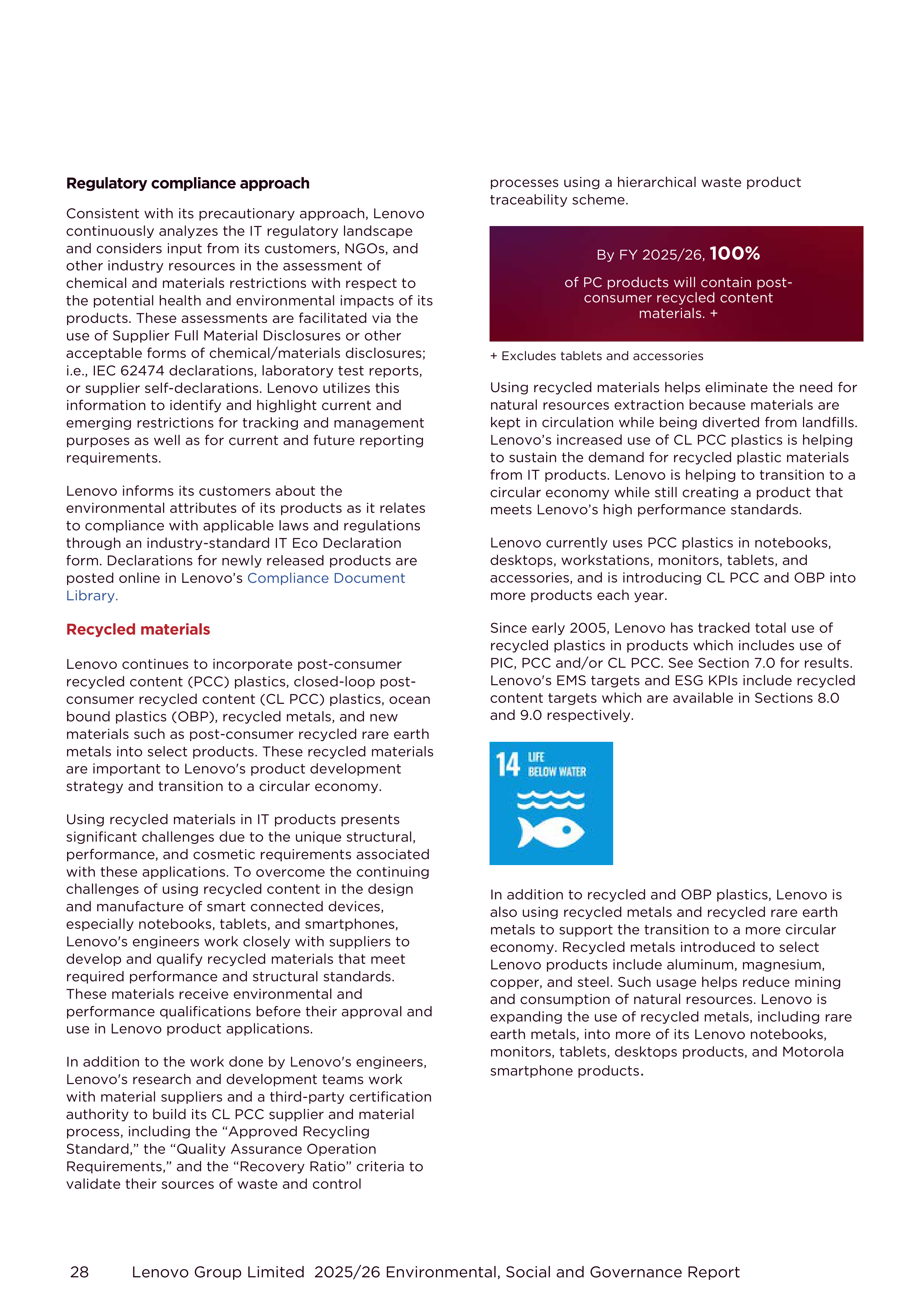
Lenovo's business unit environmental engineers
utilize the environmental compliance analysis system
to perform a Bill of Materials (BOM) validation to
ensure every part number used in building the
product has the required supplier information. Once
the full BOM compliance verification is complete, a
detailed compliance summary report is generated to
show the internal company and external legal
requirements at the full product level.
Lenovo Group Limited 2025/26 Environmental, Social and Governance Report
27
Lenovo - BB Owners, Engineers, EFPs...
Export Product
BOMs from
PLM System
PLM Systems
Suppliers
Legend
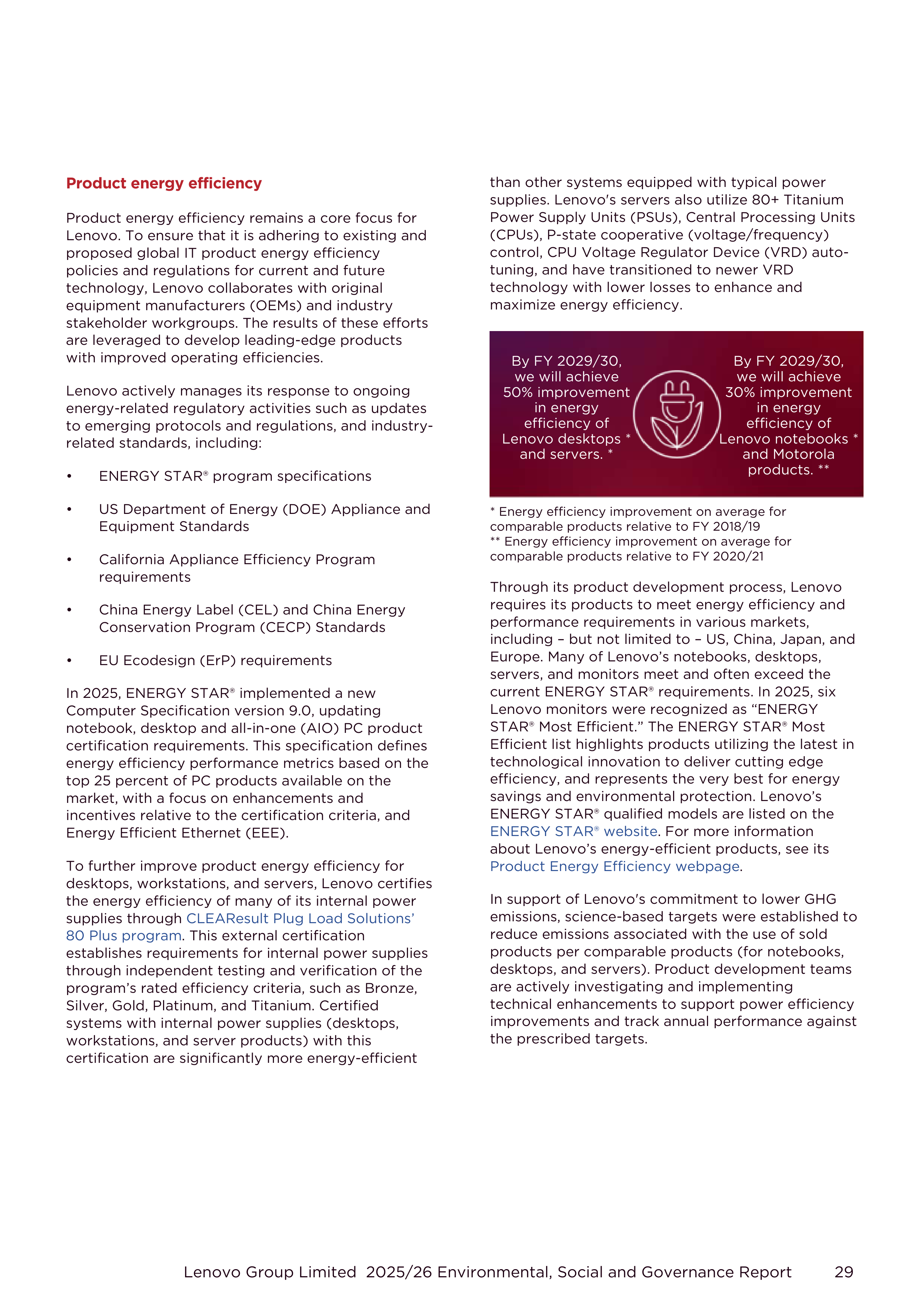
BB Owners - Building Block Owners
BOM - Bill of Materials
EFP - Environmental Focal Point
PLM - Product Lifecycle Management
REACH – Registration, Evaluation,
Authorization, and Restriction of Chemicals
RoHS - Restriction on Hazardous Substances
Declare Compliance Store Reports
and Environmental Variable (ENV)
Sign of Reports available for
designated market
REACH, RoHS...
External Environmental
Compliance Analysis System
Load BOMs into
Environmental Compliance
Analysis System
Link Lenovo and Supplier parts
in Environmental Compliance
Analysis System
Supplier loads part data and
publishes in Environmental
Compliance Analysis System

Regulatory compliance approach
Consistent with its precautionary approach, Lenovo
continuously analyzes the IT regulatory landscape
and considers input from its customers, NGOs, and
other industry resources in the assessment of
chemical and materials restrictions with respect to
the potential health and environmental impacts of its
products. These assessments are facilitated via the
use of Supplier Full Material Disclosures or other
acceptable forms of chemical/materials disclosures;
i.e., IEC 62474 declarations, laboratory test reports,
or supplier self-declarations. Lenovo utilizes this
information to identify and highlight current and
emerging restrictions for tracking and management
purposes as well as for current and future reporting
requirements.
Lenovo informs its customers about the
environmental attributes of its products as it relates
to compliance with applicable laws and regulations
through an industry-standard IT Eco Declaration
form. Declarations for newly released products are
posted online in Lenovo’s
Compliance Document
Library.
Recycled materials
Lenovo continues to incorporate post-consumer
recycled content (PCC) plastics, closed-loop post-
consumer recycled content (CL PCC) plastics, ocean
bound plastics (OBP), recycled metals, and new
materials such as post-consumer recycled rare earth
metals into select products. These recycled materials
are important to Lenovo's product development
strategy and transition to a circular economy.
Using recycled materials in IT products presents
significant challenges due to the unique structural,
performance, and cosmetic requirements associated
with these applications. To overcome the continuing
challenges of using recycled content in the design
and manufacture of smart connected devices,
especially notebooks, tablets, and smartphones,
Lenovo's engineers work closely with suppliers to
develop and qualify recycled materials that meet
required performance and structural standards.
These materials receive environmental and
performance qualifications before their approval and
use in Lenovo product applications.
In addition to the work done by Lenovo's engineers,
Lenovo's research and development teams work
with material suppliers and a third-party certification
authority to build its CL PCC supplier and material
process, including the “Approved Recycling
Standard,” the “Quality Assurance Operation
Requirements,” and the “Recovery Ratio” criteria to
validate their sources of waste and control
processes using a hierarchical waste product
traceability scheme.
+ Excludes tablets and accessories
Using recycled materials helps eliminate the need for
natural resources extraction because materials are
kept in circulation while being diverted from landfills.
Lenovo’s increased use of CL PCC plastics is helping
to sustain the demand for recycled plastic materials
from IT products. Lenovo is helping to transition to a
circular economy while still creating a product that
meets Lenovo’s high performance standards.
Lenovo currently uses PCC plastics in notebooks,
desktops, workstations, monitors, tablets, and
accessories, and is introducing CL PCC and OBP into
more products each year.
Since early 2005, Lenovo has tracked total use of
recycled plastics in products which includes use of
PIC, PCC and/or CL PCC. See Section 7.0 for results.
Lenovo's EMS targets and ESG KPIs include recycled
content targets which are available in Sections 8.0
and 9.0 respectively.
In addition to recycled and OBP plastics, Lenovo is
also using recycled metals and recycled rare earth
metals to support the transition to a more circular
economy. Recycled metals introduced to select
Lenovo products include aluminum, magnesium,
copper, and steel. Such usage helps reduce mining
and consumption of natural resources. Lenovo is
expanding the use of recycled metals, including rare
earth metals, into more of its Lenovo notebooks,
monitors, tablets, desktops products, and Motorola
smartphone products
.
28
Lenovo Group Limited 2025/26 Environmental, Social and Governance Report
By FY 2025/26,
100%
of PC products will contain post-
consumer recycled content
materials. +


Product energy efficiency
Product energy efficiency remains a core focus for
Lenovo. To ensure that it is adhering to existing and
proposed global IT product energy efficiency
policies and regulations for current and future
technology, Lenovo collaborates with original
equipment manufacturers (OEMs) and industry
stakeholder workgroups. The results of these efforts
are leveraged to develop leading-edge products
with improved operating efficiencies.
Lenovo actively manages its response to ongoing
energy-related regulatory activities such as updates
to emerging protocols and regulations, and industry-
related standards, including:
•
ENERGY STAR® program specifications
•
US Department of Energy (DOE) Appliance and
Equipment Standards
•
California Appliance Efficiency Program
requirements
•
China Energy Label (CEL) and China Energy
Conservation Program (CECP) Standards
•
EU Ecodesign (ErP) requirements
In 2025, ENERGY STAR® implemented a new
Computer Specification version 9.0, updating
notebook, desktop and all-in-one (AIO) PC product
certification requirements. This specification defines
energy efficiency performance metrics based on the
top 25 percent of PC products available on the
market, with a focus on enhancements and
incentives relative to the certification criteria, and
Energy Efficient Ethernet (EEE).
To further improve product energy efficiency for
desktops, workstations, and servers, Lenovo certifies
the energy efficiency of many of its internal power
supplies through
CLEAResult Plug Load Solutions’
80 Plus program
. This external certification
establishes requirements for internal power supplies
through independent testing and verification of the
program’s rated efficiency criteria, such as Bronze,
Silver, Gold, Platinum, and Titanium. Certified
systems with internal power supplies (desktops,
workstations, and server products) with this
certification are significantly more energy-efficient
than other systems equipped with typical power
supplies. Lenovo's servers also utilize 80+ Titanium
Power Supply Units (PSUs), Central Processing Units
(CPUs), P-state cooperative (voltage/frequency)
control, CPU Voltage Regulator Device (VRD) auto-
tuning, and have transitioned to newer VRD
technology with lower losses to enhance and
maximize energy efficiency.
* Energy efficiency improvement on average for
comparable products relative to FY 2018/19
** Energy efficiency improvement on average for
comparable products relative to FY 2020/21
Through its product development process, Lenovo
requires its products to meet energy efficiency and
performance requirements in various markets,
including – but not limited to – US, China, Japan, and
Europe. Many of Lenovo’s notebooks, desktops,
servers, and monitors meet and often exceed the
current ENERGY STAR® requirements. In 2025, six
Lenovo monitors were recognized as “ENERGY
STAR® Most Efficient.” The ENERGY STAR® Most
Efficient list highlights products utilizing the latest in
technological innovation to deliver cutting edge
efficiency, and represents the very best for energy
savings and environmental protection. Lenovo’s
ENERGY STAR® qualified models are listed on the
ENERGY STAR® website
. For more information
about Lenovo’s energy-efficient products, see its
Product Energy Efficiency webpage
.
In support of Lenovo's commitment to lower GHG
emissions, science-based targets were established to
reduce emissions associated with the use of sold
products per comparable products (for notebooks,
desktops, and servers). Product development teams
are actively investigating and implementing
technical enhancements to support power efficiency
improvements and track annual performance against
the prescribed targets.
Lenovo Group Limited 2025/26 Environmental, Social and Governance Report
29
By FY 2029/30,
we will achieve
50% improvement
in energy
efficiency of
Lenovo desktops *
and servers. *
By FY 2029/30,
we will achieve
30% improvement
in energy
efficiency of
Lenovo notebooks *
and Motorola
products. **
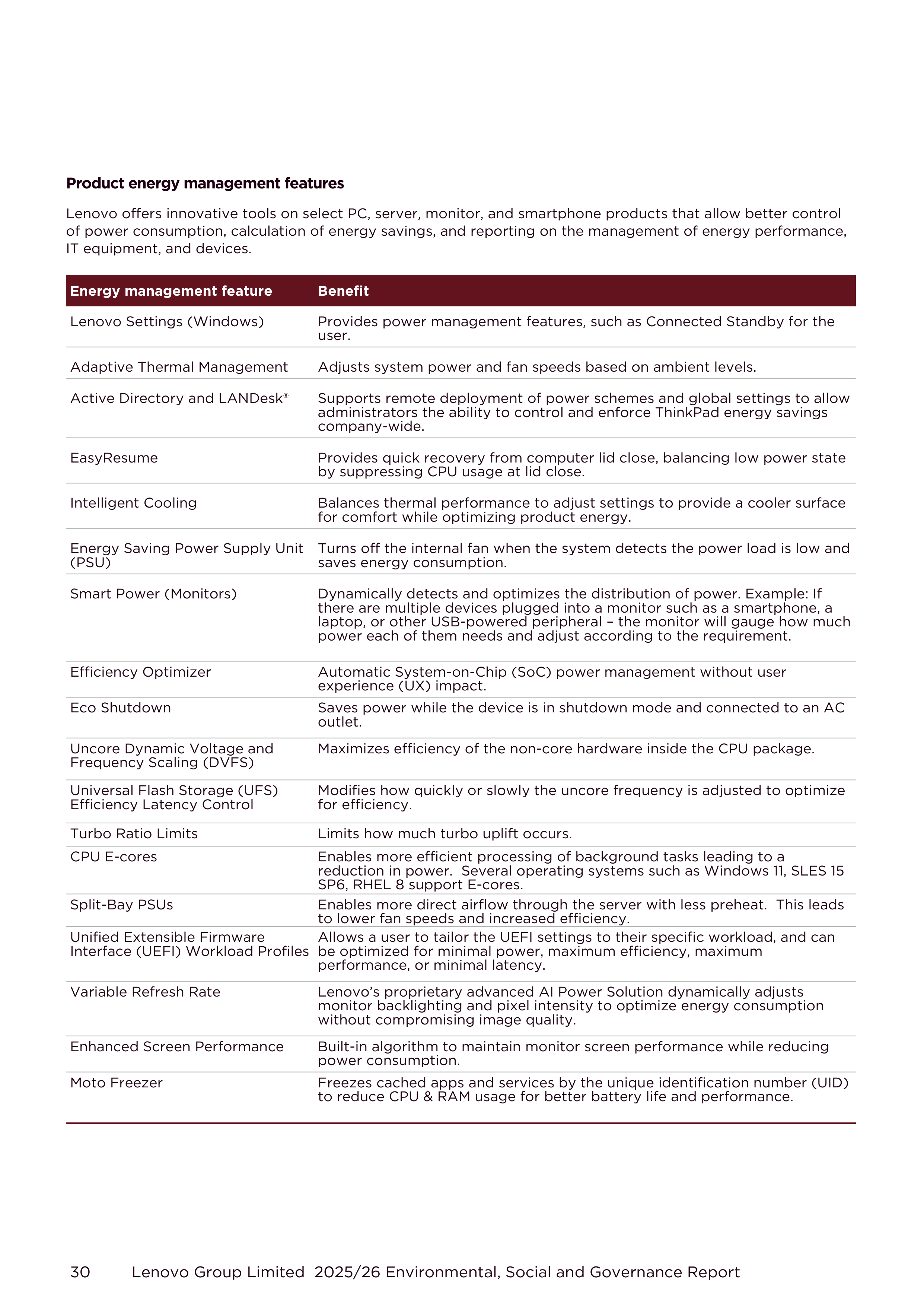
Product energy management features
Lenovo offers innovative tools on select PC, server, monitor, and smartphone products that allow better control
of power consumption, calculation of energy savings, and reporting on the management of energy performance,
IT equipment, and devices.
Energy management feature
Benefit
Lenovo Settings (Windows)
Provides power management features, such as Connected Standby for the
user.
Adaptive Thermal Management
Adjusts system power and fan speeds based on ambient levels.
Active Directory and LANDesk®
Supports remote deployment of power schemes and global settings to allow
administrators the ability to control and enforce ThinkPad energy savings
company-wide.
EasyResume
Provides quick recovery from computer lid close, balancing low power state
by suppressing CPU usage at lid close.
Intelligent Cooling
Balances thermal performance to adjust settings to provide a cooler surface
for comfort while optimizing product energy.
Energy Saving Power Supply Unit
(PSU)
Turns off the internal fan when the system detects the power load is low and
saves energy consumption.
Smart Power (Monitors)
Dynamically detects and optimizes the distribution of power. Example: If
there are multiple devices plugged into a monitor such as a smartphone, a
laptop, or other USB-powered peripheral – the monitor will gauge how much
power each of them needs and adjust according to the requirement.
Efficiency Optimizer
Automatic System-on-Chip (SoC) power management without user
experience (UX) impact.
Eco Shutdown
Saves power while the device is in shutdown mode and connected to an AC
outlet.
Uncore Dynamic Voltage and
Frequency Scaling (DVFS)
Maximizes efficiency of the non-core hardware inside the CPU package.
Universal Flash Storage (UFS)
Efficiency Latency Control
Modifies how quickly or slowly the uncore frequency is adjusted to optimize
for efficiency.
Turbo Ratio Limits
Limits how much turbo uplift occurs.
CPU E-cores
Enables more efficient processing of background tasks leading to a
reduction in power. Several operating systems such as Windows 11, SLES 15
SP6, RHEL 8 support E-cores.
Split-Bay PSUs
Enables more direct airflow through the server with less preheat. This leads
to lower fan speeds and increased efficiency.
Unified Extensible Firmware
Interface (UEFI) Workload Profiles
Allows a user to tailor the UEFI settings to their specific workload, and can
be optimized for minimal power, maximum efficiency, maximum
performance, or minimal latency.
Variable Refresh Rate
Lenovo’s proprietary advanced AI Power Solution dynamically adjusts
monitor backlighting and pixel intensity to optimize energy consumption
without compromising image quality.
Enhanced Screen Performance
Built-in algorithm to maintain monitor screen performance while reducing
power consumption.
Moto Freezer
Freezes cached apps and services by the unique identification number (UID)
to reduce CPU & RAM usage for better battery life and performance.
30
Lenovo Group Limited 2025/26 Environmental, Social and Governance Report
Durability and repairability
Keeping a product in use for a longer period is an
important aspect of the circular economy and
reducing unnecessary electronic waste. Therefore,
Lenovo aims to design its products with durability
and repairability in mind, and ensures devices are
tested through comprehensive quality and reliability
testing aligned with real-world usage scenarios
(including drop, spill, power cycling tests, and more).
Lenovo is continuously designing innovative features
for its products to help extend their useful life. For
example, extending battery cycle life through key
technologies, such as the use of lithium polymer
cells designed for long life in notebooks and tablets,
battery pack management including adaptive
charging algorithms, and system software designed
to extend battery longevity. In smartphones,
Motorola’s latest lithium-ion battery technology
extends smartphone battery cycle life through
intelligent fast charging strategy (IFC), long-life
battery cell design, and software development.
In addition to the focus on durable product design,
Lenovo offers a range of services aiming to keep
products in use for as long as possible. For example,
Lenovo offers customers flexible warranty options
that are designed to fit various needs, including
warranty upgrades, sealed battery warranties, and
accidental damage protection for many products.
For more details, see Lenovo’s
Warranty and
Maintenance Services webpage
.
To improve the repairability of devices, Lenovo
created and uses an engineering review process
called ‘Design for serviceability’ to assess product
design based on multiple factors including time to
complete repair, number of customer-replaceable
parts and number of field-replaceable parts.
Features evaluated include screw type and number,
joining techniques, and service availability.
Additionally, through Lenovo and Motorola’s
ongoing partnership with iFixit, an online repair
community, the end-user repairability of some of the
bestselling products are evaluated through their
independent repairability assessments, as well as
providing another avenue for repair solutions for the
customer. For more information see iFixit’s
collaboration webpages for
Lenovo
and
Motorola
.
In addition to efforts on repairable product design,
Lenovo and Motorola provide users of many of its
laptop, desktop, and smartphone products with the
resources necessary to repair their own devices, as
well as offering repair support and service options
for many systems. Lenovo and Motorola make
available a wide range of service and maintenance
manuals for many products along with step-by-step
guides and videos on parts removal and
replacement. Customers can source spare parts from
Lenovo and Motorola or their authorized partners.
For more information see Lenovo’s
Self-Repair
Guides
and Motorola’s
repair webpages
. Lenovo’s
ESG KPIs include a repairability KPI, for more
information see Section 8.0.
Product carbon footprint
The Product Carbon Footprint (PCF) or Global
Warming Potential (GWP-100) has become a key
product attribute for Lenovo and customers.
Knowing the PCF of a product allows customers to
better understand the environmental impact of the
products they purchase.
To provide Lenovo's customers with PCF values for
the broadest set of products, Lenovo continues to
utilize the
Product Attribute to Impact Algorithm
(PAIA)
platform to calculate streamlined Life Cycle
Assessments (LCAs) of desktops, notebooks,
tablets, and workstation computers as well as
monitors, servers, storage, and network switch
products.
Using PAIA tools to calculate product carbon
footprints has significantly reduced the time and
cost associated with these calculations. In addition,
Lenovo's participation in PAIA is helping to drive a
sector-wide streamlined methodology that can be
key to transforming information and
communications technology (ICT) companies into
sustainable businesses.
To better meet evolving customer expectations and
industry practices, and guide Lenovo's product eco-
design, Lenovo is implementing LCA approach to
provide a systematic and comprehensive
understanding of product environmental impacts.
Lenovo recognizes the importance of adhering to
globally recognized standards, including ISO 14040
and ISO 14044 for LCA and ISO 14067 for PCF,
ensuring methodological consistency, transparency,
and reliability in reporting. By embedding LCA into
product design and manufacturing processes,
Lenovo will not only fulfill eco-design requirements
but also fosters innovation in materials and
technologies, striving to reduce environmental
footprints while enhancing product sustainability
performance.
Lenovo's PCF information sheets for specific
products can be found on Lenovo's
Compliance
Document Library
.
Lenovo Group Limited 2025/26 Environmental, Social and Governance Report
31
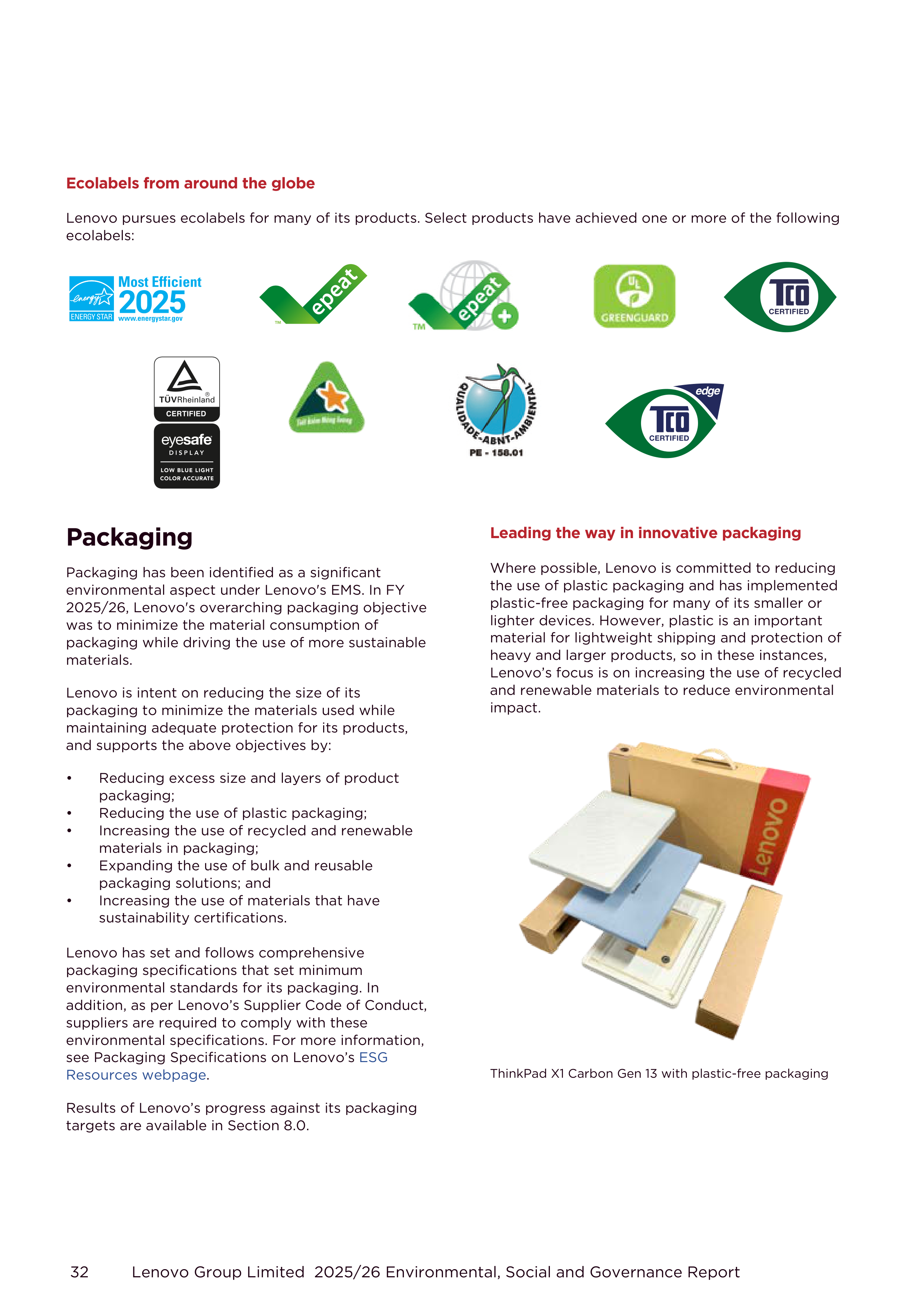


Ecolabels from around the globe
Lenovo pursues ecolabels for many of its products. Select products have achieved one or more of the following
ecolabels:
Packaging
Packaging has been identified as a significant
environmental aspect under Lenovo's EMS. In FY
2025/26, Lenovo's overarching packaging objective
was to minimize the material consumption of
packaging while driving the use of more sustainable
materials.
Lenovo is intent on reducing the size of its
packaging to minimize the materials used while
maintaining adequate protection for its products,
and supports the above objectives by:
•
Reducing excess size and layers of product
packaging;
•
Reducing the use of plastic packaging;
•
Increasing the use of recycled and renewable
materials in packaging;
•
Expanding the use of bulk and reusable
packaging solutions; and
•
Increasing the use of materials that have
sustainability certifications.
Lenovo has set and follows comprehensive
packaging specifications that set minimum
environmental standards for its packaging. In
addition, as per Lenovo’s Supplier Code of Conduct,
suppliers are required to comply with these
environmental specifications. For more information,
see Packaging Specifications on Lenovo’s
ESG
Resources webpage
.
Results of Lenovo’s progress against its packaging
targets are available in Section 8.0.
Leading the way in innovative packaging
Where possible, Lenovo is committed to reducing
the use of plastic packaging and has implemented
plastic-free packaging for many of its smaller or
lighter devices. However, plastic is an important
material for lightweight shipping and protection of
heavy and larger products, so in these instances,
Lenovo’s focus is on increasing the use of recycled
and renewable materials to reduce environmental
impact.
ThinkPad X1 Carbon Gen 13 with plastic-free packaging
32
Lenovo Group Limited 2025/26 Environmental, Social and Governance Report
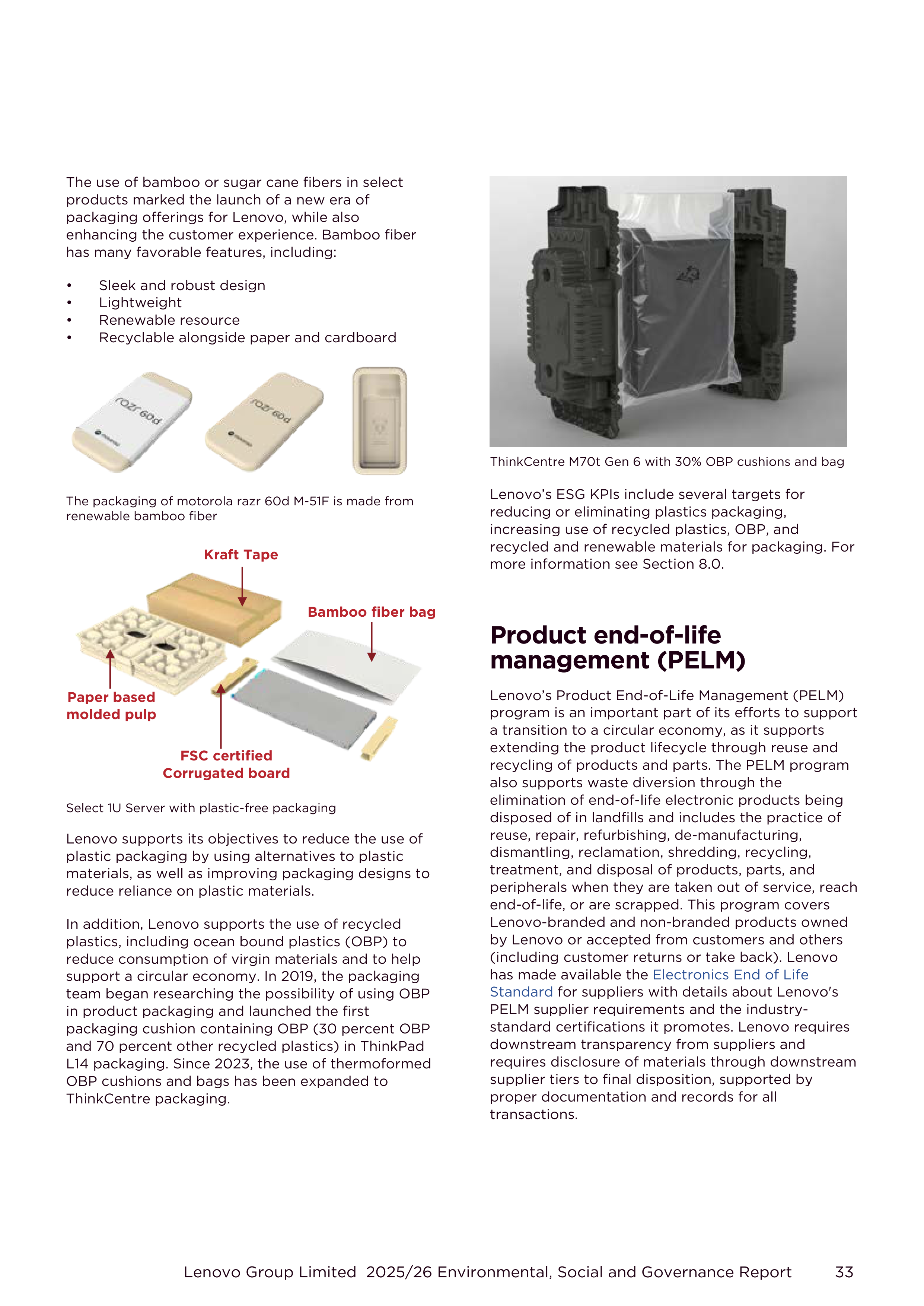





The use of bamboo or sugar cane fibers in select
products marked the launch of a new era of
packaging offerings for Lenovo, while also
enhancing the customer experience. Bamboo fiber
has many favorable features, including:
•
Sleek and robust design
•
Lightweight
•
Renewable resource
•
Recyclable alongside paper and cardboard
The packaging of motorola razr 60d M-51F is made from
renewable bamboo fiber
Select 1U Server with plastic-free packaging
Lenovo supports its objectives to reduce the use of
plastic packaging by using alternatives to plastic
materials, as well as improving packaging designs to
reduce reliance on plastic materials.
In addition, Lenovo supports the use of recycled
plastics, including ocean bound plastics (OBP) to
reduce consumption of virgin materials and to help
support a circular economy. In 2019, the packaging
team began researching the possibility of using OBP
in product packaging and launched the first
packaging cushion containing OBP (30 percent OBP
and 70 percent other recycled plastics) in ThinkPad
L14 packaging. Since 2023, the use of thermoformed
OBP cushions and bags has been expanded to
ThinkCentre packaging.
ThinkCentre M70t Gen 6 with 30% OBP cushions and bag
Lenovo’s ESG KPIs include several targets for
reducing or eliminating plastics packaging,
increasing use of recycled plastics, OBP, and
recycled and renewable materials for packaging. For
more information see Section 8.0.
Product end-of-life
management (PELM)
Lenovo’s Product End-of-Life Management (PELM)
program is an important part of its efforts to support
a transition to a circular economy, as it supports
extending the product lifecycle through reuse and
recycling of products and parts. The PELM program
also supports waste diversion through the
elimination of end-of-life electronic products being
disposed of in landfills and includes the practice of
reuse, repair, refurbishing, de-manufacturing,
dismantling, reclamation, shredding, recycling,
treatment, and disposal of products, parts, and
peripherals when they are taken out of service, reach
end-of-life, or are scrapped. This program covers
Lenovo-branded and non-branded products owned
by Lenovo or accepted from customers and others
(including customer returns or take back). Lenovo
has made available the
Electronics End of Life
Standard
for suppliers with details about Lenovo's
PELM supplier requirements and the industry-
standard certifications it promotes. Lenovo requires
downstream transparency from suppliers and
requires disclosure of materials through downstream
supplier tiers to final disposition, supported by
proper documentation and records for all
transactions.
Lenovo Group Limited 2025/26 Environmental, Social and Governance Report
33
Paper based
molded pulp
FSC certified
Corrugated board
Bamboo fiber bag
Kraft Tape
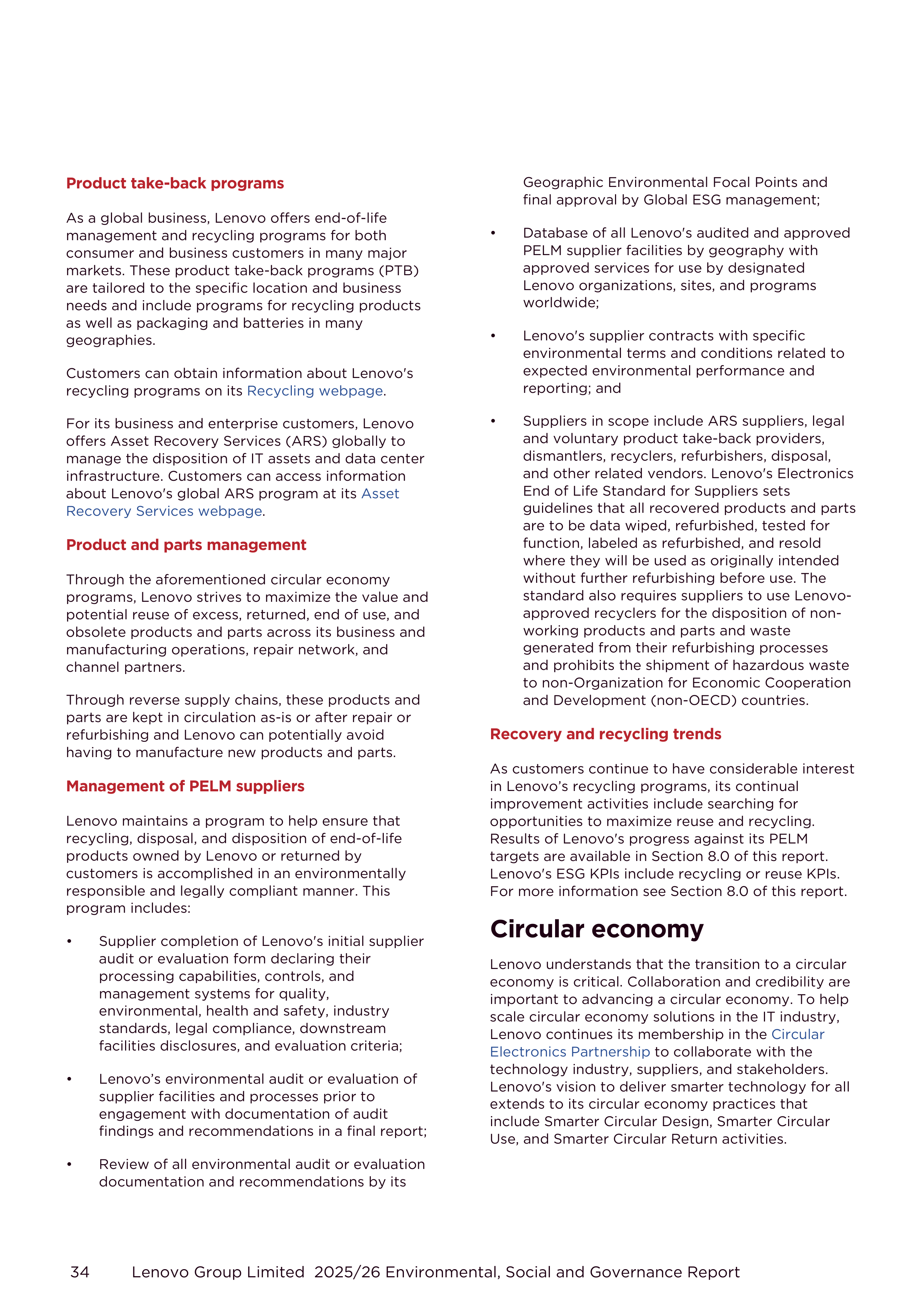
Product take-back programs
As a global business, Lenovo offers end-of-life
management and recycling programs for both
consumer and business customers in many major
markets. These product take-back programs (PTB)
are tailored to the specific location and business
needs and include programs for recycling products
as well as packaging and batteries in many
geographies.
Customers can obtain information about Lenovo's
recycling programs on its
Recycling webpage
.
For its business and enterprise customers, Lenovo
offers Asset Recovery Services (ARS) globally to
manage the disposition of IT assets and data center
infrastructure. Customers can access information
about Lenovo's global ARS program at its
Asset
Recovery Services webpage
.
Product and parts management
Through the aforementioned circular economy
programs, Lenovo strives to maximize the value and
potential reuse of excess, returned, end of use, and
obsolete products and parts across its business and
manufacturing operations, repair network, and
channel partners.
Through reverse supply chains, these products and
parts are kept in circulation as-is or after repair or
refurbishing and Lenovo can potentially avoid
having to manufacture new products and parts.
Management of PELM suppliers
Lenovo maintains a program to help ensure that
recycling, disposal, and disposition of end-of-life
products owned by Lenovo or returned by
customers is accomplished in an environmentally
responsible and legally compliant manner. This
program includes:
•
Supplier completion of Lenovo's initial supplier
audit or evaluation form declaring their
processing capabilities, controls, and
management systems for quality,
environmental, health and safety, industry
standards, legal compliance, downstream
facilities disclosures, and evaluation criteria;
•
Lenovo’s environmental audit or evaluation of
supplier facilities and processes prior to
engagement with documentation of audit
findings and recommendations in a final report;
•
Review of all environmental audit or evaluation
documentation and recommendations by its
Geographic Environmental Focal Points and
final approval by Global ESG management;
•
Database of all Lenovo's audited and approved
PELM supplier facilities by geography with
approved services for use by designated
Lenovo organizations, sites, and programs
worldwide;
•
Lenovo's supplier contracts with specific
environmental terms and conditions related to
expected environmental performance and
reporting; and
•
Suppliers in scope include ARS suppliers, legal
and voluntary product take-back providers,
dismantlers, recyclers, refurbishers, disposal,
and other related vendors. Lenovo's Electronics
End of Life Standard for Suppliers sets
guidelines that all recovered products and parts
are to be data wiped, refurbished, tested for
function, labeled as refurbished, and resold
where they will be used as originally intended
without further refurbishing before use. The
standard also requires suppliers to use Lenovo-
approved recyclers for the disposition of non-
working products and parts and waste
generated from their refurbishing processes
and prohibits the shipment of hazardous waste
to non-Organization for Economic Cooperation
and Development (non-OECD) countries.
Recovery and recycling trends
As customers continue to have considerable interest
in Lenovo’s recycling programs, its continual
improvement activities include searching for
opportunities to maximize reuse and recycling.
Results of Lenovo's progress against its PELM
targets are available in Section 8.0 of this report.
Lenovo's ESG KPIs include recycling or reuse KPIs.
For more information see Section 8.0 of this report.
Circular economy
Lenovo understands that the transition to a circular
economy is critical. Collaboration and credibility are
important to advancing a circular economy. To help
scale circular economy solutions in the IT industry,
Lenovo continues its membership in the
Circular
Electronics Partnership
to collaborate with the
technology industry, suppliers, and stakeholders.
Lenovo's vision to deliver smarter technology for all
extends to its circular economy practices that
include Smarter Circular Design, Smarter Circular
Use, and Smarter Circular Return activities.
34
Lenovo Group Limited 2025/26 Environmental, Social and Governance Report
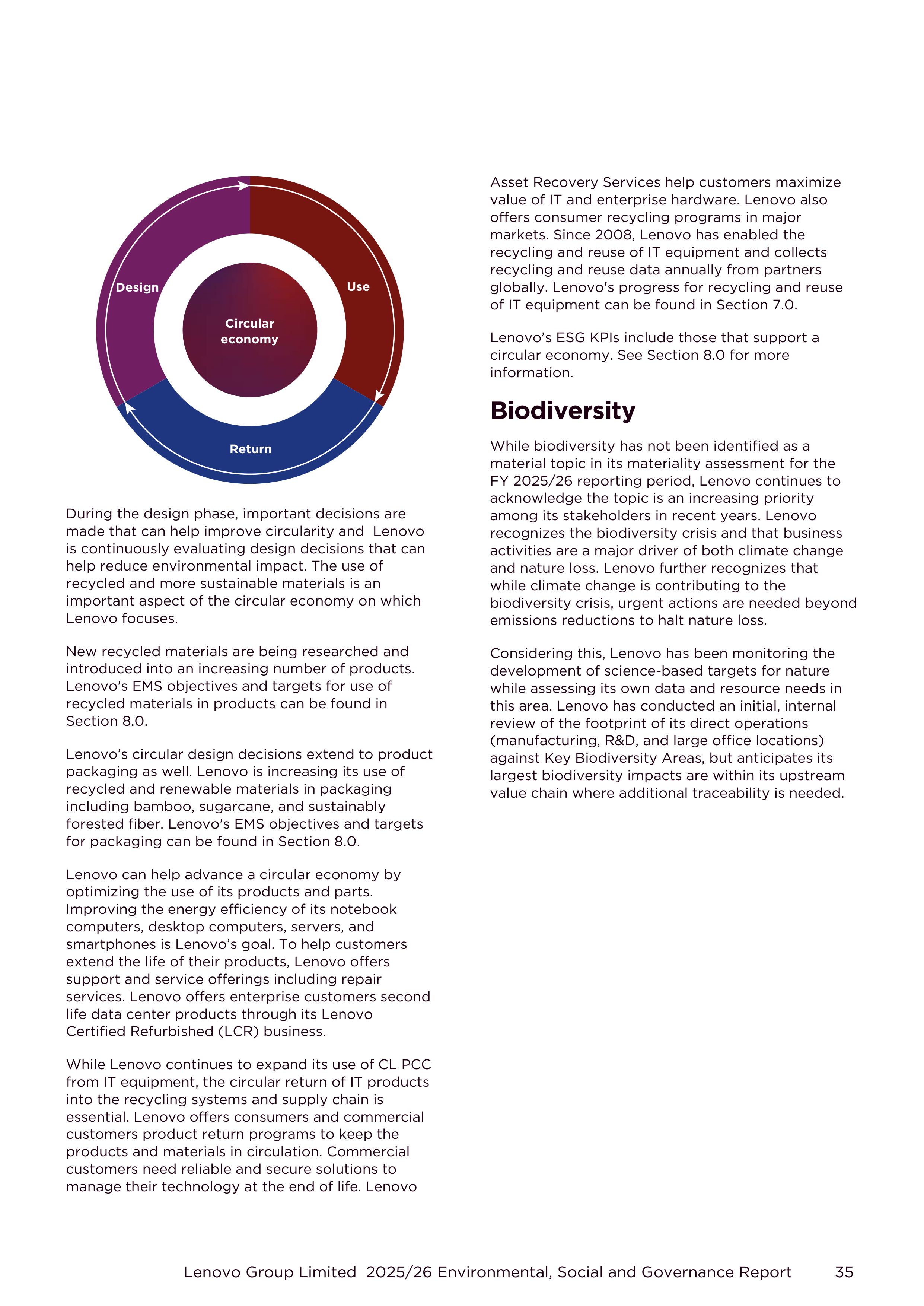

During the design phase, important decisions are
made that can help improve circularity and Lenovo
is continuously evaluating design decisions that can
help reduce environmental impact. The use of
recycled and more sustainable materials is an
important aspect of the circular economy on which
Lenovo focuses.
New recycled materials are being researched and
introduced into an increasing number of products.
Lenovo's EMS objectives and targets for use of
recycled materials in products can be found in
Section 8.0.
Lenovo’s circular design decisions extend to product
packaging as well. Lenovo is increasing its use of
recycled and renewable materials in packaging
including bamboo, sugarcane, and sustainably
forested fiber. Lenovo's EMS objectives and targets
for packaging can be found in Section 8.0.
Lenovo can help advance a circular economy by
optimizing the use of its products and parts.
Improving the energy efficiency of its notebook
computers, desktop computers, servers, and
smartphones is Lenovo’s goal. To help customers
extend the life of their products, Lenovo offers
support and service offerings including repair
services. Lenovo offers enterprise customers second
life data center products through its Lenovo
Certified Refurbished (LCR) business.
While Lenovo continues to expand its use of CL PCC
from IT equipment, the circular return of IT products
into the recycling systems and supply chain is
essential. Lenovo offers consumers and commercial
customers product return programs to keep the
products and materials in circulation. Commercial
customers need reliable and secure solutions to
manage their technology at the end of life. Lenovo
Asset Recovery Services help customers maximize
value of IT and enterprise hardware. Lenovo also
offers consumer recycling programs in major
markets. Since 2008, Lenovo has enabled the
recycling and reuse of IT equipment and collects
recycling and reuse data annually from partners
globally. Lenovo's progress for recycling and reuse
of IT equipment can be found in Section 7.0.
Lenovo’s ESG KPIs include those that support a
circular economy. See Section 8.0 for more
information.
Biodiversity
While biodiversity has not been identified as a
material topic in its materiality assessment for the
FY 2025/26 reporting period, Lenovo continues to
acknowledge the topic is an increasing priority
among its stakeholders in recent years. Lenovo
recognizes the biodiversity crisis and that business
activities are a major driver of both climate change
and nature loss. Lenovo further recognizes that
while climate change is contributing to the
biodiversity crisis, urgent actions are needed beyond
emissions reductions to halt nature loss.
Considering this, Lenovo has been monitoring the
development of science-based targets for nature
while assessing its own data and resource needs in
this area. Lenovo has conducted an initial, internal
review of the footprint of its direct operations
(manufacturing, R&D, and large office locations)
against Key Biodiversity Areas, but anticipates its
largest biodiversity impacts are within its upstream
value chain where additional traceability is needed.
Lenovo Group Limited 2025/26 Environmental, Social and Governance Report
35
Design
Use
Return
Circular
economy

4.0
Social
38
Labor practices
39
Health and safety
43
Employment and talent management
practices
48
Global philanthropy and community
engagement
51
Global inclusion




Labor practices
Lenovo's Human Rights Policy communicates the
organization’s respect for human rights and how it
extends those rights to employees and others
directly or indirectly employed in its supply chain. As
a signatory of the UNGC, Lenovo upholds and
supports the protection of internationally
proclaimed human rights. Lenovo does not permit
and takes every action to prevent the use of child
labor, forced labor or coercion, including physical
punishment, in any of its operations. Lenovo
commits to the following practices outlined in its
Human Rights Policy:
•
Conduct business in accordance with the
United Nations Declaration of Human Rights
and the principles of the UNGC, and extend
those requirements to all suppliers doing
business with Lenovo.
•
Operate in compliance with relevant laws,
regulations, and ethical standards in each
jurisdiction where Lenovo conducts business.
•
Perform due diligence across the value chain to
identify risks and prevent human rights
violations.
•
Provide access to grievance mechanisms,
investigate allegations, and escalate known
cases of human rights abuse to senior
leadership for swift corrective action and
resolution.
•
Integrate training and accountability for
respecting human rights across the business
and the supply chain.
•
Engage internal and external stakeholders to
address common challenges and advance
human rights practices through continuous
improvement.
All of Lenovo’s corporate strategies, practices,
guidelines, and supplier requirements must support
this commitment to human rights. In addition, as a
signatory of the UNGC, Lenovo upholds the human
rights, labor, and other principles of the UNGC -
including Principle 3 regarding freedom of
association. Lenovo upholds and supports fostering
a workplace culture characterized by mutual
respect, collaboration, and open communication.
Lenovo recognizes that effective social dialogue is
essential for nurturing a positive work environment
and promoting employee engagement.
Concerns about possible human rights violations
must be reported to Lenovo’s management and can
also be reported through Lenovo’s various reporting
channels, including, but not limited to, the Ethics and
Compliance Office, Human Resources, Internal Audit,
the Legal Department, or the LenovoLine (Lenovo’s
confidential reporting hotline). Lenovo takes all
allegations and concerns seriously. L
enovo’s
W
histleblowing and Investigations Poli
cy
outlines
the process by which concerns can be raised,
reviewed, and investigated. Lenovo’s oversight
body, the Investigation Oversight Committee (IOC),
provides oversight to ensure concerns raised are
appropriately investigated and addressed. More
information is available in Lenovo’s
Human Rights
Policy
.
Lenovo is determined to ensure that the working
conditions at its locations and supplier locations are
safe, workers are treated with respect and dignity,
operations are environmentally sound and business
operations are conducted responsibly and ethically.
Lenovo aims to raise awareness by engaging with
the Responsible Business Alliance (RBA).
Assessments carried out on RBA member facilities
and their suppliers' facilities are completed by
independent, third-party firms specially trained in
social and environmental assessment and the
Validated Assessment Program (VAP) protocol.
Assessments also include a review of mechanisms,
controls, and processes in place to prevent child
labor and forced labor at each site that is assessed.
The auditors also review employee files and conduct
individual and group interviews. Refer to the Health
and safety section of this report for more
information on Lenovo's RBA VAP recognitions.
Labor practices are also evaluated as part of the
scope of two main business management systems:
Enterprise Risk Management (ERM) and the ESG
reporting materiality assessment. The detailed
processes may vary by market and are based on
local laws.
4.0 Social
38
Lenovo Group Limited 2025/26 Environmental, Social and Governance Report
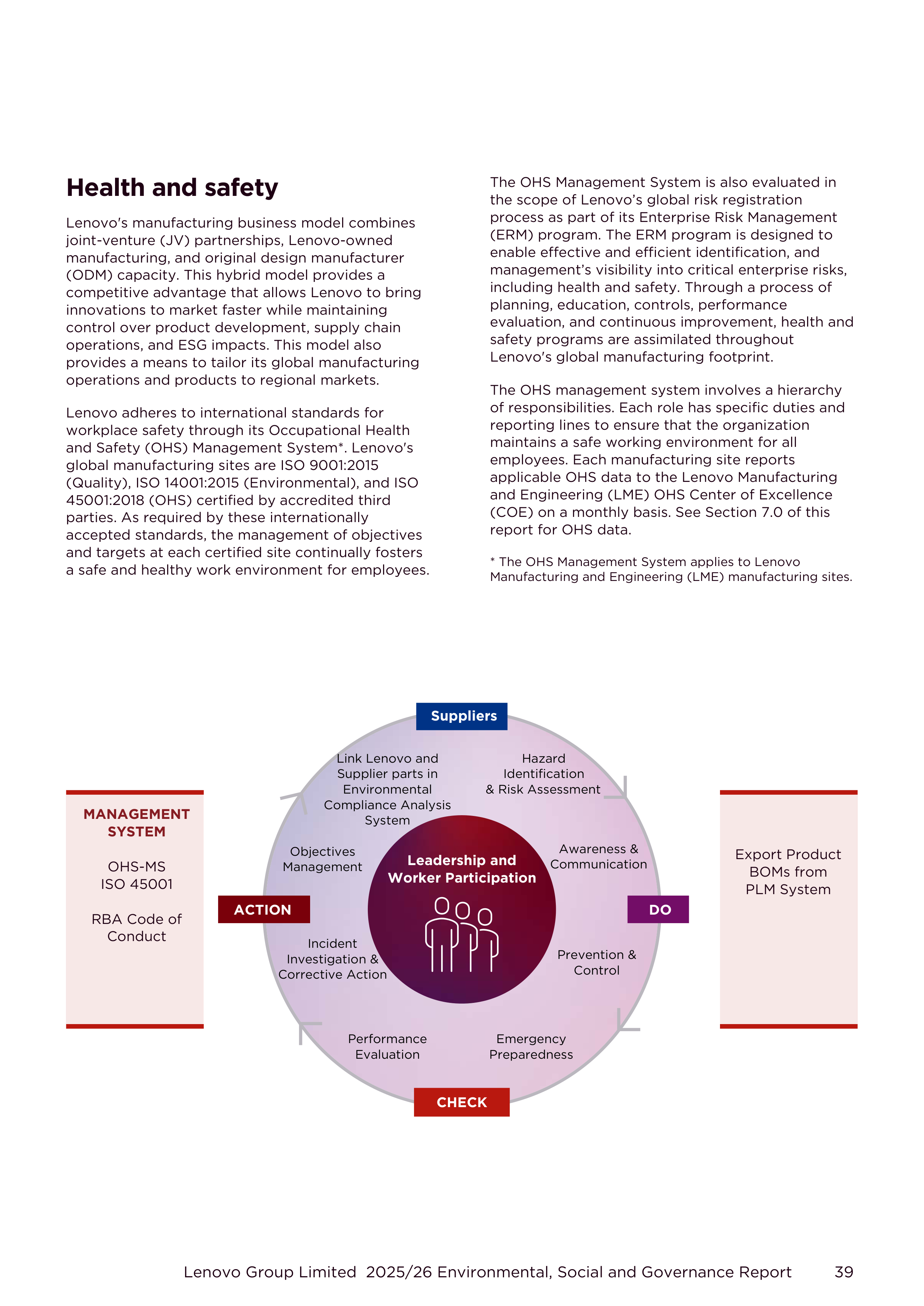




Health and safety
Lenovo's manufacturing business model combines
joint-venture (JV) partnerships, Lenovo-owned
manufacturing, and original design manufacturer
(ODM) capacity. This hybrid model provides a
competitive advantage that allows Lenovo to bring
innovations to market faster while maintaining
control over product development, supply chain
operations, and ESG impacts. This model also
provides a means to tailor its global manufacturing
operations and products to regional markets.
Lenovo adheres to international standards for
workplace safety through its Occupational Health
and Safety (OHS) Management System*. Lenovo's
global manufacturing sites are ISO 9001:2015
(Quality), ISO 14001:2015 (Environmental), and ISO
45001:2018 (OHS) certified by accredited third
parties. As required by these internationally
accepted standards, the management of objectives
and targets at each certified site continually fosters
a safe and healthy work environment for employees.
The OHS Management System is also evaluated in
the scope of Lenovo’s global risk registration
process as part of its Enterprise Risk Management
(ERM) program. The ERM program is designed to
enable effective and efficient identification, and
management’s visibility into critical enterprise risks,
including health and safety. Through a process of
planning, education, controls, performance
evaluation, and continuous improvement, health and
safety programs are assimilated throughout
Lenovo's global manufacturing footprint.
The OHS management system involves a hierarchy
of responsibilities. Each role has specific duties and
reporting lines to ensure that the organization
maintains a safe working environment for all
employees. Each manufacturing site reports
applicable OHS data to the Lenovo Manufacturing
and Engineering (LME) OHS Center of Excellence
(COE) on a monthly basis. See Section 7.0 of this
report for OHS data.
* The OHS Management System applies to Lenovo
Manufacturing and Engineering (LME) manufacturing sites.
Lenovo Group Limited 2025/26 Environmental, Social and Governance Report
39
Export Product
BOMs from
PLM System
Suppliers
Link Lenovo and
Supplier parts in
Environmental
Compliance Analysis
System
Hazard
Identification
& Risk Assessment
Objectives
Management
Prevention &
Control
Awareness &
Communication
Emergency
Preparedness
Performance
Evaluation
Incident
Investigation &
Corrective Action
CHECK
DO
ACTION
Leadership and
Worker Participation
MANAGEMENT
SYSTEM
OHS-MS
ISO 45001
RBA Code of
Conduct
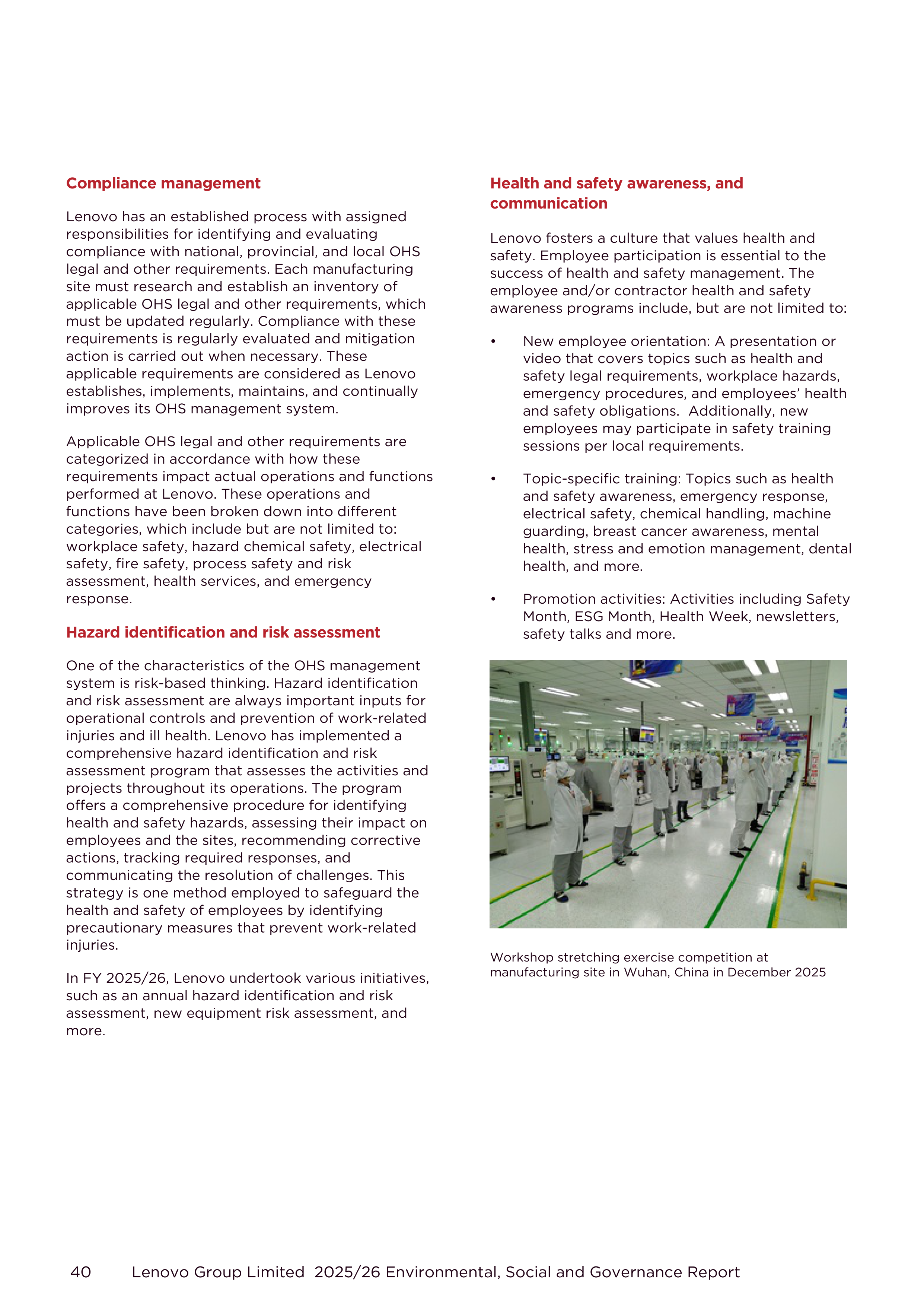
Compliance management
Lenovo has an established process with assigned
responsibilities for identifying and evaluating
compliance with national, provincial, and local OHS
legal and other requirements. Each manufacturing
site must research and establish an inventory of
applicable OHS legal and other requirements, which
must be updated regularly. Compliance with these
requirements is regularly evaluated and mitigation
action is carried out when necessary. These
applicable requirements are considered as Lenovo
establishes, implements, maintains, and continually
improves its OHS management system.
Applicable OHS legal and other requirements are
categorized in accordance with how these
requirements impact actual operations and functions
performed at Lenovo. These operations and
functions have been broken down into different
categories, which include but are not limited to:
workplace safety, hazard chemical safety, electrical
safety, fire safety, process safety and risk
assessment, health services, and emergency
response.
Hazard identification and risk assessment
One of the characteristics of the OHS management
system is risk-based thinking. Hazard identification
and risk assessment are always important inputs for
operational controls and prevention of work-related
injuries and ill health. Lenovo has implemented a
comprehensive hazard identification and risk
assessment program that assesses the activities and
projects throughout its operations. The program
offers a comprehensive procedure for identifying
health and safety hazards, assessing their impact on
employees and the sites, recommending corrective
actions, tracking required responses, and
communicating the resolution of challenges. This
strategy is one method employed to safeguard the
health and safety of employees by identifying
precautionary measures that prevent work-related
injuries.
In FY 2025/26, Lenovo undertook various initiatives,
such as an annual hazard identification and risk
assessment, new equipment risk assessment, and
more.
Health and safety awareness, and
communication
Lenovo fosters a culture that values health and
safety. Employee participation is essential to the
success of health and safety management. The
employee and/or contractor health and safety
awareness programs include, but are not limited to:
•
New employee orientation: A presentation or
video that covers topics such as health and
safety legal requirements, workplace hazards,
emergency procedures, and employees’ health
and safety obligations. Additionally, new
employees may participate in safety training
sessions per local requirements.
•
Topic-specific training: Topics such as health
and safety awareness, emergency response,
electrical safety, chemical handling, machine
guarding, breast cancer awareness, mental
health, stress and emotion management, dental
health, and more.
•
Promotion activities: Activities including Safety
Month, ESG Month, Health Week, newsletters,
safety talks and more.
Workshop stretching exercise competition at
manufacturing site in Wuhan, China in December 2025
40
Lenovo Group Limited 2025/26 Environmental, Social and Governance Report
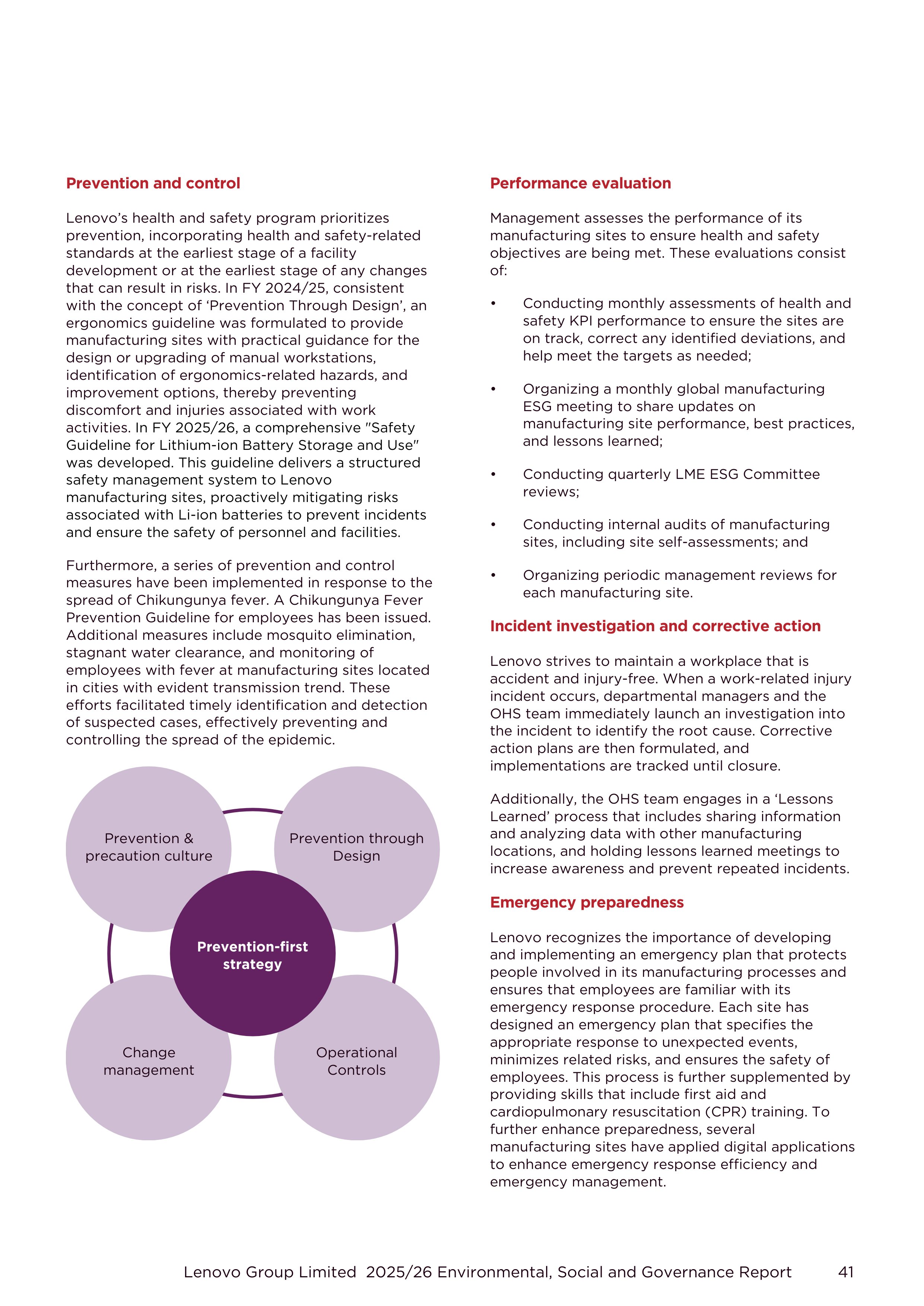
Prevention and control
Lenovo’s health and safety program prioritizes
prevention, incorporating health and safety-related
standards at the earliest stage of a facility
development or at the earliest stage of any changes
that can result in risks. In FY 2024/25, consistent
with the concept of ‘Prevention Through Design’, an
ergonomics guideline was formulated to provide
manufacturing sites with practical guidance for the
design or upgrading of manual workstations,
identification of ergonomics-related hazards, and
improvement options, thereby preventing
discomfort and injuries associated with work
activities.
In FY 2025/26, a comprehensive "Safety
Guideline for Lithium-ion Battery Storage and Use"
was developed. This guideline delivers a structured
safety management system to Lenovo
manufacturing sites, proactively mitigating risks
associated with Li-ion batteries to prevent incidents
and ensure the safety of personnel and facilities.
Furthermore, a series of prevention and control
measures have been implemented in response to the
spread of Chikungunya fever. A Chikungunya Fever
Prevention Guideline for employees has been issued.
Additional measures include mosquito elimination,
stagnant water clearance, and monitoring of
employees with fever at manufacturing sites located
in cities with evident transmission trend. These
efforts facilitated timely identification and detection
of suspected cases, effectively preventing and
controlling the spread of the epidemic.
Performance evaluation
Management assesses the performance of its
manufacturing sites to ensure health and safety
objectives are being met. These evaluations consist
of:
•
Conducting monthly assessments of health and
safety KPI performance to ensure the sites are
on track, correct any identified deviations, and
help meet the targets as needed;
•
Organizing a monthly global manufacturing
ESG meeting to share updates on
manufacturing site performance, best practices,
and lessons learned;
•
Conducting quarterly LME ESG Committee
reviews;
•
Conducting internal audits of manufacturing
sites, including site self-assessments; and
•
Organizing periodic management reviews for
each manufacturing site.
Incident investigation and corrective action
Lenovo strives to maintain a workplace that is
accident and injury-free. When a work-related injury
incident occurs, departmental managers and the
OHS team immediately launch an investigation into
the incident to identify the root cause. Corrective
action plans are then formulated, and
implementations are tracked until closure.
Additionally, the OHS team engages in a ‘Lessons
Learned’ process that includes sharing information
and analyzing data with other manufacturing
locations, and holding lessons learned meetings to
increase awareness and prevent repeated incidents.
Emergency preparedness
Lenovo recognizes the importance of developing
and implementing an emergency plan that protects
people involved in its manufacturing processes and
ensures that employees are familiar with its
emergency response procedure. Each site has
designed an emergency plan that specifies the
appropriate response to unexpected events,
minimizes related risks, and ensures the safety of
employees. This process is further supplemented by
providing skills that include first aid and
cardiopulmonary resuscitation (CPR) training. To
further enhance preparedness, several
manufacturing sites have applied digital applications
to enhance emergency response efficiency and
emergency management.
Lenovo Group Limited 2025/26 Environmental, Social and Governance Report
41
Prevention-first
strategy
Prevention &
precaution culture
Prevention through
Design
Operational
Controls
Change
management
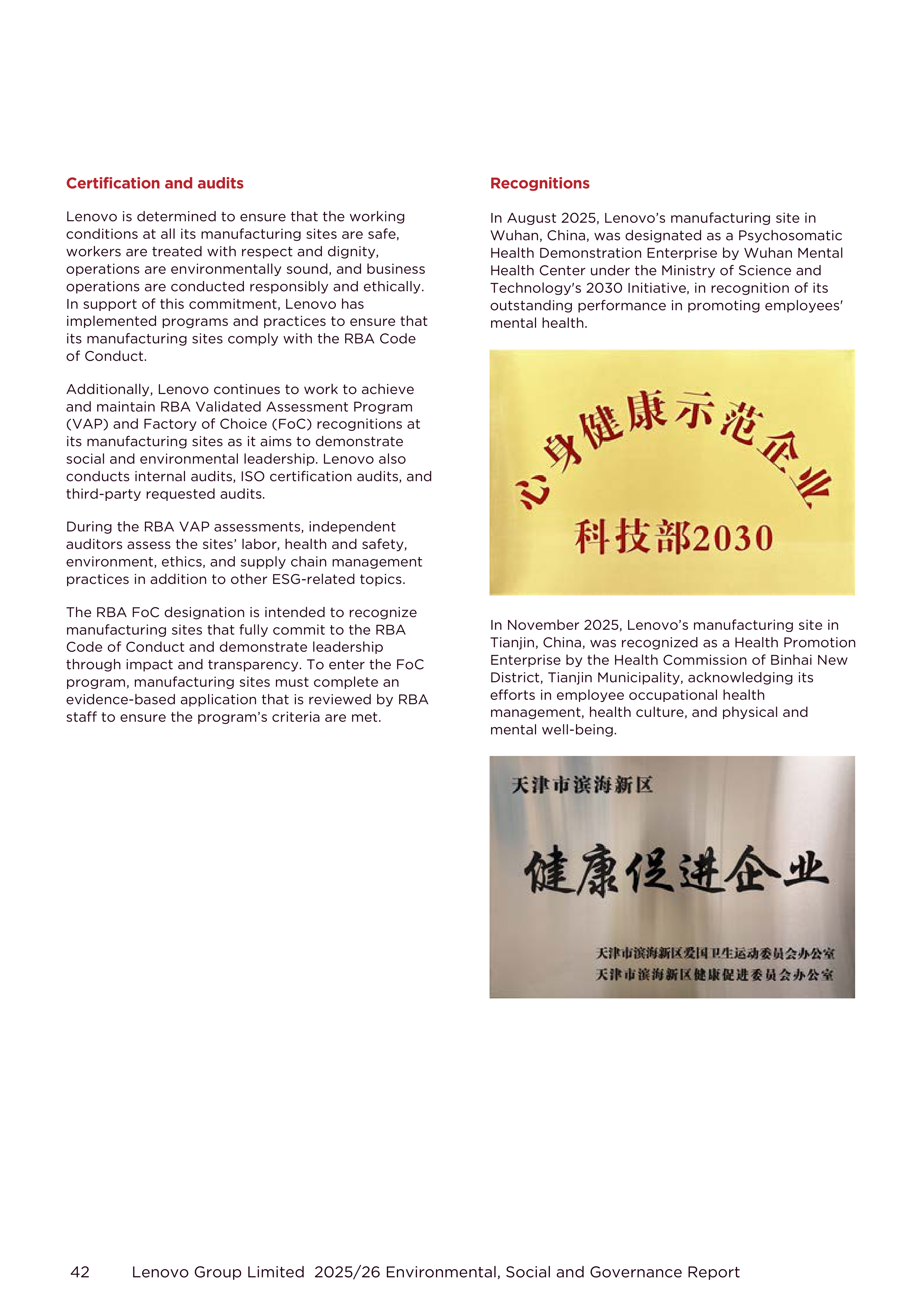
Certification and audits
Lenovo is determined to ensure that the working
conditions at all its manufacturing sites are safe,
workers are treated with respect and dignity,
operations are environmentally sound, and business
operations are conducted responsibly and ethically.
In support of this commitment, Lenovo has
implemented programs and practices to ensure that
its manufacturing sites comply with the RBA Code
of Conduct.
Additionally, Lenovo continues to work to achieve
and maintain RBA Validated Assessment Program
(VAP) and Factory of Choice (FoC) recognitions at
its manufacturing sites as it aims to demonstrate
social and environmental leadership. Lenovo also
conducts internal audits, ISO certification audits, and
third-party requested audits.
During the RBA VAP assessments, independent
auditors assess the sites’ labor, health and safety,
environment, ethics, and supply chain management
practices in addition to other ESG-related topics.
The RBA FoC designation is intended to recognize
manufacturing sites that fully commit to the RBA
Code of Conduct and demonstrate leadership
through impact and transparency. To enter the FoC
program, manufacturing sites must complete an
evidence-based application that is reviewed by RBA
staff to ensure the program’s criteria are met.
Recognitions
In August 2025, Lenovo’s manufacturing site in
Wuhan, China, was designated as a Psychosomatic
Health Demonstration Enterprise by Wuhan Mental
Health Center under the Ministry of Science and
Technology's 2030 Initiative, in recognition of its
outstanding performance in promoting employees'
mental health.
In November 2025, Lenovo’s manufacturing site in
Tianjin, China, was recognized as a Health Promotion
Enterprise by the Health Commission of Binhai New
District, Tianjin Municipality, acknowledging its
efforts in employee occupational health
management, health culture, and physical and
mental well-being.
42
Lenovo Group Limited 2025/26 Environmental, Social and Governance Report
Employment and talent
management practices
Lenovo strives to attract the best talent, and
develop, retain, reward, and engage its employees
through its employment and talent management
practices while ensuring compliance with relevant
laws and regulations.
Attract
Recruitment
Lenovo’s recruitment practices are updated annually
and shared internally on Lenovo’s Human Resources
(HR) Knowledge Base. They support Lenovo's vision
to deliver smarter technology for all. Lenovo’s
recruitment objectives are to develop strategies that
support business needs and comply with applicable
hiring laws and regulations (including Office of
Federal Contract Compliance Programs (OFCCP),
Equal Employment Opportunity Commission
(EEOC), Pay Transparency, General Data Protection
Regulation (GDPR), and Privacy Laws) while
attracting the best talent from around the globe.
Lenovo’s Talent Acquisition (TA) organization
manages the end-to-end recruiting process. This
includes collaborating with Human Resources
Business Partners (HRBPs) and managers to
understand hiring needs while applying best
practices to ensure the recruiting process is fair and
consistent for all candidates.
Lenovo is focused on finding and hiring the best
talent from around the world to support Lenovo’s
growth and success. Some key elements of its
recruiting strategy include:
1.
Building an inclusive talent pool through good
faith efforts and sourcing qualified candidates
from a broad range of backgrounds and
experiences;
2.
Leveraging recruiting technology including the
Career Site, Applicant Tracking System (ATS),
talent communities, Candidate Relationship
Management tool (CRM), referral system, and
Internal Career Portal;
3.
Sharing the Lenovo Story and employer value
proposition with internal and external
candidates;
4.
Promoting employee referrals via internal
engagement and monetary rewards for hired
candidates;
5.
Annual recruiting for global markets through
live and virtual outreach, conferences, and
university visits to source and fill full-time and
intern roles;
6.
Leveraging skills-based job descriptions and
screening to attract and recruit talent and
conduct soft and technical skills evaluations
through video interviews and assessments;
7.
Building strong relationships with Lenovo’s
external audience, vendors, and internal
customers while keeping exceptional customer
experience in mind. Lenovo surveys candidates
and managers on their experience and ties
these to the team’s KPIs.
Overall, Lenovo’s recruiting strategy revolves around
finding and hiring the best innovative talent from
around the world, leveraging technology,
encouraging employee referrals, focusing on campus
recruiting, utilizing a dedicated sourcing team,
applying skills-based hiring, and building excellent
relationships with candidates to ensure a good fit for
Lenovo’s culture and values. Lenovo’s goals are to
hire for an expanding research and innovation
function, continue to grow its solutions and services
employee base, attract executives with new skills,
and aspire for 20 percent of external hires filled
through campus and early-career hires.
Lenovo’s recruitment process guides the candidate’s
journey through all touchpoints, including employer
brand recognition, sourcing activities, job postings
via the careers site and various external vendor job
listing sites, and communication throughout the
application, interview, and offer process. Lenovo’s
recruiters also source candidates using social media,
employee referrals, and other creative methods. As a
Global TA organization, some of the recruitment
practices that the team manages include:
•
End-to-end hiring for interns, early-career,
professional, and executive positions for all
business units globally;
•
Job board management across various
platforms such as Lenovo’s careers website and
other third-party platforms and job portals;
•
Expansion of university programs to build
Lenovo’s future workforce;
Lenovo Group Limited 2025/26 Environmental, Social and Governance Report
43
•
Attendance at national conventions and
conferences to build a competitive pipeline of
candidates;
•
Lenovo Employer Value Proposition and
Employer Branding designed to attract and
retain talent by collaborating with cross-
functional teams to create and distribute
customized content; and
•
Partnerships with organizations or vendors in
support of individuals with disabilities
(Disability:IN).
Internships are a vital source for prospective
candidates. In FY 2025/26, Lenovo hired interns
around the globe, providing meaningful learning
experiences, mentor programs, innovation projects,
and a view into a Global Fortune 500 technology
company. Lenovo's intern program operates on a
hybrid model, including virtual and on-site work
opportunities to accommodate both business and
intern needs.
Lenovo partners with universities worldwide to
attract competitive early career talent. Intern
programs aim to recruit technology enthusiasts and
STEM students from high school through doctoral
degrees, helping attract qualified talent while
building pipelines for potential hiring needs.
Lenovo’s talent team partners with its community
engagement team to provide internships at the high
school level and for underserved and
underrepresented populations.
Lenovo is dedicated to growing and developing its
workforce in support of its long-term innovation and
transformation journey. It offers programs that
include rotations across various business groups,
early career leadership development, technical
ladder programs, skills development, and technical
certifications. Lenovo is dedicated to fostering
inclusion in its global workplaces and understands
the importance of creating and maintaining an
environment where all can succeed.
Develop
Performance management and development
As the world continues to change at a rapid pace, so
has the way Lenovo works. Employees are seeking
more career development focus and opportunities
and more frequent feedback to grow and learn.
Lenovo uses an integrated performance
management and development process –
Succeed@Lenovo – to enable every employee to
grow and succeed.
At the beginning of the fiscal year, every employee
kicks off their Succeed@Lenovo journey by setting
up their Key Performance Indicators (KPIs) and
Individual Development Plan (IDP), and having a
conversation to align with their manager.
Throughout the year, employees are empowered to
use development resources, actively seek feedback
from others, and receive continuous coaching from
managers. Managers assess employees' performance
during two formal check points at mid-year and
year-end through formal conversations on progress,
challenges, opportunities, and next steps.
In the age of AI and rapid business transformation, it
is crucial to align employee goals and development
with Lenovo's business objectives. Lenovo will
continue driving more focus on development, more
frequent conversation and feedback, and
differentiated rewards and recognition in
Succeed@Lenovo, enabling employees to achieve
their own growth and success together with the
company.
Training and development
Lenovo recognizes that many of the skills people
have today will change significantly over the next
five years. Lenovo is committed to upskilling and
reskilling its employees to ensure they are ready for
the future. To meet the requirements of changing
demands, including AI and digital transformation,
Lenovo includes AI simulations within leadership
development programs and provides a personalized
learning plan for employees.
44
Lenovo Group Limited 2025/26 Environmental, Social and Governance Report
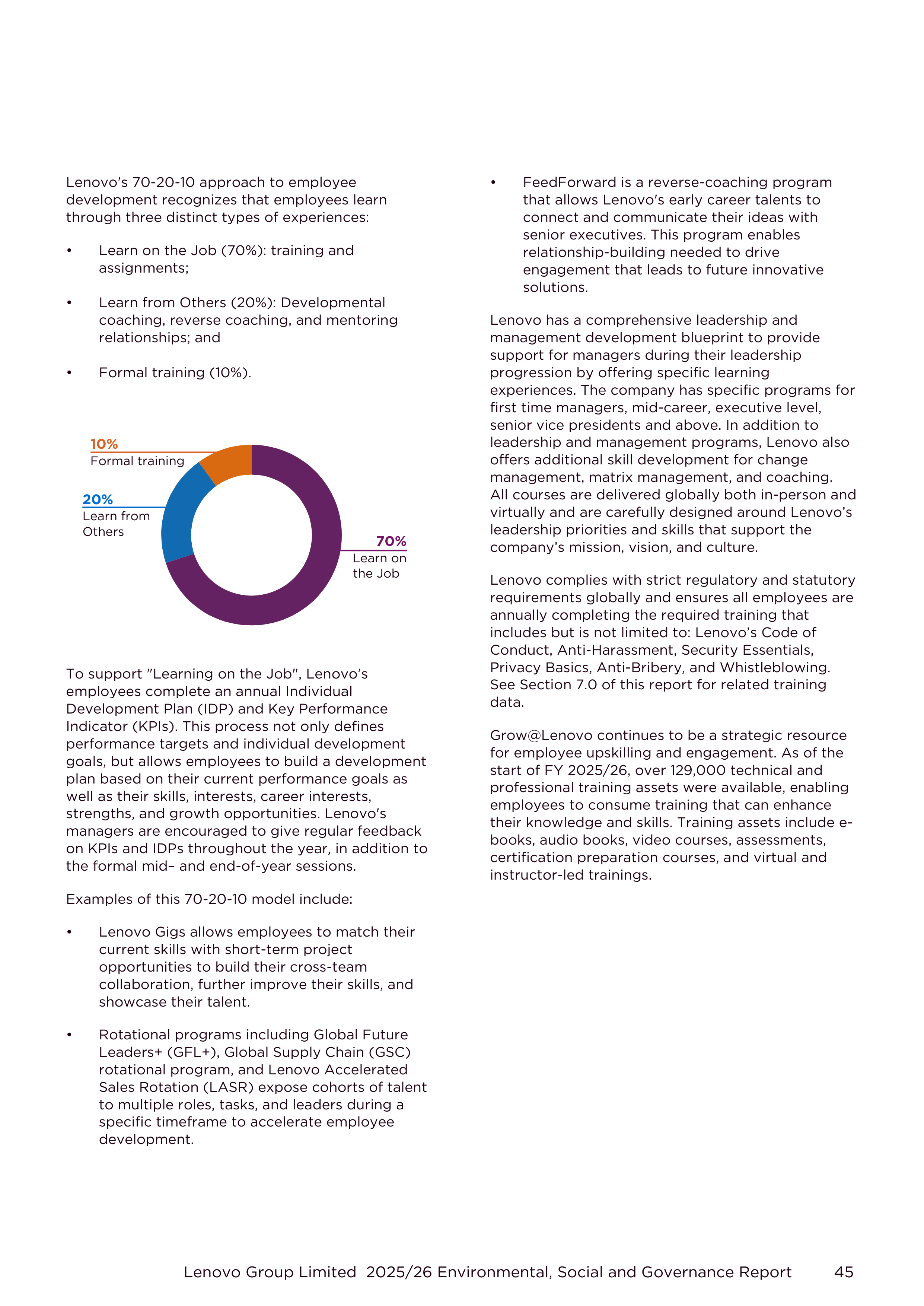
Lenovo's 70-20-10 approach to employee
development recognizes that employees learn
through three distinct types of experiences:
•
Learn on the Job (70%): training and
assignments;
•
Learn from Others (20%): Developmental
coaching, reverse coaching, and mentoring
relationships; and
•
Formal training (10%).
To support "Learning on the Job", Lenovo’s
employees complete an annual Individual
Development Plan (IDP) and Key Performance
Indicator (KPIs). This process not only defines
performance targets and individual development
goals, but allows employees to build a development
plan based on their current performance goals as
well as their skills, interests, career interests,
strengths, and growth opportunities. Lenovo's
managers are encouraged to give regular feedback
on KPIs and IDPs throughout the year, in addition to
the formal mid– and end-of-year sessions.
Examples of this 70-20-10 model include:
•
Lenovo Gigs allows employees to match their
current skills with short-term project
opportunities to build their cross-team
collaboration, further improve their skills, and
showcase their talent.
•
Rotational programs including Global Future
Leaders+ (GFL+), Global Supply Chain (GSC)
rotational program, and Lenovo Accelerated
Sales Rotation (LASR) expose cohorts of talent
to multiple roles, tasks, and leaders during a
specific timeframe to accelerate employee
development.
•
FeedForward is a reverse-coaching program
that allows Lenovo's early career talents to
connect and communicate their ideas with
senior executives. This program enables
relationship-building needed to drive
engagement that leads to future innovative
solutions.
Lenovo has a comprehensive leadership and
management development blueprint to provide
support for managers during their leadership
progression by offering specific learning
experiences. The company has specific programs for
first time managers, mid-career, executive level,
senior vice presidents and above. In addition to
leadership and management programs, Lenovo also
offers additional skill development for change
management, matrix management, and coaching.
All courses are delivered globally both in-person and
virtually and are carefully designed around Lenovo’s
leadership priorities and skills that support the
company’s mission, vision, and culture.
Lenovo complies with strict regulatory and statutory
requirements globally and ensures all employees are
annually completing the required training that
includes but is not limited to: Lenovo’s Code of
Conduct, Anti-Harassment, Security Essentials,
Privacy Basics, Anti-Bribery, and Whistleblowing.
See Section 7.0 of this report for related training
data.
Grow@Lenovo continues to be a strategic resource
for employee upskilling and engagement. As of the
start of FY 2025/26, over 129,000 technical and
professional training assets were available, enabling
employees to consume training that can enhance
their knowledge and skills. Training assets include e-
books, audio books, video courses, assessments,
certification preparation courses, and virtual and
instructor-led trainings.
Lenovo Group Limited 2025/26 Environmental, Social and Governance Report
45
10%
Formal training
20%
Learn from
Others
70%
Learn on
the Job
Promotion
Among various mechanisms, Lenovo promotes its
employees to demonstrate that it values growth and
development. At Lenovo, a promotion is defined as
an increase in job responsibility and complexity that
results in the movement to a higher salary range. It is
implemented based on the needs of the business
and workforce planning, and workforce planning
considerations, as well as the line manager’s
assessment of the employee’s readiness. Promotions
should be based on the role first and then individual
readiness. When considering whether a role should
have a band increase, the business evaluates a
number of aspects including whether the role has
grown in scope, the skills and knowledge required,
the level of complexity, and the nature of its impact.
If it is determined that the role warrants a
promotion, the business then considers an
individual’s readiness based on several factors,
including past performance, potential for further
growth, time in band, career aspirations, and
advocacy of Lenovo culture. Lenovo strives to
support its employees in growing and developing
their careers while following its internal policies and
ensuring compliance with applicable laws and
regulations.
Retain and reward
Compensation and benefits
Lenovo's compensation philosophy is to pay for
performance, balance short-term and long-term
focuses, remain competitive in the market, and
promote flexibility within One Lenovo. In line with
this philosophy, Lenovo is committed to designing
and implementing competitive compensation and
benefits programs that balance internal equity with
external market competitiveness and are aimed at
attracting, motivating, and retaining talent. These
programs incorporate a balanced mix of base pay,
short-term and long-term incentive plans, and
benefits. Lenovo’s approach is rooted in compliance
with all applicable laws and regulations (including
local statutory requirements) and in respect for
applicable labor relations agreements. For example,
Lenovo complies with labor and employment laws
such as the Equal Pay Act of 1963, the Civil Rights
Act of 1964, the Age Discrimination in Employment
Act of 1967, Title I of the Americans with Disabilities
Act of 1990, the Fair Labor Standards Act in the US;
the EU Pay Transparency Directive, and related
legislation and requirements in markets such as
Europe and Brazil.
In addition to legal compliance, Lenovo proactively
monitors market trends and industry practices,
swiftly adapting its compensation and benefit
strategies to remain highly competitive. To ensure
competitiveness, Lenovo heavily invests in industry-
leading market surveys and has a global team that
actively monitors trend changes. Lenovo’s
overarching compensation and benefits philosophy
centers on paying for performance and overall well-
being, with a belief that outstanding individual
contributions drive exceptional business outcomes.
All regular employees - including non-sales staff -
are eligible for incentives, commissions, and various
benefit programs.
Regular non-sales employees set Key Performance
Indicators (KPIs) at the beginning of the fiscal year,
with managers regularly reviewing and updating
objectives as needed. No less than once per year,
employees receive documented performance
feedback, performance ratings, and an individual
performance modifier (IPM) to support Lenovo’s
pay-for-performance culture. Non-sales employees
are aligned to one or more of Lenovo’s many
performance units which - along with performance
ratings and individual performance modifiers -
impact their incentive payout. Sales employees
operate under periodic quotas affecting commission
payments, with quotas adjusted as market
conditions dictate. Lenovo’s performance
management system allows for ongoing feedback,
empowering employees to provide input throughout
the year.
Lenovo prioritizes a supportive global working
environment, offering flexibility for employees to
balance their personal and professional lives. To
attract and retain top talent in the competitive
technology sector, Lenovo provides diverse benefits
aligning with strategic guidelines: competitive
positioning in local markets, alignment with business
and cultural strategies, and emphasis on wellness,
family support, and financial well-being.
Lenovo’s Total Rewards approach encompasses five
key elements: compensation, benefits, work-life
balance, performance and recognition, and
development and career opportunities. This holistic
approach is vital in attracting, motivating, and
retaining Lenovo’s most valuable resource: its
people.
46
Lenovo Group Limited 2025/26 Environmental, Social and Governance Report
Globally, Lenovo offers flexible benefits tailored to
multiple markets, providing employees with choices
that suit their needs at various life stages. Options
vary by geography, including opportunities to
enhance insurance coverage or access lifestyle
benefits at discounted rates. In the US, Lenovo
provides voluntary wellness programs, administered
in compliance with federal rules, fostering employee
health and disease prevention.
Lenovo’s commitment to pay equity and
transparency
Lenovo is committed to pay equity as a fundamental
principle guiding its compensation practices.
Lenovo’s approach to fostering a fair and inclusive
workplace is grounded in compliance with
applicable legal and regulatory frameworks across
the jurisdictions in which it operates.
Lenovo prioritizes a transparent structured and
merit-based pay framework, ensuring that all
employees are compensated fairly and equitably for
their contributions based on the requirements,
responsibilities, and value of their roles, irrespective
of gender, race, age, disability, or any other
protected characteristic. Jobs are evaluated using
objective, gender-neutral criteria to support equal
pay for equal work and work of equal value.
Lenovo designs its compensation policies, job
evaluation methods, and pay-setting processes to be
consistent, traceable, and applied uniformly across
comparable roles and employee groups. To promote
transparency and accountability, Lenovo regularly
conducts pay equity analyses and reviews of its
compensation structures. These analyses support the
identification, assessment, and remediation of potential
pay disparities that cannot be objectively justified,
while respecting applicable data protection and
confidentiality requirements. This aligns with Lenovo’s
commitment to fairness and equality. Lenovo’s
dedication to pay equity forms an integral part of its
broader global mission of creating an inclusive
workplace where all employees feel valued and are
treated fairly, are provided with equal opportunities
throughout their employment lifecycle, and are
rewarded in a manner that reflects their role, individual
contributions, and experience. Lenovo also promotes
transparency by conducting regular training and
briefing sessions for both managers and employees on
its compensation policies and processes. These
initiatives, along with providing clear individual
compensation details, ensure that managers are
equipped to make effective, compliant pay decisions,
and that employees have a clear understanding of how
their compensation is determined.
See
Section 7.0
for related data.
Engage
Employee engagement – ‘Lenovo Listens’
The Lenovo Listens survey strengthens engagement
and retention by ensuring the employee voice is
heard and acted upon.
In 2025, Lenovo conducted a company-wide survey
with high participation. Employee engagement
remains very strong. The strongest items
contributing to this engagement include employees'
confidence in Lenovo's future, their sense of being
respected, opportunities for learning and growth,
the ability to complete work while maintaining well-
being, and understanding Lenovo's AI strategy.
Additionally, ESG-related items rank among the
highest scoring items. These include the company's
ethical conduct in business dealings, environmental
responsibility, genuine interest in the well-being of
communities in which the company does business,
equal and fair treatment of all employees, and being
treated with respect.
Engagement reports were delivered to managers.
This underscores the company's commitment to
having engagement conversations at all levels and
taking concrete actions that empower employees to
achieve business goals and grow their career at
Lenovo.
Lenovo’s ‘We Are Lenovo’ culture
Lenovo strives to cultivate a ‘We Are Lenovo’ culture
that engages its employees. Lenovo’s culture is at the
heart of every choice it makes for its employees and
customers. It is the way its employees work together as
one team, to drive success for Lenovo and its
customers. Lenovo’s culture enables its employees to
deliver its vision of ‘Smarter Technology for All’,
through products, services, solutions, and software that
help individuals, communities, businesses, and entire
populations achieve their goals. When employees
come to work, they step into an environment built on
respect for the people. Lenovo is exceedingly proud to
be a truly corporate citizen. Its globally diverse team of
people facilitate greater collaboration across borders,
so its employees are exposed to the best practices in
every market.
Championing the promise of “We do what we say.
We own what we do. We wow our customers”, the
‘We Are Lenovo’ culture is underpinned by these
culture values:
•
Serving Our Customers,
•
Innovation,
•
Entrepreneurship, and
•
Teamwork with Integrity and Trust.
Lenovo Group Limited 2025/26 Environmental, Social and Governance Report
47
As Lenovo enters its fifth decade in the AI era, the
company is reigniting its entrepreneurship to build
hybrid AI and deliver a smarter future for all.
From concept to practice, Lenovo's culture values
and behaviors are incorporated into people and
corporate initiatives, from goal setting to incentive
models, and even as deeply as criteria impacting
organization and talent growth.
Lenovo established culture engagement initiatives to
help employees embrace the culture values in their
day-to-day work and believe that their behaviors are
critical to achieving Lenovo’s commitment to hybrid AI.
‘We Are Lenovo’ culture strives to be at the core of
what connects employees, making each individual
and the entire organization better. Lenovo believes
great ideas can come from anywhere, and it
appreciates the unique perspective and talent its
employees bring. As a way to showcase how its
employees live the culture values, Lenovo collects,
publishes, and promotes outstanding stories on its
culture story platform and through other mediums.
Stories are also available in multiple formats such as
in videos and through different channels, enabling
employees around the world to learn and be inspired
in accessible and engaging manners.
To align and collaborate on shared goals, Lenovo
provides a platform called The Big Bang Forum as
“the think tank of Lenovo”, for Lenovo’s leaders to
showcase its innovation and strategic plans for
products, services and solutions, high-tech, business
models, and more. Lenovo also offers ‘The
Innovation Series’, a platform for its thought leaders
and employees to share innovative ideas and
initiatives with opportunities for brainstorming and
learning about available training and innovation
tools. Dream Lab, Lenovo's internal innovation
accelerator, serves as the platform to foster
innovation and entrepreneurship culture, and drive
talent development and internal innovation building
through training and sharing sessions, idea
validation, and innovation incubation.
Lenovo is committed to cultivating an inclusive and
engaging environment built on respect for its
employees, empowering greater collaboration and
innovation worldwide. By championing the ‘We Are
Lenovo’ culture values through support across its
stakeholders, Lenovo aims for success for its
businesses, customers, and employees.
Global philanthropy and
community engagement
Investing in communities
Lenovo’s social investments are focused on reducing
inequalities, providing quality education to reduce
poverty, and clean water and sanitation. Lenovo has
a goal of committing a minimum of 0.5 percent of its
pretax income to global social investment programs
and initiatives. Lenovo's social investments are
executed through charitable corporate contributions
and its charitable entities: the Lenovo Foundation,
US 501(c)3, and the Lenovo Foundation Beijing
(non-profit registered in China).
The global philanthropy team has established giving
guidelines and compliance processes that are
localized for alignment across the diverse markets
where Lenovo conducts business.
Lenovo philanthropy governance
Corresponding with the launch of the Lenovo
Foundation in 2018, Lenovo's philanthropic initiatives
are governed by a global philanthropy board of
executives. The board works to represent
communities that Lenovo philanthropy serves while
advocating for programs and initiatives in their
geographic region. The board governs and advises
the operations of the Lenovo global philanthropy
team through regularly scheduled board meetings
each year and ongoing grant making oversight.
Social investment focus areas
In alignment to the UN Sustainable Development Goals,
Lenovo global philanthropy has key focus areas of
contributions: reduced inequalities, quality education,
poverty reduction, and clean water and sanitation.
Lenovo invests in these key focus areas through
strategic investments, employee volunteerism, and
humanitarian response, with the following outcomes :
•
Partnerships with charitable organizations,
educational institutions, and civic groups to
empower under-represented populations with
access to technology and STEM education.
•
Employee giving and volunteerism through
programs like Love on Month of Service,
employee matching gift benefit, and volunteer
incentives.
•
Aid and employee engagement in the wake of
natural and humanitarian disasters.
See Section 7.0 for social investment data.
48
Lenovo Group Limited 2025/26 Environmental, Social and Governance Report
Impact and measurement
The Lenovo global philanthropy team assesses and
reviews its programs and partnerships to measure its
charitable impact. The team has met its goals to
directly impact 15 million people and transform one
million lives by the end of FY 2025/26 (base year FY
2021/22). The team measured progress toward these
goals by aligning its measurement of positive impact
and transformation with the following definitions.
Impact
•
Direct impact (15 million lives by 2025):
Beneficiaries measured through person-to-
person contact as measured at volunteer
events, trainings, product loan programs, and
product donations provided without individual
ownership or 1:1 ratio (i.e., computer labs at
schools).
•
Indirect impact (not measured): Secondary
beneficiaries of volunteer events, trainings,
product loan programs, or product donations
provided without individual ownership or 1:1
user ratio (i.e., families benefiting from students’
increased tech literacy, parents not needing to
secure childcare while child is at a STEM
program).
Transformation
•
Transformative impact (1 million lives by 2025,
measured exclusively from impact):
Beneficiaries who received training or
education, advancement, or credentials that
provide transformative opportunities for quality
of living that they did not have access to
before.
Lenovo philanthropy conducts annual impact
surveys with its charitable partners to collect
partner-reported data that can be analyzed against
the team’s impact alignment. The team is proud to
have met and exceeded its targets, and is further
refining alignment for its second generation of
impact goals.
Global programs
Community partnerships
Lenovo has developed strategic community partners
in each of its business geographies. The community
partners are selected in alignment with Lenovo
Foundation’s mission to empower underrepresented
populations with access to STEM education and
technology. Lenovo also has disaster relief partners
established in key geographies. In addition to
partners focused on Lenovo's philanthropic missions
and disaster response at the business geography
level, Lenovo has selected global partners whose
impact reaches multiple business geographies.
Love on Month of Service
Since 2017, Lenovo's employees around the world
have organized an annual community service event.
With the leadership and organization of the global
philanthropy team and support from local business
leaders, employees in offices around the world are
invited to design a volunteer event aligned to the
Foundation’s mission to provide access to
technology and STEM education for those who need
it most. Projects are organized with local NGOs to
align to Lenovo's philanthropic mission while
meeting the needs of the communities where
Lenovo's employees live and work. The program’s
impact is measured by the key metrics of number of
volunteer instances, beneficiaries, hours volunteered,
and offices participating. Lenovo's Love on Global
Month of Service has grown by at least one metric
every year since it began.
AI for Social Impact
In FY 2025/26, aligned to Lenovo’s focus on
providing Smarter AI for All, Lenovo continued the
AI for Social Impact initiative. The initiative works to
connect non-profits with education and resources so
that they can harness AI to enhance their missions.
Lenovo Group Limited 2025/26 Environmental, Social and Governance Report
49


Employee resource group grant round
To strengthen Lenovo’s social impact and employee
engagement, Lenovo's philanthropy program
empowered the leaders of its employee resource
groups and communities of practice by facilitating
partnerships with community organizations that are
aligned to their community segment. Since 2020,
the program has partnerships that empower diverse
communities and share Lenovo's smarter technology
for all vision around the world.
Humanitarian response
Lenovo philanthropy organizes measured responses
to natural and humanitarian disasters that occur
throughout the fiscal year. Lenovo leverages its own
funds and technology to respond to disasters and
engages employees in matching gift opportunities as
appropriate.
Lenovo’s corporate citizenship team conducts a
matrix-based assessment and organizes Lenovo’s
response in phases:
•
Preparedness: Lenovo has established strategic
partnerships globally including those with
American Red Cross (US-based disasters) and
Wine To Water (international disasters
impacting access to clean water) to ensure
these partners are able to serve communities
when disaster strikes.
•
Immediate response: Lenovo takes an
employee-first approach immediately after a
disaster to understand if and how employees
were impacted and engage the workforce in
response.
•
Additional response: Based on the disaster
impact matrix assessment and advice from
disaster response partners, Lenovo may
allocate additional funding to support critical
humanitarian needs in the wake of a disaster.
•
Recovery: When communities are recovering
from the disaster and assessing damage and
losses, Lenovo may work with communities and
established partners to replace lost technology
resources.
Love on platform for employee giving benefits
Launched in 2021, the Love on platform is Lenovo's
employee engagement tool, available to full-time
employees in Lenovo's Asia Pacific, Europe/Middle
East/Africa, Latin America, and North America
business geographies. The tool encourages
employees to give their time and resources,
supported by volunteer and matching gift benefits
from Lenovo.
•
Volunteer benefit: Lenovo's employees are
encouraged to volunteer eight hours per
quarter with causes and charities of their
choice. Employees can claim five dollars (or its
local currency equivalent) per volunteer hour in
the Love on platform, which can then be
donated to any cause on the platform that
meets Lenovo's giving guidelines.
•
Matching gift benefit: Employees can donate to
causes on the Love on platform that meet
Lenovo's Charitable Giving Guidelines and
receive a 100 percent match from Lenovo. The
Lenovo philanthropy team hosts annual giving
campaigns to encourage donations to
employees’ favorite causes, strategic
community partners, and in response to
humanitarian crises (see Humanitarian
response).
Community impact through sustainable water
access
Lenovo's commitment to sustainability,
communities, and disaster response is showcased
through its ongoing partnership with Wine To
Water, a non-profit organization that provides
access to clean drinking water and hygiene
education to communities around the world.
Lenovo’s Wine To Water partnership primarily
focuses on building infrastructure that provides
access to clean water for communities in need. The
partnership is also leveraged in the wake of natural
disaster and humanitarian response through the
deployment of water filters. By providing water
filters, Lenovo and Wine To Water not only support
community’s survival and mitigate water borne
illness after disasters, but also reduce waste that
would be created by use of bottled drinking water.
As part of the UN Global Compact’s Forward Faster
initiative, Lenovo’s partnership with Wine to Water
aims to bring access to safely managed water
services, and improved sanitation and/or hygiene
education to at least 25,000 people annually.
50
Lenovo Group Limited 2025/26 Environmental, Social and Governance Report
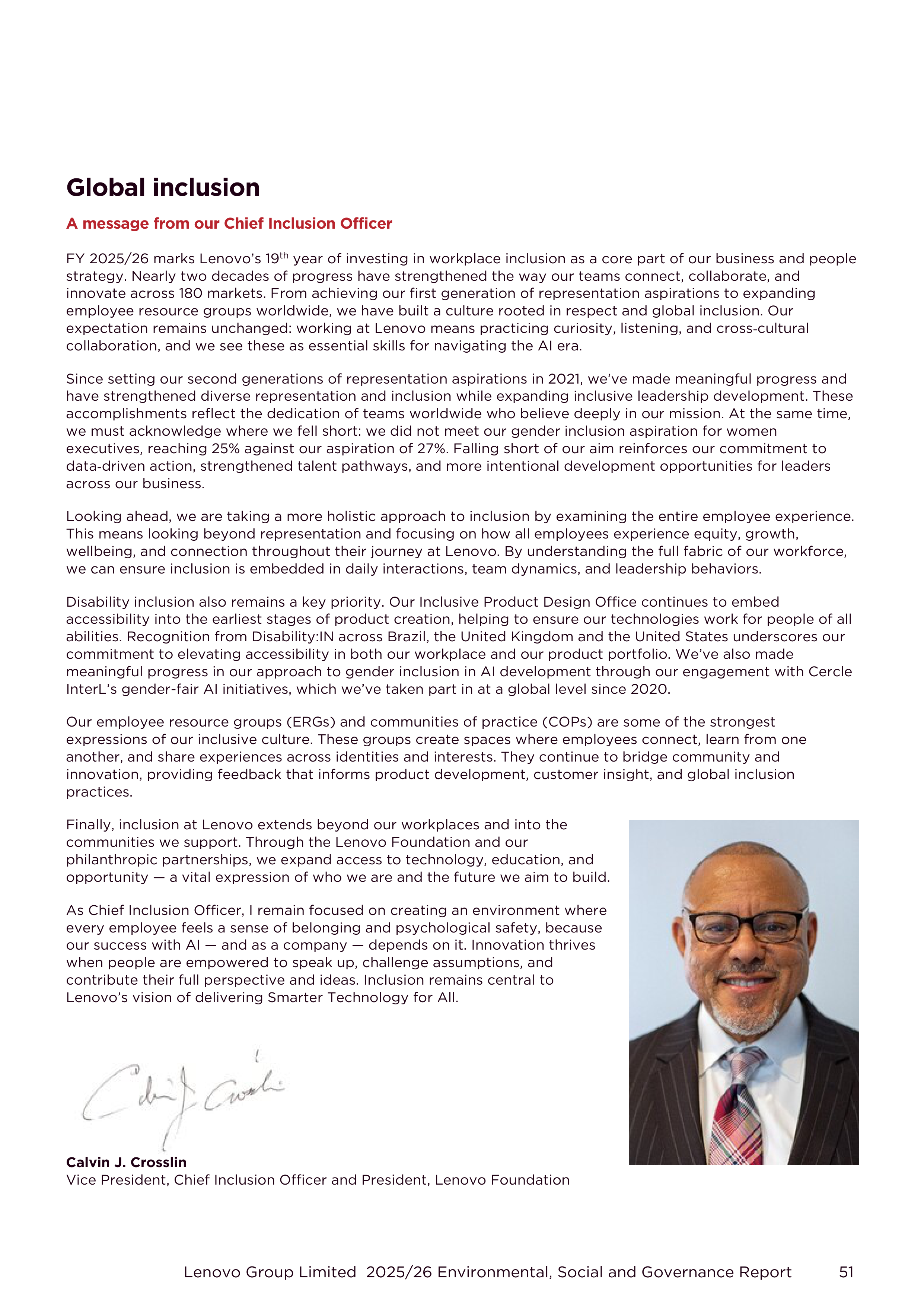

Global inclusion
A message from our Chief Inclusion Officer
FY 2025/26 marks Lenovo’s 19
th
year of investing in workplace inclusion as a core part of our business and people
strategy. Nearly two decades of progress have strengthened the way our teams connect, collaborate, and
innovate across 180 markets. From achieving our first generation of representation aspirations to expanding
employee resource groups worldwide, we have built a culture rooted in respect and global inclusion. Our
expectation remains unchanged: working at Lenovo means practicing curiosity, listening, and cross
-
cultural
collaboration, and we see these as essential skills for navigating the AI era.
Since setting our second generations of representation aspirations in 2021, we’ve made meaningful progress and
have strengthened diverse representation and inclusion while expanding inclusive leadership development. These
accomplishments reflect the dedication of teams worldwide who believe deeply in our mission. At the same time,
we must acknowledge where we fell short: we did not meet our gender inclusion aspiration for women
executives, reaching 25% against our aspiration of 27%. Falling short of our aim reinforces our commitment to
data
-
driven action, strengthened talent pathways, and more intentional development opportunities for leaders
across our business.
Looking ahead, we are taking a more holistic approach to inclusion by examining the entire employee experience.
This means looking beyond representation and focusing on how all employees experience equity, growth,
wellbeing, and connection throughout their journey at Lenovo. By understanding the full fabric of our workforce,
we can ensure inclusion is embedded in daily interactions, team dynamics, and leadership behaviors.
Disability inclusion also remains a key priority. Our Inclusive Product Design Office continues to embed
accessibility into the earliest stages of product creation, helping to ensure our technologies work for people of all
abilities. Recognition from Disability:IN across Brazil, the United Kingdom and the United States underscores our
commitment to elevating accessibility in both our workplace and our product portfolio. We’ve also made
meaningful progress in our approach to gender inclusion in AI development through our engagement with Cercle
InterL’s gender-fair AI initiatives, which we’ve taken part in at a global level since 2020.
Our employee resource groups (ERGs) and communities of practice (COPs) are some of the strongest
expressions of our inclusive culture. These groups create spaces where employees connect, learn from one
another, and share experiences across identities and interests. They continue to bridge community and
innovation, providing feedback that informs product development, customer insight, and global inclusion
practices.
Finally, inclusion at Lenovo extends beyond our workplaces and into the
communities we support. Through the Lenovo Foundation and our
philanthropic partnerships, we expand access to technology, education, and
opportunity — a vital expression of who we are and the future we aim to build.
As Chief Inclusion Officer, I remain focused on creating an environment where
every employee feels a sense of belonging and psychological safety, because
our success with AI — and as a company — depends on it. Innovation thrives
when people are empowered to speak up, challenge assumptions, and
contribute their full perspective and ideas. Inclusion remains central to
Lenovo’s vision of delivering Smarter Technology for All.
[signature]
Calvin J. Crosslin
Vice President, Chief Inclusion Officer and President, Lenovo Foundation
Lenovo Group Limited 2025/26 Environmental, Social and Governance Report
51
Global Inclusion Board
Since 2018, Lenovo's inclusion initiatives have been
overseen by a board of Lenovo Executive Council
members. The Global Inclusion Board is comprised
of senior leaders from across Lenovo's business units
and geographies, inclusive of Lenovo's Chief
Inclusion Officer, Calvin Crosslin. The Global
Inclusion Board serves as counsel to Lenovo's
inclusion strategy and helps to drive accountability
across organization with the vision of leading
intelligent transformation by celebrating the
strength of a globally diverse workforce and building
an inclusive culture where everyone can thrive.
Through quarterly meetings and ongoing
communications, the Global Inclusion Board has
adopted a four-pillar strategy designed to foster
greater inclusion, which aims to:
1)
Build inclusive leadership behaviors;
2)
Foster inclusive systems;
3)
Ensure accountability;
4)
Tell Lenovo's unique inclusion story.
Inclusive culture
Assembling a workforce that achieves its full
potential through an inclusive culture is fundamental
to Lenovo's competitive success. A key element in
Lenovo's workforce diversity programs is the
commitment to equal employment opportunity and
to prohibit discrimination, harassment, and similar
inappropriate behavior in the workplace. Lenovo's
policy and Code of Conduct commit to providing a
work environment free of discrimination and
harassment based on race, color, gender, religion,
age, nationality, social or ethnic origin, sexual
orientation, sex (including intersex), gender identity
or expression, marital status, pregnancy, disability,
or veteran status. Lenovo policy prohibits
management from making employment decisions
based on such characteristics and any other
characteristic protected by applicable law. These
business activities and the design and administration
of Lenovo's benefit plans must comply with all
applicable laws. For qualified employees with
disabilities, Lenovo will make reasonable
accommodations needed for effective job
performance in a manner that complies with
applicable laws.
As a global company, inclusion has been
fundamental to Lenovo's history and is among its
greatest strengths. Its global team of people and
locations enables collaboration and sharing across
borders and encourages Lenovo to adopt the best
practices in the markets it serves. Lenovo is bringing
awareness about inclusion to all its leaders and
employees in a variety of ways, including Global
Anti-Harassment training to ensure a workplace free
of harassment.
An inclusive business model starts at the top.
Lenovo's leaders throughout the world hold a deep
commitment to these values that fuel long-term
growth. Lenovo believes that a global workforce
should reflect the global customers that it serves,
and this begins with leadership that represents the
various cultures and ethnicities where it does
business.
Workplace aspirations
In 2021, Lenovo set five
-
year aspirations to
strengthen executive representation. As this timeline
concludes, Lenovo is refining its approach by
continuing to prioritize increased women’s executive
representation while shifting toward qualitative,
system
-
level improvements that support sustainable
progress. Throughout this period, progress was
measured against goals to elevate women’s
executive representation globally and expand
representation of culturally diverse leaders in the US.
Although not every aspiration was reached,
representation of women executives increased from
18 percent in 2018 to 25 percent in 2025—reflecting
meaningful, long
-
term advancement.
Looking ahead, Lenovo is concentrating on
strengthening the systems, processes, and talent
pathways that enable equitable advancement. This
includes assessing the factors across the talent
pipeline, hiring practices, and retention systems that
influence outcomes, and ensuring that leadership
opportunities continue to be awarded to the
strongest candidates across all backgrounds.
Lenovo remains committed to fostering an inclusive
workplace where all employees can grow and
succeed, and to building a leadership team that
reflects the diversity of its global customer base.
Additional workforce demographic information is
included in Section 7.0.
52
Lenovo Group Limited 2025/26 Environmental, Social and Governance Report
Committing to inclusion
Lenovo has taken a step forward in advocacy for
women by endorsing the United Nations’ Women’s
Empowerment Principles (WEPs). These principles
offer guidance for businesses to promote gender
equality and women’s empowerment in the
workplace, marketplace, and community. While
Lenovo works toward gender equity, it understands
that reducing bias and increasing gender equality is
an effort that will require its total commitment.
Lenovo is proud to join its fellow signatories and UN
Global Compact (UNGC) members in this initiative.
In May 2022, Lenovo also signed the Declaration of
Amsterdam, confirming its commitment to fostering
an inclusive workplace for its LGBTIQ+ employees.
Developed by Workplace Pride in 2011, the
Declaration of Amsterdam was created to make
meaningful progress for LGBTIQ+ people worldwide
and eliminate the discrimination, harassment, and
discomfort these employees may face in the
workplace. In FY 2025/26, Lenovo once again
received Ambassador status in the annual
Workplace Pride Global Benchmark, a
comprehensive assessment of international
employers’ LGBTIQ+ policies and practices and in FY
2025/26, Lenovo was included on the Corporate
Equality Index for the eighth year in a row, receiving
a score of 95 out of 100. Lenovo is committed to
fostering an inclusive workplace for its global
LGBTIQ+ employees.
Embedding inclusion in a global workforce
Lenovo is proud to support its dynamic network of
global employee resource groups (ERGs) and
communities of practice (COPs) around the world
that foster a sense of inclusion and belonging in its
workforce. The groups are led by employee
volunteers and sponsored by executives who are
allies or personally identify with the community that
the group supports. Whether it is a group regarding
gender, generations, LBGTIQ+, race/ethnicity,
abilities or allyship, global employees are creating
community with each other. All Lenovo ERGs and
COPs are open to every employee.
Employees actively participating in ERGs/COPs
emerge as leaders in Lenovo's inclusion efforts. Their
impactful contributions encompass a diverse range
of programs, such as professional development,
mentoring, community outreach, and recruiting.
Notably, Lenovo's ERGs/COPs play a pivotal role in
supporting the Inclusive Product Design Office
(IPDO) through valuable assistance in product
testing.
As the intersectionality within Lenovo's workforce
continues to grow, the collaboration among ERGs/
COPs has proven to be exceptionally effective.
These groups amplify each other's events and foster
a culture of allyship, creating a dynamic and
inclusive environment within the company.
While ERGs/COPs foster inclusion and
understanding for diverse communities in certain
markets, Lenovo's Global Inclusion team has created
strategies to increase inclusive behaviors amongst
all employees.
•
CARE Model for Inclusive Behaviors: The
training model defines and encourages four
behaviors to foster inclusion in the workplace:
communicating across differences, acting in
allyship, recognizing and mitigating bias, and
ensuring psychological safety.
•
Disability Advantage Initiative: This strategic
initiative aims to cultivate a culture of disability
inclusion by fostering awareness, providing
resources, and encouraging innovation. The
Global Inclusion team employed the
International Labour Organization (ILO) Global
Disability Self-Assessment in countries with
large employee populations to identify areas for
improvement. To drive this initiative forward, a
global HR task force, including the real estate
team, has been established to take the lead in
activities related to training, outreach,
communications, and facility improvements.
The overarching goal is to revolutionize
Lenovo's culture, making it more inclusive
through integrative accessibility for the benefit
of all.
Lenovo Group Limited 2025/26 Environmental, Social and Governance Report
53
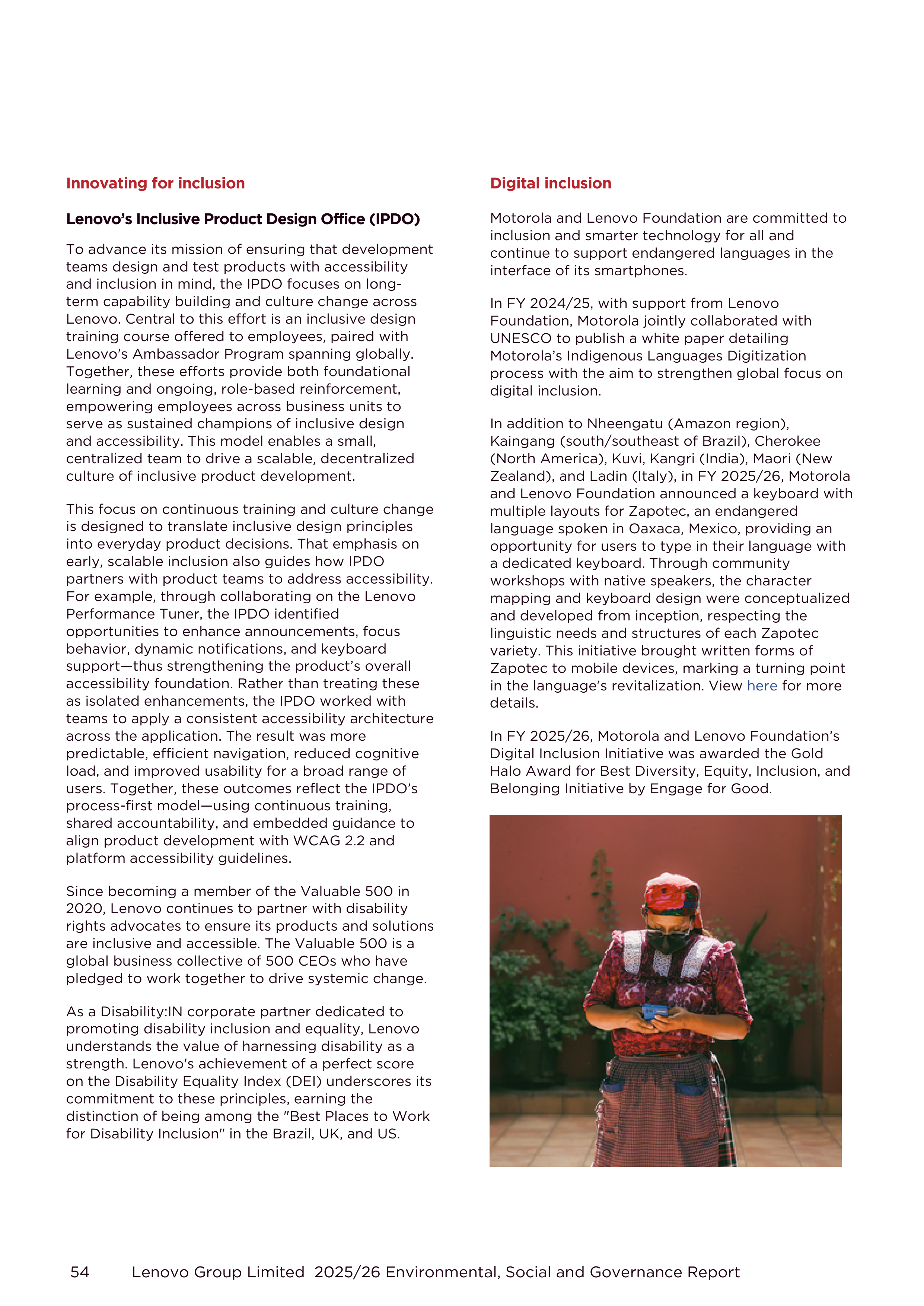

Innovating for inclusion
Lenovo’s Inclusive Product Design Office (IPDO)
To advance its mission of ensuring that development
teams design and test products with accessibility
and inclusion in mind, the IPDO focuses on long-
term capability building and culture change across
Lenovo. Central to this effort is an inclusive design
training course offered to employees, paired with
Lenovo's Ambassador Program spanning globally.
Together, these efforts provide both foundational
learning and ongoing, role-based reinforcement,
empowering employees across business units to
serve as sustained champions of inclusive design
and accessibility. This model enables a small,
centralized team to drive a scalable, decentralized
culture of inclusive product development.
This focus on continuous training and culture change
is designed to translate inclusive design principles
into everyday product decisions. That emphasis on
early, scalable inclusion also guides how IPDO
partners with product teams to address accessibility.
For example, through collaborating on the Lenovo
Performance Tuner, the IPDO identified
opportunities to enhance announcements, focus
behavior, dynamic notifications, and keyboard
support—thus strengthening the product’s overall
accessibility foundation. Rather than treating these
as isolated enhancements, the IPDO worked with
teams to apply a consistent accessibility architecture
across the application. The result was more
predictable, efficient navigation, reduced cognitive
load, and improved usability for a broad range of
users. Together, these outcomes reflect the IPDO’s
process-first model—using continuous training,
shared accountability, and embedded guidance to
align product development with WCAG 2.2 and
platform accessibility guidelines.
Since becoming a member of the Valuable 500 in
2020, Lenovo continues to partner with disability
rights advocates to ensure its products and solutions
are inclusive and accessible. The Valuable 500 is a
global business collective of 500 CEOs who have
pledged to work together to drive systemic change.
As a Disability:IN corporate partner dedicated to
promoting disability inclusion and equality, Lenovo
understands the value of harnessing disability as a
strength. Lenovo's achievement of a perfect score
on the Disability Equality Index (DEI) underscores its
commitment to these principles, earning the
distinction of being among the "Best Places to Work
for Disability Inclusion" in the Brazil, UK, and US.
Digital inclusion
Motorola and Lenovo Foundation are committed to
inclusion and smarter technology for all and
continue to support endangered languages in the
interface of its smartphones.
In FY 2024/25, with support from Lenovo
Foundation, Motorola jointly collaborated with
UNESCO to publish a white paper detailing
Motorola’s Indigenous Languages Digitization
process with the aim to strengthen global focus on
digital inclusion.
In addition to Nheengatu (Amazon region),
Kaingang (south/southeast of Brazil), Cherokee
(North America), Kuvi, Kangri (India), Maori (New
Zealand), and Ladin (Italy), in FY 2025/26, Motorola
and Lenovo Foundation announced a keyboard with
multiple layouts for Zapotec, an endangered
language spoken in Oaxaca, Mexico, providing an
opportunity for users to type in their language with
a dedicated keyboard. Through community
workshops with native speakers, the character
mapping and keyboard design were conceptualized
and developed from inception, respecting the
linguistic needs and structures of each Zapotec
variety. This initiative brought written forms of
Zapotec to mobile devices, marking a turning point
in the language’s revitalization. View
here
for more
details.
In FY 2025/26, Motorola and Lenovo Foundation’s
Digital Inclusion Initiative was awarded the Gold
Halo Award for Best Diversity, Equity, Inclusion, and
Belonging Initiative by Engage for Good.
54
Lenovo Group Limited 2025/26 Environmental, Social and Governance Report




5.0
Governance
57
ESG governance
60
Business practices
66
Product quality management
68
Innovation
69
Governance highlight
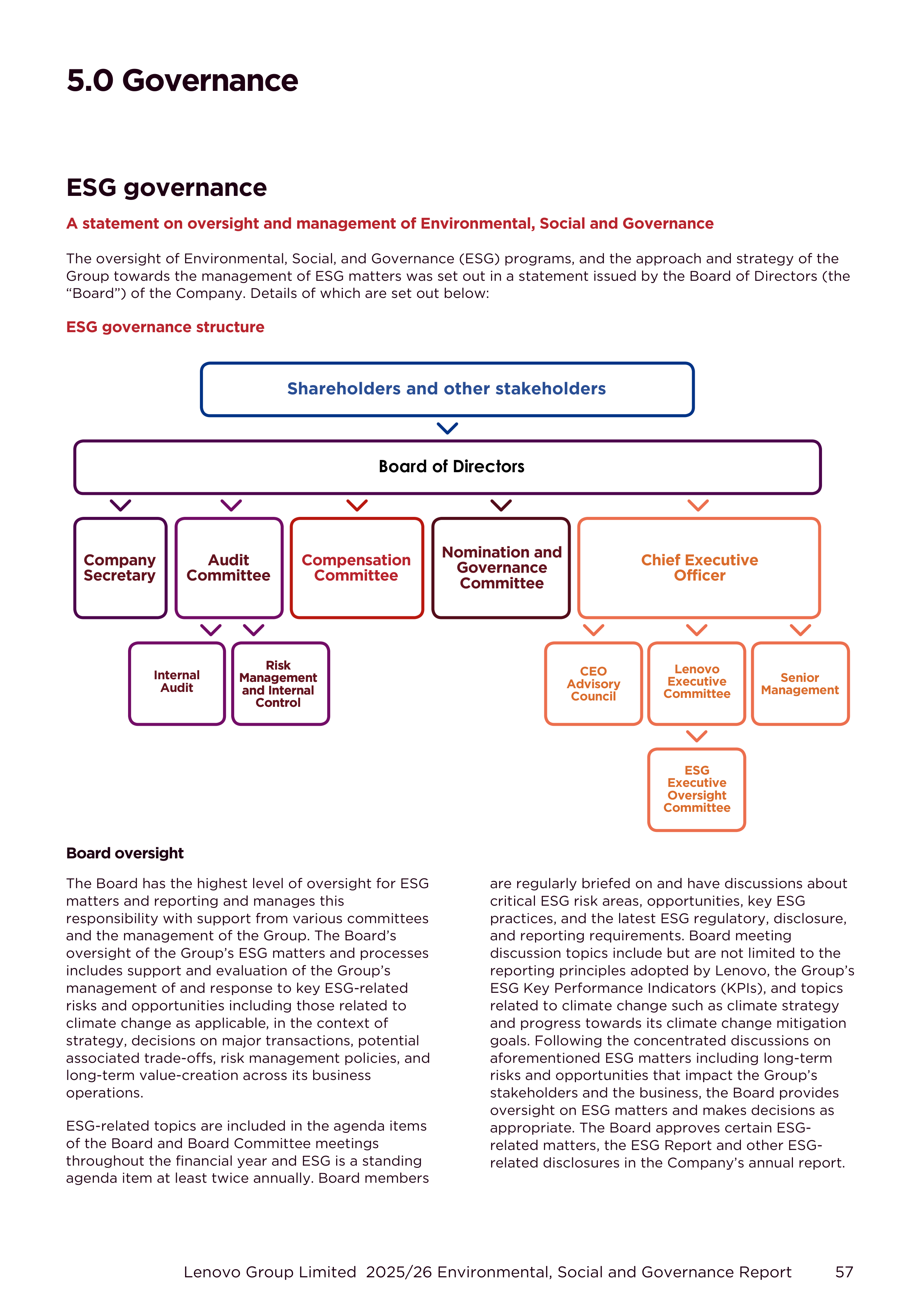
ESG governance
A statement on oversight and management of Environmental, Social and Governance
The oversight of Environmental, Social, and Governance (ESG) programs, and the approach and strategy of the
Group towards the management of ESG matters was set out in a statement issued by the Board of Directors (the
“Board”) of the Company. Details of which are set out below:
ESG governance structure
Board oversight
The Board has the highest level of oversight for ESG
matters and reporting and manages this
responsibility with support from various committees
and the management of the Group. The Board’s
oversight of the Group’s ESG matters and processes
includes support and evaluation of the Group’s
management of and response to key ESG-related
risks and opportunities including those related to
climate change as applicable, in the context of
strategy, decisions on major transactions, potential
associated trade-offs, risk management policies, and
long-term value-creation across its business
operations.
ESG-related topics are included in the agenda items
of the Board and Board Committee meetings
throughout the financial year and ESG is a standing
agenda item at least twice annually. Board members
are regularly briefed on and have discussions about
critical ESG risk areas, opportunities, key ESG
practices, and the latest ESG regulatory, disclosure,
and reporting requirements. Board meeting
discussion topics include but are not limited to the
reporting principles adopted by Lenovo, the Group’s
ESG Key Performance Indicators (KPIs), and topics
related to climate change such as climate strategy
and progress towards its climate change mitigation
goals. Following the concentrated discussions on
aforementioned ESG matters including long-term
risks and opportunities that impact the Group’s
stakeholders and the business, the Board provides
oversight on ESG matters and makes decisions as
appropriate. The Board approves certain ESG-
related matters, the ESG Report and other ESG-
related disclosures in the Company’s annual report.
5.0 Governance
Lenovo Group Limited 2025/26 Environmental, Social and Governance Report
57
Shareholders and other stakeholders
Board of Directors
Company
Secretary
Audit
Committee
Compensation
Committee
Nomination and
Governance
Committee
Chief Executive
Officer
Risk
Management
and Internal
Control
CEO
Advisory
Council
Lenovo
Executive
Committee
Senior
Management
ESG
Executive
Oversight
Committee
Risk
Management
and Internal
Control
Internal
Audit
ESG oversight is supported through the Nomination
and Governance Committee, which develops and
reviews the corporate policies and practices
regarding governance and compliance with legal
and regulatory requirements. The Audit Committee
has a complementary role in the effective
management of risks and safeguarding the Group’s
resources, through oversight of the Internal Audit
and Enterprise Risk Management (ERM) systems,
both of which support overall ESG risk management
practices. The Board, with support from the Audit
Committee, has an annual review of the adequacy of
resources, staff qualifications and experience,
training programs, and budget related to the
Group’s ESG performance and reporting. The Chief
Legal & Corporate Responsibility Officer provides
executive leadership for the Group’s ESG position
and ensures regular reports are made to the Lenovo
Executive Committee (LEC), and the Board and its
Committees to facilitate the Board's annual review
of ESG matters for compliance with relevant
regulatory requirements. The LEC consists of senior
management who have delegated authority
established by the Chief Executive Officer to
manage operational performance, including strategic
decisions.
In addition, the ESG Executive Oversight Committee
(EOC), chaired by the Chief Legal & Corporate
Responsibility Officer, provides strategic direction
and facilitates the coordination of ESG efforts across
the Group, including proposing recommendations
for the effective management of ESG risks and
programs. The ESG EOC is comprised of senior
management from across the business and
functional areas who have an understanding of the
impact of ESG-related risks on Lenovo's business
operation model. The ESG EOC, addresses and
monitors such risks as appropriate and ensures ESG
matters are considered as part of the business-
decision making process. The ESG EOC is also
chartered to promote a culture that encourages
strong ESG performance, including compliance and
leadership activities.
The ESG EOC is responsible for:
•
Monitoring emerging ESG trends, impacts, and
opportunities;
•
Representing the voice of the customer in ESG
strategy decisions;
•
Recommending ESG initiatives, investments,
and disclosures to management and the Board;
•
Ensuring the Group’s ESG strategy
appropriately addresses risks and obligations;
•
Evaluating ESG programs and investments for
effectiveness;
•
Supporting ESG disclosure and messaging
initiatives;
•
Acting as executive champions for the Group’s
ESG culture and values.
The Board is aware of the importance of an effective
Board, including continuous improvement of its own
collective performance in the leadership of the
Group; promoting the Group's success in certain
areas; and improving its ESG performance via
addressing climate-related risks and opportunities
and the oversight of ESG matters. To enhance the
effectiveness and improvement of the performance
of the Board and its Committees, a formal Board
evaluation led by the Nomination and Governance
Committee is conducted biennially or as agreed by
the Board members with active participation of all
the Board members.
It is important for Directors to keep abreast with the
latest regulatory and ESG development and refresh
their knowledge and skills in such areas through
continuous professional development. As part of the
Board’s continuous professional development
program, Directors from time to time receive
training on ESG matters including anti-corruption,
climate, water, ESG risks and opportunities, and
other relevant topics in the form of presentations
from ESG professionals. In addition to ESG training,
Directors also receive regular newsletters discussing
material ESG issues such as topics discussed by ESG
EOC and the ESG developments of the Group.
Directors are also updated on a continuing basis by
the Company Secretary on ESG news or regulatory
updates as released by the Hong Kong Stock
Exchange and other professional organizations. This
facilitates Board members’ understanding of the
latest compliance requirements, the Group’s ESG
practices, supports the continuous development of
ESG competencies within the Board’s skills matrix,
and increases awareness of ESG impacts on the
Group’s operations.
ESG management approach
In addition to the responsibilities listed above, the
Board, through management process, delegates
authority to the ESG EOC for the following ESG
oversight activities:
•
Overseeing the assessment of the Group’s
environmental and social impacts, including the
Group's annual materiality assessment process;
•
Ensuring alignment of the Group’s ESG
programs with regulatory requirements and
investor expectations;
58
Lenovo Group Limited 2025/26 Environmental, Social and Governance Report
•
Understanding the risks of ESG issues on the
Group’s operating model and ensuring
appropriate and well-followed actions are taken
to address the risks; and
•
Ensuring that ESG considerations are part of
business decision-making processes.
As part of the Group’s ESG program, a materiality
assessment is conducted annually involving internal
and external stakeholders to identify ESG-related
risks and opportunities and their impacts on the
business and stakeholders. The results are reviewed
and approved by the ESG EOC and included in the
ESG Report that is reviewed and approved by the
Board. This assessment guides the objectives for the
Group’s ESG programs, including goals and targets,
informing the business strategy, targeting
communications, and the disclosures in the ESG
Report.
The Group recognizes that risk management is the
responsibility of everyone within the organization,
and that risk is best managed when business
functions take responsibility and are accountable for
them. Rather than being a separate and standalone
process, risk management is therefore incorporated
as part of the Group’s annual strategic planning
process across all major functions.
The Group’s official ERM process details various
business risks that include environmental, social, and
governance risk categories. Annually, the Group
requires each business unit to identify risks, assess
their impacts on executing its strategy, and develop
risk mitigation plans. The results of this assessment
ensure that effective risk management and internal
control systems are in place.
ESG-related information is periodically audited using
an internal control framework as part of a broader
corporate risk assessment that incorporates audit
processes to provide independent and objective
assurance that the Company’s ESG disclosures,
statements, and metrics are accurate and aligned
with the Group’s risk management approach. The
Group has been following a long-standing integrated
approach for internal control which is consistent
with the Committee of Sponsoring Organizations of
the Treadway Commission (COSO) internal control
framework. This internal control framework is
overseen by the Audit Committee.
The Company’s ESG disclosures, statements, and
metrics are managed by a dedicated team that is
focused on monitoring the effectiveness of the ESG
initiatives and reporting the organization’s progress
against the goals and targets.
Review of progress and relevance to the
business
The ESG EOC conducts regular meetings to assess
the progress of the Group’s ESG initiatives, including
those addressing climate change and net-zero
targets, their relevance to stakeholder expectations
and the Group’s long-term business strategy, and
the direction of and investment in ESG programs.
The Group sets targets to address its material
impacts through a variety of related processes,
including the Group's ISO 14001:2015
(environmental), ISO 50001:2018 (energy
management), ISO 45001:2018 (occupational health
and safety), and ISO 9001:2015 (quality)
management systems. In addition, relevant teams
and departments within the Group including
Strategy, Human Resources, and others may set KPIs
related to their own impacts which may be
integrated into the corporate ESG KPIs as
appropriate. The Group’s corporate ESG KPIs are
developed with approval from the ESG EOC and
supported by the LEC and the Board.
The ESG practices and related goals and targets,
KPIs and progress are periodically reviewed by the
Board and are aligned with credible industry and
science-based standards, and ESG reporting
frameworks. The Group's progress is disclosed in the
ESG Report that is reviewed and approved by the
Board.
ESG performance metrics and climate-related
considerations are factored into certain executive
officer’s remuneration policies where KPIs are tied to
variable compensation or may result in non-
monetary incentive such as recognition including
employee awards.
The Board acknowledges that the corporate ESG
landscape is evolving, and that the effective
governance of ESG matters is fundamental to a
company’s ESG accountability. As the Group
regularly evaluates the ESG risks and opportunities
faced by the industry and the potential impacts on
the Group’s business continuity plan, the Board
strives to strengthen the oversight of ESG programs
and practices that will help to build a more resilient
future for all.
Lenovo Group Limited 2025/26 Environmental, Social and Governance Report
59
Ethics and integrity
Ethics and integrity serve as the foundation of all
Lenovo business practices. Results from Lenovo's
‘Lenovo Listens’ survey in FY 2025/26 highlight one
of Lenovo's greatest strengths: ethical business
practices. Specifically, 97 percent of Lenovo’s
workforce believes that Lenovo is ethical in all its
business dealings. Lenovo recognizes its success
hinges on its steadfast commitment to these values.
This commitment is reinforced among the workforce
through Lenovo's core values, which emphasize the
significance of “Teamwork with Integrity and Trust,”
one of Lenovo's four fundamental cultural tenets.
Lenovo's
Ethics and Compliance Office
(ECO) was
established to foster a culture that is committed to
implementing these values. The ECO works in
partnership with stakeholders across the globe to
promote legal and ethical operations. The ECO
actively raises awareness about the importance of
ethical and compliant business practices to Lenovo
and serves a critical role in providing employees
with the information, resources, and training they
need to make informed ethical decisions.
The ECO also oversees Lenovo's
Code of Conduct
(Code), which establishes clear expectations for
employee compliance with its policies related to
lawful and ethical business conduct. The Code
reflects Lenovo's culture of trust and integrity, holds
employees accountable for their behavior, and helps
employees determine when and where to seek
advice. The Code, policies, and related awareness
and training materials are provided electronically
and through periodic communications. Specifically,
Lenovo’s new hires are required to take Code
training. In order to successfully complete the
training, all employees are required to provide
attestation of their adherence to the Code and
Lenovo policies. The Code training covers various
topics, including, conflicts of interest, insider trading,
anti-bribery and corruption, anti-competitive
practices and fair competition, anti-money
laundering, and international trade compliance. See
Section 7.0 for related data.
The ECO is supported by the following committees:
Board Committees
•
The Audit Committee is annually briefed by the
ECO on matters including the adequacy of
resources for ESG reporting
•
The Nomination and Governance Committee
oversees the corporate policies and practices
about governance and compliance with legal
and regulatory requirements
Other Committees
•
The Executive Ethics Committee provides
executive-level oversight and guidance to the
ECO
•
The Investigation Oversight Committee works
closely with the ECO to oversee Lenovo's
internal investigation process and speak up
initiatives
•
The Regional Ethics and Compliance Committee
provides the ECO with global support,
perspective, and insight
Business practices
Lenovo’s Code mandates compliance with
applicable laws in markets where it conducts
business. Its policies strongly support ethical and
responsible business practices, which include areas
such as anti-bribery and corruption, data privacy,
anti-competitive practices and fair competition,
trade compliance, intellectual property and more.
Anti-bribery and corruption
Lenovo has zero tolerance for bribery and
corruption. Lenovo complies with the anti-bribery
and corruption laws in every jurisdiction where it
conducts business. Lenovo's
Global Anti-Bribery and
Corruption Policy
along with Lenovo's Global Gift,
Entertainment, Corporate Hospitality, and Travel
Policy reinforce provisions in the Code and provide
additional guidance regarding compliance with
global anti-bribery and corruption rules and laws.
The policies stress that Lenovo will not directly or
indirectly solicit, offer, promise, authorize, provide,
or accept anything of value to any person, including
government officials, to influence action, inaction, or
to secure an improper advantage as defined by
applicable laws.
To support employees in understanding these
requirements, Lenovo provides comprehensive
training on anti-bribery and corruption. In FY
2025/26, this training was provided to all computer-
based employees. Lenovo also provides Code
training to new employees, which includes anti-
bribery and corruption topics. The Board of
Directors and Senior Leadership Team are provided
a facilitator-led training session on anti-bribery and
corruption.
Bribery and corruption risks are also evaluated as
part of Lenovo's Enterprise Risk Management
Program risk assessment on an annual basis to
ensure Lenovo's internal controls effectively address
and mitigate bribery and corruption risk to the
enterprise.
60
Lenovo Group Limited 2025/26 Environmental, Social and Governance Report
As Lenovo holds all employees to the highest ethical
standards and requires compliance with applicable
anti-bribery and corruption laws and regulations, it
extends this obligation to its business partners.
Lenovo's business partners are expected to adhere
to the same standards of integrity that Lenovo
demands of itself. All business partners are subject
to comply with Lenovo's Partner Code of Conduct
and Lenovo's Global Anti-Bribery and Corruption
Policy, which includes the requirement to conduct
anti-bribery and corruption due diligence on any
business partner identified as presenting elevated
bribery and corruption risks to the organization.
Lenovo actively monitors these business partners to
address any potential areas of concern or inquiries
regarding bribery and corruption.
Anti-competitive practices and fair competition
Lenovo competes for business ethically and lawfully.
The Code and policy on anti-competitive practices
and fair competition set out fundamental principles
to serve as guidelines for employees in complying
with the competition laws in every jurisdiction where
Lenovo operates. In particular, employees are strictly
prohibited from engaging in anti-competitive
practices, including entering into an agreement or
discussion that would result in price-fixing,
limitations on the availability of goods or services on
the market, or agreements to boycott a customer or
supplier.
Lenovo continues to communicate requirements of
global antitrust and anti-competition laws and
regulations to the workforce on a periodic basis.
Global trade compliance
Lenovo is fully committed to complying with all
applicable global trade laws and regulations in the
markets where it conducts business. This includes
adherence to customs and import regulations,
export controls, economic sanctions, and anti-
boycott regulations as mandated by relevant
authorities in each jurisdiction.
All employees are expected to uphold Lenovo’s
Code and Global Trade Compliance Policy, which
define the requirements for maintaining compliance
with these laws and regulations. Lenovo also
requires its business partners to comply with
applicable global trade laws and regulations
pursuant to its Partner Code of Conduct.
Additionally, Lenovo is Customs-Trade Partnership
Against Terrorism (CTPAT) certified and a member
of the CTPAT Trade Compliance program,
demonstrating Lenovo’s commitment to supply
chain security and regulatory compliance.
Intellectual property
Intellectual property is a valuable asset for Lenovo.
Lenovo expects its employees to protect its
intellectual property and respect the intellectual
property rights of other companies and individuals.
Intellectual property rights include patents,
copyrights, trademarks, confidential information, and
related contract rights.
Lenovo secures its own intellectual property using
these and other applicable forms of legal protection.
Therefore, Lenovo’s employees must each sign and
abide by their agreement with Lenovo regarding
confidential information and intellectual property.
Lenovo also expects its employees to contribute to
Lenovo’s innovation leadership. To this end,
Lenovo’s employees should submit their inventions
and ideas to Lenovo’s patent review board for
prompt review and protection with the support of
the Intellectual Property Law Department.
Lenovo respects the intellectual property rights of
other companies and individuals, including their
proprietary materials, confidential information,
software, patents, trademarks, or trade secrets.
Employees should work with Lenovo’s counsel in the
Legal Department as appropriate to ensure all
necessary rights and licenses are obtained before
utilizing any non-Lenovo proprietary materials.
Privacy and data protection
Lenovo maintains a Global Privacy and Data
Protection Program, which leads the organization’s
commitment to responsibly using and protecting
customer, consumer, employee, and partner
identifiable information. The Lenovo Global Privacy
and Data Protection Program develops and
maintains policies, processes, training, and other
mechanisms and resources to ensure that Lenovo
complies with global privacy and related data
protection laws and regulations. These policies and
Lenovo’s commitments in this area are
communicated to all employees via the Lenovo
Privacy Basics course which new employees are
required to take within 30 days of their employment
with Lenovo, and on a recurring basis thereafter. It is
the individual and collective responsibility of
Lenovo’s employees and contractors to act in
accordance with the requirements of Lenovo’s
privacy and security policies and standards and to
Lenovo Group Limited 2025/26 Environmental, Social and Governance Report
61
report privacy and security incidents or
vulnerabilities in a timely manner. The Lenovo Global
Privacy and Data Protection Program, Chief Security
Office, Chief Infrastructure Security Office, and
Lenovo’s product security teams maintain incident
reporting mechanisms and work together to
investigate, mitigate, and prevent privacy and
security incidents that could impact Lenovo, its
customers, users, or employees.
Individuals may learn more about Lenovo’s product
and website privacy practices by visiting
https://
www.lenovo.com/us/en/privacy/
. The Lenovo
Privacy and Data Protection Program may be
reached at
privacy@lenovo.com
(or
privacy@motorola.com
).
Lenovo recognizes the great importance of privacy
to individuals everywhere – customers, website
visitors, product users, employees – everyone. The
responsible use and protection of personal and other
information under Lenovo’s care is a core company
value. To ensure adherence to its privacy policies,
principles, and processes, Lenovo maintains a global
Privacy and Data Protection Program led by the
Legal Department. The Privacy & Data Protection
Program reports its progress regularly to Lenovo’s
Chief Legal & Corporate Responsibility Officer and
Chief Security Officer. In addition, the Privacy & Data
Protection Program coordinates a cross-functional
Privacy Working Group (PWG) comprised of key
partners drawn from Infrastructure Security, Product
Security, Product Development, Marketing, E-
Commerce, Service and Repair, Human Resources,
and other groups. The PWG meets several times per
year and discusses Lenovo’s privacy policies,
processes, legal developments, industry
developments, and more. Key elements of Lenovo’s
approach to ensuring meaningful privacy and data
protection include:
•
Monitoring global privacy and data protection
legal developments and regulatory trends, and
improving Lenovo’s privacy practices and
processes;
•
Harmonizing global privacy and data protection
requirements into an organization-wide set of
Lenovo Guiding Privacy Principles that drive
how Lenovo handles personal information and
certain other types of data, including
developing and updating its privacy policies
and procedures;
•
Providing contractual support to ensure that
risks associated with supplier and partner
agreements include appropriate privacy and
security terms; including assistance to the
Lenovo Legal Center of Excellence (COE) in its
efforts to update contract templates, and
improve privacy and security-focused contract
addenda;
•
Providing early input to product and service
development teams by incorporating privacy
checkpoints into formal product development
plans, including privacy impact assessments,
and conducting pre-launch privacy compliance
reviews of products, software, services,
websites, marketing programs, internal systems,
and supplier relationships;
•
Responding to requests from individuals to
review, correct, amend and/or delete their
personal information;
•
Coordinating Lenovo’s response to law
enforcement and other government requests
for applicable personal and user information;
•
Developing and delivering privacy and data
protection-focused training programs and
working closely with the Chief Security Office
(CSO), Corporate Infrastructure Security Office
(CISO), and product security teams to timely
identify and respond to privacy and data
protection incidents;
•
Maintaining an internal Privacy Program portal
and other resources for employees to provide
guidance, documents, contract templates,
compliance checklists, and additional privacy
and data protection resources for Lenovo; and
•
Requiring all computer-based employees
globally to complete the Lenovo’s Privacy
Basics and Security Essentials courses.
Ethical management of responsible Artificial
Intelligence
Lenovo embraces Artificial Intelligence (“AI”) across
its product lines, from client to edge to cloud and
network. Throughout the computing ecosystem,
breakthroughs in AI technologies and capabilities
mark a major leap forward and serve as catalysts
and accelerators to boost human capability and
organizational productivity.
Lenovo is making large investments in people and
resources for AI that will focus on providing AI
devices, AI-ready and AI-optimized computing
infrastructure, and embedded AI capabilities in
intelligent solutions to accelerate productivity and
provide new, revolutionary experiences to Lenovo’s
customers.
In FY 2023/24, Lenovo announced its vision of
“Smarter AI for All” and is focused on unleashing the
power of AI to drive intelligent transformation in
every aspect of people’s lives and in every industry –
providing technology, solutions, and services that
empower industries, enterprises, and individuals
around the world. With this ability to empower and
62
Lenovo Group Limited 2025/26 Environmental, Social and Governance Report
influence positive change, arises a profound duty to
develop, deploy, and use AI responsibly.
Lenovo has formally adopted a corporate policy on
AI and reinforces its commitment to responsible AI
by upholding the following principles and guidelines:
1.
Lenovo will not use AI in ways that harm people
or put them or their rights at risk.
•
Lenovo prohibits AI systems that deploy
subliminal or manipulative techniques,
exploit a person’s vulnerabilities, classify
people based on their social behavior,
socio-economic status, or sensitive
personal information, and more.
•
AI systems that pose a risk to a person’s
health, safety, and civil rights will be
carefully evaluated and implemented with
additional risk mitigation.
2.
Lenovo develops and deploys its AI to be fair,
transparent, explainable, and efficient.
•
Lenovo encourages responsible
stewardship of trustworthy AI systems in
pursuit of beneficial outcomes for
individuals whose data is processed by an
AI system user, society, and the
environment.
•
Lenovo's Responsible AI pillars will serve
as the basis for evaluating AI systems
throughout the company, including
diversity and inclusion, accountability,
reliability, explainability, transparency,
environmental, and social impact.
3.
Lenovo will ensure that there is proper human
oversight throughout the lifecycle of an AI
system.
•
Lenovo firmly believes in the indispensable
role of human oversight in the
development and use of AI. It recognizes
that AI systems, while powerful and
transformative, remain tools to be used in
support of human endeavor and must be
guided by human judgment and ethical
considerations.
•
Lenovo establishes mechanisms for human
intervention to ensure proper oversight,
validity of AI outcomes, detection of
potential biases, and human intervention
when necessary to detect and rectify
biases, errors, or unintended
consequences.
•
Through proper human oversight, Lenovo
strives to instill trust, accountability, and
fairness in our AI systems, empowering us
to make informed decisions that benefit its
customers, users, employees, and society
as a whole.
4.
Lenovo will protect people’s privacy at all
stages of the AI Lifecycle.
•
AI systems will collect and retain data from
individuals only where there is a legitimate
purpose, and then only to the minimum
extent needed to fulfill that purpose.
•
AI systems will be designed to help users
comply with privacy requirements,
including providing to subjects the
reasonable ability to review, correct,
amend, or delete their personal data
processed by an AI system.
5.
Lenovo’s AI will be developed and used with
robust security protections.
•
Technical robustness and safety require
that AI systems preemptively address risks
including, but not limited to, the
unpredictability of AI performance and
cybersecurity.
•
Lenovo will establish standards to be used
in the review, development, and operation
of AI systems to ensure they are safe and
reliable.
6.
Lenovo designs and operates its AI to respect
and protect its own and others’ confidential
information and intellectual property.
•
Intellectual property concerns arise at all
phases of AI development and use,
including data selection and acquisition,
model training and development, and
operations and output.
•
Lenovo will own or have permission to use
all data it uses to train or operate AI
systems and ensure that its AI systems are
not given inappropriate information or
prompts including:
(1)
third-party information in Lenovo’s
control not authorized for such use,
(2)
Lenovo’s confidential or restricted
information, if the AI system is not
approved for such use,
Lenovo Group Limited 2025/26 Environmental, Social and Governance Report
63
(3)
personal information of Lenovo
employees, customers, or others who
have not explicitly consented to such
use, or
(4)
prompts or directions that would tend
to create problematic, biased, or
infringing results.
7.
Lenovo’s AI will be developed and used in strict
compliance with applicable laws and
regulations.
•
Lenovo is dedicated to the highest
standards of legal compliance in all of our
worldwide operations and complies with
applicable laws and regulations in the
jurisdictions where we conduct business.
•
As a result of the enactment of China’s
regulations concerning AI, Lenovo
established a comprehensive compliance
committee consisting of various internal
stakeholders to ensure Lenovo is following
regulatory compliance requirements and
industry-leading best practices.
•
Globally, Lenovo continues to monitor the
AI regulatory environment and is
unwavering in its commitment to
developing, deploying, and utilizing AI in
accordance with regulatory standards and
industry-leading best practices.
In addition to these principles, Lenovo is further
solidifying its dedication to responsible AI by
expanding its external presence through
partnerships with esteemed organizations dedicated
to promoting responsible AI practices. Lenovo
joined the European Commission's AI Pact, the
UNESCO AI Business Council, the ITU AI Skills
Coalition, and the Government of Canada's
Voluntary Code of Conduct on AI to highlight its
steadfast commitment to responsible AI innovation
and deployment of trustworthy AI systems aligned
with global safety and ethical standards. Lenovo
collaborates with institutions and governments to
exchange experiences and share best practices to
build ethical and responsible artificial intelligence.
Lenovo is also the co-founder of the Human-Centric
Intelligence Development and Governance Initiative
in China, an initiative focusing on prioritizing human
needs, values, and social impact in the development
of AI systems. Additionally, since 2021, Lenovo has
been a signatory of the Cercle InterL Women & AI
Charter for accountable and gender-fair AI systems.
Lenovo recognizes that the realization of its vision of
“Smarter AI for All” hinges upon its steadfast
adherence to principles that guarantee the
responsible, ethical, and safe development,
deployment, and utilization of AI. The principles
outlined above not only underpin Lenovo’s vision,
but also form the cornerstone of Lenovo’s mission to
provide “Smarter Technology for All.”
Reporting ethical concerns
Lenovo is committed to fostering a speak up culture,
where employees, contractors, and business
partners are empowered to speak up on anything
that appears unethical, illegal, or suspicious. Lenovo
has established clear processes and various
reporting channels to raise questions or report
concerns.
Employees are encouraged to raise concerns to their
managers, Human Resources, the ECO, Internal
Audit, or the Legal Department about any potential
issues including, but not limited to, those known
about or suspected:
•
Fraud by or against Lenovo
•
Bribery or corruption
•
Unethical business conduct
•
Violation of legal or regulatory requirements
•
Substantial and specific danger to health and
safety
•
Violation of Lenovo’s corporate policies and
guidelines, particularly the Code of Conduct
Lenovo also provides formal, confidential ways to
report concerns, ask questions, or request guidance
in person, by email, or through the LenovoLine, a
confidential reporting system that is accessible 24
hours a day, seven days a week by secure website,
mobile app or by telephone. Additionally, employees
may report concerns about business practices
anonymously.
Lenovo takes all allegations and concerns seriously.
Lenovo maintains a Whistleblowing and
Investigations Policy outlining the process by which
concerns can be raised, are reviewed and are
investigated. Lenovo also has an oversight body, the
Investigation Oversight Committee (IOC), to ensure
concerns raised are appropriately investigated and
addressed. See Section 7.0 of this report for related
data.
Lenovo actively issues training and periodic
communications to provide employees with
information on Lenovo’s internal investigations
process and to encourage them to speak up without
the fear of retaliation. Lenovo prohibits retaliation
for reports made in good faith. In FY 2025/26,
training on Lenovo's Corporate Policy on
Whistleblowing and Investigations was provided
64
Lenovo Group Limited 2025/26 Environmental, Social and Governance Report
with Lenovo's Anti-Bribery and Corruption training.
Additional communications include detailed
information about the LenovoLine, quarterly
notifications from the IOC with summaries of notable
investigations with no identifying details, computer
screen lock messaging, posters, and more.
Additionally, Lenovo's whistleblowing and hotline
provider, Whispli, offers an enhanced platform to
facilitate the reporting of concerns. Key features of
the platform include the ability to submit reports via
a mobile application (available on iOS and Android),
real-time translation into the reporter’s local
language for seamless communication with
investigators, and a secure chat box feature. The
secure chat box functionality enables anonymous
reporters to engage in ongoing communication with
Lenovo’s investigators without compromising their
anonymity.
Complaints
Lenovo is dedicated to reviewing and responding to
all customer feedback, including product or service-
related complaints. It has a robust process for
managing customer complaints. Practices include a
review and approval process for all product or
service-related complaints with checkpoints to
ensure adherence to the process.
Complaint channels
Customers can raise dissatisfaction or complaints
through a diverse range of channels that includes,
but is not limited to phone calls, chat, email, social
media, an internal escalation tool when shared with a
Lenovo employee, and the Lenovo Support Page.
Complaint process
Complaints are collected by various internal systems
and centralized on Microsoft Dynamics Customer
Relationship Management (CRM). The dedicated
Customer Care team will manage the case end-to-
end and engage with the customer to find a
resolution to their complaint. The Customer Care
team will:
•
Investigate the background of the complaint to
better understand the customer’s experience;
•
Identify potential solutions for the customer
and communicate with the customer to reach
agreement on a solution; and
•
Implement the agreed-upon solution.
Based on the solution criteria, the Customer Care
Case Manager may:
•
Explain Lenovo’s warranty policy;
•
Repair the product if it is not working per the
machine specifications;
•
Replace the product if the repair does not
resolve the problem; and
•
Refund the customer.
Once the case is escalated to the Customer Care
team, the global average time for resolution and
agreement with the customer is usually 48 hours.
To maintain a consistent process and continuously
identify improvements to the policies, by the end of
the case management, Customer Care team will
launch a survey to customers looking to understand:
•
Likelihood of recommending Lenovo to others
in the future;
•
Overall satisfaction with the service provided;
•
Level of customer effort while doing business
with Lenovo;
•
Resolution satisfaction; and
•
Resolution time.
Enterprise feedback management
The Customer Care team executes a closed-loop
process with customers and internal stakeholders to
improve Lenovo's processes and policies. The
process includes the use of generative AI tools and
manual validation to compile and categorize the
reasons for escalation and customer feedback and
sharing the findings and recommendations with the
services delivery teams. The opportunities identified
and the actions for continuous improvement are
shared with the company executives on a quarterly
basis.
The Customer Care team also evaluates survey
responses and areas to improve while managing
critical and dissatisfied customers. Those areas
include (but are not limited to):
•
Timeliness of response
•
Friendliness
•
Knowledge of Lenovo's processes and policies
•
Overall satisfaction
•
Satisfaction resolution
This closed-loop process is defined by business
geographies and internal stakeholders, and may vary
in the markets where Lenovo operates.
Lenovo Group Limited 2025/26 Environmental, Social and Governance Report
65
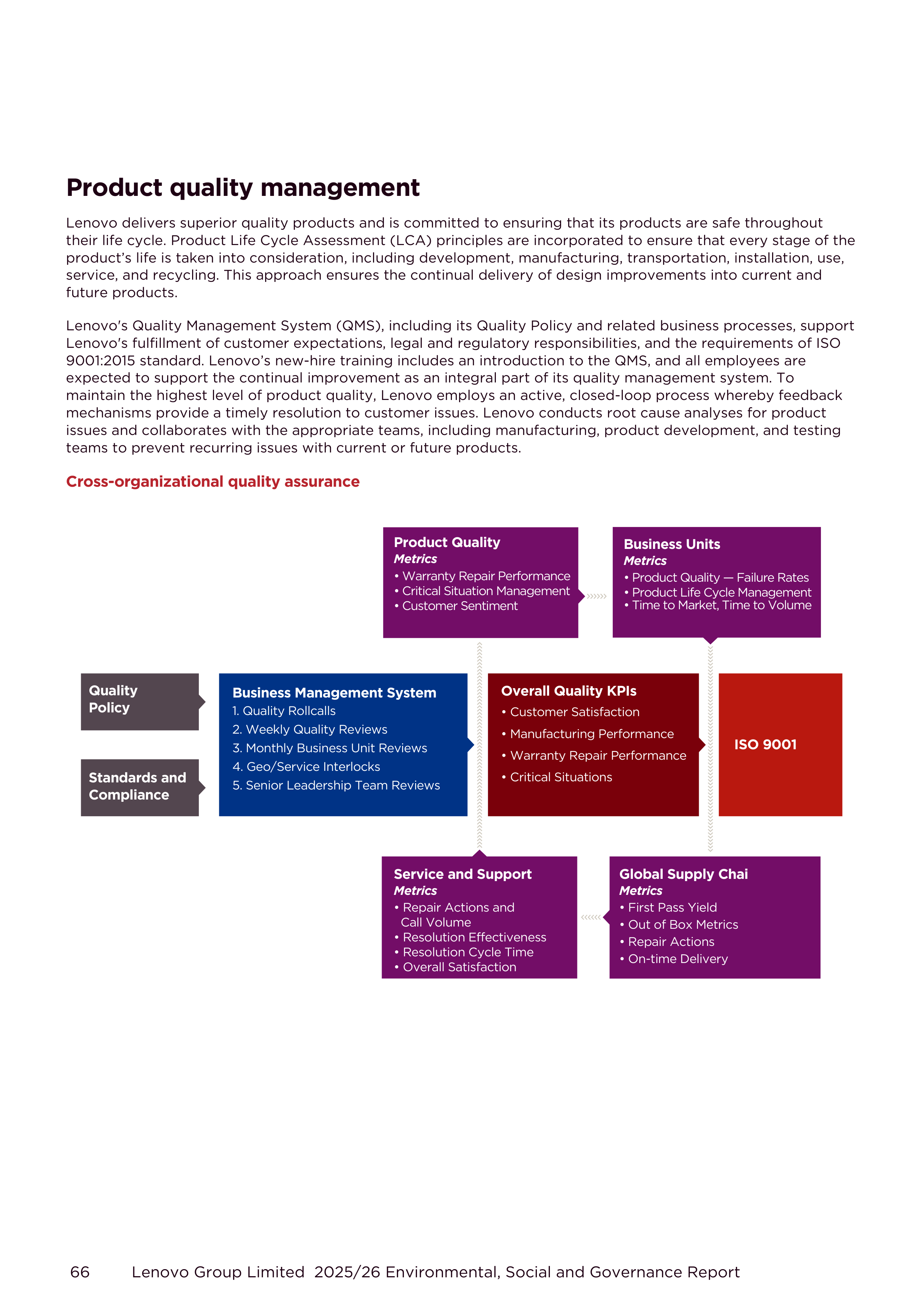
Product quality management
Lenovo delivers superior quality products and is committed to ensuring that its products are safe throughout
their life cycle. Product Life Cycle Assessment (LCA) principles are incorporated to ensure that every stage of the
product’s life is taken into consideration, including development, manufacturing, transportation, installation, use,
service, and recycling. This approach ensures the continual delivery of design improvements into current and
future products.
Lenovo's Quality Management System (QMS), including its Quality Policy and related business processes, support
Lenovo's fulfillment of customer expectations, legal and regulatory responsibilities, and the requirements of ISO
9001:2015 standard. Lenovo’s new-hire training includes an introduction to the QMS, and all employees are
expected to support the continual improvement as an integral part of its quality management system. To
maintain the highest level of product quality, Lenovo employs an active, closed-loop process whereby feedback
mechanisms provide a timely resolution to customer issues. Lenovo conducts root cause analyses for product
issues and collaborates with the appropriate teams, including manufacturing, product development, and testing
teams to prevent recurring issues with current or future products.
Cross-organizational quality assurance
66
Lenovo Group Limited 2025/26 Environmental, Social and Governance Report
Quality
Policy
Standards and
Compliance
Business Management System
1. Quality Rollcalls
2. Weekly Quality Reviews
3. Monthly Business Unit Reviews
4. Geo/Service Interlocks
5. Senior Leadership Team Reviews
Overall Quality KPIs
• Customer Satisfaction
• Manufacturing Performance
• Warranty Repair Performance
• Critical Situations
ISO 9001
Global Supply Chai
Metrics
• First Pass Yield
• Out of Box Metrics
• Repair Actions
• On-time Delivery
Service and Support
Metrics
• Repair Actions and
Call Volume
• Resolution Effectiveness
• Resolution Cycle Time
• Overall Satisfaction
Product Quality
Metrics
• Warranty Repair Performance
• Critical Situation Management
• Customer Sentiment
Business Units
Metrics
• Product Quality — Failure Rates
• Product Life Cycle Management
• Time to Market, Time to Volume
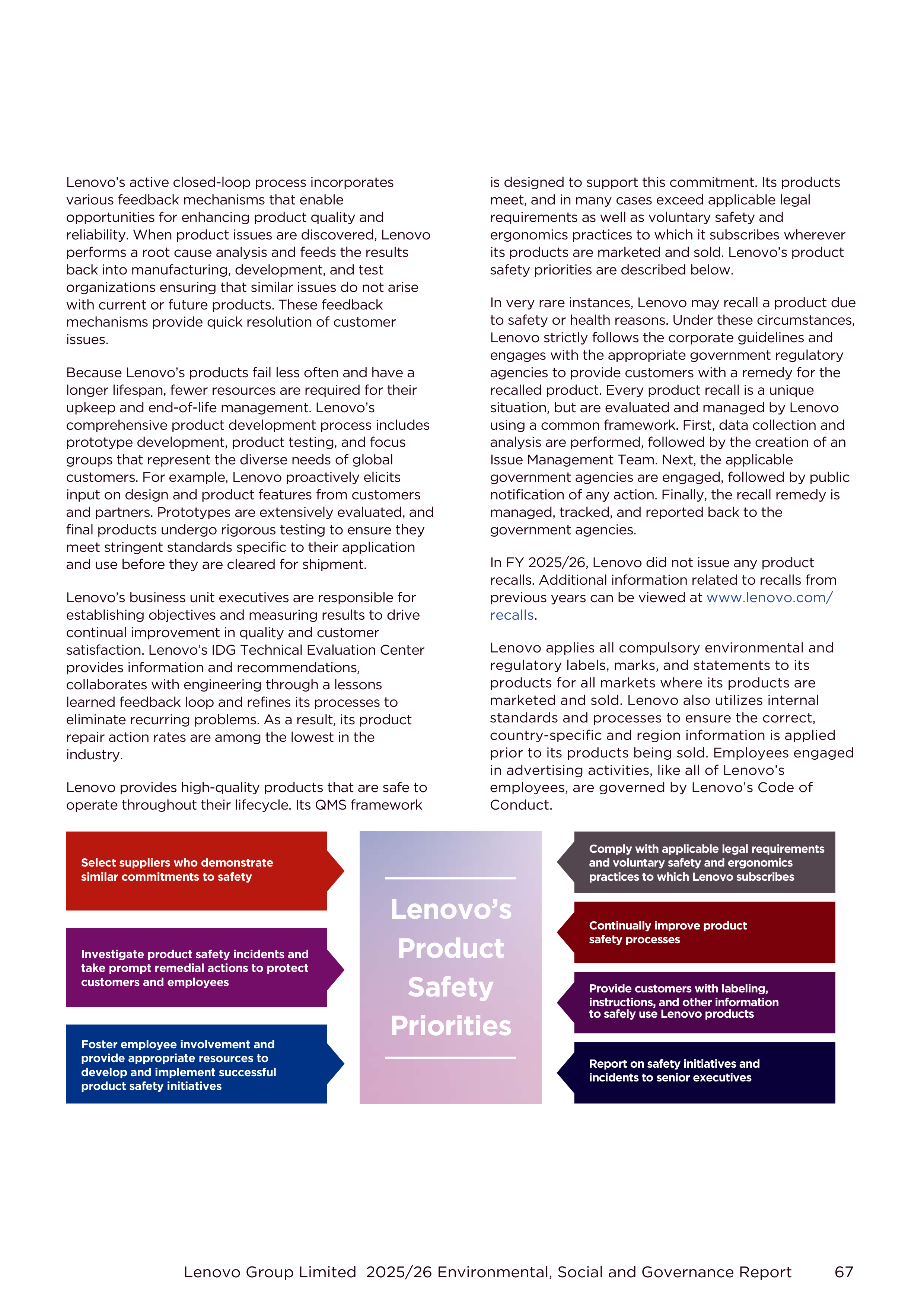

Lenovo’s active closed-loop process incorporates
various feedback mechanisms that enable
opportunities for enhancing product quality and
reliability. When product issues are discovered, Lenovo
performs a root cause analysis and feeds the results
back into manufacturing, development, and test
organizations ensuring that similar issues do not arise
with current or future products. These feedback
mechanisms provide quick resolution of customer
issues.
Because Lenovo’s products fail less often and have a
longer lifespan, fewer resources are required for their
upkeep and end-of-life management. Lenovo’s
comprehensive product development process includes
prototype development, product testing, and focus
groups that represent the diverse needs of global
customers. For example, Lenovo proactively elicits
input on design and product features from customers
and partners. Prototypes are extensively evaluated, and
final products undergo rigorous testing to ensure they
meet stringent standards specific to their application
and use before they are cleared for shipment.
Lenovo’s business unit executives are responsible for
establishing objectives and measuring results to drive
continual improvement in quality and customer
satisfaction. Lenovo’s IDG Technical Evaluation Center
provides information and recommendations,
collaborates with engineering through a lessons
learned feedback loop and refines its processes to
eliminate recurring problems. As a result, its product
repair action rates are among the lowest in the
industry.
Lenovo provides high-quality products that are safe to
operate throughout their lifecycle. Its QMS framework
is designed to support this commitment. Its products
meet, and in many cases exceed applicable legal
requirements as well as voluntary safety and
ergonomics practices to which it subscribes wherever
its products are marketed and sold. Lenovo’s product
safety priorities are described below.
In very rare instances, Lenovo may recall a product due
to safety or health reasons. Under these circumstances,
Lenovo strictly follows the corporate guidelines and
engages with the appropriate government regulatory
agencies to provide customers with a remedy for the
recalled product. Every product recall is a unique
situation, but are evaluated and managed by Lenovo
using a common framework. First, data collection and
analysis are performed, followed by the creation of an
Issue Management Team. Next, the applicable
government agencies are engaged, followed by public
notification of any action. Finally, the recall remedy is
managed, tracked, and reported back to the
government agencies.
In FY 2025/26, Lenovo did not issue any product
recalls. Additional information related to recalls from
previous years can be viewed at
www.lenovo.com/
recalls
.
Lenovo applies all compulsory environmental and
regulatory labels, marks, and statements to its
products for all markets where its products are
marketed and sold. Lenovo also utilizes internal
standards and processes to ensure the correct,
country-specific and region information is applied
prior to its products being sold. Employees engaged
in advertising activities, like all of Lenovo’s
employees, are governed by Lenovo’s Code of
Conduct.
Lenovo Group Limited 2025/26 Environmental, Social and Governance Report
67
Select suppliers who demonstrate
similar commitments to safety
Investigate product safety incidents and
take prompt remedial actions to protect
customers and employees
Foster employee involvement and
provide appropriate resources to
develop and implement successful
product safety initiatives
Comply with applicable legal requirements
and voluntary safety and ergonomics
practices to which Lenovo subscribes
Continually improve product
safety processes
Provide customers with labeling,
instructions, and other information
to safely use Lenovo products
Report on safety initiatives and
incidents to senior executives
Lenovo’s
Product
Safety
Priorities
Innovation
Innovating for greater manufacturing
sustainability
In FY 2025/26, Lenovo's Monterrey, Mexico
manufacturing site was added to the WEF's Global
Lighthouse Network. The Global Lighthouse Network
comprises 201 facilities that demonstrate leadership
and integration of fourth industrial revolution
technologies (4IR), Lenovo's Hefei site was
recognized by The Global Lighthouse Network in
2023. Monterrey is one of Lenovo's most advanced
smart manufacturing sites in the world.
In FY 2025/26, Lenovo continued to use an ESG
management system called Lenovo ESG Navigator
that helps monitor key ESG metrics in
manufacturing.
Innovating for the circular economy
Lenovo's vision to deliver 'Smarter Technology for
All' extends to its practices that include Smarter
Circular Design, Smarter Circular Use, and Smarter
Circular Return activities. In a circular economy,
products are made, used, then returned, instead of
being discarded and consigned to waste. In this
model, value is extracted from a resource while in
use. Then, at the end of its service life, the resource
is recovered, refurbished, and redeployed when
possible. This drives greater resource productivity,
aims to make businesses more competitive, and
helps create new opportunities for growth.
While Lenovo provides innovative services to
support the transition to a circular economy (see
next section), it is also exploring ways to recycle
materials, integrate them into products, and enhance
reuse in its packaging.
Lenovo has established a target to enable the
recycling and reuse of 800 million pounds
(approximately 363 million kilograms) of end-of-life
products by FY 2025/26
+
. For more information see
Section 8.0
. In FY 2025/26,
Lenovo also formalized a
collaboration with the United Nations Industrial
Development Organization
's effort to jointly develop
programs to promote sustainable industrialization
and responsible electronics management.
+ Cumulative total since 2005
Empowering customers with more sustainable
choices
Lenovo has a growing portfolio of sustainability
services to help customers manage their
sustainability impacts and work toward sustainability
goals. In FY 2025/26, Lenovo announced the launch
of two new services that help customers meet their
sustainability goals:
•
TruScale Device-as-a-Service for Sustainability
:
Launched in August 2025, the new TruScale
service is a modular solution that helps
enterprises advance sustainability goals while
modernizing IT. Specifically, its tools helps
organizations manage their carbon footprint,
extend use of devices, and accelerate the shift
to a circular economy.
•
Lenovo Certified Refurbished Services
:
Launched in November 2025 in European
markets, the new service helps customers
reduce electronics waste and stretch IT
investments further. The offering provides the
option for existing devices to be refurbished for
internal reuse or repurposing, helping to
balance IT refresh programs and maximize
investment. Devices comes with OEM certified
quality and renewed warranties.
Preparing the workforce for AI innovation
Lenovo is collaborating to address the growing
worldwide gap in AI skills and digital literacy. In
2025, Lenovo joined the
International
Telecommunication Union's AI Skills Coalition
, a
global initiative led in partnership with the United
Nations Development Program that brings together
governments, industry leaders, and academic
institutions to advance AI education and accelerate
progress toward the UN Sustainability Development
Goals. Its mission is to democratize AI learning,
bridge the global digital divide, and ensure
inclusivity by reaching youth, women, and
underserved communities with accessible and
multilingual resources.
While working to ensure a pipeline of innovative
talent for the future, Lenovo was also featured in
Fast Company's Best Workplace for Innovators and
as one of the 10 companies empowering employees
to make breakthroughs in AI. The ranking recognizes
businesses that foster a culture of innovation across
all levels, and include companies across industries.
Companies were ranked by their investment in
innovation, internal programs, and company culture.
2025 was the second year in a row Lenovo was
recognized as a Best Place to Work for Innovation
.
68
Lenovo Group Limited 2025/26 Environmental, Social and Governance Report
Governance highlight
Stakeholder engagement: Lenovo 360 Circle
Lenovo 360 Circle was launched as a sustainability
community in 2021 to unite partners around best
practices for ESG and build shared strengths.
Members collaborate, share resources, and address
sustainability challenges together with the aim to
accelerate positive impact, unlock new business
opportunities, and advance collective ESG goals
through shared learning and innovation.
Partners are connected with a set of resources that
are tailored to their specific needs – from
assessment tools and customized curriculums, to
access to subject matter experts, community events,
and webinars.
The Lenovo 360 Circle Summit and the Lenovo
360 Circle Awards Program
The Lenovo 360 Circle Summit (the Summit),
launched in 2024, is an annual global event
encouraging collective sustainability action across
the value chain. The 2025 Summit brought together
180 participants, including Circle Members,
sustainability experts, customers, suppliers, channel
specialists, and Lenovo leaders. It focused on
"Leadership in Action - Accelerating Sustainable
Impact through AI, Innovation, and Collaboration."
As part of the Summit, the Lenovo 360 Circle
Awards Ceremony recognized outstanding partner
contributions. Awards were presented across two
groups: impact categories, celebrating achievements
in areas such as climate action, circularity, social
impact, and sustainability leadership; and
geography
-
based categories, highlighting
exceptional partners across global regions.
The Lenovo 360 Circle priorities as of FY 2025/26
In FY 2025/26, Lenovo 360 Circle supported
sustainable transformation across the channel
through three core pillars: circularity, ESG data, and
sustainability leadership. The program aims to
deepen global community engagement, scale best
practice sharing, and strengthen partner education
through learning paths, leadership journeys, and
targeted upskilling. Sustainability
-
led value
positioning and sales enablement empower teams to
integrate sustainability into customer interaction.
Supported by accelerators, tools, and tailored
resources, the Lenovo 360 Circle aims to advance
circular economy adoption, ESG data transparency,
and performance management - equipping partners
to lead with sustainability and contribute to shared
business and environmental outcomes.
The Lenovo 360 Circle key milestones
•
The Lenovo 360 Circle Executive Advisory
Board provided strategic guidance and helped
ensure alignment with global priorities through
industry leader and sustainability expert
involvement. The Allyship Program, launched
with Intel as the inaugural ally, reinforced the
Circle’s commitment to collaboration and
inclusive leadership.
•
Two key development programs have been
launched. The Guided Leadership Journey
supports participants in developing practical,
sustainability
-
focused leadership skills through
peer learning and real
-
world application. The
Women’s Mentoring Program, a cross
-
company
initiative, offers women in IT a supportive
environment to advance their careers, share
challenges, and build networks across the
ecosystem.
•
The Sustainability Learning Paths provided
comprehensive training on sustainability
fundamentals, Lenovo’s approach, and methods
for integrating more sustainable practices into
sales engagements - accelerating partner
knowledge and capability building. The
CONNECT Starter Kit equips members with
practical tools to initiate and scale sustainability
efforts within their organizations.
•
The partnership with Rejoose strengthens
Lenovo 360 Circle’s ESG data and reporting
capabilities, enabling partners to access robust
analytics for improved transparency and
continuous performance enhancement.
See
Lenovo StoryHub
for more details on the
Lenovo 360 Circle.
Lenovo Group Limited 2025/26 Environmental, Social and Governance Report
69




6.0
Global
supply
chain
72
Supply chain ESG practices
82
Supplier inclusion
Supply chain ESG practices
As a global business offering a variety of products
and services in 180 markets around the world,
Lenovo manages a diverse and dynamic supply
chain. Lenovo’s supply base is comprised of the
following categories: internal manufacturing centers,
production procurement, original design
manufacturers (ODM), and general procurement.
Production procurement includes all suppliers that
provide materials or components that become part
of Lenovo’s products. ODMs include manufacturing
partners who manufacture products on behalf of
Lenovo. General procurement includes all suppliers
that provide materials and products which support
Lenovo's operations but do not become part of its
products.
Lenovo's supply base is comprised of multiple tiers
in which lower tiers of suppliers provide materials
and parts to higher tiers – and eventually to its Tier 1
suppliers, the suppliers with whom Lenovo has a
direct contractual relationship.
The disclosures in Section 6.0 apply to Lenovo's
production procurement supplier base unless noted
otherwise. The majority of Lenovo’s spend is with
production procurement suppliers which often have
ESG impacts and risks. Production procurement
suppliers may pose social risks due to their reliance
on significant labor forces, often drawing from
extensive pools of lower-skilled workers who may be
vulnerable to exploitation. Production procurement
suppliers typically contribute to environmental
impacts, encompassing factors such as energy,
water, and materials required for production. The
distribution of suppliers is restricted to production
procurement suppliers, given their notable ESG risk
profile. See Section 7.0 for supplier distribution data.
ESG in the supply chain
Lenovo is committed to sound ESG management
across its end-to-end supply chain process. It has
ESG-specific systems in place, supported by
contractual requirements to help ensure that
suppliers meet or exceed applicable labor,
environmental, health and safety, and ethics
standards. The practices disclosed in Section 6.0
align with Lenovo's ESG-related internal corporate
policies including:
•
Lenovo's environmental commitments which
are codified in its Environmental Affairs Policy,
Climate and Energy Policy, and Water
Resiliency Policy, and
•
Lenovo's human rights commitments which are
codified through its Human Rights Policy and
further explained in its Anti-Slavery and Human
Trafficking Statement.
Commitments that apply to its supply chain are
extended to suppliers through its Supplier Code of
Conduct.
Lenovo considers the supply chain a vital part of its
operations and views effective supply chain
management as an important contributor to its
success. Given this, Lenovo has implemented a
robust set of controls and programs to manage its
overall procurement process.
Additionally, Lenovo recognizes that ESG risks and
impacts exist among its suppliers which may differ
from the ESG impacts and risks associated with
Lenovo's own operations. Lenovo implemented
various practices to identify environmental and
social risks along the supply chain and continue to
monitor those efforts such as surveying new
suppliers, performing ongoing supplier audits and
assessments, and integrating several ESG-specific
controls and practices into its Master Procurement
Process.
Lenovo's risk identification practices, and their
implementation and monitoring are detailed
throughout this section.
Master Procurement Process
Lenovo's Master Procurement Process is designed to
oversee all purchase commitments for production
materials and the goods and services that support
its worldwide operations. With a mission to deliver
the best pricing, quality, supply, technology, and
service in a sustainable manner, this model provides
a controlled procurement approach that is applied
across the organization for commodities, including
the following elements for production procurement
and general procurement:
•
Delegation of authority
Lenovo's
Code of Conduct
includes
requirements for the formal delegation of
authority which support accountability and
responsible procurement practices. The
‘Authority to Make Lenovo Commitments’
section outlines the requirements for
delegations with defined authority for
commitments and other contract terms and
conditions. Most importantly, it explicitly
emphasizes that making business commitments
outside these processes is not permitted.
6.0 Global supply chain
72
Lenovo Group Limited 2025/26 Environmental, Social and Governance Report
•
Supplier selection
Implementing a controlled approach to
awarding Lenovo's business to suppliers is
critical to meeting procurement objectives and
establishing a trusted base of suppliers.
Therefore, even the perception of favoritism or
bias is unacceptable. To ensure business awards
are conducted ethically and fairly, Lenovo has
defined and approved sourcing methods to
ensure the following:
•
Suppliers have a fair opportunity to
compete for Lenovo's business.
•
Buyers conduct an ethical evaluation on
carefully understood facts such as supplier
prices, terms, and conditions.
•
The most capable suppliers are selected
based on the best overall acquisition value.
•
Business awards are reviewed and
approved with proper delegation of
authority.
•
New supplier validation
New suppliers are assessed for numerous
capabilities including their operational aspects,
financial stability, product or information
security, and ESG performance. This assessment
is facilitated through a supplier onboarding tool.
More specifically, all new production
procurement suppliers are assessed on their
sustainability policies, codes of conduct, ISO
certifications, ESG standards, environmental
impact aspects, controls to prevent forced
labor, and public reporting. Of particular
concern are suppliers that may be listed as
restricted or denied parties identified by
governments and/or international agencies.
Lenovo's policy and formal practice is that
under no circumstances shall Lenovo's
personnel purchase, sell, or ship any product
contrary to applicable export laws or to any
individual or firm appearing in any relevant
government list of any party who has been
denied export or import privileges.
See "Global supply chain ESG data" in Section
7.0 for related procurement suppliers
assessment data.
•
Contract management
Supplier relationships are best managed when
there are clear stipulations of responsibilities,
deliverables, and relevant terms and conditions.
Lenovo’s supplier contracts incorporate legal
and operational agreements and address
various types of engagement. Additionally, all
suppliers must comply with Lenovo's
Supplier
Code of Conduct
, in which they are required to
comply with the latest version of the
Responsible Business Alliance
(RBA) Code of
Conduct
.
There are multiple code elements and
requirements under the Supplier Code of
Conduct relating to environmental, labor, and
human rights matters. Instead of asking
suppliers to sign separate Supplier Code of
Conduct contracts one by one, their compliance
with the comprehensive Supplier Code of
Conduct is executed via Lenovo's standard
purchase agreements or standard purchase
orders. To ensure all target agreements include
clauses on the Supplier Code of Conduct,
continuous monitoring is in place including the
accessibility check of related links. Lenovo's
Supplier Code of Conduct and the RBA Code of
Conduct strictly prohibit bribery and corruption.
The RBA assessment protocol also includes
consideration of anti-bribery and anti-
corruption.
•
Supplier performance evaluation
Supplier performance evaluation is utilized to
provide timely feedback to suppliers to improve
performance, move business volume to best
suppliers, and reduce or eliminate business with
poor performing suppliers. Performance
management includes key criteria such as cost,
quality, supply, technology, service, and ESG
(as deemed appropriate).
In addition, Lenovo has implemented practices used
to promote environmentally preferable products and
services when selecting suppliers, including
validating new suppliers and evaluating suppliers
based on ESG considerations. Ongoing monitoring
of supplier management efforts include audits of
suppliers’ relevant ESG performance and third party
ESG ratings. The Master Procurement Process
continues to recommend ESG as a criterion in
supplier selection.
Lenovo Group Limited 2025/26 Environmental, Social and Governance Report
73

Internal training
To ensure those with delegated authority are
informed on ESG best practices, Lenovo conducts
comprehensive communication and education
activities throughout the year for its global supply
chain team. In FY 2025/26, Lenovo enhanced the
global supply chain ESG education program by
holding live training sessions and online courses in
multiple ESG topics to help the procurement team
build on knowledge and skills. The training sessions
and courses focus on ESG topics including:
•
Global Supply Chain ESG Overall
•
Supplier Code of Conduct
•
Lenovo's Source Right procurement policy
•
RBA Compliance Program
•
EcoVadis Program
•
Responsible Sourcing of Raw Materials Annual
Survey
•
Environmental Impact
•
Labor Compliance
In addition, Lenovo provides compulsory ESG
courses and required a 100 percent completion rate
with the production procurement team.
Performance monitoring and assessment
Support of RBA programs and Validated
Assessment Program (VAP)
As a member of the Responsible Business Alliance
(RBA), Lenovo requires suppliers to adhere to the
RBA Code of Conduct. Lenovo uses the RBA
Validated Assessment Program, previously Validated
Audit Process, as a key mechanism for risk
identification and sustainable performance
evaluation.
Regardless of their self-assessment risk level,
Lenovo expects production procurement suppliers
to conduct on-site assessments. In FY 2025/26,
approximately 95 percent of suppliers by spend
have conducted an RBA VAP assessment or an
equivalent independent, third-party assessment
(non-VAP assessment) by RBA-approved auditors.
RBA assessments (including both VAP and non-VAP
assessments) are conducted at least every two years
to evaluate social and environmental responsibility
performance, involving the systematic examination
of policies, procedures, documentations, and other
elements of the supplier’s risk management
programs.
During the assessments, RBA certified auditors stay
for two to five days at the supplier’s premises to
review employee contracts (direct and through
external agencies), employee age requirements,
timesheets, pay slips, environmental controls, and
other documents. The auditors also conduct
individual and group interviews with a random
selection of employees and agency contractors
regarding their rights at the facility, including
freedom of association and collective bargaining
among other topics. See "Global supply chain ESG
data" in Section 7.0 for related suppliers'
performance and RBA assessment scores.
The Corrective Action Plan (CAP) is a key process of
continuous improvement, allowing Lenovo to verify
that suppliers have taken concrete steps to remedy
any issues. In the event of supplier non-conformance
to ESG requirements, including those identified by
RBA assessments, several actions may take place,
which include:
•
Immediate discontinuation of business for
serious violations;
•
Tracking remediation and corrective actions
implementation whenever possible;
•
Penalization of the supplier in the quarterly
supplier report card score with a sustainability
multiplier;
•
Senior procurement management engagement
with the supplier; and
•
Executive company management engagement
with the supplier.
74
Lenovo Group Limited 2025/26 Environmental, Social and Governance Report
Continuous monitoring: Supplier RBA Spot Check
Starting in FY 2025/26, Lenovo implemented the
Supplier RBA Spot Check for selected suppliers to
further strengthen field-level oversight. These
checks are conducted in accordance with RBA
standards, covering aspects including labor, health
and safety, environment, ethics, and management
system. The process incorporates onsite
observation, documents review, and worker
interviews, allowing for the direct verification of
onsite practices. This initiative helps verify and
enhance suppliers’ alignment with the Lenovo
Supplier Code of Conduct. For identified gaps,
Lenovo mandates CAPs with defined timelines and
monitors closure progress.
Responding to RBA assessment labor-related
results
The most common supplier assessment findings
were related to industry-wide problems of excessive
working hours and insufficient time off for their
employees. To address this, Lenovo requires its
outsourced manufacturers to report their
employees’ working hours, time off performance,
and the number of vulnerable workers* monthly via
an online tool so that it can take action to resolve
identified issues. Agreements for improvement were
reached with suppliers, as a result, no relationships
were terminated due to aforementioned labor
findings. Lenovo follows applicable policies and
complies with relevant laws and regulations relating
to working hours and rest periods. See “Global
supply chain ESG data” in Section 7.0 for related
suppliers’ RBA labor-related assessment results
including the number of suppliers with major labor
findings.
* Vulnerable workers refer to an individual who may be at
heightened risk of exploitation, discrimination, or abuse
due to their personal characteristics or circumstances.
Support of RBA VAP and Factory of Choice (FoC)
Recognition programs
Lenovo periodically reviews and raises expectations
of suppliers’ ESG performance. Lenovo started an
effort to require its production procurement
suppliers to commit to achieving RBA VAP
Recognition and Factory of Choice (FoC)
designations to demonstrate leadership in ESG in
FY 2020/21. This requires significantly higher VAP
assessment scores with all priority findings closed,
site personnel to be formally trained on the RBA
VAP process, and proof of functional grievance
systems. See “Global supply chain ESG data" in
Section 7.0 for related data. It is Lenovo's goal that
25% of its suppliers by spending achieve FoC
recognition by FY 2026/27.
EcoVadis
The EcoVadis platform aims to enable a large base
of suppliers to assess and manage ESG risks. Lenovo
has implemented the EcoVadis IQ tool to screen
suppliers’ overall ESG risk, based on their inherent
sustainability risks and procurement information. In
FY 2025/26, over 6,500 production and non-
production procurement suppliers were processed
through the EcoVadis IQ tool. Those assessed as
high risk are further screened to help Lenovo ESG
team decide whether the suppliers need to be
invited to conduct an EcoVadis ESG assessment.
The 360 Watch feature of the EcoVadis platform is
another monitoring measure taken to minimize the
risk of child and forced labor, and other ESG risks.
Negative media coverage in these areas related to a
supplier will be highlighted to Lenovo's
management, requiring the supplier to respond
within one week and develop a CAP. The 360
Watch, in addition to other indicators, enables
Lenovo to monitor and assess its suppliers on a
timely basis across a range of ESG focus areas,
helping it to continually improve the supply base.
Lenovo Group Limited 2025/26 Environmental, Social and Governance Report
75
Responsible sourcing of raw materials
Lenovo expects its supply chain to procure raw
materials responsibly and to particularly avoid
sources that directly or indirectly fund conflict. This
may include the conflict minerals of tin, tantalum,
tungsten and gold (3TG), and cobalt from the
Conflict-Affected and High-Risk Areas (CAHRA),
especially covered countries. As a member of the
RBA
Responsible Minerals Initiative (RMI)
, Lenovo is
committed to ensuring that minerals used in the
manufacturing of its products do not contribute to
human rights abuses and other ethical sourcing
issues, and mitigate environmental degradation.
Lenovo requires its production procurement
suppliers to do the same.
Lenovo has been operating the Responsible
Sourcing of Raw Materials (RSRM) program for over
a decade, aligning with
the Organization for
Economic Cooperation and Development (OECD)
Due Diligence Guidelines for Responsible Sourcing
Materials from Conflict-Affected and High-Risk
Areas
. Lenovo complies with the intentions of
section 1502 of the Dodd-Frank Wall Street Reform
and Consumer Protection Act to track, monitor, and
report annually on conflict minerals in supply chains.
Each year, Lenovo conducts the RSRM Survey in
order to identify the smelters and refiners (SORs) in
the upstream supply chain that processes minerals
contained in the products supplied to the company.
Due diligence of 3TG and cobalt sourcing is
conducted using the RMI program’s
Conflict Minerals
Reporting Template (CMRT) and Extended Minerals
Reporting Template (EMRT)
. In the 2025 survey
cycle, Lenovo further strengthened its RSRM
program by launching a new digital system to
support end
-
to
-
end online workflow management,
enhanced supplier engagement, and
non
-
conformant smelter identification.
During the survey cycle, Lenovo continues to
proactively encourage upstream entities to report
on extended minerals beyond 3TG and cobalt. By
comparing the SOR list with the facilities who
conform to RMI’s
Responsible Minerals Assurance
Process (RMAP)
or equivalent, Lenovo identifies
potential risks and conducts supplier outreach to
remove non-compliant smelters. The annual survey
process in 2025 covered at least 95 percent overall
procurement spend of its suppliers and the survey
received 100 percent response rate. See “Lenovo
Conflict Mineral Reports" for details on Lenovo's
ESG Resources Page
.
Lenovo also strives to mitigate risks through smelter
outreach. By working closely with global
stakeholders and organizations such as the RMI
China Smelter Engagement Team (SET), Lenovo has
been actively encouraging SORs to participate in
RMAP. For more information, visit Lenovo's
Responsible Sourcing webpage
.
Joint audits with Lenovo's PC and Smart Devices
(PCSD) Quality Team
To drive more opportunities for improvement, the
Global Supply Chain (GSC) ESG Team collaborates
with Lenovo's PCSD Quality Team to conduct on-
site audits in suppliers’ facilities. Trained by the GSC
ESG team, the PCSD Quality Team leads the audit
using questionnaires and checklists developed by
the GSC ESG Team in accordance with the RBA
Code requirements, focusing on labor, health, and
safety. This collaboration enables Lenovo to support
an additional method to monitor suppliers’
compliance with RBA.
Supplier ESG performance evaluation (ESG
scorecards)
Suppliers are evaluated based on key indicators
across RBA, environmental impact, responsible
sourcing of raw materials, sustainability reporting,
EcoVadis, and other ESG factors. Leveraging an
advanced ESG digital platform, Lenovo has
increased the visibility of ESG performance.
Suppliers representing 99 percent of production
procurement spending have been monitored.
Lenovo is committed to expanding the coverage.
This digital platform automatically sends ESG
questionnaires to Lenovo's suppliers each quarter,
requesting them to report on their latest
sustainability initiatives. Upon receiving the
completed questionnaires, the platform
automatically calculates ESG scores based on preset
scoring criteria, reflecting each supplier’s ESG
performance quarterly. This innovative approach not
only streamlines the process of monitoring and
evaluating Lenovo's suppliers’ commitment to ESG
standards but also promotes continuous
improvement by providing timely feedback.
76
Lenovo Group Limited 2025/26 Environmental, Social and Governance Report
The ESG score is then applied as an overall penalty
or credit multiplier across suppliers' quarterly
comprehensive performance evaluation report cards
that consider factors beyond ESG.
Recognizing suppliers
Based on a comprehensive evaluation of suppliers’
ESG performance, Lenovo recognizes outstanding
performers by presenting them with ESG awards.
This incentive mechanism aims to foster continuous
improvement in ESG standards among suppliers,
reinforcing Lenovo’s commitment to promoting
ethical practices and environmental stewardship
throughout the supply chain.
Environmental
Lenovo manages suppliers’ environmental
performance through requirements in the Supplier
Code of Conduct, RBA assessments, CDP Supply
Chain Program, and other programs that support its
material environmental topics – specifically climate
change, water, and waste. The environmental impact
management pertains to production procurement
and ODM suppliers.
Lenovo's corporate-wide environmental standards
and specifications require its product designers to
consider environmentally conscious design practices
to facilitate and encourage recycling and
minimization of resource consumption. Lenovo's
priority is for its suppliers to use environmentally
preferable materials whenever applicable.
Compliance to the standard and specifications is
monitored as part of the Product Compliance
Review Board Process.
Environmental impacts disclosure in the supply
chain
Lenovo strives to promote transparency and
accountability by encouraging its suppliers to
disclose their environmental impacts. Annually,
Lenovo requests key suppliers to formally report
environmental data related to climate change, water,
and waste. Lenovo requests suppliers to report via
CDP reporting methodologies and Lenovo ESG
digital platform. Lenovo introduced CDP supply
chain program into its supply chain carbon
management in FY 2022/23, to help Tier 1 suppliers
assess their climate change performance.
Climate change
Lenovo collects climate change related information
such as Scope 1, Scope 2, and Scope 3 emissions,
emission reduction goals, renewable energy usage
and targets, and implementation of the
ISO
50001:2018
Energy Management System.
Lenovo used the emissions data reported by
suppliers to inform its science-based target for
Scope 3 emissions from the purchased goods and
services category. Lenovo's target in this category is
to reduce Scope 3 emissions from purchased goods
and services by 66.5 percent per million US$ gross
profit by FY 2029/30, from a FY 2018/19 baseline.
Suppliers' data is evaluated on an annual basis to
help ensure Lenovo's progress towards its goal is on
track.
To achieve supply chain emissions reduction targets,
in FY 2022/23, Lenovo kicked off the Supplier
Emission Reduction program with key suppliers to
push more actions around climate change in its
supply chain. The program aims to work with
suppliers along the climate action journey. For
suppliers who have just started their journey, they
are expected to participate in the CDP disclosure
and report their emissions data. For suppliers who
are more mature, Lenovo works with the suppliers to
set emission reduction targets, procure renewable
energy, and implement energy efficiency
improvement projects. Also, Lenovo encourages
suppliers to engage their own supply chain and
share their experience and knowledge with the
industry.
Lenovo's most recent supplier engagement efforts
on climate change covered the top 98 percent of
procurement spend. This effort identified the
percentages of suppliers by spend which have public
renewable energy goals, and are tracking and
reporting renewable energy generation and
purchases. See "Global supply chain ESG data" in
Section 7.0 for details. In addition, Lenovo has been
engaging and incentivizing its suppliers to also
commit to the Science Based Targets initiative
(SBTi). It is Lenovo's goal to achieve 95 percent of
suppliers by procurement spend to implement SBTs.
See "Global supply chain ESG data" Section 7.0 for
additional information on percentages of suppliers
by spend and related energy and GHG emissions
information.
Lenovo Group Limited 2025/26 Environmental, Social and Governance Report
77
Water
Lenovo surveys key suppliers on water-related data
including performance indicators such as annual
water withdrawal, water discharge, and water
recycle or reuse volumes.
For the most recent supplier data collection period,
Lenovo's coverage of engagement was 98 percent
of procurement spend. Since one of the most
straightforward indicators of impact (especially to
water-stressed areas) is water withdrawal, Lenovo
has been encouraging suppliers to set up water
reduction targets since 2014. See “Global supply
chain ESG data" in Section 7.0 for percentages of
suppliers by spend with quantified water reduction
goals.
Waste
The waste-related information collected from
suppliers includes data such as annual hazardous
and nonhazardous waste volumes.
Waste prevention is the most preferable option in
the waste management hierarchy, and Lenovo
encourages suppliers to set up public waste
reduction targets. See “Global supply chain ESG
data” in Section 7.0 for percentages of suppliers by
spend with quantified waste reduction goals.
Social
Forced labor
Lenovo is committed to eradicating forced labor in
all its forms including slavery and human trafficking
at every stage of business operations. It holds a firm
position that there is zero tolerance for forced labor
and any documented instances will be met with
immediate action, including discontinuing the
business relationship with any suppliers that
overlook this practice.
To better detect and mitigate forced labor risks,
Lenovo adopts and implements preventive
measures, including:
•
Engaged employment agencies as needed to
submit RBA indirect Self-Assessment
Questionnaires (SAQ)^;
•
Implemented a third-party ESG risk assessment
tool (EcoVadis) to screen suppliers throughout
the supply chain;
•
Provided training to buyers on preventing and
mitigating forced labor, and potential red flags
related to forced labor;
•
Provided training to suppliers on the topic of
Labor Compliance Management;
•
Invested in a third-party supply chain risk
management platform (Everstream Analytics);
and
•
Conducted verification through RBA
assessments and participated in regular RBA
Responsible Labor Initiative
^ RBA indirect SAQs are for service providers that are not
directly involved in the manufacturing of an end product.
Child labor
Lenovo supports universal human rights including
those identified in the United Nations Declaration on
Human Rights and the International Labor
Organization (ILO) Declaration on Fundamental
Principles and Rights at Work. Lenovo commits to
extending these rights to its employees and others
directly or indirectly employed in its supply chain.
Child labor is not to be used in any stage of business
operations. The term “child” refers to any person
under the age of 15, under the age for completing
compulsory education, or under the minimum age
for employment in the country, whichever is the
highest. To support the human rights noted above,
Lenovo implemented multiple guidelines and actions
including, but not limited to:
•
Human Rights Policy
•
Employee Code of Conduct
•
Supplier Code of Conduct
•
Source Right
•
Due diligence and audits across the supply
chain to identify risks in child labor violations
•
Education on labor topics for buyers
•
Webinar for suppliers on the topic of Labor
Compliance Management
Living wages
Through the RBA assessment and corrective action
process, Lenovo drives suppliers to adhere to
applicable wage and benefit laws and regulations.
Lenovo recognizes the issue of living wages with
Lenovo's suppliers is a growing topic of attention.
Policies, programs, and baselines are tools that can
be used to drive improvements in this area. Lenovo
is participating in the RBA Living Wage working
group and is exploring the development of
implementation guidelines to support workers in the
supply chain.
78
Lenovo Group Limited 2025/26 Environmental, Social and Governance Report
Process chemical management
Lenovo recognizes the potential occupational health
and safety risks associated with process chemicals
used in manufacturing. Process chemical
management is implemented as part of Lenovo’s
supplier management framework and is supported
through developed process chemical guidelines and
the annual monitoring of process chemical use from
suppliers. These efforts aim to enhance suppliers’
understanding of the potential exposure risks
associated with process chemicals, to encourage
suppliers to reduce high risk exposure through
elimination or safer substitution, and to support
improvements in process chemical management
across supplier operations.
Capability building
Many of Lenovo's suppliers are large national and
international suppliers. They manage their corporate
ESG programs while engaging directly with Lenovo's
programs. In addition to its own training programs,
Lenovo offers and provides the following to tier 1, 2,
and 3 suppliers under its direct control:
•
Lenovo has an enhanced ESG digital platform
with a supplier training module. This module
offers a comprehensive suite of ESG training
courses, ranging from detailed explanations of
its ESG project requirements to sessions on the
latest developments and best practices in ESG-
related issues.
•
Lenovo provides semi-annual communications
on topics including the RBA, environmental
impact, Responsible Sourcing of Raw Materials,
forced labor, key ISO certifications, ESG
reporting, and Supplier Code of Conduct
expectations.
•
In FY 2025/26, Lenovo GSC ESG team held the
2025 Lenovo Supplier ESG Day online event,
bringing together nearly 1,000 supplier
representatives. The event focused on the latest
global ESG trends in supply chains, explored
impacts on Lenovo’s supply chain, and provided
an overview of knowledge and practices across
climate change, labor management, and digital-
driven ESG management.
•
In FY2025/26, Lenovo’s PCSD Quality team,
together with the GSC ESG team, launched the
‘Supplier ESG Target Camp’, providing training
and coaching to strengthen supplier ESG
capabilities. On
-
site sessions in Shanghai and
Shenzhen engaged approximately 100 supplier
representatives, covering topics such as ESG
strategy, emissions reduction, eco
-
design, labor
risks, and ESG reporting.
Supply chain ESG digitalization
Lenovo is dedicated to leveraging digital
technologies to elevate its capabilities of ESG
management in the supply chain. The Global Supply
Chain ESG Digital Platform aims to integrate end-to-
end supply chain data to create transparency on
organization and product-level environmental and
social impacts, form closed-loop ESG KPI
management, monitor risks, and enable seamless
collaboration with upstream and downstream
partners.
Supply chain resilience
In FY 2021/22, Lenovo established the GSC Risk
Council to support risk management throughout its
supply chain. The GSC Risk Council’s mission is to
increase Lenovo's growth by implementing risk
controls through industry-proven processes that can
enable the supply chain to quickly adapt to demands
for new technology and reduce the risks associated
with the transition. Agility and resilience are critical
components for a successful GSC strategy that can
withstand the short lifecycle of information and
communications technology products and changing
consumer demands.
The GSC Risk Council’s main objectives include the
oversight of:
•
Risk identification
•
Risk assessment
•
Risk control
•
Risk review and follow-up
•
Scenario planning
Lenovo Group Limited 2025/26 Environmental, Social and Governance Report
79
The GSC Risk Council established a monthly
collaborative platform to engage the business unit
functions, leverage insight and identify synergies as
Lenovo addresses risk management decisions. The
convergence of business function leaders provides
the opportunity to evaluate the impacts on the other
functions and develop a consolidated business
continuity plan with clear actions.
Effective risk management strategies have been a
critical part of driving business performance. Lenovo
also recognizes that opportunities are created when
it transforms risks into opportunities that can
support its long-term growth. The GSC Risk Council
recently directed a scenario planning exercise that
included identifying potential risks from the
following categories:
•
Strategy
•
Financial
•
Catastrophic events
•
Human capital
•
Legal and regulatory compliance
•
Operations
•
Sociopolitical
After analyzing these categories, the strategy team
selected the top five risks for the fiscal year. With
consideration of the organization’s risk appetite and
the business-driven data that was collected, the
team selected the top five potential risks and
conducted a comprehensive scenario planning for
each risk. For each scenario, the team incorporated
stakeholder feedback, identified contributing
factors, and analyzed both short-term and long-term
impacts.
The information derived from this planning exercise
enabled the GSC Risk Council to understand the
types of risks that may impact Lenovo and how
those conditions may affect its performance, thus
contributing to the development of greater strategy
resilience and flexibility throughout the supply chain.
80
Lenovo Group Limited 2025/26 Environmental, Social and Governance Report
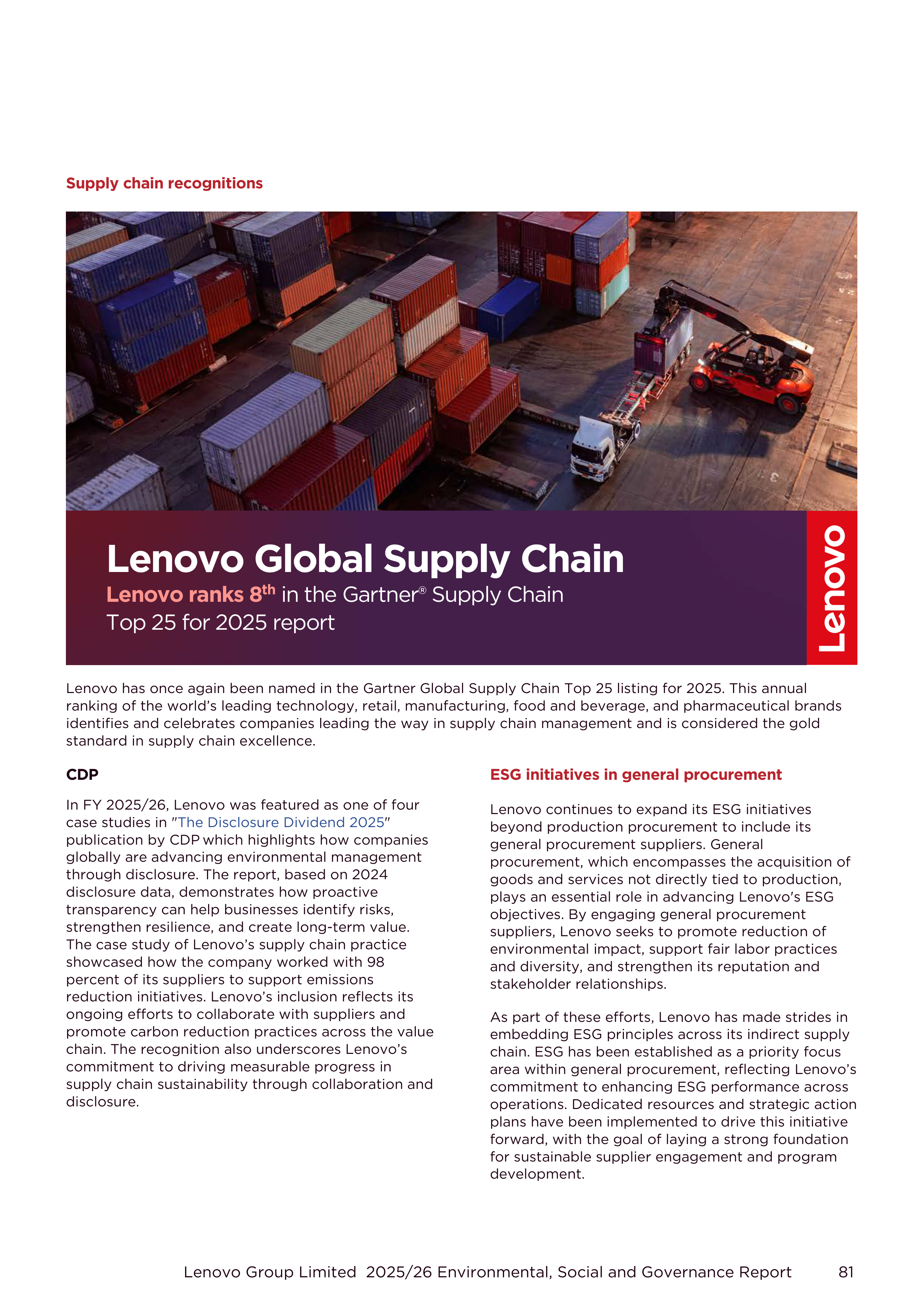

Supply chain recognitions
Lenovo has once again been named in the Gartner Global Supply Chain Top 25 listing for 2025. This annual
ranking of the world’s leading technology, retail, manufacturing, food and beverage, and pharmaceutical brands
identifies and celebrates companies leading the way in supply chain management and is considered the gold
standard in supply chain excellence.
CDP
In FY 2025/26, Lenovo was featured as one of four
case studies in "
The Disclosure Dividend 2025
"
publication by CDP
which highlights how companies
globally are advancing environmental management
through disclosure. The report, based on 2024
disclosure data, demonstrates how proactive
transparency can help businesses identify risks,
strengthen resilience, and create long-term value.
The case study of Lenovo’s supply chain practice
showcased how the company worked with 98
percent of its suppliers to support emissions
reduction initiatives. Lenovo’s inclusion reflects its
ongoing efforts to collaborate with suppliers and
promote carbon reduction practices across the value
chain. The recognition also underscores Lenovo’s
commitment to driving measurable progress in
supply chain sustainability through collaboration and
disclosure.
ESG initiatives in general procurement
Lenovo continues to expand its ESG initiatives
beyond production procurement to include its
general procurement suppliers. General
procurement, which encompasses the acquisition of
goods and services not directly tied to production,
plays an essential role in advancing Lenovo's ESG
objectives. By engaging general procurement
suppliers, Lenovo seeks to promote reduction of
environmental impact, support fair labor practices
and diversity, and strengthen its reputation and
stakeholder relationships.
As part of these efforts, Lenovo has made strides in
embedding ESG principles across its indirect supply
chain. ESG has been established as a priority focus
area within general procurement, reflecting Lenovo’s
commitment to enhancing ESG performance across
operations. Dedicated resources and strategic action
plans have been implemented to drive this initiative
forward, with the goal of laying a strong foundation
for sustainable supplier engagement and program
development.
Lenovo Group Limited 2025/26 Environmental, Social and Governance Report
81
Lenovo Global Supply Chain
Lenovo ranks 8
th
in the Gartner® Supply Chain
Top 25 for 2025 report
Assessment
•
The General Procurement team (GP team)
identifies significant and high-risk suppliers
through a robust risk mapping and monitoring
tool. Identified suppliers are invited to a fuller
assessment of supplier ESG performance. The
GP team uses recognized platforms like
EcoVadis and RBA to provide a standardized
framework for measuring supplier ESG efforts.
•
The GP team also integrates ESG-focused
validation steps into the supplier onboarding
processes and the Lenovo Top Supplier
Program (LTSP) to ensure alignment between
new suppliers and General Procurement’s most
strategic partners with Lenovo’s sustainability
goals. This tailor-made solution gathers ESG-
related information in addition to those
captured by EcoVadis.
Evaluation and recognition
•
The LTSP recognizes and rewards suppliers
demonstrating strong alignment with Lenovo’s
supply chain priorities and ESG commitments.
This program provides suppliers an avenue to
differentiate themselves and achieve stronger
visibility within Lenovo's organizations and
business executives.
•
Supplier performance is evaluated through a
holistic approach combining quantitative
measures, such as EcoVadis ratings, with
qualitative insights from onboarding processes,
Supplier Performance Evaluation (SPE) and
LTSP participation. This enables Lenovo to
identify areas for improvement, highlight top
performers, build supplier community among
suppliers at different stages of their ESG
journey, and drive continuous improvement in
ESG practices.
Engagement and training
•
Communication with internal stakeholders
regarding ESG priorities has been significantly
enhanced. Training sessions are conducted to
equip procurement staff with the necessary
tools and knowledge, supported by a network
of ESG ambassadors embedded within various
sourcing categories and regions.
•
Lenovo shares its ESG vision and expectations
externally with suppliers while providing
educational resources to suppliers to encourage
awareness of related topics and improvement in
sustainability performance.
Lenovo strives to enhance its ESG performance and
deliver value to all its stakeholders, including its
general procurement suppliers. By collaborating
with these suppliers, Lenovo aims to realize its ESG
aspiration of leading the way in responsibility and
sustainability while fostering mutually beneficial
relationships with its suppliers.
ESG initiatives with logistics suppliers
Lenovo integrates social and governance principles
into logistics operations with the aim to mitigate
ESG-related risks. In FY 2025/26, Lenovo expanded
engagement with logistics suppliers to include social
and governance considerations and implemented a
holistic sustainability scorecard. This scorecard
measures key suppliers’ performance on human
rights, employee health and safety, environmental
impact, and other sustainability factors. This
mechanism helps enhance accountability and
transparency across Lenovo’s logistics network and
optimize the resilience of logistics operations.
Supplier inclusion
Lenovo’s supplier inclusion efforts aim to improve
product innovation while boosting local economies.
Lenovo is proud to continue its partnerships with
several NGOs such as the National Minority Supplier
Development Council (NMSDC), Disability:IN,
National LGBT Chamber of Commerce, and the
Women’s Business Enterprise Networking Council
(WBENC). By sourcing from a variety of
underrepresented suppliers, Lenovo is able to find
the best products at the best price, which can
ultimately lead to improved revenue. In FY 2025/26,
Lenovo spent hundreds of millions on small and
underrepresented suppliers in the US, representing
over 20 percent of its total expenditure in the US,
with a percentage going to woman-owned and
ethnically-underrepresented businesses.
As Lenovo moves forward, its success not only lies
within workforce diversity but also in the inclusion of
diverse suppliers that provide competitive
advantages, increased innovation, and revenue that
can support its brand reputation. Visit
Lenovo's
website
for more information.
82
Lenovo Group Limited 2025/26 Environmental, Social and Governance Report

7.0
Consolidated
metrics
85
FY 2025/26 consolidated metrics



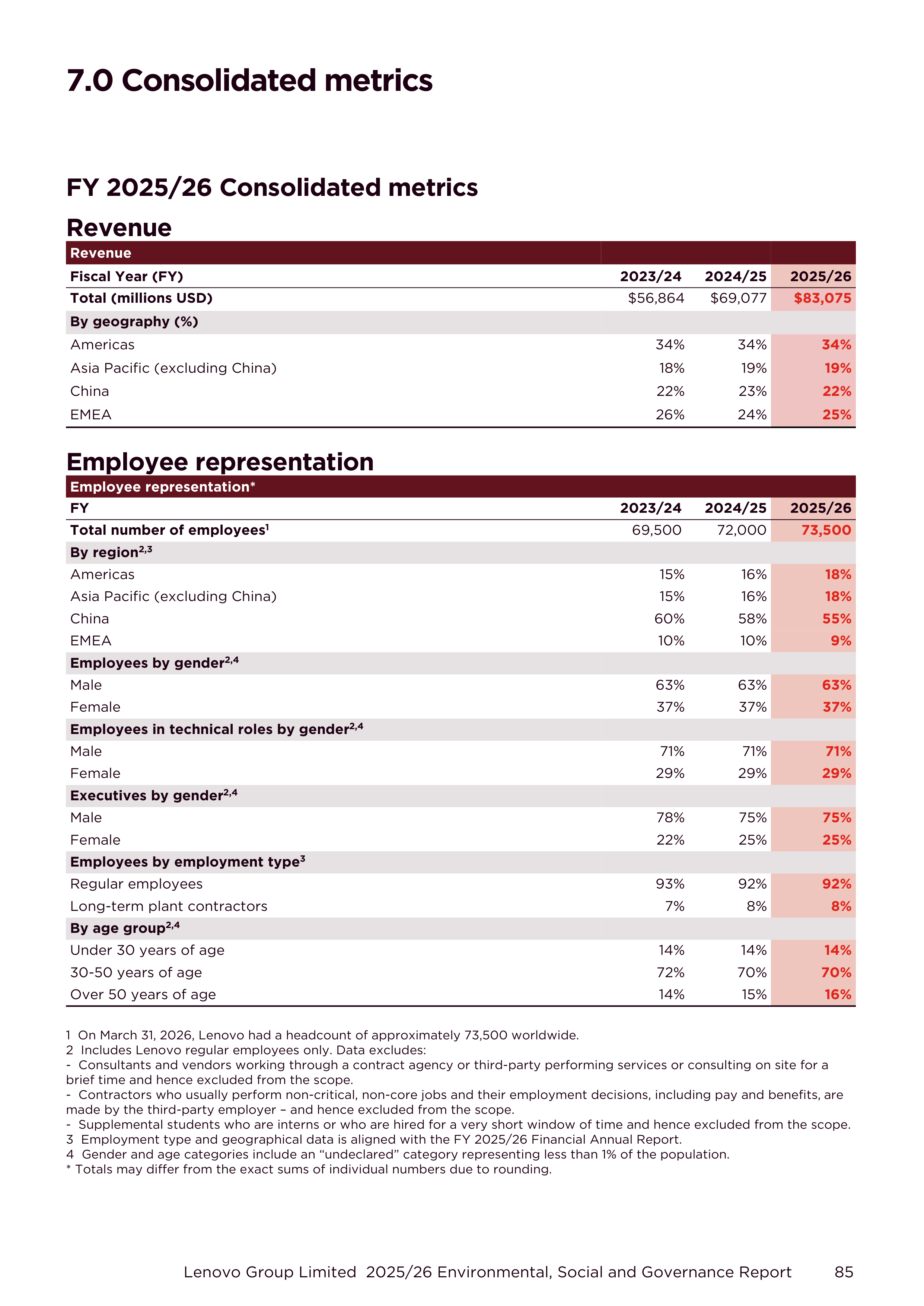
FY 2025/26 Consolidated metrics
Revenue
Revenue
Fiscal Year (FY)
2023/24
2024/25
2025/26
Total (millions USD)
$56,864
$69,077
$83,075
By geography (%)
Americas
34%
34%
34%
Asia Pacific (excluding China)
18%
19%
19%
China
22%
23%
22%
EMEA
26%
24%
25%
Employee representation
Employee representation*
FY
2023/24
2024/25
2025/26
Total number of employees
1
69,500
72,000
73,500
By region
2,3
Americas
15%
16%
18%
Asia Pacific (excluding China)
15%
16%
18%
China
60%
58%
55%
EMEA
10%
10%
9%
Employees by gender
2,4
Male
63%
63%
63%
Female
37%
37%
37%
Employees in technical roles by gender
2,4
Male
71%
71%
71%
Female
29%
29%
29%
Executives by gender
2,4
Male
78%
75%
75%
Female
22%
25%
25%
Employees by employment type
3
Regular employees
93%
92%
92%
Long-term plant contractors
7%
8%
8%
By age group
2,4
Under 30 years of age
14%
14%
14%
30-50 years of age
72%
70%
70%
Over 50 years of age
14%
15%
16%
1 On March 31, 2026, Lenovo had a headcount of approximately 73,500 worldwide.
2 Includes Lenovo regular employees only. Data excludes:
- Consultants and vendors working through a contract agency or third-party performing services or consulting on site for a
brief time and hence excluded from the scope.
- Contractors who usually perform non-critical, non-core jobs and their employment decisions, including pay and benefits, are
made by the third-party employer – and hence excluded from the scope.
- Supplemental students who are interns or who are hired for a very short window of time and hence excluded from the scope.
3 Employment type and geographical data is aligned with the FY 2025/26 Financial Annual Report.
4 Gender and age categories include an “undeclared” category representing less than 1% of the population.
* Totals may differ from the exact sums of individual numbers due to rounding.
7.0 Consolidated metrics
Lenovo Group Limited 2025/26 Environmental, Social and Governance Report
85
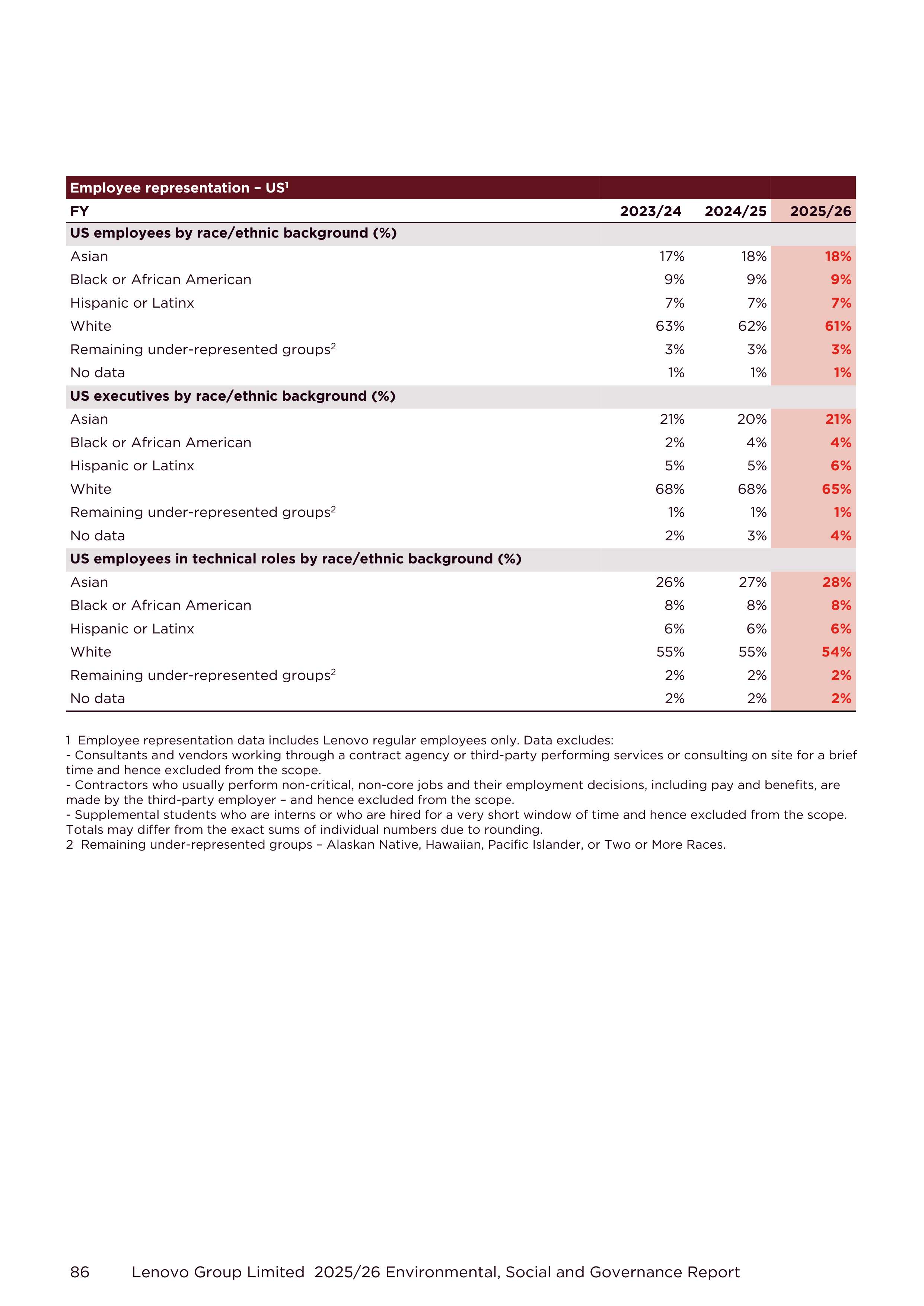
Employee representation – US
1
FY
2023/24
2024/25
2025/26
US employees by race/ethnic background (%)
Asian
17%
18%
18%
Black or African American
9%
9%
9%
Hispanic or Latinx
7%
7%
7%
White
63%
62%
61%
Remaining under-represented groups
2
3%
3%
3%
No data
1%
1%
1%
US executives by race/ethnic background (%)
Asian
21%
20%
21%
Black or African American
2%
4%
4%
Hispanic or Latinx
5%
5%
6%
White
68%
68%
65%
Remaining under-represented groups
2
1%
1%
1%
No data
2%
3%
4%
US employees in technical roles by race/ethnic background (%)
Asian
26%
27%
28%
Black or African American
8%
8%
8%
Hispanic or Latinx
6%
6%
6%
White
55%
55%
54%
Remaining under-represented groups
2
2%
2%
2%
No data
2%
2%
2%
1 Employee representation data includes Lenovo regular employees only. Data excludes:
- Consultants and vendors working through a contract agency or third-party performing services or consulting on site for a brief
time and hence excluded from the scope.
- Contractors who usually perform non-critical, non-core jobs and their employment decisions, including pay and benefits, are
made by the third-party employer – and hence excluded from the scope.
- Supplemental students who are interns or who are hired for a very short window of time and hence excluded from the scope.
Totals may differ from the exact sums of individual numbers due to rounding.
2 Remaining under-represented groups – Alaskan Native, Hawaiian, Pacific Islander, or Two or More Races.
86
Lenovo Group Limited 2025/26 Environmental, Social and Governance Report
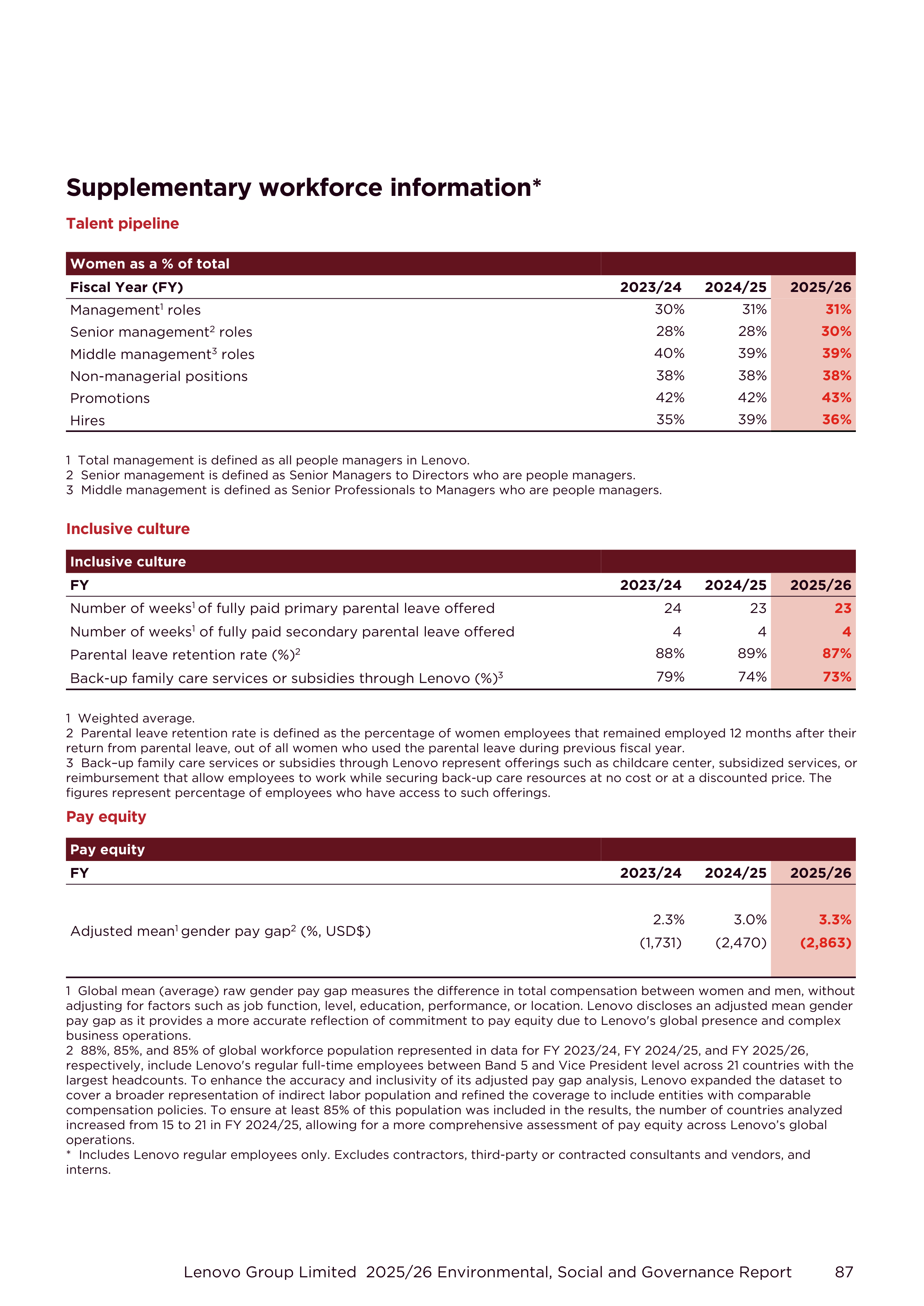
Supplementary workforce information*
Talent pipeline
Women as a % of total
Fiscal Year (FY)
2023/24
2024/25
2025/26
Management
1
roles
30%
31%
31%
Senior management
2
roles
28%
28%
30%
Middle management
3
roles
40%
39%
39%
Non-managerial positions
38%
38%
38%
Promotions
42%
42%
43%
Hires
35%
39%
36%
1 Total management is defined as all people managers in Lenovo.
2 Senior management is defined as Senior Managers to Directors who are people managers.
3 Middle management is defined as Senior Professionals to Managers who are people managers.
Inclusive culture
Inclusive culture
FY
2023/24
2024/25
2025/26
Number of weeks
1
of fully paid primary parental leave offered
24
23
23
Number of weeks
1
of fully paid secondary parental leave offered
4
4
4
Parental leave retention rate (%)
2
88%
89%
87%
Back-up family care services or subsidies through Lenovo (%)
3
79%
74%
73%
1 Weighted average.
2 Parental leave retention rate is defined as the percentage of women employees that remained employed 12 months after their
return from parental leave, out of all women who used the parental leave during previous fiscal year.
3 Back–up family care services or subsidies through Lenovo represent offerings such as childcare center, subsidized services, or
reimbursement that allow employees to work while securing back-up care resources at no cost or at a discounted price. The
figures represent percentage of employees who have access to such offerings.
Pay equity
Pay equity
FY
2023/24
2024/25
2025/26
Adjusted mean
1
gender pay gap
2
(%, USD$)
2.3%
3.0%
3.3%
(1,731)
(2,470)
(2,863)
1 Global mean (average) raw gender pay gap measures the difference in total compensation between women and men, without
adjusting for factors such as job function, level, education, performance, or location. Lenovo discloses an adjusted mean gender
pay gap as it provides a more accurate reflection of commitment to pay equity due to Lenovo's global presence and complex
business operations.
2 88%, 85%, and 85% of global workforce population represented in data for FY 2023/24, FY 2024/25, and FY 2025/26,
respectively, include Lenovo's regular full-time employees between Band 5 and Vice President level across 21 countries with the
largest headcounts. To enhance the accuracy and inclusivity of its adjusted pay gap analysis, Lenovo expanded the dataset to
cover a broader representation of indirect labor population and refined the coverage to include entities with comparable
compensation policies. To ensure at least 85% of this population was included in the results, the number of countries analyzed
increased from 15 to 21 in FY 2024/25, allowing for a more comprehensive assessment of pay equity across Lenovo’s global
operations.
*
Includes Lenovo regular employees only. Excludes contractors, third-party or contracted consultants and vendors, and
interns.
Lenovo Group Limited 2025/26 Environmental, Social and Governance Report
87
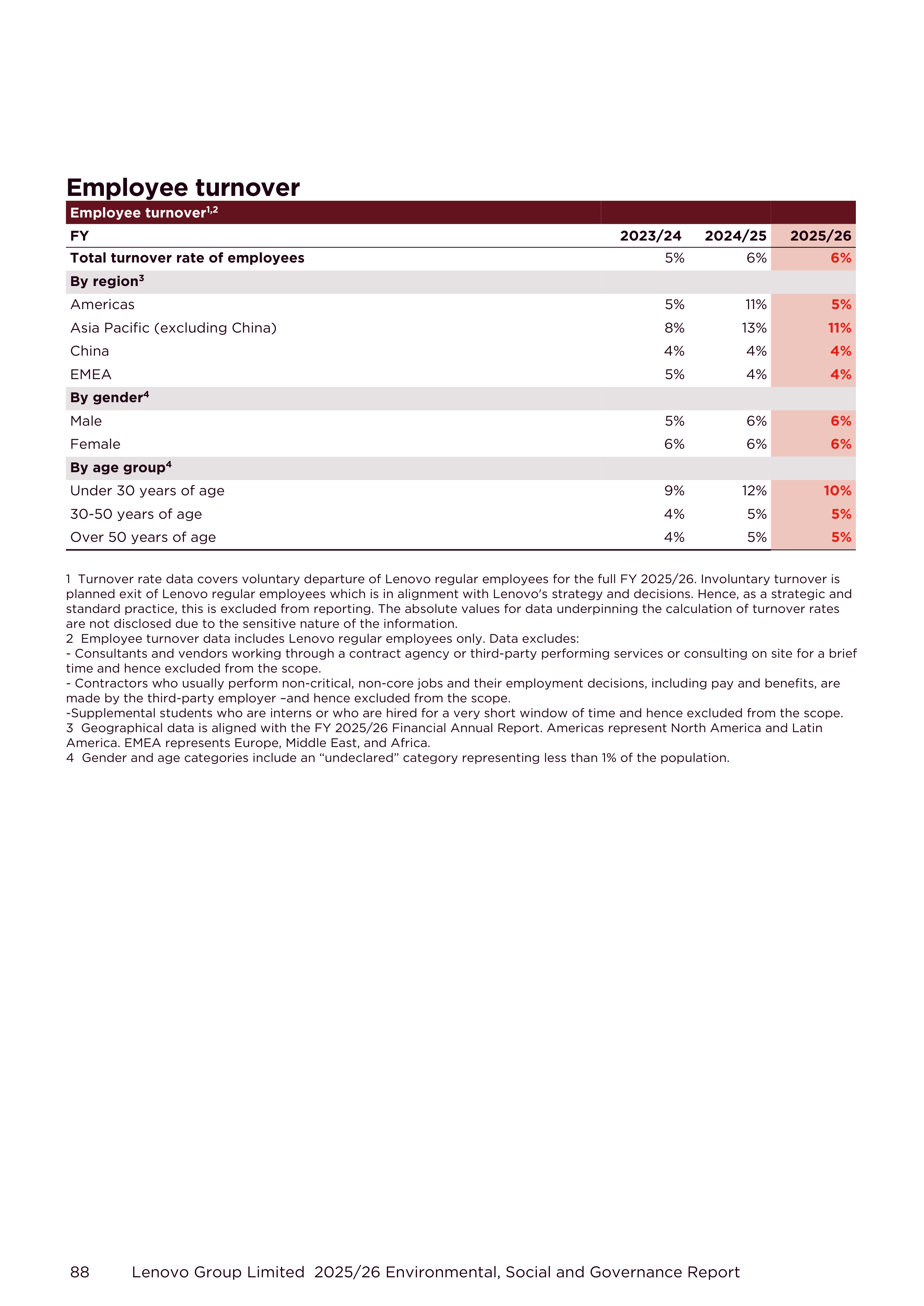
Employee turnover
Employee turnover
1,2
FY
2023/24
2024/25
2025/26
Total turnover rate of employees
5%
6%
6%
By region
3
Americas
5%
11%
5%
Asia Pacific (excluding China)
8%
13%
11%
China
4%
4%
4%
EMEA
5%
4%
4%
By gender
4
Male
5%
6%
6%
Female
6%
6%
6%
By age group
4
Under 30 years of age
9%
12%
10%
30-50 years of age
4%
5%
5%
Over 50 years of age
4%
5%
5%
1 Turnover rate data covers voluntary departure of Lenovo regular employees for the full FY 2025/26. Involuntary turnover is
planned exit of Lenovo regular employees which is in alignment with Lenovo's strategy and decisions. Hence, as a strategic and
standard practice, this is excluded from reporting. The absolute values for data underpinning the calculation of turnover rates
are not disclosed due to the sensitive nature of the information.
2 Employee turnover data includes Lenovo regular employees only. Data excludes:
- Consultants and vendors working through a contract agency or third-party performing services or consulting on site for a brief
time and hence excluded from the scope.
- Contractors who usually perform non-critical, non-core jobs and their employment decisions, including pay and benefits, are
made by the third-party employer –and hence excluded from the scope.
-Supplemental students who are interns or who are hired for a very short window of time and hence excluded from the scope.
3 Geographical data is aligned with the FY 2025/26 Financial Annual Report. Americas represent North America and Latin
America. EMEA represents Europe, Middle East, and Africa.
4 Gender and age categories include an “undeclared” category representing less than 1% of the population.
88
Lenovo Group Limited 2025/26 Environmental, Social and Governance Report
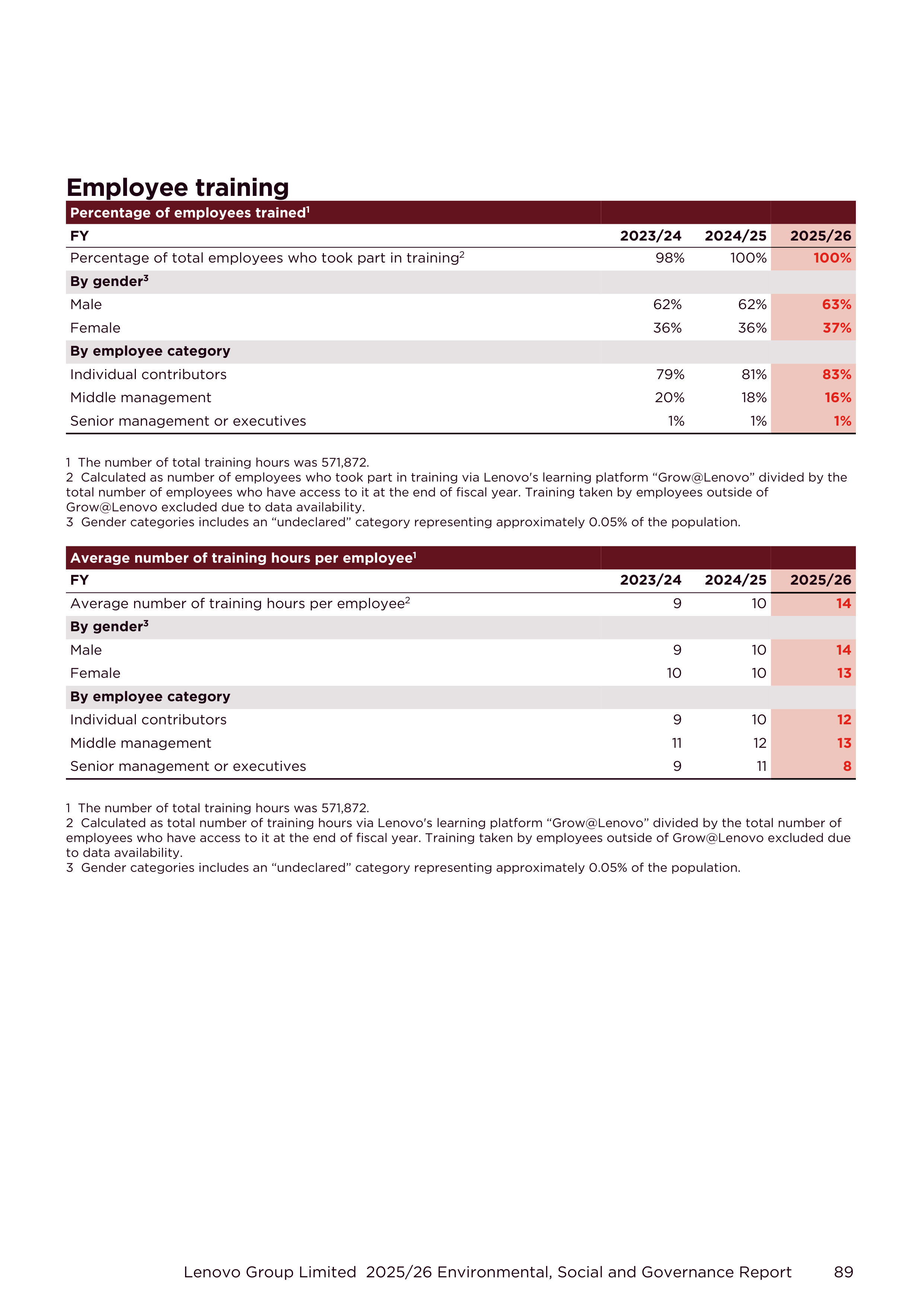
Employee training
Percentage of employees trained
1
FY
2023/24
2024/25
2025/26
Percentage of total employees who took part in training
2
98%
100%
100%
By gender
3
Male
62%
62%
63%
Female
36%
36%
37%
By employee category
Individual contributors
79%
81%
83%
Middle management
20%
18%
16%
Senior management or executives
1%
1%
1%
1 The number of total training hours was 571,872.
2 Calculated as number of employees who took part in training via Lenovo's learning platform “Grow@Lenovo” divided by the
total number of employees who have access to it at the end of fiscal year. Training taken by employees outside of
Grow@Lenovo excluded due to data availability.
3 Gender categories includes an “undeclared” category representing approximately 0.05% of the population.
Average number of training hours per employee
1
FY
2023/24
2024/25
2025/26
Average number of training hours per employee
2
9
10
14
By gender
3
Male
9
10
14
Female
10
10
13
By employee category
Individual contributors
9
10
12
Middle management
11
12
13
Senior management or executives
9
11
8
1 The number of total training hours was 571,872.
2 Calculated as total number of training hours via Lenovo's learning platform “Grow@Lenovo” divided by the total number of
employees who have access to it at the end of fiscal year. Training taken by employees outside of Grow@Lenovo excluded due
to data availability.
3 Gender categories includes an “undeclared” category representing approximately 0.05% of the population.
Lenovo Group Limited 2025/26 Environmental, Social and Governance Report
89
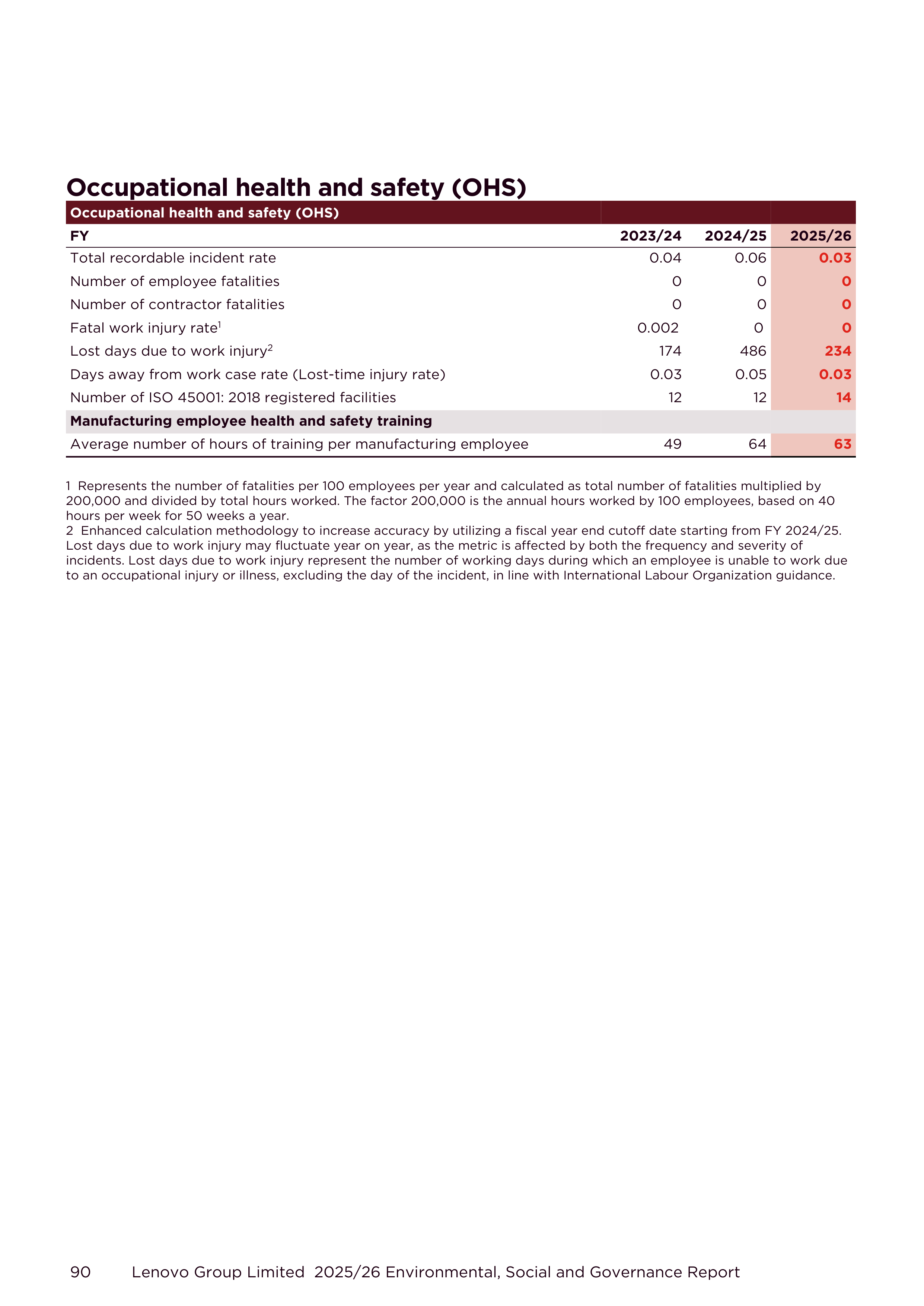
Occupational health and safety (OHS)
Occupational health and safety (OHS)
FY
2023/24
2024/25
2025/26
Total recordable incident rate
0.04
0.06
0.03
Number of employee fatalities
0
0
0
Number of contractor fatalities
0
0
0
Fatal work injury rate
1
0.002
0
0
Lost days due to work injury
2
174
486
234
Days away from work case rate (Lost-time injury rate)
0.03
0.05
0.03
Number of ISO 45001: 2018 registered facilities
12
12
14
Manufacturing employee health and safety training
Average number of hours of training per manufacturing employee
49
64
63
1 Represents the number of fatalities per 100 employees per year and calculated as total number of fatalities multiplied by
200,000 and divided by total hours worked. The factor 200,000 is the annual hours worked by 100 employees, based on 40
hours per week for 50 weeks a year.
2 Enhanced calculation methodology to increase accuracy by utilizing a fiscal year end cutoff date starting from FY 2024/25.
Lost days due to work injury may fluctuate year on year, as the metric is affected by both the frequency and severity of
incidents. Lost days due to work injury represent the number of working days during which an employee is unable to work due
to an occupational injury or illness, excluding the day of the incident, in line with International Labour Organization guidance.
90
Lenovo Group Limited 2025/26 Environmental, Social and Governance Report
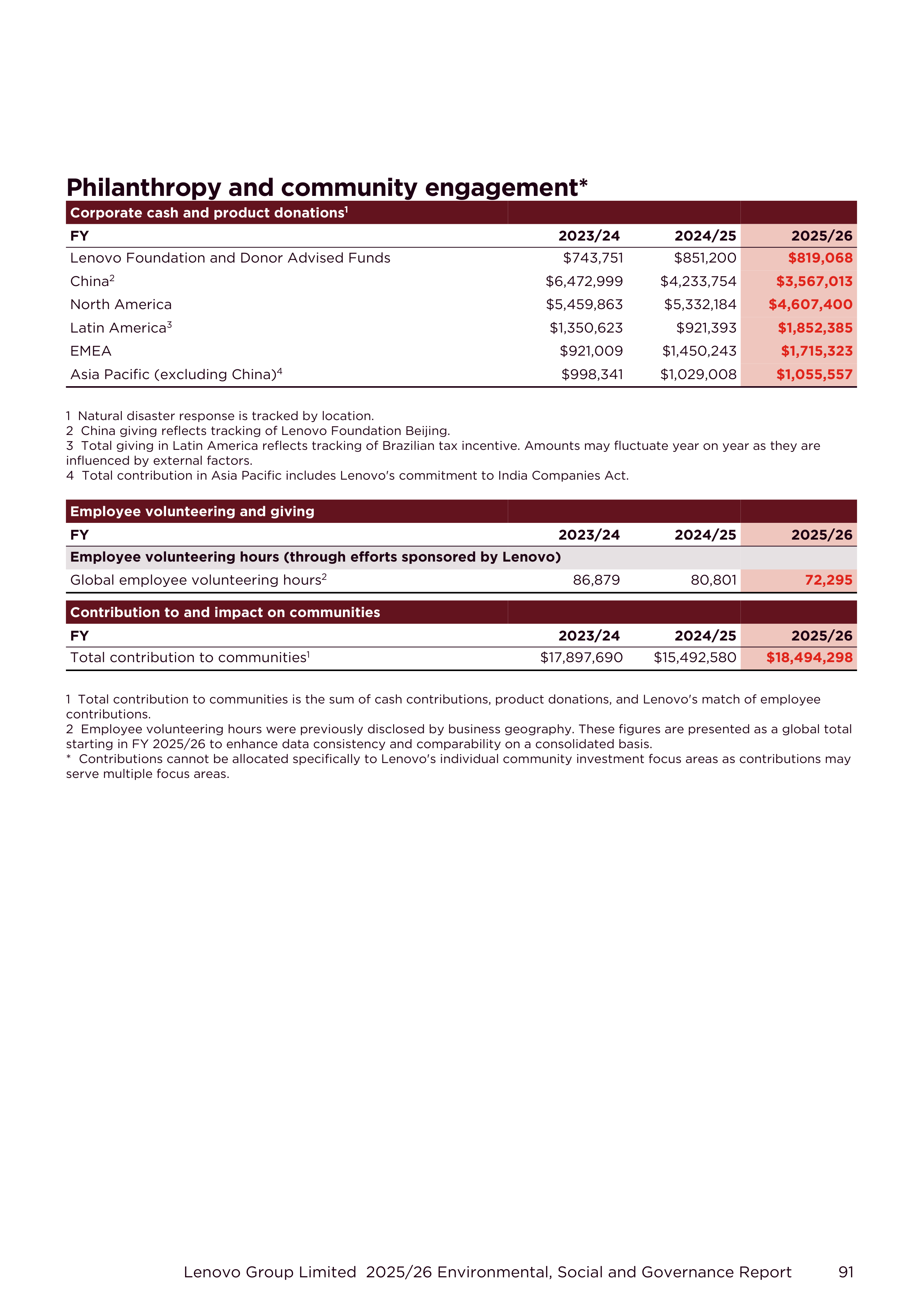
Philanthropy and community engagement*
Corporate cash and product donations
1
FY
2023/24
2024/25
2025/26
Lenovo Foundation and Donor Advised Funds
$743,751
$851,200
$819,068
China
2
$6,472,999
$4,233,754
$3,567,013
North America
$5,459,863
$5,332,184
$4,607,400
Latin America
3
$1,350,623
$921,393
$1,852,385
EMEA
$921,009
$1,450,243
$1,715,323
Asia Pacific (excluding China)
4
$998,341
$1,029,008
$1,055,557
1 Natural disaster response is tracked by location.
2 China giving reflects tracking of Lenovo Foundation Beijing.
3 Total giving in Latin America reflects tracking of Brazilian tax incentive. Amounts may fluctuate year on year as they are
influenced by external factors.
4 Total contribution in Asia Pacific includes Lenovo's commitment to India Companies Act.
Employee volunteering and giving
FY
2023/24
2024/25
2025/26
Employee volunteering hours (through efforts sponsored by Lenovo)
Global employee volunteering hours
2
86,879
80,801
72,295
Contribution to and impact on communities
FY
2023/24
2024/25
2025/26
Total contribution to communities
1
$17,897,690
$15,492,580
$18,494,298
1 Total contribution to communities is the sum of cash contributions, product donations, and Lenovo's match of employee
contributions.
2 Employee volunteering hours were previously disclosed by business geography. These figures are presented as a global total
starting in FY 2025/26 to enhance data consistency and comparability on a consolidated basis.
* Contributions cannot be allocated specifically to Lenovo's individual community investment focus areas as contributions may
serve multiple focus areas.
Lenovo Group Limited 2025/26 Environmental, Social and Governance Report
91
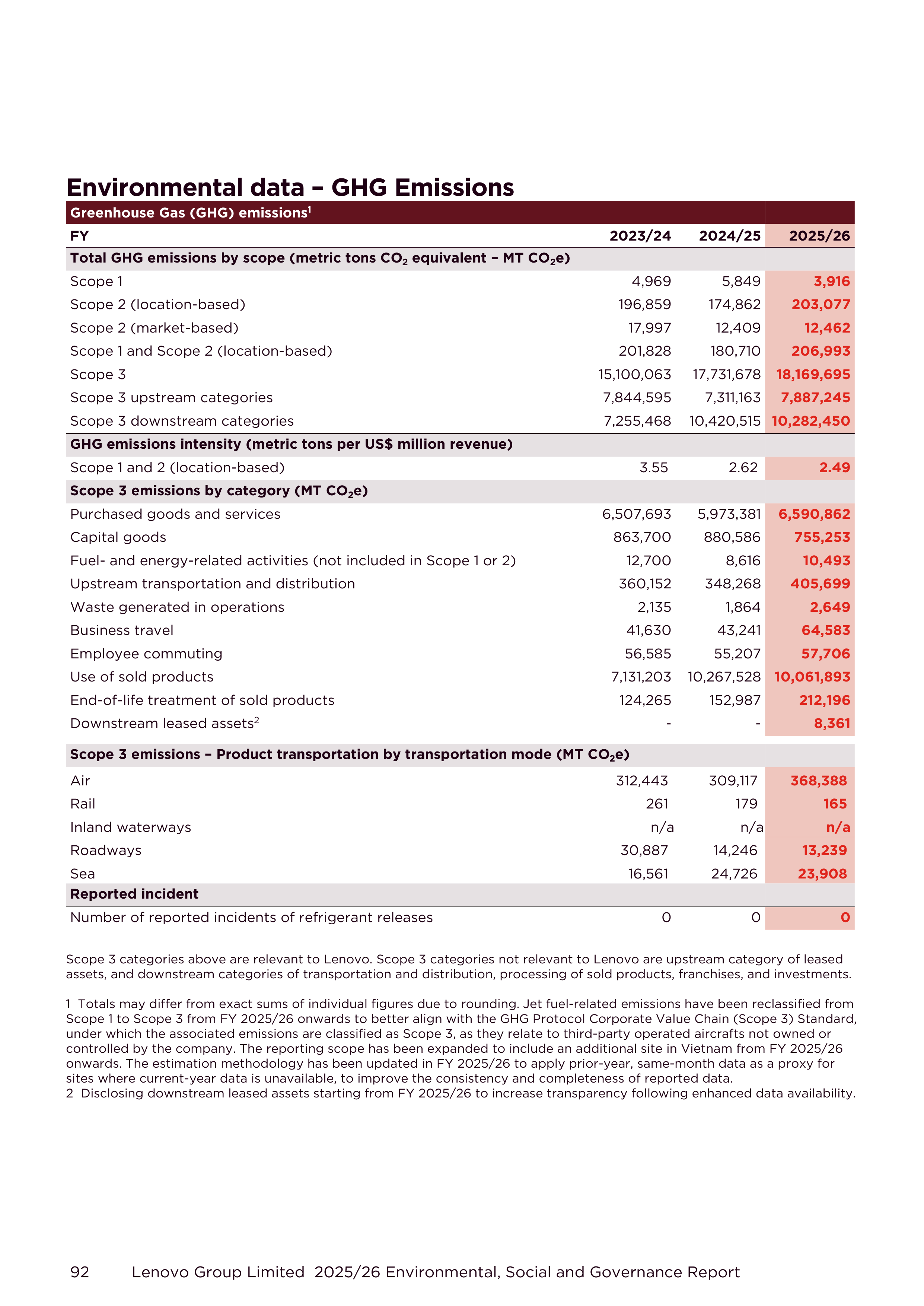
Environmental data – GHG Emissions
Greenhouse Gas (GHG) emissions
1
FY
2023/24
2024/25
2025/26
Total GHG emissions by scope (metric tons CO
2
equivalent – MT CO
2
e)
Scope 1
4,969
5,849
3,916
Scope 2 (location-based)
196,859
174,862
203,077
Scope 2 (market-based)
17,997
12,409
12,462
Scope 1 and Scope 2 (location-based)
201,828
180,710
206,993
Scope 3
15,100,063
17,731,678
18,169,695
Scope 3 upstream categories
7,844,595
7,311,163
7,887,245
Scope 3 downstream categories
7,255,468
10,420,515
10,282,450
GHG emissions intensity (metric tons per US$ million revenue)
Scope 1 and 2 (location-based)
3.55
2.62
2.49
Scope 3 emissions by category (MT CO
2
e)
Purchased goods and services
6,507,693
5,973,381
6,590,862
Capital goods
863,700
880,586
755,253
Fuel- and energy-related activities (not included in Scope 1 or 2)
12,700
8,616
10,493
Upstream transportation and distribution
360,152
348,268
405,699
Waste generated in operations
2,135
1,864
2,649
Business travel
41,630
43,241
64,583
Employee commuting
56,585
55,207
57,706
Use of sold products
7,131,203
10,267,528
10,061,893
End-of-life treatment of sold products
124,265
152,987
212,196
Downstream leased assets
2
-
-
8,361
Scope 3 emissions – Product transportation by transportation mode (MT CO
2
e)
Air
312,443
309,117
368,388
Rail
261
179
165
Inland waterways
n/a
n/a
n/a
Roadways
30,887
14,246
13,239
Sea
16,561
24,726
23,908
Reported incident
Number of reported incidents of refrigerant releases
0
0
0
Scope 3 categories above are relevant to Lenovo. Scope 3 categories not relevant to Lenovo are upstream category of leased
assets, and downstream categories of transportation and distribution, processing of sold products, franchises, and investments.
1 Totals may differ from exact sums of individual figures due to rounding. Jet fuel-related emissions have been reclassified from
Scope 1 to Scope 3 from FY 2025/26 onwards to better align with the GHG Protocol Corporate Value Chain (Scope 3) Standard,
under which the associated emissions are classified as Scope 3, as they relate to third-party operated aircrafts not owned or
controlled by the company. The reporting scope has been expanded to include an additional site in Vietnam from FY 2025/26
onwards. The estimation methodology has been updated in FY 2025/26 to apply prior-year, same-month data as a proxy for
sites where current-year data is unavailable, to improve the consistency and completeness of reported data.
2 Disclosing downstream leased assets starting from FY 2025/26 to increase transparency following enhanced data availability.
92
Lenovo Group Limited 2025/26 Environmental, Social and Governance Report
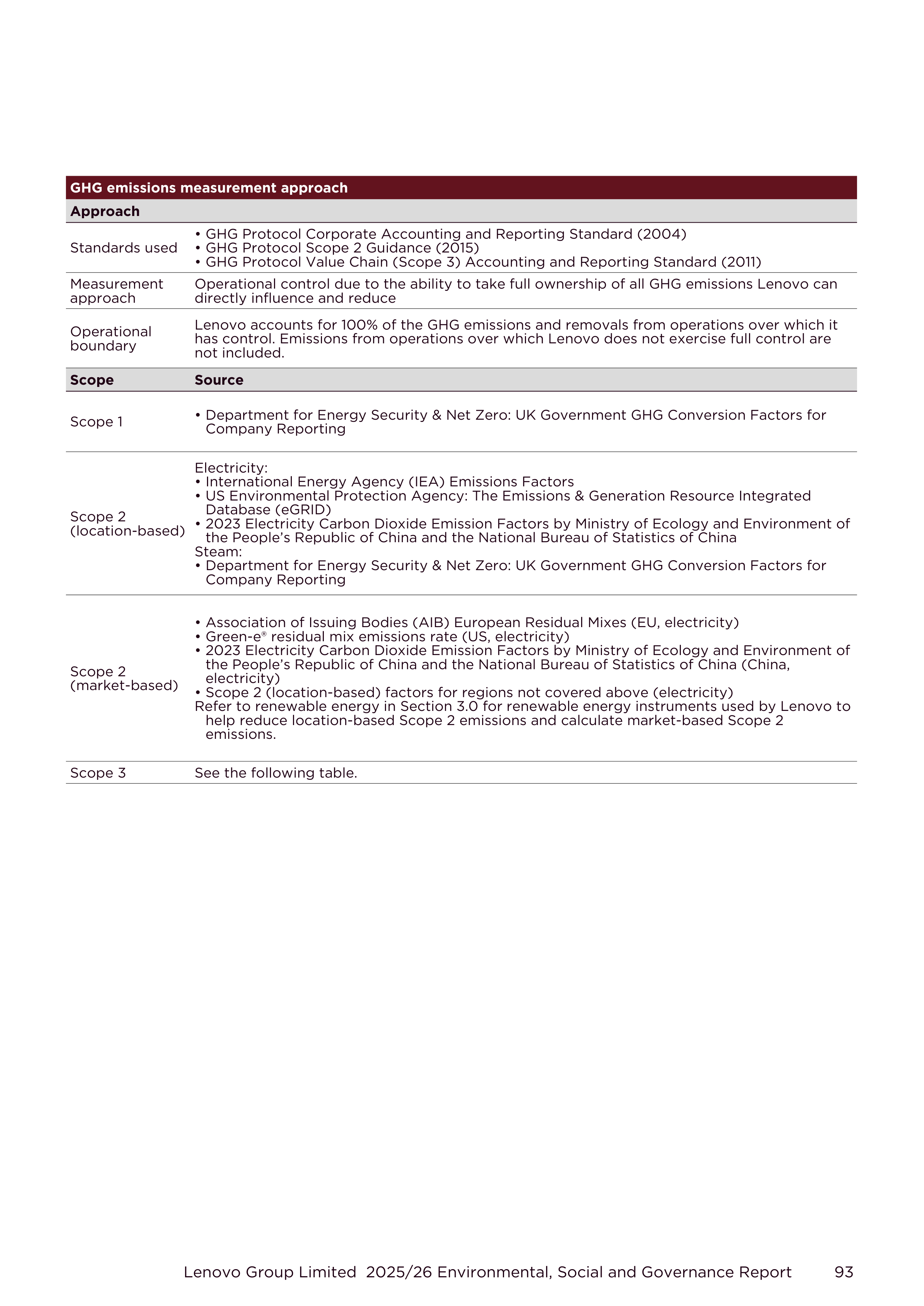
GHG emissions measurement approach
Approach
Standards used
•
GHG Protocol Corporate Accounting and Reporting Standard (2004)
•
GHG Protocol Scope 2 Guidance (2015)
•
GHG Protocol Value Chain (Scope 3) Accounting and Reporting Standard (2011)
Measurement
approach
Operational control due to the ability to take full ownership of all GHG emissions Lenovo can
directly influence and reduce
Operational
boundary
Lenovo accounts for 100% of the GHG emissions and removals from operations over which it
has control. Emissions from operations over which Lenovo does not exercise full control are
not included.
Scope
Source
Scope 1
•
Department for Energy Security & Net Zero: UK Government GHG Conversion Factors for
Company Reporting
Scope 2
(location-based)
Electricity:
•
International Energy Agency (IEA) Emissions Factors
•
US Environmental Protection Agency: The Emissions & Generation Resource Integrated
Database (eGRID)
•
2023 Electricity Carbon Dioxide Emission Factors by Ministry of Ecology and Environment of
the People’s Republic of China and the National Bureau of Statistics of China
Steam:
•
Department for Energy Security & Net Zero: UK Government GHG Conversion Factors for
Company Reporting
Scope 2
(market-based)
•
Association of Issuing Bodies (AIB) European Residual Mixes (EU, electricity)
•
Green-e® residual mix emissions rate (US, electricity)
•
2023 Electricity Carbon Dioxide Emission Factors by Ministry of Ecology and Environment of
the People’s Republic of China and the National Bureau of Statistics of China (China,
electricity)
•
Scope 2 (location-based) factors for regions not covered above (electricity)
Refer to renewable energy in Section 3.0 for renewable energy instruments used by Lenovo to
help reduce location-based Scope 2 emissions and calculate market-based Scope 2
emissions.
Scope 3
See the following table.
Lenovo Group Limited 2025/26 Environmental, Social and Governance Report
93
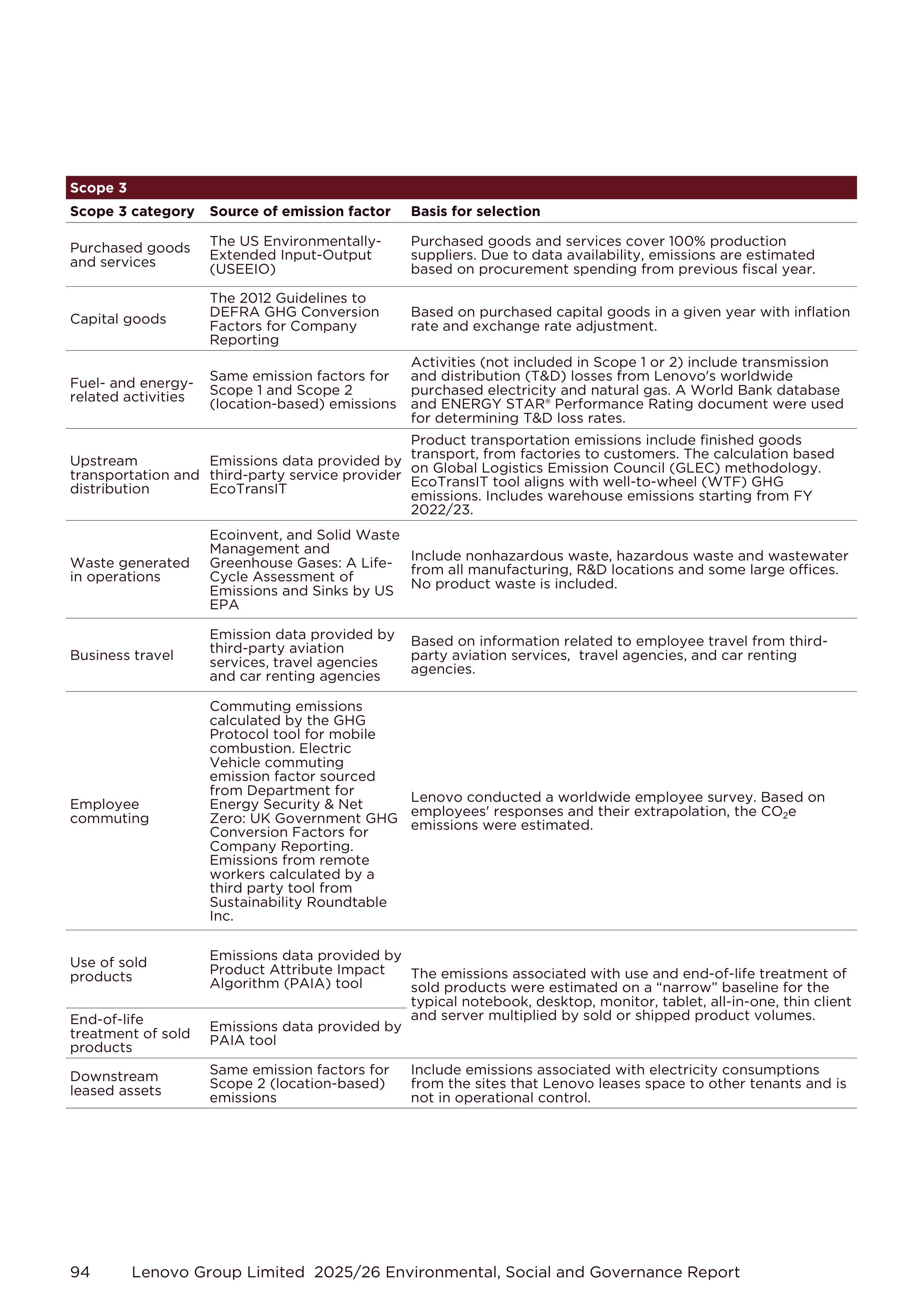
Scope 3
Scope 3 category
Source of emission factor
Basis for selection
Purchased goods
and services
The US Environmentally-
Extended Input-Output
(USEEIO)
Purchased goods and services cover 100% production
suppliers. Due to data availability, emissions are estimated
based on procurement spending from previous fiscal year.
Capital goods
The 2012 Guidelines to
DEFRA GHG Conversion
Factors for Company
Reporting
Based on purchased capital goods in a given year with inflation
rate and exchange rate adjustment.
Fuel- and energy-
related activities
Same emission factors for
Scope 1 and Scope 2
(location-based) emissions
Activities (not included in Scope 1 or 2) include transmission
and distribution (T&D) losses from Lenovo's worldwide
purchased electricity and natural gas. A World Bank database
and ENERGY STAR® Performance Rating document were used
for determining T&D loss rates.
Upstream
transportation and
distribution
Emissions data provided by
third-party service provider
EcoTransIT
Product transportation emissions include finished goods
transport, from factories to customers. The calculation based
on Global Logistics Emission Council (GLEC) methodology.
EcoTransIT tool aligns with well-to-wheel (WTF) GHG
emissions. Includes warehouse emissions starting from FY
2022/23.
Waste generated
in operations
Ecoinvent, and Solid Waste
Management and
Greenhouse Gases: A Life-
Cycle Assessment of
Emissions and Sinks by US
EPA
Include nonhazardous waste, hazardous waste and wastewater
from all manufacturing, R&D locations and some large offices.
No product waste is included.
Business travel
Emission data provided by
third-party aviation
services, travel agencies
and car renting agencies
Based on information related to employee travel from third-
party aviation services, travel agencies, and car renting
agencies.
Employee
commuting
Commuting emissions
calculated by the GHG
Protocol tool for mobile
combustion. Electric
Vehicle commuting
emission factor sourced
from Department for
Energy Security & Net
Zero: UK Government GHG
Conversion Factors for
Company Reporting.
Emissions from remote
workers calculated by a
third party tool from
Sustainability Roundtable
Inc.
Lenovo conducted a worldwide employee survey. Based on
employees' responses and their extrapolation, the CO
2
e
emissions were estimated.
Use of sold
products
Emissions data provided by
Product Attribute Impact
Algorithm (PAIA) tool
The emissions associated with use and end-of-life treatment of
sold products were estimated on a “narrow” baseline for the
typical notebook, desktop, monitor, tablet, all-in-one, thin client
and server multiplied by sold or shipped product volumes.
End-of-life
treatment of sold
products
Emissions data provided by
PAIA tool
Downstream
leased assets
Same emission factors for
Scope 2 (location-based)
emissions
Include emissions associated with electricity consumptions
from the sites that Lenovo leases space to other tenants and is
not in operational control.
94
Lenovo Group Limited 2025/26 Environmental, Social and Governance Report
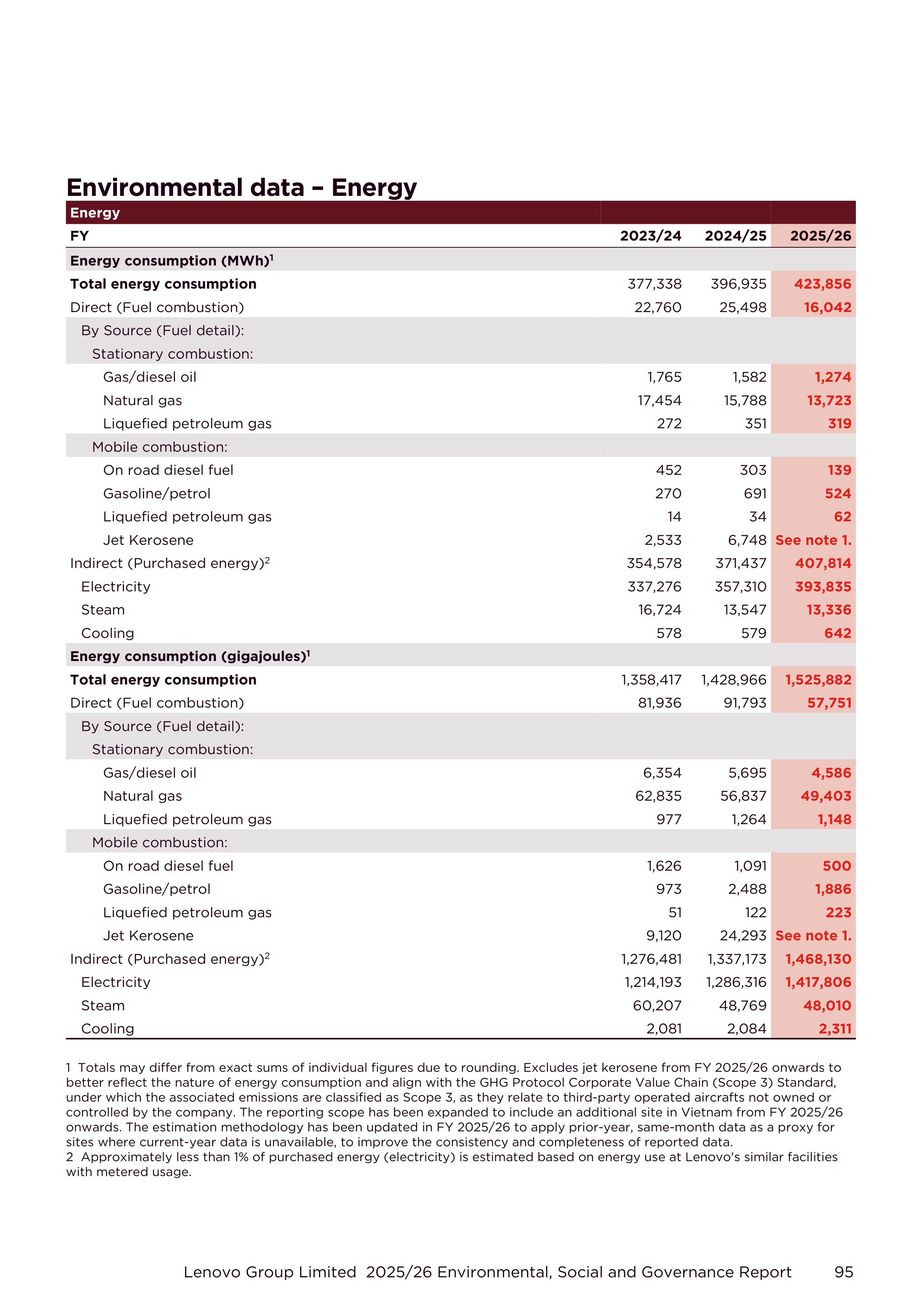
Environmental data – Energy
Energy
FY
2023/24
2024/25
2025/26
Energy consumption (MWh)
1
Total energy consumption
377,338
396,935
423,856
Direct (Fuel combustion)
22,760
25,498
16,042
By Source (Fuel detail):
Stationary combustion:
Gas/diesel oil
1,765
1,582
1,274
Natural gas
17,454
15,788
13,723
Liquefied petroleum gas
272
351
319
Mobile combustion:
On road diesel fuel
452
303
139
Gasoline/petrol
270
691
524
Liquefied petroleum gas
14
34
62
Jet Kerosene
2,533
6,748
See note 1.
Indirect (Purchased energy)
2
354,578
371,437
407,814
Electricity
337,276
357,310
393,835
Steam
16,724
13,547
13,336
Cooling
578
579
642
Energy consumption (gigajoules)
1
Total energy consumption
1,358,417
1,428,966
1,525,882
Direct (Fuel combustion)
81,936
91,793
57,751
By Source (Fuel detail):
Stationary combustion:
Gas/diesel oil
6,354
5,695
4,586
Natural gas
62,835
56,837
49,403
Liquefied petroleum gas
977
1,264
1,148
Mobile combustion:
On road diesel fuel
1,626
1,091
500
Gasoline/petrol
973
2,488
1,886
Liquefied petroleum gas
51
122
223
Jet Kerosene
9,120
24,293
See note 1.
Indirect (Purchased energy)
2
1,276,481
1,337,173
1,468,130
Electricity
1,214,193
1,286,316
1,417,806
Steam
60,207
48,769
48,010
Cooling
2,081
2,084
2,311
1 Totals may differ from exact sums of individual figures due to rounding. Excludes jet kerosene from FY 2025/26 onwards to
better reflect the nature of energy consumption and align with the GHG Protocol Corporate Value Chain (Scope 3) Standard,
under which the associated emissions are classified as Scope 3, as they relate to third-party operated aircrafts not owned or
controlled by the company. The reporting scope has been expanded to include an additional site in Vietnam from FY 2025/26
onwards. The estimation methodology has been updated in FY 2025/26 to apply prior-year, same-month data as a proxy for
sites where current-year data is unavailable, to improve the consistency and completeness of reported data.
2 Approximately less than 1% of purchased energy (electricity) is estimated based on energy use at Lenovo's similar facilities
with metered usage.
Lenovo Group Limited 2025/26 Environmental, Social and Governance Report
95
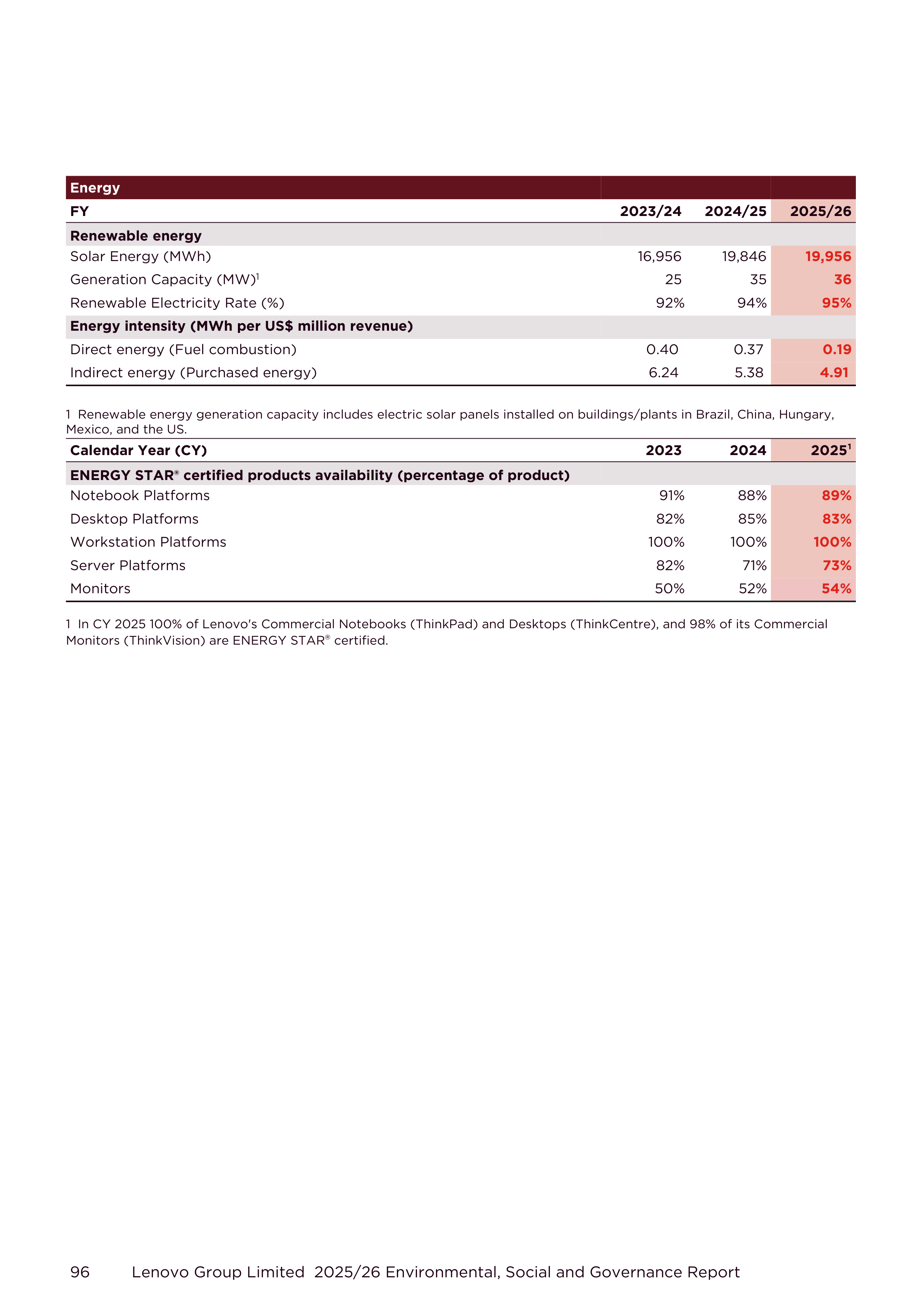
Energy
FY
2023/24
2024/25
2025/26
Renewable energy
Solar Energy (MWh)
16,956
19,846
19,956
Generation Capacity (MW)
1
25
35
36
Renewable Electricity Rate (%)
92%
94%
95%
Energy intensity (MWh per US$ million revenue)
Direct energy (Fuel combustion)
0.40
0.37
0.19
Indirect energy (Purchased energy)
6.24
5.38
4.91
1 Renewable energy generation capacity includes electric solar panels installed on buildings/plants in Brazil, China, Hungary,
Mexico, and the US.
Calendar Year (CY)
2023
2024
2025¹
ENERGY STAR® certified products availability (percentage of product)
Notebook Platforms
91%
88%
89%
Desktop Platforms
82%
85%
83%
Workstation Platforms
100%
100%
100%
Server Platforms
82%
71%
73%
Monitors
50%
52%
54%
1 In CY 2025 100% of Lenovo's Commercial Notebooks (ThinkPad) and Desktops (ThinkCentre), and 98% of its Commercial
Monitors (ThinkVision) are ENERGY STAR
®
certified.
96
Lenovo Group Limited 2025/26 Environmental, Social and Governance Report
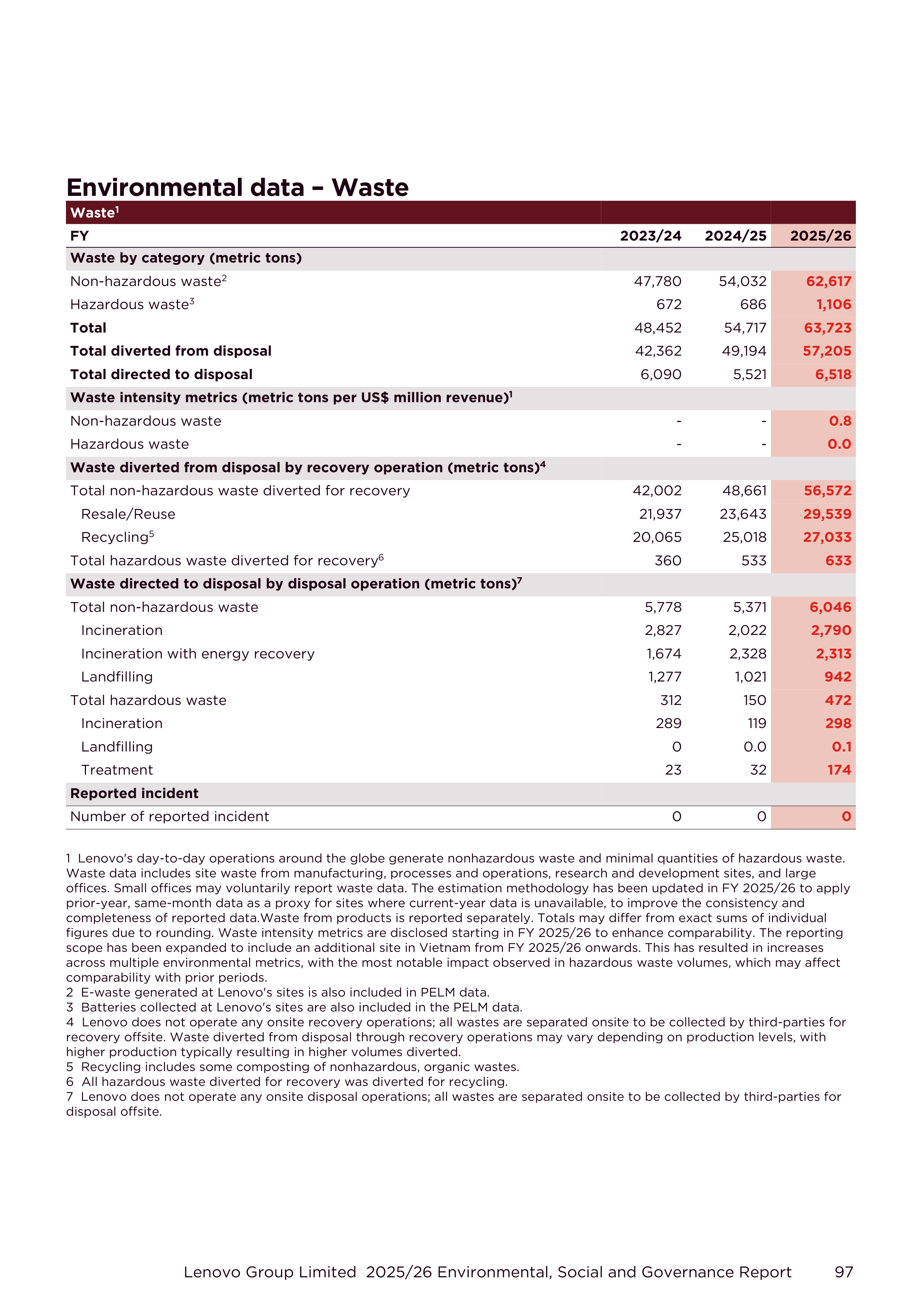
Environmental data – Waste
Waste
1
FY
2023/24
2024/25
2025/26
Waste by category (metric tons)
Non-hazardous waste
2
47,780
54,032
62,617
Hazardous waste
3
672
686
1,106
Total
48,452
54,717
63,723
Total diverted from disposal
42,362
49,194
57,205
Total directed to disposal
6,090
5,521
6,518
Waste intensity metrics (metric tons per US$ million revenue)
1
Non-hazardous waste
-
-
0.8
Hazardous waste
-
-
0.0
Waste diverted from disposal by recovery operation (metric tons)
4
Total non-hazardous waste diverted for recovery
42,002
48,661
56,572
Resale/Reuse
21,937
23,643
29,539
Recycling
5
20,065
25,018
27,033
Total hazardous waste diverted for recovery
6
360
533
633
Waste directed to disposal by disposal operation (metric tons)
7
Total non-hazardous waste
5,778
5,371
6,046
Incineration
2,827
2,022
2,790
Incineration with energy recovery
1,674
2,328
2,313
Landfilling
1,277
1,021
942
Total hazardous waste
312
150
472
Incineration
289
119
298
Landfilling
0
0.0
0.1
Treatment
23
32
174
Reported incident
Number of reported incident
0
0
0
1 Lenovo's day-to-day operations around the globe generate nonhazardous waste and minimal quantities of hazardous waste.
Waste data includes site waste from manufacturing, processes and operations, research and development sites, and large
offices. Small offices may voluntarily report waste data. The estimation methodology has been updated in FY 2025/26 to apply
prior-year, same-month data as a proxy for sites where current-year data is unavailable, to improve the consistency and
completeness of reported data.Waste from products is reported separately. Totals may differ from exact sums of individual
figures due to rounding. Waste intensity metrics are disclosed starting in FY 2025/26 to enhance comparability. The reporting
scope has been expanded to include an additional site in Vietnam from FY 2025/26 onwards. This has resulted in increases
across multiple environmental metrics, with the most notable impact observed in hazardous waste volumes, which may affect
comparability with prior periods.
2 E-waste generated at Lenovo's sites is also included in PELM data.
3 Batteries collected at Lenovo's sites are also included in the PELM data.
4 Lenovo does not operate any onsite recovery operations; all wastes are separated onsite to be collected by third-parties for
recovery offsite. Waste diverted from disposal through recovery operations may vary depending on production levels, with
higher production typically resulting in higher volumes diverted.
5 Recycling includes some composting of nonhazardous, organic wastes.
6 All hazardous waste diverted for recovery was diverted for recycling.
7 Lenovo does not operate any onsite disposal operations; all wastes are separated onsite to be collected by third-parties for
disposal offsite.
Lenovo Group Limited 2025/26 Environmental, Social and Governance Report
97
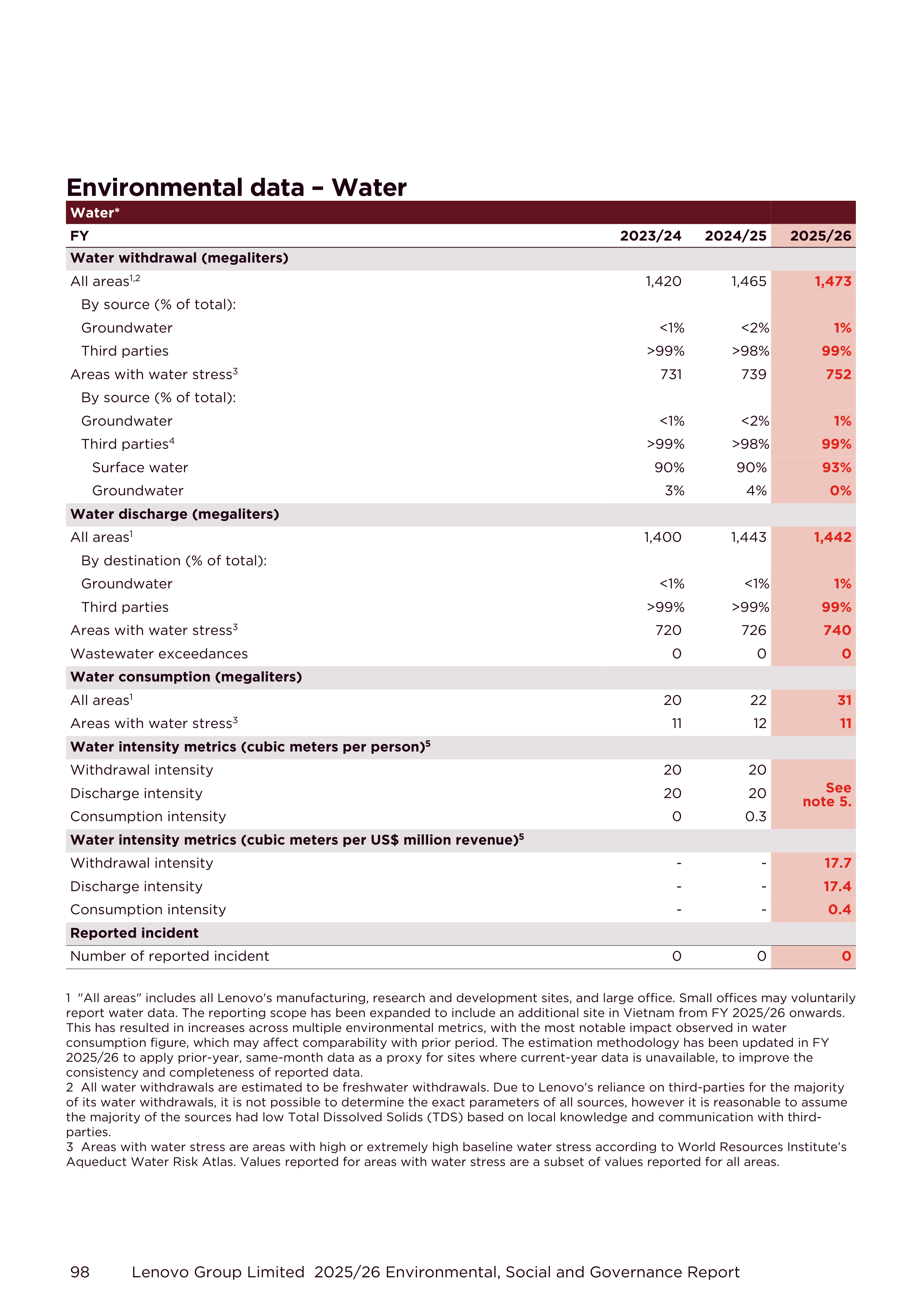
Environmental data – Water
Water*
FY
2023/24
2024/25
2025/26
Water withdrawal (megaliters)
All areas
1,2
1,420
1,465
1,473
By source (% of total):
Groundwater
<1%
<2%
1%
Third parties
>99%
>98%
99%
Areas with water stress
3
731
739
752
By source (% of total):
Groundwater
<1%
<2%
1%
Third parties
4
>99%
>98%
99%
Surface water
90%
90%
93%
Groundwater
3%
4%
0%
Water discharge (megaliters)
All areas
1
1,400
1,443
1,442
By destination (% of total):
Groundwater
<1%
<1%
1%
Third parties
>99%
>99%
99%
Areas with water stress
3
720
726
740
Wastewater exceedances
0
0
0
Water consumption (megaliters)
All areas
1
20
22
31
Areas with water stress
3
11
12
11
Water intensity metrics (cubic meters per person)
5
Withdrawal intensity
20
20
See
note 5.
Discharge intensity
20
20
Consumption intensity
0
0.3
Water intensity metrics (cubic meters per US$ million revenue)
5
Withdrawal intensity
-
-
17.7
Discharge intensity
-
-
17.4
Consumption intensity
-
-
0.4
Reported incident
Number of reported incident
0
0
0
1 "All areas" includes all Lenovo's manufacturing, research and development sites, and large office. Small offices may voluntarily
report water data. The reporting scope has been expanded to include an additional site in Vietnam from FY 2025/26 onwards.
This has resulted in increases across multiple environmental metrics, with the most notable impact observed in water
consumption figure, which may affect comparability with prior period. The estimation methodology has been updated in FY
2025/26 to apply prior-year, same-month data as a proxy for sites where current-year data is unavailable, to improve the
consistency and completeness of reported data.
2 All water withdrawals are estimated to be freshwater withdrawals. Due to Lenovo's reliance on third-parties for the majority
of its water withdrawals, it is not possible to determine the exact parameters of all sources, however it is reasonable to assume
the majority of the sources had low Total Dissolved Solids (TDS) based on local knowledge and communication with third-
parties.
3 Areas with water stress are areas with high or extremely high baseline water stress according to World Resources Institute’s
Aqueduct Water Risk Atlas. Values reported for areas with water stress are a subset of values reported for all areas.
98
Lenovo Group Limited 2025/26 Environmental, Social and Governance Report
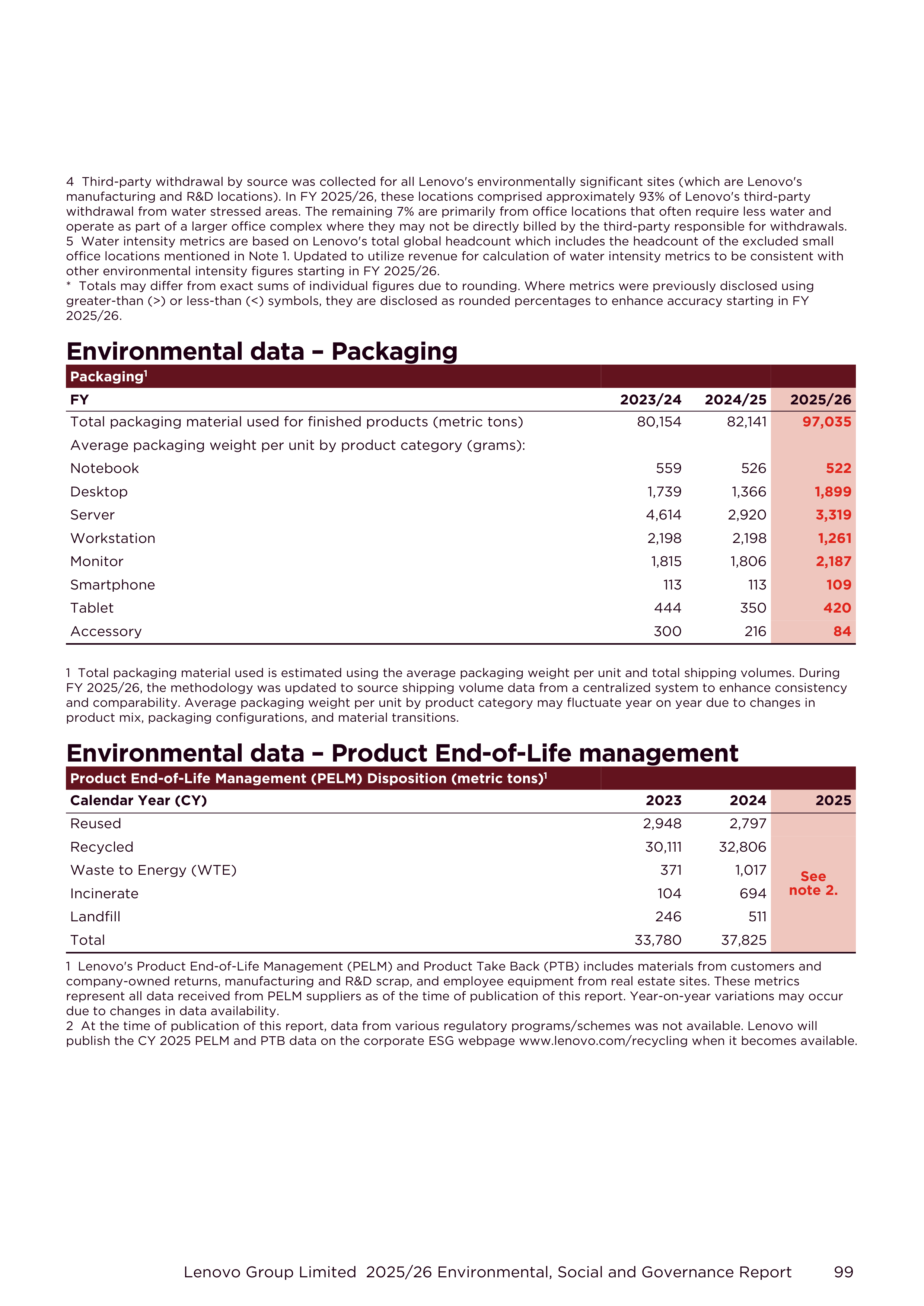
4 Third-party withdrawal by source was collected for all Lenovo's environmentally significant sites (which are Lenovo's
manufacturing and R&D locations). In FY 2025/26, these locations comprised approximately 93% of Lenovo's third-party
withdrawal from water stressed areas. The remaining 7% are primarily from office locations that often require less water and
operate as part of a larger office complex where they may not be directly billed by the third-party responsible for withdrawals.
5 Water intensity metrics are based on Lenovo's total global headcount which includes the headcount of the excluded small
office locations mentioned in Note 1. Updated to utilize revenue for calculation of water intensity metrics to be consistent with
other environmental intensity figures starting in FY 2025/26.
* Totals may differ from exact sums of individual figures due to rounding. Where metrics were previously disclosed using
greater-than (>) or less-than (<) symbols, they are disclosed as rounded percentages to enhance accuracy starting in FY
2025/26.
Environmental data – Packaging
Packaging
1
FY
2023/24
2024/25
2025/26
Total packaging material used for finished products (metric tons)
80,154
82,141
97,035
Average packaging weight per unit by product category (grams):
Notebook
559
526
522
Desktop
1,739
1,366
1,899
Server
4,614
2,920
3,319
Workstation
2,198
2,198
1,261
Monitor
1,815
1,806
2,187
Smartphone
113
113
109
Tablet
444
350
420
Accessory
300
216
84
1 Total packaging material used is estimated using the average packaging weight per unit and total shipping volumes. During
FY 2025/26, the methodology was updated to source shipping volume data from a centralized system to enhance consistency
and comparability. Average packaging weight per unit by product category may fluctuate year on year due to changes in
product mix, packaging configurations, and material transitions.
Environmental data – Product End-of-Life management
Product End-of-Life Management (PELM) Disposition (metric tons)
1
Calendar Year (CY)
2023
2024
2025
Reused
2,948
2,797
See
note 2.
Recycled
30,111
32,806
Waste to Energy (WTE)
371
1,017
Incinerate
104
694
Landfill
246
511
Total
33,780
37,825
1 Lenovo's Product End-of-Life Management (PELM) and Product Take Back (PTB) includes materials from customers and
company-owned returns, manufacturing and R&D scrap, and employee equipment from real estate sites. These metrics
represent all data received from PELM suppliers as of the time of publication of this report. Year-on-year variations may occur
due to changes in data availability.
2 At the time of publication of this report, data from various regulatory programs/schemes was not available. Lenovo will
publish the CY 2025 PELM and PTB data on the corporate ESG webpage www.lenovo.com/recycling when it becomes available.
Lenovo Group Limited 2025/26 Environmental, Social and Governance Report
99
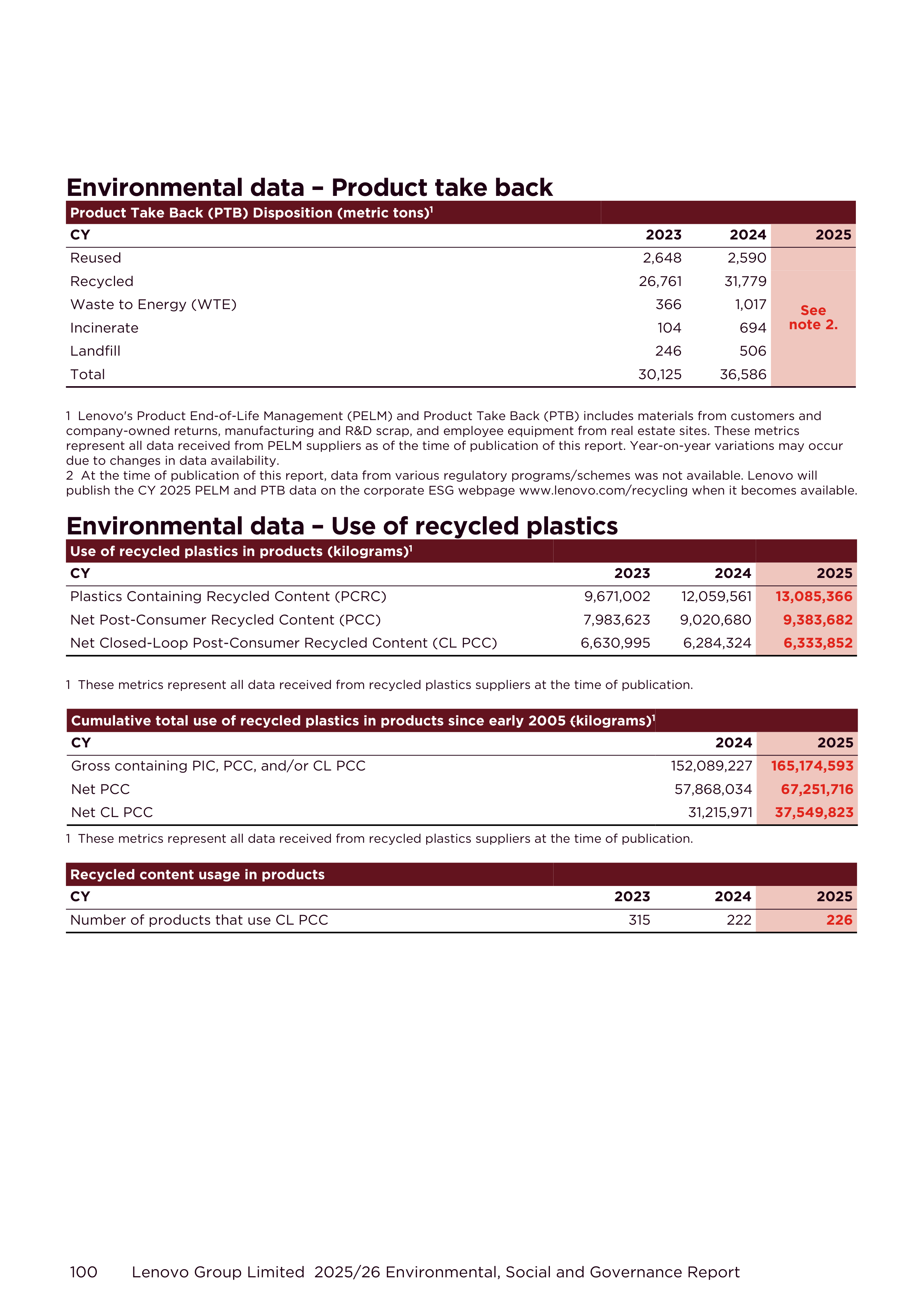
Environmental data – Product take back
Product Take Back (PTB) Disposition (metric tons)
1
CY
2023
2024
2025
Reused
2,648
2,590
See
note 2.
Recycled
26,761
31,779
Waste to Energy (WTE)
366
1,017
Incinerate
104
694
Landfill
246
506
Total
30,125
36,586
1 Lenovo's Product End-of-Life Management (PELM) and Product Take Back (PTB) includes materials from customers and
company-owned returns, manufacturing and R&D scrap, and employee equipment from real estate sites. These metrics
represent all data received from PELM suppliers as of the time of publication of this report. Year-on-year variations may occur
due to changes in data availability.
2 At the time of publication of this report, data from various regulatory programs/schemes was not available. Lenovo will
publish the CY 2025 PELM and PTB data on the corporate ESG webpage www.lenovo.com/recycling when it becomes available.
Environmental data – Use of recycled plastics
Use of recycled plastics in products (kilograms)
1
CY
2023
2024
2025
Plastics Containing Recycled Content (PCRC)
9,671,002
12,059,561
13,085,366
Net Post-Consumer Recycled Content (PCC)
7,983,623
9,020,680
9,383,682
Net Closed-Loop Post-Consumer Recycled Content (CL PCC)
6,630,995
6,284,324
6,333,852
1 These metrics represent all data received from recycled plastics suppliers at the time of publication.
Cumulative total use of recycled plastics in products since early 2005 (kilograms)
1
CY
2024
2025
Gross containing PIC, PCC, and/or CL PCC
152,089,227
165,174,593
Net PCC
57,868,034
67,251,716
Net CL PCC
31,215,971
37,549,823
1 These metrics represent all data received from recycled plastics suppliers at the time of publication.
Recycled content usage in products
CY
2023
2024
2025
Number of products that use CL PCC
315
222
226
100
Lenovo Group Limited 2025/26 Environmental, Social and Governance Report
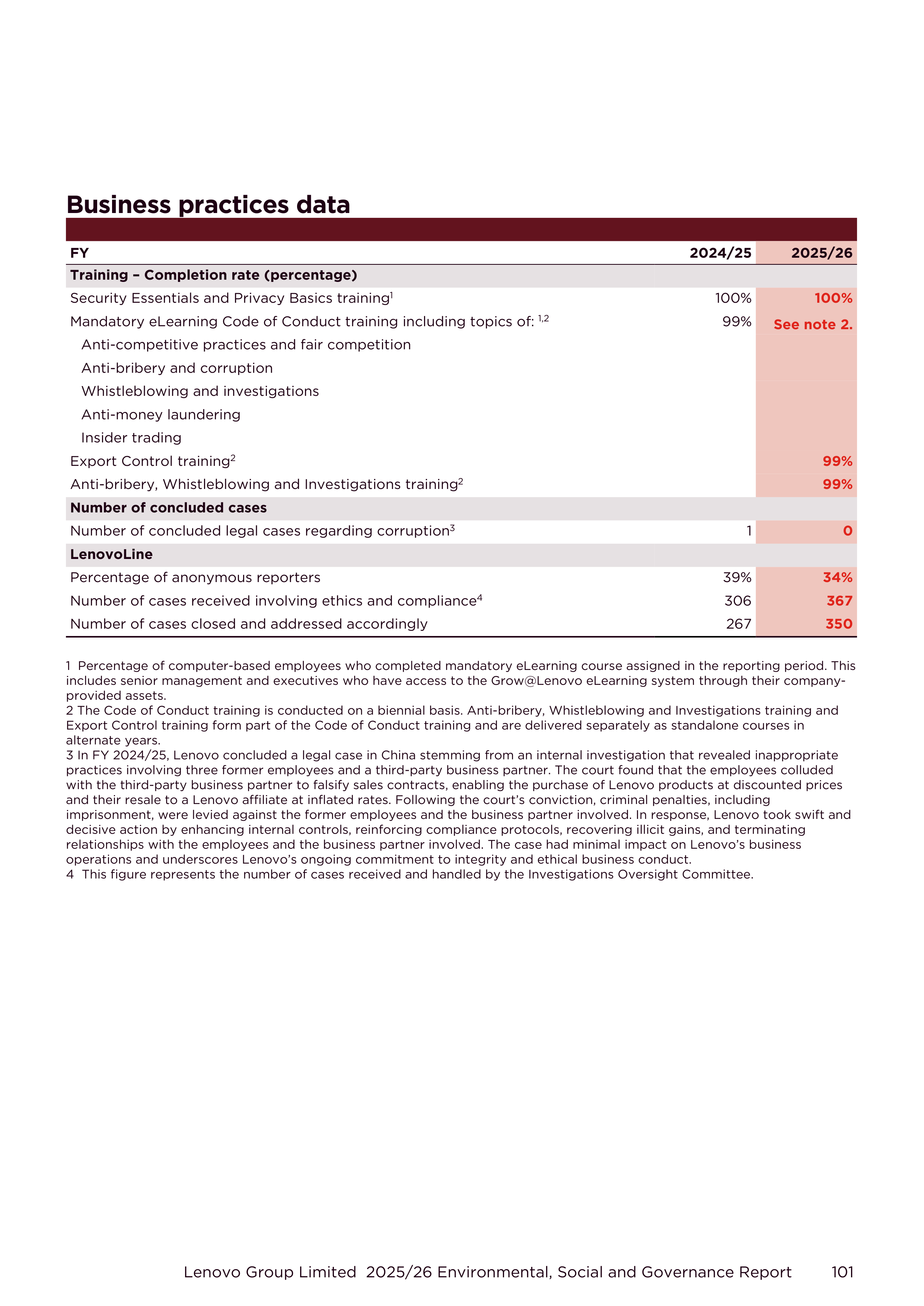
Business practices data
FY
2024/25
2025/26
Training – Completion rate (percentage)
Security Essentials and Privacy Basics training
1
100%
100%
Mandatory eLearning Code of Conduct training including topics of:
1,2
99%
See note 2.
Anti-competitive practices and fair competition
Anti-bribery and corruption
Whistleblowing and investigations
Anti-money laundering
Insider trading
Export Control training
2
99%
Anti-bribery, Whistleblowing and Investigations training
2
99%
Number of concluded cases
Number of concluded legal cases regarding corruption
3
1
0
LenovoLine
Percentage of anonymous reporters
39%
34%
Number of cases received involving ethics and compliance
4
306
367
Number of cases closed and addressed accordingly
267
350
1 Percentage of computer-based employees who completed mandatory eLearning course assigned in the reporting period. This
includes senior management and executives who have access to the Grow@Lenovo eLearning system through their company-
provided assets.
2 The Code of Conduct training is conducted on a biennial basis. Anti-bribery, Whistleblowing and Investigations training and
Export Control training form part of the Code of Conduct training and are delivered separately as standalone courses in
alternate years.
3 In FY 2024/25, Lenovo concluded a legal case in China stemming from an internal investigation that revealed inappropriate
practices involving three former employees and a third-party business partner. The court found that the employees colluded
with the third-party business partner to falsify sales contracts, enabling the purchase of Lenovo products at discounted prices
and their resale to a Lenovo affiliate at inflated rates. Following the court’s conviction, criminal penalties, including
imprisonment, were levied against the former employees and the business partner involved. In response, Lenovo took swift and
decisive action by enhancing internal controls, reinforcing compliance protocols, recovering illicit gains, and terminating
relationships with the employees and the business partner involved. The case had minimal impact on Lenovo’s business
operations and underscores Lenovo’s ongoing commitment to integrity and ethical business conduct.
4 This figure represents the number of cases received and handled by the Investigations Oversight Committee.
Lenovo Group Limited 2025/26 Environmental, Social and Governance Report
101
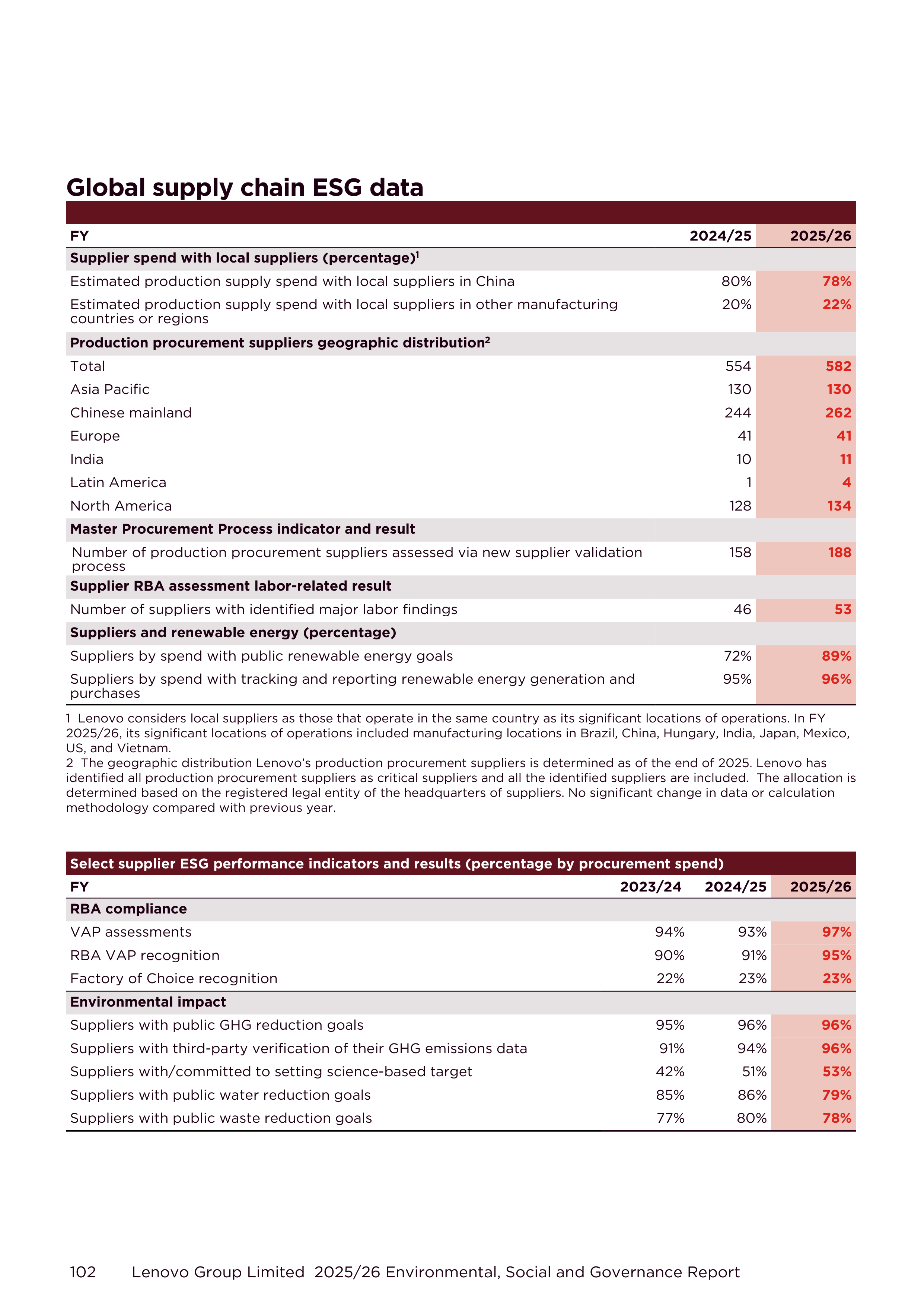
Global supply chain ESG data
FY
2024/25
2025/26
Supplier spend with local suppliers (percentage)
1
Estimated production supply spend with local suppliers in China
80%
78%
Estimated production supply spend with local suppliers in other manufacturing
countries or regions
20%
22%
Production procurement suppliers geographic distribution
2
Total
554
582
Asia Pacific
130
130
Chinese mainland
244
262
Europe
41
41
India
10
11
Latin America
1
4
North America
128
134
Master Procurement Process indicator and result
Number of production procurement suppliers assessed via new supplier validation
process
158
188
Supplier RBA assessment labor-related result
Number of suppliers with identified major labor findings
46
53
Suppliers and renewable energy (percentage)
Suppliers by spend with public renewable energy goals
72%
89%
Suppliers by spend with tracking and reporting renewable energy generation and
purchases
95%
96%
1 Lenovo considers local suppliers as those that operate in the same country as its significant locations of operations. In FY
2025/26, its significant locations of operations included manufacturing locations in Brazil, China, Hungary, India, Japan, Mexico,
US, and Vietnam.
2 The geographic distribution Lenovo’s production procurement suppliers is determined as of the end of 2025. Lenovo has
identified all production procurement suppliers as critical suppliers and all the identified suppliers are included. The allocation is
determined based on the registered legal entity of the headquarters of suppliers. No significant change in data or calculation
methodology compared with previous year.
Select supplier ESG performance indicators and results (percentage by procurement spend)
FY
2023/24
2024/25
2025/26
RBA compliance
VAP assessments
94%
93%
97%
RBA VAP recognition
90%
91%
95%
Factory of Choice recognition
22%
23%
23%
Environmental impact
Suppliers with public GHG reduction goals
95%
96%
96%
Suppliers with third-party verification of their GHG emissions data
91%
94%
96%
Suppliers with/committed to setting science-based target
42%
51%
53%
Suppliers with public water reduction goals
85%
86%
79%
Suppliers with public waste reduction goals
77%
80%
78%
102
Lenovo Group Limited 2025/26 Environmental, Social and Governance Report
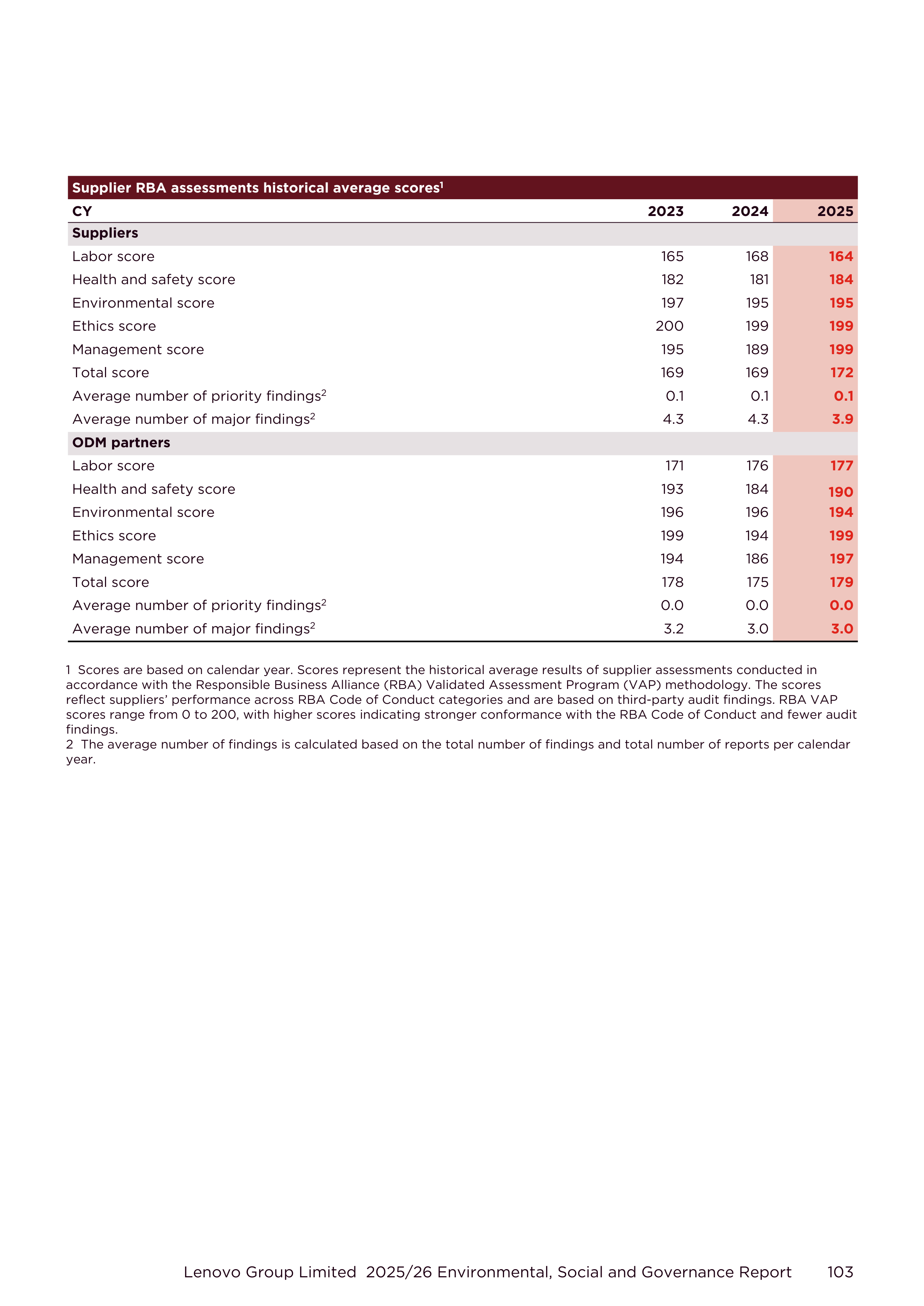
Supplier RBA assessments historical average scores
1
CY
2023
2024
2025
Suppliers
Labor score
165
168
164
Health and safety score
182
181
184
Environmental score
197
195
195
Ethics score
200
199
199
Management score
195
189
199
Total score
169
169
172
Average number of priority findings
2
0.1
0.1
0.1
Average number of major findings
2
4.3
4.3
3.9
ODM partners
Labor score
171
176
177
Health and safety score
193
184
190
Environmental score
196
196
194
Ethics score
199
194
199
Management score
194
186
197
Total score
178
175
179
Average number of priority findings
2
0.0
0.0
0.0
Average number of major findings
2
3.2
3.0
3.0
1 Scores are based on calendar year. Scores represent the historical average results of supplier assessments conducted in
accordance with the Responsible Business Alliance (RBA) Validated Assessment Program (VAP) methodology. The scores
reflect suppliers’ performance across RBA Code of Conduct categories and are based on third-party audit findings. RBA VAP
scores range from 0 to 200, with higher scores indicating stronger conformance with the RBA Code of Conduct and fewer audit
findings.
2 The average number of findings is calculated based on the total number of findings and total number of reports per calendar
year.
Lenovo Group Limited 2025/26 Environmental, Social and Governance Report
103




8.0
ESG KPIs
and EMS
targets
106
ESG KPIs and EMS targets
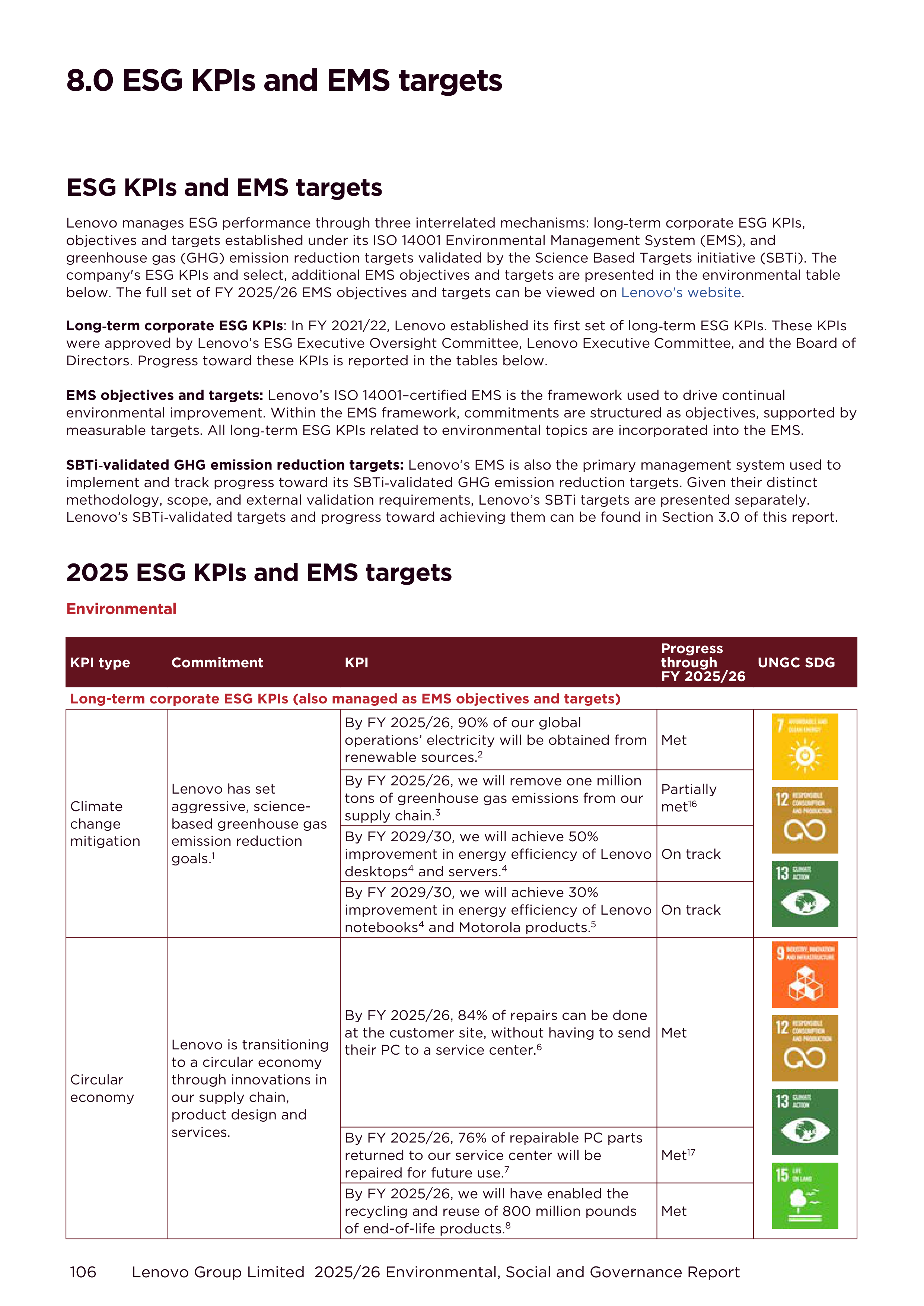


ESG KPIs and EMS targets
Lenovo manages ESG performance through three interrelated mechanisms: long
-
term corporate ESG KPIs,
objectives and targets established under its ISO 14001 Environmental Management System (EMS), and
greenhouse gas (GHG) emission reduction targets validated by the Science Based Targets initiative (SBTi). The
company's ESG KPIs and select, additional EMS objectives and targets are presented in the environmental table
below. The full set of FY 2025/26 EMS objectives and targets can be viewed on
Lenovo's website
.
Long
-
term corporate ESG KPIs
: In FY 2021/22, Lenovo established its first set of long
-
term ESG KPIs. These KPIs
were approved by Lenovo’s ESG Executive Oversight Committee, Lenovo Executive Committee, and the Board of
Directors. Progress toward these KPIs is reported in the tables below.
EMS objectives and targets:
Lenovo’s ISO 14001–certified EMS is the framework used to drive continual
environmental improvement. Within the EMS framework, commitments are structured as objectives, supported by
measurable targets. All long
-
term ESG KPIs related to environmental topics are incorporated into the EMS.
SBTi
-
validated GHG emission reduction targets:
Lenovo’s EMS is also the primary management system used to
implement and track progress toward its SBTi
-
validated GHG emission reduction targets. Given their distinct
methodology, scope, and external validation requirements, Lenovo’s SBTi targets are presented separately.
Lenovo’s SBTi
-
validated targets and progress toward achieving them can be found in Section 3.0 of this report.
2025 ESG KPIs and EMS targets
Environmental
Long-term corporate ESG KPIs (also managed as EMS objectives and targets)
Climate
change
mitigation
Lenovo has set
aggressive, science-
based greenhouse gas
emission reduction
goals.
1
By FY 2025/26, 90% of our global
operations’ electricity will be obtained from
renewable sources.
2
Met
By FY 2025/26, we will remove one million
tons of greenhouse gas emissions from our
supply chain.
3
Partially
met
16
By FY 2029/30, we will achieve 50%
improvement in energy efficiency of Lenovo
desktops
4
and servers.
4
On track
By FY 2029/30, we will achieve 30%
improvement in energy efficiency of Lenovo
notebooks
4
and Motorola products.
5
On track
Circular
economy
Lenovo is transitioning
to a circular economy
through innovations in
our supply chain,
product design and
services.
By FY 2025/26, 84% of repairs can be done
at the customer site, without having to send
their PC to a service center.
6
Met
By FY 2025/26, 76% of repairable PC parts
returned to our service center will be
repaired for future use.
7
Met
17
By FY 2025/26, we will have enabled the
recycling and reuse of 800 million pounds
of end-of-life products.
8
Met
KPI type
Commitment
KPI
Progress
through
FY 2025/26
UNGC SDG
8.0 ESG KPIs and EMS targets
106
Lenovo Group Limited 2025/26 Environmental, Social and Governance Report
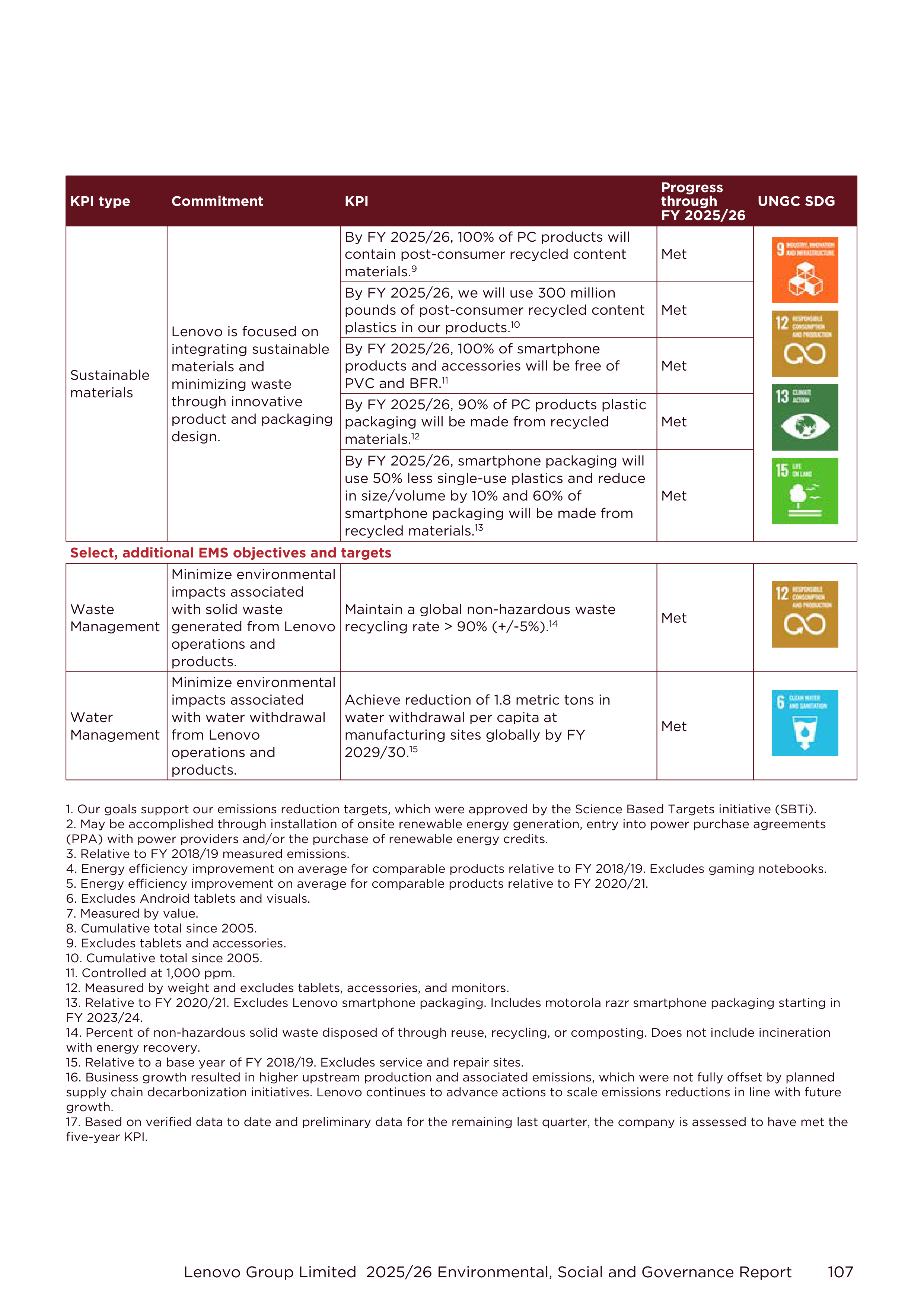


Sustainable
materials
Lenovo is focused on
integrating sustainable
materials and
minimizing waste
through innovative
product and packaging
design.
By FY 2025/26, 100% of PC products will
contain post-consumer recycled content
materials.
9
Met
By FY 2025/26, we will use 300 million
pounds of post-consumer recycled content
plastics in our products.
10
Met
By FY 2025/26, 100% of smartphone
products and accessories will be free of
PVC and BFR.
11
Met
By FY 2025/26, 90% of PC products plastic
packaging will be made from recycled
materials.
12
Met
By FY 2025/26, smartphone packaging will
use 50% less single-use plastics and reduce
in size/volume by 10% and 60% of
smartphone packaging will be made from
recycled materials.
13
Met
Select, additional EMS objectives and targets
Waste
Management
Minimize environmental
impacts associated
with solid waste
generated from Lenovo
operations and
products.
Maintain a global non-hazardous waste
recycling rate > 90% (+/-5%).
14
Met
Water
Management
Minimize environmental
impacts associated
with water withdrawal
from Lenovo
operations and
products.
Achieve reduction of 1.8 metric tons in
water withdrawal per capita at
manufacturing sites globally by FY
2029/30.
15
Met
KPI type
Commitment
KPI
Progress
through
FY 2025/26
UNGC SDG
1. Our goals support our emissions reduction targets, which were approved by the Science Based Targets initiative (SBTi).
2. May be accomplished through installation of onsite renewable energy generation, entry into power purchase agreements
(PPA) with power providers and/or the purchase of renewable energy credits.
3. Relative to FY 2018/19 measured emissions.
4. Energy efficiency improvement on average for comparable products relative to FY 2018/19. Excludes gaming notebooks.
5. Energy efficiency improvement on average for comparable products relative to FY 2020/21.
6. Excludes Android tablets and visuals.
7. Measured by value.
8. Cumulative total since 2005.
9. Excludes tablets and accessories.
10. Cumulative total since 2005.
11. Controlled at 1,000 ppm.
12. Measured by weight and excludes tablets, accessories, and monitors.
13. Relative to FY 2020/21. Excludes Lenovo smartphone packaging. Includes motorola razr smartphone packaging starting in
FY 2023/24.
14. Percent of non-hazardous solid waste disposed of through reuse, recycling, or composting. Does not include incineration
with energy recovery.
15. Relative to a base year of FY 2018/19. Excludes service and repair sites.
16. Business growth resulted in higher upstream production and associated emissions, which were not fully offset by planned
supply chain decarbonization initiatives. Lenovo continues to advance actions to scale emissions reductions in line with future
growth.
17. Based on verified data to date and preliminary data for the remaining last quarter, the company is assessed to have met the
five-year KPI.
Lenovo Group Limited 2025/26 Environmental, Social and Governance Report
107
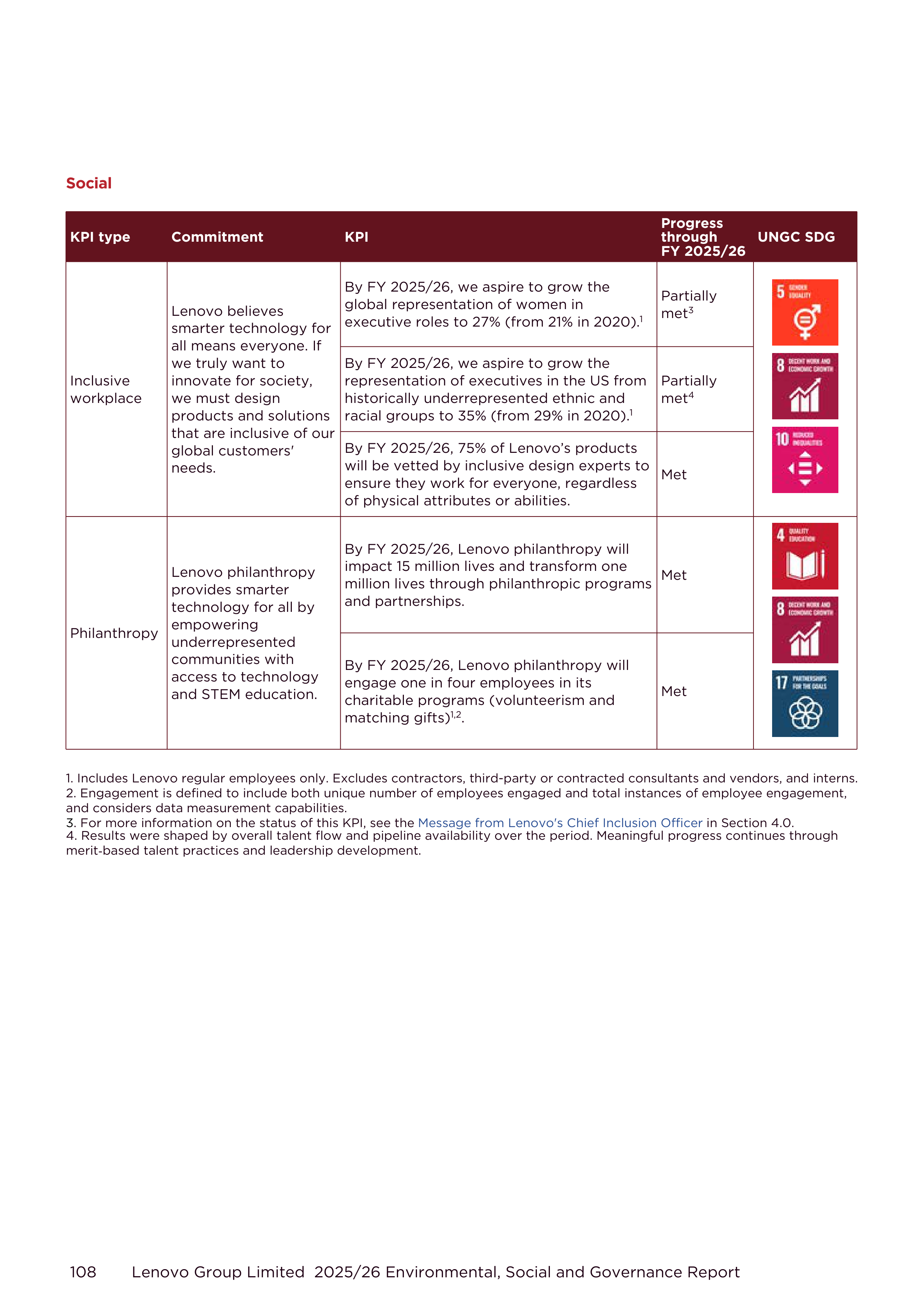


Social
KPI type
Commitment
KPI
Progress
through
FY 2025/26
UNGC SDG
Inclusive
workplace
Lenovo believes
smarter technology for
all means everyone. If
we truly want to
innovate for society,
we must design
products and solutions
that are inclusive of our
global customers'
needs.
By FY 2025/26, we aspire to grow the
global representation of women in
executive roles to 27% (from 21% in 2020).
1
Partially
met
3
By FY 2025/26, we aspire to grow the
representation of executives in the US from
historically underrepresented ethnic and
racial groups to 35% (from 29% in 2020).
1
Partially
met
4
By FY 2025/26, 75% of Lenovo’s products
will be vetted by inclusive design experts to
ensure they work for everyone, regardless
of physical attributes or abilities.
Met
Philanthropy
Lenovo philanthropy
provides smarter
technology for all by
empowering
underrepresented
communities with
access to technology
and STEM education.
By FY 2025/26, Lenovo philanthropy will
impact 15 million lives and transform one
million lives through philanthropic programs
and partnerships.
Met
By FY 2025/26, Lenovo philanthropy will
engage one in four employees in its
charitable programs (volunteerism and
matching gifts)
1,2
.
Met
1. Includes Lenovo regular employees only. Excludes contractors, third-party or contracted consultants and vendors, and interns.
2. Engagement is defined to include both unique number of employees engaged and total instances of employee engagement,
and considers data measurement capabilities.
3
. For more information on the status of this KPI, see the
Message from Lenovo's Chief Inclusion Officer
in Section 4.0.
4. Results were shaped by overall talent flow and pipeline availability over the period. Meaningful progress continues through
merit
-
based talent practices and leadership development.
108
Lenovo Group Limited 2025/26 Environmental, Social and Governance Report
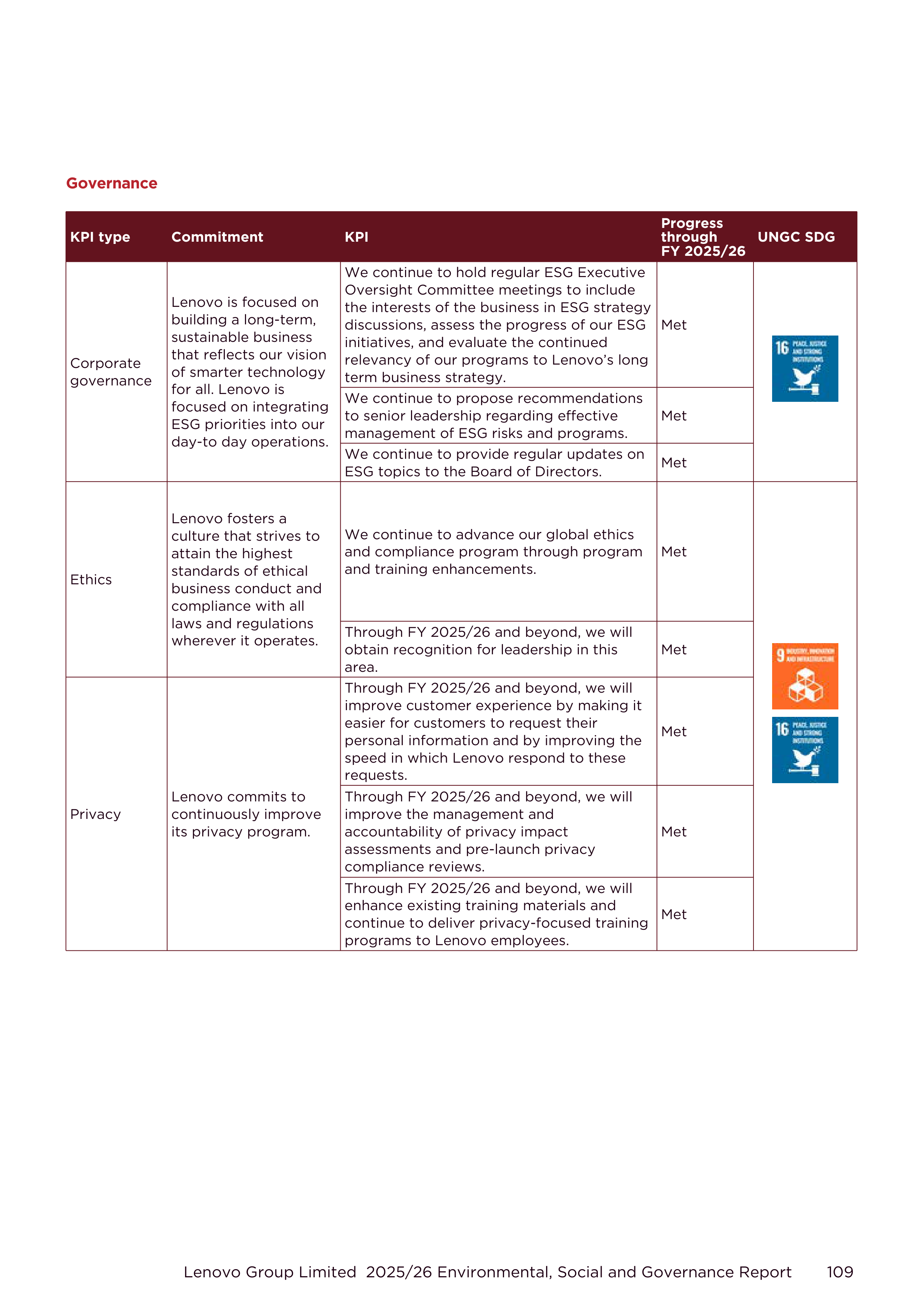


Governance
KPI type
Commitment
KPI
Progress
through
FY 2025/26
UNGC SDG
Corporate
governance
Lenovo is focused on
building a long-term,
sustainable business
that reflects our vision
of smarter technology
for all. Lenovo is
focused on integrating
ESG priorities into our
day-to day operations.
We continue to hold regular ESG Executive
Oversight Committee meetings to include
the interests of the business in ESG strategy
discussions, assess the progress of our ESG
initiatives, and evaluate the continued
relevancy of our programs to Lenovo’s long
term business strategy.
Met
We continue to propose recommendations
to senior leadership regarding effective
management of ESG risks and programs.
Met
We continue to provide regular updates on
ESG topics to the Board of Directors.
Met
Ethics
Lenovo fosters a
culture that strives to
attain the highest
standards of ethical
business conduct and
compliance with all
laws and regulations
wherever it operates.
We continue to advance our global ethics
and compliance program through program
and training enhancements.
Met
Through FY 2025/26 and beyond, we will
obtain recognition for leadership in this
area.
Met
Privacy
Lenovo commits to
continuously improve
its privacy program.
Through FY 2025/26 and beyond, we will
improve customer experience by making it
easier for customers to request their
personal information and by improving the
speed in which Lenovo respond to these
requests.
Met
Through FY 2025/26 and beyond, we will
improve the management and
accountability of privacy impact
assessments and pre-launch privacy
compliance reviews.
Met
Through FY 2025/26 and beyond, we will
enhance existing training materials and
continue to deliver privacy-focused training
programs to Lenovo employees.
Met
Lenovo Group Limited 2025/26 Environmental, Social and Governance Report
109
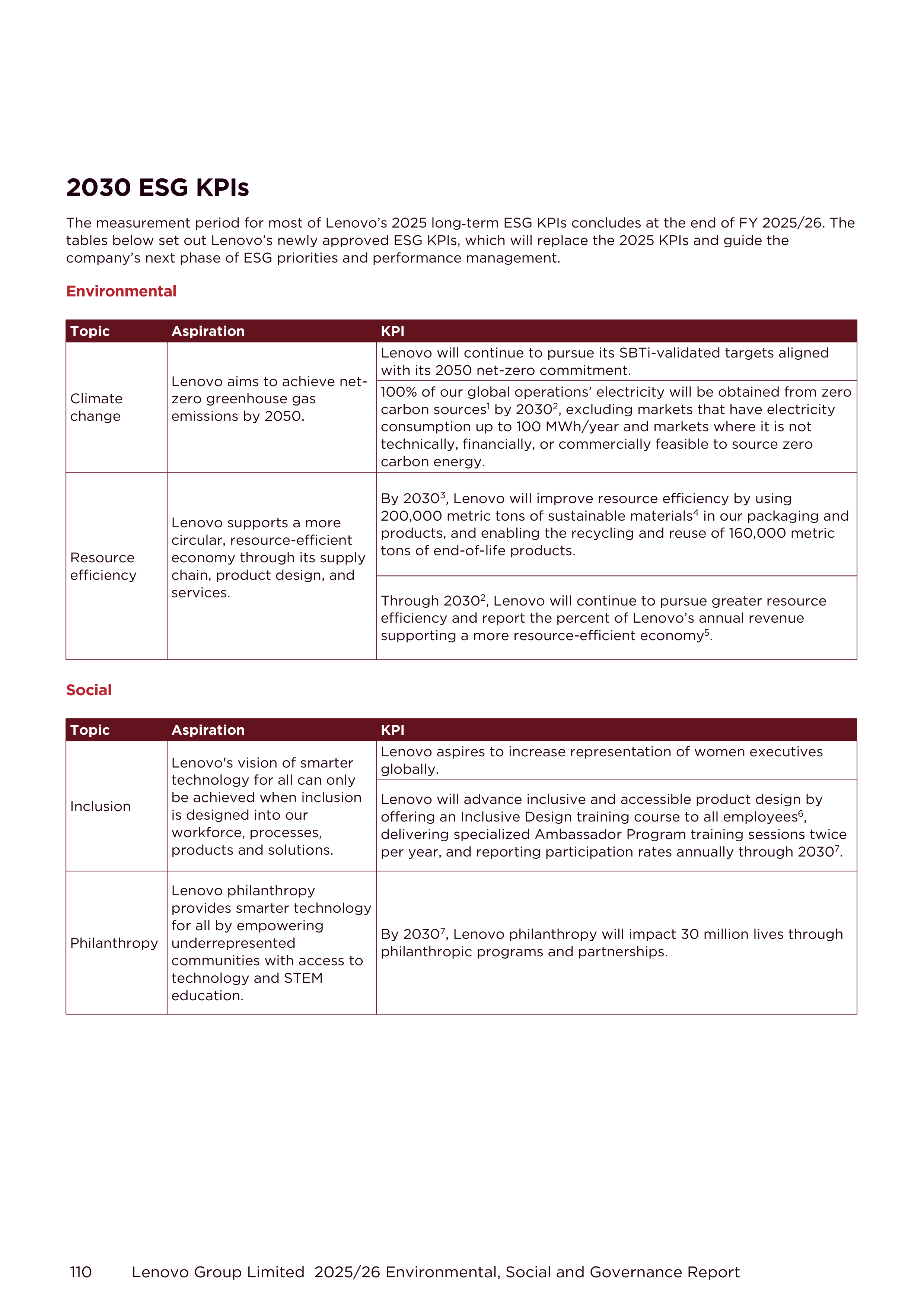
2030 ESG KPIs
The measurement period for most of Lenovo’s 2025 long
-
term ESG KPIs concludes at the end of FY 2025/26. The
tables below set out Lenovo’s newly approved ESG KPIs, which will replace the 2025 KPIs and guide the
company’s next phase of ESG priorities and performance management.
Environmental
Climate
change
Lenovo aims to achieve net-
zero greenhouse gas
emissions by 2050.
Lenovo will continue to pursue its SBTi-validated targets aligned
with its 2050 net-zero commitment.
100% of our global operations’ electricity will be obtained from zero
carbon sources
1
by 2030
2
, excluding markets that have electricity
consumption up to 100 MWh/year and markets where it is not
technically, financially, or commercially feasible to source zero
carbon energy.
Resource
efficiency
Lenovo supports a more
circular, resource-efficient
economy through its supply
chain, product design, and
services.
By 2030
3
, Lenovo will improve resource efficiency by using
200,000 metric tons of sustainable materials
4
in our packaging and
products, and enabling the recycling and reuse of 160,000 metric
tons of end-of-life products.
Through 2030
2
, Lenovo will continue to pursue greater resource
efficiency and report the percent of Lenovo’s annual revenue
supporting a more resource-efficient economy
5
.
Topic
Aspiration
KPI
Social
Inclusion
Lenovo's vision of smarter
technology for all can only
be achieved when inclusion
is designed into our
workforce, processes,
products and solutions.
Lenovo aspires to increase representation of women executives
globally.
Lenovo will advance inclusive and accessible product design by
offering an Inclusive Design training course to all employees
6
,
delivering specialized Ambassador Program training sessions twice
per year, and reporting participation rates annually through 2030
7
.
Philanthropy
Lenovo philanthropy
provides smarter technology
for all by empowering
underrepresented
communities with access to
technology and STEM
education.
By 2030
7
, Lenovo philanthropy will impact 30 million lives through
philanthropic programs and partnerships.
Topic
Aspiration
KPI
110
Lenovo Group Limited 2025/26 Environmental, Social and Governance Report
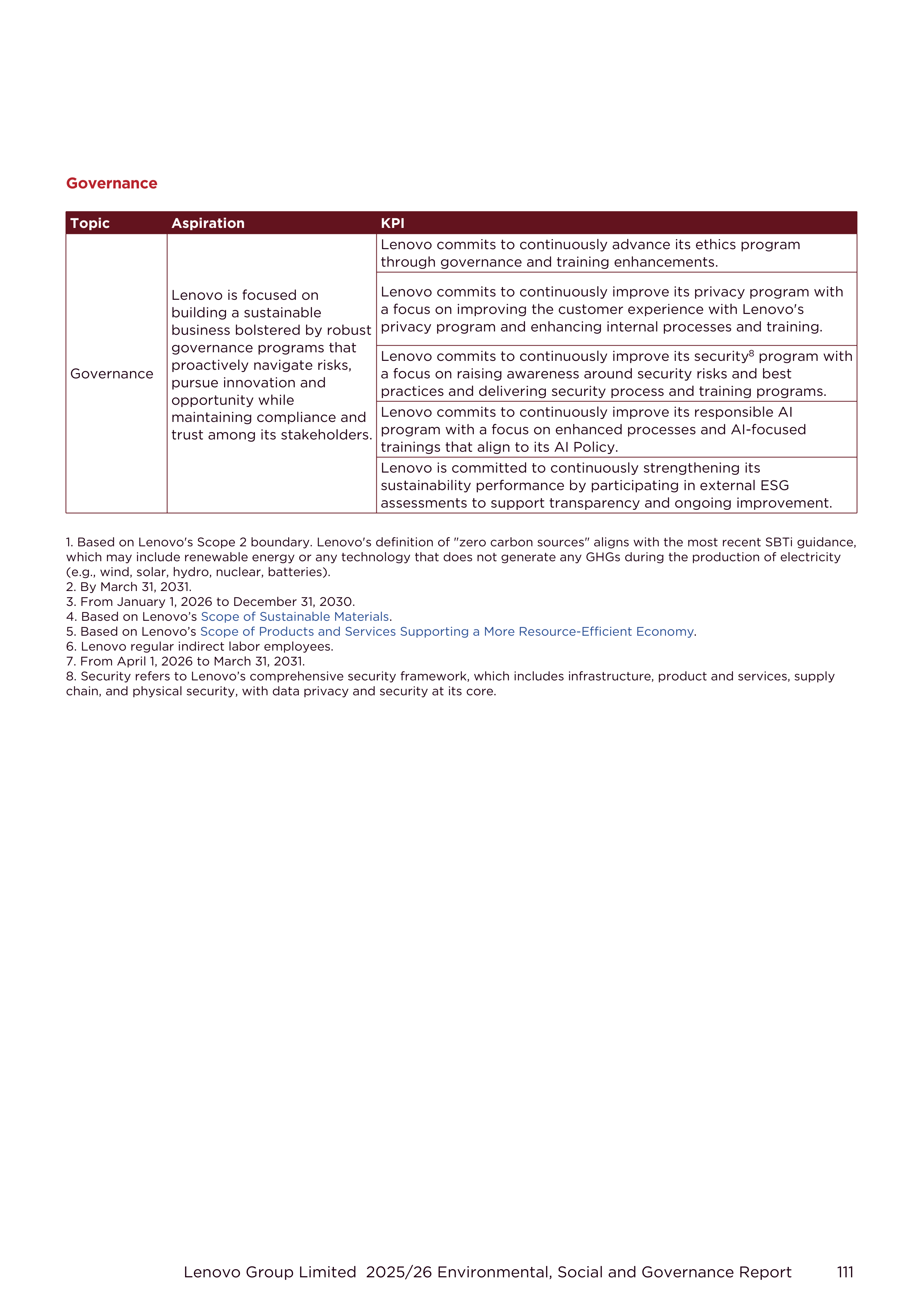
Governance
Governance
Lenovo is focused on
building a sustainable
business bolstered by robust
governance programs that
proactively navigate risks,
pursue innovation and
opportunity while
maintaining compliance and
trust among its stakeholders.
Lenovo commits to continuously advance its ethics program
through governance and training enhancements.
Lenovo commits to continuously improve its privacy program with
a focus on improving the customer experience with Lenovo's
privacy program and enhancing internal processes and training.
Lenovo commits to continuously improve its security
8
program with
a focus on raising awareness around security risks and best
practices and delivering security process and training programs.
Lenovo commits to continuously improve its responsible AI
program with a focus on enhanced processes and AI-focused
trainings that align to its AI Policy.
Lenovo is committed to continuously strengthening its
sustainability performance by participating in external ESG
assessments to support transparency and ongoing improvement.
Topic
Aspiration
KPI
1. Based on Lenovo's Scope 2 boundary. Lenovo's definition of "zero carbon sources" aligns with the most recent SBTi guidance,
which may include renewable energy or any technology that does not generate any GHGs during the production of electricity
(e.g., wind, solar, hydro, nuclear, batteries).
2. By March 31, 2031.
3. From January 1, 2026 to December 31, 2030.
4. Based on Lenovo’s
Scope of Sustainable Materials
.
5. Based on Lenovo’s
Scope of Products and Services Supporting a More Resource-Efficient Economy
.
6. Lenovo regular indirect labor employees.
7. From April 1, 2026 to March 31, 2031.
8. Security refers to Lenovo’s comprehensive security framework, which includes infrastructure, product and services, supply
chain, and physical security, with data privacy and security at its core.
Lenovo Group Limited 2025/26 Environmental, Social and Governance Report
111

9.0
Appendix
114
Scope of the report
115
Supplemental climate-related
disclosures
119
The Hong Kong Stock Exchange's
ESG Reporting Code content index



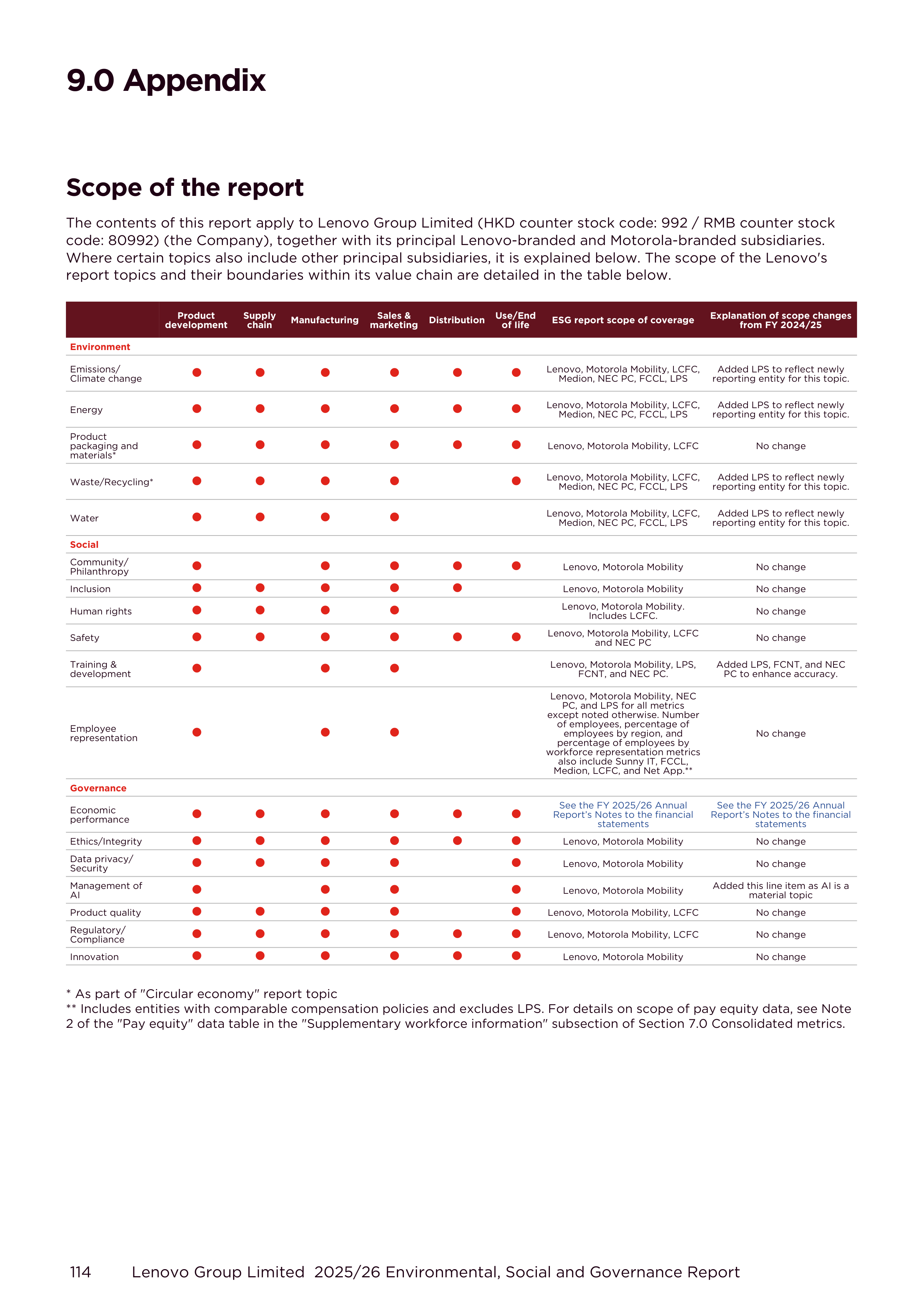
Scope of the report
The contents of this report apply to Lenovo Group Limited (HKD counter stock code: 992 / RMB counter stock
code: 80992) (the Company), together with its principal Lenovo-branded and Motorola-branded subsidiaries.
Where certain topics also include other principal subsidiaries, it is explained below. The scope of the Lenovo's
report topics and their boundaries within its value chain are detailed in the table below.
Product
development
Supply
chain
Manufacturing
Sales &
marketing
Distribution
Use/End
of Iife
ESG report scope of coverage
Explanation of scope changes
from FY 2024/25
Environment
Emissions/
Climate change
•
•
•
•
•
•
Lenovo, Motorola Mobility, LCFC,
Medion, NEC PC, FCCL, LPS
Added LPS to reflect newly
reporting entity for this topic.
Energy
•
•
•
•
•
•
Lenovo, Motorola Mobility, LCFC,
Medion, NEC PC, FCCL, LPS
Added LPS to reflect newly
reporting entity for this topic.
Product
packaging and
materials*
•
•
•
•
•
•
Lenovo, Motorola Mobility, LCFC
No change
Waste/Recycling*
•
•
•
•
•
Lenovo, Motorola Mobility, LCFC,
Medion, NEC PC, FCCL, LPS
Added LPS to reflect newly
reporting entity for this topic.
Water
•
•
•
•
Lenovo, Motorola Mobility, LCFC,
Medion, NEC PC, FCCL, LPS
Added LPS to reflect newly
reporting entity for this topic.
Social
Community/
Philanthropy
•
•
•
•
•
Lenovo, Motorola Mobility
No change
Inclusion
•
•
•
•
•
Lenovo, Motorola Mobility
No change
Human rights
•
•
•
•
Lenovo, Motorola Mobility.
Includes LCFC.
No change
Safety
•
•
•
•
•
•
Lenovo, Motorola Mobility, LCFC
and NEC PC
No change
Training &
development
•
•
•
Lenovo, Motorola Mobility, LPS,
FCNT, and NEC PC.
Added LPS, FCNT, and NEC
PC to enhance accuracy.
Employee
representation
•
•
•
Lenovo, Motorola Mobility, NEC
PC, and LPS for all metrics
except noted otherwise. Number
of employees, percentage of
employees by region, and
percentage of employees by
workforce representation metrics
also include Sunny IT, FCCL,
Medion, LCFC, and Net App.**
No change
Governance
Economic
performance
•
•
•
•
•
•
See the FY 2025/26 Annual
Report’s Notes to the financial
statements
See the FY 2025/26 Annual
Report’s Notes to the financial
statements
Ethics/Integrity
•
•
•
•
•
•
Lenovo, Motorola Mobility
No change
Data privacy/
Security
•
•
•
•
•
Lenovo, Motorola Mobility
No change
Management of
AI
•
•
•
•
Lenovo, Motorola Mobility
Added this line item as AI is a
material topic
Product quality
•
•
•
•
•
Lenovo, Motorola Mobility, LCFC
No change
Regulatory/
Compliance
•
•
•
•
•
•
Lenovo, Motorola Mobility, LCFC
No change
Innovation
•
•
•
•
•
•
Lenovo, Motorola Mobility
No change
* As part of "Circular economy" report topic
** Includes entities with comparable compensation policies and excludes LPS. For details on scope of pay equity data, see Note
2 of the "Pay equity" data table in the "Supplementary workforce information" subsection of Section 7.0 Consolidated metrics.
9.0 Appendix
114
Lenovo Group Limited 2025/26 Environmental, Social and Governance Report
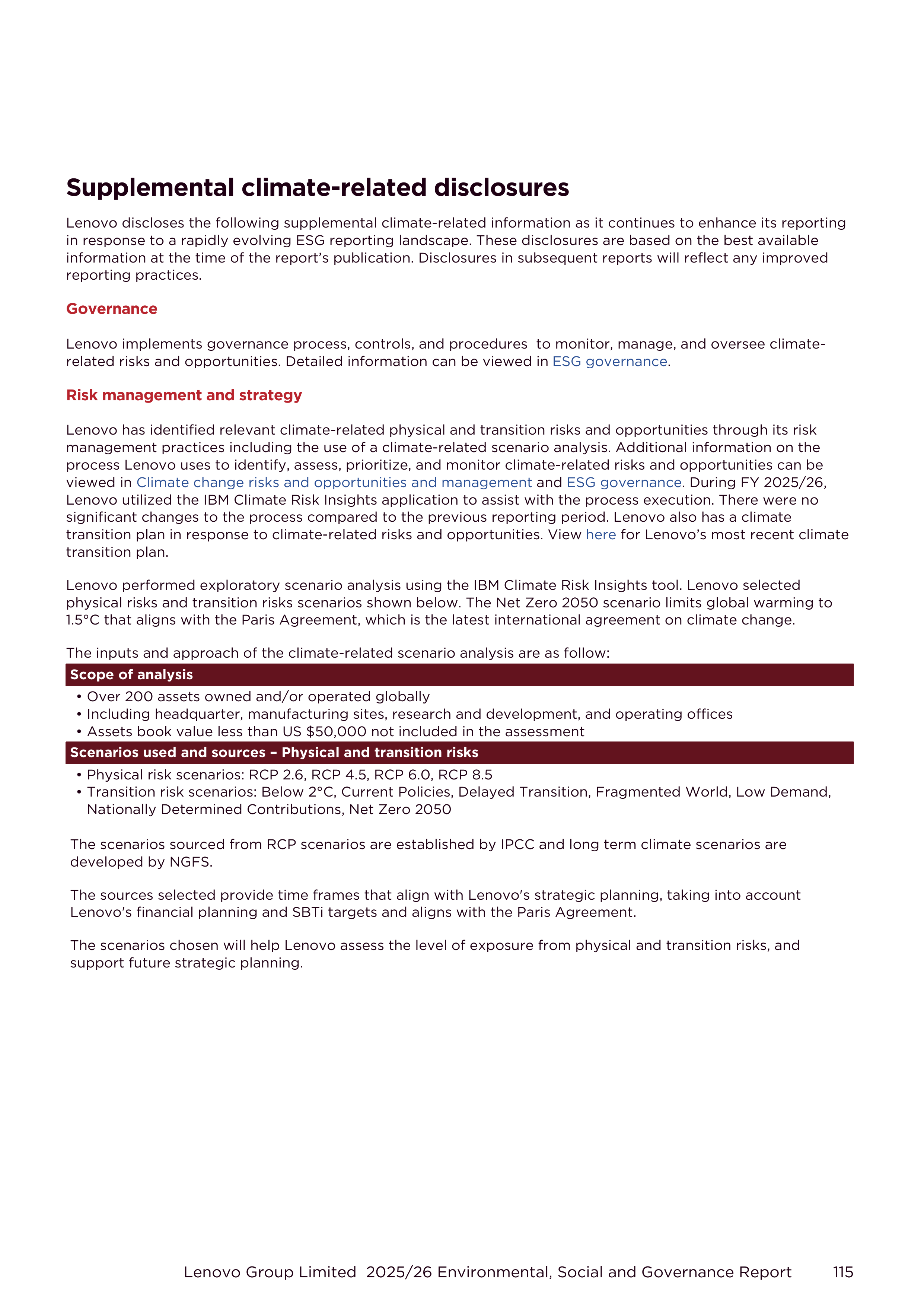
Supplemental climate-related disclosures
Lenovo discloses the following supplemental climate-related information as it continues to enhance its reporting
in response to a rapidly evolving ESG reporting landscape. These disclosures are based on the best available
information at the time of the report’s publication. Disclosures in subsequent reports will reflect any improved
reporting practices.
Governance
Lenovo implements governance process, controls, and procedures to monitor, manage, and oversee climate-
related risks and opportunities. Detailed information can be viewed in
ESG governance
.
Risk management and strategy
Lenovo has identified relevant climate-related physical and transition risks and opportunities through its risk
management practices including the use of a climate-related scenario analysis. Additional information on the
process Lenovo uses to identify, assess, prioritize, and monitor climate-related risks and opportunities can be
viewed in
Climate change risks and opportunities and management
and
ESG governance
. During FY 2025/26,
Lenovo utilized the IBM Climate Risk Insights application to assist with the process execution. There were no
significant changes to the process compared to the previous reporting period. Lenovo also has a climate
transition plan in response to climate-related risks and opportunities. View
here
for Lenovo’s most recent climate
transition plan.
Lenovo performed exploratory scenario analysis using the IBM Climate Risk Insights tool. Lenovo selected
physical risks and transition risks scenarios shown below. The Net Zero 2050 scenario limits global warming to
1.5°C that aligns with the Paris Agreement, which is the latest international agreement on climate change.
The inputs and approach of the climate-related scenario analysis are as follow:
Scope of analysis
•
Over 200 assets owned and/or operated globally
•
Including headquarter, manufacturing sites, research and development, and operating offices
•
Assets book value less than US $50,000 not included in the assessment
Scenarios used and sources – Physical and transition risks
•
Physical risk scenarios: RCP 2.6, RCP 4.5, RCP 6.0, RCP 8.5
•
Transition risk scenarios: Below 2°C, Current Policies, Delayed Transition, Fragmented World, Low Demand,
Nationally Determined Contributions, Net Zero 2050
The scenarios sourced from RCP scenarios are established by IPCC and long term climate scenarios are
developed by NGFS.
The sources selected provide time frames that align with Lenovo's strategic planning, taking into account
Lenovo's financial planning and SBTi targets and aligns with the Paris Agreement.
The scenarios chosen will help Lenovo assess the level of exposure from physical and transition risks, and
support future strategic planning.
Lenovo Group Limited 2025/26 Environmental, Social and Governance Report
115
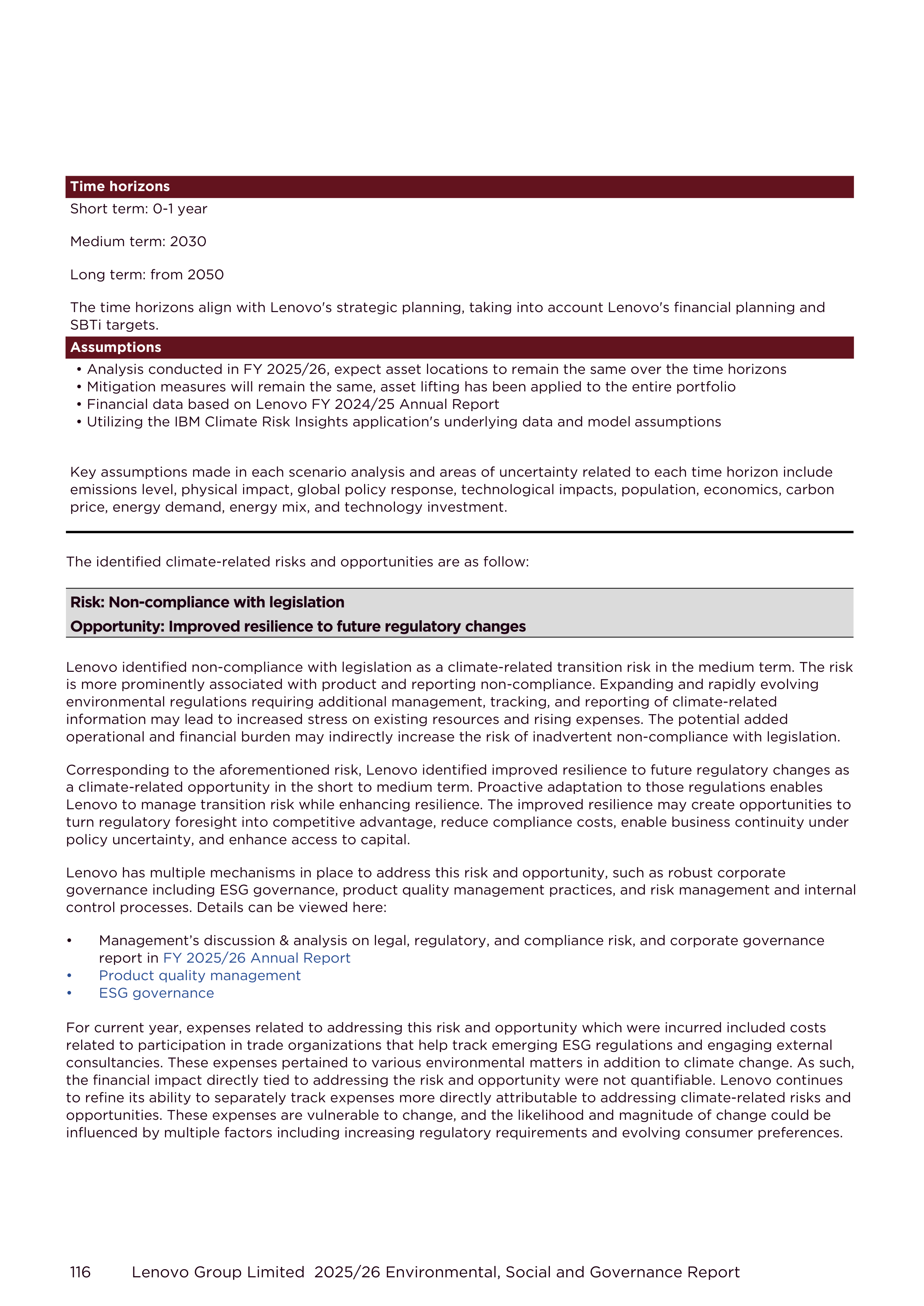
Time horizons
Short term: 0-1 year
Medium term: 2030
Long term: from 2050
The time horizons align with Lenovo's strategic planning, taking into account Lenovo's financial planning and
SBTi targets.
Assumptions
•
Analysis conducted in FY 2025/26, expect asset locations to remain the same over the time horizons
•
Mitigation measures will remain the same, asset lifting has been applied to the entire portfolio
•
Financial data based on Lenovo FY 2024/25 Annual Report
•
Utilizing the IBM Climate Risk Insights application's underlying data and model assumptions
Key assumptions made in each scenario analysis and areas of uncertainty related to each time horizon include
emissions level, physical impact, global policy response, technological impacts, population, economics, carbon
price, energy demand, energy mix, and technology investment.
The identified climate-related risks and opportunities are as follow:
Risk: Non-compliance with legislation
Opportunity: Improved resilience to future regulatory changes
Lenovo identified non-compliance with legislation as a climate-related transition risk in the medium term. The risk
is more prominently associated with product and reporting non-compliance. Expanding and rapidly evolving
environmental regulations requiring additional management, tracking, and reporting of climate-related
information may lead to increased stress on existing resources and rising expenses. The potential added
operational and financial burden may indirectly increase the risk of inadvertent non-compliance with legislation.
Corresponding to the aforementioned risk, Lenovo identified improved resilience to future regulatory changes as
a climate-related opportunity in the short to medium term. Proactive adaptation to those regulations enables
Lenovo to manage transition risk while enhancing resilience. The improved resilience may create opportunities to
turn regulatory foresight into competitive advantage, reduce compliance costs, enable business continuity under
policy uncertainty, and enhance access to capital.
Lenovo has multiple mechanisms in place to address this risk and opportunity, such as robust corporate
governance including ESG governance, product quality management practices, and risk management and internal
control processes. Details can be viewed here:
•
Management’s discussion & analysis on legal, regulatory, and compliance risk, and corporate governance
report in
FY 2025/26 Annual Report
•
Product quality management
•
ESG governance
For current year, expenses related to addressing this risk and opportunity which were incurred included costs
related to participation in trade organizations that help track emerging ESG regulations and engaging external
consultancies. These expenses pertained to various environmental matters in addition to climate change. As such,
the financial impact directly tied to addressing the risk and opportunity were not quantifiable. Lenovo continues
to refine its ability to separately track expenses more directly attributable to addressing climate-related risks and
opportunities. These expenses are vulnerable to change, and the likelihood and magnitude of change could be
influenced by multiple factors including increasing regulatory requirements and evolving consumer preferences.
116
Lenovo Group Limited 2025/26 Environmental, Social and Governance Report
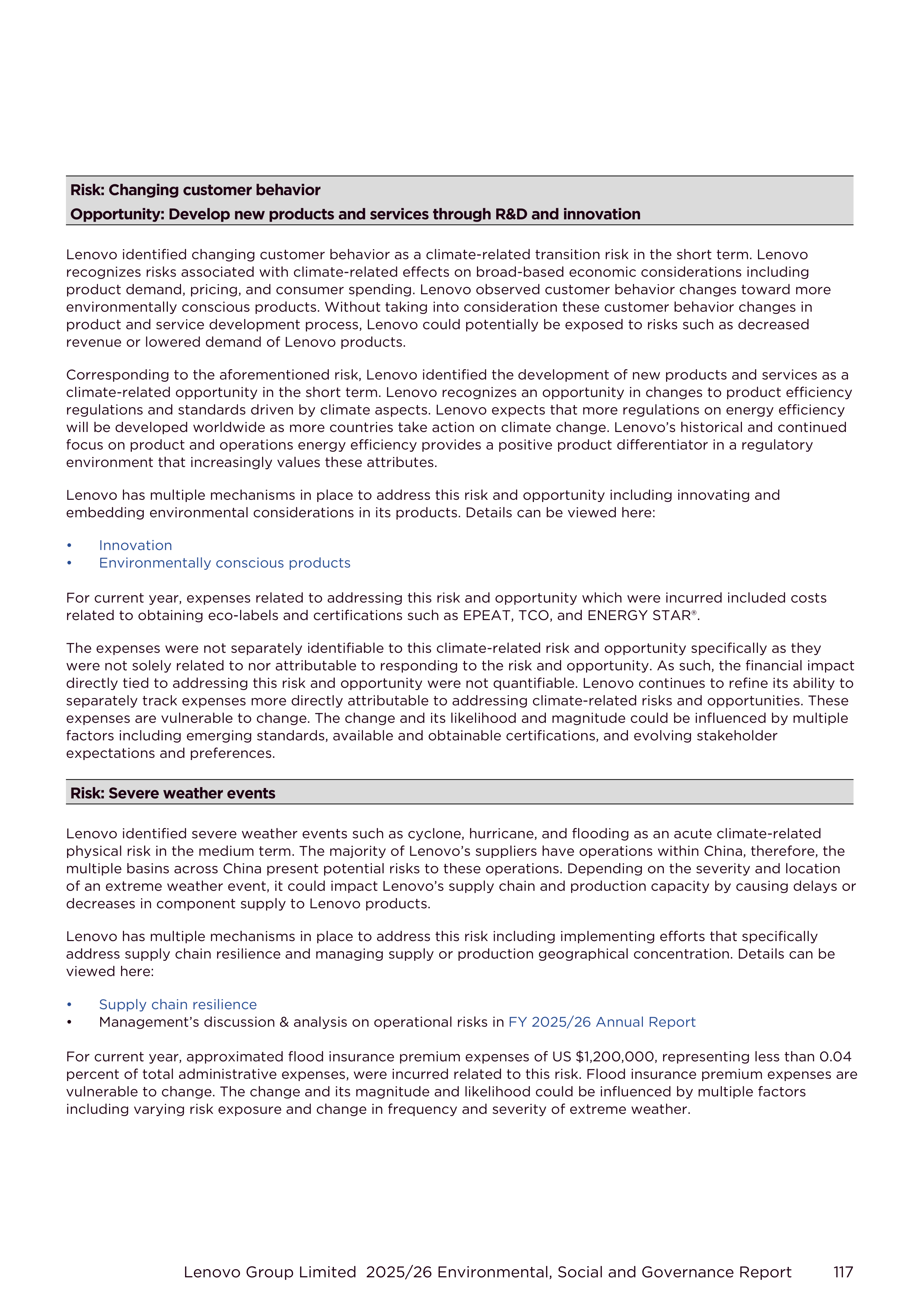
Risk: Changing customer behavior
Opportunity: Develop new products and services through R&D and innovation
Lenovo identified changing customer behavior as a climate-related transition risk in the short term. Lenovo
recognizes risks associated with climate-related effects on broad-based economic considerations including
product demand, pricing, and consumer spending. Lenovo observed customer behavior changes toward more
environmentally conscious products. Without taking into consideration these customer behavior changes in
product and service development process, Lenovo could potentially be exposed to risks such as decreased
revenue or lowered demand of Lenovo products.
Corresponding to the aforementioned risk, Lenovo identified the development of new products and services as a
climate-related opportunity in the short term. Lenovo recognizes an opportunity in changes to product efficiency
regulations and standards driven by climate aspects. Lenovo expects that more regulations on energy efficiency
will be developed worldwide as more countries take action on climate change. Lenovo’s historical and continued
focus on product and operations energy efficiency provides a positive product differentiator in a regulatory
environment that increasingly values these attributes.
Lenovo has multiple mechanisms in place to address this risk and opportunity including innovating and
embedding environmental considerations in its products. Details can be viewed here:
•
Innovation
•
Environmentally conscious products
For current year, expenses related to addressing this risk and opportunity which were incurred included costs
related to obtaining eco-labels and certifications such as EPEAT, TCO, and ENERGY STAR®.
The expenses were not separately identifiable to this climate-related risk and opportunity specifically as they
were not solely related to nor attributable to responding to the risk and opportunity. As such, the financial impact
directly tied to addressing this risk and opportunity were not quantifiable. Lenovo continues to refine its ability to
separately track expenses more directly attributable to addressing climate-related risks and opportunities. These
expenses are vulnerable to change. The change and its likelihood and magnitude could be influenced by multiple
factors including emerging standards, available and obtainable certifications, and evolving stakeholder
expectations and preferences.
Risk: Severe weather events
Lenovo identified severe weather events such as cyclone, hurricane, and flooding as an acute climate-related
physical risk in the medium term. The majority of Lenovo’s suppliers have operations within China, therefore, the
multiple basins across China present potential risks to these operations. Depending on the severity and location
of an extreme weather event, it could impact Lenovo’s supply chain and production capacity by causing delays or
decreases in component supply to Lenovo products.
Lenovo has multiple mechanisms in place to address this risk including implementing efforts that specifically
address supply chain resilience and managing supply or production geographical concentration. Details can be
viewed here:
•
Supply chain resilience
•
Management’s discussion & analysis on operational risks in
FY 2025/26 Annual Report
For current year, approximated flood insurance premium expenses of US $1,200,000, representing less than 0.04
percent of total administrative expenses, were incurred related to this risk. Flood insurance premium expenses are
vulnerable to change. The change and its magnitude and likelihood could be influenced by multiple factors
including varying risk exposure and change in frequency and severity of extreme weather.
Lenovo Group Limited 2025/26 Environmental, Social and Governance Report
117
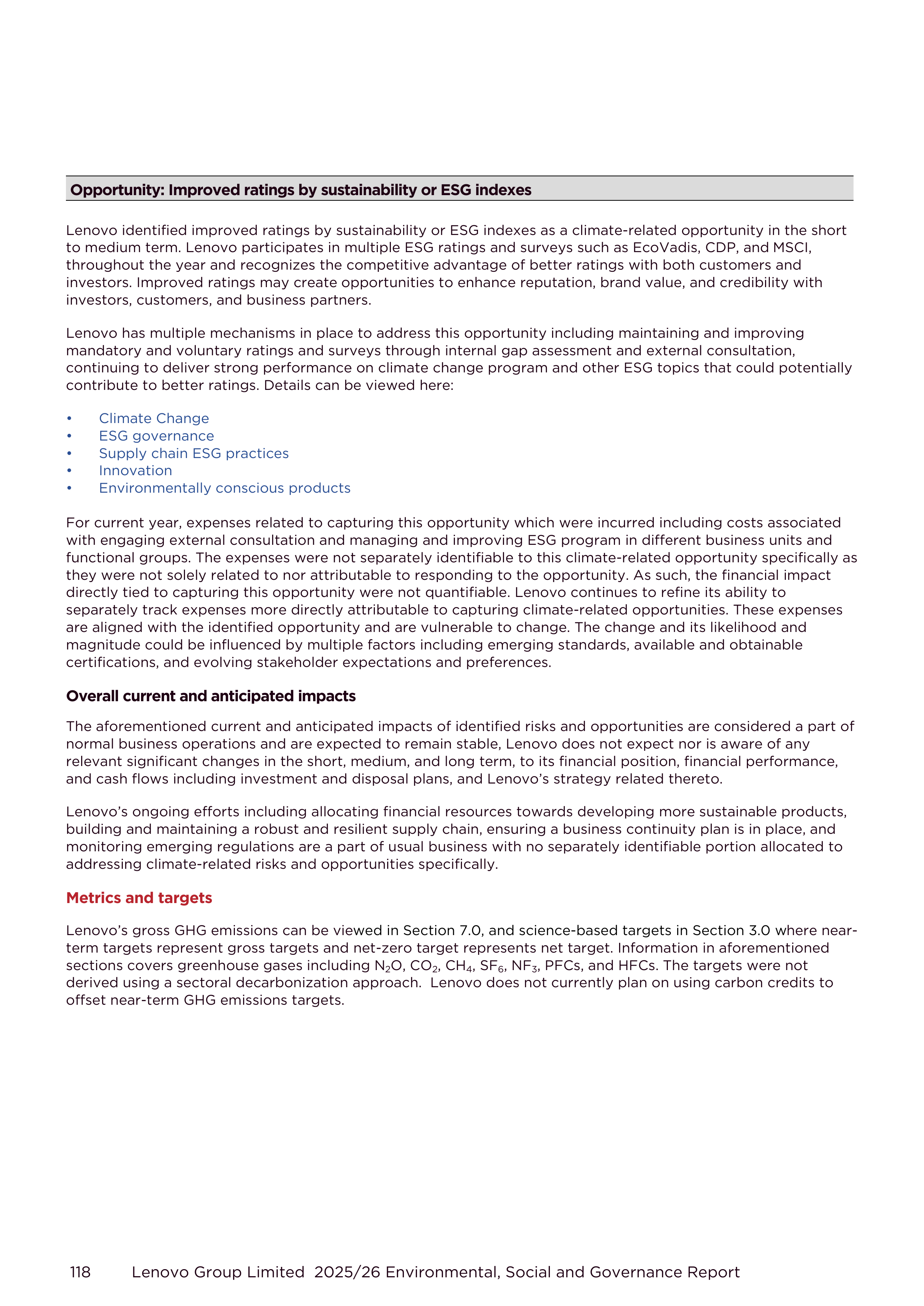
Opportunity: Improved ratings by sustainability or ESG indexes
Lenovo identified improved ratings by sustainability or ESG indexes as a climate-related opportunity in the short
to medium term. Lenovo participates in multiple ESG ratings and surveys such as EcoVadis, CDP, and MSCI,
throughout the year and recognizes the competitive advantage of better ratings with both customers and
investors. Improved ratings may create opportunities to enhance reputation, brand value, and credibility with
investors, customers, and business partners.
Lenovo has multiple mechanisms in place to address this opportunity including maintaining and improving
mandatory and voluntary ratings and surveys through internal gap assessment and external consultation,
continuing to deliver strong performance on climate change program and other ESG topics that could potentially
contribute to better ratings. Details can be viewed here:
•
Climate Change
•
ESG governance
•
Supply chain ESG practices
•
Innovation
•
Environmentally conscious products
For current year, expenses related to capturing this opportunity which were incurred including costs associated
with engaging external consultation and managing and improving ESG program in different business units and
functional groups. The expenses were not separately identifiable to this climate-related opportunity specifically as
they were not solely related to nor attributable to responding to the opportunity. As such, the financial impact
directly tied to capturing this opportunity were not quantifiable. Lenovo continues to refine its ability to
separately track expenses more directly attributable to capturing climate-related opportunities. These expenses
are aligned with the identified opportunity and are vulnerable to change. The change and its likelihood and
magnitude could be influenced by multiple factors including emerging standards, available and obtainable
certifications, and evolving stakeholder expectations and preferences.
Overall current and anticipated impacts
The aforementioned current and anticipated impacts of identified risks and opportunities are considered a part of
normal business operations and are expected to remain stable, Lenovo does not expect nor is aware of any
relevant significant changes in the short, medium, and long term, to its financial position, financial performance,
and cash flows including investment and disposal plans, and Lenovo’s strategy related thereto.
Lenovo’s ongoing efforts including allocating financial resources towards developing more sustainable products,
building and maintaining a robust and resilient supply chain, ensuring a business continuity plan is in place, and
monitoring emerging regulations are a part of usual business with no separately identifiable portion allocated to
addressing climate-related risks and opportunities specifically.
Metrics and targets
Lenovo’s gross GHG emissions can be vie
wed in Section 7.0, and science-based targets in Section 3.0 w
here near-
term targets represent gross targets and net-zero target represents net target. Information in aforementioned
sections covers greenhouse gases including N
2
O, CO
2
, CH
4
, SF
6
, NF
3
, PFCs, and HFCs. The targets were not
derived using a sectoral decarbonization approach. Lenovo does not currently plan on using carbon credits to
offset near-term GHG emissions targets.
118
Lenovo Group Limited 2025/26 Environmental, Social and Governance Report
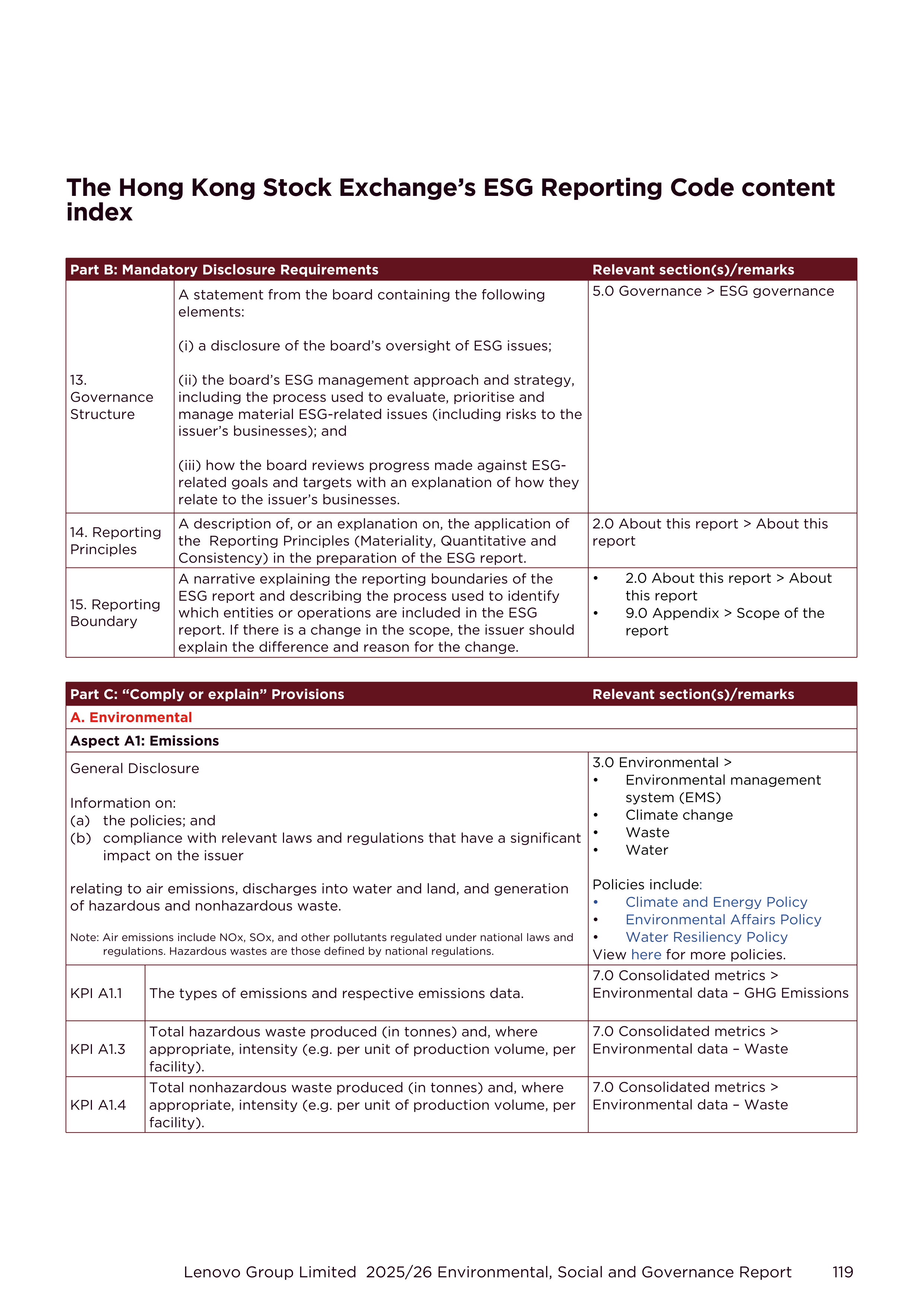
The Hong Kong Stock Exchange’s ESG Reporting Code content
index
Part B: Mandatory Disclosure Requirements
Relevant section(s)/remarks
13.
Governance
Structure
A statement from the board containing the following
elements:
(i) a disclosure of the board’s oversight of ESG issues;
(ii) the board’s ESG management approach and strategy,
including the process used to evaluate, prioritise and
manage material ESG-related issues (including risks to the
issuer’s businesses); and
(iii) how the board reviews progress made against ESG-
related goals and targets with an explanation of how they
relate to the issuer’s businesses.
5.0 Governance > ESG governance
14. Reporting
Principles
A description of, or an explanation on, the application of
the Reporting Principles (Materiality, Quantitative and
Consistency) in the preparation of the ESG report.
2.0 About this report > About this
report
15. Reporting
Boundary
A narrative explaining the reporting boundaries of the
ESG report and describing the process used to identify
which entities or operations are included in the ESG
report. If there is a change in the scope, the issuer should
explain the difference and reason for the change.
•
2.0 About this report > About
this report
•
9.0 Appendix > Scope of the
report
A. Environmental
Aspect A1: Emissions
General Disclosure
Information on:
(a)
the policies; and
(b)
compliance with relevant laws and regulations that have a significant
impact on the issuer
relating to air emissions, discharges into water and land, and generation
of hazardous and nonhazardous waste.
Note: Air emissions include NOx, SOx, and other pollutants regulated under national laws and
regulations. Hazardous wastes are those defined by national regulations.
3.0 Environmental >
•
Environmental management
system (EMS)
•
Climate change
•
Waste
•
Water
Policies include
:
•
Climate and Energy Policy
•
Environmental Affairs Policy
•
Water Resiliency Policy
View
here
for more policies.
KPI A1.1
The types of emissions and respective emissions data.
7.0 Consolidated metrics >
Environmental data – GHG Emissions
KPI A1.3
Total hazardous waste produced (in tonnes) and, where
appropriate, intensity (e.g. per unit of production volume, per
facility).
7.0 Consolidated metrics >
Environmental data – Waste
KPI A1.4
Total nonhazardous waste produced (in tonnes) and, where
appropriate, intensity (e.g. per unit of production volume, per
facility).
7.0 Consolidated metrics >
Environmental data – Waste
Part C: “Comply or explain” Provisions
Relevant section(s)/remarks
Lenovo Group Limited 2025/26 Environmental, Social and Governance Report
119
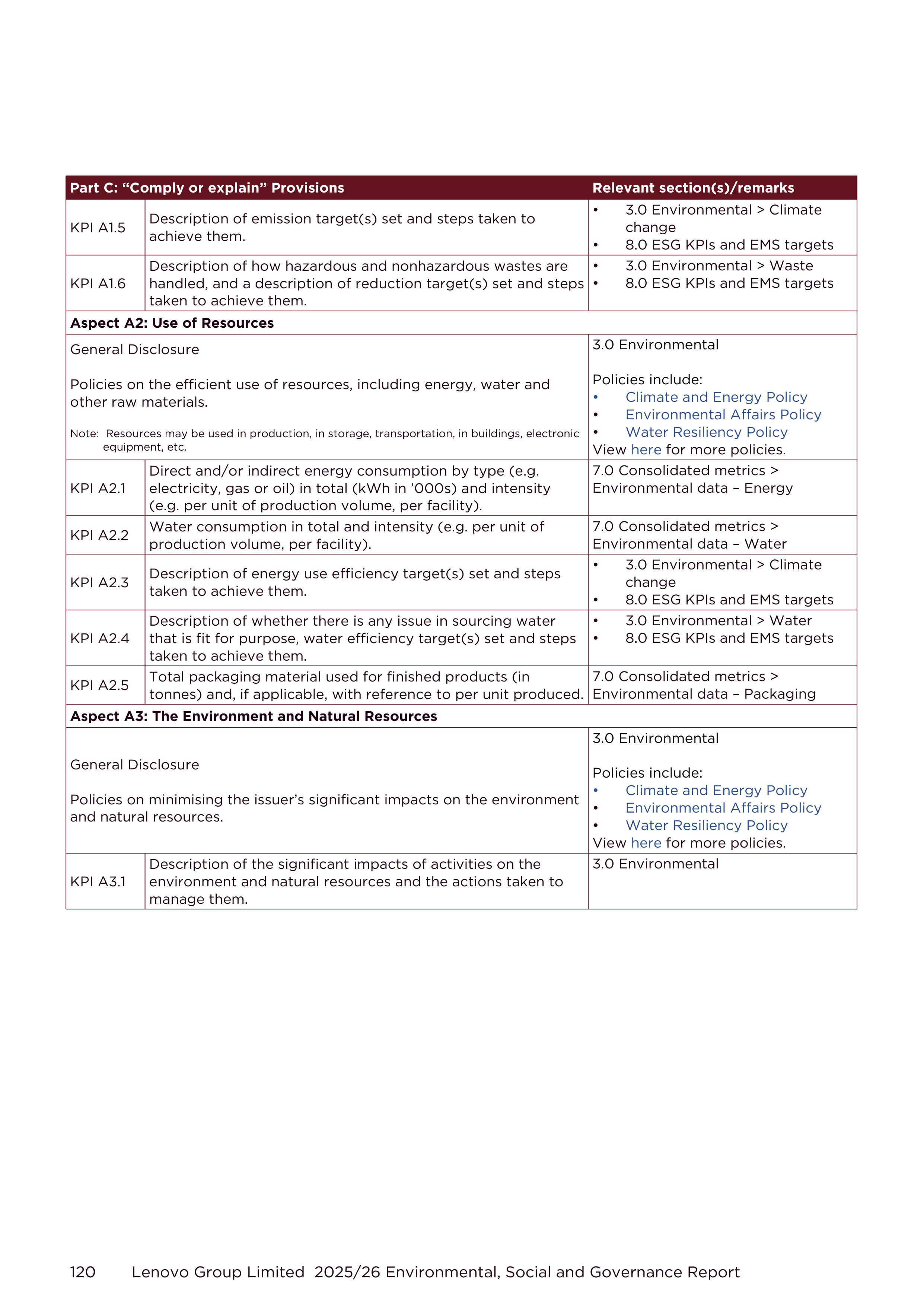
Part C: “Comply or explain” Provisions
Relevant section(s)/remarks
KPI A1.5
Description of emission target(s) set and steps taken to
achieve them.
•
3.0 Environmental > Climate
change
•
8.0 ESG KPIs and EMS targets
KPI A1.6
Description of how hazardous and nonhazardous wastes are
handled, and a description of reduction target(s) set and steps
taken to achieve them.
•
3.0 Environmental > Waste
•
8.0 ESG KPIs and EMS targets
Aspect A2: Use of Resources
General Disclosure
Policies on the efficient use of resources, including energy, water and
other raw materials.
Note: Resources may be used in production, in storage, transportation, in buildings, electronic
equipment, etc.
3.0 Environmental
Policies include:
•
Climate and Energy Policy
•
Environmental Affairs Policy
•
Water Resiliency Policy
View
here
for more policies.
KPI A2.1
Direct and/or indirect energy consumption by type (e.g.
electricity, gas or oil) in total (kWh in ’000s) and intensity
(e.g. per unit of production volume, per facility).
7.0 Consolidated metrics >
Environmental data – Energy
KPI A2.2
Water consumption in total and intensity (e.g. per unit of
production volume, per facility).
7.0 Consolidated metrics >
Environmental data – Water
KPI A2.3
Description of energy use efficiency target(s) set and steps
taken to achieve them.
•
3.0 Environmental > Climate
change
•
8.0 ESG KPIs and EMS targets
KPI A2.4
Description of whether there is any issue in sourcing water
that is fit for purpose, water efficiency target(s) set and steps
taken to achieve them.
•
3.0 Environmental > Water
•
8.0 ESG KPIs and EMS targets
KPI A2.5
Total packaging material used for finished products (in
tonnes) and, if applicable, with reference to per unit produced.
7.0 Consolidated metrics >
Environmental data – Packaging
Aspect A3: The Environment and Natural Resources
General Disclosure
Policies on minimising the issuer’s significant impacts on the environment
and natural resources.
3.0 Environmental
Policies include:
•
Climate and Energy Policy
•
Environmental Affairs Policy
•
Water Resiliency Policy
View
here
for more policies.
KPI A3.1
Description of the significant impacts of activities on the
environment and natural resources and the actions taken to
manage them.
3.0 Environmental
120
Lenovo Group Limited 2025/26 Environmental, Social and Governance Report
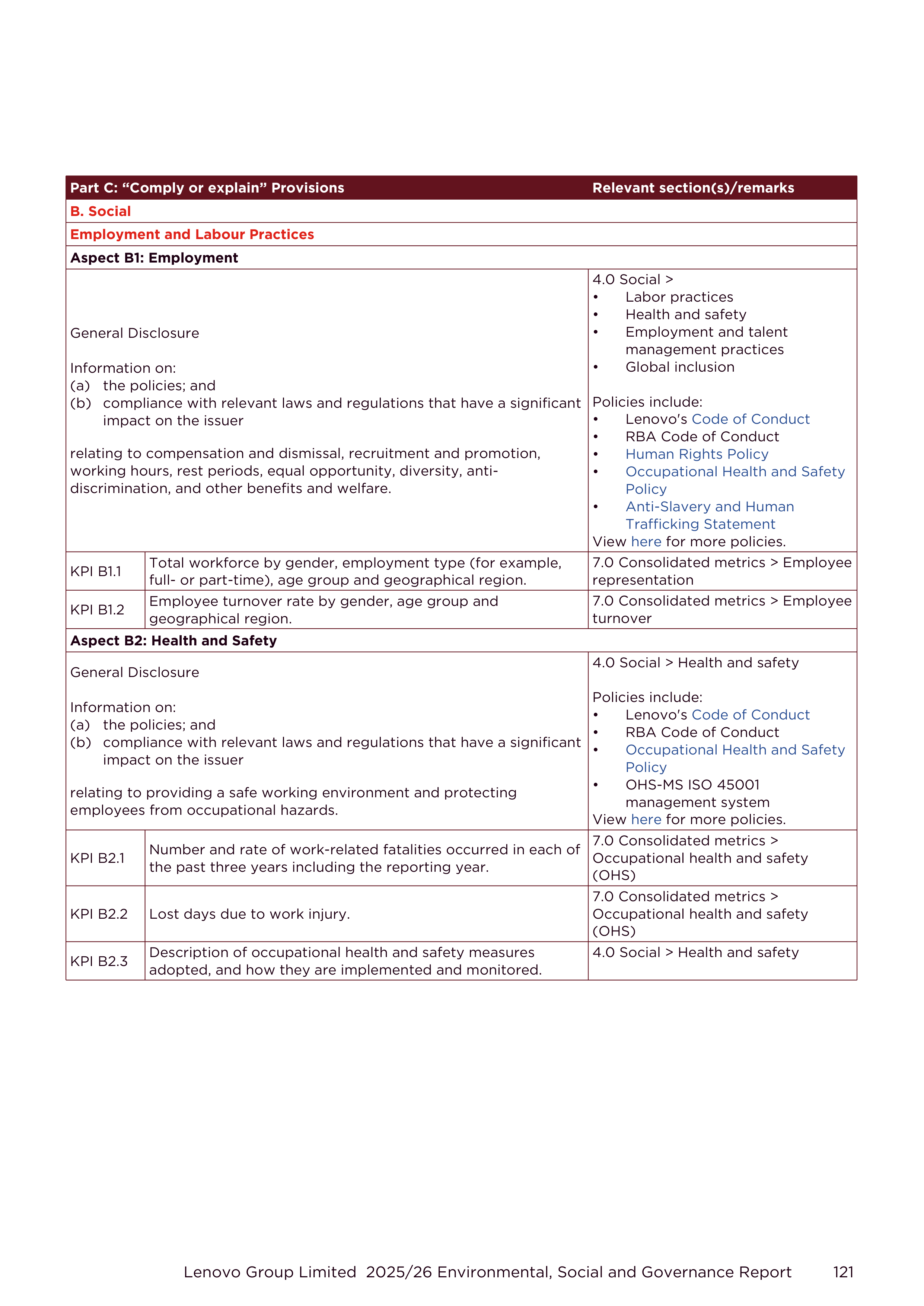
Part C: “Comply or explain” Provisions
Relevant section(s)/remarks
B. Social
Employment and Labour Practices
Aspect B1: Employment
General Disclosure
Information on:
(a)
the policies; and
(b)
compliance with relevant laws and regulations that have a significant
impact on the issuer
relating to compensation and dismissal, recruitment and promotion,
working hours, rest periods, equal opportunity, diversity, anti-
discrimination, and other benefits and welfare.
4.0 Social >
•
Labor practices
•
Health and safety
•
Employment and talent
management practices
•
Global inclusion
Policies include:
•
Lenovo's
Code of
Conduct
•
RBA Code of Conduct
•
Human Rights Policy
•
Occupational Health and Safety
Policy
•
Anti-Slavery and Human
Trafficking Statement
View
here
for more policies.
KPI B1.1
Total workforce by gender, employment type (for example,
full- or part-time), age group and geographical region.
7.0 Consolidated metrics > Employee
representation
KPI B1.2
Employee turnover rate by gender, age group and
geographical region.
7.0 Consolidated metrics > Employee
turnover
Aspect B2: Health and Safety
General Disclosure
Information on:
(a)
the policies; and
(b)
compliance with relevant laws and regulations that have a significant
impact on the issuer
relating to providing a safe working environment and protecting
employees from occupational hazards.
4.0 Social > Health and safety
Policies include:
•
Lenovo's
Code of
Conduct
•
RBA Code of Conduct
•
Occupational Health and Safety
Policy
•
OHS-MS ISO 45001
management system
View
here
for more policies.
KPI B2.1
Number and rate of work-related fatalities occurred in each of
the past three years including the reporting year.
7.0 Consolidated metrics >
Occupational health and safety
(OHS)
KPI B2.2
Lost days due to work injury.
7.0 Consolidated metrics >
Occupational health and safety
(OHS)
KPI B2.3
Description of occupational health and safety measures
adopted, and how they are implemented and monitored.
4.0 Social > Health and safety
Lenovo Group Limited 2025/26 Environmental, Social and Governance Report
121
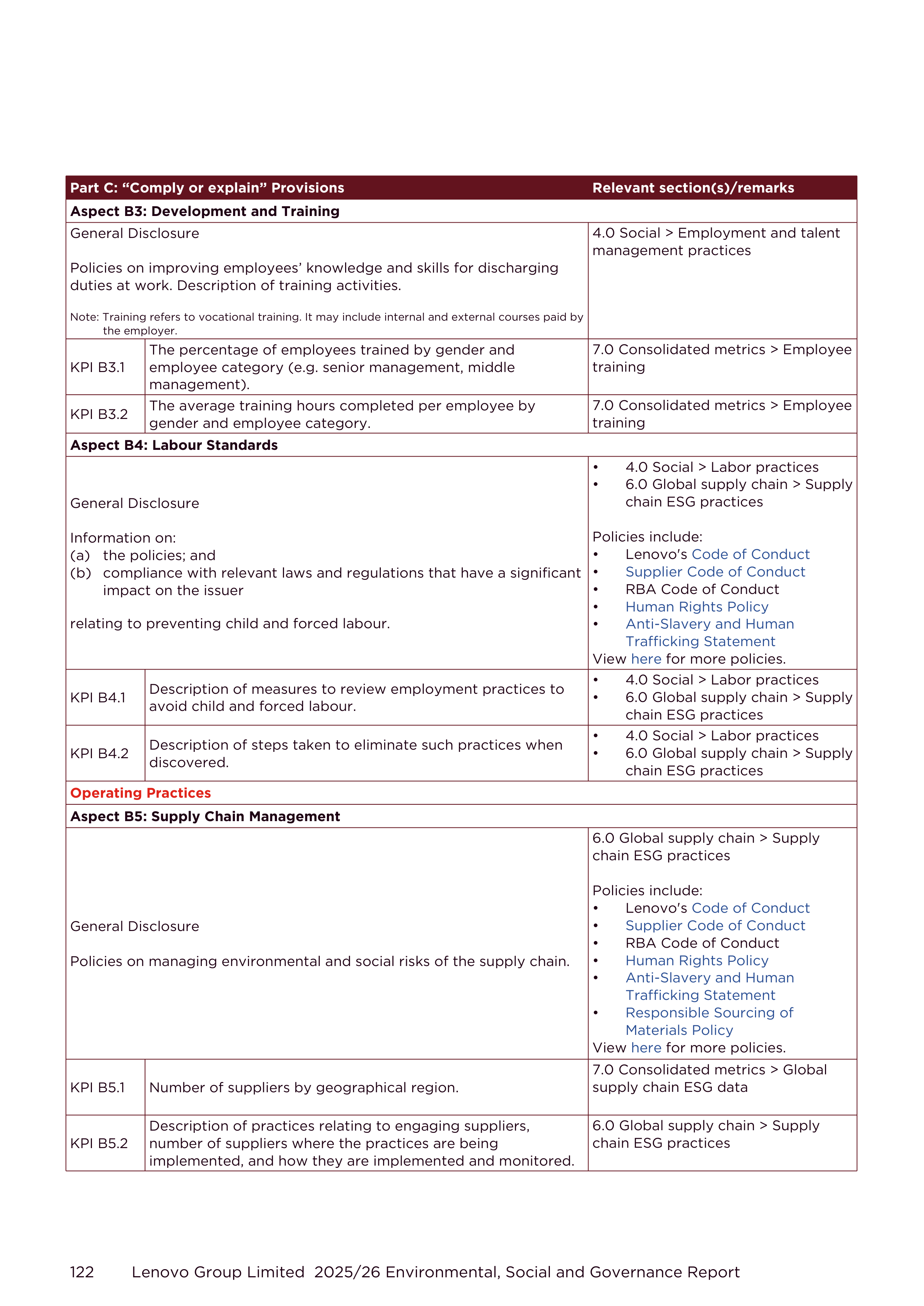
Part C: “Comply or explain” Provisions
Relevant section(s)/remarks
Aspect B3: Development and Training
General Disclosure
Policies on improving employees’ knowledge and skills for discharging
duties at work. Description of training activities.
Note: Training refers to vocational training. It may include internal and external courses paid by
the employer.
4.0 Social > Employment and talent
management practices
KPI B3.1
The percentage of employees trained by gender and
employee category (e.g. senior management, middle
management).
7.0 Consolidated metrics > Employee
training
KPI B3.2
The average training hours completed per employee by
gender and employee category.
7.0 Consolidated metrics > Employee
training
Aspect B4: Labour Standards
General Disclosure
Information on:
(a)
the policies; and
(b)
compliance with relevant laws and regulations that have a significant
impact on the issuer
relating to preventing child and forced labour.
•
4.0 Social > Labor practices
•
6.0 Global supply chain > Supply
chain ESG practices
Policies include:
•
Lenovo's
Code of
Conduct
•
Supplier Code of Conduct
•
RBA Code of Conduct
•
Human Rights Policy
•
Anti-Slavery and Human
Trafficking Statement
View
here
for more policies.
KPI B4.1
Description of measures to review employment practices to
avoid child and forced labour.
•
4.0 Social > Labor practices
•
6.0 Global supply chain > Supply
chain ESG practices
KPI B4.2
Description of steps taken to eliminate such practices when
discovered.
•
4.0 Social > Labor practices
•
6.0 Global supply chain > Supply
chain ESG practices
Operating Practices
Aspect B5: Supply Chain Management
General Disclosure
Policies on managing environmental and social risks of the supply chain.
6.0 Global supply chain > Supply
chain ESG practices
Policies include:
•
Lenovo's
Code of
Conduct
•
Supplier Code of Conduct
•
RBA Code of Conduct
•
Human Rights Policy
•
Anti-Slavery and Human
Trafficking Statement
•
Responsible Sourcing of
Materials Policy
View
here
for more policies.
KPI B5.1
Number of suppliers by geographical region.
7.0 Consolidated metrics > Global
supply chain ESG data
KPI B5.2
Description of practices relating to engaging suppliers,
number of suppliers where the practices are being
implemented, and how they are implemented and monitored.
6.0 Global supply chain > Supply
chain ESG practices
122
Lenovo Group Limited 2025/26 Environmental, Social and Governance Report
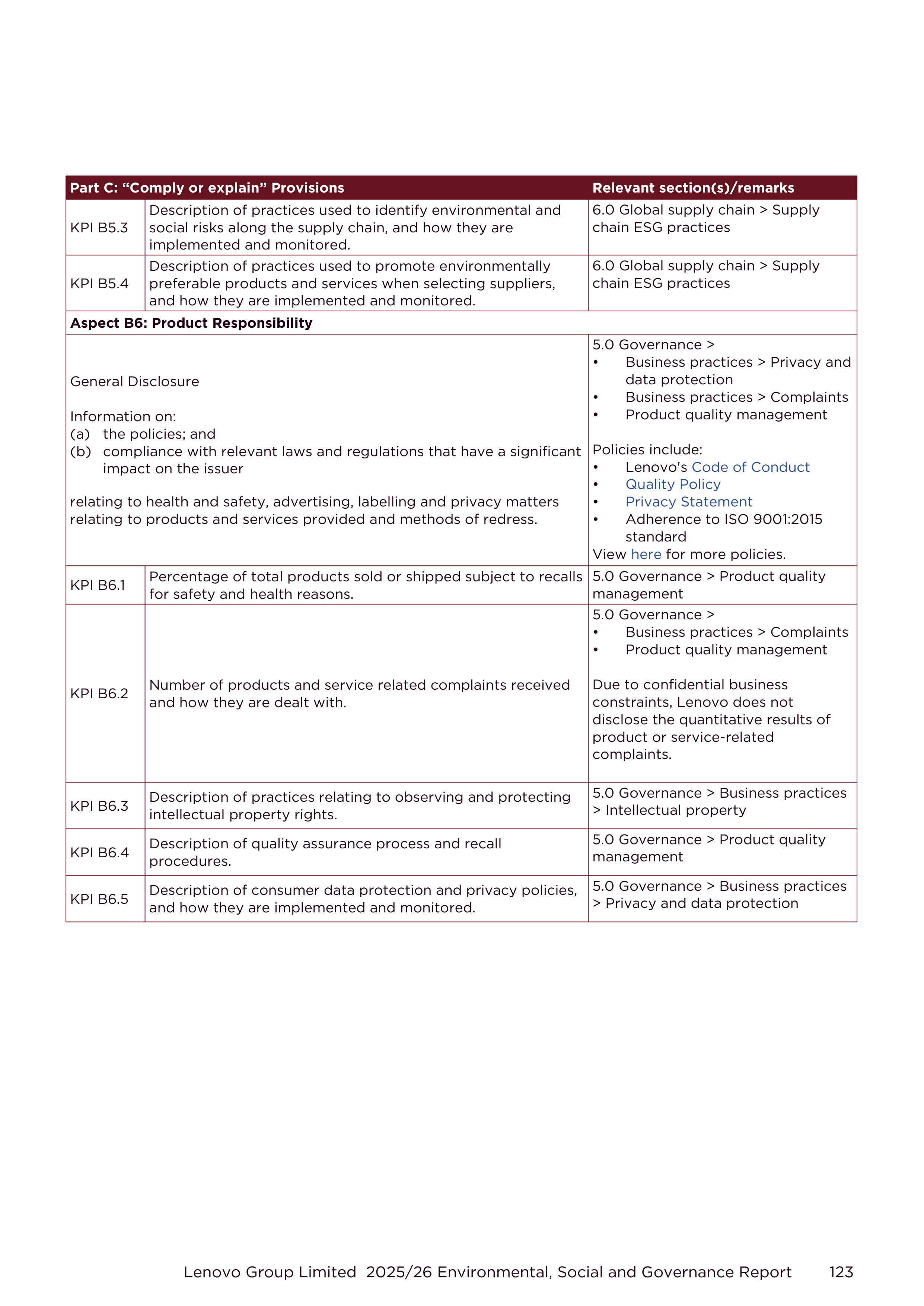
Part C: “Comply or explain” Provisions
Relevant section(s)/remarks
KPI B5.3
Description of practices used to identify environmental and
social risks along the supply chain, and how they are
implemented and monitored.
6.0 Global supply chain > Supply
chain ESG practices
KPI B5.4
Description of practices used to promote environmentally
preferable products and services when selecting suppliers,
and how they are implemented and monitored.
6.0 Global supply chain > Supply
chain ESG practices
Aspect B6: Product Responsibility
General Disclosure
Information on:
(a)
the policies; and
(b)
compliance with relevant laws and regulations that have a significant
impact on the issuer
relating to health and safety, advertising, labelling and privacy matters
relating to products and services provided and methods of redress.
5.0 Governance >
•
Business practices > Privacy and
data protection
•
Business practices > Complaints
•
Product quality management
Policies include:
•
Lenovo's
Code of
Conduct
•
Quality Policy
•
Privacy Statement
•
Adherence to ISO 9001:2015
standard
View
here
for more policies.
KPI B6.1
Percentage of total products sold or shipped subject to recalls
for safety and health reasons.
5.0 Governance > Product quality
management
KPI B6.2
Number of products and service related complaints received
and how they are dealt with.
5.0 Governance >
•
Business practices > Complaints
•
Product quality management
Due to confidential business
constraints, Lenovo does not
disclose the quantitative results of
product or service-related
complaints.
KPI B6.3
Description of practices relating to observing and protecting
intellectual property rights.
5.0 Governance > Business practices
> Intellectual property
KPI B6.4
Description of quality assurance process and recall
procedures.
5.0 Governance > Product quality
management
KPI B6.5
Description of consumer data protection and privacy policies,
and how they are implemented and monitored.
5.0 Governance > Business practices
> Privacy and data protection
Lenovo Group Limited 2025/26 Environmental, Social and Governance Report
123
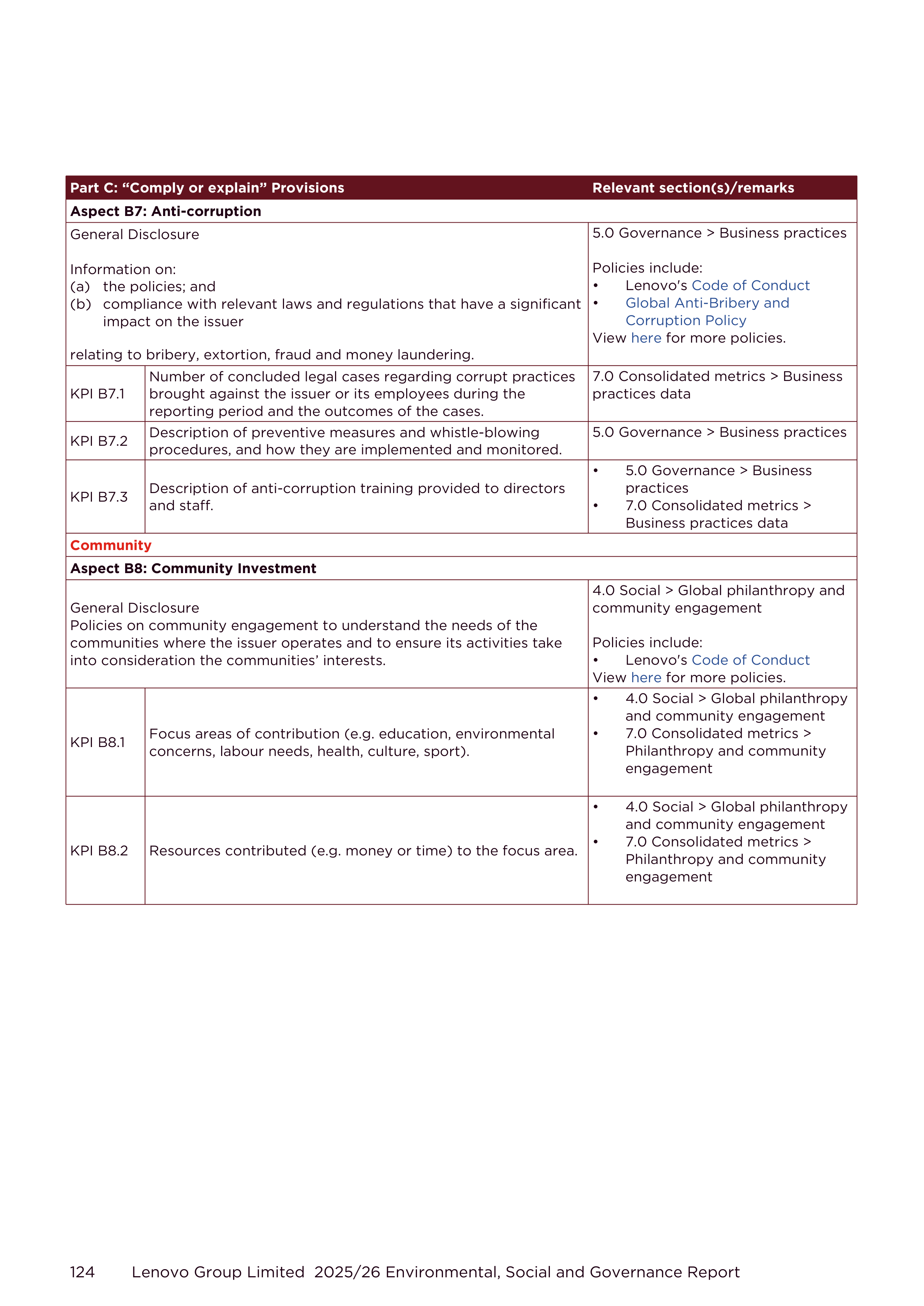
Part C: “Comply or explain” Provisions
Relevant section(s)/remarks
Aspect B7: Anti-corruption
General Disclosure
Information on:
(a)
the policies; and
(b)
compliance with relevant laws and regulations that have a significant
impact on the issuer
relating to bribery, extortion, fraud and money laundering.
5.0 Governance > Business practices
Policies include:
•
Lenovo's
Code of
Conduct
•
Global
Anti-Bribery and
Corruption Policy
View
here
for more policies.
KPI B7.1
Number of concluded legal cases regarding corrupt practices
brought against the issuer or its employees during the
reporting period and the outcomes of the cases.
7.0 Consolidated metrics > Business
practices data
KPI B7.2
Description of preventive measures and whistle-blowing
procedures, and how they are implemented and monitored.
5.0 Governance > Business practices
KPI B7.3
Description of anti-corruption training provided to directors
and staff.
•
5.0 Governance > Business
practices
•
7.0 Consolidated metrics >
Business practices data
Community
Aspect B8: Community Investment
General Disclosure
Policies on community engagement to understand the needs of the
communities where the issuer operates and to ensure its activities take
into consideration the communities’ interests.
4.0 Social > Global philanthropy and
community engagement
Policies include:
•
Lenovo's
Code of
Conduct
View
here
for more policies.
KPI B8.1
Focus areas of contribution (e.g. education, environmental
concerns, labour needs, health, culture, sport).
•
4.0 Social > Global philanthropy
and community engagement
•
7.0 Consolidated metrics >
Philanthropy and community
engagement
KPI B8.2
Resources contributed (e.g. money or time) to the focus area.
•
4.0 Social > Global philanthropy
and community engagement
•
7.0 Consolidated metrics >
Philanthropy and community
engagement
124
Lenovo Group Limited 2025/26 Environmental, Social and Governance Report
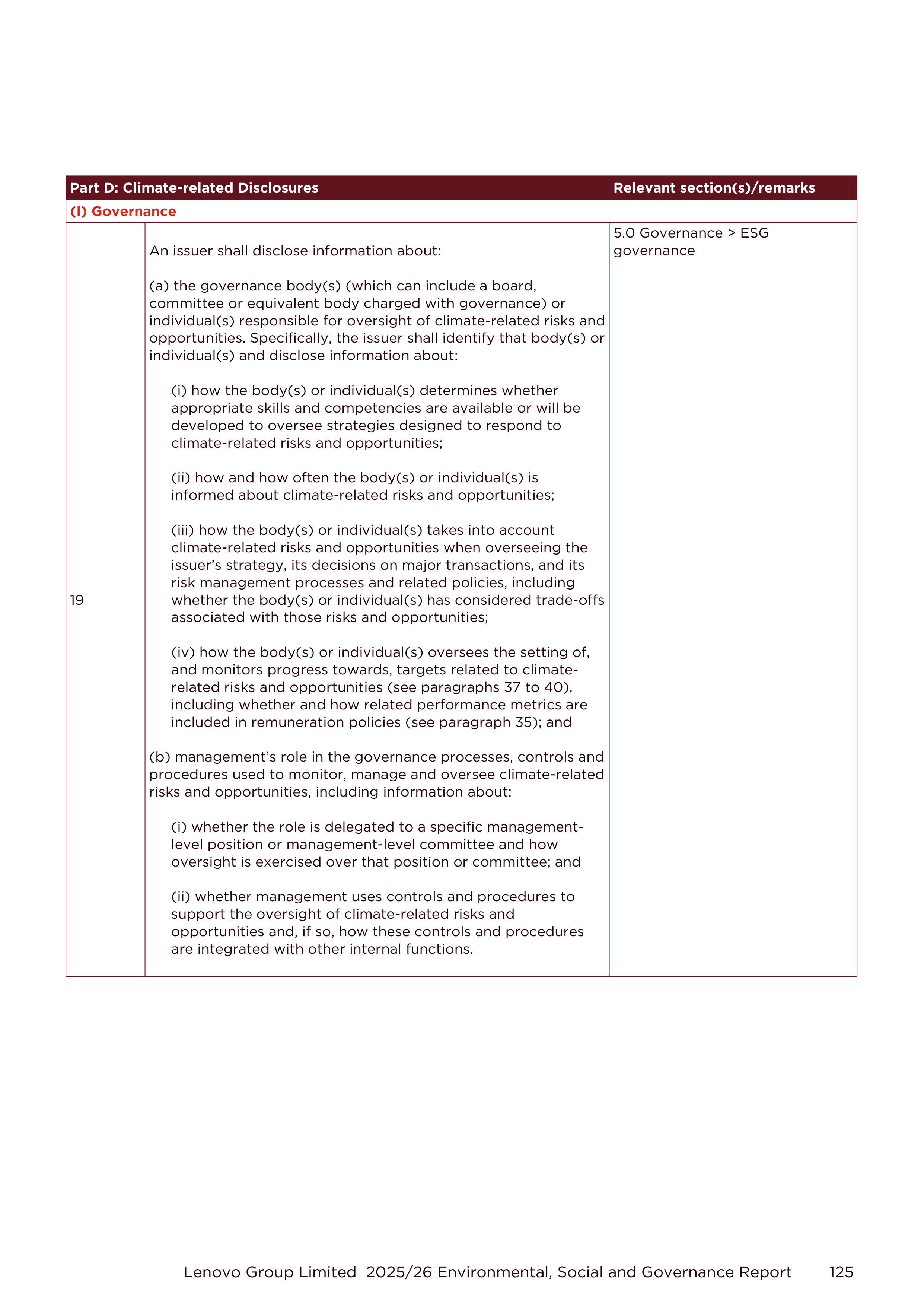
Part D: Climate-related Disclosures
Relevant section(s)/remarks
(I) Governance
19
An issuer shall disclose information about:
(a) the governance body(s) (which can include a board,
committee or equivalent body charged with governance) or
individual(s) responsible for oversight of climate-related risks and
opportunities. Specifically, the issuer shall identify that body(s) or
individual(s) and disclose information about:
(i) how the body(s) or individual(s) determines whether
appropriate skills and competencies are available or will be
developed to oversee strategies designed to respond to
climate-related risks and opportunities;
(ii) how and how often the body(s) or individual(s) is
informed about climate-related risks and opportunities;
(iii) how the body(s) or individual(s) takes into account
climate-related risks and opportunities when overseeing the
issuer’s strategy, its decisions on major transactions, and its
risk management processes and related policies, including
whether the body(s) or individual(s) has considered trade-offs
associated with those risks and opportunities;
(iv) how the body(s) or individual(s) oversees the setting of,
and monitors progress towards, targets related to climate-
related risks and opportunities (see paragraphs 37 to 40),
including whether and how related performance metrics are
included in remuneration policies (see paragraph 35); and
(b) management’s role in the governance processes, controls and
procedures used to monitor, manage and oversee climate-related
risks and opportunities, including information about:
(i) whether the role is delegated to a specific management-
level position or management-level committee and how
oversight is exercised over that position or committee; and
(ii) whether management uses controls and procedures to
support the oversight of climate-related risks and
opportunities and, if so, how these controls and procedures
are integrated with other internal functions.
5.0 Governance > ESG
governance
Lenovo Group Limited 2025/26 Environmental, Social and Governance Report
125
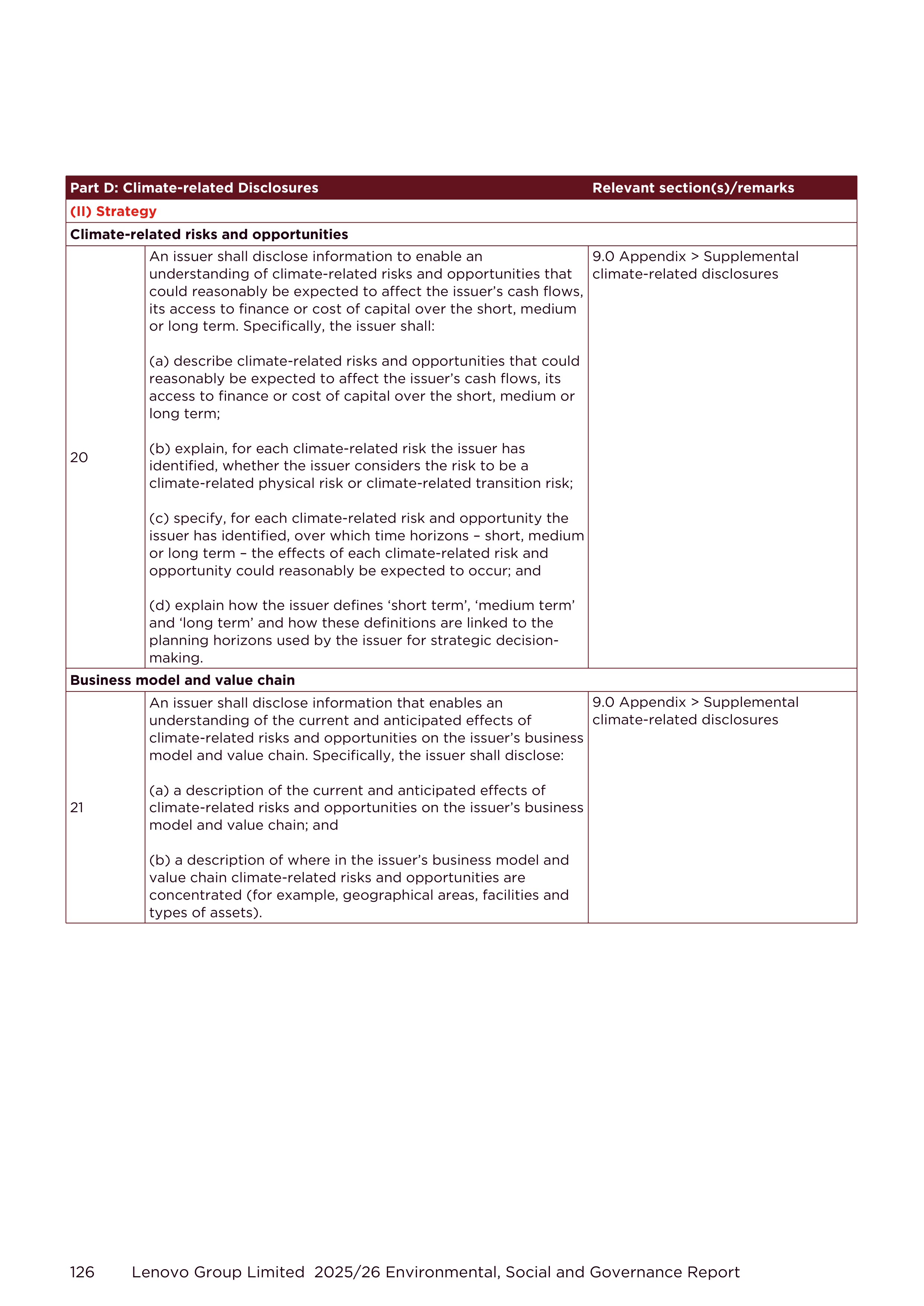
Part D: Climate-related Disclosures
Relevant section(s)/remarks
(II) Strategy
Climate-related risks and opportunities
20
An issuer shall disclose information to enable an
understanding of climate-related risks and opportunities that
could reasonably be expected to affect the issuer’s cash flows,
its access to finance or cost of capital over the short, medium
or long term. Specifically, the issuer shall:
(a) describe climate-related risks and opportunities that could
reasonably be expected to affect the issuer’s cash flows, its
access to finance or cost of capital over the short, medium or
long term;
(b) explain, for each climate-related risk the issuer has
identified, whether the issuer considers the risk to be a
climate-related physical risk or climate-related transition risk;
(c) specify, for each climate-related risk and opportunity the
issuer has identified, over which time horizons – short, medium
or long term – the effects of each climate-related risk and
opportunity could reasonably be expected to occur; and
(d) explain how the issuer defines ‘short term’, ‘medium term’
and ‘long term’ and how these definitions are linked to the
planning horizons used by the issuer for strategic decision-
making.
9.0 Appendix > Supplemental
climate-related disclosures
Business model and value chain
21
An issuer shall disclose information that enables an
understanding of the current and anticipated effects of
climate-related risks and opportunities on the issuer’s business
model and value chain. Specifically, the issuer shall disclose:
(a) a description of the current and anticipated effects of
climate-related risks and opportunities on the issuer’s business
model and value chain; and
(b) a description of where in the issuer’s business model and
value chain climate-related risks and opportunities are
concentrated (for example, geographical areas, facilities and
types of assets).
9.0 Appendix > Supplemental
climate-related disclosures
126
Lenovo Group Limited 2025/26 Environmental, Social and Governance Report
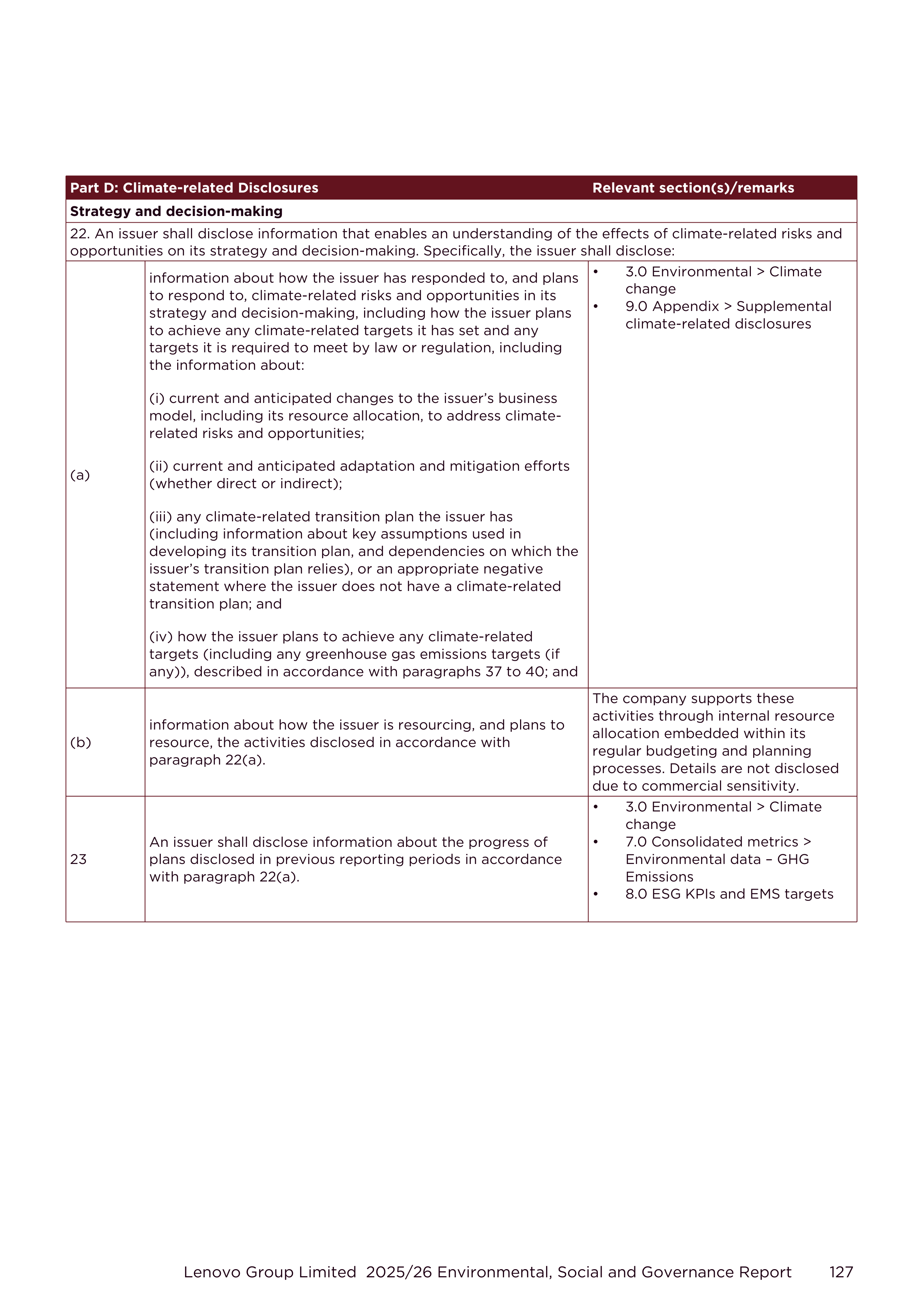
Strategy and decision-making
22. An issuer shall disclose information that enables an understanding of the effects of climate-related risks and
opportunities on its strategy and decision-making. Specifically, the issuer shall disclose:
(a)
information about how the issuer has responded to, and plans
to respond to, climate-related risks and opportunities in its
strategy and decision-making, including how the issuer plans
to achieve any climate-related targets it has set and any
targets it is required to meet by law or regulation, including
the information about:
(i) current and anticipated changes to the issuer’s business
model, including its resource allocation, to address climate-
related risks and opportunities;
(ii) current and anticipated adaptation and mitigation efforts
(whether direct or indirect);
(iii) any climate-related transition plan the issuer has
(including information about key assumptions used in
developing its transition plan, and dependencies on which the
issuer’s transition plan relies), or an appropriate negative
statement where the issuer does not have a climate-related
transition plan; and
(iv) how the issuer plans to achieve any climate-related
targets (including any greenhouse gas emissions targets (if
any)), described in accordance with paragraphs 37 to 40; and
•
3.0 Environmental > Climate
change
•
9.0 Appendix > Supplemental
climate-related disclosures
(b)
information about how the issuer is resourcing, and plans to
resource, the activities disclosed in accordance with
paragraph 22(a).
The company supports these
activities through internal resource
allocation embedded within its
regular budgeting and planning
processes. Details are not disclosed
due to commercial sensitivity.
23
An issuer shall disclose information about the progress of
plans disclosed in previous reporting periods in accordance
with paragraph 22(a).
•
3.0 Environmental > Climate
change
•
7.0 Consolidated metrics >
Environmental data – GHG
Emissions
•
8.0 ESG KPIs and EMS targets
Part D: Climate-related Disclosures
Relevant section(s)/remarks
Lenovo Group Limited 2025/26 Environmental, Social and Governance Report
127
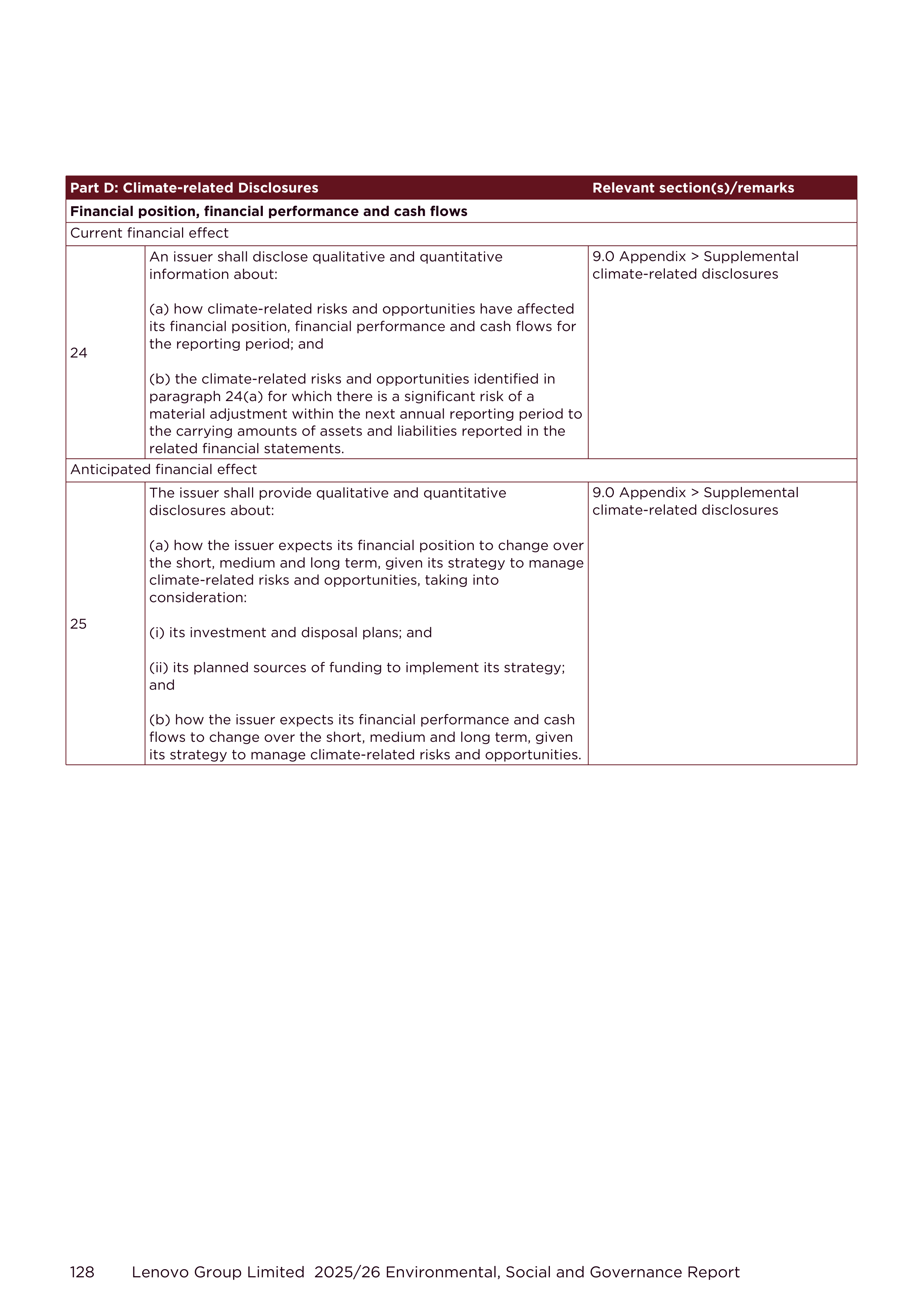
Financial position, financial performance and cash flows
Current financial effect
24
An issuer shall disclose qualitative and quantitative
information about:
(a) how climate-related risks and opportunities have affected
its financial position, financial performance and cash flows for
the reporting period; and
(b) the climate-related risks and opportunities identified in
paragraph 24(a) for which there is a significant risk of a
material adjustment within the next annual reporting period to
the carrying amounts of assets and liabilities reported in the
related financial statements.
9.0 Appendix > Supplemental
climate-related disclosures
Anticipated financial effect
25
The issuer shall provide qualitative and quantitative
disclosures about:
(a) how the issuer expects its financial position to change over
the short, medium and long term, given its strategy to manage
climate-related risks and opportunities, taking into
consideration:
(i) its investment and disposal plans; and
(ii) its planned sources of funding to implement its strategy;
and
(b) how the issuer expects its financial performance and cash
flows to change over the short, medium and long term, given
its strategy to manage climate-related risks and opportunities.
9.0 Appendix > Supplemental
climate-related disclosures
Part D: Climate-related Disclosures
Relevant section(s)/remarks
128
Lenovo Group Limited 2025/26 Environmental, Social and Governance Report
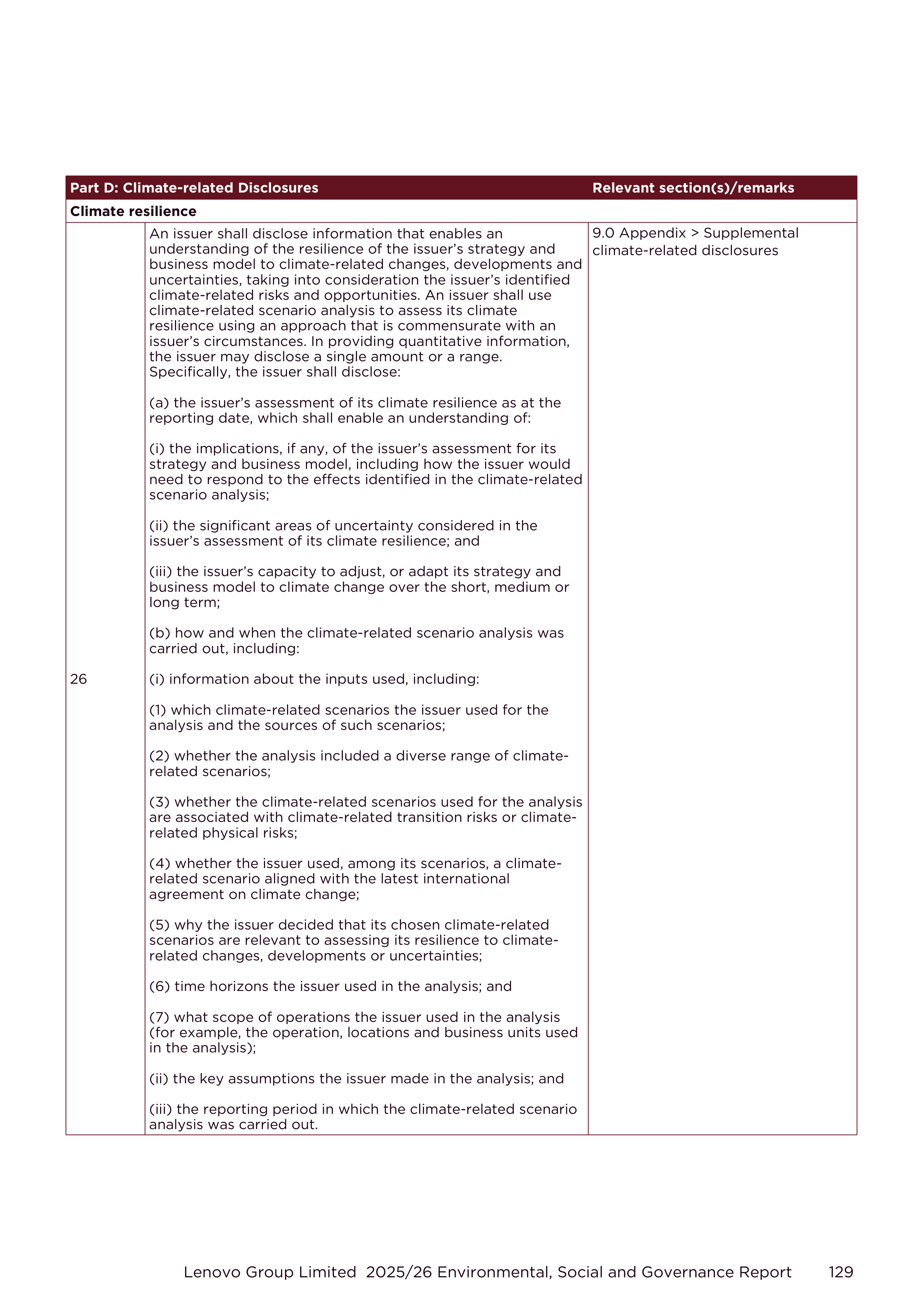
Climate resilience
26
An issuer shall disclose information that enables an
understanding of the resilience of the issuer’s strategy and
business model to climate-related changes, developments and
uncertainties, taking into consideration the issuer’s identified
climate-related risks and opportunities. An issuer shall use
climate-related scenario analysis to assess its climate
resilience using an approach that is commensurate with an
issuer’s circumstances. In providing quantitative information,
the issuer may disclose a single amount or a range.
Specifically, the issuer shall disclose:
(a) the issuer’s assessment of its climate resilience as at the
reporting date, which shall enable an understanding of:
(i) the implications, if any, of the issuer’s assessment for its
strategy and business model, including how the issuer would
need to respond to the effects identified in the climate-related
scenario analysis;
(ii) the significant areas of uncertainty considered in the
issuer’s assessment of its climate resilience; and
(iii) the issuer’s capacity to adjust, or adapt its strategy and
business model to climate change over the short, medium or
long term;
(b) how and when the climate-related scenario analysis was
carried out, including:
(i) information about the inputs used, including:
(1) which climate-related scenarios the issuer used for the
analysis and the sources of such scenarios;
(2) whether the analysis included a diverse range of climate-
related scenarios;
(3) whether the climate-related scenarios used for the analysis
are associated with climate-related transition risks or climate-
related physical risks;
(4) whether the issuer used, among its scenarios, a climate-
related scenario aligned with the latest international
agreement on climate change;
(5) why the issuer decided that its chosen climate-related
scenarios are relevant to assessing its resilience to climate-
related changes, developments or uncertainties;
(6) time horizons the issuer used in the analysis; and
(7) what scope of operations the issuer used in the analysis
(for example, the operation, locations and business units used
in the analysis);
(ii) the key assumptions the issuer made in the analysis; and
(iii) the reporting period in which the climate-related scenario
analysis was carried out.
9.0 Appendix > Supplemental
climate-related disclosures
Part D: Climate-related Disclosures
Relevant section(s)/remarks
Lenovo Group Limited 2025/26 Environmental, Social and Governance Report
129
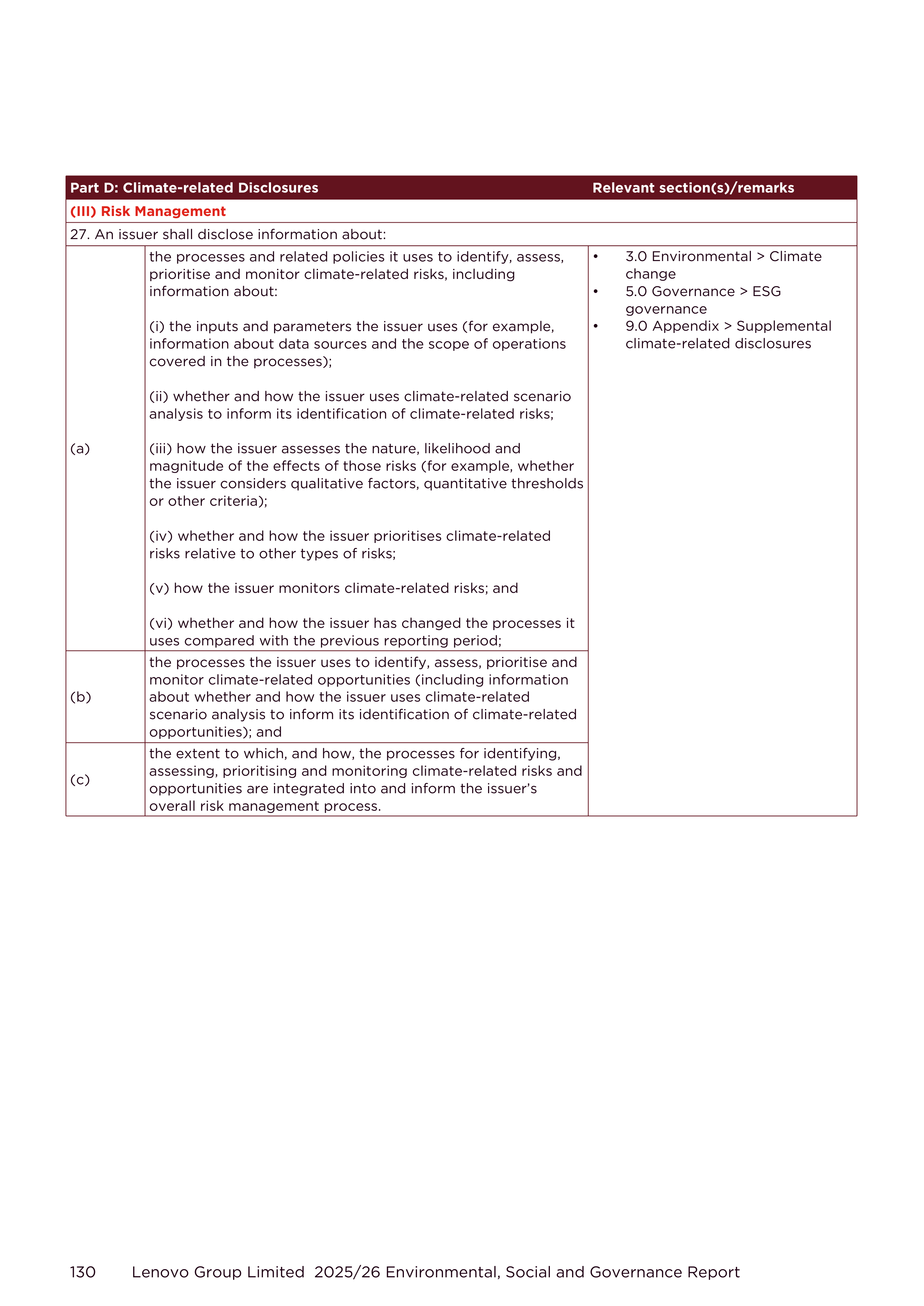
(III) Risk Management
27. An issuer shall disclose information about:
(a)
the processes and related policies it uses to identify, assess,
prioritise and monitor climate-related risks, including
information about:
(i) the inputs and parameters the issuer uses (for example,
information about data sources and the scope of operations
covered in the processes);
(ii) whether and how the issuer uses climate-related scenario
analysis to inform its identification of climate-related risks;
(iii) how the issuer assesses the nature, likelihood and
magnitude of the effects of those risks (for example, whether
the issuer considers qualitative factors, quantitative thresholds
or other criteria);
(iv) whether and how the issuer prioritises climate-related
risks relative to other types of risks;
(v) how the issuer monitors climate-related risks; and
(vi) whether and how the issuer has changed the processes it
uses compared with the previous reporting period;
•
3.0 Environmental > Climate
change
•
5.0 Governance > ESG
governance
•
9.0 Appendix > Supplemental
climate-related disclosures
(b)
the processes the issuer uses to identify, assess, prioritise and
monitor climate-related opportunities (including information
about whether and how the issuer uses climate-related
scenario analysis to inform its identification of climate-related
opportunities); and
(c)
the extent to which, and how, the processes for identifying,
assessing, prioritising and monitoring climate-related risks and
opportunities are integrated into and inform the issuer’s
overall risk management process.
Part D: Climate-related Disclosures
Relevant section(s)/remarks
130
Lenovo Group Limited 2025/26 Environmental, Social and Governance Report
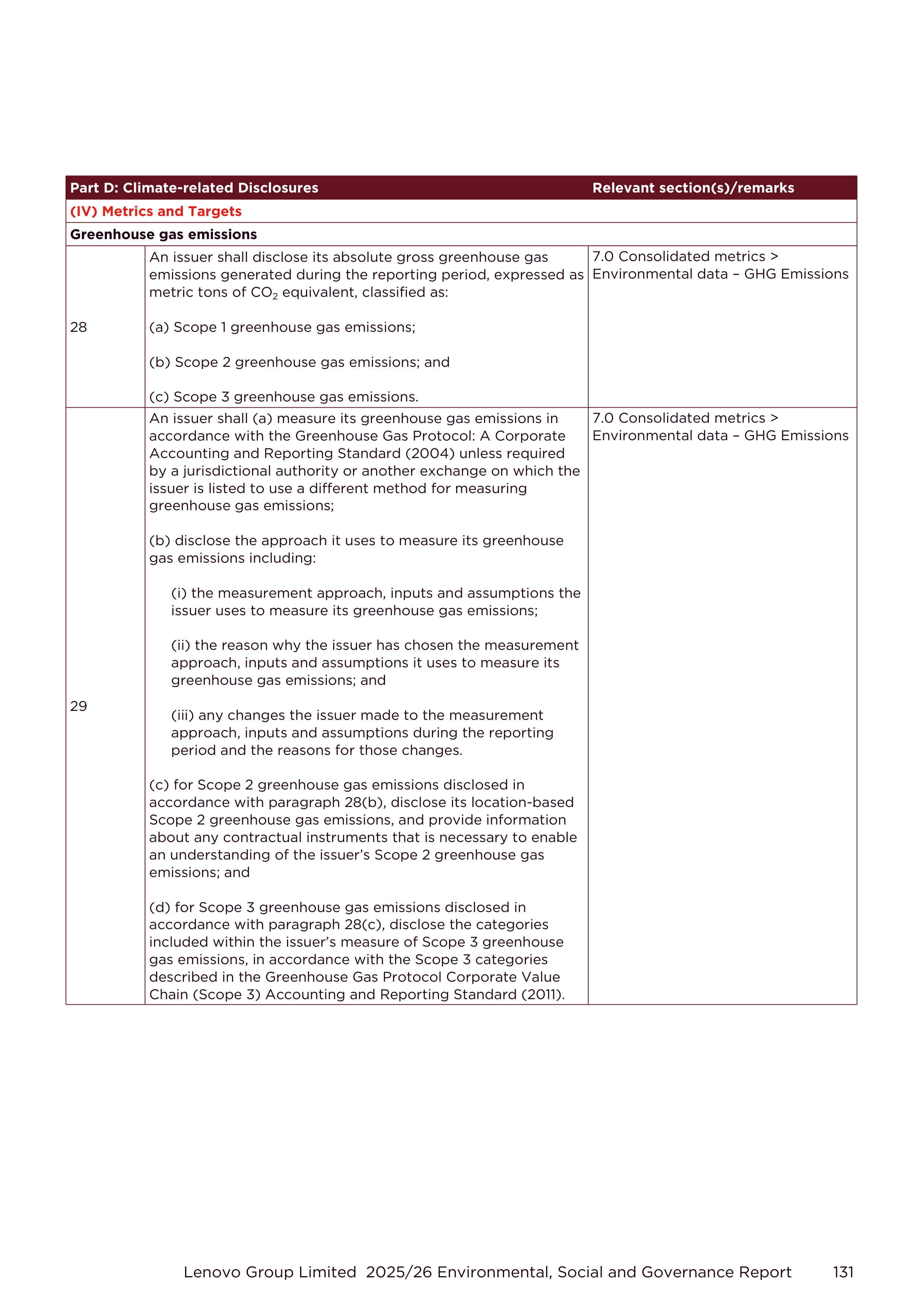
(IV) Metrics and Targets
Greenhouse gas emissions
28
An issuer shall disclose its absolute gross greenhouse gas
emissions generated during the reporting period, expressed as
metric tons of CO
2
equivalent, classified as:
(a) Scope 1 greenhouse gas emissions;
(b) Scope 2 greenhouse gas emissions; and
(c) Scope 3 greenhouse gas emissions.
7.0 Consolidated metrics >
Environmental data – GHG Emissions
29
An issuer shall (a) measure its greenhouse gas emissions in
accordance with the Greenhouse Gas Protocol: A Corporate
Accounting and Reporting Standard (2004) unless required
by a jurisdictional authority or another exchange on which the
issuer is listed to use a different method for measuring
greenhouse gas emissions;
(b) disclose the approach it uses to measure its greenhouse
gas emissions including:
(i) the measurement approach, inputs and assumptions the
issuer uses to measure its greenhouse gas emissions;
(ii) the reason why the issuer has chosen the measurement
approach, inputs and assumptions it uses to measure its
greenhouse gas emissions; and
(iii) any changes the issuer made to the measurement
approach, inputs and assumptions during the reporting
period and the reasons for those changes.
(c) for Scope 2 greenhouse gas emissions disclosed in
accordance with paragraph 28(b), disclose its location-based
Scope 2 greenhouse gas emissions, and provide information
about any contractual instruments that is necessary to enable
an understanding of the issuer’s Scope 2 greenhouse gas
emissions; and
(d) for Scope 3 greenhouse gas emissions disclosed in
accordance with paragraph 28(c), disclose the categories
included within the issuer’s measure of Scope 3 greenhouse
gas emissions, in accordance with the Scope 3 categories
described in the Greenhouse Gas Protocol Corporate Value
Chain (Scope 3) Accounting and Reporting Standard (2011).
7.0 Consolidated metrics >
Environmental data – GHG Emissions
Part D: Climate-related Disclosures
Relevant section(s)/remarks
Lenovo Group Limited 2025/26 Environmental, Social and Governance Report
131
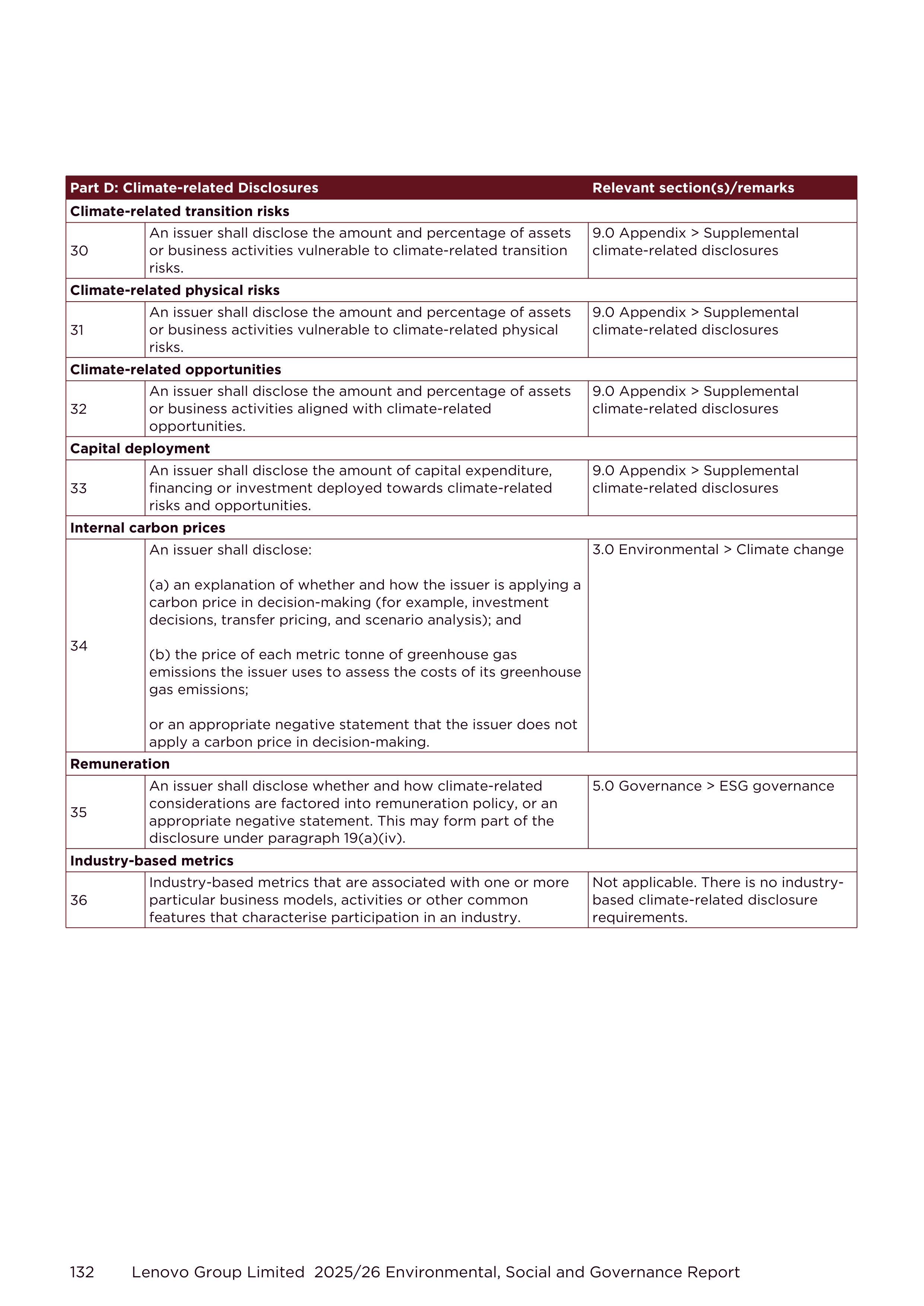
Climate-related transition risks
30
An issuer shall disclose the amount and percentage of assets
or business activities vulnerable to climate-related transition
risks.
9.0 Appendix > Supplemental
climate-related disclosures
Climate-related physical risks
31
An issuer shall disclose the amount and percentage of assets
or business activities vulnerable to climate-related physical
risks.
9.0 Appendix > Supplemental
climate-related disclosures
Climate-related opportunities
32
An issuer shall disclose the amount and percentage of assets
or business activities aligned with climate-related
opportunities.
9.0 Appendix > Supplemental
climate-related disclosures
Capital deployment
33
An issuer shall disclose the amount of capital expenditure,
financing or investment deployed towards climate-related
risks and opportunities.
9.0 Appendix > Supplemental
climate-related disclosures
Internal carbon prices
34
An issuer shall disclose:
(a) an explanation of whether and how the issuer is applying a
carbon price in decision-making (for example, investment
decisions, transfer pricing, and scenario analysis); and
(b) the price of each metric tonne of greenhouse gas
emissions the issuer uses to assess the costs of its greenhouse
gas emissions;
or an appropriate negative statement that the issuer does not
apply a carbon price in decision-making.
3.0 Environmental > Climate change
Remuneration
35
An issuer shall disclose whether and how climate-related
considerations are factored into remuneration policy, or an
appropriate negative statement. This may form part of the
disclosure under paragraph 19(a)(iv).
5.0 Governance > ESG governance
Industry-based metrics
36
Industry-based metrics that are associated with one or more
particular business models, activities or other common
features that characterise participation in an industry.
Not applicable. There is no industry-
based climate-related disclosure
requirements.
Part D: Climate-related Disclosures
Relevant section(s)/remarks
132
Lenovo Group Limited 2025/26 Environmental, Social and Governance Report
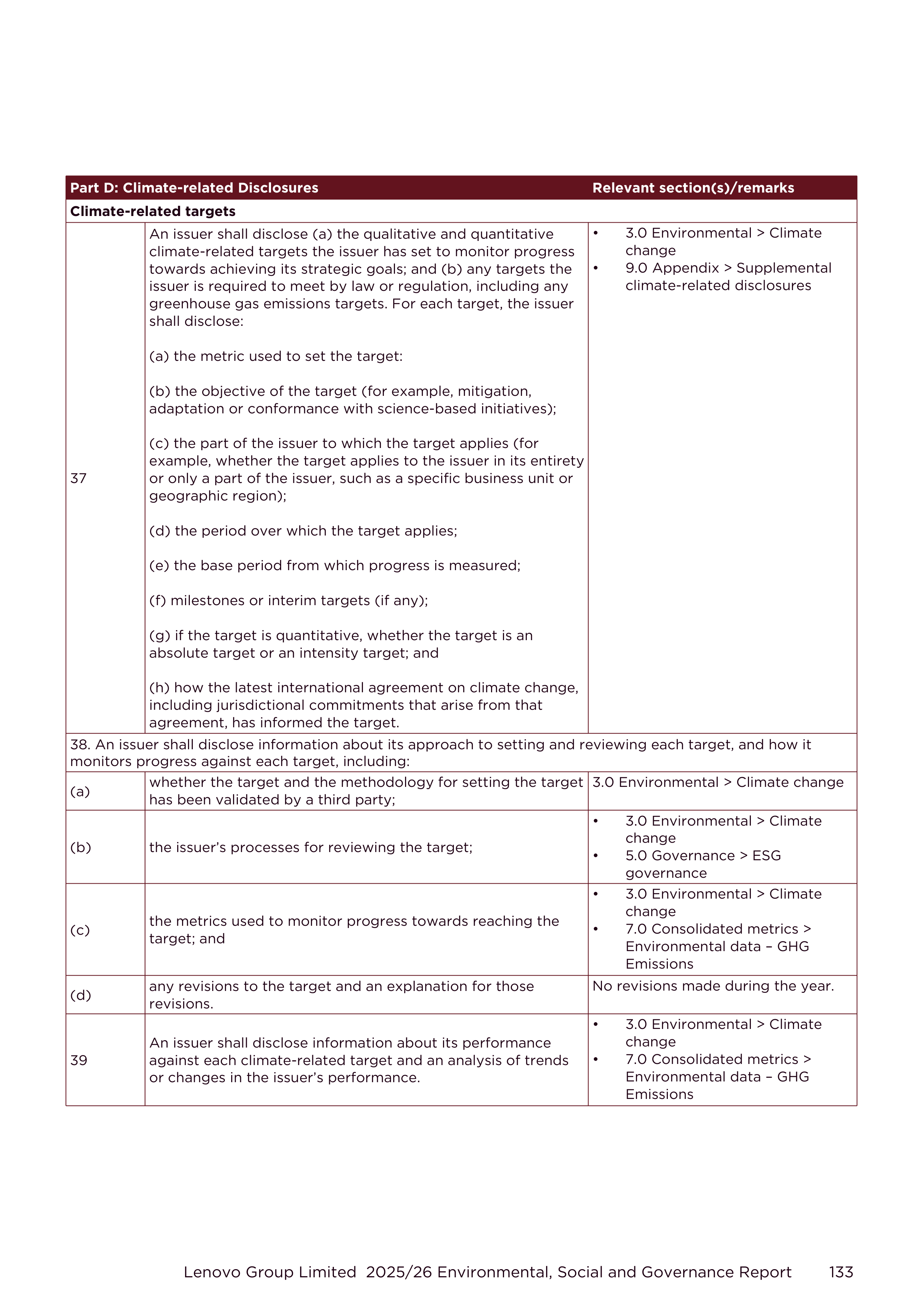
Climate-related targets
37
An issuer shall disclose (a) the qualitative and quantitative
climate-related targets the issuer has set to monitor progress
towards achieving its strategic goals; and (b) any targets the
issuer is required to meet by law or regulation, including any
greenhouse gas emissions targets. For each target, the issuer
shall disclose:
(a) the metric used to set the target:
(b) the objective of the target (for example, mitigation,
adaptation or conformance with science-based initiatives);
(c) the part of the issuer to which the target applies (for
example, whether the target applies to the issuer in its entirety
or only a part of the issuer, such as a specific business unit or
geographic region);
(d) the period over which the target applies;
(e) the base period from which progress is measured;
(f) milestones or interim targets (if any);
(g) if the target is quantitative, whether the target is an
absolute target or an intensity target; and
(h) how the latest international agreement on climate change,
including jurisdictional commitments that arise from that
agreement, has informed the target.
•
3.0 Environmental > Climate
change
•
9.0 Appendix > Supplemental
climate-related disclosures
38. An issuer shall disclose information about its approach to setting and reviewing each target, and how it
monitors progress against each target, including:
(a)
whether the target and the methodology for setting the target
has been validated by a third party;
3.0 Environmental > Climate change
(b)
the issuer’s processes for reviewing the target;
•
3.0 Environmental > Climate
change
•
5.0 Governance > ESG
governance
(c)
the metrics used to monitor progress towards reaching the
target; and
•
3.0 Environmental > Climate
change
•
7.0 Consolidated metrics >
Environmental data – GHG
Emissions
(d)
any revisions to the target and an explanation for those
revisions.
No revisions made during the year.
39
An issuer shall disclose information about its performance
against each climate-related target and an analysis of trends
or changes in the issuer’s performance.
•
3.0 Environmental > Climate
change
•
7.0 Consolidated metrics >
Environmental data – GHG
Emissions
Part D: Climate-related Disclosures
Relevant section(s)/remarks
Lenovo Group Limited 2025/26 Environmental, Social and Governance Report
133
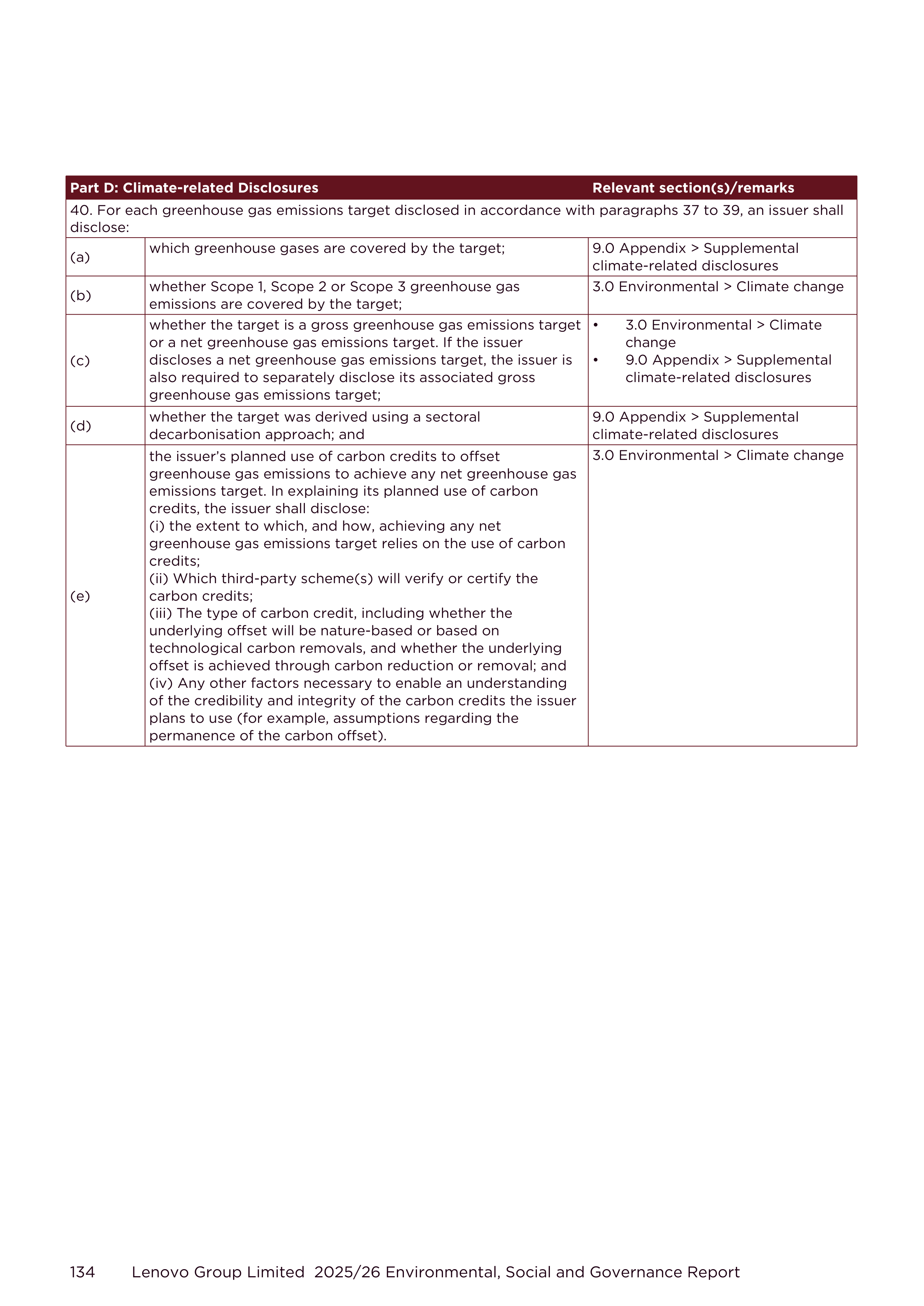
40. For each greenhouse gas emissions target disclosed in accordance with paragraphs 37 to 39, an issuer shall
disclose:
(a)
which greenhouse gases are covered by the target;
9.0 Appendix > Supplemental
climate-related disclosures
(b)
whether Scope 1, Scope 2 or Scope 3 greenhouse gas
emissions are covered by the target;
3.0 Environmental > Climate change
(c)
whether the target is a gross greenhouse gas emissions target
or a net greenhouse gas emissions target. If the issuer
discloses a net greenhouse gas emissions target, the issuer is
also required to separately disclose its associated gross
greenhouse gas emissions target;
•
3.0 Environmental > Climate
change
•
9.0 Appendix > Supplemental
climate-related disclosures
(d)
whether the target was derived using a sectoral
decarbonisation approach; and
9.0 Appendix > Supplemental
climate-related disclosures
(e)
the issuer’s planned use of carbon credits to offset
greenhouse gas emissions to achieve any net greenhouse gas
emissions target. In explaining its planned use of carbon
credits, the issuer shall disclose:
(i) the extent to which, and how, achieving any net
greenhouse gas emissions target relies on the use of carbon
credits;
(ii) Which third-party scheme(s) will verify or certify the
carbon credits;
(iii) The type of carbon credit, including whether the
underlying offset will be nature-based or based on
technological carbon removals, and whether the underlying
offset is achieved through carbon reduction or removal; and
(iv) Any other factors necessary to enable an understanding
of the credibility and integrity of the carbon credits the issuer
plans to use (for example, assumptions regarding the
permanence of the carbon offset).
3.0 Environmental > Climate change
Part D: Climate-related Disclosures
Relevant section(s)/remarks
134
Lenovo Group Limited 2025/26 Environmental, Social and Governance Report


www.lenovo.com