


2025
Annual
Sustainability
Report
2
Overview
People
Climate
Biodiversity
and Nature
KPIs
and Metrics
Appendix
Resource
Management
Costco 2025 Sustainability Report
Sales growth YOY (USD)
+8% YoY
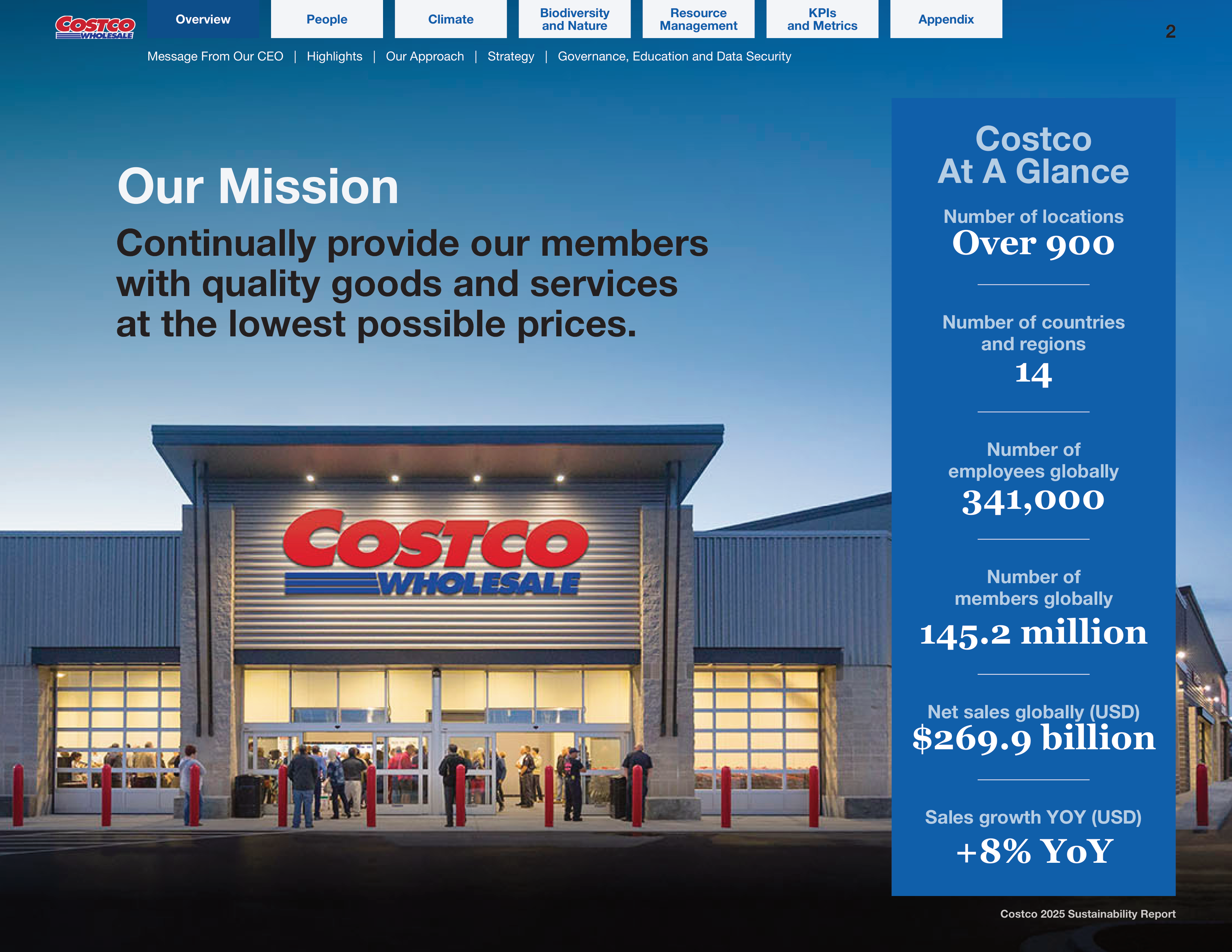
Our Mission
Continually provide our members
with quality goods and services
at the lowest possible prices.
Number of countries
and regions
14
Number of
employees globally
341,000
Number of
members globally
145.2 million
Net sales globally (USD)
$269.9 billion
Costco
At A Glance
Number of locations
Over 900
Message From Our CEO | Highlights | Our Approach | Strategy | Governance, Education and Data Security


3
Overview
People
Climate
Biodiversity
and Nature
KPIs
and Metrics
Appendix
Resource
Management
Costco 2025 Sustainability Report
Overview
2
Message From Our CEO.............................. 4
Highlights..................................................... 5
Our Approach............................................... 6
Strategy........................................................ 7
Governance, Education and Data Security.... 9
People
11
Inclusion..................................................... 12
Employees................................................. 15
Communities.............................................. 18
Human Rights............................................ 21
FEATURED INITIATIVE:
THE SASSANDRA PROGRAM......................24
Climate
26
Our Holistic Climate Approach.................. 27
Emissions .................................................. 28
Energy and Refrigeration........................... 31
Fuel Transition Plan.................................... 33
Transportation and Logistics ..................... 35
Biodiversity
and Nature
37
Responsible Agriculture............................. 38
Forests and Land Stewardship.................. 39
Pollinator Health......................................... 43
Fisheries and Aquaculture......................... 45
Animal Welfare........................................... 49
FEATURED INITIATIVE:
LINCOLN PREMIUM POULTRY....................54
Resource
Management
55
Water Conservation................................... 56
Waste Reduction........................................ 58
Packaging.................................................. 61
Construction, Land Use and Preservation... 65
Chemical Management.............................. 67
Contents
KPIs and Metrics
71
People Data.............................................. 71
Workforce.............................................. 71
Communities and Charitable
Contributions........................................ 71
Climate Data................................................72
Emissions.............................................. 72
Fuel Transition Plan............................... 74
Energy and Refrigeration...................... 74
Transportation and Logistics................ 75
Biodiversity and Nature Data....................76
Responsible Sourcing........................... 76
Animal Welfare...................................... 78
Resource Management Data....................79
Water Usage......................................... 79
Waste Reduction and Diversion............ 79
Packaging............................................. 80
Chemical Management......................... 80
Appendix
81
Policies and Statements............................ 81
Program Updates....................................... 81
Reports...................................................... 81
Chemical Management RSLs.....................81
Archive....................................................... 81
UN SDGs Alignment.................................. 82
SASB Report..............................................
84
Message From Our CEO | Highlights | Our Approach | Strategy | Governance, Education and Data Security

4
Overview
People
Climate
Biodiversity
and Nature
KPIs
and Metrics
Appendix
Resource
Management
Costco 2025 Sustainability Report
Message From Our CEO
| Highlights | Our Approach | Strategy | Governance, Education and Data Security
healthy supply chain for our key agricultural
commodities. We also further developed our
Forest and Land Stewardship Action Plan
for responsibly sourcing commodities with
higher risk of deforestation.
Resource Management:
We continually
seek opportunities to increase our water
efficiency, divert more waste from landfills
and improve or reduce
our packaging. In
FY25, we reached a new high of 82.8% of
waste diverted from landfills, reduced our
water use intensity by 4.4% and reduced
plastic in Kirkland Signature
TM
packaging by
1.5 million pounds. We share examples for
each initiative in this report.
We continue to grow two core programs: the
STAR (Sustainability Technical Assistance
Review) in our operations and the Six
Questions for Merchandising Sustainability
in our supply chains. We share more about
these in the Strategy section. We are
pleased by the strong engagement we’ve
seen from our locations in earning STARs
and from suppliers as they share progress.
Last, we have updated our
Sustainability
Commitment website
and this annual report
to make it easier for members, employees,
shareholders and all audiences to follow
our sustainability efforts. We are excited to
share this work with you and thank you for
supporting us while we learn as we go and
seek continuous improvement.
Respecting how people, animals and the
environment are treated is an essential part
of Costco’s business strategy and is how we
do the right thing. We are proud and excited
to share the significant progress we have
achieved in fiscal year (FY) 2025.
While navigating a dynamic regulatory
environment and the increased demand
for clean energy, we have successfully
grown our business while shrinking our
environmental impact. Here are some of our
highlights.
People:
Costco is proud to offer top-tier
pay, benefits and opportunities for long-term
career growth. This year, we updated our
Employee Agreement (EA) with feedback
from thousands of employees (a process
we undertake every three years). With the
2025 EA, we increased top-of-scale pay for
long-term employees, raised our starting
wage and reached an average hourly wage
of more than $32/hour in the U.S. Our health
care benefits remain widely available and
highly affordable. In the U.S., over 94% of
our employees are eligible for health benefits
and over 96% of those who are eligible
have enrolled.
We also held our biannual Costco Connects
conversations, in which over 230,000
employees participated in small-group
conversations to share their feedback and
ideas with leaders across the company.
In addition, we rolled out the MyCostco
Employee Portal in the U.S. and
implemented a new hiring system to better
attract talented individuals to Costco.
We strive to create a positive impact in the
communities where Costco operates. In
FY25, this included $97 million in charitable
contributions, 186 million donated meals and
another $97 million in donated products.
Climate:
This 2025 report shares our most
recent energy and climate progress, which
we calculate on a lagging basis due to the
size of our global operations. Our energy
use is calculated by calendar year and our
emissions by fiscal year. As of the end of
calendar year 2024, we increased our use of
clean electricity to 28%. This helped reduce
our operational emissions in FY24 by 7.2%,
despite strong sales growth. We have also
continued to invest in supplier education
and IT infrastructure for helping our suppliers
track and make progress against their goals
for reducing their emissions.
Biodiversity and Nature:
Costco continued
to support programs that focus on
responsible agriculture, pollinator health,
and sustainable fisheries and aquaculture.
These initiatives help promote a long-term,
Ron Vachris
MESSAGE FROM OUR CEO
Our Commitment
At Costco, our deep commitment to sustainability is a
core part of our mission and a driving force for long-term
growth and success.
Sincerely,





5
Overview
People
Climate
Biodiversity
and Nature
KPIs
and Metrics
Appendix
Resource
Management
Costco 2025 Sustainability Report
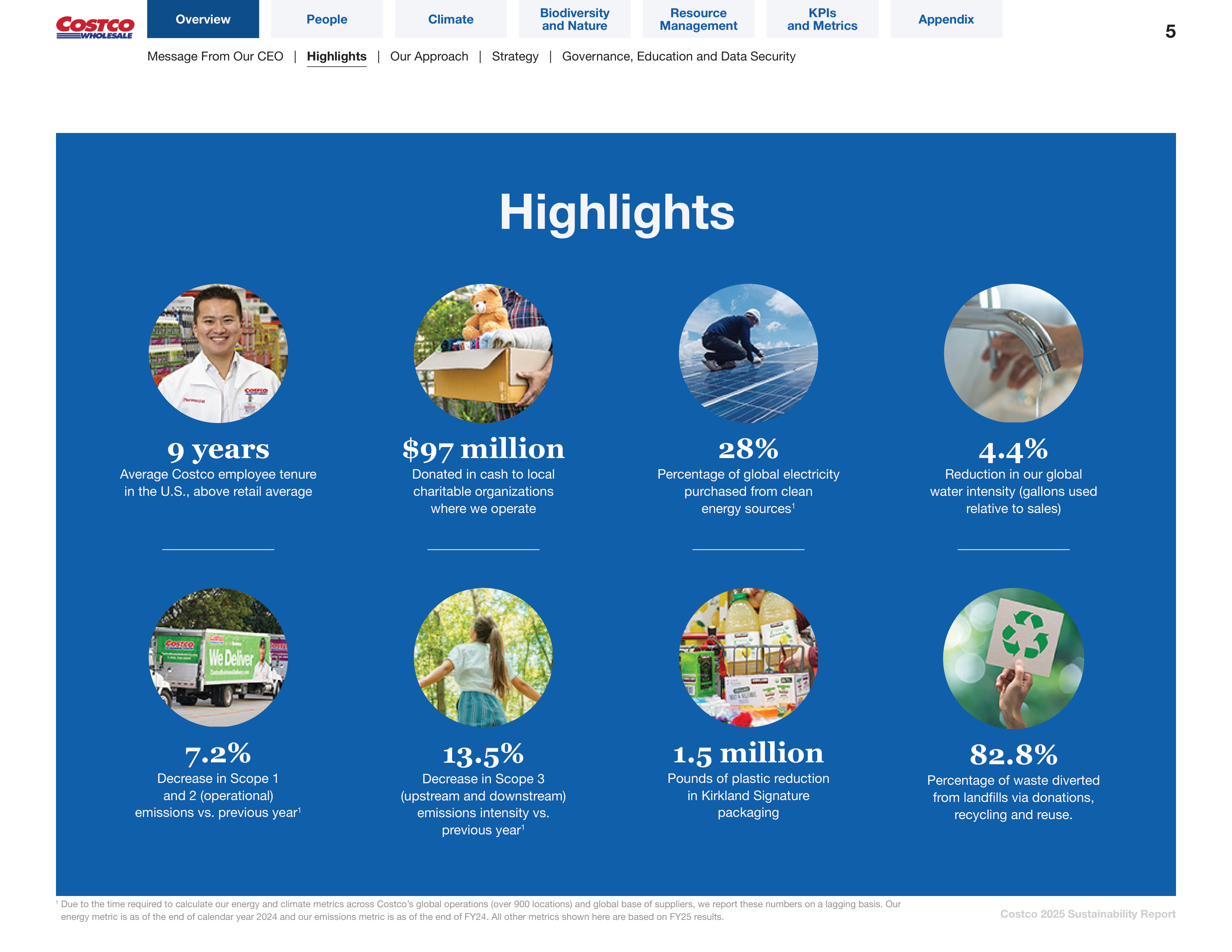
9 years
Average Costco employee tenure
in the U.S., above retail average
7.2%
Decrease in Scope 1
and 2 (operational)
emissions vs. previous year
1
Highlights
$97 million
Donated in cash to local
charitable organizations
where we operate
13.5%
Decrease in Scope 3
(upstream and downstream)
emissions intensity vs.
previous year
1
28%
Percentage of global electricity
purchased from clean
energy sources
1
1.5 million
Pounds of plastic reduction
in Kirkland Signature
packaging
4.4%
Reduction in our global
water intensity (gallons used
relative to sales)
82.8%
Percentage of waste diverted
from landfills via donations,
recycling and reuse.
Message From Our CEO |
Highlights
| Our Approach | Strategy | Governance, Education and Data Security
1
Due to the time required to calculate our energy and climate metrics across Costco’s global operations (over 900 locations) and global base of suppliers, we report these numbers on a lagging basis. Our
energy metric is as of the end of calendar year 2024 and our emissions metric is as of the end of FY24. All other metrics shown here are based on FY25 results.
6
Overview
People
Climate
Biodiversity
and Nature
KPIs
and Metrics
Appendix
Resource
Management
Costco 2025 Sustainability Report
Aligning with
the UN SDGs
We take a holistic and long-term approach
to the work that we do, ensuring that we
consider various trade-offs of programs
or decisions we make. To help anchor our
priorities, we align our initiatives with the
United Nations Sustainable Development
Goals (SDGs), prioritizing seven key SDGs
that relate most closely to our business
and where we feel that we can deliver real,
results-driven impact.
Explore Costco’s initiatives aligned
to UN SDGs
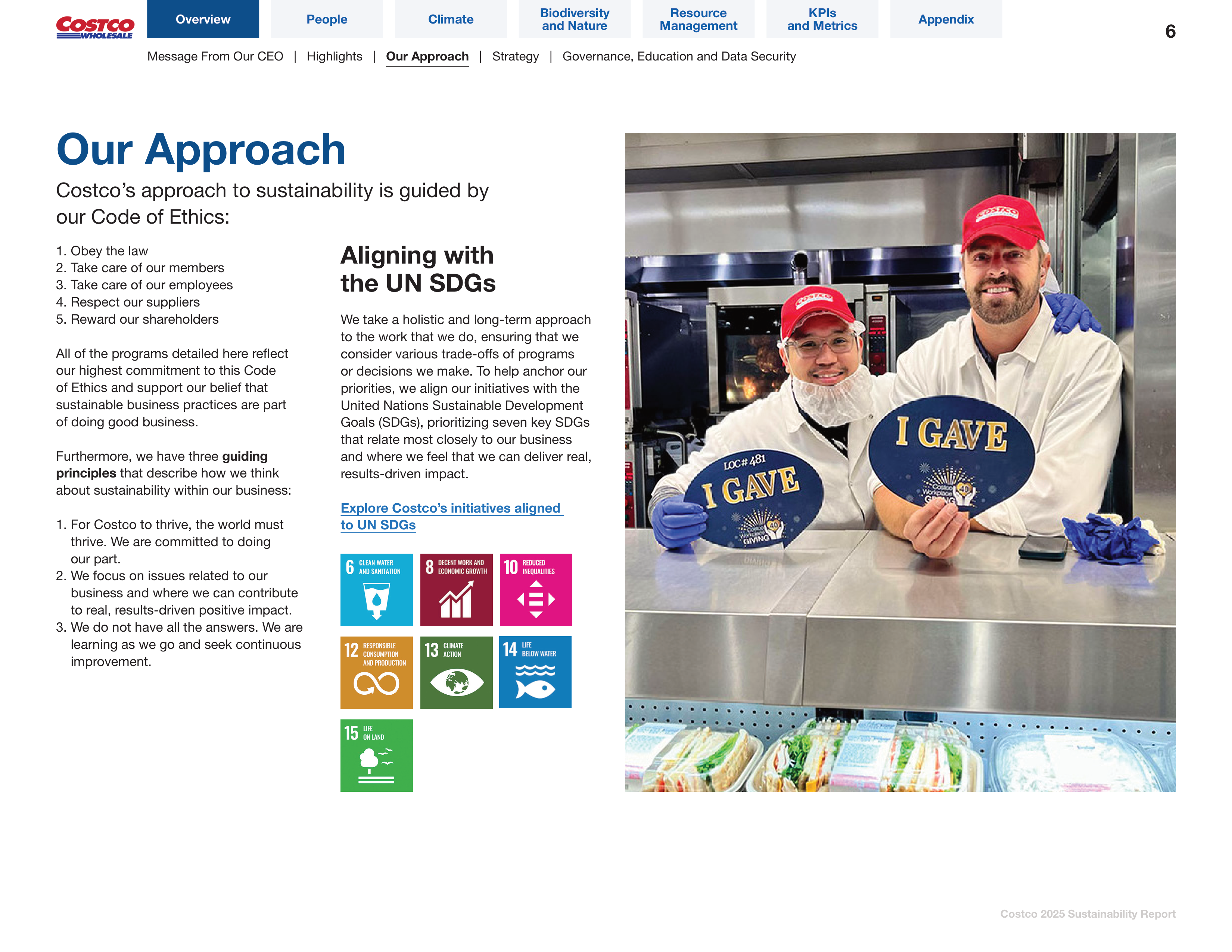
Our Approach
Costco’s approach to sustainability is guided by
our Code of Ethics:
1. Obey the law
2. Take care of our members
3. Take care of our employees
4. Respect our suppliers
5. Reward our shareholders
All of the programs detailed here reflect
our highest commitment to this Code
of Ethics and support our belief that
sustainable business practices are part
of doing good business.
Furthermore, we have three
guiding
principles
that describe how we think
about sustainability within our business:
1. For Costco to thrive, the world must
thrive. We are committed to doing
our part.
2. We focus on issues related to our
business and where we can contribute
to real, results-driven positive impact.
3. We do not have all the answers. We are
learning as we go and seek continuous
improvement.
Message From Our CEO | Highlights |
Our Approach
| Strategy | Governance, Education and Data Security

7
Overview
People
Climate
Biodiversity
and Nature
KPIs
and Metrics
Appendix
Resource
Management
Costco 2025 Sustainability Report
transitioning our business to clean energy
sources, and installing solar panel systems
in locations where feasible, will help ensure
that we are able to access long-term,
stable energy supplies. In turn, this will
help us reach our target of reducing Scope
1 and 2 emissions by 39% by 2030 from
calendar year (CY) 2020.
1
We are also
looking at ways to support a clean energy
transition across our supply chains.
•
Agricultural supply chain stability:
Our business relies substantially on the
availability of high-quality inputs to the
items we sell. Because much of our
business is food-related, we recognize
that biodiversity and land use are critical
components to supporting long-term
access to key commodities. We continue
to invest in regenerative agriculture pilot
programs, work to reduce deforestation
in our supply chains and contribute to
biodiversity conservation efforts. We
execute these initiatives through supplier
engagement and with a focus on Kirkland
Signature
TM
products. These initiatives
also support our Scope 3 emissions
intensity reduction target of 20% by 2030
from FY20.
1
•
Water security and supply:
In FY25, we
began building our Global Water Strategy.
We recognize the importance of water
to our business and supply chains. Our
strategy will build on our operational efforts
in water conservation, such as installing
Strategy
Costco’s sustainability efforts support our business
strategy and growth. They help us build business
resilience and deliver on our mission.
We recognize that for Costco to thrive, the
world must thrive. Taking care of people,
animals, and the environment helps us
maintain lower employee turnover, strong
membership growth and retention, product
safety and quality, and healthy supply chains
for the long term.
Our strategies for taking care of people are
described in detail in the
People
section.
Regarding climate, biodiversity and nature,
and resource management, Costco
supports a number of strategic initiatives to
maintain our long-term business resilience
and the stability of key supply chains.
We consider our emissions scorecard
to be a key indicator of our progress in
minimizing our climate impact – as well
as a tool for identifying opportunities and
risks that climate-related trends present for
our business.
We prioritize areas that contribute the
greatest amount of emissions to our total
footprint, are most susceptible to changes
in climate, and have the greatest potential
impact to our overall business. In FY25
and for the foreseeable future, our focus
areas include:
•
Energy security and supply:
We
developed a Global Energy Strategy
that allows us to prioritize and make
progress on clean energy usage and
energy efficiency overall. We believe that
water monitoring at our locations and
making decisions that support low water-
intensive landscapes.
Taking Action Today
While many of our investments are geared
for long-term resilience, we have developed
programs that help us make progress today
by setting clear goals, enabling action for
our locations and suppliers, and aligning our
efforts with the way we do business.
Operations: Environmental
Compliance and STAR
Our Environmental Compliance program
is integral to our sustainability efforts,
as it promotes resource efficiency and
compliance in Costco operations through
environmental monitoring, resource
management, and employee education.
The program:
• Covers regulations related to stormwater,
sanitary water use, spills/releases,
hazardous waste management,
environmental mitigation, air quality and
more.
• Applies to inspections, maintenance,
and reporting for all of our properties,
including our retail locations as well as
our industrial properties (manufacturing,
distribution, and logistics).
1
Our Scope 1 and 2 emissions target is set against our total in
base year CY20. Our Scope 3 target is set against our total in
base year FY20, is adjusted for inflation, and excludes fuel.
Message From Our CEO | Highlights | Our Approach |
Strategy
| Governance, Education and Data Security
8
Overview
People
Climate
Biodiversity
and Nature
KPIs
and Metrics
Appendix
Resource
Management
Costco 2025 Sustainability Report
The Costco Global Compliance Team
works with departments throughout
the company to review and identify
opportunities to enhance compliance and
sustainability, support location operators
in daily operations, and provide training
and educational opportunities. We hold
a Global Environmental Sustainability
Summit each year to share best practices,
review compliance and discuss upcoming
projects. Our goal is to create a consistent
and global approach to environmental
compliance, while also respecting local laws
and regulations.
One way we drive action against this goal
is by conducting Sustainability Technical
Assistance Reviews (STAR) in our locations.
The STAR initiative formalizes standards and
requirements in five focus areas, or goals, for
which our locations can earn a “STAR” per
goal for achieving excellence. The goals are:
• Ensure regulatory compliance.
• Maximize water use efficiency and
treatment inside and outside our facilities.
• Minimize energy consumption.
• Increase waste diversion.
• Reduce carbon emissions.
The STAR program is supported by regional
Environmental Sustainability and Compliance
managers, who visit the locations. STAR is
also promoted in employee break rooms,
and best practices are shared through the
STAR News bulletin. Through all of these
activities, Costco is building the capabilities
to track compliance and dynamically monitor
resource use at all our locations. We aim
to integrate our people, systems, policies,
data and standard operating procedures in
support of all five focus areas.
For environmental compliance overall,
enhanced data dashboard programs and
reporting capabilities added in 2022 allow
us to respond quickly as situations arise. We
also continue to digitize our environmental
records, make enhancements to the
dashboard, and automate compliance
programs to aid in both accuracy and
efficiency while reducing operator fatigue.
Meanwhile, we built and deployed a central
monitoring program (Central Station) in our
U.S. and Canadian buildings (warehouses,
depots and other businesses). This system
monitors refrigeration as well as burglary and
fire alarms, enabling us to fix problems and
improve our operations.
Merchandising:
The Six Questions
Costco strives to source products in a way
that respects the people, environment and
animals that produce them. To maintain a
focus on this goal, we ask our suppliers six
foundational questions:
• Can you map your supply chain to the
origin or source?
• How are the people cared for?
• How are the animals cared for?
• How is the environment/nature cared for?
• Is the best possible packaging being
used?
• What are your emissions and your plans
to reduce them?
We recognize that our suppliers vary
with respect to maturity across these six
questions. By asking these questions, we
encourage them to continuously improve
their understanding of their supply chains
and to develop plans to address these
six areas.
To support this progress, we are investing
in technology and solutions to help us
collect information from our suppliers and
understand their performance across these
topics. This data helps us identify our
priorities for responsible sourcing. Costco’s
policies and programs that implement
our responsible sourcing practices are
detailed in the
Animal Welfare
,
Fisheries and
Aquaculture
,
Forests and Land Stewardship
,
Human Rights
,
Pollinator Health
and
Responsible Agriculture
sections — as
well as in our featured initiatives on the
Sassandra Cocoa Program
and
Lincoln
Premium Poultry
.
The impact of the Six Questions can be seen
in our product assortment and especially in
our Kirkland Signature
TM
items. Because we
have long-standing relationships with many
of our private-label suppliers and are closely
involved with the development of Kirkland
Signature items, we have direct insight
into the entire supply chain including the
products’ locations of origin, environmental
impacts, labor conditions, packaging,
and conditions under which the products
are produced.
While the Six Questions apply to all
suppliers, we believe that Kirkland Signature
has been a successful place to start, helping
us test and learn.
Message From Our CEO | Highlights | Our Approach |
Strategy
| Governance, Education and Data Security
Innovation and In-
Country Production
To make sure we have a long-term
supply of quality products for our
members, free of unnecessary
costs, Costco explores vertical
integration and in-country
production of some Kirkland
Signature items. These approaches
often have the benefits of reducing
product shipping distances and
allowing Costco to build our
sustainability principles into the
production process.
For example:
•
Vertical integration:
Costco’s
poultry complex, Lincoln Premium
Poultry (LPP), was designed with
sustainability as well as animal
welfare and efficiency in mind.
•
In-Country production:
To
reduce ocean freight and
transportation emissions, lower
costs while retaining product
quality, and increase the shelf life
of food items, Costco explores in-
country production of some high-
volume Kirkland Signature items,
such as bath tissue and bottled
water, replacing production that
currently happens in numerous
global regions.
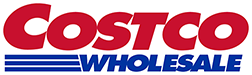
Costco Sustainability Governance
9
Overview
People
Climate
Biodiversity
and Nature
KPIs
and Metrics
Appendix
Resource
Management
Costco 2025 Sustainability Report
The
Nominating and Governance
Committee
exercises oversight regarding
risks associated with corporate governance
and certain issues relating to Costco’s
ethics, compliance programs, and
environmental, diversity, and sustainability
policies and initiatives, including climate-
related risks and opportunities. This
committee receives updates at least
annually related to our sustainability efforts
by the SVP of Global Sustainability and
Compliance.
The
Audit Committee
reports to the full
Board on its risk management oversight,
including the enterprise risk management
review, which includes (among other matters)
sustainability-related and climate risks.
The
Compensation Committee
determines
the amount and form of compensation
to executive officers, including (with the
Nominating and Governance Committee)
bonuses for meeting environmental and
social objectives. We have aligned a portion
of our executive compensation with ESG
priorities and climate-related considerations
through our Executive Bonus Plan. Climate-
related considerations have included
reductions in global energy intensity; Scope
1 and 2 emissions intensity against sales;
global operational participation in both
energy and emissions reduction initiatives;
Governance, Education
and Data Security
Costco’s Board of Directors oversees executive
management, which manages risks and sets strategy
including as it relates to sustainability.
Management of sustainability matters is led
by our Senior Vice President (SVP) of Global
Sustainability and Compliance, who reports
directly to the CEO and regularly engages
with the Board and executive team, including
periodic updates at monthly meetings of our
global executive teams.
The Board implements its oversight through
a number of governing bodies at Costco,
as
shown on the right.
Roles and
Responsibilities
The Board implements its risk oversight
responsibilities primarily through the
Audit
Committee
, which receives management
reports where appropriate on the potentially
significant risks Costco faces and how the
company is seeking to control risk.
Board members also discuss risk as a part
of their review of ongoing Costco business-,
financial- and sustainability-related activities.
In more limited cases, such as with risks
of significant new business concepts
and substantial entry into new markets,
risk oversight is addressed as part of the
full Board’s engagement with the CEO
and management.
Board of Directors
Oversees Management, Which Is Responsible
for Risk Management and Strategy
Nominating and
Governance
Committee
ESG Risks and
Compliance
Audit
Committee
Enterprise Risk
Management
Compensation
Committee
ESG-Related
Executive
Compensation
Executive Leadership
Identify, Evaluate, Manage, and Mitigate Risks and Set Strategy
ESG Executive Advisory Council
Discuss Climate-Related Impacts, Risks and Opportunities
ESG Reporting
Steering Committee
ESG
Reporting
Global Energy
Task Force
Energy
Strategy
As Needed
Working Groups
Sustainability-Related
Issues
Message From Our CEO | Highlights | Our Approach | Strategy |
Governance, Education and Data Security
10
Overview
People
Climate
Biodiversity
and Nature
KPIs
and Metrics
Appendix
Resource
Management
Costco 2025 Sustainability Report
supplier action through Carbon Disclosure
Project (CDP) reporting participation; and
product certification through ENERGY
STAR™ or equivalent programs. More
details on compensation can be found in our
proxy statement.
Executive ESG bonus goals are set and
reviewed annually. In FY25 this bonus was
fully achieved.
The SVP of Global Sustainability and
Compliance also chairs the
ESG Executive
Advisory Council
, which brings together
executive leaders from across the company
twice a year to chart goals and ESG strategy.
Climate-related impacts, risks and
opportunities are also considered in our
company-wide enterprise risk management
assessment and in our strategy-setting and
decision-making processes. We have various
management committees and working
groups that set strategy regarding our
business and provide updates on progress
on current initiatives.
•
Global Energy Task Force:
Sets strategy
for reductions in energy consumption
and emissions; identifies, approves, and
prioritizes energy-reduction initiatives;
and monitors progress, including returns
on energy-reduction investments.
The task force includes Sustainability,
Construction, Purchasing, Finance, and
International executives, and meets
twice a year. This task force is supported
by a cross-functional working group,
which meets periodically for updates on
individual initiatives.
•
ESG Reporting Steering Committee:
Oversees ESG reporting requirements
and monitors company initiatives for
reporting purposes. The committee
meets periodically and includes Financial
Reporting, Energy, Legal, IT, Sustainability,
Internal Audit and International teams.
This committee is supported by a
dedicated ESG Reporting team. Executive
and senior management hold ad hoc
meetings to discuss sustainability-related
matters as they arise. In FY25, meetings
included discussions on enterprise risk
management, scenario planning and
double-materiality assessments.
Education
We inform our members, employees,
suppliers and investors through many
channels, including:
•
Costco Connection
, our monthly
publication for members.
• Costco Today, our employee magazine.
• Training and educational opportunities for
our employees and suppliers throughout
the year, including our annual Supplier Day.
• Policies and guidelines for our employees
and suppliers.
• Job aids and operational procedures
to help our employees comply with our
policies and programs.
• The
Costco Sustainability Commitment
website
.
• This annual Sustainability Report.
Data Security
Our Information Security Policy outlines
high-level information security objectives
designed to meet compliance and
regulatory requirements.
Costco identifies and addresses data
security risks based on several frameworks,
including the National Institute of Standards
and Technology Cybersecurity Framework
(CSF), CIS 18 Critical Security Controls, and
the Payment Card Industry Data Security
Standard (PCI DSS). Other standards,
procedures and programs also guide the
management of data security risks.
Costco has implemented many technology
measures, leveraging third-party security
providers when needed, and engages in
multiple activities to seek to identify and
mitigate vulnerabilities and risks in systems
(e.g., scanning for common vulnerabilities
and exposures, penetration tests on internal
and external networks, code scans on
applications, employee awareness and
training, and internal and external audits).
We also review on a risk-based priority third
parties with whom we do business, in an
effort to reduce the likelihood of security
incidents or business interruptions.
Costco employs a “defense in depth”
strategy — meaning a multitiered strategy
with overlapping and integrated layers of
security and risk management controls—to
address the attack chain and safeguard
our systems and information. Some of
the measures utilized by Costco include
phishing detection and mitigation; multi-
factor authentication; information system
protection systems such as anti-malware,
anti-ransomware, endpoint detection and
response; file integrity monitoring; and other
system hardening techniques.
Networks are protected using network
detection and response capabilities, are
segmented, and provide flow-level visibility
into lateral movement potential. Ecommerce
systems are protected by a web application
firewall. This layered defense concept,
combined with our detection and response
capabilities, helps us reduce the potential
risk of unauthorized access to our systems
and information.
While our cybersecurity and compliance
efforts seek to mitigate risks, there can
be no guarantee that the actions and
controls we and our third-party service
providers have implemented — and are
implementing — will be sufficient to protect
our systems, information or other property.
The Vice President of Information Security
reports regularly to the Board of Directors
and senior management concerning our
security practices.
Message From Our CEO | Highlights | Our Approach | Strategy |
Governance, Education and Data Security



11
Overview
People
Climate
Biodiversity
and Nature
Resource
Management
KPIs
and Metrics
Appendix
Costco 2025 Sustainability Report
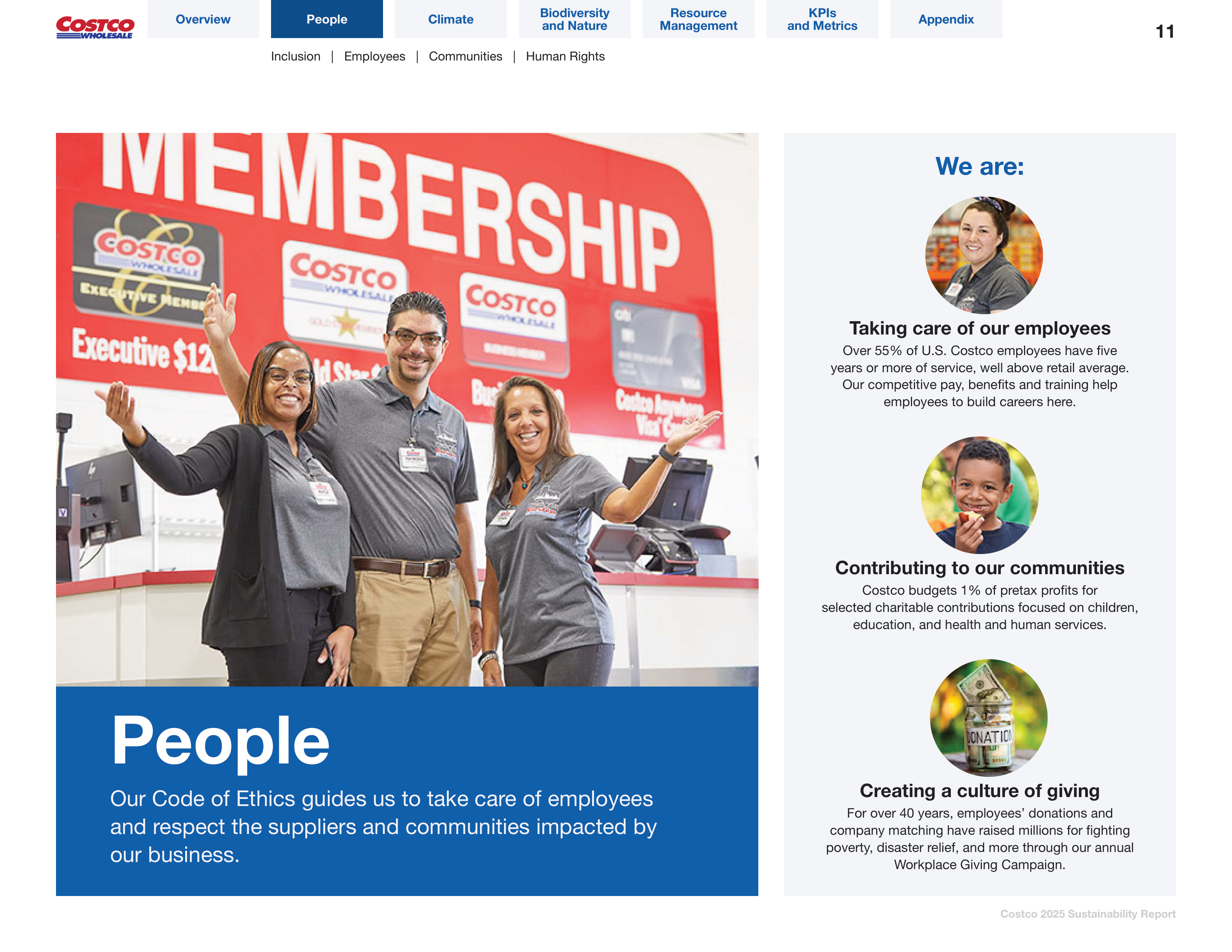
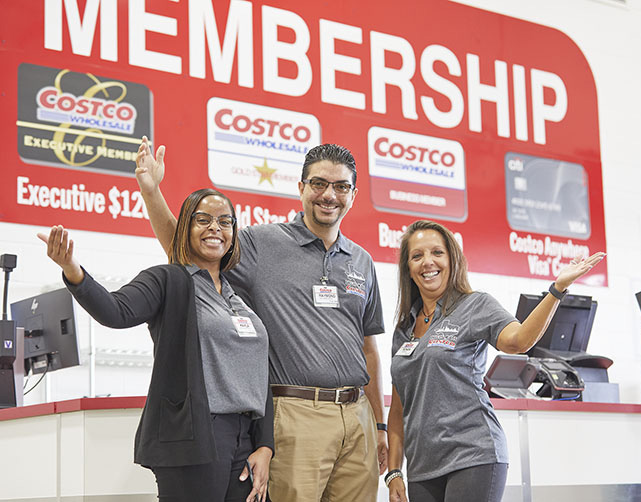
People
Our Code of Ethics guides us to take care of employees
and respect the suppliers and communities impacted by
our business.
We are:
Creating a culture of giving
For over 40 years, employees’ donations and
company matching have raised millions for fighting
poverty, disaster relief, and more through our annual
Workplace Giving Campaign.
Taking care of our employees
Over 55% of U.S. Costco employees have five
years or more of service, well above retail average.
Our competitive pay, benefits and training help
employees to build careers here.
Contributing to our communities
Costco budgets 1% of pretax profits for
selected charitable contributions focused on children,
education, and health and human services.
Inclusion | Employees | Communities | Human Rights

12
Overview
People
Climate
Biodiversity
and Nature
Resource
Management
KPIs
and Metrics
Appendix
Costco 2025 Sustainability Report
what is important to them. Based on initial
success, this program will run every other
year, alternating with our company-wide
employee survey. In FY23, over 145,000
employees participated in Costco Connects
sessions. In FY25, over 230,000 employees
participated. For more information on
employee engagement practices, see the
Employees section.
Supplier Inclusion
Costco also offers a program to work
with qualified small and diverse suppliers,
including veterans, in our communities to
provide introductions to do business with
disability, medical condition, work-related
injury, covered military or veteran status,
political ideology or expression, genetic
information, marital status, or other
protected status.
Inclusive Community
Team and Programs
We have taken several steps to work
toward our goal of an inclusive culture
and have unified our efforts under our
Inclusive Community
team. Led by our
Chief Diversity Officer (CDO), this team
supports the advancement of inclusion at
Costco, our relationships in the communities
where we do business and an increase in
qualified suppliers that lend diversity to our
merchandise offering.
To execute against our goals, the Inclusive
Community team runs and manages a
number of programs, such as
Costco
Connects
. Starting in FY23, we rolled out
this program to provide employees with an
opportunity to share feedback and input
about working at Costco directly with
leaders. In that first year, we found that
the small-group format allowed employees
to better connect with each other and
with leaders, while also giving leaders a
way to learn more about their teams and
Inclusion
Guided by our Code of Ethics, Costco prides
itself on being an inclusive workplace with a
strong culture rooted in our values.
Costco’s philosophy of creating an inclusive
and respectful workplace is part of our
goal to create a culture in which everyone
feels included and respected in all aspects
of our business. We know that embracing
differences is important to the growth of
our company as it leads to opportunities,
innovation and employee satisfaction.
We strive to:
• Empower our workforce and strengthen
our culture by creating an environment
where all employees feel a sense
of belonging.
• Demonstrate leadership’s commitment to
equity through consistent communication,
education, and support of a diverse and
inclusive workforce through initiatives
within the organization that promote
opportunities for all to succeed.
It has always been Costco policy that
employees deserve an environment free
from all forms of unlawful employment
discrimination. All decisions regarding
recruiting, hiring, promotion, assignment,
training, termination, and other terms and
conditions of employment will be made
without unlawful discrimination on the basis
of race, color, national origin, ancestry, sex,
gender, sexual orientation, gender identity
or expression, religion, age, pregnancy,
Costco. We believe that working with small
businesses, including suppliers from a
variety of backgrounds, helps us provide
a wide range of unique and innovative
products for our members.
All suppliers must meet exacting Costco
standards for quality, value and service.
In the typical scenario, we have featured
their products in select regional warehouses
or online at Costco.com. These items are a
part of our unique “Treasure Hunt” variety
of products that complement the everyday
essentials at Costco. We feature recent
success stories on the
Inclusion
page of our
Sustainability Commitment website.
Inclusion
| Employees | Communities | Human Rights
13
Overview
People
Climate
Biodiversity
and Nature
Resource
Management
KPIs
and Metrics
Appendix
Costco 2025 Sustainability Report
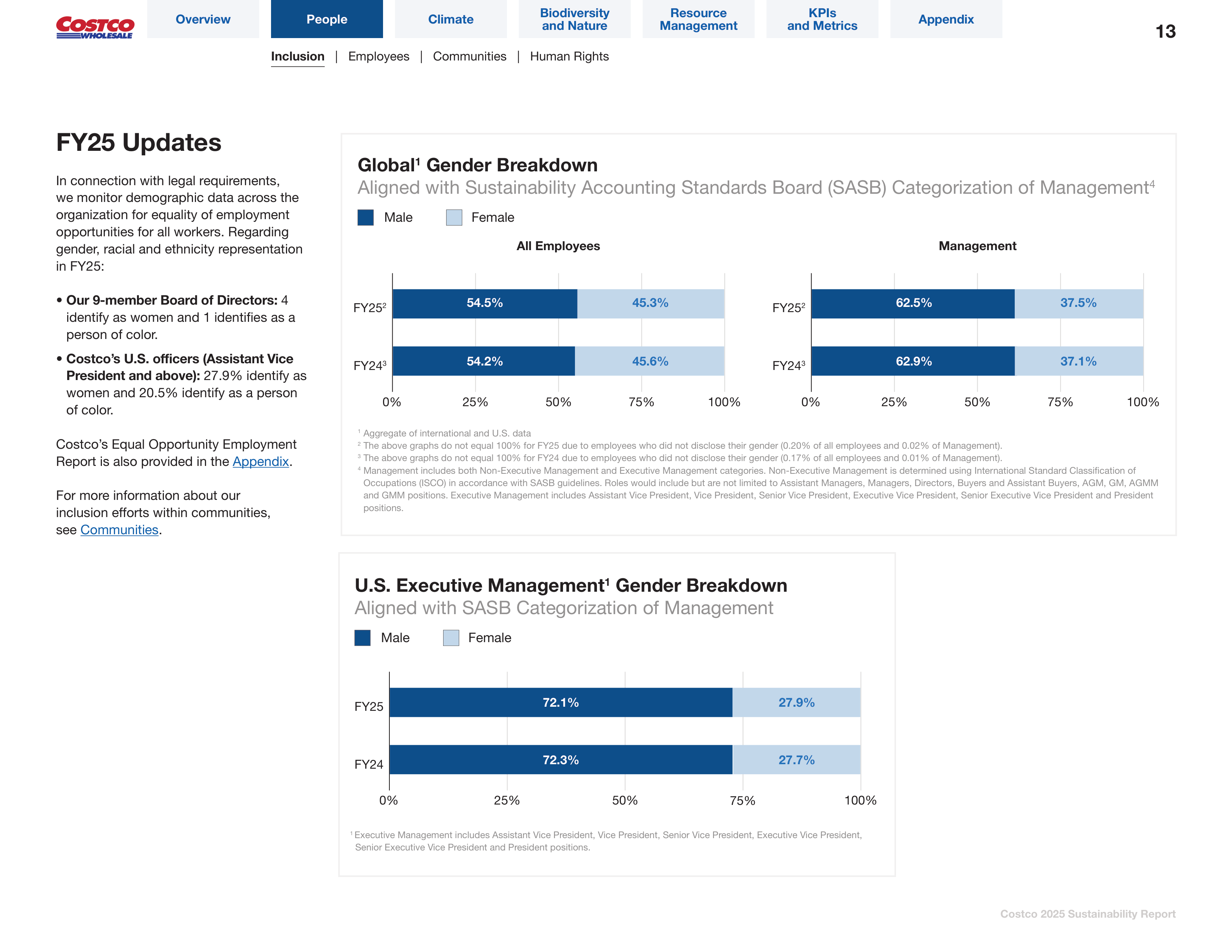
FY25 Updates
In connection with legal requirements,
we monitor demographic data across the
organization for equality of employment
opportunities for all workers. Regarding
gender, racial and ethnicity representation
in FY25:
•
Our 9-member Board of Directors:
4
identify as women and 1 identifies as a
person of color.
•
Costco’s U.S. officers (Assistant Vice
President and above):
27.9% identify as
women and 20.5% identify as a person
of color.
Costco’s Equal Opportunity Employment
Report is also provided in the
Appendix
.
For more information about our
inclusion efforts within communities,
see
Communities
.
Global
1
Gender Breakdown
Aligned with Sustainability Accounting Standards Board (SASB) Categorization of Management
4
Male
Female
All Employees
FY25
2
FY24
3
0%
25%
50%
75%
100%
54.5%
45.3%
54.2%
45.6%
1
Aggregate of international and U.S. data
2
The above graphs do not equal 100% for FY25 due to employees who did not disclose their gender (0.20% of all employees and 0.02% of Management).
3
The above graphs do not equal 100% for FY24 due to employees who did not disclose their gender (0.17% of all employees and 0.01% of Management).
4
Management includes both Non-Executive Management and Executive Management categories. Non-Executive Management is determined using International Standard Classification of
Occupations (ISCO) in accordance with SASB guidelines. Roles would include but are not limited to Assistant Managers, Managers, Directors, Buyers and Assistant Buyers, AGM, GM, AGMM
and GMM positions. Executive Management includes Assistant Vice President, Vice President, Senior Vice President, Executive Vice President, Senior Executive Vice President and President
positions.
Management
FY25
2
FY24
3
62.5%
37.5%
62.9%
37.1%
0%
25%
50%
75%
100%
Inclusion
| Employees | Communities | Human Rights
U.S. Executive Management
1
Gender Breakdown
Aligned with SASB Categorization of Management
Male
Female
FY25
FY24
0%
25%
50%
75%
100%
72.1%
27.9%
72.3%
27.7%
1
Executive Management includes Assistant Vice President, Vice President, Senior Vice President, Executive Vice President,
Senior Executive Vice President and President positions.
14
Overview
People
Climate
Biodiversity
and Nature
Resource
Management
KPIs
and Metrics
Appendix
Costco 2025 Sustainability Report
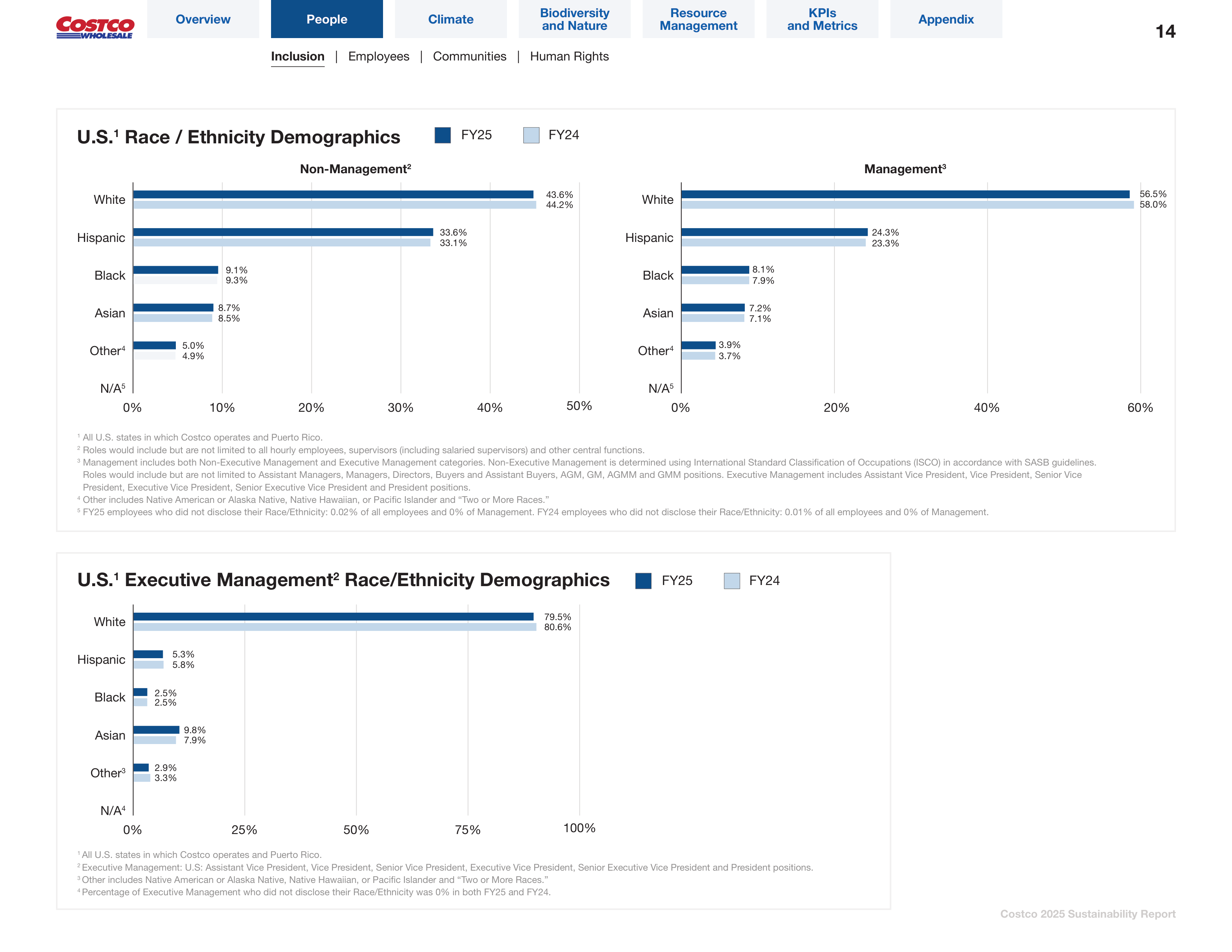
U.S.
1
Race / Ethnicity Demographics
FY25
FY24
1
All U.S. states in which Costco operates and Puerto Rico.
2
Roles would include but are not limited to all hourly employees, supervisors (including salaried supervisors) and other central functions.
3
Management includes both Non-Executive Management and Executive Management categories. Non-Executive Management is determined using International Standard Classification of Occupations (ISCO) in accordance with SASB guidelines.
Roles would include but are not limited to Assistant Managers, Managers, Directors, Buyers and Assistant Buyers, AGM, GM, AGMM and GMM positions. Executive Management includes Assistant Vice President, Vice President, Senior Vice
President, Executive Vice President, Senior Executive Vice President and President positions.
4
Other includes Native American or Alaska Native, Native Hawaiian, or Pacific Islander and “Two or More Races.”
5
FY25 employees who did not disclose their Race/Ethnicity: 0.02% of all employees and 0% of Management. FY24 employees who did not disclose their Race/Ethnicity: 0.01% of all employees and 0% of Management.
Non-Management
2
0%
10%
20%
40%
30%
50%
White
Other
4
Black
Hispanic
N/A
5
Asian
43.6%
44.2%
33.6%
33.1%
9.1%
9.3%
8.7%
8.5%
5.0%
4.9%
Management
3
0%
20%
60%
40%
White
Other
4
Black
Hispanic
N/A
5
Asian
56.5%
58.0%
24.3%
23.3%
8.1%
7.9%
7.2%
7.1%
3.9%
3.7%
FY25
FY24
1
All U.S. states in which Costco operates and Puerto Rico.
2
Executive Management: U.S: Assistant Vice President, Vice President, Senior Vice President, Executive Vice President, Senior Executive Vice President and President positions.
3
Other includes Native American or Alaska Native, Native Hawaiian, or Pacific Islander and “Two or More Races.”
4
Percentage of Executive Management who did not disclose their Race/Ethnicity was 0% in both FY25 and FY24.
U.S.
1
Executive Management
2
Race/Ethnicity Demographics
0%
25%
50%
75%
100%
White
Other
3
Black
Hispanic
N/A
4
Asian
79.5%
80.6%
5.3%
5.8%
2.5%
2.5%
9.8%
7.9%
2.9%
3.3%
Inclusion
| Employees | Communities | Human Rights

15
Overview
People
Climate
Biodiversity
and Nature
Resource
Management
KPIs
and Metrics
Appendix
Costco 2025 Sustainability Report
Our goals for employee development are to:
• Provide all employees with training,
education, and opportunities for career
development and advancement.
• Provide fair access and resources to help
employees succeed.
• Encourage leaders to teach and mentor
employees, so that employees will
be prepared for opportunities and
greater responsibility.
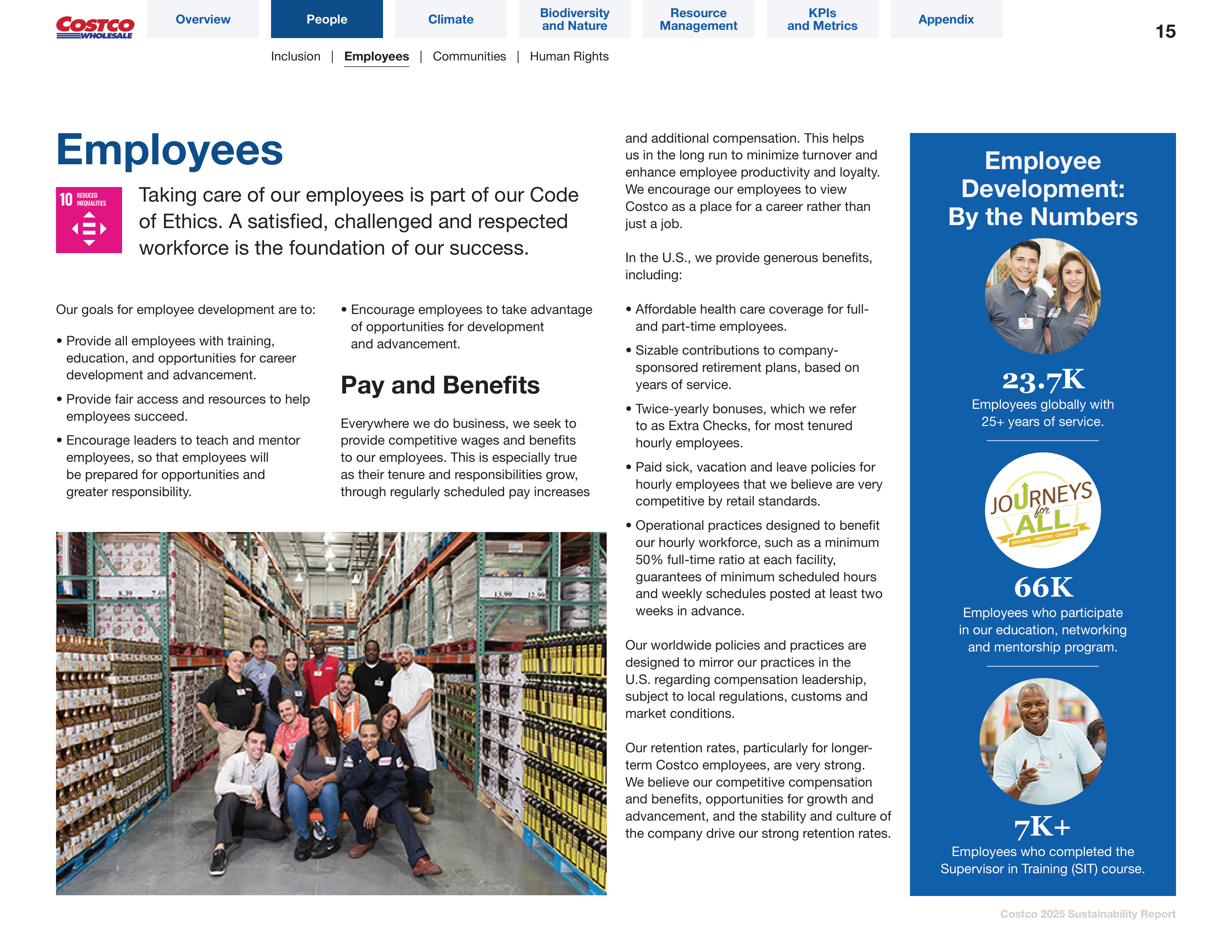
Employee
Development:
By the Numbers
23.7K
Employees globally with
25+ years of service.
7K+
Employees who completed the
Supervisor in Training (SIT) course.
Employees
• Encourage employees to take advantage
of opportunities for development
and advancement.
Pay and Benefits
Everywhere we do business, we seek to
provide competitive wages and benefits
to our employees. This is especially true
as their tenure and responsibilities grow,
through regularly scheduled pay increases
and additional compensation. This helps
us in the long run to minimize turnover and
enhance employee productivity and loyalty.
We encourage our employees to view
Costco as a place for a career rather than
just a job.
In the U.S., we provide generous benefits,
including:
• Affordable health care coverage for full-
and part-time employees.
• Sizable contributions to company-
sponsored retirement plans, based on
years of service.
• Twice-yearly bonuses, which we refer
to as Extra Checks, for most tenured
hourly employees.
• Paid sick, vacation and leave policies for
hourly employees that we believe are very
competitive by retail standards.
• Operational practices designed to benefit
our hourly workforce, such as a minimum
50% full-time ratio at each facility,
guarantees of minimum scheduled hours
and weekly schedules posted at least two
weeks in advance.
Our worldwide policies and practices are
designed to mirror our practices in the
U.S. regarding compensation leadership,
subject to local regulations, customs and
market conditions.
Our retention rates, particularly for longer-
term Costco employees, are very strong.
We believe our competitive compensation
and benefits, opportunities for growth and
advancement, and the stability and culture of
the company drive our strong retention rates.
Taking care of our employees is part of our Code
of Ethics. A satisfied, challenged and respected
workforce is the foundation of our success.
66K
Employees who participate
in our education, networking
and mentorship program.
Inclusion |
Employees
| Communities | Human Rights

16
Overview
People
Climate
Biodiversity
and Nature
Resource
Management
KPIs
and Metrics
Appendix
Costco 2025 Sustainability Report
•
Supervisor in Training (SIT).
SIT offers a
way for warehouse, depot and business
center employees to explore future
management opportunities. Employees
can sign up for training in an area of the
business they would like to pursue.
•
Student Retention Programs.
These
programs, available worldwide, allow our
warehouse employees to maintain their
employment status while attending college.
Culture, Ethics
and Open Door
We strongly promote and value our culture.
Costco employees know that an important
factor in our past and future success has
been and will be our commitment to value,
fairness, simplicity, member service and
always striving to do what is right. Our
employees are essential to teaching and
reinforcing Costco’s unique culture.
It is imperative that we continue to
perpetuate this culture throughout the
company globally. We encourage and
support our Open Door Policy, which allows
any employee to discuss any issue with any
level of management.
All Costco employees and suppliers are
expected to promptly report actual or
suspected violations of the law and our
Code of Ethics. Multiple reporting options
are available, ranging from the Open Door
Policy to our confidential and anonymous
ethics hotline available globally in multiple
languages at
Costco.ethicspoint.com
.
Employee
Development
and Programs
A related advantage comes from our
philosophy and practice of promoting from
within our employee ranks. We are proud
that the majority of our warehouse managers
worldwide began their Costco careers in
hourly positions. Many of our corporate and
regional office employees started in our
warehouses, depots and business centers.
Here’s a look at other programs created
to help employees succeed and grow
at Costco:
•
Career Development Discussions.
Each
year, employees have the opportunity
to collaborate with a senior manager to
establish or review short- and long-term
professional goals, including moving into
management positions. Managers receive
career development resources to help
guide employees in their discussions.
•
Journeys For All.
This voluntary program
offers all employees opportunities
to succeed through education
and opportunities for networking
and connection.
•
Leadership Development 101.
This eight-
week course covers leadership principles
based on Costco’s Code of Ethics. It
provides foundational training for new
managers and supervisors, and includes
practice in effective teamwork, conflict
management, and problem-solving. Costco
offers multiple other leadership training
programs to help our leaders develop both
themselves and their teams.
The health and well-being of our employees is a top priority for Costco. We have a
commitment to provide employees with benefits, tools and resources that ensure
they get the right support when needed. Specifically, Costco provides programs
and resources designed to support our employees’ mental, emotional and social
well-being. These resources are available to all employees and can assist with daily
stressors, anxiety, depression, relationship and family struggles, substance misuse,
behavioral challenges, and other mental health conditions.
Within the support that’s available, employees can receive free care from a
counselor, psychologist or psychiatrist. Depending on the country, up to eight
counseling sessions per year are covered 100% by Costco. Additional counseling
sessions, psychiatric visits, and inpatient treatment for behavioral health
conditions may be covered by Costco’s medical plan with the same low copay and
coinsurance as other covered services.
To ensure Costco continues to foster an atmosphere of openness and employee
support, we widely promote our Open Door Policy, which gives all employees the
option to contact any member of leadership within the organization to help resolve
problems. We provide regular training, tools and resources to all levels of our
leadership team to ensure they are equipped to help employees dealing with mental
health challenges.
For more information on the health and well-being benefits, tools and resources
available to employees in the United States, visit
Costcobenefits.com
.
Employee Mental, Emotional and Social Support
Inclusion |
Employees
| Communities | Human Rights
17
Overview
People
Climate
Biodiversity
and Nature
Resource
Management
KPIs
and Metrics
Appendix
Costco 2025 Sustainability Report
Program Spotlight:
Costco Careers
and Internships
Costco has several programs
that provide opportunities for
candidates to learn more about
roles inside the company. Two of
these programs are:
•
Costco Home Office Internships
attract qualified candidates from
inside and outside the company.
Over 12 weeks, interns gain
practical experience and skills
in a specific area. The program
allows interns to explore potential
career paths and build valuable
professional connections.
•
The Costco Careers
recruiting
program was created to draw
talent from our warehouses,
depots and other operational
units for positions in the home
and regional offices. The program
educates employees on the
roles and career opportunities
in corporate departments. We
believe that bringing different
perspectives, as well as
operational knowledge, into our
home and regional offices is good
for our business and employees.
Employee Engagement
and Costco Connects
As a measurement of engagement, Costco
conducts a global employee survey every
two years to obtain feedback concerning
ethics, compliance and engagement.
Survey results have indicated a high level of
satisfaction by employees with their work
environment. The most recent survey was
completed in 2024 and continued to show
strong engagement scores compared to the
retail industry benchmark. The next survey is
slated for FY26.
In alternate years between engagement
surveys, we conduct Costco Connects
sessions with employees across our global
operations. This continues our commitment
to hear directly from employees in small
group settings regarding personal and
professional issues that matter the most
to them. Where there are opportunities for
improved engagement, Costco leadership is
committed to taking action in those areas. In
FY25, over 230,000 employees participated
in Costco Connects sessions.
FY25 Updates
In FY25, our employee workforce grew by
2.5% to over 341,000 employees globally.
Our U.S. employees average over nine
years of service. We take pride in our
long-tenured workforce and our philosophy
to promote from within. A majority of our
warehouse managers began their careers in
hourly positions.
We also grew participation in our workforce
development programs:
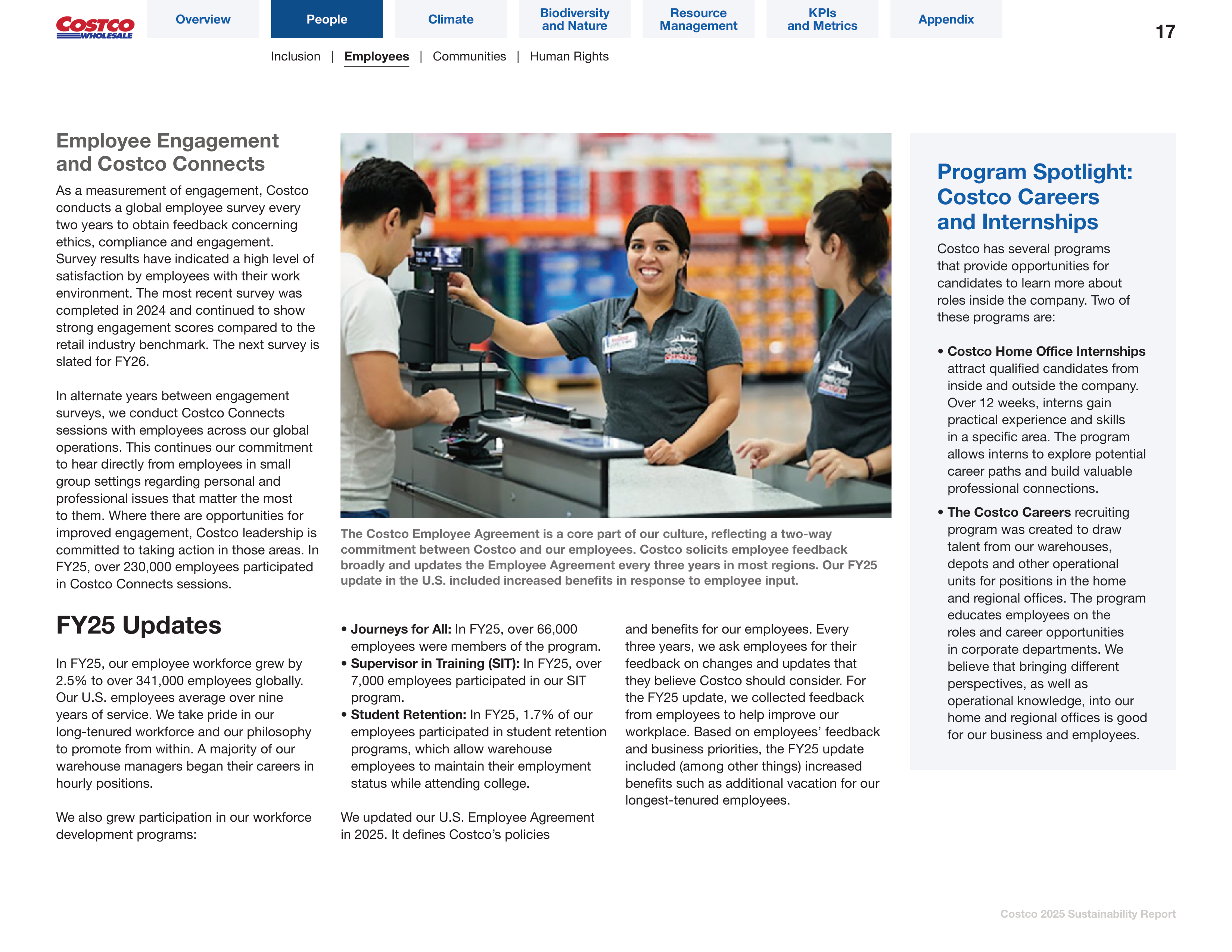
The Costco Employee Agreement is a core part of our culture, reflecting a two-way
commitment between Costco and our employees. Costco solicits employee feedback
broadly and updates the Employee Agreement every three years in most regions. Our FY25
update in the U.S. included increased benefits in response to employee input.
•
Journeys for All:
In FY25, over 66,000
employees were members of the program.
•
Supervisor in Training (SIT):
In FY25, over
7,000 employees participated in our SIT
program.
•
Student Retention:
In FY25, 1.7% of our
employees participated in student retention
programs, which allow warehouse
employees to maintain their employment
status while attending college.
We updated our U.S. Employee Agreement
in 2025. It defines Costco’s policies
and benefits for our employees. Every
three years, we ask employees for their
feedback on changes and updates that
they believe Costco should consider. For
the FY25 update, we collected feedback
from employees to help improve our
workplace. Based on employees’ feedback
and business priorities, the FY25 update
included (among other things) increased
benefits such as additional vacation for our
longest-tenured employees.
Inclusion |
Employees
| Communities | Human Rights

18
Overview
People
Climate
Biodiversity
and Nature
Resource
Management
KPIs
and Metrics
Appendix
Costco 2025 Sustainability Report
Charitable
Contributions
and Investments
Costco is committed to being active and
supportive in our local communities. We give
back to the communities in which we do
business through charitable contributions,
food and non-food donations, and
community investments. Our charitable
giving programs include:
•
Charitable contributions:
Costco
contributes 1% of pretax profits for
selected charitable contributions focused
on children, education, and health
and human services. Our Charitable
Contributions Committee meets quarterly
to determine which programs to support
and how to best meet the needs within our
communities.
•
Workplace Giving Campaign:
For the
past 40 years, Costco employees have
participated in a Workplace Giving
Campaign during the month of October.
Employees are encouraged to contribute
to organizations that support local
community programs to help with issues
such as homelessness, poverty, disaster
Communities
Our business is successful not only when we
provide quality merchandise at a good value for
our members, but also when we contribute to
the well-being of the communities where we do
business – and where our employees, members,
and suppliers live and work.
As we operate in communities around
the world, our goals are to:
• Provide an inclusive shopping environment
for our members and support our local
communities through charitable giving
and service.
• In our charitable contributions, give
special focus to those organizations that
emphasize helping children, supporting
education, and providing health and
human services.
• Invest in key programs that make a
difference in communities.
• Encourage employees to serve and
participate with community organizations.
relief, education and animal welfare.
Costco matches employees’ financial
donations at 70% during this campaign to
make a greater impact to causes that our
employees care about.
•
Children’s Miracle Network Hospitals:
Costco conducts an annual member
drive for the Children’s Miracle Network
Hospitals in the U.S. and Canada. These
funds help support research, equipment,
training, uncompensated care and more.
•
Backpack Program:
Costco has a global,
company-wide program that provides
backpacks to elementary school children.
Each of our warehouse locations partners
with a local elementary school in their
community.
•
Costco Scholarship Fund:
In the past 25
years, Costco has raised money through the
Costco Scholarship Fund for scholarships
for deserving students to attend the
University of Washington or Seattle
University and has donated to other schools
and organizations to support scholarships.
•
Costco Employee Scholarship:
This
scholarship is open to all permanent
part-time and full-time employees in the
U.S. who meet the eligibility criteria. The
scholarship is available in amounts up to
$2,500 per academic year for up to four
years. Applicants must be enrolled or
planning to enroll in an accredited U.S.
college or university.
•
Community Investment:
Costco is
completing its investments in programs
and funds that focus on expanding
economic opportunities. These
investments help support home ownership,
small business ownership, education,
healthcare and digital connectivity for
diverse groups in the U.S.
Inclusion | Employees |
Communities
| Human Rights




19
Overview
People
Climate
Biodiversity
and Nature
Resource
Management
KPIs
and Metrics
Appendix
Costco 2025 Sustainability Report
Food and Non-Food
Donations
Costco donates both food and non-food
products to local communities to help those
in need. Our food donation programs are
part of our waste-minimization efforts. For
more information on our waste management
programs details, see the
Waste Reduction
section.
The primary ways Costco contributes
through food and non-food donations are:
•
Cash grants and donations:
In FY25, we
donated 140.8 million pounds of food and
other products from our U.S. warehouses
and depots to
Feeding America
. All of our
international locations also donate to local
food banks.
•
Non-Food Donations:
Costco donates
first-quality items that are returned to our
warehouses and cannot be resold but that
are fully usable. Examples of frequently
donated products include mattresses,
coolers, diapers and personal care items.
Instead of being destroyed, recycled or
returned to the supplier, Costco is able to
give these items a new life and support
communities in need.
Employee
Volunteering
The mission of the Costco Volunteer Center
is to inspire our employees and their
families to volunteer in their communities.
This
United Way video
shares more about
how Costco employees engage with
the community.
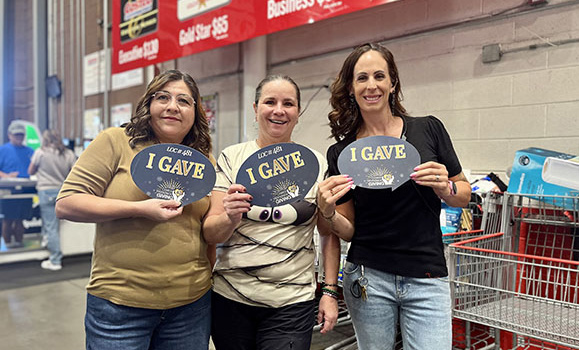
Costco’s volunteer Reading Buddies Program, which is celebrating its 25th year,
is in more than 500 warehouses in the U.S. and Canada. Over 3,000 volunteers in
the U.S. and Canada contribute their time to this successful program.
Employee Volunteers: Reading Buddies
Health Care
in the Community
Costco offers low-cost, quality eye care
through independent optometrists and our
optical departments, hearing aid services
and supplies in our hearing aid centers,
and prescriptions and other health-related
products in our pharmacies. Costco also
offers flu shots, other immunizations and
other health-related programs. We are
continuing to provide COVID-19 support by
offering vaccines.
Pharmacy Services
Besides being a low-cost source for
prescription medications in our warehouses
where we offer pharmacies, Costco offers
the following special prescriptions and
services in the U.S.:
• Specialty-drug customized pharmacy
services that require patient-specific
dosing and careful clinical management.
More information can be found at
Specialty
Drug Programs
.
• Same-day prescription delivery through our
relationship with Instacart.
• Access to naloxone without a prescription
in states around the country and Puerto
Rico. Naloxone is a life-saving medication
that reverses an opioid overdose.
• Prescribing contraceptives in states where
allowed by law.
• Travel Medicine Services in Alabama,
Alaska, Arizona, California, Colorado,
Delaware, District of Columbia, Florida,
Georgia, Hawaii, Idaho, Illinois, Indiana,
Kentucky, Maine, Maryland, Michigan,
Missouri, Montana, Nebraska, Nevada,
New Hampshire, New Jersey, New Mexico,
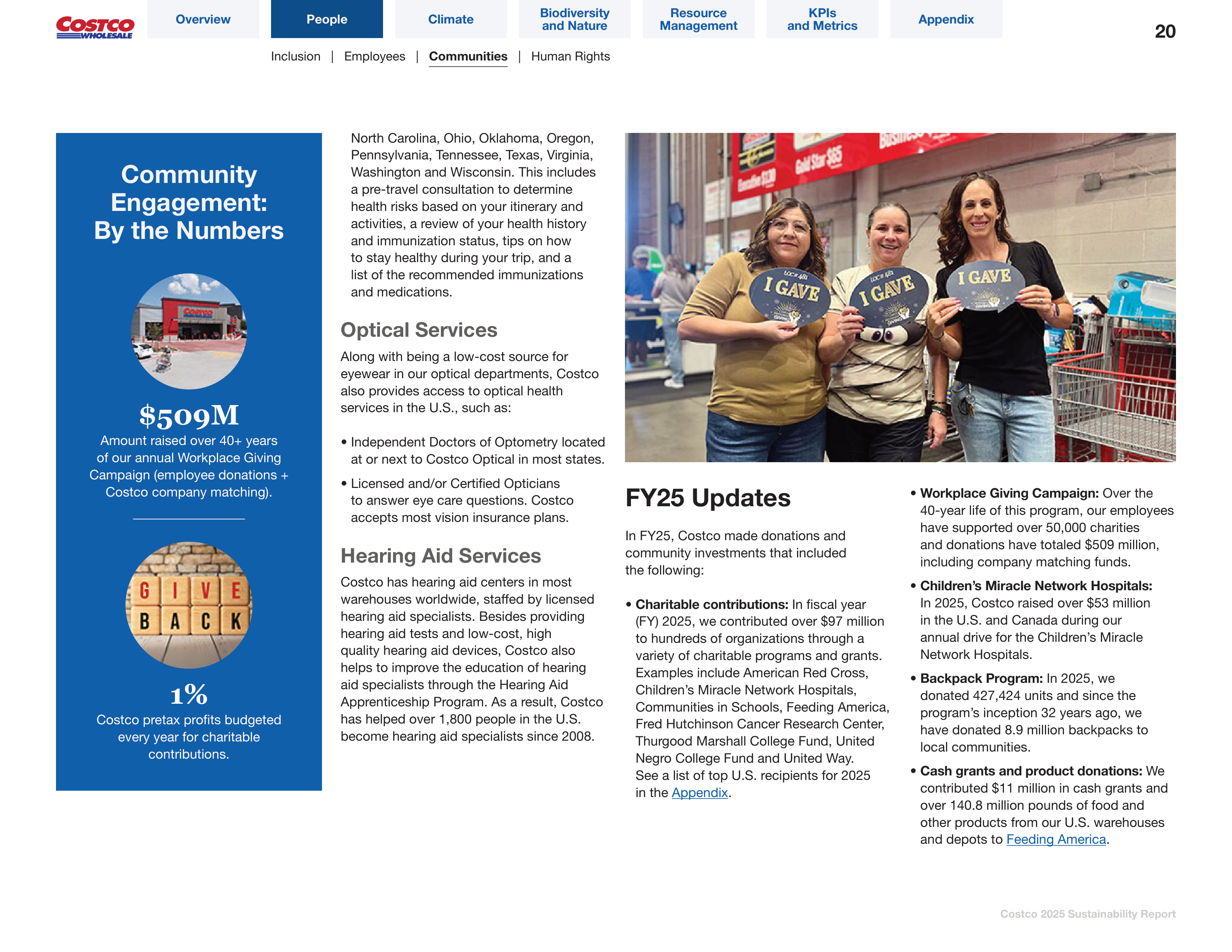
Community
Engagement:
By the Numbers
$97M
Donated to hundreds of local
charitable organizations in
communities where we operate.
2,700+
Scholarships awarded through
the Costco Scholarship Fund.
140.8M lbs
Food and other products from
our U.S. warehouses donated
to Feeding America
®
.
Inclusion | Employees |
Communities
| Human Rights

20
Overview
People
Climate
Biodiversity
and Nature
Resource
Management
KPIs
and Metrics
Appendix
Costco 2025 Sustainability Report
FY25 Updates
In FY25, Costco made donations and
community investments that included
the following:
•
Charitable contributions:
In fiscal year
(FY) 2025, we contributed over $97 million
to hundreds of organizations through a
variety of charitable programs and grants.
Examples include American Red Cross,
Children’s Miracle Network Hospitals,
Communities in Schools, Feeding America,
Fred Hutchinson Cancer Research Center,
Thurgood Marshall College Fund, United
Negro College Fund and United Way.
See a list of top U.S. recipients for 2025
in the
Appendix
.
North Carolina, Ohio, Oklahoma, Oregon,
Pennsylvania, Tennessee, Texas, Virginia,
Washington and Wisconsin. This includes
a pre-travel consultation to determine
health risks based on your itinerary and
activities, a review of your health history
and immunization status, tips on how
to stay healthy during your trip, and a
list of the recommended immunizations
and medications.
Optical Services
Along with being a low-cost source for
eyewear in our optical departments, Costco
also provides access to optical health
services in the U.S., such as:
• Independent Doctors of Optometry located
at or next to Costco Optical in most states.
• Licensed and/or Certified Opticians
to answer eye care questions. Costco
accepts most vision insurance plans.
Hearing Aid Services
Costco has hearing aid centers in most
warehouses worldwide, staffed by licensed
hearing aid specialists. Besides providing
hearing aid tests and low-cost, high
quality hearing aid devices, Costco also
helps to improve the education of hearing
aid specialists through the Hearing Aid
Apprenticeship Program. As a result, Costco
has helped over 1,800 people in the U.S.
become hearing aid specialists since 2008.
Community
Engagement:
By the Numbers
$509M
Amount raised over 40+ years
of our annual Workplace Giving
Campaign (employee donations +
Costco company matching).
1%
Costco pretax profits budgeted
every year for charitable
contributions.
•
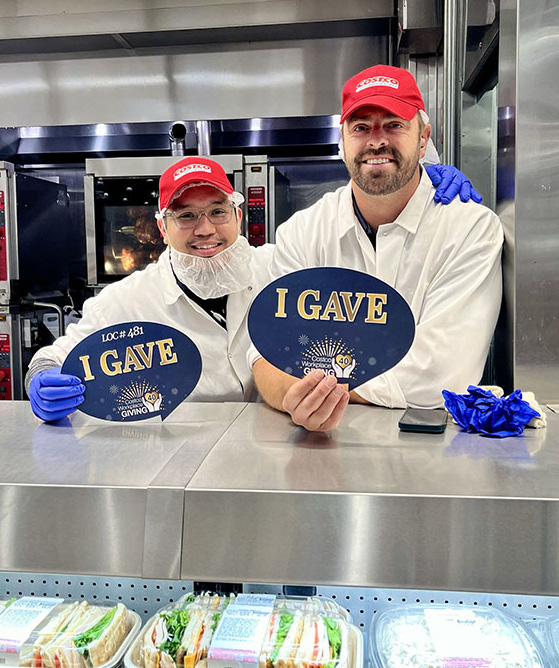
Workplace Giving Campaign:
Over the
40-year life of this program, our employees
have supported over 50,000 charities
and donations have totaled $509 million,
including company matching funds.
•
Children’s Miracle Network Hospitals:
In 2025, Costco raised over $53 million
in the U.S. and Canada during our
annual drive for the Children’s Miracle
Network Hospitals.
•
Backpack Program:
In 2025, we
donated 427,424 units and since the
program’s inception 32 years ago, we
have donated 8.9 million backpacks to
local communities.
•
Cash grants and product donations:
We
contributed $11 million in cash grants and
over 140.8 million pounds of food and
other products from our U.S. warehouses
and depots to
Feeding America
.
Inclusion | Employees |
Communities
| Human Rights
21
Overview
People
Climate
Biodiversity
and Nature
Resource
Management
KPIs
and Metrics
Appendix
Costco 2025 Sustainability Report
addition, we also have an Anti-Harassment
Policy and Anti-Retaliation Policy as
described in our Employee Handbook.
Policies
•
Code of Ethics
•
Open Door Policy
•
Supplier Code of Conduct
•
Palm Oil Policy
•
Conflict Minerals Policy
Statements
•
Australia Modern Slavery Act Statement
•
California Transparency in Supply Chain
Act Disclosure
•
Canada Fighting Against Forced Labour
and Child Labour in Supply Chains Act
•
UK Modern Slavery Act Statement
Salient Human
Rights Risks
In FY23, we partnered with
LRQA
to conduct
a salient human rights risk assessment,
which included but was not limited to
feedback from internal and external
stakeholders and a review of various risk
data sources. From this work, we identified
the five most salient risks related to
our business:
Human Rights
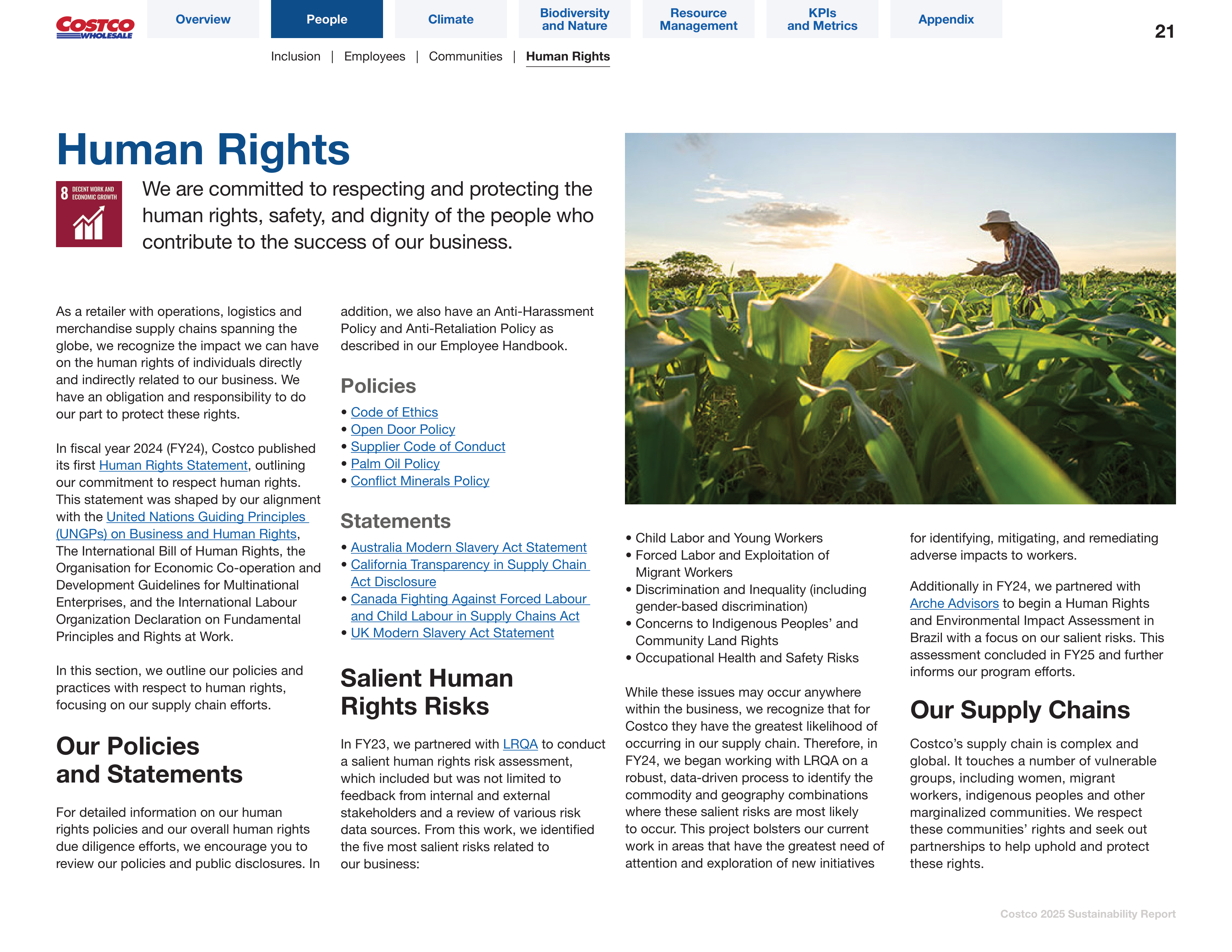
We are committed to respecting and protecting the
human rights, safety, and dignity of the people who
contribute to the success of our business.
As a retailer with operations, logistics and
merchandise supply chains spanning the
globe, we recognize the impact we can have
on the human rights of individuals directly
and indirectly related to our business. We
have an obligation and responsibility to do
our part to protect these rights.
In fiscal year 2024 (FY24), Costco published
its first
Human Rights Statement
, outlining
our commitment to respect human rights.
This statement was shaped by our alignment
with the
United Nations Guiding Principles
(UNGPs) on Business and Human Rights
,
The International Bill of Human Rights, the
Organisation for Economic Co-operation and
Development Guidelines for Multinational
Enterprises, and the International Labour
Organization Declaration on Fundamental
Principles and Rights at Work.
In this section, we outline our policies and
practices with respect to human rights,
focusing on our supply chain efforts.
Our Policies
and Statements
For detailed information on our human
rights policies and our overall human rights
due diligence efforts, we encourage you to
review our policies and public disclosures. In
• Child Labor and Young Workers
• Forced Labor and Exploitation of
Migrant Workers
• Discrimination and Inequality (including
gender-based discrimination)
• Concerns to Indigenous Peoples’ and
Community Land Rights
• Occupational Health and Safety Risks
While these issues may occur anywhere
within the business, we recognize that for
Costco they have the greatest likelihood of
occurring in our supply chain. Therefore, in
FY24, we began working with LRQA on a
robust, data-driven process to identify the
commodity and geography combinations
where these salient risks are most likely
to occur. This project bolsters our current
work in areas that have the greatest need of
attention and exploration of new initiatives
for identifying, mitigating, and remediating
adverse impacts to workers.
Additionally in FY24, we partnered with
Arche Advisors
to begin a Human Rights
and Environmental Impact Assessment in
Brazil with a focus on our salient risks. This
assessment concluded in FY25 and further
informs our program efforts.
Our Supply Chains
Costco’s supply chain is complex and
global. It touches a number of vulnerable
groups, including women, migrant
workers, indigenous peoples and other
marginalized communities. We respect
these communities’ rights and seek out
partnerships to help uphold and protect
these rights.
Inclusion | Employees | Communities |
Human Rights
22
Overview
People
Climate
Biodiversity
and Nature
Resource
Management
KPIs
and Metrics
Appendix
Costco 2025 Sustainability Report
Costco Supplier
Code of Conduct
The Code was established to respect
and protect the human rights, safety
and dignity of the people who
contribute to the success of our
business. To this end, Costco:
• Prohibits illegal child labor; forced,
bonded, indentured, slave, prison
or convict labor, and human
trafficking; physical, sexual, verbal
or mental abuse, or harassment;
bribery or attempted bribery;
health and safety conditions
posing immediate risk to life and
limb; corruption, deception, or
falsification of records; and auditors
denied timely entry by facility.
• Expects our suppliers to comply,
at a minimum, with the applicable
labor and environmental laws and
regulations of the country where the
merchandise is produced.
• Encourages our suppliers to work
to achieve what we call “Above
and Beyond Goals,” which include
programs and policies adopted and
implemented that exceed the local
laws and the Code.
As part of a shared commitment to
respecting and upholding human rights,
Costco expects our suppliers, including
Costco-owned manufacturing facilities, to be
aware of our Human Rights Statement and
to contractually commit to compliance with
our
Supplier Code of Conduct
(“the Code”)
throughout the supply chain. We carry out a
risk-based approach to monitoring suppliers
against the Code. Additionally, our continued
stakeholder engagement and collaboration
in multi-stakeholder coalitions remain
critically important to shaping our response
to our salient human rights risks.
Key Relationships
and Initiatives
Costco will continue to prioritize much
of its human rights work, and the key
relationships we have with a number of
third parties, based on the salient risks we
identified. Some examples currently taking
place include:
• Costco helped establish and is an active
member of the
Seafood Task Force
(STF)
, a collaboration tackling human
rights and environmental issues in the
seafood industry. Exploitation of workers,
including migrant workers, is prevalent
in the seafood industry, with much of
the risk taking place throughout the
recruitment process. Costco works with
STF’s Responsible Recruitment Oversight
working group to advance the industry’s
efforts for responsible labor recruitment.
We share more information on STF in the
Fisheries and Aquaculture
section.
• Seasonal migrant workers in the United
States’ agricultural sector often face
forced labor and exploitative recruitment
processes. Costco and some of its fresh
produce suppliers partner with
CIERTO
,
a nonprofit that provides transparent, no
worker-fee recruitment for farm workers to
ethically and legally recruit farm labor for
U.S. agricultural products.
• Costco helped develop the fresh produce
industry’s
Ethical Charter on Responsible
Labor Practices
and plays a leadership
role on the Advisory Group to the
Ethical
Charter Implementation Program (ECIP)
.
This program involves an interactive, web-
based platform for growers and suppliers
to assess their labor management systems
against the principles of the Ethical Charter
and receive guidance on strengthening
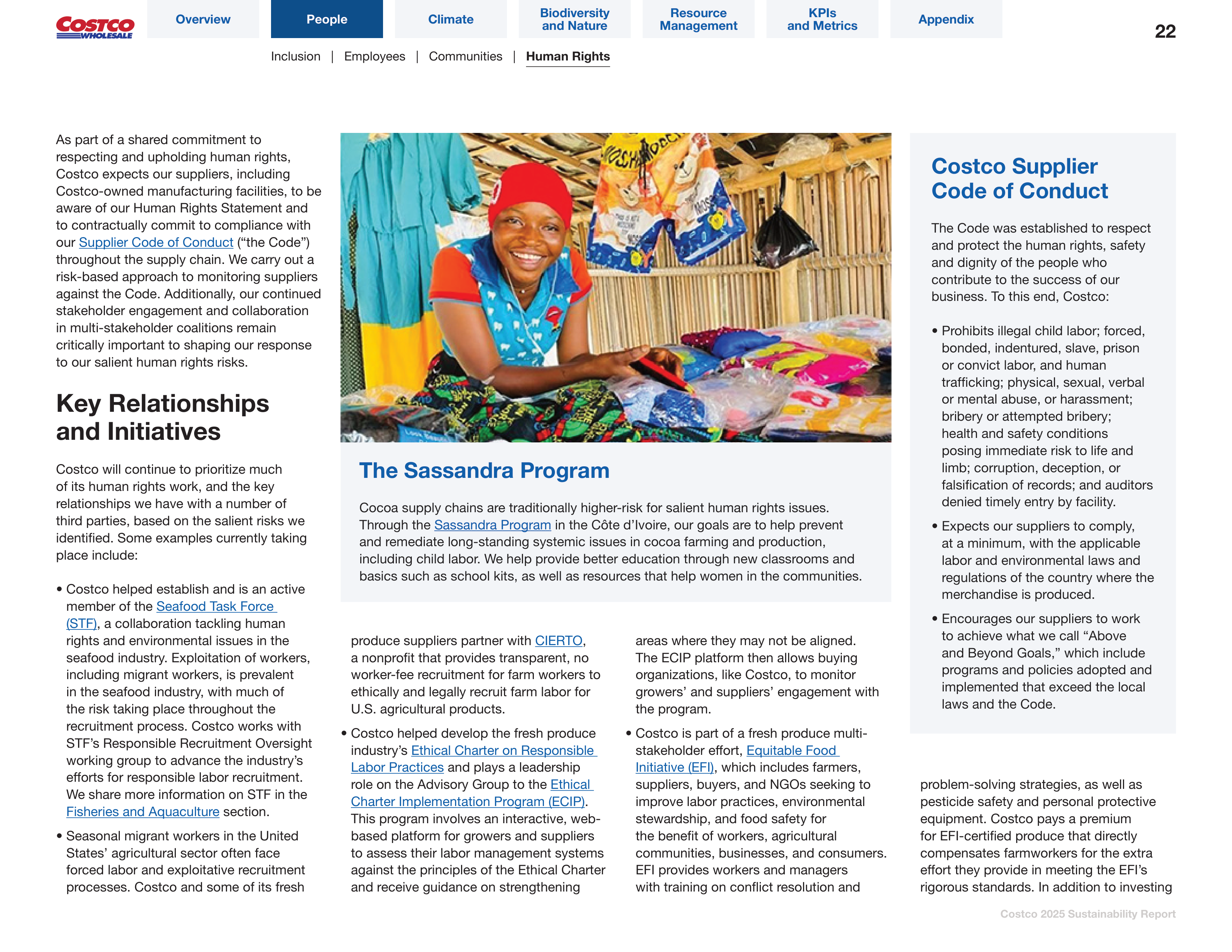
The Sassandra Program
Cocoa supply chains are traditionally higher-risk for salient human rights issues.
Through the
Sassandra Program
in the Côte d’Ivoire, our goals are to help prevent
and remediate long-standing systemic issues in cocoa farming and production,
including child labor. We help provide better education through new classrooms and
basics such as school kits, as well as resources that help women in the communities.
areas where they may not be aligned.
The ECIP platform then allows buying
organizations, like Costco, to monitor
growers’ and suppliers’ engagement with
the program.
• Costco is part of a fresh produce multi-
stakeholder effort,
Equitable Food
Initiative (EFI)
, which includes farmers,
suppliers, buyers, and NGOs seeking to
improve labor practices, environmental
stewardship, and food safety for
the benefit of workers, agricultural
communities, businesses, and consumers.
EFI provides workers and managers
with training on conflict resolution and
problem-solving strategies, as well as
pesticide safety and personal protective
equipment. Costco pays a premium
for EFI-certified produce that directly
compensates farmworkers for the extra
effort they provide in meeting the EFI’s
rigorous standards. In addition to investing
Inclusion | Employees | Communities |
Human Rights
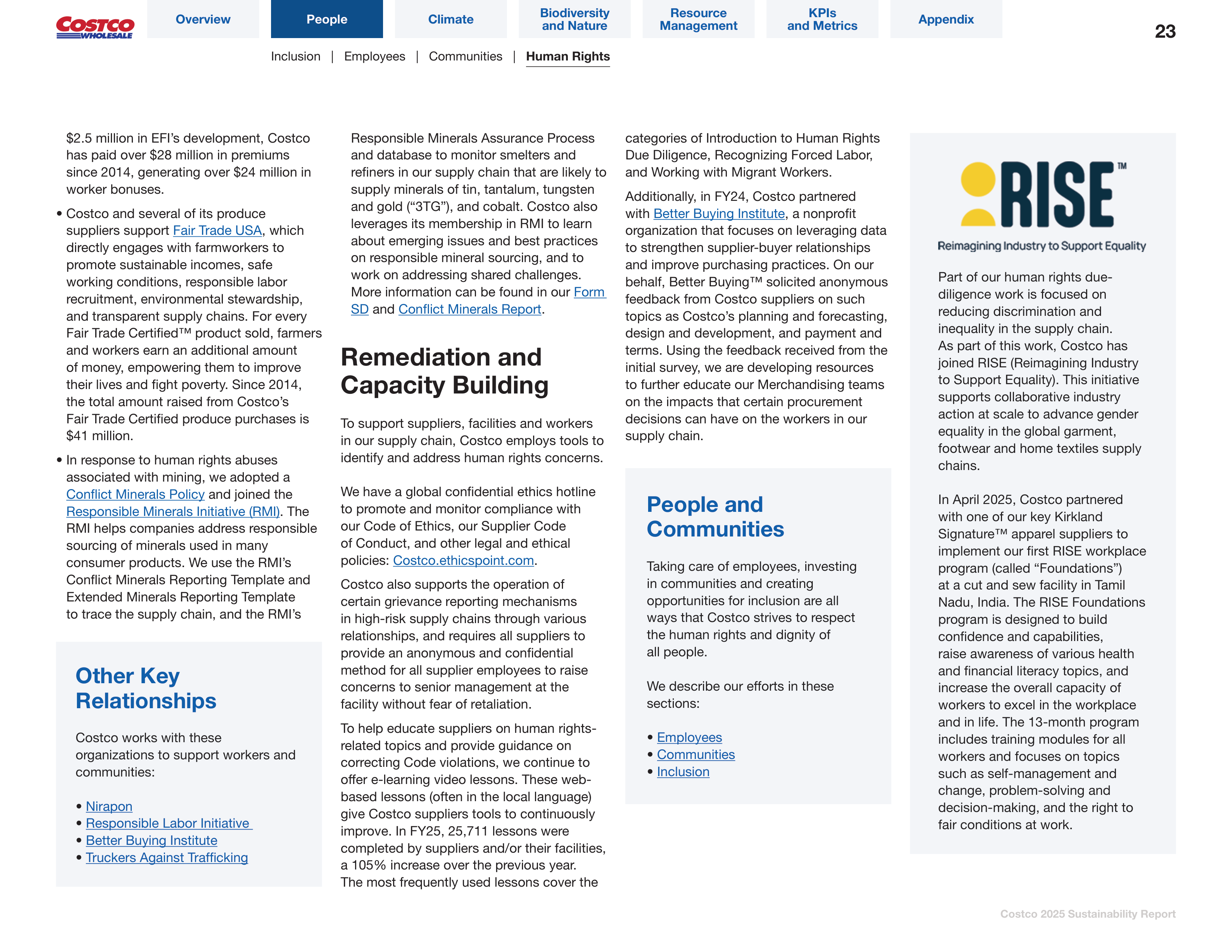

23
Overview
People
Climate
Biodiversity
and Nature
Resource
Management
KPIs
and Metrics
Appendix
Costco 2025 Sustainability Report
$2.5 million in EFI’s development, Costco
has paid over $28 million in premiums
since 2014, generating over $24 million in
worker bonuses.
• Costco and several of its produce
suppliers support
Fair Trade USA
, which
directly engages with farmworkers to
promote sustainable incomes, safe
working conditions, responsible labor
recruitment, environmental stewardship,
and transparent supply chains. For every
Fair Trade Certified™ product sold, farmers
and workers earn an additional amount
of money, empowering them to improve
their lives and fight poverty. Since 2014,
the total amount raised from Costco’s
Fair Trade Certified produce purchases is
$41 million.
• In response to human rights abuses
associated with mining, we adopted a
Conflict Minerals Policy
and joined the
Responsible Minerals Initiative (RMI)
. The
RMI helps companies address responsible
sourcing of minerals used in many
consumer products. We use the RMI’s
Conflict Minerals Reporting Template and
Extended Minerals Reporting Template
to trace the supply chain, and the RMI’s
Responsible Minerals Assurance Process
and database to monitor smelters and
refiners in our supply chain that are likely to
supply minerals of tin, tantalum, tungsten
and gold (“3TG”), and cobalt. Costco also
leverages its membership in RMI to learn
about emerging issues and best practices
on responsible mineral sourcing, and to
work on addressing shared challenges.
More information can be found in our
Form
SD
and
Conflict Minerals Report
.
Remediation and
Capacity Building
To support suppliers, facilities and workers
in our supply chain, Costco employs tools to
identify and address human rights concerns.
We have a global confidential ethics hotline
to promote and monitor compliance with
our Code of Ethics, our Supplier Code
of Conduct, and other legal and ethical
policies:
Costco.ethicspoint.com
.
Costco also supports the operation of
certain grievance reporting mechanisms
in high-risk supply chains through various
relationships, and requires all suppliers to
provide an anonymous and confidential
method for all supplier employees to raise
concerns to senior management at the
facility without fear of retaliation.
To help educate suppliers on human rights-
related topics and provide guidance on
correcting Code violations, we continue to
offer e-learning video lessons. These web-
based lessons (often in the local language)
give Costco suppliers tools to continuously
improve. In FY25, 25,711 lessons were
completed by suppliers and/or their facilities,
a 105% increase over the previous year.
The most frequently used lessons cover the
Other Key
Relationships
Costco works with these
organizations to support workers and
communities:
•
Nirapon
•
Responsible Labor Initiative
•
Better Buying Institute
•
Truckers Against Trafficking
People and
Communities
Taking care of employees, investing
in communities and creating
opportunities for inclusion are all
ways that Costco strives to respect
the human rights and dignity of
all people.
We describe our efforts in these
sections:
•
Employees
•
Communities
•
Inclusion
Part of our human rights due-
diligence work is focused on
reducing discrimination and
inequality in the supply chain.
As part of this work, Costco has
joined RISE (Reimagining Industry
to Support Equality). This initiative
supports collaborative industry
action at scale to advance gender
equality in the global garment,
footwear and home textiles supply
chains.
In April 2025, Costco partnered
with one of our key Kirkland
Signature™ apparel suppliers to
implement our first RISE workplace
program (called “Foundations”)
at a cut and sew facility in Tamil
Nadu, India. The RISE Foundations
program is designed to build
confidence and capabilities,
raise awareness of various health
and financial literacy topics, and
increase the overall capacity of
workers to excel in the workplace
and in life. The 13-month program
includes training modules for all
workers and focuses on topics
such as self-management and
change, problem-solving and
decision-making, and the right to
fair conditions at work.
categories of Introduction to Human Rights
Due Diligence, Recognizing Forced Labor,
and Working with Migrant Workers.
Additionally, in FY24, Costco partnered
with
Better Buying Institute
, a nonprofit
organization that focuses on leveraging data
to strengthen supplier-buyer relationships
and improve purchasing practices. On our
behalf, Better Buying™ solicited anonymous
feedback from Costco suppliers on such
topics as Costco’s planning and forecasting,
design and development, and payment and
terms. Using the feedback received from the
initial survey, we are developing resources
to further educate our Merchandising teams
on the impacts that certain procurement
decisions can have on the workers in our
supply chain.
Inclusion | Employees | Communities |
Human Rights
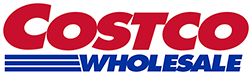
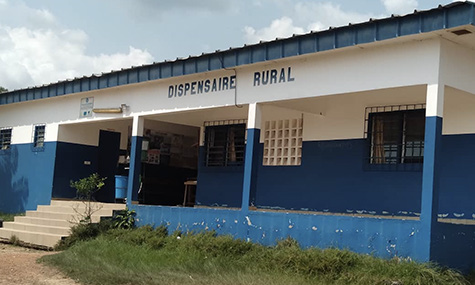
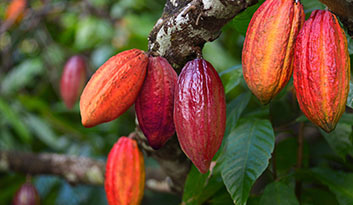
24
Overview
People
Climate
Biodiversity
and Nature
Resource
Management
KPIs
and Metrics
Appendix
Costco 2025 Sustainability Report
Our goal is to have our Kirkland
Signature
TM
chocolate products made
with cocoa sourced through programs
that promote sustainable practices.
Unfortunately, cocoa farming has been
associated with long-term systemic
issues including child labor and
deforestation. Our aim is to address these
important issues through programming
that provides for high-quality cocoa
production and improved livelihoods of
the cocoa farmers.
FEATURED INITIATIVE
The Sassandra Program
Exclusive to Costco, this program is designed to
introduce sustainability practices, promote human
rights and practice good forest stewardship in cocoa
cooperatives in Côte d’Ivoire.
Founded in 2009 and exclusive to Costco,
the Sassandra Program for responsibly
sourced cocoa yields high-quality cocoa for
many Kirkland Signature products, while also
delivering social infrastructure and training
for participating farmers and their families.
The Program size fluctuates annually;
however, the harvest season ending June
2025 supported 12,760 farmers from 22
cooperatives. Child Labor Monitoring and
Remediation System (CLMRS) coverage is
active in all of the cooperatives.
A health center funded in part by premiums paid through the Sassandra Program.
Over 353,000 vaccinations have been administered since the Program started.
Child Labor Monitoring
137 trained field agents
Child labor monitoring
and remediation systems
(CLMRS) operational in all
22 Sassandra cooperatives
Gender Equity*
174 women-led
Village Savings & Loans Associations
with 4,400 participants and over $1.2M
in cumulative savings to date
2,005 women trained and engaged
in income-generating activities
31 Literacy Centers created
:
880 women trained for 18 months
in functional literacy
24 gender committees created
:
1,805 people participating in
couple dialogue sessions
Education
168 classrooms
built or rehabilitated, providing
access to school for more
than 17,000 children
18,000+ school kits provided
Health Care
17,000+ babies
delivered in Sassandra-funded
maternity wards
353,000+ vaccinations
administered against measles,
polio, tuberculosis, yellow
fever and mumps
Sassandra Cocoa Program Highlights
From October 2009 through June 2025
*As part of a multi-year program that ended in 2025.
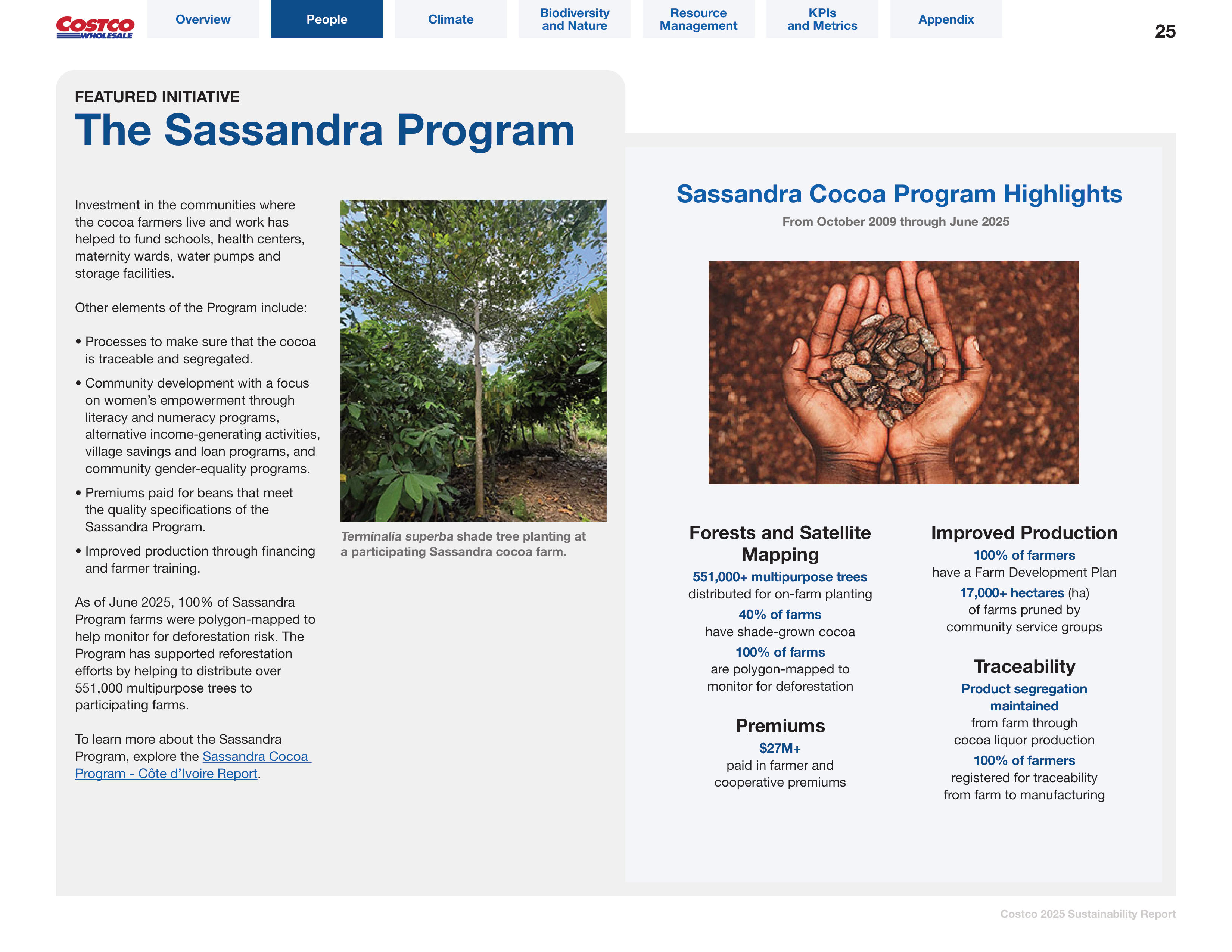
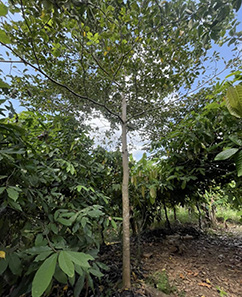

25
Overview
People
Climate
Biodiversity
and Nature
Resource
Management
KPIs
and Metrics
Appendix
Costco 2025 Sustainability Report
FEATURED INITIATIVE
The Sassandra Program
Terminalia superba shade tree planting at
a participating Sassandra cocoa farm.
Investment in the communities where
the cocoa farmers live and work has
helped to fund schools, health centers,
maternity wards, water pumps and
storage facilities.
Other elements of the Program include:
• Processes to make sure that the cocoa
is traceable and segregated.
• Community development with a focus
on women’s empowerment through
literacy and numeracy programs,
alternative income-generating activities,
village savings and loan programs, and
community gender-equality programs.
• Premiums paid for beans that meet
the quality specifications of the
Sassandra Program.
• Improved production through financing
and farmer training.
As of June 2025, 100% of Sassandra
Program farms were polygon-mapped to
help monitor for deforestation risk. The
Program has supported reforestation
efforts by helping to distribute over
551,000 multipurpose trees to
participating farms.
To learn more about the Sassandra
Program, explore the
Sassandra Cocoa
Program - Côte d’Ivoire Report
.
Forests and Satellite
Mapping
551,000+ multipurpose trees
distributed for on-farm planting
40% of farms
have shade-grown cocoa
100% of farms
are polygon-mapped to
monitor for deforestation
Premiums
$27M+
paid in farmer and
cooperative premiums
Improved Production
100% of farmers
have a Farm Development Plan
17,000+ hectares
(ha)
of farms pruned by
community service groups
Traceability
Product segregation
maintained
from farm through
cocoa liquor production
100% of farmers
registered for traceability
from farm to manufacturing
Sassandra Cocoa Program Highlights
From October 2009 through June 2025
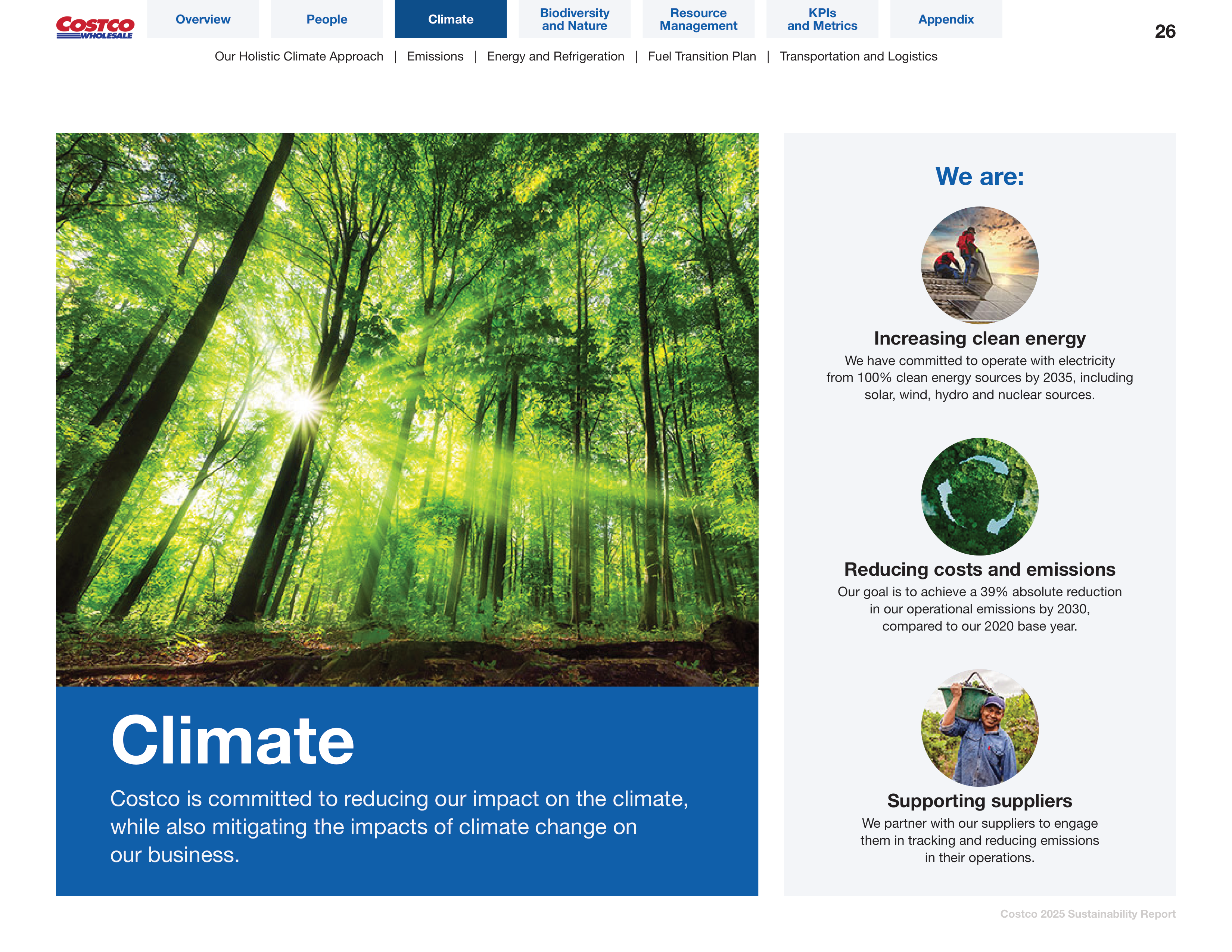

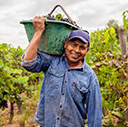


26
Overview
People
Climate
Biodiversity
and Nature
Resource
Management
KPIs
and Metrics
Appendix
Costco 2025 Sustainability Report
Climate
Costco is committed to reducing our impact on the climate,
while also mitigating the impacts of climate change on
our business.
Supporting suppliers
We partner with our suppliers to engage
them in tracking and reducing emissions
in their operations.
Increasing clean energy
We have committed to operate with electricity
from 100% clean energy sources by 2035, including
solar, wind, hydro and nuclear sources.
Reducing costs and emissions
Our goal is to achieve a 39% absolute reduction
in our operational emissions by 2030,
compared to our 2020 base year.
Our Holistic Climate Approach | Emissions | Energy and Refrigeration | Fuel Transition Plan | Transportation and Logistics
We are:
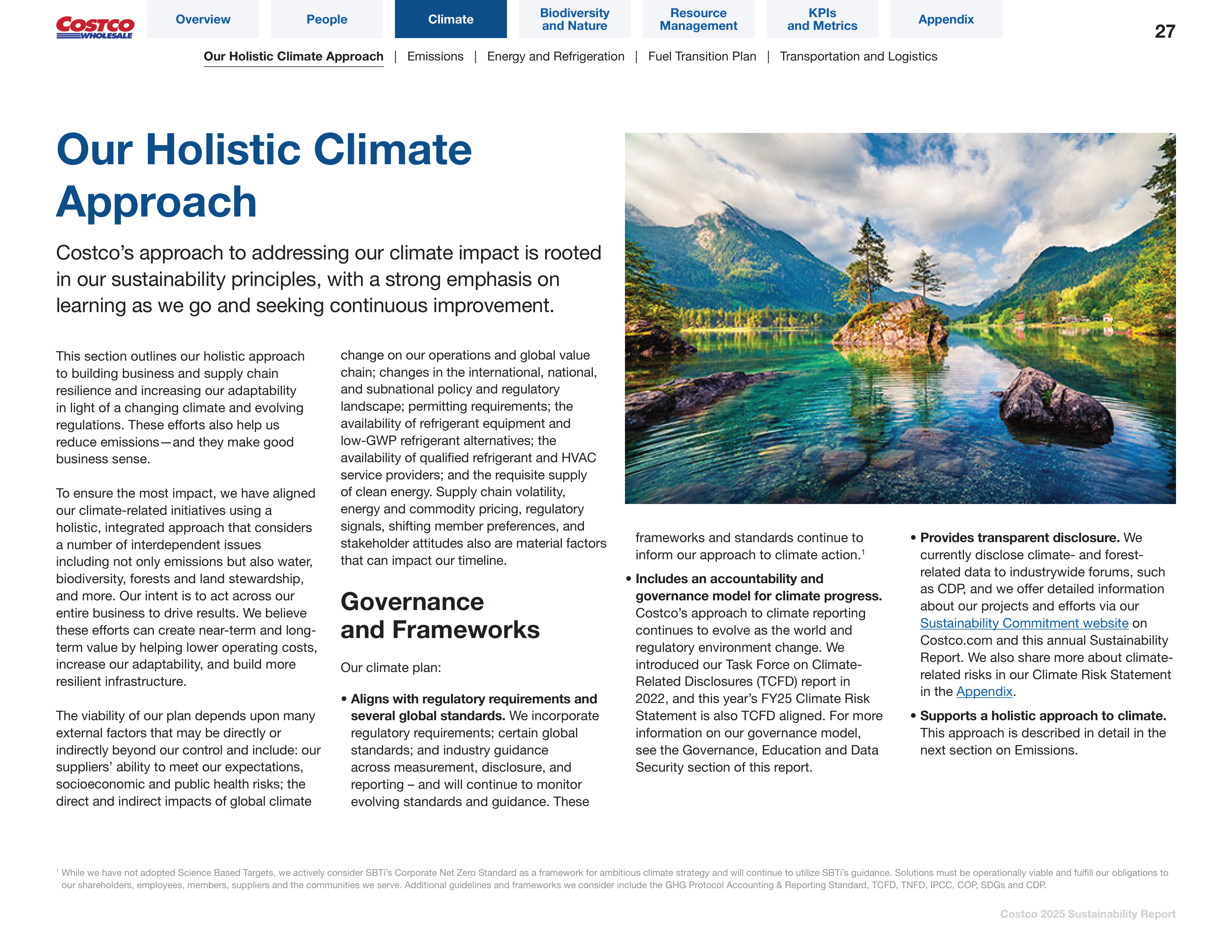

27
Overview
People
Climate
Biodiversity
and Nature
Resource
Management
KPIs
and Metrics
Appendix
Costco 2025 Sustainability Report
change on our operations and global value
chain; changes in the international, national,
and subnational policy and regulatory
landscape; permitting requirements; the
availability of refrigerant equipment and
low-GWP refrigerant alternatives; the
availability of qualified refrigerant and HVAC
service providers; and the requisite supply
of clean energy. Supply chain volatility,
energy and commodity pricing, regulatory
signals, shifting member preferences, and
stakeholder attitudes also are material factors
that can impact our timeline.
Governance
and Frameworks
Our climate plan:
•
Aligns with regulatory requirements and
several global standards.
We incorporate
regulatory requirements; certain global
standards; and industry guidance
across measurement, disclosure, and
reporting – and will continue to monitor
evolving standards and guidance. These
Our Holistic Climate
Approach
Costco’s approach to addressing our climate impact is rooted
in our sustainability principles, with a strong emphasis on
learning as we go and seeking continuous improvement.
This section outlines our holistic approach
to building business and supply chain
resilience and increasing our adaptability
in light of a changing climate and evolving
regulations. These efforts also help us
reduce emissions—and they make good
business sense.
To ensure the most impact, we have aligned
our climate-related initiatives using a
holistic, integrated approach that considers
a number of interdependent issues
including not only emissions but also water,
biodiversity, forests and land stewardship,
and more. Our intent is to act across our
entire business to drive results. We believe
these efforts can create near-term and long-
term value by helping lower operating costs,
increase our adaptability, and build more
resilient infrastructure.
The viability of our plan depends upon many
external factors that may be directly or
indirectly beyond our control and include: our
suppliers’ ability to meet our expectations,
socioeconomic and public health risks; the
direct and indirect impacts of global climate
frameworks and standards continue to
inform our approach to climate action.
1
•
Includes an accountability and
governance model for climate progress.
Costco’s approach to climate reporting
continues to evolve as the world and
regulatory environment change. We
introduced our Task Force on Climate-
Related Disclosures (TCFD) report in
2022, and this year’s FY25 Climate Risk
Statement is also TCFD aligned. For more
information on our governance model,
see the Governance, Education and Data
Security section of this report.
•
Provides transparent disclosure.
We
currently disclose climate- and forest-
related data to industrywide forums, such
as CDP, and we offer detailed information
about our projects and efforts via our
Sustainability Commitment website
on
Costco.com and this annual Sustainability
Report. We also share more about climate-
related risks in our Climate Risk Statement
in the
Appendix
.
•
Supports a holistic approach to climate.
This approach is described in detail in the
next section on Emissions.
1
While we have not adopted Science Based Targets, we actively consider SBTi’s Corporate Net Zero Standard as a framework for ambitious climate strategy and will continue to utilize SBTi’s guidance. Solutions must be operationally viable and fulfill our obligations to
our shareholders, employees, members, suppliers and the communities we serve. Additional guidelines and frameworks we consider include the GHG Protocol Accounting & Reporting Standard, TCFD, TNFD, IPCC, COP, SDGs and CDP.
Our Holistic Climate Approach
| Emissions | Energy and Refrigeration | Fuel Transition Plan | Transportation and Logistics
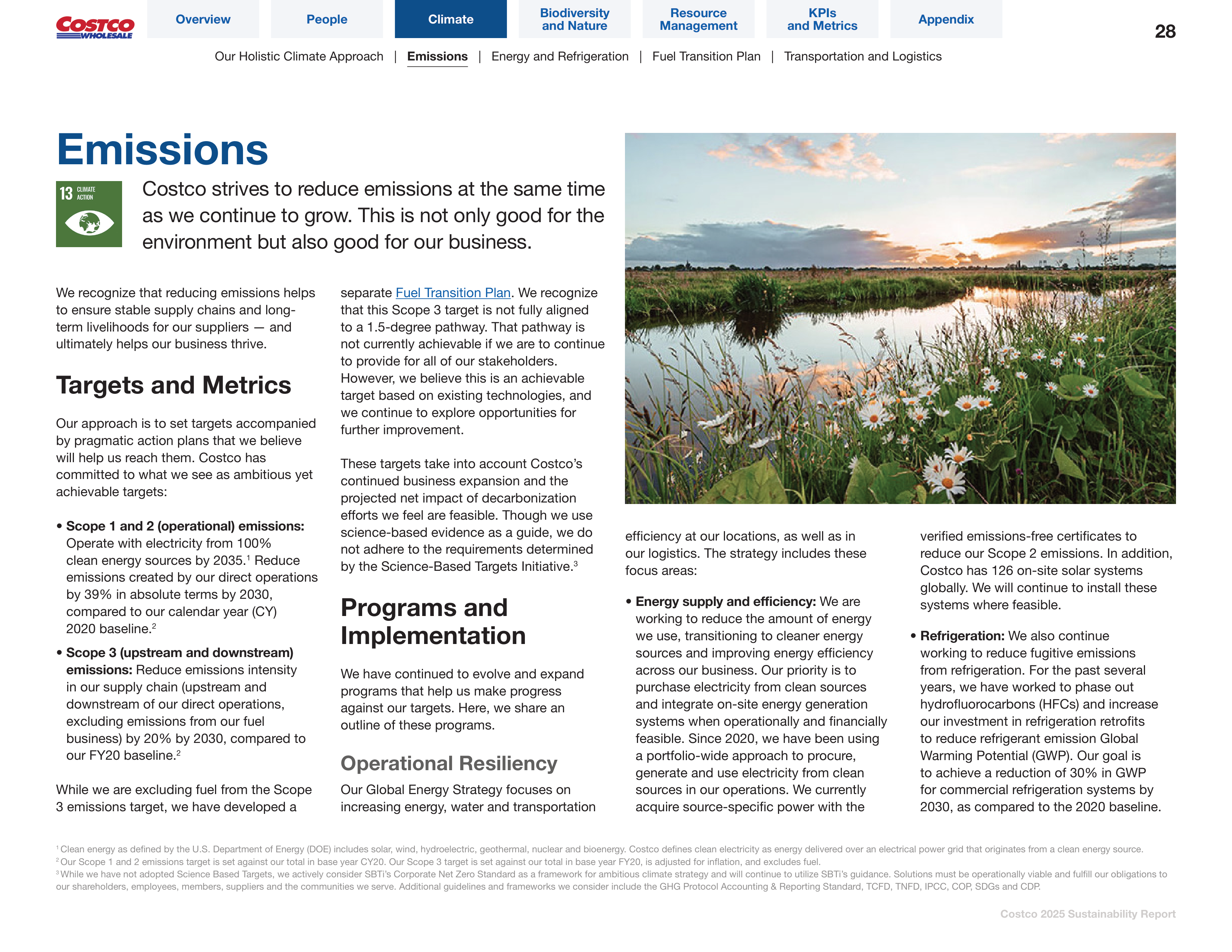

28
Overview
People
Climate
Biodiversity
and Nature
Resource
Management
KPIs
and Metrics
Appendix
Costco 2025 Sustainability Report
separate
Fuel Transition Plan
. We recognize
that this Scope 3 target is not fully aligned
to a 1.5-degree pathway. That pathway is
not currently achievable if we are to continue
to provide for all of our stakeholders.
However, we believe this is an achievable
target based on existing technologies, and
we continue to explore opportunities for
further improvement.
These targets take into account Costco’s
continued business expansion and the
projected net impact of decarbonization
efforts we feel are feasible. Though we use
science-based evidence as a guide, we do
not adhere to the requirements determined
by the Science-Based Targets Initiative.
3
Programs and
Implementation
We have continued to evolve and expand
programs that help us make progress
against our targets. Here, we share an
outline of these programs.
Operational Resiliency
Our Global Energy Strategy focuses on
increasing energy, water and transportation
Emissions
Costco strives to reduce emissions at the same time
as we continue to grow. This is not only good for the
environment but also good for our business.
We recognize that reducing emissions helps
to ensure stable supply chains and long-
term livelihoods for our suppliers — and
ultimately helps our business thrive.
Targets and Metrics
Our approach is to set targets accompanied
by pragmatic action plans that we believe
will help us reach them. Costco has
committed to what we see as ambitious yet
achievable targets:
•
Scope 1 and 2 (operational) emissions:
Operate with electricity from 100%
clean energy sources by 2035.
1
Reduce
emissions created by our direct operations
by 39% in absolute terms by 2030,
compared to our calendar year (CY)
2020 baseline.
2
•
Scope 3 (upstream and downstream)
emissions:
Reduce emissions intensity
in our supply chain (upstream and
downstream of our direct operations,
excluding emissions from our fuel
business) by 20% by 2030, compared to
our FY20 baseline.
2
While we are excluding fuel from the Scope
3 emissions target, we have developed a
efficiency at our locations, as well as in
our logistics. The strategy includes these
focus areas:
•
Energy supply and efficiency:
We are
working to reduce the amount of energy
we use, transitioning to cleaner energy
sources and improving energy efficiency
across our business. Our priority is to
purchase electricity from clean sources
and integrate on-site energy generation
systems when operationally and financially
feasible. Since 2020, we have been using
a portfolio-wide approach to procure,
generate and use electricity from clean
sources in our operations. We currently
acquire source-specific power with the
verified emissions-free certificates to
reduce our Scope 2 emissions. In addition,
Costco has 126 on-site solar systems
globally. We will continue to install these
systems where feasible.
•
Refrigeration:
We also continue
working to reduce fugitive emissions
from refrigeration. For the past several
years, we have worked to phase out
hydrofluorocarbons (HFCs) and increase
our investment in refrigeration retrofits
to reduce refrigerant emission Global
Warming Potential (GWP). Our goal is
to achieve a reduction of 30% in GWP
for commercial refrigeration systems by
2030, as compared to the 2020 baseline.
1
Clean energy as defined by the U.S. Department of Energy (DOE) includes solar, wind, hydroelectric, geothermal, nuclear and bioenergy. Costco defines clean electricity as energy delivered over an electrical power grid that originates from a clean energy source.
2
Our Scope 1 and 2 emissions target is set against our total in base year CY20. Our Scope 3 target is set against our total in base year FY20, is adjusted for inflation, and excludes fuel.
3
While we have not adopted Science Based Targets, we actively consider SBTi’s Corporate Net Zero Standard as a framework for ambitious climate strategy and will continue to utilize SBTi’s guidance. Solutions must be operationally viable and fulfill our obligations to
our shareholders, employees, members, suppliers and the communities we serve. Additional guidelines and frameworks we consider include the GHG Protocol Accounting & Reporting Standard, TCFD, TNFD, IPCC, COP, SDGs and CDP.
Our Holistic Climate Approach |
Emissions
| Energy and Refrigeration | Fuel Transition Plan | Transportation and Logistics
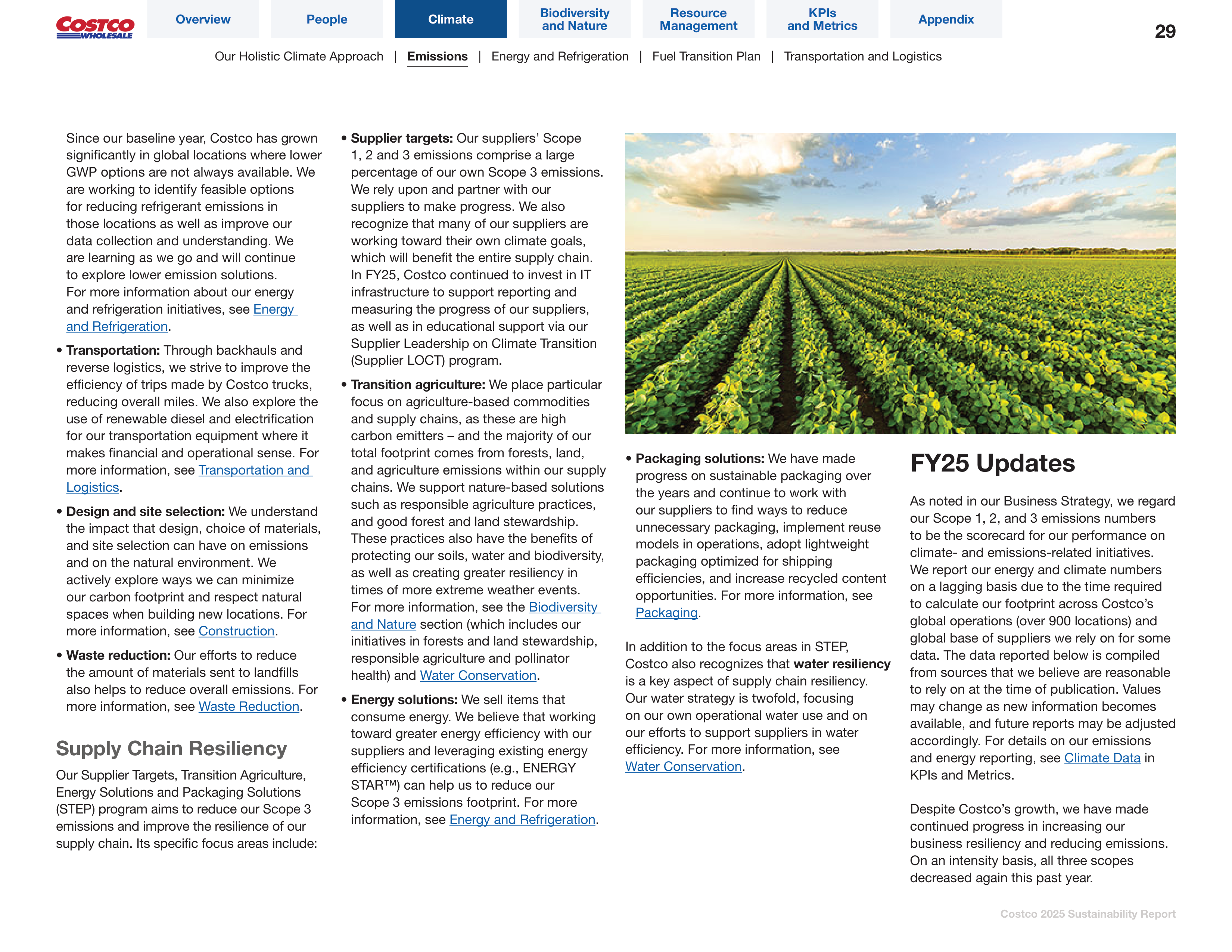
29
Overview
People
Climate
Biodiversity
and Nature
Resource
Management
KPIs
and Metrics
Appendix
Costco 2025 Sustainability Report
Since our baseline year, Costco has grown
significantly in global locations where lower
GWP options are not always available. We
are working to identify feasible options
for reducing refrigerant emissions in
those locations as well as improve our
data collection and understanding. We
are learning as we go and will continue
to explore lower emission solutions.
For more information about our energy
and refrigeration initiatives, see
Energy
and Refrigeration
.
•
Transportation:
Through backhauls and
reverse logistics, we strive to improve the
efficiency of trips made by Costco trucks,
reducing overall miles. We also explore the
use of renewable diesel and electrification
for our transportation equipment where it
makes financial and operational sense. For
more information, see
Transportation and
Logistics
.
•
Design and site selection:
We understand
the impact that design, choice of materials,
and site selection can have on emissions
and on the natural environment. We
actively explore ways we can minimize
our carbon footprint and respect natural
spaces when building new locations. For
more information, see
Construction
.
•
Waste reduction:
Our efforts to reduce
the amount of materials sent to landfills
also helps to reduce overall emissions. For
more information, see
Waste Reduction
.
Supply Chain Resiliency
Our Supplier Targets, Transition Agriculture,
Energy Solutions and Packaging Solutions
(STEP) program aims to reduce our Scope 3
emissions and improve the resilience of our
supply chain. Its specific focus areas include:
•
Supplier targets:
Our suppliers’ Scope
1, 2 and 3 emissions comprise a large
percentage of our own Scope 3 emissions.
We rely upon and partner with our
suppliers to make progress. We also
recognize that many of our suppliers are
working toward their own climate goals,
which will benefit the entire supply chain.
In FY25, Costco continued to invest in IT
infrastructure to support reporting and
measuring the progress of our suppliers,
as well as in educational support via our
Supplier Leadership on Climate Transition
(Supplier LOCT) program.
•
Transition agriculture:
We place particular
focus on agriculture-based commodities
and supply chains, as these are high
carbon emitters – and the majority of our
total footprint comes from forests, land,
and agriculture emissions within our supply
chains. We support nature-based solutions
such as responsible agriculture practices,
and good forest and land stewardship.
These practices also have the benefits of
protecting our soils, water and biodiversity,
as well as creating greater resiliency in
times of more extreme weather events.
For more information, see the
Biodiversity
and Nature
section (which includes our
initiatives in forests and land stewardship,
responsible agriculture and pollinator
health) and
Water Conservation
.
•
Energy solutions:
We sell items that
consume energy. We believe that working
toward greater energy efficiency with our
suppliers and leveraging existing energy
efficiency certifications (e.g., ENERGY
STAR™) can help us to reduce our
Scope 3 emissions footprint. For more
information, see
Energy and Refrigeration
.
•
Packaging solutions:
We have made
progress on sustainable packaging over
the years and continue to work with
our suppliers to find ways to reduce
unnecessary packaging, implement reuse
models in operations, adopt lightweight
packaging optimized for shipping
efficiencies, and increase recycled content
opportunities. For more information, see
Packaging
.
In addition to the focus areas in STEP,
Costco also recognizes that
water resiliency
is a key aspect of supply chain resiliency.
Our water strategy is twofold, focusing
on our own operational water use and on
our efforts to support suppliers in water
efficiency. For more information, see
Water Conservation
.
FY25 Updates
As noted in our Business Strategy, we regard
our Scope 1, 2, and 3 emissions numbers
to be the scorecard for our performance on
climate- and emissions-related initiatives.
We report our energy and climate numbers
on a lagging basis due to the time required
to calculate our footprint across Costco’s
global operations (over 900 locations) and
global base of suppliers we rely on for some
data. The data reported below is compiled
from sources that we believe are reasonable
to rely on at the time of publication. Values
may change as new information becomes
available, and future reports may be adjusted
accordingly. For details on our emissions
and energy reporting, see
Climate Data
in
KPIs and Metrics.
Despite Costco’s growth, we have made
continued progress in increasing our
business resiliency and reducing emissions.
On an intensity basis, all three scopes
decreased again this past year.
Our Holistic Climate Approach |
Emissions
| Energy and Refrigeration | Fuel Transition Plan | Transportation and Logistics
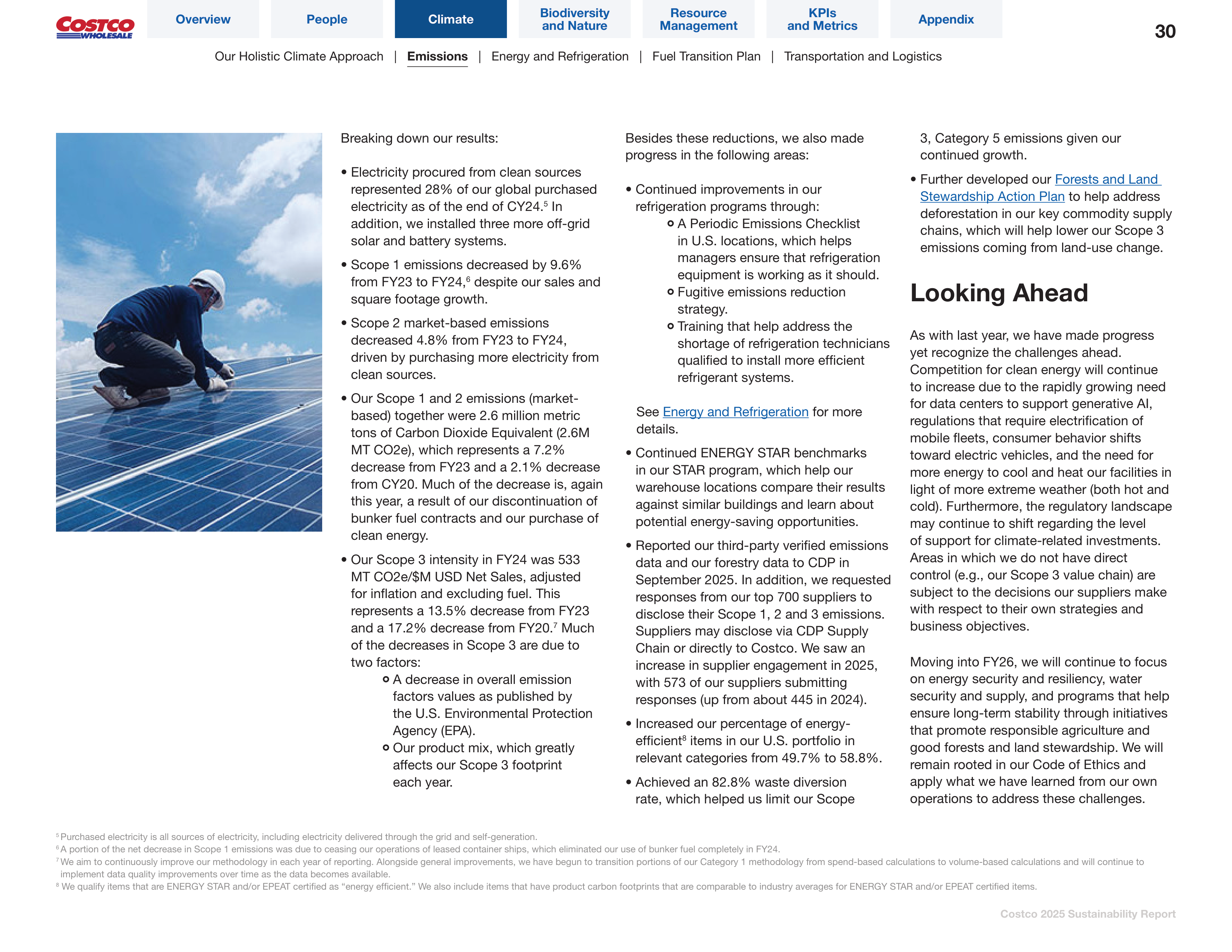

30
Overview
People
Climate
Biodiversity
and Nature
Resource
Management
KPIs
and Metrics
Appendix
Costco 2025 Sustainability Report
Breaking down our results:
• Electricity procured from clean sources
represented 28% of our global purchased
electricity as of the end of CY24.
5
In
addition, we installed three more off-grid
solar and battery systems.
• Scope 1 emissions decreased by 9.6%
from FY23 to FY24,
6
despite our sales and
square footage growth.
• Scope 2 market-based emissions
decreased 4.8% from FY23 to FY24,
driven by purchasing more electricity from
clean sources.
• Our Scope 1 and 2 emissions (market-
based) together were 2.6 million metric
tons of Carbon Dioxide Equivalent (2.6M
MT CO2e), which represents a 7.2%
decrease from FY23 and a 2.1% decrease
from CY20. Much of the decrease is, again
this year, a result of our discontinuation of
bunker fuel contracts and our purchase of
clean energy.
• Our Scope 3 intensity in FY24 was 533
MT CO2e/$M USD Net Sales, adjusted
for inflation and excluding fuel. This
represents a 13.5% decrease from FY23
and a 17.2% decrease from FY20.
7
Much
of the decreases in Scope 3 are due to
two factors:
•
A decrease in overall emission
factors values as published by
the U.S. Environmental Protection
Agency (EPA).
•
Our product mix, which greatly
affects our Scope 3 footprint
each year.
Besides these reductions, we also made
progress in the following areas:
• Continued improvements in our
refrigeration programs through:
•
A Periodic Emissions Checklist
in U.S. locations, which helps
managers ensure that refrigeration
equipment is working as it should.
•
Fugitive emissions reduction
strategy.
•
Training that help address the
shortage of refrigeration technicians
qualified to install more efficient
refrigerant systems.
See
Energy and Refrigeration
for more
details.
• Continued ENERGY STAR benchmarks
in our STAR program, which help our
warehouse locations compare their results
against similar buildings and learn about
potential energy-saving opportunities.
• Reported our third-party verified emissions
data and our forestry data to CDP in
September 2025. In addition, we requested
responses from our top 700 suppliers to
disclose their Scope 1, 2 and 3 emissions.
Suppliers may disclose via CDP Supply
Chain or directly to Costco. We saw an
increase in supplier engagement in 2025,
with 573 of our suppliers submitting
responses (up from about 445 in 2024).
• Increased our percentage of energy-
efficient
8
items in our U.S. portfolio in
relevant categories from 49.7% to 58.8%.
• Achieved an 82.8% waste diversion
rate, which helped us limit our Scope
3, Category 5 emissions given our
continued growth.
• Further developed our
Forests and Land
Stewardship Action Plan
to help address
deforestation in our key commodity supply
chains, which will help lower our Scope 3
emissions coming from land-use change.
Looking Ahead
As with last year, we have made progress
yet recognize the challenges ahead.
Competition for clean energy will continue
to increase due to the rapidly growing need
for data centers to support generative AI,
regulations that require electrification of
mobile fleets, consumer behavior shifts
toward electric vehicles, and the need for
more energy to cool and heat our facilities in
light of more extreme weather (both hot and
cold). Furthermore, the regulatory landscape
may continue to shift regarding the level
of support for climate-related investments.
Areas in which we do not have direct
control (e.g., our Scope 3 value chain) are
subject to the decisions our suppliers make
with respect to their own strategies and
business objectives.
Moving into FY26, we will continue to focus
on energy security and resiliency, water
security and supply, and programs that help
ensure long-term stability through initiatives
that promote responsible agriculture and
good forests and land stewardship. We will
remain rooted in our Code of Ethics and
apply what we have learned from our own
operations to address these challenges.
5
Purchased electricity is all sources of electricity, including electricity delivered through the grid and self-generation.
6
A portion of the net decrease in Scope 1 emissions was due to ceasing our operations of leased container ships, which eliminated our use of bunker fuel completely in FY24.
7
We aim to continuously improve our methodology in each year of reporting. Alongside general improvements, we have begun to transition portions of our Category 1 methodology from spend-based calculations to volume-based calculations and will continue to
implement data quality improvements over time as the data becomes available.
8
We qualify items that are ENERGY STAR and/or EPEAT certified as “energy efficient.” We also include items that have product carbon footprints that are comparable to industry averages for ENERGY STAR and/or EPEAT certified items.
Our Holistic Climate Approach |
Emissions
| Energy and Refrigeration | Fuel Transition Plan | Transportation and Logistics

31
Overview
People
Climate
Biodiversity
and Nature
Resource
Management
KPIs
and Metrics
Appendix
Costco 2025 Sustainability Report
Energy and Refrigeration
Purchased energy is a significant
source of the carbon emissions created
by our operations.
Our strategy to achieve our targets and
reduce emissions involves how we source
energy and how we use it. Our specific
initiatives include:
•
Increasing our electricity from clean
sources.
As noted in the Emissions
section, at the end of calendar year
2024, electricity from clean sources
represented 28% of our global purchased
electricity. We also have 126 on-site solar
systems internationally.
•
Adopting smarter systems within the
buildings.
This includes using energy and
lighting management systems to control
heating and cooling set points, set lighting
schedules, and provide information for
system troubleshooting and diagnostics.
•
Converting older U.S. warehouses to
more energy-efficient LED lighting
systems.
Our new warehouses use
LED lighting technology; also, older
generations of LED are being replaced by
newer versions.
•
Improving the overall efficiency of
our building envelope.
This includes
eliminating skylights in new construction
where appropriate and covering skylights
in select existing locations to lessen the
workload of HVAC systems.
•
Considering innovative system designs
based on operational and regional needs.
For example, in some warmer climates, we
have installed hybrid systems that use an
energy-efficient combination of fans and
misting to cool refrigeration systems.
•
Committing to education and training
for our employees to increase staffing
expertise.
This includes Certified Energy
Management training, among other
programs. In FY25, we continued to
provide our Certified Energy Manager
course and currently have 21 certified
employees. We also share best practices
and ensure compliance through our STAR
program in the warehouses.
We share more specifics and results related
to our energy-saving measures in
Emissions
and our
Energy and Refrigeration data
.
Energy efficiency also helps lower expenses,
which helps us remain a low-cost operator.
Auditing Our
Energy Use
In 2023, we launched the Warehouse Energy
Audit pilot program in select warehouses
to take an in-depth audit of energy
consumption. The pilot involved examining
all energy-consuming equipment, from fans
and lighting to ovens and coolers. The goal
was a detailed energy-use analysis that
will help us identify where we can improve
operations and equipment in existing
warehouses, as well as how to increase our
efficiency as we grow in future years. Based
on the successful pilot, we are creating
a full program that includes six 101-level
training videos on energy (including energy
efficiency) and an Energy Knowledge Library
to help location operators implement specific
steps to increase energy efficiency.
Individual locations can review their building
energy score and average energy score
by state, region, and/or country, as well as
Costco’s overall score. These benchmarks
highlight the most efficient locations and
help us replicate their energy-saving
practices in less efficient buildings.
As of calendar
year 2024,
Costco added
ENERGY STAR
®
benchmarks to our
warehouse STAR
Review audits. Our STAR Review
audits aim to measure and reduce
emissions across our business and
environmental impact. ENERGY
STAR benchmarks compare the
warehouse’s energy performance to
similar buildings nationwide based
on specific criteria.
ENERGY STAR
Benchmarks
Our Holistic Climate Approach | Emissions |
Energy and Refrigeration
| Fuel Transition Plan | Transportation and Logistics
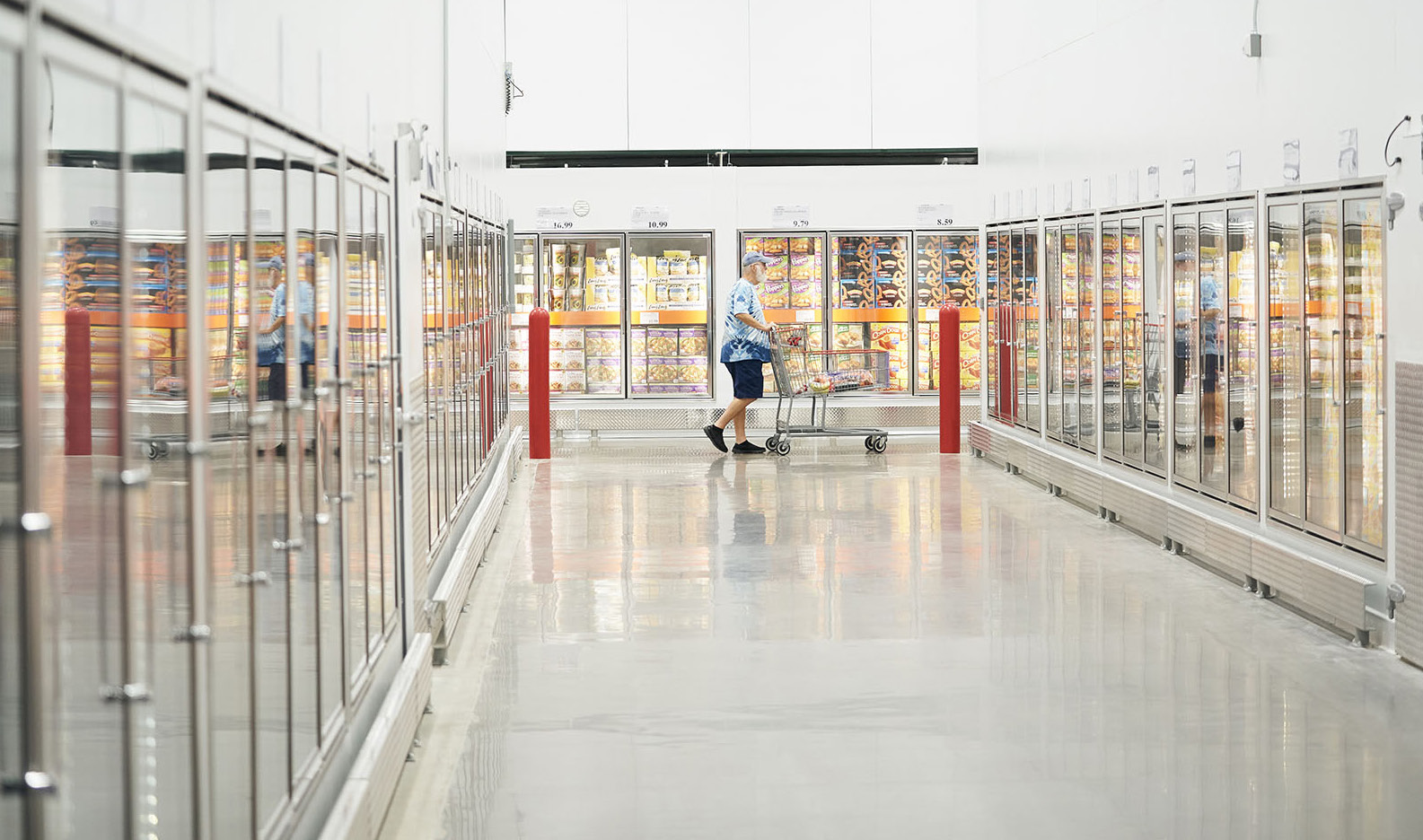
32
Overview
People
Climate
Biodiversity
and Nature
Resource
Management
KPIs
and Metrics
Appendix
Costco 2025 Sustainability Report
Today, most commercial refrigeration
systems rely on hydrofluorocarbons
(HFCs) and other gasses that can have
a negative impact on the environment.
Using CO2 as the primary refrigerant
helps reduce harmful emissions
associated with HFCs. But currently,
there is a shortage of refrigeration
technicians with the specialized training
to install CO2-based systems.
Costco partnered with the
North
American Sustainable Refrigeration
Council
(NASRC) and others in the
industry to create training that addresses
the technician shortage and to improve
training in the field on CO2 systems.
In 2024, according to NASRC,
these programs trained over 1,900
technicians and connected over 400
Heating, Ventilation, Air Conditioning
and Refrigeration (HVACR) students
and faculty to industry employers. In
addition, the group hosted the first
technician training workshop on CO2
controls, which provided two intensive
days of training for over 100 technicians.
In June 2025, Costco was honored
with the
Best-in-Sector/Retail End
User award
at the ATMOsphere (ATMO)
America Summit 2025 for “advancing
adoption of natural refrigerant-
based systems.”
Paving the Way for
More Natural Refrigerants
Costco Recognized with ATMO Award
Our Holistic Climate Approach | Emissions |
Energy and Refrigeration
| Fuel Transition Plan | Transportation and Logistics
Managing
Refrigerants
We recognize that hydrofluorocarbons
(HFCs) and other gases used in our
refrigeration systems have a major impact
on climate. We continue to explore new
technologies and select refrigerants that
are low in Global Warming Potential (GWP)
and reduce CO2e emissions wherever
such options are feasible. We’re taking
these steps to manage refrigerants in our
global operations:
•
Testing new leak detection technologies to
identify refrigerant leaks and trigger alerts
for faster resolution.
•
Retrofitting our existing locations with
high GWP refrigerants to lower GWP
refrigerants as part of regular business.
•
Leveraging CO2 as the primary
refrigerant in our new warehouses,
where the required equipment and
specialized labor are available and
where it is operationally viable. We
are working with certified contractors
that adhere to best management
practices in installing, maintaining and
decommissioning equipment.
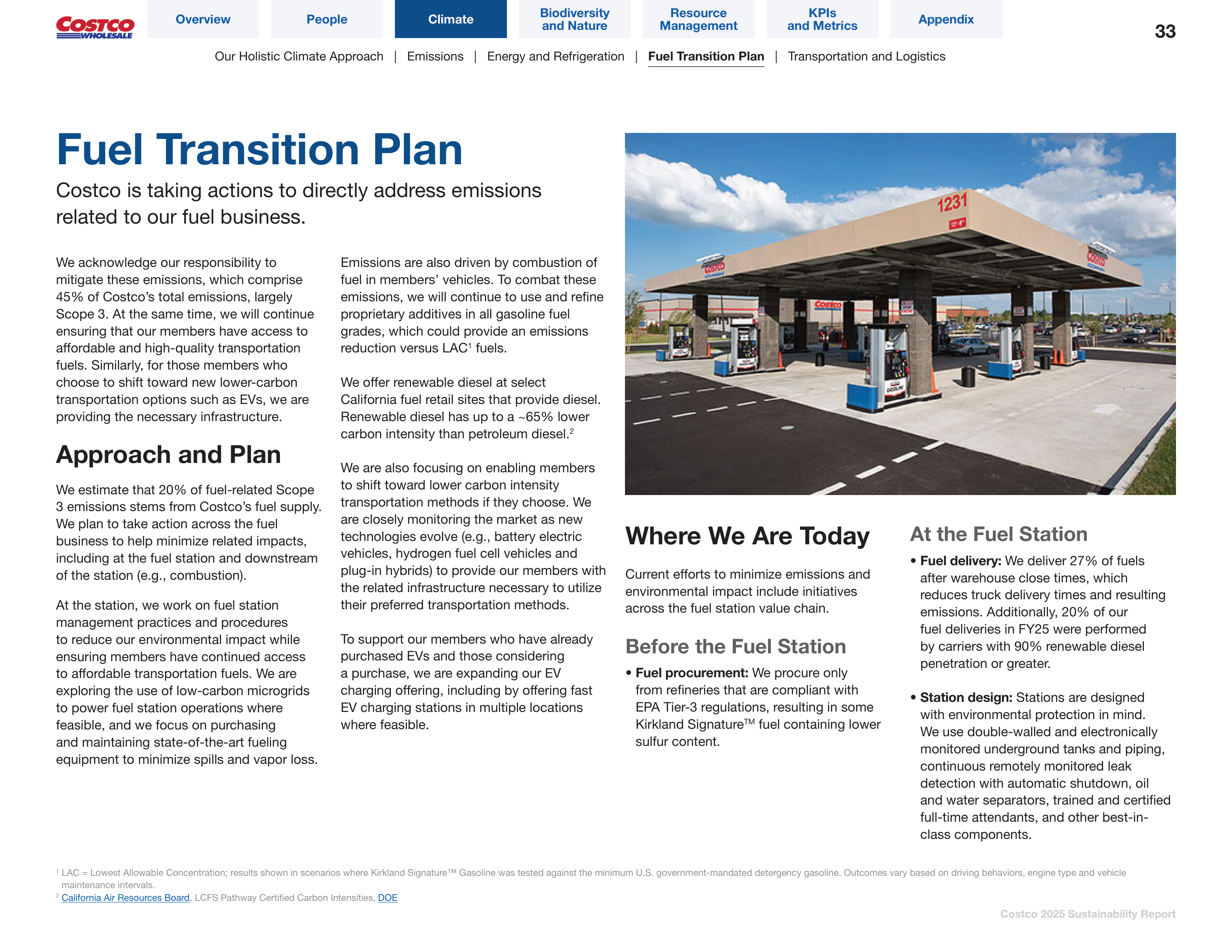
33
Overview
People
Climate
Biodiversity
and Nature
Resource
Management
KPIs
and Metrics
Appendix
Costco 2025 Sustainability Report
We acknowledge our responsibility to
mitigate these emissions, which comprise
45% of Costco’s total emissions, largely
Scope 3. At the same time, we will continue
ensuring that our members have access to
affordable and high-quality transportation
fuels. Similarly, for those members who
choose to shift toward new lower-carbon
transportation options such as EVs, we are
providing the necessary infrastructure.
Approach and Plan
We estimate that 20% of fuel-related Scope
3 emissions stems from Costco’s fuel supply.
We plan to take action across the fuel
business to help minimize related impacts,
including at the fuel station and downstream
of the station (e.g., combustion).
At the station, we work on fuel station
management practices and procedures
to reduce our environmental impact while
ensuring members have continued access
to affordable transportation fuels. We are
exploring the use of low-carbon microgrids
to power fuel station operations where
feasible, and we focus on purchasing
and maintaining state-of-the-art fueling
equipment to minimize spills and vapor loss.
Fuel Transition Plan
Costco is taking actions to directly address emissions
related to our fuel business.
Emissions are also driven by combustion of
fuel in members’ vehicles. To combat these
emissions, we will continue to use and refine
proprietary additives in all gasoline fuel
grades, which could provide an emissions
reduction versus LAC
1
fuels.
We offer renewable diesel at select
California fuel retail sites that provide diesel.
Renewable diesel has up to a ~65% lower
carbon intensity than petroleum diesel.
2
We are also focusing on enabling members
to shift toward lower carbon intensity
transportation methods if they choose. We
are closely monitoring the market as new
technologies evolve (e.g., battery electric
vehicles, hydrogen fuel cell vehicles and
plug-in hybrids) to provide our members with
the related infrastructure necessary to utilize
their preferred transportation methods.
To support our members who have already
purchased EVs and those considering
a purchase, we are expanding our EV
charging offering, including by offering fast
EV charging stations in multiple locations
where feasible.
Where We Are Today
Current efforts to minimize emissions and
environmental impact include initiatives
across the fuel station value chain.
Before the Fuel Station
•
Fuel procurement:
We procure only
from refineries that are compliant with
EPA Tier-3 regulations, resulting in some
Kirkland Signature
TM
fuel containing lower
sulfur content.
At the Fuel Station
•
Fuel delivery:
We deliver 27% of fuels
after warehouse close times, which
reduces truck delivery times and resulting
emissions. Additionally, 20% of our
fuel deliveries in FY25 were performed
by carriers with 90% renewable diesel
penetration or greater.
•
Station design:
Stations are designed
with environmental protection in mind.
We use double-walled and electronically
monitored underground tanks and piping,
continuous remotely monitored leak
detection with automatic shutdown, oil
and water separators, trained and certified
full-time attendants, and other best-in-
class components.
1
LAC = Lowest Allowable Concentration; results shown in scenarios where Kirkland Signature™ Gasoline was tested against the minimum U.S. government-mandated detergency gasoline. Outcomes vary based on driving behaviors, engine type and vehicle
maintenance intervals.
2
California Air Resources Board
, LCFS Pathway Certified Carbon Intensities,
DOE
Our Holistic Climate Approach | Emissions | Energy and Refrigeration |
Fuel Transition Plan
| Transportation and Logistics
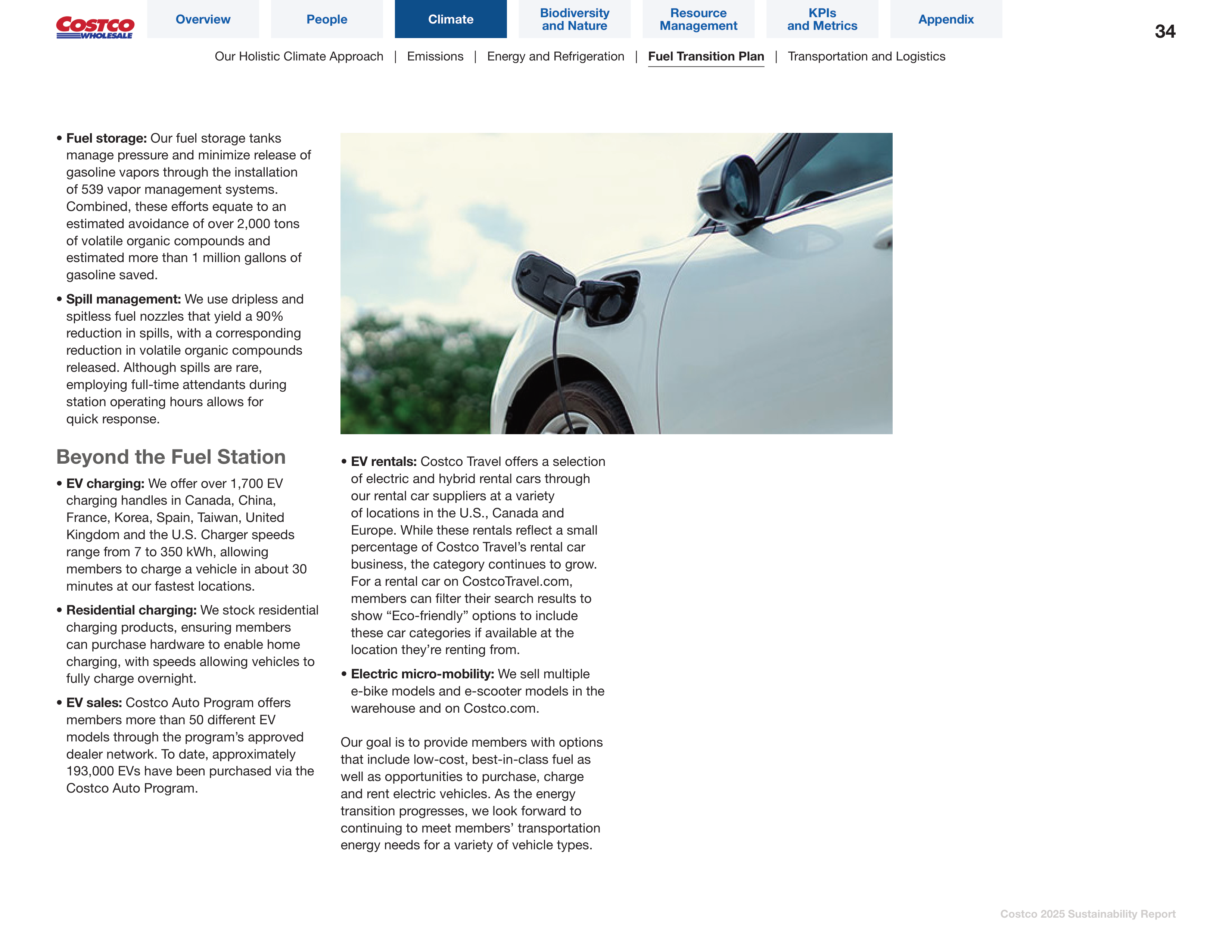

34
Overview
People
Climate
Biodiversity
and Nature
Resource
Management
KPIs
and Metrics
Appendix
Costco 2025 Sustainability Report
•
Fuel storage:
Our fuel storage tanks
manage pressure and minimize release of
gasoline vapors through the installation
of 539 vapor management systems.
Combined, these efforts equate to an
estimated avoidance of over 2,000 tons
of volatile organic compounds and
estimated more than 1 million gallons of
gasoline saved.
•
Spill management:
We use dripless and
spitless fuel nozzles that yield a 90%
reduction in spills, with a corresponding
reduction in volatile organic compounds
released. Although spills are rare,
employing full-time attendants during
station operating hours allows for
quick response.
Beyond the Fuel Station
•
EV charging:
We offer over 1,700 EV
charging handles in Canada, China,
France, Korea, Spain, Taiwan, United
Kingdom and the U.S. Charger speeds
range from 7 to 350 kWh, allowing
members to charge a vehicle in about 30
minutes at our fastest locations.
•
Residential charging:
We stock residential
charging products, ensuring members
can purchase hardware to enable home
charging, with speeds allowing vehicles to
fully charge overnight.
•
EV sales:
Costco Auto Program offers
members more than 50 different EV
models through the program’s approved
dealer network. To date, approximately
193,000 EVs have been purchased via the
Costco Auto Program.
•
EV rentals:
Costco Travel offers a selection
of electric and hybrid rental cars through
our rental car suppliers at a variety
of locations in the U.S., Canada and
Europe. While these rentals reflect a small
percentage of Costco Travel’s rental car
business, the category continues to grow.
For a rental car on CostcoTravel.com,
members can filter their search results to
show “Eco-friendly” options to include
these car categories if available at the
location they’re renting from.
•
Electric micro-mobility:
We sell multiple
e-bike models and e-scooter models in the
warehouse and on Costco.com.
Our goal is to provide members with options
that include low-cost, best-in-class fuel as
well as opportunities to purchase, charge
and rent electric vehicles. As the energy
transition progresses, we look forward to
continuing to meet members’ transportation
energy needs for a variety of vehicle types.
Our Holistic Climate Approach | Emissions | Energy and Refrigeration |
Fuel Transition Plan
| Transportation and Logistics
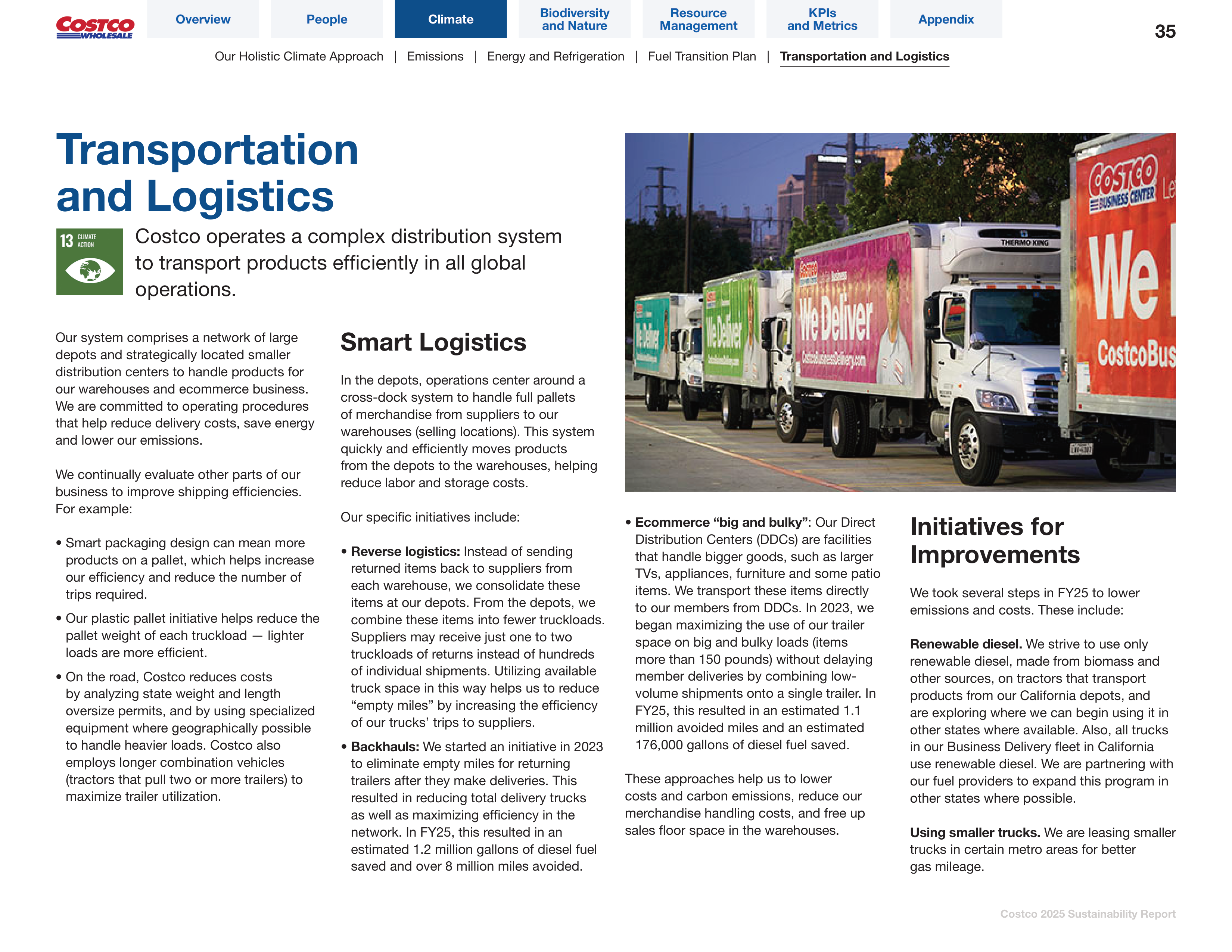
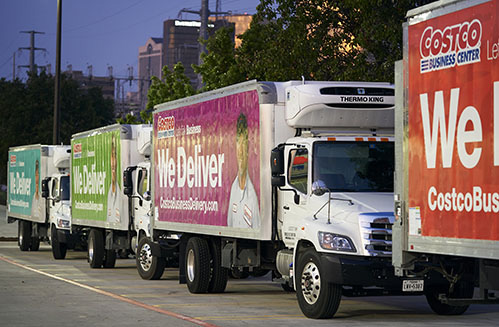
35
Overview
People
Climate
Biodiversity
and Nature
Resource
Management
KPIs
and Metrics
Appendix
Costco 2025 Sustainability Report
Transportation
and Logistics
Costco operates a complex distribution system
to transport products efficiently in all global
operations.
Our system comprises a network of large
depots and strategically located smaller
distribution centers to handle products for
our warehouses and ecommerce business.
We are committed to operating procedures
that help reduce delivery costs, save energy
and lower our emissions.
We continually evaluate other parts of our
business to improve shipping efficiencies.
For example:
• Smart packaging design can mean more
products on a pallet, which helps increase
our efficiency and reduce the number of
trips required.
• Our plastic pallet initiative helps reduce the
pallet weight of each truckload — lighter
loads are more efficient.
• On the road, Costco reduces costs
by analyzing state weight and length
oversize permits, and by using specialized
equipment where geographically possible
to handle heavier loads. Costco also
employs longer combination vehicles
(tractors that pull two or more trailers) to
maximize trailer utilization.
Smart Logistics
In the depots, operations center around a
cross-dock system to handle full pallets
of merchandise from suppliers to our
warehouses (selling locations). This system
quickly and efficiently moves products
from the depots to the warehouses, helping
reduce labor and storage costs.
Our specific initiatives include:
•
Reverse logistics:
Instead of sending
returned items back to suppliers from
each warehouse, we consolidate these
items at our depots. From the depots, we
combine these items into fewer truckloads.
Suppliers may receive just one to two
truckloads of returns instead of hundreds
of individual shipments. Utilizing available
truck space in this way helps us to reduce
“empty miles” by increasing the efficiency
of our trucks’ trips to suppliers.
•
Backhauls:
We started an initiative in 2023
to eliminate empty miles for returning
trailers after they make deliveries. This
resulted in reducing total delivery trucks
as well as maximizing efficiency in the
network. In FY25, this resulted in an
estimated 1.2 million gallons of diesel fuel
saved and over 8 million miles avoided.
•
Ecommerce “big and bulky”
: Our Direct
Distribution Centers (DDCs) are facilities
that handle bigger goods, such as larger
TVs, appliances, furniture and some patio
items. We transport these items directly
to our members from DDCs. In 2023, we
began maximizing the use of our trailer
space on big and bulky loads (items
more than 150 pounds) without delaying
member deliveries by combining low-
volume shipments onto a single trailer. In
FY25, this resulted in an estimated 1.1
million avoided miles and an estimated
176,000 gallons of diesel fuel saved.
These approaches help us to lower
costs and carbon emissions, reduce our
merchandise handling costs, and free up
sales floor space in the warehouses.
Initiatives for
Improvements
We took several steps in FY25 to lower
emissions and costs. These include:
Renewable diesel.
We strive to use only
renewable diesel, made from biomass and
other sources, on tractors that transport
products from our California depots, and
are exploring where we can begin using it in
other states where available. Also, all trucks
in our Business Delivery fleet in California
use renewable diesel. We are partnering with
our fuel providers to expand this program in
other states where possible.
Using smaller trucks.
We are leasing smaller
trucks in certain metro areas for better
gas mileage.
Our Holistic Climate Approach | Emissions | Energy and Refrigeration | Fuel Transition Plan |
Transportation and Logistics
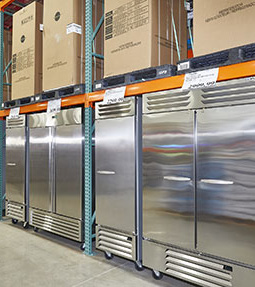
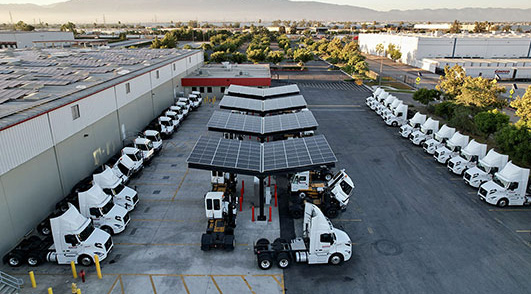
36
Overview
People
Climate
Biodiversity
and Nature
Resource
Management
KPIs
and Metrics
Appendix
Costco 2025 Sustainability Report
Electric yard tractors.
We continue to roll
out electric tractors to move trailers around
a depot yard, replacing some traditional
diesel-powered equipment throughout our
depot network. Through these deployments,
we are also making improvements to the
green microgrids that power our trucks. You
can see examples of these microgrids in the
photo on the far right.
Ecommerce smart shipping.
We have
deployed Smart Shipping throughout our
small package ecommerce network, which
identifies opportunities to consolidate
packages and select the most economical
shipping method without compromising
delivery dates. In FY25, we eliminated
shipping of over 2.1 million parcels through
order consolidation and shifted over 19.2
million parcels from air to ground delivery,
reducing the carbon footprint required to
deliver these parcels.
Our Business
Delivery Fleet
For our growing Business Delivery fleet, we
continue to expand an initiative called “Truck
of the Future,” which is aimed at increasing
efficiency. This initiative started in 2018
with a field test of a customized vehicle that
improves the payload capacity by reducing
body weight. Test results showed that the
lighter truck increased the miles per gallon,
helping lower our fuel costs and carbon
footprint. We are now choosing these new
vehicles as we add and renew fleet leases.
Additional efficiency features and pilot
programs include:
• Using solar power to replace batteries
on trucks. A solar panel on the truck
helps power equipment, which enables
us to eliminate one battery and reduce
vehicle weight.
• Using half pallets that are lighter and more
efficient for delivery to small businesses.
• Implementing new coolers that replace
dry ice with gel packs. Use of the
coolers lightens the weight of a truck,
increasing efficiency.
• Continuing to test EV trucks and
investigate on-site charging options.
• Using technology to analyze driver
behavior to achieve better fuel efficiency.
• Using electric plug-in shore power (i.e.,
power from a fixed or land-based source),
tying into the grid to allow our refrigerated
trucks to maintain temperature while
being loaded and stored. This eliminates
the previous practice of running the
diesel reefer engine, thus saving fuel and
reducing emissions.
• Using telematics — a routing system now
on all 2017 and newer trucks. This allows
us to identify opportunities to enhance
mileage consumption through efficient
routing, which also decreases idle time.
Employee
Transportation
Costco encourages its employees to use
alternative forms of transportation with
the goal of reducing energy consumption,
emissions and commuter gridlock. Under
the Commute Trip Reduction (CTR)
program, which began more than 20 years
ago at the corporate office, vans, fuel,
maintenance and insurance are provided by
five local transit agencies. Employees who
participate in the CTR program also receive
a substantial financial subsidy from Costco,
which in many cases covers their entire
monthly commute expenses. Employees
who regularly ride the bus are also eligible
for this financial subsidy. Costco also has
vanpools at its San Diego, Los Angeles and
Mexico City regional offices, as well as many
Costco warehouses.
We also have many employees who choose
to informally carpool with coworkers, and
we offer secure bicycle storage facilities
and locker room use for employees. Finally,
charging stations are available at our
corporate offices for employees who drive
electric vehicles.
Charging Stations
Costco continues to increase the number
of electric vehicle charging stations at
our warehouses, corporate offices and
other facilities, as described in our
Fuel
Transition Plan
.
Large appliances such as refrigerators can
be delivered through our Ecommerce “big
and bulky” logistics.
Our Holistic Climate Approach | Emissions | Energy and Refrigeration | Fuel Transition Plan |
Transportation and Logistics


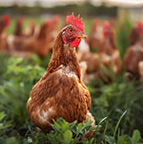
37
Overview
People
Climate
Biodiversity
and Nature
Resource
Management
KPIs
and Metrics
Appendix
Costco 2025 Sustainability Report
Responsible Agriculture | Forests and Land Stewardship | Pollinator Health | Fisheries and Aquaculture | Animal Welfare
Biodiversity
and Nature
We believe that protecting natural resources, animal and
marine life, and crop health — including the health of
the creatures that pollinate crops — is vital to a healthy
planet and to our business.
Supporting sustainable seafood
We seek to source both wild and farmed seafood
from fisheries and farms certified by the Marine
Stewardship Council (MSC) and the Aquaculture
Stewardship Council (ASC), respectively.
Sourcing responsibly
We strive to source products that are certified and/
or from regions with lower deforestation risk. Where
feasible, we choose recycled fibers for use in paper
products and packaging.
Protecting animal welfare
We are committed to the welfare and proper handling of
animals in our supply chain. This is the right thing to do
for our members, suppliers, and the animals.
We are:


38
Overview
People
Climate
Biodiversity
and Nature
Resource
Management
KPIs
and Metrics
Appendix
Costco 2025 Sustainability Report
Responsible Agriculture
As a global retailer of row crops, produce, seafood
that requires feed grown on land, and animal
and plant-based proteins (among other things),
Costco’s business relies on healthy agricultural
supply chains. We encourage our suppliers to adopt
responsible agricultural practices that promote a
long-term, stable supply.
We focus on initiatives to foster responsible
and regenerative agriculture — and
encourage our suppliers to adopt practices
that help to minimize soil disturbance,
increase plant diversity, keep soils covered,
and integrate animals onto the land.
These practices:
• Help foster healthier soils, which are
critical to long-term agricultural production
because they reduce plant vulnerability
to pests and disease, can improve crop
production over time, and may improve
farm profitability.
• Increase the organic matter in soil,
which helps the land retain more water.
This is essential in times of drought or
excessive rainfall.
• Support the livelihood of farmers while
helping to reduce carbon emissions.
Resilient farms mean long-term livelihoods
for our suppliers and long-term, stable
supplies of products for our members.
Costco participates in various responsible
agriculture programs for our soy and corn
supply chains. These programs focus on
supporting farmer adoption of regenerative
practices, such as no-till, low-till, and cover
crops, and on reducing the risk farmers
face in adopting regenerative agriculture
practices. Ultimately, this supports our ability
to secure a reliable supply.
Costco also supports programs that help
build and expand farmer peer-to-peer
networks, and provide education and
experience related to continuous living cover
crops, reduced synthetic fertilizer rates, and
reduced tillage.
These practices also help to promote
pollinator health, good land stewardship,
and responsibly-sourced feed for agricultural
animals as well as fisheries and aquaculture.
As with climate, Costco seeks to take a
holistic and integrated approach.
Responsible Agriculture
| Forests and Land Stewardship | Pollinator Health | Fisheries and Aquaculture | Animal Welfare
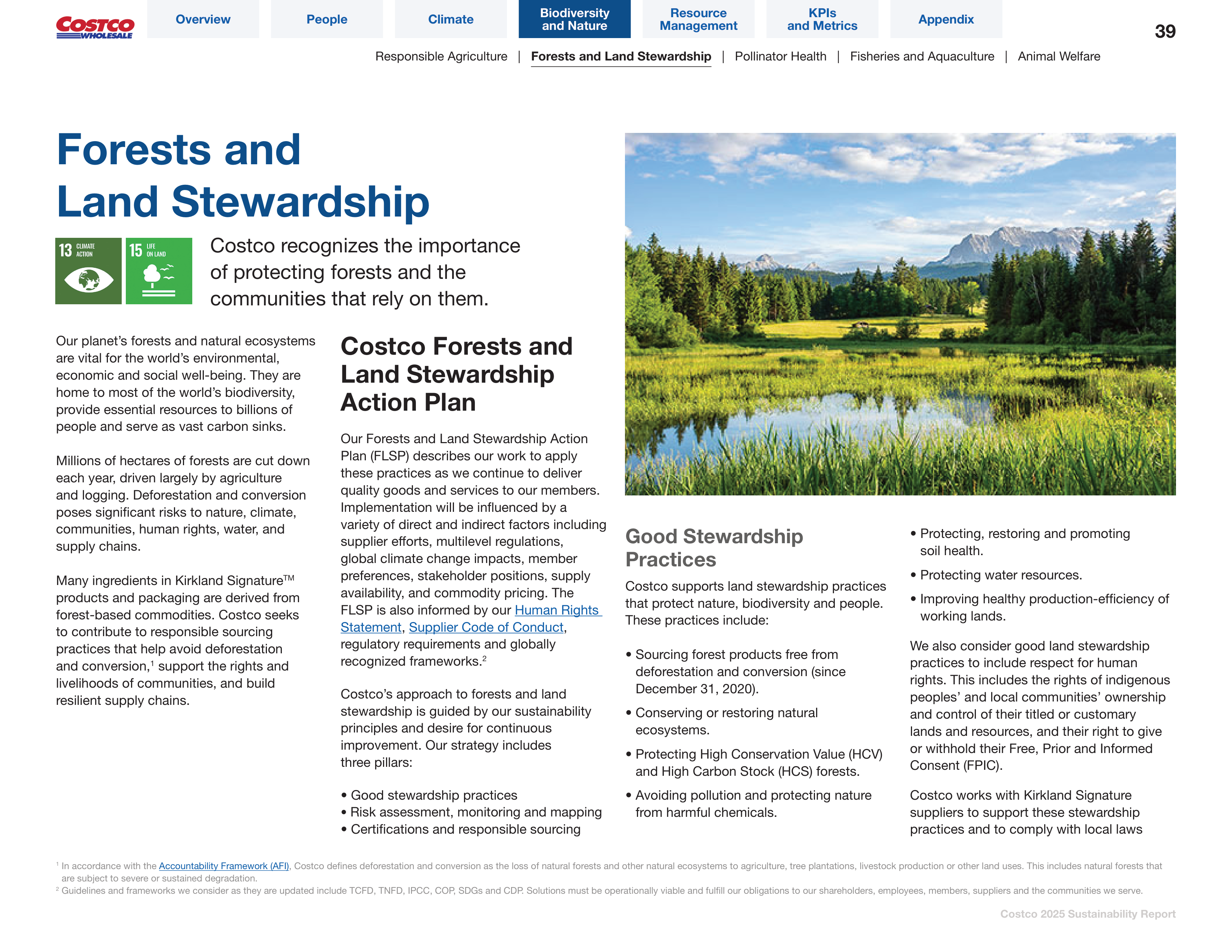

39
Overview
People
Climate
Biodiversity
and Nature
Resource
Management
KPIs
and Metrics
Appendix
Costco 2025 Sustainability Report
Forests and
Land Stewardship
Our planet’s forests and natural ecosystems
are vital for the world’s environmental,
economic and social well-being. They are
home to most of the world’s biodiversity,
provide essential resources to billions of
people and serve as vast carbon sinks.
Millions of hectares of forests are cut down
each year, driven largely by agriculture
and logging. Deforestation and conversion
poses significant risks to nature, climate,
communities, human rights, water, and
supply chains.
Many ingredients in Kirkland Signature
TM
products and packaging are derived from
forest-based commodities. Costco seeks
to contribute to responsible sourcing
practices that help avoid deforestation
and conversion,
1
support the rights and
livelihoods of communities, and build
resilient supply chains.
1
In accordance with the
Accountability Framework (AFI)
, Costco defines deforestation and conversion as the loss of natural forests and other natural ecosystems to agriculture, tree plantations, livestock production or other land uses. This includes natural forests that
are subject to severe or sustained degradation.
2
Guidelines and frameworks we consider as they are updated include TCFD, TNFD, IPCC, COP, SDGs and CDP. Solutions must be operationally viable and fulfill our obligations to our shareholders, employees, members, suppliers and the communities we serve.
Costco Forests and
Land Stewardship
Action Plan
Our Forests and Land Stewardship Action
Plan (FLSP) describes our work to apply
these practices as we continue to deliver
quality goods and services to our members.
Implementation will be influenced by a
variety of direct and indirect factors including
supplier efforts, multilevel regulations,
global climate change impacts, member
preferences, stakeholder positions, supply
availability, and commodity pricing. The
FLSP is also informed by our
Human Rights
Statement
,
Supplier Code of Conduct
,
regulatory requirements and globally
recognized frameworks.
2
Costco’s approach to forests and land
stewardship is guided by our sustainability
principles and desire for continuous
improvement. Our strategy includes
three pillars:
• Good stewardship practices
•
Risk assessment, monitoring and mapping
• Certifications and responsible sourcing
Good Stewardship
Practices
Costco supports land stewardship practices
that protect nature, biodiversity and people.
These practices include:
• Sourcing forest products free from
deforestation and conversion (since
December 31, 2020).
• Conserving or restoring natural
ecosystems.
• Protecting High Conservation Value (HCV)
and High Carbon Stock (HCS) forests.
• Avoiding pollution and protecting nature
from harmful chemicals.
• Protecting, restoring and promoting
soil health.
• Protecting water resources.
• Improving healthy production-efficiency of
working lands.
We also consider good land stewardship
practices to include respect for human
rights. This includes the rights of indigenous
peoples’ and local communities’ ownership
and control of their titled or customary
lands and resources, and their right to give
or withhold their Free, Prior and Informed
Consent (FPIC).
Costco works with Kirkland Signature
suppliers to support these stewardship
practices and to comply with local laws
Responsible Agriculture |
Forests and Land Stewardship
| Pollinator Health | Fisheries and Aquaculture | Animal Welfare
Costco recognizes the importance
of protecting forests and the
communities that rely on them.
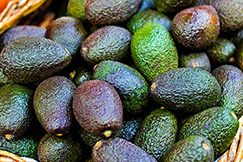
40
Overview
People
Climate
Biodiversity
and Nature
Resource
Management
KPIs
and Metrics
Appendix
Costco 2025 Sustainability Report
and regulations; source forest products,
timber, or other materials from legal sources;
protect the rights and safety of workers,
including as relates to child labor, forced
labor, and discrimination (including gender-
based discrimination); safeguard against
occupational health and safety risks; and
provide supply chain information to facilitate
product traceability and transparency.
Risk Assessment,
Monitoring and Mapping
Costco has taken measures to assess,
mitigate, and monitor risks associated with
deforestation and conversion, climate,
biodiversity, water, and communities for high-
risk products, with an emphasis on Kirkland
Signature products. These actions include:
•
Comprehensive risk assessments
that
help us understand the sustainability
impacts, dependencies, risks and
opportunities that are material to our
products.
•
Pilot LEAP assessment
for corn and soy
feed in our poultry supply chain.
•
Commodity-based supplier surveys
to
capture annual global sourcing information
for priority commodities.
•
Supply chain mapping
exercises for
Kirkland Signature products containing
commodities with deforestation-linked
supply chains.
•
Traceability and transparency
initiatives
to prepare for compliance with global
regulations (i.e., EUDR, CSRD, etc.).
Based on these risk assessments, we report
our commodity-specific progress in our
Responsible Sourcing data
.
3
Costco does not currently have Kirkland Signature products containing natural rubber and therefore has not yet developed an approach related to natural rubber.
AVOCADOS
We expect our suppliers to comply with laws
and regulations specific to their geographic
regions and to implement effective protocols
to prevent sourcing from illegally deforested
lands. We are working to diversify our
sourcing of avocados away from the regions
with the highest deforestation risk while
being mindful of the risks within other
source countries as we diversify. Across
geographies, we focus on increasing our
percentage of product certified by third-party
entities including
Rainforest Alliance
and
Fair
Trade USA
. Additionally, we are engaging
suppliers around the use of the recently
released
ProForest
certification in Mexico.
Costco will continue to build out our
approach to responsibly source avocados
and monitor for progress through annual
supply chain mapping and risk assessment.
BEEF
Given the high risk of tropical and
subtropical deforestation in countries such
as Argentina, Brazil, Colombia and Paraguay,
our intent is not to source beef from these
high-risk deforestation regions unless
and until comprehensive traceability and
monitoring systems are in place. Costco
buyers have notified suppliers that Kirkland
Signature items containing beef, including
beef sold in our fresh meat cases, should not
come from these regions unless traceability
and monitoring requirements have been met.
COCOA
Costco supports efforts to eliminate
deforestation in cocoa production. We are
aware that Côte d’Ivoire, West Africa, has
lost 80% of its forests in the past 50 years
and that cocoa production is one of the
Certifications and
Responsible Sourcing
Costco has identified eight priority
commodities associated with a high risk
of deforestation: avocados, beef, cocoa,
coffee, palm oil, rubber, soy, and wood, pulp
and paper. While we typically prioritize our
efforts around Kirkland Signature items, we
also work to reduce deforestation across
our supply chains. We implement tailored
approaches to sourcing each of these
commodities to address their unique risks,
but our methodology generally includes:
• Utilizing certifications:
Costco utilizes
third-party certifications as a verification
tool for supplier alignment with
environmental and social standards (e.g.,
RSPO, FSC, ASC).
• Utilizing monitoring programs:
Costco
works with direct suppliers to source
raw materials that are monitored under
a program (either third-party or supplier-
managed) with traceability and verification
procedures that are designed to ensure
good land stewardship practices in their
supply chain.
• Sourcing from lower-risk geographies:
We source products from countries with a
lower risk for deforestation and conversion.
We diversify our sources and perform risk
assessments based on various factors,
including third-party risk scores and our
own supply chain mapping.
Here, we summarize our tailored approach
to seven of the eight high-risk commodities
that are most relevant to our business.
3
Data
describing our progress specific to these
commodities in Kirkland Signature offerings
is shared in our
Responsible Sourcing data
.
Responsible Agriculture |
Forests and Land Stewardship
| Pollinator Health | Fisheries and Aquaculture | Animal Welfare
drivers of that loss.
One way we are working
to promote sustainable cocoa programs
is through the Sassandra Program, which
provides cocoa from Côte d’Ivoire that
is traceable, supports communities and
produced with respectful environmental
practices. As part of the Program, we are
funding the distribution and replanting of
trees to help facilitate reforestation and
agroforestry efforts. We are also investing in
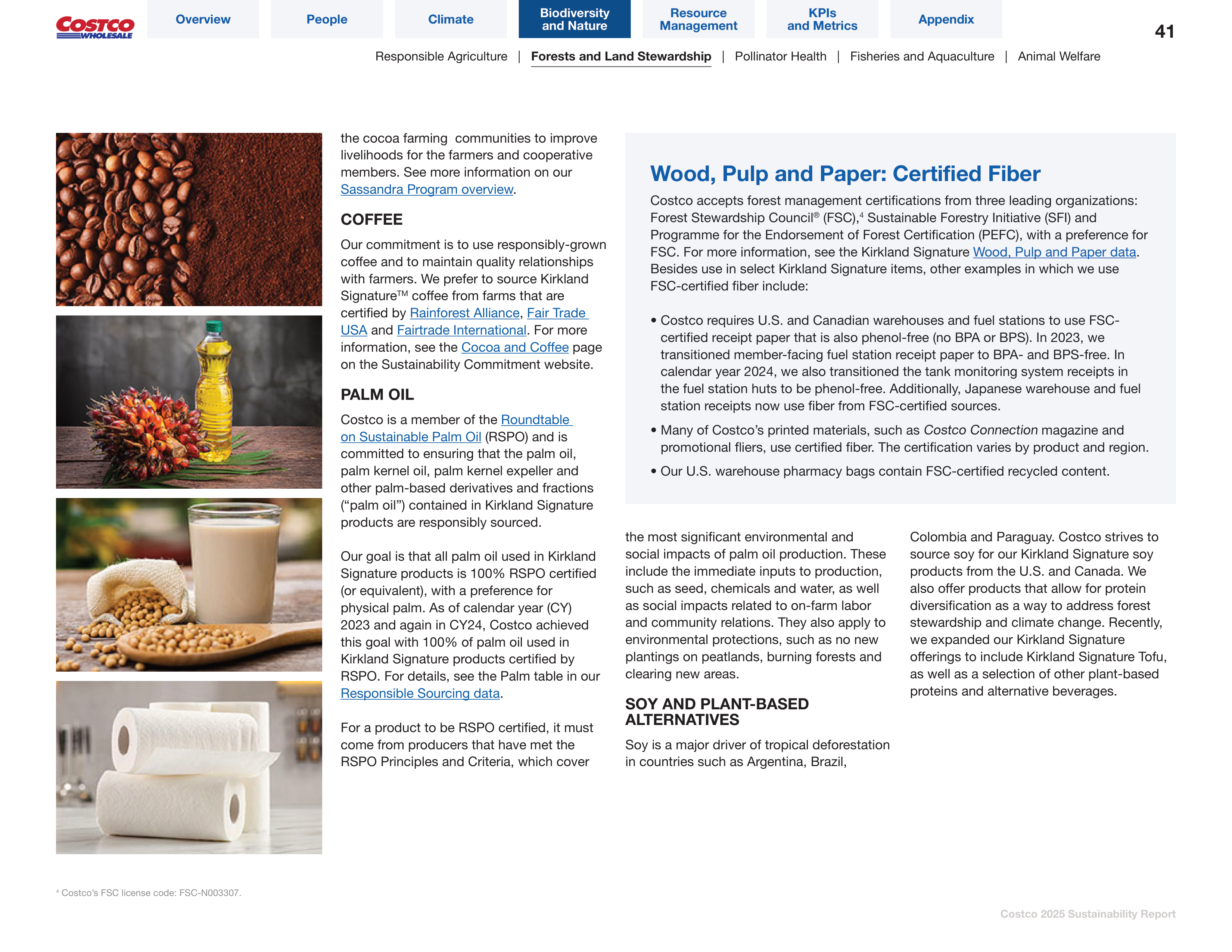




41
Overview
People
Climate
Biodiversity
and Nature
Resource
Management
KPIs
and Metrics
Appendix
Costco 2025 Sustainability Report
Wood, Pulp and Paper: Certified Fiber
Costco accepts forest management certifications from three leading organizations:
Forest Stewardship Council
®
(FSC),
4
Sustainable Forestry Initiative (SFI) and
Programme for the Endorsement of Forest Certification (PEFC), with a preference for
FSC. For more information, see the Kirkland Signature
Wood, Pulp and Paper data
.
Besides use in select Kirkland Signature items, other examples in which we use
FSC-certified fiber include:
• Costco requires U.S. and Canadian warehouses and fuel stations to use FSC-
certified receipt paper that is also phenol-free (no BPA or BPS). In 2023, we
transitioned member-facing fuel station receipt paper to BPA- and BPS-free. In
calendar year 2024, we also transitioned the tank monitoring system receipts in
the fuel station huts to be phenol-free. Additionally, Japanese warehouse and fuel
station receipts now use fiber from FSC-certified sources.
• Many of Costco’s printed materials, such as Costco Connection magazine and
promotional fliers, use certified fiber. The certification varies by product and region.
• Our U.S. warehouse pharmacy bags contain FSC-certified recycled content.
the cocoa farming communities to improve
livelihoods for the farmers and cooperative
members. See more information on our
Sassandra Program overview
.
COFFEE
Our commitment is to use responsibly-grown
coffee and to maintain quality relationships
with farmers. We prefer to source Kirkland
Signature
TM
coffee from farms that are
certified by
Rainforest Alliance
,
Fair Trade
USA
and
Fairtrade International
. For more
information, see the
Cocoa and Coffee
page
on the Sustainability Commitment website.
PALM OIL
Costco is a member of the
Roundtable
on Sustainable Palm Oil
(RSPO) and is
committed to ensuring that the palm oil,
palm kernel oil, palm kernel expeller and
other palm-based derivatives and fractions
(“palm oil”) contained in Kirkland Signature
products are responsibly sourced.
Our goal is that all palm oil used in Kirkland
Signature products is 100% RSPO certified
(or equivalent), with a preference for
physical palm. As of calendar year (CY)
2023 and again in CY24, Costco achieved
this goal with 100% of palm oil used in
Kirkland Signature products certified by
RSPO. For details, see the Palm table in our
Responsible Sourcing data
.
For a product to be RSPO certified, it must
come from producers that have met the
RSPO Principles and Criteria, which cover
the most significant environmental and
social impacts of palm oil production. These
include the immediate inputs to production,
such as seed, chemicals and water, as well
as social impacts related to on-farm labor
and community relations. They also apply to
environmental protections, such as no new
plantings on peatlands, burning forests and
clearing new areas.
SOY AND PLANT-BASED
ALTERNATIVES
Soy is a major driver of tropical deforestation
in countries such as Argentina, Brazil,
4
Costco’s FSC license code: FSC-N003307.
Responsible Agriculture |
Forests and Land Stewardship
| Pollinator Health | Fisheries and Aquaculture | Animal Welfare
Colombia and Paraguay. Costco strives to
source soy for our Kirkland Signature soy
products from the U.S. and Canada. We
also offer products that allow for protein
diversification as a way to address forest
stewardship and climate change. Recently,
we expanded our Kirkland Signature
offerings to include Kirkland Signature Tofu,
as well as a selection of other plant-based
proteins and alternative beverages.

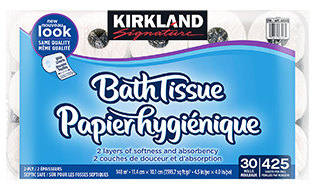
42
Overview
People
Climate
Biodiversity
and Nature
Resource
Management
KPIs
and Metrics
Appendix
Costco 2025 Sustainability Report
Choosing the Right Fiber
Considering recycled versus virgin fiber
How does Costco choose the type of fiber to use for our Kirkland Signature products? We
use recycled fibers in many products and for the majority of Kirkland Signature paper-
based packaging. However, fiber products degrade after about seven recycling cycles.
Virgin fibers offer strength, softness and absorbency — qualities that our members seek in
premium household paper products. We carefully consider our members’ needs and the
quality required to meet those needs when determining fiber types for our products.
Kirkland Signature Bath Tissue
is one example. As one of the most popular items
sold at Costco, we follow a very deliberate method to produce this product with forest
conservation as a key goal. After taking into account our members’ preferences for quality and performance, as well as the availability
of recycled content or alternative fibers, we choose to use virgin fibers in our Kirkland Signature Bath Tissue at this time.
We prioritize recycled fiber where feasible and where we believe it is a more sustainable alternative to virgin fiber. The final fiber choice
is determined by quality; food and product safety requirements; product specification and performance; and legal requirements.
WOOD, PULP AND PAPER
Our goal is to have Kirkland Signature paper
products created to optimize recycled
content and tree-free fibers where feasible.
Virgin-wood fibers should come from
certified, well-managed forests that do not
contribute to deforestation or degradation.
In 2015, we began allowing the sale of teak
products at Costco, with the requirement
that all teak is 100% FSC-certified.
Costco has expanded FSC certification
to other species of solid wood products,
including FSC-certified cedar wood playsets,
gazebos, outdoor furniture, indoor furniture
and pavilions. We will continue to expand
our scope of FSC certification.
Looking Ahead
The initiatives in our Forests and Land
Stewardship Action Plan help Costco
prepare for an evolving landscape and
identify pathways to a more sustainable
future. It is our current intent to continue
reporting our progress as we work to drive
meaningful change in our supply chains.
Responsible Agriculture |
Forests and Land Stewardship
| Pollinator Health | Fisheries and Aquaculture | Animal Welfare

43
Overview
People
Climate
Biodiversity
and Nature
Resource
Management
KPIs
and Metrics
Appendix
Costco 2025 Sustainability Report
They are a critically important part of
biodiversity for farms to be productive
and profitable – and for plants to produce
high-quality fruit. They also support native
ecosystems in the habitats around farms.
Without an abundance and diversity of
pollinators, Costco would not be able to
sell the quantity and quality of fruit and
vegetables that we do.
Costco recognizes that more than one-
third of the world’s food crops depend on
pollinators, but these pollinators are under
threat from the loss of natural habitat around
farms, the use of pesticides and other
chemicals, the reduced diversity of crops on
farms, and pests and diseases.
Costco takes a holistic approach to tackling
these threats that includes working with
our suppliers and partnering with leading
nonprofit organizations to advance research,
education, and support – for long-term
pollinator health, habitat, and biodiversity.
This work also contributes to risk
management and supply assurance for our
food businesses.
Supplier Engagement
and Our Pollinator
Health Policy
Our
Pollinator Health Policy
applies to
suppliers of live goods (garden plants), fruit
Pollinator Health
Pollinators for food crops and native plants
come in many shapes and sizes – from bees,
butterflies, and other insects, to even birds,
bats, and other creatures.
and vegetables. Costco encourages these
suppliers to limit the use of nonessential
chemicals, utilize methods of pest and
disease control that minimize harm to the
environment, and incorporate Integrated
Pest Management (IPM) strategies and other
creative solutions for the use of the least
toxic alternatives. Suppliers are encouraged
to phase out the use of neonicotinoids and
chlorpyrifos, unless mandated otherwise by
law. Costco seeks to partner with suppliers
that share our commitment to pollinator
health and IPM, and make reasonable
progress in a timely manner.
Pollinator-Friendly
Products
Costco continues to sell a wide selection of
organic products and alternative gardening
products. Globally, we no longer offer weed
and insect control products containing
glyphosate, neonicotinoids or chlorpyrifos.
Key Partnerships
and Initiatives
Since 2012, Costco has contributed a
portion of the sales of Kirkland Signature
TM
honey items to
Project Apis m. (PAm)
, a
nonprofit organization that supports critical
pollinator research, provides information
on best practices for pollinator health and
habitat, and offers resources for beekeepers
and growers.
Costco partners with PAm on a number of
different pollinator programs, including:
•
Seeds for Bees
(SFB):
SFB encourages
California fresh produce and nut suppliers
to plant buffer zones, blooming plants,
and cover crops in their orchards and
fields to help pollinators stay healthy, help
honeybees make honey, and improve soil
health and water sustainability. Between
2013 and 2025, SFB provided cover crop
seed and technical assistance for the
planting of over 130,000 acres of cover
crop on California farms and orchards. For
more information, see the
Seeds for Bees
Impact Report for 2024-2025
.
•
The Bee & Butterfly Habitat Fund
(BBHF):
This nonprofit committed to
establishing high-quality pollinator
habitat that not only supports pollinators
but also delivers multiple, measurable
environmental impacts. The BBHF
approach is science-based and results-
driven, believing every acre established
should provide maximum environmental
benefits. Through Costco’s support, BBHF
has been able to scale programs like Seed
A Legacy and Solar Synergy, establishing
habitat that benefits pollinators, improves
agriculture, captures carbon, and
strengthens food security. For more
information, see
The 2025 Bee & Butterfly
Habitat Fund Costco Impact Report
.
•
Casa Apis:
This program works with
a cooperative of over 700 small-scale
beekeepers in Northeast Brazil that is a
source of Kirkland Signature Organic Raw
Honey. Between 2020 and 2023, Costco
provided a $100,000 grant to support
Responsible Agriculture | Forests and Land Stewardship |
Pollinator Health
| Fisheries and Aquaculture | Animal Welfare
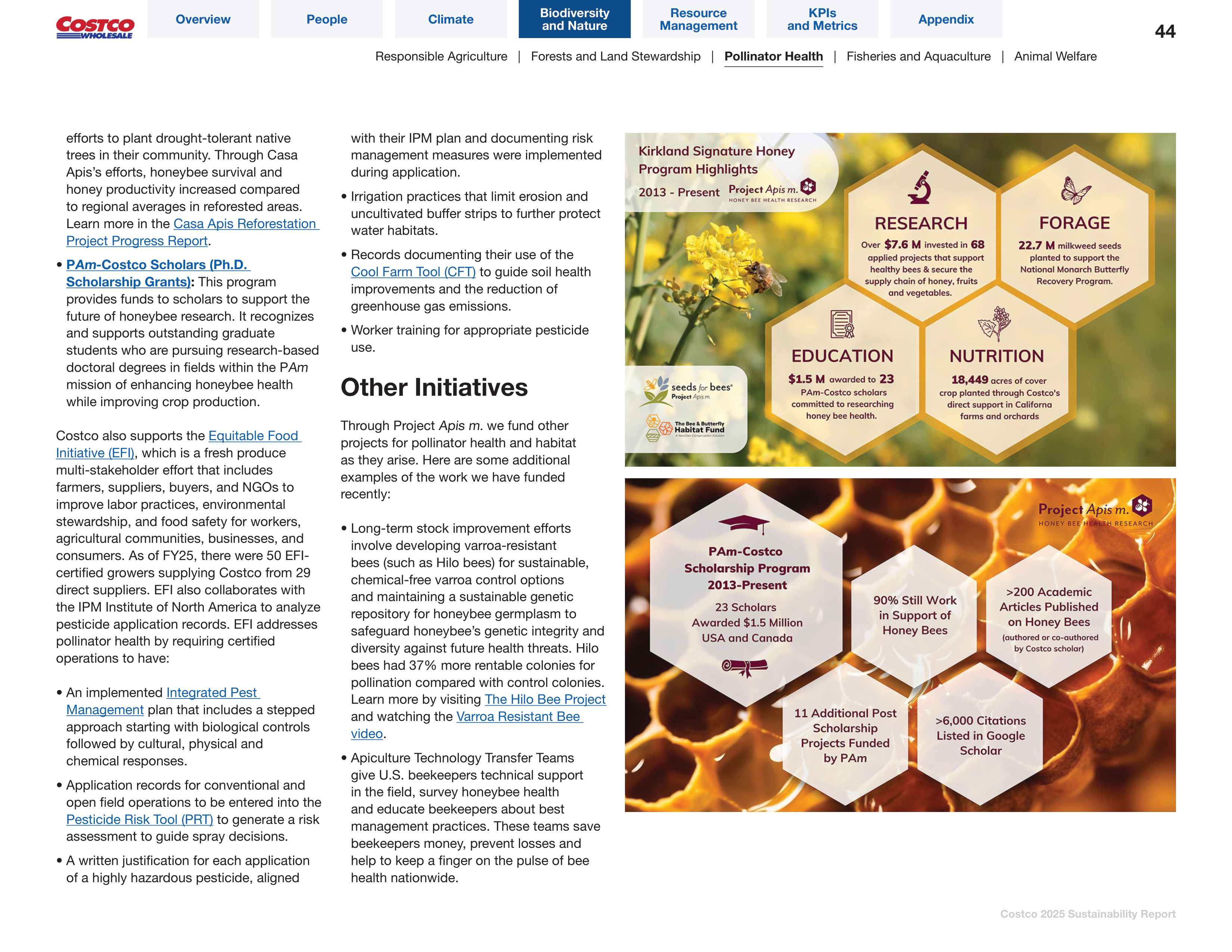
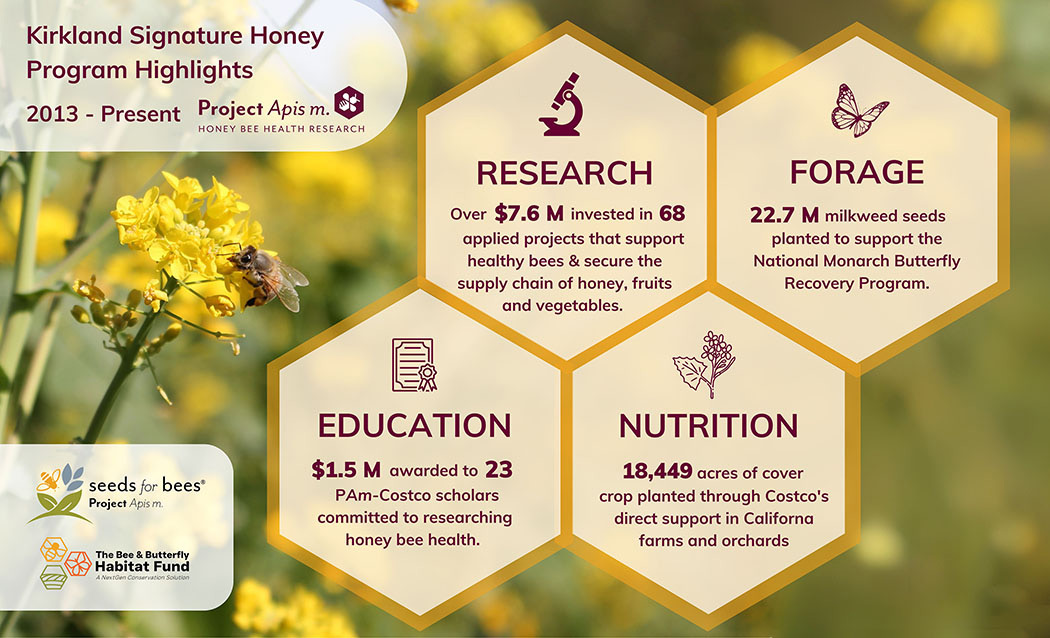
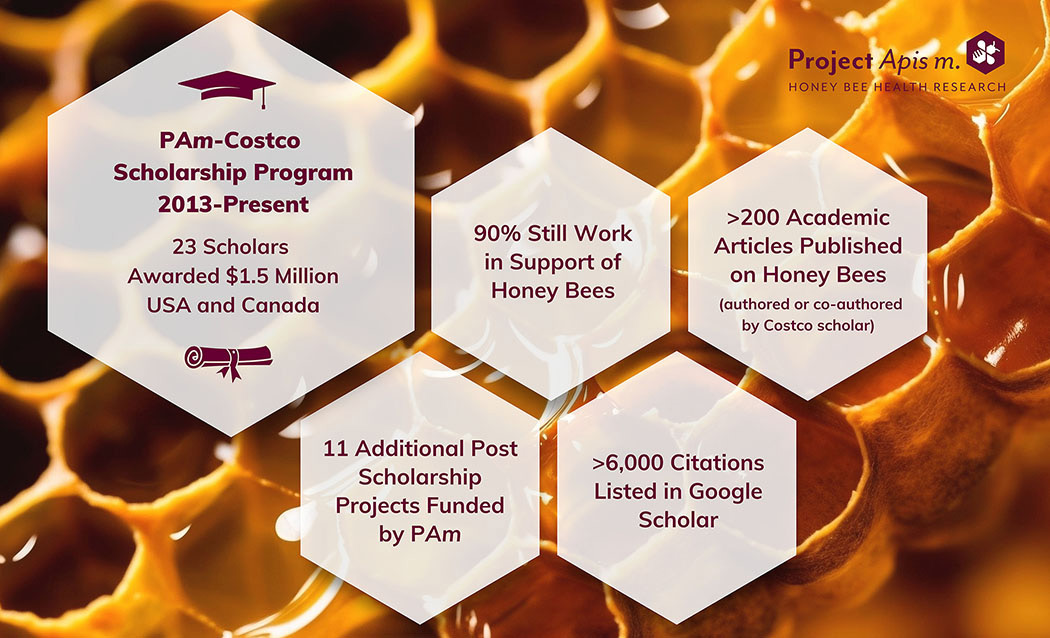
44
Overview
People
Climate
Biodiversity
and Nature
Resource
Management
KPIs
and Metrics
Appendix
Costco 2025 Sustainability Report
efforts to plant drought-tolerant native
trees in their community. Through Casa
Apis’s efforts, honeybee survival and
honey productivity increased compared
to regional averages in reforested areas.
Learn more in the
Casa Apis Reforestation
Project Progress Report
.
•
PAm-Costco Scholars (Ph.D.
Scholarship Grants)
:
This program
provides funds to scholars to support the
future of honeybee research. It recognizes
and supports outstanding graduate
students who are pursuing research-based
doctoral degrees in fields within the PAm
mission of enhancing honeybee health
while improving crop production.
Costco also supports the
Equitable Food
Initiative (EFI)
, which is a fresh produce
multi-stakeholder effort that includes
farmers, suppliers, buyers, and NGOs to
improve labor practices, environmental
stewardship, and food safety for workers,
agricultural communities, businesses, and
consumers. As of FY25, there were 50 EFI-
certified growers supplying Costco from 29
direct suppliers. EFI also collaborates with
the IPM Institute of North America to analyze
pesticide application records. EFI addresses
pollinator health by requiring certified
operations to have:
• An implemented
Integrated Pest
Management
plan that includes a stepped
approach starting with biological controls
followed by cultural, physical and
chemical responses.
• Application records for conventional and
open field operations to be entered into the
Pesticide Risk Tool (PRT)
to generate a risk
assessment to guide spray decisions.
• A written justification for each application
of a highly hazardous pesticide, aligned
with their IPM plan and documenting risk
management measures were implemented
during application.
• Irrigation practices that limit erosion and
uncultivated buffer strips to further protect
water habitats.
• Records documenting their use of the
Cool Farm Tool (CFT)
to guide soil health
improvements and the reduction of
greenhouse gas emissions.
• Worker training for appropriate pesticide
use.
Other Initiatives
Through Project Apis m. we fund other
projects for pollinator health and habitat
as they arise. Here are some additional
examples of the work we have funded
recently:
• Long-term stock improvement efforts
involve developing varroa-resistant
bees (such as Hilo bees) for sustainable,
chemical-free varroa control options
and maintaining a sustainable genetic
repository for honeybee germplasm to
safeguard honeybee’s genetic integrity and
diversity against future health threats. Hilo
bees had 37% more rentable colonies for
pollination compared with control colonies.
Learn more by visiting
The Hilo Bee Project
and watching the
Varroa Resistant Bee
video
.
• Apiculture Technology Transfer Teams
give U.S. beekeepers technical support
in the field, survey honeybee health
and educate beekeepers about best
management practices. These teams save
beekeepers money, prevent losses and
help to keep a finger on the pulse of bee
health nationwide.
Responsible Agriculture | Forests and Land Stewardship |
Pollinator Health
| Fisheries and Aquaculture | Animal Welfare
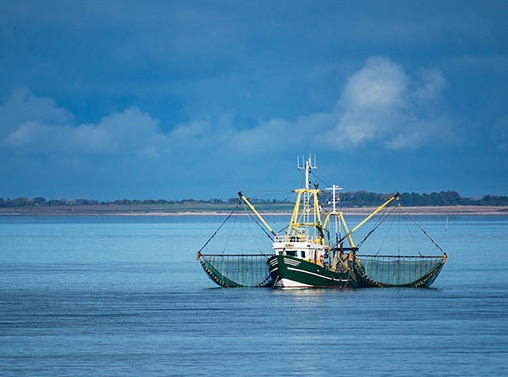
45
Overview
People
Climate
Biodiversity
and Nature
Resource
Management
KPIs
and Metrics
Appendix
Costco 2025 Sustainability Report
Fisheries and Aquaculture
Seafood – both wild-caught and farmed – is an
essential food for people around the world.
Costco has three primary objectives for
seafood sourcing:
• Continuously improve the sustainability of
our wild seafood and our farmed seafood
(aquaculture) in ways that enable us to meet
current demands without compromising the
availability of future resources.
• Safeguard the human rights, safety,
and dignity of the people who produce,
process, and harvest the products we sell.
• Protect our marine, coastal, and freshwater
ecosystems — and limit the environmental
impact associated with aquaculture and
fishing practices.
We believe products certified by the
Marine Stewardship Council
(MSC) and the
Aquaculture Stewardship Council
(ASC)
align with many of our sourcing objectives.
We continue to increase the volume of MSC-
and ASC-sourced seafood items we sell
globally. We also support comprehensive
Fishery Improvement Projects (FIPs) and
Aquaculture Improvement Projects (AIPs),
which help seafood suppliers to meet MSC
and ASC standards, respectively.
Sourcing Practices:
Wild Seafood
For wild species, we rely on the MSC
certification process to ensure we are
sourcing from fisheries that are sustainably
managed. For fisheries to become MSC-
certified, they must meet all three principles
of the
MSC Fishery Standard
, which are:
•
Sustainable fish stocks:
There are enough
fish left in the water to reproduce so fishing
can continue indefinitely.
•
Minimal environmental impact:
Fishing
operations must be carefully managed
to maintain the structure, productivity,
function and diversity of the marine
ecosystem.
•
Effective management:
The fishery
must comply with relevant laws and
have a management system that allows
it to respond quickly to changes in the
status quo.
Fisheries Improvement
Projects (FIPs)
To support fisheries in reaching MSC
certification, Costco is involved in a number
of comprehensive
Fishery Improvement
Projects
. These projects are alliances of
stakeholders that work together to resolve
challenges in fisheries management and
work toward the MSC standard. Our
involvement includes participation in FIP
meetings, letters to governments and/
or fisheries participants, and financial
contributions. We require comprehensive
FIPs to be verified and monitored as credible
by publicly reporting on
FisheryProgress.org
(free account required).
Costco works with
World Wildlife Fund
(WWF)
to support the following FIPs, which
can be found in the
WWF FIP directory
(sign-
in is required to view full content):
• Spiny Lobster – Honduras
• Spiny Lobster – Nicaragua
• Mahi Mahi – Ecuador
• Mahi Mahi – Peru
• Jumbo Squid – Peru
• Araucanian Herring and Anchovy – Chile
Costco and its suppliers also purchase
products from these FIPs. Over time, our
sourcing from individual FIPs will vary,
depending on market conditions and
other factors.
Fisheries Improvement
Fund
For several years, we have supported FIPs
as an effective way to transition fisheries to
more sustainable practices. (See
Seafood
in
the KPIs and Metrics section.) But a major
barrier to the scalability of FIPs is the lack of
significant, long-term financing for fisheries
improvement. To address this challenge, we
support a program that provides up-front
funding for implementation of FIPs called the
Fisheries Improvement Fund
.
Designed and launched by WWF and
Finance Earth, the Fisheries Improvement
Fund is a new financing mechanism
combining impact-led finance with an
innovative, volume-based contribution
Responsible Agriculture | Forests and Land Stewardship | Pollinator Health |
Fisheries and Aquaculture
| Animal Welfare
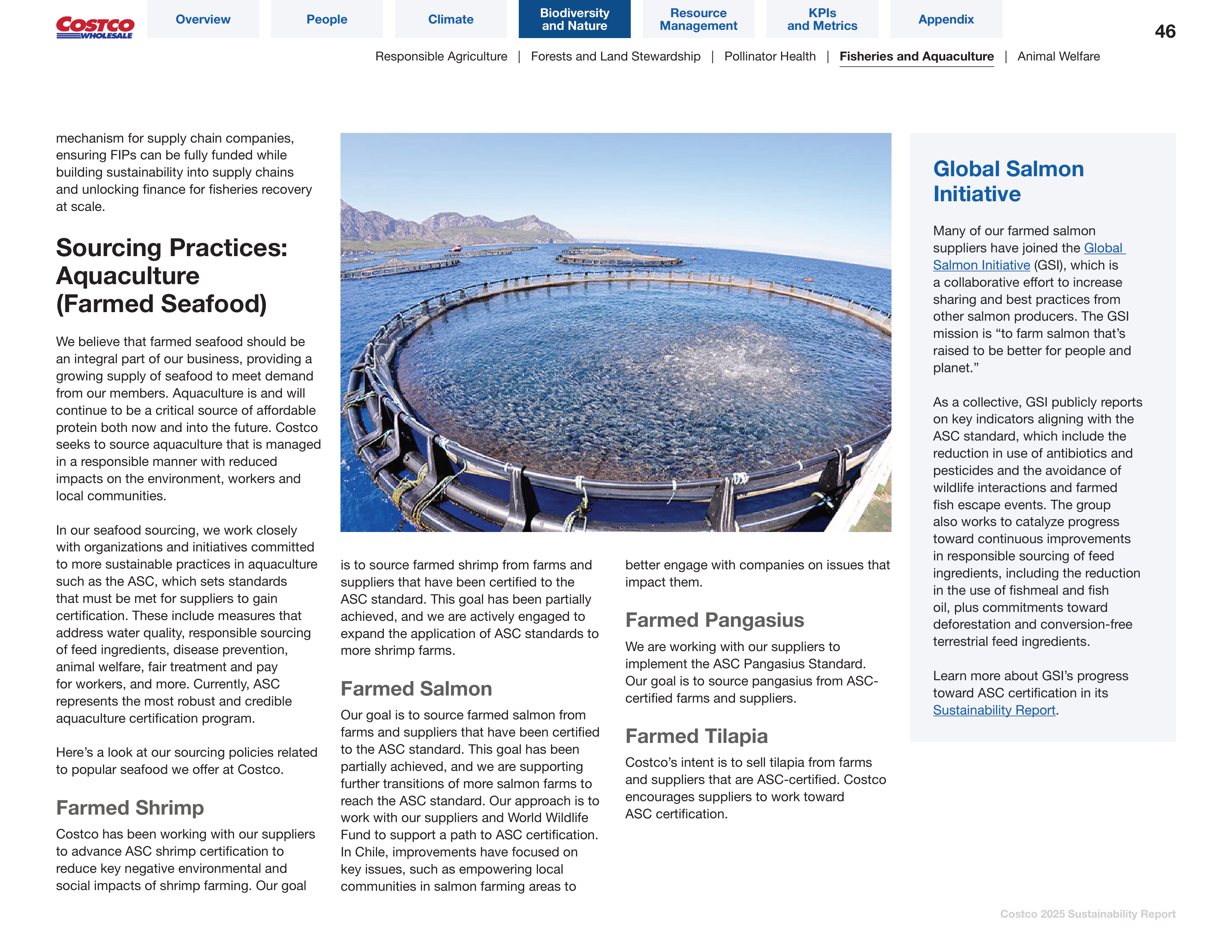
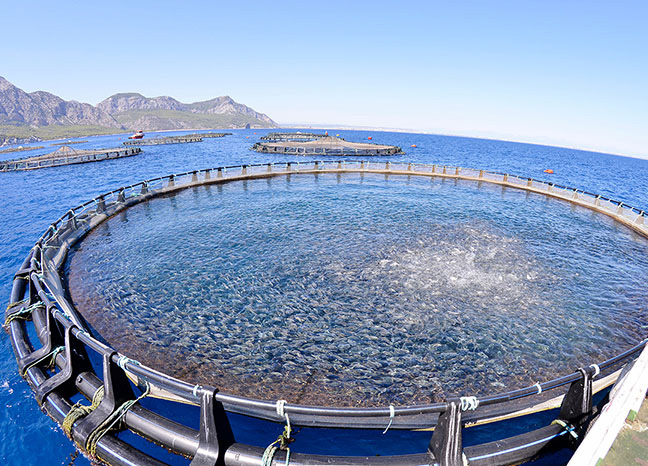
46
Overview
People
Climate
Biodiversity
and Nature
Resource
Management
KPIs
and Metrics
Appendix
Costco 2025 Sustainability Report
mechanism for supply chain companies,
ensuring FIPs can be fully funded while
building sustainability into supply chains
and unlocking finance for fisheries recovery
at scale.
Sourcing Practices:
Aquaculture
(Farmed Seafood)
We believe that farmed seafood should be
an integral part of our business, providing a
growing supply of seafood to meet demand
from our members. Aquaculture is and will
continue to be a critical source of affordable
protein both now and into the future. Costco
seeks to source aquaculture that is managed
in a responsible manner with reduced
impacts on the environment, workers and
local communities.
In our seafood sourcing, we work closely
with organizations and initiatives committed
to more sustainable practices in aquaculture
such as the ASC, which sets standards
that must be met for suppliers to gain
certification. These include measures that
address water quality, responsible sourcing
of feed ingredients, disease prevention,
animal welfare, fair treatment and pay
for workers, and more. Currently, ASC
represents the most robust and credible
aquaculture certification program.
Here’s a look at our sourcing policies related
to popular seafood we offer at Costco.
Farmed Shrimp
Costco has been working with our suppliers
to advance ASC shrimp certification to
reduce key negative environmental and
social impacts of shrimp farming. Our goal
is to source farmed shrimp from farms and
suppliers that have been certified to the
ASC standard. This goal has been partially
achieved, and we are actively engaged to
expand the application of ASC standards to
more shrimp farms.
Farmed Salmon
Our goal is to source farmed salmon from
farms and suppliers that have been certified
to the ASC standard. This goal has been
partially achieved, and we are supporting
further transitions of more salmon farms to
reach the ASC standard. Our approach is to
work with our suppliers and World Wildlife
Fund to support a path to ASC certification.
In Chile, improvements have focused on
key issues, such as empowering local
communities in salmon farming areas to
Global Salmon
Initiative
Many of our farmed salmon
suppliers have joined the
Global
Salmon Initiative
(GSI), which is
a collaborative effort to increase
sharing and best practices from
other salmon producers. The GSI
mission is “to farm salmon that’s
raised to be better for people and
planet.”
As a collective, GSI publicly reports
on key indicators aligning with the
ASC standard, which include the
reduction in use of antibiotics and
pesticides and the avoidance of
wildlife interactions and farmed
fish escape events. The group
also works to catalyze progress
toward continuous improvements
in responsible sourcing of feed
ingredients, including the reduction
in the use of fishmeal and fish
oil, plus commitments toward
deforestation and conversion-free
terrestrial feed ingredients.
Learn more about GSI’s progress
toward ASC certification in its
Sustainability Report
.
better engage with companies on issues that
impact them.
Farmed Pangasius
We are working with our suppliers to
implement the ASC Pangasius Standard.
Our goal is to source pangasius from ASC-
certified farms and suppliers.
Farmed Tilapia
Costco’s intent is to sell tilapia from farms
and suppliers that are ASC-certified. Costco
encourages suppliers to work toward
ASC certification.
Responsible Agriculture | Forests and Land Stewardship | Pollinator Health |
Fisheries and Aquaculture
| Animal Welfare
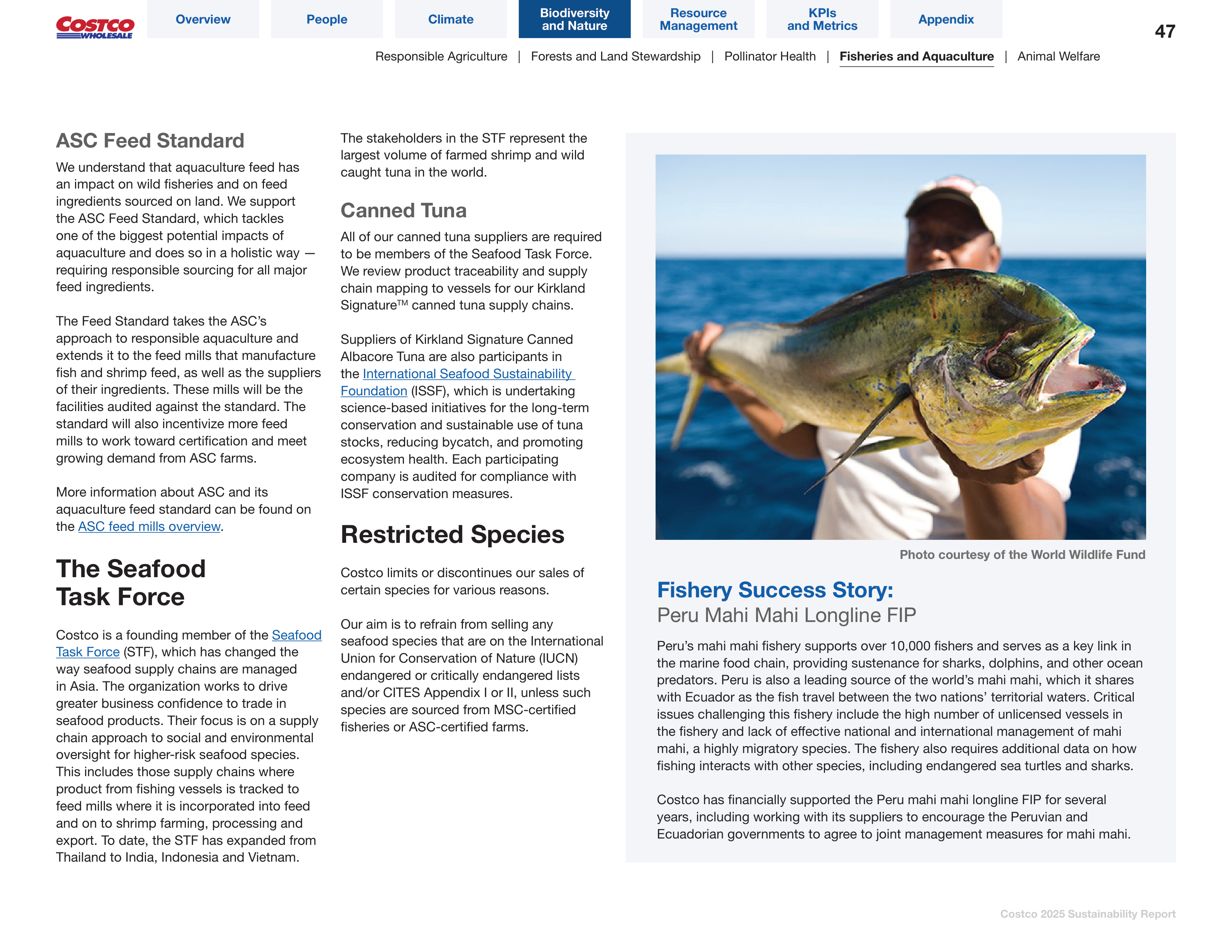
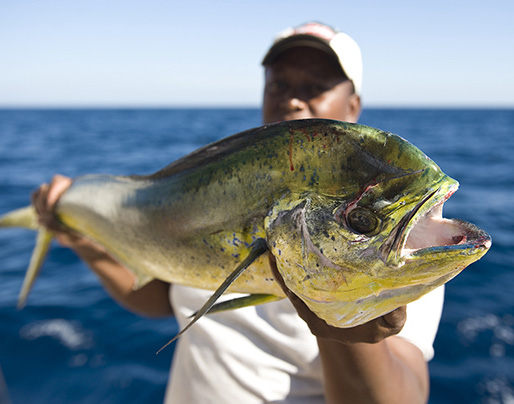
Photo courtesy of the World Wildlife Fund
47
Overview
People
Climate
Biodiversity
and Nature
Resource
Management
KPIs
and Metrics
Appendix
Costco 2025 Sustainability Report
ASC Feed Standard
We understand that aquaculture feed has
an impact on wild fisheries and on feed
ingredients sourced on land. We support
the ASC Feed Standard, which tackles
one of the biggest potential impacts of
aquaculture and does so in a holistic way —
requiring responsible sourcing for all major
feed ingredients.
The Feed Standard takes the ASC’s
approach to responsible aquaculture and
extends it to the feed mills that manufacture
fish and shrimp feed, as well as the suppliers
of their ingredients. These mills will be the
facilities audited against the standard. The
standard will also incentivize more feed
mills to work toward certification and meet
growing demand from ASC farms.
More information about ASC and its
aquaculture feed standard can be found on
the
ASC feed mills overview
.
The Seafood
Task Force
Costco is a founding member of the
Seafood
Task Force
(STF), which has changed the
way seafood supply chains are managed
in Asia. The organization works to drive
greater business confidence to trade in
seafood products. Their focus is on a supply
chain approach to social and environmental
oversight for higher-risk seafood species.
This includes those supply chains where
product from fishing vessels is tracked to
feed mills where it is incorporated into feed
and on to shrimp farming, processing and
export. To date, the STF has expanded from
Thailand to India, Indonesia and Vietnam.
The stakeholders in the STF represent the
largest volume of farmed shrimp and wild
caught tuna in the world.
Canned Tuna
All of our canned tuna suppliers are required
to be members of the Seafood Task Force.
We review product traceability and supply
chain mapping to vessels for our Kirkland
Signature
TM
canned tuna supply chains.
Suppliers of Kirkland Signature Canned
Albacore Tuna are also participants in
the
International Seafood Sustainability
Foundation
(ISSF), which is undertaking
science-based initiatives for the long-term
conservation and sustainable use of tuna
stocks, reducing bycatch, and promoting
ecosystem health. Each participating
company is audited for compliance with
ISSF conservation measures.
Restricted Species
Costco limits or discontinues our sales of
certain species for various reasons.
Our aim is to refrain from selling any
seafood species that are on the International
Union for Conservation of Nature (IUCN)
endangered or critically endangered lists
and/or CITES Appendix I or II, unless such
species are sourced from MSC-certified
fisheries or ASC-certified farms.
Peru’s mahi mahi fishery supports over 10,000 fishers and serves as a key link in
the marine food chain, providing sustenance for sharks, dolphins, and other ocean
predators. Peru is also a leading source of the world’s mahi mahi, which it shares
with Ecuador as the fish travel between the two nations’ territorial waters. Critical
issues challenging this fishery include the high number of unlicensed vessels in
the fishery and lack of effective national and international management of mahi
mahi, a highly migratory species. The fishery also requires additional data on how
fishing interacts with other species, including endangered sea turtles and sharks.
Costco has financially supported the Peru mahi mahi longline FIP for several
years, including working with its suppliers to encourage the Peruvian and
Ecuadorian governments to agree to joint management measures for mahi mahi.
Fishery Success Story:
Peru Mahi Mahi Longline FIP
Responsible Agriculture | Forests and Land Stewardship | Pollinator Health |
Fisheries and Aquaculture
| Animal Welfare
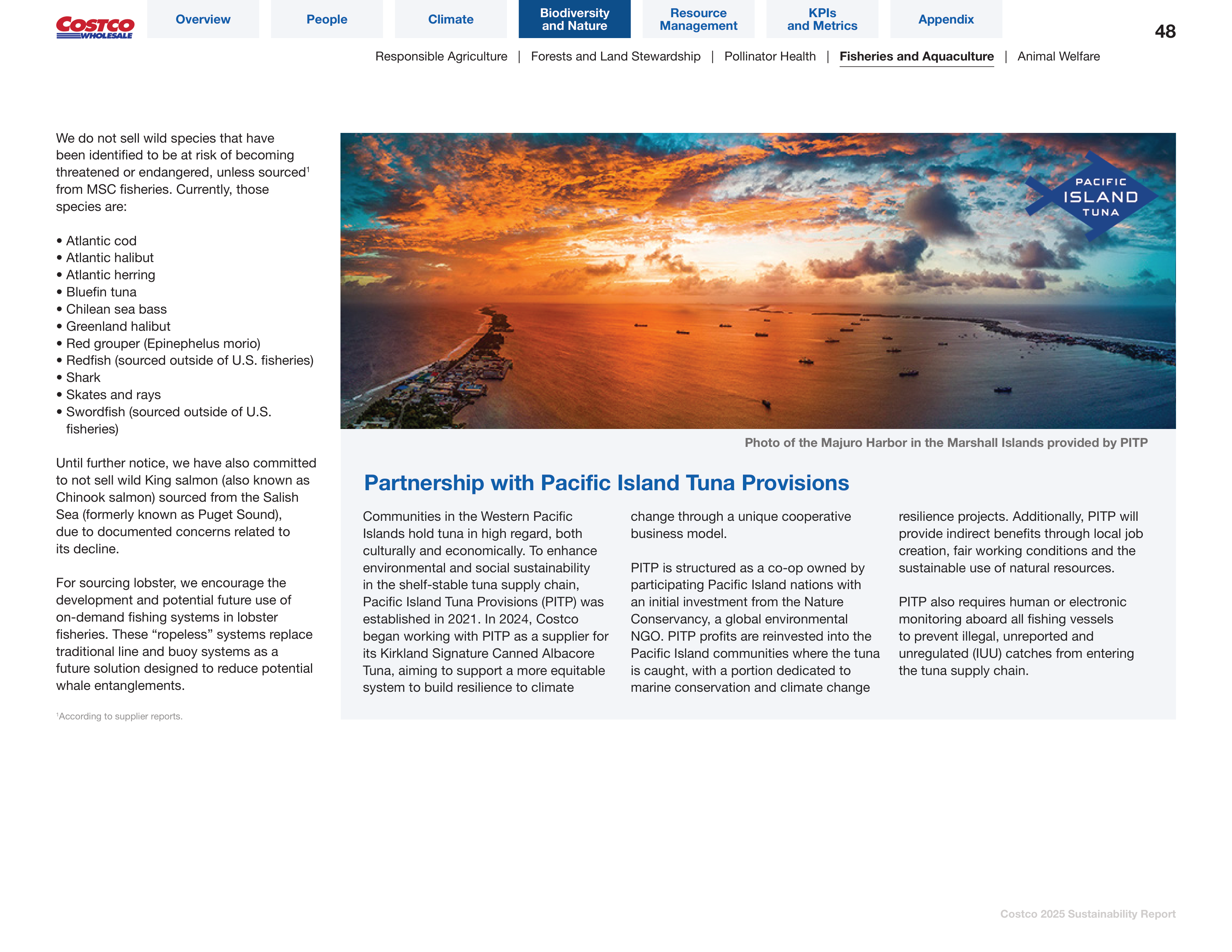

48
Overview
People
Climate
Biodiversity
and Nature
Resource
Management
KPIs
and Metrics
Appendix
Costco 2025 Sustainability Report
We do not sell wild species that have
been identified to be at risk of becoming
threatened or endangered, unless sourced
1
from MSC fisheries. Currently, those
species are:
• Atlantic cod
• Atlantic halibut
• Atlantic herring
• Bluefin tuna
• Chilean sea bass
• Greenland halibut
• Red grouper (Epinephelus morio)
• Redfish (sourced outside of U.S. fisheries)
• Shark
• Skates and rays
• Swordfish (sourced outside of U.S.
fisheries)
Until further notice, we have also committed
to not sell wild King salmon (also known as
Chinook salmon) sourced from the Salish
Sea (formerly known as Puget Sound),
due to documented concerns related to
its decline.
For sourcing lobster, we encourage the
development and potential future use of
on-demand fishing systems in lobster
fisheries. These “ropeless” systems replace
traditional line and buoy systems as a
future solution designed to reduce potential
whale entanglements.
1
According to supplier reports.
Partnership with Pacific Island Tuna Provisions
Communities in the Western Pacific
Islands hold tuna in high regard, both
culturally and economically. To enhance
environmental and social sustainability
in the shelf-stable tuna supply chain,
Pacific Island Tuna Provisions (PITP) was
established in 2021. In 2024, Costco
began working with PITP as a supplier for
its Kirkland Signature Canned Albacore
Tuna, aiming to support a more equitable
system to build resilience to climate
change through a unique cooperative
business model.
PITP is structured as a co-op owned by
participating Pacific Island nations with
an initial investment from the Nature
Conservancy, a global environmental
NGO. PITP profits are reinvested into the
Pacific Island communities where the tuna
is caught, with a portion dedicated to
marine conservation and climate change
resilience projects. Additionally, PITP will
provide indirect benefits through local job
creation, fair working conditions and the
sustainable use of natural resources.
PITP also requires human or electronic
monitoring aboard all fishing vessels
to prevent illegal, unreported and
unregulated (IUU) catches from entering
the tuna supply chain.
Photo of the Majuro Harbor in the Marshall Islands provided by PITP
Responsible Agriculture | Forests and Land Stewardship | Pollinator Health |
Fisheries and Aquaculture
| Animal Welfare
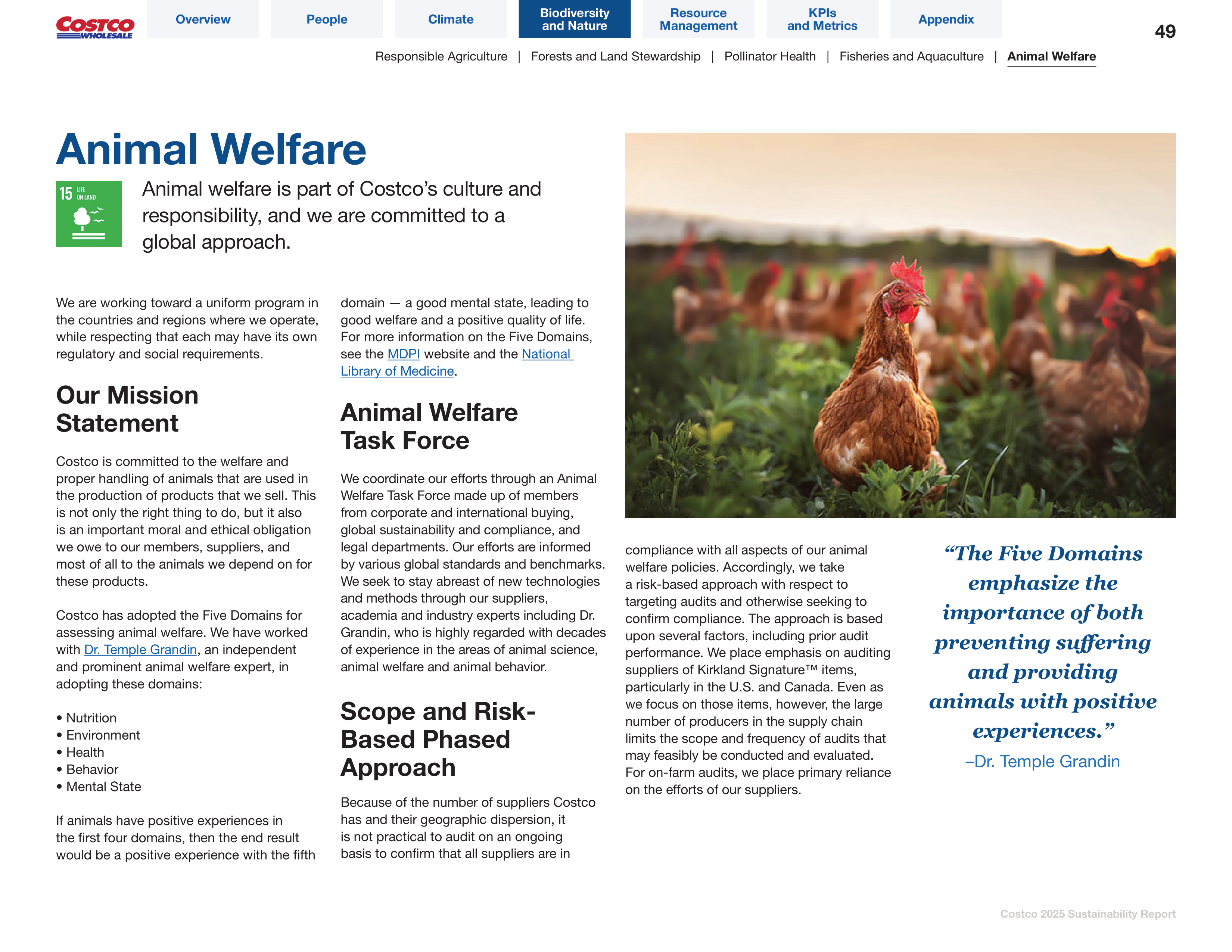
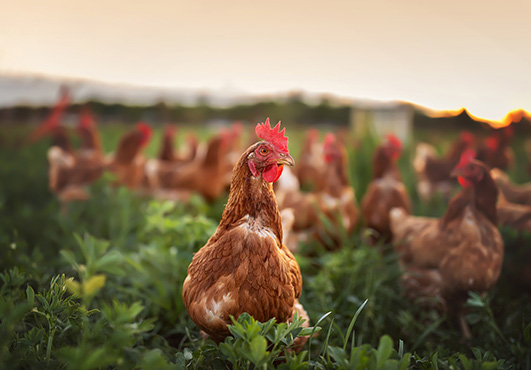
49
Overview
People
Climate
Biodiversity
and Nature
Resource
Management
KPIs
and Metrics
Appendix
Costco 2025 Sustainability Report
domain — a good mental state, leading to
good welfare and a positive quality of life.
For more information on the Five Domains,
see the
MDPI
website and the
National
Library of Medicine
.
Animal Welfare
Task Force
We coordinate our efforts through an Animal
Welfare Task Force made up of members
from corporate and international buying,
global sustainability and compliance, and
legal departments. Our efforts are informed
by various global standards and benchmarks.
We seek to stay abreast of new technologies
and methods through our suppliers,
academia and industry experts including Dr.
Grandin, who is highly regarded with decades
of experience in the areas of animal science,
animal welfare and animal behavior.
Scope and Risk-
Based Phased
Approach
Because of the number of suppliers Costco
has and their geographic dispersion, it
is not practical to audit on an ongoing
basis to confirm that all suppliers are in
Animal Welfare
Animal welfare is part of Costco’s culture and
responsibility, and we are committed to a
global approach.
We are working toward a uniform program in
the countries and regions where we operate,
while respecting that each may have its own
regulatory and social requirements.
Our Mission
Statement
Costco is committed to the welfare and
proper handling of animals that are used in
the production of products that we sell. This
is not only the right thing to do, but it also
is an important moral and ethical obligation
we owe to our members, suppliers, and
most of all to the animals we depend on for
these products.
Costco has adopted the Five Domains for
assessing animal welfare. We have worked
with
Dr. Temple Grandin
, an independent
and prominent animal welfare expert, in
adopting these domains:
• Nutrition
• Environment
• Health
• Behavior
• Mental State
If animals have positive experiences in
the first four domains, then the end result
would be a positive experience with the fifth
compliance with all aspects of our animal
welfare policies. Accordingly, we take
a risk-based approach with respect to
targeting audits and otherwise seeking to
confirm compliance. The approach is based
upon several factors, including prior audit
performance. We place emphasis on auditing
suppliers of Kirkland Signature™ items,
particularly in the U.S. and Canada. Even as
we focus on those items, however, the large
number of producers in the supply chain
limits the scope and frequency of audits that
may feasibly be conducted and evaluated.
For on-farm audits, we place primary reliance
on the efforts of our suppliers.
“The Five Domains
emphasize the
importance of both
preventing suffering
and providing
animals with positive
experiences.”
–Dr. Temple Grandin
Responsible Agriculture | Forests and Land Stewardship | Pollinator Health | Fisheries and Aquaculture |
Animal Welfare
50
Overview
People
Climate
Biodiversity
and Nature
Resource
Management
KPIs
and Metrics
Appendix
Costco 2025 Sustainability Report
Animal Welfare Audits
Costco utilizes and asks its suppliers to
utilize recognized audit standards and
programs conducted by trained auditors.
The purpose of an audit is to gather current,
accurate information concerning the overall
welfare of animals.
We look at animal welfare both on the farm
and at processing. Audit information is made
available to members of the Costco Global
Sustainability and Compliance team and our
buying staff. Audits apply to:
•
On-farm audits/assessments:
These
inspect the welfare of live animals on the
farm in their living environment. Currently
these are conducted for the following
species to varying degrees: chicken (egg-
laying hens), dairy cows, pork, poultry
(chicken and turkey), and veal.
•
Meat plant audits:
These take place at
the plant where animals are processed for
these species: beef, pork, poultry (chicken
and turkey), and veal.
Audits can be conducted by Costco
auditors, suppliers or third parties. Audit
type, frequency, and intensity can vary
across suppliers and species. Costco
requires U.S., Canada and Mexico auditors
to be certified.
Organic certification
in the U.S., in certain
respects, also includes limited animal welfare
components. Costco sells large quantities of
organic items derived from animal products,
and these items are required to be certified
organic in accordance with the law in all of
the countries in which we do business.
Policies and
Procedures
by Product
Here, we share animal welfare audit policies
and procedures by species, product type
and location.
Poultry (U.S. and Canada)
AUDITS: U.S. AND CANADA
BROILERS AND TURKEYS
• Costco requires broiler animal welfare
audits at processing in accordance
with the
National Chicken Council
(NCC) Recommended Animal Handling
Guidelines
and
American Humane Certified
Farm Program Broiler Standards
.
• For turkeys, Costco requires audits at
processing in accordance with the
National
Turkey Federation Animal Care Guidelines
or
American Humane Certified Farm
Program Turkey Standards Audit Too
l.
• Costco also expects audits to be
completed at hatchery and grow-
out facilities.
U.S. BROILER POLICY
Broilers are chickens raised for meat (as
opposed to eggs). Although broilers have a
life cycle of less than 50 days, their welfare
is as important as that of animals that have
longer life cycles. Most of our poultry needs
are met by our complex in Nebraska (Lincoln
Premium Poultry, or LPP), and three other
facilities in the Southeast, which are owned
by third parties. One of these producers is
certified organic, which brings with it animal
welfare requirements prescribed by the
U.S. Department of Agriculture. These four
facilities are our primary broiler suppliers
(which we call dedicated suppliers).
With respect to our dedicated suppliers, all
broilers are cage-free, in chicken houses
where they are free to move about without
restriction. The minimum standards followed
in these houses are based on
standards
developed by the National Chicken Council
(NCC). The NCC represents companies that
account for approximately 95% of broiler
production in the U.S. For our dedicated
suppliers, compliance with the NCC
standards is regularly audited by third-party
auditors, who are independent of Costco
and the producers, and are certified by the
Professional Animal Auditor Certification
Organization
(PAACO).
An important element of broiler welfare is
preparation for production. LPP and our
dedicated organic supplier use a technique
called Controlled Atmosphere Stunning
(CAS). That technique is recognized as
a superior method for processing, using
methods that are calming for the animals
and conducive to the welfare of employees
who monitor the process. Our broiler welfare
efforts are currently most highly focused
on LPP, which raises around 100 million
birds per year. In addition to CAS, LPP has
adopted other key elements of welfare:
•
Density:
Broilers at LPP are raised to a
weight smaller than industry average.
When applying density standards that are
expressed in weight per area, it is also
important to remember that birds are under
the maximum weight for the vast majority
of their lives. Our dedicated suppliers
target an operating density standard of
.92 square feet per bird. Due to one of
our dedicated complexes being impacted
by weather events, they are currently
operating at a temporary higher density
until those lost houses can be rebuilt. Once
completed, the density will return to .92
square feet per bird.
•
Catching and Transport:
LPP uses what
it regards as state-of-the-art equipment
for gathering of birds when they are ready
to leave the chicken houses. This highly
automated system reduces opportunities
for human mistakes and adverse welfare
issues that can occur with manual
processes. In addition, the transportation
of broilers occurs with covering and
ventilation options that are adaptable
to the wide range of weather conditions
found in Nebraska and Iowa.
•
House and Environmental Enrichments:
Across the industry, poultry companies
have experimented with trials and
husbandry improvements to enrich the
experience of broilers. LPP continues to
monitor studies that examine whether
these enrichments improve poultry
welfare outcomes, provide environmental
enrichments or benefit farm workers who
work with the broilers. In addition, LPP is
experimenting with enrichments in a limited
number of houses to evaluate whether
wider deployment is warranted.
•
Breeding:
Some parties have advocated
that Costco and others change to breeds
that grow more slowly. We have concerns
that slower-growing breeds increase
environmental impacts on climate and
water due to greater feed demands,
elevated energy usage, and higher waste
output. These greater impacts should
not be incurred absent meaningful
gains in broiler welfare. As we increase
engagement with our suppliers over
reducing emissions in the production of
goods for us, it is important that we set a
good example in our operations.
Our dedicated broiler operation has
continued communications with breeding
stock suppliers, current research, and
utilizing current studies concerning selection
Responsible Agriculture | Forests and Land Stewardship | Pollinator Health | Fisheries and Aquaculture |
Animal Welfare
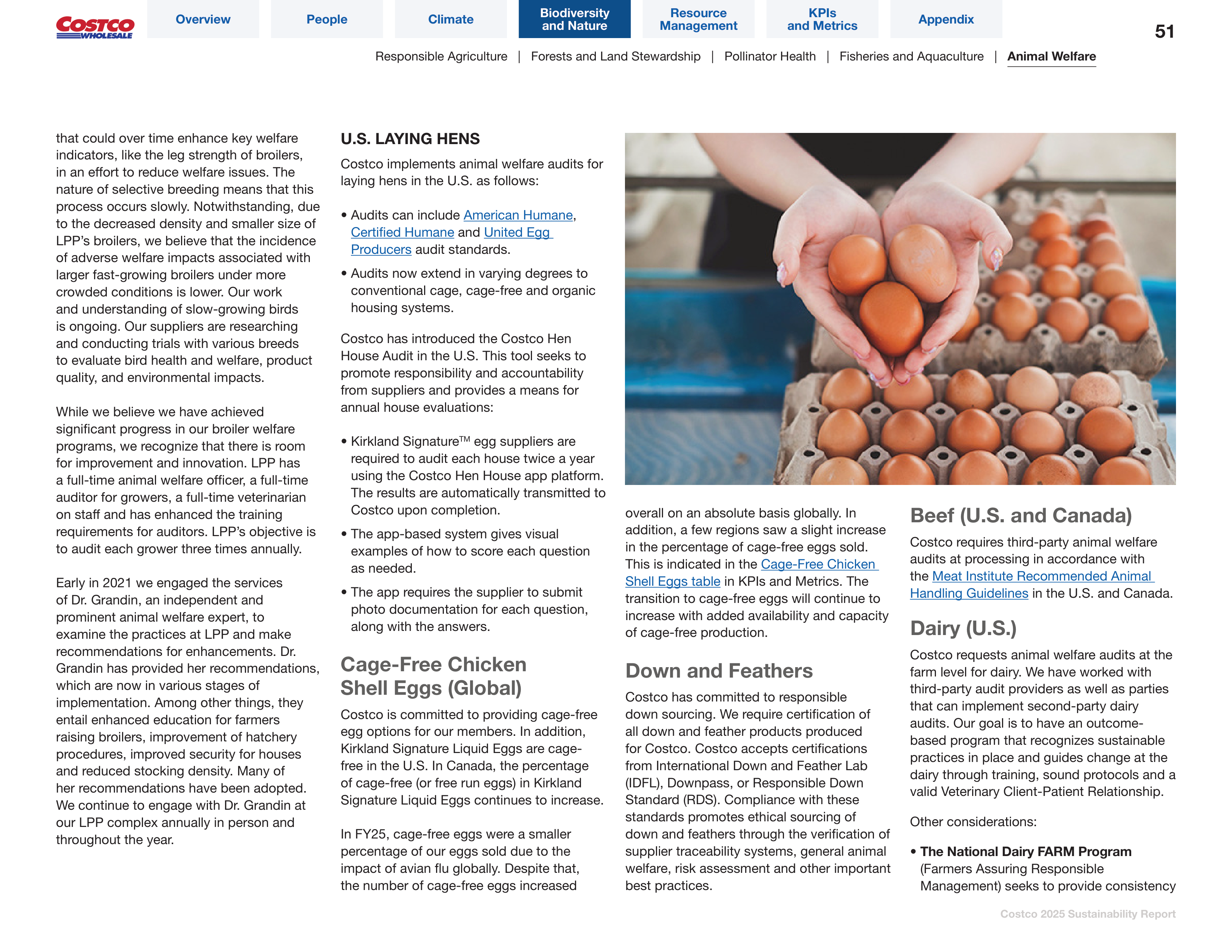

51
Overview
People
Climate
Biodiversity
and Nature
Resource
Management
KPIs
and Metrics
Appendix
Costco 2025 Sustainability Report
that could over time enhance key welfare
indicators, like the leg strength of broilers,
in an effort to reduce welfare issues. The
nature of selective breeding means that this
process occurs slowly. Notwithstanding, due
to the decreased density and smaller size of
LPP’s broilers, we believe that the incidence
of adverse welfare impacts associated with
larger fast-growing broilers under more
crowded conditions is lower. Our work
and understanding of slow-growing birds
is ongoing. Our suppliers are researching
and conducting trials with various breeds
to evaluate bird health and welfare, product
quality, and environmental impacts.
While we believe we have achieved
significant progress in our broiler welfare
programs, we recognize that there is room
for improvement and innovation. LPP has
a full-time animal welfare officer, a full-time
auditor for growers, a full-time veterinarian
on staff and has enhanced the training
requirements for auditors. LPP’s objective is
to audit each grower three times annually.
Early in 2021 we engaged the services
of Dr. Grandin, an independent and
prominent animal welfare expert, to
examine the practices at LPP and make
recommendations for enhancements. Dr.
Grandin has provided her recommendations,
which are now in various stages of
implementation. Among other things, they
entail enhanced education for farmers
raising broilers, improvement of hatchery
procedures, improved security for houses
and reduced stocking density. Many of
her recommendations have been adopted.
We continue to engage with Dr. Grandin at
our LPP complex annually in person and
throughout the year.
U.S. LAYING HENS
Costco implements animal welfare audits for
laying hens in the U.S. as follows:
• Audits can include
American Humane
,
Certified Humane
and
United Egg
Producers
audit standards.
• Audits now extend in varying degrees to
conventional cage, cage-free and organic
housing systems.
Costco has introduced the Costco Hen
House Audit in the U.S. This tool seeks to
promote responsibility and accountability
from suppliers and provides a means for
annual house evaluations:
• Kirkland Signature
TM
egg suppliers are
required to audit each house twice a year
using the Costco Hen House app platform.
The results are automatically transmitted to
Costco upon completion.
• The app-based system gives visual
examples of how to score each question
as needed.
• The app requires the supplier to submit
photo documentation for each question,
along with the answers.
Cage-Free Chicken
Shell Eggs (Global)
Costco is committed to providing cage-free
egg options for our members. In addition,
Kirkland Signature Liquid Eggs are cage-
free in the U.S. In Canada, the percentage
of cage-free (or free run eggs) in Kirkland
Signature Liquid Eggs continues to increase.
In FY25, cage-free eggs were a smaller
percentage of our eggs sold due to the
impact of avian flu globally. Despite that,
the number of cage-free eggs increased
overall on an absolute basis globally. In
addition, a few regions saw a slight increase
in the percentage of cage-free eggs sold.
This is indicated in the
Cage-Free Chicken
Shell Eggs table
in KPIs and Metrics. The
transition to cage-free eggs will continue to
increase with added availability and capacity
of cage-free production.
Down and Feathers
Costco has committed to responsible
down sourcing. We require certification of
all down and feather products produced
for Costco. Costco accepts certifications
from International Down and Feather Lab
(IDFL), Downpass, or Responsible Down
Standard (RDS). Compliance with these
standards promotes ethical sourcing of
down and feathers through the verification of
supplier traceability systems, general animal
welfare, risk assessment and other important
best practices.
Beef (U.S. and Canada)
Costco requires third-party animal welfare
audits at processing in accordance with
the
Meat Institute Recommended Animal
Handling Guidelines
in the U.S. and Canada.
Dairy (U.S.)
Costco requests animal welfare audits at the
farm level for dairy. We have worked with
third-party audit providers as well as parties
that can implement second-party dairy
audits. Our goal is to have an outcome-
based program that recognizes sustainable
practices in place and guides change at the
dairy through training, sound protocols and a
valid Veterinary Client-Patient Relationship.
Other considerations:
•
The National Dairy FARM Program
(Farmers Assuring Responsible
Management) seeks to provide consistency
Responsible Agriculture | Forests and Land Stewardship | Pollinator Health | Fisheries and Aquaculture |
Animal Welfare
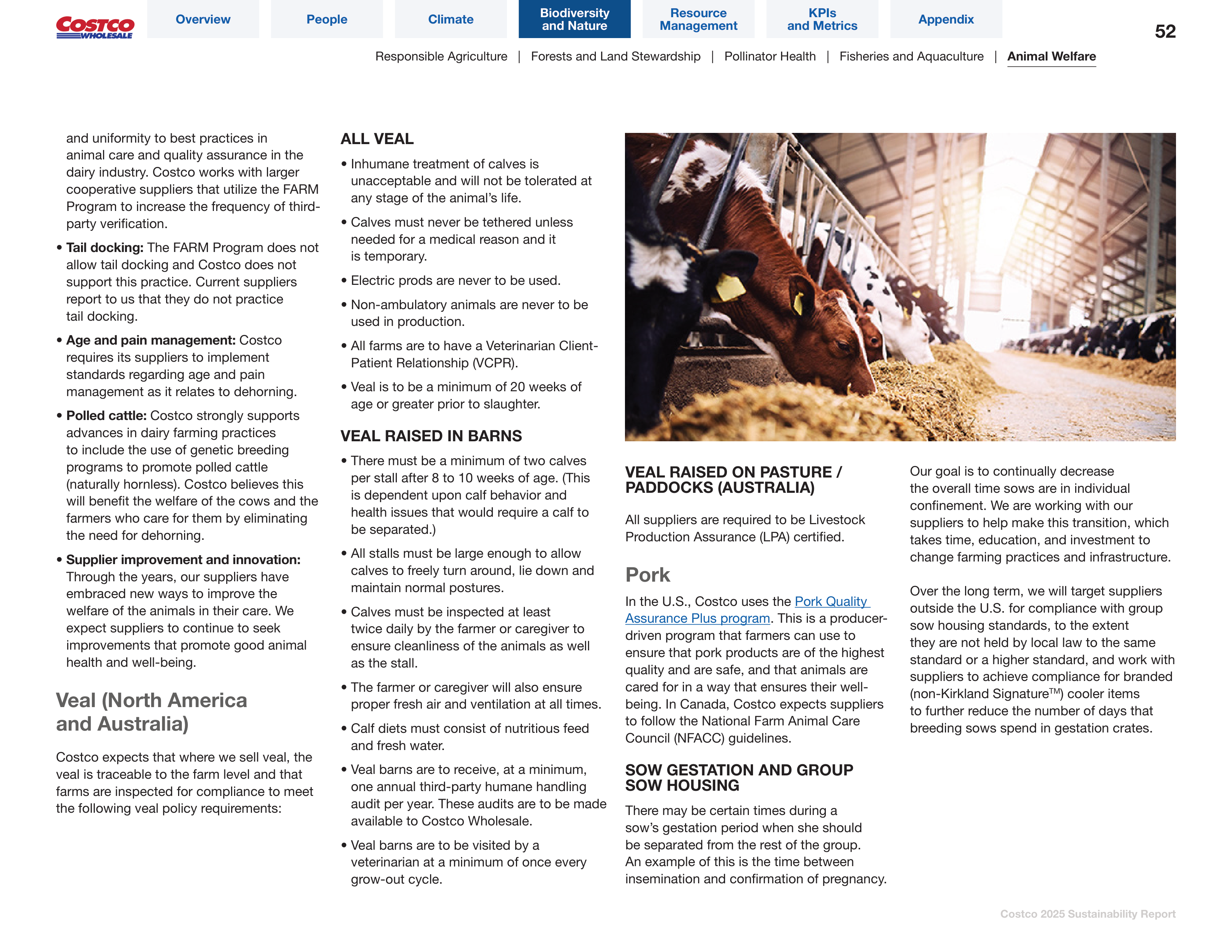
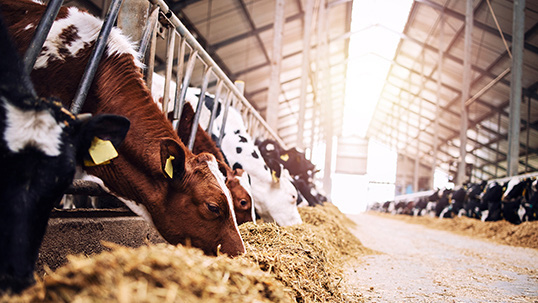
52
Overview
People
Climate
Biodiversity
and Nature
Resource
Management
KPIs
and Metrics
Appendix
Costco 2025 Sustainability Report
and uniformity to best practices in
animal care and quality assurance in the
dairy industry. Costco works with larger
cooperative suppliers that utilize the FARM
Program to increase the frequency of third-
party verification.
•
Tail docking:
The FARM Program does not
allow tail docking and Costco does not
support this practice. Current suppliers
report to us that they do not practice
tail docking.
•
Age and pain management:
Costco
requires its suppliers to implement
standards regarding age and pain
management as it relates to dehorning.
•
Polled cattle:
Costco strongly supports
advances in dairy farming practices
to include the use of genetic breeding
programs to promote polled cattle
(naturally hornless). Costco believes this
will benefit the welfare of the cows and the
farmers who care for them by eliminating
the need for dehorning.
•
Supplier improvement and innovation:
Through the years, our suppliers have
embraced new ways to improve the
welfare of the animals in their care. We
expect suppliers to continue to seek
improvements that promote good animal
health and well-being.
Veal (North America
and Australia)
Costco expects that where we sell veal, the
veal is traceable to the farm level and that
farms are inspected for compliance to meet
the following veal policy requirements:
ALL VEAL
• Inhumane treatment of calves is
unacceptable and will not be tolerated at
any stage of the animal’s life.
• Calves must never be tethered unless
needed for a medical reason and it
is temporary.
• Electric prods are never to be used.
• Non-ambulatory animals are never to be
used in production.
• All farms are to have a Veterinarian Client-
Patient Relationship (VCPR).
• Veal is to be a minimum of 20 weeks of
age or greater prior to slaughter.
VEAL RAISED IN BARNS
• There must be a minimum of two calves
per stall after 8 to 10 weeks of age. (This
is dependent upon calf behavior and
health issues that would require a calf to
be separated.)
• All stalls must be large enough to allow
calves to freely turn around, lie down and
maintain normal postures.
• Calves must be inspected at least
twice daily by the farmer or caregiver to
ensure cleanliness of the animals as well
as the stall.
• The farmer or caregiver will also ensure
proper fresh air and ventilation at all times.
• Calf diets must consist of nutritious feed
and fresh water.
• Veal barns are to receive, at a minimum,
one annual third-party humane handling
audit per year. These audits are to be made
available to Costco Wholesale.
• Veal barns are to be visited by a
veterinarian at a minimum of once every
grow-out cycle.
VEAL RAISED ON PASTURE /
PADDOCKS (AUSTRALIA)
All suppliers are required to be Livestock
Production Assurance (LPA) certified.
Pork
In the U.S., Costco uses the
Pork Quality
Assurance Plus program
. This is a producer-
driven program that farmers can use to
ensure that pork products are of the highest
quality and are safe, and that animals are
cared for in a way that ensures their well-
being. In Canada, Costco expects suppliers
to follow the National Farm Animal Care
Council (NFACC) guidelines.
SOW GESTATION AND GROUP
SOW HOUSING
There may be certain times during a
sow’s gestation period when she should
be separated from the rest of the group.
An example of this is the time between
insemination and confirmation of pregnancy.
Our goal is to continually decrease
the overall time sows are in individual
confinement. We are working with our
suppliers to help make this transition, which
takes time, education, and investment to
change farming practices and infrastructure.
Over the long term, we will target suppliers
outside the U.S. for compliance with group
sow housing standards, to the extent
they are not held by local law to the same
standard or a higher standard, and work with
suppliers to achieve compliance for branded
(non-Kirkland Signature
TM
) cooler items
to further reduce the number of days that
breeding sows spend in gestation crates.
Responsible Agriculture | Forests and Land Stewardship | Pollinator Health | Fisheries and Aquaculture |
Animal Welfare
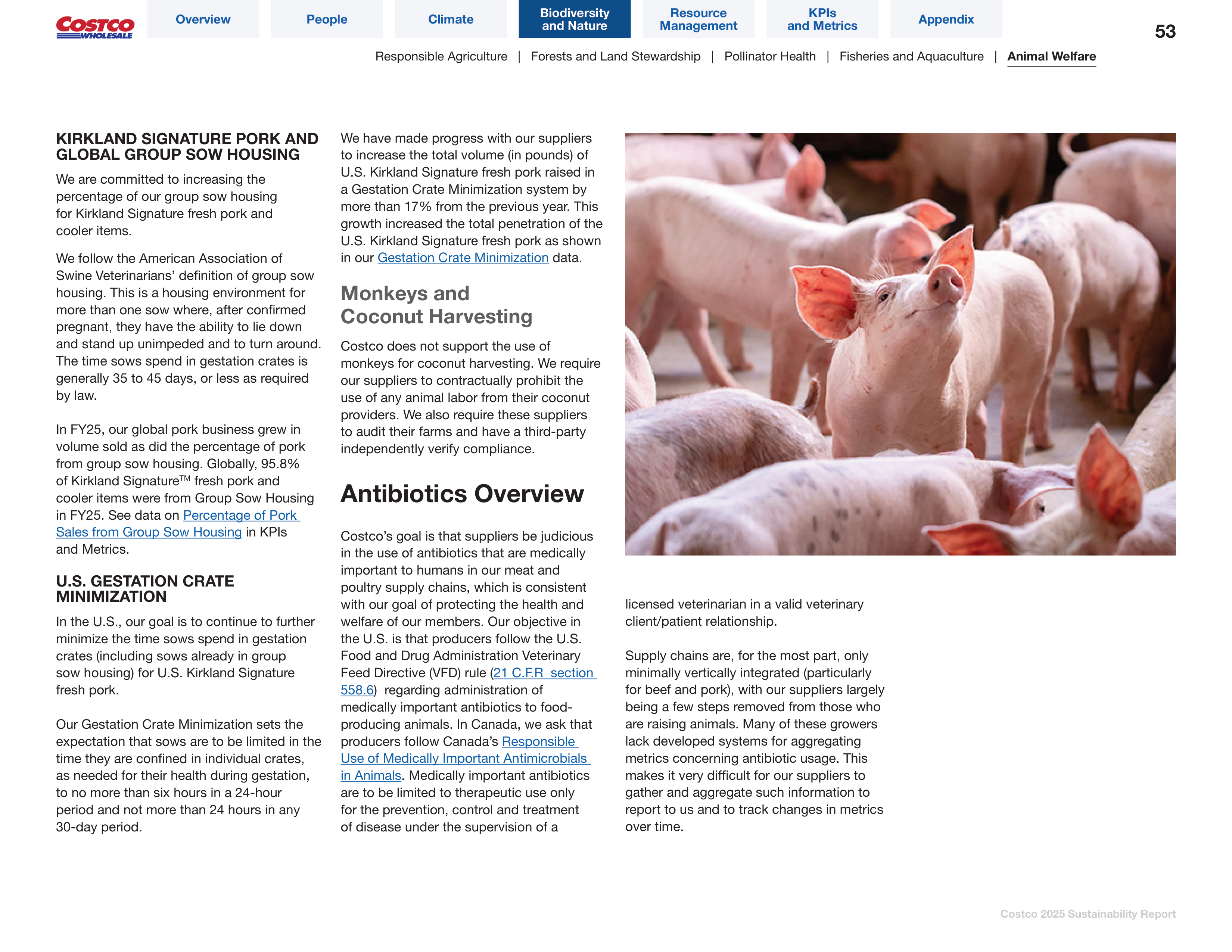
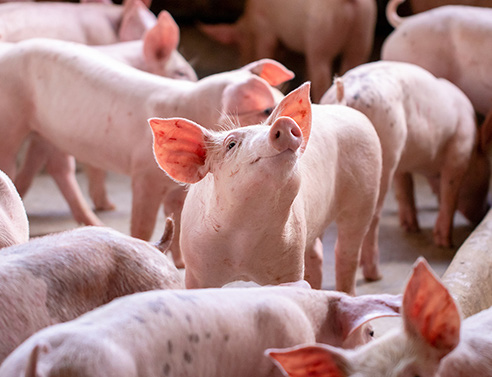
53
Overview
People
Climate
Biodiversity
and Nature
Resource
Management
KPIs
and Metrics
Appendix
Costco 2025 Sustainability Report
KIRKLAND SIGNATURE PORK AND
GLOBAL GROUP SOW HOUSING
We are committed to increasing the
percentage of our group sow housing
for Kirkland Signature fresh pork and
cooler items.
We follow the American Association of
Swine Veterinarians’ definition of group sow
housing. This is a housing environment for
more than one sow where, after confirmed
pregnant, they have the ability to lie down
and stand up unimpeded and to turn around.
The time sows spend in gestation crates is
generally 35 to 45 days, or less as required
by law.
In FY25, our global pork business grew in
volume sold as did the percentage of pork
from group sow housing. Globally, 95.8%
of Kirkland Signature
TM
fresh pork and
cooler items were from Group Sow Housing
in FY25. See data on
Percentage of Pork
Sales from Group Sow Housing
in KPIs
and Metrics.
U.S. GESTATION CRATE
MINIMIZATION
In the U.S., our goal is to continue to further
minimize the time sows spend in gestation
crates (including sows already in group
sow housing) for U.S. Kirkland Signature
fresh pork.
Our Gestation Crate Minimization sets the
expectation that sows are to be limited in the
time they are confined in individual crates,
as needed for their health during gestation,
to no more than six hours in a 24-hour
period and not more than 24 hours in any
30-day period.
We have made progress with our suppliers
to increase the total volume (in pounds) of
U.S. Kirkland Signature fresh pork raised in
a Gestation Crate Minimization system by
more than 17% from the previous year. This
growth increased the total penetration of the
U.S. Kirkland Signature fresh pork as shown
in our
Gestation Crate Minimization
data.
Monkeys and
Coconut Harvesting
Costco does not support the use of
monkeys for coconut harvesting. We require
our suppliers to contractually prohibit the
use of any animal labor from their coconut
providers. We also require these suppliers
to audit their farms and have a third-party
independently verify compliance.
Antibiotics Overview
Costco’s goal is that suppliers be judicious
in the use of antibiotics that are medically
important to humans in our meat and
poultry supply chains, which is consistent
with our goal of protecting the health and
welfare of our members. Our objective in
the U.S. is that producers follow the U.S.
Food and Drug Administration Veterinary
Feed Directive (VFD) rule (
21 C.F.R section
558.6
) regarding administration of
medically important antibiotics to food-
producing animals. In Canada, we ask that
producers follow Canada’s
Responsible
Use of Medically Important Antimicrobials
in Animals
. Medically important antibiotics
are to be limited to therapeutic use only
for the prevention, control and treatment
of disease under the supervision of a
licensed veterinarian in a valid veterinary
client/patient relationship.
Supply chains are, for the most part, only
minimally vertically integrated (particularly
for beef and pork), with our suppliers largely
being a few steps removed from those who
are raising animals. Many of these growers
lack developed systems for aggregating
metrics concerning antibiotic usage. This
makes it very difficult for our suppliers to
gather and aggregate such information to
report to us and to track changes in metrics
over time.
Responsible Agriculture | Forests and Land Stewardship | Pollinator Health | Fisheries and Aquaculture |
Animal Welfare
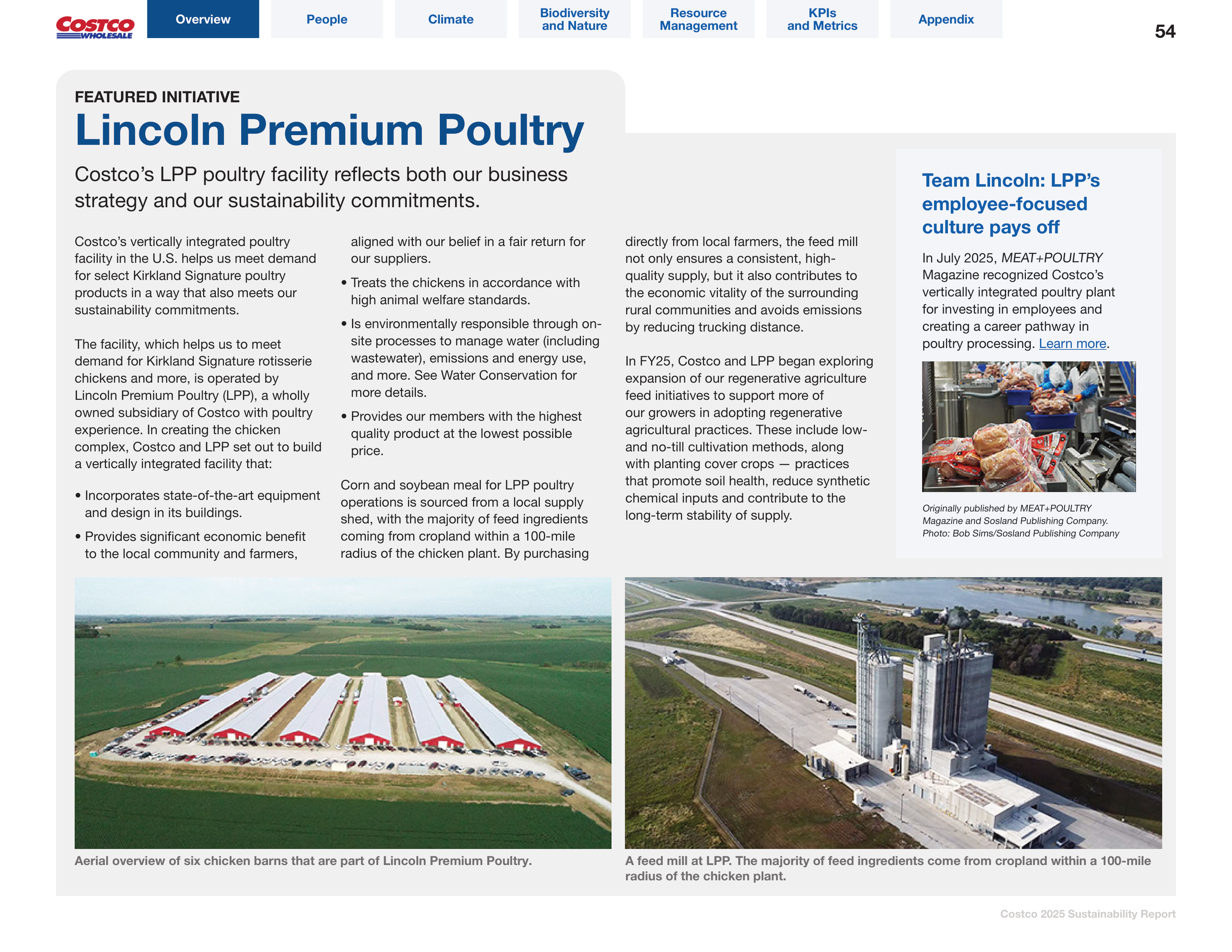
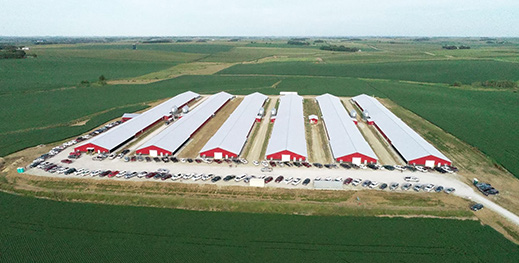
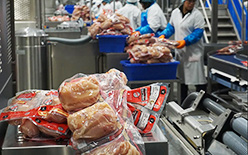
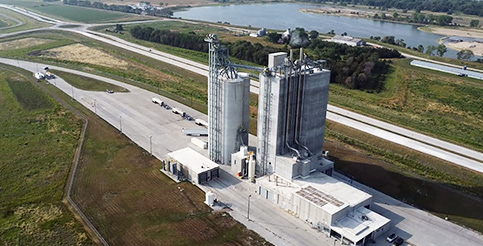
54
Overview
People
Climate
Biodiversity
and Nature
KPIs
and Metrics
Appendix
Resource
Management
Costco 2025 Sustainability Report
Costco’s vertically integrated poultry
facility in the U.S. helps us meet demand
for select Kirkland Signature poultry
products in a way that also meets our
sustainability commitments.
The facility, which helps us to meet
demand for Kirkland Signature rotisserie
chickens and more, is operated by
Lincoln Premium Poultry (LPP), a wholly
owned subsidiary of Costco with poultry
experience. In creating the chicken
complex, Costco and LPP set out to build
a vertically integrated facility that:
• Incorporates state-of-the-art equipment
and design in its buildings.
• Provides significant economic benefit
to the local community and farmers,
aligned with our belief in a fair return for
our suppliers.
• Treats the chickens in accordance with
high animal welfare standards.
• Is environmentally responsible through on-
site processes to manage water (including
wastewater), emissions and energy use,
and more. See Water Conservation for
more details.
• Provides our members with the highest
quality product at the lowest possible
price.
Corn and soybean meal for LPP poultry
operations is sourced from a local supply
shed, with the majority of feed ingredients
coming from cropland within a 100-mile
radius of the chicken plant. By purchasing
Aerial overview of six chicken barns that are part of Lincoln Premium Poultry.
FEATURED INITIATIVE
Lincoln Premium Poultry
Costco’s LPP poultry facility reflects both our business
strategy and our sustainability commitments.
A feed mill at LPP. The majority of feed ingredients come from cropland within a 100-mile
radius of the chicken plant.
In July 2025, MEAT+POULTRY
Magazine recognized Costco’s
vertically integrated poultry plant
for investing in employees and
creating a career pathway in
poultry processing.
Learn more
.
Team Lincoln: LPP’s
employee-focused
culture pays off
Originally published by MEAT+POULTRY
Magazine and Sosland Publishing Company.
Photo: Bob Sims/Sosland Publishing Company
directly from local farmers, the feed mill
not only ensures a consistent, high-
quality supply, but it also contributes to
the economic vitality of the surrounding
rural communities and avoids emissions
by reducing trucking distance.
In FY25, Costco and LPP began exploring
expansion of our regenerative agriculture
feed initiatives to support more of
our growers in adopting regenerative
agricultural practices. These include low-
and no-till cultivation methods, along
with planting cover crops — practices
that promote soil health, reduce synthetic
chemical inputs and contribute to the
long-term stability of supply.
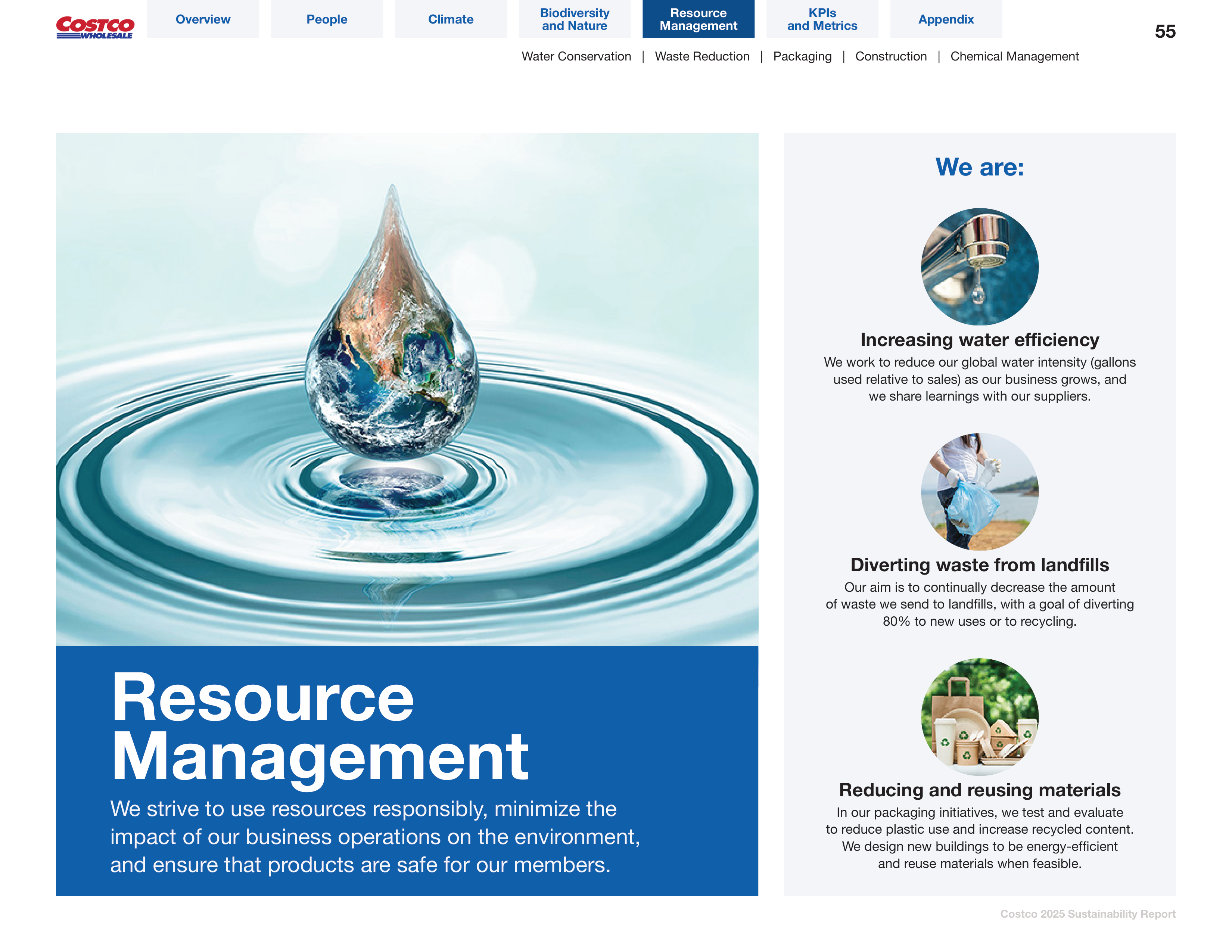



55
Overview
People
Climate
Biodiversity
and Nature
Resource
Management
KPIs
and Metrics
Appendix
Costco 2025 Sustainability Report
Water Conservation | Waste Reduction | Packaging | Construction | Chemical Management
Resource
Management
We strive to use resources responsibly, minimize the
impact of our business operations on the environment,
and ensure that products are safe for our members.
Reducing and reusing materials
In our packaging initiatives, we test and evaluate
to reduce plastic use and increase recycled content.
We design new buildings to be energy-efficient
and reuse materials when feasible.
Increasing water efficiency
We work to reduce our global water intensity (gallons
used relative to sales) as our business grows, and
we share learnings with our suppliers.
Diverting waste from landfills
Our aim is to continually decrease the amount
of waste we send to landfills, with a goal of diverting
80% to new uses or to recycling.
We are:

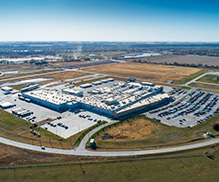
56
Overview
People
Climate
Biodiversity
and Nature
Resource
Management
KPIs
and Metrics
Appendix
Costco 2025 Sustainability Report
Water Conservation
Costco has implemented comprehensive water
management programs to help us reduce
operational water waste and improve the quality of
both our wastewater and stormwater discharges.
We are also taking steps to use less water overall.
Operational Water
Performance
We continually evaluate opportunities to
further improve water efficiency in our global
operations including adopting water-efficient
fixtures, assessing the potential for water
reuse in irrigation and car washes, improving
leak detection, managing stormwater, and
implementing low water-use landscaping
and irrigation technologies. Our specific
initiatives include:
• Detecting mechanical failures in real-time
for quick fixes to minimize water losses.
• Creating an enhanced awareness of
water use and stewardship throughout
our operations.
• Increasing water efficiency to lower the
amount of energy and cost necessary to
run mechanical equipment and systems,
which in turn helps us to manage our
carbon footprint, operational expenses and
environmental impact.
• Continuously evaluating innovative
water use technologies to enhance our
operational efficiency.
• Collaborating closely with our
operations and real estate teams to
identify and mitigate risks related to
stormwater management.
For details, see our
Water Usage data
.
Our Approach to
Landscaping
Landscaping around our facilities is
important for providing beauty and for
preserving natural habitat. When we build
new warehouses, we seek to include
effective landscaping that uses the least
amount of water possible. This entails
integrating native, drought-resistant
and artificial landscaping materials to
minimize irrigation.
We are also finding these measures to be
helpful (when feasible):
• Using smart technologies and subsurface
irrigation to improve efficiency and reduce
water waste in irrigation systems.
• Installing bioswales (channels to capture,
filter and redirect stormwater) to preserve
groundwater and prevent runoff in select
locations.
• Performing geographical risk analysis to
understand water availability, challenges,
and landscaping alternatives.
Lincoln Premium Poultry (LPP), Costco’s
vertically integrated facility in Fremont,
Nebraska, was designed with water
preservation, reuse, efficiency and
treatment in mind.
Costco worked with the city of Fremont
to expand its wastewater treatment
plant to ensure that its wastewater is
treated before returning to the municipal
wastewater treatment plant. In addition,
through a process of air chilling our
poultry, we save a substantial amount of
water in comparison to typical water chill
processing. Air chilling also supports
lower risk of water contamination,
improving food safety and reducing the
need for water treatment. Air chilling
can also enhance flavor and texture by
preventing water absorption into the
poultry product.
Water Savings in Our Chicken Plant
Water Conservation
| Waste Reduction | Packaging | Construction | Chemical Management
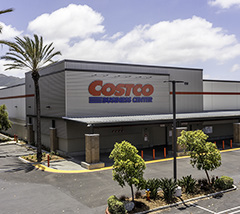
57
Overview
People
Climate
Biodiversity
and Nature
Resource
Management
KPIs
and Metrics
Appendix
Costco 2025 Sustainability Report
Using Less Water in
Landscaping
In our existing warehouses, we are
reviewing the feasibility of replacing
landscaping with surfaces and features
that use less water. This photo shows
an example of a parking area that has
been redesigned. Updates also can
include drip irrigation systems. New
warehouse sites are designed with
water-efficient landscaping in mind.
Wastewater
and Stormwater
Management
Each U.S. Costco location has wastewater
and stormwater plans and procedures
designed to comply with local and federal
regulations. We have a team of Environmental
Sustainability and Compliance Managers
throughout the U.S. who, in partnership with
our corporate water team, work directly with
all locations to track and respond to water
waste or quality concerns. International
locations have taken examples from the
U.S. and are applying smart approaches in
their local jurisdictions to improve waste and
stormwater management.
Examples of Water
Efficiency and Savings
We continue to seek big and small ways
to save water in our operations. Here are
some examples:
• In some of our U.S. Food Courts, we are
upgrading the way we safely clean the pots
and pans used to prepare food. A new
high-efficiency dishwasher uses 197 fewer
gallons a day versus the previous system,
while requiring less energy and labor hours
as well. So far, we have installed 385 new
dishwashers since program inception.
• In 23 Mexico locations, all water used in
the warehouses (e.g., bathrooms, fresh
food areas) goes from the drains to on-
site small treatment plants, instead of the
sewer. This treated water is then used for
Cutting Water Use at Car Washes
Our approach to water management
and stewardship is informed by globally
accepted frameworks developed by
the World Wildlife Fund (WWF), the
CEO Water Mandate, and other leading
nongovernmental organizations (NGOs) and
multinational corporations that have built
and implemented impactful programs.
We reduce wastewater in our on-site car washes in these ways:
• Digital water metering identifies spikes in usage that indicate a potential leak or
equipment malfunction. With real-time monitoring, these spikes can be addressed
immediately.
• Every wash has a reclaim system to filter and recycle water to be used for everything
that does not require fresh water.
• Water main shut-off valves are utilized when the car wash is not in use.
• All car washes strictly follow water usage permits and requirements.
In fiscal year (FY) 2023, we were able to improve the washing process, enabling us to
eliminate the “rain bars” at the entrance of the car wash. This saves millions of gallons
of water annually.
site irrigation. This reduces the impact on
local sewer systems — and it saves us
money on irrigation costs.
• In Australia, rainwater is captured and
stored on-site for use in toilets, cooling
refrigeration systems and irrigation.
• In the Los Angeles region, we use a water
capture system to catch rainwater and
refrigeration condensate, which is stored
on-site in large, underground cisterns. This
water is used for irrigation. If the tanks are
ever completely full the location issues the
water back to the city.
• In our regional office in Kisarazu, Japan,
rainwater is captured in an underground
storage tank for irrigation and flushing
toilets. Up to about 27,000 gallons of
rainwater, collected from gutters at the
rooftop and fourth floor terrace, can be
stored underground.
Water Management
and Stewardship
We have expanded our global water strategy
to include a water stewardship initiative.
This initiative builds on learnings from our
operational water management program and
will expand to include engagement with our
suppliers and diverse stakeholders through
collective action initiatives and platforms.
We aim to collaborate with stakeholders
that share the same watershed, focusing on
sustainable solutions.
We also continue to expand our operational
water management program through efficiency
initiatives and improvements in wastewater
quality and stormwater discharges.
Water Conservation
| Waste Reduction | Packaging | Construction | Chemical Management
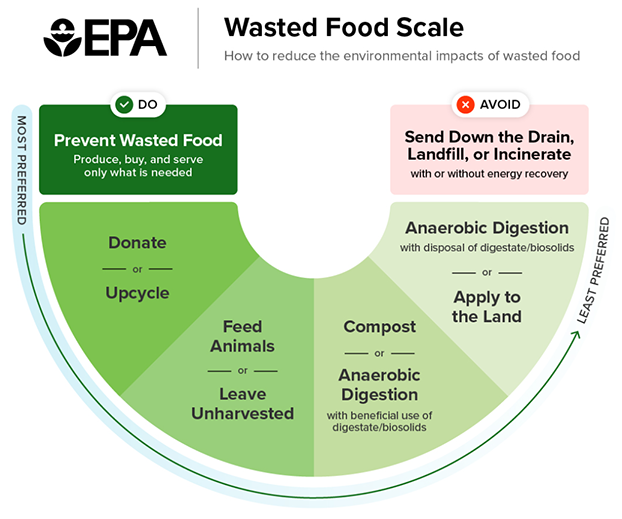
58
Overview
People
Climate
Biodiversity
and Nature
Resource
Management
KPIs
and Metrics
Appendix
Costco 2025 Sustainability Report
Our aim is to continually decrease the
amount of waste going to landfills, with a
goal to divert 80%.
Effective waste diversion helps conserve
natural resources, save energy, cut expenses
and reduce emissions. We define waste
diversion as the total tons (measured in
U.S. tons) of waste that is not directly
dumped into landfill sites or burned at
incineration facilities that do not create
energy. (We include waste to energy as part
of our diversion program.) Other diversion
examples include donations, anaerobic
digestion, recycling, composting and
animal feed.
We continue to examine our waste disposal
programs to maximize efficiency and reduce
costs. In FY25, Costco diverted 82.8% of
our waste from landfills, exceeding our goal
of 80%. For detailed information and data
on our donations and other diversion efforts,
as well as our waste emissions tracking, see
our annual
Global Waste Stream Report
.
Costco is committed to expanding these
programs through partnerships, enhanced
efficiencies and emerging technologies.
Reducing Food Waste
We take a variety of steps to keep food
out of landfills, whether it’s by creating a
new product, donating it to people who
are food insecure, feeding it to animals, or
composting. For food waste, we follow the
Wasted Food Scale
, as defined by the U.S.
Environmental Protection Agency.
Food Waste Prevention
One way of reducing food waste in our
operations is by using quality food in-house
to create new items for our members. These
products change from time to time and by
location as we seek creative new ideas.
For example, unsold rotisserie chickens
are made into deli items such as chicken
noodle soup, pot pies, enchiladas and fajita
quesadillas to reflect local tastes.
Likewise, ground beef from the U.S. meat
departments is used for stuffed peppers and
meatloaf in the deli, and for shepherd’s pie
and stuffed bell peppers in Canada.
All in all, our goal is to keep quality food out
of landfills.
Waste Reduction
Costco understands our potential impact on the
global waste stream and emissions caused by
waste generated within our operations.
Wasted Food Scale graphic
courtesy of the United States Environmental Protection Agency (EPA).
Water Conservation |
Waste Reduction
| Packaging | Construction | Chemical Management
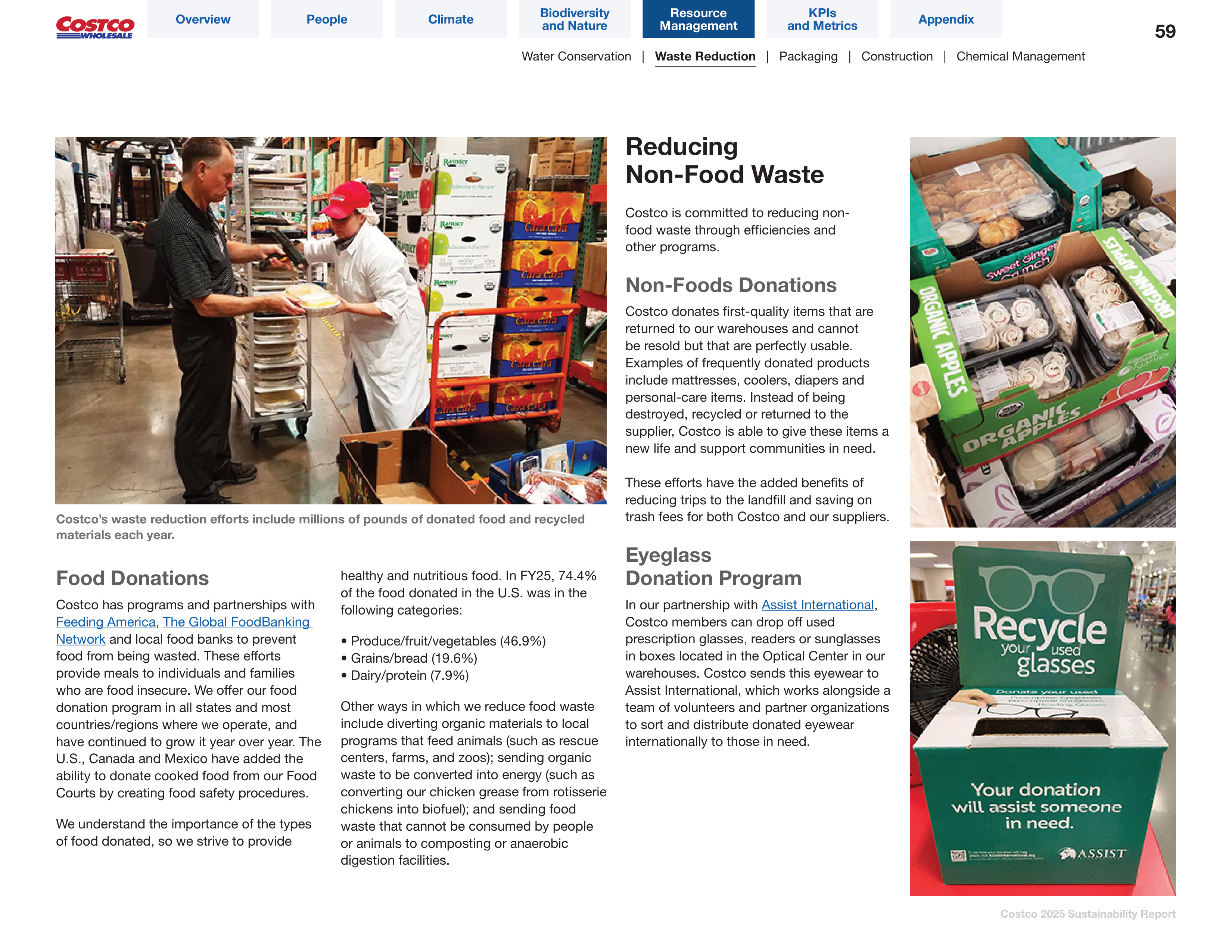
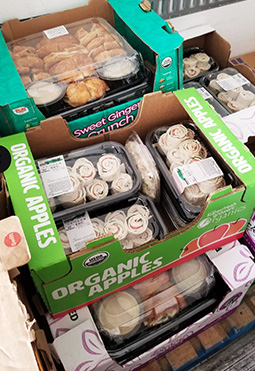
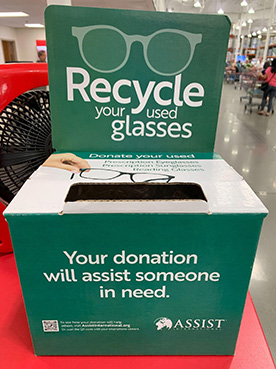
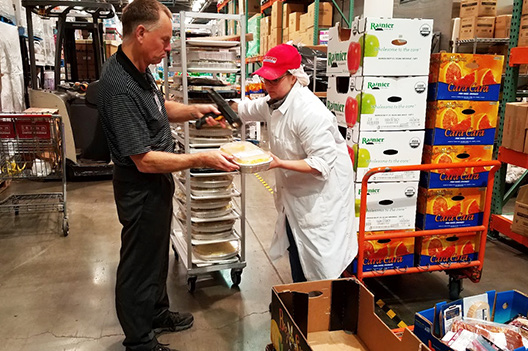
59
Overview
People
Climate
Biodiversity
and Nature
Resource
Management
KPIs
and Metrics
Appendix
Costco 2025 Sustainability Report
Food Donations
Costco has programs and partnerships with
Feeding America
,
The Global FoodBanking
Network
and local food banks to prevent
food from being wasted. These efforts
provide meals to individuals and families
who are food insecure. We offer our food
donation program in all states and most
countries/regions where we operate, and
have continued to grow it year over year. The
U.S., Canada and Mexico have added the
ability to donate cooked food from our Food
Courts by creating food safety procedures.
We understand the importance of the types
of food donated, so we strive to provide
Reducing
Non-Food Waste
Costco is committed to reducing non-
food waste through efficiencies and
other programs.
Non-Foods Donations
Costco donates first-quality items that are
returned to our warehouses and cannot
be resold but that are perfectly usable.
Examples of frequently donated products
include mattresses, coolers, diapers and
personal-care items. Instead of being
destroyed, recycled or returned to the
supplier, Costco is able to give these items a
new life and support communities in need.
These efforts have the added benefits of
reducing trips to the landfill and saving on
trash fees for both Costco and our suppliers.
Eyeglass
Donation Program
In our partnership with
Assist International
,
Costco members can drop off used
prescription glasses, readers or sunglasses
in boxes located in the Optical Center in our
warehouses. Costco sends this eyewear to
Assist International, which works alongside a
team of volunteers and partner organizations
to sort and distribute donated eyewear
internationally to those in need.
Costco’s waste reduction efforts include millions of pounds of donated food and recycled
materials each year.
healthy and nutritious food. In FY25, 74.4%
of the food donated in the U.S. was in the
following categories:
• Produce/fruit/vegetables (46.9%)
• Grains/bread (19.6%)
• Dairy/protein (7.9%)
Other ways in which we reduce food waste
include diverting organic materials to local
programs that feed animals (such as rescue
centers, farms, and zoos); sending organic
waste to be converted into energy (such as
converting our chicken grease from rotisserie
chickens into biofuel); and sending food
waste that cannot be consumed by people
or animals to composting or anaerobic
digestion facilities.
Water Conservation |
Waste Reduction
| Packaging | Construction | Chemical Management
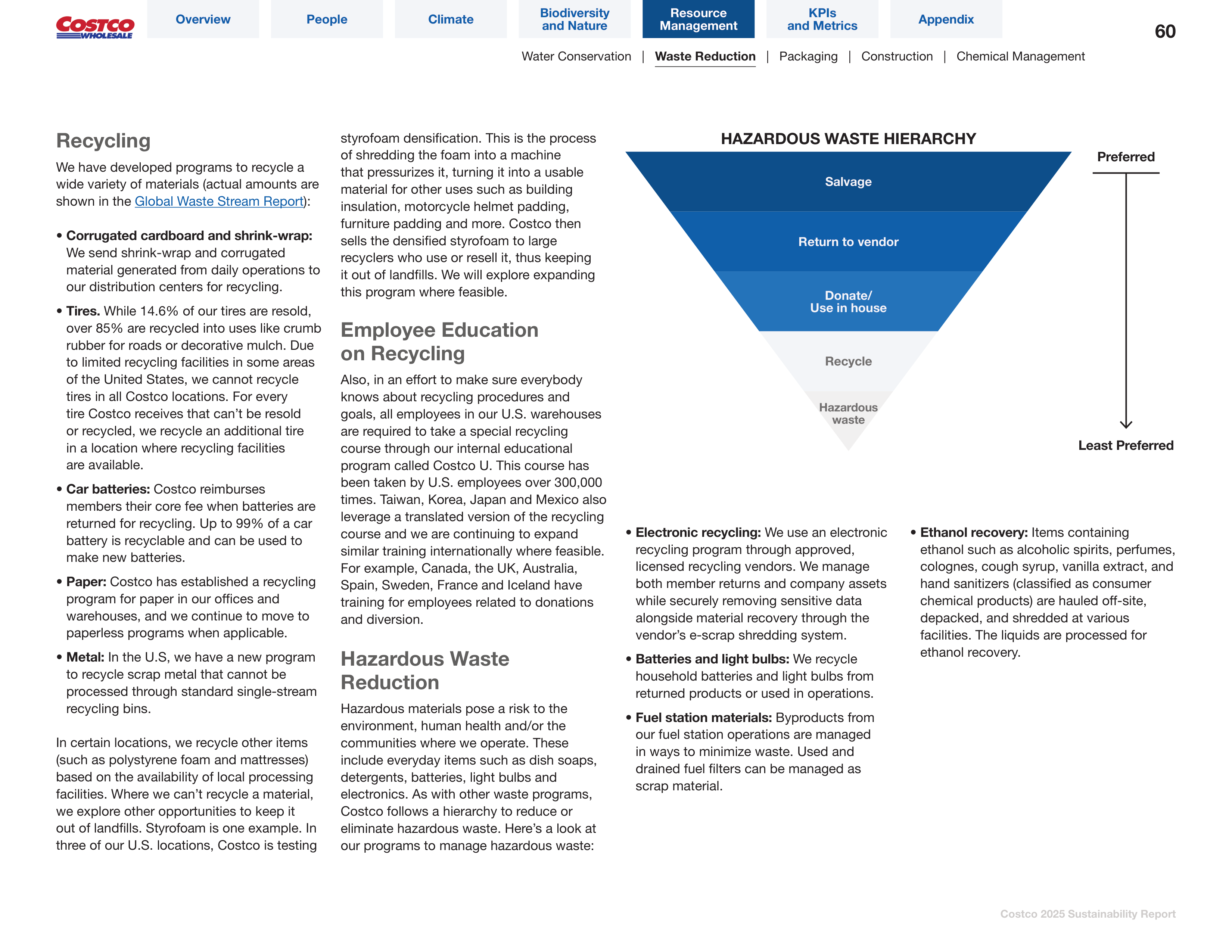
60
Overview
People
Climate
Biodiversity
and Nature
Resource
Management
KPIs
and Metrics
Appendix
Costco 2025 Sustainability Report
Recycling
We have developed programs to recycle a
wide variety of materials (actual amounts are
shown in the
Global Waste Stream Report
):
•
Corrugated cardboard and shrink-wrap:
We send shrink-wrap and corrugated
material generated from daily operations to
our distribution centers for recycling.
•
Tires.
While 14.6% of our tires are resold,
over 85% are recycled into uses like crumb
rubber for roads or decorative mulch. Due
to limited recycling facilities in some areas
of the United States, we cannot recycle
tires in all Costco locations. For every
tire Costco receives that can’t be resold
or recycled, we recycle an additional tire
in a location where recycling facilities
are available.
•
Car batteries:
Costco reimburses
members their core fee when batteries are
returned for recycling. Up to 99% of a car
battery is recyclable and can be used to
make new batteries.
•
Paper:
Costco has established a recycling
program for paper in our offices and
warehouses, and we continue to move to
paperless programs when applicable.
•
Metal:
In the U.S, we have a new program
to recycle scrap metal that cannot be
processed through standard single-stream
recycling bins.
In certain locations, we recycle other items
(such as polystyrene foam and mattresses)
based on the availability of local processing
facilities. Where we can’t recycle a material,
we explore other opportunities to keep it
out of landfills. Styrofoam is one example. In
three of our U.S. locations, Costco is testing
styrofoam densification. This is the process
of shredding the foam into a machine
that pressurizes it, turning it into a usable
material for other uses such as building
insulation, motorcycle helmet padding,
furniture padding and more. Costco then
sells the densified styrofoam to large
recyclers who use or resell it, thus keeping
it out of landfills. We will explore expanding
this program where feasible.
Employee Education
on Recycling
Also, in an effort to make sure everybody
knows about recycling procedures and
goals, all employees in our U.S. warehouses
are required to take a special recycling
course through our internal educational
program called Costco U. This course has
been taken by U.S. employees over 300,000
times. Taiwan, Korea, Japan and Mexico also
leverage a translated version of the recycling
course and we are continuing to expand
similar training internationally where feasible.
For example, Canada, the UK, Australia,
Spain, Sweden, France and Iceland have
training for employees related to donations
and diversion.
Hazardous Waste
Reduction
Hazardous materials pose a risk to the
environment, human health and/or the
communities where we operate. These
include everyday items such as dish soaps,
detergents, batteries, light bulbs and
electronics. As with other waste programs,
Costco follows a hierarchy to reduce or
eliminate hazardous waste. Here’s a look at
our programs to manage hazardous waste:
•
Electronic recycling:
We use an electronic
recycling program through approved,
licensed recycling vendors. We manage
both member returns and company assets
while securely removing sensitive data
alongside material recovery through the
vendor’s e-scrap shredding system.
•
Batteries and light bulbs:
We recycle
household batteries and light bulbs from
returned products or used in operations.
•
Fuel station materials:
Byproducts from
our fuel station operations are managed
in ways to minimize waste. Used and
drained fuel filters can be managed as
scrap material.
HAZARDOUS WASTE HIERARCHY
Salvage
Return to vendor
Recycle
Hazardous
waste
Donate/
Use in house
Preferred
Least Preferred
•
Ethanol recovery:
Items containing
ethanol such as alcoholic spirits, perfumes,
colognes, cough syrup, vanilla extract, and
hand sanitizers (classified as consumer
chemical products) are hauled off-site,
depacked, and shredded at various
facilities. The liquids are processed for
ethanol recovery.
Water Conservation |
Waste Reduction
| Packaging | Construction | Chemical Management

61
Overview
People
Climate
Biodiversity
and Nature
Resource
Management
KPIs
and Metrics
Appendix
Costco 2025 Sustainability Report
Packaging
Costco’s goal is to reduce our packaging waste
while maintaining food safety, product quality and
minimal damage to products during shipping.
Our Packaging
Approach
Packaging plays an important role in
the delivery of goods. Packaging must
protect the product, help provide shelf-life
benefits, contribute to efficient logistics
and distribution, comply with laws and
regulations, and communicate effectively
with our members, all without compromising
on food safety, product quality, or
product sales.
We strive to reduce our packaging waste
by improving our efficiencies and making
continual improvements to the mix of
materials used. We carefully evaluate and
test potential solutions to understand our
packaging impacts through data, Life Cycle
Assessments (LCAs) and testing, all the
while confirming that product integrity and
safety will be maintained.
While our priority focus is on our Kirkland
Signature
TM
products, we also share our
packaging approach and strategy with
branded suppliers at our annual Supplier
Day event with the intent of providing
guidance on how to implement this
packaging plan. We also strive to learn
from our suppliers as they improve their
packaging and share their success stories,
and then incorporate what we learn from
them into our own efforts.
This approach is based on our key principles
for packaging, which we call the
Six Rights
of Packaging Sustainability
:
•
The Right Reduction:
Using less
conserves natural resources while
reducing water use, greenhouse gases and
pollution.
•
The Right Amount of Post-Consumer
Recycled Content (PCR):
Using recycled
content creates more demand for
recycled materials.
1
•
The Right Fiber – Tree-Free or
Certified Forest Product:
Responsible
forestry supports biodiversity, carbon
sequestration, water and air quality.
•
The Right Recyclable Packaging:
Recycling conserves natural resources and
reduces pollution.
•
The Right Certified Compostable
Packaging:
Composting puts valuable
nutrients back into our soils and offers
an option for packaging that can’t easily
be recycled.
•
The Right Labeling:
Labeling
facilitates proper sortation and reduces
contamination of the recycling stream.
See
Packaging
on our website for more on
the Six Rights of Packaging Sustainability.
What is a Life Cycle Assessment?
in our packaging program, a
life cycle assessment (LCA)
is an assessment that
measures the environmental impact of a package starting from extraction of raw
materials, through the production of a package, to end-of-life scenarios (such as
recycling or landfill).
Multiple indicators are assessed including how much water and fossil fuel is used
in the production of the package; what is the GWP (global warming or emissions)
potential, and a number of other indicators that may be measured to determine the
overall impact of a package.
1
As used herein, the term “recycled content” is based on supplier-reported data and may contain a mix of post-consumer and post-
industrial recycled content.
Water Conservation | Waste Reduction |
Packaging
| Construction | Chemical Management
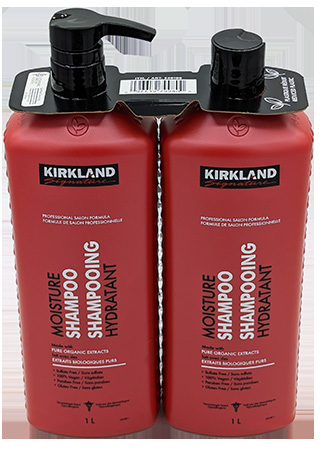






62
Overview
People
Climate
Biodiversity
and Nature
Resource
Management
KPIs
and Metrics
Appendix
Costco 2025 Sustainability Report
Costco continues to expand our use of pressed-paper
packaging to replace plastic carrier handles. The pressed
paper versions are recyclable, easier to remove, and effective
at protecting multipack products during shipping and stacking.
Originating from a collaboration started in 2021 with Smurfit
Westrock, a sustainability-focused packaging company,
we have expanded usage of pressed-paper carrier handles
to more products such as personal care items, bottled
beverages, and jars of sauces and condiments. In FY24 alone,
converting our handles for Kirkland Signature oils from plastic
to recyclable handles saved 166,556 pounds of plastic.
In FY25, we began using the pressed-paper carrier handles for select products in
global locations such as Kirkland Signature shampoo and conditioner multipacks
in Canada. We will continue to replace plastic carrier handles with pressed paper
where feasible.
Pressed-Paper Handles Expand
to More Products Reduction
Kirkland Signature
Packaging Strategy
With Kirkland Signature
TM
packaging,
we continue to refine and improve our
packaging globally by taking the following
deliberate steps within a holistic approach.
Improving Packaging Data
Costco surveys packaging suppliers to
collect data that identifies and accounts for
the specific materials used in all packaging
components for our Kirkland Signature
products. Suppliers assist us in collecting
this information for the purposes of
developing comprehensive strategies and
to identify areas of improvement. In FY24,
we expanded our data collection scope
to include in-house packaged goods from
our Fresh Departments. In FY25, we added
ecommerce shipping packaging to our data
survey. Each year, we continue to improve
our packaging data based on supplier input.
Leveraging Individual
Packaging Analysis
Using the packaging data, a packaging
configuration undergoes an individual
evaluation to assess its components
(Individual Packaging Analysis). This
evaluation helps determine whether each
component is essential or if it can be
replaced with an alternative material that
does not increase environmental impact, as
validated by our LCAs. Additionally, each
component is assessed using its emissions
factor formula to gauge its actual carbon
impact. The insights from this analysis are
used by Costco buying teams to identify
areas of continuous improvement for many
Kirkland Signature products.
Promoting Opportunities
to Build in Circularity
We promote circularity by looking for
opportunities to design for recycling and
recovery. This work includes ensuring
the packaging we select is recyclable on
a widespread basis as well as finding a
way to utilize our own recovered materials
in new packaging or products (either for
Costco or in collaboration with suppliers).
An example of our focus on circularity is our
pallet wrap collection program in our daily
operations. We collect our stretch wrap and
provide it to our Kirkland Signature trash
bag supplier to incorporate the recovered
plastic into the manufacturing of trash bags.
This helps reduce the use of virgin plastic
in our products.
Collaborating with the
Industry on Improvements
We recognize that to make significant
change, collaboration on a broad scale
is necessary. We engage with a variety of
respected industry organizations such as
the Sustainable Packaging Coalition
®
(SPC),
The Recycling Partnership
®
, Association of
Plastic Recyclers
®
, Biodegradable Products
Institute (BPI)
®
, How2Recycle
®
and others.
These organizations help us stay up to date
on the latest innovations in sustainable
packaging and circularity.
Partnerships in Packaging
Costco is a member of the following organizations, which are dedicated to increasing
sustainable practices in the innovation, production and/or management of packaging.
Water Conservation | Waste Reduction |
Packaging
| Construction | Chemical Management
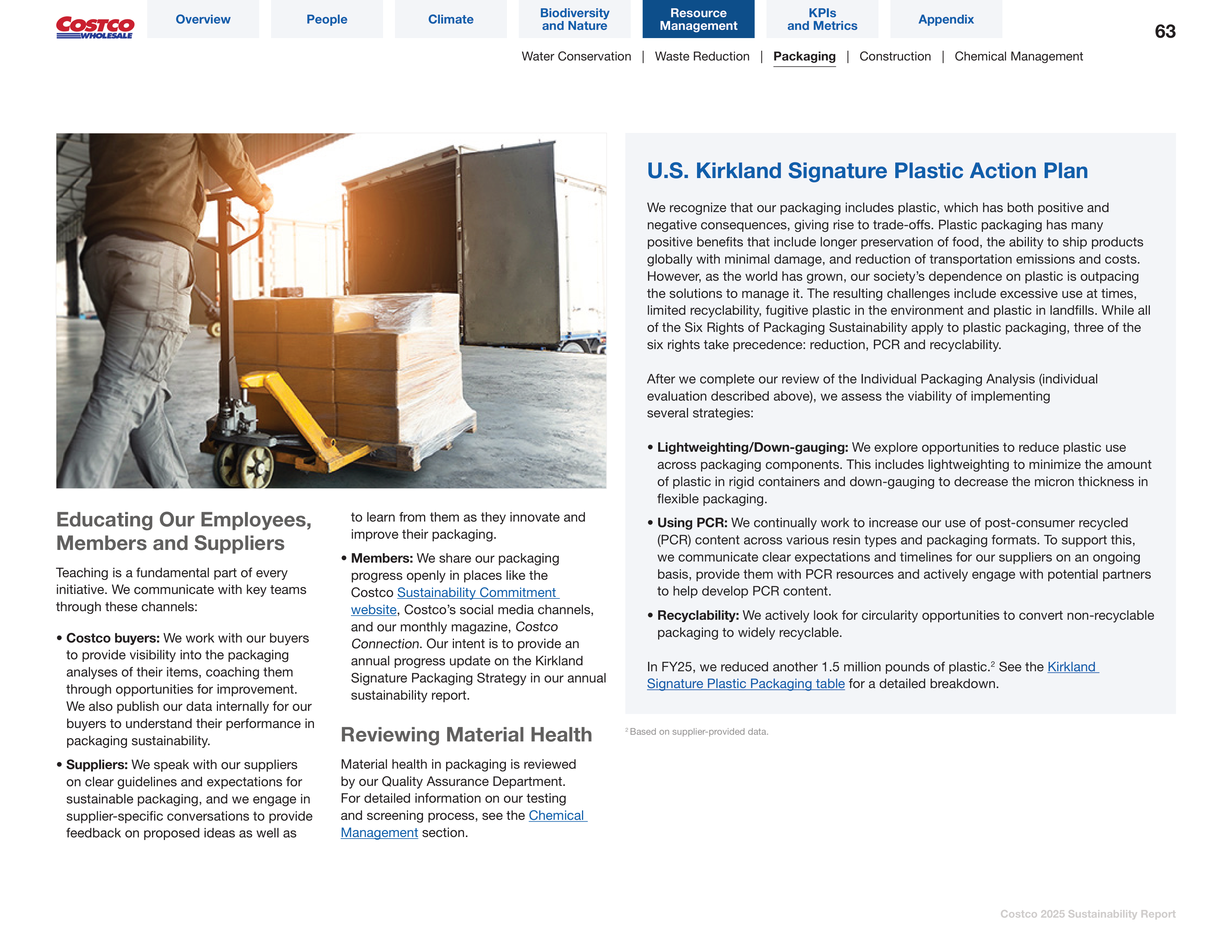

63
Overview
People
Climate
Biodiversity
and Nature
Resource
Management
KPIs
and Metrics
Appendix
Costco 2025 Sustainability Report
Educating Our Employees,
Members and Suppliers
Teaching is a fundamental part of every
initiative. We communicate with key teams
through these channels:
•
Costco buyers:
We work with our buyers
to provide visibility into the packaging
analyses of their items, coaching them
through opportunities for improvement.
We also publish our data internally for our
buyers to understand their performance in
packaging sustainability.
•
Suppliers:
We speak with our suppliers
on clear guidelines and expectations for
sustainable packaging, and we engage in
supplier-specific conversations to provide
feedback on proposed ideas as well as
U.S. Kirkland Signature Plastic Action Plan
We recognize that our packaging includes plastic, which has both positive and
negative consequences, giving rise to trade-offs. Plastic packaging has many
positive benefits that include longer preservation of food, the ability to ship products
globally with minimal damage, and reduction of transportation emissions and costs.
However, as the world has grown, our society’s dependence on plastic is outpacing
the solutions to manage it. The resulting challenges include excessive use at times,
limited recyclability, fugitive plastic in the environment and plastic in landfills. While all
of the Six Rights of Packaging Sustainability apply to plastic packaging, three of the
six rights take precedence: reduction, PCR and recyclability.
After we complete our review of the Individual Packaging Analysis (individual
evaluation described above), we assess the viability of implementing
several strategies:
•
Lightweighting/Down-gauging:
We explore opportunities to reduce plastic use
across packaging components. This includes lightweighting to minimize the amount
of plastic in rigid containers and down-gauging to decrease the micron thickness in
flexible packaging.
•
Using PCR:
We continually work to increase our use of post-consumer recycled
(PCR) content across various resin types and packaging formats. To support this,
we communicate clear expectations and timelines for our suppliers on an ongoing
basis, provide them with PCR resources and actively engage with potential partners
to help develop PCR content.
•
Recyclability:
We actively look for circularity opportunities to convert non-recyclable
packaging to widely recyclable.
In FY25, we reduced another 1.5 million pounds of plastic.
2
See the
Kirkland
Signature Plastic Packaging table
for a detailed breakdown.
2
Based on supplier-provided data.
to learn from them as they innovate and
improve their packaging.
•
Members:
We share our packaging
progress openly in places like the
Costco
Sustainability Commitment
website
, Costco’s social media channels,
and our monthly magazine, Costco
Connection. Our intent is to provide an
annual progress update on the Kirkland
Signature Packaging Strategy in our annual
sustainability report.
Reviewing Material Health
Material health in packaging is reviewed
by our Quality Assurance Department.
For detailed information on our testing
and screening process, see the
Chemical
Management
section.
Water Conservation | Waste Reduction |
Packaging
| Construction | Chemical Management
64
Overview
People
Climate
Biodiversity
and Nature
Resource
Management
KPIs
and Metrics
Appendix
Costco 2025 Sustainability Report
Costco Reduction Success Stories
Country
Description
FY implemented
Impact in initial year (pounds)
3
U.S.
Removed the plastic tray from Kirkland Signature Pulled Pork.
FY25
173K
U.S., Mexico,
Canada,
Iceland,
Sweden
Converted multiple, additional items from plastic carrier handles to
corrugated, recyclable handles, including expansion to some items
outside the U.S.
FY25
163.5K
U.S.
Converted Kirkland Signature Oil items from plastic carrier handles to
corrugated, recyclable handles.
FY24
166.6K
U.S., Mexico
Replaced a two-piece rigid container with a plastic bag for Kirkland
Signature Rotisserie Chickens.
FY24
15.1M
Multiple
Countries
Moved multiple packaging pieces of Kirkland Signature Dress Shirts
from plastic to paper.
FY24
33.1K
U.S.
Changed the outer wrap on Kirkland Signature Bar Soap from plastic
to paper.
FY24
31.5K
U.S.
Reduced the plastic foam protective packaging of the Kirkland
Signature Driver, Putter and Wedge set by 90%.
FY24
131.7K
South Korea
Removed the plastic label from some Kirkland Signature Bottled
Water items.
FY24
144.3K
Multiple
Countries
Multiple Kirkland Signature Nut and Mixed Nut items changed from a
plastic jar to plastic bag.
FY24
4.6M
Costco Reduction Success Stories
Costco has formally tracked our plastic reduction efforts since FY19, seeking opportunities to reduce our packaging footprint year over year.
In some years, we have achieved large reductions due to new technology, advancements in materials, or progress in our testing. In other
years, our gains have been smaller as we continue to test and seek the next breakthrough. Yet with Costco’s volumes, even the smallest
improvements can create a significant impact.
Here are some specific examples of our successes in reducing plastic over the last few years.
3
Plastic reduction in initial year as shown. Due to variability in product availability and sales year over year, we do not typically share a cumulative estimate for our plastic reductions across multiple years. However, reductions in previous years continue to provide
benefits over time.
Water Conservation | Waste Reduction |
Packaging
| Construction | Chemical Management
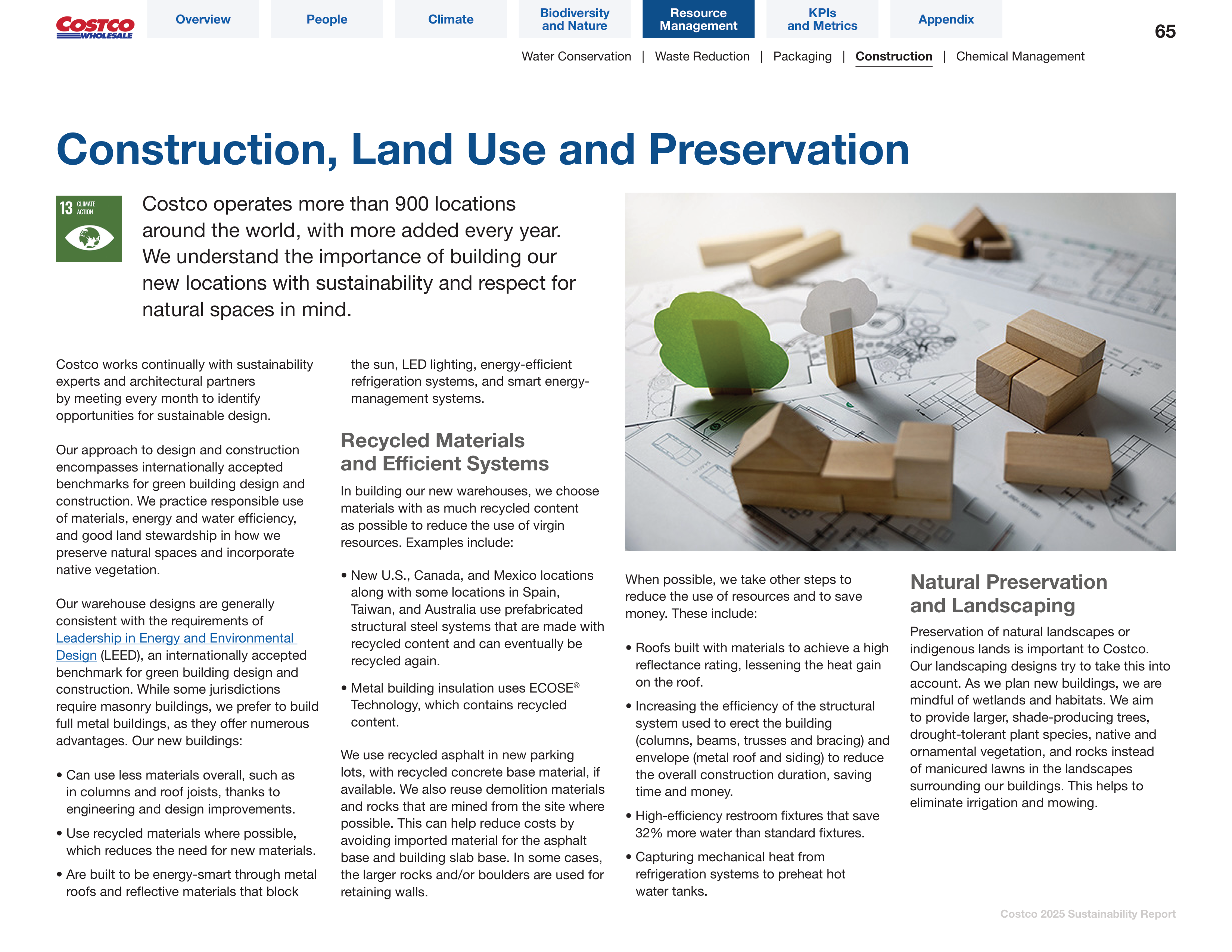

65
Overview
People
Climate
Biodiversity
and Nature
Resource
Management
KPIs
and Metrics
Appendix
Costco 2025 Sustainability Report
Construction, Land Use and Preservation
Costco operates more than 900 locations
around the world, with more added every year.
We understand the importance of building our
new locations with sustainability and respect for
natural spaces in mind.
Costco works continually with sustainability
experts and architectural partners
by meeting every month to identify
opportunities for sustainable design.
Our approach to design and construction
encompasses internationally accepted
benchmarks for green building design and
construction. We practice responsible use
of materials, energy and water efficiency,
and good land stewardship in how we
preserve natural spaces and incorporate
native vegetation.
Our warehouse designs are generally
consistent with the requirements of
Leadership in Energy and Environmental
Design
(LEED), an internationally accepted
benchmark for green building design and
construction. While some jurisdictions
require masonry buildings, we prefer to build
full metal buildings, as they offer numerous
advantages. Our new buildings:
• Can use less materials overall, such as
in columns and roof joists, thanks to
engineering and design improvements.
• Use recycled materials where possible,
which reduces the need for new materials.
• Are built to be energy-smart through metal
roofs and reflective materials that block
the sun, LED lighting, energy-efficient
refrigeration systems, and smart energy-
management systems.
Recycled Materials
and Efficient Systems
In building our new warehouses, we choose
materials with as much recycled content
as possible to reduce the use of virgin
resources. Examples include:
• New U.S., Canada, and Mexico locations
along with some locations in Spain,
Taiwan, and Australia use prefabricated
structural steel systems that are made with
recycled content and can eventually be
recycled again.
• Metal building insulation uses ECOSE
®
Technology, which contains recycled
content.
We use recycled asphalt in new parking
lots, with recycled concrete base material, if
available. We also reuse demolition materials
and rocks that are mined from the site where
possible. This can help reduce costs by
avoiding imported material for the asphalt
base and building slab base. In some cases,
the larger rocks and/or boulders are used for
retaining walls.
When possible, we take other steps to
reduce the use of resources and to save
money. These include:
• Roofs built with materials to achieve a high
reflectance rating, lessening the heat gain
on the roof.
• Increasing the efficiency of the structural
system used to erect the building
(columns, beams, trusses and bracing) and
envelope (metal roof and siding) to reduce
the overall construction duration, saving
time and money.
• High-efficiency restroom fixtures that save
32% more water than standard fixtures.
• Capturing mechanical heat from
refrigeration systems to preheat hot
water tanks.
Natural Preservation
and Landscaping
Preservation of natural landscapes or
indigenous lands is important to Costco.
Our landscaping designs try to take this into
account. As we plan new buildings, we are
mindful of wetlands and habitats. We aim
to provide larger, shade-producing trees,
drought-tolerant plant species, native and
ornamental vegetation, and rocks instead
of manicured lawns in the landscapes
surrounding our buildings. This helps to
eliminate irrigation and mowing.
Water Conservation | Waste Reduction | Packaging |
Construction
| Chemical Management

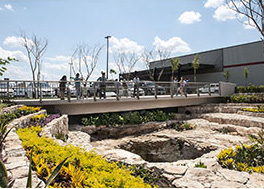
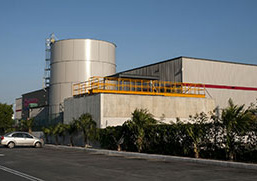
66
Overview
People
Climate
Biodiversity
and Nature
Resource
Management
KPIs
and Metrics
Appendix
Costco 2025 Sustainability Report
To help reduce emissions from
our construction-based activities,
Costco is actively engaged in
exploring the use of materials
in concrete that contain higher
percentages of lower-carbon
materials — for example,
limestone, slag, and fly ash,
as well as other materials that
address the goal of reducing the
overall carbon footprint of our
construction projects.
These efforts help reduce our
footprint in a way that is positive
for the environment and also reflect
the direction that the construction
industry is pursuing.
In FY25, Costco selected six pilot
projects to begin testing the use of
lower-carbon concrete in footings,
foundations, and some site
concrete such as curb, gutter and
sidewalks. At present, supply and
competitive factors related to lower-
carbon concrete is a challenge.
That said, Costco’s intent is to
expand testing at up to 12 more
sites in FY26.
Exploring Lower
Carbon Concrete
Building with Nature in Mind
Several Costco buildings around the world are designed to use energy wisely, conserve
water and preserve natural spaces. Here are some examples.
MERIDA, MEXICO
Preservation of natural landscapes or indigenous lands is important to Costco; our
landscaping designs try to take this into account. For example, the Merida, Mexico
location has a cenote (a natural sinkhole filled with groundwater) on-site that was
restored and rehabilitated. It is named Kakutzal, a Mayan word meaning “back to life”or
“rebirth.” Onlookers can view the natural feature from above on an interpretive plaza.
The site also features an on-site wastewater treatment plant (foreground, with yellow
rail) and water tank (background).
ICELAND
Iceland’s geothermal system produces hot water that provides space heating and supplies
hot water throughout our warehouse. This system also facilitates snowmelt to free up
sidewalks and key areas in front of the building, including the gas station forecourt (filling
area) and the freight area ramp.
Water Conservation | Waste Reduction | Packaging |
Construction
| Chemical Management
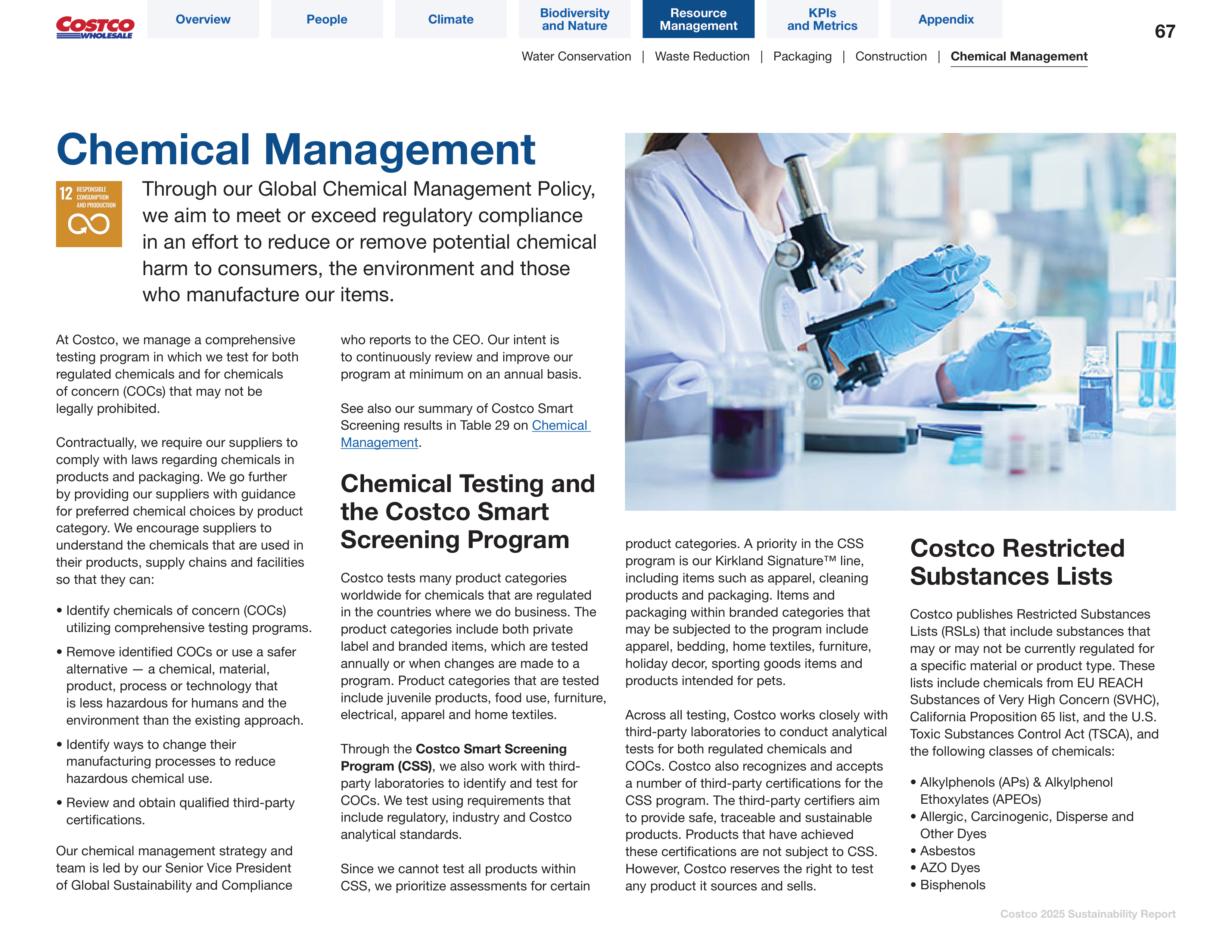

67
Overview
People
Climate
Biodiversity
and Nature
Resource
Management
KPIs
and Metrics
Appendix
Costco 2025 Sustainability Report
Chemical Management
Through our Global Chemical Management Policy,
we aim to meet or exceed regulatory compliance
in an effort to reduce or remove potential chemical
harm to consumers, the environment and those
who manufacture our items.
At Costco, we manage a comprehensive
testing program in which we test for both
regulated chemicals and for chemicals
of concern (COCs) that may not be
legally prohibited.
Contractually, we require our suppliers to
comply with laws regarding chemicals in
products and packaging. We go further
by providing our suppliers with guidance
for preferred chemical choices by product
category. We encourage suppliers to
understand the chemicals that are used in
their products, supply chains and facilities
so that they can:
• Identify chemicals of concern (COCs)
utilizing comprehensive testing programs.
• Remove identified COCs or use a safer
alternative — a chemical, material,
product, process or technology that
is less hazardous for humans and the
environment than the existing approach.
• Identify ways to change their
manufacturing processes to reduce
hazardous chemical use.
• Review and obtain qualified third-party
certifications.
Our chemical management strategy and
team is led by our Senior Vice President
of Global Sustainability and Compliance
who reports to the CEO. Our intent is
to continuously review and improve our
program at minimum on an annual basis.
See also our summary of Costco Smart
Screening results in Table 29 on
Chemical
Management
.
Chemical Testing and
the Costco Smart
Screening Program
Costco tests many product categories
worldwide for chemicals that are regulated
in the countries where we do business. The
product categories include both private
label and branded items, which are tested
annually or when changes are made to a
program. Product categories that are tested
include juvenile products, food use, furniture,
electrical, apparel and home textiles.
Through the
Costco Smart Screening
Program (CSS)
, we also work with third-
party laboratories to identify and test for
COCs. We test using requirements that
include regulatory, industry and Costco
analytical standards.
Since we cannot test all products within
CSS, we prioritize assessments for certain
product categories. A priority in the CSS
program is our Kirkland Signature™ line,
including items such as apparel, cleaning
products and packaging. Items and
packaging within branded categories that
may be subjected to the program include
apparel, bedding, home textiles, furniture,
holiday decor, sporting goods items and
products intended for pets.
Across all testing, Costco works closely with
third-party laboratories to conduct analytical
tests for both regulated chemicals and
COCs. Costco also recognizes and accepts
a number of third-party certifications for the
CSS program. The third-party certifiers aim
to provide safe, traceable and sustainable
products. Products that have achieved
these certifications are not subject to CSS.
However, Costco reserves the right to test
any product it sources and sells.
Water Conservation | Waste Reduction | Packaging | Construction |
Chemical Management
Costco Restricted
Substances Lists
Costco publishes Restricted Substances
Lists (RSLs) that include substances that
may or may not be currently regulated for
a specific material or product type. These
lists include chemicals from EU REACH
Substances of Very High Concern (SVHC),
California Proposition 65 list, and the U.S.
Toxic Substances Control Act (TSCA), and
the following classes of chemicals:
• Alkylphenols (APs) & Alkylphenol
Ethoxylates (APEOs)
• Allergic, Carcinogenic, Disperse and
Other Dyes
• Asbestos
• AZO Dyes
• Bisphenols
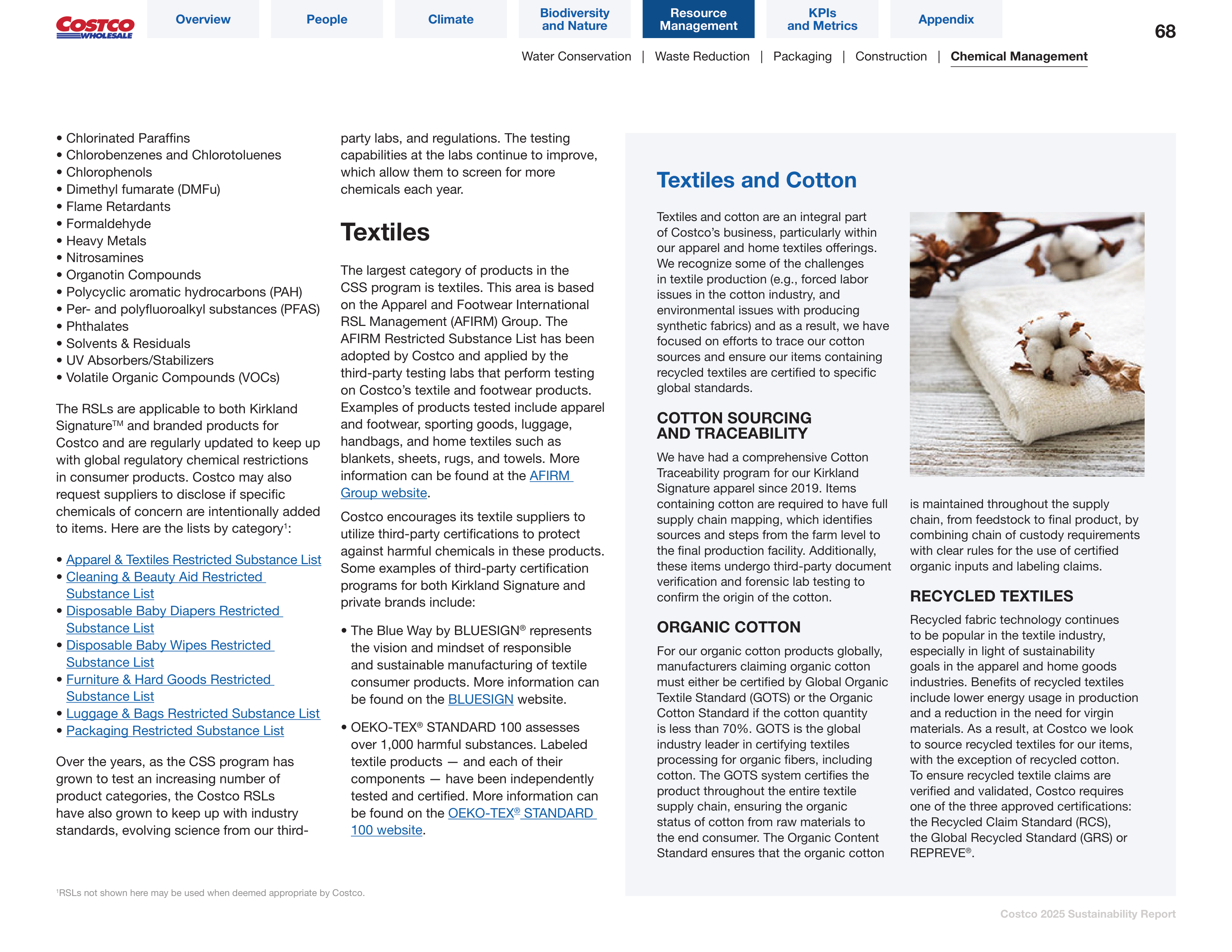

68
Overview
People
Climate
Biodiversity
and Nature
Resource
Management
KPIs
and Metrics
Appendix
Costco 2025 Sustainability Report
party labs, and regulations. The testing
capabilities at the labs continue to improve,
which allow them to screen for more
chemicals each year.
Textiles
The largest category of products in the
CSS program is textiles. This area is based
on the Apparel and Footwear International
RSL Management (AFIRM) Group. The
AFIRM Restricted Substance List has been
adopted by Costco and applied by the
third-party testing labs that perform testing
on Costco’s textile and footwear products.
Examples of products tested include apparel
and footwear, sporting goods, luggage,
handbags, and home textiles such as
blankets, sheets, rugs, and towels. More
information can be found at the
AFIRM
Group website
.
Costco encourages its textile suppliers to
utilize third-party certifications to protect
against harmful chemicals in these products.
Some examples of third-party certification
programs for both Kirkland Signature and
private brands include:
• The Blue Way by BLUESIGN
®
represents
the vision and mindset of responsible
and sustainable manufacturing of textile
consumer products. More information can
be found on the
BLUESIGN
website.
• OEKO-TEX
®
STANDARD 100 assesses
over 1,000 harmful substances. Labeled
textile products — and each of their
components — have been independently
tested and certified. More information can
be found on the
OEKO-TEX
®
STANDARD
100 website
.
1
RSLs not shown here may be used when deemed appropriate by Costco.
Textiles and cotton are
an integral part
of Costco’s business, particularly within
our apparel and home textiles offerings.
We recognize some of the challenges
in textile production (e.g., forced labor
issues in the cotton industry, and
environmental issues with producing
synthetic fabrics) and as a result, we have
focused on efforts to trace our cotton
sources and ensure our items containing
recycled textiles are certified to specific
global standards.
COTTON SOURCING
AND TRACEABILITY
We have had a comprehensive Cotton
Traceability program for our Kirkland
Signature apparel since 2019. Items
containing cotton are required to have full
supply chain mapping, which identifies
sources and steps from the farm level to
the final production facility. Additionally,
these items undergo third-party document
verification and forensic lab testing to
confirm the origin of the cotton.
ORGANIC COTTON
For our organic cotton products globally,
manufacturers claiming organic cotton
must either be certified by Global Organic
Textile Standard (GOTS) or the Organic
Cotton Standard if the cotton quantity
is less than 70%. GOTS is the global
industry leader in certifying textiles
processing for organic fibers, including
cotton. The GOTS system certifies the
product throughout the entire textile
supply chain, ensuring the organic
status of cotton from raw materials to
the end consumer. The Organic Content
Standard ensures that the organic cotton
Textiles and Cotton
is maintained throughout the supply
chain, from feedstock to final product, by
combining chain of custody requirements
with clear rules for the use of certified
organic inputs and labeling claims.
RECYCLED TEXTILES
Recycled fabric technology continues
to be popular in the textile industry,
especially in light of sustainability
goals in the apparel and home goods
industries. Benefits of recycled textiles
include lower energy usage in production
and a reduction in the need for virgin
materials. As a result, at Costco we look
to source recycled textiles for our items,
with the exception of recycled cotton.
To ensure recycled textile claims are
verified and validated, Costco requires
one of the three approved certifications:
the Recycled Claim Standard (RCS),
the Global Recycled Standard (GRS) or
REPREVE
®
.
Water Conservation | Waste Reduction | Packaging | Construction |
Chemical Management
• Chlorinated Paraffins
• Chlorobenzenes and Chlorotoluenes
• Chlorophenols
• Dimethyl fumarate (DMFu)
• Flame Retardants
• Formaldehyde
• Heavy Metals
• Nitrosamines
• Organotin Compounds
• Polycyclic aromatic hydrocarbons (PAH)
• Per- and polyfluoroalkyl substances (PFAS)
• Phthalates
• Solvents & Residuals
• UV Absorbers/Stabilizers
• Volatile Organic Compounds (VOCs)
The RSLs are applicable to both Kirkland
Signature
TM
and branded products for
Costco and are regularly updated to keep up
with global regulatory chemical restrictions
in consumer products. Costco may also
request suppliers to disclose if specific
chemicals of concern are intentionally added
to items. Here are the lists by category
1
:
•
Apparel & Textiles Restricted Substance List
•
Cleaning & Beauty Aid Restricted
Substance List
•
Disposable Baby Diapers Restricted
Substance List
•
Disposable Baby Wipes Restricted
Substance List
•
Furniture & Hard Goods Restricted
Substance List
•
Luggage & Bags Restricted Substance List
•
Packaging Restricted Substance List
Over the years, as the CSS program has
grown to test an increasing number of
product categories, the Costco RSLs
have also grown to keep up with industry
standards, evolving science from our third-
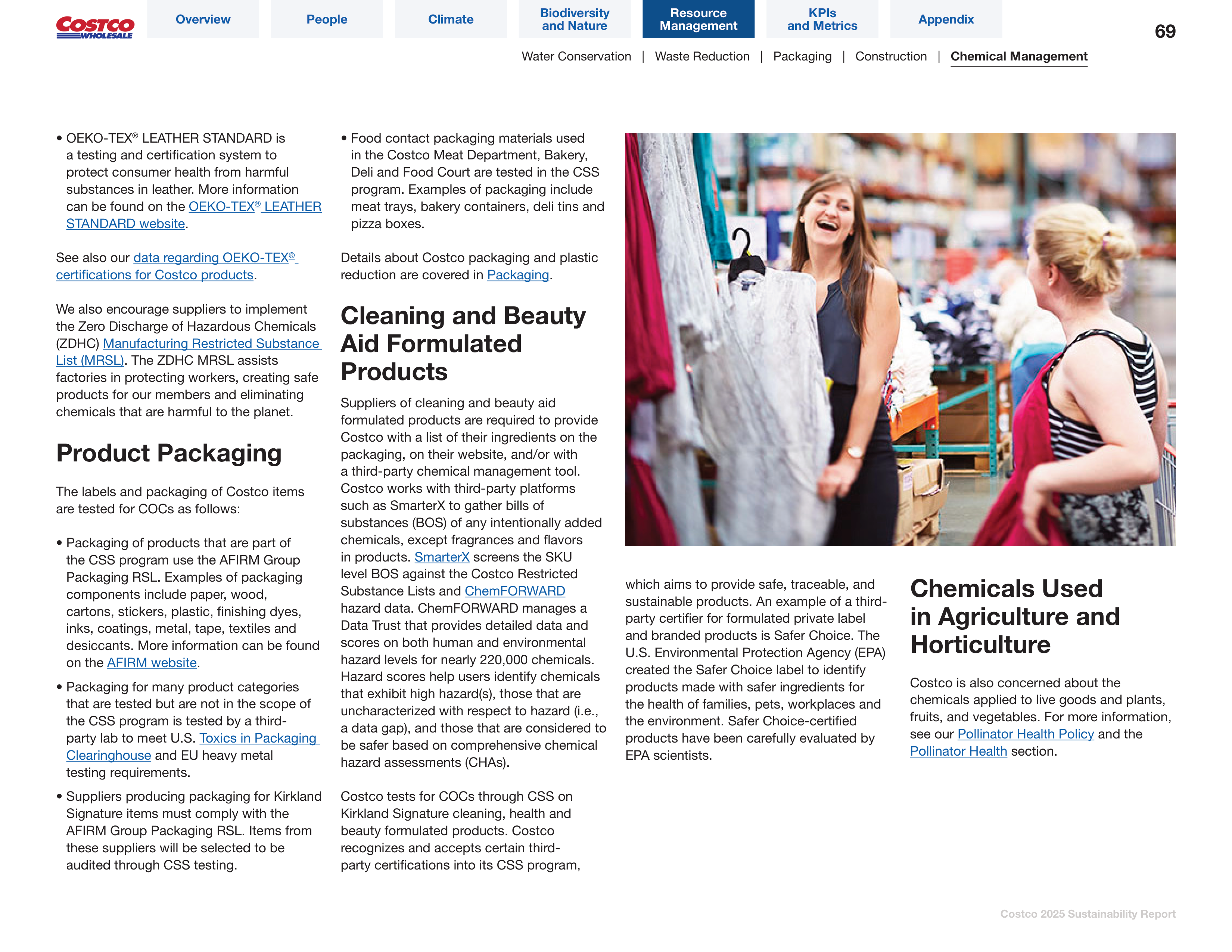

69
Overview
People
Climate
Biodiversity
and Nature
Resource
Management
KPIs
and Metrics
Appendix
Costco 2025 Sustainability Report
• OEKO-TEX
®
LEATHER STANDARD is
a testing and certification system to
protect consumer health from harmful
substances in leather. More information
can be found on the
OEKO-TEX
®
LEATHER
STANDARD website
.
See also our
data regarding OEKO-TEX
®
certifications for Costco products
.
We also encourage suppliers to implement
the Zero Discharge of Hazardous Chemicals
(ZDHC)
Manufacturing Restricted Substance
List (MRSL)
. The ZDHC MRSL assists
factories in protecting workers, creating safe
products for our members and eliminating
chemicals that are harmful to the planet.
Product Packaging
The labels and packaging of Costco items
are tested for COCs as follows:
• Packaging of products that are part of
the CSS program use the AFIRM Group
Packaging RSL. Examples of packaging
components include paper, wood,
cartons, stickers, plastic, finishing dyes,
inks, coatings, metal, tape, textiles and
desiccants. More information can be found
on the
AFIRM website
.
• Packaging for many product categories
that are tested but are not in the scope of
the CSS program is tested by a third-
party lab to meet U.S.
Toxics in Packaging
Clearinghouse
and EU heavy metal
testing requirements.
• Suppliers producing packaging for Kirkland
Signature items must comply with the
AFIRM Group Packaging RSL. Items from
these suppliers will be selected to be
audited through CSS testing.
• Food contact packaging materials used
in the Costco Meat Department, Bakery,
Deli and Food Court are tested in the CSS
program. Examples of packaging include
meat trays, bakery containers, deli tins and
pizza boxes.
Details about Costco packaging and plastic
reduction are covered in
Packaging
.
Cleaning and Beauty
Aid Formulated
Products
Suppliers of cleaning and beauty aid
formulated products are required to provide
Costco with a list of their ingredients on the
packaging, on their website, and/or with
a third-party chemical management tool.
Costco works with third-party platforms
such as SmarterX to gather bills of
substances (BOS) of any intentionally added
chemicals, except fragrances and flavors
in products.
SmarterX
screens the SKU
level BOS against the Costco Restricted
Substance Lists and
ChemFORWARD
hazard data. ChemFORWARD manages a
Data Trust that provides detailed data and
scores on both human and environmental
hazard levels for nearly 220,000 chemicals.
Hazard scores help users identify chemicals
that exhibit high hazard(s), those that are
uncharacterized with respect to hazard (i.e.,
a data gap), and those that are considered to
be safer based on comprehensive chemical
hazard assessments (CHAs).
Costco tests for COCs through CSS on
Kirkland Signature cleaning, health and
beauty formulated products. Costco
recognizes and accepts certain third-
party certifications into its CSS program,
Water Conservation | Waste Reduction | Packaging | Construction |
Chemical Management
which aims to provide safe, traceable, and
sustainable products. An example of a third-
party certifier for formulated private label
and branded products is Safer Choice. The
U.S. Environmental Protection Agency (EPA)
created the Safer Choice label to identify
products made with safer ingredients for
the health of families, pets, workplaces and
the environment. Safer Choice-certified
products have been carefully evaluated by
EPA scientists.
Chemicals Used
in Agriculture and
Horticulture
Costco is also concerned about the
chemicals applied to live goods and plants,
fruits, and vegetables. For more information,
see our
Pollinator Health Policy
and the
Pollinator Health
section.
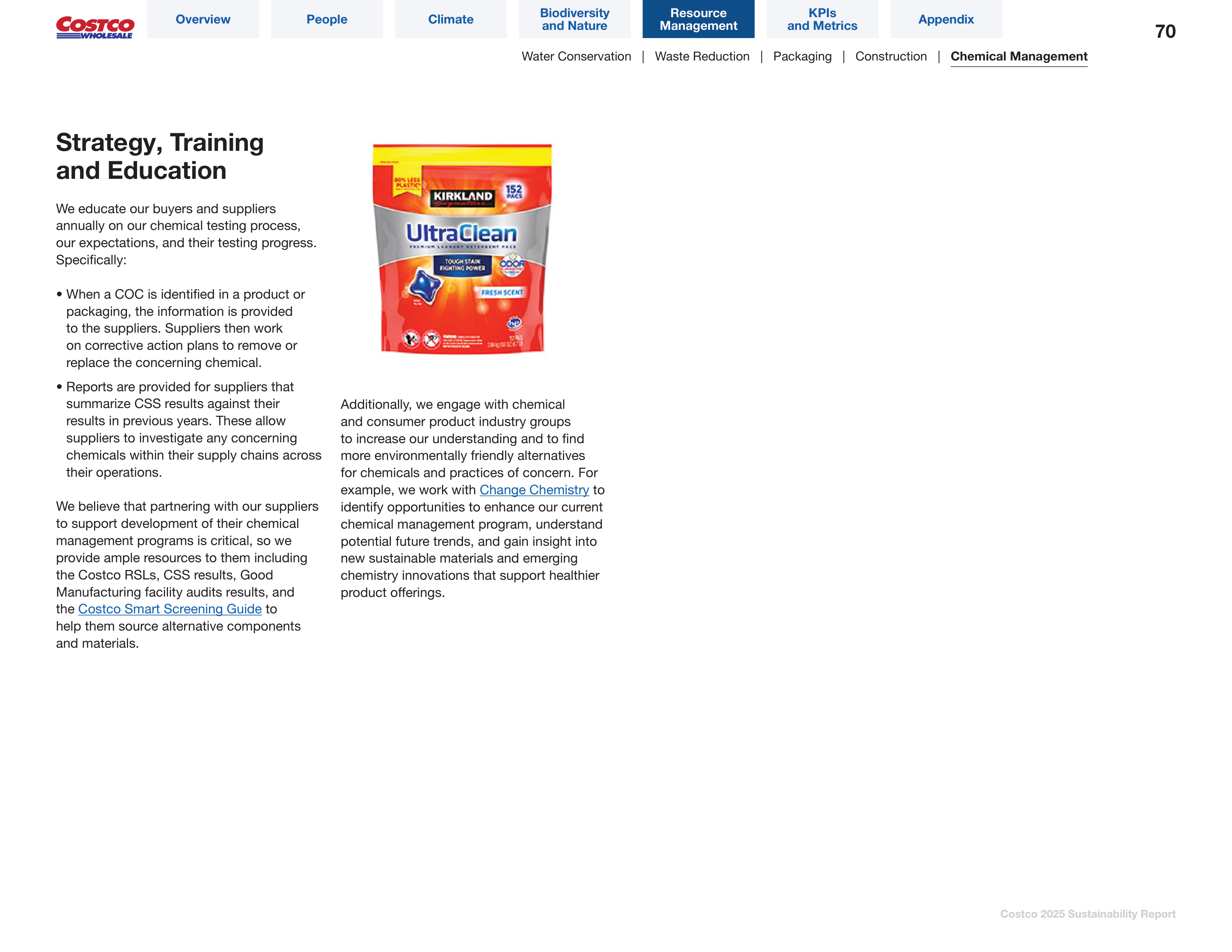
70
Overview
People
Climate
Biodiversity
and Nature
Resource
Management
KPIs
and Metrics
Appendix
Costco 2025 Sustainability Report
Additionally, we engage with chemical
and consumer product industry groups
to increase our understanding and to find
more environmentally friendly alternatives
for chemicals and practices of concern. For
example, we work with
Change Chemistry
to
identify opportunities to enhance our current
chemical management program, understand
potential future trends, and gain insight into
new sustainable materials and emerging
chemistry innovations that support healthier
product offerings.
Strategy, Training
and Education
We educate our buyers and suppliers
annually on our chemical testing process,
our expectations, and their testing progress.
Specifically:
• When a COC is identified in a product or
packaging, the information is provided
to the suppliers. Suppliers then work
on corrective action plans to remove or
replace the concerning chemical.
• Reports are provided for suppliers that
summarize CSS results against their
results in previous years. These allow
suppliers to investigate any concerning
chemicals within their supply chains across
their operations.
We believe that partnering with our suppliers
to support development of their chemical
management programs is critical, so we
provide ample resources to them including
the Costco RSLs, CSS results, Good
Manufacturing facility audits results, and
the
Costco Smart Screening Guide
to
help them source alternative components
and materials.
Water Conservation | Waste Reduction | Packaging | Construction |
Chemical Management
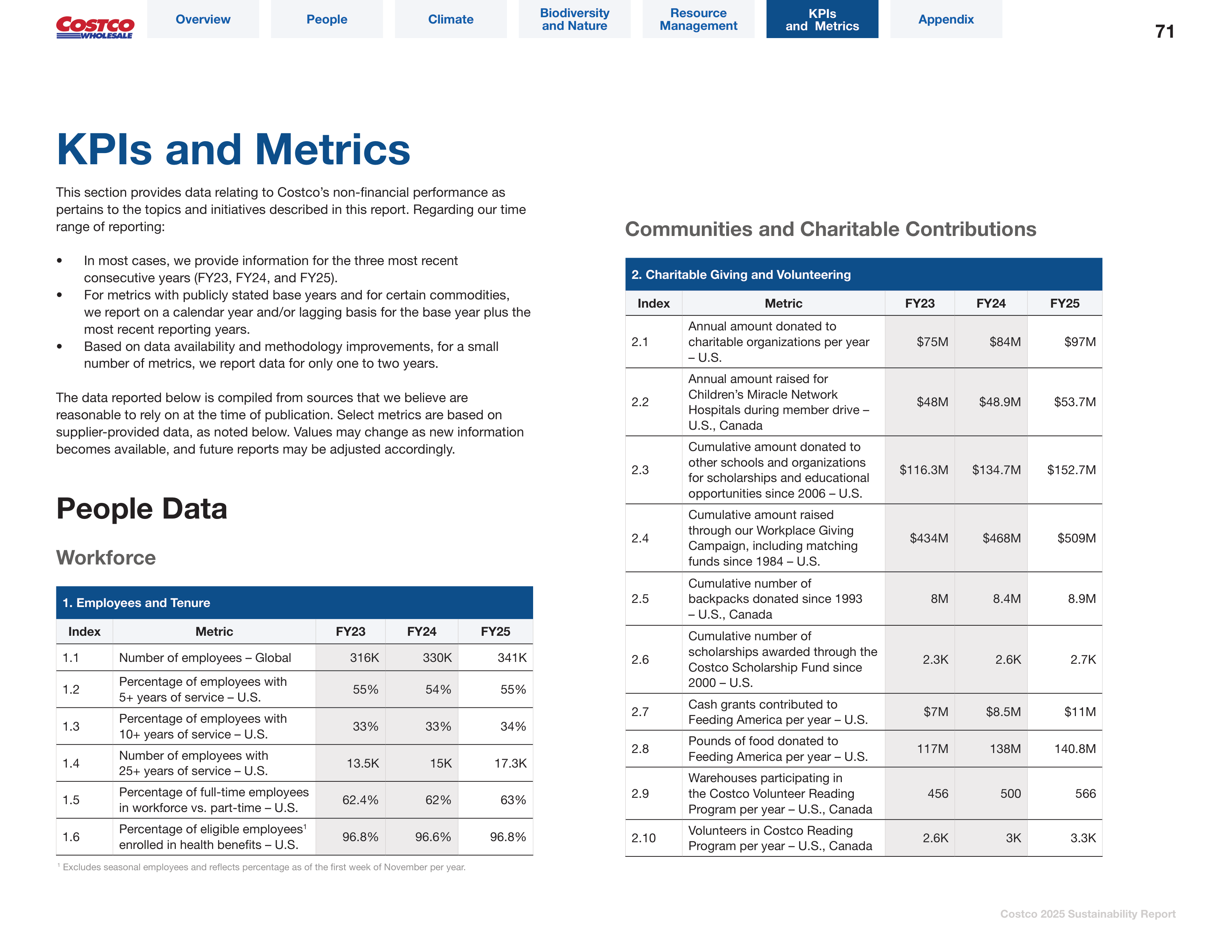
71
Overview
People
Climate
Biodiversity
and Nature
KPIs
and Metrics
Resource
Management
Appendix
Costco 2025 Sustainability Report
KPIs and Metrics
This section provides data relating to Costco’s non-financial performance as
pertains to the topics and initiatives described in this report. Regarding our time
range of reporting:
•
In most cases, we provide information for the three most recent
consecutive years (FY23, FY24, and FY25).
•
For metrics with publicly stated base years and for certain commodities,
we report on a calendar year and/or lagging basis for the base year plus the
most recent reporting years.
•
Based on data availability and methodology improvements, for a small
number of metrics, we report data for only one to two years.
The data reported below is compiled from sources that we believe are
reasonable to rely on at the time of publication. Select metrics are based on
supplier-provided data, as noted below. Values may change as new information
becomes available, and future reports may be adjusted accordingly.
People Data
Workforce
1. Employees and Tenure
Index
Metric
FY23
FY24
FY25
1.1
Number of employees – Global
316K
330K
341K
1.2
Percentage of employees with
5+ years of service – U.S.
55%
54%
55%
1.3
Percentage of employees with
10+ years of service – U.S.
33%
33%
34%
1.4
Number of employees with
25+ years of service – U.S.
13.5K
15K
17.3K
1.5
Percentage of full-time employees
in workforce vs. part-time – U.S.
62.4%
62%
63%
1.6
Percentage of eligible employees
1
enrolled in health benefits – U.S.
96.8%
96.6%
96.8%
Communities and Charitable Contributions
2. Charitable Giving and Volunteering
Index
Metric
FY23
FY24
FY25
2.1
Annual amount donated to
charitable organizations per year
– U.S.
$75M
$84M
$97M
2.2
Annual amount raised for
Children’s Miracle Network
Hospitals during member drive –
U.S., Canada
$48M
$48.9M
$53.7M
2.3
Cumulative amount donated to
other schools and organizations
for scholarships and educational
opportunities since 2006 – U.S.
$116.3M
$134.7M
$152.7M
2.4
Cumulative amount raised
through our Workplace Giving
Campaign, including matching
funds since 1984 – U.S.
$434M
$468M
$509M
2.5
Cumulative number of
backpacks donated since 1993
– U.S., Canada
8M
8.4M
8.9M
2.6
Cumulative number of
scholarships awarded through the
Costco Scholarship Fund since
2000 – U.S.
2.3K
2.6K
2.7K
2.7
Cash grants contributed to
Feeding America per year – U.S.
$7M
$8.5M
$11M
2.8
Pounds of food donated to
Feeding America per year – U.S.
117M
138M
140.8M
2.9
Warehouses participating in
the Costco Volunteer Reading
Program per year – U.S., Canada
456
500
566
2.10
Volunteers in Costco Reading
Program per year – U.S., Canada
2.6K
3K
3.3K
1
Excludes seasonal employees and reflects percentage as of the first week of November per year.
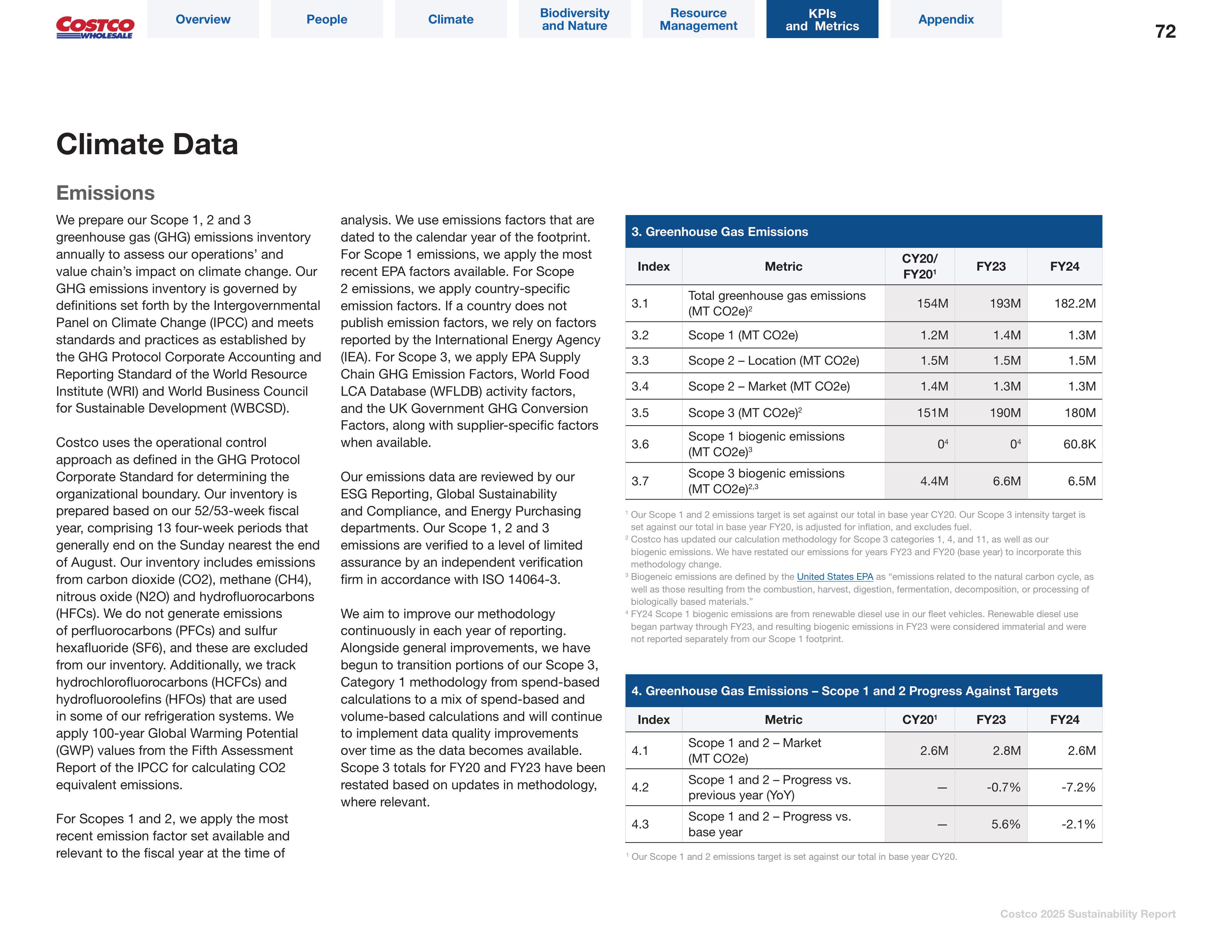
72
Overview
People
Climate
Biodiversity
and Nature
KPIs
and Metrics
Resource
Management
Appendix
Costco 2025 Sustainability Report
Climate Data
Emissions
We prepare our Scope 1, 2 and 3
greenhouse gas (GHG) emissions inventory
annually to assess our operations’ and
value chain’s impact on climate change. Our
GHG emissions inventory is governed by
definitions set forth by the Intergovernmental
Panel on Climate Change (IPCC) and meets
standards and practices as established by
the GHG Protocol Corporate Accounting and
Reporting Standard of the World Resource
Institute (WRI) and World Business Council
for Sustainable Development (WBCSD).
Costco uses the operational control
approach as defined in the GHG Protocol
Corporate Standard for determining the
organizational boundary. Our inventory is
prepared based on our 52/53-week fiscal
year, comprising 13 four-week periods that
generally end on the Sunday nearest the end
of August. Our inventory includes emissions
from carbon dioxide (CO2), methane (CH4),
nitrous oxide (N2O) and hydrofluorocarbons
(HFCs). We do not generate emissions
of perfluorocarbons (PFCs) and sulfur
hexafluoride (SF6), and these are excluded
from our inventory. Additionally, we track
hydrochlorofluorocarbons (HCFCs) and
hydrofluoroolefins (HFOs) that are used
in some of our refrigeration systems. We
apply 100-year Global Warming Potential
(GWP) values from the Fifth Assessment
Report of the IPCC for calculating CO2
equivalent emissions.
For Scopes 1 and 2, we apply the most
recent emission factor set available and
relevant to the fiscal year at the time of
analysis. We use emissions factors that are
dated to the calendar year of the footprint.
For Scope 1 emissions, we apply the most
recent EPA factors available. For Scope
2 emissions, we apply country-specific
emission factors. If a country does not
publish emission factors, we rely on factors
reported by the International Energy Agency
(IEA). For Scope 3, we apply EPA Supply
Chain GHG Emission Factors, World Food
LCA Database (WFLDB) activity factors,
and the UK Government GHG Conversion
Factors, along with supplier-specific factors
when available.
Our emissions data are reviewed by our
ESG Reporting, Global Sustainability
and Compliance, and Energy Purchasing
departments. Our Scope 1, 2 and 3
emissions are verified to a level of limited
assurance by an independent verification
firm in accordance with ISO 14064-3.
We aim to improve our methodology
continuously in each year of reporting.
Alongside general improvements, we have
begun to transition portions of our Scope 3,
Category 1 methodology from spend-based
calculations to a mix of spend-based and
volume-based calculations and will continue
to implement data quality improvements
over time as the data becomes available.
Scope 3 totals for FY20 and FY23 have been
restated based on updates in methodology,
where relevant.
4. Greenhouse Gas Emissions – Scope 1 and 2 Progress Against Targets
Index
Metric
CY20
1
FY23
FY24
4.1
Scope 1 and 2 – Market
(MT CO2e)
2.6M
2.8M
2.6M
4.2
Scope 1 and 2 – Progress vs.
previous year (YoY)
—
-0.7%
-7.2%
4.3
Scope 1 and 2 – Progress vs.
base year
—
5.6%
-2.1%
3. Greenhouse Gas Emissions
Index
Metric
CY20/
FY20
1
FY23
FY24
3.1
Total greenhouse gas emissions
(MT CO2e)
2
154M
193M
182.2M
3.2
Scope 1 (MT CO2e)
1.2M
1.4M
1.3M
3.3
Scope 2 – Location (MT CO2e)
1.5M
1.5M
1.5M
3.4
Scope 2 – Market (MT CO2e)
1.4M
1.3M
1.3M
3.5
Scope 3 (MT CO2e)
2
151M
190M
180M
3.6
Scope 1 biogenic emissions
(MT CO2e)
3
0
4
0
4
60.8K
3.7
Scope 3 biogenic emissions
(MT CO2e)
2,3
4.4M
6.6M
6.5M
1
Our Scope 1 and 2 emissions target is set against our total in base year CY20. Our Scope 3 intensity target is
set against our total in base year FY20, is adjusted for inflation, and excludes fuel.
2
Costco has updated our calculation methodology for Scope 3 categories 1, 4, and 11, as well as our
biogenic emissions. We have restated our emissions for years FY23 and FY20 (base year) to incorporate this
methodology change.
3
Biogeneic emissions are defined by the
United States EPA
as “emissions related to the natural carbon cycle, as
well as those resulting from the combustion, harvest, digestion, fermentation, decomposition, or processing of
biologically based materials.”
4
FY24 Scope 1 biogenic emissions are from renewable diesel use in our fleet vehicles. Renewable diesel use
began partway through FY23, and resulting biogenic emissions in FY23 were considered immaterial and were
not reported separately from our Scope 1 footprint.
1
Our Scope 1 and 2 emissions target is set against our total in base year CY20.
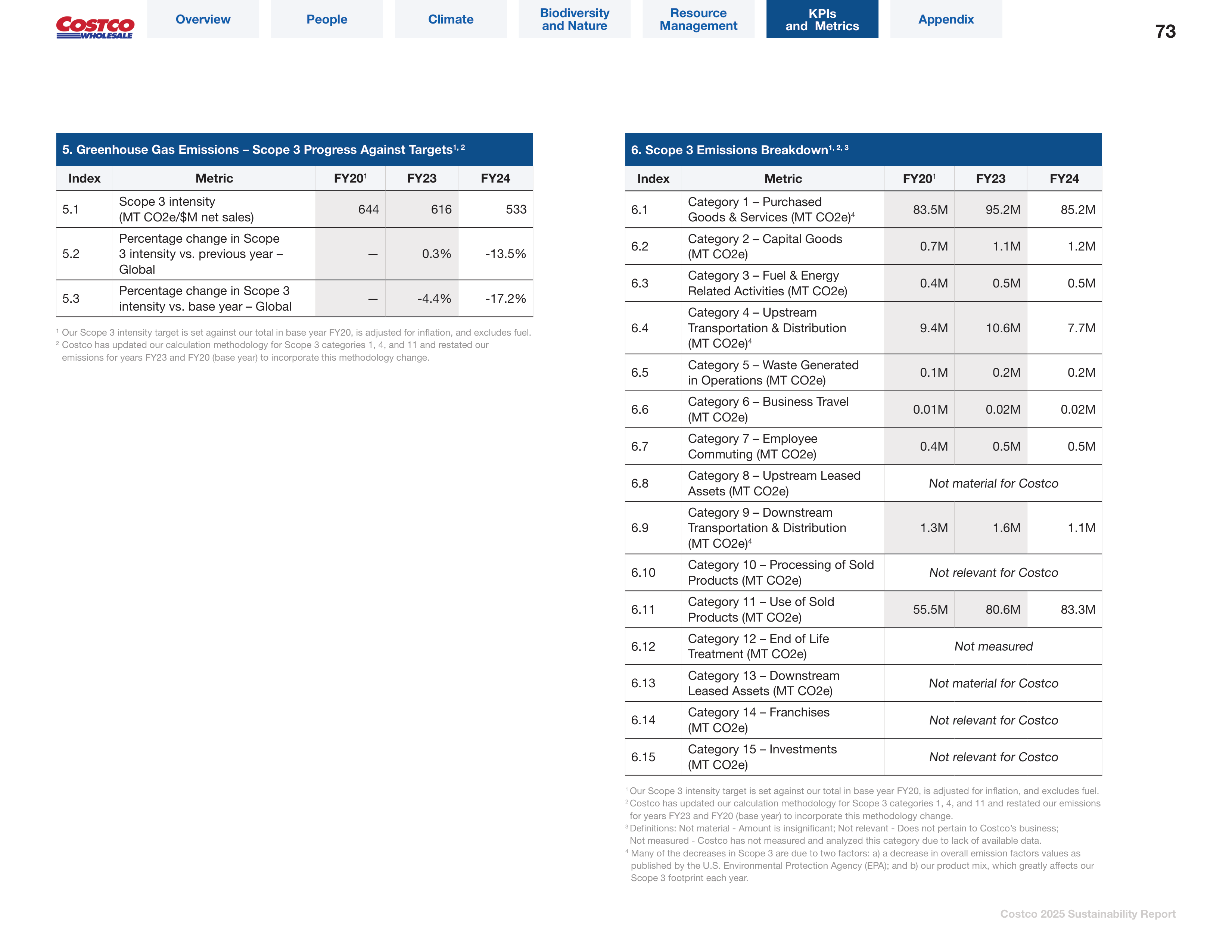
73
Overview
People
Climate
Biodiversity
and Nature
KPIs
and Metrics
Resource
Management
Appendix
Costco 2025 Sustainability Report
5. Greenhouse Gas Emissions – Scope 3 Progress Against Targets
1, 2
Index
Metric
FY20
1
FY23
FY24
5.1
Scope 3 intensity
(MT CO2e/$M net sales)
644
616
533
5.2
Percentage change in Scope
3 intensity vs. previous year –
Global
—
0.3%
-13.5%
5.3
Percentage change in Scope 3
intensity vs. base year – Global
—
-4.4%
-17.2%
1
Our Scope 3 intensity target is set against our total in base year FY20, is adjusted for inflation, and excludes fuel.
2
Costco has updated our calculation methodology for Scope 3 categories 1, 4, and 11 and restated our
emissions for years FY23 and FY20 (base year) to incorporate this methodology change.
6. Scope 3 Emissions Breakdown
1, 2, 3
Index
Metric
FY20
1
FY23
FY24
6.1
Category 1 – Purchased
Goods & Services (MT CO2e)
4
83.5M
95.2M
85.2M
6.2
Category 2 – Capital Goods
(MT CO2e)
0.7M
1.1M
1.2M
6.3
Category 3 – Fuel & Energy
Related Activities (MT CO2e)
0.4M
0.5M
0.5M
6.4
Category 4 – Upstream
Transportation & Distribution
(MT CO2e)
4
9.4M
10.6M
7.7M
6.5
Category 5 – Waste Generated
in Operations (MT CO2e)
0.1M
0.2M
0.2M
6.6
Category 6 – Business Travel
(MT CO2e)
0.01M
0.02M
0.02M
6.7
Category 7 – Employee
Commuting (MT CO2e)
0.4M
0.5M
0.5M
6.8
Category 8 – Upstream Leased
Assets (MT CO2e)
Not material for Costco
6.9
Category 9 – Downstream
Transportation & Distribution
(MT CO2e)
4
1.3M
1.6M
1.1M
6.10
Category 10 – Processing of Sold
Products (MT CO2e)
Not relevant for Costco
6.11
Category 11 – Use of Sold
Products (MT CO2e)
55.5M
80.6M
83.3M
6.12
Category 12 – End of Life
Treatment (MT CO2e)
Not measured
6.13
Category 13 – Downstream
Leased Assets (MT CO2e)
Not material for Costco
6.14
Category 14 – Franchises
(MT CO2e)
Not relevant for Costco
6.15
Category 15 – Investments
(MT CO2e)
Not relevant for Costco
1
Our Scope 3 intensity target is set against our total in base year FY20, is adjusted for inflation, and excludes fuel.
2
Costco has updated our calculation methodology for Scope 3 categories 1, 4, and 11 and restated our emissions
for years FY23 and FY20 (base year) to incorporate this methodology change.
3
Definitions: Not material - Amount is insignificant; Not relevant - Does not pertain to Costco’s business;
Not measured - Costco has not measured and analyzed this category due to lack of available data.
4
Many of the decreases in Scope 3 are due to two factors: a) a decrease in overall emission factors values as
published by the U.S. Environmental Protection Agency (EPA); and b) our product mix, which greatly affects our
Scope 3 footprint each year.
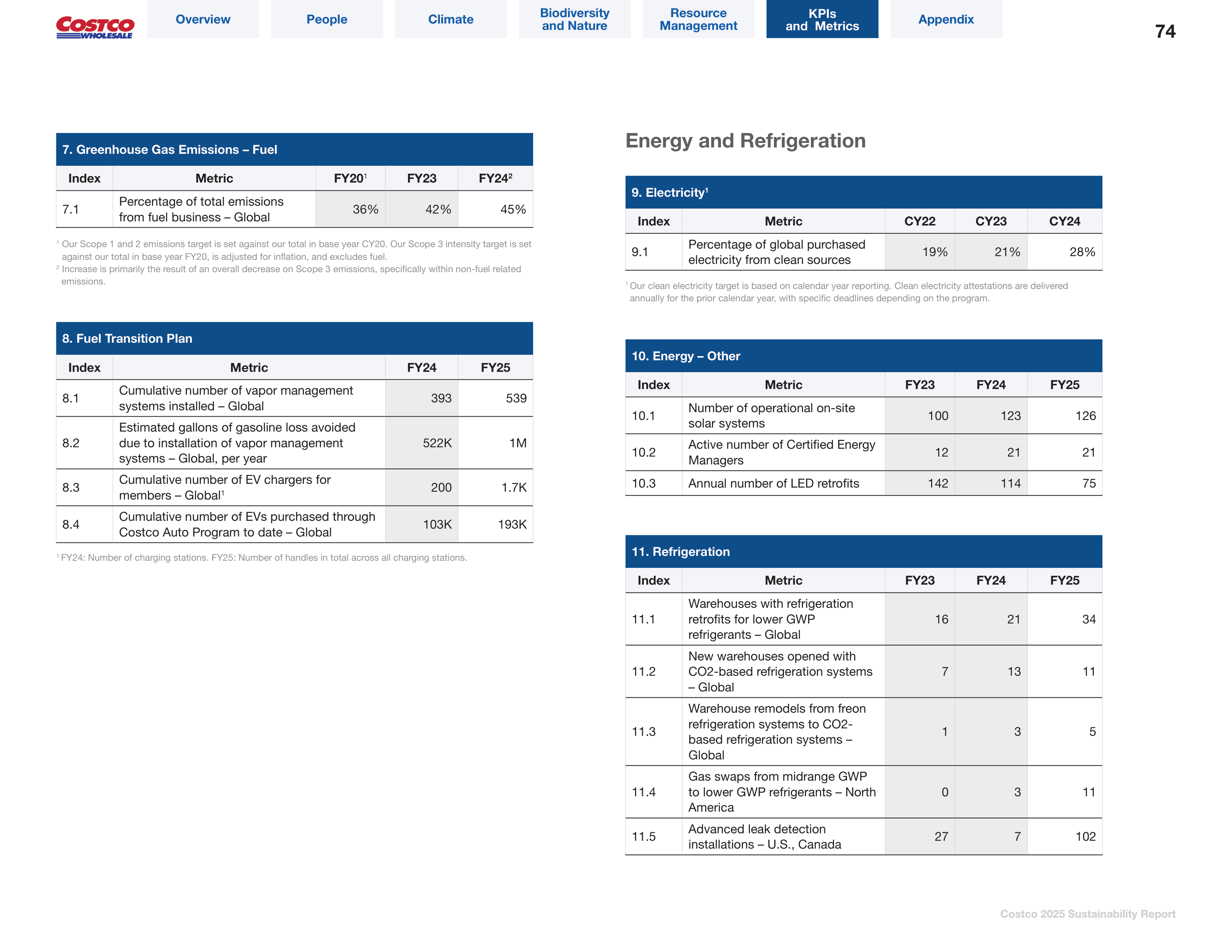
74
Overview
People
Climate
Biodiversity
and Nature
KPIs
and Metrics
Resource
Management
Appendix
Costco 2025 Sustainability Report
Energy and Refrigeration
8. Fuel Transition Plan
Index
Metric
FY24
FY25
8.1
Cumulative number of vapor management
systems installed – Global
393
539
8.2
Estimated gallons of gasoline loss avoided
due to installation of vapor management
systems – Global, per year
522K
1M
8.3
Cumulative number of EV chargers for
members – Global
1
200
1.7K
8.4
Cumulative number of EVs purchased through
Costco Auto Program to date – Global
103K
193K
9. Electricity
1
Index
Metric
CY22
CY23
CY24
9.1
Percentage of global purchased
electricity from clean sources
19%
21%
28%
7. Greenhouse Gas Emissions – Fuel
Index
Metric
FY20
1
FY23
FY24
2
7.1
Percentage of total emissions
from fuel business – Global
36%
42%
45%
10. Energy – Other
Index
Metric
FY23
FY24
FY25
10.1
Number of operational on-site
solar systems
100
123
126
10.2
Active number of Certified Energy
Managers
12
21
21
10.3
Annual number of LED retrofits
142
114
75
11. Refrigeration
Index
Metric
FY23
FY24
FY25
11.1
Warehouses with refrigeration
retrofits for lower GWP
refrigerants – Global
16
21
34
11.2
New warehouses opened with
CO2-based refrigeration systems
– Global
7
13
11
11.3
Warehouse remodels from freon
refrigeration systems to CO2-
based refrigeration systems –
Global
1
3
5
11.4
Gas swaps from midrange GWP
to lower GWP refrigerants – North
America
0
3
11
11.5
Advanced leak detection
installations – U.S., Canada
27
7
102
1
FY24: Number of charging stations. FY25: Number of handles in total across all charging stations.
1
Our Scope 1 and 2 emissions target is set against our total in base year CY20. Our Scope 3 intensity target is set
against our total in base year FY20, is adjusted for inflation, and excludes fuel.
2
Increase is primarily the result of an overall decrease on Scope 3 emissions, specifically within non-fuel related
emissions.
1
Our clean electricity target is based on calendar year reporting. Clean electricity attestations are delivered
annually for the prior calendar year, with specific deadlines depending on the program.
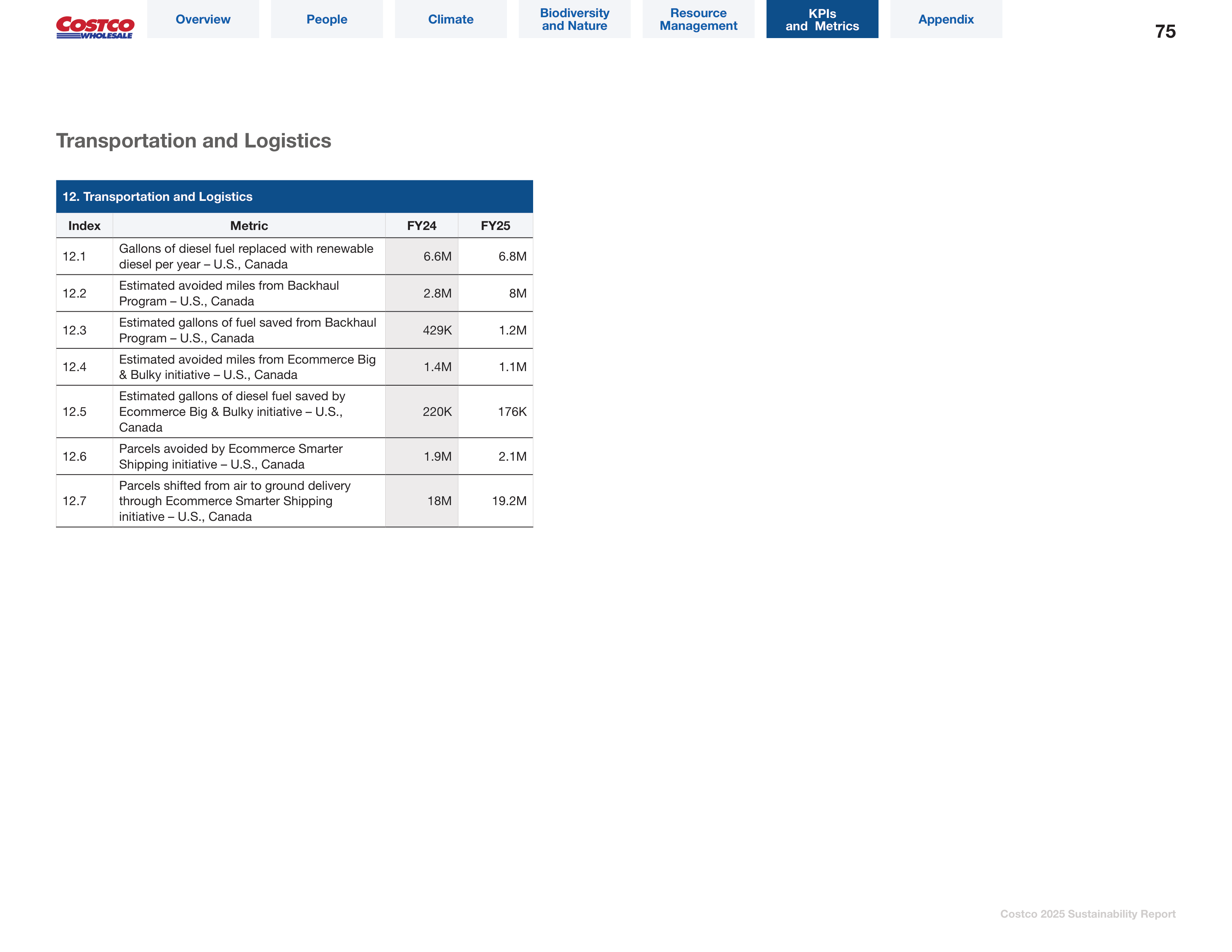
75
Overview
People
Climate
Biodiversity
and Nature
KPIs
and Metrics
Resource
Management
Appendix
Costco 2025 Sustainability Report
Transportation and Logistics
12. Transportation and Logistics
Index
Metric
FY24
FY25
12.1
Gallons of diesel fuel replaced with renewable
diesel per year – U.S., Canada
6.6M
6.8M
12.2
Estimated avoided miles from Backhaul
Program – U.S., Canada
2.8M
8M
12.3
Estimated gallons of fuel saved from Backhaul
Program – U.S., Canada
429K
1.2M
12.4
Estimated avoided miles from Ecommerce Big
& Bulky initiative – U.S., Canada
1.4M
1.1M
12.5
Estimated gallons of diesel fuel saved by
Ecommerce Big & Bulky initiative – U.S.,
Canada
220K
176K
12.6
Parcels avoided by Ecommerce Smarter
Shipping initiative – U.S., Canada
1.9M
2.1M
12.7
Parcels shifted from air to ground delivery
through Ecommerce Smarter Shipping
initiative – U.S., Canada
18M
19.2M
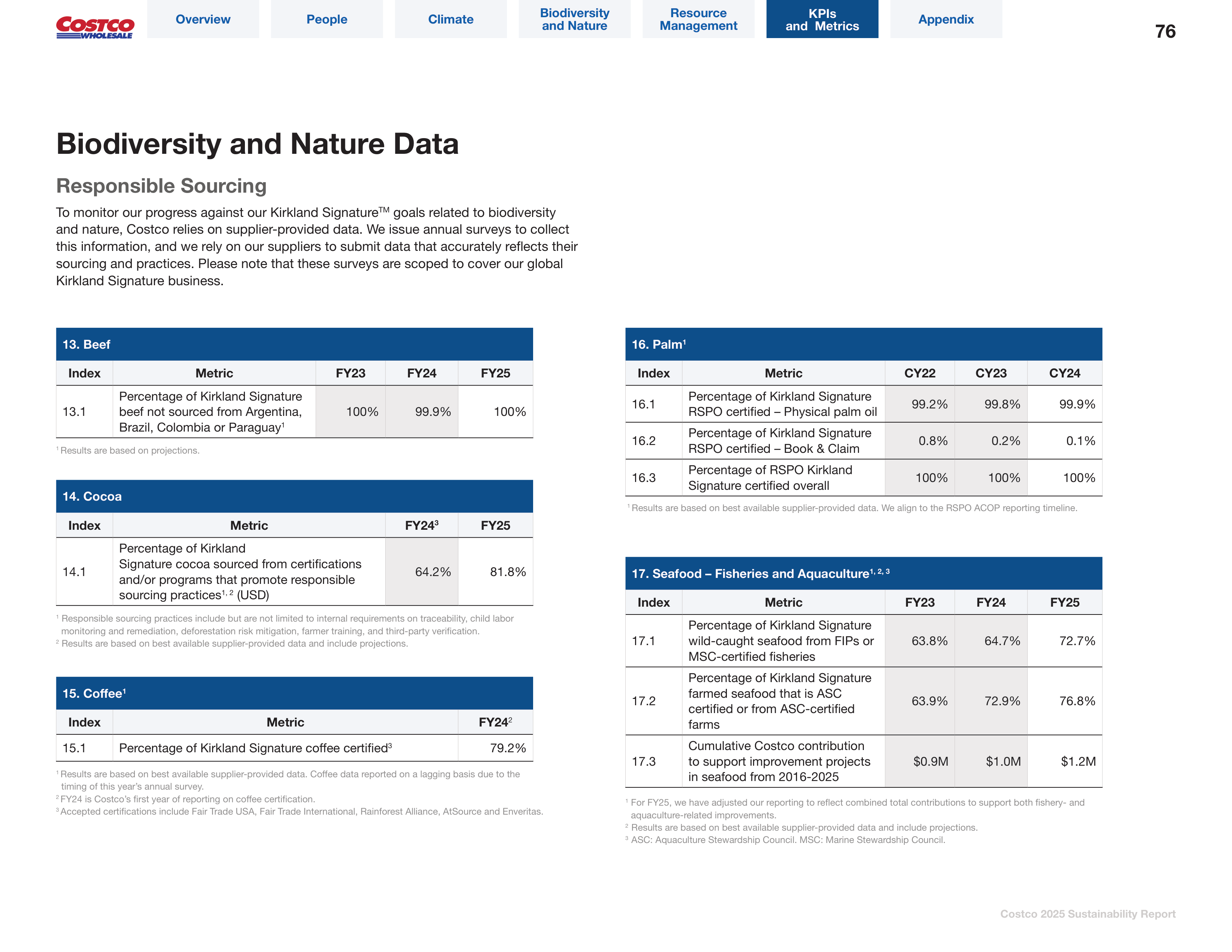
76
Overview
People
Climate
Biodiversity
and Nature
KPIs
and Metrics
Resource
Management
Appendix
Costco 2025 Sustainability Report
Biodiversity and Nature Data
Responsible Sourcing
To monitor our progress against our Kirkland Signature
TM
goals related to biodiversity
and nature, Costco relies on supplier-provided data. We issue annual surveys to collect
this information, and we rely on our suppliers to submit data that accurately reflects their
sourcing and practices. Please note that these surveys are scoped to cover our global
Kirkland Signature business.
16. Palm
1
Index
Metric
CY22
CY23
CY24
16.1
Percentage of Kirkland Signature
RSPO certified – Physical palm oil
99.2%
99.8%
99.9%
16.2
Percentage of Kirkland Signature
RSPO certified – Book & Claim
0.8%
0.2%
0.1%
16.3
Percentage of RSPO Kirkland
Signature certified overall
100%
100%
100%
13. Beef
Index
Metric
FY23
FY24
FY25
13.1
Percentage of Kirkland Signature
beef not sourced from Argentina,
Brazil, Colombia or Paraguay
1
100%
99.9%
100%
17. Seafood – Fisheries and Aquaculture
1, 2, 3
Index
Metric
FY23
FY24
FY25
17.1
Percentage of Kirkland Signature
wild-caught seafood from FIPs or
MSC-certified fisheries
63.8%
64.7%
72.7%
17.2
Percentage of Kirkland Signature
farmed seafood that is ASC
certified or from ASC-certified
farms
63.9%
72.9%
76.8%
17.3
Cumulative Costco contribution
to support improvement projects
in seafood from 2016-2025
$0.9M
$1.0M
$1.2M
14. Cocoa
Index
Metric
FY24
3
FY25
14.1
Percentage of Kirkland
Signature cocoa sourced from certifications
and/or programs that promote responsible
sourcing practices
1, 2
(USD)
64.2%
81.8%
1
Results are based on projections.
1
Responsible sourcing practices include but are not limited to internal requirements on traceability, child labor
monitoring and remediation, deforestation risk mitigation, farmer training, and third-party verification.
2
Results are based on best available supplier-provided data and include projections.
15. Coffee
1
Index
Metric
FY24
2
15.1
Percentage of Kirkland Signature coffee certified
3
79.2%
1
Results are based on best available supplier-provided data. Coffee data reported on a lagging basis due to the
timing of this year’s annual survey.
2
FY24 is Costco’s first year of reporting on coffee certification.
3
Accepted certifications include Fair Trade USA, Fair Trade International, Rainforest Alliance, AtSource and Enveritas.
1
Results are based on best available supplier-provided data. We align to the RSPO ACOP reporting timeline.
1
For FY25, we have adjusted our reporting to reflect combined total contributions to support both fishery- and
aquaculture-related improvements.
2
Results are based on best available supplier-provided data and include projections.
3
ASC: Aquaculture Stewardship Council. MSC: Marine Stewardship Council.
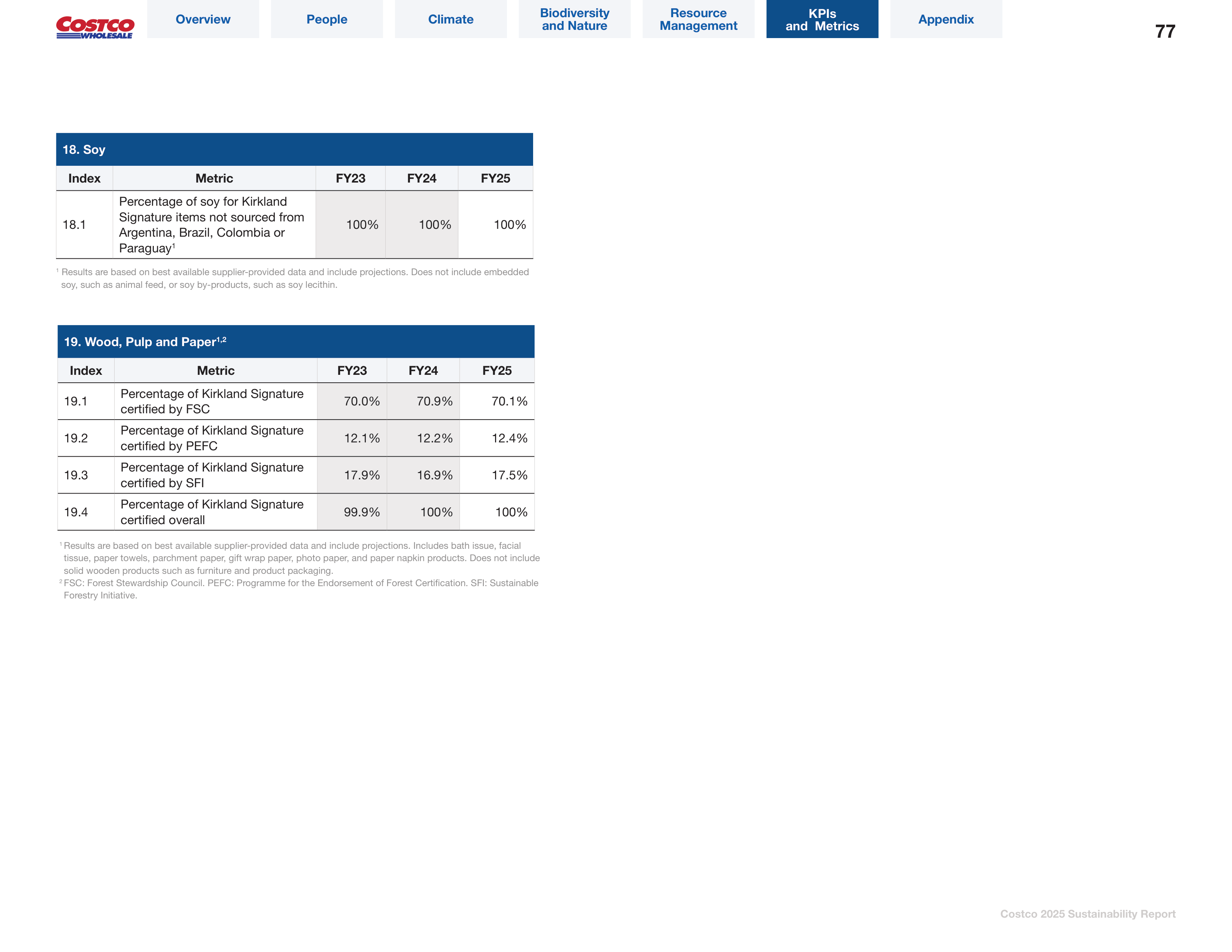
77
Overview
People
Climate
Biodiversity
and Nature
KPIs
and Metrics
Resource
Management
Appendix
Costco 2025 Sustainability Report
19. Wood, Pulp and Paper
1,2
Index
Metric
FY23
FY24
FY25
19.1
Percentage of Kirkland Signature
certified by FSC
70.0%
70.9%
70.1%
19.2
Percentage of Kirkland Signature
certified by PEFC
12.1%
12.2%
12.4%
19.3
Percentage of Kirkland Signature
certified by SFI
17.9%
16.9%
17.5%
19.4
Percentage of Kirkland Signature
certified overall
99.9%
100%
100%
18. Soy
Index
Metric
FY23
FY24
FY25
18.1
Percentage of soy for Kirkland
Signature items not sourced from
Argentina, Brazil, Colombia or
Paraguay
1
100%
100%
100%
1
Results are based on best available supplier-provided data and include projections. Includes bath issue, facial
tissue, paper towels, parchment paper, gift wrap paper, photo paper, and paper napkin products. Does not include
solid wooden products such as furniture and product packaging.
2
FSC: Forest Stewardship Council. PEFC: Programme for the Endorsement of Forest Certification. SFI: Sustainable
Forestry Initiative.
1
Results are based on best available supplier-provided data and include projections. Does not include embedded
soy, such as animal feed, or soy by-products, such as soy lecithin.
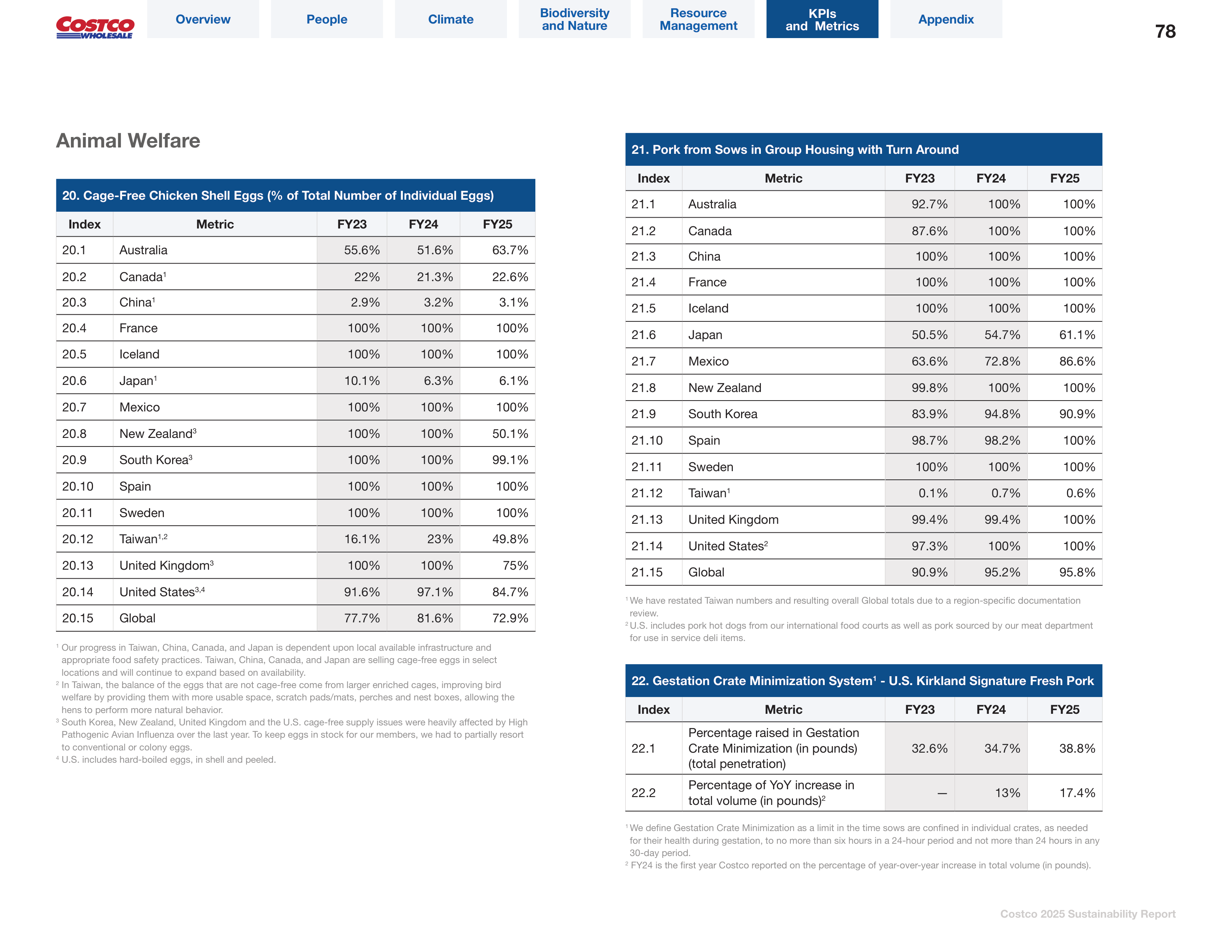
78
Overview
People
Climate
Biodiversity
and Nature
KPIs
and Metrics
Resource
Management
Appendix
Costco 2025 Sustainability Report
Animal Welfare
20. Cage-Free Chicken Shell Eggs (% of Total Number of Individual Eggs)
Index
Metric
FY23
FY24
FY25
20.1
Australia
55.6%
51.6%
63.7%
20.2
Canada
1
22%
21.3%
22.6%
20.3
China
1
2.9%
3.2%
3.1%
20.4
France
100%
100%
100%
20.5
Iceland
100%
100%
100%
20.6
Japan
1
10.1%
6.3%
6.1%
20.7
Mexico
100%
100%
100%
20.8
New Zealand
3
100%
100%
50.1%
20.9
South Korea
3
100%
100%
99.1%
20.10
Spain
100%
100%
100%
20.11
Sweden
100%
100%
100%
20.12
Taiwan
1,2
16.1%
23%
49.8%
20.13
United Kingdom
3
100%
100%
75%
20.14
United States
3,4
91.6%
97.1%
84.7%
20.15
Global
77.7%
81.6%
72.9%
21. Pork from Sows in Group Housing with Turn Around
Index
Metric
FY23
FY24
FY25
21.1
Australia
92.7%
100%
100%
21.2
Canada
87.6%
100%
100%
21.3
China
100%
100%
100%
21.4
France
100%
100%
100%
21.5
Iceland
100%
100%
100%
21.6
Japan
50.5%
54.7%
61.1%
21.7
Mexico
63.6%
72.8%
86.6%
21.8
New Zealand
99.8%
100%
100%
21.9
South Korea
83.9%
94.8%
90.9%
21.10
Spain
98.7%
98.2%
100%
21.11
Sweden
100%
100%
100%
21.12
Taiwan
1
0.1%
0.7%
0.6%
21.13
United Kingdom
99.4%
99.4%
100%
21.14
United States
2
97.3%
100%
100%
21.15
Global
90.9%
95.2%
95.8%
22. Gestation Crate Minimization System
1
- U.S. Kirkland Signature Fresh Pork
Index
Metric
FY23
FY24
FY25
22.1
Percentage raised in Gestation
Crate Minimization (in pounds)
(total penetration)
32.6%
34.7%
38.8%
22.2
Percentage of YoY increase in
total volume (in pounds)
2
—
13%
17.4%
1
Our progress in Taiwan, China, Canada, and Japan is dependent upon local available infrastructure and
appropriate food safety practices. Taiwan, China, Canada, and Japan are selling cage-free eggs in select
locations and will continue to expand based on availability.
2
In Taiwan, the balance of the eggs that are not cage-free come from larger enriched cages, improving bird
welfare by providing them with more usable space, scratch pads/mats, perches and nest boxes, allowing the
hens to perform more natural behavior.
3
South Korea, New Zealand, United Kingdom and the U.S. cage-free supply issues were heavily affected by High
Pathogenic Avian Influenza over the last year. To keep eggs in stock for our members, we had to partially resort
to conventional or colony eggs.
4
U.S. includes hard-boiled eggs, in shell and peeled.
1
We define Gestation Crate Minimization as a limit in the time sows are confined in individual crates, as needed
for their health during gestation, to no more than six hours in a 24-hour period and not more than 24 hours in any
30-day period.
2
FY24 is the first year Costco reported on the percentage of year-over-year increase in total volume (in pounds).
1
We have restated Taiwan numbers and resulting overall Global totals due to a region-specific documentation
review.
2
U.S. includes pork hot dogs from our international food courts as well as pork sourced by our meat department
for use in service deli items.
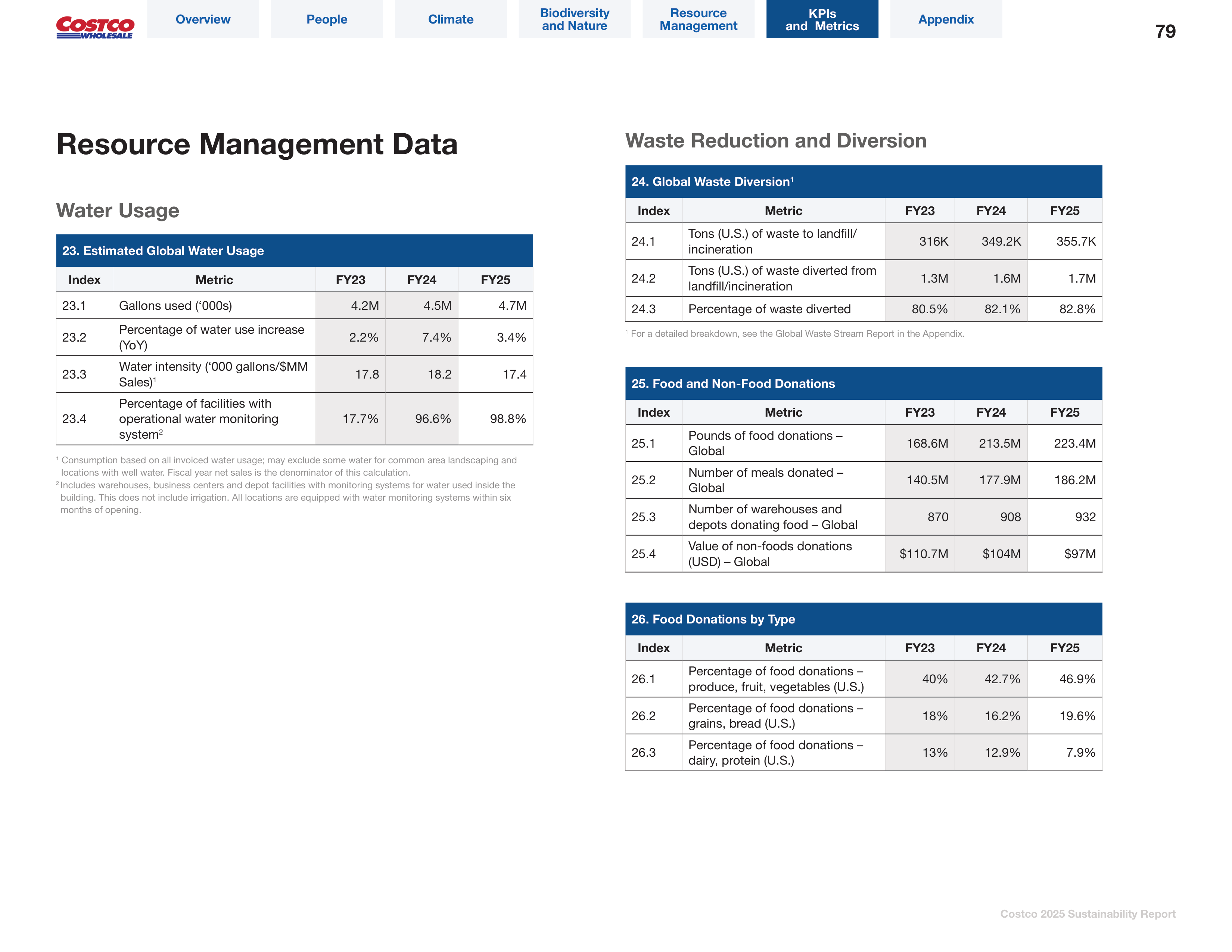
79
Overview
People
Climate
Biodiversity
and Nature
KPIs
and Metrics
Resource
Management
Appendix
Costco 2025 Sustainability Report
Water Usage
Waste Reduction and Diversion
Resource Management Data
23. Estimated Global Water Usage
Index
Metric
FY23
FY24
FY25
23.1
Gallons used (‘000s)
4.2M
4.5M
4.7M
23.2
Percentage of water use increase
(YoY)
2.2%
7.4%
3.4%
23.3
Water intensity (‘000 gallons/$MM
Sales)
1
17.8
18.2
17.4
23.4
Percentage of facilities with
operational water monitoring
system
2
17.7%
96.6%
98.8%
25. Food and Non-Food Donations
Index
Metric
FY23
FY24
FY25
25.1
Pounds of food donations –
Global
168.6M
213.5M
223.4M
25.2
Number of meals donated –
Global
140.5M
177.9M
186.2M
25.3
Number of warehouses and
depots donating food – Global
870
908
932
25.4
Value of non-foods donations
(USD) – Global
$110.7M
$104M
$97M
26. Food Donations by Type
Index
Metric
FY23
FY24
FY25
26.1
Percentage of food donations –
produce, fruit, vegetables (U.S.)
40%
42.7%
46.9%
26.2
Percentage of food donations –
grains, bread (U.S.)
18%
16.2%
19.6%
26.3
Percentage of food donations –
dairy, protein (U.S.)
13%
12.9%
7.9%
1
Consumption based on all invoiced water usage; may exclude some water for common area landscaping and
locations with well water. Fiscal year net sales is the denominator of this calculation.
2
Includes warehouses, business centers and depot facilities with monitoring systems for water used inside the
building. This does not include irrigation. All locations are equipped with water monitoring systems within six
months of opening.
1
For a detailed breakdown, see the Global Waste Stream Report in the Appendix.
24. Global Waste Diversion
1
Index
Metric
FY23
FY24
FY25
24.1
Tons (U.S.) of waste to landfill/
incineration
316K
349.2K
355.7K
24.2
Tons (U.S.) of waste diverted from
landfill/incineration
1.3M
1.6M
1.7M
24.3
Percentage of waste diverted
80.5%
82.1%
82.8%
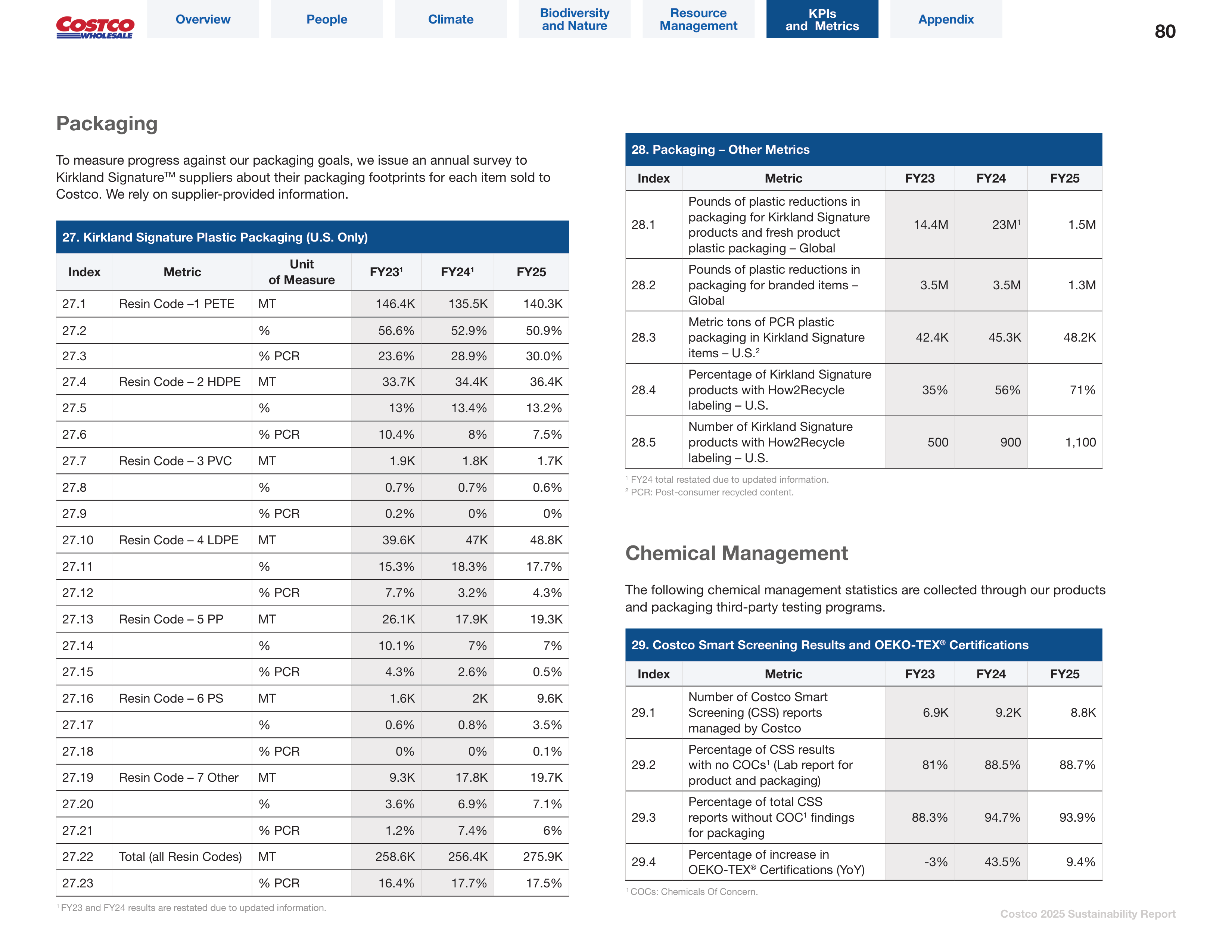
80
Overview
People
Climate
Biodiversity
and Nature
KPIs
and Metrics
Resource
Management
Appendix
Costco 2025 Sustainability Report
Packaging
To measure progress against our packaging goals, we issue an annual survey to
Kirkland Signature
TM
suppliers about their packaging footprints for each item sold to
Costco. We rely on supplier-provided information.
27. Kirkland Signature Plastic Packaging (U.S. Only)
Index
Metric
Unit
of Measure
FY23
1
FY24
1
FY25
27.1
Resin Code –1 PETE
MT
146.4K
135.5K
140.3K
27.2
%
56.6%
52.9%
50.9%
27.3
% PCR
23.6%
28.9%
30.0%
27.4
Resin Code – 2 HDPE
MT
33.7K
34.4K
36.4K
27.5
%
13%
13.4%
13.2%
27.6
% PCR
10.4%
8%
7.5%
27.7
Resin Code – 3 PVC
MT
1.9K
1.8K
1.7K
27.8
%
0.7%
0.7%
0.6%
27.9
% PCR
0.2%
0%
0%
27.10
Resin Code – 4 LDPE
MT
39.6K
47K
48.8K
27.11
%
15.3%
18.3%
17.7%
27.12
% PCR
7.7%
3.2%
4.3%
27.13
Resin Code – 5 PP
MT
26.1K
17.9K
19.3K
27.14
%
10.1%
7%
7%
27.15
% PCR
4.3%
2.6%
0.5%
27.16
Resin Code – 6 PS
MT
1.6K
2K
9.6K
27.17
%
0.6%
0.8%
3.5%
27.18
% PCR
0%
0%
0.1%
27.19
Resin Code – 7 Other
MT
9.3K
17.8K
19.7K
27.20
%
3.6%
6.9%
7.1%
27.21
% PCR
1.2%
7.4%
6%
27.22
Total (all Resin Codes)
MT
258.6K
256.4K
275.9K
27.23
% PCR
16.4%
17.7%
17.5%
28. Packaging – Other Metrics
Index
Metric
FY23
FY24
FY25
28.1
Pounds of plastic reductions in
packaging for Kirkland Signature
products and fresh product
plastic packaging – Global
14.4M
23M
1
1.5M
28.2
Pounds of plastic reductions in
packaging for branded items –
Global
3.5M
3.5M
1.3M
28.3
Metric tons of PCR plastic
packaging in Kirkland Signature
items – U.S.
2
42.4K
45.3K
48.2K
28.4
Percentage of Kirkland Signature
products with How2Recycle
labeling – U.S.
35%
56%
71%
28.5
Number of Kirkland Signature
products with How2Recycle
labeling – U.S.
500
900
1,100
Chemical Management
The following chemical management statistics are collected through our products
and packaging third-party testing programs.
29. Costco Smart Screening Results and OEKO-TEX
®
Certifications
Index
Metric
FY23
FY24
FY25
29.1
Number of Costco Smart
Screening (CSS) reports
managed by Costco
6.9K
9.2K
8.8K
29.2
Percentage of CSS results
with no COCs
1
(Lab report for
product and packaging)
81%
88.5%
88.7%
29.3
Percentage of total CSS
reports without COC
1
findings
for packaging
88.3%
94.7%
93.9%
29.4
Percentage of increase in
OEKO-TEX
®
Certifications (YoY)
-3%
43.5%
9.4%
1
COCs: Chemicals Of Concern.
1
FY24 total restated due to updated information.
2
PCR: Post-consumer recycled content.
1
FY23 and FY24 results are restated due to updated information.
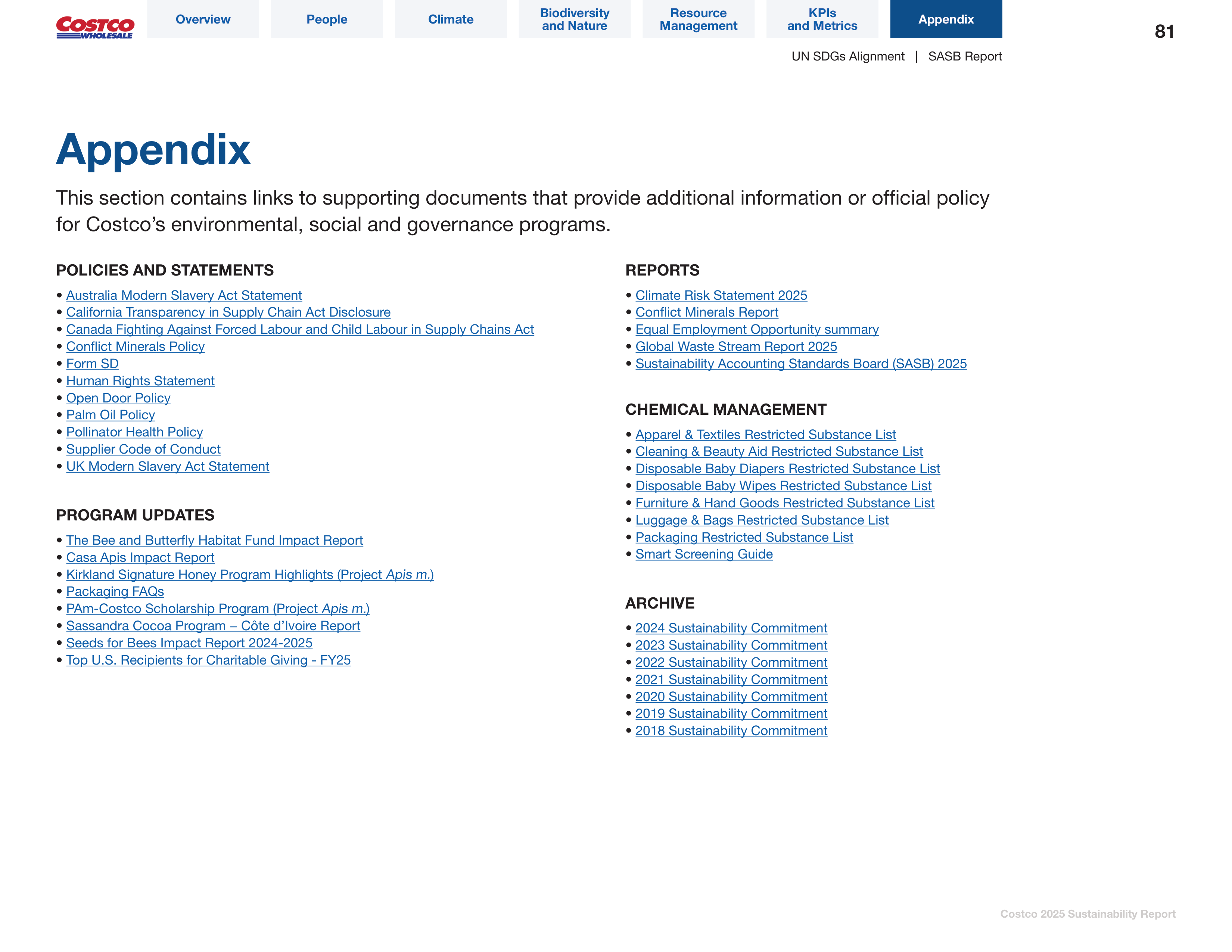
81
Overview
People
Climate
Biodiversity
and Nature
Appendix
Resource
Management
KPIs
and Metrics
Costco 2025 Sustainability Report
POLICIES AND STATEMENTS
•
Australia Modern Slavery Act Statement
•
California Transparency in Supply Chain Act Disclosure
•
Canada Fighting Against Forced Labour and Child Labour in Supply Chains Act
•
Conflict Minerals Policy
•
Form SD
•
Human Rights Statement
•
Open Door Policy
•
Palm Oil Policy
•
Pollinator Health Policy
•
Supplier Code of Conduct
•
UK Modern Slavery Act Statement
PROGRAM UPDATES
•
The Bee and Butterfly Habitat Fund Impact Report
•
Casa Apis Impact Report
•
Kirkland Signature Honey Program Highlights (Project Apis m.)
•
Packaging FAQs
•
PAm-Costco Scholarship Program (Project Apis m.)
•
Sassandra Cocoa Program - Côte d’Ivoire Report
•
Seeds for Bees Impact Report 2024-2025
•
Top U.S. Recipients for Charitable Giving - FY25
REPORTS
•
Climate Risk Statement 2025
•
Conflict Minerals Report
•
Equal Employment Opportunity summary
•
Global Waste Stream Report 2025
•
Sustainability Accounting Standards Board (SASB) 2025
CHEMICAL MANAGEMENT
•
Apparel & Textiles Restricted Substance List
•
Cleaning & Beauty Aid Restricted Substance List
•
Disposable Baby Diapers Restricted Substance List
•
Disposable Baby Wipes Restricted Substance List
•
Furniture & Hand Goods Restricted Substance List
•
Luggage & Bags Restricted Substance List
•
Packaging Restricted Substance List
•
Smart Screening Guide
ARCHIVE
•
2024 Sustainability Commitment
•
2023 Sustainability Commitment
•
2022 Sustainability Commitment
•
2021 Sustainability Commitment
•
2020 Sustainability Commitment
•
2019 Sustainability Commitment
•
2018 Sustainability Commitment
Appendix
This section contains links to supporting documents that provide additional information or official policy
for Costco’s environmental, social and governance programs.
UN SDGs Alignment | SASB Report
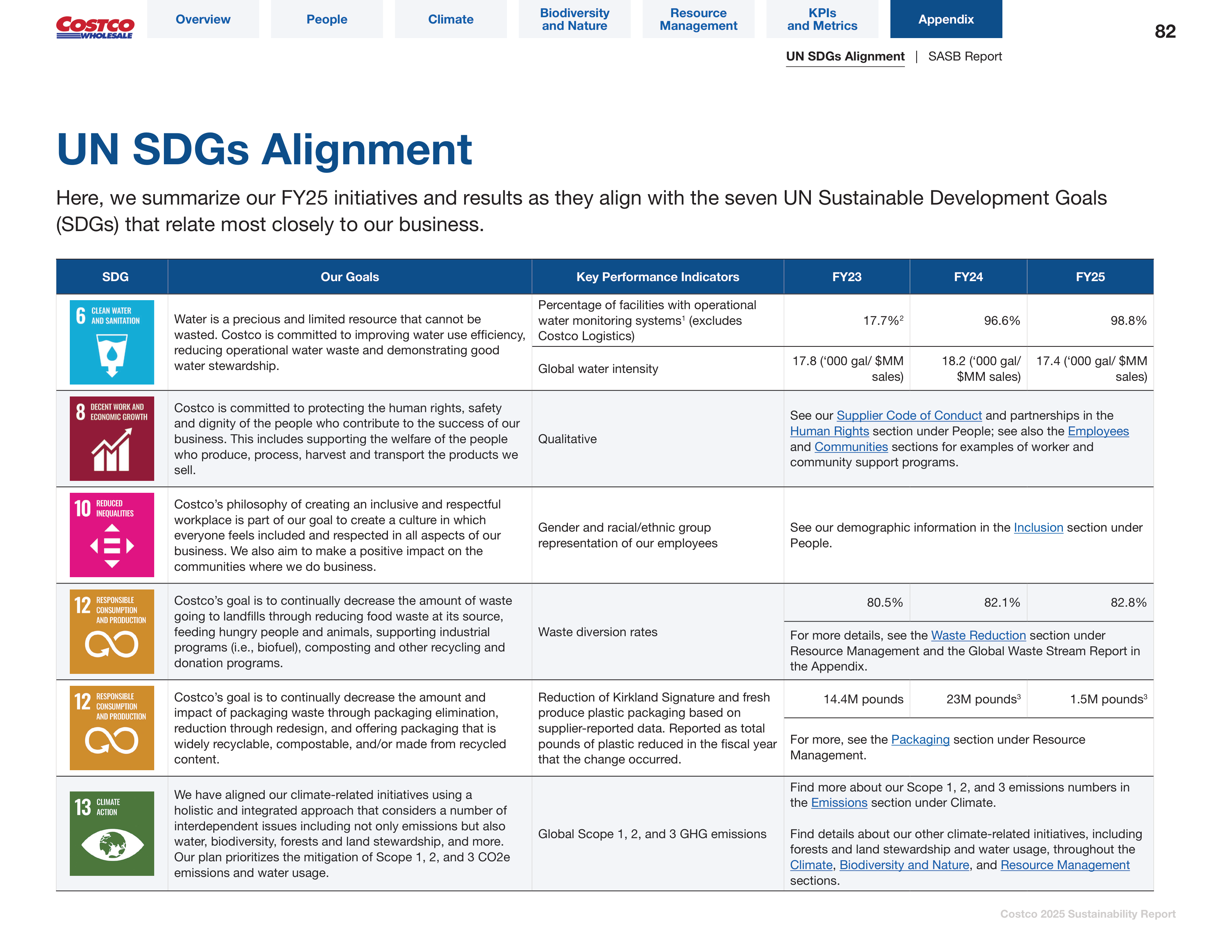
82
Overview
People
Climate
Biodiversity
and Nature
Appendix
Resource
Management
KPIs
and Metrics
Costco 2025 Sustainability Report
SDG
Our Goals
Key Performance Indicators
FY23
FY24
FY25
Water is a precious and limited resource that cannot be
wasted. Costco is committed to improving water use efficiency,
reducing operational water waste and demonstrating good
water stewardship.
Percentage of facilities with operational
water monitoring systems
1
(excludes
Costco Logistics)
17.7%
2
96.6%
98.8%
Global water intensity
17.8 (‘000 gal/ $MM
sales)
18.2 (‘000 gal/
$MM sales)
17.4 (‘000 gal/ $MM
sales)
Costco is committed to protecting the human rights, safety
and dignity of the people who contribute to the success of our
business. This includes supporting the welfare of the people
who produce, process, harvest and transport the products we
sell.
Qualitative
See our
Supplier Code of Conduct
and partnerships in the
Human Rights
section under People; see also the
Employees
and
Communities
sections for examples of worker and
community support programs.
Costco’s philosophy of creating an inclusive and respectful
workplace is part of our goal to create a culture in which
everyone feels included and respected in all aspects of our
business. We also aim to make a positive impact on the
communities where we do business.
Gender and racial/ethnic group
representation of our employees
See our demographic information in the
Inclusion
section under
People.
Costco’s goal is to continually decrease the amount of waste
going to landfills through reducing food waste at its source,
feeding hungry people and animals, supporting industrial
programs (i.e., biofuel), composting and other recycling and
donation programs.
Waste diversion rates
80.5%
82.1%
82.8%
For more details, see the
Waste Reduction
section under
Resource Management and the Global Waste Stream Report in
the Appendix.
Costco’s goal is to continually decrease the amount and
impact of packaging waste through packaging elimination,
reduction through redesign, and offering packaging that is
widely recyclable, compostable, and/or made from recycled
content.
Reduction of Kirkland Signature and fresh
produce plastic packaging based on
supplier-reported data. Reported as total
pounds of plastic reduced in the fiscal year
that the change occurred.
14.4M pounds
23M pounds
3
1.5M pounds
3
For more, see the
Packaging
section under Resource
Management.
We have aligned our climate-related initiatives using a
holistic and integrated approach that considers a number of
interdependent issues including not only emissions but also
water, biodiversity, forests and land stewardship, and more.
Our plan prioritizes the mitigation of Scope 1, 2, and 3 CO2e
emissions and water usage.
Global Scope 1, 2, and 3 GHG emissions
Find more about our Scope 1, 2, and 3 emissions numbers in
the
Emissions
section under Climate.
Find details about our other climate-related initiatives, including
forests and land stewardship and water usage, throughout the
Climate
,
Biodiversity and Nature
, and
Resource Management
sections.
UN SDGs Alignment
Here, we summarize our FY25 initiatives and results as they align with the seven UN Sustainable Development Goals
(SDGs) that relate most closely to our business.
UN SDGs Alignment
| SASB Report
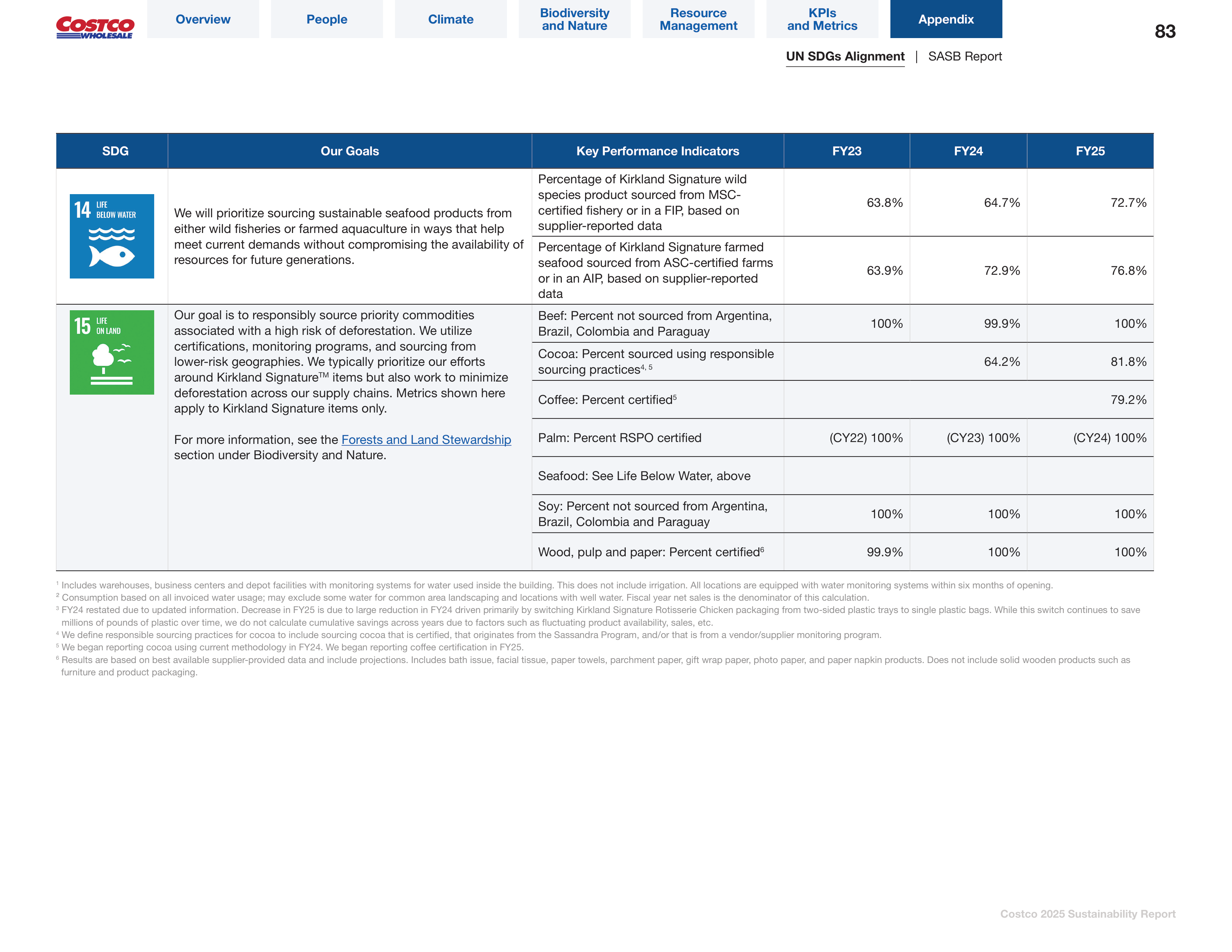
83
Overview
People
Climate
Biodiversity
and Nature
Appendix
Resource
Management
KPIs
and Metrics
Costco 2025 Sustainability Report
SDG
Our Goals
Key Performance Indicators
FY23
FY24
FY25
We will prioritize sourcing sustainable seafood products from
either wild fisheries or farmed aquaculture in ways that help
meet current demands without compromising the availability of
resources for future generations.
Percentage of Kirkland Signature wild
species product sourced from MSC-
certified fishery or in a FIP, based on
supplier-reported data
63.8%
64.7%
72.7%
Percentage of Kirkland Signature farmed
seafood sourced from ASC-certified farms
or in an AIP, based on supplier-reported
data
63.9%
72.9%
76.8%
Our goal is to responsibly source priority commodities
associated with a high risk of deforestation. We utilize
certifications, monitoring programs, and sourcing from
lower-risk geographies. We typically prioritize our efforts
around Kirkland Signature
TM
items but also work to minimize
deforestation across our supply chains. Metrics shown here
apply to Kirkland Signature items only.
For more information, see the
Forests and Land Stewardship
section under Biodiversity and Nature.
Beef: Percent not sourced from Argentina,
Brazil, Colombia and Paraguay
100%
99.9%
100%
Cocoa: Percent sourced using responsible
sourcing practices
4, 5
64.2%
81.8%
Coffee: Percent certified
5
79.2%
Palm: Percent RSPO certified
(CY22) 100%
(CY23) 100%
(CY24) 100%
Seafood: See Life Below Water, above
Soy: Percent not sourced from Argentina,
Brazil, Colombia and Paraguay
100%
100%
100%
Wood, pulp and paper: Percent certified
6
99.9%
100%
100%
1
Includes warehouses, business centers and depot facilities with monitoring systems for water used inside the building. This does not include irrigation. All locations are equipped with water monitoring systems within six months of opening.
² Consumption based on all invoiced water usage; may exclude some water for common area landscaping and locations with well water. Fiscal year net sales is the denominator of this calculation.
3
FY24 restated due to updated information. Decrease in FY25 is due to large reduction in FY24 driven primarily by switching Kirkland Signature Rotisserie Chicken packaging from two-sided plastic trays to single plastic bags. While this switch continues to save
millions of pounds of plastic over time, we do not calculate cumulative savings across years due to factors such as fluctuating product availability, sales, etc.
4
We define responsible sourcing practices for cocoa to include sourcing cocoa that is certified, that originates from the Sassandra Program, and/or that is from a vendor/supplier monitoring program.
5
We began reporting cocoa using current methodology in FY24. We began reporting coffee certification in FY25.
6
Results are based on best available supplier-provided data and include projections. Includes bath issue, facial tissue, paper towels, parchment paper, gift wrap paper, photo paper, and paper napkin products. Does not include solid wooden products such as
furniture and product packaging.
UN SDGs Alignment
| SASB Report
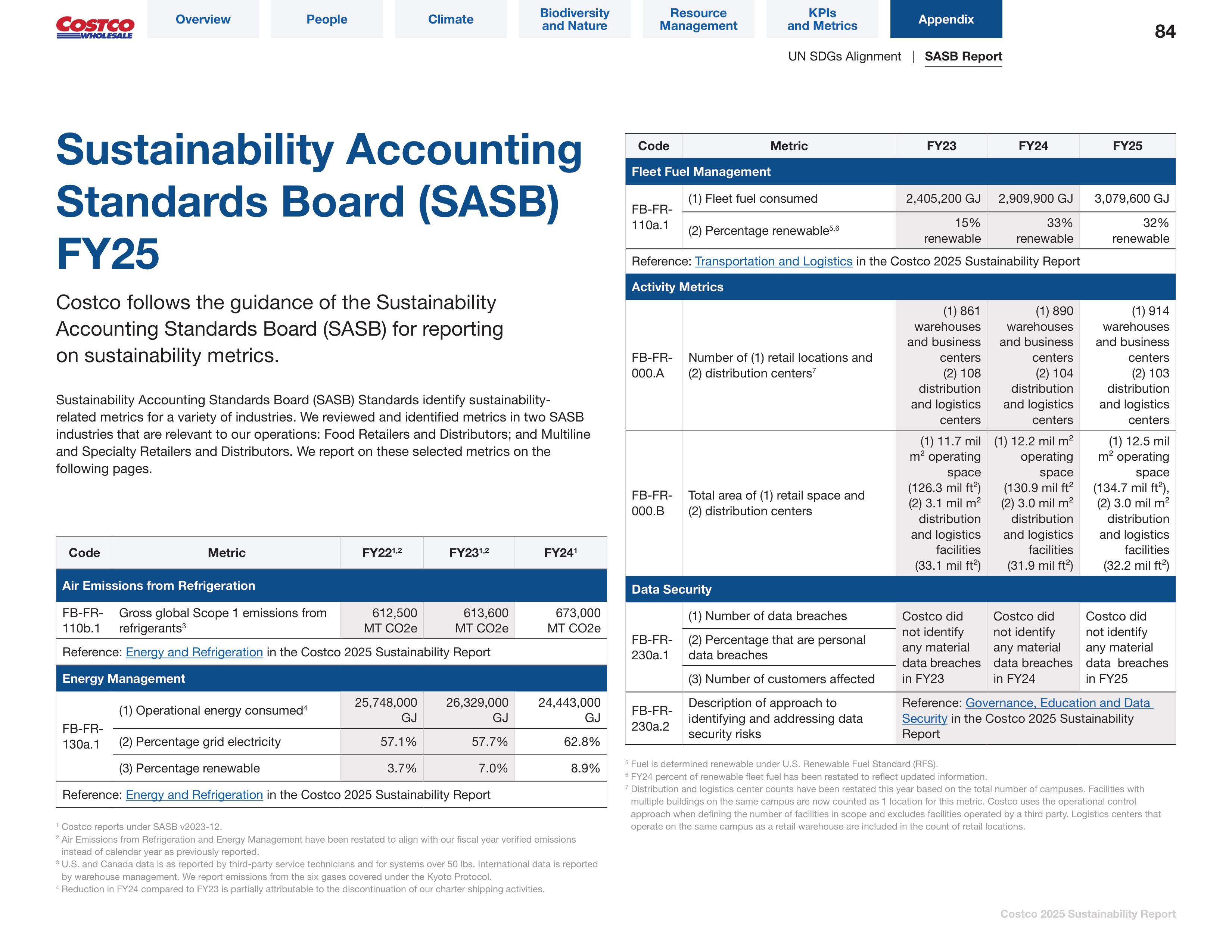
84
Overview
People
Climate
Biodiversity
and Nature
Appendix
Resource
Management
KPIs
and Metrics
Costco 2025 Sustainability Report
Code
Metric
FY22
1,2
FY23
1,2
FY24
1
Air Emissions from Refrigeration
FB-FR-
110b.1
Gross global Scope 1 emissions from
refrigerants
3
612,500
MT CO2e
613,600
MT CO2e
673,000
MT CO2e
Reference:
Energy and Refrigeration
in the Costco 2025 Sustainability Report
Energy Management
FB-FR-
130a.1
(1) Operational energy consumed
4
25,748,000
GJ
26,329,000
GJ
24,443,000
GJ
(2) Percentage grid electricity
57.1%
57.7%
62.8%
(3) Percentage renewable
3.7%
7.0%
8.9%
Reference:
Energy and Refrigeration
in the Costco 2025 Sustainability Report
UN SDGs Alignment |
SASB Report
Sustainability Accounting
Standards Board (SASB)
FY25
Costco follows the guidance of the Sustainability
Accounting Standards Board (SASB) for reporting
on sustainability metrics.
Sustainability Accounting Standards Board (SASB) Standards identify sustainability-
related metrics for a variety of industries. We reviewed and identified metrics in two SASB
industries that are relevant to our operations: Food Retailers and Distributors; and Multiline
and Specialty Retailers and Distributors. We report on these selected metrics on the
following pages.
1
Costco reports under SASB v2023-12.
2
Air Emissions from Refrigeration and Energy Management have been restated to align with our fiscal year verified emissions
instead of calendar year as previously reported.
3
U.S. and Canada data is as reported by third-party service technicians and for systems over 50 lbs. International data is reported
by warehouse management. We report emissions from the six gases covered under the Kyoto Protocol.
4
Reduction in FY24 compared to FY23 is partially attributable to the discontinuation of our charter shipping activities.
5
Fuel is determined renewable under U.S. Renewable Fuel Standard (RFS).
6
FY24 percent of renewable fleet fuel has been restated to reflect updated information.
7
Distribution and logistics center counts have been restated this year based on the total number of campuses. Facilities with
multiple buildings on the same campus are now counted as 1 location for this metric. Costco uses the operational control
approach when defining the number of facilities in scope and excludes facilities operated by a third party. Logistics centers that
operate on the same campus as a retail warehouse are included in the count of retail locations.
Code
Metric
FY23
FY24
FY25
Fleet Fuel Management
FB-FR-
110a.1
(1) Fleet fuel consumed
2,405,200 GJ
2,909,900 GJ
3,079,600 GJ
(2) Percentage renewable
5,6
15%
renewable
33%
renewable
32%
renewable
Reference:
Transportation and Logistics
in the Costco 2025 Sustainability Report
Activity Metrics
FB-FR-
000.A
Number of (1) retail locations and
(2) distribution centers
7
(1) 861
warehouses
and business
centers
(2) 108
distribution
and logistics
centers
(1) 890
warehouses
and business
centers
(2) 104
distribution
and logistics
centers
(1) 914
warehouses
and business
centers
(2) 103
distribution
and logistics
centers
FB-FR-
000.B
Total area of (1) retail space and
(2) distribution centers
(1) 11.7 mil
m² operating
space
(126.3 mil ft²)
(2) 3.1 mil m²
distribution
and logistics
facilities
(33.1 mil ft²)
(1) 12.2 mil m²
operating
space
(130.9 mil ft²
(2) 3.0 mil m²
distribution
and logistics
facilities
(31.9 mil ft²)
(1) 12.5 mil
m² operating
space
(134.7 mil ft²),
(2) 3.0 mil m²
distribution
and logistics
facilities
(32.2 mil ft²)
Data Security
FB-FR-
230a.1
(1) Number of data breaches
Costco did
not identify
any material
data breaches
in FY23
Costco did
not identify
any material
data breaches
in FY24
Costco did
not identify
any material
data breaches
in FY25
(2) Percentage that are personal
data breaches
(3) Number of customers affected
FB-FR-
230a.2
Description of approach to
identifying and addressing data
security risks
Reference:
Governance, Education and Data
Security
in the Costco 2025 Sustainability
Report
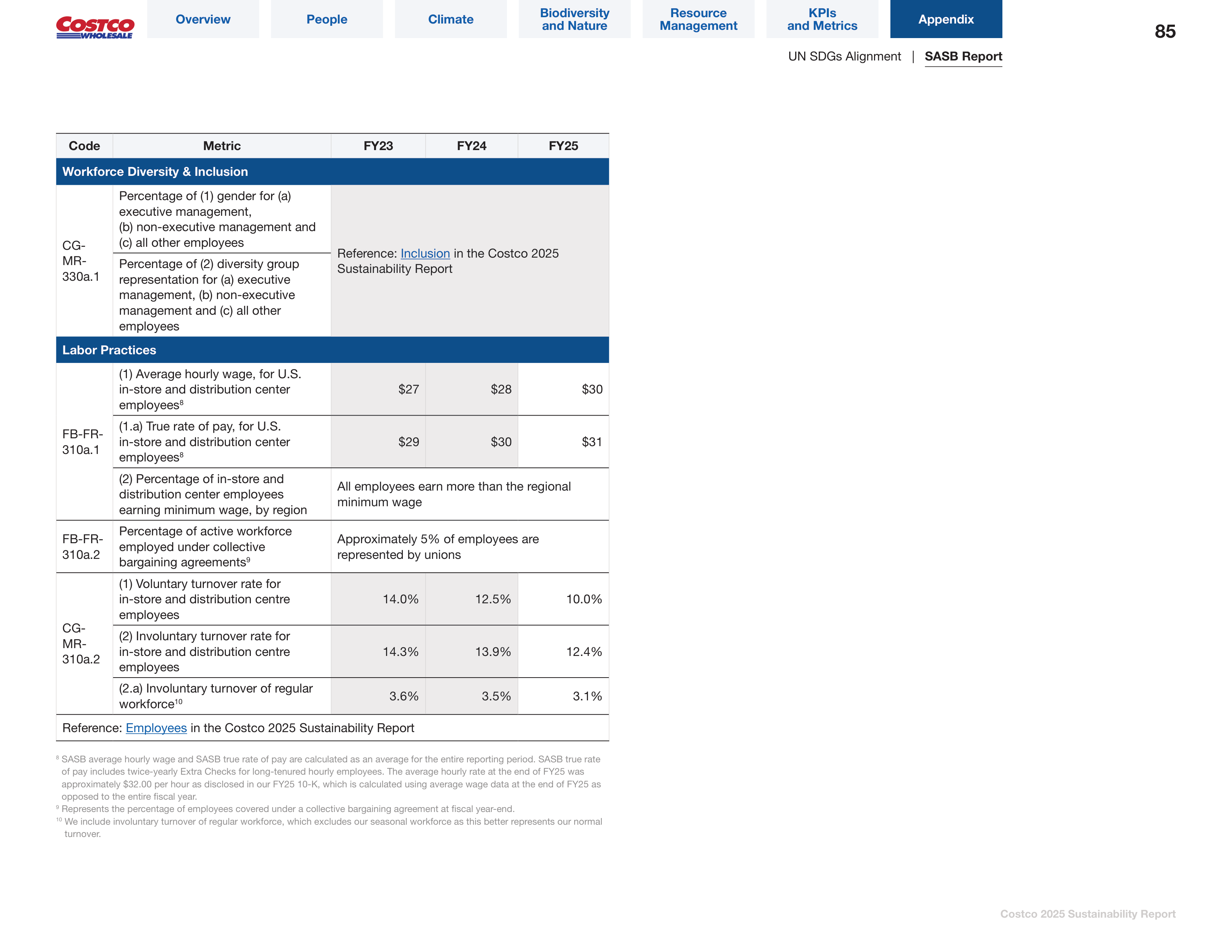
85
Overview
People
Climate
Biodiversity
and Nature
Appendix
Resource
Management
KPIs
and Metrics
Costco 2025 Sustainability Report
UN SDGs Alignment |
SASB Report
8
SASB average hourly wage and SASB true rate of pay are calculated as an average for the entire reporting period. SASB true rate
of pay includes twice-yearly Extra Checks for long-tenured hourly employees. The average hourly rate at the end of FY25 was
approximately $32.00 per hour as disclosed in our FY25 10-K, which is calculated using average wage data at the end of FY25 as
opposed to the entire fiscal year.
9
Represents the percentage of employees covered under a collective bargaining agreement at fiscal year-end.
10
We include involuntary turnover of regular workforce, which excludes our seasonal workforce as this better represents our normal
turnover.
Code
Metric
FY23
FY24
FY25
Workforce Diversity & Inclusion
CG-
MR-
330a.1
Percentage of (1) gender for (a)
executive management,
(b) non-executive management and
(c) all other employees
Reference:
Inclusion
in the Costco 2025
Sustainability Report
Percentage of (2) diversity group
representation for (a) executive
management, (b) non-executive
management and (c) all other
employees
Labor Practices
FB-FR-
310a.1
(1) Average hourly wage, for U.S.
in-store and distribution center
employees
8
$27
$28
$30
(1.a) True rate of pay, for U.S.
in-store and distribution center
employees
8
$29
$30
$31
(2) Percentage of in-store and
distribution center employees
earning minimum wage, by region
All employees earn more than the regional
minimum wage
FB-FR-
310a.2
Percentage of active workforce
employed under collective
bargaining agreements
9
Approximately 5% of employees are
represented by unions
CG-
MR-
310a.2
(1) Voluntary turnover rate for
in-store and distribution centre
employees
14.0%
12.5%
10.0%
(2) Involuntary turnover rate for
in-store and distribution centre
employees
14.3%
13.9%
12.4%
(2.a) Involuntary turnover of regular
workforce
10
3.6%
3.5%
3.1%
Reference:
Employees
in the Costco 2025 Sustainability Report
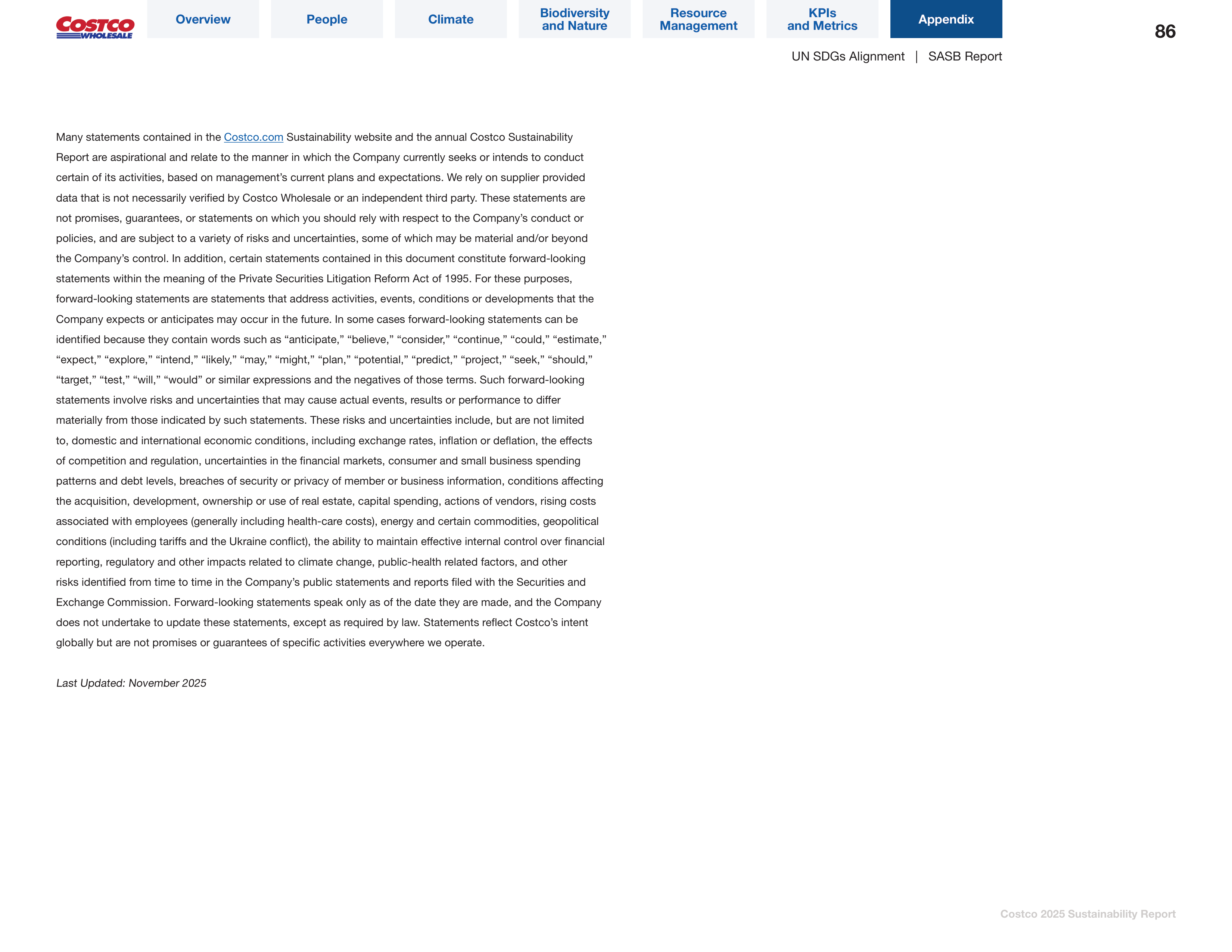
86
Overview
People
Climate
Biodiversity
and Nature
Appendix
Resource
Management
KPIs
and Metrics
Costco 2025 Sustainability Report
Many statements contained in the
Costco.com
Sustainability website and the annual Costco Sustainability
Report are aspirational and relate to the manner in which the Company currently seeks or intends to conduct
certain of its activities, based on management’s current plans and expectations. We rely on supplier provided
data that is not necessarily verified by Costco Wholesale or an independent third party. These statements are
not promises, guarantees, or statements on which you should rely with respect to the Company’s conduct or
policies, and are subject to a variety of risks and uncertainties, some of which may be material and/or beyond
the Company’s control. In addition, certain statements contained in this document constitute forward-looking
statements within the meaning of the Private Securities Litigation Reform Act of 1995. For these purposes,
forward-looking statements are statements that address activities, events, conditions or developments that the
Company expects or anticipates may occur in the future. In some cases forward-looking statements can be
identified because they contain words such as “anticipate,” “believe,” “consider,” “continue,” “could,” “estimate,”
“expect,” “explore,” “intend,” “likely,” “may,” “might,” “plan,” “potential,” “predict,” “project,” “seek,” “should,”
“target,” “test,” “will,” “would” or similar expressions and the negatives of those terms. Such forward-looking
statements involve risks and uncertainties that may cause actual events, results or performance to differ
materially from those indicated by such statements. These risks and uncertainties include, but are not limited
to, domestic and international economic conditions, including exchange rates, inflation or deflation, the effects
of competition and regulation, uncertainties in the financial markets, consumer and small business spending
patterns and debt levels, breaches of security or privacy of member or business information, conditions affecting
the acquisition, development, ownership or use of real estate, capital spending, actions of vendors, rising costs
associated with employees (generally including health-care costs), energy and certain commodities, geopolitical
conditions (including tariffs and the Ukraine conflict), the ability to maintain effective internal control over financial
reporting, regulatory and other impacts related to climate change, public-health related factors, and other
risks identified from time to time in the Company’s public statements and reports filed with the Securities and
Exchange Commission. Forward-looking statements speak only as of the date they are made, and the Company
does not undertake to update these statements, except as required by law. Statements reflect Costco’s intent
globally but are not promises or guarantees of specific activities everywhere we operate.
Last Updated: November 2025
UN SDGs Alignment | SASB Report