
2025
Annual
report
Fiscal 2025 was another strong year for Cardinal Health. We continued to accelerate our
momentum with a relentless focus on driving simplification and operational efficiencies
in our core, while investing for long-term growth. Our sustained performance is a result
of the progress we’ve made against our strategic priorities, as we continue evolving to
meet customer and patient needs while driving value creation for our shareholders.
Dear Shareholders,
Delivered GAAP earnings per share of
$6.45
and non-GAAP diluted earnings per share of
$8.24
, growth of over
9%
Grew Pharmaceutical and Specialty Solutions
segment profit by
12%
Achieved
$135 million
in segment profit
and positive cash flow generation within the
Global Medical Products and Distribution
(GMPD) segment by continued execution
of the multi-year improvement plan
Achieved segment profit growth of
22%
for the year for the businesses reported as
“Other” (Nuclear and Precision Health Solutions,
at-Home Solutions and OptiFreight Logistics)
Generated operating cash flow and non-GAAP
adjusted free cash flow of
$2.4 billion
and
$2.5 billion
, respectively
Returned approximately
$1.25 billion
to shareholders through dividends and
share repurchases
This fiscal year, we:
Fiscal 2025 financial summary
GAAP basis fiscal 2025
Non-GAAP basis fiscal 2025
Operating earnings
% change
$2.3 billion
83%
$2.8 billion
15%
Revenue
% change
$222.6 billion
(2%)
N/A
Diluted EPS
2
% change
$6.45
87%
$8.24
9%
Please see
Explanation and Reconciliation of Non-GAAP Financial Measures
in our fiscal 2025 Form 10-K for GAAP to Non-GAAP reconciliations.
1
Please find our Investor Day presentation at cardinalhealth.com/2025investorday.
2
Attributable to Cardinal Health, Inc.
The tremendous progress we’ve made is the result of our focus on continuous
improvement; as we outlined at our Investor Day
1
in June, we are seeing the positive
results of the strong, resilient foundation we’ve built over the last several years.


Jason Hollar
Chief Executive Officer
Pharmaceutical and Specialty Solutions segment highlights
The
Pharmaceutical and Specialty Solutions
segment
is our largest business, and we continue
to prioritize its growth and resilience, strengthening
its core and expanding in Specialty.
The new
Consumer Health Logistics Center (CHLC)
in Central
Ohio is the first step in a multi-year plan to increase capacity and
drive efficiencies across our pharmaceutical distribution network.
The CHLC, now fully operational, is a centralized replenishment
center for the distribution of over-the-counter medications,
treatments and diagnostic solutions for our pharmacy customers.
The segment is also investing in new technologies to create
efficiencies for our customers. Specifically,
Vantus™ HQ
, our
proprietary ordering platform, is a one-stop digital hub that
gives retail pharmacists enhanced capabilities to search products,
track orders and access reporting. The platform, piloted early
in fiscal 2025, is now rolling out to various customer classes.
Organic and inorganic investments are enhancing our broad
Specialty capabilities, furthering our goal of becoming a
multispecialty leader.
• The new Specialty Alliance is a multi-specialty managed
services organization (MSO) platform
that encompasses
GI Alliance, the leading gastroenterology MSO in the
United States (U.S.), in which we acquired a majority stake
for approximately $2.8 billion in cash, and the newly established
Urology Alliance, following our recent acquisitions of Urology
America and Potomac Urology. The Specialty Alliance provides
administrative and management services to physicians’ practices,
enabling providers to focus on patient care. The Specialty
Alliance will also include Solaris Health, the country’s leading
urology MSO, following the completion of the acquisition,
for approximately $1.9 billion in cash, as announced in August.
•
To accelerate the growth and capabilities of Navista,
we acquired Integrated Oncology Network (ION)
for
approximately $1.1 billion in cash. ION is an MSO that supports
more than 50 practice sites in 10 states. Navista is investing in
technology-enabled clinical tools, including the proprietary
Navista™ Practice Intelligence Suite, which enables users to gain
data-driven insights to make their practices more efficient.
• Specialty Networks, which creates value for independent
specialty providers and partners across multiple specialties,
is expanding into oncology
, and building its existing
capabilities in gastroenterology and rheumatology, as part of
our multispecialty strategy. Additionally, Specialty Networks'
PPS Analytics leverages real-world data to improve patient care
and clinical research.
Other highlights
Our three growth businesses, Nuclear and Precision
Health Solutions (NPHS), at-Home Solutions and
OptiFreight Logistics, have been reported together
as “
Other
” since 2024. Each of these businesses is a leader
within its industry and each is growing rapidly. We expect
continued demand for these businesses due to secular trends,
including preferred sites of care, evolving patient expectations,
and innovation through technology advancements. The strong
execution across each of these businesses gives us confidence
in our continued investment and long-term trajectory.
•
NPHS
plans to invest more than $150 million over the next
three years, enabling an expansion of its cyclotron network
for PET products in 11 markets across the U.S. and a further
expansion of its Center for Theranostics Advancement
capabilities to support a strong pipeline of growth into the
therapeutic areas of oncology, urology and neurology.
•
at-Home Solutions
will include Advanced Diabetes Supply
Group (ADSG), a leading diabetes medical supplies provider
that Cardinal Health acquired for approximately $1.1 billion
in cash. at-Home Solutions recently opened its Fort Worth,
Texas, facility, equipped with automation technologies, and
announced plans for further automation expansion in one
existing distribution center (DC) and in two new DCs planned
in the West and the Northeast.
•
OptiFreight Logistics
, which provides expertise in logistics
management to seven of the country’s top 10 health systems,
will expand its offerings within the hospital pharmacy setting.
This is a logical step in Cardinal Health’s evolution, given
the company’s freight management and pharmaceutical
distribution leadership.

Important information regarding forward-looking statements:
This Report contains forward-looking statements
addressing expectations, prospects, estimates and other matters that are dependent upon future events or developments.
These statements may be identified by words such as "expect," "anticipate," "intend," "plan," "believe," “will," "should,"
"could," "would," "project," "continue,” "likely," and similar expressions, and include statements reflecting future results or
guidance, statements of outlook and various accruals and estimates. These matters are subject to risks and uncertainties
that could cause actual results to differ materially from those projected, anticipated or implied. For more information
about these risks and uncertainties, please review our Forms 10-K, 10-Q and 8-K and Exhibits to those Reports, which are
available at ir.cardinalhealth.com. Except to the extent required by applicable law, we undertake no obligation to update
or revise any forward-looking statement.
Striving to be healthcare's
most trusted partner
90%
U.S. hospitals served
25K
physician offices or
clinics serviced by our
Specialty business
43K+
pharmaceutical
deliveries a day
30
PET cyclotron
facilities
~
130
nuclear pharmacies
~
2.2K
providers in 28 states
and more than 450 sites
of care supported by
our MSO platforms
6M+
patients served in
the home by direct
to patient business
24M+
parcel packages
managed through
OptiFreight Logistics
20+
product categories
as an integrated
medical manufacturer
Global Medical Products and Distribution
(GMPD) segment highlights
GMPD
continues to execute its improvement plan, focused on
accelerating the growth of its Cardinal Health™ Brand products
and, at the same time, driving simplification and cost optimization.
The multistep effort builds on the earlier progress of the GMPD improvement
plan, which returned the business to positive profit and cash flow generation.
Additionally, my leadership team and I continue to work to minimize the
impact of tariffs, which are affecting the Cardinal Health™ Brand portfolio.
Looking ahead
Cardinal Health is the crucial link in healthcare. Few companies offer the
combination of a resilient business model and compelling growth – the result
of favorable trends and our actions to evolve into higher-margin and faster-
growing areas of the market – while safely, securely and efficiently delivering
the products and solutions that improve the lives of people each day and
value for all stakeholders.
Our success is driven by our 57,700 employees and their work and commitment
to our critical role in healthcare. I extend my thanks to our Board of Directors
and to my senior leadership team. As always, I’m grateful to our customers
for their business and their trust, and appreciate the continued support of
our shareholders.
I am confident in our strategic direction and proud of our accomplishments.
Our team’s execution in support of our customers and patients throughout
fiscal 2025 is furthering our business growth and helping us to fulfill our role
as healthcare’s most trusted partner.
Sincerely,
Jason Hollar
Chief Executive Officer
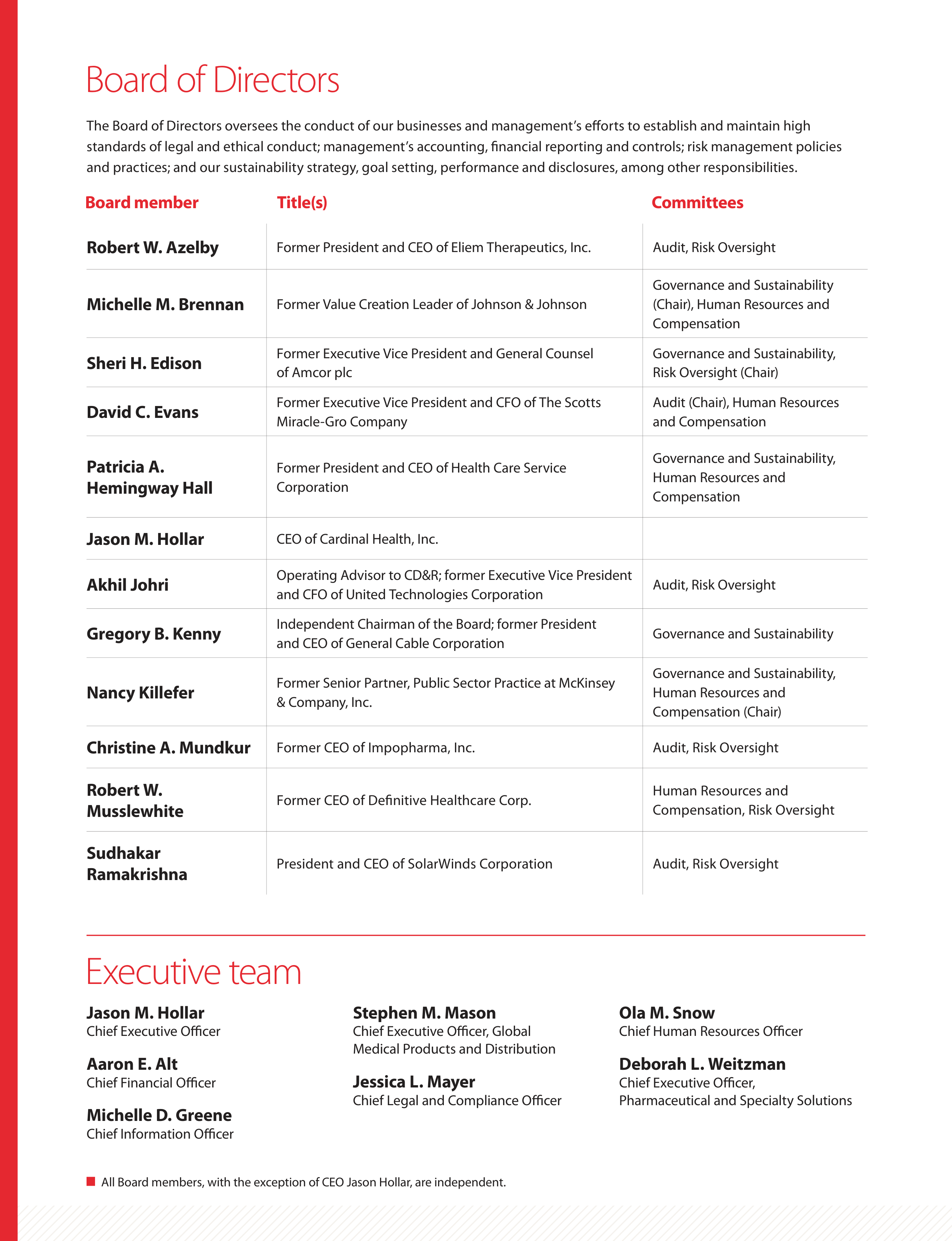
Jason M. Hollar
Chief Executive Officer
Aaron E. Alt
Chief Financial Officer
Michelle D. Greene
Chief Information Officer
Stephen M. Mason
Chief Executive Officer, Global
Medical Products and Distribution
Jessica L. Mayer
Chief Legal and Compliance Officer
Ola M. Snow
Chief Human Resources Officer
Deborah L. Weitzman
Chief Executive Officer,
Pharmaceutical and Specialty Solutions
Executive team
Board of Directors
Board member
Title(s)
Committees
The Board of Directors oversees the conduct of our businesses and management’s efforts to establish and maintain high
standards of legal and ethical conduct; management’s accounting, financial reporting and controls; risk management policies
and practices; and our sustainability strategy, goal setting, performance and disclosures, among other responsibilities.
All Board members, with the exception of CEO Jason Hollar, are independent.
Robert W. Azelby
Former President and CEO of Eliem Therapeutics, Inc.
Audit, Risk Oversight
Michelle M. Brennan
Former Value Creation Leader of Johnson & Johnson
Governance and Sustainability
(Chair), Human Resources and
Compensation
Sheri H. Edison
Former Executive Vice President and General Counsel
of Amcor plc
Governance and Sustainability,
Risk Oversight (Chair)
David C. Evans
Former Executive Vice President and CFO of The Scotts
Miracle-Gro Company
Audit (Chair), Human Resources
and Compensation
Patricia A.
Hemingway Hall
Former President and CEO of Health Care Service
Corporation
Governance and Sustainability,
Human Resources and
Compensation
Jason M. Hollar
CEO of Cardinal Health, Inc.
Akhil Johri
Operating Advisor to CD&R; former Executive Vice President
and CFO of United Technologies Corporation
Audit, Risk Oversight
Gregory B. Kenny
Independent Chairman of the Board; former President
and CEO of General Cable Corporation
Governance and Sustainability
Nancy Killefer
Former Senior Partner, Public Sector Practice at McKinsey
& Company, Inc.
Governance and Sustainability,
Human Resources and
Compensation (Chair)
Christine A. Mundkur
Former CEO of Impopharma, Inc.
Audit, Risk Oversight
Robert W.
Musslewhite
Former CEO of Definitive Healthcare Corp.
Human Resources and
Compensation, Risk Oversight
Sudhakar
Ramakrishna
President and CEO of SolarWinds Corporation
Audit, Risk Oversight
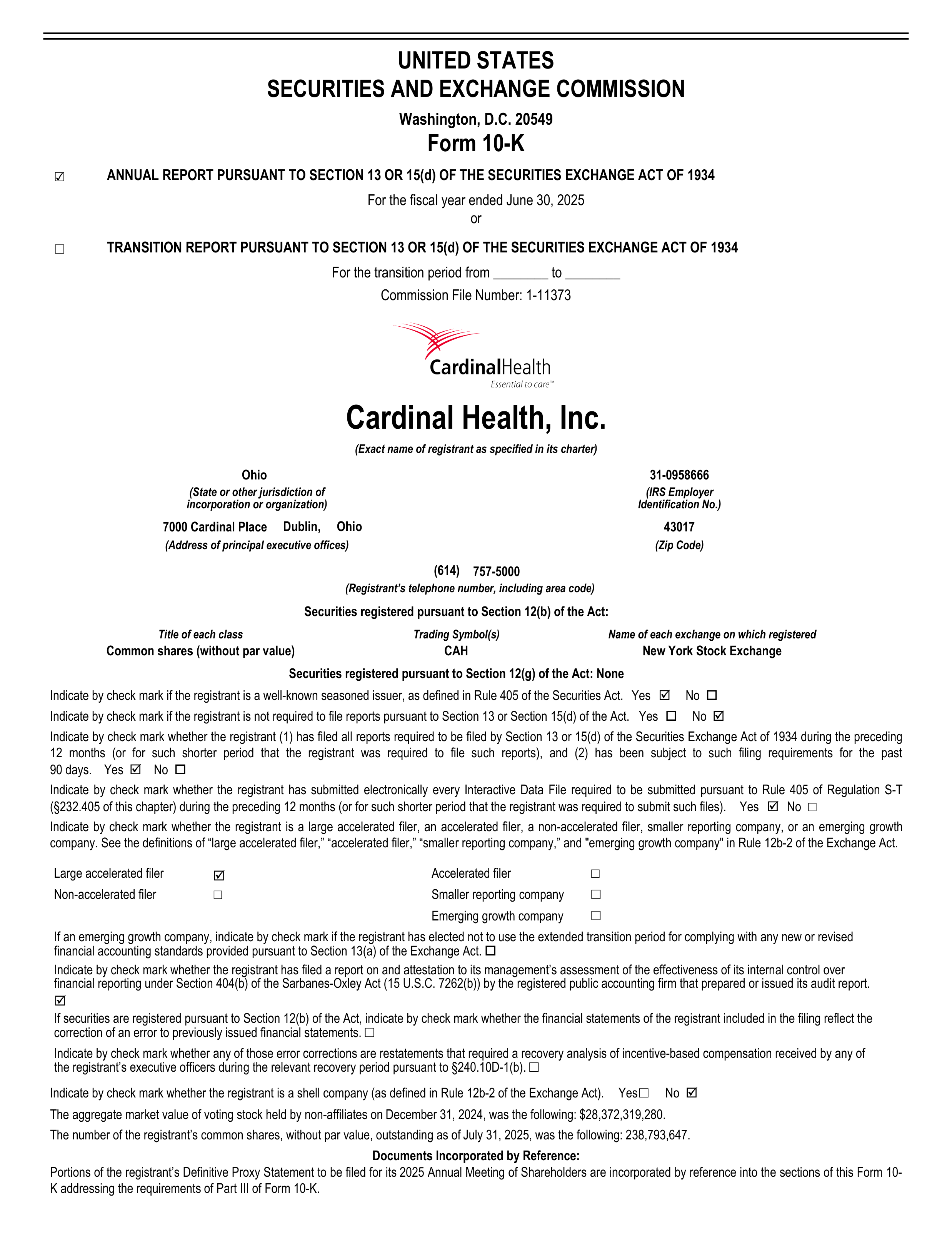

UNITED STATES
SECURITIES AND EXCHANGE COMMISSION
Washington, D.C. 20549
Form 10-K
☑
ANNUAL REPORT PURSUANT TO SECTION 13 OR 15(d) OF THE SECURITIES EXCHANGE ACT OF 1934
For the fiscal year ended June 30, 2025
or
☐
TRANSITION REPORT PURSUANT TO SECTION 13 OR 15(d) OF THE SECURITIES EXCHANGE ACT OF 1934
For the transition period from ________ to ________
Commission File Number: 1-11373
Cardinal Health, Inc.
(Exact name of registrant as specified in its charter)
Ohio
31-0958666
(State or other jurisdiction of
incorporation or organization)
(IRS Employer
Identification No.)
7000 Cardinal Place
Dublin,
Ohio
43017
(Address of principal executive offices)
(Zip Code)
(614)
757-5000
(Registrant’s telephone number, including area code)
Securities registered pursuant to Section 12(b) of the Act:
Title of each class
Trading Symbol(s)
Name of each exchange on which registered
Common shares (without par value)
CAH
New York Stock Exchange
Securities registered pursuant to Section 12(g) of the Act: None
Indicate by check mark if the registrant is a well-known seasoned issuer, as defined in Rule 405 of the Securities Act. Yes
þ
No
o
Indicate by check mark if the registrant is not required to file reports pursuant to Section 13 or Section 15(d) of the Act. Yes
o
No
þ
Indicate by check mark whether the registrant (1) has filed all reports required to be filed by Section 13 or 15(d) of the Securities Exchange Act of 1934 during the preceding
12 months (or for such shorter period that the registrant was required to file such reports), and (2) has been subject to such filing requirements for the past
90 days. Yes
þ
No
o
Indicate by check mark whether the registrant has submitted electronically every Interactive Data File required to be submitted pursuant to Rule 405 of Regulation S-T
(§232.405 of this chapter) during the preceding 12 months (or for such shorter period that the registrant was required to submit such files). Yes
þ
No
☐
Indicate by check mark whether the registrant is a large accelerated filer, an accelerated filer, a non-accelerated filer, smaller reporting company, or an emerging growth
company. See the definitions of “large accelerated filer,” “accelerated filer,” “smaller reporting company,” and "emerging growth company" in Rule 12b-2 of the Exchange Act.
Large accelerated filer
þ
Accelerated filer
☐
Non-accelerated filer
☐
Smaller reporting company
☐
Emerging growth company
☐
If an emerging growth company, indicate by check mark if the registrant has elected not to use the extended transition period for complying with any new or revised
financial accounting standards provided pursuant to Section 13(a) of the Exchange Act.
o
Indicate by check mark whether the registrant has filed a report on and attestation to its management’s assessment of the effectiveness of its internal control over
financial reporting under Section 404(b) of the Sarbanes-Oxley Act (15 U.S.C. 7262(b)) by the registered public accounting firm that prepared or issued its audit report.
þ
If securities are registered pursuant to Section 12(b) of the Act, indicate by check mark whether the financial statements of the registrant included in the filing reflect the
correction of an error to previously issued financial statements.
☐
Indicate by check mark whether any of those error corrections are restatements that required a recovery analysis of incentive-based compensation received by any of
the registrant’s executive officers during the relevant recovery period pursuant to §240.10D-1(b).
☐
Indicate by check mark whether the registrant is a shell company (as defined in Rule 12b-2 of the Exchange Act).
Yes
☐
No
þ
The aggregate market value of voting stock held by non-affiliates on December 31, 2024, was the following: $28,372,319,280.
The number of the registrant’s common shares, without par value, outstanding as of July 31, 2025, was the following: 238,793,647.
Documents Incorporated by Reference:
Portions of the registrant’s Definitive Proxy Statement to be filed for its 2025 Annual Meeting of Shareholders are incorporated by reference into the sections of this Form 10-
K addressing the requirements of Part III of Form 10-K.
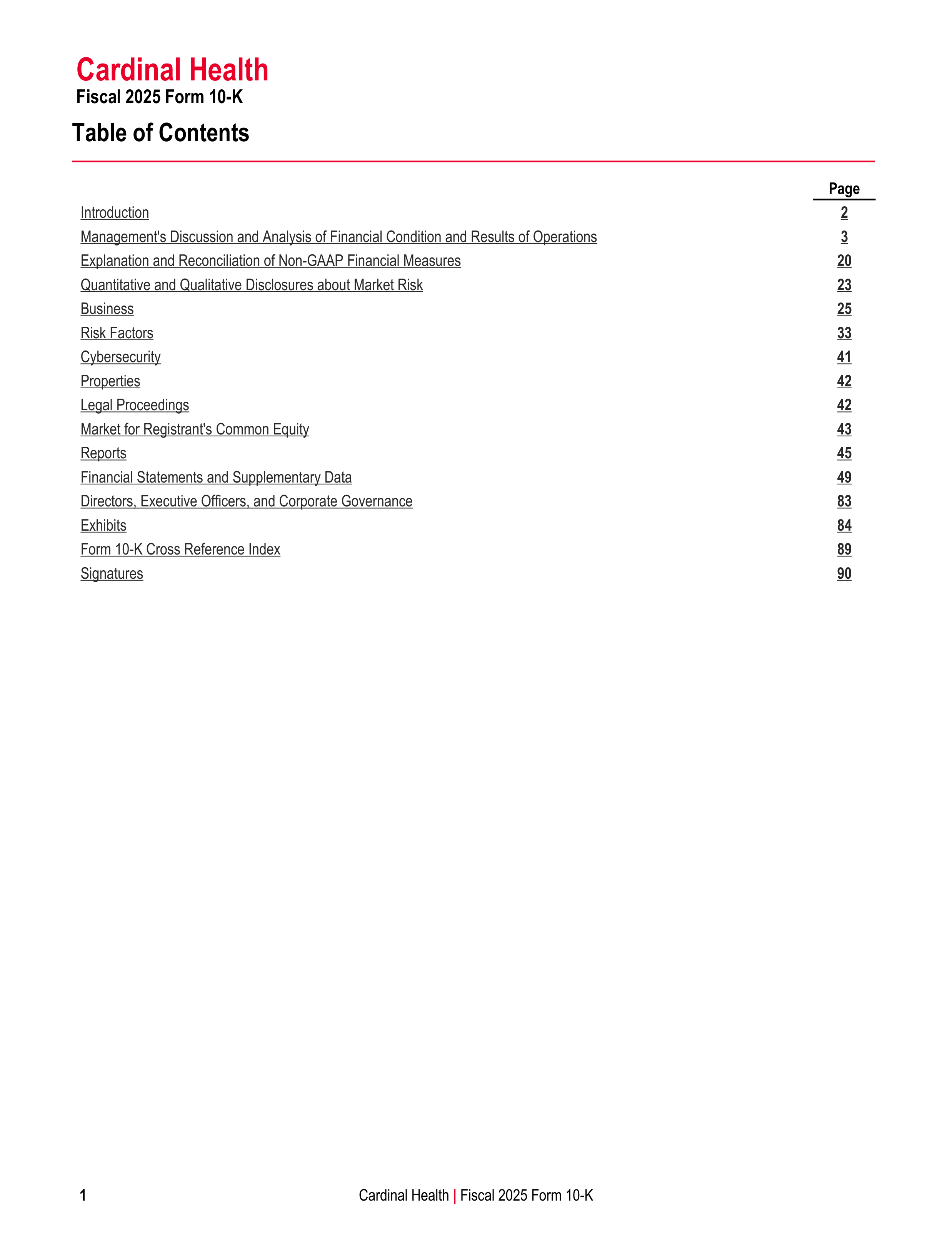
Table of Contents
Page
Introduction
2
Management's Discussion and Analysis of Financial Condition and Results of Operations
3
Explanation and Reconciliation of Non-GAAP Financial Measures
20
Quantitative and Qualitative Disclosures about Market Risk
23
Business
25
Risk Factors
33
Cybersecurity
41
Properties
42
Legal Proceedings
42
Market for Registrant's Common Equity
43
Reports
45
Financial Statements and Supplementary Data
49
Directors, Executive Officers, and Corporate Governance
83
Exhibits
84
Form 10-K Cross Reference Index
89
Signatures
90
Cardinal Health
Fiscal 2025 Form 10-K
Cardinal Health
|
Fiscal 2025 Form 10-K
1
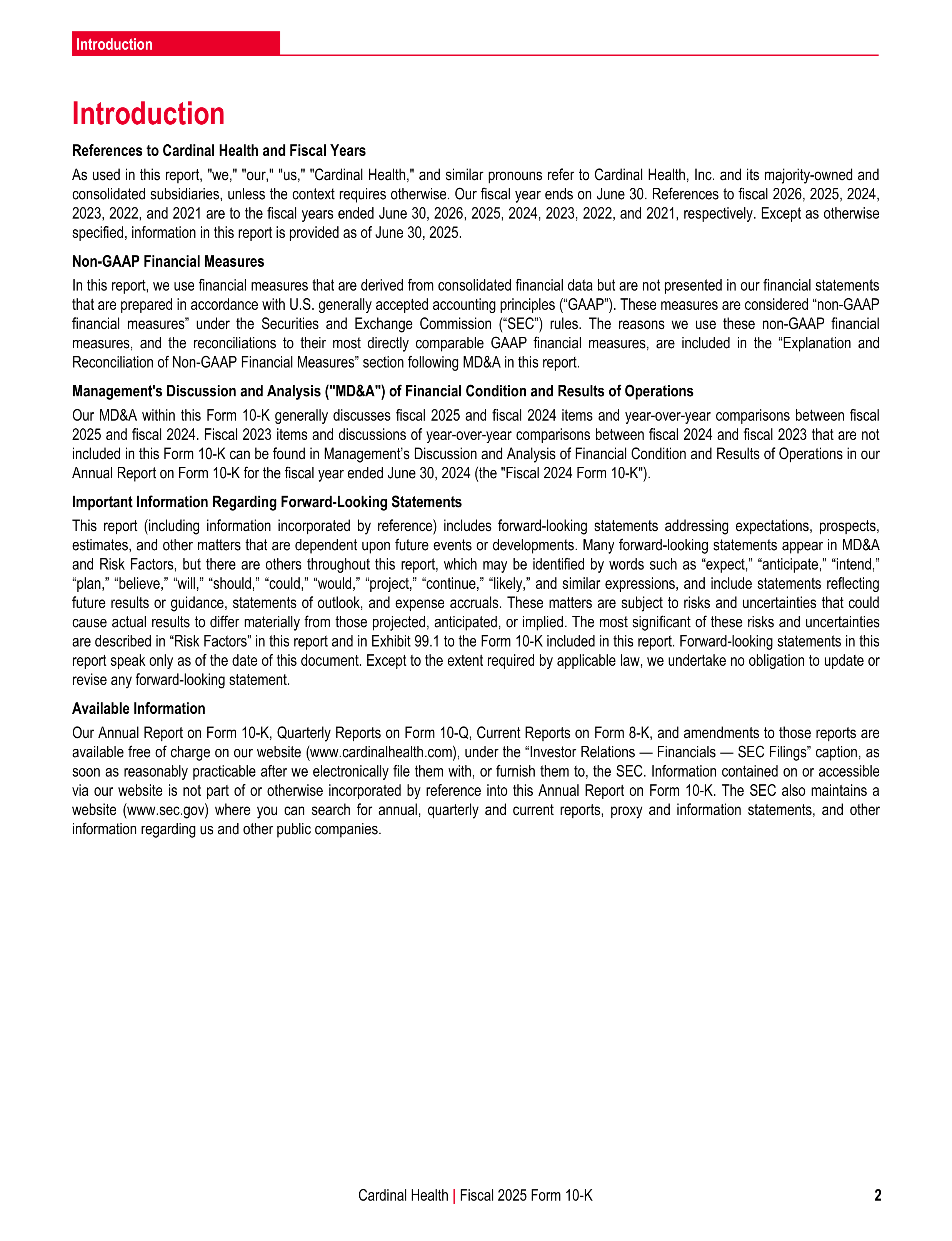
Introduction
References to Cardinal Health and Fiscal Years
As used in this report, "we," "our," "us," "Cardinal Health," and similar pronouns refer to Cardinal Health, Inc. and its majority-owned and
consolidated subsidiaries, unless the context requires otherwise. Our fiscal year ends on June 30. References to fiscal 2026, 2025, 2024,
2023, 2022, and 2021 are to the fiscal years ended June 30, 2026, 2025, 2024, 2023, 2022, and 2021, respectively. Except as otherwise
specified, information in this report is provided as of June 30, 2025.
Non-GAAP Financial Measures
In this report, we use financial measures that are derived from consolidated financial data but are not presented in our financial statements
that are prepared in accordance with U.S. generally accepted accounting principles (“GAAP”). These measures are considered “non-GAAP
financial measures” under the Securities and Exchange Commission (“SEC”) rules. The reasons we use these non-GAAP financial
measures, and the reconciliations to their most directly comparable GAAP financial measures, are included in the “Explanation and
Reconciliation of Non-GAAP Financial Measures” section following MD&A in this report.
Management's Discussion and Analysis ("MD&A") of Financial Condition and Results of Operations
Our MD&A within this Form 10-K generally discusses fiscal 2025 and fiscal 2024 items and year-over-year comparisons between fiscal
2025 and fiscal 2024. Fiscal 2023 items and discussions of year-over-year comparisons between fiscal 2024 and fiscal 2023 that are not
included in this Form 10-K can be found in Management’s Discussion and Analysis of Financial Condition and Results of Operations in our
Annual Report on Form 10-K for the fiscal year ended June 30, 2024 (the "Fiscal 2024 Form 10-K").
Important Information Regarding Forward-Looking Statements
This report (including information incorporated by reference) includes forward-looking statements addressing expectations, prospects,
estimates, and other matters that are dependent upon future events or developments. Many forward-looking statements appear in MD&A
and Risk Factors, but there are others throughout this report, which may be identified by words such as “expect,” “anticipate,” “intend,”
“plan,” “believe,” “will,” “should,” “could,” “would,” “project,” “continue,” “likely,” and similar expressions, and include statements reflecting
future results or guidance, statements of outlook, and expense accruals. These matters are subject to risks and uncertainties that could
cause actual results to differ materially from those projected, anticipated, or implied. The most significant of these risks and uncertainties
are described in “Risk Factors” in this report and in Exhibit 99.1 to the Form 10-K included in this report. Forward-looking statements in this
report speak only as of the date of this document. Except to the extent required by applicable law, we undertake no obligation to update or
revise any forward-looking statement.
Available Information
Our Annual Report on Form 10-K, Quarterly Reports on Form 10-Q, Current Reports on Form 8-K, and amendments to those reports are
available free of charge on our website (www.cardinalhealth.com), under the “Investor Relations — Financials — SEC Filings” caption, as
soon as reasonably practicable after we electronically file them with, or furnish them to, the SEC. Information contained on or accessible
via our website is not part of or otherwise incorporated by reference into this Annual Report on Form 10-K. The SEC also maintains a
website (www.sec.gov) where you can search for annual, quarterly and current reports, proxy and information statements, and other
information regarding us and other public companies.
Introduction
2
Cardinal Health
|
Fiscal 2025 Form 10-K
Management's Discussion and Analysis of Financial Condition
and Results of Operations
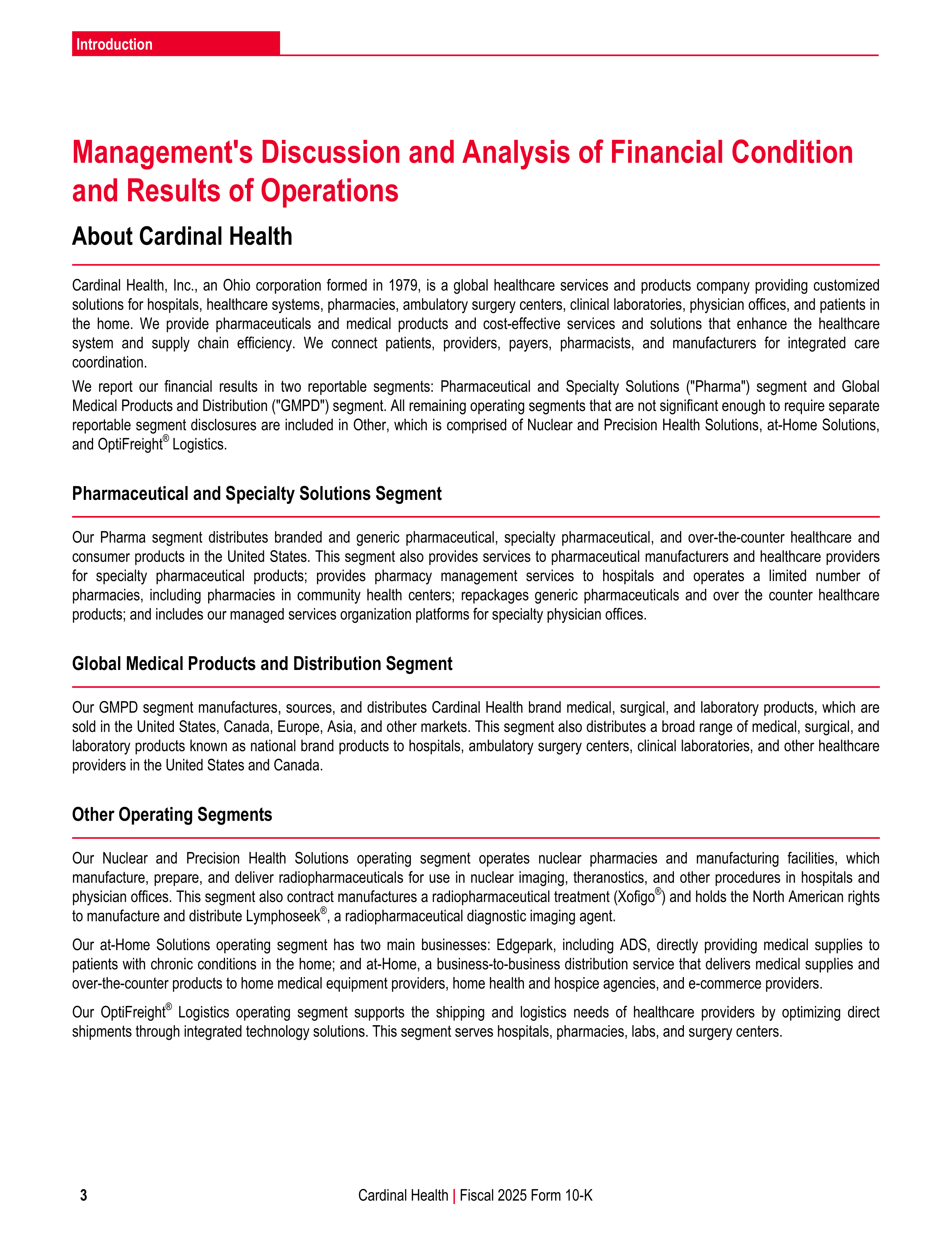
About Cardinal Health
Cardinal Health, Inc., an Ohio corporation formed in 1979, is a global healthcare services and products company providing customized
solutions for hospitals, healthcare systems, pharmacies, ambulatory surgery centers, clinical laboratories, physician offices, and patients in
the home. We provide pharmaceuticals and medical products and cost-effective services and solutions that enhance the healthcare
system and supply chain efficiency. We connect patients, providers, payers, pharmacists, and manufacturers for integrated care
coordination.
We report our financial results in two reportable segments: Pharmaceutical and Specialty Solutions ("Pharma") segment and Global
Medical Products and Distribution ("GMPD") segment. All remaining operating segments that are not significant enough to require separate
reportable segment disclosures are included in Other, which is comprised of Nuclear and Precision Health Solutions, at-Home Solutions,
and OptiFreight
®
Logistics.
Pharmaceutical and Specialty Solutions Segment
Our Pharma segment distributes branded and generic pharmaceutical, specialty pharmaceutical, and over-the-counter healthcare and
consumer products in the United States. This segment also provides services to pharmaceutical manufacturers and healthcare providers
for specialty pharmaceutical products; provides pharmacy management services to hospitals and operates a limited number of
pharmacies, including pharmacies in community health centers; repackages generic pharmaceuticals and over the counter healthcare
products; and includes our managed services organization platforms for specialty physician offices.
Global Medical Products and Distribution Segment
Our GMPD segment manufactures, sources, and distributes Cardinal Health brand medical, surgical, and laboratory products, which are
sold in the United States, Canada, Europe, Asia, and other markets. This segment also distributes a broad range of medical, surgical, and
laboratory products known as national brand products to hospitals, ambulatory surgery centers, clinical laboratories, and other healthcare
providers in the United States and Canada.
Other Operating Segments
Our Nuclear and Precision Health Solutions operating segment operates nuclear pharmacies and manufacturing facilities, which
manufacture, prepare, and deliver radiopharmaceuticals for use in nuclear imaging, theranostics, and other procedures in hospitals and
physician offices. This segment also contract manufactures a radiopharmaceutical treatment (Xofigo
®
) and holds the North American rights
to manufacture and distribute Lymphoseek
®
, a radiopharmaceutical diagnostic imaging agent.
Our at-Home Solutions operating segment has two main businesses: Edgepark, including ADS, directly providing medical supplies to
patients with chronic conditions in the home; and at-Home, a business-to-business distribution service that delivers medical supplies and
over-the-counter products to home medical equipment providers, home health and hospice agencies, and e-commerce providers.
Our OptiFreight
®
Logistics operating segment supports the shipping and logistics needs of healthcare providers by optimizing direct
shipments through integrated technology solutions. This segment serves hospitals, pharmacies, labs, and surgery centers.
Introduction
3
Cardinal Health
|
Fiscal 2025 Form 10-K
Consolidated Results
Fiscal 2025 Overview
Revenue
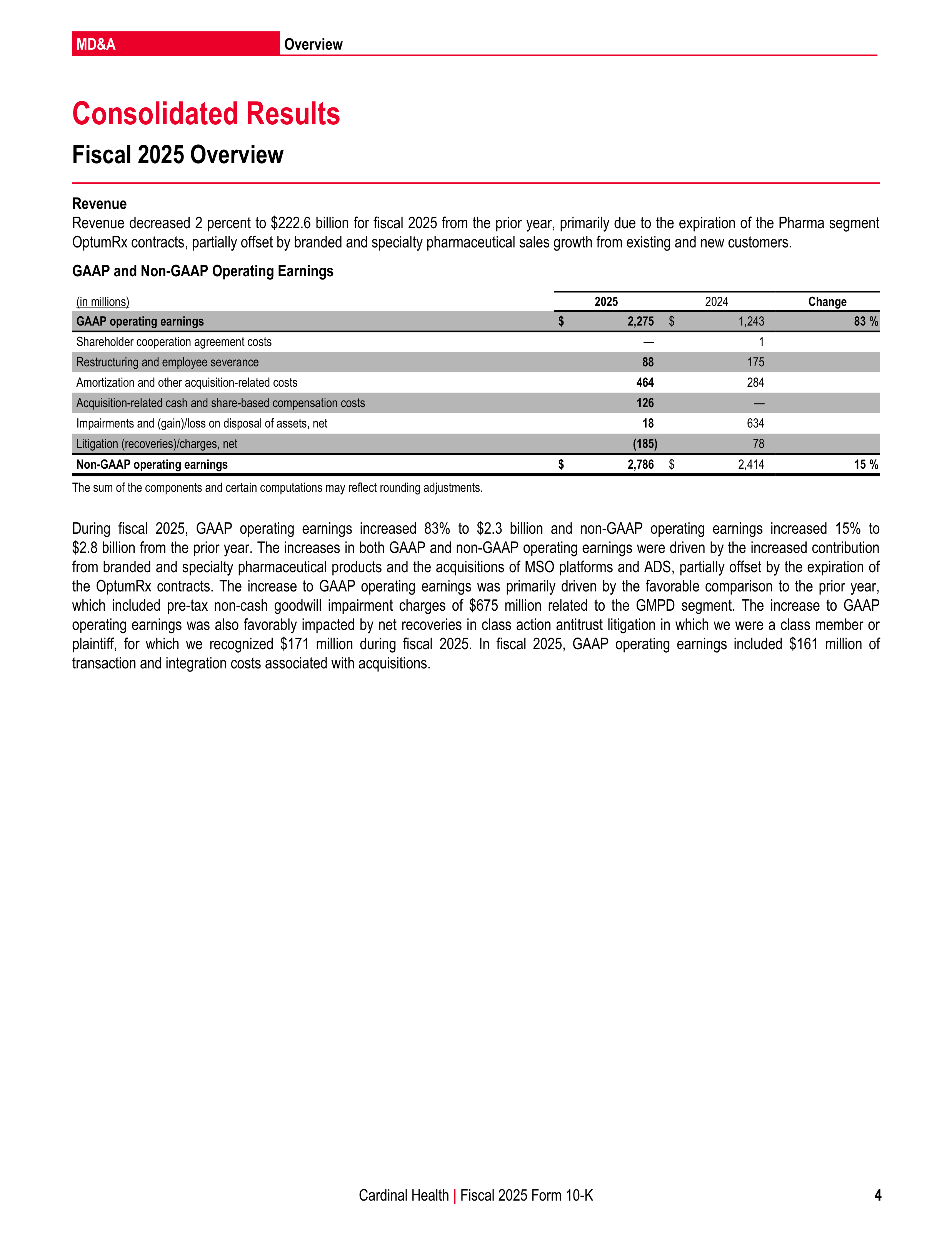
Revenue decreased 2 percent to $222.6 billion for fiscal 2025 from the prior year, primarily due to the expiration of the Pharma segment
OptumRx contracts, partially offset by branded and specialty pharmaceutical sales growth from existing and new customers.
GAAP and Non-GAAP Operating Earnings
(in millions)
2025
2024
Change
GAAP operating earnings
$
2,275
$
1,243
83 %
Shareholder cooperation agreement costs
—
1
Restructuring and employee severance
88
175
Amortization and other acquisition-related costs
464
284
Acquisition-related cash and share-based compensation costs
126
—
Impairments and (gain)/loss on disposal of assets, net
18
634
Litigation (recoveries)/charges, net
(185)
78
Non-GAAP operating earnings
$
2,786
$
2,414
15 %
The sum of the components and certain computations may reflect rounding adjustments.
During fiscal 2025, GAAP operating earnings increased 83%
to $2.3 billion and non-GAAP operating earnings increased 15%
to
$2.8 billion from the prior year. The increases in both GAAP and non-GAAP operating earnings were driven by the increased contribution
from branded and specialty pharmaceutical products and the acquisitions of MSO platforms and ADS, partially offset by the expiration of
the OptumRx contracts. The increase to GAAP operating earnings was primarily driven by the favorable comparison to the prior year,
which included pre-tax non-cash goodwill impairment charges of $675 million related to the GMPD segment. The increase to GAAP
operating earnings was also favorably impacted by net recoveries in class action antitrust litigation in which we were a class member or
plaintiff, for which we recognized $171 million during fiscal 2025. In fiscal 2025, GAAP operating earnings included $161 million of
transaction and integration costs associated with acquisitions.
MD&A
Overview
4
Cardinal Health
|
Fiscal 2025 Form 10-K
GAAP and Non-GAAP Diluted EPS
($ per share)
2025
(2)
2024
(2)
Change
GAAP diluted EPS
(1)
$
6.45
$
3.45
87 %
Restructuring and employee severance
0.28
0.54
Amortization and other acquisition-related costs
1.49
0.85
Acquisition-related cash and share-based compensation costs
0.51
—
Impairments and (gain)/loss on disposal of assets, net
(3)
0.05
2.38
Litigation (recoveries)/charges, net
(0.54)
0.30
Non-GAAP diluted EPS
(1)
$
8.24
$
7.53
9 %
The sum of the components and certain computations may reflect rounding adjustments.
(1)
Diluted earnings per share attributable to Cardinal Health, Inc. ("diluted EPS").
(2)
The reconciling items are presented within this table net of tax. See quantification of tax effect of each reconciling item in our GAAP to Non-GAAP Reconciliations in the
section titled "Explanation and Reconciliation of Non-GAAP Financial Measures."
(3)
For fiscal 2024, impairments and (gain)/loss on disposals of assets, net included pre-tax goodwill impairment charges of $675 million related to the GMPD segment.
This had an adverse impact of $(2.50) per share to GAAP diluted EPS.
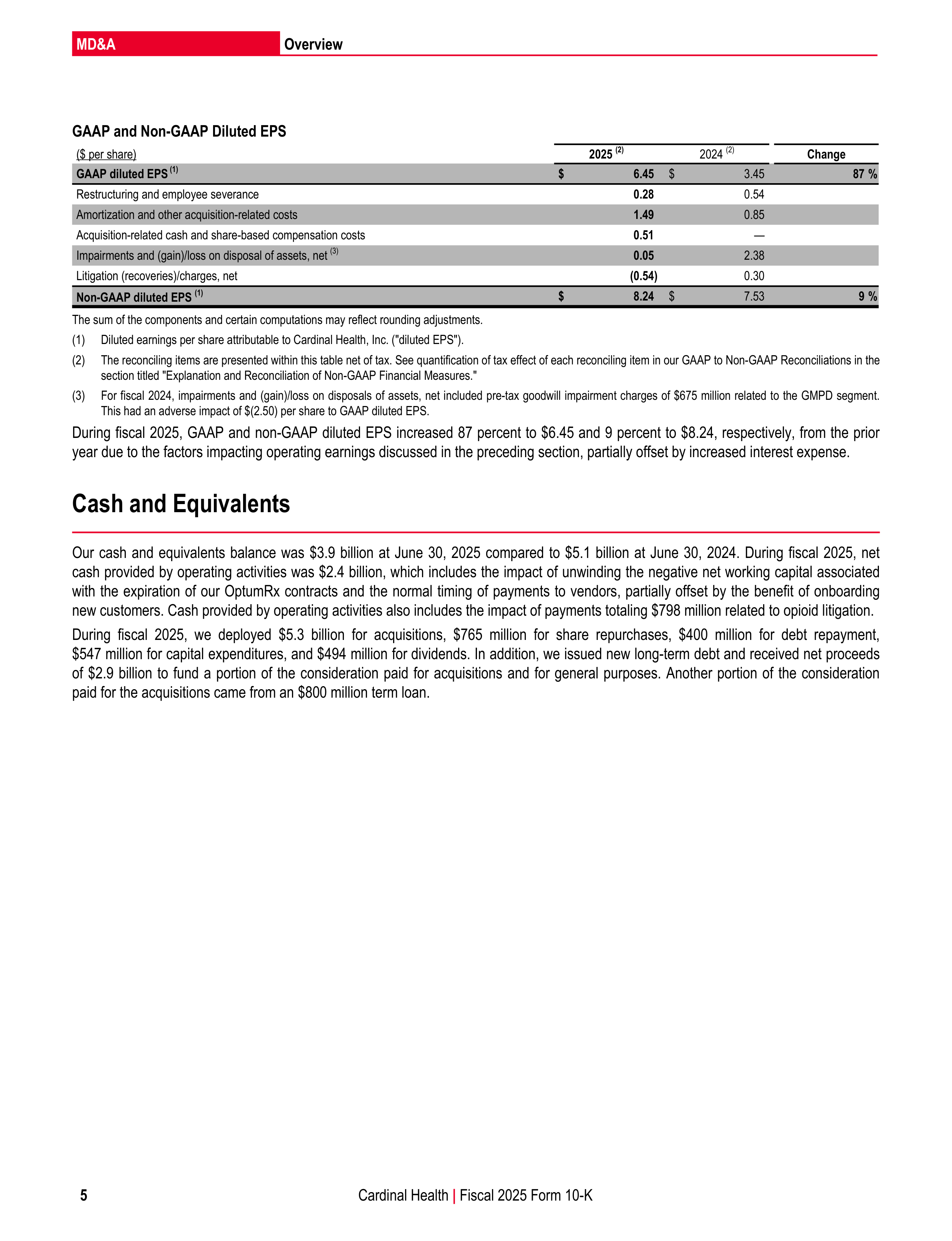
During fiscal 2025, GAAP and non-GAAP diluted EPS increased 87 percent to $6.45 and 9 percent to $8.24, respectively, from the prior
year due to the factors impacting operating earnings discussed in the preceding section, partially offset by increased interest expense.
Cash and Equivalents
Our cash and equivalents balance was $3.9 billion at June 30, 2025 compared to $5.1 billion at June 30, 2024. During fiscal 2025, net
cash provided by operating activities was $2.4 billion, which includes the impact of unwinding the negative net working capital associated
with the expiration of our OptumRx contracts and the normal timing of payments to vendors, partially offset by the benefit of onboarding
new customers. Cash provided by operating activities also includes the impact of payments totaling $798 million related to opioid litigation.
During fiscal 2025, we deployed $5.3 billion for acquisitions, $765 million for share repurchases, $400 million for debt repayment,
$547 million for capital expenditures, and $494 million for dividends. In addition, we issued new long-term debt and received net proceeds
of $2.9 billion to fund a portion of the consideration paid for acquisitions and for general purposes. Another portion of the consideration
paid for the acquisitions came from an $800 million term loan.
MD&A
Overview
Cardinal Health
|
Fiscal 2025 Form 10-K
5
Significant Developments in Fiscal 2025 and Trends
Acquisitions
Advanced Diabetes Supply Group ("ADS")
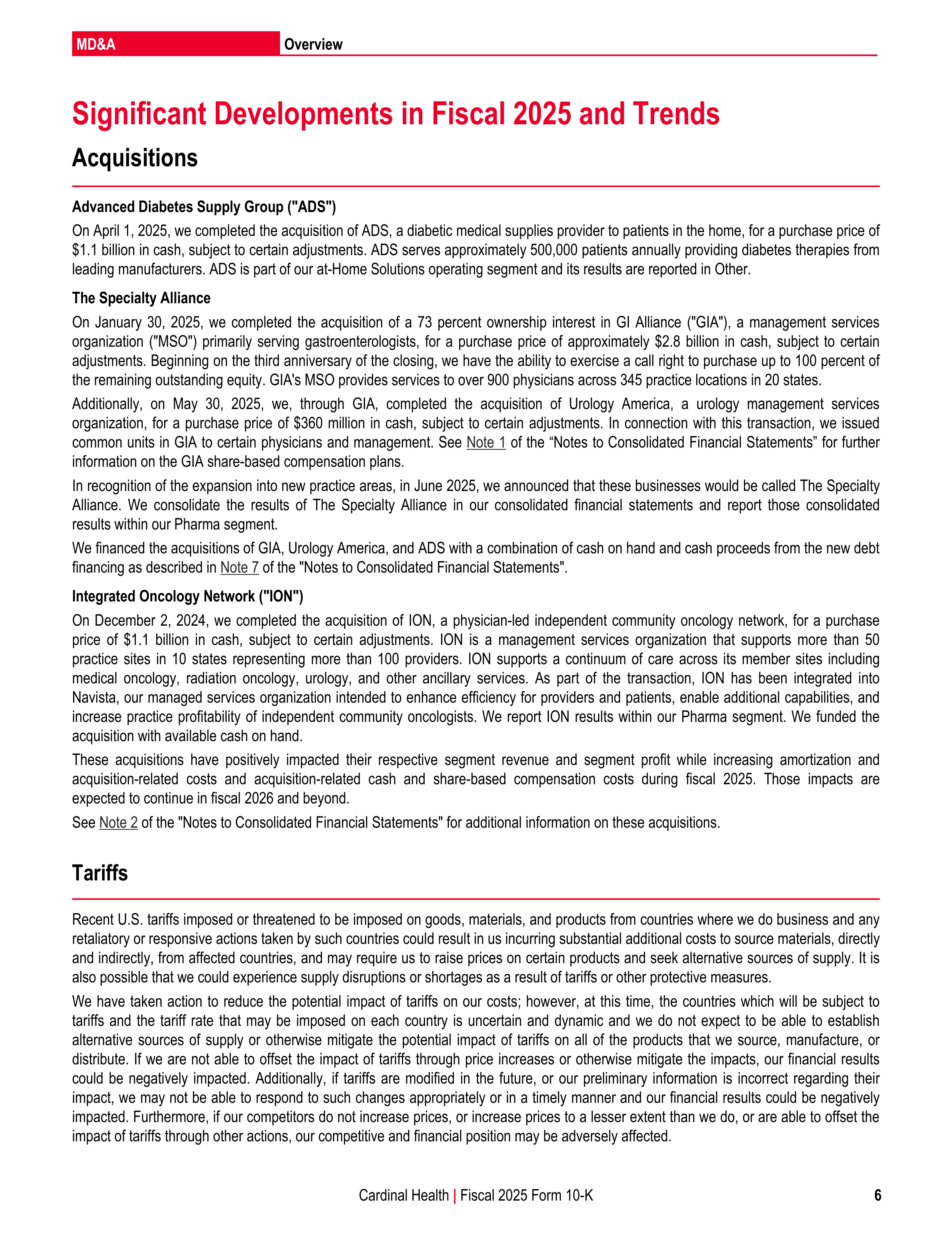
On April 1, 2025, we completed the acquisition of ADS, a diabetic medical supplies provider to patients in the home, for a purchase price of
$1.1 billion in cash, subject to certain adjustments. ADS serves approximately 500,000 patients annually providing diabetes therapies from
leading manufacturers. ADS is part of our at-Home Solutions operating segment and its results are reported in Other.
The Specialty Alliance
On January 30, 2025, we completed the acquisition of a 73 percent ownership interest in GI Alliance ("GIA"), a management services
organization ("MSO") primarily serving gastroenterologists, for a purchase price of approximately $2.8 billion in cash, subject to certain
adjustments. Beginning on the third anniversary of the closing, we have the ability to exercise a call right to purchase up to 100 percent of
the remaining outstanding equity. GIA's MSO provides services to over 900 physicians across 345 practice locations in 20 states.
Additionally, on May 30, 2025, we, through GIA, completed the acquisition of Urology America, a urology management services
organization, for a purchase price of $360 million in cash, subject to certain adjustments. In connection with this transaction, we issued
common units in GIA to certain physicians and management. See
Note 1
of the “Notes to Consolidated Financial Statements” for further
information on the GIA share-based compensation plans.
In recognition of the expansion into new practice areas, in June 2025, we announced that these businesses would be called The Specialty
Alliance. We consolidate the results of The Specialty Alliance in our consolidated financial statements and report those consolidated
results within our Pharma segment.
We financed the acquisitions of GIA, Urology America, and ADS with a combination of cash on hand and cash proceeds from the new debt
financing as described in
Note 7
of the "Notes to Consolidated Financial Statements".
Integrated Oncology Network ("ION")
On December 2, 2024, we completed the acquisition of ION, a physician-led independent community oncology network, for a purchase
price of $1.1 billion in cash, subject to certain adjustments. ION is a management services organization that supports more than 50
practice sites in 10 states representing more than 100 providers. ION supports a continuum of care across its member sites including
medical oncology, radiation oncology, urology, and other ancillary services. As part of the transaction, ION has been integrated into
Navista, our managed services organization intended to enhance efficiency for providers and patients, enable additional capabilities, and
increase practice profitability of independent community oncologists. We report ION results within our Pharma segment. We funded the
acquisition with available cash on hand.
These acquisitions have positively impacted their respective segment revenue and segment profit while increasing amortization and
acquisition-related costs and acquisition-related cash and share-based compensation costs during fiscal 2025. Those impacts are
expected to continue in fiscal 2026 and beyond.
See
Note 2
of the "Notes to Consolidated Financial Statements" for additional information on these acquisitions.
Tariffs
Recent U.S. tariffs imposed or threatened to be imposed on goods, materials, and products from countries where we do business and any
retaliatory or responsive actions taken by such countries could result in us incurring substantial additional costs to source materials, directly
and indirectly, from affected countries, and may require us to raise prices on certain products and seek alternative sources of supply. It is
also possible that we could experience supply disruptions or shortages as a result of tariffs or other protective measures.
We have taken action to reduce the potential impact of tariffs on our costs; however, at this time, the countries which will be subject to
tariffs and the tariff rate that may be imposed on each country is uncertain and dynamic and we do not expect to be able to establish
alternative sources of supply or otherwise mitigate the potential impact of tariffs on all of the products that we source, manufacture, or
distribute. If we are not able to offset the impact of tariffs through price increases or otherwise mitigate the impacts, our financial results
could be negatively impacted. Additionally, if tariffs are modified in the future, or our preliminary information is incorrect regarding their
impact, we may not be able to respond to such changes appropriately or in a timely manner and our financial results could be negatively
impacted. Furthermore, if our competitors do not increase prices, or increase prices to a lesser extent than we do, or are able to offset the
impact of tariffs through other actions, our competitive and financial position may be adversely affected.
MD&A
Overview
6
Cardinal Health
|
Fiscal 2025 Form 10-K
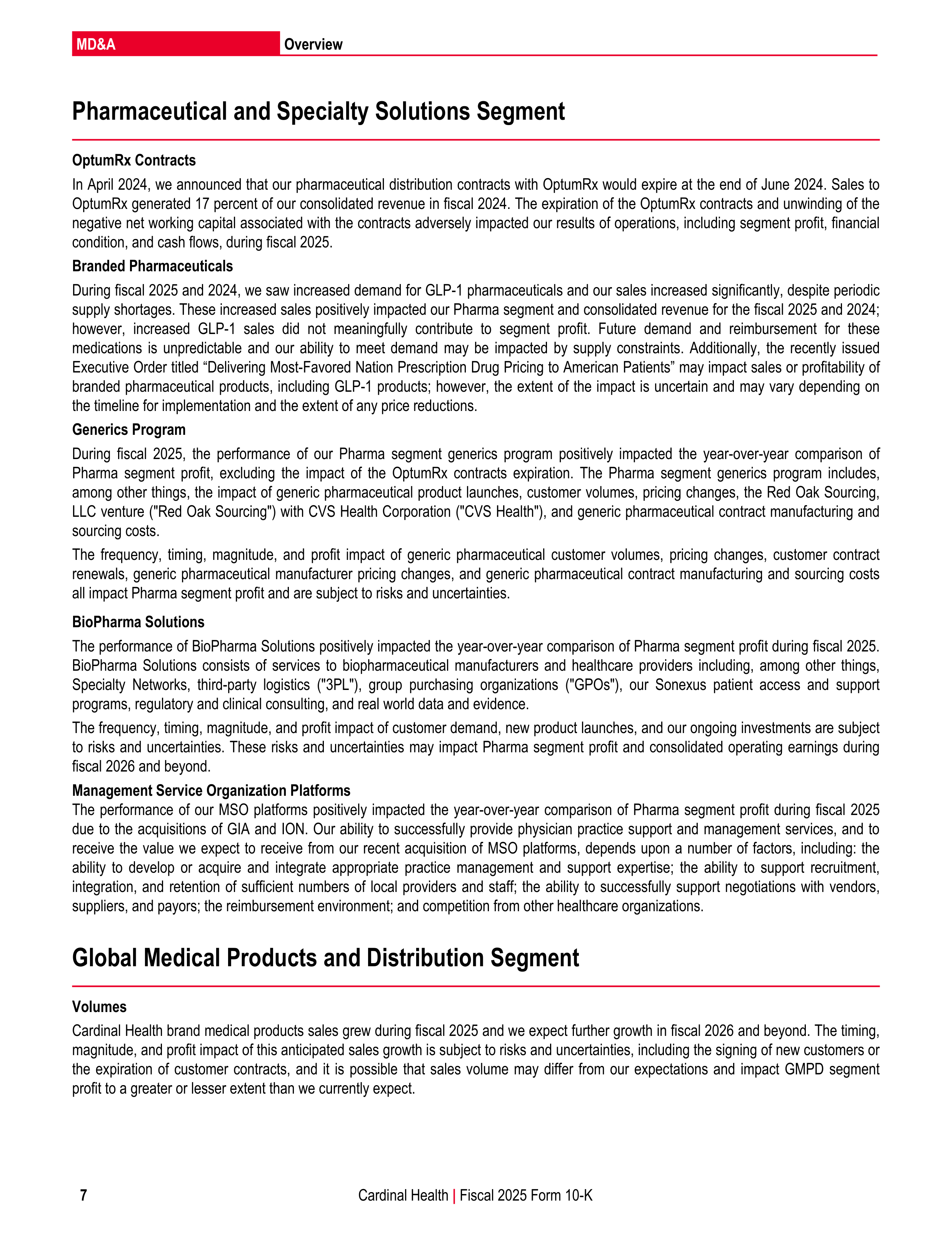
Pharmaceutical and Specialty Solutions Segment
OptumRx Contracts
In April 2024, we announced that our pharmaceutical distribution contracts with OptumRx would expire at the end of June 2024. Sales to
OptumRx generated 17 percent of our consolidated revenue in fiscal 2024. The expiration of the OptumRx contracts and unwinding of the
negative net working capital associated with the contracts adversely impacted our results of operations, including segment profit, financial
condition, and cash flows, during fiscal 2025.
Branded Pharmaceuticals
During fiscal 2025 and 2024, we saw increased demand for GLP-1 pharmaceuticals and our sales increased significantly, despite periodic
supply shortages. These increased sales positively impacted our Pharma segment and consolidated revenue for the fiscal 2025 and 2024;
however, increased GLP-1 sales did not meaningfully contribute to segment profit. Future demand and reimbursement for these
medications is unpredictable and our ability to meet demand may be impacted by supply constraints. Additionally, the recently issued
Executive Order titled “Delivering Most-Favored Nation Prescription Drug Pricing to American Patients” may impact sales or profitability of
branded pharmaceutical products, including GLP-1 products; however, the extent of the impact is uncertain and may vary depending on
the timeline for implementation and the extent of any price reductions.
Generics Program
During fiscal 2025, the performance of our Pharma segment generics program positively impacted the year-over-year comparison of
Pharma segment profit, excluding the impact of the OptumRx contracts expiration. The Pharma segment generics program includes,
among other things, the impact of generic pharmaceutical product launches, customer volumes, pricing changes, the Red Oak Sourcing,
LLC venture ("Red Oak Sourcing") with CVS Health Corporation ("CVS Health"), and generic pharmaceutical contract manufacturing and
sourcing costs.
The frequency, timing, magnitude, and profit impact of generic pharmaceutical customer volumes, pricing changes, customer contract
renewals, generic pharmaceutical manufacturer pricing changes, and generic pharmaceutical contract manufacturing and sourcing costs
all impact Pharma segment profit and are subject to risks and uncertainties.
BioPharma Solutions
The performance of BioPharma Solutions positively impacted the year-over-year comparison of Pharma segment profit during fiscal 2025.
BioPharma Solutions consists of services to biopharmaceutical manufacturers and healthcare providers including, among other things,
Specialty Networks, third-party logistics ("3PL"), group purchasing organizations ("GPOs"), our Sonexus patient access and support
programs, regulatory and clinical consulting, and real world data and evidence.
The frequency, timing, magnitude, and profit impact of customer demand, new product launches, and our ongoing investments are subject
to risks and uncertainties. These risks and uncertainties may impact Pharma segment profit and consolidated operating earnings during
fiscal 2026 and beyond.
Management Service Organization Platforms
The performance of our MSO platforms positively impacted the year-over-year comparison of Pharma segment profit during fiscal 2025
due to the acquisitions of GIA and ION. Our ability to successfully provide physician practice support and management services, and to
receive the value we expect to receive from our recent acquisition of MSO platforms, depends upon a number of factors, including: the
ability to develop or acquire and integrate appropriate practice management and support expertise; the ability to support recruitment,
integration, and retention of sufficient numbers of local providers and staff; the ability to successfully support negotiations with vendors,
suppliers, and payors; the reimbursement environment; and competition from other healthcare organizations.
Global Medical Products and Distribution Segment
Volumes
Cardinal Health brand medical products sales grew during fiscal 2025 and we expect further growth in fiscal 2026 and beyond. The timing,
magnitude, and profit impact of this anticipated sales growth is subject to risks and uncertainties, including the signing of new customers or
the expiration of customer contracts, and it is possible that sales volume may differ from our expectations and impact GMPD segment
profit to a greater or lesser extent than we currently expect.
MD&A
Overview
Cardinal Health
|
Fiscal 2025 Form 10-K
7
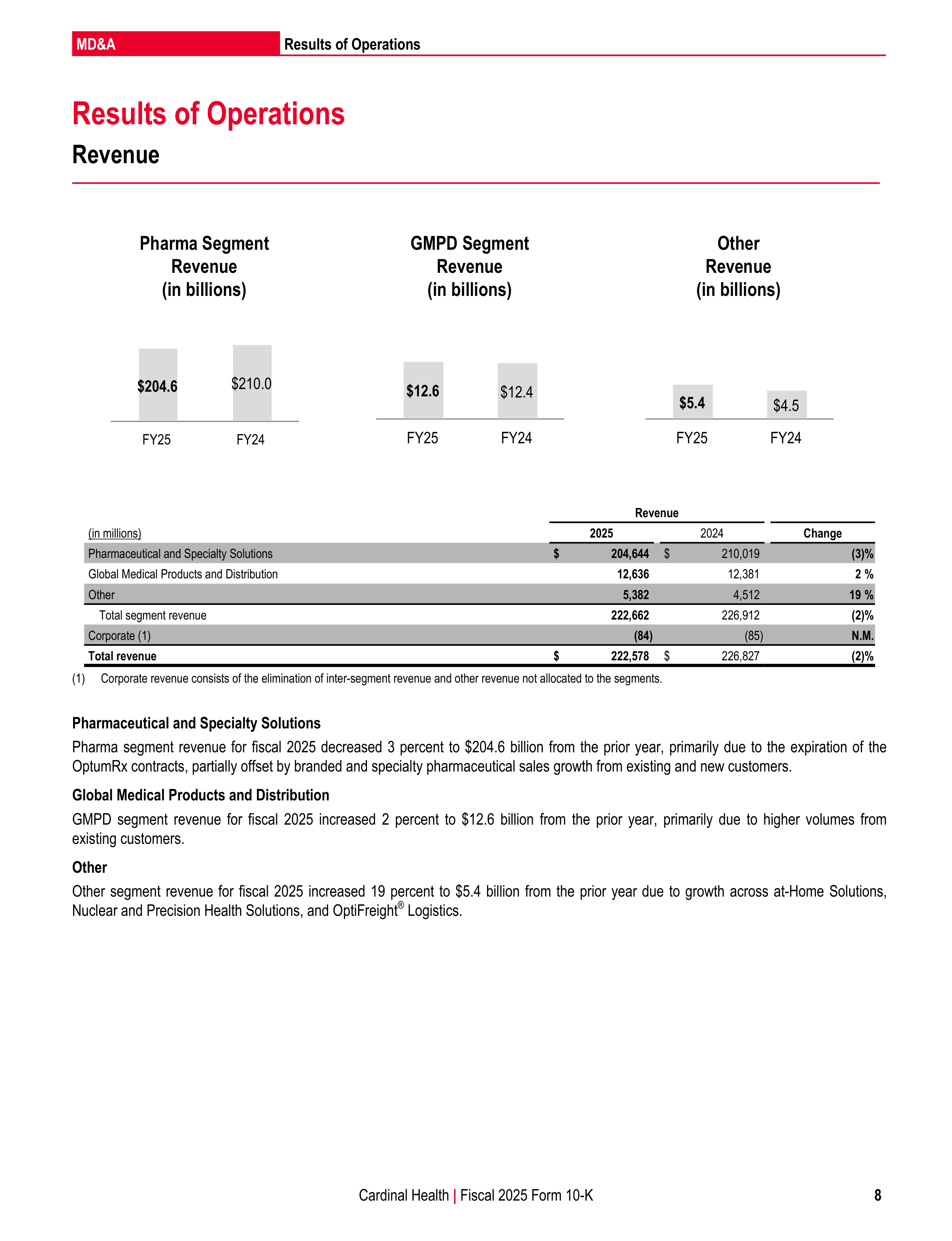
Results of Operations
Revenue
Pharma Segment
Revenue
(in billions)
$204.6
$210.0
FY25
FY24
GMPD Segment
Revenue
(in billions)
$12.6
$12.4
FY25
FY24
Other
Revenue
(in billions)
$5.4
$4.5
FY25
FY24
Revenue
(in millions)
2025
2024
Change
Pharmaceutical and Specialty Solutions
$
204,644
$
210,019
(3) %
Global Medical Products and Distribution
12,636
12,381
2 %
Other
5,382
4,512
19 %
Total segment revenue
222,662
226,912
(2) %
Corporate (1)
(84)
(85)
N.M.
Total revenue
$
222,578
$
226,827
(2) %
(1)
Corporate revenue consists of the elimination of inter-segment revenue and other revenue not allocated to the segments.
Pharmaceutical and Specialty Solutions
Pharma segment revenue for fiscal 2025 decreased 3 percent to $204.6 billion from the prior year, primarily due to the expiration of the
OptumRx contracts, partially offset by branded and specialty pharmaceutical sales growth from existing and new customers.
Global Medical Products and Distribution
GMPD segment revenue for fiscal 2025 increased 2 percent to $12.6 billion from the prior year, primarily due to higher volumes from
existing customers.
Other
Other segment revenue for fiscal 2025 increased 19 percent to $5.4 billion from the prior year due to growth across at-Home Solutions,
Nuclear and Precision Health Solutions, and OptiFreight
®
Logistics.
MD&A
Results of Operations
8
Cardinal Health
|
Fiscal 2025 Form 10-K
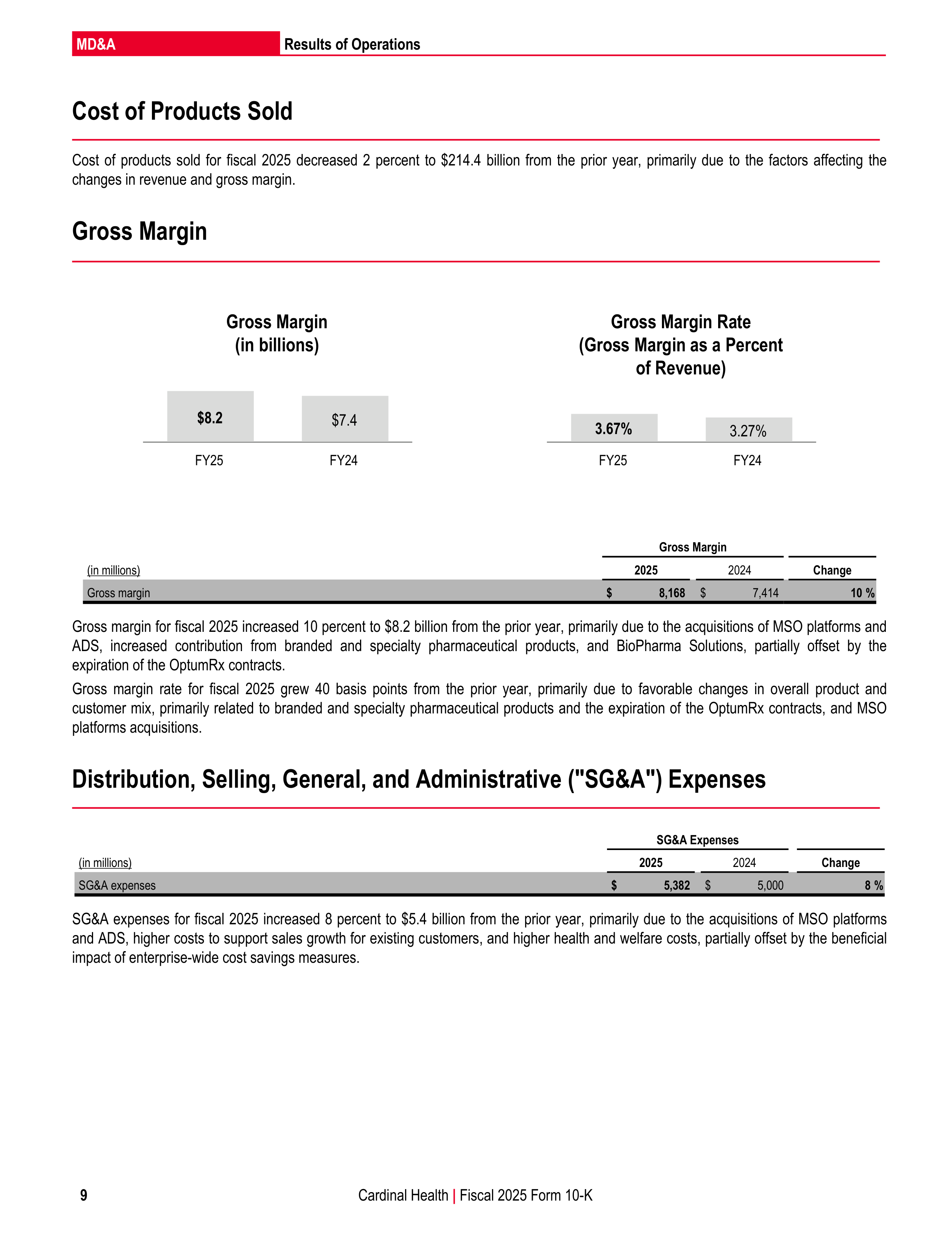
Cost of Products Sold
Cost of products sold for fiscal 2025 decreased 2 percent to $214.4 billion from the prior year, primarily due to the factors affecting the
changes in revenue and gross margin.
Gross Margin
Gross Margin
(in billions)
$8.2
$7.4
FY25
FY24
Gross Margin Rate
(Gross Margin as a Percent
of Revenue)
3.67%
3.27%
FY25
FY24
Gross Margin
(in millions)
2025
2024
Change
Gross margin
$
8,168
$
7,414
10 %
Gross margin for fiscal 2025 increased 10 percent to $8.2 billion from the prior year, primarily due to the acquisitions of MSO platforms and
ADS, increased contribution from branded and specialty pharmaceutical products, and BioPharma Solutions, partially offset by the
expiration of the OptumRx contracts.
Gross margin rate for fiscal 2025 grew 40 basis points from the prior year, primarily due to favorable changes in overall product and
customer mix, primarily related to branded and specialty pharmaceutical products and the expiration of the OptumRx contracts, and MSO
platforms acquisitions.
Distribution, Selling, General, and Administrative ("SG&A") Expenses
SG&A Expenses
(in millions)
2025
2024
Change
SG&A expenses
$
5,382
$
5,000
8 %
SG&A expenses for fiscal 2025 increased 8 percent to $5.4 billion from the prior year, primarily due to the acquisitions of MSO platforms
and ADS, higher costs to support sales growth for existing customers, and higher health and welfare costs, partially offset by the beneficial
impact of enterprise-wide cost savings measures.
MD&A
Results of Operations
Cardinal Health
|
Fiscal 2025 Form 10-K
9
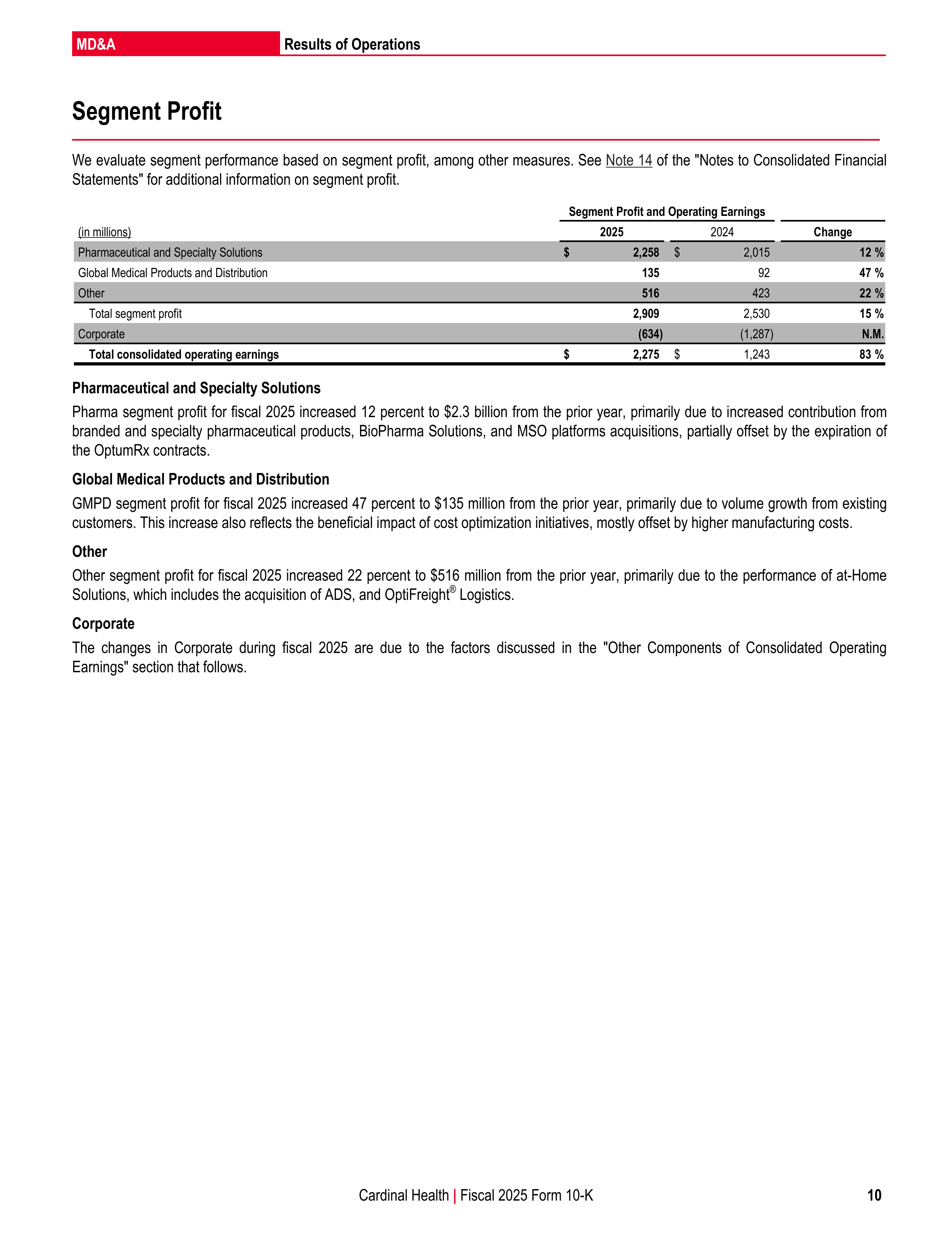
Segment Profit
We evaluate segment performance based on segment profit, among other measures. See
Note 14
of the "Notes to Consolidated Financial
Statements" for additional information on segment profit.
Segment Profit and Operating Earnings
(in millions)
2025
2024
Change
Pharmaceutical and Specialty Solutions
$
2,258
$
2,015
12 %
Global Medical Products and Distribution
135
92
47 %
Other
516
423
22 %
Total segment profit
2,909
2,530
15 %
Corporate
(634)
(1,287)
N.M.
Total consolidated operating earnings
$
2,275
$
1,243
83 %
Pharmaceutical and Specialty Solutions
Pharma segment profit for fiscal 2025 increased 12 percent to $2.3 billion from the prior year, primarily due to increased contribution from
branded and specialty pharmaceutical products, BioPharma Solutions, and MSO platforms acquisitions, partially offset by the expiration of
the OptumRx contracts.
Global Medical Products and Distribution
GMPD segment profit for fiscal 2025 increased 47 percent to $135 million from the prior year, primarily due to volume growth from existing
customers. This increase also reflects the beneficial impact of cost optimization initiatives, mostly offset by higher manufacturing costs.
Other
Other segment profit for fiscal 2025 increased 22 percent to $516 million from the prior year, primarily due to the performance of at-Home
Solutions, which includes the acquisition of ADS, and OptiFreight
®
Logistics.
Corporate
The changes in Corporate during fiscal 2025 are due to the factors discussed in the "Other Components of Consolidated Operating
Earnings" section that follows.
MD&A
Results of Operations
10
Cardinal Health
|
Fiscal 2025 Form 10-K
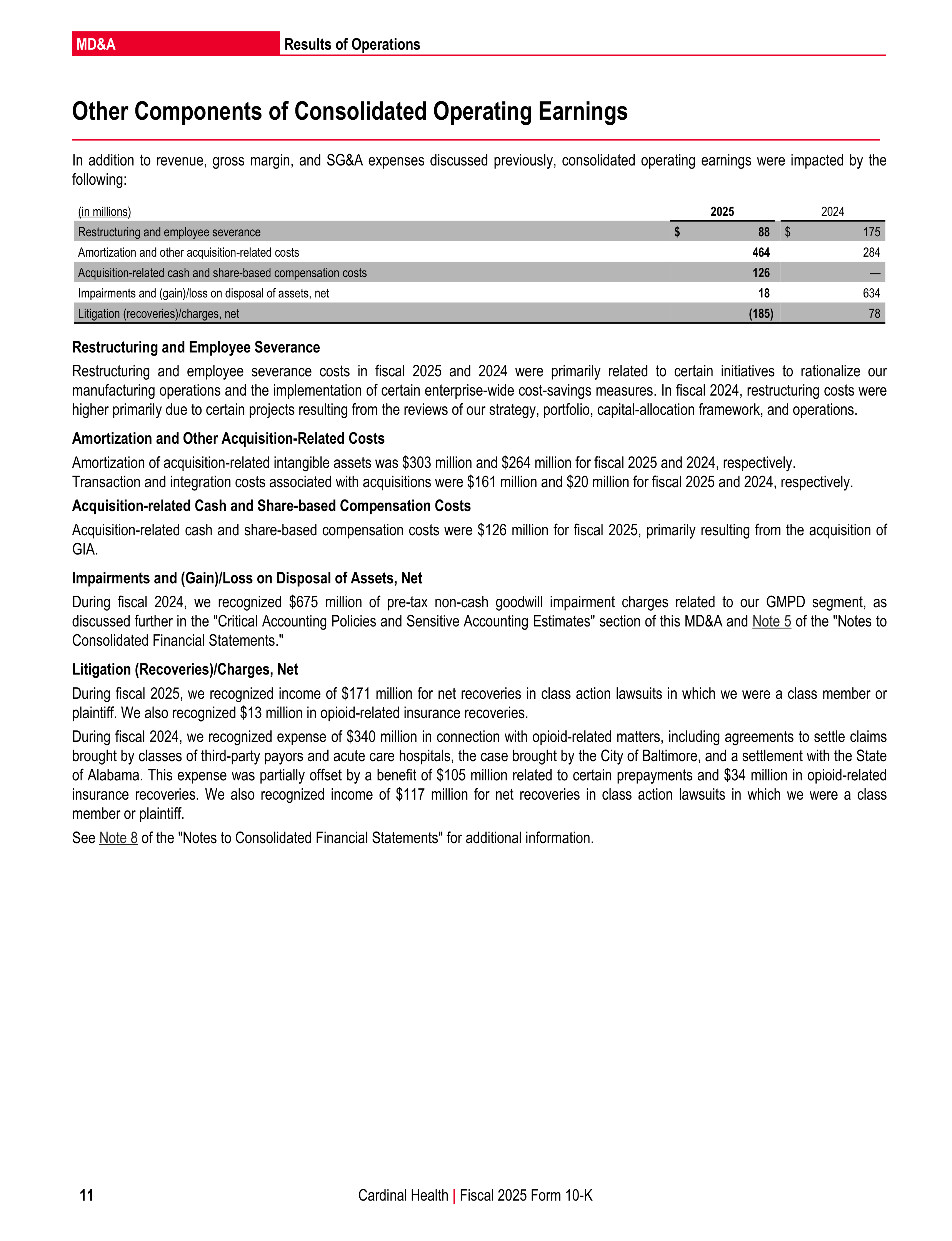
Other Components of Consolidated Operating Earnings
In addition to revenue, gross margin, and SG&A expenses discussed previously, consolidated operating earnings were impacted by the
following:
(in millions)
2025
2024
Restructuring and employee severance
$
88
$
175
Amortization and other acquisition-related costs
464
284
Acquisition-related cash and share-based compensation costs
126
—
Impairments and (gain)/loss on disposal of assets, net
18
634
Litigation (recoveries)/charges, net
(185)
78
Restructuring and Employee Severance
Restructuring and employee severance costs in fiscal 2025 and 2024 were primarily related to certain initiatives to rationalize our
manufacturing operations and the implementation of certain enterprise-wide cost-savings measures. In fiscal 2024, restructuring costs were
higher primarily due to certain projects resulting from the reviews of our strategy, portfolio, capital-allocation framework, and operations.
Amortization and Other Acquisition-Related Costs
Amortization of acquisition-related intangible assets was $303 million and $264 million for fiscal 2025 and 2024, respectively.
Transaction and integration costs associated with acquisitions were $161 million and $20 million for fiscal 2025 and 2024, respectively.
Acquisition-related Cash and Share-based Compensation Costs
Acquisition-related cash and share-based compensation costs were $126 million for fiscal 2025, primarily resulting from the acquisition of
GIA.
Impairments and (Gain)/Loss on Disposal of Assets, Net
During fiscal 2024, we recognized $675 million of pre-tax non-cash goodwill impairment charges related to our GMPD segment, as
discussed further in the "Critical Accounting Policies and Sensitive Accounting Estimates" section of this MD&A and
Note 5
of the "Notes to
Consolidated Financial Statements."
Litigation (Recoveries)/Charges, Net
During fiscal 2025, we recognized income of $171 million for net recoveries in class action lawsuits in which we were a class member or
plaintiff. We also recognized $13 million in opioid-related insurance recoveries.
During fiscal 2024, we recognized expense of $340 million in connection with opioid-related matters, including agreements to settle claims
brought by classes of third-party payors and acute care hospitals, the case brought by the City of Baltimore, and a settlement with the State
of Alabama. This expense was partially offset by a benefit of $105 million related to certain prepayments and $34 million in opioid-related
insurance recoveries. We also recognized income of $117 million for net recoveries in class action lawsuits in which we were a class
member or plaintiff.
See
Note 8
of the "Notes to Consolidated Financial Statements" for additional information.
MD&A
Results of Operations
Cardinal Health
|
Fiscal 2025 Form 10-K
11
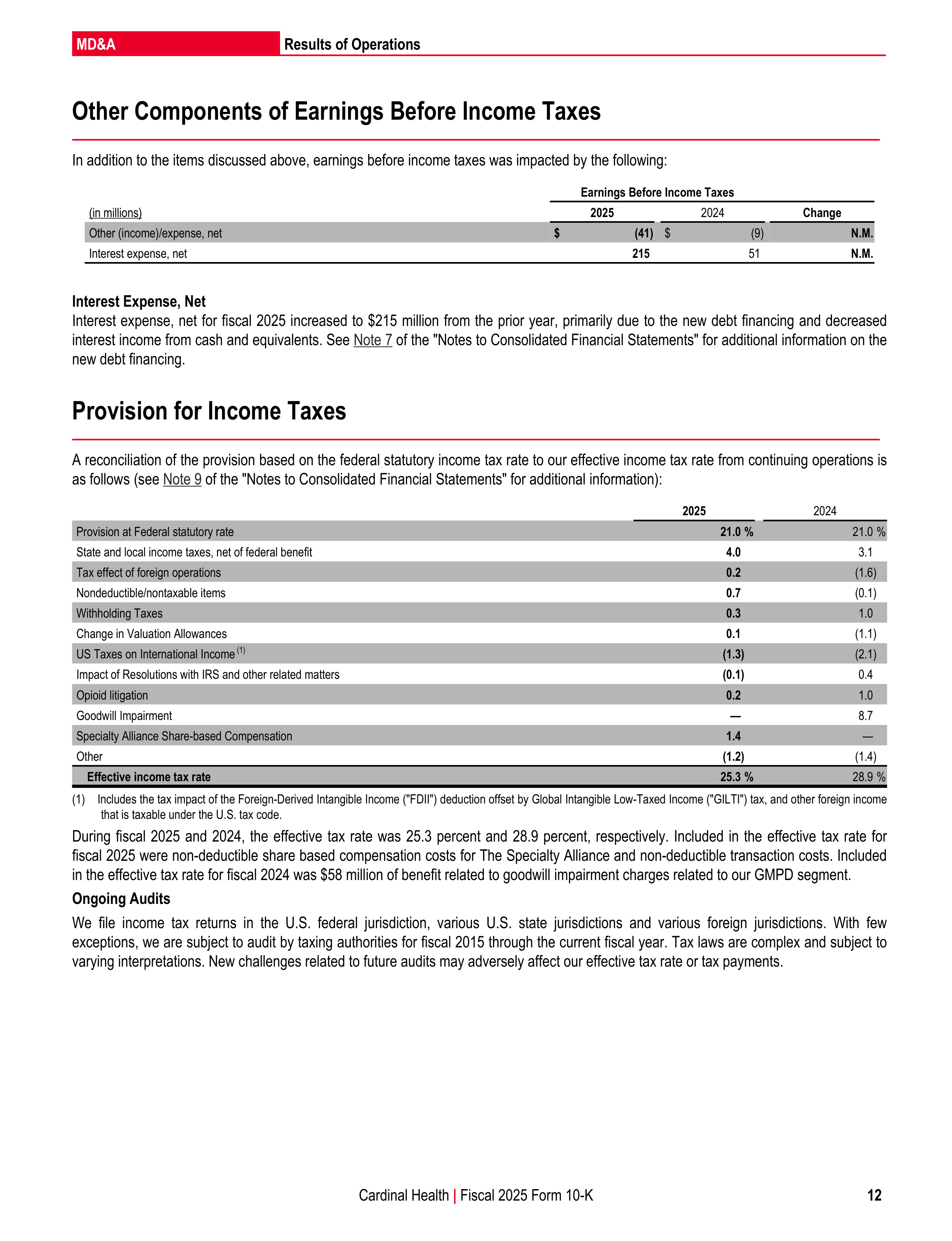
Other Components of Earnings Before Income Taxes
In addition to the items discussed above, earnings before income taxes was impacted by the following:
Earnings Before Income Taxes
(in millions)
2025
2024
Change
Other (income)/expense, net
$
(41)
$
(9)
N.M.
Interest expense, net
215
51
N.M.
Interest Expense, Net
Interest expense, net for fiscal 2025 increased to $215 million from the prior year, primarily due to the new debt financing and decreased
interest income from cash and equivalents. See
Note 7
of the "Notes to Consolidated Financial Statements" for additional information on the
new debt financing.
Provision for Income Taxes
A reconciliation of the provision based on the federal statutory income tax rate to our effective income tax rate from continuing operations is
as follows
(see
Note 9
of the "Notes to Consolidated Financial Statements" for additional information):
2025
2024
Provision at Federal statutory rate
21.0 %
21.0 %
State and local income taxes, net of federal benefit
4.0
3.1
Tax effect of foreign operations
0.2
(1.6)
Nondeductible/nontaxable items
0.7
(0.1)
Withholding Taxes
0.3
1.0
Change in Valuation Allowances
0.1
(1.1)
US Taxes on International Income
(1)
(1.3)
(2.1)
Impact of Resolutions with IRS and other related matters
(0.1)
0.4
Opioid litigation
0.2
1.0
Goodwill Impairment
—
8.7
Specialty Alliance Share-based Compensation
1.4
—
Other
(1.2)
(1.4)
Effective income tax rate
25.3 %
28.9 %
(1) Includes the tax impact of the Foreign-Derived Intangible Income ("FDII") deduction offset by Global Intangible Low-Taxed Income ("GILTI") tax, and other foreign income
that is taxable under the U.S. tax code.
During fiscal 2025 and 2024, the effective tax rate was 25.3 percent and 28.9 percent, respectively. Included in the effective tax rate for
fiscal 2025 were non-deductible share based compensation costs for The Specialty Alliance and non-deductible transaction costs. Included
in the effective tax rate for fiscal 2024 was $58 million of benefit related to goodwill impairment charges related to our GMPD segment.
Ongoing Audits
We file income tax returns in the U.S. federal jurisdiction, various U.S. state jurisdictions and various foreign jurisdictions. With few
exceptions, we are subject to audit by taxing authorities for fiscal 2015 through the current fiscal year. Tax laws are complex and subject to
varying interpretations. New challenges related to future audits may adversely affect our effective tax rate or tax payments.
MD&A
Results of Operations
12
Cardinal Health
|
Fiscal 2025 Form 10-K
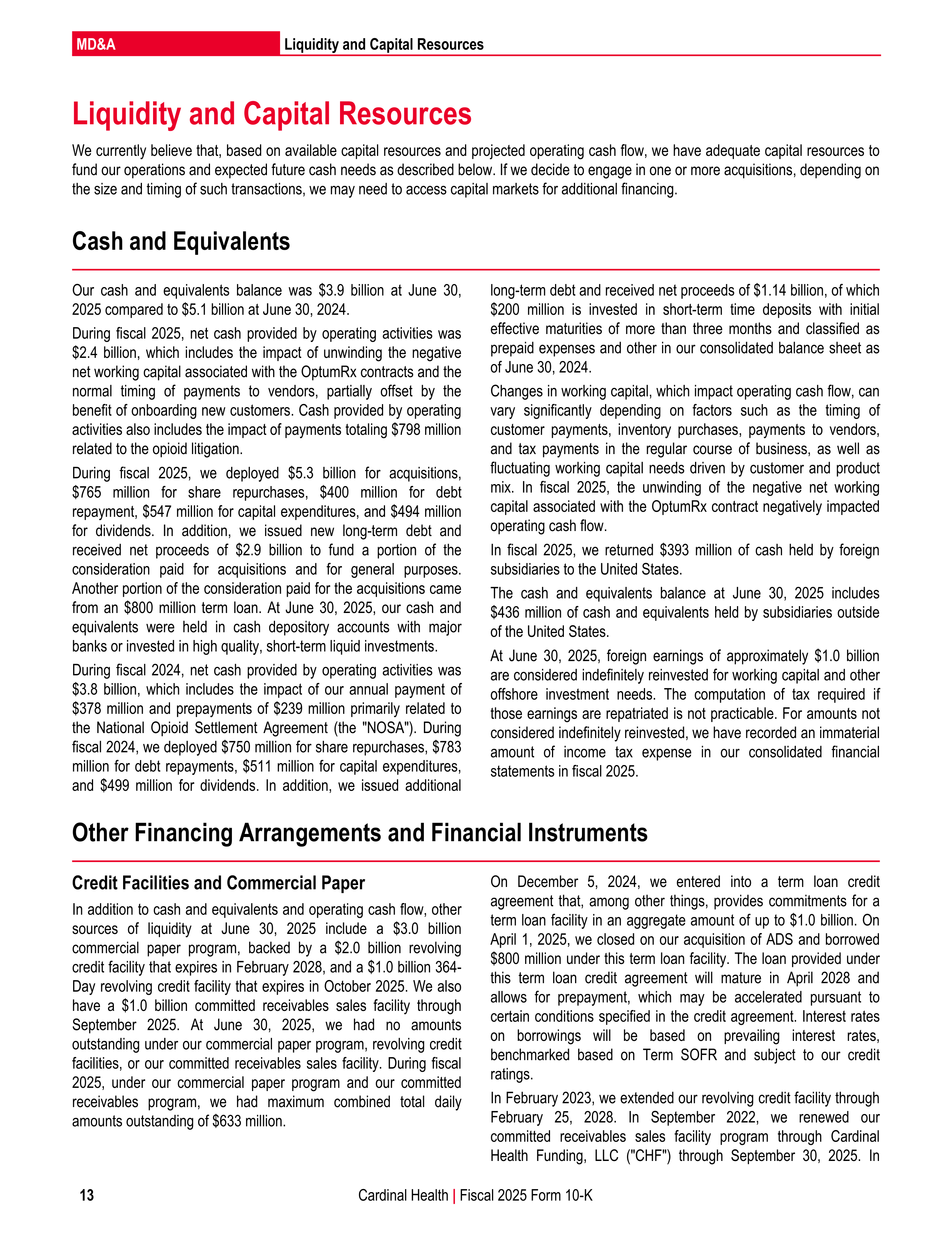
Liquidity and Capital Resources
We currently believe that, based on available capital resources and projected operating cash flow, we have adequate capital resources to
fund our operations and expected future cash needs as described below. If we decide to engage in one or more acquisitions, depending on
the size and timing of such transactions, we may need to access capital markets for additional financing.
Cash and Equivalents
Our cash and equivalents balance was $3.9 billion at June 30,
2025 compared to $5.1 billion at June 30, 2024.
During fiscal 2025, net cash provided by operating activities was
$2.4 billion, which includes the impact of unwinding the negative
net working capital associated with the OptumRx contracts and the
normal timing of payments to vendors, partially offset by the
benefit of onboarding new customers. Cash provided by operating
activities also includes the impact of payments totaling $798 million
related to the opioid litigation.
During fiscal 2025, we deployed $5.3 billion for acquisitions,
$765 million for share repurchases, $400 million for debt
repayment, $547 million for capital expenditures, and $494 million
for dividends. In addition, we issued new long-term debt and
received net proceeds of $2.9 billion to fund a portion of the
consideration paid for acquisitions and for general purposes.
Another portion of the consideration paid for the acquisitions came
from an $800 million term loan. At June 30, 2025, our cash and
equivalents were held in cash depository accounts with major
banks or invested in high quality, short-term liquid investments.
During fiscal 2024, net cash provided by operating activities was
$3.8 billion, which includes the impact of our annual payment of
$378 million and prepayments of $239 million primarily related to
the National Opioid Settlement Agreement (the "NOSA"). During
fiscal 2024, we deployed $750 million for share repurchases, $783
million for debt repayments, $511 million for capital expenditures,
and $499 million for dividends. In addition, we issued additional
long-term debt and received net proceeds of $1.14 billion, of which
$200 million is invested in short-term time deposits with initial
effective maturities of more than three months and classified as
prepaid expenses and other in our consolidated balance sheet as
of June 30, 2024.
Changes in working capital, which impact operating cash flow, can
vary significantly depending on factors such as the timing of
customer payments, inventory purchases, payments to vendors,
and tax payments in the regular course of business, as well as
fluctuating working capital needs driven by customer and product
mix. In fiscal 2025, the unwinding of the negative net working
capital associated with the OptumRx contract negatively impacted
operating cash flow.
In fiscal 2025, we returned $393 million of cash held by foreign
subsidiaries to the United States.
The cash and equivalents balance at June 30, 2025 includes
$436 million of cash and equivalents held by subsidiaries outside
of the United States.
At June 30, 2025, foreign earnings of approximately $1.0 billion
are considered indefinitely reinvested for working capital and other
offshore investment needs. The computation of tax required if
those earnings are repatriated is not practicable. For amounts not
considered indefinitely reinvested, we have recorded an immaterial
amount of income tax expense in our consolidated financial
statements in fiscal 2025.
Other Financing Arrangements and Financial Instruments
Credit Facilities and Commercial Paper
In addition to cash and equivalents and operating cash flow, other
sources of liquidity at June 30, 2025 include a $3.0 billion
commercial paper program, backed by a $2.0 billion revolving
credit facility that expires in February 2028, and a $1.0 billion 364-
Day revolving credit facility that expires in October 2025. We also
have a $1.0 billion committed receivables sales facility through
September 2025. At June 30, 2025, we had no amounts
outstanding under our commercial paper program, revolving credit
facilities, or our committed receivables sales facility. During fiscal
2025, under our commercial paper program and our committed
receivables program, we had maximum combined total daily
amounts outstanding of $633 million.
On December 5, 2024, we entered into a term loan credit
agreement that, among other things, provides commitments for a
term loan facility in an aggregate amount of up to $1.0 billion. On
April 1, 2025, we closed on our acquisition of ADS and borrowed
$800 million under this term loan facility. The loan provided under
this term loan credit agreement will mature in April 2028 and
allows for prepayment, which may be accelerated pursuant to
certain conditions specified in the credit agreement. Interest rates
on borrowings will be based on prevailing interest rates,
benchmarked based on Term SOFR and subject to our credit
ratings.
In February 2023, we extended our revolving credit facility through
February 25, 2028. In September 2022, we renewed our
committed receivables sales facility program through Cardinal
Health Funding, LLC ("CHF") through September 30, 2025. In
MD&A
Liquidity and Capital Resources
Cardinal Health
|
Fiscal 2025 Form 10-K
13
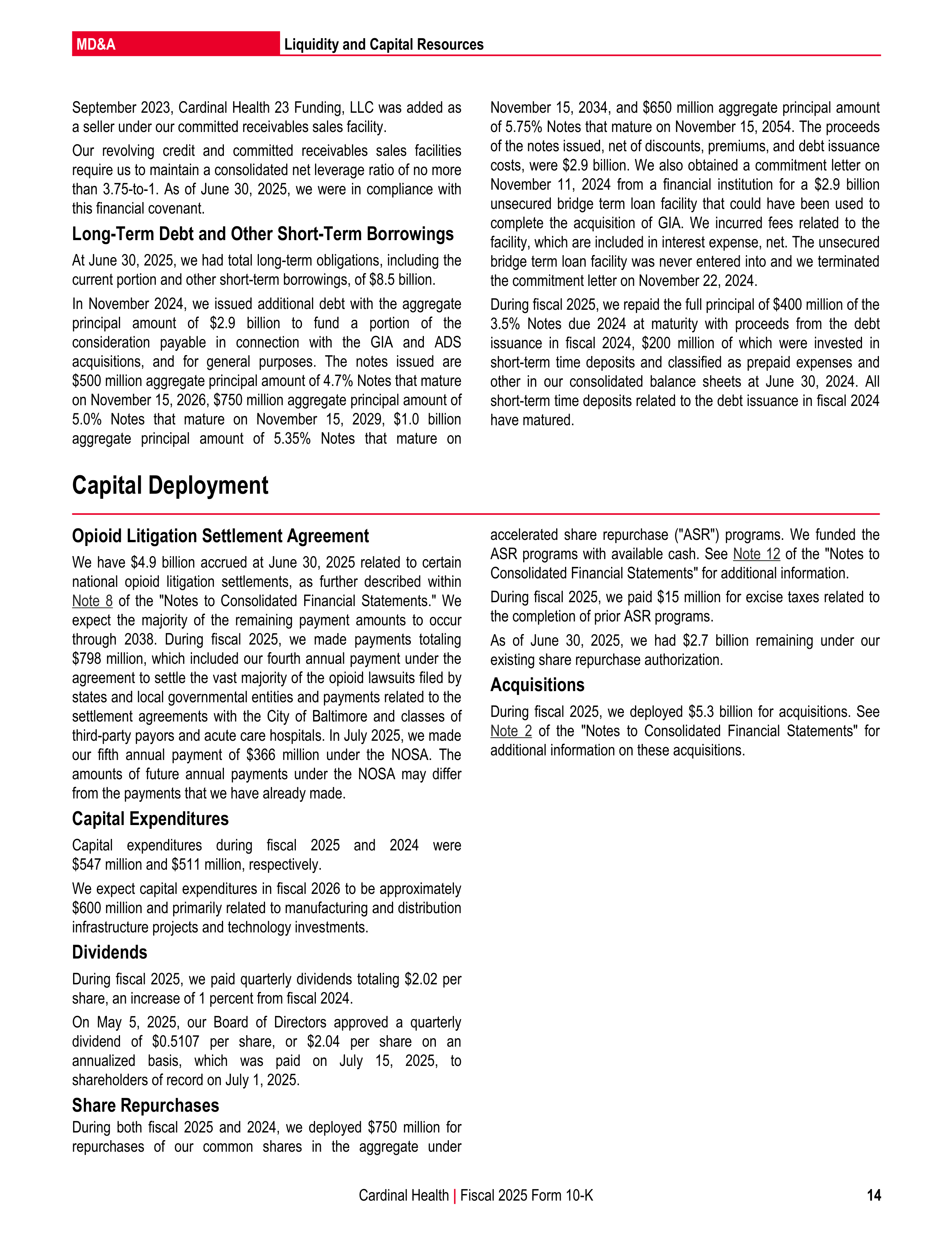
September 2023, Cardinal Health 23 Funding, LLC was added as
a seller under our committed receivables sales facility.
Our revolving credit and committed receivables sales facilities
require us to maintain a consolidated net leverage ratio of no more
than 3.75-to-1. As of June 30, 2025, we were in compliance with
this financial covenant.
Long-Term Debt and Other Short-Term Borrowings
At June 30, 2025, we had total long-term obligations, including the
current portion and other short-term borrowings, of $8.5 billion.
In November 2024, we issued additional debt with the aggregate
principal amount of $2.9 billion to fund a portion of the
consideration payable in connection with the GIA and ADS
acquisitions, and for general purposes. The notes issued are
$500 million aggregate principal amount of 4.7% Notes that mature
on November 15, 2026, $750 million aggregate principal amount of
5.0% Notes that mature on November 15, 2029, $1.0 billion
aggregate principal amount of 5.35% Notes that mature on
November 15, 2034, and $650 million aggregate principal amount
of 5.75% Notes that mature on November 15, 2054. The proceeds
of the notes issued, net of discounts, premiums, and debt issuance
costs, were $2.9 billion. We also obtained a commitment letter on
November 11, 2024 from a financial institution for a $2.9 billion
unsecured bridge term loan facility that could have been used to
complete the acquisition of GIA. We incurred fees related to the
facility, which are included in interest expense, net. The unsecured
bridge term loan facility was never entered into and we terminated
the commitment letter on November 22, 2024.
During fiscal 2025, we repaid the full principal of $400 million of the
3.5% Notes due 2024 at maturity with proceeds from the debt
issuance in fiscal 2024, $200 million of which were invested in
short-term time deposits and classified as prepaid expenses and
other in our consolidated balance sheets at June 30, 2024. All
short-term time deposits related to the debt issuance in fiscal 2024
have matured.
Capital Deployment
Opioid Litigation Settlement Agreement
We have $4.9 billion accrued at June 30, 2025 related to certain
national opioid litigation settlements, as further described within
Note 8
of the "Notes to Consolidated Financial Statements." We
expect the majority of the remaining payment amounts to occur
through 2038. During fiscal 2025, we made payments totaling
$798 million, which included our fourth annual payment under the
agreement to settle the vast majority of the opioid lawsuits filed by
states and local governmental entities and payments related to the
settlement agreements with the City of Baltimore and classes of
third-party payors and acute care hospitals. In July 2025, we made
our fifth annual payment of $366 million under the NOSA. The
amounts of future annual payments under the NOSA may differ
from the payments that we have already made.
Capital Expenditures
Capital expenditures during fiscal 2025 and 2024 were
$547 million and $511 million, respectively.
We expect capital expenditures in fiscal 2026 to be approximately
$600 million and primarily related to manufacturing and distribution
infrastructure projects and technology investments.
Dividends
During fiscal 2025, we paid quarterly dividends totaling $2.02 per
share, an increase of 1 percent from fiscal 2024.
On May 5, 2025, our Board of Directors approved a quarterly
dividend of $0.5107 per share, or $2.04 per share on an
annualized basis, which was paid on July 15, 2025, to
shareholders of record on July 1, 2025.
Share Repurchases
During both fiscal 2025 and 2024, we deployed $750 million for
repurchases of our common shares in the aggregate under
accelerated share repurchase ("ASR") programs. We funded the
ASR programs with available cash. See
Note 12
of the "Notes to
Consolidated Financial Statements" for additional information.
During fiscal 2025, we paid $15 million for excise taxes related to
the completion of prior ASR programs.
As of June 30, 2025, we had $2.7 billion remaining under our
existing share repurchase authorization.
Acquisitions
During fiscal 2025, we deployed $5.3 billion for acquisitions. See
Note 2
of the "Notes to Consolidated Financial Statements" for
additional information on these acquisitions.
MD&A
Liquidity and Capital Resources
14
Cardinal Health
|
Fiscal 2025 Form 10-K
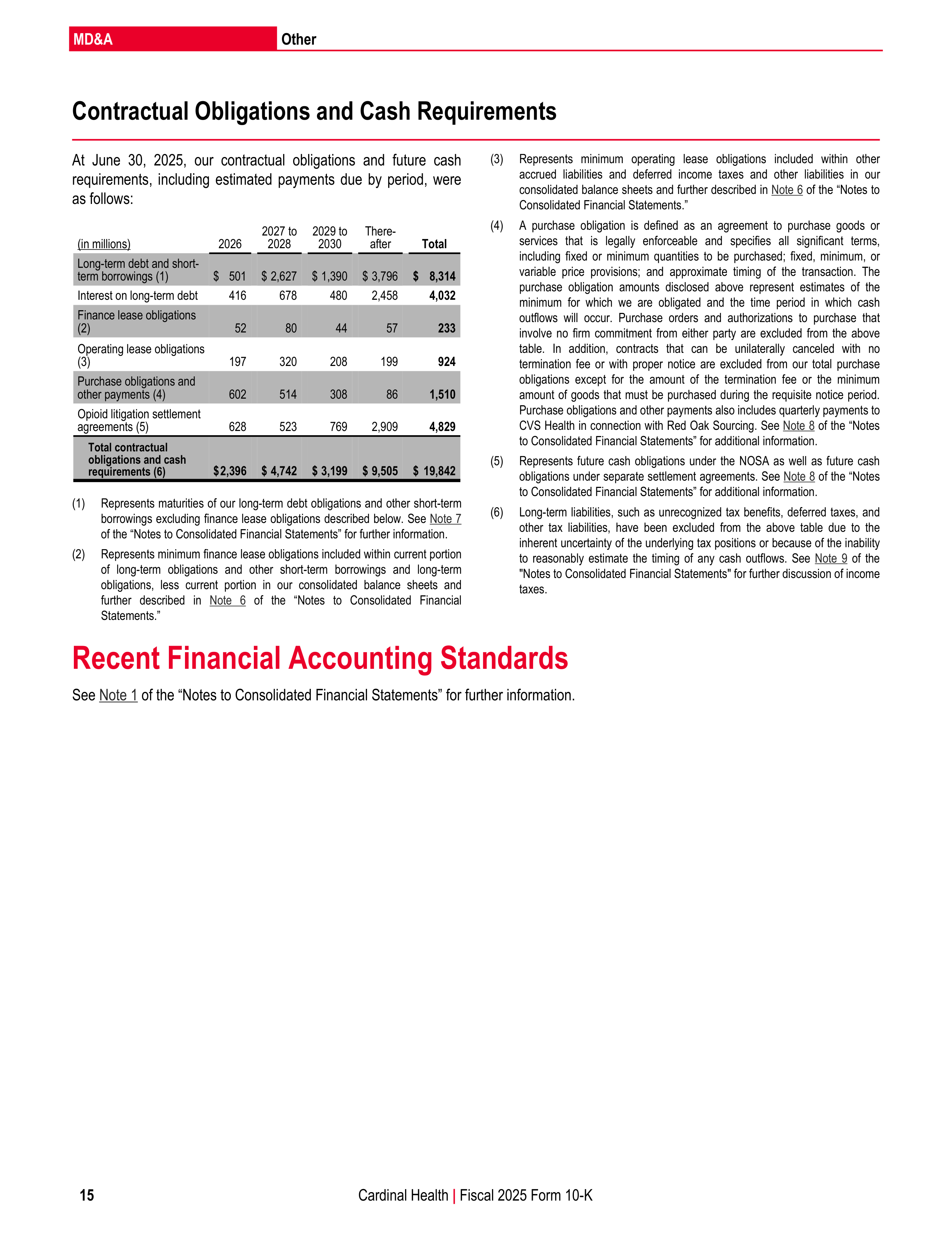
Contractual Obligations and Cash Requirements
At June 30, 2025, our contractual obligations and future cash
requirements, including estimated payments due by period, were
as follows:
(in millions)
2026
2027 to
2028
2029 to
2030
There-
after
Total
Long-term debt and short-
term borrowings (1)
$ 501
$ 2,627
$ 1,390
$ 3,796
$ 8,314
Interest on long-term debt
416
678
480
2,458
4,032
Finance lease obligations
(2)
52
80
44
57
233
Operating lease obligations
(3)
197
320
208
199
924
Purchase obligations and
other payments (4)
602
514
308
86
1,510
Opioid litigation settlement
agreements (5)
628
523
769
2,909
4,829
Total contractual
obligations and cash
requirements (6)
$ 2,396
$ 4,742
$ 3,199
$ 9,505
$ 19,842
(1)
Represents maturities of our long-term debt obligations and other short-term
borrowings excluding finance lease obligations described below. See
Note 7
of the “Notes to Consolidated Financial Statements” for further information.
(2)
Represents minimum finance lease obligations included within current portion
of long-term obligations and other short-term borrowings and long-term
obligations, less current portion in our consolidated balance sheets and
further described in
Note 6
of the “Notes to Consolidated Financial
Statements.”
(3)
Represents minimum operating lease obligations included within other
accrued liabilities and deferred income taxes and other liabilities in our
consolidated balance sheets and further described in
Note 6
of the “Notes to
Consolidated Financial Statements.”
(4)
A purchase obligation is defined as an agreement to purchase goods or
services that is legally enforceable and specifies all significant terms,
including fixed or minimum quantities to be purchased; fixed, minimum, or
variable price provisions; and approximate timing of the transaction. The
purchase obligation amounts disclosed above represent estimates of the
minimum for which we are obligated and the time period in which cash
outflows will occur. Purchase orders and authorizations to purchase that
involve no firm commitment from either party are excluded from the above
table. In addition, contracts that can be unilaterally canceled with no
termination fee or with proper notice are excluded from our total purchase
obligations except for the amount of the termination fee or the minimum
amount of goods that must be purchased during the requisite notice period.
Purchase obligations and other payments also includes quarterly payments to
CVS Health in connection with Red Oak Sourcing. See
Note 8
of the “Notes
to Consolidated Financial Statements” for additional information.
(5)
Represents future cash obligations under the NOSA as well as future cash
obligations under separate settlement agreements. See
Note 8
of the “Notes
to Consolidated Financial Statements” for additional information.
(6)
Long-term liabilities, such as unrecognized tax benefits, deferred taxes, and
other tax liabilities, have been excluded from the above table due to the
inherent uncertainty of the underlying tax positions or because of the inability
to reasonably estimate the timing of any cash outflows. See
Note 9
of the
"Notes to Consolidated Financial Statements" for further discussion of income
taxes.
Recent Financial Accounting Standards
See
Note 1
of the “Notes to Consolidated Financial Statements” for further information.
MD&A
Other
Cardinal Health
|
Fiscal 2025 Form 10-K
15
Critical Accounting Policies and Sensitive Accounting Estimates
Critical accounting policies are those accounting policies that (i) can have a significant impact on our financial condition and results of
operations and (ii) require the use of complex and subjective estimates based upon past experience and management’s judgment. Other
people applying reasonable judgment to the same facts and circumstances could develop different estimates. Because estimates are
inherently uncertain, actual results may differ. In this section, we describe the significant policies applied in preparing our consolidated
financial statements that management believes are the most dependent on estimates and assumptions.
Allowance for Doubtful Accounts
The allowance for doubtful accounts includes general and specific
reserves. We determine our allowance for doubtful accounts by
reviewing accounts receivable aging, historical write-off trends,
payment history, pricing discrepancies, industry trends, customer
financial strength, customer credit ratings, or bankruptcies. We
regularly evaluate how changes in economic conditions may affect
credit risks.
A hypothetical 0.1 percent increase or decrease in the reserve as
a percentage of trade receivables at June 30, 2025, would result in
an increase or decrease in operating earnings of $13 million. We
believe the reserve maintained and expenses recorded in fiscal
2025 are appropriate.
At this time, we are not aware of any analytical findings or
customer issues that are likely to lead to a significant future
increase in the allowance for doubtful accounts as a percentage of
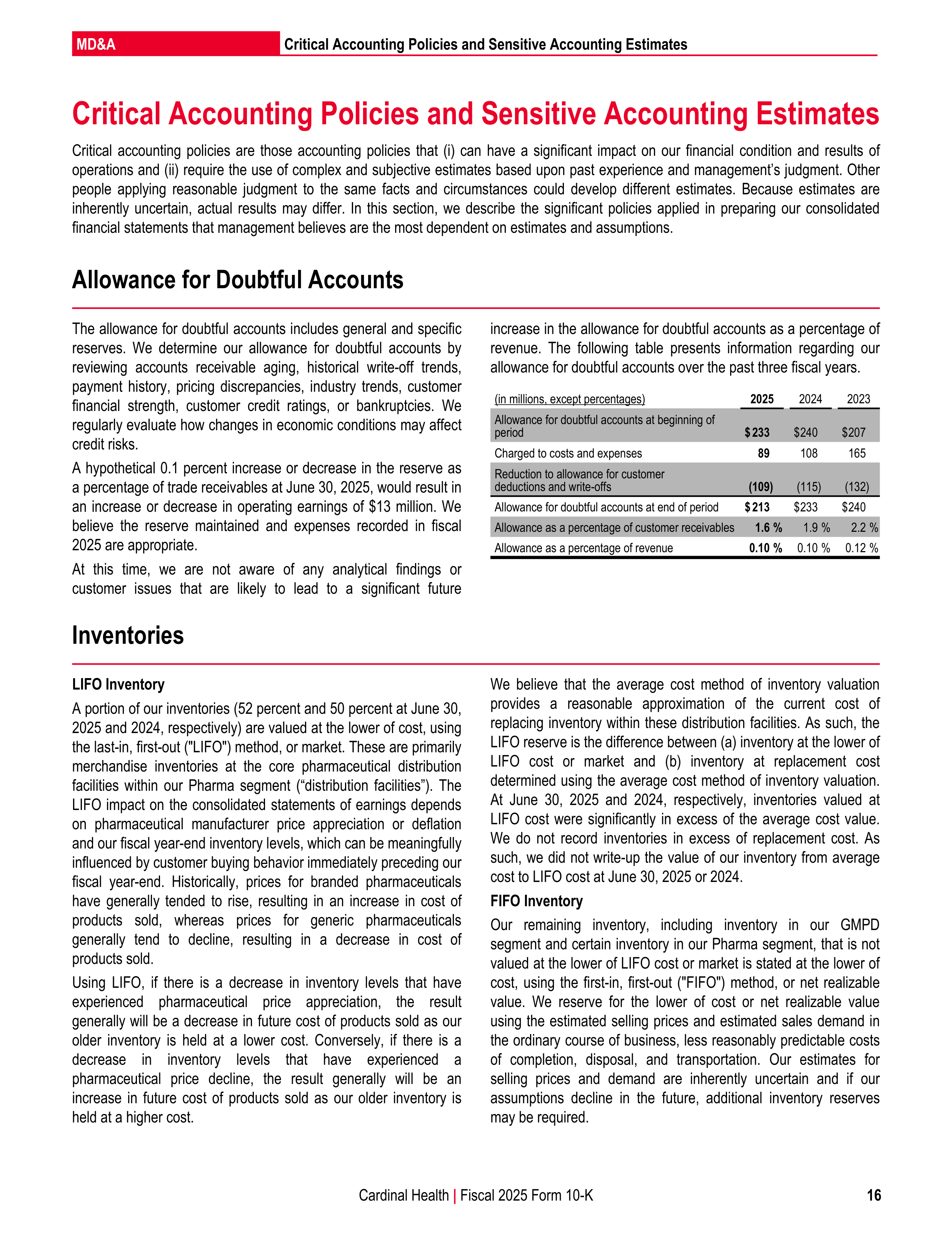
revenue. The following table presents information regarding our
allowance for doubtful accounts over the past three fiscal years.
(in millions, except percentages)
2025
2024
2023
Allowance for doubtful accounts at beginning of
period
$ 233
$ 240
$ 207
Charged to costs and expenses
89
108
165
Reduction to allowance for customer
deductions and write-offs
(109)
(115)
(132)
Allowance for doubtful accounts at end of period
$ 213
$ 233
$ 240
Allowance as a percentage of customer receivables
1.6 %
1.9 %
2.2 %
Allowance as a percentage of revenue
0.10 %
0.10 %
0.12 %
Inventories
LIFO Inventory
A portion of our inventories (52 percent and 50 percent at June 30,
2025 and 2024, respectively) are valued at the lower of cost, using
the last-in, first-out ("LIFO") method, or market. These are primarily
merchandise inventories at the core pharmaceutical distribution
facilities within our Pharma segment (“distribution facilities”). The
LIFO impact on the consolidated statements of earnings depends
on pharmaceutical manufacturer price appreciation or deflation
and our fiscal year-end inventory levels, which can be meaningfully
influenced by customer buying behavior immediately preceding our
fiscal year-end. Historically, prices for branded pharmaceuticals
have generally tended to rise, resulting in an increase in cost of
products sold, whereas prices for generic pharmaceuticals
generally tend to decline, resulting in a decrease in cost of
products sold.
Using LIFO, if there is a decrease in inventory levels that have
experienced pharmaceutical price appreciation, the result
generally will be a decrease in future cost of products sold as our
older inventory is held at a lower cost. Conversely, if there is a
decrease in inventory levels that have experienced a
pharmaceutical price decline, the result generally will be an
increase in future cost of products sold as our older inventory is
held at a higher cost.
We believe that the average cost method of inventory valuation
provides a reasonable approximation of the current cost of
replacing inventory within these distribution facilities. As such, the
LIFO reserve is the difference between (a) inventory at the lower of
LIFO cost or market and (b) inventory at replacement cost
determined using the average cost method of inventory valuation.
At June 30, 2025 and 2024, respectively, inventories valued at
LIFO cost were significantly in excess of the average cost value.
We do not record inventories in excess of replacement cost. As
such, we did not write-up the value of our inventory from average
cost to LIFO cost at June 30, 2025 or 2024.
FIFO Inventory
Our remaining inventory, including inventory in our GMPD
segment and certain inventory in our Pharma segment, that is not
valued at the lower of LIFO cost or market is stated at the lower of
cost, using the first-in, first-out ("FIFO") method, or net realizable
value. We reserve for the lower of cost or net realizable value
using the estimated selling prices and estimated sales demand in
the ordinary course of business, less reasonably predictable costs
of completion, disposal, and transportation. Our estimates for
selling prices and demand are inherently uncertain and if our
assumptions decline in the future, additional inventory reserves
may be required.
MD&A
Critical Accounting Policies and Sensitive Accounting Estimates
16
Cardinal Health
|
Fiscal 2025 Form 10-K
Excess and Obsolete Inventory
We reserve for inventory obsolescence using estimates based on
historical experience, historical and projected sales trends,
specific categories of inventory, age and expiration dates of on-
hand inventory, and manufacturer return policies. Inventories
presented in the consolidated balance sheets are net of reserves
for excess and obsolete inventory which were $132 million and
$149 million at June 30, 2025 and 2024, respectively. If actual
conditions are less favorable than our assumptions, additional
inventory reserves may be required.
Goodwill and Other Indefinite-Lived Intangible Assets
Purchased goodwill and intangible assets with indefinite lives are
tested for impairment annually or when indicators of impairment
exist. Goodwill impairment testing involves a comparison of the
estimated fair value of reporting units to the respective carrying
amount, which may be performed utilizing either a qualitative or
quantitative assessment. Qualitative factors are first assessed to
determine if it is more likely than not that the fair value of a
reporting unit is less than its carrying amount. There is an option to
bypass the qualitative assessment for any reporting unit in any
period and proceed directly to performing the quantitative goodwill
impairment test. We have elected to bypass the qualitative
assessment for the annual goodwill impairment test in the current
year. The quantitative goodwill impairment test involves a
comparison of the estimated fair value of the reporting unit to the
respective carrying amount. A reporting unit is defined as an
operating segment or one level below an operating segment (also
known as a component).
As of June 30, 2025, our reporting units are: Pharma (excluding
Navista & ION and GIA), Navista & ION, GIA, GMPD, Nuclear and
Precision Health Solutions, OptiFreight
®
Logistics, at-Home
Solutions, and ADS. We anticipate at-Home Solutions and ADS
will be combined as a single reporting unit as the businesses are
integrated in the future.
Goodwill impairment testing involves judgment, including the
identification of reporting units, qualitative evaluation of events and
circumstances to determine if it is more likely than not that an
impairment exists, and, if necessary, the estimation of the fair
value of the applicable reporting unit.
Estimating the fair value of reporting units requires the use of
estimates and significant judgments that are based on a number of
factors including actual operating results. The use of alternate
estimates and assumptions, changes in the industry or peer
groups, or changes in weightings assigned to the discounted cash
flow method, guideline public company method, or guideline
transaction method could materially affect the determination of fair
value for each reporting unit and potentially result in goodwill
impairment. If a reporting unit fails to achieve expected earnings or
operating cash flow, or otherwise fails to meet current financial
plans, or if there were changes to any other key assumptions used
in the tests, the reporting unit could incur a goodwill impairment in
a future period.
We performed annual impairment testing in fiscal 2025, 2024, and
2023 for our reporting units, which included Navista & ION in fiscal
2025. Due to the recent timing of the acquisitions, GIA and ADS
were not included in our annual impairment testing in fiscal 2025
as no indicators of impairment were present.
During fiscal 2024 and 2023, we recognized goodwill impairment
charges related to GMPD of $675 million and $1.2 billion,
respectively, which were included in impairments and (gain)/loss
on disposal of assets, net in our consolidated statements of
earnings. GMPD had no goodwill balance remaining as of March
31, 2024.
We concluded that there were no impairments of goodwill for the
remaining reporting units, excluding GMPD, in fiscal 2025, 2024,
and 2023, as the estimated fair value of each reporting unit
exceeded its carrying amount.
Other indefinite-lived intangibles
The impairment test for indefinite-lived intangibles other than
goodwill (primarily trademarks) involves first assessing qualitative
factors to determine if it is more likely than not that the fair value of
the indefinite-lived intangible asset is less than its carrying amount.
If so, then a quantitative test is performed to compare the
estimated fair value of the indefinite-lived intangible asset to the
respective asset's carrying amount. Our qualitative evaluation
requires the use of estimates and significant judgments and
considers the weight of evidence and significance of all identified
events and circumstances and most relevant drivers of fair value,
both positive and negative, in determining whether it is more likely
than not that the fair value of the indefinite-lived intangible asset is
less than its carrying amount.
See
Note 1
of "Notes to Consolidated Financial Statements" for
additional information regarding goodwill and other intangible
assets.
MD&A
Critical Accounting Policies and Sensitive Accounting Estimates
Cardinal Health
|
Fiscal 2025 Form 10-K
17
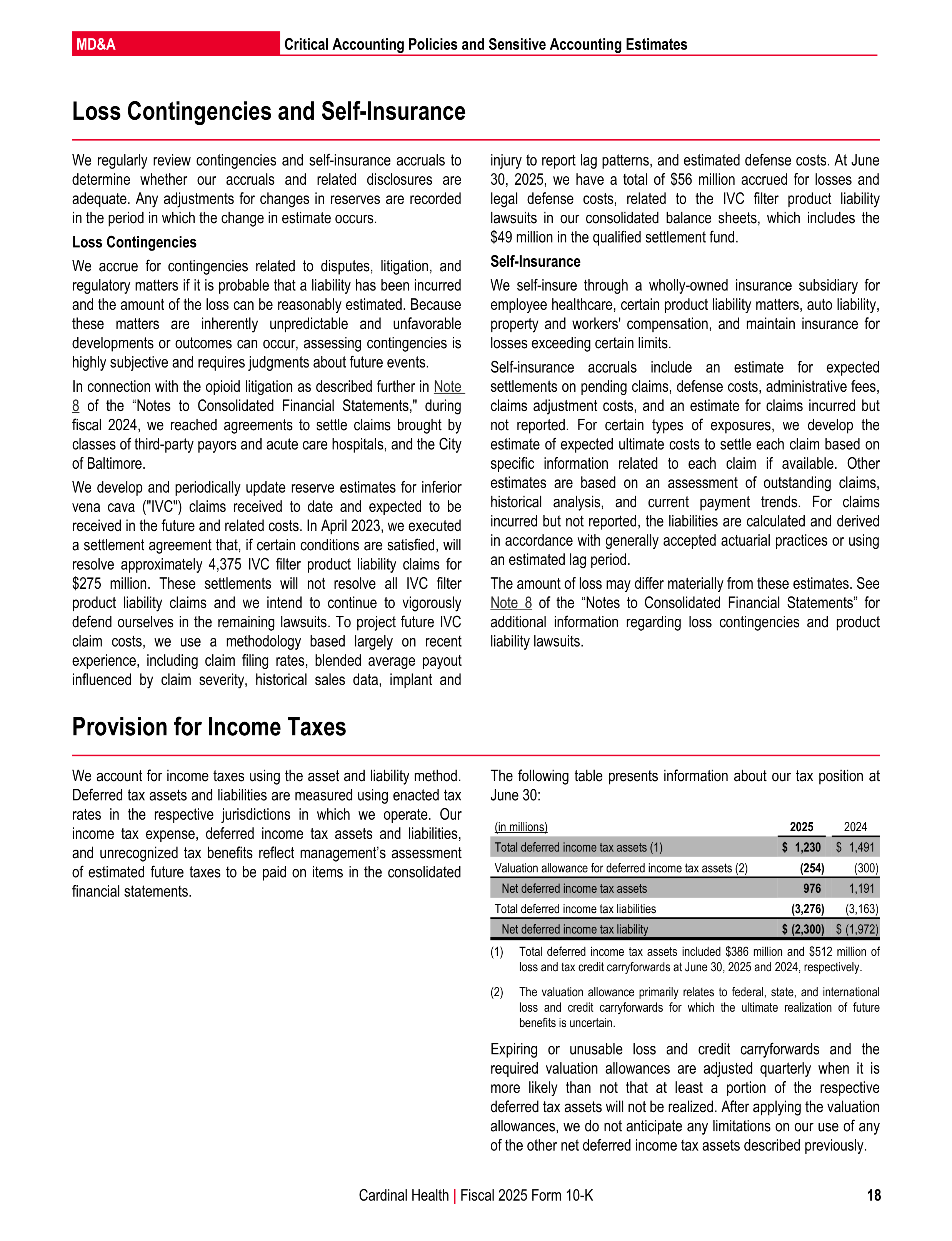
Loss Contingencies and Self-Insurance
We regularly review contingencies and self-insurance accruals to
determine whether our accruals and related disclosures are
adequate. Any adjustments for changes in reserves are recorded
in the period in which the change in estimate occurs.
Loss Contingencies
We accrue for contingencies related to disputes, litigation, and
regulatory matters if it is probable that a liability has been incurred
and the amount of the loss can be reasonably estimated. Because
these matters are inherently unpredictable and unfavorable
developments or outcomes can occur, assessing contingencies is
highly subjective and requires judgments about future events.
In connection with the opioid litigation as described further in
Note
8
of the “Notes to Consolidated Financial Statements," during
fiscal 2024, we reached agreements to settle claims brought by
classes of third-party payors and acute care hospitals, and the City
of Baltimore.
We develop and periodically update reserve estimates for inferior
vena cava ("IVC") claims received to date and expected to be
received in the future and related costs. In April 2023, we executed
a settlement agreement that, if certain conditions are satisfied, will
resolve approximately 4,375 IVC filter product liability claims for
$275 million. These settlements will not resolve all IVC filter
product liability claims and we intend to continue to vigorously
defend ourselves in the remaining lawsuits. To project future IVC
claim costs, we use a methodology based largely on recent
experience, including claim filing rates, blended average payout
influenced by claim severity, historical sales data, implant and
injury to report lag patterns, and estimated defense costs. At June
30, 2025, we have a total of $56 million accrued for losses and
legal defense costs, related to the IVC filter product liability
lawsuits in our consolidated balance sheets, which includes the
$49 million in the qualified settlement fund.
Self-Insurance
We self-insure through a wholly-owned insurance subsidiary for
employee healthcare, certain product liability matters, auto liability,
property and workers' compensation, and maintain insurance for
losses exceeding certain limits.
Self-insurance accruals include an estimate for expected
settlements on pending claims, defense costs, administrative fees,
claims adjustment costs, and an estimate for claims incurred but
not reported. For certain types of exposures, we develop the
estimate of expected ultimate costs to settle each claim based on
specific information related to each claim if available. Other
estimates are based on an assessment of outstanding claims,
historical analysis, and current payment trends. For claims
incurred but not reported, the liabilities are calculated and derived
in accordance with generally accepted actuarial practices or using
an estimated lag period.
The amount of loss may differ materially from these estimates. See
Note 8
of the “Notes to Consolidated Financial Statements” for
additional information regarding loss contingencies and product
liability lawsuits.
Provision for Income Taxes
We account for income taxes using the asset and liability method.
Deferred tax assets and liabilities are measured using enacted tax
rates in the respective jurisdictions in which we operate. Our
income tax expense, deferred income tax assets and liabilities,
and unrecognized tax benefits reflect management’s assessment
of estimated future taxes to be paid on items in the consolidated
financial statements.
The following table presents information about our tax position at
June 30:
(in millions)
2025
2024
Total deferred income tax assets (1)
$ 1,230
$ 1,491
Valuation allowance for deferred income tax assets (2)
(254)
(300)
Net deferred income tax assets
976
1,191
Total deferred income tax liabilities
(3,276)
(3,163)
Net deferred income tax liability
$ (2,300)
$ (1,972)
(1)
Total deferred income tax assets included $386 million and $512 million of
loss and tax credit carryforwards at June 30, 2025 and 2024, respectively.
(2)
The valuation allowance primarily relates to federal, state, and international
loss and credit carryforwards for which the ultimate realization of future
benefits is uncertain.
Expiring or unusable loss and credit carryforwards and the
required valuation allowances are adjusted quarterly when it is
more likely than not that at least a portion of the respective
deferred tax assets will not be realized. After applying the valuation
allowances, we do not anticipate any limitations on our use of any
of the other net deferred income tax assets described previously.
MD&A
Critical Accounting Policies and Sensitive Accounting Estimates
18
Cardinal Health
|
Fiscal 2025 Form 10-K
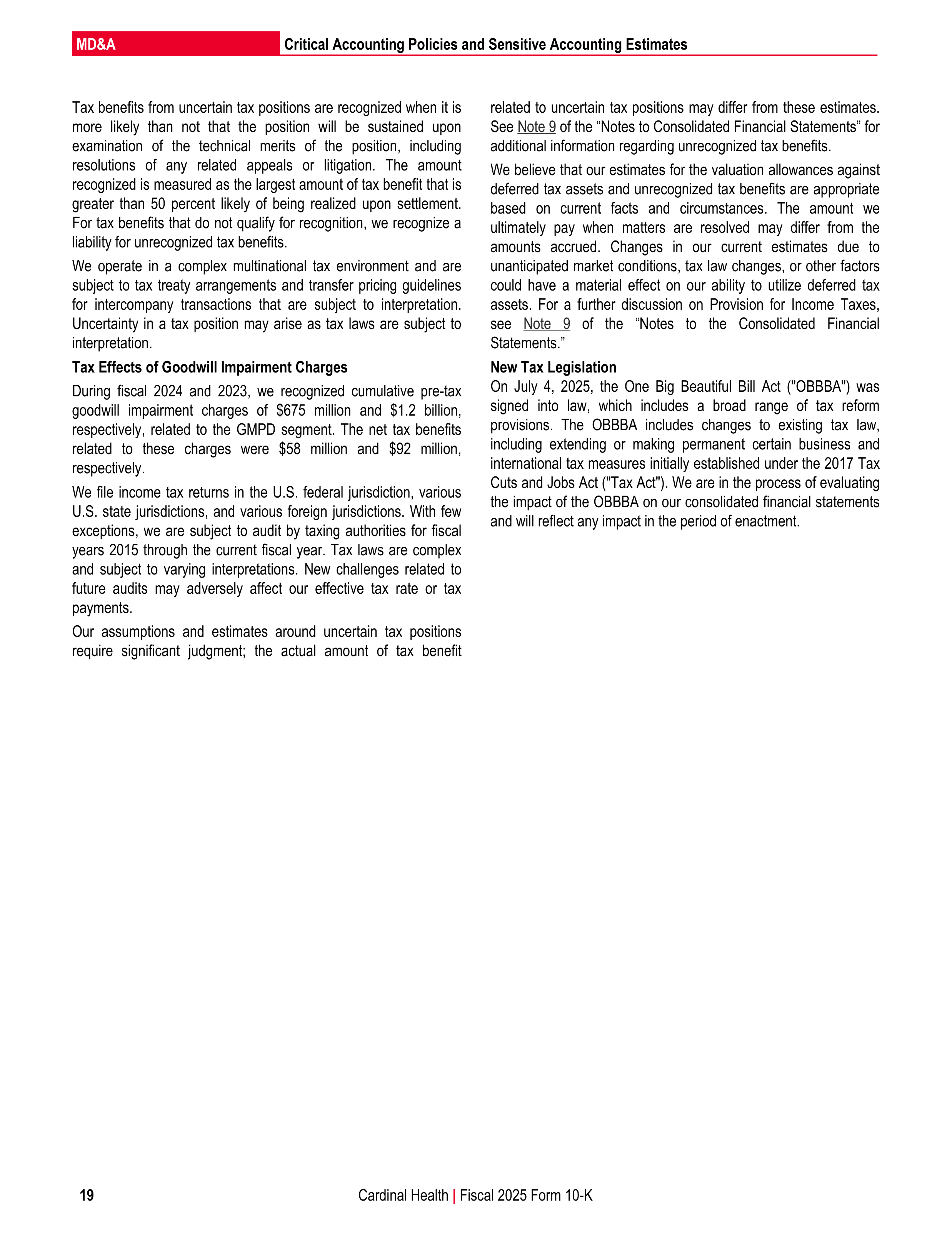
Tax benefits from uncertain tax positions are recognized when it is
more likely than not that the position will be sustained upon
examination of the technical merits of the position, including
resolutions of any related appeals or litigation. The amount
recognized is measured as the largest amount of tax benefit that is
greater than 50 percent likely of being realized upon settlement.
For tax benefits that do not qualify for recognition, we recognize a
liability for unrecognized tax benefits.
We operate in a complex multinational tax environment and are
subject to tax treaty arrangements and transfer pricing guidelines
for intercompany transactions that are subject to interpretation.
Uncertainty in a tax position may arise as tax laws are subject to
interpretation.
Tax Effects of Goodwill Impairment Charges
During fiscal 2024 and 2023, we recognized cumulative pre-tax
goodwill impairment charges of $675 million and $1.2 billion,
respectively, related to the GMPD segment. The net tax benefits
related to these charges were $58 million and $92 million,
respectively.
We file income tax returns in the U.S. federal jurisdiction, various
U.S. state jurisdictions, and various foreign jurisdictions. With few
exceptions, we are subject to audit by taxing authorities for fiscal
years 2015 through the current fiscal year. Tax laws are complex
and subject to varying interpretations. New challenges related to
future audits may adversely affect our effective tax rate or tax
payments.
Our assumptions and estimates around uncertain tax positions
require significant judgment; the actual amount of tax benefit
related to uncertain tax positions may differ from these estimates.
See
Note 9
of the “Notes to Consolidated Financial Statements” for
additional information regarding unrecognized tax benefits.
We believe that our estimates for the valuation allowances against
deferred tax assets and unrecognized tax benefits are appropriate
based on current facts and circumstances. The amount we
ultimately pay when matters are resolved may differ from the
amounts accrued. Changes in our current estimates due to
unanticipated market conditions, tax law changes, or other factors
could have a material effect on our ability to utilize deferred tax
assets. For a further discussion on Provision for Income Taxes,
see
Note 9
of the “Notes to the Consolidated Financial
Statements.”
New Tax Legislation
On July 4, 2025, the One Big Beautiful Bill Act ("OBBBA") was
signed into law, which includes a broad range of tax reform
provisions. The OBBBA includes changes to existing tax law,
including extending or making permanent certain business and
international tax measures initially established under the 2017 Tax
Cuts and Jobs Act ("Tax Act"). We are in the process of evaluating
the impact of the OBBBA on our consolidated financial statements
and will reflect any impact in the period of enactment.
MD&A
Critical Accounting Policies and Sensitive Accounting Estimates
Cardinal Health
|
Fiscal 2025 Form 10-K
19
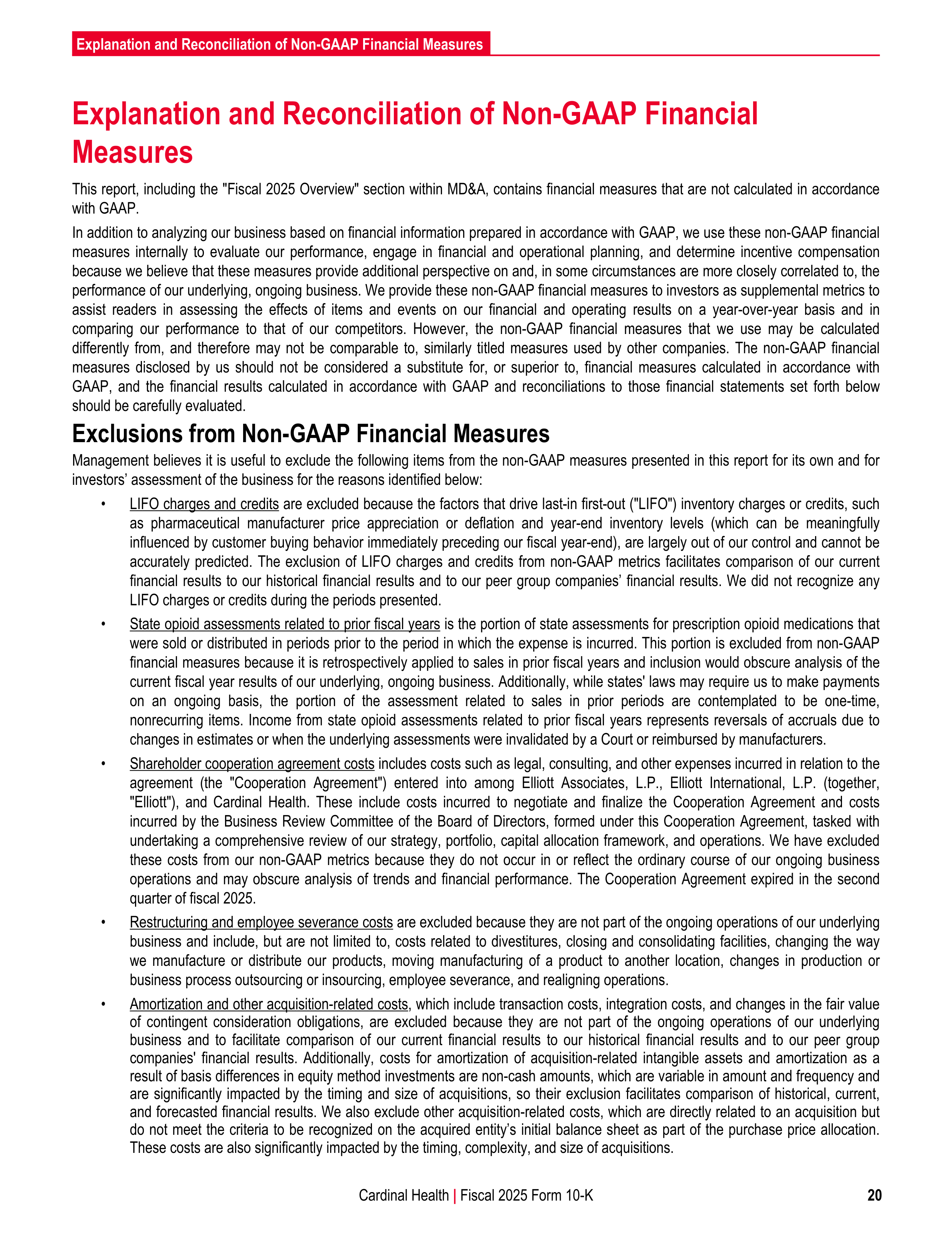
Explanation and Reconciliation of Non-GAAP Financial
Measures
This report, including the "Fiscal 2025 Overview" section within MD&A, contains financial measures that are not calculated in accordance
with GAAP.
In addition to analyzing our business based on financial information prepared in accordance with GAAP, we use these non-GAAP financial
measures internally to evaluate our performance, engage in financial and operational planning, and determine incentive compensation
because we believe that these measures provide additional perspective on and, in some circumstances are more closely correlated to, the
performance of our underlying, ongoing business. We provide these non-GAAP financial measures to investors as supplemental metrics to
assist readers in assessing the effects of items and events on our financial and operating results on a year-over-year basis and in
comparing our performance to that of our competitors. However, the non-GAAP financial measures that we use may be calculated
differently from, and therefore may not be comparable to, similarly titled measures used by other companies. The non-GAAP financial
measures disclosed by us should not be considered a substitute for, or superior to, financial measures calculated in accordance with
GAAP, and the financial results calculated in accordance with GAAP and reconciliations to those financial statements set forth below
should be carefully evaluated.
Exclusions from Non-GAAP Financial Measures
Management believes it is useful to exclude the following items from the non-GAAP measures presented in this report for its own and for
investors’ assessment of the business for the reasons identified below:
•
LIFO charges and credits are excluded because the factors that drive last-in first-out ("LIFO") inventory charges or credits, such
as pharmaceutical manufacturer price appreciation or deflation and year-end inventory levels (which can be meaningfully
influenced by customer buying behavior immediately preceding our fiscal year-end), are largely out of our control and cannot be
accurately predicted. The exclusion of LIFO charges and credits from non-GAAP metrics facilitates comparison of our current
financial results to our historical financial results and to our peer group companies’ financial results. We did not recognize any
LIFO charges or credits during the periods presented.
•
State opioid assessments related to prior fiscal years is the portion of state assessments for prescription opioid medications that
were sold or distributed in periods prior to the period in which the expense is incurred. This portion is excluded from non-GAAP
financial measures because it is retrospectively applied to sales in prior fiscal years and inclusion would obscure analysis of the
current fiscal year results of our underlying, ongoing business. Additionally, while states' laws may require us to make payments
on an ongoing basis, the portion of the assessment related to sales in prior periods are contemplated to be one-time,
nonrecurring items. Income from state opioid assessments related to prior fiscal years represents reversals of accruals due to
changes in estimates or when the underlying assessments were invalidated by a Court or reimbursed by manufacturers.
•
Shareholder cooperation agreement costs includes costs such as legal, consulting, and other expenses incurred in relation to the
agreement (the "Cooperation Agreement") entered into among Elliott Associates, L.P., Elliott International, L.P. (together,
"Elliott"), and Cardinal Health. These include costs incurred to negotiate and finalize the Cooperation Agreement and costs
incurred by the Business Review Committee of the Board of Directors, formed under this Cooperation Agreement, tasked with
undertaking a comprehensive review of our strategy, portfolio, capital allocation framework, and operations. We have excluded
these costs from our non-GAAP metrics because they do not occur in or reflect the ordinary course of our ongoing business
operations and may obscure analysis of trends and financial performance. The Cooperation Agreement expired in the second
quarter of fiscal 2025.
•
Restructuring and employee severance costs are excluded because they are not part of the ongoing operations of our underlying
business and include, but are not limited to, costs related to divestitures, closing and consolidating facilities, changing the way
we manufacture or distribute our products, moving manufacturing of a product to another location, changes in production or
business process outsourcing or insourcing, employee severance, and realigning operations.
•
Amortization and other acquisition-related costs, which include transaction costs, integration costs, and changes in the fair value
of contingent consideration obligations, are excluded because they are not part of the ongoing operations of our underlying
business and to facilitate comparison of our current financial results to our historical financial results and to our peer group
companies' financial results. Additionally, costs for amortization of acquisition-related intangible assets and amortization as a
result of basis differences in equity method investments are non-cash amounts, which are variable in amount and frequency and
are significantly impacted by the timing and size of acquisitions, so their exclusion facilitates comparison of historical, current,
and forecasted financial results. We also exclude other acquisition-related costs, which are directly related to an acquisition but
do not meet the criteria to be recognized on the acquired entity’s initial balance sheet as part of the purchase price allocation.
These costs are also significantly impacted by the timing, complexity, and size of acquisitions.
Explanation and Reconciliation of Non-GAAP Financial Measures
20
Cardinal Health
|
Fiscal 2025 Form 10-K
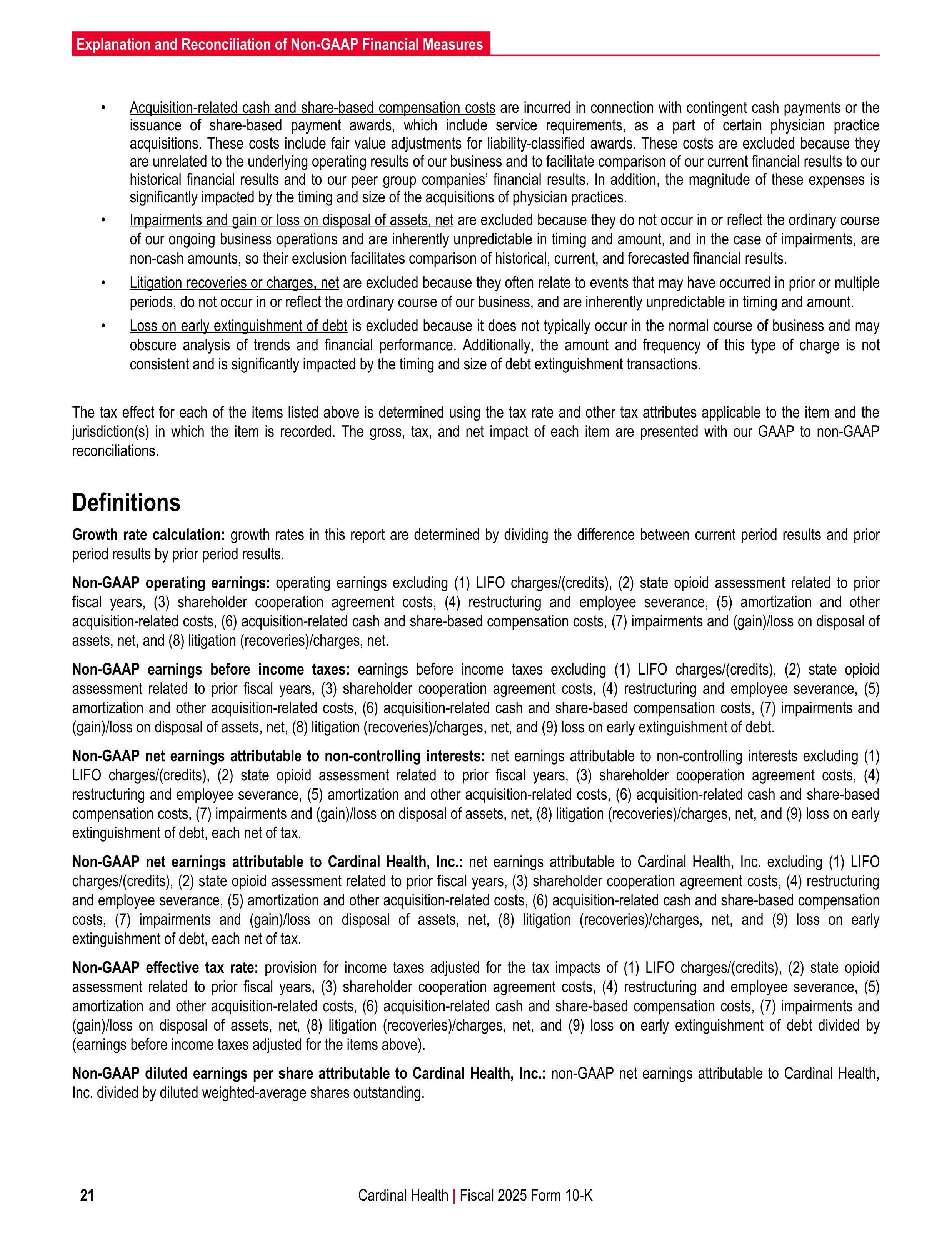
•
Acquisition-related cash and share-based compensation costs are incurred in connection with contingent cash payments or the
issuance of share-based payment awards, which include service requirements, as a part of certain physician practice
acquisitions. These costs include fair value adjustments for liability-classified awards. These costs are excluded because they
are unrelated to the underlying operating results of our business and to facilitate comparison of our current financial results to our
historical financial results and to our peer group companies’ financial results. In addition, the magnitude of these expenses is
significantly impacted by the timing and size of the acquisitions of physician practices.
•
Impairments and gain or loss on disposal of assets, net are excluded because they do not occur in or reflect the ordinary course
of our ongoing business operations and are inherently unpredictable in timing and amount, and in the case of impairments, are
non-cash amounts, so their exclusion facilitates comparison of historical, current, and forecasted financial results.
•
Litigation recoveries or charges, net are excluded because they often relate to events that may have occurred in prior or multiple
periods, do not occur in or reflect the ordinary course of our business, and are inherently unpredictable in timing and amount.
•
Loss on early extinguishment of debt is excluded because it does not typically occur in the normal course of business and may
obscure analysis of trends and financial performance. Additionally, the amount and frequency of this type of charge is not
consistent and is significantly impacted by the timing and size of debt extinguishment transactions.
The tax effect for each of the items listed above is determined using the tax rate and other tax attributes applicable to the item and the
jurisdiction(s) in which the item is recorded. The gross, tax, and net impact of each item are presented with our GAAP to non-GAAP
reconciliations.
Definitions
Growth rate calculation:
growth rates in this report are determined by dividing the difference between current period results and prior
period results by prior period results.
Non-GAAP operating earnings:
operating earnings excluding (1) LIFO charges/(credits), (2) state opioid assessment related to prior
fiscal years, (3) shareholder cooperation agreement costs, (4) restructuring and employee severance, (5) amortization and other
acquisition-related costs, (6) acquisition-related cash and share-based compensation costs, (7) impairments and (gain)/loss on disposal of
assets, net, and (8) litigation (recoveries)/charges, net.
Non-GAAP earnings before income taxes:
earnings before income taxes excluding (1) LIFO charges/(credits), (2) state opioid
assessment related to prior fiscal years, (3) shareholder cooperation agreement costs, (4) restructuring and employee severance, (5)
amortization and other acquisition-related costs, (6) acquisition-related cash and share-based compensation costs, (7) impairments and
(gain)/loss on disposal of assets, net, (8) litigation (recoveries)/charges, net, and (9) loss on early extinguishment of debt.
Non-GAAP net earnings attributable to non-controlling interests:
net earnings attributable to non-controlling interests excluding (1)
LIFO charges/(credits), (2) state opioid assessment related to prior fiscal years, (3) shareholder cooperation agreement costs, (4)
restructuring and employee severance, (5) amortization and other acquisition-related costs, (6) acquisition-related cash and share-based
compensation costs, (7) impairments and (gain)/loss on disposal of assets, net, (8) litigation (recoveries)/charges, net, and (9) loss on early
extinguishment of debt, each net of tax.
Non-GAAP net earnings attributable to Cardinal Health, Inc.:
net earnings attributable to Cardinal Health, Inc. excluding (1) LIFO
charges/(credits), (2) state opioid assessment related to prior fiscal years, (3) shareholder cooperation agreement costs, (4) restructuring
and employee severance, (5) amortization and other acquisition-related costs, (6) acquisition-related cash and share-based compensation
costs, (7) impairments and (gain)/loss on disposal of assets, net, (8) litigation (recoveries)/charges, net, and (9) loss on early
extinguishment of debt, each net of tax.
Non-GAAP effective tax rate:
provision for income taxes adjusted for the tax impacts of (1) LIFO charges/(credits), (2) state opioid
assessment related to prior fiscal years, (3) shareholder cooperation agreement costs, (4) restructuring and employee severance, (5)
amortization and other acquisition-related costs, (6) acquisition-related cash and share-based compensation costs, (7) impairments and
(gain)/loss on disposal of assets, net, (8) litigation (recoveries)/charges, net, and (9) loss on early extinguishment of debt divided by
(earnings before income taxes adjusted for the items above).
Non-GAAP diluted earnings per share attributable to Cardinal Health, Inc.:
non-GAAP net earnings attributable to Cardinal Health,
Inc. divided by diluted weighted-average shares outstanding.
Explanation and Reconciliation of Non-GAAP Financial Measures
Cardinal Health
|
Fiscal 2025 Form 10-K
21
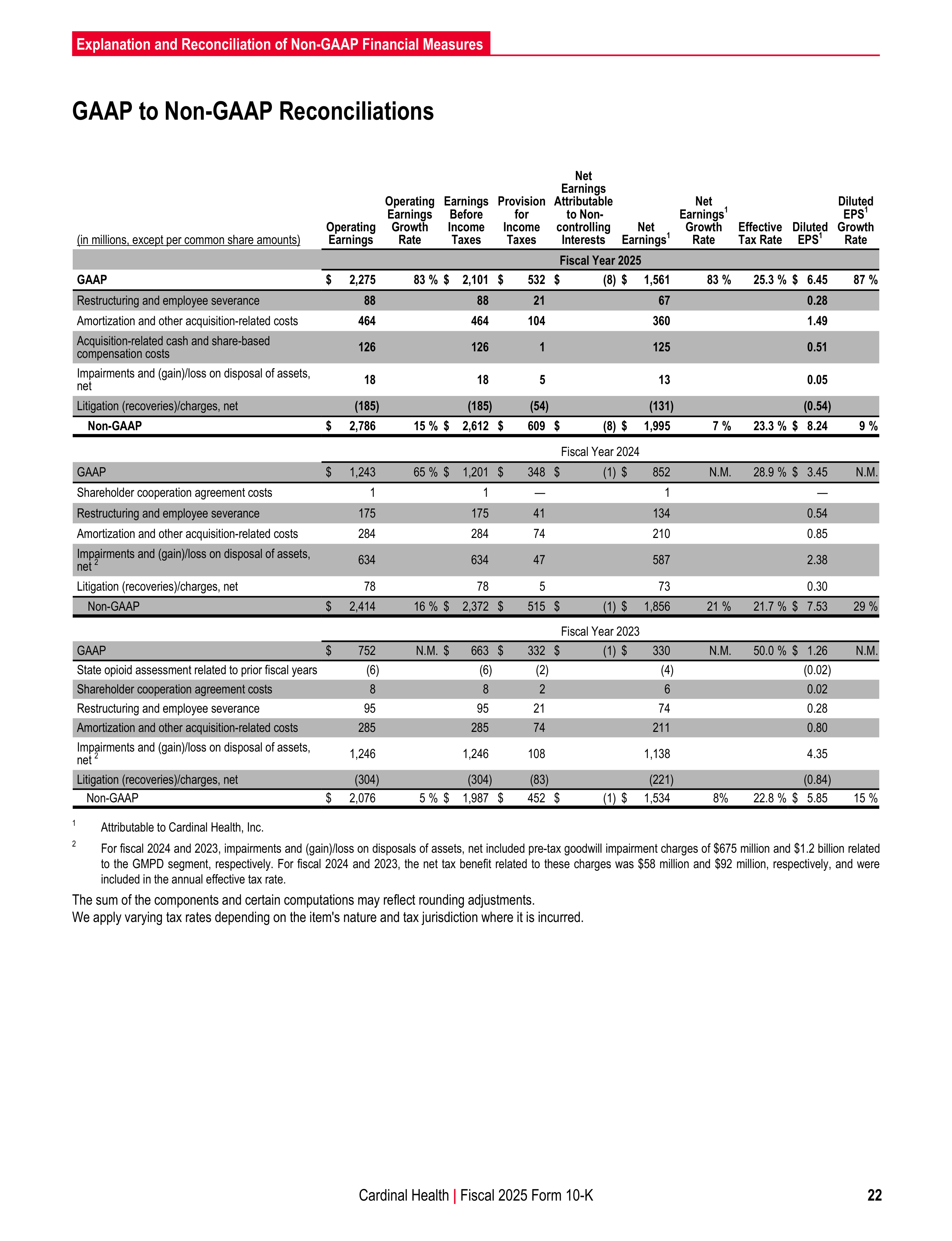
GAAP to Non-GAAP Reconciliations
(in millions, except per common share amounts)
Operating
Earnings
Operating
Earnings
Growth
Rate
Earnings
Before
Income
Taxes
Provision
for
Income
Taxes
Net
Earnings
Attributable
to Non-
controlling
Interests
Net
Earnings
1
Net
Earnings
1
Growth
Rate
Effective
Tax Rate
Diluted
EPS
1
Diluted
EPS
1
Growth
Rate
Fiscal Year 2025
GAAP
$
2,275
83 %
$ 2,101 $
532 $
(8) $
1,561
83 %
25.3 %
$ 6.45
87 %
Restructuring and employee severance
88
88
21
67
0.28
Amortization and other acquisition-related costs
464
464
104
360
1.49
Acquisition-related cash and share-based
compensation costs
126
126
1
125
0.51
Impairments and (gain)/loss on disposal of assets,
net
18
18
5
13
0.05
Litigation (recoveries)/charges, net
(185)
(185)
(54)
(131)
(0.54)
Non-GAAP
$
2,786
15 %
$ 2,612 $
609 $
(8) $
1,995
7 %
23.3 %
$ 8.24
9 %
Fiscal Year 2024
GAAP
$
1,243
65 %
$ 1,201 $
348 $
(1) $
852
N.M.
28.9 %
$ 3.45
N.M.
Shareholder cooperation agreement costs
1
1
—
1
—
Restructuring and employee severance
175
175
41
134
0.54
Amortization and other acquisition-related costs
284
284
74
210
0.85
Impairments and (gain)/loss on disposal of assets,
net
2
634
634
47
587
2.38
Litigation (recoveries)/charges, net
78
78
5
73
0.30
Non-GAAP
$
2,414
16 %
$ 2,372 $
515 $
(1) $
1,856
21 %
21.7 %
$ 7.53
29 %
Fiscal Year 2023
GAAP
$
752
N.M.
$
663 $
332 $
(1) $
330
N.M.
50.0 %
$ 1.26
N.M.
State opioid assessment related to prior fiscal years
(6)
(6)
(2)
(4)
(0.02)
Shareholder cooperation agreement costs
8
8
2
6
0.02
Restructuring and employee severance
95
95
21
74
0.28
Amortization and other acquisition-related costs
285
285
74
211
0.80
Impairments and (gain)/loss on disposal of assets,
net
2
1,246
1,246
108
1,138
4.35
Litigation (recoveries)/charges, net
(304)
(304)
(83)
(221)
(0.84)
Non-GAAP
$
2,076
5 %
$ 1,987 $
452 $
(1) $
1,534
8%
22.8 %
$ 5.85
15 %
1
Attributable to Cardinal Health, Inc.
2
For fiscal 2024 and 2023, impairments and (gain)/loss on disposals of assets, net included pre-tax goodwill impairment charges of $675 million and $1.2 billion related
to the GMPD segment, respectively. For fiscal 2024 and 2023, the net tax benefit related to these charges was $58 million and $92 million, respectively, and were
included in the annual effective tax rate.
The sum of the components and certain computations may reflect rounding adjustments.
We apply varying tax rates depending on the item's nature and tax jurisdiction where it is incurred.
Explanation and Reconciliation of Non-GAAP Financial Measures
22
Cardinal Health
|
Fiscal 2025 Form 10-K
Quantitative and Qualitative Disclosures About Market Risk
We are exposed to cash flow and earnings fluctuations as a result of certain market risks. These market risks primarily relate to foreign
exchange, interest rate, and commodity price-related changes. We maintain a hedging program to manage volatility related to some of
these market exposures which employs operational, economic, and derivative financial instruments in order to mitigate risk. See
Note 1
and
Note 11
of the “Notes to Consolidated Financial Statements” for further discussion regarding our use of derivative instruments.
Foreign Exchange Rate Sensitivity
By the nature of our global operations, we are exposed to cash
flow and earnings fluctuations resulting from foreign exchange rate
variation. These exposures are transactional and translational in
nature. The following foreign currencies represent the principal
drivers of our foreign exchange exposure: Canadian dollar, euro,
Thai baht, Mexican peso, Chinese renminbi, Australian dollar,
British pound, Japanese yen, Philippine peso, Brazilian real, South
Korean won, Costa Rican colon, Singapore dollar, Dominican
peso, and Indian rupee.
We apply a Value-At-Risk ("VAR") methodology to our
transactional and translational exposures. The VAR model is a risk
estimation tool and is not intended to represent actual losses in fair
value that could be incurred.
Transactional Exposure
Transactional exposure arises from the purchase and sale of
goods and services in currencies other than our functional
currency or the functional currency of our subsidiaries. At the end
of each fiscal year, we perform sensitivity analyses on our
forecasted transactional exposure for the upcoming fiscal year.
These analyses include the estimated impact of our hedging
program, which is designed to mitigate transactional exposure.
Applying a VAR methodology to our transactional exposure and
including the impact of our hedging program, the potential
maximum loss in earnings for the upcoming fiscal year is
estimated to be $13 million, which is based on a one-year horizon
and a 95 percent confidence level.
Translational Exposure
We have exposure related to the translation of financial statements
of our foreign operations into U.S. dollars, our functional currency.
Applying a VAR methodology to our translational exposure, the
potential maximum loss in earnings for the upcoming fiscal year is
estimated to be $3 million, which is based on a one-year horizon
and a 95 percent confidence level.
Interest Rate Sensitivity
We are exposed to changes in interest rates primarily as a result of
our borrowing and investing activities to maintain liquidity and fund
operations. The nature and amount of our long-term and short-
term debt can be expected to fluctuate as a result of business
requirements, market conditions, and other factors. Our policy is to
manage exposures to interest rates using a mix of fixed and
floating rate debt as deemed appropriate by management. We
utilize interest rate swap instruments to mitigate our exposure to
interest rate movements.
As part of our risk management program related to our debt, we
perform an annual sensitivity analysis on our forecasted exposure
to interest rates for the upcoming fiscal year. At June 30, 2025, a
hypothetical increase or decrease of 50 basis points in interest
rates would result in an increase or decrease in interest expense
of $12 million, respectively.
We are also exposed to market risk from changes in interest rates
related to our cash and cash equivalents, which includes
marketable securities that are carried at fair value in the
consolidated balance sheets. The fair value of our cash and cash
equivalents is subject to change primarily as a result of changes in
market interest rates and investment risk related to the issuers'
credit worthiness. At June 30, 2025, a hypothetical increase or
decrease of 50 basis points in interest rates would result in an
increase or decrease in interest income of $14 million,
respectively.
Disclosures about Market Risk
Cardinal Health
|
Fiscal 2025 Form 10-K
23
Commodity Price Sensitivity
We are directly exposed to market price changes for certain
commodities, including oil-based resins, nitrile, cotton, diesel fuel,
and latex. We typically purchase raw materials at either market
prices or prices tied to a commodity index and some finished
goods at prices based in part on a commodity price index. During
fiscal 2025, the prices of certain commodities continued to
experience fluctuation due to inflationary impacts.
As part of our risk management program, we perform sensitivity
analysis on our forecasted direct commodity exposure for the
upcoming fiscal year. Our forecasted direct commodity exposure at
June 30, 2025 decreased approximately $86 million from June 30,
2024. There were no outstanding commodity contracts in our
hedging program at June 30, 2025.
Our forecasted direct commodity exposures for the upcoming fiscal
year is $491 million. The potential gain/loss for fiscal year 2026,
given a hypothetical 10 percent fluctuation in commodity prices,
assuming pricing collectively shifts in the same direction and there
is no change in customer pricing is $49 million at June 30, 2025.
Disclosures about Market Risk
24
Cardinal Health
|
Fiscal 2025 Form 10-K
Business
General
Cardinal Health, Inc. is a global healthcare services and products company providing customized solutions for hospitals, healthcare
systems, pharmacies, ambulatory surgery centers, clinical laboratories, physician offices, and patients in the home. We provide medical
products and pharmaceuticals and cost-effective solutions that enhance the healthcare system and supply chain efficiency.
Pharmaceutical and Specialty Solutions Segment
In the United States, our Pharmaceutical and Specialty Solutions
segment:
▪through its Pharmaceutical Distribution businesses:
•
distributes branded and generic pharmaceutical and
over-the-counter healthcare and consumer products to
retailers (including chain and independent drug stores
and pharmacy departments of supermarkets and mass
merchandisers),
hospitals,
and
other
healthcare
providers;
▪maintains prime vendor relationships that streamline the
purchasing process, resulting in greater efficiency and
lower costs for our retail, hospital, and other healthcare
provider customers;
▪provides services to pharmaceutical manufacturers,
including distribution, inventory management, data
reporting, new product launch support, and chargeback
administration;
▪distributes specialty pharmaceutical products to hospitals
and other healthcare providers and provides consulting,
patient support, and other services for specialty
pharmaceutical
products
to
pharmaceutical
manufacturers and healthcare providers;
▪provides pharmacy management services to hospitals
and operates a limited number of pharmacies, including
in community health centers; and
▪repackages generic pharmaceuticals and over-the-
counter healthcare products.
▪through its Specialty businesses:
▪distributes
specialty
pharmaceutical
products
to
hospitals, specialty pharmacies, and other healthcare
providers and provides consulting, patient support, and
other services for specialty pharmaceutical products to
pharmaceutical manufacturers and healthcare providers;
▪provides services to pharmaceutical manufacturers,
including distribution, inventory management, data
reporting, new product launch support, and chargeback
administration;
▪provides support and management services to physician
practices through our MSO platforms; and
▪through Biopharma Solutions, we provide data analytics
and insight services to biopharmaceutical manufacturers
and healthcare providers.
See
Note 14
of the “Notes to Consolidated Financial Statements”
for Pharma segment revenue, profit, and assets for fiscal 2025,
2024, and 2023.
Pharmaceutical and Specialty Pharmaceutical
Distribution and Services
Our Pharmaceutical Distribution businesses' gross margin includes
margin from our generic pharmaceutical program, from distribution
services agreements with branded pharmaceutical manufacturers,
including manufacturers of Specialty pharmaceutical products, and
from over-the-counter healthcare and consumer products. It also
includes manufacturer cash discounts.
Margin from our generic pharmaceutical program includes price
discounts, rebates, and service fees from manufacturers and may,
in limited instances, include price appreciation. Our earnings on
generic pharmaceuticals are generally highest during the period
immediately following the initial launch of a product, because
generic pharmaceutical selling prices are generally highest during
that period and tend to decline over time.
Margin from distribution services agreements with branded
pharmaceutical manufacturers is derived from compensation we
receive for providing a range of distribution and related services to
manufacturers. Our compensation typically is a percentage of the
wholesale acquisition cost that is set by manufacturers. In addition,
under a limited number of agreements, branded pharmaceutical
price appreciation, which is determined by the manufacturers, also
serves as part of our compensation.
Specialty
pharmaceutical
products
include
oncology,
rheumatology, urology, nephrology, and other pharmaceutical
products. Through our Specialty businesses', we also distribute
human-derived plasma products to hospitals, dialysis clinics,
physician offices, and other healthcare providers. Our use of the
term “specialty pharmaceutical products” may not be comparable
to the terminology used by other industry participants. We also
provide consulting, patient support, logistics, group purchasing,
and other services to pharmaceutical manufacturers, healthcare
providers, and physician practices.
Business
Cardinal Health
|
Fiscal 2025 Form 10-K
25
Sourcing Venture with CVS Health Corporation
Red Oak Sourcing, LLC ("Red Oak Sourcing"), a U.S.-based
generic pharmaceutical sourcing venture with CVS Health,
negotiates generic pharmaceutical supply contracts on behalf of
both companies. The term of Red Oak Sourcing extends through
June 2029.
Global Medical Products and Distribution Segment
Our GMPD segment manufactures and sources Cardinal Health
branded general and specialty medical, surgical, and laboratory
products and devices. These products include exam and surgical
gloves; needle, syringe, and sharps disposal; compression;
incontinence; nutritional delivery; wound care; single-use surgical
drapes, gowns, and apparel; fluid suction and collection systems;
urology; operating room supply; and electrode product lines. Our
Cardinal Health brand products are sold directly or through third-
party distributors in the United States, Canada, Europe, Asia, and
other markets. These Cardinal Health brand products are generally
higher-margin products. The GMPD segment also distributes a
broad range of medical, surgical, and laboratory products known
as national brand products. In addition, this segment provides
supply chain services and solutions to hospitals, ambulatory
surgery centers, clinical laboratories, and other healthcare
providers in the United States and Canada. This segment also
assembles and sells sterile and non-sterile procedure kits.
The GMPD segment, through its Wavemark division, also provides
an automated technology platform for inventory management.
Other Operating Segments
Our Nuclear and Precision Health Solutions operating segment
operates nuclear pharmacies and manufacturing facilities, which
manufacture, prepare, and deliver radiopharmaceuticals for use in
nuclear imaging, theranostics, and other procedures in hospitals
and physician offices. This segment also contract manufactures a
radiopharmaceutical treatment (Xofigo
®
) and holds the North
American rights to manufacture and distribute Lymphoseek
®
, a
radiopharmaceutical diagnostic imaging agent.
Our at-Home Solutions operating segment has two main
businesses: Edgepark, including ADS, directly providing medical
supplies to patients with chronic conditions in the home; and at-
Home, a business-to-business distribution service that delivers
medical supplies and over-the-counter products to home medical
equipment providers, home health and hospice agencies, and e-
commerce providers.
Our OptiFreight
®
Logistics operating segment supports the
shipping and logistics needs of healthcare providers by optimizing
direct shipments through integrated technology solutions. This
segment serves hospitals, pharmacies, labs, and surgery centers.
Business
26
Cardinal Health
|
Fiscal 2025 Form 10-K
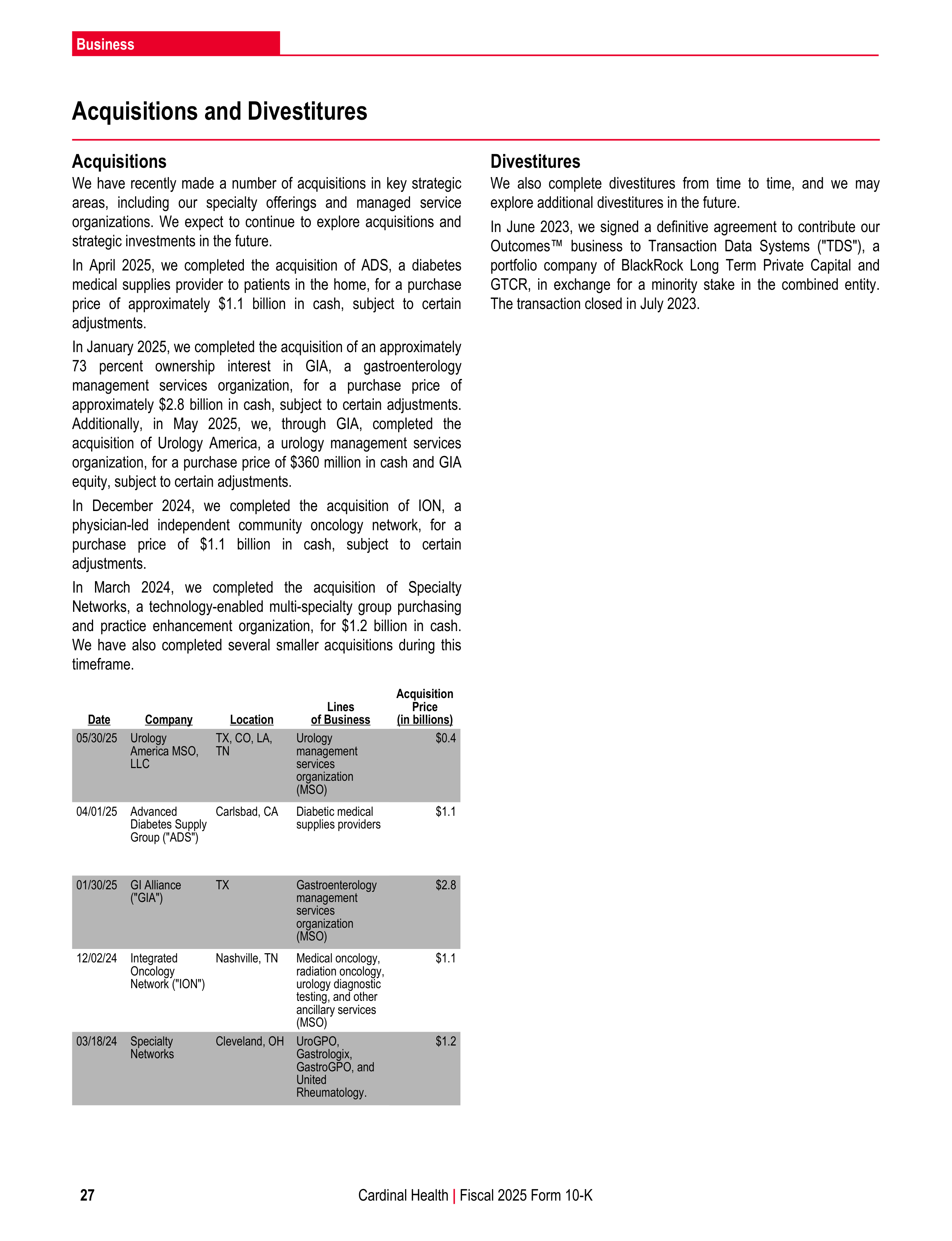
Acquisitions and Divestitures
Acquisitions
We have recently made a number of acquisitions in key strategic
areas, including our specialty offerings and managed service
organizations. We expect to continue to explore acquisitions and
strategic investments in the future.
In April 2025, we completed the acquisition of ADS, a diabetes
medical supplies provider to patients in the home, for a purchase
price of approximately $1.1 billion in cash, subject to certain
adjustments.
In January 2025, we completed the acquisition of an approximately
73 percent ownership interest in GIA, a gastroenterology
management services organization, for a purchase price of
approximately $2.8 billion in cash, subject to certain adjustments.
Additionally, in May 2025, we, through GIA, completed the
acquisition of Urology America, a urology management services
organization, for a purchase price of $360 million in cash and GIA
equity, subject to certain adjustments.
In December 2024, we completed the acquisition of ION, a
physician-led independent community oncology network, for a
purchase price of $1.1 billion in cash, subject to certain
adjustments.
In March 2024, we completed the acquisition of Specialty
Networks, a technology-enabled multi-specialty group purchasing
and practice enhancement organization, for $1.2 billion in cash.
We have also completed several smaller acquisitions during this
timeframe.
Date
Company
Location
Lines
of Business
Acquisition
Price
(in billions)
05/30/25
Urology
America MSO,
LLC
TX, CO, LA,
TN
Urology
management
services
organization
(MSO)
$0.4
04/01/25
Advanced
Diabetes Supply
Group ("ADS")
Carlsbad, CA
Diabetic medical
supplies providers
$1.1
01/30/25
GI Alliance
("GIA")
TX
Gastroenterology
management
services
organization
(MSO)
$2.8
12/02/24
Integrated
Oncology
Network ("ION")
Nashville, TN
Medical oncology,
radiation oncology,
urology diagnostic
testing, and other
ancillary services
(MSO)
$1.1
03/18/24
Specialty
Networks
Cleveland, OH
UroGPO,
Gastrologix,
GastroGPO, and
United
Rheumatology.
$1.2
Divestitures
We also complete divestitures from time to time, and we may
explore additional divestitures in the future.
In June 2023, we signed a definitive agreement to contribute our
Outcomes™ business to Transaction Data Systems ("TDS"), a
portfolio company of BlackRock Long Term Private Capital and
GTCR, in exchange for a minority stake in the combined entity.
The transaction closed in July 2023.
Business
Cardinal Health
|
Fiscal 2025 Form 10-K
27
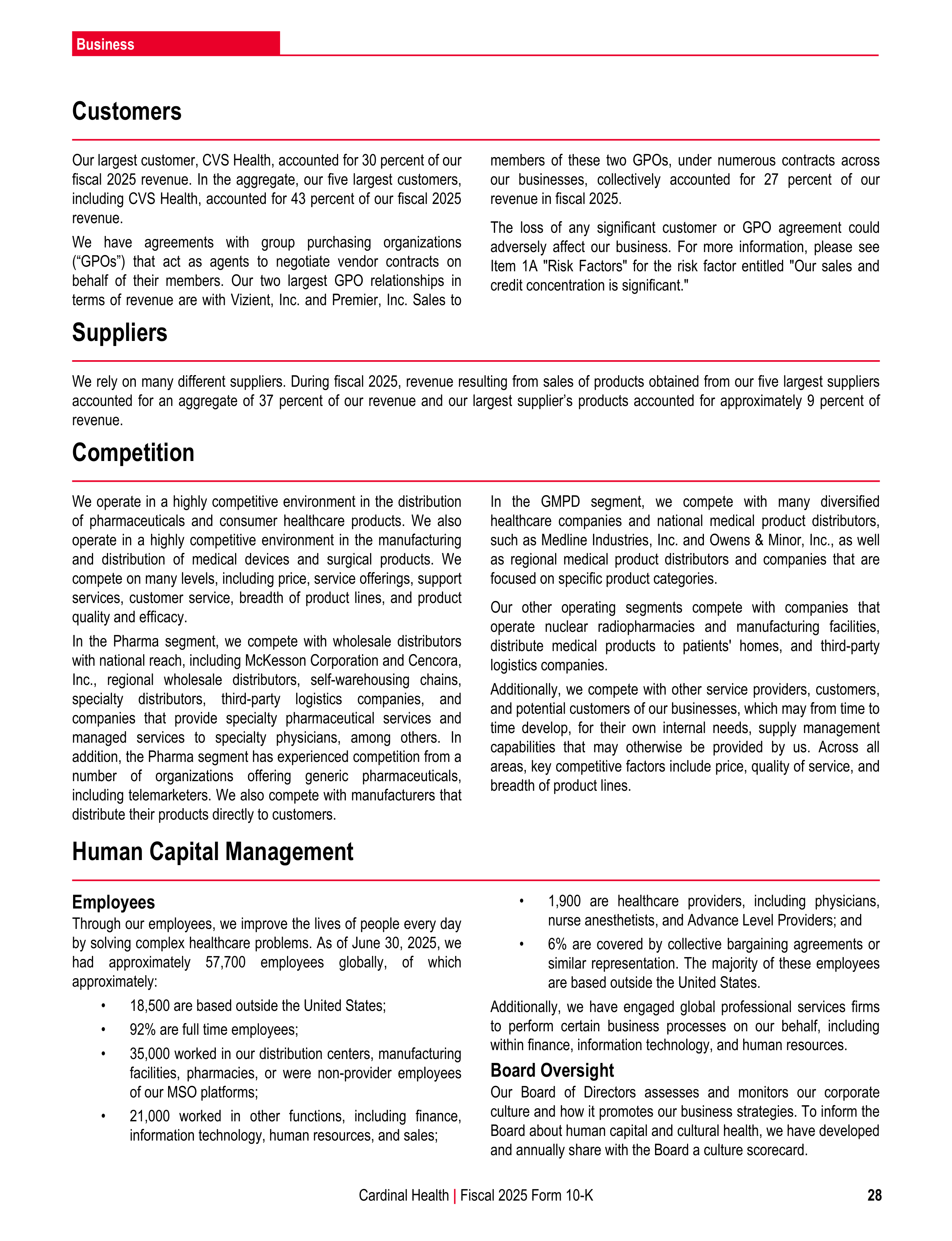
Customers
Our largest customer, CVS Health, accounted for 30 percent of our
fiscal 2025 revenue. In the aggregate, our five largest customers,
including CVS Health, accounted for 43 percent of our fiscal 2025
revenue.
We have agreements with group purchasing organizations
(“GPOs”) that act as agents to negotiate vendor contracts on
behalf of their members. Our two largest GPO relationships in
terms of revenue are with Vizient, Inc. and Premier, Inc. Sales to
members of these two GPOs, under numerous contracts across
our businesses, collectively accounted for 27 percent of our
revenue in fiscal 2025.
The loss of any significant customer or GPO agreement could
adversely affect our business. For more information, please see
Item 1A "Risk Factors" for the risk factor entitled "Our sales and
credit concentration is significant."
Suppliers
We rely on many different suppliers. During fiscal 2025, revenue resulting from sales of products obtained from our five largest suppliers
accounted for an aggregate of 37 percent of our revenue and our largest supplier’s products accounted for approximately 9 percent of
revenue.
Competition
We operate in a highly competitive environment in the distribution
of pharmaceuticals and consumer healthcare products. We also
operate in a highly competitive environment in the manufacturing
and distribution of medical devices and surgical products. We
compete on many levels, including price, service offerings, support
services, customer service, breadth of product lines, and product
quality and efficacy.
In the Pharma segment, we compete with wholesale distributors
with national reach, including McKesson Corporation and Cencora,
Inc., regional wholesale distributors, self-warehousing chains,
specialty distributors, third-party logistics companies, and
companies that provide specialty pharmaceutical services and
managed services to specialty physicians, among others. In
addition, the Pharma segment has experienced competition from a
number of organizations offering generic pharmaceuticals,
including telemarketers. We also compete with manufacturers that
distribute their products directly to customers.
In the GMPD segment, we compete with many diversified
healthcare companies and national medical product distributors,
such as Medline Industries, Inc. and Owens & Minor, Inc., as well
as regional medical product distributors and companies that are
focused on specific product categories.
Our other operating segments compete with companies that
operate nuclear radiopharmacies and manufacturing facilities,
distribute medical products to patients' homes, and third-party
logistics companies.
Additionally, we compete with other service providers, customers,
and potential customers of our businesses, which may from time to
time develop, for their own internal needs, supply management
capabilities that may otherwise be provided by us. Across all
areas, key competitive factors include price, quality of service, and
breadth of product lines.
Human Capital Management
Employees
Through our employees, we improve the lives of people every day
by solving complex healthcare problems. As of June 30, 2025, we
had approximately 57,700 employees globally, of which
approximately:
•
18,500 are based outside the United States;
•
92% are full time employees;
•
35,000 worked in our distribution centers, manufacturing
facilities, pharmacies, or were non-provider employees
of our MSO platforms;
•
21,000 worked in other functions, including finance,
information technology, human resources, and sales;
•
1,900 are healthcare providers, including physicians,
nurse anesthetists, and Advance Level Providers; and
•
6% are covered by collective bargaining agreements or
similar representation. The majority of these employees
are based outside the United States.
Additionally, we have engaged global professional services firms
to perform certain business processes on our behalf, including
within finance, information technology, and human resources.
Board Oversight
Our Board of Directors assesses and monitors our corporate
culture and how it promotes our business strategies. To inform the
Board about human capital and cultural health, we have developed
and annually share with the Board a culture scorecard.
Business
28
Cardinal Health
|
Fiscal 2025 Form 10-K
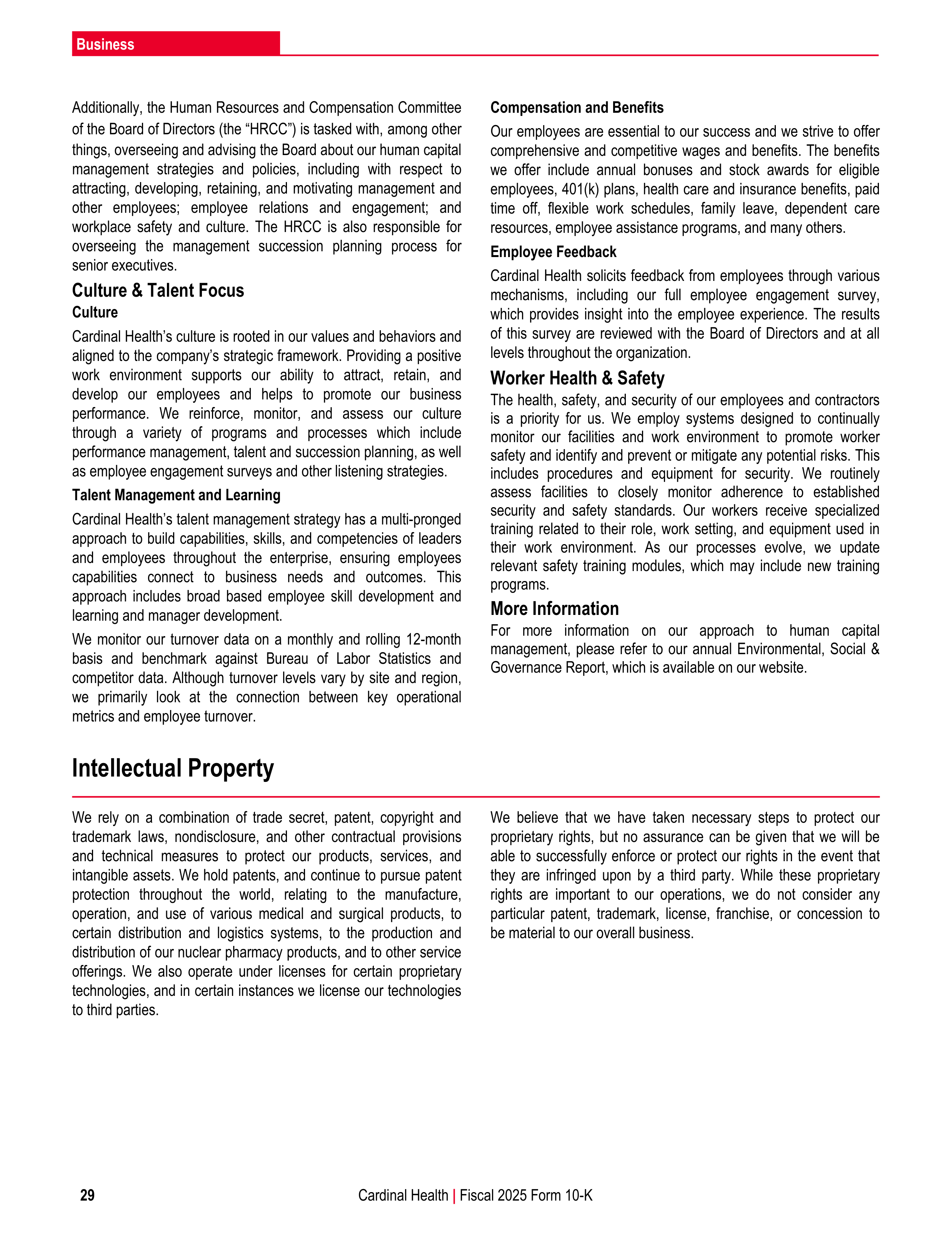
Additionally, the Human Resources and Compensation Committee
of the Board of Directors (the “HRCC”) is tasked with,
among other
things, overseeing and advising the Board about our human capital
management strategies and policies, including with respect to
attracting, developing, retaining, and motivating management and
other employees; employee relations and engagement; and
workplace safety and culture. The HRCC is also responsible for
overseeing the management succession planning process for
senior executives.
Culture & Talent Focus
Culture
Cardinal Health’s culture is rooted in our values and behaviors and
aligned to the company’s strategic framework. Providing a positive
work environment supports our ability to attract, retain, and
develop our employees and helps to promote our business
performance. We reinforce, monitor, and assess our culture
through a variety of programs and processes which include
performance management, talent and succession planning, as well
as employee engagement surveys and other listening strategies.
Talent Management and Learning
Cardinal Health’s talent management strategy has a multi-pronged
approach to build capabilities, skills, and competencies of leaders
and employees throughout the enterprise, ensuring employees
capabilities connect to business needs and outcomes. This
approach includes broad based employee skill development and
learning and manager development.
We monitor our turnover data on a monthly and rolling 12-month
basis and benchmark against Bureau of Labor Statistics and
competitor data. Although turnover levels vary by site and region,
we primarily look at the connection between key operational
metrics and employee turnover.
Compensation and Benefits
Our employees are essential to our success and we strive to offer
comprehensive and competitive wages and benefits. The benefits
we offer include annual bonuses and stock awards for eligible
employees, 401(k) plans, health care and insurance benefits, paid
time off, flexible work schedules, family leave, dependent care
resources, employee assistance programs, and many others.
Employee Feedback
Cardinal Health solicits feedback from employees through various
mechanisms, including our full employee engagement survey,
which provides insight into the employee experience. The results
of this survey are reviewed with the Board of Directors and at all
levels throughout the organization.
Worker Health & Safety
The health, safety, and security of our employees and contractors
is a priority for us. We employ systems designed to continually
monitor our facilities and work environment to promote worker
safety and identify and prevent or mitigate any potential risks. This
includes procedures and equipment for security. We routinely
assess facilities to closely monitor adherence to established
security and safety standards. Our workers receive specialized
training related to their role, work setting, and equipment used in
their work environment. As our processes evolve, we update
relevant safety training modules, which may include new training
programs.
More Information
For more information on our approach to human capital
management, please refer to our annual Environmental, Social &
Governance Report, which is available on our website.
Intellectual Property
We rely on a combination of trade secret, patent, copyright and
trademark laws, nondisclosure, and other contractual provisions
and technical measures to protect our products, services, and
intangible assets. We hold patents, and continue to pursue patent
protection throughout the world, relating to the manufacture,
operation, and use of various medical and surgical products, to
certain distribution and logistics systems, to the production and
distribution of our nuclear pharmacy products, and to other service
offerings. We also operate under licenses for certain proprietary
technologies, and in certain instances we license our technologies
to third parties.
We believe that we have taken necessary steps to protect our
proprietary rights, but no assurance can be given that we will be
able to successfully enforce or protect our rights in the event that
they are infringed upon by a third party. While these proprietary
rights are important to our operations, we do not consider any
particular patent, trademark, license, franchise, or concession to
be material to our overall business.
Business
Cardinal Health
|
Fiscal 2025 Form 10-K
29
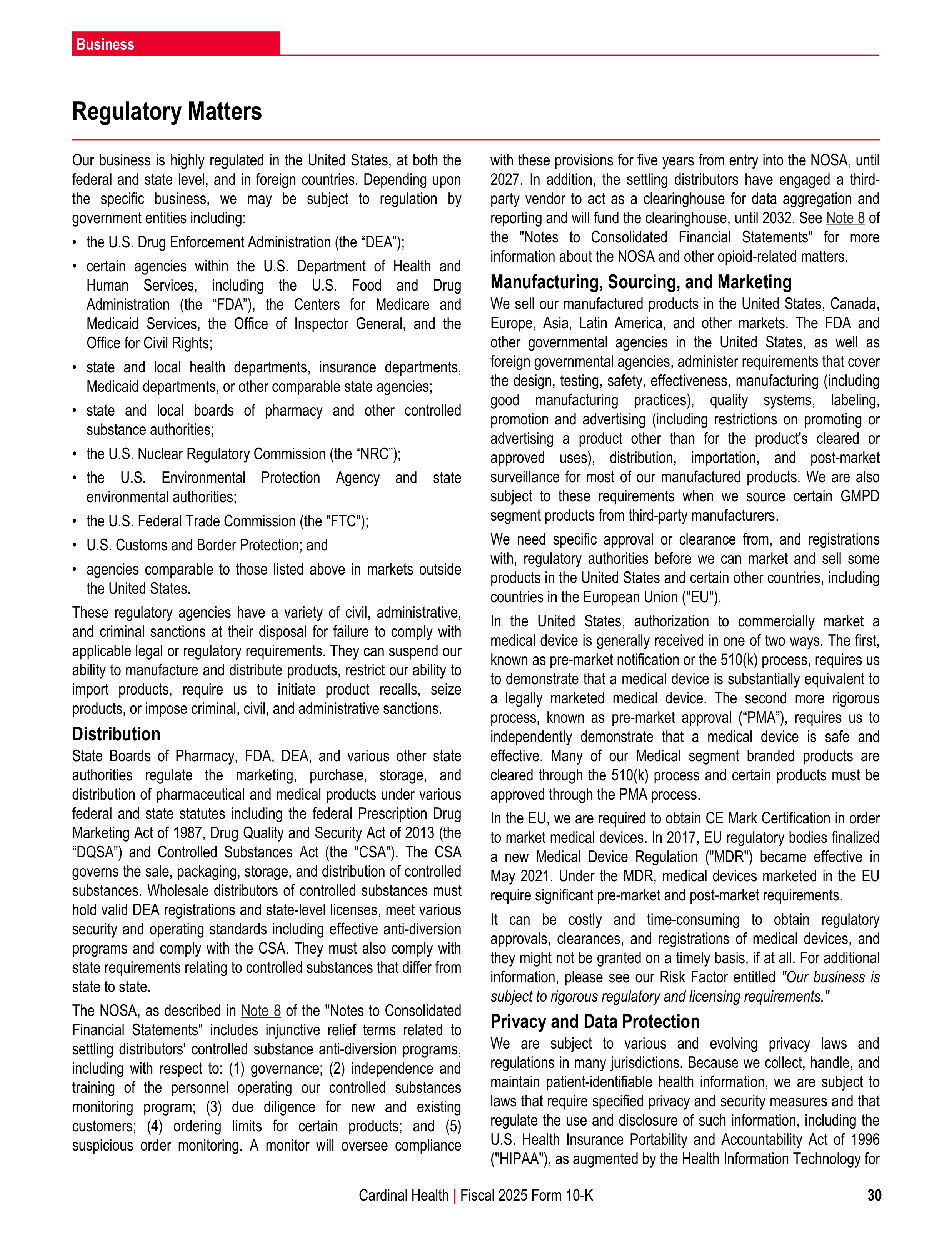
Regulatory Matters
Our business is highly regulated in the United States, at both the
federal and state level, and in foreign countries. Depending upon
the specific business, we may be subject to regulation by
government entities including:
•
the U.S. Drug Enforcement Administration (the “DEA”);
•
certain agencies within the U.S. Department of Health and
Human Services, including the U.S. Food and Drug
Administration (the “FDA”), the Centers for Medicare and
Medicaid Services, the Office of Inspector General, and the
Office for Civil Rights;
•
state and local health departments, insurance departments,
Medicaid departments, or other comparable state agencies;
•
state and local boards of pharmacy and other controlled
substance authorities;
•
the U.S. Nuclear Regulatory Commission (the “NRC”);
•
the U.S. Environmental Protection Agency and state
environmental authorities;
•
the U.S. Federal Trade Commission (the "FTC");
•
U.S. Customs and Border Protection; and
•
agencies comparable to those listed above in markets outside
the United States.
These regulatory agencies have a variety of civil, administrative,
and criminal sanctions at their disposal for failure to comply with
applicable legal or regulatory requirements. They can suspend our
ability to manufacture and distribute products, restrict our ability to
import products, require us to initiate product recalls, seize
products, or impose criminal, civil, and administrative sanctions.
Distribution
State Boards of Pharmacy, FDA, DEA, and various other state
authorities regulate the marketing, purchase, storage, and
distribution of pharmaceutical and medical products under various
federal and state statutes including the federal Prescription Drug
Marketing Act of 1987, Drug Quality and Security Act of 2013 (the
“DQSA”) and Controlled Substances Act (the "CSA"). The CSA
governs the sale, packaging, storage, and distribution of controlled
substances. Wholesale distributors of controlled substances must
hold valid DEA registrations and state-level licenses, meet various
security and operating standards including effective anti-diversion
programs and comply with the CSA. They must also comply with
state requirements relating to controlled substances that differ from
state to state.
The NOSA, as described in
Note 8
of the "Notes to Consolidated
Financial Statements" includes injunctive relief terms related to
settling distributors' controlled substance anti-diversion programs,
including with respect to: (1) governance; (2) independence and
training of the personnel operating our controlled substances
monitoring program; (3) due diligence for new and existing
customers; (4) ordering limits for certain products; and (5)
suspicious order monitoring. A monitor will oversee compliance
with these provisions for five years from entry into the NOSA, until
2027. In addition, the settling distributors have engaged a third-
party vendor to act as a clearinghouse for data aggregation and
reporting and will fund the clearinghouse, until 2032. See
Note 8
of
the "Notes to Consolidated Financial Statements" for more
information about the NOSA and other opioid-related matters.
Manufacturing, Sourcing, and Marketing
We sell our manufactured products in the United States, Canada,
Europe, Asia, Latin America, and other markets. The FDA and
other governmental agencies in the United States, as well as
foreign governmental agencies, administer requirements that cover
the design, testing, safety, effectiveness, manufacturing (including
good manufacturing practices), quality systems, labeling,
promotion and advertising (including restrictions on promoting or
advertising a product other than for the product's cleared or
approved uses), distribution, importation, and post-market
surveillance for most of our manufactured products. We are also
subject to these requirements when we source certain GMPD
segment products from third-party manufacturers.
We need specific approval or clearance from, and registrations
with, regulatory authorities before we can market and sell some
products in the United States and certain other countries, including
countries in the European Union ("EU").
In the United States, authorization to commercially market a
medical device is generally received in one of two ways. The first,
known as pre-market notification or the 510(k) process, requires us
to demonstrate that a medical device is substantially equivalent to
a legally marketed medical device. The second more rigorous
process, known as pre-market approval (“PMA”), requires us to
independently demonstrate that a medical device is safe and
effective. Many of our Medical segment branded products are
cleared through the 510(k) process and certain products must be
approved through the PMA process.
In the EU, we are required to obtain CE Mark Certification in order
to market medical devices. In 2017, EU regulatory bodies finalized
a new Medical Device Regulation ("MDR") became effective in
May 2021. Under the MDR, medical devices marketed in the EU
require significant pre-market and post-market requirements.
It can be costly and time-consuming to obtain regulatory
approvals, clearances, and registrations of medical devices, and
they might not be granted on a timely basis, if at all. For additional
information, please see our Risk Factor entitled
"Our business is
subject to rigorous regulatory and licensing requirements."
Privacy and Data Protection
We are subject to various and evolving privacy laws and
regulations in many jurisdictions. Because we collect, handle, and
maintain patient-identifiable health information, we are subject to
laws that require specified privacy and security measures and that
regulate the use and disclosure of such information, including the
U.S. Health Insurance Portability and Accountability Act of 1996
("HIPAA"), as augmented by the Health Information Technology for
Business
30
Cardinal Health
|
Fiscal 2025 Form 10-K
Economic and Clinical Health Act as well as state laws, in the
United States.
We also collect, handle, and maintain other personal and financial
information. Within the U.S., these activities are regulated by
certain federal and state laws. Certain states have recently
enacted privacy laws that grant specified rights to consumers over
the use of their personal information, including increased
transparency. Other states are considering adopting similar or
different comprehensive privacy laws and comprehensive privacy
legislation has been proposed at the U.S. federal level.
Internationally, we are also subject to privacy and data protection
laws that require significant compliance efforts, including the EU's
General Data Protection Regulation (GDPR), Canada's Personal
Information Protection and Electronic Documents Act, Japan's Act
on the Protection of Personal Information, and China's Personal
Information Protection Law, among many others.
Nuclear Pharmacies and Related Businesses
Our nuclear pharmacies and radiopharmaceutical manufacturing
facilities (including for Xofigo
®
) require licenses or permits and
must abide by regulations issued by the NRC, applicable state
boards of pharmacy and the radiologic health agency or
department of health of each state in which we operate, including
pharmacy sterile compounding standards and practices. In
addition, our radiopharmaceutical manufacturing facilities also
must comply with FDA regulations, including good manufacturing
practices.
Product Tracing and Supply Chain Integrity
Title II of the DQSA, known as the Drug Supply Chain Security Act
("DSCSA") or "Track and Trace" established a national system for
tracing prescription drug products through the pharmaceutical
distribution supply chain to detect, prevent, and rapidly respond to
the introduction of drugs that may be counterfeit, diverted, stolen,
adulterated, subject of a fraudulent transaction, or otherwise unfit
for distribution. The DSCSA requires standardized, unit-level
traceability of pharmaceutical products and requires all trading
partners to cooperate in a secure, electronic, interoperable
prescription drug traceability system. In October, 2024, the FDA
extended the compliance deadlines for the DSCSA sterilization
traceability requirements to May 27, 2025, for manufacturers,
August 27, 2025, for distributors, and November 27, 2025, for
dispensers. In addition, the FDA has also has issued regulations
requiring most medical device labeling to include a unique device
identifier that can be used to identify and track medical devices
throughout their lifecycles, improving traceability and facilitating
improved post-market surveillance through the Medical Device
Reporting Program.
Government Healthcare Programs
We are subject to U.S. federal healthcare fraud and abuse laws.
These laws generally prohibit persons from soliciting, offering,
receiving, or paying any compensation in order to induce someone
to order, recommend, or purchase products or services that are in
any way paid for by Medicare, Medicaid, or other federally-funded
healthcare programs. They also prohibit submitting any fraudulent
claim for payment by the federal government. There are similar
state healthcare fraud and abuse laws that apply to Medicaid and
other state-funded healthcare programs. Violations of these laws
may result in criminal or civil penalties, as well as breach of
contract claims and qui tam actions (false claims cases initiated by
private parties purporting to act on behalf of federal or state
governments).
Some of our businesses and entities that are managed by our
MSO businesses are Medicare-certified suppliers or participate in
other federal and state healthcare programs, such as state
Medicaid programs and the federal 340B drug pricing program.
These businesses are subject to accreditation and quality
standards and other rules and regulations, including applicable
reporting, billing, payment, and record-keeping requirements.
Other
businesses
within
each
segment
manufacture
pharmaceutical or medical products or repackage pharmaceuticals
that are purchased or reimbursed through, or are otherwise
governed by, federal or state healthcare programs. Failure to
comply with applicable eligibility requirements, standards, and
regulations could result in civil or criminal sanctions, including the
loss of our ability to participate in Medicare, Medicaid, and other
federal and state healthcare programs. In fiscal year 2022, our
Specialty Pharmaceutical Distribution business entered into a
Corporate Integrity Agreement with the Office of Inspector General
of the Department of Health and Human Services in connection
with an investigation into discounts and rebates offered or provided
to certain Specialty customers.
Our U.S. federal and state government contracts are subject to
specific procurement requirements. Failure to comply with
applicable rules or regulations or with contractual or other
requirements may result in monetary damages and criminal or civil
penalties as well as termination of our government contracts or our
suspension or debarment from government contract work.
Environmental, Health, and Safety Laws
In the United States and other countries, we are subject to various
federal, state, and local environmental laws, including laws
regulating the production or use of hazardous substances, as well
as laws relating to safe working conditions and laboratory
practices. Additionally, industry participants, including us, rely on
ethylene oxide ("EtO") and other compounds to sterilize certain
medical products that we manufacture or distribute. Regulatory
actions have been taken by certain environmental regulatory
authorities to reduce EtO emissions during the sterilization and
distribution process, including actions intended to regulate facilities
that sterilize medical products.
Antitrust Laws
The U.S. federal government, most U.S. states and many foreign
countries have laws that prohibit certain types of conduct deemed
to be anti-competitive. Violations of these laws can result in
various sanctions, including criminal and civil penalties. Private
plaintiffs also could bring civil lawsuits against us in the United
States for alleged antitrust law violations, including claims for
treble damages.
Business
Cardinal Health
|
Fiscal 2025 Form 10-K
31
Laws Relating to Foreign Trade and Operations
U.S. and foreign laws require us to abide by standards relating to
the import and export of finished goods, raw materials and
supplies, and the handling of information. We also must comply
with various export control and trade embargo laws, which may
require licenses or other authorizations for transactions within
some countries or with some counterparties.
Similarly, we are subject to U.S. and foreign laws concerning the
conduct of our foreign operations, including the U.S. Foreign
Corrupt Practices Act, the U.K. Bribery Act, and other foreign anti-
bribery laws. Among other things, these laws generally prohibit
companies and their intermediaries from offering, promising, or
making payments to officials of foreign governments for the
purpose of obtaining or retaining business.
Other Information
Certain Commercial Practices
Although our agreements with manufacturers sometimes require
us to maintain inventory levels within specified ranges, our
distribution businesses are generally not required by our
customers to maintain particular inventory levels other than as
needed to meet service level requirements. Certain customer
contracts require us to maintain sufficient inventory to meet
emergency demands, but we do not believe those requirements
materially affect inventory levels.
Our customer return policies generally require that the product be
physically returned, subject to restocking fees. We only allow
customers to return product for credit that can be added back to
inventory and resold at full value, or that can be returned to
vendors for credit.
We offer market payment terms to our customers.
Rule 10b5-1 Plan Adoptions and Modifications
During the quarter ended June 30, 2025, no director or officer
adopted or terminated a "Rule 10b5-1 trading arrangement" or
"non-Rule10b5-1 trading arrangement" as each term is defined in
Section 408(a) of Regulation S-K under the Exchange Act.
Business
32
Cardinal Health
|
Fiscal 2025 Form 10-K
Risk Factors
The risks described below could materially and adversely affect
our results of operations, financial condition, liquidity, or cash
flows. These are not the only risks we face. Our businesses also
could be affected by risks we do not currently consider material to
our operations or of which we are not presently aware.
Legal, Regulatory, & Compliance
Risks
Our business is subject to rigorous regulatory and licensing
requirements.
As described in the "Business" section, products that we
manufacture, source, distribute, or market must comply with U.S.
federal, state, and foreign and regulatory requirements.
Noncompliance or concerns over noncompliance, including
noncompliance by suppliers, has in the past, and may in the future
result in suspension of our ability to distribute, import,
manufacture, or source products, recalls, safety alerts or seizures,
or criminal or civil sanctions, which, in turn, could result in product
liability claims and lawsuits, including class actions. If we fail to
comply with regulatory requirements, or if allegations are made
that we fail to comply, our results of operations and financial
condition could be adversely affected.
To lawfully operate our businesses, we are required to obtain and
hold permits, product registrations, licenses and other regulatory
approvals from, and to comply with operating and security
standards of, numerous governmental bodies. Failure to maintain
or renew necessary permits, product registrations, licenses, or
approvals, or to comply with required standards, could have an
adverse effect on our results of operations and financial condition.
We are required to comply with laws relating to healthcare fraud
and abuse. The requirements of these laws are complex and
subject to varying interpretations. From time to time, regulatory
authorities investigate our policies or practices, and may challenge
them. For example, in November 2023, we received a Civil
Investigative Demand ("CID") from the Department of Justice
focused on potential violations of the Anti-Kickback Statute and
False Claims Act in connection with a 2022 transaction in which
we purchased a group purchasing organization and a minority
ownership interest in a rheumatology managed services
organization. We are cooperating with this investigation. We are
also periodically subject to federal or state government
investigations or qui tam actions (false claims cases initiated by
private parties purporting to act on behalf of federal or state
governments), which could result in civil or criminal sanctions,
including the loss of licenses or the ability to participate in
Medicare, Medicaid, and other federal and state healthcare
programs or other remedial measures.
Some of our businesses are Medicare-certified suppliers or
participate in other federal and state healthcare programs, such as
state Medicaid programs and the federal 340B drug pricing
program.
In
addition,
some
businesses
manufacture
pharmaceutical or medical products or repackage pharmaceuticals
that are purchased or reimbursed through, or are otherwise
governed by, federal or state healthcare programs. Failure to
comply with applicable eligibility requirements, standards, and
regulations could result in civil or criminal sanctions, including the
loss of our ability to participate in Medicare, Medicaid, and other
federal and state healthcare programs.
We, and third parties acting on our behalf, collect, handle, and
maintain patient-identifiable health information and other sensitive
personal and financial information which are subject to federal,
state, and foreign laws that regulate the use and disclosure of such
information. Regulations currently in place continue to evolve, and
they are extensive and complex. Compliance with these laws is
difficult and costly. New laws in this area could further restrict our
ability to collect, handle, and maintain personal or patient
information, or could require us to incur additional compliance
costs, either of which could have an adverse impact on our results
of operations. From time to time, we have become aware of certain
isolated alleged violations of federal, state, or foreign laws
concerning privacy and data protection. When we become aware
of such allegations, we investigate and, if warranted, notify
affected people, entities, and regulatory bodies. As a result of
these violations, we are, and may in the future be, subject to civil
or criminal penalties, breach of contract claims, lawsuits, costs for
remediation, and harm to our reputation.
Industry participants, including us, rely on ethylene oxide (“EtO”)
and per- and polyfluoroalkyl (“PFA”) compounds to sterilize certain
medical products, including products that we manufacture or
distribute. Regulatory enforcement actions have been taken by
certain environmental regulatory authorities to reduce emissions of
these compounds during the sterilization and distribution process.
If such measures become more widespread, we could experience
increased costs to comply with reduced emissions standards and it
is possible that we and other industry participants may be unable
to effectively sterilize medical products, possibly resulting in supply
shortages or an industry-wide reduction in surgical or medical
procedures, which would negatively impact demand for our
products. Such increased costs or industry-wide reductions in
surgical and medical procedures would have a negative impact on
our profit. Additionally, we have been named as a defendant in
several lawsuits alleging personal injury as a result of EtO
emissions. Additionally, we have incurred, and may incur
additional costs associated with modifying certain manufacturing,
distribution, or replenishment facilities in accordance with state
environmental regulators' actions or requirements. It is possible
that these or future regulatory actions or lawsuits could adversely
impact our ability to procure products to distribute, resulting in
increased costs or industry supply disruptions.
Our government contracts are subject to specific procurement
requirements. Failure to comply with applicable rules or regulations
or with contractual or other requirements may result in monetary
damages and criminal or civil penalties as well as termination of
Risk Factors
Cardinal Health
|
Fiscal 2025 Form 10-K
33
our government contracts or our suspension or debarment from
government contract work.
Our global operations (including transition services in connection
with divestitures) are subject to the U.S. Foreign Corrupt Practices
Act ("FCPA"), the U.K. Bribery Act and similar anti-bribery laws in
other jurisdictions, and U.S. and foreign export control, trade
embargo, and customs laws. If we fail to comply, or are alleged to
fail to comply, with any of these laws, we could be subject to
investigations or suffer civil or criminal sanctions.
Product quality issues could adversely affect operations,
profitability, cash flows, and our financial condition.
As described in the "Business" section, products that we
manufacture, source, distribute, or market must comply with
rigorous quality requirements. These requirements include, among
others, regulations regarding manufacturing practices, labeling,
advertising, and post marketing reporting, including adverse event
reports and field alerts and actions. Several of our facilities and
procedures and those of our suppliers are subject to ongoing
regulation and periodic inspection by the FDA and other
authorities. Our products may not remain in compliance with
applicable FDA and other regulatory requirements. Actions
resulting from non-compliance with FDA and other regulations
include fines, warning letters, injunctions, civil penalties, damages,
recalls, consent decrees, seizures of products, and civil litigation
and/or criminal prosecution. For example, following a facility
inspection in December 2023, the FDA issued a warning letter to
Cardinal Health in April 2024 related to plastic syringes sourced
from a third party manufacturer in China asserting these products
did not have appropriate 510(k) clearance and restating some of
the observations from the December 2023 inspection. We promptly
took action on these products and submitted a timely and
comprehensive response to the warning letter describing our
investigation and corrective actions, and we continue to cooperate
with the FDA on this matter.
Noncompliance or concerns over noncompliance, including by
suppliers, as a result of use of third party manufactures, or planned
shifts in production sites, has in the past, and may in the future
result in substantial modifications to our business practices and
operations. These modifications can include suspension of our
ability to import and distribute, refunds, or recalls, total or partial
shutdown of production in one or more facilities while we or our
suppliers remedy any actual or potential issues, the inability to
obtain future pre-market approvals or marketing authorizations,
and withdrawals or suspensions of current products from the
market. In addition, it can be costly and time-consuming to obtain
regulatory approvals or product registrations to market a medical
device or other product, and such approvals or registrations might
not be granted on a timely basis, if at all. Any of these supply chain
and quality-related events could be disruptive to our business and
have a material adverse effect on operations, profitability, cash
flows, and our financial condition.
We could be subject to adverse changes in the tax laws or
challenges to our tax positions.
We are a large multinational corporation with operations in the
United States and many foreign countries. As a result, we are
subject to the tax laws of many jurisdictions.
From time to time, proposals are made in the United States and
other jurisdictions in which we operate that could adversely affect
our tax positions, effective tax rate, or tax payments. Additionally,
changes in tax laws or regulatory enforcement priorities may
impact our tax position. For example, in July 2025, the OBBBA
was signed into law and includes a broad range of tax reform
provisions, which, among other things, extend or make permanent
certain business and international tax measures initially
established under the 2017 Tax Cuts and Jobs Act ("Tax Act"),
which were set to expire, and reinstates 100% bonus depreciation.
Specific initiatives that may impact us include possible increases in
U.S. or foreign corporate income tax rates or other changes in tax
law to raise revenue, the repeal of the LIFO (last-in, first-out)
method of inventory accounting for income tax purposes, the
establishment or increase in taxation at the U.S. state level on the
basis of gross revenues, recommendations of the base erosion
and profit shifting project undertaken by the Organization for
Economic Cooperation, and Development and the European
Commission’s investigation into illegal state aid.
Additionally, in connection with the accruals taken in connection
with opioid-related lawsuits in fiscal year 2021, we recorded a net
tax benefit, reflecting our then-current assessment of the estimated
future deductibility of the amount that may be paid. We have made
reasonable estimates and recorded amounts based on
management's judgment and our current understanding of the Tax
Act; however, the tax law governing deductibility was changed by
the Tax Act, and these estimates require significant judgment and
it is possible that they could be subject to challenges by the U.S.
Internal Revenue Service ("IRS").
We also regularly review these estimates and assumptions from
time to time and adjust our accruals based on our review, resulting
in changes in our tax provisions/(benefit). The actual amount of tax
benefit related to uncertain tax positions may differ materially from
these estimates. See
Note 9
of the "Notes to Consolidated
Financial Statements" for more information regarding these
matters.
In fiscal year 2021, our provision for income taxes reflected a
$424 million benefit from the tax benefits of a self-insurance pre-
tax net operating loss carryback under the Coronavirus Aid, Relief
and Economic Security ("CARES") Act. Also, as a result of this net
operating loss carryback, we received a U.S. federal income tax
refund of $966 million. This fiscal year is being audited by the IRS,
and it is possible that the IRS could challenge our tax position with
respect to this self-insurance loss. If they do, our effective tax rate
or cash flows could be adversely impacted. Additionally, laws
governing insurance coverage vary by state and some state courts
have interpreted laws and insurance policies in ways that may
impact our self-insurance loss, which could negatively impact our
financial position.
Risk Factors
34
Cardinal Health
|
Fiscal 2025 Form 10-K
We file income tax returns in the U.S. federal jurisdiction, various
U.S. state jurisdictions, and various foreign jurisdictions. Tax laws
are complex and subject to varying interpretations. With few
exceptions, we are subject to audit by taxing authorities for fiscal
years 2015 through the current fiscal year, including specific
inquiries into a restructuring in connection with integrating the July
2017 acquisition of the Patient Recovery business and the net
operating loss carryback described above. Proposed adjustments
in ongoing audits may adversely affect our effective tax rate or tax
payments.
Changes to the U.S. healthcare environment may not be
favorable to us.
Over a number of years, the U.S. healthcare industry has
undergone significant changes designed to increase access to
medical care, improve safety and patient outcomes, contain costs,
and increase efficiencies. These changes include a general
decline in Medicare and Medicaid reimbursement levels, efforts by
healthcare insurance companies to limit or reduce payments to
pharmacies and providers, the basis for payments beginning to
transition from a fee-for-service model to value-based payments
and risk-sharing models, and the industry shifting away from
traditional healthcare venues like hospitals and into clinics,
physician offices, and patients’ homes.
We expect the U.S. healthcare industry to continue to change
significantly in the future. Possible changes include changes in
legislation or regulations governing prescription pharmaceutical
pricing, healthcare services, U.S.-based medical product
manufacturing, mandated benefits, efforts to promote increased
transparency in the pharmaceutical supply chain, drug shortages,
further reduction of or limitations on governmental funding at the
state or federal level, or efforts by healthcare insurance companies
to further limit payments for products and services. Federal, state,
and local governmental entities have also continued to increase
their scrutiny of the U.S. healthcare market.
Uncertainty surrounding possible changes to the healthcare
environment, including changes to regulatory enforcement
priorities, may directly or indirectly adversely affect us. The
recently issued Executive Order titled "Delivering Most-Favored
Nation Prescription Drug Pricing to American Patients" may impact
the sales or profitability of branded pharmaceutical products;
however, the extent of the impact may vary depending on the
timeline for implementation and the number of pharmaceutical
drugs that are impacted. Additionally, it is possible that the
adoption of the OBBBA could reduce participation in Medicare and
Medicaid programs, resulting in a change in utilization of the
healthcare system. This may adversely affect demand for our
products and services and could have an effect on our results of
operations and financial condition.
Private challenges to government healthcare policy may also have
an adverse impact on our business. For example, the federal 340B
drug pricing program requires pharmaceutical manufacturers to
offer discounts on certain drugs purchased by covered entities,
and some of our Pharma segment customers are covered entities
or contract pharmacies for covered entities. Over a dozen
pharmaceutical manufacturers have unilaterally restricted sales
under the 340B drug pricing program to contract pharmacies.
These practices are the subject of ongoing litigation; however, if
manufacturers continue this practice and if courts uphold this
practice, our customers may be adversely impacted, which could
adversely impact our business.
Opioid-related legal proceedings and the NOSA we have
entered into could have additional or unexpected negative
effects on our results of operations or business
.
Cardinal Health, along with other pharmaceutical wholesalers and
other participants in the pharmaceutical supply chain, was named
as a defendant in lawsuits related to the distribution of opioid pain
medications. Plaintiffs in these lawsuits included state attorneys
general, counties, and municipalities.
In April 2022, an agreement settling the vast majority of opioid-
related lawsuits filed against us by state and local governmental
entities became effective. It includes injunctive relief terms relating
to distributors' controlled substance anti-diversion programs, with
which we must comply. It is possible that the maintenance of the
required changes to distributors' controlled substance anti-
diversion programs may result in unforeseen costs or operational
challenges which could have an adverse impact on our results of
operations or performance. If we are unable to comply with these
requirements, or are alleged to have failed to comply with these
requirements, we could incur unforeseen costs or penalties, and
our financial results may be negatively impacted.
We are also being sued by private plaintiffs, such as unions, other
health and welfare funds, other healthcare providers, and
individuals alleging personal injury for the same activities, and
could be named as a defendant in additional lawsuits. We intend to
vigorously defend ourselves against these lawsuits; however, legal
proceedings are inherently unpredictable and it is possible that
these lawsuits, either individually or in the aggregate, could have a
negative impact on our results of operations.
We are involved in legal proceedings with insurers related to the
availability of insurance coverage for some matters described
above and our ability to recover losses from our insurers is
uncertain. Additionally, laws governing insurance coverage vary by
state and some state courts have interpreted laws and insurance
policies in ways that may negatively impact our ability to receive
indemnification under our insurance policies.
Ongoing unfavorable publicity regarding the abuse or misuse of
prescription opioid pain medications and the role of wholesale
distributors in the supply chain of such prescription medications
could continue to have an adverse effect on our reputation or
results of operations.
The outcome or resolution of certain legal proceedings could
adversely impact our cash flows or results of operations.
Due to the nature of our business, which includes the distribution
of controlled substances and other pharmaceutical products and
the sourcing, marketing, and manufacturing of medical products,
we regularly become involved in disputes, litigation, and regulatory
matters. Litigation is inherently unpredictable, disruptive, and time
consuming and the unfavorable outcome of legal proceedings
Risk Factors
Cardinal Health
|
Fiscal 2025 Form 10-K
35
could adversely affect our results of operations or financial
condition.
Additionally, some of the products that we distribute or
manufacture have been and may in the future be alleged to cause
personal injury, subjecting us to product liability claims. For
example, since July 2021, we have entered into settlement
agreements to settle the vast majority of product liability claims
alleging personal injuries associated with the use of Cordis
OptEase and TrapEase IVC filter products. Future settlements of
or judgments for product liability claims may not be covered by
insurance or exceed available insurance recoveries. If this
happens, our results of operations and financial condition could be
adversely affected.
In connection with legal proceedings, we occasionally enter into
settlement agreements or become subject to consent decrees
containing ongoing financial or operational obligations, including
the injunctive relief provisions of the NOSA and the Corporate
Integrity Agreement that our Specialty business entered into with
the Office of Inspector General of the Department of Health and
Human Services in connection with the rebates offered or provided
to certain Specialty Solutions customers. Failure to comply with
obligations under these agreements or decrees could lead to
monetary or other penalties.
We might infringe intellectual property rights or our own
intellectual property protections might be insufficient to
protect our commercial interests.
Third parties have in the past and may in the future assert
infringement claims against us. Litigation and proceedings related
to intellectual property are unpredictable, and we might be required
to pay significant damages, develop non-infringing products or
services, obtain a license, cease selling or using allegedly
infringing products or services, or incur other restrictions on our
operations. Trade secret, patent, copyright, and trademark laws,
nondisclosure obligations, and other contractual provisions are
critical to our business. Our efforts to protect our intellectual
property might be insufficient, and non-infringing products or
services equivalent or superior to ours might be developed by
competitors.
Industry & Economic Risks
Changes or uncertainty in U.S. or international trade policies
and exposure to economic, political and currency, and other
risks could disrupt our global operations or negatively impact
our financial results.
We conduct our operations in various regions of the world outside
of the United States, including Europe, Asia, and Latin America.
Global developments can affect our business in many ways. Our
global operations are affected by local economic environments,
including inflation, recession, and competition. Additionally,
divergent or unfamiliar regulatory systems and labor markets can
increase the risks and burdens of operating in numerous countries.
For example, recent U.S. tariffs imposed or threatened to be
imposed on goods, materials, and products from countries where
we do business, and any retaliatory actions taken by such
countries could result in us incurring substantial additional costs to
source materials, directly and indirectly, from affected countries,
and may require us to raise prices on certain products and seek
alternative sources of supply. If our competitors do not increase
prices, or increase prices to a lesser extent than we do, or are able
to offset the impact of tariffs through other actions, our competitive
and financial position may be adversely affected. Additionally, if we
are not able to find adequate alternate sources of supply, we may
experience supply shortages or disruptions. Additionally, in certain
circumstances, including in our Other operating segment, we may
not receive increased reimbursement commensurate with the
increase in costs, which may negatively impact our results of
operations. In addition, we conduct our business in U.S. dollars
and various functional currencies of our foreign subsidiaries.
Changes in foreign currency exchange rates could adversely affect
our financial results, which are reported in U.S. dollars. We may
not be able to hedge to protect us against these exposures, and
any hedges may not successfully mitigate these exposures.
We are also subject to government import and export controls and
regulations, including the requirement that we make a
determination as to the country of origin of products that we source
or manufacture outside the United States. From time to time,
Customs and Border protection agencies, whether in the U.S. or
other jurisdictions, have challenged these determinations. These
and other actions by border protection have resulted in products
being detained or delayed and supply disruptions and could result
in the imposition of fines and penalties. In addition, the Uyghur
Forced Labor Prevention Act, which went into effect in June 2022,
prohibits the importation of any goods grown, produced,
manufactured, or mined, wholly or in part, in the Xinjiang Uyghur
Autonomous Region of China unless importers can provide clear
and convincing evidence that goods were not made using forced
labor. We have experienced supply constraints as a result of these
and similar regulations, and it is possible that our business or
results of operations could be further negatively impacted by future
determinations and disruptions.
Our Pharmaceutical and Specialty Solutions segment’s profit
margin could be adversely affected by changes in industry or
market dynamics that we are not able to accurately predict.
The frequency, timing, magnitude, and profit impact of generic
pharmaceutical customer purchase volumes, pricing changes,
customer contract renewals, generic pharmaceutical launches, and
generic pharmaceutical manufacturer pricing changes, which
contribute to the performance of our generic pharmaceutical
program, remain uncertain. These factors have contributed to
declines in some prior years and have more than offset the
benefits from sourcing generic pharmaceuticals through our Red
Oak Sourcing venture with CVS Health. If performance of our
generic pharmaceutical program declines in future fiscal years and
we are unable to offset the decline, our Pharma segment profit and
consolidated operating earnings will be adversely affected.
Additionally, almost all of our distribution services agreements with
branded pharmaceutical manufacturers provide that we receive
Risk Factors
36
Cardinal Health
|
Fiscal 2025 Form 10-K
fees from the manufacturers to compensate us for services we
provide them. However, under certain agreements, branded
pharmaceutical price appreciation, which is determined by the
manufacturers, also serves as a part of our compensation. If
manufacturers change their historical approach to setting and
increasing wholesale acquisition cost, decide to reduce prices, not
to increase prices, or to implement only small increases, and we
are unable to negotiate alternative ways to be compensated by
manufacturers or customers for the value of our services, our
margins could be adversely affected.
We depend on direct and indirect suppliers to make their
products and raw materials available to us and are subject to
fluctuations in costs, availability, and regulatory risk
associated with these products and raw materials.
Our manufacturing businesses use oil-based resins, pulp, cotton,
latex, and other commodities as raw materials in many products.
Prices of oil and gas also affect our distribution and transportation
costs. Prices of these commodities are volatile and can fluctuate
significantly, causing our costs to produce and distribute our
products to fluctuate. Beginning in the fourth quarter of fiscal year
2021, we experienced higher supply chain costs, which had a
negative impact on our GMPD (former Medical) segment profit in
fiscal 2021, 2022, 2023, 2024, and 2025. Supply chain constraints
also had a negative impact on sales within our GMPD (former
Medical) segment.
We did not offset the full impact of these cost increases in fiscal
year 2023, 2024, and 2025; however, we implemented certain cost
reductions, price increases, and surcharges to mitigate the impact.
Due to competitive dynamics and contractual limitations, passing
along cost increases is challenging. If we are not able to mitigate
future cost increases through increased prices where necessary or
if supply chain cost significantly increase or become subject to
additional variability, GMPD segment profit could be negatively
impacted.
We depend on others to manufacture some products, including
pharmaceuticals, that we market and distribute. Our operations are
also dependent on various components, compounds, raw
materials, and energy supplied by others. We purchase many of
these components, raw materials, and energy, and source certain
products from numerous suppliers in various countries. In some
instances, for reasons of quality assurance, cost effectiveness, or
availability, we procure certain components and raw materials from
a sole supplier. Our supplier relationships could be interrupted,
become less favorable to us or be terminated and the supply of
these components, compounds, raw materials, or products could
be interrupted or become insufficient.
These supply interruptions or other disruptions in manufacturing
processes could be caused by events beyond our control,
including natural disasters, labor disputes, supplier facility
shutdowns, defective raw materials, the impact of epidemics or
pandemics, such as COVID-19, and actions by U.S. or
international governments, including import or export restrictions or
tariffs. Any material interruption in our supply chain or inability to
obtain key products from third parties in a timely and cost-effective
manner, including as a result of trade or other restrictions, could
adversely affect our business operations and results of operations,
financial condition and cash flows.
In addition, due to the stringent regulatory requirements regarding
the manufacture and sourcing of our products, we may not be able
to quickly establish additional or replacement sources for certain
components, materials, or products. A sustained supply reduction
or interruption, and an inability to develop alternative and
additional sources for such supply, could result in lost sales,
increased cost, damage to our reputation, and may have an
adverse effect on our business.
We could continue to suffer the adverse effects of competitive
pressures, and changes in our relationships with significant
customers could adversely affect us.
As described in greater detail in the "Business" section, we
operate in markets that are highly competitive and dynamic. In
addition, competitive pressures in each of our businesses may be
increased by new business models, new entrants, new regulations,
or changes in enforcement priorities, changes in consumer
demand, or general competitive dynamics. Additionally, we may
not be able to onboard new customers as efficiently as expected
due to customer service issues or competitive service level
offerings. We have also experienced delays in onboarding new
customers due to factors outside of our control. Our businesses
face continued pricing pressure from these factors, which
adversely affects our margins. If we are unable to offset margin
reductions caused by these pressures through steps such as
sourcing or cost control measures, additional service offerings and
sales of higher margin products, our results of operations could
continue to be adversely affected.
Employee attrition may have an adverse impact on our
business, results of operations, or internal controls.
Our ability to attract, retain, and develop qualified and experienced
employees, including key executives, key employees at companies
that we acquire, and other talent, is critical for us to meet our
business objectives. We compete with many other businesses to
attract and retain employees. It is possible that we could
experience loss of key personnel for a variety of causes. If we do
not adequately plan for succession of key roles or if we are not
successful in attracting or retaining new talent, our operations,
financial performance or internal control over financial reporting
could be adversely impacted.
Consolidation in the U.S. healthcare industry may negatively
impact our results of operations.
In recent years, U.S. healthcare industry participants, including
distributors, manufacturers, suppliers, healthcare providers,
insurers, and pharmacy chains, among others, have consolidated
or formed strategic alliances. Consolidations create larger
enterprises with greater negotiating power and could result in the
possible loss of a customer in the situation where the combined
enterprise selects one distributor from two incumbents or a
reduction in our ability to market our products and services to new
customers. Consolidations also impact other objectives, including
Risk Factors
Cardinal Health
|
Fiscal 2025 Form 10-K
37
our ability to use acquisitions to expand or complement our
existing businesses. If this consolidation trend continues, it could
adversely affect our results of operations.
Business & Operational Risks
Our business and operations depend on the proper
functioning of information systems, critical facilities, and
distribution networks and could be negatively impacted by
events outside of our control.
We rely on our and third-party service providers' information
systems for a wide variety of critical operations, including to obtain,
rapidly process, analyze, and manage data to:
•
facilitate the purchase and distribution of inventory items from
numerous distribution centers;
•
receive, process, and ship orders on a timely basis;
•
manage accurate billing and collections for thousands of
customers;
•
process payments to suppliers;
•
facilitate manufacturing and assembly of medical products; and
•
generate financial information.
Our business also depends on the proper functioning and security
of our and our suppliers' business processes, critical facilities,
including our national logistics center, and our distribution
networks. Our results of operations could be adversely affected if
our or a service provider's business processes, information
systems, critical facilities, or distribution networks are disrupted
(including disruption of access), are damaged or fail, whether due
to physical disruptions, such as extreme weather events, including
wildfires, hurricanes, extreme temperatures, or other natural
disasters, pandemics (as they were by the COVID-19 pandemic),
supply chain disruptions, or power outages, systems updates, or
due to cybersecurity incidents, ransomware, or other actions of
third parties, including labor strikes or shortages, political unrest,
and terrorist attacks. In addition, hardware, software, and other
applications and updates procured from third parties may contain
defects that have and may in the future unexpectedly restrict or
prevent access to or interfere with the proper operation of our
information systems and hardware. Manufacturing disruptions also
can occur due to regulatory action, production quality deviations,
safety issues, or raw material shortages or defects, planned shifts
in production sites, or because we need to transition
manufacturing facilities for any key products or components that is
manufactured at a single manufacturing facility where there are
limited alternate facilities. Additionally, we incur costs to remediate
these disruptions, and it is possible that these costs could be
significant.
Our ability to compete effectively is increasingly dependent on
access to and interpretation of data, and we may provide services
that involve hosting customer data and operating software on third-
party or our own systems. Data quality impacts customer ordering,
order fulfillment, and higher order processing. If we fail to
effectively implement and maintain data governance structures
across our businesses, to effectively interpret and utilize such
data, or protect the integrity of such data, including systems
powered by or incorporating artificial intelligence and machine
learning, our operations could be impacted, and we may be at a
competitive disadvantage.
Our business and results of operations could be adversely
affected if we experience a material cyber-attack or other
systems breach.
Cybersecurity incidents and attacks resulting in unauthorized
access to our systems and those of third parties we use in our
business could have a material impact on our business operations
as a result of loss or misuse of our information, including personal
data and sensitive data, and disruption to normal business
operations. Our business relies on the secure transmission,
storage, and hosting of patient-identifiable health information,
financial information, and other sensitive protected information
relating to our customers, company, workforce, and individuals
with whom we and our customers conduct business. We have
programs in place to detect, contain, and respond to information
security incidents. However, because the techniques used to
obtain unauthorized access, disable, or degrade service or
sabotage systems change frequently and may be difficult to detect
for long periods of time, we may be unable to anticipate these
techniques or to implement adequate preventative measures. In
addition, hardware, software, or applications developed internally
or procured from third parties may contain defects in design or
manufacture or other problems beyond our control that could
unexpectedly compromise information security.
Unauthorized parties have gained access in the past, and will
continue to attempt to gain access, to our (including our recently
acquired entities) or a service provider's systems or facilities
through fraud, social engineering, or other forms of deception. The
sophistication of cybersecurity threats and AI-powered cyber-
attacks such as deep fakes and force attacks continues to
increase. Additionally, our recently acquired MSO businesses are
subject to cybersecurity-related risks which are, while similar in
many respects, incremental to the cybersecurity risks experienced
by our legacy businesses. If we are not able to adapt our systems
and processes to mitigate these risks, we could experience
additional financial losses, including as a result of class action
lawsuits.
We and our service providers have been the target of cyber
attacks. Although we do not believe these incidents had a material
impact on us, either individually or in the aggregate, similar
incidents or events in the future may negatively impact our
business, reputation, or financial results.
Any compromise of our or a service provider's information
systems, including unauthorized access to or use or disclosure of
sensitive information, could result in the loss or misuse of our
information, including personal data and sensitive data and
adversely impact our operations, results of operations, or our
ability to satisfy legal or regulatory requirements, including the EU
general data protection regulation (GDPR) and those related to
patient-identifiable health information and other sensitive personal
and financial information at the state and U.S. federal level as
further described in the Risk Factor titled “Our business is subject
to other rigorous regulatory and licensing requirements,” above. A
Risk Factors
38
Cardinal Health
|
Fiscal 2025 Form 10-K
cybersecurity incident could result in a violation of these and other
applicable laws and result in a loss of customers and revenues,
remediation and other costs, increased insurance premiums,
litigation, monetary fines and penalties, and damage to our
competitiveness and reputation, any of which could adversely
affect our financial condition and business.
In addition, insurance for losses arising from cyber-attacks or other
breaches is becoming more costly and limited and may not be
available to us at amounts that we historically have obtained or
that we would like to obtain. It is possible that we could incur
losses that may not be covered by insurance or that would exceed
available insurance recoveries. If this happens, our results of
operations and financial condition could be adversely affected.
Our sales and credit concentration is significant.
In fiscal year 2025, CVS Health was our largest customer. CVS
Health accounted for 30 percent of our fiscal 2025 revenue and 26
percent of our gross trade receivable balance at June 30, 2025. If
CVS or another significant customer reduces their purchases from
us, defaults in payment to us, does not renew or terminates their
agreements, whether due to an alleged default by us or otherwise,
our results of operations and financial condition could be adversely
affected.
Our ability to complete, integrate, and manage acquisitions
could impact our strategic objectives and financial condition.
From time to time, we acquire or look to acquire other businesses
that expand or complement our existing businesses or enable
entry into new lines of business. For example, in fiscal year 2025,
we completed several significant acquisitions in disparate
businesses: the acquisition of Integrated Oncology Network and GI
Alliance, which are part of our Specialty business, and the
acquisition of Advanced Diabetes Supply Group, which is part of
our Cardinal Health At-Home businesses.
Completion of acquisitions involves a number of risks, including
the risk that required financing may not be available on favorable
terms and the risk that we may not receive regulatory approvals
necessary to timely complete an acquisition or otherwise satisfy
closing conditions.
Additionally, we are subject to risks associated with the integration
and operation of acquired businesses, including the risk that our
management’s attention may be diverted to integration efforts at
the expense of the legacy businesses, we may fail to retain key
personnel of the acquired business, we may experience difficulties
or delays establishing, integrating, or combining operations and
systems, including manufacturing facilities and cybersecurity-
related systems and processes, we may become subject to
unforeseen liabilities arising from legal proceedings involving the
acquired business, we may face challenges retaining the
customers of the acquired business and we may encounter
unforeseen internal control, regulatory, or compliance issues.
Additionally, future developments may impair the value of our
purchased goodwill or intangible assets or may otherwise
negatively affect our ability to achieve the financial, strategic, or
other benefits we expect from the acquisitions. For example,
certain states have proposed legislation, and Oregon adopted
legislation, that would limit, restrict or prohibit corporate entities
from owning or managing physician practices, directly, or
indirectly, through a managed services organization. If these
regulations proliferate, our ability to continue to own certain of our
recently acquired businesses in certain jurisdictions and our ability
to execute on our strategy may be impacted.
Our results of operations and financial condition may be
adversely affected by risks associated with entering new lines
of business, and our ability to execute our strategy.
As a result of our recently announced acquisitions, we are entering
into new lines of business, including providing physician practice
support and management services, that complement our pre-
existing businesses. Such new lines of business involve numerous
risks and uncertainties that may be different from or more
significant than the risks and uncertainties facing our legacy
businesses, including risks arising under or related to fraud, waste,
and abuse laws, direct or indirect ownership of provider practices,
litigation involving physicians, and risks from regulatory or
legislative changes that may limit direct or indirect ownership of
provider practices or our ability to provide physician practice
support and management services. Additionally, these businesses
are subject to cybersecurity risks that are, while similar in many
respects, incremental to the cybersecurity risks experienced by our
legacy businesses. If we are not able to adapt our systems and
processes to mitigate these risks, we could experience additional
financial losses, including as a result of class action lawsuits.
Additionally, our ability to successfully execute on providing
physician practice support and management services, including
through direct or indirect ownership of provider practices as
permitted by applicable law, depends upon a number of factors,
including: the ability to develop or acquire and integrate
appropriate practice management and support expertise; the ability
to support recruitment, integration, and retention of sufficient
numbers of local providers and staff; the ability to successfully
support negotiations with vendors, suppliers, and payors; the
reimbursement environment; and competition from other
healthcare organizations with greater depth of experience or
market knowledge.
Failure to effectively or efficiently complete or manage critical
business processes could have unforeseen consequences.
From time to time, our businesses perform business process
improvements or infrastructure modernization or use service
providers for key systems and processes, such as receiving and
processing customer orders, customer service, and accounts
payable. These initiatives, transitions, and improvements require
an ongoing commitment of resources. If any of these initiatives,
including those related to the ongoing implementation of new
Enterprise Resource Planning technologies and supply chain
optimization initiatives, and initiatives related to artificial
intelligence and machine learning, are not successfully or
efficiently implemented or maintained, or if our relationship with
critical third-party service providers deteriorates, we could
experience negative impacts on our business, financial results,
and our internal control over financial reporting.
Risk Factors
Cardinal Health
|
Fiscal 2025 Form 10-K
39
Our business is affected by events outside of our control
including public health crises, extreme weather-related events
and natural disasters, geopolitical, and other catastrophic
events.
We have experienced and expect to continue to experience
weather-related impacts to the business, primarily driven by risks
to certain physical components of our operations and risks related
to the transition to a lower-carbon economy. For example, our
properties have experienced physical damage resulting from
adverse or extreme weather resulting in increased costs for repairs
and may cause disruptions in operations. Additional risks
associated with extreme weather may cause social and human
effects such as shifts in populations, increased costs for critical
services such as transportation, and other adverse effects. These
factors may negatively impact cost or availability of certain
products, commodities, or energy, and could impair our ability to
secure goods and services required for the operation of our
business at quantities and levels we require.
Environmental and other climate-related laws and regulations may
impose costs, including increased spend associated with carbon
pricing mechanisms, data gathering and reporting, third-party
attestations, capital expenditures to implement lower greenhouse
gas emissions technology, and other measures to reduce
emissions. We cannot predict the potential impact on our
competitive position, results of operations, or financial condition. A
shift in customer or consumer preference towards low-carbon
products and services may also place us at a competitive
disadvantage if we fail to effectively adjust for these shifts. Our
supply chain is subject to these same physical and transitional
risks.
Events outside of our control also have, and will continue to,
adversely impact our operations and financial results. These
events include those related to public health crises, including
epidemics or pandemics; geopolitical events or tensions, including
civil unrest, trade sanctions, tariffs and other trade restrictions,
armed
conflicts,
or
terrorism;
or
unstable
international
governments and legal systems. Among other potential affects,
these events may have a disruptive and unpredictable impact on
our operations and those of our suppliers and vendors, or
customers, hinder manufacturing and transportation, result in
significant excess costs, lead to shifts in customer demand, or
have a negative impact on capital markets. Such events are
inherently unpredictable, and our responses may involve the
implementation of measures which may not be as successful as
intended in mitigating adverse impacts.
Our results of operations or strategic objectives could be
adversely impacted if we fail to manage and complete
divestitures.
We regularly evaluate our portfolio of businesses to determine
whether an asset or business may no longer help us meet our
objectives or whether there may be a more advantaged owner for
that business. For example, in July 2023, we contributed our
Outcomes™ business to Transaction Data Systems in exchange
for a minority stake in the combined entity, and in fiscal year 2022,
we completed the divestiture of the Cordis business. When we
decide to sell assets or a business, we may encounter difficulty
finding buyers or alternative exit strategies, which could impact the
achievement of our strategic objectives. We could also fail to
obtain necessary regulatory approval or incur higher costs or
charges than planned or incur unexpected charges and could
experience greater dis-synergies than expected, which could have
a negative impact on our results of operations.
Our goodwill or other long-lived assets may be further
impaired, which could require us to record additional
significant charges to earnings in accordance with generally
accepted accounting principles.
U.S. GAAP requires us to test our goodwill for impairment on an
annual basis, or more frequently if indicators for potential
impairment exist. In addition, we review intangible assets with finite
lives and other long-lived assets for impairment whenever events
or changes in circumstances indicate that the related carrying
amounts may not be recoverable.
In fiscal 2025, we performed annual impairment testing and
concluded there were no impairments of goodwill for our reporting
units as the estimated fair value of each reporting unit exceeded its
carrying amount.
Impairment testing involves estimates and significant judgments by
management. We believe our assumptions and estimates are
reasonable and appropriate; however, additional adverse changes
in key assumptions, a failure to meet expected earnings or other
financial plans, or unanticipated events and circumstances, an
increase in the discount rate, a decrease in the terminal growth
rate, increases in tax rates, or a significant change in industry or
economic trends could affect the accuracy or validity of such
estimates and may result in goodwill impairment. It is possible that
we may record significant charges from impairment to our goodwill
reporting units, intangibles, and other long-lived assets in the
future. Any charge or charges could adversely affect our results of
operations.
During fiscal 2024 and 2023, we recorded aggregate goodwill
impairment charges of $675 million, and $1.2 billion, respectively,
related to GMPD (our former Medical unit) primarily driven by the
performance and long-term financial plan assumptions. GMPD had
no goodwill balance remaining at June 30, 2024.
See "Critical Accounting Policies and Sensitive Accounting
Estimates" in MD&A above for more information regarding goodwill
impairment testing.
Risk Factors
40
Cardinal Health
|
Fiscal 2025 Form 10-K
Cybersecurity
Risk Management and Strategy
As a large healthcare distribution and services company, we are
exposed to various cybersecurity threats and cybersecurity risk
management is integral to our overall enterprise risk management
strategy. We identify, assess, and manage risks related to
cybersecurity through documented policies, standards, and
procedures. Our approach to detection, mitigation, remediation,
and prevention of cybersecurity risks utilizes a range of measures
including, among other elements: benchmarking to generally
accepted industry standards and frameworks, such as the National
Institute of Standards and Technology cybersecurity framework;
use of periodic tabletop exercises to promote awareness and
improve internal processes; periodic penetration testing; a
dedicated staff of cybersecurity professionals; and implementation
of security measures and policies intended to identify as well as
assist in containing and remediating cybersecurity risks. We
maintain cybersecurity incident response, disaster recovery, and
business continuity plans that govern activities such as
preparation, detection coordination, remediation and recovery, and
escalation to senior management and, where appropriate, relevant
committees of the Board. These plans are routinely reviewed
under the leadership of our Chief Information Security Officer
("CISO"). We also maintain mandatory employee cybersecurity
and
privacy
compliance
awareness
training,
which
is
supplemented by employee engagement campaigns.
We utilize third parties to assist with, and assess the effectiveness
of, our cybersecurity posture, in addition to supporting incident
response and mitigation where necessary. We identify and assess
third party risks associated with suppliers and service providers
across a range of areas, including cybersecurity, through a third-
party risk management process that incorporates, among other
features, the use of risk assessments and, where appropriate,
contractual requirements around evaluations, security, technology,
service levels, and other terms.
To date, we are not aware of cybersecurity incidents that have
materially affected or are reasonably likely to materially affect
Cardinal Health. However, the scope and impact of any future
incident cannot be predicted. For more information, please see
Item 1A “Risk Factors” for the risk factor entitled “Our business and
results of operations could be adversely affected if we experience
a material cyber-attack or other systems breach.”
Governance
Our CISO, in coordination with our Chief Information Officer
(“CIO”) to whom the CISO reports, leads our approach to
assessing and managing cybersecurity-related risks. Our CISO
has over twenty-five years of experience in information technology
(“IT”), with twenty years in IT risk management, compliance, and
information security, as well as a background in leading technical
infrastructure teams and roles supporting business operations.
As part of management’s oversight of our cybersecurity program,
we maintain an IT risk governance process that includes multiple
levels of escalation from our IT Risk Advisory Board, which meets
on a monthly basis and whose membership includes the CISO and
IT functional area leadership, to an executive-level committee to
help address cybersecurity risks at an enterprise level.
The company’s Board oversees our overall risk management
process. The Board has delegated to the Audit Committee primary
responsibility for overseeing cybersecurity and other major
technology-related risks and our actions to monitor and mitigate
such risks. In coordination with the Audit Committee, the Risk
Oversight Committee of the Board monitors Cardinal Health’s
compliance with applicable legal and regulatory requirements,
including with respect to data privacy and security. Our Audit
Committee receives at least quarterly updates from the CISO and
CIO and the Board receives at least annual cybersecurity updates.
Among other items, these updates cover a range of matters
relevant to our cybersecurity program, including: the threat
environment and related business risks; the state, priorities of, and
investments in our cybersecurity program; the availability of cyber
insurance; review of certain cybersecurity incidents that have
occurred within the company and the industry; and relevant
cybersecurity operational metrics.
Cybersecurity
Cardinal Health
|
Fiscal 2025 Form 10-K
41
Properties
In the United States, at June 30, 2025, the Pharma segment operated one national logistics center and a number of primary
pharmaceutical and specialty distribution facilities. The GMPD segment operated medical-surgical distribution, assembly, manufacturing,
and other operating facilities in the United States.
At June 30, 2025, our GMPD segment also operated manufacturing facilities in Canada, Costa Rica, the Dominican Republic, Germany,
Ireland, Japan, Malaysia, Malta, Mexico, Puerto Rico, and Thailand.
Our Other Operating Segments operated facilities throughout the United States.
Our principal executive offices are headquartered in an owned building located at 7000 Cardinal Place in Dublin, Ohio.
We consider our operating properties to be in satisfactory condition and adequate to meet our present needs. However, we regularly
evaluate operating properties and may make further additions and improvements or consolidate locations as we seek opportunities to
expand or enhance the efficiency of our business.
Legal Proceedings
The legal proceedings described in
Note 8
of the "Notes to Consolidated Financial Statements" are incorporated in this "Legal
Proceedings" section by reference.
Properties and Legal Proceedings
42
Cardinal Health
|
Fiscal 2025 Form 10-K
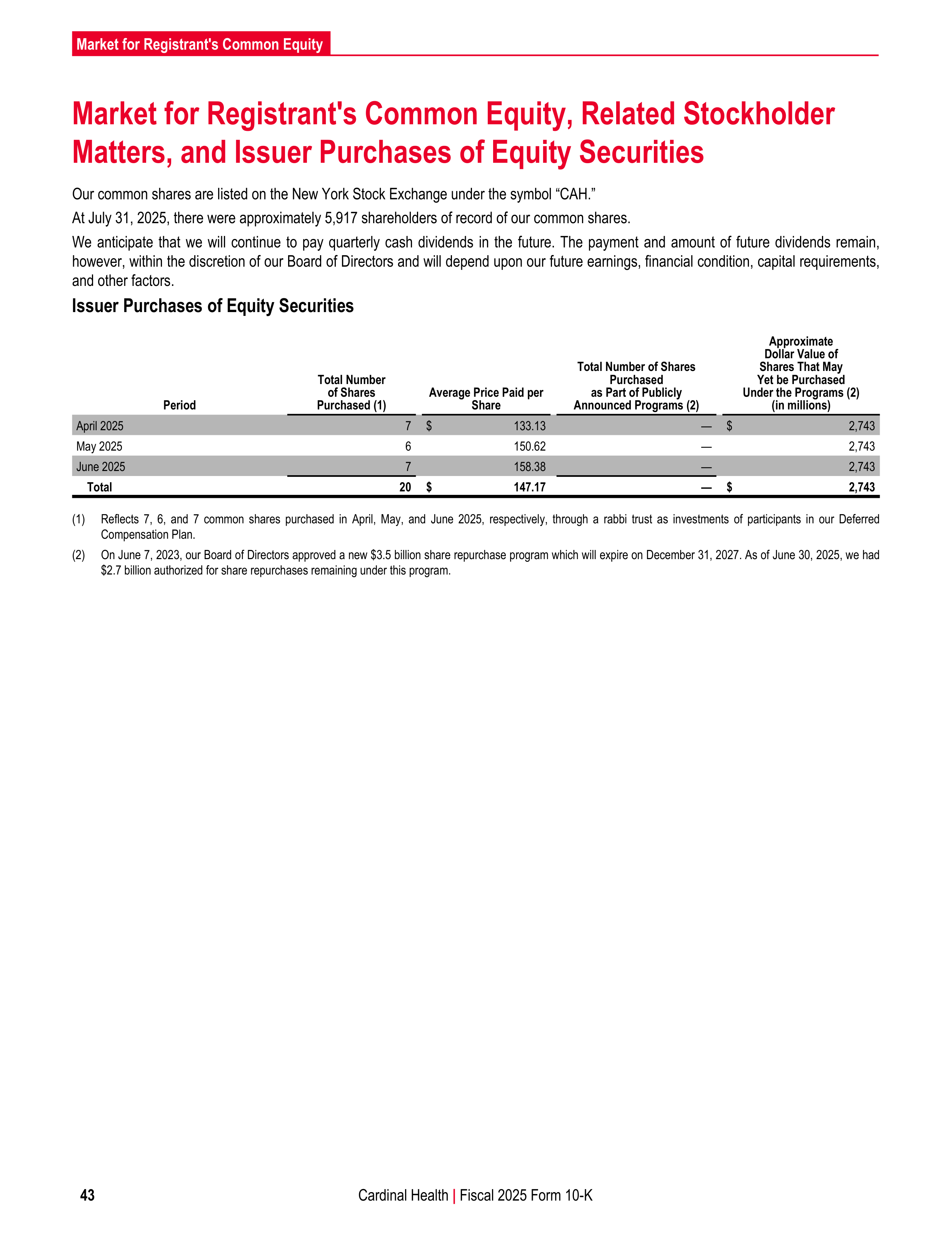
Market for Registrant's Common Equity, Related Stockholder
Matters, and Issuer Purchases of Equity Securities
Our common shares are listed on the New York Stock Exchange under the symbol “CAH.”
At July 31, 2025, there were approximately 5,917 shareholders of record of our common shares.
We anticipate that we will continue to pay quarterly cash dividends in the future. The payment and amount of future dividends remain,
however, within the discretion of our Board of Directors and will depend upon our future earnings, financial condition, capital requirements,
and other factors.
Issuer Purchases of Equity Securities
Period
Total Number
of Shares
Purchased (1)
Average Price Paid per
Share
Total Number of Shares
Purchased
as Part of Publicly
Announced Programs (2)
Approximate
Dollar Value of
Shares That May
Yet be Purchased
Under the Programs (2)
(in millions)
April 2025
7
$
133.13
—
$
2,743
May 2025
6
150.62
—
2,743
June 2025
7
158.38
—
2,743
Total
20
$
147.17
—
$
2,743
(1)
Reflects 7, 6, and 7 common shares purchased in April, May, and June 2025, respectively, through a rabbi trust as investments of participants in our Deferred
Compensation Plan.
(2)
On June 7, 2023, our Board of Directors approved a new $3.5 billion share repurchase program which will expire on December 31, 2027. As of June 30, 2025, we had
$2.7 billion authorized for share repurchases remaining under this program.
Market for Registrant's Common Equity
Cardinal Health
|
Fiscal 2025 Form 10-K
43
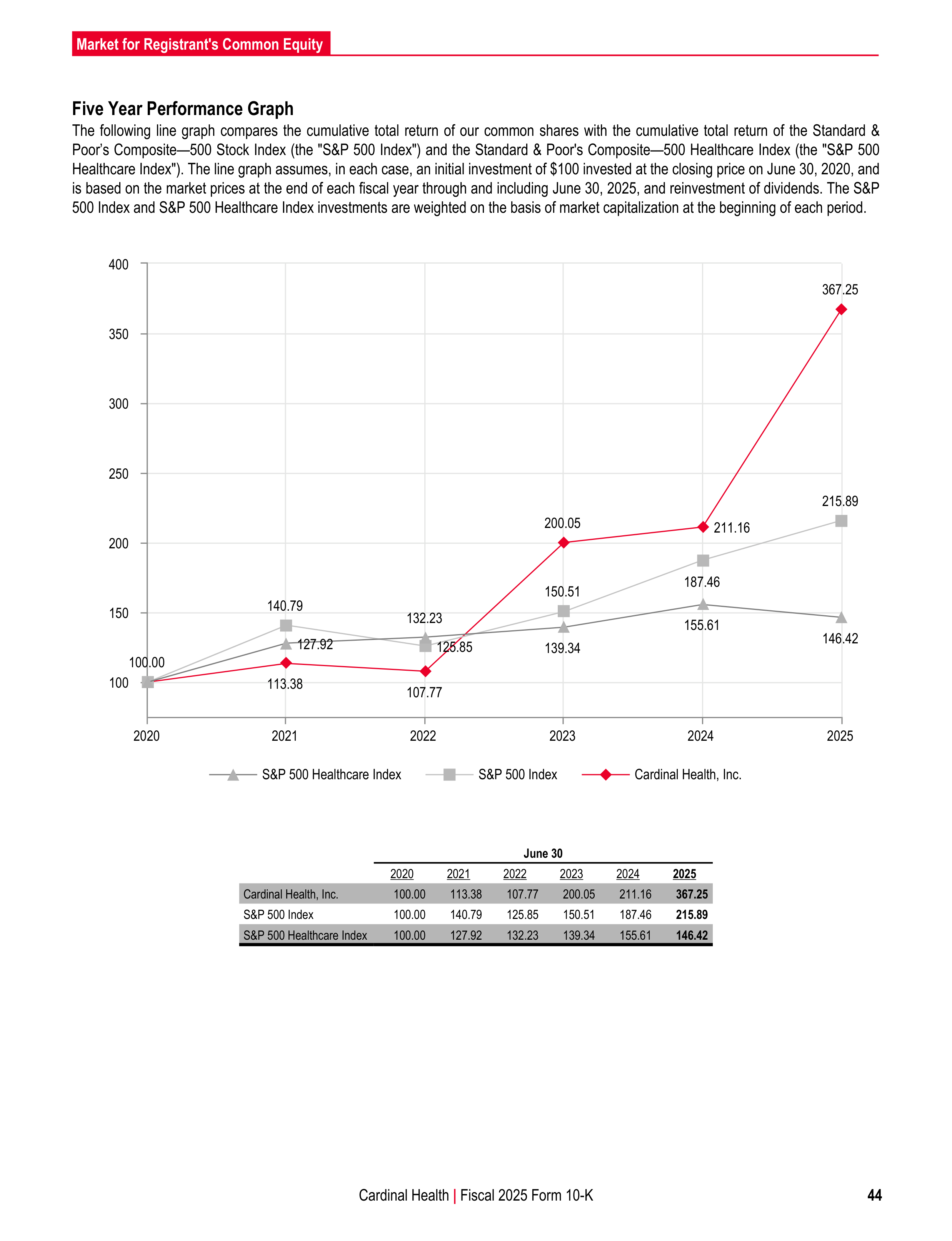
Five Year Performance Graph
The following line graph compares the cumulative total return of our common shares with the cumulative total return of the Standard &
Poor’s Composite—500 Stock Index (the "S&P 500 Index") and the Standard & Poor's Composite—500 Healthcare Index (the "S&P 500
Healthcare Index"). The line graph assumes, in each case, an initial investment of $100 invested at the closing price on June 30, 2020, and
is based on the market prices at the end of each fiscal year through and including June 30, 2025, and reinvestment of dividends. The S&P
500 Index and S&P 500 Healthcare Index investments are weighted on the basis of market capitalization at the beginning of each period.
113.38
107.77
200.05
211.16
367.25
100.00
140.79
125.85
150.51
187.46
215.89
127.92
132.23
139.34
155.61
146.42
S&P 500 Healthcare Index
S&P 500 Index
Cardinal Health, Inc.
2020
2021
2022
2023
2024
2025
100
150
200
250
300
350
400
June 30
2020
2021
2022
2023
2024
2025
Cardinal Health, Inc.
100.00
113.38
107.77
200.05
211.16
367.25
S&P 500 Index
100.00
140.79
125.85
150.51
187.46
215.89
S&P 500 Healthcare Index
100.00
127.92
132.23
139.34
155.61
146.42
Market for Registrant's Common Equity
44
Cardinal Health
|
Fiscal 2025 Form 10-K
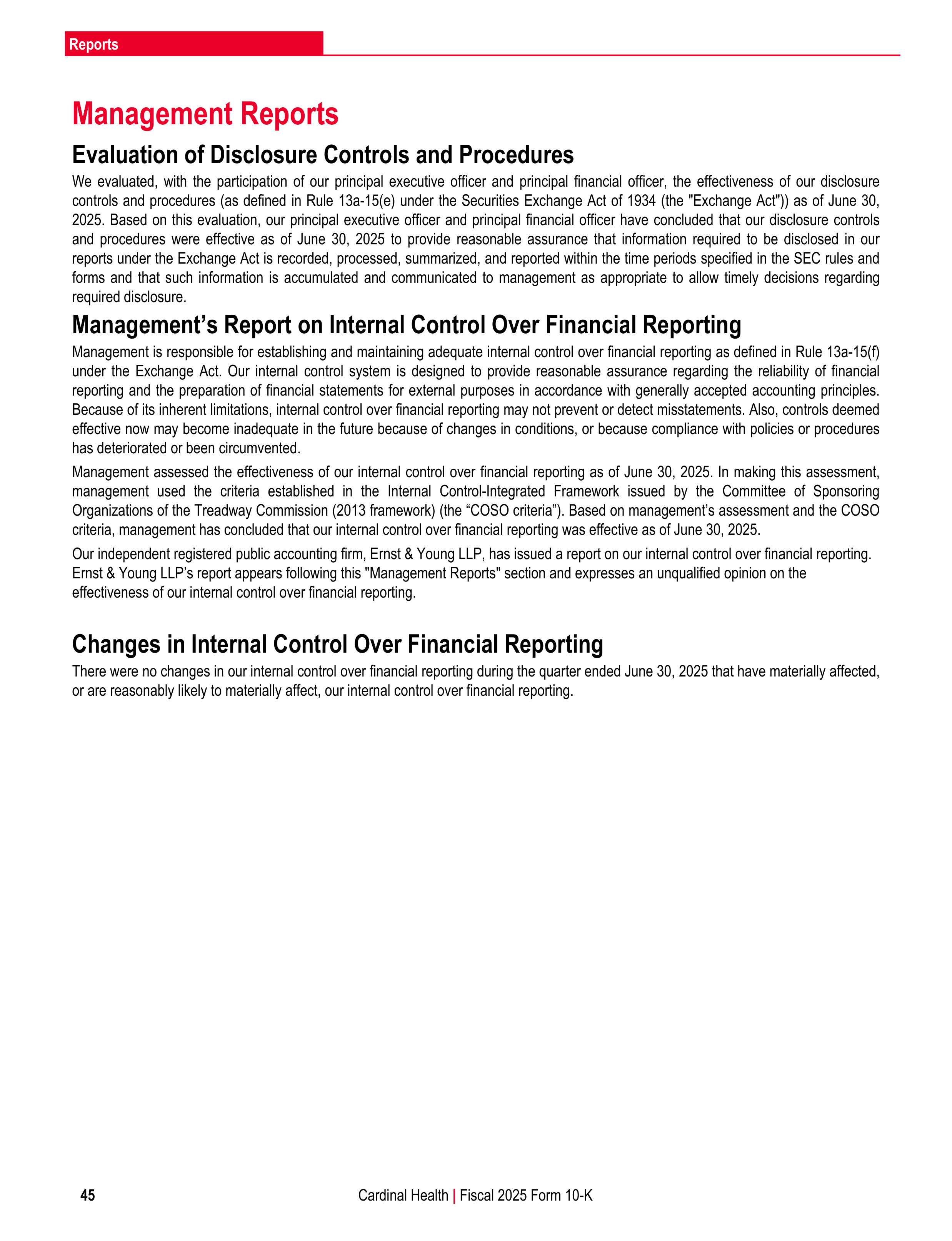
Management Reports
Evaluation of Disclosure Controls and Procedures
We evaluated, with the participation of our principal executive officer and principal financial officer, the effectiveness of our disclosure
controls and procedures (as defined in Rule 13a-15(e) under the Securities Exchange Act of 1934 (the "Exchange Act")) as of June 30,
2025. Based on this evaluation, our principal executive officer and principal financial officer have concluded that our disclosure controls
and procedures were effective as of June 30, 2025 to provide reasonable assurance that information required to be disclosed in our
reports under the Exchange Act is recorded, processed, summarized, and reported within the time periods specified in the SEC rules and
forms and that such information is accumulated and communicated to management as appropriate to allow timely decisions regarding
required disclosure.
Management’s Report on Internal Control Over Financial Reporting
Management is responsible for establishing and maintaining adequate internal control over financial reporting as defined in Rule 13a-15(f)
under the Exchange Act. Our internal control system is designed to provide reasonable assurance regarding the reliability of financial
reporting and the preparation of financial statements for external purposes in accordance with generally accepted accounting principles.
Because of its inherent limitations, internal control over financial reporting may not prevent or detect misstatements. Also, controls deemed
effective now may become inadequate in the future because of changes in conditions, or because compliance with policies or procedures
has deteriorated or been circumvented.
Management assessed the effectiveness of our internal control over financial reporting as of June 30, 2025. In making this assessment,
management used the criteria established in the Internal Control-Integrated Framework issued by the Committee of Sponsoring
Organizations of the Treadway Commission (2013 framework) (the “COSO criteria”). Based on management’s assessment and the COSO
criteria, management has concluded that our internal control over financial reporting was effective as of June 30, 2025.
Our independent registered public accounting firm, Ernst & Young LLP, has issued a report on our internal control over financial reporting.
Ernst & Young LLP’s report appears following this "Management Reports" section and expresses an unqualified opinion on the
effectiveness of our internal control over financial reporting.
Changes in Internal Control Over Financial Reporting
There were no changes in our internal control over financial reporting during the quarter ended June 30, 2025 that have materially affected,
or are reasonably likely to materially affect, our internal control over financial reporting.
Reports
Cardinal Health
|
Fiscal 2025 Form 10-K
45
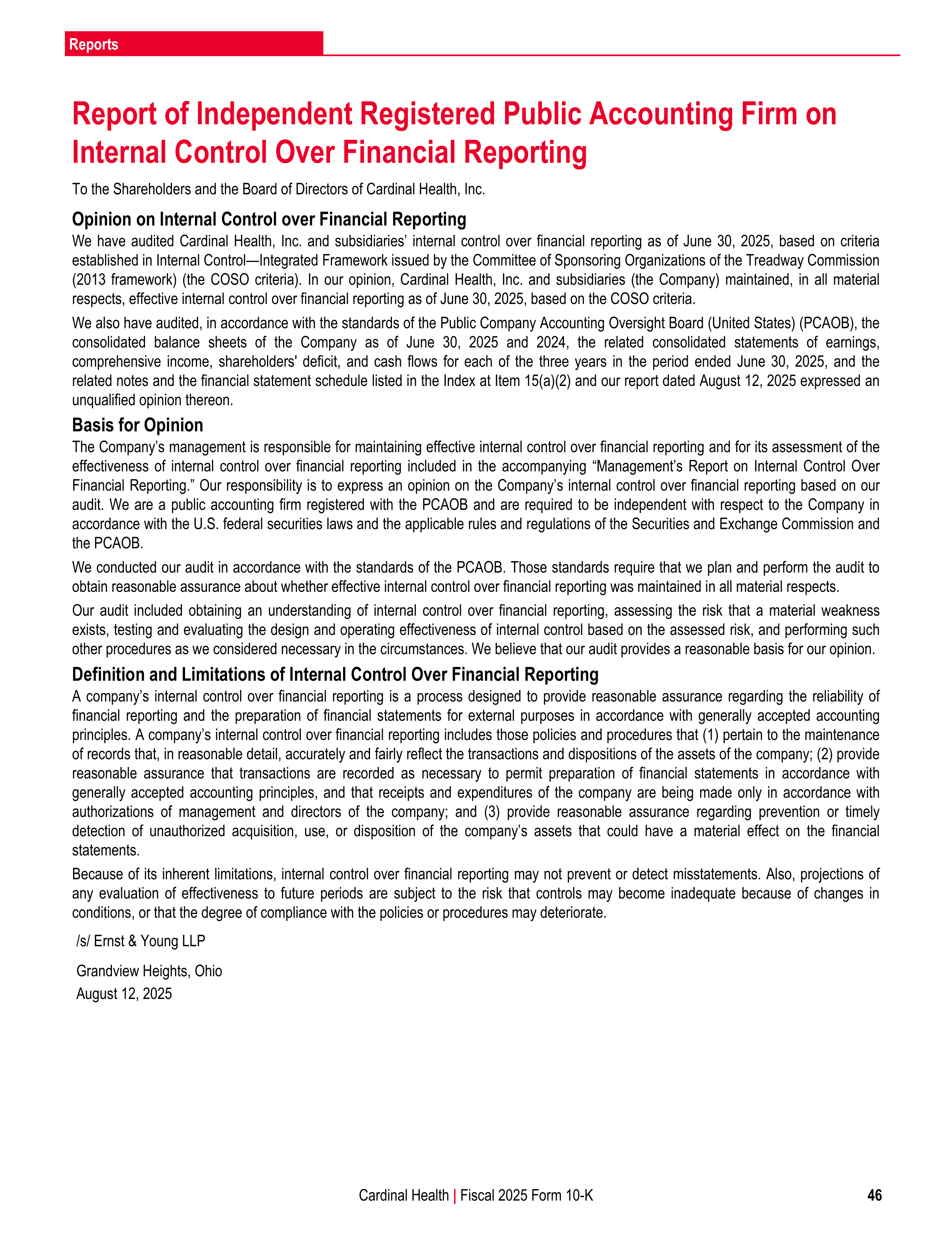
Report of Independent Registered Public Accounting Firm on
Internal Control Over Financial Reporting
To the Shareholders and the Board of Directors of Cardinal Health, Inc.
Opinion on Internal Control over Financial Reporting
We have audited Cardinal Health, Inc. and subsidiaries’ internal control over financial reporting as of June 30, 2025, based on criteria
established in Internal Control—Integrated Framework issued by the Committee of Sponsoring Organizations of the Treadway Commission
(2013 framework) (the COSO criteria). In our opinion, Cardinal Health, Inc. and subsidiaries (the Company) maintained, in all material
respects, effective internal control over financial reporting as of June 30, 2025, based on the COSO criteria.
We also have audited, in accordance with the standards of the Public Company Accounting Oversight Board (United States) (PCAOB), the
consolidated balance sheets of the Company as of June 30, 2025 and 2024, the related consolidated statements of earnings,
comprehensive income, shareholders' deficit, and cash flows for each of the three years in the period ended June 30, 2025, and the
related notes and the financial statement schedule listed in the Index at Item 15(a)(2) and our report dated August 12, 2025 expressed an
unqualified opinion thereon.
Basis for Opinion
The Company’s management is responsible for maintaining effective internal control over financial reporting and for its assessment of the
effectiveness of internal control over financial reporting included in the accompanying “Management’s Report on Internal Control Over
Financial Reporting.” Our responsibility is to express an opinion on the Company’s internal control over financial reporting based on our
audit. We are a public accounting firm registered with the PCAOB and are required to be independent with respect to the Company in
accordance with the U.S. federal securities laws and the applicable rules and regulations of the Securities and Exchange Commission and
the PCAOB.
We conducted our audit in accordance with the standards of the PCAOB. Those standards require that we plan and perform the audit to
obtain reasonable assurance about whether effective internal control over financial reporting was maintained in all material respects.
Our audit included obtaining an understanding of internal control over financial reporting, assessing the risk that a material weakness
exists, testing and evaluating the design and operating effectiveness of internal control based on the assessed risk, and performing such
other procedures as we considered necessary in the circumstances. We believe that our audit provides a reasonable basis for our opinion.
Definition and Limitations of Internal Control Over Financial Reporting
A company’s internal control over financial reporting is a process designed to provide reasonable assurance regarding the reliability of
financial reporting and the preparation of financial statements for external purposes in accordance with generally accepted accounting
principles. A company’s internal control over financial reporting includes those policies and procedures that (1) pertain to the maintenance
of records that, in reasonable detail, accurately and fairly reflect the transactions and dispositions of the assets of the company; (2) provide
reasonable assurance that transactions are recorded as necessary to permit preparation of financial statements in accordance with
generally accepted accounting principles, and that receipts and expenditures of the company are being made only in accordance with
authorizations of management and directors of the company; and (3) provide reasonable assurance regarding prevention or timely
detection of unauthorized acquisition, use, or disposition of the company’s assets that could have a material effect on the financial
statements.
Because of its inherent limitations, internal control over financial reporting may not prevent or detect misstatements. Also, projections of
any evaluation of effectiveness to future periods are subject to the risk that controls may become inadequate because of changes in
conditions, or that the degree of compliance with the policies or procedures may deteriorate.
/s/ Ernst & Young LLP
Grandview Heights, Ohio
August 12, 2025
Reports
46
Cardinal Health
|
Fiscal 2025 Form 10-K
Report of Independent Registered Public Accounting Firm
To the Shareholders and the Board of Directors of Cardinal Health, Inc.
Opinion on the Financial Statements
We have audited the accompanying consolidated balance sheets of Cardinal Health, Inc. and subsidiaries (the Company) as of June 30,
2025 and 2024, the related consolidated statements of earnings, comprehensive income, shareholders' deficit, and cash flows for each of
the three years in the period ended June 30, 2025, and the related notes and the financial statement schedule listed in the Index at Item
15(a)(2) (collectively referred to as the “consolidated financial statements”). In our opinion, the consolidated financial statements present
fairly, in all material respects, the financial position of the Company at June 30, 2025 and 2024, and the results of its operations and its
cash flows for each of the three years in the period ended June 30, 2025, in conformity with U.S. generally accepted accounting principles.
We also have audited, in accordance with the standards of the Public Company Accounting Oversight Board (United States) (PCAOB), the
Company's internal control over financial reporting as of June 30, 2025, based on criteria established in Internal Control-Integrated
Framework issued by the Committee of Sponsoring Organizations of the Treadway Commission (2013 framework) and August 12, 2025
expressed an unqualified opinion thereon.
Basis for Opinion
These financial statements are the responsibility of the Company's management. Our responsibility is to express an opinion on the
Company’s financial statements based on our audits. We are a public accounting firm registered with the PCAOB and are required to be
independent with respect to the Company in accordance with the U.S. federal securities laws and the applicable rules and regulations of
the Securities and Exchange Commission and the PCAOB.
We conducted our audits in accordance with the standards of the PCAOB. Those standards require that we plan and perform the audit to
obtain reasonable assurance about whether the financial statements are free of material misstatement, whether due to error or fraud. Our
audits included performing procedures to assess the risks of material misstatement of the financial statements, whether due to error or
fraud, and performing procedures that respond to those risks. Such procedures included examining, on a test basis, evidence regarding
the amounts and disclosures in the financial statements. Our audits also included evaluating the accounting principles used and significant
estimates made by management, as well as evaluating the overall presentation of the financial statements. We believe that our audits
provide a reasonable basis for our opinion.
Critical Audit Matter
The critical audit matter communicated below is a matter arising from the current period audit of the financial statements that was
communicated or required to be communicated to the audit committee and that: (1) relates to accounts or disclosures that are material to
the financial statements and (2) involved our especially challenging, subjective, or complex judgments. The communication of the critical
audit matter does not alter in any way our opinion on the consolidated financial statements, taken as a whole, and we are not, by
communicating the critical audit matter below, providing a separate opinion on the critical audit matter or on the account or disclosures to
which they relate.
Reports
Cardinal Health
|
Fiscal 2025 Form 10-K
47
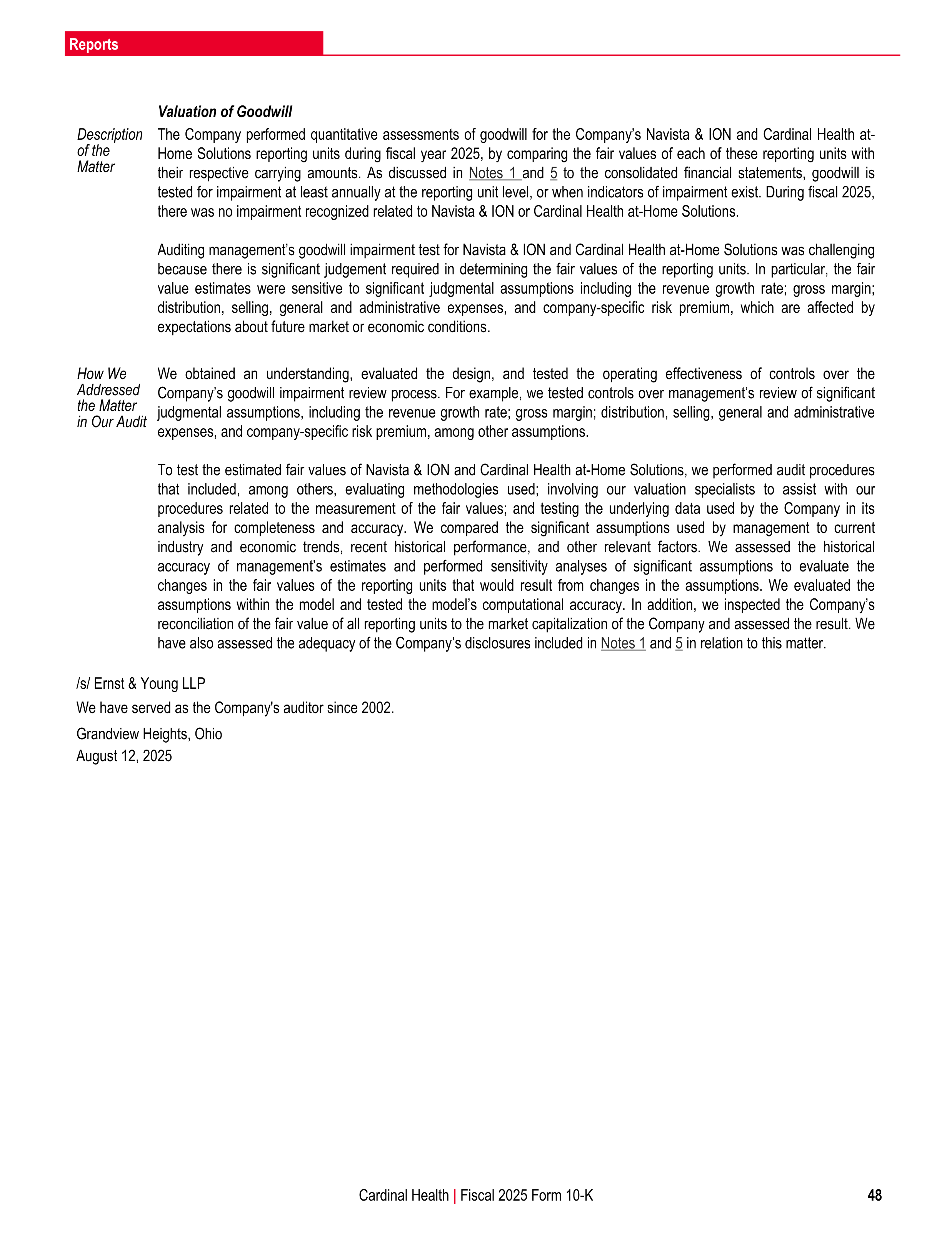
Valuation of Goodwill
Description
of the
Matter
The Company performed quantitative assessments of goodwill for the Company’s Navista & ION and Cardinal Health at-
Home Solutions reporting units during fiscal year 2025, by comparing the fair values of each of these reporting units with
their respective carrying amounts. As discussed in
Notes 1
and
5
to the consolidated financial statements, goodwill is
tested for impairment at least annually at the reporting unit level, or when indicators of impairment exist. During fiscal 2025,
there was no impairment recognized related to Navista & ION or Cardinal Health at-Home Solutions.
Auditing management’s goodwill impairment test for Navista & ION and Cardinal Health at-Home Solutions was challenging
because there is significant judgement required in determining the fair values of the reporting units. In particular, the fair
value estimates were sensitive to significant judgmental assumptions including the revenue growth rate; gross margin;
distribution, selling, general and administrative expenses, and company-specific risk premium, which are affected by
expectations about future market or economic conditions.
How We
Addressed
the Matter
in Our Audit
We obtained an understanding, evaluated the design, and tested the operating effectiveness of controls over the
Company’s goodwill impairment review process. For example, we tested controls over management’s review of significant
judgmental assumptions, including the revenue growth rate; gross margin; distribution, selling, general and administrative
expenses, and company-specific risk premium, among other assumptions.
To test the estimated fair values of Navista & ION and Cardinal Health at-Home Solutions, we performed audit procedures
that included, among others, evaluating methodologies used; involving our valuation specialists to assist with our
procedures related to the measurement of the fair values; and testing the underlying data used by the Company in its
analysis for completeness and accuracy. We compared the significant assumptions used by management to current
industry and economic trends, recent historical performance, and other relevant factors. We assessed the historical
accuracy of management’s estimates and performed sensitivity analyses of significant assumptions to evaluate the
changes in the fair values of the reporting units that would result from changes in the assumptions. We evaluated the
assumptions within the model and tested the model’s computational accuracy. In addition, we inspected the Company’s
reconciliation of the fair value of all reporting units to the market capitalization of the Company and assessed the result. We
have also assessed the adequacy of the Company’s disclosures included in
Notes 1
and
5
in relation to this matter.
/s/ Ernst & Young LLP
We have served as the Company's auditor since 2002.
Grandview Heights, Ohio
August 12, 2025
Reports
48
Cardinal Health
|
Fiscal 2025 Form 10-K
Financial Statements and Supplementary Data
Page
Consolidated Financial Statements and Schedule:
Consolidated Statements of Earnings for the Fiscal Years Ended June 30, 2025, 2024, and 2023
50
Consolidated Statements of Comprehensive Income for the Fiscal Years Ended June 30, 2025, 2024, and 2023
51
Consolidated Balance Sheets at June 30, 2025 and 2024
52
Consolidated Statements of Shareholders’ Deficit for the Fiscal Years Ended June 30, 2025, 2024, and 2023
53
Consolidated Statements of Cash Flows for the Fiscal Years Ended June 30, 2025, 2024, and 2023
54
Notes to Consolidated Financial Statements
55
Financial Statements
Cardinal Health
|
Fiscal 2025 Form 10-K
49
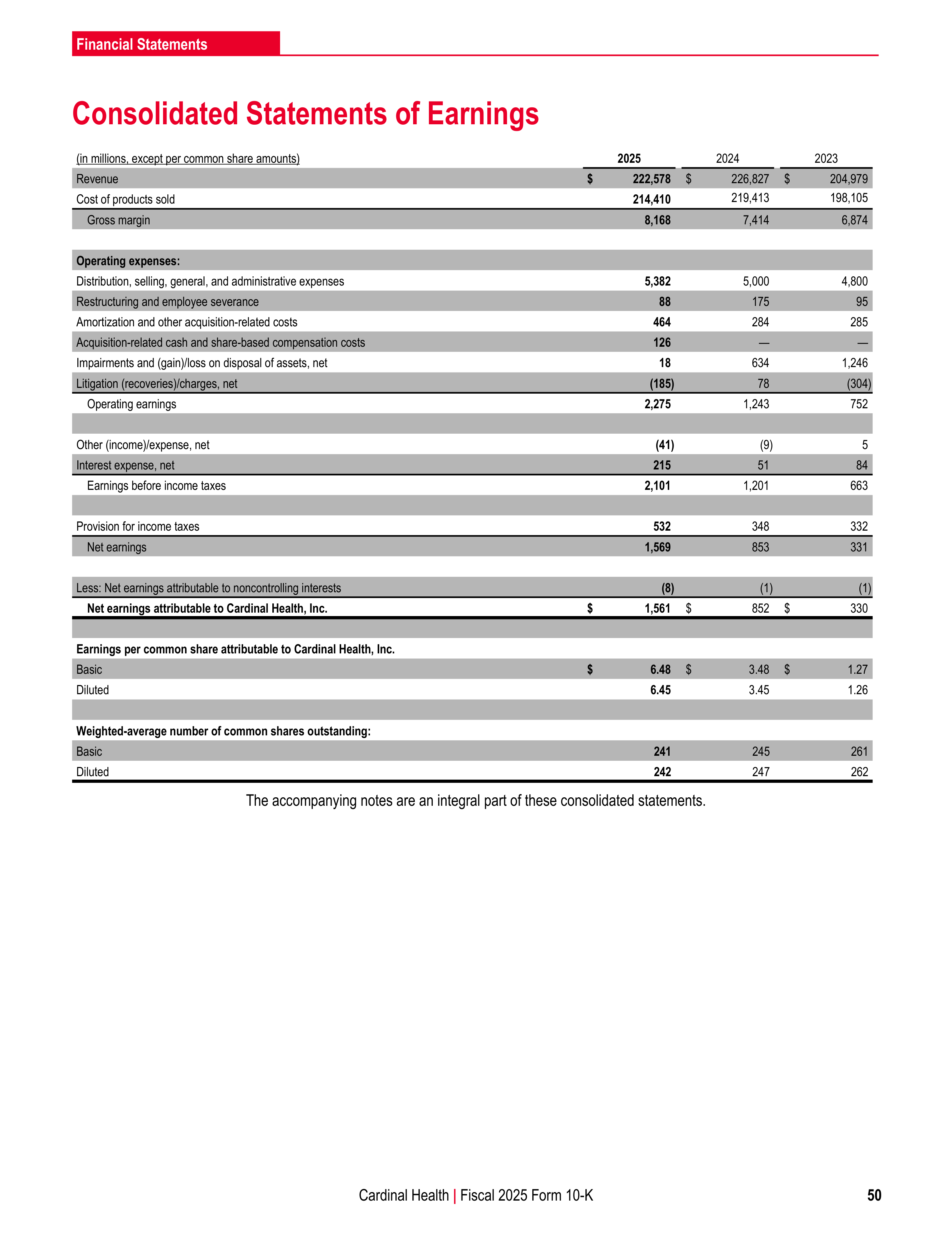
Consolidated Statements of Earnings
(in millions, except per common share amounts)
2025
2024
2023
Revenue
$
222,578
$
226,827
$
204,979
Cost of products sold
214,410
219,413
198,105
Gross margin
8,168
7,414
6,874
Operating expenses:
Distribution, selling, general, and administrative expenses
5,382
5,000
4,800
Restructuring and employee severance
88
175
95
Amortization and other acquisition-related costs
464
284
285
Acquisition-related cash and share-based compensation costs
126
—
—
Impairments and (gain)/loss on disposal of assets, net
18
634
1,246
Litigation (recoveries)/charges, net
(185)
78
(304)
Operating earnings
2,275
1,243
752
Other (income)/expense, net
(41)
(9)
5
Interest expense, net
215
51
84
Earnings before income taxes
2,101
1,201
663
Provision for income taxes
532
348
332
Net earnings
1,569
853
331
Less: Net earnings attributable to noncontrolling interests
(8)
(1)
(1)
Net earnings attributable to Cardinal Health, Inc.
$
1,561
$
852
$
330
Earnings per common share attributable to Cardinal Health, Inc.
Basic
$
6.48
$
3.48
$
1.27
Diluted
6.45
3.45
1.26
Weighted-average number of common shares outstanding:
Basic
241
245
261
Diluted
242
247
262
The accompanying notes are an integral part of these consolidated statements.
Financial Statements
50
Cardinal Health
|
Fiscal 2025 Form 10-K
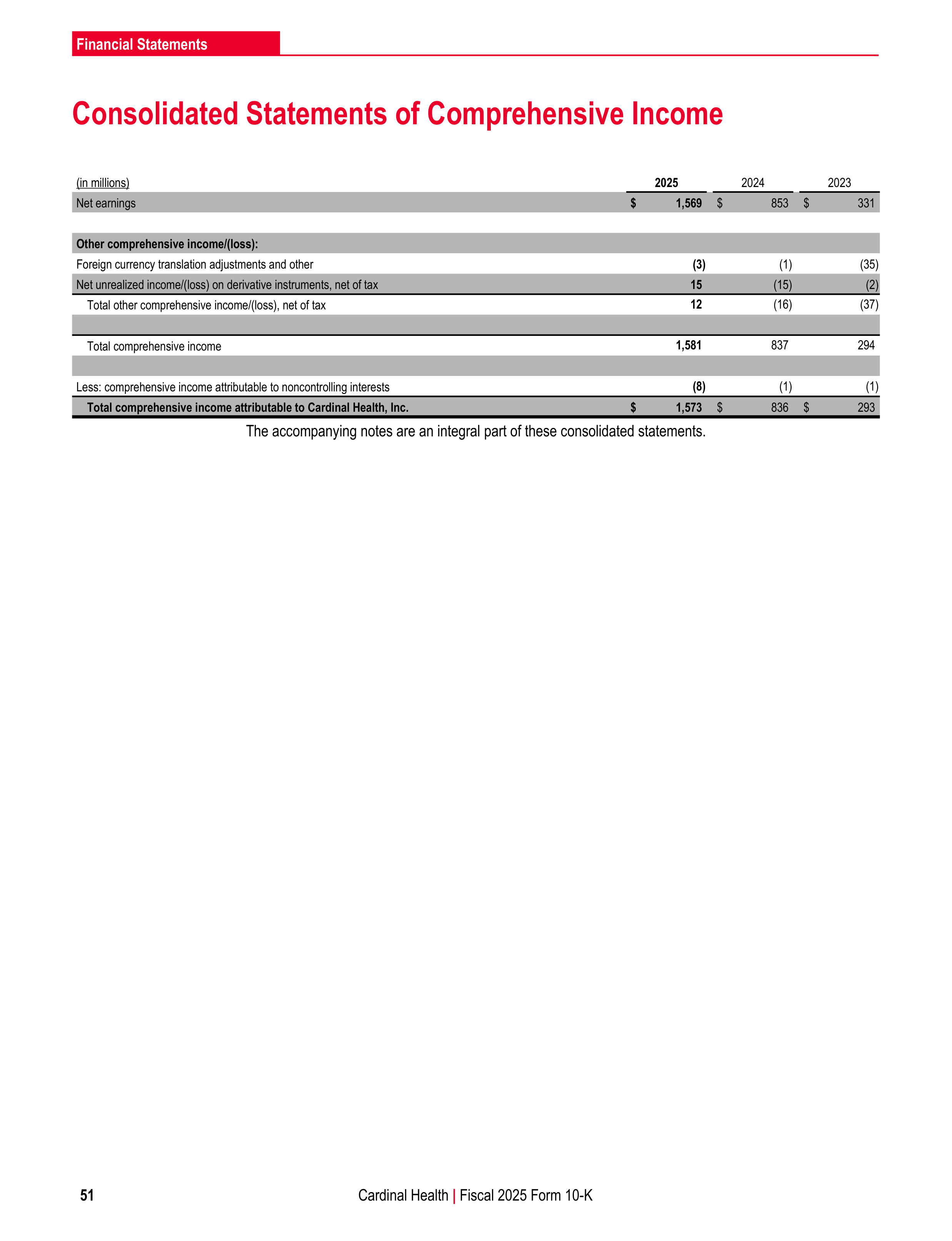
Consolidated Statements of Comprehensive Income
(in millions)
2025
2024
2023
Net earnings
$
1,569
$
853
$
331
Other comprehensive income/(loss):
Foreign currency translation adjustments and other
(3)
(1)
(35)
Net unrealized income/(loss) on derivative instruments, net of tax
15
(15)
(2)
Total other comprehensive income/(loss), net of tax
12
(16)
(37)
Total comprehensive income
1,581
837
294
Less: comprehensive income attributable to noncontrolling interests
(8)
(1)
(1)
Total comprehensive income attributable to Cardinal Health, Inc.
$
1,573
$
836
$
293
The accompanying notes are an integral part of these consolidated statements.
Financial Statements
Cardinal Health
|
Fiscal 2025 Form 10-K
51
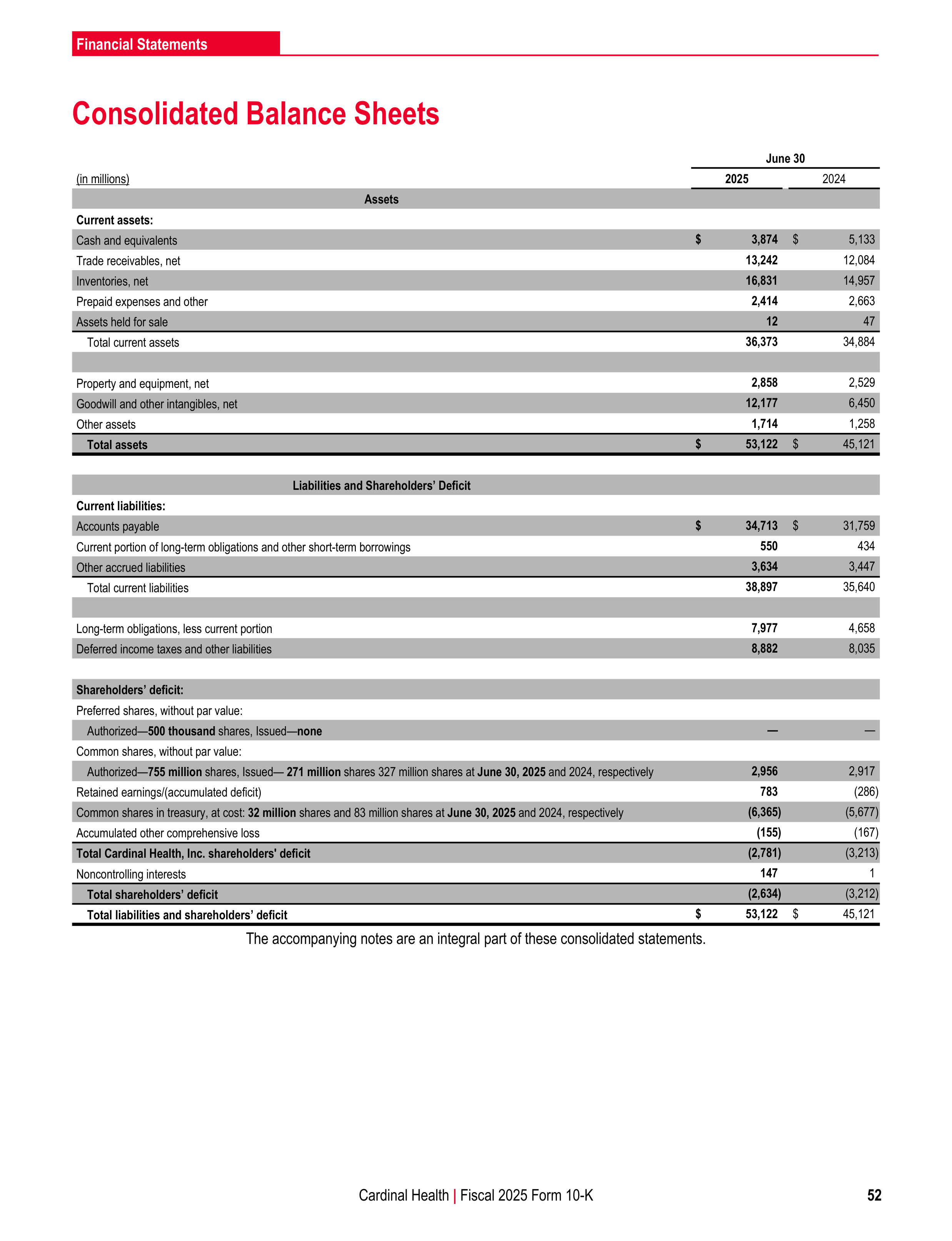
Consolidated Balance Sheets
June 30
(in millions)
2025
2024
Assets
Current assets:
Cash and equivalents
$
3,874
$
5,133
Trade receivables, net
13,242
12,084
Inventories, net
16,831
14,957
Prepaid expenses and other
2,414
2,663
Assets held for sale
12
47
Total current assets
36,373
34,884
Property and equipment, net
2,858
2,529
Goodwill and other intangibles, net
12,177
6,450
Other assets
1,714
1,258
Total assets
$
53,122
$
45,121
Liabilities and Shareholders’ Deficit
Current liabilities:
Accounts payable
$
34,713
$
31,759
Current portion of long-term obligations and other short-term borrowings
550
434
Other accrued liabilities
3,634
3,447
Total current liabilities
38,897
35,640
Long-term obligations, less current portion
7,977
4,658
Deferred income taxes and other liabilities
8,882
8,035
Shareholders’ deficit:
Preferred shares, without par value:
Authorized—
500 thousand
shares, Issued—
none
—
—
Common shares, without par value:
Authorized—
755 million
shares, Issued—
271 million
shares 327 million shares at
June 30, 2025
and 2024, respectively
2,956
2,917
Retained earnings/(accumulated deficit)
783
(286)
Common shares in treasury, at cost:
32 million
shares and 83 million shares at
June 30, 2025
and 2024, respectively
(6,365)
(5,677)
Accumulated other comprehensive loss
(155)
(167)
Total Cardinal Health, Inc. shareholders' deficit
(2,781)
(3,213)
Noncontrolling interests
147
1
Total shareholders’ deficit
(2,634)
(3,212)
Total liabilities and shareholders’ deficit
$
53,122
$
45,121
The accompanying notes are an integral part of these consolidated statements.
Financial Statements
52
Cardinal Health
|
Fiscal 2025 Form 10-K
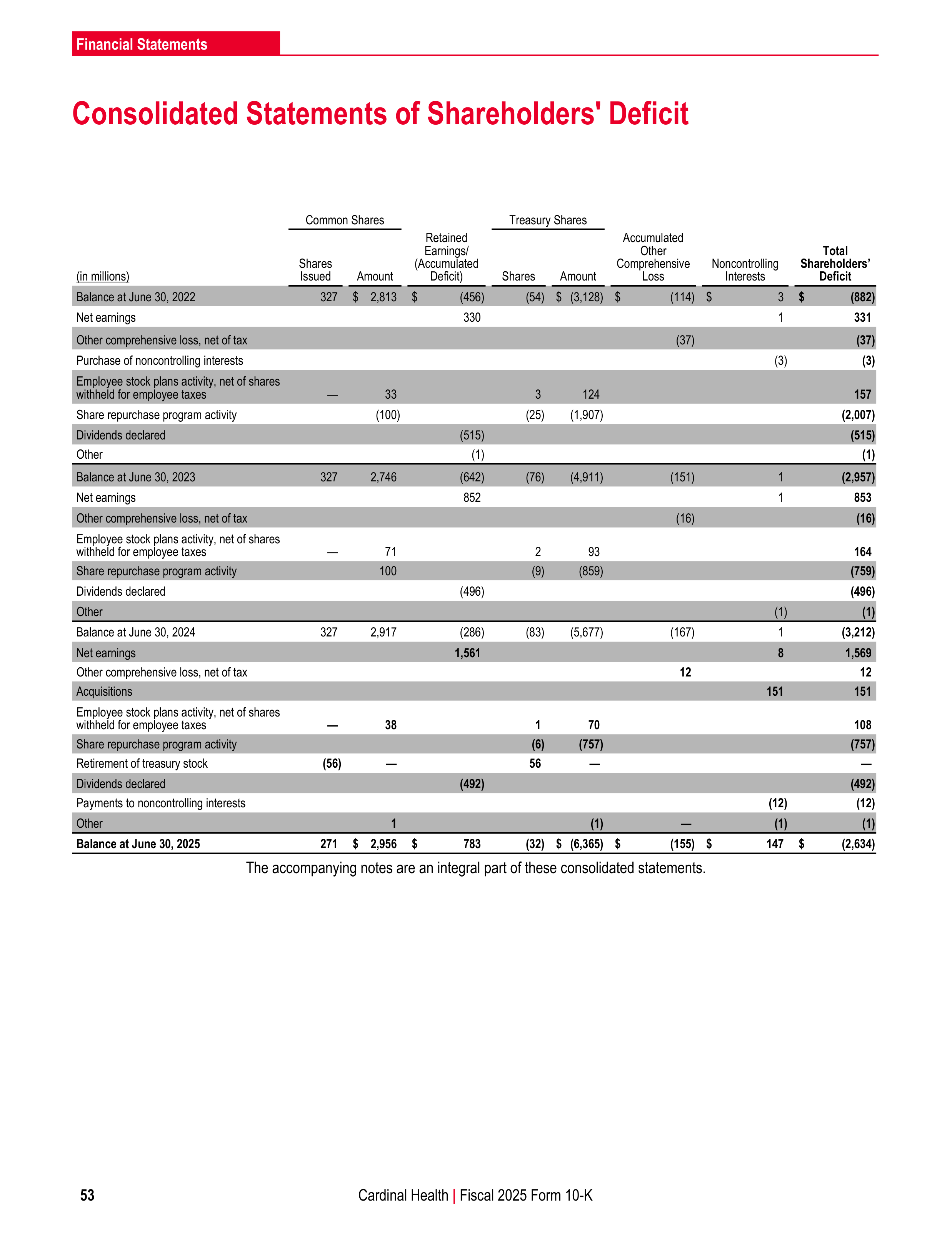
Consolidated Statements of Shareholders' Deficit
Common Shares
Treasury Shares
Accumulated
Other
Comprehensive
Loss
Noncontrolling
Interests
Total
Shareholders’
Deficit
(in millions)
Shares
Issued
Amount
Retained
Earnings/
(Accumulated
Deficit)
Shares
Amount
Balance at June 30, 2022
327
$ 2,813
$
(456)
(54) $ (3,128) $
(114) $
3
$
(882)
Net earnings
330
1
331
Other comprehensive loss, net of tax
(37)
(37)
Purchase of noncontrolling interests
(3)
(3)
Employee stock plans activity, net of shares
withheld for employee taxes
—
33
3
124
157
Share repurchase program activity
(100)
(25)
(1,907)
(2,007)
Dividends declared
(515)
(515)
Other
(1)
(1)
Balance at June 30, 2023
327
2,746
(642)
(76)
(4,911)
(151)
1
(2,957)
Net earnings
852
1
853
Other comprehensive loss, net of tax
(16)
(16)
Employee stock plans activity, net of shares
withheld for employee taxes
—
71
2
93
164
Share repurchase program activity
100
(9)
(859)
(759)
Dividends declared
(496)
(496)
Other
(1)
(1)
Balance at June 30, 2024
327
2,917
(286)
(83)
(5,677)
(167)
1
(3,212)
Net earnings
1,561
8
1,569
Other comprehensive loss, net of tax
12
12
Acquisitions
151
151
Employee stock plans activity, net of shares
withheld for employee taxes
—
38
1
70
108
Share repurchase program activity
(6)
(757)
(757)
Retirement of treasury stock
(56)
—
56
—
—
Dividends declared
(492)
(492)
Payments to noncontrolling interests
(12)
(12)
Other
1
(1)
—
(1)
(1)
Balance at June 30, 2025
271
$ 2,956
$
783
(32) $ (6,365) $
(155) $
147
$
(2,634)
The accompanying notes are an integral part of these consolidated statements.
Financial Statements
Cardinal Health
|
Fiscal 2025 Form 10-K
53
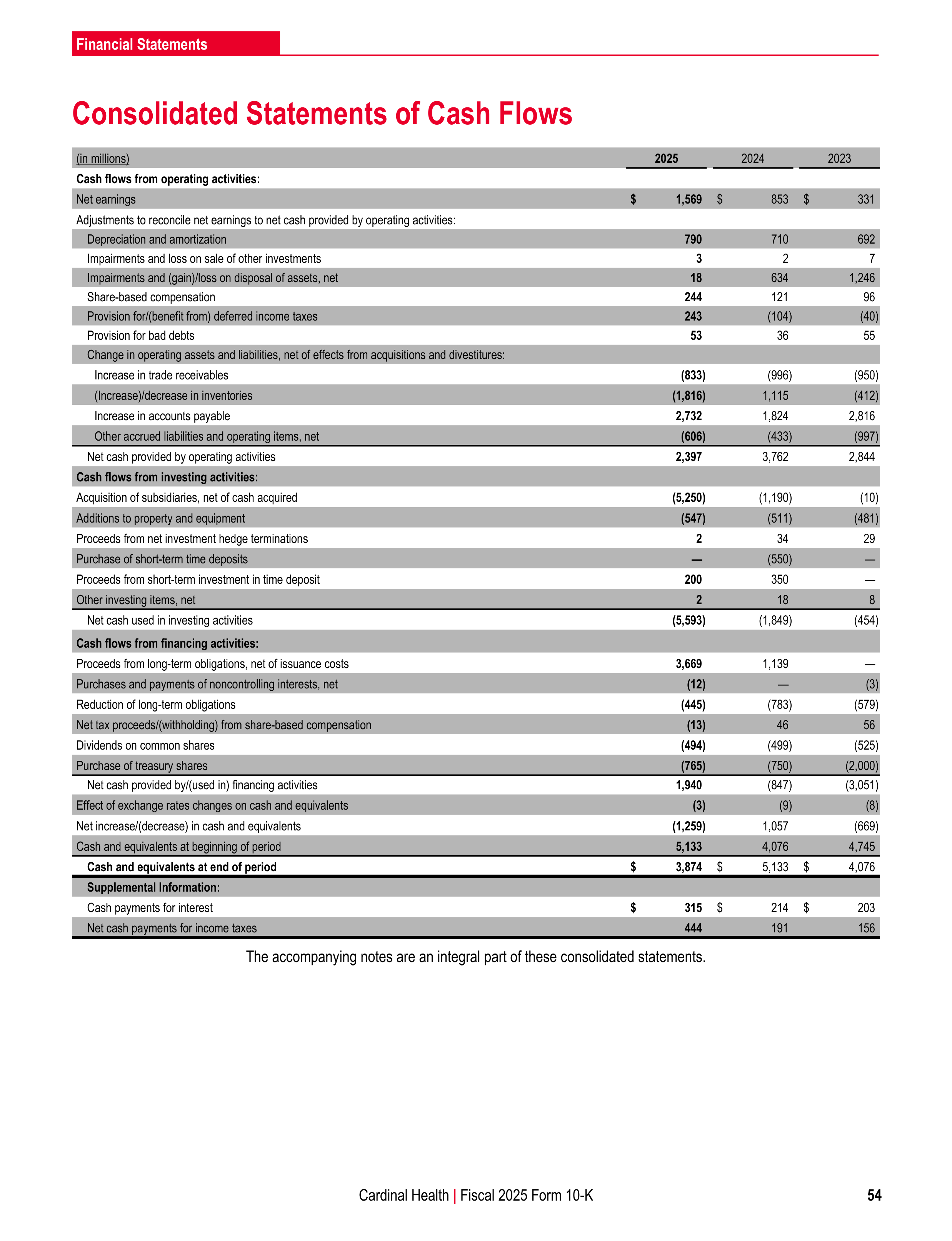
Consolidated Statements of Cash Flows
(in millions)
2025
2024
2023
Cash flows from operating activities:
Net earnings
$
1,569
$
853
$
331
Adjustments to reconcile net earnings to net cash provided by operating activities:
Depreciation and amortization
790
710
692
Impairments and loss on sale of other investments
3
2
7
Impairments and (gain)/loss on disposal of assets, net
18
634
1,246
Share-based compensation
244
121
96
Provision for/(benefit from) deferred income taxes
243
(104)
(40)
Provision for bad debts
53
36
55
Change in operating assets and liabilities, net of effects from acquisitions and divestitures:
Increase in trade receivables
(833)
(996)
(950)
(Increase)/decrease in inventories
(1,816)
1,115
(412)
Increase in accounts payable
2,732
1,824
2,816
Other accrued liabilities and operating items, net
(606)
(433)
(997)
Net cash provided by operating activities
2,397
3,762
2,844
Cash flows from investing activities:
Acquisition of subsidiaries, net of cash acquired
(5,250)
(1,190)
(10)
Additions to property and equipment
(547)
(511)
(481)
Proceeds from net investment hedge terminations
2
34
29
Purchase of short-term time deposits
—
(550)
—
Proceeds from short-term investment in time deposit
200
350
—
Other investing items, net
2
18
8
Net cash used in investing activities
(5,593)
(1,849)
(454)
Cash flows from financing activities:
Proceeds from long-term obligations, net of issuance costs
3,669
1,139
—
Purchases and payments of noncontrolling interests, net
(12)
—
(3)
Reduction of long-term obligations
(445)
(783)
(579)
Net tax proceeds/(withholding) from share-based compensation
(13)
46
56
Dividends on common shares
(494)
(499)
(525)
Purchase of treasury shares
(765)
(750)
(2,000)
Net cash provided by/(used in) financing activities
1,940
(847)
(3,051)
Effect of exchange rates changes on cash and equivalents
(3)
(9)
(8)
Net increase/(decrease) in cash and equivalents
(1,259)
1,057
(669)
Cash and equivalents at beginning of period
5,133
4,076
4,745
Cash and equivalents at end of period
$
3,874
$
5,133
$
4,076
Supplemental Information:
Cash payments for interest
$
315
$
214
$
203
Net cash payments for income taxes
444
191
156
The accompanying notes are an integral part of these consolidated statements.
Financial Statements
54
Cardinal Health
|
Fiscal 2025 Form 10-K
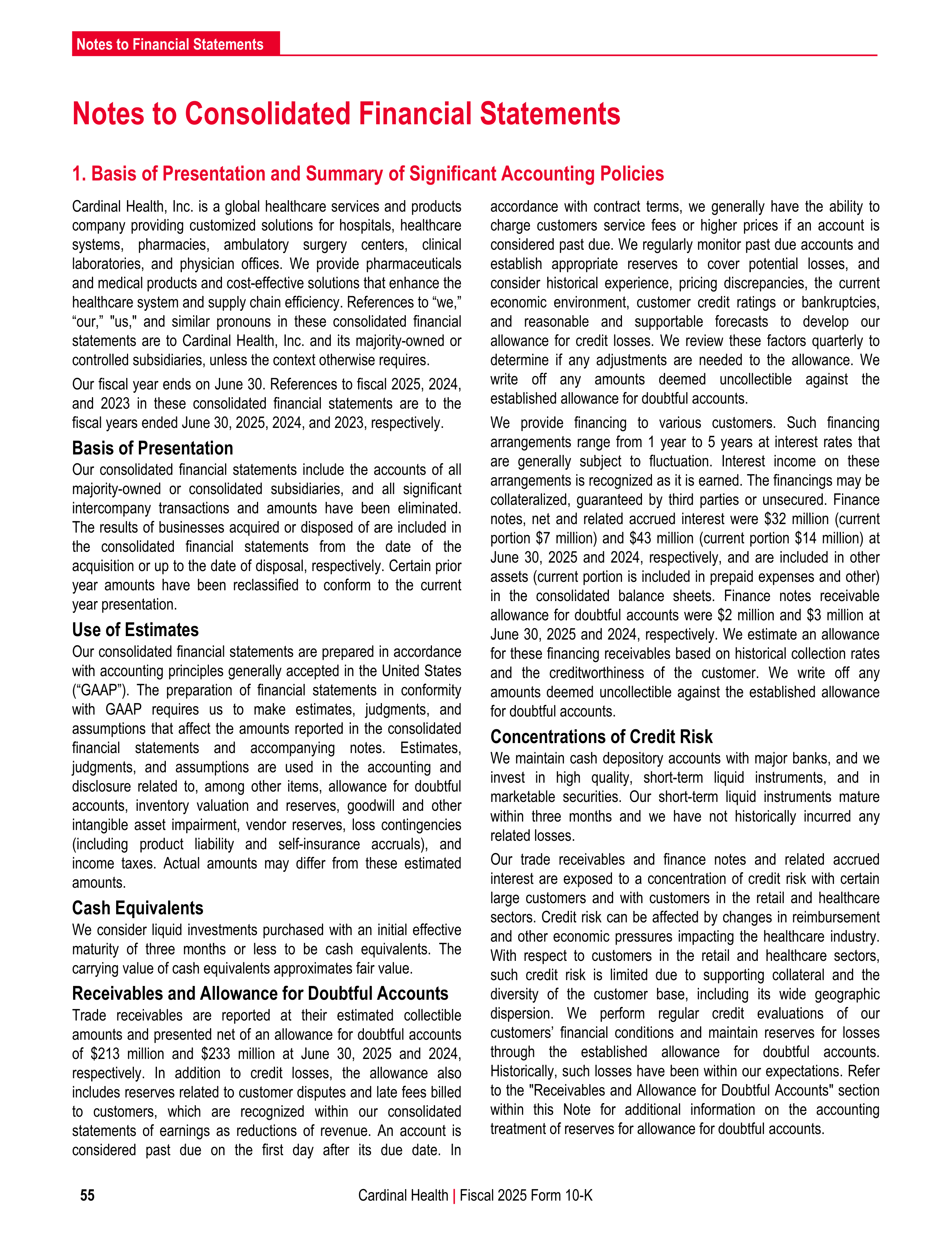
Notes to Consolidated Financial Statements
1. Basis of Presentation and Summary of Significant Accounting Policies
Cardinal Health, Inc. is a global healthcare services and products
company providing customized solutions for hospitals, healthcare
systems, pharmacies, ambulatory surgery centers, clinical
laboratories, and physician offices. We provide pharmaceuticals
and medical products and cost-effective solutions that enhance the
healthcare system and supply chain efficiency. References to “we,”
“our,” "us," and similar pronouns in these consolidated financial
statements are to Cardinal Health, Inc. and its majority-owned or
controlled subsidiaries, unless the context otherwise requires.
Our fiscal year ends on June 30. References to fiscal 2025, 2024,
and 2023 in these consolidated financial statements are to the
fiscal years ended June 30, 2025, 2024, and 2023, respectively.
Basis of Presentation
Our consolidated financial statements include the accounts of all
majority-owned or consolidated subsidiaries, and all significant
intercompany transactions and amounts have been eliminated.
The results of businesses acquired or disposed of are included in
the consolidated financial statements from the date of the
acquisition or up to the date of disposal, respectively. Certain prior
year amounts have been reclassified to conform to the current
year presentation.
Use of Estimates
Our consolidated financial statements are prepared in accordance
with accounting principles generally accepted in the United States
(“GAAP”). The preparation of financial statements in conformity
with GAAP requires us to make estimates, judgments, and
assumptions that affect the amounts reported in the consolidated
financial statements and accompanying notes. Estimates,
judgments, and assumptions are used in the accounting and
disclosure related to, among other items, allowance for doubtful
accounts, inventory valuation and reserves, goodwill and other
intangible asset impairment, vendor reserves, loss contingencies
(including product liability and self-insurance accruals), and
income taxes. Actual amounts may differ from these estimated
amounts.
Cash Equivalents
We consider liquid investments purchased with an initial effective
maturity of three months or less to be cash equivalents. The
carrying value of cash equivalents approximates fair value.
Receivables and Allowance for Doubtful Accounts
Trade receivables are reported at their estimated collectible
amounts and presented net of an allowance for doubtful accounts
of $213 million and $233 million at June 30, 2025 and 2024,
respectively. In addition to credit losses, the allowance also
includes reserves related to customer disputes and late fees billed
to customers, which are recognized within our consolidated
statements of earnings as reductions of revenue. An account is
considered past due on the first day after its due date. In
accordance with contract terms, we generally have the ability to
charge customers service fees or higher prices if an account is
considered past due. We regularly monitor past due accounts and
establish appropriate reserves to cover potential losses, and
consider historical experience, pricing discrepancies, the current
economic environment, customer credit ratings or bankruptcies,
and reasonable and supportable forecasts to develop our
allowance for credit losses. We review these factors quarterly to
determine if any adjustments are needed to the allowance. We
write off any amounts deemed uncollectible against the
established allowance for doubtful accounts.
We provide financing to various customers. Such financing
arrangements range from 1 year to 5 years at interest rates that
are generally subject to fluctuation. Interest income on these
arrangements is recognized as it is earned. The financings may be
collateralized, guaranteed by third parties or unsecured. Finance
notes, net and related accrued interest were $32 million (current
portion $7 million) and $43 million (current portion $14 million) at
June 30, 2025 and 2024, respectively, and are included in other
assets (current portion is included in prepaid expenses and other)
in the consolidated balance sheets. Finance notes receivable
allowance for doubtful accounts were $2 million and $3 million at
June 30, 2025 and 2024, respectively. We estimate an allowance
for these financing receivables based on historical collection rates
and the creditworthiness of the customer. We write off any
amounts deemed uncollectible against the established allowance
for doubtful accounts.
Concentrations of Credit Risk
We maintain cash depository accounts with major banks, and we
invest in high quality, short-term liquid instruments, and in
marketable securities. Our short-term liquid instruments mature
within three months and we have not historically incurred any
related losses.
Our trade receivables and finance notes and related accrued
interest are exposed to a concentration of credit risk with certain
large customers and with customers in the retail and healthcare
sectors. Credit risk can be affected by changes in reimbursement
and other economic pressures impacting the healthcare industry.
With respect to customers in the retail and healthcare sectors,
such credit risk is limited due to supporting collateral and the
diversity of the customer base, including its wide geographic
dispersion. We perform regular credit evaluations of our
customers’ financial conditions and maintain reserves for losses
through the established allowance for doubtful accounts.
Historically, such losses have been within our expectations. Refer
to the "Receivables and Allowance for Doubtful Accounts" section
within this Note for additional information on the accounting
treatment of reserves for allowance for doubtful accounts.
Notes to Financial Statements
Cardinal Health
|
Fiscal 2025 Form 10-K
55
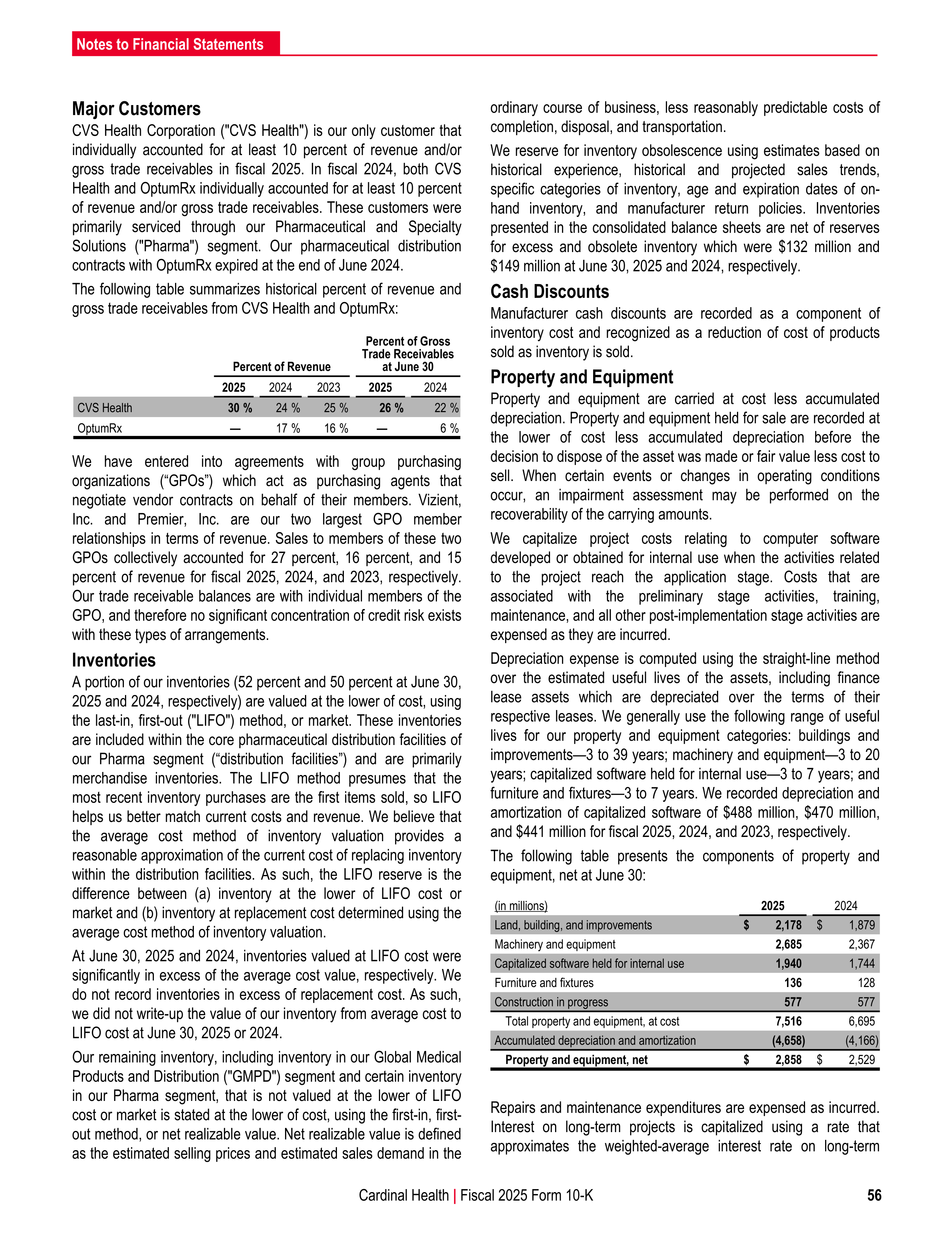
Major Customers
CVS Health Corporation ("CVS Health") is our only customer that
individually accounted for at least 10 percent of revenue and/or
gross trade receivables in fiscal 2025. In fiscal 2024, both CVS
Health and OptumRx individually accounted for at least 10 percent
of revenue and/or gross trade receivables. These customers were
primarily serviced through our Pharmaceutical and Specialty
Solutions ("Pharma") segment. Our pharmaceutical distribution
contracts with OptumRx expired at the end of June 2024.
The following table summarizes historical percent of revenue and
gross trade receivables from CVS Health and OptumRx:
Percent of Revenue
Percent of Gross
Trade Receivables
at June 30
2025
2024
2023
2025
2024
CVS Health
30 %
24 %
25 %
26 %
22 %
OptumRx
—
17 %
16 %
—
6 %
We have entered into agreements with group purchasing
organizations (“GPOs”) which act as purchasing agents that
negotiate vendor contracts on behalf of their members. Vizient,
Inc. and Premier, Inc. are our two largest GPO member
relationships in terms of revenue. Sales to members of these two
GPOs collectively accounted for 27 percent, 16 percent, and 15
percent of revenue for fiscal 2025, 2024, and 2023, respectively.
Our trade receivable balances are with individual members of the
GPO, and therefore no significant concentration of credit risk exists
with these types of arrangements.
Inventories
A portion of our inventories (52 percent and 50 percent at June 30,
2025 and 2024, respectively) are valued at the lower of cost, using
the last-in, first-out ("LIFO") method, or market. These inventories
are included within the core pharmaceutical distribution facilities of
our Pharma segment (“distribution facilities”) and are primarily
merchandise inventories. The LIFO method presumes that the
most recent inventory purchases are the first items sold, so LIFO
helps us better match current costs and revenue. We believe that
the average cost method of inventory valuation provides a
reasonable approximation of the current cost of replacing inventory
within the distribution facilities. As such, the LIFO reserve is the
difference between (a) inventory at the lower of LIFO cost or
market and (b) inventory at replacement cost determined using the
average cost method of inventory valuation.
At June 30, 2025 and 2024, inventories valued at LIFO cost were
significantly in excess of the average cost value, respectively. We
do not record inventories in excess of replacement cost. As such,
we did not write-up the value of our inventory from average cost to
LIFO cost at June 30, 2025 or 2024.
Our remaining inventory, including inventory in our Global Medical
Products and Distribution ("GMPD") segment and certain inventory
in our Pharma segment, that is not valued at the lower of LIFO
cost or market is stated at the lower of cost, using the first-in, first-
out method, or net realizable value. Net realizable value is defined
as the estimated selling prices and estimated sales demand in the
ordinary course of business, less reasonably predictable costs of
completion, disposal, and transportation.
We reserve for inventory obsolescence using estimates based on
historical experience, historical and projected sales trends,
specific categories of inventory, age and expiration dates of on-
hand inventory, and manufacturer return policies. Inventories
presented in the consolidated balance sheets are net of reserves
for excess and obsolete inventory which were $132 million and
$149 million at June 30, 2025 and 2024, respectively.
Cash Discounts
Manufacturer cash discounts are recorded as a component of
inventory cost and recognized as a reduction of cost of products
sold as inventory is sold.
Property and Equipment
Property and equipment are carried at cost less accumulated
depreciation. Property and equipment held for sale are recorded at
the lower of cost less accumulated depreciation before the
decision to dispose of the asset was made or fair value less cost to
sell. When certain events or changes in operating conditions
occur, an impairment assessment may be performed on the
recoverability of the carrying amounts.
We capitalize project costs relating to computer software
developed or obtained for internal use when the activities related
to the project reach the application stage. Costs that are
associated with the preliminary stage activities, training,
maintenance, and all other post-implementation stage activities are
expensed as they are incurred.
Depreciation expense is computed using the straight-line method
over the estimated useful lives of the assets, including finance
lease assets which are depreciated over the terms of their
respective leases. We generally use the following range of useful
lives for our property and equipment categories: buildings and
improvements—3 to 39 years; machinery and equipment—3 to 20
years; capitalized software held for internal use—3 to 7 years; and
furniture and fixtures—3 to 7 years. We recorded depreciation and
amortization of capitalized software of $488 million, $470 million,
and $441 million for fiscal 2025, 2024, and 2023, respectively.
The following table presents the components of property and
equipment, net at June 30:
(in millions)
2025
2024
Land, building, and improvements
$
2,178
$
1,879
Machinery and equipment
2,685
2,367
Capitalized software held for internal use
1,940
1,744
Furniture and fixtures
136
128
Construction in progress
577
577
Total property and equipment, at cost
7,516
6,695
Accumulated depreciation and amortization
(4,658)
(4,166)
Property and equipment, net
$
2,858
$
2,529
Repairs and maintenance expenditures are expensed as incurred.
Interest on long-term projects is capitalized using a rate that
approximates the weighted-average interest rate on long-term
Notes to Financial Statements
56
Cardinal Health
|
Fiscal 2025 Form 10-K
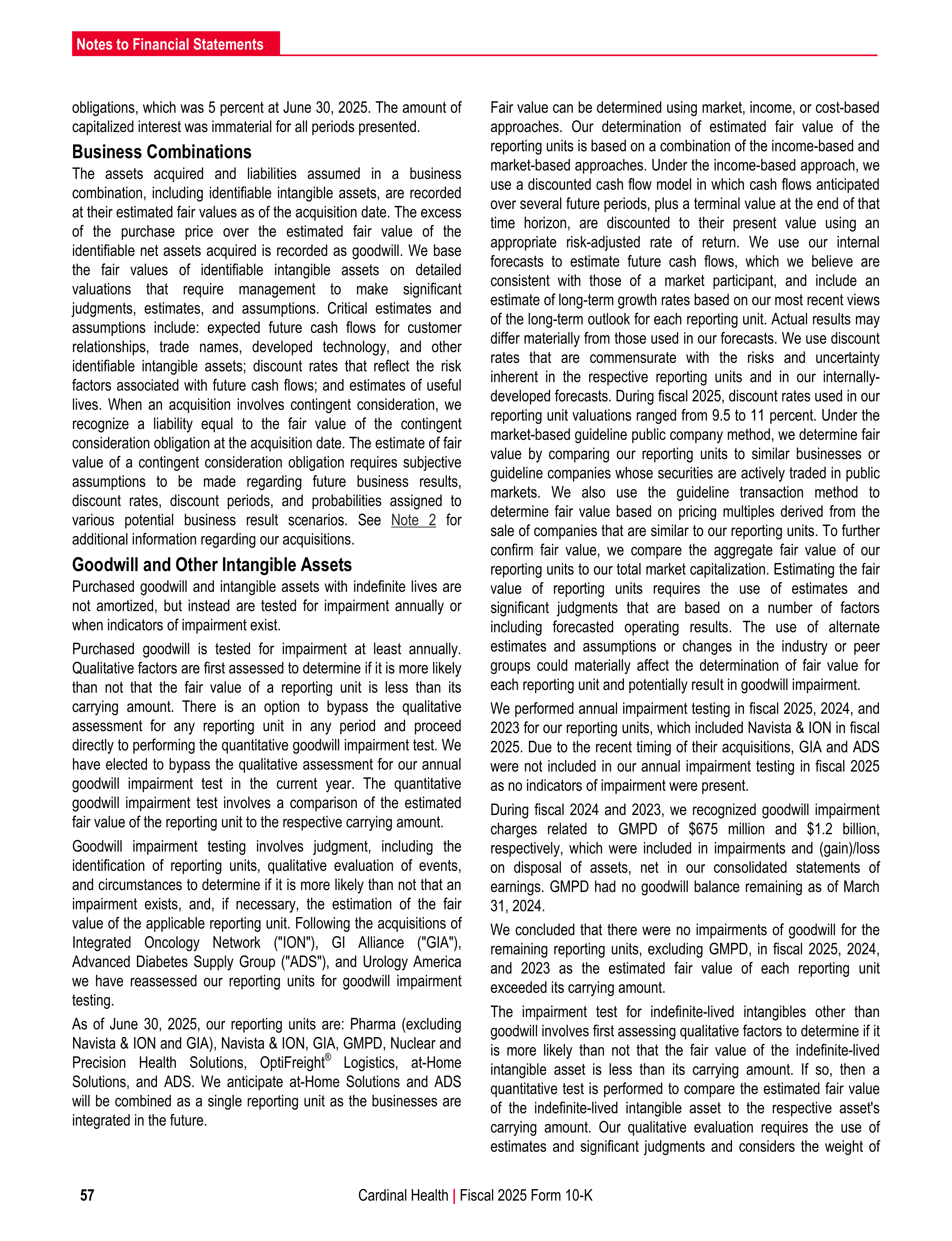
obligations, which was 5 percent at June 30, 2025. The amount of
capitalized interest was immaterial for all periods presented.
Business Combinations
The assets acquired and liabilities assumed in a business
combination, including identifiable intangible assets, are recorded
at their estimated fair values as of the acquisition date. The excess
of the purchase price over the estimated fair value of the
identifiable net assets acquired is recorded as goodwill. We base
the fair values of identifiable intangible assets on detailed
valuations that require management to make significant
judgments, estimates, and assumptions. Critical estimates and
assumptions include: expected future cash flows for customer
relationships, trade names, developed technology, and other
identifiable intangible assets; discount rates that reflect the risk
factors associated with future cash flows; and estimates of useful
lives. When an acquisition involves contingent consideration, we
recognize a liability equal to the fair value of the contingent
consideration obligation at the acquisition date. The estimate of fair
value of a contingent consideration obligation requires subjective
assumptions to be made regarding future business results,
discount rates, discount periods, and probabilities assigned to
various potential business result scenarios. See
Note 2
for
additional information regarding our acquisitions.
Goodwill and Other Intangible Assets
Purchased goodwill and intangible assets with indefinite lives are
not amortized, but instead are tested for impairment annually or
when indicators of impairment exist.
Purchased goodwill is tested for impairment at least annually.
Qualitative factors are first assessed to determine if it is more likely
than not that the fair value of a reporting unit is less than its
carrying amount. There is an option to bypass the qualitative
assessment for any reporting unit in any period and proceed
directly to performing the quantitative goodwill impairment test. We
have elected to bypass the qualitative assessment for our annual
goodwill impairment test in the current year. The quantitative
goodwill impairment test involves a comparison of the estimated
fair value of the reporting unit to the respective carrying amount.
Goodwill impairment testing involves judgment, including the
identification of reporting units, qualitative evaluation of events,
and circumstances to determine if it is more likely than not that an
impairment exists, and, if necessary, the estimation of the fair
value of the applicable reporting unit. Following the acquisitions of
Integrated Oncology Network ("ION"), GI Alliance ("GIA"),
Advanced Diabetes Supply Group ("ADS"), and Urology America
we have reassessed our reporting units for goodwill impairment
testing.
As of June 30, 2025, our reporting units are: Pharma (excluding
Navista & ION and GIA), Navista & ION, GIA, GMPD, Nuclear and
Precision Health Solutions, OptiFreight
®
Logistics, at-Home
Solutions, and ADS. We anticipate at-Home Solutions and ADS
will be combined as a single reporting unit as the businesses are
integrated in the future.
Fair value can be determined using market, income, or cost-based
approaches. Our determination of estimated fair value of the
reporting units is based on a combination of the income-based and
market-based approaches. Under the income-based approach, we
use a discounted cash flow model in which cash flows anticipated
over several future periods, plus a terminal value at the end of that
time horizon, are discounted to their present value using an
appropriate risk-adjusted rate of return. We use our internal
forecasts to estimate future cash flows, which we believe are
consistent with those of a market participant, and include an
estimate of long-term growth rates based on our most recent views
of the long-term outlook for each reporting unit. Actual results may
differ materially from those used in our forecasts. We use discount
rates that are commensurate with the risks and uncertainty
inherent in the respective reporting units and in our internally-
developed forecasts. During fiscal 2025, discount rates used in our
reporting unit valuations ranged from 9.5 to 11 percent. Under the
market-based guideline public company method, we determine fair
value by comparing our reporting units to similar businesses or
guideline companies whose securities are actively traded in public
markets. We also use the guideline transaction method to
determine fair value based on pricing multiples derived from the
sale of companies that are similar to our reporting units. To further
confirm fair value, we compare the aggregate fair value of our
reporting units to our total market capitalization. Estimating the fair
value of reporting units requires the use of estimates and
significant judgments that are based on a number of factors
including forecasted operating results. The use of alternate
estimates and assumptions or changes in the industry or peer
groups could materially affect the determination of fair value for
each reporting unit and potentially result in goodwill impairment.
We performed annual impairment testing in fiscal 2025, 2024, and
2023 for our reporting units, which included Navista & ION in fiscal
2025. Due to the recent timing of their acquisitions, GIA and ADS
were not included in our annual impairment testing in fiscal 2025
as no indicators of impairment were present.
During fiscal 2024 and 2023, we recognized goodwill impairment
charges related to GMPD of $675 million and $1.2 billion,
respectively, which were included in impairments and (gain)/loss
on disposal of assets, net in our consolidated statements of
earnings. GMPD had no goodwill balance remaining as of March
31, 2024.
We concluded that there were no impairments of goodwill for the
remaining reporting units, excluding GMPD, in fiscal 2025, 2024,
and 2023 as the estimated fair value of each reporting unit
exceeded its carrying amount.
The impairment test for indefinite-lived intangibles other than
goodwill involves first assessing qualitative factors to determine if it
is more likely than not that the fair value of the indefinite-lived
intangible asset is less than its carrying amount. If so, then a
quantitative test is performed to compare the estimated fair value
of the indefinite-lived intangible asset to the respective asset's
carrying amount. Our qualitative evaluation requires the use of
estimates and significant judgments and considers the weight of
Notes to Financial Statements
Cardinal Health
|
Fiscal 2025 Form 10-K
57
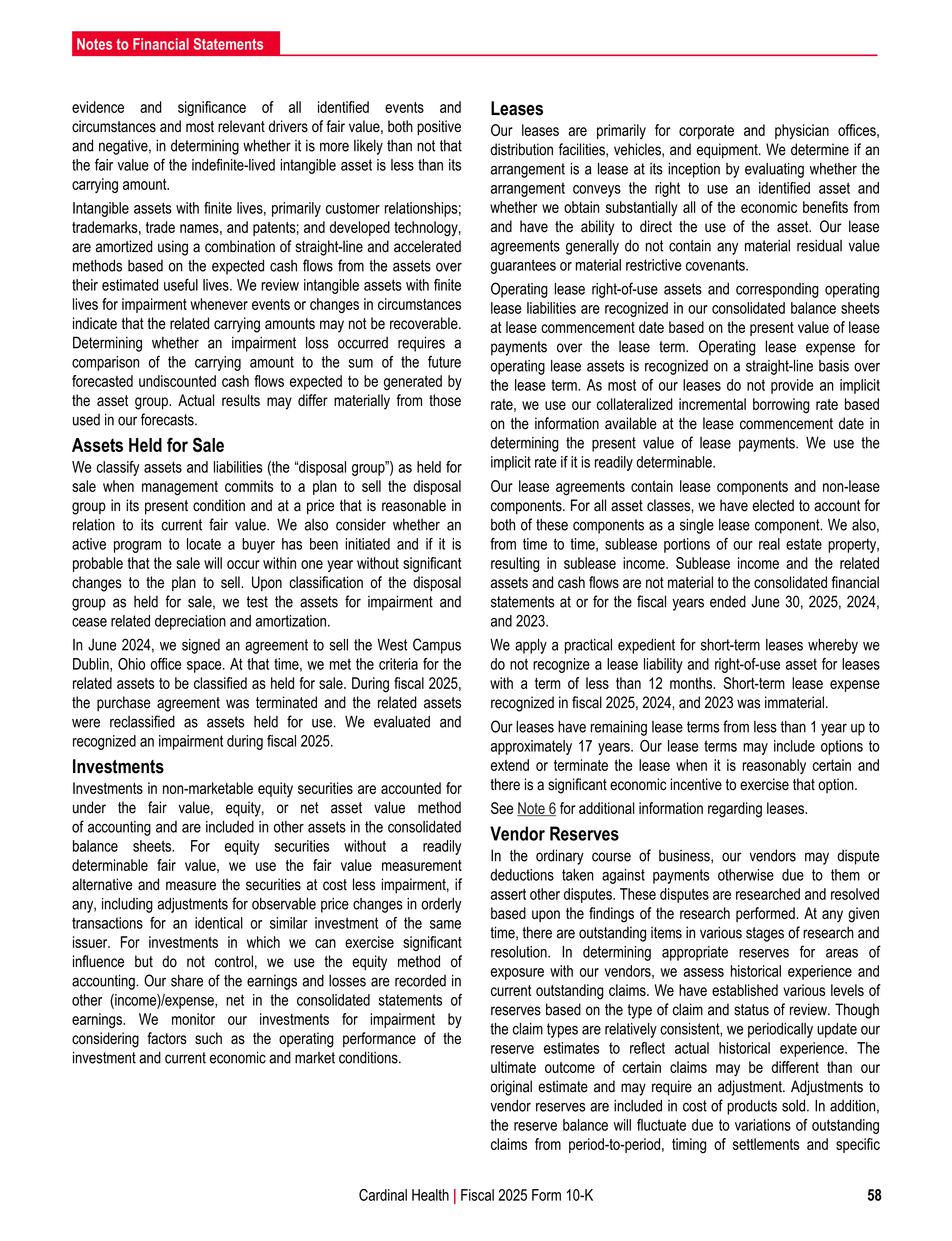
evidence and significance of all identified events and
circumstances and most relevant drivers of fair value, both positive
and negative, in determining whether it is more likely than not that
the fair value of the indefinite-lived intangible asset is less than its
carrying amount.
Intangible assets with finite lives, primarily customer relationships;
trademarks, trade names, and patents; and developed technology,
are amortized using a combination of straight-line and accelerated
methods based on the expected cash flows from the assets over
their estimated useful lives. We review intangible assets with finite
lives for impairment whenever events or changes in circumstances
indicate that the related carrying amounts may not be recoverable.
Determining whether an impairment loss occurred requires a
comparison of the carrying amount to the sum of the future
forecasted undiscounted cash flows expected to be generated by
the asset group. Actual results may differ materially from those
used in our forecasts.
Assets Held for Sale
We classify assets and liabilities (the “disposal group”) as held for
sale when management commits to a plan to sell the disposal
group in its present condition and at a price that is reasonable in
relation to its current fair value. We also consider whether an
active program to locate a buyer has been initiated and if it is
probable that the sale will occur within one year without significant
changes to the plan to sell. Upon classification of the disposal
group as held for sale, we test the assets for impairment and
cease related depreciation and amortization.
In June 2024, we signed an agreement to sell the West Campus
Dublin, Ohio office space. At that time, we met the criteria for the
related assets to be classified as held for sale. During fiscal 2025,
the purchase agreement was terminated and the related assets
were reclassified as assets held for use. We evaluated and
recognized an impairment during fiscal 2025.
Investments
Investments in non-marketable equity securities are accounted for
under the fair value, equity, or net asset value method
of accounting and are included in other assets in the consolidated
balance sheets. For equity securities without a readily
determinable fair value, we use the fair value measurement
alternative and measure the securities at cost less impairment, if
any, including adjustments for observable price changes in orderly
transactions for an identical or similar investment of the same
issuer. For investments in which we can exercise significant
influence but do not control, we use the equity method of
accounting. Our share of the earnings and losses are recorded in
other (income)/expense, net in the consolidated statements of
earnings. We monitor our investments for impairment by
considering factors such as the operating performance of the
investment and current economic and market conditions.
Leases
Our leases are primarily for corporate and physician offices,
distribution facilities, vehicles, and equipment. We determine if an
arrangement is a lease at its inception by evaluating whether the
arrangement conveys the right to use an identified asset and
whether we obtain substantially all of the economic benefits from
and have the ability to direct the use of the asset. Our lease
agreements generally do not contain any material residual value
guarantees or material restrictive covenants.
Operating lease right-of-use assets and corresponding operating
lease liabilities are recognized in our consolidated balance sheets
at lease commencement date based on the present value of lease
payments over the lease term. Operating lease expense for
operating lease assets is recognized on a straight-line basis over
the lease term. As most of our leases do not provide an implicit
rate, we use our collateralized incremental borrowing rate based
on the information available at the lease commencement date in
determining the present value of lease payments. We use the
implicit rate if it is readily determinable.
Our lease agreements contain lease components and non-lease
components. For all asset classes, we have elected to account for
both of these components as a single lease component. We also,
from time to time, sublease portions of our real estate property,
resulting in sublease income. Sublease income and the related
assets and cash flows are not material to the consolidated financial
statements at or for the fiscal years ended June 30, 2025, 2024,
and 2023.
We apply a practical expedient for short-term leases whereby we
do not recognize a lease liability and right-of-use asset for leases
with a term of less than 12 months. Short-term lease expense
recognized in fiscal 2025, 2024, and 2023 was immaterial.
Our leases have remaining lease terms from less than 1 year up to
approximately 17 years. Our lease terms may include options to
extend or terminate the lease when it is reasonably certain and
there is a significant economic incentive to exercise that option.
See
Note 6
for additional information regarding leases.
Vendor Reserves
In the ordinary course of business, our vendors may dispute
deductions taken against payments otherwise due to them or
assert other disputes. These disputes are researched and resolved
based upon the findings of the research performed. At any given
time, there are outstanding items in various stages of research and
resolution. In determining appropriate reserves for areas of
exposure with our vendors, we assess historical experience and
current outstanding claims. We have established various levels of
reserves based on the type of claim and status of review. Though
the claim types are relatively consistent, we periodically update our
reserve estimates to reflect actual historical experience. The
ultimate outcome of certain claims may be different than our
original estimate and may require an adjustment. Adjustments to
vendor reserves are included in cost of products sold. In addition,
the reserve balance will fluctuate due to variations of outstanding
claims from period-to-period, timing of settlements and specific
Notes to Financial Statements
58
Cardinal Health
|
Fiscal 2025 Form 10-K
vendor issues. Vendor reserves were $96 million and $112 million
at June 30, 2025 and 2024 respectively, excluding third-party
returns. See "Third-Party Returns" section within this Note for a
description of third-party returns.
Distribution Services Agreement and Other Vendor
Fees
Our Pharma segment recognizes fees received from distribution
services agreements and other fees received from vendors related
to the purchase or distribution of the vendors’ inventory when
those fees have been earned and we are entitled to payment.
Since the benefit provided to a vendor is related to the purchase
and distribution of the vendor’s inventory, we recognize the fees as
a reduction in the carrying value of the inventory that generated
the fees, and as such, a reduction of cost of products sold in our
consolidated statements of earnings when the inventory is sold.
Loss Contingencies and Self-Insurance
Loss Contingencies
We accrue for contingencies related to disputes, litigation, and
regulatory matters if it is probable that a liability has been incurred
and the amount of the loss can be reasonably estimated.
In connection with the opioid litigation as described further in
Note
8
, we recorded pre-tax charges of $5.6 billion
during fiscal 2021,
which were retained at Corporate. In February 2022, we and two
other national distributors announced that each company had
determined that a sufficient number of political subdivisions had
agreed to participate in the previously disclosed National Opioid
Settlement Agreement (the "NOSA") to settle the vast majority of
the opioid lawsuits filed by states and local governmental entities.
This NOSA became effective on April 2, 2022.
During fiscal 2024, we reached agreements to settle claims
brought by classes of third-party payors and acute care hospitals,
and the City of Baltimore.
We develop and periodically update reserve estimates for all
litigation matters, including the Cordis OptEase and TrapEase
inferior vena cava ("IVC") claims received to date and expected to
be received in the future and related costs. To project future IVC
claim costs, we use a methodology based largely on recent
experience, including claim filing rates, blended average payout
influenced by claim severity, historical sales data, implant and
injury to report lag patterns, and estimated defense costs. At June
30, 2025, we have a total of $56 million accrued for losses and
legal defense costs, related to the IVC filter product liability
lawsuits in our consolidated balance sheets, which includes the
$49 million in the qualified settlement fund.
The amount of ultimate loss may differ materially from these
estimates. We recognize these estimated loss contingencies,
income from favorable resolution of litigation, and certain defense
costs in litigation (recoveries)/charges, net in our consolidated
statements of earnings. See
Note 8
for additional information
regarding loss contingencies and product liability lawsuits.
Self-Insurance
We self-insure for employee healthcare, general liability, certain
product liability matters, auto liability, property, and workers'
compensation. Self-insurance accruals include an estimate for
expected settlements or pending claims, defense costs,
administrative fees, claim adjustment costs, and an estimate for
claims incurred but not reported.
Because these matters are inherently unpredictable and
unfavorable developments or resolutions can occur, assessing
contingencies and other liabilities is highly subjective and requires
judgments about future events. We regularly review contingencies
and our self-insurance accruals to determine whether our accruals
and related disclosures are adequate. Any adjustments for
changes in reserves are recorded in the period in which the
change in estimate occurs.
Guarantees
In the ordinary course of business, we agree to indemnify certain
other parties under acquisition and disposition agreements,
customer agreements, intellectual property licensing agreements,
and other agreements. Such indemnification obligations vary in
scope and, when defined, in duration. In many cases, a maximum
obligation is not explicitly stated, and therefore the overall
maximum amount of the liability under such indemnification
obligations cannot be reasonably estimated. Where appropriate,
such indemnification obligations are recorded as a liability.
Historically, we have not, individually or in the aggregate, made
payments under these indemnification obligations in any material
amounts. In certain circumstances, we believe that existing
insurance arrangements, subject to the general deduction and
exclusion provisions, would cover portions of the liability that may
arise from these indemnification obligations. In addition, we believe
that the likelihood of a material liability being triggered under these
indemnification obligations is not probable.
From time to time we enter into agreements that obligate us to
make fixed payments upon the occurrence of certain events. Such
obligations primarily relate to obligations arising under acquisition
transactions, where we have agreed to make payments based
upon the achievement of certain financial performance measures
by the acquired business. Generally, the obligation is capped at an
explicit amount. There were no material obligations at June 30,
2025.
Income Taxes
We account for income taxes using the asset and liability method.
Deferred tax assets and liabilities are measured using enacted tax
rates in the respective jurisdictions in which we operate. We
assess the realizability of deferred tax assets on a quarterly basis
and provide a valuation allowance for deferred tax assets when it
is more likely than not that at least a portion of the deferred tax
assets will not be realized. The realizability of deferred tax assets
depends on our ability to generate sufficient taxable income within
the carryback or carryforward periods provided for in the tax law
for each applicable tax jurisdiction and also considers all available
positive and negative evidence.
Deferred taxes for non-U.S. liabilities are not provided on the
unremitted earnings of subsidiaries outside of the United
States when it is expected that these earnings are indefinitely
reinvested.
Notes to Financial Statements
Cardinal Health
|
Fiscal 2025 Form 10-K
59
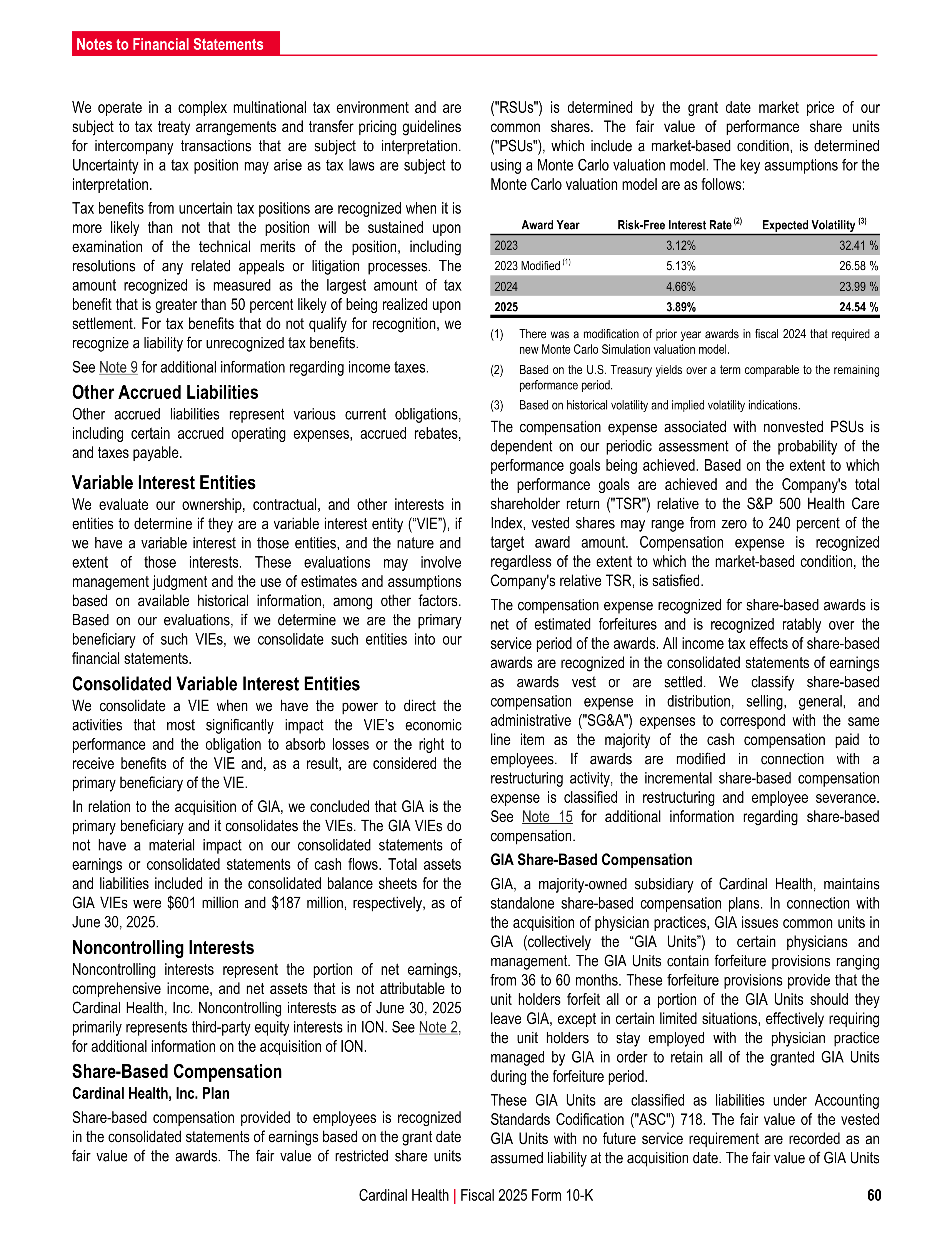
We operate in a complex multinational tax environment and are
subject to tax treaty arrangements and transfer pricing guidelines
for intercompany transactions that are subject to interpretation.
Uncertainty in a tax position may arise as tax laws are subject to
interpretation.
Tax benefits from uncertain tax positions are recognized when it is
more likely than not that the position will be sustained upon
examination of the technical merits of the position, including
resolutions of any related appeals or litigation processes. The
amount recognized is measured as the largest amount of tax
benefit that is greater than 50 percent likely of being realized upon
settlement. For tax benefits that do not qualify for recognition, we
recognize a liability for unrecognized tax benefits.
See
Note 9
for additional information regarding income taxes.
Other Accrued Liabilities
Other accrued liabilities represent various current obligations,
including certain accrued operating expenses, accrued rebates,
and taxes payable.
Variable Interest Entities
We evaluate our ownership, contractual, and other interests in
entities to determine if they are a variable interest entity (“VIE”), if
we have a variable interest in those entities, and the nature and
extent of those interests. These evaluations may involve
management judgment and the use of estimates and assumptions
based on available historical information, among other factors.
Based on our evaluations, if we determine we are the primary
beneficiary of such VIEs, we consolidate such entities into our
financial statements.
Consolidated Variable Interest Entities
We consolidate a VIE when we have the power to direct the
activities that most significantly impact the VIE’s economic
performance and the obligation to absorb losses or the right to
receive benefits of the VIE and, as a result, are considered the
primary beneficiary of the VIE.
In relation to the acquisition of GIA, we concluded that GIA is the
primary beneficiary and it consolidates the VIEs. The GIA VIEs do
not have a material impact on our consolidated statements of
earnings or consolidated statements of cash flows. Total assets
and liabilities included in the consolidated balance sheets for the
GIA VIEs were $601 million and $187 million, respectively, as of
June 30, 2025.
Noncontrolling Interests
Noncontrolling interests represent the portion of net earnings,
comprehensive income, and net assets that is not attributable to
Cardinal Health, Inc. Noncontrolling interests as of June 30, 2025
primarily represents third-party equity interests in ION. See
Note 2
,
for additional information on the acquisition of ION.
Share-Based Compensation
Cardinal Health, Inc. Plan
Share-based compensation provided to employees is recognized
in the consolidated statements of earnings based on the grant date
fair value of the awards. The fair value of restricted share units
("RSUs") is determined by the grant date market price of our
common shares. The fair value of performance share units
("PSUs"), which include a market-based condition, is determined
using a Monte Carlo valuation model. The key assumptions for the
Monte Carlo valuation model are as follows:
Award Year
Risk-Free Interest Rate
(2)
Expected Volatility
(3)
2023
3.12%
32.41 %
2023 Modified
(1)
5.13%
26.58 %
2024
4.66%
23.99 %
2025
3.89%
24.54 %
(1)
There was a modification of prior year awards in fiscal 2024 that required a
new Monte Carlo Simulation valuation model.
(2)
Based on the U.S. Treasury yields over a term comparable to the remaining
performance period.
(3)
Based on historical volatility and implied volatility indications.
The compensation expense associated with nonvested PSUs is
dependent on our periodic assessment of the probability of the
performance goals being achieved. Based on the extent to which
the performance goals are achieved and the Company's total
shareholder return ("TSR") relative to the S&P 500 Health Care
Index, vested shares may range from zero to 240 percent of the
target award amount. Compensation expense is recognized
regardless of the extent to which the market-based condition, the
Company's relative TSR, is satisfied.
The compensation expense recognized for share-based awards is
net of estimated forfeitures and is recognized ratably over the
service period of the awards. All income tax effects of share-based
awards are recognized in the consolidated statements of earnings
as awards vest or are settled. We classify share-based
compensation expense in distribution, selling, general, and
administrative ("SG&A") expenses to correspond with the same
line item as the majority of the cash compensation paid to
employees. If awards are modified in connection with a
restructuring activity, the incremental share-based compensation
expense is classified in restructuring and employee severance.
See
Note 15
for additional information regarding share-based
compensation.
GIA Share-Based Compensation
GIA, a majority-owned subsidiary of Cardinal Health, maintains
standalone share-based compensation plans. In connection with
the acquisition of physician practices, GIA issues common units in
GIA (collectively the “GIA Units”) to certain physicians and
management. The GIA Units contain forfeiture provisions ranging
from 36 to 60 months. These forfeiture provisions provide that the
unit holders forfeit all or a portion of the GIA Units should they
leave GIA, except in certain limited situations, effectively requiring
the unit holders to stay employed with the physician practice
managed by GIA in order to retain all of the granted GIA Units
during the forfeiture period.
These GIA Units are classified as liabilities under Accounting
Standards Codification ("ASC") 718. The fair value of the vested
GIA Units with no future service requirement are recorded as an
assumed liability at the acquisition date. The fair value of GIA Units
Notes to Financial Statements
60
Cardinal Health
|
Fiscal 2025 Form 10-K
with a future service requirement are recognized on a straight-line
basis over the requisite service period.
The fair value of the GIA Units is remeasured at each reporting
period using a discounted cash flow method. The compensation
costs recognized each period reflects the change in the fair value
of the liability for the portion of the awards for which the requisite
service has been rendered.
See
Note 15
for additional information regarding share-based
compensation.
Dividends
We paid cash dividends per common share of $2.02, $2.00, and
$1.98 in fiscal 2025, 2024, and 2023, respectively.
Revenue Recognition
We recognize revenue in an amount that reflects the consideration
to which we expect to be entitled in exchange for the transfer of
goods or services to customers.
Revenue in our Pharma, GMPD, Nuclear and Precision Health
Solutions, and at-Home Solutions operating segments is primarily
related to the distribution of pharmaceutical and medical products,
which include both manufactured and sourced products, and we
recognize at a point in time when title transfers to customers and
we have no further obligation to provide services related to such
merchandise. OptiFreight
®
Logistics revenue is related to shipping,
freight management, and logistics management services. Service
revenues are recognized over the period that services are
provided to the customer, reduced by contractual adjustments to
third-party payors, discounts and implicit price concessions to
customers. Revenues derived from services from all segments are
immaterial for all periods presented.
We are generally the principal in a transaction, therefore our
revenue is primarily recorded on a gross basis. When we are a
principal in a transaction, we have determined that we control the
ability to direct the use of the product or service prior to transfer to
a customer, are primarily responsible for fulfilling the promise to
provide the product or service to our customer, have discretion in
establishing prices, and ultimately control the transfer of the
product or services provided to the customer.
Sales Returns and Allowances
Revenue is recorded net of sales returns and allowances.
Revenues are measured based on the amount of consideration
that we expect to receive, reduced by estimates for return
allowances, discounts, rebates, and other variable consideration.
Sales returns are recorded based on estimates using historical
data. Our customer return policies generally require that the
product be physically returned, subject to restocking fees. We only
allow customers to return products for credit in a condition suitable
to be added back to inventory and resold at full value
(“merchantable product”) or returned to vendors for credit. Product
returns are generally consistent throughout the year and typically
are not specific to any particular product or customer.
We accrue for estimated sales returns and allowances at the time
of sale based upon historical customer return trends, margin rates,
and processing costs. Our accrual for sales returns is reflected as
a reduction of revenue and cost of products sold for the sales price
and cost, respectively. At June 30, 2025 and 2024, the accrual for
estimated sales returns and allowances was $447 million and
$441 million, respectively, which is reflected in trade receivables,
net and inventories, net in the consolidated balance sheets. Sales
returns and allowances were $2.2 billion, for fiscal 2025, 2024, and
2023, and the net impact on net earnings in the consolidated
statements of earnings was immaterial in fiscal 2025, 2024, and
2023.
Third-Party Returns
We generally do not accept non-merchantable pharmaceutical
product returns from our customers, so many of our customers
return non-merchantable pharmaceutical products to the
manufacturer through third parties. Since our customers generally
do not have a direct relationship with manufacturers, our vendors
pass the value of such returns to us (usually in the form of an
accounts payable deduction). We, in turn, pass the value received
to our customer. In certain instances, we pass the estimated value
of the return to our customer prior to our receipt of the value from
the vendor. Although we believe we have satisfactory protections,
from time to time, we become subject to claims from customers or
vendors that our administration of this overall process is deficient
in some respect or our contractual terms with vendors are in
conflict with our contractual terms with our customers. We maintain
reserves for some of these situations based on their nature and
our historical experience with their resolution.
Shipping and Handling
Shipping and handling costs are primarily included in SG&A
expenses in our consolidated statements of earnings and include
all delivery expenses as well as all costs to prepare the product for
shipment to the end customer. Shipping and handling costs were
$909 million, $866 million, and $835 million, for fiscal 2025, 2024,
and 2023, respectively.
Restructuring and Employee Severance
Restructuring activities are programs that are not part of the
ongoing operations of our underlying business, such as
divestitures, closing and consolidating facilities, changing the way
we manufacture or distribute our products, moving manufacturing
of a product to another location, changes in production or business
process outsourcing or insourcing, employee severance (including
rationalizing headcount or other significant changes in personnel),
and realigning operations (including realignment of the
management structure in response to changing market conditions).
Also included within restructuring and employee severance are
employee severance costs that are not incurred in connection with
a restructuring activity. See
Note 4
for additional information
regarding our restructuring activities.
Amortization and Other Acquisition-Related Costs
We classify certain costs incurred in connection with acquisitions
as amortization and other acquisition-related costs in our
consolidated statements of earnings. These costs consist of
amortization of acquisition-related intangible assets, amortization
as a result of basis differences in equity method investments,
Notes to Financial Statements
Cardinal Health
|
Fiscal 2025 Form 10-K
61
transaction costs, integration costs, and changes in the fair value
of contingent consideration obligations. Transaction costs are
incurred during the initial evaluation of a potential acquisition and
primarily relate to costs to analyze, negotiate, and consummate
the transaction as well as due diligence activities. Integration costs
relate to activities required to combine the operations of an
acquired enterprise into our operations and, in the case of the
significant acquisitions with international operations, to stand-up
the systems and processes needed to support an expanded
geographic footprint. We record changes in the fair value of
contingent consideration obligations relating to acquisitions as
income or expense in amortization and other acquisition-related
costs. See
Note 5
for additional information regarding amortization
of acquisition-related intangible assets.
Translation of Foreign Currencies
Financial statements of our subsidiaries outside the United
States are generally measured using the local currency as the
functional currency. Adjustments to translate the assets and
liabilities of these foreign subsidiaries into U.S. dollars are
accumulated in shareholders’ equity through accumulated and
other comprehensive loss ("AOCI") utilizing period-end exchange
rates. Revenues and expenses of these foreign subsidiaries are
translated using average exchange rates during the year.
The foreign currency translation gains/(losses) included in AOCI at
June 30, 2025 and 2024 are presented in
Note 12
. Foreign
currency transaction gains and losses for the period are included
in the consolidated statements of earnings in the respective
financial statement line item.
Interest Rate, Currency, and Commodity Risk
All derivative instruments are recognized at fair value on the
consolidated balance sheets and all changes in fair value are
recognized in net earnings or shareholders’ equity through AOCI,
net of tax.
For contracts that qualify for hedge accounting treatment, the
hedge contracts must be effective at reducing the risk associated
with the exposure being hedged and must be designated as a
hedge at the inception of the contract. Hedge effectiveness is
assessed periodically. Any contract not designated as a hedge, or
so designated but ineffective, is adjusted to fair value and
recognized immediately in net earnings. If a fair value or cash flow
hedge ceases to qualify for hedge accounting treatment, the
contract continues to be carried on the balance sheet at fair value
until settled and future adjustments to the contract’s fair value are
recognized immediately in net earnings. If a forecasted transaction
is probable not to occur, amounts previously deferred in AOCI are
recognized immediately in net earnings. Interest payments
received from the cross-currency swap are excluded from the net
investment hedge effectiveness assessment and are recorded in
interest expense, net in the consolidated statements of earnings.
See
Note 11
for additional information regarding our derivative
instruments, including the accounting treatment for instruments
designated as fair value, cash flow, net investment, and economic
hedges.
Fair Value Measurements
Fair value is defined as the price that would be received upon
selling an asset or the price paid to transfer a liability on the
measurement date. It focuses on the exit price in the principal or
most advantageous market for the asset or liability in an orderly
transaction between willing market participants. A three-tier fair
value hierarchy is established as a basis for considering such
assumptions and for inputs used in the valuation methodologies in
measuring fair value. This hierarchy requires entities to maximize
the use of observable inputs and minimize the use of unobservable
inputs. The three levels of inputs used to measure fair values are:
Level 1 - Observable prices in active markets for identical assets
and liabilities.
Level 2 - Observable inputs other than quoted prices in active
markets for identical assets and liabilities.
Level 3 - Unobservable inputs that are supported by little or no
market activity and that are significant to the fair value of
the assets and liabilities.
See
Note 10
for additional information regarding fair value
measurements.
Recently Adopted Financial Accounting Standards
.
Segment Reporting
In November 2023, the FASB issued Accounting Standards
Update ("ASU") 2023-07 Segment Reporting (Topic 280):
Improvements to Reportable Segment Disclosures, which
enhances reportable segment disclosure requirements, primarily
through disclosures of significant segment expenses. The
Company adopted the new guidance in our fiscal 2025 Form 10-K.
The new standard did not have an impact on the company's
consolidated financial statements but required additional
disclosures. See
Note 14
for additional information.
Recently Issued Financial Accounting Standards
and Disclosure Rules Not Yet Adopted
We assess the adoption impacts of recently issued accounting
standards by the FASB on our consolidated financial statements
as well as material updates to previous assessments, if any, from
our fiscal 2024 Form 10-K.
Income Tax Disclosure
In December 2023, the FASB issued ASU 2023-09 Income Taxes
(Topic 740): Improvements to Income Tax Disclosures, which
enhances income tax disclosures primarily related to the rate
reconciliation and income taxes paid information. This guidance
also includes certain other amendments to improve the
effectiveness of income tax disclosures. This guidance will be
effective for us in our fiscal 2026 Form 10-K and should be applied
on a prospective basis, with retrospective application permitted.
We are currently evaluating the impact of adoption of this guidance
on our disclosures.
Disaggregation of Income Statement Expenses
In November 2024, the FASB issued ASU 2024-03 Income
Statement - Reporting Comprehensive Income - Expense
Disaggregation Disclosures (Subtopic 220-40), which requires
Notes to Financial Statements
62
Cardinal Health
|
Fiscal 2025 Form 10-K
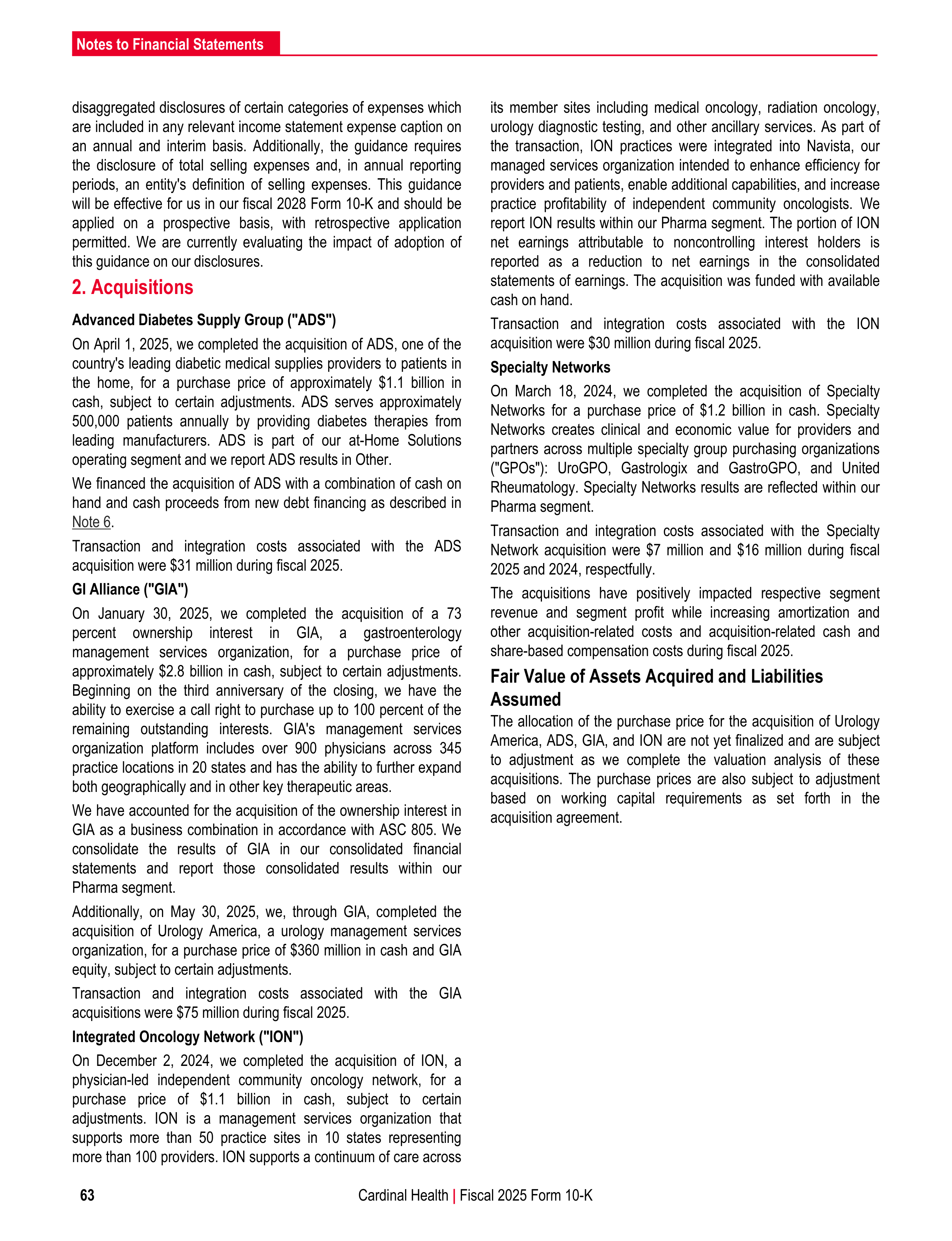
disaggregated disclosures of certain categories of expenses which
are included in any relevant income statement expense caption on
an annual and interim basis. Additionally, the guidance requires
the disclosure of total selling expenses and, in annual reporting
periods, an entity's definition of selling expenses. This guidance
will be effective for us in our fiscal 2028 Form 10-K and should be
applied on a prospective basis, with retrospective application
permitted. We are currently evaluating the impact of adoption of
this guidance on our disclosures.
2. Acquisitions
Advanced Diabetes Supply Group ("ADS")
On April 1, 2025, we completed the acquisition of ADS, one of the
country's leading diabetic medical supplies providers to patients in
the home, for a purchase price of approximately $1.1 billion in
cash, subject to certain adjustments. ADS serves approximately
500,000 patients annually by providing diabetes therapies from
leading manufacturers. ADS is part of our at-Home Solutions
operating segment and we report ADS results in Other.
We financed the acquisition of ADS with a combination of cash on
hand and cash proceeds from new debt financing as described in
Note 6
.
Transaction and integration costs associated with the ADS
acquisition were $31 million during fiscal 2025.
GI Alliance ("GIA")
On January 30, 2025, we completed the acquisition of a 73
percent
ownership
interest
in
GIA,
a
gastroenterology
management services organization, for a purchase price of
approximately $2.8 billion in cash, subject to certain adjustments.
Beginning on the third anniversary of the closing, we have the
ability to exercise a call right to purchase up to 100 percent of the
remaining outstanding interests. GIA's management services
organization platform includes over 900 physicians across 345
practice locations in 20 states and has the ability to further expand
both geographically and in other key therapeutic areas.
We have accounted for the acquisition of the ownership interest in
GIA as a business combination in accordance with ASC 805. We
consolidate the results of GIA in our consolidated financial
statements and report those consolidated results within our
Pharma segment.
Additionally, on May 30, 2025, we, through GIA, completed the
acquisition of Urology America, a urology management services
organization, for a purchase price of $360 million in cash and GIA
equity, subject to certain adjustments.
Transaction and integration costs associated with the GIA
acquisitions were $75 million during fiscal 2025.
Integrated Oncology Network ("ION")
On December 2, 2024, we completed the acquisition of ION, a
physician-led independent community oncology network, for a
purchase price of $1.1 billion in cash, subject to certain
adjustments. ION is a management services organization that
supports more than 50 practice sites in 10 states representing
more than 100 providers. ION supports a continuum of care across
its member sites including medical oncology, radiation oncology,
urology diagnostic testing, and other ancillary services. As part of
the transaction, ION practices were integrated into Navista, our
managed services organization intended to enhance efficiency for
providers and patients, enable additional capabilities, and increase
practice profitability of independent community oncologists. We
report ION results within our Pharma segment. The portion of ION
net earnings attributable to noncontrolling interest holders is
reported as a reduction to net earnings in the consolidated
statements of earnings. The acquisition was funded with available
cash on hand.
Transaction and integration costs associated with the ION
acquisition were $30 million during fiscal 2025.
Specialty Networks
On March 18, 2024, we completed the acquisition of Specialty
Networks for a purchase price of $1.2 billion in cash. Specialty
Networks creates clinical and economic value for providers and
partners across multiple specialty group purchasing organizations
("GPOs"): UroGPO, Gastrologix and GastroGPO, and United
Rheumatology. Specialty Networks results are reflected within our
Pharma segment.
Transaction and integration costs associated with the Specialty
Network acquisition were $7 million and $16 million during fiscal
2025 and 2024, respectfully.
The acquisitions have positively impacted respective segment
revenue and segment profit while increasing amortization and
other acquisition-related costs and acquisition-related cash and
share-based compensation costs during fiscal 2025.
Fair Value of Assets Acquired and Liabilities
Assumed
The allocation of the purchase price for the acquisition of Urology
America, ADS, GIA, and ION are not yet finalized and are subject
to adjustment as we complete the valuation analysis of these
acquisitions. The purchase prices are also subject to adjustment
based on working capital requirements as set forth in the
acquisition agreement.
Notes to Financial Statements
Cardinal Health
|
Fiscal 2025 Form 10-K
63
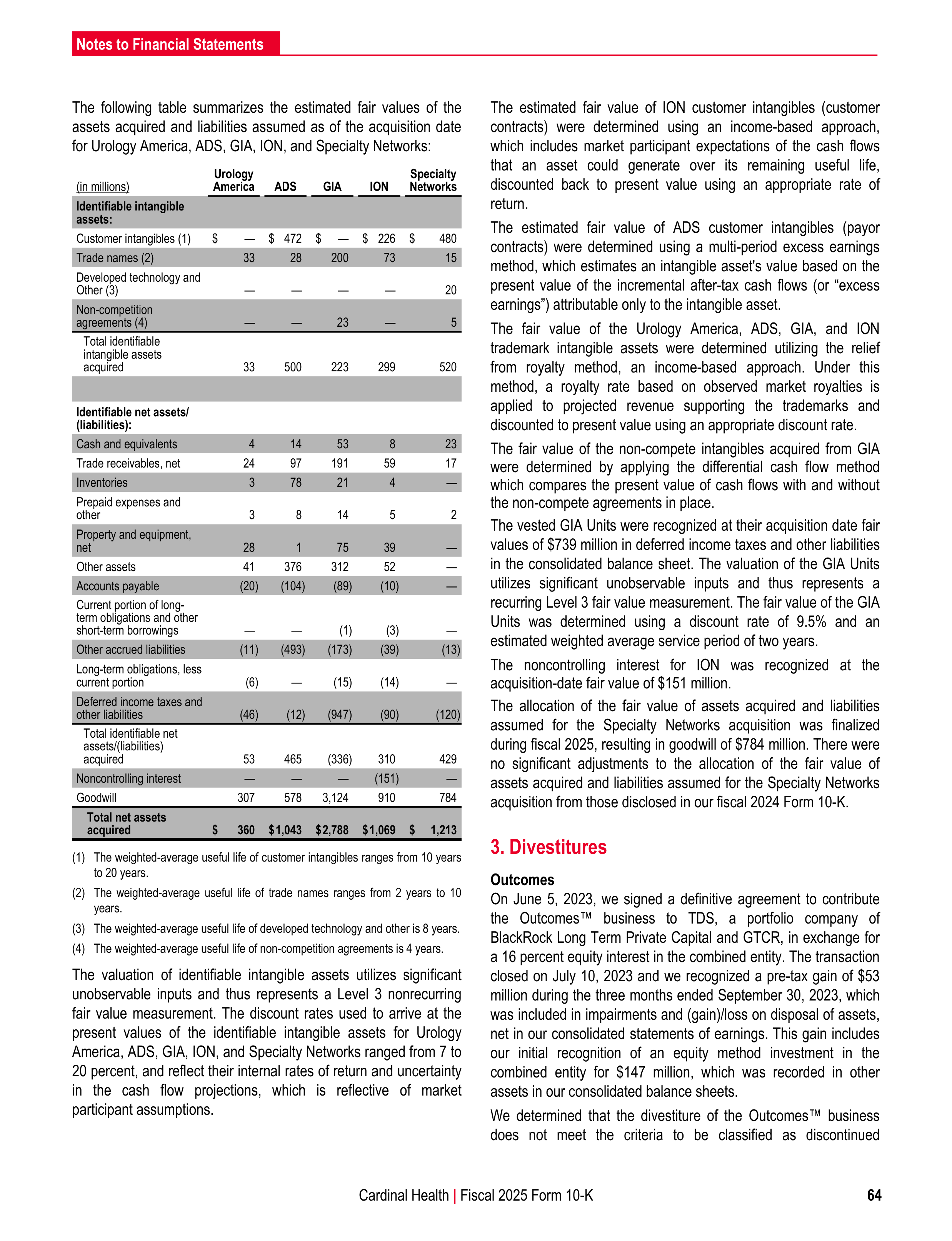
The following table summarizes the estimated fair values of the
assets acquired and liabilities assumed as of the acquisition date
for Urology America, ADS, GIA, ION, and Specialty Networks:
(in millions)
Urology
America
ADS
GIA
ION
Specialty
Networks
Identifiable intangible
assets:
Customer intangibles (1)
$
—
$ 472
$
—
$ 226
$
480
Trade names (2)
33
28
200
73
15
Developed technology and
Other (3)
—
—
—
—
20
Non-competition
agreements (4)
—
—
23
—
5
Total identifiable
intangible assets
acquired
33
500
223
299
520
Identifiable net assets/
(liabilities):
Cash and equivalents
4
14
53
8
23
Trade receivables, net
24
97
191
59
17
Inventories
3
78
21
4
—
Prepaid expenses and
other
3
8
14
5
2
Property and equipment,
net
28
1
75
39
—
Other assets
41
376
312
52
—
Accounts payable
(20) (104)
(89)
(10)
—
Current portion of long-
term obligations and other
short-term borrowings
—
—
(1)
(3)
—
Other accrued liabilities
(11) (493) (173)
(39)
(13)
Long-term obligations, less
current portion
(6)
—
(15)
(14)
—
Deferred income taxes and
other liabilities
(46)
(12) (947)
(90)
(120)
Total identifiable net
assets/(liabilities)
acquired
53
465
(336)
310
429
Noncontrolling interest
—
—
—
(151)
—
Goodwill
307
578
3,124
910
784
Total net assets
acquired
$
360
$ 1,043
$ 2,788
$ 1,069
$
1,213
(1) The weighted-average useful life of customer intangibles ranges from 10 years
to 20 years.
(2) The weighted-average useful life of trade names ranges from 2 years to 10
years.
(3) The weighted-average useful life of developed technology and other is 8 years.
(4) The weighted-average useful life of non-competition agreements is 4 years.
The valuation of identifiable intangible assets utilizes significant
unobservable inputs and thus represents a Level 3 nonrecurring
fair value measurement. The discount rates used to arrive at the
present values of the identifiable intangible assets for Urology
America, ADS, GIA, ION, and Specialty Networks ranged from 7 to
20 percent, and reflect their internal rates of return and uncertainty
in the cash flow projections, which is reflective of market
participant assumptions.
The estimated fair value of ION customer intangibles (customer
contracts) were determined using an income-based approach,
which includes market participant expectations of the cash flows
that an asset could generate over its remaining useful life,
discounted back to present value using an appropriate rate of
return.
The estimated fair value of ADS customer intangibles (payor
contracts) were determined using a multi-period excess earnings
method, which estimates an intangible asset's value based on the
present value of the incremental after-tax cash flows (or “excess
earnings”) attributable only to the intangible asset.
The fair value of the Urology America, ADS, GIA, and ION
trademark intangible assets were determined utilizing the relief
from royalty method, an income-based approach. Under this
method, a royalty rate based on observed market royalties is
applied to projected revenue supporting the trademarks and
discounted to present value using an appropriate discount rate.
The fair value of the non-compete intangibles acquired from GIA
were determined by applying the differential cash flow method
which compares the present value of cash flows with and without
the non-compete agreements in place.
The vested GIA Units were recognized at their acquisition date fair
values of $739 million in deferred income taxes and other liabilities
in the consolidated balance sheet. The valuation of the GIA Units
utilizes significant unobservable inputs and thus represents a
recurring Level 3 fair value measurement. The fair value of the GIA
Units was determined using a discount rate of 9.5% and an
estimated weighted average service period of two years.
The noncontrolling interest for ION was recognized at the
acquisition-date fair value of $151 million.
The allocation of the fair value of assets acquired and liabilities
assumed for the Specialty Networks acquisition was finalized
during fiscal 2025, resulting in goodwill of $784 million. There were
no significant adjustments to the allocation of the fair value of
assets acquired and liabilities assumed for the Specialty Networks
acquisition from those disclosed in our fiscal 2024 Form 10-K.
3. Divestitures
Outcomes
On June 5, 2023, we signed a definitive agreement to contribute
the Outcomes™ business to TDS, a portfolio company of
BlackRock Long Term Private Capital and GTCR, in exchange for
a 16 percent equity interest in the combined entity. The transaction
closed on July 10, 2023 and we recognized a pre-tax gain of $53
million during the three months ended September 30, 2023, which
was included in impairments and (gain)/loss on disposal of assets,
net in our consolidated statements of earnings. This gain includes
our initial recognition of an equity method investment in the
combined entity for $147 million, which was recorded in other
assets in our consolidated balance sheets.
We determined that the divestiture of the Outcomes™ business
does not meet the criteria to be classified as discontinued
Notes to Financial Statements
64
Cardinal Health
|
Fiscal 2025 Form 10-K
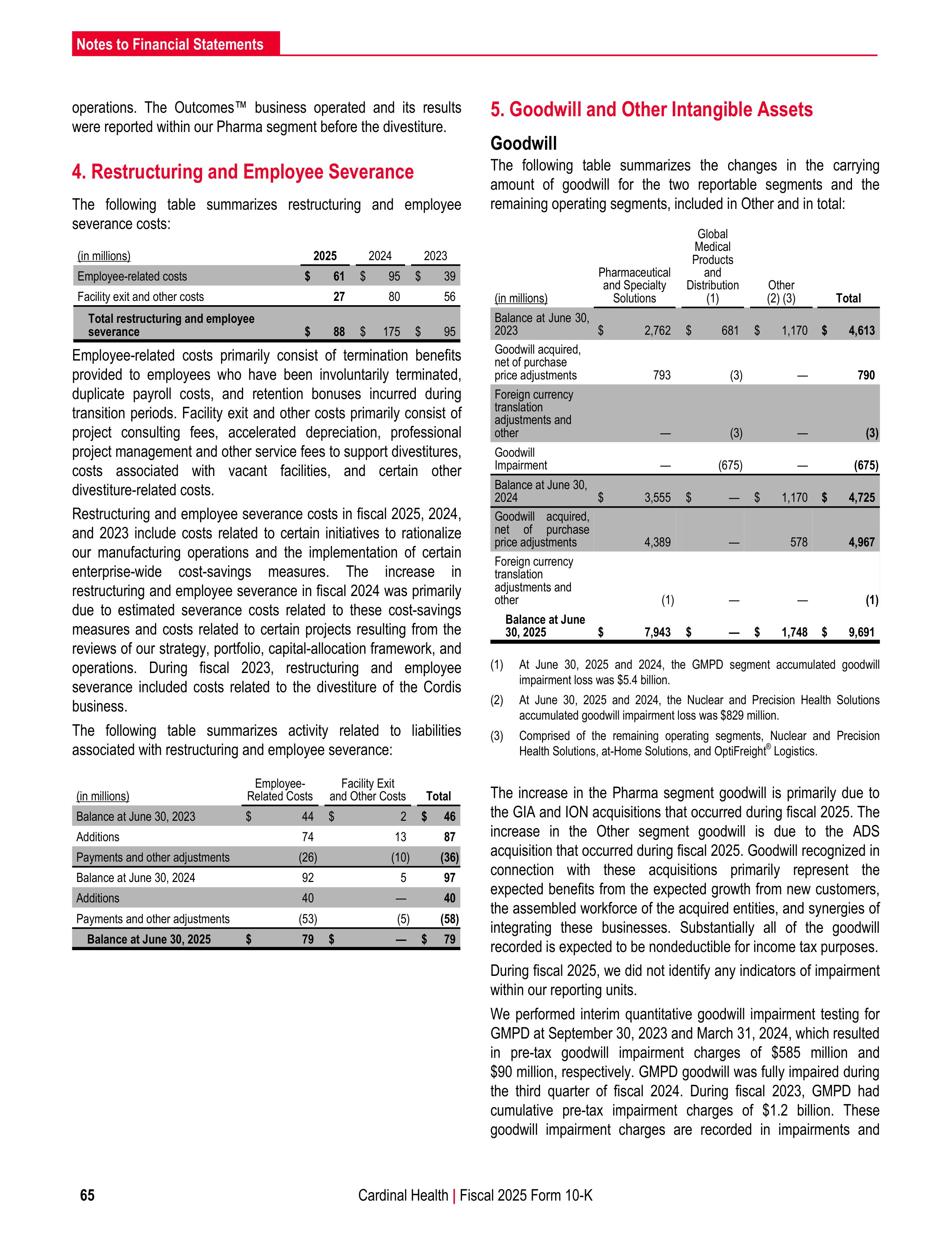
operations. The Outcomes™ business operated and its results
were reported within our Pharma segment before the divestiture.
4. Restructuring and Employee Severance
The following table summarizes restructuring and employee
severance costs:
(in millions)
2025
2024
2023
Employee-related costs
$
61
$
95
$
39
Facility exit and other costs
27
80
56
Total restructuring and employee
severance
$
88
$
175
$
95
Employee-related costs primarily consist of termination benefits
provided to employees who have been involuntarily terminated,
duplicate payroll costs, and retention bonuses incurred during
transition periods. Facility exit and other costs primarily consist of
project consulting fees, accelerated depreciation, professional
project management and other service fees to support divestitures,
costs associated with vacant facilities, and certain other
divestiture-related costs.
Restructuring and employee severance costs in fiscal 2025, 2024,
and 2023 include costs related to certain initiatives to rationalize
our manufacturing operations and the implementation of certain
enterprise-wide
cost-savings
measures.
The
increase
in
restructuring and employee severance in fiscal 2024 was primarily
due to estimated severance costs related to these cost-savings
measures and costs related to certain projects resulting from the
reviews of our strategy, portfolio, capital-allocation framework, and
operations. During fiscal 2023, restructuring and employee
severance included costs related to the divestiture of the Cordis
business.
The following table summarizes activity related to liabilities
associated with restructuring and employee severance:
(in millions)
Employee-
Related Costs
Facility Exit
and Other Costs
Total
Balance at June 30, 2023
$
44
$
2
$
46
Additions
74
13
87
Payments and other adjustments
(26)
(10)
(36)
Balance at June 30, 2024
92
5
97
Additions
40
—
40
Payments and other adjustments
(53)
(5)
(58)
Balance at June 30, 2025
$
79
$
—
$
79
5. Goodwill and Other Intangible Assets
Goodwill
The following table summarizes the changes in the carrying
amount of goodwill for the two reportable segments and the
remaining operating segments, included in Other and in total:
(in millions)
Pharmaceutical
and Specialty
Solutions
Global
Medical
Products
and
Distribution
(1)
Other
(2) (3)
Total
Balance at June 30,
2023
$
2,762
$
681
$
1,170
$
4,613
Goodwill acquired,
net of purchase
price adjustments
793
(3)
—
790
Foreign currency
translation
adjustments and
other
—
(3)
—
(3)
Goodwill
Impairment
—
(675)
—
(675)
Balance at June 30,
2024
$
3,555
$
—
$
1,170
$
4,725
Goodwill acquired,
net
of
purchase
price adjustments
4,389
—
578
4,967
Foreign currency
translation
adjustments and
other
(1)
—
—
(1)
Balance at June
30, 2025
$
7,943
$
—
$
1,748
$
9,691
(1)
At June 30, 2025 and 2024, the GMPD segment accumulated goodwill
impairment loss was $5.4 billion.
(2)
At June 30, 2025 and 2024, the Nuclear and Precision Health Solutions
accumulated goodwill impairment loss was $829 million.
(3)
Comprised of the remaining operating segments, Nuclear and Precision
Health Solutions, at-Home Solutions, and OptiFreight
®
Logistics.
The increase in the Pharma segment goodwill is primarily due to
the GIA and ION acquisitions that occurred during fiscal 2025. The
increase in the Other segment goodwill is due to the ADS
acquisition that occurred during fiscal 2025. Goodwill recognized in
connection with these acquisitions primarily represent the
expected benefits from the expected growth from new customers,
the assembled workforce of the acquired entities, and synergies of
integrating these businesses. Substantially all of the goodwill
recorded is expected to be nondeductible for income tax purposes.
During fiscal 2025, we did not identify any indicators of impairment
within our reporting units.
We performed interim quantitative goodwill impairment testing for
GMPD at September 30, 2023 and March 31, 2024, which resulted
in pre-tax goodwill impairment charges of $585 million and
$90 million, respectively. GMPD goodwill was fully impaired during
the third quarter of fiscal 2024. During fiscal 2023, GMPD had
cumulative pre-tax impairment charges of $1.2 billion. These
goodwill impairment charges are recorded in impairments and
Notes to Financial Statements
Cardinal Health
|
Fiscal 2025 Form 10-K
65
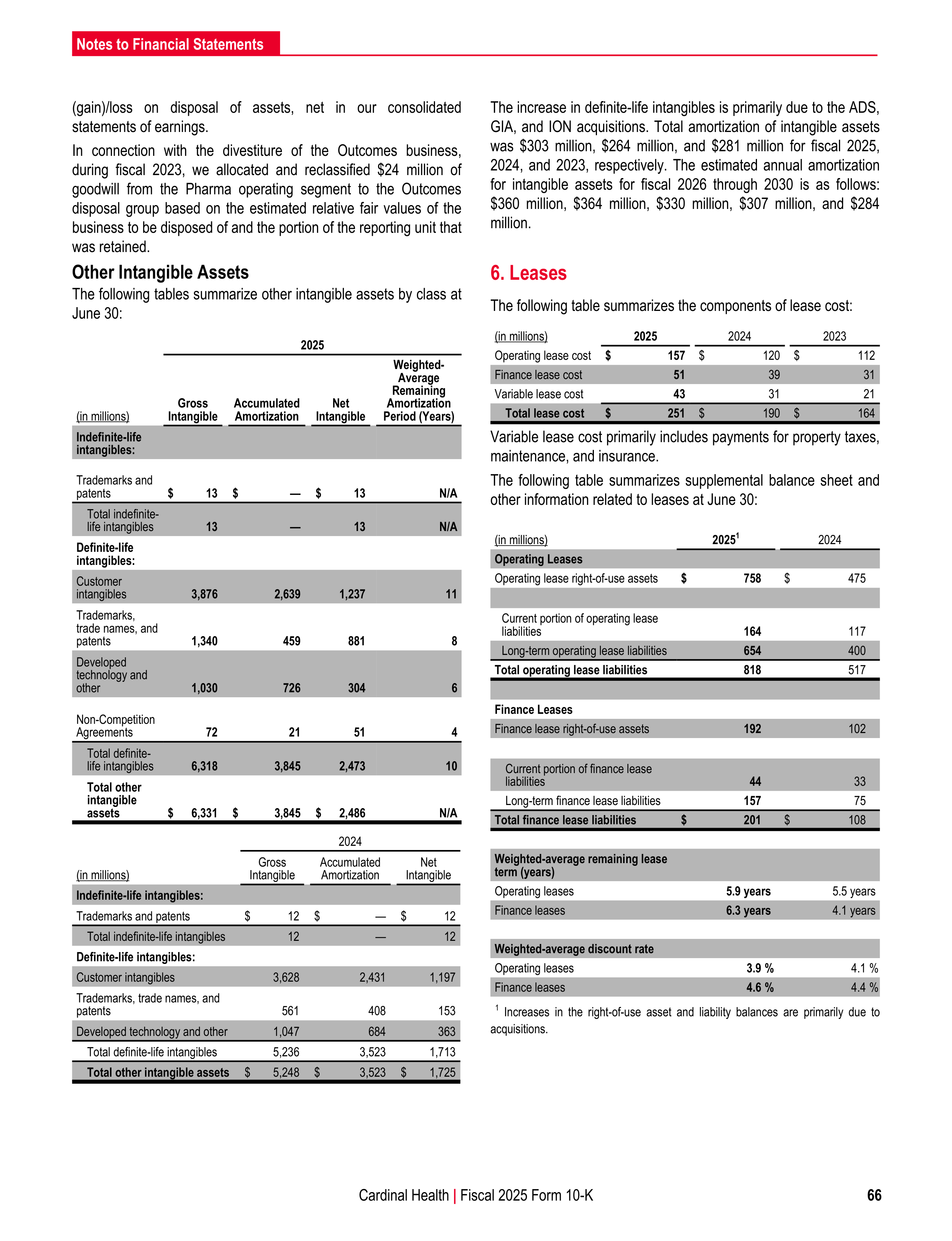
(gain)/loss on disposal of assets, net in our consolidated
statements of earnings.
In connection with the divestiture of the Outcomes business,
during fiscal 2023, we allocated and reclassified $24 million of
goodwill from the Pharma operating segment to the Outcomes
disposal group based on the estimated relative fair values of the
business to be disposed of and the portion of the reporting unit that
was retained.
Other Intangible Assets
The following tables summarize other intangible assets by class at
June 30:
2025
(in millions)
Gross
Intangible
Accumulated
Amortization
Net
Intangible
Weighted-
Average
Remaining
Amortization
Period (Years)
Indefinite-life
intangibles:
Trademarks and
patents
$
13
$
—
$
13
N/A
Total indefinite-
life intangibles
13
—
13
N/A
Definite-life
intangibles:
Customer
intangibles
3,876
2,639
1,237
11
Trademarks,
trade names, and
patents
1,340
459
881
8
Developed
technology and
other
1,030
726
304
6
Non-Competition
Agreements
72
21
51
4
Total definite-
life intangibles
6,318
3,845
2,473
10
Total other
intangible
assets
$
6,331
$
3,845
$
2,486
N/A
2024
(in millions)
Gross
Intangible
Accumulated
Amortization
Net
Intangible
Indefinite-life intangibles:
Trademarks and patents
$
12
$
—
$
12
Total indefinite-life intangibles
12
—
12
Definite-life intangibles:
Customer intangibles
3,628
2,431
1,197
Trademarks, trade names, and
patents
561
408
153
Developed technology and other
1,047
684
363
Total definite-life intangibles
5,236
3,523
1,713
Total other intangible assets
$
5,248
$
3,523
$
1,725
The increase in definite-life intangibles is primarily due to the ADS,
GIA, and ION acquisitions. Total amortization of intangible assets
was $303 million, $264 million, and $281 million for fiscal 2025,
2024, and 2023, respectively. The estimated annual amortization
for intangible assets for fiscal 2026 through 2030 is as follows:
$360 million, $364 million, $330 million, $307 million, and $284
million.
6. Leases
The following table summarizes the components of lease cost:
(in millions)
2025
2024
2023
Operating lease cost
$
157
$
120
$
112
Finance lease cost
51
39
31
Variable lease cost
43
31
21
Total lease cost
$
251
$
190
$
164
Variable lease cost primarily includes payments for property taxes,
maintenance, and insurance.
The following table summarizes supplemental balance sheet and
other information related to leases at June 30:
(in millions)
2025
1
2024
Operating Leases
Operating lease right-of-use assets
$
758
$
475
Current portion of operating lease
liabilities
164
117
Long-term operating lease liabilities
654
400
Total operating lease liabilities
818
517
Finance Leases
Finance lease right-of-use assets
192
102
Current portion of finance lease
liabilities
44
33
Long-term finance lease liabilities
157
75
Total finance lease liabilities
$
201
$
108
Weighted-average remaining lease
term (years)
Operating leases
5.9 years
5.5 years
Finance leases
6.3 years
4.1 years
Weighted-average discount rate
Operating leases
3.9 %
4.1 %
Finance leases
4.6 %
4.4 %
1
Increases in the right-of-use asset and liability balances are primarily due to
acquisitions.
Notes to Financial Statements
66
Cardinal Health
|
Fiscal 2025 Form 10-K
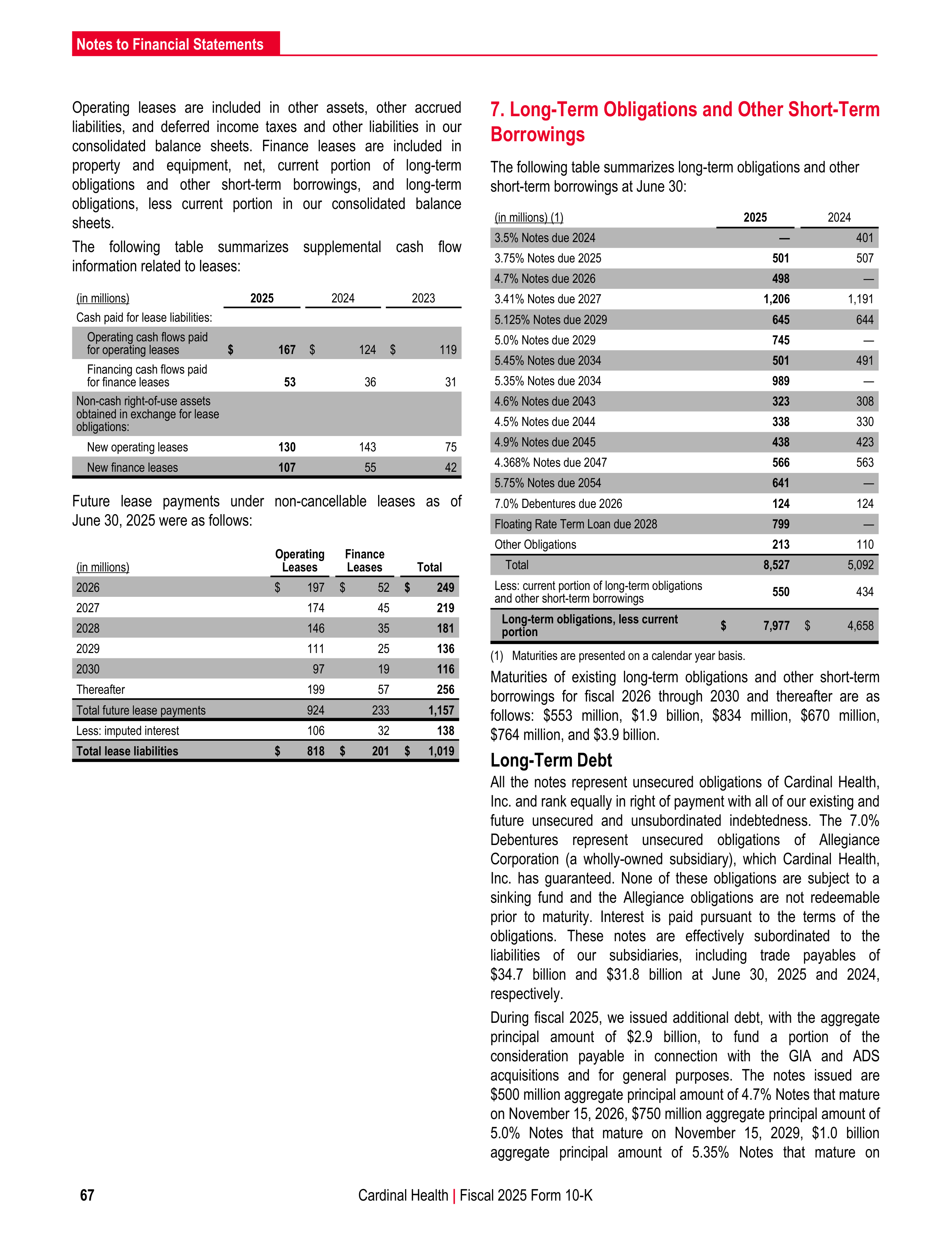
Operating leases are included in other assets, other accrued
liabilities, and deferred income taxes and other liabilities in our
consolidated balance sheets. Finance leases are included in
property and equipment, net, current portion of long-term
obligations and other short-term borrowings, and long-term
obligations, less current portion in our consolidated balance
sheets.
The following table summarizes supplemental cash flow
information related to leases:
(in millions)
2025
2024
2023
Cash paid for lease liabilities:
Operating cash flows paid
for operating leases
$
167
$
124
$
119
Financing cash flows paid
for finance leases
53
36
31
Non-cash right-of-use assets
obtained in exchange for lease
obligations:
New operating leases
130
143
75
New finance leases
107
55
42
Future lease payments under non-cancellable leases as of
June 30, 2025 were as follows:
(in millions)
Operating
Leases
Finance
Leases
Total
2026
$
197
$
52
$
249
2027
174
45
219
2028
146
35
181
2029
111
25
136
2030
97
19
116
Thereafter
199
57
256
Total future lease payments
924
233
1,157
Less: imputed interest
106
32
138
Total lease liabilities
$
818
$
201
$
1,019
7. Long-Term Obligations and Other Short-Term
Borrowings
The following table summarizes long-term obligations and other
short-term borrowings at June 30:
(in millions) (1)
2025
2024
3.5% Notes due 2024
—
401
3.75% Notes due 2025
501
507
4.7% Notes due 2026
498
—
3.41% Notes due 2027
1,206
1,191
5.125% Notes due 2029
645
644
5.0% Notes due 2029
745
—
5.45% Notes due 2034
501
491
5.35% Notes due 2034
989
—
4.6% Notes due 2043
323
308
4.5% Notes due 2044
338
330
4.9% Notes due 2045
438
423
4.368% Notes due 2047
566
563
5.75% Notes due 2054
641
—
7.0% Debentures due 2026
124
124
Floating Rate Term Loan due 2028
799
—
Other Obligations
213
110
Total
8,527
5,092
Less: current portion of long-term obligations
and other short-term borrowings
550
434
Long-term obligations, less current
portion
$
7,977
$
4,658
(1) Maturities are presented on a calendar year basis.
Maturities of existing long-term obligations and other short-term
borrowings for fiscal 2026 through 2030 and thereafter are as
follows: $553 million, $1.9 billion, $834 million, $670 million,
$764 million, and $3.9 billion.
Long-Term Debt
All the notes represent unsecured obligations of Cardinal Health,
Inc. and rank equally in right of payment with all of our existing and
future unsecured and unsubordinated indebtedness. The 7.0%
Debentures represent unsecured obligations of Allegiance
Corporation (a wholly-owned subsidiary), which Cardinal Health,
Inc. has guaranteed. None of these obligations are subject to a
sinking fund and the Allegiance obligations are not redeemable
prior to maturity. Interest is paid pursuant to the terms of the
obligations. These notes are effectively subordinated to the
liabilities of our subsidiaries, including trade payables of
$34.7 billion and $31.8 billion at June 30, 2025 and 2024,
respectively.
During fiscal 2025, we issued additional debt, with the aggregate
principal amount of $2.9 billion, to fund a portion of the
consideration payable in connection with the GIA and ADS
acquisitions and for general purposes. The notes issued are
$500 million aggregate principal amount of 4.7% Notes that mature
on November 15, 2026, $750 million aggregate principal amount of
5.0% Notes that mature on November 15, 2029, $1.0 billion
aggregate principal amount of 5.35% Notes that mature on
Notes to Financial Statements
Cardinal Health
|
Fiscal 2025 Form 10-K
67
November 15, 2034, and $650 million aggregate principal amount
of 5.75% Notes that mature on November 15, 2054. The proceeds
of the notes issued, net of discounts, premiums, and debt issuance
costs, were $2.9 billion.
During fiscal 2025, we repaid the full principal of $400 million of the
3.5% Notes due 2024 at maturity with proceeds from the debt
issuance in fiscal 2024, $200 million of which were invested in
short-term time deposits and classified as prepaid expenses and
other in our consolidated balance sheets at June 30, 2024. All
short-term time deposits related to the debt issuance in fiscal 2024
have matured.
During fiscal 2024, we issued additional debt with the aggregate
principal amount of $1.15 billion to fund the repayment of all of the
aggregate principal amount outstanding of our 3.5% Notes due
2024 and 3.079% Notes due 2024, at their respective maturities,
and for general corporate purposes. During fiscal 2024, we repaid
the full principal of $750 million of the 3.079% Notes due 2024 at
maturity. The notes issued are $650 million aggregate principal
amount of 5.125% Notes that mature on February 15, 2029 and
$500 million aggregate principal amount of 5.45% Notes that
mature on February 15, 2034. The proceeds of the notes issued,
net of discounts, premiums, and debt issuance costs were
$1.14 billion.
If we undergo a change of control, as defined in the notes, and if
the notes receive specified ratings below investment grade by
each of Standard & Poor's Ratings Services, Moody’s Investors
Services and Fitch Ratings, any holder of the notes, excluding the
debentures, can require with respect to the notes owned by such
holder, or we can offer, to repurchase the notes at 101% of the
principal amount plus accrued and unpaid interest.
Other Financing Arrangements
In addition to cash and equivalents and operating cash flow, other
sources of liquidity include a $3.0 billion commercial paper
program backed by a $2.0 billion revolving credit facility that
expires in February 2028 and a $1.0 billion 364-Day revolving
credit facility that expires in October 2025. We also have a $1.0
billion committed receivables sales facility.
On December 5, 2024, we entered into a term loan credit
agreement that, among other things, provides commitments for a
term loan facility in an aggregate amount of up to $1.0 billion. On
April 1, 2025, we closed on our acquisition of ADS and borrowed
$800 million under this term loan facility. The loan provided under
this term loan credit agreement will mature in April 2028 and
allows for prepayment, which may be accelerated pursuant to
certain conditions specified in the credit agreement. Interest rates
on borrowings will be based on prevailing interest rates,
benchmarked based on Term SOFR and subject to our credit
ratings.
In November 2024, we also obtained a commitment letter from a
financial institution for a $2.9 billion unsecured bridge term loan
facility that could have been used to complete the acquisition of
GIA. We incurred fees related to the facility, which are included in
interest expense, net. The unsecured bridge term loan facility was
never entered into and we terminated the commitment letter on
November 22, 2024.
In February 2023, we extended our $2.0 billion revolving credit
facility through February 25, 2028. In September 2022, we
renewed our committed receivables sales facility program through
Cardinal Health Funding, LLC (“CHF”) through September 30,
2025. In September 2023, Cardinal Health 23 Funding, LLC
("CH-23 Funding") was added as a seller under our committed
receivables sales facility. Each of CHF and CH-23 Funding was
organized for
the sole purpose of buying receivables and selling
undivided interests in those receivables to third-party purchasers.
Although consolidated with Cardinal Health, Inc. in accordance
with GAAP, each of CHF and CH-23 Funding is a separate legal
entity from Cardinal Health, Inc. and from our respective subsidiary
that sells receivables to CHF or CH-23 Funding, as applicable.
Each of CHF and CH-23 Funding is designed to be a special
purpose, bankruptcy-remote entity whose assets are available
solely to satisfy the claims of its respective creditors.
Our revolving credit and committed receivables sales facilities
require us to maintain a consolidated net leverage ratio of no more
than 3.75-to-1. As of June 30, 2025, we were in compliance with
this financial covenant.
At June 30, 2025 and 2024, we had no amounts outstanding under
the revolving credit facility; however, availability was reduced by
outstanding letters of credit of $1 million at both June 30, 2025 and
2024.
During fiscal 2025, we had a daily maximum amount outstanding
under our commercial paper and committed receivables programs
of $633 million.
We had no amounts outstanding as of June 30, 2025 under the
committed receivables sales facility program; however, availability
was reduced by outstanding standby letters of credit of $31 million
at both June 30, 2025 and 2024.
We had no amounts outstanding under the commercial paper
program as of June 30, 2025 and 2024.
The $213 million and $110 million balance of other obligations at
June 30, 2025 and 2024, respectively, consisted of finance leases
and short-term borrowings.
Notes to Financial Statements
68
Cardinal Health
|
Fiscal 2025 Form 10-K
8. Commitments, Contingent Liabilities, and
Litigation
Commitments
Generic Sourcing Venture with CVS Health
In July 2014, we established Red Oak Sourcing, LLC ("Red Oak
Sourcing"), a U.S.-based generic pharmaceutical sourcing venture
with CVS Health for an initial term of 10 years. Red Oak Sourcing
negotiates generic pharmaceutical supply contracts on behalf of its
participants. In August 2021, we amended our agreement to
extend the term through June 2029. We are required to make
quarterly payments to CVS Health for the term of the arrangement.
Contingencies
New York Opioid Stewardship Act
In 2018, the State of New York adopted the Opioid Stewardship
Act (the "OSA"), which created an aggregate $100 million annual
assessment on all manufacturers and distributors that was
assessed based on each manufacturer or distributor's share of the
total morphine milligram equivalents sold or distributed in New
York, the applicability of which was ultimately limited to two years
(2017 and 2018).
Since fiscal 2021, we have made certain payments to New York
State for our portion of the assessment. However, we, and other
distributors, challenged the OSA as unconstitutional. In May 2024,
the New York Appellate Division held that the 2017 assessment
was unconstitutionally retroactive, directing a refund of
assessments paid for calendar year 2017, but upheld the 2018
assessment. In fiscal 2025, both parties agreed to a settlement
which will result in a refund of the portion we paid for calendar year
2017. The refund will be recognized upon receipt of the settlement.
Legal Proceedings
We become involved from time to time in disputes, litigation, and
regulatory matters.
From time to time, we determine that products we distribute,
source, manufacture, or market do not meet our specifications,
regulatory requirements, or published standards. When we or a
regulatory agency identify a potential quality or regulatory issue,
we investigate and take appropriate corrective action. Such actions
have led to product recalls, costs to repair or replace affected
products, temporary interruptions in product sales, restrictions on
importation, product liability claims and lawsuits, and can lead to
action by regulators. Even absent an identified regulatory or quality
issue or product recall, we can become subject to product liability
claims and lawsuits.
From time to time, we become aware through employees, internal
audits, or other parties of possible compliance matters, such as
complaints or concerns relating to accounting, internal accounting
controls, financial reporting, auditing, or other ethical matters or
relating to compliance with laws such as healthcare fraud and
abuse, anti-corruption, or anti-bribery laws. When we become
aware of such possible compliance matters, we investigate
internally and take appropriate corrective action. In addition, from
time to time, we receive subpoenas or requests for information
from various federal or state agencies relating to our business or to
the business of a customer, supplier, or other industry participants.
Internal investigations, subpoenas, or requests for information
could directly or indirectly lead to the assertion of claims or the
commencement of legal proceedings against us or result in
sanctions.
We have been named from time to time in qui tam actions initiated
by private third parties. In such actions, the private parties purport
to act on behalf of federal or state governments, allege that false
claims have been submitted for payment by the government and
may receive an award if their claims are successful. After a private
party has filed a qui tam action, the government must investigate
the private party's claim and determine whether to intervene in and
take control over the litigation. These actions may remain under
seal while the government makes this determination. If the
government declines to intervene, the private party may
nonetheless attempt to continue to pursue the litigation on his or
her own purporting to act on behalf of the government.
We accrue for contingencies related to disputes, litigation, and
regulatory matters if it is probable that a liability has been incurred
and the amount of the loss can be reasonably estimated. Because
these matters are inherently unpredictable and unfavorable
developments or resolutions can occur, assessing contingencies is
highly subjective and requires judgments about future events. We
regularly review contingencies to determine whether our accruals
and related disclosures are adequate. The amount of ultimate loss
may differ from these estimates.
We recognize income from the favorable outcome of litigation
when we receive the associated cash or assets.
We recognize estimated loss contingencies for certain litigation
and regulatory matters and income from favorable resolution of
litigation in litigation (recoveries)/charges, net in our consolidated
statements of earnings; however, losses and recoveries of lost
profits from disputes that occur in the ordinary course of business
are included within segment profit.
Because loss contingencies are inherently unpredictable and
unfavorable developments or resolutions can occur, the
assessment is highly subjective and requires judgments about
future events. We regularly review litigation matters to determine
whether an accrual is appropriate or, where applicable, whether
our accrual is adequate. The amount of ultimate loss may differ
materially from amounts accrued, whether as a result of settlement
discussions, a judicial decision or verdict, or otherwise. Unless
otherwise disclosed, we are not able to estimate a range of
reasonably possible losses, or additional losses for these matters.
Opioid Lawsuits and Investigations
As of June 30, 2025, we have $4.9 billion accrued for the opioid-
related matters described below, of which $628 million is included
in other accrued liabilities and the remainder is included in
deferred income taxes and other liabilities in our consolidated
balance sheets. During fiscal 2025, we made payments totaling
$798 million, which included our fourth annual payment under the
agreement to settle the vast majority of the opioid lawsuits filed by
states and local governmental entities and payments related to the
Notes to Financial Statements
Cardinal Health
|
Fiscal 2025 Form 10-K
69
settlement agreements with the City of Baltimore and classes of
third-party payors and acute care hospitals.
During fiscal 2025, there were no material expenses recognized
for these matters. During fiscal 2024, we recognized expense of
$340 million in connection with opioid-related matters, including
agreements to settle claims brought by classes of third-party
payors and acute care hospitals, and settlements with the City of
Baltimore and the State of Alabama. This expense was partially
offset by a benefit of $105 million related to prepayments at a
prenegotiated discount of certain future payments totaling
$344 million.
States & Political Subdivisions
In April 2022, we along with two other national distributors
(collectively, the "Distributors"), without admitting liability or
wrongdoing, became parties to the NOSA to settle the vast
majority lawsuits and claims brought by states and political
subdivisions related to the distribution of opioid pain medications.
In addition to the Distributors, parties to the NOSA include 48
states, the District of Columbia, and 5 U.S. territories. The NOSA
also resulted in the resolution of the opioid-related claims of over
99 percent of political subdivisions in settling states (together with
settling states and territories, the “Settling Governmental Entities").
Through July 2025, we have paid the Settling Governmental
Entities approximately $2.2 billion and we expect to pay Settling
Governmental Entities additional amounts up to $4.1 billion
through 2038. As required under the NOSA, a monitor is
overseeing compliance with the Injunctive Relief provisions of the
NOSA until 2027 and the distributors have engaged a third-party
vendor to act as a clearinghouse for data aggregation and
reporting, which distributors will fund until 2032.
During fiscal 2024, we recognized a $22 million charge in litigation
(recoveries)/charge, net in the consolidated statements of earnings
related to agreements with the Alabama Attorney General to pay
approximately $123 million to the State of Alabama over a period
of ten years and with the City of Baltimore to resolve their opioid-
related claims for approximately $153 million.
West Virginia subdivisions and Native American tribes were not a
part of the NOSA. In July 2022, a judgment in favor of the
Distributors was entered in bench trial before a federal judge in
West Virginia in a case brought by Cabell County and City of
Huntington Plaintiffs have appealed this decision to the Fourth
Circuit Court of Appeals. In July 2022, we entered into separate
agreements to settle the opioid-related claims of the majority of
remaining West Virginia subdivisions and Native American Tribes
for approximately $124 million over eleven years and $136 million
over five years, respectively.
We have now resolved the opioid-related claims of all 50 states
and the District of Columbia.
Private Plaintiffs
The NOSA does not address claims by private parties, which
includes unions and other health and welfare funds, hospital
systems and other healthcare providers, businesses, and
individuals alleging personal injury. There were approximately 291
lawsuits brought by private plaintiffs pending as of August 8, 2025.
Of these, approximately 11 are purported class actions. The
causes of action asserted by these plaintiffs are similar to those
asserted by public plaintiffs. We are vigorously defending
ourselves in all these matters.
Following resolution discussions with certain private plaintiffs
during the six months ended December 31, 2024, Distributors
finalized agreements with classes of third-party payors and acute
care hospitals. Our portion of these settlements totaled
$213 million. The settlement with the class of third-party payors
was approved by the court in January 2025 and was finalized in
August 2025. The settlement with the class of acute care hospitals
was approved by the court in March 2025 and became final in April
2025.
Insurance Litigation
We are involved in ongoing legal proceedings with insurers related
to their obligations to reimburse us for defense and indemnity
costs in connection with the lawsuits described above. We
received insurance recoveries related to these matters of
$25 million and $34 million during fiscal 2025 and 2024,
respectively. $12 million of the recoveries from our insurers in
fiscal 2025 were recorded in the Pharma segment. We have not
recorded a receivable for any additional recoveries related to these
insurance litigation matters as of June 30, 2025.
Department of Justice Civil Investigative Demand
In November 2023, we received a Civil Investigative Demand
("CID") from the Department of Justice focused on potential
violations of the Anti-Kickback Statute and False Claims Act in
connection with a 2022 transaction in which we purchased a
minority ownership interest in a rheumatology managed services
organization and a group purchasing organization. We are
cooperating with this investigation.
Cordis IVC Filter Matters
We have been named as a defendant in product liability lawsuits
involving claims by plaintiffs that allege personal injuries
associated with the use of IVC filter products. These lawsuits
sought a variety of remedies, including unspecified monetary
damages. The divestiture of the Cordis business did not include
product liability related to the IVC filters in the U.S. and Canada,
which we retained.
In April 2023, we executed a settlement agreement that, if certain
conditions are satisfied, will resolve approximately 4,375 claims for
$275 million. Between May and September 2023, we made
settlement payments totaling $275 million into a qualified
settlement fund. During the three months ended December 31,
2024, the minimum required sign-on threshold was met, and
beginning in January 2025, payments to qualified implantees were
being made out of the qualified settlement fund. We expect
continued payments out of the qualified settlement fund as
additional plaintiffs meet the procedural requirements.
Notes to Financial Statements
70
Cardinal Health
|
Fiscal 2025 Form 10-K
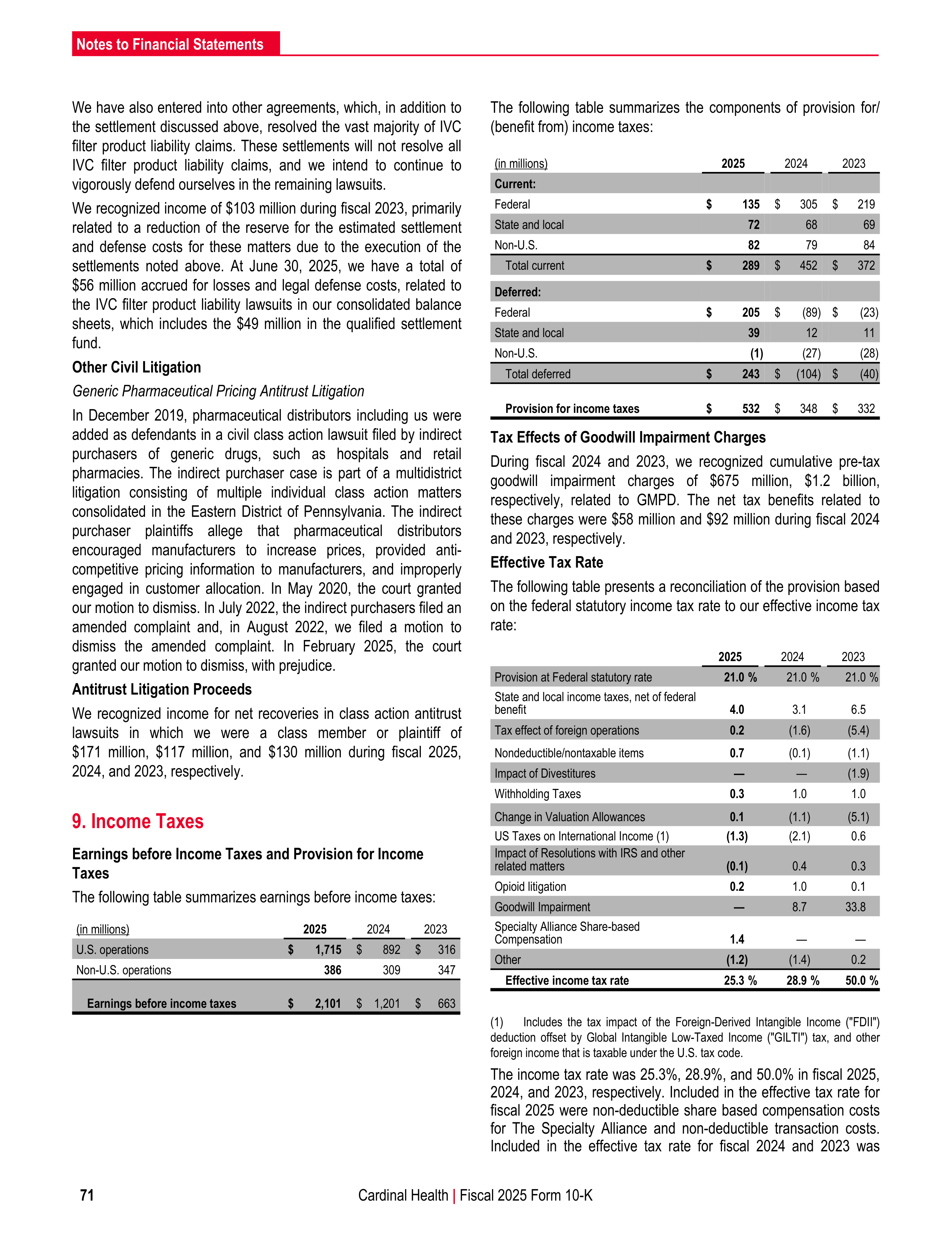
We have also entered into other agreements, which, in addition to
the settlement discussed above, resolved the vast majority of IVC
filter product liability claims. These settlements will not resolve all
IVC filter product liability claims, and we intend to continue to
vigorously defend ourselves in the remaining lawsuits.
We recognized income of $103 million during fiscal 2023, primarily
related to a reduction of the reserve for the estimated settlement
and defense costs for these matters due to the execution of the
settlements noted above. At June 30, 2025, we have a total of
$56 million accrued for losses and legal defense costs, related to
the IVC filter product liability lawsuits in our consolidated balance
sheets, which includes the $49 million in the qualified settlement
fund.
Other Civil Litigation
Generic Pharmaceutical Pricing Antitrust Litigation
In December 2019, pharmaceutical distributors including us were
added as defendants in a civil class action lawsuit filed by indirect
purchasers of generic drugs, such as hospitals and retail
pharmacies. The indirect purchaser case is part of a multidistrict
litigation consisting of multiple individual class action matters
consolidated in the Eastern District of Pennsylvania. The indirect
purchaser plaintiffs allege that pharmaceutical distributors
encouraged manufacturers to increase prices, provided anti-
competitive pricing information to manufacturers, and improperly
engaged in customer allocation. In May 2020, the court granted
our motion to dismiss. In July 2022, the indirect purchasers filed an
amended complaint and, in August 2022, we filed a motion to
dismiss the amended complaint. In February 2025, the court
granted our motion to dismiss, with prejudice.
Antitrust Litigation Proceeds
We recognized income for net recoveries in class action antitrust
lawsuits in which we were a class member or plaintiff of
$171 million, $117 million, and
$130 million during fiscal 2025,
2024, and 2023, respectively.
9. Income Taxes
Earnings before Income Taxes and Provision for Income
Taxes
The following table summarizes earnings before income taxes:
(in millions)
2025
2024
2023
U.S. operations
$
1,715
$
892
$
316
Non-U.S. operations
386
309
347
Earnings before income taxes
$
2,101
$ 1,201
$
663
The following table summarizes the components of provision for/
(benefit from) income taxes:
(in millions)
2025
2024
2023
Current:
Federal
$
135
$
305
$
219
State and local
72
68
69
Non-U.S.
82
79
84
Total current
$
289
$
452
$
372
Deferred:
Federal
$
205
$
(89) $
(23)
State and local
39
12
11
Non-U.S.
(1)
(27)
(28)
Total deferred
$
243
$
(104) $
(40)
Provision for income taxes
$
532
$
348
$
332
Tax Effects of Goodwill Impairment Charges
During fiscal 2024 and 2023, we recognized cumulative pre-tax
goodwill impairment charges of $675 million, $1.2 billion,
respectively, related to GMPD. The net tax benefits related to
these charges were $58 million and $92 million during fiscal 2024
and 2023, respectively.
Effective Tax Rate
The following table presents a reconciliation of the provision based
on the federal statutory income tax rate to our effective income tax
rate:
2025
2024
2023
Provision at Federal statutory rate
21.0 %
21.0 %
21.0 %
State and local income taxes, net of federal
benefit
4.0
3.1
6.5
Tax effect of foreign operations
0.2
(1.6)
(5.4)
Nondeductible/nontaxable items
0.7
(0.1)
(1.1)
Impact of Divestitures
—
—
(1.9)
Withholding Taxes
0.3
1.0
1.0
Change in Valuation Allowances
0.1
(1.1)
(5.1)
US Taxes on International Income (1)
(1.3)
(2.1)
0.6
Impact of Resolutions with IRS and other
related matters
(0.1)
0.4
0.3
Opioid litigation
0.2
1.0
0.1
Goodwill Impairment
—
8.7
33.8
Specialty Alliance Share-based
Compensation
1.4
—
—
Other
(1.2)
(1.4)
0.2
Effective income tax rate
25.3 %
28.9 %
50.0 %
(1) Includes the tax impact of the Foreign-Derived Intangible Income ("FDII")
deduction offset by Global Intangible Low-Taxed Income ("GILTI") tax, and other
foreign income that is taxable under the U.S. tax code.
The income tax rate was 25.3%, 28.9%, and 50.0% in fiscal 2025,
2024, and 2023, respectively. Included in the effective tax rate for
fiscal 2025 were non-deductible share based compensation costs
for The Specialty Alliance and non-deductible transaction costs.
Included in the effective tax rate for fiscal 2024 and 2023 was
Notes to Financial Statements
Cardinal Health
|
Fiscal 2025 Form 10-K
71
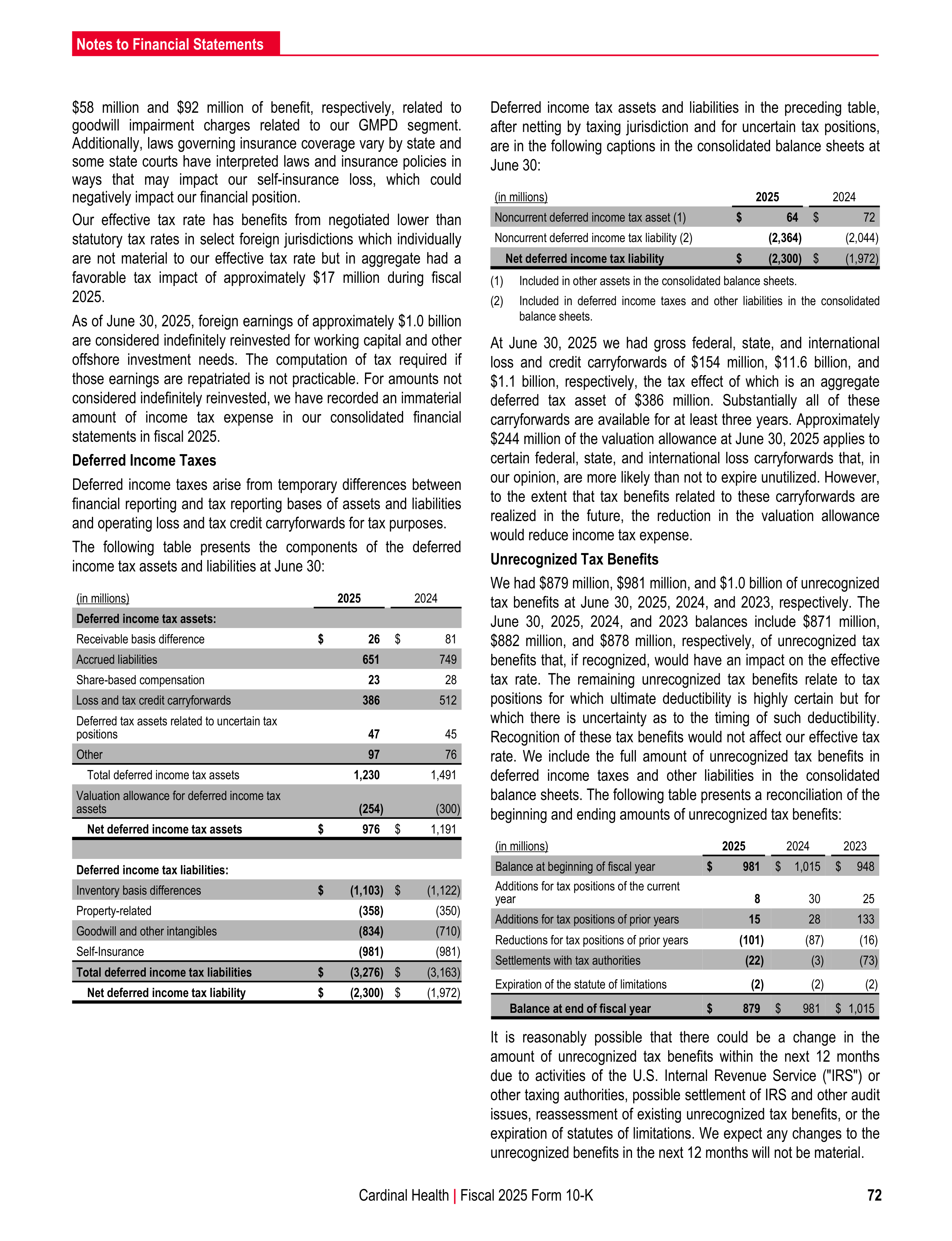
$58 million and $92 million of benefit, respectively, related to
goodwill impairment charges related to our GMPD segment.
Additionally, laws governing insurance coverage vary by state and
some state courts have interpreted laws and insurance policies in
ways that may impact our self-insurance loss, which could
negatively impact our financial position.
Our effective tax rate has benefits from negotiated lower than
statutory tax rates in select foreign jurisdictions which individually
are not material to our effective tax rate but in aggregate had a
favorable tax impact of approximately $17 million during fiscal
2025.
As of June 30, 2025, foreign earnings of approximately $1.0 billion
are considered indefinitely reinvested for working capital and other
offshore investment needs. The computation of tax required if
those earnings are repatriated is not practicable. For amounts not
considered indefinitely reinvested, we have recorded an immaterial
amount of income tax expense in our consolidated financial
statements in fiscal 2025.
Deferred Income Taxes
Deferred income taxes arise from temporary differences between
financial reporting and tax reporting bases of assets and liabilities
and operating loss and tax credit carryforwards for tax purposes.
The following table presents the components of the deferred
income tax assets and liabilities at June 30:
(in millions)
2025
2024
Deferred income tax assets:
Receivable basis difference
$
26
$
81
Accrued liabilities
651
749
Share-based compensation
23
28
Loss and tax credit carryforwards
386
512
Deferred tax assets related to uncertain tax
positions
47
45
Other
97
76
Total deferred income tax assets
1,230
1,491
Valuation allowance for deferred income tax
assets
(254)
(300)
Net deferred income tax assets
$
976
$
1,191
Deferred income tax liabilities:
Inventory basis differences
$
(1,103)
$
(1,122)
Property-related
(358)
(350)
Goodwill and other intangibles
(834)
(710)
Self-Insurance
(981)
(981)
Total deferred income tax liabilities
$
(3,276)
$
(3,163)
Net deferred income tax liability
$
(2,300)
$
(1,972)
Deferred income tax assets and liabilities in the preceding table,
after netting by taxing jurisdiction and for uncertain tax positions,
are in the following captions in the consolidated balance sheets at
June 30:
(in millions)
2025
2024
Noncurrent deferred income tax asset (1)
$
64
$
72
Noncurrent deferred income tax liability (2)
(2,364)
(2,044)
Net deferred income tax liability
$
(2,300)
$
(1,972)
(1)
Included in other assets in the consolidated balance sheets.
(2)
Included in deferred income taxes and other liabilities in the consolidated
balance sheets.
At June 30, 2025 we had gross federal, state, and international
loss and credit carryforwards of $154 million, $11.6 billion, and
$1.1 billion, respectively, the tax effect of which is an aggregate
deferred tax asset of $386 million. Substantially all of these
carryforwards are available for at least three years. Approximately
$244 million of the valuation allowance at June 30, 2025 applies to
certain federal, state, and international loss carryforwards that, in
our opinion, are more likely than not to expire unutilized. However,
to the extent that tax benefits related
to these carryforwards are
realized in the future, the reduction in the valuation allowance
would reduce income tax expense.
Unrecognized Tax Benefits
We had $879 million, $981 million, and $1.0 billion of unrecognized
tax benefits at June 30, 2025, 2024, and 2023, respectively. The
June 30, 2025, 2024, and 2023 balances include $871 million,
$882 million, and $878 million, respectively, of unrecognized tax
benefits that, if recognized, would have an impact on the effective
tax rate. The remaining unrecognized tax benefits relate to tax
positions for which ultimate deductibility is highly certain but for
which there is uncertainty as to the timing of such deductibility.
Recognition of these tax benefits would not affect our effective tax
rate. We include the full amount of unrecognized tax benefits in
deferred income taxes and other liabilities in the consolidated
balance sheets. The following table presents a reconciliation of the
beginning and ending amounts of unrecognized tax benefits:
(in millions)
2025
2024
2023
Balance at beginning of fiscal year
$
981
$ 1,015
$
948
Additions for tax positions of the current
year
8
30
25
Additions for tax positions of prior years
15
28
133
Reductions for tax positions of prior years
(101)
(87)
(16)
Settlements with tax authorities
(22)
(3)
(73)
Expiration of the statute of limitations
(2)
(2)
(2)
Balance at end of fiscal year
$
879
$
981
$ 1,015
It is reasonably possible that there could be a change in the
amount of unrecognized tax benefits within the next 12 months
due to activities of the U.S. Internal Revenue Service ("IRS") or
other taxing authorities, possible settlement of IRS and other audit
issues, reassessment of existing unrecognized tax benefits, or the
expiration of statutes of limitations. We expect any changes to the
unrecognized benefits in the next 12 months will not be material.
Notes to Financial Statements
72
Cardinal Health
|
Fiscal 2025 Form 10-K
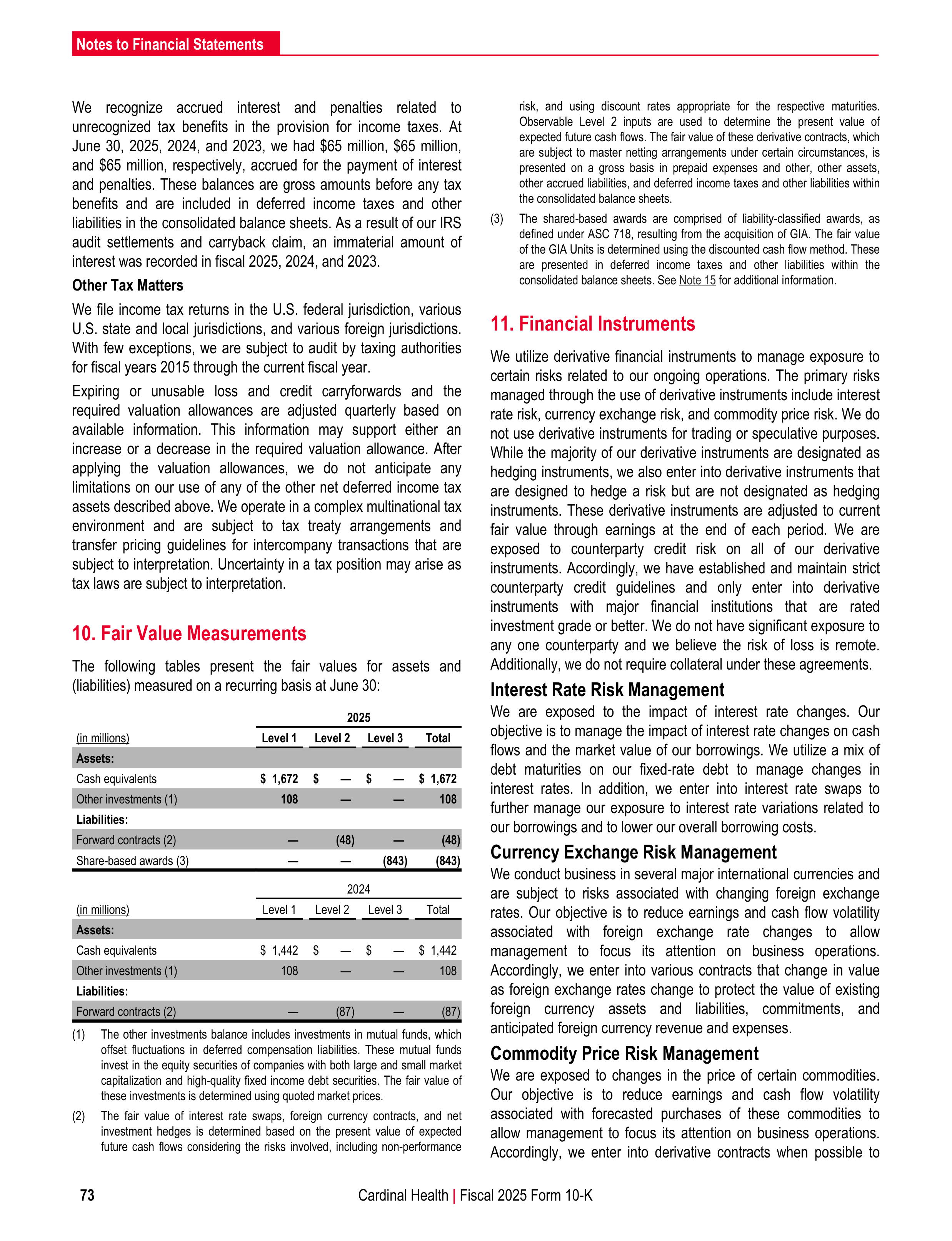
We recognize accrued interest and penalties related to
unrecognized tax benefits in the provision for income taxes. At
June 30, 2025, 2024, and 2023, we had $65 million, $65 million,
and $65 million, respectively, accrued for the payment of interest
and penalties. These balances are gross amounts before any tax
benefits and are included in deferred income taxes and other
liabilities in the consolidated balance sheets. As a result of our IRS
audit settlements and carryback claim, an immaterial amount of
interest was recorded in fiscal 2025, 2024, and 2023.
Other Tax Matters
We file income tax returns in the U.S. federal jurisdiction, various
U.S. state and local jurisdictions, and various foreign jurisdictions.
With few exceptions, we are subject to audit by taxing authorities
for fiscal years 2015 through the current fiscal year.
Expiring or unusable loss and credit carryforwards and the
required valuation allowances are adjusted quarterly based on
available information. This information may support either an
increase or a decrease in the required valuation allowance. After
applying the valuation allowances, we do not anticipate any
limitations on our use of any of the other net deferred income tax
assets described above. We operate in a complex multinational tax
environment and are subject to tax treaty arrangements and
transfer pricing guidelines for intercompany transactions that are
subject to interpretation. Uncertainty in a tax position may arise as
tax laws are subject to interpretation.
10. Fair Value Measurements
The following tables present the fair values for assets and
(liabilities) measured on a recurring basis at June 30:
2025
(in millions)
Level 1
Level 2
Level 3
Total
Assets:
Cash equivalents
$ 1,672
$
—
$
—
$ 1,672
Other investments (1)
108
—
—
108
Liabilities:
Forward contracts (2)
—
(48)
—
(48)
Share-based awards (3)
—
—
(843)
(843)
2024
(in millions)
Level 1
Level 2
Level 3
Total
Assets:
Cash equivalents
$ 1,442
$
—
$
—
$ 1,442
Other investments (1)
108
—
—
108
Liabilities:
Forward contracts (2)
—
(87)
—
(87)
(1)
The other investments balance includes investments in mutual funds, which
offset fluctuations in deferred compensation liabilities. These mutual funds
invest in the equity securities of companies with both large and small market
capitalization and high-quality fixed income debt securities. The fair value of
these investments is determined using quoted market prices.
(2)
The fair value of interest rate swaps, foreign currency contracts, and net
investment hedges is determined based on the present value of expected
future cash flows considering the risks involved, including non-performance
risk, and using discount rates appropriate for the respective maturities.
Observable Level 2 inputs are used to determine the present value of
expected future cash flows. The fair value of these derivative contracts, which
are subject to master netting arrangements under certain circumstances, is
presented on a gross basis in prepaid expenses and other, other assets,
other accrued liabilities, and deferred income taxes and other liabilities within
the consolidated balance sheets.
(3)
The shared-based awards are comprised of liability-classified awards, as
defined under ASC 718, resulting from the acquisition of GIA. The fair value
of the GIA Units is determined using the discounted cash flow method. These
are presented in deferred income taxes and other liabilities within the
consolidated balance sheets. See
Note 15
for additional information.
11. Financial Instruments
We utilize derivative financial instruments to manage exposure to
certain risks related to our ongoing operations. The primary risks
managed through the use of derivative instruments include interest
rate risk, currency exchange risk, and commodity price risk. We do
not use derivative instruments for trading or speculative purposes.
While the majority of our derivative instruments are designated as
hedging instruments, we also enter into derivative instruments that
are designed to hedge a risk but are not designated as hedging
instruments. These derivative instruments are adjusted to current
fair value through earnings at the end of each period. We are
exposed to counterparty credit risk on all of our derivative
instruments. Accordingly, we have established and maintain strict
counterparty credit guidelines and only enter into derivative
instruments with major financial institutions that are rated
investment grade or better. We do not have significant exposure to
any one counterparty and we believe the risk of loss is remote.
Additionally, we do not require collateral under these agreements.
Interest Rate Risk Management
We are exposed to the impact of interest rate changes. Our
objective is to manage the impact of interest rate changes on cash
flows and the market value of our borrowings. We utilize a mix of
debt maturities on our fixed-rate debt to manage changes in
interest rates. In addition, we enter into interest rate swaps to
further manage our exposure to interest rate variations related to
our borrowings and to lower our overall borrowing costs.
Currency Exchange Risk Management
We conduct business in several major international currencies and
are subject to risks associated with changing foreign exchange
rates. Our objective is to reduce earnings and cash flow volatility
associated with foreign exchange rate changes to allow
management to focus its attention on business operations.
Accordingly, we enter into various contracts that change in value
as foreign exchange rates change to protect the value of existing
foreign currency assets and liabilities, commitments, and
anticipated foreign currency revenue and expenses.
Commodity Price Risk Management
We are exposed to changes in the price of certain commodities.
Our objective is to reduce earnings and cash flow volatility
associated with forecasted purchases of these commodities to
allow management to focus its attention on business operations.
Accordingly, we enter into derivative contracts when possible to
Notes to Financial Statements
Cardinal Health
|
Fiscal 2025 Form 10-K
73
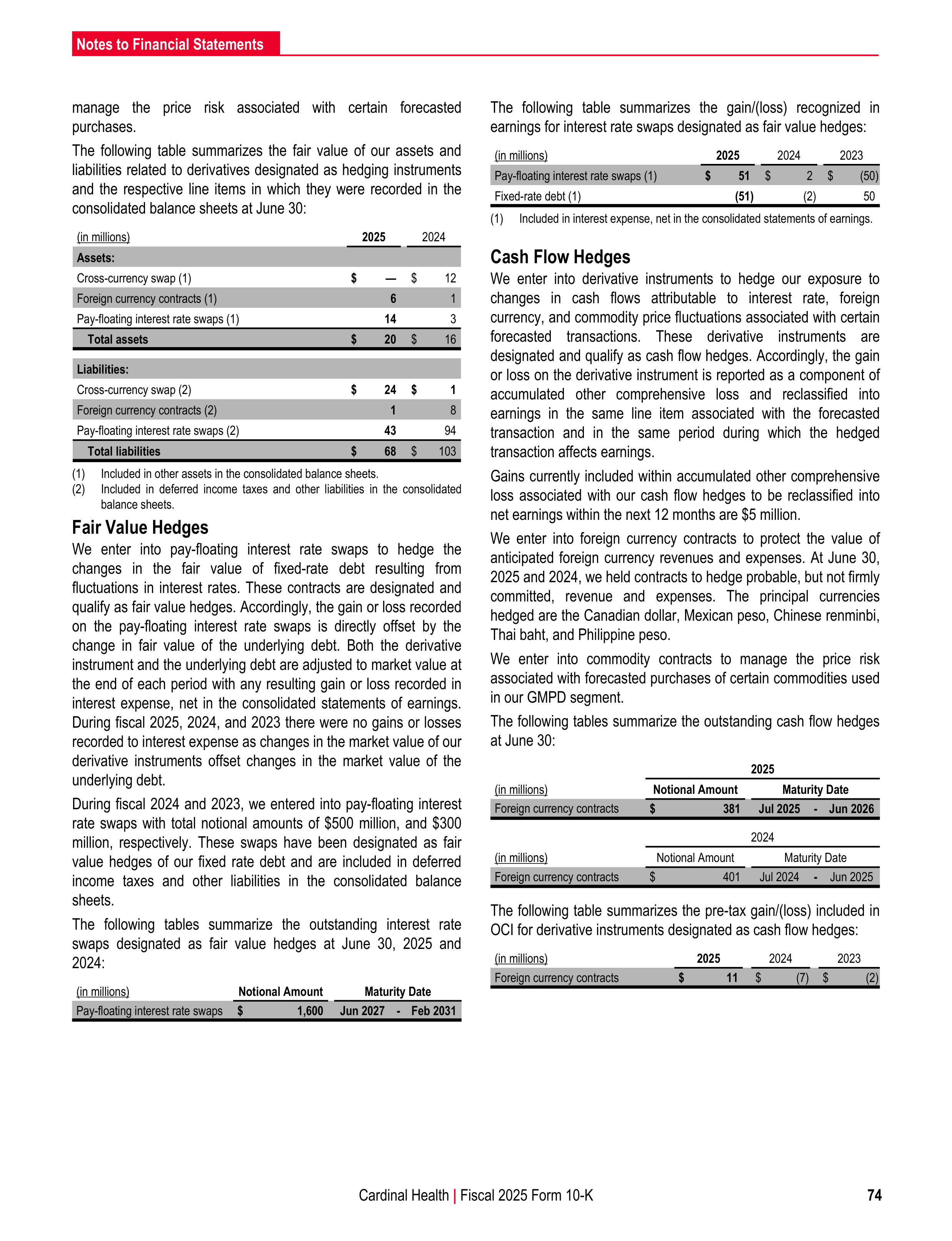
manage the price risk associated with certain forecasted
purchases.
The following table summarizes the fair value of our assets and
liabilities related to derivatives designated as hedging instruments
and the respective line items in which they were recorded in the
consolidated balance sheets at June 30:
(in millions)
2025
2024
Assets:
Cross-currency swap (1)
$
—
$
12
Foreign currency contracts (1)
6
1
Pay-floating interest rate swaps (1)
14
3
Total assets
$
20
$
16
Liabilities:
Cross-currency swap (2)
$
24
$
1
Foreign currency contracts (2)
1
8
Pay-floating interest rate swaps (2)
43
94
Total liabilities
$
68
$
103
(1)
Included in other assets in the consolidated balance sheets.
(2)
Included in deferred income taxes and other liabilities in the consolidated
balance sheets.
Fair Value Hedges
We enter into pay-floating interest rate swaps to hedge the
changes in the fair value of fixed-rate debt resulting from
fluctuations in interest rates. These contracts are designated and
qualify as fair value hedges. Accordingly, the gain or loss recorded
on the pay-floating interest rate swaps is directly offset by the
change in fair value of the underlying debt. Both the derivative
instrument and the underlying debt are adjusted to market value at
the end of each period with any resulting gain or loss recorded in
interest expense, net in the consolidated statements of earnings.
During fiscal 2025, 2024, and 2023 there were no gains or losses
recorded to interest expense as changes in the market value of our
derivative instruments offset changes in the market value of the
underlying debt.
During fiscal 2024 and 2023, we entered into pay-floating interest
rate swaps with total notional amounts of $500 million, and $300
million, respectively. These swaps have been designated as fair
value hedges of our fixed rate debt and are included in deferred
income taxes and other liabilities in the consolidated balance
sheets.
The following tables summarize the outstanding interest rate
swaps designated as fair value hedges at June 30, 2025 and
2024:
(in millions)
Notional Amount
Maturity Date
Pay-floating interest rate swaps
$
1,600
Jun 2027
-
Feb 2031
The following table summarizes the gain/(loss) recognized in
earnings for interest rate swaps designated as fair value hedges:
(in millions)
2025
2024
2023
Pay-floating interest rate swaps (1)
$
51
$
2
$
(50)
Fixed-rate debt (1)
(51)
(2)
50
(1) Included in interest expense, net in the consolidated statements of earnings.
Cash Flow Hedges
We enter into derivative instruments to hedge our exposure to
changes in cash flows attributable to interest rate, foreign
currency, and commodity price fluctuations associated with certain
forecasted transactions. These derivative instruments are
designated and qualify as cash flow hedges. Accordingly, the gain
or loss on the derivative instrument is reported as a component of
accumulated other comprehensive loss and reclassified into
earnings in the same line item associated with the forecasted
transaction and in the same period during which the hedged
transaction affects earnings.
Gains currently included within accumulated other comprehensive
loss associated with our cash flow hedges to be reclassified into
net earnings within the next 12 months are $5 million.
We enter into foreign currency contracts to protect the value of
anticipated foreign currency revenues and expenses. At June 30,
2025 and 2024, we held contracts to hedge probable, but not firmly
committed, revenue and expenses. The principal currencies
hedged are the Canadian dollar, Mexican peso, Chinese renminbi,
Thai baht, and Philippine peso.
We enter into commodity contracts to manage the price risk
associated with forecasted purchases of certain commodities used
in our GMPD segment.
The following tables summarize the outstanding cash flow hedges
at June 30:
2025
(in millions)
Notional Amount
Maturity Date
Foreign currency contracts
$
381
Jul 2025
-
Jun 2026
2024
(in millions)
Notional Amount
Maturity Date
Foreign currency contracts
$
401
Jul 2024
-
Jun 2025
The following table summarizes the pre-tax gain/(loss) included in
OCI for derivative instruments designated as cash flow hedges:
(in millions)
2025
2024
2023
Foreign currency contracts
$
11
$
(7)
$
(2)
Notes to Financial Statements
74
Cardinal Health
|
Fiscal 2025 Form 10-K
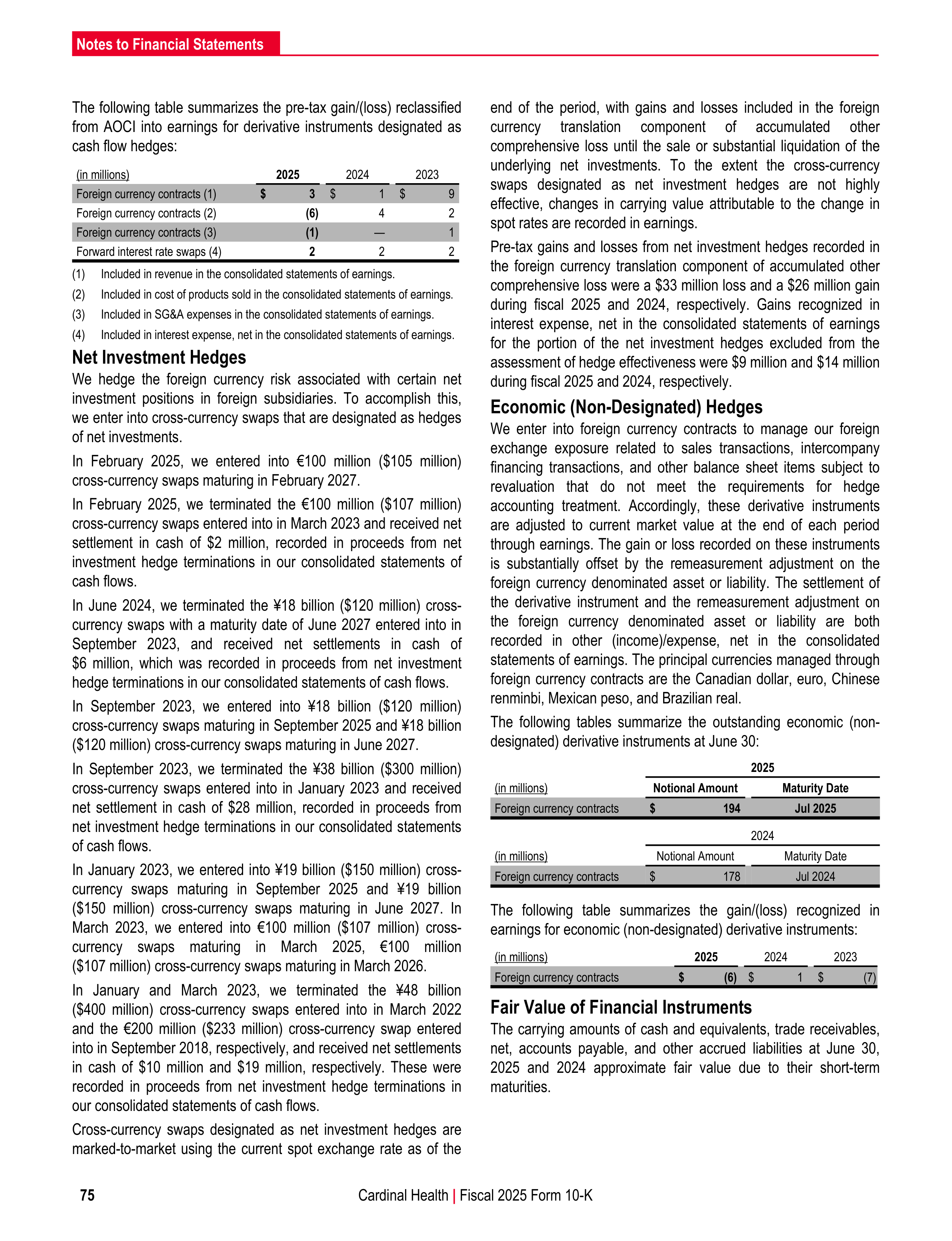
The following table summarizes the pre-tax gain/(loss) reclassified
from AOCI into earnings for derivative instruments designated as
cash flow hedges:
(in millions)
2025
2024
2023
Foreign currency contracts (1)
$
3
$
1
$
9
Foreign currency contracts (2)
(6)
4
2
Foreign currency contracts (3)
(1)
—
1
Forward interest rate swaps (4)
2
2
2
(1)
Included in revenue in the consolidated statements of earnings.
(2)
Included in cost of products sold in the consolidated statements of earnings.
(3)
Included in SG&A expenses in the consolidated statements of earnings.
(4)
Included in interest expense, net in the consolidated statements of earnings.
Net Investment Hedges
We hedge the foreign currency risk associated with certain net
investment positions in foreign subsidiaries. To accomplish this,
we enter into cross-currency swaps that are designated as hedges
of net investments.
In February 2025, we entered into €100 million ($105 million)
cross-currency swaps maturing in February 2027.
In February 2025, we terminated the €100 million ($107 million)
cross-currency swaps entered into in March 2023 and received net
settlement in cash of $2 million, recorded in proceeds from net
investment hedge terminations in our consolidated statements of
cash flows.
In June 2024, we terminated the ¥18 billion ($120 million) cross-
currency swaps with a maturity date of June 2027 entered into in
September 2023, and received net settlements in cash of
$6 million, which was recorded in proceeds from net investment
hedge terminations in our consolidated statements of cash flows.
In September 2023, we entered into ¥18 billion ($120 million)
cross-currency swaps maturing in September 2025 and ¥18 billion
($120 million) cross-currency swaps maturing in June 2027.
In September 2023, we terminated the ¥38 billion ($300 million)
cross-currency swaps entered into in January 2023 and received
net settlement in cash of $28 million, recorded in proceeds from
net investment hedge terminations in our consolidated statements
of cash flows.
In January 2023, we entered into ¥19 billion ($150 million) cross-
currency swaps maturing in September 2025 and ¥19 billion
($150 million) cross-currency swaps maturing in June 2027. In
March 2023, we entered into €100 million ($107 million) cross-
currency swaps maturing in March 2025, €100 million
($107 million) cross-currency swaps maturing in March 2026.
In January and March 2023, we terminated the ¥48 billion
($400 million) cross-currency swaps entered into in March 2022
and the €200 million ($233 million) cross-currency swap entered
into in September 2018, respectively, and received net settlements
in cash of $10 million and $19 million, respectively. These were
recorded in proceeds from net investment hedge terminations in
our consolidated statements of cash flows.
Cross-currency swaps designated as net investment hedges are
marked-to-market using the current spot exchange rate as of the
end of the period, with gains and losses included in the foreign
currency
translation
component
of
accumulated
other
comprehensive loss until the sale or substantial liquidation of the
underlying net investments. To the extent the cross-currency
swaps designated as net investment hedges are not highly
effective, changes in carrying value attributable to the change in
spot rates are recorded in earnings.
Pre-tax gains and losses from net investment hedges recorded in
the foreign currency translation component of accumulated other
comprehensive loss were a $33 million loss and a $26 million gain
during fiscal 2025 and 2024, respectively. Gains recognized in
interest expense, net in the consolidated statements of earnings
for the portion of the net investment hedges excluded from the
assessment of hedge effectiveness were $9 million and
$14 million
during fiscal 2025 and 2024, respectively.
Economic (Non-Designated) Hedges
We enter into foreign currency contracts to manage our foreign
exchange exposure related to sales transactions, intercompany
financing transactions, and other balance sheet items subject to
revaluation that do not meet the requirements for hedge
accounting treatment. Accordingly, these derivative instruments
are adjusted to current market value at the end of each period
through earnings. The gain or loss recorded on these instruments
is substantially offset by the remeasurement adjustment on the
foreign currency denominated asset or liability. The settlement of
the derivative instrument and the remeasurement adjustment on
the foreign currency denominated asset or liability are both
recorded in other (income)/expense, net in the consolidated
statements of earnings. The principal currencies managed through
foreign currency contracts are the Canadian dollar, euro, Chinese
renminbi, Mexican peso, and Brazilian real.
The following tables summarize the outstanding economic (non-
designated) derivative instruments at June 30:
2025
(in millions)
Notional Amount
Maturity Date
Foreign currency contracts
$
194
Jul 2025
2024
(in millions)
Notional Amount
Maturity Date
Foreign currency contracts
$
178
Jul 2024
The following table summarizes the gain/(loss) recognized in
earnings for economic (non-designated) derivative instruments:
(in millions)
2025
2024
2023
Foreign currency contracts
$
(6)
$
1
$
(7)
Fair Value of Financial Instruments
The carrying amounts of cash and equivalents, trade receivables,
net, accounts payable, and other accrued liabilities at June 30,
2025 and 2024 approximate fair value due to their short-term
maturities.
Notes to Financial Statements
Cardinal Health
|
Fiscal 2025 Form 10-K
75
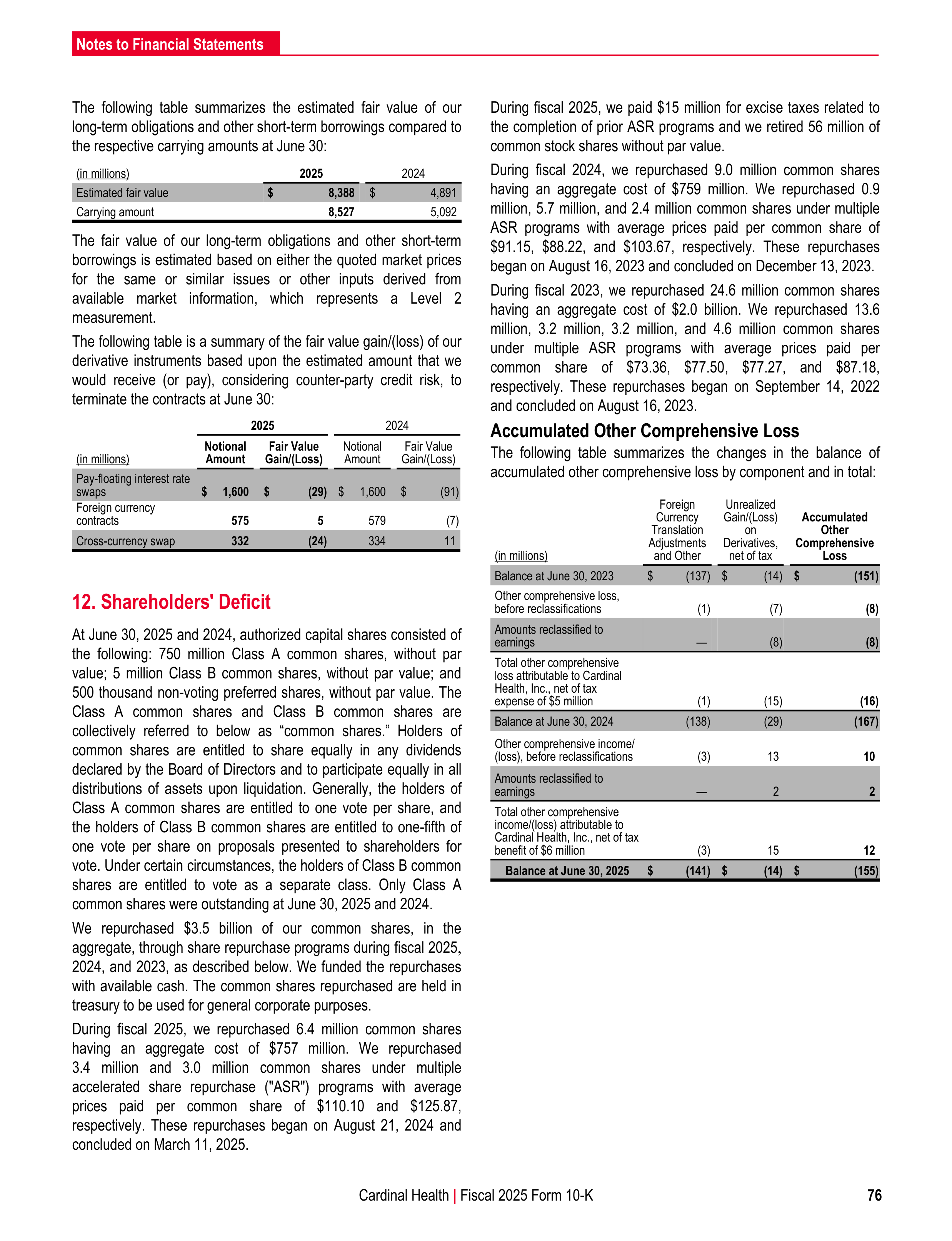
The following table summarizes the estimated fair value of our
long-term obligations and other short-term borrowings compared to
the respective carrying amounts at June 30:
(in millions)
2025
2024
Estimated fair value
$
8,388
$
4,891
Carrying amount
8,527
5,092
The fair value of our long-term obligations and other short-term
borrowings is estimated based on either the quoted market prices
for the same or similar issues or other inputs derived from
available market information, which represents a Level 2
measurement.
The following table is a summary of the fair value gain/(loss) of our
derivative instruments based upon the estimated amount that we
would receive (or pay), considering counter-party credit risk, to
terminate the contracts at June 30:
2025
2024
(in millions)
Notional
Amount
Fair Value
Gain/(Loss)
Notional
Amount
Fair Value
Gain/(Loss)
Pay-floating interest rate
swaps
$
1,600
$
(29)
$
1,600
$
(91)
Foreign currency
contracts
575
5
579
(7)
Cross-currency swap
332
(24)
334
11
12. Shareholders' Deficit
At June 30, 2025 and 2024, authorized capital shares consisted of
the following: 750 million Class A common shares, without par
value; 5 million Class B common shares, without par value; and
500 thousand non-voting preferred shares, without par value. The
Class A common shares and Class B common shares are
collectively referred to below as “common shares.” Holders of
common shares are entitled to share equally in any dividends
declared by the Board of Directors and to participate equally in all
distributions of assets upon liquidation. Generally, the holders of
Class A common shares are entitled to one vote per share, and
the holders of Class B common shares are entitled to one-fifth of
one vote per share on proposals presented to shareholders for
vote. Under certain circumstances, the holders of Class B common
shares are entitled to vote as a separate class. Only Class A
common shares were outstanding at June 30, 2025 and 2024.
We repurchased $3.5 billion of our common shares, in the
aggregate, through share repurchase programs during fiscal 2025
,
2024, and 2023, as described below. We funded the repurchases
with available cash. The common shares repurchased are held in
treasury to be used for general corporate purposes.
During fiscal 2025, we repurchased 6.4 million common shares
having an aggregate cost of $757 million. We repurchased
3.4 million and 3.0 million common shares under multiple
accelerated share repurchase ("ASR") programs with average
prices paid per common share of $110.10 and $125.87,
respectively. These repurchases began on August 21, 2024 and
concluded on March 11, 2025.
During fiscal 2025, we paid $15 million for excise taxes related to
the completion of prior ASR programs and we retired 56 million of
common stock shares without par value.
During fiscal 2024, we repurchased 9.0 million common shares
having an aggregate cost of $759 million. We repurchased 0.9
million, 5.7 million, and 2.4 million common shares under multiple
ASR programs with average prices paid per common share of
$91.15, $88.22, and $103.67, respectively. These repurchases
began on August 16, 2023 and concluded on December 13, 2023.
During fiscal 2023, we repurchased 24.6 million common shares
having an aggregate cost of $2.0 billion. We repurchased 13.6
million, 3.2 million, 3.2 million, and 4.6 million common shares
under multiple ASR programs with average prices paid per
common share of $73.36, $77.50, $77.27, and $87.18,
respectively. These repurchases began on September 14, 2022
and concluded on August 16, 2023.
Accumulated Other Comprehensive Loss
The following table summarizes the changes in the balance of
accumulated other comprehensive loss by component and in total:
(in millions)
Foreign
Currency
Translation
Adjustments
and Other
Unrealized
Gain/(Loss)
on
Derivatives,
net of tax
Accumulated
Other
Comprehensive
Loss
Balance at June 30, 2023
$
(137) $
(14)
$
(151)
Other comprehensive loss,
before reclassifications
(1)
(7)
(8)
Amounts reclassified to
earnings
—
(8)
(8)
Total other comprehensive
loss attributable to Cardinal
Health, Inc., net of tax
expense of $5 million
(1)
(15)
(16)
Balance at June 30, 2024
(138)
(29)
(167)
Other comprehensive income/
(loss), before reclassifications
(3)
13
10
Amounts reclassified to
earnings
—
2
2
Total other comprehensive
income/(loss) attributable to
Cardinal Health, Inc., net of tax
benefit of $6 million
(3)
15
12
Balance at June 30, 2025
$
(141) $
(14) $
(155)
Notes to Financial Statements
76
Cardinal Health
|
Fiscal 2025 Form 10-K
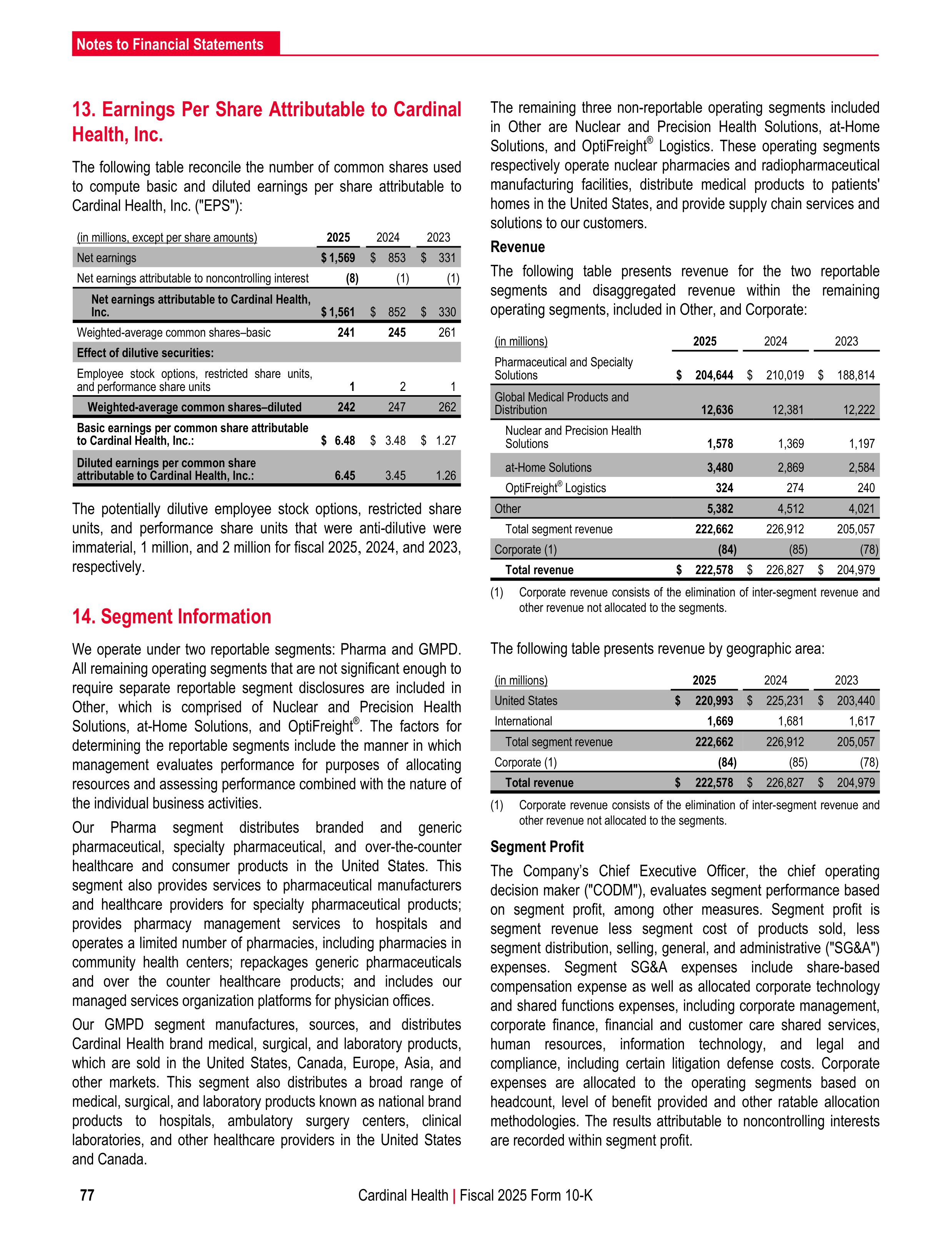
13. Earnings Per Share Attributable to Cardinal
Health, Inc.
The following table reconcile the number of common shares used
to compute basic and diluted earnings per share attributable to
Cardinal Health, Inc. ("EPS"):
(in millions, except per share amounts)
2025
2024
2023
Net earnings
$ 1,569
$ 853
$ 331
Net earnings attributable to noncontrolling interest
(8)
(1)
(1)
Net earnings attributable to Cardinal Health,
Inc.
$ 1,561
$ 852
$ 330
Weighted-average common shares–basic
241
245
261
Effect of dilutive securities:
Employee stock options, restricted share units,
and performance share units
1
2
1
Weighted-average common shares–diluted
242
247
262
Basic earnings per common share attributable
to Cardinal Health, Inc.:
$ 6.48
$ 3.48
$ 1.27
Diluted earnings per common share
attributable to Cardinal Health, Inc.:
6.45
3.45
1.26
The potentially dilutive employee stock options, restricted share
units, and performance share units that were anti-dilutive were
immaterial, 1 million, and 2 million for fiscal 2025
,
2024, and 2023,
respectively.
14. Segment Information
We operate under two reportable segments: Pharma and GMPD.
All remaining operating segments that are not significant enough to
require separate reportable segment disclosures are included in
Other, which is comprised of Nuclear and Precision Health
Solutions, at-Home Solutions, and OptiFreight
®
. The factors for
determining the reportable segments include the manner in which
management evaluates performance for purposes of allocating
resources and assessing performance combined with the nature of
the individual business activities.
Our Pharma segment distributes branded and generic
pharmaceutical, specialty pharmaceutical, and over-the-counter
healthcare and consumer products in the United States. This
segment also provides services to pharmaceutical manufacturers
and healthcare providers for specialty pharmaceutical products;
provides pharmacy management services to hospitals and
operates a limited number of pharmacies, including pharmacies in
community health centers; repackages generic pharmaceuticals
and over the counter healthcare products; and includes our
managed services organization platforms for physician offices.
Our GMPD segment manufactures, sources, and distributes
Cardinal Health brand medical, surgical, and laboratory products,
which are sold in the United States, Canada, Europe, Asia, and
other markets. This segment also distributes a broad range of
medical, surgical, and laboratory products known as national brand
products to hospitals, ambulatory surgery centers, clinical
laboratories, and other healthcare providers in the United States
and Canada.
The remaining three non-reportable operating segments included
in Other are Nuclear and Precision Health Solutions, at-Home
Solutions, and OptiFreight
®
Logistics. These operating segments
respectively operate nuclear pharmacies and radiopharmaceutical
manufacturing facilities, distribute medical products to patients'
homes in the United States, and provide supply chain services and
solutions to our customers.
Revenue
The following table presents revenue for the two reportable
segments and disaggregated revenue within the remaining
operating segments, included in Other, and Corporate:
(in millions)
2025
2024
2023
Pharmaceutical and Specialty
Solutions
$
204,644
$
210,019
$
188,814
Global Medical Products and
Distribution
12,636
12,381
12,222
Nuclear and Precision Health
Solutions
1,578
1,369
1,197
at-Home Solutions
3,480
2,869
2,584
OptiFreight
®
Logistics
324
274
240
Other
5,382
4,512
4,021
Total segment revenue
222,662
226,912
205,057
Corporate (1)
(84)
(85)
(78)
Total revenue
$
222,578
$
226,827
$
204,979
(1)
Corporate revenue consists of the elimination of inter-segment revenue and
other revenue not allocated to the segments.
The following table presents revenue by geographic area:
(in millions)
2025
2024
2023
United States
$
220,993
$
225,231
$
203,440
International
1,669
1,681
1,617
Total segment revenue
222,662
226,912
205,057
Corporate (1)
(84)
(85)
(78)
Total revenue
$
222,578
$
226,827
$
204,979
(1)
Corporate revenue consists of the elimination of inter-segment revenue and
other revenue not allocated to the segments.
Segment Profit
The Company’s Chief Executive Officer, the chief operating
decision maker ("CODM"), evaluates segment performance based
on segment profit, among other measures. Segment profit is
segment revenue less segment cost of products sold, less
segment distribution, selling, general, and administrative ("SG&A")
expenses. Segment SG&A expenses include share-based
compensation expense as well as allocated corporate technology
and shared functions expenses, including corporate management,
corporate finance, financial and customer care shared services,
human resources, information technology, and legal and
compliance, including certain litigation defense costs. Corporate
expenses are allocated to the operating segments based on
headcount, level of benefit provided and other ratable allocation
methodologies. The results attributable to noncontrolling interests
are recorded within segment profit.
Notes to Financial Statements
Cardinal Health
|
Fiscal 2025 Form 10-K
77
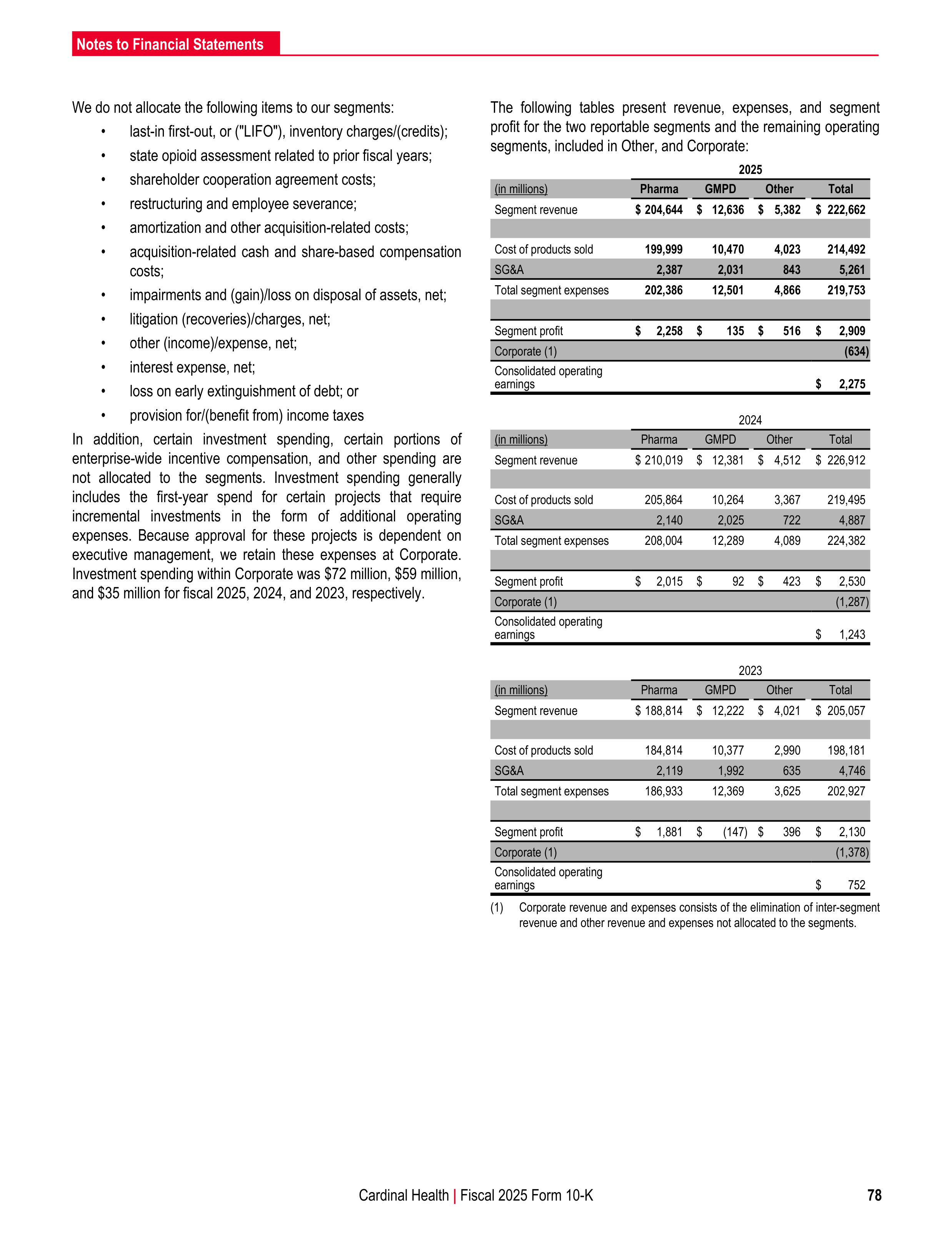
We do not allocate the following items to our segments:
•
last-in first-out, or ("LIFO"), inventory charges/(credits);
•
state opioid assessment related to prior fiscal years;
•
shareholder cooperation agreement costs;
•
restructuring and employee severance;
•
amortization and other acquisition-related costs;
•
acquisition-related cash and share-based compensation
costs;
•
impairments and (gain)/loss on disposal of assets, net;
•
litigation (recoveries)/charges, net;
•
other (income)/expense, net;
•
interest expense, net;
•
loss on early extinguishment of debt; or
•
provision for/(benefit from) income taxes
In addition, certain investment spending, certain portions of
enterprise-wide incentive compensation, and other spending are
not allocated to the segments. Investment spending generally
includes the first-year spend for certain projects that require
incremental investments in the form of additional operating
expenses. Because approval for these projects is dependent on
executive management, we retain these expenses at Corporate.
Investment spending within Corporate was $72 million, $59 million,
and $35 million for fiscal 2025, 2024, and 2023, respectively.
The following tables present revenue, expenses, and segment
profit for the two reportable segments and the remaining operating
segments, included in Other, and Corporate:
2025
(in millions)
Pharma
GMPD
Other
Total
Segment revenue
$ 204,644
$ 12,636
$ 5,382
$ 222,662
Cost of products sold
199,999
10,470
4,023
214,492
SG&A
2,387
2,031
843
5,261
Total segment expenses
202,386
12,501
4,866
219,753
Segment profit
$
2,258
$
135
$
516
$
2,909
Corporate (1)
(634)
Consolidated operating
earnings
$
2,275
2024
(in millions)
Pharma
GMPD
Other
Total
Segment revenue
$ 210,019
$ 12,381
$ 4,512
$ 226,912
Cost of products sold
205,864
10,264
3,367
219,495
SG&A
2,140
2,025
722
4,887
Total segment expenses
208,004
12,289
4,089
224,382
Segment profit
$
2,015
$
92
$
423
$
2,530
Corporate (1)
(1,287)
Consolidated operating
earnings
$
1,243
2023
(in millions)
Pharma
GMPD
Other
Total
Segment revenue
$ 188,814
$ 12,222
$ 4,021
$ 205,057
Cost of products sold
184,814
10,377
2,990
198,181
SG&A
2,119
1,992
635
4,746
Total segment expenses
186,933
12,369
3,625
202,927
Segment profit
$
1,881
$
(147) $
396
$
2,130
Corporate (1)
(1,378)
Consolidated operating
earnings
$
752
(1)
Corporate revenue and expenses consists of the elimination of inter-segment
revenue and other revenue and expenses not allocated to the segments.
Notes to Financial Statements
78
Cardinal Health
|
Fiscal 2025 Form 10-K
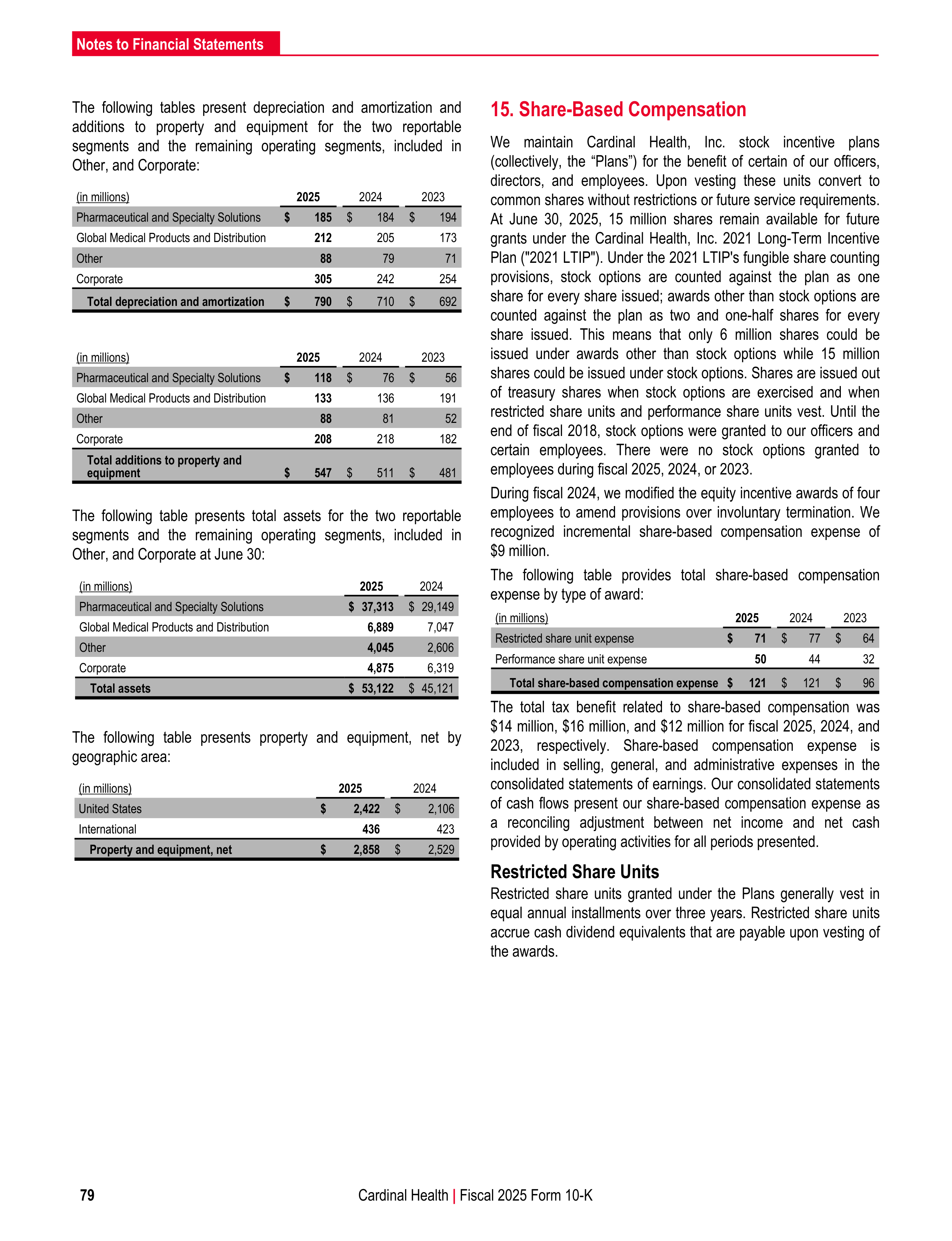
The following tables present depreciation and amortization and
additions to property and equipment for the two reportable
segments and the remaining operating segments, included in
Other, and Corporate:
(in millions)
2025
2024
2023
Pharmaceutical and Specialty Solutions
$
185
$
184
$
194
Global Medical Products and Distribution
212
205
173
Other
88
79
71
Corporate
305
242
254
Total depreciation and amortization
$
790
$
710
$
692
(in millions)
2025
2024
2023
Pharmaceutical and Specialty Solutions
$
118
$
76
$
56
Global Medical Products and Distribution
133
136
191
Other
88
81
52
Corporate
208
218
182
Total additions to property and
equipment
$
547
$
511
$
481
The following table presents total assets for the two reportable
segments and the remaining operating segments, included in
Other, and Corporate at June 30:
(in millions)
2025
2024
Pharmaceutical and Specialty Solutions
$ 37,313
$ 29,149
Global Medical Products and Distribution
6,889
7,047
Other
4,045
2,606
Corporate
4,875
6,319
Total assets
$ 53,122
$ 45,121
The following table presents property and equipment, net by
geographic area:
(in millions)
2025
2024
United States
$
2,422
$
2,106
International
436
423
Property and equipment, net
$
2,858
$
2,529
15. Share-Based Compensation
We maintain Cardinal Health, Inc. stock incentive plans
(collectively, the “Plans”) for the benefit of certain of our officers,
directors, and employees. Upon vesting these units convert to
common shares without restrictions or future service requirements.
At June 30, 2025, 15 million shares remain available for future
grants under the Cardinal Health, Inc. 2021 Long-Term Incentive
Plan ("2021 LTIP"). Under the 2021 LTIP's fungible share counting
provisions, stock options are counted against the plan as one
share for every share issued; awards other than stock options are
counted against the plan as two and one-half shares for every
share issued. This means that only 6 million shares could be
issued under awards other than stock options while 15 million
shares could be issued under stock options. Shares are issued out
of treasury shares when stock options are exercised and when
restricted share units and performance share units vest. Until the
end of fiscal 2018, stock options were granted to our officers and
certain employees. There were no stock options granted to
employees during fiscal 2025, 2024, or 2023.
During fiscal 2024, we modified the equity incentive awards of four
employees to amend provisions over involuntary termination. We
recognized incremental share-based compensation expense of
$9 million.
The following table provides total share-based compensation
expense by type of award:
(in millions)
2025
2024
2023
Restricted share unit expense
$
71
$
77
$
64
Performance share unit expense
50
44
32
Total share-based compensation expense
$
121
$
121
$
96
The total tax benefit related to share-based compensation was
$14 million, $16 million, and $12 million for fiscal 2025, 2024, and
2023, respectively. Share-based compensation expense is
included in selling, general, and administrative expenses in the
consolidated statements of earnings. Our consolidated statements
of cash flows present our share-based compensation expense as
a reconciling adjustment between net income and net cash
provided by operating activities for all periods presented.
Restricted Share Units
Restricted share units granted under the Plans generally vest in
equal annual installments over three years. Restricted share units
accrue cash dividend equivalents that are payable upon vesting of
the awards.
Notes to Financial Statements
Cardinal Health
|
Fiscal 2025 Form 10-K
79
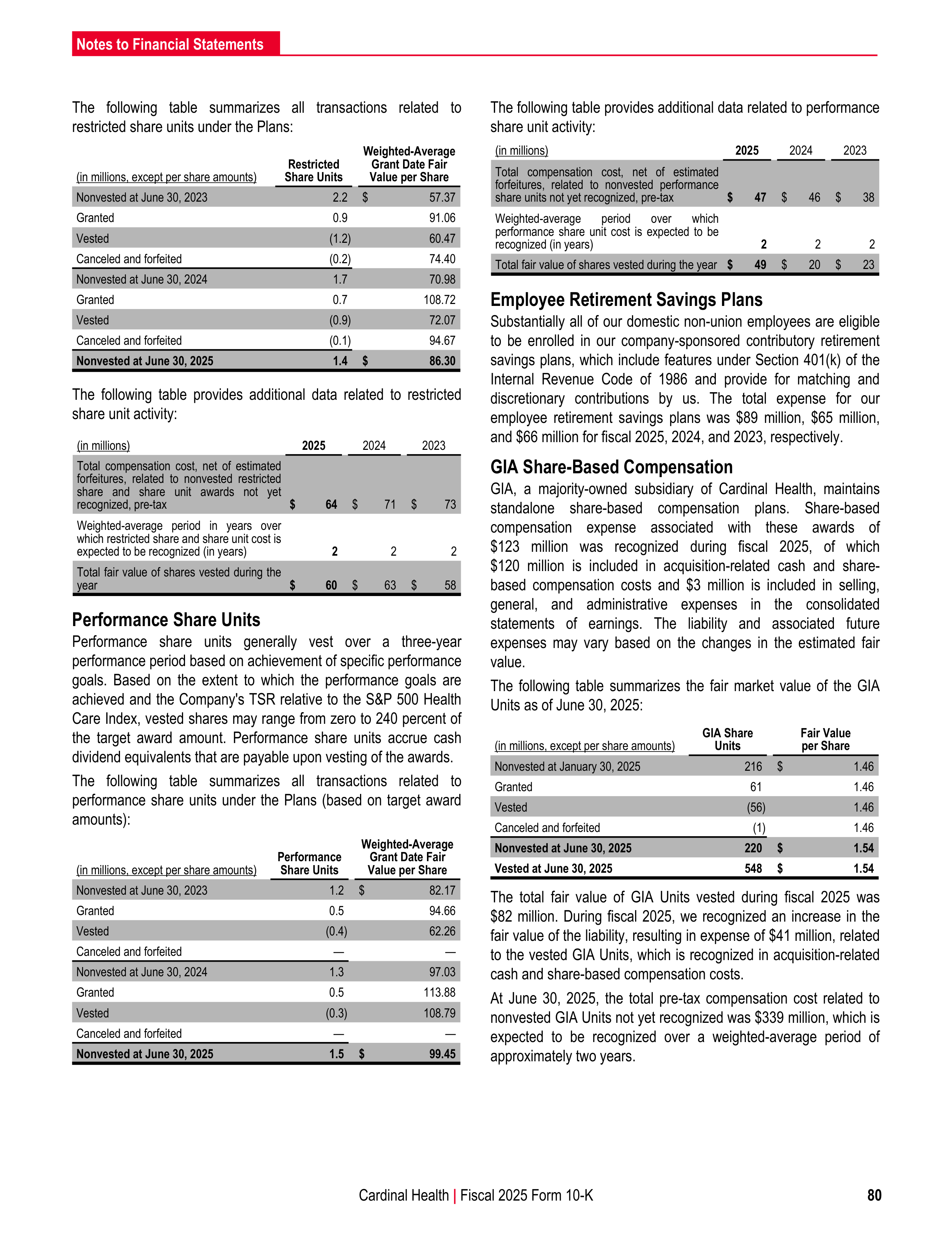
The following table summarizes all transactions related to
restricted share units under the Plans:
(in millions, except per share amounts)
Restricted
Share Units
Weighted-Average
Grant Date Fair
Value per Share
Nonvested at June 30, 2023
2.2
$
57.37
Granted
0.9
91.06
Vested
(1.2)
60.47
Canceled and forfeited
(0.2)
74.40
Nonvested at June 30, 2024
1.7
70.98
Granted
0.7
108.72
Vested
(0.9)
72.07
Canceled and forfeited
(0.1)
94.67
Nonvested at June 30, 2025
1.4
$
86.30
The following table provides additional data related to restricted
share unit activity:
(in millions)
2025
2024
2023
Total compensation cost, net of estimated
forfeitures, related to nonvested restricted
share and share unit awards not yet
recognized, pre-tax
$
64
$
71
$
73
Weighted-average period in years over
which restricted share and share unit cost is
expected to be recognized (in years)
2
2
2
Total fair value of shares vested during the
year
$
60
$
63
$
58
Performance Share Units
Performance share units generally vest over a three-year
performance period based on achievement of specific performance
goals. Based on the extent to which the performance goals are
achieved and the Company's TSR relative to the S&P 500 Health
Care Index, vested shares may range from zero to 240 percent of
the target award amount. Performance share units accrue cash
dividend equivalents that are payable upon vesting of the awards.
The following table summarizes all transactions related to
performance share units under the Plans (based on target award
amounts):
(in millions, except per share amounts)
Performance
Share Units
Weighted-Average
Grant Date Fair
Value per Share
Nonvested at June 30, 2023
1.2
$
82.17
Granted
0.5
94.66
Vested
(0.4)
62.26
Canceled and forfeited
—
—
Nonvested at June 30, 2024
1.3
97.03
Granted
0.5
113.88
Vested
(0.3)
108.79
Canceled and forfeited
—
—
Nonvested at June 30, 2025
1.5
$
99.45
The following table provides additional data related to performance
share unit activity:
(in millions)
2025
2024
2023
Total compensation cost, net of estimated
forfeitures, related to nonvested performance
share units not yet recognized, pre-tax
$
47
$
46
$
38
Weighted-average
period
over
which
performance share unit cost is expected to be
recognized (in years)
2
2
2
Total fair value of shares vested during the year
$
49
$
20
$
23
Employee Retirement Savings Plans
Substantially all of our domestic non-union employees are eligible
to be enrolled in our company-sponsored contributory retirement
savings plans, which include features under Section 401(k) of the
Internal Revenue Code of 1986 and provide for matching and
discretionary contributions by us. The total expense for our
employee retirement savings plans was $89 million, $65 million,
and $66 million for fiscal 2025, 2024, and 2023, respectively.
GIA Share-Based Compensation
GIA, a majority-owned subsidiary of Cardinal Health, maintains
standalone share-based compensation plans. Share-based
compensation expense associated with these awards of
$123 million was recognized during fiscal 2025, of which
$120 million is included in acquisition-related cash and share-
based compensation costs and $3 million is included in selling,
general, and administrative expenses in the consolidated
statements of earnings. The liability and associated future
expenses may vary based on the changes in the estimated fair
value.
The following table summarizes the fair market value of the GIA
Units as of June 30, 2025:
(in millions, except per share amounts)
GIA Share
Units
Fair Value
per Share
Nonvested at January 30, 2025
216
$
1.46
Granted
61
1.46
Vested
(56)
1.46
Canceled and forfeited
(1)
1.46
Nonvested at June 30, 2025
220
$
1.54
Vested at June 30, 2025
548
$
1.54
The total fair value of GIA Units vested during fiscal 2025 was
$82 million. During fiscal 2025, we recognized an increase in the
fair value of the liability, resulting in expense of $41 million, related
to the vested GIA Units, which is recognized in acquisition-related
cash and share-based compensation costs.
At June 30, 2025, the total pre-tax compensation cost related to
nonvested GIA Units not yet recognized was $339 million, which is
expected to be recognized over a weighted-average period of
approximately two years.
Notes to Financial Statements
80
Cardinal Health
|
Fiscal 2025 Form 10-K
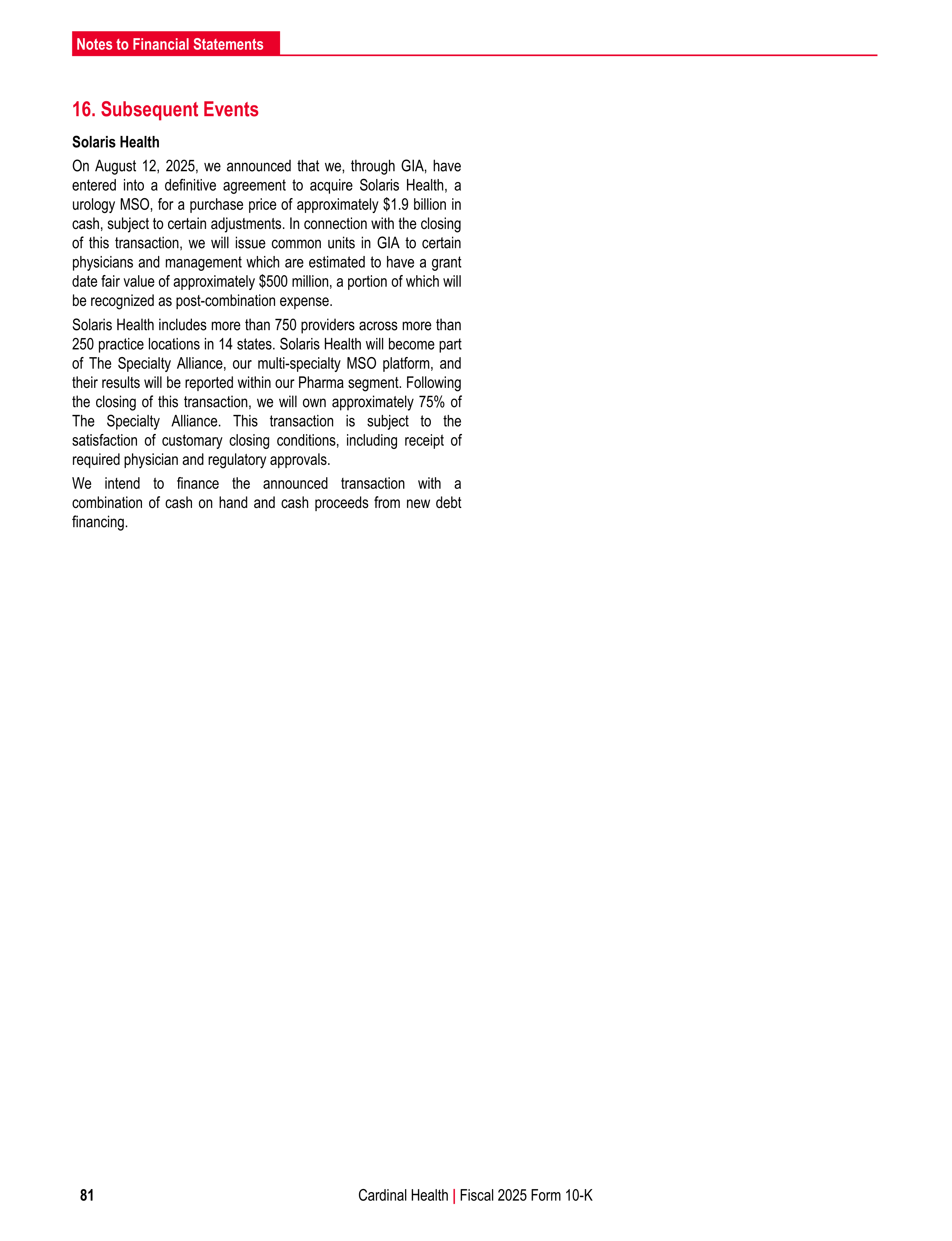
16. Subsequent Events
Solaris Health
On August 12, 2025, we announced that we, through GIA, have
entered into a definitive agreement to acquire Solaris Health, a
urology MSO, for a purchase price of approximately $1.9 billion in
cash, subject to certain adjustments. In connection with the closing
of this transaction, we will issue common units in GIA to certain
physicians and management which are estimated to have a grant
date fair value of approximately $500 million, a portion of which will
be recognized as post-combination expense.
Solaris Health includes more than 750 providers across more than
250 practice locations in 14 states. Solaris Health will become part
of The Specialty Alliance, our multi-specialty MSO platform, and
their results will be reported within our Pharma segment. Following
the closing of this transaction, we will own approximately 75% of
The Specialty Alliance. This transaction is subject to the
satisfaction of customary closing conditions, including receipt of
required physician and regulatory approvals.
We intend to finance the announced transaction with a
combination of cash on hand and cash proceeds from new debt
financing.
Notes to Financial Statements
Cardinal Health
|
Fiscal 2025 Form 10-K
81
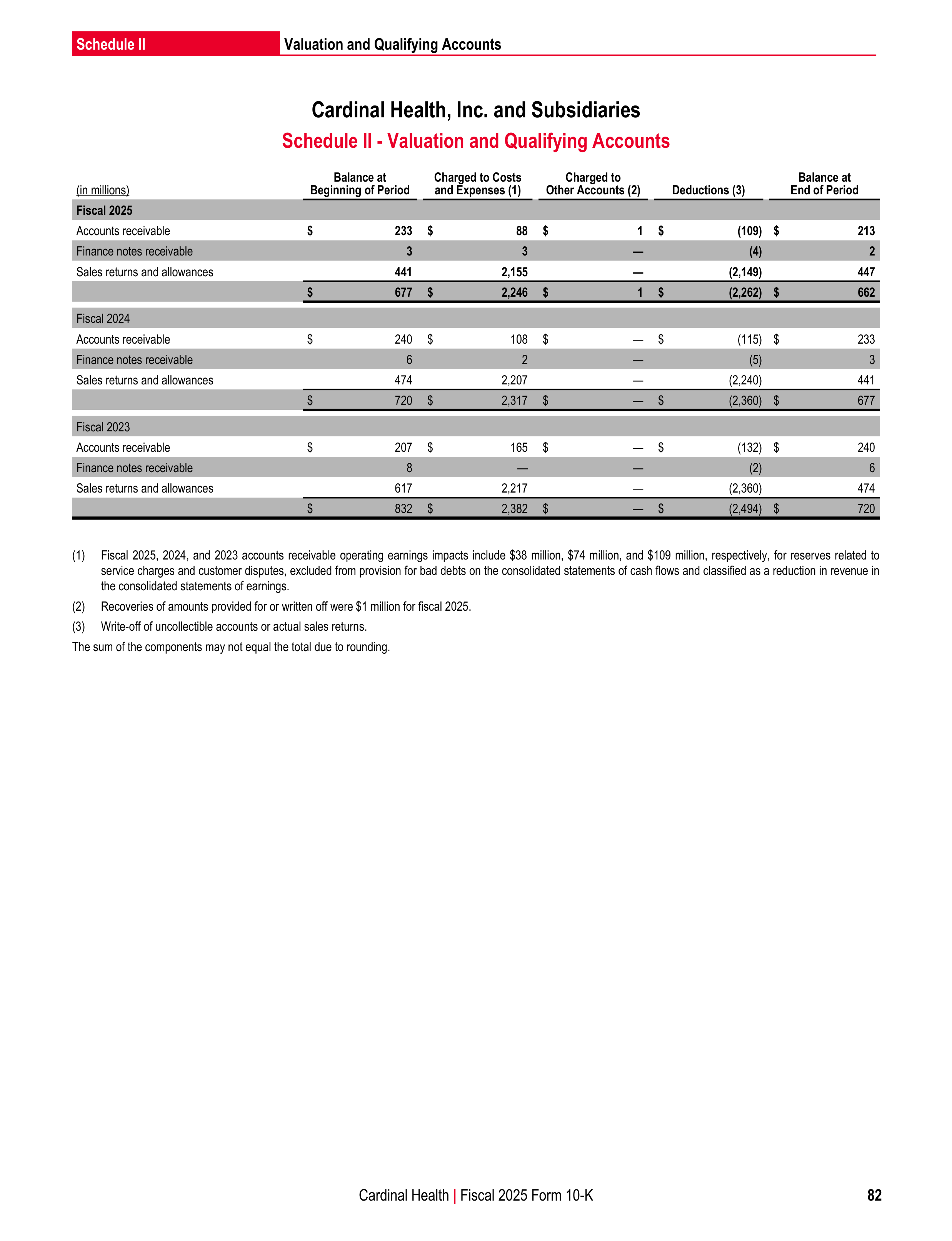
Cardinal Health, Inc. and Subsidiaries
Schedule II - Valuation and Qualifying Accounts
(in millions)
Balance at
Beginning of Period
Charged to Costs
and Expenses (1)
Charged to
Other Accounts (2)
Deductions (3)
Balance at
End of Period
Fiscal 2025
Accounts receivable
$
233
$
88
$
1
$
(109) $
213
Finance notes receivable
3
3
—
(4)
2
Sales returns and allowances
441
2,155
—
(2,149)
447
$
677
$
2,246
$
1
$
(2,262) $
662
Fiscal 2024
Accounts receivable
$
240
$
108
$
—
$
(115) $
233
Finance notes receivable
6
2
—
(5)
3
Sales returns and allowances
474
2,207
—
(2,240)
441
$
720
$
2,317
$
—
$
(2,360) $
677
Fiscal 2023
Accounts receivable
$
207
$
165
$
—
$
(132) $
240
Finance notes receivable
8
—
—
(2)
6
Sales returns and allowances
617
2,217
—
(2,360)
474
$
832
$
2,382
$
—
$
(2,494) $
720
(1)
Fiscal 2025, 2024, and 2023 accounts receivable operating earnings impacts include $38 million, $74 million, and $109 million, respectively, for reserves related to
service charges and customer disputes, excluded from provision for bad debts on the consolidated statements of cash flows and classified as a reduction in revenue in
the consolidated statements of earnings.
(2)
Recoveries of amounts provided for or written off were $1 million for fiscal 2025.
(3)
Write-off of uncollectible accounts or actual sales returns.
The sum of the components may not equal the total due to rounding.
Schedule II
Valuation and Qualifying Accounts
82
Cardinal Health
|
Fiscal 2025 Form 10-K
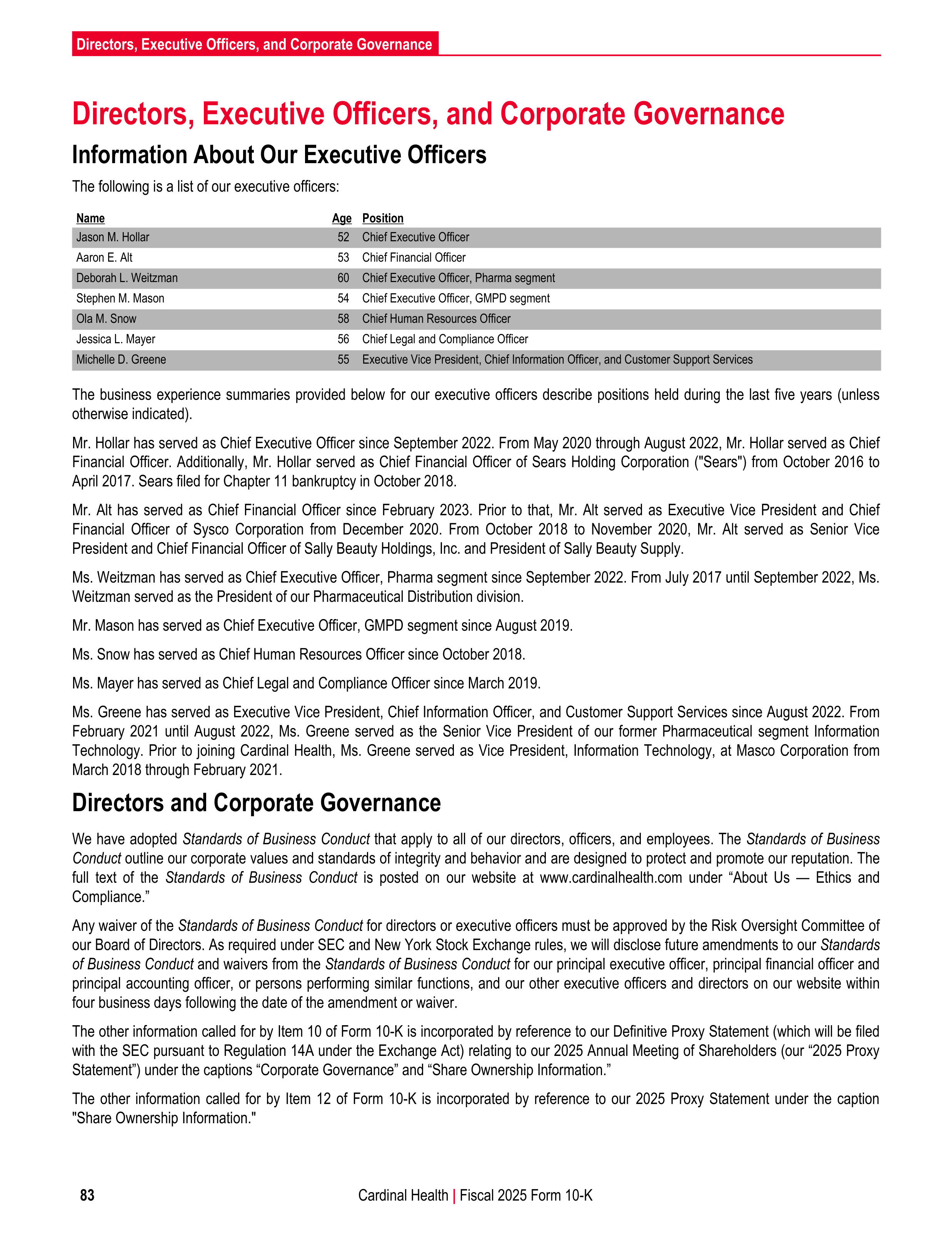
Directors, Executive Officers, and Corporate Governance
Information About Our Executive Officers
The following is a list of our executive officers:
Name
Age
Position
Jason M. Hollar
52
Chief Executive Officer
Aaron E. Alt
53
Chief Financial Officer
Deborah L. Weitzman
60
Chief Executive Officer, Pharma segment
Stephen M. Mason
54
Chief Executive Officer, GMPD segment
Ola M. Snow
58
Chief Human Resources Officer
Jessica L. Mayer
56
Chief Legal and Compliance Officer
Michelle D. Greene
55
Executive Vice President, Chief Information Officer, and Customer Support Services
The business experience summaries provided below for our executive officers describe positions held during the last five years (unless
otherwise indicated).
Mr. Hollar has served as Chief Executive Officer since September 2022. From May 2020 through August 2022, Mr. Hollar served as Chief
Financial Officer. Additionally, Mr. Hollar served as Chief Financial Officer of Sears Holding Corporation ("Sears") from October 2016 to
April 2017. Sears filed for Chapter 11 bankruptcy in October 2018.
Mr. Alt has served as Chief Financial Officer since February 2023. Prior to that, Mr. Alt served as Executive Vice President and Chief
Financial Officer of Sysco Corporation from December 2020. From October 2018 to November 2020, Mr. Alt served as Senior Vice
President and Chief Financial Officer of Sally Beauty Holdings, Inc. and President of Sally Beauty Supply.
Ms. Weitzman has served as Chief Executive Officer, Pharma segment since September 2022. From July 2017 until September 2022, Ms.
Weitzman served as the President of our Pharmaceutical Distribution division.
Mr. Mason has served as Chief Executive Officer, GMPD segment since August 2019.
Ms. Snow has served as Chief Human Resources Officer since October 2018.
Ms. Mayer has served as Chief Legal and Compliance Officer since March 2019.
Ms. Greene has served as Executive Vice President, Chief Information Officer, and Customer Support Services since August 2022. From
February 2021 until August 2022, Ms. Greene served as the Senior Vice President of our former Pharmaceutical segment Information
Technology. Prior to joining Cardinal Health, Ms. Greene served as Vice President, Information Technology, at Masco Corporation from
March 2018 through February 2021.
Directors and Corporate Governance
We have adopted
Standards of Business Conduct
that apply to all of our directors, officers, and employees. The
Standards of Business
Conduct
outline our corporate values and standards of integrity and behavior and are designed to protect and promote our reputation. The
full text of the
Standards of Business Conduct
is posted on our website at www.cardinalhealth.com under “About Us — Ethics and
Compliance.”
Any waiver of the
Standards of Business Conduct
for directors or executive officers must be approved by the Risk Oversight Committee of
our Board of Directors. As required under SEC and New York Stock Exchange rules, we will disclose future amendments to our
Standards
of Business Conduct
and waivers from the
Standards of Business Conduct
for our principal executive officer, principal financial officer and
principal accounting officer, or persons performing similar functions, and our other executive officers and directors on our website within
four business days following the date of the amendment or waiver.
The other information called for by Item 10 of Form 10-K is incorporated by reference to our Definitive Proxy Statement (which will be filed
with the SEC pursuant to Regulation 14A under the Exchange Act) relating to our 2025 Annual Meeting of Shareholders (our “2025 Proxy
Statement”) under the captions “Corporate Governance” and “Share Ownership Information.”
The other information called for by Item 12 of Form 10-K is incorporated by reference to our 2025 Proxy Statement under the caption
"Share Ownership Information."
Directors, Executive Officers, and Corporate Governance
Cardinal Health
|
Fiscal 2025 Form 10-K
83
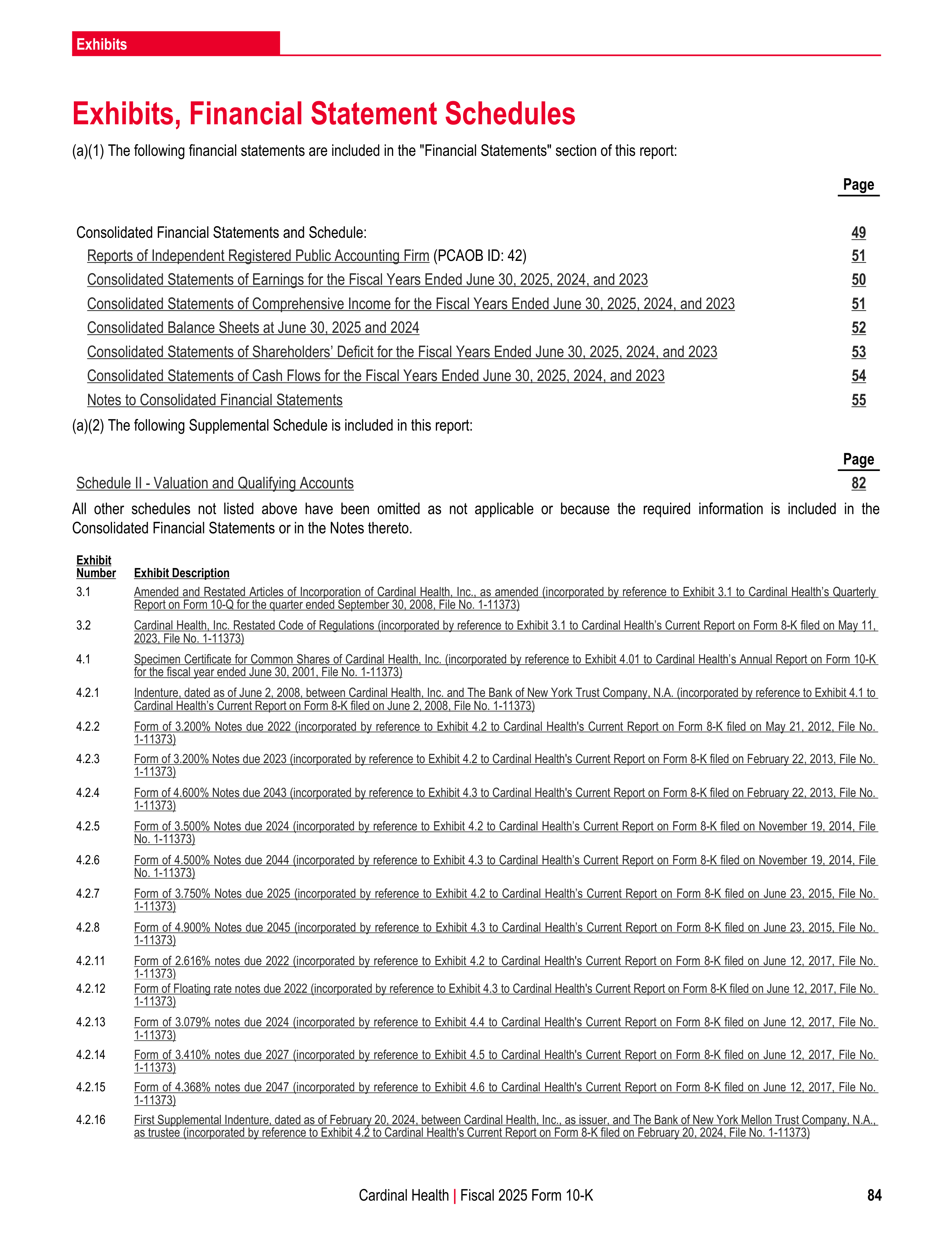
Exhibits, Financial Statement Schedules
(a)(1) The following financial statements are included in the "Financial Statements" section of this report:
Page
Consolidated Financial Statements and Schedule:
49
Reports of Independent Registered Public Accounting Firm
(PCAOB ID: 42)
51
Consolidated Statements of Earnings for the Fiscal Years Ended June 30, 2025, 2024, and 2023
50
Consolidated Statements of Comprehensive Income for the Fiscal Years Ended June 30, 2025, 2024, and 2023
51
Consolidated Balance Sheets at June 30, 2025 and 2024
52
Consolidated Statements of Shareholders’ Deficit for the Fiscal Years Ended June 30, 2025, 2024, and 2023
53
Consolidated Statements of Cash Flows for the Fiscal Years Ended June 30, 2025, 2024, and 2023
54
Notes to Consolidated Financial Statements
55
(a)(2) The following Supplemental Schedule is included in this report:
Page
Schedule II - Valuation and Qualifying Accounts
82
All other schedules not listed above have been omitted as not applicable or because the required information is included in the
Consolidated Financial Statements or in the Notes thereto.
Exhibit
Number
Exhibit Description
3.1
Amended and Restated Articles of Incorporation of Cardinal Health, Inc., as amended (incorporated by reference to Exhibit 3.1 to Cardinal Health’s Quarterly
Report on Form 10-Q for the quarter ended September 30, 2008, File No. 1-11373)
3.2
Cardinal Health, Inc. Restated Code of Regulations (incorporated by reference to Exhibit 3.1 to Cardinal Health’s Current Report on Form 8-K filed on May 11,
2023, File No. 1-11373)
4.1
Specimen Certificate for Common Shares of Cardinal Health, Inc. (incorporated by reference to Exhibit 4.01 to Cardinal Health’s Annual Report on Form 10-K
for the fiscal year ended June 30, 2001, File No. 1-11373)
4.2.1
Indenture, dated as of June 2, 2008, between Cardinal Health, Inc. and The Bank of New York Trust Company, N.A. (incorporated by reference to Exhibit 4.1 to
Cardinal Health’s Current Report on Form 8-K filed on June 2, 2008, File No. 1-11373)
4.2.2
Form of 3.200% Notes due 2022 (incorporated by reference to Exhibit 4.2 to Cardinal Health's Current Report on Form 8-K filed on May 21, 2012, File No.
1-11373)
4.2.3
Form of 3.200% Notes due 2023 (incorporated by reference to Exhibit 4.2 to Cardinal Health's Current Report on Form 8-K filed on February 22, 2013, File No.
1-11373)
4.2.4
Form of 4.600% Notes due 2043 (incorporated by reference to Exhibit 4.3 to Cardinal Health's Current Report on Form 8-K filed on February 22, 2013, File No.
1-11373)
4.2.5
Form of 3.500% Notes due 2024 (incorporated by reference to Exhibit 4.2 to Cardinal Health’s Current Report on Form 8-K filed on November 19, 2014, File
No. 1-11373)
4.2.6
Form of 4.500% Notes due 2044 (incorporated by reference to Exhibit 4.3 to Cardinal Health’s Current Report on Form 8-K filed on November 19, 2014, File
No. 1-11373)
4.2.7
Form of 3.750% Notes due 2025 (incorporated by reference to Exhibit 4.2 to Cardinal Health’s Current Report on Form 8-K filed on June 23, 2015, File No.
1-11373)
4.2.8
Form of 4.900% Notes due 2045 (incorporated by reference to Exhibit 4.3 to Cardinal Health’s Current Report on Form 8-K filed on June 23, 2015, File No.
1-11373)
4.2.11
Form of 2.616% notes due 2022 (incorporated by reference to Exhibit 4.2 to Cardinal Health's Current Report on Form 8-K filed on June 12, 2017, File No.
1-11373)
4.2.12
Form of Floating rate notes due 2022 (incorporated by reference to Exhibit 4.3 to Cardinal Health's Current Report on Form 8-K filed on June 12, 2017, File No.
1-11373)
4.2.13
Form of 3.079% notes due 2024 (incorporated by reference to Exhibit 4.4 to Cardinal Health's Current Report on Form 8-K filed on June 12, 2017, File No.
1-11373)
4.2.14
Form of 3.410% notes due 2027 (incorporated by reference to Exhibit 4.5 to Cardinal Health's Current Report on Form 8-K filed on June 12, 2017, File No.
1-11373)
4.2.15
Form of 4.368% notes due 2047 (incorporated by reference to Exhibit 4.6 to Cardinal Health's Current Report on Form 8-K filed on June 12, 2017, File No.
1-11373)
4.2.16
First Supplemental Indenture, dated as of February 20, 2024, between Cardinal Health, Inc., as issuer, and The Bank of New York Mellon Trust Company, N.A.,
as trustee (incorporated by reference to Exhibit 4.2 to Cardinal Health's Current Report on Form 8-K filed on February 20, 2024, File No. 1-11373)
Exhibits
84
Cardinal Health
|
Fiscal 2025 Form 10-K
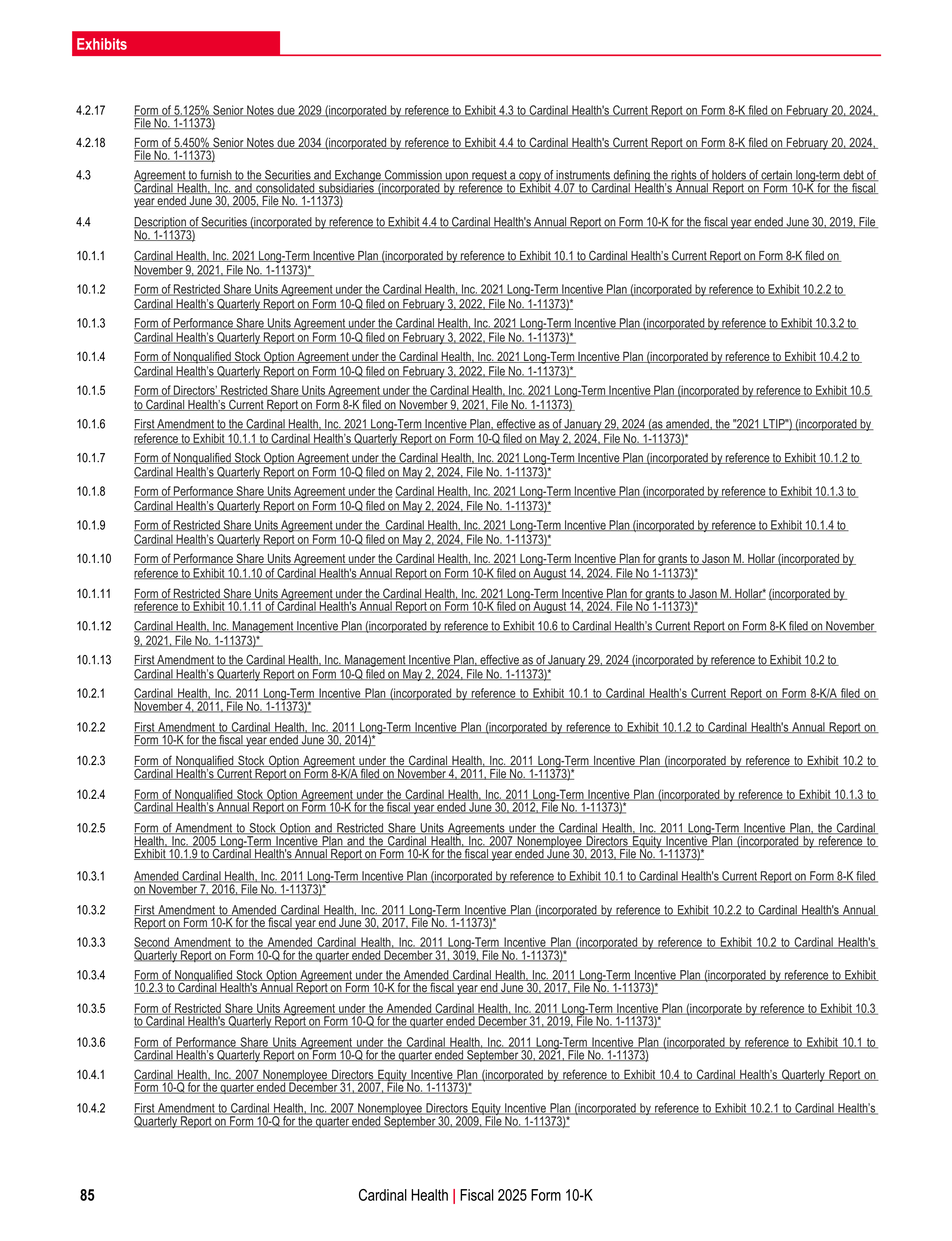
4.2.17
Form of 5.125% Senior Notes due 2029 (incorporated by reference to Exhibit 4.3 to Cardinal Health's Current Report on Form 8-K filed on February 20, 2024,
File No. 1-11373)
4.2.18
Form of 5.450% Senior Notes due 2034 (incorporated by reference to Exhibit 4.4 to Cardinal Health's Current Report on Form 8-K filed on February 20, 2024,
File No. 1-11373)
4.3
Agreement to furnish to the Securities and Exchange Commission upon request a copy of instruments defining the rights of holders of certain long-term debt of
Cardinal Health, Inc. and consolidated subsidiaries (incorporated by reference to Exhibit 4.07 to Cardinal Health’s Annual Report on Form 10-K for the fiscal
year ended June 30, 2005, File No. 1-11373)
4.4
Description of Securities (incorporated by reference to Exhibit 4.4 to Cardinal Health's Annual Report on Form 10-K for the fiscal year ended June 30, 2019, File
No. 1-11373)
10.1.1
Cardinal Health, Inc. 2021 Long-Term Incentive Plan (incorporated by reference to Exhibit 10.1 to Cardinal Health’s Current Report on Form 8-K filed on
November 9, 2021, File No. 1-11373)*
10.1.2
Form of Restricted Share Units Agreement under the Cardinal Health, Inc. 2021 Long-Term Incentive Plan (incorporated by reference to Exhibit 10.2.2 to
Cardinal Health’s Quarterly Report on Form 10-Q filed on February 3, 2022, File No. 1-11373)*
10.1.3
Form of Performance Share Units Agreement under the Cardinal Health, Inc. 2021 Long-Term Incentive Plan (incorporated by reference to Exhibit 10.3.2 to
Cardinal Health’s Quarterly Report on Form 10-Q filed on February 3, 2022, File No. 1-11373)*
10.1.4
Form of Nonqualified Stock Option Agreement under the Cardinal Health, Inc. 2021 Long-Term Incentive Plan (incorporated by reference to Exhibit 10.4.2 to
Cardinal Health’s Quarterly Report on Form 10-Q filed on February 3, 2022, File No. 1-11373)*
10.1.5
Form of Directors’ Restricted Share Units Agreement under the Cardinal Health, Inc. 2021 Long-Term Incentive Plan (incorporated by reference to Exhibit 10.5
to Cardinal Health’s Current Report on Form 8-K filed on November 9, 2021, File No. 1-11373)
10.1.6
First Amendment to the Cardinal Health, Inc. 2021 Long-Term Incentive Plan, effective as of January 29, 2024 (as amended, the "2021 LTIP") (incorporated by
reference to Exhibit 10.1.1 to Cardinal Health’s Quarterly Report on Form 10-Q filed on May 2, 2024, File No. 1-11373)*
10.1.7
Form of Nonqualified Stock Option Agreement under the Cardinal Health, Inc. 2021 Long-Term Incentive Plan (incorporated by reference to Exhibit 10.1.2 to
Cardinal Health’s Quarterly Report on Form 10-Q filed on May 2, 2024, File No. 1-11373)*
10.1.8
Form of Performance Share Units Agreement under the
Cardinal Health, Inc. 2021 Long-Term Incentive Plan (incorporated by reference to Exhibit 10.1.3 to
Cardinal Health’s Quarterly Report on Form 10-Q filed on May 2, 2024, File No. 1-11373)*
10.1.9
Form of Restricted Share Units Agreement under the Cardinal Health, Inc. 2021 Long-Term Incentive Plan (incorporated by reference to Exhibit 10.1.4 to
Cardinal Health’s Quarterly Report on Form 10-Q filed on May 2, 2024, File No. 1-11373)*
10.1.10
Form of Performance Share Units Agreement under the Cardinal Health, Inc. 2021 Long-Term Incentive Plan for grants to Jason M. Hollar (incorporated by
reference to Exhibit 10.1.10 of Cardinal Health's Annual Report on Form 10-K filed on August 14, 2024. File No 1-11373)*
10.1.11
Form of Restricted Share Units Agreement under the Cardinal Health, Inc. 2021 Long-Term Incentive Plan for grants to Jason M. Hollar*
(incorporated by
reference to Exhibit 10.1.11 of Cardinal Health's Annual Report on Form 10-K filed on August 14, 2024. File No 1-11373)*
10.1.12
Cardinal Health, Inc. Management Incentive Plan (incorporated by reference to Exhibit 10.6 to Cardinal Health’s Current Report on Form 8-K filed on November
9, 2021, File No. 1-11373)*
10.1.13
First Amendment to the Cardinal Health, Inc. Management Incentive Plan, effective as of January 29, 2024 (incorporated by reference to Exhibit 10.2 to
Cardinal Health’s Quarterly Report on Form 10-Q filed on May 2, 2024, File No. 1-11373)*
10.2.1
Cardinal Health, Inc. 2011 Long-Term Incentive Plan (incorporated by reference to Exhibit 10.1 to Cardinal Health’s Current Report on Form 8-K/A filed on
November 4, 2011, File No. 1-11373)*
10.2.2
First Amendment to Cardinal Health, Inc. 2011 Long-Term Incentive Plan (incorporated by reference to Exhibit 10.1.2 to Cardinal Health's Annual Report on
Form 10-K for the fiscal year ended June 30, 2014)*
10.2.3
Form of Nonqualified Stock Option Agreement under the Cardinal Health, Inc. 2011 Long-Term Incentive Plan (incorporated by reference to Exhibit 10.2 to
Cardinal Health’s Current Report on Form 8-K/A filed on November 4, 2011, File No. 1-11373)*
10.2.4
Form of Nonqualified Stock Option Agreement under the Cardinal Health, Inc. 2011 Long-Term Incentive Plan (incorporated by reference to Exhibit 10.1.3 to
Cardinal Health’s Annual Report on Form 10-K for the fiscal year ended June 30, 2012, File No. 1-11373)*
10.2.5
Form of Amendment to Stock Option and Restricted Share Units Agreements under the Cardinal Health, Inc. 2011 Long-Term Incentive Plan, the Cardinal
Health, Inc. 2005 Long-Term Incentive Plan and the Cardinal Health, Inc. 2007 Nonemployee Directors Equity Incentive Plan (incorporated by reference to
Exhibit 10.1.9 to Cardinal Health's Annual Report on Form 10-K for the fiscal year ended June 30, 2013, File No. 1-11373)*
10.3.1
Amended Cardinal Health, Inc. 2011 Long-Term Incentive Plan (incorporated by reference to Exhibit 10.1 to Cardinal Health's Current Report on Form 8-K filed
on November 7, 2016, File No. 1-11373)*
10.3.2
First Amendment to Amended Cardinal Health, Inc. 2011 Long-Term Incentive Plan (incorporated by reference to Exhibit 10.2.2 to Cardinal Health's Annual
Report on Form 10-K for the fiscal year end June 30, 2017, File No. 1-11373)*
10.3.3
Second Amendment to the Amended Cardinal Health, Inc. 2011 Long-Term Incentive Plan (incorporated by reference to Exhibit 10.2 to Cardinal Health's
Quarterly Report on Form 10-Q for the quarter ended December 31, 3019, File No. 1-11373)*
10.3.4
Form of Nonqualified Stock Option Agreement under the Amended Cardinal Health, Inc. 2011 Long-Term Incentive Plan (incorporated by reference to Exhibit
10.2.3 to Cardinal Health's Annual Report on Form 10-K for the fiscal year end June 30, 2017, File No. 1-11373)*
10.3.5
Form of Restricted Share Units Agreement under the Amended Cardinal Health, Inc. 2011 Long-Term Incentive Plan (incorporate by reference to Exhibit 10.3
to Cardinal Health's Quarterly Report on Form 10-Q for the quarter ended December 31, 2019, File No. 1-11373)*
10.3.6
Form of Performance Share Units Agreement under the Cardinal Health, Inc. 2011 Long-Term Incentive Plan (incorporated by reference to Exhibit 10.1 to
Cardinal Health’s Quarterly Report on Form 10-Q for the quarter ended September 30, 2021, File No. 1-11373)
10.4.1
Cardinal Health, Inc. 2007 Nonemployee Directors Equity Incentive Plan (incorporated by reference to Exhibit 10.4 to Cardinal Health’s Quarterly Report on
Form 10-Q for the quarter ended December 31, 2007, File No. 1-11373)*
10.4.2
First Amendment to Cardinal Health, Inc. 2007 Nonemployee Directors Equity Incentive Plan (incorporated by reference to Exhibit 10.2.1 to Cardinal Health’s
Quarterly Report on Form 10-Q for the quarter ended September 30, 2009, File No. 1-11373)*
Exhibits
Cardinal Health
|
Fiscal 2025 Form 10-K
85
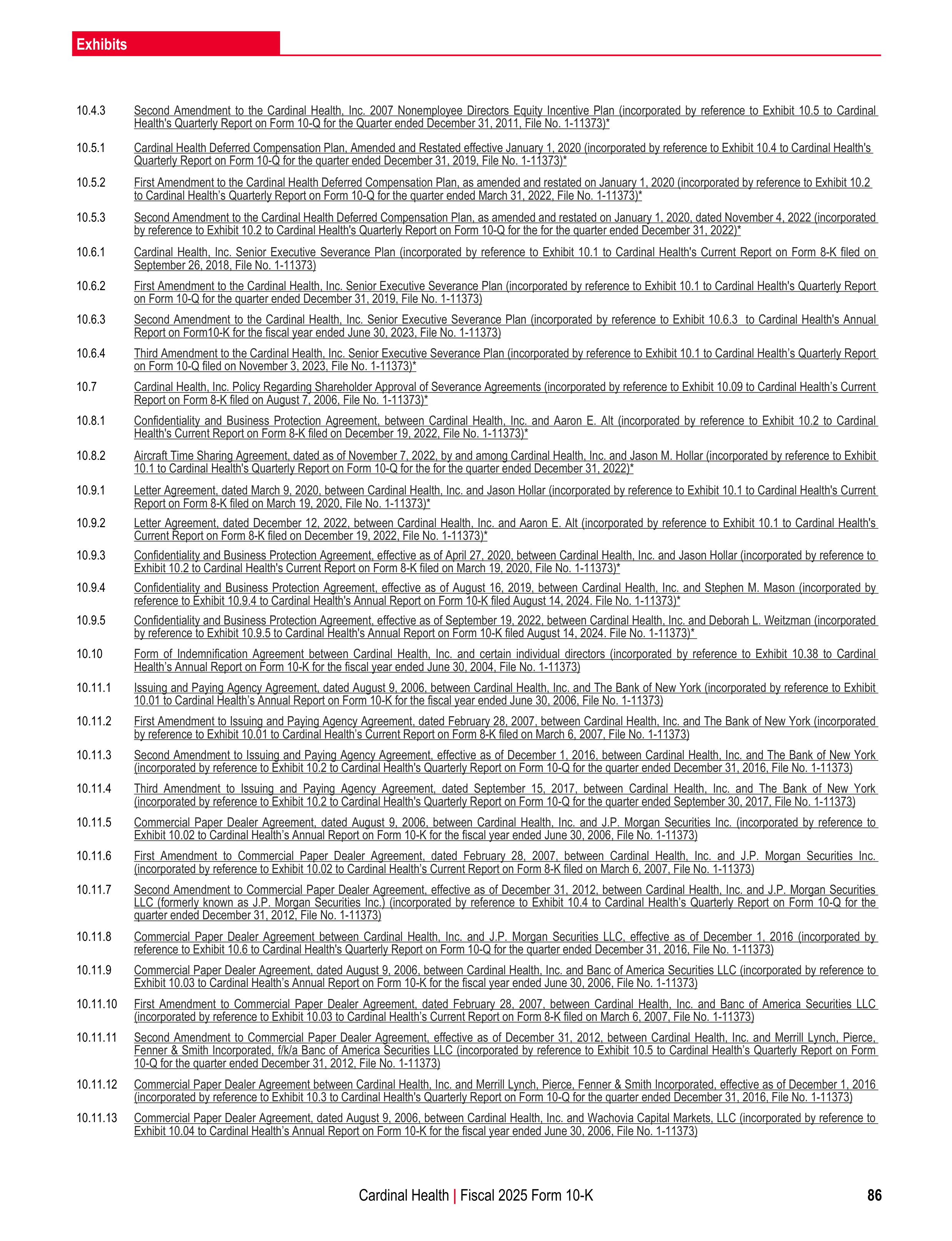
10.4.3
Second Amendment to the Cardinal Health, Inc. 2007 Nonemployee Directors Equity Incentive Plan (incorporated by reference to Exhibit 10.5 to Cardinal
Health's Quarterly Report on Form 10-Q for the Quarter ended December 31, 2011, File No. 1-11373)*
10.5.1
Cardinal Health Deferred Compensation Plan, Amended and Restated effective January 1, 2020 (incorporated by reference to Exhibit 10.4 to Cardinal Health's
Quarterly Report on Form 10-Q for the quarter ended December 31, 2019, File No. 1-11373)*
10.5.2
First Amendment to the Cardinal Health Deferred Compensation Plan, as amended and restated on January 1, 2020 (incorporated by reference to Exhibit 10.2
to Cardinal Health’s Quarterly Report on Form 10-Q for the quarter ended March 31, 2022, File No. 1-11373)*
10.5.3
Second Amendment to the Cardinal Health Deferred Compensation Plan, as amended and restated on January 1, 2020, dated November 4, 2022 (incorporated
by reference to Exhibit 10.2 to Cardinal Health's Quarterly Report on Form 10-Q for the for the quarter ended December 31, 2022)*
10.6.1
Cardinal Health, Inc. Senior Executive Severance Plan (incorporated by reference to Exhibit 10.1 to Cardinal Health's Current Report on Form 8-K filed on
September 26, 2018, File No. 1-11373)
10.6.2
First Amendment to the Cardinal Health, Inc. Senior Executive Severance Plan (incorporated by reference to Exhibit 10.1 to Cardinal Health's Quarterly Report
on Form 10-Q for the quarter ended December 31, 2019, File No. 1-11373)
10.6.3
Second Amendment to the Cardinal Health, Inc. Senior Executive Severance Plan (incorporated by reference to Exhibit 10.6.3 to Cardinal Health's Annual
Report on Form10-K for the fiscal year ended June 30, 2023, File No. 1-11373)
10.6.4
Third Amendment to the Cardinal Health, Inc. Senior Executive Severance Plan (incorporated by reference to Exhibit 10.1 to Cardinal Health’s Quarterly Report
on Form 10-Q filed on November 3, 2023, File No. 1-11373)*
10.7
Cardinal Health, Inc. Policy Regarding Shareholder Approval of Severance Agreements (incorporated by reference to Exhibit 10.09 to Cardinal Health’s Current
Report on Form 8-K filed on August 7, 2006, File No. 1-11373)*
10.8.1
Confidentiality and Business Protection Agreement, between Cardinal Health, Inc. and Aaron E. Alt (incorporated by reference to Exhibit 10.2 to Cardinal
Health's Current Report on Form 8-K filed on December 19, 2022, File No. 1-11373)*
10.8.2
Aircraft Time Sharing Agreement, dated as of November 7, 2022, by and among Cardinal Health, Inc. and Jason M. Hollar (incorporated by reference to Exhibit
10.1 to Cardinal Health's Quarterly Report on Form 10-Q for the for the quarter ended December 31, 2022)*
10.9.1
Letter Agreement, dated March 9, 2020, between Cardinal Health, Inc. and Jason Hollar (incorporated by reference to Exhibit 10.1 to Cardinal Health's Current
Report on Form 8-K filed on March 19, 2020, File No. 1-11373)*
10.9.2
Letter Agreement, dated December 12, 2022, between Cardinal Health, Inc. and Aaron E. Alt (incorporated by reference to Exhibit 10.1 to Cardinal Health's
Current Report on Form 8-K filed on December 19, 2022, File No. 1-11373)*
10.9.3
Confidentiality and Business Protection Agreement, effective as of April 27, 2020, between Cardinal Health, Inc. and Jason Hollar (incorporated by reference to
Exhibit 10.2 to Cardinal Health's Current Report on Form 8-K filed on March 19, 2020, File No. 1-11373)*
10.9.4
Confidentiality and Business Protection Agreement, effective as of August 16, 2019, between Cardinal Health, Inc. and Stephen M. Mason (incorporated by
reference to Exhibit 10.9.4 to Cardinal Health's Annual Report on Form 10-K filed August 14, 2024. File No. 1-11373)*
10.9.5
Confidentiality and Business Protection Agreement, effective as of September 19, 2022, between Cardinal Health, Inc. and Deborah L. Weitzman (incorporated
by reference to Exhibit 10.9.5 to Cardinal Health's Annual Report on Form 10-K filed August 14, 2024. File No. 1-11373)*
10.10
Form of Indemnification Agreement between Cardinal Health, Inc. and certain individual directors (incorporated by reference to Exhibit 10.38 to Cardinal
Health’s Annual Report on Form 10-K for the fiscal year ended June 30, 2004, File No. 1-11373)
10.11.1
Issuing and Paying Agency Agreement, dated August 9, 2006, between Cardinal Health, Inc. and The Bank of New York (incorporated by reference to Exhibit
10.01 to Cardinal Health’s Annual Report on Form 10-K for the fiscal year ended June 30, 2006, File No. 1-11373)
10.11.2
First Amendment to Issuing and Paying Agency Agreement, dated February 28, 2007, between Cardinal Health, Inc. and The Bank of New York (incorporated
by reference to Exhibit 10.01 to Cardinal Health’s Current Report on Form 8-K filed on March 6, 2007, File No. 1-11373)
10.11.3
Second Amendment to Issuing and Paying Agency Agreement, effective as of December 1, 2016, between Cardinal Health, Inc. and The Bank of New York
(incorporated by reference to Exhibit 10.2 to Cardinal Health's Quarterly Report on Form 10-Q for the quarter ended December 31, 2016, File No. 1-11373)
10.11.4
Third Amendment to Issuing and Paying Agency Agreement, dated September 15, 2017, between Cardinal Health, Inc. and The Bank of New York
(incorporated by reference to Exhibit 10.2 to Cardinal Health's Quarterly Report on Form 10-Q for the quarter ended September 30, 2017, File No. 1-11373)
10.11.5
Commercial Paper Dealer Agreement, dated August 9, 2006, between Cardinal Health, Inc. and J.P. Morgan Securities Inc. (incorporated by reference to
Exhibit 10.02 to Cardinal Health’s Annual Report on Form 10-K for the fiscal year ended June 30, 2006, File No. 1-11373)
10.11.6
First Amendment to Commercial Paper Dealer Agreement, dated February 28, 2007, between Cardinal Health, Inc. and J.P. Morgan Securities Inc.
(incorporated by reference to Exhibit 10.02 to Cardinal Health’s Current Report on Form 8-K filed on March 6, 2007, File No. 1-11373)
10.11.7
Second Amendment to Commercial Paper Dealer Agreement, effective as of December 31, 2012, between Cardinal Health, Inc. and J.P. Morgan Securities
LLC (formerly known as J.P. Morgan Securities Inc.) (incorporated by reference to Exhibit 10.4 to Cardinal Health’s Quarterly Report on Form 10-Q for the
quarter ended December 31, 2012, File No. 1-11373)
10.11.8
Commercial Paper Dealer Agreement between Cardinal Health, Inc. and J.P. Morgan Securities LLC, effective as of December 1, 2016 (incorporated by
reference to Exhibit 10.6 to Cardinal Health's Quarterly Report on Form 10-Q for the quarter ended December 31, 2016, File No. 1-11373)
10.11.9
Commercial Paper Dealer Agreement, dated August 9, 2006, between Cardinal Health, Inc. and Banc of America Securities LLC (incorporated by reference to
Exhibit 10.03 to Cardinal Health’s Annual Report on Form 10-K for the fiscal year ended June 30, 2006, File No. 1-11373)
10.11.10
First Amendment to Commercial Paper Dealer Agreement, dated February 28, 2007, between Cardinal Health, Inc. and Banc of America Securities LLC
(incorporated by reference to Exhibit 10.03 to Cardinal Health’s Current Report on Form 8-K filed on March 6, 2007, File No. 1-11373)
10.11.11
Second Amendment to Commercial Paper Dealer Agreement, effective as of December 31, 2012, between Cardinal Health, Inc. and Merrill Lynch, Pierce,
Fenner & Smith Incorporated, f/k/a Banc of America Securities LLC (incorporated by reference to Exhibit 10.5 to Cardinal Health’s Quarterly Report on Form
10-Q for the quarter ended December 31, 2012, File No. 1-11373)
10.11.12
Commercial Paper Dealer Agreement between Cardinal Health, Inc. and Merrill Lynch, Pierce, Fenner & Smith Incorporated, effective as of December 1, 2016
(incorporated by reference to Exhibit 10.3 to Cardinal Health's Quarterly Report on Form 10-Q for the quarter ended December 31, 2016, File No. 1-11373)
10.11.13
Commercial Paper Dealer Agreement, dated August 9, 2006, between Cardinal Health, Inc. and Wachovia Capital Markets, LLC (incorporated by reference to
Exhibit 10.04 to Cardinal Health’s Annual Report on Form 10-K for the fiscal year ended June 30, 2006, File No. 1-11373)
Exhibits
86
Cardinal Health
|
Fiscal 2025 Form 10-K
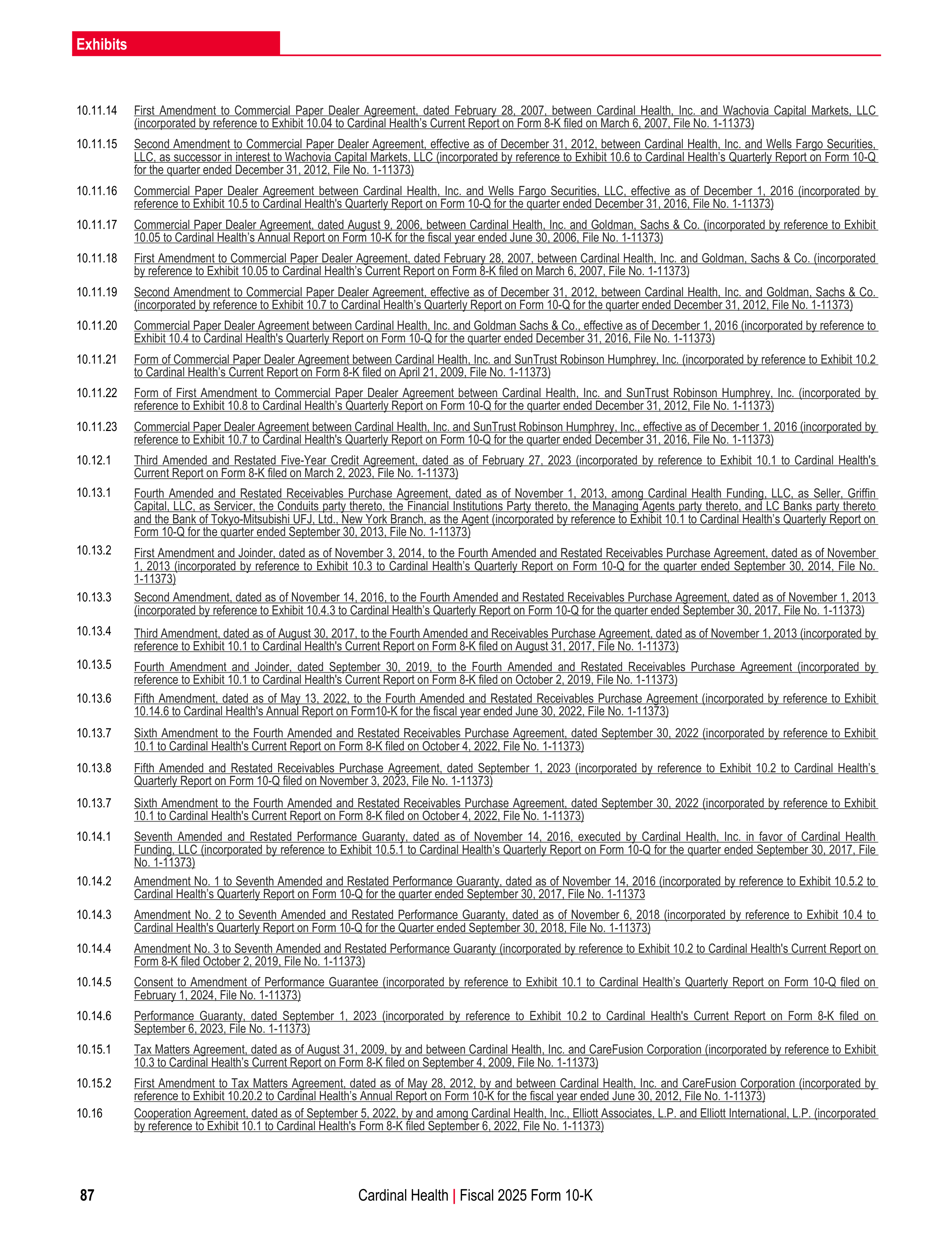
10.11.14
First Amendment to Commercial Paper Dealer Agreement, dated February 28, 2007, between Cardinal Health, Inc. and Wachovia Capital Markets, LLC
(incorporated by reference to Exhibit 10.04 to Cardinal Health’s Current Report on Form 8-K filed on March 6, 2007, File No. 1-11373)
10.11.15
Second Amendment to Commercial Paper Dealer Agreement, effective as of December 31, 2012, between Cardinal Health, Inc. and Wells Fargo Securities,
LLC, as successor in interest to Wachovia Capital Markets, LLC (incorporated by reference to Exhibit 10.6 to Cardinal Health’s Quarterly Report on Form 10-Q
for the quarter ended December 31, 2012, File No. 1-11373)
10.11.16
Commercial Paper Dealer Agreement between Cardinal Health, Inc. and Wells Fargo Securities, LLC, effective as of December 1, 2016 (incorporated by
reference to Exhibit 10.5 to Cardinal Health's Quarterly Report on Form 10-Q for the quarter ended December 31, 2016, File No. 1-11373)
10.11.17
Commercial Paper Dealer Agreement, dated August 9, 2006, between Cardinal Health, Inc. and Goldman, Sachs & Co. (incorporated by reference to Exhibit
10.05 to Cardinal Health’s Annual Report on Form 10-K for the fiscal year ended June 30, 2006, File No. 1-11373)
10.11.18
First Amendment to Commercial Paper Dealer Agreement, dated February 28, 2007, between Cardinal Health, Inc. and Goldman, Sachs & Co. (incorporated
by reference to Exhibit 10.05 to Cardinal Health’s Current Report on Form 8-K filed on March 6, 2007, File No. 1-11373)
10.11.19
Second Amendment to Commercial Paper Dealer Agreement, effective as of December 31, 2012, between Cardinal Health, Inc. and Goldman, Sachs & Co.
(incorporated by reference to Exhibit 10.7 to Cardinal Health’s Quarterly Report on Form 10-Q for the quarter ended December 31, 2012, File No. 1-11373)
10.11.20
Commercial Paper Dealer Agreement between Cardinal Health, Inc. and Goldman Sachs & Co., effective as of December 1, 2016 (incorporated by reference to
Exhibit 10.4 to Cardinal Health's Quarterly Report on Form 10-Q for the quarter ended December 31, 2016, File No. 1-11373)
10.11.21
Form of Commercial Paper Dealer Agreement between Cardinal Health, Inc. and SunTrust Robinson Humphrey, Inc. (incorporated by reference to Exhibit 10.2
to Cardinal Health’s Current Report on Form 8-K filed on April 21, 2009, File No. 1-11373)
10.11.22
Form of First Amendment to Commercial Paper Dealer Agreement between Cardinal Health, Inc. and SunTrust Robinson Humphrey, Inc. (incorporated by
reference to Exhibit 10.8 to Cardinal Health’s Quarterly Report on Form 10-Q for the quarter ended December 31, 2012, File No. 1-11373)
10.11.23
Commercial Paper Dealer Agreement between Cardinal Health, Inc. and SunTrust Robinson Humphrey, Inc., effective as of December 1, 2016 (incorporated by
reference to Exhibit 10.7 to Cardinal Health's Quarterly Report on Form 10-Q for the quarter ended December 31, 2016, File No. 1-11373)
10.12.1
Third Amended and Restated Five-Year Credit Agreement, dated as of February 27, 2023 (incorporated by reference to Exhibit 10.1 to Cardinal Health's
Current Report on Form 8-K filed on March 2, 2023, File No. 1-11373)
10.13.1
Fourth Amended and Restated Receivables Purchase Agreement, dated as of November 1, 2013, among Cardinal Health Funding, LLC, as Seller, Griffin
Capital, LLC, as Servicer, the Conduits party thereto, the Financial Institutions Party thereto, the Managing Agents party thereto, and LC Banks party thereto
and the Bank of Tokyo-Mitsubishi UFJ, Ltd., New York Branch, as the Agent (incorporated by reference to Exhibit 10.1 to Cardinal Health’s Quarterly Report on
Form 10-Q for the quarter ended September 30, 2013, File No. 1-11373)
10.13.2
First Amendment and Joinder, dated as of November 3, 2014, to the Fourth Amended and Restated Receivables Purchase Agreement, dated as of November
1, 2013 (incorporated by reference to Exhibit 10.3 to Cardinal Health’s Quarterly Report on Form 10-Q for the quarter ended September 30, 2014, File No.
1-11373)
10.13.3
Second Amendment, dated as of November 14, 2016, to the Fourth Amended and Restated Receivables Purchase Agreement, dated as of November 1, 2013
(incorporated by reference to Exhibit 10.4.3 to Cardinal Health’s Quarterly Report on Form 10-Q for the quarter ended September 30, 2017, File No. 1-11373)
10.13.4
Third Amendment, dated as of August 30, 2017, to the Fourth Amended and Receivables Purchase Agreement, dated as of November 1, 2013 (incorporated by
reference to Exhibit 10.1 to Cardinal Health's Current Report on Form 8-K filed on August 31, 2017, File No. 1-11373)
10.13.5
Fourth Amendment and Joinder, dated September 30, 2019, to the Fourth Amended and Restated Receivables Purchase Agreement (incorporated by
reference to Exhibit 10.1 to Cardinal Health's Current Report on Form 8-K filed on October 2, 2019, File No. 1-11373)
10.13.6
Fifth Amendment, dated as of May 13, 2022, to the Fourth Amended and Restated Receivables Purchase Agreement (incorporated by reference to Exhibit
10.14.6 to Cardinal Health's Annual Report on Form10-K for the fiscal year ended June 30, 2022, File No. 1-11373)
10.13.7
Sixth Amendment to the Fourth Amended and Restated Receivables Purchase Agreement, dated September 30, 2022 (incorporated by reference to Exhibit
10.1 to Cardinal Health's Current Report on Form 8-K filed on October 4, 2022, File No. 1-11373)
10.13.8
Fifth Amended and Restated Receivables Purchase Agreement, dated September 1, 2023 (incorporated by reference to Exhibit 10.2 to Cardinal Health’s
Quarterly Report on Form 10-Q filed on November 3, 2023, File No. 1-11373)
10.13.7
Sixth Amendment to the Fourth Amended and Restated Receivables Purchase Agreement, dated September 30, 2022 (incorporated by reference to Exhibit
10.1 to Cardinal Health's Current Report on Form 8-K filed on October 4, 2022, File No. 1-11373)
10.14.1
Seventh Amended and Restated Performance Guaranty, dated as of November 14, 2016, executed by Cardinal Health, Inc. in favor of Cardinal Health
Funding, LLC (incorporated by reference to Exhibit 10.5.1 to Cardinal Health’s Quarterly Report on Form 10-Q for the quarter ended September 30, 2017, File
No. 1-11373)
10.14.2
Amendment No. 1 to Seventh Amended and Restated Performance Guaranty, dated as of November 14, 2016 (incorporated by reference to Exhibit 10.5.2 to
Cardinal Health’s Quarterly Report on Form 10-Q for the quarter ended September 30, 2017, File No. 1-11373
10.14.3
Amendment No. 2 to Seventh Amended and Restated Performance Guaranty, dated as of November 6, 2018 (incorporated by reference to Exhibit 10.4 to
Cardinal Health's Quarterly Report on Form 10-Q for the Quarter ended September 30, 2018, File No. 1-11373)
10.14.4
Amendment No. 3 to Seventh Amended and Restated Performance Guaranty (incorporated by reference to Exhibit 10.2 to Cardinal Health's Current Report on
Form 8-K filed October 2, 2019, File No. 1-11373)
10.14.5
Consent to Amendment of Performance Guarantee (incorporated by reference to Exhibit 10.1 to Cardinal Health’s Quarterly Report on Form 10-Q filed on
February 1, 2024, File No. 1-11373)
10.14.6
Performance Guaranty, dated September 1, 2023 (incorporated by reference to Exhibit 10.2 to Cardinal Health's Current Report on Form 8-K filed on
September 6, 2023, File No. 1-11373)
10.15.1
Tax Matters Agreement, dated as of August 31, 2009, by and between Cardinal Health, Inc. and CareFusion Corporation (incorporated by reference to Exhibit
10.3 to Cardinal Health’s Current Report on Form 8-K filed on September 4, 2009, File No. 1-11373)
10.15.2
First Amendment to Tax Matters Agreement, dated as of May 28, 2012, by and between Cardinal Health, Inc. and CareFusion Corporation (incorporated by
reference to Exhibit 10.20.2 to Cardinal Health’s Annual Report on Form 10-K for the fiscal year ended June 30, 2012, File No. 1-11373)
10.16
Cooperation Agreement, dated as of September 5, 2022, by and among Cardinal Health, Inc., Elliott Associates, L.P. and Elliott International, L.P. (incorporated
by reference to Exhibit 10.1 to Cardinal Health's Form 8-K filed September 6, 2022, File No. 1-11373)
Exhibits
Cardinal Health
|
Fiscal 2025 Form 10-K
87
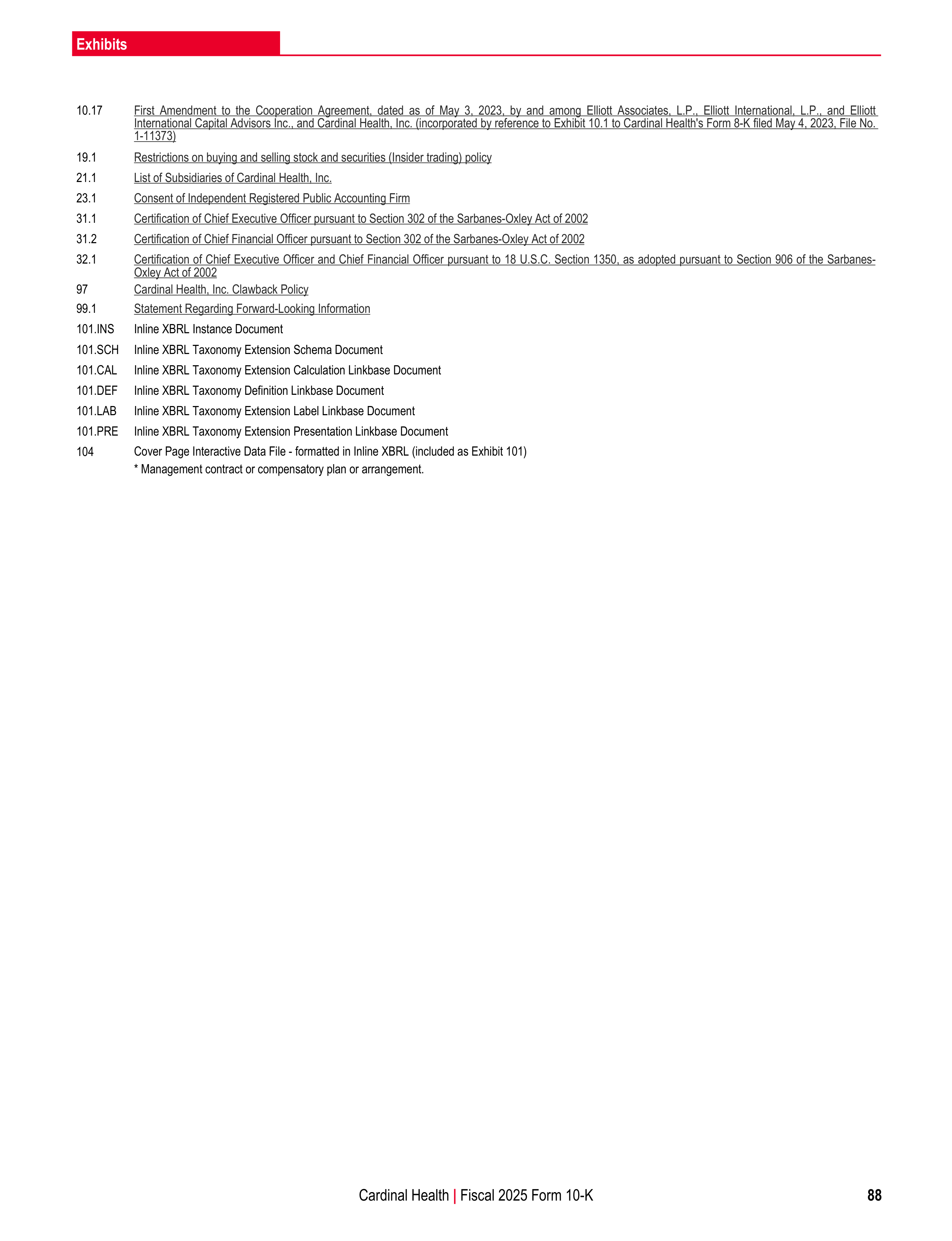
10.17
First Amendment to the Cooperation Agreement, dated as of May 3, 2023, by and among Elliott Associates, L.P., Elliott International, L.P., and Elliott
International Capital Advisors Inc., and Cardinal Health, Inc. (incorporated by reference to Exhibit 10.1 to Cardinal Health's Form 8-K filed May 4, 2023, File No.
1-11373)
19.1
Restrictions on buying and selling stock and securities (Insider trading) policy
21.1
List of Subsidiaries of Cardinal Health, Inc.
23.1
Consent of Independent Registered Public Accounting Firm
31.1
Certification of Chief Executive Officer pursuant to Section 302 of the Sarbanes-Oxley Act of 2002
31.2
Certification of Chief Financial Officer pursuant to Section 302 of the Sarbanes-Oxley Act of 2002
32.1
Certification of Chief Executive Officer and Chief Financial Officer pursuant to 18 U.S.C. Section 1350, as adopted pursuant to Section 906 of the Sarbanes-
Oxley Act of 2002
97
Cardinal Health, Inc. Clawback Policy
99.1
Statement Regarding Forward-Looking Information
101.INS
Inline XBRL Instance Document
101.SCH
Inline XBRL Taxonomy Extension Schema Document
101.CAL
Inline XBRL Taxonomy Extension Calculation Linkbase Document
101.DEF
Inline XBRL Taxonomy Definition Linkbase Document
101.LAB
Inline XBRL Taxonomy Extension Label Linkbase Document
101.PRE
Inline XBRL Taxonomy Extension Presentation Linkbase Document
104
Cover Page Interactive Data File - formatted in Inline XBRL (included as Exhibit 101)
* Management contract or compensatory plan or arrangement.
Exhibits
88
Cardinal Health
|
Fiscal 2025 Form 10-K
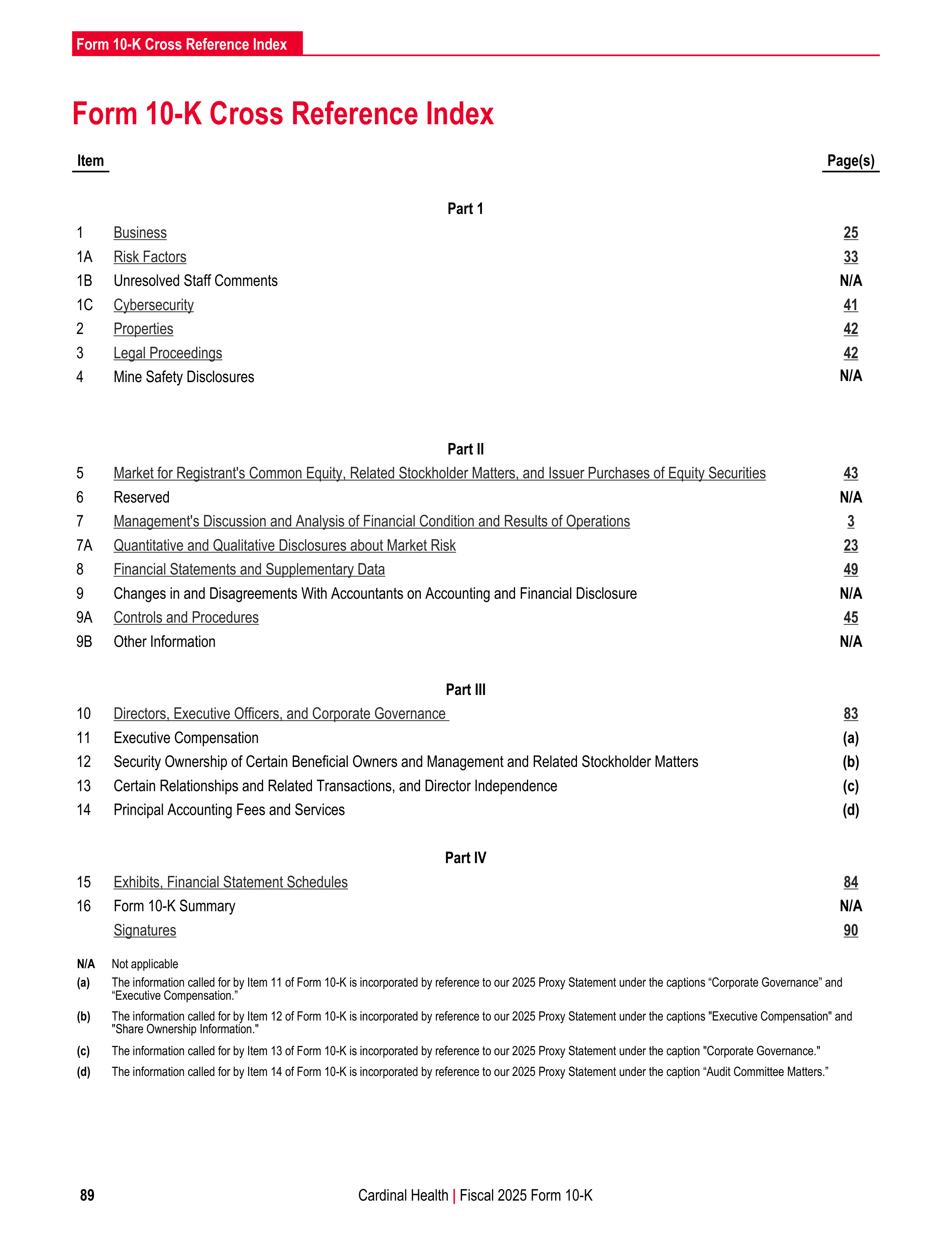
Form 10-K Cross Reference Index
Item
Page(s)
Part 1
1
Business
25
1A
Risk Factors
33
1B
Unresolved Staff Comments
N/A
1C
Cybersecurity
41
2
Properties
42
3
Legal Proceedings
42
4
Mine Safety Disclosures
N/A
Part II
5
Market for Registrant's Common Equity, Related Stockholder Matters, and Issuer Purchases of Equity Securities
43
6
Reserved
N/A
7
Management's Discussion and Analysis of Financial Condition and Results of Operations
3
7A
Quantitative and Qualitative Disclosures about Market Risk
23
8
Financial Statements and Supplementary Data
49
9
Changes in and Disagreements With Accountants on Accounting and Financial Disclosure
N/A
9A
Controls and Procedures
45
9B
Other Information
N/A
Part III
10
Directors, Executive Officers, and Corporate Governance
83
11
Executive Compensation
(a)
12
Security Ownership of Certain Beneficial Owners and Management and Related Stockholder Matters
(b)
13
Certain Relationships and Related Transactions, and Director Independence
(c)
14
Principal Accounting Fees and Services
(d)
Part IV
15
Exhibits, Financial Statement Schedules
84
16
Form 10-K Summary
N/A
Signatures
90
N/A
Not applicable
(a)
The information called for by Item 11 of Form 10-K is incorporated by reference to our 2025 Proxy Statement under the captions “Corporate Governance” and
“Executive Compensation.”
(b)
The information called for by Item 12 of Form 10-K is incorporated by reference to our 2025 Proxy Statement under the captions "Executive Compensation" and
"Share Ownership Information."
(c)
The information called for by Item 13 of Form 10-K is incorporated by reference to our 2025 Proxy Statement under the caption "Corporate Governance."
(d)
The information called for by Item 14 of Form 10-K is incorporated by reference to our 2025 Proxy Statement under the caption “Audit Committee Matters.”
Form 10-K Cross Reference Index
Cardinal Health
|
Fiscal 2025 Form 10-K
89
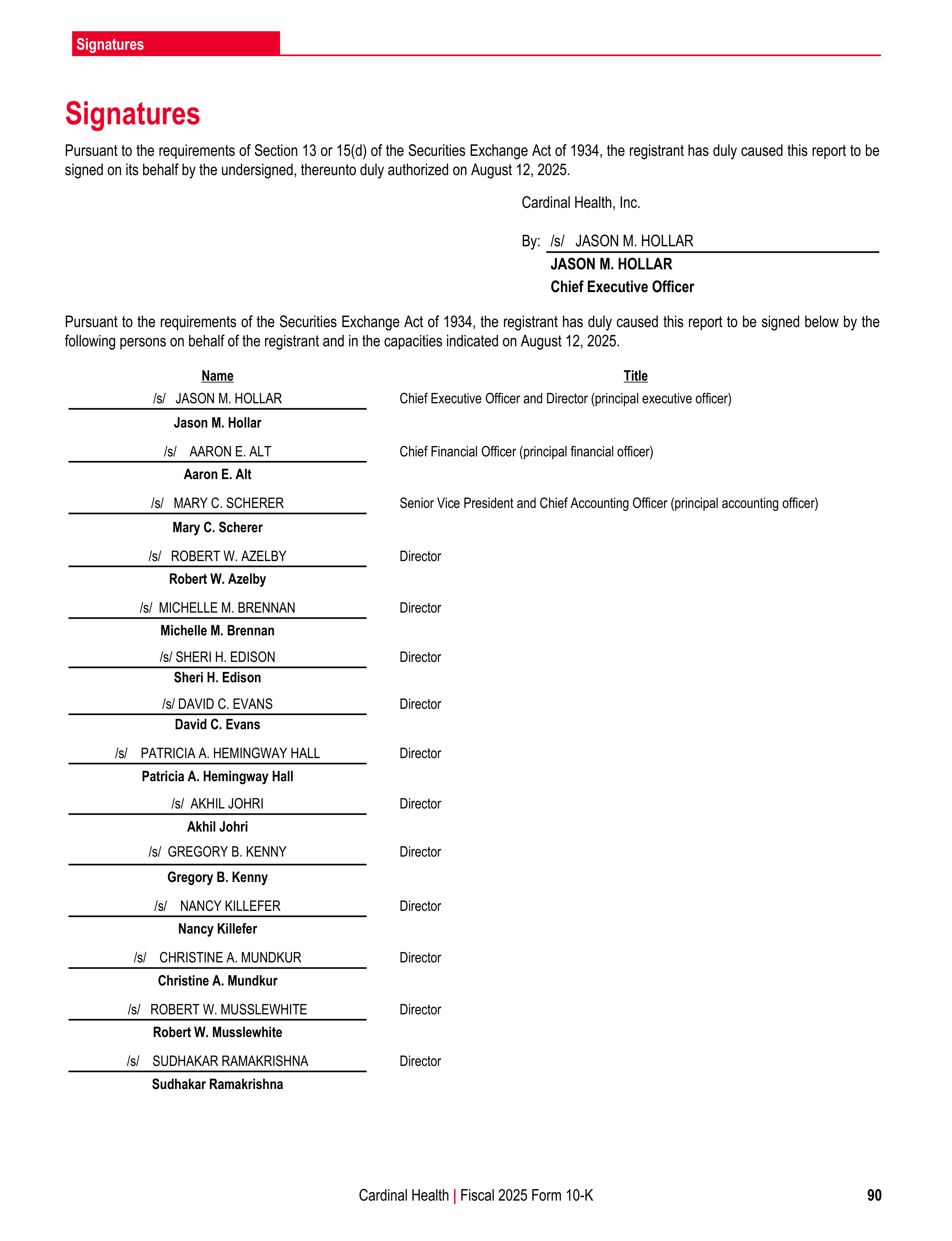
Signatures
Pursuant to the requirements of Section 13 or 15(d) of the Securities Exchange Act of 1934, the registrant has duly caused this report to be
signed on its behalf by the undersigned, thereunto duly authorized on August 12, 2025.
Cardinal Health, Inc.
By:
/s/ JASON M. HOLLAR
JASON M. HOLLAR
Chief Executive Officer
Pursuant to the requirements of the Securities Exchange Act of 1934, the registrant has duly caused this report to be signed below by the
following persons on behalf of the registrant and in the capacities indicated on August 12, 2025.
Name
Title
/s/ JASON M. HOLLAR
Chief Executive Officer and Director (principal executive officer)
Jason M. Hollar
/s/ AARON E. ALT
Chief Financial Officer (principal financial officer)
Aaron E. Alt
/s/ MARY C. SCHERER
Senior Vice President and Chief Accounting Officer (principal accounting officer)
Mary C. Scherer
/s/ ROBERT W. AZELBY
Director
Robert W. Azelby
/s/ MICHELLE M. BRENNAN
Director
Michelle M. Brennan
/s/ SHERI H. EDISON
Director
Sheri H. Edison
/s/ DAVID C. EVANS
Director
David C. Evans
/s/ PATRICIA A. HEMINGWAY HALL
Director
Patricia A. Hemingway Hall
/s/ AKHIL JOHRI
Director
Akhil Johri
/s/ GREGORY B. KENNY
Director
Gregory B. Kenny
/s/ NANCY KILLEFER
Director
Nancy Killefer
/s/ CHRISTINE A. MUNDKUR
Director
Christine A. Mundkur
/s/ ROBERT W. MUSSLEWHITE
Director
Robert W. Musslewhite
/s/ SUDHAKAR RAMAKRISHNA
Director
Sudhakar Ramakrishna
Signatures
90
Cardinal Health
|
Fiscal 2025 Form 10-K
Statement Regarding Forward-Looking Information
As used in this exhibit, “we,” “our,” “us” and similar pronouns refer to Cardinal Health, Inc. and its subsidiaries, unless the context requires
otherwise. Our filings with the Securities and Exchange Commission, including this Annual Report on Form 10-K for the fiscal year ended
June 30, 2025 (the “2025 Form 10-K”), and our quarterly reports on Form 10-Q, and our current reports on Form 8-K (along with any exhibits
and amendments to such reports), as well as our news releases or any other written or oral statements made by or on behalf of us, including
materials posted on our website, may include, directly or by incorporation by reference, forward-looking statements that reflect our current
view (as of the date the forward-looking statement is first made) about future events, prospects, projections or financial performance. The
matters discussed in these forward-looking statements are subject to certain risks and uncertainties that could cause actual results to differ
materially from those projected, anticipated or implied in or by such statements. These risks and uncertainties include:
•
competitive pressures in the markets in which we operate, including pricing pressures;
•
uncertainties relating to the pricing of and demand for generic pharmaceuticals;
•
uncertainties related to recently imposed or threatened tariffs on China, Mexico and Canada and other countries, and any retaliatory
actions taken by these countries, which will result in us incurring additional costs to procure products or materials that we source,
manufacture and distribute, including the risk that we will not be successful at mitigating the negative impact of such increased costs, the
risk that we may not be able to establish alternate sources of supply and may experience supply disruptions or shortages;
•
uncertainties relating to the timing, frequency and profitability of generic pharmaceutical launches or other components of our
pharmaceutical generics program;
•
changes in the timing or frequency of the introduction of branded pharmaceuticals;
•
material reductions in purchases, pricing changes, non-renewal, early termination, or delinquencies or defaults under contracts with key
customers;
•
costs or claims resulting from quality issues, or other potential or alleged errors or defects in our manufacturing or sourcing of medical
devices or other products or in our compounding, repackaging, information systems or pharmacy management services that may injure
persons or damage property or operations, including costs from recalls, remediation efforts, and related product liability claims and
lawsuits, including class action lawsuits;
•
any compromise of our information systems or of those of a third-party service provider, including unauthorized access to or use or
disclosure of company or customer information, disruption of access and ancillary risks associated with our ability to effectively manage
any issues arising from any such compromise or disruption;
•
continuing risks associated with the resolution and defense of the lawsuits and investigations in which we have been or will be named
relating to the distribution of prescription opioid pain medication, including the investigations by the U.S. Department of Justice which
concerns our anti-diversion program, our anti-diversion policies and procedures and our distribution of certain controlled substances;
•
risks associated with the national opioid settlement agreement, including the risk that the maintenance of the required changes to
distributors' controlled substance anti-diversion programs may result in unforeseen costs or operational challenges and the risk that if we
fail to or are alleged to have failed to comply with the terms of the settlement agreement, we could incur monetary or other penalties or
result in additional lawsuits being filed against us;
•
uncertainties related to Cardinal Health Brand products, including our ability to manage cost and infrastructure, retain margin, increase
volume and improve performance;
•
significantly increased costs for commodities and other materials used in the Global Medical Products and Distribution segment
manufacturing, including various components, compounds, raw materials or energy such as oil-based resins, pulp, cotton, latex and
other commodities and the possibility that we may not successfully offset or mitigate these increases;
•
risks arising from acquisitions, including possible liabilities relating to the operations or activities of such businesses prior to their
acquisition, and uncertainties relating to our ability to achieve the anticipated results from acquisitions, including as a result of entering
new lines of business with risks and uncertainties that may be different from or more significant than risks and uncertainties facing our
legacy businesses;
•
risks associated with the tax benefit from our self-insurance loss claims, including, certain state courts' interpretation of laws and
insurance policies in ways that may impact our self-insurance loss, which could negatively impact our financial position;
•
disruption, damage or lack of access to, or failure of, our or our third-party service providers' information systems, our critical facilities,
including our national logistics center, or our distribution networks;
•
risks associated with our Corporate Integrity Agreement with the Office of Inspector General of the Department of Health and Human
Services, including the risk that failure to comply with the requirements set forth therein could result in monetary or other penalties;
•
our high sales concentration with certain key customers, including CVS Health Corporation;
•
our ability to maintain the benefits of our generic pharmaceutical sourcing venture with CVS Health Corporation;
•
actions of regulatory bodies and other governmental authorities, including the U.S. Drug Enforcement Administration, certain agencies
within the U.S. Department of Health and Human Services (including the U.S. Food and Drug Administration, Centers for Medicare and
Medicaid Services, the Office of Inspector General and the Office for Civil Rights), the U.S. Nuclear Regulatory Commission, the U.S.
Exhibit 99.1
Federal Trade Commission, the U.S. Customs and Border Protection, various state boards of pharmacy, state controlled substance
authorities, state health departments, state insurance departments, state Medicaid departments or comparable regulatory bodies or
governmental authorities or foreign equivalents that, in each case, could delay, limit or suspend product development, manufacturing,
distribution, importation or sales or result in warning letters, recalls, seizures, injunctions or monetary sanctions;
•
shortages in commodities, components, compounds, raw materials or energy used by our businesses, including supply disruptions of
radioisotopes;
•
the loss of, or default by, one or more key suppliers for which alternative suppliers may not be readily available;
•
uncertainties with respect to certain business process initiatives, including IT infrastructure activities and outsourcing relationships,
including the ability to achieve the expected benefits from such initiatives, the risk that we could incur unexpected charges, and the risk
that we may fail to retain key personnel;
•
difficulties or delays in the development, production, manufacturing, sourcing and marketing of new or existing products and services,
including difficulties or delays associated with obtaining or maintaining requisite regulatory consents, whether our own or third parties', or
approvals associated with those activities;
•
manufacturing disruptions, whether due to regulatory action, including regulatory action to reduce ethylene oxide ("EtO") emissions,
production quality deviations, safety issues or raw material shortages or defects, or because a key product is manufactured at a single
manufacturing facility with limited alternate facilities;
•
risks associated with industry reliance on EtO to sterilize certain medical products that we manufacture or distribute, including the
possibility that regulatory actions to reduce EtO emissions could become more widespread, which may result in increased costs or
supply shortages; and risks that the lawsuits against us alleging personal injury resulting from EtO exposure could become more
widespread;
•
the possibility that we could be subject to adverse changes in the tax laws or challenges to our tax positions, including the possibility that
the corporate tax rate in the U.S. could be increased;
•
risks arising from possible violations of healthcare fraud and abuse laws;
•
risks arising from possible violations of the U.S. Foreign Corrupt Practices Act and other similar anti-corruption laws in other jurisdictions
and U.S. and foreign export control, trade embargo and customs laws;
•
risks arising from our collecting, handling and maintaining patient-identifiable health information and other sensitive personal and
financial information, which are subject to federal, state and foreign laws that regulate the use and disclosure of such information;
•
risks arising from certain of our businesses being Medicare-certified suppliers or participating in other federal and state healthcare
programs, such as state Medicaid programs and the federal 340B drug pricing program, which businesses are subject to accreditation
and quality standards and other rules and regulations, including applicable reporting, billing, payment and record-keeping requirements;
•
risks arising from pharmaceutical manufacturers' restriction of sales under the 340B drug pricing program to contract pharmacies, which
may adversely impact our customers;
•
risks arising from certain of our businesses manufacturing pharmaceutical and medical products or repackaging pharmaceuticals that
are purchased or reimbursed through, or are otherwise governed by, federal or state healthcare programs, which businesses are subject
to federal and state laws that establish eligibility for reimbursement by such programs and other applicable standards and regulations;
•
changes in laws or changes in the interpretation or application of laws or regulations, as well as possible failures to comply with
applicable laws or regulations, including as a result of possible misinterpretations or misapplications;
•
unfavorable changes to the terms or with our ability to meet contractual obligations of key customer or supplier relationships, or changes
in customer mix;
•
risks arising from changes in U.S. or foreign tax laws and unfavorable challenges to our tax positions and payments to settle these
challenges, which may adversely affect our effective tax rate or tax payments;
•
uncertainties due to possible government healthcare reform, including proposals related to Medicare drug rebate arrangements, possible
repeal or replacement of major parts of the Patient Protection and Affordable Care Act, proposals related to prescription drug pricing
transparency and the possible adoption of Medicare-For-All;
•
reductions or limitations on governmental funding at the state or federal level or efforts by healthcare insurance companies to limit
payments for products and services;
•
changes in manufacturers' pricing, selling, inventory, distribution or supply policies or practices;
•
changes in legislation or regulations governing prescription drug pricing, healthcare services or mandated benefits;
•
uncertainties arising as a result of the Supreme Court decision on Dobbs vs. Jackson, including uncertainties associated with states'
proposed and adopted laws which may impact our ability to distribute or store certain pharmaceutical products and the risk that we could
incur unforeseen costs to comply with these new laws in various jurisdictions;
•
changes in hospital buying groups or hospital buying practices;
•
changes in distribution or sourcing models for pharmaceutical and medical and surgical products, including an increase in direct and
limited distribution;
•
changes to the prescription drug reimbursement formula and related reporting requirements for generic pharmaceuticals under
Medicaid;
•
continuing consolidation in the healthcare industry, which could give the resulting enterprises greater bargaining power and may
increase pressure on prices for our products and services or result in the loss of customers;
•
risks to our business and information and controls systems in the event that business process improvements, infrastructure
modernization or initiatives to use third-party service providers for key systems and processes are not effectively implemented;
•
the risk that we may not effectively implement and maintain data governance structures across businesses to allow us to access and
interpret our data, which could put us at a competitive disadvantage relative to our peers;
•
the results, costs, effects or timing of any commercial disputes, government contract compliance matters, patent infringement claims,
qui
tam
actions, government investigations, shareholder lawsuits or other legal proceedings;
•
the possibility that our business performance or internal control over financial reporting may be adversely impacted if we are not
successful at attracting, retaining and developing talent;
•
losses relating to product liability lawsuits and claims regarding products for which we cannot obtain product liability insurance or for
which such insurance may not be adequate to cover our losses, including the product liability lawsuits we are currently defending
relating to alleged personal injuries associated with the use of Cordis inferior vena cava filter products;
•
risks associated with the importation of products or source materials used in products that we manufacture or distribute, including risks
associated with our country-of-origin determinations and the possibility that we could experience additional supply disruptions as a result
of the Uyghur Forced Labor Prevention Act or other similar regulations;
•
our ability to maintain adequate intellectual property protections;
•
our ability to manage and complete divestitures or other strategic business combination transactions, including our ability to find buyers
or other strategic exit opportunities and risks associated with the possibility that we could experience greater dis-synergies than
anticipated or otherwise fail to achieve our strategic objectives;
•
bankruptcy, insolvency or other credit failure of a customer or supplier that owes us a substantial amount;
•
risks associated with global operations, including the effect of local economic environments, inflation, recession, currency volatility and
global competition, in addition to risks associated with compliance with U.S. and international laws relating to global operations;
•
uncertainties with respect to U.S. or international trade policies, tariffs, excise or border taxes and their impact on our ability to source
products or materials that we need to conduct our business;
•
risks associated with our use of and reliance on the global capital and credit markets, including our ability to access credit and our cost
of credit, which may adversely affect our ability to efficiently fund our operations or undertake certain expenditures;
•
our ability to introduce and market new products and our ability to keep pace with advances in technology;
•
significant charges to earnings if goodwill or intangible assets become impaired;
•
uncertainties relating to general political, business, industry, regulatory and market conditions; and
•
other factors described in the “Risk Factors” section of the 2025 Form 10-K.
The words “expect,” “anticipate,” “intend,” “plan,” “believe,” “will,” “should,” “could,” “would,” “project,” “continue,” “likely,” and similar
expressions generally identify “forward-looking statements,” which speak only as of the date the statements were made, and also include
statements reflecting future results or guidance, statements of outlook and expense accruals. We undertake no obligation to update or revise
any forward-looking statements, except to the extent required by applicable law.

This page intentionally left blank.

This page intentionally left blank.
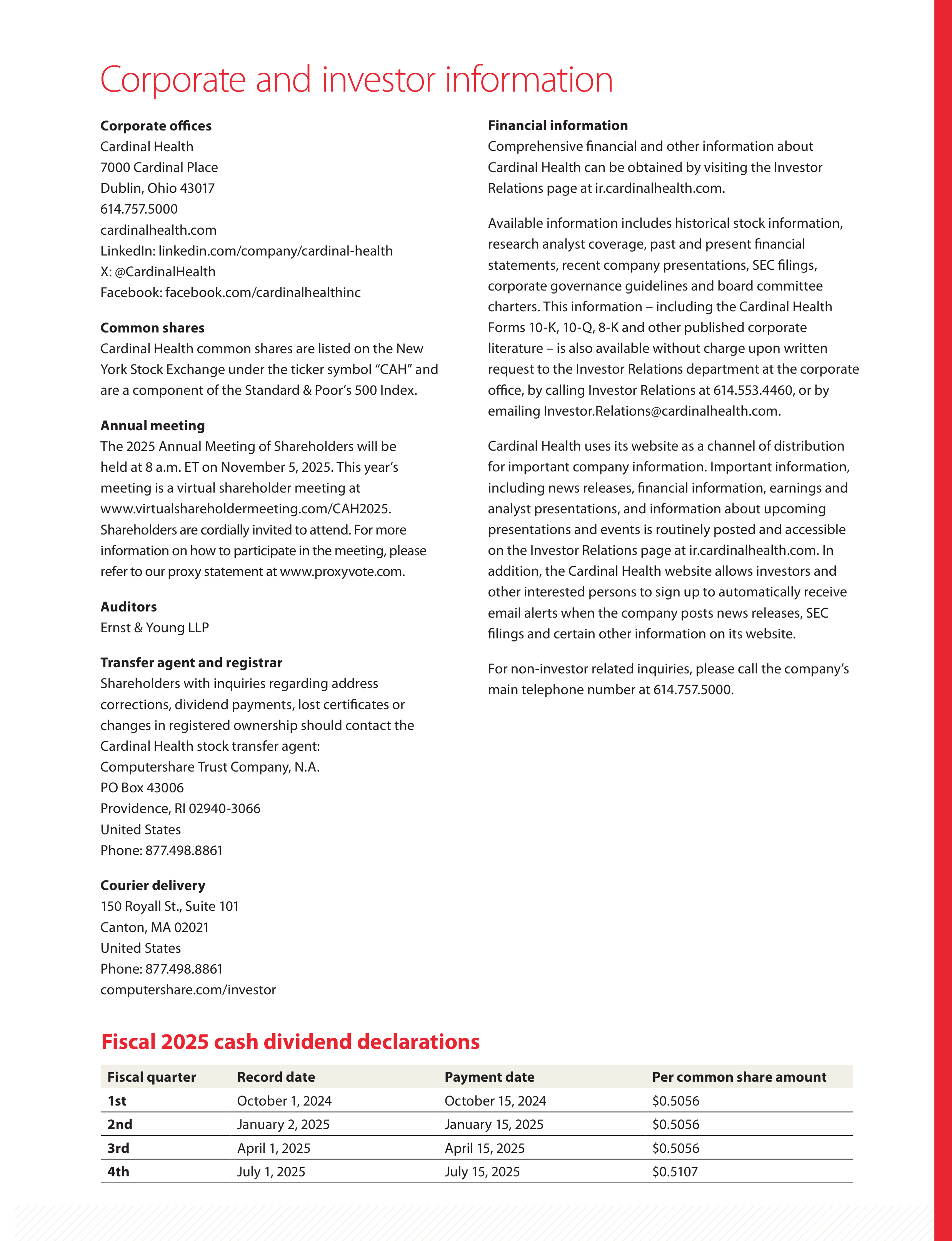
Corporate offices
Cardinal Health
7000 Cardinal Place
Dublin, Ohio 43017
614.757.5000
cardinalhealth.com
LinkedIn: linkedin.com/company/cardinal-health
X: @CardinalHealth
Facebook: facebook.com/cardinalhealthinc
Common shares
Cardinal Health common shares are listed on the New
York Stock Exchange under the ticker symbol “CAH” and
are a component of the Standard & Poor’s 500 Index.
Annual meeting
The 2025 Annual Meeting of Shareholders will be
held at 8 a.m. ET on November 5, 2025. This year’s
meeting is a virtual shareholder meeting at
www.virtualshareholdermeeting.com/CAH2025.
Shareholders are cordially invited to attend. For more
information on how to participate in the meeting, please
refer to our proxy statement at www.proxyvote.com.
Auditors
Ernst & Young LLP
Transfer agent and registrar
Shareholders with inquiries regarding address
corrections, dividend payments, lost certificates or
changes in registered ownership should contact the
Cardinal Health stock transfer agent:
Computershare Trust Company, N.A.
PO Box 43006
Providence, RI 02940-3066
United States
Phone: 877.498.8861
Courier delivery
150 Royall St., Suite 101
Canton, MA 02021
United States
Phone: 877.498.8861
computershare.com/investor
Financial information
Comprehensive financial and other information about
Cardinal Health can be obtained by visiting the Investor
Relations page at ir.cardinalhealth.com.
Available information includes historical stock information,
research analyst coverage, past and present financial
statements, recent company presentations, SEC filings,
corporate governance guidelines and board committee
charters. This information – including the Cardinal Health
Forms 10-K, 10-Q, 8-K and other published corporate
literature – is also available without charge upon written
request to the Investor Relations department at the corporate
office, by calling Investor Relations at 614.553.4460, or by
emailing Investor.Relations@cardinalhealth.com.
Cardinal Health uses its website as a channel of distribution
for important company information. Important information,
including news releases, financial information, earnings and
analyst presentations, and information about upcoming
presentations and events is routinely posted and accessible
on the Investor Relations page at ir.cardinalhealth.com. In
addition, the Cardinal Health website allows investors and
other interested persons to sign up to automatically receive
email alerts when the company posts news releases, SEC
filings and certain other information on its website.
For non-investor related inquiries, please call the company’s
main telephone number at 614.757.5000.
Fiscal 2025 cash dividend declarations
Fiscal quarter
Record date
Payment date
Per common share amount
1st
October 1, 2024
October 15, 2024
$0.5056
2nd
January 2, 2025
January 15, 2025
$0.5056
3rd
April 1, 2025
April 15, 2025
$0.5056
4th
July 1, 2025
July 15, 2025
$0.5107
Corporate and investor information

© 2025 Cardinal Health. All Rights Reserved. CARDINAL HEALTH and the Cardinal Health LOGO are trademarks
of Cardinal Health and may be registered in the US and/or in other countries. All other trademarks are the
property of their respective owners. Patent cardinalhealth.com/patents. Lit. No. 5PR25-3600059 (09/2025)
Corporate offices
Cardinal Health
7000 Cardinal Place
Dublin, Ohio 43017
614.757.5000
cardinalhealth.com