
May 2026
Advancing Climate Solutions
and Sustainability
Executive Summary
20
26
R
e
p
o
r
t
s
1
Solving the “and” equation -
Meeting demand
and
reducing emissions
Climate change is real, and the challenge is more complex – and the range of solutions more
broad – than most conversations acknowledge.
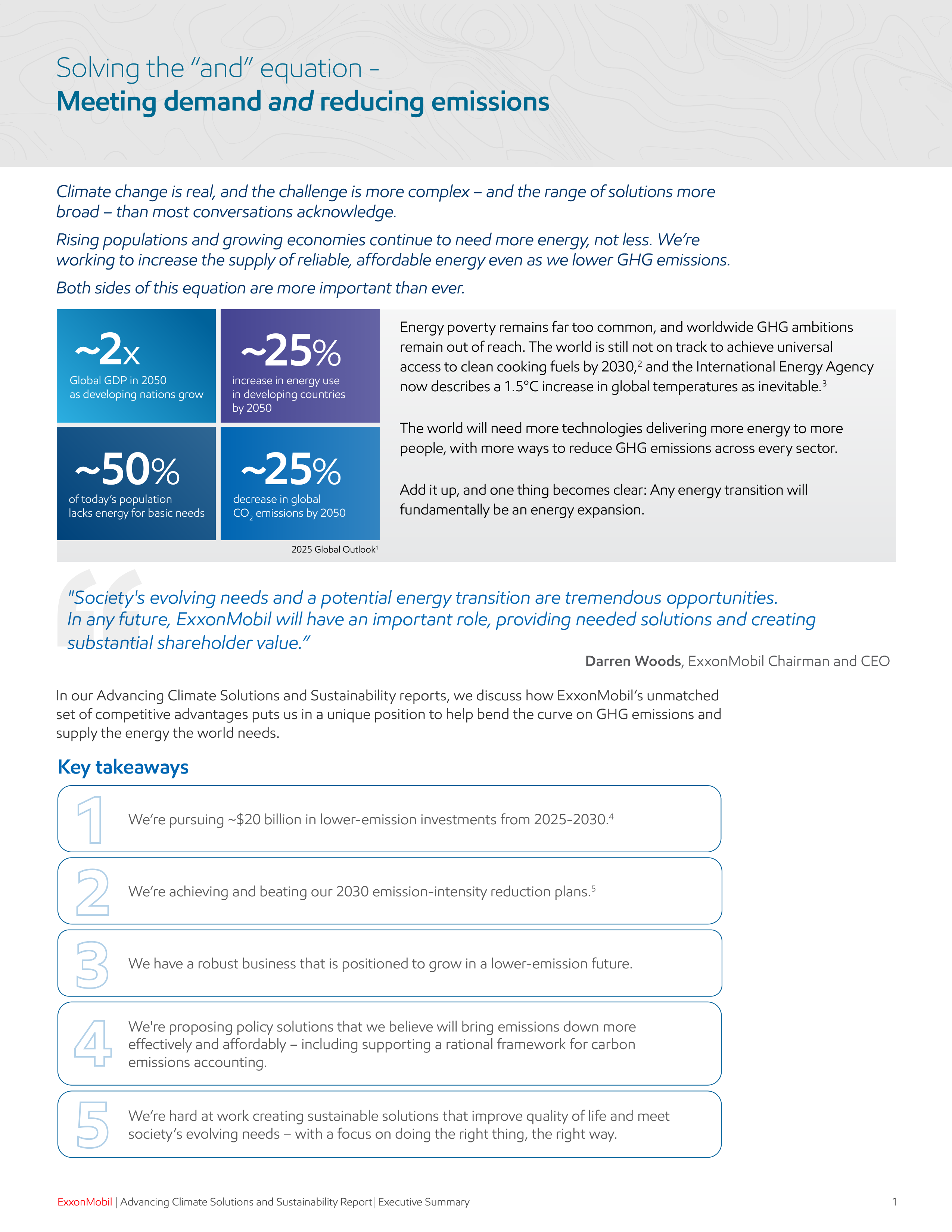
Rising populations and growing economies continue to need more energy, not less. We’re
working to increase the supply of reliable, affordable energy even as we lower GHG emissions.
Both sides of this equation are more important than ever.
Energy poverty remains far too common, and worldwide GHG ambitions
remain out of reach. The world is still not on track to achieve universal
access to clean cooking fuels by 2030,
2
and the International Energy Agency
now describes a 1.5°C increase in global temperatures as inevitable.
3
The world will need more technologies delivering more energy to more
people, with more ways to reduce GHG emissions across every sector.
Add it up, and one thing becomes clear: Any energy transition will
fundamentally be an energy expansion.
In our Advancing Climate Solutions and Sustainability reports, we discuss how ExxonMobil’s unmatched
set of competitive advantages puts us in a unique position to help bend the curve on GHG emissions and
supply the energy the world needs.
Key takeaways
We’re pursuing ~$20 billion in lower-emission investments from 2025-2030.
4
We have a robust business that is positioned to grow in a lower-emission future.
We’re achieving and beating our 2030 emission-intensity reduction plans.
5
We're proposing policy solutions that we believe will bring emissions down more
effectively and affordably – including supporting a rational framework for carbon
emissions accounting.
We’re hard at work creating sustainable solutions that improve quality of life and meet
society’s evolving needs – with a focus on doing the right thing, the right way.
~2
x
~50
%
Global GDP in 2050
as developing nations grow
~25
%
increase in energy use
in developing countries
by 2050
~25
%
decrease in global
CO
2
emissions by 2050
of today’s population
lacks energy for basic needs
"Society's evolving needs and a potential energy transition are tremendous opportunities.
In any future, ExxonMobil will have an important role, providing needed solutions and creating
substantial shareholder value.”
Darren Woods
, ExxonMobil Chairman and CEO
1
3
2
4
5
2025 Global Outlook
1
ExxonMobil
| Advancing Climate Solutions and Sustainability Report| Executive Summary
2
More people will need more energy in 2050 -
But we expect they will emit less to meet their needs
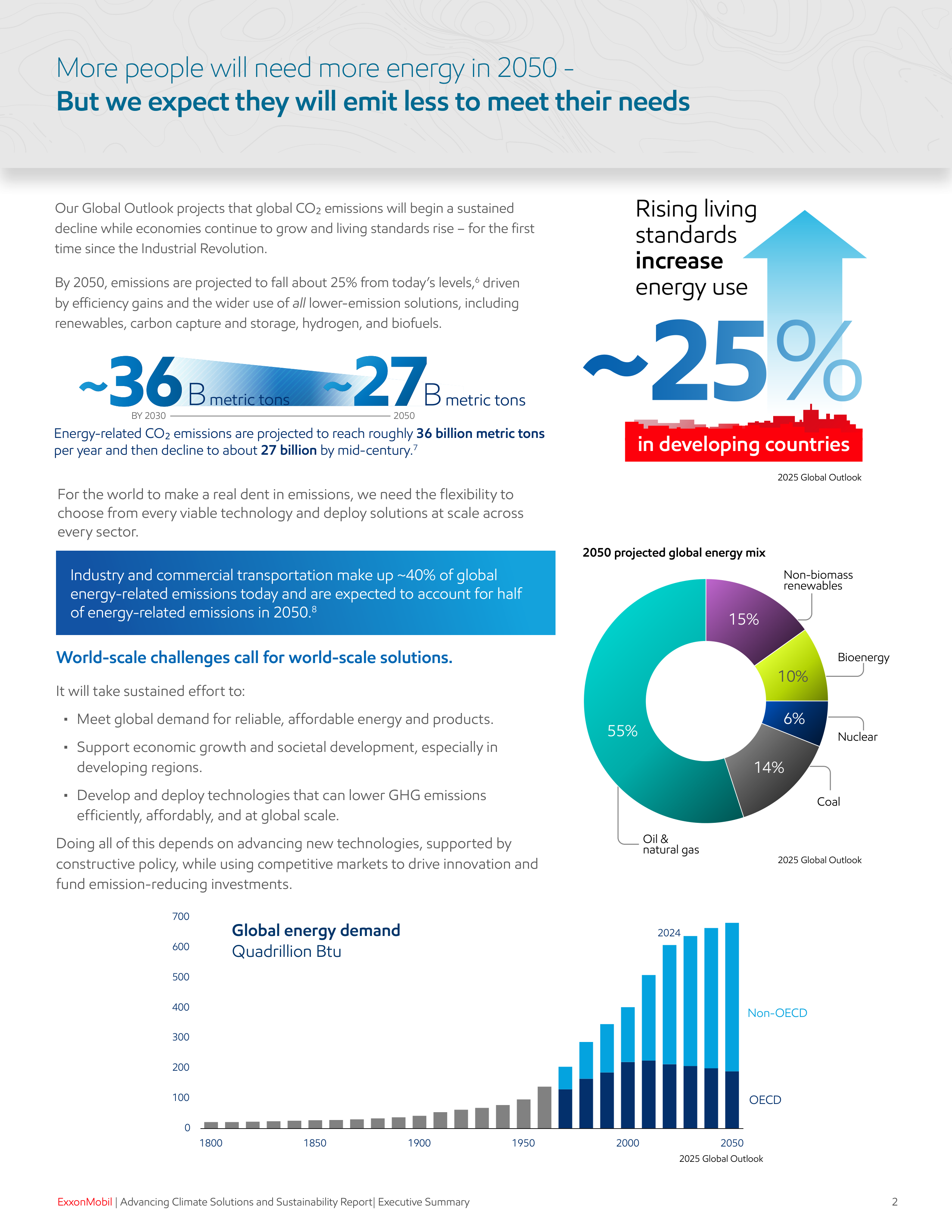
Our Global Outlook projects that global CO₂ emissions will begin a sustained
decline while economies continue to grow and living standards rise – for the first
time since the Industrial Revolution.
By 2050, emissions are projected to fall about 25% from today’s levels,
6
driven
by efficiency gains and the wider use of
all
lower‑emission solutions, including
renewables, carbon capture and storage, hydrogen, and biofuels.
2025 Global Outlook
Industry and commercial transportation make up ~40% of global
energy-related emissions today and are expected to account for half
of energy-related emissions in 2050.
8
World-scale challenges call for world-scale solutions.
It will take sustained effort to:
•
Meet global demand for reliable, affordable energy and products.
•
Support economic growth and societal development, especially in
developing regions.
•
Develop and deploy technologies that can lower GHG emissions
efficiently, affordably, and at global scale.
Doing all of this depends on advancing new technologies, supported by
constructive policy, while using competitive markets to drive innovation and
fund emission‑reducing investments.
Rising living
standards
increase
energy use
in developing countries
2050 projected global energy mix
Non-biomass
renewables
Bioenergy
Nuclear
Coal
Oil &
natural gas
15%
55%
14%
6%
10%
Energy-related CO₂ emissions are projected to reach roughly
36 billion metric tons
per year and then decline to about
27 billion
by mid-century.
7
~
36
~
27
B
metric tons
B
metric tons
BY 2030
2050
For the world to make a real dent in emissions, we need the flexibility to
choose from every viable technology and deploy solutions at scale across
every sector.
2025 Global Outlook
2025 Global Outlook
Non-OECD
OECD
2050
2024
2000
1950
1900
1850
1800
0
100
200
300
400
500
600
700
Global energy demand
Quadrillion Btu
ExxonMobil
| Advancing Climate Solutions and Sustainability Report| Executive Summary

3
Transforming molecules to transform tomorrow -
Uniquely positioned to help bend the curve on emissions
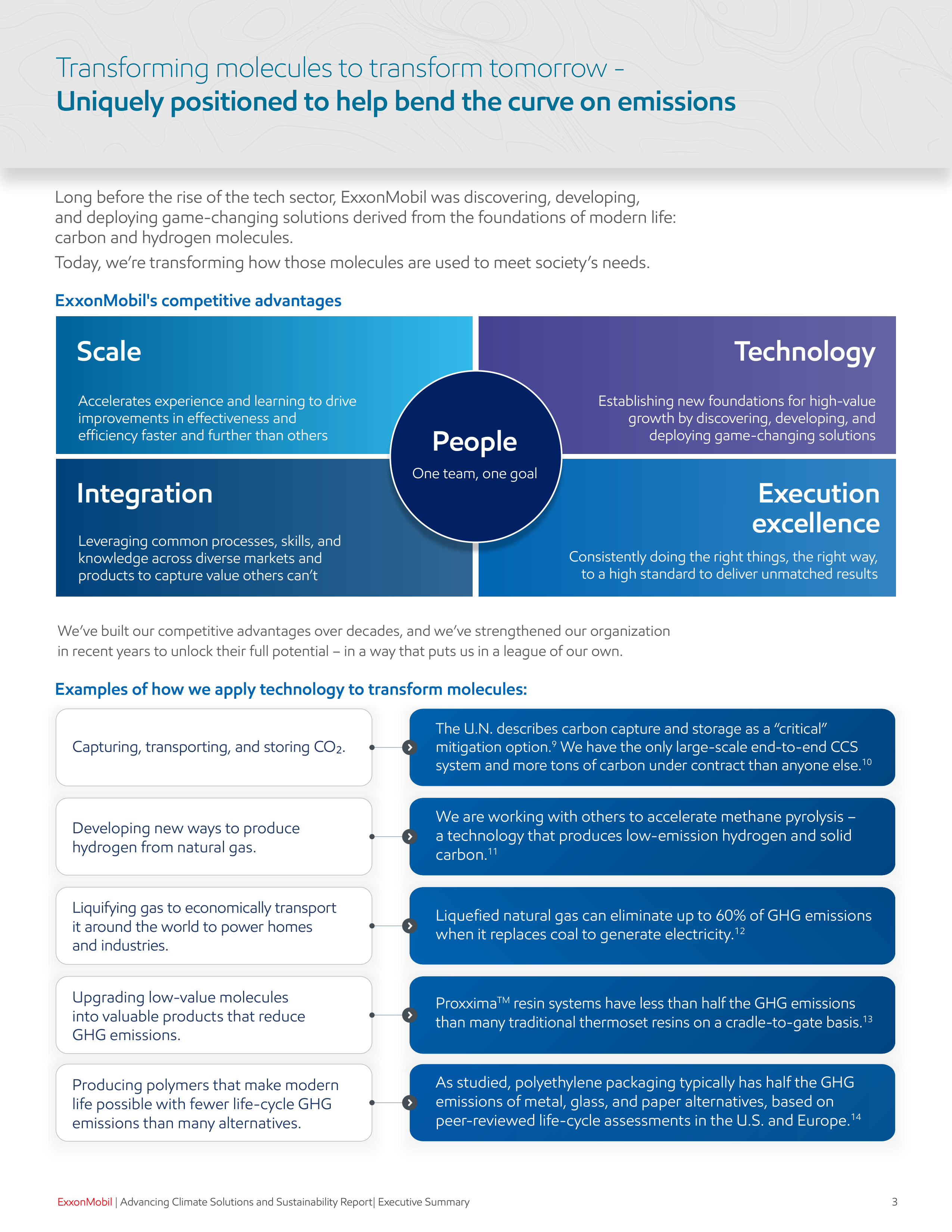
Long before the rise of the tech sector, ExxonMobil was discovering, developing,
and deploying game-changing solutions derived from the foundations of modern life:
carbon and hydrogen molecules.
Today, we’re transforming how those molecules are used to meet society’s needs.
We’ve built our competitive advantages over decades, and we’ve strengthened our organization
in recent years to unlock their full potential – in a way that puts us in a league of our own.
ExxonMobil's competitive advantages
Examples of how we apply technology to transform molecules:
Capturing, transporting, and storing CO₂.
The U.N. describes carbon capture and storage as a “critical”
mitigation option.
9
We have the only large-scale end-to-end CCS
system and more tons of carbon under contract than anyone else.
10
Developing new ways to produce
hydrogen from natural gas.
We are working with others to accelerate methane pyrolysis –
a technology that produces low-emission hydrogen and solid
carbon.
11
Liquifying gas to economically transport
it around the world to power homes
and industries.
Liquefied natural gas can eliminate up to 60% of GHG emissions
when it replaces coal to generate electricity.
12
Upgrading low-value molecules
into valuable products that reduce
GHG emissions.
Proxxima
TM
resin systems have less than half the GHG emissions
than many traditional thermoset resins on a cradle-to-gate basis.
13
Producing polymers that make modern
life possible with fewer life-cycle GHG
emissions than many alternatives.
As studied, polyethylene packaging typically has half the GHG
emissions of metal, glass, and paper alternatives, based on
peer-reviewed life-cycle assessments in the U.S. and Europe.
14
Scale
Integration
Execution
excellence
Technology
Accelerates experience and learning to drive
improvements in effectiveness and
efficiency faster and further than others
Establishing new foundations for high-value
growth by discovering, developing, and
deploying game-changing solutions
Consistently doing the right things, the right way,
to a high standard to deliver unmatched results
Leveraging common processes, skills, and
knowledge across diverse markets and
products to capture value others can’t
People
One team, one goal
ExxonMobil
| Advancing Climate Solutions and Sustainability Report| Executive Summary
4
TX
LA
MS
AL
Houston
Beaumont
Baton
Rouge
Corpus Christi
ExxonMobil CO₂ pipelines
ExxonMobil industrial site
CO₂ storage site - Class VI Permit Application
Announced CCS project
Low-carbon data center
2
~
9
MTA CO
under contract with 3
rd
party customers
Low-carbon
data center
Potential future site
Low-carbon
data center
Potential future site
CF Industries
Yazoo City, MS
~0.5 MTA CO
2
CF Industries
Donaldsonville, LA
~2.0 MTA CO
2
Nucor Corp.
Convent, LA
~0.8 MTA CO
2
Linde
Port Arthur
~2.2 MTA CO
2
AtmosClear
Baton Rouge, LA
~0.7 MTA CO
2
Lake Charles
Methanol II
Lake Charles, LA
~1.3 MTA CO
2
New Generation
Gas Gathering (NG3)
Gillis, LA
~1.2 MTA CO
2
Policy and market development set the pace -
Our capabilities set the bar
Our unique slate of lower-emission opportunities leverages our core strengths in technology,
molecular transformation, and large-scale manufacturing.
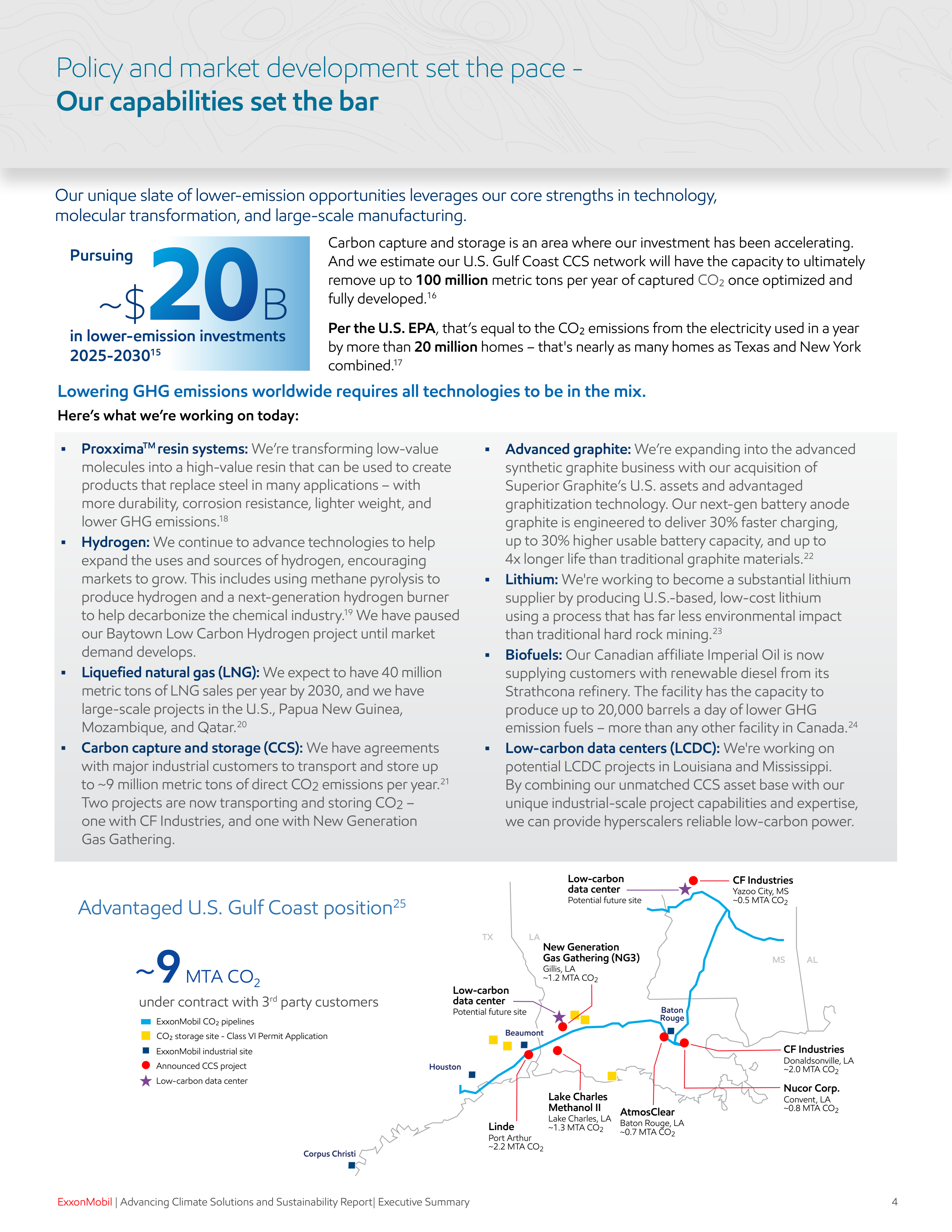
Carbon capture and storage is an area where our investment has been accelerating.
And we estimate our U.S. Gulf Coast CCS network will have the capacity to ultimately
remove up to
100 million
metric tons per year of captured
CO₂
once optimized and
fully developed.
16
Per the U.S. EPA
, that’s equal to the CO₂ emissions from the electricity used in a year
by more than
20 million
homes – that's nearly as many homes as Texas and New York
combined.
17
Lowering GHG emissions worldwide requires all technologies to be in the mix.
Here’s what we’re working on today:
Advantaged U.S. Gulf Coast position
25
•
Proxxima
TM
resin systems:
We’re transforming low-value
molecules into a high-value resin that can be used to create
products that replace steel in many applications – with
more durability, corrosion resistance, lighter weight, and
lower GHG emissions.
18
•
Hydrogen:
We continue to advance technologies to help
expand the uses and sources of hydrogen, encouraging
markets to grow. This includes using methane pyrolysis to
produce hydrogen and a next-generation hydrogen burner
to help decarbonize the chemical industry.
19
We have paused
our Baytown Low Carbon Hydrogen project until market
demand develops.
•
Liquefied natural gas (LNG):
We expect to have 40 million
metric tons of LNG sales per year by 2030, and we have
large-scale projects in the U.S., Papua New Guinea,
Mozambique, and Qatar.
20
•
Carbon capture and storage (CCS):
We have agreements
with major industrial customers to transport and store up
to ~9 million metric tons of direct CO
2
emissions per year.
21
Two projects are now transporting and storing CO
2
–
one with CF Industries, and one with New Generation
Gas Gathering.
•
Advanced graphite:
We’re expanding into the advanced
synthetic graphite business with our acquisition of
Superior Graphite’s U.S. assets and advantaged
graphitization technology. Our next-gen battery anode
graphite is engineered to deliver 30% faster charging,
up to 30% higher usable battery capacity, and up to
4x longer life than traditional graphite materials.
22
•
Lithium:
We're working to become a substantial lithium
supplier by producing U.S.-based, low-cost lithium
using a process that has far less environmental impact
than traditional hard rock mining.
23
•
Biofuels:
Our Canadian affiliate Imperial Oil is now
supplying customers with renewable diesel from its
Strathcona refinery. The facility has the capacity to
produce up to 20,000 barrels a day of lower GHG
emission fuels – more than any other facility in Canada.
24
•
Low-carbon data centers (LCDC):
We're working on
potential LCDC projects in Louisiana and Mississippi.
By combining our unmatched CCS asset base with our
unique industrial-scale project capabilities and expertise,
we can provide hyperscalers reliable low-carbon power.
in lower-emission investments
2025-2030
15
20
B
~$
Pursuing
ExxonMobil
| Advancing Climate Solutions and Sustainability Report| Executive Summary
5
28.2
21.8
Divestments
Acquisitions
Flare reduction
Growth
Methane
reduction
Energy
efficiency
Asset
reconfiguration
Other
2%
1%
3%
5%
8%
10%
3%
3%
2016
2025
Corporate GHG Intensity
(% change)
Operated Basis
(T CO
2
e/100 T)
Our plans and progress -
2030 GHG emission-reduction plans and 2050 net-zero ambition
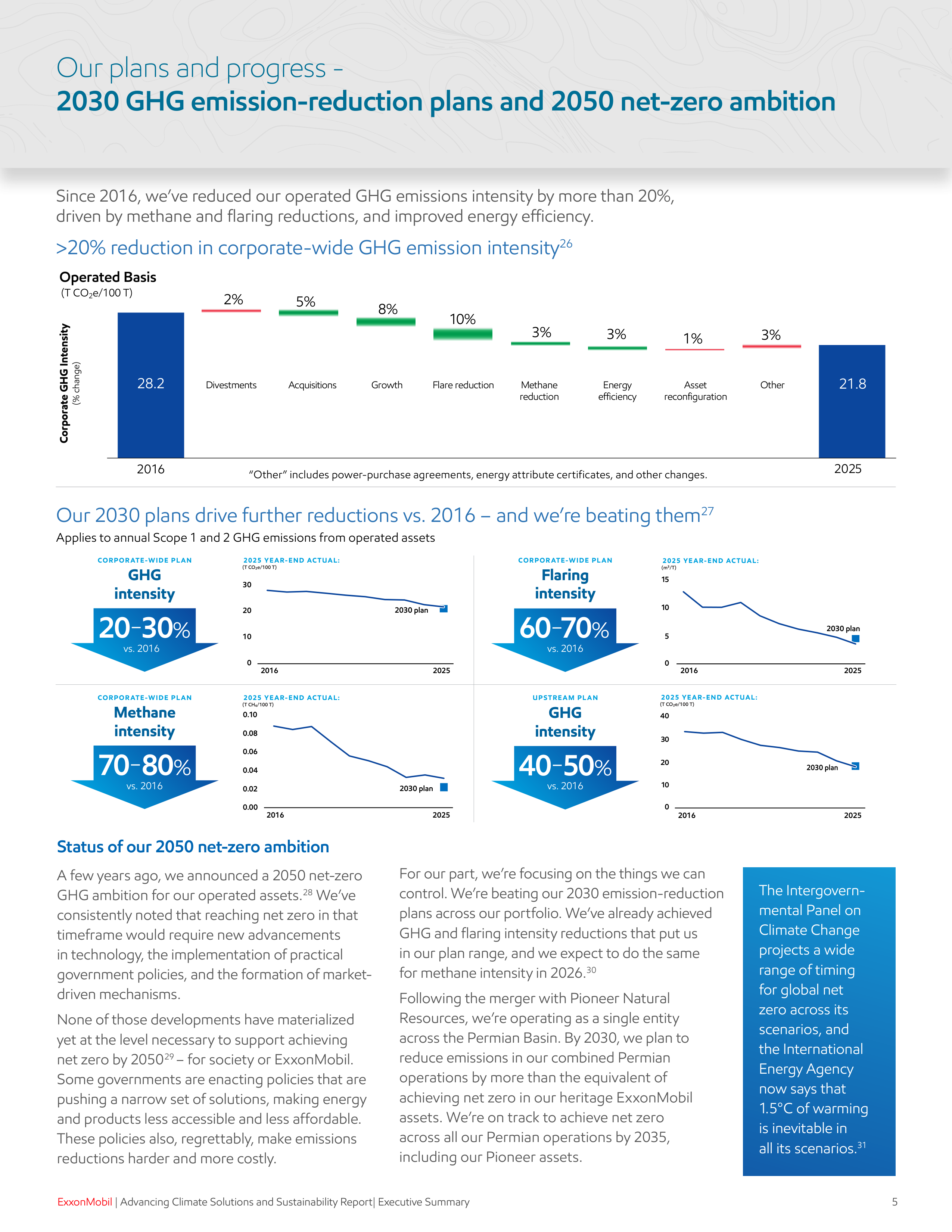
Since 2016, we’ve reduced our operated GHG emissions intensity by more than 20%,
driven by methane and flaring reductions, and improved energy efficiency.
Our 2030 plans drive further reductions vs. 2016 – and we’re beating them
27
>20% reduction in corporate-wide GHG emission intensity
26
“Other” includes power-purchase agreements, energy attribute certificates, and other changes.
GHG
intensity
20
-
30
%
CORPORATE-WIDE PLAN
Methane
intensity
70
-
80
%
CORPORATE-WIDE PLAN
2025 YEAR-END ACTUAL:
(T CO₂e/100 T)
2025 YEAR-END ACTUAL:
(T CH₄/100 T)
0
10
20
30
2016
2025
0.00
0.02
0.04
0.06
0.08
0.10
2016
2025
GHG
intensity
40
-
50
%
UPSTREAM PLAN
10
5
0
15
2025 YEAR-END ACTUAL:
(m³/T)
2025
2016
Flaring
intensity
60
-
70
%
CORPORATE-WIDE PLAN
2025 YEAR-END ACTUAL:
(T CO₂e/100 T)
20
10
30
40
2016
2025
vs. 2016
vs. 2016
vs. 2016
vs. 2016
0
Applies to annual Scope 1 and 2 GHG emissions from operated assets
Status of our 2050 net-zero ambition
A few years ago, we announced a 2050 net-zero
GHG ambition for our operated assets.
28
We’ve
consistently noted that reaching net zero in that
timeframe would require new advancements
in technology, the implementation of practical
government policies, and the formation of market-
driven mechanisms.
None of those developments have materialized
yet at the level necessary to support achieving
net zero by 2050
29
– for society or ExxonMobil.
Some governments are enacting policies that are
pushing a narrow set of solutions, making energy
and products less accessible and less affordable.
These policies also, regrettably, make emissions
reductions harder and more costly.
For our part, we’re focusing on the things we can
control. We’re beating our 2030 emission-reduction
plans across our portfolio. We’ve already achieved
GHG and flaring intensity reductions that put us
in our plan range, and we expect to do the same
for methane intensity in 2026.
30
Following the merger with Pioneer Natural
Resources, we’re operating as a single entity
across the Permian Basin. By 2030, we plan to
reduce emissions in our combined Permian
operations by more than the equivalent of
achieving net zero in our heritage ExxonMobil
assets. We’re on track to achieve net zero
across all our Permian operations by 2035,
including our Pioneer assets.
ExxonMobil
| Advancing Climate Solutions and Sustainability Report| Executive Summary
The Intergovern-
mental Panel on
Climate Change
projects a wide
range of timing
for global net
zero across its
scenarios, and
the International
Energy Agency
now says that
1.5°C of warming
is inevitable in
all its scenarios.
31


6
Our plans and progress -
Building a business for the long term
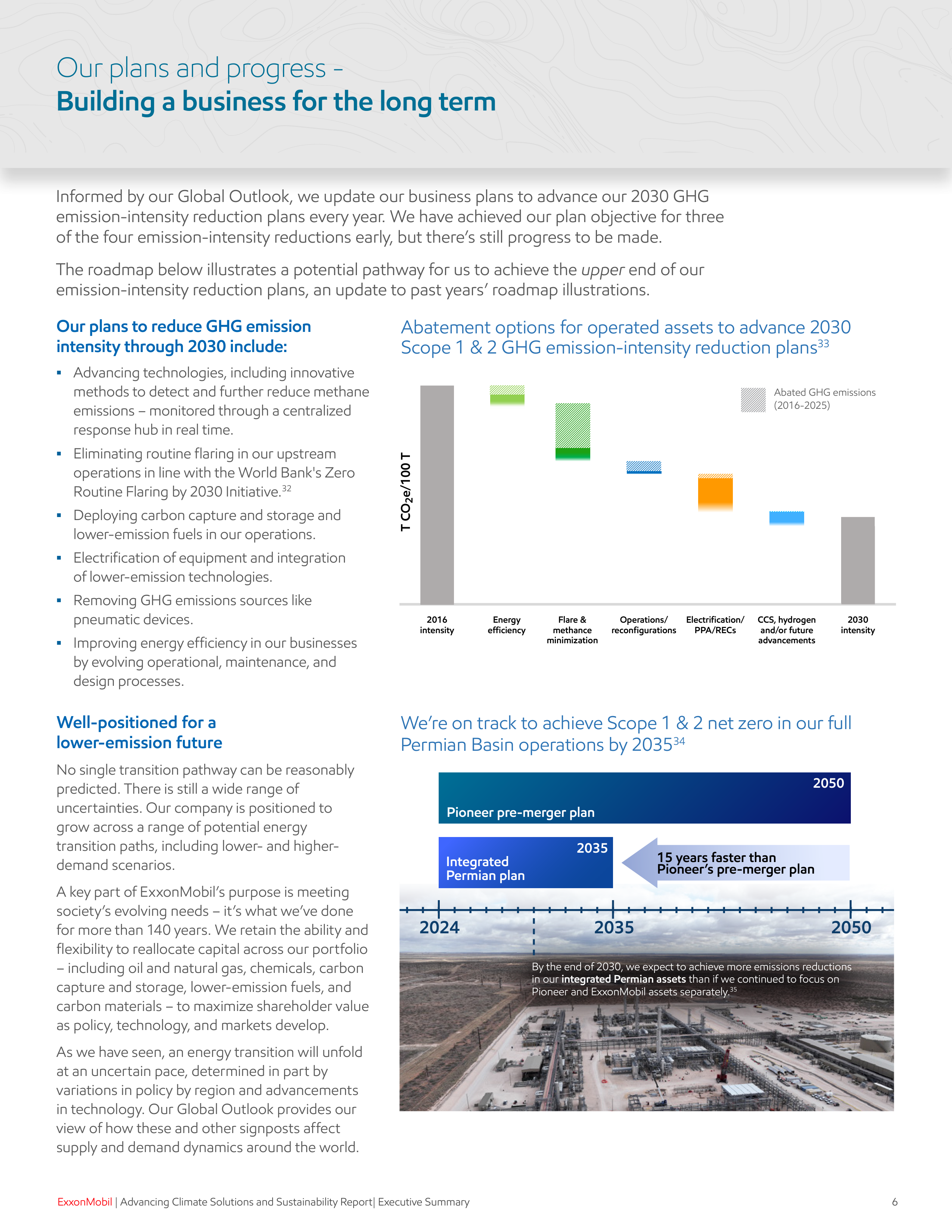
Informed by our Global Outlook, we update our business plans to advance our 2030 GHG
emission-intensity reduction plans every year. We have achieved our plan objective for three
of the four emission-intensity reductions early, but there’s still progress to be made.
The roadmap below illustrates a potential pathway for us to achieve the
upper
end of our
emission-intensity reduction plans, an update to past years’ roadmap illustrations.
Our plans to reduce GHG emission
intensity through 2030 include:
•
Advancing technologies, including innovative
methods to detect and further reduce methane
emissions – monitored through a centralized
response hub in real time.
•
Eliminating routine flaring in our upstream
operations in line with the World Bank's Zero
Routine Flaring by 2030 Initiative.
32
•
Deploying carbon capture and storage and
lower-emission fuels in our operations.
•
Electrification of equipment and integration
of lower-emission technologies.
•
Removing GHG emissions sources like
pneumatic devices.
•
Improving energy efficiency in our businesses
by evolving operational, maintenance, and
design processes.
Well-positioned for a
lower-emission future
No single transition pathway can be reasonably
predicted. There is still a wide range of
uncertainties. Our company is positioned to
grow across a range of potential energy
transition paths, including lower- and higher-
demand scenarios.
A key part of ExxonMobil’s purpose is meeting
society’s evolving needs – it’s what we’ve done
for more than 140 years. We retain the ability and
flexibility to reallocate capital across our portfolio
– including oil and natural gas, chemicals, carbon
capture and storage, lower-emission fuels, and
carbon materials – to maximize shareholder value
as policy, technology, and markets develop.
As we have seen, an energy transition will unfold
at an uncertain pace, determined in part by
variations in policy by region and advancements
in technology. Our Global Outlook provides our
view of how these and other signposts affect
supply and demand dynamics around the world.
We’re on track to achieve Scope 1 & 2 net zero in our full
Permian Basin operations by 2035
34
Abatement options for operated assets to advance 2030
Scope 1 & 2 GHG emission-intensity reduction plans
33
2016
intensity
Energy
efficiency
Flare &
methance
minimization
Operations/
reconfigurations
Electrification/
PPA/RECs
2030
intensity
CCS, hydrogen
and/or future
advancements
T CO
2
e/100 T
Abated GHG emissions
(2016-2025)
Abated GHG emissions
(2016-2025)
2024
2035
2050
15 years faster than
Pioneer’s pre-merger plan
Integrated
Permian plan
Pioneer pre-merger plan
2050
2035
By the end of 2030, we expect to achieve more emissions reductions
in our
integrated Permian assets
than if we continued to focus on
Pioneer and ExxonMobil assets separately.
35
ExxonMobil
| Advancing Climate Solutions and Sustainability Report| Executive Summary


7
Our plans and progress -
Managing and mitigating methane emissions
Natural gas is:
•
Easy to transport –
especially as global LNG
trade expands.
•
Abundant and flexible –
with growing demand
in places like India, where compressed natural
gas is taking off in transport.
•
Reliable and less GHG intensive –
reducing
CO₂ emissions by up to 60% when replacing
coal to make electricity.
36
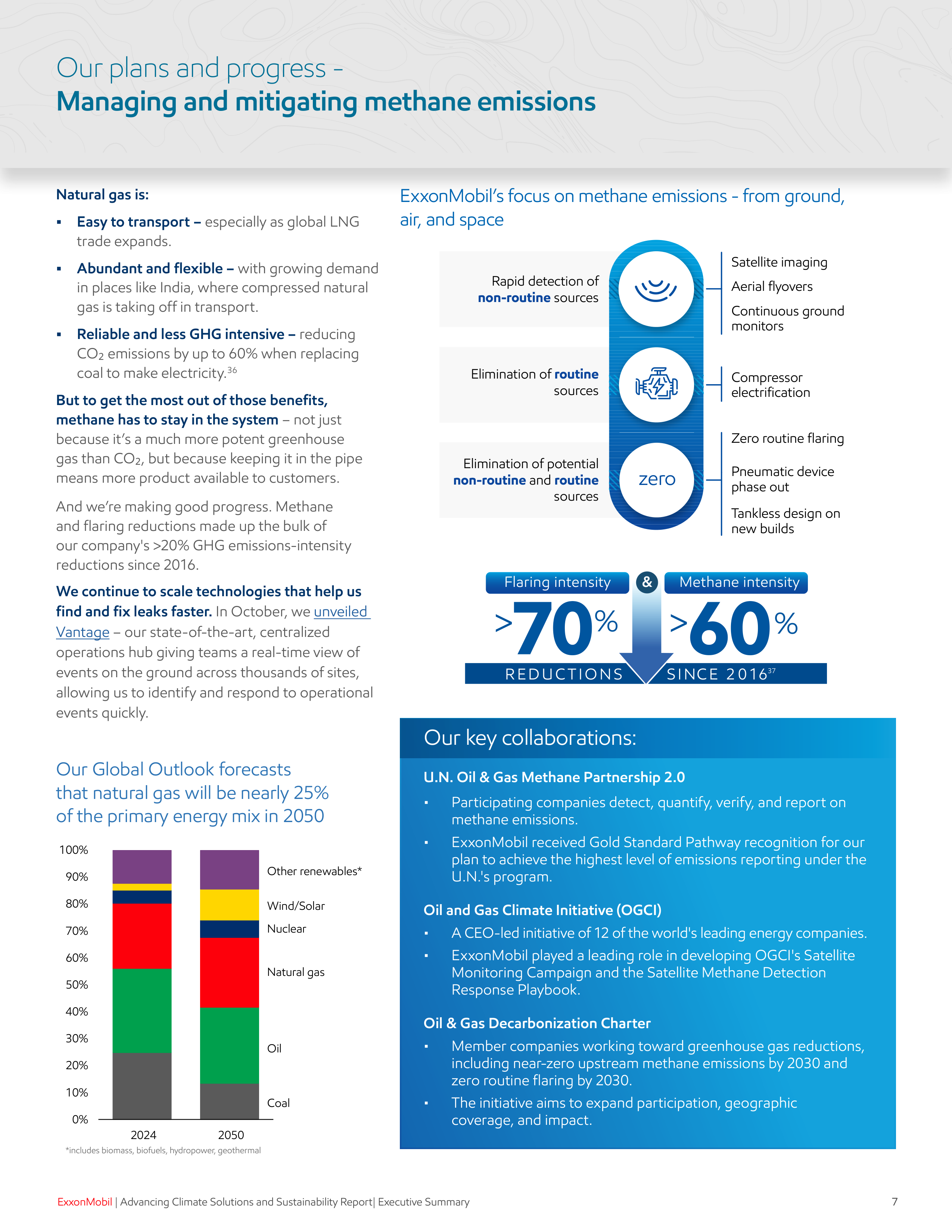
But to get the most out of those benefits,
methane has to stay in the system
– not just
because it’s a much more potent greenhouse
gas than CO₂, but because keeping it in the pipe
means more product available to customers.
And we’re making good progress. Methane
and flaring reductions made up the bulk of
our company's >20% GHG emissions-intensity
reductions since 2016.
We continue to scale technologies that help us
find and fix leaks faster.
In October, we
unveiled
Vantage
– our state-of-the-art, centralized
operations hub giving teams a real‑time view of
events on the ground across thousands of sites,
allowing us to identify and respond to operational
events quickly.
ExxonMobil’s focus on methane emissions - from ground,
air, and space
Our Global Outlook forecasts
that natural gas will be nearly 25%
of the primary energy mix in 2050
Satellite imaging
Aerial flyovers
Continuous ground
monitors
Compressor
electrification
Zero routine flaring
Pneumatic device
phase out
Tankless design on
new builds
Rapid detection of
non-routine
sources
Elimination of
routine
sources
Elimination of potential
non-routine
and
rout
i
ne
sources
zero
Our key collaborations:
U.N. Oil & Gas Methane Partnership 2.0
•
Participating companies detect, quantify, verify, and report on
methane emissions.
•
ExxonMobil received Gold Standard Pathway recognition for our
plan to achieve the highest level of emissions reporting under the
U.N.'s program.
Oil and Gas Climate Initiative (OGCI)
•
A CEO-led initiative of 12 of the world's leading energy companies.
•
ExxonMobil played a leading role in developing OGCI's Satellite
Monitoring Campaign and the Satellite Methane Detection
Response Playbook.
Oil & Gas Decarbonization Charter
•
Member companies working toward greenhouse gas reductions,
including near-zero upstream methane emissions by 2030 and
zero routine flaring by 2030.
•
The initiative aims to expand participation, geographic
coverage, and impact.
R E DU C T I O N S S I NC E 2 0 16
37
Methane intensity
Flaring intensity
&
Other renewables*
Wind/Solar
Nuclear
Natural gas
Oil
Coal
100%
90%
70%
50%
30%
10%
80%
60%
40%
20%
0%
2050
2024
*includes biomass, biofuels, hydropower, geothermal
ExxonMobil
| Advancing Climate Solutions and Sustainability Report| Executive Summary
8
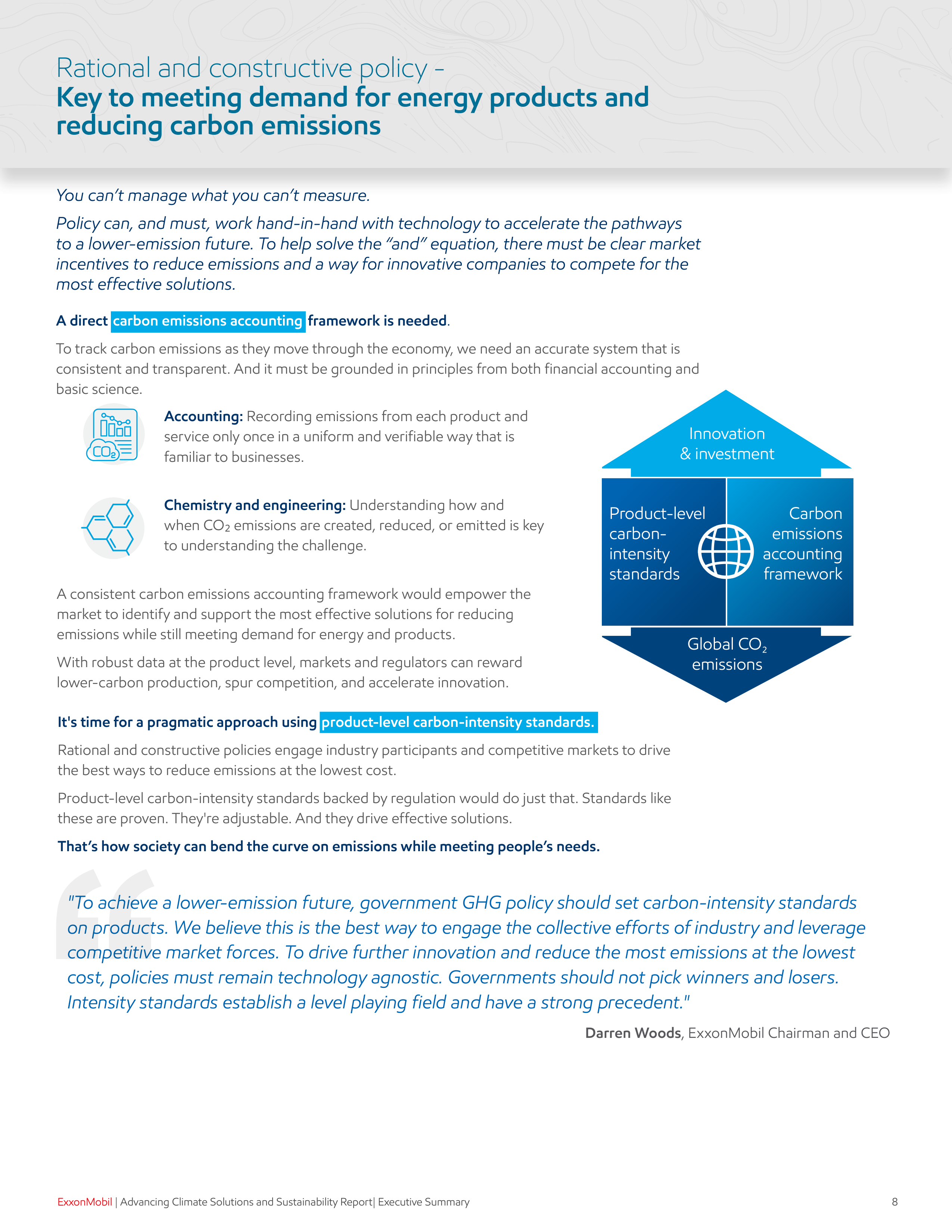
Accounting:
Recording emissions from each product and
service only once in a uniform and verifiable way that is
familiar to businesses.
Chemistry and engineering:
Understanding how and
when CO₂ emissions are created, reduced, or emitted is key
t
to understanding the challenge.
A consistent carbon emissions accounting framework would empower the
market to identify and support the most effective solutions for reducing
emissions while still meeting demand for energy and products.
With robust data at the product level, markets and regulators can reward
lower-carbon production, spur competition, and accelerate innovation.
Rational and constructive policy -
Key to meeting demand for energy products and
reducing carbon emissions
You can’t manage what you can’t measure.
Policy can, and must, work hand-in-hand with technology to accelerate the pathways
to a lower-emission future. To help solve the “and” equation, there must be clear market
incentives to reduce emissions and a way for innovative companies to compete for the
most effective solutions.
A direct
carbon emissions accounting
framework is needed
.
To track carbon emissions as they move through the economy, we need an accurate system that is
consistent and transparent. And it must be grounded in principles from both financial accounting and
basic science.
"To achieve a lower-emission future, government GHG policy should set carbon-intensity standards
on products. We believe this is the best way to engage the collective efforts of industry and leverage
competitive market forces. To drive further innovation and reduce the most emissions at the lowest
cost, policies must remain technology agnostic. Governments should not pick winners and losers.
Intensity standards establish a level playing field and have a strong precedent."
Darren Woods
, ExxonMobil Chairman and CEO
Product-level
carbon-
intensity
standards
Carbon
emissions
accounting
framework
Innovation
& investment
Global CO
²
emissions
It's time for a pragmatic approach using
product-level carbon-intensity standards.
Rational and constructive policies engage industry participants and competitive markets to drive
the best ways to reduce emissions at the lowest cost.
Product-level carbon-intensity standards backed by regulation would do just that. Standards like
these are proven. They're adjustable. And they drive effective solutions.
That’s how society can bend the curve on emissions while meeting people’s needs.
ExxonMobil
| Advancing Climate Solutions and Sustainability Report| Executive Summary
ExxonMobil
| Advancing Climate Solutions and Sustainability Report| Executive Summary
9
Putting our values to work -
Our focus on doing the right thing, the right way
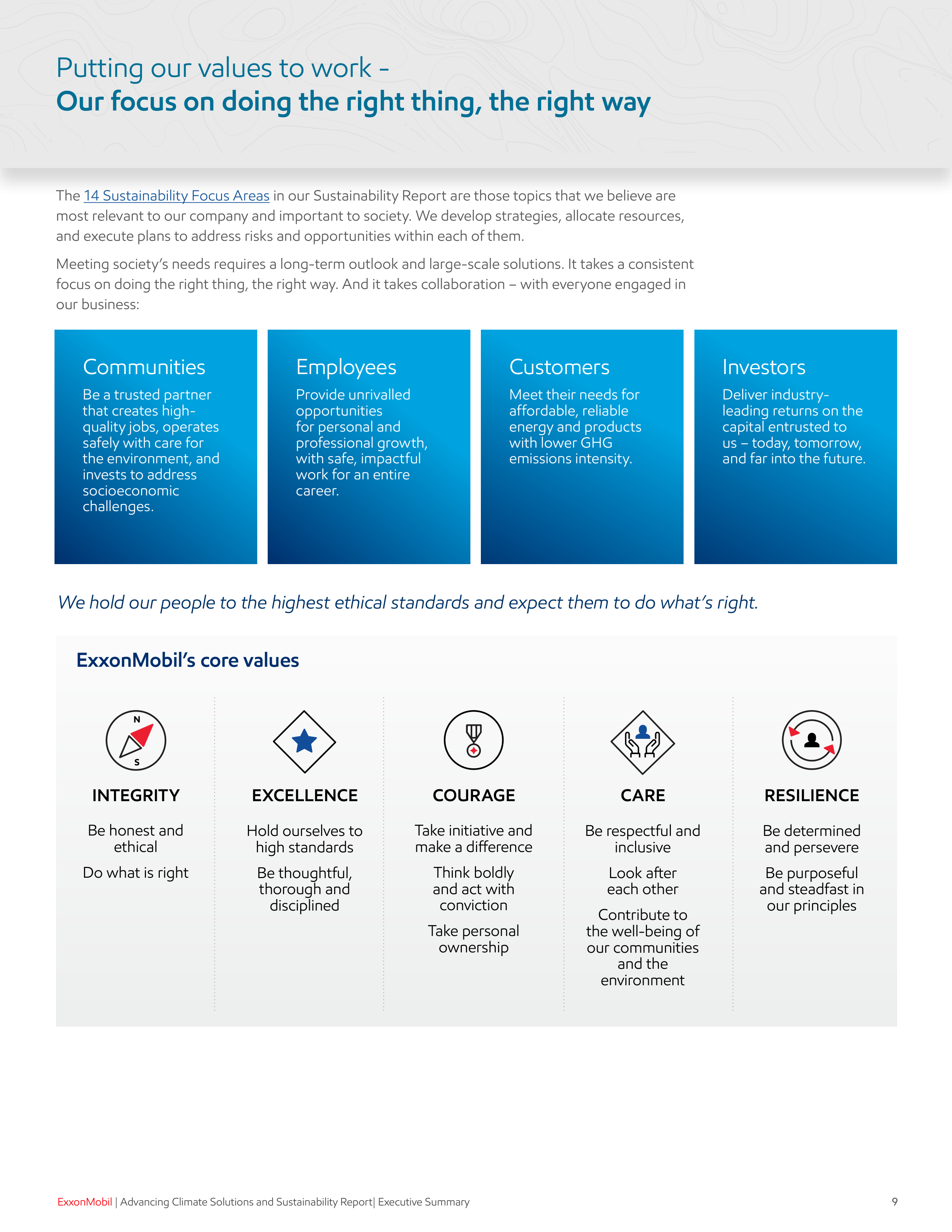
The
14 Sustainability Focus Areas
in our Sustainability Report are those topics that we believe are
most relevant to our company and important to society. We develop strategies, allocate resources,
and execute plans to address risks and opportunities within each of them.
Meeting society’s needs requires a long-term outlook and large-scale solutions. It takes a consistent
focus on doing the right thing, the right way. And it takes collaboration – with everyone engaged in
our business:
Communities
Be a trusted partner
that creates high-
quality jobs, operates
safely with care for
the environment, and
invests to address
socioeconomic
challenges.
Customers
Meet their needs for
affordable, reliable
energy and products
with lower GHG
emissions intensity.
Employees
Provide unrivalled
opportunities
for personal and
professional growth,
with safe, impactful
work for an entire
career.
Investors
Deliver industry-
leading returns on the
capital entrusted to
us – today, tomorrow,
and far into the future.
ExxonMobil’s core values
INTEGRITY
COURAGE
EXCELLENCE
CARE
RESILIENCE
Be honest and
ethical
Do what is right
Take initiative and
make a difference
Think boldly
and act with
conviction
Take personal
ownership
Be respectful and
inclusive
Look after
each other
Contribute to
the well-being of
our communities
and the
environment
Hold ourselves to
high standards
Be thoughtful,
thorough and
disciplined
Be determined
and persevere
Be purposeful
and steadfast in
our principles
We hold our people to the highest ethical standards and expect them to do what’s right.
ExxonMobil
| Advancing Climate Solutions and Sustainability Report| Executive Summary
10
10
Putting our values to work -
Our approach to sustainability in our operations
Protect Tomorrow. Today.
is the guiding principle behind our approach to
sustainability in our operations.
In our Sustainability Report, we describe how it inspires us to look at what
we do with the mindset to be the most responsible operator in our industry.
We encourage our leaders and teams to ask questions that go beyond
“what are we required to do?” We are asking proactive questions like:
•
How can we reduce or mitigate emissions, waste, or the resources
we use in our operations?
•
How can we increase benefits for our communities and reduce
operational impacts?
•
How can we collaborate on industry standards and regulations
to improve outcomes?
The answers are as complex as our portfolio, and they will change over time.
How we act on what we learn will ultimately help us capture the full value of
our competitive advantages – in the right way.
Providing information
needed for construction
operation & maintenance
Designing, constructing &
preparing for start up
Identifying, assessing,
mitigating & accepting risk
Preparing for emergencies
& managing potential risk to
the community
Learning from operating
experience & incidents
Selecting & engaging with
third-party providers
Managing changes
Operating & maintaining
assets
Selecting, training, engaging
& enabling people
Assessing & driving
effectiveness
Leading, managing &
driving performance
Operations
Improvements
"We have a philosophy to be the
most responsible operator in
our industry. For as long as there’s
a demand for oil and gas, you want
the most responsible companies
producing that.”
Darren Woods,
ExxonMobil Chairman and CEO
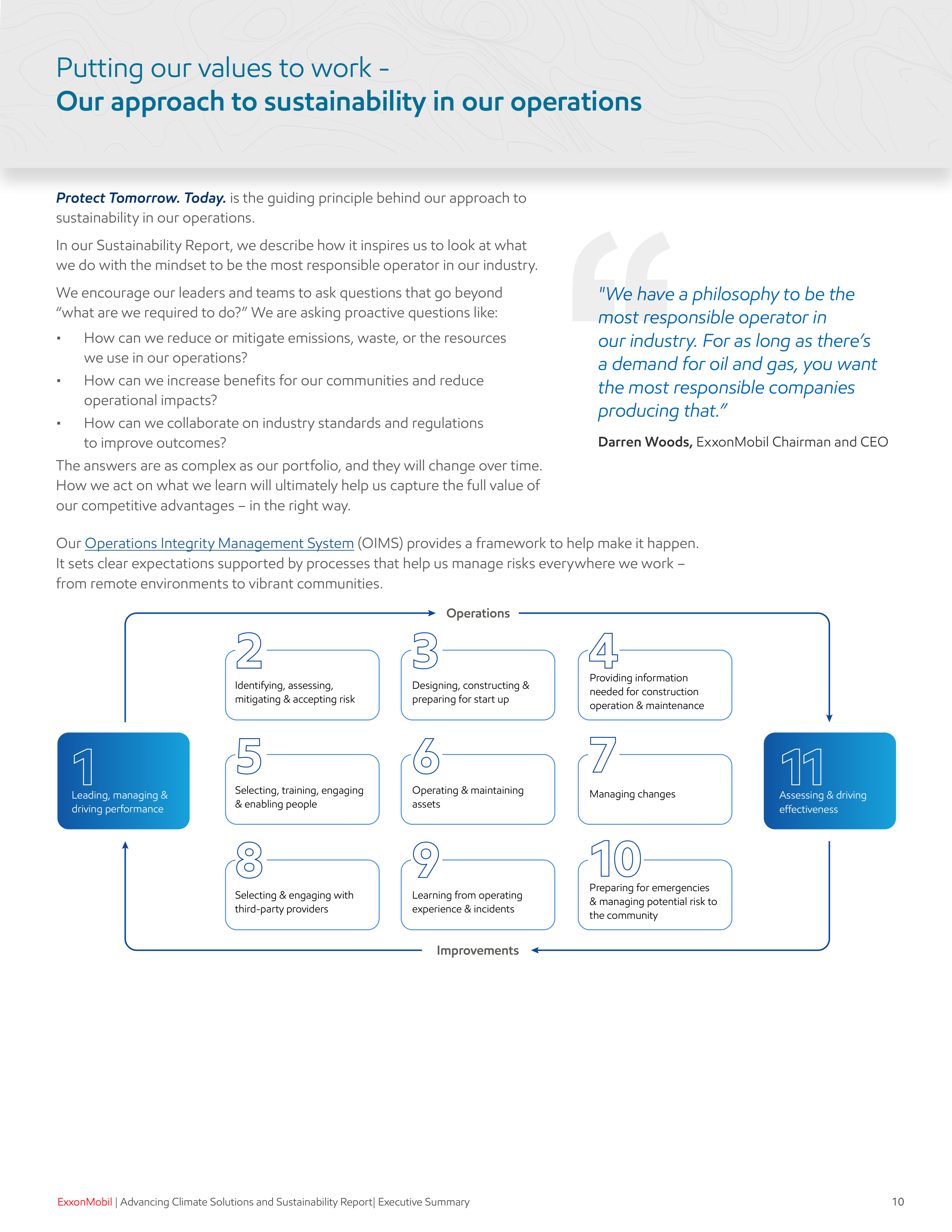
Our
Operations Integrity Management System
(OIMS) provides a framework to help make it happen.
It sets clear expectations supported by processes that help us manage risks everywhere we work –
from remote environments to vibrant communities.
ExxonMobil
| Advancing Climate Solutions and Sustainability Report| Executive Summary
11
11
1
ExxonMobil 2025 Global Outlook (Aug. 28, 2025) projections.
2
Tracking SDG7: The Energy Progress Report 2025, Page 3:
https://iea.blob.core.windows.net/assets/fc78dc81-8167-4c41-b8a6-
e3386fecf957/TrackingSDG7TheEnergyProgressReport%2C2025.pdf
IEA, IRENA, UNSD, World Bank, WHO. 2025. Tracking SDG 7: The
Energy Progress Report. World Bank, Washington DC. © World Bank. License: Creative Commons Attribution—NonCommercial 3.0 IGO (CC
BY-NC 3.0 IGO)
3
IEA (2025),
World Energy Outlook 2025
, IEA, Paris
https://www.iea.org/reports/world-energy-outlook-2025
, Licence: CC BY 4.0 (report);
CC BY NC SA 4.0 (Annex A); IPCC: AR6 Scenarios Database hosted by International Institute for Applied Systems Analysis (IIASA) release 1.0
average. IPCC C3: “Likely Below 2°C” scenarios.
4
Lower emissions cash capex includes cash capex attributable to carbon capture and storage, hydrogen, lithium, biofuels, Proxxima
TM
systems,
carbon materials, and activities to lower ExxonMobil’s emissions and/or third party (3P) emissions.
5
Based on Scope 1 and Scope 2 emissions from operated assets. Intensity is calculated as emissions per metric ton of throughput/production.
ExxonMobil reported emissions, reductions, and avoidance performance data are based on a combination of measured and estimated
emissions data using reasonable efforts and collection methods. Calculations are based on industry standards and best practices, including
guidance from the American Petroleum Institute (API) and Ipieca. There is uncertainty associated with the emissions, reductions, and avoidance
performance data due to variation in the processes and operations, the availability of sufficient data, quality of those data, and methodology
used for measurement and estimation. Performance data may include rounding. Changes to the performance data may be reported as part of
the Company’s annual publications as new or updated data and/or emission methodologies become available. We are working to continuously
improve our performance and methods to detect, measure and address greenhouse gas emissions. ExxonMobil works with industry, including
API and Ipieca, to improve emission factors and methodologies, including measurements and estimates.
6
ExxonMobil 2025 Global Outlook (Aug. 28, 2025)
7
Ibid.
8
Ibid.
9
IPCC, 2022: Climate Change 2022: Mitigation of Climate Change. Contribution of Working Group III to the Sixth Assessment Report of the
Intergovernmental Panel on Climate Change [P.R. Shukla, J. Skea, R. Slade, A. Al Khourdajie, R. van Diemen, D. McCollum, M. Pathak, S. Some,
P. Vyas, R. Fradera, M. Belkacemi, A. Hasija, G. Lisboa, S. Luz, J. Malley, (eds.)]. Cambridge University Press, Cambridge, UK and New York, NY,
USA. doi: 10.1017/9781009157926.
10 “End-to-end CCS system” entails CO₂ capture as well as transportation and storage of CO₂. Based on contracts to capture and store ~9 MTA
CO
2
, subject to additional investment by ExxonMobil and receipt of government permitting for carbon capture and storage projects.
11 ExxonMobil and BASF join forces to advance low-emission hydrogen through methane pyrolysis technology:
https://corporate.exxonmobil.
com/what-we-do/delivering-industrial-solutions/hydrogen/advancing-low-emission-hydrogen
12 Based on ExxonMobil analysis for power plant use including EIA U.S. electricity net generation and resulting CO
2
emissions:
https://www.eia.
gov/tools/faqs/faq.php?id=74&t=11
. Reductions may vary based on regional differences and other variables.
13 Comparative carbon footprint of product estimate study: ExxonMobil’s Proxxima
TM
Resin Systems, June 2023, prepared by Sphera Solutions,
Inc. for ExxonMobil Technology and Engineering Company. The study was confirmed to be conducted according to and in compliance with ISO
14067:2018 (Greenhouse gases - Carbon footprint of products - Requirements and guidelines for quantification) by an independent third party
critical review panel. All resins assessed in this Life Cycle Assessment (LCA) study were of the type used in molding applications. Specifically, the
epoxy resin system was of the type used in VARTM wind blade production. The resin systems are representative of formulated resin systems
and include any required curing hardeners or catalysts.
https://www.proxxima.com/en/what-is-proxxima/sustainability
14 New research shows how popular plastic packaging compares to alternative materials:
https://corporate.exxonmobil.com/what-we-do/
materials-for-modern-living/how-popular-plastic-packaging-compares-to-alternative-materials#HowPEpackagingcompares
15 Lower emissions cash capex includes cash capex attributable to carbon capture and storage, hydrogen, lithium, biofuels, Proxxima
TM
systems,
carbon materials, and activities to lower ExxonMobil’s emissions and/or third party (3P) emissions. Source: ExxonMobil 2025 Corporate Plan
Update (Dec. 9, 2025)
16 Market potential for emission reduction opportunity based on ExxonMobil analysis of CO
2
pipeline routes, current and potential capacity,
potential emitters in the U.S. Gulf Coast market, and potential infrastructure upgrades. Subject to additional investment by ExxonMobil,
customer commitments, supportive policy, and permitting for carbon capture and storage projects.
17 U.S. Environmental Protection Agency’s greenhouse gas equivalencies calculator: Carbon dioxide or CO₂ equivalent converted to a U.S. home’s
electricity use for one year:
https://www.epa.gov/energy/greenhouse-gas-equivalencies-calculator
18 Source: Carbon Footprint of Product of Reinforcing Bars: Steel and Proxxima
TM
Resin containing Glass Fiber Reinforced Polymer (GFRP) in
Construction Applications, May 2025, prepared by ExxonMobil Technology and Engineering Company. The study was conducted to be in
accordance with ISO 14067:2018 (Greenhouse gases – Carbon footprint of products – Requirements and guidelines for quantification). The
study was confirmed to be conducted according to and in compliance with ISO 14067:2018 by an independent third party (Sphera Solutions,
Inc.) critical review which followed ISO 14071:2024 to support comparative environmental footprint communications as defined in ISO
14026:2018)
19 Baytown breakthrough: Our next-generation hydrogen burner can help decarbonize a key industry:
https://corporate.exxonmobil.com/what-
we-do/delivering-industrial-solutions/hydrogen/baytown-hydrogen-burner-decarbonize-industry
20 Papua New Guinea and Mozambique projects are subject to final investment decision.
21 “End-to-end CCS system” entails CO
2
capture as well as transportation and storage of CO
2
. Based on contracts to capture and store ~9 MTA
CO
2
, subject to additional investment by ExxonMobil and receipt of government permitting for carbon capture and storage projects.
22 Performance data based on ExxonMobil and third-party proprietary internal analysis. For more information, see
https://corporate.exxonmobil.
com/what-we-do/materials-for-modern-living/advanced-synthetic-graphite
23 Expected smaller footprint of lithium mining and expected lower carbon and water impacts: EM analysis of external sources and third-party
lifecycle analyses. a) Vulcan Energy, 2022
https://v-er.eu/app/uploads/2023/11/LCA.pdf
, Minviro publication. Grant, A., Deak, D., & Pell, R.
(2020). b) The CO
2
Impact of the 2020s Battery Quality Lithium Hydroxide Supply Chain-Jade Cove Partners.
https://www.jadecove.com/
research/liohco2impact
. Kelly, J. C., Wang, M., Dai, Q., & Winjobi, O. (2021). c) Energy, greenhouse gas, and water life cycle analysis of lithium
carbonate and lithium hydroxide monohydrate from brine and ore resources and their use in lithium ion battery cathodes and lithium ion
batteries. Resources, Conservation and Recycling, 174, 105762.
24 Optimizing current production based on product demand, compliance requirements, and supplier capabilities for both the renewable feedstock
and also the required hydrogen for processing.
ExxonMobil
| Advancing Climate Solutions and Sustainability Report| Executive Summary
12
12
25 Information shown is approximate (e.g., storage / pipeline location) and has potential to change as projects are developed and implemented.
CO₂ storage includes Class VI Permit Application and GLO Storage Site Access.
26 ExxonMobil’s reported emissions, reductions, and avoidance performance data are based on a combination of measured and estimated
emissions data using reasonable efforts and collection methods. Calculations are based on industry standards and best practices, including
guidance from the American Petroleum Institute (API) and Ipieca. There is uncertainty associated with the emissions, reductions, and avoidance
performance data due to variation in the processes and operations, the availability of sufficient data, quality of those data, and methodology
used for measurement and estimation. Performance data may include rounding. Changes to the performance data may be reported as part of
the company’s annual publications as new or updated data and/or emission methodologies become available. We are working to continuously
improve our performance and methods to detect, measure, and address greenhouse gas emissions. ExxonMobil works with industry, including
API and Ipieca, to improve emission factors and methodologies, including measurements and estimates.
27 Based on Scope 1 and Scope 2 emissions from operated assets. Intensity is calculated as emissions per metric ton of throughput/production.
ExxonMobil reported emissions, reductions, and avoidance performance data are based on a combination of measured and estimated
emissions data using reasonable efforts and collection methods. Calculations are based on industry standards and best practices, including
guidance from the American Petroleum Institute (API) and Ipieca. There is uncertainty associated with the emissions, reductions, and avoidance
performance data due to variation in the processes and operations, the availability of sufficient data, quality of those data, and methodology
used for measurement and estimation. Performance data may include rounding. Changes to the performance data may be reported as part of
the Company’s annual publications as new or updated data and/or emission methodologies become available. We are working to continuously
improve our performance and methods to detect, measure and address greenhouse gas emissions. ExxonMobil works with industry, including
API and Ipieca, to improve emission factors and methodologies, including measurements and estimates.
28 See our website at
https://corporate.exxonmobil.com/news/news-releases
for Jan. 18, 2022, release of Scope 1 and Scope 2 net-zero ambition
for operated assets by 2050.
29 IEA (2025),
World Energy Outlook 2025
, IEA, Paris
https://www.iea.org/reports/world-energy-outlook-2025
, Licence: CC BY 4.0 (report);
CC BY NC SA 4.0 (Annex A); IPCC: AR6 Scenarios Database hosted by International Institute for Applied Systems Analysis (IIASA) release 1.0
average. IPCC C3: “Likely Below 2°C” scenarios.
30 Middle East and related disruptions to throughput may affect progress of our planned methane-intensity reductions in 2026; however,
ExxonMobil’s 2030 methane-intensity reduction plan remains unchanged. Intensity is calculated as emissions per metric ton of throughput/
production. ExxonMobil’s emission-reduction plans are based on Scope 1 and Scope 2 emissions from operated assets. ExxonMobil reported
emissions, reductions, and avoidance performance data are based on a combination of measured and estimated emissions data using
reasonable efforts and collection methods. Calculations are based on industry standards and best practices, including guidance from the
American Petroleum Institute (API) and Ipieca. There is uncertainty associated with the emissions, reductions, and avoidance performance
data due to variation in the processes and operations, the availability of sufficient data, quality of those data, and methodology used for
measurement and estimation. Performance data may include rounding. Changes to the performance data may be reported as part of the
Company’s annual publications as new or updated data and/or emission methodologies become available. We are working to detect,
measure and address greenhouse gas emissions. ExxonMobil works with industry, including API and Ipieca, to improve emission factors and
methodologies, including measurements and estimates.
31 IPCC, 2023: Summary for Policymakers. In: Climate Change 2023: Synthesis Report. Contribution of Working Groups I, II and III to the Sixth
Assessment Report of the Intergovernmental Panel on Climate Change [Core Writing Team, H. Lee and J. Romero (eds.)]. IPCC, Geneva,
Switzerland, pp. 1-34, doi: 10.59327/IPCC/AR6-9789291691647.001; IEA (2025),
World Energy Outlook 2025
, IEA, Paris
https://www.iea.org/
reports/world-energy-outlook-2025
, Licence: CC BY 4.0 (report); CC BY NC SA 4.0 (Annex A)
32 References to routine flaring herein are consistent with the World Bank’s Zero Routine Flaring by 2030 Initiative/Global Flaring & Methane
Reduction (GFMR) Partnership principle of routine flaring and excludes safety and non-routine flaring.
33 This chart illustrates historical reductions and potential greenhouse gas abatement options for Scope 1 and 2 greenhouse gas emissions. The
abatement options are not all-inclusive and are subject to change as a result of a number of factors, including abatement reduction magnitude,
implementation timing, abatement cost, portfolio changes, policy developments, technology advancements, and as annual company plans
are updated. Includes energy attribute certificates, such as renewable energy certificates (RECs) and guarantees of origin (GOOs). Historical
reductions and potential abatement options have been normalized to exclude the impacts of divestments, acquisitions, and growth. Analysis as
of March 2026.
34 See our website at
https://corporate.exxonmobil.com/news/news-releases
for May 3, 2024, release announcing the completion of the Pioneer
Natural Resources Company acquisition.
35 Source: 2025 ExxonMobil Corporate Plan Update (Dec. 8, 2025)
36 Based on ExxonMobil analysis for power plant use including EIA U.S. electricity net generation and resulting CO
2
emissions:
https://www.eia.
gov/tools/faqs/faq.php?id=74&t=11
. Reductions may vary based on regional differences and other variables.
37 Emission metrics are based on assets operated by ExxonMobil, using the latest performance and plan data available as of March 13, 2026.
Flaring intensity is calculated as m
3
per metric ton of throughput or production. Methane intensity is calculated as metric tons CH
4
per 100
metric tons of throughput or production. Calculations are based on industry standards and best practices, including guidance from the American
Petroleum Institute (API) and Ipieca. There is uncertainty associated with the emissions, reductions, and avoidance performance data due to
variation in the processes and operations, the availability of sufficient data, quality of those data, and methodology used for measurement
and estimation. Performance data may include rounding. Changes to the performance data may be reported as part of the Company’s
annual publications as new or updated data and/or emission methodologies become available. We are working to continuously improve our
performance and methods to detect, measure and address greenhouse gas emissions. ExxonMobil works with industry, including API and
Ipieca, to improve emission factors and methodologies, including measurements and estimates.
13
13
The “Sustainability” section of our website contains
two reports:
•
Our
Advancing Climate Solutions Report
describes what we are doing to tackle the
challenge of meeting society’s need for energy
while reducing greenhouse gas emissions and
growing long-term value.
•
And our
Sustainability Report
completes the
picture as it describes our approach to managing
our operations and our commitment to carry out
our business activities the right way, for the long
term.
The Sustainability Report, the Advancing Climate
Solutions Report, and combined Executive
Summary were issued on May 5, 2026. The content
and data referenced in these publications focus
primarily on our operations from Jan. 1, 2025 –
Dec. 31, 2025, unless otherwise indicated.
Information regarding some known events or
activities in 2026 and historical initiatives from prior
years are also included. Tables on our “Metrics and
data” page were updated to reflect full year 2025
data.
The reporting guidelines and indicators in the
Sustainability Reporting Guidance for the Oil and
Gas Industry (5th edition, 2025) developed by
Ipieca, the American Petroleum Institute, and the
International Association of Oil & Gas Producers
informed our Sustainability Report and Advancing
Climate Solutions Report. These reports may
also reference the United Nations Sustainable
Development Goals, and/or other sources where
appropriate.
The “Sustainability” section of our website uses
qualitative descriptions and quantitative metrics to
describe our policies, programs, practices and
performance. Many of the metrics used in preparing
the “Sustainability” section of our website are
difficult to measure, methods for collecting data
continue to evolve and may contain estimates or
assumptions believed to be reasonable at the time
of preparation. The uncertainty associated with this
data depends on variation in the processes and
operations, the availability of sufficient data, the
quality of those data and methodology used for
measurement and estimation. Changes to the data
may be reported as updated data and/or
methodologies become available.
Our topic selection process helped inform our
sustainability reporting. Visit our content index for a
detailed mapping of the locations of information
regarding topics included in the reports.
For purposes of the “Sustainability” section of our
website, the selected topics do not correspond to
the concept of materiality used in securities laws
and disclosures required by U.S. Securities and
Exchange Commission rules or any U.S. or foreign
governing body.
About our Advancing Climate Solutions and Sustainability Reports
and Cautionary Statement
FORWARD-LOOKING STATEMENT WARNING
CAUTIONARY STATEMENT RELEVANT TO FORWARD LOOKING INFORMATION FOR THE PURPOSE OF THE “SAFE HARBOR” PROVISIONS OF THE PRIVATE SECURITIES
LITIGATION REFORM ACT OF 1995 AND OTHER IMPORTANT LEGAL DISCLAIMERS
Images or statements of future ambitions, aims, aspirations, plans, goals, events, projects, projections, opportunities, expectations, performance, potential addressable markets or
conditions in the publications, including plans to reduce, abate, avoid or enable avoidance of emissions or reduce emissions intensity, sensitivity analyses, estimates, the development
of future technologies, business plans, and sustainability efforts are dependent on future market factors, such as customer demand, continued technological progress, stable policy
support and timely rule-making or continuation of government incentives and funding, and represent forward-looking statements. Similarly, emission-reduction roadmaps to drive
toward net zero and similar roadmaps for emerging technologies and markets, and water management roadmaps to reduce freshwater intake and/or manage disposal, are
forward-looking statements. These statements are not guarantees of future corporate, market or industry performance or outcomes for ExxonMobil or society and are subject to
numerous risks and uncertainties, many of which are beyond our control or are even unknown.
Actual future results, including the achievement of ambitions to reach Scope 1 and 2 net zero from operated assets by 2050, to reach Scope 1 and 2 net zero in integrated Upstream
Permian Basin unconventional operated assets by 2035, to eliminate routine flaring in-line with World Bank Zero Routine Flaring, to reach near zero methane emissions from
operated assets and other methane initiatives to meet ExxonMobil’s greenhouse gas emission reduction plans and goals, divestment and start-up plans, and associated project plans
as well as technology advances, including in the timing and outcome of projects to capture, transport and store CO
2
, produce hydrogen and ammonia, produce lower-emission fuels,
produce Proxxima
TM
systems, produce carbon materials, produce lithium, and use plastic waste as feedstock for advanced recycling; future debt levels and credit ratings; business
and project plans, timing, costs, capacities and profitability; resource recoveries and production rates; planned Denbury and Pioneer integrated benefits; detection, measurement
and quantification of emissions including obtaining or reporting of that data or updates to previous estimates and progress in sustainability focus areas could vary depending on a
number of factors. These include, global or regional changes or imbalances in the supply and demand for oil, gas, petrochemicals, and feedstocks and other market factors; economic
conditions and seasonal fluctuations that impact prices, differentials, and volume/mix for our products; new market products and services; future cash flows; our ability to execute
operational objectives on a timely and successful basis; the ability to realize efficiencies within and across our business lines; developments or changes in local, national, or
international treaties, laws, regulations, taxes, trade sanctions, trade tariffs, or policies affecting our business, such as government policies supporting lower-carbon and new market
investment opportunities, or policies limiting the attractiveness of investments such the punitive European taxes on the oil and gas sector and unequal support for different
technological methods of emissions reduction or evolving, ambiguous, and unharmonized voluntary and mandatory standards and extraterritorial laws and regulations imposed by
various jurisdictions related to sustainability and greenhouse gas reporting and evolving measurement standards for these topics; timely granting of governmental permits, licenses,
ExxonMobil
| Advancing Climate Solutions and Sustainability Report| Executive Summary
14
14
and certifications; uncertain impacts of deregulation on the legal and regulatory environment; trade patterns and the development and enforcement of local, national and regional
mandates; unforeseen technical or operational difficulties; the outcome of research efforts and future technology developments, including the ability to scale projects and
technologies such as electrification of operations, advanced recycling, carbon capture and storage, hydrogen and ammonia production, Proxxima
TM
systems, carbon materials or
direct lithium extraction on a commercially competitive basis; the development and competitiveness of alternative energy and emission reduction technologies; unforeseen technical
or operating difficulties, including the need for unplanned maintenance; availability of feedstocks for lower-emission fuels, hydrogen, or advanced recycling; changes in the relative
energy mix across activities and geographies; the actions of co-venturers or competitors; changes in regional and global economic growth rates and consumer preferences including
willingness and ability to pay for reduced emissions products; actions taken by governments and consumers resulting from a pandemic; changes in population growth, economic
development or migration patterns; timely completion of construction projects; war, civil unrest, attacks against the Company or industry, and other political or security disturbances,
including disruption of land or sea transportation routes; decoupling of economies, realignment of global trade and supply chain networks, and disruptions in military alliances; and
other factors discussed here and in Item 1A. Risk Factors of our Annual Report on Form 10-K and under the heading “Factors affecting future results” available under the “Earnings”
tab through the “Investors” page of our website at www.exxonmobil.com. The Advancing Climate Solutions Report includes 2025 greenhouse gas emissions performance data as of
March 13, 2026, and Scope 3 Category 11 estimates for full year 2025 as of March 13, 2026. The greenhouse gas intensity and greenhouse gas emission estimates include Scope 2
market-based emissions. The Sustainability Report, the Advancing Climate Solutions Report, and combined Executive Summary were issued on May 5, 2026. The content and data
referenced in these publications focus primarily on our operations from Jan. 1, 2025 – Dec. 31, 2025, unless otherwise indicated. Tables on our “Metrics and data” page were updated
to reflect full year 2025 data. Information regarding some known events or activities in 2026 and historical initiatives from prior years are also included. No party should place undue
reliance on these forward-looking statements, which speak only as of the dates of these publications. All forward-looking statements are based on management’s knowledge and
reasonable expectations at the time of publication. ExxonMobil assumes no duty to update these statements or materials as of any future date, and neither future distribution of this
material nor the continued availability of this material in archive form on our website should be deemed to constitute an update or re-affirmation of these figures or statements as of
any future date. Any future update will be provided only through a public disclosure indicating that fact.
See “ABOUT THE ADVANCING CLIMATE SOLUTIONS AND SUSTAINABILITY REPORTS” at the end of this document for additional information on these reports and the use of
non-GAAP and other financial measures.
ABOUT THE ADVANCING CLIMATE SOLUTIONS AND SUSTAINABILITY REPORTS
The Advancing Climate Solutions Report contains terms used by the third-party disclosure frameworks. In doing so, ExxonMobil is not obligating itself to use any terms in the way
defined or interpreted by any third-party, nor is it obligating itself to comply with any specific recommendation of such parties or to provide any specific disclosure. For example, with
respect to the term “material,” individual companies are best suited to determine what information is material, under the long-standing U.S. Supreme Court definition, and whether
to include this information in U.S. Securities and Exchange Act filings. The Sustainability Report and Advancing Climate Solutions Report are each a voluntary disclosure and are not
designed to fulfill any U.S., foreign, or third-party required reporting framework.
Forward-looking and other statements regarding environmental and other sustainability efforts and aspirations are not intended to communicate any material investment
information under the laws of the United States or elsewhere or represent that these are required disclosures in any other context or jurisdiction. These publications are not intended
to imply that ExxonMobil has access to any significant non-public insights on future events that the reader could not independently research. In addition, historical, current, and
forward-looking environmental, climate-related, and other sustainability-related statements may be based on standards for measuring progress that are still developing, internal
controls and processes that continue to evolve, and assumptions that are subject to change in the future, including future laws and rulemaking. Forward-looking and other
statements regarding environmental and other sustainability efforts and aspirations are for informational purposes only and are not intended as an advertisement for ExxonMobil’s
equity, debt, businesses, products, or services and the reader is specifically notified that any investor-requested disclosure or future required disclosure is not and should not be
construed as an inducement for the reader to purchase any product, services, or security. The statements and analysis in these publications represent a good faith effort by the
Company to address these investor requests despite significant unknown variables and at times inconsistent market data, government policy signals, and calculation methodologies
and reporting standards.
Actions needed to advance ExxonMobil’s 2030 greenhouse gas emission-reductions plans are incorporated into its medium-term business plans, which are updated annually. The
reference case for planning beyond 2030 is based on the Company’s Global Outlook research and publication. The Global Outlook is reflective of the existing global policy
environment and an assumption of increasing policy stringency and technology improvement to 2050. However, the Global Outlook does not attempt to project the degree of
required future policy and technology advancement and deployment for the world, or ExxonMobil, to meet net zero by 2050. As future policies and technology advancements
emerge, they will be incorporated into the GIobal Outlook, and the Company’s business plans will be updated as appropriate. References to projects or opportunities may not reflect
investment decisions made by the corporation or its affiliates. Individual projects or opportunities may advance based on a number of factors, including availability of stable and
supportive policy, permitting, technological advancement for cost-effective abatement, insights from the company planning process, and alignment with our partners and other
stakeholders. Capital investment guidance in lower-emission and other new investments is based on our corporate plan; however, actual investment levels will be subject to the
availability and attractiveness of investment opportunities, market conditions, stable public policy support, other factors, and focused on returns.
Energy demand modeling is forward-looking by nature aims to replicate integrated dynamics of the global energy system but necessarily involves simplifications to simulate its
complexity. The reference to any modeled scenario or any pathway for an energy transition or expansion, including any potential net-zero scenario, does not imply ExxonMobil views
any particular scenario as likely to occur. In addition, energy demand scenarios require assumptions on a variety of parameters. As such, the outcome of any given scenario using an
energy demand model comes with a high degree of uncertainty. Third-party scenarios discussed in these reports reflect the modeling assumptions and outputs of their respective
authors, not ExxonMobil, and their use or inclusion herein is not an endorsement by ExxonMobil of their underlying assumptions, likelihood, or probability. Investment decisions are
made on the basis of ExxonMobil’s separate planning process but may be secondarily tested for robustness or resiliency against different assumptions, including against various
scenarios. These reports contain information from third parties. ExxonMobil makes no representation or warranty as to the third-party information. Where necessary, ExxonMobil
received permission to cite third-party sources, but the information and data remain under the control and direction of the third parties. ExxonMobil has also provided links in this
report to third-party websites for ease of reference. ExxonMobil’s use of the third-party content is not an endorsement or adoption of such information.
ExxonMobil reported emissions, including reductions and avoidance performance data, are based on a combination of measured and estimated data. We assess our performance to
support continuous improvement throughout the organization using our Environmental Performance Indicator (EPI) manual. The reporting guidelines and indicators in the Ipieca, the
American Petroleum Institute (API), the International Association of Oil and Gas Producers Sustainability Reporting Guidance for the Oil and Gas Industry (5th edition, 2025) and key
chapters of the GHG Protocol inform the EPI and the selection of the data reported. Emissions reported are estimates only, and performance data depends on variations in processes
and operations, the availability of sufficient data, the quality of those data and methodology used for measurement and estimation. Emissions data is subject to change as methods,
data quality, and technology improvements occur, and changes to performance data may be updated. Emissions, reductions, abatements and enabled avoidance estimates for
non-ExxonMobil operated facilities are included in the equity data and similarly may be updated as changes in the performance data are reported. ExxonMobil’s plans to reduce
emissions are good-faith efforts based on current relevant data and methodology, which could be changed or refined. ExxonMobil works to continuously improve its approach to
estimate, detect, measure, and address emissions. ExxonMobil actively engages with industry, including API and Ipieca, to improve emission factors and methodologies, including
measurements and estimates.
Any reference to ExxonMobil’s support of, work with, or collaboration with a third-party organization within these publications do not constitute or imply an endorsement by
ExxonMobil of any or all of the positions or activities of such organization. ExxonMobil participates, along with other companies, institutes, universities and other organizations, in
various initiatives, campaigns, projects, groups, trade organizations, and other collaborations among industry and through organizations like the United Nations that express various
ambitions, aspirations and goals related to climate change, emissions, sustainability, and an energy transition or expansion. ExxonMobil’s participation or membership in such
collaborations is not a promise or guarantee that ExxonMobil’s individual ambitions, future performance or policies will align with the collective ambitions of the organizations or the
individual ambitions of other participants, all of which are subject to a variety of uncertainties and other factors, many of which may be beyond ExxonMobil’s control, including
government regulation, availability and cost-effectiveness of technologies, and market forces, geopolitical, realignment, conflicts and other risks and uncertainties. Such third parties’
statements of collaborative or individual ambitions and goals frequently diverge from ExxonMobil’s own ambitions, plans, goals, commitments and investments. ExxonMobil will
continue to make independent decisions regarding the operation of its business, including its climate-related and sustainability-related ambitions, plans, goals, commitments, and
investments. ExxonMobil’s future ambitions, plans, goals commitments, and investments reflect ExxonMobil’s current plans, and ExxonMobil may unilaterally change them for
various reasons, including adoption of new reporting standards or practices, market conditions; changes in its portfolio; and financial, operational, regulatory, reputational, legal and
other factors.
References to “resources,” “resource base,” and similar terms refer to the total remaining estimated quantities of oil and natural gas that are expected to be ultimately recoverable.
The resource base includes quantities of oil and natural gas classified as proved reserves, as well as quantities that are not yet classified as proved reserves, but that are expected to
be ultimately recoverable. The term “resource base” is not intended to correspond to SEC definitions such as “probable” or “possible” reserves. For additional information, see the
“Frequently Used Terms” on the Investors page of the Company’s website at www.exxonmobil.com under the header “Modeling Toolkit.” References to “oil” and “gas” include crude,
natural gas liquids, bitumen, synthetic oil, and natural gas. The term “project” as used in these publications can refer to a variety of different activities and does not necessarily have
the same meaning as in any government payment transparency reports.
ExxonMobil
| Advancing Climate Solutions and Sustainability Report| Executive Summary

15
15
Exxon Mobil Corporation has numerous affiliates, many with names that include ExxonMobil, Exxon, Mobil, Esso, and XTO. For convenience and simplicity, those terms and terms
such as “Corporation,” “company,” “our,” “we,” and “its” are sometimes used as abbreviated references to one or more specific affiliates or affiliate groups. Abbreviated references
describing global or regional operational organizations, and global or regional business lines are also sometimes used for convenience and simplicity. Nothing contained herein is
intended to override the corporate separateness of affiliated companies. Exxon Mobil Corporation’s goals do not guarantee any action or future performance by its affiliates or Exxon
Mobil Corporation’s responsibility for those affiliates’ actions and future performance, each affiliate of which manages its own affairs. For convenience and simplicity, words like
venture, joint venture, partnership, co-venturer and partner are used to indicate business relationships involving common activities and interests, and those words may not indicate
precise legal relationships. These publications cover Exxon Mobil Corporation’s owned and operated businesses and do not address the performance or operations of our suppliers,
contractors or partners unless otherwise noted. In the case of certain joint ventures for which ExxonMobil is the operator, we often exercise influence but not control. Thus, the
governance, processes, management and strategy of these joint ventures may differ from those in these reports. ExxonMobil completed the acquisitions of Denbury Inc. and Pioneer
Natural Resources Company in 2023 and 2024, respectively. These reports and the data therein do not speak of these companies’ pre-acquisition governance, risk management,
strategy approaches, or emissions or sustainability performance unless specifically referenced.
These reports or any material therein are not to be used or reproduced without the permission of Exxon Mobil Corporation. All rights reserved.
SUPPLEMENTAL INFORMATION FOR NON-GAAP AND OTHER MEASURES
The Positioned for Growth in a Lower-Emission Future section of the Advancing Climate Solutions Report mentions our assessment of the strength our business and investment
portfolio against a range of future outcomes, including third-party scenarios. The Company believes this can be helpful in assessing the resiliency of the business to generate cash
from different potential future markets. The performance data presented in the Advancing Climate Solutions Report and Sustainability Report, including on emissions, is not financial
data and is not GAAP data.
ExxonMobil
| Advancing Climate Solutions and Sustainability Report| Executive Summary