

Impact Report
Appendix
Healthy 2030
2025


Introduction
. . . . . . . . . . . . . . . . . . . . . . . . . . . . . . . . . . . . . . . . . . . . . . . . .
2
About This Report
. . . . . . . . . . . . . . . . . . . . . . . . . . . . . . . . . . . . . . . . . . . . . . . . . . .
2
CVS Health at a Glance
. . . . . . . . . . . . . . . . . . . . . . . . . . . . . . . . . . . . . . . . . . . . . .
4
Healthy 2030 Impact Strategy
. . . . . . . . . . . . . . . . . . . . . . . . . . . . . . . . . . . . . . .
6
Healthy 2030 Governance and Stakeholder Engagement
. . . . . . . . . . . . . .
8
Our Impact Approach and Metrics
. . . . . . . . . . . . . . . . . . . . . . . . . . . . .
10
Human Capital Data
. . . . . . . . . . . . . . . . . . . . . . . . . . . . . . . . . . . . . . . . . . . . . . . . .
10
Social Compliance Audit Summary
. . . . . . . . . . . . . . . . . . . . . . . . . . . . . . . . . . .
13
Reducing Our Environmental Impact
. . . . . . . . . . . . . . . . . . . . . . . . . . . . . . . . .
14
Environmental Data
. . . . . . . . . . . . . . . . . . . . . . . . . . . . . . . . . . . . . . . . . . . . . . . . .
15
United Nations (UN) Sustainable Development Goals
. . . . . . . . . . . . . . . . .
21
Indices
. . . . . . . . . . . . . . . . . . . . . . . . . . . . . . . . . . . . . . . . . . . . . . . . . . . . . .
23
Combined GRI and SASB Indices
. . . . . . . . . . . . . . . . . . . . . . . . . . . . . . . . . . . . .
23
Climate Disclosure
. . . . . . . . . . . . . . . . . . . . . . . . . . . . . . . . . . . . . . . . . . . . . . . . . .
31
Table of Contents
Healthy 2030
Healthy 2030


Introduction
About This Report
CVS Health’s annual
Healthy 2030
Impact Report
and Appendix provide an overview of our Company’s
environmental and social commitments, as well as
progress against certain priorities, goals and targets.
This publication contains impact-related data,
disclosures and content indices for 2025 and
supplements CVS Health’s full report content on
the
Impact section of the CVSHealth.com website
.
Within the “About this Report” section, “report"
will refer to the entire suite of CVS Health's impact
disclosures (i.e., this appendix and the
online report
content
). When used elsewhere in this publication,
“report” refers only to the online Impact Report.
Consistent with previous publications, the boundaries
for this report extend to all United States Company-
owned and/or operated facilities, administrative
offices and retail pharmacies for the corporate
enterprise. Company operations outside the U.S. are
limited and included in this report, unless otherwise
noted, including Cordavis. The portions of this report
related to wages and benefits and the information
provided under the headings “Environmental Data,”
“Human Capital Data” and “Climate Disclosure”
include data related to Omnicare, LLC and
associated subsidiaries, which were deconsolidated
from the Company's consolidated financial
statements in September 2025 in accordance with
accounting principles generally accepted in the
United States of America ("GAAP"). Data contained
in this report covers activities that occurred in fiscal
2025 (January 1–December 31, 2025) unless
otherwise noted.
Content and materiality
In 2023, we completed a comprehensive impact
prioritization assessment in accordance with the
Global Reporting Initiative (GRI) Standards’ guidance
for defining priority topics and in collaboration with
BSR (Business for Social Responsibility). The topics
inform our
Healthy 2030
impact strategy and the
content of our reporting. We routinely review this
impact prioritization and gather feedback from
internal and external stakeholders about emerging
or shifting impact areas. We use the terms
“prioritization assessment” and “priority topics” in our
Healthy 2030
impact reporting to reference the topics
most important to our stakeholders and our business.
Due to the varied interests of our stakeholder groups,
not all identified topics are material to CVS Health as
such term is defined under applicable securities laws.
The inclusion of topics in this assessment and the
inclusion of information in this report generally should
not be construed as a characterization regarding
materiality or significance for any other purpose,
including for purposes of applicable securities laws.
Introduction
Our Impact Approach and Metrics
Indices
Healthy 2030
Impact Report Appendix 2025
2


Disclosure and assurance
CVS Health management is responsible for the
preparation and integrity of the information in this
report. The enterprise metrics and goals in this report
are established through a rigorous review process
involving internal subject matter experts, and we
believe this report accurately and fairly represents our
activities, programs and results for the fiscal year
ending December 31, 2025. Both impact and financial
reporting cycles at CVS Health run on a calendar year.
The report was submitted to the Board of Directors
and was reviewed and approved by members of CVS
Health senior management, including our disclosure
committee, which is composed of management from
principal functional areas within the Company. CVS
Health carbon footprint and water data from 2016–
2025 has been externally assured. This report only
includes data for 2023–2025, as well as a baseline
year of 2019 for greenhouse gas data. Find the most
recent GHG Verification Opinion on the
Reporting and
Governance page
of our online report content. The
Company may consider having additional content
and data in future impact reports externally assured.
This report was produced with reference to the
GRI Standards. More information is available at
GlobalReporting.org
. A combined index for the
GRI and Sustainability Accounting Standards Board
(SASB) Standards, as well as our contributions to the
United Nations’ Sustainable Development Goals (UN
SDGs), are available in the
indices of this publication
.
Our Climate Disclosure, prepared to reflect the
recommendations of the Task Force on Climate
Related Financial Disclosures (TCFD) and the
International Sustainability Standards Board’s
International Financial Reporting Standards
(ISSB - IFRS), is also available in
this publication
.
Your feedback
Your feedback is important to us as we continue to
look for ways to improve our reporting and provide
you with the information you need.
Please submit your feedback to:
CSR@CVSHealth.com
CVS Health Corporation
Attn: Chief Sustainability Officer and VP,
Community Impact
One CVS Drive, MC 1200, Woonsocket, RI 02895
401-765-1500 (TTY:711)
Preparation of this report
This report contains certain forward-looking statements
that are subject to risks and uncertainties. Actual results
may differ materially from those contemplated by the
forward-looking information for a number of reasons as
described in our Securities and Exchange Commission
(SEC) filings, including those set forth in the “Risk
Factors” section and under the section entitled
“Cautionary Statement Concerning Forward-Looking
Statements” in our most recently filed Annual Report on
Form 10-K and Quarterly Report on Form 10-Q. We refer
readers of this report to all our SEC filings, including our
Annual Report to Stockholders, our
Form 10-K
, Forms
10-Q and any Forms 8-K, which provide important
information about our business, operations and financial
performance. Before making any investment or other
decision relating to CVS Health, all such public filings
should be considered in detail. References in this
document to CVS Health products, programs or
services do not imply that CVS Health intends to provide
all products, programs or services across all businesses.
Statements regarding the future direction and intent of
CVS Health are subject to change or withdrawal without
notice and represent goals and objectives only.
Healthy 2030
Impact Report Appendix 2025
3















CVS Health at a Glance
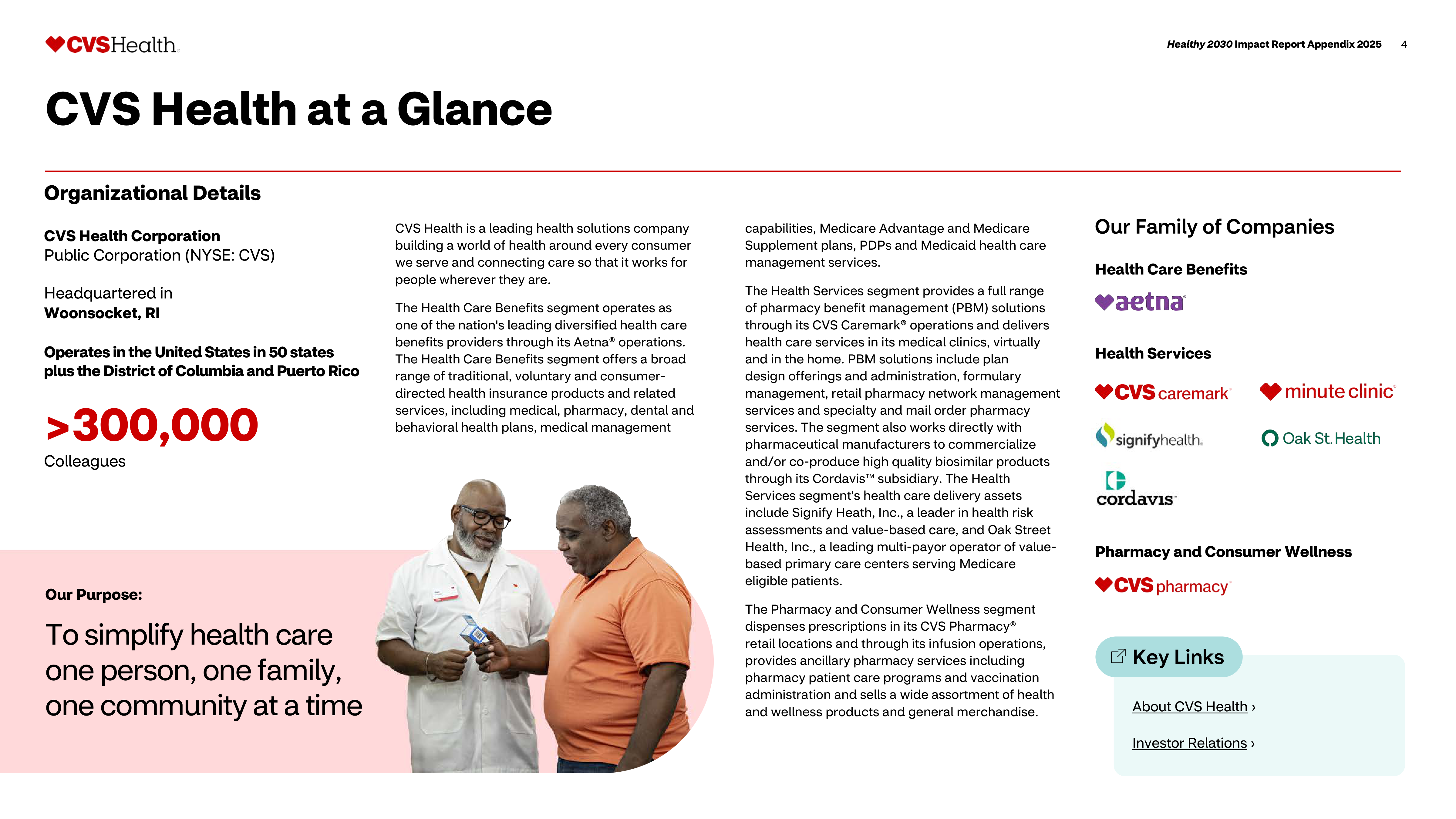
CVS Health is a leading health solutions company
building a world of health around every consumer
we serve and connecting care so that it works for
people wherever they are.
The Health Care Benefits segment operates as
one of the nation's leading diversified health care
benefits providers through its Aetna® operations.
The Health Care Benefits segment offers a broad
range of traditional, voluntary and consumer-
directed health insurance products and related
services, including medical, pharmacy, dental and
behavioral health plans, medical management
capabilities, Medicare Advantage and Medicare
Supplement plans, PDPs and Medicaid health care
management services.
The Health Services segment provides a full range
of pharmacy benefit management (PBM) solutions
through its CVS Caremark® operations and delivers
health care services in its medical clinics, virtually
and in the home. PBM solutions include plan
design offerings and administration, formulary
management, retail pharmacy network management
services and specialty and mail order pharmacy
services. The segment also works directly with
pharmaceutical manufacturers to commercialize
and/or co-produce high quality biosimilar products
through its Cordavis™ subsidiary. The Health
Services segment's health care delivery assets
include Signify Heath, Inc., a leader in health risk
assessments and value-based care, and Oak Street
Health, Inc., a leading multi-payor operator of value-
based primary care centers serving Medicare
eligible patients.
The Pharmacy and Consumer Wellness segment
dispenses prescriptions in its CVS Pharmacy®
retail locations and through its infusion operations,
provides ancillary pharmacy services including
pharmacy patient care programs and vaccination
administration and sells a wide assortment of health
and wellness products and general merchandise.
Our Family of Companies
Healthy 2030
Impact Report Appendix 2025
4
Our Purpose:
To simplify health care
one person, one family,
one community at a time
CVS Health Corporation
Public Corporation (NYSE: CVS)
Headquartered in
Woonsocket, RI
Operates in the United States in 50 states
plus the District of Columbia and Puerto Rico
>300,000
Colleagues
Key Links
About CVS Health ›
Investor Relations ›
Organizational Details
Health Care Benefits
Health Services
Pharmacy and Consumer Wellness




Healthy 2030
Impact Report Appendix 2025
5
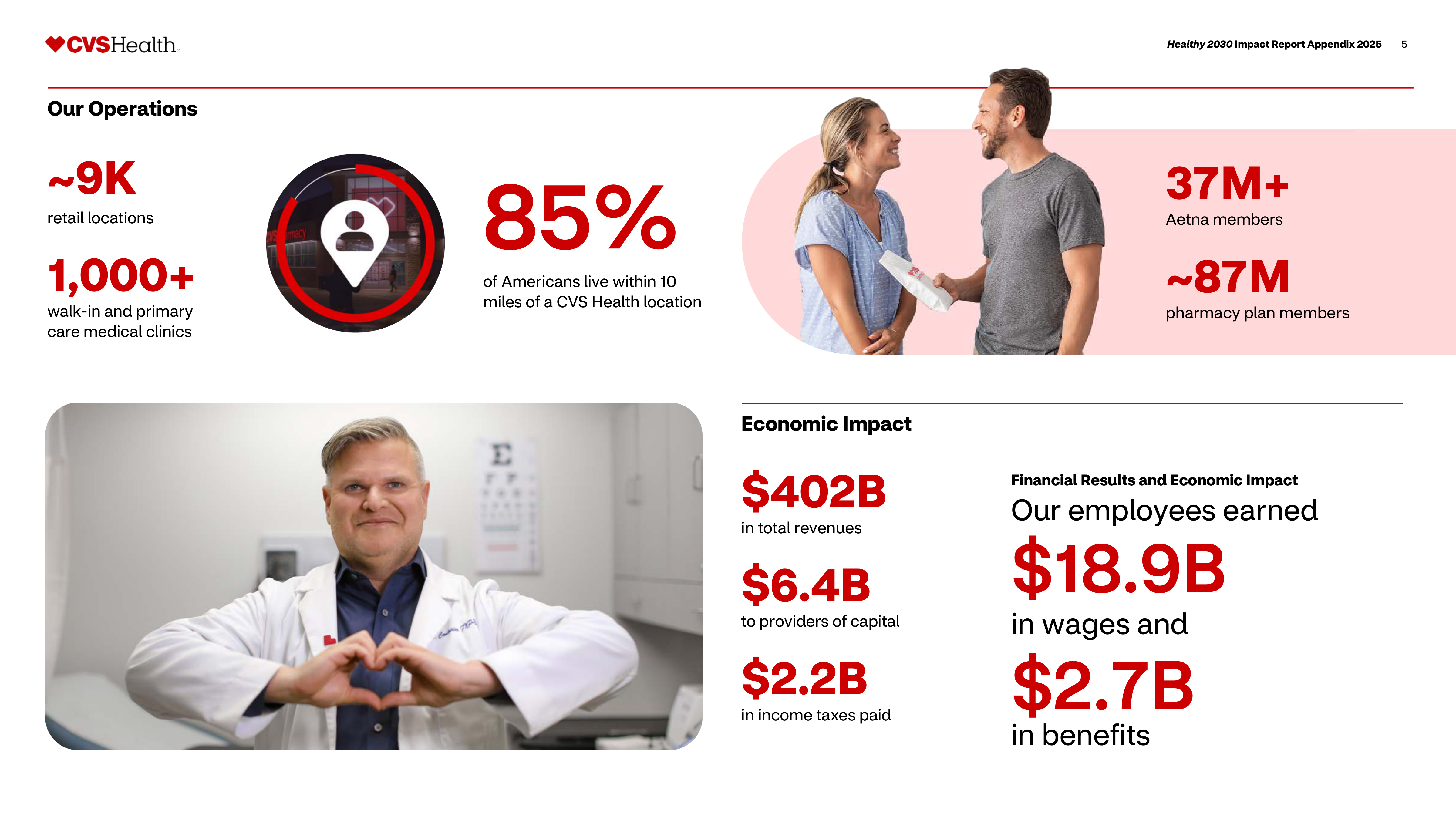
Our Operations
$402B
in total revenues
$6.4B
to providers of capital
$2.2B
in income taxes paid
~9K
retail locations
1,000+
walk-in and primary
care medical clinics
85%
of Americans live within 10
miles of a CVS Health location
Financial Results and Economic Impact
Our employees earned
$18.9B
in wages and
$2.7B
in benefits
Economic Impact
37M+
Aetna members
~87M
pharmacy plan members


Healthy 2030
Impact Strategy
Our
Healthy 2030
impact strategy
outlines how we are creating a healthier, more
sustainable future for all as we work to simplify health care one person, one family
and one community at a time. Through four pillars—Healthy People, Healthy Business,
Healthy Community and Healthy Planet—we focus on measurable actions that improve
health outcomes, strengthen communities and protect the environment. Rooted in our
ambition to be America’s most trusted health care company, our impact strategy
positions us to lead with integrity and innovation to deliver meaningful change while
sustaining long-term business performance.
Healthy People
We put health at the center of everything we do. By
elevating the experience of our customers, we are
elevating the very essence of health care. We connect
people to the care they need, advance affordability,
simplify access and ultimately help people live healthier
lives. Our investments in health services and programs
drive outcomes, reduce barriers to care and deliver
innovative solutions that set new standards for
accessible, high-quality care. Further details about the
Healthy People pillar are located in the
Healthy People
section of our online impact report.
Healthy Business
Our greatest strength is our people. With a talented and
diverse workforce of more than 300,000 colleagues,
we uphold the highest standards of ethics and
transparency while creating value and delivering on our
promises. Through education, leadership development
and workforce training, we empower colleagues and
strengthen talent pipelines. At the same time, we
embed strong governance and responsible practices
across our business and supply chain to ensure
integrity, sustainability and accountability across our
operations. Further details about the Healthy Business
pillar are located in the
Healthy Business
section of our
online impact report.
Healthy Community
We work alongside communities to improve health
outcomes and unlock opportunities for workforce
readiness. From supporting heart health, mental health
and healthy aging to addressing climate-related health
impacts, we take a holistic approach to create a
healthier future. Our programs tackle food insecurity,
improve access to workforce training and provide
educational opportunities nationwide. In times of crisis,
we respond swiftly to meet evolving needs locally.
Our colleagues amplify impact through volunteerism
and collaboration in communities where we live and
work. Further details about the Healthy Community
pillar are located in the
Healthy Community
section
of our online impact report.
Healthy Planet
We advance initiatives to protect the health of people
and the planet. We are strengthening our business to
withstand extreme weather events, ensuring continuity
of care and access for patients when it matters most.
Our efforts include strengthening environmental health
and resilience, reducing greenhouse gas emissions,
sourcing renewable energy and driving packaging
innovation to minimize waste and unnecessary plastics.
We lead with purpose to build a healthier world for
generations to come. Further details about the Healthy
Planet pillar are located in the
Healthy Planet
section
of our online impact report.
Healthy 2030
Impact Report Appendix 2025
6
Healthy 2030
supports the advancement
of our roadmap in four key areas:


Impact Strategy Prioritization Assessment
Prioritizing impact in our
Healthy 2030
strategy
In 2023, we completed a comprehensive
assessment to identify the sustainability
and impact topics most important to
our business and ensure their integration
in our
Healthy 2030
strategy. This work
was done in collaboration with sustainable
business network and consultancy BSR
and aligns with leading reporting
standards and frameworks.
This assessment represented a shift to an impact-
based approach, measuring potential and actual
impacts of sustainability topics. It assessed the
severity of potential impact on enterprise value,
society and the environment, as well as the likelihood
of the impact to occur. Our
Healthy 2030
strategy
is continuously evolving. We routinely review this
impact prioritization and gather feedback from
internal and external stakeholders about emerging
or shifting impact areas relevant to our business.
This assessment process demonstrates our iterative
approach to refining and strengthening our
programming and initiatives. We continue to monitor
reporting frameworks and guidance. More can be
found in our reporting boundaries.
Assessment methodology included:
•
Development of a full list of environmental
sustainability, social impact and governance topics
and definitions relevant to CVS Health® based on
global sustainability standards and frameworks,
including GRI, SASB, human rights conventions and
the United Nations Sustainable Development Goals;
•
Desktop research and identification of how each
topic impacts enterprise value, society and the
environment, and how it is currently incorporated
into our enterprise risk management process;
•
Development of criteria to assess and grade impacts;
•
Engagement with colleagues across our enterprise
and members of our executive leaders, including
our Chief Executive Officer, Chief Sustainability
Officer, Chief Medical Officer, Chief Strategy Officer
and President of Retail, among others.
•
External stakeholders engaged include investors,
clients, customers, industry associations, issue
advocacy groups, community partners and suppliers;
•
Scoring of impacts and aligning topics in a
prioritization matrix;
•
Additional engagement with senior leaders to review
findings and validate results
The results of our assessment are reflected in this
section and have informed the content of our 2025
Healthy 2030
Impact Report and Appendix.*
Very High and High Impact Topics
•
Affordability and Fair Pricing
•
Climate Risk, Resilience and Adaptation
•
Community Engagement
and Economic Opportunity
•
Consumer Health Outcomes
•
Consumer Service and Experience
•
Data Security, Privacy, and Cybersecurity
•
Inclusion and Belonging
•
Ethics and Compliance
•
Fair and Decent Employment
•
GHG Emissions and Energy Use
•
Health Access
•
Innovation of Products and Services
•
Occupational Health and Safety
•
Public Policy and Advocacy
•
Service Quality and Safety
•
Supply Chain Due Diligence
and Procurement Practices
•
Supply Chain Labor Conditions
•
Sustainable Products and Services and Circularity
•
Talent Recruitment, Retention and Development
•
Water
*FOR IMPACT STRATEGY: Our priority topics reference which economic,
environmental, social and governance issues are most impactful to our
stakeholders and our business. The inclusion of topics in this assessment and
the inclusion of information in this report generally should not be construed
as a characterization regarding its materiality or significance for any other
purpose, including for purposes of applicable securities laws.
Healthy 2030
Impact Report Appendix 2025
7
FPO


Healthy 2030
Governance
and Stakeholder Engagement
Impact Strategy Governance
Our Board of Directors and our President and Chief
Executive Officer (CEO) lead governance of our
Healthy 2030
framework. The Nominating and
Corporate Governance Committee of the Board of
Directors is formally charged with oversight of impact
strategy and performance, along with our President
and Chief Executive Officer.
Our Chief Sustainability Officer (CSO) shares relevant
impact-related impacts, risks and opportunities with
the Nominating and Corporate Governance Committee
semiannually, and the full Board annually. Additionally,
the Nominating and Corporate Governance Committee
reviews our annual Impact report.
In 2025, the Nominating and Corporate Governance
Committee was engaged on several key impact-
related topics, including:
•
Climate change reporting and risks
•
Progress toward achieving emissions reduction
targets, including net-zero targets
•
Sustainability initiatives across plastic, paper,
waste and other resource reduction
•
Renewable energy procurement
•
Philanthropic programs and investments
•
Human capital matters
The Committee assesses how to oversee new
initiatives through action and approval. Our CSO is
responsible for developing our impact strategy and
ensuring we progress against our goals. Under this
direction, the Corporate Social Responsibility (CSR)
and Philanthropy team regularly works with enterprise
leaders to align our strategy with key business
imperatives, and collaborates with colleagues
throughout the Company on programs and initiatives
that drive social and environmental impact.
Our cross-functional Steering Committee is charged
with advancing impact initiatives and progress to
achieving our
Healthy 2030
goals. The Steering
Committee comprises senior leaders across the
Company at the vice president level and above,
including representatives from human resources,
legal and finance, as well as each of our business
segments. These leaders and their teams are
responsible for executing the day-to-day initiatives
driving our progress.
Through our
Healthy 2030
strategy, we have
established several policies that govern our approach
to issues of importance to our business and our
stakeholders. Topics addressed include climate
change, human rights and chemical management,
all of which are located in our online
Resource Library
.
These policies are reviewed and updated regularly.
Further details about our
impact strategy governance
are available on our
Impact
webpage.
Remuneration
To advance our
Healthy 2030
strategy, we have
identified key colleagues and business leaders with
direct oversight of initiatives that will help us achieve
our goals. These colleagues are responsible for
driving performance and meeting established targets
as part of their business plans and annual goals.
This includes members of our Steering Committee
and their teams, and key senior leaders. The
remuneration of these colleagues is partially linked
to performance against these business plans.
Stakeholder Engagement
Advancing our
Healthy 2030
roadmap and achieving
our goals requires the input and collaboration of
a diverse set of external and internal stakeholders.
We maintain regular, open communication with
a broad range of stakeholders who share our
commitments to support the health of all we serve.
We maintain a two-way dialogue with advocates,
policymakers, shareholders, customers, colleagues,
partners and patients. The feedback provided by our
stakeholders is integral to advancing our strategy and
the initiatives we drive to achieve our goals. Learn
more about CVS Health's stakeholder engagement
strategy on our
Stakeholder Engagement
webpage.
Healthy 2030
Impact Report Appendix 2025
8
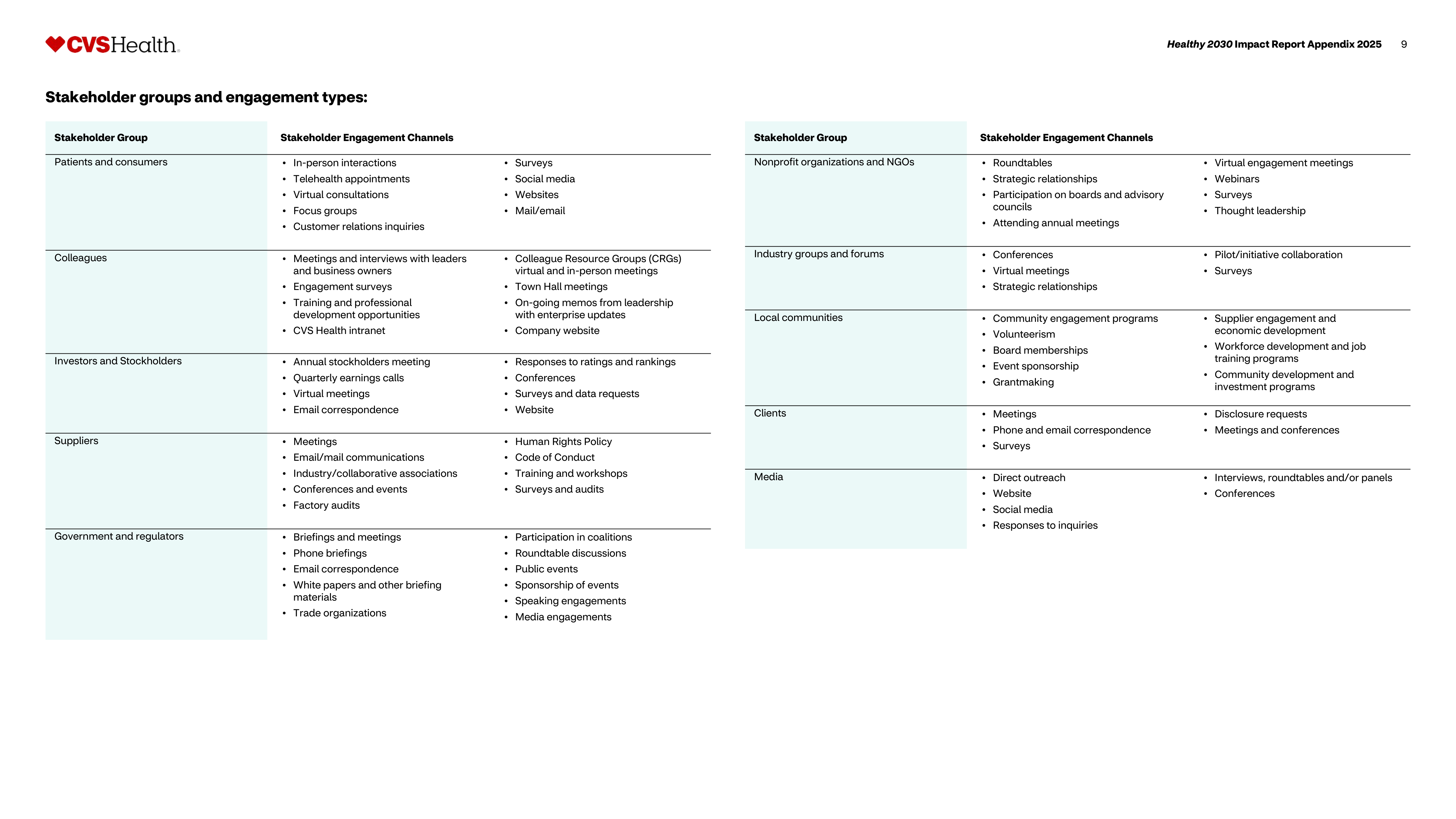

Stakeholder groups and engagement types:
Patients and consumers
•
In-person interactions
•
Telehealth appointments
•
Virtual consultations
•
Focus groups
•
Customer relations inquiries
•
Surveys
•
Social media
•
Websites
•
Mail/email
Colleagues
•
Meetings and interviews with leaders
and business owners
•
Engagement surveys
•
Training and professional
development opportunities
•
CVS Health intranet
•
Colleague Resource Groups (CRGs)
virtual and in-person meetings
•
Town Hall meetings
•
On-going memos from leadership
with enterprise updates
•
Company website
Investors and Stockholders
•
Annual stockholders meeting
•
Quarterly earnings calls
•
Virtual meetings
•
Email correspondence
•
Responses to ratings and rankings
•
Conferences
•
Surveys and data requests
•
Website
Suppliers
•
Meetings
•
Email/mail communications
•
Industry/collaborative associations
•
Conferences and events
•
Factory audits
•
Human Rights Policy
•
Code of Conduct
•
Training and workshops
•
Surveys and audits
Government and regulators
•
Briefings and meetings
•
Phone briefings
•
Email correspondence
•
White papers and other briefing
materials
•
Trade organizations
•
Participation in coalitions
•
Roundtable discussions
•
Public events
•
Sponsorship of events
•
Speaking engagements
•
Media engagements
Stakeholder Group
Stakeholder Engagement Channels
Nonprofit organizations and NGOs
•
Roundtables
•
Strategic relationships
•
Participation on boards and advisory
councils
•
Attending annual meetings
•
Virtual engagement meetings
•
Webinars
•
Surveys
•
Thought leadership
Industry groups and forums
•
Conferences
•
Virtual meetings
•
Strategic relationships
•
Pilot/initiative collaboration
•
Surveys
Local communities
•
Community engagement programs
•
Volunteerism
•
Board memberships
•
Event sponsorship
•
Grantmaking
•
Supplier engagement and
economic development
•
Workforce development and job
training programs
•
Community development and
investment programs
Clients
•
Meetings
•
Phone and email correspondence
•
Surveys
•
Disclosure requests
•
Meetings and conferences
Media
•
Direct outreach
•
Website
•
Social media
•
Responses to inquiries
•
Interviews, roundtables and/or panels
•
Conferences
Stakeholder Group
Stakeholder Engagement Channels
Healthy 2030
Impact Report Appendix 2025
9



Our Impact Approach and Metrics
Human Capital Data
Introduction
Our Impact Approach and Metrics
Indices
Healthy 2030
Impact Report Appendix 2025
10
Our Impact
Approach
and Metrics
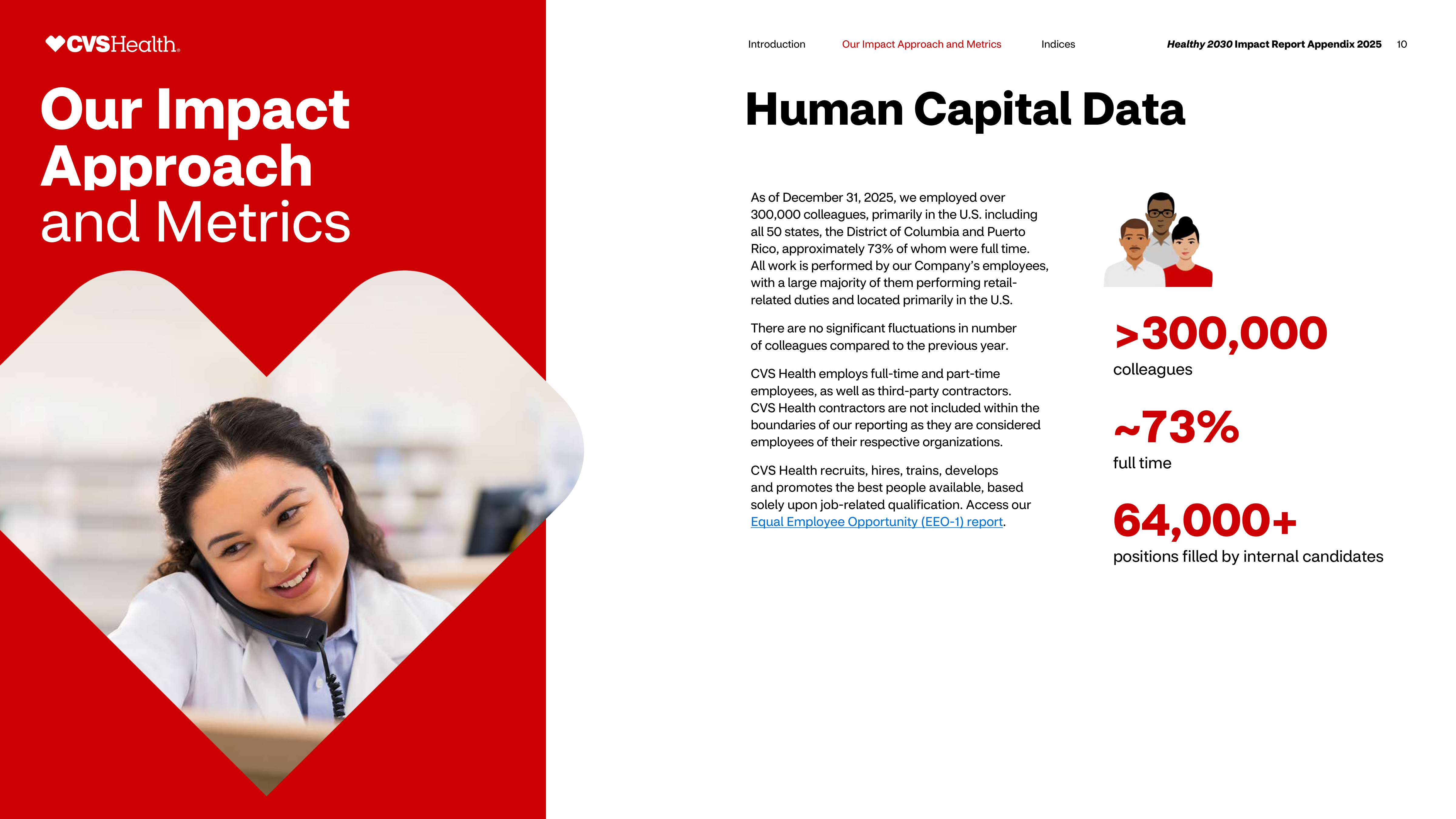
As of December 31, 2025, we employed over
300,000 colleagues, primarily in the U.S. including
all 50 states, the District of Columbia and Puerto
Rico, approximately 73% of whom were full time.
All work is performed by our Company’s employees,
with a large majority of them performing retail-
related duties and located primarily in the U.S.
There are no significant fluctuations in number
of colleagues compared to the previous year.
CVS Health employs full-time and part-time
employees, as well as third-party contractors.
CVS Health contractors are not included within the
boundaries of our reporting as they are considered
employees of their respective organizations.
CVS Health recruits, hires, trains, develops
and promotes the best people available, based
solely upon job-related qualification. Access our
Equal Employee Opportunity (EEO-1) report
.
and Metrics
>300,000
colleagues
~73%
full time
64,000+
positions filled by internal candidates


Occupational Data
We remain focused on maintaining safe workplace
conditions and are committed to continuously
improving the performance of our health, safety
and environment programs. We use best-in-class
technology to create a centralized place for data
gathering, analysis and reporting insights for data-
driven decision making and accelerated progress.
We emphasize reducing risk at its source —
eliminating or engineering programs that address
hazards wherever possible. We encourage a culture
where potential safety concerns are identified
early, allowing us to act before an injury occurs.
By proactively analyzing near-miss events, we’re
able to uncover systemic opportunities for hazard
elimination or isolation.
Our occupational health and safety (OHS) program
is applicable to all our operations, including
colleagues, as well as clients, contractors, suppliers
and other visitors to our facilities. Learn more in our
OHS Statement
.
Employee engagement
We believe engaged colleagues produce stronger
business results and are more likely to build a career
with the Company. Each year we conduct engagement
surveys that provide colleagues the opportunity to
share opinions and experiences with respect to their
role, their team, and the enterprise to help CVS Health
Corporation’s Board of Directors and our management
identify where we can improve colleague experience.
These surveys cover a broad range of topics including
development and opportunities, recognition,
performance, belonging, well-being, compliance and
continuous improvement. In 2025, we conducted
engagement surveys in both April and September. More
than 200,000 colleagues participated in each survey
and overall engagement improved across surveys.
Paid parental leave
Full-time employees with 12 months of continuous
service who welcome a new child into their home are
eligible to take up to four weeks away from work at
100% of their pay to ensure the latest addition to their
family gets a strong start in life.
Healthy 2030
Impact Report Appendix 2025
11
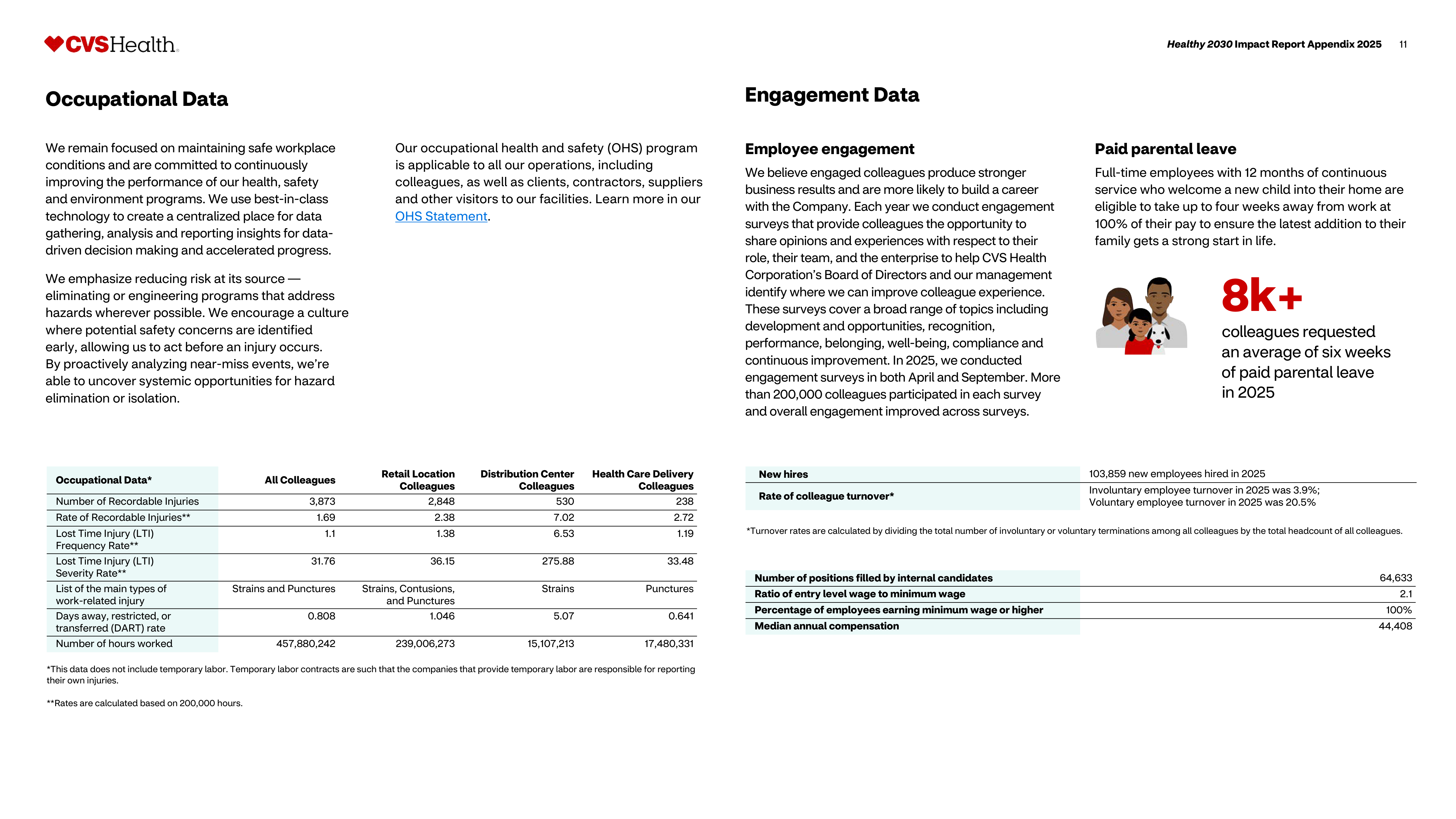
Occupational Data*
All Colleagues
Retail Location
Colleagues
Distribution Center
Colleagues
Health Care Delivery
Colleagues
Number of Recordable Injuries
3,873
2,848
530
238
Rate of Recordable Injuries**
1.69
2.38
7.02
2.72
Lost Time Injury (LTI)
Frequency Rate**
1.1
1.38
6.53
1.19
Lost Time Injury (LTI)
Severity Rate**
31.76
36.15
275.88
33.48
List of the main types of
work-related injury
Strains and Punctures
Strains, Contusions,
and Punctures
Strains
Punctures
Days away, restricted, or
transferred (DART) rate
0.808
1.046
5.07
0.641
Number of hours worked
457,880,242
239,006,273
15,107,213
17,480,331
Engagement Data
8k+
colleagues requested
an average of six weeks
of paid parental leave
in 2025
*This data does not include temporary labor. Temporary labor contracts are such that the companies that provide temporary labor are responsible for reporting
their own injuries.
**Rates are calculated based on 200,000 hours.
*Turnover rates are calculated by dividing the total number of involuntary or voluntary terminations among all colleagues by the total headcount of all colleagues.
New hires
103,859 new employees hired in 2025
Rate of colleague turnover*
Involuntary employee turnover in 2025 was 3.9%;
Voluntary employee turnover in 2025 was 20.5%
Number of positions filled by internal candidates
64,633
Ratio of entry level wage to minimum wage
2.1
Percentage of employees earning minimum wage or higher
100%
Median annual compensation
44,408
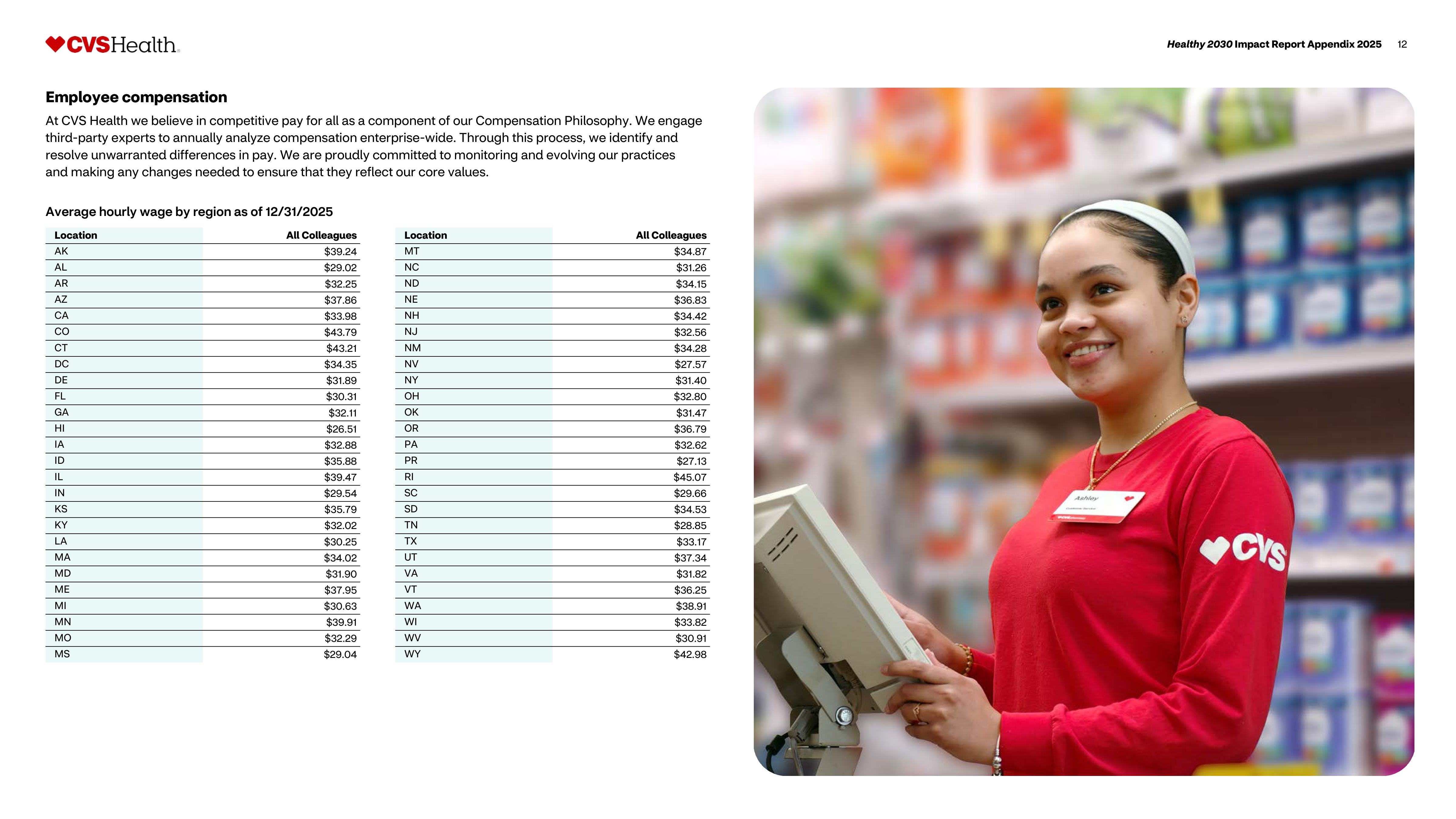


Employee compensation
At CVS Health we believe in competitive pay for all as a component of our Compensation Philosophy. We engage
third-party experts to annually analyze compensation enterprise-wide. Through this process, we identify and
resolve unwarranted differences in pay. We are proudly committed to monitoring and evolving our practices
and making any changes needed to ensure that they reflect our core values.
Average hourly wage by region as of 12/31/2025
AK
$39.24
AL
$29.02
AR
$32.25
AZ
$37.86
CA
$33.98
CO
$43.79
CT
$43.21
DC
$34.35
DE
$31.89
FL
$30.31
GA
$32.11
HI
$26.51
IA
$32.88
ID
$35.88
IL
$39.47
IN
$29.54
KS
$35.79
KY
$32.02
LA
$30.25
MA
$34.02
MD
$31.90
ME
$37.95
MI
$30.63
MN
$39.91
MO
$32.29
MS
$29.04
Location
All Colleagues
MT
$34.87
NC
$31.26
ND
$34.15
NE
$36.83
NH
$34.42
NJ
$32.56
NM
$34.28
NV
$27.57
NY
$31.40
OH
$32.80
OK
$31.47
OR
$36.79
PA
$32.62
PR
$27.13
RI
$45.07
SC
$29.66
SD
$34.53
TN
$28.85
TX
$33.17
UT
$37.34
VA
$31.82
VT
$36.25
WA
$38.91
WI
$33.82
WV
$30.91
WY
$42.98
Location
All Colleagues
Healthy 2030
Impact Report Appendix 2025
12

Social Compliance Audit Summary
Where we are directly linked to human rights impacts
through our business relationships, we seek ways
to positively influence the human rights actions of
our business partners, including our suppliers.
We require suppliers and their factories to provide fair
and safe working conditions for all workers and to treat
their employees with dignity and respect. To ensure
factories are meeting local laws and international
standards as it relates to human rights concerns,
our independent third-party audit firm partner, UL,
conducts audits through our Ethical Sourcing and
CTPAT Compliance Program. The Ethical Sourcing and
CTPAT Compliance Program focuses on human rights
related areas such as child labor, forced labor, wages/
benefits and health/safety.
CVS Health maintains a strict Zero Tolerance policy
when auditing factories and we take this commitment
seriously. If a Zero Tolerance issue is found, the
factory is immediately put on probation and orders
are canceled. Alert Notification issues are serious
issues that require immediate action. If an audit finds
an Alert Notification issue, factories must provide
evidence that the issue has been addressed and
undergo a verification process. Failure to successfully
complete the verification process will result in the
factory being placed on probation. A probationary
period lasts one year, after which we conduct a new
audit to determine if we will work together again.
Learn more about our commitment to supply chains
in the
Healthy Business
section of our online report.
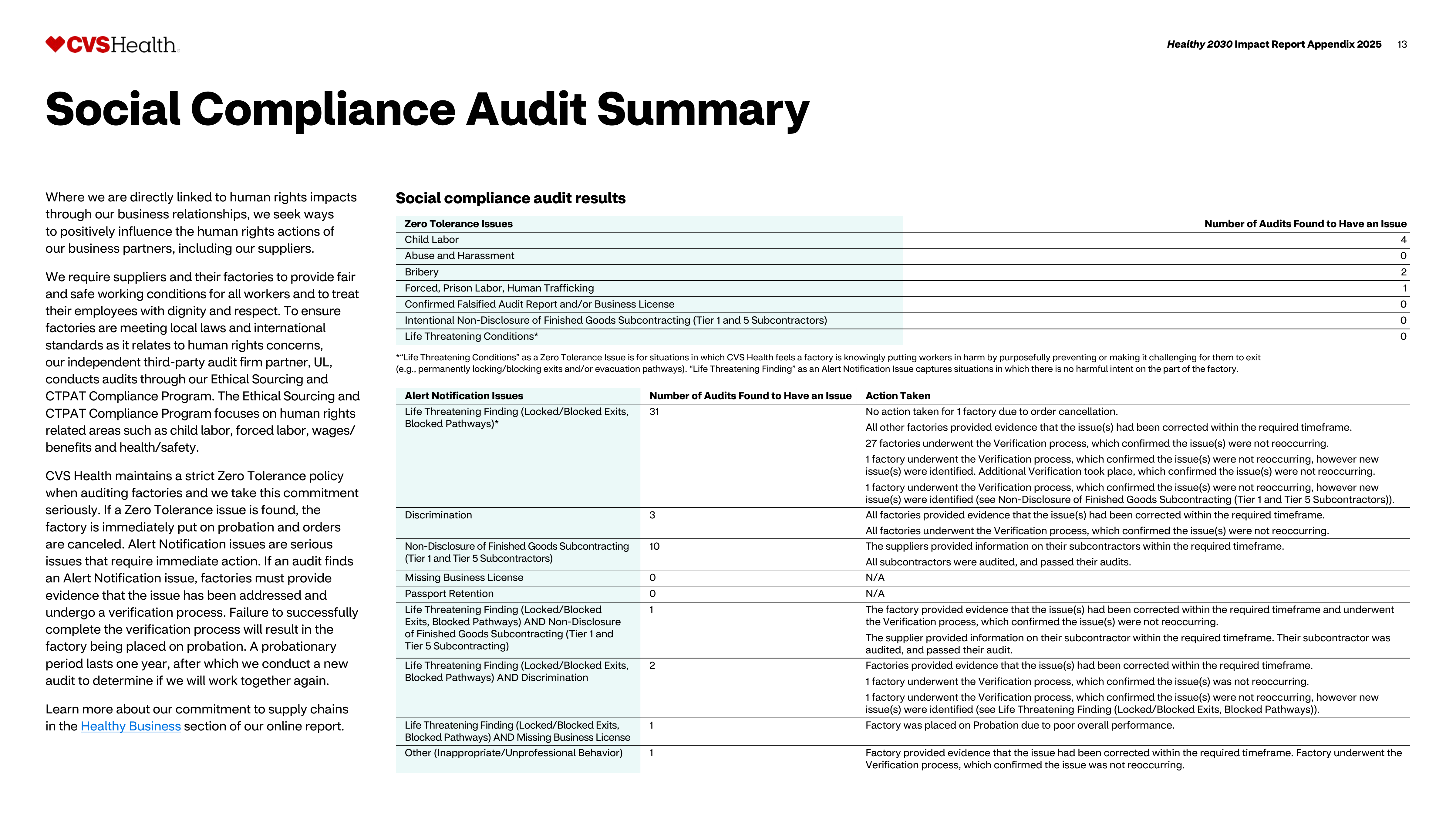
Social compliance audit results
Zero Tolerance Issues
Number of Audits Found to Have an Issue
Child Labor
4
Abuse and Harassment
0
Bribery
2
Forced, Prison Labor, Human Trafficking
1
Confirmed Falsified Audit Report and/or Business License
0
Intentional Non-Disclosure of Finished Goods Subcontracting (Tier 1 and 5 Subcontractors)
0
Life Threatening Conditions*
0
*“Life Threatening Conditions” as a Zero Tolerance Issue is for situations in which CVS Health feels a factory is knowingly putting workers in harm by purposefully preventing or making it challenging for them to exit
(e.g., permanently locking/blocking exits and/or evacuation pathways). “Life Threatening Finding” as an Alert Notification Issue captures situations in which there is no harmful intent on the part of the factory.
Alert Notification Issues
Number of Audits Found to Have an Issue
Action Taken
Life Threatening Finding (Locked/Blocked Exits,
Blocked Pathways)*
31
No action taken for 1 factory due to order cancellation.
All other factories provided evidence that the issue(s) had been corrected within the required timeframe.
27 factories underwent the Verification process, which confirmed the issue(s) were not reoccurring.
1 factory underwent the Verification process, which confirmed the issue(s) were not reoccurring, however new
issue(s) were identified. Additional Verification took place, which confirmed the issue(s) were not reoccurring.
1 factory underwent the Verification process, which confirmed the issue(s) were not reoccurring, however new
issue(s) were identified (see Non-Disclosure of Finished Goods Subcontracting (Tier 1 and Tier 5 Subcontractors)).
Discrimination
3
All factories provided evidence that the issue(s) had been corrected within the required timeframe.
All factories underwent the Verification process, which confirmed the issue(s) were not reoccurring.
Non-Disclosure of Finished Goods Subcontracting
(Tier 1 and Tier 5 Subcontractors)
10
The suppliers provided information on their subcontractors within the required timeframe.
All subcontractors were audited, and passed their audits.
Missing Business License
0
N/A
Passport Retention
0
N/A
Life Threatening Finding (Locked/Blocked
Exits, Blocked Pathways) AND Non-Disclosure
of Finished Goods Subcontracting (Tier 1 and
Tier 5 Subcontracting)
1
The factory provided evidence that the issue(s) had been corrected within the required timeframe and underwent
the Verification process, which confirmed the issue(s) were not reoccurring.
The supplier provided information on their subcontractor within the required timeframe. Their subcontractor was
audited, and passed their audit.
Life Threatening Finding (Locked/Blocked Exits,
Blocked Pathways) AND Discrimination
2
Factories provided evidence that the issue(s) had been corrected within the required timeframe.
1 factory underwent the Verification process, which confirmed the issue(s) was not reoccurring.
1 factory underwent the Verification process, which confirmed the issue(s) were not reoccurring, however new
issue(s) were identified (see Life Threatening Finding (Locked/Blocked Exits, Blocked Pathways)).
Life Threatening Finding (Locked/Blocked Exits,
Blocked Pathways) AND Missing Business License
1
Factory was placed on Probation due to poor overall performance.
Other (Inappropriate/Unprofessional Behavior)
1
Factory provided evidence that the issue had been corrected within the required timeframe. Factory underwent the
Verification process, which confirmed the issue was not reoccurring.
Healthy 2030
Impact Report Appendix 2025
13


Reducing Our Environmental Impact
We advance initiatives to protect the health of people
and the planet. We are strengthening our business to
withstand extreme weather events, ensuring continuity
of care and access for patients when it matters most.
Our efforts include strengthening environmental health
and resilience, reducing greenhouse gas emissions,
sourcing renewable energy and driving packaging
innovation to minimize waste and unnecessary
plastics. We lead with purpose to build a healthier
world for generations to come.
CVS Health is committed to reducing the impacts
of our operations. We include environmental
guidance in supplier requests for proposals.
We also evaluate suppliers of our Store Brand
products for environmental criteria through our
social compliance program.
In 2021, we became one of the first companies in the
world to have our net-zero targets validated by the
Science-Based Targets initiative's (SBTi) net-zero
methodology, setting us on a path to achieve net-zero
emissions from our direct operations and across our
value chain by 2050.
More information on key programs and initiatives
driving our progress are highlighted in the
Healthy
Planet
section of our online impact report. Additional
information on our climate-related progress is
available in our
Climate Disclosure
.
Healthy 2030
Impact Report Appendix 2025
14




Environmental Data
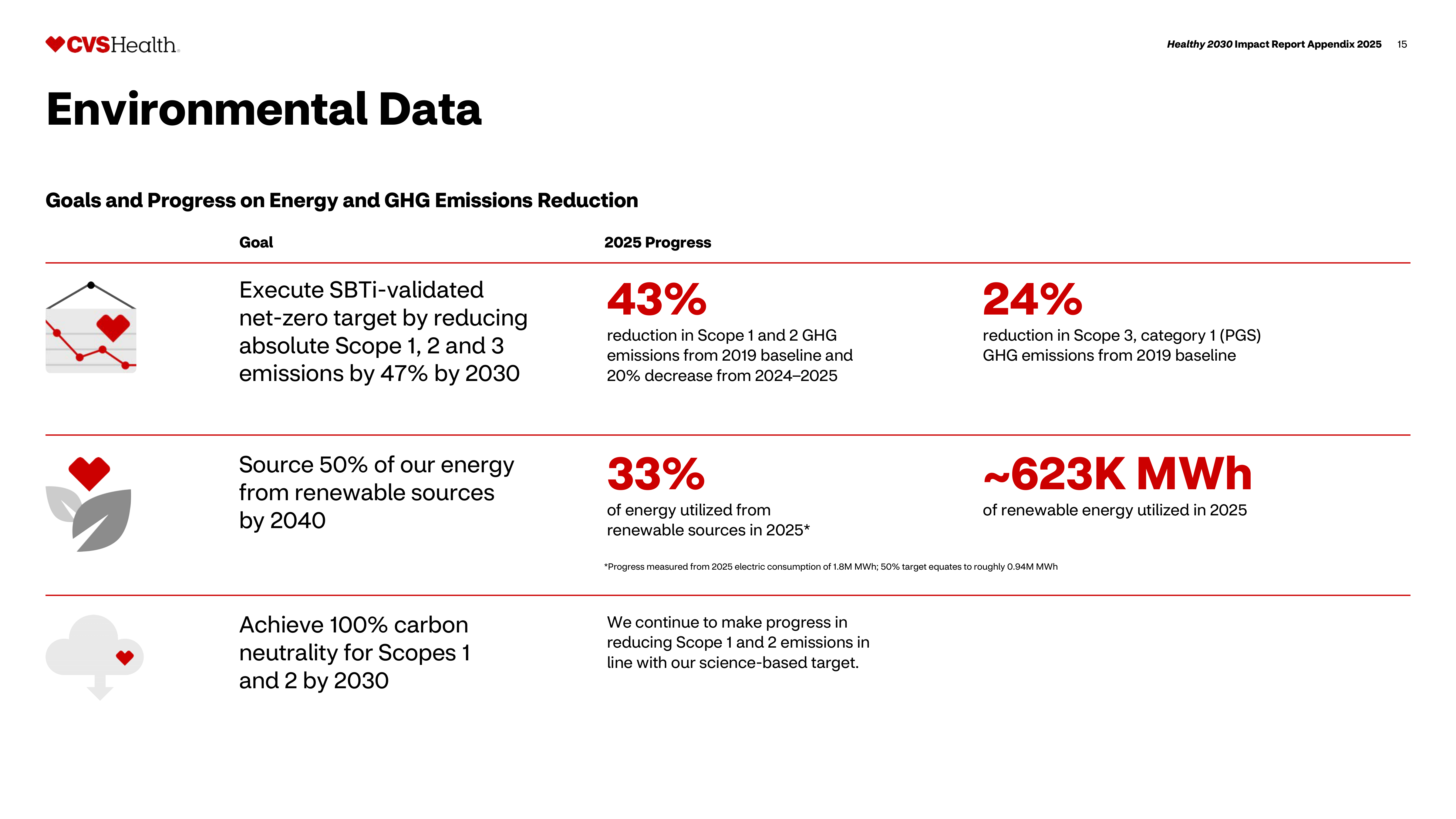
Goals and Progress on Energy and GHG Emissions Reduction
Healthy 2030
Impact Report Appendix 2025
15
Execute SBTi-validated
net-zero target by reducing
absolute Scope 1, 2 and 3
emissions by 47% by 2030
Source 50% of our energy
from renewable sources
by 2040
Achieve 100% carbon
neutrality for Scopes 1
and 2 by 2030
Goal
2025 Progress
43%
reduction in Scope 1 and 2 GHG
emissions from 2019 baseline and
20% decrease from 2024–2025
33%
of energy utilized from
renewable sources in 2025*
We continue to make progress in
reducing Scope 1 and 2 emissions in
line with our science-based target.
24%
reduction in Scope 3, category 1 (PGS)
GHG emissions from 2019 baseline
~623K MWh
of renewable energy utilized in 2025
*Progress measured from 2025 electric consumption of 1.8M MWh; 50% target equates to roughly 0.94M MWh
43% reduction in Scope 1 and 2 GHG emissions from 2019 baseline and 20% decrease from 2024–2025. 24% reduction in Scope 3, category 1 (PGS) and GHG emissions from 2019 baseline
33% of energy utilized from renewable sources in 2025. Note: Progress measured from 2025 electric consumption of 1.8M MWh; 50% target equates to roughly 0.94M MWh. ~623,000 MWh of renewable energy utilized in 2025.

The percentages in tables throughout this section may not total 100 due to rounding.
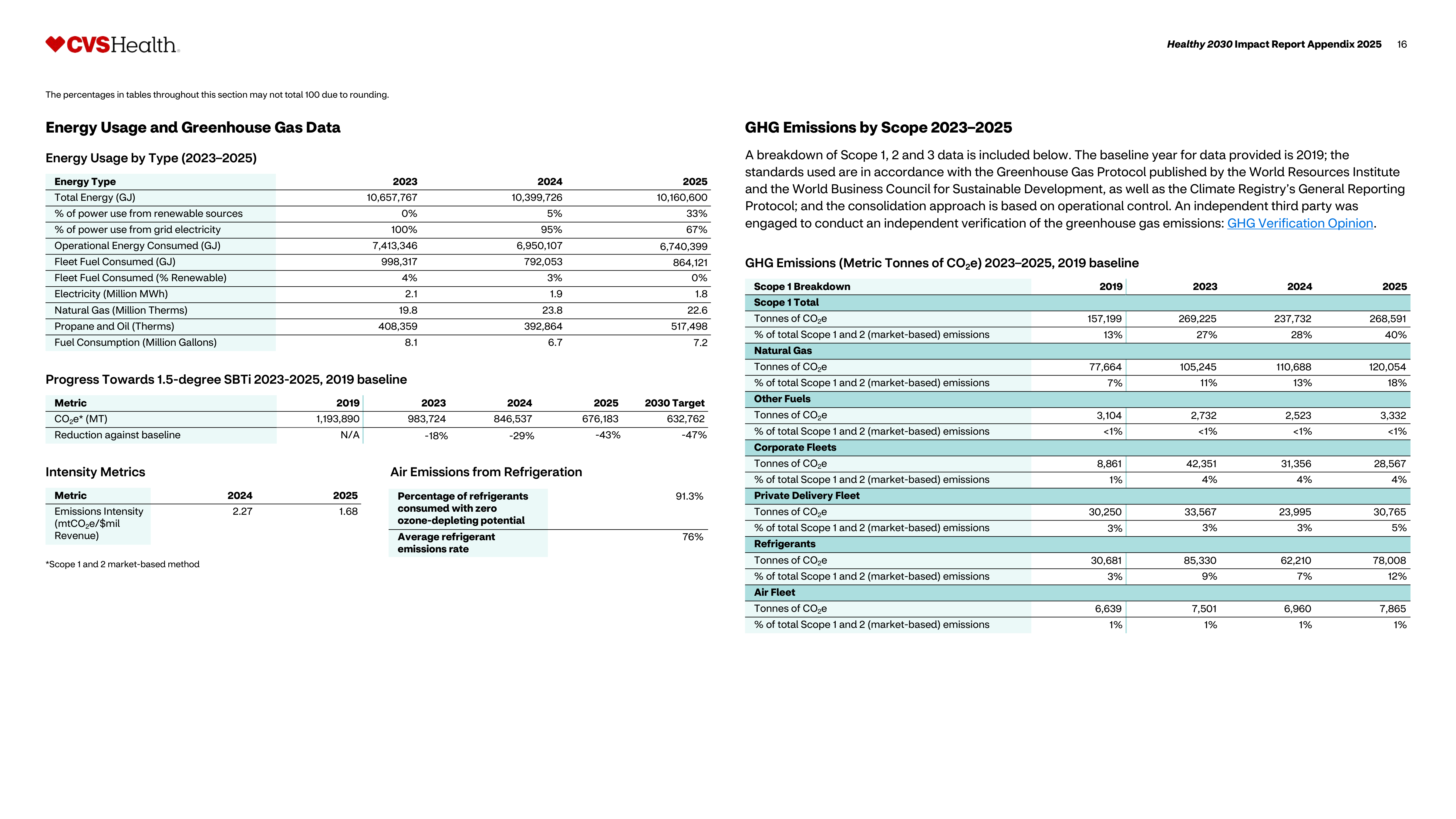
Energy Usage and Greenhouse Gas Data
Energy Usage by Type (2023–2025)
Energy Type
2023
2024
2025
Total Energy (GJ)
10,657,767
10,399,726
10,160,600
% of power use from renewable sources
0%
5%
33%
% of power use from grid electricity
100%
95%
67%
Operational Energy Consumed (GJ)
7,413,346
6,950,107
6,740,399
Fleet Fuel Consumed (GJ)
998,317
792,053
864,121
Fleet Fuel Consumed (% Renewable)
4%
3%
0%
Electricity (Million MWh)
2.1
1.9
1.8
Natural Gas (Million Therms)
19.8
23.8
22.6
Propane and Oil (Therms)
408,359
392,864
517,498
Fuel Consumption (Million Gallons)
8.1
6.7
7.2
Progress Towards 1.5-degree SBTi 2023-2025, 2019 baseline
Metric
2019
2023
2024
2025
2030 Target
CO
2
e* (MT)
1,193,890
983,724
846,537
676,183
632,762
Reduction against baseline
N/A
-18%
-29%
-43%
-47%
Intensity Metrics
Metric
2024
2025
Emissions Intensity
(mtCO
2
e/$mil
Revenue)
2.27
1.68
*Scope 1 and 2 market-based method
GHG Emissions by Scope 2023–2025
A breakdown of Scope 1, 2 and 3 data is included below. The baseline year for data provided is 2019; the
standards used are in accordance with the Greenhouse Gas Protocol published by the World Resources Institute
and the World Business Council for Sustainable Development, as well as the Climate Registry’s General Reporting
Protocol; and the consolidation approach is based on operational control. An independent third party was
engaged to conduct an independent verification of the greenhouse gas emissions:
GHG Verification Opinion
.
GHG Emissions (Metric Tonnes of CO
2
e) 2023–2025, 2019 baseline
Scope 1 Total
Tonnes of CO
2
e
157,199
269,225
237,732
268,591
% of total Scope 1 and 2 (market-based) emissions
13%
27%
28%
40%
Natural Gas
Tonnes of CO
2
e
77,664
105,245
110,688
120,054
% of total Scope 1 and 2 (market-based) emissions
7%
11%
13%
18%
Other Fuels
Tonnes of CO
2
e
3,104
2,732
2,523
3,332
% of total Scope 1 and 2 (market-based) emissions
<1%
<1%
<1%
<1%
Corporate Fleets
Tonnes of CO
2
e
8,861
42,351
31,356
28,567
% of total Scope 1 and 2 (market-based) emissions
1%
4%
4%
4%
Private Delivery Fleet
Tonnes of CO
2
e
30,250
33,567
23,995
30,765
% of total Scope 1 and 2 (market-based) emissions
3%
3%
3%
5%
Refrigerants
Tonnes of CO
2
e
30,681
85,330
62,210
78,008
% of total Scope 1 and 2 (market-based) emissions
3%
9%
7%
12%
Air Fleet
Tonnes of CO
2
e
6,639
7,501
6,960
7,865
% of total Scope 1 and 2 (market-based) emissions
1%
1%
1%
1%
Scope 1 Breakdown
2019
2023
2024
2025
Healthy 2030
Impact Report Appendix 2025
16
Percentage of refrigerants
consumed with zero
ozone-depleting potential
91.3%
Average refrigerant
emissions rate
76%
Air Emissions from Refrigeration
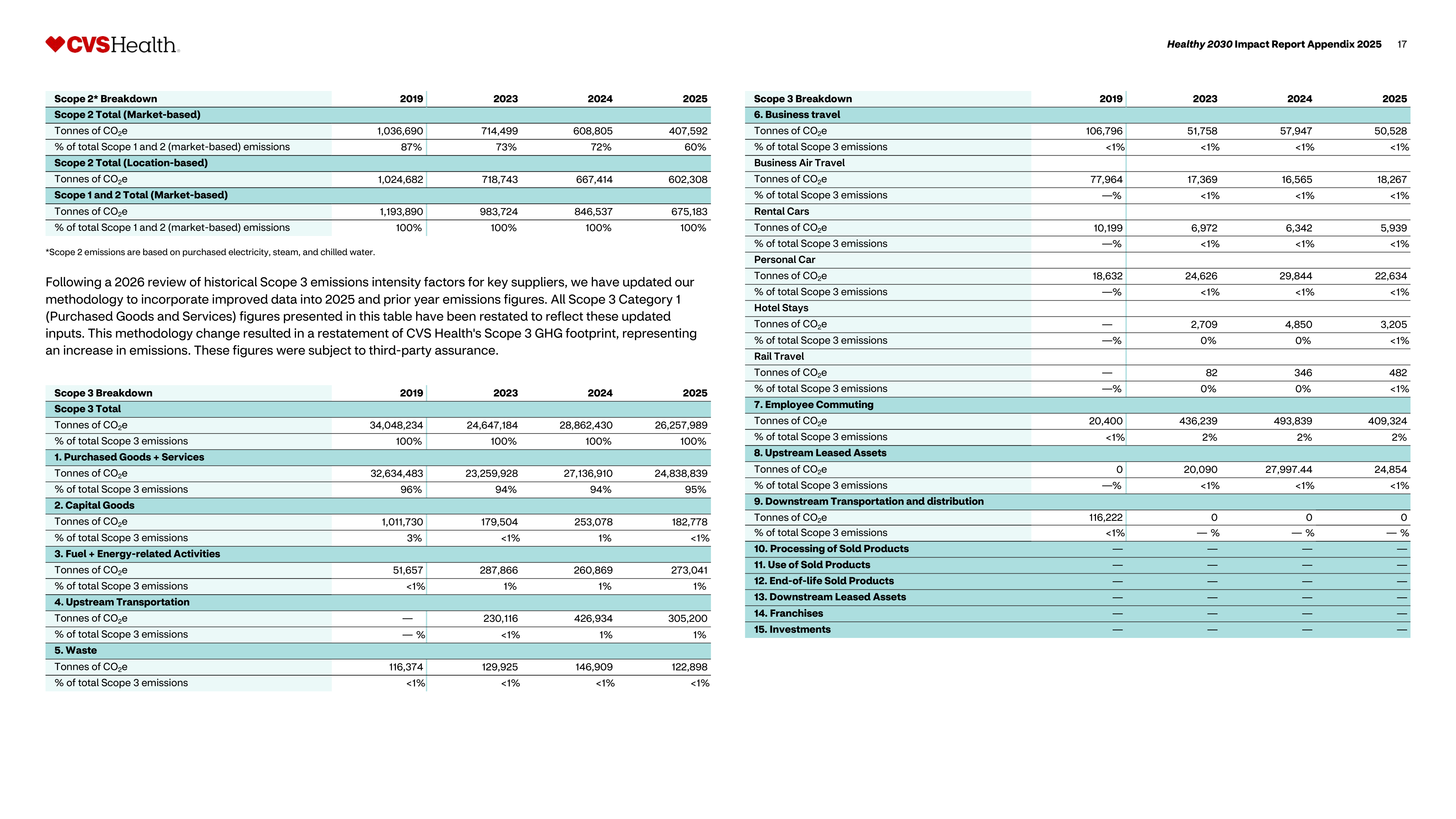

Scope 2 Total (Market-based)
Tonnes of CO
2
e
1,036,690
714,499
608,805
407,592
% of total Scope 1 and 2 (market-based) emissions
87%
73%
72%
60%
Scope 2 Total (Location-based)
Tonnes of CO
2
e
1,024,682
718,743
667,414
602,308
Scope 1 and 2 Total (Market-based)
Tonnes of CO
2
e
1,193,890
983,724
846,537
675,183
% of total Scope 1 and 2 (market-based) emissions
100%
100%
100%
100%
Scope 2* Breakdown
2019
2023
2024
2025
*Scope 2 emissions are based on purchased electricity, steam, and chilled water.
Following a 2026 review of historical Scope 3 emissions intensity factors for key suppliers, we have updated our
methodology to incorporate improved data into 2025 and prior year emissions figures. All Scope 3 Category 1
(Purchased Goods and Services) figures presented in this table have been restated to reflect these updated
inputs. This methodology change resulted in a restatement of CVS Health's Scope 3 GHG footprint, representing
an increase in emissions. These figures were subject to third-party assurance.
Scope 3 Total
Tonnes of CO
2
e
34,048,234
24,647,184
28,862,430
26,257,989
% of total Scope 3 emissions
100%
100%
100%
100%
1. Purchased Goods + Services
Tonnes of CO
2
e
32,634,483
23,259,928
27,136,910
24,838,839
% of total Scope 3 emissions
96%
94%
94%
95%
2. Capital Goods
Tonnes of CO
2
e
1,011,730
179,504
253,078
182,778
% of total Scope 3 emissions
3%
<1%
1%
<1%
3. Fuel + Energy-related Activities
Tonnes of CO
2
e
51,657
287,866
260,869
273,041
% of total Scope 3 emissions
<1%
1%
1%
1%
4. Upstream Transportation
Tonnes of CO
2
e
—
230,116
426,934
305,200
% of total Scope 3 emissions
— %
<1%
1%
1%
5. Waste
Tonnes of CO
2
e
116,374
129,925
146,909
122,898
% of total Scope 3 emissions
<1%
<1%
<1%
<1%
Scope 3 Breakdown
2019
2023
2024
2025
6. Business travel
Tonnes of CO
2
e
106,796
51,758
57,947
50,528
% of total Scope 3 emissions
<1%
<1%
<1%
<1%
Business Air Travel
Tonnes of CO
2
e
77,964
17,369
16,565
18,267
% of total Scope 3 emissions
—%
<1%
<1%
<1%
Rental Cars
Tonnes of CO
2
e
10,199
6,972
6,342
5,939
% of total Scope 3 emissions
—%
<1%
<1%
<1%
Personal Car
Tonnes of CO
2
e
18,632
24,626
29,844
22,634
% of total Scope 3 emissions
—%
<1%
<1%
<1%
Hotel Stays
Tonnes of CO
2
e
—
2,709
4,850
3,205
% of total Scope 3 emissions
—%
0%
0%
<1%
Rail Travel
Tonnes of CO
2
e
—
82
346
482
% of total Scope 3 emissions
—%
0%
0%
<1%
7. Employee Commuting
Tonnes of CO
2
e
20,400
436,239
493,839
409,324
% of total Scope 3 emissions
<1%
2%
2%
2%
8. Upstream Leased Assets
Tonnes of CO
2
e
0
20,090
27,997.44
24,854
% of total Scope 3 emissions
—%
<1%
<1%
<1%
9. Downstream Transportation and distribution
Tonnes of CO
2
e
116,222
0
0
0
% of total Scope 3 emissions
<1%
— %
— %
— %
10. Processing of Sold Products
—
—
—
—
11. Use of Sold Products
—
—
—
—
12. End-of-life Sold Products
—
—
—
—
13. Downstream Leased Assets
—
—
—
—
14. Franchises
—
—
—
—
15. Investments
—
—
—
—
Scope 3 Breakdown
2019
2023
2024
2025
Healthy 2030
Impact Report Appendix 2025
17


Waste Data
Plastic stewardship
At CVS Health, we strive to reduce and responsibly
manage how we are using plastic across our
business, while acknowledging that plastic is needed
for safe care delivery and product quality.
We aim to eliminate or use less plastic, replace plastic
with alternative sustainable materials and identify
new strategies to increase recyclability and safer
end-of-use disposal of the materials we use where
we can. This enterprise-wide approach extends
beyond product packaging to include operational,
supply-chain and distribution plastics.
In 2025, we evolved our enterprise plastic strategy
to better guide how we prioritize, sequence and scale
action across the business. This shift moved us away
from material‑specific goals and toward a more
holistic plastic stewardship framework aligned
with evolving state‑level regulations. This evolution
focuses our ambition by grounding our actions in
what will drive the greatest, most durable impact
across our business. It reflects changes in the
business and regulatory landscape, limitations in
material availability and recycling infrastructure and
positions us to focus on operational efficiency, supply
chain collaboration and improving waste diversion,
where feasible.
We are committed to transparency and
accountability. We will continue to report on our
enterprise plastic footprint and KPIs annually.
More information on our evolved strategy and
programs to reduce plastic and manage the
impacts of our business are available on our
Healthy Planet
webpage.
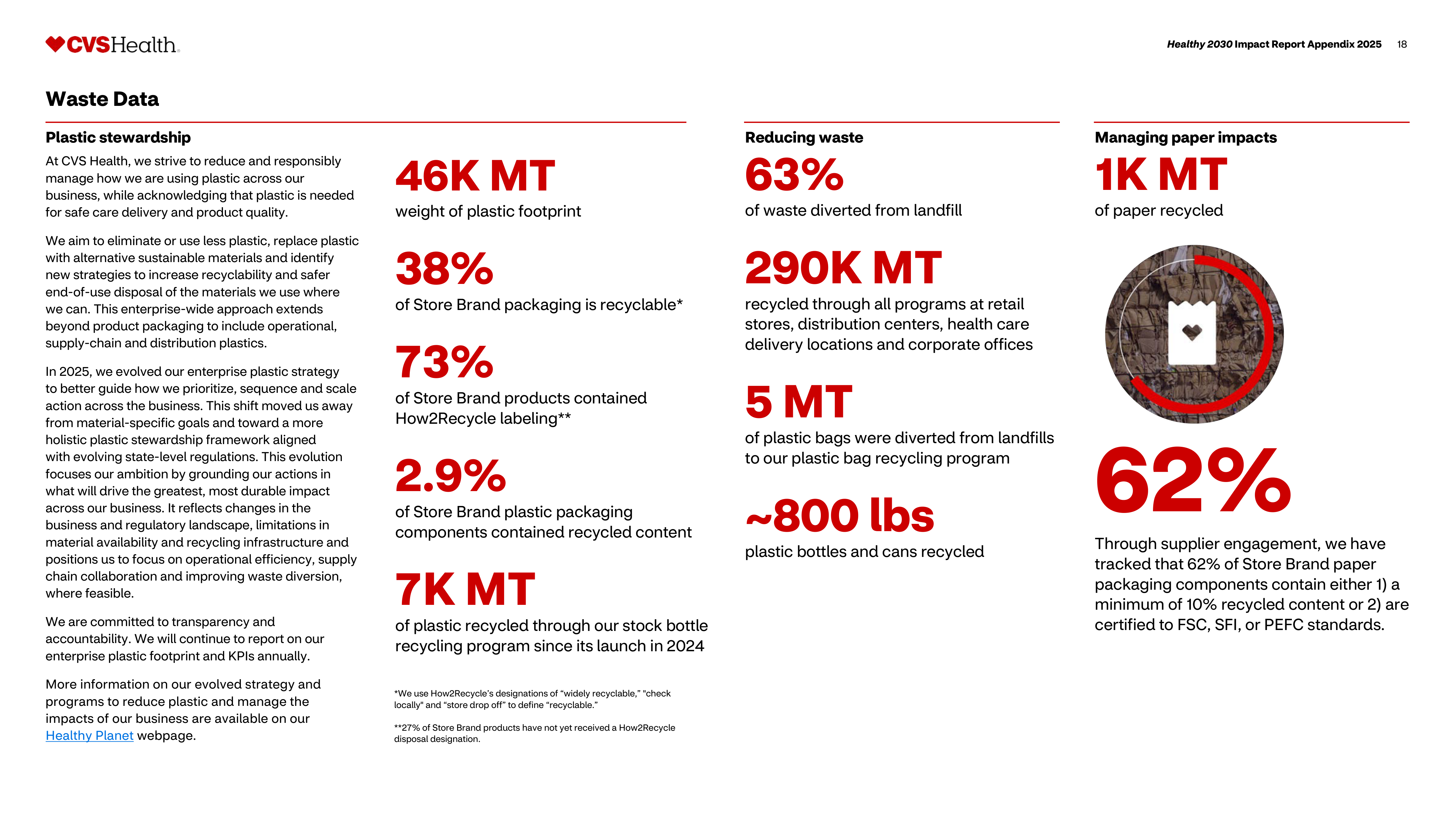
46K MT
weight of plastic footprint
38%
of Store Brand packaging is recyclable*
73%
of Store Brand products contained
How2Recycle labeling**
2.9%
of Store Brand plastic packaging
components contained recycled content
7K MT
of plastic recycled through our stock bottle
recycling program since its launch in 2024
Reducing waste
63%
of waste diverted from landfill
290K MT
recycled through all programs at retail
stores, distribution centers, health care
delivery locations and corporate offices
5 MT
of plastic bags were diverted from landfills
to our plastic bag recycling program
~800 lbs
plastic bottles and cans recycled
Managing paper impacts
1K MT
of paper recycled
62%
Through supplier engagement, we have
tracked that 62% of Store Brand paper
packaging components contain either 1) a
minimum of 10% recycled content or 2) are
certified to FSC, SFI, or PEFC standards.
Healthy 2030
Impact Report Appendix 2025
18
*We use How2Recycle’s designations of “widely recyclable,” "check
locally" and “store drop off” to define “recyclable.”
**27% of Store Brand products have not yet received a How2Recycle
disposal designation.
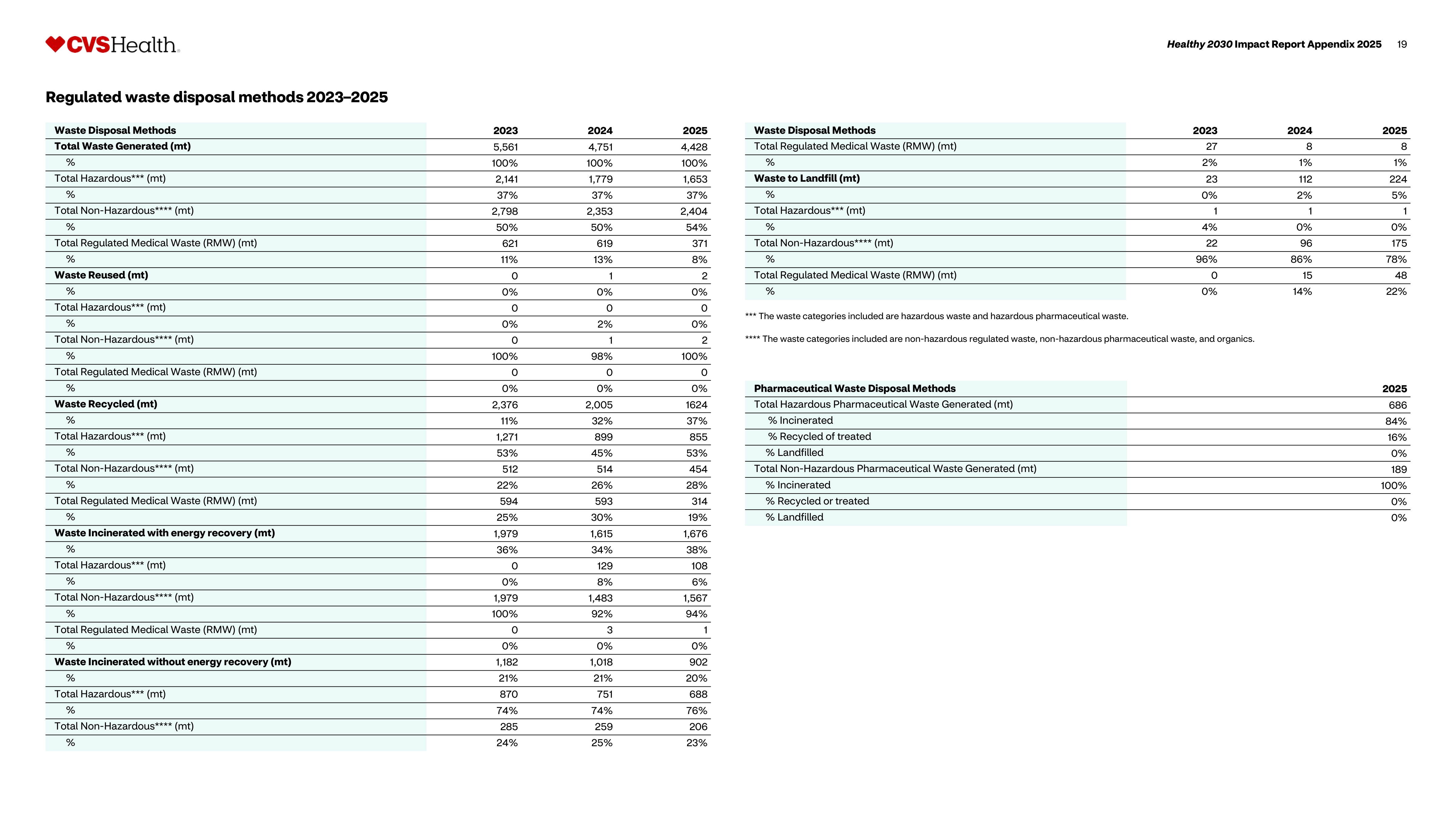

Regulated waste disposal methods 2023–2025
Total Waste Generated (mt)
5,561
4,751
4,428
%
100%
100%
100%
Total Hazardous*** (mt)
2,141
1,779
1,653
%
37%
37%
37%
Total Non-Hazardous**** (mt)
2,798
2,353
2,404
%
50%
50%
54%
Total Regulated Medical Waste (RMW) (mt)
621
619
371
%
11%
13%
8%
Waste Reused (mt)
0
1
2
%
0%
0%
0%
Total Hazardous*** (mt)
0
0
0
%
0%
2%
0%
Total Non-Hazardous**** (mt)
0
1
2
%
100%
98%
100%
Total Regulated Medical Waste (RMW) (mt)
0
0
0
%
0%
0%
0%
Waste Recycled (mt)
2,376
2,005
1624
%
11%
32%
37%
Total Hazardous*** (mt)
1,271
899
855
%
53%
45%
53%
Total Non-Hazardous**** (mt)
512
514
454
%
22%
26%
28%
Total Regulated Medical Waste (RMW) (mt)
594
593
314
%
25%
30%
19%
Waste Incinerated with energy recovery (mt)
1,979
1,615
1,676
%
36%
34%
38%
Total Hazardous*** (mt)
0
129
108
%
0%
8%
6%
Total Non-Hazardous**** (mt)
1,979
1,483
1,567
%
100%
92%
94%
Total Regulated Medical Waste (RMW) (mt)
0
3
1
%
0%
0%
0%
Waste Incinerated without energy recovery (mt)
1,182
1,018
902
%
21%
21%
20%
Total Hazardous*** (mt)
870
751
688
%
74%
74%
76%
Total Non-Hazardous**** (mt)
285
259
206
%
24%
25%
23%
Waste Disposal Methods
2023
2024
2025
Total Regulated Medical Waste (RMW) (mt)
27
8
8
%
2%
1%
1%
Waste to Landfill (mt)
23
112
224
%
0%
2%
5%
Total Hazardous*** (mt)
1
1
1
%
4%
0%
0%
Total Non-Hazardous**** (mt)
22
96
175
%
96%
86%
78%
Total Regulated Medical Waste (RMW) (mt)
0
15
48
%
0%
14%
22%
Waste Disposal Methods
2023
2024
2025
*** The waste categories included are hazardous waste and hazardous pharmaceutical waste.
**** The waste categories included are non-hazardous regulated waste, non-hazardous pharmaceutical waste, and organics.
Pharmaceutical Waste Disposal Methods
2025
Total Hazardous Pharmaceutical Waste Generated (mt)
686
% Incinerated
84%
% Recycled of treated
16%
% Landfilled
0%
Total Non-Hazardous Pharmaceutical Waste Generated (mt)
189
% Incinerated
100%
% Recycled or treated
0%
% Landfilled
0%
Healthy 2030
Impact Report Appendix 2025
19



Managing Water Impacts
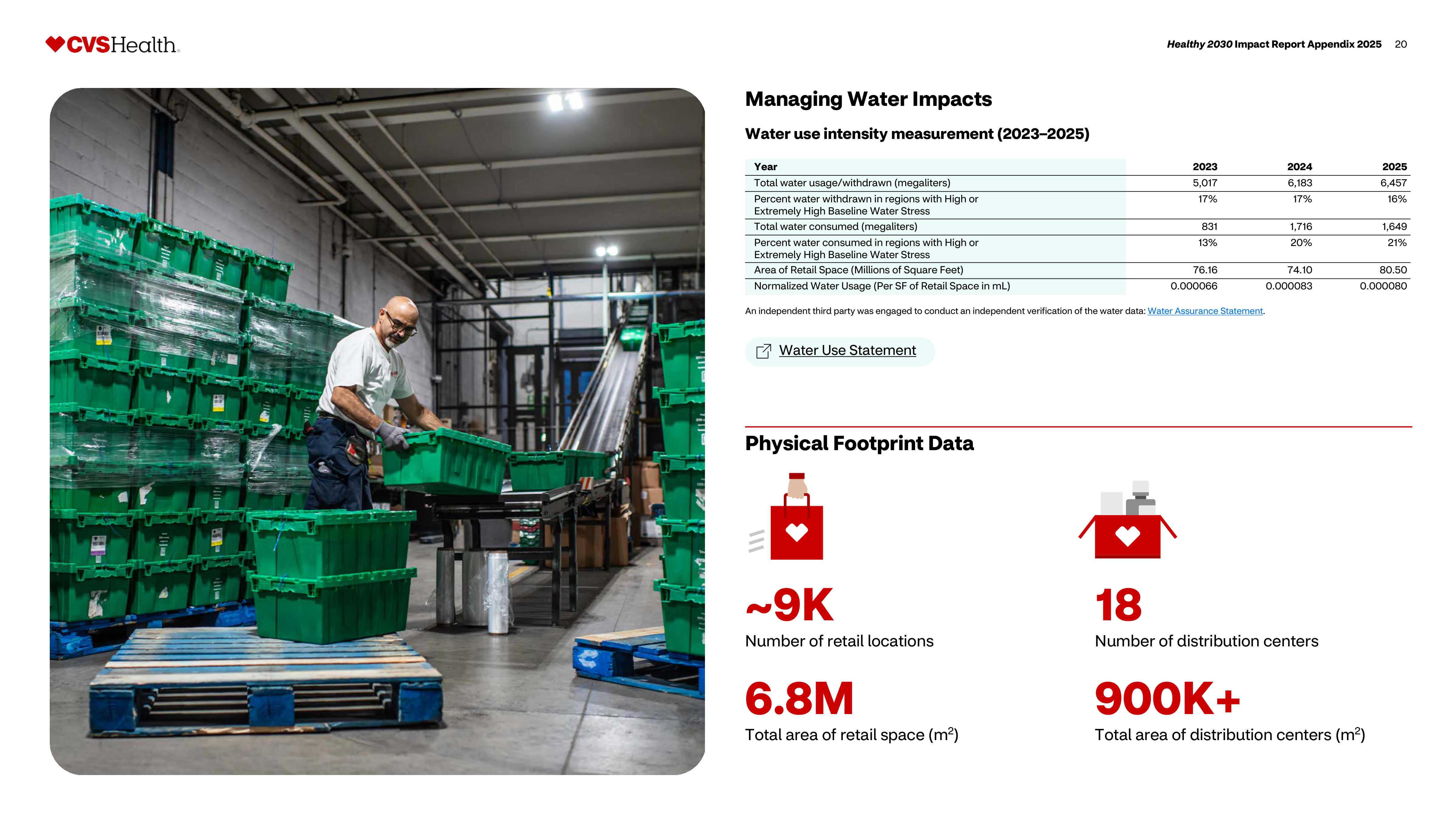
Water use intensity measurement (2023–2025)
Year
2023
2024
2025
Total water usage/withdrawn (megaliters)
5,017
6,183
6,457
Percent water withdrawn in regions with High or
Extremely High Baseline Water Stress
17%
17%
16%
Total water consumed (megaliters)
831
1,716
1,649
Percent water consumed in regions with High or
Extremely High Baseline Water Stress
13%
20%
21%
Area of Retail Space (Millions of Square Feet)
76.16
74.10
80.50
Normalized Water Usage (Per SF of Retail Space in mL)
0.000066
0.000083
0.000080
An independent third party was engaged to conduct an independent verification of the water data:
Water Assurance Statement
.
Physical Footprint Data
~9K
Number of retail locations
6.8M
Total area of retail space (m
2
)
18
Number of distribution centers
900K+
Total area of distribution centers (m
2
)
Healthy 2030
Impact Report Appendix 2025
20
FPO
Water Use Statement


United Nations (UN) Sustainable Development Goals
SDGs Overview
Our
Healthy 2030
strategy is aligned with the United Nations Sustainable Development
Goals (SDGs), which are 17 aspirational goals designed to facilitate significant global
development by 2030. The SDGs serve as a framework to guide how companies,
governments and non-governmental organizations contribute to a more just, healthier
and sustainable future. We believe we can most meaningfully contribute to eight SDGs
that closely align with our business impact. We work to advance these goals each year
through efforts implemented across our enterprise.
To further our progress, we collaborate with organizations that help us advance our
Healthy 2030
strategy—
including the United Nations Global Compact (UNGC). CVS Health was the first U.S. pharmacy chain to hold
membership in the UNGC, which confirms our commitment to the Compact’s Ten Principles with respect to
human rights, labor, the environment and anti-corruption.
Goal 2: Zero Hunger
The food we eat impacts our health at every stage
of life. Healthy eating can lower the risk of chronic
disease, boost immunity, and extend life expectancy,
among other benefits. But today, nutrition-related
diseases are contributing to rising health care costs.
And for many people who need it, medically-tailored
nutrition remains out of reach. We’re working to
address these challenges with multi-year
commitments designed to support those facing food
insecurity and increase access to fresh, healthy food in
communities we serve. In 2025, we granted more than
$5 million to support nonprofit organizations working to
address food insecurity in their communities.
Learn more about how we’re supporting
food insecurity.
Goal 3: Good Health and Well-Being
We continue to expand on our ability to provide care
and fundamentally restructure how health care is
delivered in the U.S.—how, by whom and where.
With touchpoints throughout a person’s health journey,
we support patients and members with interventions,
early diagnosis and treatment optimization. The results
are improved health outcomes, lower costs, more
durable relationships with providers, and broader
access to high-quality care.
Learn more about how we’re improving outcomes.
Goal 4: Quality Education
We continue to invest in developing a workforce to
support the needs of communities. Our scholarship
programs support students working toward pharmacy,
clinical practice and retail management degrees
across higher education institutions in the U.S. In 2025,
we awarded $2.1 million in scholarship funding to
students pursuing academic programs in Pharmacy,
Nursing, and Retail Management.
Learn more about how we’re investing in the future
health care workforce.
Goal 5: Gender Equality
On our journey to provide personalized, high-quality
and convenient care to all, we understand that women’s
health needs are unique. That’s why we are providing
access to services and resources to help women better
understand and navigate their health. We are
prioritizing health conditions that are exclusively
disproportionally or differentially experienced by
women — behavioral, reproductive, maternal and
heart health, menopause and healthy aging.
Learn more about how we’re supporting
women's health.
Healthy 2030
Impact Report Appendix 2025
21

Goal 8: Decent Work
and Economic Growth
We are delivering on our bold vision for health care
delivery with an incomparable set of assets that are
uniquely CVS Health. The greatest of these strengths
is our workforce of more than 300,000 purpose-driven
colleagues. In 2025, we invested in their growth,
provided them with comprehensive benefits and
implemented new policies to improve their workplace
experience. We also hired more than 100,000 new
colleagues, paid out $18.9 billion in wages; $2.7 billion
in benefits; and $2.2 billion in income taxes.
We invested
$4.6 billion
in small businesses across
the U.S. in 2025.
Learn more about how we’re supporting
small businesses.
Goal 12: Responsible
Consumption and Production
The chemicals in plastics can have serious implications
for human health. Exposure to them has been linked
to health issues including obesity, thyroid disorder,
infertility, respiratory illnesses, cardiovascular disease
and more. At the same time, plastics remain essential
for safe care delivery, medication integrity and product
quality. Balancing these realities requires a more
flexible, system-level approach that reflects how
plastics are used and managed across health care and
retail environments. We aim to eliminate or use less
plastic, replace plastic with alternative sustainable
materials and identify new strategies to increase
recyclability and safer end-of-use disposal of the
materials we use where we can. This enterprise-wide
approach extends beyond product packaging to
include operational, supply-chain and distribution
plastics. In 2025, we evolved our enterprise plastic
strategy to better guide how we prioritize, sequence
and scale action across the business.
Learn more about our sustainable materials strategy.
Goal 13: Climate Action
We are working to achieve carbon neutrality by 2030
and net-zero emissions across our value chain by
2050—a commitment that will require collaboration,
innovation and drive. Our path forward will focus on
significant investments in renewable energy,
electrification of our fleet and continuous
improvements in operational efficiency. We continue
to enhance our collaboration with suppliers, ensuring
that they set their own science-based emissions
reduction targets and take steps to reduce their
emissions accordingly.
Learn more about how we’re supporting
environmental health.
Goal 15: Life on Land
Our efforts to improve the health of our planet include
reducing our use of natural resources such as paper,
which is sourced from ecosystems that support clean
air, resilient communities and human well-being.
Additionally, all palm oil used in our store brand
products is sourced sustainably by our suppliers
in compliance with our
Responsible Palm Oil Policy
.
To continue to reduce the impacts of our operations,
we are investing in digital tools that enhance efficiency,
reduce waste and improve the experience for both
colleagues and consumers.
Learn more about how we’re supporting
environmental health.
Healthy 2030
Impact Report Appendix 2025
22


Indices
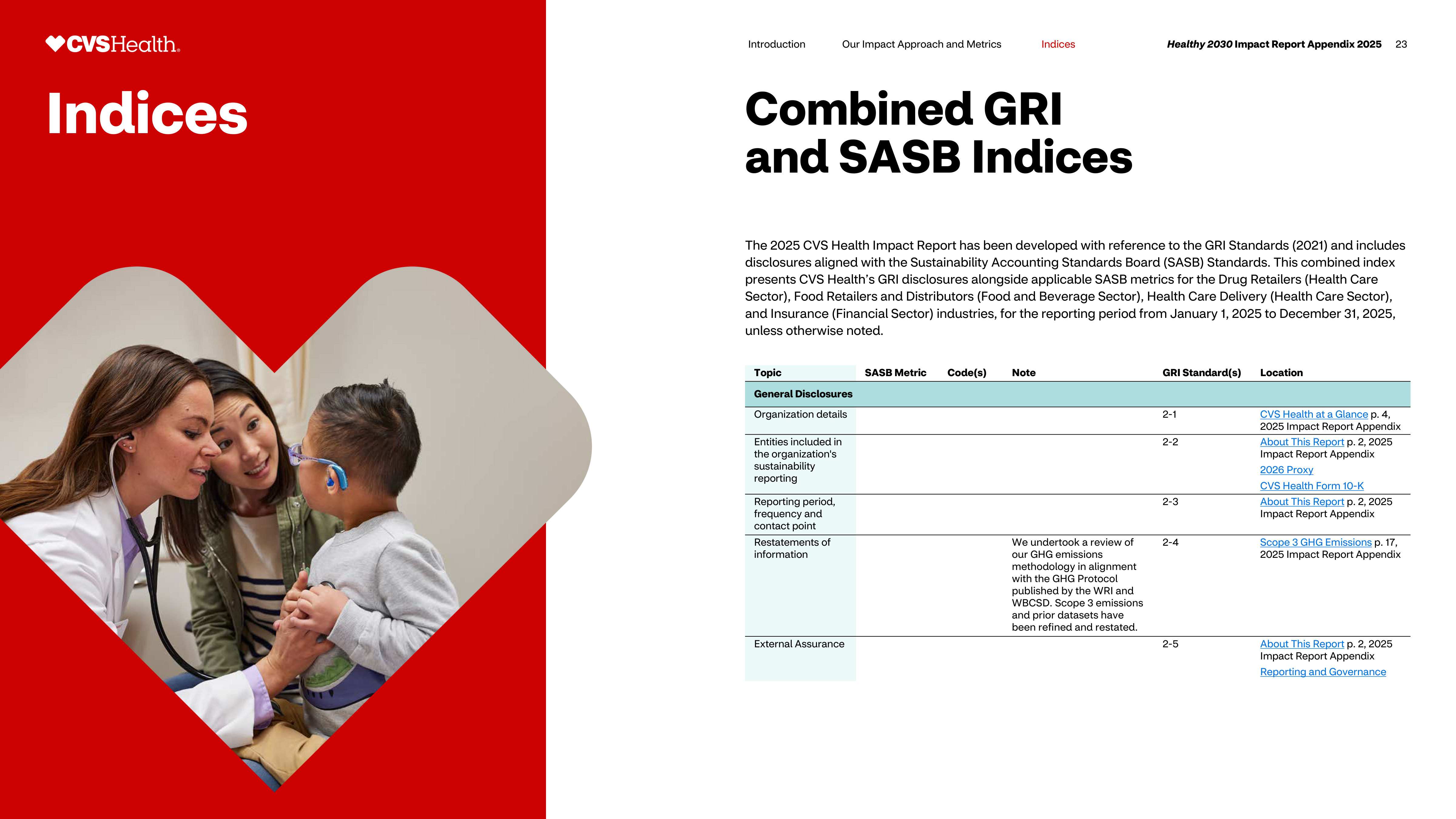
Combined GRI
and SASB Indices
The 2025 CVS Health Impact Report has been developed with reference to the GRI Standards (2021) and includes
disclosures aligned with the Sustainability Accounting Standards Board (SASB) Standards. This combined index
presents CVS Health’s GRI disclosures alongside applicable SASB metrics for the Drug Retailers (Health Care
Sector), Food Retailers and Distributors (Food and Beverage Sector), Health Care Delivery (Health Care Sector),
and Insurance (Financial Sector) industries, for the reporting period from January 1, 2025 to December 31, 2025,
unless otherwise noted.
Topic
SASB Metric
Code(s)
Note
GRI Standard(s)
Location
General Disclosures
Organization details
2-1
CVS Health at a Glance
p. 4,
2025 Impact Report Appendix
Entities included in
the organization's
sustainability
reporting
2-2
About This Report
p. 2, 2025
Impact Report Appendix
2026 Proxy
CVS Health Form 10-K
Reporting period,
frequency and
contact point
2-3
About This Report
p. 2, 2025
Impact Report Appendix
Restatements of
information
We undertook a review of
our GHG emissions
methodology in alignment
with the GHG Protocol
published by the WRI and
WBCSD. Scope 3 emissions
and prior datasets have
been refined and restated.
2-4
Scope 3 GHG Emissions
p. 17,
2025 Impact Report Appendix
External Assurance
2-5
About This Report
p. 2, 2025
Impact Report Appendix
Reporting and Governance
Introduction
Our Impact Approach and Metrics
Indices
Healthy 2030
Impact Report Appendix 2025
23
—
—
—
—
—
—
—
—
—
—
—
—
—
—
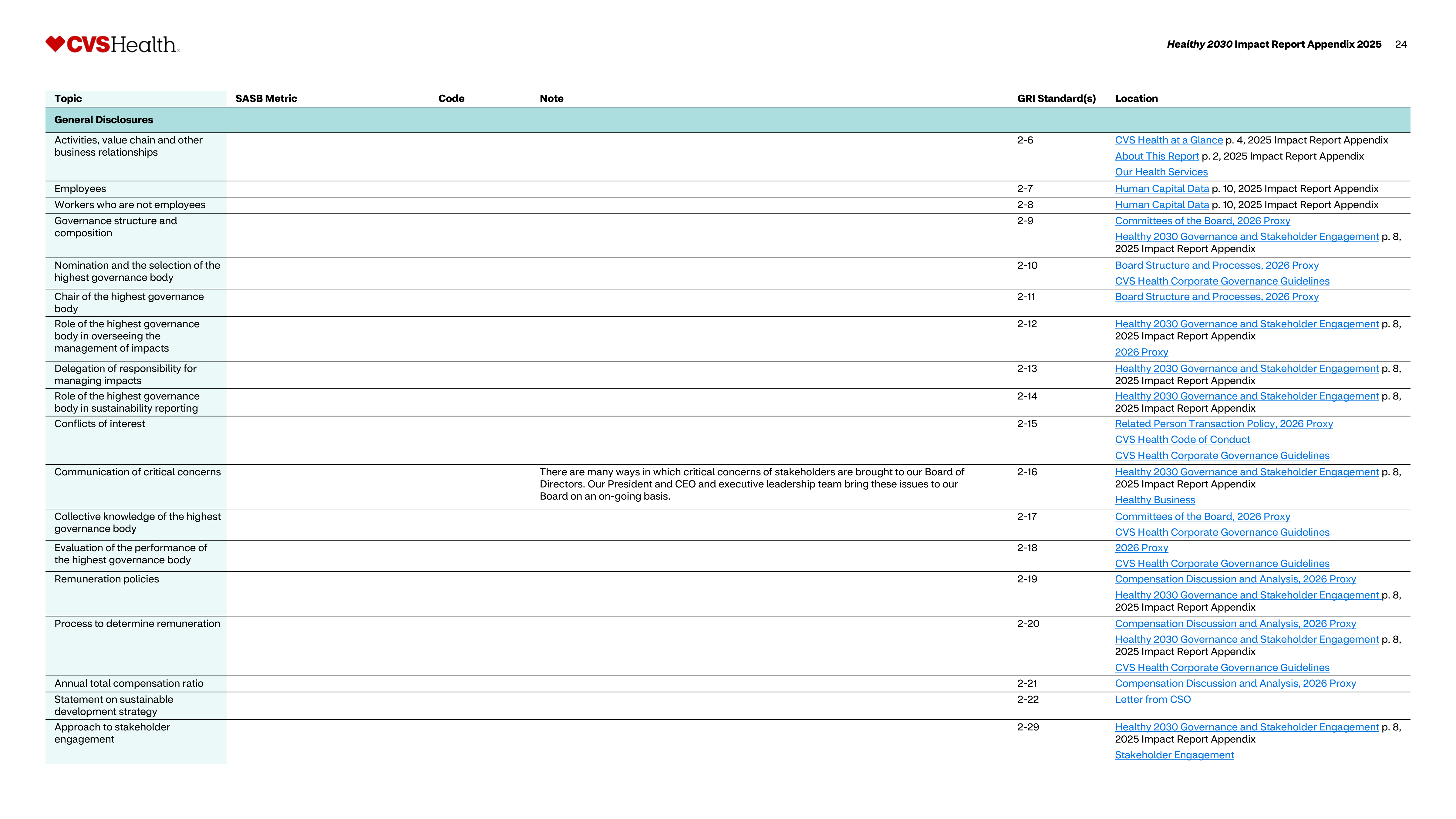


General Disclosures
Activities, value chain and other
business relationships
2-6
CVS Health at a Glance
p. 4, 2025 Impact Report Appendix
About This Report
p. 2, 2025 Impact Report Appendix
Our Health Services
Employees
2-7
Human Capital Data
p. 10, 2025 Impact Report Appendix
Workers who are not employees
2-8
Human Capital Data
p. 10, 2025 Impact Report Appendix
Governance structure and
composition
2-9
Committees of the Board, 2026 Proxy
Healthy 2030 Governance and Stakeholder Engagement
p. 8,
2025 Impact Report Appendix
Nomination and the selection of the
highest governance body
2-10
Board Structure and Processes, 2026 Proxy
CVS Health Corporate Governance Guidelines
Chair of the highest governance
body
2-11
Board Structure and Processes, 2026 Proxy
Role of the highest governance
body in overseeing the
management of impacts
2-12
Healthy 2030 Governance and Stakeholder Engagement
p. 8,
2025 Impact Report Appendix
2026 Proxy
Delegation of responsibility for
managing impacts
2-13
Healthy 2030 Governance and Stakeholder Engagement
p. 8,
2025 Impact Report Appendix
Role of the highest governance
body in sustainability reporting
2-14
Healthy 2030 Governance and Stakeholder Engagement
p. 8,
2025 Impact Report Appendix
Conflicts of interest
2-15
Related Person Transaction Policy, 2026 Proxy
CVS Health Code of Conduct
CVS Health Corporate Governance Guidelines
Communication of critical concerns
There are many ways in which critical concerns of stakeholders are brought to our Board of
Directors. Our President and CEO and executive leadership team bring these issues to our
Board on an on-going basis.
2-16
Healthy 2030 Governance and Stakeholder Engagement
p. 8,
2025 Impact Report Appendix
Healthy Business
Collective knowledge of the highest
governance body
2-17
Committees of the Board, 2026 Proxy
CVS Health Corporate Governance Guidelines
Evaluation of the performance of
the highest governance body
2-18
2026 Proxy
CVS Health Corporate Governance Guidelines
Remuneration policies
2-19
Compensation Discussion and Analysis, 2026 Proxy
Healthy 2030 Governance and Stakeholder Engagement
p. 8,
2025 Impact Report Appendix
Process to determine remuneration
2-20
Compensation Discussion and Analysis, 2026 Proxy
Healthy 2030 Governance and Stakeholder Engagement
p. 8,
2025 Impact Report Appendix
CVS Health Corporate Governance Guidelines
Annual total compensation ratio
2-21
Compensation Discussion and Analysis, 2026 Proxy
Statement on sustainable
development strategy
2-22
Letter from CSO
Approach to stakeholder
engagement
2-29
Healthy 2030 Governance and Stakeholder Engagement
p. 8,
2025 Impact Report Appendix
Stakeholder Engagement
Topic
SASB Metric
Code
Note
GRI Standard(s)
Location
Healthy 2030
Impact Report Appendix 2025
24
—
—
—
—
—
—
—
—
—
—
—
—
—
—
—
—
—
—
—
—
—
—
—
—
—
—
—
—
—
—
—
—
—
—
—
—
—
—
—
—
—
—
—
—
—
—
—
—
—
—
—
—
—
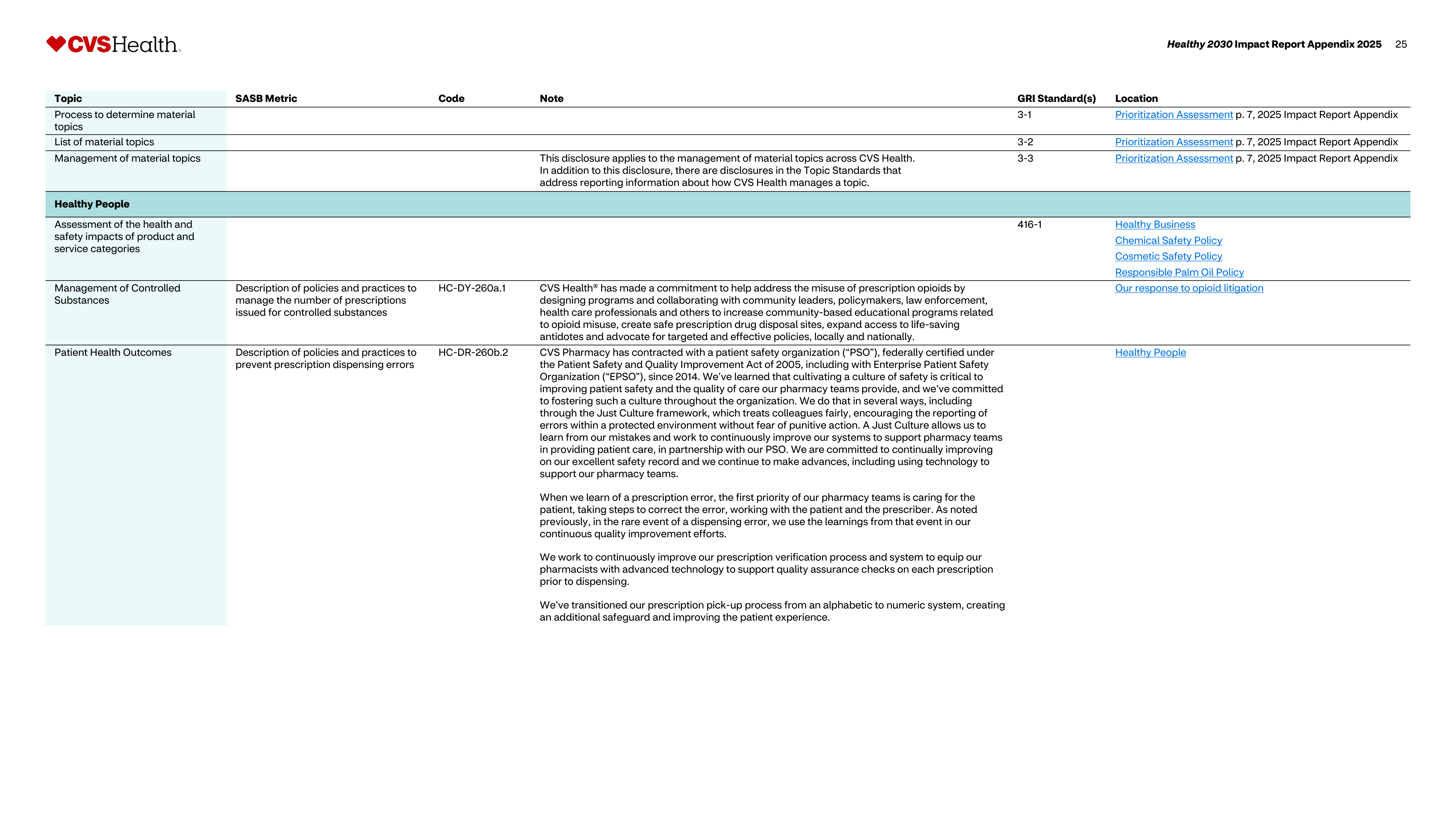

Process to determine material
topics
3-1
Prioritization Assessment
p. 7, 2025 Impact Report Appendix
List of material topics
3-2
Prioritization Assessment
p. 7, 2025 Impact Report Appendix
Management of material topics
This disclosure applies to the management of material topics across CVS Health.
In addition to this disclosure, there are disclosures in the Topic Standards that
address reporting information about how CVS Health manages a topic.
3-3
Prioritization Assessment
p. 7, 2025 Impact Report Appendix
Healthy People
Assessment of the health and
safety impacts of product and
service categories
416-1
Healthy Business
Chemical Safety Policy
Cosmetic Safety Policy
Responsible Palm Oil Policy
Management of Controlled
Substances
Description of policies and practices to
manage the number of prescriptions
issued for controlled substances
HC-DY-260a.1
CVS Health® has made a commitment to help address the misuse of prescription opioids by
designing programs and collaborating with community leaders, policymakers, law enforcement,
health care professionals and others to increase community-based educational programs related
to opioid misuse, create safe prescription drug disposal sites, expand access to life-saving
antidotes and advocate for targeted and effective policies, locally and nationally.
Our response to opioid litigation
Patient Health Outcomes
Description of policies and practices to
prevent prescription dispensing errors
HC-DR-260b.2
CVS Pharmacy has contracted with a patient safety organization (“PSO”), federally certified under
the Patient Safety and Quality Improvement Act of 2005, including with Enterprise Patient Safety
Organization (“EPSO”), since 2014. We’ve learned that cultivating a culture of safety is critical to
improving patient safety and the quality of care our pharmacy teams provide, and we’ve committed
to fostering such a culture throughout the organization. We do that in several ways, including
through the Just Culture framework, which treats colleagues fairly, encouraging the reporting of
errors within a protected environment without fear of punitive action. A Just Culture allows us to
learn from our mistakes and work to continuously improve our systems to support pharmacy teams
in providing patient care, in partnership with our PSO. We are committed to continually improving
on our excellent safety record and we continue to make advances, including using technology to
support our pharmacy teams.
When we learn of a prescription error, the first priority of our pharmacy teams is caring for the
patient, taking steps to correct the error, working with the patient and the prescriber. As noted
previously, in the rare event of a dispensing error, we use the learnings from that event in our
continuous quality improvement efforts.
We work to continuously improve our prescription verification process and system to equip our
pharmacists with advanced technology to support quality assurance checks on each prescription
prior to dispensing.
We’ve transitioned our prescription pick-up process from an alphabetic to numeric system, creating
an additional safeguard and improving the patient experience.
Healthy People
Topic
SASB Metric
Code
Note
GRI Standard(s)
Location
Healthy 2030
Impact Report Appendix 2025
25
—
—
—
—
—
—
—
—
—
—
—
—
—
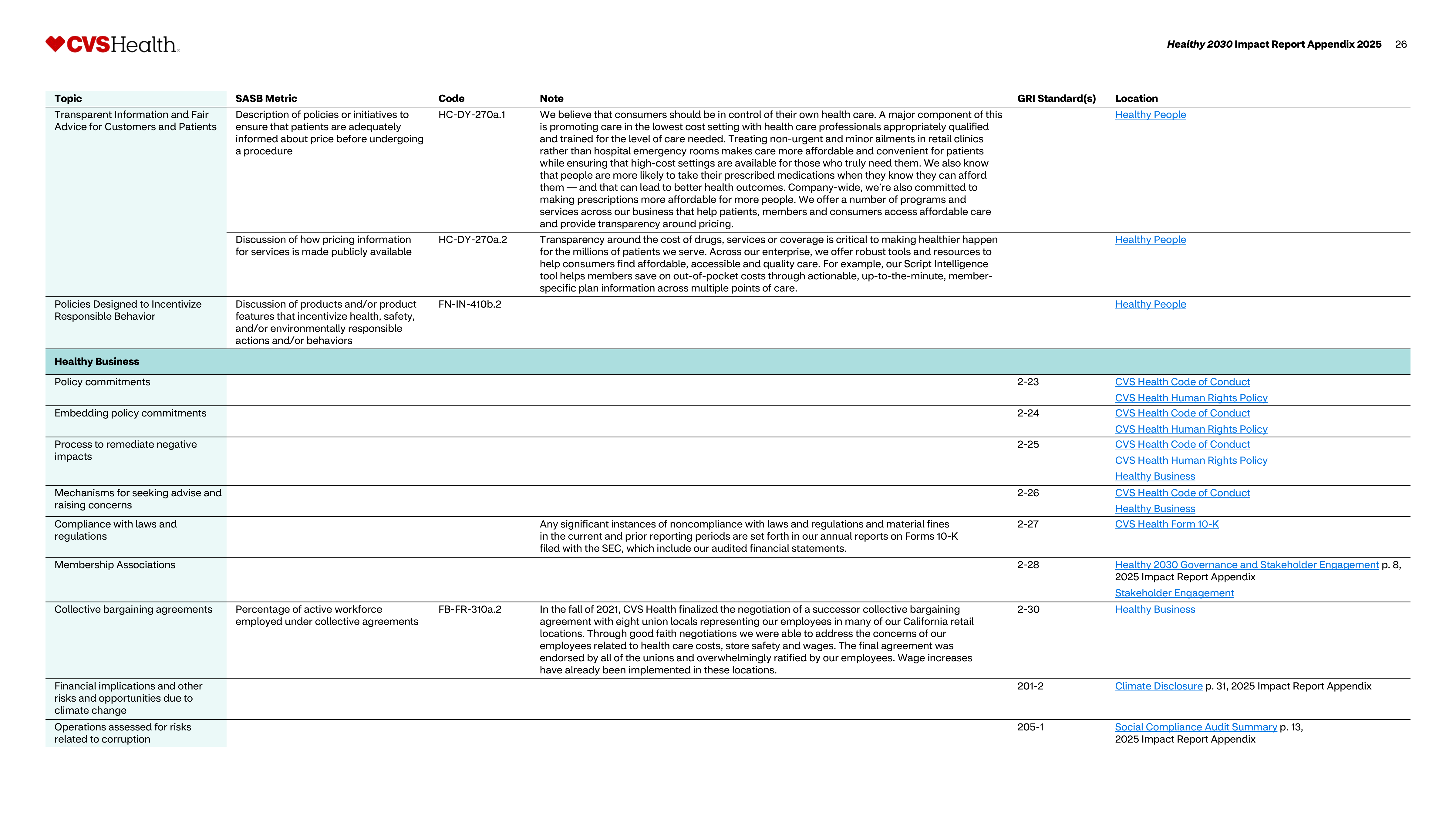

Transparent Information and Fair
Advice for Customers and Patients
Description of policies or initiatives to
ensure that patients are adequately
informed about price before undergoing
a procedure
HC-DY-270a.1
We believe that consumers should be in control of their own health care. A major component of this
is promoting care in the lowest cost setting with health care professionals appropriately qualified
and trained for the level of care needed. Treating non-urgent and minor ailments in retail clinics
rather than hospital emergency rooms makes care more affordable and convenient for patients
while ensuring that high-cost settings are available for those who truly need them. We also know
that people are more likely to take their prescribed medications when they know they can afford
them — and that can lead to better health outcomes. Company-wide, we’re also committed to
making prescriptions more affordable for more people. We offer a number of programs and
services across our business that help patients, members and consumers access affordable care
and provide transparency around pricing.
Healthy People
Discussion of how pricing information
for services is made publicly available
HC-DY-270a.2
Transparency around the cost of drugs, services or coverage is critical to making healthier happen
for the millions of patients we serve. Across our enterprise, we offer robust tools and resources to
help consumers find affordable, accessible and quality care. For example, our Script Intelligence
tool helps members save on out-of-pocket costs through actionable, up-to-the-minute, member-
specific plan information across multiple points of care.
Healthy People
Policies Designed to Incentivize
Responsible Behavior
Discussion of products and/or product
features that incentivize health, safety,
and/or environmentally responsible
actions and/or behaviors
FN-IN-410b.2
Healthy People
Healthy Business
Policy commitments
2-23
CVS Health Code of Conduct
CVS Health Human Rights Policy
Embedding policy commitments
2-24
CVS Health Code of Conduct
CVS Health Human Rights Policy
Process to remediate negative
impacts
2-25
CVS Health Code of Conduct
CVS Health Human Rights Policy
Healthy Business
Mechanisms for seeking advise and
raising concerns
2-26
CVS Health Code of Conduct
Healthy Business
Compliance with laws and
regulations
Any significant instances of noncompliance with laws and regulations and material fines
in the current and prior reporting periods are set forth in our annual reports on Forms 10-K
filed with the SEC, which include our audited financial statements.
2-27
CVS Health Form 10-K
Membership Associations
2-28
Healthy 2030 Governance and Stakeholder Engagement
p. 8,
2025 Impact Report Appendix
Stakeholder Engagement
Collective bargaining agreements
Percentage of active workforce
employed under collective agreements
FB-FR-310a.2
In the fall of 2021, CVS Health finalized the negotiation of a successor collective bargaining
agreement with eight union locals representing our employees in many of our California retail
locations. Through good faith negotiations we were able to address the concerns of our
employees related to health care costs, store safety and wages. The final agreement was
endorsed by all of the unions and overwhelmingly ratified by our employees. Wage increases
have already been implemented in these locations.
2-30
Healthy Business
Financial implications and other
risks and opportunities due to
climate change
201-2
Climate Disclosure
p. 31, 2025 Impact Report Appendix
Operations assessed for risks
related to corruption
205-1
Social Compliance Audit Summary
p. 13,
2025 Impact Report Appendix
Topic
SASB Metric
Code
Note
GRI Standard(s)
Location
Healthy 2030
Impact Report Appendix 2025
26
—
Transparent Information and Fair Advice for Customers and Patients
—
—
—
—
—
—
—
—
—
—
—
—
—
—
—
—
—
—
—
—
—
—
—
—
—
—
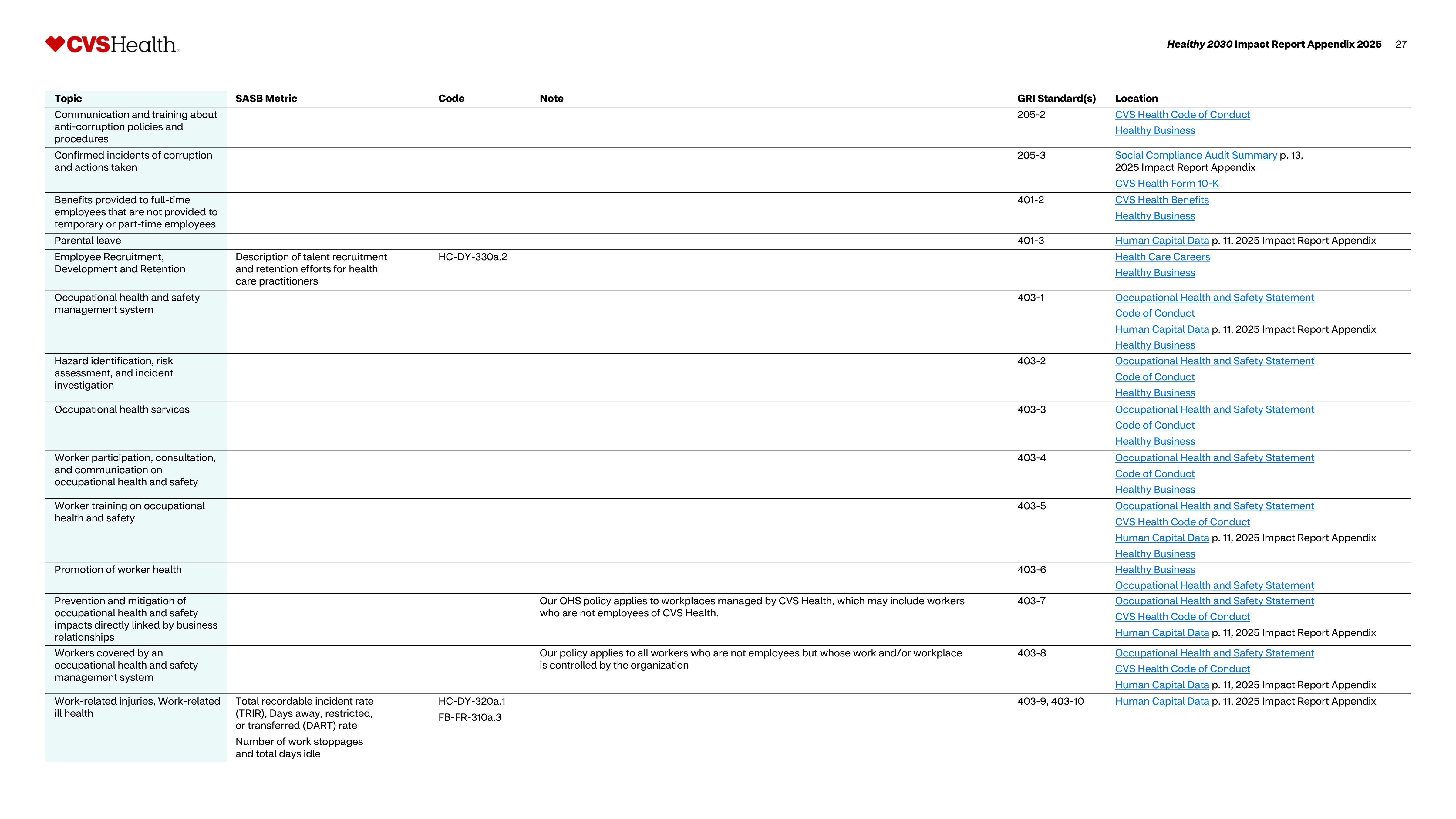

Communication and training about
anti-corruption policies and
procedures
205-2
CVS Health Code of Conduct
Healthy Business
Confirmed incidents of corruption
and actions taken
205-3
Social Compliance Audit Summary
p. 13,
2025 Impact Report Appendix
CVS Health Form 10-K
Benefits provided to full-time
employees that are not provided to
temporary or part-time employees
401-2
CVS Health Benefits
Healthy Business
Parental leave
401-3
Human Capital Data
p. 11, 2025 Impact Report Appendix
Employee Recruitment,
Development and Retention
Description of talent recruitment
and retention efforts for health
care practitioners
HC-DY-330a.2
Health Care Careers
Healthy Business
Occupational health and safety
management system
403-1
Occupational Health and Safety Statement
Code of Conduct
Human Capital Data
p. 11, 2025 Impact Report Appendix
Healthy Business
Hazard identification, risk
assessment, and incident
investigation
403-2
Occupational Health and Safety Statement
Code of Conduct
Healthy Business
Occupational health services
403-3
Occupational Health and Safety Statement
Code of Conduct
Healthy Business
Worker participation, consultation,
and communication on
occupational health and safety
403-4
Occupational Health and Safety Statement
Code of Conduct
Healthy Business
Worker training on occupational
health and safety
403-5
Occupational Health and Safety Statement
CVS Health Code of Conduct
Human Capital Data
p. 11, 2025 Impact Report Appendix
Healthy Business
Promotion of worker health
403-6
Healthy Business
Occupational Health and Safety Statement
Prevention and mitigation of
occupational health and safety
impacts directly linked by business
relationships
Our OHS policy applies to workplaces managed by CVS Health, which may include workers
who are not employees of CVS Health.
403-7
Occupational Health and Safety Statement
CVS Health Code of Conduct
Human Capital Data
p. 11, 2025 Impact Report Appendix
Workers covered by an
occupational health and safety
management system
Our policy applies to all workers who are not employees but whose work and/or workplace
is controlled by the organization
403-8
Occupational Health and Safety Statement
CVS Health Code of Conduct
Human Capital Data
p. 11, 2025 Impact Report Appendix
Work-related injuries, Work-related
ill health
Total recordable incident rate
(TRIR), Days away, restricted,
or transferred (DART) rate
Number of work stoppages
and total days idle
HC-DY-320a.1
FB-FR-310a.3
403-9, 403-10
Human Capital Data
p. 11, 2025 Impact Report Appendix
Topic
SASB Metric
Code
Note
GRI Standard(s)
Location
Healthy 2030
Impact Report Appendix 2025
27
—
—
—
—
—
—
—
—
—
—
—
—
—
—
—
—
—
—
—
—
—
—
—
—
—
—
—
—
—
—
—
—
—
—
—
—
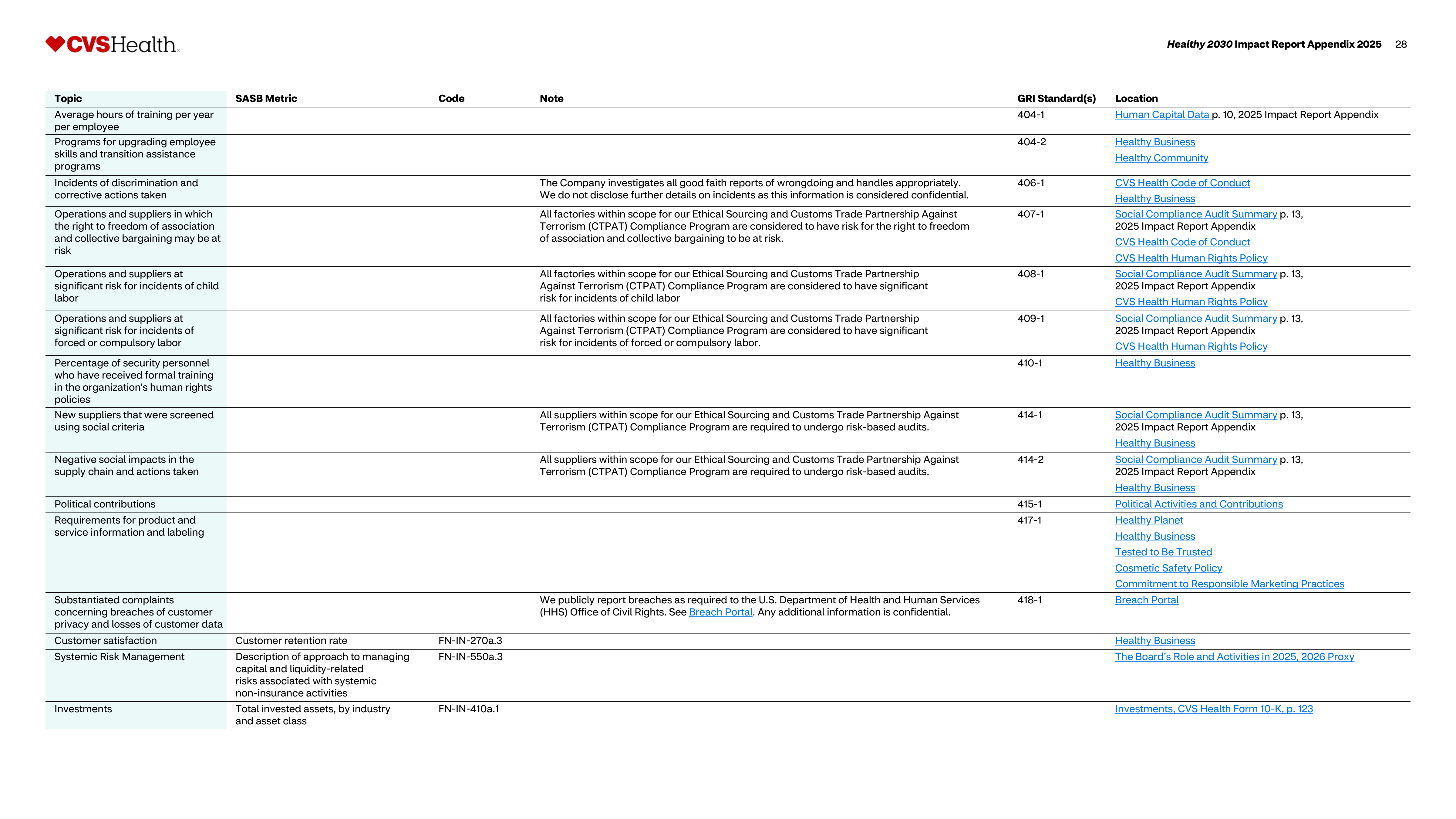

Average hours of training per year
per employee
404-1
Human Capital Data
p. 10, 2025 Impact Report Appendix
Programs for upgrading employee
skills and transition assistance
programs
404-2
Healthy Business
Healthy Community
Incidents of discrimination and
corrective actions taken
The Company investigates all good faith reports of wrongdoing and handles appropriately.
We do not disclose further details on incidents as this information is considered confidential.
406-1
CVS Health Code of Conduct
Healthy Business
Operations and suppliers in which
the right to freedom of association
and collective bargaining may be at
risk
All factories within scope for our Ethical Sourcing and Customs Trade Partnership Against
Terrorism (CTPAT) Compliance Program are considered to have risk for the right to freedom
of association and collective bargaining to be at risk.
407-1
Social Compliance Audit Summary
p. 13,
2025 Impact Report Appendix
CVS Health Code of Conduct
CVS Health Human Rights Policy
Operations and suppliers at
significant risk for incidents of child
labor
All factories within scope for our Ethical Sourcing and Customs Trade Partnership
Against Terrorism (CTPAT) Compliance Program are considered to have significant
risk for incidents of child labor
408-1
Social Compliance Audit Summary
p. 13,
2025 Impact Report Appendix
CVS Health Human Rights Policy
Operations and suppliers at
significant risk for incidents of
forced or compulsory labor
All factories within scope for our Ethical Sourcing and Customs Trade Partnership
Against Terrorism (CTPAT) Compliance Program are considered to have significant
risk for incidents of forced or compulsory labor.
409-1
Social Compliance Audit Summary
p. 13,
2025 Impact Report Appendix
CVS Health Human Rights Policy
Percentage of security personnel
who have received formal training
in the organization's human rights
policies
410-1
Healthy Business
New suppliers that were screened
using social criteria
All suppliers within scope for our Ethical Sourcing and Customs Trade Partnership Against
Terrorism (CTPAT) Compliance Program are required to undergo risk-based audits.
414-1
Social Compliance Audit Summary
p. 13,
2025 Impact Report Appendix
Healthy Business
Negative social impacts in the
supply chain and actions taken
All suppliers within scope for our Ethical Sourcing and Customs Trade Partnership Against
Terrorism (CTPAT) Compliance Program are required to undergo risk-based audits.
414-2
Social Compliance Audit Summary
p. 13,
2025 Impact Report Appendix
Healthy Business
Political contributions
415-1
Political Activities and Contributions
Requirements for product and
service information and labeling
417-1
Healthy Planet
Healthy Business
Tested to Be Trusted
Cosmetic Safety Policy
Commitment to Responsible Marketing Practices
Substantiated complaints
concerning breaches of customer
privacy and losses of customer data
We publicly report breaches as required to the U.S. Department of Health and Human Services
(HHS) Office of Civil Rights. See
Breach Portal
. Any additional information is confidential.
418-1
Breach Portal
Customer satisfaction
Customer retention rate
FN-IN-270a.3
Healthy Business
Systemic Risk Management
Description of approach to managing
capital and liquidity-related
risks associated with systemic
non-insurance activities
FN-IN-550a.3
The Board’s Role and Activities in 2025, 2026 Proxy
Investments
Total invested assets, by industry
and asset class
FN-IN-410a.1
Investments, CVS Health Form 10-K, p. 123
Topic
SASB Metric
Code
Note
GRI Standard(s)
Location
Healthy 2030
Impact Report Appendix 2025
28
—
—
—
—
—
—
—
—
—
—
—
—
—
—
—
—
—
—
—
—
—
—
—
—
—
—
—
—
—
—
—
—
—
—
—
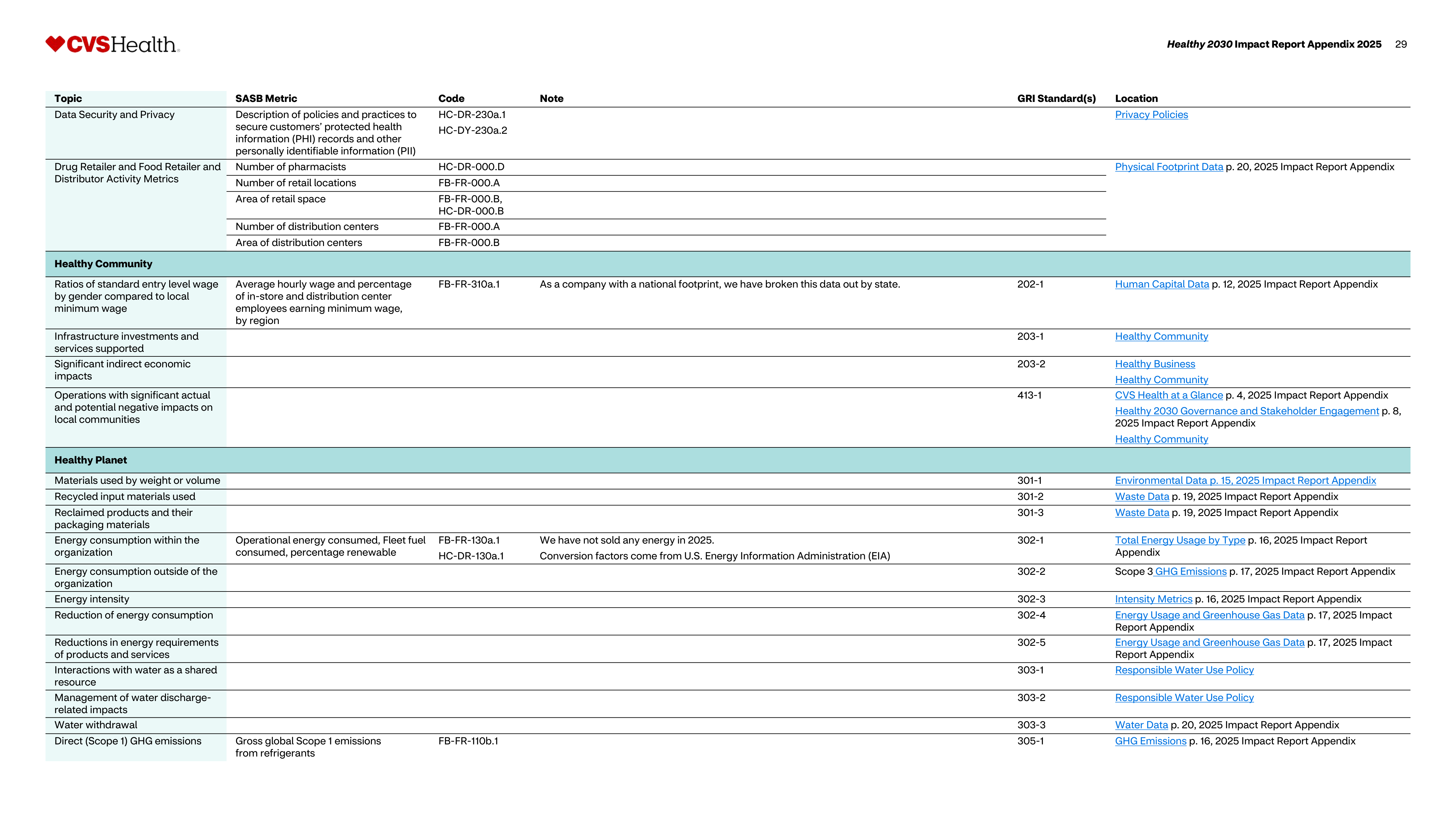

Data Security and Privacy
Description of policies and practices to
secure customers’ protected health
information (PHI) records and other
personally identifiable information (PII)
HC-DR-230a.1
HC-DY-230a.2
Privacy Policies
Drug Retailer and Food Retailer and
Distributor Activity Metrics
Number of pharmacists
HC-DR-000.D
Physical Footprint Data
p. 20, 2025 Impact Report Appendix
Number of retail locations
FB-FR-000.A
Area of retail space
FB-FR-000.B,
HC-DR-000.B
Number of distribution centers
FB-FR-000.A
Area of distribution centers
FB-FR-000.B
Healthy Community
Ratios of standard entry level wage
by gender compared to local
minimum wage
Average hourly wage and percentage
of in-store and distribution center
employees earning minimum wage,
by region
FB-FR-310a.1
As a company with a national footprint, we have broken this data out by state.
202-1
Human Capital Data
p. 12, 2025 Impact Report Appendix
Infrastructure investments and
services supported
203-1
Healthy Community
Significant indirect economic
impacts
203-2
Healthy Business
Healthy Community
Operations with significant actual
and potential negative impacts on
local communities
413-1
CVS Health at a Glance
p. 4, 2025 Impact Report Appendix
Healthy 2030 Governance and Stakeholder Engagement
p. 8,
2025 Impact Report Appendix
Healthy Community
Healthy Planet
Materials used by weight or volume
301-1
Environmental Data p. 15, 2025 Impact Report Appendix
Recycled input materials used
301-2
Waste Data
p. 19, 2025 Impact Report Appendix
Reclaimed products and their
packaging materials
301-3
Waste Data
p. 19, 2025 Impact Report Appendix
Energy consumption within the
organization
Operational energy consumed, Fleet fuel
consumed, percentage renewable
FB-FR-130a.1
HC-DR-130a.1
We have not sold any energy in 2025.
Conversion factors come from U.S. Energy Information Administration (EIA)
302-1
Total Energy Usage by Type
p. 16, 2025 Impact Report
Appendix
Energy consumption outside of the
organization
302-2
Scope 3
GHG Emissions
p. 17, 2025 Impact Report Appendix
Energy intensity
302-3
Intensity Metrics
p. 16, 2025 Impact Report Appendix
Reduction of energy consumption
302-4
Energy Usage and Greenhouse Gas Data
p. 17, 2025 Impact
Report Appendix
Reductions in energy requirements
of products and services
302-5
Energy Usage and Greenhouse Gas Data
p. 17, 2025 Impact
Report Appendix
Interactions with water as a shared
resource
303-1
Responsible Water Use Policy
Management of water discharge-
related impacts
303-2
Responsible Water Use Policy
Water withdrawal
303-3
Water Data
p. 20, 2025 Impact Report Appendix
Direct (Scope 1) GHG emissions
Gross global Scope 1 emissions
from refrigerants
FB-FR-110b.1
305-1
GHG Emissions
p. 16, 2025 Impact Report Appendix
Topic
SASB Metric
Code
Note
GRI Standard(s)
Location
Healthy 2030
Impact Report Appendix 2025
29
—
—
Drug Retailer and Food Retailer and Distributor Activity Metrics
—
—
Drug Retailer and Food Retailer and Distributor Activity Metrics
—
—
Physical Footprint Data p. 20, 2025 Impact Report Appendix
Drug Retailer and Food Retailer and Distributor Activity Metrics
—
—
Physical Footprint Data p. 20, 2025 Impact Report Appendix
Drug Retailer and Food Retailer and Distributor Activity Metrics
—
—
Physical Footprint Data p. 20, 2025 Impact Report Appendix
Drug Retailer and Food Retailer and Distributor Activity Metrics
—
—
Physical Footprint Data p. 20, 2025 Impact Report Appendix
—
—
—
—
—
—
—
—
—
—
—
—
—
—
—
—
—
—
—
—
—
—
—
—
—
—
—
—
—
—
—
—
—
—
—
—
—
—
—
—
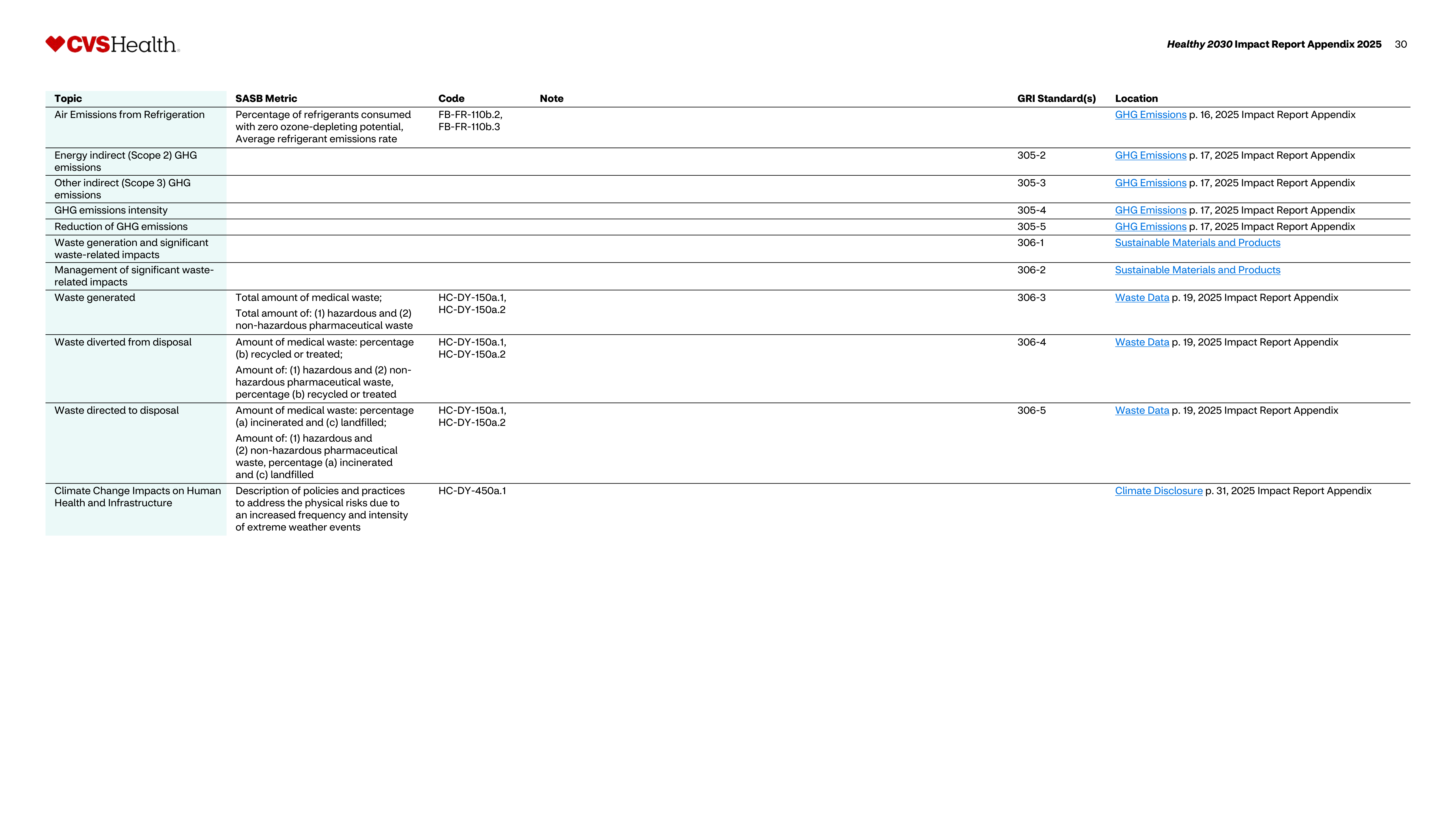

Air Emissions from Refrigeration
Percentage of refrigerants consumed
with zero ozone-depleting potential,
Average refrigerant emissions rate
FB-FR-110b.2,
FB-FR-110b.3
GHG Emissions
p. 16, 2025 Impact Report Appendix
Energy indirect (Scope 2) GHG
emissions
305-2
GHG Emissions
p. 17, 2025 Impact Report Appendix
Other indirect (Scope 3) GHG
emissions
305-3
GHG Emissions
p. 17, 2025 Impact Report Appendix
GHG emissions intensity
305-4
GHG Emissions
p. 17, 2025 Impact Report Appendix
Reduction of GHG emissions
305-5
GHG Emissions
p. 17, 2025 Impact Report Appendix
Waste generation and significant
waste-related impacts
306-1
Sustainable Materials and Products
Management of significant waste-
related impacts
306-2
Sustainable Materials and Products
Waste generated
Total amount of medical waste;
Total amount of: (1) hazardous and (2)
non-hazardous pharmaceutical waste
HC-DY-150a.1,
HC-DY-150a.2
306-3
Waste Data
p. 19, 2025 Impact Report Appendix
Waste diverted from disposal
Amount of medical waste: percentage
(b) recycled or treated;
Amount of: (1) hazardous and (2) non-
hazardous pharmaceutical waste,
percentage (b) recycled or treated
HC-DY-150a.1,
HC-DY-150a.2
306-4
Waste Data
p. 19, 2025 Impact Report Appendix
Waste directed to disposal
Amount of medical waste: percentage
(a) incinerated and (c) landfilled;
Amount of: (1) hazardous and
(2) non-hazardous pharmaceutical
waste, percentage (a) incinerated
and (c) landfilled
HC-DY-150a.1,
HC-DY-150a.2
306-5
Waste Data
p. 19, 2025 Impact Report Appendix
Climate Change Impacts on Human
Health and Infrastructure
Description of policies and practices
to address the physical risks due to
an increased frequency and intensity
of extreme weather events
HC-DY-450a.1
Climate Disclosure
p. 31, 2025 Impact Report Appendix
Topic
SASB Metric
Code
Note
GRI Standard(s)
Location
Healthy 2030
Impact Report Appendix 2025
30
—
—
—
—
—
—
—
—
—
—
—
—
—
—
—
—
—
—
—
—
—
—
—
—
—
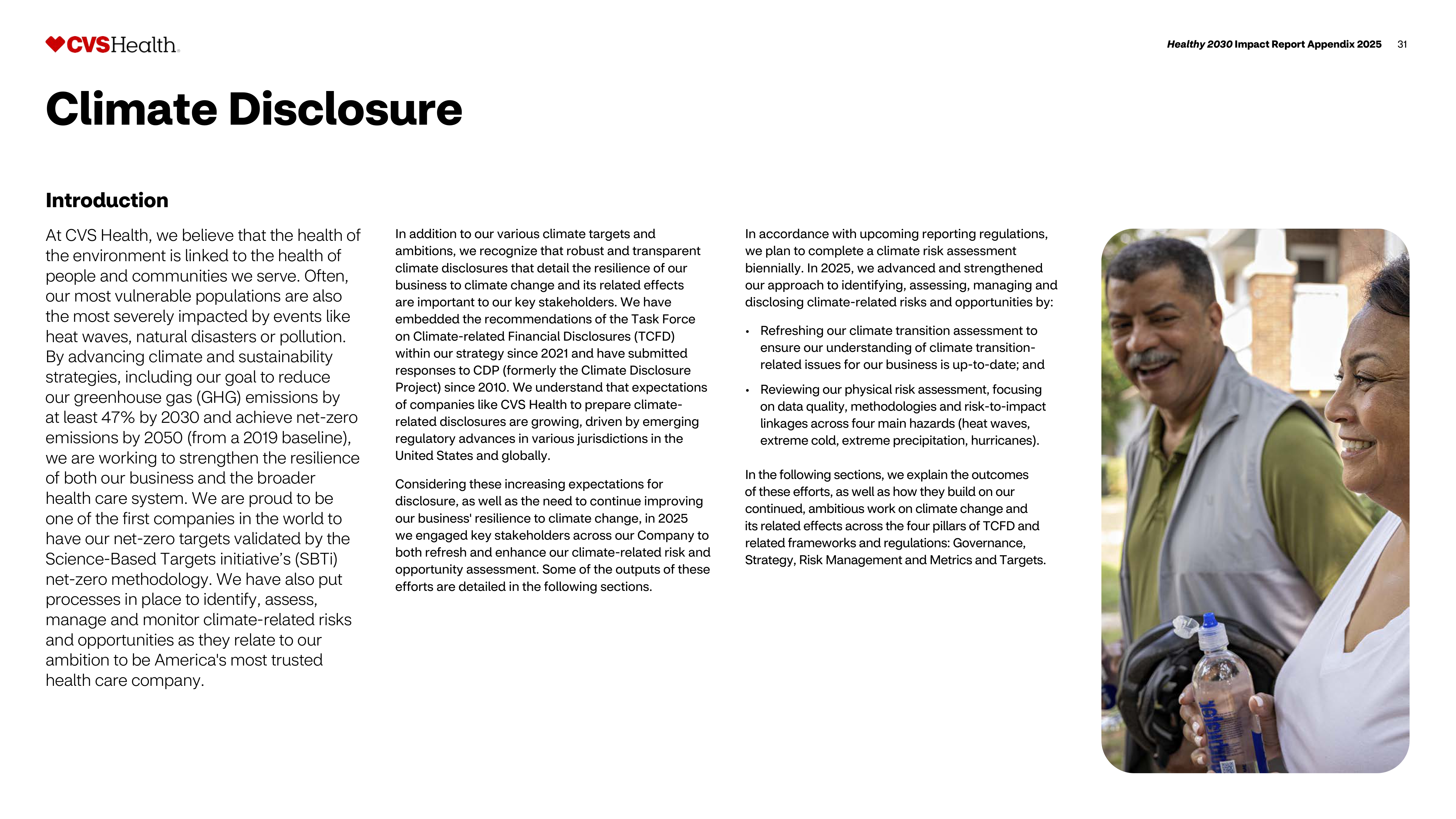


Climate Disclosure
Introduction
At CVS Health, we believe that the health of
the environment is linked to the health of
people and communities we serve. Often,
our most vulnerable populations are also
the most severely impacted by events like
heat waves, natural disasters or pollution.
By advancing climate and sustainability
strategies, including our goal to reduce
our greenhouse gas (GHG) emissions by
at least 47% by 2030 and achieve net-zero
emissions by 2050 (from a 2019 baseline),
we are working to strengthen the resilience
of both our business and the broader
health care system. We are proud to be
one of the first companies in the world to
have our net-zero targets validated by the
Science-Based Targets initiative’s (SBTi)
net-zero methodology. We have also put
processes in place to identify, assess,
manage and monitor climate-related risks
and opportunities as they relate to our
ambition to be America's most trusted
health care company.
In addition to our various climate targets and
ambitions, we recognize that robust and transparent
climate disclosures that detail the resilience of our
business to climate change and its related effects
are important to our key stakeholders. We have
embedded the recommendations of the Task Force
on Climate-related Financial Disclosures (TCFD)
within our strategy since 2021 and have submitted
responses to CDP (formerly the Climate Disclosure
Project) since 2010. We understand that expectations
of companies like CVS Health to prepare climate-
related disclosures are growing, driven by emerging
regulatory advances in various jurisdictions in the
United States and globally.
Considering these increasing expectations for
disclosure, as well as the need to continue improving
our business' resilience to climate change, in 2025
we engaged key stakeholders across our Company to
both refresh and enhance our climate-related risk and
opportunity assessment. Some of the outputs of these
efforts are detailed in the following sections.
In accordance with upcoming reporting regulations,
we plan to complete a climate risk assessment
biennially. In 2025, we advanced and strengthened
our approach to identifying, assessing, managing and
disclosing climate-related risks and opportunities by:
•
Refreshing our climate transition assessment to
ensure our understanding of climate transition-
related issues for our business is up-to-date; and
•
Reviewing our physical risk assessment, focusing
on data quality, methodologies and risk-to-impact
linkages across four main hazards (heat waves,
extreme cold, extreme precipitation, hurricanes).
In the following sections, we explain the outcomes
of these efforts, as well as how they build on our
continued, ambitious work on climate change and
its related effects across the four pillars of TCFD and
related frameworks and regulations: Governance,
Strategy, Risk Management and Metrics and Targets.
Healthy 2030
Impact Report Appendix 2025
31

Governance
At CVS Health, we understand the
importance of strong governance when it
comes to managing risks and capitalizing
on opportunities. As such, we embed
climate-related issues into our existing
governance processes across different
levels of the business, from senior leaders
and committees of the Board of Directors
(“Board”), to business segments and
individual facilities.
The Board’s oversight of climate-related
risks and opportunities
Our Board oversees and guides the development of
policies and initiatives related to sustainability and
climate change. Our Board members possess relevant
experience, skills and qualifications that allow the
Board to effectively oversee CVS Health’s strategy
around, and management of, climate change. On the
Board, seven of the thirteen Board members have
experience in corporate governance and sustainability.
With primary oversight for climate (including
associated risks and opportunities) and sustainability
topics at the Board level, the Nominating and
Corporate Governance Committee is formally charged
with the oversight of CVS Health’s impact strategy
and performance, including on climate change. The
Committee’s responsibilities include reviewing climate
reporting and risks, reviewing the annual Impact
report, monitoring progress against climate-related
goals and targets and ensuring that strategies have
the necessary controls and mitigation programs to
manage climate-related risks and opportunities.
Climate-related issues were discussed in two
committee meetings in 2024, in March and
November, and two committee meetings in 2025
(in March and November).
The Audit Committee has oversight of enterprise risks
(including climate-related topics and occurrences
such as extreme weather events). As such, the
Committee guides and reviews our risk management
policies, including climate-related risk management
policies, mitigation strategies and business plans.
The Committee is involved with overseeing the
Enterprise Risk Management (ERM) program,
reviewing the assurance processes and other controls
and procedures for our impact disclosures and for the
periodic review of programs focused on maintaining
the resilience of the Company. Through its oversight
of ERM, the Committee receives reporting on
significant risks to CVS Health including those relating
to the physical climate (acute and chronic) as well as
those relating to the low-carbon energy transition,
their potential impacts on the Company and the
mitigation measures that we have in place. The
Committee is periodically informed of CVS Health’s
preparedness to respond to a range of adverse
events, including those driven by extreme weather,
that could impede the Company’s ability to operate.
Management’s role in assessing
and managing climate-related
risks and opportunities
Primary oversight for climate and sustainability topics
at CVS Health sits with the Chief Sustainability Officer
(CSO). The CSO oversees CVS Health’s climate and
sustainability strategy to ensure it aligns with key
business priorities and processes, as well as that
we are progressing against each pillar of our impact
strategy. The climate-related responsibilities assigned
to this position include working to develop and
implement our climate transition plan, conducting
climate-related scenario analysis, and setting and
monitoring progress against climate-related
corporate targets.
The CSO works to assess climate-related issues
by conducting impact prioritization assessments,
preparing the Impact report, and leading the Steering
Committee, a cross-functional group of leaders
responsible for embedding sustainability practices
within the business. In addition, the role serves as the
co-executive sponsor of the GreenTeam Colleague
Resource Group, a group of more than 3,000
colleagues that aims to improve understanding of
climate issues and make environmental sustainability
an appropriate part of each colleague’s responsibility
and role. The CSO also monitors our progress towards
our climate mitigation strategy through the annual
assessment of progress towards our carbon
reduction targets, reporting on progress in our Impact
report and disclosures, and providing updates on
climate strategy and planning. As a part of this
process, the CSO provides semi-annual updates to
the Nominating and Governance Committee of our
Board of Directors.
CVS Health’s Chief Audit Executive (CAE) was
responsible for enterprise risks, which may include
climate-related topics or events such as extreme
weather events. The CAE assisted in the identification
and management of climate- and-environmental-
related risks through their direct oversight of both the
Internal Audit and ERM functions. The ERM function
oversees a semi-annual risk assessment process that
identifies and reports upon material risks to CVS
Health’s ability to execute on the strategy, including
risks relating to climate. The Senior Vice President and
Treasurer became responsible for the ERM functions
starting in November. The ERM team is also tasked
with assessing the adequacy of the capital held by,
and accessible to, CVS Health to satisfy obligations
to key stakeholders in a range of adverse scenarios
and business climates. The assessment incorporates
extensive stress testing, including the completion of
climate change-related stress scenarios in partnership
with the sustainability and Enterprise Resiliency (ER)
teams. The results of this effort are documented in
an annual Own Risk and Solvency Assessment, which
is reviewed with the Audit Committee and submitted
to the primary regulators of CVS Health’s insurance
subsidiaries. The ERM team also reports to the Audit
Committee semi-annually on the results of each
enterprise risk assessment, including any significant
climate-related risks.
The Chief Compliance Officer (CCO) oversees the
ER team as well as compliance with applicable laws
and regulations. The primary function of the ER team
is to maintain business continuity amidst disruptions
to our operations, including those caused by weather-
related events (i.e., Crisis Management program).
We use non-monetary incentives and remuneration
policies to incentivize the management of climate-
related issues. These are detailed in the section
‘
Metrics and Targets
’ of this Appendix, and '
Healthy
2030
Governance and Stakeholder Engagement
'
section in the main report.
Healthy 2030
Impact Report Appendix 2025
32
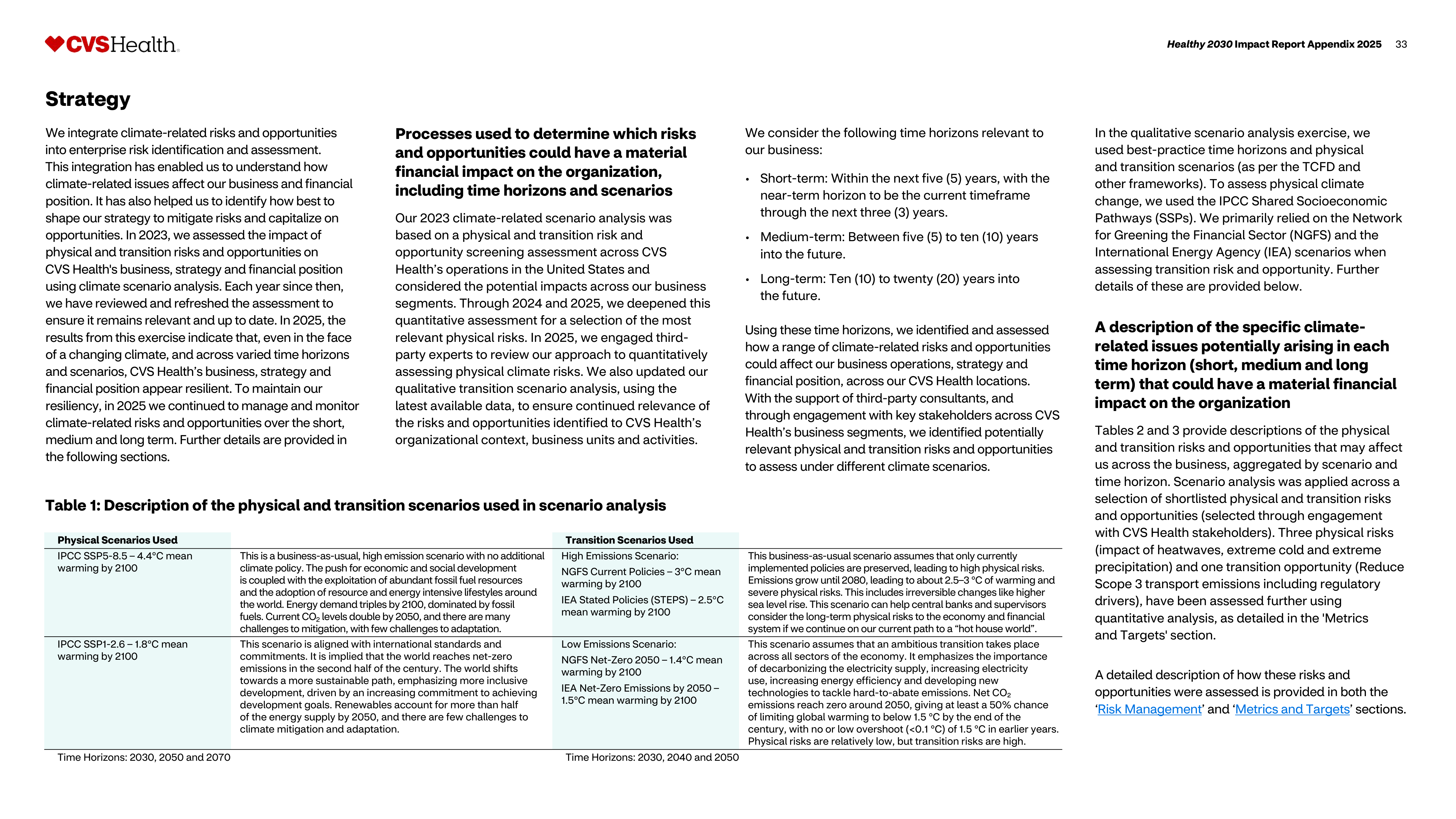

Strategy
We integrate climate-related risks and opportunities
into enterprise risk identification and assessment.
This integration has enabled us to understand how
climate-related issues affect our business and financial
position. It has also helped us to identify how best to
shape our strategy to mitigate risks and capitalize on
opportunities. In 2023, we assessed the impact of
physical and transition risks and opportunities on
CVS Health's business, strategy and financial position
using climate scenario analysis. Each year since then,
we have reviewed and refreshed the assessment to
ensure it remains relevant and up to date. In 2025, the
results from this exercise indicate that, even in the face
of a changing climate, and across varied time horizons
and scenarios, CVS Health’s business, strategy and
financial position appear resilient. To maintain our
resiliency, in 2025 we continued to manage and monitor
climate-related risks and opportunities over the short,
medium and long term. Further details are provided in
the following sections.
Processes used to determine which risks
and opportunities could have a material
financial impact on the organization,
including time horizons and scenarios
Our 2023 climate-related scenario analysis was
based on a physical and transition risk and
opportunity screening assessment across CVS
Health’s operations in the United States and
considered the potential impacts across our business
segments. Through 2024 and 2025, we deepened this
quantitative assessment for a selection of the most
relevant physical risks. In 2025, we engaged third-
party experts to review our approach to quantitatively
assessing physical climate risks. We also updated our
qualitative transition scenario analysis, using the
latest available data, to ensure continued relevance of
the risks and opportunities identified to CVS Health’s
organizational context, business units and activities.
We consider the following time horizons relevant to
our business:
•
Short-term: Within the next five (5) years, with the
near-term horizon to be the current timeframe
through the next three (3) years.
•
Medium-term: Between five (5) to ten (10) years
into the future.
•
Long-term: Ten (10) to twenty (20) years into
the future.
Using these time horizons, we identified and assessed
how a range of climate-related risks and opportunities
could affect our business operations, strategy and
financial position, across our CVS Health locations.
With the support of third-party consultants, and
through engagement with key stakeholders across CVS
Health’s business segments, we identified potentially
relevant physical and transition risks and opportunities
to assess under different climate scenarios.
In the qualitative scenario analysis exercise, we
used best-practice time horizons and physical
and transition scenarios (as per the TCFD and
other frameworks). To assess physical climate
change, we used the IPCC Shared Socioeconomic
Pathways (SSPs). We primarily relied on the Network
for Greening the Financial Sector (NGFS) and the
International Energy Agency (IEA) scenarios when
assessing transition risk and opportunity. Further
details of these are provided below.
A description of the specific climate-
related issues potentially arising in each
time horizon (short, medium and long
term) that could have a material financial
impact on the organization
Tables 2 and 3 provide descriptions of the physical
and transition risks and opportunities that may affect
us across the business, aggregated by scenario and
time horizon. Scenario analysis was applied across a
selection of shortlisted physical and transition risks
and opportunities (selected through engagement
with CVS Health stakeholders). Three physical risks
(impact of heatwaves, extreme cold and extreme
precipitation) and one transition opportunity (Reduce
Scope 3 transport emissions including regulatory
drivers), have been assessed further using
quantitative analysis, as detailed in the 'Metrics
and Targets' section.
A detailed description of how these risks and
opportunities were assessed is provided in both the
‘
Risk Management
’ and ‘
Metrics and Targets
’ sections.
Healthy 2030
Impact Report Appendix 2025
33
Table 1: Description of the physical and transition scenarios used in scenario analysis
Physical Scenarios Used
Transition Scenarios Used
IPCC SSP5-8.5 – 4.4°C mean
warming by 2100
This is a business-as-usual, high emission scenario with no additional
climate policy. The push for economic and social development
is coupled with the exploitation of abundant fossil fuel resources
and the adoption of resource and energy intensive lifestyles around
the world. Energy demand triples by 2100, dominated by fossil
fuels. Current CO
2
levels double by 2050, and there are many
challenges to mitigation, with few challenges to adaptation.
High Emissions Scenario:
NGFS Current Policies – 3°C mean
warming by 2100
IEA Stated Policies (STEPS) – 2.5°C
mean warming by 2100
This business-as-usual scenario assumes that only currently
implemented policies are preserved, leading to high physical risks.
Emissions grow until 2080, leading to about 2.5–3 °C of warming and
severe physical risks. This includes irreversible changes like higher
sea level rise. This scenario can help central banks and supervisors
consider the long-term physical risks to the economy and financial
system if we continue on our current path to a “hot house world”.
IPCC SSP1-2.6 – 1.8°C mean
warming by 2100
This scenario is aligned with international standards and
commitments. It is implied that the world reaches net-zero
emissions in the second half of the century. The world shifts
towards a more sustainable path, emphasizing more inclusive
development, driven by an increasing commitment to achieving
development goals. Renewables account for more than half
of the energy supply by 2050, and there are few challenges to
climate mitigation and adaptation.
Low Emissions Scenario:
NGFS Net-Zero 2050 – 1.4°C mean
warming by 2100
IEA Net-Zero Emissions by 2050 –
1.5°C mean warming by 2100
This scenario assumes that an ambitious transition takes place
across all sectors of the economy. It emphasizes the importance
of decarbonizing the electricity supply, increasing electricity
use, increasing energy efficiency and developing new
technologies to tackle hard-to-abate emissions. Net CO₂
emissions reach zero around 2050, giving at least a 50% chance
of limiting global warming to below 1.5 °C by the end of the
century, with no or low overshoot (<0.1 °C) of 1.5 °C in earlier years.
Physical risks are relatively low, but transition risks are high.
Time Horizons: 2030, 2050 and 2070
Time Horizons: 2030, 2040 and 2050
IPCC SSP5-8.5 – 4.4°C mean warming by 2100. This is a business-as-usual, high emission scenario with no additional climate policy. The push for economic and social development is coupled with the exploitation of abundant fossil fuel resources and the adoption of resource and energy intensive lifestyles around the world. Energy demand triples by 2100, dominated by fossil fuels. Current CO2 levels double by 2050, and there are many challenges to mitigation, with few challenges to adaptation.
High Emissions Scenario: NGFS Current Policies – 3°C mean warming by 2100; IEA Stated Policies (STEPS) – 2.5°C mean warming by 2100.
This business-as-usual scenario assumes that only currently implemented policies are preserved, leading to high physical risks. Emissions grow until 2080, leading to about 2.5–3 °C of warming and severe physical risks. This includes irreversible changes like higher sea level rise. This scenario can help central banks and supervisors consider the long-term physical risks to the economy and financial system if we continue on our current path to a “hot house world”.
IPCC SSP1-2.6 – 1.8°C mean warming by 2100. This scenario is aligned with international standards and commitments. It is implied that the world reaches net-zero emissions in the second half of the century. The world shifts towards a more sustainable path, emphasizing more inclusive development, driven by an increasing commitment to achieving development goals. Renewables account for more than half of the energy supply by 2050, and there are few challenges to climate mitigation and adaptation.
Low Emissions Scenario: NGFS Net-Zero 2050 – 1.4°C mean warming by 2100; IEA Net-Zero Emissions by 2050 – 1.5°C mean warming by 2100.
This scenario assumes that an ambitious transition takes place across all sectors of the economy. It emphasizes the importance of decarbonizing the electricity supply, increasing electricity use, increasing energy efficiency and developing new technologies to tackle hard-to-abate emissions. Net CO₂ emissions reach zero around 2050, giving at least a 50% chance of limiting global warming to below 1.5 °C by the end of the century, with no or low overshoot (<0.1 °C) of 1.5 °C in earlier years. Physical risks are relatively low, but transition risks are high.
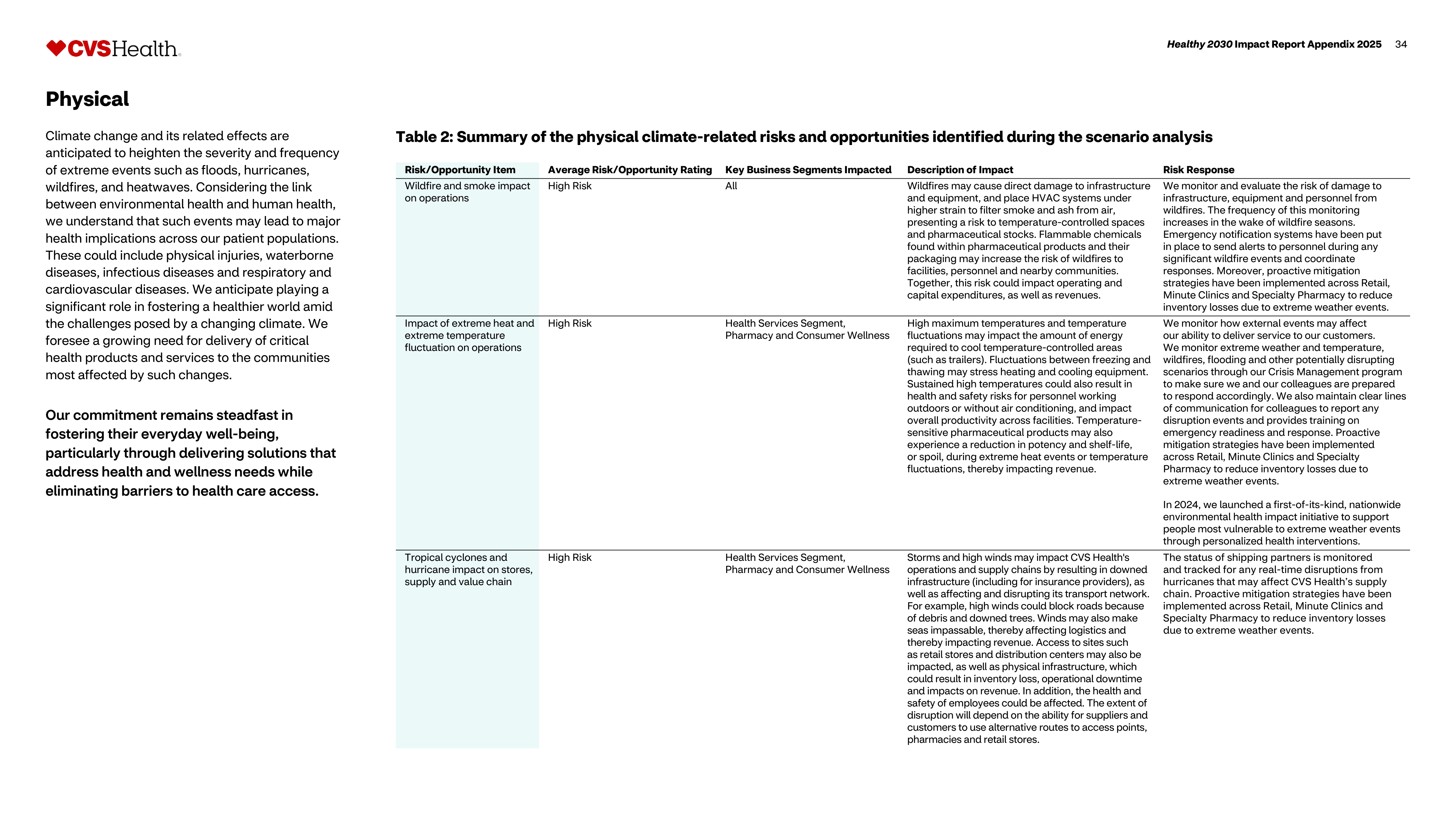

Physical
Climate change and its related effects are
anticipated to heighten the severity and frequency
of extreme events such as floods, hurricanes,
wildfires, and heatwaves. Considering the link
between environmental health and human health,
we understand that such events may lead to major
health implications across our patient populations.
These could include physical injuries, waterborne
diseases, infectious diseases and respiratory and
cardiovascular diseases. We anticipate playing a
significant role in fostering a healthier world amid
the challenges posed by a changing climate. We
foresee a growing need for delivery of critical
health products and services to the communities
most affected by such changes.
Our commitment remains steadfast in
fostering their everyday well-being,
particularly through delivering solutions that
address health and wellness needs while
eliminating barriers to health care access.
Table 2: Summary of the physical climate-related risks and opportunities identified during the scenario analysis
Risk/Opportunity Item
Average Risk/Opportunity Rating
Key Business Segments Impacted
Description of Impact
Risk Response
Wildfire and smoke impact
on operations
High Risk
All
Wildfires may cause direct damage to infrastructure
and equipment, and place HVAC systems under
higher strain to filter smoke and ash from air,
presenting a risk to temperature-controlled spaces
and pharmaceutical stocks. Flammable chemicals
found within pharmaceutical products and their
packaging may increase the risk of wildfires to
facilities, personnel and nearby communities.
Together, this risk could impact operating and
capital expenditures, as well as revenues.
We monitor and evaluate the risk of damage to
infrastructure, equipment and personnel from
wildfires. The frequency of this monitoring
increases in the wake of wildfire seasons.
Emergency notification systems have been put
in place to send alerts to personnel during any
significant wildfire events and coordinate
responses. Moreover, proactive mitigation
strategies have been implemented across Retail,
Minute Clinics and Specialty Pharmacy to reduce
inventory losses due to extreme weather events.
Impact of extreme heat and
extreme temperature
fluctuation on operations
High Risk
Health Services Segment,
Pharmacy and Consumer Wellness
High maximum temperatures and temperature
fluctuations may impact the amount of energy
required to cool temperature-controlled areas
(such as trailers). Fluctuations between freezing and
thawing may stress heating and cooling equipment.
Sustained high temperatures could also result in
health and safety risks for personnel working
outdoors or without air conditioning, and impact
overall productivity across facilities. Temperature-
sensitive pharmaceutical products may also
experience a reduction in potency and shelf-life,
or spoil, during extreme heat events or temperature
fluctuations, thereby impacting revenue.
We monitor how external events may affect
our ability to deliver service to our customers.
We monitor extreme weather and temperature,
wildfires, flooding and other potentially disrupting
scenarios through our Crisis Management program
to make sure we and our colleagues are prepared
to respond accordingly. We also maintain clear lines
of communication for colleagues to report any
disruption events and provides training on
emergency readiness and response. Proactive
mitigation strategies have been implemented
across Retail, Minute Clinics and Specialty
Pharmacy to reduce inventory losses due to
extreme weather events.
In 2024, we launched a first-of-its-kind, nationwide
environmental health impact initiative to support
people most vulnerable to extreme weather events
through personalized health interventions.
Tropical cyclones and
hurricane impact on stores,
supply and value chain
High Risk
Health Services Segment,
Pharmacy and Consumer Wellness
Storms and high winds may impact CVS Health's
operations and supply chains by resulting in downed
infrastructure (including for insurance providers), as
well as affecting and disrupting its transport network.
For example, high winds could block roads because
of debris and downed trees. Winds may also make
seas impassable, thereby affecting logistics and
thereby impacting revenue. Access to sites such
as retail stores and distribution centers may also be
impacted, as well as physical infrastructure, which
could result in inventory loss, operational downtime
and impacts on revenue. In addition, the health and
safety of employees could be affected. The extent of
disruption will depend on the ability for suppliers and
customers to use alternative routes to access points,
pharmacies and retail stores.
The status of shipping partners is monitored
and tracked for any real-time disruptions from
hurricanes that may affect CVS Health’s supply
chain. Proactive mitigation strategies have been
implemented across Retail, Minute Clinics and
Specialty Pharmacy to reduce inventory losses
due to extreme weather events.
Healthy 2030
Impact Report Appendix 2025
34
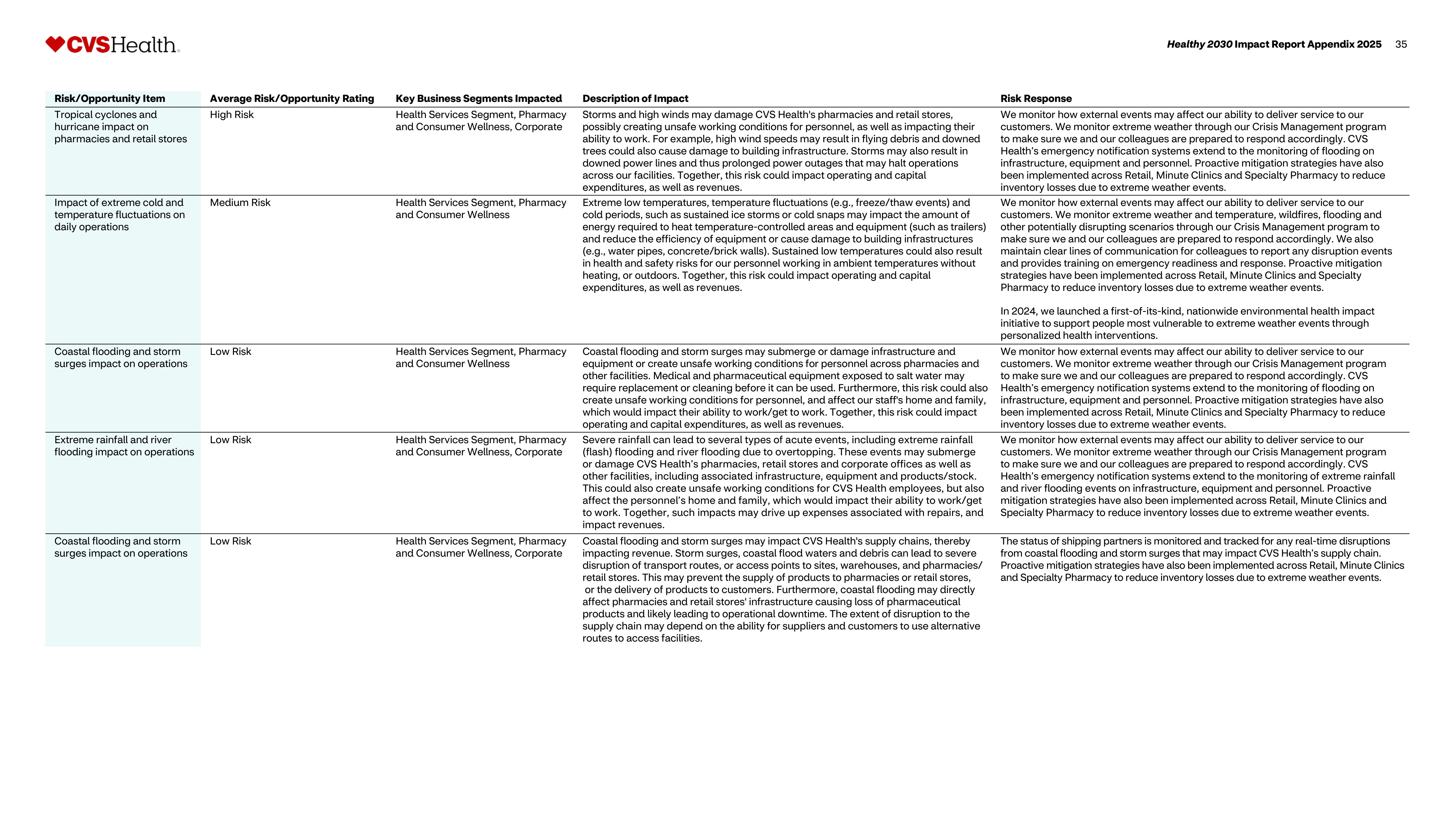

Tropical cyclones and
hurricane impact on
pharmacies and retail stores
High Risk
Health Services Segment, Pharmacy
and Consumer Wellness, Corporate
Storms and high winds may damage CVS Health's pharmacies and retail stores,
possibly creating unsafe working conditions for personnel, as well as impacting their
ability to work. For example, high wind speeds may result in flying debris and downed
trees could also cause damage to building infrastructure. Storms may also result in
downed power lines and thus prolonged power outages that may halt operations
across our facilities. Together, this risk could impact operating and capital
expenditures, as well as revenues.
We monitor how external events may affect our ability to deliver service to our
customers. We monitor extreme weather through our Crisis Management program
to make sure we and our colleagues are prepared to respond accordingly. CVS
Health’s emergency notification systems extend to the monitoring of flooding on
infrastructure, equipment and personnel. Proactive mitigation strategies have also
been implemented across Retail, Minute Clinics and Specialty Pharmacy to reduce
inventory losses due to extreme weather events.
Impact of extreme cold and
temperature fluctuations on
daily operations
Medium Risk
Health Services Segment, Pharmacy
and Consumer Wellness
Extreme low temperatures, temperature fluctuations (e.g., freeze/thaw events) and
cold periods, such as sustained ice storms or cold snaps may impact the amount of
energy required to heat temperature-controlled areas and equipment (such as trailers)
and reduce the efficiency of equipment or cause damage to building infrastructures
(e.g., water pipes, concrete/brick walls). Sustained low temperatures could also result
in health and safety risks for our personnel working in ambient temperatures without
heating, or outdoors. Together, this risk could impact operating and capital
expenditures, as well as revenues.
We monitor how external events may affect our ability to deliver service to our
customers. We monitor extreme weather and temperature, wildfires, flooding and
other potentially disrupting scenarios through our Crisis Management program to
make sure we and our colleagues are prepared to respond accordingly. We also
maintain clear lines of communication for colleagues to report any disruption events
and provides training on emergency readiness and response. Proactive mitigation
strategies have been implemented across Retail, Minute Clinics and Specialty
Pharmacy to reduce inventory losses due to extreme weather events.
In 2024, we launched a first-of-its-kind, nationwide environmental health impact
initiative to support people most vulnerable to extreme weather events through
personalized health interventions.
Coastal flooding and storm
surges impact on operations
Low Risk
Health Services Segment, Pharmacy
and Consumer Wellness
Coastal flooding and storm surges may submerge or damage infrastructure and
equipment or create unsafe working conditions for personnel across pharmacies and
other facilities. Medical and pharmaceutical equipment exposed to salt water may
require replacement or cleaning before it can be used. Furthermore, this risk could also
create unsafe working conditions for personnel, and affect our staff's home and family,
which would impact their ability to work/get to work. Together, this risk could impact
operating and capital expenditures, as well as revenues.
We monitor how external events may affect our ability to deliver service to our
customers. We monitor extreme weather through our Crisis Management program
to make sure we and our colleagues are prepared to respond accordingly. CVS
Health’s emergency notification systems extend to the monitoring of flooding on
infrastructure, equipment and personnel. Proactive mitigation strategies have also
been implemented across Retail, Minute Clinics and Specialty Pharmacy to reduce
inventory losses due to extreme weather events.
Extreme rainfall and river
flooding impact on operations
Low Risk
Health Services Segment, Pharmacy
and Consumer Wellness, Corporate
Severe rainfall can lead to several types of acute events, including extreme rainfall
(flash) flooding and river flooding due to overtopping. These events may submerge
or damage CVS Health’s pharmacies, retail stores and corporate offices as well as
other facilities, including associated infrastructure, equipment and products/stock.
This could also create unsafe working conditions for CVS Health employees, but also
affect the personnel’s home and family, which would impact their ability to work/get
to work. Together, such impacts may drive up expenses associated with repairs, and
impact revenues.
We monitor how external events may affect our ability to deliver service to our
customers. We monitor extreme weather through our Crisis Management program
to make sure we and our colleagues are prepared to respond accordingly. CVS
Health’s emergency notification systems extend to the monitoring of extreme rainfall
and river flooding events on infrastructure, equipment and personnel. Proactive
mitigation strategies have also been implemented across Retail, Minute Clinics and
Specialty Pharmacy to reduce inventory losses due to extreme weather events.
Coastal flooding and storm
surges impact on operations
Low Risk
Health Services Segment, Pharmacy
and Consumer Wellness, Corporate
Coastal flooding and storm surges may impact CVS Health's supply chains, thereby
impacting revenue. Storm surges, coastal flood waters and debris can lead to severe
disruption of transport routes, or access points to sites, warehouses, and pharmacies/
retail stores. This may prevent the supply of products to pharmacies or retail stores,
or the delivery of products to customers. Furthermore, coastal flooding may directly
affect pharmacies and retail stores' infrastructure causing loss of pharmaceutical
products and likely leading to operational downtime. The extent of disruption to the
supply chain may depend on the ability for suppliers and customers to use alternative
routes to access facilities.
The status of shipping partners is monitored and tracked for any real-time disruptions
from coastal flooding and storm surges that may impact CVS Health’s supply chain.
Proactive mitigation strategies have also been implemented across Retail, Minute Clinics
and Specialty Pharmacy to reduce inventory losses due to extreme weather events.
Risk/Opportunity Item
Average Risk/Opportunity Rating
Key Business Segments Impacted
Description of Impact
Risk Response
Healthy 2030
Impact Report Appendix 2025
35
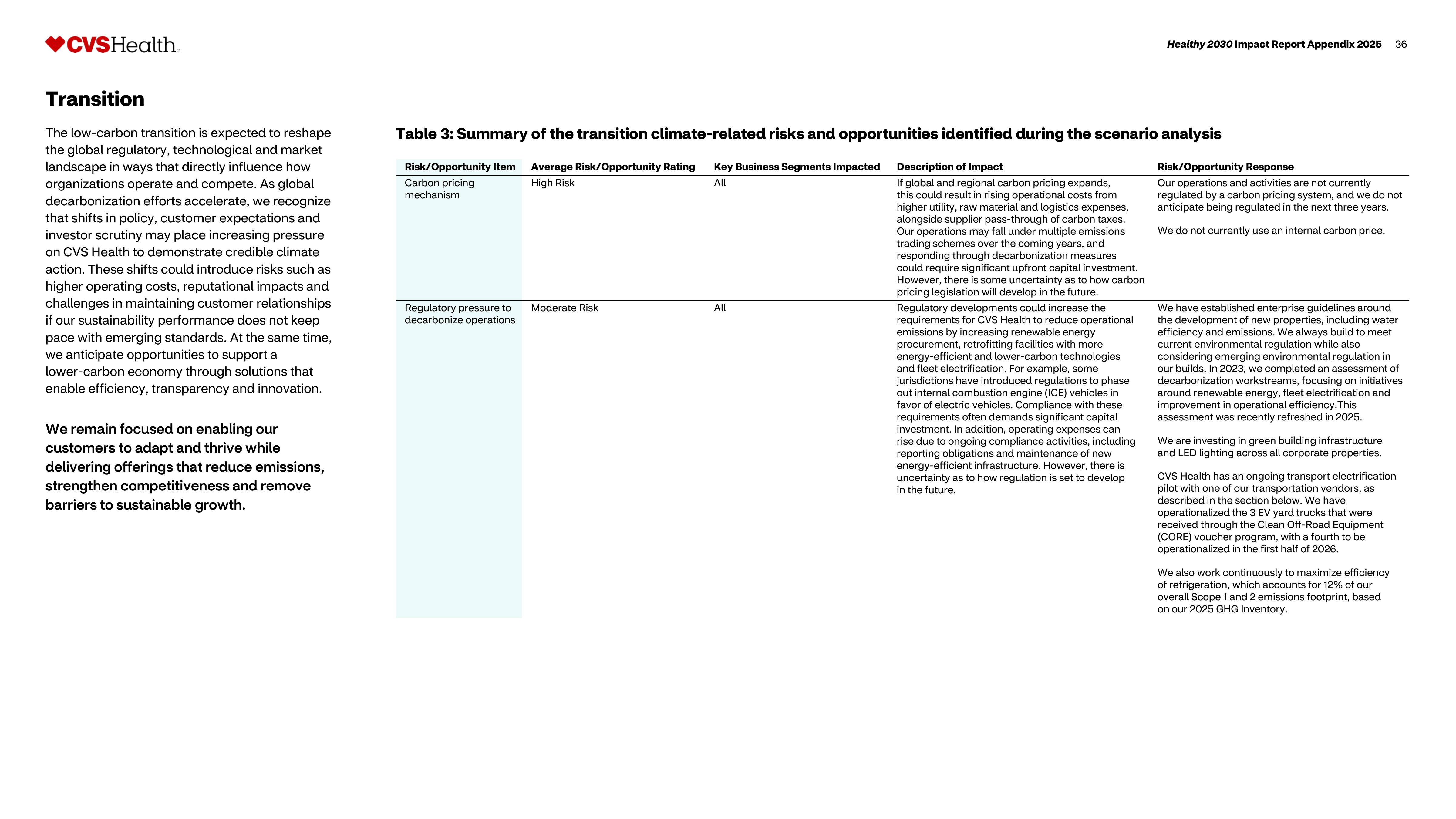

Transition
The low-carbon transition is expected to reshape
the global regulatory, technological and market
landscape in ways that directly influence how
organizations operate and compete. As global
decarbonization efforts accelerate, we recognize
that shifts in policy, customer expectations and
investor scrutiny may place increasing pressure
on CVS Health to demonstrate credible climate
action. These shifts could introduce risks such as
higher operating costs, reputational impacts and
challenges in maintaining customer relationships
if our sustainability performance does not keep
pace with emerging standards. At the same time,
we anticipate opportunities to support a
lower‑carbon economy through solutions that
enable efficiency, transparency and innovation.
We remain focused on enabling our
customers to adapt and thrive while
delivering offerings that reduce emissions,
strengthen competitiveness and remove
barriers to sustainable growth.
Table 3: Summary of the transition climate-related risks and opportunities identified during the scenario analysis
Risk/Opportunity Item
Average Risk/Opportunity Rating
Key Business Segments Impacted
Description of Impact
Risk/Opportunity Response
Carbon pricing
mechanism
High Risk
All
If global and regional carbon pricing expands,
this could result in rising operational costs from
higher utility, raw material and logistics expenses,
alongside supplier pass-through of carbon taxes.
Our operations may fall under multiple emissions
trading schemes over the coming years, and
responding through decarbonization measures
could require significant upfront capital investment.
However, there is some uncertainty as to how carbon
pricing legislation will develop in the future.
Our operations and activities are not currently
regulated by a carbon pricing system, and we do not
anticipate being regulated in the next three years.
We do not currently use an internal carbon price.
Regulatory pressure to
decarbonize operations
Moderate Risk
All
Regulatory developments could increase the
requirements for CVS Health to reduce operational
emissions by increasing renewable energy
procurement, retrofitting facilities with more
energy-efficient and lower-carbon technologies
and fleet electrification. For example, some
jurisdictions have introduced regulations to phase
out internal combustion engine (ICE) vehicles in
favor of electric vehicles. Compliance with these
requirements often demands significant capital
investment. In addition, operating expenses can
rise due to ongoing compliance activities, including
reporting obligations and maintenance of new
energy-efficient infrastructure. However, there is
uncertainty as to how regulation is set to develop
in the future.
We have established enterprise guidelines around
the development of new properties, including water
efficiency and emissions. We always build to meet
current environmental regulation while also
considering emerging environmental regulation in
our builds. In 2023, we completed an assessment of
decarbonization workstreams, focusing on initiatives
around renewable energy, fleet electrification and
improvement in operational efficiency.This
assessment was recently refreshed in 2025.
We are investing in green building infrastructure
and LED lighting across all corporate properties.
CVS Health has an ongoing transport electrification
pilot with one of our transportation vendors, as
described in the section below. We have
operationalized the 3 EV yard trucks that were
received through the Clean Off-Road Equipment
(CORE) voucher program, with a fourth to be
operationalized in the first half of 2026.
We also work continuously to maximize efficiency
of refrigeration, which accounts for 12% of our
overall Scope 1 and 2 emissions footprint, based
on our 2025 GHG Inventory.
Healthy 2030
Impact Report Appendix 2025
36
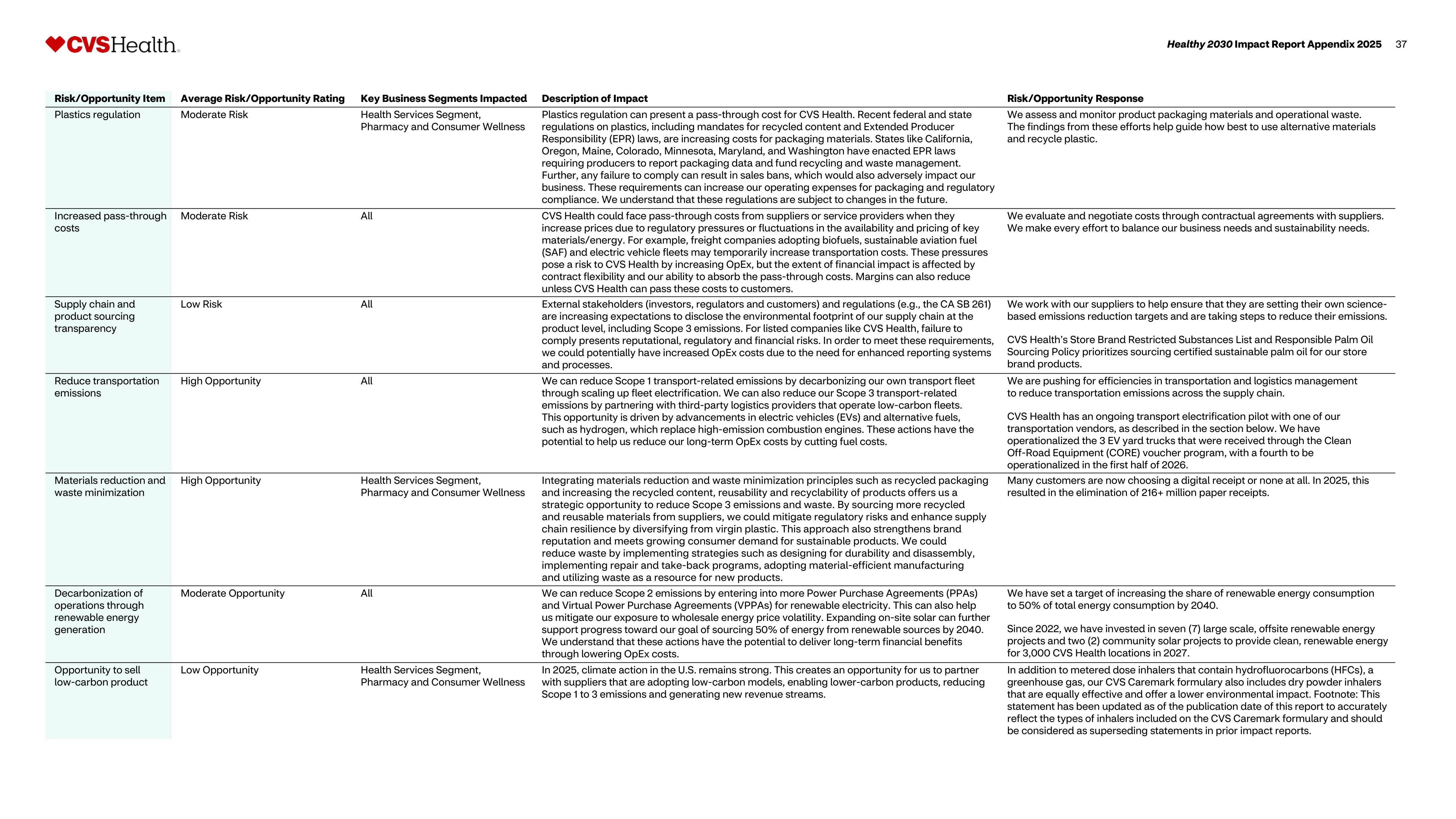

Plastics regulation
Moderate Risk
Health Services Segment,
Pharmacy and Consumer Wellness
Plastics regulation can present a pass-through cost for CVS Health. Recent federal and state
regulations on plastics, including mandates for recycled content and Extended Producer
Responsibility (EPR) laws, are increasing costs for packaging materials. States like California,
Oregon, Maine, Colorado, Minnesota, Maryland, and Washington have enacted EPR laws
requiring producers to report packaging data and fund recycling and waste management.
Further, any failure to comply can result in sales bans, which would also adversely impact our
business. These requirements can increase our operating expenses for packaging and regulatory
compliance. We understand that these regulations are subject to changes in the future.
We assess and monitor product packaging materials and operational waste.
The findings from these efforts help guide how best to use alternative materials
and recycle plastic.
Increased pass-through
costs
Moderate Risk
All
CVS Health could face pass-through costs from suppliers or service providers when they
increase prices due to regulatory pressures or fluctuations in the availability and pricing of key
materials/energy. For example, freight companies adopting biofuels, sustainable aviation fuel
(SAF) and electric vehicle fleets may temporarily increase transportation costs. These pressures
pose a risk to CVS Health by increasing OpEx, but the extent of financial impact is affected by
contract flexibility and our ability to absorb the pass-through costs. Margins can also reduce
unless CVS Health can pass these costs to customers.
We evaluate and negotiate costs through contractual agreements with suppliers.
We make every effort to balance our business needs and sustainability needs.
Supply chain and
product sourcing
transparency
Low Risk
All
External stakeholders (investors, regulators and customers) and regulations (e.g., the CA SB 261)
are increasing expectations to disclose the environmental footprint of our supply chain at the
product level, including Scope 3 emissions. For listed companies like CVS Health, failure to
comply presents reputational, regulatory and financial risks. In order to meet these requirements,
we could potentially have increased OpEx costs due to the need for enhanced reporting systems
and processes.
We work with our suppliers to help ensure that they are setting their own science-
based emissions reduction targets and are taking steps to reduce their emissions.
CVS Health’s Store Brand Restricted Substances List and Responsible Palm Oil
Sourcing Policy prioritizes sourcing certified sustainable palm oil for our store
brand products.
Reduce transportation
emissions
High Opportunity
All
We can reduce Scope 1 transport-related emissions by decarbonizing our own transport fleet
through scaling up fleet electrification. We can also reduce our Scope 3 transport-related
emissions by partnering with third-party logistics providers that operate low-carbon fleets.
This opportunity is driven by advancements in electric vehicles (EVs) and alternative fuels,
such as hydrogen, which replace high-emission combustion engines. These actions have the
potential to help us reduce our long-term OpEx costs by cutting fuel costs.
We are pushing for efficiencies in transportation and logistics management
to reduce transportation emissions across the supply chain.
CVS Health has an ongoing transport electrification pilot with one of our
transportation vendors, as described in the section below. We have
operationalized the 3 EV yard trucks that were received through the Clean
Off-Road Equipment (CORE) voucher program, with a fourth to be
operationalized in the first half of 2026.
Materials reduction and
waste minimization
High Opportunity
Health Services Segment,
Pharmacy and Consumer Wellness
Integrating materials reduction and waste minimization principles such as recycled packaging
and increasing the recycled content, reusability and recyclability of products offers us a
strategic opportunity to reduce Scope 3 emissions and waste. By sourcing more recycled
and reusable materials from suppliers, we could mitigate regulatory risks and enhance supply
chain resilience by diversifying from virgin plastic. This approach also strengthens brand
reputation and meets growing consumer demand for sustainable products. We could
reduce waste by implementing strategies such as designing for durability and disassembly,
implementing repair and take-back programs, adopting material-efficient manufacturing
and utilizing waste as a resource for new products.
Many customers are now choosing a digital receipt or none at all. In 2025, this
resulted in the elimination of 216+ million paper receipts.
Decarbonization of
operations through
renewable energy
generation
Moderate Opportunity
All
We can reduce Scope 2 emissions by entering into more Power Purchase Agreements (PPAs)
and Virtual Power Purchase Agreements (VPPAs) for renewable electricity. This can also help
us mitigate our exposure to wholesale energy price volatility. Expanding on-site solar can further
support progress toward our goal of sourcing 50% of energy from renewable sources by 2040.
We understand that these actions have the potential to deliver long-term financial benefits
through lowering OpEx costs.
We have set a target of increasing the share of renewable energy consumption
to 50% of total energy consumption by 2040.
Since 2022, we have invested in seven (7) large scale, offsite renewable energy
projects and two (2) community solar projects to provide clean, renewable energy
for 3,000 CVS Health locations in 2027.
Opportunity to sell
low-carbon product
Low Opportunity
Health Services Segment,
Pharmacy and Consumer Wellness
In 2025, climate action in the U.S. remains strong. This creates an opportunity for us to partner
with suppliers that are adopting low-carbon models, enabling lower-carbon products, reducing
Scope 1 to 3 emissions and generating new revenue streams.
In addition to metered dose inhalers that contain hydrofluorocarbons (HFCs), a
greenhouse gas, our CVS Caremark formulary also includes dry powder inhalers
that are equally effective and offer a lower environmental impact. Footnote: This
statement has been updated as of the publication date of this report to accurately
reflect the types of inhalers included on the CVS Caremark formulary and should
be considered as superseding statements in prior impact reports.
Risk/Opportunity Item
Average Risk/Opportunity Rating
Key Business Segments Impacted
Description of Impact
Risk/Opportunity Response
Healthy 2030
Impact Report Appendix 2025
37
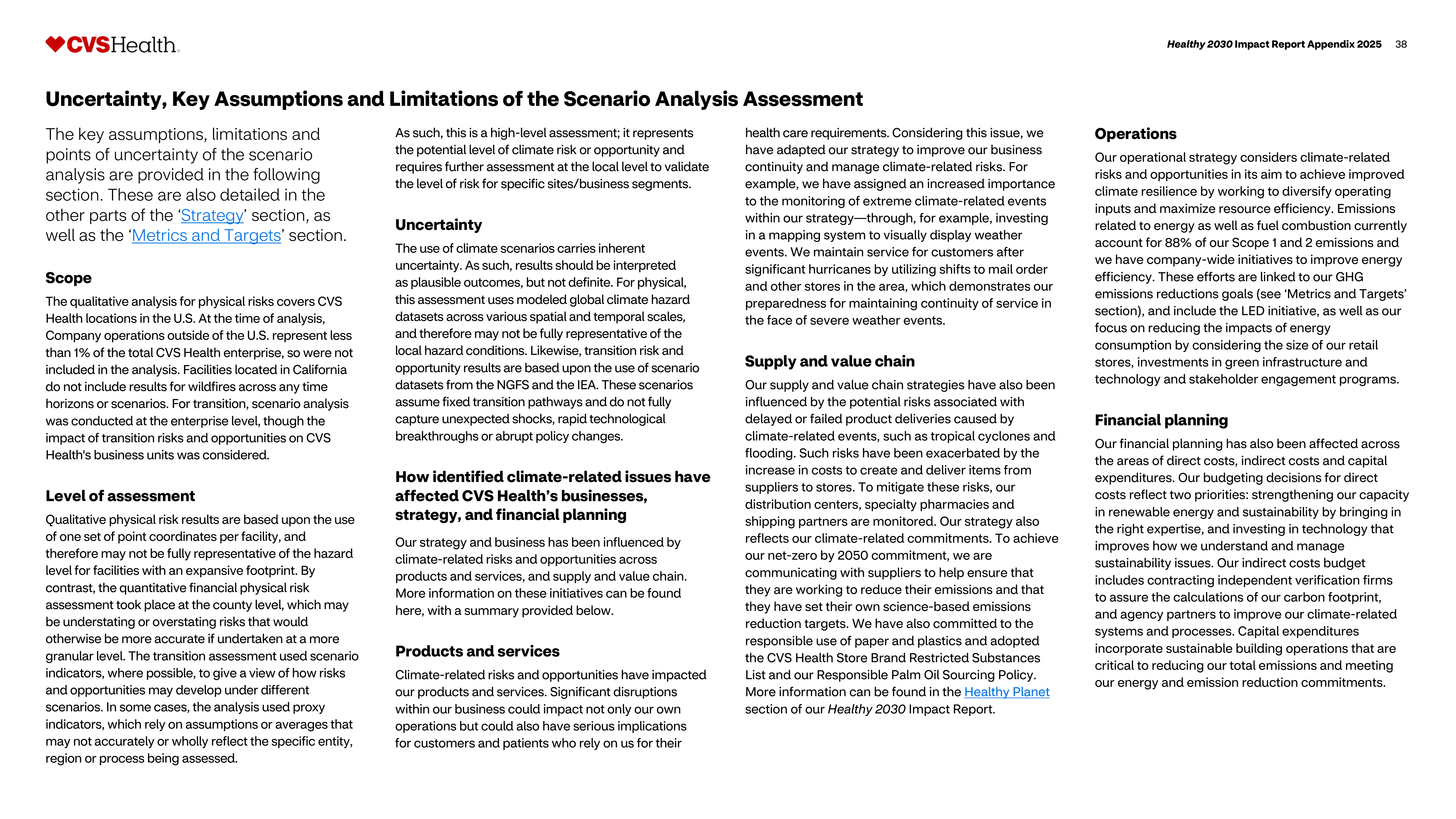

Uncertainty, Key Assumptions and Limitations of the Scenario Analysis Assessment
The key assumptions, limitations and
points of uncertainty of the scenario
analysis are provided in the following
section. These are also detailed in the
other parts of the ‘
Strategy
’ section, as
well as the ‘
Metrics and Targets
’ section.
Scope
The qualitative analysis for physical risks covers CVS
Health locations in the U.S. At the time of analysis,
Company operations outside of the U.S. represent less
than 1% of the total CVS Health enterprise, so were not
included in the analysis. Facilities located in California
do not include results for wildfires across any time
horizons or scenarios. For transition, scenario analysis
was conducted at the enterprise level, though the
impact of transition risks and opportunities on CVS
Health's business units was considered.
Level of assessment
Qualitative physical risk results are based upon the use
of one set of point coordinates per facility, and
therefore may not be fully representative of the hazard
level for facilities with an expansive footprint. By
contrast, the quantitative financial physical risk
assessment took place at the county level, which may
be understating or overstating risks that would
otherwise be more accurate if undertaken at a more
granular level. The transition assessment used scenario
indicators, where possible, to give a view of how risks
and opportunities may develop under different
scenarios. In some cases, the analysis used proxy
indicators, which rely on assumptions or averages that
may not accurately or wholly reflect the specific entity,
region or process being assessed.
As such, this is a high-level assessment; it represents
the potential level of climate risk or opportunity and
requires further assessment at the local level to validate
the level of risk for specific sites/business segments.
Uncertainty
The use of climate scenarios carries inherent
uncertainty. As such, results should be interpreted
as plausible outcomes, but not definite. For physical,
this assessment uses modeled global climate hazard
datasets across various spatial and temporal scales,
and therefore may not be fully representative of the
local hazard conditions. Likewise, transition risk and
opportunity results are based upon the use of scenario
datasets from the NGFS and the IEA. These scenarios
assume fixed transition pathways and do not fully
capture unexpected shocks, rapid technological
breakthroughs or abrupt policy changes.
How identified climate-related issues have
affected CVS Health’s businesses,
strategy, and financial planning
Our strategy and business has been influenced by
climate-related risks and opportunities across
products and services, and supply and value chain.
More information on these initiatives can be found
here, with a summary provided below.
Products and services
Climate-related risks and opportunities have impacted
our products and services. Significant disruptions
within our business could impact not only our own
operations but could also have serious implications
for customers and patients who rely on us for their
health care requirements. Considering this issue, we
have adapted our strategy to improve our business
continuity and manage climate-related risks. For
example, we have assigned an increased importance
to the monitoring of extreme climate-related events
within our strategy—through, for example, investing
in a mapping system to visually display weather
events. We maintain service for customers after
significant hurricanes by utilizing shifts to mail order
and other stores in the area, which demonstrates our
preparedness for maintaining continuity of service in
the face of severe weather events.
Supply and value chain
Our supply and value chain strategies have also been
influenced by the potential risks associated with
delayed or failed product deliveries caused by
climate-related events, such as tropical cyclones and
flooding. Such risks have been exacerbated by the
increase in costs to create and deliver items from
suppliers to stores. To mitigate these risks, our
distribution centers, specialty pharmacies and
shipping partners are monitored. Our strategy also
reflects our climate-related commitments. To achieve
our net-zero by 2050 commitment, we are
communicating with suppliers to help ensure that
they are working to reduce their emissions and that
they have set their own science-based emissions
reduction targets. We have also committed to the
responsible use of paper and plastics and adopted
the CVS Health Store Brand Restricted Substances
List and our Responsible Palm Oil Sourcing Policy.
More information can be found in the
Healthy Planet
section of our
Healthy 2030
Impact Report.
Operations
Our operational strategy considers climate-related
risks and opportunities in its aim to achieve improved
climate resilience by working to diversify operating
inputs and maximize resource efficiency. Emissions
related to energy as well as fuel combustion currently
account for 88% of our Scope 1 and 2 emissions and
we have company-wide initiatives to improve energy
efficiency. These efforts are linked to our GHG
emissions reductions goals (see ‘Metrics and Targets’
section), and include the LED initiative, as well as our
focus on reducing the impacts of energy
consumption by considering the size of our retail
stores, investments in green infrastructure and
technology and stakeholder engagement programs.
Financial planning
Our financial planning has also been affected across
the areas of direct costs, indirect costs and capital
expenditures. Our budgeting decisions for direct
costs reflect two priorities: strengthening our capacity
in renewable energy and sustainability by bringing in
the right expertise, and investing in technology that
improves how we understand and manage
sustainability issues. Our indirect costs budget
includes contracting independent verification firms
to assure the calculations of our carbon footprint,
and agency partners to improve our climate-related
systems and processes. Capital expenditures
incorporate sustainable building operations that are
critical to reducing our total emissions and meeting
our energy and emission reduction commitments.
Healthy 2030
Impact Report Appendix 2025
38
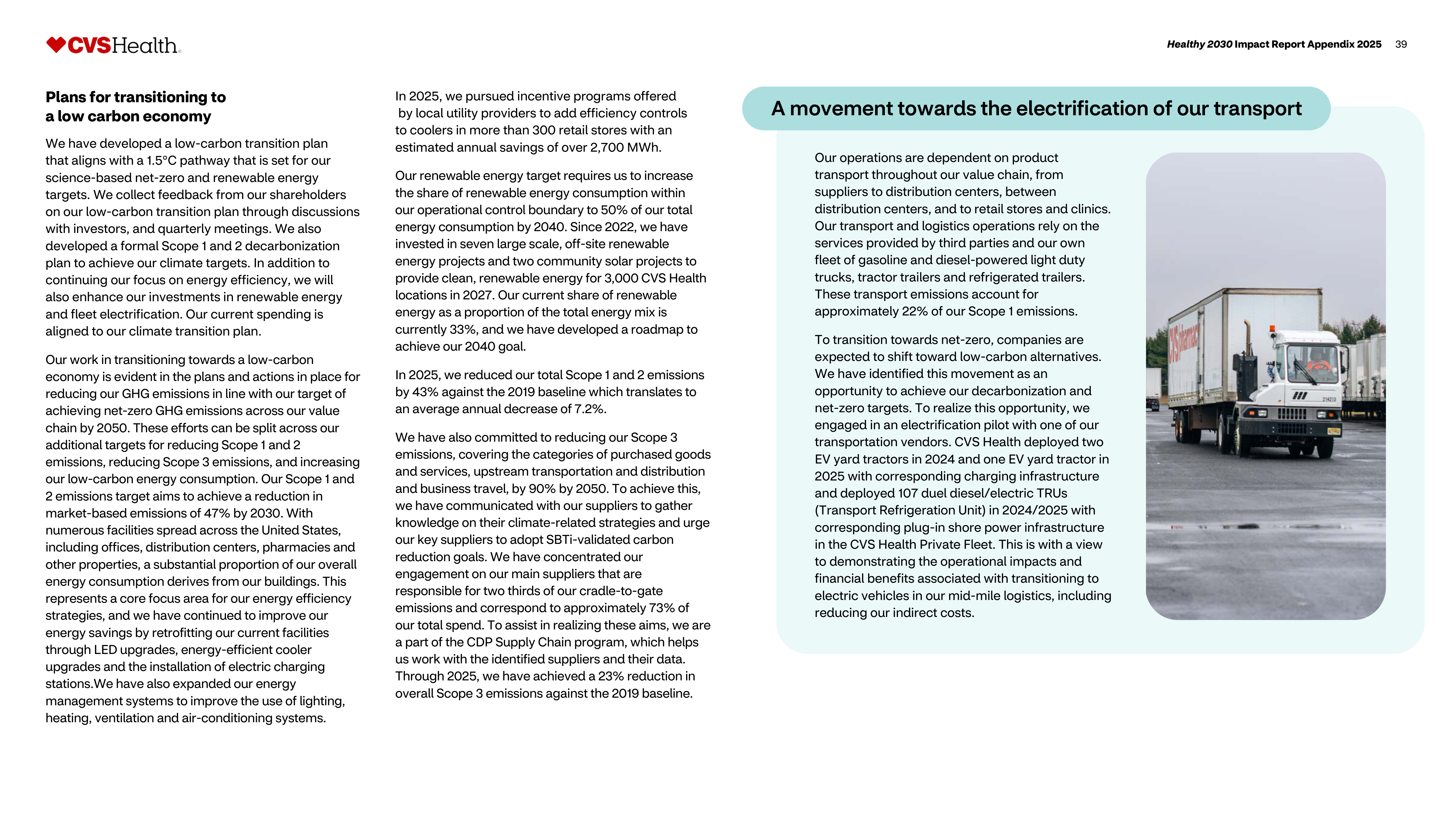

Plans for transitioning to
a low carbon economy
We have developed a low-carbon transition plan
that aligns with a 1.5°C pathway that is set for our
science-based net-zero and renewable energy
targets. We collect feedback from our shareholders
on our low-carbon transition plan through discussions
with investors, and quarterly meetings. We also
developed a formal Scope 1 and 2 decarbonization
plan to achieve our climate targets. In addition to
continuing our focus on energy efficiency, we will
also enhance our investments in renewable energy
and fleet electrification. Our current spending is
aligned to our climate transition plan.
Our work in transitioning towards a low-carbon
economy is evident in the plans and actions in place for
reducing our GHG emissions in line with our target of
achieving net-zero GHG emissions across our value
chain by 2050. These efforts can be split across our
additional targets for reducing Scope 1 and 2
emissions, reducing Scope 3 emissions, and increasing
our low-carbon energy consumption. Our Scope 1 and
2 emissions target aims to achieve a reduction in
market-based emissions of 47% by 2030. With
numerous facilities spread across the United States,
including offices, distribution centers, pharmacies and
other properties, a substantial proportion of our overall
energy consumption derives from our buildings. This
represents a core focus area for our energy efficiency
strategies, and we have continued to improve our
energy savings by retrofitting our current facilities
through LED upgrades, energy-efficient cooler
upgrades and the installation of electric charging
stations.We have also expanded our energy
management systems to improve the use of lighting,
heating, ventilation and air-conditioning systems.
In 2025, we pursued incentive programs offered
by local utility providers to add efficiency controls
to coolers in more than 300 retail stores with an
estimated annual savings of over 2,700 MWh.
Our renewable energy target requires us to increase
the share of renewable energy consumption within
our operational control boundary to 50% of our total
energy consumption by 2040. Since 2022, we have
invested in seven large scale, off-site renewable
energy projects and two community solar projects to
provide clean, renewable energy for 3,000 CVS Health
locations in 2027. Our current share of renewable
energy as a proportion of the total energy mix is
currently 33%, and we have developed a roadmap to
achieve our 2040 goal.
In 2025, we reduced our total Scope 1 and 2 emissions
by 43% against the 2019 baseline which translates to
an average annual decrease of 7.2%.
We have also committed to reducing our Scope 3
emissions, covering the categories of purchased goods
and services, upstream transportation and distribution
and business travel, by 90% by 2050. To achieve this,
we have communicated with our suppliers to gather
knowledge on their climate-related strategies and urge
our key suppliers to adopt SBTi-validated carbon
reduction goals. We have concentrated our
engagement on our main suppliers that are
responsible for two thirds of our cradle-to-gate
emissions and correspond to approximately 73% of
our total spend. To assist in realizing these aims, we are
a part of the CDP Supply Chain program, which helps
us work with the identified suppliers and their data.
Through 2025, we have achieved a 23% reduction in
overall Scope 3 emissions against the 2019 baseline.
Healthy 2030
Impact Report Appendix 2025
39
A movement towards the electrification of our transport
Our operations are dependent on product
transport throughout our value chain, from
suppliers to distribution centers, between
distribution centers, and to retail stores and clinics.
Our transport and logistics operations rely on the
services provided by third parties and our own
fleet of gasoline and diesel-powered light duty
trucks, tractor trailers and refrigerated trailers.
These transport emissions account for
approximately 22% of our Scope 1 emissions.
To transition towards net-zero, companies are
expected to shift toward low-carbon alternatives.
We have identified this movement as an
opportunity to achieve our decarbonization and
net-zero targets. To realize this opportunity, we
engaged in an electrification pilot with one of our
transportation vendors. CVS Health deployed two
EV yard tractors in 2024 and one EV yard tractor in
2025 with corresponding charging infrastructure
and deployed 107 duel diesel/electric TRUs
(Transport Refrigeration Unit) in 2024/2025 with
corresponding plug-in shore power infrastructure
in the CVS Health Private Fleet. This is with a view
to demonstrating the operational impacts and
financial benefits associated with transitioning to
electric vehicles in our mid-mile logistics, including
reducing our indirect costs.
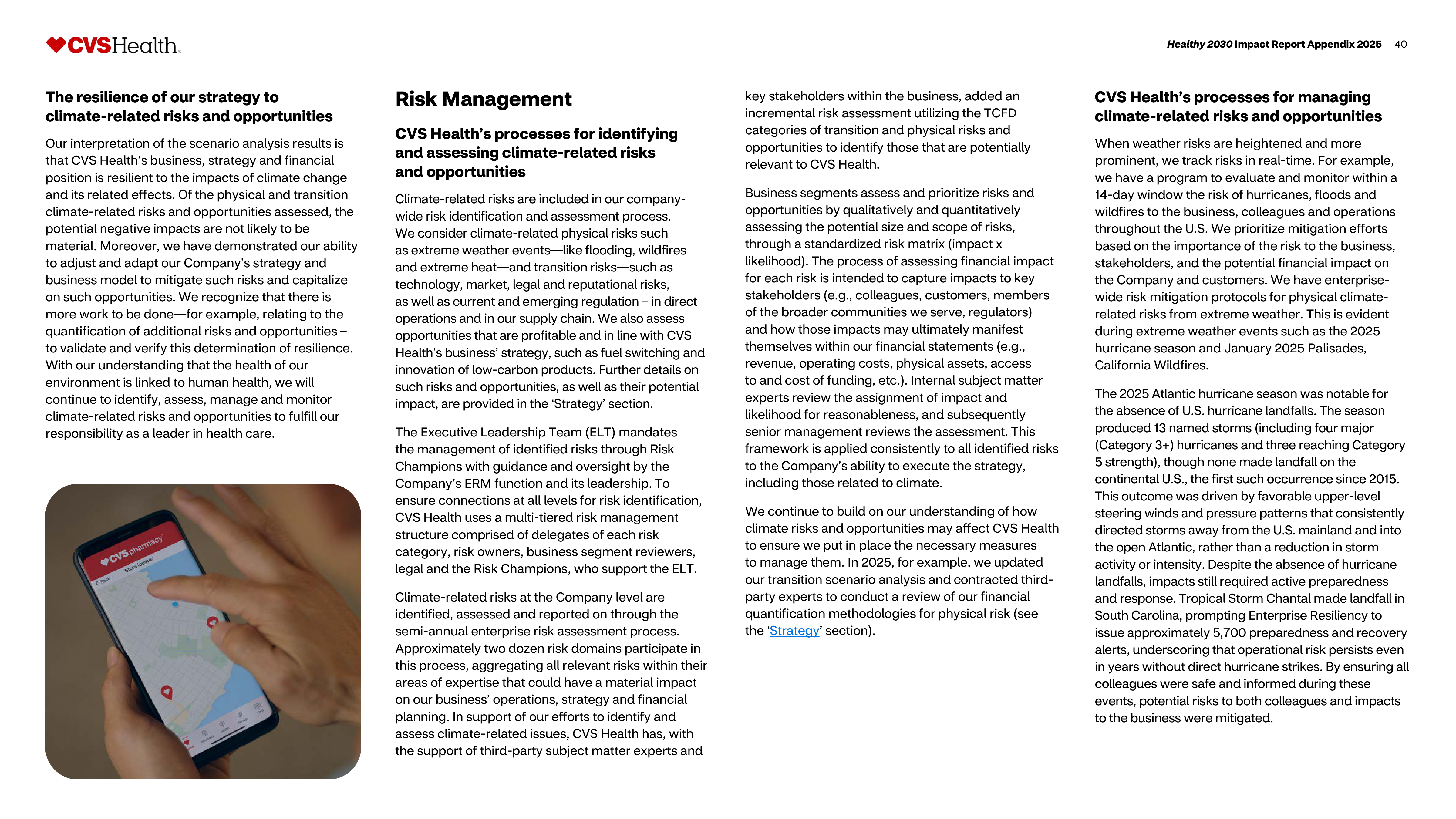

The resilience of our strategy to
climate-related risks and opportunities
Our interpretation of the scenario analysis results is
that CVS Health’s business, strategy and financial
position is resilient to the impacts of climate change
and its related effects. Of the physical and transition
climate-related risks and opportunities assessed, the
potential negative impacts are not likely to be
material. Moreover, we have demonstrated our ability
to adjust and adapt our Company’s strategy and
business model to mitigate such risks and capitalize
on such opportunities. We recognize that there is
more work to be done—for example, relating to the
quantification of additional risks and opportunities –
to validate and verify this determination of resilience.
With our understanding that the health of our
environment is linked to human health, we will
continue to identify, assess, manage and monitor
climate-related risks and opportunities to fulfill our
responsibility as a leader in health care.
Risk Management
CVS Health’s processes for identifying
and assessing climate-related risks
and opportunities
Climate-related risks are included in our company-
wide risk identification and assessment process.
We consider climate-related physical risks such
as extreme weather events—like flooding, wildfires
and extreme heat—and transition risks—such as
technology, market, legal and reputational risks,
as well as current and emerging regulation – in direct
operations and in our supply chain. We also assess
opportunities that are profitable and in line with CVS
Health’s business’ strategy, such as fuel switching and
innovation of low-carbon products. Further details on
such risks and opportunities, as well as their potential
impact, are provided in the ‘Strategy’ section.
The Executive Leadership Team (ELT) mandates
the management of identified risks through Risk
Champions with guidance and oversight by the
Company’s ERM function and its leadership. To
ensure connections at all levels for risk identification,
CVS Health uses a multi-tiered risk management
structure comprised of delegates of each risk
category, risk owners, business segment reviewers,
legal and the Risk Champions, who support the ELT.
Climate-related risks at the Company level are
identified, assessed and reported on through the
semi-annual enterprise risk assessment process.
Approximately two dozen risk domains participate in
this process, aggregating all relevant risks within their
areas of expertise that could have a material impact
on our business’ operations, strategy and financial
planning. In support of our efforts to identify and
assess climate-related issues, CVS Health has, with
the support of third-party subject matter experts and
key stakeholders within the business, added an
incremental risk assessment utilizing the TCFD
categories of transition and physical risks and
opportunities to identify those that are potentially
relevant to CVS Health.
Business segments assess and prioritize risks and
opportunities by qualitatively and quantitatively
assessing the potential size and scope of risks,
through a standardized risk matrix (impact x
likelihood). The process of assessing financial impact
for each risk is intended to capture impacts to key
stakeholders (e.g., colleagues, customers, members
of the broader communities we serve, regulators)
and how those impacts may ultimately manifest
themselves within our financial statements (e.g.,
revenue, operating costs, physical assets, access
to and cost of funding, etc.). Internal subject matter
experts review the assignment of impact and
likelihood for reasonableness, and subsequently
senior management reviews the assessment. This
framework is applied consistently to all identified risks
to the Company’s ability to execute the strategy,
including those related to climate.
We continue to build on our understanding of how
climate risks and opportunities may affect CVS Health
to ensure we put in place the necessary measures
to manage them. In 2025, for example, we updated
our transition scenario analysis and contracted third-
party experts to conduct a review of our financial
quantification methodologies for physical risk (see
the ‘
Strategy
’ section).
CVS Health’s processes for managing
climate-related risks and opportunities
When weather risks are heightened and more
prominent, we track risks in real-time. For example,
we have a program to evaluate and monitor within a
14-day window the risk of hurricanes, floods and
wildfires to the business, colleagues and operations
throughout the U.S. We prioritize mitigation efforts
based on the importance of the risk to the business,
stakeholders, and the potential financial impact on
the Company and customers. We have enterprise-
wide risk mitigation protocols for physical climate-
related risks from extreme weather. This is evident
during extreme weather events such as the 2025
hurricane season and January 2025 Palisades,
California Wildfires.
The 2025 Atlantic hurricane season was notable for
the absence of U.S. hurricane landfalls. The season
produced 13 named storms (including four major
(Category 3+) hurricanes and three reaching Category
5 strength), though none made landfall on the
continental U.S., the first such occurrence since 2015.
This outcome was driven by favorable upper‑level
steering winds and pressure patterns that consistently
directed storms away from the U.S. mainland and into
the open Atlantic, rather than a reduction in storm
activity or intensity. Despite the absence of hurricane
landfalls, impacts still required active preparedness
and response. Tropical Storm Chantal made landfall in
South Carolina, prompting Enterprise Resiliency to
issue approximately 5,700 preparedness and recovery
alerts, underscoring that operational risk persists even
in years without direct hurricane strikes. By ensuring all
colleagues were safe and informed during these
events, potential risks to both colleagues and impacts
to the business were mitigated.
Healthy 2030
Impact Report Appendix 2025
40
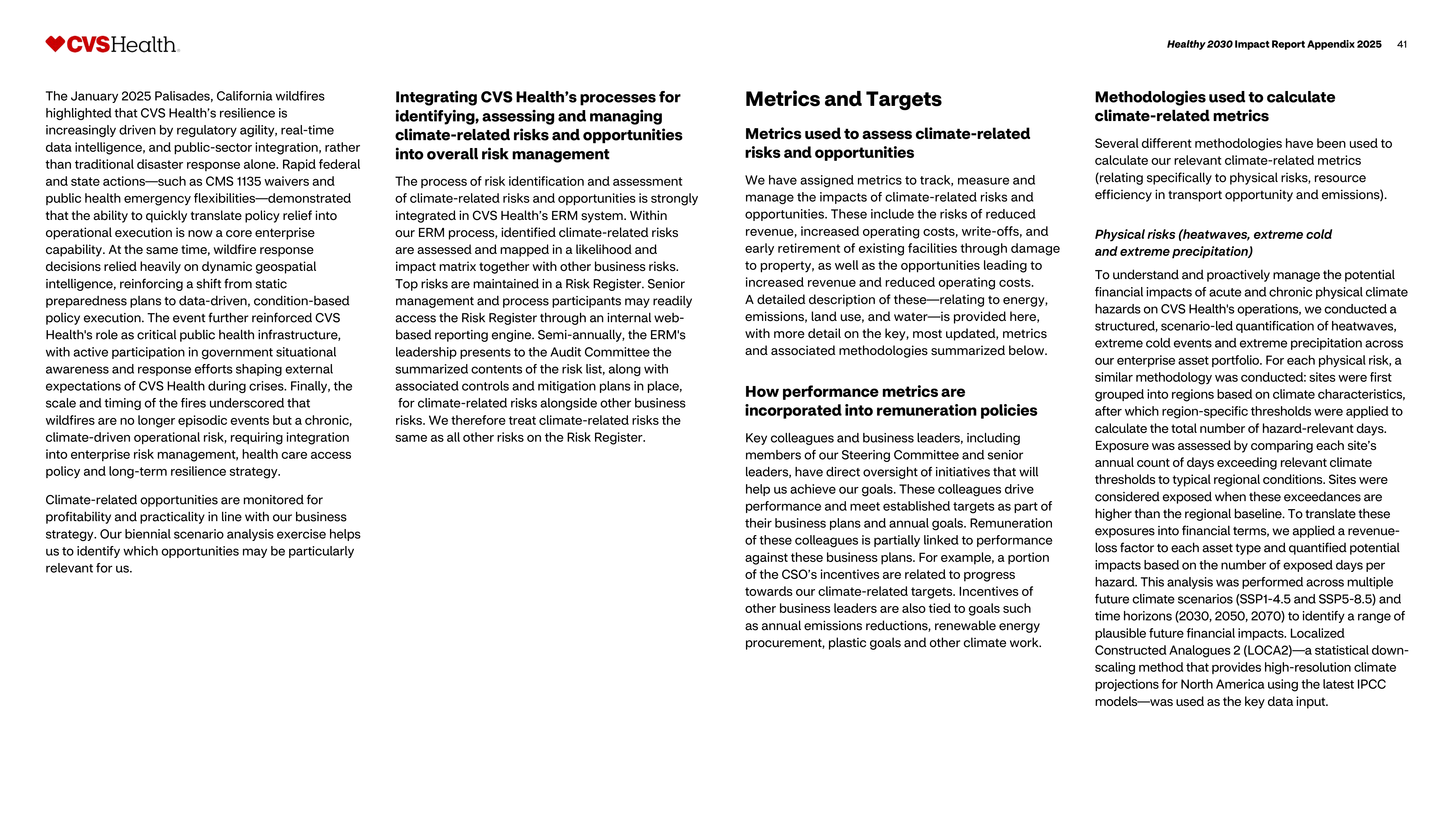

The January 2025 Palisades, California wildfires
highlighted that CVS Health’s resilience is
increasingly driven by regulatory agility, real‑time
data intelligence, and public‑sector integration, rather
than traditional disaster response alone. Rapid federal
and state actions—such as CMS 1135 waivers and
public health emergency flexibilities—demonstrated
that the ability to quickly translate policy relief into
operational execution is now a core enterprise
capability. At the same time, wildfire response
decisions relied heavily on dynamic geospatial
intelligence, reinforcing a shift from static
preparedness plans to data‑driven, condition‑based
policy execution. The event further reinforced CVS
Health's role as critical public health infrastructure,
with active participation in government situational
awareness and response efforts shaping external
expectations of CVS Health during crises. Finally, the
scale and timing of the fires underscored that
wildfires are no longer episodic events but a chronic,
climate‑driven operational risk, requiring integration
into enterprise risk management, health care access
policy and long‑term resilience strategy.
Climate-related opportunities are monitored for
profitability and practicality in line with our business
strategy. Our biennial scenario analysis exercise helps
us to identify which opportunities may be particularly
relevant for us.
Integrating CVS Health’s processes for
identifying, assessing and managing
climate-related risks and opportunities
into overall risk management
The process of risk identification and assessment
of climate-related risks and opportunities is strongly
integrated in CVS Health’s ERM system. Within
our ERM process, identified climate-related risks
are assessed and mapped in a likelihood and
impact matrix together with other business risks.
Top risks are maintained in a Risk Register. Senior
management and process participants may readily
access the Risk Register through an internal web-
based reporting engine. Semi-annually, the ERM's
leadership presents to the Audit Committee the
summarized contents of the risk list, along with
associated controls and mitigation plans in place,
for climate-related risks alongside other business
risks. We therefore treat climate-related risks the
same as all other risks on the Risk Register.
Metrics and Targets
Metrics used to assess climate-related
risks and opportunities
We have assigned metrics to track, measure and
manage the impacts of climate-related risks and
opportunities. These include the risks of reduced
revenue, increased operating costs, write-offs, and
early retirement of existing facilities through damage
to property, as well as the opportunities leading to
increased revenue and reduced operating costs.
A detailed description of these—relating to energy,
emissions, land use, and water—is provided here,
with more detail on the key, most updated, metrics
and associated methodologies summarized below.
How performance metrics are
incorporated into remuneration policies
Key colleagues and business leaders, including
members of our Steering Committee and senior
leaders, have direct oversight of initiatives that will
help us achieve our goals. These colleagues drive
performance and meet established targets as part of
their business plans and annual goals. Remuneration
of these colleagues is partially linked to performance
against these business plans. For example, a portion
of the CSO’s incentives are related to progress
towards our climate-related targets. Incentives of
other business leaders are also tied to goals such
as annual emissions reductions, renewable energy
procurement, plastic goals and other climate work.
Methodologies used to calculate
climate-related metrics
Several different methodologies have been used to
calculate our relevant climate-related metrics
(relating specifically to physical risks, resource
efficiency in transport opportunity and emissions).
Physical risks (heatwaves, extreme cold
and extreme precipitation)
To understand and proactively manage the potential
financial impacts of acute and chronic physical climate
hazards on CVS Health's operations, we conducted a
structured, scenario-led quantification of heatwaves,
extreme cold events and extreme precipitation across
our enterprise asset portfolio. For each physical risk, a
similar methodology was conducted: sites were first
grouped into regions based on climate characteristics,
after which region-specific thresholds were applied to
calculate the total number of hazard-relevant days.
Exposure was assessed by comparing each site’s
annual count of days exceeding relevant climate
thresholds to typical regional conditions. Sites were
considered exposed when these exceedances are
higher than the regional baseline. To translate these
exposures into financial terms, we applied a revenue-
loss factor to each asset type and quantified potential
impacts based on the number of exposed days per
hazard. This analysis was performed across multiple
future climate scenarios (SSP1-4.5 and SSP5-8.5) and
time horizons (2030, 2050, 2070) to identify a range of
plausible future financial impacts. Localized
Constructed Analogues 2 (LOCA2)—a statistical down-
scaling method that provides high-resolution climate
projections for North America using the latest IPCC
models—was used as the key data input.
Healthy 2030
Impact Report Appendix 2025
41
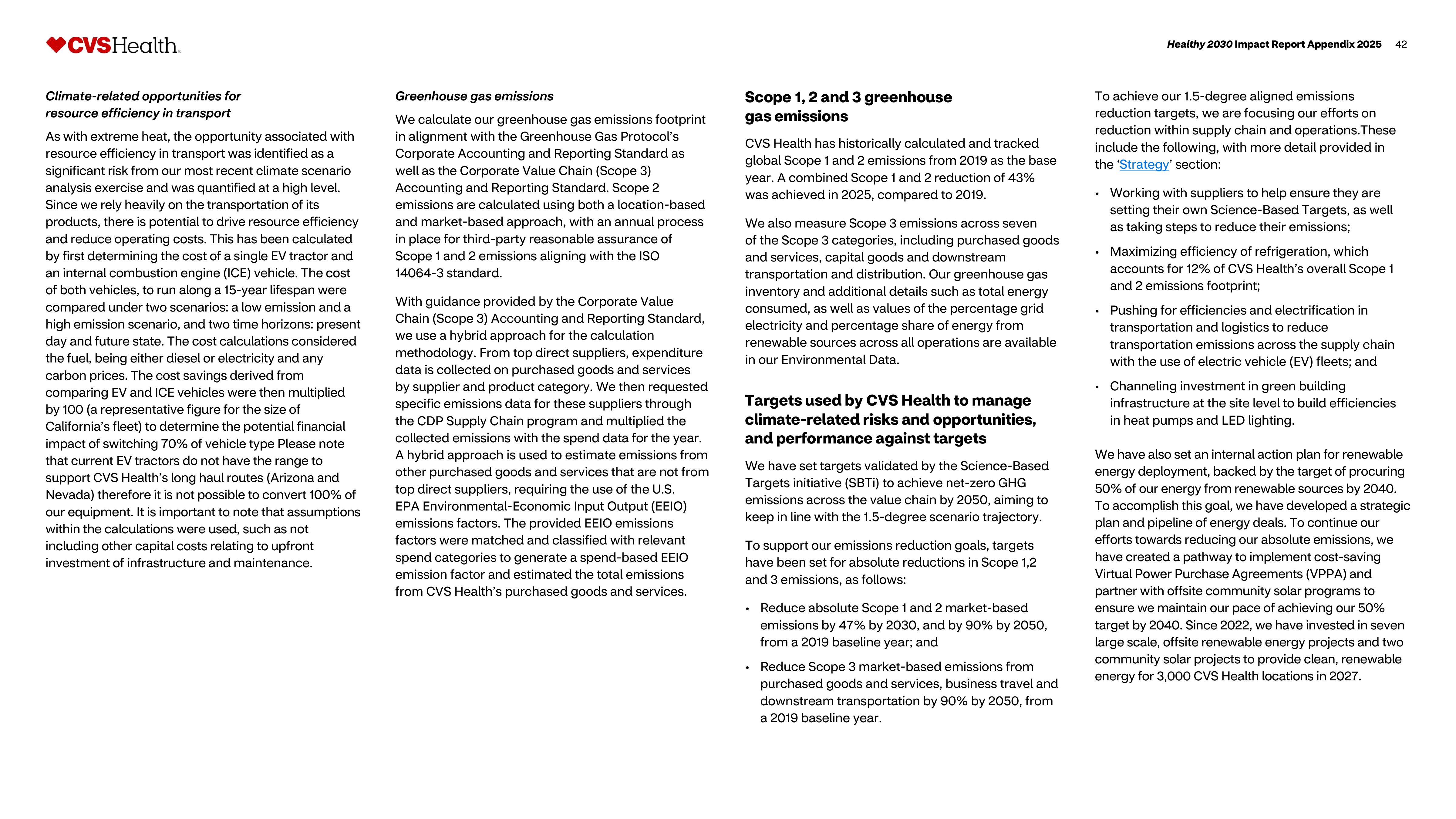

Climate-related opportunities for
resource efficiency in transport
As with extreme heat, the opportunity associated with
resource efficiency in transport was identified as a
significant risk from our most recent climate scenario
analysis exercise and was quantified at a high level.
Since we rely heavily on the transportation of its
products, there is potential to drive resource efficiency
and reduce operating costs. This has been calculated
by first determining the cost of a single EV tractor and
an internal combustion engine (ICE) vehicle. The cost
of both vehicles, to run along a 15-year lifespan were
compared under two scenarios: a low emission and a
high emission scenario, and two time horizons: present
day and future state. The cost calculations considered
the fuel, being either diesel or electricity and any
carbon prices. The cost savings derived from
comparing EV and ICE vehicles were then multiplied
by 100 (a representative figure for the size of
California’s fleet) to determine the potential financial
impact of switching 70% of vehicle type Please note
that current EV tractors do not have the range to
support CVS Health’s long haul routes (Arizona and
Nevada) therefore it is not possible to convert 100% of
our equipment. It is important to note that assumptions
within the calculations were used, such as not
including other capital costs relating to upfront
investment of infrastructure and maintenance.
Greenhouse gas emissions
We calculate our greenhouse gas emissions footprint
in alignment with the Greenhouse Gas Protocol’s
Corporate Accounting and Reporting Standard as
well as the Corporate Value Chain (Scope 3)
Accounting and Reporting Standard. Scope 2
emissions are calculated using both a location-based
and market-based approach, with an annual process
in place for third-party reasonable assurance of
Scope 1 and 2 emissions aligning with the ISO
14064-3 standard.
With guidance provided by the Corporate Value
Chain (Scope 3) Accounting and Reporting Standard,
we use a hybrid approach for the calculation
methodology. From top direct suppliers, expenditure
data is collected on purchased goods and services
by supplier and product category. We then requested
specific emissions data for these suppliers through
the CDP Supply Chain program and multiplied the
collected emissions with the spend data for the year.
A hybrid approach is used to estimate emissions from
other purchased goods and services that are not from
top direct suppliers, requiring the use of the U.S.
EPA Environmental-Economic Input Output (EEIO)
emissions factors. The provided EEIO emissions
factors were matched and classified with relevant
spend categories to generate a spend-based EEIO
emission factor and estimated the total emissions
from CVS Health’s purchased goods and services.
Scope 1, 2 and 3 greenhouse
gas emissions
CVS Health has historically calculated and tracked
global Scope 1 and 2 emissions from 2019 as the base
year. A combined Scope 1 and 2 reduction of 43%
was achieved in 2025, compared to 2019.
We also measure Scope 3 emissions across seven
of the Scope 3 categories, including purchased goods
and services, capital goods and downstream
transportation and distribution. Our greenhouse gas
inventory and additional details such as total energy
consumed, as well as values of the percentage grid
electricity and percentage share of energy from
renewable sources across all operations are available
in our Environmental Data.
Targets used by CVS Health to manage
climate-related risks and opportunities,
and performance against targets
We have set targets validated by the Science-Based
Targets initiative (SBTi) to achieve net-zero GHG
emissions across the value chain by 2050, aiming to
keep in line with the 1.5-degree scenario trajectory.
To support our emissions reduction goals, targets
have been set for absolute reductions in Scope 1,2
and 3 emissions, as follows:
•
Reduce absolute Scope 1 and 2 market-based
emissions by 47% by 2030, and by 90% by 2050,
from a 2019 baseline year; and
•
Reduce Scope 3 market-based emissions from
purchased goods and services, business travel and
downstream transportation by 90% by 2050, from
a 2019 baseline year.
To achieve our 1.5-degree aligned emissions
reduction targets, we are focusing our efforts on
reduction within supply chain and operations.These
include the following, with more detail provided in
the ‘
Strategy
’ section:
•
Working with suppliers to help ensure they are
setting their own Science-Based Targets, as well
as taking steps to reduce their emissions;
•
Maximizing efficiency of refrigeration, which
accounts for 12% of CVS Health’s overall Scope 1
and 2 emissions footprint;
•
Pushing for efficiencies and electrification in
transportation and logistics to reduce
transportation emissions across the supply chain
with the use of electric vehicle (EV) fleets; and
•
Channeling investment in green building
infrastructure at the site level to build efficiencies
in heat pumps and LED lighting.
We have also set an internal action plan for renewable
energy deployment, backed by the target of procuring
50% of our energy from renewable sources by 2040.
To accomplish this goal, we have developed a strategic
plan and pipeline of energy deals. To continue our
efforts towards reducing our absolute emissions, we
have created a pathway to implement cost-saving
Virtual Power Purchase Agreements (VPPA) and
partner with offsite community solar programs to
ensure we maintain our pace of achieving our 50%
target by 2040. Since 2022, we have invested in seven
large scale, offsite renewable energy projects and two
community solar projects to provide clean, renewable
energy for 3,000 CVS Health locations in 2027.
Healthy 2030
Impact Report Appendix 2025
42
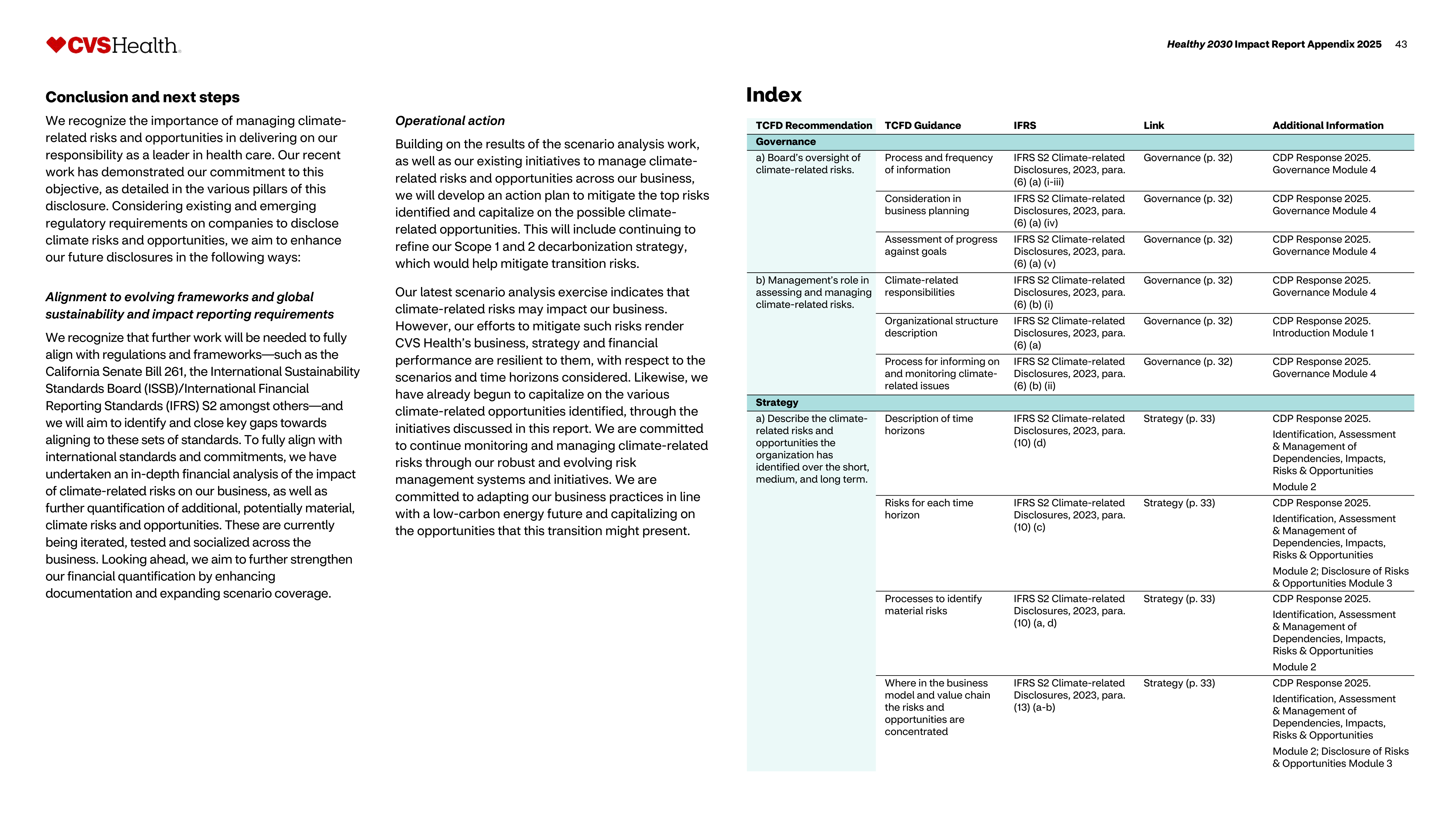

Conclusion and next steps
We recognize the importance of managing climate-
related risks and opportunities in delivering on our
responsibility as a leader in health care. Our recent
work has demonstrated our commitment to this
objective, as detailed in the various pillars of this
disclosure. Considering existing and emerging
regulatory requirements on companies to disclose
climate risks and opportunities, we aim to enhance
our future disclosures in the following ways:
Alignment to evolving frameworks and global
sustainability and impact reporting requirements
We recognize that further work will be needed to fully
align with regulations and frameworks—such as the
California Senate Bill 261, the International Sustainability
Standards Board (ISSB)/International Financial
Reporting Standards (IFRS) S2 amongst others—and
we will aim to identify and close key gaps towards
aligning to these sets of standards. To fully align with
international standards and commitments, we have
undertaken an in-depth financial analysis of the impact
of climate-related risks on our business, as well as
further quantification of additional, potentially material,
climate risks and opportunities. These are currently
being iterated, tested and socialized across the
business. Looking ahead, we aim to further strengthen
our financial quantification by enhancing
documentation and expanding scenario coverage.
Operational action
Building on the results of the scenario analysis work,
as well as our existing initiatives to manage climate-
related risks and opportunities across our business,
we will develop an action plan to mitigate the top risks
identified and capitalize on the possible climate-
related opportunities. This will include continuing to
refine our Scope 1 and 2 decarbonization strategy,
which would help mitigate transition risks.
Our latest scenario analysis exercise indicates that
climate-related risks may impact our business.
However, our efforts to mitigate such risks render
CVS Health’s business, strategy and financial
performance are resilient to them, with respect to the
scenarios and time horizons considered. Likewise, we
have already begun to capitalize on the various
climate-related opportunities identified, through the
initiatives discussed in this report. We are committed
to continue monitoring and managing climate-related
risks through our robust and evolving risk
management systems and initiatives. We are
committed to adapting our business practices in line
with a low-carbon energy future and capitalizing on
the opportunities that this transition might present.
Healthy 2030
Impact Report Appendix 2025
43
Index
TCFD Recommendation
TCFD Guidance
IFRS
Link
Additional Information
Governance
a) Board’s oversight of
climate-related risks.
Process and frequency
of information
IFRS S2 Climate-related
Disclosures, 2023, para.
(6) (a) (i-iii)
Governance (p. 32)
CDP Response 2025.
Governance Module 4
Consideration in
business planning
IFRS S2 Climate-related
Disclosures, 2023, para.
(6) (a) (iv)
Governance (p. 32)
CDP Response 2025.
Governance Module 4
Assessment of progress
against goals
IFRS S2 Climate-related
Disclosures, 2023, para.
(6) (a) (v)
Governance (p. 32)
CDP Response 2025.
Governance Module 4
b) Management’s role in
assessing and managing
climate-related risks.
Climate-related
responsibilities
IFRS S2 Climate-related
Disclosures, 2023, para.
(6) (b) (i)
Governance (p. 32)
CDP Response 2025.
Governance Module 4
Organizational structure
description
IFRS S2 Climate-related
Disclosures, 2023, para.
(6) (a)
Governance (p. 32)
CDP Response 2025.
Introduction Module 1
Process for informing on
and monitoring climate-
related issues
IFRS S2 Climate-related
Disclosures, 2023, para.
(6) (b) (ii)
Governance (p. 32)
CDP Response 2025.
Governance Module 4
Strategy
a) Describe the climate-
related risks and
opportunities the
organization has
identified over the short,
medium, and long term.
Description of time
horizons
IFRS S2 Climate-related
Disclosures, 2023, para.
(10) (d)
Strategy (p. 33)
CDP Response 2025.
Identification, Assessment
& Management of
Dependencies, Impacts,
Risks & Opportunities
Module 2
Risks for each time
horizon
IFRS S2 Climate-related
Disclosures, 2023, para.
(10) (c)
Strategy (p. 33)
CDP Response 2025.
Identification, Assessment
& Management of
Dependencies, Impacts,
Risks & Opportunities
Module 2; Disclosure of Risks
& Opportunities Module 3
Processes to identify
material risks
IFRS S2 Climate-related
Disclosures, 2023, para.
(10) (a, d)
Strategy (p. 33)
CDP Response 2025.
Identification, Assessment
& Management of
Dependencies, Impacts,
Risks & Opportunities
Module 2
Where in the business
model and value chain
the risks and
opportunities are
concentrated
IFRS S2 Climate-related
Disclosures, 2023, para.
(13) (a-b)
Strategy (p. 33)
CDP Response 2025.
Identification, Assessment
& Management of
Dependencies, Impacts,
Risks & Opportunities
Module 2; Disclosure of Risks
& Opportunities Module 3
a) Boards oversight of climate-related risks.
a) Boards oversight of climate-related risks.
b) Managements role in assessing and managing climate-related risks.
b) Managements role in assessing and managing climate-related risks.
a) Describe the climate- related risks and opportunities the organization has identified over the short, medium, and long term.
a) Describe the climate- related risks and opportunities the organization has identified over the short, medium, and long term.
a) Describe the climate- related risks and opportunities the organization has identified over the short, medium, and long term.
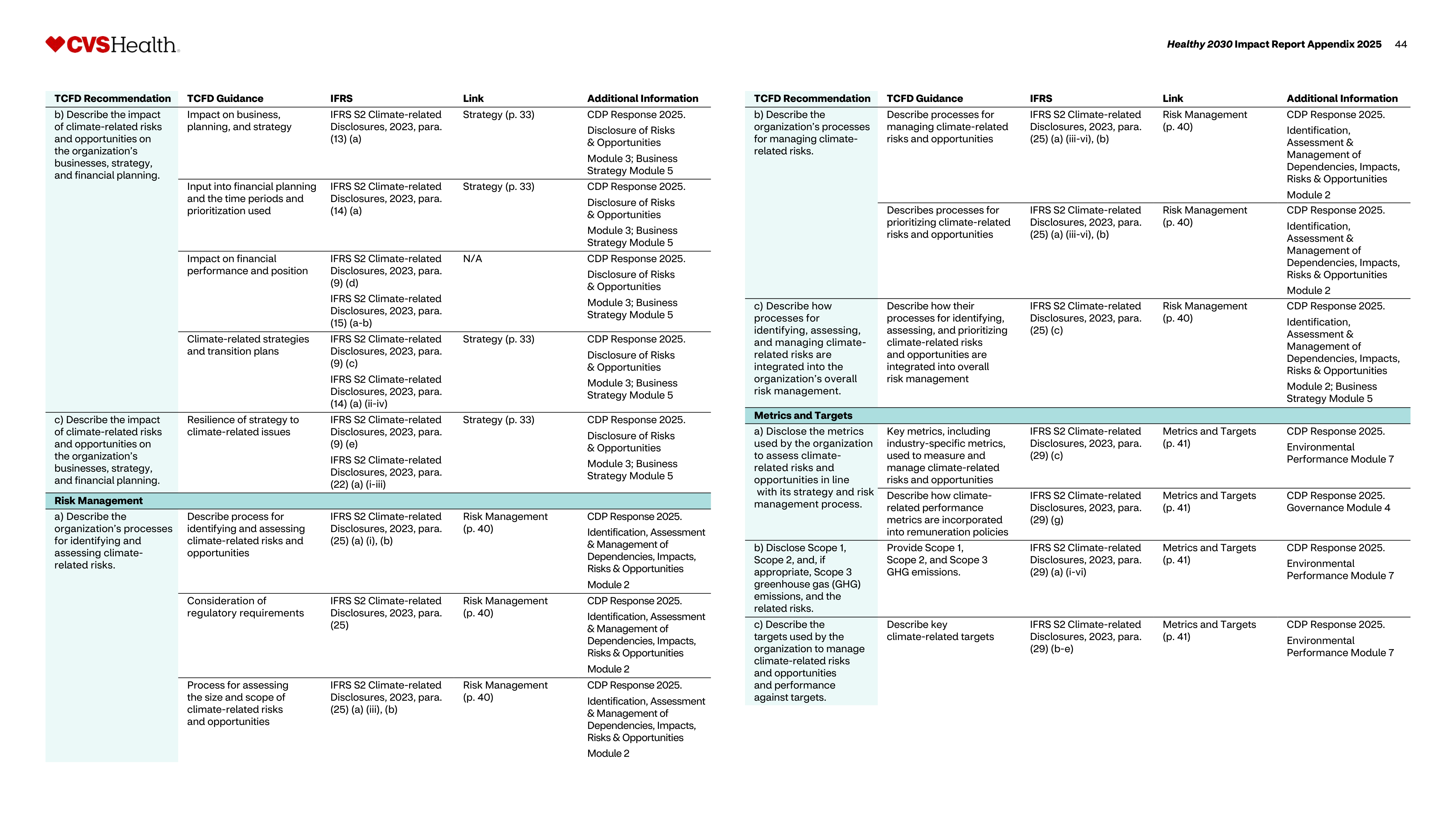

b) Describe the impact
of climate-related risks
and opportunities on
the organization’s
businesses, strategy,
and financial planning.
Impact on business,
planning, and strategy
IFRS S2 Climate-related
Disclosures, 2023, para.
(13) (a)
Strategy (p. 33)
CDP Response 2025.
Disclosure of Risks
& Opportunities
Module 3; Business
Strategy Module 5
Input into financial planning
and the time periods and
prioritization used
IFRS S2 Climate-related
Disclosures, 2023, para.
(14) (a)
Strategy (p. 33)
CDP Response 2025.
Disclosure of Risks
& Opportunities
Module 3; Business
Strategy Module 5
Impact on financial
performance and position
IFRS S2 Climate-related
Disclosures, 2023, para.
(9) (d)
IFRS S2 Climate-related
Disclosures, 2023, para.
(15) (a-b)
N/A
CDP Response 2025.
Disclosure of Risks
& Opportunities
Module 3; Business
Strategy Module 5
Climate-related strategies
and transition plans
IFRS S2 Climate-related
Disclosures, 2023, para.
(9) (c)
IFRS S2 Climate-related
Disclosures, 2023, para.
(14) (a) (ii-iv)
Strategy (p. 33)
CDP Response 2025.
Disclosure of Risks
& Opportunities
Module 3; Business
Strategy Module 5
c) Describe the impact
of climate-related risks
and opportunities on
the organization’s
businesses, strategy,
and financial planning.
Resilience of strategy to
climate-related issues
IFRS S2 Climate-related
Disclosures, 2023, para.
(9) (e)
IFRS S2 Climate-related
Disclosures, 2023, para.
(22) (a) (i-iii)
Strategy (p. 33)
CDP Response 2025.
Disclosure of Risks
& Opportunities
Module 3; Business
Strategy Module 5
Risk Management
a) Describe the
organization’s processes
for identifying and
assessing climate-
related risks.
Describe process for
identifying and assessing
climate-related risks and
opportunities
IFRS S2 Climate-related
Disclosures, 2023, para.
(25) (a) (i), (b)
Risk Management
(p. 40)
CDP Response 2025.
Identification, Assessment
& Management of
Dependencies, Impacts,
Risks & Opportunities
Module 2
Consideration of
regulatory requirements
IFRS S2 Climate-related
Disclosures, 2023, para.
(25)
Risk Management
(p. 40)
CDP Response 2025.
Identification, Assessment
& Management of
Dependencies, Impacts,
Risks & Opportunities
Module 2
Process for assessing
the size and scope of
climate-related risks
and opportunities
IFRS S2 Climate-related
Disclosures, 2023, para.
(25) (a) (iii), (b)
Risk Management
(p. 40)
CDP Response 2025.
Identification, Assessment
& Management of
Dependencies, Impacts,
Risks & Opportunities
Module 2
TCFD Recommendation
TCFD Guidance
IFRS
Link
Additional Information
b) Describe the
organization’s processes
for managing climate-
related risks.
Describe processes for
managing climate-related
risks and opportunities
IFRS S2 Climate-related
Disclosures, 2023, para.
(25) (a) (iii-vi), (b)
Risk Management
(p. 40)
CDP Response 2025.
Identification,
Assessment &
Management of
Dependencies, Impacts,
Risks & Opportunities
Module 2
Describes processes for
prioritizing climate-related
risks and opportunities
IFRS S2 Climate-related
Disclosures, 2023, para.
(25) (a) (iii-vi), (b)
Risk Management
(p. 40)
CDP Response 2025.
Identification,
Assessment &
Management of
Dependencies, Impacts,
Risks & Opportunities
Module 2
c) Describe how
processes for
identifying, assessing,
and managing climate-
related risks are
integrated into the
organization’s overall
risk management.
Describe how their
processes for identifying,
assessing, and prioritizing
climate-related risks
and opportunities are
integrated into overall
risk management
IFRS S2 Climate-related
Disclosures, 2023, para.
(25) (c)
Risk Management
(p. 40)
CDP Response 2025.
Identification,
Assessment &
Management of
Dependencies, Impacts,
Risks & Opportunities
Module 2; Business
Strategy Module 5
Metrics and Targets
a) Disclose the metrics
used by the organization
to assess climate-
related risks and
opportunities in line
with its strategy and risk
management process.
Key metrics, including
industry-specific metrics,
used to measure and
manage climate-related
risks and opportunities
IFRS S2 Climate-related
Disclosures, 2023, para.
(29) (c)
Metrics and Targets
(p. 41)
CDP Response 2025.
Environmental
Performance Module 7
Describe how climate-
related performance
metrics are incorporated
into remuneration policies
IFRS S2 Climate-related
Disclosures, 2023, para.
(29) (g)
Metrics and Targets
(p. 41)
CDP Response 2025.
Governance Module 4
b) Disclose Scope 1,
Scope 2, and, if
appropriate, Scope 3
greenhouse gas (GHG)
emissions, and the
related risks.
Provide Scope 1,
Scope 2, and Scope 3
GHG emissions.
IFRS S2 Climate-related
Disclosures, 2023, para.
(29) (a) (i-vi)
Metrics and Targets
(p. 41)
CDP Response 2025.
Environmental
Performance Module 7
c) Describe the
targets used by the
organization to manage
climate-related risks
and opportunities
and performance
against targets.
Describe key
climate-related targets
IFRS S2 Climate-related
Disclosures, 2023, para.
(29) (b-e)
Metrics and Targets
(p. 41)
CDP Response 2025.
Environmental
Performance Module 7
TCFD Recommendation
TCFD Guidance
IFRS
Link
Additional Information
Healthy 2030
Impact Report Appendix 2025
44
b) Describe the impact of climate-related risks and opportunities on the organizations businesses, strategy, and financial planning.
b) Describe the impact of climate-related risks and opportunities on the organizations businesses, strategy, and financial planning.
b) Describe the impact of climate-related risks and opportunities on the organizations businesses, strategy, and financial planning.
a) Describe the organizations processes for identifying and assessing climate- related risks.
a) Describe the organizations processes for identifying and assessing climate- related risks.
b) Describe the organizations processes for managing climate- related risks.
a) Disclose the metrics used by the organization to assess climate- related risks and opportunities in line with its strategy and risk management process
a) Disclose the metrics used by the organization to assess climate- related risks and opportunities in line with its strategy and risk management process