

On The Road to Better
Helping
Build
a Better
World
2025
Integrated Sustainability
and Financial Report
sustainability.ford.com I shareholder.ford.com
Fundamentals
Sustainability at Ford
Products and Services
Environment
Social
Governance
Sustainability Statement
Data
Appendices
On The Road to Better
| Letter from Ford and Farley | Contents
|
Ford at a Glance
|
Our Leadership in Sustainability
|
Financial Highlights
On The Road
to Better
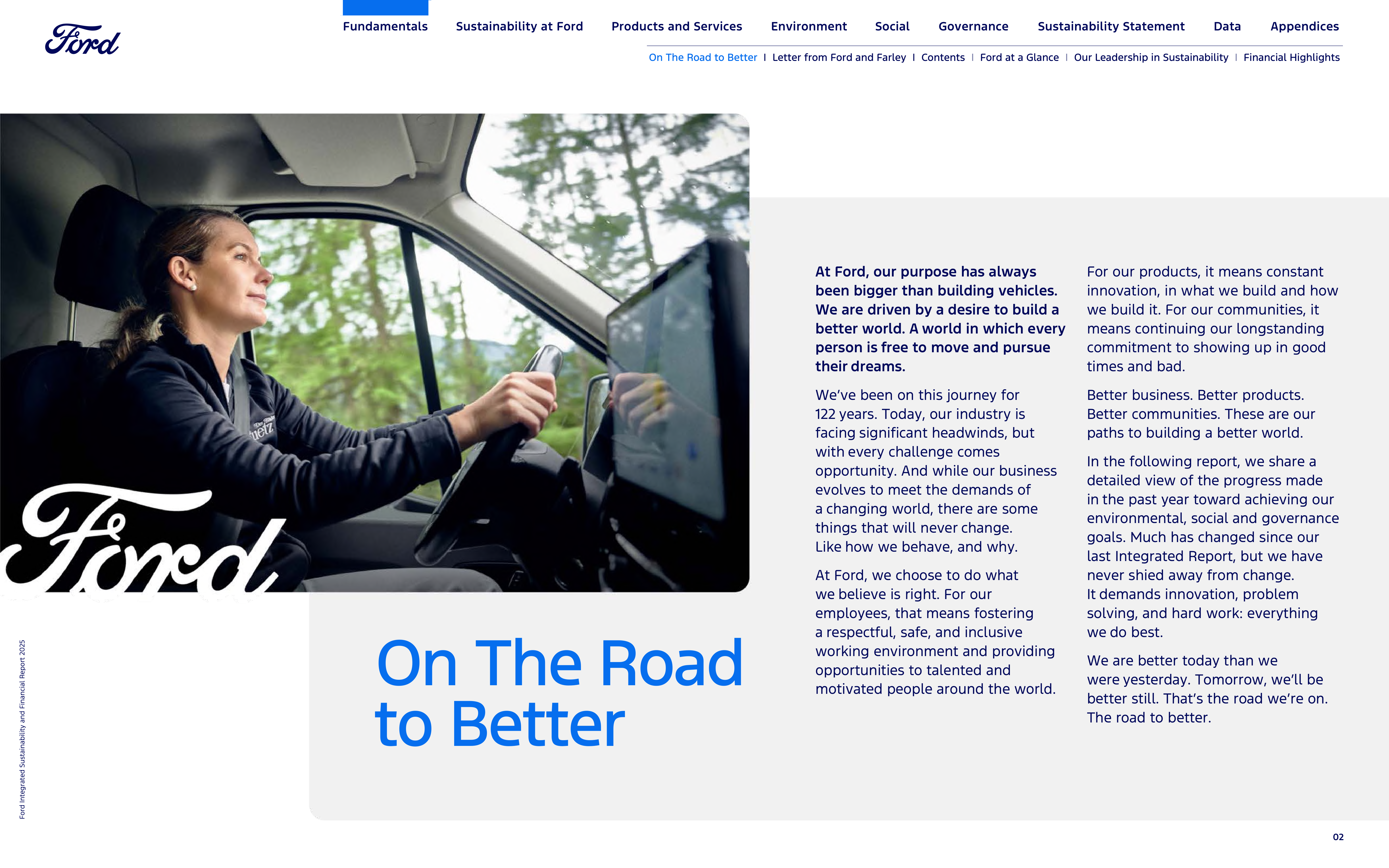
At Ford, our purpose has always
been bigger than building vehicles.
We are driven by a desire to build a
better world. A world in which every
person is free to move and pursue
their dreams.
We’ve been on this journey for
122 years. Today, our industry is
facing significant headwinds, but
with every challenge comes
opportunity. And while our business
evolves to meet the demands of
a changing world, there are some
things that will never change.
Like how we behave, and why.
At Ford, we choose to do what
we believe is right. For our
employees, that means fostering
a respectful, safe, and inclusive
working environment and providing
opportunities to talented and
motivated people around the world.
For our products, it means constant
innovation, in what we build and how
we build it. For our communities, it
means continuing our longstanding
commitment to showing up in good
times and bad.
Better business. Better products.
Better communities. These are our
paths to building a better world.
In the following report, we share a
detailed view of the progress made
in the past year toward achieving our
environmental, social and governance
goals. Much has changed since our
last Integrated Report, but we have
never shied away from change.
It demands innovation, problem
solving, and hard work: everything
we do best.
We are better today than we
were yesterday. Tomorrow, we’ll be
better still. That’s the road we’re on.
The road to better.
Ford Integrated Sustainability and Financial Report 2025
02

Fundamentals
Sustainability at Ford
Products and Services
Environment
Social
Governance
Sustainability Statement
Data
Appendices
On The Road to Better |
Letter from Ford and Farley
|
Contents
|
Ford at a Glance
|
Our Leadership in Sustainability
|
Financial Highlights
Letter from Bill Ford
and Jim Farley
Ford Integrated Sustainability and Financial Report 2025
03
“
Our industry is experiencing
change at a remarkable
rate and magnitude, and
Ford is seizing this
opportunity to lead and
help build a better world.
”
Bill Ford, Executive Chair
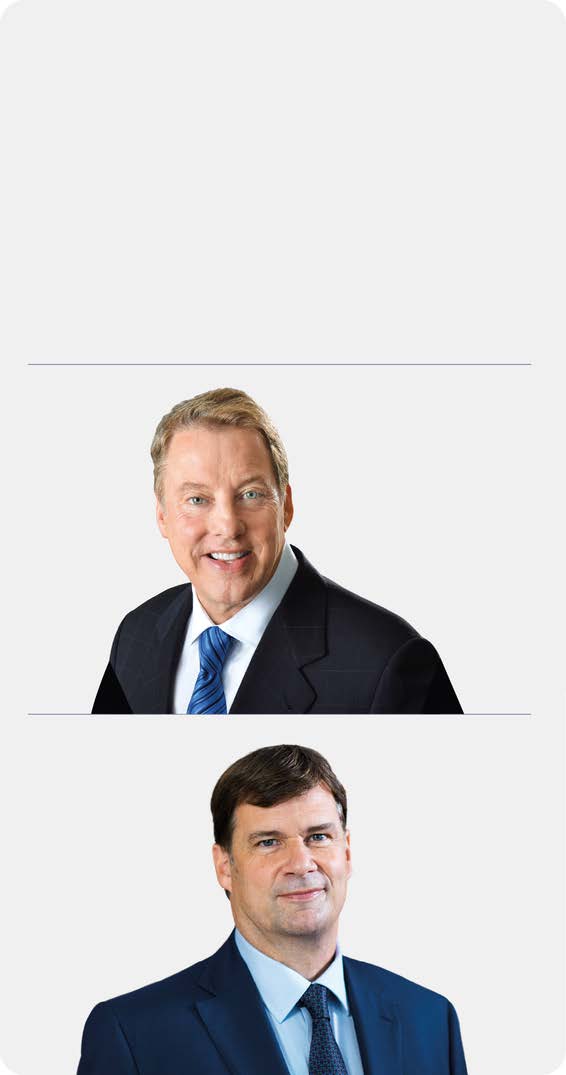
BILL FORD
JIM FARLEY
Throughout our 122-year history, Ford has been
repeatedly tested by new competition, economic and
political turmoil, shifting regulations, and disruptive
changes in technology.
We have not only survived but continued to thrive and
grow by evolving our strategy to meet the challenges
ahead, focusing on customers, and remaining true to
our bedrock commitment to build a better world where
every person is free to move and pursue their dreams.
We are taking on the challenges of today and tomorrow
with this same spirit of optimism, self-reliance, and
determination.
In 2024, we made significant progress even while
experiencing the bumps and unexpected turns that
come with charting a new path. We generated the
highest revenue in the history of our company, driven
by a product lineup that offers customers unprecedented
choice. Ford was the #1 gas, #2 electric, and #3 hybrid
vehicle brand in America for the second year in a row.
Ford Pro, our commercial division, had another strong
year and continues to lead the growth of our vibrant
software-and-services business. We also made progress
on our goal to deliver industry-leading quality while
becoming more cost-efficient.
In 2025, we will continue to develop our Ford+ plan to
combine our industrial strengths and iconic brands with new
capabilities, technologies, and services to give customers
more value and a constantly improving experience.
Last year, more customers chose an electrified Ford
vehicle than ever before. Total Ford electrified vehicle
sales (hybrid, plug-in hybrid and electric) hit a record this
year in the US — up 38% from 2023. Our hybrid lineup,
particularly trucks, is growing in popularity as customers
seek improved fuel economy and unique features like
Pro Power Onboard, which works as a mobile generator to
power worksites, camp sites, and even homes. We expect
to increase global sales of our electric vehicles this year,
led by new launches in Europe and initiatives like Ford
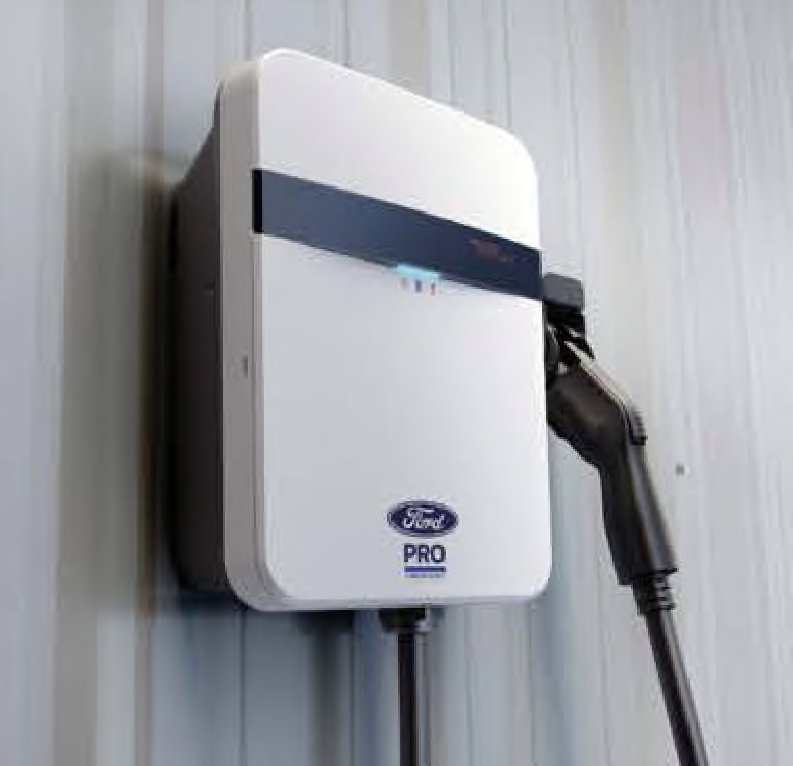
Power Promise, which offers free home-charger
installations in the United States, Canada, and Europe.
We’re also deep into the development of our future
electric vehicles, which we expect to be profitable,
affordable, and high-volume.
And at Ford, we believe it’s not just what we build but also
how we build. Across our global facilities, we are lessening
our environmental impact by conserving water, reducing
waste, recycling, and improving energy efficiency. Over the
past decade, Ford recycled an estimated 2 billion pounds of
aluminum during the manufacturing of our all-aluminum-
body F-series models — enough to build roughly 37,000
F‑series truck bodies each month. Moreover, by 2027, all of
our manufacturing in Michigan will be powered by 100%
carbon-free electricity, including wind- and solar-
generated power.
We believe lasting change requires working together.
That’s why Ford helped launch Transform: Auto,
partnering with competitors to leverage our collective
buying power and investing in renewable energy across
North American supply chains. Through our strategic
partnership with Manufacture 2030, we are providing
suppliers with the support and tools they need to
achieve their own carbon neutrality goals. By promoting
the highest standards for efficiency and innovation
across our supply chain, we can ensure we continue to
create best-in class products and services for our
customers and move closer to our aspiration to achieve
carbon neutrality in our vehicles, manufacturing facilities,
and supply chains globally by 2050.
As a family-led company, Ford continues to invest in
our employees. We are on track for approximately 90% of
our global employees to be working in new or renovated
workspaces by 2027. And we remain deeply committed
to fostering a respectful, safe, and inclusive working
environment and providing opportunities to talented
and motivated people around the world.
We also continue to show up for our communities in
good times and bad. Last year, we aided recovery efforts
in the southeastern United States after devastating
hurricanes and around the world in places like Valencia,
Spain, and Northern Thailand. The global disaster-relief
support we provided our partners through Ford
Philanthropy and through our generous network of
dealers — who contribute so much to their communities
year-round — was an example of Ford at its best.
We’re listening to and learning from our local stakeholders
to deliver initiatives that make a real difference in their
lives, like our Good Neighbor Plan in West Tennessee
and nature-conservation efforts near our manufacturing
facilities. The reopening of Michigan Central Station as a
hub for culture and innovation in Detroit, after Ford’s
extensive six-year restoration, is a powerful statement
of our commitment to the city we call home.
Ford sees our mission as bigger than the vehicles and
experiences we deliver. We’re driven by a passion for our
work and a desire to improve lives, strengthen communities,
and leave a better world for future generations. Doing
business honestly, protecting the environment, stepping
up for our neighbors, and championing American
manufacturing — that is what Ford represents to our
employees, customers, dealers, suppliers, and investors.
In the pages of this report, we hope you will see the story
of this great company, its extraordinary people, and the
progress we are making together along the Road to Better.
Bill Ford
Executive Chair
Jim Farley
President, and Chief Executive Officer
Fundamentals
Sustainability at Ford
Products and Services
Environment
Social
Governance
Sustainability Statement
Data
Appendices
On The Road to Better | Letter from Ford and Farley |
Contents
|
Ford at a Glance
|
Our Leadership in Sustainability
|
Financial Highlights
About this report
Our purpose is to help build a better world where every person is free to
move and pursue their dreams. Building a strong, sustainable business
takes commitment, effort, and persistence. By advancing groundbreaking
technology, supporting our people, our partners, and our customers, and
protecting our planet, we are ensuring that Ford Motor Company will be
here for generations to come.
This year marks our 26th annual sustainability report and fifth Integrated
Sustainability and Financial Report, and we are committed to maintaining
our leadership position in sustainability reporting. That’s why this year we
are including a Sustainability Statement within our Integrated Report in
accordance with the European Union Corporate Sustainability Reporting
Directive (CSRD) (
EU 2023/2772 of 31 July 2023
).
We also continue to align with existing best practice reporting
frameworks including, but not limited to, the IFRS Foundation
International Framework, Global Reporting Initiative (GRI) Standards,
Task Force on Climate-Related Financial Disclosures (TCFD), Sustainability
Accounting Standards Board (SASB), United Nations Guiding Principles
Reporting Framework (UNGPRF), and the United Nations Sustainable
Development Goals (UN SDGs).
This Integrated Report examines our business through four lenses:
Products and Services, Environment, Social, and Governance. Underlying
the entire report is our approach to sustainability, along with our
sustainability aspirations and achievements.
We welcome you to share with us your feedback and any comments you
may have at
sustaina@ford.com
.
→
Read More: On our website
Ford Integrated Sustainability and Financial Report 2025
04
A number of our environmental, social and sustainability goals and statements may depend on the adoption of certain
behaviors and activities by third parties, including our customers, suppliers and partners. If those parties do not adopt
certain behaviors or activities, or invest in certain evolving technologies, we may not be able to meet some of our goals.
Additionally, we are engaged in certain projects, solutions, and technologies that, should they not perform as we expect,
could negatively affect our ability to meet some goals on time or at all. We also cannot control or predict the behavior or
activities of third parties; even where we have adopted policies or procedures to influence or guide third parties, such
policies or procedures may fail to produce the desired result. Finally, we make certain claims regarding our products and
projects, including through our policies and procedures applicable to third parties’ sustainability efforts; however, there can
be no guarantee that our products, projects, or efforts will have the effects we anticipate or intend.
While this report leverages certain third-party standards as part of our disclosures, any language of “alignment” or similar
should not be taken to mean or guarantee strict adherence to those standards. Disclosures based on standards may change
due to revisions in framework requirements, availability or quality of information, changes in business or applicable
government policies, or other factors, some of which may be beyond our control.
Fundamentals
03
03
Letter From Bill Ford and Jim Farley
04
About this Report
05
Ford at a Glance
06
Our Leadership in Sustainability
08
Financial Highlights
Sustainability at Ford
10
11
Our Sustainability Aspirations
12
Sustainability Strategy
13
How We Create Sustainable Value
14
Accelerating Progress Towards our Aspirations
20
Stakeholder Engagement
23
Materiality Assessment
25
Human Rights Saliency Assessment
Products and Services
30
31
Overview
32
Customer Focused Business Segments
34
Electric Vehicles, Batteries and Charging Infrastructure
38
ICE and Hybrid Vehicles
40
Technology and Connected Services
Environment
42
43
Overview
44
Climate Change
80
Circular Economy and End of Life
84
Air, Water and Soil Pollution
86
Water Resources
90
Biodiversity and Ecosystems
Social
92
93
Overview
94
Human Rights
106
Product Safety and Quality
112
Human Capital Management and Diversity,
Equity, and Inclusion
119
Employee Health and Safety
122
Customer Experience
125
Community Engagement
Governance
129
131
Overview
132
Supply Chain Management
133
Transparency, Business Ethics, and Integrity
134
Accountable and Inclusive Governance
139
Government Regulations, Policy, and Engagement
143
Data Protection, Privacy, and Cybersecurity
144
Reporting Scope, Boundaries, and Data Assurance
Sustainability Statement
145
146
General information
167
Environment
202
Social
222
ESRS Index
226
ESRS Data Points from Other EU Legislation
229
Practitioners' Limited Assurance Report
Performance Data
232
233
Financial Highlights
233
Products and Services
235
Climate Change
246
Circular Economy and End of Life
249
Water Resource
250
Human Rights
260
Product Safety and Quality
261
Human Capital Management and Diversity,
Equity and Inclusion
267
Employee Health and Safety
268
Community Engagement
269
Supply Chain Management
Appendices
270
271
GRI Index
282
TCFD Index
283
SASB Index
285
UNGPRF Index
289
UN SDGs Index
300
Resource List
301
Footnotes and Disclaimers
This report includes forward-looking statements. Forward-looking statements are based on expectations, forecasts, and assumptions by Ford management and involve a number of risks, uncertainties, and other factors that could cause actual results to differ materially
from those stated. For a discussion of these risks, uncertainties, and other factors see “Item 1A. Risk Factors” in our Annual Report on
Form 10-K
for the year ended December 31, 2024 (“Ford’s 2024 Form 10-K Report”), as updated by subsequent Quarterly Reports on
Form 10-Q and Current Reports on Form 8-K. This report also contains non-GAAP references. These are reconciled to the most comparable U.S. GAAP measures in Ford’s 2024 Form 10-K Report. The Ford name, and all trademarks and logos displayed in this Report are
owned or used under license by Ford. These trademarks include, but are not limited to, product brand names (for example, Ford, Lincoln, Motorcraft®), vehicle model names (for example, Mustang, Explorer, F-150), slogans (for example, Built Ford Tough), and logos and
emblems. The unauthorized use of any trademark displayed in this Report is strictly prohibited.
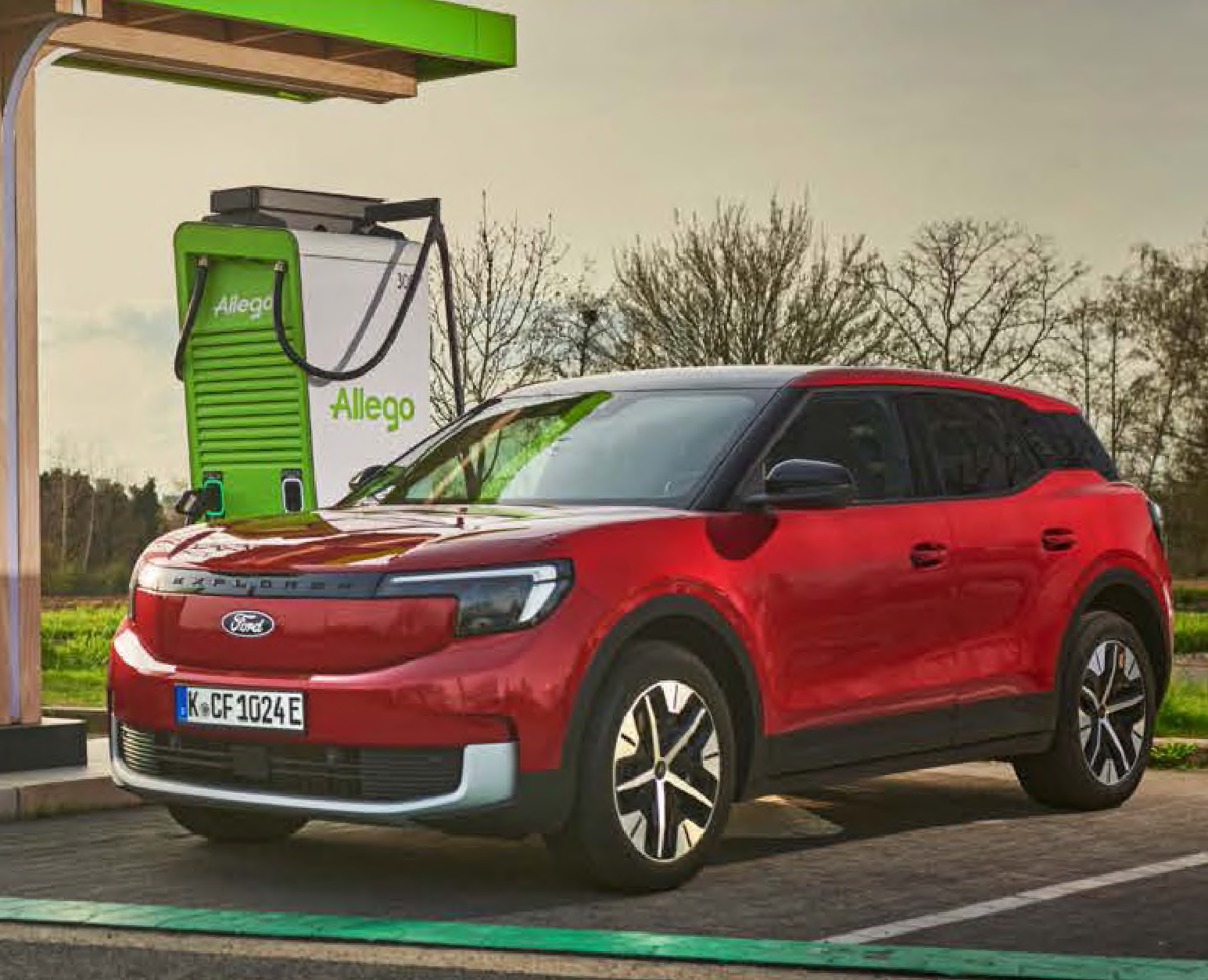

Fundamentals
Sustainability at Ford
Products and Services
Environment
Social
Governance
Sustainability Statement
Data
Appendices
On The Road to Better | Letter from Ford and Farley |
Contents
|
Ford at a Glance
|
Our Leadership in Sustainability
|
Financial Highlights
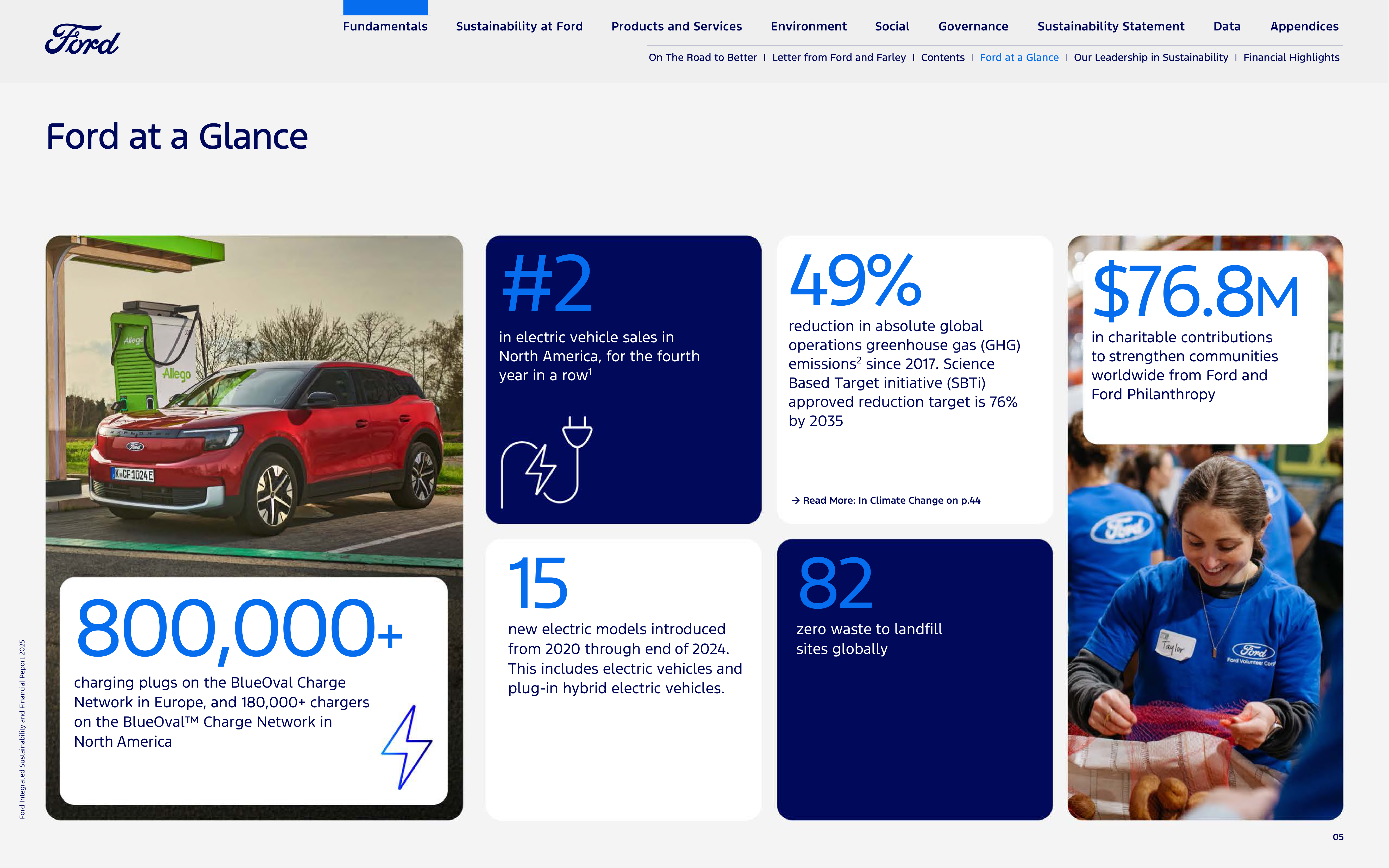
Ford at a Glance
800,000
+
charging plugs on the BlueOval Charge
Network in Europe, and 180,000+ chargers
on the BlueOval™ Charge Network in
North America
#
2 in electric vehicle sales i
n
North America, for the fourth
year in a row
1
1
5 new electric models introduce
d
from 2020 through end of 2024.
This includes electric vehicles and
plug-in hybrid electric vehicles.
Ford Integrated Sustainability and Financial Report 2025
05
→
4
9% reduction
in
absolute global
operations greenhouse gas (GHG)
emissions
2
since 2017. Science
Based Target initiative (SBTi)
approved reduction target is 76%
by 2035
Read More: In Climate Change on p.44
8
2 zero waste to landfil
l
sites globally
$
76.8M in charitable contrib
utio
n
s to strengthen communities
worldwide from Ford and
Ford Philanthropy

Fundamentals
Sustainability at Ford
Products and Services
Environment
Social
Governance
Sustainability Statement
Data
Appendices
On The Road to Better | Letter from Ford and Farley | Contents
|
Ford at a Glance
|
Our Leadership in Sustainability
|
Financial Highlights
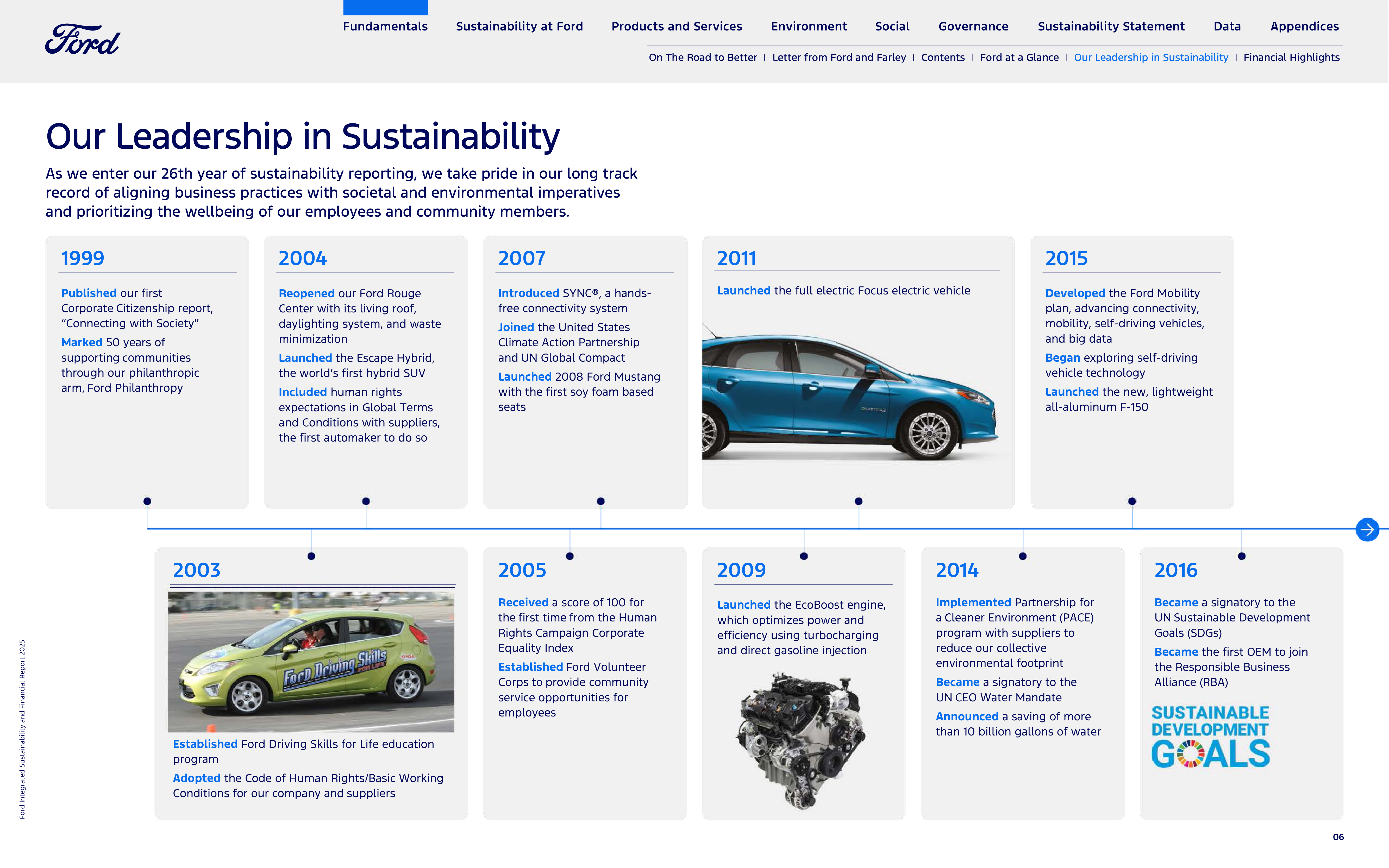
Our Leadership in Sustainability
As we enter our 26th year of sustainability reporting, we take pride in our long track
record of aligning business practices with societal and environmental imperatives
and prioritizing the wellbeing of our employees and community members.
Ford Integrated Sustainability and Financial Report 2025
06
1999
Published
our first
Corporate Citizenship report,
“Connecting with Society”
Marked
50 years of
supporting communities
through our philanthropic
arm, Ford Philanthropy
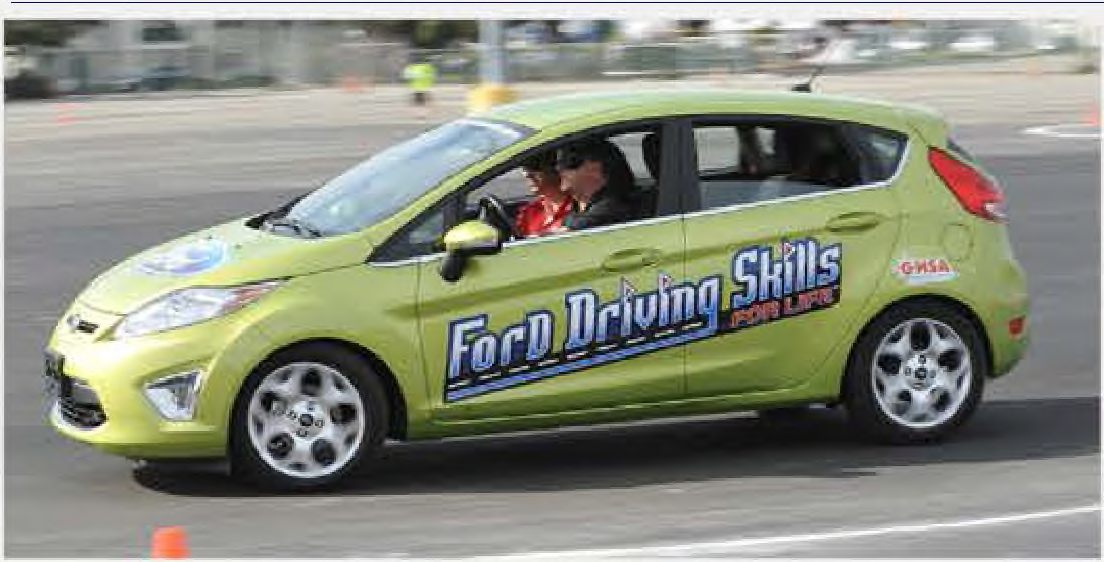
2003
Established
Ford Driving Skills for Life education
program
Adopted
the Code of Human Rights/Basic Working
Conditions for our company and suppliers
2004
Reopened
our Ford Rouge
Center with its living roof,
daylighting system, and waste
minimization
Launched
the Escape Hybrid,
the world’s first hybrid SUV
Included
human rights
expectations in Global Terms
and Conditions with suppliers,
the first automaker to do so
2005
Received
a score of 100 for
the first time from the Human
Rights Campaign Corporate
Equality Index
Established
Ford Volunteer
Corps to provide community
service opportunities for
employees
2007
Introduced
SYNC®, a hands-
free connectivity system
Joined
the United States
Climate Action Partnership
and UN Global Compact
Launched
2008 Ford Mustang
with the first soy foam based
seats
2009
Launched
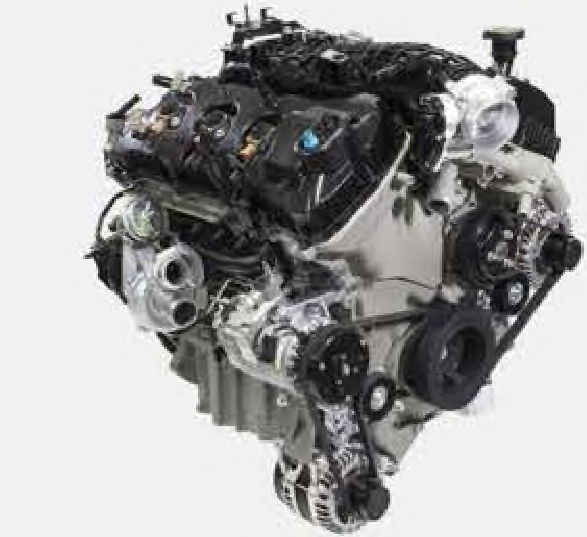
the EcoBoost engine,
which optimizes power and
efficiency using turbocharging
and direct gasoline injection
2011
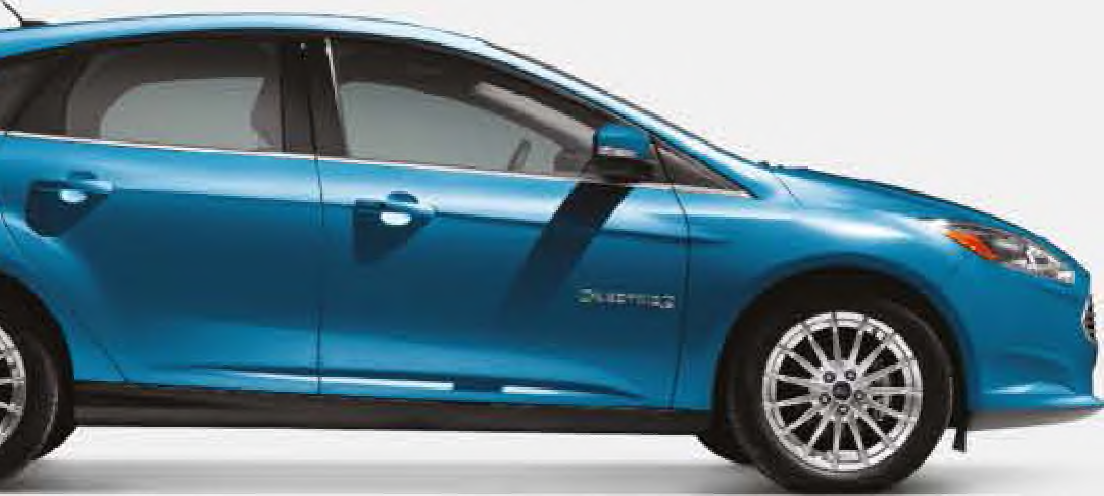
Launched
the full electric Focus electric vehicle
2014
Implemented
Partnership for
a Cleaner Environment (PACE)
program with suppliers to
reduce our collective
environmental footprint
Became
a signatory to the
UN CEO Water Mandate
Announced
a saving of more
than 10 billion gallons of water
2015
Developed
the Ford Mobility
plan, advancing connectivity,
mobility, self-driving vehicles,
and big data
Began
exploring self-driving
vehicle technology
Launched
the new, lightweight
all-aluminum F-150
2016
Became
a signatory to the
UN Sustainable Development
Goals (SDGs)
Became
the first OEM to join
the Responsible Business
Alliance (RBA)

Fundamentals
Sustainability at Ford
Products and Services
Environment
Social
Governance
Sustainability Statement
Data
Appendices
On The Road to Better | Letter from Ford and Farley | Contents
|
Ford at a Glance
|
Our Leadership in Sustainability
|
Financial Highlights
Our Leadership in Sustainability
— continued
Ford Integrated Sustainability and Financial Report 2025
07
2018
Developed
the Transportation
Mobility Cloud with Ford-owned
Autonomic
Met
our goal, set in 2010, to
reduce operational GHG
emissions per vehicle produced
by 30% (eight years early)
Conducted
first formal UN
human rights saliency
assessment, the first automaker
to do so and link environment
as a human rights issue
2019
Launched
Sustainability
Aspirations
Achieved
double A rating
for CDP Climate and Water
2020
Set
aspiration to be carbon neutral no later than 2050
Launched
Mustang Mach-E
Designed and Produced
a new powered air-purifying
respirator and new ventilators, in collaboration with
the UAW, produce face masks at Ford’s Van Dyke
Transmission Plant for internal Ford use, and provide
millions to local healthcare workers and communities
Contributed
over $1.13M to worldwide COVID relief
through employee donation match
Signed
UN Women’s Empowerment Principles
Achieved
75% absolute reduction in water use
since 2000
2021
Announced
$11.4B planned investment in
BlueOval City and BlueOval SK Battery Park
Launched
Ford Pro
Issued
$2.5B inaugural Green Bond, the largest
non-financial corporate green bond to date
Issued
stand-alone Human Rights Report,
a first for the U.S. automotive industry
Used
100% recycled ocean plastics to produce
automotive parts
Signed
UN International Year for the
Elimination of Child Labour Action Pledge
2022
Launched
F-150 Lightning
Launched
E-Transit van
Launched
Manufacture 2030 program to work with
suppliers to reduce our collective environmental
footprint, replacing PACE
Announced
reorganization of business into three
business segments: Ford Blue, Ford Model e, and
Ford Pro
Issued
second $1.75B Green Bond and inaugural
Sustainable Financing Report
Made
the largest renewable energy purchase from
a utility in U.S. history
2023
Started
construction on BlueOval Battery
Park Michigan, BlueOval City, and BlueOval
SK Battery Park
Committed
to supporting a living wage
Mapped
and audited our electric vehicle
battery raw material supply chains to
include nickel, lithium, cobalt, and
graphite
Created
Community Relations Department
to focus on engagement with
manufacturing communities
2024
Opened
Michigan Central
Station as the centerpiece of a
new Detroit innovation district
Launched
Transform: Auto in
North America to support
suppliers to adopt renewable
electricity
Our purpose of
helping to build a
better world is rooted
in our long history
and our commitment
to sustainability.
Together they position
us for continued
progress along
The Road to Better.
Fundamentals
Sustainability at Ford
Products and Services
Environment
Social
Governance
Sustainability Statement
Data
Appendices
On The Road to Better | Letter from Ford and Farley | Contents
|
Ford at a Glance
|
Our Leadership in Sustainability
|
Financial Highlights
Financial Highlights
Ford Integrated Sustainability and Financial Report 2025
08
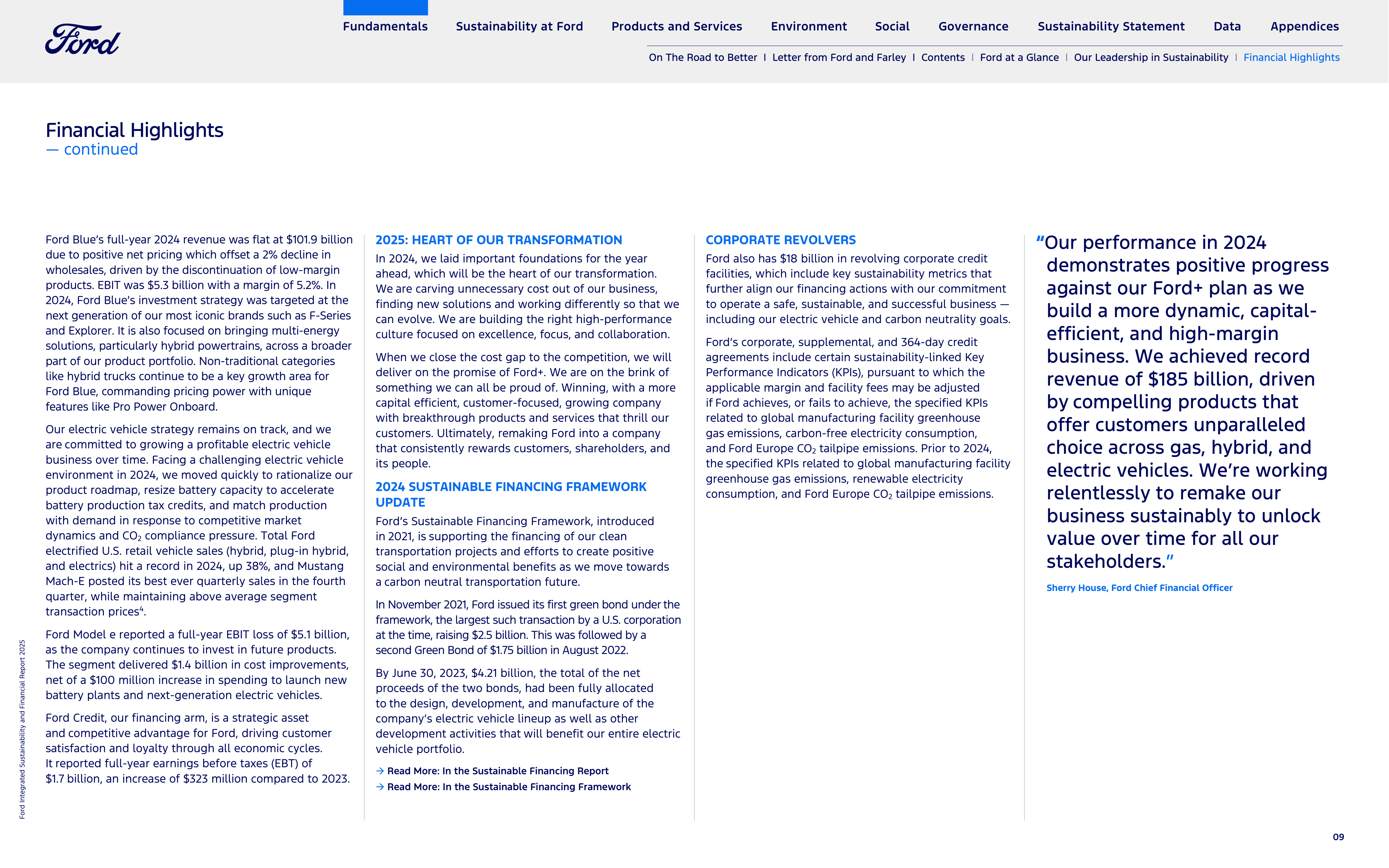
2024 Financial Highlights
Revenue:
$185.0
B
(2023: $176.2B)
Adjusted EBIT margin
:
3
5.5
%
(2023: 5.9%)
Net income/(loss):
$5.9
B
(2023: $4.3B)
Adjusted free cash flow
3
:
$6.7
B
(2023: $6.8B)
Adjusted EBIT
3
:
$10.2
B
(2023: $10.4B)
Adjusted earnings per share
3
:
$1.84
(2023: $2.01)
In 2024, Ford made significant progress
demonstrating the strength and
adaptability of our customer focused
Ford+ plan for growth and value creation.
That progress is a testament to the strong
fundamentals — and dedication from our
global team — that underpin everything
we do.
We achieved record global revenue of $185 billion, up
5% year-over-year, marking our fourth consecutive year
of top-line growth. We achieved that through robust and
durable product franchises in segments we know best
and lead in, which underscores the enduring appeal of
our iconic brands. F-Series once again was America’s
best-selling pickup and overall vehicle, and Ranger was
a key driver of profitability in numerous global markets
and the recipient of the “North American Truck of the
Year” award for the fifth consecutive year. Ford
maintained its position as the #1 gas-powered, #2
electric vehicle, and #3 hybrid brand in America as
we continue to offer retail and commercial customers
freedom of choice across powertrains.
Ford’s full-year adjusted EBIT reached $10.2 billion with
a margin of 5.5%. While this represents a slight decrease
compared to the previous year, we made real progress
in improving our operational fitness and quality in 2024.
We delivered about $500 million of net cost reductions
in the second half of the year, a key step towards closing
the multi-billion-dollar cost gap with our peers over
the next few years. We are doing this by remaking our
industrial system, upgrading talent in key areas like
product development, manufacturing and supply chain,
and implementing industry best practices. This includes
bringing in external experts to help negotiate better
prices on parts and identify material cost improvements.
Adjusted free cash flow (FCF) for 2024 was $6.7 billion,
with a cash conversion rate of 65%, above our target
range of 50% to 60%. We ended the year with over
$28 billion in cash and nearly $47 billion in liquidity,
providing the financial flexibility needed to invest in
accretive growth opportunities and manage market
uncertainty. This financial strength also enables us to
consistently reward our shareholders with 40% to 50%
of adjusted FCF. Over the last three years, we have paid
out over $10 billion through regular and special dividends.
CUSTOMER FOCUSED BUSINESS SEGMENTS
Key to our top-line success is our decision to create three
customer-centered businesses to drive greater focus,
transparency and accountability.
Ford Pro, our commercial vehicle powerhouse, continues
to benefit from its leading market position. Strong
demand for products like Super Duty chassis cabs and
Transit wagons helped lift revenues by 15% to $67 billion,
with wholesales up 9%. Ford Pro’s full-year EBIT was
$9 billion with a margin of 13.5%. It is growing a vibrant
software and repair business, accounting for 13% of
Ford Pro’s EBIT in 2024. Paid software subscriptions
were up 27% to nearly 650,000, telematics software
grew nearly 100%, and mobile repair orders increased
by more than 80%.
While Ford’s digital transformation is most apparent
in Ford Pro today, our software and services capability
is growing across the company. In 2024, BlueCruise
equipped vehicles in operation more than doubled to
675,000, accumulating 323 million hands-free miles
driven since launch, and we delivered nearly 29 million
over-the-air updates that improved vehicle performance
and resolved issues. Our relationship with customers
now continues past the point of sale or financing. We are
adding value throughout the customer life cycle and
creating new sticky, high-margin, non-cyclical revenue
streams for Ford.
Fundamentals
Sustainability at Ford
Products and Services
Environment
Social
Governance
Sustainability Statement
Data
Appendices
On The Road to Better | Letter from Ford and Farley | Contents
|
Ford at a Glance
|
Our Leadership in Sustainability
|
Financial Highlights
Financial Highlights
— continued
Ford Integrated Sustainability and Financial Report 2025
09
Ford Blue’s full-year 2024 revenue was flat at $101.9 billion
due to positive net pricing which offset a 2% decline in
wholesales, driven by the discontinuation of low-margin
products. EBIT was $5.3 billion with a margin of 5.2%. In
2024, Ford Blue’s investment strategy was targeted at the
next generation of our most iconic brands such as F-Series
and Explorer. It is also focused on bringing multi-energy
solutions, particularly hybrid powertrains, across a broader
part of our product portfolio. Non-traditional categories
like hybrid trucks continue to be a key growth area for
Ford Blue, commanding pricing power with unique
features like Pro Power Onboard.
Our electric vehicle strategy remains on track, and we
are committed to growing a profitable electric vehicle
business over time. Facing a challenging electric vehicle
environment in 2024, we moved quickly to rationalize our
product roadmap, resize battery capacity to accelerate
battery production tax credits, and match production
with demand in response to competitive market
dynamics and CO
2
compliance pressure. Total Ford
electrified U.S. retail vehicle sales (hybrid, plug-in hybrid,
and electrics) hit a record in 2024, up 38%, and Mustang
Mach-E posted its best ever quarterly sales in the fourth
quarter, while maintaining above average segment
transaction prices
4
.
Ford Model e reported a full-year EBIT loss of $5.1 billion,
as the company continues to invest in future products.
The segment delivered $1.4 billion in cost improvements,
net of a $100 million increase in spending to launch new
battery plants and next-generation electric vehicles.
Ford Credit, our financing arm, is a strategic asset
and competitive advantage for Ford, driving customer
satisfaction and loyalty through all economic cycles.
It reported full-year earnings before taxes (EBT) of
$1.7 billion, an increase of $323 million compared to 2023.
2025: HEART OF OUR TRANSFORMATION
In 2024, we laid important foundations for the year
ahead, which will be the heart of our transformation.
We are carving unnecessary cost out of our business,
finding new solutions and working differently so that we
can evolve. We are building the right high-performance
culture focused on excellence, focus, and collaboration.
When we close the cost gap to the competition, we will
deliver on the promise of Ford+. We are on the brink of
something we can all be proud of. Winning, with a more
capital efficient, customer-focused, growing company
with breakthrough products and services that thrill our
customers. Ultimately, remaking Ford into a company
that consistently rewards customers, shareholders, and
its people.
2024 SUSTAINABLE FINANCING FRAMEWORK
UPDATE
Ford’s Sustainable Financing Framework, introduced
in 2021, is supporting the financing of our clean
transportation projects and efforts to create positive
social and environmental benefits as we move towards
a carbon neutral transportation future.
In November 2021, Ford issued its first green bond under the
framework, the largest such transaction by a U.S. corporation
at the time, raising $2.5 billion. This was followed by a
second Green Bond of $1.75 billion in August 2022.
By June 30, 2023, $4.21 billion, the total of the net
proceeds of the two bonds, had been fully allocated
to the design, development, and manufacture of the
company’s electric vehicle lineup as well as other
development activities that will benefit our entire electric
vehicle portfolio.
→
Read More: In the Sustainable Financing Report
→
Read More: In the Sustainable Financing Framework
CORPORATE REVOLVERS
Ford also has $18 billion in revolving corporate credit
facilities, which include key sustainability metrics that
further align our financing actions with our commitment
to operate a safe, sustainable, and successful business —
including our electric vehicle and carbon neutrality goals.
Ford’s corporate, supplemental, and 364-day credit
agreements include certain sustainability-linked Key
Performance Indicators (KPIs), pursuant to which the
applicable margin and facility fees may be adjusted
if Ford achieves, or fails to achieve, the specified KPIs
related to global manufacturing facility greenhouse
gas emissions, carbon-free electricity consumption,
and Ford Europe CO
2
tailpipe emissions. Prior to 2024,
the specified KPIs related to global manufacturing facility
greenhouse gas emissions, renewable electricity
consumption, and Ford Europe CO
2
tailpipe emissions.
“
Our performance in 2024
demonstrates positive progress
against our Ford+ plan as we
build a more dynamic, capital-
efficient, and high-margin
business. We achieved record
revenue of $185 billion, driven
by compelling products that
offer customers unparalleled
choice across gas, hybrid, and
electric vehicles. We’re working
relentlessly to remake our
business sustainably to unlock
value over time for all our
stakeholders.
”
Sherry House, Ford Chief Financial Officer
Fundamentals
Sustainability at Ford
Products and Services
Environment
Social
Governance
Sustainability Statement
Data
Appendices
,
Ford Integrated Sustainability and Financial Report 2025
10
Sustainability
at Ford
11
Our Sustainability Aspirations
12
Sustainability Strategy
13
How We Create Sustainable Value
14
Accelerating Progress Towards our Aspirations
20
Stakeholder Engagement
23
Materiality Assessment
25
Human Rights Saliency Assessment
Fundamentals
Sustainability at Ford
Products and Services
Environment
Social
Governance
Sustainability Statement
Data
Appendices
Sustainability Aspirations
| Sustainability Strategy | Creating Sustainable Value | Accelerating Progress | Stakeholder Engagement | Materiality Assessment | Human Rights Saliency Assessment
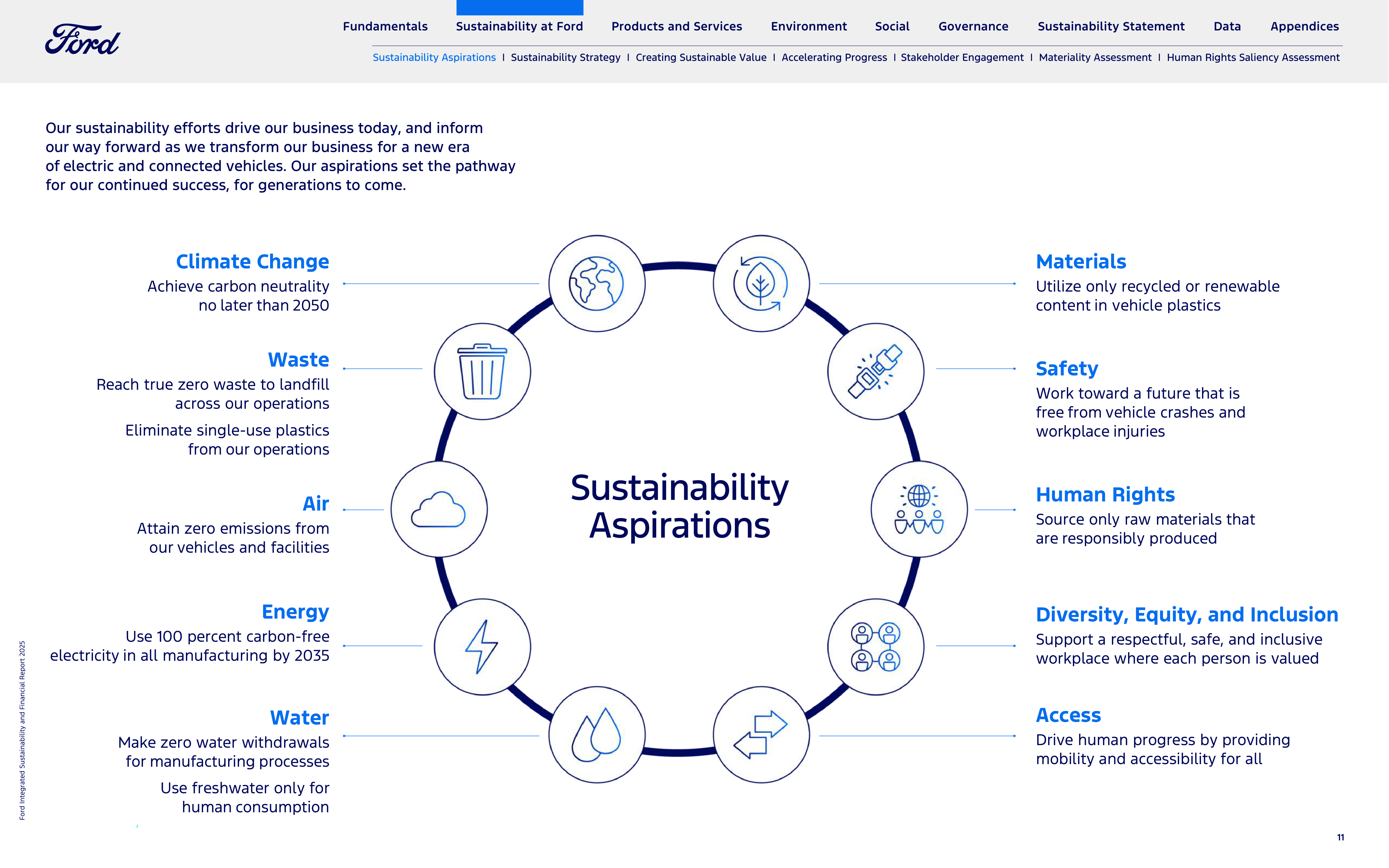
Our sustainability efforts drive our business today, and inform
our way forward as we transform our business for a new era
of electric and connected vehicles. Our aspirations set the pathway
for our continued success, for generations to come.
,
Ford Integrated Sustainability and Financial Report 2025
11
Sustainability
Aspirations
Climate Change
Achieve carbon neutrality
no later than 2050
Waste
Reach true zero waste to landfill
across our operations
Eliminate single-use plastics
from our operations
Air
Attain zero emissions from
our vehicles and facilities
Energy
Use 100 percent carbon-free
electricity in all manufacturing by 2035
Water
Make zero water withdrawals
for manufacturing processes
Use freshwater only for
human consumption
Materials
Utilize only recycled or renewable
content in vehicle plastics
Safety
Work toward a future that is
free from vehicle crashes and
workplace injuries
Human Rights
Source only raw materials that
are responsibly produced
Diversity, Equity, and Inclusion
Support a respectful, safe, and inclusive
workplace where each person is valued
Access
Drive human progress by providing
mobility and accessibility for all

Fundamentals
Sustainability at Ford
Products and Services
Environment
Social
Governance
Sustainability Statement
Data
Appendices
Sustainability Aspirations |
Sustainability Strategy
| Creating Sustainable Value | Accelerating Progress | Stakeholder Engagement | Materiality Assessment | Human Rights Saliency Assessment
Sustainability Strategy
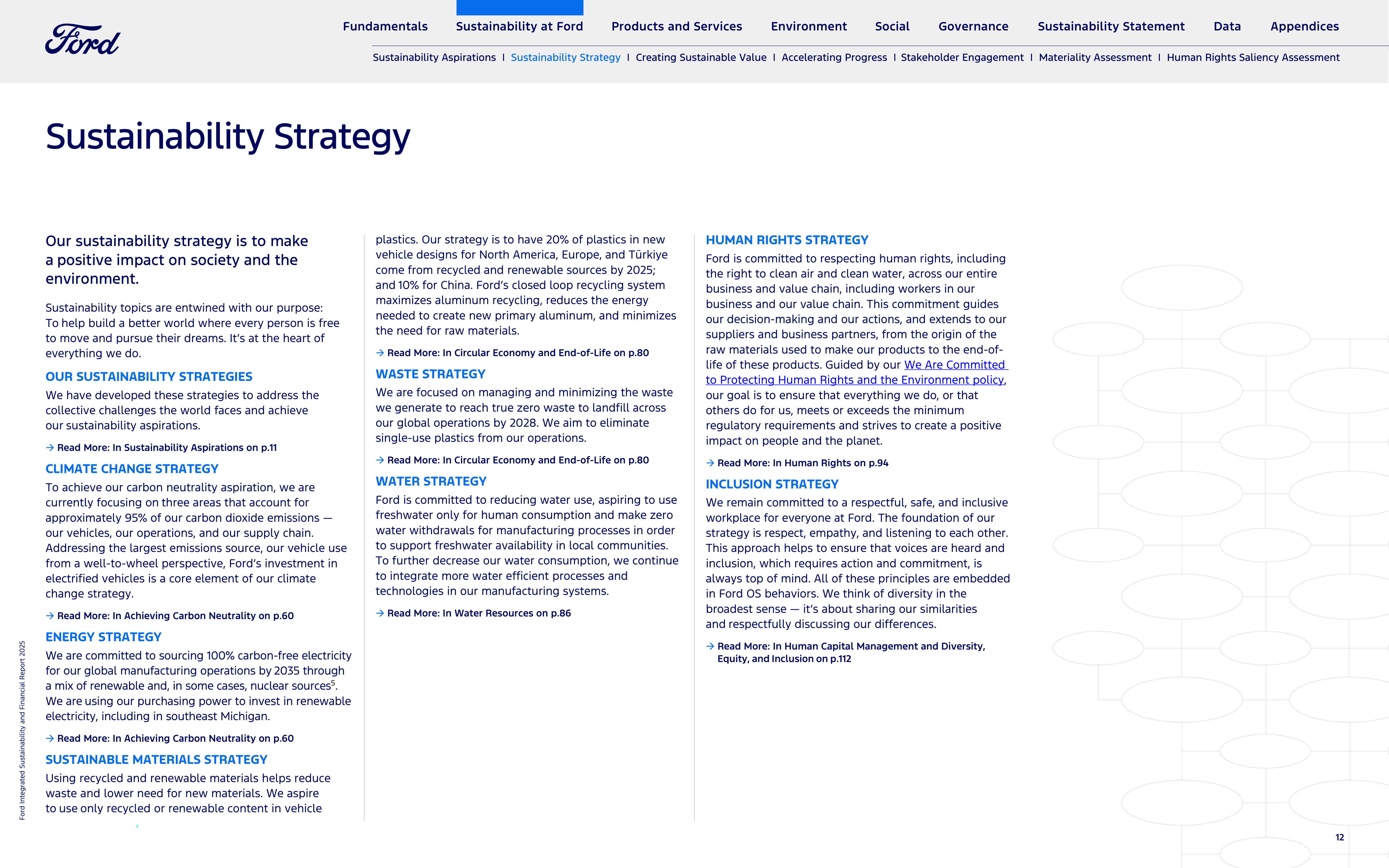
Our sustainability strategy is to make
a positive impact on society and the
environment.
Sustainability topics are entwined with our purpose:
To help build a better world where every person is free
to move and pursue their dreams. It’s at the heart of
everything we do.
OUR SUSTAINABILITY STRATEGIES
We have developed these strategies to address the
collective challenges the world faces and achieve
our sustainability aspirations.
Read More: In Sustainability Aspirations on p.11
CLIMATE CHANGE STRATEGY
To achieve our carbon neutrality aspiration, we are
currently focusing on three areas that account for
approximately 95% of our carbon dioxide emissions —
our vehicles, our operations, and our supply chain.
Addressing the largest emissions source, our vehicle use
from a well-to-wheel perspective, Ford’s investment in
electrified vehicles is a core element of our climate
change strategy.
Read More: In Achieving Carbon Neutrality on p.60
ENERGY STRATEGY
We are committed to sourcing 100% carbon-free electricity
for our global manufacturing operations by 2035 through
a mix of renewable and, in some cases, nuclear sources
5
.
We are using our purchasing power to invest in renewable
electricity, including in southeast Michigan.
→
Read More: In Achieving Carbon Neutrality on p.60
SUSTAINABLE MATERIALS STRATEGY
Using recycled and renewable materials helps reduce
waste and lower need for new materials. We aspire
to use only recycled or renewable content in vehicle
→
→
plastics. Our strategy is to have 20% of plastics in new
vehicle designs for North America, Europe, and Türkiye
come from recycled and renewable sources by 2025;
and 10% for China. Ford’s closed loop recycling system
maximizes aluminum recycling, reduces the energy
needed to create new primary aluminum, and minimizes
the need for raw materials.
→
Read More: In Circular Economy and End-of-Life on p.80
WASTE STRATEGY
We are focused on managing and minimizing the waste
we generate to reach true zero waste to landfill across
our global operations by 2028. We aim to eliminate
single-use plastics from our operations.
→
Read More: In Circular Economy and End-of-Life on p.80
WATER STRATEGY
Ford is committed to reducing water use, aspiring to use
freshwater only for human consumption and make zero
water withdrawals for manufacturing processes in order
to support freshwater availability in local communities.
To further decrease our water consumption, we continue
to integrate more water efficient processes and
technologies in our manufacturing systems.
→
Read More: In Water Resources on p.86
HUMAN RIGHTS STRATEGY
Ford is committed to respecting human rights, including
the right to clean air and clean water, across our entire
business and value chain, including workers in our
business and our value chain. This commitment guides
our decision-making and our actions, and extends to our
suppliers and business partners, from the origin of the
raw materials used to make our products to the end-of-
life of these products. Guided by our
We Are Committed
to Protecting Human Rights and the Environment policy
,
our goal is to ensure that everything we do, or that
others do for us, meets or exceeds the minimum
regulatory requirements and strives to create a positive
impact on people and the planet.
→
Read More: In Human Rights on p.94
INCLUSION STRATEGY
We remain committed to a respectful, safe, and inclusive
workplace for everyone at Ford. The foundation of our
strategy is respect, empathy, and listening to each other.
This approach helps to ensure that voices are heard and
inclusion, which requires action and commitment, is
always top of mind. All of these principles are embedded
in Ford OS behaviors. We think of diversity in the
broadest sense — it’s about sharing our similarities
and respectfully discussing our differences.
→
Read More: In Human Capital Management and Diversity,
Equity, and Inclusion on p.112
,
Ford Integrated Sustainability and Financial Report 2025
12
Fundamentals
Sustainability at Ford
Products and Services
Environment
Social
Governance
Sustainability Statement
Data
Appendices
Sustainability Aspirations | Sustainability Strategy |
Creating Sustainable Value
| Accelerating Progress | Stakeholder Engagement | Materiality Assessment | Human Rights Saliency Assessment
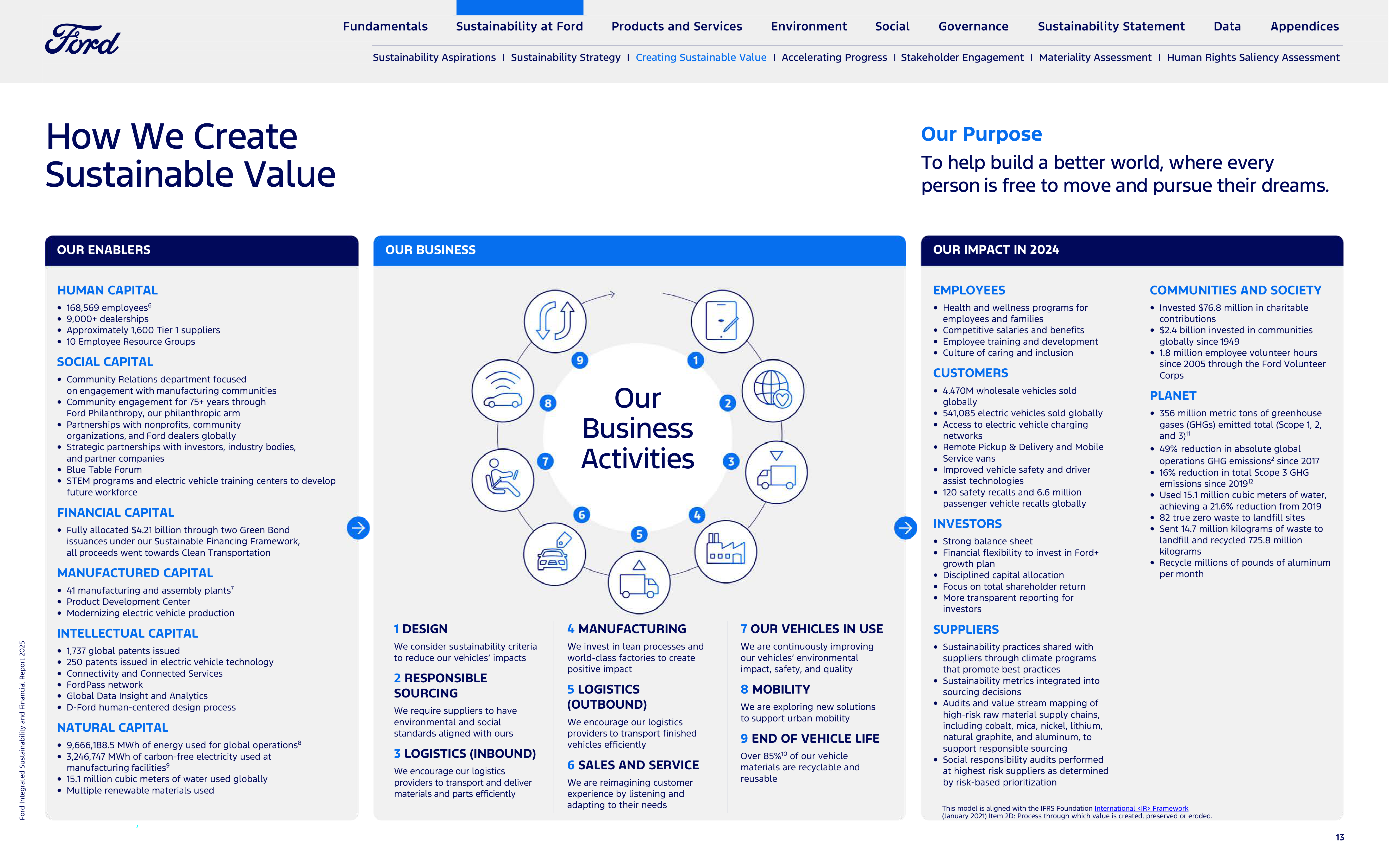
How We Create
Sustainable Value
OUR ENABLERS
HUMAN CAPITAL
●
168,569 employees
6
●
9,000+ dealerships
●
Approximately 1,600 Tier 1 suppliers
●
10 Employee Resource Groups
SOCIAL CAPITAL
●
Community Relations department focused
on engagement with manufacturing communities
●
Community engagement for 75+ years through
Ford Philanthropy, our philanthropic arm
●
Partnerships with nonprofits, community
organizations, and Ford dealers globally
●
Strategic partnerships with investors, industry bodies,
and partner companies
●
Blue Table Forum
●
STEM programs and electric vehicle training centers to develop
future workforce
FINANCIAL CAPITAL
●
Fully allocated $4.21 billion through two Green Bond
issuances under our Sustainable Financing Framework,
all proceeds went towards Clean Transportation
MANUFACTURED CAPITAL
●
41 manufacturing and assembly plants
7
●
Product Development Center
●
Modernizing electric vehicle production
INTELLECTUAL CAPITAL
●
1,737 global patents issued
●
250 patents issued in electric vehicle technology
●
Connectivity and Connected Services
●
FordPass network
●
Global Data Insight and Analytics
●
D-Ford human-centered design process
NATURAL CAPITAL
●
9,666,188.5 MWh of energy used for global operations
8
●
3,246,747 MWh of carbon-free electricity used at
manufacturing facilities
9
●
15.1 million cubic meters of water used globally
●
Multiple renewable materials used
,
Ford Integrated Sustainability and Financial Report 2025
13
OUR BUSINESS
Our
Business
Activities
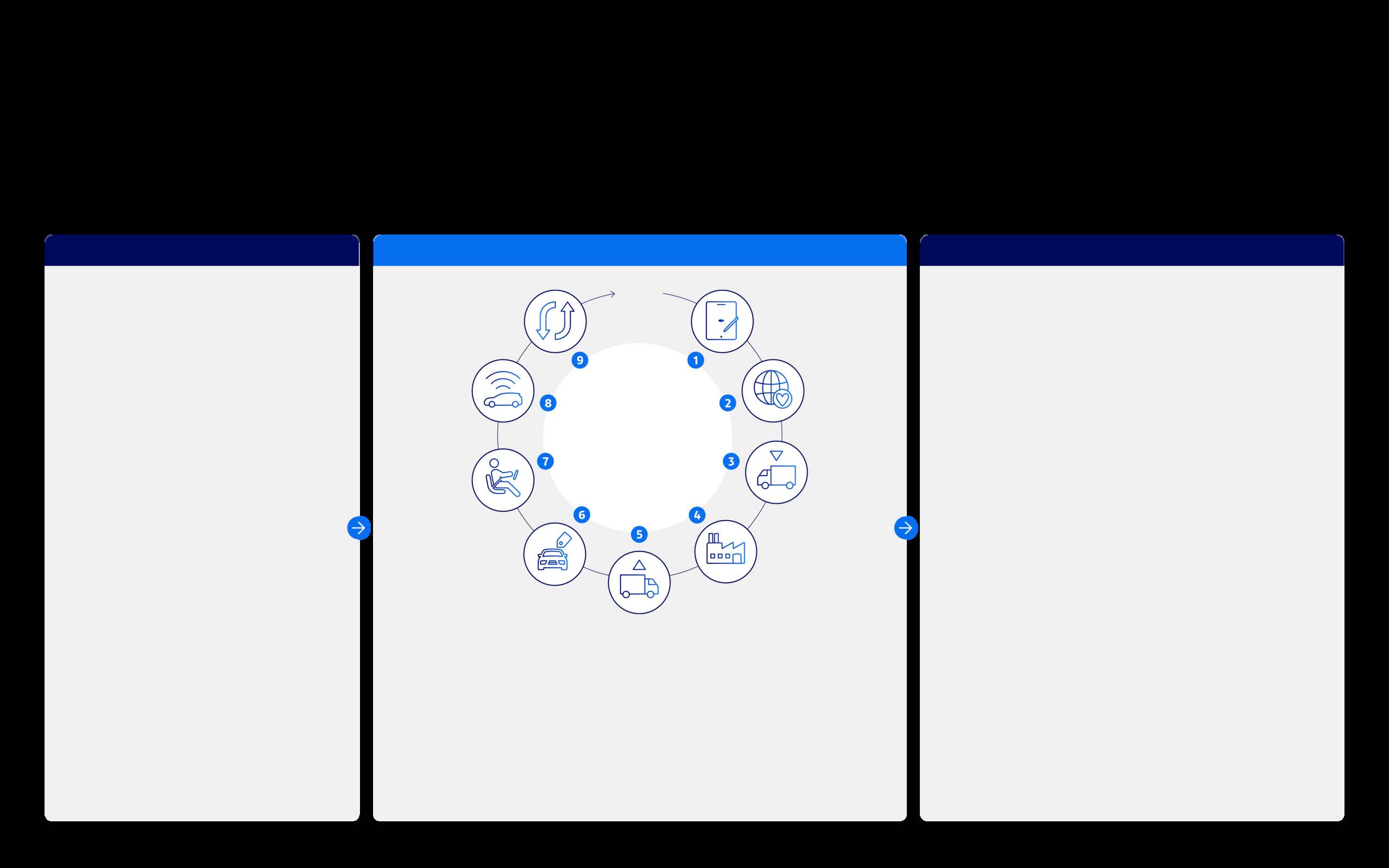
1
DESIGN
We consider sustainability criteria
to reduce our vehicles’ impacts
2
RESPONSIBLE
SOURCING
We require suppliers to have
environmental and social
standards aligned with ours
3
LOGISTICS (INBOUND)
We encourage our logistics
providers to transport and deliver
materials and parts efficiently
4
MANUFACTURING
We invest in lean processes and
world-class factories to create
positive impact
5
LOGISTICS
(OUTBOUND)
We encourage our logistics
providers to transport finished
vehicles efficiently
6
SALES AND SERVICE
We are reimagining customer
experience by listening and
adapting to their needs
7
OUR VEHICLES IN USE
We are continuously improving
our vehicles’ environmental
impact, safety, and quality
8
MOBILITY
We are exploring new solutions
to support urban mobility
9
END OF VEHICLE LIFE
Over 85%
10
of our vehicle
materials are recyclable and
reusable
Our Purpose
To help build a better world, where every
person is free to move and pursue their dreams.
OUR IMPACT IN 2024
EMPLOYEES
●
Health and wellness programs for
employees and families
●
Competitive salaries and benefits
●
Employee training and development
●
Culture of caring and inclusion
CUSTOMERS
●
4.470M wholesale vehicles sold
globally
●
541,085 electric vehicles sold globally
●
Access to electric vehicle charging
networks
●
Remote Pickup & Delivery and Mobile
Service vans
●
Improved vehicle safety and driver
assist technologies
●
120 safety recalls and 6.6 million
passenger vehicle recalls globally
INVESTORS
●
Strong balance sheet
●
Financial flexibility to invest in Ford+
growth plan
●
Disciplined capital allocation
●
Focus on total shareholder return
●
More transparent reporting for
investors
SUPPLIERS
●
Sustainability practices shared with
suppliers through climate programs
that promote best practices
●
Sustainability metrics integrated into
sourcing decisions
●
Audits and value stream mapping of
high-risk raw material supply chains,
including cobalt, mica, nickel, lithium,
natural graphite, and aluminum, to
support responsible sourcing
●
Social responsibility audits performed
at highest risk suppliers as determined
by risk-based prioritization
COMMUNITIES AND SOCIETY
●
Invested $76.8 million in charitable
contributions
●
$2.4 billion invested in communities
globally since 1949
●
1.8 million employee volunteer hours
since 2005 through the Ford Volunteer
Corps
PLANET
●
356 million metric tons of greenhouse
gases (GHGs) emitted total (Scope 1, 2,
and 3)
11
●
49%
reduction in absolute global
operations GHG emissions
2
since 2017
●
16% reduction in total Scope 3 GHG
emissions since 2019
12
●
Used 15.1 million cubic meters of water,
achieving a 21.6% reduction from 2019
●
82 true zero waste to landfill sites
●
Sent 14.7 million kilograms of waste to
landfill and recycled 725.8 million
kilograms
●
Recycle millions of pounds of aluminum
per month
This model is aligned with the IFRS Foundation
International Framework
(January 2021) Item 2D: Process through which value is created, preserved or eroded.
Fundamentals
Sustainability at Ford
Products and Services
Environment
Social
Governance
Sustainability Statement
Data
Appendices
Sustainability Aspirations | Sustainability Strategy | Creating Sustainable Value |
Accelerating Progress
| Stakeholder Engagement | Materiality Assessment | Human Rights Saliency Assessment
Accelerating Progress Towards our Aspirations
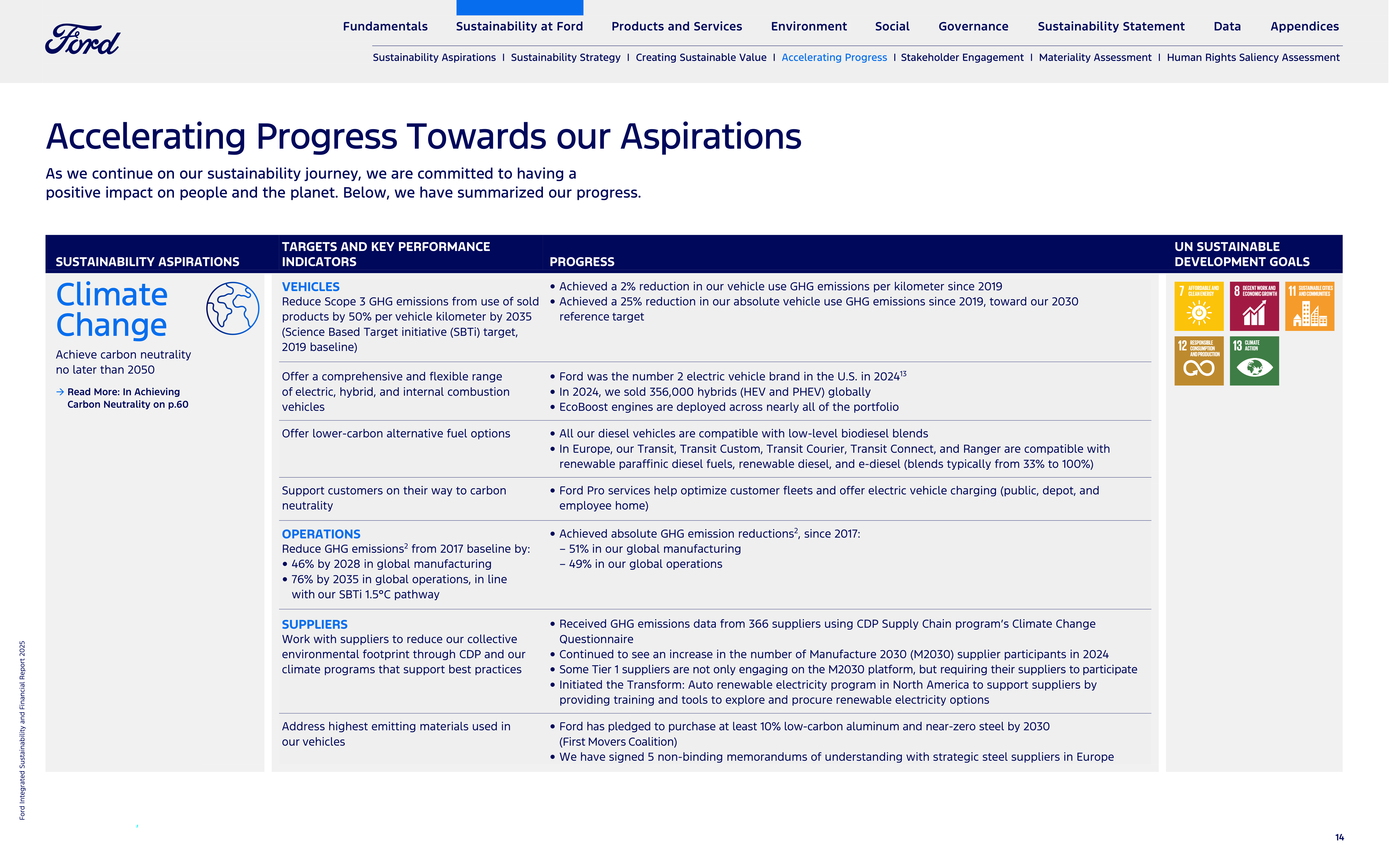
As we continue on our sustainability journey, we are committed to having a
positive impact on people and the planet. Below, we have summarized our progress.
SUSTAINABILITY ASPIRATIONS
TARGETS AND KEY PERFORMANCE
INDICATORS
PROGRESS
UN SUSTAINABLE
DEVELOPMENT GOALS
Climate
Change
Achieve carbon neutrality
no later than 2050
→
Read More: In Achieving
Carbon Neutrality on p.60
VEHICLES
Reduce Scope 3 GHG emissions from use of sold
products by 50% per vehicle kilometer by 2035
(Science Based Target initiative (SBTi) target,
2019 baseline)
●
Achieved a 2% reduction in our vehicle use GHG emissions per kilometer since 2019
●
Achieved a 25% reduction in our absolute vehicle use GHG emissions since 2019, toward our 2030
reference target
Offer a comprehensive and flexible range
of electric, hybrid, and internal combustion
vehicles
●
Ford was the number 2 electric vehicle brand in the U.S. in 2024
13
●
In 2024, we sold 356,000 hybrids (HEV and PHEV) globally
●
EcoBoost engines are deployed across nearly all of the portfolio
Offer lower-carbon alternative fuel options
●
All our diesel vehicles are compatible with low-level biodiesel blends
●
In Europe, our Transit, Transit Custom, Transit Courier, Transit Connect, and Ranger are compatible with
renewable paraffinic diesel fuels, renewable diesel, and e-diesel (blends typically from 33% to 100%)
Support customers on their way to carbon
neutrality
●
Ford Pro services help optimize customer fleets and offer electric vehicle charging (public, depot, and
employee home)
OPERATIONS
Reduce GHG emissions
2
from 2017 baseline by:
●
46% by 2028 in global manufacturing
●
76% by 2035 in global operations, in line
with our SBTi 1.5°C pathway
●
Achieved absolute GHG emission reductions
2
, since 2017:
–
51% in our global manufacturing
–
49% in our global operations
SUPPLIERS
Work with suppliers to reduce our collective
environmental footprint through CDP and our
climate programs that support best practices
●
Received GHG emissions data from 366 suppliers using CDP Supply Chain program’s Climate Change
Questionnaire
●
Continued to see an increase in the number of Manufacture 2030 (M2030) supplier participants in 2024
●
Some Tier 1 suppliers are not only engaging on the M2030 platform, but requiring their suppliers to participate
●
Initiated the Transform: Auto renewable electricity program in North America to support suppliers by
providing training and tools to explore and procure renewable electricity options
Address highest emitting materials used in
our vehicles
●
Ford has pledged to purchase at least 10% low-carbon aluminum and near-zero steel by 2030
(First Movers Coalition)
●
We have signed 5 non-binding memorandums of understanding with strategic steel suppliers in Europe
,
Ford Integrated Sustainability and Financial Report 2025
14
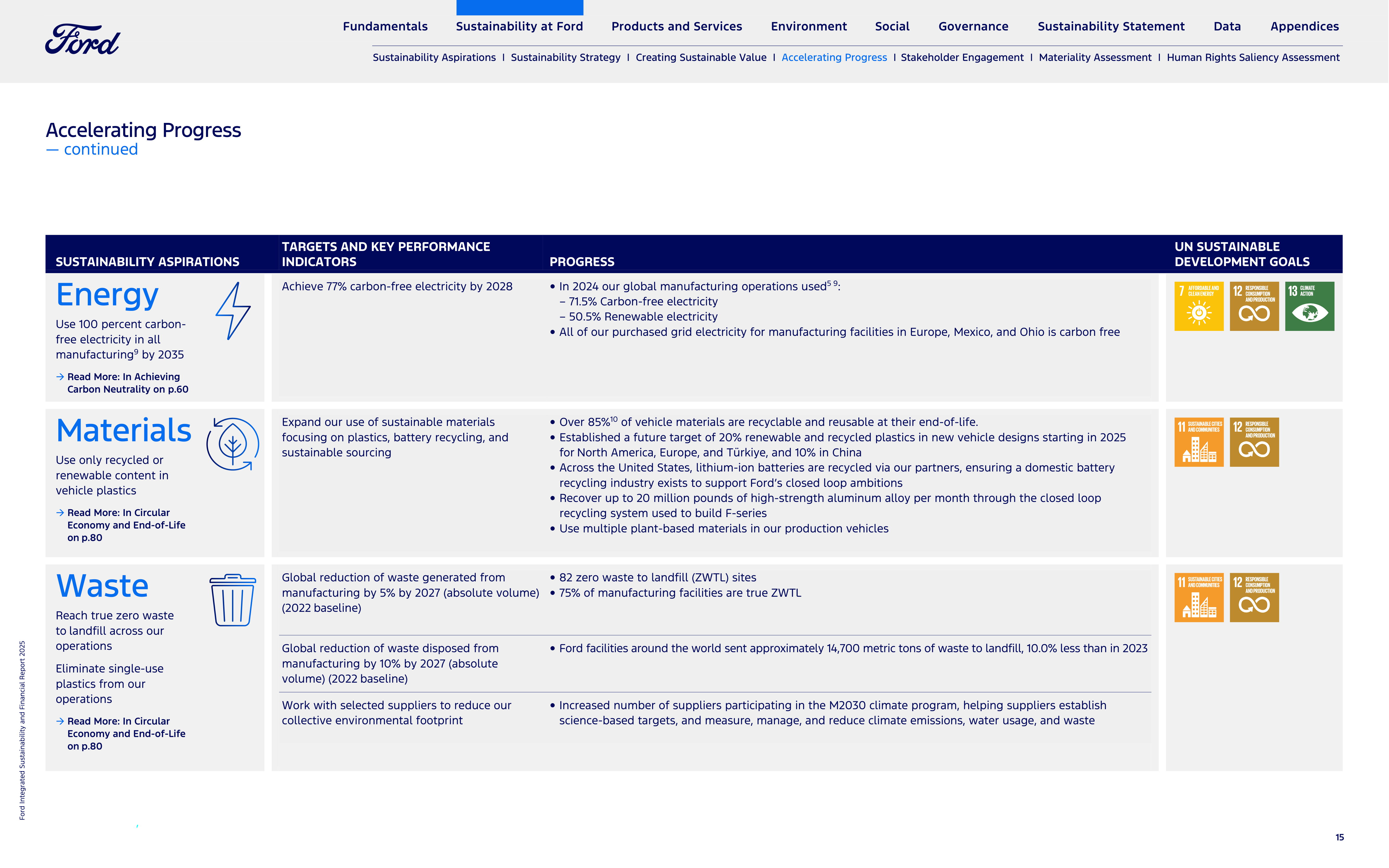
Energy
Use 100 percent carbon-
free electricity in all
manufacturing
9
by 2035
→
Read More: In Achieving
Carbon Neutrality on p.60
Achieve 77% carbon-free electricity by 2028
•
In 2024 our global manufacturing operations used
5 9
:
–
71.5% Carbon-free electricity
–
50.5% Renewable electricity
•
All of our purchased grid electricity for manufacturing facilities in Europe, Mexico, and Ohio is carbon free
Materials
Use only recycled or
renewable content in
vehicle plastics
→
Read More: In Circular
Economy and End-of-Life
on
p.80
Expand our use of sustainable materials
focusing on plastics, battery recycling, and
sustainable sourcing
•
Over 85%
10
of vehicle materials are recyclable and reusable at their end-of-life.
•
Established a future target of 20% renewable and recycled plastics in new vehicle designs starting in 2025
for North America, Europe, and Türkiye, and 10% in China
•
Across the United States, lithium-ion batteries are recycled via our partners, ensuring a domestic battery
recycling industry exists to support Ford’s closed loop ambitions
•
Recover up to 20 million pounds of high-strength aluminum alloy per month through the closed loop
recycling system used to build F-series
•
Use multiple plant-based materials in our production vehicles
Waste
Reach true zero waste
to landfill across our
operations
Eliminate single-use
plastics from our
operations
→
Read More: In Circular
Economy and End-of-Life
on
p.80
Global reduction of waste generated from
manufacturing by 5% by 2027 (absolute volume)
(2022 baseline)
•
82 zero waste to landfill (ZWTL) sites
•
75% of manufacturing facilities are true ZWTL
Global reduction of waste disposed from
manufacturing by 10% by 2027 (absolute
volume) (2022 baseline)
•
Ford facilities around the world sent approximately 14,700 metric tons of waste to landfill, 10.0% less than in 2023
Work with selected suppliers to reduce our
collective environmental footprint
•
Increased number of suppliers participating in the M2030 climate program, helping suppliers establish
science-based targets, and measure, manage, and reduce climate emissions, water usage, and waste
SUSTAINABILITY ASPIRATIONS
TARGETS AND KEY PERFORMANCE
INDICATORS
PROGRESS
UN SUSTAINABLE
DEVELOPMENT GOALS
Fundamentals
Sustainability at Ford
Products and Services
Environment
Social
Governance
Sustainability Statement
Data
Appendices
Sustainability Aspirations | Sustainability Strategy | Creating Sustainable Value |
Accelerating Progress
| Stakeholder Engagement | Materiality Assessment | Human Rights Saliency Assessment
Accelerating Progress
— continued
,
Ford Integrated Sustainability and Financial Report 2025
15
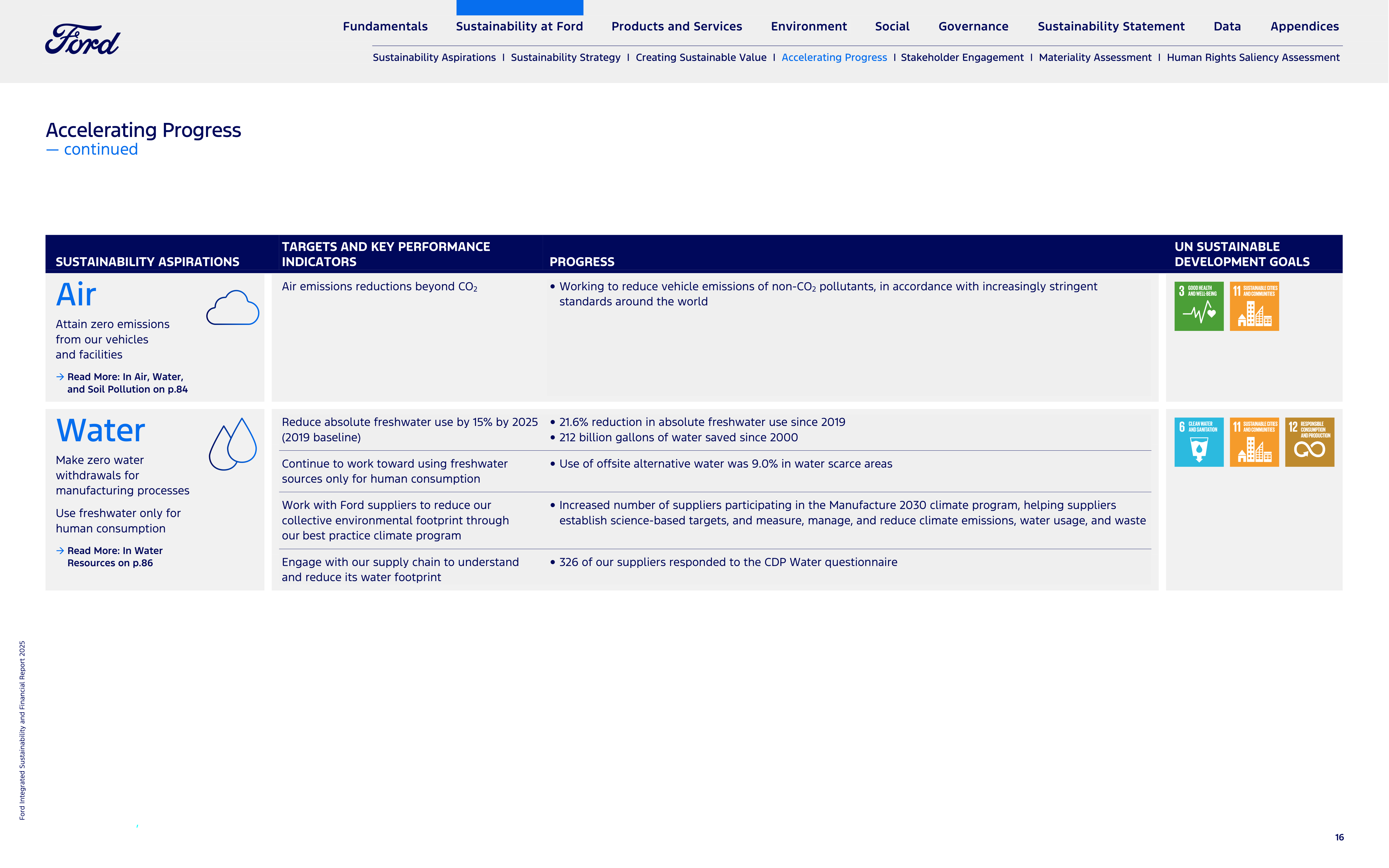
Air
Attain zero emissions
from our vehicles
and facilities
→
Read More: In Air, Water,
and Soil Pollution on p.84
Air emissions reductions beyond CO
2
●
Working to reduce vehicle emissions of non-CO
2
pollutants, in accordance with increasingly stringent
standards around the world
Water
Make zero water
withdrawals for
manufacturing processes
Use freshwater only for
human consumption
→
Read More: In Water
Resources on p.86
Reduce absolute freshwater use by 15% by 2025
(2019 baseline)
●
21.6% reduction in absolute freshwater use since 2019
●
212 billion gallons of water saved since 2000
Continue to work toward using freshwater
sources only for human consumption
●
Use of offsite alternative water was 9.0% in water scarce areas
Work with Ford suppliers to reduce our
collective environmental footprint through
our best practice climate program
●
Increased number of suppliers participating in the Manufacture 2030 climate program, helping suppliers
establish science-based targets, and measure, manage, and reduce climate emissions, water usage, and waste
Engage with our supply chain to understand
and reduce its water footprint
●
326 of our suppliers responded to the CDP Water questionnaire
SUSTAINABILITY ASPIRATIONS
TARGETS AND KEY PERFORMANCE
INDICATORS
PROGRESS
UN SUSTAINABLE
DEVELOPMENT GOALS
Fundamentals
Sustainability at Ford
Products and Services
Environment
Social
Governance
Sustainability Statement
Data
Appendices
Sustainability Aspirations | Sustainability Strategy | Creating Sustainable Value |
Accelerating Progress
| Stakeholder Engagement | Materiality Assessment | Human Rights Saliency Assessment
Accelerating Progress
— continued
,
Ford Integrated Sustainability and Financial Report 2025
16
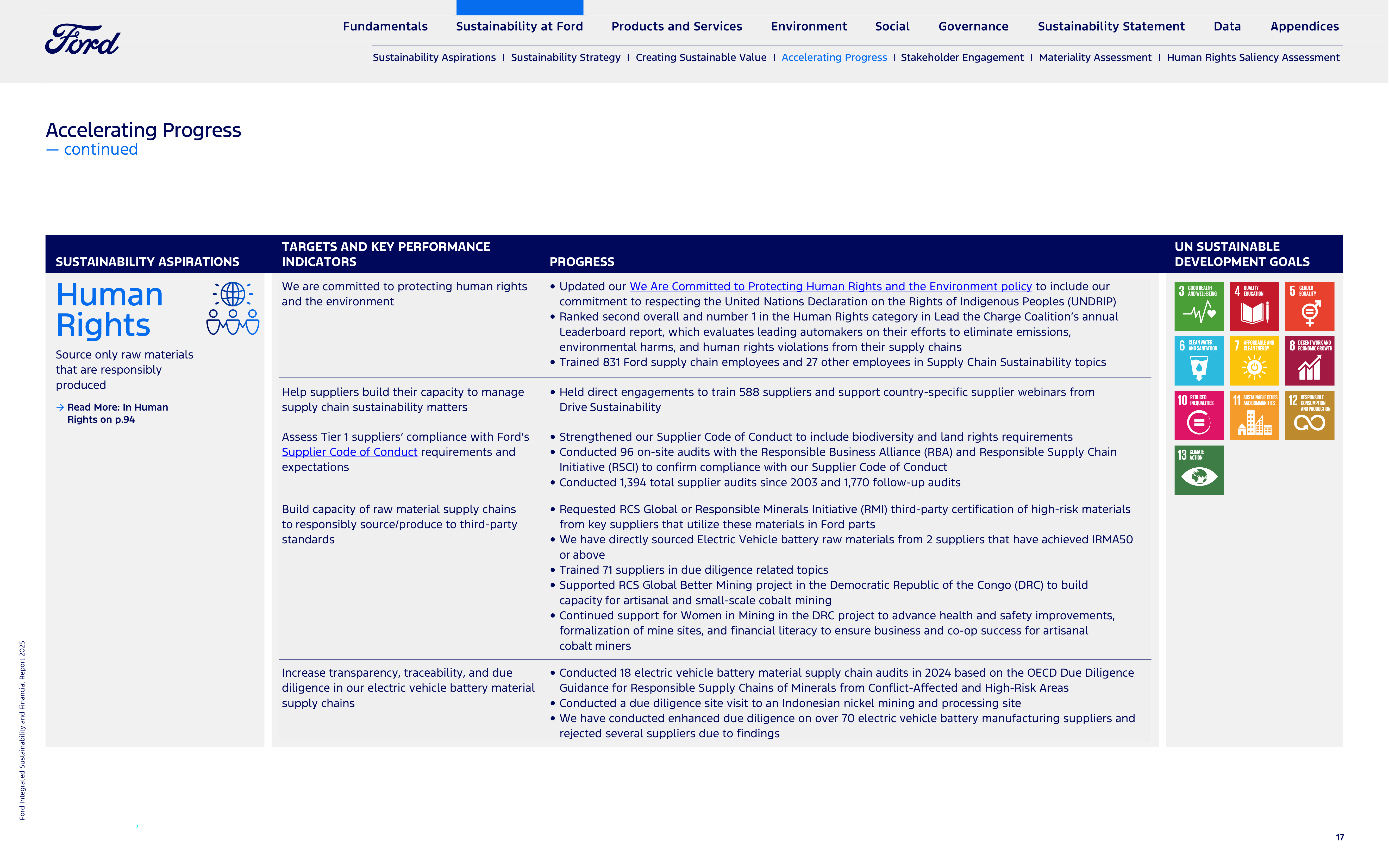
Human
Rights
Source only raw materials
that are responsibly
produced
→
Read More: In Human
Rights on p.94
We are committed to protecting human rights
and the environment
●
Updated our
We Are Committed to Protecting Human Rights and the Environment policy
to include our
commitment to respecting the United Nations Declaration on the Rights of Indigenous Peoples (UNDRIP)
●
Ranked second overall and number 1 in the Human Rights category in Lead the Charge Coalition’s annual
Leaderboard report, which evaluates leading automakers on their efforts to eliminate emissions,
environmental harms, and human rights violations from their supply chains
●
Trained 831 Ford supply chain employees and 27 other employees in Supply Chain Sustainability topics
Help suppliers build their capacity to manage
supply chain sustainability matters
●
Held direct engagements to train 588 suppliers and support country-specific supplier webinars from
Drive Sustainability
Assess Tier 1 suppliers’ compliance with Ford’s
Supplier Code of Conduct
requirements and
expectations
●
Strengthened our Supplier Code of Conduct to include biodiversity and land rights requirements
●
Conducted 96 on-site audits with the Responsible Business Alliance (RBA) and Responsible Supply Chain
Initiative (RSCI) to confirm compliance with our Supplier Code of Conduct
●
Conducted 1,394 total supplier audits since 2003 and 1,770 follow-up audits
Build capacity of raw material supply chains
to responsibly source/produce to third-party
standards
●
Requested RCS Global or Responsible Minerals Initiative (RMI) third-party certification of high-risk materials
from key suppliers that utilize these materials in Ford parts
●
We have directly sourced Electric Vehicle battery raw materials from 2 suppliers that have achieved IRMA50
or above
●
Trained 71 suppliers in due diligence related topics
●
Supported RCS Global Better Mining project in the Democratic Republic of the Congo (DRC) to build
capacity for artisanal and small-scale cobalt mining
●
Continued support for Women in Mining in the DRC project to advance health and safety improvements,
formalization of mine sites, and financial literacy to ensure business and co-op success for artisanal
cobalt miners
Increase transparency, traceability, and due
diligence in our electric vehicle battery material
supply chains
●
Conducted 18 electric vehicle battery material supply chain audits in 2024 based on the OECD Due Diligence
Guidance for Responsible Supply Chains of Minerals from Conflict-Affected and High-Risk Areas
●
Conducted a due diligence site visit to an Indonesian nickel mining and processing site
●
We have conducted enhanced due diligence on over 70 electric vehicle battery manufacturing suppliers and
rejected several suppliers due to findings
SUSTAINABILITY ASPIRATIONS
TARGETS AND KEY PERFORMANCE
INDICATORS
PROGRESS
UN SUSTAINABLE
DEVELOPMENT GOALS
Fundamentals
Sustainability at Ford
Products and Services
Environment
Social
Governance
Sustainability Statement
Data
Appendices
Sustainability Aspirations | Sustainability Strategy | Creating Sustainable Value |
Accelerating Progress
| Stakeholder Engagement | Materiality Assessment | Human Rights Saliency Assessment
Accelerating Progress
— continued
,
Ford Integrated Sustainability and Financial Report 2025
17
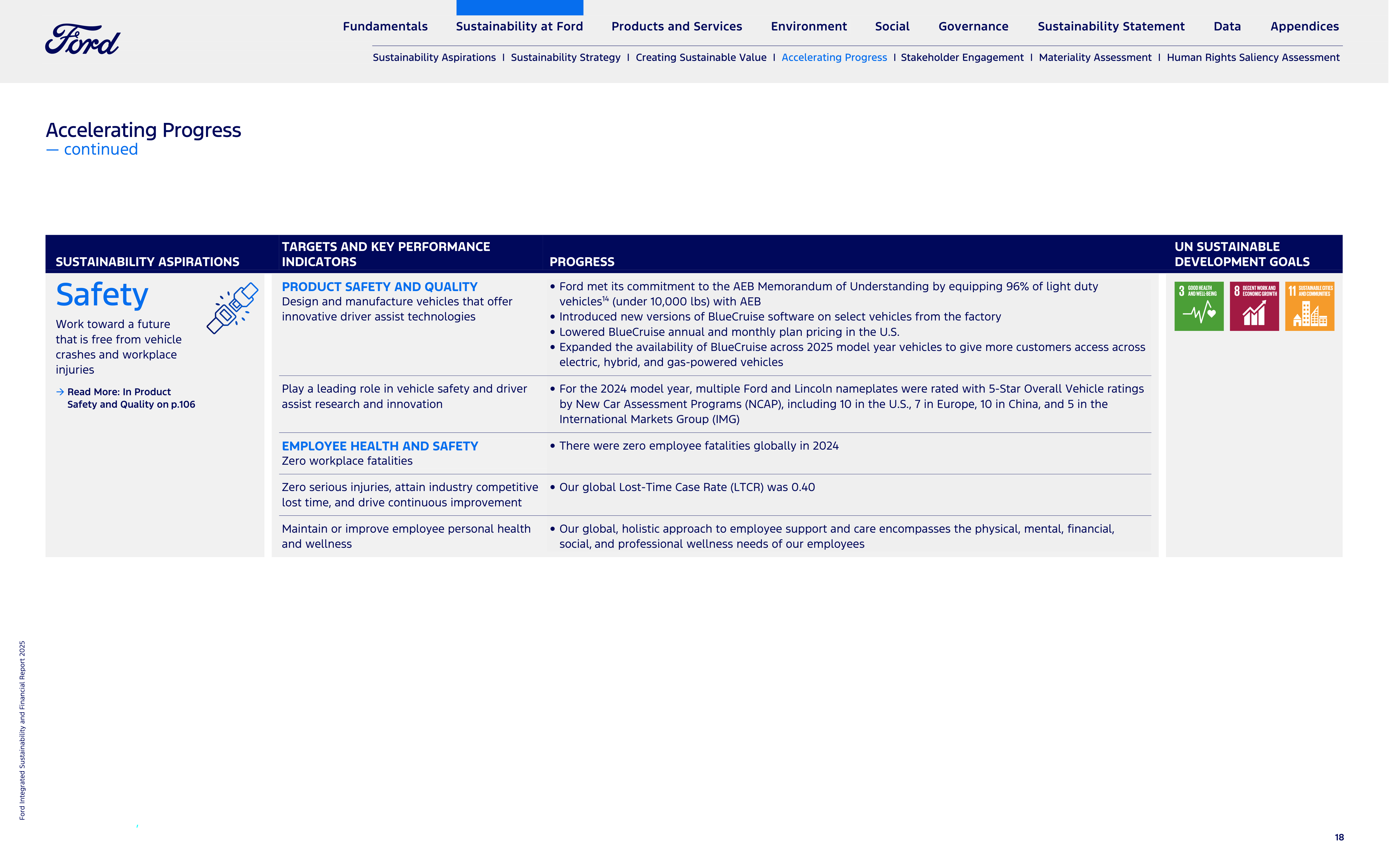
Safety
Work toward a future
that is free from vehicle
crashes and workplace
injuries
→
Read More: In Product
Safety and Quality on p.106
PRODUCT SAFETY AND QUALITY
Design and manufacture vehicles that offer
innovative driver assist technologies
●
Ford met its commitment to the AEB Memorandum of Understanding by equipping 96% of light duty
vehicles
14
(under 10,000 lbs) with AEB
●
Introduced new versions of BlueCruise software on select vehicles from the factory
●
Lowered BlueCruise annual and monthly plan pricing in the U.S.
●
Expanded the availability of BlueCruise across 2025 model year vehicles to give more customers access across
electric, hybrid, and gas-powered vehicles
Play a leading role in vehicle safety and driver
assist research and innovation
●
For the 2024 model year, multiple Ford and Lincoln nameplates were rated with 5-Star Overall Vehicle ratings
by New Car Assessment Programs (NCAP), including 10 in the U.S., 7 in Europe, 10 in China, and 5 in the
International Markets Group (IMG)
EMPLOYEE HEALTH AND SAFETY
Zero workplace fatalities
●
There were zero employee fatalities globally in 2024
Zero serious injuries, attain industry competitive
lost time, and drive continuous improvement
●
Our global Lost-Time Case Rate (LTCR) was 0.40
Maintain or improve employee personal health
and wellness
●
Our global, holistic approach to employee support and care encompasses the physical, mental, financial,
social, and professional wellness needs of our employees
SUSTAINABILITY ASPIRATIONS
TARGETS AND KEY PERFORMANCE
INDICATORS
PROGRESS
UN SUSTAINABLE
DEVELOPMENT GOALS
Fundamentals
Sustainability at Ford
Products and Services
Environment
Social
Governance
Sustainability Statement
Data
Appendices
Sustainability Aspirations | Sustainability Strategy | Creating Sustainable Value |
Accelerating Progress
| Stakeholder Engagement | Materiality Assessment | Human Rights Saliency Assessment
Accelerating Progress
— continued
,
Ford Integrated Sustainability and Financial Report 2025
18
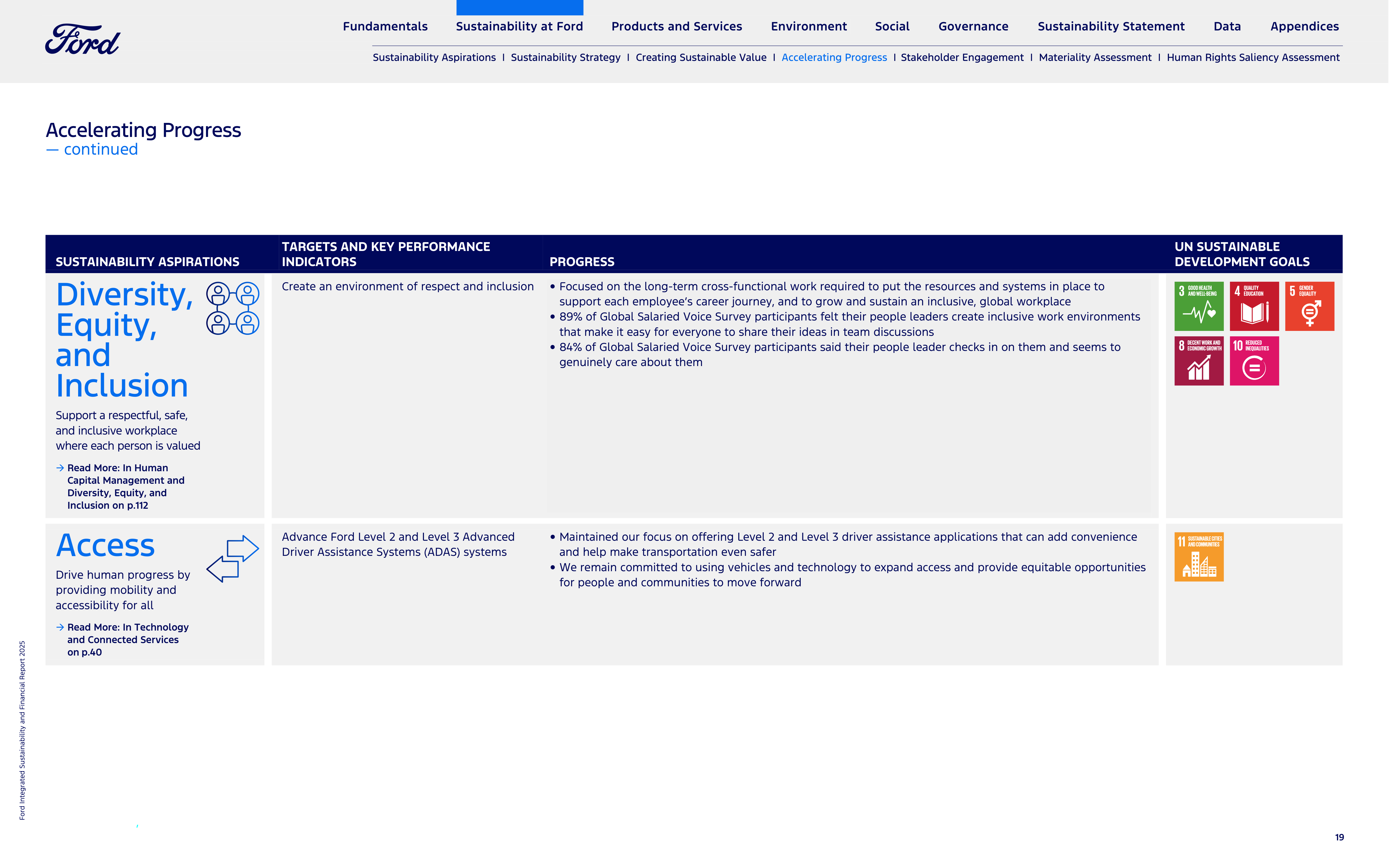
Diversity,
Equity,
and
Inclusion
Support a respectful, safe,
and inclusive workplace
where each person is valued
→
Read More: In Human
Capital Management and
Diversity, Equity, and
Inclusion on p.112
Create an environment of respect and inclusion
●
Focused on the long-term cross-functional work required to put the resources and systems in place to
support each employee’s career journey, and to grow and sustain an inclusive, global workplace
●
89% of Global Salaried Voice Survey participants felt their people leaders create inclusive work environments
that make it easy for everyone to share their ideas in team discussions
●
84% of Global Salaried Voice Survey participants said their people leader checks in on them and seems to
genuinely care about them
Access
Drive human progress by
providing mobility and
accessibility for all
→
Read More: In Technology
and Connected Services
on p.40
Advance Ford Level 2 and Level 3 Advanced
Driver Assistance Systems (ADAS) systems
●
Maintained our focus on offering Level 2 and Level 3 driver assistance applications that can add convenience
and help make transportation even safer
●
We remain committed to using vehicles and technology to expand access and provide equitable opportunities
for people and communities to move forward
SUSTAINABILITY ASPIRATIONS
TARGETS AND KEY PERFORMANCE
INDICATORS
PROGRESS
UN SUSTAINABLE
DEVELOPMENT GOALS
Fundamentals
Sustainability at Ford
Products and Services
Environment
Social
Governance
Sustainability Statement
Data
Appendices
Sustainability Aspirations | Sustainability Strategy | Creating Sustainable Value |
Accelerating Progress
| Stakeholder Engagement | Materiality Assessment | Human Rights Saliency Assessment
Accelerating Progress
— continued
,
Ford Integrated Sustainability and Financial Report 2025
19
Fundamentals
Sustainability at Ford
Products and Services
Environment
Social
Governance
Sustainability Statement
Data
Appendices
Sustainability Aspirations | Sustainability Strategy | Creating Sustainable Value | Accelerating Progress |
Stakeholder Engagement
| Materiality Assessment | Human Rights Saliency Assessment
Stakeholder Engagement
Ford is committed to direct, open,
transparent, and frequent engagement
with our stakeholders.
Throughout each year, management meets with
institutional investors to discuss various matters,
including long-term strategy; financial and operating
performance; risk management; environmental, social,
and governance (ESG) practices; and executive
compensation programs. These meetings are informative
and, where appropriate, we incorporate stakeholder
suggestions into our policy and strategic considerations,
Proxy Statement
, and communications strategy.
Highlights from 2024 included:
●
Met with current and potential shareholders
representing our institutional equity investor base
and fixed income investors of our unsecured debt
●
Participated in multiple conferences throughout
the year
●
Hosted two non-deal roadshows, including one
focused on ESG
●
Held quarterly webcast earnings calls and post-
earnings sell-side calls
●
Attended investor engagements and touchpoints,
including quarterly sell-side and buy-side calls
SUSTAINABILITY FOCUSED ENGAGEMENT
As in recent years, a stakeholder team selected by Ceres
provided recommendations for our future sustainability
reporting and strategy. Some topics of conversation in
2025 included Ford’s electrification strategy, climate
goals and greenhouse gas emissions, supply chain
sustainability, material circularity and waste reduction,
and product safety. Ford’s progress to date on these
topics can be found within this Integrated Report.
Representing a range of constituencies and expertise,
the most recent Ceres stakeholder engagement
convened on February 12, 2025.
BLUE TABLE FORUM
We established the Blue Table Forum in 2022. This
stakeholder advocacy program is focused on creating
and building a trusted community of organizational and
institutional stakeholders from a diverse group of non-
governmental organizations (NGOs), nonprofits, and
academic institutions. The goal is to initiate a dialogue
around critical issues faced and how we can work
together to build a carbon neutral transportation future.
Ford has also partnered with members of the Blue Table
Forum to advocate for shared policy positions on GHG
emissions and fuel economy standards, clean and low-
carbon aluminum, electric vehicle charging infrastructure,
and more.
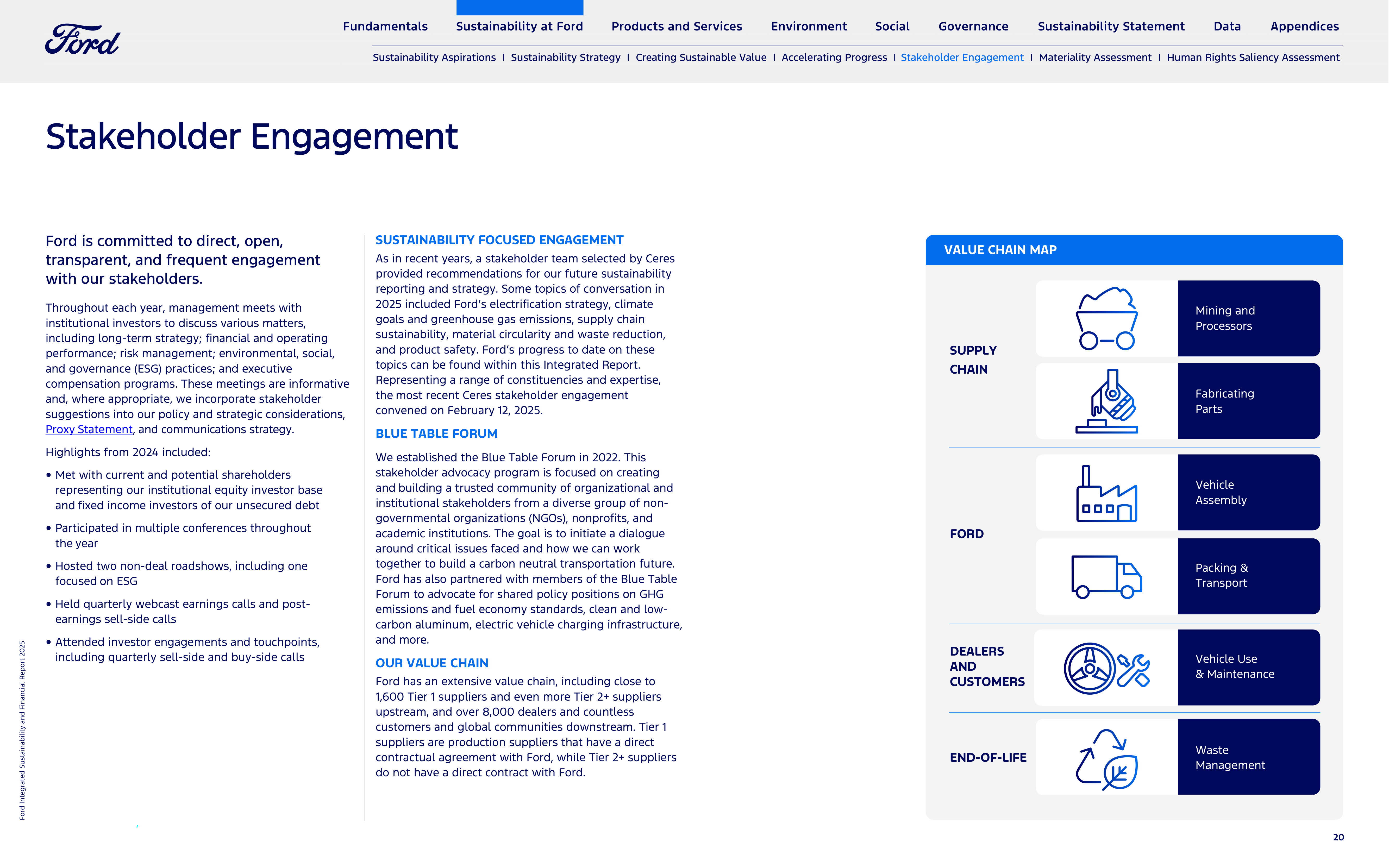
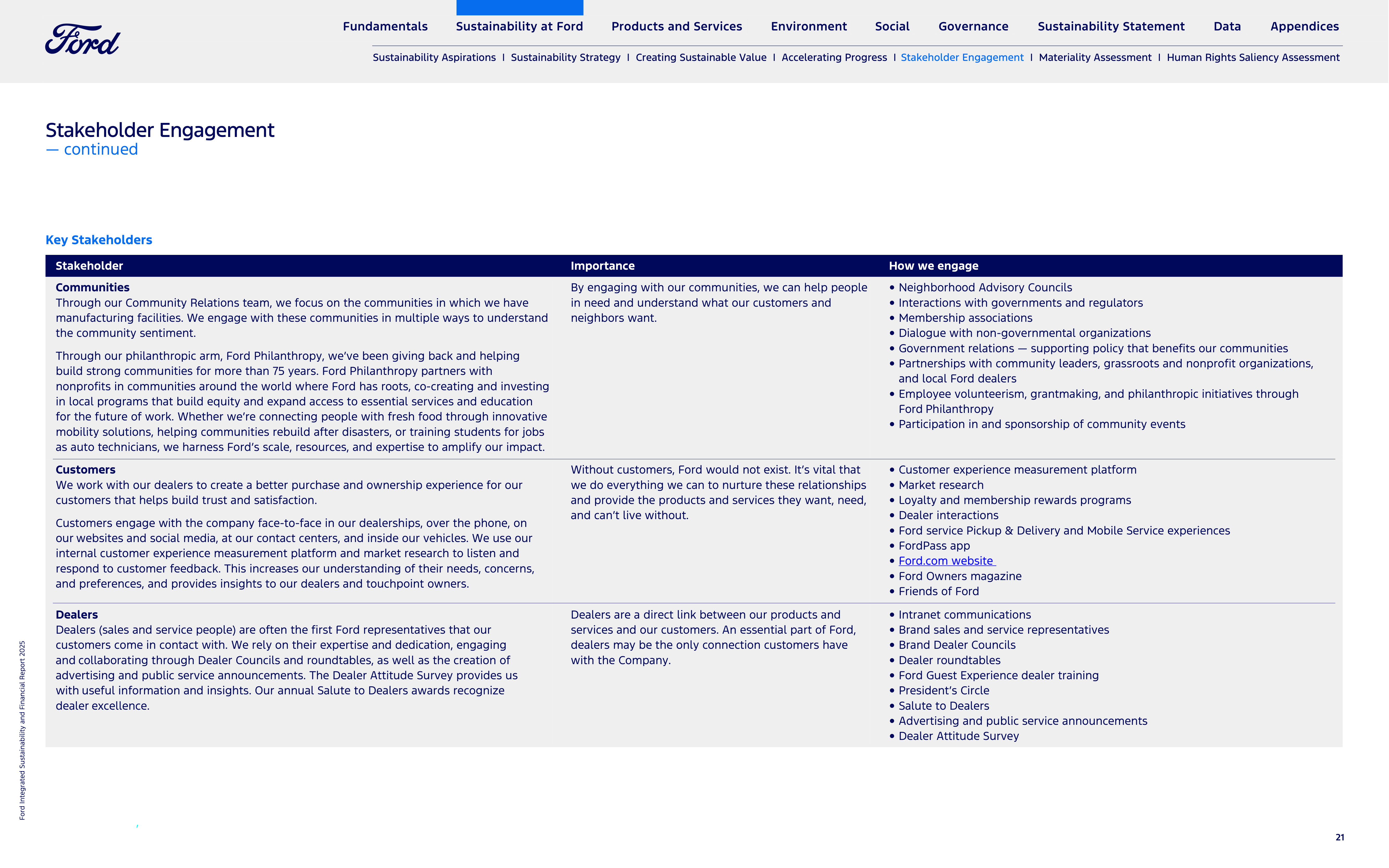
OUR VALUE CHAIN
Ford has an extensive value chain, including close to
1,600 Tier 1 suppliers and even more Tier 2+ suppliers
upstream, and over 8,000 dealers and countless
customers and global communities downstream. Tier 1
suppliers are production suppliers that have a direct
contractual agreement with Ford, while Tier 2+ suppliers
do not have a direct contract with Ford.
,
Ford Integrated Sustainability and Financial Report 2025
20
VALUE CHAIN MAP
SUPPLY
CHAIN
Mining and
Processors
Fabricating
Parts
FORD
Vehicle
Assembly
Packing &
Transport
DEALERS
AND
CUSTOMERS
Vehicle Use
& Maintenance
END-OF-LIFE
Waste
Management
Fundamentals
Sustainability at Ford
Products and Services
Environment
Social
Governance
Sustainability Statement
Data
Appendices
Sustainability Aspirations | Sustainability Strategy | Creating Sustainable Value | Accelerating Progress |
Stakeholder Engagement
| Materiality Assessment | Human Rights Saliency Assessment
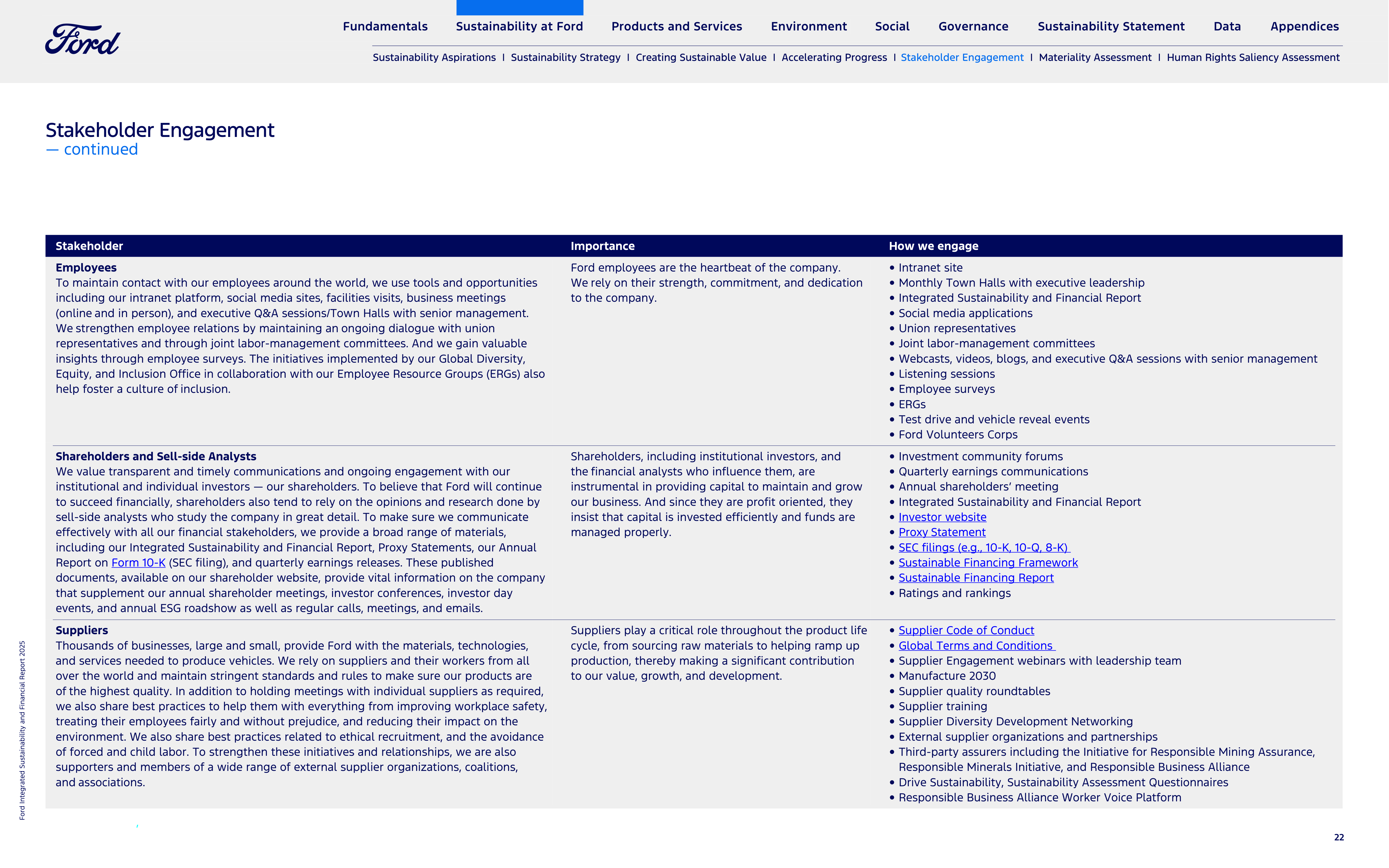
Key Stakeholders
Stakeholder
Importance
How we engage
Communities
Through our Community Relations team, we focus on the communities in which we have
manufacturing facilities. We engage with these communities in multiple ways to understand
the community sentiment.
Through our philanthropic arm, Ford Philanthropy, we’ve been giving back and helping
build strong communities for more than 75 years. Ford Philanthropy partners with
nonprofits in communities around the world where Ford has roots, co-creating and investing
in local programs that build equity and expand access to essential services and education
for the future of work. Whether we’re connecting people with fresh food through innovative
mobility solutions, helping communities rebuild after disasters, or training students for jobs
as auto technicians, we harness Ford’s scale, resources, and expertise to amplify our impact.
By engaging with our communities, we can help people
in need and understand what our customers and
neighbors want.
●
Neighborhood Advisory Councils
●
Interactions with governments and regulators
●
Membership associations
●
Dialogue with non-governmental organizations
●
Government relations — supporting policy that benefits our communities
●
Partnerships with community leaders, grassroots and nonprofit organizations,
and local Ford dealers
●
Employee volunteerism, grantmaking, and philanthropic initiatives through
Ford Philanthropy
●
Participation in and sponsorship of community events
Customers
We work with our dealers to create a better purchase and ownership experience for our
customers that helps build trust and satisfaction.
Customers engage with the company face-to-face in our dealerships, over the phone, on
our websites and social media, at our contact centers, and inside our vehicles. We use our
internal customer experience measurement platform and market research to listen and
respond to customer feedback. This increases our understanding of their needs, concerns,
and preferences, and provides insights to our dealers and touchpoint owners.
Without customers, Ford would not exist. It’s vital that
we do everything we can to nurture these relationships
and provide the products and services they want, need,
and can’t live without.
●
Customer experience measurement platform
●
Market research
●
Loyalty and membership rewards programs
●
Dealer interactions
●
Ford service Pickup & Delivery and Mobile Service experiences
●
FordPass app
●
Ford.com website
●
Ford Owners magazine
●
Friends of Ford
Dealers
Dealers (sales and service people) are often the first Ford representatives that our
customers come in contact with. We rely on their expertise and dedication, engaging
and collaborating through Dealer Councils and roundtables, as well as the creation of
advertising and public service announcements. The Dealer Attitude Survey provides us
with useful information and insights. Our annual Salute to Dealers awards recognize
dealer excellence.
Dealers are a direct link between our products and
services and our customers. An essential part of Ford,
dealers may be the only connection customers have
with the Company.
●
Intranet communications
●
Brand sales and service representatives
●
Brand Dealer Councils
●
Dealer roundtables
●
Ford Guest Experience dealer training
●
President’s Circle
●
Salute to Dealers
●
Advertising and public service announcements
●
Dealer Attitude Survey
Stakeholder Engagement
— continued
,
Ford Integrated Sustainability and Financial Report 2025
21
Employees
To maintain contact with our employees around the world, we use tools and opportunities
including our intranet platform, social media sites, facilities visits, business meetings
(online and in person), and executive Q&A sessions/Town Halls with senior management.
We strengthen employee relations by maintaining an ongoing dialogue with union
representatives and through joint labor-management committees. And we gain valuable
insights through employee surveys. The initiatives implemented by our Global Diversity,
Equity, and Inclusion Office in collaboration with our Employee Resource Groups (ERGs) also
help foster a culture of inclusion.
Ford employees are the heartbeat of the company.
We rely on their strength, commitment, and dedication
to the company.
●
Intranet site
●
Monthly Town Halls with executive leadership
●
Integrated Sustainability and Financial Report
●
Social media applications
●
Union representatives
●
Joint labor-management committees
●
Webcasts, videos, blogs, and executive Q&A sessions with senior management
●
Listening sessions
●
Employee surveys
●
ERGs
●
Test drive and vehicle reveal events
●
Ford Volunteers Corps
Shareholders and Sell-side Analysts
We value transparent and timely communications and ongoing engagement with our
institutional and individual investors — our shareholders. To believe that Ford will continue
to succeed financially, shareholders also tend to rely on the opinions and research done by
sell-side analysts who study the company in great detail. To make sure we communicate
effectively with all our financial stakeholders, we provide a broad range of materials,
including our Integrated Sustainability and Financial Report, Proxy Statements, our Annual
Report on
Form 10-K
(SEC filing), and quarterly earnings releases. These published
documents, available on our shareholder website, provide vital information on the company
that supplement our annual shareholder meetings, investor conferences, investor day
events, and annual ESG roadshow as well as regular calls, meetings, and emails.
Shareholders, including institutional investors, and
the financial analysts who influence them, are
instrumental in providing capital to maintain and grow
our business. And since they are profit oriented, they
insist that capital is invested efficiently and funds are
managed properly.
●
Investment community forums
●
Quarterly earnings communications
●
Annual shareholders’ meeting
●
Integrated Sustainability and Financial Report
●
Investor website
●
Proxy Statement
●
SEC filings (e.g., 10-K, 10-Q, 8-K)
●
Sustainable Financing Framework
●
Sustainable Financing Report
●
Ratings and rankings
Suppliers
Thousands of businesses, large and small, provide Ford with the materials, technologies,
and services needed to produce vehicles. We rely on suppliers and their workers from all
over the world and maintain stringent standards and rules to make sure our products are
of the highest quality. In addition to holding meetings with individual suppliers as required,
we also share best practices to help them with everything from improving workplace safety,
treating their employees fairly and without prejudice, and reducing their impact on the
environment. We also share best practices related to ethical recruitment, and the avoidance
of forced and child labor. To strengthen these initiatives and relationships, we are also
supporters and members of a wide range of external supplier organizations, coalitions,
and associations.
Suppliers play a critical role throughout the product life
cycle, from sourcing raw materials to helping ramp up
production, thereby making a significant contribution
to our value, growth, and development.
●
Supplier Code of Conduct
●
Global Terms and Conditions
●
Supplier Engagement webinars with leadership team
●
Manufacture 2030
●
Supplier quality roundtables
●
Supplier training
●
Supplier Diversity Development Networking
●
External supplier organizations and partnerships
●
Third-party assurers including the Initiative for Responsible Mining Assurance,
Responsible Minerals Initiative, and Responsible Business Alliance
●
Drive Sustainability, Sustainability Assessment Questionnaires
●
Responsible Business Alliance Worker Voice Platform
Stakeholder
Importance
How we engage
Fundamentals
Sustainability at Ford
Products and Services
Environment
Social
Governance
Sustainability Statement
Data
Appendices
Sustainability Aspirations | Sustainability Strategy | Creating Sustainable Value | Accelerating Progress |
Stakeholder Engagement
| Materiality Assessment | Human Rights Saliency Assessment
Stakeholder Engagement
— continued
,
Ford Integrated Sustainability and Financial Report 2025
22
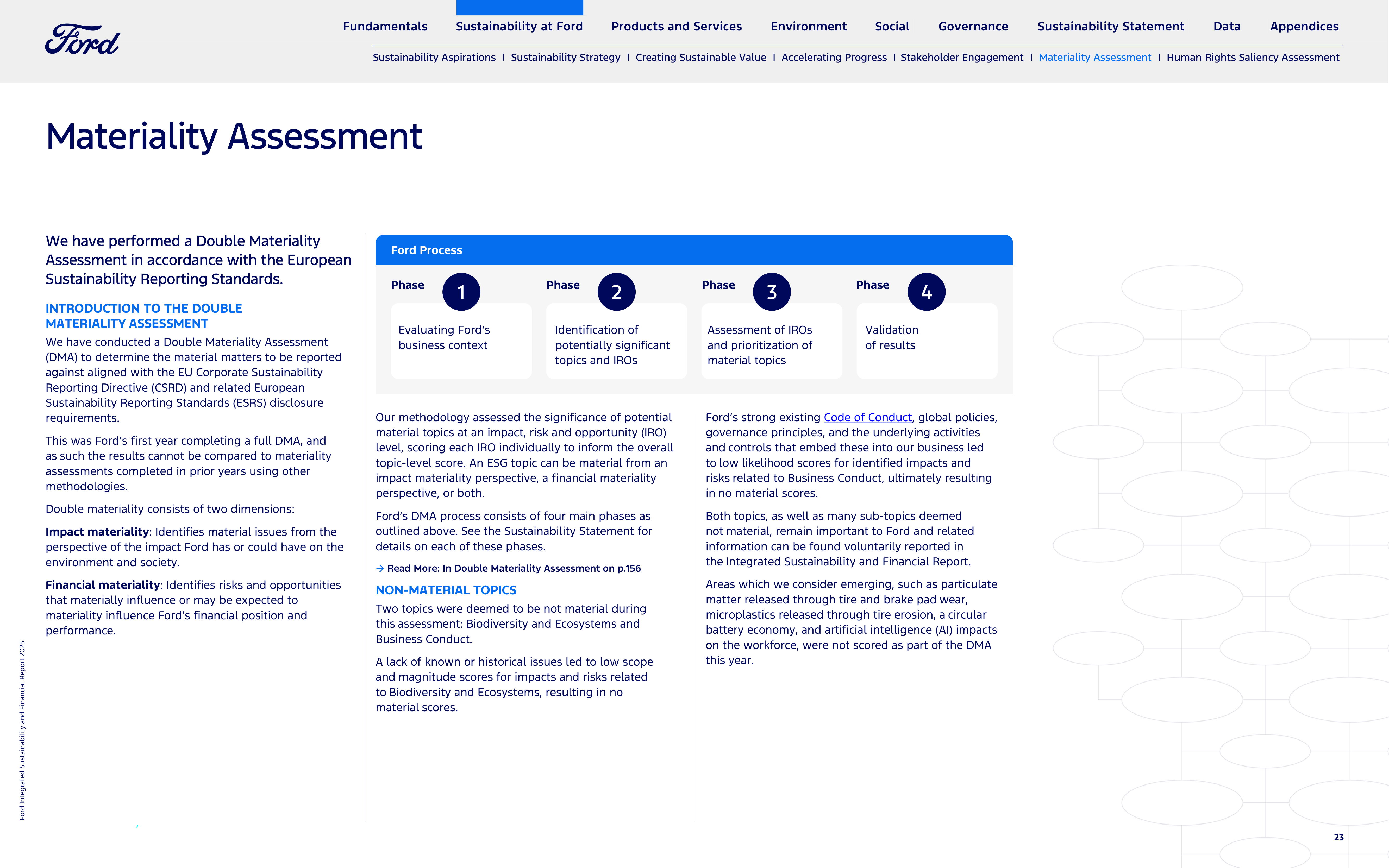

Fundamentals
Sustainability at Ford
Products and Services
Environment
Social
Governance
Sustainability Statement
Data
Appendices
Sustainability Aspirations | Sustainability Strategy | Creating Sustainable Value | Accelerating Progress | Stakeholder Engagement |
Materiality Assessment
| Human Rights Saliency Assessment
Materiality Assessment
We have performed a Double Materiality
Assessment in accordance with the European
Sustainability Reporting Standards.
INTRODUCTION TO THE DOUBLE
MATERIALITY ASSESSMENT
We have conducted a Double Materiality Assessment
(DMA) to determine the material matters to be reported
against aligned with the EU Corporate Sustainability
Reporting Directive (CSRD) and related European
Sustainability Reporting Standards (ESRS) disclosure
requirements.
This was Ford’s first year completing a full DMA, and
as such the results cannot be compared to materiality
assessments completed in prior years using other
methodologies.
Double materiality consists of two dimensions:
Impact materiality
: Identifies material issues from the
perspective of the impact Ford has or could have on the
environment and society.
Financial materiality
: Identifies risks and opportunities
that materially influence or may be expected to
materiality influence Ford’s financial position and
performance.
Ford Process
Phase 1
Evaluating Ford’s
business context
Phase 2
Identification of
potentially significant
topics and IROs
Phase 3
Assessment of IROs
and prioritization of
material topics
Phase 4
Validation
of results
Our methodology assessed the significance of potential
material topics at an impact, risk and opportunity (IRO)
level, scoring each IRO individually to inform the overall
topic-level score. An ESG topic can be material from an
impact materiality perspective, a financial materiality
perspective, or both.
Ford’s DMA process consists of four main phases as
outlined above. See the Sustainability Statement for
details on each of these phases.
Read More: In Double Materiality Assessment on p.156
NON-MATERIAL TOPICS
Two topics were deemed to be not material during
this assessment: Biodiversity and Ecosystems and
Business Conduct.
A lack of known or historical issues led to low scope
and magnitude scores for impacts and risks related
to Biodiversity and Ecosystems, resulting in no
material scores.
→
Ford’s strong existing
Code of Conduct
, global policies,
governance principles, and the underlying activities
and controls that embed these into our business led
to low likelihood scores for identified impacts and
risks related to Business Conduct, ultimately resulting
in no material scores.
Both topics, as well as many sub-topics deemed
not material, remain important to Ford and related
information can be found voluntarily reported in
the Integrated Sustainability and Financial Report.
Areas which we consider emerging, such as particulate
matter released through tire and brake pad wear,
microplastics released through tire erosion, a circular
battery economy, and artificial intelligence (AI) impacts
on the workforce, were not scored as part of the DMA
this year.
,
Ford Integrated Sustainability and Financial Report 2025
23
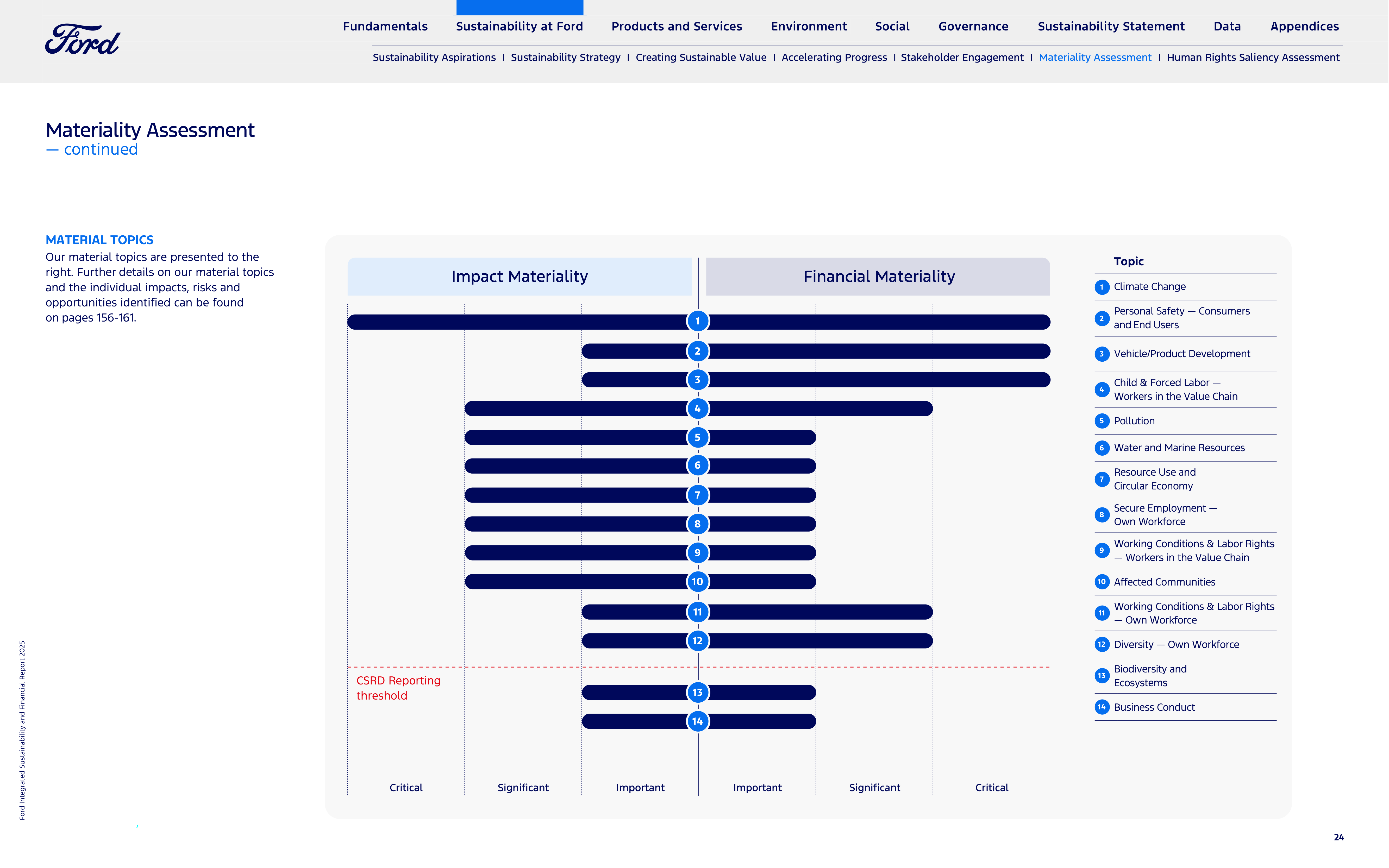
Fundamentals
Sustainability at Ford
Products and Services
Environment
Social
Governance
Sustainability Statement
Data
Appendices
Sustainability Aspirations | Sustainability Strategy | Creating Sustainable Value | Accelerating Progress | Stakeholder Engagement |
Materiality Assessment
| Human Rights Saliency Assessment
Materiality Assessment
— continued
,
Ford Integrated Sustainability and Financial Report 2025
24
MATERIAL TOPICS
Our material topics are presented to the
right. Further details on our material topics
and the individual impacts, risks and
opportunities identified can be found
on pages 156-161.
Topic
Climate Change
Personal Safety — Consumers
and End Users
Vehicle/Product Development
Child & Forced Labor —
Workers in the Value Chain
Pollution
Water and Marine Resources
Resource Use and
Circular Economy
Secure Employment —
Own Workforce
Working Conditions & Labor Rights
— Workers in the Value Chain
Affected Communities
Working Conditions & Labor Rights
— Own Workforce
Diversity — Own Workforce
Biodiversity and
Ecosystems
Business Conduct
Impact Materiality
Financial Materiality
Critical
Significant
Important
Important
Significant
Critical
CSRD Reporting
threshold
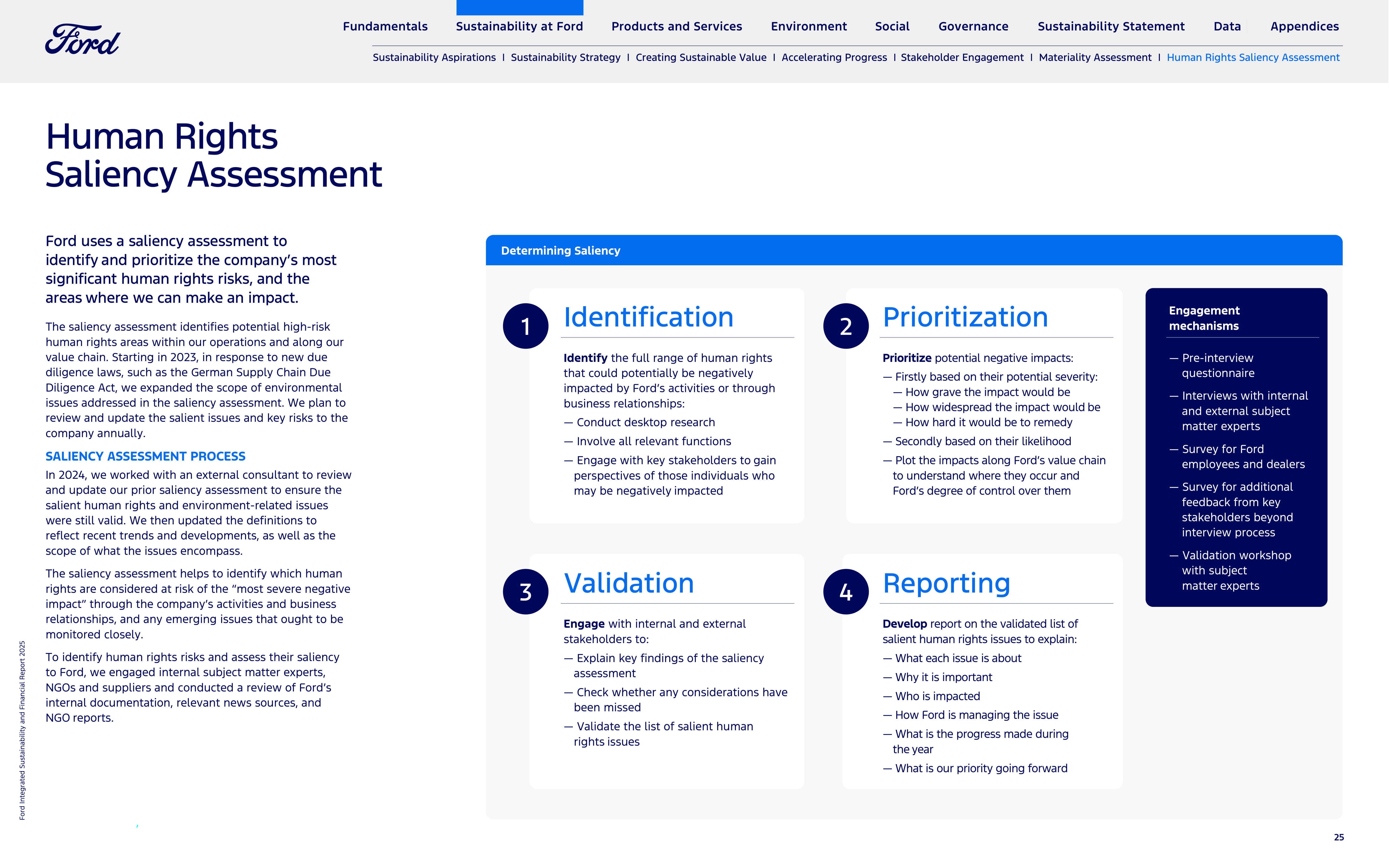
Fundamentals
Sustainability at Ford
Products and Services
Environment
Social
Governance
Sustainability Statement
Data
Appendices
Sustainability Aspirations | Sustainability Strategy | Creating Sustainable Value | Accelerating Progress | Stakeholder Engagement | Materiality Assessment |
Human Rights Saliency Assessment
Human Rights
Saliency Assessment
Ford uses a saliency assessment to
identify and prioritize the company’s most
significant human rights risks, and the
areas where we can make an impact.
The saliency assessment identifies potential high-risk
human rights areas within our operations and along our
value chain. Starting in 2023, in response to new due
diligence laws, such as the German Supply Chain Due
Diligence Act, we expanded the scope of environmental
issues addressed in the saliency assessment. We plan to
review and update the salient issues and key risks to the
company annually.
SALIENCY ASSESSMENT PROCESS
In 2024, we worked with an external consultant to review
and update our prior saliency assessment to ensure the
salient human rights and environment-related issues
were still valid. We then updated the definitions to
reflect recent trends and developments, as well as the
scope of what the issues encompass.
The saliency assessment helps to identify which human
rights are considered at risk of the “most severe negative
impact” through the company’s activities and business
relationships, and any emerging issues that ought to be
monitored closely.
To identify human rights risks and assess their saliency
to Ford, we engaged internal subject matter experts,
NGOs and suppliers and conducted a review of Ford’s
internal documentation, relevant news sources, and
NGO reports.
,
Ford Integrated Sustainability and Financial Report 2025
25
Determining Saliency
Identification
Identify
the full range of human rights
that could potentially be negatively
impacted by Ford’s activities or through
business relationships:
— Conduct desktop research
— Involve all relevant functions
— Engage with key stakeholders to gain
perspectives of those individuals who
may be negatively impacted
Prioritization
Prioritize
potential negative impacts:
— Firstly based on their potential severity:
— How grave the impact would be
— How widespread the impact would be
— How hard it would be to remedy
— Secondly based on their likelihood
— Plot the impacts along Ford’s value chain
to understand where they occur and
Ford’s degree of control over them
Validation
Engage
with internal and external
stakeholders to:
— Explain key findings of the saliency
assessment
— Check whether any considerations have
been missed
— Validate the list of salient human
rights issues
Reporting
Develop
report on the validated list of
salient human rights issues to explain:
— What each issue is about
— Why it is important
— Who is impacted
— How Ford is managing the issue
— What is the progress made during
the year
— What is our priority going forward
Engagement
mechanisms
— Pre-interview
questionnaire
— Interviews with internal
and external subject
matter experts
— Survey for Ford
employees and dealers
— Survey for additional
feedback from key
stakeholders beyond
interview process
— Validation workshop
with subject
matter experts
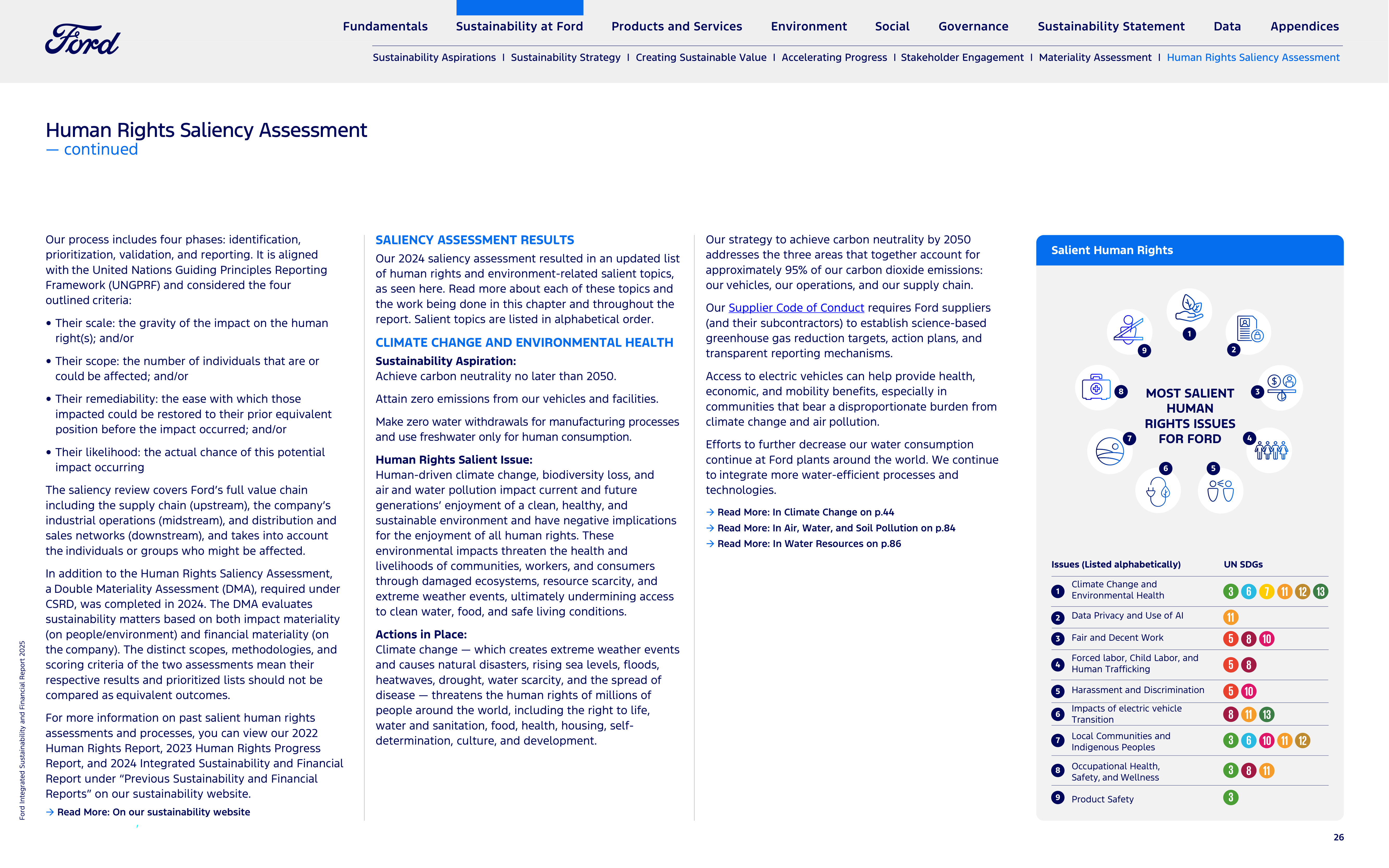
Fundamentals
Sustainability at Ford
Products and Services
Environment
Social
Governance
Sustainability Statement
Data
Appendices
Sustainability Aspirations | Sustainability Strategy | Creating Sustainable Value | Accelerating Progress | Stakeholder Engagement | Materiality Assessment |
Human Rights Saliency Assessment
Our process includes four phases: identification,
prioritization, validation, and reporting. It is aligned
with the United Nations Guiding Principles Reporting
Framework (UNGPRF) and considered the four
outlined criteria:
●
Their scale: the gravity of the impact on the human
right(s); and/or
●
Their scope: the number of individuals that are or
could be affected; and/or
●
Their remediability: the ease with which those
impacted could be restored to their prior equivalent
position before the impact occurred; and/or
●
Their likelihood: the actual chance of this potential
impact occurring
The saliency review covers Ford’s full value chain
including the supply chain (upstream), the company’s
industrial operations (midstream), and distribution and
sales networks (downstream), and takes into account
the individuals or groups who might be affected.
In addition to the Human Rights Saliency Assessment,
a Double Materiality Assessment (DMA), required under
CSRD, was completed in 2024. The DMA evaluates
sustainability matters based on both impact materiality
(on people/environment) and financial materiality (on
the company). The distinct scopes, methodologies, and
scoring criteria of the two assessments mean their
respective results and prioritized lists should not be
compared as equivalent outcomes.
For more information on past salient human rights
assessments and processes, you can view our 2022
Human Rights Report, 2023 Human Rights Progress
Report, and 2024 Integrated Sustainability and Financial
Report under “Previous Sustainability and Financial
Reports” on our sustainability website.
Read More: On our sustainability website
→
SALIENCY ASSESSMENT RESULTS
Our 2024 saliency assessment resulted in an updated list
of human rights and environment-related salient topics,
as seen here. Read more about each of these topics and
the work being done in this chapter and throughout the
report. Salient topics are listed in alphabetical order.
CLIMATE CHANGE AND ENVIRONMENTAL HEALTH
Sustainability Aspiration:
Achieve carbon neutrality no later than 2050.
Attain zero emissions from our vehicles and facilities.
Make zero water withdrawals for manufacturing processes
and use freshwater only for human consumption.
Human Rights Salient Issue:
Human-driven climate change, biodiversity loss, and
air and water pollution impact current and future
generations’ enjoyment of a clean, healthy, and
sustainable environment and have negative implications
for the enjoyment of all human rights. These
environmental impacts threaten the health and
livelihoods of communities, workers, and consumers
through damaged ecosystems, resource scarcity, and
extreme weather events, ultimately undermining access
to clean water, food, and safe living conditions.
Actions in Place:
Climate change — which creates extreme weather events
and causes natural disasters, rising sea levels, floods,
heatwaves, drought, water scarcity, and the spread of
disease — threatens the human rights of millions of
people around the world, including the right to life,
water and sanitation, food, health, housing, self-
determination, culture, and development.
Our strategy to achieve carbon neutrality by 2050
addresses the three areas that together account for
approximately 95% of our carbon dioxide emissions:
our vehicles, our operations, and our supply chain.
Our
Supplier Code of Conduct
requires Ford suppliers
(and their subcontractors) to establish science-based
greenhouse gas reduction targets, action plans, and
transparent reporting mechanisms.
Access to electric vehicles can help provide health,
economic, and mobility benefits, especially in
communities that bear a disproportionate burden from
climate change and air pollution.
Efforts to further decrease our water consumption
continue at Ford plants around the world. We continue
to integrate more water-efficient processes and
technologies.
→
→
→
Read More: In Climate Change on p.44
Read More: In Air, Water, and Soil Pollution on p.84
Read More: In Water Resources on p.86
Human Rights Saliency Assessment
— continued
,
Ford Integrated Sustainability and Financial Report 2025
26
Salient Human Rights
MOST SALIENT
HUMAN
RIGHTS ISSUES
FOR FORD
Issues (Listed alphabetically)
UN SDGs
Climate Change and
Environmental Health
2 Data Privacy and Use of AI
3 Fair and Decent Work
4 Forced labor, Child Labor, an
d Human Trafficking
5 Harassment and Discrimination
6 Impacts of electric vehicl
e Transition
7 Local Communities an
d Indigenous Peoples
8 Occupational Health
, Safety, and Wellness
9 Product Safety
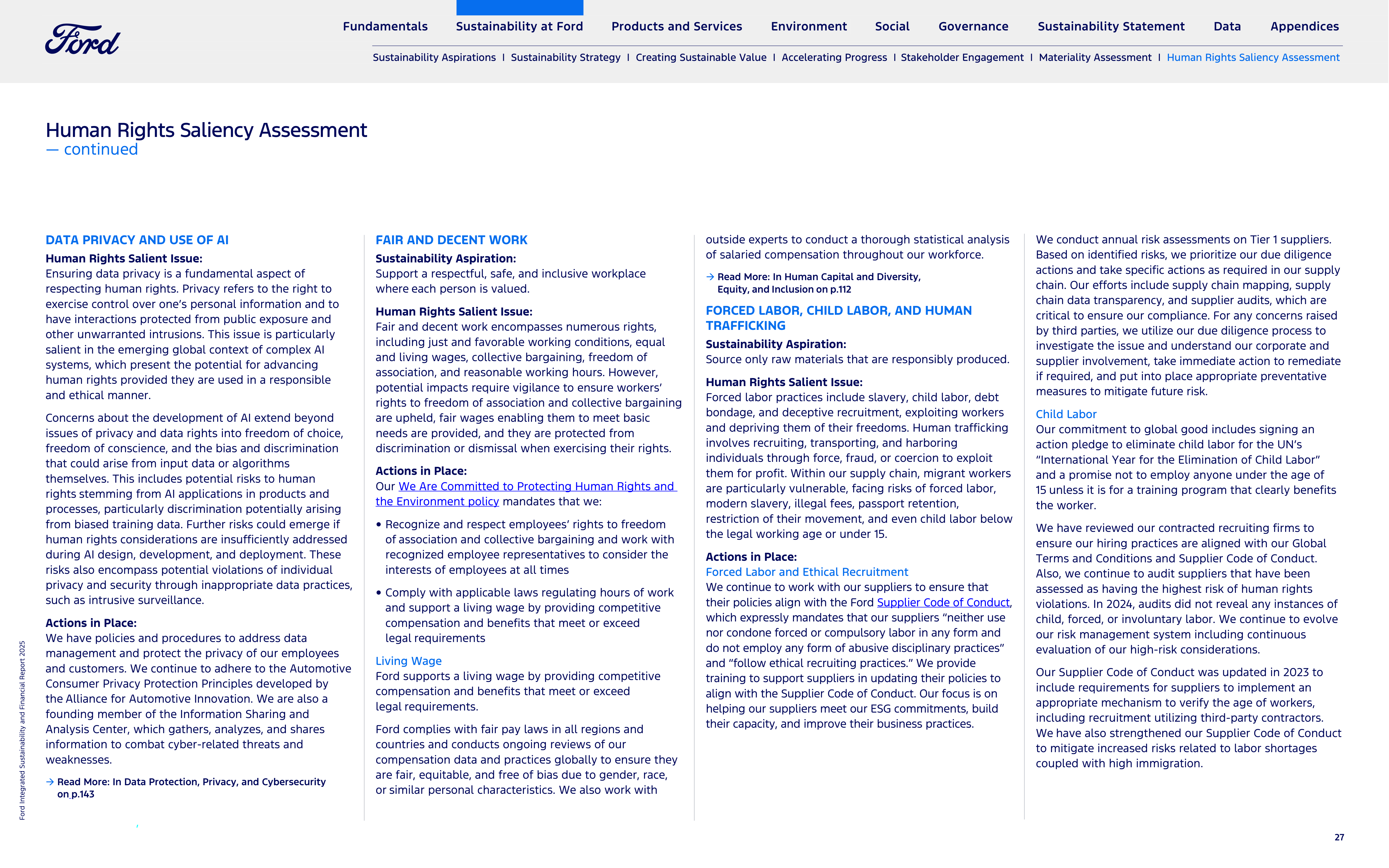
Fundamentals
Sustainability at Ford
Products and Services
Environment
Social
Governance
Sustainability Statement
Data
Appendices
Sustainability Aspirations | Sustainability Strategy | Creating Sustainable Value | Accelerating Progress | Stakeholder Engagement | Materiality Assessment |
Human Rights Saliency Assessment
DATA PRIVACY AND USE OF AI
Human Rights Salient Issue:
Ensuring data privacy is a fundamental aspect of
respecting human rights. Privacy refers to the right to
exercise control over one’s personal information and to
have interactions protected from public exposure and
other unwarranted intrusions. This issue is particularly
salient in the emerging global context of complex AI
systems, which present the potential for advancing
human rights provided they are used in a responsible
and ethical manner.
Concerns about the development of AI extend beyond
issues of privacy and data rights into freedom of choice,
freedom of conscience, and the bias and discrimination
that could arise from input data or algorithms
themselves. This includes potential risks to human
rights stemming from AI applications in products and
processes, particularly discrimination potentially arising
from biased training data. Further risks could emerge if
human rights considerations are insufficiently addressed
during AI design, development, and deployment. These
risks also encompass potential violations of individual
privacy and security through inappropriate data practices,
such as intrusive surveillance.
Actions in Place:
We have policies and procedures to address data
management and protect the privacy of our employees
and customers. We continue to adhere to the Automotive
Consumer Privacy Protection Principles developed by
the Alliance for Automotive Innovation. We are also a
founding member of the Information Sharing and
Analysis Center, which gathers, analyzes, and shares
information to combat cyber-related threats and
weaknesses.
Read More: In Data Protection, Privacy, and Cybersecurity
on
p.143
→
FAIR AND DECENT WORK
Sustainability Aspiration:
Support a respectful, safe, and inclusive workplace
where each person is valued.
Human Rights Salient Issue:
Fair and decent work encompasses numerous rights,
including just and favorable working conditions, equal
and living wages, collective bargaining, freedom of
association, and reasonable working hours. However,
potential impacts require vigilance to ensure workers’
rights to freedom of association and collective bargaining
are upheld, fair wages enabling them to meet basic
needs are provided, and they are protected from
discrimination or dismissal when exercising their rights.
Actions in Place:
Our
We Are Committed to Protecting Human Rights and
the Environment policy
mandates that we:
●
Recognize and respect employees’ rights to freedom
of association and collective bargaining and work with
recognized employee representatives to consider the
interests of employees at all times
●
Comply with applicable laws regulating hours of work
and support a living wage by providing competitive
compensation and benefits that meet or exceed
legal requirements
Living Wage
Ford supports a living wage by providing competitive
compensation and benefits that meet or exceed
legal requirements.
Ford complies with fair pay laws in all regions and
countries and conducts ongoing reviews of our
compensation data and practices globally to ensure they
are fair, equitable, and free of bias due to gender, race,
or similar personal characteristics. We also work with
outside experts to conduct a thorough statistical analysis
of salaried compensation throughout our workforce.
Read More: In Human Capital and Diversity,
Equity, and Inclusion on p.112
FORCED LABOR, CHILD LABOR, AND HUMAN
TRAFFICKING
Sustainability Aspiration:
Source only raw materials that are responsibly produced.
Human Rights Salient Issue:
Forced labor practices include slavery, child labor, debt
bondage, and deceptive recruitment, exploiting workers
and depriving them of their freedoms. Human trafficking
involves recruiting, transporting, and harboring
individuals through force, fraud, or coercion to exploit
them for profit. Within our supply chain, migrant workers
are particularly vulnerable, facing risks of forced labor,
modern slavery, illegal fees, passport retention,
restriction of their movement, and even child labor below
the legal working age or under 15.
Actions in Place:
Forced Labor and Ethical Recruitment
We continue to work with our suppliers to ensure that
their policies align with the Ford
Supplier Code of Conduct
,
which expressly mandates that our suppliers “neither use
nor condone forced or compulsory labor in any form and
do not employ any form of abusive disciplinary practices”
and “follow ethical recruiting practices.” We provide
training to support suppliers in updating their policies to
align with the Supplier Code of Conduct. Our focus is on
helping our suppliers meet our ESG commitments, build
their capacity, and improve their business practices.
→
We conduct annual risk assessments on Tier 1 suppliers.
Based on identified risks, we prioritize our due diligence
actions and take specific actions as required in our supply
chain. Our efforts include supply chain mapping, supply
chain data transparency, and supplier audits, which are
critical to ensure our compliance. For any concerns raised
by third parties, we utilize our due diligence process to
investigate the issue and understand our corporate and
supplier involvement, take immediate action to remediate
if required, and put into place appropriate preventative
measures to mitigate future risk.
Child Labor
Our commitment to global good includes signing an
action pledge to eliminate child labor for the UN’s
“International Year for the Elimination of Child Labor”
and a promise not to employ anyone under the age of
15 unless it is for a training program that clearly benefits
the worker.
We have reviewed our contracted recruiting firms to
ensure our hiring practices are aligned with our Global
Terms and Conditions and Supplier Code of Conduct.
Also, we continue to audit suppliers that have been
assessed as having the highest risk of human rights
violations. In 2024, audits did not reveal any instances of
child, forced, or involuntary labor. We continue to evolve
our risk management system including continuous
evaluation of our high-risk considerations.
Our Supplier Code of Conduct was updated in 2023 to
include requirements for suppliers to implement an
appropriate mechanism to verify the age of workers,
including recruitment utilizing third-party contractors.
We have also strengthened our Supplier Code of Conduct
to mitigate increased risks related to labor shortages
coupled with high immigration.
Human Rights Saliency Assessment
— continued
,
Ford Integrated Sustainability and Financial Report 2025
27
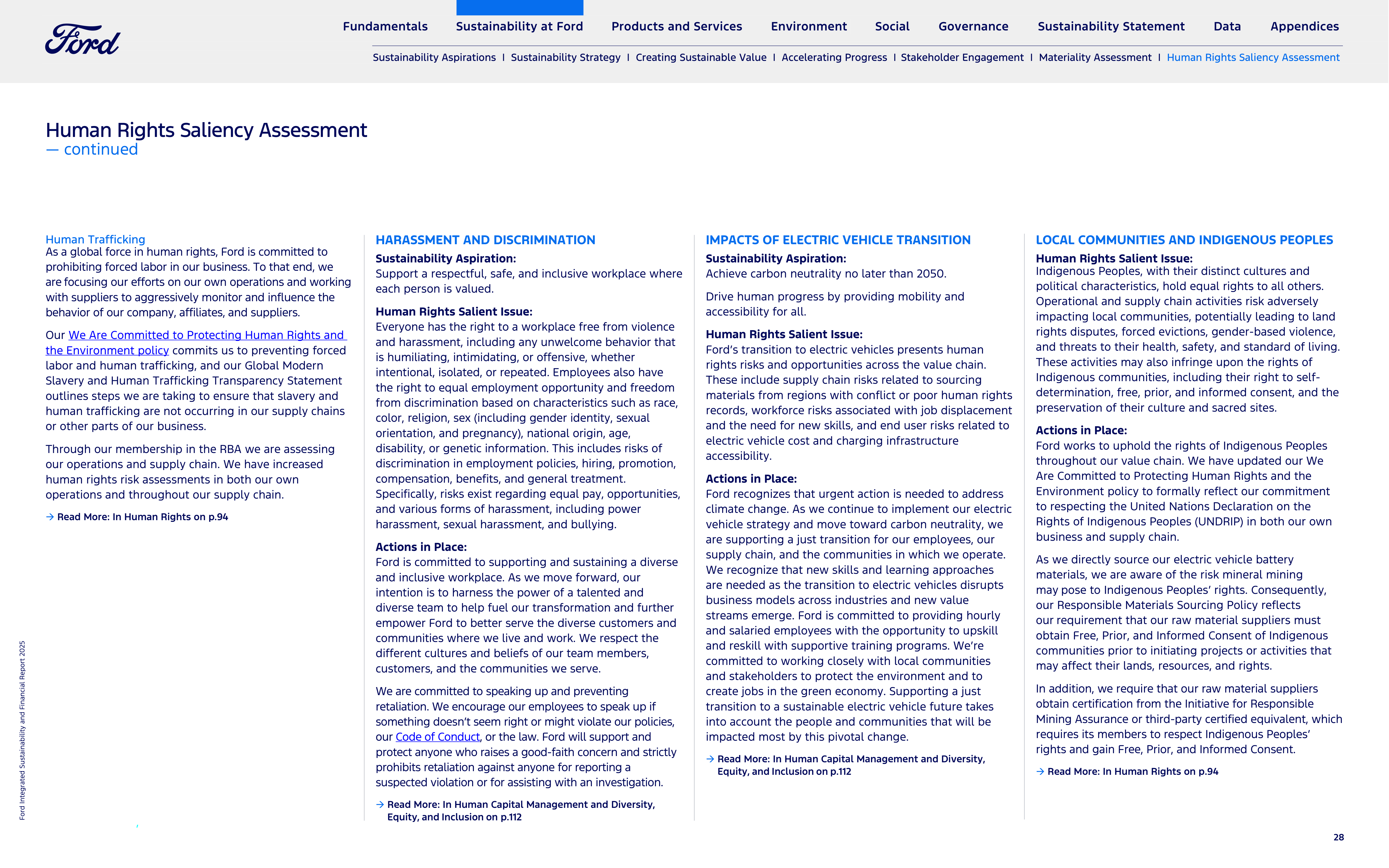
Fundamentals
Sustainability at Ford
Products and Services
Environment
Social
Governance
Sustainability Statement
Data
Appendices
Sustainability Aspirations | Sustainability Strategy | Creating Sustainable Value | Accelerating Progress | Stakeholder Engagement | Materiality Assessment |
Human Rights Saliency Assessment
Human Trafficking
As a global force in human rights, Ford is committed to
prohibiting forced labor in our business. To that end, we
are focusing our efforts on our own operations and working
with suppliers to aggressively monitor and influence the
behavior of our company, affiliates, and suppliers.
Our
We Are Committed to Protecting Human Rights and
the Environment policy
commits us to preventing forced
labor and human trafficking, and our Global Modern
Slavery and Human Trafficking Transparency Statement
outlines steps we are taking to ensure that slavery and
human trafficking are not occurring in our supply chains
or other parts of our business.
Through our membership in the RBA we are assessing
our operations and supply chain. We have increased
human rights risk assessments in both our own
operations and throughout our supply chain.
Read More: In Human Rights on p.94
→
HARASSMENT AND DISCRIMINATION
Sustainability Aspiration:
Support a respectful, safe, and inclusive workplace where
each person is valued.
Human Rights Salient Issue:
Everyone has the right to a workplace free from violence
and harassment, including any unwelcome behavior that
is humiliating, intimidating, or offensive, whether
intentional, isolated, or repeated. Employees also have
the right to equal employment opportunity and freedom
from discrimination based on characteristics such as race,
color, religion, sex (including gender identity, sexual
orientation, and pregnancy), national origin, age,
disability, or genetic information. This includes risks of
discrimination in employment policies, hiring, promotion,
compensation, benefits, and general treatment.
Specifically, risks exist regarding equal pay, opportunities,
and various forms of harassment, including power
harassment, sexual harassment, and bullying.
Actions in Place:
Ford is committed to supporting and sustaining a diverse
and inclusive workplace. As we move forward, our
intention is to harness the power of a talented and
diverse team to help fuel our transformation and further
empower Ford to better serve the diverse customers and
communities where we live and work. We respect the
different cultures and beliefs of our team members,
customers, and the communities we serve.
We are committed to speaking up and preventing
retaliation. We encourage our employees to speak up if
something doesn’t seem right or might violate our policies,
our
Code of Conduct
, or the law. Ford will support and
protect anyone who raises a good-faith concern and strictly
prohibits retaliation against anyone for reporting a
suspected violation or for assisting with an investigation.
Read More: In Human Capital Management and Diversity,
Equity, and Inclusion on p.112
→
IMPACTS OF ELECTRIC VEHICLE TRANSITION
Sustainability Aspiration:
Achieve carbon neutrality no later than 2050.
Drive human progress by providing mobility and
accessibility for all.
Human Rights Salient Issue:
Ford’s transition to electric vehicles presents human
rights risks and opportunities across the value chain.
These include supply chain risks related to sourcing
materials from regions with conflict or poor human rights
records, workforce risks associated with job displacement
and the need for new skills, and end user risks related to
electric vehicle cost and charging infrastructure
accessibility.
Actions in Place:
Ford recognizes that urgent action is needed to address
climate change. As we continue to implement our electric
vehicle strategy and move toward carbon neutrality, we
are supporting a just transition for our employees, our
supply chain, and the communities in which we operate.
We recognize that new skills and learning approaches
are needed as the transition to electric vehicles disrupts
business models across industries and new value
streams emerge. Ford is committed to providing hourly
and salaried employees with the opportunity to upskill
and reskill with supportive training programs. We’re
committed to working closely with local communities
and stakeholders to protect the environment and to
create jobs in the green economy. Supporting a just
transition to a sustainable electric vehicle future takes
into account the people and communities that will be
impacted most by this pivotal change.
Read More: In Human Capital Management and Diversity,
Equity, and Inclusion on p.112
→
LOCAL COMMUNITIES AND INDIGENOUS PEOPLES
Human Rights Salient Issue:
Indigenous Peoples, with their distinct cultures and
political characteristics, hold equal rights to all others.
Operational and supply chain activities risk adversely
impacting local communities, potentially leading to land
rights disputes, forced evictions, gender-based violence,
and threats to their health, safety, and standard of living.
These activities may also infringe upon the rights of
Indigenous communities, including their right to self-
determination, free, prior, and informed consent, and the
preservation of their culture and sacred sites.
Actions in Place:
Ford works to uphold the rights of Indigenous Peoples
throughout our value chain. We have updated our We
Are Committed to Protecting Human Rights and the
Environment policy to formally reflect our commitment
to respecting the United Nations Declaration on the
Rights of Indigenous Peoples (UNDRIP) in both our own
business and supply chain.
As we directly source our electric vehicle battery
materials, we are aware of the risk mineral mining
may pose to Indigenous Peoples’ rights. Consequently,
our Responsible Materials Sourcing Policy reflects
our requirement that our raw material suppliers must
obtain Free, Prior, and Informed Consent of Indigenous
communities prior to initiating projects or activities that
may affect their lands, resources, and rights.
In addition, we require that our raw material suppliers
obtain certification from the Initiative for Responsible
Mining Assurance or third-party certified equivalent, which
requires its members to respect Indigenous Peoples’
rights and gain Free, Prior, and Informed Consent.
Read More:
In Human Rights on p.94
→
Human Rights Saliency Assessment
— continued
,
Ford Integrated Sustainability and Financial Report 2025
28

Fundamentals
Sustainability at Ford
Products and Services
Environment
Social
Governance
Sustainability Statement
Data
Appendices
Sustainability Aspirations | Sustainability Strategy | Creating Sustainable Value | Accelerating Progress | Stakeholder Engagement | Materiality Assessment |
Human Rights Saliency Assessment
OCCUPATIONAL HEALTH, SAFETY, AND WELLNESS
Sustainability Aspiration:
Work toward a future that is free from workplace injuries.
Human Rights Salient Issue:
Physical and mental health and safety of employees
and workers in the supply chain is one component of
an adequate work environment that satisfies global and
national legal standards. This requires mitigating risks
such as hazardous working conditions, lack of personal
protective equipment, and inadequate training on health
and safety procedures, all of which can lead to incidents,
injuries, and negative mental health impacts.
Actions in Place:
The health, safety, and wellness of our people continues
to be a priority for Ford. Many of our internal standards
go beyond applicable laws and regulations so that we
can meet our commitment to protecting the safety of our
workforce in all our locations.
Read More:
In Employee Health and Safety on p.119
Read More: In Human Rights on p.94
→
→
PRODUCT SAFETY
Sustainability Aspiration:
Work toward a future that is free from vehicle crashes.
Human Rights Salient Issue:
Ford’s product safety and quality consider the end users’
physical safety as they use and operate Ford products.
There is a risk that road users’ health and safety is not
adequately ensured through product design. Active
safety measures can prevent or mitigate foreseeable
incidents while passive safety measures protect road
users when a crash is unavoidable.
Actions in Place:
We are dedicated to creating vehicles that achieve
the highest levels of safety in a range of real-world
conditions and crash testing assessments. Our mission
is to make product quality one of the principal reasons
why customers buy Ford the first time — and every time.
Read More: In Product Safety and Quality on p.106
→
Human Rights Saliency Assessment
— continued
,
Ford Integrated Sustainability and Financial Report 2025
29

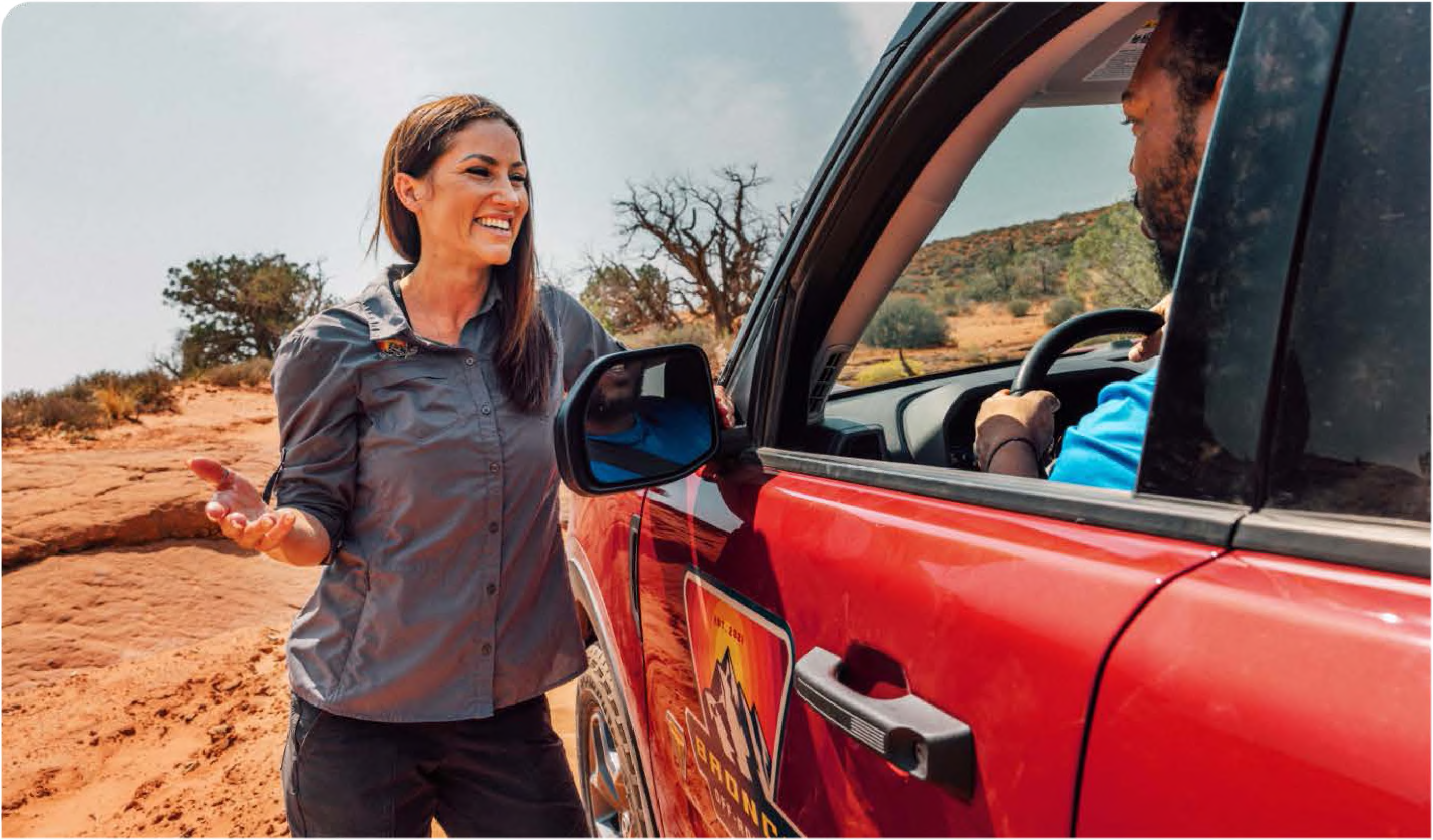

Fundamentals
Sustainability at Ford
Products and Services
Environment
Social
Governance
Sustainability Statement
Data
Appendices
,
Ford Integrated Sustainability and Financial Report 2025
30
Products
and Services
31
Products and Services Overview
32
Customer Focused Business Segments
34
Electric Vehicles, Batteries, and Charging Infrastructure
38
ICE and Hybrid Vehicles
40
Technology and Connected Services

Fundamentals
Sustainability at Ford
Products and Services
Environment
Social
Governance
Sustainability Statement
Data
Appendices
Overview
| Customer Focused Business Segments | Electric Vehicles, Batteries, and Charging Infrastructure | ICE and Hybrid Vehicles | Technology and Connected Vehicles
,
Ford Integrated Sustainability and Financial Report 2025
31
Products and
Services
Overview
Today’s Ford vehicles provide more than transportation,
they offer connection: between us and our customers,
and between drivers and their passions. Through our
wide range of vehicles and our innovative suite of
software and services, we’re providing customers with
more choices and reducing carbon emissions over time.
BUILDING A PROFITABLE AND EFFICIENT ELECTRIC
VEHICLE BUSINESS
We are committed to making the transition to an electric
lifestyle — or commercial fleet — easy by delivering more
of what our customers want: performance, capability, and
productivity. By aligning manufacturing capacity and capital
allocation with customer demand, we are focused on
building a profitable electric vehicle business. In 2024, we:
●
Added the European electric Explorer and Capri to our
lineup of electrified icons: the Mustang Mach-E, the F-150
Lightning, and the E-Transit Van
●
Made charging easier and more accessible both at home
and on the road
●
Worked to bring the benefits of electric vehicles to even
more commercial customers with an accessible price point,
improved productivity, and lower cost of ownership
A DIVERSE PRODUCT PORTFOLIO
Internal combustion engine (ICE) and hybrid vehicles are
an important part of the Ford story. We are focused on
improving our ICE powertrains to achieve better fuel
economy while meeting emissions criteria. At the same
time, we’re broadening our hybrid powertrain offerings
to give customers even more choices.
CUSTOMERS COME FIRST AT FORD
Whether they’re driving an electric vehicle, a hybrid, an
ICE vehicle, or managing a fleet, our customers’ wants
and needs are central to our purpose. We continuously
strive to make driving easier and ownership more
enjoyable through our sharp focus on world-class quality
and cutting-edge technology.
Our Sustainability Aspirations
Climate Change:
Achieve carbon neutrality no later
than 2050
Access
: Drive human progress by providing mobility
and accessibility for all
UN Sustainable Development Goals
We are contributing to the following UN Sustainable Development Goals through actions outlined in this chapter:

Fundamentals
Sustainability at Ford
Products and Services
Environment
Social
Governance
Sustainability Statement
Data
Appendices
Overview |
Customer Focused Business Segments
| Electric Vehicles, Batteries, and Charging Infrastructure | ICE and Hybrid Vehicles | Technology and Connected Vehicles
Customer Focused
Business Segments
Overview
Aspirations
Climate
Access
Salient Issues
Electric
Vehicle
Transition
UN Sustainable Development Goals
Ford+ is our plan for growth and value
creation in an era of unprecedented change
for our company and our industry. It
enables us to thrive at the intersection of
great vehicles, iconic brands, innovative
software, and high-value services.
Three distinct but interconnected customer focused
business segments — Ford Blue, Ford Model e, and Ford
Pro — are central to unleashing the full potential of the
Ford+ plan. They allow Ford to offer broad choice to
customers across gas, hybrid, and electric vehicles as we
move toward carbon neutrality. The structure is paying
off with increased focus, accountability, disciplined
capital allocation, and the ability to attract talent. It also
gives us the speed and flexibility to adapt to the evolving
needs of our customers.
In addition, the Ford Integrated Services team is creating
and marketing software-enabled customer experiences
across our business segments — further accelerating our
Ford+ transformation and helping us capture new
revenue streams.
FORD BLUE
Ford Blue leverages the strength of ICE and Hybrid
vehicles and strong brands such as Mustang, Bronco,
F-150 and Raptor. Demand is growing for hybrids,
especially trucks. Our hybrid sales are outpacing the
industry; we outperform in trucks with #1 and #2 hybrid-
truck sales in the United States
13
. We will be introducing
a wave of new products in 2025: a brand-new Expedition
and Lincoln Navigator.
Read More: In ICE and Hybrid Vehicles
on p.38
→
FORD MODEL E
Electric vehicles are here to stay, customer adoption is
growing, and their long-term upside is central to Ford+.
We are committed to developing and delivering
compelling, software-defined electric vehicles at scale —
including trucks, vans, and SUVs in segments where we
are strong, as well as a new generation of smaller, more
affordable electric vehicles.
As we do so, we’re building on a strong electric vehicle
foundation. Our electric vehicle lineup continues to
generate demand as reflected in our status as number 2
in electrified vehicle (HEV, PHEV, and electric) sales in
2024 for the fourth year in a row
1
. Sales volumes of the
F-150 Lightning pickup and Mustang Mach-E SUV both
were up year over year with the F-150 Lightning the
second-best selling electric pickup and the Mustang
Mach-E the third most popular electric vehicle of any
type in the U.S. for 2024
13
.
Ford Model e is also deep into development of the
electric architecture and digital platform which will
provide the foundation for rapid innovation across all
future Ford vehicles.
Read More: In Electric Vehicles, Batteries, and Charging
Infrastructure
on p.34
FORD PRO
Ford Pro is a one-stop shop for commercial customers
with vehicles, software, charging, financing, and services
designed to meet the needs of small, medium, large, and
government fleets. Ford Pro helps accelerate productivity
for commercial and government customers by lowering
their total cost of ownership, reducing vehicle downtime,
and increasing operational efficiency with an ecosystem
of solutions to help them manage every layer of their
fleet operations.
→
It’s a massive driver of our growth and profitability.
The network of thousands of local upfitters across Europe
and North America, purpose-built design, and Built Ford
Tough work trucks and vans like Super Duty, Ranger, and
Transit, all serviceable by Commercial Vehicle Centers
and Transit Centers, help customers get the job done and
stay on the road. In addition to the new E-Transit with
enhanced range, we have launched the new E-Transit
Custom, E-Tourneo Custom, Transit Connect plug-in
hybrid (PHEV), Tourneo Connect PHEV, E-Transit Courier,
and E-Tourneo Courier in Europe — delivering a fully
electrified Transit lineup for the first time. Later this year
we will introduce the Ranger PHEV to global markets
including Europe, South Africa, Australia, and New
Zealand. The Ranger PHEV is capable of zero-emission
driving with increased torque, and uncompromised
payload and towing capability.
When it comes to software and services, Ford Pro is
the tip of our always-on digital spear. Fleets today are
more intelligent than ever. Ford Pro solutions bring
together data from connected commercial vehicles —
including components, sensors, dashcams, and electric
vehicle chargers — to give customers a comprehensive
view of their fleet, for greater safety and efficiency. Ford
Pro is helping organizations around the world accelerate
their sustainability commitments through electrification.
Since April 2022, commercial customers with electric
vehicles using Ford Pro Intelligence have saved nearly
14.2 million gallons of gasoline
15
in North America and
over 2.8 million gallons of diesel fuel in Europe
16
.
Globally, these fleets have reduced CO
2
emissions by
133.5 million kilograms
17
.
,
Ford Integrated Sustainability and Financial Report 2025
32

Fundamentals
Sustainability at Ford
Products and Services
Environment
Social
Governance
Sustainability Statement
Data
Appendices
Overview |
Customer Focused Business Segments
| Electric Vehicles, Batteries, and Charging Infrastructure | ICE and Hybrid Vehicles | Technology and Connected Vehicles
In 2024, Ecolab, a global sustainability company, worked
with Ford Pro to add F-150 Lightning trucks and Mustang
Mach-E SUVs to its fleet. And the City of Dallas, America’s
fourth-largest metro area, selected Ford Pro to help
move the city’s climate goals forward, aiming to improve
air quality through electrifying the city’s vehicle fleet by
2040. The two entered a 10-year agreement to grow and
manage electric vehicle charging infrastructure for the
City’s fleet operations. As part of the agreement, the
City of Dallas will install Ford Pro chargers at the City’s
worksites and use Ford Pro smart charging software
to customize and manage electric vehicles.
→
Read More: In Technology and Connected Services on p.40
OUR VISION FOR EUROPE
The global auto industry continues to experience
significant disruption as it shifts to electrified mobility.
The transformation is particularly intense in Europe
where automakers face significant competitive and
economic headwinds while also tackling a misalignment
between CO
2
regulations and consumer demand for
electrified vehicles.
In response, in late 2024 Ford announced restructuring
plans, including workforce reductions and the
adjustment of production programs, to create a more
cost-competitive structure and ensure the long-term
sustainability and growth of its business in Europe.
Ford remains committed to Europe. The company has
made significant investments over the last four years to
transform our operations in Europe, retrain employees,
and build the next generation of electrified vehicles.
This includes a $2 billion investment to transform our
Cologne plant in Germany into an electric vehicle center.
Ford’s vision for its future European business is defined by:
●
A thriving Ford Pro commercial vehicle business, where
Ford has been the brand leader for the past decade
and one of the leading manufacturers. We will continue
to invest in this business to expand our leadership and
to support our business customers in their ambition to
lower emissions, improve productivity, and serve their
communities.
●
A successful and profitable passenger vehicle business,
competing in select segments with iconic vehicles that
are distinctively Ford. We will offer our customers a
range of ICE, hybrid, and fully electric vehicles, while
meeting all European regulations.
●
A modern, highly efficient industrial system, taking
advantage of the latest innovation and technological
advances in manufacturing, and reaching fully
competitive levels of cost and quality. Ford is
committed to the green transformation of our industry
and doing our part to lower emissions.
FORD IN CHINA
Our strategy to turn our business around in China is
gaining traction. The restructuring of our electric vehicle
business there is nearly complete, and the internal
combustion engine business is profitable. We export
vehicles from China to markets like Mexico, South America,
and Asia, and there is significant opportunity ahead.
The China market is extremely competitive, but we
believe we can succeed by partnering where it makes
sense, and competing in very narrow segments where
we can clearly win, like commercial vehicles, off-road
vehicles, large SUVs, and Lincoln.
New regulations in China relating to cybersecurity and
software updates were published in 2024. We’ve set
up a cybersecurity management committee and cross-
functional teams to address the challenges presented
by the mandates and to ensure compliance.
Looking ahead, we expect the speed of China rule-
making will continue to accelerate as more China-unique
requirements are created. Early engagement, robust
monitoring, tracking, information cascading, and
cooperation will continue to be crucial. We plan
to continue to support product export, including
homologation, to ensure the compliance, safety,
and quality of vehicles manufactured in China.
Customer Focused Business Segments
— continued
,
Ford Integrated Sustainability and Financial Report 2025
33

Fundamentals
Sustainability at Ford
Products and Services
Environment
Social
Governance
Sustainability Statement
Data
Appendices
Overview | Customer Focused Business Segments |
Electric Vehicles, Batteries, and Charging Infrastructure
| ICE and Hybrid Vehicles | Technology and Connected Vehicles
Electric Vehicles, Batteries,
and Charging Infrastructure
Overview
Aspirations
Access
Salient Issues
Electric
Vehicle
Transition
UN Sustainable Development Goals
We are focused on building a profitable
electric vehicle business that aligns
manufacturing capacity and capital
allocation with customer demand.
2024 has been a year of challenges — and opportunities.
From the evolution of the electric vehicle market, to new
global competitors and technology disruptions, our
business is always subject to change. Ford will continue
to adapt to grow our electric vehicle business.
THE ELECTRIC ERA IS HERE
We are in the midst of implementing an ambitious,
comprehensive plan to make the transition to an electric
lifestyle — or commercial fleet — easy.
We started by electrifying our most iconic products —
the Mustang, F-150, and Transit — which quickly helped
elevate Ford to the number 2 electric vehicle brand in the
U.S. in 2024
13
. In addition to offering zero tailpipe emissions
versions of our most popular vehicles, we are harnessing
electrification to deliver more of what customers love
about them: performance, capability, and productivity.
●
The electric Mustang Mach-E brings the 0-60 mph
thrills Mustang is famous for, in a sleek package
brimming with the latest technology and software.
●
The F-150 Lightning brings stunning innovation,
technologies, and capabilities to the F-Series, America’s
best-selling truck
13
, combined with the power, payload,
and towing capability that is the hallmark of all Built
Ford Tough trucks.
●
The E-Transit is the best-selling electric van
13
in the
U.S. Now available with new-for-2025 trade packages
serving top professions like general contractors, HVAC,
and electricians, it’s easy to see why professionals in
more industries choose E-Transit than any other
electric van.
●
The E-Transit with enhanced range will be introduced
to Europe in 2025, offering 26-32% increase in range
when compared to equivalent E-Transit with standard
battery, for work requiring longer distances
18
. The
latest E-Transit boasts a 12-inch touchscreen display, 8-
inch digital instrument cluster, and new innovative
technology such as Delivery Assist. This feature
automatically shuts off the engine, closes the windows,
locks unused doors, and activates the hazard warning
lights when drivers leave the vehicle. It is reversed by
pressing the brake pedal when the driver returns.
●
The new E-Transit Custom is the electric vehicle
successor to Europe’s best-selling van with
uncompromised capability, new customer experiences,
and full Ford Pro support.
●
The E-Transit Courier and E-Tourneo Courier further
expand Ford Pro’s commercial electric vehicle portfolio
in 2025, and all are backed by Ford Pro’s Connected
Services for unmatched productivity.
●
The European electric Explorer offers an outstanding
digital experience with a fully loaded infotainment
system, 15-inch movable screen, wireless app
integration, and advanced driver assistance.
●
The new all-electric Capri designed and built in Europe
is the car the iconic sports coupe was destined to become.
No other family electric vehicle has heritage like this.
●
The new all‑electric Puma Gen‑E will bring zero
emission driving to Ford’s best-selling car in Europe
for the first time.
A key part of Ford’s goal to drive the adoption of electric
vehicles is to target the large market for fully electric
commercial vans and trucks. Ford is planning to bring the
benefits of electric vehicles to these customers with an
accessible price point, improved productivity, and lower
cost of ownership.
DEVELOPING THE NEXT GENERATION OF
ELECTRIC VEHICLES
The ultimate success of our electric vehicle transition
will be driven by our future generation products
designed from the ground up. As we develop these
next-generation products, we’re aiming to eliminate
the compromises customers may face in choosing an
electric vehicle. At the same time we’re leveraging
electric vehicles’ inherent advantages to make incredible
products that customers are waiting for today.
Our next-generation vehicles will be cost-optimized and
guided by the learnings of our first-generation vehicles
that are currently available. Not only must these
products be breakthrough in efficiency, but they must
also be packed with innovation.
To support this, three years ago, we established a
small, talented team that is developing a smaller, more
affordable platform for future electric vehicles. This team
is creating flexibility for multiple silhouettes and form
factors for retail and commercial customers with an
intense focus on cost competitiveness and efficiency.
Smaller electric vehicles will play a role in our strategy.
They are attractive to scale for a larger number of
customers and show them all the benefits that electric
vehicles can provide — from lower operating and
maintenance cost over the life of the vehicle, to zero
carbon dioxide tailpipe emissions.
The development of our next-generation electric
vehicles is supported by a flexible industrial footprint;
the redesigned Cologne Electric Vehicle Center opened
in 2023, BlueOval City development is on track in
Tennessee, and we’re building the country’s first
automaker-backed and wholly owned and operated
lithium iron phosphate (LFP) battery plant, BlueOval
Battery Park, in Michigan.
,
Ford Integrated Sustainability and Financial Report 2025
34

Fundamentals
Sustainability at Ford
Products and Services
Environment
Social
Governance
Sustainability Statement
Data
Appendices
Overview | Customer Focused Business Segments |
Electric Vehicles, Batteries, and Charging Infrastructure
| ICE and Hybrid Vehicles | Technology and Connected Vehicles
BATTERIES
A Second Battery Chemistry
As part of our company’s commitment to making electric
vehicles more affordable and accessible to customers,
we have introduced LFP batteries to some of our electric
vehicle lineup. Durable LFP batteries, our second battery
chemistry, tolerate more frequent and faster charging
while using fewer high-demand, high-cost materials.
As we scale electric vehicle production, introducing
lower-cost LFP batteries at scale will help us contain or
even further reduce electric vehicle prices for customers,
while allowing us to produce more electric vehicles and
offer more choices to new electric vehicle customers.
LFP battery technology also helps reduce reliance on
critical minerals such as nickel and cobalt and is in line
with our work to create an electric vehicle supply chain
that upholds its commitments to sustainability and
human rights.
BlueOval Battery Plant
In support of our commitment to this second battery
chemistry, we are building the country’s first automaker-
backed and wholly owned and operated LFP battery
plant, called BlueOval Battery Park Michigan.
PUBLIC CHARGING
Creating a seamless and simple public charging
experience is key to accelerating electric vehicle adoption
and providing customers with range confidence.
Customers in North America have more options than
ever before — and the number continues to grow. Our
BlueOval™ Charge Network in North America grew in
2024, bringing the new network total today to more than
180,000 chargers, and growing
19
.
Customers can access chargers from multiple charging
companies across the U.S. and Canada with embedded
charger routing and simple payment options via
FordPass or Ford Pro Intelligence. Ninety percent of
Americans live within a 13-mile drive of a charger in the
BlueOval Charge Network.
Ford electric vehicle customers have access to more than
20,000 Tesla Superchargers across the U.S. and Canada
through the BlueOval Charge Network. Mustang Mach-E,
F-150 Lightning, and E-Transit customers can access the
Superchargers via an adapter and software integration
along with activation and payment via FordPass or Ford
Pro Intelligence.
The BlueOval Charge Network provides one stored
payment account through the FordPass App, eliminating
the need for on-site credit card use at select chargers.
Once owners have created an account and activated Plug
& Charge, Tesla Superchargers will support Plug &
Charge with Ford electric vehicles. This means customers
simply have to plug in and charging will automatically
start with charges managed through FordPass.
In Europe, the BlueOval Charge Network provides
customers with access to over 800,000 plugs. Retail
customers can find charging stations and pay for
charging using FordPass. Larger fleets can access Ford
Charge Assist via SYNC in Europe and North America
.
HOME CHARGING
Approximately 80% of charging takes place at home
20
.
Ford electric SUV and truck customers in Texas can
charge at home for free through the TXU Free Electric
Vehicle Miles program, a collaboration between Ford and
TXU Energy. This first-of-its-kind retail energy offering
for Ford electric vehicle customers offers them the
opportunity to charge their vehicle at home entirely for
free between 7 p.m. and 1 p.m. the next day, all year long.
Ford electric vehicle customers receive a credit on their
TXU Energy bill for all home energy used for vehicle
charging during the free charging hours.
Through the TXU Free Electric Vehicle Miles program,
Ford aims to educate Texans about the perks of driving
electric while incentivizing consumers to charge when
demand on the grid is at its lowest.
This program is just one of many collaborations Ford is
working on with utilities across the U.S. and globally.
Other programs are testing vehicle-to-home and vehicle-
to-grid integration capabilities, which will save customers
money and support a resilient electrical grid, bringing to
life entirely new possibilities in energy management
through electric vehicle ownership.
In Europe, we’re partnering with industry innovators to
deliver new energy experiences that will enable Ford
customers to charge their electric vehicles using energy
tariffs specifically designed to enhance the ownership
experience. Developed to support Ford’s expanding
electric vehicle line-up, this opportunity has been
available from early 2024 to drivers of Ford Mustang
Mach-E, followed by the new all-electric Ford Explorer.
A newly developed Dynamic Charging feature was
designed to enable Ford electric vehicles to communicate
with the energy providers’ intelligent supply networks.
As a result, owners of compatible electric vehicle models
will be able to plug in their vehicle, input their desired
state-of-charge and departure time using a smartphone
app, and simply get on with their day — safe in the
knowledge that their battery will be automatically
charged using rates designed to help maximize cost
savings and the use of renewable energy
21
.
Case Study
Powering Peace of Mind for Families
and Communities
Ford’s energy services technology and the
company’s impactful partnerships are unlocking
peace of mind for customers and communities.
Ford Intelligent Backup Power
Electric vehicles can act as mobile power plants,
utilizing the stored energy in their batteries to
power homes and businesses through
bidirectional charging. Ford Intelligent Backup
Power, introduced with the F-150 Lightning, can
keep the power on during an outage or natural
disaster for three full days (up to 10 with power
rationing
22
). In 2024 alone, Ford Intelligent Backup
Power, using vehicle-to-home technology, has
helped hundreds of customers maintain power
and safety during everyday outages as well as
natural disasters such as Hurricanes Beryl, Helene,
Kirk, Milton, and Rafael. Customers across the
Western U.S. have also been able to power
their homes during wildfires that led to mass
power outages.
Community Support through Pro Power Onboard
Ford’s support of Team Rubicon (see case study
on page 127) includes providing Pro Power
OnBoard to turn Ford vehicles into mobile
generators. Using energy stored by the vehicles
and dispersed through power outlets, Pro Power
OnBoard helps ensure that critical resources such
as cell phones, electric tools and refrigeration
remain operational during power outages.
Electric Vehicles, Batteries,
and Charging Infrastructure
— continued
,
Ford Integrated Sustainability and Financial Report 2025
35
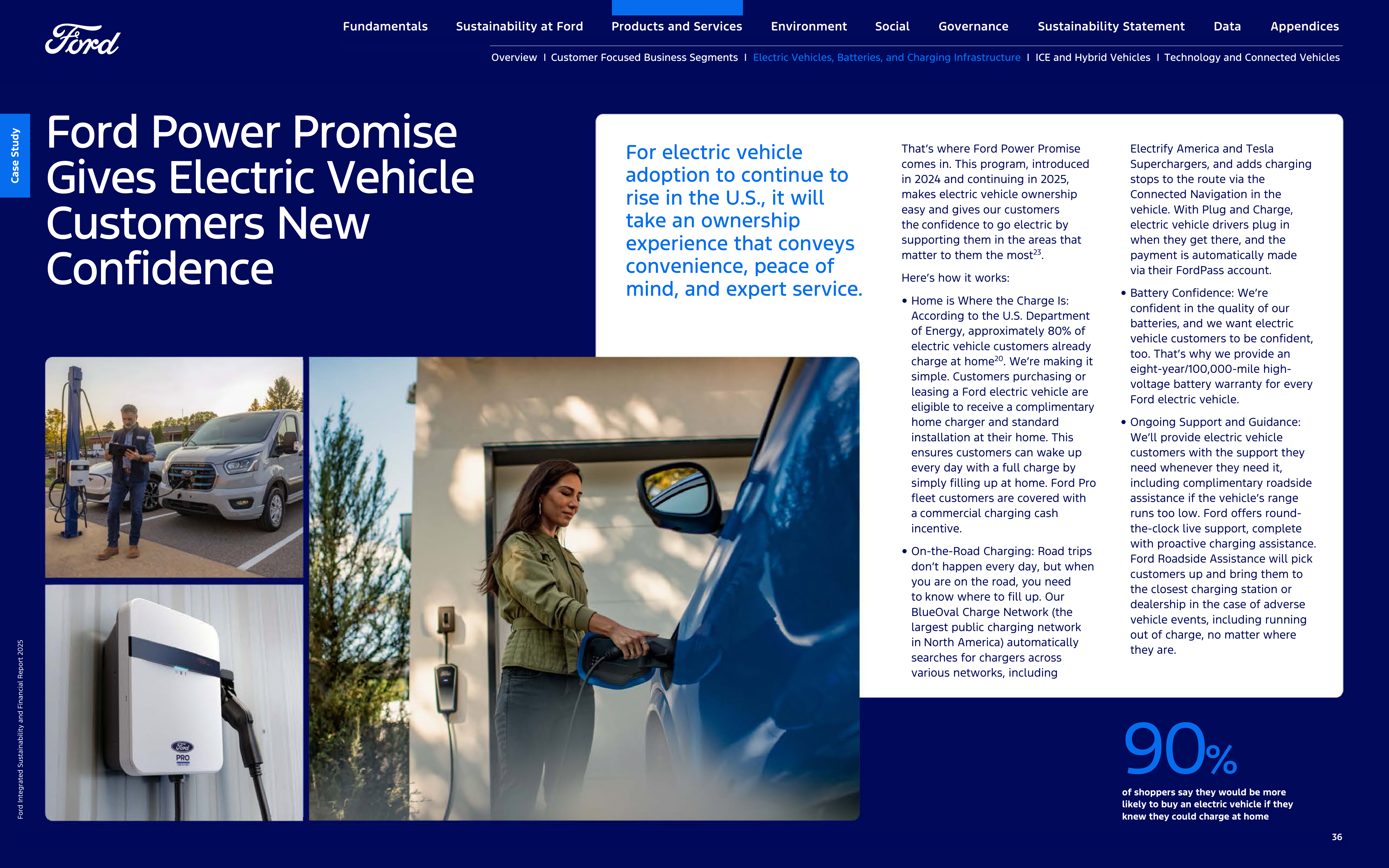

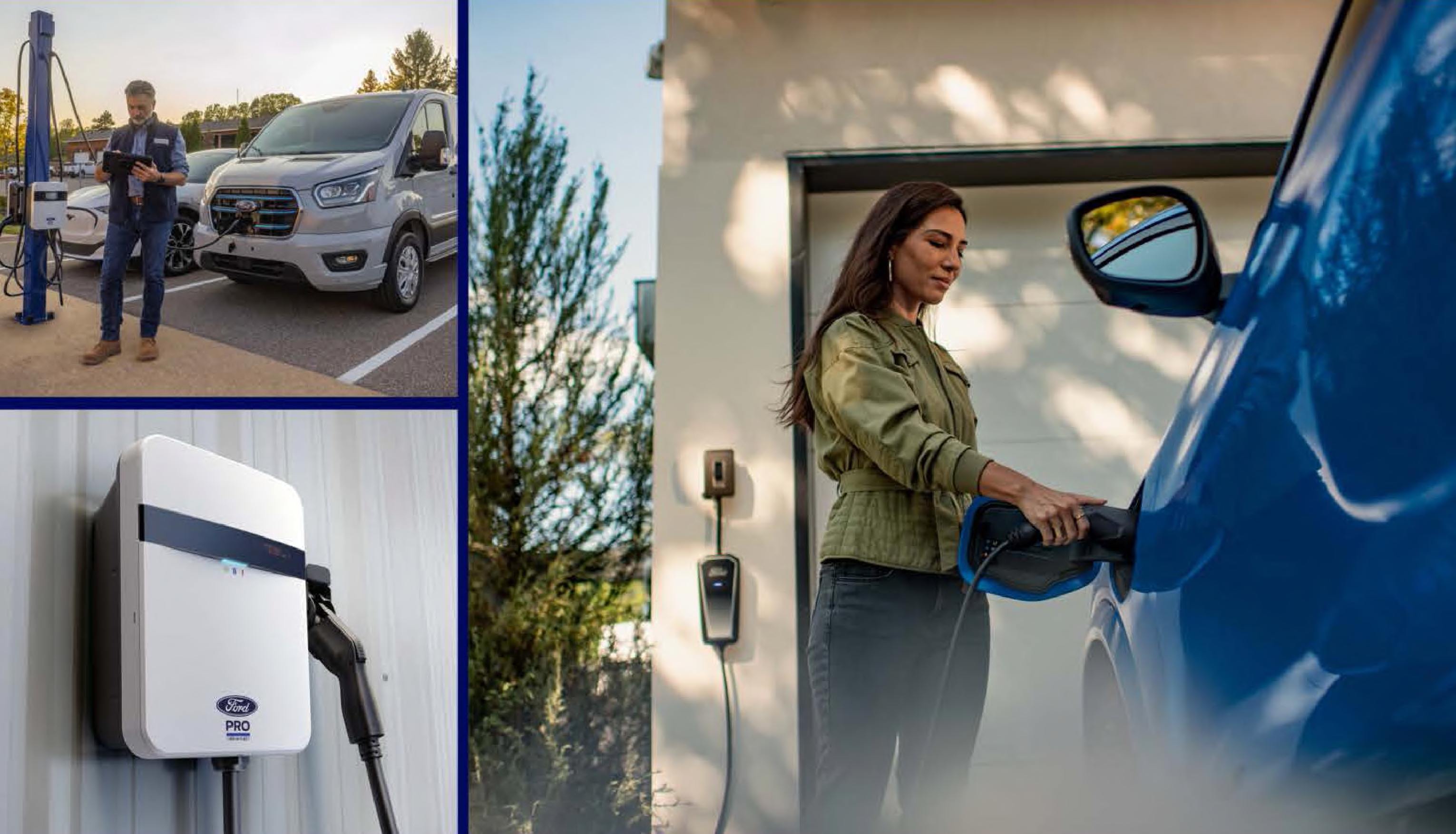
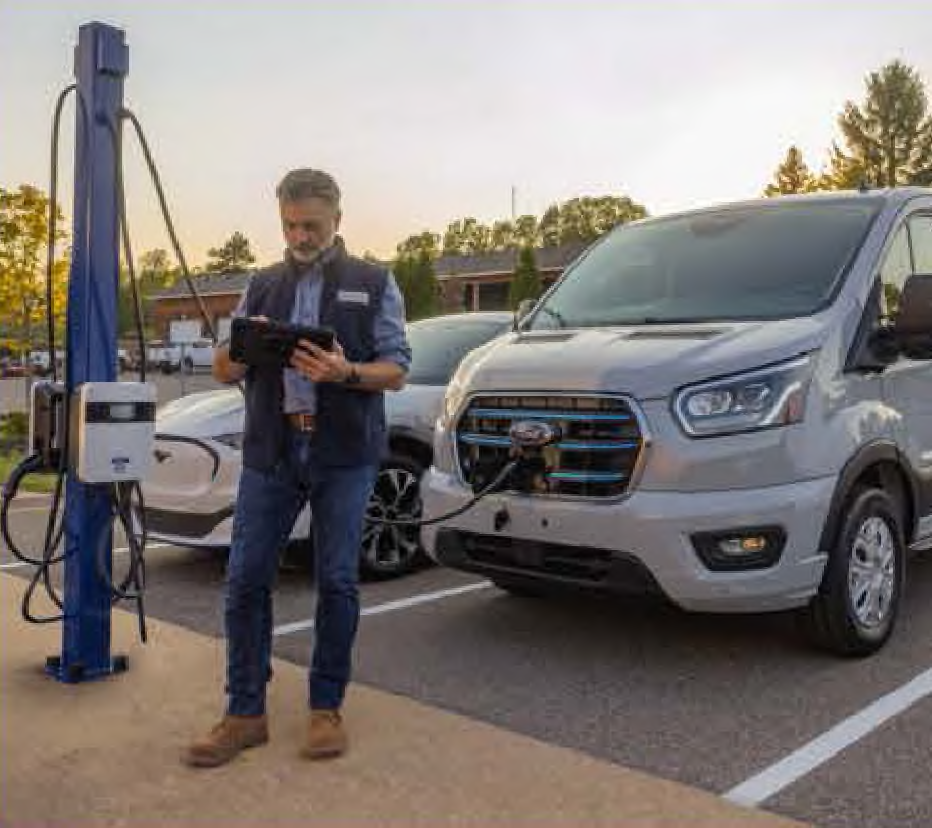
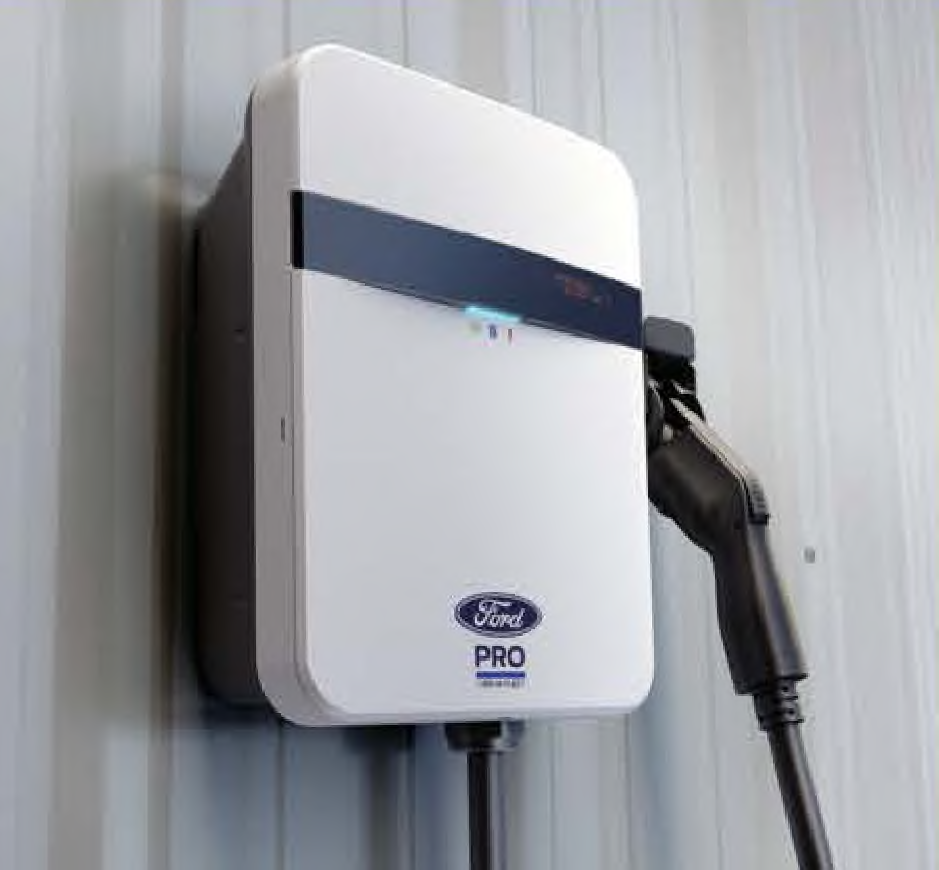
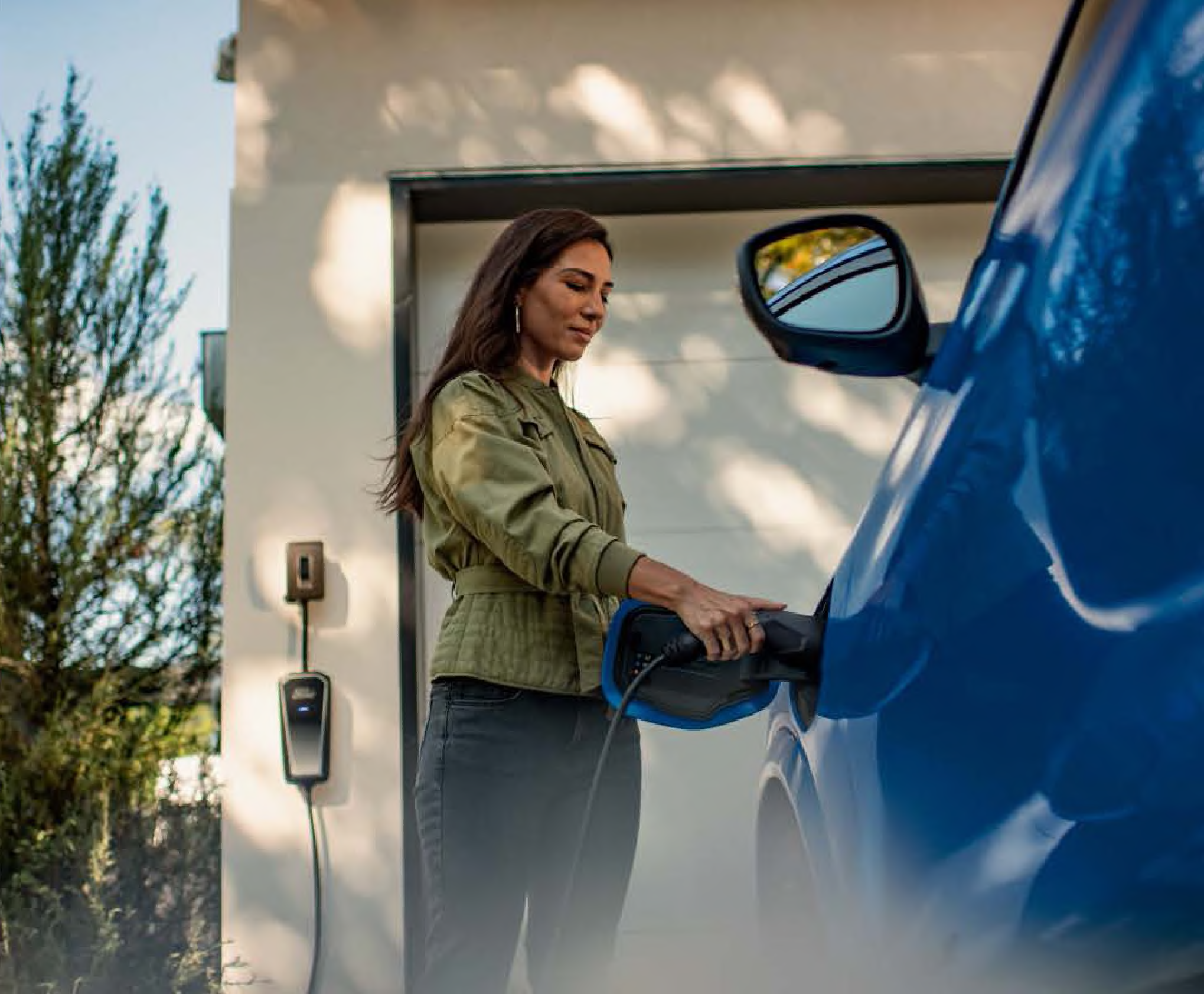
Fundamentals
Sustainability at Ford
Products and Services
Environment
Social
Governance
Sustainability Statement
Data
Appendices
Overview | Customer Focused Business Segments |
Electric Vehicles, Batteries, and Charging Infrastructure
| ICE and Hybrid Vehicles | Technology and Connected Vehicles
Ford Integrated Sustainability and Financial Report 2025
36
Ford Power Promise
Gives Electric Vehicle
Customers New
Confidence
Case Study
For electric vehicle
adoption to continue to
rise in the U.S., it will
take an ownership
experience that conveys
convenience, peace of
mind, and expert service.
That’s where Ford Power Promise
comes in. This program, introduced
in 2024 and continuing in 2025,
makes electric vehicle ownership
easy and gives our customers
the confidence to go electric by
supporting them in the areas that
matter to them the most
23
.
Here’s how it works:
●
Home is Where the Charge Is:
According to the U.S. Department
of Energy, approximately 80% of
electric vehicle customers already
charge at home
20
. We’re making it
simple. Customers purchasing or
leasing a Ford electric vehicle are
eligible to receive a complimentary
home charger and standard
installation at their home. This
ensures customers can wake up
every day with a full charge by
simply filling up at home. Ford Pro
fleet customers are covered with
a commercial charging cash
incentive.
●
On-the-Road Charging: Road trips
don’t happen every day, but when
you are on the road, you need
to know where to fill up. Our
BlueOval Charge Network (the
largest public charging network
in North America) automatically
searches for chargers across
various networks, including
Electrify America and Tesla
Superchargers, and adds charging
stops to the route via the
Connected Navigation in the
vehicle. With Plug and Charge,
electric vehicle drivers plug in
when they get there, and the
payment is automatically made
via their FordPass account.
●
Battery Confidence: We’re
confident in the quality of our
batteries, and we want electric
vehicle customers to be confident,
too. That’s why we provide an
eight-year/100,000-mile high-
voltage battery warranty for every
Ford electric vehicle.
●
Ongoing Support and Guidance:
We’ll provide electric vehicle
customers with the support they
need whenever they need it,
including complimentary roadside
assistance if the vehicle’s range
runs too low. Ford offers round-
the-clock live support, complete
with proactive charging assistance.
Ford Roadside Assistance will pick
customers up and bring them to
the closest charging station or
dealership in the case of adverse
vehicle events, including running
out of charge, no matter where
they are.
90
%
of shoppers say they would be more
likely to buy an electric vehicle if they
knew they could charge at home

→
Fundamentals
Sustainability at Ford
Products and Services
Environment
Social
Governance
Sustainability Statement
Data
Appendices
Overview | Customer Focused Business Segments |
Electric Vehicles, Batteries, and Charging Infrastructure
| ICE and Hybrid Vehicles | Technology and Connected Vehicles
Collaborating to Strengthen Charging Infrastructure
Ford is a founding and core member of the SAE Electric
Vehicle Public Key Infrastructure. As part of this group
Ford is supporting a new framework that will enable
industry-wide seamless, secure electric vehicle charging.
The experience will allow electric vehicle users to
“Plug & Charge,” enabling secure automatic authentication
as soon as drivers plug in, bypassing the payment
authentication step across all public stations. Testing of
the program will start in 2025.
Ford is also a founding partner in ChargeScape, a new
company focused on optimizing electric vehicle grid
services. ChargeScape, which became operational in
2024, has created a software platform that integrates
electric vehicles into the power grid, shoring up grid
stability while saving drivers money on their charging.
ChargeScape’s technology wirelessly connects to
electric vehicles and, working with participating utilities,
manages home charging efforts when the grid is
constrained — and soon will be able to send energy back
into the power grid when needed.
COMMERCIAL CHARGING
Ford Pro is laser focused on delivering reliable charging
solutions that meet the needs and electric vehicle use
cases of its commercial customers — including home,
depot, and public charging — with software to efficiently
manage them.
Ford Pro Chargers work with Ford Pro’s smart
charging software to help ensure vehicles are charged
when customers need them. The integrated software
and hardware solution helps fleet managers optimize
how, when, and where electric vehicles are charged
along with utility reimbursement reporting, which is
important for home-based drivers.
Ford Pro Charging solutions can also enable customers
to charge more vehicles at a given time. The software
also tracks performance and provides fleet managers
with insights like kWh consumption, charge speed and
distance to empty, and helps optimize total cost of
ownership.
Understanding the various incentives available to them
can help businesses lower their total cost of ownership.
To help improve access to commercial charging, Ford Pro
worked directly with utility and energy companies
including the Ford Pro Smart Charging Bundle that offers
free commercial-grade Ford Pro chargers for home or
worksite charging to software subscribers enrolled in the
Massachusetts Clean Peak Energy Standard. In California
the bundle offers a complimentary Ford Pro Level 2
electric vehicle charger to businesses subscribed to Ford
Pro Charging software and gives them advanced energy
management features to automate reporting and
demand response to grid events, and manage Low-
Carbon Fuel Standard carbon credits for customers.
TRANSFORMING OUR INDUSTRIAL SYSTEM TO
EXPAND ELECTRIC VEHICLE PRODUCTION
We are taking a diverse strategic approach to
transforming our industrial system to expand electric
vehicle production by reimagining existing
manufacturing sites like those in Cologne, Germany.
Electric Explorer In Production at Cologne Electric
Vehicle Center
The all-new electric Explorer began rolling off the
production line in the new Ford Cologne Electric Vehicle
Center in June 2024.
The electric Ford Explorer is the first vehicle produced
at the Ford Cologne Electric Vehicle Center and
represents a significant step on the road to producing
a new generation of high-quality electric passenger
vehicles for the region.
The electric Explorer’s superior standard specification
includes battery electric powertrains for zero-tailpipe
emissions while driving — and more than 600 km driving
range on a single charge
24
.
The Factory of the Future
The Cologne Electric Vehicle Center, Ford’s first electric
vehicle facility in Europe, is a key element of Ford’s
plan targeting carbon neutrality. Opened in 2023, and
powered by a $2 billion investment, the Cologne Electric
Vehicle Center has been transformed from a historic
plant into a factory of the future.
The Cologne Electric Vehicle Center is equipped with
cutting-edge AI and hundreds of carefully choreographed
state-of-the-art robots that will deliver a new generation
of high-quality electric vehicles to Ford customers in
Europe. The plant’s “digital twin” monitors and supports
production line operators to deliver high-quality
standards.
The Cologne Electric Vehicle Center is one of Ford’s most
efficient vehicle assembly plants globally, supported by
significant reductions in emissions, water usage and
energy consumption. With production now underway,
greenhouse gas (GHG) emissions data will be monitored
and recorded to continuously improve carbon efficiency
and reduce GHG emissions towards a residual level.
In addition to initiatives that reduce emissions, water
usage and energy consumption, all electricity required to
operate the plant is 100% certified renewable electricity.
Read More: In Climate Change
on p.44
North American Electric Vehicle Production
BlueOval City, our all-new mega-campus in West
Tennessee, is taking shape and preparing to build our
next-generation electric truck. This is an opportunity to
revolutionize America’s truck by combining a century of
know-how with world-class electric vehicle, software,
and aerodynamics talent.
Electric Vehicles, Batteries,
and Charging Infrastructure
— continued
,
Ford Integrated Sustainability and Financial Report 2025
37


Fundamentals
Sustainability at Ford
Products and Services
Environment
Social
Governance
Sustainability Statement
Data
Appendices
Overview | Customer Focused Business Segments | Electric Vehicles, Batteries, and Charging Infrastructure |
ICE and Hybrid Vehicles
| Technology and Connected Vehicles
ICE and Hybrid Vehicles
Overview
Aspirations
Access
Salient Issues
Electric
Vehicle
Transition
UN Sustainable Development Goals
Ford Blue is a vibrant global industrial
powerhouse with iconic vehicles and a
runway for profitable growth.
Internal combustion engine (ICE) and hybrid (full and
plug-in) vehicles remain an important part of the Ford
story. ICE volumes will decline as electric vehicle
adoption increases, and we embrace that reality.
However, the pace of electric vehicle adoption will vary
by segment and geography with Europe and China
transitioning faster than the U.S., our biggest market.
Consequently, we expect strong U.S. ICE and hybrid sales
well into the near future.
We are committed to continuously improving our ICE
powertrains to achieve better fuel economy while meeting
regulatory emissions criteria. Our proven EcoBoost engines
are deployed across nearly all of the portfolio, and combine
engine downsizing, turbocharging, direct fuel injection, and
twin-independent variable cam timing to optimize power
and efficiency. For those who want the range assurance of
an ICE and lower emissions, we have Escape full- and
plug-in hybrids, Lincoln Corsair plug-in hybrids, and F-150
and Maverick full hybrids. We also have a brand-new
Expedition and Lincoln Navigator coming in 2025.
We have been producing hybrids for 20 years, beginning
with the world’s first hybrid SUV, the Escape. Now on the
fourth generation of hybrid technology in our vehicles,
we remain committed to building hybrids for the
foreseeable future. Hybrids will play an important role
during the transition to electric vehicle, particularly in
markets where the electric vehicle infrastructure is not
mature. Consequently, we’re broadening our hybrid
powertrain offerings.
Diesel Engines
Modern diesel engines can offer reduced carbon dioxide
and nitrogen oxide emissions and fuel consumption
compared to their predecessors. In fact, they can achieve
20–30% better fuel economy than comparable gasoline
engines in specific markets and segments.
As we move toward electric vehicles, we continue to
optimize these benefits in our EcoBlue and Power Stroke
offerings to improve fuel economy and reduce emissions.
ADVANCED TRANSMISSIONS AND DRIVELINES
We continue to optimize our transmissions to improve
fuel economy and emissions. Highly efficient 8-, and
10‑speed planetary transmissions have been widely
deployed across our vehicles and the volume of hybrid
electrified transmissions continues to increase. Our
transmission team has shifted focus to design and
develop innovative power unit (electric drive unit)
technologies and features for electrified vehicles.
Case Study
Supporting the Veteran Community with the
Ford Bronco Off-Roadeo
Ford has a long tradition of supporting the military
and veteran community that continues to this day.
Working with Blue Star Families and their “Do
Your Part” initiative, we hosted a special Bronco
Off-Roadeo experience in 2024 for service
members, veterans, and their families to build
community and celebrate service.
Joining the cause in 2024, our Proud to Honor:
Bronco Off-Roadeo gave veterans, military families,
and survivors an opportunity to celebrate service,
create memories, and make connections in the
beautiful Texas Hill Country. Bronco Off-Roadeo is
an adventure driving school where enthusiasts can
receive instruction on how to take Bronco family
SUVs off-road safely and responsibly.
This event was specially designed for the military
community, bringing together 150 veterans,
military families, and survivors.
Participants represented U.S. Service
Organizations, including Blue Star Families, Guitars
4 Vets, Tragedy Assistance Program for Survivors
(TAPS), Travis Manion Foundation, Team Rubicon,
and members of Ford’s Veteran Employee
Resource Group. The effort brought together
community groups to celebrate those who have
given so much.
,
Ford Integrated Sustainability and Financial Report 2025
38
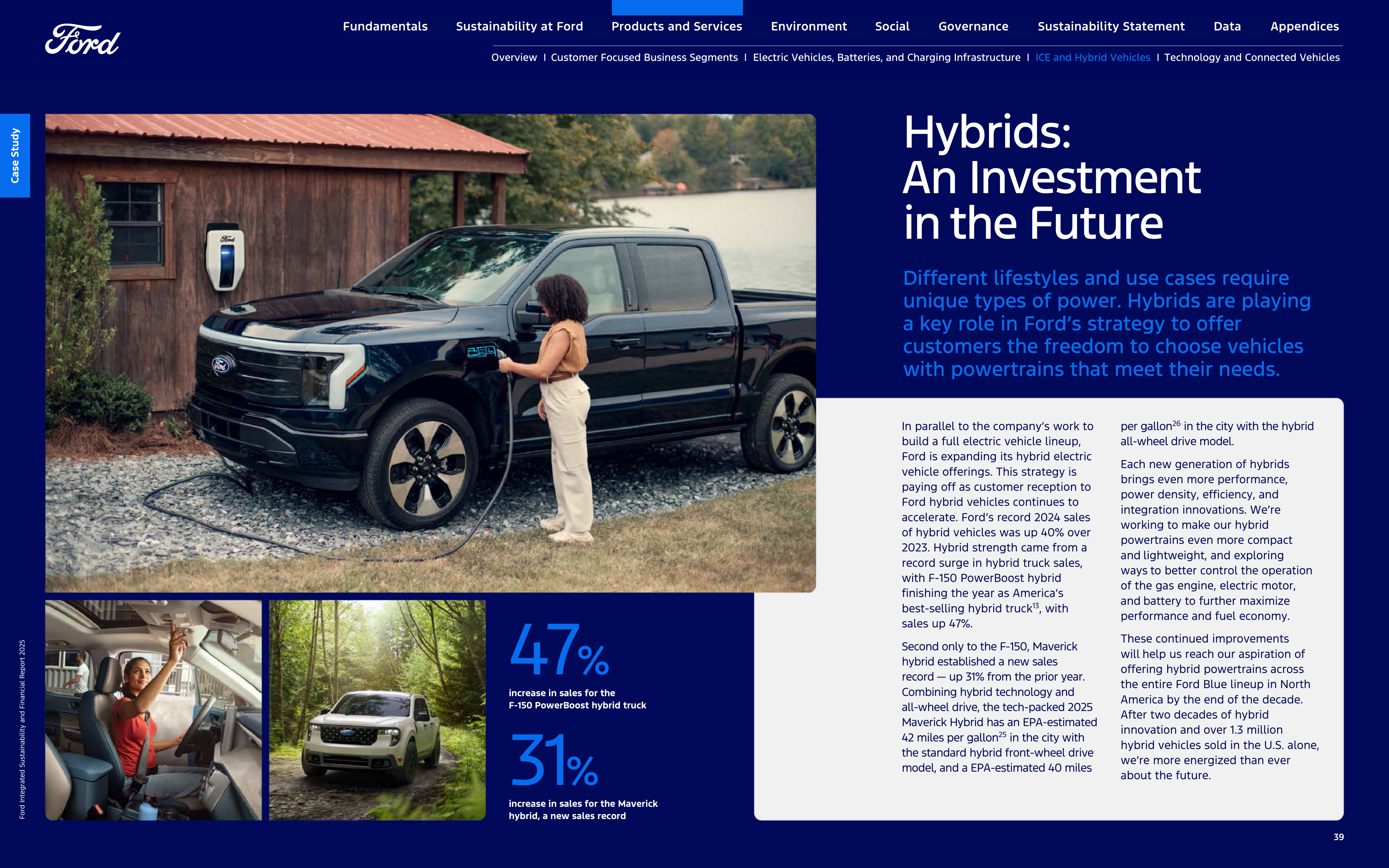

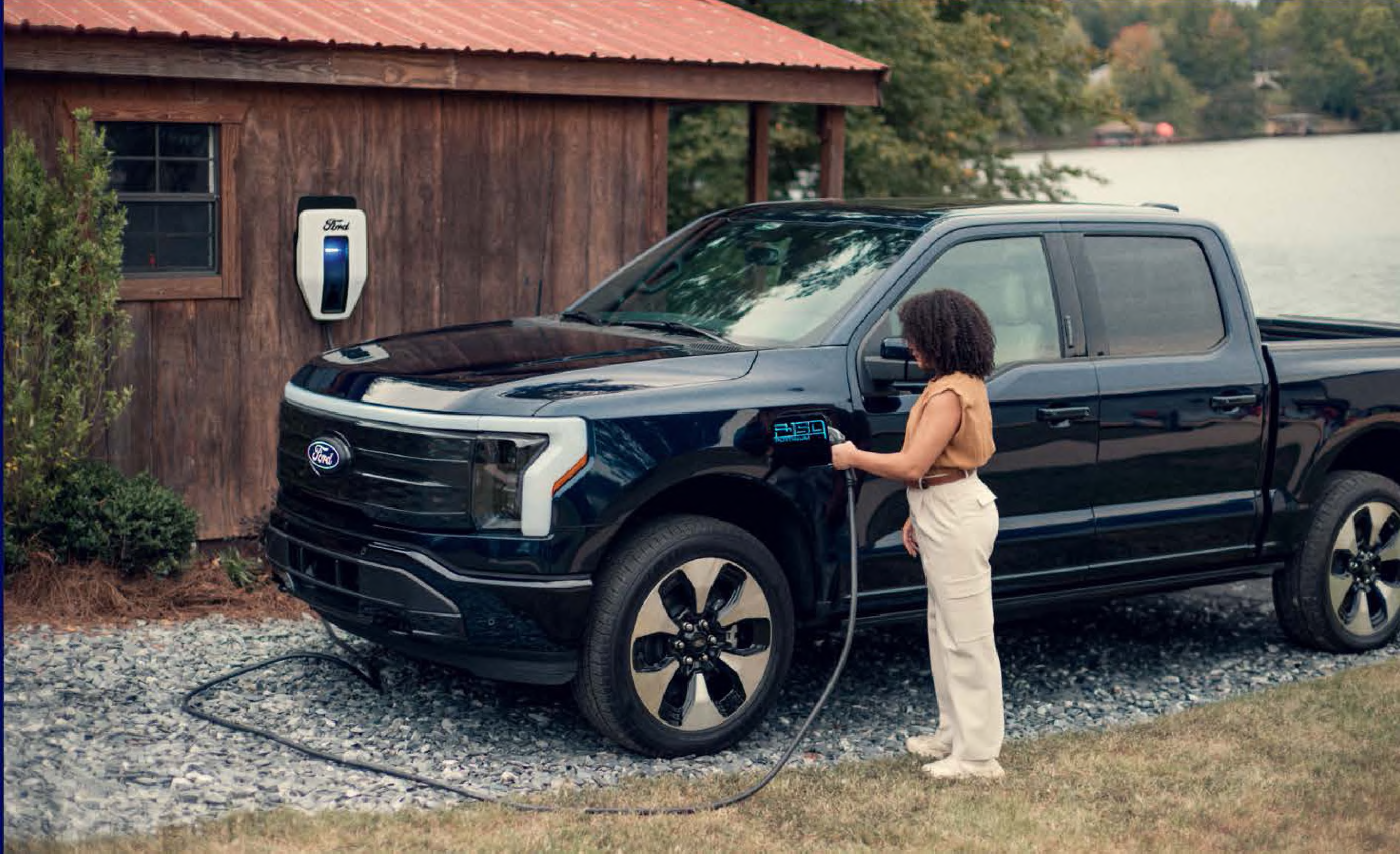

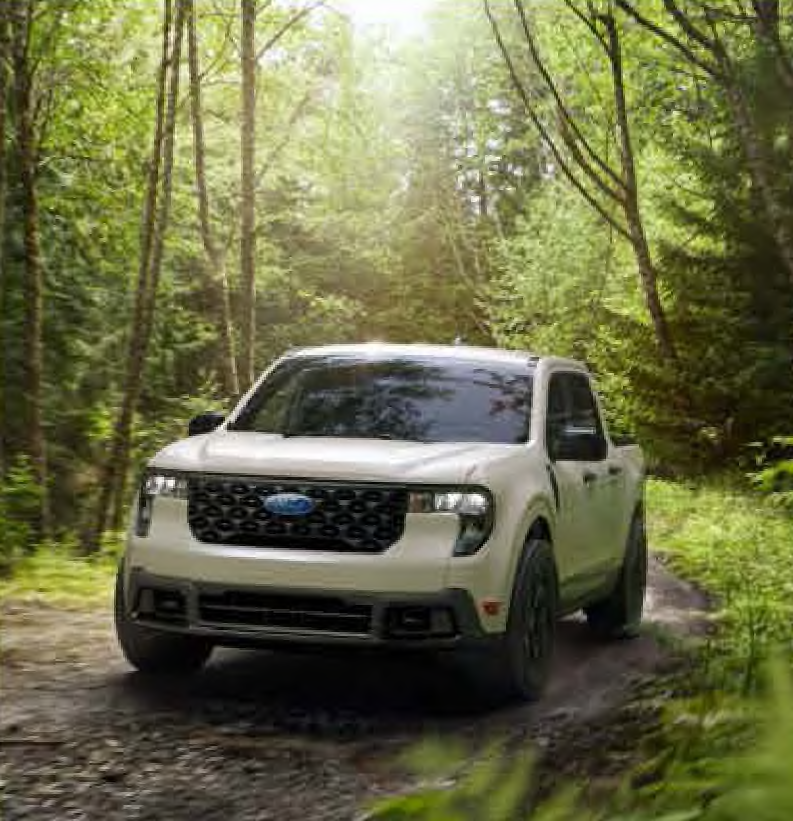
Fundamentals
Sustainability at Ford
Products and Services
Environment
Social
Governance
Sustainability Statement
Data
Appendices
Overview | Customer Focused Business Segments | Electric Vehicles, Batteries, and Charging Infrastructure |
ICE and Hybrid Vehicles
| Technology and Connected Vehicles
47
%
increase in sales for the
F-150 PowerBoost hybrid truck
31
%
increase in sales for the Maverick
hybrid, a new sales record
Hybrids:
An Investment
in the Future
Different lifestyles and use cases require
unique types of power. Hybrids are playing
a key role in Ford’s strategy to offer
customers the freedom to choose vehicles
with powertrains that meet their needs.
In parallel to the company’s work to
build a full electric vehicle lineup,
Ford is expanding its hybrid electric
vehicle offerings. This strategy is
paying off as customer reception to
Ford hybrid vehicles continues to
accelerate. Ford’s record 2024 sales
of hybrid vehicles was up 40% over
2023. Hybrid strength came from a
record surge in hybrid truck sales,
with F-150 PowerBoost hybrid
finishing the year as America’s
best‑selling hybrid truck
13
, with
sales up 47%.
Second only to the F-150, Maverick
hybrid established a new sales
record — up 31% from the prior year.
Combining hybrid technology and
all‑wheel drive, the tech-packed 2025
Maverick Hybrid has an EPA-estimated
42 miles per gallon
25
in the city with
the standard hybrid front-wheel drive
model, and a EPA-estimated 40 miles
per gallon
26
in the city with the hybrid
all-wheel drive model.
Each new generation of hybrids
brings even more performance,
power density, efficiency, and
integration innovations. We’re
working to make our hybrid
powertrains even more compact
and lightweight, and exploring
ways to better control the operation
of the gas engine, electric motor,
and battery to further maximize
performance and fuel economy.
These continued improvements
will help us reach our aspiration of
offering hybrid powertrains across
the entire Ford Blue lineup in North
America by the end of the decade.
After two decades of hybrid
innovation and over 1.3 million
hybrid vehicles sold in the U.S. alone,
we’re more energized than ever
about the future.
Case Study
Ford Integrated Sustainability and Financial Report 2025
39
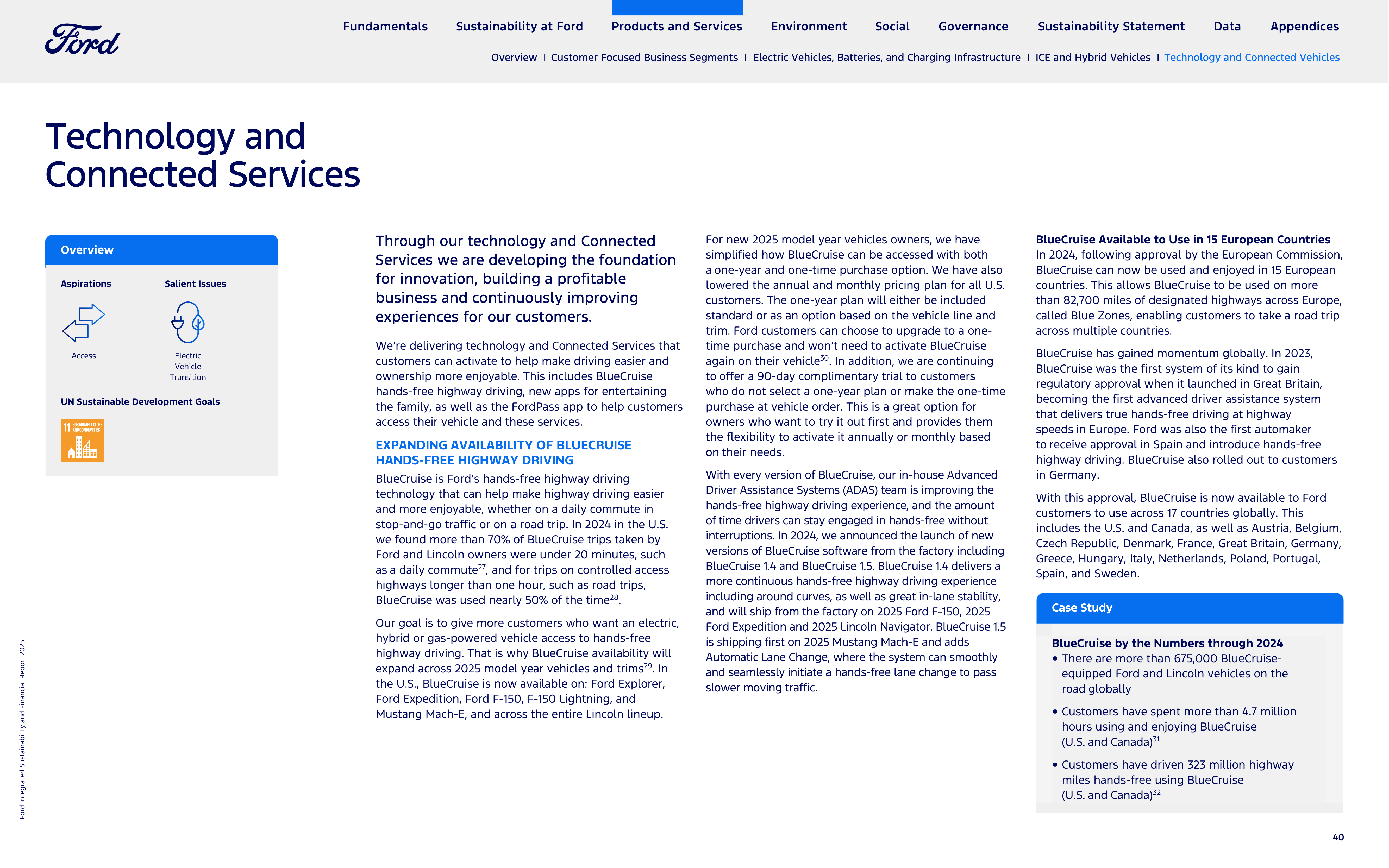


Fundamentals
Sustainability at Ford
Products and Services
Environment
Social
Governance
Sustainability Statement
Data
Appendices
Overview | Customer Focused Business Segments | Electric Vehicles, Batteries, and Charging Infrastructure | ICE and Hybrid Vehicles |
Technology and Connected Vehicles
Technology and
Connected Services
Overview
Aspirations
Access
Salient Issues
Electric
Vehicle
Transition
UN Sustainable Development Goals
Through our technology and Connected
Services we are developing the foundation
for innovation, building a profitable
business and continuously improving
experiences for our customers.
We’re delivering technology and Connected Services that
customers can activate to help make driving easier and
ownership more enjoyable. This includes BlueCruise
hands-free highway driving, new apps for entertaining
the family, as well as the FordPass app to help customers
access their vehicle and these services.
EXPANDING AVAILABILITY OF BLUECRUISE
HANDS-FREE HIGHWAY DRIVING
BlueCruise is Ford’s hands-free highway driving
technology that can help make highway driving easier
and more enjoyable, whether on a daily commute in
stop-and-go traffic or on a road trip. In 2024 in the U.S.
we found more than 70% of BlueCruise trips taken by
Ford and Lincoln owners were under 20 minutes, such
as a daily commute
27
, and for trips on controlled access
highways longer than one hour, such as road trips,
BlueCruise was used nearly 50% of the time
28
.
Our goal is to give more customers who want an electric,
hybrid or gas-powered vehicle access to hands-free
highway driving. That is why BlueCruise availability will
expand across 2025 model year vehicles and trims
29
. In
the U.S., BlueCruise is now available on: Ford Explorer,
Ford Expedition, Ford F-150, F-150 Lightning, and
Mustang Mach-E, and across the entire Lincoln lineup.
For new 2025 model year vehicles owners, we have
simplified how BlueCruise can be accessed with both
a one-year and one-time purchase option. We have also
lowered the annual and monthly pricing plan for all U.S.
customers. The one-year plan will either be included
standard or as an option based on the vehicle line and
trim. Ford customers can choose to upgrade to a one-
time purchase and won’t need to activate BlueCruise
again on their vehicle
30
. In addition, we are continuing
to offer a 90-day complimentary trial to customers
who do not select a one-year plan or make the one-time
purchase at vehicle order. This is a great option for
owners who want to try it out first and provides them
the flexibility to activate it annually or monthly based
on their needs.
With every version of BlueCruise, our in-house Advanced
Driver Assistance Systems (ADAS) team is improving the
hands-free highway driving experience, and the amount
of time drivers can stay engaged in hands-free without
interruptions. In 2024, we announced the launch of new
versions of BlueCruise software from the factory including
BlueCruise 1.4 and BlueCruise 1.5. BlueCruise 1.4 delivers a
more continuous hands-free highway driving experience
including around curves, as well as great in-lane stability,
and will ship from the factory on 2025 Ford F-150, 2025
Ford Expedition and 2025 Lincoln Navigator. BlueCruise 1.5
is shipping first on 2025 Mustang Mach-E and adds
Automatic Lane Change, where the system can smoothly
and seamlessly initiate a hands-free lane change to pass
slower moving traffic.
BlueCruise Available to Use in 15 European Countries
In 2024, following approval by the European Commission,
BlueCruise can now be used and enjoyed in 15 European
countries. This allows BlueCruise to be used on more
than 82,700 miles of designated highways across Europe,
called Blue Zones, enabling customers to take a road trip
across multiple countries.
BlueCruise has gained momentum globally. In 2023,
BlueCruise was the first system of its kind to gain
regulatory approval when it launched in Great Britain,
becoming the first advanced driver assistance system
that delivers true hands-free driving at highway
speeds in Europe. Ford was also the first automaker
to receive approval in Spain and introduce hands-free
highway driving. BlueCruise also rolled out to customers
in Germany.
With this approval, BlueCruise is now available to Ford
customers to use across 17 countries globally. This
includes the U.S. and Canada, as well as Austria, Belgium,
Czech Republic, Denmark, France, Great Britain, Germany,
Greece, Hungary, Italy, Netherlands, Poland, Portugal,
Spain, and Sweden.
Case Study
BlueCruise by the Numbers through 2024
●
There are more than 675,000 BlueCruise-
equipped Ford and Lincoln vehicles on the
road globally
●
Customers have spent more than 4.7 million
hours using and enjoying BlueCruise
(U.S. and Canada)
31
●
Customers have driven 323 million highway
miles hands-free using BlueCruise
(U.S. and Canada)
32
Ford Integrated Sustainability and Financial Report 2025
40
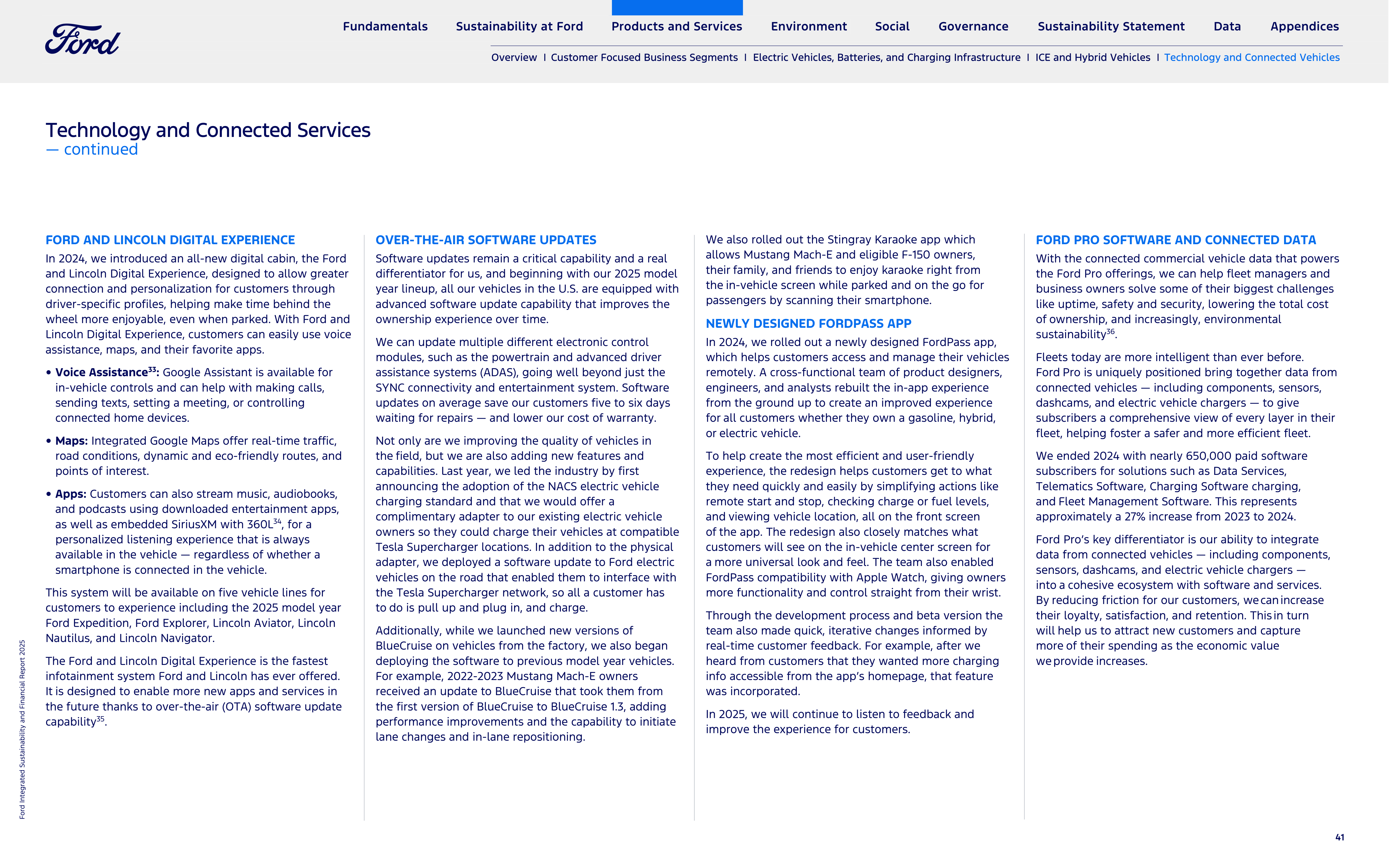
Fundamentals
Sustainability at Ford
Products and Services
Environment
Social
Governance
Sustainability Statement
Data
Appendices
Overview | Customer Focused Business Segments | Electric Vehicles, Batteries, and Charging Infrastructure | ICE and Hybrid Vehicles |
Technology and Connected Vehicles
Technology and Connected Services
— continued
Ford Integrated Sustainability and Financial Report 2025
41
FORD AND LINCOLN DIGITAL EXPERIENCE
In 2024, we introduced an all-new digital cabin, the Ford
and Lincoln Digital Experience, designed to allow greater
connection and personalization for customers through
driver-specific profiles, helping make time behind the
wheel more enjoyable, even when parked. With Ford and
Lincoln Digital Experience, customers can easily use voice
assistance, maps, and their favorite apps.
●
Voice Assistance
33
:
Google Assistant is available for
in‑vehicle controls and can help with making calls,
sending texts, setting a meeting, or controlling
connected home devices.
●
Maps:
Integrated Google Maps offer real-time traffic,
road conditions, dynamic and eco-friendly routes, and
points of interest.
●
Apps:
Customers can also stream music, audiobooks,
and podcasts using downloaded entertainment apps,
as well as embedded SiriusXM with 360L
34
, for a
personalized listening experience that is always
available in the vehicle — regardless of whether a
smartphone is connected in the vehicle.
This system will be available on five vehicle lines for
customers to experience including the 2025 model year
Ford Expedition, Ford Explorer, Lincoln Aviator, Lincoln
Nautilus, and Lincoln Navigator.
The Ford and Lincoln Digital Experience is the fastest
infotainment system Ford and Lincoln has ever offered.
It is designed to enable more new apps and services in
the future thanks to over-the-air (OTA) software update
capability
35
.
OVER-THE-AIR SOFTWARE UPDATES
Software updates remain a critical capability and a real
differentiator for us, and beginning with our 2025 model
year lineup, all our vehicles in the U.S. are equipped with
advanced software update capability that improves the
ownership experience over time.
We can update multiple different electronic control
modules, such as the powertrain and advanced driver
assistance systems (ADAS), going well beyond just the
SYNC connectivity and entertainment system. Software
updates on average save our customers five to six days
waiting for repairs — and lower our cost of warranty.
Not only are we improving the quality of vehicles in
the field, but we are also adding new features and
capabilities. Last year, we led the industry by first
announcing the adoption of the NACS electric vehicle
charging standard and that we would offer a
complimentary adapter to our existing electric vehicle
owners so they could charge their vehicles at compatible
Tesla Supercharger locations. In addition to the physical
adapter, we deployed a software update to Ford electric
vehicles on the road that enabled them to interface with
the Tesla Supercharger network, so all a customer has
to do is pull up and plug in, and charge.
Additionally, while we launched new versions of
BlueCruise on vehicles from the factory, we also began
deploying the software to previous model year vehicles.
For example, 2022-2023 Mustang Mach-E owners
received an update to BlueCruise that took them from
the first version of BlueCruise to BlueCruise 1.3, adding
performance improvements and the capability to initiate
lane changes and in-lane repositioning.
We also rolled out the Stingray Karaoke app which
allows Mustang Mach-E and eligible F-150 owners,
their family, and friends to enjoy karaoke right from
the in-vehicle screen while parked and on the go for
passengers by scanning their smartphone.
NEWLY DESIGNED FORDPASS APP
In 2024, we rolled out a newly designed FordPass app,
which helps customers access and manage their vehicles
remotely. A cross-functional team of product designers,
engineers, and analysts rebuilt the in-app experience
from the ground up to create an improved experience
for all customers whether they own a gasoline, hybrid,
or electric vehicle.
To help create the most efficient and user-friendly
experience, the redesign helps customers get to what
they need quickly and easily by simplifying actions like
remote start and stop, checking charge or fuel levels,
and viewing vehicle location, all on the front screen
of the app. The redesign also closely matches what
customers will see on the in-vehicle center screen for
a more universal look and feel. The team also enabled
FordPass compatibility with Apple Watch, giving owners
more functionality and control straight from their wrist.
Through the development process and beta version the
team also made quick, iterative changes informed by
real-time customer feedback. For example, after we
heard from customers that they wanted more charging
info accessible from the app’s homepage, that feature
was incorporated.
In 2025, we will continue to listen to feedback and
improve the experience for customers.
FORD PRO SOFTWARE AND CONNECTED DATA
With the connected commercial vehicle data that powers
the Ford Pro offerings, we can help fleet managers and
business owners solve some of their biggest challenges
like uptime, safety and security, lowering the total cost
of ownership, and increasingly, environmental
sustainability
36
.
Fleets today are more intelligent than ever before.
Ford Pro is uniquely positioned bring together data from
connected vehicles — including components, sensors,
dashcams, and electric vehicle chargers — to give
subscribers a comprehensive view of every layer in their
fleet, helping foster a safer and more efficient fleet.
We ended 2024 with nearly 650,000 paid software
subscribers for solutions such as Data Services,
Telematics Software, Charging Software charging,
and Fleet Management Software. This represents
approximately a 27% increase from 2023 to 2024.
Ford Pro’s key differentiator is our ability to integrate
data from connected vehicles — including components,
sensors, dashcams, and electric vehicle chargers —
into a cohesive ecosystem with software and services.
By reducing friction for our customers, we can increase
their loyalty, satisfaction, and retention. This in turn
will help us to attract new customers and capture
more of their spending as the economic value
we provide increases.
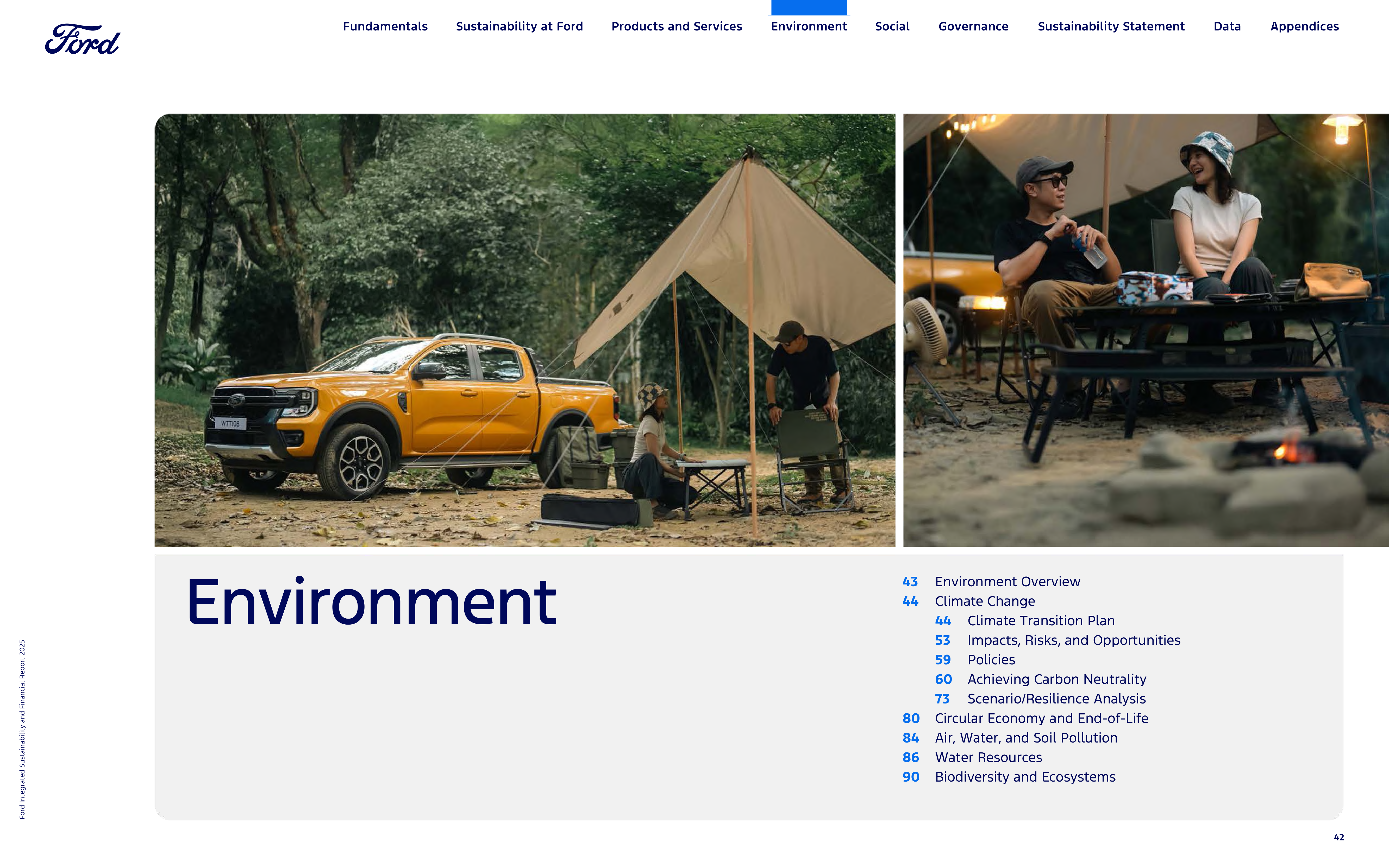
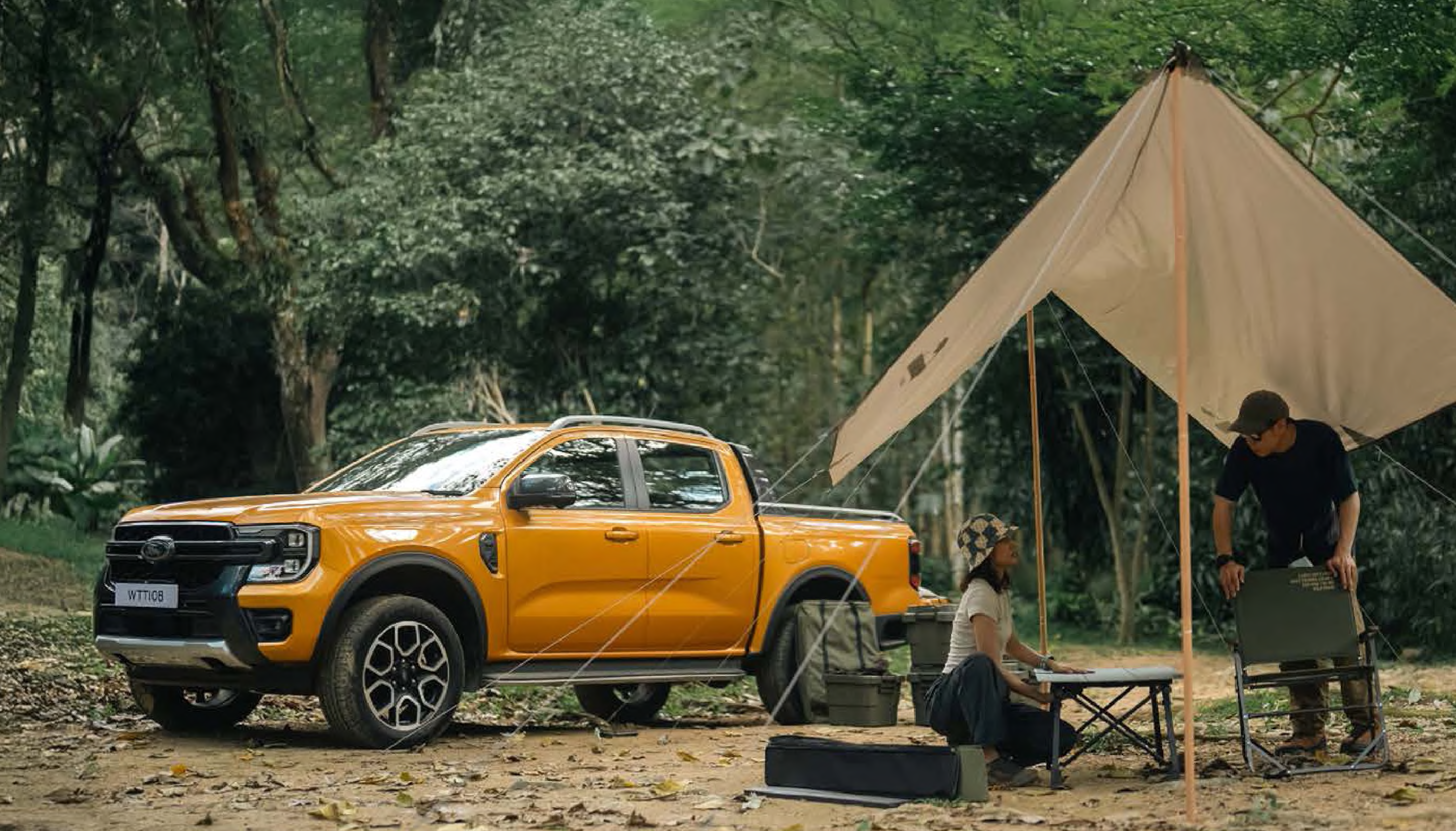

Fundamentals
Sustainability at Ford
Products and Services
Environment
Social
Governance
Sustainability Statement
Data
Appendices
Ford Integrated Sustainability and Financial Report 2025
42
Environment
43
Environment Overview
44
Climate Change
44
Climate Transition Plan
53
Impacts, Risks, and Opportunities
59
Policies
60
Achieving Carbon Neutrality
73
Scenario/Resilience Analysis
80
Circular Economy and End-of-Life
84
Air, Water, and Soil Pollution
86
Water Resources
90
Biodiversity and Ecosystems
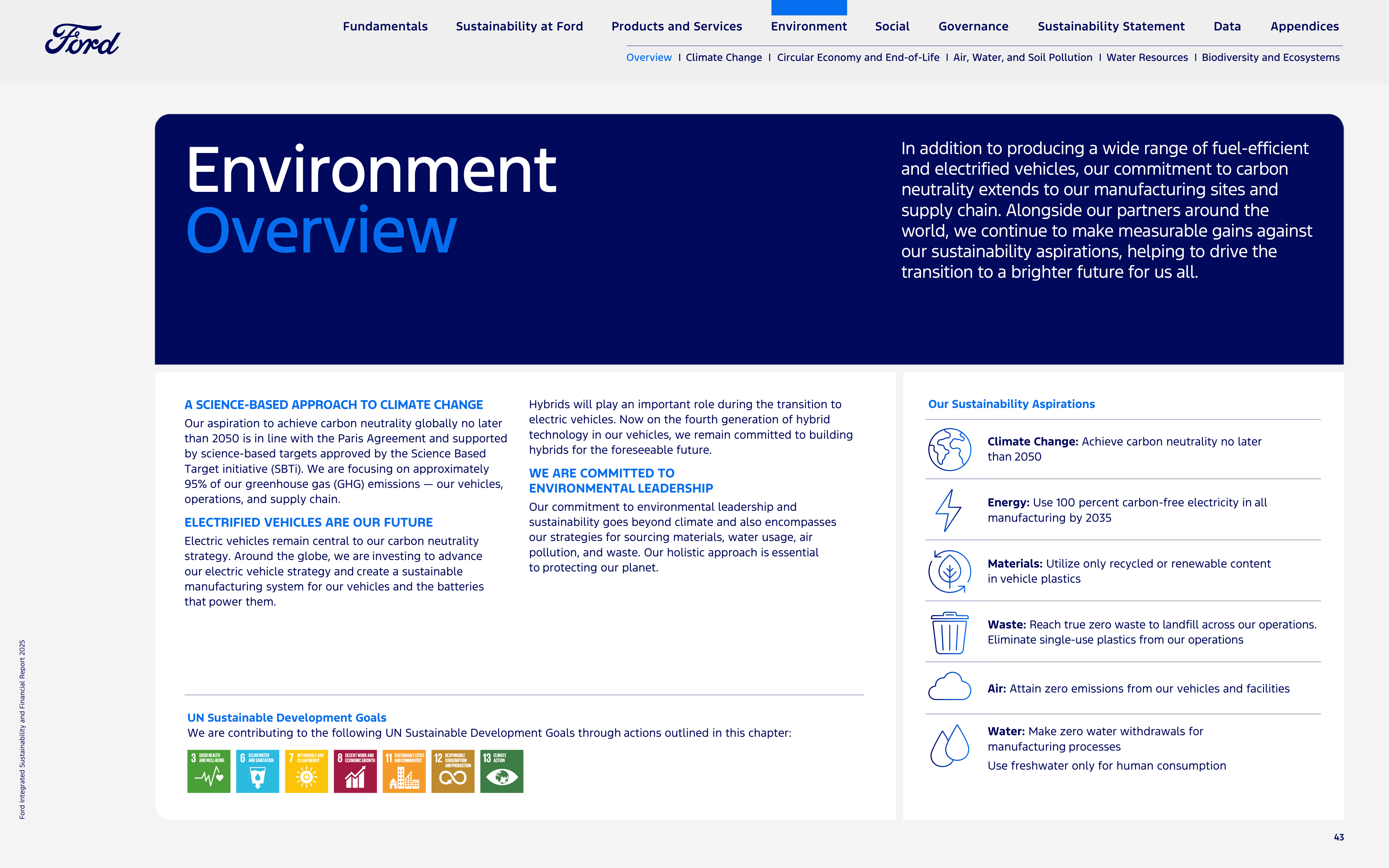

Fundamentals
Sustainability at Ford
Products and Services
Environment
Social
Governance
Sustainability Statement
Data
Appendices
Overview
| Climate Change | Circular Economy and End-of-Life | Air, Water, and Soil Pollution | Water Resources | Biodiversity and Ecosystems
Ford Integrated Sustainability and Financial Report 2025
43
Environment
Overview
In addition to producing a wide range of fuel-efficient
and electrified vehicles, our commitment to carbon
neutrality extends to our manufacturing sites and
supply chain. Alongside our partners around the
world, we continue to make measurable gains against
our sustainability aspirations, helping to drive the
transition to a brighter future for us all.
A SCIENCE-BASED APPROACH TO CLIMATE CHANGE
Our aspiration to achieve carbon neutrality globally no later
than 2050 is in line with the Paris Agreement and supported
by science-based targets approved by the Science Based
Target initiative (SBTi). We are focusing on approximately
95% of our greenhouse gas (GHG) emissions — our vehicles,
operations, and supply chain.
ELECTRIFIED VEHICLES ARE OUR FUTURE
Electric vehicles remain central to our carbon neutrality
strategy. Around the globe, we are investing to advance
our electric vehicle strategy and create a sustainable
manufacturing system for our vehicles and the batteries
that power them.
Hybrids will play an important role during the transition to
electric vehicles. Now on the fourth generation of hybrid
technology in our vehicles, we remain committed to building
hybrids for the foreseeable future.
WE ARE COMMITTED TO
ENVIRONMENTAL LEADERSHIP
Our commitment to environmental leadership and
sustainability goes beyond climate and also encompasses
our strategies for sourcing materials, water usage, air
pollution, and waste. Our holistic approach is essential
to protecting our planet.
UN Sustainable Development Goals
We are contributing to the following UN Sustainable Development Goals through actions outlined in this chapter:
Our Sustainability Aspirations
Climate Change:
Achieve carbon neutrality no later
than 2050
Energy:
Use 100 percent carbon-free electricity in all
manufacturing by 2035
Materials:
Utilize only recycled or renewable content
in vehicle plastics
Waste:
Reach true zero waste to landfill across our operations.
Eliminate single-use plastics from our operations
Air:
Attain zero emissions from our vehicles and facilities
Water:
Make zero water withdrawals for
manufacturing processes
Use freshwater only for human consumption
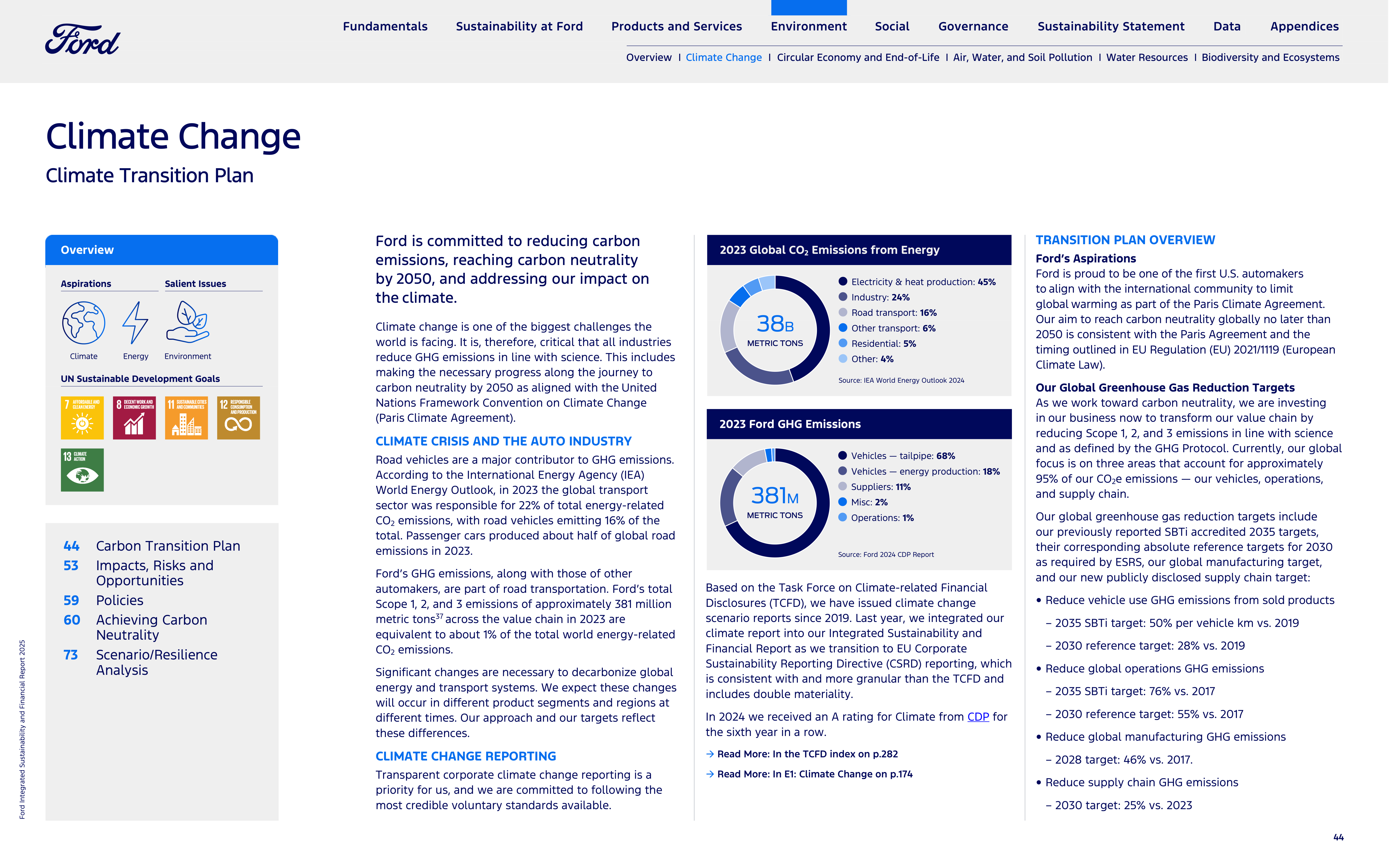

B
D I
TH I
dfd
OHSBU
I
M FT10N
Fundamentals
Sustainability at Ford
Products and Services
Environment
Social
Governance
Sustainability Statement
Data
Appendices
Overview |
Climate Change
| Circular Economy and End-of-Life | Air, Water, and Soil Pollution | Water Resources | Biodiversity and Ecosystems
Climate Change
Climate Transition Plan
Overview
Aspirations
Salient Issues
Climate
Energy
Environment
UN Sustainable Development Goals
7 AFFORDABLE AND CLEAN ENERGY
8 DECENT WORK A
ND ECONOMIC GROWTH
11 SUSTAINABLE CITIES AND COMMUNITIES
1
2 RESP
O
N
S
IB LE CONSUMPTION AND PRODUCTION
13 CLIMATE ACTION
44
Carbon Transition Plan
53
Impacts, Risks and
Opportunities
59
Policies
60
Achieving Carbon
Neutrality
73
Scenario/Resilience
Analysis
Ford is committed to reducing carbon
emissions, reaching carbon neutrality
by 2050, and addressing our impact on
the climate.
Climate change is one of the biggest challenges the
world is facing. It is, therefore, critical that all industries
reduce GHG emissions in line with science. This includes
making the necessary progress along the journey to
carbon neutrality by 2050 as aligned with the United
Nations Framework Convention on Climate Change
(Paris Climate Agreement).
CLIMATE CRISIS AND THE AUTO INDUSTRY
Road vehicles are a major contributor to GHG emissions.
According to the International Energy Agency (IEA)
World Energy Outlook, in 2023 the global transport
sector was responsible for 22% of total energy-related
CO
2
emissions, with road vehicles emitting 16% of the
total. Passenger cars produced about half of global road
emissions in 2023.
Ford’s GHG emissions, along with those of other
automakers, are part of road transportation. Ford’s total
Scope 1, 2, and 3 emissions of approximately 381 million
metric tons
across the value chain in 2023 are
equivalent to about 1% of the total world energy-related
CO
2
emissions.
37
Significant changes are necessary to decarbonize global
energy and transport systems. We expect these changes
will occur in different product segments and regions at
different times. Our approach and our targets reflect
these differences.
CLIMATE CHANGE REPORTING
Transparent corporate climate change reporting is a
priority for us, and we are committed to following the
most credible voluntary standards available.
2023 Global CO
2
Emissions from Energy
38
B
METRIC TONS
●
Electricity & heat production:
45%
●
Industry:
24%
Road transport:
16%
Other transport:
6%
Residential:
5%
Other:
4%
●
●
●
●
Source: IEA World Energy Outlook 2024
2023 Ford GHG Emissions
381
M
METRIC TONS
●
Vehicles — tailpipe:
68%
Vehicles — energy production:
18%
Suppliers:
11%
Misc:
2%
Operations:
1%
●
●
●
●
Source: Ford 2024 CDP Report
Based on the Task Force on Climate-related Financial
Disclosures (TCFD), we have issued climate change
scenario reports since 2019. Last year, we integrated our
climate report into our Integrated Sustainability and
Financial Report as we transition to EU Corporate
Sustainability Reporting Directive (CSRD) reporting, which
is consistent with and more granular than the TCFD and
includes double materiality.
In 2024 we received an A rating for Climate from
CDP
for
the sixth year in a row.
→
Read More: In the TCFD index on p.282
→
Read More: In E1: Climate Change on p.174
TRANSITION PLAN OVERVIEW
Ford’s Aspirations
Ford is proud to be one of the first U.S. automakers
to align with the international community to limit
global warming as part of the Paris Climate Agreement.
Our aim to reach carbon neutrality globally no later than
2050 is consistent with the Paris Agreement and the
timing outlined in EU Regulation (EU) 2021/1119 (European
Climate Law).
Our Global Greenhouse Gas Reduction Targets
As we work toward carbon neutrality, we are investing
in our business now to transform our value chain by
reducing Scope 1, 2, and 3 emissions in line with science
and as defined by the GHG Protocol. Currently, our global
focus is on three areas that account for approximately
95% of our CO
2
e emissions — our vehicles, operations,
and supply chain.
Our global greenhouse gas reduction targets include
our previously reported SBTi accredited 2035 targets,
their corresponding absolute reference targets for 2030
as required by ESRS, our global manufacturing target,
and our new publicly disclosed supply chain target:
•
Reduce vehicle use GHG emissions from sold products
–
2035 SBTi target: 50% per vehicle km vs. 2019
–
2030 reference target: 28% vs. 2019
•
Reduce global operations GHG emissions
–
2035 SBTi target: 76% vs. 2017
–
2030 reference target: 55% vs. 2017
•
Reduce global manufacturing GHG emissions
–
2028 target: 46% vs. 2017.
•
Reduce supply chain GHG emissions
–
2030 target: 25% vs. 2023
Ford Integrated Sustainability and Financial Report 2025
44
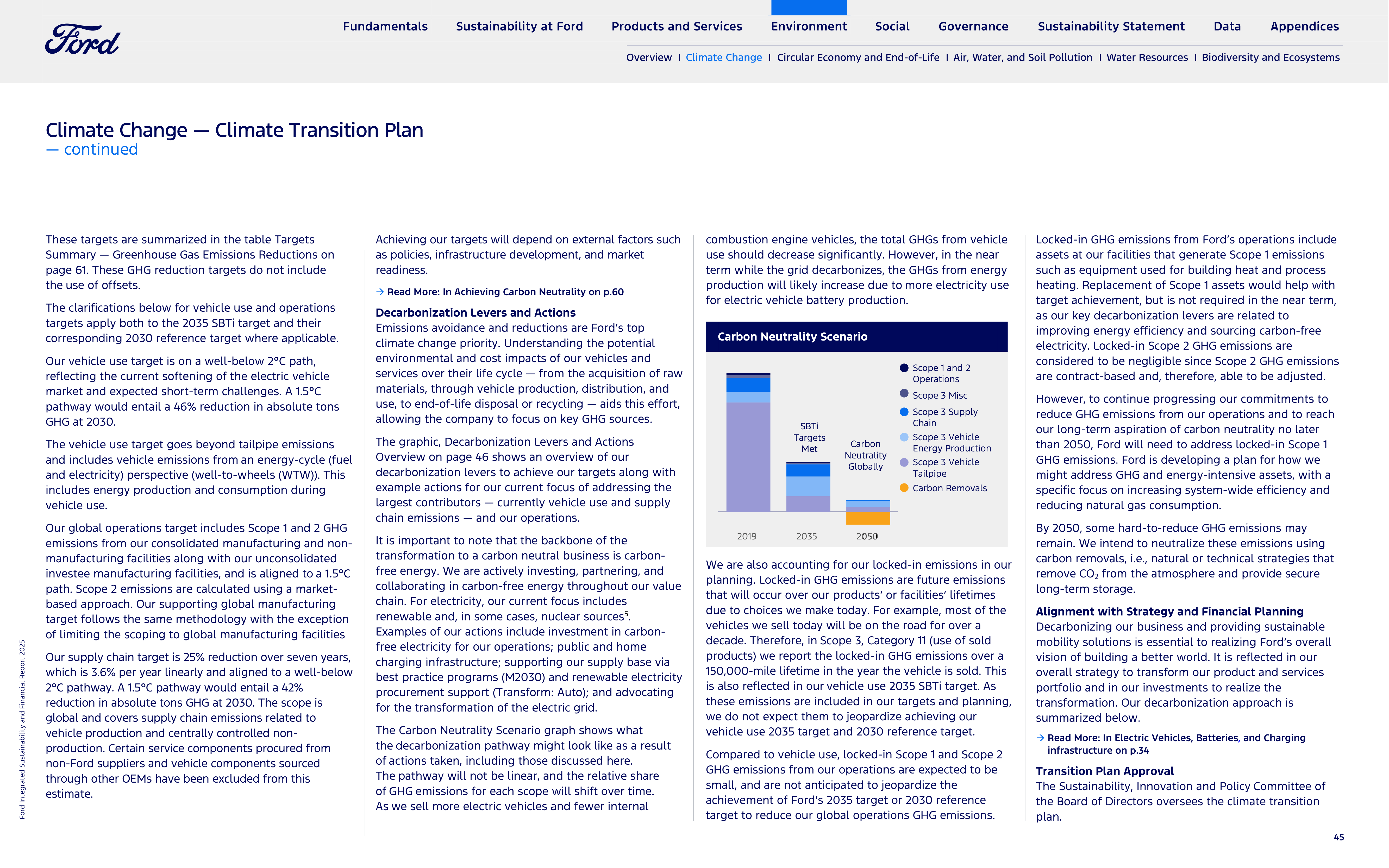
Fundamentals
Sustainability at Ford
Products and Services
Environment
Social
Governance
Sustainability Statement
Data
Appendices
Overview |
Climate Change
| Circular Economy and End-of-Life | Air, Water, and Soil Pollution | Water Resources | Biodiversity and Ecosystems
These targets are summarized in the table Targets
Summary — Greenhouse Gas Emissions Reductions on
page 61. These GHG reduction targets do not include
the use of offsets.
The clarifications below for vehicle use and operations
targets apply both to the 2035 SBTi target and their
corresponding 2030 reference target where applicable.
Our vehicle use target is on a well-below 2°C path,
reflecting the current softening of the electric vehicle
market and expected short-term challenges. A 1.5°C
pathway would entail a 46% reduction in absolute tons
GHG at 2030.
The vehicle use target goes beyond tailpipe emissions
and includes vehicle emissions from an energy-cycle (fuel
and electricity) perspective (well-to-wheels (WTW)). This
includes energy production and consumption during
vehicle use.
Our global operations target includes Scope 1 and 2 GHG
emissions from our consolidated manufacturing and non-
manufacturing facilities along with our unconsolidated
investee manufacturing facilities, and is aligned to a 1.5°C
path. Scope 2 emissions are calculated using a market-
based approach. Our supporting global manufacturing
target follows the same methodology with the exception
of limiting the scoping to global manufacturing facilities
Our supply chain target is 25% reduction over seven years,
which is 3.6% per year linearly and aligned to a well-below
2°C pathway. A 1.5°C pathway would entail a 42%
reduction in absolute tons GHG at 2030. The scope is
global and covers supply chain emissions related to
vehicle production and centrally controlled non-
production. Certain service components procured from
non-Ford suppliers and vehicle components sourced
through other OEMs have been excluded from this
estimate.
Achieving our targets will depend on external factors such
as policies, infrastructure development, and market
readiness.
→
Read More: In Achieving Carbon Neutrality on p.60
Decarbonization Levers and Actions
Emissions avoidance and reductions are Ford’s top
climate change priority. Understanding the potential
environmental and cost impacts of our vehicles and
services over their life cycle — from the acquisition of raw
materials, through vehicle production, distribution, and
use, to end-of-life disposal or recycling — aids this effort,
allowing the company to focus on key GHG sources.
The graphic, Decarbonization Levers and Actions
Overview on page 46 shows an overview of our
decarbonization levers to achieve our targets along with
example actions for our current focus of addressing the
largest contributors — currently vehicle use and supply
chain emissions — and our operations.
It is important to note that the backbone of the
transformation to a carbon neutral business is carbon-
free energy. We are actively investing, partnering, and
collaborating in carbon-free energy throughout our value
chain. For electricity, our current focus includes
renewable and, in some cases, nuclear sources
5
.
Examples of our actions include investment in carbon-
free electricity for our operations; public and home
charging infrastructure; supporting our supply base via
best practice programs (M2030) and renewable electricity
procurement support (Transform: Auto); and advocating
for the transformation of the electric grid.
The Carbon Neutrality Scenario graph shows what
the decarbonization pathway might look like as a result
of actions taken, including those discussed here.
The pathway will not be linear, and the relative share
of GHG emissions for each scope will shift over time.
As we sell more electric vehicles and fewer internal
combustion engine vehicles, the total GHGs from vehicle
use should decrease significantly. However, in the near
term while the grid decarbonizes, the GHGs from energy
production will likely increase due to more electricity use
for electric vehicle battery production.
Carbon Neutrality Scenario
2019
2035
●
SBTi
Targets
Met
2050
Carbon
Neutrality
Globally
Scope 1 and 2
Operations
●
Scope 3 Misc
●
Scope 3 Supply
Chain
●
Scope 3 Vehicle
Energy Production
●
Scope 3 Vehicle
Tailpipe
●
Carbon Removals
We are also accounting for our locked-in emissions in our
planning. Locked-in GHG emissions are future emissions
that will occur over our products’ or facilities’ lifetimes
due to choices we make today. For example, most of the
vehicles we sell today will be on the road for over a
decade. Therefore, in Scope 3, Category 11 (use of sold
products) we report the locked-in GHG emissions over a
150,000-mile lifetime in the year the vehicle is sold. This
is also reflected in our vehicle use 2035 SBTi target. As
these emissions are included in our targets and planning,
we do not expect them to jeopardize achieving our
vehicle use 2035 target and 2030 reference target.
Compared to vehicle use, locked-in Scope 1 and Scope 2
GHG emissions from our operations are expected to be
small, and are not anticipated to jeopardize the
achievement of Ford’s 2035 target or 2030 reference
target to reduce our global operations GHG emissions.
Locked-in GHG emissions from Ford’s operations include
assets at our facilities that generate Scope 1 emissions
such as equipment used for building heat and process
heating. Replacement of Scope 1 assets would help with
target achievement, but is not required in the near term,
as our key decarbonization levers are related to
improving energy efficiency and sourcing carbon-free
electricity. Locked-in Scope 2 GHG emissions are
considered to be negligible since Scope 2 GHG emissions
are contract-based and, therefore, able to be adjusted.
However, to continue progressing our commitments to
reduce GHG emissions from our operations and to reach
our long-term aspiration of carbon neutrality no later
than 2050, Ford will need to address locked-in Scope 1
GHG emissions. Ford is developing a plan for how we
might address GHG and energy-intensive assets, with a
specific focus on increasing system-wide efficiency and
reducing natural gas consumption.
By 2050, some hard-to-reduce GHG emissions may
remain. We intend to neutralize these emissions using
carbon removals, i.e., natural or technical strategies that
remove CO
2
from the atmosphere and provide secure
long-term storage.
Alignment with Strategy and Financial Planning
Decarbonizing our business and providing sustainable
mobility solutions is essential to realizing Ford’s overall
vision of building a better world. It is reflected in our
overall strategy to transform our product and services
portfolio and in our investments to realize the
transformation. Our decarbonization approach is
summarized below.
→
Read More: In Electric Vehicles, Batteries
,
and Charging
infrastructure on p.34
Transition Plan Approval
The Sustainability, Innovation and Policy Committee of
the Board of Directors oversees the climate transition
plan.
Climate Change — Climate Transition Plan
— continued
Ford Integrated Sustainability and Financial Report 2025
45
2019
2035
2050
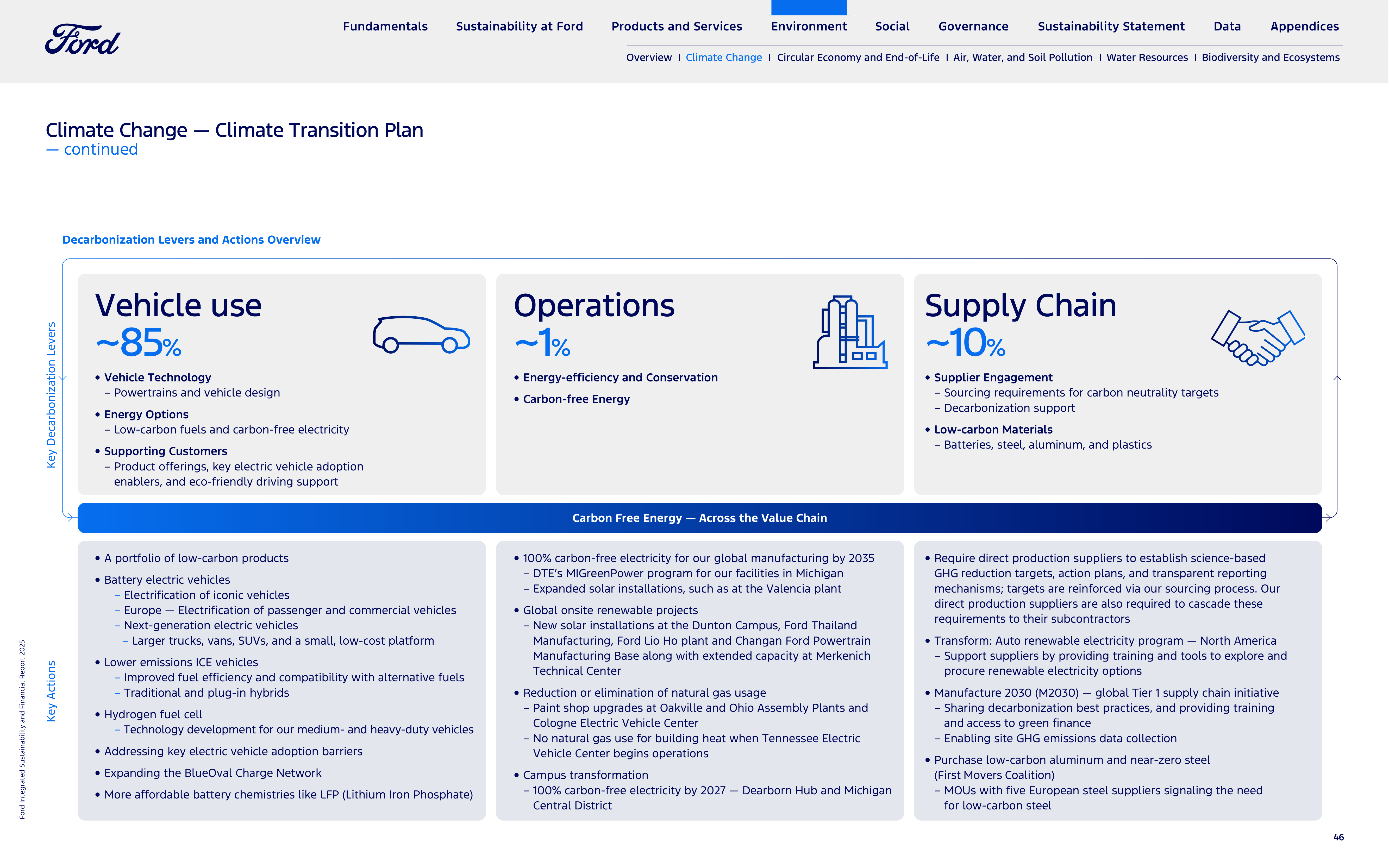





Climate Change — Climate Transition Plan
— continued
Ford Integrated Sustainability and Financial Report 2025
46
Fundamentals
Sustainability at Ford
Products and Services
Environment
Social
Governance
Sustainability Statement
Data
Appendices
Overview |
Climate Change
| Circular Economy and End-of-Life | Air, Water, and Soil Pollution | Water Resources | Biodiversity and Ecosystems
Carbon Free Energy — Across the Value Chain
Decarbonization Levers and Actions Overview
Key Decarbonization Levers
Vehicle use
~85
%
•
Vehicle Technology
–
Powertrains and vehicle design
•
Energy Options
–
Low-carbon fuels and carbon-free electricity
•
Supporting Customers
–
Product offerings, key electric vehicle adoption
enablers, and eco-friendly driving support
Operations
~1
%
•
Energy-efficiency and Conservation
•
Carbon-free Energy
Supply Chain
~10
%
•
Supplier Engagement
–
Sourcing requirements for carbon neutrality targets
–
Decarbonization support
•
Low-carbon Materials
–
Batteries, steel, aluminum, and plastics
Carbon Free Energy —
Across the Value Chain
K
ey Actions
•
A portfolio of low-carbon products
•
Battery electric vehicles
–
Electrification of iconic vehicles
–
Europe — Electrification of passenger and commercial vehicles
–
Next-generation electric vehicles
–
Larger trucks, vans, SUVs, and a small, low-cost platform
•
Lower emissions ICE vehicles
–
Improved fuel efficiency and compatibility with alternative fuels
–
Traditional and plug-in hybrids
•
Hydrogen fuel cell
–
Technology development for our medium- and heavy-duty vehicles
•
Addressing key electric vehicle adoption barriers
•
Expanding the BlueOval Charge Network
•
More affordable battery chemistries like LFP (Lithium Iron Phosphate)
•
100% carbon-free electricity for our global manufacturing by 2035
–
DTE’s MIGreenPower program for our facilities in Michigan
–
Expanded solar installations, such as at the Valencia plant
•
Global onsite renewable projects
–
New solar installations at the Dunton Campus, Ford Thailand
Manufacturing, Ford Lio Ho plant and Changan Ford Powertrain
Manufacturing Base along with extended capacity at Merkenich
Technical Center
•
Reduction or elimination of natural gas usage
–
Paint shop upgrades at Oakville and Ohio Assembly Plants and
Cologne Electric Vehicle Center
–
No natural gas use for building heat when Tennessee Electric
Vehicle Center begins operations
•
Campus transformation
–
100% carbon-free electricity by 2027 — Dearborn Hub and Michigan
Central District
•
Require direct production suppliers to establish science-based
GHG reduction targets, action plans, and transparent reporting
mechanisms; targets are reinforced via our sourcing process. Our
direct production suppliers are also required to cascade these
requirements to their subcontractors
•
Transform: Auto renewable electricity program — North America
–
Support suppliers by providing training and tools to explore and
procure renewable electricity options
•
Manufacture 2030 (M2030) — global Tier 1 supply chain initiative
–
Sharing decarbonization best practices, and providing training
and access to green finance
–
Enabling site GHG emissions data collection
•
Purchase low-carbon aluminum and near-zero steel
(First Movers Coalition)
–
MOUs with five European steel suppliers signaling the need
for low-carbon steel
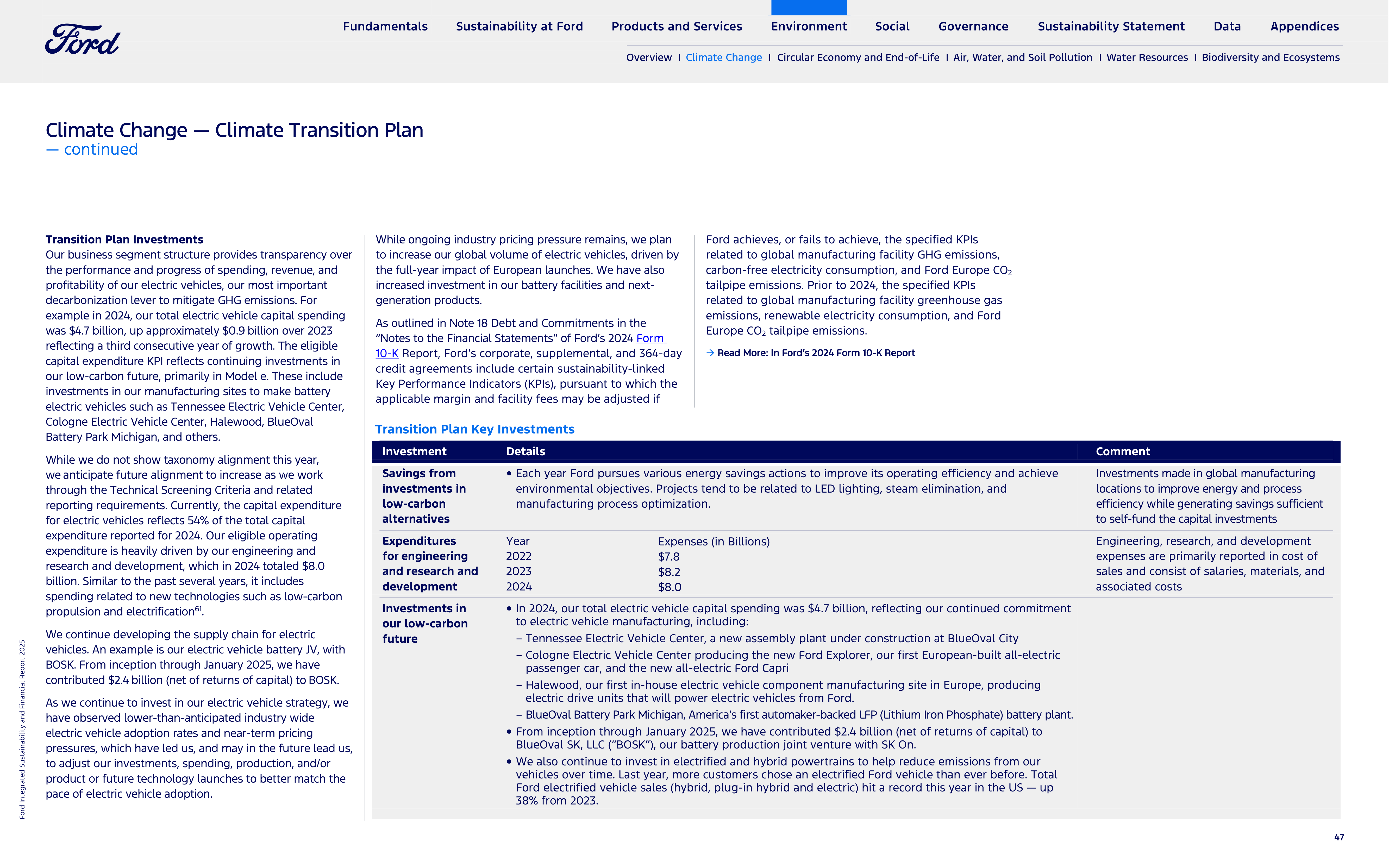
Fundamentals
Sustainability at Ford
Products and Services
Environment
Social
Governance
Sustainability Statement
Data
Appendices
Overview |
Climate Change
| Circular Economy and End-of-Life | Air, Water, and Soil Pollution | Water Resources | Biodiversity and Ecosystems
Transition Plan Investments
Our business segment structure provides transparency over
the performance and progress of spending, revenue, and
profitability of our electric vehicles, our most important
decarbonization lever to mitigate GHG emissions. For
example in 2024, our total electric vehicle capital spending
was $4.7 billion, up approximately $0.9 billion over 2023
reflecting a third consecutive year of growth. The eligible
capital expenditure KPI reflects continuing investments in
our low-carbon future, primarily in Model e. These include
investments in our manufacturing sites to make battery
electric vehicles such as Tennessee Electric Vehicle Center,
Cologne Electric Vehicle Center, Halewood, BlueOval
Battery Park Michigan, and others.
While we do not show taxonomy alignment this year,
we anticipate future alignment to increase as we work
through the Technical Screening Criteria and related
reporting requirements. Currently, the capital expenditure
for electric vehicles reflects 54% of the total capital
expenditure reported for 2024. Our eligible operating
expenditure is heavily driven by our engineering and
research and development, which in 2024 totaled $8.0
billion. Similar to the past several years, it includes
spending related to new technologies such as low-carbon
propulsion and electrification
61
.
We continue developing the supply chain for electric
vehicles. An example is our electric vehicle battery JV, with
BOSK. From inception through January 2025, we have
contributed $2.4 billion (net of returns of capital) to BOSK.
As we continue to invest in our electric vehicle strategy, we
have observed lower-than-anticipated industry wide
electric vehicle adoption rates and near-term pricing
pressures, which have led us, and may in the future lead us,
to adjust our investments, spending, production, and/or
product or future technology launches to better match the
pace of electric vehicle adoption.
While ongoing industry pricing pressure remains, we plan
to increase our global volume of electric vehicles, driven by
the full-year impact of European launches. We have also
increased investment in our battery facilities and next-
generation products.
As outlined in Note 18 Debt and Commitments in the
“Notes to the Financial Statements” of Ford’s 2024
Form
10-K
Report, Ford’s corporate, supplemental, and 364-day
credit agreements include certain sustainability-linked
Key Performance Indicators (KPIs), pursuant to which the
applicable margin and facility fees may be adjusted if
Ford achieves, or fails to achieve, the specified KPIs
related to global manufacturing facility GHG emissions,
carbon-free electricity consumption, and Ford Europe CO
2
tailpipe emissions. Prior to 2024, the specified KPIs
related to global manufacturing facility greenhouse gas
emissions, renewable electricity consumption, and Ford
Europe CO
2
tailpipe emissions.
Read More:
→
In Ford’s 2024 Form 10-K Report
Climate Change — Climate Transition Plan
— continued
Ford Integrated Sustainability and Financial Report 2025
47
Transition Plan Key Investments
Investment
Details
Comment
Savings from
investments in
low-carbon
alternatives
•
Each year Ford pursues various energy savings actions to improve its operating efficiency and achieve
environmental objectives. Projects tend to be related to LED lighting, steam elimination, and
manufacturing process optimization.
Investments made in global manufacturing
locations to improve energy and process
efficiency while generating savings sufficient
to self-fund the capital investments
Expenditures
for engineering
and research and
development
Year
Expenses (in Billions)
2022
$7.8
2023
$8.2
2024
$8.0
Engineering, research, and development
expenses are primarily reported in cost of
sales and consist of salaries, materials, and
associated costs
Investments in
our low-carbon
future
•
In 2024, our total electric vehicle capital spending was $4.7 billion, reflecting our continued commitment
to electric vehicle manufacturing, including:
–
Tennessee Electric Vehicle Center, a new assembly plant under construction at BlueOval City
–
Cologne Electric Vehicle Center producing the new Ford Explorer, our first European-built all-electric
passenger car, and the new all-electric Ford Capri
–
Halewood, our first in-house electric vehicle component manufacturing site in Europe, producing
electric drive units that will power electric vehicles from Ford.
–
BlueOval Battery Park Michigan, America’s first automaker-backed LFP (Lithium Iron Phosphate) battery plant.
•
From inception through January 2025, we have contributed $2.4 billion (net of returns of capital) to
BlueOval SK, LLC (“BOSK”), our battery production joint venture with SK On.
•
We also continue to invest in electrified and hybrid powertrains to help reduce emissions from our
vehicles over time. Last year, more customers chose an electrified Ford vehicle than ever before. Total
Ford electrified vehicle sales (hybrid, plug-in hybrid and electric) hit a record this year in the US — up
38% from 2023.
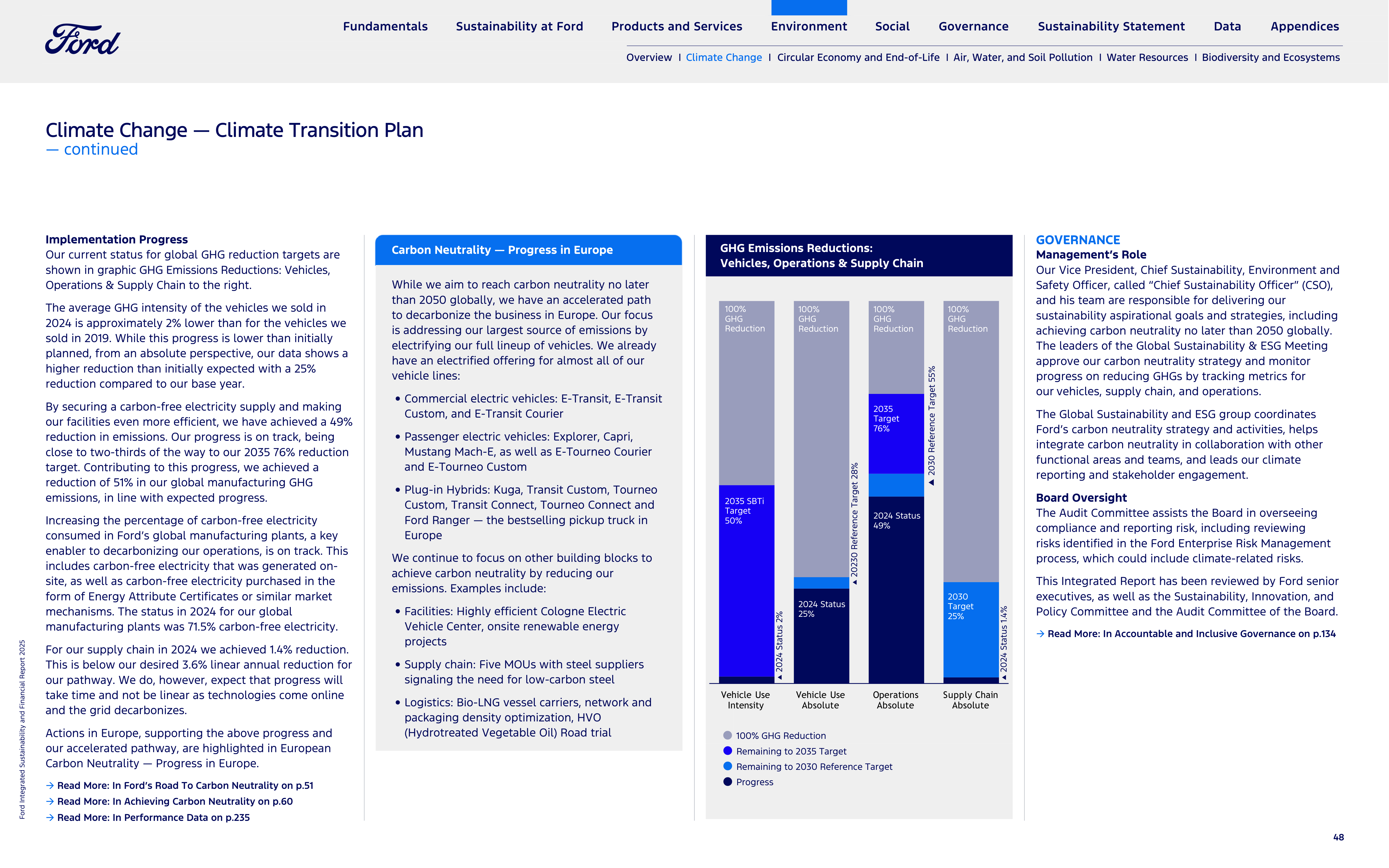

Fundamentals
Sustainability at Ford
Products and Services
Environment
Social
Governance
Sustainability Statement
Data
Appendices
Overview |
Climate Change
| Circular Economy and End-of-Life | Air, Water, and Soil Pollution | Water Resources | Biodiversity and Ecosystems
Implementation Progress
Our current status for global GHG reduction targets are
shown in graphic GHG Emissions Reductions: Vehicles,
Operations & Supply Chain to the right.
The average GHG intensity of the vehicles we sold in
2024 is approximately 2% lower than for the vehicles we
sold in 2019. While this progress is lower than initially
planned, from an absolute perspective, our data shows a
higher reduction than initially expected with a 25%
reduction compared to our base year.
By securing a carbon-free electricity supply and making
our facilities even more efficient, we have achieved a 49%
reduction in emissions. Our progress is on track, being
close to two-thirds of the way to our 2035 76% reduction
target. Contributing to this progress, we achieved a
reduction of 51% in our global manufacturing GHG
emissions, in line with expected progress.
Increasing the percentage of carbon-free electricity
consumed in Ford’s global manufacturing plants, a key
enabler to decarbonizing our operations, is on track. This
includes carbon-free electricity that was generated on-
site, as well as carbon-free electricity purchased in the
form of Energy Attribute Certificates or similar market
mechanisms. The status in 2024 for our global
manufacturing plants was 71.5% carbon-free electricity.
For our supply chain in 2024 we achieved 1.4% reduction.
This is below our desired 3.6% linear annual reduction for
our pathway. We do, however, expect that progress will
take time and not be linear as technologies come online
and the grid decarbonizes.
Actions in Europe, supporting the above progress and
our accelerated pathway, are highlighted in European
Carbon Neutrality — Progress in Europe.
Read More:
→
In Ford’s Road To Carbon Neutrality on p.51
Read More:
→
In Achieving Carbon Neutrality on p.60
Read More:
→
In Performance Data on p.235
Carbon Neutrality — Progress in Europe
While we aim to reach carbon neutrality no later
than 2050 globally, we have an accelerated path
to decarbonize the business in Europe. Our focus
is addressing our largest source of emissions by
electrifying our full lineup of vehicles. We already
have an electrified offering for almost all of our
vehicle lines:
•
Commercial electric vehicles: E-Transit, E-Transit
Custom, and E-Transit Courier
•
Passenger electric vehicles: Explorer, Capri,
Mustang Mach-E, as well as E-Tourneo Courier
and E-Tourneo Custom
•
Plug-in Hybrids: Kuga, Transit Custom, Tourneo
Custom, Transit Connect, Tourneo Connect and
Ford Ranger — the bestselling pickup truck in
Europe
We continue to focus on other building blocks to
achieve carbon neutrality by reducing our
emissions. Examples include:
•
Facilities: Highly efficient Cologne Electric
Vehicle Center, onsite renewable energy
projects
•
Supply chain: Five MOUs with steel suppliers
signaling the need for low-carbon steel
•
Logistics: Bio-LNG vessel carriers, network and
packaging density optimization, HVO
(Hydrotreated Vegetable Oil) Road trial
GHG Emissions Reductions:
Vehicles, Operations & Supply Chain
Vehicle Use
Intensity
2035 SBTi
Target
50%
100%
GHG
Reduction
2024 Status 2%
Vehicle Use
Absolute
Progress 2024 Status
25%
100%
GHG
Reduction
20230 Reference Target 28%
Operations
Absolute
Progress 2024 Status
49%
Rema
ining to 2035 Target 2035 Target
76%
100%
GHG
Reduction
2030 Reference Target 55%
Supply Chain
Absolute
Remaining to 2030 Reference Target 2030
Target
25%
100%
GHG
Reduction
2
20
4 Status 1.4%
●
100% GHG Reduction
Remaining to 2035 Target
Remaining to 2030 Reference Target
Progress
●
●
●
GOVERNANCE
Management’s Role
Our Vice President, Chief Sustainability, Environment and
Safety Officer, called “Chief Sustainability Officer” (CSO),
and his team are responsible for delivering our
sustainability aspirational goals and strategies, including
achieving carbon neutrality no later than 2050 globally.
The leaders of the Global Sustainability & ESG Meeting
approve our carbon neutrality strategy and monitor
progress on reducing GHGs by tracking metrics for
our vehicles, supply chain, and operations.
The Global Sustainability and ESG group coordinates
Ford’s carbon neutrality strategy and activities, helps
integrate carbon neutrality in collaboration with other
functional areas and teams, and leads our climate
reporting and stakeholder engagement.
Board Oversight
The Audit Committee assists the Board in overseeing
compliance and reporting risk, including reviewing
risks identified in the Ford Enterprise Risk Management
process, which could include climate-related risks.
This Integrated Report has been reviewed by Ford senior
executives, as well as the Sustainability, Innovation, and
Policy Committee and the Audit Committee of the Board.
Read More:
→
In Accountable and Inclusive Governance
on p.134
Climate Change — Climate Transition Plan
— continued
Ford Integrated Sustainability and Financial Report 2025
48
▲
▲
▲
▲
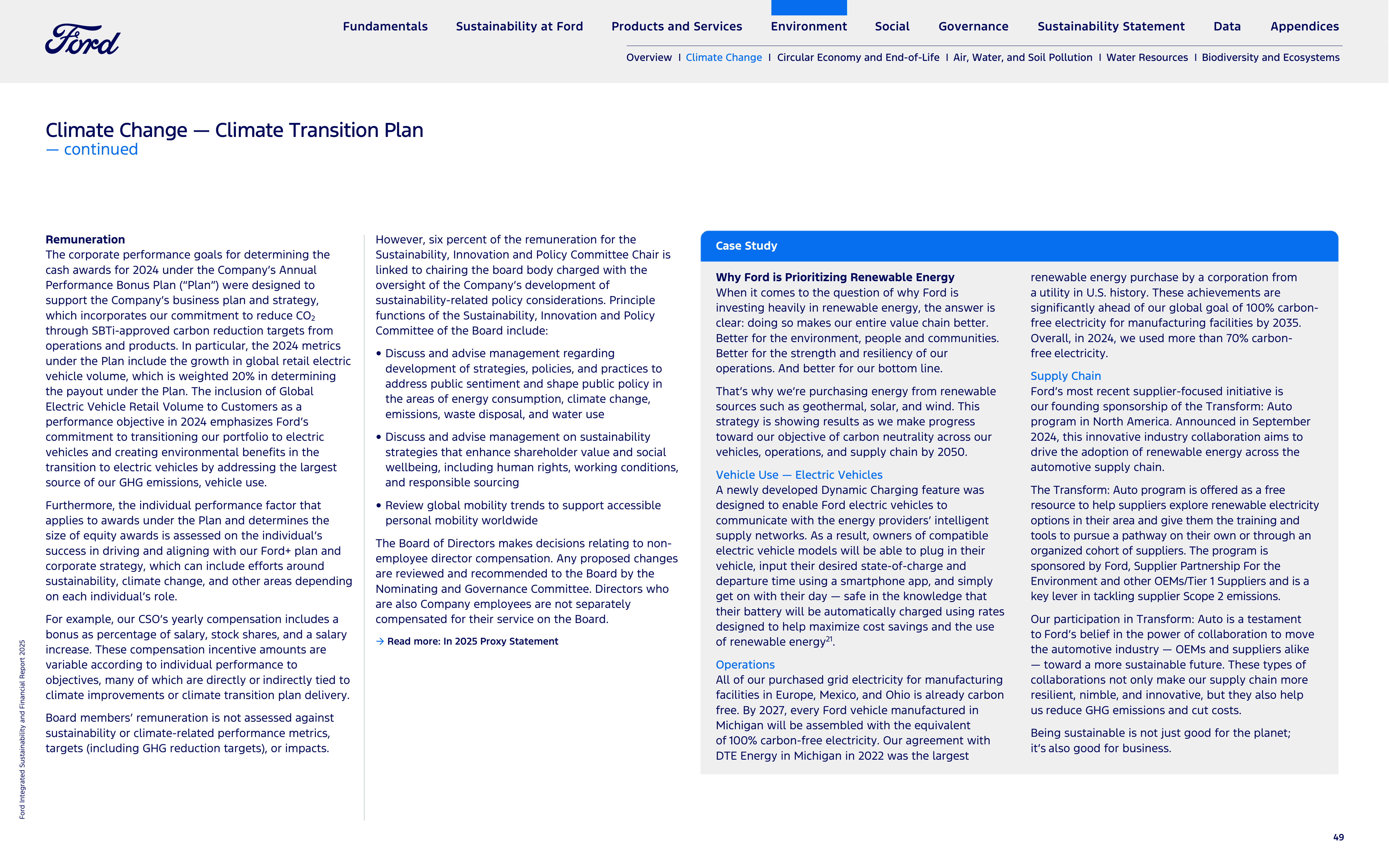

Fundamentals
Sustainability at Ford
Products and Services
Environment
Social
Governance
Sustainability Statement
Data
Appendices
Overview |
Climate Change
| Circular Economy and End-of-Life | Air, Water, and Soil Pollution | Water Resources | Biodiversity and Ecosystems
Remuneration
The corporate performance goals for determining the
cash awards for 2024 under the Company’s Annual
Performance Bonus Plan (“Plan”) were designed to
support the Company’s business plan and strategy,
which incorporates our commitment to reduce CO
2
through SBTi-approved carbon reduction targets from
operations and products. In particular, the 2024 metrics
under the Plan include the growth in global retail electric
vehicle volume, which is weighted 20% in determining
the payout under the Plan. The inclusion of Global
Electric Vehicle Retail Volume to Customers as a
performance objective in 2024 emphasizes Ford’s
commitment to transitioning our portfolio to electric
vehicles and creating environmental benefits in the
transition to electric vehicles by addressing the largest
source of our GHG emissions, vehicle use.
Furthermore, the individual performance factor that
applies to awards under the Plan and determines the
size of equity awards is assessed on the individual’s
success in driving and aligning with our Ford+ plan and
corporate strategy, which can include efforts around
sustainability, climate change, and other areas depending
on each individual’s role.
For example, our CSO’s yearly compensation includes a
bonus as percentage of salary, stock shares, and a salary
increase. These compensation incentive amounts are
variable according to individual performance to
objectives, many of which are directly or indirectly tied to
climate improvements or climate transition plan delivery.
Board members’ remuneration is not assessed against
sustainability or climate-related performance metrics,
targets (including GHG reduction targets), or impacts.
However, six percent of the remuneration for the
Sustainability, Innovation and Policy Committee Chair is
linked to chairing the board body charged with the
oversight of the Company’s development of
sustainability-related policy considerations. Principle
functions of the Sustainability, Innovation and Policy
Committee of the Board include:
•
Discuss and advise management regarding
development of strategies, policies, and practices to
address public sentiment and shape public policy in
the areas of energy consumption, climate change,
emissions, waste disposal, and water use
•
Discuss and advise management on sustainability
strategies that enhance shareholder value and social
wellbeing, including human rights, working conditions,
and responsible sourcing
•
Review global mobility trends to support accessible
personal mobility worldwide
The Board of Directors makes decisions relating to non-
employee director compensation. Any proposed changes
are reviewed and recommended to the Board by the
Nominating and Governance Committee. Directors who
are also Company employees are not separately
compensated for their service on the Board.
Read more:
→
In 2025 Proxy Statement
Climate Change — Climate Transition Plan
— continued
Ford Integrated Sustainability and Financial Report 2025
49
Case Study
Why Ford is Prioritizing Renewable Energy
When it comes to the question of why Ford is
investing heavily in renewable energy, the answer is
clear: doing so makes our entire value chain better.
Better for the environment, people and communities.
Better for the strength and resiliency of our
operations. And better for our bottom line.
Vehicle Use — Electric Vehicles
That’s why we’re purchasing energy from renewable
sources such as geothermal, solar, and wind. This
strategy is showing results as we make progress
toward our objective of carbon neutrality across our
vehicles, operations, and supply chain by 2050.
A newly developed Dynamic Charging feature was
designed to enable Ford electric vehicles to
communicate with the energy providers’ intelligent
supply networks. As a result, owners of compatible
electric vehicle models will be able to plug in their
vehicle, input their desired state-of-charge and
departure time using a smartphone app, and simply
get on with their day — safe in the knowledge that
their battery will be automatically charged using rates
designed to help maximize cost savings and the use
of renewable energy
.
21
Operations
All of our purchased grid electricity for manufacturing
facilities in Europe, Mexico, and Ohio is already carbon
free. By 2027, every Ford vehicle manufactured in
Michigan will be assembled with the equivalent
of 100% carbon-free electricity. Our agreement with
DTE Energy in Michigan in 2022 was the largest
renewable energy purchase by a corporation from
a utility in U.S. history. These achievements are
significantly ahead of our global goal of 100% carbon-
free electricity for manufacturing facilities by 2035.
Overall, in 2024, we used more than 70% carbon-
free electricity.
Supply Chain
Ford’s most recent supplier-focused initiative is
our founding sponsorship of the Transform: Auto
program in North America. Announced in September
2024, this innovative industry collaboration aims to
drive the adoption of renewable energy across the
automotive supply chain.
The Transform: Auto program is offered as a free
resource to help suppliers explore renewable electricity
options in their area and give them the training and
tools to pursue a pathway on their own or through an
organized cohort of suppliers. The program is
sponsored by Ford, Supplier Partnership For the
Environment and other OEMs/Tier 1 Suppliers and is a
key lever in tackling supplier Scope 2 emissions.
Our participation in Transform: Auto is a testament
to Ford’s belief in the power of collaboration to move
the automotive industry — OEMs and suppliers alike
— toward a more sustainable future. These types of
collaborations not only make our supply chain more
resilient, nimble, and innovative, but they also help
us reduce GHG emissions and cut costs.
Being sustainable is not just good for the planet;
it’s also good for business.

Fundamentals
Sustainability at Ford
Products and Services
Environment
Social
Governance
Sustainability Statement
Data
Appendices
Overview |
Climate Change
| Circular Economy and End-of-Life | Air, Water, and Soil Pollution | Water Resources | Biodiversity and Ecosystems
COLLABORATION
Avoiding the worst consequences of climate change
requires collaboration with multiple partners and
organizations in the public and private sectors to drive
timely progress. We are working together to address
challenges including barriers to electric vehicle adoption,
government regulations, economic factors, and the
availability of carbon-free electricity and renewable fuels.
Our Blue Table Forum is a space for dialogue around
how we can work together with various stakeholders
from a diverse group of non-governmental organizations
(NGOs), nonprofits, and academic institutions.
Ford participated in the SBTi Automotive Standard expert
advisory group for the development of a sector-specific
1.5°C intensity pathway. We will be evaluating SBTi’s final
standard when available.
Ford partners with organizations like the Center for
Climate and Energy Solutions Business and Environmental
Leadership Council to help advance stronger GHG
emissions policy and infrastructure improvements to
remove obstacles and build the market for electric vehicles.
We support consumer electric vehicle incentives to
accelerate the transition by making electric vehicles
even more accessible and affordable while supporting
manufacturing jobs. We are also working with partners
to secure the supply chains and develop the technologies
we need to produce electric vehicles and batteries here
in the U.S., also ensuring the United States remains
competitive globally.
→
Read More: In Government Regulations, Policy and
Engagement on p.139
COMMUNITY ENGAGEMENT
Addressing climate change is more than decarbonizing
our business, it is also about communities. We are
working to minimize negative impacts while striving to
create positive impacts on people and the environment.
Our goal is to protect the communities in which we
operate from environmental and health hazards and to
provide equal access to the decision-making process that
supports a healthy environment in which to live, learn,
and work.
As a part of Ford’s Good Neighbor Plan, Ford collaborates
with local organizations to conserve and protect natural
resources by listening to stakeholders, building
partnerships, and supporting community efforts. We
engage with environmental groups, community leaders,
and residents to understand local needs through Town
Halls, surveys, and roundtable discussions. Ford also
partners with grassroots organizations to address
community and environmental issues, such as
connecting kids with nature, completing residential
repairs, and supporting school greenhouses. Our scale
and resources amplify the impact of local initiatives,
providing funding, volunteers, and convening key
stakeholders.
We are also working to provide electric vehicles by
offering equitable financing, supporting greater electric
vehicle charging access, developing new mobility
solutions in urban and rural areas, diversifying our
supplier, dealer, and investor network, and supporting
small businesses and businesses owned by women,
minorities, veterans, and people with disabilities.
We also support policy that aims to direct investments
into communities that are marginalized and generally
more adversely impacted by air pollution and climate
change. This might include, for example, tax incentives
for the installation of electric vehicle charging
infrastructure in low-income census tracts, or for clean
energy projects that meet prevailing wage and
apprenticeship requirements.
Climate Change — Climate Transition Plan
— continued
Ford Integrated Sustainability and Financial Report 2025
50
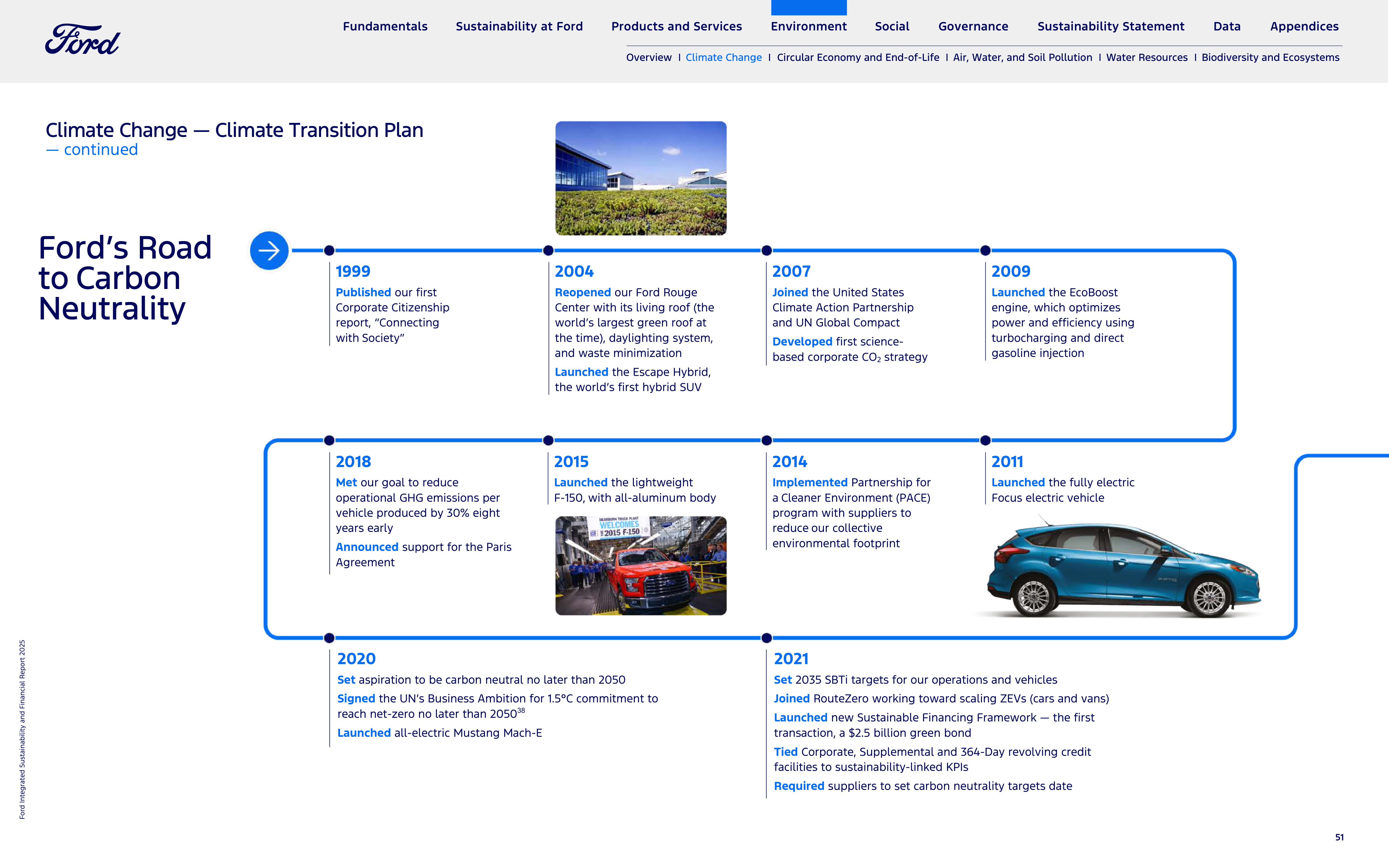
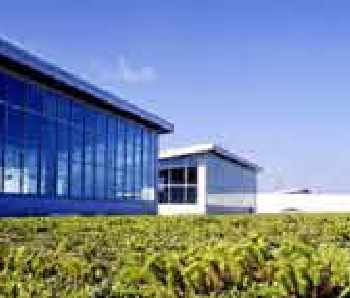


Fundamentals
Sustainability at Ford
Products and Services
Environment
Social
Governance
Sustainability Statement
Data
Appendices
Overview |
Climate Change
| Circular Economy and End-of-Life | Air, Water, and Soil Pollution | Water Resources | Biodiversity and Ecosystems
Climate Change — Climate Transition Plan
— continued
Ford Integrated Sustainability and Financial Report 2025
51
Ford’s Road
to Carbon
Neutrality
1999
Published
our first
Corporate Citizenship
report, “Connecting
with Society”
2004
Reopened
our Ford Rouge
Center with its living roof (the
world’s largest green roof at
the time), daylighting system,
and waste minimization
Launched
the Escape Hybrid,
the world’s first hybrid SUV
2007
Joined
the United States
Climate Action Partnership
and UN Global Compact
Developed
first science-
based corporate CO
2
strategy
2009
Launched
the EcoBoost
engine, which optimizes
power and efficiency using
turbocharging and direct
gasoline injection
2011
Launched
the fully electric
Focus electric vehicle
2014
Implemented
Partnership for
a Cleaner Environment (PACE)
program with suppliers to
reduce our collective
environmental footprint
2015
Launched
the lightweight
F-150, with all-aluminum body
2018
Met
our goal to reduce
operational GHG emissions per
vehicle produced by 30% eight
years early
Announced
support for the Paris
Agreement
2020
Set
aspiration to be carbon neutral no later than 2050
Signed
the UN’s Business Ambition for 1.5°C commitment to
reach net-zero no later than 2050
38
Launched
all-electric Mustang Mach-E
2021
Set
2035 SBTi targets for our operations and vehicles
Joined
RouteZero working toward scaling ZEVs (cars and vans)
Launched
new Sustainable Financing Framework — the first
transaction, a $2.5 billion green bond
Tied
Corporate, Supplemental and 364-Day revolving credit
facilities to sustainability-linked KPIs
Required
suppliers to set carbon neutrality targets date
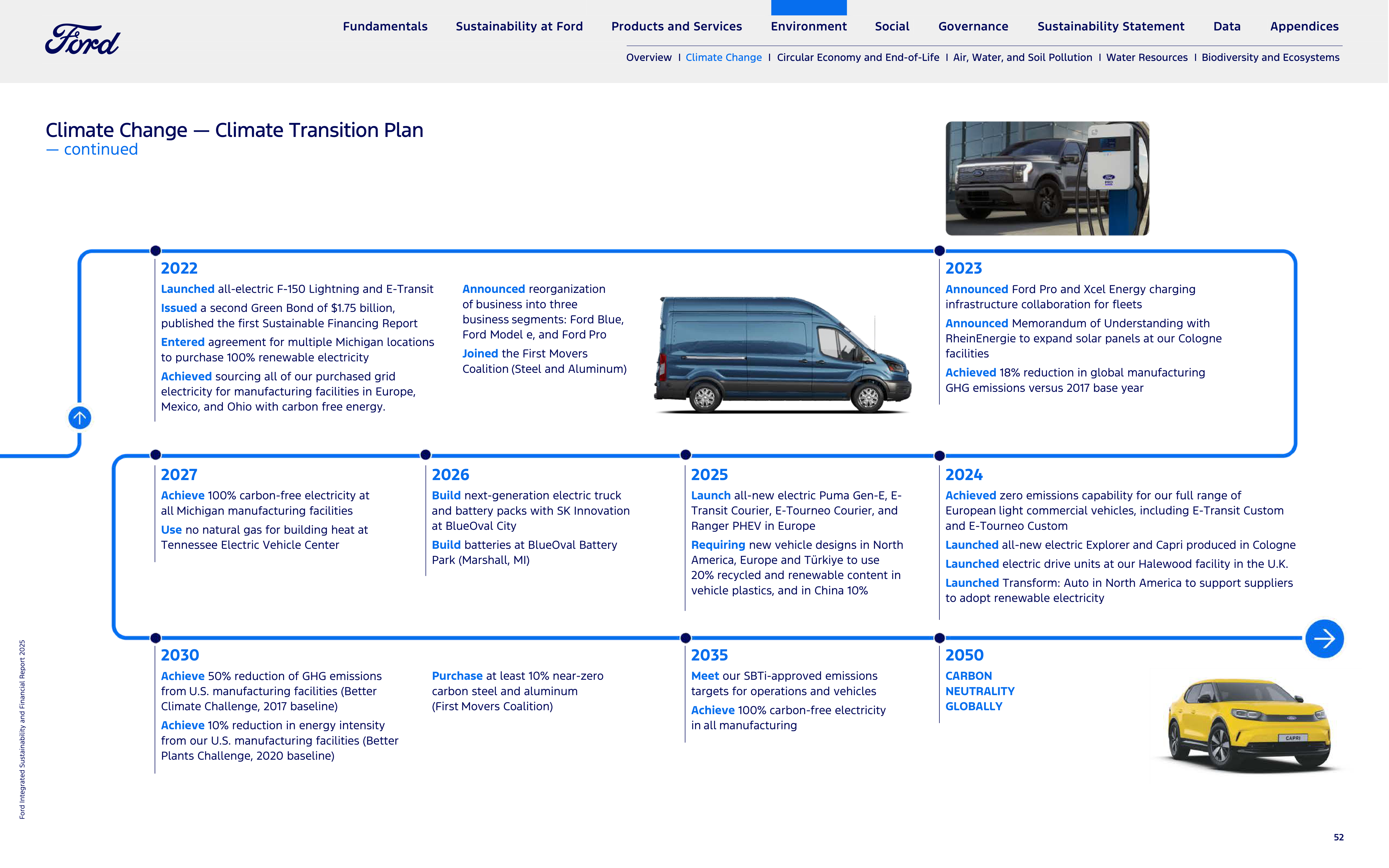


Fundamentals
Sustainability at Ford
Products and Services
Environment
Social
Governance
Sustainability Statement
Data
Appendices
Overview |
Climate Change
| Circular Economy and End-of-Life | Air, Water, and Soil Pollution | Water Resources | Biodiversity and Ecosystems
Climate Change — Climate Transition Plan
— continued
Ford Integrated Sustainability and Financial Report 2025
52
2022
Launched
all-electric F-150 Lightning and E-Transit
Issued
a second Green Bond of $1.75 billion,
published the first Sustainable Financing Report
Entered
agreement for multiple Michigan locations
to purchase 100% renewable electricity
Achieved
sourcing all of our purchased grid
electricity for manufacturing facilities in Europe,
Mexico, and Ohio with carbon free energy.
Announced
reorganization
of business into three
business segments: Ford Blue,
Ford Model e, and Ford Pro
Joined
the First Movers
Coalition (Steel and Aluminum)
2023
Announced
Ford Pro and Xcel Energy charging
infrastructure collaboration for fleets
Announced
Memorandum of Understanding with
RheinEnergie to expand solar panels at our Cologne
facilities
Achieved
18% reduction in global manufacturing
GHG emissions versus 2017 base year
2024
Achieved
zero emissions capability for our full range of
European light commercial vehicles, including E-Transit Custom
and E-Tourneo Custom
Launched
all-new electric Explorer and Capri produced in Cologne
Launched
electric drive units at our Halewood facility in the U.K.
Launched
Transform: Auto in North America to support suppliers
to adopt renewable electricity
2025
Launch
all-new electric Puma Gen-E, E-
Transit Courier, E-Tourneo Courier, and
Ranger PHEV in Europe
Requiring
new vehicle designs in North
America, Europe and Türkiye to use
20% recycled and renewable content in
vehicle plastics, and in China 10%
2026
Build
next-generation electric truck
and battery packs with SK Innovation
at BlueOval City
Build
batteries at BlueOval Battery
Park (Marshall, MI)
2027
Achieve
100% carbon-free electricity at
all Michigan manufacturing facilities
Use
no natural gas for building heat at
Tennessee Electric Vehicle Center
2030
Achieve
50% reduction of GHG emissions
from U.S. manufacturing facilities (Better
Climate Challenge, 2017 baseline)
Achieve
10% reduction in energy intensity
from our U.S. manufacturing facilities (Better
Plants Challenge, 2020 baseline)
Purchase
at least 10% near-zero
carbon steel and aluminum
(First Movers Coalition)
2035
Meet
our SBTi-approved emissions
targets for operations and vehicles
Achieve
100% carbon-free electricity
in all manufacturing
2050
CARBON
NEUTRALITY
GLOBALLY
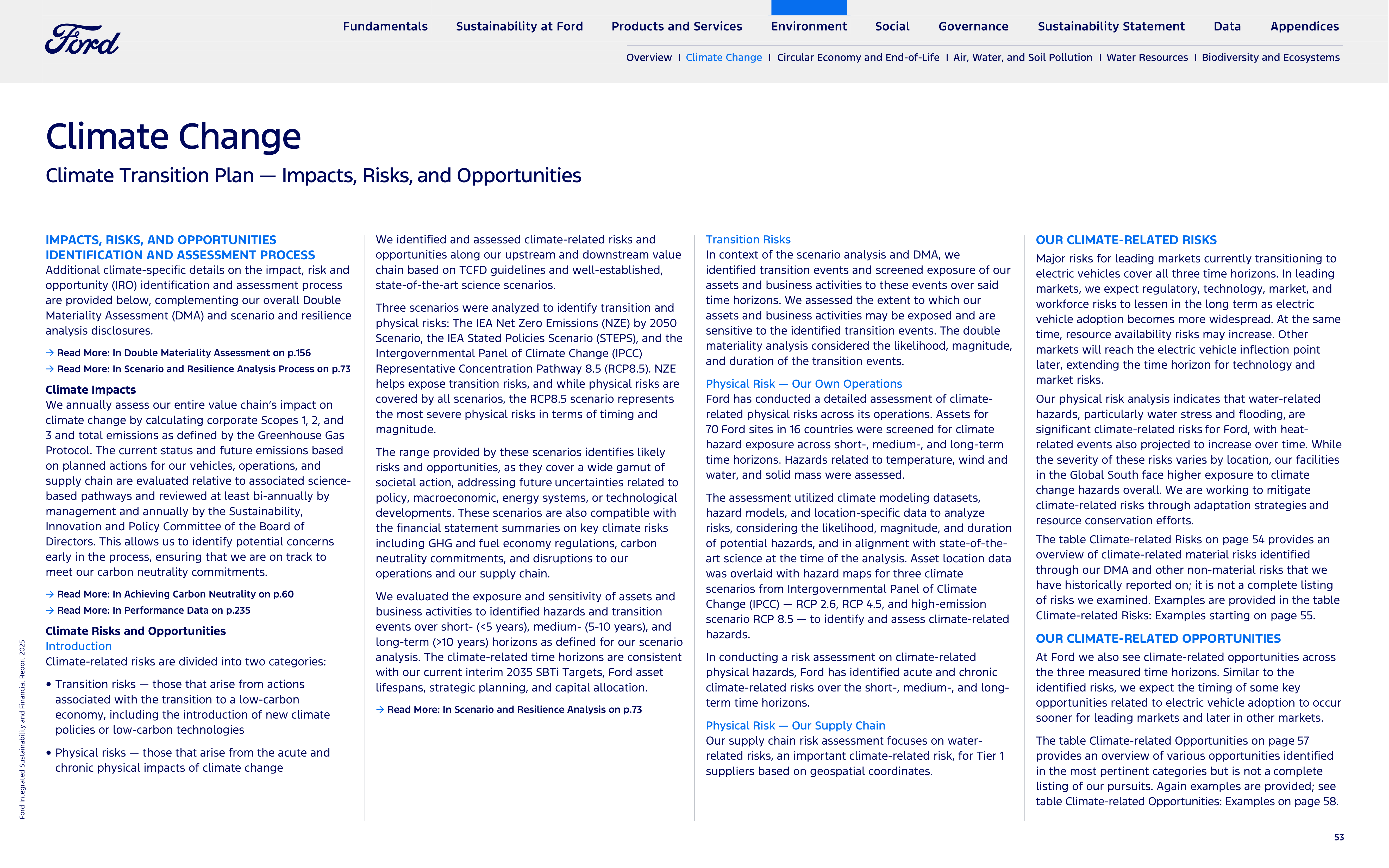
Fundamentals
Sustainability at Ford
Products and Services
Environment
Social
Governance
Sustainability Statement
Data
Appendices
Overview |
Climate Change
| Circular Economy and End-of-Life | Air, Water, and Soil Pollution | Water Resources | Biodiversity and Ecosystems
Climate Change
Climate Transition Plan — Impacts, Risks, and Opportunities
IMPACTS, RISKS, AND OPPORTUNITIES
IDENTIFICATION AND ASSESSMENT PROCESS
Additional climate-specific details on the impact, risk and
opportunity (IRO) identification and assessment process
are provided below, complementing our overall Double
Materiality Assessment (DMA) and scenario and resilience
analysis disclosures.
Read More:
→
In Double Materiality Assessment on p.156
Read More:
→
In Scenario and Resilience Analysis Process on p.73
Climate Impacts
We annually assess our entire value chain’s impact on
climate change by calculating corporate Scopes 1, 2, and
3 and total emissions as defined by the Greenhouse Gas
Protocol. The current status and future emissions based
on planned actions for our vehicles, operations, and
supply chain are evaluated relative to associated science-
based pathways and reviewed at least bi-annually by
management and annually by the Sustainability,
Innovation and Policy Committee of the Board of
Directors. This allows us to identify potential concerns
early in the process, ensuring that we are on track to
meet our carbon neutrality commitments.
Read More:
→
In Achieving Carbon Neutrality on p.60
Read More:
→
In Performance Data
on p.235
Climate Risks and Opportunities
Introduction
Climate-related risks are divided into two categories:
•
Transition risks — those that arise from actions
associated with the transition to a low-carbon
economy, including the introduction of new climate
policies or low-carbon technologies
•
Physical risks — those that arise from the acute and
chronic physical impacts of climate change
We identified and assessed climate-related risks and
opportunities along our upstream and downstream value
chain based on TCFD guidelines and well-established,
state-of-the-art science scenarios.
Three scenarios were analyzed to identify transition and
physical risks: The IEA Net Zero Emissions (NZE) by 2050
Scenario, the IEA Stated Policies Scenario (STEPS), and the
Intergovernmental Panel of Climate Change (IPCC)
Representative Concentration Pathway 8.5 (RCP8.5). NZE
helps expose transition risks, and while physical risks are
covered by all scenarios, the RCP8.5 scenario represents
the most severe physical risks in terms of timing and
magnitude.
The range provided by these scenarios identifies likely
risks and opportunities, as they cover a wide gamut of
societal action, addressing future uncertainties related to
policy, macroeconomic, energy systems, or technological
developments. These scenarios are also compatible with
the financial statement summaries on key climate risks
including GHG and fuel economy regulations, carbon
neutrality commitments, and disruptions to our
operations and our supply chain.
We evaluated the exposure and sensitivity of assets and
business activities to identified hazards and transition
events over short- (<5 years), medium- (5-10 years), and
long-term (>10 years) horizons as defined for our scenario
analysis. The climate-related time horizons are consistent
with our current interim 2035 SBTi Targets, Ford asset
lifespans, strategic planning, and capital allocation.
Read More:
→
In Scenario and Resilience Analysis on p.73
Transition Risks
In context of the scenario analysis and DMA, we
identified transition events and screened exposure of our
assets and business activities to these events over said
time horizons. We assessed the extent to which our
assets and business activities may be exposed and are
sensitive to the identified transition events. The double
materiality analysis considered the likelihood, magnitude,
and duration of the transition events.
Physical Risk — Our Own Operations
Ford has conducted a detailed assessment of climate-
related physical risks across its operations. Assets for
70 Ford sites in 16 countries were screened for climate
hazard exposure across short-, medium-, and long-term
time horizons. Hazards related to temperature, wind and
water, and solid mass were assessed.
The assessment utilized climate modeling datasets,
hazard models, and location-specific data to analyze
risks, considering the likelihood, magnitude, and duration
of potential hazards, and in alignment with state-of-the-
art science at the time of the analysis. Asset location data
was overlaid with hazard maps for three climate
scenarios from Intergovernmental Panel of Climate
Change (IPCC) — RCP 2.6, RCP 4.5, and high-emission
scenario RCP 8.5 — to identify and assess climate-related
hazards.
In conducting a risk assessment on climate-related
physical hazards, Ford has identified acute and chronic
climate-related risks over the short-, medium-, and long-
term time horizons.
Physical Risk — Our Supply Chain
Our supply chain risk assessment focuses on water-
related risks, an important climate-related risk, for Tier 1
suppliers based on geospatial coordinates.
OUR CLIMATE-RELATED RISKS
Major risks for leading markets currently transitioning to
electric vehicles cover all three time horizons. In leading
markets, we expect regulatory, technology, market, and
workforce risks to lessen in the long term as electric
vehicle adoption becomes more widespread. At the same
time, resource availability risks may increase. Other
markets will reach the electric vehicle inflection point
later, extending the time horizon for technology and
market risks.
Our physical risk analysis indicates that water-related
hazards, particularly water stress and flooding, are
significant climate-related risks for Ford, with heat-
related events also projected to increase over time. While
the severity of these risks varies by location, our facilities
in the Global South face higher exposure to climate
change hazards overall. We are working to mitigate
climate-related risks through adaptation strategies and
resource conservation efforts.
The table Climate-related Risks on page 54 provides an
overview of climate-related material risks identified
through our DMA and other non-material risks that we
have historically reported on; it is not a complete listing
of risks we examined. Examples are provided in the table
Climate-related Risks: Examples starting on page 55.
OUR CLIMATE-RELATED OPPORTUNITIES
At Ford we also see climate-related opportunities across
the three measured time horizons. Similar to the
identified risks, we expect the timing of some key
opportunities related to electric vehicle adoption to occur
sooner for leading markets and later in other markets.
The table Climate-related Opportunities on page 57
provides an overview of various opportunities identified
in the most pertinent categories but is not a complete
listing of our pursuits. Again examples are provided; see
table Climate-related Opportunities: Examples on page 58.
Ford Integrated Sustainability and Financial Report 2025
53
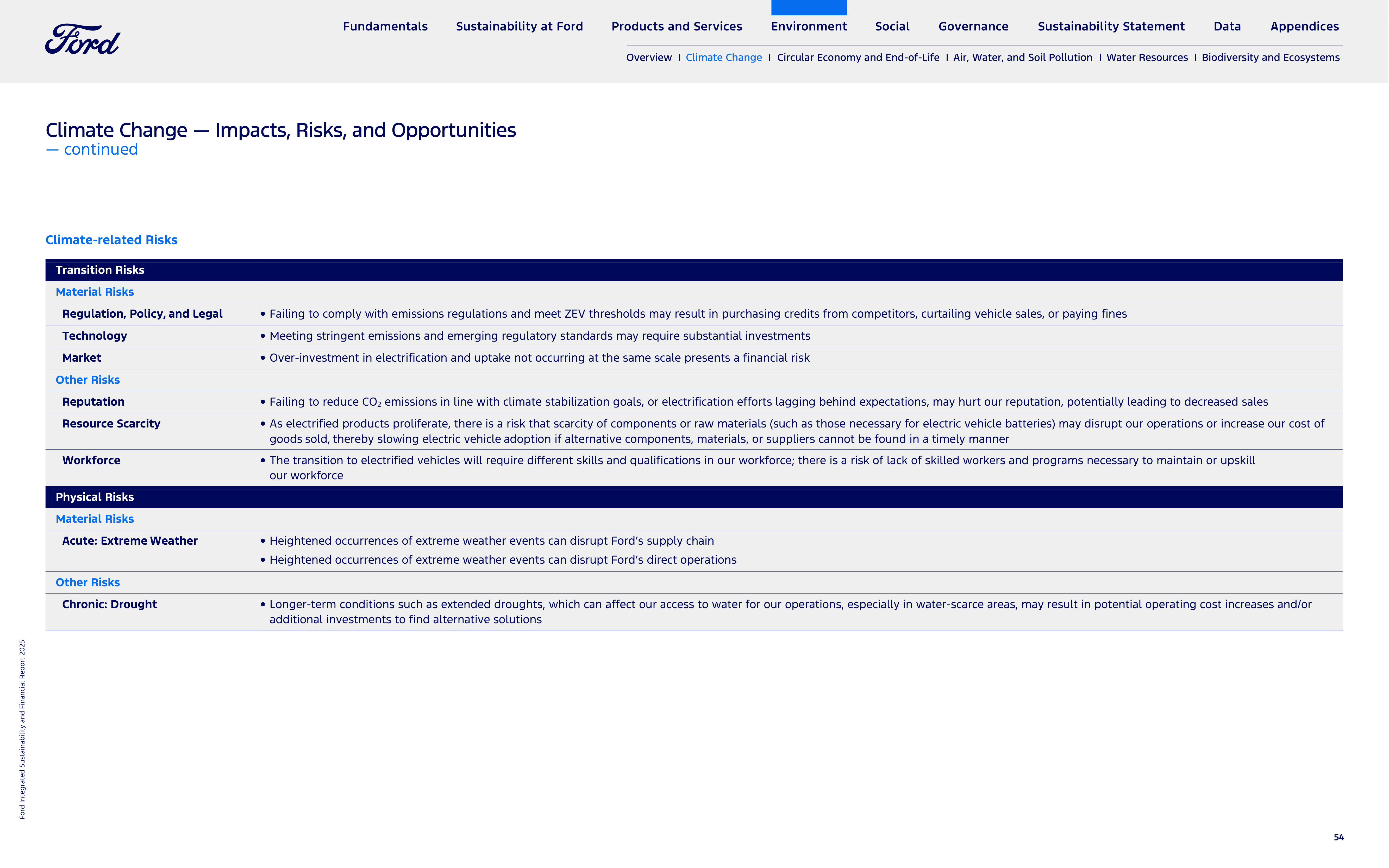
Fundamentals
Sustainability at Ford
Products and Services
Environment
Social
Governance
Sustainability Statement
Data
Appendices
Overview |
Climate Change
| Circular Economy and End-of-Life | Air, Water, and Soil Pollution | Water Resources | Biodiversity and Ecosystems
Climate-related Risks
Transition Risks
Material Risks
Regulation, Policy, and Legal
•
Failing to comply with emissions regulations and meet ZEV thresholds may result in purchasing credits from competitors, curtailing vehicle sales, or paying fines
Technology
•
Meeting stringent emissions and emerging regulatory standards may require substantial investments
Market
•
Over-investment in electrification and uptake not occurring at the same scale presents a financial risk
Other Risks
Reputation
•
Failing to reduce CO
2
emissions in line with climate stabilization goals, or electrification efforts lagging behind expectations, may hurt our reputation, potentially leading to decreased sales
Resource Scarcity
•
As electrified products proliferate, there is a risk that scarcity of components or raw materials (such as those necessary for electric vehicle batteries) may disrupt our operations or increase our cost of
goods sold, thereby slowing electric vehicle adoption if alternative components, materials, or suppliers cannot be found in a timely manner
Workforce
•
The transition to electrified vehicles will require different skills and qualifications in our workforce; there is a risk of lack of skilled workers and programs necessary to maintain or upskill
our workforce
Physical Risks
Material Risks
Acute: Extreme Weather
•
Heightened occurrences of extreme weather events can disrupt Ford’s supply chain
•
Heightened occurrences of extreme weather events can disrupt Ford’s direct operations
Other Risks
Chronic: Drought
•
Longer-term conditions such as extended droughts, which can affect our access to water for our operations, especially in water-scarce areas, may result in potential operating cost increases and/or
additional investments to find alternative solutions
Climate Change — Impacts, Risks, and Opportunities
— continued
Ford Integrated Sustainability and Financial Report 2025
54
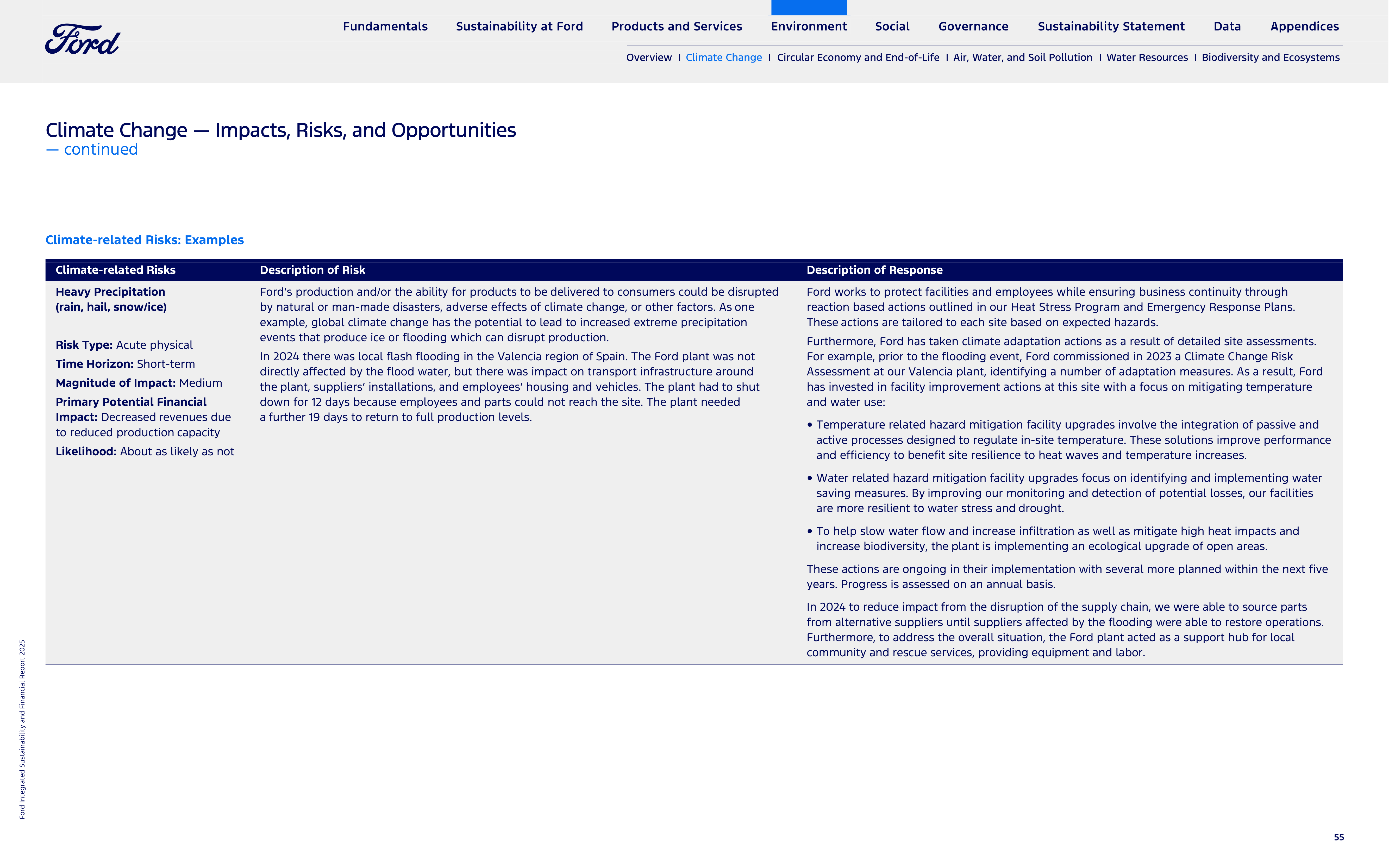
Fundamentals
Sustainability at Ford
Products and Services
Environment
Social
Governance
Sustainability Statement
Data
Appendices
Overview |
Climate Change
| Circular Economy and End-of-Life | Air, Water, and Soil Pollution | Water Resources | Biodiversity and Ecosystems
Climate-related Risks: Examples
Climate-related Risks
Description of Risk
Description of Response
Heavy Precipitation
(rain, hail, snow/ice)
Risk Type:
Acute physical
Time Horizon:
Short-term
Magnitude of Impact:
Medium
Primary Potential Financial
Impact:
Decreased revenues due
to reduced production capacity
Likelihood:
About as likely as not
Ford’s production and/or the ability for products to be delivered to consumers could be disrupted
by natural or man-made disasters, adverse effects of climate change, or other factors. As one
example, global climate change has the potential to lead to increased extreme precipitation
events that produce ice or flooding which can disrupt production.
In 2024 there was local flash flooding in the Valencia region of Spain. The Ford plant was not
directly affected by the flood water, but there was impact on transport infrastructure around
the plant, suppliers’ installations, and employees’ housing and vehicles. The plant had to shut
down for 12 days because employees and parts could not reach the site. The plant needed
a further 19 days to return to full production levels.
Ford works to protect facilities and employees while ensuring business continuity through
reaction based actions outlined in our Heat Stress Program and Emergency Response Plans.
These actions are tailored to each site based on expected hazards.
Furthermore, Ford has taken climate adaptation actions as a result of detailed site assessments.
For example, prior to the flooding event, Ford commissioned in 2023 a Climate Change Risk
Assessment at our Valencia plant, identifying a number of adaptation measures. As a result, Ford
has invested in facility improvement actions at this site with a focus on mitigating temperature
and water use:
•
Temperature related hazard mitigation facility upgrades involve the integration of passive and
active processes designed to regulate in-site temperature. These solutions improve performance
and efficiency to benefit site resilience to heat waves and temperature increases.
•
Water related hazard mitigation facility upgrades focus on identifying and implementing water
saving measures. By improving our monitoring and detection of potential losses, our facilities
are more resilient to water stress and drought.
•
To help slow water flow and increase infiltration as well as mitigate high heat impacts and
increase biodiversity, the plant is implementing an ecological upgrade of open areas.
These actions are ongoing in their implementation with several more planned within the next five
years. Progress is assessed on an annual basis.
In 2024 to reduce impact from the disruption of the supply chain, we were able to source parts
from alternative suppliers until suppliers affected by the flooding were able to restore operations.
Furthermore, to address the overall situation, the Ford plant acted as a support hub for local
community and rescue services, providing equipment and labor.
Climate Change — Impacts, Risks, and Opportunities
— continued
Ford Integrated Sustainability and Financial Report 2025
55
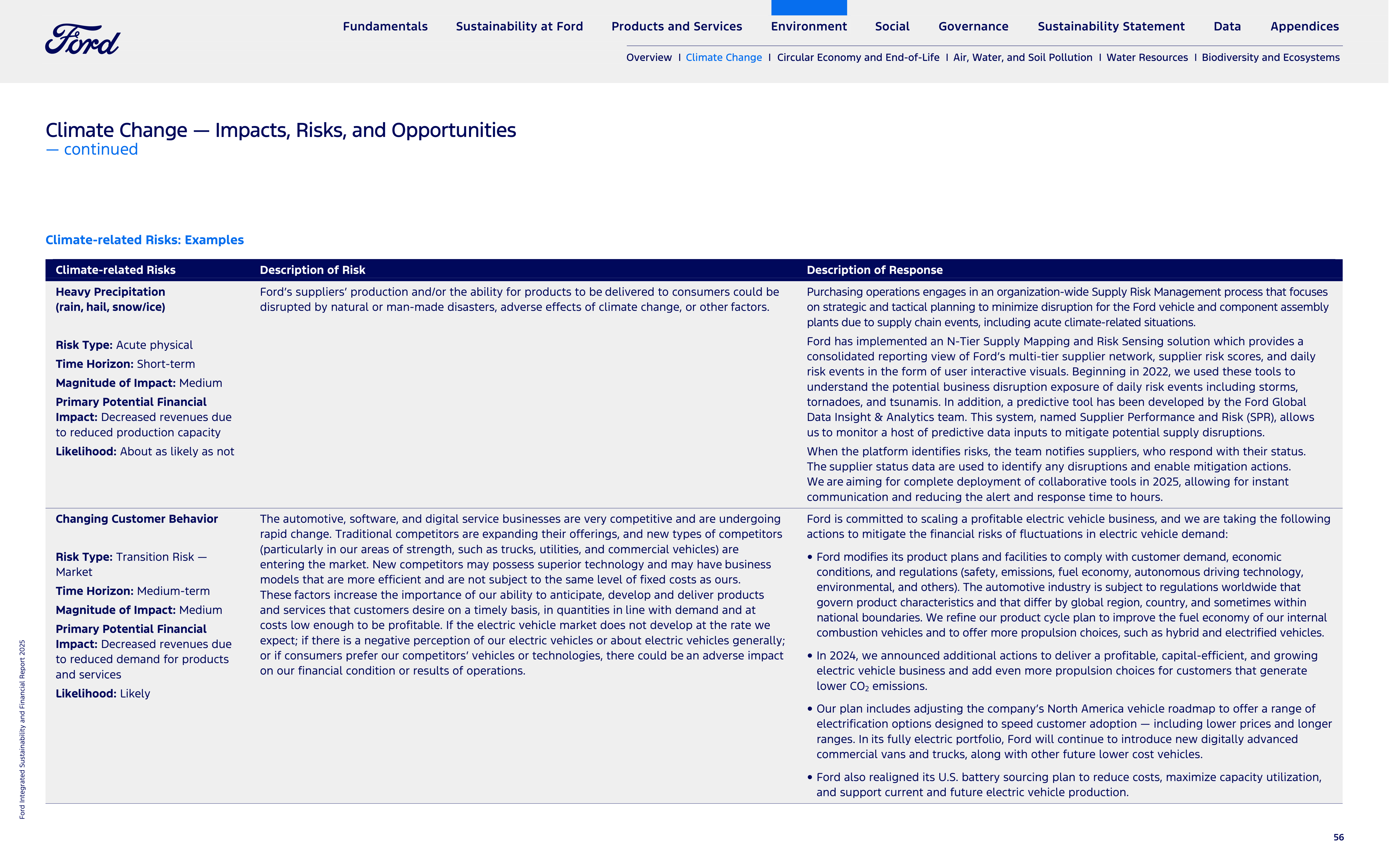
Climate-related Risks: Examples
Heavy Precipitation
(rain, hail, snow/ice)
Risk Type:
Acute physical
Time Horizon:
Short-term
Magnitude of Impact:
Medium
Primary Potential Financial
Impact:
Decreased revenues due
to reduced production capacity
Likelihood:
About as likely as not
Ford’s suppliers’ production and/or the ability for products to be delivered to consumers could be
disrupted by natural or man-made disasters, adverse effects of climate change, or other factors.
Purchasing operations engages in an organization-wide Supply Risk Management process that focuses
on strategic and tactical planning to minimize disruption for the Ford vehicle and component assembly
plants due to supply chain events, including acute climate-related situations.
Ford has implemented an N-Tier Supply Mapping and Risk Sensing solution which provides a
consolidated reporting view of Ford’s multi-tier supplier network, supplier risk scores, and daily
risk events in the form of user interactive visuals. Beginning in 2022, we used these tools to
understand the potential business disruption exposure of daily risk events including storms,
tornadoes, and tsunamis. In addition, a predictive tool has been developed by the Ford Global
Data Insight & Analytics team. This system, named Supplier Performance and Risk (SPR), allows
us to monitor a host of predictive data inputs to mitigate potential supply disruptions.
When the platform identifies risks, the team notifies suppliers, who respond with their status.
The supplier status data are used to identify any disruptions and enable mitigation actions.
We are aiming for complete deployment of collaborative tools in 2025, allowing for instant
communication and reducing the alert and response time to hours.
Changing Customer Behavior
Risk Type:
Transition Risk —
Market
Time Horizon:
Medium-term
Magnitude of Impact:
Medium
Primary Potential Financial
Impact:
Decreased revenues due
to reduced demand for products
and services
Likelihood:
Likely
The automotive, software, and digital service businesses are very competitive and are undergoing
rapid change. Traditional competitors are expanding their offerings, and new types of competitors
(particularly in our areas of strength, such as trucks, utilities, and commercial vehicles) are
entering the market. New competitors may possess superior technology and may have business
models that are more efficient and are not subject to the same level of fixed costs as ours.
These factors increase the importance of our ability to anticipate, develop and deliver products
and services that customers desire on a timely basis, in quantities in line with demand and at
costs low enough to be profitable. If the electric vehicle market does not develop at the rate we
expect; if there is a negative perception of our electric vehicles or about electric vehicles generally;
or if consumers prefer our competitors’ vehicles or technologies, there could be an adverse impact
on our financial condition or results of operations.
Ford is committed to scaling a profitable electric vehicle business, and we are taking the following
actions to mitigate the financial risks of fluctuations in electric vehicle demand:
•
Ford modifies its product plans and facilities to comply with customer demand, economic
conditions, and regulations (safety, emissions, fuel economy, autonomous driving technology,
environmental, and others). The automotive industry is subject to regulations worldwide that
govern product characteristics and that differ by global region, country, and sometimes within
national boundaries. We refine our product cycle plan to improve the fuel economy of our internal
combustion vehicles and to offer more propulsion choices, such as hybrid and electrified vehicles.
•
In 2024, we announced additional actions to deliver a profitable, capital-efficient, and growing
electric vehicle business and add even more propulsion choices for customers that generate
lower CO
2
emissions.
•
Our plan includes adjusting the company’s North America vehicle roadmap to offer a range of
electrification options designed to speed customer adoption — including lower prices and longer
ranges. In its fully electric portfolio, Ford will continue to introduce new digitally advanced
commercial vans and trucks, along with other future lower cost vehicles.
•
Ford also realigned its U.S. battery sourcing plan to reduce costs, maximize capacity utilization,
and support current and future electric vehicle production.
Climate-related Risks
Description of Risk
Description of Response
Fundamentals
Sustainability at Ford
Products and Services
Environment
Social
Governance
Sustainability Statement
Data
Appendices
Overview |
Climate Change
| Circular Economy and End-of-Life | Air, Water, and Soil Pollution | Water Resources | Biodiversity and Ecosystems
Climate Change — Impacts, Risks, and Opportunities
— continued
Ford Integrated Sustainability and Financial Report 2025
56
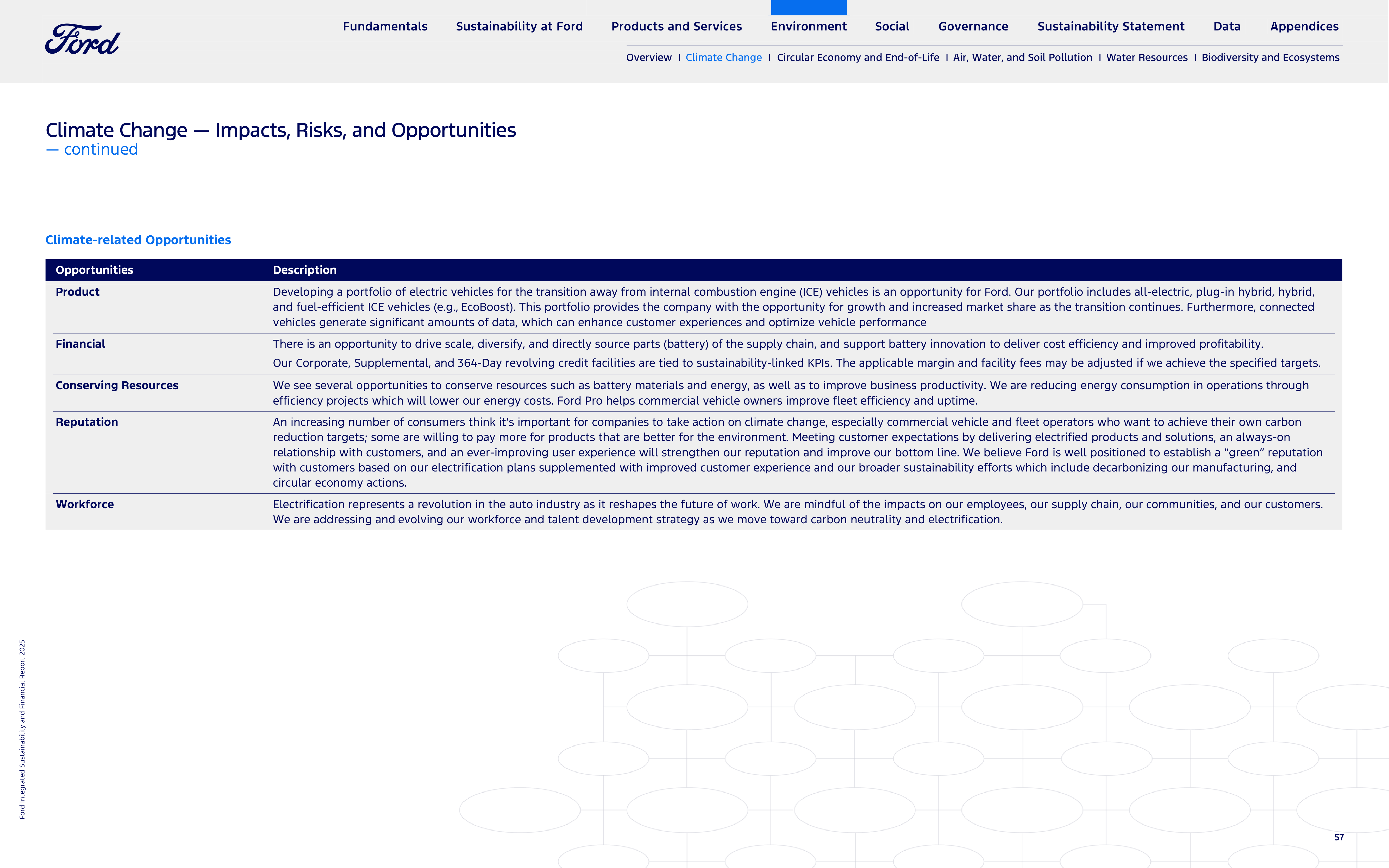

Fundamentals
Sustainability at Ford
Products and Services
Environment
Social
Governance
Sustainability Statement
Data
Appendices
Overview |
Climate Change
| Circular Economy and End-of-Life | Air, Water, and Soil Pollution | Water Resources | Biodiversity and Ecosystems
Climate-related Opportunities
Opportunities
Description
Product
Developing a portfolio of electric vehicles for the transition away from internal combustion engine (ICE) vehicles is an opportunity for Ford. Our portfolio includes all-electric, plug-in hybrid, hybrid,
and fuel-efficient ICE vehicles (e.g., EcoBoost). This portfolio provides the company with the opportunity for growth and increased market share as the transition continues. Furthermore, connected
vehicles generate significant amounts of data, which can enhance customer experiences and optimize vehicle performance
Financial
There is an opportunity to drive scale, diversify, and directly source parts (battery) of the supply chain, and support battery innovation to deliver cost efficiency and improved profitability.
Our Corporate, Supplemental, and 364-Day revolving credit facilities are tied to sustainability-linked KPIs. The applicable margin and facility fees may be adjusted if we achieve the specified targets.
Conserving Resources
We see several opportunities to conserve resources such as battery materials and energy, as well as to improve business productivity. We are reducing energy consumption in operations through
efficiency projects which will lower our energy costs. Ford Pro helps commercial vehicle owners improve fleet efficiency and uptime.
Reputation
An increasing number of consumers think it’s important for companies to take action on climate change, especially commercial vehicle and fleet operators who want to achieve their own carbon
reduction targets; some are willing to pay more for products that are better for the environment. Meeting customer expectations by delivering electrified products and solutions, an always-on
relationship with customers, and an ever-improving user experience will strengthen our reputation and improve our bottom line. We believe Ford is well positioned to establish a “green” reputation
with customers based on our electrification plans supplemented with improved customer experience and our broader sustainability efforts which include decarbonizing our manufacturing, and
circular economy actions.
Workforce
Electrification represents a revolution in the auto industry as it reshapes the future of work. We are mindful of the impacts on our employees, our supply chain, our communities, and our customers.
We are addressing and evolving our workforce and talent development strategy as we move toward carbon neutrality and electrification.
Climate Change — Impacts, Risks, and Opportunities
— continued
Ford Integrated Sustainability and Financial Report 2025
57
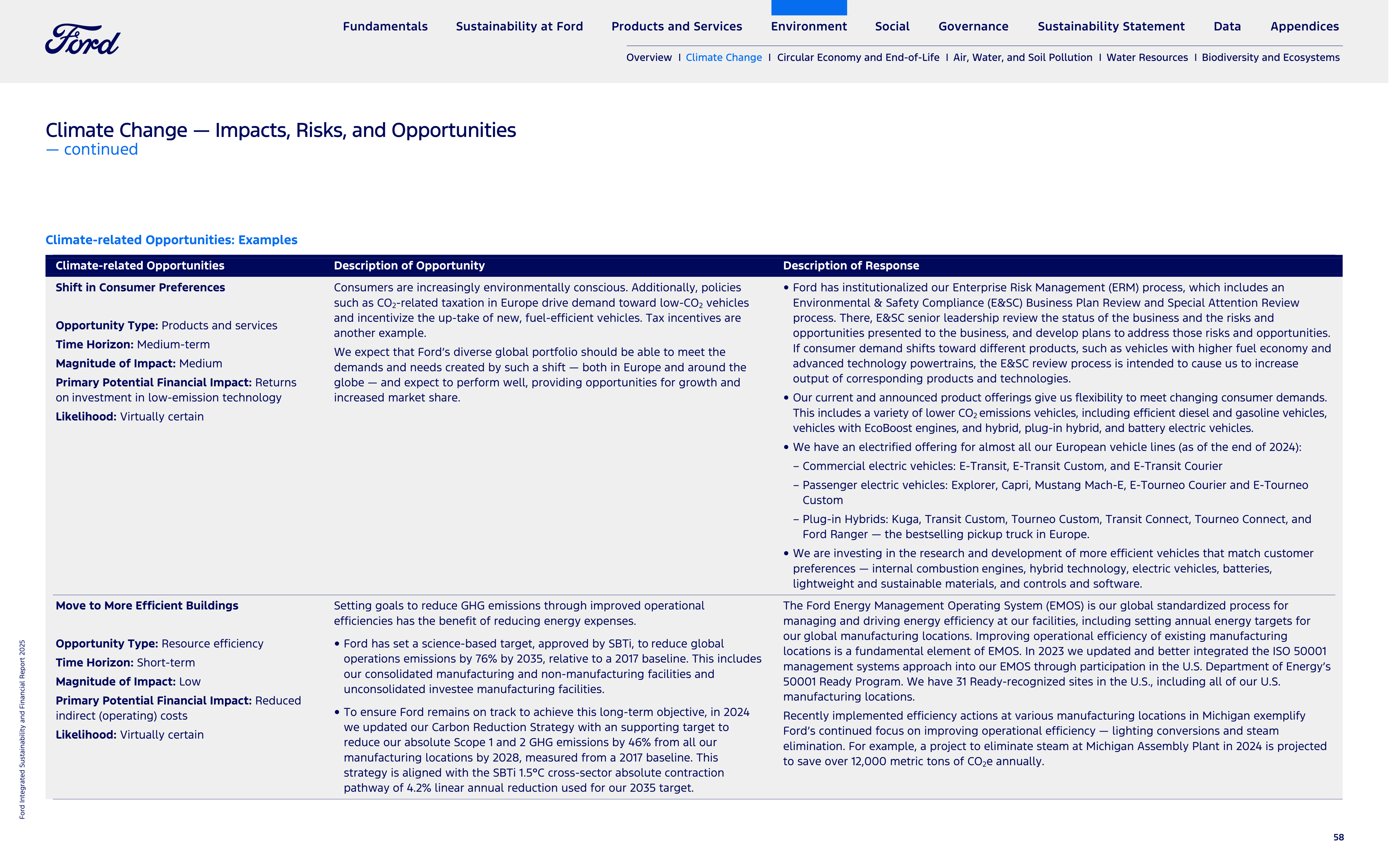
Fundamentals
Sustainability at Ford
Products and Services
Environment
Social
Governance
Sustainability Statement
Data
Appendices
Overview |
Climate Change
| Circular Economy and End-of-Life | Air, Water, and Soil Pollution | Water Resources | Biodiversity and Ecosystems
Climate-related Opportunities: Examples
Climate-related Opportunities
Description of Opportunity
Description of Response
Shift in Consumer Preferences
Opportunity Type:
Products and services
Time Horizon:
Medium-term
Magnitude of Impact:
Medium
Primary Potential Financial Impact:
Returns
on investment in low-emission technology
Likelihood:
Virtually certain
Consumers are increasingly environmentally conscious. Additionally, policies
such as CO
2
-related taxation in Europe drive demand toward low-CO
2
vehicles
and incentivize the up-take of new, fuel-efficient vehicles. Tax incentives are
another example.
We expect that Ford’s diverse global portfolio should be able to meet the
demands and needs created by such a shift — both in Europe and around the
globe — and expect to perform well, providing opportunities for growth and
increased market share.
•
Ford has institutionalized our Enterprise Risk Management (ERM) process, which includes an
Environmental & Safety Compliance (E&SC) Business Plan Review and Special Attention Review
process. There, E&SC senior leadership review the status of the business and the risks and
opportunities presented to the business, and develop plans to address those risks and opportunities.
If consumer demand shifts toward different products, such as vehicles with higher fuel economy and
advanced technology powertrains, the E&SC review process is intended to cause us to increase
output of corresponding products and technologies.
•
Our current and announced product offerings give us flexibility to meet changing consumer demands.
This includes a variety of lower CO
2
emissions vehicles, including efficient diesel and gasoline vehicles,
vehicles with EcoBoost engines, and hybrid, plug-in hybrid, and battery electric vehicles.
•
We have an electrified offering for almost all our European vehicle lines (as of the end of 2024):
–
Commercial electric vehicles: E-Transit, E-Transit Custom, and E-Transit Courier
–
Passenger electric vehicles: Explorer, Capri, Mustang Mach-E, E-Tourneo Courier and E-Tourneo
Custom
–
Plug-in Hybrids: Kuga, Transit Custom, Tourneo Custom, Transit Connect, Tourneo Connect, and
Ford Ranger — the bestselling pickup truck in Europe.
•
We are investing in the research and development of more efficient vehicles that match customer
preferences — internal combustion engines, hybrid technology, electric vehicles, batteries,
lightweight and sustainable materials, and controls and software.
Move to More Efficient Buildings
Opportunity Type:
Resource efficiency
Time Horizon:
Short-term
Magnitude of Impact:
Low
Primary Potential Financial Impact:
Reduced
indirect (operating) costs
Likelihood:
Virtually certain
Setting goals to reduce GHG emissions through improved operational
efficiencies has the benefit of reducing energy expenses.
•
Ford has set a science-based target, approved by SBTi, to reduce global
operations emissions by 76% by 2035, relative to a 2017 baseline. This includes
our consolidated manufacturing and non-manufacturing facilities and
unconsolidated investee manufacturing facilities.
•
To ensure Ford remains on track to achieve this long-term objective, in 2024
we updated our Carbon Reduction Strategy with an supporting target to
reduce our absolute Scope 1 and 2 GHG emissions by 46% from all our
manufacturing locations by 2028, measured from a 2017 baseline. This
strategy is aligned with the SBTi 1.5°C cross-sector absolute contraction
pathway of 4.2% linear annual reduction used for our 2035 target.
The Ford Energy Management Operating System (EMOS) is our global standardized process for
managing and driving energy efficiency at our facilities, including setting annual energy targets for
our global manufacturing locations. Improving operational efficiency of existing manufacturing
locations is a fundamental element of EMOS. In 2023 we updated and better integrated the ISO 50001
management systems approach into our EMOS through participation in the U.S. Department of Energy’s
50001 Ready Program. We have 31 Ready-recognized sites in the U.S., including all of our U.S.
manufacturing locations.
Recently implemented efficiency actions at various manufacturing locations in Michigan exemplify
Ford’s continued focus on improving operational efficiency — lighting conversions and steam
elimination. For example, a project to eliminate steam at Michigan Assembly Plant in 2024 is projected
to save over 12,000 metric tons of CO
2
e annually.
Climate Change — Impacts, Risks, and Opportunities
— continued
Ford Integrated Sustainability and Financial Report 2025
58
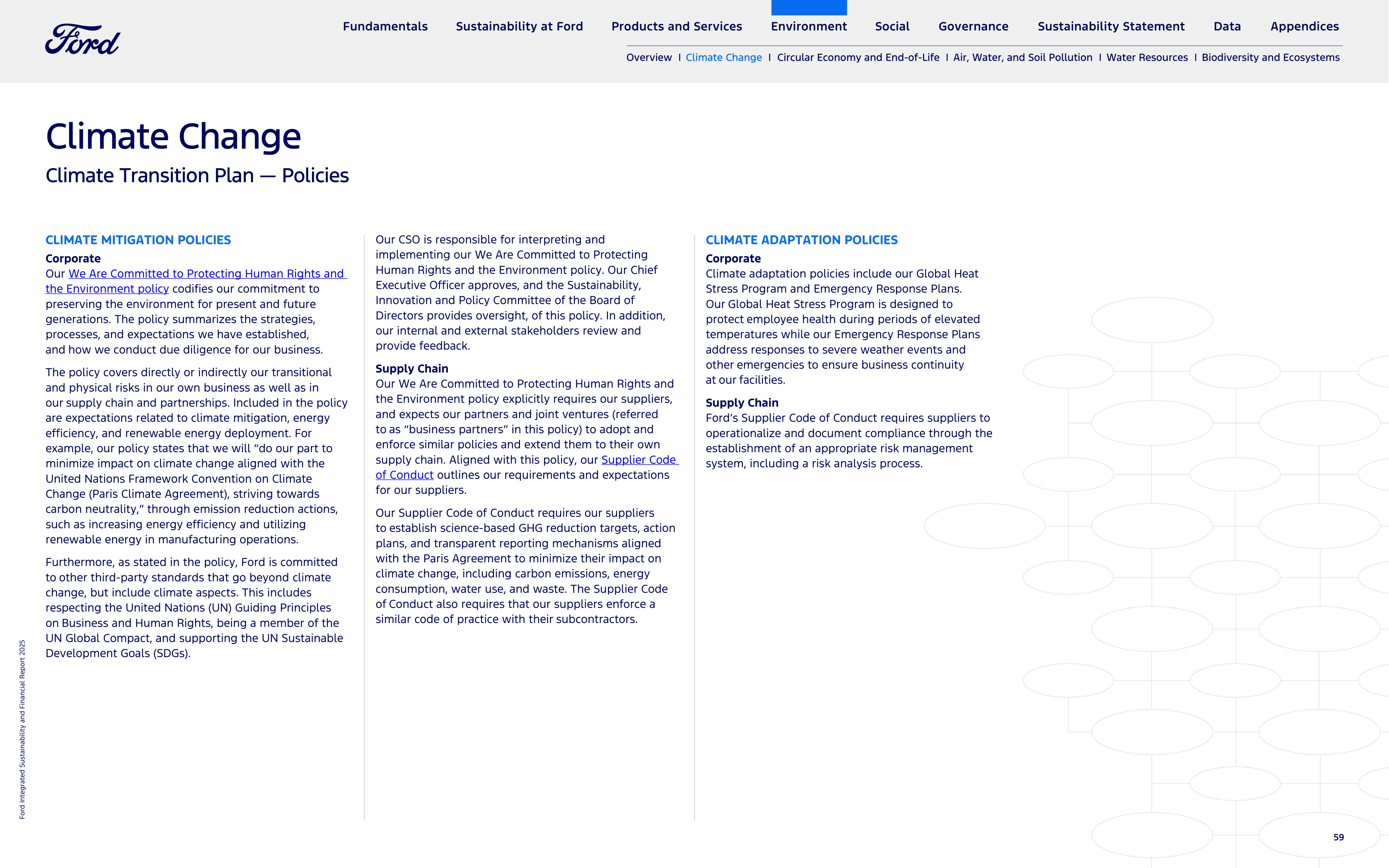

Fundamentals
Sustainability at Ford
Products and Services
Environment
Social
Governance
Sustainability Statement
Data
Appendices
Overview |
Climate Change
| Circular Economy and End-of-Life | Air, Water, and Soil Pollution | Water Resources | Biodiversity and Ecosystems
Climate Change
Climate Transition Plan — Policies
CLIMATE MITIGATION POLICIES
Corporate
Our
We Are Committed to Protecting Human Rights and
the Environment policy
codifies our commitment to
preserving the environment for present and future
generations. The policy summarizes the strategies,
processes, and expectations we have established,
and how we conduct due diligence for our business.
The policy covers directly or indirectly our transitional
and physical risks in our own business as well as in
our supply chain and partnerships. Included in the policy
are expectations related to climate mitigation, energy
efficiency, and renewable energy deployment. For
example, our policy states that we will “do our part to
minimize impact on climate change aligned with the
United Nations Framework Convention on Climate
Change (Paris Climate Agreement), striving towards
carbon neutrality,” through emission reduction actions,
such as increasing energy efficiency and utilizing
renewable energy in manufacturing operations.
Furthermore, as stated in the policy, Ford is committed
to other third-party standards that go beyond climate
change, but include climate aspects. This includes
respecting the United Nations (UN) Guiding Principles
on Business and Human Rights, being a member of the
UN Global Compact, and supporting the UN Sustainable
Development Goals (SDGs).
Our CSO is responsible for interpreting and
implementing our We Are Committed to Protecting
Human Rights and the Environment policy. Our Chief
Executive Officer approves, and the Sustainability,
Innovation and Policy Committee of the Board of
Directors provides oversight, of this policy. In addition,
our internal and external stakeholders review and
provide feedback.
Supply Chain
Our We Are Committed to Protecting Human Rights and
the Environment policy explicitly requires our suppliers,
and expects our partners and joint ventures (referred
to as “business partners” in this policy) to adopt and
enforce similar policies and extend them to their own
supply chain. Aligned with this policy, our
Supplier Code
of Conduct
outlines our requirements and expectations
for our suppliers.
Our Supplier Code of Conduct requires our suppliers
to establish science-based GHG reduction targets, action
plans, and transparent reporting mechanisms aligned
with the Paris Agreement to minimize their impact on
climate change, including carbon emissions, energy
consumption, water use, and waste. The Supplier Code
of Conduct also requires that our suppliers enforce a
similar code of practice with their subcontractors.
CLIMATE ADAPTATION POLICIES
Corporate
Climate adaptation policies include our Global Heat
Stress Program and Emergency Response Plans.
Our Global Heat Stress Program is designed to
protect employee health during periods of elevated
temperatures while our Emergency Response Plans
address responses to severe weather events and
other emergencies to ensure business continuity
at our facilities.
Supply Chain
Ford’s Supplier Code of Conduct requires suppliers to
operationalize and document compliance through the
establishment of an appropriate risk management
system, including a risk analysis process.
Ford Integrated Sustainability and Financial Report 2025
59

Fundamentals
Sustainability at Ford
Products and Services
Environment
Social
Governance
Sustainability Statement
Data
Appendices
Overview |
Climate Change
| Circular Economy and End-of-Life | Air, Water, and Soil Pollution | Water Resources | Biodiversity and Ecosystems
Climate Change
Climate Transition Plan — Achieving Carbon Neutrality
METRICS OVERVIEW
In this section we provide an overview of our climate-
related metrics for our vehicles, our operations, and
our supply chain followed by details for each of the
three focus areas including targets; methodology;
decarbonization levers and investments; performance;
and an outlook.
Our carbon neutrality related metrics help us to ensure
that we are decarbonizing our business in a timely
manner and managing climate risks and opportunities.
The metrics are aligned with and help support the
implementation of Ford’s
We Are Committed
to Protecting Human Rights and the Environment policy
and the Paris Climate Agreement.
The table Targets Summary — Greenhouse Gas Emissions
provides an overview of our global voluntary GHG
emissions reduction targets, including our 2030
reference targets for comparison with other companies
reporting on the EU CSRD. These targets do not include
offsets; they are strictly GHG reduction targets.
Additionally we assess the following:
Vehicles — Fleet Average
•
Regional Regulatory
–
Fuel economy (miles per gallon) or fuel consumption
(L/100 km)
–
CO
2
tailpipe emissions (grams per mile or km)
Operations — Global Voluntary
•
Manufacturing Only
–
Carbon-free electricity (%)
Read More:
→
In Performance Data
on p.235
Stakeholder Involvement
Our decision to set SBTi-approved science-based
emission reduction targets was informed in part by
knowledgeable stakeholders such as investors and
NGOs. Our other targets were set to support achieving
our SBTi target for operations. Expected supplier
ambitions, including GHG reductions, were a factor in
evaluating our supply chain target feasibility.
Governance
All of our GHG emissions targets, associated 2030
targets, and our carbon-free electricity target are
reported biannually in the Global Sustainability & ESG
Meeting (GSM) and annually to the Sustainability,
Innovation and Policy Committee of the Board of
Directors.
The vehicle fuel economy/consumption and CO
2
metrics
are reviewed two or more times per year at the
Compliance Automotive Strategy Meeting.
Ford Integrated Sustainability and Financial Report 2025
60
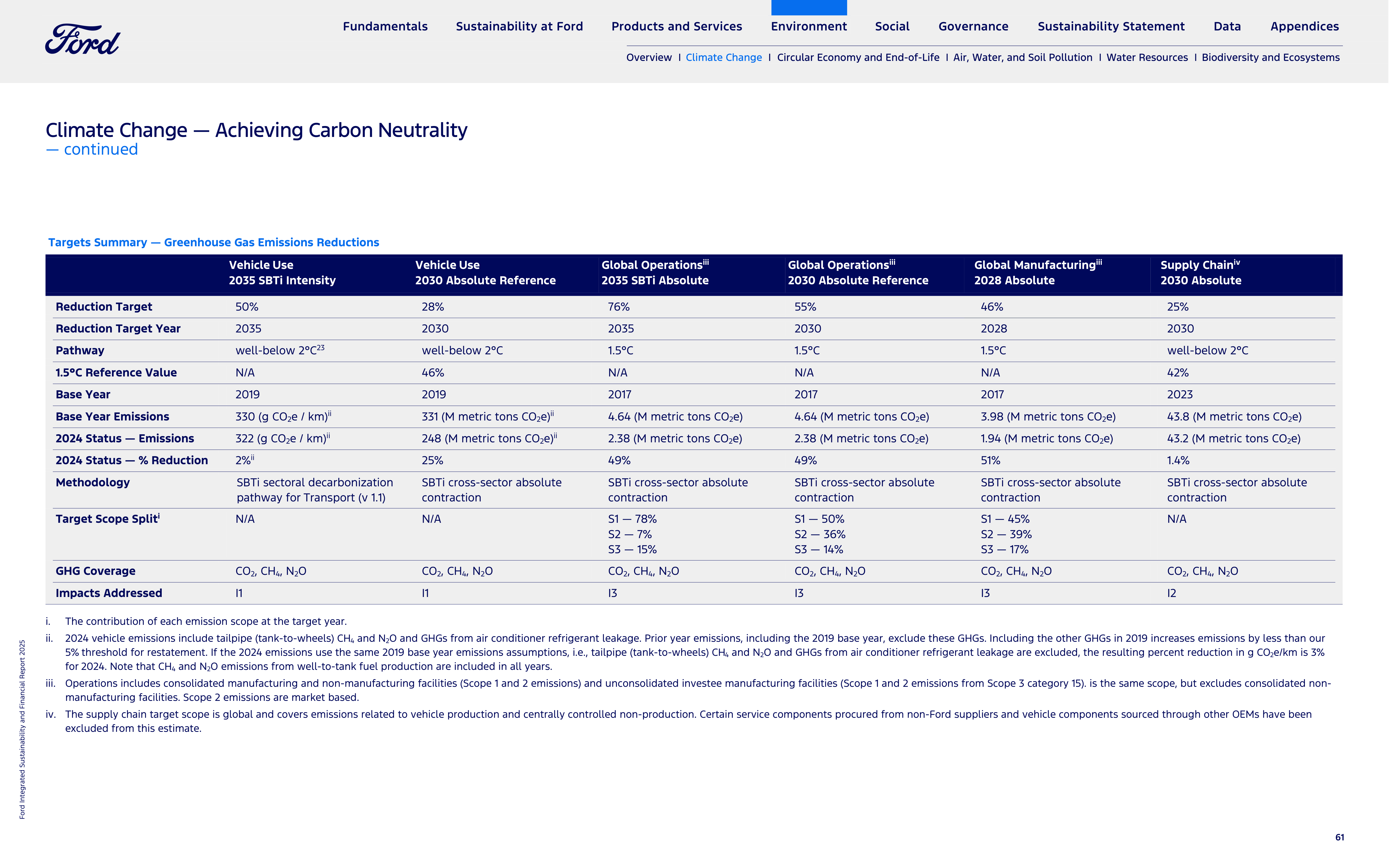
Fundamentals
Sustainability at Ford
Products and Services
Environment
Social
Governance
Sustainability Statement
Data
Appendices
Overview |
Climate Change
| Circular Economy and End-of-Life | Air, Water, and Soil Pollution | Water Resources | Biodiversity and Ecosystems
Targets Summary — Greenhouse Gas Emissions Reductions
Vehicle Use
2035 SBTi Intensity
Vehicle Use
2030 Absolute Reference
Global Operations
iii
2035 SBTi Absolute
Global Operations
iii
2030 Absolute Reference
Global Manufacturing
iii
2028 Absolute
Supply Chain
iv
2030 Absolute
Reduction Target
50%
28%
76%
55%
46%
25%
Reduction Target Year
2035
2030
2035
2030
2028
2030
Pathway
well-below 2°C
23
well-below 2°C
1.5°C
1.5°C
1.5°C
well-below 2°C
1.5°C Reference Value
N/A
46%
N/A
N/A
N/A
42%
Base Year
2019
2019
2017
2017
2017
2023
Base Year Emissions
330 (g CO
2
e / km)
ii
331 (M metric tons CO
2
e)
ii
4.64 (M metric tons CO
2
e)
4.64 (M metric tons CO
2
e)
3.98 (M metric tons CO
2
e)
43.8 (M metric tons CO
2
e)
2024 Status — Emissions
322 (g CO
2
e / km)
ii
248 (M metric tons CO
2
e)
ii
2.38 (M metric tons CO
2
e)
2.38 (M metric tons CO
2
e)
1.94 (M metric tons CO
2
e)
43.2 (M metric tons CO
2
e)
2024 Status — % Reduction
2%
ii
25%
49%
49%
51%
1.4%
Methodology
SBTi sectoral decarbonization
pathway for Transport (v 1.1)
SBTi cross-sector absolute
contraction
SBTi cross-sector absolute
contraction
SBTi cross-sector absolute
contraction
SBTi cross-sector absolute
contraction
SBTi cross-sector absolute
contraction
Target Scope Split
i
N/A
N/A
S1 — 78%
S2 — 7%
S3 — 15%
S1 — 50%
S2 — 36%
S3 — 14%
S1 — 45%
S2 — 39%
S3 — 17%
N/A
GHG Coverage
CO
2
, CH
4
, N
2
O
CO
2
, CH
4
, N
2
O
CO
2
, CH
4
, N
2
O
CO
2
, CH
4
, N
2
O
CO
2
, CH
4
, N
2
O
CO
2
, CH
4
, N
2
O
Impacts Addressed
I1
I1
I3
I3
I3
I2
i.
The contribution of each emission scope at the target year.
ii.
2024 vehicle emissions include tailpipe (tank-to-wheels) CH
4
and N
2
O and GHGs from air conditioner refrigerant leakage. Prior year emissions, including the 2019 base year, exclude these GHGs. Including the other GHGs in 2019 increases emissions by less than our
5% threshold for restatement. If the 2024 emissions use the same 2019 base year emissions assumptions, i.e., tailpipe (tank-to-wheels) CH
4
and N
2
O and GHGs from air conditioner refrigerant leakage are excluded, the resulting percent reduction in g CO
2
e/km is 3%
for 2024. Note that CH
4
and N
2
O emissions from well-to-tank fuel production are included in all years.
iii.
Operations includes consolidated manufacturing and non-manufacturing facilities (Scope 1 and 2 emissions) and unconsolidated investee manufacturing facilities (Scope 1 and 2 emissions from Scope 3 category 15). is the same scope, but excludes consolidated non-
manufacturing facilities. Scope 2 emissions are market based.
iv.
The supply chain target scope is global and covers emissions related to vehicle production and centrally controlled non-production. Certain service components procured from non-Ford suppliers and vehicle components sourced through other OEMs have been
excluded from this estimate.
Climate Change — Achieving Carbon Neutrality
— continued
Ford Integrated Sustainability and Financial Report 2025
61
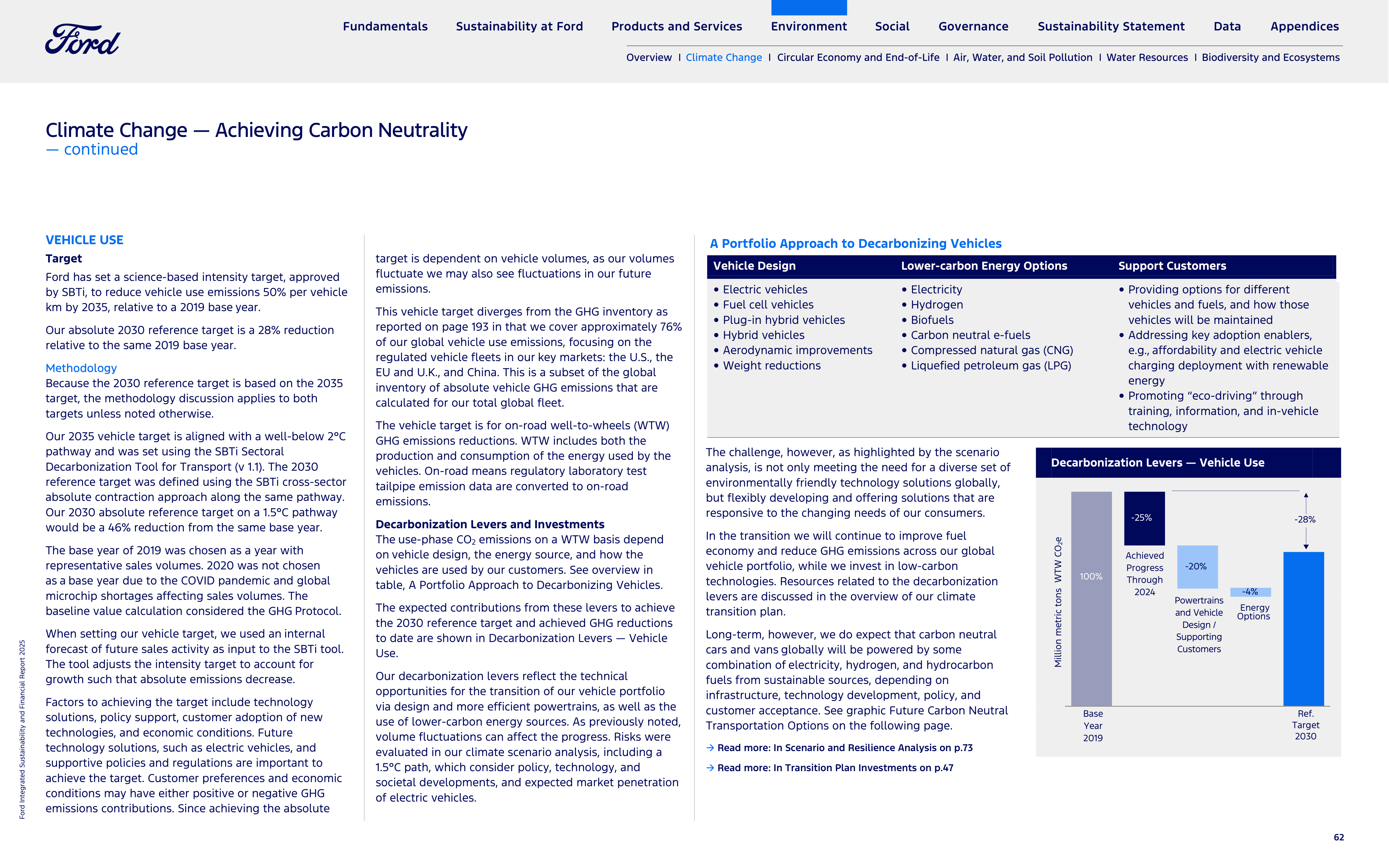
Fundamentals
Sustainability at Ford
Products and Services
Environment
Social
Governance
Sustainability Statement
Data
Appendices
Overview |
Climate Change
| Circular Economy and End-of-Life | Air, Water, and Soil Pollution | Water Resources | Biodiversity and Ecosystems
VEHICLE USE
Target
Ford has set a science-based intensity target, approved
by SBTi, to reduce vehicle use emissions 50% per vehicle
km by 2035, relative to a 2019 base year.
Our absolute 2030 reference target is a 28% reduction
relative to the same 2019 base year.
Methodology
Because the 2030 reference target is based on the 2035
target, the methodology discussion applies to both
targets unless noted otherwise.
Our 2035 vehicle target is aligned with a well-below 2°C
pathway and was set using the SBTi Sectoral
Decarbonization Tool for Transport (v 1.1). The 2030
reference target was defined using the SBTi cross-sector
absolute contraction approach along the same pathway.
Our 2030 absolute reference target on a 1.5°C pathway
would be a 46% reduction from the same base year.
The base year of 2019 was chosen as a year with
representative sales volumes. 2020 was not chosen
as a base year due to the COVID pandemic and global
microchip shortages affecting sales volumes. The
baseline value calculation considered the GHG Protocol.
When setting our vehicle target, we used an internal
forecast of future sales activity as input to the SBTi tool.
The tool adjusts the intensity target to account for
growth such that absolute emissions decrease.
Factors to achieving the target include technology
solutions, policy support, customer adoption of new
technologies, and economic conditions. Future
technology solutions, such as electric vehicles, and
supportive policies and regulations are important to
achieve the target. Customer preferences and economic
conditions may have either positive or negative GHG
emissions contributions. Since achieving the absolute
target is dependent on vehicle volumes, as our volumes
fluctuate we may also see fluctuations in our future
emissions.
This vehicle target diverges from the GHG inventory as
reported on page 193 in that we cover approximately 76%
of our global vehicle use emissions, focusing on the
regulated vehicle fleets in our key markets: the U.S., the
EU and U.K., and China. This is a subset of the global
inventory of absolute vehicle GHG emissions that are
calculated for our total global fleet.
The vehicle target is for on-road well-to-wheels (WTW)
GHG emissions reductions. WTW includes both the
production and consumption of the energy used by the
vehicles. On-road means regulatory laboratory test
tailpipe emission data are converted to on-road
emissions.
Decarbonization Levers and Investments
The use-phase CO
2
emissions on a WTW basis depend
on vehicle design, the energy source, and how the
vehicles are used by our customers. See overview in
table, A Portfolio Approach to Decarbonizing Vehicles.
The expected contributions from these levers to achieve
the 2030 reference target and achieved GHG reductions
to date are shown in Decarbonization Levers — Vehicle
Use.
Our decarbonization levers reflect the technical
opportunities for the transition of our vehicle portfolio
via design and more efficient powertrains, as well as the
use of lower-carbon energy sources. As previously noted,
volume fluctuations can affect the progress. Risks were
evaluated in our climate scenario analysis, including a
1.5°C path, which consider policy, technology, and
societal developments, and expected market penetration
of electric vehicles.
Climate Change — Achieving Carbon Neutrality
— continued
Ford Integrated Sustainability and Financial Report 2025
62
A Portfolio Approach to Decarbonizing Vehicles
Vehicle Design
Lower-carbon Energy Options
Support Customers
•
Electric vehicles
•
Fuel cell vehicles
•
Plug-in hybrid vehicles
•
Hybrid vehicles
•
Aerodynamic improvements
•
Weight reductions
•
Electricity
•
Hydrogen
•
Biofuels
•
Carbon neutral e-fuels
•
Compressed natural gas (CNG)
•
Liquefied petroleum gas (LPG)
•
Providing options for different
vehicles and fuels, and how those
vehicles will be maintained
•
Addressing key adoption enablers,
e.g., affordability and electric vehicle
charging deployment with renewable
energy
•
Promoting “eco-driving” through
training, information, and in-vehicle
technology
The challenge, however, as highlighted by the scenario
analysis, is not only meeting the need for a diverse set of
environmentally friendly technology solutions globally,
but flexibly developing and offering solutions that are
responsive to the changing needs of our consumers.
In the transition we will continue to improve fuel
economy and reduce GHG emissions across our global
vehicle portfolio, while we invest in low-carbon
technologies. Resources related to the decarbonization
levers are discussed in the overview of our climate
transition plan.
Long-term, however, we do expect that carbon neutral
cars and vans globally will be powered by some
combination of electricity, hydrogen, and hydrocarbon
fuels from sustainable sources, depending on
infrastructure, technology development, policy, and
customer acceptance. See graphic Future Carbon Neutral
Transportation Options on the following page.
Read more:
→
In Scenario and Resilience Analysis on p.73
Read more:
→
In Transition Plan Investments on p.47
Decarbonization Levers — Vehicle Use
▲
Million metric tons WTW CO
2
e
Base
Year
2019
100%
Achieved
Progress
Through
2024
-25%
▼
Powertrains
and Vehicle
Design /
Supporting
Customers
-20%
Energy
Options
-4%
Ref.
Target
2030
-28%
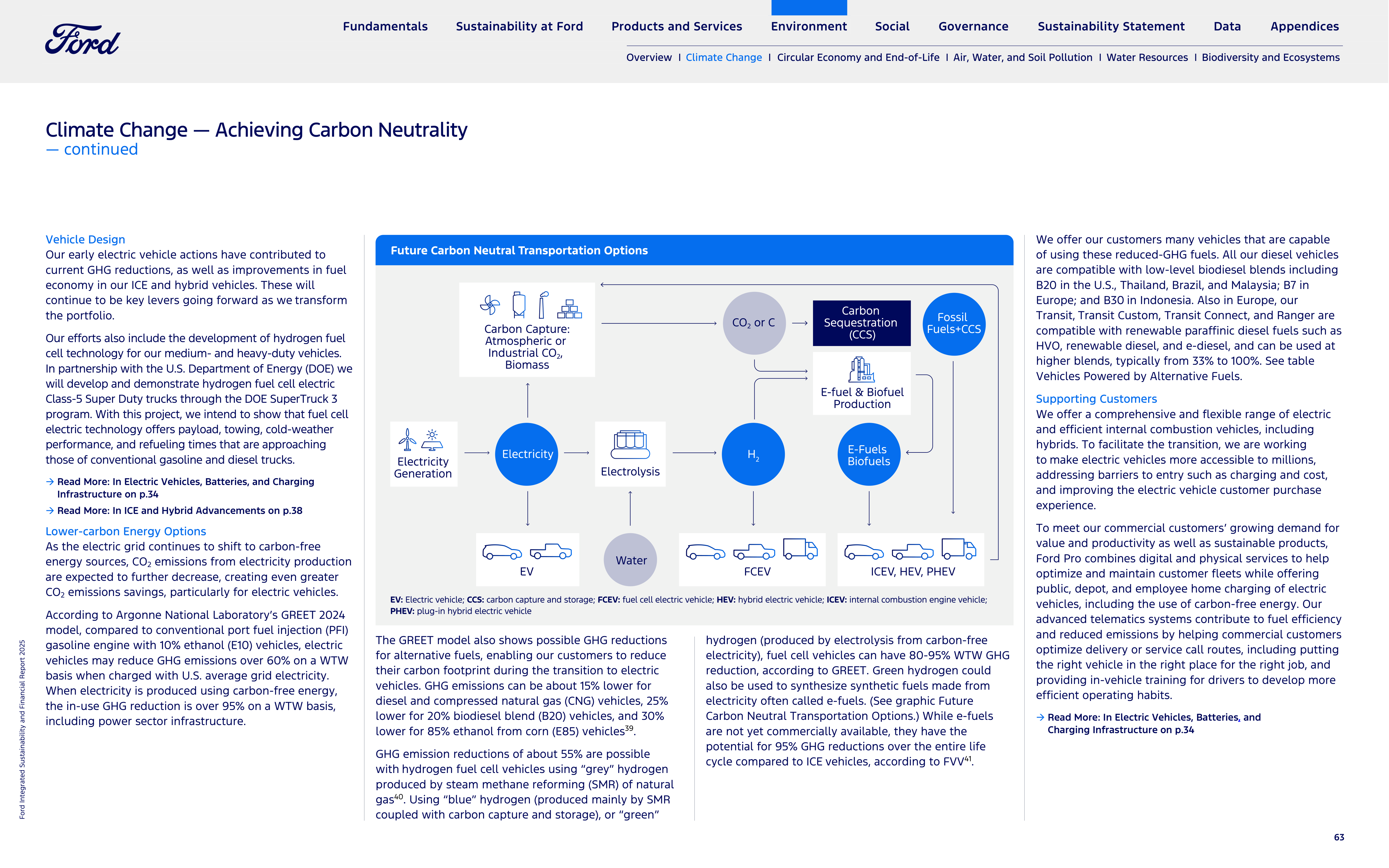
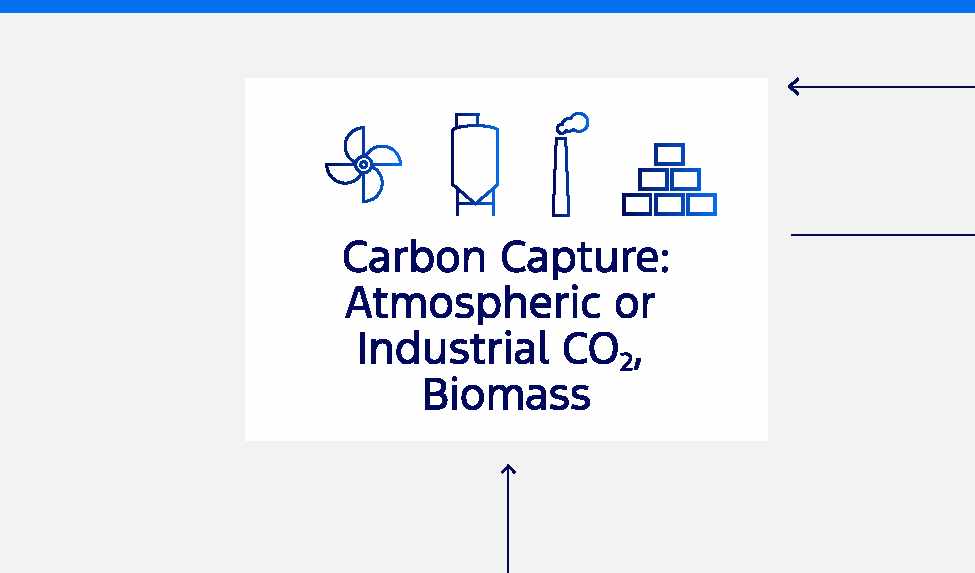
Fundamentals
Sustainability at Ford
Products and Services
Environment
Social
Governance
Sustainability Statement
Data
Appendices
Overview |
Climate Change
| Circular Economy and End-of-Life | Air, Water, and Soil Pollution | Water Resources | Biodiversity and Ecosystems
Vehicle Design
Our early electric vehicle actions have contributed to
current GHG reductions, as well as improvements in fuel
economy in our ICE and hybrid vehicles. These will
continue to be key levers going forward as we transform
the portfolio.
Our efforts also include the development of hydrogen fuel
cell technology for our medium- and heavy-duty vehicles.
In partnership with the U.S. Department of Energy (DOE) we
will develop and demonstrate hydrogen fuel cell electric
Class-5 Super Duty trucks through the DOE SuperTruck 3
program. With this project, we intend to show that fuel cell
electric technology offers payload, towing, cold-weather
performance, and refueling times that are approaching
those of conventional gasoline and diesel trucks.
Read More:
→
In Electric Vehicles, Batteries, and Charging
Infrastructure on p.34
Read More:
→
In ICE and Hybrid Advancements on p.38
Lower-carbon Energy Options
As the electric grid continues to shift to carbon‑free
energy sources, CO
2
emissions from electricity production
are expected to further decrease, creating even greater
CO
2
emissions savings, particularly for electric vehicles.
According to Argonne National Laboratory’s GREET 2024
model, compared to conventional port fuel injection (PFI)
gasoline engine with 10% ethanol (E10) vehicles, electric
vehicles may reduce GHG emissions over 60% on a WTW
basis when charged with U.S. average grid electricity.
When electricity is produced using carbon-free energy,
the in-use GHG reduction is over 95% on a WTW basis,
including power sector infrastructure.
Future Carbon Neutral Transportation Options
EV:
Electric vehicl
e; CCS
: carbon capture and storage; FCEV: fuel cell electric vehicle; HEV: hybrid electric vehicle; ICEV: internal combustion engine vehicle; PHEV: plug-in hybrid electric vehicle
Climate Change — Achieving Carbon Neutrality
— continued
Ford Integrated Sustainability and Financial Report 2025
63
The GREET model also shows possible GHG reductions
for alternative fuels, enabling our customers to reduce
their carbon footprint during the transition to electric
vehicles. GHG emissions can be about 15% lower for
diesel and compressed natural gas (CNG) vehicles, 25%
lower for 20% biodiesel blend (B20) vehicles, and 30%
lower for 85% ethanol from corn (E85) vehicles
39
.
GHG emission reductions of about 55% are possible
with hydrogen fuel cell vehicles using “grey” hydrogen
produced by steam methane reforming (SMR) of natural
gas
40
. Using “blue” hydrogen (produced mainly by SMR
coupled with carbon capture and storage), or “green”
hydrogen (produced by electrolysis from carbon-free
electricity), fuel cell vehicles can have 80-95% WTW GHG
reduction, according to GREET. Green hydrogen could
also be used to synthesize synthetic fuels made from
electricity often called e-fuels. (See graphic Future
Carbon Neutral Transportation Options.) While e-fuels
are not yet commercially available, they have the
potential for 95% GHG reductions over the entire life
cycle compared to ICE vehicles, according to FVV
41
.
We offer our customers many vehicles that are capable
of using these reduced-GHG fuels. All our diesel vehicles
are compatible with low-level biodiesel blends including
B20 in the U.S., Thailand, Brazil, and Malaysia; B7 in
Europe; and B30 in Indonesia. Also in Europe, our
Transit, Transit Custom, Transit Connect, and Ranger are
compatible with renewable paraffinic diesel fuels such as
HVO, renewable diesel, and e-diesel, and can be used at
higher blends, typically from 33% to 100%. See table
Vehicles Powered by Alternative Fuels.
Supporting Customers
We offer a comprehensive and flexible range of electric
and efficient internal combustion vehicles, including
hybrids. To facilitate the transition, we are working
to make electric vehicles more accessible to millions,
addressing barriers to entry such as charging and cost,
and improving the electric vehicle customer purchase
experience.
To meet our commercial customers’ growing demand for
value and productivity as well as sustainable products,
Ford Pro combines digital and physical services to help
optimize and maintain customer fleets while offering
public, depot, and employee home charging of electric
vehicles, including the use of carbon-free energy. Our
advanced telematics systems contribute to fuel efficiency
and reduced emissions by helping commercial customers
optimize delivery or service call routes, including putting
the right vehicle in the right place for the right job, and
providing in-vehicle training for drivers to develop more
efficient operating habits.
Read More:
→
In Electric Vehicles, Batteries
,
and
Charging Infrastructure
on p.34
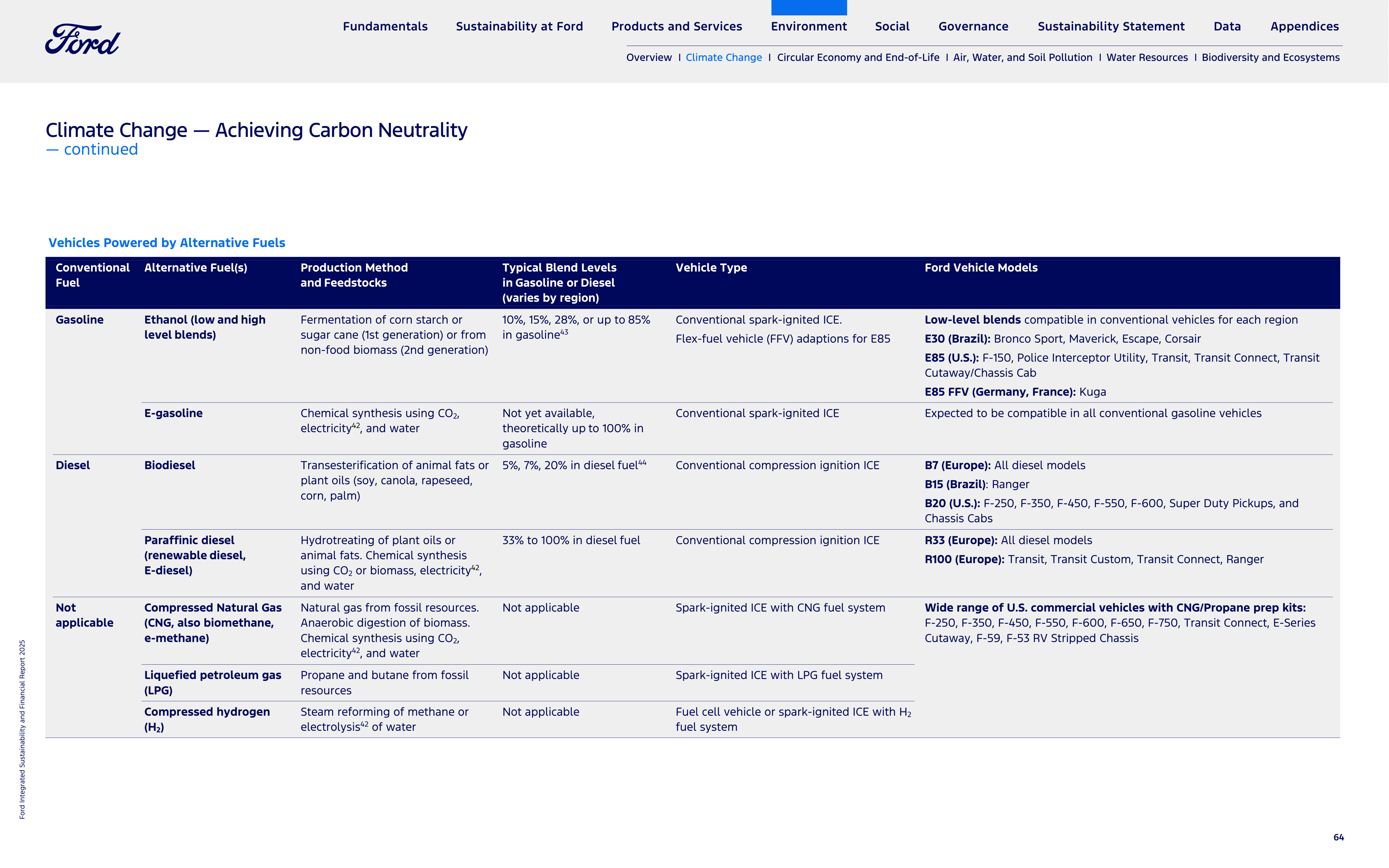
Climate Change — Achieving Carbon Neutrality
— continued
Ford Integrated Sustainability and Financial Report 2025
64
Fundamentals
Sustainability at Ford
Products and Services
Environment
Social
Governance
Sustainability Statement
Data
Appendices
Overview |
Climate Change
| Circular Economy and End-of-Life | Air, Water, and Soil Pollution | Water Resources | Biodiversity and Ecosystems
Vehicles Powered by Alternative Fuels
Conventional
Fuel
Alternative Fuel(s)
Production Method
and Feedstocks
Typical Blend Levels
in Gasoline or Diesel
(varies by region)
Vehicle Type
Ford Vehicle Models
Gasoline
Ethanol (low and high
level blends)
Fermentation of corn starch or
sugar cane (1st generation) or from
non-food biomass (2nd generation)
10%, 15%, 28%, or up to 85%
in gasoline
43
Conventional spark-ignited ICE.
Flex-fuel vehicle (FFV) adaptions for E85
Low-level blends
compatible in conventional vehicles for each region
E30 (Brazil):
Bronco Sport, Maverick, Escape, Corsair
E85 (U.S.):
F-150, Police Interceptor Utility, Transit, Transit Connect, Transit
Cutaway/Chassis Cab
E85 FFV (Germany, France):
Kuga
E-gasoline
Chemical synthesis using CO
2
,
electricity
42
, and water
Not yet available,
theoretically up to 100% in
gasoline
Conventional spark-ignited ICE
Expected to be compatible in all conventional gasoline vehicles
Diesel
Biodiesel
Transesterification of animal fats or
plant oils (soy, canola, rapeseed,
corn, palm)
5%, 7%, 20% in diesel fuel
44
Conventional compression ignition ICE
B7 (Europe):
All diesel models
B15 (Brazil)
: Ranger
B20 (U.S.):
F-250, F-350, F-450, F-550, F-600, Super Duty Pickups, and
Chassis Cabs
Paraffinic diesel
(renewable diesel,
E-diesel)
Hydrotreating of plant oils or
animal fats. Chemical synthesis
using CO
2
or biomass, electricity
42
,
and water
33% to 100% in diesel fuel
Conventional compression ignition ICE
R33 (Europe):
All diesel models
R100 (Europe):
Transit, Transit Custom, Transit Connect, Ranger
Not
applicable
Compressed Natural Gas
(CNG, also biomethane,
e-methane)
Natural gas from fossil resources.
Anaerobic digestion of biomass.
Chemical synthesis using CO
2
,
electricity
42
, and water
Not applicable
Spark-ignited ICE with CNG fuel system
Wide range of U.S. commercial vehicles with CNG/Propane prep kits:
F-250, F-350, F-450, F-550, F-600, F-650, F-750, Transit Connect, E-Series
Cutaway, F-59, F-53 RV Stripped Chassis
Liquefied petroleum gas
(LPG)
Propane and butane from fossil
resources
Not applicable
Spark-ignited ICE with LPG fuel system
Compressed hydrogen
(H
2
)
Steam reforming of methane or
electrolysis
42
of water
Not applicable
Fuel cell vehicle or spark-ignited ICE with H
2
fuel system
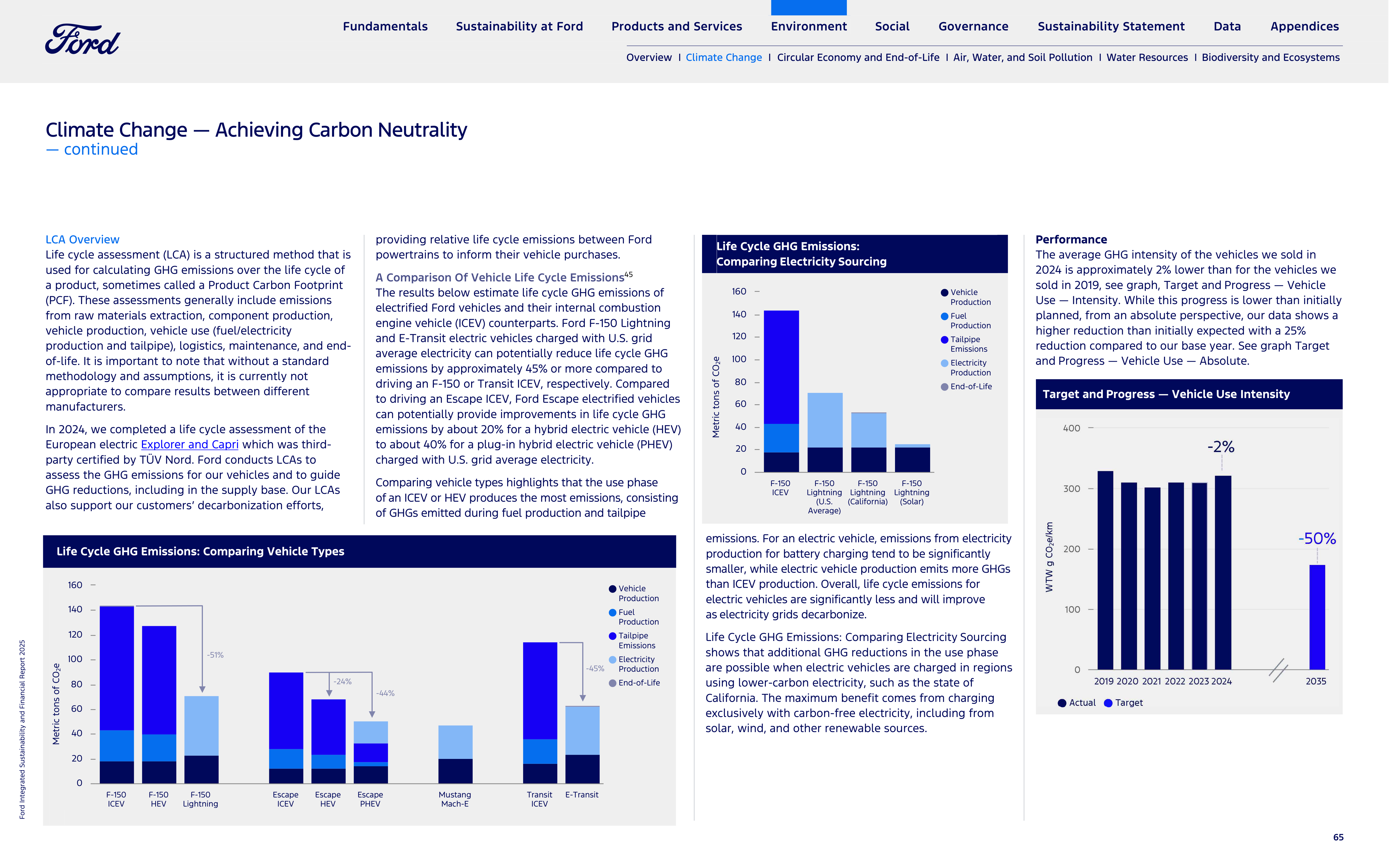
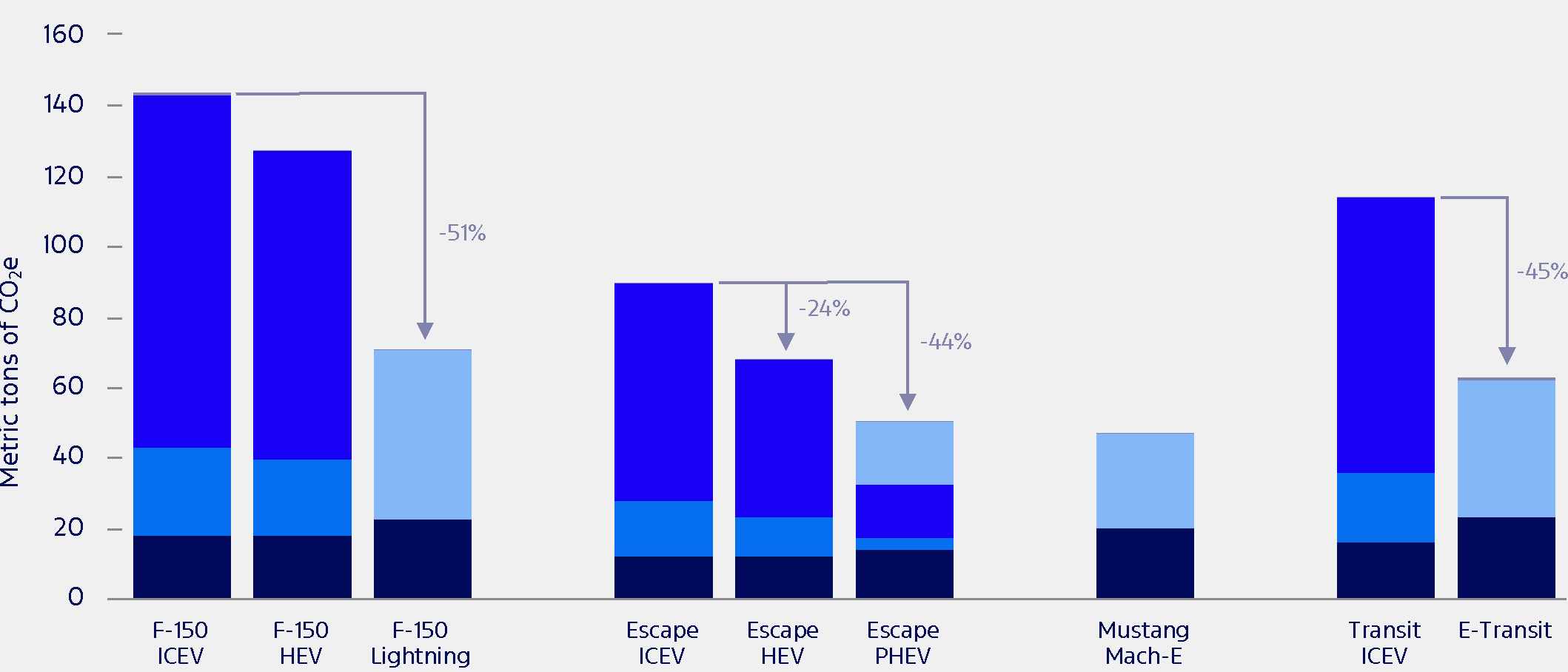
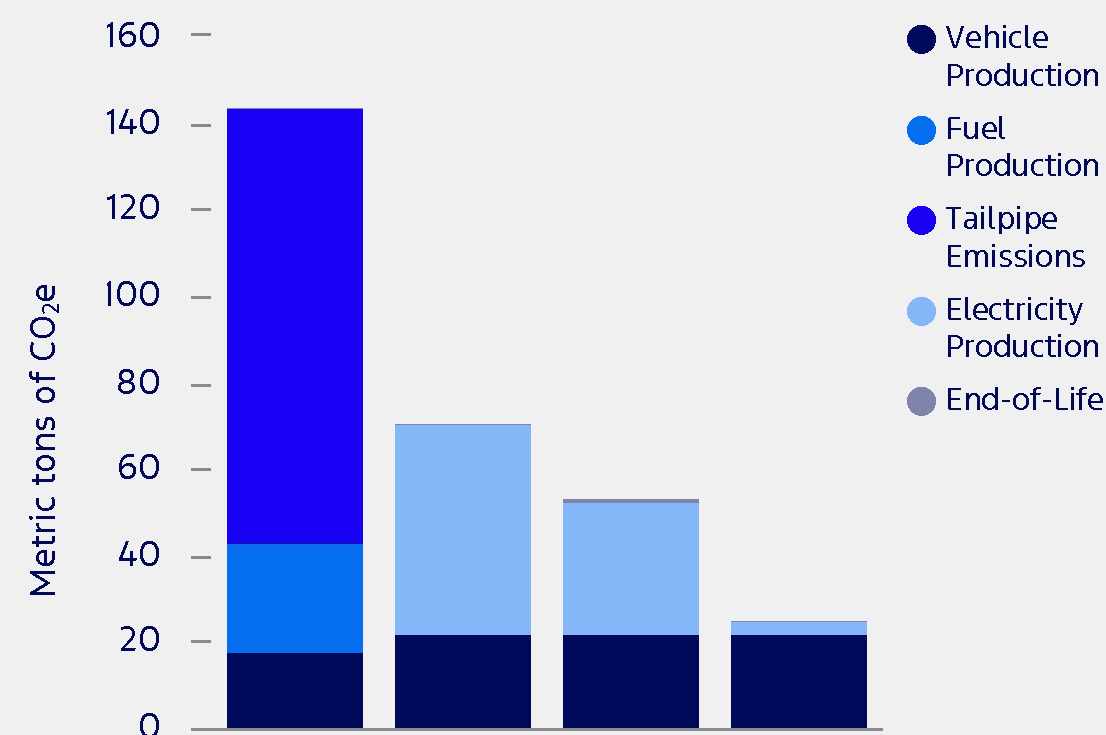
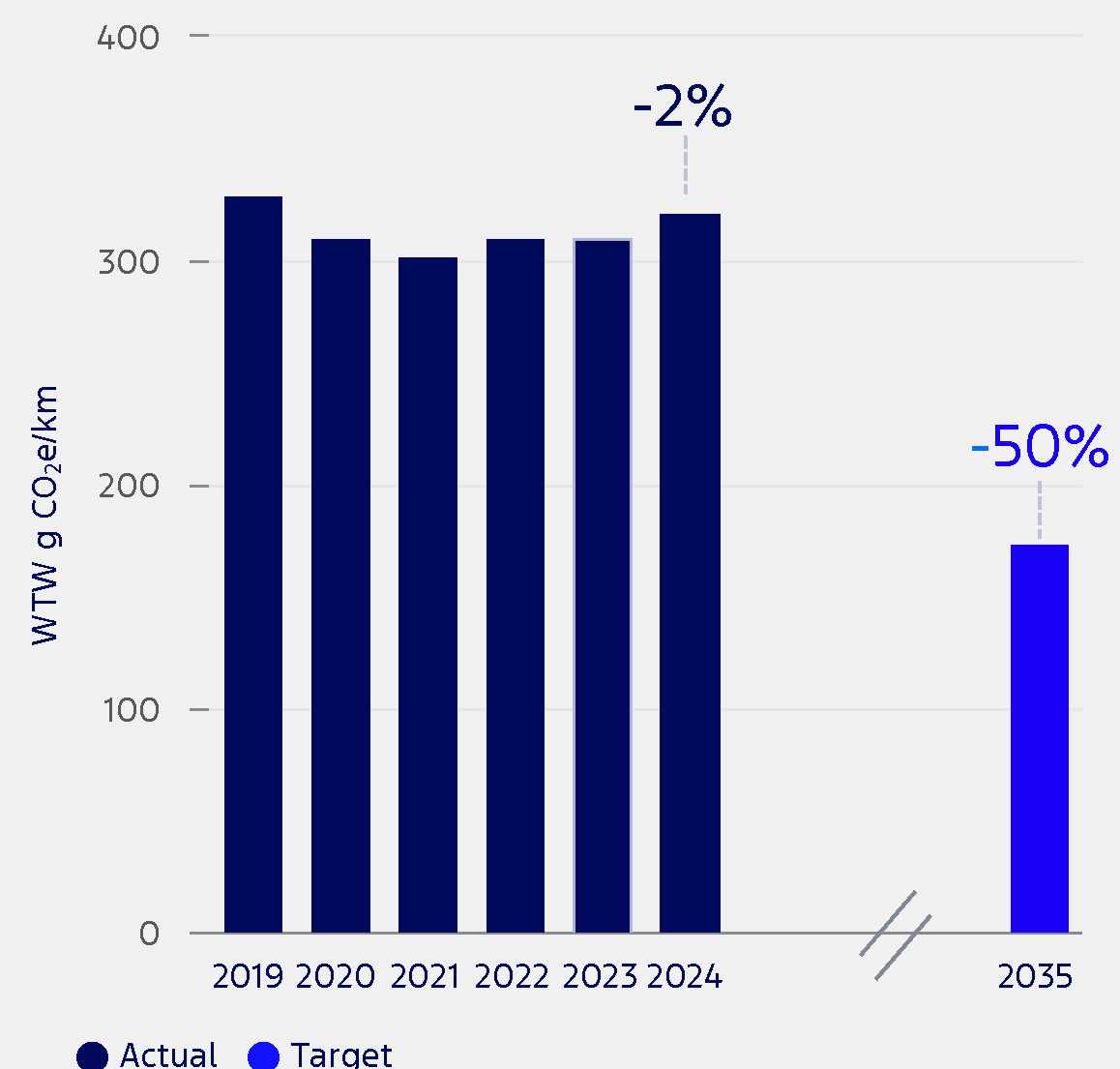
WTW g CO
2
e/km
●
Actual
●
Target
Fundamentals
Sustainability at Ford
Products and Services
Environment
Social
Governance
Sustainability Statement
Data
Appendices
Overview |
Climate Change
| Circular Economy and End-of-Life | Air, Water, and Soil Pollution | Water Resources | Biodiversity and Ecosystems
LCA Overview
Life cycle assessment (LCA) is a structured method that is
used for calculating GHG emissions over the life cycle of
a product, sometimes called a Product Carbon Footprint
(PCF). These assessments generally include emissions
from raw materials extraction, component production,
vehicle production, vehicle use (fuel/electricity
production and tailpipe), logistics, maintenance, and end-
of-life. It is important to note that without a standard
methodology and assumptions, it is currently not
appropriate to compare results between different
manufacturers.
In 2024, we completed a life cycle assessment of the
European electric
Explorer and Capri
which was third-
party certified by TÜV Nord. Ford conducts LCAs to
assess the GHG emissions for our vehicles and to guide
GHG reductions, including in the supply base. Our LCAs
also support our customers’ decarbonization efforts,
providing relative life cycle emissions between Ford
powertrains to inform their vehicle purchases.
A Comparison Of Vehicle Life Cycle Emissions
45
The results below estimate life cycle GHG emissions of
electrified Ford vehicles and their internal combustion
engine vehicle (ICEV) counterparts. Ford F-150 Lightning
and E-Transit electric vehicles charged with U.S. grid
average electricity can potentially reduce life cycle GHG
emissions by approximately 45% or more compared to
driving an F-150 or Transit ICEV, respectively. Compared
to driving an Escape ICEV, Ford Escape electrified vehicles
can potentially provide improvements in life cycle GHG
emissions by about 20% for a hybrid electric vehicle (HEV)
to about 40% for a plug-in hybrid electric vehicle (PHEV)
charged with U.S. grid average electricity.
Comparing vehicle types highlights that the use phase
of an ICEV or HEV produces the most emissions, consisting
of GHGs emitted during fuel production and tailpipe
emissions. For an electric vehicle, emissions from electricity
production for battery charging tend to be significantly
smaller, while electric vehicle production emits more GHGs
than ICEV production. Overall, life cycle emissions for
electric vehicles are significantly less and will improve
as electricity grids decarbonize.
Life Cycle GHG Emissions: Comparing Vehicle Types
Life Cycle GHG Emissions:
Comparing Electricity Sourcing
Life Cycle GHG Emissions: Comparing Electricity Sourcing
shows that additional GHG reductions in the use phase
are possible when electric vehicles are charged in regions
using lower-carbon electricity, such as the state of
California. The maximum benefit comes from charging
exclusively with carbon-free electricity, including from
solar, wind, and other renewable sources.
Performance
The average GHG intensity of the vehicles we sold in
2024 is approximately 2% lower than for the vehicles we
sold in 2019, see graph, Target and Progress — Vehicle
Use — Intensity. While this progress is lower than initially
planned, from an absolute perspective, our data shows a
higher reduction than initially expected with a 25%
reduction compared to our base year. See graph Target
and Progress — Vehicle Use — Absolute.
Target and Progress — Vehicle Use Intensity
Climate Change — Achieving Carbon Neutrality
— continued
Ford Integrated Sustainability and Financial Report 2025
65
Metric tons of CO
2
e
●
Vehicle
Production
●
Fuel
Production
●
Tailpipe
Emissions
●
Electricity
Production
●
End-of-Life
F-150
ICEV
F-150
HEV
F-150
Lightning
Escape
ICEV
Escape
HEV
Escape
PHEV
Mustang
Mach-E
Transit
ICEV
E-Transit
0
20
40
60
80
100
120
140
160
Metric tons of CO
2
e
●
Vehicle
Production
●
Fuel
Production
●
Tailpipe
Emissions
●
Electricity
Production
●
End-of-Life
F-150
ICEV
F-150
Lightning
(U.S.
Average)
F-150
Lightning
(California)
F-150
Lightning
(Solar)
0
20
40
60
80
100
120
140
160
-51%
-24%
-44%
-45%
2019
2020
2021
2022
2023 2024
2035
0
100
200
300
400
-
50%
-2%
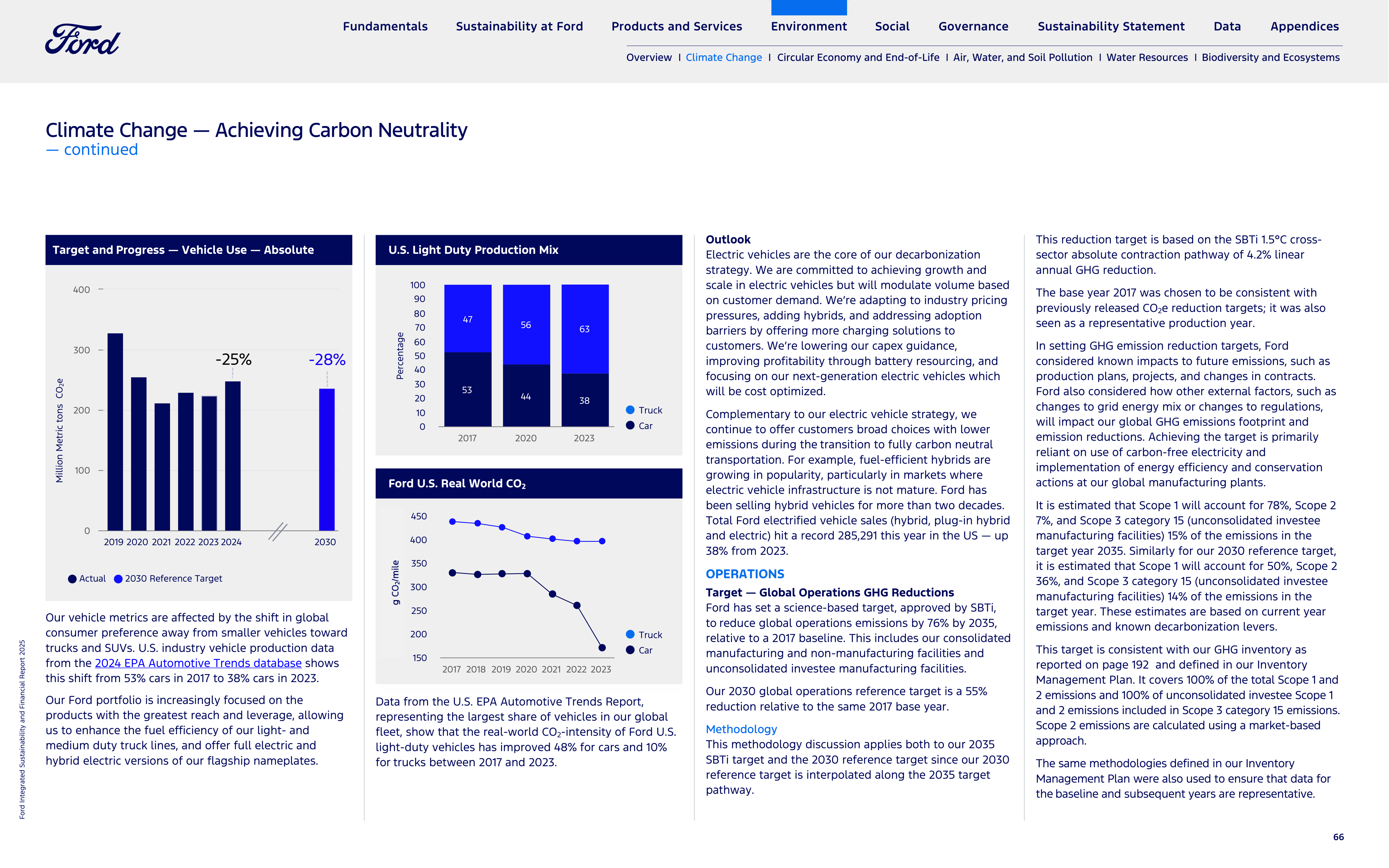
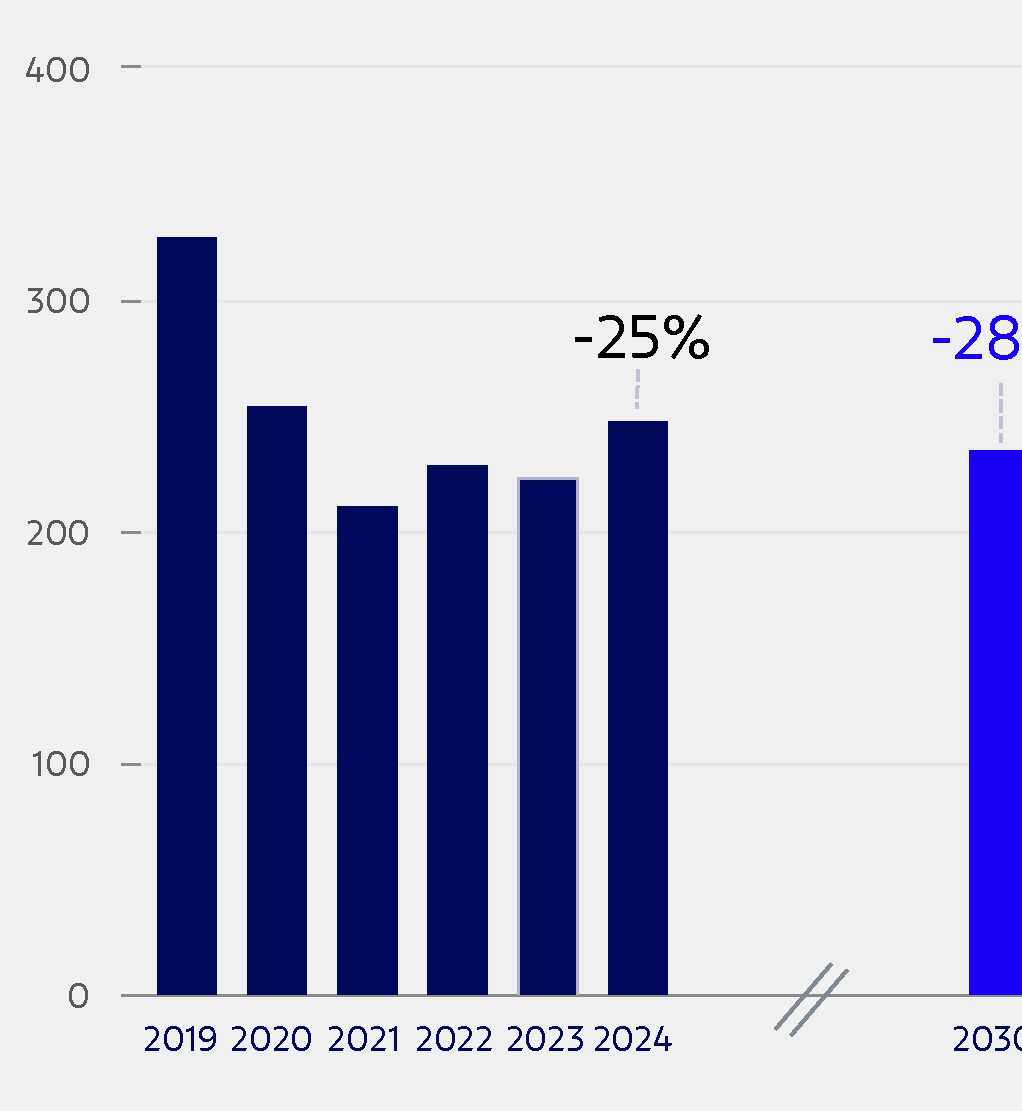
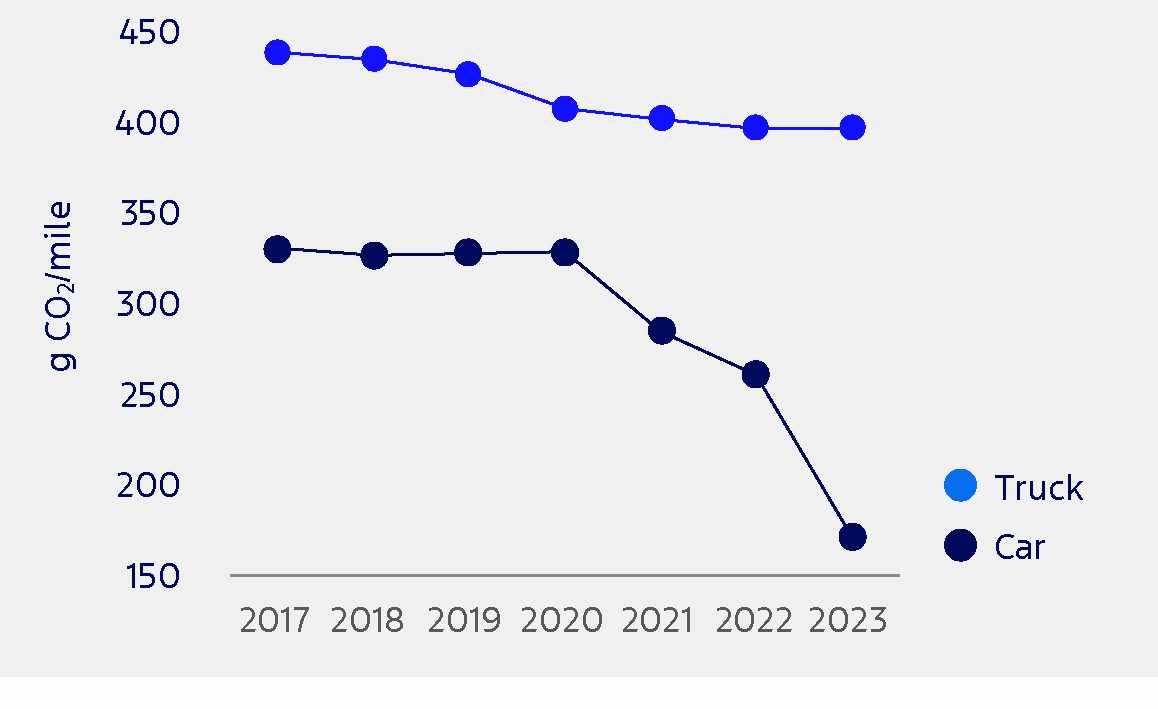
Fundamentals
Sustainability at Ford
Products and Services
Environment
Social
Governance
Sustainability Statement
Data
Appendices
Overview |
Climate Change
| Circular Economy and End-of-Life | Air, Water, and Soil Pollution | Water Resources | Biodiversity and Ecosystems
Target and Progress — Vehicle Use — Absolute
Our vehicle metrics are affected by the shift in global
consumer preference away from smaller vehicles toward
trucks and SUVs. U.S. industry vehicle production data
from the
2024 EPA Automotive Trends database
shows
this shift from 53% cars in 2017 to 38% cars in 2023.
Our Ford portfolio is increasingly focused on the
products with the greatest reach and leverage, allowing
us to enhance the fuel efficiency of our light- and
medium duty truck lines, and offer full electric and
hybrid electric versions of our flagship nameplates.
U.S. Light Duty Production Mix
2017
53
47
2020
44
56
2023
38
63
Truck
Car
Million Metric tons CO
2
e
●
Actual
●
2030 Reference Target
●
●
Ford U.S. Real World CO
2
g CO
2
/mile
●
Truck
●
Car
Data from the U.S. EPA Automotive Trends Report,
representing the largest share of vehicles in our global
fleet, show that the real-world CO
2
-intensity of Ford U.S.
light-duty vehicles has improved 48% for cars and 10%
for trucks between 2017 and 2023.
Outlook
Electric vehicles are the core of our decarbonization
strategy. We are committed to achieving growth and
scale in electric vehicles but will modulate volume based
on customer demand. We’re adapting to industry pricing
pressures, adding hybrids, and addressing adoption
barriers by offering more charging solutions to
customers. We’re lowering our capex guidance,
improving profitability through battery resourcing, and
focusing on our next-generation electric vehicles which
will be cost optimized.
Complementary to our electric vehicle strategy, we
continue to offer customers broad choices with lower
emissions during the transition to fully carbon neutral
transportation. For example, fuel-efficient hybrids are
growing in popularity, particularly in markets where
electric vehicle infrastructure is not mature. Ford has
been selling hybrid vehicles for more than two decades.
Total Ford electrified vehicle sales (hybrid, plug-in hybrid
and electric) hit a record 285,291 this year in the US — up
38% from 2023.
OPERATIONS
Target — Global Operations GHG Reductions
Ford has set a science-based target, approved by SBTi,
to reduce global operations emissions by 76% by 2035,
relative to a 2017 baseline. This includes our consolidated
manufacturing and non-manufacturing facilities and
unconsolidated investee manufacturing facilities.
Our 2030 global operations reference target is a 55%
reduction relative to the same 2017 base year.
Methodology
This methodology discussion applies both to our 2035
SBTi target and the 2030 reference target since our 2030
reference target is interpolated along the 2035 target
pathway.
This reduction target is based on the SBTi 1.5°C cross-
sector absolute contraction pathway of 4.2% linear
annual GHG reduction.
The base year 2017 was chosen to be consistent with
previously released CO
2
e reduction targets; it was also
seen as a representative production year.
In setting GHG emission reduction targets, Ford
considered known impacts to future emissions, such as
production plans, projects, and changes in contracts.
Ford also considered how other external factors, such as
changes to grid energy mix or changes to regulations,
will impact our global GHG emissions footprint and
emission reductions. Achieving the target is primarily
reliant on use of carbon-free electricity and
implementation of energy efficiency and conservation
actions at our global manufacturing plants.
It is estimated that Scope 1 will account for 78%, Scope 2
7%, and Scope 3 category 15 (unconsolidated investee
manufacturing facilities) 15% of the emissions in the
target year 2035. Similarly for our 2030 reference target,
it is estimated that Scope 1 will account for 50%, Scope 2
36%, and Scope 3 category 15 (unconsolidated investee
manufacturing facilities) 14% of the emissions in the
target year. These estimates are based on current year
emissions and known decarbonization levers.
This target is consistent with our GHG inventory as
reported on page 192 and defined in our Inventory
Management Plan. It covers 100% of the total Scope 1 and
2 emissions and 100% of unconsolidated investee Scope 1
and 2 emissions included in Scope 3 category 15 emissions.
Scope 2 emissions are calculated using a market-based
approach.
The same methodologies defined in our Inventory
Management Plan were also used to ensure that data for
the baseline and subsequent years are representative.
Climate Change — Achieving Carbon Neutrality
— continued
Ford Integrated Sustainability and Financial Report 2025
66
Percentage
53
44
38
47
56
63
2017
2020
2023
0
10
20
30
40
50
60
70
80
90
100
2017
2018
2019
2020
2021
2022
2023
150
200
250
300
350
400
450
2019
2020
2021
2022
2023 2024
2030
0
100
200
300
400
-25%
-28%
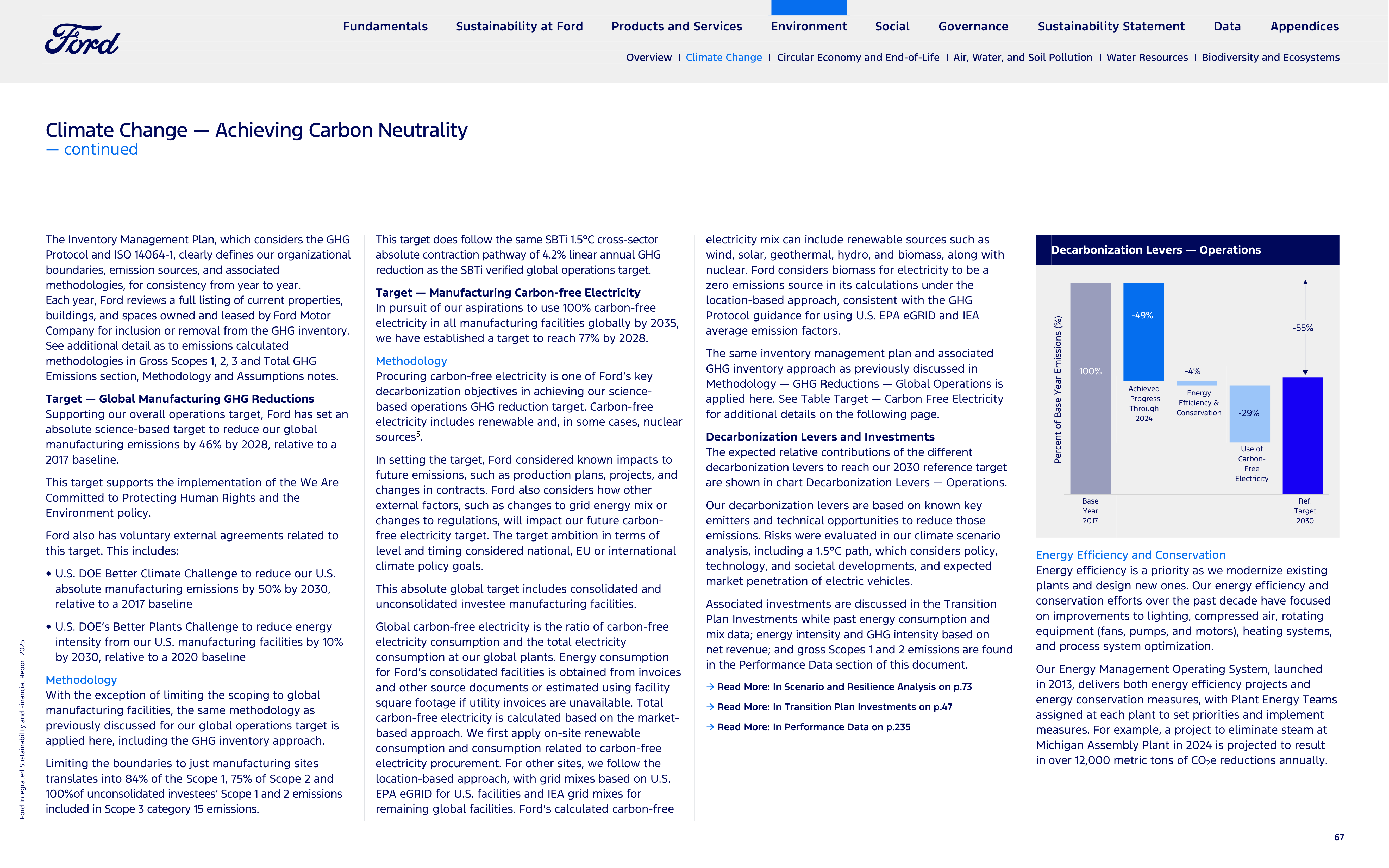
Fundamentals
Sustainability at Ford
Products and Services
Environment
Social
Governance
Sustainability Statement
Data
Appendices
Overview |
Climate Change
| Circular Economy and End-of-Life | Air, Water, and Soil Pollution | Water Resources | Biodiversity and Ecosystems
Climate Change — Achieving Carbon Neutrality
— continued
Ford Integrated Sustainability and Financial Report 2025
67
The Inventory Management Plan, which considers the GHG
Protocol and ISO 14064-1, clearly defines our organizational
boundaries, emission sources, and associated
methodologies, for consistency from year to year.
Each year, Ford reviews a full listing of current properties,
buildings, and spaces owned and leased by Ford Motor
Company for inclusion or removal from the GHG inventory.
See additional detail as to emissions calculated
methodologies in Gross Scopes 1, 2, 3 and Total GHG
Emissions section, Methodology and Assumptions notes.
Target — Global Manufacturing GHG Reductions
Supporting our overall operations target, Ford has set an
absolute science-based target to reduce our global
manufacturing emissions by 46% by 2028, relative to a
2017 baseline.
This target supports the implementation of the We Are
Committed to Protecting Human Rights and the
Environment policy.
Ford also has voluntary external agreements related to
this target. This includes:
•
U.S. DOE Better Climate Challenge to reduce our U.S.
absolute manufacturing emissions by 50% by 2030,
relative to a 2017 baseline
•
U.S. DOE’s Better Plants Challenge to reduce energy
intensity from our U.S. manufacturing facilities by 10%
by 2030, relative to a 2020 baseline
Methodology
With the exception of limiting the scoping to global
manufacturing facilities, the same methodology as
previously discussed for our global operations target is
applied here, including the GHG inventory approach.
Limiting the boundaries to just manufacturing sites
translates into 84% of the Scope 1, 75% of Scope 2 and
100%of unconsolidated investees’ Scope 1 and 2 emissions
included in Scope 3 category 15 emissions.
This target does follow the same SBTi 1.5°C cross-sector
absolute contraction pathway of 4.2% linear annual GHG
reduction as the SBTi verified global operations target.
Target — Manufacturing Carbon-free Electricity
In pursuit of our aspirations to use 100% carbon-free
electricity in all manufacturing facilities globally by 2035,
we have established a target to reach 77% by 2028.
Methodology
Procuring carbon-free electricity is one of Ford’s key
decarbonization objectives in achieving our science-
based operations GHG reduction target. Carbon-free
electricity includes renewable and, in some cases, nuclear
sources
5
.
In setting the target, Ford considered known impacts to
future emissions, such as production plans, projects, and
changes in contracts. Ford also considers how other
external factors, such as changes to grid energy mix or
changes to regulations, will impact our future carbon-
free electricity target. The target ambition in terms of
level and timing considered national, EU or international
climate policy goals.
This absolute global target includes consolidated and
unconsolidated investee manufacturing facilities.
Global carbon-free electricity is the ratio of carbon-free
electricity consumption and the total electricity
consumption at our global plants. Energy consumption
for Ford’s consolidated facilities is obtained from invoices
and other source documents or estimated using facility
square footage if utility invoices are unavailable. Total
carbon-free electricity is calculated based on the market-
based approach. We first apply on-site renewable
consumption and consumption related to carbon-free
electricity procurement. For other sites, we follow the
location-based approach, with grid mixes based on U.S.
EPA eGRID for U.S. facilities and IEA grid mixes for
remaining global facilities. Ford’s calculated carbon-free
electricity mix can include renewable sources such as
wind, solar, geothermal, hydro, and biomass, along with
nuclear. Ford considers biomass for electricity to be a
zero emissions source in its calculations under the
location-based approach, consistent with the GHG
Protocol guidance for using U.S. EPA eGRID and IEA
average emission factors.
The same inventory management plan and associated
GHG inventory approach as previously discussed in
Methodology — GHG Reductions — Global Operations is
applied here. See Table Target — Carbon Free Electricity
for additional details on the following page.
Decarbonization Levers and Investments
The expected relative contributions of the different
decarbonization levers to reach our 2030 reference target
are shown in chart Decarbonization Levers — Operations.
Our decarbonization levers are based on known key
emitters and technical opportunities to reduce those
emissions. Risks were evaluated in our climate scenario
analysis, including a 1.5°C path, which considers policy,
technology, and societal developments, and expected
market penetration of electric vehicles.
Associated investments are discussed in the Transition
Plan Investments while past energy consumption and
mix data; energy intensity and GHG intensity based on
net revenue; and gross Scopes 1 and 2 emissions are found
in the Performance Data section of this document.
→
Read More: In Scenario and Resilience Analysis on p.73
→
Read More: In Transition Plan Investments on
p.47
→
Read More: In Performance Data
on p.235
Decarbonization Levers — Operations
▲
Percent of Base Year Emissions (%)
Base
Year
2017
100%
▼
Achieved
Progress
Through
2024
-49%
Energy
Efficiency &
Conservation
-4%
Use of
Carbon-
Free
Electricity
-29%
Ref.
Target
2030
-55%
Energy Efficiency and Conservation
Energy efficiency is a priority as we modernize existing
plants and design new ones. Our energy efficiency and
conservation efforts over the past decade have focused
on improvements to lighting, compressed air, rotating
equipment (fans, pumps, and motors), heating systems,
and process system optimization.
Our Energy Management Operating System, launched
in 2013, delivers both energy efficiency projects and
energy conservation measures, with Plant Energy Teams
assigned at each plant to set priorities and implement
measures. For example, a project to eliminate steam at
Michigan Assembly Plant in 2024 is projected to result
in over 12,000 metric tons of CO
2
e reductions annually.
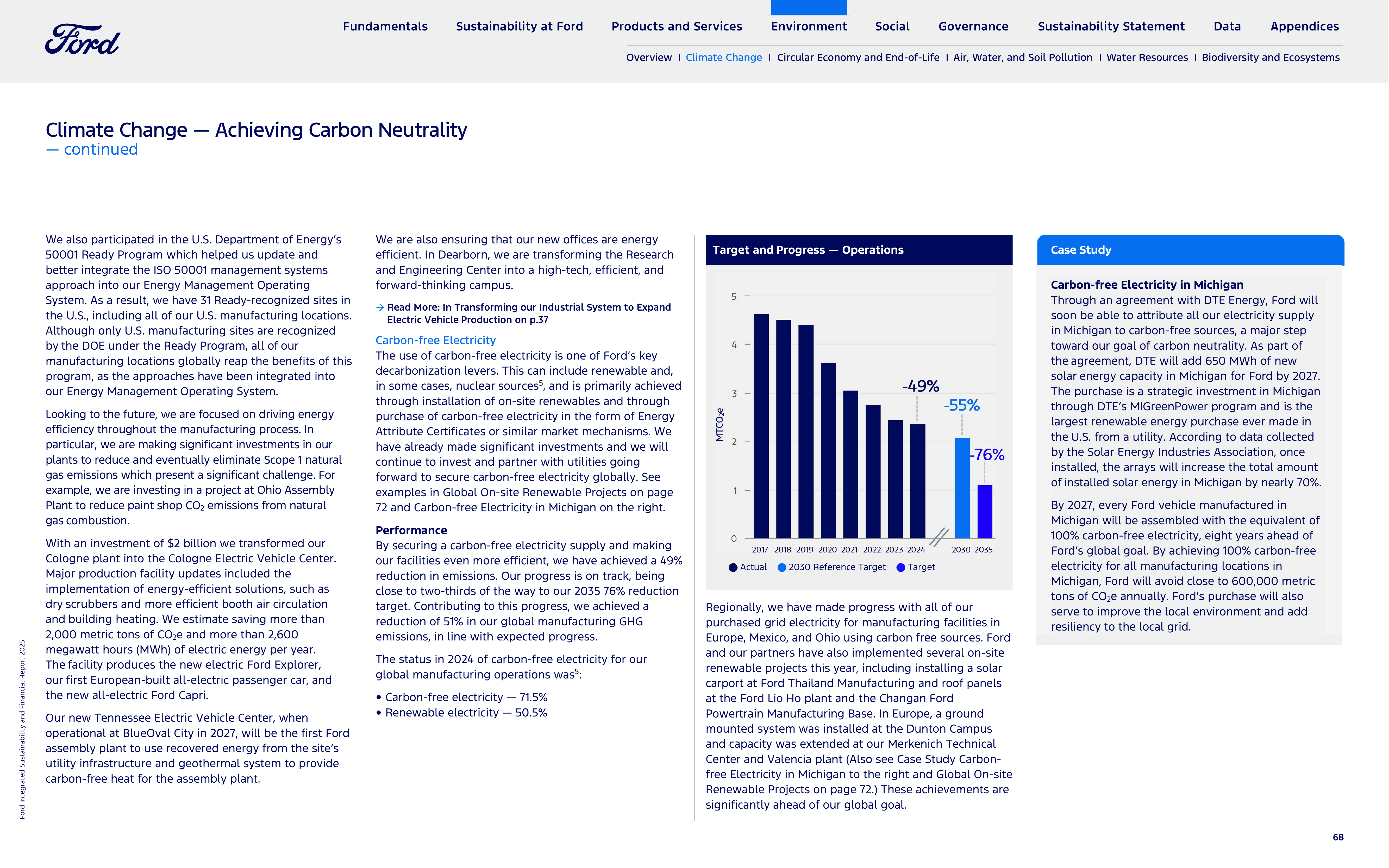

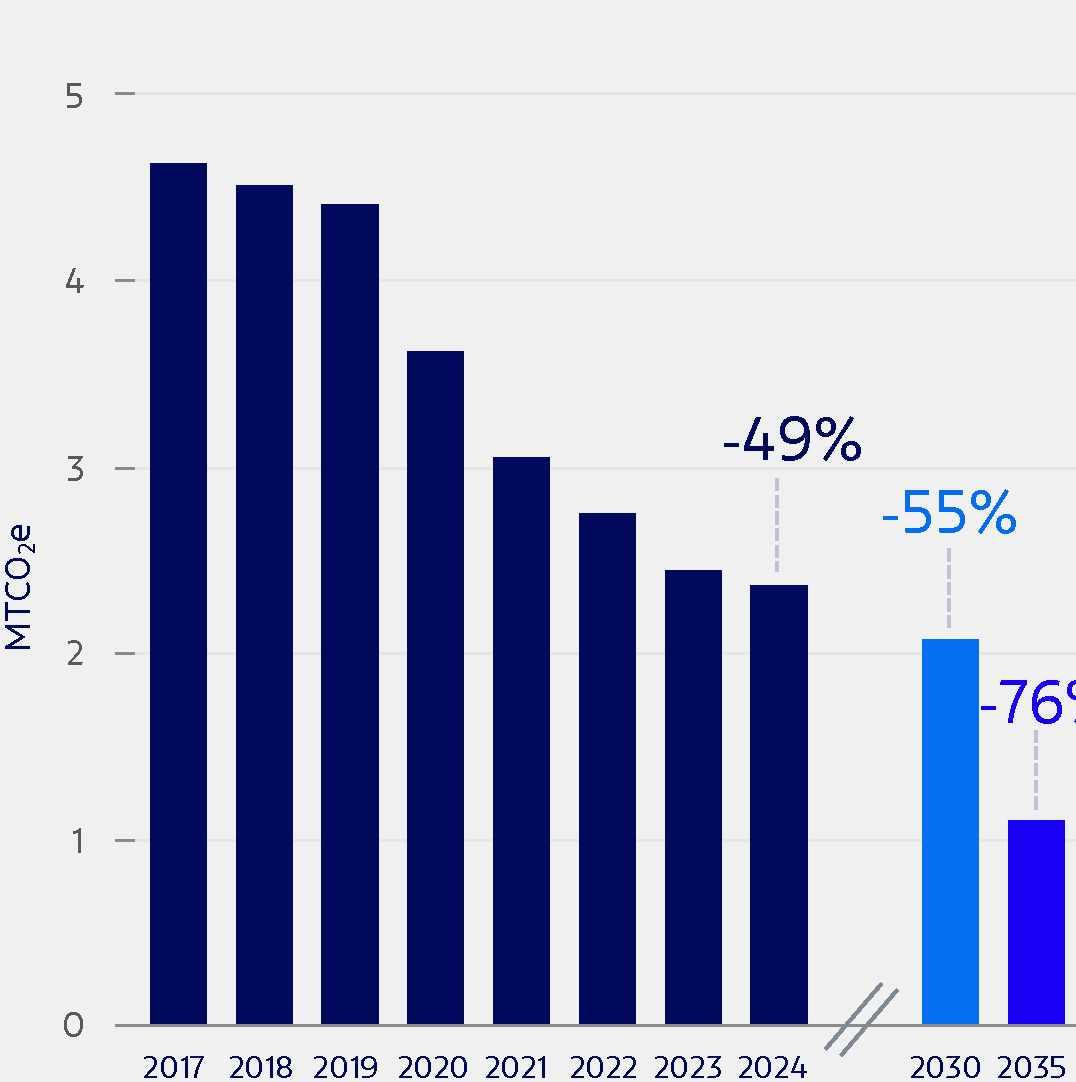
Fundamentals
Sustainability at Ford
Products and Services
Environment
Social
Governance
Sustainability Statement
Data
Appendices
Overview |
Climate Change
| Circular Economy and End-of-Life | Air, Water, and Soil Pollution | Water Resources | Biodiversity and Ecosystems
We also participated in the U.S. Department of Energy’s
50001 Ready Program which helped us update and
better integrate the ISO 50001 management systems
approach into our Energy Management Operating
System. As a result, we have 31 Ready-recognized sites in
the U.S., including all of our U.S. manufacturing locations.
Although only U.S. manufacturing sites are recognized
by the DOE under the Ready Program, all of our
manufacturing locations globally reap the benefits of this
program, as the approaches have been integrated into
our Energy Management Operating System.
Looking to the future, we are focused on driving energy
efficiency throughout the manufacturing process. In
particular, we are making significant investments in our
plants to reduce and eventually eliminate Scope 1 natural
gas emissions which present a significant challenge. For
example, we are investing in a project at Ohio Assembly
Plant to reduce paint shop CO
2
emissions from natural
gas combustion.
With an investment of $2 billion we transformed our
Cologne plant into the Cologne Electric Vehicle Center.
Major production facility updates included the
implementation of energy-efficient solutions, such as
dry scrubbers and more efficient booth air circulation
and building heating. We estimate saving more than
2,000 metric tons of CO
2
e and more than 2,600
megawatt hours (MWh) of electric energy per year.
The facility produces the new electric Ford Explorer,
our first European-built all-electric passenger car, and
the new all-electric Ford Capri.
Our new Tennessee Electric Vehicle Center, when
operational at BlueOval City in 2027, will be the first Ford
assembly plant to use recovered energy from the site’s
utility infrastructure and geothermal system to provide
carbon-free heat for the assembly plant.
We are also ensuring that our new offices are energy
efficient. In Dearborn, we are transforming the Research
and Engineering Center into a high-tech, efficient, and
forward-thinking campus.
→
Read More: In Transforming our Industrial System to Expand
Electric Vehicle Production on p.37
Carbon-free Electricity
The use of carbon-free electricity is one of Ford’s key
decarbonization levers. This can include renewable and,
in some cases, nuclear sources
5
, and is primarily achieved
through installation of on-site renewables and through
purchase of carbon-free electricity in the form of Energy
Attribute Certificates or similar market mechanisms. We
have already made significant investments and we will
continue to invest and partner with utilities going
forward to secure carbon-free electricity globally. See
examples in Global On-site Renewable Projects on page
72 and Carbon-free Electricity in Michigan on the right.
Performance
By securing a carbon-free electricity supply and making
our facilities even more efficient, we have achieved a 49%
reduction in emissions. Our progress is on track, being
close to two-thirds of the way to our 2035 76% reduction
target. Contributing to this progress, we achieved a
reduction of 51% in our global manufacturing GHG
emissions, in line with expected progress.
The status in 2024 of carbon-free electricity for our
global manufacturing operations was
5
:
•
Carbon-free electricity — 71.5%
•
Renewable electricity — 50.5%
2017
2018
2019
2020
2021
2022
2023
2024
2030
2035
0
1
2
3
4
5
Target and Progress — Operations
MTCO
2
e
●
Actual
●
2030 Reference Target
●
Target
Regionally, we have made progress with all of our
purchased grid electricity for manufacturing facilities in
Europe, Mexico, and Ohio using carbon free sources. Ford
and our partners have also implemented several on-site
renewable projects this year, including installing a solar
carport at Ford Thailand Manufacturing and roof panels
at the Ford Lio Ho plant and the Changan Ford
Powertrain Manufacturing Base. In Europe, a ground
mounted system was installed at the Dunton Campus
and capacity was extended at our Merkenich Technical
Center and Valencia plant (Also see Case Study Carbon-
free Electricity in Michigan to the right and Global On-site
Renewable Projects on page 72.) These achievements are
significantly ahead of our global goal.
Case Study
Carbon-free Electricity in Michigan
Through an agreement with DTE Energy, Ford will
soon be able to attribute all our electricity supply
in Michigan to carbon-free sources, a major step
toward our goal of carbon neutrality. As part of
the agreement, DTE will add 650 MWh of new
solar energy capacity in Michigan for Ford by 2027.
The purchase is a strategic investment in Michigan
through DTE’s MIGreenPower program and is the
largest renewable energy purchase ever made in
the U.S. from a utility. According to data collected
by the Solar Energy Industries Association, once
installed, the arrays will increase the total amount
of installed solar energy in Michigan by nearly 70%.
By 2027, every Ford vehicle manufactured in
Michigan will be assembled with the equivalent of
100% carbon-free electricity, eight years ahead of
Ford’s global goal. By achieving 100% carbon-free
electricity for all manufacturing locations in
Michigan, Ford will avoid close to 600,000 metric
tons of CO
2
e annually. Ford’s purchase will also
serve to improve the local environment and add
resiliency to the local grid.
Climate Change — Achieving Carbon Neutrality
— continued
Ford Integrated Sustainability and Financial Report 2025
68
-
76%
-
55%
-
49%
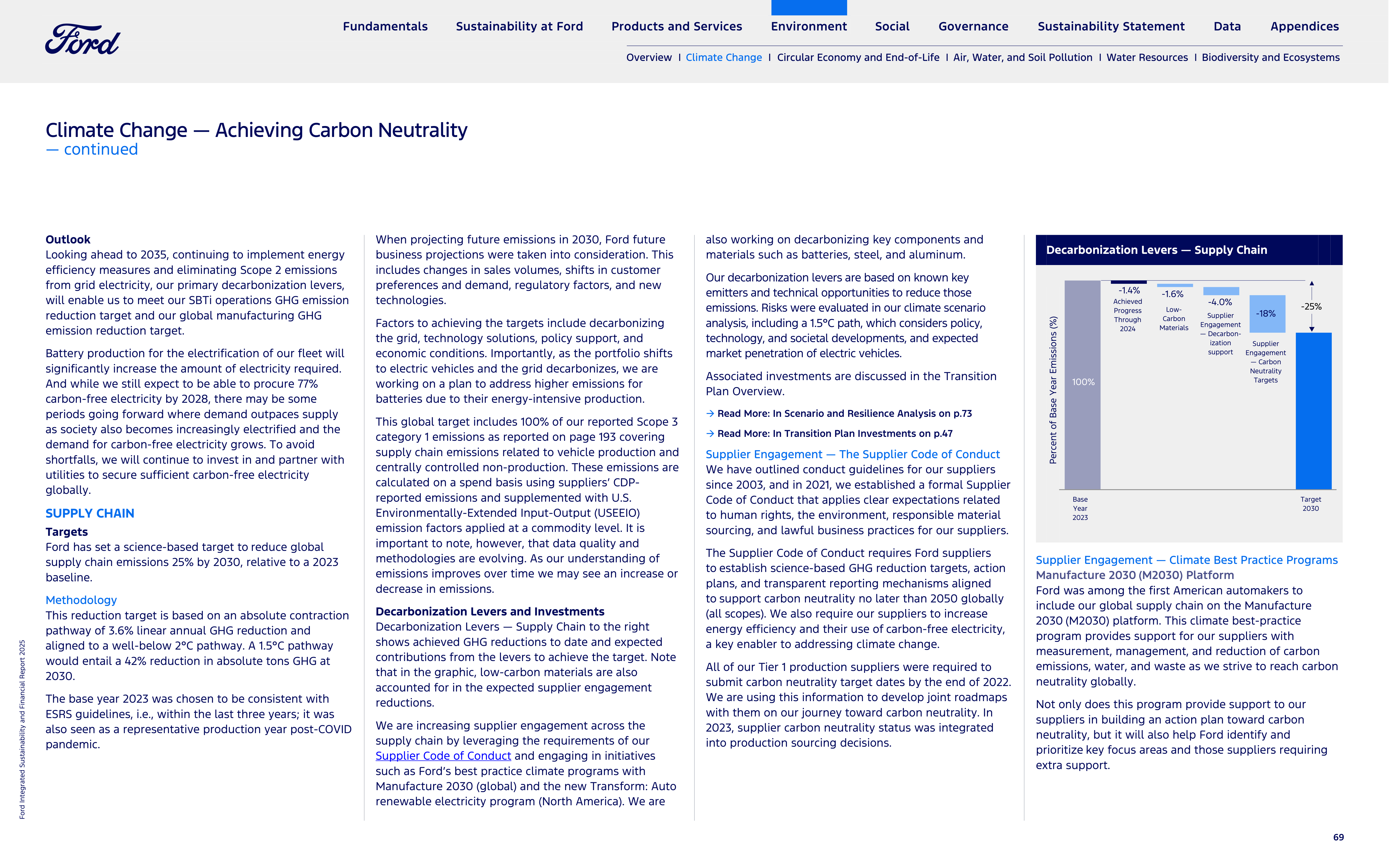
▲
Fundamentals
Sustainability at Ford
Products and Services
Environment
Social
Governance
Sustainability Statement
Data
Appendices
Overview |
Climate Change
| Circular Economy and End-of-Life | Air, Water, and Soil Pollution | Water Resources | Biodiversity and Ecosystems
▼
Climate Change — Achieving Carbon Neutrality
— continued
Ford Integrated Sustainability and Financial Report 2025
69
Outlook
Looking ahead to 2035, continuing to implement energy
efficiency measures and eliminating Scope 2 emissions
from grid electricity, our primary decarbonization levers,
will enable us to meet our SBTi operations GHG emission
reduction target and our global manufacturing GHG
emission reduction target.
Battery production for the electrification of our fleet will
significantly increase the amount of electricity required.
And while we still expect to be able to procure 77%
carbon-free electricity by 2028, there may be some
periods going forward where demand outpaces supply
as society also becomes increasingly electrified and the
demand for carbon-free electricity grows. To avoid
shortfalls, we will continue to invest in and partner with
utilities to secure sufficient carbon-free electricity
globally.
SUPPLY CHAIN
Targets
Ford has set a science-based target to reduce global
supply chain emissions 25% by 2030, relative to a 2023
baseline.
Methodology
This reduction target is based on an absolute contraction
pathway of 3.6% linear annual GHG reduction and
aligned to a well-below 2°C pathway. A 1.5°C pathway
would entail a 42% reduction in absolute tons GHG at
2030.
The base year 2023 was chosen to be consistent with
ESRS guidelines, i.e., within the last three years; it was
also seen as a representative production year post-COVID
pandemic.
When projecting future emissions in 2030, Ford future
business projections were taken into consideration. This
includes changes in sales volumes, shifts in customer
preferences and demand, regulatory factors, and new
technologies.
Factors to achieving the targets include decarbonizing
the grid, technology solutions, policy support, and
economic conditions. Importantly, as the portfolio shifts
to electric vehicles and the grid decarbonizes, we are
working on a plan to address higher emissions for
batteries due to their energy-intensive production.
This global target includes 100% of our reported Scope 3
category 1 emissions as reported on page 193 covering
supply chain emissions related to vehicle production and
centrally controlled non-production. These emissions are
calculated on a spend basis using suppliers’ CDP-
reported emissions and supplemented with U.S.
Environmentally-Extended Input-Output (USEEIO)
emission factors applied at a commodity level. It is
important to note, however, that data quality and
methodologies are evolving. As our understanding of
emissions improves over time we may see an increase or
decrease in emissions.
Decarbonization Levers and Investments
Decarbonization Levers — Supply Chain to the right
shows achieved GHG reductions to date and expected
contributions from the levers to achieve the target. Note
that in the graphic, low-carbon materials are also
accounted for in the expected supplier engagement
reductions.
We are increasing supplier engagement across the
supply chain by leveraging the requirements of our
Supplier Code of Conduct
and engaging in initiatives
such as Ford’s best practice climate programs with
Manufacture 2030 (global) and the new Transform: Auto
renewable electricity program (North America). We are
also working on decarbonizing key components and
materials such as batteries, steel, and aluminum.
Our decarbonization levers are based on known key
emitters and technical opportunities to reduce those
emissions. Risks were evaluated in our climate scenario
analysis, including a 1.5°C path, which considers policy,
technology, and societal developments, and expected
market penetration of electric vehicles.
Associated investments are discussed in the Transition
Plan Overview.
→
Read More: In Scenario and Resilience Analysis on p.73
→
Read More: In Transition Plan Investments on p.47
Supplier Engagement — The Supplier Code of Conduct
We have outlined conduct guidelines for our suppliers
since 2003, and in 2021, we established a formal Supplier
Code of Conduct that applies clear expectations related
to human rights, the environment, responsible material
sourcing, and lawful business practices for our suppliers.
The Supplier Code of Conduct requires Ford suppliers
to establish science-based GHG reduction targets, action
plans, and transparent reporting mechanisms aligned
to support carbon neutrality no later than 2050 globally
(all scopes). We also require our suppliers to increase
energy efficiency and their use of carbon-free electricity,
a key enabler to addressing climate change.
All of our Tier 1 production suppliers were required to
submit carbon neutrality target dates by the end of 2022.
We are using this information to develop joint roadmaps
with them on our journey toward carbon neutrality. In
2023, supplier carbon neutrality status was integrated
into production sourcing decisions.
Decarbonization Levers — Supply Chain
Percent of Base Year Emissions (%)
Base
Year
2023
100%
Achieved
Progress
Through
2024
-1.4%
Low-
Carbon
Materials
-1.6%
Supplier
Engagement
— Decarbon-
ization
support
-4.0%
Supplier
Engagement
— Carbon
Neutrality
Targets
-18%
Target
2030
-25%
Supplier Engagement — Climate Best Practice Programs
Manufacture 2030 (M2030) Platform
Ford was among the first American automakers to
include our global supply chain on the Manufacture
2030 (M2030) platform. This climate best-practice
program provides support for our suppliers with
measurement, management, and reduction of carbon
emissions, water, and waste as we strive to reach carbon
neutrality globally.
Not only does this program provide support to our
suppliers in building an action plan toward carbon
neutrality, but it will also help Ford identify and
prioritize key focus areas and those suppliers requiring
extra support.
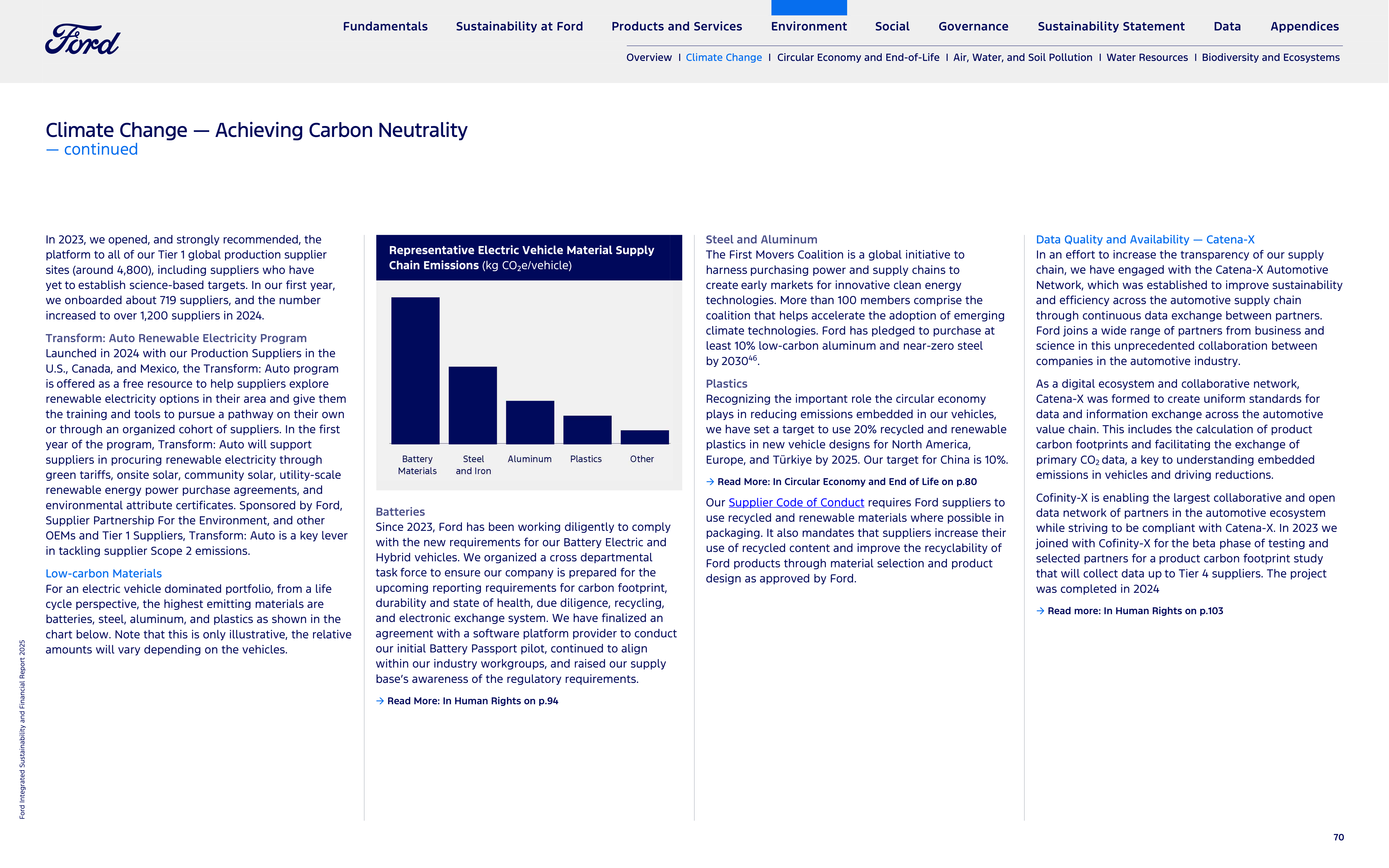
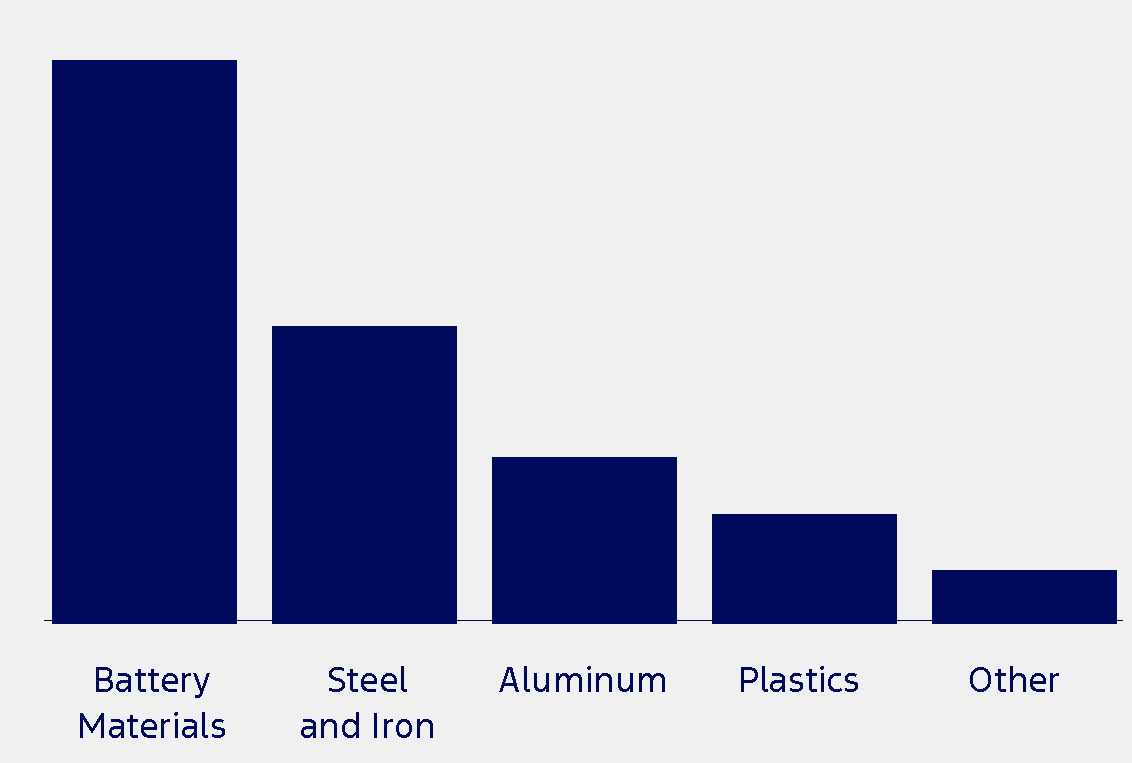
Fundamentals
Sustainability at Ford
Products and Services
Environment
Social
Governance
Sustainability Statement
Data
Appendices
Overview |
Climate Change
| Circular Economy and End-of-Life | Air, Water, and Soil Pollution | Water Resources | Biodiversity and Ecosystems
Climate Change — Achieving Carbon Neutrality
— continued
Ford Integrated Sustainability and Financial Report 2025
70
Battery
Materials
Steel
and Iron
Aluminum
Plastics
Other
In 2023, we opened, and strongly recommended, the
platform to all of our Tier 1 global production supplier
sites (around 4,800), including suppliers who have
yet to establish science-based targets. In our first year,
we onboarded about 719 suppliers, and the number
increased to over 1,200 suppliers in 2024.
Transform: Auto Renewable Electricity Program
Launched in 2024 with our Production Suppliers in the
U.S., Canada, and Mexico, the Transform: Auto program
is offered as a free resource to help suppliers explore
renewable electricity options in their area and give them
the training and tools to pursue a pathway on their own
or through an organized cohort of suppliers. In the first
year of the program, Transform: Auto will support
suppliers in procuring renewable electricity through
green tariffs, onsite solar, community solar, utility-scale
renewable energy power purchase agreements, and
environmental attribute certificates. Sponsored by Ford,
Supplier Partnership For the Environment, and other
OEMs and Tier 1 Suppliers, Transform: Auto is a key lever
in tackling supplier Scope 2 emissions.
Low-carbon Materials
For an electric vehicle dominated portfolio, from a life
cycle perspective, the highest emitting materials are
batteries, steel, aluminum, and plastics as shown in the
chart below. Note that this is only illustrative, the relative
amounts will vary depending on the vehicles.
Representative Electric Vehicle Material Supply
Chain Emissions
(kg CO₂e/vehicle)
Batteries
Since 2023, Ford has been working diligently to comply
with the new requirements for our Battery Electric and
Hybrid vehicles. We organized a cross departmental
task force to ensure our company is prepared for the
upcoming reporting requirements for carbon footprint,
durability and state of health, due diligence, recycling,
and electronic exchange system. We have finalized an
agreement with a software platform provider to conduct
our initial Battery Passport pilot, continued to align
within our industry workgroups, and raised our supply
base’s awareness of the regulatory requirements.
→
Read More: In Human Rights on p.94
Steel and Aluminum
The First Movers Coalition is a global initiative to
harness purchasing power and supply chains to
create early markets for innovative clean energy
technologies. More than 100 members comprise the
coalition that helps accelerate the adoption of emerging
climate technologies. Ford has pledged to purchase at
least 10% low-carbon aluminum and near-zero steel
by 2030
46
.
Plastics
Recognizing the important role the circular economy
plays in reducing emissions embedded in our vehicles,
we have set a target to use 20% recycled and renewable
plastics in new vehicle designs for North America,
Europe, and Türkiye by 2025. Our target for China is 10%.
→
Read More: In Circular Economy and End of Life on p.80
Our
Supplier Code of Conduct
requires Ford suppliers to
use recycled and renewable materials where possible in
packaging. It also mandates that suppliers increase their
use of recycled content and improve the recyclability of
Ford products through material selection and product
design as approved by Ford.
Data Quality and Availability — Catena-X
In an effort to increase the transparency of our supply
chain, we have engaged with the Catena-X Automotive
Network, which was established to improve sustainability
and efficiency across the automotive supply chain
through continuous data exchange between partners.
Ford joins a wide range of partners from business and
science in this unprecedented collaboration between
companies in the automotive industry.
As a digital ecosystem and collaborative network,
Catena-X was formed to create uniform standards for
data and information exchange across the automotive
value chain. This includes the calculation of product
carbon footprints and facilitating the exchange of
primary CO
2
data, a key to understanding embedded
emissions in vehicles and driving reductions.
Cofinity-X is enabling the largest collaborative and open
data network of partners in the automotive ecosystem
while striving to be compliant with Catena-X. In 2023 we
joined with Cofinity-X for the beta phase of testing and
selected partners for a product carbon footprint study
that will collect data up to Tier 4 suppliers. The project
was completed in 2024
→
Read more: In Human Rights on p.103
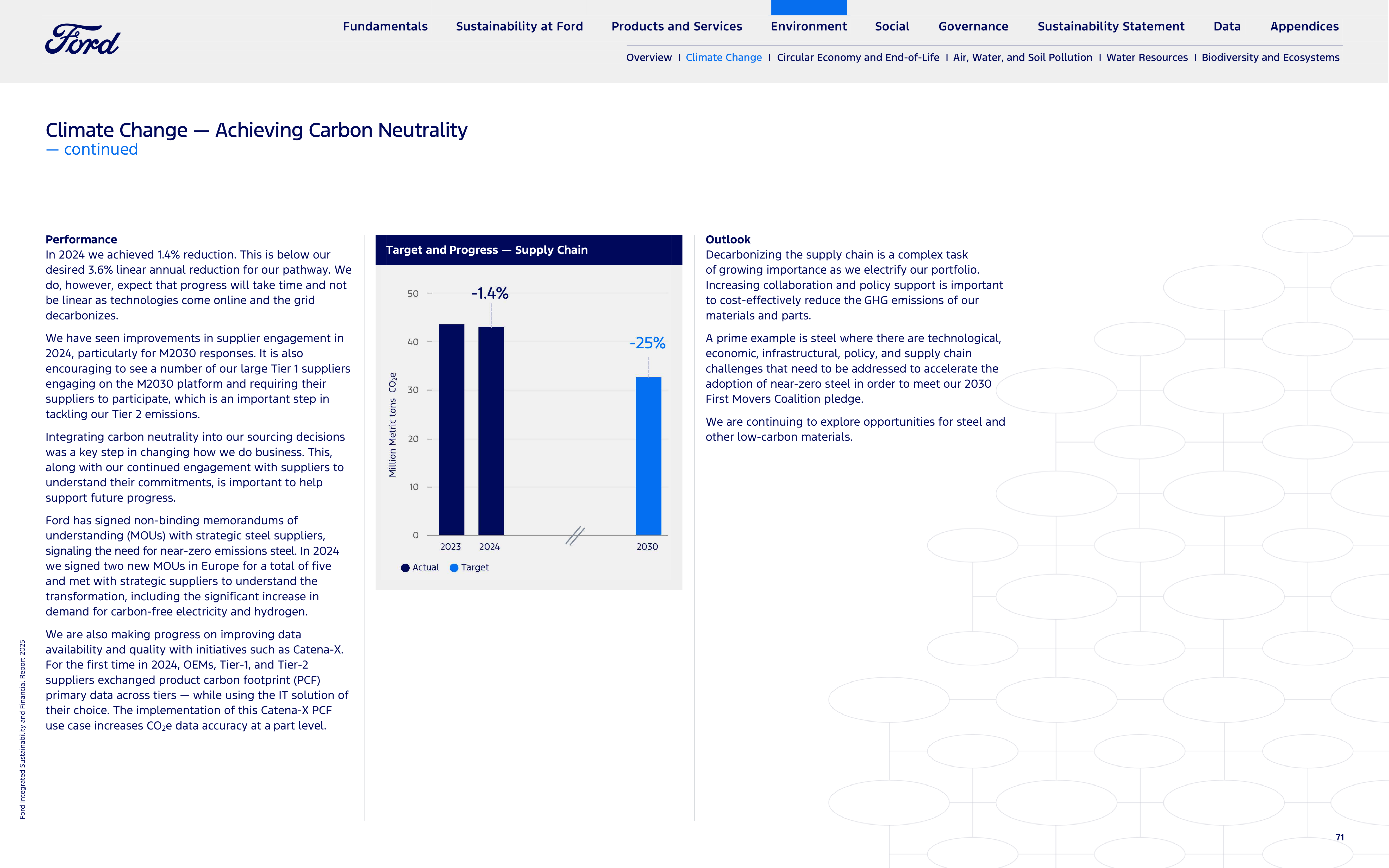

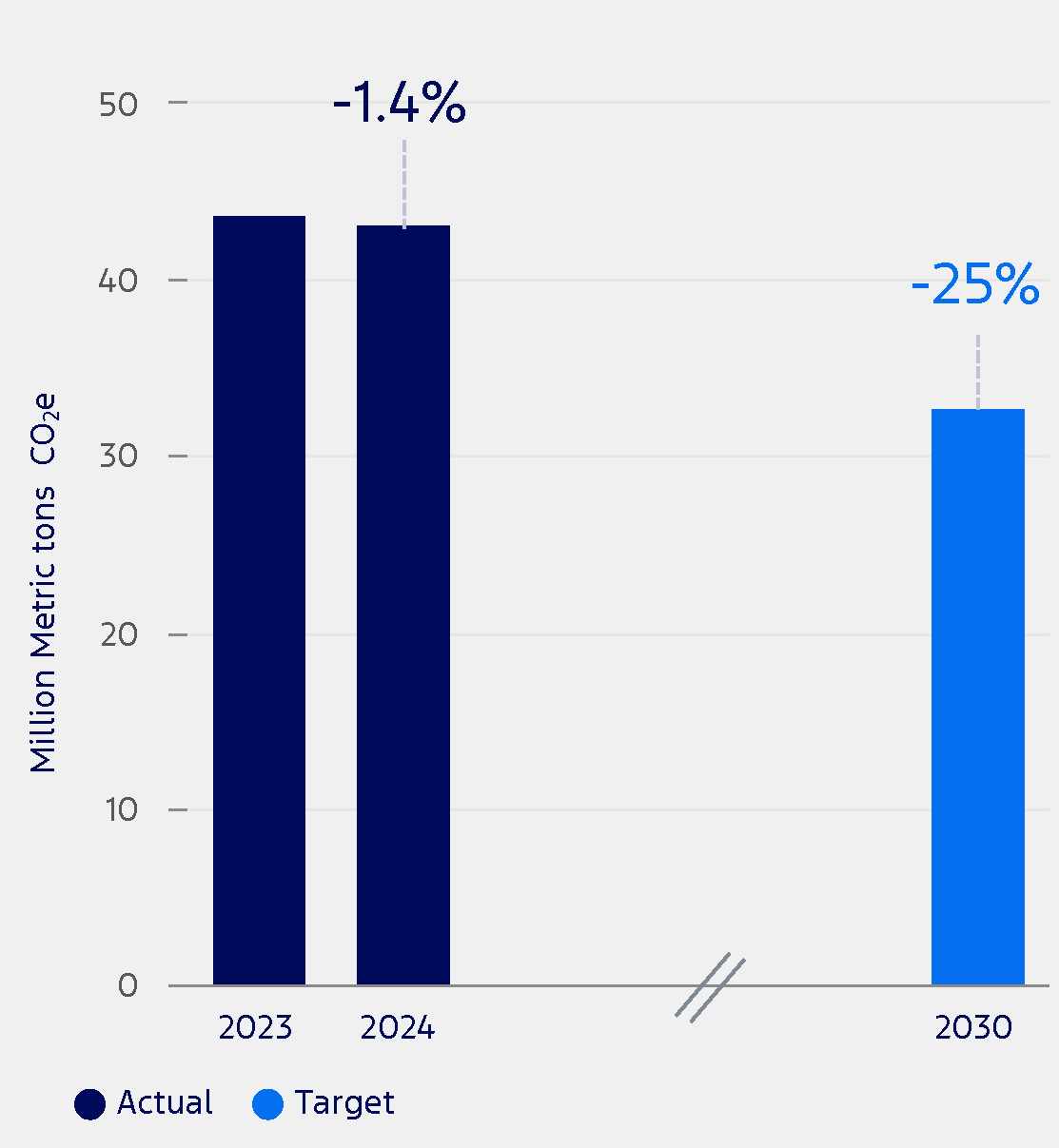
Fundamentals
Sustainability at Ford
Products and Services
Environment
Social
Governance
Sustainability Statement
Data
Appendices
Overview |
Climate Change
| Circular Economy and End-of-Life | Air, Water, and Soil Pollution | Water Resources | Biodiversity and Ecosystems
Performance
In 2024 we achieved 1.4% reduction. This is below our
desired 3.6% linear annual reduction for our pathway. We
do, however, expect that progress will take time and not
be linear as technologies come online and the grid
decarbonizes.
We have seen improvements in supplier engagement in
2024, particularly for M2030 responses. It is also
encouraging to see a number of our large Tier 1 suppliers
engaging on the M2030 platform and requiring their
suppliers to participate, which is an important step in
tackling our Tier 2 emissions.
Integrating carbon neutrality into our sourcing decisions
was a key step in changing how we do business. This,
along with our continued engagement with suppliers to
understand their commitments, is important to help
support future progress.
Ford has signed non-binding memorandums of
understanding (MOUs) with strategic steel suppliers,
signaling the need for near-zero emissions steel. In 2024
we signed two new MOUs in Europe for a total of five
and met with strategic suppliers to understand the
transformation, including the significant increase in
demand for carbon-free electricity and hydrogen.
We are also making progress on improving data
availability and quality with initiatives such as Catena-X.
For the first time in 2024, OEMs, Tier-1, and Tier-2
suppliers exchanged product carbon footprint (PCF)
primary data across tiers — while using the IT solution of
their choice. The implementation of this Catena-X PCF
use case increases CO
2
e data accuracy at a part level.
Target and Progress — Supply Chain
2023
2024
2030
0
10
20
30
40
50
Million Metric tons CO
2
e
●
Actual
●
Target
Outlook
Decarbonizing the supply chain is a complex task
of growing importance as we electrify our portfolio.
Increasing collaboration and policy support is important
to cost-effectively reduce the GHG emissions of our
materials and parts.
A prime example is steel where there are technological,
economic, infrastructural, policy, and supply chain
challenges that need to be addressed to accelerate the
adoption of near-zero steel in order to meet our 2030
First Movers Coalition pledge.
We are continuing to explore opportunities for steel and
other low-carbon materials.
Climate Change — Achieving Carbon Neutrality
— continued
Ford Integrated Sustainability and Financial Report 2025
71
-1.4%
-25%
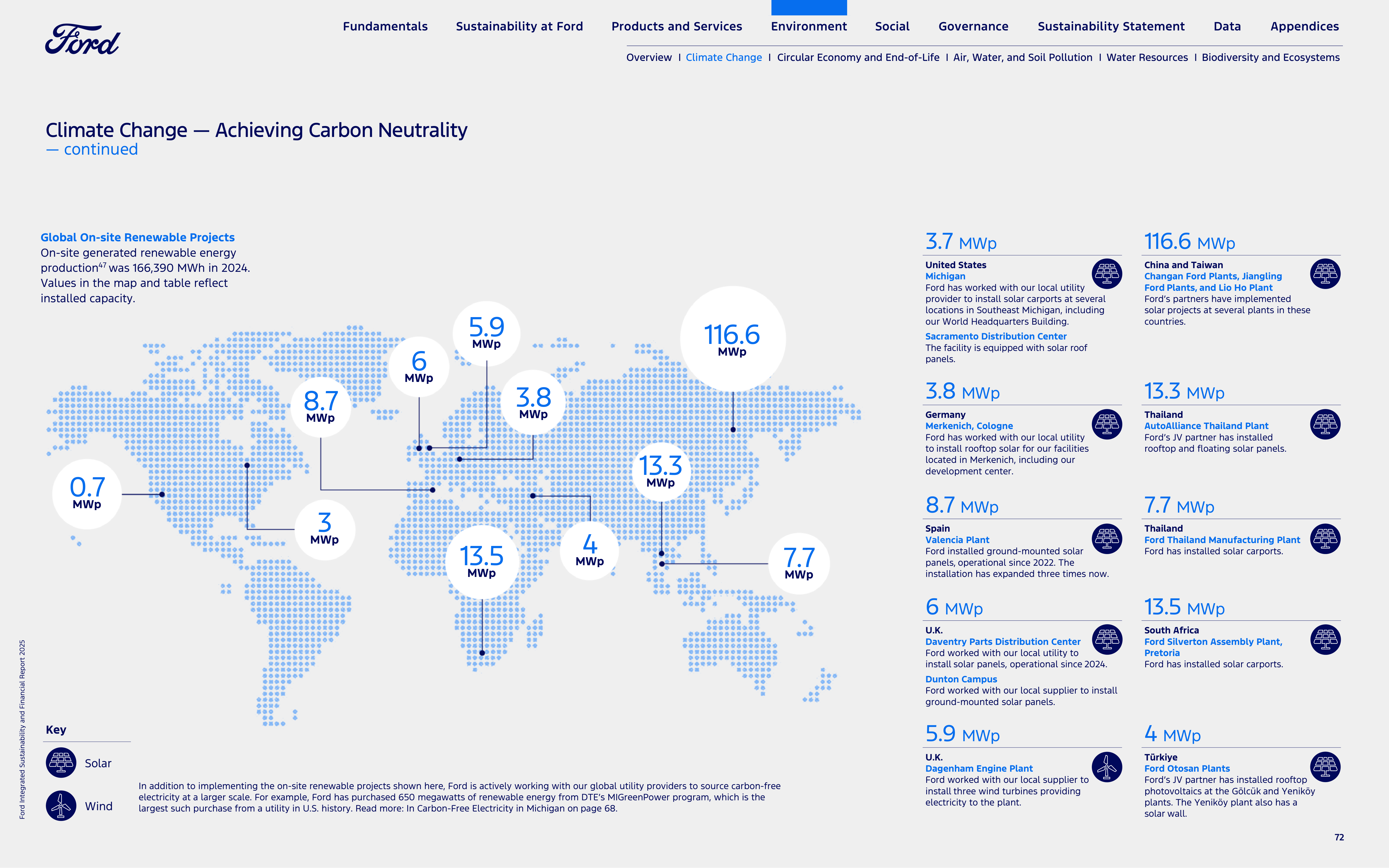
Fundamentals
Sustainability at Ford
Products and Services
Environment
Social
Governance
Sustainability Statement
Data
Appendices
Overview |
Climate Change
| Circular Economy and End-of-Life | Air, Water, and Soil Pollution | Water Resources | Biodiversity and Ecosystems
Climate Change — Achieving Carbon Neutrality
— continued
Ford Integrated Sustainability and Financial Report 2025
72
Global On-site Renewable Projects
On-site generated renewable energy
production
47
was 166,390 MWh in 2024.
Values in the map and table reflect
installed capacity.
In addition to implementing the on-site renewable projects shown here, Ford is actively working with our global utility providers to source carbon-free
electricity at a larger scale. For example, Ford has purchased 650 megawatts of renewable energy from DTE’s MIGreenPower program, which is the
largest such purchase from a utility in U.S. history. Read more: In Carbon-Free Electricity in Michigan on page 68.
3.7
MWp
United States
Michigan
Ford has worked with our local utility
provider to install solar carports at several
locations in Southeast Michigan, including
our World Headquarters Building.
Sacramento Distribution Center
The facility is equipped with solar roof
panels.
3.8
MWp
Germany
Merkenich, Cologne
Ford has worked with our local utility
to install rooftop solar for our facilities
located in Merkenich, including our
development center.
8.7
MWp
Spain
Valencia Plant
Ford installed ground-mounted solar
panels, operational since 2022. The
installation has expanded three times now.
6
MWp
U.K.
Daventry Parts Distribution Center
Ford worked with our local utility to
install solar panels, operational since 2024.
Dunton Campus
Ford worked with our local supplier to install
ground-mounted solar panels.
5.9
MWp
U.K.
Dagenham Engine Plant
Ford worked with our local supplier to
install three wind turbines providing
electricity to the plant.
116.6
MWp
China and Taiwan
Changan Ford Plants, Jiangling
Ford Plants, and Lio Ho Plant
Ford’s partners have implemented
solar projects at several plants in these
countries.
13.3
MWp
Thailand
AutoAlliance Thailand Plant
Ford’s JV partner has installed
rooftop and floating solar panels.
7.7
MWp
Thailand
Ford Thailand Manufacturing Plant
Ford has installed solar carports.
13.5
MWp
South Africa
Ford Silverton Assembly Plant,
Pretoria
Ford has installed solar carports.
4
MWp
Türkiye
Ford Otosan Plants
Ford’s JV partner has installed rooftop
photovoltaics at the Gölcük and Yeniköy
plants. The Yeniköy plant also has a
solar wall.
0.7
MWp
8.7
MWp
5.9
MWp
3.8
MWp
13.5
MWp
13.3
MWp
116.6
MWp
7.7
MWp
4
MWp
3
MWp
Key
Solar
Wind
6
MWp
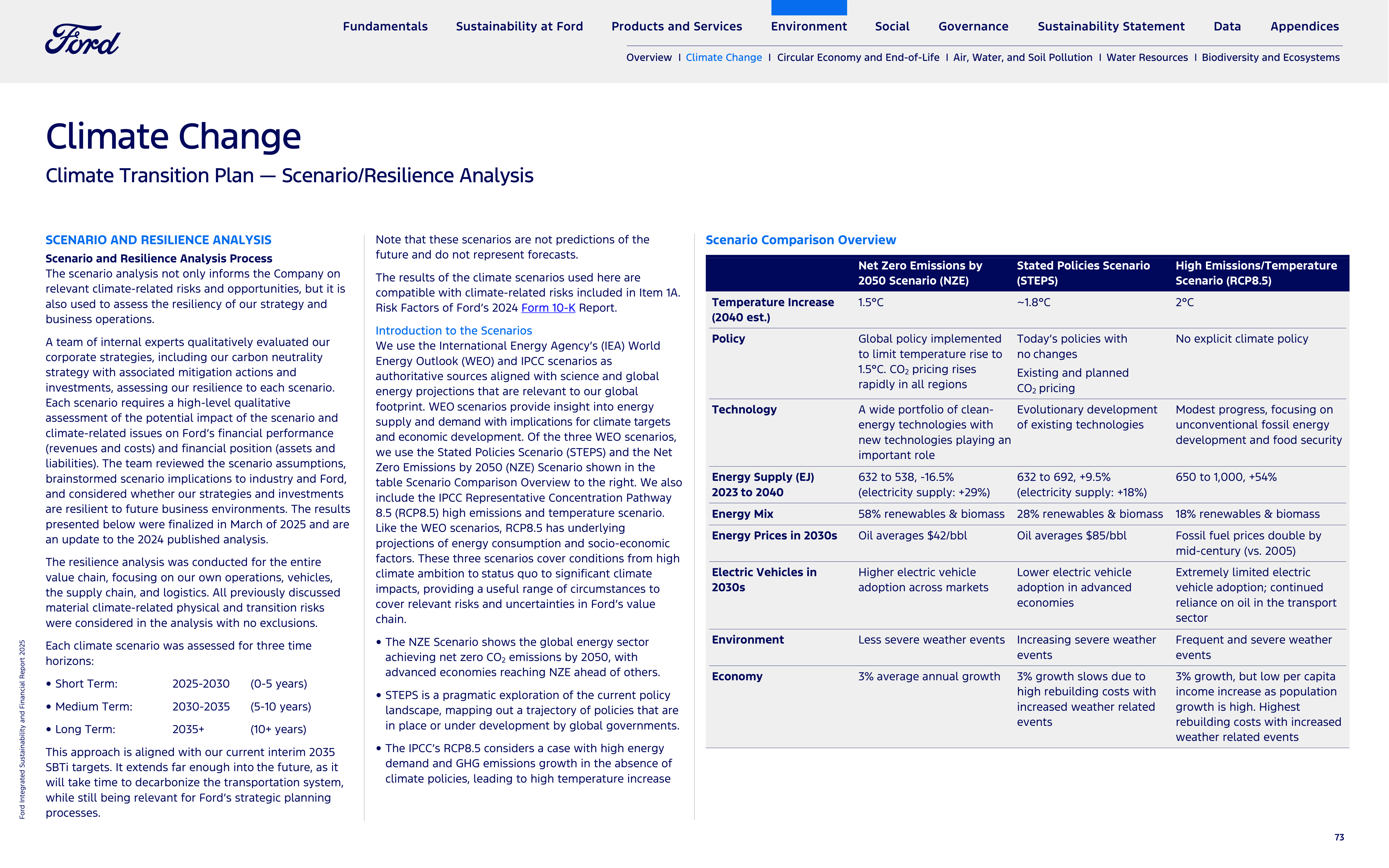
Fundamentals
Sustainability at Ford
Products and Services
Environment
Social
Governance
Sustainability Statement
Data
Appendices
Overview |
Climate Change
| Circular Economy and End-of-Life | Air, Water, and Soil Pollution | Water Resources | Biodiversity and Ecosystems
Climate Change
Climate Transition Plan — Scenario/Resilience Analysis
SCENARIO AND RESILIENCE ANALYSIS
Scenario and Resilience Analysis Process
The scenario analysis not only informs the Company on
relevant climate-related risks and opportunities, but it is
also used to assess the resiliency of our strategy and
business operations.
A team of internal experts qualitatively evaluated our
corporate strategies, including our carbon neutrality
strategy with associated mitigation actions and
investments, assessing our resilience to each scenario.
Each scenario requires a high-level qualitative
assessment of the potential impact of the scenario and
climate-related issues on Ford’s financial performance
(revenues and costs) and financial position (assets and
liabilities). The team reviewed the scenario assumptions,
brainstormed scenario implications to industry and Ford,
and considered whether our strategies and investments
are resilient to future business environments. The results
presented below were finalized in March of 2025 and are
an update to the 2024 published analysis.
The resilience analysis was conducted for the entire
value chain, focusing on our own operations, vehicles,
the supply chain, and logistics. All previously discussed
material climate-related physical and transition risks
were considered in the analysis with no exclusions.
Each climate scenario was assessed for three time
horizons:
•
Short Term:
2025-2030
(0-5 years)
•
Medium Term:
2030-2035
(5-10 years)
•
Long Term:
2035+
(10+ years)
This approach is aligned with our current interim 2035
SBTi targets. It extends far enough into the future, as it
will take time to decarbonize the transportation system,
while still being relevant for Ford’s strategic planning
processes.
Note that these scenarios are not predictions of the
future and do not represent forecasts.
The results of the climate scenarios used here are
compatible with climate-related risks included in Item 1A.
Risk Factors of Ford’s 2024
Form 10-K
Report.
Introduction to the Scenarios
We use the International Energy Agency’s (IEA) World
Energy Outlook (WEO) and IPCC scenarios as
authoritative sources aligned with science and global
energy projections that are relevant to our global
footprint. WEO scenarios provide insight into energy
supply and demand with implications for climate targets
and economic development. Of the three WEO scenarios,
we use the Stated Policies Scenario (STEPS) and the Net
Zero Emissions by 2050 (NZE) Scenario shown in the
table Scenario Comparison Overview to the right. We also
include the IPCC Representative Concentration Pathway
8.5 (RCP8.5) high emissions and temperature scenario.
Like the WEO scenarios, RCP8.5 has underlying
projections of energy consumption and socio-economic
factors. These three scenarios cover conditions from high
climate ambition to status quo to significant climate
impacts, providing a useful range of circumstances to
cover relevant risks and uncertainties in Ford’s value
chain.
•
The NZE Scenario shows the global energy sector
achieving net zero CO
2
emissions by 2050, with
advanced economies reaching NZE ahead of others.
•
STEPS is a pragmatic exploration of the current policy
landscape, mapping out a trajectory of policies that are
in place or under development by global governments.
•
The IPCC’s RCP8.5 considers a case with high energy
demand and GHG emissions growth in the absence of
climate policies, leading to high temperature increase
Scenario Comparison Overview
Net Zero Emissions by
2050 Scenario (NZE)
Stated Policies Scenario
(STEPS)
High Emissions/Temperature
Scenario (RCP8.5)
Temperature Increase
(2040 est.)
1.5°C
~1.8°C
2°C
Policy
Global policy implemented
to limit temperature rise to
1.5°C. CO
2
pricing rises
rapidly in all regions
Today’s policies with
no changes
Existing and planned
CO
2
pricing
No explicit climate policy
Technology
A wide portfolio of clean-
energy technologies with
new technologies playing an
important role
Evolutionary development
of existing technologies
Modest progress, focusing on
unconventional fossil energy
development and food security
Energy Supply (EJ)
2023 to 2040
632 to 538, -16.5%
(electricity supply: +29%)
632 to 692, +9.5%
(electricity supply: +18%)
650 to 1,000, +54%
Energy Mix
58% renewables & biomass
28% renewables & biomass
18% renewables & biomass
Energy Prices in 2030s
Oil averages $42/bbl
Oil averages $85/bbl
Fossil fuel prices double by
mid-century (vs. 2005)
Electric Vehicles in
2030s
Higher electric vehicle
adoption across markets
Lower electric vehicle
adoption in advanced
economies
Extremely limited electric
vehicle adoption; continued
reliance on oil in the transport
sector
Environment
Less severe weather events
Increasing severe weather
events
Frequent and severe weather
events
Economy
3% average annual growth
3% growth slows due to
high rebuilding costs with
increased weather related
events
3% growth, but low per capita
income increase as population
growth is high. Highest
rebuilding costs with increased
weather related events
Ford Integrated Sustainability and Financial Report 2025
73
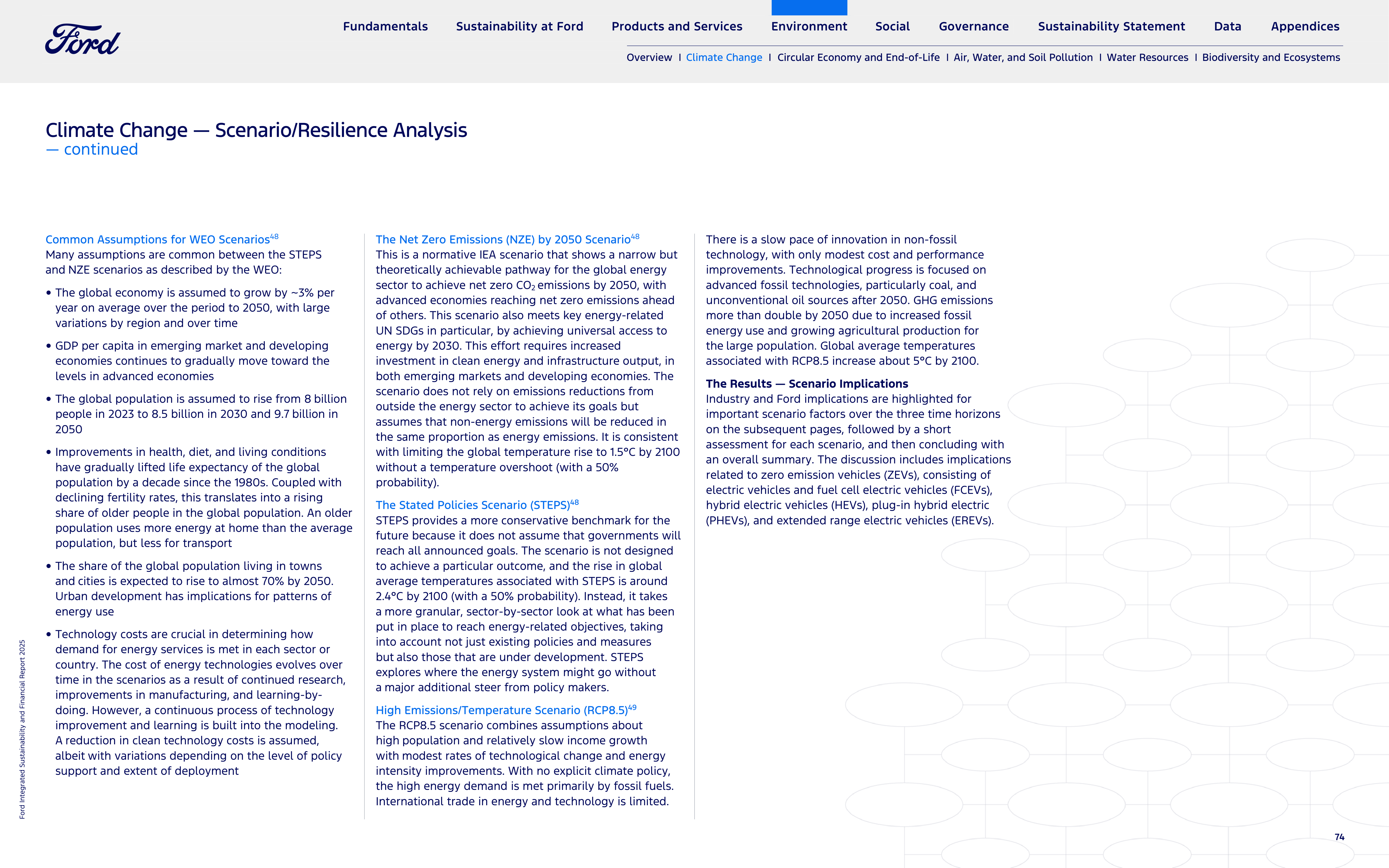

Fundamentals
Sustainability at Ford
Products and Services
Environment
Social
Governance
Sustainability Statement
Data
Appendices
Overview |
Climate Change
| Circular Economy and End-of-Life | Air, Water, and Soil Pollution | Water Resources | Biodiversity and Ecosystems
Common Assumptions for WEO Scenarios
48
Many assumptions are common between the STEPS
and NZE scenarios as described by the WEO:
•
The global economy is assumed to grow by ~3% per
year on average over the period to 2050, with large
variations by region and over time
•
GDP per capita in emerging market and developing
economies continues to gradually move toward the
levels in advanced economies
•
The global population is assumed to rise from 8 billion
people in 2023 to 8.5 billion in 2030 and 9.7 billion in
2050
•
Improvements in health, diet, and living conditions
have gradually lifted life expectancy of the global
population by a decade since the 1980s. Coupled with
declining fertility rates, this translates into a rising
share of older people in the global population. An older
population uses more energy at home than the average
population, but less for transport
•
The share of the global population living in towns
and cities is expected to rise to almost 70% by 2050.
Urban development has implications for patterns of
energy use
•
Technology costs are crucial in determining how
demand for energy services is met in each sector or
country. The cost of energy technologies evolves over
time in the scenarios as a result of continued research,
improvements in manufacturing, and learning-by-
doing. However, a continuous process of technology
improvement and learning is built into the modeling.
A reduction in clean technology costs is assumed,
albeit with variations depending on the level of policy
support and extent of deployment
The Net Zero Emissions (NZE) by 2050 Scenario
48
This is a normative IEA scenario that shows a narrow but
theoretically achievable pathway for the global energy
sector to achieve net zero CO
2
emissions by 2050, with
advanced economies reaching net zero emissions ahead
of others. This scenario also meets key energy-related
UN SDGs in particular, by achieving universal access to
energy by 2030. This effort requires increased
investment in clean energy and infrastructure output, in
both emerging markets and developing economies. The
scenario does not rely on emissions reductions from
outside the energy sector to achieve its goals but
assumes that non-energy emissions will be reduced in
the same proportion as energy emissions. It is consistent
with limiting the global temperature rise to 1.5°C by 2100
without a temperature overshoot (with a 50%
probability).
The Stated Policies Scenario (STEPS)
48
STEPS provides a more conservative benchmark for the
future because it does not assume that governments will
reach all announced goals. The scenario is not designed
to achieve a particular outcome, and the rise in global
average temperatures associated with STEPS is around
2.4°C by 2100 (with a 50% probability). Instead, it takes
a more granular, sector-by-sector look at what has been
put in place to reach energy-related objectives, taking
into account not just existing policies and measures
but also those that are under development. STEPS
explores where the energy system might go without
a major additional steer from policy makers.
High Emissions/Temperature Scenario (RCP8.5)
49
The RCP8.5 scenario combines assumptions about
high population and relatively slow income growth
with modest rates of technological change and energy
intensity improvements. With no explicit climate policy,
the high energy demand is met primarily by fossil fuels.
International trade in energy and technology is limited.
There is a slow pace of innovation in non-fossil
technology, with only modest cost and performance
improvements. Technological progress is focused on
advanced fossil technologies, particularly coal, and
unconventional oil sources after 2050. GHG emissions
more than double by 2050 due to increased fossil
energy use and growing agricultural production for
the large population. Global average temperatures
associated with RCP8.5 increase about 5°C by 2100.
The Results — Scenario Implications
Industry and Ford implications are highlighted for
important scenario factors over the three time horizons
on the subsequent pages, followed by a short
assessment for each scenario, and then concluding with
an overall summary. The discussion includes implications
related to zero emission vehicles (ZEVs), consisting of
electric vehicles and fuel cell electric vehicles (FCEVs),
hybrid electric vehicles (HEVs), plug-in hybrid electric
(PHEVs), and extended range electric vehicles (EREVs).
Climate Change — Scenario/Resilience Analysis
— continued
Ford Integrated Sustainability and Financial Report 2025
74
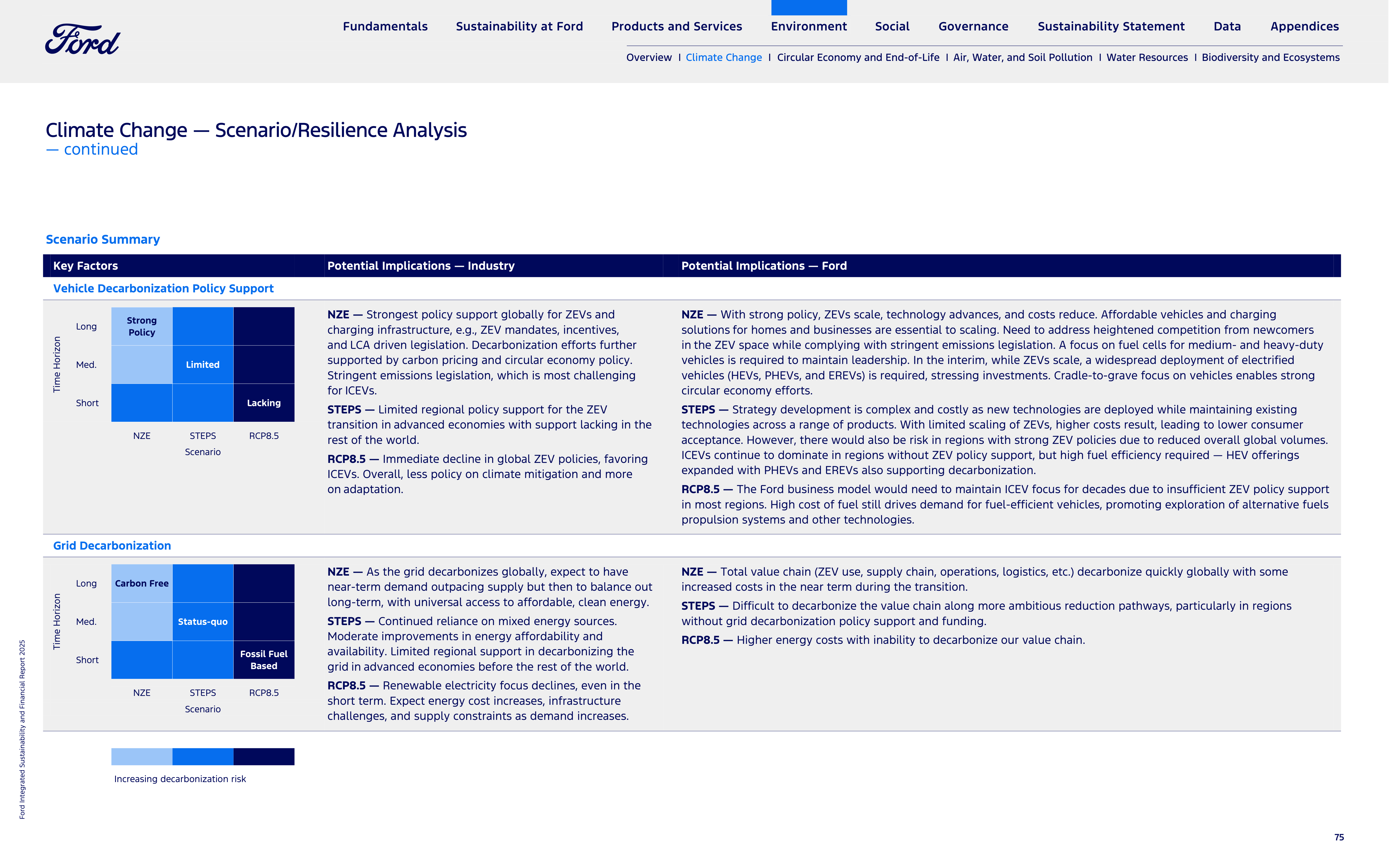
Fundamentals
Sustainability at Ford
Products and Services
Environment
Social
Governance
Sustainability Statement
Data
Appendices
Overview |
|
|
|
|
Climate Change
Circular Economy and End-of-Life
Air, Water, and Soil Pollution
Water Resources
Biodiversity and Ecosystems
Scenario Summary
Key Factors
Potential Implications — Industry
Potential Implications — Ford
Vehicle Decarbonization Policy Support
Time Horizon
Long
Strong
Policy
Med.
Limited
Short
Lacking
NZE
STEPS
RCP8.5
Scenario
NZE —
Strongest policy support globally for ZEVs and
charging infrastructure, e.g., ZEV mandates, incentives,
and LCA driven legislation. Decarbonization efforts further
supported by carbon pricing and circular economy policy.
Stringent emissions legislation, which is most challenging
for ICEVs.
STEPS —
Limited regional policy support for the ZEV
transition in advanced economies with support lacking in the
rest of the world.
RCP8.5 —
Immediate decline in global ZEV policies, favoring
ICEVs. Overall, less policy on climate mitigation and more
on adaptation.
NZE —
With strong policy, ZEVs scale, technology advances, and costs reduce. Affordable vehicles and charging
solutions for homes and businesses are essential to scaling. Need to address heightened competition from newcomers
in the ZEV space while complying with stringent emissions legislation. A focus on fuel cells for medium- and heavy-duty
vehicles is required to maintain leadership. In the interim, while ZEVs scale, a widespread deployment of electrified
vehicles (HEVs, PHEVs, and EREVs) is required, stressing investments. Cradle-to-grave focus on vehicles enables strong
circular economy efforts.
STEPS —
Strategy development is complex and costly as new technologies are deployed while maintaining existing
technologies across a range of products. With limited scaling of ZEVs, higher costs result, leading to lower consumer
acceptance. However, there would also be risk in regions with strong ZEV policies due to reduced overall global volumes.
ICEVs continue to dominate in regions without ZEV policy support, but high fuel efficiency required — HEV offerings
expanded with PHEVs and EREVs also supporting decarbonization.
RCP8.5 —
The Ford business model would need to maintain ICEV focus for decades due to insufficient ZEV policy support
in most regions. High cost of fuel still drives demand for fuel-efficient vehicles, promoting exploration of alternative fuels
propulsion systems and other technologies.
Grid Decarbonization
Time Horizon
Long
Carbon Free
Med.
Status-quo
Short
Fossil Fuel
Based
NZE
STEPS
RCP8.5
Scenario
NZE —
As the grid decarbonizes globally, expect to have
near‑term demand outpacing supply but then to balance out
long-term, with universal access to affordable, clean energy.
STEPS —
Continued reliance on mixed energy sources.
Moderate improvements in energy affordability and
availability. Limited regional support in decarbonizing the
grid in advanced economies before the rest of the world.
RCP8.5 —
Renewable electricity focus declines, even in the
short term. Expect energy cost increases, infrastructure
challenges, and supply constraints as demand increases.
NZE —
Total value chain (ZEV use, supply chain, operations, logistics, etc.) decarbonize quickly globally with some
increased costs in the near term during the transition.
STEPS —
Difficult to decarbonize the value chain along more ambitious reduction pathways, particularly in regions
without grid decarbonization policy support and funding.
RCP8.5 —
Higher energy costs with inability to decarbonize our value chain.
Increasing decarbonization risk
Climate Change — Scenario/Resilience Analysis
— continued
Ford Integrated Sustainability and Financial Report 2025
75
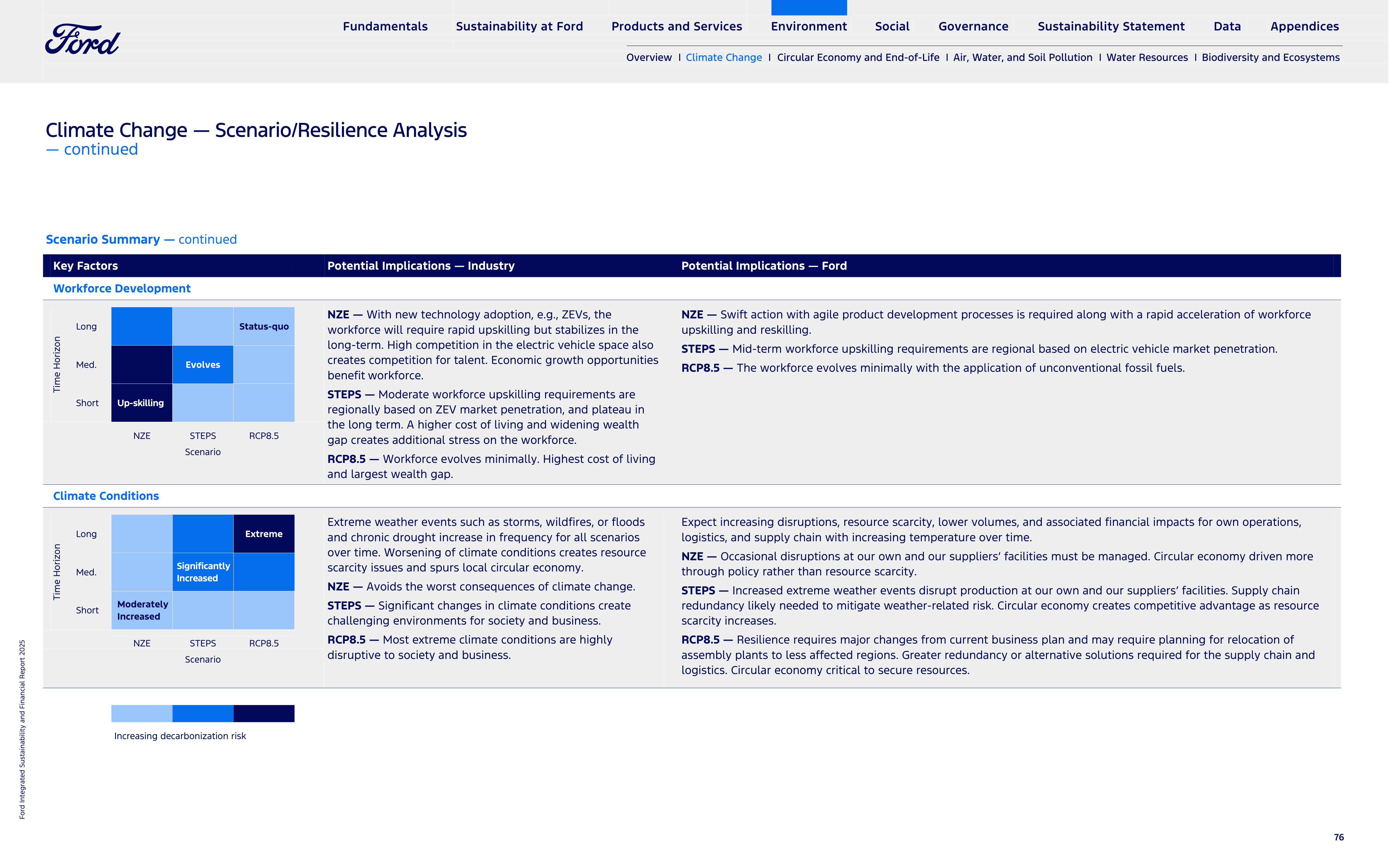
Workforce Development
Time Horizon
Long
Status-quo
Med.
Evolves
Short
Up-skilling
NZE
STEPS
RCP8.5
Scenario
NZE —
With new technology adoption, e.g., ZEVs, the
workforce will require rapid upskilling but stabilizes in the
long-term. High competition in the electric vehicle space also
creates competition for talent. Economic growth opportunities
benefit workforce.
STEPS —
Moderate workforce upskilling requirements are
regionally based on ZEV market penetration, and plateau in
the long term. A higher cost of living and widening wealth
gap creates additional stress on the workforce.
RCP8.5 —
Workforce evolves minimally. Highest cost of living
and largest wealth gap.
NZE —
Swift action with agile product development processes is required along with a rapid acceleration of workforce
upskilling and reskilling.
STEPS —
Mid-term workforce upskilling requirements are regional based on electric vehicle market penetration.
RCP8.5 —
The workforce evolves minimally with the application of unconventional fossil fuels.
Climate Conditions
Time Horizon
Long
Extreme
Med.
Significantly
Increased
Short
Moderately
Increased
NZE
STEPS
RCP8.5
Scenario
Extreme weather events such as storms, wildfires, or floods
and chronic drought increase in frequency for all scenarios
over time. Worsening of climate conditions creates resource
scarcity issues and spurs local circular economy.
NZE —
Avoids the worst consequences of climate change.
STEPS —
Significant changes in climate conditions create
challenging environments for society and business.
RCP8.5 —
Most extreme climate conditions are highly
disruptive to society and business.
Expect increasing disruptions, resource scarcity, lower volumes, and associated financial impacts for own operations,
logistics, and supply chain with increasing temperature over time.
NZE —
Occasional disruptions at our own and our suppliers’ facilities must be managed. Circular economy driven more
through policy rather than resource scarcity.
STEPS —
Increased extreme weather events disrupt production at our own and our suppliers’ facilities. Supply chain
redundancy likely needed to mitigate weather-related risk. Circular economy creates competitive advantage as resource
scarcity increases.
RCP8.5 —
Resilience requires major changes from current business plan and may require planning for relocation of
assembly plants to less affected regions. Greater redundancy or alternative solutions required for the supply chain and
logistics. Circular economy critical to secure resources.
Increasing decarbonization risk
Fundamentals
Sustainability at Ford
Products and Services
Environment
Social
Governance
Sustainability Statement
Data
Appendices
Overview |
|
|
|
|
Climate Change
Circular Economy and End-of-Life
Air, Water, and Soil Pollution
Water Resources
Biodiversity and Ecosystems
Climate Change — Scenario/Resilience Analysis
— continued
Ford Integrated Sustainability and Financial Report 2025
76
Scenario Summary —
continued
Key Factors
Potential Implications — Industry
Potential Implications — Ford
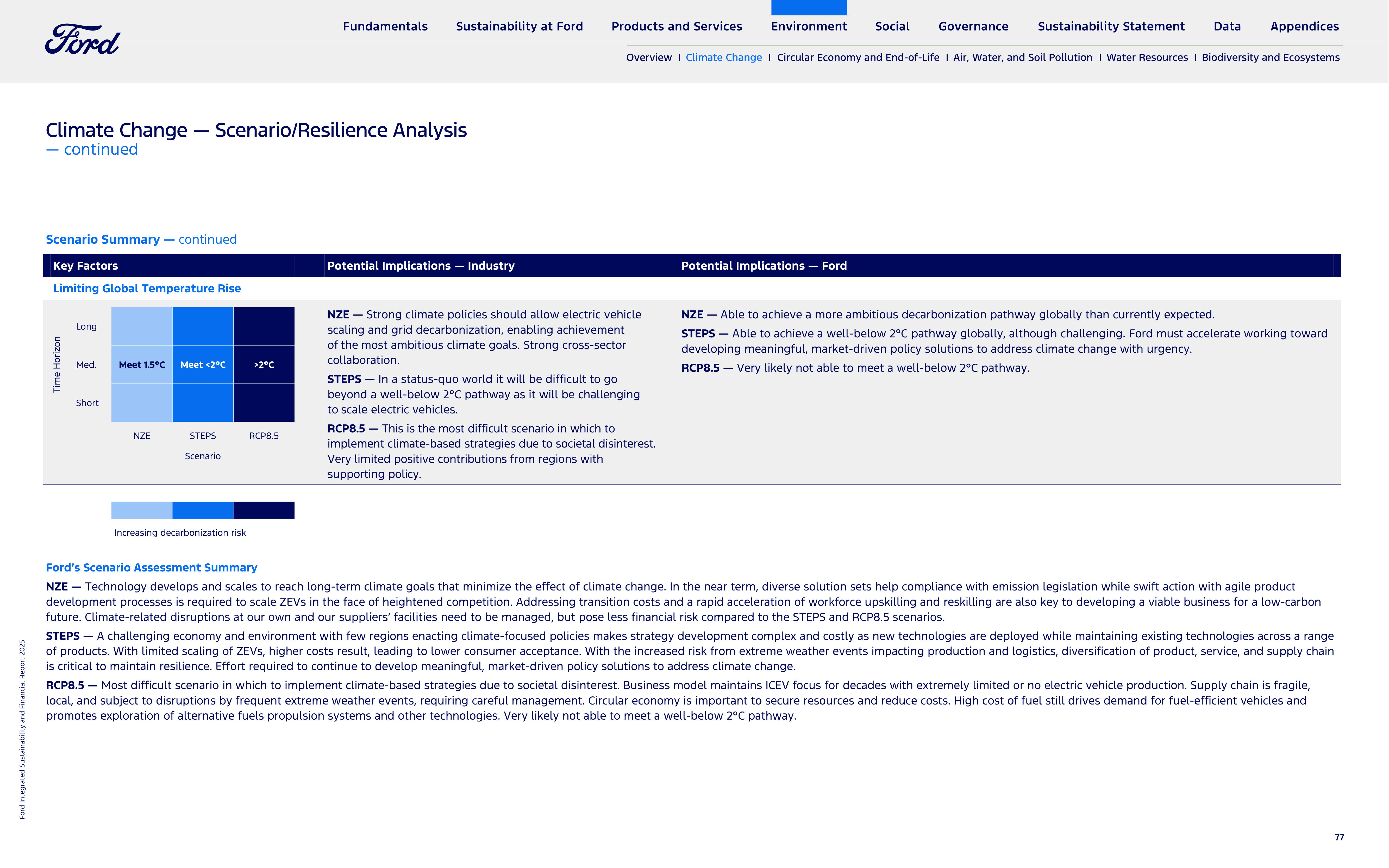
Limiting Global Temperature Rise
Time Horizon
Long
Med.
Increasing Meet 1.5°C
decarbonization Meet <2°C
risk >2°C
Short
NZE
STEPS
RCP8.5
Scenario
NZE —
Strong climate policies should allow electric vehicle
scaling and grid decarbonization, enabling achievement
of the most ambitious climate goals. Strong cross-sector
collaboration.
STEPS —
In a status-quo world it will be difficult to go
beyond a well-below 2°C pathway as it will be challenging
to scale electric vehicles.
RCP8.5 —
This is the most difficult scenario in which to
implement climate-based strategies due to societal disinterest.
Very limited positive contributions from regions with
supporting policy.
NZE —
Able to achieve a more ambitious decarbonization pathway globally than currently expected.
STEPS —
Able to achieve a well-below 2°C pathway globally, although challenging. Ford must accelerate working toward
developing meaningful, market-driven policy solutions to address climate change with urgency.
RCP8.5 —
Very likely not able to meet a well-below 2°C pathway.
Increasing decarbonization risk
Fundamentals
Sustainability at Ford
Products and Services
Environment
Social
Governance
Sustainability Statement
Data
Appendices
Overview |
|
|
|
|
Climate Change
Circular Economy and End-of-Life
Air, Water, and Soil Pollution
Water Resources
Biodiversity and Ecosystems
Ford’s Scenario Assessment Summary
NZE —
Technology develops and scales to reach long-term climate goals that minimize the effect of climate change. In the near term, diverse solution sets help compliance with emission legislation while swift action with agile product
development processes is required to scale ZEVs in the face of heightened competition. Addressing transition costs and a rapid acceleration of workforce upskilling and reskilling are also key to developing a viable business for a low-carbon
future. Climate-related disruptions at our own and our suppliers’ facilities need to be managed, but pose less financial risk compared to the STEPS and RCP8.5 scenarios.
STEPS —
A challenging economy and environment with few regions enacting climate-focused policies makes strategy development complex and costly as new technologies are deployed while maintaining existing technologies across a range
of products. With limited scaling of ZEVs, higher costs result, leading to lower consumer acceptance. With the increased risk from extreme weather events impacting production and logistics, diversification of product, service, and supply chain
is critical to maintain resilience. Effort required to continue to develop meaningful, market-driven policy solutions to address climate change.
RCP8.5 —
Most difficult scenario in which to implement climate-based strategies due to societal disinterest. Business model maintains ICEV focus for decades with extremely limited or no electric vehicle production. Supply chain is fragile,
local, and subject to disruptions by frequent extreme weather events, requiring careful management. Circular economy is important to secure resources and reduce costs. High cost of fuel still drives demand for fuel-efficient vehicles and
promotes exploration of alternative fuels propulsion systems and other technologies. Very likely not able to meet a well-below 2°C pathway.
Climate Change — Scenario/Resilience Analysis
— continued
Ford Integrated Sustainability and Financial Report 2025
77
Scenario Summary —
continued
Key Factors
Potential Implications — Industry
Potential Implications — Ford
Fundamentals
Sustainability at Ford
Products and Services
Environment
Social
Governance
Sustainability Statement
Data
Appendices
Overview |
|
|
|
|
Climate Change
Circular Economy and End-of-Life
Air, Water, and Soil Pollution
Water Resources
Biodiversity and Ecosystems
Scenario Analysis Summary
These scenarios expose the challenges and complexity
of decarbonizing the entire automotive value chain. The
path forward will be influenced by key factors such as
policy, ZEV and carbon-free grid infrastructure, low-
carbon technology, and market dynamics. There is
significant uncertainty as to how these factors will
develop over time, and they are also likely to differ
across product segments and regions.
We expect that passenger vehicles will be carbon neutral
before larger commercial vehicles due to technical
challenges decarbonizing the latter. However, a key
concern in general is the pace of uptake and the
achievable ZEV market share. Where there is a lack of a
comprehensive, market-driven carbon-pricing solutions,
such as in the case of the STEPS and RCP8.5 scenarios,
lower-than-expected ZEV demand could result in
increased costs and decreased ZEV sales and revenue.
Under such conditions there is high risk that Ford, and
companies in most industries, would not be able to
decarbonize the entire value chain to achieve climate and
energy aspirations. Consequently, it is anticipated that
carbon neutrality will be reached first in advanced
economies with supporting policies before the rest of the
world. Having strong ZEV policy support across advanced
economies is also key to capitalizing on global scale and
being competitive, particularly with ZEV-only OEMs in
regions with policy support.
With the uncertainty as to how the market will develop,
a critical take-away from this future scenario analysis is
a need for a diverse yet global set of environmentally
friendly technology solutions that are responsive to the
changing needs of our customers.
Furthermore, as the temperature rises over time and
climate-related disruptions increase, we will need to
ensure resilience with appropriate adaptation measures
in our own operations, supply chain, and our logistics.
A significant disruption to our production would lower
volumes and have a substantial adverse effect on our
financial condition.
Overall there are a number of internal and external
factors that are critical to success as we work toward
carbon neutrality: our product portfolio including our ZEV
strategy, operations, supply chain, logistics, public policy,
infrastructure development, and workforce.
The Results — Resilience of Ford’s Strategy
Ability to Respond
The scenario analysis highlights that significant effort is
required to transform our product portfolio, supply chain,
operations, logistics, and workforce to realize the
transition to a climate-neutral economy. A complete
transformation of the value chain, however, will take
decades, going beyond the time horizons of this
assessment. Our ability to respond is outlined below.
We cannot be certain that any expectation, forecast, or
assumption made in preparing these forward-looking
statements will prove accurate, or that any projection
will be realized. It is to be expected that there may be
differences between projected and actual results. Our
forward-looking statements speak only as of the date of
their initial issuance, and we do not undertake any
obligation to update or revise publicly any forward-
looking statement, whether as a result of new
information, future events, or otherwise.
Products and Electric Vehicle Adoption Enablers
We are committed to building a profitable, enduring
electric vehicle business for the long term. This will help
us address the largest source of our GHG emissions and
successfully compete in a low-carbon economy. To reach
this goal, we are currently focused on building a
profitable electric vehicle business that aligns investment
and manufacturing capacity with customer demand. This
includes:
•
Scaling and reducing costs of electric vehicles in
market today (as of the end of 2024)
•
Mustang Mach-E, F-150 Lightning, E-Transit, and in
Europe the newly launched Explorer, Capri, E-Transit
Custom, and E-Tourneo Custom
•
Next-gen electric vehicles take a system-level approach
•
Ford’s next-generation electric vehicle platform takes
a system-level approach to designing, sourcing, and
manufacturing with outcomes aimed at changing
customer expectations. Ford’s Advanced Electric
Vehicle Development team is questioning previous
assumptions rather than using an evolutionary
approach that builds upon existing designs
•
Increasing demand by removing barriers to adoption
•
Our U.S. customers have access to Tesla’s
Supercharger network and complimentary home
charging and installation for new buyers or leases
•
Helping fleets electrify
•
Ford Pro’s end-to-end solutions including electric
vehicles, charging, and software will help facilitate
businesses of all sizes to decarbonize, meet emerging
regulations, improve productivity, and lower total
cost of ownership
•
Remaking our battery footprint
•
This includes shifting our battery mix to LFP (Lithium
Iron Phosphate) and accelerating U.S. manufacturing
and creating an electric vehicle supply chain that
upholds Ford’s ESG values
Along this journey we anticipate that electric vehicle
technology will continue to advance and become more
affordable, while the grid will continue to decarbonize,
bolstering our confidence in achieving GHG reductions.
During the transition period to fully carbon neutral
transport, our approach of offering a broad choice of
lower emission powertrains also provides us with
resilience. For example, hybrids will be a key product
offering during the transition to electric vehicles,
particularly in markets where the electric vehicle
infrastructure is not mature.
We will partner when necessary to address key enablers,
leverage scale, and avoid capital destruction. For
example, Ford Pro is an integrated partner helping
customers decarbonize their fleets, not just with vehicles
but also charging solutions and productivity software.
Additionally, Ford electric vehicle customers have access
to more than 20,000 Tesla Superchargers across the U.S.
and Canada through the BlueOval Charge Network.
Ford’s response to the various scenarios will require
different solutions, but the building blocks are in place as
discussed above. Our electric vehicle foundation will
allow us to scale as the market grows, and we will
continue to address key enablers. Our lower-emission
ICEVs, including traditional hybrids and alternative fuel-
compatible vehicles, help decarbonize the business
in the transition or in the high temperature scenario.
Supply Chain
Decarbonizing the supply chain is a complex task
of growing importance as we electrify our portfolio. We
have put a number of enablers in place to reach our
near-term decarbonization target and long-term goals.
Collaboration with our suppliers, governments, and other
stakeholders is essential in the transition.
Climate Change — Scenario/Resilience Analysis
— continued
Ford Integrated Sustainability and Financial Report 2025
78

Fundamentals
Sustainability at Ford
Products and Services
Environment
Social
Governance
Sustainability Statement
Data
Appendices
Overview |
|
|
|
|
Climate Change
Circular Economy and End-of-Life
Air, Water, and Soil Pollution
Water Resources
Biodiversity and Ecosystems
Integrating supplier carbon neutrality status into
production sourcing decisions, requiring our suppliers to
increase energy efficiency and their use of carbon-free
electricity, and supporting suppliers with best practices
along the carbon neutrality journey are key enablers to
decarbonize the supply chain and meet climate targets.
We have increased attention and engagement with high
emitting suppliers, including batteries, steel, and
aluminum. Future green tech needs to be scalable,
reliable, and affordable to end customers. Having the
right policy support in place will likely be important to
facilitate these developments.
Operations
Ford also recognizes the need to ensure resiliency of our
operations, by redeploying, upgrading, or
decommissioning existing GHG and energy-intensive
assets. In the short term, Ford is evaluating opportunities
to replace or upgrade energy and GHG-intensive assets
as part of our budgeting process. For example, Ford is
planning paint shop upgrades at Oakville and Ohio
Assembly Plants that will result in a reduction in natural
gas-related Scope 1 GHG emissions from process
equipment. In the medium term, Ford will continue to
use our life cycle planning and budgeting processes to
replace or upgrade energy and GHG-intensive assets. To
progress toward our goal of achieving carbon neutrality
no later than 2050, Ford is also developing a long-term
plan for how we might best address GHG and energy-
intensive assets, with a specific focus on reducing
emissions from our production processes.
Implementation of this plan is expected to extend into
the long term.
Logistics
Investment is also required to decarbonize our logistics
network. Technology is in development to address these
hard-to-abate emissions with current solutions being
cost intensive. In the transition to affordable low-carbon
technology, Ford is working on projects such as the
examples listed below:
•
Bio-LNG vessels that move vehicles from Ford Otosan
in Türkiye to Ford of Europe and U.K. destinations
•
Road trial in Europe with HVO (Hydrotreated Vegetable
Oil), replacing diesel fuel, e.g., carrier moving
components to our assembly plants
•
Ongoing logistics network and packaging density
optimization globally
Also important to success here is policy support to help
facilitate the transition.
Workforce
We will continue to adapt our reskilling process to
address our changing vehicle portfolio. This includes our
commitment to the principles of lifelong learning,
embracing a growth mindset for career development,
and investing in job training and career readiness
initiatives, such as our work to train future employees on
advanced batteries at Tennessee Electric Vehicle Center
and BlueOval SK Battery Park.
Securing Finances
Ford’s Sustainable Financing Framework, introduced
in 2021, is supporting the financing of our clean
transportation projects and efforts to create positive
social and environmental benefits as we move towards a
carbon neutral transportation future.
By June 30, 2023, $4.21 billion, the total of the net
proceeds of the two bonds, had been fully allocated
to the design, development, and manufacture of the
company’s electric vehicle lineup as well as other
development activities that will benefit our entire electric
vehicle portfolio.
→
Read More: In the 2023 Sustainable Financing Report
→
Read More: In Products and Services on p.31
Climate Change — Scenario/Resilience Analysis
— continued
Ford Integrated Sustainability and Financial Report 2025
79
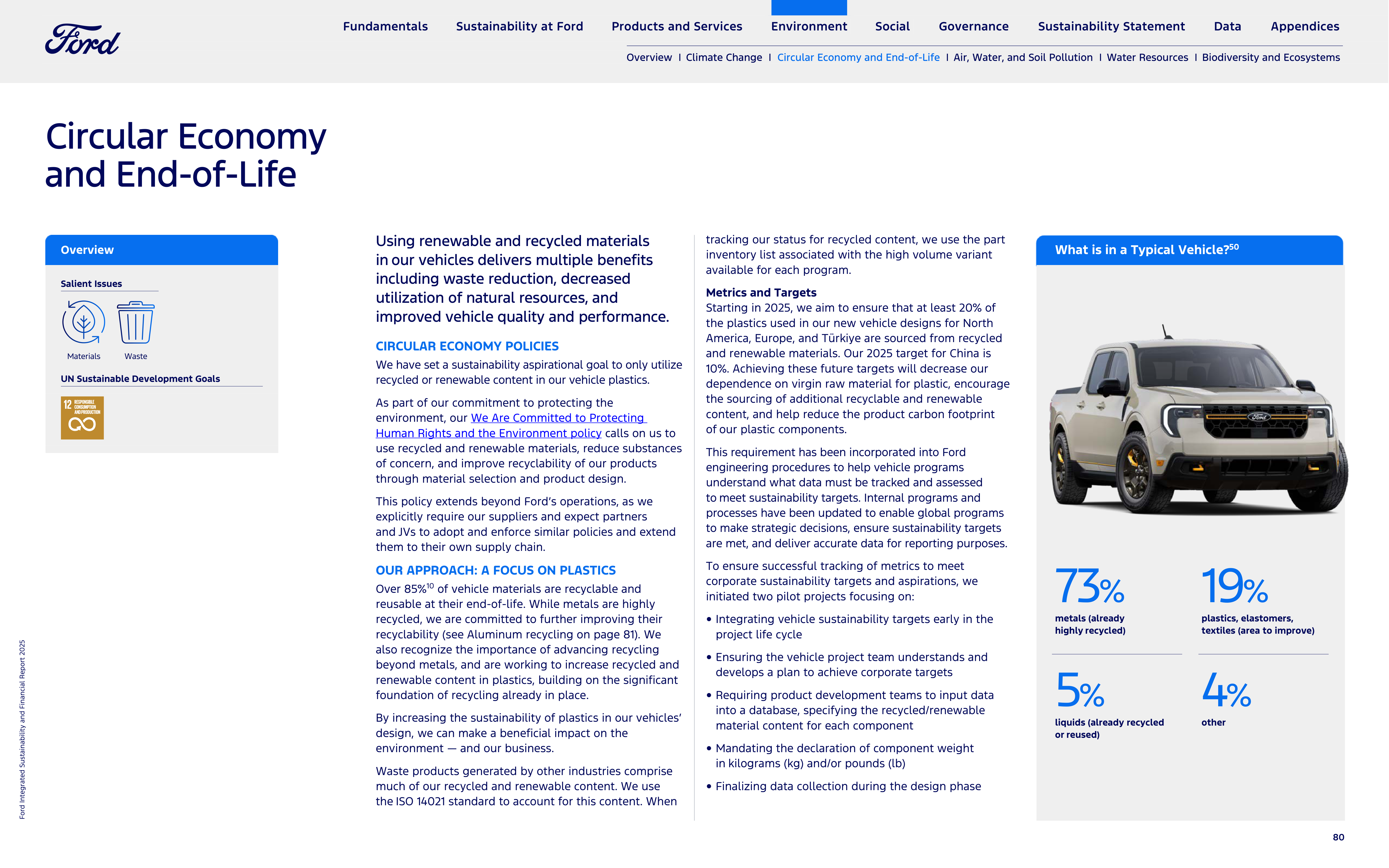


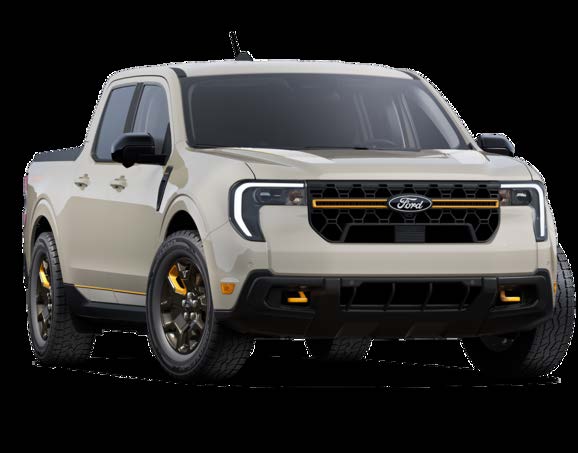

Fundamentals
Sustainability at Ford
Products and Services
Environment
Social
Governance
Sustainability Statement
Data
Appendices
Overview |
|
|
|
|
Climate Change
Circular Economy and End-of-Life
Air, Water, and Soil Pollution
Water Resources
Biodiversity and Ecosystems
Circular Economy
and End-of-Life
Overview
Salient Issues
Materials
Waste
UN Sustainable Development Goals
12 RESPONSIBLE
CONSUMPTION AND
PRODUCTION
Using renewable and recycled materials
in our vehicles delivers multiple benefits
including waste reduction, decreased
utilization of natural resources, and
improved vehicle quality and performance.
CIRCULAR ECONOMY POLICIES
We have set a sustainability aspirational goal to only utilize
recycled or renewable content in our vehicle plastics.
As part of our commitment to protecting the
environment, our
We Are Committed to Protecting
Human Rights and the Environment policy
calls on us to
use recycled and renewable materials, reduce substances
of concern, and improve recyclability of our products
through material selection and product design.
This policy extends beyond Ford’s operations, as we
explicitly require our suppliers and expect partners
and JVs to adopt and enforce similar policies and extend
them to their own supply chain.
OUR APPROACH: A FOCUS ON PLASTICS
Over 85%
10
of vehicle materials are recyclable and
reusable at their end-of-life. While metals are highly
recycled, we are committed to further improving their
recyclability (see Aluminum recycling on page 81). We
also recognize the importance of advancing recycling
beyond metals, and are working to increase recycled and
renewable content in plastics, building on the significant
foundation of recycling already in place.
By increasing the sustainability of plastics in our vehicles’
design, we can make a beneficial impact on the
environment — and our business.
Waste products generated by other industries comprise
much of our recycled and renewable content. We use
the ISO 14021 standard to account for this content. When
tracking our status for recycled content, we use the part
inventory list associated with the high volume variant
available for each program.
Metrics and Targets
Starting in 2025, we aim to ensure that at least 20% of
the plastics used in our new vehicle designs for North
America, Europe, and Türkiye are sourced from recycled
and renewable materials. Our 2025 target for China is
10%. Achieving these future targets will decrease our
dependence on virgin raw material for plastic, encourage
the sourcing of additional recyclable and renewable
content, and help reduce the product carbon footprint
of our plastic components.
This requirement has been incorporated into Ford
engineering procedures to help vehicle programs
understand what data must be tracked and assessed
to meet sustainability targets. Internal programs and
processes have been updated to enable global programs
to make strategic decisions, ensure sustainability targets
are met, and deliver accurate data for reporting purposes.
To ensure successful tracking of metrics to meet
corporate sustainability targets and aspirations, we
initiated two pilot projects focusing on:
•
Integrating vehicle sustainability targets early in the
project life cycle
•
Ensuring the vehicle project team understands and
develops a plan to achieve corporate targets
•
Requiring product development teams to input data
into a database, specifying the recycled/renewable
material content for each component
•
Mandating the declaration of component weight
in kilograms (kg) and/or pounds (lb)
•
Finalizing data collection during the design phase
What is in a Typical Vehicle?
50
73
%
metals (already
highly recycled)
19
%
plastics, elastomers,
textiles (area to improve)
5
%
liquids (already recycled
or reused)
4
%
other
Ford Integrated Sustainability and Financial Report 2025
80
Fundamentals
Sustainability at Ford
Products and Services
Environment
Social
Governance
Sustainability Statement
Data
Appendices
Overview |
|
|
|
|
Climate Change
Circular Economy and End-of-Life
Air, Water, and Soil Pollution
Water Resources
Biodiversity and Ecosystems
We are accelerating efforts to incorporate these future
targets across our vehicle lineup. As we move forward,
we are focused on addressing key technical enablers to
increase our use of renewable and recycled content for
our vehicles.
Using Recycled Materials for Vehicle Parts
While not every polymer can easily use recycled material,
recycling can significantly reduce the carbon footprint of
some of our plastics.
Post-consumer recycled packaging made from water
bottles and yogurt cups is used to make textiles and
storage bins in the interior of our vehicles, lessening
our dependence on virgin materials and reducing our
carbon footprint.
Post-consumer recycled polypropylene and nylon carpets
are also used extensively for cylinder head covers, fan
shrouds, carbon canisters, and other durable parts.
Post-industrial recycled streams are also an important
source of low-cost, high-quality plastics. Plastic waste
streams from our manufacturing plants are collected,
granulated, and reprocessed into injection molding and
3D printing materials, diverting them from incineration
and landfill.
We also derive value from waste material, using recycled
ocean plastics in the Bronco Sport. This exemplifies our
approach to the circular economy as we seek to use
these materials in other vehicles and applications.
Using Renewable Materials for Vehicle Parts
Renewable, plant-based materials continue to play an
important role in our sustainability strategy. Ford has a
long legacy of research and innovation in sustainable
materials. Since the early 2000s, Ford researchers have
implemented multiple plant-based materials into durable
applications. These materials, including soybean-based
foam, tree-sourced cellulose fiber composites, and rice
hull plastics, were proven to meet stringent performance
and durability standards while being lighter weight,
requiring less energy for manufacture, and being capable
of sequestering CO
2
. Current efforts focus on just a few
plant-based materials that are globally available and
scalable in order to migrate their use across all vehicles.
Ford also collaborates with partners outside the
automotive industry, including universities consortia,
and companies from non-competitive industries to
accelerate the development of new sustainable polymer
technologies. For example, the development of a durable
polymer material containing soybean oil as a feedstock
was initiated through a collaboration to expand the
market of domestically grown soybeans. This work
resulted in the soy-based foam technology that is used
in seating applications.
Soy-based foam, launched on the 2008 Mustang, has
been used in every Ford North American built vehicle
for seat cushions and backs for more than a decade,
totaling over 23 million vehicles. In a similar way, the use
of castor oil-based foams in instrument panels has
expanded from one vehicle to several. Use of bio-based
foams have reduced GHG emissions by about 212 million
pounds cumulatively, and continues to save an average
of 3.1 million pounds of petroleum annually since 2014.
Our Polymer Research team continues to pioneer the
development of new technologies to enable increased
recycled and renewable content for our vehicle plastics,
with a focus on feedstocks that are globally available
and scalable.
ADDITIONAL STRATEGIES AND ACTIONS
Converting CO
2
to Polyurethane Foam
Ford is conducting research on using CO
2
as a
feedstock to make more sustainable polyurethane (PU)
foams. This work is funded by a $2.5 million grant from
the U.S. Department of Energy, one of 30 DOE projects
to help decarbonize the U.S. industrial sector, advance
clean manufacturing, and improve America’s economic
competitiveness.
Our goal is to produce an economically viable,
sustainably sourced commercial foam product. According
to the Office of Energy Efficiency & Renewable Energy,
this technology could offset more than 126 million
pounds of the current fossil-fuel-derived PU foams used
in the automotive industry and could impact emission
reduction research for PU foams used in a variety of
other applications from sofas to construction insulation.
In the first year of the project, Ford and our partners
successfully developed polyols (precursors for the
production of PU foam) containing 25-96% sustainable
content with 32-112% reduction in embodied carbon,
as measured through LCA.
In the second year, Ford and our partners successfully
formulated PU foams for seat cushions in which 30-49%
of the petroleum-based polyol was replaced with the
CO
2-
based material formulations. These foams were
found to meet all performance requirements.
Work continues in the final year of the project to
demonstrate a full seat assembly produced using the
CO
2
derived foam at manufacturing scale.
Ford and our partners continue our focus on meeting
performance requirements for applications including
seating and noise, vibration, and harshness reduction.
Closing the Loop in Aluminum Recycling
We are the largest automotive aluminum recycler in
the world. Our closed loop recycling system maximizes
aluminum recycling in our plants while minimizing the
need for primary metal.
In collaboration with our aluminum sheet suppliers, Ford
has developed unique alloys that enable us to maximize
the reuse of aluminum within our own plants. In addition
to recovering aluminum scrap during parts stamping, our
system separates the various aluminum alloys so they
can be recycled back into fresh alloy for new vehicles.
Making recycled aluminum takes only around 5% of
the energy needed to make new aluminum, according
to the Aluminum Association, and minimizes the need
for primary metal.
We currently recycle up to 20 million pounds of aluminum
each month at our Dearborn Stamping, Kentucky Truck
and Buffalo Stamping facilities. This represents
approximately 25% of our aluminum sheet coil purchases.
Maximizing the use of end-of-life scrap in our aluminum
and steel sheet grades could also support future
economic opportunities. In 2024, we completed the
REMADE “Clean Sheet” research project with the
University of Michigan to explore and quantify these
future opportunities, and identify potential technology
pathways. Additional project goals involved analyzing
the carbon intensity of sheet metal supply chains.
This analysis is crucial for engineering our processes to
maximize circularity while minimizing embodied energy
and reducing carbon emissions.
Circular Economy and End-of-Life
— continued
Ford Integrated Sustainability and Financial Report 2025
81
Fundamentals
Sustainability at Ford
Products and Services
Environment
Social
Governance
Sustainability Statement
Data
Appendices
Overview |
|
|
|
|
Climate Change
Circular Economy and End-of-Life
Air, Water, and Soil Pollution
Water Resources
Biodiversity and Ecosystems
Remanufacturing Supports Sustainability Goals
Remanufacturing turns a previously used, sold, or worn-
out part into a like-new or better-than-new condition
which can be warranted for performance level and
quality. Remanufacturing has multiple benefits. It saves
considerable energy, uses less raw material compared
to a new unit, substantially reduces CO
2
emissions, and
helps extend the life cycle of the vehicle product line.
We first began remanufacturing during World War II in
response to shortages of steel and iron. Since then, it has
become an important part of our sustainability efforts.
Ford now remanufactures various components, from
powertrain assemblies and turbos to smaller parts like
injectors, starters, and alternators. Our catalog of
remanufactured parts is continually growing.
BATTERY RECYCLING
In line with Ford’s commitment to protecting the
environment and advancing a circular economy, end-of-
life vehicles and their batteries are a crucial part of our
value chain. To further our efforts to increase battery
recycling, we support various battery recycling
companies, including with letters of support for U.S.
Department of Energy grants.
End-of-life batteries and manufacturing scrap from
the BlueOval SK JV Gigafactory are sent to recyclers who
are dedicated to recovering the underlying raw materials.
The intent is to reintroduce these materials into the
broader battery industry supply chain.
We have contracts in place with multiple battery
recyclers, delineated by region, source (plant scrap,
end-of-life batteries/warranty returns), and chemistry.
The recyclers were evaluated based on technology,
recycling efficiency, environmental, social, and
governance (ESG) factors, and cost. Not only does this
approach maximize the overall benefits of our electric
vehicles for our customers, Ford, our suppliers, and the
communities in which we operate, but it also contributes
to global efforts to address resource depletion and
promote a circular battery economy.
We also utilize collection points to reduce inefficiencies
in shipping one-off, end-of-life batteries across the
country — this allows us to ship full-truck loads, reducing
our environmental footprint.
LIFE CYCLE ASSESSMENT (LCA) RESEARCH
AND REGULATIONS
We continue to conduct LCA-based studies to evaluate
potential environmental implications of vehicle raw
materials, manufacturing, and use. Topics include
recycled polymers and composites, cradle-to-gate and
use phase impacts of lithium-ion batteries, and benefits
of electric vehicle battery circular economy. In 2024, we
completed LCAs for the Explorer and Capri electric
vehicles in Europe.
In the EU, we are anticipating regulations related to LCAs:
•
The EU Battery Regulation requires a Carbon Footprint
Declaration starting in 2025
•
The EU CO
2
Fleet Regulation requires the European
Commission to set out a common methodology for
vehicle life cycle CO
2
emissions by 2025, with voluntary
reporting starting in June 2026
•
The UN Economic Commission for Europe’s Working
Party on Pollution and Energy, a subsidiary body of the
World Forum for Harmonization of Vehicle Regulations,
has set up an informal working group to harmonize a
vehicle LCA methodology with adoption of final
recommendations expected by end of 2025
SUBSTANCES OF CONCERN AND SUBSTANCES
OF VERY HIGH CONCERN
Ford’s Restricted Substances Management Standard
(RSMS) and associated Restricted Substances List (RSL)
restricts or excludes certain chemicals from parts,
materials, equipment, packaging, office supplies,
machinery, and/or tooling supplied to or manufactured
by Ford, or intended for use in Ford products. The
Standard supplements, but does not supersede, the
responsibility of each supplier to comply with laws and
regulations for the receiving Ford locations.
Expanded efforts will be made, over and above
the RSMS, to reduce certain substances of concern in
non-dimensional commodities used in manufacturing
operations, such as paints and related chemicals,
adhesives and sealers, hydrocarbon lubricants, etc. Ford
has developed a targeted list for certain substances of
concern, including substances of very high concern,
for replacement, reduction, or reformulation. We have
engaged selected suppliers of high-volume commodities
and are working with them to review current use of
substances of concern and identify possible alternatives.
Reducing End-of-Life Impacts
We proactively review non-dimensional materials such
as lubricants and paints within our manufacturing
operations. Going beyond applicable regulations, we
are developing a timeline to further reduce substances
of concern in our facilities, including those that are
carcinogenic or environmentally persistent.
WASTE MANAGEMENT POLICIES
We have set the sustainability aspiration to reach true
zero waste to landfill across our global manufacturing
operations and eliminate single-use plastics across our
global operations.
Our
We Are Committed to Protecting Human Rights and
the Environment policy
calls on us to divert waste from
landfill to products and reduce single-use plastic.
OUR APPROACH TO WASTE MANAGEMENT
Reducing waste has multiple benefits. It helps reduce
our impact on the planet, and it optimizes efficiency in
our resource-intensive industry. By reducing or recycling
generated waste, we can avoid the landfill, lessen
GHG emissions, and generate an additional supply of
valuable resources.
In 2023, we launched the third phase of our global waste
strategy, which will continue until 2027. During this time,
we are targeting reducing overall waste generation by
5% and reducing waste disposed, or removed from the
value stream, by 10%. We will continue to drive waste
sent to landfill reductions globally and progress toward
our zero waste to landfill goal by 2028.
Our
Supplier Code of Conduct
requires suppliers
to maintain an ISO 14001-certified environmental
management system. Beyond that, we also receive
various waste measurements, such as total hazardous
waste, from our suppliers.
Waste Reduction Initiatives
To ensure that more of our facilities reach zero waste
to landfill status by 2028, we continue to implement a
range of waste reduction initiatives. Ongoing initiatives
include implementing new technologies and programs
that minimize waste and standardizing the tracking and
sorting of waste to increase recycling and reuse.
Circular Economy and End-of-Life
— continued
Ford Integrated Sustainability and Financial Report 2025
82

Fundamentals
Sustainability at Ford
Products and Services
Environment
Social
Governance
Sustainability Statement
Data
Appendices
Overview |
|
|
|
|
Climate Change
Circular Economy and End-of-Life
Air, Water, and Soil Pollution
Water Resources
Biodiversity and Ecosystems
Eliminating Single-use Plastics
We continue initiatives around the world toward our
goal of eliminating single-use plastics. Global teams
are collaborating to eliminate or recycle all single-use
plastics from food-service and personal goods and to
continue to drive down single-use plastics from part
packaging, industrial processes, and quality rejects. We
are implementing regional initiatives, such as utilizing
returnable containers for take-away food in Cologne,
Germany, and phasing out single-use plastic utensils in
all our facilities in U.S. and Canada.
Going Paperless at Ford
Enterprise Technology teams across the International
Markets Group at Ford have been on a mission to
eliminate the use of paper across all their operations.
This has resulted in considerable reductions in paper
usage both in our manufacturing plants and office
environments where legacy printing has been replaced
with new digital technology.
Hazardous Waste Reduction
The implementation of a returnable tank system for
sealer packaging has yielded a substantial reduction in
hazardous waste generation at Ford Thailand. This
represents a significant improvement in waste
management and a reduction in the consumption of
disposable drums.
WASTE MANAGEMENT PROGRESS
Ford facilities around the world sent approximately
14,700 metric tons of waste to landfill in 2024, about
10.0% less than in 2023. Currently, we have 82 zero
waste to landfill (ZWTL) sites globally. The Cleveland
Engine Plant was the latest site to achieve ZWTL in 2024.
All Ford manufacturing and non-manufacturing facilities
in China maintained ZWTL in 2024. Waste generated in
all factories is either recycled or managed for thermal
destruction with or without energy recovery instead of
being sent to landfills for final disposal. Our BlueOval
European facilities have also maintained ZWTL status,
using the same strategies.
Circular Economy and End-of-Life
— continued
Ford Integrated Sustainability and Financial Report 2025
83

Fundamentals
Sustainability at Ford
Products and Services
Environment
Social
Governance
Sustainability Statement
Data
Appendices
Overview |
|
|
|
|
Climate Change
Circular Economy and End-of-Life
Air, Water, and Soil Pollution
Water Resources
Biodiversity and Ecosystems
Air, Water, and
Soil Pollution
Overview
Aspirations
Air
Salient Issues
Environment
UN Sustainable Development Goals
3 GOOD HEALTH
AND WELL-BEING
6 CLEAN WATER
AND SANITATION
By reducing emissions, we can decrease
air pollution, help protect people’s
health, and avoid the worst impacts
of climate change.
AIR, WATER, AND SOIL POLLUTION POLICIES
We have set a sustainability aspirational goal to attain
zero air emissions from our vehicles and facilities.
Our
We Are Committed to Protecting Human Rights and
the Environment policy
mandates that we work to reduce
emissions. Global emission standards have led to lower
vehicle emissions and improved air quality.
This policy also requires us to follow Ford procedures
to safeguard the environment when discontinuing
operations, decommissioning sites, or disposing of parts
and components to protect from potential pollution of
our natural resources, including water and soil.
OUR APPROACH
We believe that clean air is a fundamental human right
and take water and soil pollution seriously.
Not only will our electric vehicle strategy reduce GHG
emissions, it can also help improve local air quality.
Access to electric vehicles can help provide health,
economic, and mobility benefits, especially in
communities that bear a disproportionate burden from
climate change and air and water pollution.
ICE vehicles emit air pollutants, such as hydrocarbons,
carbon monoxide, nitrogen oxides, and particulate
matter, which can affect air quality and can potentially
impact human health. In addition, brake particulates
and electricity generation for electric vehicles can affect
air quality.
VEHICLE EMISSIONS
EU mandates currently require all new vehicle sales to
be zero-emissions vehicles by 2035. Some European
countries have regulations in place or are working on
regulations that will advance this date.
We meet or exceed vehicle criteria emissions standards
as they are introduced (see Regional Vehicle Emissions
Standards table).
PLANT EMISSION REDUCTIONS
Ford reduces pollution from our manufacturing facilities
by using best available techniques as required by
regulations. This includes re-evaluating technology and
upgrading controls as necessary.
However, our efforts go beyond simply meeting
regulatory requirements. We develop and track plant-
specific volatile organic compounds (VOC) key
performance indicators (KPI). At each Ford plant, a data-
driven quality strategy dashboard tracks VOC emissions
and identifies opportunities for reduction. As part of best
practices and strategic improvements, plants have
follow‑ups based on their progress and review VOC data
as a team.
Key Performance Indicators
Ford manufacturing plants around the globe are required
to meet specific air pollutant requirements as part of their
air permit. Beyond air permits, Ford develops annual
plant-specific VOC KPIs for global manufacturing plants.
The KPIs are developed based on each plant’s prior year
data. Ford considers changes in abatement, changes in
paint usage, the launch of new products, and production
and line speed when developing these KPIs.
CLEAN INDUSTRY CERTIFICATION IN
MEXICO PLANTS
Three of our plants in Mexico have been awarded a clean
industry certification by the Mexican government for best
environmental practices. The certification process for this
voluntary program included site visits to the Hermosillo
Stamping and Assembly Plant, Chihuahua Engine Plant,
Cuautitlan Stamping and Assembly Plant, and Cuautitlan
Battery Assembly plants by representatives from
Mexico’s Federal Environmental Agency. The agency
audited compliance with all environmental requirements
including Ford Environmental Operating System KPIs,
procedures, and policies, as well as items related to
emergency response for environmental impact situations.
The plants were also evaluated on their relationship with
their communities.
2025
rt
l Repo
ncia
ina
F
nd
a
y
ilit
b
ina
a
ust
S
ed
t
ra
eg
Int
rd
o
F
84
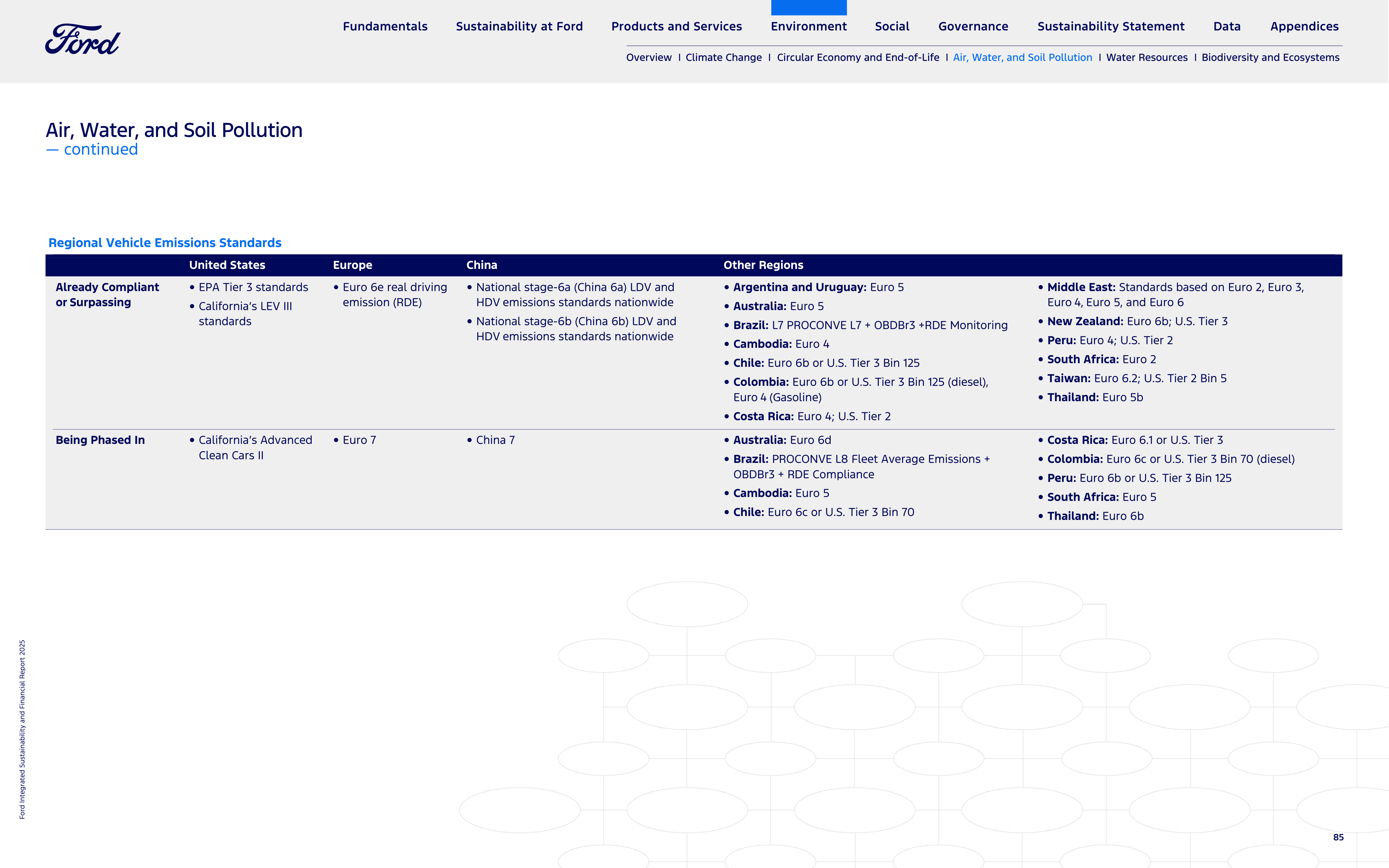

Fundamentals
Sustainability at Ford
Products and Services
Environment
Social
Governance
Sustainability Statement
Data
Appendices
Overview |
|
|
|
|
Climate Change
Circular Economy and End-of-Life
Air, Water, and Soil Pollution
Water Resources
Biodiversity and Ecosystems
Regional Vehicle Emissions Standards
United States
Europe
China
Other Regions
Already Compliant
or Surpassing
•
EPA Tier 3 standards
•
California’s LEV III
standards
•
Euro 6e real driving
emission (RDE)
•
National stage-6a (China 6a) LDV and
HDV emissions standards nationwide
•
National stage-6b (China 6b) LDV and
HDV emissions standards nationwide
•
Argentina and Uruguay:
Euro 5
•
Australia:
Euro 5
•
Brazil:
L7 PROCONVE L7 + OBDBr3 +RDE Monitoring
•
Cambodia:
Euro 4
•
Chile:
Euro 6b or U.S. Tier 3 Bin 125
•
Colombia:
Euro 6b or U.S. Tier 3 Bin 125 (diesel),
Euro 4 (Gasoline)
•
Costa Rica:
Euro 4; U.S. Tier 2
•
Middle East:
Standards based on Euro 2, Euro 3,
Euro 4, Euro 5, and Euro 6
•
New Zealand:
Euro 6b; U.S. Tier 3
•
Peru:
Euro 4; U.S. Tier 2
•
South Africa:
Euro 2
•
Taiwan:
Euro 6.2; U.S. Tier 2 Bin 5
•
Thailand:
Euro 5b
Being Phased In
•
California’s Advanced
Clean Cars II
•
Euro 7
•
China 7
•
Australia:
Euro 6d
•
Brazil:
PROCONVE L8 Fleet Average Emissions +
OBDBr3 + RDE Compliance
•
Cambodia:
Euro 5
•
Chile:
Euro 6c or U.S. Tier 3 Bin 70
•
Costa Rica:
Euro 6.1 or U.S. Tier 3
•
Colombia:
Euro 6c or U.S. Tier 3 Bin 70 (diesel)
•
Peru:
Euro 6b or U.S. Tier 3 Bin 125
•
South Africa:
Euro 5
•
Thailand:
Euro 6b
Air, Water, and Soil Pollution
— continued
Ford Integrated Sustainability and Financial Report 2025
85
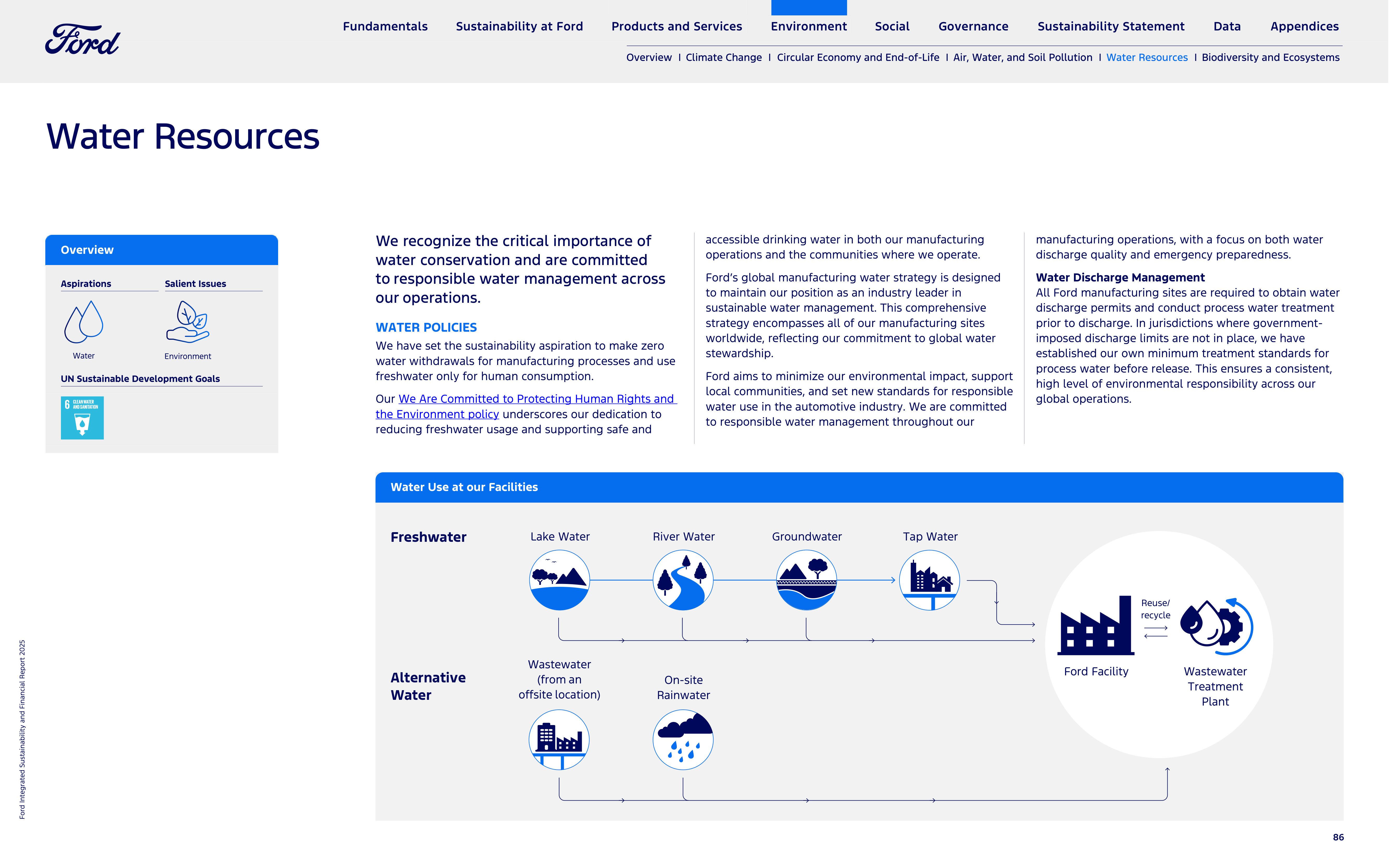

Fundamentals
Sustainability at Ford
Products and Services
Environment
Social
Governance
Sustainability Statement
Data
Appendices
Overview |
|
|
|
|
Climate Change
Circular Economy and End-of-Life
Air, Water, and Soil Pollution
Water Resources
Biodiversity and Ecosystems
Water Resources
Overview
Aspirations
Water
Salient Issues
Environment
UN Sustainable Development Goals
6 CLEAN WATER
AND SANITATION
We recognize the critical importance of
water conservation and are committed
to responsible water management across
our operations.
WATER POLICIES
We have set the sustainability aspiration to make zero
water withdrawals for manufacturing processes and use
freshwater only for human consumption.
Our
We Are Committed to Protecting Human Rights and
the Environment policy
underscores our dedication to
reducing freshwater usage and supporting safe and
accessible drinking water in both our manufacturing
operations and the communities where we operate.
Ford’s global manufacturing water strategy is designed
to maintain our position as an industry leader in
sustainable water management. This comprehensive
strategy encompasses all of our manufacturing sites
worldwide, reflecting our commitment to global water
stewardship.
Ford aims to minimize our environmental impact, support
local communities, and set new standards for responsible
water use in the automotive industry. We are committed
to responsible water management throughout our
manufacturing operations, with a focus on both water
discharge quality and emergency preparedness.
Water Discharge Management
All Ford manufacturing sites are required to obtain water
discharge permits and conduct process water treatment
prior to discharge. In jurisdictions where government-
imposed discharge limits are not in place, we have
established our own minimum treatment standards for
process water before release. This ensures a consistent,
high level of environmental responsibility across our
global operations.
Water Use at our Facilities
Freshwater
Lake Water
River Water
Groundwater
Tap Water
Alternative
Water
Wastewater
(from an
offsite location)
On-site
Rainwater
Ford Facility
Reuse/
recycle
Wastewater
Treatment
Plant
Ford Integrated Sustainability and Financial Report 2025
86
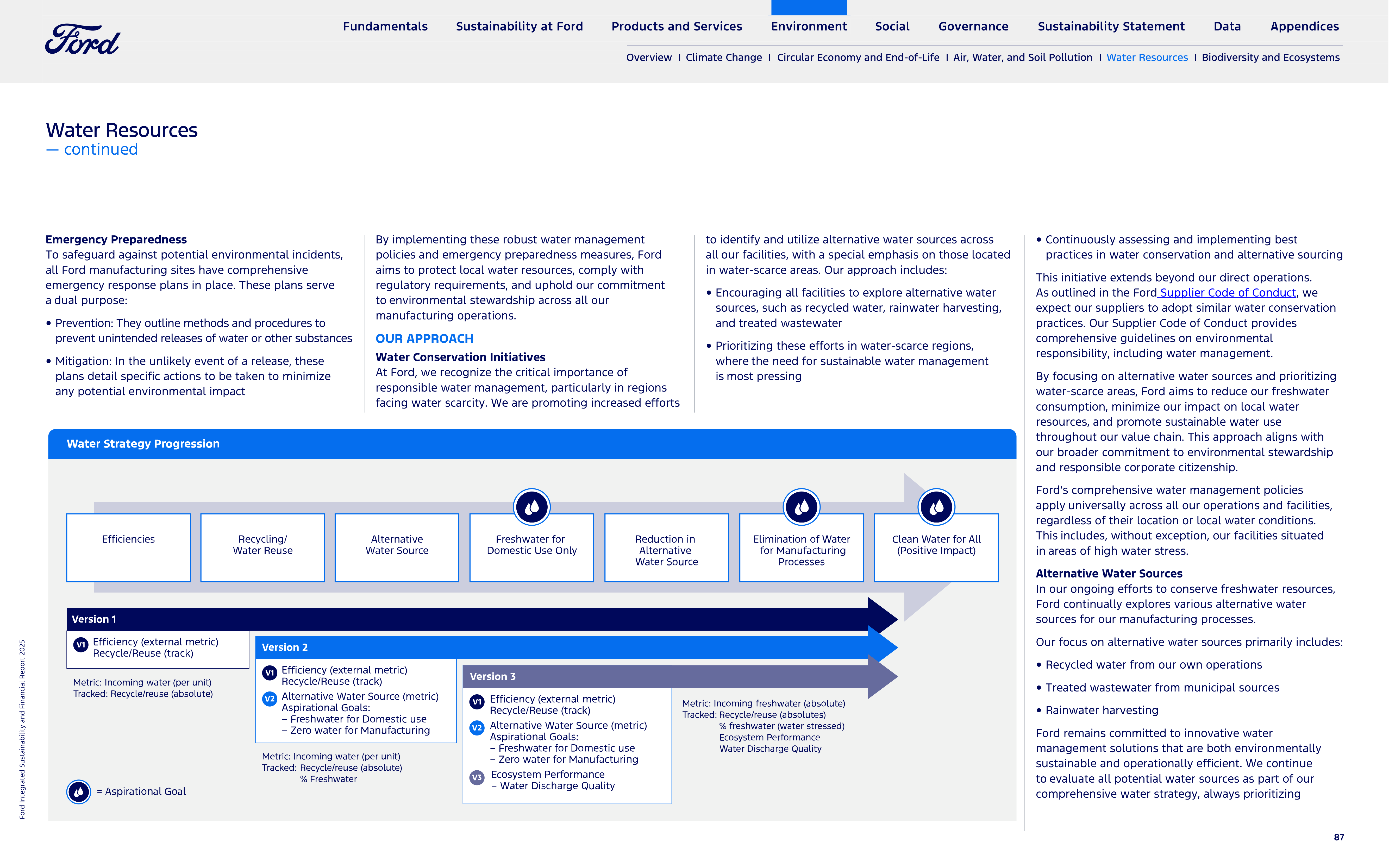

Fundamentals
Sustainability at Ford
Products and Services
Environment
Social
Governance
Sustainability Statement
Data
Appendices
Overview | Climate Change | Circular Economy and End-of-Life | Air, Water, and Soil Pollution |
Water Resources
| Biodiversity and Ecosystems
Water Resources
— continued
Ford Integrated Sustainability and Financial Report 2025
87
Emergency Preparedness
To safeguard against potential environmental incidents,
all Ford manufacturing sites have comprehensive
emergency response plans in place. These plans serve
a dual purpose:
•
Prevention: They outline methods and procedures to
prevent unintended releases of water or other substances
•
Mitigation: In the unlikely event of a release, these
plans detail specific actions to be taken to minimize
any potential environmental impact
By implementing these robust water management
policies and emergency preparedness measures, Ford
aims to protect local water resources, comply with
regulatory requirements, and uphold our commitment
to environmental stewardship across all our
manufacturing operations.
OUR APPROACH
Water Conservation Initiatives
At Ford, we recognize the critical importance of
responsible water management, particularly in regions
facing water scarcity. We are promoting increased efforts
to identify and utilize alternative water sources across
all our facilities, with a special emphasis on those located
in water-scarce areas. Our approach includes:
•
Encouraging all facilities to explore alternative water
sources, such as recycled water, rainwater harvesting,
and treated wastewater
•
Prioritizing these efforts in water-scarce regions,
where the need for sustainable water management
is most pressing
•
Continuously assessing and implementing best
practices in water conservation and alternative sourcing
This initiative extends beyond our direct operations.
As outlined in the Ford
Supplier Code of Conduct
, we
expect our suppliers to adopt similar water conservation
practices. Our Supplier Code of Conduct provides
comprehensive guidelines on environmental
responsibility, including water management.
By focusing on alternative water sources and prioritizing
water-scarce areas, Ford aims to reduce our freshwater
consumption, minimize our impact on local water
resources, and promote sustainable water use
throughout our value chain. This approach aligns with
our broader commitment to environmental stewardship
and responsible corporate citizenship.
Ford’s comprehensive water management policies
apply universally across all our operations and facilities,
regardless of their location or local water conditions.
This includes, without exception, our facilities situated
in areas of high water stress.
Alternative Water Sources
In our ongoing efforts to conserve freshwater resources,
Ford continually explores various alternative water
sources for our manufacturing processes.
Our focus on alternative water sources primarily includes:
•
Recycled water from our own operations
•
Treated wastewater from municipal sources
•
Rainwater harvesting
Ford remains committed to innovative water
management solutions that are both environmentally
sustainable and operationally efficient. We continue
to evaluate all potential water sources as part of our
comprehensive water strategy, always prioritizing
Water
Strategy
Progression
Efficiencies
Recycling/
Water
Reuse
Alternative
Water
Source
Freshwater
for
Domestic
Use
Only
Reduction
in
Alternative
Water
Source
Elimination
of
Water
for
Manufacturing
Processes
Clean
Water
for
All
(Positive
Impact)
Version
1
V1
Efficiency
(external
metric)
Recycle/Reuse
(track)
Metric:
Incoming
water
(per
unit)
Tracked:
Recycle/reuse
(absolute)
Version
2
V1
Efficiency
(external
metric)
Recycle/Reuse
(track)
V2
Alternative
Water
Source
(metric)
Aspirational
Goals:
-
Freshwater
for
Domestic
use
-
Zero
water
for
Manufacturing
Metric:
Incoming
water
(per
unit)
Tracked:
Recycle/reuse
(absolute)
%
Freshwater
Version
3
V1
Efficiency
(external
metric)
Recycle/Reuse
(track)
V2
Alternative
Water
Source
(metric)
Aspirational
Goals:
-
Freshwater
for
Domestic
use
-
Zero
water
for
Manufacturing
V3
Ecosystem
Performance
-
Water
Discharge
Quality
Metric:
Incoming
freshwater
(absolute)
Tracked:
Recycle/reuse
(absolutes)
%
freshwater
(water
stressed)
Ecosystem
Performance
Water
Discharge
Quality
=
Aspirational
Goal
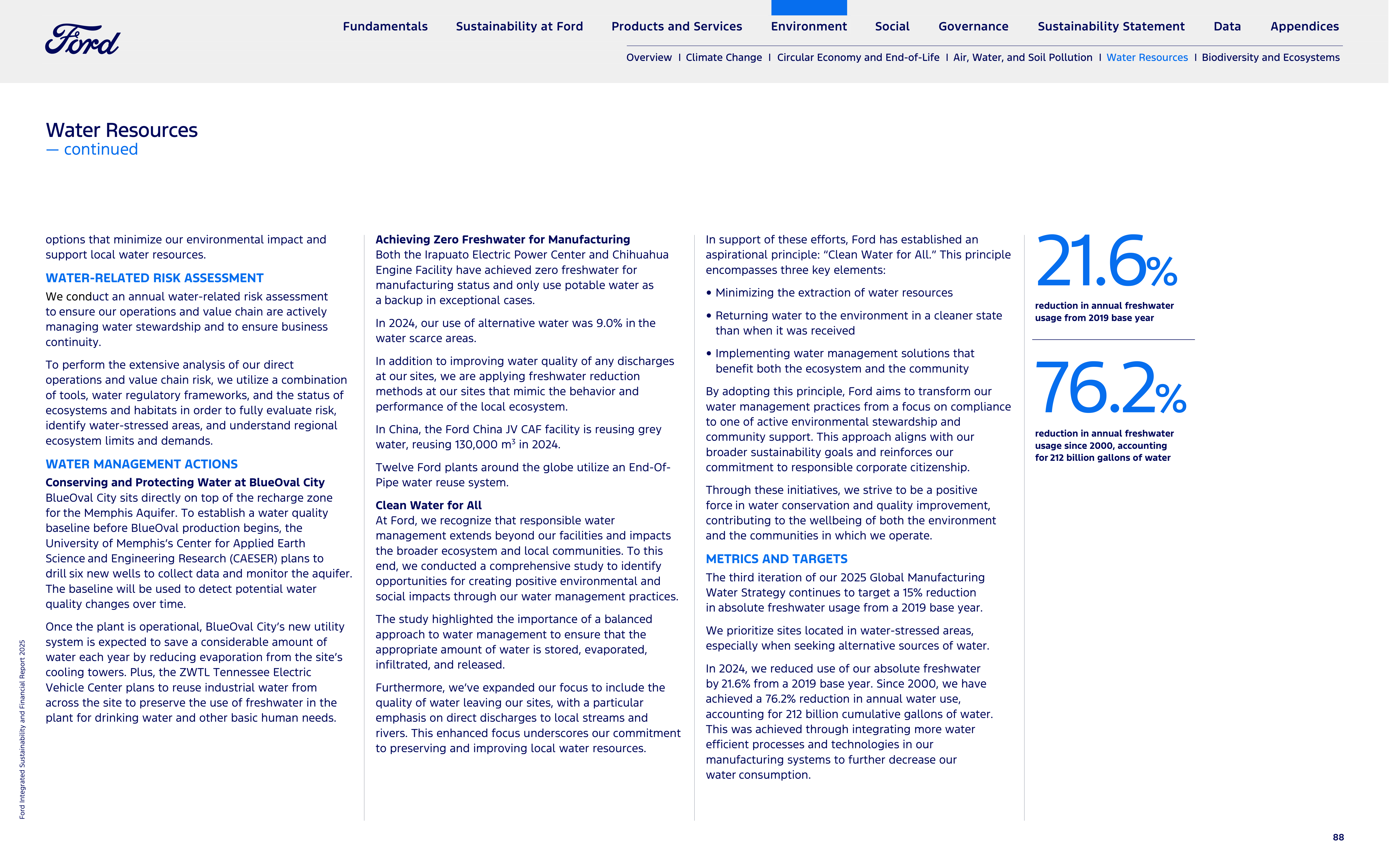
options that minimize our environmental impact and
support local water resources.
Fundamentals
Sustainability at Ford
Products and Services
Environment
Social
Governance
Sustainability Statement
Data
Appendices
Overview | Climate Change | Circular Economy and End-of-Life | Air, Water, and Soil Pollution |
Water Resources
| Biodiversity and Ecosystems
Water Resources
— continued
Ford Integrated Sustainability and Financial Report 2025
88
WATER-RELATED RISK ASSESSMENT
We cond
uct an annual water-related risk assessment
to ensure our operations and value chain are actively
managing water stewardship and to ensure business
continuity.
To perform the extensive analysis of our direct
operations and value chain risk, we utilize a combination
of tools, water regulatory frameworks, and the status of
ecosystems and habitats in order to fully evaluate risk,
identify water-stressed areas, and understand regional
ecosystem limits and demands.
WATER MANAGEMENT ACTIONS
Conserving and Protecting Water at BlueOval City
BlueOval City sits directly on top of the recharge zone
for the Memphis Aquifer. To establish a water quality
baseline before BlueOval production begins, the
University of Memphis’s Center for Applied Earth
Science and Engineering Research (CAESER) plans to
drill six new wells to collect data and monitor the aquifer.
The baseline will be used to detect potential water
quality changes over time.
Once the plant is operational, BlueOval City’s new utility
system is expected to save a considerable amount of
water each year by reducing evaporation from the site’s
cooling towers. Plus, the ZWTL Tennessee Electric
Vehicle Center plans to reuse industrial water from
across the site to preserve the use of freshwater in the
plant for drinking water and other basic human needs.
Achieving Zero Freshwater for Manufacturing
Both the Irapuato Electric Power Center and Chihuahua
Engine Facility have achieved zero freshwater for
manufacturing status and only use potable water as
a backup in exceptional cases.
In 2024, our use of alternative water was 9.0% in the
water scarce areas.
In addition to improving water quality of any discharges
at our sites, we are applying freshwater reduction
methods at our sites that mimic the behavior and
performance of the local ecosystem.
In China, the Ford China JV CAF facility is reusing grey
water, reusing 130,000 m
3
in 2024.
Twelve Ford plants around the globe utilize an End-Of-
Pipe water reuse system.
Clean Water for All
At Ford, we recognize that responsible water
management extends beyond our facilities and impacts
the broader ecosystem and local communities. To this
end, we conducted a comprehensive study to identify
opportunities for creating positive environmental and
social impacts through our water management practices.
The study highlighted the importance of a balanced
approach to water management to ensure that the
appropriate amount of water is stored, evaporated,
infiltrated, and released.
Furthermore, we’ve expanded our focus to include the
quality of water leaving our sites, with a particular
emphasis on direct discharges to local streams and
rivers. This enhanced focus underscores our commitment
to preserving and improving local water resources.
In support of these efforts, Ford has established an
aspirational principle: “Clean Water for All.” This principle
encompasses three key elements:
•
Minimizing the extraction of water resources
•
Returning water to the environment in a cleaner state
than when it was received
•
Implementing water management solutions that
benefit both the ecosystem and the community
By adopting this principle, Ford aims to transform our
water management practices from a focus on compliance
to one of active environmental stewardship and
community support. This approach aligns with our
broader sustainability goals and reinforces our
commitment to responsible corporate citizenship.
Through these initiatives, we strive to be a positive
force in water conservation and quality improvement,
contributing to the wellbeing of both the environment
and the communities in which we operate.
METRICS AND TARGETS
The third iteration of our 2025 Global Manufacturing
Water Strategy continues to target a 15% reduction
in absolute freshwater usage from a 2019 base year.
We prioritize sites located in water-stressed areas,
especially when seeking alternative sources of water.
In 2024, we reduced use of our absolute freshwater
by 21.6% from a 2019 base year. Since 2000, we have
achieved a 76.2% reduction in annual water use,
accounting for 212 billion cumulative gallons of water.
This was achieved through integrating more water
efficient processes and technologies in our
manufacturing systems to further decrease our
water consumption.
21.6
%
reduction in annual freshwater
usage from 2019 base year
76.2
%
reduction in annual freshwater
usage since 2000, accounting
for 212 billion gallons of water
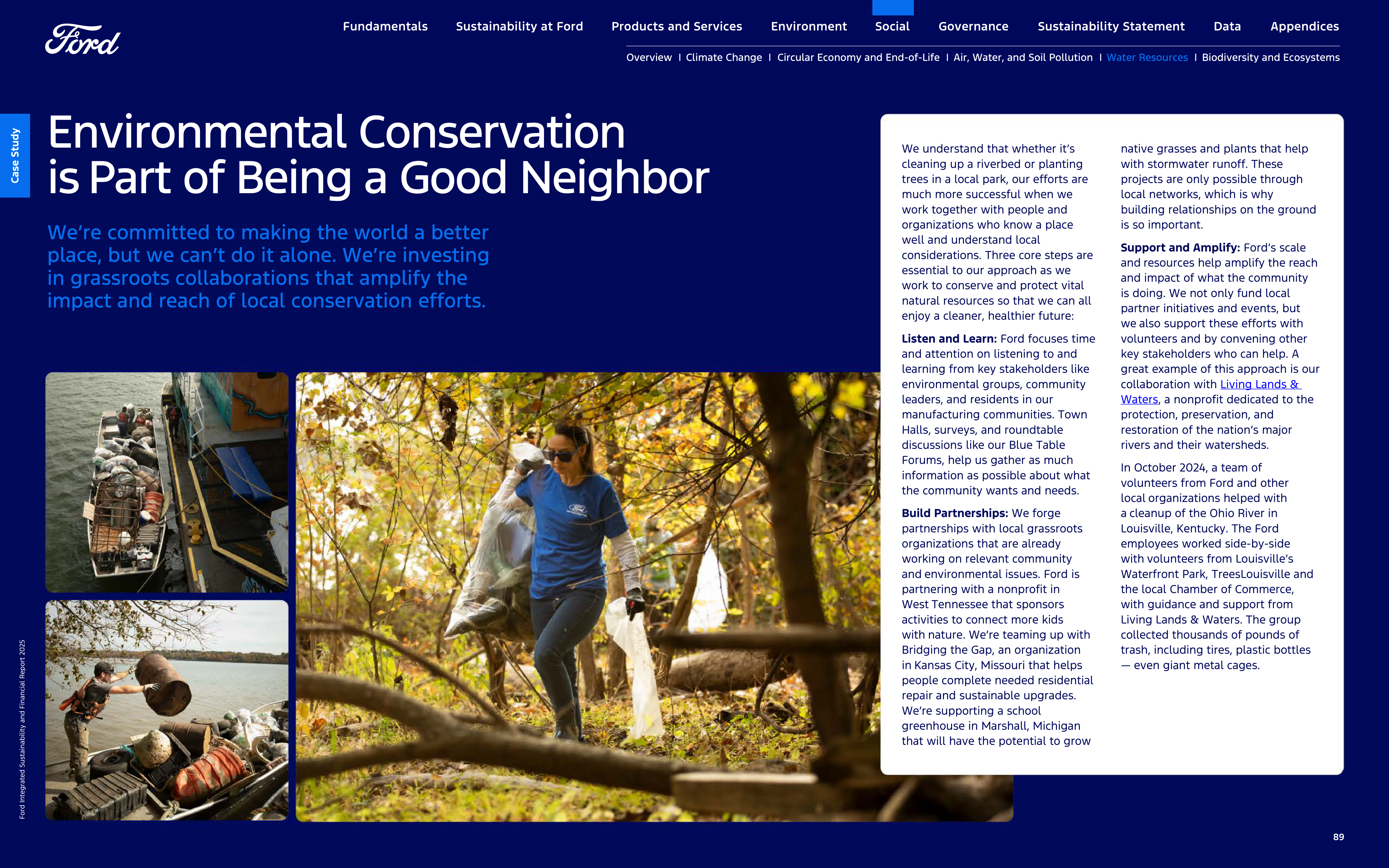


Fundamentals
Sustainability at Ford
Products and Services
Environment
Social
Governance
Sustainability Statement
Data
Appendices
Overview | Climate Change | Circular Economy and End-of-Life | Air, Water, and Soil Pollution |
Water Resources
| Biodiversity and Ecosystems
Ford Integrated Sustainability and Financial Report 2025
89
Case Study
Environmental Conservation
is Part of Being a Good Neighbor
We’re committed to making the world a better
place, but we can’t do it alone. We’re investing
in grassroots collaborations that amplify the
impact and reach of local conservation efforts.
We understand that whether it’s
cleaning up a riverbed or planting
trees in a local park, our efforts are
much more successful when we
work together with people and
organizations who know a place
well and understand local
considerations. Three core steps are
essential to our approach as we
work to conserve and protect vital
natural resources so that we can all
enjoy a cleaner, healthier future:
Listen and Learn:
Ford focuses time
and attention on listening to and
learning from key stakeholders like
environmental groups, community
leaders, and residents in our
manufacturing communities. Town
Halls, surveys, and roundtable
discussions like our Blue Table
Forums, help us gather as much
information as possible about what
the community wants and needs.
Build Partnerships:
We forge
partnerships with local grassroots
organizations that are already
working on relevant community
and environmental issues. Ford is
partnering with a nonprofit in
West Tennessee that sponsors
activities to connect more kids
with nature. We’re teaming up with
Bridging the Gap, an organization
in Kansas City, Missouri that helps
people complete needed residential
repair and sustainable upgrades.
We’re supporting a school
greenhouse in Marshall, Michigan
that will have the potential to grow
native grasses and plants that help
with stormwater runoff. These
projects are only possible through
local networks, which is why
building relationships on the ground
is so important.
Support and Amplify:
Ford’s scale
and resources help amplify the reach
and impact of what the community
is doing. We not only fund local
partner initiatives and events, but
we also support these efforts with
volunteers and by convening other
key stakeholders who can help. A
great example of this approach is our
collaboration with
Living Lands &
Waters
, a nonprofit dedicated to the
protection, preservation, and
restoration of the nation’s major
rivers and their watersheds.
In October 2024, a team of
volunteers from Ford and other
local organizations helped with
a cleanup of the Ohio River in
Louisville, Kentucky. The Ford
employees worked side-by-side
with volunteers from Louisville’s
Waterfront Park, TreesLouisville and
the local Chamber of Commerce,
with guidance and support from
Living Lands & Waters. The group
collected thousands of pounds of
trash, including tires, plastic bottles
— even giant metal cages.

Fundamentals
Sustainability at Ford
Products and Services
Environment
Social
Governance
Sustainability Statement
Data
Appendices
Overview | Climate Change | Circular Economy and End-of-Life | Air, Water, and Soil Pollution | Water Resources |
Biodiversity and Ecosystems
Biodiversity and Ecosystems
,
Ford Integrated Sustainability and Financial Report 2025
90
Overview
Salient Issues
Environment
UN Sustainable Development Goals
12 RESPONSIBLE
CONSUMPTION AND
PRODUCTION
Biodiversity is our strongest natural
defense against climate change, according
to the UN, which notes that ecosystems
and the different species of plants they
contain absorb more than half of all
carbon emissions. Yet, climate change
is contributing to biodiversity’s decline
as it alters ecosystems around the globe
51
BIODIVERSITY AT FORD
As the global focus on our impact on ecosystems
continues, biodiversity remains an important topic for
Ford. We strive to provide positive benefits to the local
environment and neighboring communities as we work
to minimize our impact on the planet.
BIODIVERSITY RISK ASSESSMENT
In 2024, we conducted a biodiversity risk assessment
utilizing the World Wildlife Fund (WWF) online tool.
The findings from this assessment indicate that our
overall operational impact on biodiversity remains limited.
However, to further strengthen our commitment to
environmental stewardship, we have been implementing
a “positive performance” strategy that aims not only to
minimize our environmental footprint but also to
enhance our positive contributions to local ecosystems.
Our “Positive Performance” methodology involves
measuring various aspects of local ecosystem
performance. By striving to operate our sites in a
manner that meets or exceeds these local ecosystem
benchmarks, we consider our efforts to be positive.
Parameters for ecosystem measurements may include
carbon capture rates, water infiltration volumes,
biodiversity support, soil generation, and more.
Globally, our teams are committed to fostering a better
relationship with nature. We are continuously working
to make our operations more environmentally friendly
while adapting to the myriad challenges that ecosystems
face today. Through these concerted efforts, we aim to
contribute positively to the health and resilience of the
environments in which we operate.
BIODIVERSITY PRESERVATION AT
COLOGNE ELECTRIC VEHICLE CENTER
The outdoor areas of many of our company premises,
such as the Cologne Electric Vehicle Center in Germany,
offer potential for protecting biodiversity. For example,
the ecological upgrading of the green spaces at the
Cologne Electric Vehicle Center continues with the
planting of native wild herbs and flowers. This initiative
earned Ford the “Diversity Gardens” prize from the city
of Cologne. Further ecological measures are planned for
the Cologne Electric Vehicle Center.
BLUEOVAL BATTERY PARK MICHIGAN
CONSTRUCTION PROGRESSES ALONGSIDE
ENVIRONMENTAL PROTECTIONS
As construction continues at BlueOval Battery Park in
Marshall, Michigan, Ford’s aspiration is to protect the
environment and local community, including the
Kalamazoo River. Ford ensured that 245 acres of the
site along the Kalamazoo River would be placed in a
conservation easement to be protected against industrial
development and preserved for generations. Ford
Philanthropy provided a grant to Calhoun County
Michigan’s BlueOval Conservation Fund to develop a
plan for the community to best utilize this land along
the river.
FORD WILDLIFE FOUNDATION
AND BRONCO WILD FUND
Programs like the Ford Wildlife Foundation (FWF) and
the Bronco Wild Fund (BWF) exemplify our commitment
to developing solutions to preserve biodiversity and
restore ecosystems across our facilities and surrounding
communities.
The FWF supports environmental education, research,
and conservation projects around Sub Saharan Africa.
FWF has been passionate about preserving and supporting
the biodiversity of our environment. Through our
conservation, research, and education projects, we
continue our commitment to doing good for nature,
and for South Africa. The BWF demonstrates a deep
respect for public land through wilderness preservation,
stewardship, and helping ensure access for all by
connecting people to the outdoors, responsibly.
BWF and its collaborators help with grants, scholarships,
contributions, and an extensive dealer network. A portion
of the profits from every Bronco SUV sold goes directly
to BWF collaborator initiatives. Collaborators include
America’s State Parks, the National Forest Foundation,
and Outward Bound USA.
Since the BWF’s inception in 2020, Ford has dedicated
more than $8.6 million to the program to support the
outdoors; an additional $6.7 million has been matched
or unlocked by BWF contributions.

Fundamentals
Sustainability at Ford
Products and Services
Environment
Social
Governance
Sustainability Statement
Data
Appendices
Overview | Climate Change | Circular Economy and End-of-Life | Air, Water, and Soil Pollution | Water Resources |
Biodiversity and Ecosystems
Biodiversity and Ecosystems
— continued
,
Ford Integrated Sustainability and Financial Report 2025
91
BIODIVERSITY EFFORTS IN INDIA
Initiatives to preserve biodiversity in India include
programs to save endangered turtles, an urban forestry
project, and the restoration of a canal network.
The Save the Turtle project supports the conservation
of the endangered Olive Ridley Turtles through a series
of actions including beach cleanups, egg collection,
maintenance and upkeep of hatcheries, and the release
of the hatchlings into the sea. Over 5,000 hatchlings
were released in 2024.
In a bid to create an Urban Forest in the heart of Chennai
city, Ford Business Solutions (FBS) India planted over
12,000 native and indigenous saplings. Regular upkeep
and maintenance will be carried out for two years to
ensure an optimum survival rate of the saplings. An
estimated 143 tons of CO
2
is expected to be sequestered
by these trees at the end of five years.
FBS India also supported work on a canal network, which
was denuded by erosion, excessive silt deposition, and
floods. Through the restoration efforts, an 8 km stretch
of the canals was rebuilt to channel water, improve the
irrigation network, and increase the overall water table.
Not only did the restoration work help irrigate over
440 acres of land enabling a livelihood for 12,000-plus
members of the agrarian community, but it also
potentially saves approximately 900 acres of land
from flooding.
SUPPLY CHAIN BIODIVERSITY
We expect our suppliers to contribute to the preservation
of biodiversity as well. Our
Supplier Code of Conduct
requires suppliers to protect ecosystems and mimic
ecosystem performance — especially key biodiversity
areas — in locations impacted by their operations, and
avoid illegal deforestation in accordance with
international biodiversity and deforestation regulations.
Looking ahead, we are preparing for the European Union
Deforestation Regulation (EUDR) by identifying products
within its scope. We are engaging with our suppliers
to ensure they understand these requirements and
collaborating with them on compliance. Within Ford
we are working to develop new processes and tools
to help meet the EUDR, while also crafting strategies
for products used worldwide. These efforts underscore
our commitment to compliance and global deforestation
risk mitigation.
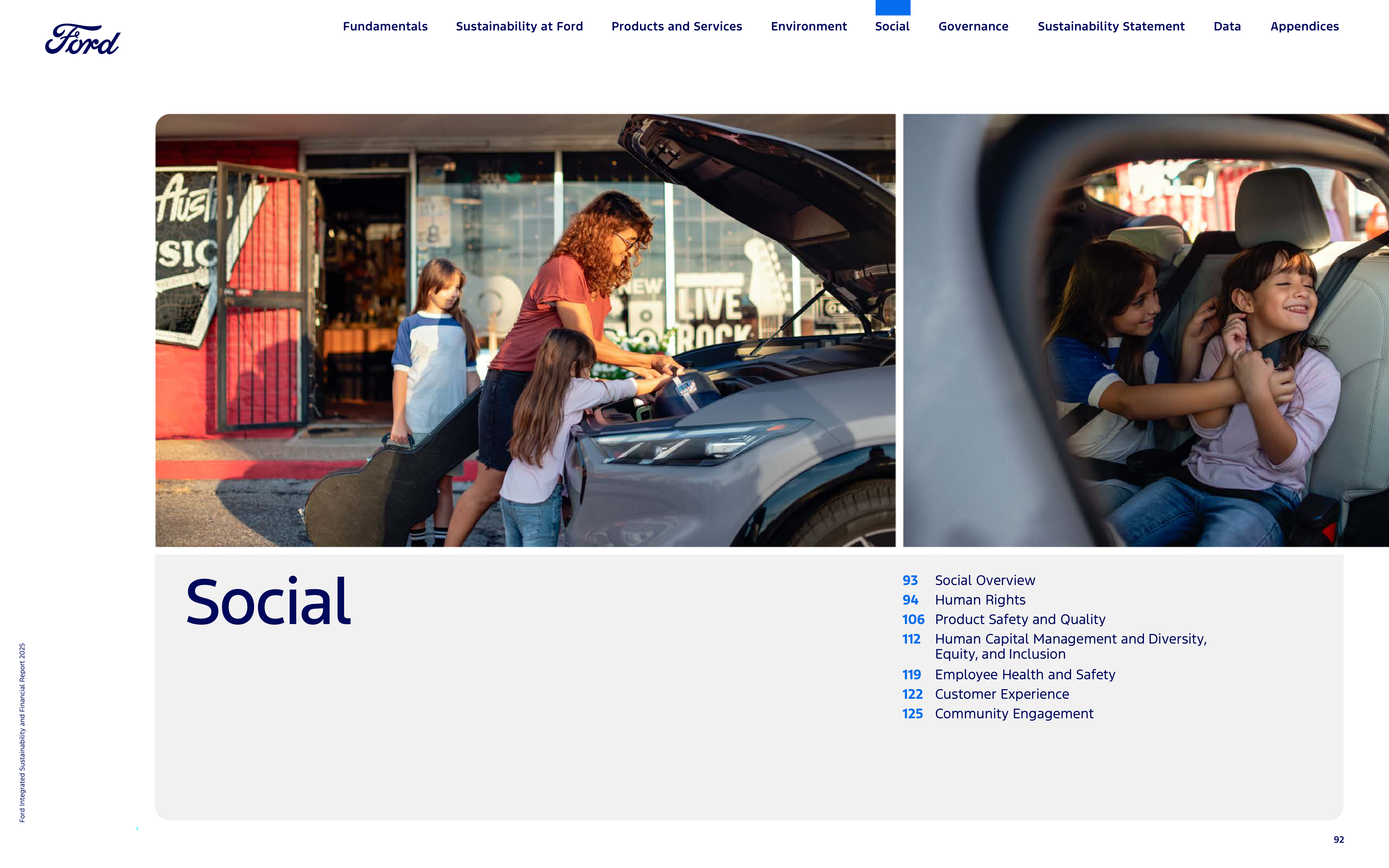
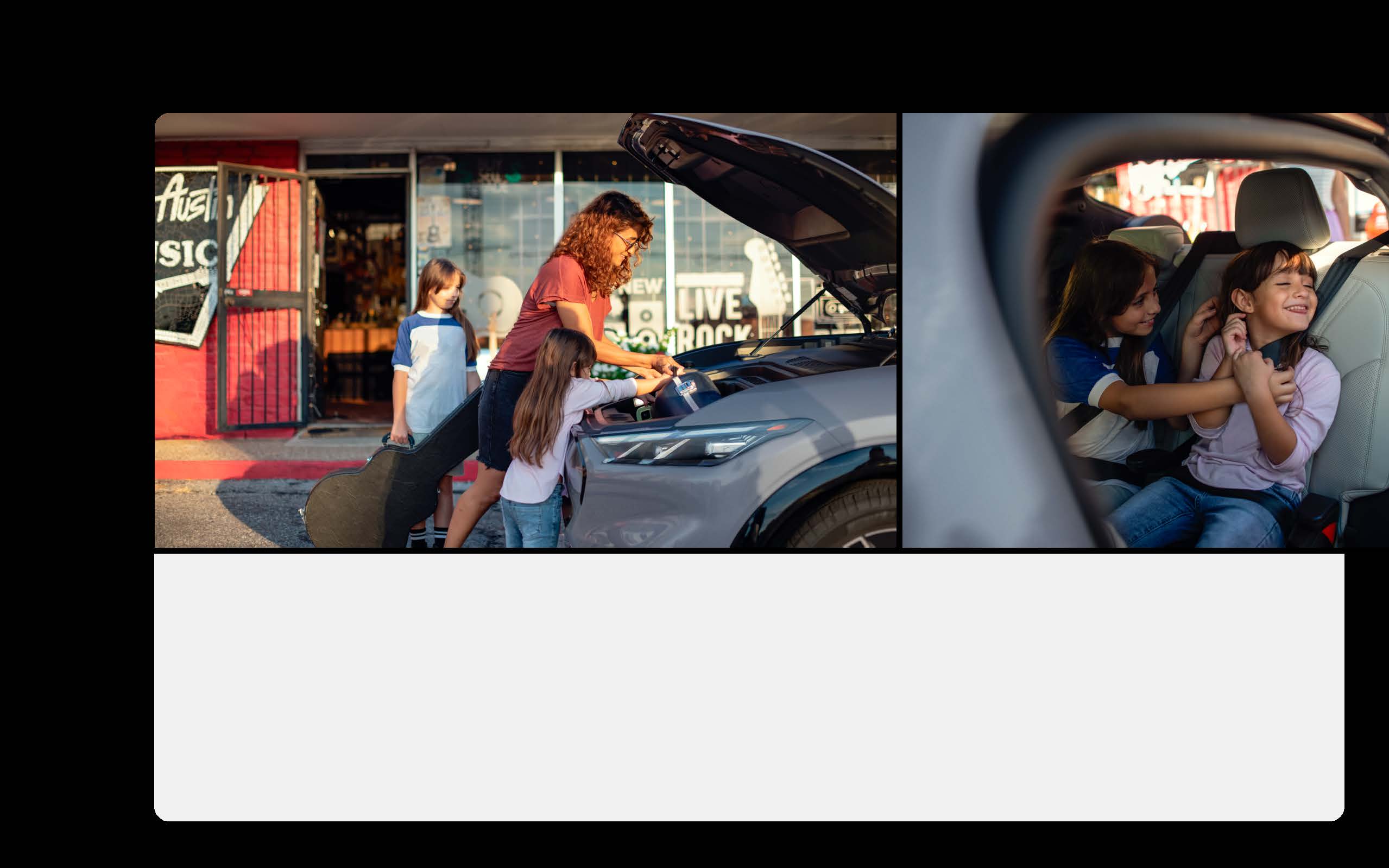

Fundamentals
Sustainability at Ford
Products and Services
Environment
Social
Governance
Sustainability Statement
Data
Appendices
,
Ford Integrated Sustainability and Financial Report 2025
92
Social
93
Social Overview
94
Human Rights
106
Product Safety and Quality
112
Human Capital Management and Diversity,
Equity, and Inclusion
119
Employee Health and Safety
122
Customer Experience
125
Community Engagement

Fundamentals
Sustainability at Ford
Products and Services
Environment
Social
Governance
Sustainability Statement
Data
Appendices
Overview
|
Human Rights
|
Product Safety and Quality
|
Human Capital and Diversity, Equity, and Inclusion
|
Employee Health and Safety
|
Customer Experience
|
Community Engagement
,
Ford Integrated Sustainability and Financial Report 2025
93
Social
Overview
Our sustainability mission extends beyond creating
a climate-resilient future. It’s also about promoting
and protecting human rights: in our company, our
industry, and our supply chain. We believe in fair
treatment for all, celebrating inclusion in our
workplace and in the communities we call home.
WE ARE FOCUSED ON PROTECTING AND
RESPECTING HUMAN RIGHTS
Our commitment to respecting human rights begins
within our company and extends across our value chain.
We continue to strengthen our policies on issues ranging
from child and forced labor, and protecting the rights of
Indigenous People, to ensuring a safe and fair workplace
and enabling efforts to achieve a cleaner planet.
WE PRIORITIZE HEALTH AND SAFETY
Our Health and Safety Commitment, “Our most valuable
asset is our people. There can be no compromise,”
drives our health and safety culture. It applies to all
employees, contractors, and visitors performing work
at our locations globally.
WE ARE DEDICATED TO CREATING A CULTURE
OF INCLUSION
We strive to create an employee experience that enables an
inclusive environment of excellence, focus, and collaboration
among team members. We don’t just talk about what’s
important, we take clear actions to make a difference.
WE ARE PASSIONATE ABOUT PARTNERING
WITH COMMUNITIES
Supporting impactful community institutions, programs,
and endeavors is woven into the fabric of our culture. We
take pride in our role as an active and valuable member of
the communities in which we operate. Our corporate efforts
are augmented by Ford Philanthropy’s partnerships with
nonprofits to support local programs that build equity
and expand access to essential services and education.
Our Sustainability Aspirations
Human Rights:
Source only raw materials that are
responsibly produced
Safety:
Work toward a future that is free from
vehicle crashes and workplace injuries
Diversity, Equity, and Inclusion:
Support a respectful, safe,
and inclusive workplace where each person is valued.
UN Sustainable Development Goals
We are contributing to the following UN Sustainable Development Goals through actions outlined in this chapter:
3 GOOD HEALTH
AND WELL-BEING
4 QUALITY
EDUCATION
5 GENDER
EQUALITY
6 CLEAN WATER
AND SANITATION
7 AFFORDABLE AND
CLEAN ENERGY
8 DECENT WORK AND
ECONOMIC GROWTH
10 REDUCED
INEQUALITIES
11 SUSTAINABLE CITIES AND COMMUNITIES
12 RESPONSIBLE
CONSUMPTION AND
PRODUCTION
13 CLIMATE
ACTION

Fundamentals
Sustainability at Ford
Products and Services
Environment
Social
Governance
Sustainability Statement
Data
Appendices
Overview
| Human Rights | Product Safety and Quality | Human Capital and Diversity, Equity, and Inclusion | Employee Health and Safety | Customer Experience | Community Engagement
Human Rights
,
Ford Integrated Sustainability and Financial Report 2025
94
Overview
Aspirations
Human
Rights
Salient Issues
Environment
Fair Work
Forced Labor
Electric
Vehicle
Transition
Health/
Safety
Harassment/
Discrimination
Indigenous
Peoples
UN Sustainable Development Goals
3
GOOD HEALTH
AND WELL-BEING
4 QUALITY
EDUCATION
5 GENDER
EQUALITY
6 CLEAN WATER
AND SANITATION
7 AFFORDABLE AND
CLEAN ENERGY
8 DECENT WORK AND
ECONOMIC GROWTH
10 REDUCED
INEQUALITIES
11 SUSTAINABLE CITIES
AND COMMUNITIES
12 RESPONSIBLE
CONSUMPTION AND
PRODUCTION
13 CLIMATE
ACTION
Our commitment to respecting human
rights is fundamental to our purpose of
helping build a better world. It guides our
strategy and our actions company wide.
We are committed to respecting human rights across
our company, our supply chain, and the regions in
which we operate. We respect human rights in all our
activities and seek to address concerns that may arise
on a timely basis.
Ford uses a saliency assessment to identify and prioritize
the company’s most significant human rights risks and
the areas where we can make an impact.
In 2024, we conducted our fourth formal salient human
rights assessment, which identified and prioritized the
following potential high-risk human rights areas within
our operations and along our supply chain. These are
listed in alphabetical order.
•
Climate change and environmental health
•
Data privacy and the use of artificial intelligence
•
Fair and decent work
•
Forced labor, child labor, and human trafficking
•
Harassment and discrimination
•
Impacts of electric vehicle transition
•
Local communities and Indigenous Peoples
•
Occupational health, safety, and wellness
•
Product safety
Using these salient issues as a guide, we continue to
strengthen our policies on issues such as child labor,
forced labor, human trafficking, protecting the rights
of Indigenous People, addressing impacts of vehicle
electrification, ensuring a safe and fair workplace,
and enabling efforts to achieve a cleaner planet.
→
Read More: In Our Saliency Assessment on p.25
→
Read More: On our sustainability website
HUMAN RIGHTS POLICY
We are guided by our
We Are Committed to Protecting
Human Rights and the Environment policy
. Prohibiting
the use of child labor and forced or compulsory labor
are among its mandates.
We aspire to ensure that everything we do — or that
others do for us — is consistent with local laws and our
own commitment to human rights per our We Are
Committed to Protecting Human Rights and the
Environment policy. In situations where non-compliance
is confirmed, we provide remedy as quickly as possible.
We require our suppliers and expect our business
partners to adopt and enforce similar policies.
As mandated by our We Are Committed to Protecting
Human Rights and the Environment policy, we follow all
Ford policies and comply with or exceed all applicable
laws and regulations, including all applicable due
diligence laws. We also strive to meet the spirit of these
laws and regulations. Cost alone does not drive our
business decisions; we consider impacts on human rights
among other factors. We explicitly require our suppliers
and expect partners and joint ventures to adopt and
enforce similar policies and extend them to their own
supply chain.
As part of our commitment to transparency, our
We Are Committed to Protecting Human Rights and the
Environment policy is posted on our corporate website
along with our
Code of Conduct
and our
Policy Statement
on Ford’s Human Rights Strategy, Policies and Processes
.
Our Vice President, Chief Sustainability, Environment and
Safety Officer, called “Chief Sustainability Officer” (CSO),
is responsible for interpreting and implementing our We
Are Committed to Protecting Human Rights and the
Environment policy, managing risk, and reviewing with,
as appropriate, the Vice President Global Manufacturing
and Labor Affairs, Vice President Global Commodity
Purchasing, Chief People and Employee Experience
Officer, and the Chief Policy Officer and General Counsel.
Human Rights Policy Updates
In 2024, we updated our We Are Committed to Protecting
Human Rights and the Environment policy to formally
reflect our commitment to respecting the United Nations
Declaration on the Rights of Indigenous Peoples.
Our policy remains aligned with the 2022 International
Labour Organization (ILO) declaration on Fundamental
Principles and Rights at Work, which includes the
Occupational Safety and Health Convention (No. 155)
and Promotional Framework for Occupational Safety
and Health Convention (No. 187).
The policy also states our adherence to the Minamata
Convention on Mercury, Stockholm Convention of 23 May
2001 on Persistent Organic Pollutants, and the Basel
Convention on the Control of Transboundary Movements
of Hazardous Wastes and their Disposal.
Additional policies related to supporting a living wage,
not engaging in unlawful eviction, and the use of security
forces with proper supervision and due diligence were
added in 2023.
In alignment with due diligence laws such as the German
Supply Chain Due Diligence Act, we issued the Policy
Statement on Ford’s Human Rights Strategy, Policies and
Processes that further outlines our commitment to our
due diligence efforts.
Fundamentals
Sustainability at Ford
Products and Services
Environment
Social
Governance
Sustainability Statement
Data
Appendices
Overview |
Human Rights
| Product Safety and Quality | Human Capital and Diversity, Equity, and Inclusion | Employee Health and Safety | Customer Experience | Community Engagement
Human Rights
— continued
,
Ford Integrated Sustainability and Financial Report 2025
95
Human Rights Policy Commitments
We support the United Nations (UN) Sustainable
Development Goals and are members of the UN Global
Compact and incorporate their Ten Principles in our
operations. We have also signed the UN CEO Water
Mandate and an action pledge for the UN’s “International
Year for the Elimination of Child Labor.” Aligned with the
UN Guiding Principles on Business and Human Rights,
we are committed to respecting these widely accepted
international human rights frameworks and charters:
•
International Bill of Human Rights (The United Nations
Universal Declaration of Human Rights and its two
Covenants) 1948
•
The ILO Declaration on Fundamental Principles and
Rights at Work (2022)
•
The Organisation for Economic Co-operation and
Development (OECD) Guidelines for Multinational
Enterprises Revision 2011
•
UN Women’s Empowerment Principles
•
United Nations Declaration on the Rights of Indigenous
Peoples (UNDRIP)
Our
We Are Committed to Protecting Human Rights and
the Environment policy
addresses key workplace issues
including but not limited to child labor, forced labor,
human trafficking, living wage, Indigenous Peoples’
rights, and freedom of association and collective
bargaining. This policy applies to all of Ford’s global
operations and its subsidiaries.
HUMAN RIGHTS STRATEGY
Ford’s human rights strategy for our business and
suppliers is aligned with the UN Guiding Principles
on Business and Human Rights and focuses on:
•
Embedding human rights policies into the business
•
Implementing due diligence processes to identify,
prevent, mitigate, and account for human rights
impacts in our business and our supply chain
•
Providing remedial actions when needed
•
Communicating transparently with our stakeholders
about our processes and actions
•
Engaging constructively with suppliers, local
communities, governments, non-governmental
organizations (NGOs), and other stakeholders,
including Indigenous Peoples
•
Seeking third-party assistance, as appropriate,
to assess compliance with our policy
DUE DILIGENCE IN OUR OWN BUSINESS
Our We Are Committed to Protecting Human Rights
and the Environment policy commits us to conducting
due diligence and providing grievance mechanisms
and remedy aligned with the UN Guiding Principles
for Business and Human Rights. We assess risk, engage
with various stakeholders, conduct training, and
perform audits.
As part of our efforts to improve our due diligence
procedures and transparency, a cross-functional team
continuously monitors how Ford addresses human rights
strategy, assesses risk, prioritizes actions, and complies
with new and upcoming due diligence laws.
When potential issues are identified by stakeholders,
NGOs, media, or supply chain partners, we take action
to investigate the issue and understand our corporate
and supplier involvement. We adapt our due diligence
approach to each incident based on the type of inquiry.
When a non-compliance occurs, we provide appropriate
remedies and bring any violation to an end, including
working with suppliers to implement corrective actions.
Corporate Human Rights Risk Assessment
Aligned with our policy commitment, Ford conducts
human rights risk assessments across our global
manufacturing facilities using the Responsible Business
Alliance (RBA) Online Self-Assessment Questionnaire (SAQ).
The RBA Facility SAQs highlight areas of potential human
rights, health and safety, and environment risks at the
facility level by identifying gaps in systems, policies, and
practices. They provide a consistent process to analyze
responses globally and across multiple facilities. In 2024,
48 assessments were completed covering all global
manufacturing facilities including majority-owned
joint ventures.
Respecting the Rights of Indigenous Peoples
In 2024, we began incorporating Free, Prior, and
Informed Consent (FPIC) assessments to implement our
policy commitment to respecting Indigenous Peoples’
Rights in accordance with the UNDRIP. Subsequently,
we initiated the development and implementation of
a process to identify and assess new projects’ potential
impact on Indigenous Peoples through an Environmental
Site Assessment (ESA). This included allocating budget
for ESAs to include collaborative engagement between
our government affairs or delegated community liaisons
and Indigenous Peoples to seek Free, Prior, and Informed
Consent. In 2024, none of the projects assessed identified
impacts to Indigenous Peoples. However, this initiative is
a significant step towards responsible business practices
for respecting Indigenous Peoples’ rights and working to
achieve FPIC where impacts are identified.
CORPORATE GRIEVANCE MECHANISM
Ford’s SpeakUp whistleblower system is a confidential
web-based reporting platform that allows employees,
business partners, customers, and other third parties
to raise concerns about unethical behavior, violations
of company policies, or any other misconduct within the
organization. Ford employees can also report concerns
directly to their People Leader, HR, People Matters, or
the Office of the General Counsel. Reports submitted
through SpeakUp are thoroughly investigated and
appropriate action is taken to ensure compliance with
laws and ethical standards, helping to maintain a positive
work environment and uphold the company’s values.
An outline of the SpeakUp grievance process is posted
on our corporate website.
→
Read More: In Grievance Mechanisms and Remediation
on
p.205
RECOGNITION FOR HUMAN RIGHTS
We are proud of the external recognition we have
received for our Human Rights and Supply Chain work.
Ford was ranked as the number 2 global automaker in
Lead the Charge Coalition’s 2024 Leaderboard report,
which evaluates the efforts of major automakers to
ensure their supply chains are equitable and sustainable.
The report noted that Ford remains the top scoring
automaker on human rights, citing our high level of
disclosure on human rights due diligence policies and
practices. Ford also continues as an industry leader on
responsible mineral sourcing, achieving the highest
percentage score of all human rights scores, across
all companies.
Ford ranked fourth out of 13 automotive brands in Amnesty
International’s Recharge for Rights: Ranking the Human
Rights Due Diligence Reporting of Leading Electric Vehicle
Makers, published in 2024.
We were recognized as a leader in human rights in
the auto industry by the World Benchmarking Alliance’s
Automotive and Transportation Manufacturers
Benchmark in 2024. Ford ranked second overall out
of 30 automotive manufacturers.
Fundamentals
Sustainability at Ford
Products and Services
Environment
Social
Governance
Sustainability Statement
Data
Appendices
Overview |
Human Rights
| Product Safety and Quality | Human Capital and Diversity, Equity, and Inclusion | Employee Health and Safety | Customer Experience | Community Engagement
Human Rights
— continued
,
Ford Integrated Sustainability and Financial Report 2025
96
HUMAN RIGHTS IN OUR SUPPLY CHAIN
With close to 1,600 Tier 1 production suppliers and
around 4800 supplier sites providing vehicle parts
composed of nearly 1,000 different materials, our supply
chain is vast and complex. To support our commitment
to use materials in our vehicles that are safe and sourced
responsibly and protect human rights, it’s important
for us to understand where the materials come from.
Ford uses our purchasing power to enable responsible
sourcing, including electric vehicle battery raw materials,
and better protect impacted communities and the
environment.
We utilize a variety of tools, including our
Supplier Code
of Conduct
, to ensure that our commitment to respecting
human rights everywhere we operate cascades
throughout our supply chain.
With our suppliers, we place a heavy focus on supply
chain transparency to give us visibility into our supply
chain and, when necessary, launch an investigation
to ensure suppliers are meeting Ford’s environmental,
social, and governance (ESG) expectations as outlined
in our Supplier Code of Conduct.
As a member of multiple cross-industry organizations,
we partner with other businesses across sectors to learn
from each other, share best practices, and develop an
aligned approach with our supply base. We actively
participate in the Initiative for Responsible Mining
Assurance (IRMA), Responsible Minerals Initiative (RMI),
and Responsible Business Alliance (RBA), to identify
and immediately address human rights issues in our
supply chain.
We offer training resources to help our suppliers build
their capacity to manage supply chain issues, and we
meet with our top suppliers individually to discuss
specific sustainability topics on an annual basis.
OUR SUPPLIER CODE OF CONDUCT
Since 2003, we have set human rights and environmental
expectations and requirements for our suppliers and
updated them annually. In 2021, we established a formal
Supplier Code of Conduct that applies requirements and
expectations related to:
•
Human rights
•
Environment
•
Responsible material sourcing
•
Responsible and lawful business practices
•
Third-party sustainability audits
Our Supplier Code of Conduct addresses key human
rights and workplace issues commonly associated with
modern slavery, including but not limited to child labor,
forced labor, human trafficking, fair and equal wages,
and freedom of association and collective bargaining
rights. Ford suppliers are expected to comply with this
Supplier Code of Conduct, work to prevent issues that
are deemed high risk, mitigate and remediate issues
when identified, and demonstrate compliance when
asked. We require suppliers to follow all applicable
Ford policies and to comply with or exceed all applicable
laws and regulations. Suppliers are obligated to extend
these requirements to their own supply chains.
Supplier Policy Commitments
The Supplier Code of Conduct is aligned with the
following international frameworks and charters
and industry guidance:
•
International Bill of Human Rights (The United Nations
Universal Declaration of Human Rights and its two
Covenants) 1948
•
ILO Declaration on Fundamental Principles and Rights
at Work (2022), including ILO Convention No. 138 on
Minimum Age and Convention No. 182 on the
Worst Forms of Child Labour
•
UN Guiding Principles on Business and Human
Rights (2011)
•
OECD Guidelines for Multinational Enterprises
(2011 Edition)
•
OECD Guidance for Responsible Supply Chains of
Minerals from Conflict Affected and High-Risk Areas
(2016 Edition)
•
UN Global Compact
•
UN Sustainable Development Goals
•
UN CEO Water Mandate
•
UN Women’s Empowerment Principles
•
UN Declaration on the Rights of Indigenous Peoples
The Supplier Code of Conduct also states our adherence
to the Minamata Convention on Mercury, Stockholm
Convention of 23 May 2001 on Persistent Organic
Pollutants, and the Basel Convention on the Control
of Transboundary Movements of Hazardous Wastes
and their Disposal.
Updates to Supplier Code of Conduct
We strengthened our Supplier Code of Conduct in 2024,
adding new requirements related to the topics of
biodiversity and land rights.
Biodiversity: We now require our suppliers to protect
ecosystems and mimic ecosystem performance, especially
key biodiversity areas, in locations impacted by their
operations, and avoid illegal deforestation in accordance
with international biodiversity and deforestation regulations.
Land rights: Our suppliers are now required to:
•
Respect the rights of Indigenous Peoples in accordance
with the UNDRIP
•
Not engage in any acts constituting or aiding unlawful
eviction or unlawful taking of land, forests, or waters
securing the livelihood of human beings
•
Strive to ensure FPIC of communities is pursued and
obtained prior to project or activities that may affect
their lands, resources, and rights
Our Supplier Code of Conduct is reviewed annually and
updated as needed to reflect changes in regulatory
requirements and stakeholder expectations. The latest
version of the Supplier Code of Conduct is always
publicly available on our website.
Our Responsible Materials Sourcing Policy
Our
Responsible Materials Sourcing Policy
covers conflict
minerals, other minerals of concern, and ESG risks in
material supply chains, as well as mineral due diligence
applicable to the supply chain. This policy was updated
in 2024 to reflect our commitment to the UNDRIP. Raw
material suppliers must also ensure FPIC of communities
is pursued and obtained prior to any project or activities
that may affect their lands, resources, and rights.
Global Framework Agreements
Our Supplier Code of Conduct states our commitment
to recognize and respect employees’ rights to freedom
of association and collective bargaining. We require our
suppliers to:
•
Work with recognized employee representatives
to promote the interests of employees
•
Not discriminate or retaliate against any employees,
including those participating in a trade union
•
Provide opportunities for employees’ and external
stakeholders’ concerns to be heard, even where there
is no representation by unions
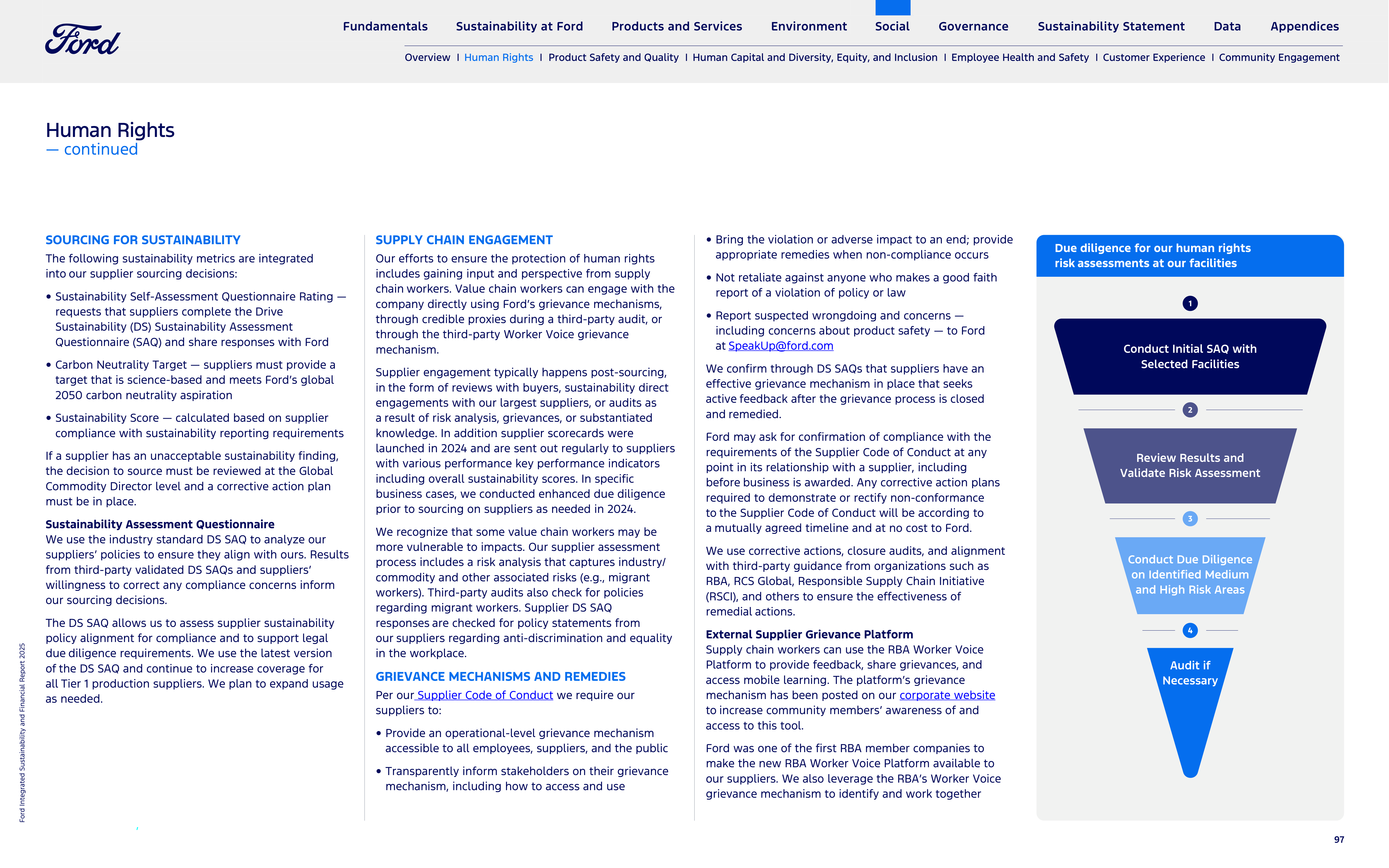
Fundamentals
Sustainability at Ford
Products and Services
Environment
Social
Governance
Sustainability Statement
Data
Appendices
Overview |
Human Rights
| Product Safety and Quality | Human Capital and Diversity, Equity, and Inclusion | Employee Health and Safety | Customer Experience | Community Engagement
Human Rights
— continued
,
Ford Integrated Sustainability and Financial Report 2025
97
SOURCING FOR SUSTAINABILITY
The following sustainability metrics are integrated
into our supplier sourcing decisions:
•
Sustainability Self-Assessment Questionnaire Rating —
requests that suppliers complete the Drive
Sustainability (DS) Sustainability Assessment
Questionnaire (SAQ) and share responses with Ford
•
Carbon Neutrality Target — suppliers must provide a
target that is science-based and meets Ford’s global
2050 carbon neutrality aspiration
•
Sustainability Score — calculated based on supplier
compliance with sustainability reporting requirements
If a supplier has an unacceptable sustainability finding,
the decision to source must be reviewed at the Global
Commodity Director level and a corrective action plan
must be in place.
Sustainability Assessment Questionnaire
We use the industry standard DS SAQ to analyze our
suppliers’ policies to ensure they align with ours. Results
from third-party validated DS SAQs and suppliers’
willingness to correct any compliance concerns inform
our sourcing decisions.
The DS SAQ allows us to assess supplier sustainability
policy alignment for compliance and to support legal
due diligence requirements. We use the latest version
of the DS SAQ and continue to increase coverage for
all Tier 1 production suppliers. We plan to expand usage
as needed.
SUPPLY CHAIN ENGAGEMENT
Our efforts to ensure the protection of human rights
includes gaining input and perspective from supply
chain workers. Value chain workers can engage with the
company directly using Ford’s grievance mechanisms,
through credible proxies during a third-party audit, or
through the third-party Worker Voice grievance
mechanism.
Supplier engagement typically happens post-sourcing,
in the form of reviews with buyers, sustainability direct
engagements with our largest suppliers, or audits as
a result of risk analysis, grievances, or substantiated
knowledge. In addition supplier scorecards were
launched in 2024 and are sent out regularly to suppliers
with various performance key performance indicators
including overall sustainability scores. In specific
business cases, we conducted enhanced due diligence
prior to sourcing on suppliers as needed in 2024.
We recognize that some value chain workers may be
more vulnerable to impacts. Our supplier assessment
process includes a risk analysis that captures industry/
commodity and other associated risks (e.g., migrant
workers). Third-party audits also check for policies
regarding migrant workers. Supplier DS SAQ
responses are checked for policy statements from
our suppliers regarding anti-discrimination and equality
in the workplace.
GRIEVANCE MECHANISMS AND REMEDIES
Per our
Supplier Code of Conduct
we require our
suppliers to:
•
Provide an operational-level grievance mechanism
accessible to all employees, suppliers, and the public
•
Transparently inform stakeholders on their grievance
mechanism, including how to access and use
•
Bring the violation or adverse impact to an end; provide
appropriate remedies when non-compliance occurs
•
Not retaliate against anyone who makes a good faith
report of a violation of policy or law
•
Report suspected wrongdoing and concerns —
including concerns about product safety — to Ford
at
SpeakUp@ford.com
We confirm through DS SAQs that suppliers have an
effective grievance mechanism in place that seeks
active feedback after the grievance process is closed
and remedied.
Ford may ask for confirmation of compliance with the
requirements of the Supplier Code of Conduct at any
point in its relationship with a supplier, including
before business is awarded. Any corrective action plans
required to demonstrate or rectify non-conformance
to the Supplier Code of Conduct will be according to
a mutually agreed timeline and at no cost to Ford.
We use corrective actions, closure audits, and alignment
with third-party guidance from organizations such as
RBA, RCS Global, Responsible Supply Chain Initiative
(RSCI), and others to ensure the effectiveness of
remedial actions.
External Supplier Grievance Platform
Supply chain workers can use the RBA Worker Voice
Platform to provide feedback, share grievances, and
access mobile learning. The platform’s grievance
mechanism has been posted on our
corporate website
to increase community members’ awareness of and
access to this tool.
Ford was one of the first RBA member companies to
make the new RBA Worker Voice Platform available to
our suppliers. We also leverage the RBA’s Worker Voice
grievance mechanism to identify and work together
Due diligence for our human rights
risk assessments at our facilities
1
Conduct Initial SAQ with
Selected Facilities
2
Review Results and
Validate Risk Assessment
3
Conduct Due Diligence
on Identified Medium
and High Risk Areas
4
Audit if
Necessary
with other RBA members to ensure suppliers meet our
requirements for human rights and environment issues.
Fundamentals
Sustainability at Ford
Products and Services
Environment
Social
Governance
Sustainability Statement
Data
Appendices
Overview |
Human Rights
| Product Safety and Quality | Human Capital and Diversity, Equity, and Inclusion | Employee Health and Safety | Customer Experience | Community Engagement
Human Rights
— continued
,
Ford Integrated Sustainability and Financial Report 2025
98
The Worker Voice platform is available to all our direct
suppliers free of charge, and we actively encourage all
suppliers to participate in the platform. We have also
invited suppliers to training sessions covering the
importance of grievance mechanisms.
The UN Guiding Principles effectiveness criteria on
grievance mechanism is reviewed with external
stakeholders to ensure that our grievance mechanism
is aligned with best practices.
Value Chain Worker Grievance Process
External grievances are now a KPI.
To ensure the opportunity for confidential reporting of
any potential violation of human rights or environment-
related risks throughout the complete supply chain, our
external grievance mechanism document information is
posted on our
website
in 19 languages. It includes a
structured process flow, an explanation of process steps,
and an icon-based instruction letter.
We have also created a one-page document that explains
the external grievance process in simplified language.
The document is publicly available on Ford’s corporate
website. Suppliers can download the document and post
it in their facilities.
The RMI grievance mechanism was merged into the RBA
Worker Voice App in 2024, facilitating information
exchange and engagement with RBA and RMI.
Worker grievances submitted through our reporting
channels are tracked and monitored exclusively by
qualified and experienced employees within our Supply
Chain Sustainability team.
The external grievance mechanism document describes
the opportunity for complainants to raise their hands if
they experience any negative impact based on their
grievance submitted.
Training ensures that the employees handling
complaints are sensitized to intervene at the slightest
sign of possible discrimination or other reprisals against
a complainant. Ford does not tolerate any retaliatory
measures or intimidation and discrimination against
complainants. The complainant may escalate their case
at any time, even after closure, if they are confronted
with retaliatory measures as a result of the submitted
complaint. Any retaliation resulting from a submitted
complaint can be reported through our grievance
mechanism and will be coordinated accordingly by
a third party, the RBA.
Complainants always have the opportunity to escalate
their case if they do not agree with the progress
communicated. In this case, the RBA is called in
to mediate.
Upon completion of remediation and any follow-up
measures that have been completed, a summary
including the outcome is communicated to the
complainant. The complainant is asked for feedback
and has the opportunity to escalate the case further.
Our complaints procedure is subject to an effectiveness
review at least once a year. We also review our
processes on an ad hoc basis for each complaints
procedure carried out.
The process is described in detail in our
Procedure of the
Grievance Mechanism
document.
SUPPLY CHAIN DUE DILIGENCE
Ford works to identify and address potential human
rights violations and environmental risks within our
business and supply chain.
The enactment of global regulations, including the
German Supply Chain Due Diligence Act and other due
diligence legislation, have further enhanced our due
diligence efforts. Our efforts, including assessing risk,
supply chain mapping, third-party validation of supplier
policies, and supplier audits, are critical to ensure our
compliance. We are also considering environmental
risks that may lead to human rights violations.
→
Read More: In our Policy Statement on Ford’s Human Rights
Strategy, Policies
and Processes
Supplier Risk Assessment Updates
We assess our supply chain risk annually, identify
risks, take appropriate measures to minimize them,
and continue alignment with legislative requirements.
As we update our risk assessments for our supply chain,
we also update the process for addressing and managing
those risks. As new issues arise, we will identify whether
there are any gaps in our processes and, if so, work to
close them immediately.
Enabled by the requirements of Germany’s Supply
Chain Due Diligence Act, we have strengthened our due
diligence processes to identify, prevent, and mitigate
risk at our suppliers.
Supplier Assessment Process
We have developed a risk assessment process to identify
and drive action on highest risk suppliers first. We first
perform an abstract analysis based on country risk,
industry risk, and dollars spent with each supplier site.
We also evaluate suppliers’ alignment with Ford’s
Supplier Code of Conduct
utilizing the DS SAQ. Once the
DS SAQs are received, we conduct a concrete risk analysis
to determine which suppliers will require an audit based
on severity and likelihood. Third-party audits are
conducted on high-risk Tier 1 suppliers and electric
vehicle battery material sub-tier suppliers. For our
high-risk battery manufacturing facility suppliers, we
conducted risk-based, enhanced pre-sourcing due
diligence in 2024.
We plan to increase our overall DS SAQ coverage through
2027 while also developing a process to allow DS SAQ
responses from indirect suppliers. In 2024, a subset of
indirect purchasing and Ford Customer Service Division
(FCSD) suppliers completed the DS SAQ, as they were
manufacturing sites which fit the scope of current DS
SAQ parameters. We invited 22 high-risk sites for Ford of
Europe’s FCSD and 21 indirect (non-production) suppliers
to complete the DS SAQ. We are working to continue
expanding the implementation of DS SAQs to indirect
suppliers and conducting pre-sourcing due diligence.
We identify material impacts on supply chain workers
through third-party audits, grievance mechanisms, or via
escalation to the buyers for the supplier. Our corrective
action process (CAP) monitors compliance and prevents
future risks. Closure audits take place after the corrective
audits are developed. Along with resolved grievances,
they measure the effectiveness of these actions.
Sustainability Responsibility Audits
We regularly conduct sustainability responsibility audits
of at-risk Tier 1 supplier sites. We use the RBA Validated
Assessment Program (VAP) as well as the RSCI
Assessment. These audits evaluate supplier compliance
with both local law and Ford’s human rights expectations
as communicated in our Supplier Code of Conduct.
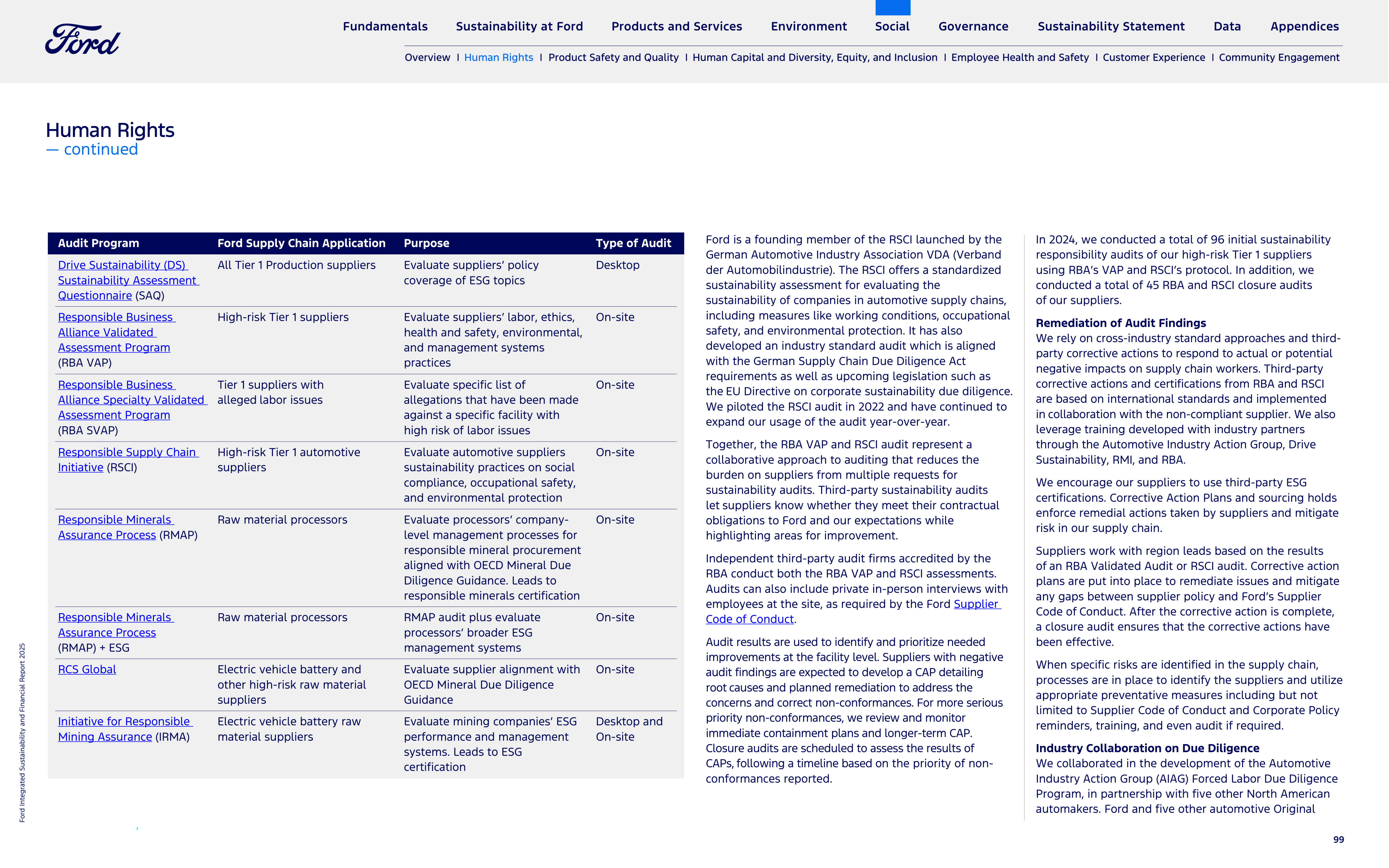
Fundamentals
Sustainability at Ford
Products and Services
Environment
Social
Governance
Sustainability Statement
Data
Appendices
Overview |
Human Rights
| Product Safety and Quality | Human Capital and Diversity, Equity, and Inclusion | Employee Health and Safety | Customer Experience | Community Engagement
Human Rights
— continued
,
Ford Integrated Sustainability and Financial Report 2025
99
Audit Program
Ford Supply Chain Application
Purpose
Type of Audit
Drive Sustainability (DS)
Sustainability Assessment
Questionnaire
(SAQ)
All Tier 1 Production suppliers
Evaluate suppliers’ policy
coverage of ESG topics
Desktop
Responsible Business
Alliance Validated
Assessment Program
(RBA VAP)
High-risk Tier 1 suppliers
Evaluate suppliers’ labor, ethics,
health and safety, environmental,
and management systems
practices
On-site
Responsible Business
Alliance Specialty Validated
Assessment Program
(RBA SVAP)
Tier 1 suppliers with
alleged labor issues
Evaluate specific list of
allegations that have been made
against a specific facility with
high risk of labor issues
On-site
Responsible Supply Chain
Initiative
(RSCI)
High-risk Tier 1 automotive
suppliers
Evaluate automotive suppliers
sustainability practices on social
compliance, occupational safety,
and environmental protection
On-site
Responsible Minerals
Assurance Process
(RMAP)
Raw material processors
Evaluate processors’ company-
level management processes for
responsible mineral procurement
aligned with OECD Mineral Due
Diligence Guidance. Leads to
responsible minerals certification
On-site
Responsible Minerals
Assurance Process
(RMAP) + ESG
Raw material processors
RMAP audit plus evaluate
processors’ broader ESG
management systems
On-site
RCS Global
Electric vehicle battery and
other high-risk raw material
suppliers
Evaluate supplier alignment with
OECD Mineral Due Diligence
Guidance
On-site
Initiative for Responsible
Mining Assurance
(IRMA)
Electric vehicle battery raw
material suppliers
Evaluate mining companies’ ESG
performance and management
systems. Leads to ESG
certification
Desktop and
On-site
Ford is a founding member of the RSCI launched by the
German Automotive Industry Association VDA (Verband
der Automobilindustrie). The RSCI offers a standardized
sustainability assessment for evaluating the
sustainability of companies in automotive supply chains,
including measures like working conditions, occupational
safety, and environmental protection. It has also
developed an industry standard audit which is aligned
with the German Supply Chain Due Diligence Act
requirements as well as upcoming legislation such as
the EU Directive on corporate sustainability due diligence.
We piloted the RSCI audit in 2022 and have continued to
expand our usage of the audit year-over-year.
Together, the RBA VAP and RSCI audit represent a
collaborative approach to auditing that reduces the
burden on suppliers from multiple requests for
sustainability audits. Third-party sustainability audits
let suppliers know whether they meet their contractual
obligations to Ford and our expectations while
highlighting areas for improvement.
Independent third-party audit firms accredited by the
RBA conduct both the RBA VAP and RSCI assessments.
Audits can also include private in-person interviews with
employees at the site, as required by the Ford
Supplier
Code of Conduct
.
Audit results are used to identify and prioritize needed
improvements at the facility level. Suppliers with negative
audit findings are expected to develop a CAP detailing
root causes and planned remediation to address the
concerns and correct non-conformances. For more serious
priority non-conformances, we review and monitor
immediate containment plans and longer-term CAP.
Closure audits are scheduled to assess the results of
CAPs, following a timeline based on the priority of non-
conformances reported.
In 2024, we conducted a total of 96 initial sustainability
responsibility audits of our high-risk Tier 1 suppliers
using RBA’s VAP and RSCI’s protocol. In addition, we
conducted a total of 45 RBA and RSCI closure audits
of our suppliers.
Remediation of Audit Findings
We rely on cross-industry standard approaches and third-
party corrective actions to respond to actual or potential
negative impacts on supply chain workers. Third-party
corrective actions and certifications from RBA and RSCI
are based on international standards and implemented
in collaboration with the non-compliant supplier. We also
leverage training developed with industry partners
through the Automotive Industry Action Group, Drive
Sustainability, RMI, and RBA.
We encourage our suppliers to use third-party ESG
certifications. Corrective Action Plans and sourcing holds
enforce remedial actions taken by suppliers and mitigate
risk in our supply chain.
Suppliers work with region leads based on the results
of an RBA Validated Audit or RSCI audit. Corrective action
plans are put into place to remediate issues and mitigate
any gaps between supplier policy and Ford’s Supplier
Code of Conduct. After the corrective action is complete,
a closure audit ensures that the corrective actions have
been effective.
When specific risks are identified in the supply chain,
processes are in place to identify the suppliers and utilize
appropriate preventative measures including but not
limited to Supplier Code of Conduct and Corporate Policy
reminders, training, and even audit if required.
Industry Collaboration on Due Diligence
We collaborated in the development of the Automotive
Industry Action Group (AIAG) Forced Labor Due Diligence
Program, in partnership with five other North American
automakers. Ford and five other automotive Original
Equipment Manufacturers (OEMs) worked together
throughout 2024 to develop an aligned industry
approach for conducting and reporting forced labor due
diligence activities. AIAG negotiated agreements with
world-class supply chain technology providers and
created an online marketplace for common reporting
tools and resources. All participating OEMS agreed to
incorporate these elements into their own supplier
due diligence practices. This approach facilitates a
standardized reporting data, a common reporting
template, and innovative technology for the supply base
at a reduced cost. The program also includes supplier
training and education to support suppliers in
conducting their own forced labor due diligence while
streamlining reporting in the automotive supply chain.
Fundamentals
Sustainability at Ford
Products and Services
Environment
Social
Governance
Sustainability Statement
Data
Appendices
Overview |
Human Rights
| Product Safety and Quality | Human Capital and Diversity, Equity, and Inclusion | Employee Health and Safety | Customer Experience | Community Engagement
Human Rights
— continued
,
Ford Integrated Sustainability and Financial Report 2025
100
SUPPLY CHAIN SUSTAINABILITY TRAINING
We invite suppliers located in countries and regions
where there may be elevated risk to attend training
to increase awareness of Ford’s requirements and legal
obligations, including those related to forced labor
and child labor. We reached over 800 external suppliers
to provide training and education in 2024.
Our Ford supply chain teams are the first line of
investigation into our suppliers. To increase their
understanding of sustainability matters, training
modules are directed toward all of Ford’s global supply
chain employees.
In 2024, we developed new buyer resource tools to assist
with the integration of sustainability into our sourcing
requirements and launched them prior to our strategic
supplier meetings. We also provided live online training
to 831 global supply chain employees regarding our
Supply Chain Sustainability programs.
RESPONSIBLE SOURCING OF RAW MATERIALS
Ford uses our purchasing power to both fuel our
business needs and protect communities and the
environment on which they depend. Our goal is to
understand the origins of our raw materials and ensure
they are sourced responsibly, upholding our commitment
to human rights, compliance with international
standards, and minimizing our environmental and
community impact.
In 2024, to further our aspiration to source responsibly
produced raw materials, we continued to identify and
negotiate with raw material suppliers to secure materials
meeting our ESG requirements. Processes and structural
changes were implemented to enable fast action. Our
objective is to ensure we are ethically and responsibly
sourcing and tracing the supply chains and the raw
materials that are at highest risk of creating negative
social and environmental impacts. We are using this
information to make informed sourcing decisions in
alignment with sustainability standards and corporate
sustainability commitments.
In compliance with the U.S. Dodd Frank Act, section 1502,
we have filed an annual Conflict Minerals Disclosure
report with the U.S. Securities and Exchange Commission
(SEC) since 2013. The report describes our due diligence
process, as defined by the OECD Due Diligence Guidance
to ensure suppliers who provide us with components
containing tin, tungsten, tantalum, and gold (3TG)
understand the origins of such minerals, source them
responsibly, and not knowingly provide parts containing
minerals that contribute to conflict. Suppliers are
required to use smelters and refiners that have been
validated as conforming to an independent third-party
responsible mineral sourcing validation program.
We use data collected through RMI reporting templates
to engage processors to undergo RMI’s Responsible
Material Assurance Process (RMAP) and their ESG
assessment. We also contribute annually to the RMI
Assessment Fund for RMAP Participating Smelters and
Refiners to incentivize non-participating smelters or
refiners to participate by fully paying for the costs of
their initial assessment and supporting needs-based
reassessments.
We are active members of multiple RMI working groups,
including the RMI Smelter Engagement Team and
multiple mineral teams. We also co-chair the AIAG
Smelter Engagement Team and are active members
of several other AIAG workgroups. Our participation in
both RMI and AIAG allows us to extend our capabilities
to reach more eligible smelters as well as encourage
collaboration between the organizations.
In 2024, the Supply Chain Sustainability team underwent
a responsible sourcing audit of our nickel, lithium, cobalt,
and mica OECD due diligence management systems,
improving our score from 2023.
We continue to enhance our Responsible Materials
Sourcing program by expanding the scope of our due
diligence to include additional industry-relevant
materials and mineral provenance from Conflict Affected
and High-Risk Areas beyond the DRC and adjoining
countries. Ford has conducted a formal due diligence
process
39
on cobalt since 2018; mica due diligence since
2019, which was formalized in 2020; formalized lithium
and nickel due diligence in 2022; and in 2025, we plan to
launch formalized due diligence on the natural graphite
in our battery supply chains.
RAW MATERIAL RISKS
We prioritize additional supply chain due diligence
based on vehicle content and known raw material ESG
risks identified by
Material Insights
, a collaborative
platform from TDi Sustainability and the RMI. As a result,
we are currently focusing on the following materials
(in alphabetical order): aluminum, cobalt, copper, lithium,
mica, natural graphite, natural rubber, and nickel.
Aluminum use in the auto industry has continued to
grow due to its lightweight properties which enhances
fuel efficiency. Aluminum is used in body, exterior,
chassis, and other parts including battery and fuel cells.
Risks associated with aluminum include the energy-
intensive process required for production. To approach
this problem, we encourage suppliers to commit to the
Carbon Neutrality Target which is equal to or greater
than the Ford Carbon Neutrality Target. Another risk
associated with the upstream supply chain is
environmental damage caused by the mining of bauxite,
the raw material required to make aluminum. In 2024, we
launched supply chain audits of our aluminum suppliers
to identify sub-tiers to identify and manage these risks.
Cobalt is largely used in cathodes of lithium-ion
batteries. Cobalt supply chains have multiple human
rights risks associated with them. In particular, artisanal
mining of cobalt in DRC is known to include risks of child
labor, health hazards, and environmental issues. Our
efforts to identify risks in our cobalt supply chains
include supply chain audits and mapping, RMI RMAP
assessments at the processor level, and our annual
cobalt due diligence process to identify potential refiners
in Ford’s supply chain using the RMI Extended Minerals
Reporting Template. In addition, Ford contributes to
Better Mining
’s Cobalt in the DRC project and the Oil &
Mines Governance Center (OMGC) Women in Mining
project in the DRC.
Copper is a key material for electric vehicle batteries and
electronics. Copper mining can cause negative impacts to
the environment including pollution of air and water plus
the degradation of landscape. The practices within some
copper mining projects have also led to the displacement
of local communities and Indigenous Peoples. To increase
our influence in this industry, we are member of the
Copper Mark and participate on their Advisory Council.
We conduct outreach encouraging our highest volume
copper suppliers to source from ESG-certified processors
and mines.
Fundamentals
Sustainability at Ford
Products and Services
Environment
Social
Governance
Sustainability Statement
Data
Appendices
Overview |
Human Rights
| Product Safety and Quality | Human Capital and Diversity, Equity, and Inclusion | Employee Health and Safety | Customer Experience | Community Engagement
Human Rights
— continued
,
F
nd
a
y
ilit
b
ina
a
ust
S
ed
t
ra
eg
Int
rd
o
F
l Report 2025
101
Lithium is utilized in our lithium-ion electric vehicle
batteries. The extraction of lithium requires vast
quantities of water. This water usage may harm local
ecosystems and deplete groundwater resources. To
address this issue, we conduct third-party audits of the
battery material supply chain and annual minerals due
diligence utilizing the RMI Pilot Reporting Template (PRT)
to identify potential lithium processors in our supply
chain, conduct additional due diligence, and encourage
them to participate in the RMI RMAP.
Mica is becoming a key raw material needed to support
the electrification of our vehicle line. Phlogopite mica,
known for its insulative properties, is used in parts
providing thermal protection. Muscovite mica, known
for its glittery nature, is commonly used in vehicle paint.
Mica is associated with multiple ESG risks especially in
its upstream supply chain, most notably the widespread
use of child labor and poor working conditions in
Madagascar and India. To address these concerns, we
have joined the Responsible Mica Initiative, implemented
a pre-sourcing due diligence mechanism, and launched
a dedicated mica supply chain assurance and traceability
project on the ground in Madagascar. We also conduct
mica supply chain audits and mapping, RMI RMAP
assessments at the processor level, and our annual mica
due diligence process to identify potential processors
in Ford’s supply chain using the RMI Extended Minerals
Reporting Template.
→
Read More: In Mica Pre-sourcing Investigation on p.102
Natural graphite demand is increasing as it is a key
component of lithium-ion batteries. Graphite mining
has been linked to several ESG risks, including air and
water pollution, child labor, forced labor, and hazardous
working conditions. According to TDi’s Material Insights
platform, graphite is perceived to have a generally
limited exposure to ESG issues as risks are limited to
a small number of reports. To support our due diligence
ncia
ina
efforts, we launched natural graphite supply chain audits
in 2024 and will launch annual due diligence reporting
requirements for in-scope suppliers in 2025.
Natural rubber is used mainly to make tires for the
automotive industry. Issues related to the natural rubber
supply chain include deforestation and biodiversity loss,
water pollution, poor working conditions, Indigenous
Peoples’ rights violations, land displacement, and labor
rights violations. To combat these harmful impacts within
our supply chain, we promote using alternatives and
require our suppliers to comply with the European
Union’s Deforestation Regulation (EUDR), scheduled
to take effect on December 30, 2025. This regulation
requires the reporting of agricultural operation locations
to ensure that products are not produced from
deforested land or contribute to forest degradation.
Nickel is used in stainless steel and newer electric vehicle
battery chemistries. Mining and processing of nickel can
have harmful environmental impacts such as habitat
destruction, water pollution, and contamination from
tailings and chemical runoff. Social impacts include the
displacement of Indigenous communities, poor working
conditions, forced labor, and labor rights violations. To
identify potential issues in our supply chain, we conduct
third-party audits of our battery material supply chains
and conduct annual minerals due diligence to identify
potential nickel processors in our supply chain.
Ford also engages in the RMI and the AIAG Smelter
Engagement Teams to encourage smelters/refiners
to become compliant via conflict-free standard third-
party audits.
BETTER MINING
Ford supports Better Mining, an on-the-ground program
to proactively identify risks and implement corrective
actions and training at designated artisanal and small-
scale (ASM) cobalt mine sites in the Democratic Republic
of the Congo (DRC).
This program educates legal ASM cooperatives and the
sector, as well as supporting state services, on how to
implement responsible practices in the sector and meet
due diligence requirements. Capacity building will also
help mining communities meaningfully participate in
global supply chains.
In 2024, this effort led to tangible risk management
improvements, including the establishment of the
recently established grievance mechanism for the ASM
site monitoring, the prevention of incidents of child
labor and work by individuals without adequate personal
protective equipment, and the improvement of work
and safety conditions on mine sites.
PUBLIC PRIVATE ALLIANCE FOR RESPONSIBLE
MINERALS TRADE
Ford has been a member of the Public-Private Alliance
for Responsible Minerals Trade (PPA) since 2012. PPA
is a multi-stakeholder initiative which works to enable
ethical sourcing of minerals and maximize benefits
to communities where minerals are produced. It does
this by bringing members of industry, government,
and civil society together, supporting peer learning and
engagement, and funding and testing solutions that can
support these shared challenges on the ground.
INITIATIVE FOR RESPONSIBLE MINING ASSURANCE
We are proud to be the first U.S. automaker to join the
IRMA, which works to advance responsible mining
practices through third-party verification and community
engagement. We actively participate in the Mining
and Purchasers groups in IRMA, and in 2024 our
teams participated in IRMA buyer training on the
IRMA standard.
IRMA ensures a high level of community engagement.
In order to claim an IRMA Achievement Level, a mine site
must meet 40 critical requirements and have corrective
action plans to indicate how they will fully meet the
requirements within a specific time period. These critical
requirements relate to the principal areas of business
integrity, planning and managing for positive legacies,
social responsibility, and environmental responsibility.
We encourage mining companies to use the IRMA self-
assessment tool to proactively understand gaps to the
IRMA standard. The tool also provides guidance for
implementation. Mining companies can share the self-
assessment results so key stakeholders like Ford can
better understand risks and areas of improvement. The
IRMA self-assessment can also serve as an important tool
to discuss best practices on responsible mining. Mining
companies are also encouraged to provide feedback to
IRMA to help improve engagement and adoption of the
mining standard.
→
Read More: In Indigenous Peoples’ Rights and Raw Materials
on p.105
RAW MATERIAL SUPPLY CHAIN MAPPING
BATTERY MATERIALS
In 2021, we initiated supply chain mapping and auditing
with RCS Global Group to deliver a multi-commodity
responsible sourcing audit program to understand the
sources of the cobalt, nickel, and lithium used in our
electric vehicles.
Since then, the scope of this project has expanded to
include hybrid electric (PHEV/FHEV/MHEV) supply chains,
graphite and electrolyte battery material audits. In 2024
we conducted 18 supply chain audits at all tiers through
to the mine site. All audits conducted since 2021 have led
to the identification and mapping of 126 suppliers and
identified mine sites in Australia, Chile, China, the DRC,
Indonesia, New Caledonia, Papua New Guinea, and
Türkiye. While the number of audits conducted has
increased year-over-year, the total number of suppliers
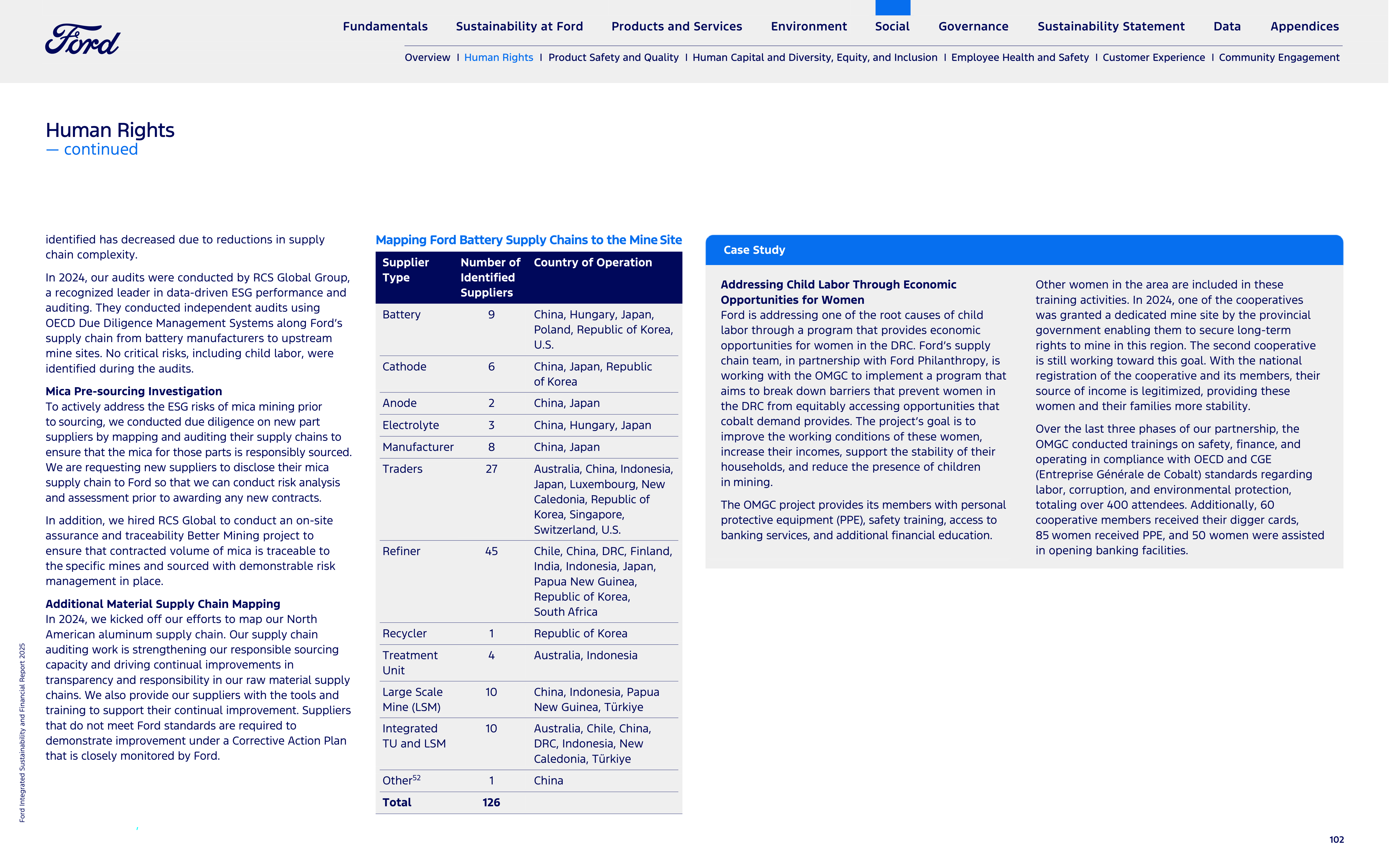


identified has decreased due to reductions in supply
chain complexity.
Fundamentals
Sustainability at Ford
Products and Services
Environment
Social
Governance
Sustainability Statement
Data
Appendices
Overview |
|
|
|
|
|
Human Rights
Product Safety and Quality
Human Capital and Diversity, Equity, and Inclusion
Employee Health and Safety
Customer Experience
Community Engagement
In 2024, our audits were conducted by RCS Global Group,
a recognized leader in data-driven ESG performance and
auditing. They conducted independent audits using
OECD Due Diligence Management Systems along Ford’s
supply chain from battery manufacturers to upstream
mine sites. No critical risks, including child labor, were
identified during the audits.
Mica Pre-sourcing Investigation
To actively address the ESG risks of mica mining prior
to sourcing, we conducted due diligence on new part
suppliers by mapping and auditing their supply chains to
ensure that the mica for those parts is responsibly sourced.
We are requesting new suppliers to disclose their mica
supply chain to Ford so that we can conduct risk analysis
and assessment prior to awarding any new contracts.
In addition, we hired RCS Global to conduct an on-site
assurance and traceability Better Mining project to
ensure that contracted volume of mica is traceable to
the specific mines and sourced with demonstrable risk
management in place.
Additional Material Supply Chain Mapping
In 2024, we kicked off our efforts to map our North
American aluminum supply chain. Our supply chain
auditing work is strengthening our responsible sourcing
capacity and driving continual improvements in
transparency and responsibility in our raw material supply
chains. We also provide our suppliers with the tools and
training to support their continual improvement. Suppliers
that do not meet Ford standards are required to
demonstrate improvement under a Corrective Action Plan
that is closely monitored by Ford.
Mapping Ford Battery Supply Chains to the Mine Site
Supplier
Type
Number of
Identified
Suppliers
Country of Operation
Battery
9
China, Hungary, Japan,
Poland, Republic of Korea,
U.S.
Cathode
6
China, Japan, Republic
of Korea
Anode
2
China, Japan
Electrolyte
3
China, Hungary, Japan
Manufacturer
8
China, Japan
Traders
27
Australia, China, Indonesia,
Japan, Luxembourg, New
Caledonia, Republic of
Korea, Singapore,
Switzerland, U.S.
Refiner
45
Chile, China, DRC, Finland,
India, Indonesia, Japan,
Papua New Guinea,
Republic of Korea,
South Africa
Recycler
1
Republic of Korea
Treatment
Unit
4
Australia, Indonesia
Large Scale
Mine (LSM)
10
China, Indonesia, Papua
New Guinea, Türkiye
Integrated
TU and LSM
10
Australia, Chile, China,
DRC, Indonesia, New
Caledonia, Türkiye
Other
52
1
China
Total
126
Case Study
Addressing Child Labor Through Economic
Opportunities for Women
Ford is addressing one of the root causes of child
labor through a program that provides economic
opportunities for women in the DRC. Ford’s supply
chain team, in partnership with Ford Philanthropy, is
working with the OMGC to implement a program that
aims to break down barriers that prevent women in
the DRC from equitably accessing opportunities that
cobalt demand provides. The project’s goal is to
improve the working conditions of these women,
increase their incomes, support the stability of their
households, and reduce the presence of children
in mining.
The OMGC project provides its members with personal
protective equipment (PPE), safety training, access to
banking services, and additional financial education.
Other women in the area are included in these
training activities. In 2024, one of the cooperatives
was granted a dedicated mine site by the provincial
government enabling them to secure long-term
rights to mine in this region. The second cooperative
is still working toward this goal. With the national
registration of the cooperative and its members, their
source of income is legitimized, providing these
women and their families more stability.
Over the last three phases of our partnership, the
OMGC conducted trainings on safety, finance, and
operating in compliance with OECD and CGE
(Entreprise Générale de Cobalt) standards regarding
labor, corruption, and environmental protection,
totaling over 400 attendees. Additionally, 60
cooperative members received their digger cards,
85 women received PPE, and 50 women were assisted
in opening banking facilities.
Human Rights
— continued
2025
rt
o
l Rep
ncia
ina
F
nd
a
y
ilit
b
ina
a
ust
S
ed
t
ra
eg
Int
rd
o
F
,
102
Human Rights
— continued
,
Ford Integrated Sustainability and Financial Report 2025
103
Fundamentals
Sustainability at Ford
Products and Services
Environment
Social
Governance
Sustainability Statement
Data
Appendices
Overview |
|
|
|
|
|
Human Rights
Product Safety and Quality
Human Capital and Diversity, Equity, and Inclusion
Employee Health and Safety
Customer Experience
Community Engagement
SUPPLY CHAIN TRANSPARENCY
Supply chain transparency and human rights protection
are closely aligned. By improving our visibility into our
supply chain, we are enabling better business practices
and supply chain resiliency, starting from raw materials
and their responsible sourcing. Not only does this help
us identify and address human rights risks, it also
positions us to comply with due diligence legislation.
When potential supplier issues are identified anywhere
in our supply chain, we initiate an investigation to
determine whether the supplier is in the supply chain
providing parts to Ford. If confirmed, we will follow our
due diligence procedures by working with our Tier 1
supplier to conduct an audit to identify and critical non-
conformances and work with the auditee to correct these
issues and provide remediation if needed.
To align with forced labor and due diligence legislation,
in 2023 we updated our
Supplier Code of Conduct
and
contractual obligations to require suppliers to share
sub-tier supply chain information upon request. We have
utilized these updates to conduct supply chain audits for
electric vehicle batteries, Value Stream Mapping, and
traceability data. We are expanding our supply chain
mapping capabilities utilizing Ford’s Advanced Supply
Chain Enablement for N-Tier (ASCENT) tool, designed
using the e2open supply chain platform. This system
enables us to conduct supply chain investigations both
when issues are identified and proactively to confirm
sub-tier suppliers and collect evidence of these
connections within our highest risk categories. If issues
are confirmed, we follow our due diligence procedures
by working with our Tier 1 supplier to cascade our
requirements and confirm compliance with our Supplier
Code of Conduct.
BATTERY PASSPORT
Since 2023, Ford has been working diligently to comply
with the new requirements for our electric and hybrid
vehicles. We organized a cross departmental task force
to ensure our company is prepared for the upcoming
reporting requirements for carbon footprint, durability
and state of health, due diligence, recycling, and
electronic exchange system. We have finalized an
agreement with a software platform provider to conduct
our initial Battery Passport pilot, continued to align
within our industry workgroups, and raised our supply
base’s awareness of the regulatory requirements.
CATENA-X LEVERAGES DATA TO INCREASE
SUPPLY CHAIN TRANSPARENCY
Our involvement in the Catena-X Automotive Network
continues to evolve. This initiative will increase the
transparency of our supply chain, enabling us to improve
sustainability and create efficiencies across the
automotive supply chain through continuous data
exchange between partners. Our involvement with
Catena-X will help the company improve sustainability,
ensure human rights standards are followed, and make
supply chains even more transparent.
In 2023, we joined the Cofinity-X Beta Phase project,
which was completed in 2024. Cofinity-X is enabling
the largest collaborative and open data network of
partners in the automotive ecosystem for value creation
and sustainability across our supply chain while striving
to be compliant with Catena-X.
Adhering to Catena-X principles, Cofinity-X operates an
open dataspace of distributed, sovereign data sources.
This dataspace creates a trusted environment for all its
participants to enable the development and deployment
of value-generating and digital use cases, from and for
its participants across the automotive supply chain.
Through Cofinity-X, we have conducted pilots with
partners in the Product Carbon Footprint (PCF) space, and
have demonstrated cross-company, interoperable PCF
data exchange at various industry events. These actions
act as the foundational steps that will launch our ability
to collect data within the implemented technical
environment along our supply chain up to Tier-N.
SUPPLY CHAIN PARTNERSHIPS
Mounting requirements and transparency around supply
chain has sparked cross-industry collaborations to
increase supply chain transparency and support human
rights. We partner with other businesses, organizations,
and coalitions that have the same standards and
commitments to a sustainable future as we do.
Ford joined the RBA in 2016 and was the first OEM to do
so. As a member of the RBA, we engage in cross-industry
dialogue and standard setting on issues related to
human rights in our operations and supply chain and
responsible materials sourcing.
Our membership in the IRMA and our promotion of
comprehensive, third-party assessments of mining
practices helps us achieve our responsible sourcing
goals. When we became the first U.S. automaker to
join IRMA in 2021, we strengthened our human rights
aspiration to responsibly source all raw materials used
within vehicles globally.
DIRECT SOURCING OF ELECTRIC VEHICLE BATTERY
RAW MATERIALS
As we transition to electric vehicles, we are building
a diverse electric vehicle supply chain that upholds
our ESG commitments, in alignment with our
We Are
Committed to Protecting Human Rights and the
Environment policy
, our Supplier Code of Conduct, our
Responsible Material Sourcing Policy
, and Battery Due
Diligence Policy.
We recognize that some of the electric vehicle
components include minerals with inherent risk due to
extraction practices and country locations. Transparency
and traceability are the keys to a more sustainable and
accountable mineral supply chain. As we work to
discover and audit our current supply chains, we are
preparing for our future along the entire electric vehicle
battery supply chains (see graphic on page 104) to obtain
transparency and strong commitments to sustainability
matters, throughout the sourcing process.
Many global electric vehicle battery material suppliers
are located in high-risk countries and countries with
developing economies that could include vulnerable
populations. Our focus on human rights and the
environment gives us the opportunity to raise the
standards in the communities in which our suppliers
operate and ensure our purchasing power can create
a positive impact throughout the battery supply chain.
Consequently, we have enhanced our pre-sourcing due
diligence with high-risk electric vehicle battery material
suppliers, and in 2023 we established an ESG Electric
Vehicle Battery Material Management team that focuses
on managing ESG requirements in our electric vehicle
battery material supply chain down to the raw materials.
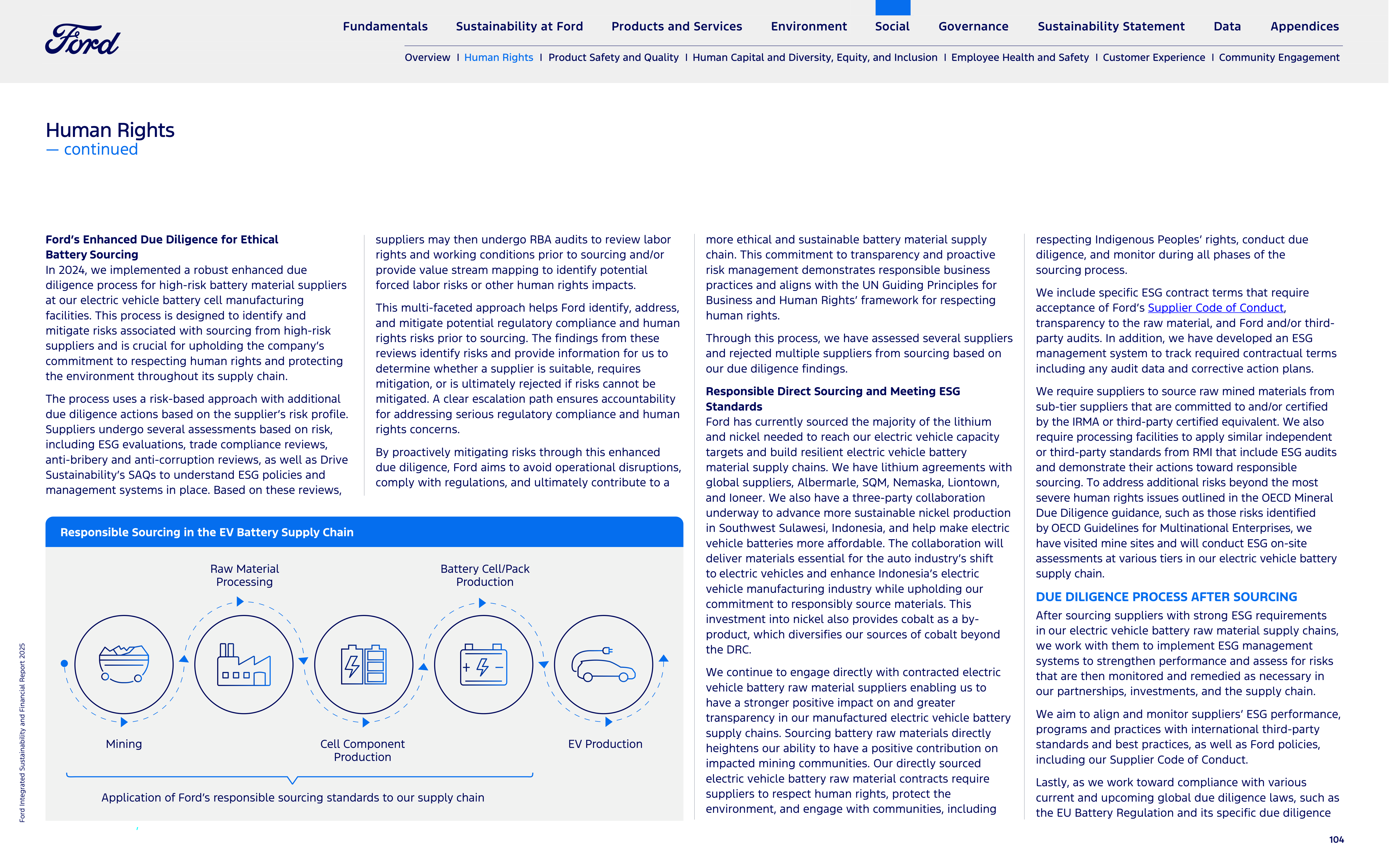
Fundamentals
Sustainability at Ford
Products and Services
Environment
Social
Governance
Sustainability Statement
Data
Appendices
Overview |
|
|
|
|
|
Human Rights
Product Safety and Quality
Human Capital and Diversity, Equity, and Inclusion
Employee Health and Safety
Customer Experience
Community Engagement
Ford’s Enhanced Due Diligence for Ethical
Battery Sourcing
In 2024, we implemented a robust enhanced due
diligence process for high-risk battery material suppliers
at our electric vehicle battery cell manufacturing
facilities. This process is designed to identify and
mitigate risks associated with sourcing from high-risk
suppliers and is crucial for upholding the company’s
commitment to respecting human rights and protecting
the environment throughout its supply chain.
The process uses a risk-based approach with additional
due diligence actions based on the supplier’s risk profile.
Suppliers undergo several assessments based on risk,
including ESG evaluations, trade compliance reviews,
anti-bribery and anti-corruption reviews, as well as Drive
Sustainability’s SAQs to understand ESG policies and
management systems in place. Based on these reviews,
suppliers may then undergo RBA audits to review labor
rights and working conditions prior to sourcing and/or
provide value stream mapping to identify potential
forced labor risks or other human rights impacts.
This multi-faceted approach helps Ford identify, address,
and mitigate potential regulatory compliance and human
rights risks prior to sourcing. The findings from these
reviews identify risks and provide information for us to
determine whether a supplier is suitable, requires
mitigation, or is ultimately rejected if risks cannot be
mitigated. A clear escalation path ensures accountability
for addressing serious regulatory compliance and human
rights concerns.
By proactively mitigating risks through this enhanced
due diligence, Ford aims to avoid operational disruptions,
comply with regulations, and ultimately contribute to a
more ethical and sustainable battery material supply
chain. This commitment to transparency and proactive
risk management demonstrates responsible business
practices and aligns with the UN Guiding Principles for
Business and Human Rights’ framework for respecting
human rights.
Through this process, we have assessed several suppliers
and rejected multiple suppliers from sourcing based on
our due diligence findings.
Responsible Direct Sourcing and Meeting ESG
Standards
Ford has currently sourced the majority of the lithium
and nickel needed to reach our electric vehicle capacity
targets and build resilient electric vehicle battery
material supply chains. We have lithium agreements with
global suppliers, Albermarle, SQM, Nemaska, Liontown,
and Ioneer. We also have a three-party collaboration
underway to advance more sustainable nickel production
in Southwest Sulawesi, Indonesia, and help make electric
vehicle batteries more affordable. The collaboration will
deliver materials essential for the auto industry’s shift
to electric vehicles and enhance Indonesia’s electric
vehicle manufacturing industry while upholding our
commitment to responsibly source materials. This
investment into nickel also provides cobalt as a by-
product, which diversifies our sources of cobalt beyond
the DRC.
We continue to engage directly with contracted electric
vehicle battery raw material suppliers enabling us to
have a stronger positive impact on and greater
transparency in our manufactured electric vehicle battery
supply chains. Sourcing battery raw materials directly
heightens our ability to have a positive contribution on
impacted mining communities. Our directly sourced
electric vehicle battery raw material contracts require
suppliers to respect human rights, protect the
environment, and engage with communities, including
respecting Indigenous Peoples’ rights, conduct due
diligence, and monitor during all phases of the
sourcing process.
We include specific ESG contract terms that require
acceptance of Ford’s
Supplier Code of Conduct
,
transparency to the raw material, and Ford and/or third-
party audits. In addition, we have developed an ESG
management system to track required contractual terms
including any audit data and corrective action plans.
We require suppliers to source raw mined materials from
sub-tier suppliers that are committed to and/or certified
by the IRMA or third-party certified equivalent. We also
require processing facilities to apply similar independent
or third-party standards from RMI that include ESG audits
and demonstrate their actions toward responsible
sourcing. To address additional risks beyond the most
severe human rights issues outlined in the OECD Mineral
Due Diligence guidance, such as those risks identified
by OECD Guidelines for Multinational Enterprises, we
have visited mine sites and will conduct ESG on-site
assessments at various tiers in our electric vehicle battery
supply chain.
DUE DILIGENCE PROCESS AFTER SOURCING
After sourcing suppliers with strong ESG requirements
in our electric vehicle battery raw material supply chains,
we work with them to implement ESG management
systems to strengthen performance and assess for risks
that are then monitored and remedied as necessary in
our partnerships, investments, and the supply chain.
We aim to align and monitor suppliers’ ESG performance,
programs and practices with international third-party
standards and best practices, as well as Ford policies,
including our Supplier Code of Conduct.
Lastly, as we work toward compliance with various
current and upcoming global due diligence laws, such as
the EU Battery Regulation and its specific due diligence
Responsible
Sourcing
in
the
EV
Battery
Supply
Chain
Mining
Raw
Material
Processing
Cell
Component
Production
Battery
Cell/Pack
Production
EV
Production
Application
of
Ford's
responsible
sourcing
standards
to
our
supply
chain
Human Rights
— continued
,
Ford Integrated Sustainability and Financial Report 2025
104
requirements, we require supply chain transparency
down to the mine to enable appropriate sub-tier due
diligence. We also conduct outreach for electric vehicle
battery material supply chain actors to participate in
the required third-party ESG assurance audits.
Fundamentals
Sustainability at Ford
Products and Services
Environment
Social
Governance
Sustainability Statement
Data
Appendices
Overview |
|
|
|
|
|
Human Rights
Product Safety and Quality
Human Capital and Diversity, Equity, and Inclusion
Employee Health and Safety
Customer Experience
Community Engagement
Conducting Due Diligence on Raw Material Suppliers
We engage with our partners and suppliers to confirm
alignment and actions that comply with our
Supplier
Code of Conduct
and ESG contract requirements. We
review their ESG management systems to gain insight
into their management and risk assessment processes
and take actions to support compliance as necessary.
We have made significant progress in developing
and implementing an ESG assessment protocol and
supporting tools for sustainable electric vehicle battery
raw material supply chains. Two key tools aid our onsite
ESG Assessments. First, an ESG Mine/Processor Site
Assessment Protocol establishes responsible mining/
processing expectations informed by Ford’s Supplier
Code of Conduct and international standards. The
protocol generates risk-based questions dependent
on ESG management system maturity, location, and
commodity risk. The questions are drawn from third-
party ESG assurance standards (such as IRMA).
Second, an electric vehicle battery raw material supplier
assessment collaboration tool manages and tracks
supplier due diligence profiles and data collection
throughout contract negotiation. The tool facilitates the
entire ESG assessment process from pre-assessment to
corrective action plan closure by tracking ESG contract
compliance tasks, creating assessment templates with
ratings and enabling corrective action planning tracking
and supplier collaboration.
This integrated approach ensures a comprehensive,
transparent, and collaborative process for assessing and
improving the ESG performance of suppliers throughout
the electric vehicle battery supply chain. The system
allows for continuous improvement rather than focusing
solely on compliance.
We will maintain a continued focus on implementing
the developed tools and expanding due diligence efforts.
This includes ongoing due diligence at our electric
vehicle battery manufacturing facilities, monitoring sub-
tier suppliers, supporting new electric vehicle programs,
and visiting mine and processing sites for an on-site ESG
Assessment using our risk-based protocol.
We have directly secured future materials from two mine
sites that are IRMA certified and continue to work with
suppliers to obtain an IRMA achievement level.
In early 2024, Ford conducted on-site ESG due diligence
at the Kolaka Nickel Indonesia (KNI) project, a
collaboration with Ford, PT Vale Indonesia (PTVI) and
Huayou aimed at more sustainable nickel production in
Pomalaa, located on Sulawesi, Indonesia, utilizing ore
provided by PT Vale’s Pomalaa Block mine. The team
addressed key ESG topics like community engagement,
environmental management and supporting the local
community through local training and hiring. The
assessment of ESG management implementation
indicated a proactive approach to ESG risk management
and due diligence, including continuous monitoring and
improvement, are essential.
INDIGENOUS PEOPLES’ RIGHTS AND
RAW MATERIALS
Aligned with our policies, when securing raw materials,
suppliers will respect the rights of Indigenous Peoples
in accordance with the UNDRIP and ensure FPIC of
Indigenous communities is pursued and obtained prior
to projects or activities that may affect their lands,
resources, or rights.
UNDRIP “emphasizes the rights of Indigenous Peoples
to live in dignity, to maintain and strengthen their own
institutions, cultures and traditions and to pursue their
self-determined development, in keeping with their own
needs and aspirations.”
FPIC allows Indigenous Peoples “to give or withhold
consent to a project that may affect them or their
territories. Once they have given their consent, they can
withdraw it at any stage. Furthermore, FPIC enables them
to negotiate the conditions under which the project will
be designed, implemented, monitored and evaluated.”
IRMA’s critical requirements require new mine sites
to obtain FPIC of Indigenous Peoples and existing mines
to have obtained FPIC or demonstrate operations that
support positive relationships with affected Indigenous
Peoples, including providing remedies for past impacts
on Indigenous Peoples’ rights and interests. Our
requirement for mining suppliers to seek IRMA
certification or third-party certified equivalent, furthers
our commitment to respect Indigenous Peoples’ rights.
IRMA states that because of the requirement that FPIC
be free from external manipulation, coercion, and
intimidation, an FPIC process cannot be undertaken in
situations where indigenous or tribal peoples are living
in voluntary isolation.
FPIC breaches in our supply chain can be reported to
Ford directly through our external grievance mechanism.
If FPIC breaches are reported in our supply chain we
will conduct an investigation to determine if FPIC was
required but not secured and work with suppliers and
sub-supplier to develop remediation plans as needed.
We recognize FPIC breaches and determinations need
to include appropriate indigenous representation
and consultation.
Human Rights
— continued
,
Ford Integrated Sustainability and Financial Report 2025
105

Fundamentals
Sustainability at Ford
Products and Services
Environment
Social
Governance
Sustainability Statement
Data
Appendices
Overview |
|
|
|
|
|
Human Rights
Product Safety and Quality
Human Capital and Diversity, Equity, and Inclusion
Employee Health and Safety
Customer Experience
Community Engagement
Product Safety
and Quality
Overview
Aspirations
Safety
Salient Issues
Health/Safety
UN Sustainable Development Goals
3 GOOD HEALTH
AND WELL-BEING
11 SUSTAINABLE CITIES
AND COMMUNITIES
Our focus on safety and quality is at the
core of our brand. Throughout our long
history, we have earned the trust of
customers around the world by designing
and manufacturing the safe, quality
products they need.
PRODUCT SAFETY AND QUALITY POLICIES
We have set the sustainability aspirational goal to
reduce vehicle crashes and workplace injuries.
Corporate policies and dedicated personnel reinforce
our commitment to safety in our products and services
and help ensure our products meet or exceed applicable
laws and regulations. Our policies support a strategy to
help ensure we design and develop safe vehicles and
services for all users. Per our
Code of Conduct
, we
actively evaluate quality and aim to deliver continuous
improvement in the safe design of our products
and services.
As our Code of Conduct notes, we:
•
Design and manufacture safety into our products
and services, seeking to continuously advance safety
in the transportation operating system
•
Provide products and services that meet or exceed
regulatory requirements
•
Promote safe and responsible consumer practices
•
Take seriously any safety concerns or product
complaints, and address them appropriately
•
Prioritize quality in our products and services,
seeking continuous improvement
•
Implement and follow disciplined systems to
measure performance, enhance consistency,
and manage feedback
•
Take quality concerns seriously, whether from inside or
outside the company, and address them appropriately
SAFETY GOVERNANCE PROCESS
To deliver our corporate strategy, we have established a
cross-functional governance process to review upcoming
regulatory rule making, third-party evaluations and
ratings, competitive benchmarking, and new technology.
These processes also ensure robust program execution.
DESIGNING FOR SAFETY
Our state-of-the-art analytical tools, methods, and
computer simulations complement our engineering
analyses and full suite of crash testing, at the
component, sub-systems, and full vehicle system levels.
By maximizing the benefits of Computer Aided
Engineering tools, we can help achieve cost-efficient,
weight-efficient, and high safety performance design.
We develop these tools and conduct crash and other
vehicle attribute evaluation tests at our sophisticated
sites in the U.S. and Europe, including the Virtual Test
Track Experiment simulator at the Research and
Innovation Center in Dearborn, Michigan.
Ford does not use animals for testing nor do we ask
or fund others to do that for us. We will continue to be
leaders in creating, developing, and validating alternative
methods to proving and providing product safety.
MANAGING OUR RELATIONSHIP WITH CUSTOMERS
Ensuring customer satisfaction is an important part of
our safety efforts. We take a user-centered approach to
customer satisfaction by actively innovating, reviewing
customer feedback, and conducting competitive
benchmarking to deliver products and customer
experiences that contribute to a better world. We are
also expanding the use of connected vehicle data to
identify potential emerging issues as well as to help
us understand what customers may be experiencing.
We use internal and external measurements of quality
and brand promotion to help us assess our performance
and determine where improvements are needed. We use
industry benchmarking data to measure our quality
success and give us the greatest credibility with external
stakeholders and audiences. We measure initial quality
using warranty repair metrics. We also include measures
of customer excitement to assess product quality.
To mitigate or remediate negative impacts on consumers,
we created a Field Service Action (FSA) Implementation
Team that optimizes FSA execution and takes care of
customers involved in FSAs more efficiently. This enhanced
coordination with cross-functional teams has improved
timing for production and service parts availability so
customer vehicles can be updated quickly when an FSA
is required.
Machine learning tools are used and continue to be
refined for expedited review of field reports to accelerate
the detection of potential issues in the field. We utilize
machine learning and AI, such as Large Language
Models, to search and categorize field reports, swiftly
identifying potential issues from extensive unstructured
data without relying on predefined keywords. This
process helps surface key information for expert analysis.
By leveraging natural language processing, we can
identify similar issues regardless of how they are
described, further aiding in comprehensive review.
By deploying AI for automated categorization and pattern
discovery, we aim to enhance efficiency, visibility, and
ultimately field safety.
,
Ford Integrated Sustainability and Financial Report 2025
106
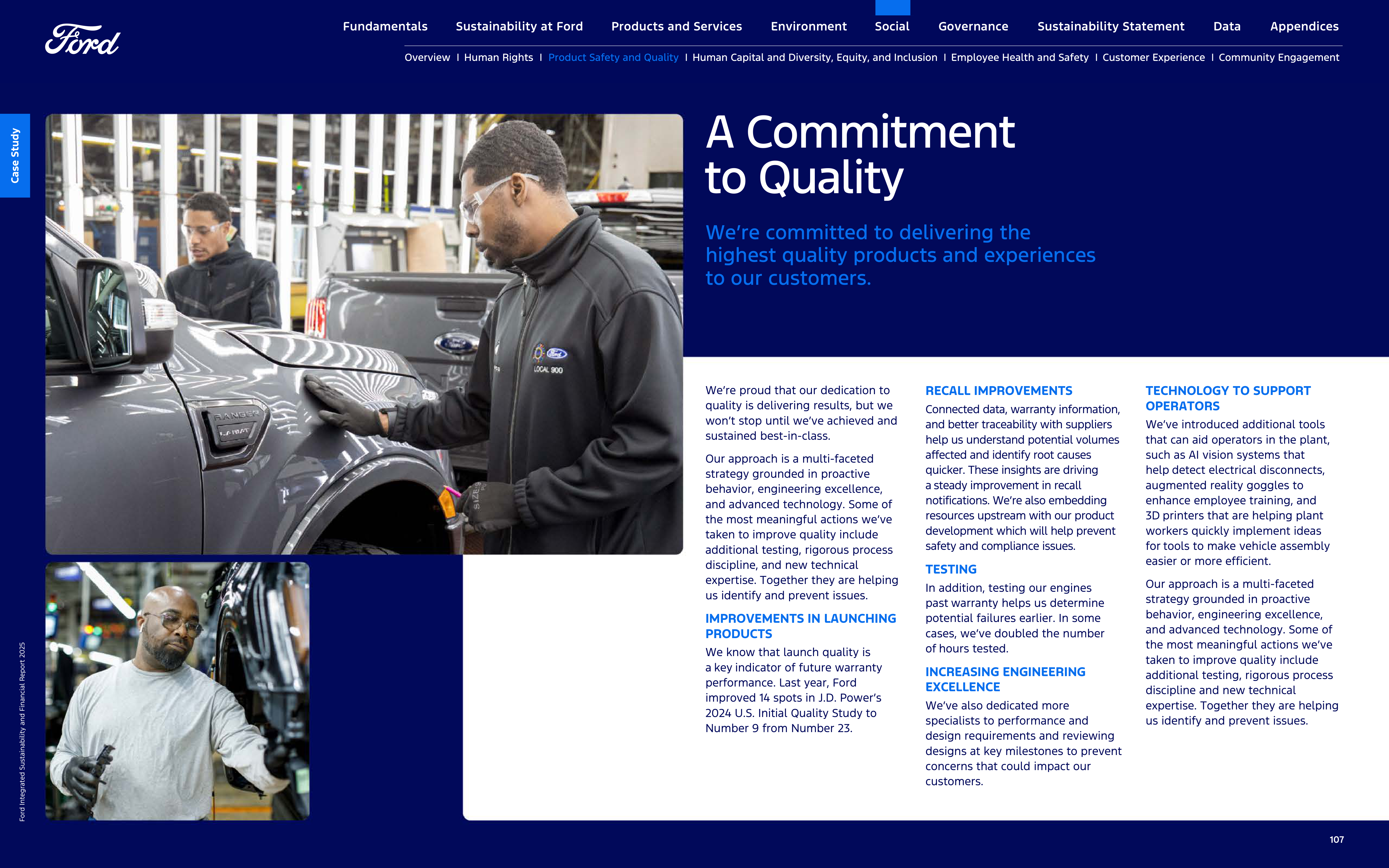
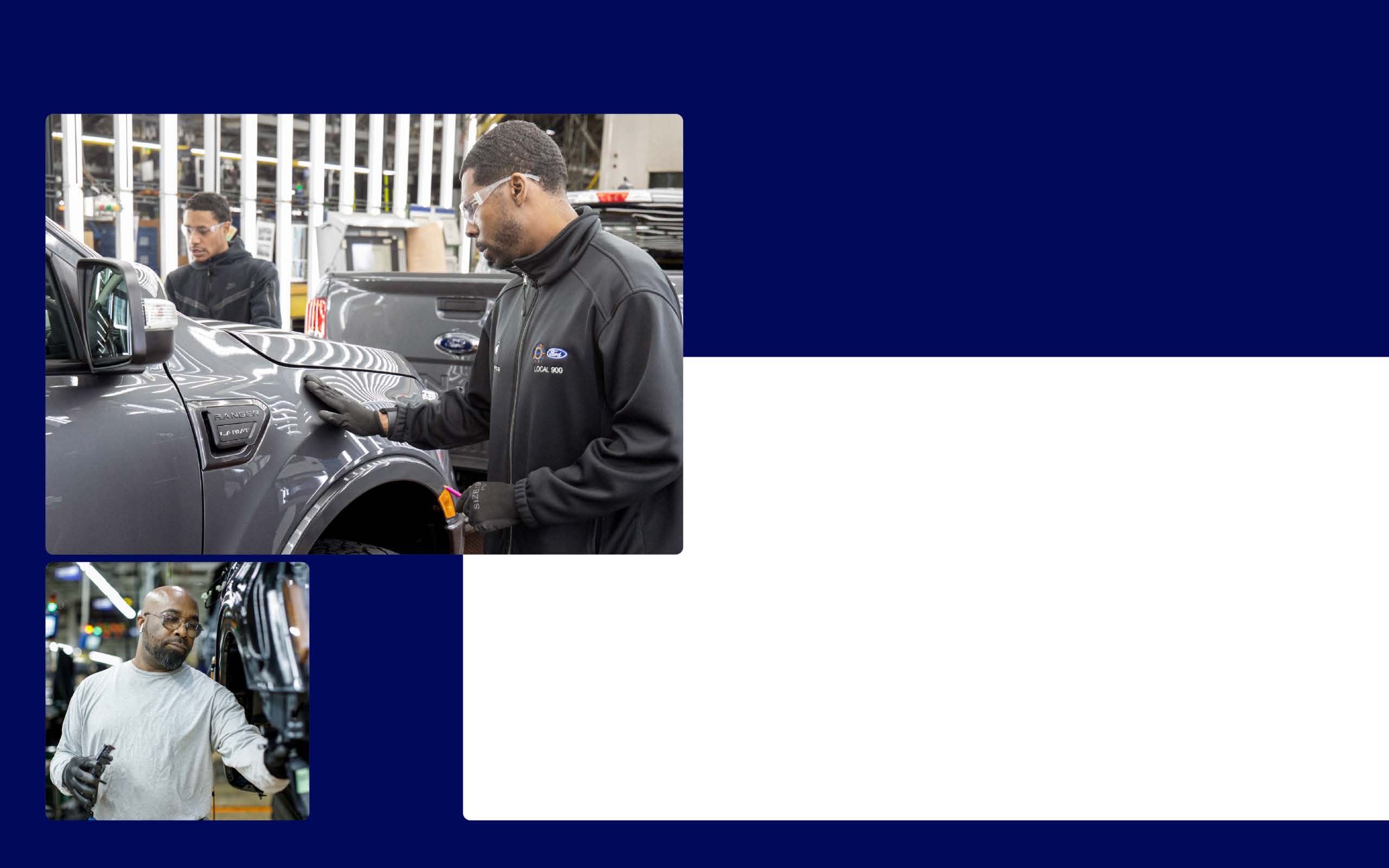

Fundamentals
Sustainability at Ford
Products and Services
Environment
Social
Governance
Sustainability Statement
Data
Appendices
Overview |
|
|
|
|
|
Human Rights
Product Safety and Quality
Human Capital and Diversity, Equity, and Inclusion
Employee Health and Safety
Customer Experience
Community Engagement
Case Study
A Commitment
to Quality
We’re committed to delivering the
highest quality products and experiences
to our customers.
We’re proud that our dedication to
quality is delivering results, but we
won’t stop until we’ve achieved and
sustained best-in-class.
Our approach is a multi-faceted
strategy grounded in proactive
behavior, engineering excellence,
and advanced technology. Some of
the most meaningful actions we’ve
taken to improve quality include
additional testing, rigorous process
discipline, and new technical
expertise. Together they are helping
us identify and prevent issues.
IMPROVEMENTS IN LAUNCHING
PRODUCTS
We know that launch quality is
a key indicator of future warranty
performance. Last year, Ford
improved 14 spots in J.D. Power’s
2024 U.S. Initial Quality Study to
Number 9 from Number 23.
RECALL IMPROVEMENTS
Connected data, warranty information,
and better traceability with suppliers
help us understand potential volumes
affected and identify root causes
quicker. These insights are driving
a steady improvement in recall
notifications. We’re also embedding
resources upstream with our product
development which will help prevent
safety and compliance issues.
TESTING
In addition, testing our engines
past warranty helps us determine
potential failures earlier. In some
cases, we’ve doubled the number
of hours tested.
INCREASING ENGINEERING
EXCELLENCE
We’ve also dedicated more
specialists to performance and
design requirements and reviewing
designs at key milestones to prevent
concerns that could impact our
customers.
TECHNOLOGY TO SUPPORT
OPERATORS
We’ve introduced additional tools
that can aid operators in the plant,
such as AI vision systems that
help detect electrical disconnects,
augmented reality goggles to
enhance employee training, and
3D printers that are helping plant
workers quickly implement ideas
for tools to make vehicle assembly
easier or more efficient.
Our approach is a multi-faceted
strategy grounded in proactive
behavior, engineering excellence,
and advanced technology. Some of
the most meaningful actions we’ve
taken to improve quality include
additional testing, rigorous process
discipline and new technical
expertise. Together they are helping
us identify and prevent issues.
2025
rt
o
l Rep
ncia
ina
F
nd
a
y
ilit
b
ina
a
ust
S
ed
t
ra
eg
Int
rd
o
F
107
Fundamentals
Sustainability at Ford
Products and Services
Environment
Social
Governance
Sustainability Statement
Data
Appendices
Overview |
|
|
|
|
|
Human Rights
Product Safety and Quality
Human Capital and Diversity, Equity, and Inclusion
Employee Health and Safety
Customer Experience
Community Engagement
To ensure that our actions are effective and deliver the
intended outcomes for consumers, we have developed
an integrated data management system that tracks
investigations all the way through recall remedy
implementation. In 2023, we further enhanced system
functionality, with new data reports for early-stage
investigations and integration of our problem reporting
system and quality discipline analysis tools.
We can generate custom reports and metrics within
the tool to help track our progress on all fronts. And,
customers can view the status of any recalls on their
vehicles via the Ford website. Recall completion rates
are tracked and reported to the National Highway
Traffic Safety Administration (NHTSA) and other agencies.
Our product development process helps us avoid
causing material negative impacts on consumers.
The process includes internal validation for requirements
to ensure our products meet or exceed applicable laws
and regulations.
TRACKING OUR PERFORMANCE
We measure the time to issue resolution with a “shot
clock,” leveraging Quality Early Detection and using
Connected Vehicle Data to identify potential issues
quickly. For example, updating vehicle software via
over-the-air (OTA) update technology allows for faster
issue resolution without requiring a customer to bring
their vehicle to a dealership for repair. With customer
consent, Ford can address safety, environmental, and
quality issues OTA when the fix involves a software
issue and can be performed OTA.
For repairs that cannot be completed OTA, Ford has
expanded Mobile Repair and Pick Up and Delivery
options to make vehicle service and recall repairs
easier and more convenient for customers to complete.
In addition to meeting or exceeding applicable laws and
regulations, we establish targets to achieve the desired
performance in third-party ratings testing. Timing
is based on program cycle and publication of third-party
testing protocols.
In November 2024, Ford entered into a three-year
consent order with the National Highway Traffic Safety
Administration (NHTSA) following its investigation into
whether Ford timely initiated a safety recall in 2020
relating to rearview cameras. In connection with the
consent order, the company is reaffirming our
commitment to safety and compliance and will work to
address the concerns raised by NHTSA.
Among other things, Ford will be developing advanced
data analytics capabilities, implementing an end-to-end
compliance information and document interface
platform, and investing in traceability equipment and
technology to track additional components at the vehicle
identification number (VIN) level. We are building a new
test facility to help us better evaluate and investigate
issues relating to low voltage electronic components
such as the rearview camera. We also hired an
independent third party, selected by NHTSA, to review
and make recommendations regarding our vehicle safety
compliance programs. Ford is committed to working with
NHTSA and the independent third party to continue
improving our vehicle safety compliance programs and
delivering high quality, safe vehicles to our customers.
We are adding additional team members to our staff
to work closely with our Product Development partners
to improve our execution and quality related to safety.
KEY SAFETY METRICS
Ford vehicles continue to achieve high marks and
recognition in regulatory and New Car Assessment
Programs (NCAP) crash testing assessments. The varying
protocols and evaluation criteria of NCAPs and their
fast-paced continuous updates to those criteria makes
it increasingly difficult to achieve top ratings across all
regions. For example, in 2024 Insurance Institute for
Highway Safety (IIHS) began testing large SUVs, and
future protocol changes will impact EU NCAP Commercial
Vehicles ratings starting in 2026. Despite these changes,
many of our vehicles receive top safety ratings globally.
We continue to place considerable emphasis on our
performance in these assessments.
Ford has achieved 5-Star Overall Vehicle Score ratings
for the following Global NCAP protocols in 2024: 11 U.S.
NCAP, 7 Euro NCAP, and 10 China NCAP.
2024 VEHICLE SAFETY HIGHLIGHTS
United States: U.S. NCAP (NHTSA)
•
The Mustang and Mustang Mach-E vehicles were
tested and received 5-Star Overall Vehicle Score
ratings. These vehicles join existing nameplates Ford
Bronco Sport, Edge, Escape, Expedition, Explorer, F-150,
F-150 Lightning, and Lincoln Aviator and Corsair with
valid published 5-Star ratings, and are available in
market in 2024.
United States: Insurance Institute for
Highway Safety (IIHS)
•
In 2024, the Mustang Mach-E earned a
+ Award and the F-150 Super Cab
and
Awards.
•
These vehicles join the Explorer and Nautilus
nameplates with valid published
+
Awards and available in market in 2024.
Europe: Euro NCAP
•
In 2024, the Explorer electric vehicle and Capri electric
vehicle vehicles received 5-Star ratings for the 2025
model year. These vehicles join existing nameplates
Mustang Mach-E, Focus, Kuga, Tourneo Connect, and
Ranger with valid published 5-Star ratings and
available in market in 2024.
China: China NCAP
•
The Ranger and Nautilus received 5-Star ratings for
China NCAP in 2024. These vehicles join existing
nameplates Edge, Equator, Everest, Explorer, Focus,
Kuga, Mondeo, and Zephyr with valid published 5-Star
ratings and available in China during 2024.
China: C-IASI (China Insurance Automotive Safety Index)
•
Ford Edge L and Ranger were awarded C-IASI Good
Rating for all safety assessments in 2024. These join
the nameplates Focus, Escape, Mondeo, and Mustang
Mach-E which are available in market and have
previously achieved the C-IASI Good Rating.
Australia and New Zealand: ANCAP
•
In 2024 the Ford Transit Custom was awarded
Platinum, the highest possible Commercial Van rating
by ANCAP. It joins our 5-Star rated Ranger, Everest,
Escape, Puma, and select Mustang Mach-E variants
in achieving the highest possible rating.
Euro NCAP Commercial Van Rating
•
Ford Pro now has four top-rated vans within the latest
generation of Transit products.
•
The Transit Connect 1,2 compact van and Transit 2t
from Ford Pro received a Platinum safety award — the
highest achievable result — from independent vehicle
safety experts Euro NCAP. The rating was earned
during standardized testing to Euro NCAP’s latest
stringent measures.
•
The new Transit Custom 2,3 and Transit Courier 2,4
models have also received the Platinum safety award
based on Euro NCAP’s most recent 2024 standards.
U.K. What Van? Safety Award
•
The Transit Courier received first place for the second
year in a row.
Product Safety and Quality
— continued
,
Ford Integrated Sustainability and Financial Report 2025
108
Fundamentals
Sustainability at Ford
Products and Services
Environment
Social
Governance
Sustainability Statement
Data
Appendices
Overview |
|
|
|
|
|
Human Rights
Product Safety and Quality
Human Capital and Diversity, Equity, and Inclusion
Employee Health and Safety
Customer Experience
Community Engagement
SAFETY FEATURES
U.S. Automatic Emergency Braking (AEB) Commitment
Ford’s Automatic Emergency Brake (AEB) Pre-Collision
Assist feature
14
scans the road ahead and can alert
drivers to potential collisions with vehicles or pedestrians
directly in the driver’s path
53
. If the driver’s response is
not sufficient, AEB will increase brake-assist sensitivity to
provide full responsiveness when the driver does brake.
If an impact becomes imminent and the driver does not
take corrective action, brakes can apply automatically.
Ford met its commitment to the AEB Memorandum of
Understanding by equipping 96% of light duty vehicles
(under 10,000 lbs GVW) with AEB.
Combating Heatstroke in Vehicles
Over the past 25 years, more than 1,000 children have
died of heatstroke
54
, because they were left or became
trapped in a hot car.
Ford’s Rear Occupant Alert System alerts the driver to
check the back seat of the vehicle for occupants after
the vehicle is turned off via “in-vehicle” audible and
visual warnings. Some vehicles are also capable of
sounding the exterior horn as a part of the warning
escalation. When the ignition is on and a rear door is
opened and closed, or ignition is turned on shortly after
the opening and closing of the rear doors, the system
infers the potential presence of occupants in the rear
seat and triggers the alert when the vehicle is turned off.
In 2019, Ford committed to equip at least 95% of
passenger vehicles with rear doors and rear seating
positions (under 10,000 pounds) in the U.S. with a rear
seat potential occupant reminder system by September 1,
2024. Ford met that commitment a year early, as the Rear
Occupant Alert System was standard on 98.4% of the
applicable U.S. vehicles when Ford reported its annual
update to the NHTSA in October 2023. Ford maintained
that fleet percentage in the October 2024 report.
Research and advanced engineering projects are
underway to help develop interior cabin sensing
solutions to potentially detect the presence of
occupants and potentially enable mitigation options.
We will continue to enhance warning notifications for future
models and research technologies that can detect in-cabin
occupant presence. These features will help address
scenarios beyond those defined by the 2019 Voluntary
Agreement and should enhance effectiveness in minimizing
and potentially avoiding pediatric vehicular heatstroke cases.
Exit Warning Helps Drivers Exit the Vehicle with
Confidence
Exiting a vehicle onto a busy street or sidewalk exposes
cars, pedestrians, and cyclists approaching from behind
to the risk of an unexpected open door.
A driver
assistance feature called Exit Warning launched on the
2024 model year Ford Mustang and is now available on
82% of nameplates in North America to help share the
road and protect vulnerable road users like cyclists,
scooter riders, and pedestrians
55
.
When parked, available Exit Warning is designed to alert
the vehicle’s occupants with audible and visual alerts via
Ford SYNC, on the instrument cluster and side mirror
if rear-approaching traffic, cyclists, or pedestrians are
detected. Available Exit Warning uses the vehicle’s rear
corner BLIS® (Blind Spot Information System) radar
sensors when parallel parked to help detect other
vehicles, cyclists, and pedestrians moving towards the
vehicle’s sides from behind and warn occupants before
they open the door to exit the vehicle.
Advancements Made in Active Safety Technologies
and Co-Pilot 360 Technology
We continue to make advancements in our Active Safety
Technologies and Co-Pilot 360 to help keep drivers in
command from the driveway to the highway. From blind
spot detection to parking assistance to hauling cargo,
Co-Pilot 360 gives drivers a clear view of the road ahead
and the path behind them. Co-Pilot 360 2.0 includes
Enhanced Pre-Collision Assist, Pro Trailer Hitch Assist,
and Exit Warning (where equipped).
→
Read More: In Connected Vehicles and Digital Services on p.40
Reverse Brake Assist
Reverse Brake Assist helps sense and alert drivers to
what’s behind their vehicle when backing up. If it detects
the risk of a collision with an object high enough to hit
the bumper, such as a pedestrian, vehicle, or shopping
cart, it can automatically apply the brakes. Reverse Brake
Assist utilizes sensors on the rear bumper and the
rearview camera to detect objects and help reduce or
avoid a collision. The system is active when the vehicle
is in reverse and traveling at a speed above 1 mile per
hour (mph) but below 7 mph. A message and warning
indicator will appear when the system automatically
applies the brakes. Currently, over 80% of our North
American nameplates are available with the Reverse
Brake Assist technology.
KEEPING OCCUPANTS SAFE
Precompetitive Research Partnerships
Ford collaborates globally with other automotive
manufacturers, suppliers, policy makers, associations,
research institutions, and universities. The goal:
enhancing the safety of vehicle occupants, maintaining
competitiveness and leadership, and supporting our
aspiration to be the most trusted company,
For example, as a member of the U.S. Council
for Automotive Research (USCAR), Ford provides technical
leadership and safety expertise to the USCAR Safety
Technical Leadership Council (TLC) with a scope to
identify safety challenges, technical issues, and vehicle
accident safety research needs. In 2025, the USCAR
Safety TLC is continuing its focus on conducting
precompetitive vehicle safety research to understand
the effects that new and emerging vehicle technologies
and safety requirements will have on vehicle safety.
We are also working under the USCAR Safety TLC
umbrella on precompetitive projects on next-generation
Anthropomorphic Test Devices (ATDs), or crash dummies,
to assess their repeatability, reproducibility, durability,
and ease of use to better understand their response
characteristics as they relate to potential future
regulations and vehicle design. The research outcome
is being leveraged to help shape future regulations
proposed by NHTSA that lead to real-world safety
enhancements.
As a member of the Alliance for Automotive Innovation,
we are collaborating with other automotive
manufacturers on generating responses to regulatory
agencies such as the NHTSA and IIHS and precompetitive
research on Large Truck Safety and biomechanics for
Head Injury criteria. Other collaborations include the
European Automobile Manufacturers Association, the
Society of Automotive Engineers, the International
Organization for Standardization (ISO), the Global Human
Body Modeling Consortium, and the Canadian Vehicle
Manufacturers’ Association.
Ford has funded and executed precompetitive safety
research projects with universities such as University
of Michigan Dearborn, University of Michigan Transportation
Research Institute, Michigan State University, Wayne State
University, and Tsinghua University in China. We often
publish the research results in peer-reviewed journals and
scientific publications.
We have been a member of the Driver Alcohol Detection
System for Safety (DADSS) program, since it was
established. This cooperative research partnership
is developing an alcohol detection technology that
passively detects driver impairment and prevents the
car from moving. Ford provided an active lead in both
the technical and policy working groups developing
Product Safety and Quality
— continued
,
Ford Integrated Sustainability and Financial Report 2025
109
the alcohol sensing technology. Ford collaborated with
DADDS on implementing passive breath sensors in two
Mach-E vehicles in Connecticut for fleet evaluation.
Fundamentals
Sustainability at Ford
Products and Services
Environment
Social
Governance
Sustainability Statement
Data
Appendices
Overview |
|
|
|
|
|
Human Rights
Product Safety and Quality
Human Capital and Diversity, Equity, and Inclusion
Employee Health and Safety
Customer Experience
Community Engagement
We are a member of the Partnership for Analytics Research
in Traffic Safety (PARTS). Participants in this partnership
between automakers and the U.S. Department of
Transportation’s NHTSA voluntarily share safety-related
data for collaborative safety analysis. The goal of this
government-industry initiative, which is operated by an
independent third party, is to gain real-world insights into
the safety benefits and opportunities of emerging advanced
driver assistance systems (ADAS) — and one day, automated
driving systems. This initiative provides anonymized data
for all participants and allows each participating member
to compare themselves to an aggregate of the other
participants in the group. The data provided can be used
for competitive benchmarking purposes, and cannot be
used for any external marketing efforts.
In January 2025, PARTS released results of its second
study — the largest government-automaker study to
date — about the real-world effectiveness of ADAS in
passenger vehicles
56
. According to this study, vehicles
fitted with automatic emergency braking are 49% less
likely to be involved in front-to-rear crashes. The study
also found a 9% reduction in single-vehicle frontal
crashes with non-motorists for vehicles equipped with
pedestrian automatic emergency braking systems. Ford
is actively studying this report to better understand how
we can build upon areas of strength and identify areas
for improvement with our ADAS systems. Additionally,
we are currently engaged with the partnership to define
and shape the studies for 2025.
We also support Ford Philanthropy’s work to promote
affordable, reliable, and safe mobility for those
experiencing transportation insecurity.
Ford Philanthropy’s safety efforts include philanthropic
grantmaking to a variety of organizations that prioritize
safety for vulnerable road users, such as cyclists and
scooter-drivers, in low-income communities, as well as
the long-running Driving Skills For Life program.
A signature program of Ford Philanthropy, Ford Driving
Skills for Life teaches newly licensed and teen drivers the
necessary skills for safe driving beyond what they learn
in standard driver education programs.
For over two decades, the Ford Driving Skills for Life
program has provided free, advanced driver education
in countries across the globe. The program has been
hosted in states all around the U.S., and in dozens of
countries around the world, supporting the instruction
of thousands of teenage drivers each year since 2003.
Hands-on driver training clinics pair newly licensed
drivers with professional instructors, focusing on the
issues and obstacles drivers face that cause crashes,
including hazard recognition, vehicle handling, speed
management, space management, and distracted and
impaired driving.
The U.S. Department of Transportation has recognized
Ford as an Ally in Action for our commitment to
improving road safety, citing Ford Philanthropy for the
Driving Skills For Life program and its 2024 plans to
expand its focus on safety for vulnerable road users
and the Safe Systems Approach to road safety.
Post-Crash Response
Ford’s 911 assist feature does more than help occupants
call for assistance after an accident. It can also give first
responders potentially life-saving information, quickly
and efficiently. Using SYNC or our Ford and Lincoln
Digital Experience infotainment system, 911 Assist shares
a GPS location with the operator and relays data on
impact velocity, crash type, safety belt use, and airbag
deployment, helping emergency services respond
appropriately. 911 Assist requires a cell phone to function.
The majority of our vehicles also carry the SOS Post-
Crash Alert System, which alerts passers-by and first
responders to a vehicle’s location. In addition, many of
our vehicles around the globe are equipped with e-Call,
a modem-based, automatic-crash-notification feature.
Electric Vehicle Health and Safety
Ensuring the safety and quality of electric vehicle
batteries is crucial to building trust in our fleet of electric
vehicles. Every Ford electric vehicle includes a battery
quality operating system. Quality checks and tight
process controls are integrated throughout the battery
cell manufacturing and battery pack screening during
vehicle assembly. Once a vehicle is built, Ford leverages
cloud-based vehicle monitoring and detection and, using
established processes, can communicate with connected
customers if a voltage anomaly is detected.
Ford has established internal engineering requirements
that exceed global Thermal Propagation regulatory
requirements and is developing risk mitigation features
to provide a safer environment for vehicle egress. Ford
also provides high voltage safety publications including
a Workshop Manual for vehicle technicians. An
Emergency Responders Guide
for first responders is
posted on our website and includes lifting/stabilization
guidelines, proper extraction procedures, and high-
voltage system disabling protocols for Ford electric
vehicle and hybrid vehicles.
Ford electric vehicles are subjected to crash testing that
far exceeds the stringency of regulatory requirements.
For example, we conduct front, side, and rear impact
crash tests at 5 mph above the speeds required by safety
regulations, which translates to increased impact energy
and severity as compared to what is required by law.
Safety Research Partnerships
Technical challenges
of self-driving
vehicles
In addition to the American Center for Mobility, Ford is a member of the Autonomous Vehicle
Industry Association and is working toward a world where safe and trusted autonomous
vehicles increase road safety and improve mobility opportunities for all.
Vehicle-to-Vehicle
(V2V) safety
communication
systems
Ford is a member of the 5G Automotive Association to advance connected technology for
automotive applications. Ford is also a member of the Leadership Circle for Mcity to shape
all aspects of the future of mobility.
Cybersecurity
Ford is a member of the AutoISAC, an industry-driven community to share and analyze
intelligence about emerging cybersecurity risks to the vehicle, and to collectively enhance
vehicle cybersecurity capabilities.
Driver distraction
and Advanced
Driver Assistance
technologies
Ford is a board member of the Automotive Coalition for Traffic Safety and is funding research
on developing a passive blood alcohol content detection system to reduce drunk driving.
In 2023 Ford joined the Partnership for Analytics, Research, and Traffic Safety, a data sharing
partnership that serves as a source for real-world data-driven traffic safety information.
Product Safety and Quality
— continued
,
Ford Integrated Sustainability and Financial Report 2025
110
Fundamentals
Sustainability at Ford
Products and Services
Environment
Social
Governance
Sustainability Statement
Data
Appendices
Overview |
|
|
|
|
|
Human Rights
Product Safety and Quality
Human Capital and Diversity, Equity, and Inclusion
Employee Health and Safety
Customer Experience
Community Engagement
We also conduct crash tests beyond what is required
by regulations and consumer testing, enhancing
robustness, and furthering the high level of safety
of our electric vehicles.
We certify our hybrid and internal combustion engine
police interceptor vehicles at 75 mph speed with 50%
offset rear impact crash tests — which is a stringent rear
impact test that exceeds legal requirements. This internal
commitment provides robustness to the battery and
structural design in police interceptors.
Ford has executed a number of battery safety projects
funded by the U.S. Department of Transportation
National Highway Traffic Safety Administration and
the U.S. Department of Energy to support governmental
and industry priorities in electrified vehicles. We are also
sponsoring and funding precompetitive battery safety
research projects related to electric vehicle and battery
safety such as Lithium-ion Multiphysics Modeling, Post
Crash HV/LV (high voltage and low voltage) Components,
and Connectors and Intrusion Effects on HV (high
voltage) Batteries
.
MONITORING PRODUCT QUALITY AND
BRAND ADVOCACY
Our mission is to make product quality one of the
principal reasons why customers buy Ford the first
time — and every time.
We consult both internal and external standards when
creating our quality and engineering processes and
requirements. We actively evaluate quality and aim
to deliver continuous improvement of our products
and services.
We use several metrics including, warranty repairs,
customer advocacy, and customer excitement to
understand how consumers perceive the quality
experience from our products.
Our Corporate Net Promoter Score (CNPS) metric, which
measures the ownership experience at three, 12, and 36
months in service, helps us understand and improve our
consumers’ quality perceptions and advocacy over their
ownership cycle. CNPS has provided a comprehensive
and holistic view of quality by capturing both customers’
“likes” (e.g., “Things Gone Right”) and items customers
“like least” about our products. CNPS provides timely
and actionable insights that align with various industry
performance indicators of quality, such as the annual
studies conducted by J.D. Power.
We leverage external, industry benchmarking data
to understand the relative strength of our quality
performance and our improvement opportunities.
This also provides us credibility with external
stakeholders and audiences. All Ford plants are
accredited to ISO 9001:2015.
2024 Quality Achievements by Ford Motor Company
The J.D. Power 2024 Initial Quality Study (IQS) ranks
automotive OEMs and their brands based on problems
per 100 (PP100). The Initial Quality Study (IQS) is based
on feedback from customers of 2024 vehicles after three
months of vehicle ownership
57
. The corporation achieved
both ranking improvements and one award:
•
Ford Motor Company’s rank improved to 4th in the
corporate rankings
•
Lincoln Nameplate also improved, moving up to 25th
•
Ford Name rose to 9th in ranking, performing 16 points
better than the industry average and tied with Hyundai
as the most improved mass market brand rising 14
ranked positions overall
•
2024 Bronco Sport won the 2024 IQS Award for Small
SUV for best new vehicle quality in the small SUV
segment, beating 18 other vehicle lines
•
2024 Explorer, Maverick, and Super Duty ranked second
in their respective segments
The J.D. Power 2024 Automotive Performance, Execution
and Layout (APEAL)
58
measures new-vehicle owners’
experiences with design, performance, safety, usability,
comfort, perceived quality, and other factors. Several
notable achievements include:
•
Ford Motor Company received one award for the Ford
Super Duty, which ranked first overall in the Large
Heavy Duty Pickup segment
•
Lincoln improved one ranking up to 6th overall within
the Premium segment, four points above the
“Premium” average
•
Mustang launch improved 14 points year-over-year and
placed at the top of its segment. However, the segment
is not award eligible this year
IMPROVING OUR QUALITY PROCESSES WITH
DATA AND TECHNOLOGY
Advanced data analytics and machine learning help
us improve vehicle quality, customer safety, and
customer satisfaction by detecting potential issues
across our vehicle portfolio earlier — even before
delivering the vehicle to the customer. Our Early Quality
Issue Suite accelerates the investigative process by
drawing on multiple data sources, from connected
vehicles to customer service calls. This tool minimizes
time from detection to correction by combining this
information with automatic anomaly detection and
root cause analysis.
We are expanding the numbers of parts and subsystems
that we can precisely trace to vehicle-specific builds
when an issue arises. By precisely identifying recall
populations we can avoid issuing wider recalls,
which in turn limits the number of customers who
are inconvenienced, and optimizes the number of
remedy parts needed.
Product Safety and Quality
— continued
,
Ford Integrated Sustainability and Financial Report 2025
111
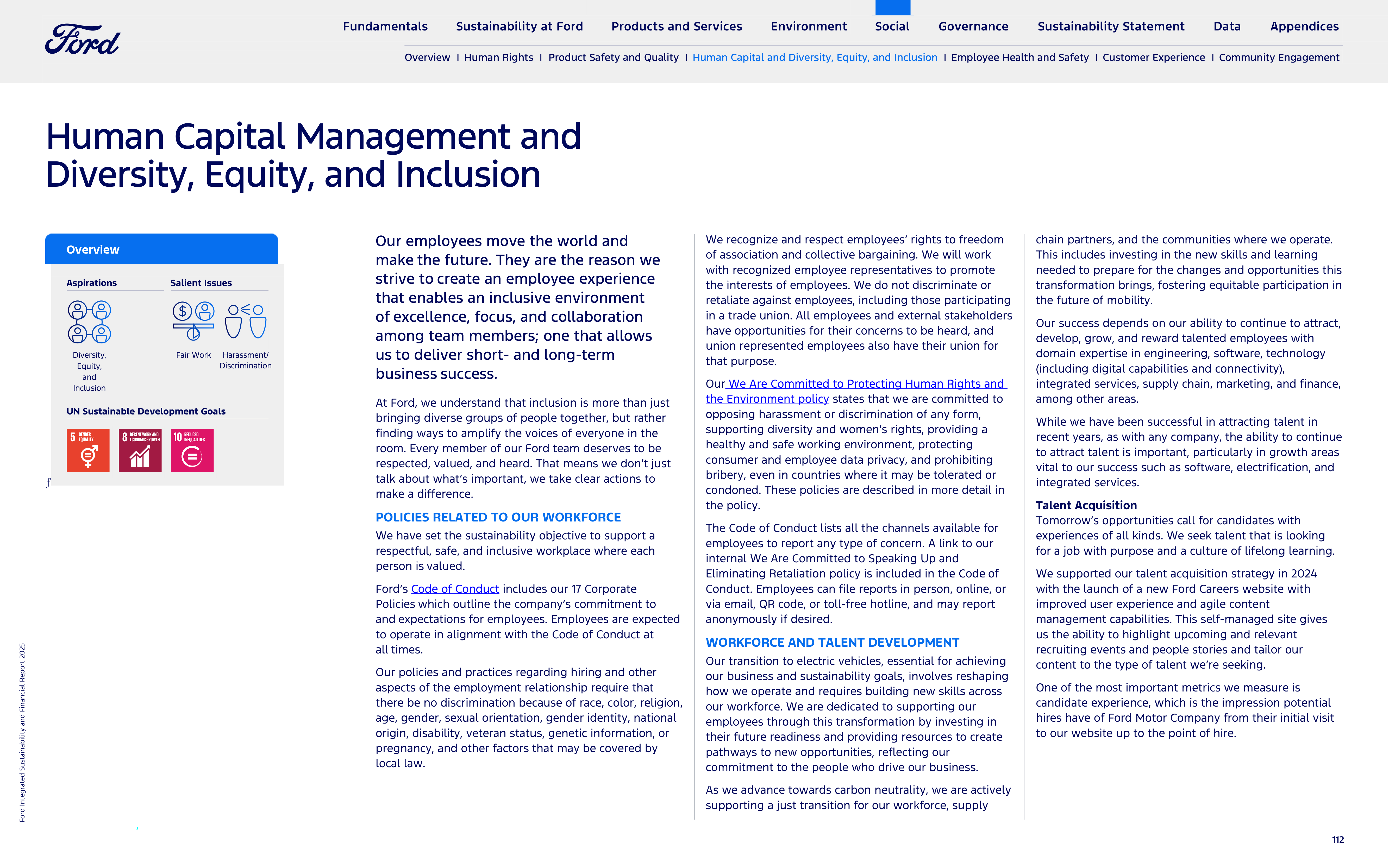

ƒ
Fundamentals
Sustainability at Ford
Products and Services
Environment
Social
Governance
Sustainability Statement
Data
Appendices
Overview | Human Rights |
Product Safety and Quality |
Human Capital and Diversity, Equity, and Inclusion
| Employee Health and Safety | Customer Experience | Community Engagement
Human Capital Management and
Diversity, Equity, and Inclusion
Overview
Aspirations
Diversity,
Equity,
and
Inclusion
Salient Issues
Fair Work
Harassment/
Discrimination
UN Sustainable Development Goals
5 GENDER
EQUALITY
8 DECENT WORK AND
ECONOMIC GROWTH
10 REDUCED
INEQUALITIES
Our employees move the world and
make the future. They are the reason we
strive to create an employee experience
that enables an inclusive environment
of excellence, focus, and collaboration
among team members; one that allows
us to deliver short- and long-term
business success.
At Ford, we understand that inclusion is more than just
bringing diverse groups of people together, but rather
finding ways to amplify the voices of everyone in the
room. Every member of our Ford team deserves to be
respected, valued, and heard. That means we don’t just
talk about what’s important, we take clear actions to
make a difference.
POLICIES RELATED TO OUR WORKFORCE
We have set the sustainability objective to support a
respectful, safe, and inclusive workplace where each
person is valued.
Ford’s
Code of Conduct
includes our 17 Corporate
Policies which outline the company’s commitment to
and expectations for employees. Employees are expected
to operate in alignment with the Code of Conduct at
all times.
Our policies and practices regarding hiring and other
aspects of the employment relationship require that
there be no discrimination because of race, color, religion,
age, gender, sexual orientation, gender identity, national
origin, disability, veteran status, genetic information, or
pregnancy, and other factors that may be covered by
local law.
We recognize and respect employees’ rights to freedom
of association and collective bargaining. We will work
with recognized employee representatives to promote
the interests of employees. We do not discriminate or
retaliate against employees, including those participating
in a trade union. All employees and external stakeholders
have opportunities for their concerns to be heard, and
union represented employees also have their union for
that purpose.
Our
We Are Committed to Protecting Human Rights and
the Environment policy
states that we are committed to
opposing harassment or discrimination of any form,
supporting diversity and women’s rights, providing a
healthy and safe working environment, protecting
consumer and employee data privacy, and prohibiting
bribery, even in countries where it may be tolerated or
condoned. These policies are described in more detail in
the policy.
The Code of Conduct lists all the channels available for
employees to report any type of concern. A link to our
internal We Are Committed to Speaking Up and
Eliminating Retaliation policy is included in the Code of
Conduct. Employees can file reports in person, online, or
via email, QR code, or toll-free hotline, and may report
anonymously if desired.
WORKFORCE AND TALENT DEVELOPMENT
Our transition to electric vehicles, essential for achieving
our business and sustainability goals, involves reshaping
how we operate and requires building new skills across
our workforce. We are dedicated to supporting our
employees through this transformation by investing in
their future readiness and providing resources to create
pathways to new opportunities, reflecting our
commitment to the people who drive our business.
As we advance towards carbon neutrality, we are actively
supporting a just transition for our workforce, supply
chain partners, and the communities where we operate.
This includes investing in the new skills and learning
needed to prepare for the changes and opportunities this
transformation brings, fostering equitable participation in
the future of mobility.
Our success depends on our ability to continue to attract,
develop, grow, and reward talented employees with
domain expertise in engineering, software, technology
(including digital capabilities and connectivity),
integrated services, supply chain, marketing, and finance,
among other areas.
While we have been successful in attracting talent in
recent years, as with any company, the ability to continue
to attract talent is important, particularly in growth areas
vital to our success such as software, electrification, and
integrated services.
Talent Acquisition
Tomorrow’s opportunities call for candidates with
experiences of all kinds. We seek talent that is looking
for a job with purpose and a culture of lifelong learning.
We supported our talent acquisition strategy in 2024
with the launch of a new Ford Careers website with
improved user experience and agile content
management capabilities. This self-managed site gives
us the ability to highlight upcoming and relevant
recruiting events and people stories and tailor our
content to the type of talent we’re seeking.
One of the most important metrics we measure is
candidate experience, which is the impression potential
hires have of Ford Motor Company from their initial visit
to our website up to the point of hire.
,
Ford Integrated Sustainability and Financial Report 2025
112
Fundamentals
Sustainability at Ford
Products and Services
Environment
Social
Governance
Sustainability Statement
Data
Appendices
Overview | Human Rights |
Product Safety and Quality |
Human Capital and Diversity, Equity, and Inclusion
| Employee Health and Safety | Customer Experience | Community Engagement
Human Capital Management and
Diversity, Equity, and Inclusion
— continued
,
Ford Integrated Sustainability and Financial Report 2025
113
Talent Development
Ford is committed to providing hourly and salaried
employees with the opportunity to upskill and reskill
with supportive training programs. We are dedicated
to the principles of lifelong learning, embracing a
growth mindset and career development. Engineers
who previously developed state-of-the-art internal
combustion engines (ICE) and emissions systems are
now applying those same modeling and experimental
testing skill sets to design industry-leading electric
vehicle battery safety systems, optimize fuel cell
system components, and improve eMachine
manufacturing processes.
Early Career Opportunities
We recognize the value of a robust talent pipeline that
includes people of all experience levels. Our early career
programs put current college students and recent
graduates on the road to success at Ford.
The Ford Summer Intern Program provides students
with hands-on, career-specific experience during summer
break. Our 2024 summer intern program presented over
500 college students with meaningful work experiences
in technical and business-related fields ranging from
marketing to engineering to supply chain. Many of these
interns will be joining us in 2025 as full-time employees
to begin their careers in our developmental Ford College
Graduate program, a full-time rotational program that
provides recent college graduates with a variety of
assignments during their first years with Ford
Motor Company.
The Ford Business Leader Program puts recent MBA
graduates to work with an exceptional team of industry
innovators and visionaries. This cross-functional
rotational program provides accelerated professional
development for Ford’s future leaders.
We also actively recruit military veterans for career
opportunities. In 2024, we built on the success of the
Army Partnership for Your Success (PaYS) Agreement
we signed the previous year. Ford guarantees an
interview to soldiers transitioning between their military
service and civilian employment. We’ve hired many of
those we’ve interviewed to work in areas like traditional
manufacturing, electric vehicle battery production,
and cybersecurity.
Employee Learning and Development
Learning plays a pivotal role in unlocking the potential
of Ford’s employees. All Ford employees have access to
robust learning opportunities in our learning experience
platform, enabling them to take ownership of their
professional development. We’re committed to
modernizing learning to meet employees where they are.
New People Leadership development experiences
are grounding our leaders in solid management and
leadership principles and techniques. Leading with
Ford OS Workshops were facilitated for global LL3/4/5/6
audiences in 2024. Global implementation of our new
common New Employee Orientation Day One experience
is underway and will continue in 2025.
ENGAGING WITH LABOR UNIONS
Ford has a longstanding history of working with unions,
and we remain committed to the agreed collective
bargaining process. Ford engages in collective bargaining
around the globe with our respective union counterparts.
EMPLOYEE ENGAGEMENT
Employee engagement is a catalyst for our success.
We leverage a multi-channel open dialogue to keep
our employees informed, engaged, and vested in
the company’s success. Our regular cadence of
communications provides opportunities to frequently
share information and business updates. It includes
global Town Halls, our intranet and websites, corporate
publications and reports, social media, webcasts,
executive Q&A sessions with senior management,
and committee meetings, as well as Employee Resource
Group initiatives led by the Global Diversity, Equity,
and Inclusion Office.
EMPLOYEE FEEDBACK
Understanding our employees’ concerns is essential.
We seek feedback from our employees via our annual
engagement survey and always-on shorter pulse
surveys. Results are shared with senior leadership.
Moderated discussions with senior leadership on the
feedback received and potential actions to take then
drives action planning and goals.
Other opportunities to share feedback include direct
interaction with communication coordinators and leaders.
Continuous Feedback Via Always-On Survey
Measuring employee sentiment via an always-on survey
ensures leadership understands the general pulse of
employees and can respond in a timely fashion to issues
and concerns. Results of all of our employee surveys are
presented to senior leaders in dashboard formats that
support better and faster data-informed decisions.
Employee Sentiment Survey
Our annual 2024 employee Voice survey, which measures
employee sentiment, was sent to all salaried employees
via an email which explains the data governance process.
To ensure individual employee confidentiality, no results
for any group of less than five is shown. Our privacy
policy and confidentiality disclosures are shared with
all employees.
Overall, salaried employees reported meaningful year-
over-year improvements of more than three percentage
points in how Ford prioritizes quality in the work we do
and our efforts to continuously find ways to improve
efficiency and reduce waste. Both are key organizational
objectives for the company.
Employees expressed high levels of satisfaction with
their managers and manager relationships. Of note:
•
92% reported that their people leaders hold their teams
to very high standards, consistent with 2023
•
89% felt that their people leaders create inclusive
work environments that make it easy for everyone
to share their ideas in team discussions (new question
for 2024 survey)
•
84% said that their people leader checks in on
them and seems to genuinely care about them
(new question)
In 2025, the People Analytics team will focus on
streamlining and improving the ways we connect with
and measure the employee voice globally for all of our
employees. This includes more focused and strategic
efforts to hear from employees in our plants and depots.
EQUAL PAY FOR EQUAL WORK
We are committed to equal pay for equal work.
This commitment applies to all forms of pay, including
base salary, incentives, bonuses, and other forms
of compensation.
Our
We Are Committed to Protecting Human Rights and
the Environment policy
mandates that we “Comply with
applicable laws regulating hours of work and support
a living wage by providing competitive compensation
and benefits that meet or exceed legal requirements.”
In 2024, a global review of workforce compensation was
completed. This initiative is part of our commitment to
providing fair and competitive pay for our employees
across all regions. The review involved an analysis of
salary data, national legislation, and cost of living indices
in each of the countries where Ford operates. The results
confirmed that all Ford employees are compensated
above the established adequate wage benchmarks
for their respective regions, ensuring alignment

with the overarching mission to be a leader in the
automotive industry.
Fundamentals
Sustainability at Ford
Products and Services
Environment
Social
Governance
Sustainability Statement
Data
Appendices
Overview | Human Rights |
Product Safety and Quality |
Human Capital and Diversity, Equity, and Inclusion
| Employee Health and Safety | Customer Experience | Community Engagement
Human Capital Management and
Diversity, Equity, and Inclusion
— continued
,
Ford Integrated Sustainability and Financial Report 2025
114
Ford reviews and updates people processes on a regular
basis, and may make pay adjustments to ensure that all
employees are paid appropriately in accordance with
their skills, responsibilities, and qualifications.
EMPLOYEE BENEFITS
We are committed to meeting our employees’ needs
while balancing the needs of the business. We take a
global, holistic approach to employee support and care
that encompasses the physical, mental, and financial
needs of our employees. Foundational to our employee
care philosophy is providing a broad array of benefits
and helping employees understand how to optimize
those benefits to meet their individual needs and goals.
Ford offers a full suite of benefits to support our
employees’ professional goals. Depending on location
and country-specific practices, the packages may include
pension plans, medical plans, life and accident insurance,
disability protection, and paid vacations and holidays.
Ford team members experience a work experience that
puts health, safety, and wellness at the forefront —
regardless of their work location.
For U.S. employees, benefits include access to highly
competitive medical plans, immediate medical, dental,
and prescription drug coverage, and access to a health
savings account included with all salaried medical plans.
Our family benefits package supports our U.S. salaried
employees along their unique journey to parenthood.
It includes comprehensive fertility, surrogacy, and
adoption assistance; parental leave; and a four-week
new parent ramp-up program with a part-time schedule
and full-time pay.
Ford employees also have access to a broad suite of
financial programs — including retirement, savings, and
life insurance — to help build a secure future.
Job sharing programs and mechanisms are available
for those who want to work reduced hours. Employees
in North America, Europe, and India who are interested
in job sharing can create a profile on our JobShare
Connect app, search for matches, and reach out to
potential partners.
Mental health
We continue to promote mental health support to our
employees around the world. In partnership with the
UAW, we conducted the Campaign of Hope 2.0 in our
manufacturing plants, with the goal of reducing the
stigma associated with seeking help for addiction and
mental health. This campaign also directed employees to
the behavioral health benefits provided by the company.
We’ve also continued our partnership with Lyra to
provide U.S. salaried employees and their eligible family
members with an enhanced mental health benefit. This
includes expanded access to evidence-based therapy and
coaching, as well as additional tools and resources.
Ford partners with meQuilibrium to provide U.S. salaried
employees and their eligible family members with a
personal resilience building and stress management
program as part of their benefits.
During Mental Health Awareness month in May 2024, we
focused on resilience and adaptability. More than 3,300
U.S. salaried employees engaged with offerings including
a dedicated SharePoint page with resources, workshops
for both employees and People Leaders, a webinar
highlighting the available mental health benefits, yoga,
and mindfulness sessions.
During 2024, we also supported employees’ mental
health with the following initiatives:
•
In Australia and Thailand, we celebrated RUOK Day,
which encourages individuals to have a conversation
about mental health and to seek help if needed.
•
Ford of India held a four-day Flourish Yoga Fest that
brought yoga directly to employees’ workstations.
Overall, the event, which included a session for FSB
India’s leadership team, attracted more than 2,600
employees. In addition, India’s Flourish at Ford program
provides specific campaigns such as healthy cooking
workshops, and parenting support.
•
The Ford Mindfulness Club provided 26 weekly
sessions in nine countries and six languages.
Over 3,000 employees are members of the Club.
•
We’ve simplified our hourly Employee Assistance
Program (EAP) by using a single vendor, making
it easier for hourly employees and their dependents
to access support.
•
To help employees with financial stressors, Ford
partners with Tuition.io and Edelman Financial Engines
to provide U.S. salaried active employees with
educational financial wellness platforms.
Case Study
Enhancing the Onboarding Experience
A collaborative effort is leveraging the power of
technology to create a seamless and engaging
onboarding process designed to empower new hires
with the tools and resources they need to succeed.
The highlight of this collaboration between the
L&D and Enterprise Technology (ET) teams is the
creation of a pop-up tech lounge where new hires
can get hands-on experience with our systems,
software, and tools in a safe and supportive
environment. The ET team is on hand to answer
questions and provide personalized assistance,
ensuring any tech-related hurdles are addressed
quickly and efficiently. The lounge allows new
hires to connect with their colleagues, building
relationships and fostering a sense of belonging
and community.
A curated learning experience provides new hires
with a comprehensive overview of the technology
tools, systems, and applications they will encounter
throughout their journey at Ford. The planned
future deployment of laptops to new hires on their
first day will allow them to hit the ground running
and begin contributing to the team right away.
New hires have shared positive feedback highlighting
the opportunity to get hands-on experience with
the technology they’ll be using and expressing
appreciation for the tech lounge.
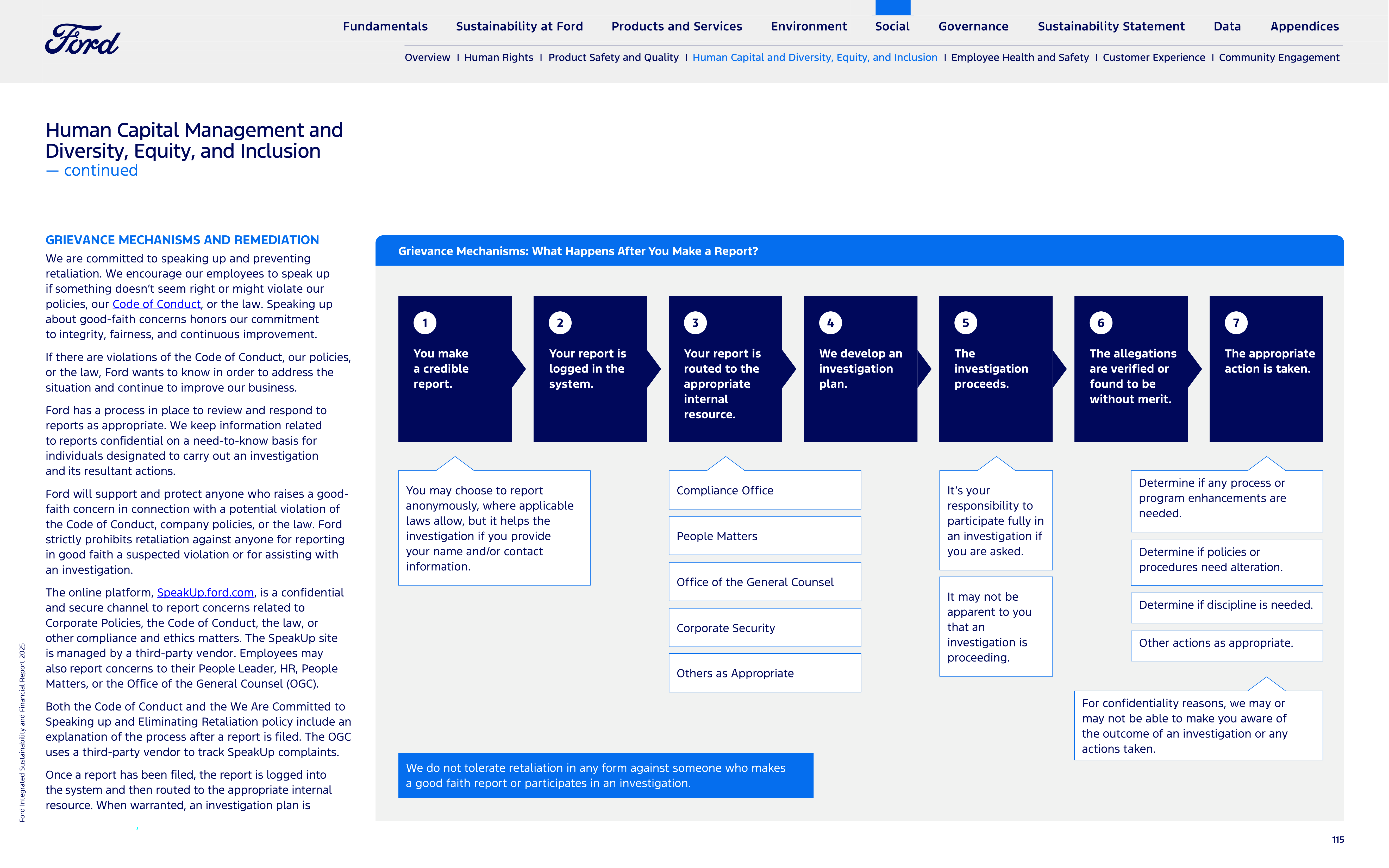
Fundamentals
Sustainability at Ford
Products and Services
Environment
Social
Governance
Sustainability Statement
Data
Appendices
Overview | Human Rights |
Product Safety and Quality |
Human Capital and Diversity, Equity, and Inclusion
| Employee Health and Safety | Customer Experience | Community Engagement
Human Capital Management and
Diversity, Equity, and Inclusion
— continued
,
Ford Integrated Sustainability and Financial Report 2025
115
GRIEVANCE MECHANISMS AND REMEDIATION
We are committed to speaking up and preventing
retaliation. We encourage our employees to speak up
if something doesn’t seem right or might violate our
policies, our
Code of Conduct
, or the law. Speaking up
about good-faith concerns honors our commitment
to integrity, fairness, and continuous improvement.
If there are violations of the Code of Conduct, our policies,
or the law, Ford wants to know in order to address the
situation and continue to improve our business.
Ford has a process in place to review and respond to
reports as appropriate. We keep information related
to reports confidential on a need-to-know basis for
individuals designated to carry out an investigation
and its resultant actions.
Ford will support and protect anyone who raises a good-
faith concern in connection with a potential violation of
the Code of Conduct, company policies, or the law. Ford
strictly prohibits retaliation against anyone for reporting
in good faith a suspected violation or for assisting with
an investigation.
The online platform,
SpeakUp.ford.com
, is a confidential
and secure channel to report concerns related to
Corporate Policies, the Code of Conduct, the law, or
other compliance and ethics matters. The SpeakUp site
is managed by a third-party vendor. Employees may
also report concerns to their People Leader, HR, People
Matters, or the Office of the General Counsel (OGC).
Both the Code of Conduct and the We Are Committed to
Speaking up and Eliminating Retaliation policy include an
explanation of the process after a report is filed. The OGC
uses a third-party vendor to track SpeakUp complaints.
Once a report has been filed, the report is logged into
the system and then routed to the appropriate internal
resource. When warranted, an investigation plan is
Grievance
Mechanisms:
What
Happens
After
You
Make
a
Report?
1
You
make
a
credible
report.
2
Your
report
is
Logged
in
the
system.
3
Your
report
is
routed
to
the
appropriate
internal
resource.
4
We
develop
an
investigation
plan.
5
The
investigation
proceeds.
6
The
allegations
are
verified
or
found
to
be
without
merit.
7
l
The
appropriate
action
is
taken.
You
may
choose
to
report
anonymously,
where
applicable
laws
allow,
but
it
helps
the
investigation
if
you
provide
your
name
and/or
contact
information.
Compliance
Office
People
Matters
Office
of
the
General
Counsel
Corporate
Security
Others
as
Appropriate
It's
your
responsibility
to
participate
fully
in
an
investigation
if
you
are
asked.
It
may
not
be
apparent
to
you
that
an
investigation
is
proceeding.
Determine
if
any
process
or
program
enhancements
are
needed.
Determine
if
policies
or
procedures
need
alteration.
Determine
if
discipline
is
needed.
Other
actions
as
appropriate.
For
confidentiality
reasons,
we
may
or
may
not
be
able
to
make
you
aware
of
the
outcome
of
an
investigation
or
any
actions
taken.
We
do
not
tolerate
retaliation
in
any
form
against
someone
who
makes
a
good
faith
report
or
participates
in
an
investigation.

developed and the investigation proceeds. The allegations
are then verified or found to be without merit. The process
concludes with the appropriate action being taken.
Fundamentals
Sustainability at Ford
Products and Services
Environment
Social
Governance
Sustainability Statement
Data
Appendices
Overview | Human Rights |
Product Safety and Quality |
Human Capital and Diversity, Equity, and Inclusion
| Employee Health and Safety | Customer Experience | Community Engagement
Human Capital Management and
Diversity, Equity, and Inclusion
— continued
,
Ford Integrated Sustainability and Financial Report 2025
116
There are specific channels for handling employee-
related matters including work-related issues relating
to compensation, discrimination, harassment, employee
benefit concerns, the
Code of Conduct
, and company
policies. All Corporate Policies and the Code of Conduct
include a section emphasizing the importance of
speaking up and a reference to the Policy.
To mitigate risks and pursue opportunities, we provide
Integrity Training to the salaried workforce. We also
include relevant questions in the Integrity Training
survey and in our employee Voice survey.
GLOBAL DIVERSITY, EQUITY, AND INCLUSION
At Ford, we believe that when we make a commitment, it
is not just about the words we use, it is about the actions
we take every day. So, when we say we are committed to
fostering a respectful, safe, and inclusive working
environment, we know that means showing up for our
employees, customers, and communities in ways that
matter, today and in the future.
We support equal opportunity and equal pay. This global
promise of helping people move forward and upward
traces back more than a century to the “five-dollar
workday” — a living wage — for all. We design vehicles
and services for a broad global audience, with an
inclusive workforce, dealer body, and supply chain that
serves customers around the world.
Our values — the values that have defined our dedication
to our teams, customers, communities, and the planet for
over a century — including our commitment to fostering
a diverse, inclusive, and global workforce, remain as
steadfast today as they have been throughout our
history. We know that leveraging diverse teams is not
only the right thing to do, but also smart business, and
that requires us to create and protect a culture in which
all team members can do their best work.
Building a Diverse and Inclusive Workplace
Ford is enriched by a world-class team made of people
with different backgrounds, perspectives, and experiences
which enables us to learn from each other, innovate, and
to create some of the most iconic vehicles in history and
afford millions of people the freedom of mobility.
Another aspect of our workplace is the support and
evolution of Employee Resource Groups (ERGs) which
have been a part of Ford for decades. All 10 global ERGs
are open to all employees and serve as places for
employee learning, collaboration, and development.
ERGs are instrumental in providing a voice to our global
workforce, while also providing valuable insights into
the employee experience and product and service
development. ERGs represent various dimensions of
our employee population, including disability, gender,
generation, LGBTQ+, race and ethnicity, religion,
and Veterans.
ERGs support our culture of respect and inclusion
by focusing on three strategic pillars:
•
People — Offer all employees opportunities to
connect, collaborate, and access resources for
personal development and networking
•
Community — Promote and participate in the
company’s commitment to philanthropy and to
building a better world
•
Business — To act as brand advocates and support
the company’s transformation
Engaging With Our Stakeholders
As we craft the policies that support Ford’s culture and
support our employees to thrive, now and in the future,
we regularly seek guidance and feedback from outside
experts and stakeholders, including institutional
investors, government agencies and elected officials,
civil rights organizations, and community partners.
This includes As You Sow, a shareholder representative
organization that supports and encourages sustainable
corporate business practices, as well as Whistle Stop
Capital, a sustainability research consultancy; they have
prepared the following analysis on Ford’s commitment
to building the best possible workforce.
Case Study
Message from As You Sow
Since the invention of the Model T, Ford’s
products have shaped how Americans live, and
in many ways, what it means to be American.
We support Ford in defending one of the most
American of ideals: that America has long been,
and continues to be, the land of opportunity.
Ford strives to attract employees who are resilient
problem-solvers, dedicated to quality, collaboration,
and excellence. These employees, while seeking to
improve their own lives, help to ensure the success
of Ford.
Successful companies hire and promote diverse
employees because doing so brings a range of
benefits. Diverse and inclusive workplaces bring
wider access to top talent, a broader understanding
of consumer preferences, new leadership skills,
and improved risk management, among other
advantages. Research has shown that companies
with diverse hiring practices outperform those
without, across a range of metrics.
We encourage Ford to continue to foster a
respectful and inclusive workplace and to provide
opportunities to talented and motivated people
globally as they develop and advance their careers.
We also encourage Ford to continue to share
information on the effectiveness of its diversity
and inclusion programs.
We stand firm with Ford in its understanding that
diversity of ideas, beliefs, and perspectives has
always been one of America’s greatest strengths.

Fundamentals
Sustainability at Ford
Products and Services
Environment
Social
Governance
Sustainability Statement
Data
Appendices
Overview | Human Rights |
Product Safety and Quality |
Human Capital and Diversity, Equity, and Inclusion
| Employee Health and Safety | Customer Experience | Community Engagement
Human Capital Management and
Diversity, Equity, and Inclusion
— continued
,
Ford Integrated Sustainability and Financial Report 2025
117
BUILDING INCLUSIVE CULTURES IN DEALERSHIPS
We are empowering our global dealer network to
strengthen a culture of inclusion that enables team
members to thrive and positions every dealership
to more effectively engage guests and offer an
exceptional experience.
Our global dealer engagement effort is focused on two
pillars: enhancing dealership culture and developing
dealership leadership talent. Enhancing dealership
culture includes fostering an inclusive workplace where
every team member knows they are valued by the
organization, and they have an opportunity to build a
career. Overall, these efforts are designed to improve
team member retention and performance, which
ultimately translates to even higher customer
engagement and improved customer satisfaction scores.
These efforts also complement the existing Ford
Guest Experience Immersion which offers learning
opportunities to help dealers build cultural competency
and to better connect with the communities they serve.
SUPPLIER DIVERSITY AND INCLUSION
A diverse supply base creates a competitive edge, as
we deliver must-have products and services. Ford’s
Supplier Diversity and Inclusion initiative is designed to
strengthen the supplier network by identifying additional
qualified businesses to include in the sourcing process.
The program seeks to identify qualified companies that
are also certified as U.S. small businesses, Veteran-,
women- and minority-owned businesses, enterprises
led by individuals with disabilities, and LGBTQ+
entrepreneurs so that these potential suppliers can
be given an equal opportunity to compete on a level
playing field. The program also embraces certified
global women-owned businesses and Canadian
Indigenous-owned enterprises.
We also encourage our Tier 1 suppliers to use inclusive
sourcing practices to help ensure they find the most
qualified and efficient resources. Inclusive sourcing
practices not only diversify sourcing options but also
bolster supply chain resilience by promoting competition
among vendors, driving improved service and pricing.
Furthermore, Ford has supported strategic alliances and
joint ventures among diverse suppliers, enhancing their
capabilities and fostering growth.
These collaborations empower businesses to enhance
capacity, acquire new skills, and fortify the supply chain
locally and regionally. Sourcing from a broad array of
businesses creates an economic ripple effect that
stimulates economic empowerment and uplifts
communities through job creation, local spending,
and personal/business taxes.
Ford’s Supplier Diversity and Inclusion program has
consistently earned recognition as a benchmark by
esteemed certifying organizations and advocacy partners
in the U.S. Ford Supplier Diversity & Inclusion 2024
recognitions include:
•
Canadian Aboriginal Minority Supplier Council —
Corporation of the Year
•
Great Lakes Women’s Business Council — Excellence
in Supplier Diversity: Best in Class
•
Michigan Minority Supplier Development Council —
Corporation of the Year
•
Mid-South Minority Business Continuum —
Chairman’s Award
•
Women’s Business Enterprise National Council —
Top 10 Global Champions in Supplier Diversity
EQUAL EMPLOYMENT OPPORTUNITY
Our updated EEO-1 report, scheduled to be filed in June
2025, will provide a snapshot of our U.S. demographics
as of year-end 2024, based on occupational categories
prescribed by the federal government that aggregate
jobs with widely varying skill requirements.
Approximately 95% of all Ford Motor Company hourly
and salaried positions fall into just four of the 10
categories. The usefulness of this data for making direct
comparisons to other companies or other industries with
different job structures, is therefore extremely limited.
To address these shortcomings, Ford will develop a more
robust report to supplement the June 2025 filing by
disaggregating technical jobs in fields such as
engineering and information technology, which pose
recruiting challenges that are very distinct from non-
technical roles. The supplemental report also will provide
more nuanced breakdowns of demographics at various
managerial levels.
We are committed to equal pay for equal work. Employee
compensation in each market should be fair and
equitable, irrespective of gender, race, or similar personal
characteristics. Equal pay for equal work applies to all
forms of pay, including base salary, incentives, bonuses,
and other forms of compensation.
Read More: In the EEO-1 report
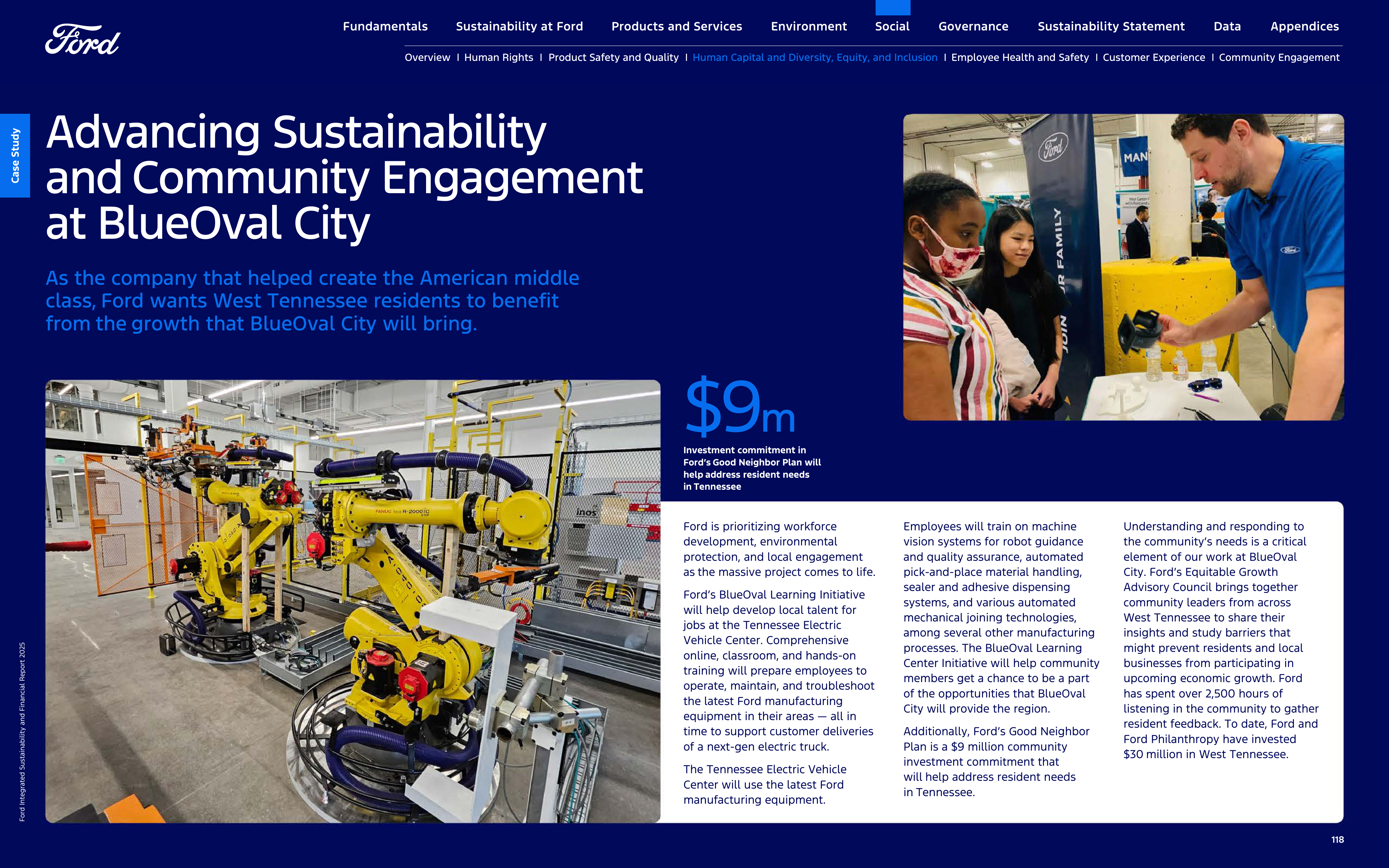
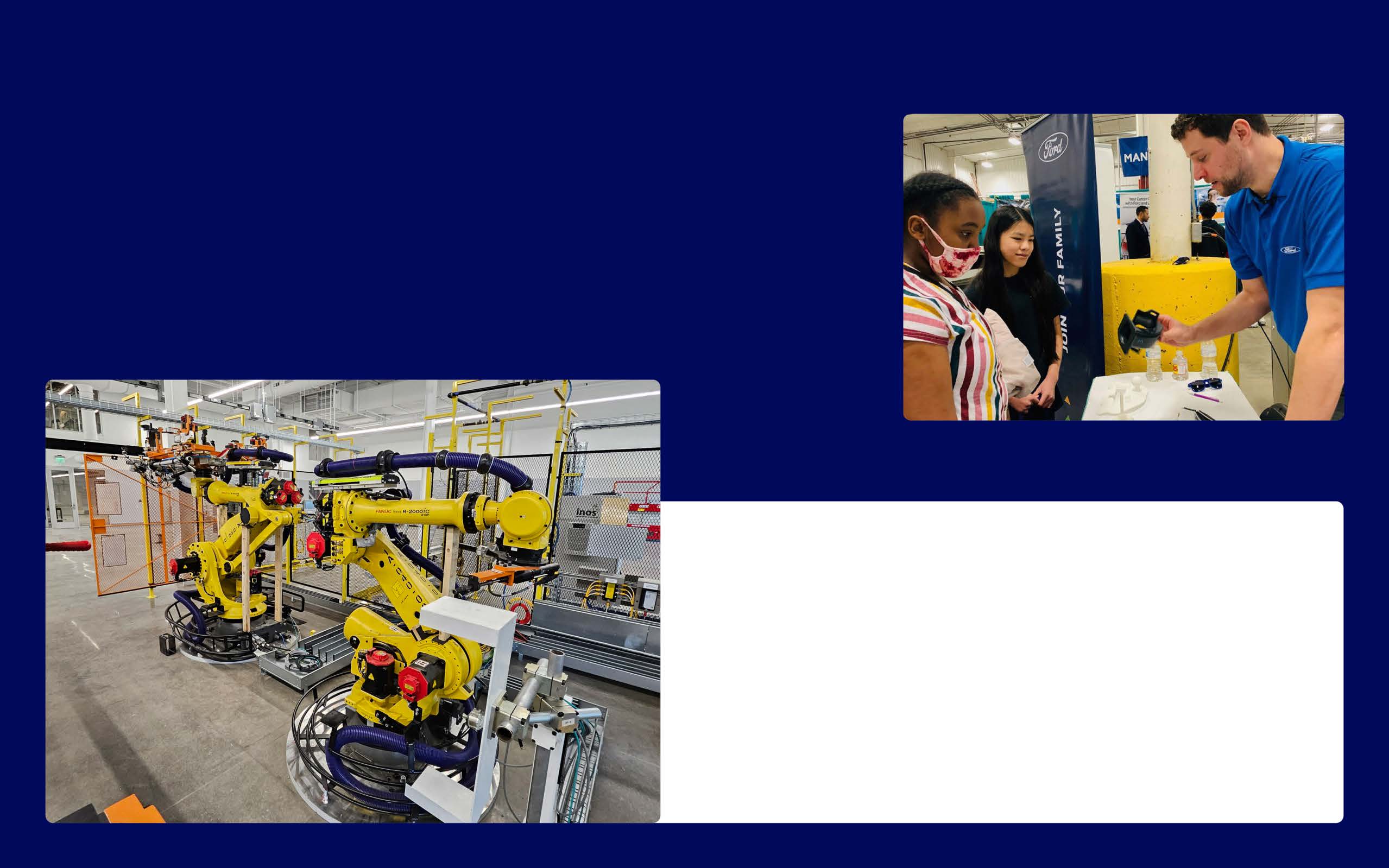

Fundamentals
Sustainability at Ford
Products and Services
Environment
Social
Governance
Sustainability Statement
Data
Appendices
Overview | Human Rights | Product Safety and Quality |
Human Capital and Diversity, Equity, and Inclusion
| Employee Health and Safety | Customer Experience | Community Engagement
Ford Integrated Sustainability and Financial Report 2025
Case Study
Advancing Sustainability
and Community Engagement
at BlueOval City
118
As the company that helped create the American middle
class, Ford wants West Tennessee residents to benefit
from the growth that BlueOval City will bring.
$9
m
Investment commitment in
Ford’s Good Neighbor Plan will
help address resident needs
in Tennessee
Ford is prioritizing workforce
development, environmental
protection, and local engagement
as the massive project comes to life.
Ford’s BlueOval Learning Initiative
will help develop local talent for
jobs at the Tennessee Electric
Vehicle Center. Comprehensive
online, classroom, and hands-on
training will prepare employees to
operate, maintain, and troubleshoot
the latest Ford manufacturing
equipment in their areas — all in
time to support customer deliveries
of a next-gen electric truck.
The Tennessee Electric Vehicle
Center will use the latest Ford
manufacturing equipment.
Employees will train on machine
vision systems for robot guidance
and quality assurance, automated
pick-and-place material handling,
sealer and adhesive dispensing
systems, and various automated
mechanical joining technologies,
among several other manufacturing
processes. The BlueOval Learning
Center Initiative will help community
members get a chance to be a part
of the opportunities that BlueOval
City will provide the region.
Additionally, Ford’s Good Neighbor
Plan is a $9 million community
investment commitment that
will help address resident needs
in Tennessee.
Understanding and responding to
the community’s needs is a critical
element of our work at BlueOval
City. Ford’s Equitable Growth
Advisory Council brings together
community leaders from across
West Tennessee to share their
insights and study barriers that
might prevent residents and local
businesses from participating in
upcoming economic growth. Ford
has spent over 2,500 hours of
listening in the community to gather
resident feedback. To date, Ford and
Ford Philanthropy have invested
$30 million in West Tennessee.

Fundamentals
Sustainability at Ford
Products and Services
Environment
Social
Governance
Sustainability Statement
Data
Appendices
Overview | Human Rights |
Product Safety and Quality | Human Capital and Diversity, Equity, and Inclusion |
Employee Health and Safety
| Customer Experience | Community Engagement
Employee Health and Safety
,
Ford Integrated Sustainability and Financial Report 2025
119
Overview
Aspirations
Safety
Salient Issues
Health/Safety
UN Sustainable Development Goals
3 GOOD HEALTH
AND WELL-BEING
8 DECENT WORK AND
ECONOMIC GROWTH
11 SUSTAINABLE CITIES
AND COMMUNITIES
Our most valuable asset is our people.
Their safety and wellness continues to be
a priority. Whether we’re working at one
of our collaboration centers or at our
manufacturing facilities, we put health,
safety, and wellness at the forefront.
Many of our internal standards go beyond applicable
laws and regulations to meet our commitment to
protecting the safety of our workforce in all our locations.
To ensure that our employees understand the strength
and importance of our commitment, in 2024:
•
We updated the global Health and Safety
Commitment poster
•
We conducted a safety bus tour with our global
safety leads planning and discussing safety processes
and practices
•
We held our first-ever global safety Gemba during
the Global Safety Leadership Conference
•
Global Safety Leadership completed Gembas to
manufacturing and non-manufacturing locations within
southeast Michigan
We benchmark our safety programs with other companies
through the Automotive Safety Forum, American Society
of Safety Professionals, Executive Leadership Council,
and Michigan Safety Conference. In South America, we
continue to benchmark with other companies through the
Automotive Safety Forum, ADEFA, John Deere, Suppliers
Gestamp, Honda, and 3M.
HEALTH AND SAFETY POLICIES
We have set the sustainability aspirational goal to work
towards a future that is free from workplace injuries.
Our commitment to employee health and safety is
stated in our corporate
Code of Conduct
and internal
Workplace Health and Safety policy, We Are
Committed to a Safe and Healthy Working Environment.
Our
We Are Committed to Protecting Human Rights and
the Environment policy
also states that Ford commits
to providing a healthy and safe working environment.
According to our Code of Conduct, our operations and
team members are expected to:
•
Participate in all required safety training
•
Understand and follow our policies, processes,
and requirements
•
Plan and test responses to potential emergency
situations that may arise in our operations through
business continuity planning
•
Work together to develop health and safety objectives
and adequate plans to continuously improve health
and safety at our locations
•
Speak up immediately if they see unsafe behavior
or hazardous conditions
U.S. locations are governed by OSHA and the
requirements established in the Code of Federal
Regulations (Standards — 29 CFR), General Industry
(Part 1910), and Construction (Part 1926). Additionally,
ISO standards and select nationally recognized standards
organizations such as the NFPA, ANSI, and ASME form
part of our compliance requirements.
Internally, we have a structure of health and safety
standards that align requirements established by OSHA,
other applicable global regulations and applicable
industry standards. The structure of the Safety Operating
System (SOS) is based on these requirements.
The scope of the SOS is Ford’s majority-owned facilities.
Joint ventures are encouraged to adopt Ford standards.
Promotion of Worker Health
For non-occupational services, consultation is provided
for employees who seek advice, but the employee
is referred to their personal medical doctor for the
treatment of non-occupational conditions (unless
temporary care is required to relieve an emergency
condition). Ford medical staff do not treat non-
occupational medical conditions except in an emergency.
Employees in most manufacturing locations, both
hourly and salaried, have access to employee support
service programs that include weight management,
free counseling referrals, and on-site or near-site fitness
facilities. In addition, those employees have access
to Quarterly Wellness Programs that include blood
pressure evaluations, lipid profile, and glucose
monitoring where available.
SAFETY PERFORMANCE
Any loss of life or serious injury in the workplace is
unacceptable and deeply regretted. We’re proud to
report that there were zero employee fatalities globally
in 2024. We continue to encourage accurate and detailed
reporting of safety issues to reduce risk and improve
workplace safety.
Our Health and Safety Commitment, “Our most valuable
asset is our people. There can be no compromise,”
drives our safety culture. It applies to all employees,
contractors, and visitors performing work at our
locations globally.
Fundamentals
Sustainability at Ford
Products and Services
Environment
Social
Governance
Sustainability Statement
Data
Appendices
Overview | Human Rights |
Product Safety and Quality | Human Capital and Diversity, Equity, and Inclusion |
Employee Health and Safety
| Customer Experience | Community Engagement
Employee Health and Safety
— continued
,
Ford Integrated Sustainability and Financial Report 2025
120
Safety performance is managed by Senior Leadership
through Plant Operation Reviews, Manufacturing Safety
Councils, and Safety Process Review Board meetings.
Unions representing production workers, skilled trades,
and engineers play a critical role in improving health
and safety for our employees and workplaces. We are
committed to supporting these unions and collective
bargaining to ensure the health and safety of our union
represented employees and locations.
Open communications and collaboration help us work
through contractual requirements. Designated members
of management interact and partner with local, national,
and global union representatives to support our health
and safety initiatives; together they address issues as
they arise.
SAFE CONDITIONS AT NEW AND
EXISTING FACILITIES
We rely on robust standards and procedures, along with
dedicated resources in our manufacturing engineering
teams, to assure safe conditions and a safe workplace
at every Ford facility. Our engineered systems are
designed and installed to provide safe operations for
our employees.
Safety for high-risk construction contractors working
on Ford projects continues to be a priority as we build
new plants and update existing facilities. In 2023, we
held focus group and benchmarking discussions with
our key construction prime contractors to share best
practices associated with pre-apprentice trades and
the abnormally higher injury rates within that group.
The outcome of the sessions included improved
alignment on how those persons working in that space
can be better protected, as well as updated language
within our own construction safety standards. In 2024,
there were zero contractor fatalities at our sites.
In 2024, a presentation by team members at the American
Society for Safety Professionals executive leadership forum
highlighted Ford’s robust contractor safety program and
the multi-year renovation of Michigan Central Station,
a new mobility innovation district located in Corktown,
Detroit’s oldest neighborhood.
SAFETY OPERATING SYSTEM
As stated in our Workplace Health and Safety policy,
Ford is committed to fostering a safe and healthy working
environment in each of our locations worldwide. The
global SOS helps ensure the work environment within our
facilities is safe for our employees and meets or exceeds all
regulatory and company requirements. This internal tool
enables comprehensive self-assessments of our corporate
safety standards and validates each facility’s capability and
adherence to meet our safety requirements. The SOS is
designed to prevent and reduce incidents by implementing
elements including incident investigation and analysis,
training, risk assessment, and emergency preparedness.
In 2024 we expanded the SOS to our non-manufacturing
locations. We also linked the SOS to a dashboard that
provides global, regional, manufacturing director, and
plant specific self-assessment results.
This tool, which is integrated with the SOS, has simplified
data review by allowing us to quickly identify issues by
location, region, or globally to ensure allocation of
resources. Our internal Global Data Insights and Analytics
(GDIA) team, which developed the dashboard, continues
to improve the SOS dashboard to ensure the necessary
data is mined from the new application globally,
regionally, locally, by question, etc.
SAFE OBSERVATION INDEX
The Safe Observation Index (SOI) is a leading indicator
tool that enables team members to evaluate tasks and
physical conditions in the workplace. A new SOI mobile
application, allows our teams to be more efficient and
enables real-time data entry with no redundant work.
Linked to a dashboard, the SOI mobile app was
launched globally in 2024 to all manufacturing and
non‑manufacturing facilities and includes the necessary
translations by region for the question sets. It is now
a global KPI. In South America, for example, the local
SOI tool exceeded adherence and data utilization targets
in 2024.
REPORTING TOOLS
We continue to utilize the Global Event Reporting Tool,
which enables us to quickly notify locations of significant
events which may affect their operations. Together with
the Corrective Action Issuance process, it provides a
forum for Ford to communicate significant incidents
when they occur, and then proactively provide
instruction and guidance to our facilities through
Immediate and Permanent Corrective Actions. These
corrective actions require facilities to make changes
and improvements and implement controls to prevent
recurrence of these significant incidents.
A new Global Safety Language Translation System,
introduced in 2024, assists in translating global
safety corrective actions for timely corrective
action implementation.
SAFETY TRAINING
Safety training plays an essential role in our efforts
to achieve a future that is free from workplace injuries.
We use a safety training matrix that lists all safety topics,
the frequency for each training course, the personnel
that are required to complete training, and who manages
the training and training format. AI is helping us provide
timely feedback to standard questions regarding safety
and ergonomics standards thanks to an ALSA chat bot.
We conduct regular communications and promotions
on key safety issues to promote occupational health and
safety. For example, our BlueOval Now communications
platform is helping improve our safety culture by
pushing messaging related to at-home and work safety
to our employees. Our South America operations
continue to provide weekly safety communications which
include event findings and people messaging to advance
the safety culture.
We also share safety best practices via multi-industry
groups, within and outside the automotive sector, and
collaborate to address common issues. In 2024, a joint
conference with the UAW-Ford featured health and safety
training around people development, team building, and
people skills. In South America, our union partnership
with El Sindicato de Mecánicos y Afines del Transporte
Automotor (SMATA) includes monthly committee meetings
focused on Safety, Health, and Ergonomics.
In China, our Ford of China team held a Safety Symposium
and Cross Audit in 2024 that promoted collaboration and
sharing of best practices between the China locations.
Fundamentals
Sustainability at Ford
Products and Services
Environment
Social
Governance
Sustainability Statement
Data
Appendices
Overview | Human Rights |
Product Safety and Quality | Human Capital and Diversity, Equity, and Inclusion |
Employee Health and Safety
| Customer Experience | Community Engagement
Employee Health and Safety
— continued
,
Ford Integrated Sustainability and Financial Report 2025
121
HUMAN-CENTERED DESIGN FOR HEALTH,
SAFETY, AND WELLNESS
Human-centered design can transform the auto
industry’s approach to manufacturing. By focusing on
environmental stewardship and social equity, we can
play a leading role. We aim to address the occupational
demands specific to manufacturing and improve the
working conditions and health of our essential workers
through the following five priorities:
Health Equity
Everyone has a fair and just opportunity to be as healthy
as possible.
Learning and Growth
Encourage exploration and development of soft skills
and lifelong learning
Engagement and Choice
Empower choice of how to work, rest, and play when
possible and appropriate
Culture and Understanding
Advocate work-life integration and understanding
of individual differences
Environmental Impact
Align our operations to our organizational values
REDUCING INJURIES THROUGH ERGONOMICS
Our focus on ergonomics is helping us reduce injuries
among our hourly workforce. Each Ford plant has a Local
Ergonomics Committee dedicated to managing current
production ergonomics risk factors to reduce the risk of
repetitive strain injuries. In 2024, Ford U.S. Ergonomics
Committees collectively resolved over 400 ergonomics
issues resulting in cost avoidance. All our U.S. Committee
members participated in an ergonomics Gemba visit to
the Kentucky Truck Plant to share best practices.
We endeavor to continually share our ergonomics
learnings and best practices by hosting quarterly
meetings where our Ergonomics Committees highlight
effective solutions for shared problems. In 2024, Ford
team members delivered the keynote address and other
session presentations at the Applied Ergonomics
Conference where two Ford employees were externally
recognized as Ergonomics Practitioners of the Year.
In 2025, Corporate Ergonomics will pilot an advanced
ergonomics toolset that leverages computer vision and
AI to deliver a streamlined and lower cost platform for
ergonomics data collection and analysis.
SAFETY IN BATTERY MANUFACTURING
Safety is critical during electric vehicle production at new
sites and existing locations. The Battery Electric Safety
Core Team reviews training requirements, emergency
response procedures, best practices, and internal and
external incidents to better understand and prepare our
workforce. They share their knowledge and collaborate
with engineering, product development, and
manufacturing locations to support our safety culture.
Staying at the forefront of electric vehicle manufacturing
and safety is crucial. Our Medical and Industrial Hygiene
and Toxicology teams support new processes globally
and review new materials for manufacturing electric
vehicles. Their knowledge helps ensure that we
anticipate, identify, analyze, and measure potential
occupational exposures and monitor our employees
as needed.
In 2024, we updated health and safety measures at
BlueOval City in Tennessee and the Ion Park facility in
Michigan. Emergency Response Plans now include the
use of fire blankets for thermal runaway events
associated with battery electric vehicles. We also
continued the development of a Process Safety
Management program for chemicals used at the battery
manufacturing facilities.
In 2024, we conducted a Facility Emergency Response
Plan Exercise based on an alternate fuel fire response
scenario. (i.e. lithium-ion battery). During the exercise,
operational leads evaluated facilities’ emergency
response and disaster response capabilities during
a multi-shift disruption.
PROACTIVE APPROACH TO EMERGENCY RESPONSE
Comprehensive planning, testing and drills at our global
locations help ensure quick and strategic responses to
emergency situations and natural disasters. For example,
the International Market Group (IMG) team’s commitment
to employee safety and wellness extends beyond the
daily operations to include a robust emergency
preparedness program. This company-wide initiative
ensures consistent and effective emergency response
across all facilities through standardized emergency
response plans, regular training, monthly Emergency
Response Team (ERT) drills, comprehensive fire
evacuation drills, and maintenance of fire protection
systems and emergency equipment. Active employee
participation is crucial to the program’s success, reflecting
our dedication to a safe and resilient work environment.
HEALTH AND SAFETY AWARDS
Ford Thailand Manufacturing (FTM) has won the
prestigious national-level “Outstanding Model Workplace
for Occupational Safety, Health, and Working
Environment” award for the 11th consecutive year.


Fundamentals
Sustainability at Ford
Products and Services
Environment
Social
Governance
Sustainability Statement
Data
Appendices
Overview | Human Rights |
Product Safety and Quality | Human Capital and Diversity, Equity, and Inclusion | Employee Health and Safety |
Customer Experience
| Community Engagement
Customer Experience
,
Ford Integrated Sustainability and Financial Report 2025
122
Overview
UN Sustainable Development Goals
8 DECENT WORK AND ECONOMIC GROWTH
Ford’s commitment to customer service
dates back over 120 years. It continues today
as Ford employees and dealers listen to
customers and respond with exciting vehicles
and innovative services to meet their needs.
We’re wired to exceed expectations with
products, services, and experiences that our
customers can’t live without.
POLICIES RELATED TO CUSTOMER EXPERIENCE
Our commitment to customer engagement is written into
our corporate
Code of Conduct
which states, “We seek
to engage our customers in new and inclusive ways
to get deeper knowledge of their wants and needs.”
Ford provides many channels for customers to engage
with the company directly. Customers engage with the
company in our dealerships, on our websites and social
media, at our contact centers, and inside our vehicles.
We invite them to provide their sentiment on touchpoint
satisfaction and their likelihood to advocate for the brand
as they proceed along the customer experience journey.
Our internal customer experience measurement platform
provides actionable insights to our dealers and
touchpoint owners to drive enhanced experiences.
The Global Contact Centers actively use survey
feedback via a closed loop process that allows the
Contact Centers to assess whether customers are
satisfied with the overall experience. Team leads,
supervisors, and managers analyze customer feedback,
focusing on any customer rating below “excellent.” They
reopen cases if required, provide feedback to customers,
and review improvement opportunities with agents.
Ford is committed to making our website accessible for
all of our site visitors. The contact center website is ADA
compliant, and Customer Support is available to help
with accessibility issues.
PROACTIVE CUSTOMER SUPPORT
In 2024 we continued to grow and scale our Proactive
Customer Support and outreach globally to support our
vision of making discovering, testing, buying, and owning
Ford products simpler and more satisfying. Our customer
support and outreach programs cover the entire
customer experience from building and pricing vehicles
onward through the ownership journey.
For example, we utilize Welcome Calls in the U.S., EU,
and our IMG to onboard and educate customers about
their vehicle or features. We further support customers
by helping to address concerns before and as they
happen through programs such as Vehicle Health Alert
support and Roadside/Vehicles Off Road support in the
U.S., EU, South America, and IMG.
Ford customers in the U.S. continue to enjoy
complimentary Pickup & Delivery and Mobile Service
from participating dealers. With Pickup & Delivery, the
customer’s preferred Ford dealer will come to their
home or place of business, pick up their vehicle and
return it when the repair has been completed. This adds
convenience and choice to the service experience while
minimizing downtime. For light repairs and routine
maintenance, a Mobile Service van can be dispatched
with a trained technician to perform service at an eligible
location of the customer’s choice.
The Mobile Service van fleet and mobile repair order
business continues to grow, with over 1,000 mobile
service units added in 2024 alone
59
. This was driven in
part by strong growth in our U.S. mobile service repair
orders, which have risen by 114% in 2024. The network
now boasts over 4,100 deployed mobile service units in
the U.S.
Our remote services continue to be popular with
customers. We delivered over 3.8 million remote
experiences in 2024, an increase of 91% over 2023. And
customers are responding positively. The Net Promoter
Score (NPS) on Mobile Service repair order outperforms
overall service scores by over 11 percentage points.
LOYALTY AND MEMBERSHIP REWARDS
FordPass® Rewards drives long-term customer loyalty
and engagement by offering opportunities to earn and
redeem Points on a diverse range of Ford products and
services. The program’s U.S. membership has grown to
over 15.7 million, with more than 2 million new members
joining in 2024. Points may be earned and redeemed
throughout the Ford ecosystem, including online
purchases of accessories and parts, select Connected
Services, vehicle service, vehicle purchases, SiriusXM
subscriptions, and participation in exclusive events such
as the Bronco Off-Roadeo.
Case Study
Electric Expo
Customer outreach and education are an important
part of the transition to electric vehicles, and first-
hand experience can be the key to breaking
electric vehicle adoption barriers. Ford met
hundreds of electric vehicle enthusiasts and
potential adopters as we toured the U.S. with the
Electrify Expo 2024. North America’s largest e-
mobility festival, Electrify Expo attracted attendees
to stops all across the country. With demos,
walkthroughs, and Ford experts on hand, Electrify
Expo was an incredible opportunity to see what
Ford has in store for the future of driving.


Fundamentals
Sustainability at Ford
Products and Services
Environment
Social
Governance
Sustainability Statement
Data
Appendices
Overview | Human Rights |
Product Safety and Quality | Human Capital and Diversity, Equity, and Inclusion | Employee Health and Safety |
Customer Experience
| Community Engagement
Customer Experience
— continued
,
Ford Integrated Sustainability and Financial Report 2025
123
RAISING CONCERNS VIA GLOBAL
CONTACT CENTERS
Approximately 3,500 agents in our Global Contact
Centers are available to help our customers and dealers
with any questions or concerns related to Ford or Lincoln
products and services. We offer multiple ways to engage
with the Global Contact Centers, capturing all inbound
and outbound contacts via phone, chat, SMS, Apple
Business Chat, email, postal mail, and our website.
In addition, we actively engage in selected social media
forums and directly interact with customers who flag
issues and concerns on key social media platforms.
In 2024, Contact Centers expanded their reach from
Concern-focused reporting to All Contacts reporting.
This extended focus will help us improve our Concern case
handling and make progress on all other cases which are
addressed during the initial agent/dealer contact.
Our attention to customer experience and product safety
and quality is showing results. We use internal metrics
to help monitor inquiries raised and how they are
addressed or resolved. For example, cases which cannot
be solved during the initial contact with the Global
Contact Centers and are open for more than 24 hours
are classified as Concern Cases. The quality of resolution
of these cases is known as the Concern NPS. In 2024,
Concern NPS improved from +26 to +39. During the same
time period, Customer Experience increased from 73%
to 78% and Concern Resolution grew from 81% to 85%.
Proactive Customer Support Initiatives in 2024
contributed to customer experience improvements.
The Global Contact Centers proactively engaged over
533,000 customers in 2024, representing over 8.8% of
the total annual inbound contact volume. This is in
contrast to 612,000 proactive engagements in 2023.
We have also put more emphasis on customer self-help,
increasing our monthly self-help interactions from
4.0 million to 4.6 million with a task success that
increased year-over-year from 61% to 72%.
CUSTOMER FEEDBACK AND PROCESS
TO REMEDIATE NEGATIVE IMPACTS
Our One-CX experience measurement platform, the new
AI-driven Call Analytics tools, and the CX-Hub system
continue to help us manage customer feedback and
remediation of negative impacts.
All Contact Centers in all regions (excluding China)
utilize OneCX. Covering all contact channels, and using
globally consistent surveys, the platform serves as the
consolidated resource for customer feedback. Consistency
in surveying and reporting contributed to the strong
customer experience (CX) Metrics improvements in 2024
thanks to global best practice sharing.
Complementing the CX Surveys, an AI-driven Call
Analytics tool provides key insights into the customer/
agent interactions, giving Product Development and
Quality access to very specific customer feedback.
AI Analytics are now available to all parts of the
company and enable us to better understand customer
pain points by delivering self-help and knowledge-base
gaps for the team to address. AI Call Analytics also
provide deeper insight into agent behavior, driving agent
training opportunities.
After a 2023 pilot in our Houston Contact Center,
CX-Hub was extended to most of our North America
retail agents in 2024 with the remainder to be onboarded
in Q1 2025. CX-Hub delivers a fully integrated agent
case management to our customer- and dealer-facing
agents with integrations into all Ford key systems,
enabling the agents to help customers and dealers
more comprehensively and quicker. The system is
a key enabler for the increase in our customer
experience metrics.
INCENTIVES FOR PLUG-IN VEHICLES
Many of Ford’s electric vehicles, as well as our plug-in
hybrids, have been eligible for U.S. federal tax credits
for retail consumers of up to $7,500. In order to qualify
for this credit, among other requirements, the vehicle
MSRP be at or below $80,000, and the purchaser must
meet certain income limits. Going forward, Ford will
continue to maximize eligibility for federal tax credits
for our customers.
Commercial and tax-exempt commercial customers
of Ford E-Transit, F-150® Lightning, and other Ford
commercial electric vehicles may qualify for U.S. tax
credits of up to $7,500 per electric vehicle purchased.
Ford Pro is helping to give customers no-cost
information to learn about U.S. tax credits for which
they may qualify.
We also anticipate that the EU Green Deal will have
a positive impact for our customers and the green
electrification of mobility in the covered regions.
We expect European mandates for more electric vehicle
charging infrastructure will support European customers
in migrating to fully electric vehicles.
GLOBAL DEALER ENGAGEMENT
Ford’s dealer network, encompassing over 8,000
dealers around the globe, is a competitive asset for Ford.
The Global Dealer Engagement (GDE) team focuses on
enhancing dealers’ ability to deliver for the customer
with a strategy centered around three key pillars:
People, Processes, and Premises.
GDE empowers People by educating dealership
employees on Guest Centricity, Inclusivity, and
developing a high-performance Culture, while
modernizing and scaling on-demand training through
Ford University. GDE amplifies the impact of dealers in
their communities through partnerships and community-
focused initiatives, along with recognizing the
Case Study
SupportBelt for Breast Cancer Patients
Lynn Simoncini never thought of herself as an
innovator when she received her breast cancer
diagnosis in 2022. However, after a double
mastectomy, she found herself grappling with
an unexpected source of pain during a routine
activity — driving. The pressure of wearing a
tightly fastened seatbelt across her still-healing
chest was agonizing, making even short trips a
challenge. It was a problem, she thought, that
must be common, but there were no real solutions.
That’s when Simoncini, a creative director at VML — a
marketing partner of Ford — and a self described “car
girl,” started sketching out ideas. Simoncini’s initiative
led to the creation of the Ford SupportBelt™, a
device designed to address a need for cancer
patients who undergo a mastectomy, or the removal
of breast tissue, as part of their treatment plan.
Developed and designed by Ford with the input of
patients and doctors, the contoured SupportBelt
provides a comfortable solution for patients to
wear their seatbelts on either the driver and
passenger sides of the vehicle. The concave
design of the SupportBelt allows it to conform to
various body types, providing a more personalized
fit that reduces the risk of chafing or irritation.
The SupportBelt is a continuation of decades of
Ford support aimed at helping and inspiring in the
fight against breast cancer, Ford has filed a patent
for SupportBelt and plans to open it to other
manufacturers so production can be scaled across
the globe.

outstanding performers by improving dealer awards and
recognition programs.
Fundamentals
Sustainability at Ford
Products and Services
Environment
Social
Governance
Sustainability Statement
Data
Appendices
Overview | Human Rights |
Product Safety and Quality | Human Capital and Diversity, Equity, and Inclusion | Employee Health and Safety |
Customer Experience
| Community Engagement
Customer Experience
— continued
,
Ford Integrated Sustainability and Financial Report 2025
124
GDE also streamlines Processes and enables dealers to
spend more time serving customers by modernizing
systems to simplify interactions, reduce costs, and
increase efficiency. Increasing the effectiveness of dealer
councils enables Ford to better understand and respond
to consumer preferences and market nuances while
deepening connection with the entire dealer body.
Finally, GDE modernizes Premises, developing plans for
spaces that enhance the customer and dealer employee
experience while enabling success with existing and
emerging businesses.
Through these initiatives, GDE strives to create a best-
in-class distribution network where customers, dealers,
and Ford build meaningful relationships and achieve
shared success.
REIMAGINING THE CUSTOMER JOURNEY
IN EUROPE
We are taking customer experiences in Europe to new
levels, integrating processes from discovery to servicing
for seamless simplicity, starting with electric vehicles.
In May 2023, we unveiled a new vision to make
discovering, testing, buying, and owning Ford products
not only simpler, but also more satisfying — starting
with Ford electric vehicles.
In partnership with our retail partners across Europe,
we are entirely reimagining the customer journey to
electric vehicle ownership, with online access and
touchpoints available every step of the way. The new
approach introduces online showrooms and virtual test
drives for exploring products and services. Transparent
pricing means no surprises. And customers will be able
to personalize their vehicle handover, access charging,
and arrange pickup and delivery for servicing with
a few clicks on their smartphone.
We are also tackling the single most frustrating factor
for car-buyers according to the New Car Buyers Survey —
uncertainty about when their new car will arrive. Clear
communication, online visibility of the order status,
and the ability to book delivery slots online will
help customers plan ahead and put time back on
their calendars.
The new Ford customer experience is designed to
continue making life easier for owners even after
purchase. Ongoing support includes access to one of
Europe’s largest charging networks, with more than
500,000 chargers, at-home charging solutions, as well as
pick-up and delivery for servicing that can be scheduled
online, with ultra-convenient fast-track options.
RESPONSIBLE MARKETING
Representing the diversity and perspective of our
customer base in our marketing materials is important
to us.
We are committed to ensuring that our marketing,
product offerings, and services meet the needs of
our diverse current and future customers. We do not
specifically target vulnerable consumers and users.
Our marketing is aimed at those intending to purchase
vehicles, with demographics and needs differing
depending on which product and/or service we are
advertising. While mass market advertising will reach
a broad population group, ad placements are based
on our target demographics and needs.
We make a conscious effort to work with a diverse group
of creative professionals to develop and produce our
content across multiple channels. In addition to engaging
content creators from underrepresented groups, we
strive to offer training and mentorship through the
marketing process.
Case Study
Ford University
Car buyers want the shopping experience to be as
transparent and simple as purchasing any other
product, as they seek specialized support on the
latest vehicle technologies. Meanwhile, many dealers
have expressed the challenge of managing the swift
pace of new products and technology developments.
This mutual desire for specialized support and
guidance has led to the inception of Ford University,
a new digital and video-based dealer training and
productivity platform designed to empower our
dealers to become the product specialists for
our customers.
We’ve assembled a team of video producers, content
creators, and training specialists dedicated to creating
engaging content that reinforces complex topics
and information.
This helps ensure that our dealers are not just
salespeople, but trusted advisors equipped with
stories, insights, and the knowledge needed to make
genuine connections with customers.
Ford University features a personalized, data-driven
dashboard for each dealer employee, gamified
learning experiences, 24/7 on-demand AI-supported
virtual coaching, and a cinematic-style content library
produced by award-winning producers and creatives
who have spent all or portions of their careers
creating popular television shows and feature films
across major networks and streaming services.
We began rolling out Ford University to Ford dealers
across the United States in 2024. This platform
represents our commitment to providing customers
with even more knowledgeable and skilled dealers,
enhancing the value of every customer experience.
We follow industry standards for responsible marketing
practices including customer privacy and email contact
rules, etc., with routine monitoring of our marketing work
for legality and compliance. We strive to apply best
practices in sustainability as we produce our marketing
assets. Ford Motor Company follows all federal and state
requirements applicable to the manufacturer for product
certification and service information and labeling of our
vehicles. Ford Motor Company follows all federal and
state guidelines regarding marketing and advertising
communications and abides by the Ford Marketing
Standards Manual.

Fundamentals
Sustainability at Ford
Products and Services
Environment
Social
Governance
Sustainability Statement
Data
Appendices
Overview | Human Rights |
Product Safety and Quality | Human Capital and Diversity, Equity, and Inclusion | Employee Health and Safety | Customer Experience |
Community Engagement
Community Engagement
,
Ford Integrated Sustainability and Financial Report 2025
125
Overview
UN Sustainable Development Goals
4 QUALITY
EDUCATION
8 DECENT WORK AND
ECONOMIC GROWTH
11 SUSTAINABLE CITIES
AND COMMUNITIES
Our commitment to help make the world
a better place begins in the communities
where we live and work. But we can’t do
it alone. We partner with local businesses,
schools, nonprofit and environmental
organizations, as well as local residents
and community leaders to effect change.
For 122 years, Ford and our dealers have shown up for
communities in good times and bad. We build up
communities by empowering them with the tools and
resources to thrive and prosper. In times of crisis, we
respond and rebuild, working shoulder-to-shoulder
with communities for the long haul. The need to support
our communities has never been greater — and our
commitment to them has never been stronger.
FORD PHILANTHROPY
As the global philanthropic arm of Ford Motor Company,
Ford Philanthropy’s mission
is to move people forward
and upward. Previously known as Ford Motor Company
Fund, Ford Philanthropy rebranded in 2024 — with
a new name to better reflect the work it does in
close collaboration with local communities and
nonprofit partners.
Since its founding by Henry Ford II in 1949, Ford
Philanthropy, together with Ford Motor Company, has
contributed more than $2.4 billion to a host of innovative
programs and partnerships around the globe. For more
than 75 years, Ford Philanthropy has remained
unwavering in its commitment to addressing community
needs at the local level.
Ford Philanthropy partners with nonprofits in
communities where Ford has roots, co-creating and
investing in local programs that build equity and expand
access to essential services and education. Whether
connecting people with fresh food, helping communities
rebuild after disasters, or training students for jobs in the
automotive industry, Ford Philanthropy harnesses Ford’s
scale, resources, and mobility expertise to amplify
community impact.
In 2024, Ford and Ford Philanthropy invested more
than $76.8 million in philanthropic contributions to
help strengthen communities and build a better world.
Ford Philanthropy partnerships and programming are
focused on the following areas:
•
Essential services: Expanding access to food,
transportation, healthcare, disaster relief, and other
critical services that allow communities to thrive
•
Education for the future of work: Building skills
and pathways to education for careers in mobility,
technology, and the trades through access to
scholarships, technical training, mentorship, and
career-readiness programs
•
Mobility: Investing in solutions that use transportation
and technology to connect people with the resources
and opportunities they need to move forward
Ford is committed to uplifting communities wherever
we live and work. Outside of the US, our partner,
GlobalGiving, helps ensure that we support trusted,
community-led organizations. Together, we’re driving
meaningful progress.
Mobilizing Employees to Help Build a Better World
Volunteers fuel Ford Philanthropy’s mission by bringing
their unique skills, connections, and heart for service to
help build a better world.
Through the Ford Volunteer Corps, we empower Ford
employees to make a difference in the communities
where they live and work. Founded by Executive Chair
Bill Ford in 2005, the Volunteer Corps celebrates its
20th Anniversary in 2025, with a legacy of more
than 1.8 million volunteer hours contributed across
six continents.
In 2024 in the U.S., Ford Philanthropy launched Deed,
a new volunteer tool that makes it easier for employees
to get involved; a global rollout is planned for 2025.
Ford also extended the company’s Volunteer Paid Time
Off policy from 16 hours to 56 hours to allow for more
flexibility for employees to deploy with our disaster relief
partner, Team Rubicon, and other select longer-term
opportunities.
Participation in annual volunteering efforts — including
National Volunteer Week in the U.S., Vibrant Volunteer
Week in Europe, and Global Caring Month — increased
in 2024, with Ford employees volunteering more than
80,000 hours for community service projects across
the globe.
Charitable Contributions Made by Ford and
Ford Philanthropy in 2024
Total contributions
$76.8M
Total given to disaster relief
$3M
Volunteer hours in reporting year
>80,000
Expanding Access to Food
Demand for food is at an all-time high. Ford Philanthropy
collaborates with local organizations such as Feeding
America food banks and the Salvation Army to help
more people access nutritious foods and pantry staples.
Whenever possible, Ford Philanthropy engages mobility
solutions, like delivery services, to help connect food
directly to people and communities in need.
In 2024, Ford Philanthropy grants to Feeding America
helped fund pilot solutions for fresh food access,
including at Dare to Care Food Bank in Louisville, which
provides nutritious meals to school kids and families
across Kentucky and Indiana. Ford Philanthropy also
worked together with Feeding America to launch its
first-ever nationwide food bank volunteering initiative,
in partnership with food banks in areas where Ford has
a strong employee presence. During the lead up to
Hunger Action Month in September, more than 200
Ford employees supported about 20 nonprofits across
14 states, providing nutritious meals to children while
they were out of school.
Fundamentals
Sustainability at Ford
Products and Services
Environment
Social
Governance
Sustainability Statement
Data
Appendices
Overview | Human Rights |
Product Safety and Quality | Human Capital and Diversity, Equity, and Inclusion | Employee Health and Safety | Customer Experience |
Community Engagement
Community Engagement
— continued
,
Ford Integrated Sustainability and Financial Report 2025
126
We also support programs to enhance access to
nutritious and affordable food internationally. For
example, in 2024, Scholars of Sustenance Bangkok
collected surplus food and redistributed it to vulnerable
communities in Thailand, serving over 13.4 million meals.
Of this total, nearly 120,000 meals were provided to
schools and child centers through the Healthy School
Meal Program, aimed at improving nutrition and
decreasing obesity rate for schoolchildren.
Ford Community Centers
Ford Community Centers bring nonprofits, residents,
and community leaders together to expand access to
essential services, education, and economic opportunities
and provide coordinated support for local
neighborhoods. Since we opened our first Ford
Community Center in Southwest Detroit in 2013, we’ve
built a global network of centers — each designed to
meet the unique needs of the community it serves.
Building Community in BlueOval City and the U.K.
Construction is underway at the historically significant
Stanton School that will house the newest Ford
Community Center in Stanton, Tennessee after the building
undergoes a full renovation. The Center will offer a
collaborative space for nonprofits, community members,
and local leaders to support long-term residents of
Stanton and nearby communities. Anchored by United Way
of West Tennessee, the Center’s temporary unit is already
providing access to fresh food, utility and rent payment
support, transportation solutions and other resources to
help ensure that the community thrives as BlueOval City
develops. This unique partnership is the result of many
hours spent listening and learning about the needs and
hopes of people living in the region. Uniting nonprofit
resources and volunteers, the Center will serve as a “front
door” to the rich diversity of services already available in
the area, add others that are needed, and serve as a hub
for connection and community for years to come.
In the U.K., near Ford’s Halewood facility, the New Hutte
Neighbourhood Centre is being transformed into a haven
where local residents and children can socialize and play.
Ford Philanthropy is helping its partner in the Centre,
the Torrington Drive Community Association (TDCA),
renovate the site and provide food and services for
people that need it. This effort is part of a multi-year
commitment to support Halewood and the wider
Liverpool city region in partnership with GlobalGiving.
It includes providing services that help people access
food and preparing young people for the future of work.
Education for the Future of Work
We are experiencing a period of historic technological
change within the modern workforce, and this shift is
requiring new skills and competencies. The automotive
industry in particular faces a significant skills shortage.
Through scholarships, workforce training, and career
readiness programs, we are preparing people for the
future of work. In 2024:
•
Making a significant investment in future auto
technicians, the Ford Auto Tech scholarship program,
co-funded by Ford Philanthropy and Ford Dealers in
partnership with TechForce Foundation, doubled its
investment in 2024 — awarding scholarships to 400
students across 10 markets in the U.S. The program
is beginning to show results as nearly 23% of students
have already obtained positions at dealerships, many
prior to their graduation. Beyond the U.S., Ford also
provides support for auto technician scholarships and
programming in Germany, the Philippines, and Thailand.
•
Science2Go, a mobile science learning initiative
designed to enhance science and technology education
in South Africa, completed its first three-year project
cycle, equipping more than 200 teachers with essential
skills and benefiting over 8,000 learners. Using a Ford
Ranger as a mobile classroom, the project delivers
hands-on science education to 15 schools across four
districts and provides teachers with professional
development in experimental science, coding, and
robotics. Looking ahead, the project will expand to
new schools in 2025.
•
The University for Life program in Germany, a
collaboration between Ford Philanthropy and the
University of Cologne, is an innovative initiative
specifically designed to address the challenges faced
by underrepresented students, aiming to equip them
with a robust set of critical skills, practical knowledge,
and valuable experiences essential for thriving in
today’s rapidly changing world.
•
The program in South America focuses on
equipping students with vital technology skills through
free training and certification. In 2024, this impactful
initiative expanded to Bahia, Brazil; Argentina; Peru;
Colombia; and Chile. Demonstrating its significant
community impact, was recognized by
the Top Employer Institute as the best innovative
practice in ‘Social Impact and Community Engagement’
in Latin America.
Bridging the Transportation Gap
Transportation is often one of the biggest barriers to
progress. Without access to reliable and affordable
transportation, it can be difficult for people to obtain
essentials like food and healthcare or pursue educational
and work opportunities. In support of Ford’s purpose to
help build a better world where every person is free
to move and pursue their dreams, Ford and Ford
Philanthropy invested over $6.6 million in 2024 to
provide safe, affordable and reliable transportation
solutions to communities surrounding its manufacturing
facilities in southeastern Michigan; Louisville, Kentucky;
Kansas City, Missouri; Chicago, Illinois; Ohio; west
Tennessee; and Buffalo, New York.
A new phase of partnership with Vision to Learn kicked
off in 2024, providing mobile vision services — including
approximately 2,200 screenings, 622 new prescription
glasses and 780 eye exams — for students living near
Ford plants in Northeast Ohio and Detroit, Michigan. This
program ensures that kids who might not otherwise have
access get the glasses they need to succeed in school.
Creating Opportunities on a Global Scale
Ford’s commitment to education, empowerment, and
uplifting communities worldwide remains strong. The
following global projects are examples of our dedication
to making a lasting impact, and proof of what can be
achieved when businesses, nonprofit organizations, and
governments come together with a shared vision of
creating a better world.
India
Ford’s Sanand Engine Plant partnered with the Indian Red
Cross Society in 2024 for a blood drive event that marked
the 10th year of this initiative. In this milestone year, the
initiative saw 85 units of blood donated, contributing over
4,000 units since the program’s inception in 2014. This
effort not only addresses critical blood shortages in local
hospitals but also fosters a culture of giving and
community support among employees.
South Africa
In celebration of its 100th anniversary, Ford South Africa,
in partnership with Ford Philanthropy, Gift of the Givers
Foundation, Maersk South Africa, and the Department of

Basic Education, equipped 100 under-resourced primary
schools across the country with state-of-the-art math
and science labs. Providing resources for STEM
education, the labs currently benefit thousands of
primary school students, helping to guide them
towards potential career paths in science, medicine, and
engineering. As new students enter these schools, the
total impact is expected to serve hundreds of thousands
of learners in the future.
Fundamentals
Sustainability at Ford
Products and Services
Environment
Social
Governance
Sustainability Statement
Data
Appendices
Overview | Human Rights |
Product Safety and Quality | Human Capital and Diversity, Equity, and Inclusion | Employee Health and Safety | Customer Experience |
Community Engagement
Community Engagement
— continued
,
Ford Integrated Sustainability and Financial Report 2025
127
What began as a small effort to craft mobility aids
quickly grew into a Ford South Africa manufacturing-
driven movement when skilled welders and the
manufacturing team at the Silverton plant joined forces
and volunteered to make steel frame walkers for children
in underprivileged communities. The collaboration has
resulted in the production of over 50 steel frame
walkers, with a vision to produce 150 more. The walking
aids will be distributed to clinics across South Africa,
providing life-changing support to those in need. Each
walker symbolizes the workers’ commitment to
improving the lives of children who would otherwise
have limited access to such essential mobility aids.
Spain
Ford Impulsando Sueños is a Spanish educational
program empowering 14-18 year olds to become
community changemakers. Students are selected for the
program based on their socio-economic circumstances
and their talent and motivation to achieve their highest
potential. The objective is to develop their key skills so
they can obtain future high-quality jobs, improve living
conditions within their communities, and promote a fair,
sustainable, and peaceful world. This initiative has been
actively fostering social entrepreneurship. It has achieved
this by offering training to a large number of students
and educators, providing support for hundreds of
student-led projects, and successfully embedding social
entrepreneurship education into the curriculum of
schools across Madrid and Valencia
Thailand
The “Give to Grow” program — a partnership between
Ford Philanthropy and the Sati Foundation — connects
children with resources and opportunities, empowering
them with skills for future success. During Ford
Philanthropy’s 2024 Global Caring Month, Ford
volunteers helped “Give to Grow” improve under-
resourced schools in Chonburi and Rayong provinces.
Volunteers from Ford, its manufacturing facilities,
dealerships, and private sector partners made substantial
infrastructure upgrades and provided crucial life skills
workshops focused on social skills, gender awareness,
and career exploration.
In collaboration with the Yuwapat Foundation and Teach
for Thailand, Ford Philanthropy expanded the Auto-
Technician Apprenticeship program by awarding 10
scholarships and providing a 2.0-liter bi-turbo diesel
engine, the type used in the Ford Ranger and Ford
Everest, to teach the latest automotive technology at
Nonthaburi Technical College. This program is in its
seventh consecutive year, and since its founding in 2017,
32 graduates have entered the automotive industry.
Türkiye
In Türkiye, where women are underrepresented in tech
roles, the Future Role Models: Women in Tech program is
making a real difference. It empowers participants to
confidently pursue their career goals. In 2024, the
technical and social skills training program connected
many female university students with tech leaders
through a substantial period of free training, supporting
them as they developed into well-rounded future
leaders. Ford Philanthropy partners with Ford Otosan,
Young Guru Academy, and UP School on this program.
Case Study
Lending a Hand When Disaster Strikes
Ford and its network of dealers are committed to
showing up for our communities in good times and
bad. For decades, this commitment has included
helping people rebuild following natural disasters.
As severe weather events become more frequent,
preparedness and recovery has become essential.
Ongoing partnerships with disaster relief
organizations around the globe help ensure that food,
supplies, transportation, and more reach impacted
communities — when and where they’re needed.
An important, longstanding partner in our disaster
relief efforts is Team Rubicon, a veteran-led disaster
relief organization. In 2024 we celebrated our first
anniversary of the launch of Team Rubicon Powered
by Ford, a unique multi-year, multi-million dollar
commitment to supporting communities in need.
Powered by philanthropic donations, a fleet of Ford
vehicles, and the support of the Ford Volunteer Corps,
Team Rubicon Powered by Ford has made a tangible
difference in disaster preparedness and recovery
efforts — helping our neighbors facing trying times
rebuild their lives and communities.
After Hurricanes Helene and Milton wreaked havoc on
parts of the Southeast in 2024, Ford responded with
grants, mobility expertise, and volunteer efforts, as
Team Rubicon deployed operations in Florida, North
and South Carolina, Georgia, and Tennessee.
Ford Philanthropy also provided grants to the
Hispanic Federation, Asheville Area Habitat for
Humanity, United Way of Citrus County Florida,
United Way of East Tennessee Highlands, and Habitat
for Humanity International to help address immediate
local needs in severely impacted areas from the
hurricanes. A Hurricane Relief Matching Gift Donation
Challenge was initiated by Ford Philanthropy in 2024
to drive added support for Team Rubicon, the
American Red Cross, and Feeding America.
Ford dealers stepped up as well, creating dedicated
fleets of loaner vehicles to ensure Team Rubicon had
the resources necessary to assist local communities.
In addition to hauling equipment and volunteers to
and from worksites, these vehicles were equipped
with Pro Power Onboard, allowing Team Rubicon to
power worksites, have lights and fans at their forward
operating bases, plug in power tools and equipment,
and keep perishable food refrigerated.
Ford’s disaster relief initiatives are also active around
the world. In 2024, Ford Philanthropy worked to help
many of our international communities prepare for
and recover from disasters. We aided recovery efforts
in Spain, Brazil, South Africa, Thailand, and the
Philippines. Following floods, landslides, and other
disasters, we committed grants to local organizations
providing relief, assisted Ford employees and dealers
in delivering on-the-ground support, and hosted
prevention and response trainings.
Fundamentals
Sustainability at Ford
Products and Services
Environment
Social
Governance
Sustainability Statement
Data
Appendices
Overview | Human Rights |
Product Safety and Quality | Human Capital and Diversity, Equity, and Inclusion | Employee Health and Safety | Customer Experience |
Community Engagement
Community Engagement
— continued
,
Ford Integrated Sustainability and Financial Report 2025
128
United Kingdom
Since 2017, Ford Philanthropy and Loughborough
University have partnered to offer a four-day Athena
STEM residential program for 14-to-15-year-old girls.
The program features hands-on workshops covering
design, computer science, robotics, and sustainability,
culminating in a project presentation. Many of the
participants pursue advanced qualifications after
completing the program.
Vietnam
When Typhoon Yagi hit the Lào Cai and Hai Duong
provinces, Ford Vietnam demonstrated its commitment
to helping communities rebuild stronger. Supported by
Ford Philanthropy, Ford dealership representatives and
Ford Owner Clubs transported essential goods including
food and clothing and fertilizer to remote, affected
communities, ensuring timely support for those in urgent
need. In addition to assisting with repairs to damaged
roads, clearing debris, and stabilizing infrastructures,
Ford Vietnam donated warm clothes, school supplies,
and playground equipment, and also provided crucial
funds to help 23 families rebuild their homes.
COMMUNITY ENGAGEMENT POLICIES
Ford’s human rights policy commitments extend to
affected communities. We do not engage in unlawful
eviction or taking of land, forests, and waters securing
the livelihood of human beings. We work to minimize
negative impacts on both human beings and the
environment while striving for positive impact. In support
of this goal, we have instituted to a variety of initiatives
to mimic ecosystem performance, eliminate waste, and
divert waste from landfill to products, reduce freshwater
usage, reduce single-use plastic, and support safe
and accessible drinking water in our manufacturing
operations and communities.
→
Read More: In Environment on p.43
Supporting impactful community institutions, programs,
and endeavors is woven into the fabric of our culture. We
take pride in our role as an active and valuable member
of the communities in which we operate. Not only do we
encourage our employees to be involved in community
initiatives and contribute to charitable, educational, and
civic causes, but Ford supports nonprofit organizations
focused on education, community development, social
services, safe/smart mobility, and civic/cultural initiatives.
We follow the global approval process, as well as any
local requirements set up by operations for contributions
or other support provided by Ford.
→
Read More: In Ford Philanthropy on p.125
We integrate due diligence findings in our business
planning and decision-making, considering the
environment, human rights, public health, Indigenous
populations, and the communities where we operate.
We engage constructively with suppliers, local
communities, governments, non-governmental
organizations, and other stakeholders, including
Indigenous Peoples.
We strive to prevent and mitigate human rights and
environmental impacts. To accomplish these goals,
we provide appropriate remedies if non-compliance
occurs and bring any violation to an end.
We report suspected violations of our
We Are Committed
to Protecting Human Rights and the Environment policy
.
Ford takes reports seriously. Reporting inappropriate
behavior helps us maintain a positive culture and
compliance with the law and allows us to educate and
counsel. Information on how to report grievances is
presented in our
Code of Conduct
which is available
on our corporate website. External stakeholders may
report via the SpeakUp reporting website or by
emailing SpeakUp@ford.com. Violations of our We Are
Committed to Protecting Human Rights and the
Environment policy may lead to disciplinary action
up to and including termination.
In addition, regular interactions with community
stakeholders and elected officials in our manufacturing
communities also provide opportunities to learn of any
impacts. We review any impacts received through these
channels with cross-functional experts to determine
what mitigation steps are required.
STRENGTHENING COMMUNITY RELATIONS
We are committed to being active members of the
communities in which we do business. We engage
with the community through business organization
memberships, regular interactions with government
officials at all levels of government that represent the
facility, as well as presence at community events and
philanthropic endeavors.
Ford tracks community sentiment through various forms
including: surveys; listening sessions; monitoring of
media articles and social media posts; and discussions
with government, community leaders, and residents on
what they are hearing.
Community members reach out to Ford through
contact with our plant leadership as well as through
our dealers and government officials. In addition,
residents can contact Ford directly through our corporate
website, a dedicated community relations email, or
through our on-the-ground representatives in the
community.
When Ford has a change in its manufacturing footprint
that may impact residents, we host listening sessions
and provide updates on our website.
Managing Impacts in our Communities
There have been limited incidents in communities
that Ford has remedied by working in partnership
with government agencies and the community.
Ford has a 120+ year history of operating safely in
communities across the world. There is no evidence
that these communities are at a greater risk of harm.
We meet or exceed all air emissions regulations for our
manufacturing facilities.
If a material impact is identified, Ford works closely with
the community and government officials and agencies to
mitigate the negative impacts and determine the
appropriate remedy for those affected.
We take resident concerns very seriously as Ford
prides itself on being a good neighbor as one of our
company’s core values. Ford will continue to listen and
respond and work in good faith toward an acceptable
outcome for all stakeholders involved.
Various processes are used to manage impacts depending
on their scope and scale. If it is a perceived or potential
negative impact, Ford will proactively engage with the
community through resident Town Halls, listening
sessions with government and community leaders, civic
groups, educators, nonprofits, environmental groups, etc.,
depending on the potential issue. These sessions allow
Ford to provide additional information to address any
questions or concerns. In addition, obtaining community
feedback on concerns allows Ford to assess what
mitigation steps, if any, are needed.
Tracking our Performance
Our targets include improved community sentiment,
ensuring community investment is made in all
manufacturing locations and supporting ongoing
engagement by hosting regular town halls and
responding to resident concerns. We are proud to have
sponsored 264 community events in the U.S. in 2024.


Fundamentals
Sustainability at Ford
Products and Services
Environment
Social
Governance
Sustainability Statement
Data
Appendices
Overview | Human Rights | Product Safety and Quality | Human Capital and Diversity, Equity, and Inclusion | Employee Health and Safety | Customer Experience |
Community Engagement
Ford Integrated Sustainability and Financial Report 2025
129
Case Study
Michigan Central
Station Reopens as
Heart of a Culture
and Tech Hub
Following an extensive six-year renovation
by Ford Motor Company, The Station is
open for business.
Ford embarked on the preservation
project after acquiring the
abandoned Detroit train station
in 2018 to be the centerpiece of
a 30‑acre technology and cultural
hub, Michigan Central.
Michigan Central brings Ford
employees together with partners,
entrepreneurs, students,
government leaders, and community
members to co-create new products,
services, and technologies that not
only add value to a new generation
of Ford customers but also help
build a better world for people
everywhere.
A PLACE OF POSSIBILITY
Enabled by Ford’s commitment,
momentum across Michigan Central
grew in 2024, including expansion
of its innovation ecosystem, but the
main feature was the historic
reopening of The Station — a symbol
of development and opportunity for
the company, the community, and
the world.
Now, The Station consists of
640,000 square feet of cultural,
technology, community, and
convening spaces designed to
inspire creative collaboration and
create connection.
Hundreds of thousands visitors
from near and far visited The Station
since its opening in June 2024.
The Station also welcomed the first
office tenants in July with students
from Google’s Code Next immersive
computer science education
program, followed by members
from Ford’s Model e and Integrated
Services teams last fall.
RENOVATION MIXES
OLD AND NEW
Ford and Michigan Central
assembled a dream team to breathe
new life into the stunning Beaux-
Arts building. Since renovations
began in late 2018, approximately
1.7 million hours were spent
meticulously returning The Station
to its original architectural grandeur,
while retrofitting it with modern
technology and infrastructure to
support its next chapter.
With many pieces created as part
of the building’s renovation mark
Ford’s first use of polymer additive
manufacturing for architectural
construction, highlighting the
company’s innovative spirit and
dedication to maintaining the
building’s rich heritage.
640
k
square feet of cultural, technology,
community, and convening spaces
provided by the innovation hub
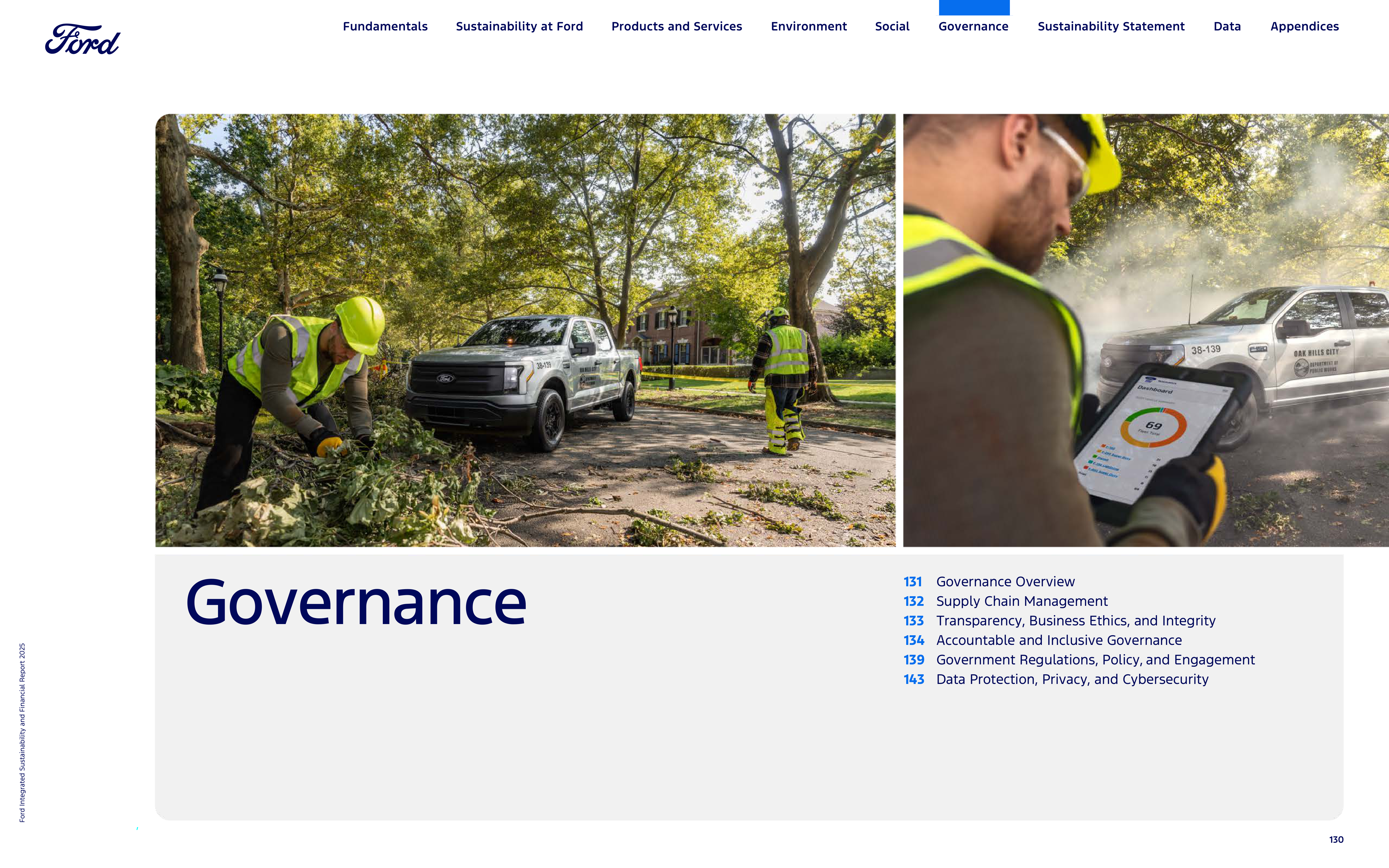

Fundamentals
Sustainability at Ford
Products and Services
Environment
Social
Governance
Sustainability Statement
Data
Appendices
Governance
131
Governance Overview
132
Supply Chain Management
133
Transparency, Business Ethics, and Integrity
134
Accountable and Inclusive Governance
139
Government Regulations, Policy, and Engagement
143
Data Protection, Privacy, and Cybersecurity
,
Ford Integrated Sustainability and Financial Report 2025
130


Fundamentals
Sustainability at Ford
Products and Services
Environment
Social
Governance
Sustainability Statement
Data
Appendices
|
|
|
|
|
|
Overview
Supply Chain Management
Ethics and Integrity
Accountable and Inclusive Governance
Government Policy and Engagement
Data Protection, Privacy, and Cybersecurity
Reporting Scope
Governance
Overview
Our corporate officers and Board of Directors are
entrusted with creating long-term value and serving
the interests of our stakeholders. Driven by our
purpose, values, and business strategy, our officers
and directors provide expert oversight and guidance
to ensure we are well-positioned to respond to an
evolving global business environment. Our culture
of compliance and ethical behavior is formalized
in company policies, reinforced by leadership, and
guided by our purpose.
GOVERNANCE PRACTICE
Our commitment to transparency, integrity, and honesty is
fundamental to our commitment to build a more sustainable,
inclusive, and equitable transportation future.
•
We rely on solid principles of accountable and inclusive
corporate governance to maintain the trust of our
investors, our customers, and our people
•
We equip our people with the necessary tools to comply
with legal obligations and policies that maintain the
highest levels of integrity
•
We are committed to maintaining state-of-the-art
corporate governance policies and practices that are
reflective of current rules and regulations
•
We employ a variety of governance systems and processes to
manage different aspects of sustainability across our business
DATA PROTECTION, PRIVACY, AND SECURITY
Data privacy and cybersecurity are key components of our
software-driven business. We are committed to managing
data responsibly and protecting the privacy of our customers
and employees
SUPPLY CHAIN MANAGEMENT
By cultivating and maintaining mutually beneficial
supplier relationships rooted in operational excellence,
transparency, and trust, we can unlock value for Ford
and our suppliers
UN Sustainable Development Goals
We are contributing to the following UN Sustainable Development Goals through actions outlined in this chapter:
,
Ford Integrated Sustainability and Financial Report 2025
131
8 DECENT WORK AND
ECONOMIC GROWTH
10 REDUCED
INEQUALITIES
11 SUSTAINABLE CITIES
AND COMMUNITIES



Fundamentals
Sustainability at Ford
Products and Services
Environment
Social
Governance
Sustainability Statement
Data
Appendices
|
|
|
|
|
|
Overview
Supply Chain Management
Ethics and Integrity
Accountable and Inclusive Governance
Government Policy and Engagement
Data Protection, Privacy, and Cybersecurity
Reporting Scope
Supply Chain Management
Overview
UN Sustainable Development Goals
8 DECENT WORK AND ECONOMIC GROWTH
Our sustainability standards and corporate
sustainability commitments cascade down
to inform our supply chain management
strategy and our sourcing decisions.
MANAGEMENT OF RELATIONSHIPS WITH SUPPLIERS
Ford values our relationships with suppliers. In 2024, we
launched a new supplier relationship model — Engage —
with the goal of cultivating and maintaining mutually
beneficial supplier relationships rooted in operational
excellence, transparency, and trust that unlocks value for
Ford and our suppliers. This includes working diligently
to ensure we are ethically sourcing and tracking the
value chains and the raw materials that move through
them. The Supplier Scorecard, introduced in 2023,
provides transparency as it helps us evaluate supplier
performance across compliance, quality, delivery, and
cost metrics.
PAYMENT POLICY
Ford’s Global Terms & Conditions identify how we
work with suppliers to initiate payments for goods and
services. Ford’s payment policy is outlined in both our
Production and Indirect Payment Schedule Supplier
Guides. Payments are processed automatically according
to the Purchase Order payment terms and upon evidence
of approved Purchase Order, invoice, and receipt of
goods and/or service date, and may be subject to audit.
PAYMENT TERMS
Understanding terms of payment may be different
for our diverse supply base. The standard method of
payment for all supplier liabilities is by Electronic Funds
Transfer. However, we negotiate various alternative
methods for suppliers. These methods are outlined in
our Global Terms & Conditions and further explained in
both our Production and Indirect Payment Schedule
Supplier Guides.
SUPPLY CHAIN RISK
Tools and processes are in place to manage risk and
drive resiliency in our supply chain. For example, by
continuously monitoring our supply base we can
effectively and quickly respond to ongoing geographical
and geopolitical risks and support our suppliers’
contingency plans. The Supplier Performance and Risk
dashboard, established in 2023, offers real-time visibility
into our suppliers’ financial health, quality, and delivery
performance, enabling proactive management of value
chain impacts.
SUPPLIER COMPLIANCE
Suppliers are required to comply with Ford’s
Supplier
Code of Conduct
. Through collaborative efforts, we
engage suppliers to ensure alignment with these goals.
We use the industry-standard Drive Sustainability (DS)
Sustainability Assessment Questionnaire (SAQ) to assess
suppliers’ policies for compliance. Our sourcing decisions
and ongoing performance evaluations are informed by
these assessments, emphasizing the importance of
suppliers’ commitment to compliance throughout our
sourcing process.
→
Read More: In Human Rights on p.94
,
Ford Integrated Sustainability and Financial Report 2025
132


Fundamentals
Sustainability at Ford
Products and Services
Environment
Social
Governance
Sustainability Statement
Data
Appendices
|
|
|
|
|
|
Overview
Supply Chain Management
Ethics and Integrity
Accountable and Inclusive Governance
Government Policy and Engagement
Data Protection, Privacy, and Cybersecurity
Reporting Scope
Transparency, Business Ethics, and Integrity
Overview
UN Sustainable Development Goals
10 REDUCED
INEQUALITIES
11 SUSTAINABLE CITIES
AND COMMUNITIES
We take a rigorous approach to ethics,
integrity, and transparency that extends
beyond compliance. It is fundamental
to our commitment to build a more
sustainable, inclusive, and equitable
transportation future where every person
is free to move and pursue their dreams.
Our values infuse all levels of our company. Acting with
transparency, integrity, and honesty is the basis of the
trust we build with our employees, our customers and
suppliers, our shareholders, and our communities.
Compliance with existing laws, regulations, and policies
underpins our business practice. Clear policies, effective
communication, and engaging training give our
employees the tools they need to do the right thing.
As we move forward, we remain committed to
maintaining state-of-the-art corporate governance
policies and practices and ensuring they are reflective
of current rules and regulations, including U.S.
Department of Justice expectations for corporate
compliance programs.
UPHOLDING THE HIGHEST LEVELS OF INTEGRITY
Our Compliance, Ethics, and Integrity Office provides
appropriate training and communications tools to ensure
that our people are equipped to comply with legal
obligations and policies that maintain the highest levels
of integrity.
REGULAR AND OPEN COMMUNICATION
Clear and open communication is a fundamental
component of our corporate governance framework.
Ford outperforms our industry as we work to maintain
open communication channels that include monthly
reports on vehicle production, dealer inventory, and
retail sales. This is in contrast to the quarterly reporting
typical of others in the automotive industry.
Social media is an increasingly important component
of our outreach to our customers. We use Ford Motor
Company corporate accounts and the Chief Executive
Officer’s social media accounts to share information
and insights on a regular basis.
ADHERING TO OUR CODE OF CONDUCT
Employee Code of Conduct
When it comes to business ethics and integrity it’s
imperative that our employees understand what is
expected of them. It’s also important that our customers,
suppliers, and other stakeholders understand our
standards and hold us accountable to them. Our
reputation as a global leader in corporate ethics and
social responsibility depends on it.
Our Employee
Code of Conduct
covers important topics
including human rights, the environment, privacy, and
lawful business practices — as well as information on
how to report violations. It is available in 11 languages
on our corporate website.
We made minor updates to our Employee Code of
Conduct and Corporate Policies in 2024. This was a
regular refresh of the existing materials and none of
the underlying rules changed. However, we did remove
the Russian translation of the Corporate Policies and
Code of Conduct.
Supplier Code of Conduct
Thousands of companies around the globe make up our
supply chain. As the focus on human rights and climate
change becomes sharper, we are committed to holding
our suppliers to the same high standards we require of
ourselves. Our
Supplier Code of Conduct
, introduced in
2021, formalizes the standards we expect our suppliers
to achieve. Our Supplier Code of Conduct applies to the
company’s Tier 1 suppliers and cascades through the
supply chain to their suppliers. It is available in eight
languages and is accessible on our corporate website
to suppliers, our employees, and the general public.
Our Supplier Code of Conduct requires our suppliers
to maintain responsible business practices. Suppliers
must protect and respect human rights, protect the
environment, and responsibly source materials. The
Supplier Code of Conduct also mandates that they
conduct business free from bribery and corruption,
maintain effective privacy and cybersecurity practices,
and comply with applicable trade and customs rules.
→
Read More: In Human Rights on p.94
Anti-Bribery and Anti-Corruption
We maintain the highest ethical standards wherever
we operate. As a global company, our facilities must
comply with a wide range of national laws and
governmental enforcement practices with regard to
bribery and corruption, no matter where they are located.
Bribery and corruption are forbidden, even in locations
where they may be tolerated or condoned.
COMPLIANCE TRAINING
Maintaining our high standard of ethical conduct
requires a robust and comprehensive training program.
Mandatory online training courses for all Ford salaried
full-time, part-time, and agency workers, including
an annual Code of Conduct course, ensure our policies
are understood and reinforce their importance. We
periodically refresh and review the courses to keep the
content relevant and appropriate.
REPORTING VIOLATIONS
Our compliance program allows people to confidentially
report known or potential violations of the law or of our
policies. Team members can report violations directly to
Human Resources or the Compliance, Ethics, and Integrity
Office as well as the Office of the General Counsel.
Violations can also be reported using the SpeakUp reporting
website, telephone hotlines, or email, some of which allow
for anonymous reporting. The SpeakUp site is also available
to external stakeholders at www.speakup.ford.com.
Translated into 12 languages, the site features local
language hotlines, an enhanced anonymous reporting
system, and an improved intake form. When a violation is
reported, a cross-functional committee reviews allegations
and oversees any investigations and subsequent corrective
or disciplinary actions.
For human rights and environmental issues involving
suppliers, Ford has an external site to report supplier
grievances. Available in 19 languages, the external site
enables suppliers to report feedback. Employees of our
suppliers can also provide feedback and file grievances
directly via the Responsible Business Alliance (RBA)
Worker Voice app.
→
Read More: In Human Capital Management and Diversity,
Equity, and Inclusion
on p.115
→
Read More: In Human Rights on p.97
,
Ford Integrated Sustainability and Financial Report 2025
133
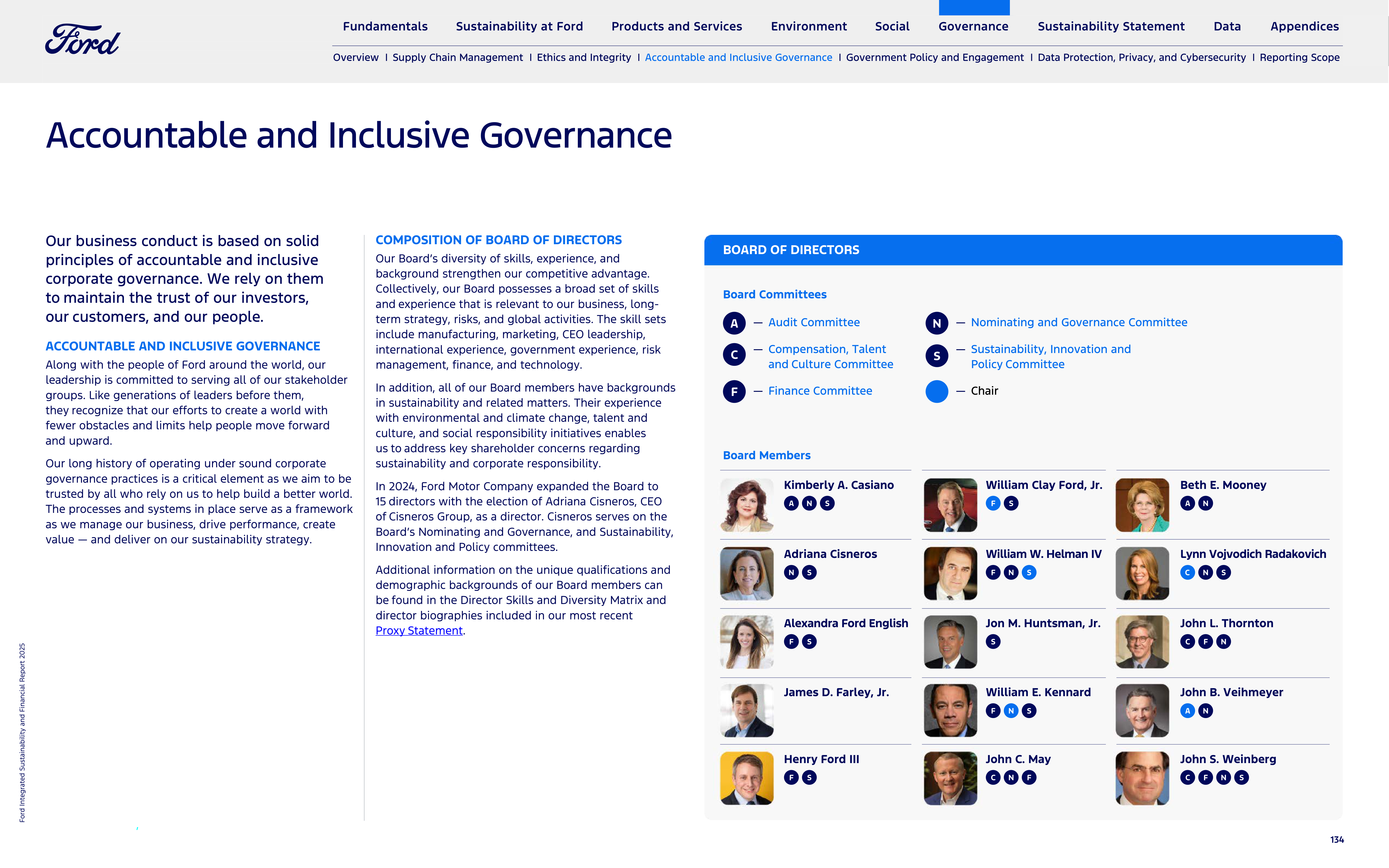
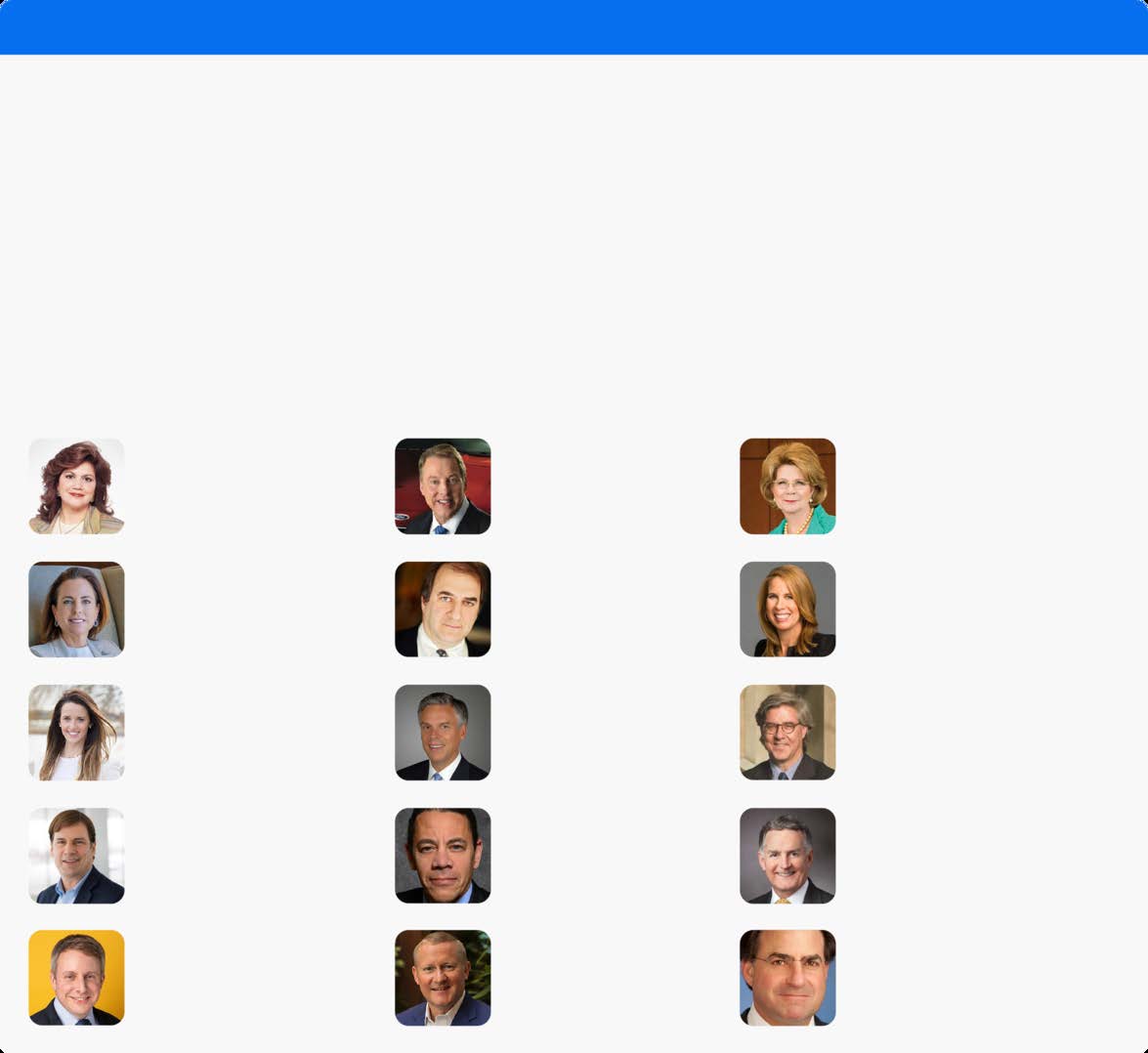


Fundamentals
Sustainability at Ford
Products and Services
Environment
Social
Governance
Sustainability Statement
Data
Appendices
|
|
|
|
|
|
Overview
Supply Chain Management
Ethics and Integrity
Accountable and Inclusive Governance
Government Policy and Engagement
Data Protection, Privacy, and Cybersecurity
Reporting Scope
Accountable and Inclusive Governance
Our business conduct is based on solid
principles of accountable and inclusive
corporate governance. We rely on them
to maintain the trust of our investors,
our customers, and our people.
ACCOUNTABLE AND INCLUSIVE GOVERNANCE
Along with the people of Ford around the world, our
leadership is committed to serving all of our stakeholder
groups. Like generations of leaders before them,
they recognize that our efforts to create a world with
fewer obstacles and limits help people move forward
and upward.
Our long history of operating under sound corporate
governance practices is a critical element as we aim to be
trusted by all who rely on us to help build a better world.
The processes and systems in place serve as a framework
as we manage our business, drive performance, create
value — and deliver on our sustainability strategy.
COMPOSITION OF BOARD OF DIRECTORS
Our Board’s diversity of skills, experience, and
background strengthen our competitive advantage.
Collectively, our Board possesses a broad set of skills
and experience that is relevant to our business, long-
term strategy, risks, and global activities. The skill sets
include manufacturing, marketing, CEO leadership,
international experience, government experience, risk
management, finance, and technology.
In addition, all of our Board members have backgrounds
in sustainability and related matters. Their experience
with environmental and climate change, talent and
culture, and social responsibility initiatives enables
us to address key shareholder concerns regarding
sustainability and corporate responsibility.
In 2024, Ford Motor Company expanded the Board to
15 directors with the election of Adriana Cisneros, CEO
of Cisneros Group, as a director. Cisneros serves on the
Board’s Nominating and Governance, and Sustainability,
Innovation and Policy committees.
Additional information on the unique qualifications and
demographic backgrounds of our Board members can
be found in the Director Skills and Diversity Matrix and
director biographies included in our most recent
Proxy Statement
.
BOARD OF DIRECTORS
Board Committees
A
—
Audit Committee
C
Compensation, Talent
and Culture Committee
F
Finance Committee
N
—
Nominating and Governance Committee
S
Sustainability, Innovation and
Policy Committee
Chair
—
—
—
—
Board Members
Kimberly A. Casiano
Audit Committee
Nominating and Governance Committee
Sustainability, Innovation and Policy Committee
William Clay Ford, Jr.
F
inance Committee Chair
Sustainability, Innovation and Policy Committee
Beth E. Mooney
Audit Committee
Nominating and Governance Committee
Adriana Cisneros
Nominating and Governance Committee
Sustainability, Innovation and Policy Committee
William W. Helman IV
F
inance Committee
Nominating and Governance Committee
Sustainability, Innovation and Policy Committee Chair
Lynn Vojvodich Radakovich
Compensation, Talent and Culture Committee Chair
Nominating and Governance Committee
Sustainability, Innovation and Policy Committee
Alexandra Ford English
F
inance Committee
Sustainability, Innovation and Policy Committee
Jon M. Huntsman, Jr.
Sustainability, Innovation and Policy Committee
John L. Thornton
Compensation, Talent and Culture Committee
Finance Committee
Nominating and Governance Committee
James D. Farley, Jr.
William E. Kennard
F
inance Committee
Nominating and Governance Committee Chair
Sustainability, Innovation and Policy Committee
John B. Veihmeyer
Audit Committee Chair
N
Henry Ford III
F
inance Committee
Sustainability, Innovation and Policy Committee
John C. May
Compensation, Talent and Culture Committee
Nominating and Governance Committee
F
inance Committee
John S. Weinberg
Compensation, Talent and Culture Committee
F
inance Committee
Nominating and Governance Committee
Sustainability, Innovation and Policy Committee
,
Ford Integrated Sustainability and Financial Report 2025
134
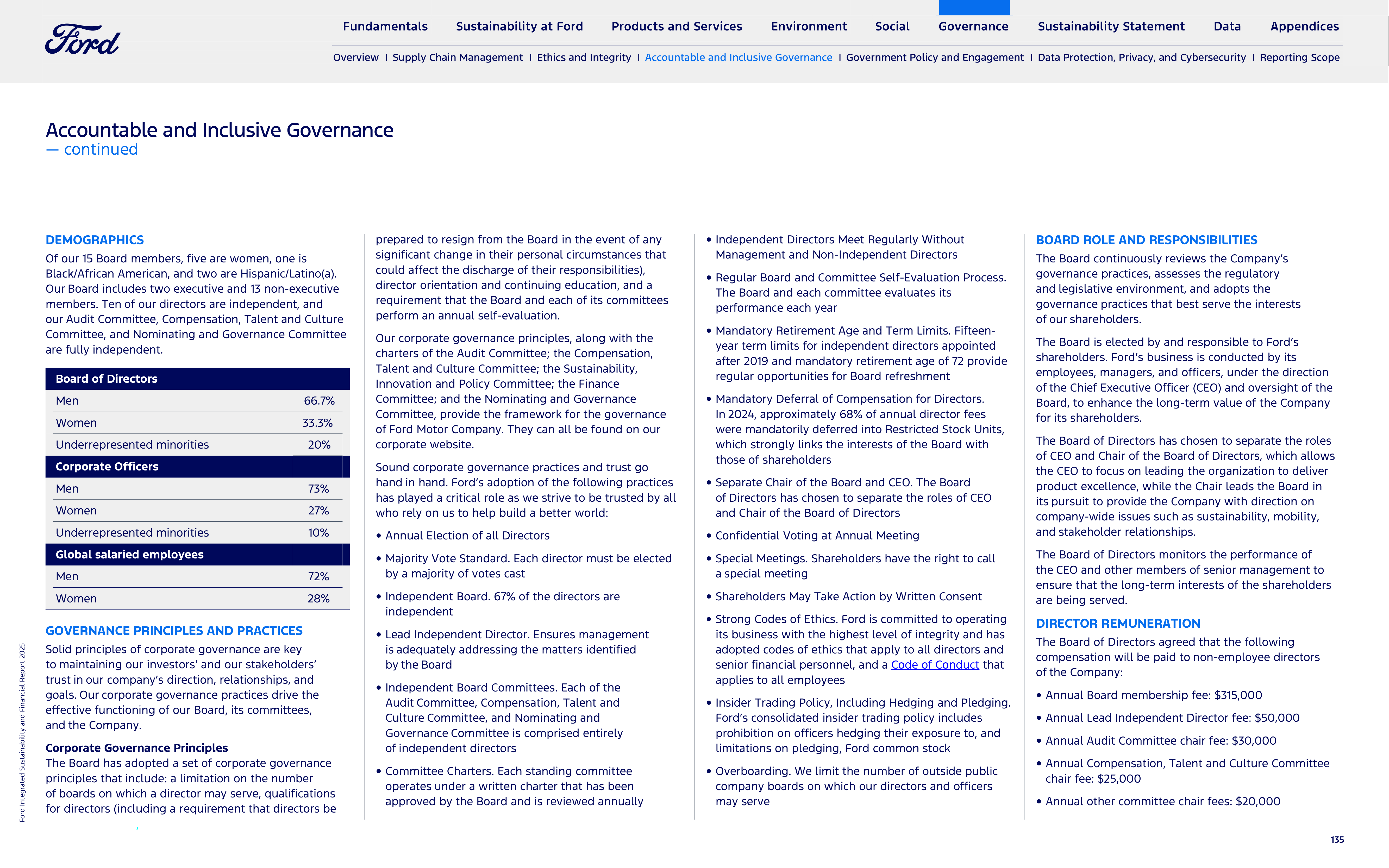

Fundamentals
Sustainability at Ford
Products and Services
Environment
Social
Governance
Sustainability Statement
Data
Appendices
|
|
|
|
|
|
Overview
Supply Chain Management
Ethics and Integrity
Accountable and Inclusive Governance
Government Policy and Engagement
Data Protection, Privacy, and Cybersecurity
Reporting Scope
DEMOGRAPHICS
Of our 15 Board members, five are women, one is
Black/African American, and two are Hispanic/Latino(a).
Our Board includes two executive and 13 non-executive
members. Ten of our directors are independent, and
our Audit Committee, Compensation, Talent and Culture
Committee, and Nominating and Governance Committee
are fully independent.
Board of Directors
Men
66.7%
Women
33.3%
Underrepresented minorities
20%
Corporate Officers
Men
73%
Women
27%
Underrepresented minorities
10%
Global salaried employees
Men
72%
Women
28%
GOVERNANCE PRINCIPLES AND PRACTICES
Solid principles of corporate governance are key
to maintaining our investors’ and our stakeholders’
trust in our company’s direction, relationships, and
goals. Our corporate governance practices drive the
effective functioning of our Board, its committees,
and the Company.
Corporate Governance Principles
The Board has adopted a set of corporate governance
principles that include: a limitation on the number
of boards on which a director may serve, qualifications
for directors (including a requirement that directors be
prepared to resign from the Board in the event of any
significant change in their personal circumstances that
could affect the discharge of their responsibilities),
director orientation and continuing education, and a
requirement that the Board and each of its committees
perform an annual self-evaluation.
Our corporate governance principles, along with the
charters of the Audit Committee; the Compensation,
Talent and Culture Committee; the Sustainability,
Innovation and Policy Committee; the Finance
Committee; and the Nominating and Governance
Committee, provide the framework for the governance
of Ford Motor Company. They can all be found on our
corporate website.
Sound corporate governance practices and trust go
hand in hand. Ford’s adoption of the following practices
has played a critical role as we strive to be trusted by all
who rely on us to help build a better world:
•
Annual Election of all Directors
•
Majority Vote Standard. Each director must be elected
by a majority of votes cast
•
Independent Board. 67% of the directors are
independent
•
Lead Independent Director. Ensures management
is adequately addressing the matters identified
by the Board
•
Independent Board Committees. Each of the
Audit Committee, Compensation, Talent and
Culture Committee, and Nominating and
Governance Committee is comprised entirely
of independent directors
•
Committee Charters. Each standing committee
operates under a written charter that has been
approved by the Board and is reviewed annually
•
Independent Directors Meet Regularly Without
Management and Non-Independent Directors
•
Regular Board and Committee Self-Evaluation Process.
The Board and each committee evaluates its
performance each year
•
Mandatory Retirement Age and Term Limits. Fifteen-
year term limits for independent directors appointed
after 2019 and mandatory retirement age of 72 provide
regular opportunities for Board refreshment
•
Mandatory Deferral of Compensation for Directors.
In 2024, approximately 68% of annual director fees
were mandatorily deferred into Restricted Stock Units,
which strongly links the interests of the Board with
those of shareholders
•
Separate Chair of the Board and CEO. The Board
of Directors has chosen to separate the roles of CEO
and Chair of the Board of Directors
•
Confidential Voting at Annual Meeting
•
Special Meetings. Shareholders have the right to call
a special meeting
•
Shareholders May Take Action by Written Consent
•
Strong Codes of Ethics. Ford is committed to operating
its business with the highest level of integrity and has
adopted codes of ethics that apply to all directors and
senior financial personnel, and a
Code of Conduct
that
applies to all employees
•
Insider Trading Policy, Including Hedging and Pledging.
Ford’s consolidated insider trading policy includes
prohibition on officers hedging their exposure to, and
limitations on pledging, Ford common stock
•
Overboarding. We limit the number of outside public
company boards on which our directors and officers
may serve
BOARD ROLE AND RESPONSIBILITIES
The Board continuously reviews the Company’s
governance practices, assesses the regulatory
and legislative environment, and adopts the
governance practices that best serve the interests
of our shareholders.
The Board is elected by and responsible to Ford’s
shareholders. Ford’s business is conducted by its
employees, managers, and officers, under the direction
of the Chief Executive Officer (CEO) and oversight of the
Board, to enhance the long-term value of the Company
for its shareholders.
The Board of Directors has chosen to separate the roles
of CEO and Chair of the Board of Directors, which allows
the CEO to focus on leading the organization to deliver
product excellence, while the Chair leads the Board in
its pursuit to provide the Company with direction on
company-wide issues such as sustainability, mobility,
and stakeholder relationships.
The Board of Directors monitors the performance of
the CEO and other members of senior management to
ensure that the long-term interests of the shareholders
are being served.
DIRECTOR REMUNERATION
The Board of Directors agreed that the following
compensation will be paid to non-employee directors
of the Company:
•
Annual Board membership fee: $315,000
•
Annual Lead Independent Director fee: $50,000
•
Annual Audit Committee chair fee: $30,000
•
Annual Compensation, Talent and Culture Committee
chair fee: $25,000
•
Annual other committee chair fees: $20,000
Accountable and Inclusive Governance
— continued
,
Ford Integrated Sustainability and Financial Report 2025
135
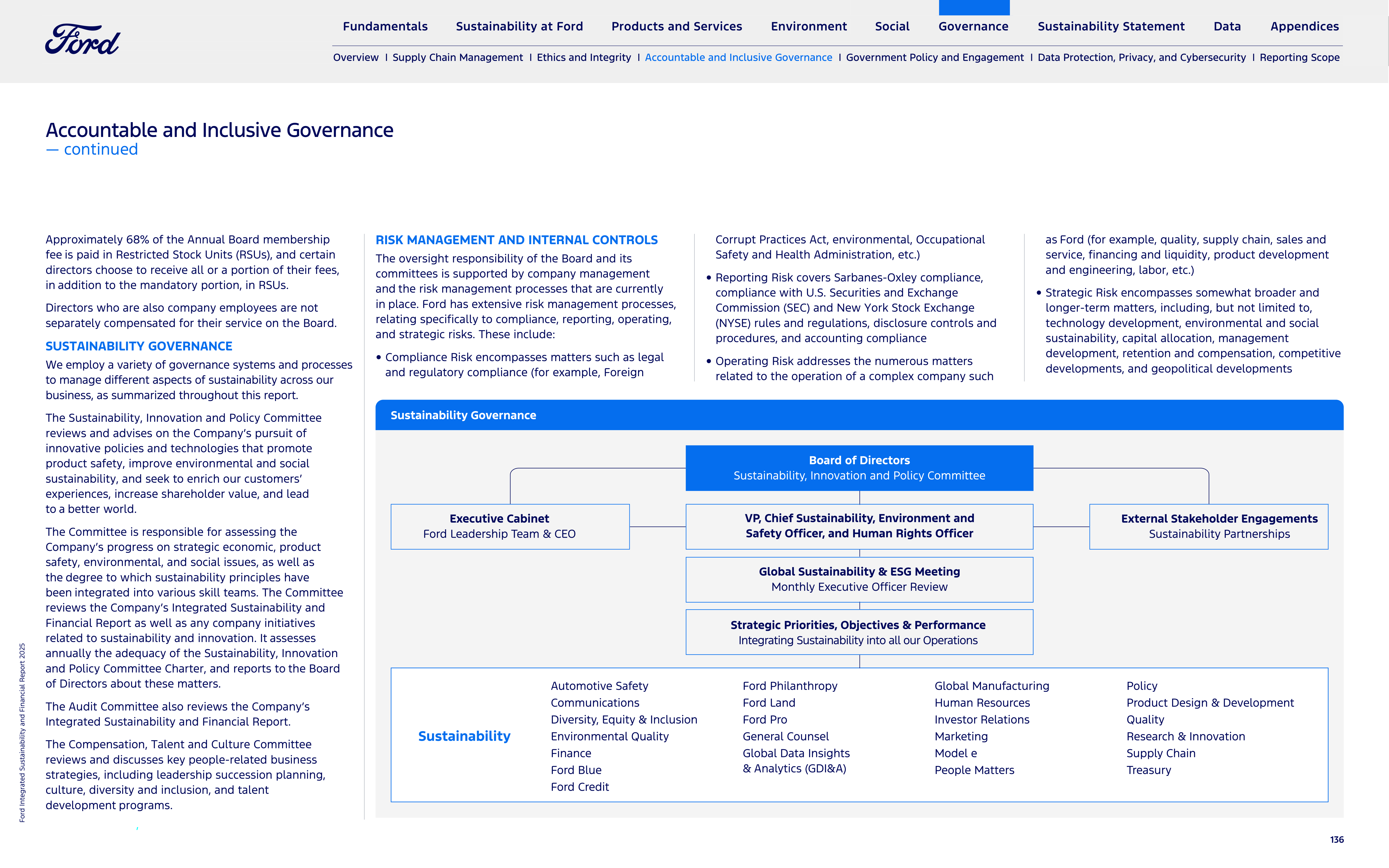

Fundamentals
Sustainability at Ford
Products and Services
Environment
Social
Governance
Sustainability Statement
Data
Appendices
|
|
|
|
|
|
Overview
Supply Chain Management
Ethics and Integrity
Accountable and Inclusive Governance
Government Policy and Engagement
Data Protection, Privacy, and Cybersecurity
Reporting Scope
Approximately 68% of the Annual Board membership
fee is paid in Restricted Stock Units (RSUs), and certain
directors choose to receive all or a portion of their fees,
in addition to the mandatory portion, in RSUs.
Directors who are also company employees are not
separately compensated for their service on the Board.
SUSTAINABILITY GOVERNANCE
We employ a variety of governance systems and processes
to manage different aspects of sustainability across our
business, as summarized throughout this report.
The Sustainability, Innovation and Policy Committee
reviews and advises on the Company’s pursuit of
innovative policies and technologies that promote
product safety, improve environmental and social
sustainability, and seek to enrich our customers’
experiences, increase shareholder value, and lead
to a better world.
The Committee is responsible for assessing the
Company’s progress on strategic economic, product
safety, environmental, and social issues, as well as
the degree to which sustainability principles have
been integrated into various skill teams. The Committee
reviews the Company’s Integrated Sustainability and
Financial Report as well as any company initiatives
related to sustainability and innovation. It assesses
annually the adequacy of the Sustainability, Innovation
and Policy Committee Charter, and reports to the Board
of Directors about these matters.
The Audit Committee also reviews the Company’s
Integrated Sustainability and Financial Report.
The Compensation, Talent and Culture Committee
reviews and discusses key people-related business
strategies, including leadership succession planning,
culture, diversity and inclusion, and talent
development programs.
RISK MANAGEMENT AND INTERNAL CONTROLS
The oversight responsibility of the Board and its
committees is supported by company management
and the risk management processes that are currently
in place. Ford has extensive risk management processes,
relating specifically to compliance, reporting, operating,
and strategic risks. These include:
•
Compliance Risk encompasses matters such as legal
and regulatory compliance (for example, Foreign
Corrupt Practices Act, environmental, Occupational
Safety and Health Administration, etc.)
•
Reporting Risk covers Sarbanes-Oxley compliance,
compliance with U.S. Securities and Exchange
Commission (SEC) and New York Stock Exchange
(NYSE) rules and regulations, disclosure controls and
procedures, and accounting compliance
•
Operating Risk addresses the numerous matters
related to the operation of a complex company such
as Ford (for example, quality, supply chain, sales and
service, financing and liquidity, product development
and engineering, labor, etc.)
•
Strategic Risk encompasses somewhat broader and
longer-term matters, including, but not limited to,
technology development, environmental and social
sustainability, capital allocation, management
development, retention and compensation, competitive
developments, and geopolitical developments
Accountable and Inclusive Governance
— continued
,
Ford Integrated Sustainability and Financial Report 2025
136
Sustainability
Governance
Board
of
Directors
Sustainability,
Innovation
and
Policy
Committee
Executive
Cabinet
Ford
Leadership
Team
&
CEO
VP,
Chief
Sustainability,
Environment
and
Safety
Officer,
and
Human
Rights
Officer
Global
Sustainability
&
ESG
Meeting
Monthly
Executive
Officer
Review
Strategic
Priorities,
Objectives
&
Performance
Integrating
Sustainability
into
all
our
Operations
Sustainability
Automotive
Safety
Communications
Diversity,
Equity
&
Inclusion
Environmental
Quality
Finance
Ford
Blue
Ford
Credit
Ford
Philanthropy
Ford
Land
Ford
Pro
General
Counsel
Global
Data
Insights
&
Analytics
(GDI&A)
Global
Manufacturing
Human
Resources
Investor
Relations
Marketing
Model
e
People
Matters
Policy
Product
Design
&
Development
Quality
Research
&
Innovation
Supply
Chain
Treasury
External
Stakeholder
Engagements
Sustainability
Partnerships
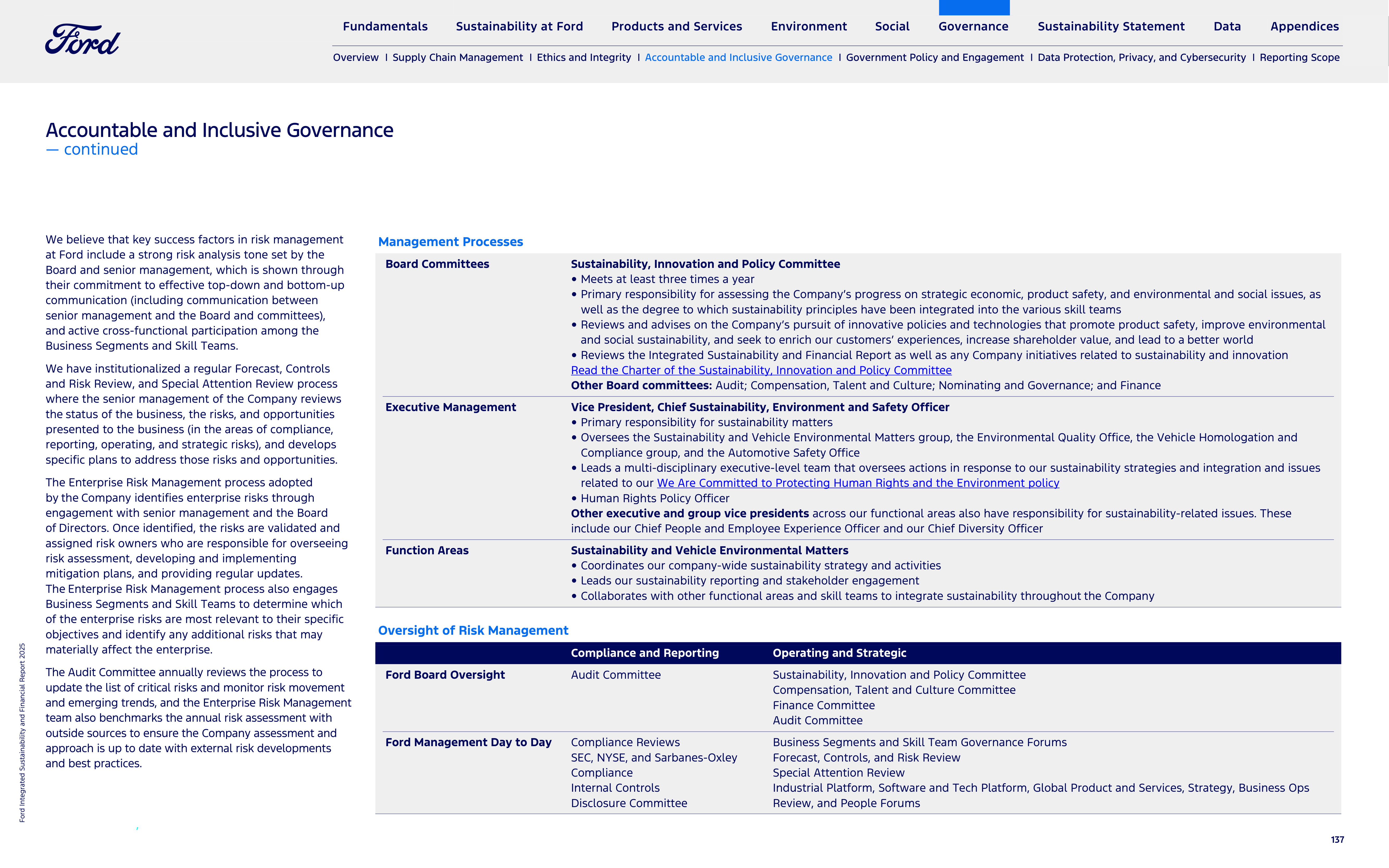

Fundamentals
Sustainability at Ford
Products and Services
Environment
Social
Governance
Sustainability Statement
Data
Appendices
|
|
|
|
|
|
Overview
Supply Chain Management
Ethics and Integrity
Accountable and Inclusive Governance
Government Policy and Engagement
Data Protection, Privacy, and Cybersecurity
Reporting Scope
We believe that key success factors in risk management
at Ford include a strong risk analysis tone set by the
Board and senior management, which is shown through
their commitment to effective top-down and bottom-up
communication (including communication between
senior management and the Board and committees),
and active cross-functional participation among the
Business Segments and Skill Teams.
We have institutionalized a regular Forecast, Controls
and Risk Review, and Special Attention Review process
where the senior management of the Company reviews
the status of the business, the risks, and opportunities
presented to the business (in the areas of compliance,
reporting, operating, and strategic risks), and develops
specific plans to address those risks and opportunities.
The Enterprise Risk Management process adopted
by the Company identifies enterprise risks through
engagement with senior management and the Board
of Directors. Once identified, the risks are validated and
assigned risk owners who are responsible for overseeing
risk assessment, developing and implementing
mitigation plans, and providing regular updates.
The Enterprise Risk Management process also engages
Business Segments and Skill Teams to determine which
of the enterprise risks are most relevant to their specific
objectives and identify any additional risks that may
materially affect the enterprise.
The Audit Committee annually reviews the process to
update the list of critical risks and monitor risk movement
and emerging trends, and the Enterprise Risk Management
team also benchmarks the annual risk assessment with
outside sources to ensure the Company assessment and
approach is up to date with external risk developments
and best practices.
Management Processes
Board Committees
Sustainability, Innovation and Policy Committee
•
Meets at least three times a year
•
Primary responsibility for assessing the Company’s progress on strategic economic, product safety, and environmental and social issues, as
well as the degree to which sustainability principles have been integrated into the various skill teams
•
Reviews and advises on the Company’s pursuit of innovative policies and technologies that promote product safety, improve environmental
and social sustainability, and seek to enrich our customers’ experiences, increase shareholder value, and lead to a better world
•
Reviews the Integrated Sustainability and Financial Report as well as any Company initiatives related to sustainability and innovation
Read the Charter of the Sustainability, Innovation and Policy Committee
Other Board committees:
Audit; Compensation, Talent and Culture; Nominating and Governance; and Finance
Executive Management
Vice President, Chief Sustainability, Environment and Safety Officer
•
Primary responsibility for sustainability matters
•
Oversees the Sustainability and Vehicle Environmental Matters group, the Environmental Quality Office, the Vehicle Homologation and
Compliance group, and the Automotive Safety Office
•
Leads a multi-disciplinary executive-level team that oversees actions in response to our sustainability strategies and integration and issues
related to our
We Are Committed to Protecting Human Rights and the Environment policy
•
Human Rights Policy Officer
Other executive and group vice presidents
across our functional areas also have responsibility for sustainability-related issues. These
include our Chief People and Employee Experience Officer and our Chief Diversity Officer
Function Areas
Sustainability and Vehicle Environmental Matters
•
Coordinates our company-wide sustainability strategy and activities
•
Leads our sustainability reporting and stakeholder engagement
•
Collaborates with other functional areas and skill teams to integrate sustainability throughout the Company
Oversight of Risk Management
Compliance and Reporting
Operating and Strategic
Ford Board Oversight
Audit Committee
Sustainability, Innovation and Policy Committee
Compensation, Talent and Culture Committee
Finance Committee
Audit Committee
Ford Management Day to Day
Compliance Reviews
SEC, NYSE, and Sarbanes-Oxley
Compliance
Internal Controls
Disclosure Committee
Business Segments and Skill Team Governance Forums
Forecast, Controls, and Risk Review
Special Attention Review
Industrial Platform, Software and Tech Platform, Global Product and Services, Strategy, Business Ops
Review, and People Forums
Accountable and Inclusive Governance
— continued
,
Ford Integrated Sustainability and Financial Report 2025
137


Fundamentals
Sustainability at Ford
Products and Services
Environment
Social
Governance
Sustainability Statement
Data
Appendices
|
|
|
|
|
|
Overview
Supply Chain Management
Ethics and Integrity
Accountable and Inclusive Governance
Government Policy and Engagement
Data Protection, Privacy, and Cybersecurity
Reporting Scope
The full Board of Directors has overall responsibility for
the oversight of risk management at Ford and oversees
operating risk management with reviews at each of its
regular Board meetings. The Board, the Sustainability,
Innovation and Policy Committee, the Compensation,
Talent and Culture Committee, the Finance Committee,
and the Audit Committee all play a role in overseeing
operating and strategic risk management.
The Audit Committee assists the Board of Directors in
overseeing compliance and reporting risk, cybersecurity
risk, and the Enterprise Risk Management process itself.
The Audit Committee receives regular updates on
cybersecurity practices, as well as cybersecurity and
information technology risks from the Chief Information
Security Officer.
The Sustainability, Innovation and Policy Committee
assists the Board of Directors in overseeing environmental
and social sustainability risks. The Compensation, Talent
and Culture Committee assists the Board of Directors in
overseeing risks related to compensation and people-
related business strategies, including leadership
succession and culture, diversity, and inclusion.
The Board and the appropriate committees also
periodically review other policies related to personnel
matters, including those related to harassment,
discrimination, and anti-retaliation policies.
The specific responsibilities of each committee are
set forth in their charters, which are available on our
corporate website
.
RISK FACTORS
For a list of identified corporate risks, uncertainties, and
other factors see “Item 1A. Risk Factors” in Ford’s 2024
Form 10-K
Report, as updated by subsequent Quarterly
Reports on Form 10-Q and Current Reports on Form 8-K.
Accountable and Inclusive Governance
— continued
,
Ford Integrated Sustainability and Financial Report 2025
138
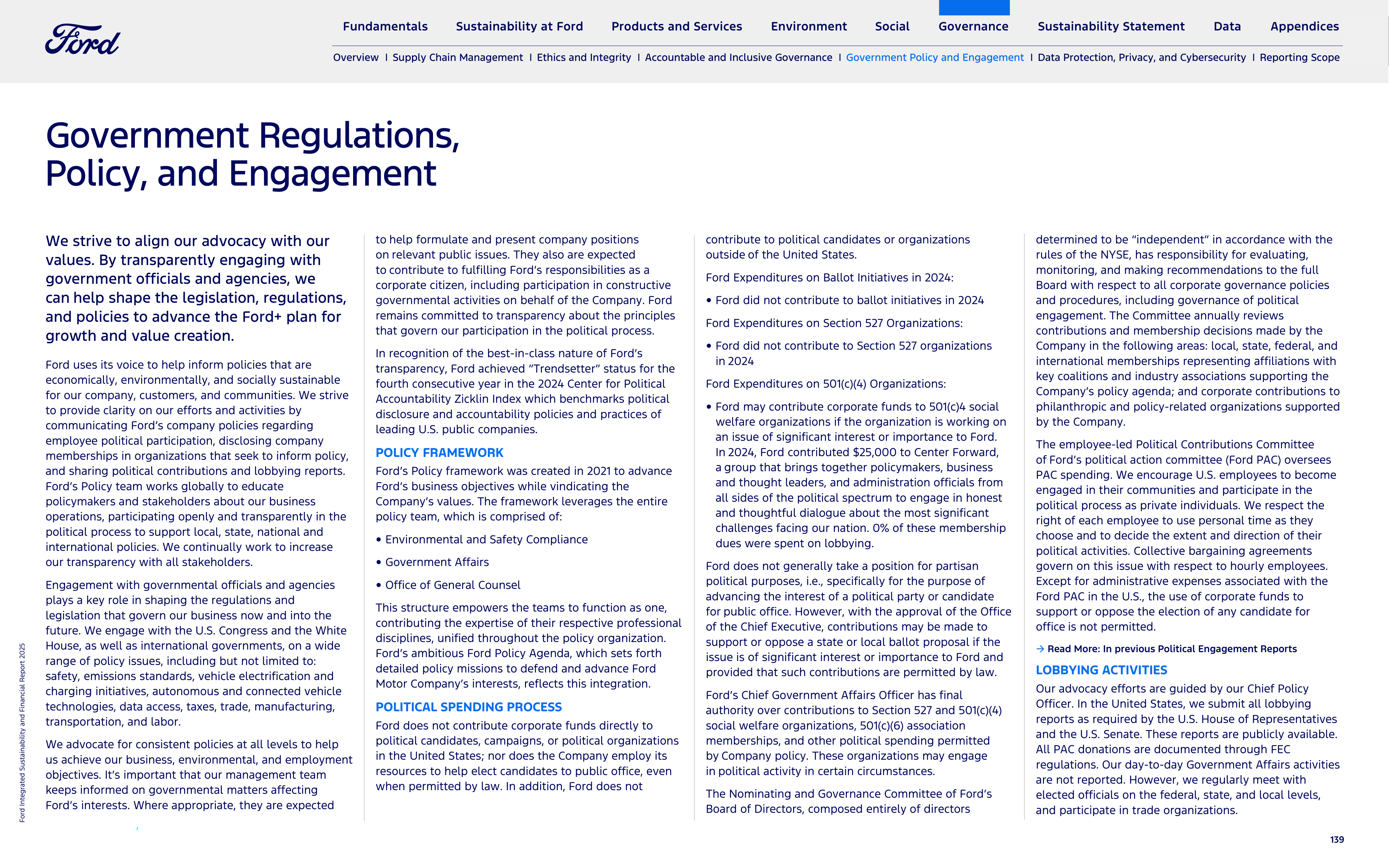

Fundamentals
Sustainability at Ford
Products and Services
Environment
Social
Governance
Sustainability Statement
Data
Appendices
|
|
|
|
|
|
Overview
Supply Chain Management
Ethics and Integrity
Accountable and Inclusive Governance
Government Policy and Engagement
Data Protection, Privacy, and Cybersecurity
Reporting Scope
Government Regulations,
Policy, and Engagement
We strive to align our advocacy with our
values. By transparently engaging with
government officials and agencies, we
can help shape the legislation, regulations,
and policies to advance the Ford+ plan for
growth and value creation.
Ford uses its voice to help inform policies that are
economically, environmentally, and socially sustainable
for our company, customers, and communities. We strive
to provide clarity on our efforts and activities by
communicating Ford’s company policies regarding
employee political participation, disclosing company
memberships in organizations that seek to inform policy,
and sharing political contributions and lobbying reports.
Ford’s Policy team works globally to educate
policymakers and stakeholders about our business
operations, participating openly and transparently in the
political process to support local, state, national and
international policies. We continually work to increase
our transparency with all stakeholders.
Engagement with governmental officials and agencies
plays a key role in shaping the regulations and
legislation that govern our business now and into the
future. We engage with the U.S. Congress and the White
House, as well as international governments, on a wide
range of policy issues, including but not limited to:
safety, emissions standards, vehicle electrification and
charging initiatives, autonomous and connected vehicle
technologies, data access, taxes, trade, manufacturing,
transportation, and labor.
We advocate for consistent policies at all levels to help
us achieve our business, environmental, and employment
objectives. It’s important that our management team
keeps informed on governmental matters affecting
Ford’s interests. Where appropriate, they are expected
to help formulate and present company positions
on relevant public issues. They also are expected
to contribute to fulfilling Ford’s responsibilities as a
corporate citizen, including participation in constructive
governmental activities on behalf of the Company. Ford
remains committed to transparency about the principles
that govern our participation in the political process.
In recognition of the best-in-class nature of Ford’s
transparency, Ford achieved “Trendsetter” status for the
fourth consecutive year in the 2024 Center for Political
Accountability Zicklin Index which benchmarks political
disclosure and accountability policies and practices of
leading U.S. public companies.
POLICY FRAMEWORK
Ford’s Policy framework was created in 2021 to advance
Ford’s business objectives while vindicating the
Company’s values. The framework leverages the entire
policy team, which is comprised of:
•
Environmental and Safety Compliance
•
Government Affairs
•
Office of General Counsel
This structure empowers the teams to function as one,
contributing the expertise of their respective professional
disciplines, unified throughout the policy organization.
Ford’s ambitious Ford Policy Agenda, which sets forth
detailed policy missions to defend and advance Ford
Motor Company’s interests, reflects this integration.
POLITICAL SPENDING PROCESS
Ford does not contribute corporate funds directly to
political candidates, campaigns, or political organizations
in the United States; nor does the Company employ its
resources to help elect candidates to public office, even
when permitted by law. In addition, Ford does not
contribute to political candidates or organizations
outside of the United States.
Ford Expenditures on Ballot Initiatives in 2024:
•
Ford did not contribute to ballot initiatives in 2024
Ford Expenditures on Section 527 Organizations:
•
Ford did not contribute to Section 527 organizations
in 2024
Ford Expenditures on 501(c)(4) Organizations:
•
Ford may contribute corporate funds to 501(c)4 social
welfare organizations if the organization is working on
an issue of significant interest or importance to Ford.
In 2024, Ford contributed $25,000 to Center Forward,
a group that brings together policymakers, business
and thought leaders, and administration officials from
all sides of the political spectrum to engage in honest
and thoughtful dialogue about the most significant
challenges facing our nation. 0% of these membership
dues were spent on lobbying.
Ford does not generally take a position for partisan
political purposes, i.e., specifically for the purpose of
advancing the interest of a political party or candidate
for public office. However, with the approval of the Office
of the Chief Executive, contributions may be made to
support or oppose a state or local ballot proposal if the
issue is of significant interest or importance to Ford and
provided that such contributions are permitted by law.
Ford’s Chief Government Affairs Officer has final
authority over contributions to Section 527 and 501(c)(4)
social welfare organizations, 501(c)(6) association
memberships, and other political spending permitted
by Company policy. These organizations may engage
in political activity in certain circumstances.
The Nominating and Governance Committee of Ford’s
Board of Directors, composed entirely of directors
determined to be “independent” in accordance with the
rules of the NYSE, has responsibility for evaluating,
monitoring, and making recommendations to the full
Board with respect to all corporate governance policies
and procedures, including governance of political
engagement. The Committee annually reviews
contributions and membership decisions made by the
Company in the following areas: local, state, federal, and
international memberships representing affiliations with
key coalitions and industry associations supporting the
Company’s policy agenda; and corporate contributions to
philanthropic and policy-related organizations supported
by the Company.
The employee-led Political Contributions Committee
of Ford’s political action committee (Ford PAC) oversees
PAC spending. We encourage U.S. employees to become
engaged in their communities and participate in the
political process as private individuals. We respect the
right of each employee to use personal time as they
choose and to decide the extent and direction of their
political activities. Collective bargaining agreements
govern on this issue with respect to hourly employees.
Except for administrative expenses associated with the
Ford PAC in the U.S., the use of corporate funds to
support or oppose the election of any candidate for
office is not permitted.
→
Read More: In previous Political Engagement Reports
LOBBYING ACTIVITIES
Our advocacy efforts are guided by our Chief Policy
Officer. In the United States, we submit all lobbying
reports as required by the U.S. House of Representatives
and the U.S. Senate. These reports are publicly available.
All PAC donations are documented through FEC
regulations. Our day-to-day Government Affairs activities
are not reported. However, we regularly meet with
elected officials on the federal, state, and local levels,
and participate in trade organizations.
,
Ford Integrated Sustainability and Financial Report 2025
139
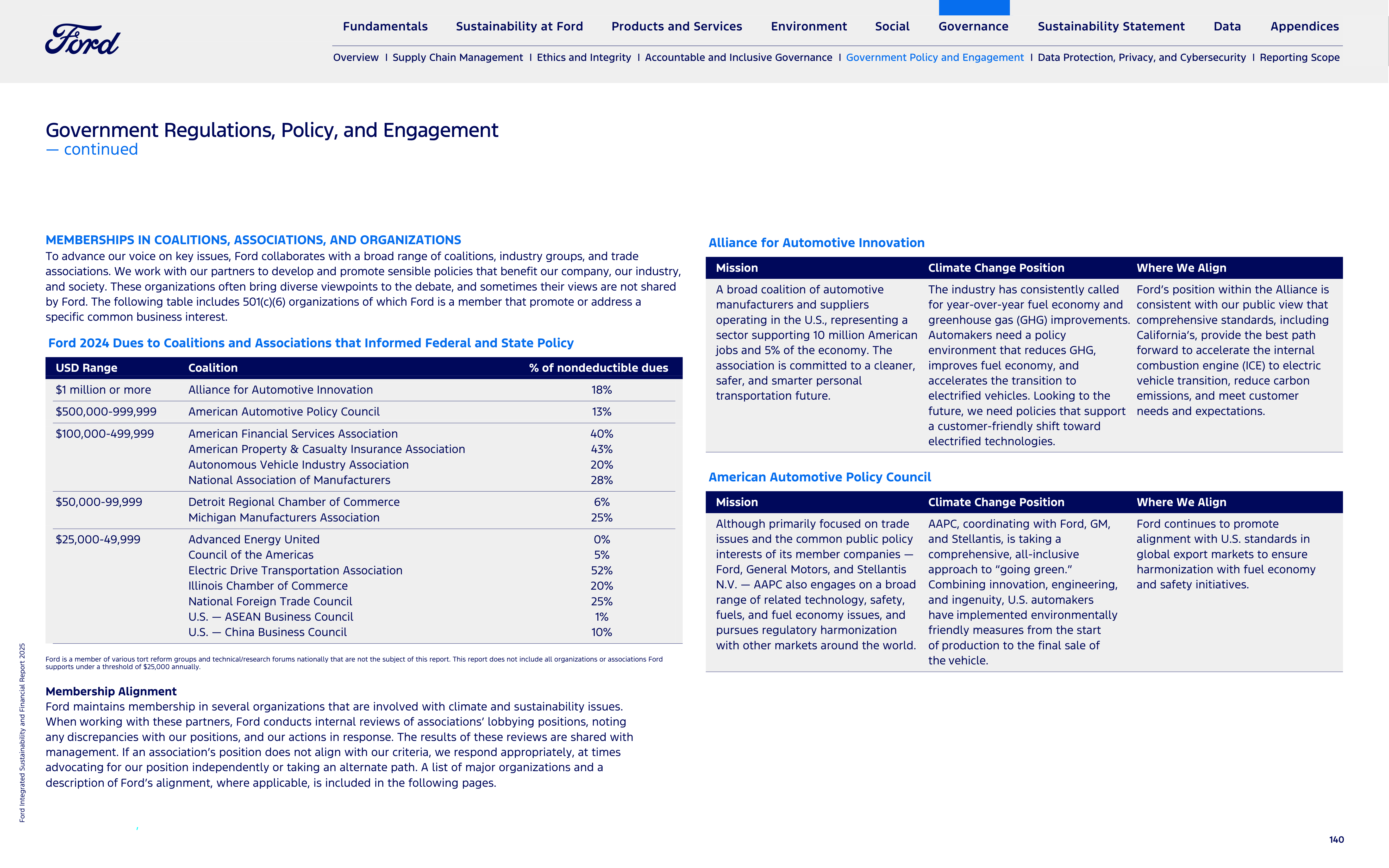

Fundamentals
Sustainability at Ford
Products and Services
Environment
Social
Governance
Sustainability Statement
Data
Appendices
|
|
|
|
|
|
Overview
Supply Chain Management
Ethics and Integrity
Accountable and Inclusive Governance
Government Policy and Engagement
Data Protection, Privacy, and Cybersecurity
Reporting Scope
MEMBERSHIPS IN COALITIONS, ASSOCIATIONS, AND ORGANIZATIONS
To advance our voice on key issues, Ford collaborates with a broad range of coalitions, industry groups, and trade
associations. We work with our partners to develop and promote sensible policies that benefit our company, our industry,
and society. These organizations often bring diverse viewpoints to the debate, and sometimes their views are not shared
by Ford. The following table includes 501(c)(6) organizations of which Ford is a member that promote or address a
specific common business interest.
Ford 2024 Dues to Coalitions and Associations that Informed Federal and State Policy
USD Range
Coalition
% of nondeductible dues
$1 million or more
Alliance for Automotive Innovation
18%
$500,000-999,999
American Automotive Policy Council
13%
$100,000-499,999
American Financial Services Association
40%
American Property & Casualty Insurance Association
43%
Autonomous Vehicle Industry Association
20%
National Association of Manufacturers
28%
$50,000-99,999
Detroit Regional Chamber of Commerce
6%
Michigan Manufacturers Association
25%
$25,000-49,999
Advanced Energy United
0%
Council of the Americas
5%
Electric Drive Transportation Association
52%
Illinois Chamber of Commerce
20%
National Foreign Trade Council
25%
U.S. — ASEAN Business Council
1%
U.S. — China Business Council
10%
Ford is a member of various tort reform groups and technical/research forums nationally that are not the subject of this report. This report does not include all organizations or associations Ford
supports under a threshold of $25,000 annually.
Membership Alignment
Ford maintains membership in several organizations that are involved with climate and sustainability issues.
When working with these partners, Ford conducts internal reviews of associations’ lobbying positions, noting
any discrepancies with our positions, and our actions in response. The results of these reviews are shared with
management. If an association’s position does not align with our criteria, we respond appropriately, at times
advocating for our position independently or taking an alternate path. A list of major organizations and a
description of Ford’s alignment, where applicable, is included in the following pages.
Alliance for Automotive Innovation
Mission
Climate Change Position
Where We Align
A broad coalition of automotive
manufacturers and suppliers
operating in the U.S., representing a
sector supporting 10 million American
jobs and 5% of the economy. The
association is committed to a cleaner,
safer, and smarter personal
transportation future.
The industry has consistently called
for year-over-year fuel economy and
greenhouse gas (GHG) improvements.
Automakers need a policy
environment that reduces GHG,
improves fuel economy, and
accelerates the transition to
electrified vehicles. Looking to the
future, we need policies that support
a customer-friendly shift toward
electrified technologies.
Ford’s position within the Alliance is
consistent with our public view that
comprehensive standards, including
California’s, provide the best path
forward to accelerate the internal
combustion engine (ICE) to electric
vehicle transition, reduce carbon
emissions, and meet customer
needs and expectations.
American Automotive Policy Council
Mission
Climate Change Position
Where We Align
Although primarily focused on trade
issues and the common public policy
interests of its member companies —
Ford, General Motors, and Stellantis
N.V. — AAPC also engages on a broad
range of related technology, safety,
fuels, and fuel economy issues, and
pursues regulatory harmonization
with other markets around the world.
AAPC, coordinating with Ford, GM,
and Stellantis, is taking a
comprehensive, all-inclusive
approach to “going green.”
Combining innovation, engineering,
and ingenuity, U.S. automakers
have implemented environmentally
friendly measures from the start
of production to the final sale of
the vehicle.
Ford continues to promote
alignment with U.S. standards in
global export markets to ensure
harmonization with fuel economy
and safety initiatives.
Government Regulations, Policy, and Engagement
— continued
,
Ford Integrated Sustainability and Financial Report 2025
140
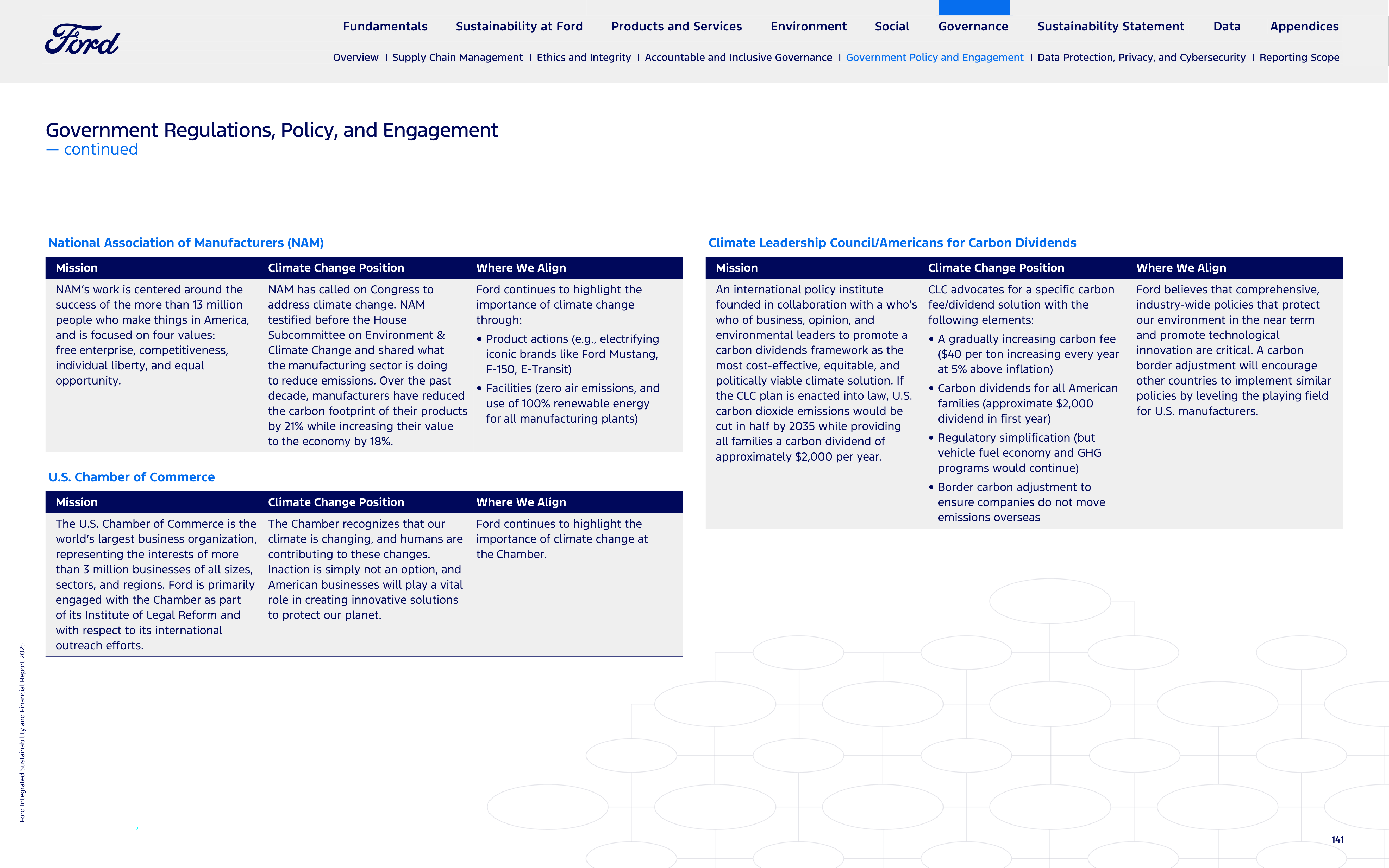


Fundamentals
Sustainability at Ford
Products and Services
Environment
Social
Governance
Sustainability Statement
Data
Appendices
|
|
|
|
|
|
Overview
Supply Chain Management
Ethics and Integrity
Accountable and Inclusive Governance
Government Policy and Engagement
Data Protection, Privacy, and Cybersecurity
Reporting Scope
National Association of Manufacturers (NAM)
Mission
Climate Change Position
Where We Align
NAM’s work is centered around the
success of the more than 13 million
people who make things in America,
and is focused on four values:
free enterprise, competitiveness,
individual liberty, and equal
opportunity.
NAM has called on Congress to
address climate change. NAM
testified before the House
Subcommittee on Environment &
Climate Change and shared what
the manufacturing sector is doing
to reduce emissions. Over the past
decade, manufacturers have reduced
the carbon footprint of their products
by 21% while increasing their value
to the economy by 18%.
Ford continues to highlight the
importance of climate change
through:
•
Product actions (e.g., electrifying
iconic brands like Ford Mustang,
F-150, E-Transit)
•
Facilities (zero air emissions, and
use of 100% renewable energy
for all manufacturing plants)
U.S. Chamber of Commerce
Mission
Climate Change Position
Where We Align
The U.S. Chamber of Commerce is the
world’s largest business organization,
representing the interests of more
than 3 million businesses of all sizes,
sectors, and regions. Ford is primarily
engaged with the Chamber as part
of its Institute of Legal Reform and
with respect to its international
outreach efforts.
The Chamber recognizes that our
climate is changing, and humans are
contributing to these changes.
Inaction is simply not an option, and
American businesses will play a vital
role in creating innovative solutions
to protect our planet.
Ford continues to highlight the
importance of climate change at
the Chamber.
Climate Leadership Council/Americans for Carbon Dividends
Mission
Climate Change Position
Where We Align
An international policy institute
founded in collaboration with a who’s
who of business, opinion, and
environmental leaders to promote a
carbon dividends framework as the
most cost-effective, equitable, and
politically viable climate solution. If
the CLC plan is enacted into law, U.S.
carbon dioxide emissions would be
cut in half by 2035 while providing
all families a carbon dividend of
approximately $2,000 per year.
CLC advocates for a specific carbon
fee/dividend solution with the
following elements:
•
A gradually increasing carbon fee
($40 per ton increasing every year
at 5% above inflation)
•
Carbon dividends for all American
families (approximate $2,000
dividend in first year)
•
Regulatory simplification (but
vehicle fuel economy and GHG
programs would continue)
•
Border carbon adjustment to
ensure companies do not move
emissions overseas
Ford believes that comprehensive,
industry-wide policies that protect
our environment in the near term
and promote technological
innovation are critical. A carbon
border adjustment will encourage
other countries to implement similar
policies by leveling the playing field
for U.S. manufacturers.
Government Regulations, Policy, and Engagement
— continued
,
Ford Integrated Sustainability and Financial Report 2025
141
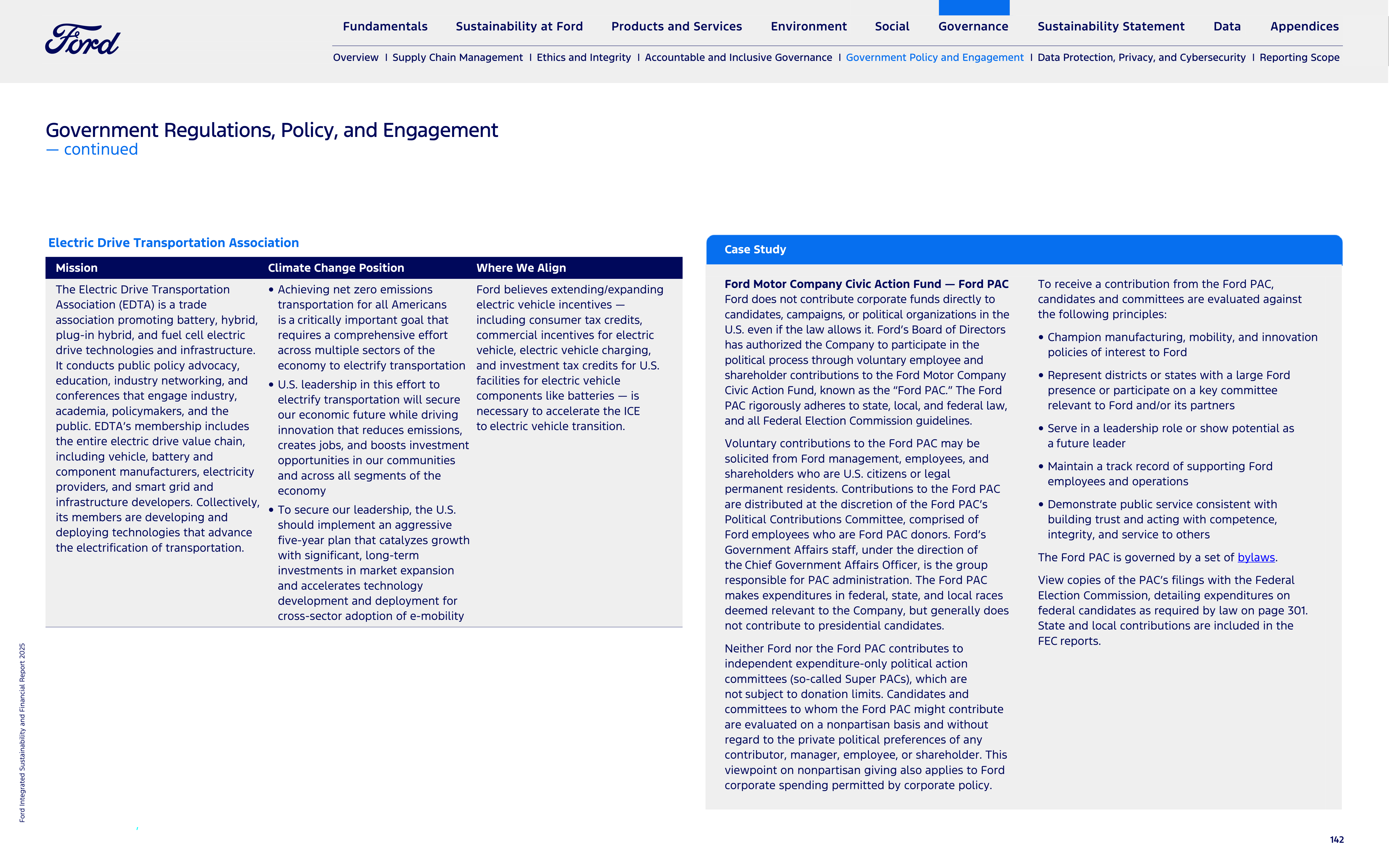


Fundamentals
Sustainability at Ford
Products and Services
Environment
Social
Governance
Sustainability Statement
Data
Appendices
|
|
|
|
|
|
Overview
Supply Chain Management
Ethics and Integrity
Accountable and Inclusive Governance
Government Policy and Engagement
Data Protection, Privacy, and Cybersecurity
Reporting Scope
Electric Drive Transportation Association
Mission
Climate Change Position
Where We Align
The Electric Drive Transportation
Association (EDTA) is a trade
association promoting battery, hybrid,
plug-in hybrid, and fuel cell electric
drive technologies and infrastructure.
It conducts public policy advocacy,
education, industry networking, and
conferences that engage industry,
academia, policymakers, and the
public. EDTA’s membership includes
the entire electric drive value chain,
including vehicle, battery and
component manufacturers, electricity
providers, and smart grid and
infrastructure developers. Collectively,
its members are developing and
deploying technologies that advance
the electrification of transportation.
•
Achieving net zero emissions
transportation for all Americans
is a critically important goal that
requires a comprehensive effort
across multiple sectors of the
economy to electrify transportation
•
U.S. leadership in this effort to
electrify transportation will secure
our economic future while driving
innovation that reduces emissions,
creates jobs, and boosts investment
opportunities in our communities
and across all segments of the
economy
•
To secure our leadership, the U.S.
should implement an aggressive
five-year plan that catalyzes growth
with significant, long-term
investments in market expansion
and accelerates technology
development and deployment for
cross-sector adoption of e-mobility
Ford believes extending/expanding
electric vehicle incentives —
including consumer tax credits,
commercial incentives for electric
vehicle, electric vehicle charging,
and investment tax credits for U.S.
facilities for electric vehicle
components like batteries — is
necessary to accelerate the ICE
to electric vehicle transition.
Case Study
Ford Motor Company Civic Action Fund — Ford PAC
Ford does not contribute corporate funds directly to
candidates, campaigns, or political organizations in the
U.S. even if the law allows it. Ford’s Board of Directors
has authorized the Company to participate in the
political process through voluntary employee and
shareholder contributions to the Ford Motor Company
Civic Action Fund, known as the “Ford PAC.” The Ford
PAC rigorously adheres to state, local, and federal law,
and all Federal Election Commission guidelines.
Voluntary contributions to the Ford PAC may be
solicited from Ford management, employees, and
shareholders who are U.S. citizens or legal
permanent residents. Contributions to the Ford PAC
are distributed at the discretion of the Ford PAC’s
Political Contributions Committee, comprised of
Ford employees who are Ford PAC donors. Ford’s
Government Affairs staff, under the direction of
the Chief Government Affairs Officer, is the group
responsible for PAC administration. The Ford PAC
makes expenditures in federal, state, and local races
deemed relevant to the Company, but generally does
not contribute to presidential candidates.
Neither Ford nor the Ford PAC contributes to
independent expenditure-only political action
committees (so-called Super PACs), which are
not subject to donation limits. Candidates and
committees to whom the Ford PAC might contribute
are evaluated on a nonpartisan basis and without
regard to the private political preferences of any
contributor, manager, employee, or shareholder. This
viewpoint on nonpartisan giving also applies to Ford
corporate spending permitted by corporate policy.
To receive a contribution from the Ford PAC,
candidates and committees are evaluated against
the following principles:
•
Champion manufacturing, mobility, and innovation
policies of interest to Ford
•
Represent districts or states with a large Ford
presence or participate on a key committee
relevant to Ford and/or its partners
•
Serve in a leadership role or show potential as
a future leader
•
Maintain a track record of supporting Ford
employees and operations
•
Demonstrate public service consistent with
building trust and acting with competence,
integrity, and service to others
The Ford PAC is governed by a set of
bylaws
.
View copies of the PAC’s filings with the Federal
Election Commission, detailing expenditures on
federal candidates as required by law on page 301.
State and local contributions are included in the
FEC reports.
Government Regulations, Policy, and Engagement
— continued
,
Ford Integrated Sustainability and Financial Report 2025
142
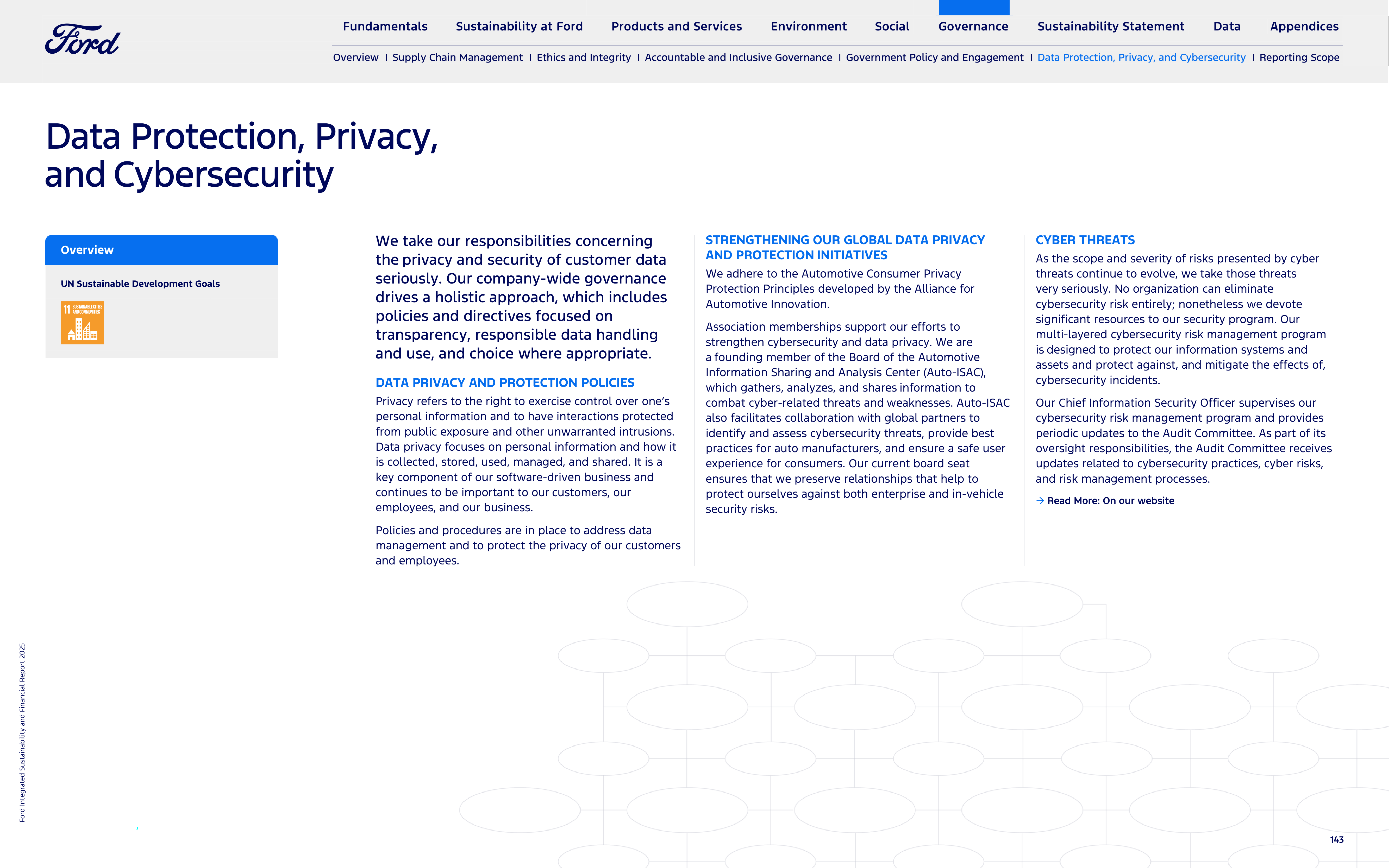



Fundamentals
Sustainability at Ford
Products and Services
Environment
Social
Governance
Sustainability Statement
Data
Appendices
|
|
|
|
|
|
Overview
Supply Chain Management
Ethics and Integrity
Accountable and Inclusive Governance
Government Policy and Engagement
Data Protection, Privacy, and Cybersecurity
Reporting Scope
Data Protection, Privacy,
and Cybersecurity
Overview
UN Sustainable Development Goals
11 SUSTAINABLE CITIES
AND COMMUNITIES
We take our responsibilities concerning
the privacy and security of customer data
seriously. Our company-wide governance
drives a holistic approach, which includes
policies and directives focused on
transparency, responsible data handling
and use, and choice where appropriate.
DATA PRIVACY AND PROTECTION POLICIES
Privacy refers to the right to exercise control over one’s
personal information and to have interactions protected
from public exposure and other unwarranted intrusions.
Data privacy focuses on personal information and how it
is collected, stored, used, managed, and shared. It is a
key component of our software-driven business and
continues to be important to our customers, our
employees, and our business.
Policies and procedures are in place to address data
management and to protect the privacy of our customers
and employees.
STRENGTHENING OUR GLOBAL DATA PRIVACY
AND PROTECTION INITIATIVES
We adhere to the Automotive Consumer Privacy
Protection Principles developed by the Alliance for
Automotive Innovation.
Association memberships support our efforts to
strengthen cybersecurity and data privacy. We are
a founding member of the Board of the Automotive
Information Sharing and Analysis Center (Auto-ISAC),
which gathers, analyzes, and shares information to
combat cyber-related threats and weaknesses. Auto-ISAC
also facilitates collaboration with global partners to
identify and assess cybersecurity threats, provide best
practices for auto manufacturers, and ensure a safe user
experience for consumers. Our current board seat
ensures that we preserve relationships that help to
protect ourselves against both enterprise and in-vehicle
security risks.
CYBER THREATS
As the scope and severity of risks presented by cyber
threats continue to evolve, we take those threats
very seriously. No organization can eliminate
cybersecurity risk entirely; nonetheless we devote
significant resources to our security program. Our
multi-layered cybersecurity risk management program
is designed to protect our information systems and
assets and protect against, and mitigate the effects of,
cybersecurity incidents.
Our Chief Information Security Officer supervises our
cybersecurity risk management program and provides
periodic updates to the Audit Committee. As part of its
oversight responsibilities, the Audit Committee receives
updates related to cybersecurity practices, cyber risks,
and risk management processes.
→
Read More: On our website
,
Ford Integrated Sustainability and Financial Report 2025
143



Fundamentals
Sustainability at Ford
Products and Services
Environment
Social
Governance
Sustainability Statement
Data
Appendices
|
|
|
|
|
|
Overview
Supply Chain Management
Ethics and Integrity
Accountable and Inclusive Governance
Government Policy and Engagement
Data Protection, Privacy, and Cybersecurity
Reporting Scope
Reporting Scope, Boundaries,
and Data Assurance
REPORTING SCOPE AND BOUNDARIES
Consistent with GRI guidance on boundary setting, the
data in this report covers all of Ford Motor Company’s
wholly and majority-owned operations globally, unless
otherwise noted, and spans 2024 operations and
vehicles. Boundaries for each material issue are noted
in our GRI Content Index.
The EU Corporate Sustainability Reporting Directive
(CSRD) requires disclosures against the European
Sustainability Reporting Standards (ESRS). We have
included a Sustainability Statement that includes all of
Ford’s 2024 CSRD compliant disclosures based on our
Double Materiality Assessment.
Where relevant, data measurement techniques, the bases
of calculations, and changes in the basis for reporting or
reclassifications of previously reported data are included
as footnotes.
For this report, we have followed the International
Framework of the International Integrated Reporting
Council (IIRC) to provide a cohesive and comprehensive
approach to our corporate reporting. However, we remain
flexible and open to new approaches as the dynamic
reporting environment continues to evolve.
DATA ASSURANCE
Data in this report is subject to various forms of
assurance, as outlined below and noted in the data
tables. This report has been reviewed by Ford’s top
senior executives, as well as the Sustainability,
Innovation and Policy Committee and the Audit
Committee of the Board of Directors.
Some of the data in our reports has been subject to
internal and third-party verification.
The consolidated financial statements in our 2024
Form
10-K
Report have been audited by our independent
registered public accounting firm.
The Sustainability Statement has been subject to limited
assurance by PricewaterhouseCoopers LLP, For more
information see the assurance conclusion on page 229.
Ford’s 2024 greenhouse gas inventory (including Scope 1,
Scope 2 and Scope 3 Categories 11 and 15) undergoes
third-party verification by an organization with a
Certification of Accreditation to ISO 14065:2013 by the
ANSI National Accreditation Board and will become
available at a later date. In addition, GHG emissions for
some manufacturing operations are also third-party
verified, separately from this Sustainability Statement, in
accordance with the local emission trading scheme
regulatory requirements.
,
Ford Integrated Sustainability and Financial Report 2025
144
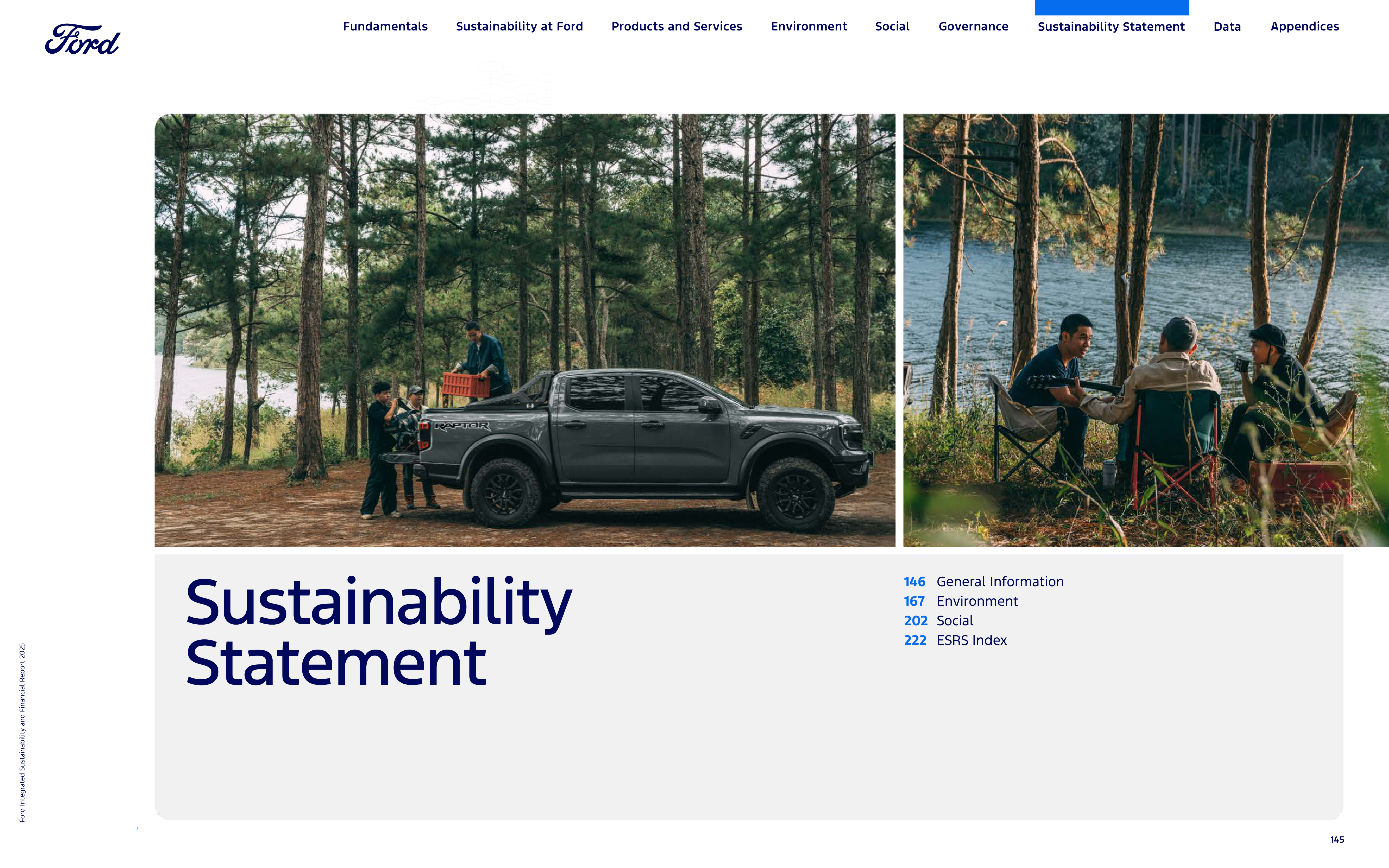



Fundamentals
Sustainability at Ford
Products and Services
Environment
Social
Governance
Sustainability Statement
Data
Appendices
Sustainability
Statement
146
General Information
167
Environment
202
Social
222
ESRS Index
,
Ford Integrated Sustainability and Financial Report 2025
145


Fundamentals
Sustainability at Ford
Products and Services
Environment
Social
Governance
Sustainability Statement
Data
Appendices
|
|
General Information
|
Environment
Social
ESRS Index
Sustainability Statement
General Information
147
Sustainability Reporting Approach
148
Sustainability Governance
151
Sustainability Strategy and Business Model
153
Stakeholder Engagement
156
Double Materiality Assessment
159
Material Impacts, Risks, and Opportunities
162
Policies to Manage Impacts, Risks, and Opportunities
,
Ford Integrated Sustainability and Financial Report 2025
146

Fundamentals
Sustainability at Ford
Products and Services
Environment
Social
Governance
Sustainability Statement
Data
Appendices
|
|
|
General Information
Environment
Social
ESRS Index
Sustainability Reporting Approach
SUSTAINABILITY REPORTING APPROACH
The EU Corporate Sustainability Reporting Directive
(CSRD) requires disclosures against the European
Sustainability Reporting Standards (ESRS) for those
topics deemed material in a Double Materiality
Assessment (DMA). We have completed a DMA aligned
with the ESRS expectations and the material matters
identified have been used to determine the disclosure
requirements Ford Motor Company addresses in this
sustainability statement. The ESRS are not mandatory
in 2025 due to CSRD not being adopted into Luxembourg
law by December 31, 2024. Ford is continuing with ESRS
disclosures in this Sustainability Statement on a
voluntary basis.
We have included an ESRS Index on page 222 outlining
all disclosure requirements reported against in this
Sustainability Statement. The information included within
this Sustainability Statement stems from our material
impacts, risks, and opportunities as identified by the
double materiality assessment.
Reporting Boundaries
This is the first year Ford is reporting against the ESRS
and as such there are no changes from previous years
to report or comparative information from previous
years included.
This report has been prepared on a global consolidated
basis for Ford Motor Company and its consolidated
subsidiaries. The scope of consolidation for this
sustainability statement mirrors Ford’s 2024
Form 10-K
Report. No subsidiaries that are included in the annual
financial filing are exempt from this report.
Time horizons in this report are consistent with those
specified in ESRS 1 and those considered in our DMA,
unless otherwise indicated. The three time horizons are
short term (up to 1 year), medium term (up to 5 years),
and long term (5+ years).
Ford is not involved in activities related to fossil fuel,
chemical production, controversial weapons, or the
cultivation and production of tobacco. For this reason
ESRS disclosure requirements related to these industries
are not included in this Sustainability Statement.
Proprietary Information
Some disclosures were omitted from this statement due
to the risk to Ford’s business in disclosing intellectual
property proprietary to the company. This includes:
•
Future capital or operational expenditures by specific
product, project, or technology
•
Targets and metrics for E1 Risk 1: Meeting stringent
emissions and emerging regulatory standards may
require substantial investments
•
Targets and metrics for E1 Risk 2: Failing to comply with
emissions regulations and meet zero emission vehicle
(ZEV) thresholds may result in purchasing credits from
competitors, curtailing vehicle sales, or paying fines
•
Targets for Entity Specific Risk 10, addressed in E1:
Over-investment in electrification and uptake not
occurring at the same scale presents a financial risk
•
Targets for S4 Risk 8 and 9: Ford may incur significant
costs due to product recalls, and poor product quality
could damage Ford’s reputation
•
Actions for Entity Specific Opportunity 1: Connected
vehicles generate significant amounts of data, which
can enhance customer experiences and optimize
vehicle performance
Value Chain
Our DMA and sustainability statement consider Ford’s
own business activities as well as the impacts and
activities from our upstream and downstream value
chain. For information on our value chain, see page 152.
As per the transitional provisions outlined in the ESRS,
certain details regarding our value chain have been
excluded when reliable data was not accessible during
the reporting period. These details are addressed where
relevant within the individual sections of this Statement.
KEY ESTIMATES
We review our use of estimates at least annually and
adjust as necessary. Any modifications to estimates are
accounted for in the reporting period in which they are
revised. For more details on the estimates, judgments,
and assumptions used, refer to the metrics and data
tables within each section of this Statement.
Forward Looking Statements
This report includes forward-looking statements.
Forward-looking statements are based on expectations,
forecasts, and assumptions by Ford management and
involve a number of risks, uncertainties, and other factors
that could cause actual results to differ materially from
those stated. For a discussion of these risks,
uncertainties, and other factors see “Item 1A. Risk
Factors” in Ford’s 2024 Form 10-K Report, as updated by
subsequent Quarterly Reports on Form 10-Q and Current
Reports on Form 8-K, which includes other risk factors
outside the disclosure requirements of the ESRS. This
Sustainability Statement includes all material impacts,
risks, and opportunities identified pursuant to the ESRS.
External assurance
This Sustainability Statement has been subject to limited
assurance by PricewaterhouseCoopers LLP, For more
information see the assurance conclusion on page 229.
REFERENCES USED
References to “business partners” throughout this
Statement and Ford policies referenced refers to partners
and joint ventures of Ford Motor Company. References to
“customers” throughout this statement relate to actual
and potential end users of Ford products and services.
Incorporation by Reference
Throughout the Sustainability Statement we have
referenced Ford’s 2024 Form 10-K Report for some
information. The following disclosures reference this
report:
•
ESRS 2 Revenue
•
EU Taxonomy Eligible Economic Activities and
Minimum Safeguards
•
E1 Transition Plan Investments
,
Ford Integrated Sustainability and Financial Report 2025
147
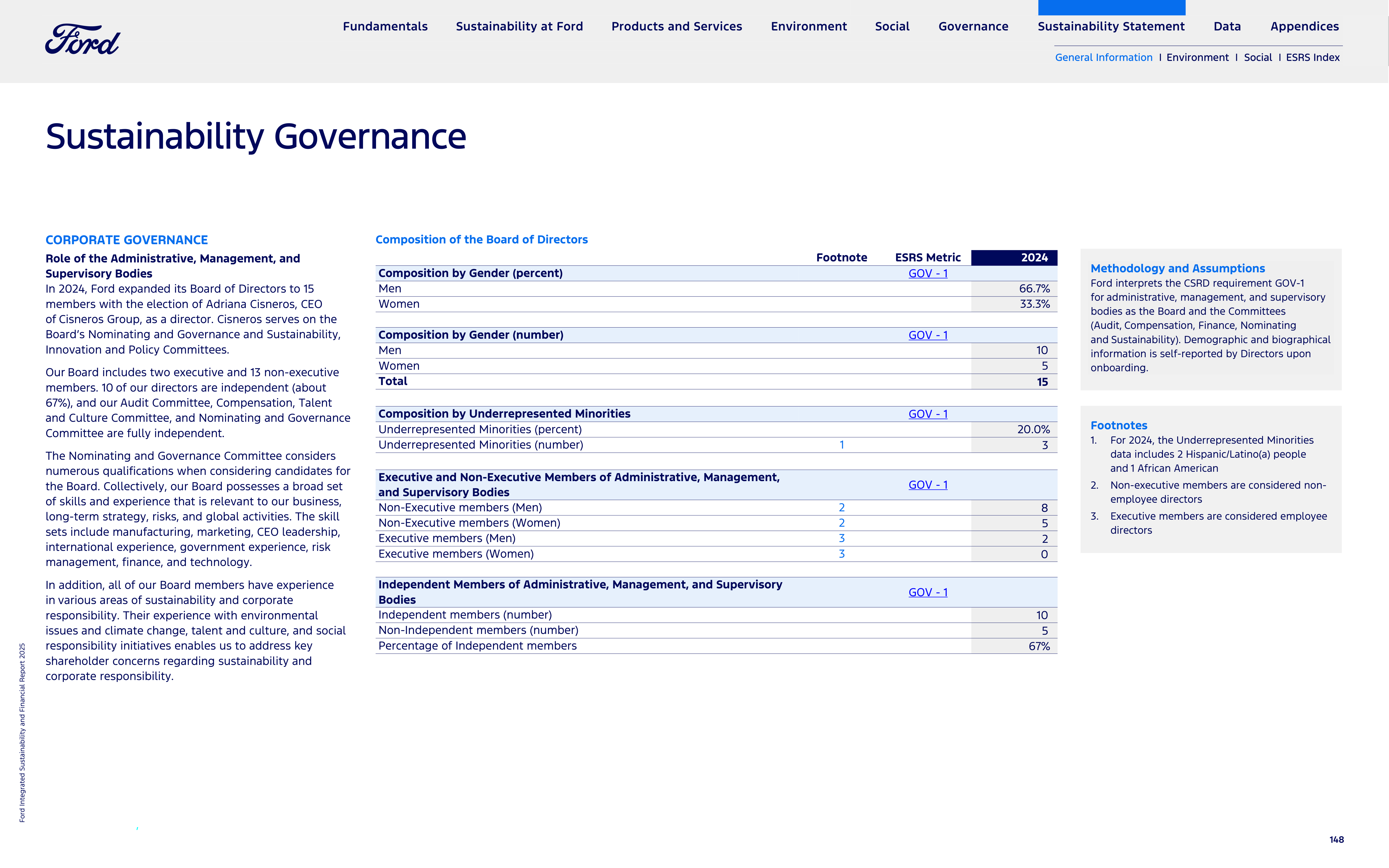

Fundamentals
Sustainability at Ford
Products and Services
Environment
Social
Governance
Sustainability Statement
Data
Appendices
|
|
|
General Information
Environment
Social
ESRS Index
Sustainability Governance
CORPORATE GOVERNANCE
Role of the Administrative, Management, and
Supervisory Bodies
In 2024, Ford expanded its Board of Directors to 15
members with the election of Adriana Cisneros, CEO
of Cisneros Group, as a director. Cisneros serves on the
Board’s Nominating and Governance and Sustainability,
Innovation and Policy Committees.
Our Board includes two executive and 13 non-executive
members. 10 of our directors are independent (about
67%), and our Audit Committee, Compensation, Talent
and Culture Committee, and Nominating and Governance
Committee are fully independent.
The Nominating and Governance Committee considers
numerous qualifications when considering candidates for
the Board. Collectively, our Board possesses a broad set
of skills and experience that is relevant to our business,
long-term strategy, risks, and global activities. The skill
sets include manufacturing, marketing, CEO leadership,
international experience, government experience, risk
management, finance, and technology.
In addition, all of our Board members have experience
in various areas of sustainability and corporate
responsibility. Their experience with environmental
issues and climate change, talent and culture, and social
responsibility initiatives enables us to address key
shareholder concerns regarding sustainability and
corporate responsibility.
Composition of the Board of Directors
Footnote
ESRS Metric
2024
Composition by Gender (percent)
GOV - 1
Men
66.7
%
Women
33.3
%
Composition by Gender (number)
GOV - 1
Men
10
Women
5
Total
15
Composition by Underrepresented Minorities
GOV - 1
Underrepresented Minorities (percent)
20.0
%
Underrepresented Minorities (number)
1
3
Executive and Non-Executive Members of Administrative, Management,
and Supervisory Bodies
GOV - 1
Non-Executive members (Men)
2
8
Non-Executive members (Women)
2
5
Executive members (Men)
3
2
Executive members (Women)
3
0
Independent Members of Administrative, Management, and Supervisory
Bodies
GOV - 1
Independent members (number)
10
Non-Independent members (number)
5
Percentage of Independent members
67 %
Methodology and Assumptions
Ford interprets the CSRD requirement GOV-1
for administrative, management, and supervisory
bodies as the Board and the Committees
(Audit, Compensation, Finance, Nominating
and Sustainability). Demographic and biographical
information is self-reported by Directors upon
onboarding.
Footnotes
1.
For 2024, the Underrepresented Minorities
data includes 2 Hispanic/Latino(a) people
and 1 African American
2.
Non-executive members are considered non-
employee directors
3.
Executive members are considered employee
directors
,
Ford Integrated Sustainability and Financial Report 2025
148
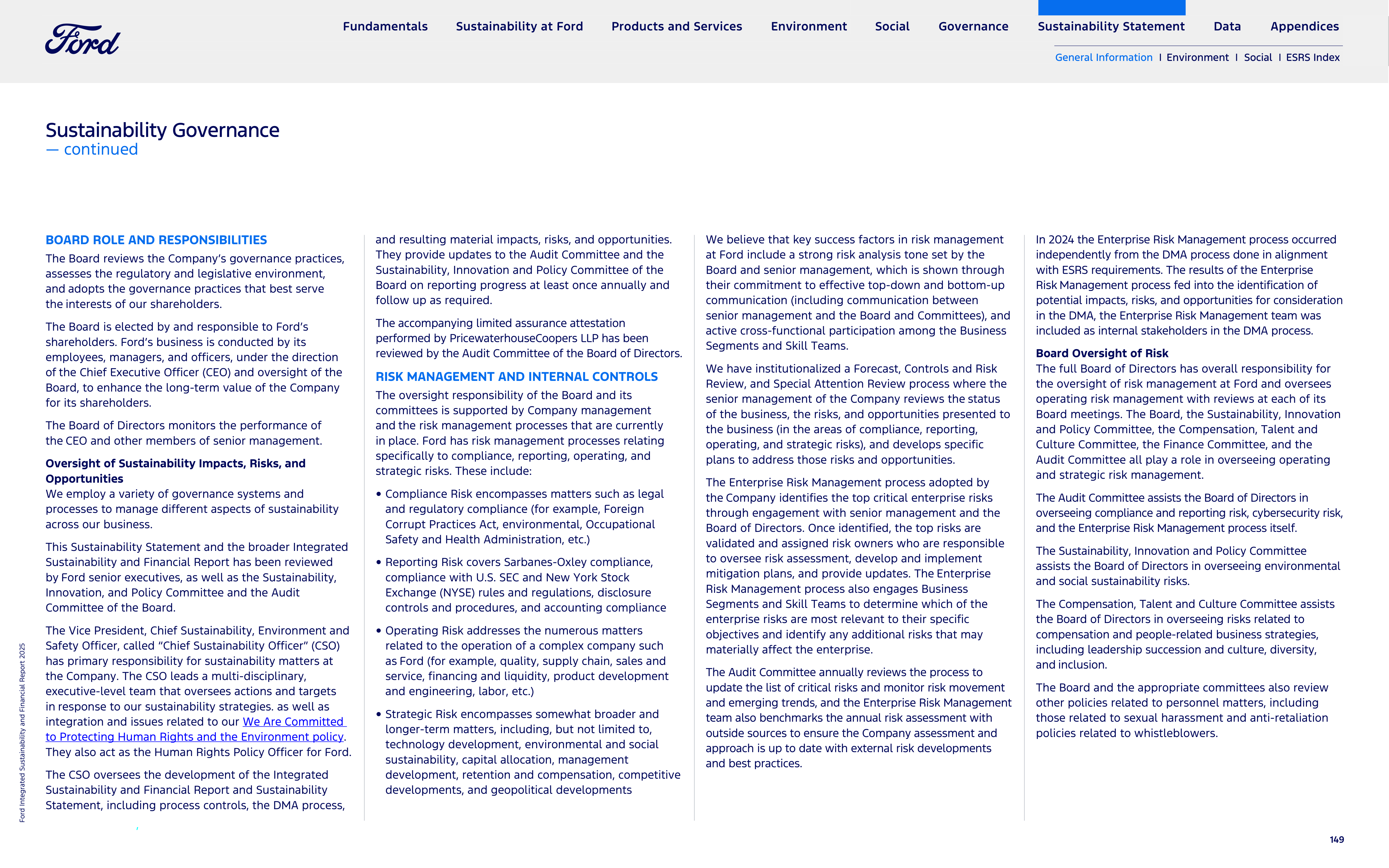

Fundamentals
Sustainability at Ford
Products and Services
Environment
Social
Governance
Sustainability Statement
Data
Appendices
|
|
|
General Information
Environment
Social
ESRS Index
BOARD ROLE AND RESPONSIBILITIES
The Board reviews the Company’s governance practices,
assesses the regulatory and legislative environment,
and adopts the governance practices that best serve
the interests of our shareholders.
The Board is elected by and responsible to Ford’s
shareholders. Ford’s business is conducted by its
employees, managers, and officers, under the direction
of the Chief Executive Officer (CEO) and oversight of the
Board, to enhance the long-term value of the Company
for its shareholders.
The Board of Directors monitors the performance of
the CEO and other members of senior management.
Oversight of Sustainability Impacts, Risks, and
Opportunities
We employ a variety of governance systems and
processes to manage different aspects of sustainability
across our business.
This Sustainability Statement and the broader Integrated
Sustainability and Financial Report has been reviewed
by Ford senior executives, as well as the Sustainability,
Innovation, and Policy Committee and the Audit
Committee of the Board.
The Vice President, Chief Sustainability, Environment and
Safety Officer, called “Chief Sustainability Officer” (CSO)
has primary responsibility for sustainability matters at
the Company. The CSO leads a multi-disciplinary,
executive-level team that oversees actions and targets
in response to our sustainability strategies. as well as
integration and issues related to our
We Are Committed
to Protecting Human Rights and the Environment policy
.
They also act as the Human Rights Policy Officer for Ford.
The CSO oversees the development of the Integrated
Sustainability and Financial Report and Sustainability
Statement, including process controls, the DMA process,
and resulting material impacts, risks, and opportunities.
They provide updates to the Audit Committee and the
Sustainability, Innovation and Policy Committee of the
Board on reporting progress at least once annually and
follow up as required.
The accompanying limited assurance attestation
performed by PricewaterhouseCoopers LLP has been
reviewed by the Audit Committee of the Board of Directors.
RISK MANAGEMENT AND INTERNAL CONTROLS
The oversight responsibility of the Board and its
committees is supported by Company management
and the risk management processes that are currently
in place. Ford has risk management processes relating
specifically to compliance, reporting, operating, and
strategic risks. These include:
•
Compliance Risk encompasses matters such as legal
and regulatory compliance (for example, Foreign
Corrupt Practices Act, environmental, Occupational
Safety and Health Administration, etc.)
•
Reporting Risk covers Sarbanes-Oxley compliance,
compliance with U.S. SEC and New York Stock
Exchange (NYSE) rules and regulations, disclosure
controls and procedures, and accounting compliance
•
Operating Risk addresses the numerous matters
related to the operation of a complex company such
as Ford (for example, quality, supply chain, sales and
service, financing and liquidity, product development
and engineering, labor, etc.)
•
Strategic Risk encompasses somewhat broader and
longer-term matters, including, but not limited to,
technology development, environmental and social
sustainability, capital allocation, management
development, retention and compensation, competitive
developments, and geopolitical developments
We believe that key success factors in risk management
at Ford include a strong risk analysis tone set by the
Board and senior management, which is shown through
their commitment to effective top-down and bottom-up
communication (including communication between
senior management and the Board and Committees), and
active cross-functional participation among the Business
Segments and Skill Teams.
We have institutionalized a Forecast, Controls and Risk
Review, and Special Attention Review process where the
senior management of the Company reviews the status
of the business, the risks, and opportunities presented to
the business (in the areas of compliance, reporting,
operating, and strategic risks), and develops specific
plans to address those risks and opportunities.
The Enterprise Risk Management process adopted by
the Company identifies the top critical enterprise risks
through engagement with senior management and the
Board of Directors. Once identified, the top risks are
validated and assigned risk owners who are responsible
to oversee risk assessment, develop and implement
mitigation plans, and provide updates. The Enterprise
Risk Management process also engages Business
Segments and Skill Teams to determine which of the
enterprise risks are most relevant to their specific
objectives and identify any additional risks that may
materially affect the enterprise.
The Audit Committee annually reviews the process to
update the list of critical risks and monitor risk movement
and emerging trends, and the Enterprise Risk Management
team also benchmarks the annual risk assessment with
outside sources to ensure the Company assessment and
approach is up to date with external risk developments
and best practices.
In 2024 the Enterprise Risk Management process occurred
independently from the DMA process done in alignment
with ESRS requirements. The results of the Enterprise
Risk Management process fed into the identification of
potential impacts, risks, and opportunities for consideration
in the DMA, the Enterprise Risk Management team was
included as internal stakeholders in the DMA process.
Board Oversight of Risk
The full Board of Directors has overall responsibility for
the oversight of risk management at Ford and oversees
operating risk management with reviews at each of its
Board meetings. The Board, the Sustainability, Innovation
and Policy Committee, the Compensation, Talent and
Culture Committee, the Finance Committee, and the
Audit Committee all play a role in overseeing operating
and strategic risk management.
The Audit Committee assists the Board of Directors in
overseeing compliance and reporting risk, cybersecurity risk,
and the Enterprise Risk Management process itself.
The Sustainability, Innovation and Policy Committee
assists the Board of Directors in overseeing environmental
and social sustainability risks.
The Compensation, Talent and Culture Committee assists
the Board of Directors in overseeing risks related to
compensation and people-related business strategies,
including leadership succession and culture, diversity,
and inclusion.
The Board and the appropriate committees also review
other policies related to personnel matters, including
those related to sexual harassment and anti-retaliation
policies related to whistleblowers.
Sustainability Governance
— continued
,
Ford Integrated Sustainability and Financial Report 2025
149
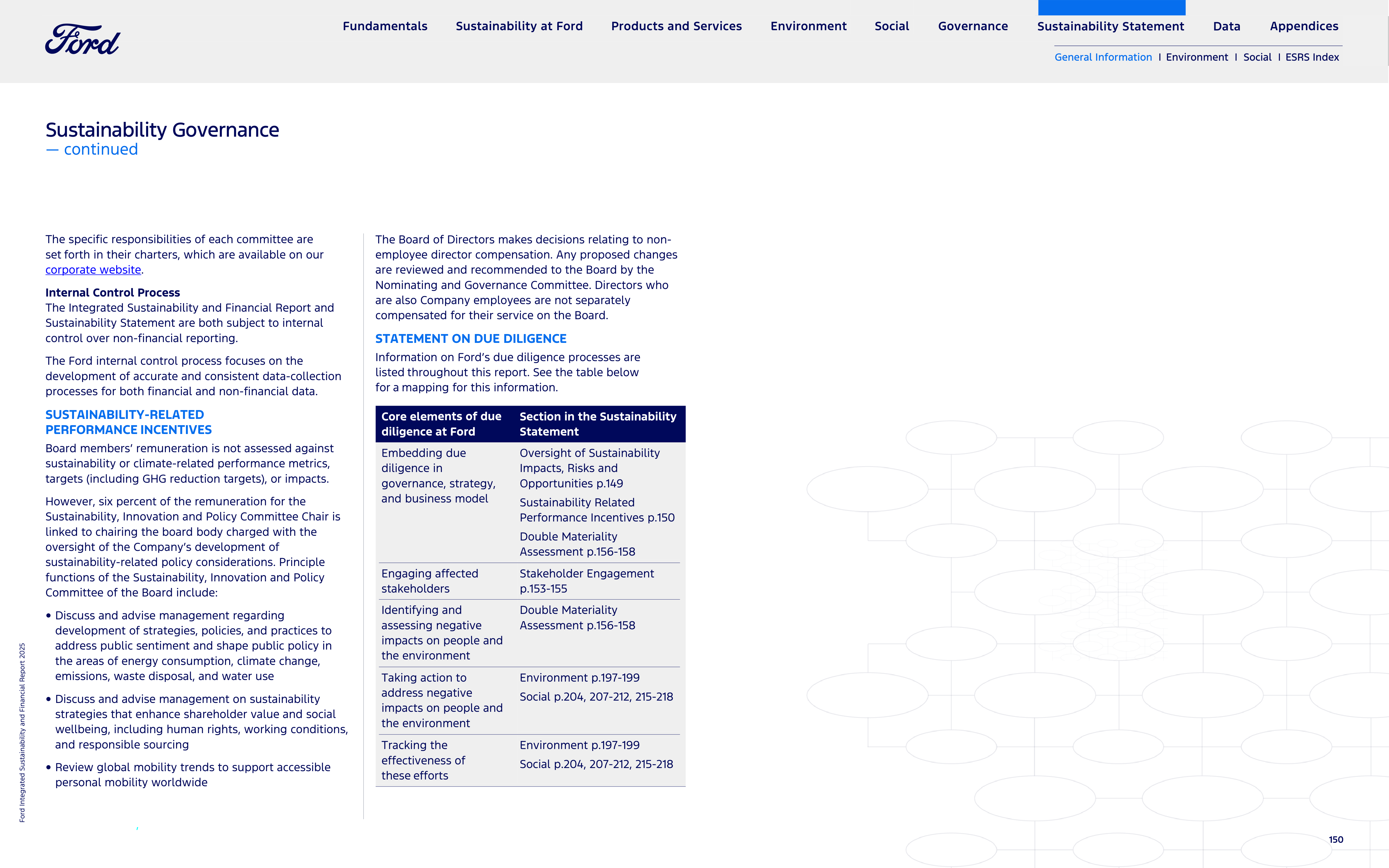



f
i
l
Fundamentals
Sustainability at Ford
Products and Services
Environment
Social
Governance
Sustainability Statement
Data
Appendices
|
|
|
General Information
Environment
Social
ESRS Index
The specific responsibilities of each committee are
set forth in their charters, which are available on our
corporate website
.
Internal Control Process
The Integrated Sustainability and Financial Report and
Sustainability Statement are both subject to internal
control over non-financial reporting.
The Ford internal control process focuses on the
development of accurate and consistent data-collection
processes for both financial and non-financial data.
SUSTAINABILITY-RELATED
PERFORMANCE INCENTIVES
Board members’ remuneration is not assessed against
sustainability or climate-related performance metrics,
targets (including GHG reduction targets), or impacts.
However, six percent of the remuneration for the
Sustainability, Innovation and Policy Committee Chair is
linked to chairing the board body charged with the
oversight of the Company’s development of
sustainability-related policy considerations. Principle
functions of the Sustainability, Innovation and Policy
Committee of the Board include:
•
Discuss and advise management regarding
development of strategies, policies, and practices to
address public sentiment and shape public policy in
the areas of energy consumption, climate change,
emissions, waste disposal, and water use
•
Discuss and advise management on sustainability
strategies that enhance shareholder value and social
wellbeing, including human rights, working conditions,
and responsible sourcing
•
Review global mobility trends to support accessible
personal mobility worldwide
The Board of Directors makes decisions relating to non-
employee director compensation. Any proposed changes
are reviewed and recommended to the Board by the
Nominating and Governance Committee. Directors who
are also Company employees are not separately
compensated for their service on the Board.
STATEMENT ON DUE DILIGENCE
Information on Ford’s due diligence processes are
listed throughout this report. See the table below
for a mapping for this information.
Core elements of due
diligence at Ford
Section in the Sustainability
Statement
Embedding due
diligence in
governance, strategy,
and business model
Oversight of Sustainability
Impacts, Risks and
Opportunities p.149
Sustainability Related
Performance Incentives p.150
Double Materiality
Assessment p.156-158
Engaging affected
stakeholders
Stakeholder Engagement
p.153-155
Identifying and
assessing negative
impacts on people and
the environment
Double Materiality
Assessment p.156-158
Taking action to
address negative
impacts on people and
the environment
Environment p.197-199
Social p.204, 207-212, 215-218
Tracking the
effectiveness of
these efforts
Environment p.197-199
Social p.204, 207-212, 215-218
2025
rt
o
l Rep
ncia
ina
F
nd
a
y
ilit
b
ina
a
ust
S
ed
t
ra
eg
Int
rd
o
F
,
150
Sustainability Governance
— continued
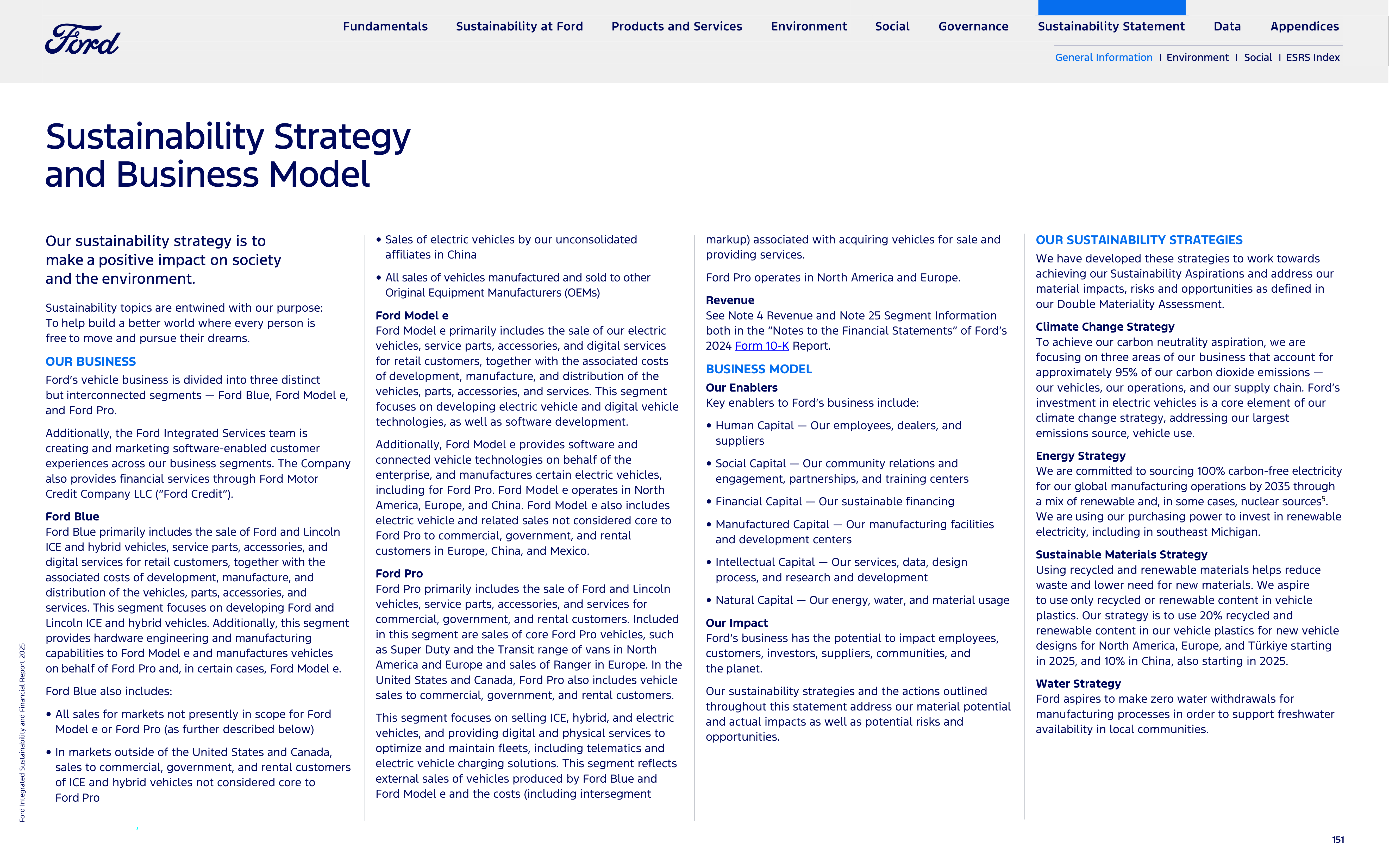

Fundamentals
Sustainability at Ford
Products and Services
Environment
Social
Governance
Sustainability Statement
Data
Appendices
|
|
|
General Information
Environment
Social
ESRS Index
Sustainability Strategy
and Business Model
Our sustainability strategy is to
make a positive impact on society
and the environment.
Sustainability topics are entwined with our purpose:
To help build a better world where every person is
free to move and pursue their dreams.
OUR BUSINESS
Ford’s vehicle business is divided into three distinct
but interconnected segments — Ford Blue, Ford Model e,
and Ford Pro.
Additionally, the Ford Integrated Services team is
creating and marketing software-enabled customer
experiences across our business segments. The Company
also provides financial services through Ford Motor
Credit Company LLC (“Ford Credit”).
Ford Blue
Ford Blue primarily includes the sale of Ford and Lincoln
ICE and hybrid vehicles, service parts, accessories, and
digital services for retail customers, together with the
associated costs of development, manufacture, and
distribution of the vehicles, parts, accessories, and
services. This segment focuses on developing Ford and
Lincoln ICE and hybrid vehicles. Additionally, this segment
provides hardware engineering and manufacturing
capabilities to Ford Model e and manufactures vehicles
on behalf of Ford Pro and, in certain cases, Ford Model e.
Ford Blue also includes:
•
All sales for markets not presently in scope for Ford
Model e or Ford Pro (as further described below)
•
In markets outside of the United States and Canada,
sales to commercial, government, and rental customers
of ICE and hybrid vehicles not considered core to
Ford Pro
•
Sales of electric vehicles by our unconsolidated
affiliates in China
•
All sales of vehicles manufactured and sold to other
Original Equipment Manufacturers (OEMs)
Ford Model e
Ford Model e primarily includes the sale of our electric
vehicles, service parts, accessories, and digital services
for retail customers, together with the associated costs
of development, manufacture, and distribution of the
vehicles, parts, accessories, and services. This segment
focuses on developing electric vehicle and digital vehicle
technologies, as well as software development.
Additionally, Ford Model e provides software and
connected vehicle technologies on behalf of the
enterprise, and manufactures certain electric vehicles,
including for Ford Pro. Ford Model e operates in North
America, Europe, and China. Ford Model e also includes
electric vehicle and related sales not considered core to
Ford Pro to commercial, government, and rental
customers in Europe, China, and Mexico.
Ford Pro
Ford Pro primarily includes the sale of Ford and Lincoln
vehicles, service parts, accessories, and services for
commercial, government, and rental customers. Included
in this segment are sales of core Ford Pro vehicles, such
as Super Duty and the Transit range of vans in North
America and Europe and sales of Ranger in Europe. In the
United States and Canada, Ford Pro also includes vehicle
sales to commercial, government, and rental customers.
This segment focuses on selling ICE, hybrid, and electric
vehicles, and providing digital and physical services to
optimize and maintain fleets, including telematics and
electric vehicle charging solutions. This segment reflects
external sales of vehicles produced by Ford Blue and
Ford Model e and the costs (including intersegment
markup) associated with acquiring vehicles for sale and
providing services.
Ford Pro operates in North America and Europe.
Revenue
See Note 4 Revenue and Note 25 Segment Information
both in the “Notes to the Financial Statements” of Ford’s
2024
Form 10-K
Report.
BUSINESS MODEL
Our Enablers
Key enablers to Ford’s business include:
•
Human Capital — Our employees, dealers, and
suppliers
•
Social Capital — Our community relations and
engagement, partnerships, and training centers
•
Financial Capital — Our sustainable financing
•
Manufactured Capital — Our manufacturing facilities
and development centers
•
Intellectual Capital — Our services, data, design
process, and research and development
•
Natural Capital — Our energy, water, and material usage
Our Impact
Ford’s business has the potential to impact employees,
customers, investors, suppliers, communities, and
the planet.
Our sustainability strategies and the actions outlined
throughout this statement address our material potential
and actual impacts as well as potential risks and
opportunities.
OUR SUSTAINABILITY STRATEGIES
We have developed these strategies to work towards
achieving our Sustainability Aspirations and address our
material impacts, risks and opportunities as defined in
our Double Materiality Assessment.
Climate Change Strategy
To achieve our carbon neutrality aspiration, we are
focusing on three areas of our business that account for
approximately 95% of our carbon dioxide emissions —
our vehicles, our operations, and our supply chain. Ford’s
investment in electric vehicles is a core element of our
climate change strategy, addressing our largest
emissions source, vehicle use.
Energy Strategy
We are committed to sourcing 100% carbon-free electricity
for our global manufacturing operations by 2035 through
a mix of renewable and, in some cases, nuclear sources
5
.
We are using our purchasing power to invest in renewable
electricity, including in southeast Michigan.
Sustainable Materials Strategy
Using recycled and renewable materials helps reduce
waste and lower need for new materials. We aspire
to use only recycled or renewable content in vehicle
plastics. Our strategy is to use 20% recycled and
renewable content in our vehicle plastics for new vehicle
designs for North America, Europe, and Türkiye starting
in 2025, and 10% in China, also starting in 2025.
Water Strategy
Ford aspires to make zero water withdrawals for
manufacturing processes in order to support freshwater
availability in local communities.
,
Ford Integrated Sustainability and Financial Report 2025
151
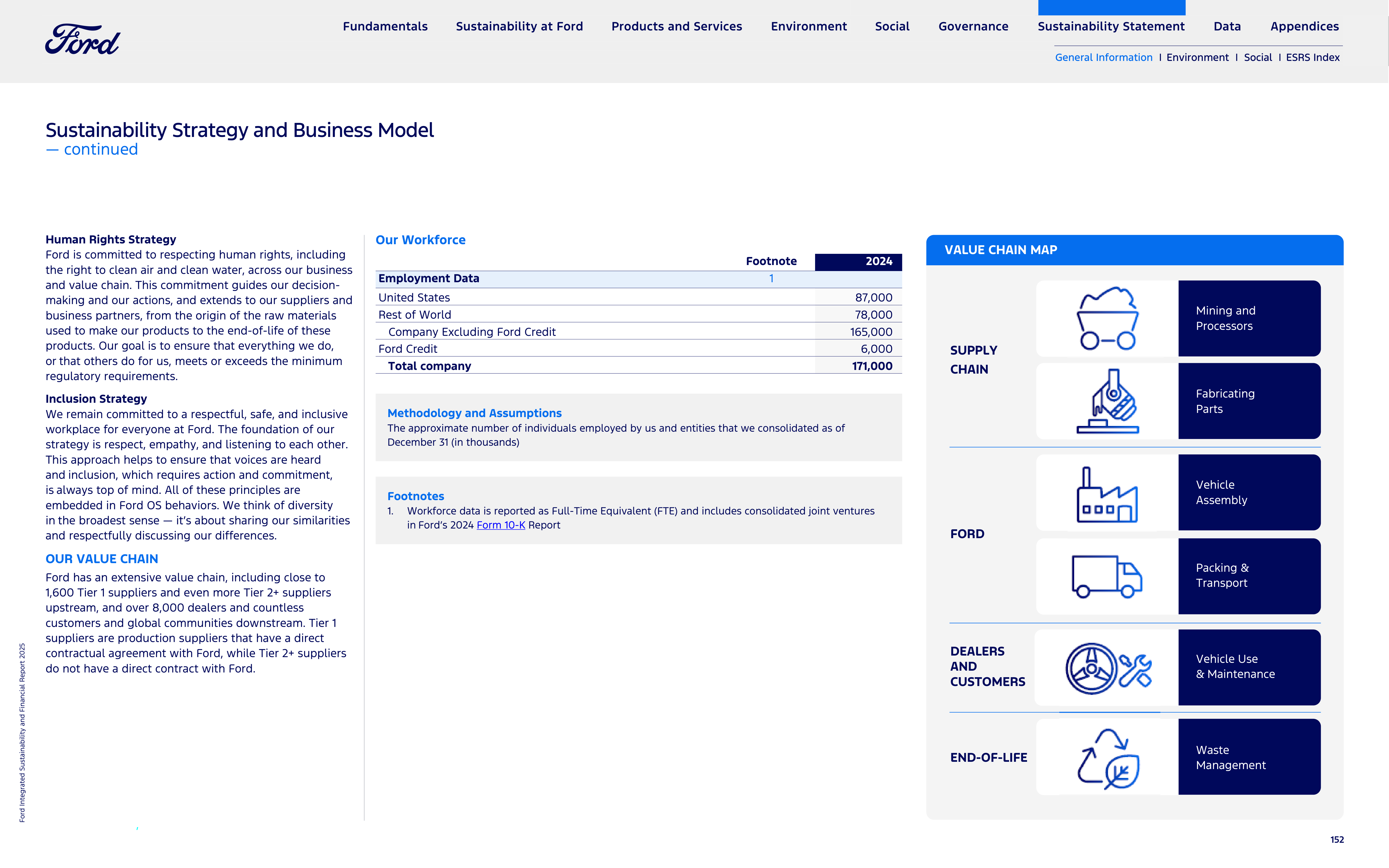


Fundamentals
Sustainability at Ford
Products and Services
Environment
Social
Governance
Sustainability Statement
Data
Appendices
|
|
|
General Information
Environment
Social
ESRS Index
Human Rights Strategy
Ford is committed to respecting human rights, including
the right to clean air and clean water, across our business
and value chain. This commitment guides our decision-
making and our actions, and extends to our suppliers and
business partners, from the origin of the raw materials
used to make our products to the end-of-life of these
products. Our goal is to ensure that everything we do,
or that others do for us, meets or exceeds the minimum
regulatory requirements.
Inclusion Strategy
We remain committed to a respectful, safe, and inclusive
workplace for everyone at Ford. The foundation of our
strategy is respect, empathy, and listening to each other.
This approach helps to ensure that voices are heard
and inclusion, which requires action and commitment,
is always top of mind. All of these principles are
embedded in Ford OS behaviors. We think of diversity
in the broadest sense — it’s about sharing our similarities
and respectfully discussing our differences.
OUR VALUE CHAIN
Ford has an extensive value chain, including close to
1,600 Tier 1 suppliers and even more Tier 2+ suppliers
upstream, and over 8,000 dealers and countless
customers and global communities downstream. Tier 1
suppliers are production suppliers that have a direct
contractual agreement with Ford, while Tier 2+ suppliers
do not have a direct contract with Ford.
Our Workforce
Footnote
2024
Employment Data
1
United States
87,000
Rest of World
78,000
Company Excluding Ford Credit
165,000
Ford Credit
6,000
Total company
171,000
Methodology and Assumptions
The approximate number of individuals employed by us and entities that we consolidated as of
December 31 (in thousands)
Footnotes
1.
Workforce data is reported as Full-Time Equivalent (FTE) and includes consolidated joint ventures
in Ford’s 2024
Form 10-K
Report
VALUE CHAIN MAP
SUPPLY
CHAIN
Mining and
Processors
Fabricating
Parts
FORD
Vehicle
Assembly
Packing &
Transport
DEALERS
AND
CUSTOMERS
Vehicle Use
& Maintenance
END-OF-LIFE
Waste
Management
Sustainability Strategy and Business Model
— continued
,
Ford Integrated Sustainability and Financial Report 2025
152
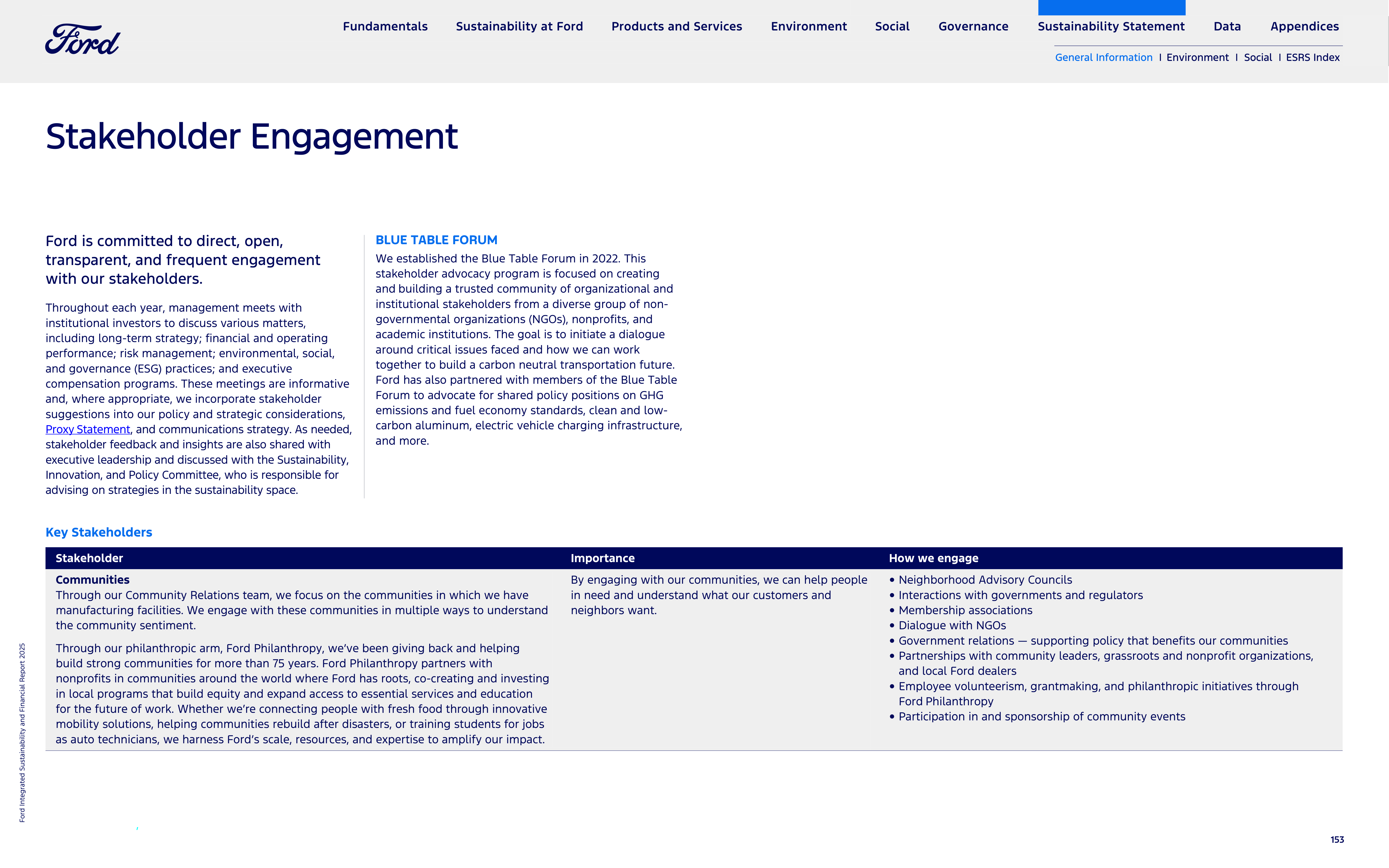

Fundamentals
Sustainability at Ford
Products and Services
Environment
Social
Governance
Sustainability Statement
Data
Appendices
|
|
|
General Information
Environment
Social
ESRS Index
Stakeholder Engagement
Ford is committed to direct, open,
transparent, and frequent engagement
with our stakeholders.
Throughout each year, management meets with
institutional investors to discuss various matters,
including long-term strategy; financial and operating
performance; risk management; environmental, social,
and governance (ESG) practices; and executive
compensation programs. These meetings are informative
and, where appropriate, we incorporate stakeholder
suggestions into our policy and strategic considerations,
Proxy Statement
, and communications strategy. As needed,
stakeholder feedback and insights are also shared with
executive leadership and discussed with the Sustainability,
Innovation, and Policy Committee, who is responsible for
advising on strategies in the sustainability space.
BLUE TABLE FORUM
We established the Blue Table Forum in 2022. This
stakeholder advocacy program is focused on creating
and building a trusted community of organizational and
institutional stakeholders from a diverse group of non-
governmental organizations (NGOs), nonprofits, and
academic institutions. The goal is to initiate a dialogue
around critical issues faced and how we can work
together to build a carbon neutral transportation future.
Ford has also partnered with members of the Blue Table
Forum to advocate for shared policy positions on GHG
emissions and fuel economy standards, clean and low-
carbon aluminum, electric vehicle charging infrastructure,
and more.
Key Stakeholders
Stakeholder
Importance
How we engage
Communities
Through our Community Relations team, we focus on the communities in which we have
manufacturing facilities. We engage with these communities in multiple ways to understand
the community sentiment.
Through our philanthropic arm, Ford Philanthropy, we’ve been giving back and helping
build strong communities for more than 75 years. Ford Philanthropy partners with
nonprofits in communities around the world where Ford has roots, co-creating and investing
in local programs that build equity and expand access to essential services and education
for the future of work. Whether we’re connecting people with fresh food through innovative
mobility solutions, helping communities rebuild after disasters, or training students for jobs
as auto technicians, we harness Ford’s scale, resources, and expertise to amplify our impact.
By engaging with our communities, we can help people
in need and understand what our customers and
neighbors want.
•
Neighborhood Advisory Councils
•
Interactions with governments and regulators
•
Membership associations
•
Dialogue with NGOs
•
Government relations — supporting policy that benefits our communities
•
Partnerships with community leaders, grassroots and nonprofit organizations,
and local Ford dealers
•
Employee volunteerism, grantmaking, and philanthropic initiatives through
Ford Philanthropy
•
Participation in and sponsorship of community events
2025
rt
l Repo
ncia
ina
F
nd
a
y
ilit
b
ina
a
ust
S
ed
t
ra
eg
Int
rd
o
F
,
153
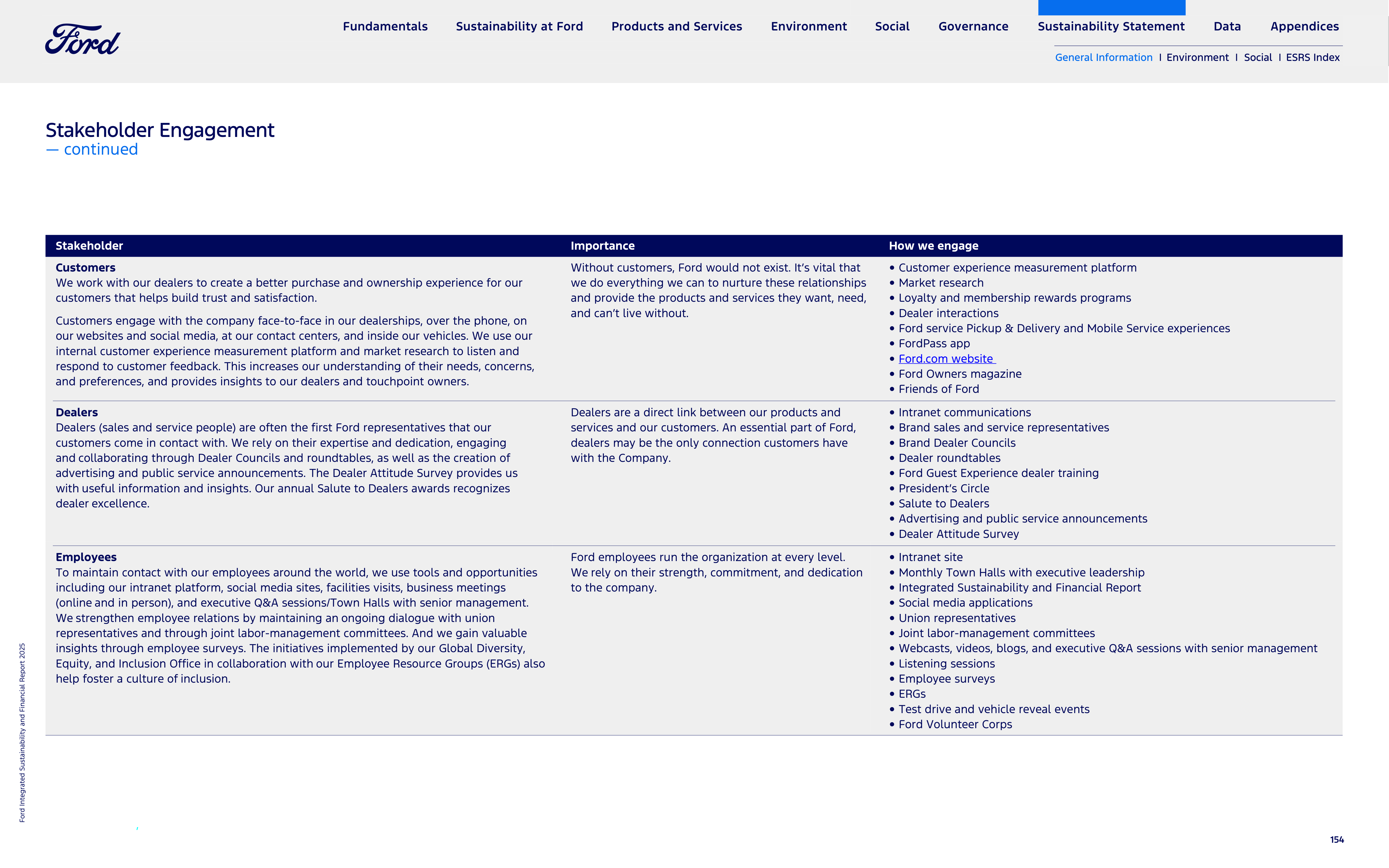

Stakeholder
Importance
How we engage
Customers
We work with our dealers to create a better purchase and ownership experience for our
customers that helps build trust and satisfaction.
Customers engage with the company face-to-face in our dealerships, over the phone, on
our websites and social media, at our contact centers, and inside our vehicles. We use our
internal customer experience measurement platform and market research to listen and
respond to customer feedback. This increases our understanding of their needs, concerns,
and preferences, and provides insights to our dealers and touchpoint owners.
Without customers, Ford would not exist. It’s vital that
we do everything we can to nurture these relationships
and provide the products and services they want, need,
and can’t live without.
•
Customer experience measurement platform
•
Market research
•
Loyalty and membership rewards programs
•
Dealer interactions
•
Ford service Pickup & Delivery and Mobile Service experiences
•
FordPass app
•
Ford.com website
•
Ford Owners magazine
•
Friends of Ford
Dealers
Dealers (sales and service people) are often the first Ford representatives that our
customers come in contact with. We rely on their expertise and dedication, engaging
and collaborating through Dealer Councils and roundtables, as well as the creation of
advertising and public service announcements. The Dealer Attitude Survey provides us
with useful information and insights. Our annual Salute to Dealers awards recognizes
dealer excellence.
Dealers are a direct link between our products and
services and our customers. An essential part of Ford,
dealers may be the only connection customers have
with the Company.
•
Intranet communications
•
Brand sales and service representatives
•
Brand Dealer Councils
•
Dealer roundtables
•
Ford Guest Experience dealer training
•
President’s Circle
•
Salute to Dealers
•
Advertising and public service announcements
•
Dealer Attitude Survey
Employees
To maintain contact with our employees around the world, we use tools and opportunities
including our intranet platform, social media sites, facilities visits, business meetings
(online and in person), and executive Q&A sessions/Town Halls with senior management.
We strengthen employee relations by maintaining an ongoing dialogue with union
representatives and through joint labor-management committees. And we gain valuable
insights through employee surveys. The initiatives implemented by our Global Diversity,
Equity, and Inclusion Office in collaboration with our Employee Resource Groups (ERGs) also
help foster a culture of inclusion.
Ford employees run the organization at every level.
We rely on their strength, commitment, and dedication
to the company.
•
Intranet site
•
Monthly Town Halls with executive leadership
•
Integrated Sustainability and Financial Report
•
Social media applications
•
Union representatives
•
Joint labor-management committees
•
Webcasts, videos, blogs, and executive Q&A sessions with senior management
•
Listening sessions
•
Employee surveys
•
ERGs
•
Test drive and vehicle reveal events
•
Ford Volunteer Corps
Fundamentals
Sustainability at Ford
Products and Services
Environment
Social
Governance
Sustainability Statement
Data
Appendices
|
|
|
General Information
Environment
Social
ESRS Index
,
154
Stakeholder Engagement
— continued
Ford Integrated Sustainability and Financial Report 2025
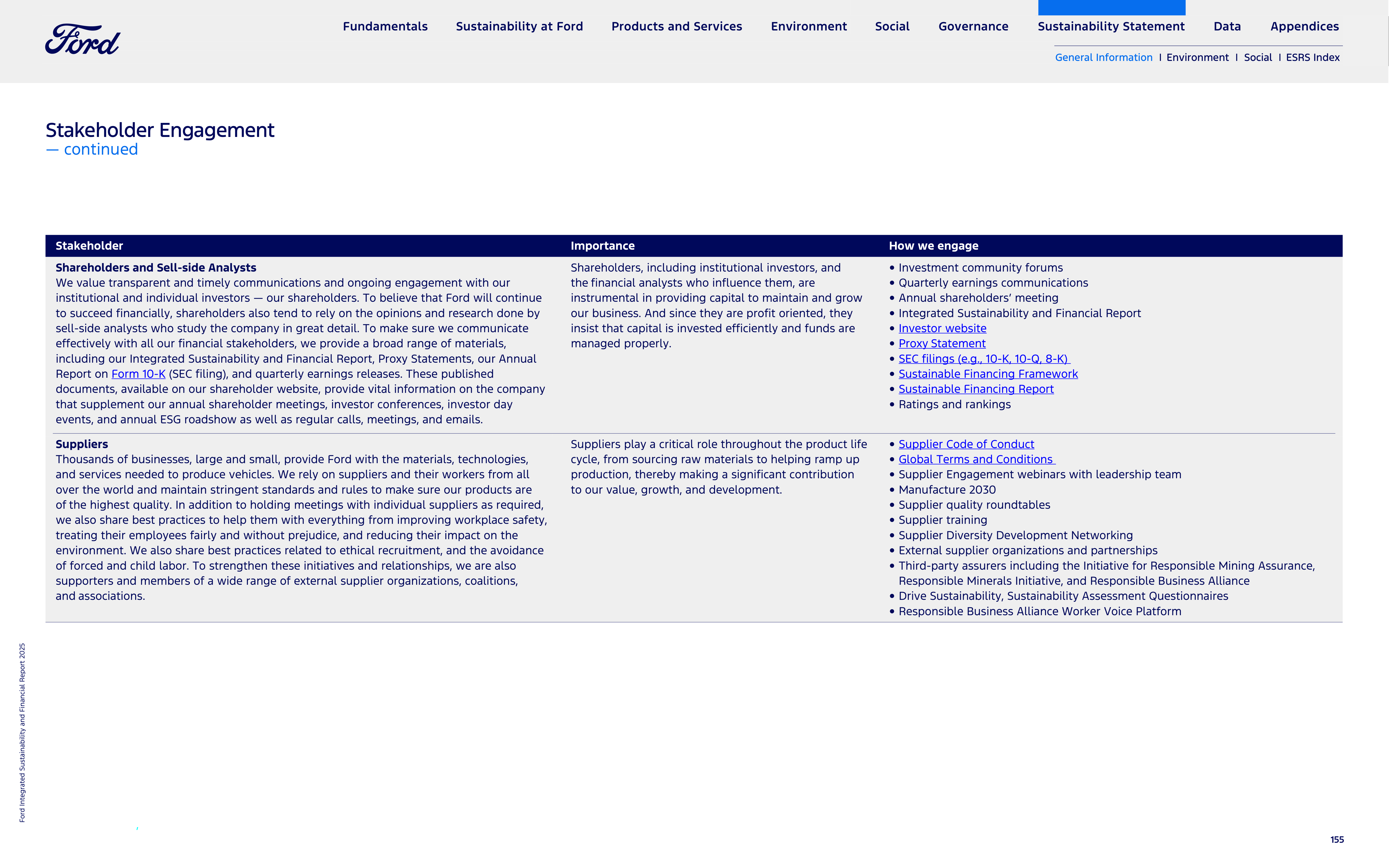

Stakeholder
Importance
How we engage
Shareholders and Sell-side Analysts
We value transparent and timely communications and ongoing engagement with our
institutional and individual investors — our shareholders. To believe that Ford will continue
to succeed financially, shareholders also tend to rely on the opinions and research done by
sell-side analysts who study the company in great detail. To make sure we communicate
effectively with all our financial stakeholders, we provide a broad range of materials,
including our Integrated Sustainability and Financial Report, Proxy Statements, our Annual
Report on
Form 10-K
(SEC filing), and quarterly earnings releases. These published
documents, available on our shareholder website, provide vital information on the company
that supplement our annual shareholder meetings, investor conferences, investor day
events, and annual ESG roadshow as well as regular calls, meetings, and emails.
Shareholders, including institutional investors, and
the financial analysts who influence them, are
instrumental in providing capital to maintain and grow
our business. And since they are profit oriented, they
insist that capital is invested efficiently and funds are
managed properly.
•
Investment community forums
•
Quarterly earnings communications
•
Annual shareholders’ meeting
•
Integrated Sustainability and Financial Report
•
Investor website
•
Proxy Statement
•
SEC filings (e.g., 10-K, 10-Q, 8-K)
•
Sustainable Financing Framework
•
Sustainable Financing Report
•
Ratings and rankings
Suppliers
Thousands of businesses, large and small, provide Ford with the materials, technologies,
and services needed to produce vehicles. We rely on suppliers and their workers from all
over the world and maintain stringent standards and rules to make sure our products are
of the highest quality. In addition to holding meetings with individual suppliers as required,
we also share best practices to help them with everything from improving workplace safety,
treating their employees fairly and without prejudice, and reducing their impact on the
environment. We also share best practices related to ethical recruitment, and the avoidance
of forced and child labor. To strengthen these initiatives and relationships, we are also
supporters and members of a wide range of external supplier organizations, coalitions,
and associations.
Suppliers play a critical role throughout the product life
cycle, from sourcing raw materials to helping ramp up
production, thereby making a significant contribution
to our value, growth, and development.
•
Supplier Code of Conduct
•
Global Terms and Conditions
•
Supplier Engagement webinars with leadership team
•
Manufacture 2030
•
Supplier quality roundtables
•
Supplier training
•
Supplier Diversity Development Networking
•
External supplier organizations and partnerships
•
Third-party assurers including the Initiative for Responsible Mining Assurance,
Responsible Minerals Initiative, and Responsible Business Alliance
•
Drive Sustainability, Sustainability Assessment Questionnaires
•
Responsible Business Alliance Worker Voice Platform
Fundamentals
Sustainability at Ford
Products and Services
Environment
Social
Governance
Sustainability Statement
Data
Appendices
|
|
|
General Information
Environment
Social
ESRS Index
Stakeholder Engagement
— continued
,
Ford Integrated Sustainability and Financial Report 2025
155
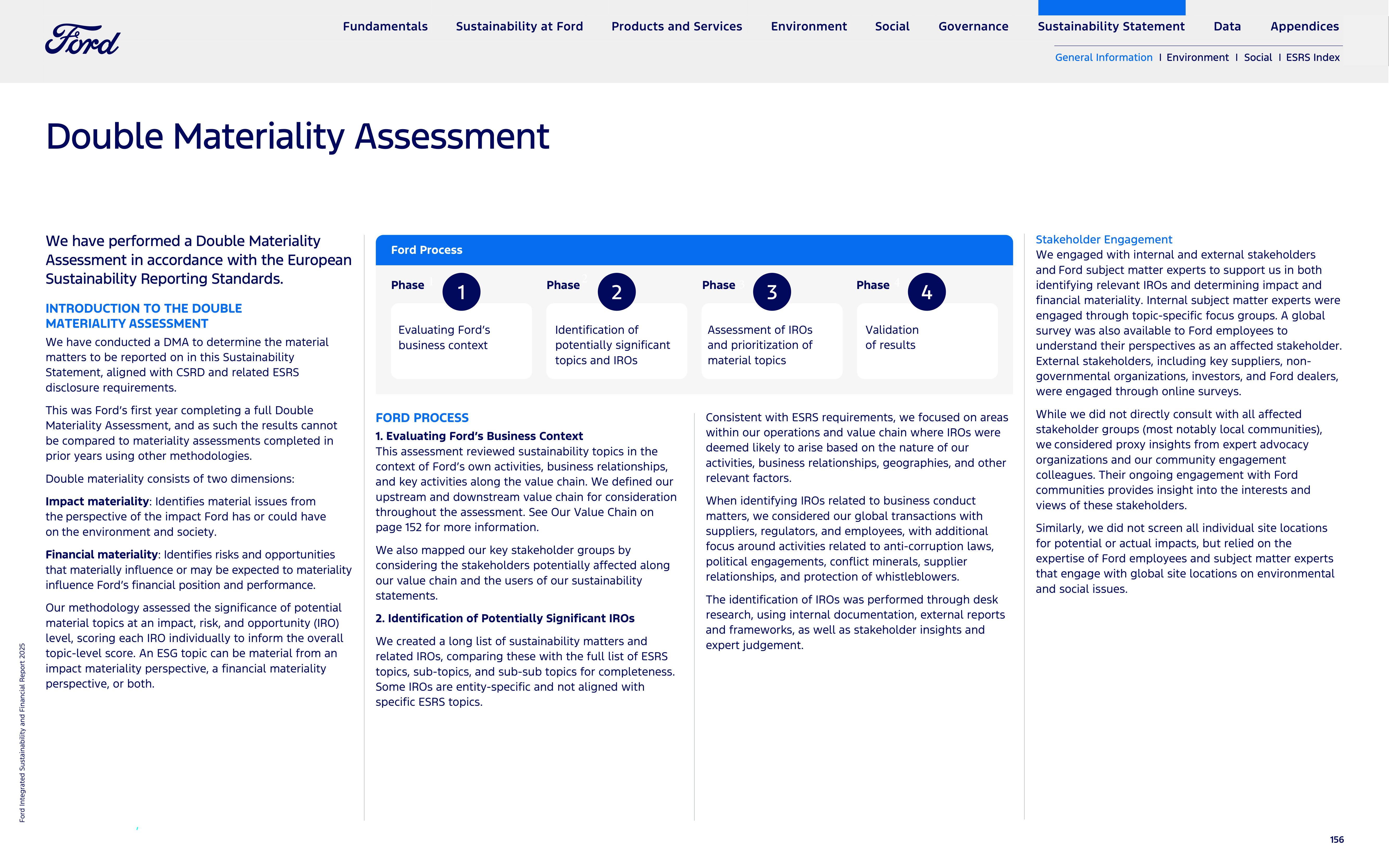

Fundamentals
Sustainability at Ford
Products and Services
Environment
Social
Governance
Sustainability Statement
Data
Appendices
|
|
|
General Information
Environment
Social
ESRS Index
Double Materiality Assessment
We have performed a Double Materiality
Assessment in accordance with the European
Sustainability Reporting Standards.
INTRODUCTION TO THE DOUBLE
MATERIALITY ASSESSMENT
We have conducted a DMA to determine the material
matters to be reported on in this Sustainability
Statement, aligned with CSRD and related ESRS
disclosure requirements.
This was Ford’s first year completing a full Double
Materiality Assessment, and as such the results cannot
be compared to materiality assessments completed in
prior years using other methodologies.
Double materiality consists of two dimensions:
Impact materiality
: Identifies material issues from
the perspective of the impact Ford has or could have
on the environment and society.
Financial materiality
: Identifies risks and opportunities
that materially influence or may be expected to materiality
influence Ford’s financial position and performance.
Our methodology assessed the significance of potential
material topics at an impact, risk, and opportunity (IRO)
level, scoring each IRO individually to inform the overall
topic-level score. An ESG topic can be material from an
impact materiality perspective, a financial materiality
perspective, or both.
Ford Process
Phase
1
Evaluating Ford’s
business context
Phase
2
Identification of
potentially significant
topics and IROs
Phase
3
Assessment of IROs
and prioritization of
material topics
Phase
4
Validation
of results
FORD PROCESS
1. Evaluating Ford’s Business Context
This assessment reviewed sustainability topics in the
context of Ford’s own activities, business relationships,
and key activities along the value chain. We defined our
upstream and downstream value chain for consideration
throughout the assessment. See Our Value Chain on
page 152 for more information.
We also mapped our key stakeholder groups by
considering the stakeholders potentially affected along
our value chain and the users of our sustainability
statements.
2. Identification of Potentially Significant IROs
We created a long list of sustainability matters and
related IROs, comparing these with the full list of ESRS
topics, sub-topics, and sub-sub topics for completeness.
Some IROs are entity-specific and not aligned with
specific ESRS topics.
Consistent with ESRS requirements, we focused on areas
within our operations and value chain where IROs were
deemed likely to arise based on the nature of our
activities, business relationships, geographies, and other
relevant factors.
When identifying IROs related to business conduct
matters, we considered our global transactions with
suppliers, regulators, and employees, with additional
focus around activities related to anti-corruption laws,
political engagements, conflict minerals, supplier
relationships, and protection of whistleblowers.
The identification of IROs was performed through desk
research, using internal documentation, external reports
and frameworks, as well as stakeholder insights and
expert judgement.
Stakeholder Engagement
We engaged with internal and external stakeholders
and Ford subject matter experts to support us in both
identifying relevant IROs and determining impact and
financial materiality. Internal subject matter experts were
engaged through topic-specific focus groups. A global
survey was also available to Ford employees to
understand their perspectives as an affected stakeholder.
External stakeholders, including key suppliers, non-
governmental organizations, investors, and Ford dealers,
were engaged through online surveys.
While we did not directly consult with all affected
stakeholder groups (most notably local communities),
we considered proxy insights from expert advocacy
organizations and our community engagement
colleagues. Their ongoing engagement with Ford
communities provides insight into the interests and
views of these stakeholders.
Similarly, we did not screen all individual site locations
for potential or actual impacts, but relied on the
expertise of Ford employees and subject matter experts
that engage with global site locations on environmental
and social issues.
,
Ford Integrated Sustainability and Financial Report 2025
156
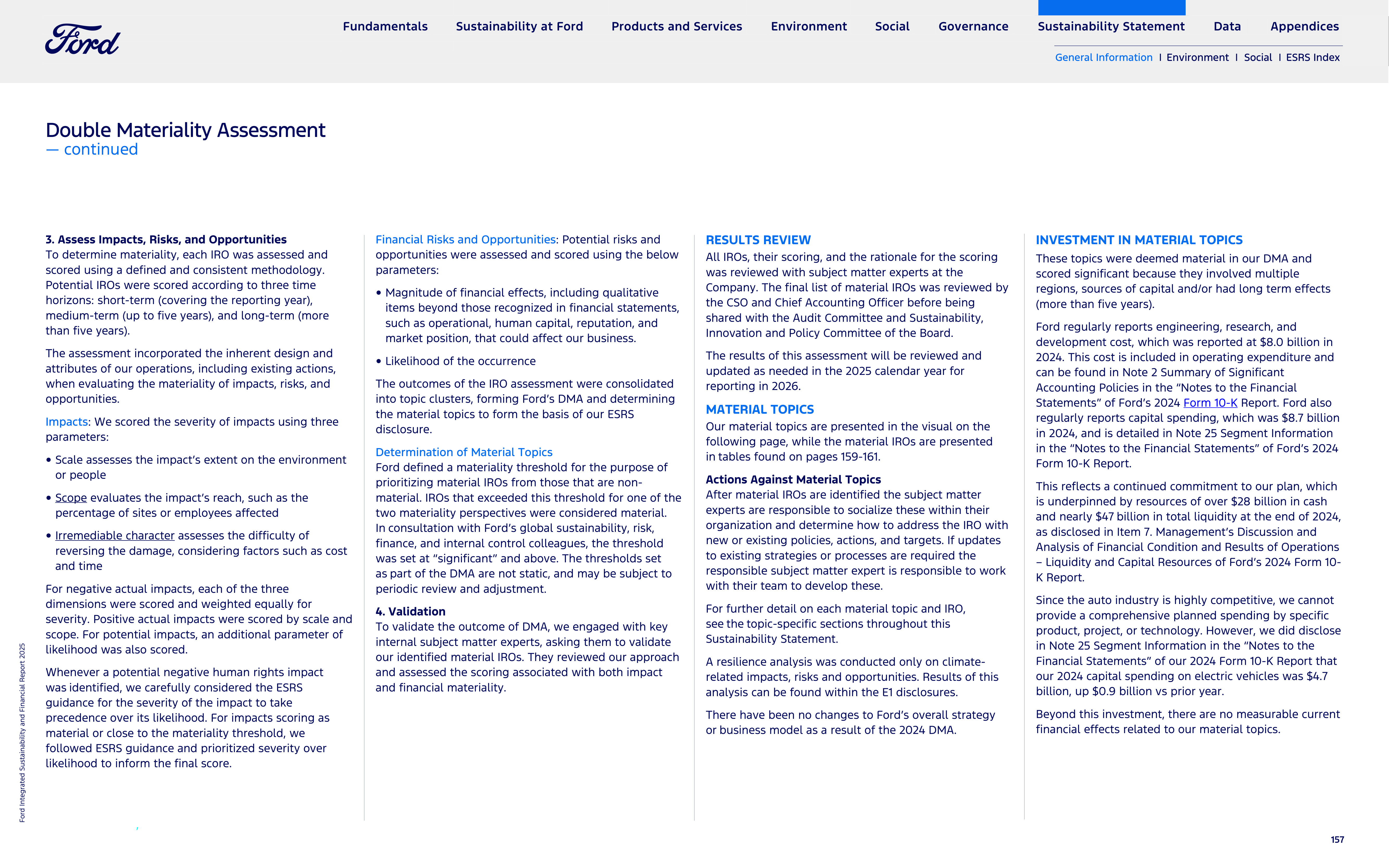

Fundamentals
Sustainability at Ford
Products and Services
Environment
Social
Governance
Sustainability Statement
Data
Appendices
|
|
|
General Information
Environment
Social
ESRS Index
3. Assess Impacts, Risks, and Opportunities
To determine materiality, each IRO was assessed and
scored using a defined and consistent methodology.
Potential IROs were scored according to three time
horizons: short-term (covering the reporting year),
medium-term (up to five years), and long-term (more
than five years).
The assessment incorporated the inherent design and
attributes of our operations, including existing actions,
when evaluating the materiality of impacts, risks, and
opportunities.
Impacts
: We scored the severity of impacts using three
parameters:
•
Scale assesses the impact’s extent on the environment
or people
•
Scope evaluates the impact’s reach, such as the
percentage of sites or employees affected
•
Irremediable character assesses the difficulty of
reversing the damage, considering factors such as cost
and time
For negative actual impacts, each of the three
dimensions were scored and weighted equally for
severity. Positive actual impacts were scored by scale and
scope. For potential impacts, an additional parameter of
likelihood was also scored.
Whenever a potential negative human rights impact
was identified, we carefully considered the ESRS
guidance for the severity of the impact to take
precedence over its likelihood. For impacts scoring as
material or close to the materiality threshold, we
followed ESRS guidance and prioritized severity over
likelihood to inform the final score.
Financial Risks and Opportunities
: Potential risks and
opportunities were assessed and scored using the below
parameters:
•
Magnitude of financial effects, including qualitative
items beyond those recognized in financial statements,
such as operational, human capital, reputation, and
market position, that could affect our business.
•
Likelihood of the occurrence
The outcomes of the IRO assessment were consolidated
into topic clusters, forming Ford’s DMA and determining
the material topics to form the basis of our ESRS
disclosure.
Determination of Material Topics
Ford defined a materiality threshold for the purpose of
prioritizing material IROs from those that are non-
material. IROs that exceeded this threshold for one of the
two materiality perspectives were considered material.
In consultation with Ford’s global sustainability, risk,
finance, and internal control colleagues, the threshold
was set at “significant” and above. The thresholds set
as part of the DMA are not static, and may be subject to
periodic review and adjustment.
4. Validation
To validate the outcome of DMA, we engaged with key
internal subject matter experts, asking them to validate
our identified material IROs. They reviewed our approach
and assessed the scoring associated with both impact
and financial materiality.
RESULTS REVIEW
All IROs, their scoring, and the rationale for the scoring
was reviewed with subject matter experts at the
Company. The final list of material IROs was reviewed by
the CSO and Chief Accounting Officer before being
shared with the Audit Committee and Sustainability,
Innovation and Policy Committee of the Board.
The results of this assessment will be reviewed and
updated as needed in the 2025 calendar year for
reporting in 2026.
MATERIAL TOPICS
Our material topics are presented in the visual on the
following page, while the material IROs are presented
in tables found on pages 159-161.
Actions Against Material Topics
After material IROs are identified the subject matter
experts are responsible to socialize these within their
organization and determine how to address the IRO with
new or existing policies, actions, and targets. If updates
to existing strategies or processes are required the
responsible subject matter expert is responsible to work
with their team to develop these.
For further detail on each material topic and IRO,
see the topic-specific sections throughout this
Sustainability Statement.
A resilience analysis was conducted only on climate-
related impacts, risks and opportunities. Results of this
analysis can be found within the E1 disclosures.
There have been no changes to Ford’s overall strategy
or business model as a result of the 2024 DMA.
INVESTMENT IN MATERIAL TOPICS
These topics were deemed material in our DMA and
scored significant because they involved multiple
regions, sources of capital and/or had long term effects
(more than five years).
Ford regularly reports engineering, research, and
development cost, which was reported at $8.0 billion in
2024. This cost is included in operating expenditure and
can be found in Note 2 Summary of Significant
Accounting Policies in the “Notes to the Financial
Statements” of Ford’s 2024
Form 10-K
Report. Ford also
regularly reports capital spending, which was $8.7 billion
in 2024, and is detailed in Note 25 Segment Information
in the “Notes to the Financial Statements” of Ford’s 2024
Form 10-K Report.
This reflects a continued commitment to our plan, which
is underpinned by resources of over $28 billion in cash
and nearly $47 billion in total liquidity at the end of 2024,
as disclosed in Item 7. Management’s Discussion and
Analysis of Financial Condition and Results of Operations
– Liquidity and Capital Resources of Ford’s 2024 Form 10-
K Report.
Since the auto industry is highly competitive, we cannot
provide a comprehensive planned spending by specific
product, project, or technology. However, we did disclose
in Note 25 Segment Information in the “Notes to the
Financial Statements” of our 2024 Form 10-K Report that
our 2024 capital spending on electric vehicles was $4.7
billion, up $0.9 billion vs prior year.
Beyond this investment, there are no measurable current
financial effects related to our material topics.
Double Materiality Assessment
— continued
,
Ford Integrated Sustainability and Financial Report 2025
157
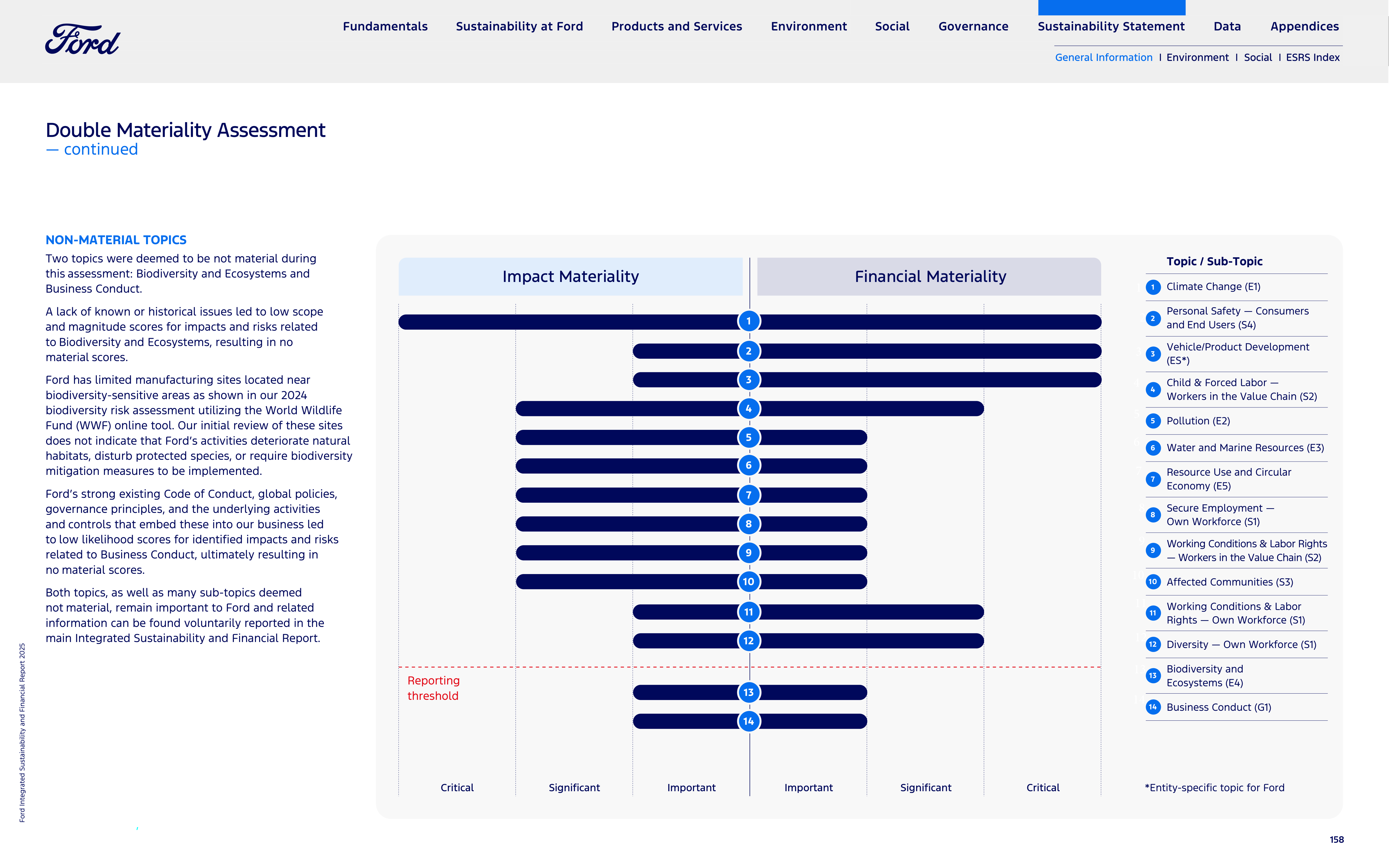

Fundamentals
Sustainability at Ford
Products and Services
Environment
Social
Governance
Sustainability Statement
Data
Appendices
|
|
|
General Information
Environment
Social
ESRS Index
NON-MATERIAL TOPICS
Two topics were deemed to be not material during
this assessment: Biodiversity and Ecosystems and
Business Conduct.
A lack of known or historical issues led to low scope
and magnitude scores for impacts and risks related
to Biodiversity and Ecosystems, resulting in no
material scores.
Ford has limited manufacturing sites located near
biodiversity-sensitive areas as shown in our 2024
biodiversity risk assessment utilizing the World Wildlife
Fund (WWF) online tool. Our initial review of these sites
does not indicate that Ford’s activities deteriorate natural
habitats, disturb protected species, or require biodiversity
mitigation measures to be implemented.
Ford’s strong existing Code of Conduct, global policies,
governance principles, and the underlying activities
and controls that embed these into our business led
to low likelihood scores for identified impacts and risks
related to Business Conduct, ultimately resulting in
no material scores.
Both topics, as well as many sub-topics deemed
not material, remain important to Ford and related
information can be found voluntarily reported in the
main Integrated Sustainability and Financial Report.
Impact Materiality
Financial Materiality
Reporting
threshold
Critical
Significant
Important
Important
Significant
Critical
Topic / Sub-Topic
1
Climate Change (E1)
2
Personal Safety — Consumers
and End Users (S4)
3
Vehicle/Product Development
(ES*)
4
Child & Forced Labor —
Workers in the Value Chain (S2)
5
Pollution (E2)
6
Water and Marine Resources (E3)
7
Resource Use and Circular
Economy (E5)
8
Secure Employment —
Own Workforce (S1)
9
Working Conditions & Labor Rights
— Workers in the Value Chain (S2)
10
Affected Communities (S3)
11
Working Conditions & Labor
Rights — Own Workforce (S1)
12
Diversity — Own Workforce (S1)
13
Biodiversity and
Ecosystems (E4)
14
Business Conduct (G1)
*Entity-specific topic for Ford
Double Materiality Assessment
— continued
,
Ford Integrated Sustainability and Financial Report 2025
158
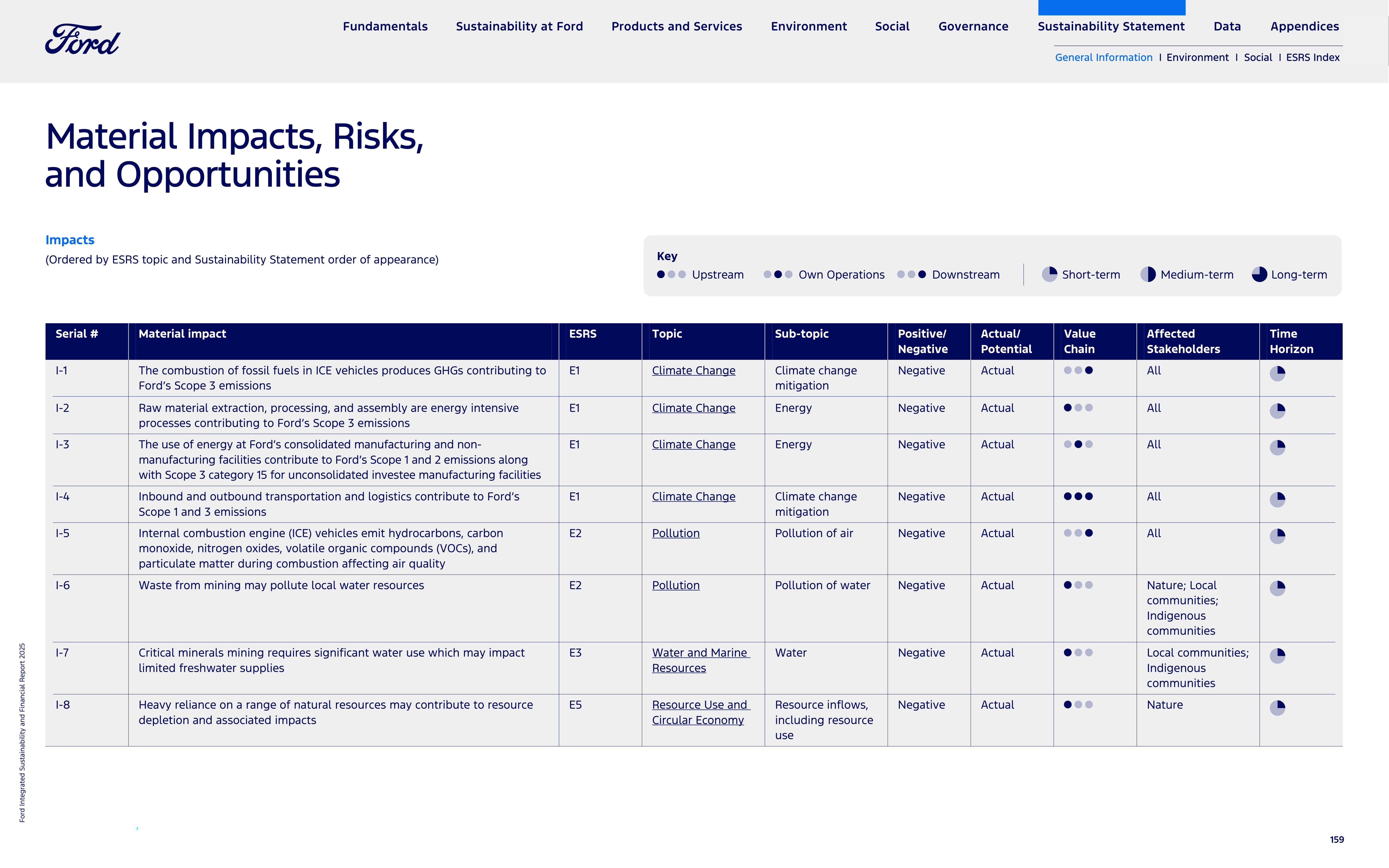

Fundamentals
Sustainability at Ford
Products and Services
Environment
Social
Governance
Sustainability Statement
Data
Appendices
|
|
|
General Information
Environment
Social
ESRS Index
Material Impacts, Risks,
and Opportunities
Impacts
(Ordered by ESRS topic and Sustainability Statement order of appearance)
Key
Upstream
Own Operations
Downstream
Short-term
Medium-term
Long-term
Serial #
Material impact
ESRS
Topic
Sub-topic
Positive/
Negative
Actual/
Potential
Value
Chain
Affected
Stakeholders
Time
Horizon
I-1
The combustion of fossil fuels in ICE vehicles produces GHGs contributing to
Ford’s Scope 3 emissions
E1
Climate Change
Climate change
mitigation
Negative
Actual
All
I-2
Raw material extraction, processing, and assembly are energy intensive
processes contributing to Ford’s Scope 3 emissions
E1
Climate Change
Energy
Negative
Actual
All
I-3
The use of energy at Ford’s consolidated manufacturing and non-
manufacturing facilities contribute to Ford’s Scope 1 and 2 emissions along
with Scope 3 category 15 for unconsolidated investee manufacturing facilities
E1
Climate Change
Energy
Negative
Actual
All
I-4
Inbound and outbound transportation and logistics contribute to Ford’s
Scope 1 and 3 emissions
E1
Climate Change
Climate change
mitigation
Negative
Actual
All
I-5
Internal combustion engine (ICE) vehicles emit hydrocarbons, carbon
monoxide, nitrogen oxides, volatile organic compounds (VOCs), and
particulate matter during combustion affecting air quality
E2
Pollution
Pollution of air
Negative
Actual
All
I-6
Waste from mining may pollute local water resources
E2
Pollution
Pollution of water
Negative
Actual
Nature; Local
communities;
Indigenous
communities
I-7
Critical minerals mining requires significant water use which may impact
limited freshwater supplies
E3
Water and Marine
Resources
Water
Negative
Actual
Local communities;
Indigenous
communities
I-8
Heavy reliance on a range of natural resources may contribute to resource
depletion and associated impacts
E5
Resource Use and
Circular Economy
Resource inflows,
including resource
use
Negative
Actual
Nature
2025
rt
o
l Rep
ncia
ina
F
nd
a
y
ilit
b
ina
a
ust
S
ed
t
ra
eg
Int
rd
o
F
,
159
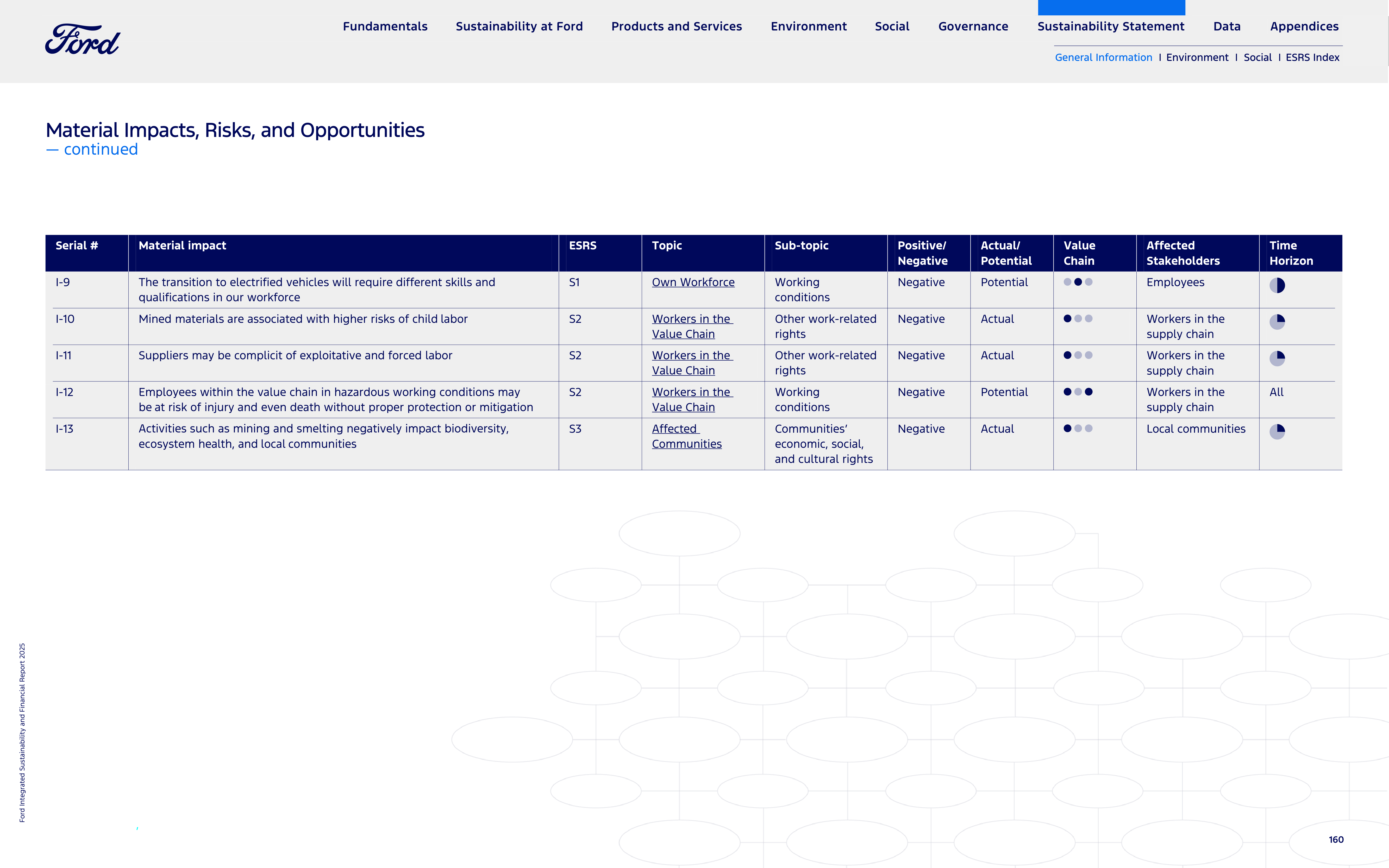


Serial #
Material impact
ESRS
Topic
Sub-topic
Positive/
Negative
Actual/
Potential
Value
Chain
Affected
Stakeholders
Time
Horizon
I-9
The transition to electrified vehicles will require different skills and
qualifications in our workforce
S1
Own Workforce
Working
conditions
Negative
Potential
Employees
I-10
Mined materials are associated with higher risks of child labor
S2
Workers in the
Value Chain
Other work-related
rights
Negative
Actual
Workers in the
supply chain
I-11
Suppliers may be complicit of exploitative and forced labor
S2
Workers in the
Value Chain
Other work-related
rights
Negative
Actual
Workers in the
supply chain
I-12
Employees within the value chain in hazardous working conditions may
be at risk of injury and even death without proper protection or mitigation
S2
Workers in the
Value Chain
Working
conditions
Negative
Potential
Workers in the
supply chain
All
I-13
Activities such as mining and smelting negatively impact biodiversity,
ecosystem health, and local communities
S3
Affected
Communities
Communities’
economic, social,
and cultural rights
Negative
Actual
Local communities
Fundamentals
Sustainability at Ford
Products and Services
Environment
Social
Governance
Sustainability Statement
Data
Appendices
|
|
|
General Information
Environment
Social
ESRS Index
Material Impacts, Risks, and Opportunities
— continued
,
Ford Integrated Sustainability and Financial Report 2025
160
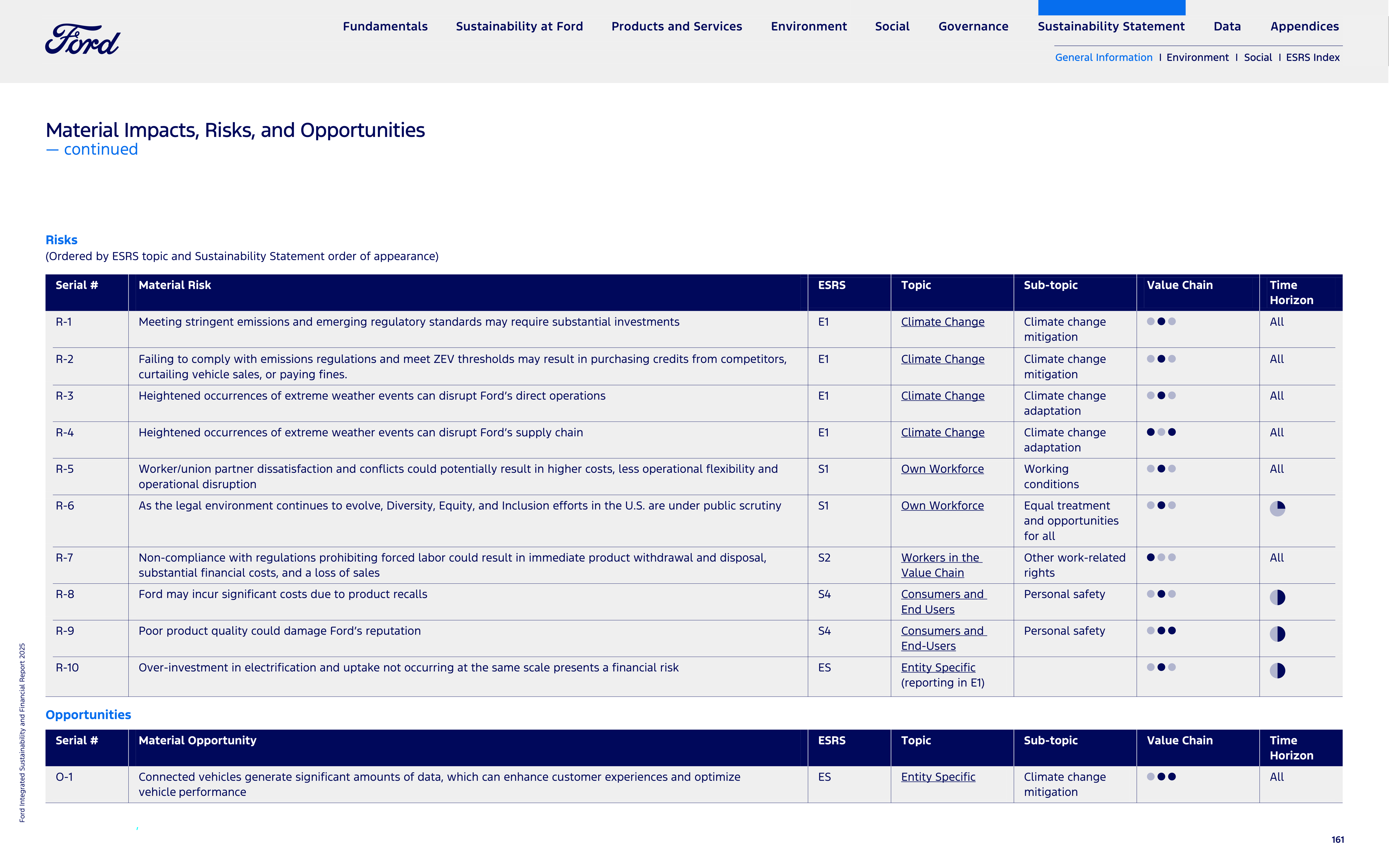

Fundamentals
Sustainability at Ford
Products and Services
Environment
Social
Governance
Sustainability Statement
Data
Appendices
|
|
|
General Information
Environment
Social
ESRS Index
Risks
(Ordered by ESRS topic and Sustainability Statement order of appearance)
Serial #
Material Risk
ESRS
Topic
Sub-topic
Value Chain
Time
Horizon
R-1
Meeting stringent emissions and emerging regulatory standards may require substantial investments
E1
Climate Change
Climate change
mitigation
All
R-2
Failing to comply with emissions regulations and meet ZEV thresholds may result in purchasing credits from competitors,
curtailing vehicle sales, or paying fines.
E1
Climate Change
Climate change
mitigation
All
R-3
Heightened occurrences of extreme weather events can disrupt Ford’s direct operations
E1
Climate Change
Climate change
adaptation
All
R-4
Heightened occurrences of extreme weather events can disrupt Ford’s supply chain
E1
Climate Change
Climate change
adaptation
All
R-5
Worker/union partner dissatisfaction and conflicts could potentially result in higher costs, less operational flexibility and
operational disruption
S1
Own Workforce
Working
conditions
All
R-6
As the legal environment continues to evolve, Diversity, Equity, and Inclusion efforts in the U.S. are under public scrutiny
S1
Own Workforce
Equal treatment
and opportunities
for all
R-7
Non-compliance with regulations prohibiting forced labor could result in immediate product withdrawal and disposal,
substantial financial costs, and a loss of sales
S2
Workers in the
Value Chain
Other work-related
rights
All
R-8
Ford may incur significant costs due to product recalls
S4
Consumers and
End Users
Personal safety
R-9
Poor product quality could damage Ford’s reputation
S4
Consumers and
End-Users
Personal safety
R-10
Over-investment in electrification and uptake not occurring at the same scale presents a financial risk
ES
Entity Specific
(reporting in E1)
Opportunities
Serial #
Material Opportunity
ESRS
Topic
Sub-topic
Value Chain
Time
Horizon
O-1
Connected vehicles generate significant amounts of data, which can enhance customer experiences and optimize
vehicle performance
ES
Entity Specific
Climate change
mitigation
All
Material Impacts, Risks, and Opportunities
— continued
2025
rt
o
l Rep
ncia
ina
F
nd
a
y
ilit
b
ina
a
ust
S
ed
t
ra
eg
Int
rd
o
F
,
161
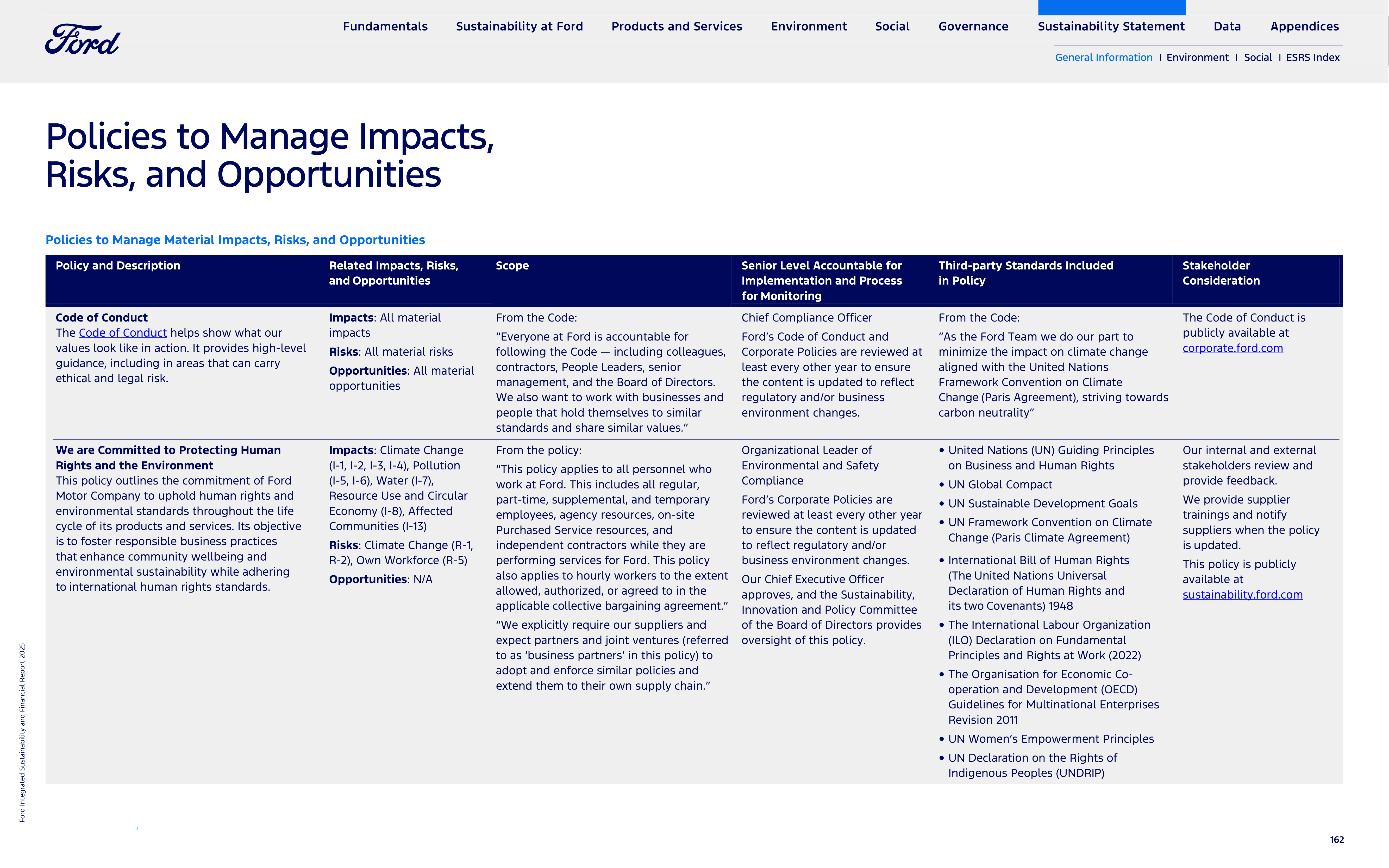

Fundamentals
Sustainability at Ford
Products and Services
Environment
Social
Governance
Sustainability Statement
Data
Appendices
|
|
|
General Information
Environment
Social
ESRS Index
Policies to Manage Impacts,
Risks, and Opportunities
Policies to Manage Material Impacts, Risks, and Opportunities
Policy and Description
Related Impacts, Risks,
and Opportunities
Scope
Senior Level Accountable for
Implementation and Process
for Monitoring
Third-party Standards Included
in Policy
Stakeholder
Consideration
Code of Conduct
The
Code of Conduct
helps show what our
values look like in action. It provides high-level
guidance, including in areas that can carry
ethical and legal risk.
Impacts
: All material
impacts
Risks
: All material risks
Opportunities
: All material
opportunities
From the Code:
“Everyone at Ford is accountable for
following the Code — including colleagues,
contractors, People Leaders, senior
management, and the Board of Directors.
We also want to work with businesses and
people that hold themselves to similar
standards and share similar values.”
Chief Compliance Officer
Ford’s Code of Conduct and
Corporate Policies are reviewed at
least every other year to ensure
the content is updated to reflect
regulatory and/or business
environment changes.
From the Code:
“As the Ford Team we do our part to
minimize the impact on climate change
aligned with the United Nations
Framework Convention on Climate
Change (Paris Agreement), striving towards
carbon neutrality”
The Code of Conduct is
publicly available at
corporate.ford.com
We are Committed to Protecting Human
Rights and the Environment
This policy outlines the commitment of Ford
Motor Company to uphold human rights and
environmental standards throughout the life
cycle of its products and services. Its objective
is to foster responsible business practices
that enhance community wellbeing and
environmental sustainability while adhering
to international human rights standards.
Impacts
: Climate Change
(I-1, I-2, I-3, I-4), Pollution
(I-5, I-6), Water (I-7),
Resource Use and Circular
Economy (I-8), Affected
Communities (I-13)
Risks
: Climate Change (R-1,
R-2), Own Workforce (R-5)
Opportunities
: N/A
From the policy:
“This policy applies to all personnel who
work at Ford. This includes all regular,
part-time, supplemental, and temporary
employees, agency resources, on-site
Purchased Service resources, and
independent contractors while they are
performing services for Ford. This policy
also applies to hourly workers to the extent
allowed, authorized, or agreed to in the
applicable collective bargaining agreement.”
“We explicitly require our suppliers and
expect partners and joint ventures (referred
to as ‘business partners’ in this policy) to
adopt and enforce similar policies and
extend them to their own supply chain.”
Organizational Leader of
Environmental and Safety
Compliance
Ford’s Corporate Policies are
reviewed at least every other year
to ensure the content is updated
to reflect regulatory and/or
business environment changes.
Our Chief Executive Officer
approves, and the Sustainability,
Innovation and Policy Committee
of the Board of Directors provides
oversight of this policy.
•
United Nations (UN) Guiding Principles
on Business and Human Rights
•
UN Global Compact
•
UN Sustainable Development Goals
•
UN Framework Convention on Climate
Change (Paris Climate Agreement)
•
International Bill of Human Rights
(The United Nations Universal
Declaration of Human Rights and
its two Covenants) 1948
•
The International Labour Organization
(ILO) Declaration on Fundamental
Principles and Rights at Work (2022)
•
The Organisation for Economic Co-
operation and Development (OECD)
Guidelines for Multinational Enterprises
Revision 2011
•
UN Women’s Empowerment Principles
•
UN Declaration on the Rights of
Indigenous Peoples (UNDRIP)
Our internal and external
stakeholders review and
provide feedback.
We provide supplier
trainings and notify
suppliers when the policy
is updated.
This policy is publicly
available at
sustainability.ford.com
,
Ford Integrated Sustainability and Financial Report 2025
162
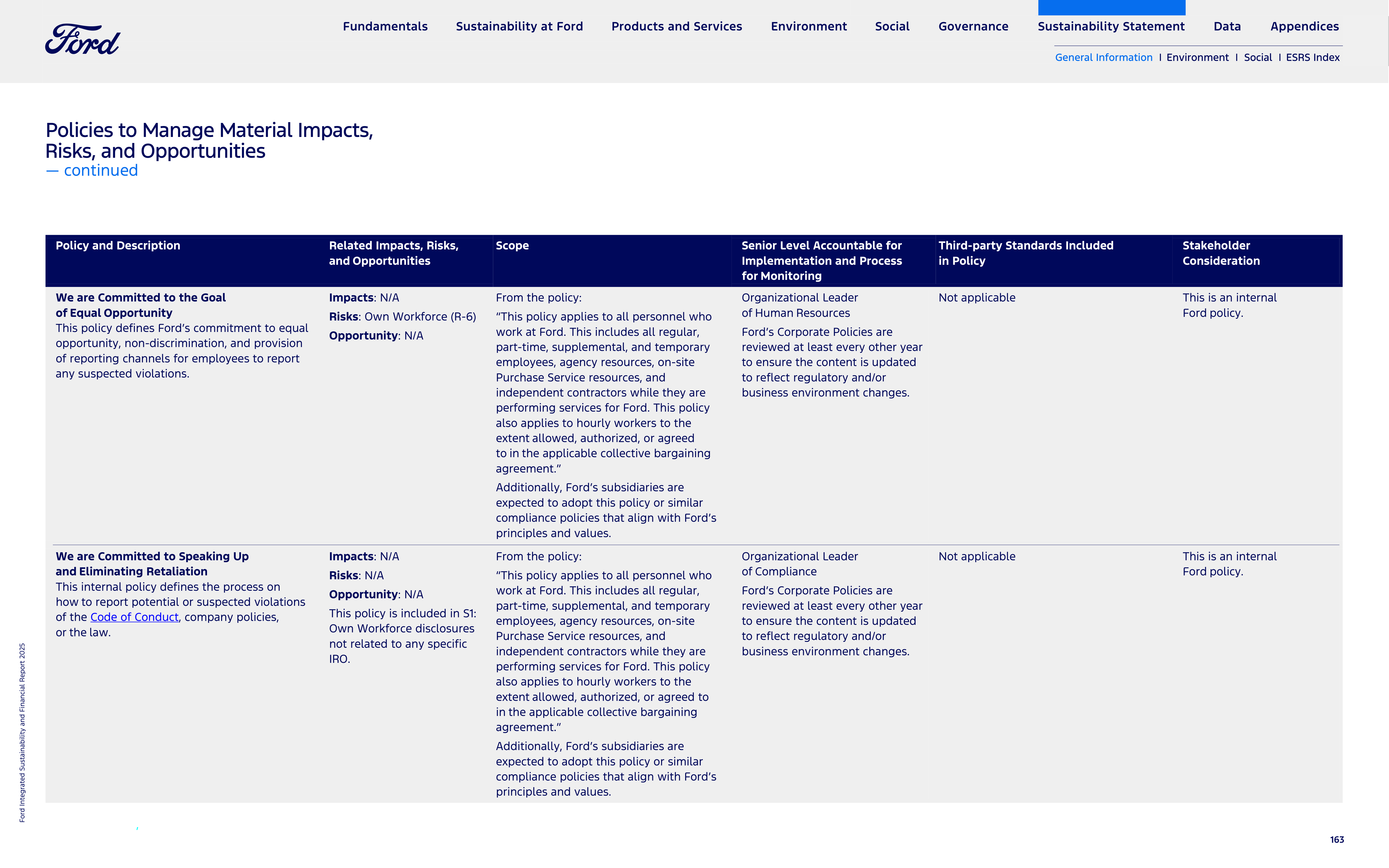

Policy and Description
Related Impacts, Risks,
and Opportunities
Scope
Senior Level Accountable for
Implementation and Process
for Monitoring
Third-party Standards Included
in Policy
Stakeholder
Consideration
We are Committed to the Goal
of Equal Opportunity
This policy defines Ford’s commitment to equal
opportunity, non-discrimination, and provision
of reporting channels for employees to report
any suspected violations.
Impacts
: N/A
Risks
: Own Workforce (R-6)
Opportunity
: N/A
From the policy:
“This policy applies to all personnel who
work at Ford. This includes all regular,
part-time, supplemental, and temporary
employees, agency resources, on-site
Purchase Service resources, and
independent contractors while they are
performing services for Ford. This policy
also applies to hourly workers to the
extent allowed, authorized, or agreed
to in the applicable collective bargaining
agreement.”
Additionally, Ford’s subsidiaries are
expected to adopt this policy or similar
compliance policies that align with Ford’s
principles and values.
Organizational Leader
of Human Resources
Ford’s Corporate Policies are
reviewed at least every other year
to ensure the content is updated
to reflect regulatory and/or
business environment changes.
Not applicable
This is an internal
Ford policy.
We are Committed to Speaking Up
and Eliminating Retaliation
This internal policy defines the process on
how to report potential or suspected violations
of the
Code of Conduct
, company policies,
or the law.
Impacts
: N/A
Risks
: N/A
Opportunity
: N/A
This policy is included in S1:
Own Workforce disclosures
not related to any specific
IRO.
From the policy:
“This policy applies to all personnel who
work at Ford. This includes all regular,
part-time, supplemental, and temporary
employees, agency resources, on-site
Purchase Service resources, and
independent contractors while they are
performing services for Ford. This policy
also applies to hourly workers to the
extent allowed, authorized, or agreed to
in the applicable collective bargaining
agreement.”
Additionally, Ford’s subsidiaries are
expected to adopt this policy or similar
compliance policies that align with Ford’s
principles and values.
Organizational Leader
of Compliance
Ford’s Corporate Policies are
reviewed at least every other year
to ensure the content is updated
to reflect regulatory and/or
business environment changes.
Not applicable
This is an internal
Ford policy.
Fundamentals
Sustainability at Ford
Products and Services
Environment
Social
Governance
Sustainability Statement
Data
Appendices
|
|
|
General Information
Environment
Social
ESRS Index
Policies to Manage Material Impacts,
Risks, and Opportunities
— continued
,
Ford Integrated Sustainability and Financial Report 2025
163
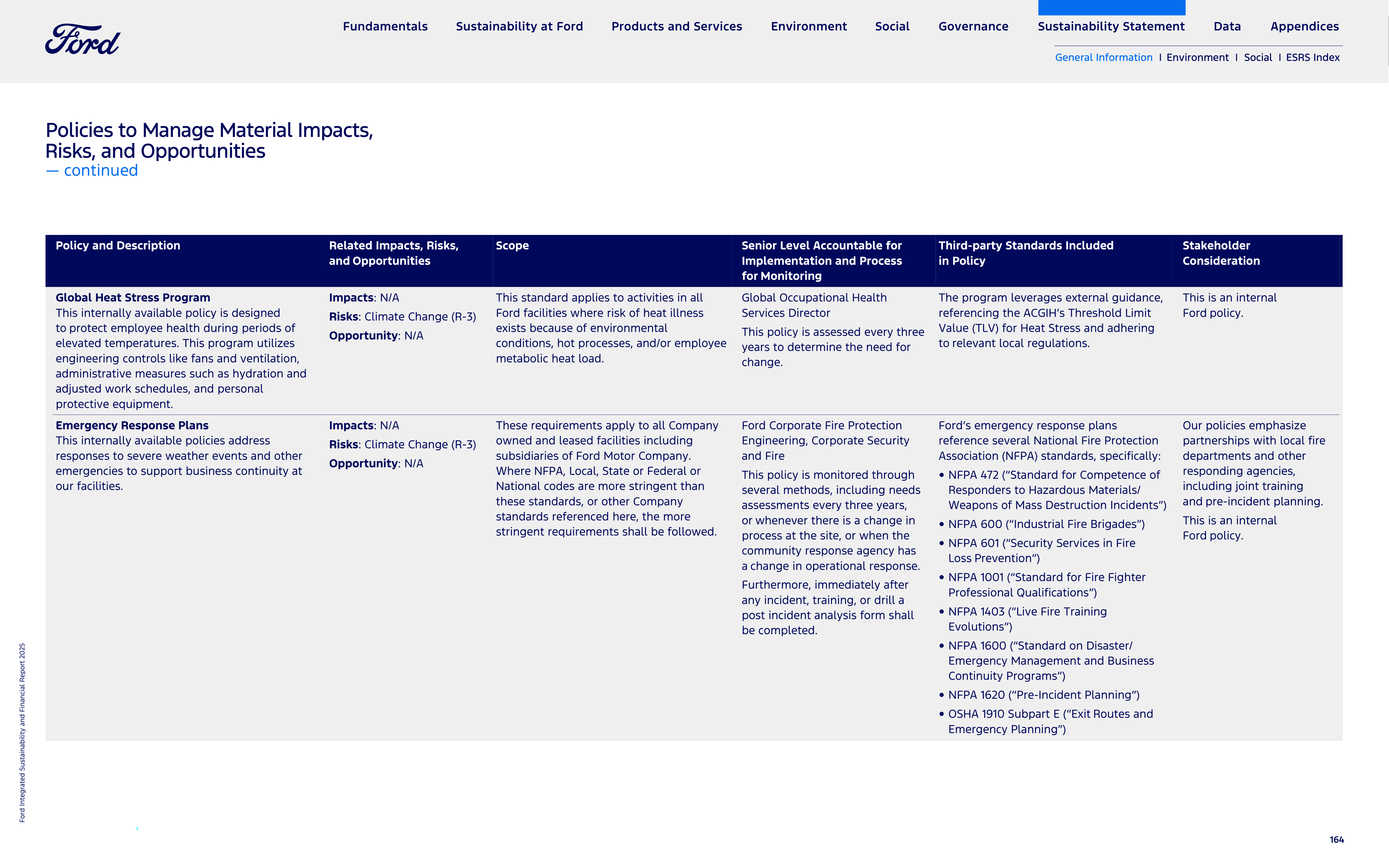

Policy and Description
Related Impacts, Risks,
and Opportunities
Scope
Senior Level Accountable for
Implementation and Process
for Monitoring
Third-party Standards Included
in Policy
Stakeholder
Consideration
Global Heat Stress Program
This internally available policy is designed
to protect employee health during periods of
elevated temperatures. This program utilizes
engineering controls like fans and ventilation,
administrative measures such as hydration and
adjusted work schedules, and personal
protective equipment.
Impacts
: N/A
Risks
: Climate Change (R-3)
Opportunity
: N/A
This standard applies to activities in all
Ford facilities where risk of heat illness
exists because of environmental
conditions, hot processes, and/or employee
metabolic heat load.
Global Occupational Health
Services Director
This policy is assessed every three
years to determine the need for
change.
The program leverages external guidance,
referencing the ACGIH’s Threshold Limit
Value (TLV) for Heat Stress and adhering
to relevant local regulations.
This is an internal
Ford policy.
Emergency Response Plans
This internally available policies address
responses to severe weather events and other
emergencies to support business continuity at
our facilities.
Impacts
: N/A
Risks
: Climate Change (R-3)
Opportunity
: N/A
These requirements apply to all Company
owned and leased facilities including
subsidiaries of Ford Motor Company.
Where NFPA, Local, State or Federal or
National codes are more stringent than
these standards, or other Company
standards referenced here, the more
stringent requirements shall be followed.
Ford Corporate Fire Protection
Engineering, Corporate Security
and Fire
This policy is monitored through
several methods, including needs
assessments every three years,
or whenever there is a change in
process at the site, or when the
community response agency has
a change in operational response.
Furthermore, immediately after
any incident, training, or drill a
post incident analysis form shall
be completed.
Ford’s emergency response plans
reference several National Fire Protection
Association (NFPA) standards, specifically:
•
NFPA 472 (“Standard for Competence of
Responders to Hazardous Materials/
Weapons of Mass Destruction Incidents”)
•
NFPA 600 (“Industrial Fire Brigades”)
•
NFPA 601 (“Security Services in Fire
Loss Prevention”)
•
NFPA 1001 (“Standard for Fire Fighter
Professional Qualifications”)
•
NFPA 1403 (“Live Fire Training
Evolutions”)
•
NFPA 1600 (“Standard on Disaster/
Emergency Management and Business
Continuity Programs”)
•
NFPA 1620 (“Pre-Incident Planning”)
•
OSHA 1910 Subpart E (“Exit Routes and
Emergency Planning”)
Our policies emphasize
partnerships with local fire
departments and other
responding agencies,
including joint training
and pre-incident planning.
This is an internal
Ford policy.
Fundamentals
Sustainability at Ford
Products and Services
Environment
Social
Governance
Sustainability Statement
Data
Appendices
|
|
|
General Information
Environment
Social
ESRS Index
Policies to Manage Material Impacts,
Risks, and Opportunities
— continued
,
Ford Integrated Sustainability and Financial Report 2025
164
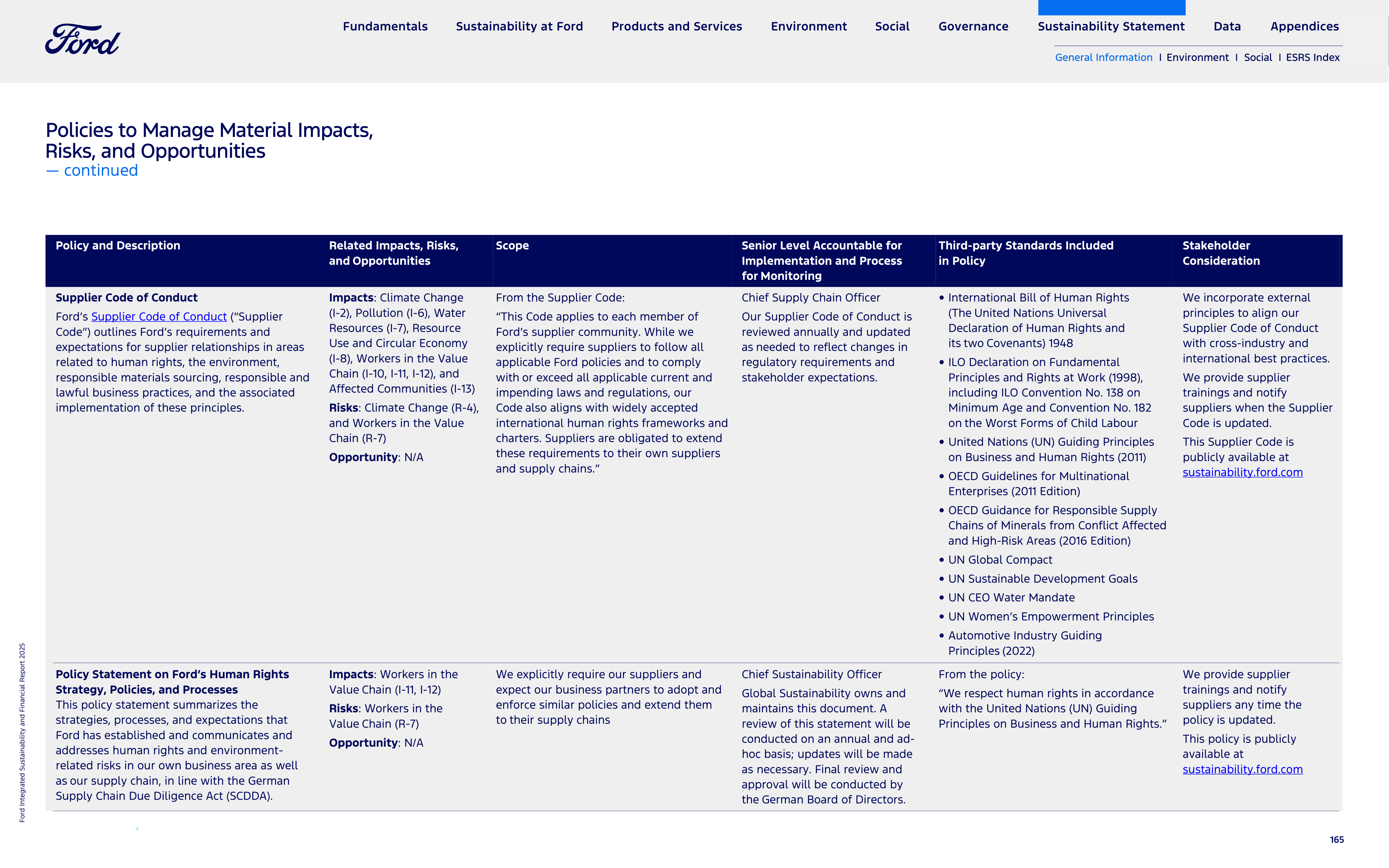

Policy and Description
Related Impacts, Risks,
and Opportunities
Scope
Senior Level Accountable for
Implementation and Process
for Monitoring
Third-party Standards Included
in Policy
Stakeholder
Consideration
Supplier Code of Conduct
Ford’s
Supplier Code of Conduct
(“Supplier
Code”) outlines Ford’s requirements and
expectations for supplier relationships in areas
related to human rights, the environment,
responsible materials sourcing, responsible and
lawful business practices, and the associated
implementation of these principles.
Impacts
: Climate Change
(I-2), Pollution (I-6), Water
Resources (I-7), Resource
Use and Circular Economy
(I-8), Workers in the Value
Chain (I-10, I-11, I-12), and
Affected Communities (I-13)
Risks
: Climate Change (R-4),
and Workers in the Value
Chain (R-7)
Opportunity
: N/A
From the Supplier Code:
“This Code applies to each member of
Ford’s supplier community. While we
explicitly require suppliers to follow all
applicable Ford policies and to comply
with or exceed all applicable current and
impending laws and regulations, our
Code also aligns with widely accepted
international human rights frameworks and
charters. Suppliers are obligated to extend
these requirements to their own suppliers
and supply chains.”
Chief Supply Chain Officer
Our Supplier Code of Conduct is
reviewed annually and updated
as needed to reflect changes in
regulatory requirements and
stakeholder expectations.
•
International Bill of Human Rights
(The United Nations Universal
Declaration of Human Rights and
its two Covenants) 1948
•
ILO Declaration on Fundamental
Principles and Rights at Work (1998),
including ILO Convention No. 138 on
Minimum Age and Convention No. 182
on the Worst Forms of Child Labour
•
United Nations (UN) Guiding Principles
on Business and Human Rights (2011)
•
OECD Guidelines for Multinational
Enterprises (2011 Edition)
•
OECD Guidance for Responsible Supply
Chains of Minerals from Conflict Affected
and High-Risk Areas (2016 Edition)
•
UN Global Compact
•
UN Sustainable Development Goals
•
UN CEO Water Mandate
•
UN Women’s Empowerment Principles
•
Automotive Industry Guiding
Principles (2022)
We incorporate external
principles to align our
Supplier Code of Conduct
with cross-industry and
international best practices.
We provide supplier
trainings and notify
suppliers when the Supplier
Code is updated.
This Supplier Code is
publicly available at
sustainability.ford.com
Policy Statement on Ford’s Human Rights
Strategy, Policies, and Processes
This policy statement summarizes the
strategies, processes, and expectations that
Ford has established and communicates and
addresses human rights and environment-
related risks in our own business area as well
as our supply chain, in line with the German
Supply Chain Due Diligence Act (SCDDA).
Impacts
: Workers in the
Value Chain (I-11, I-12)
Risks
: Workers in the
Value Chain (R-7)
Opportunity
: N/A
We explicitly require our suppliers and
expect our business partners to adopt and
enforce similar policies and extend them
to their supply chains
Chief Sustainability Officer
Global Sustainability owns and
maintains this document. A
review of this statement will be
conducted on an annual and ad-
hoc basis; updates will be made
as necessary. Final review and
approval will be conducted by
the German Board of Directors.
From the policy:
“We respect human rights in accordance
with the United Nations (UN) Guiding
Principles on Business and Human Rights.”
We provide supplier
trainings and notify
suppliers any time the
policy is updated.
This policy is publicly
available at
sustainability.ford.com
Fundamentals
Sustainability at Ford
Products and Services
Environment
Social
Governance
Sustainability Statement
Data
Appendices
|
|
|
General Information
Environment
Social
ESRS Index
Policies to Manage Material Impacts,
Risks, and Opportunities
— continued
,
Ford Integrated Sustainability and Financial Report 2025
165
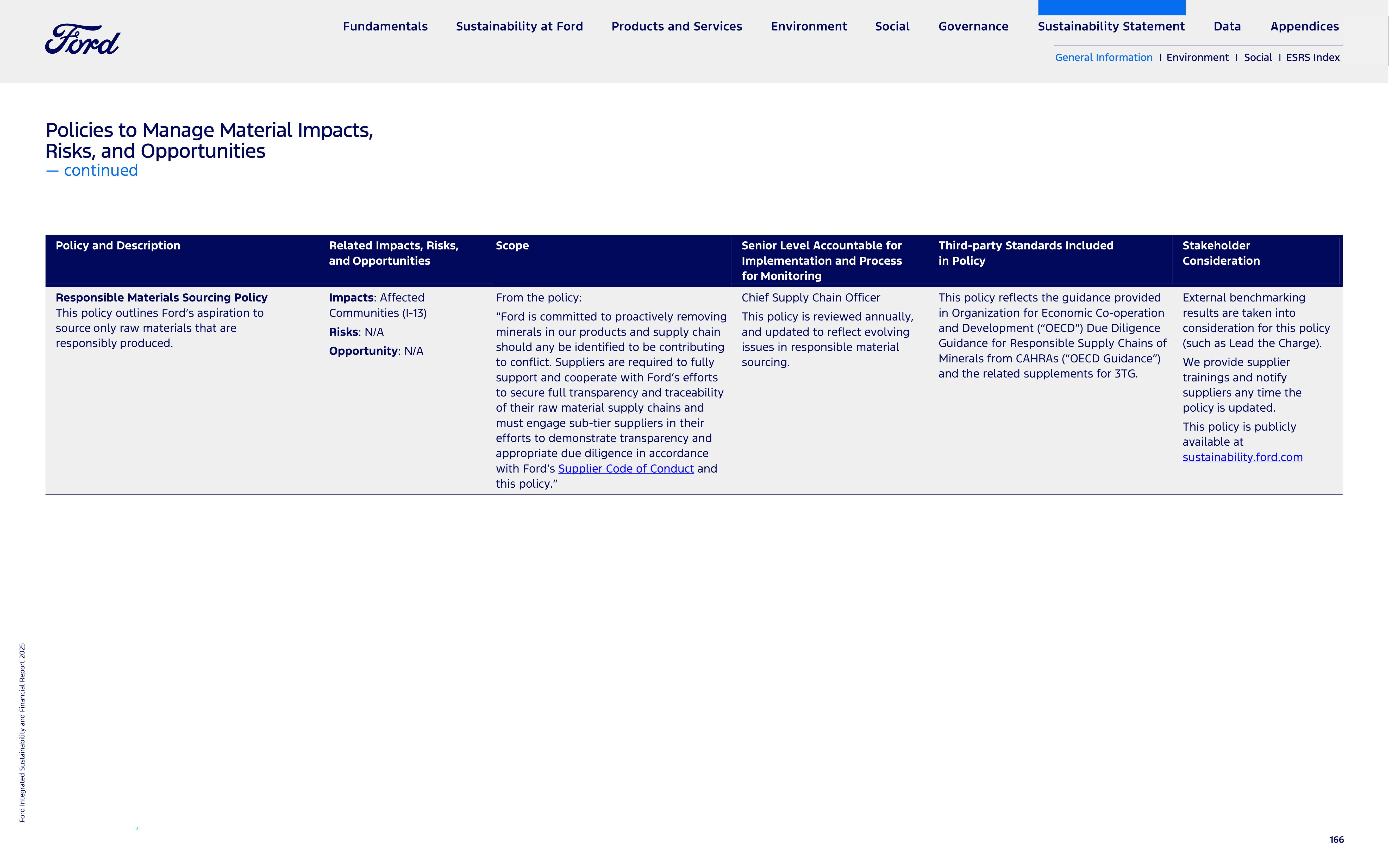

Policy and Description
Related Impacts, Risks,
and Opportunities
Scope
Senior Level Accountable for
Implementation and Process
for Monitoring
Third-party Standards Included
in Policy
Stakeholder
Consideration
Responsible Materials Sourcing Policy
This policy outlines Ford’s aspiration to
source only raw materials that are
responsibly produced.
Impacts
: Affected
Communities (I-13)
Risks
: N/A
Opportunity
: N/A
From the policy:
“Ford is committed to proactively removing
minerals in our products and supply chain
should any be identified to be contributing
to conflict. Suppliers are required to fully
support and cooperate with Ford’s efforts
to secure full transparency and traceability
of their raw material supply chains and
must engage sub-tier suppliers in their
efforts to demonstrate transparency and
appropriate due diligence in accordance
with Ford’s
Supplier Code of Conduct
and
this policy.”
Chief Supply Chain Officer
This policy is reviewed annually,
and updated to reflect evolving
issues in responsible material
sourcing.
This policy reflects the guidance provided
in Organization for Economic Co-operation
and Development (“OECD”) Due Diligence
Guidance for Responsible Supply Chains of
Minerals from CAHRAs (“OECD Guidance”)
and the related supplements for 3TG.
External benchmarking
results are taken into
consideration for this policy
(such as Lead the Charge).
We provide supplier
trainings and notify
suppliers any time the
policy is updated.
This policy is publicly
available at
sustainability.ford.com
Fundamentals
Sustainability at Ford
Products and Services
Environment
Social
Governance
Sustainability Statement
Data
Appendices
|
|
|
General Information
Environment
Social
ESRS Index
Policies to Manage Material Impacts,
Risks, and Opportunities
— continued
,
Ford Integrated Sustainability and Financial Report 2025
166
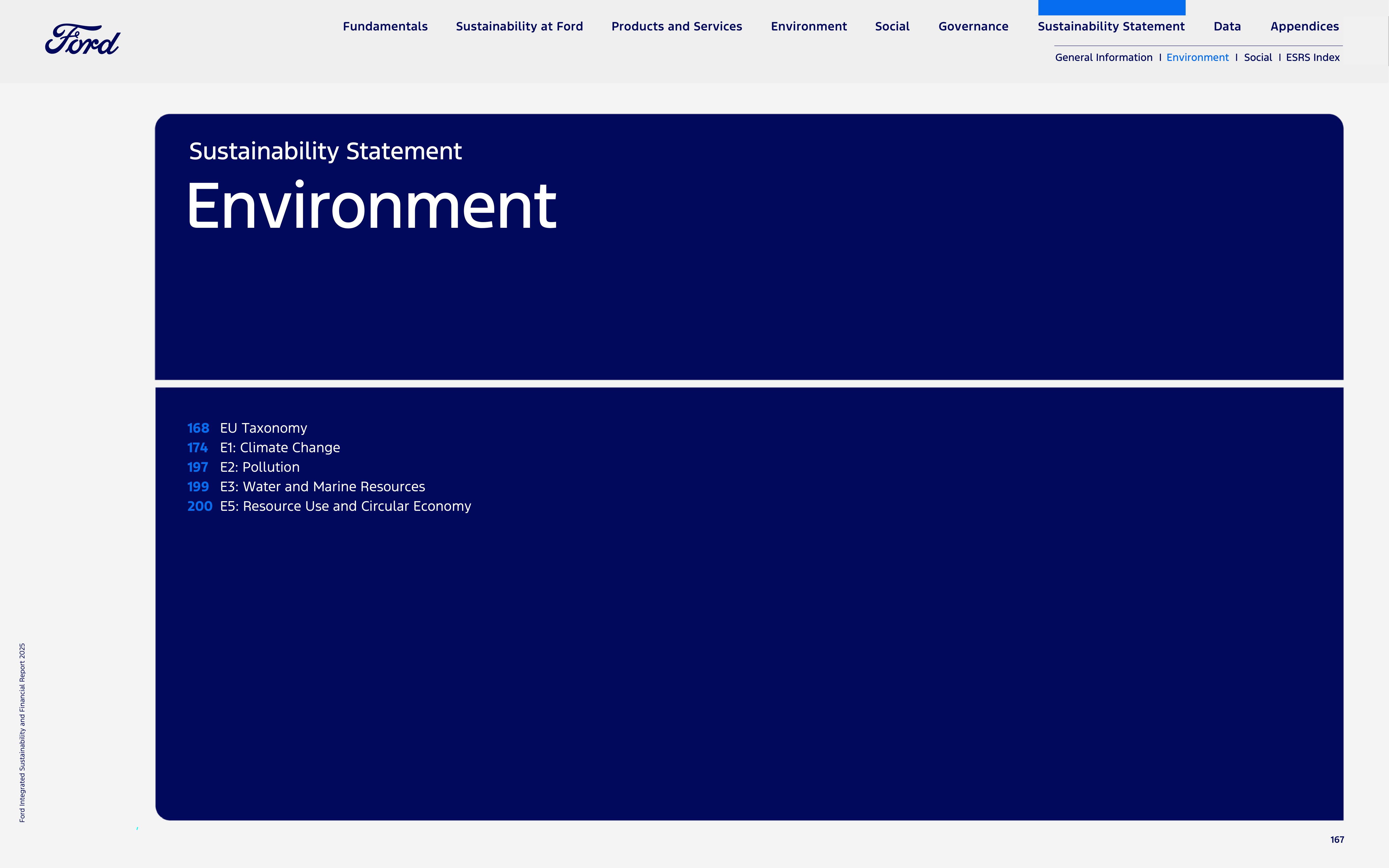


Fundamentals
Sustainability at Ford
Products and Services
Environment
Social
Governance
Sustainability Statement
Data
Appendices
|
|
|
General Information
Environment
Social
ESRS Index
Sustainability Statement
Environment
168
EU Taxonomy
174
E1: Climate Change
197
E2: Pollution
199
E3: Water and Marine Resources
200
E5: Resource Use and Circular Economy
,
Ford Integrated Sustainability and Financial Report 2025
167
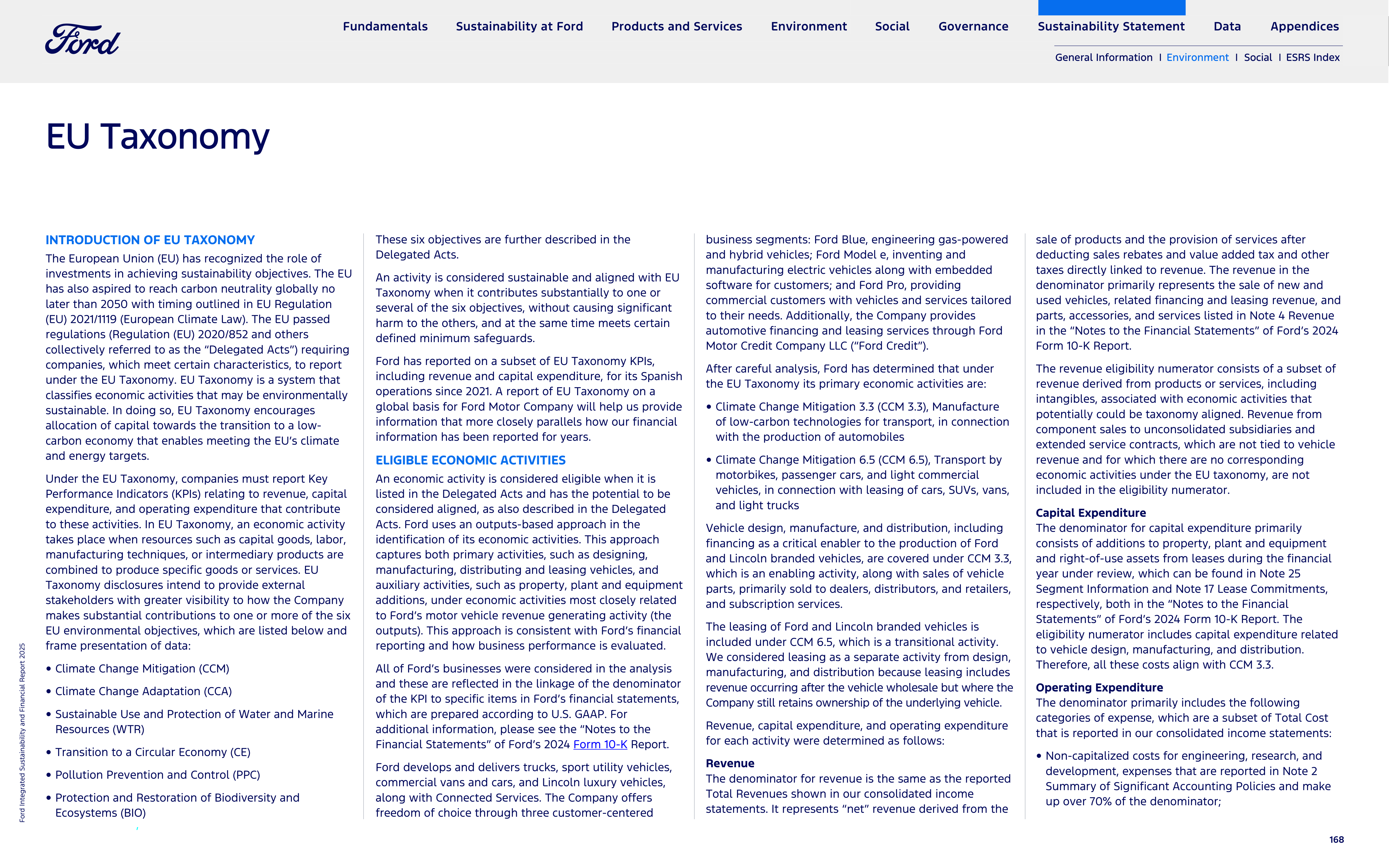

Fundamentals
Sustainability at Ford
Products and Services
Environment
Social
Governance
Sustainability Statement
Data
Appendices
|
|
|
General Information
Environment
Social
ESRS Index
EU Taxonomy
INTRODUCTION OF EU TAXONOMY
The European Union (EU) has recognized the role of
investments in achieving sustainability objectives. The EU
has also aspired to reach carbon neutrality globally no
later than 2050 with timing outlined in EU Regulation
(EU) 2021/1119 (European Climate Law). The EU passed
regulations (Regulation (EU) 2020/852 and others
collectively referred to as the “Delegated Acts”) requiring
companies, which meet certain characteristics, to report
under the EU Taxonomy. EU Taxonomy is a system that
classifies economic activities that may be environmentally
sustainable. In doing so, EU Taxonomy encourages
allocation of capital towards the transition to a low-
carbon economy that enables meeting the EU’s climate
and energy targets.
Under the EU Taxonomy, companies must report Key
Performance Indicators (KPIs) relating to revenue, capital
expenditure, and operating expenditure that contribute
to these activities. In EU Taxonomy, an economic activity
takes place when resources such as capital goods, labor,
manufacturing techniques, or intermediary products are
combined to produce specific goods or services. EU
Taxonomy disclosures intend to provide external
stakeholders with greater visibility to how the Company
makes substantial contributions to one or more of the six
EU environmental objectives, which are listed below and
frame presentation of data:
•
Climate Change Mitigation (CCM)
•
Climate Change Adaptation (CCA)
•
Sustainable Use and Protection of Water and Marine
Resources (WTR)
•
Transition to a Circular Economy (CE)
•
Pollution Prevention and Control (PPC)
•
Protection and Restoration of Biodiversity and
Ecosystems (BIO)
These six objectives are further described in the
Delegated Acts.
An activity is considered sustainable and aligned with EU
Taxonomy when it contributes substantially to one or
several of the six objectives, without causing significant
harm to the others, and at the same time meets certain
defined minimum safeguards.
Ford has reported on a subset of EU Taxonomy KPIs,
including revenue and capital expenditure, for its Spanish
operations since 2021. A report of EU Taxonomy on a
global basis for Ford Motor Company will help us provide
information that more closely parallels how our financial
information has been reported for years.
ELIGIBLE ECONOMIC ACTIVITIES
An economic activity is considered eligible when it is
listed in the Delegated Acts and has the potential to be
considered aligned, as also described in the Delegated
Acts. Ford uses an outputs-based approach in the
identification of its economic activities. This approach
captures both primary activities, such as designing,
manufacturing, distributing and leasing vehicles, and
auxiliary activities, such as property, plant and equipment
additions, under economic activities most closely related
to Ford’s motor vehicle revenue generating activity (the
outputs). This approach is consistent with Ford’s financial
reporting and how business performance is evaluated.
All of Ford’s businesses were considered in the analysis
and these are reflected in the linkage of the denominator
of the KPI to specific items in Ford’s financial statements,
which are prepared according to U.S. GAAP. For
additional information, please see the “Notes to the
Financial Statements” of Ford’s 2024
Form 10-K
Report.
Ford develops and delivers trucks, sport utility vehicles,
commercial vans and cars, and Lincoln luxury vehicles,
along with Connected Services. The Company offers
freedom of choice through three customer-centered
business segments: Ford Blue, engineering gas-powered
and hybrid vehicles; Ford Model e, inventing and
manufacturing electric vehicles along with embedded
software for customers; and Ford Pro, providing
commercial customers with vehicles and services tailored
to their needs. Additionally, the Company provides
automotive financing and leasing services through Ford
Motor Credit Company LLC (“Ford Credit”).
After careful analysis, Ford has determined that under
the EU Taxonomy its primary economic activities are:
•
Climate Change Mitigation 3.3 (CCM 3.3), Manufacture
of low-carbon technologies for transport, in connection
with the production of automobiles
•
Climate Change Mitigation 6.5 (CCM 6.5), Transport by
motorbikes, passenger cars, and light commercial
vehicles, in connection with leasing of cars, SUVs, vans,
and light trucks
Vehicle design, manufacture, and distribution, including
financing as a critical enabler to the production of Ford
and Lincoln branded vehicles, are covered under CCM 3.3,
which is an enabling activity, along with sales of vehicle
parts, primarily sold to dealers, distributors, and retailers,
and subscription services.
The leasing of Ford and Lincoln branded vehicles is
included under CCM 6.5, which is a transitional activity.
We considered leasing as a separate activity from design,
manufacturing, and distribution because leasing includes
revenue occurring after the vehicle wholesale but where the
Company still retains ownership of the underlying vehicle.
Revenue, capital expenditure, and operating expenditure
for each activity were determined as follows:
Revenue
The denominator for revenue is the same as the reported
Total Revenues shown in our consolidated income
statements. It represents “net” revenue derived from the
sale of products and the provision of services after
deducting sales rebates and value added tax and other
taxes directly linked to revenue. The revenue in the
denominator primarily represents the sale of new and
used vehicles, related financing and leasing revenue, and
parts, accessories, and services listed in Note 4 Revenue
in the “Notes to the Financial Statements” of Ford’s 2024
Form 10-K Report.
The revenue eligibility numerator consists of a subset of
revenue derived from products or services, including
intangibles, associated with economic activities that
potentially could be taxonomy aligned. Revenue from
component sales to unconsolidated subsidiaries and
extended service contracts, which are not tied to vehicle
revenue and for which there are no corresponding
economic activities under the EU taxonomy, are not
included in the eligibility numerator.
Capital Expenditure
The denominator for capital expenditure primarily
consists of additions to property, plant and equipment
and right-of-use assets from leases during the financial
year under review, which can be found in Note 25
Segment Information and Note 17 Lease Commitments,
respectively, both in the “Notes to the Financial
Statements” of Ford’s 2024 Form 10-K Report. The
eligibility numerator includes capital expenditure related
to vehicle design, manufacturing, and distribution.
Therefore, all these costs align with CCM 3.3.
Operating Expenditure
The denominator primarily includes the following
categories of expense, which are a subset of Total Cost
that is reported in our consolidated income statements:
•
Non-capitalized costs for engineering, research, and
development, expenses that are reported in Note 2
Summary of Significant Accounting Policies and make
up over 70% of the denominator;
,
Ford Integrated Sustainability and Financial Report 2025
168
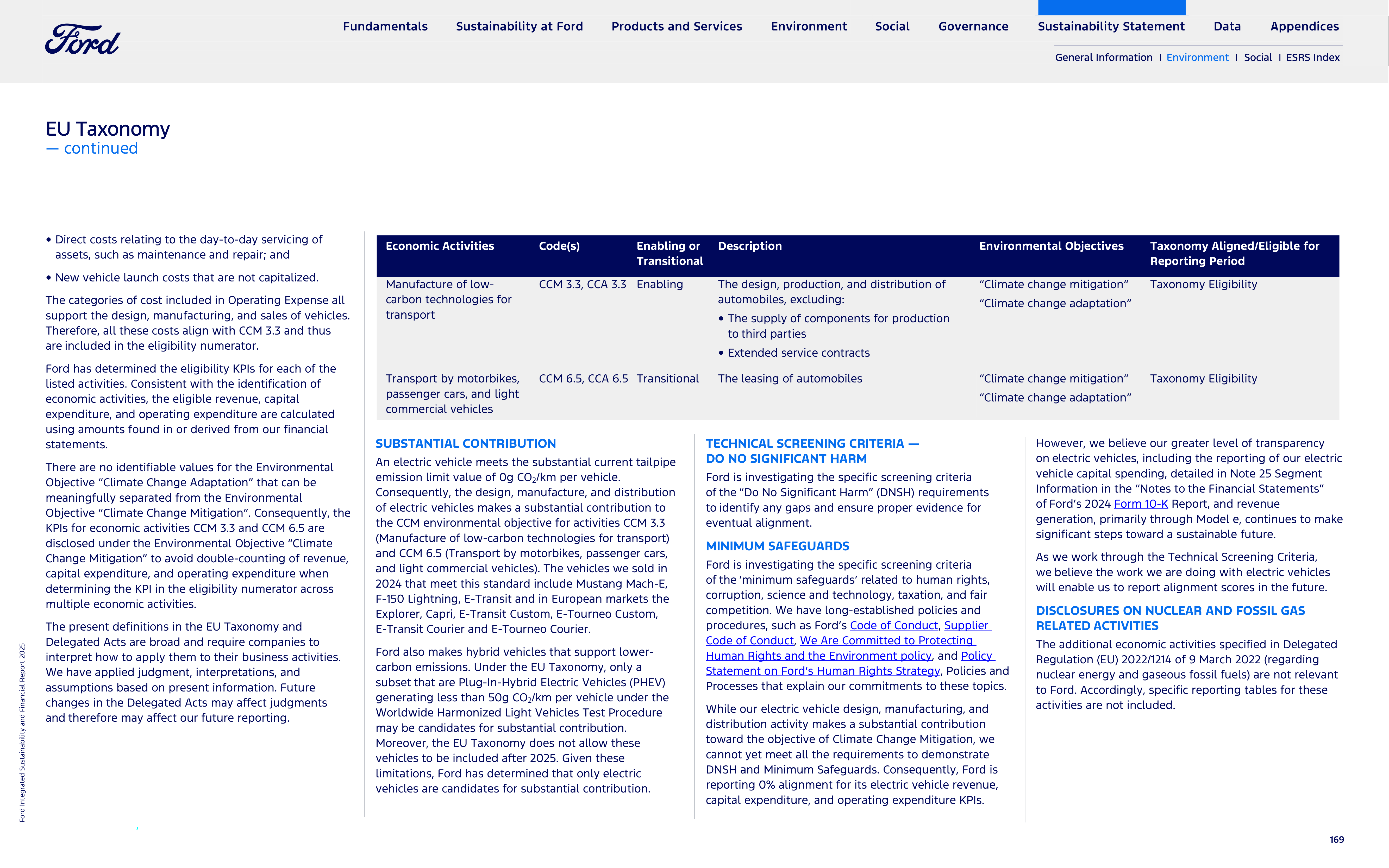

•
Direct costs relating to the day-to-day servicing of
assets, such as maintenance and repair; and
•
New vehicle launch costs that are not capitalized.
Fundamentals
Sustainability at Ford
Products and Services
Environment
Social
Governance
Sustainability Statement
Data
Appendices
|
|
|
General Information
Environment
Social
ESRS Index
The categories of cost included in Operating Expense all
support the design, manufacturing, and sales of vehicles.
Therefore, all these costs align with CCM 3.3 and thus
are included in the eligibility numerator.
Ford has determined the eligibility KPIs for each of the
listed activities. Consistent with the identification of
economic activities, the eligible revenue, capital
expenditure, and operating expenditure are calculated
using amounts found in or derived from our financial
statements.
There are no identifiable values for the Environmental
Objective “Climate Change Adaptation” that can be
meaningfully separated from the Environmental
Objective “Climate Change Mitigation”. Consequently, the
KPIs for economic activities CCM 3.3 and CCM 6.5 are
disclosed under the Environmental Objective “Climate
Change Mitigation” to avoid double-counting of revenue,
capital expenditure, and operating expenditure when
determining the KPI in the eligibility numerator across
multiple economic activities.
The present definitions in the EU Taxonomy and
Delegated Acts are broad and require companies to
interpret how to apply them to their business activities.
We have applied judgment, interpretations, and
assumptions based on present information. Future
changes in the Delegated Acts may affect judgments
and therefore may affect our future reporting.
Economic Activities
Code(s)
Enabling or
Transitional
Description
Environmental Objectives
Taxonomy Aligned/Eligible for
Reporting Period
Manufacture of low-
carbon technologies for
transport
CCM 3.3, CCA 3.3 Enabling
The design, production, and distribution of
automobiles, excluding:
•
The supply of components for production
to third parties
•
Extended service contracts
“Climate change mitigation“
“Climate change adaptation“
Taxonomy Eligibility
Transport by motorbikes,
passenger cars, and light
commercial vehicles
CCM 6.5, CCA 6.5 Transitional
The leasing of automobiles
“Climate change mitigation“
“Climate change adaptation“
Taxonomy Eligibility
SUBSTANTIAL CONTRIBUTION
An electric vehicle meets the substantial current tailpipe
emission limit value of 0g CO
2
/km per vehicle.
Consequently, the design, manufacture, and distribution
of electric vehicles makes a substantial contribution to
the CCM environmental objective for activities CCM 3.3
(Manufacture of low-carbon technologies for transport)
and CCM 6.5 (Transport by motorbikes, passenger cars,
and light commercial vehicles). The vehicles we sold in
2024 that meet this standard include Mustang Mach-E,
F-150 Lightning, E‑Transit and in European markets the
Explorer, Capri, E‑Transit Custom, E-Tourneo Custom,
E-Transit Courier and E-Tourneo Courier.
Ford also makes hybrid vehicles that support lower-
carbon emissions. Under the EU Taxonomy, only a
subset that are Plug-In-Hybrid Electric Vehicles (PHEV)
generating less than 50g CO
2
/km per vehicle under the
Worldwide Harmonized Light Vehicles Test Procedure
may be candidates for substantial contribution.
Moreover, the EU Taxonomy does not allow these
vehicles to be included after 2025. Given these
limitations, Ford has determined that only electric
vehicles are candidates for substantial contribution.
TECHNICAL SCREENING CRITERIA —
DO NO SIGNIFICANT HARM
Ford is investigating the specific screening criteria
of the “Do No Significant Harm” (DNSH) requirements
to identify any gaps and ensure proper evidence for
eventual alignment.
MINIMUM SAFEGUARDS
Ford is investigating the specific screening criteria
of the ‘minimum safeguards’ related to human rights,
corruption, science and technology, taxation, and fair
competition. We have long-established policies and
procedures, such as Ford’s
Code of Conduct
,
Supplier
Code of Conduct
,
We Are Committed to Protecting
Human Rights and the Environment policy
, and
Policy
Statement on Ford’s Human Rights Strategy
, Policies and
Processes that explain our commitments to these topics.
While our electric vehicle design, manufacturing, and
distribution activity makes a substantial contribution
toward the objective of Climate Change Mitigation, we
cannot yet meet all the requirements to demonstrate
DNSH and Minimum Safeguards. Consequently, Ford is
reporting 0% alignment for its electric vehicle revenue,
capital expenditure, and operating expenditure KPIs.
However, we believe our greater level of transparency
on electric vehicles, including the reporting of our electric
vehicle capital spending, detailed in Note 25 Segment
Information in the “Notes to the Financial Statements”
of Ford’s 2024
Form 10-K
Report, and revenue
generation, primarily through Model e, continues to make
significant steps toward a sustainable future.
As we work through the Technical Screening Criteria,
we believe the work we are doing with electric vehicles
will enable us to report alignment scores in the future.
DISCLOSURES ON NUCLEAR AND FOSSIL GAS
RELATED ACTIVITIES
The additional economic activities specified in Delegated
Regulation (EU) 2022/1214 of 9 March 2022 (regarding
nuclear energy and gaseous fossil fuels) are not relevant
to Ford. Accordingly, specific reporting tables for these
activities are not included.
EU Taxonomy
— continued
,
Ford Integrated Sustainability and Financial Report 2025
169


Fundamentals
Sustainability at Ford
Products and Services
Environment
Social
Governance
Sustainability Statement
Data
Appendices
|
|
|
General Information
Environment
Social
ESRS Index
2024 FINANCIAL RESULTS
Our business segment structure provides transparency
over the performance and progress of spending, revenue,
and profitability of our electric vehicles that make a
substantial contribution toward the environmental
objective of Climate Change Mitigation (CCM).
For example, in 2024, our total electric vehicle capital
spending was $4.7 billion, up approximately $0.9 billion
over 2023 reflecting a third consecutive year of growth.
The majority of our electric vehicles are manufactured
and sold by our Model e business segment that operates
in North America, Europe, and China. Model e saw
revenue of $3.9 billion in 2024, which was down from
the prior year driven primarily by lower net pricing
and lower wholesales, which were due to competitive
market conditions.
Electric vehicles are also sold through Ford Pro, which
includes those sold to commercial, government, and
rental customers in North America, and Transit electric
vehicles in Europe. Model e also includes electric
vehicles and related sales not considered core to Ford
Pro to commercial, government, and rental customers in
Europe, China, and Mexico. Electric vehicles sold outside
of regions where Model e and Pro operate are reflected
in Ford Blue revenue.
We also reported $8.0 billion for engineering, research,
and development expenses in 2024, and a portion of that
relates to electrification based on either specific product
lines for direct costs or volume for indirect cost.
Outlook for 2025
Although we continue to invest in our electric vehicle
strategy, we have observed lower than anticipated
industrywide electric vehicle adoption rates and near-
term pricing pressures, which has led us, and may in
the future lead us, to adjust our investing, spending,
production, and/or product or future technology launches
to better match the pace of electric vehicle adoption.
While continued industry pricing pressure remains, we
plan to increase our global volume of electric vehicles,
driven by the full-year impact of European launches.
We have increased investment in our battery facilities
and next-generation products. We’re diligently working
on our next generation of mass-market electric vehicles
that we believe will have a positive impact on our
business. In 2025, we plan to continue Ford’s Power
Promise to improve access to charging and further
increase adoption of our electric vehicles.
EU Taxonomy
— continued
,
Ford Integrated Sustainability and Financial Report 2025
170
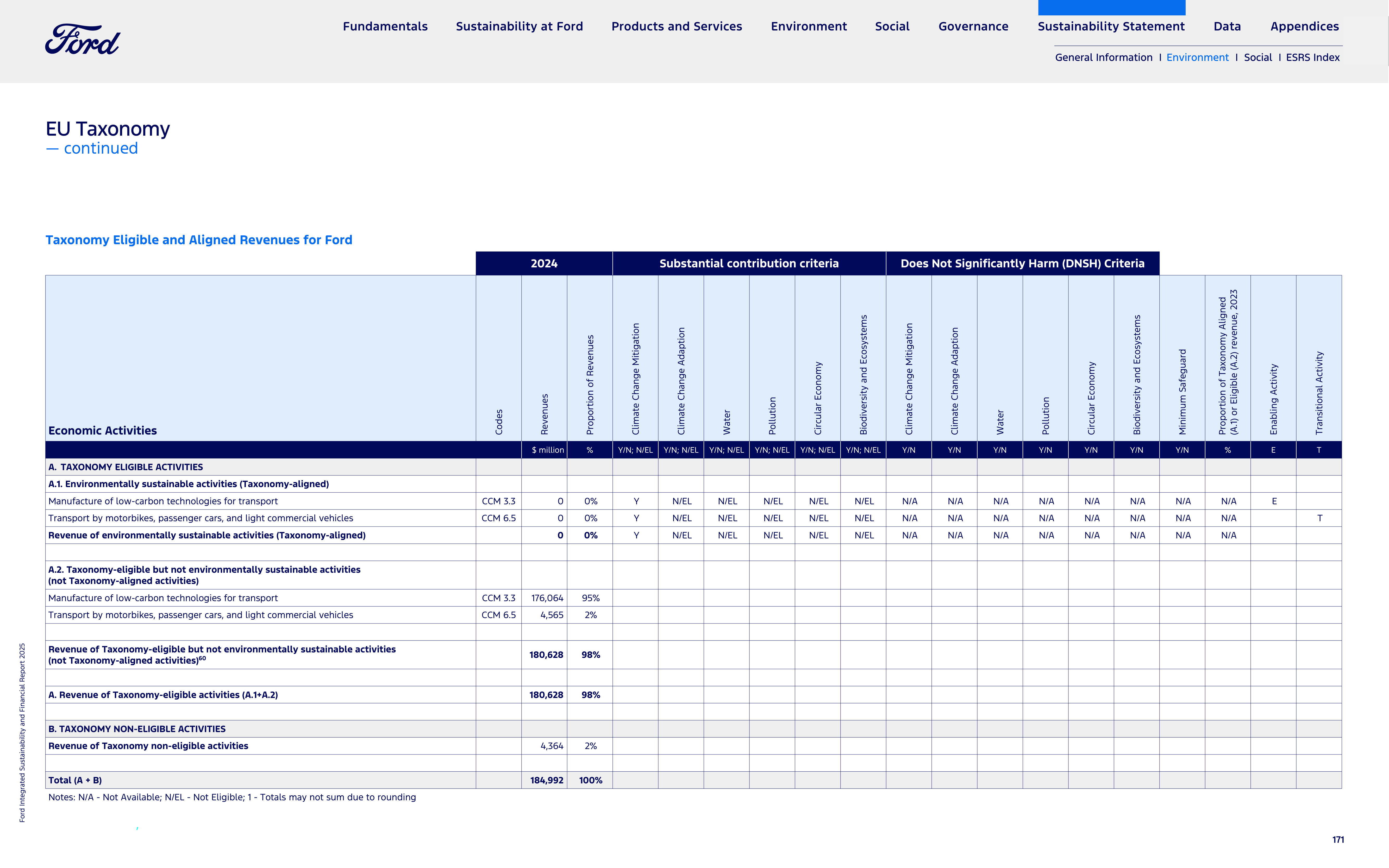

Fundamentals
Sustainability at Ford
Products and Services
Environment
Social
Governance
Sustainability Statement
Data
Appendices
|
|
|
General Information
Environment
Social
ESRS Index
Taxonomy Eligible and Aligned Revenues for Ford
2024
Substantial contribution criteria
Does Not Significantly Harm (DNSH) Criteria
Economic Activities
Codes
Revenues
Proportion of Revenues
Climate Change Mitigation
Climate Change Adaption
Water
Pollution
Circular Economy
Biodiversity and Ecosystems
Climate Change Mitigation
Climate Change Adaption
Water
Pollution
Circular Economy
Biodiversity and Ecosystems
Minimum Safeguard
Proportion of Taxonomy Aligned
(A.1) or Eligible (A.2) revenue, 2023
Enabling Activity
Transitional Activity
$ million
%
Y/N; N/EL
Y/N; N/EL
Y/N; N/EL
Y/N; N/EL
Y/N; N/EL
Y/N; N/EL
Y/N
Y/N
Y/N
Y/N
Y/N
Y/N
Y/N
%
E
T
A. TAXONOMY ELIGIBLE ACTIVITIES
A.1. Environmentally sustainable activities (Taxonomy-aligned)
Manufacture of low-carbon technologies for transport
CCM 3.3
0
0%
Y
N/EL
N/EL
N/EL
N/EL
N/EL
N/A
N/A
N/A
N/A
N/A
N/A
N/A
N/A
E
Transport by motorbikes, passenger cars, and light commercial vehicles
CCM 6.5
0
0%
Y
N/EL
N/EL
N/EL
N/EL
N/EL
N/A
N/A
N/A
N/A
N/A
N/A
N/A
N/A
T
Revenue of environmentally sustainable activities (Taxonomy-aligned)
0
0%
Y
N/EL
N/EL
N/EL
N/EL
N/EL
N/A
N/A
N/A
N/A
N/A
N/A
N/A
N/A
A.2. Taxonomy-eligible but not environmentally sustainable activities
(not Taxonomy-aligned activities)
Manufacture of low-carbon technologies for transport
CCM 3.3
176,064
95%
Transport by motorbikes, passenger cars, and light commercial vehicles
CCM 6.5
4,565
2%
Revenue of Taxonomy-eligible but not environmentally sustainable activities
60
(not Taxonomy-aligned activities)
180,628
98%
A. Revenue of Taxonomy-eligible activities (A.1+A.2)
180,628
98%
B. TAXONOMY NON-ELIGIBLE ACTIVITIES
Revenue of Taxonomy non-eligible activities
4,364
2%
Total (A + B)
184,992
100%
Notes: N/A - Not Available; N/EL - Not Eligible; 1 - Totals may not sum due to rounding
EU Taxonomy
— continued
,
Ford Integrated Sustainability and Financial Report 2025
171
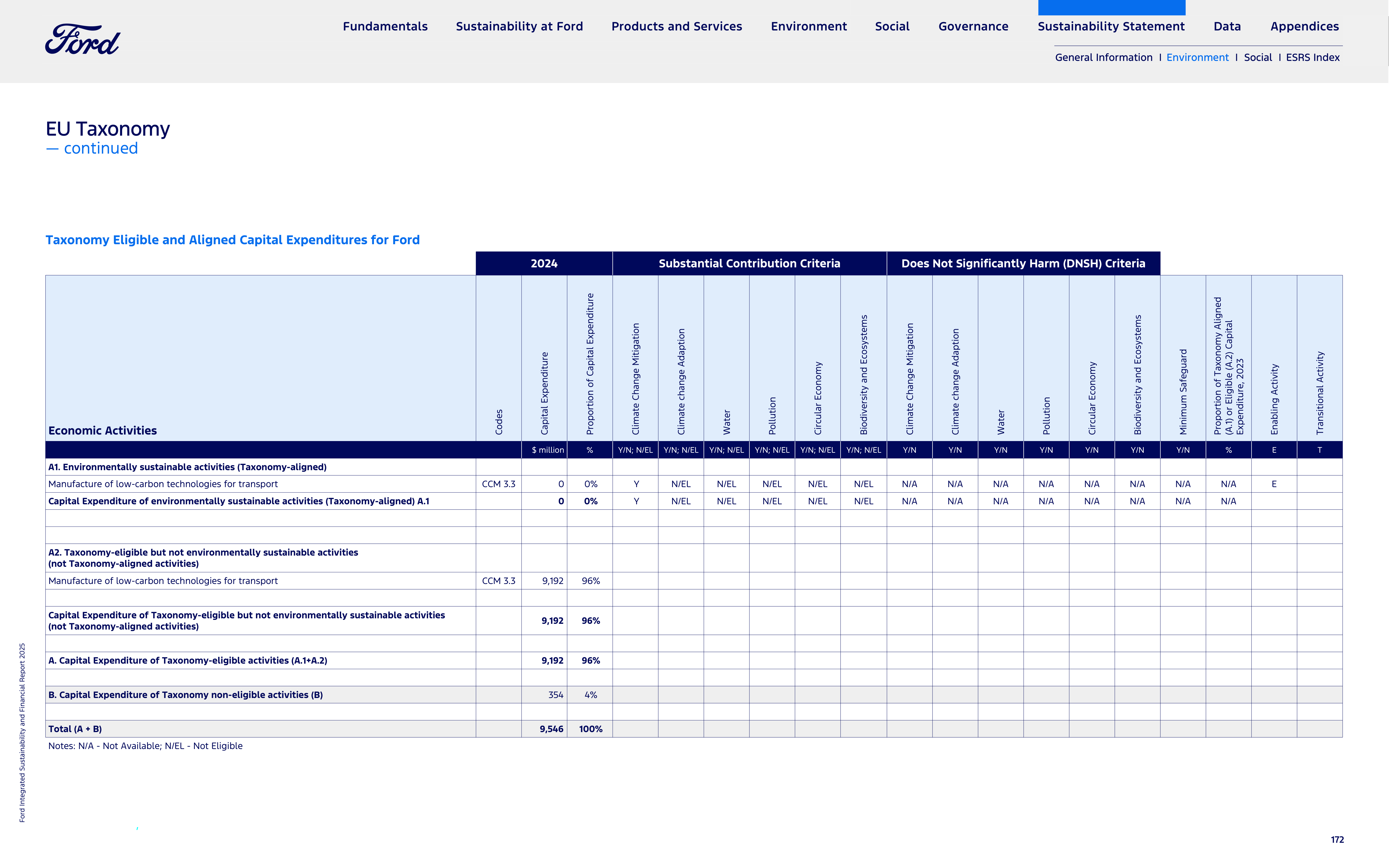

Fundamentals
Sustainability at Ford
Products and Services
Environment
Social
Governance
Sustainability Statement
Data
Appendices
|
|
|
General Information
Environment
Social
ESRS Index
Taxonomy Eligible and Aligned Capital Expenditures for Ford
2024
Substantial Contribution Criteria
Does Not Significantly Harm (DNSH) Criteria
Economic Activities
Codes
Capital Expenditure
Proportion of Capital Expenditure
Climate Change Mitigation
Climate change Adaption
Water
Pollution
Circular Economy
Biodiversity and Ecosystems
Climate Change Mitigation
Climate change Adaption
Water
Pollution
Circular Economy
Biodiversity and Ecosystems
Minimum Safeguard
Proportion of Taxonomy Aligned
(A.1) or Eligible (A.2) Capital
Expenditure, 2023
Enabling Activity
Transitional Activity
$ million
%
Y/N; N/EL
Y/N; N/EL
Y/N; N/EL
Y/N; N/EL
Y/N; N/EL
Y/N; N/EL
Y/N
Y/N
Y/N
Y/N
Y/N
Y/N
Y/N
%
E
T
A1. Environmentally sustainable activities (Taxonomy-aligned)
Manufacture of low-carbon technologies for transport
CCM 3.3
0
0%
Y
N/EL
N/EL
N/EL
N/EL
N/EL
N/A
N/A
N/A
N/A
N/A
N/A
N/A
N/A
E
Capital Expenditure of environmentally sustainable activities (Taxonomy-aligned) A.1
0
0%
Y
N/EL
N/EL
N/EL
N/EL
N/EL
N/A
N/A
N/A
N/A
N/A
N/A
N/A
N/A
A2. Taxonomy-eligible but not environmentally sustainable activities
(not Taxonomy-aligned activities)
Manufacture of low-carbon technologies for transport
CCM 3.3
9,192
96%
Capital Expenditure of Taxonomy-eligible but not environmentally sustainable activities
(not Taxonomy-aligned activities)
9,192
96%
A. Capital Expenditure of Taxonomy-eligible activities (A.1+A.2)
9,192
96%
B. Capital Expenditure of Taxonomy non-eligible activities (B)
354
4%
Total (A + B)
9,546
100%
Notes: N/A - Not Available; N/EL - Not Eligible
EU Taxonomy
— continued
,
Ford Integrated Sustainability and Financial Report 2025
172
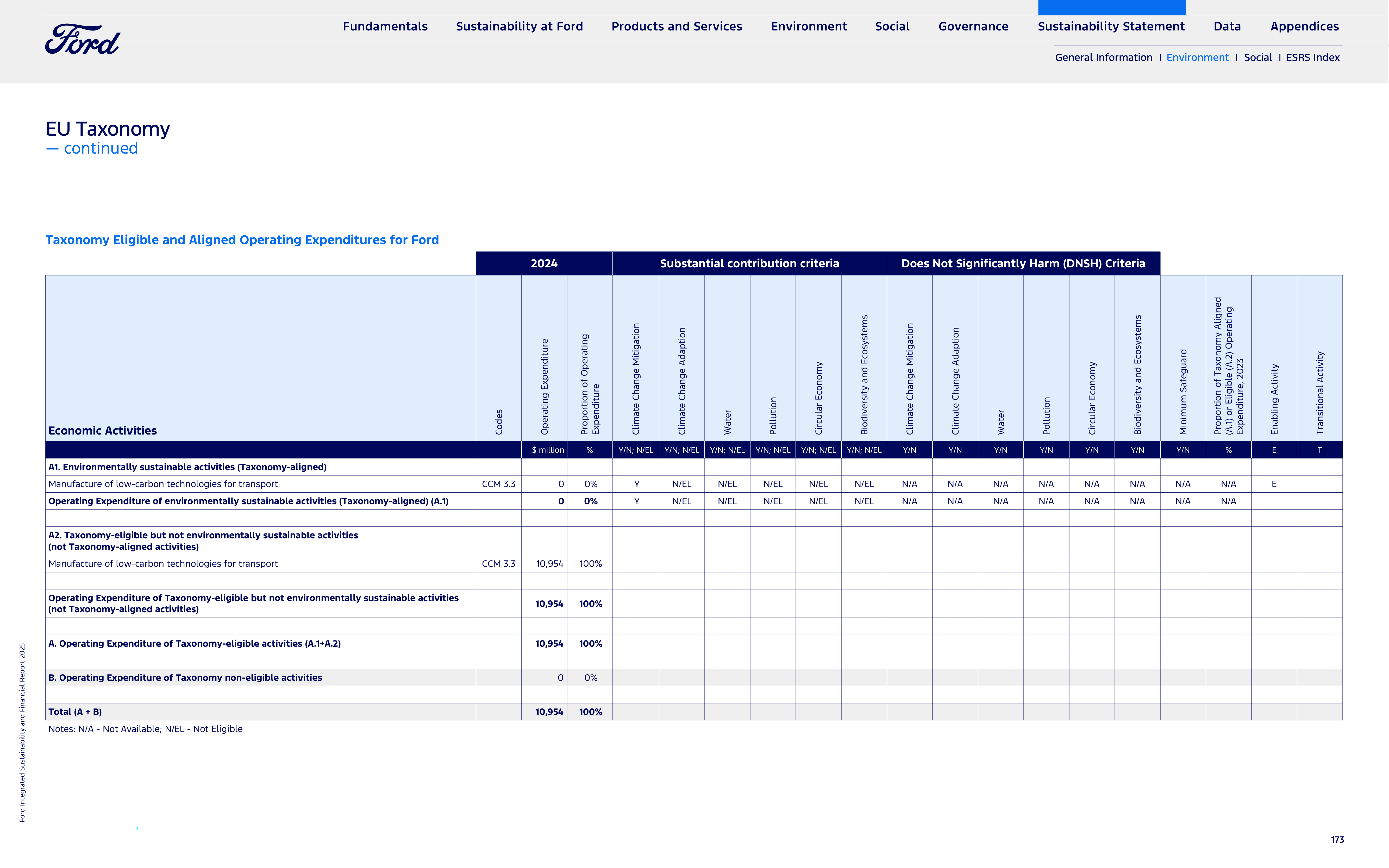
Fundamentals
Sustainability at Ford
Products and Services
Environment
Social
Governance
Sustainability Statement
Data
Appendices
General Information
Environment
Social
ESRS Index
Taxonomy Eligible and Aligned Operating Expenditures for Ford
|
2024
Substantial contribution criteria
Does Not Significantly Harm (DNSH) Criteria
Economic Activities
Codes
Operating Expenditure
Proportion of Operating
Expenditure
Climate Change Mitigation
Climate Change Adaption
Water
Pollution
Circular Economy
Biodiversity and Ecosystems
Climate Change Mitigation
Climate Change Adaption
Water
Pollution
Circular Economy
Biodiversity and Ecosystems
Minimum Safeguard
Proportion of Taxonomy Aligned
(A.1) or Eligible (A.2) Operating
Expenditure, 2023
Enabling Activity
Transitional Activity
$ million
%
Y/N; N/EL
Y/N; N/EL
Y/N; N/EL
Y/N; N/EL
Y/N; N/EL
Y/N; N/EL
Y/N
Y/N
Y/N
Y/N
Y/N
Y/N
Y/N
%
E
T
A1. Environmentally sustainable activities (Taxonomy-aligned)
Manufacture of low-carbon technologies for transport
CCM 3.3
0
0%
Y
N/EL
N/EL
N/EL
N/EL
N/EL
N/A
N/A
N/A
N/A
N/A
N/A
N/A
N/A
E
Operating Expenditure of environmentally sustainable activities (Taxonomy-aligned) (A.1)
0
0%
Y
N/EL
N/EL
N/EL
N/EL
N/EL
N/A
N/A
N/A
N/A
N/A
N/A
N/A
N/A
A2. Taxonomy-eligible but not environmentally sustainable activities
(not Taxonomy-aligned activities)
Manufacture of low-carbon technologies for transport
CCM 3.3
10,954
100%
Operating Expenditure of Taxonomy-eligible but not environmentally sustainable activities
(not Taxonomy-aligned activities)
10,954
100%
A. Operating Expenditure of Taxonomy-eligible activities (A.1+A.2)
10,954
100%
B. Operating Expenditure of Taxonomy non-eligible activities
0
0%
Total (A + B)
10,954
100%
Notes: N/A - Not Available; N/EL - Not Eligible
EU Taxonomy
— continued
,
Ford Integrated Sustainability and Financial Report 2025
173
|
|
Fundamentals
Sustainability at Ford
Products and Services
Environment
Social
Governance
Sustainability Statement
Data
Appendices
General Information
Environment
Social
ESRS Index
|
|
|
E1: Climate Change
INTEGRATION OF SUSTAINABILITY-RELATED
PERFORMANCE IN INCENTIVE SCHEMES
Remuneration
See “Sustainability-related Performance Incentives”
on page 150.
TRANSITION PLAN FOR CLIMATE CHANGE
MITIGATION
Our aim to reach carbon neutrality globally no later than
2050 is consistent with the Paris Agreement and the
timing outlined in EU Regulation (EU) 2021/1119 (European
Climate Law).
Our Global Greenhouse Gas Reduction Targets
Our global greenhouse gas reduction targets include our
previously reported SBTi accredited 2035 targets, their
corresponding absolute reference targets for 2030 as
required by ESRS, our global manufacturing target, and
our new publicly disclosed supply chain target:
•
Reduce vehicle use GHG emissions from sold products
– 2035 SBTi target: 50% per vehicle km vs. 2019
– 2030 reference target: 28% vs. 2019
•
Reduce global operations GHG emissions
– 2035 SBTi target: 76% vs. 2017
– 2030 reference target: 55% vs. 2017
•
Reduce global manufacturing GHG emissions
– 2028 target: 46% vs. 2017.
•
Reduce supply chain GHG emissions
– 2030 target: 25% vs. 2023
These targets are summarized in the table Targets
Summary — Greenhouse Gas Emissions Reductions on
page 176. These GHG reduction targets do not include
the use of offsets.
The clarifications below for vehicle use and operations
targets apply both to the 2035 SBTi target and their
corresponding 2030 reference target where applicable.
Our vehicle use target is on a well-below 2°C path,
reflecting the current softening of the electric vehicle
market and expected short-term challenges. A 1.5°C
pathway would entail a 46% reduction in absolute tons
GHG at 2030.
The vehicle use target goes beyond tailpipe emissions
and includes vehicle emissions from an energy-cycle (fuel
and electricity) perspective (well-to-wheels (WTW)). This
includes energy production and consumption during
vehicle use.
Our global operations target includes Scope 1 and 2 GHG
emissions from our consolidated manufacturing and non-
manufacturing facilities along with our unconsolidated
investee manufacturing facilities, and is aligned to a 1.5°C
path. Scope 2 emissions are calculated using a market-
based approach. Our supporting global manufacturing
target follows the same methodology with the exception
of limiting the scoping to global manufacturing facilities.
Our supply chain target is 25% reduction over seven
years, which is 3.6% per year linearly and aligned to a
well-below 2°C pathway. A 1.5°C pathway would entail a
42% reduction in absolute tons GHG at 2030. The scope
is global and covers supply chain emissions related to
vehicle production and centrally controlled non-
production. Certain service components procured from
non-Ford suppliers and vehicle components sourced
through other OEMs have been excluded from this
estimate.
Achieving our targets will depend on external factors
such as policies, infrastructure development, and market
readiness.
Decarbonization Levers and Actions
The graphic, Decarbonization Levers and Actions
Overview on page 177 shows an overview of our
decarbonization levers to achieve our targets along with
example actions for our current focus of addressing the
largest contributors — currently vehicle use and supply
chain emissions — and our operations.
It is important to note that the backbone of the
transformation to a carbon neutral business is carbon-
free energy. We are actively investing, partnering, and
collaborating in carbon-free energy throughout our value
chain. For electricity, our current focus includes
renewable and, in some cases, nuclear sources
5
.
Examples of our actions include investment in carbon-
free electricity for our operations; public and home
charging infrastructure; supporting our supply base via
best practice programs (M2030) and renewable electricity
procurement support (Transform: Auto); and advocating
for the transformation of the electric grid.
Locked-in GHG Emissions
Locked-in GHG emissions are future emissions that will
occur over our products’ or facilities’ lifetimes due to
choices we make today. For example, most of the
vehicles we sell today will be on the road for over a
decade. Therefore, in Scope 3, Category 11 (use of sold
products) we report the locked-in GHG emissions over a
150,000-mile lifetime in the year the vehicle is sold. This
is also reflected in our vehicle use 2035 SBTi target. As
these emissions are included in our targets and planning,
we do not expect them to jeopardize achieving our
vehicle use 2035 target and 2030 reference target.
Compared to vehicle use, locked-in Scope 1 and Scope 2
GHG emissions from our operations are expected to be
small, and are not anticipated to jeopardize the
achievement of Ford’s 2035 target or 2030 reference
target to reduce our global operations GHG emissions.
Locked-in GHG emissions from Ford’s operations include
assets at our facilities that generate Scope 1 emissions
such as equipment used for building heat and process
heating. Replacement of Scope 1 assets would help with
target achievement, but is not required in the near term,
as our key decarbonization levers are related to
improving energy efficiency and sourcing carbon-free
electricity. Locked-in Scope 2 GHG emissions are
considered to be negligible since Scope 2 GHG emissions
are contract-based and, therefore, able to be adjusted.
However, to continue progressing our commitments to
reduce GHG emissions from our operations and to reach
our long-term aspiration of carbon neutrality no later
than 2050, Ford will need to address locked-in Scope 1
GHG emissions. Ford is developing a plan for how we
might address GHG and energy-intensive assets, with a
specific focus on increasing system-wide efficiency and
reducing natural gas consumption.
Alignment with Strategy and Financial Planning
Decarbonizing our business and providing sustainable
mobility solutions is essential to realizing Ford’s overall
vision of building a better world. It is reflected in our
overall strategy to transform our product and services
portfolio and in our investments to realize the
transformation.
Transition Plan Approval
The Sustainability, Innovation and Policy Committee of
the Board of Directors oversees the climate transition
plan.
,
Ford Integrated Sustainability and Financial Report 2025
174
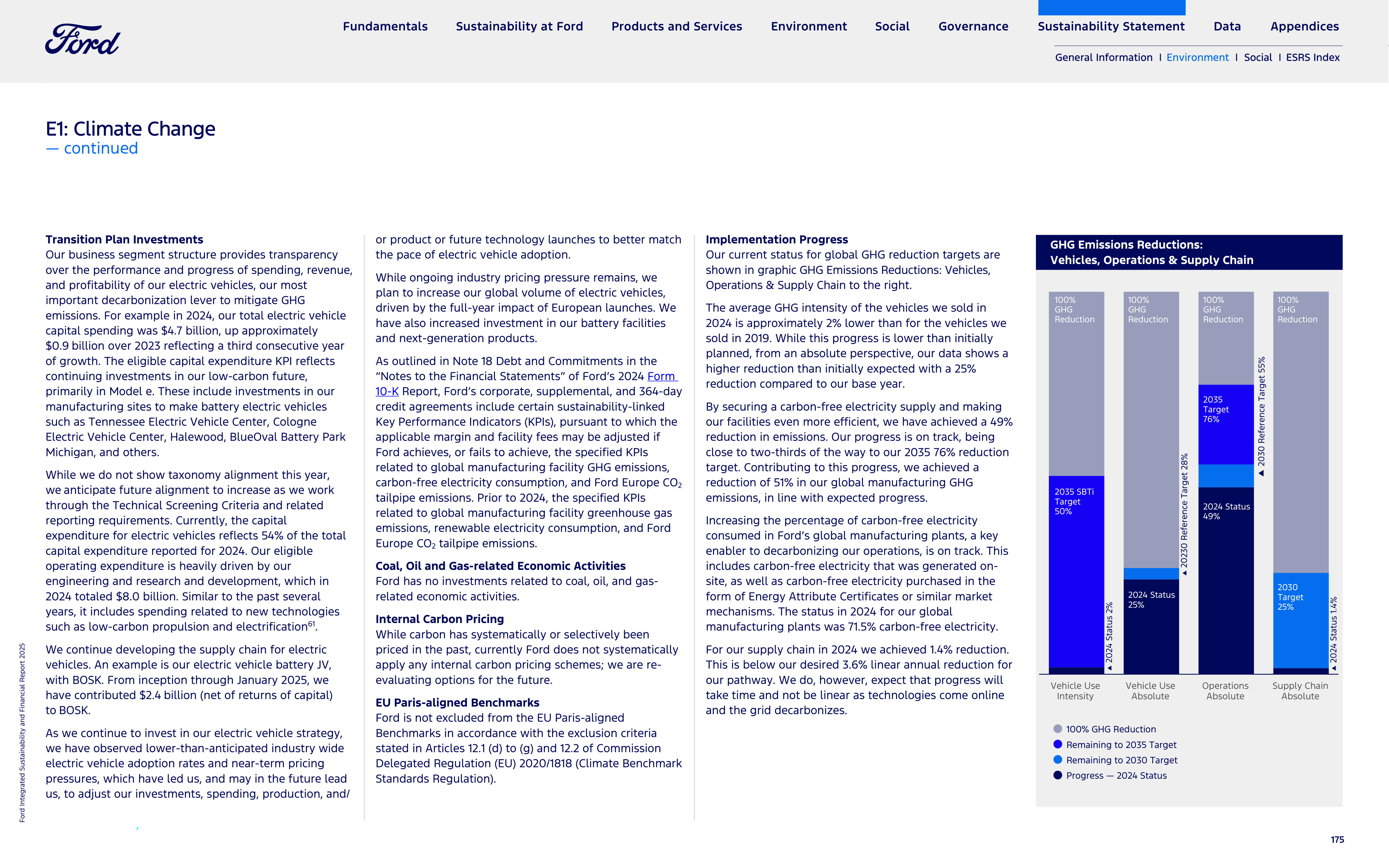
|
|
|
Fundamentals
Sustainability at Ford
Products and Services
Environment
Social
Governance
Sustainability Statement
Data
Appendices
General Information
Environment
Social
ESRS Index
E1: Climate Change
— continued
,
Ford Integrated Sustainability and Financial Report 2025
175
Transition Plan Investments
Our business segment structure provides transparency
over the performance and progress of spending, revenue,
and profitability of our electric vehicles, our most
important decarbonization lever to mitigate GHG
emissions. For example in 2024, our total electric vehicle
capital spending was $4.7 billion, up approximately
$0.9 billion over 2023 reflecting a third consecutive year
of growth. The eligible capital expenditure KPI reflects
continuing investments in our low-carbon future,
primarily in Model e. These include investments in our
manufacturing sites to make battery electric vehicles
such as Tennessee Electric Vehicle Center, Cologne
Electric Vehicle Center, Halewood, BlueOval Battery Park
Michigan, and others.
While we do not show taxonomy alignment this year,
we anticipate future alignment to increase as we work
through the Technical Screening Criteria and related
reporting requirements. Currently, the capital
expenditure for electric vehicles reflects 54% of the total
capital expenditure reported for 2024. Our eligible
operating expenditure is heavily driven by our
engineering and research and development, which in
2024 totaled $8.0 billion. Similar to the past several
years, it includes spending related to new technologies
such as low-carbon propulsion and electrification
61
.
We continue developing the supply chain for electric
vehicles. An example is our electric vehicle battery JV,
with BOSK. From inception through January 2025, we
have contributed $2.4 billion (net of returns of capital)
to BOSK.
As we continue to invest in our electric vehicle strategy,
we have observed lower-than-anticipated industry wide
electric vehicle adoption rates and near-term pricing
pressures, which have led us, and may in the future lead
us, to adjust our investments, spending, production, and/
or product or future technology launches to better match
the pace of electric vehicle adoption.
While ongoing industry pricing pressure remains, we
plan to increase our global volume of electric vehicles,
driven by the full-year impact of European launches. We
have also increased investment in our battery facilities
and next-generation products.
As outlined in Note 18 Debt and Commitments in the
“Notes to the Financial Statements” of Ford’s 2024
Form
10-K
Report, Ford’s corporate, supplemental, and 364-day
credit agreements include certain sustainability-linked
Key Performance Indicators (KPIs), pursuant to which the
applicable margin and facility fees may be adjusted if
Ford achieves, or fails to achieve, the specified KPIs
related to global manufacturing facility GHG emissions,
carbon-free electricity consumption, and Ford Europe CO
2
tailpipe emissions. Prior to 2024, the specified KPIs
related to global manufacturing facility greenhouse gas
emissions, renewable electricity consumption, and Ford
Europe CO
2
tailpipe emissions.
Coal, Oil and Gas-related Economic Activities
Ford has no investments related to coal, oil, and gas-
related economic activities.
Internal Carbon Pricing
While carbon has systematically or selectively been
priced in the past, currently Ford does not systematically
apply any internal carbon pricing schemes; we are re-
evaluating options for the future.
EU Paris-aligned Benchmarks
Ford is not excluded from the EU Paris-aligned
Benchmarks in accordance with the exclusion criteria
stated in Articles 12.1 (d) to (g) and 12.2 of Commission
Delegated Regulation (EU) 2020/1818 (Climate Benchmark
Standards Regulation).
Implementation Progress
Our current status for global GHG reduction targets are
shown in graphic GHG Emissions Reductions: Vehicles,
Operations & Supply Chain to the right.
The average GHG intensity of the vehicles we sold in
2024 is approximately 2% lower than for the vehicles we
sold in 2019. While this progress is lower than initially
planned, from an absolute perspective, our data shows a
higher reduction than initially expected with a 25%
reduction compared to our base year.
By securing a carbon-free electricity supply and making
our facilities even more efficient, we have achieved a 49%
reduction in emissions. Our progress is on track, being
close to two-thirds of the way to our 2035 76% reduction
target. Contributing to this progress, we achieved a
reduction of 51% in our global manufacturing GHG
emissions, in line with expected progress.
Increasing the percentage of carbon-free electricity
consumed in Ford’s global manufacturing plants, a key
enabler to decarbonizing our operations, is on track. This
includes carbon-free electricity that was generated on-
site, as well as carbon-free electricity purchased in the
form of Energy Attribute Certificates or similar market
mechanisms. The status in 2024 for our global
manufacturing plants was 71.5% carbon-free electricity.
For our supply chain in 2024 we achieved 1.4% reduction.
This is below our desired 3.6% linear annual reduction for
our pathway. We do, however, expect that progress will
take time and not be linear as technologies come online
and the grid decarbonizes.
GHG Emissions Reductions:
Vehicles, Operations & Supply Chain
•
•
•
•
Vehicle Use
Intensity
Progress — 2024 Status - 2024 Status 25%
2035 SBTi
Target
50%
100%
GHG
Reduction
Vehicle Use
Absolute
Progress — 2
024 Status - 2024 Status 25%
Remaining to 2030 Target - 20230 Reference Target 28%
100%
GHG
Reduction
Operations
Absolute
Progress — 2
024 Status - 2024 Status 49%
Remaining to 2030 Target - 2030 Reference Target 55%
2035
Target
76%
100%
GHG
Reduction -
Supply Chain
Absolute
Progress — 2024 Status - . 2024 Status 1.4%
2030
Target
25%
100%
GHG
Reduction -
100% GHG Reduction
Remaining to 2035 Target
Remaining to 2030 Target
Progress — 2024 Status
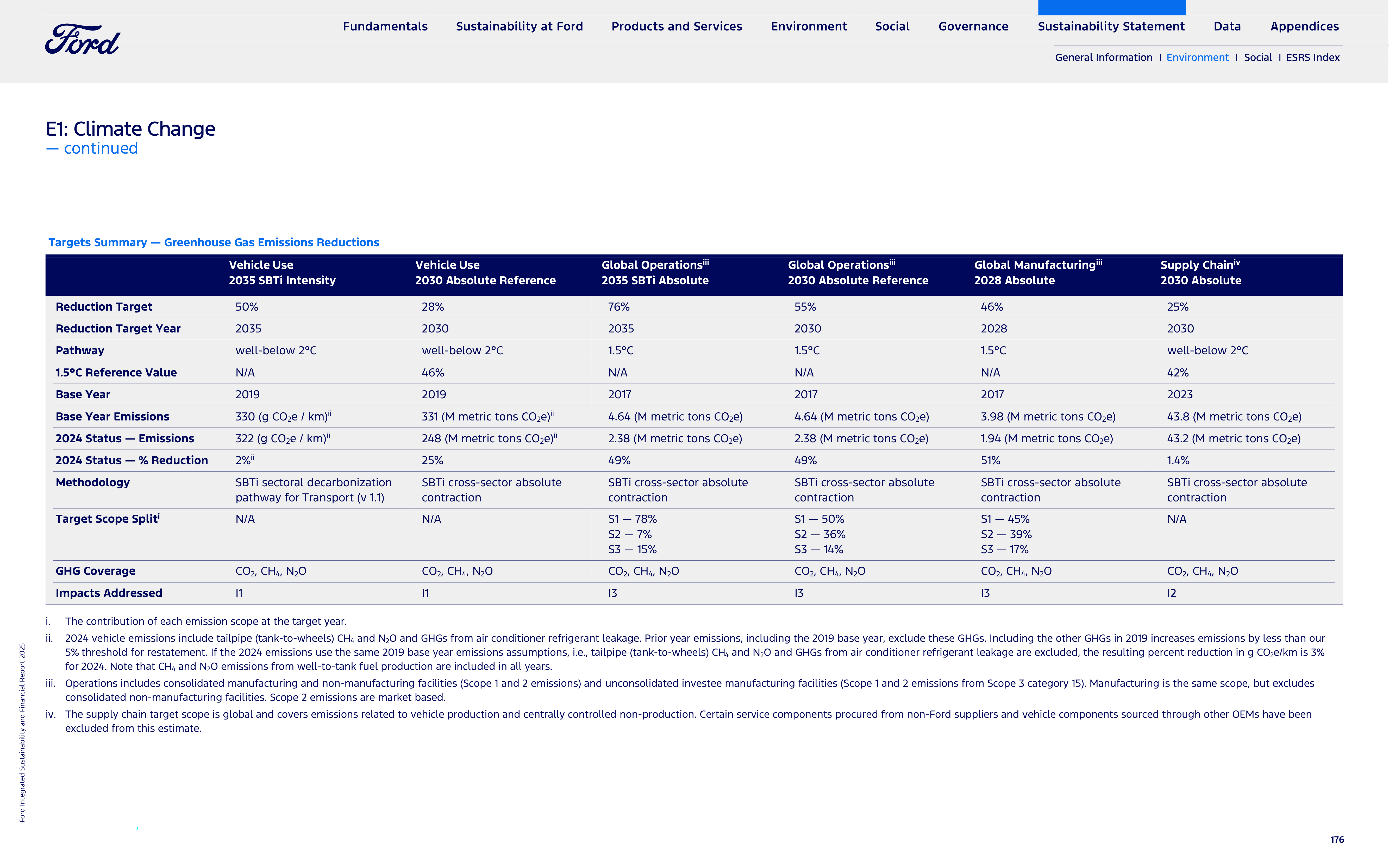
Fundamentals
Sustainability at Ford
Products and Services
Environment
Social
Governance
Sustainability Statement
Data
Appendices
General Information
Environment
Social
ESRS Index
|
|
|
Targets Summary — Greenhouse Gas Emissions Reductions
Vehicle Use
2035 SBTi Intensity
Vehicle Use
2030 Absolute Reference
Global Operations
iii
2035 SBTi Absolute
Global Operations
iii
2030 Absolute Reference
Global Manufacturing
iii
2028 Absolute
Supply Chain
iv
2030 Absolute
Reduction Target
50%
28%
76%
55%
46%
25%
Reduction Target Year
2035
2030
2035
2030
2028
2030
Pathway
well-below 2°C
well-below 2°C
1.5°C
1.5°C
1.5°C
well-below 2°C
1.5°C Reference Value
N/A
46%
N/A
N/A
N/A
42%
Base Year
2019
2019
2017
2017
2017
2023
Base Year Emissions
330 (g CO
2
e / km)
ii
331 (M metric tons CO
2
e)
ii
4.64 (M metric tons CO
2
e)
4.64 (M metric tons CO
2
e)
3.98 (M metric tons CO
2
e)
43.8 (M metric tons CO
2
e)
2024 Status — Emissions
322 (g CO
2
e / km)
ii
248 (M metric tons CO
2
e)
ii
2.38 (M metric tons CO
2
e)
2.38 (M metric tons CO
2
e)
1.94 (M metric tons CO
2
e)
43.2 (M metric tons CO
2
e)
2024 Status — % Reduction
2%
ii
25%
49%
49%
51%
1.4%
Methodology
SBTi sectoral decarbonization
pathway for Transport (v 1.1)
SBTi cross-sector absolute
contraction
SBTi cross-sector absolute
contraction
SBTi cross-sector absolute
contraction
SBTi cross-sector absolute
contraction
SBTi cross-sector absolute
contraction
Target Scope Split
i
N/A
N/A
S1 — 78%
S2 — 7%
S3 — 15%
S1 — 50%
S2 — 36%
S3 — 14%
S1 — 45%
S2 — 39%
S3 — 17%
N/A
GHG Coverage
CO
2
, CH
4
, N
2
O
CO
2
, CH
4
, N
2
O
CO
2
, CH
4
, N
2
O
CO
2
, CH
4
, N
2
O
CO
2
, CH
4
, N
2
O
CO
2
, CH
4
, N
2
O
Impacts Addressed
I1
I1
I3
I3
I3
I2
i.
The contribution of each emission scope at the target year.
ii.
2024 vehicle emissions include tailpipe (tank-to-wheels) CH
4
and N
2
O and GHGs from air conditioner refrigerant leakage. Prior year emissions, including the 2019 base year, exclude these GHGs. Including the other GHGs in 2019 increases emissions by less than our
5% threshold for restatement. If the 2024 emissions use the same 2019 base year emissions assumptions, i.e., tailpipe (tank-to-wheels) CH
4
and N
2
O and GHGs from air conditioner refrigerant leakage are excluded, the resulting percent reduction in g CO
2
e/km is 3%
for 2024. Note that CH
4
and N
2
O emissions from well-to-tank fuel production are included in all years.
iii. Operations includes consolidated manufacturing and non-manufacturing facilities (Scope 1 and 2 emissions) and unconsolidated investee manufacturing facilities (Scope 1 and 2 emissions from Scope 3 category 15). Manufacturing is the same scope, but excludes
consolidated non-manufacturing facilities. Scope 2 emissions are market based.
iv. The supply chain target scope is global and covers emissions related to vehicle production and centrally controlled non-production. Certain service components procured from non-Ford suppliers and vehicle components sourced through other OEMs have been
excluded from this estimate.
E1: Climate Change
— continued
,
Ford Integrated Sustainability and Financial Report 2025
176
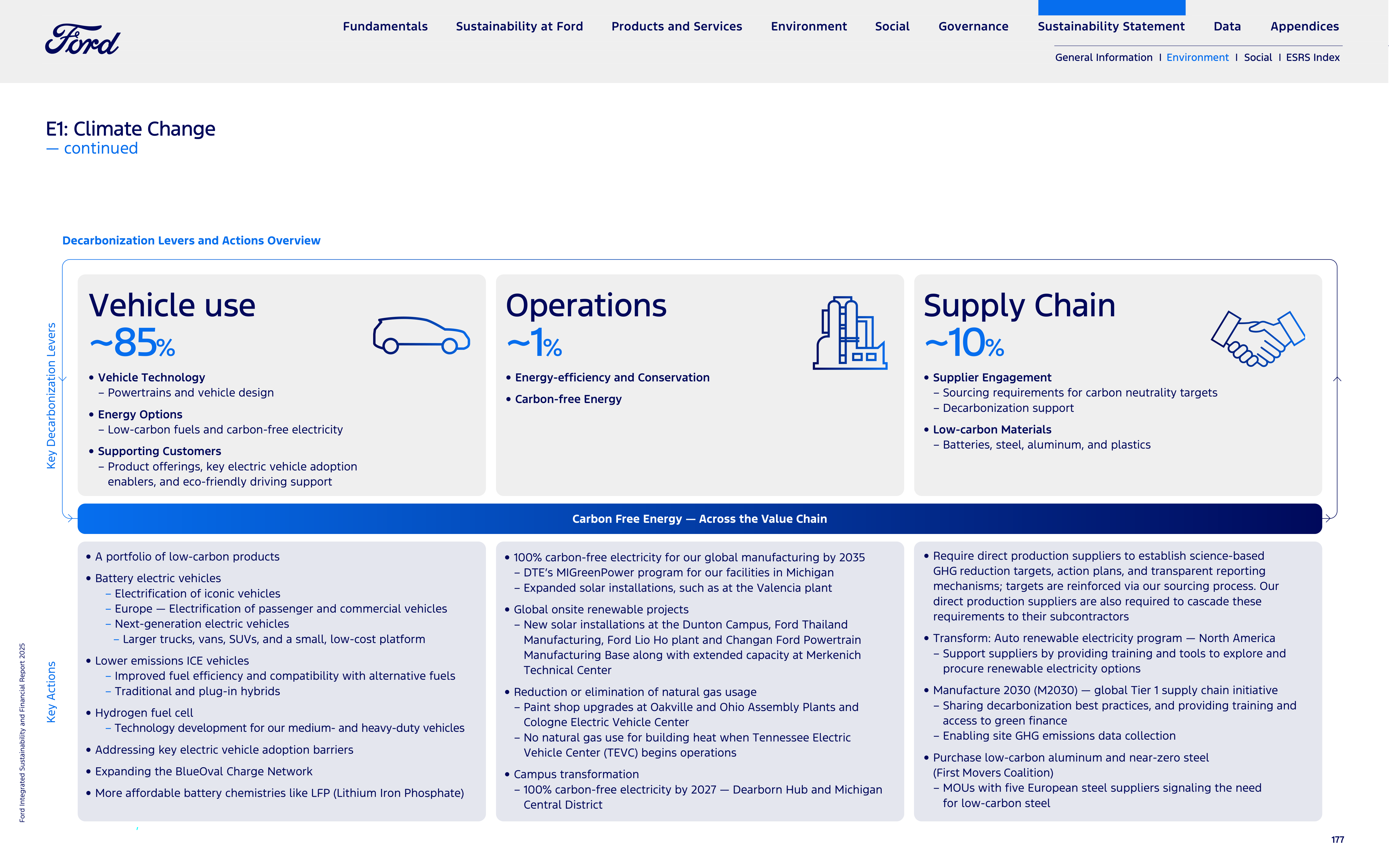





Fundamentals
Sustainability at Ford
Products and Services
Environment
Social
Governance
Sustainability Statement
Data
Appendices
General Information
Environment
Social
ESRS Index
|
|
|
Decarbonization Levers and Actions Overview
Key Decarbonization Levers
Vehicle use
~85
%
•
Vehicle Technology
– Powertrains and vehicle design
•
Energy Options
– Low-carbon fuels and carbon-free electricity
•
Supporting Customers
– Product offerings, key electric vehicle adoption
enablers, and eco-friendly driving support
Operations
~1
%
•
Energy-efficiency and Conservation
•
Carbon-free Energy
Supply Chain
~10
%
•
Supplier Engagement
– Sourcing requirements for carbon neutrality targets
– Decarbonization support
•
Low-carbon Materials
– Batteries, steel, aluminum, and plastics
Carbon Free Energy
-
Across the Value Chain
Key Actions
•
A portfolio of low-carbon products
•
Battery electric vehicles
–
Electrification of iconic vehicles
–
Europe — Electrification of passenger and commercial vehicles
–
Next-generation electric vehicles
–
Larger trucks, vans, SUVs, and a small, low-cost platform
•
Lower emissions ICE vehicles
–
Improved fuel efficiency and compatibility with alternative fuels
–
Traditional and plug-in hybrids
•
Hydrogen fuel cell
–
Technology development for our medium- and heavy-duty vehicles
•
Addressing key electric vehicle adoption barriers
•
Expanding the BlueOval Charge Network
•
More affordable battery chemistries like LFP (Lithium Iron Phosphate)
E1: Climate Change
— continued
,
Ford Integrated Sustainability and Financial Report 2025
177
•
100% carbon-free electricity for our global manufacturing by 2035
– DTE’s MIGreenPower program for our facilities in Michigan
– Expanded solar installations, such as at the Valencia plant
•
Global onsite renewable projects
– New solar installations at the Dunton Campus, Ford Thailand
Manufacturing, Ford Lio Ho plant and Changan Ford Powertrain
Manufacturing Base along with extended capacity at Merkenich
Technical Center
•
Reduction or elimination of natural gas usage
– Paint shop upgrades at Oakville and Ohio Assembly Plants and
Cologne Electric Vehicle Center
– No natural gas use for building heat when Tennessee Electric
Vehicle Center (TEVC) begins operations
•
Campus transformation
– 100% carbon-free electricity by 2027 — Dearborn Hub and Michigan
Central District
•
Require direct production suppliers to establish science-based
GHG reduction targets, action plans, and transparent reporting
mechanisms; targets are reinforced via our sourcing process. Our
direct production suppliers are also required to cascade these
requirements to their subcontractors
•
Transform: Auto renewable electricity program — North America
– Support suppliers by providing training and tools to explore and
procure renewable electricity options
•
Manufacture 2030 (M2030) — global Tier 1 supply chain initiative
– Sharing decarbonization best practices, and providing training and
access to green finance
– Enabling site GHG emissions data collection
•
Purchase low-carbon aluminum and near-zero steel
(First Movers Coalition)
– MOUs with five European steel suppliers signaling the need
for low-carbon steel

Fundamentals
Sustainability at Ford
Products and Services
Environment
Social
Governance
Sustainability Statement
Data
Appendices
General Information
Environment
Social
ESRS Index
|
|
|
IMPACTS, RISKS, AND OPPORTUNITIES
IDENTIFICATION AND ASSESSMENT PROCESS
Additional climate-specific details on the IROs
identification and assessment process are provided
below, complementing our overall Double Materiality
Assessment (DMA) and scenario and resilience analysis
disclosures.
See additional details in section Double Materiality
Assessment on page 156 and in Scenario and Resilience
Analysis Process on page 187.
Climate Impacts
We annually assess our entire value chain’s impact on
climate change by calculating corporate Scopes 1, 2, and
3 and total emissions as defined by the Greenhouse Gas
Protocol. The current status and future emissions based
on planned actions for our vehicles, operations, and
supply chain are evaluated relative to associated science-
based pathways and reviewed at least bi-annually by
management and annually by the Sustainability,
Innovation and Policy Committee of the Board of
Directors.
Climate Risks and Opportunities
Introduction
Climate-related risks are divided into two categories:
•
Transition risks — those that arise from actions
associated with the transition to a low-carbon
economy, including the introduction of new climate
policies or low-carbon technologies
•
Physical risks — those that arise from the acute and
chronic physical impacts of climate change
We identified and assessed climate-related risks and
opportunities along our upstream and downstream value
chain based on TCFD guidelines and well-established,
state-of-the-art science scenarios.
Three scenarios were analyzed to identify transition and
physical risks: The IEA Net Zero Emissions (NZE) by 2050
Scenario, the IEA Stated Policies Scenario (STEPS), and the
Intergovernmental Panel of Climate Change (IPCC)
Representative Concentration Pathway 8.5 (RCP8.5). NZE
helps expose transition risks, and while physical risks are
covered by all scenarios, the RCP8.5 scenario represents
the most severe physical risks in terms of timing and
magnitude. See Scenario and Resilience Analysis Process
on page 187 for more details on the scenarios.
The range provided by these scenarios identifies likely
risks and opportunities, as they cover a wide gamut of
societal action, addressing future uncertainties related to
policy, macroeconomic, energy systems, or technological
developments. These scenarios are also compatible with
the financial statement summaries on key climate risks
including GHG and fuel economy regulations, carbon
neutrality commitments, and disruptions to our
operations and our supply chain.
We evaluated the exposure and sensitivity of assets and
business activities to identified hazards and transition
events over short- (<5 years), medium- (5-10 years), and
long-term (>10 years) horizons as defined for our scenario
analysis. The climate-related time horizons are consistent
with our current interim 2035 SBTi Targets, Ford asset
lifespans, strategic planning, and capital allocation. They
differ from the time horizons identified for non-climate
related IROs identified in our DMA.
Transition Risks
In context of the scenario analysis and DMA, we
identified transition events and screened exposure of our
assets and business activities to these events over said
time horizons. We assessed the extent to which our
assets and business activities may be exposed and are
sensitive to the identified transition events. The double
materiality analysis considered the likelihood, magnitude,
and duration of the transition events.
Climate risks are summarized in the table Material
Climate-related Risks on page 179. The material risks are
also provided in the Risks table in section Material
Impacts, Risks, and Opportunities on page 161.
Also see the EU Taxonomy section for statements and
details on our sustainable economic activities (as defined
by EU Taxonomy) on page 168 and the results of the
Resilience Analysis on page 189 for activities requiring
significant efforts to be compatible with a transition to
a climate-neutral economy.
Physical Risk — Our Own Operations
Ford has conducted a detailed assessment of climate-
related physical risks across its operations. Assets for
70 Ford sites in 16 countries were screened for climate
hazard exposure across short-, medium-, and long-term
time horizons. Hazards related to temperature, wind and
water, and solid mass were assessed.
The assessment utilized climate modeling datasets,
hazard models, and location-specific data to analyze
risks, considering the likelihood, magnitude, and duration
of potential hazards, and in alignment with state-of-the-
art science at the time of the analysis. Asset location data
was overlaid with hazard maps for three climate
scenarios from Intergovernmental Panel of Climate
Change (IPCC) — RCP 2.6, RCP 4.5, and high-emission
scenario RCP 8.5 — to identify and assess climate-related
hazards.
In conducting a risk assessment on climate-related
physical hazards, Ford has identified acute and chronic
climate-related risks over the short-, medium-, and long-
term time horizons.
Physical Risk — Our Supply Chain
Our supply chain risk assessment focuses on water-
related risks, an important climate-related risk, for Tier 1
suppliers based on geospatial coordinates.
E1: Climate Change
— continued
,
Ford Integrated Sustainability and Financial Report 2025
178
Fundamentals
Sustainability at Ford
Products and Services
Environment
Social
Governance
Sustainability Statement
Data
Appendices
General Information
Environment
Social
ESRS Index
|
|
|
MATERIAL IMPACTS, RISKS, AND OPPORTUNITIES RELATED TO CLIMATE CHANGE
Material Climate-related Risks
Transition Risks
Regulation, Policy, and Legal
R-2
•
Failing to comply with emissions regulations and meet ZEV thresholds may result in purchasing credits from competitors, curtailing vehicle sales, or paying fines
Technology
R-1
•
Meeting stringent emissions and emerging regulatory standards may require substantial investments
Market
R-10
•
Over investment in electrification and uptake not occurring at the same scale presents a financial risk
Physical Risks
Acute: Extreme Weather
R-3
•
Heightened occurrences of extreme weather events can disrupt Ford’s direct operations
R-4
•
Heightened occurrences of extreme weather events can disrupt Ford’s supply chain
The above transition risks for leading markets currently
transitioning to electric vehicles cover all three time
horizons. In leading markets, we expect these risks to
lessen over time as electric vehicle adoption becomes
more widespread. Other markets will reach the electric
vehicle inflection point later, extending the time horizon
for technology and market risks.
Policies, actions, and targets for each of the above
climate-related risks and our climate impacts are
discussed below. This includes details on target
methodology, decarbonization levers and investments,
stakeholder involvement, governance, performance, and
an outlook.
Other climate-related environmental and human rights
areas that are addressed in our
We Are Committed to
Protecting Human Rights and the Environment policy
and not addressed in this section can be found in the
respective sections of the sustainability statement.
Scope of Climate-related Ford Actions
Unless specified otherwise, the associated actions/
decarbonization levers are all global in scope with
completion time horizons consistent with achieving
the targets.
Impact I-1
The combustion of fossil fuels in ICE vehicles produces
GHGs contributing to Ford’s Scope 3 emissions.
Policies
Our We Are Committed to Protecting Human Rights and
the Environment policy states that “we:
•
Do our part to minimize impact on climate change
aligned with the United Nations Framework Convention
on Climate Change (Paris Climate Agreement), striving
towards carbon neutrality
•
Minimize vehicle criteria and greenhouse gas emissions
and increase energy efficiency, recognizing that life
cycle performance is a function of vehicle technology,
energy sources, and operating environment
•
Consider environmental performance throughout the
life of a vehicle and address in-service concerns in a
timely, customer-driven manner.”
For more information on the policy see the table “Policies
to Manage Material Impacts, Risks, and Opportunities”
on page 162.
Actions
The decarbonization levers and associated actions
to reach our 2030 reference target support the
implementation of the We Are Committed to Protecting
Human Rights and the Environment policy. See
Decarbonization Levers and Actions Overview on page
177 and Decarbonization Levers and Investments for this
impact on page 180.
Targets
Ford has set a science-based intensity target, approved
by SBTi, to reduce vehicle use emissions 50% per vehicle
km by 2035, relative to a 2019 base year.
Our absolute 2030 reference target is a 28% reduction
relative to the same 2019 base year.
This target supports the implementation of the We Are
Committed to Protecting Human Rights and the
Environment policy.
Methodology
Because the 2030 reference target is based on the 2035
target, the methodology discussion applies to both
targets unless noted otherwise.
Our 2035 vehicle target is aligned with a well-below 2°C
pathway and was set using the SBTi Sectoral
Decarbonization Tool for Transport (v 1.1). The 2030
reference target was defined using the SBTi cross-sector
absolute contraction approach along the same pathway.
Our 2030 absolute reference target on a 1.5°C pathway
would be a 46% reduction from the same base year.
The base year of 2019 was chosen as a year with
representative sales volumes. 2020 was not chosen
as a base year due to the COVID pandemic and global
microchip shortages affecting sales volumes. The
baseline value calculation considered the GHG Protocol.
When setting our vehicle target, we used an internal
forecast of future sales activity as input to the SBTi tool.
The tool adjusts the intensity target to account for
growth such that absolute emissions decrease.
Factors to achieving the target include technology
solutions, policy support, customer adoption of new
technologies, and economic conditions. Future
technology solutions, such as electric vehicles, and
supportive policies and regulations are important to
achieve the target. Customer preferences and economic
conditions may have either positive or negative GHG
E1: Climate Change
— continued
,
Ford Integrated Sustainability and Financial Report 2025
179
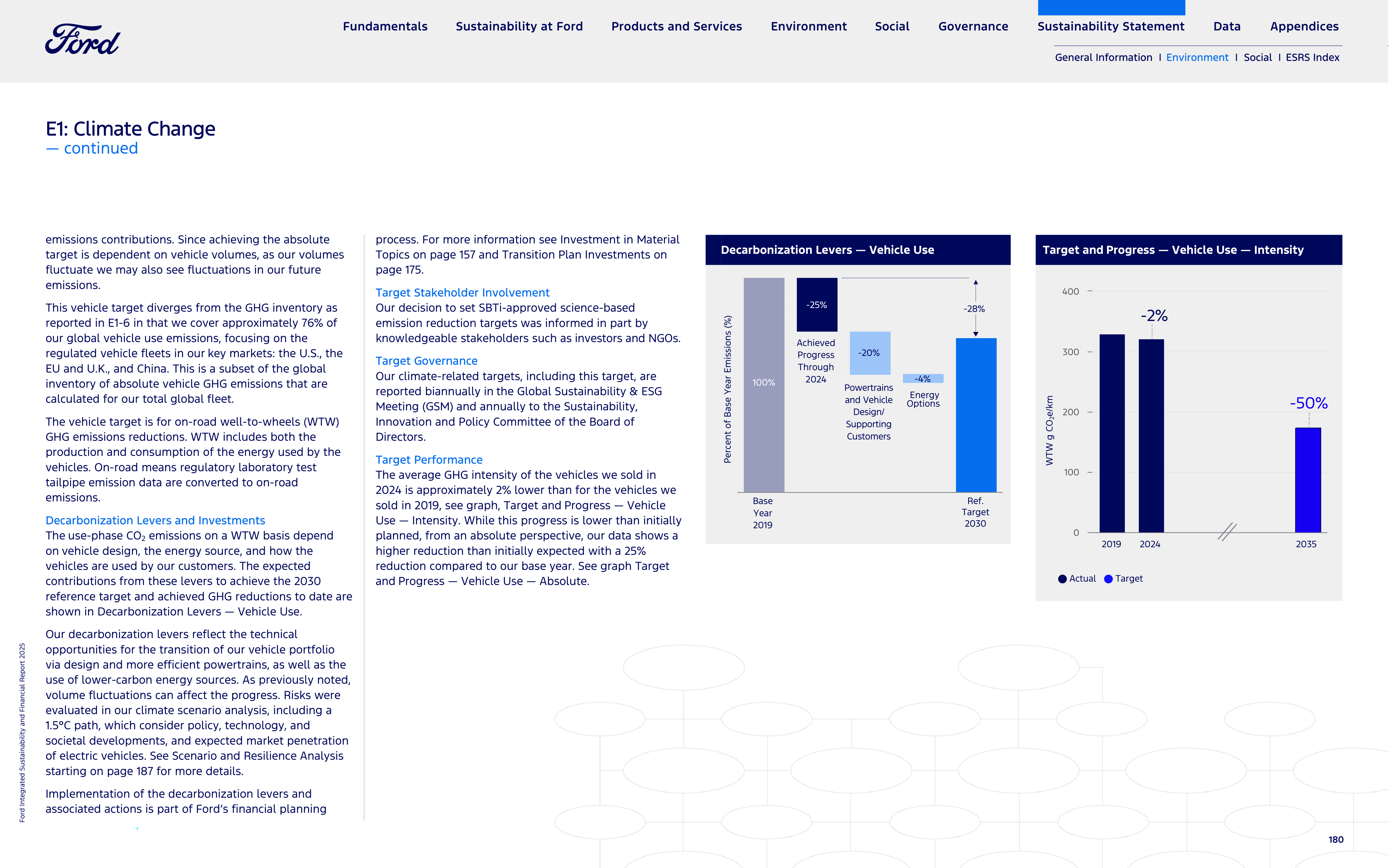

emissions contributions. Since achieving the absolute
target is dependent on vehicle volumes, as our volumes
fluctuate we may also see fluctuations in our future
emissions.
Fundamentals
Sustainability at Ford
Products and Services
Environment
Social
Governance
Sustainability Statement
Data
Appendices
General Information
Environment
Social
ESRS Index
|
|
|
This vehicle target diverges from the GHG inventory as
reported in E1-6 in that we cover approximately 76% of
our global vehicle use emissions, focusing on the
regulated vehicle fleets in our key markets: the U.S., the
EU and U.K., and China. This is a subset of the global
inventory of absolute vehicle GHG emissions that are
calculated for our total global fleet.
The vehicle target is for on-road well-to-wheels (WTW)
GHG emissions reductions. WTW includes both the
production and consumption of the energy used by the
vehicles. On-road means regulatory laboratory test
tailpipe emission data are converted to on-road
emissions.
Decarbonization Levers and Investments
The use-phase CO
2
emissions on a WTW basis depend
on vehicle design, the energy source, and how the
vehicles are used by our customers. The expected
contributions from these levers to achieve the 2030
reference target and achieved GHG reductions to date are
shown in Decarbonization Levers — Vehicle Use.
Our decarbonization levers reflect the technical
opportunities for the transition of our vehicle portfolio
via design and more efficient powertrains, as well as the
use of lower-carbon energy sources. As previously noted,
volume fluctuations can affect the progress. Risks were
evaluated in our climate scenario analysis, including a
1.5°C path, which consider policy, technology, and
societal developments, and expected market penetration
of electric vehicles. See Scenario and Resilience Analysis
starting on page 187 for more details.
Implementation of the decarbonization levers and
associated actions is part of Ford’s financial planning
process. For more information see Investment in Material
Topics on page 157 and Transition Plan Investments on
page 175.
Target Stakeholder Involvement
Our decision to set SBTi-approved science-based
emission reduction targets was informed in part by
knowledgeable stakeholders such as investors and NGOs.
Target Governance
Our climate-related targets, including this target, are
reported biannually in the Global Sustainability & ESG
Meeting (GSM) and annually to the Sustainability,
Innovation and Policy Committee of the Board of
Directors.
Target Performance
The average GHG intensity of the vehicles we sold in
2024 is approximately 2% lower than for the vehicles we
sold in 2019, see graph, Target and Progress — Vehicle
Use — Intensity. While this progress is lower than initially
planned, from an absolute perspective, our data shows a
higher reduction than initially expected with a 25%
reduction compared to our base year. See graph Target
and Progress — Vehicle Use — Absolute.
▲
Percent of Base Year Emissions (%)
▼
WTW g CO
2
e/km
•
•
E1: Climate Change
— continued
,
Ford Integrated Sustainability and Financial Report 2025
180
0
100
200
300
400
Decarbonization Levers — Vehicle Use
Base
Year
2019
100%
Achieved
Progress
Through
2024
-25%
Powertrains
and Vehicle
Design/
Supporting
Customers
-20%
Energy
Options
-4%
Ref.
Target
2030
-28%
Target and Progress — Vehicle Use — Intensity
2019
2024
-2%
2035
-50%
Actu
arget
al
T
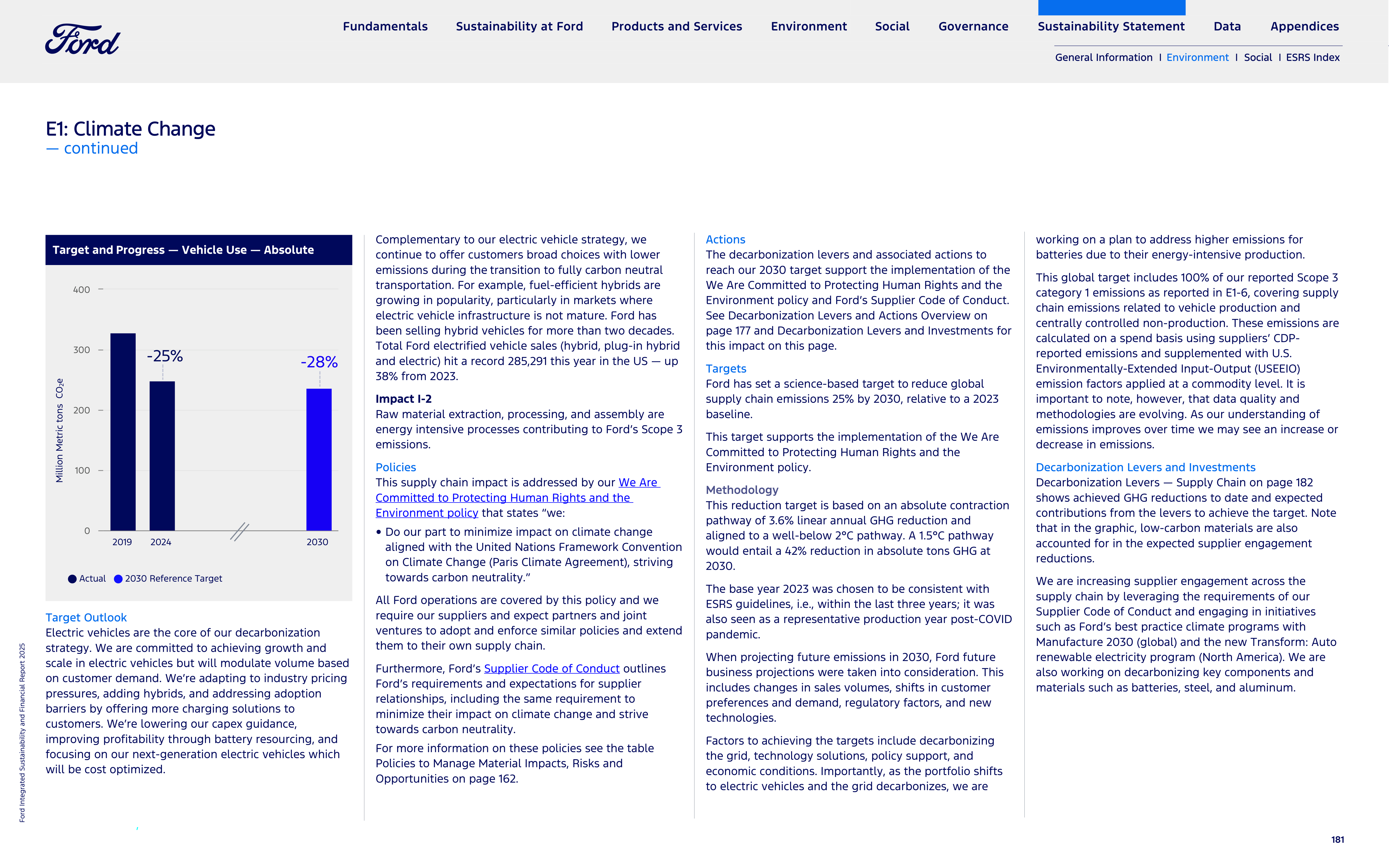
Fundamentals
Sustainability at Ford
Products and Services
Environment
Social
Governance
Sustainability Statement
Data
Appendices
General Information
Environment
Social
ESRS Index
|
|
|
Target and Progress — Vehicle Use — Absolute
Million Metric tons CO
2
e
•
2019
2024
-25%
-28%
Actual
030 Reference Target
0
100
200
300
400
2030
2
•
Target Outlook
Electric vehicles are the core of our decarbonization
strategy. We are committed to achieving growth and
scale in electric vehicles but will modulate volume based
on customer demand. We’re adapting to industry pricing
pressures, adding hybrids, and addressing adoption
barriers by offering more charging solutions to
customers. We’re lowering our capex guidance,
improving profitability through battery resourcing, and
focusing on our next-generation electric vehicles which
will be cost optimized.
Complementary to our electric vehicle strategy, we
continue to offer customers broad choices with lower
emissions during the transition to fully carbon neutral
transportation. For example, fuel-efficient hybrids are
growing in popularity, particularly in markets where
electric vehicle infrastructure is not mature. Ford has
been selling hybrid vehicles for more than two decades.
Total Ford electrified vehicle sales (hybrid, plug-in hybrid
and electric) hit a record 285,291 this year in the US — up
38% from 2023.
Impact I-2
Raw material extraction, processing, and assembly are
energy intensive processes contributing to Ford’s Scope 3
emissions.
Policies
This supply chain impact is addressed by our
We Are
Committed to Protecting Human Rights and the
Environment policy
that states “we:
•
Do our part to minimize impact on climate change
aligned with the United Nations Framework Convention
on Climate Change (Paris Climate Agreement), striving
towards carbon neutrality.”
All Ford operations are covered by this policy and we
require our suppliers and expect partners and joint
ventures to adopt and enforce similar policies and extend
them to their own supply chain.
Furthermore, Ford’s
Supplier Code of Conduct
outlines
Ford’s requirements and expectations for supplier
relationships, including the same requirement to
minimize their impact on climate change and strive
towards carbon neutrality.
For more information on these policies see the table
Policies to Manage Material Impacts, Risks and
Opportunities on page 162.
Actions
The decarbonization levers and associated actions to
reach our 2030 target support the implementation of the
We Are Committed to Protecting Human Rights and the
Environment policy and Ford’s Supplier Code of Conduct.
See Decarbonization Levers and Actions Overview on
page 177 and Decarbonization Levers and Investments for
this impact on this page.
Targets
Ford has set a science-based target to reduce global
supply chain emissions 25% by 2030, relative to a 2023
baseline.
This target supports the implementation of the We Are
Committed to Protecting Human Rights and the
Environment policy.
Methodology
This reduction target is based on an absolute contraction
pathway of 3.6% linear annual GHG reduction and
aligned to a well-below 2°C pathway. A 1.5°C pathway
would entail a 42% reduction in absolute tons GHG at
2030.
The base year 2023 was chosen to be consistent with
ESRS guidelines, i.e., within the last three years; it was
also seen as a representative production year post-COVID
pandemic.
When projecting future emissions in 2030, Ford future
business projections were taken into consideration. This
includes changes in sales volumes, shifts in customer
preferences and demand, regulatory factors, and new
technologies.
Factors to achieving the targets include decarbonizing
the grid, technology solutions, policy support, and
economic conditions. Importantly, as the portfolio shifts
to electric vehicles and the grid decarbonizes, we are
working on a plan to address higher emissions for
batteries due to their energy-intensive production.
This global target includes 100% of our reported Scope 3
category 1 emissions as reported in E1-6, covering supply
chain emissions related to vehicle production and
centrally controlled non-production. These emissions are
calculated on a spend basis using suppliers’ CDP-
reported emissions and supplemented with U.S.
Environmentally-Extended Input-Output (USEEIO)
emission factors applied at a commodity level. It is
important to note, however, that data quality and
methodologies are evolving. As our understanding of
emissions improves over time we may see an increase or
decrease in emissions.
Decarbonization Levers and Investments
Decarbonization Levers — Supply Chain on page 182
shows achieved GHG reductions to date and expected
contributions from the levers to achieve the target. Note
that in the graphic, low-carbon materials are also
accounted for in the expected supplier engagement
reductions.
We are increasing supplier engagement across the
supply chain by leveraging the requirements of our
Supplier Code of Conduct and engaging in initiatives
such as Ford’s best practice climate programs with
Manufacture 2030 (global) and the new Transform: Auto
renewable electricity program (North America). We are
also working on decarbonizing key components and
materials such as batteries, steel, and aluminum.
E1: Climate Change
— continued
,
Ford Integrated Sustainability and Financial Report 2025
181
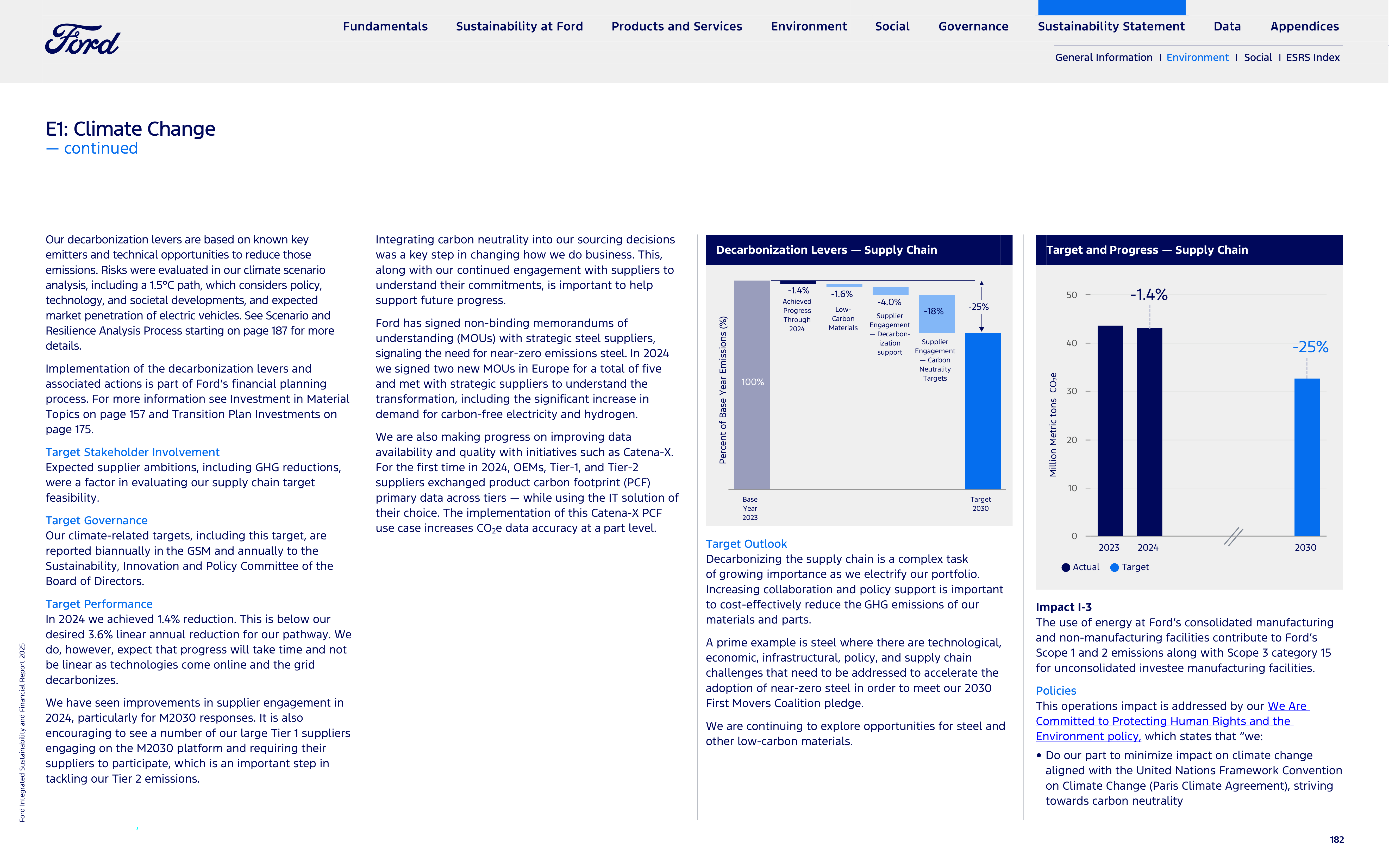
Fundamentals
Sustainability at Ford
Products and Services
Environment
Social
Governance
Sustainability Statement
Data
Appendices
General Information
Environment
Social
ESRS Index
|
|
|
Our decarbonization levers are based on known key
emitters and technical opportunities to reduce those
emissions. Risks were evaluated in our climate scenario
analysis, including a 1.5°C path, which considers policy,
technology, and societal developments, and expected
market penetration of electric vehicles. See Scenario and
Resilience Analysis Process starting on page 187 for more
details.
Implementation of the decarbonization levers and
associated actions is part of Ford’s financial planning
process. For more information see Investment in Material
Topics on page 157 and Transition Plan Investments on
page 175.
Target Stakeholder Involvement
Expected supplier ambitions, including GHG reductions,
were a factor in evaluating our supply chain target
feasibility.
Target Governance
Our climate-related targets, including this target, are
reported biannually in the GSM and annually to the
Sustainability, Innovation and Policy Committee of the
Board of Directors.
Target Performance
In 2024 we achieved 1.4% reduction. This is below our
desired 3.6% linear annual reduction for our pathway. We
do, however, expect that progress will take time and not
be linear as technologies come online and the grid
decarbonizes.
We have seen improvements in supplier engagement in
2024, particularly for M2030 responses. It is also
encouraging to see a number of our large Tier 1 suppliers
engaging on the M2030 platform and requiring their
suppliers to participate, which is an important step in
tackling our Tier 2 emissions.
Integrating carbon neutrality into our sourcing decisions
was a key step in changing how we do business. This,
along with our continued engagement with suppliers to
understand their commitments, is important to help
support future progress.
Ford has signed non-binding memorandums of
understanding (MOUs) with strategic steel suppliers,
signaling the need for near-zero emissions steel. In 2024
we signed two new MOUs in Europe for a total of five
and met with strategic suppliers to understand the
transformation, including the significant increase in
demand for carbon-free electricity and hydrogen.
We are also making progress on improving data
availability and quality with initiatives such as Catena-X.
For the first time in 2024, OEMs, Tier-1, and Tier-2
suppliers exchanged product carbon footprint (PCF)
primary data across tiers — while using the IT solution of
their choice. The implementation of this Catena-X PCF
use case increases CO
2
e data accuracy at a part level.
Decarbonization Levers — Supply Chain
▲
Percent of Base Year Emissions (%)
▼
Million Metric tons CO
2
e
•
•
E1: Climate Change
— continued
2025
rt
l Repo
ncia
ina
F
nd
a
y
ilit
b
ina
a
ust
S
ed
t
ra
eg
Int
rd
o
F
,
182
0
10
20
30
40
50
Base
Year
2023
100%
Achieved
Progress
Through
2024
-1.4%
Low-
Carbon
Materials
-1.6%
Supplier
Engagement
— Decarbon-
ization
support
-4.0%
Supplier
Engagement
— Carbon
Neutrality
Targets
-18%
Target
2030
-25%
Target Outlook
Decarbonizing the supply chain is a complex task
of growing importance as we electrify our portfolio.
Increasing collaboration and policy support is important
to cost-effectively reduce the GHG emissions of our
materials and parts.
A prime example is steel where there are technological,
economic, infrastructural, policy, and supply chain
challenges that need to be addressed to accelerate the
adoption of near-zero steel in order to meet our 2030
First Movers Coalition pledge.
We are continuing to explore opportunities for steel and
other low-carbon materials.
Target and Progress — Supply Chain
2023
2024
-1.4%
2030
-25%
Actual
Target
Impact I-3
The use of energy at Ford’s consolidated manufacturing
and non-manufacturing facilities contribute to Ford’s
Scope 1 and 2 emissions along with Scope 3 category 15
for unconsolidated investee manufacturing facilities.
Policies
This operations impact is addressed by our
We Are
Committed to Protecting Human Rights and the
Environment policy,
which states that “we:
•
Do our part to minimize impact on climate change
aligned with the United Nations Framework Convention
on Climate Change (Paris Climate Agreement), striving
towards carbon neutrality
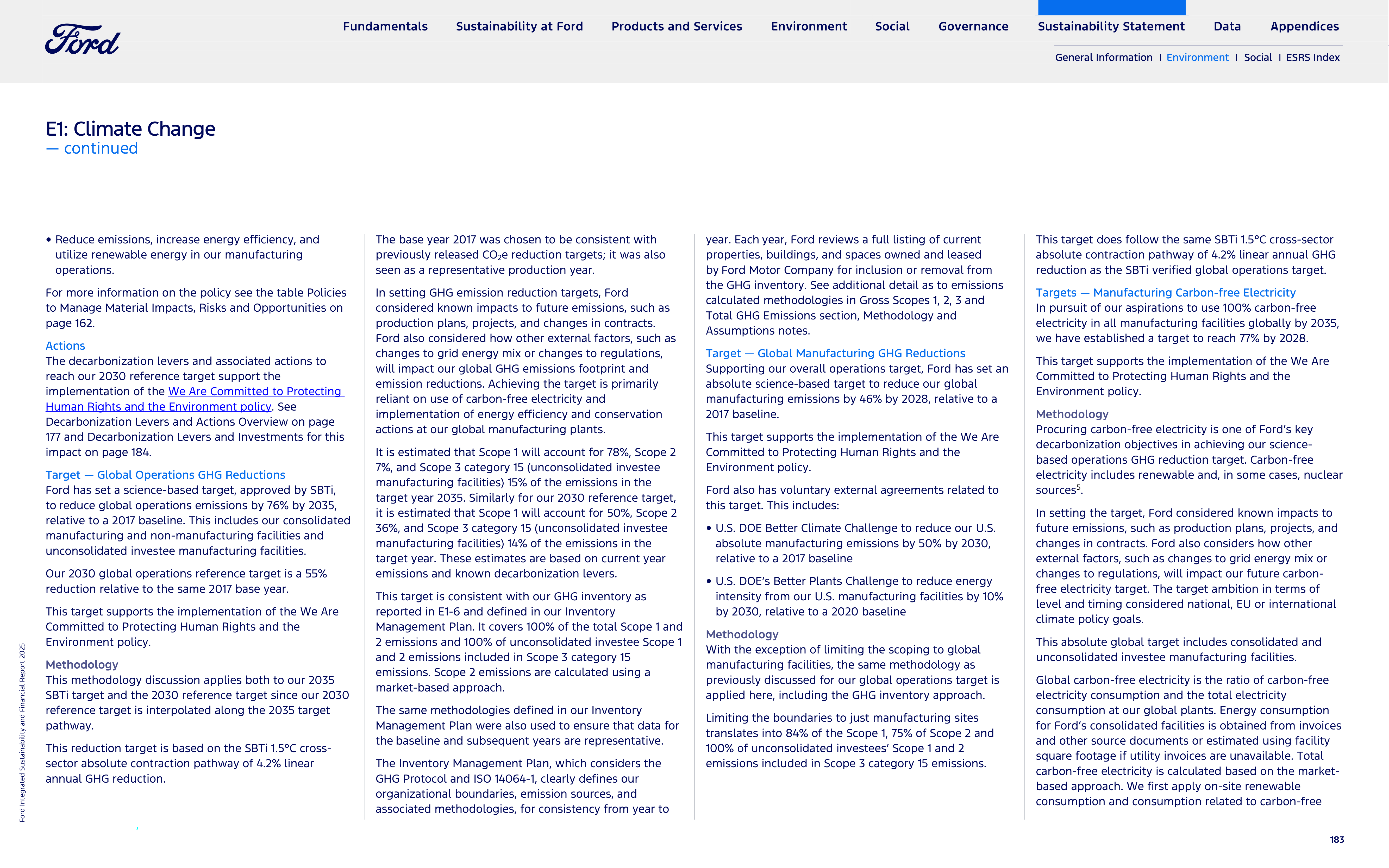
•
Reduce emissions, increase energy efficiency, and
utilize renewable energy in our manufacturing
operations.
Fundamentals
Sustainability at Ford
Products and Services
Environment
Social
Governance
Sustainability Statement
Data
Appendices
General Information
Environment
Social
ESRS Index
|
|
|
For more information on the policy see the table Policies
to Manage Material Impacts, Risks and Opportunities on
page 162.
Actions
The decarbonization levers and associated actions to
reach our 2030 reference target support the
implementation of the
We Are Committed to Protecting
Human Rights and the Environment policy
. See
Decarbonization Levers and Actions Overview on page
177 and Decarbonization Levers and Investments for this
impact on page 184.
Target — Global Operations GHG Reductions
Ford has set a science-based target, approved by SBTi,
to reduce global operations emissions by 76% by 2035,
relative to a 2017 baseline. This includes our consolidated
manufacturing and non-manufacturing facilities and
unconsolidated investee manufacturing facilities.
Our 2030 global operations reference target is a 55%
reduction relative to the same 2017 base year.
This target supports the implementation of the We Are
Committed to Protecting Human Rights and the
Environment policy.
Methodology
This methodology discussion applies both to our 2035
SBTi target and the 2030 reference target since our 2030
reference target is interpolated along the 2035 target
pathway.
This reduction target is based on the SBTi 1.5°C cross-
sector absolute contraction pathway of 4.2% linear
annual GHG reduction.
The base year 2017 was chosen to be consistent with
previously released CO
2
e reduction targets; it was also
seen as a representative production year.
In setting GHG emission reduction targets, Ford
considered known impacts to future emissions, such as
production plans, projects, and changes in contracts.
Ford also considered how other external factors, such as
changes to grid energy mix or changes to regulations,
will impact our global GHG emissions footprint and
emission reductions. Achieving the target is primarily
reliant on use of carbon-free electricity and
implementation of energy efficiency and conservation
actions at our global manufacturing plants.
It is estimated that Scope 1 will account for 78%, Scope 2
7%, and Scope 3 category 15 (unconsolidated investee
manufacturing facilities) 15% of the emissions in the
target year 2035. Similarly for our 2030 reference target,
it is estimated that Scope 1 will account for 50%, Scope 2
36%, and Scope 3 category 15 (unconsolidated investee
manufacturing facilities) 14% of the emissions in the
target year. These estimates are based on current year
emissions and known decarbonization levers.
This target is consistent with our GHG inventory as
reported in E1-6 and defined in our Inventory
Management Plan. It covers 100% of the total Scope 1 and
2 emissions and 100% of unconsolidated investee Scope 1
and 2 emissions included in Scope 3 category 15
emissions. Scope 2 emissions are calculated using a
market-based approach.
The same methodologies defined in our Inventory
Management Plan were also used to ensure that data for
the baseline and subsequent years are representative.
The Inventory Management Plan, which considers the
GHG Protocol and ISO 14064-1, clearly defines our
organizational boundaries, emission sources, and
associated methodologies, for consistency from year to
year. Each year, Ford reviews a full listing of current
properties, buildings, and spaces owned and leased
by Ford Motor Company for inclusion or removal from
the GHG inventory. See additional detail as to emissions
calculated methodologies in Gross Scopes 1, 2, 3 and
Total GHG Emissions section, Methodology and
Assumptions notes.
Target — Global Manufacturing GHG Reductions
Supporting our overall operations target, Ford has set an
absolute science-based target to reduce our global
manufacturing emissions by 46% by 2028, relative to a
2017 baseline.
This target supports the implementation of the We Are
Committed to Protecting Human Rights and the
Environment policy.
Ford also has voluntary external agreements related to
this target. This includes:
•
U.S. DOE Better Climate Challenge to reduce our U.S.
absolute manufacturing emissions by 50% by 2030,
relative to a 2017 baseline
•
U.S. DOE’s Better Plants Challenge to reduce energy
intensity from our U.S. manufacturing facilities by 10%
by 2030, relative to a 2020 baseline
Methodology
With the exception of limiting the scoping to global
manufacturing facilities, the same methodology as
previously discussed for our global operations target is
applied here, including the GHG inventory approach.
Limiting the boundaries to just manufacturing sites
translates into 84% of the Scope 1, 75% of Scope 2 and
100% of unconsolidated investees’ Scope 1 and 2
emissions included in Scope 3 category 15 emissions.
This target does follow the same SBTi 1.5°C cross-sector
absolute contraction pathway of 4.2% linear annual GHG
reduction as the SBTi verified global operations target.
Targets — Manufacturing Carbon-free Electricity
In pursuit of our aspirations to use 100% carbon-free
electricity in all manufacturing facilities globally by 2035,
we have established a target to reach 77% by 2028.
This target supports the implementation of the We Are
Committed to Protecting Human Rights and the
Environment policy.
Methodology
Procuring carbon-free electricity is one of Ford’s key
decarbonization objectives in achieving our science-
based operations GHG reduction target. Carbon-free
electricity includes renewable and, in some cases, nuclear
sources
5
.
In setting the target, Ford considered known impacts to
future emissions, such as production plans, projects, and
changes in contracts. Ford also considers how other
external factors, such as changes to grid energy mix or
changes to regulations, will impact our future carbon-
free electricity target. The target ambition in terms of
level and timing considered national, EU or international
climate policy goals.
This absolute global target includes consolidated and
unconsolidated investee manufacturing facilities.
Global carbon-free electricity is the ratio of carbon-free
electricity consumption and the total electricity
consumption at our global plants. Energy consumption
for Ford’s consolidated facilities is obtained from invoices
and other source documents or estimated using facility
square footage if utility invoices are unavailable. Total
carbon-free electricity is calculated based on the market-
based approach. We first apply on-site renewable
consumption and consumption related to carbon-free
E1: Climate Change
— continued
,
Ford Integrated Sustainability and Financial Report 2025
183
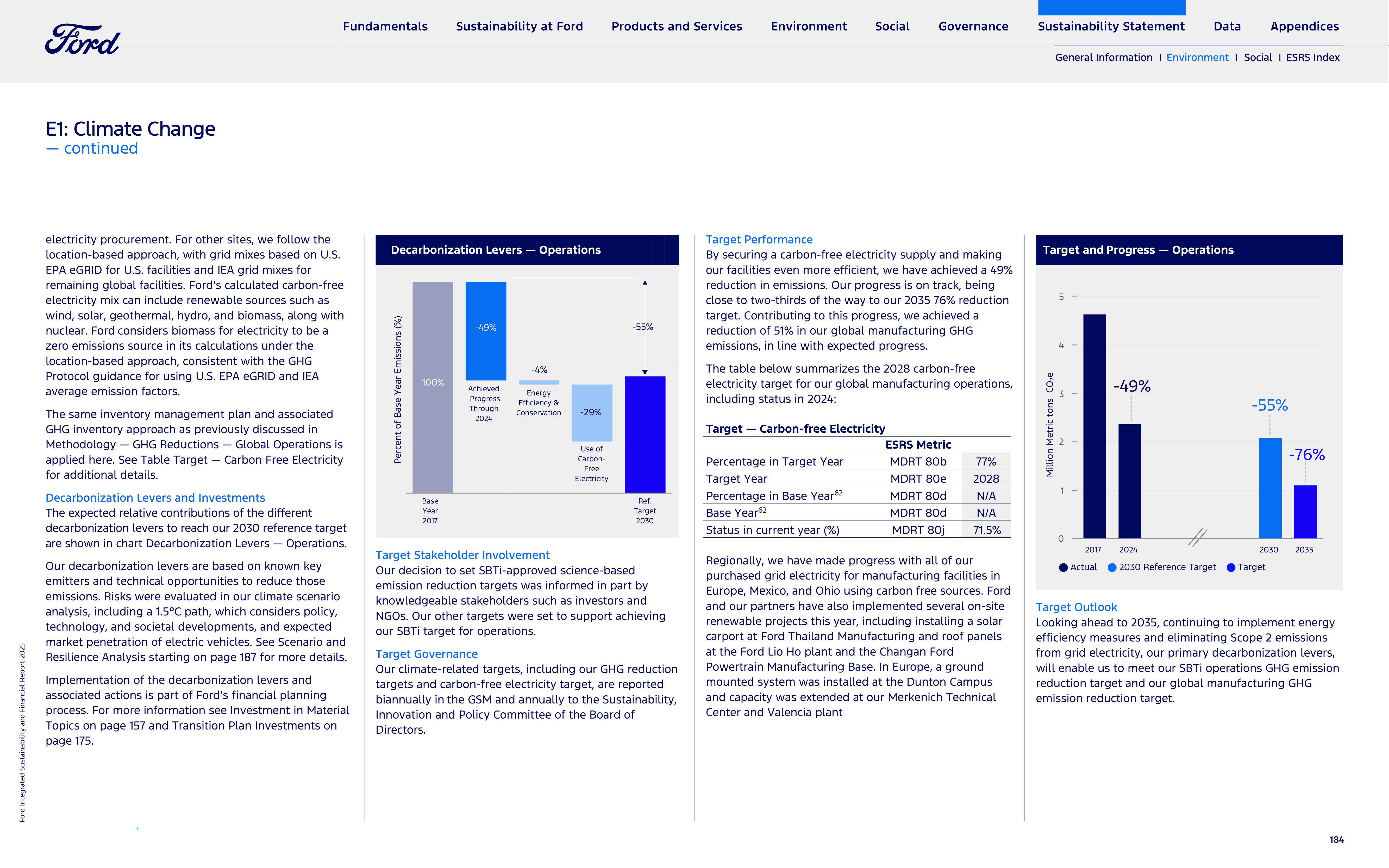
▼
electricity procurement. For other sites, we follow the
location-based approach, with grid mixes based on U.S.
EPA eGRID for U.S. facilities and IEA grid mixes for
remaining global facilities. Ford’s calculated carbon-free
electricity mix can include renewable sources such as
wind, solar, geothermal, hydro, and biomass, along with
nuclear. Ford considers biomass for electricity to be a
zero emissions source in its calculations under the
location-based approach, consistent with the GHG
Protocol guidance for using U.S. EPA eGRID and IEA
average emission factors.
Fundamentals
Sustainability at Ford
Products and Services
Environment
Social
Governance
Sustainability Statement
Data
Appendices
General Information
Environment
Social
ESRS Index
|
|
|
The same inventory management plan and associated
GHG inventory approach as previously discussed in
Methodology — GHG Reductions — Global Operations is
applied here. See Table Target — Carbon Free Electricity
for additional details.
Decarbonization Levers and Investments
The expected relative contributions of the different
decarbonization levers to reach our 2030 reference target
are shown in chart Decarbonization Levers — Operations.
Our decarbonization levers are based on known key
emitters and technical opportunities to reduce those
emissions. Risks were evaluated in our climate scenario
analysis, including a 1.5°C path, which considers policy,
technology, and societal developments, and expected
market penetration of electric vehicles. See Scenario and
Resilience Analysis starting on page 187 for more details.
Implementation of the decarbonization levers and
associated actions is part of Ford’s financial planning
process. For more information see Investment in Material
Topics on page 157 and Transition Plan Investments on
page 175.
Decarbonization Levers — Operations
▲
Percent of Base Year Emissions (%)
Base
Year
2017
100%
Achieved
Progress
Through
2024
-49%
Energy
Efficiency &
Conservation
-4%
Use of
Carbon-
Free
Electricity
-29%
Ref.
Target
2030
-55%
Target Stakeholder Involvement
Our decision to set SBTi-approved science-based
emission reduction targets was informed in part by
knowledgeable stakeholders such as investors and
NGOs. Our other targets were set to support achieving
our SBTi target for operations.
Target Governance
Our climate-related targets, including our GHG reduction
targets and carbon-free electricity target, are reported
biannually in the GSM and annually to the Sustainability,
Innovation and Policy Committee of the Board of
Directors.
Target Performance
By securing a carbon-free electricity supply and making
our facilities even more efficient, we have achieved a 49%
reduction in emissions. Our progress is on track, being
close to two-thirds of the way to our 2035 76% reduction
target. Contributing to this progress, we achieved a
reduction of 51% in our global manufacturing GHG
emissions, in line with expected progress.
The table below summarizes the 2028 carbon-free
electricity target for our global manufacturing operations,
including status in 2024:
Million Metric tons CO
2
e
•
•
•
E1: Climate Change
— continued
,
Ford Integrated Sustainability and Financial Report 2025
184
0
1
2
3
4
5
Target — Carbon-free Electricity
ESRS Metric
Percentage in Target Year
MDRT 80b
77%
Target Year
MDRT 80e
2028
Percentage in Base Year
62
MDRT 80d
N/A
Base Year
62
MDRT 80d
N/A
Status in current year (%)
MDRT 80j
71.5%
Regionally, we have made progress with all of our
purchased grid electricity for manufacturing facilities in
Europe, Mexico, and Ohio using carbon free sources. Ford
and our partners have also implemented several on-site
renewable projects this year, including installing a solar
carport at Ford Thailand Manufacturing and roof panels
at the Ford Lio Ho plant and the Changan Ford
Powertrain Manufacturing Base. In Europe, a ground
mounted system was installed at the Dunton Campus
and capacity was extended at our Merkenich Technical
Center and Valencia plant
Target and Progress — Operations
2017
2024
-49%
2030
-55%
2035
-76%
Reference
Actual
2030
Target
Target
Target Outlook
Looking ahead to 2035, continuing to implement energy
efficiency measures and eliminating Scope 2 emissions
from grid electricity, our primary decarbonization levers,
will enable us to meet our SBTi operations GHG emission
reduction target and our global manufacturing GHG
emission reduction target.
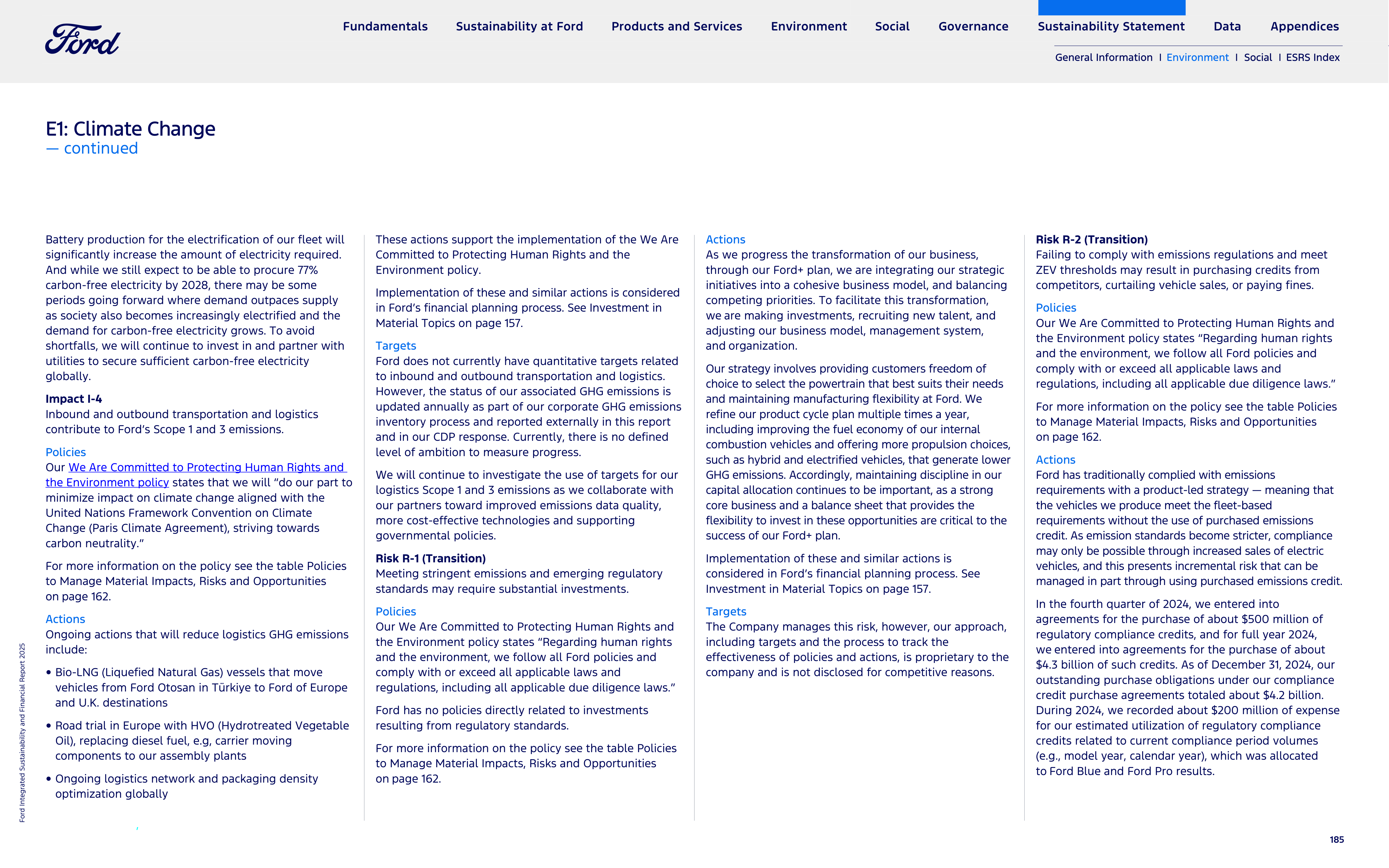
Fundamentals
Sustainability at Ford
Products and Services
Environment
Social
Governance
Sustainability Statement
Data
Appendices
General Information
Environment
Social
ESRS Index
|
|
|
E1: Climate Change
— continued
,
Ford Integrated Sustainability and Financial Report 2025
185
Battery production for the electrification of our fleet will
significantly increase the amount of electricity required.
And while we still expect to be able to procure 77%
carbon-free electricity by 2028, there may be some
periods going forward where demand outpaces supply
as society also becomes increasingly electrified and the
demand for carbon-free electricity grows. To avoid
shortfalls, we will continue to invest in and partner with
utilities to secure sufficient carbon-free electricity
globally.
Impact I-4
Inbound and outbound transportation and logistics
contribute to Ford’s Scope 1 and 3 emissions.
Policies
Our
We Are Committed to Protecting Human Rights and
the Environment policy
states that we will “do our part to
minimize impact on climate change aligned with the
United Nations Framework Convention on Climate
Change (Paris Climate Agreement), striving towards
carbon neutrality.”
For more information on the policy see the table Policies
to Manage Material Impacts, Risks and Opportunities
on page 162.
Actions
Ongoing actions that will reduce logistics GHG emissions
include:
•
Bio-LNG (Liquefied Natural Gas) vessels that move
vehicles from Ford Otosan in Türkiye to Ford of Europe
and U.K. destinations
•
Road trial in Europe with HVO (Hydrotreated Vegetable
Oil), replacing diesel fuel, e.g, carrier moving
components to our assembly plants
•
Ongoing logistics network and packaging density
optimization globally
These actions support the implementation of the We Are
Committed to Protecting Human Rights and the
Environment policy.
Implementation of these and similar actions is considered
in Ford’s financial planning process. See Investment in
Material Topics on page 157.
Targets
Ford does not currently have quantitative targets related
to inbound and outbound transportation and logistics.
However, the status of our associated GHG emissions is
updated annually as part of our corporate GHG emissions
inventory process and reported externally in this report
and in our CDP response. Currently, there is no defined
level of ambition to measure progress.
We will continue to investigate the use of targets for our
logistics Scope 1 and 3 emissions as we collaborate with
our partners toward improved emissions data quality,
more cost-effective technologies and supporting
governmental policies.
Risk R-1 (Transition)
Meeting stringent emissions and emerging regulatory
standards may require substantial investments.
Policies
Our We Are Committed to Protecting Human Rights and
the Environment policy states “Regarding human rights
and the environment, we follow all Ford policies and
comply with or exceed all applicable laws and
regulations, including all applicable due diligence laws.”
Ford has no policies directly related to investments
resulting from regulatory standards.
For more information on the policy see the table Policies
to Manage Material Impacts, Risks and Opportunities
on page 162.
Actions
As we progress the transformation of our business,
through our Ford+ plan, we are integrating our strategic
initiatives into a cohesive business model, and balancing
competing priorities. To facilitate this transformation,
we are making investments, recruiting new talent, and
adjusting our business model, management system,
and organization.
Our strategy involves providing customers freedom of
choice to select the powertrain that best suits their needs
and maintaining manufacturing flexibility at Ford. We
refine our product cycle plan multiple times a year,
including improving the fuel economy of our internal
combustion vehicles and offering more propulsion choices,
such as hybrid and electrified vehicles, that generate lower
GHG emissions. Accordingly, maintaining discipline in our
capital allocation continues to be important, as a strong
core business and a balance sheet that provides the
flexibility to invest in these opportunities are critical to the
success of our Ford+ plan.
Implementation of these and similar actions is
considered in Ford’s financial planning process. See
Investment in Material Topics on page 157.
Targets
The Company manages this risk, however, our approach,
including targets and the process to track the
effectiveness of policies and actions, is proprietary to the
company and is not disclosed for competitive reasons.
Risk R-2 (Transition)
Failing to comply with emissions regulations and meet
ZEV thresholds may result in purchasing credits from
competitors, curtailing vehicle sales, or paying fines.
Policies
Our We Are Committed to Protecting Human Rights and
the Environment policy states “Regarding human rights
and the environment, we follow all Ford policies and
comply with or exceed all applicable laws and
regulations, including all applicable due diligence laws.”
For more information on the policy see the table Policies
to Manage Material Impacts, Risks and Opportunities
on page 162.
Actions
Ford has traditionally complied with emissions
requirements with a product-led strategy — meaning that
the vehicles we produce meet the fleet-based
requirements without the use of purchased emissions
credit. As emission standards become stricter, compliance
may only be possible through increased sales of electric
vehicles, and this presents incremental risk that can be
managed in part through using purchased emissions credit.
In the fourth quarter of 2024, we entered into
agreements for the purchase of about $500 million of
regulatory compliance credits, and for full year 2024,
we entered into agreements for the purchase of about
$4.3 billion of such credits. As of December 31, 2024, our
outstanding purchase obligations under our compliance
credit purchase agreements totaled about $4.2 billion.
During 2024, we recorded about $200 million of expense
for our estimated utilization of regulatory compliance
credits related to current compliance period volumes
(e.g., model year, calendar year), which was allocated
to Ford Blue and Ford Pro results.
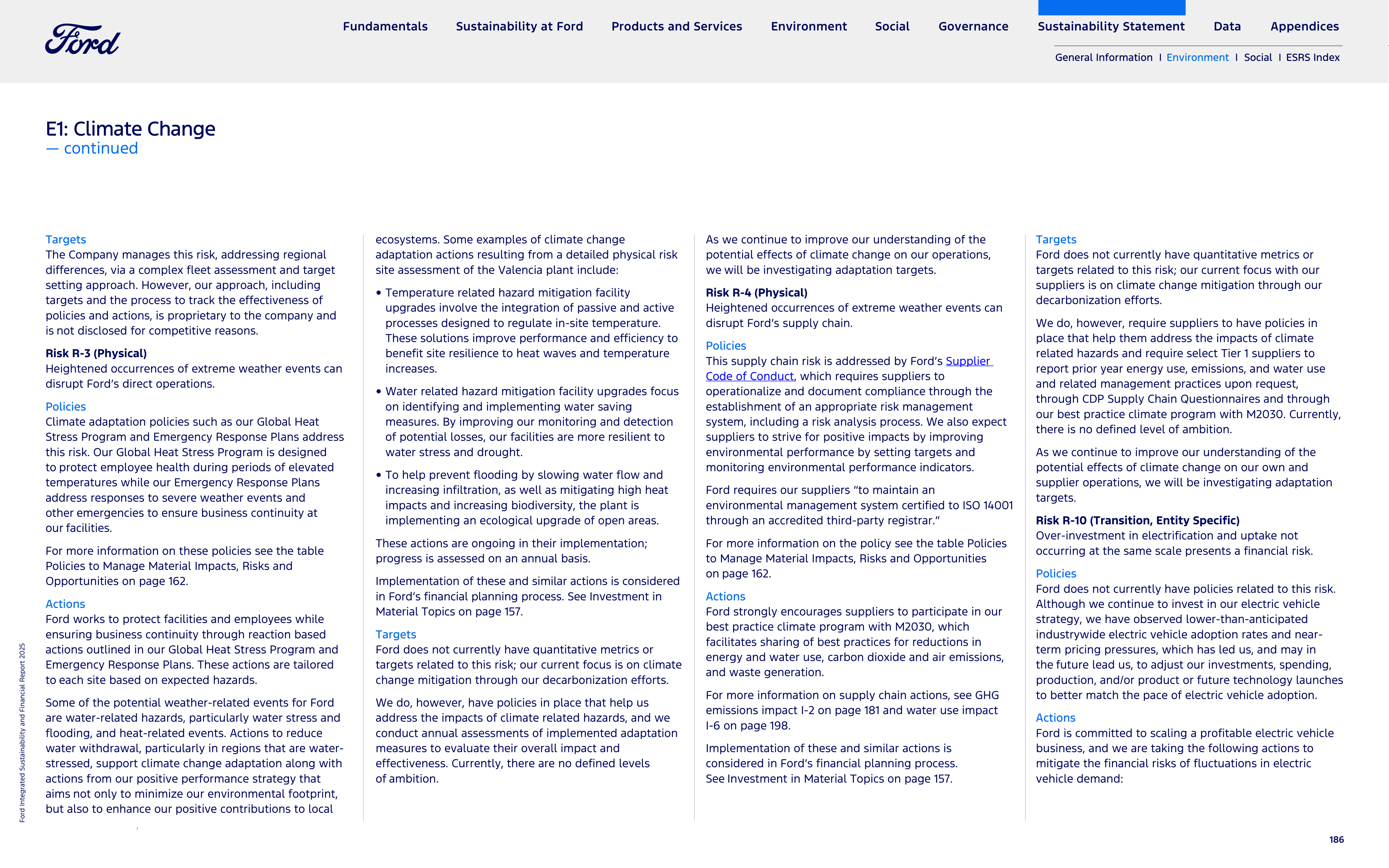
Fundamentals
Sustainability at Ford
Products and Services
Environment
Social
Governance
Sustainability Statement
Data
Appendices
General Information
Environment
Social
ESRS Index
|
|
|
Targets
The Company manages this risk, addressing regional
differences, via a complex fleet assessment and target
setting approach. However, our approach, including
targets and the process to track the effectiveness of
policies and actions, is proprietary to the company and
is not disclosed for competitive reasons.
Risk R-3 (Physical)
Heightened occurrences of extreme weather events can
disrupt Ford’s direct operations.
Policies
Climate adaptation policies such as our Global Heat
Stress Program and Emergency Response Plans address
this risk. Our Global Heat Stress Program is designed
to protect employee health during periods of elevated
temperatures while our Emergency Response Plans
address responses to severe weather events and
other emergencies to ensure business continuity at
our facilities.
For more information on these policies see the table
Policies to Manage Material Impacts, Risks and
Opportunities on page 162.
Actions
Ford works to protect facilities and employees while
ensuring business continuity through reaction based
actions outlined in our Global Heat Stress Program and
Emergency Response Plans. These actions are tailored
to each site based on expected hazards.
Some of the potential weather-related events for Ford
are water-related hazards, particularly water stress and
flooding, and heat-related events. Actions to reduce
water withdrawal, particularly in regions that are water-
stressed, support climate change adaptation along with
actions from our positive performance strategy that
aims not only to minimize our environmental footprint,
but also to enhance our positive contributions to local
ecosystems. Some examples of climate change
adaptation actions resulting from a detailed physical risk
site assessment of the Valencia plant include:
•
Temperature related hazard mitigation facility
upgrades involve the integration of passive and active
processes designed to regulate in-site temperature.
These solutions improve performance and efficiency to
benefit site resilience to heat waves and temperature
increases.
•
Water related hazard mitigation facility upgrades focus
on identifying and implementing water saving
measures. By improving our monitoring and detection
of potential losses, our facilities are more resilient to
water stress and drought.
•
To help prevent flooding by slowing water flow and
increasing infiltration, as well as mitigating high heat
impacts and increasing biodiversity, the plant is
implementing an ecological upgrade of open areas.
These actions are ongoing in their implementation;
progress is assessed on an annual basis.
Implementation of these and similar actions is considered
in Ford’s financial planning process. See Investment in
Material Topics on page 157.
Targets
Ford does not currently have quantitative metrics or
targets related to this risk; our current focus is on climate
change mitigation through our decarbonization efforts.
We do, however, have policies in place that help us
address the impacts of climate related hazards, and we
conduct annual assessments of implemented adaptation
measures to evaluate their overall impact and
effectiveness. Currently, there are no defined levels
of ambition.
As we continue to improve our understanding of the
potential effects of climate change on our operations,
we will be investigating adaptation targets.
Risk R-4 (Physical)
Heightened occurrences of extreme weather events can
disrupt Ford’s supply chain.
Policies
This supply chain risk is addressed by Ford’s
Supplier
Code of Conduct
, which requires suppliers to
operationalize and document compliance through the
establishment of an appropriate risk management
system, including a risk analysis process. We also expect
suppliers to strive for positive impacts by improving
environmental performance by setting targets and
monitoring environmental performance indicators.
Ford requires our suppliers “to maintain an
environmental management system certified to ISO 14001
through an accredited third-party registrar.”
For more information on the policy see the table Policies
to Manage Material Impacts, Risks and Opportunities
on page 162.
Actions
Ford strongly encourages suppliers to participate in our
best practice climate program with M2030, which
facilitates sharing of best practices for reductions in
energy and water use, carbon dioxide and air emissions,
and waste generation.
For more information on supply chain actions, see GHG
emissions impact I-2 on page 181 and water use impact
I-6 on page 198.
Implementation of these and similar actions is
considered in Ford’s financial planning process.
See Investment in Material Topics on page 157.
Targets
Ford does not currently have quantitative metrics or
targets related to this risk; our current focus with our
suppliers is on climate change mitigation through our
decarbonization efforts.
We do, however, require suppliers to have policies in
place that help them address the impacts of climate
related hazards and require select Tier 1 suppliers to
report prior year energy use, emissions, and water use
and related management practices upon request,
through CDP Supply Chain Questionnaires and through
our best practice climate program with M2030. Currently,
there is no defined level of ambition.
As we continue to improve our understanding of the
potential effects of climate change on our own and
supplier operations, we will be investigating adaptation
targets.
Risk R-10 (Transition, Entity Specific)
Over-investment in electrification and uptake not
occurring at the same scale presents a financial risk.
Policies
Ford does not currently have policies related to this risk.
Although we continue to invest in our electric vehicle
strategy, we have observed lower-than-anticipated
industrywide electric vehicle adoption rates and near-
term pricing pressures, which has led us, and may in
the future lead us, to adjust our investments, spending,
production, and/or product or future technology launches
to better match the pace of electric vehicle adoption.
Actions
Ford is committed to scaling a profitable electric vehicle
business, and we are taking the following actions to
mitigate the financial risks of fluctuations in electric
vehicle demand:
E1: Climate Change
— continued
,
Ford Integrated Sustainability and Financial Report 2025
186
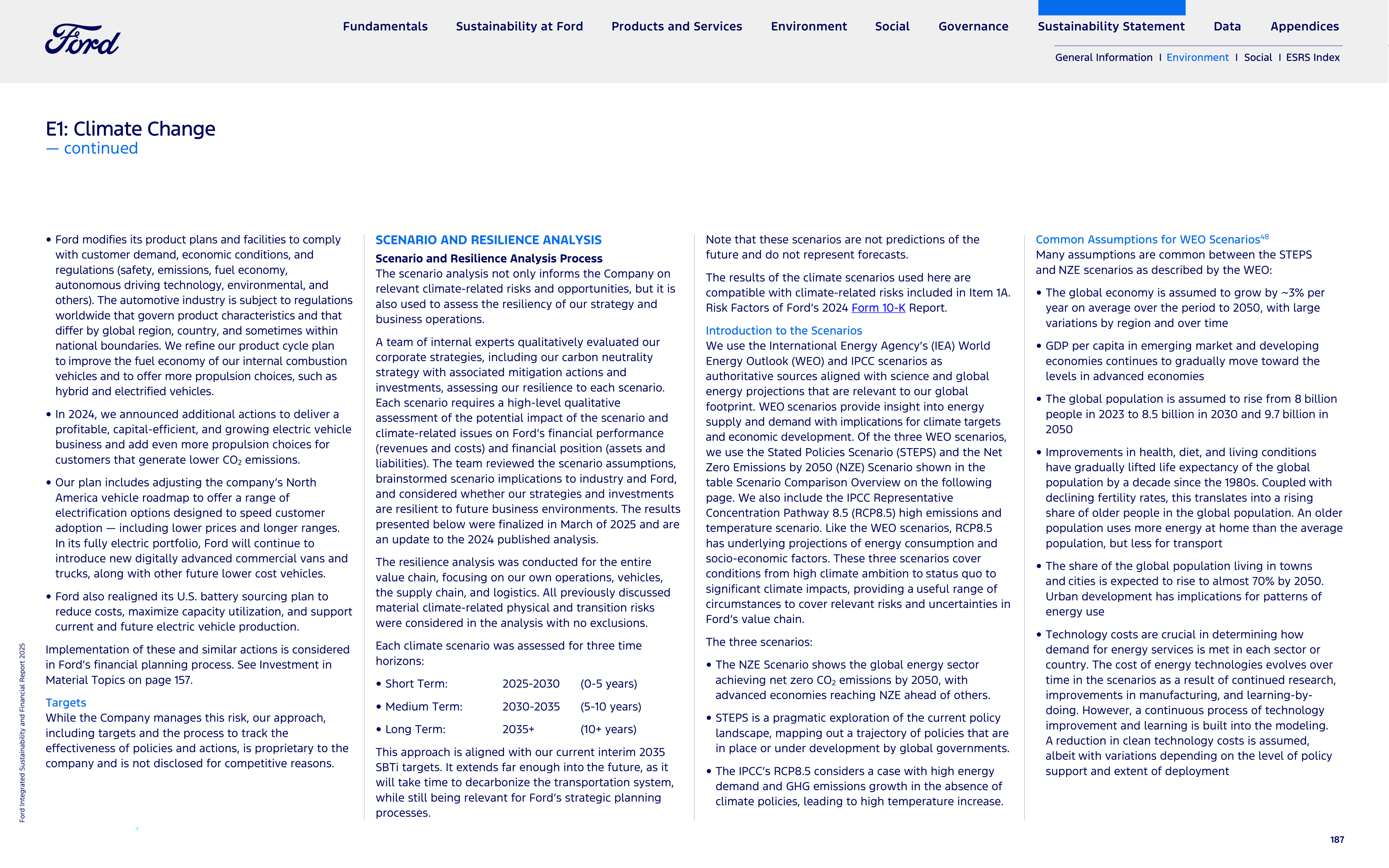
Fundamentals
Sustainability at Ford
Products and Services
Environment
Social
Governance
Sustainability Statement
Data
Appendices
General Information
Environment
Social
ESRS Index
|
|
|
E1: Climate Change
•
Ford modifies its product plans and facilities to comply
with customer demand, economic conditions, and
regulations (safety, emissions, fuel economy,
autonomous driving technology, environmental, and
others). The automotive industry is subject to regulations
worldwide that govern product characteristics and that
differ by global region, country, and sometimes within
national boundaries. We refine our product cycle plan
to improve the fuel economy of our internal combustion
vehicles and to offer more propulsion choices, such as
hybrid and electrified vehicles.
•
In 2024, we announced additional actions to deliver a
profitable, capital-efficient, and growing electric vehicle
business and add even more propulsion choices for
customers that generate lower CO
2
emissions.
•
Our plan includes adjusting the company’s North
America vehicle roadmap to offer a range of
electrification options designed to speed customer
adoption — including lower prices and longer ranges.
In its fully electric portfolio, Ford will continue to
introduce new digitally advanced commercial vans and
trucks, along with other future lower cost vehicles.
•
Ford also realigned its U.S. battery sourcing plan to
reduce costs, maximize capacity utilization, and support
current and future electric vehicle production.
Implementation of these and similar actions is considered
in Ford’s financial planning process. See Investment in
Material Topics on page 157.
Targets
While the Company manages this risk, our approach,
including targets and the process to track the
effectiveness of policies and actions, is proprietary to the
company and is not disclosed for competitive reasons.
— continued
,
Ford Integrated Sustainability and Financial Report 2025
187
SCENARIO AND RESILIENCE ANALYSIS
Scenario and Resilience Analysis Process
The scenario analysis not only informs the Company on
relevant climate-related risks and opportunities, but it is
also used to assess the resiliency of our strategy and
business operations.
A team of internal experts qualitatively evaluated our
corporate strategies, including our carbon neutrality
strategy with associated mitigation actions and
investments, assessing our resilience to each scenario.
Each scenario requires a high-level qualitative
assessment of the potential impact of the scenario and
climate-related issues on Ford’s financial performance
(revenues and costs) and financial position (assets and
liabilities). The team reviewed the scenario assumptions,
brainstormed scenario implications to industry and Ford,
and considered whether our strategies and investments
are resilient to future business environments. The results
presented below were finalized in March of 2025 and are
an update to the 2024 published analysis.
The resilience analysis was conducted for the entire
value chain, focusing on our own operations, vehicles,
the supply chain, and logistics. All previously discussed
material climate-related physical and transition risks
were considered in the analysis with no exclusions.
Each climate scenario was assessed for three time
horizons:
•
Short Term:
2025-2030
(0-5 years)
•
Medium Term:
2030-2035
(5-10 years)
•
Long Term:
2035+
(10+ years)
This approach is aligned with our current interim 2035
SBTi targets. It extends far enough into the future, as it
will take time to decarbonize the transportation system,
while still being relevant for Ford’s strategic planning
processes.
Note that these scenarios are not predictions of the
future and do not represent forecasts.
The results of the climate scenarios used here are
compatible with climate-related risks included in Item 1A.
Risk Factors of Ford’s 2024
Form 10-K
Report.
Introduction to the Scenarios
We use the International Energy Agency’s (IEA) World
Energy Outlook (WEO) and IPCC scenarios as
authoritative sources aligned with science and global
energy projections that are relevant to our global
footprint. WEO scenarios provide insight into energy
supply and demand with implications for climate targets
and economic development. Of the three WEO scenarios,
we use the Stated Policies Scenario (STEPS) and the Net
Zero Emissions by 2050 (NZE) Scenario shown in the
table Scenario Comparison Overview on the following
page. We also include the IPCC Representative
Concentration Pathway 8.5 (RCP8.5) high emissions and
temperature scenario. Like the WEO scenarios, RCP8.5
has underlying projections of energy consumption and
socio-economic factors. These three scenarios cover
conditions from high climate ambition to status quo to
significant climate impacts, providing a useful range of
circumstances to cover relevant risks and uncertainties in
Ford’s value chain.
The three scenarios:
•
The NZE Scenario shows the global energy sector
achieving net zero CO
2
emissions by 2050, with
advanced economies reaching NZE ahead of others.
•
STEPS is a pragmatic exploration of the current policy
landscape, mapping out a trajectory of policies that are
in place or under development by global governments.
•
The IPCC’s RCP8.5 considers a case with high energy
demand and GHG emissions growth in the absence of
climate policies, leading to high temperature increase.
Common Assumptions for WEO Scenarios
48
Many assumptions are common between the STEPS
and NZE scenarios as described by the WEO:
•
The global economy is assumed to grow by ~3% per
year on average over the period to 2050, with large
variations by region and over time
•
GDP per capita in emerging market and developing
economies continues to gradually move toward the
levels in advanced economies
•
The global population is assumed to rise from 8 billion
people in 2023 to 8.5 billion in 2030 and 9.7 billion in
2050
•
Improvements in health, diet, and living conditions
have gradually lifted life expectancy of the global
population by a decade since the 1980s. Coupled with
declining fertility rates, this translates into a rising
share of older people in the global population. An older
population uses more energy at home than the average
population, but less for transport
•
The share of the global population living in towns
and cities is expected to rise to almost 70% by 2050.
Urban development has implications for patterns of
energy use
•
Technology costs are crucial in determining how
demand for energy services is met in each sector or
country. The cost of energy technologies evolves over
time in the scenarios as a result of continued research,
improvements in manufacturing, and learning-by-
doing. However, a continuous process of technology
improvement and learning is built into the modeling.
A reduction in clean technology costs is assumed,
albeit with variations depending on the level of policy
support and extent of deployment
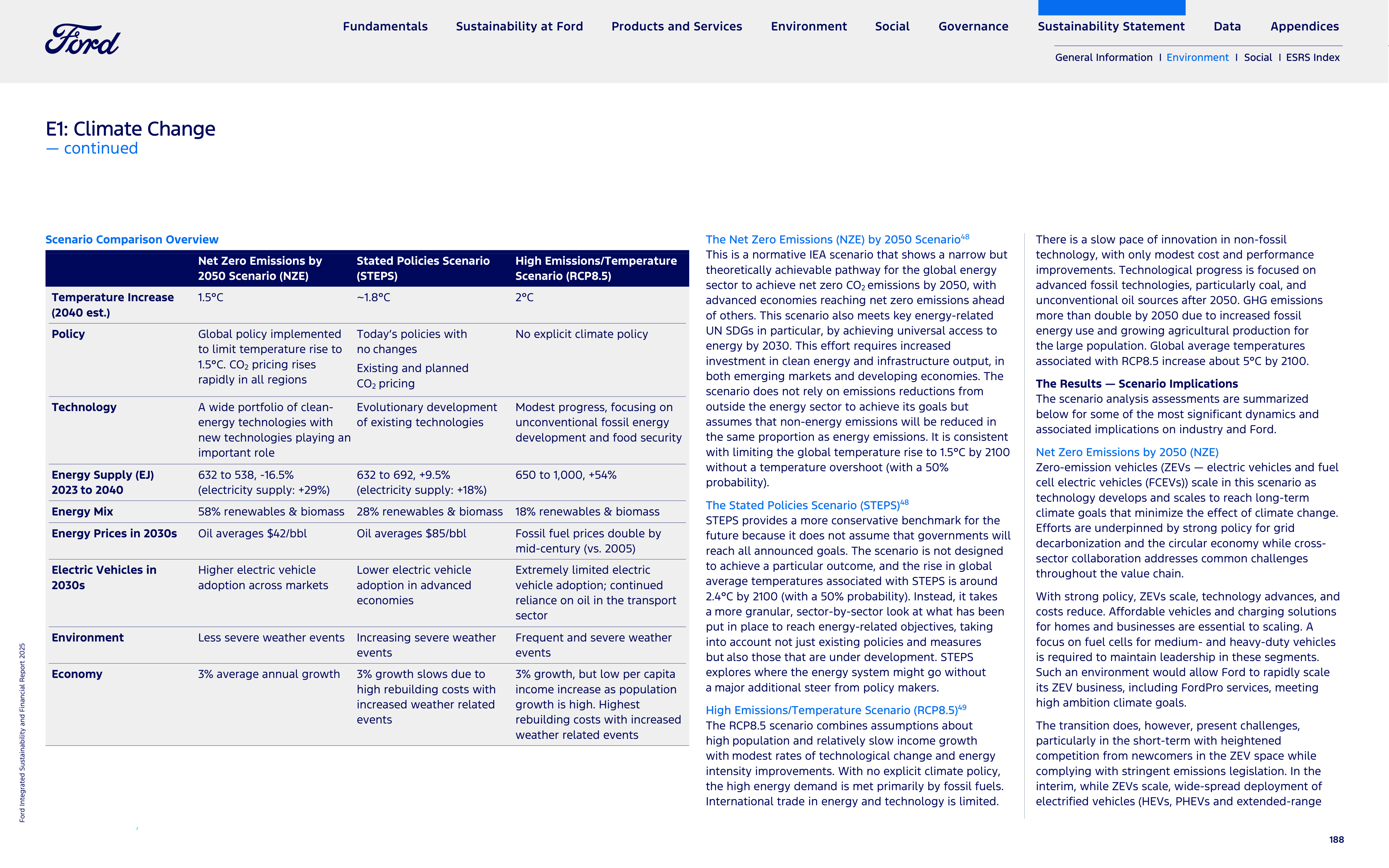
Fundamentals
Sustainability at Ford
Products and Services
Environment
Social
Governance
Sustainability Statement
Data
Appendices
General Information
Environment
Social
ESRS Index
|
|
|
E1: Climate Change
— continued
,
Ford Integrated Sustainability and Financial Report 2025
188
Scenario Comparison Overview
Net Zero Emissions by
2050 Scenario (NZE)
Stated Policies Scenario
(STEPS)
High Emissions/Temperature
Scenario (RCP8.5)
Temperature Increase
(2040 est.)
1.5°C
~1.8°C
2°C
Policy
Global policy implemented
to limit temperature rise to
1.5°C. CO
2
pricing rises
rapidly in all regions
Today’s policies with
no changes
Existing and planned
CO
2
pricing
No explicit climate policy
Technology
A wide portfolio of clean-
energy technologies with
new technologies playing an
important role
Evolutionary development
of existing technologies
Modest progress, focusing on
unconventional fossil energy
development and food security
Energy Supply (EJ)
2023 to 2040
632 to 538, -16.5%
(electricity supply: +29%)
632 to 692, +9.5%
(electricity supply: +18%)
650 to 1,000, +54%
Energy Mix
58% renewables & biomass
28% renewables & biomass
18% renewables & biomass
Energy Prices in 2030s
Oil averages $42/bbl
Oil averages $85/bbl
Fossil fuel prices double by
mid-century (vs. 2005)
Electric Vehicles in
2030s
Higher electric vehicle
adoption across markets
Lower electric vehicle
adoption in advanced
economies
Extremely limited electric
vehicle adoption; continued
reliance on oil in the transport
sector
Environment
Less severe weather events Increasing severe weather
events
Frequent and severe weather
events
Economy
3% average annual growth
3% growth slows due to
high rebuilding costs with
increased weather related
events
3% growth, but low per capita
income increase as population
growth is high. Highest
rebuilding costs with increased
weather related events
The Net Zero Emissions (NZE) by 2050 Scenario
48
This is a normative IEA scenario that shows a narrow but
theoretically achievable pathway for the global energy
sector to achieve net zero CO
2
emissions by 2050, with
advanced economies reaching net zero emissions ahead
of others. This scenario also meets key energy-related
UN SDGs in particular, by achieving universal access to
energy by 2030. This effort requires increased
investment in clean energy and infrastructure output, in
both emerging markets and developing economies. The
scenario does not rely on emissions reductions from
outside the energy sector to achieve its goals but
assumes that non-energy emissions will be reduced in
the same proportion as energy emissions. It is consistent
with limiting the global temperature rise to 1.5°C by 2100
without a temperature overshoot (with a 50%
probability).
The Stated Policies Scenario (STEPS)
48
STEPS provides a more conservative benchmark for the
future because it does not assume that governments will
reach all announced goals. The scenario is not designed
to achieve a particular outcome, and the rise in global
average temperatures associated with STEPS is around
2.4°C by 2100 (with a 50% probability). Instead, it takes
a more granular, sector-by-sector look at what has been
put in place to reach energy-related objectives, taking
into account not just existing policies and measures
but also those that are under development. STEPS
explores where the energy system might go without
a major additional steer from policy makers.
High Emissions/Temperature Scenario (RCP8.5)
49
The RCP8.5 scenario combines assumptions about
high population and relatively slow income growth
with modest rates of technological change and energy
intensity improvements. With no explicit climate policy,
the high energy demand is met primarily by fossil fuels.
International trade in energy and technology is limited.
There is a slow pace of innovation in non-fossil
technology, with only modest cost and performance
improvements. Technological progress is focused on
advanced fossil technologies, particularly coal, and
unconventional oil sources after 2050. GHG emissions
more than double by 2050 due to increased fossil
energy use and growing agricultural production for
the large population. Global average temperatures
associated with RCP8.5 increase about 5°C by 2100.
The Results — Scenario Implications
The scenario analysis assessments are summarized
below for some of the most significant dynamics and
associated implications on industry and Ford.
Net Zero Emissions by 2050 (NZE)
Zero-emission vehicles (ZEVs — electric vehicles and fuel
cell electric vehicles (FCEVs)) scale in this scenario as
technology develops and scales to reach long-term
climate goals that minimize the effect of climate change.
Efforts are underpinned by strong policy for grid
decarbonization and the circular economy while cross-
sector collaboration addresses common challenges
throughout the value chain.
With strong policy, ZEVs scale, technology advances, and
costs reduce. Affordable vehicles and charging solutions
for homes and businesses are essential to scaling. A
focus on fuel cells for medium- and heavy-duty vehicles
is required to maintain leadership in these segments.
Such an environment would allow Ford to rapidly scale
its ZEV business, including FordPro services, meeting
high ambition climate goals.
The transition does, however, present challenges,
particularly in the short-term with heightened
competition from newcomers in the ZEV space while
complying with stringent emissions legislation. In the
interim, while ZEVs scale, wide-spread deployment of
electrified vehicles (HEVs, PHEVs and extended-range
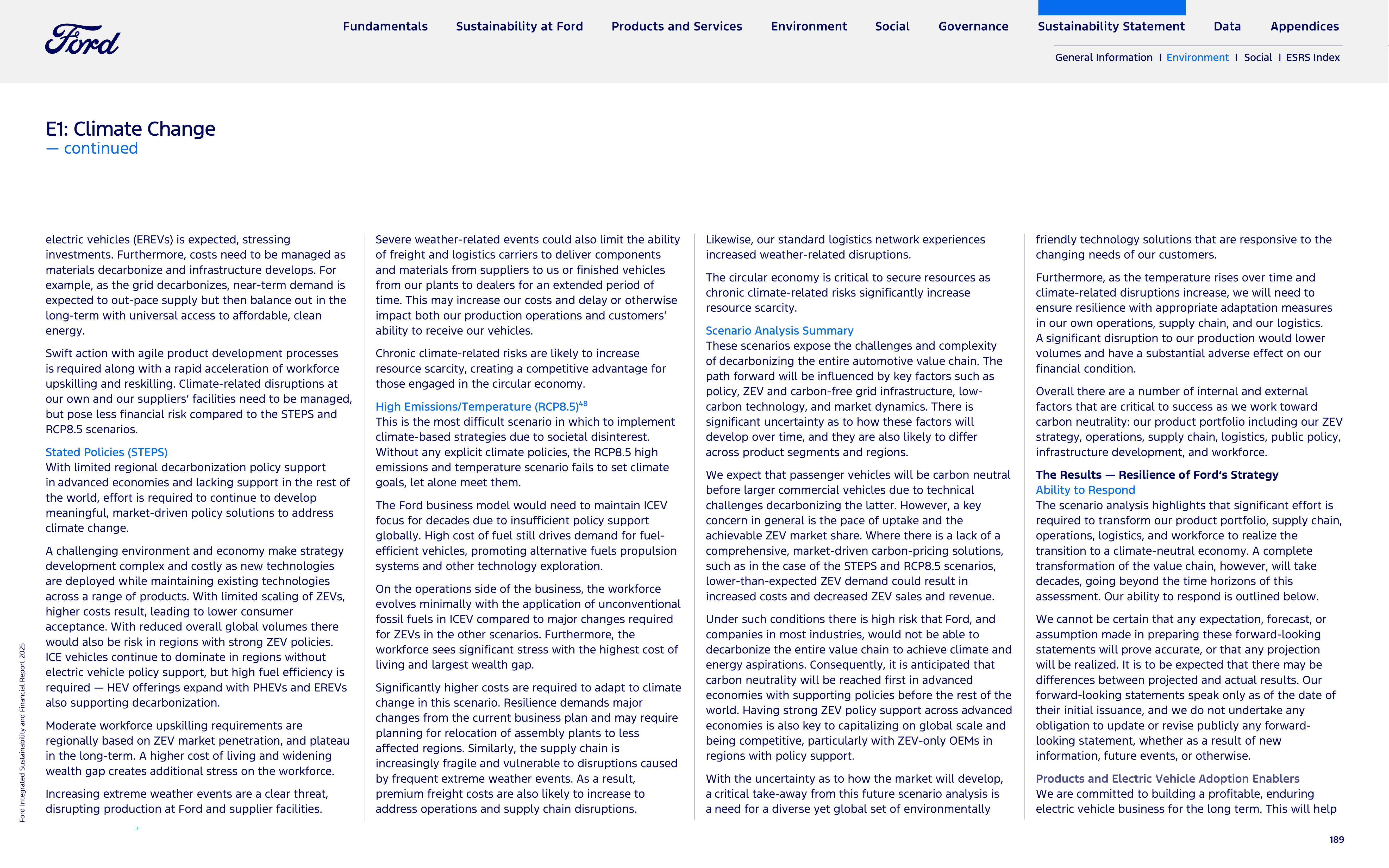
electric vehicles (EREVs) is expected, stressing
investments. Furthermore, costs need to be managed as
materials decarbonize and infrastructure develops. For
example, as the grid decarbonizes, near-term demand is
expected to out-pace supply but then balance out in the
long-term with universal access to affordable, clean
energy.
Fundamentals
Sustainability at Ford
Products and Services
Environment
Social
Governance
Sustainability Statement
Data
Appendices
General Information
Environment
Social
ESRS Index
|
|
|
Swift action with agile product development processes
is required along with a rapid acceleration of workforce
upskilling and reskilling. Climate-related disruptions at
our own and our suppliers’ facilities need to be managed,
but pose less financial risk compared to the STEPS and
RCP8.5 scenarios.
Stated Policies (STEPS)
With limited regional decarbonization policy support
in advanced economies and lacking support in the rest of
the world, effort is required to continue to develop
meaningful, market-driven policy solutions to address
climate change.
A challenging environment and economy make strategy
development complex and costly as new technologies
are deployed while maintaining existing technologies
across a range of products. With limited scaling of ZEVs,
higher costs result, leading to lower consumer
acceptance. With reduced overall global volumes there
would also be risk in regions with strong ZEV policies.
ICE vehicles continue to dominate in regions without
electric vehicle policy support, but high fuel efficiency is
required — HEV offerings expand with PHEVs and EREVs
also supporting decarbonization.
Moderate workforce upskilling requirements are
regionally based on ZEV market penetration, and plateau
in the long-term. A higher cost of living and widening
wealth gap creates additional stress on the workforce.
Increasing extreme weather events are a clear threat,
disrupting production at Ford and supplier facilities.
Severe weather-related events could also limit the ability
of freight and logistics carriers to deliver components
and materials from suppliers to us or finished vehicles
from our plants to dealers for an extended period of
time. This may increase our costs and delay or otherwise
impact both our production operations and customers’
ability to receive our vehicles.
Chronic climate-related risks are likely to increase
resource scarcity, creating a competitive advantage for
those engaged in the circular economy.
High Emissions/Temperature (RCP8.5)
48
This is the most difficult scenario in which to implement
climate-based strategies due to societal disinterest.
Without any explicit climate policies, the RCP8.5 high
emissions and temperature scenario fails to set climate
goals, let alone meet them.
The Ford business model would need to maintain ICEV
focus for decades due to insufficient policy support
globally. High cost of fuel still drives demand for fuel-
efficient vehicles, promoting alternative fuels propulsion
systems and other technology exploration.
On the operations side of the business, the workforce
evolves minimally with the application of unconventional
fossil fuels in ICEV compared to major changes required
for ZEVs in the other scenarios. Furthermore, the
workforce sees significant stress with the highest cost of
living and largest wealth gap.
Significantly higher costs are required to adapt to climate
change in this scenario. Resilience demands major
changes from the current business plan and may require
planning for relocation of assembly plants to less
affected regions. Similarly, the supply chain is
increasingly fragile and vulnerable to disruptions caused
by frequent extreme weather events. As a result,
premium freight costs are also likely to increase to
address operations and supply chain disruptions.
Likewise, our standard logistics network experiences
increased weather-related disruptions.
The circular economy is critical to secure resources as
chronic climate-related risks significantly increase
resource scarcity.
Scenario Analysis Summary
These scenarios expose the challenges and complexity
of decarbonizing the entire automotive value chain. The
path forward will be influenced by key factors such as
policy, ZEV and carbon-free grid infrastructure, low-
carbon technology, and market dynamics. There is
significant uncertainty as to how these factors will
develop over time, and they are also likely to differ
across product segments and regions.
We expect that passenger vehicles will be carbon neutral
before larger commercial vehicles due to technical
challenges decarbonizing the latter. However, a key
concern in general is the pace of uptake and the
achievable ZEV market share. Where there is a lack of a
comprehensive, market-driven carbon-pricing solutions,
such as in the case of the STEPS and RCP8.5 scenarios,
lower-than-expected ZEV demand could result in
increased costs and decreased ZEV sales and revenue.
Under such conditions there is high risk that Ford, and
companies in most industries, would not be able to
decarbonize the entire value chain to achieve climate and
energy aspirations. Consequently, it is anticipated that
carbon neutrality will be reached first in advanced
economies with supporting policies before the rest of the
world. Having strong ZEV policy support across advanced
economies is also key to capitalizing on global scale and
being competitive, particularly with ZEV-only OEMs in
regions with policy support.
With the uncertainty as to how the market will develop,
a critical take-away from this future scenario analysis is
a need for a diverse yet global set of environmentally
friendly technology solutions that are responsive to the
changing needs of our customers.
Furthermore, as the temperature rises over time and
climate-related disruptions increase, we will need to
ensure resilience with appropriate adaptation measures
in our own operations, supply chain, and our logistics.
A significant disruption to our production would lower
volumes and have a substantial adverse effect on our
financial condition.
Overall there are a number of internal and external
factors that are critical to success as we work toward
carbon neutrality: our product portfolio including our ZEV
strategy, operations, supply chain, logistics, public policy,
infrastructure development, and workforce.
The Results — Resilience of Ford’s Strategy
Ability to Respond
The scenario analysis highlights that significant effort is
required to transform our product portfolio, supply chain,
operations, logistics, and workforce to realize the
transition to a climate-neutral economy. A complete
transformation of the value chain, however, will take
decades, going beyond the time horizons of this
assessment. Our ability to respond is outlined below.
We cannot be certain that any expectation, forecast, or
assumption made in preparing these forward-looking
statements will prove accurate, or that any projection
will be realized. It is to be expected that there may be
differences between projected and actual results. Our
forward-looking statements speak only as of the date of
their initial issuance, and we do not undertake any
obligation to update or revise publicly any forward-
looking statement, whether as a result of new
information, future events, or otherwise.
Products and Electric Vehicle Adoption Enablers
We are committed to building a profitable, enduring
electric vehicle business for the long term. This will help
E1: Climate Change
— continued
,
Ford Integrated Sustainability and Financial Report 2025
189
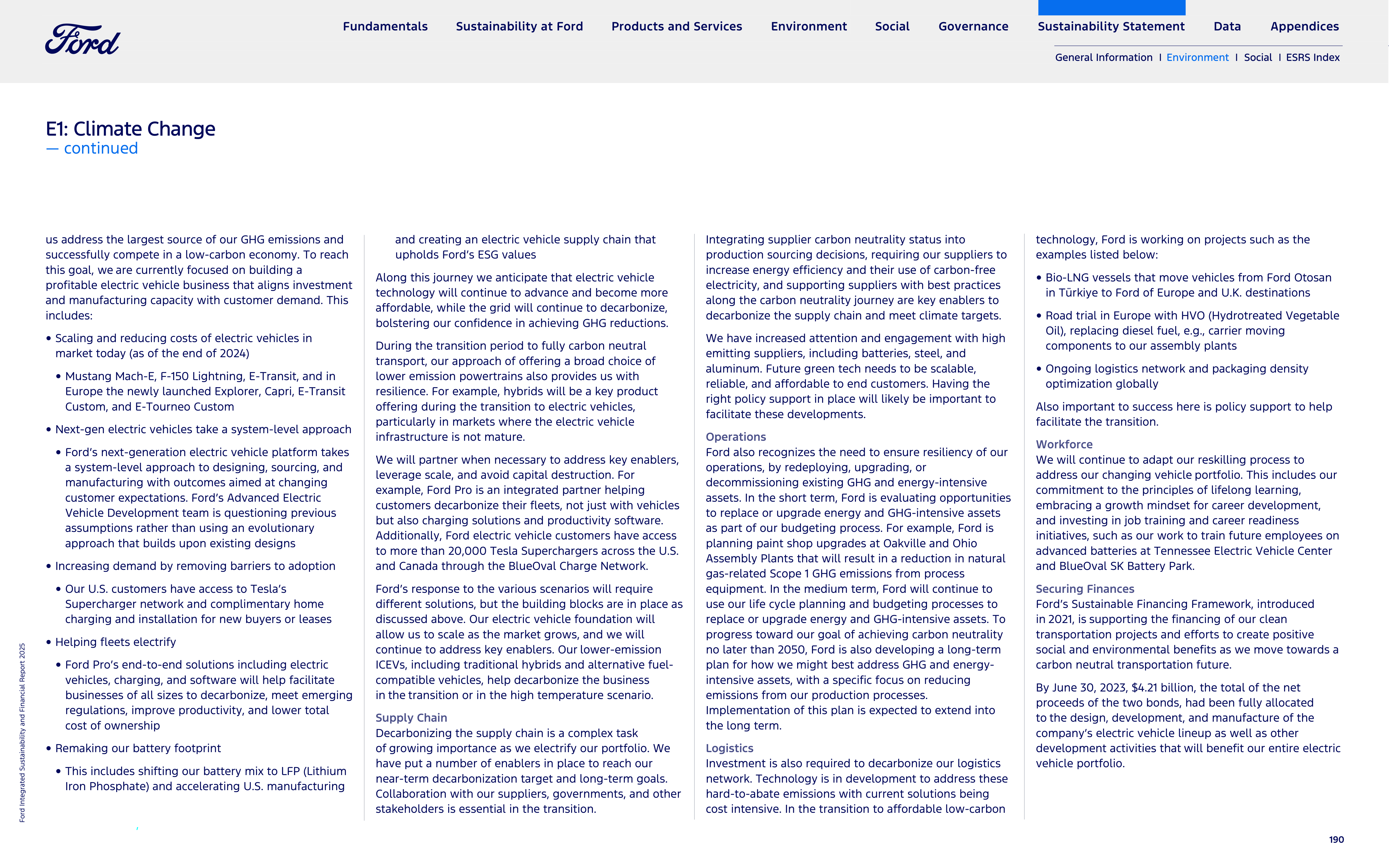
us address the largest source of our GHG emissions and
successfully compete in a low-carbon economy. To reach
this goal, we are currently focused on building a
profitable electric vehicle business that aligns investment
and manufacturing capacity with customer demand. This
includes:
Fundamentals
Sustainability at Ford
Products and Services
Environment
Social
Governance
Sustainability Statement
Data
Appendices
General Information
Environment
Social
ESRS Index
|
|
|
E1: Climate Change
— continued
,
Ford Integrated Sustainability and Financial Report 2025
190
•
Scaling and reducing costs of electric vehicles in
market today (as of the end of 2024)
•
Mustang Mach-E, F-150 Lightning, E-Transit, and in
Europe the newly launched Explorer, Capri, E-Transit
Custom, and E-Tourneo Custom
•
Next-gen electric vehicles take a system-level approach
•
Ford’s next-generation electric vehicle platform takes
a system-level approach to designing, sourcing, and
manufacturing with outcomes aimed at changing
customer expectations. Ford’s Advanced Electric
Vehicle Development team is questioning previous
assumptions rather than using an evolutionary
approach that builds upon existing designs
•
Increasing demand by removing barriers to adoption
•
Our U.S. customers have access to Tesla’s
Supercharger network and complimentary home
charging and installation for new buyers or leases
•
Helping fleets electrify
•
Ford Pro’s end-to-end solutions including electric
vehicles, charging, and software will help facilitate
businesses of all sizes to decarbonize, meet emerging
regulations, improve productivity, and lower total
cost of ownership
•
Remaking our battery footprint
•
This includes shifting our battery mix to LFP (Lithium
Iron Phosphate) and accelerating U.S. manufacturing
and creating an electric vehicle supply chain that
upholds Ford’s ESG values
Along this journey we anticipate that electric vehicle
technology will continue to advance and become more
affordable, while the grid will continue to decarbonize,
bolstering our confidence in achieving GHG reductions.
During the transition period to fully carbon neutral
transport, our approach of offering a broad choice of
lower emission powertrains also provides us with
resilience. For example, hybrids will be a key product
offering during the transition to electric vehicles,
particularly in markets where the electric vehicle
infrastructure is not mature.
We will partner when necessary to address key enablers,
leverage scale, and avoid capital destruction. For
example, Ford Pro is an integrated partner helping
customers decarbonize their fleets, not just with vehicles
but also charging solutions and productivity software.
Additionally, Ford electric vehicle customers have access
to more than 20,000 Tesla Superchargers across the U.S.
and Canada through the BlueOval Charge Network.
Ford’s response to the various scenarios will require
different solutions, but the building blocks are in place as
discussed above. Our electric vehicle foundation will
allow us to scale as the market grows, and we will
continue to address key enablers. Our lower-emission
ICEVs, including traditional hybrids and alternative fuel-
compatible vehicles, help decarbonize the business
in the transition or in the high temperature scenario.
Supply Chain
Decarbonizing the supply chain is a complex task
of growing importance as we electrify our portfolio. We
have put a number of enablers in place to reach our
near-term decarbonization target and long-term goals.
Collaboration with our suppliers, governments, and other
stakeholders is essential in the transition.
Integrating supplier carbon neutrality status into
production sourcing decisions, requiring our suppliers to
increase energy efficiency and their use of carbon-free
electricity, and supporting suppliers with best practices
along the carbon neutrality journey are key enablers to
decarbonize the supply chain and meet climate targets.
We have increased attention and engagement with high
emitting suppliers, including batteries, steel, and
aluminum. Future green tech needs to be scalable,
reliable, and affordable to end customers. Having the
right policy support in place will likely be important to
facilitate these developments.
Operations
Ford also recognizes the need to ensure resiliency of our
operations, by redeploying, upgrading, or
decommissioning existing GHG and energy-intensive
assets. In the short term, Ford is evaluating opportunities
to replace or upgrade energy and GHG-intensive assets
as part of our budgeting process. For example, Ford is
planning paint shop upgrades at Oakville and Ohio
Assembly Plants that will result in a reduction in natural
gas-related Scope 1 GHG emissions from process
equipment. In the medium term, Ford will continue to
use our life cycle planning and budgeting processes to
replace or upgrade energy and GHG-intensive assets. To
progress toward our goal of achieving carbon neutrality
no later than 2050, Ford is also developing a long-term
plan for how we might best address GHG and energy-
intensive assets, with a specific focus on reducing
emissions from our production processes.
Implementation of this plan is expected to extend into
the long term.
Logistics
Investment is also required to decarbonize our logistics
network. Technology is in development to address these
hard-to-abate emissions with current solutions being
cost intensive. In the transition to affordable low-carbon
technology, Ford is working on projects such as the
examples listed below:
•
Bio-LNG vessels that move vehicles from Ford Otosan
in Türkiye to Ford of Europe and U.K. destinations
•
Road trial in Europe with HVO (Hydrotreated Vegetable
Oil), replacing diesel fuel, e.g., carrier moving
components to our assembly plants
•
Ongoing logistics network and packaging density
optimization globally
Also important to success here is policy support to help
facilitate the transition.
Workforce
We will continue to adapt our reskilling process to
address our changing vehicle portfolio. This includes our
commitment to the principles of lifelong learning,
embracing a growth mindset for career development,
and investing in job training and career readiness
initiatives, such as our work to train future employees on
advanced batteries at Tennessee Electric Vehicle Center
and BlueOval SK Battery Park.
Securing Finances
Ford’s Sustainable Financing Framework, introduced
in 2021, is supporting the financing of our clean
transportation projects and efforts to create positive
social and environmental benefits as we move towards a
carbon neutral transportation future.
By June 30, 2023, $4.21 billion, the total of the net
proceeds of the two bonds, had been fully allocated
to the design, development, and manufacture of the
company’s electric vehicle lineup as well as other
development activities that will benefit our entire electric
vehicle portfolio.
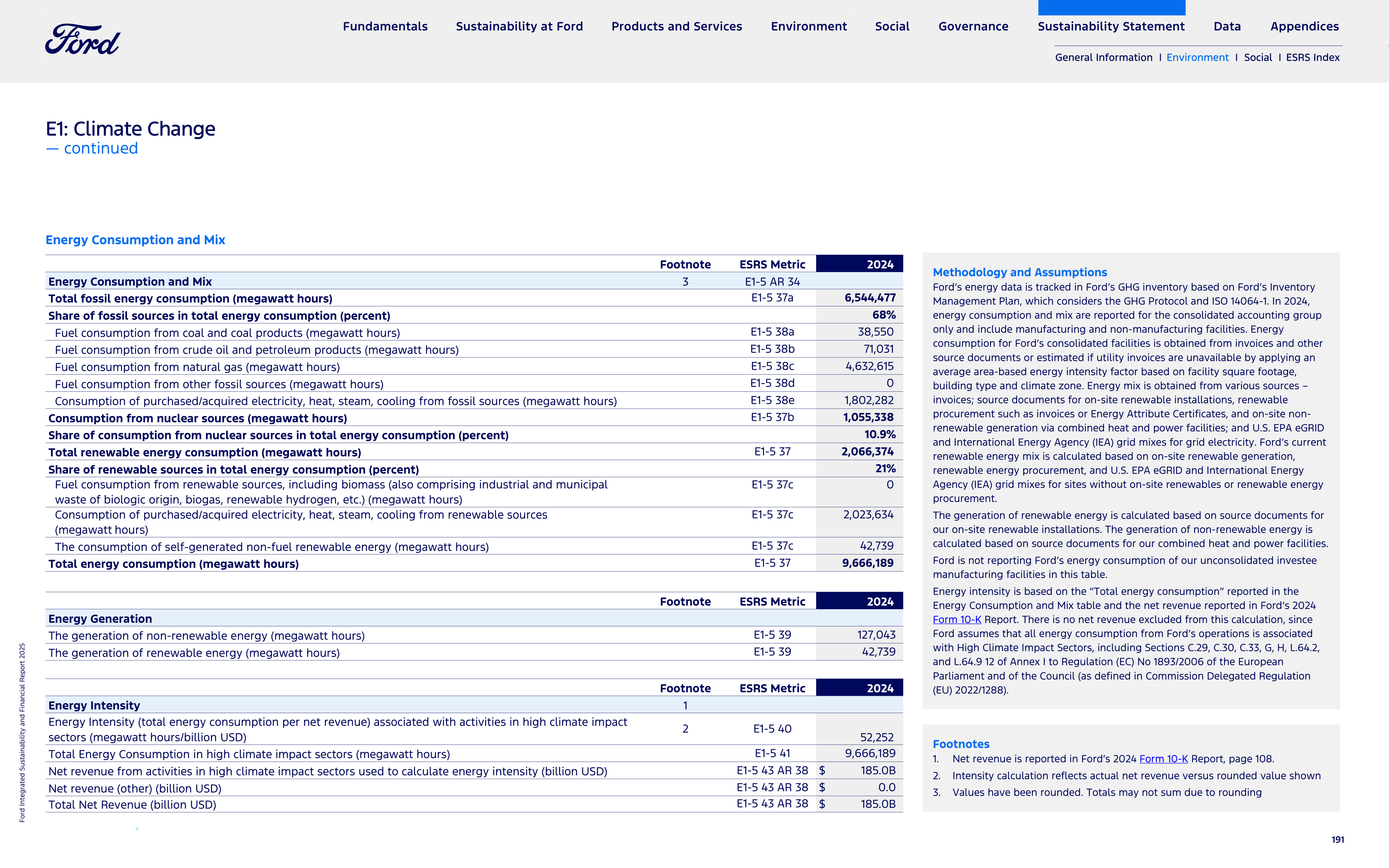
Fundamentals
Sustainability at Ford
Products and Services
Environment
Social
Governance
Sustainability Statement
Data
Appendices
General Information
Environment
Social
ESRS Index
|
|
|
E1: Climate Change
— continued
,
Ford Integrated Sustainability and Financial Report 2025
191
Energy Consumption and Mix
Footnote
ESRS Metric
2024
Energy Consumption and Mix
3
E1-5 AR 34
Total fossil energy consumption (megawatt hours)
E1-5 37a
6,544,477
Share of fossil sources in total energy consumption (percent)
68 %
Fuel consumption from coal and coal products (megawatt hours)
E1-5 38a
38,550
Fuel consumption from crude oil and petroleum products (megawatt hours)
E1-5 38b
71,031
Fuel consumption from natural gas (megawatt hours)
E1-5 38c
4,632,615
Fuel consumption from other fossil sources (megawatt hours)
E1-5 38d
0
Consumption of purchased/acquired electricity, heat, steam, cooling from fossil sources (megawatt hours)
E1-5 38e
1,802,282
Consumption from nuclear sources (megawatt hours)
E1-5 37b
1,055,338
Share of consumption from nuclear sources in total energy consumption (percent)
10.9 %
Total renewable energy consumption (megawatt hours)
E1-5 37
2,066,374
Share of renewable sources in total energy consumption (percent)
21 %
Fuel consumption from renewable sources, including biomass (also comprising industrial and municipal
waste of biologic origin, biogas, renewable hydrogen, etc.) (megawatt hours)
E1-5 37c
0
Consumption of purchased/acquired electricity, heat, steam, cooling from renewable sources
(megawatt hours)
E1-5 37c
2,023,634
The consumption of self-generated non-fuel renewable energy (megawatt hours)
E1-5 37c
42,739
Total energy consumption (megawatt hours)
E1-5 37
9,666,189
Footnote
ESRS Metric
2024
Energy Generation
The generation of non-renewable energy (megawatt hours)
E1-5 39
127,043
The generation of renewable energy (megawatt hours)
E1-5 39
42,739
Footnote
ESRS Metric
2024
Energy Intensity
1
Energy Intensity (total energy consumption per net revenue) associated with activities in high climate impact
sectors (megawatt hours/billion USD)
2
E1-5 40
52,252
Total Energy Consumption in high climate impact sectors (megawatt hours)
E1-5 41
9,666,189
Net revenue from activities in high climate impact sectors used to calculate energy intensity (billion USD)
E1-5 43 AR 38 $
185.0 B
Net revenue (other) (billion USD)
E1-5 43 AR 38 $
0.0
Total Net Revenue (billion USD)
E1-5 43 AR 38 $
185.0 B
Methodology and Assumptions
Ford’s energy data is tracked in Ford’s GHG inventory based on Ford’s Inventory
Management Plan, which considers the GHG Protocol and ISO 14064-1. In 2024,
energy consumption and mix are reported for the consolidated accounting group
only and include manufacturing and non-manufacturing facilities. Energy
consumption for Ford’s consolidated facilities is obtained from invoices and other
source documents or estimated if utility invoices are unavailable by applying an
average area-based energy intensity factor based on facility square footage,
building type and climate zone. Energy mix is obtained from various sources –
invoices; source documents for on-site renewable installations, renewable
procurement such as invoices or Energy Attribute Certificates, and on-site non-
renewable generation via combined heat and power facilities; and U.S. EPA eGRID
and International Energy Agency (IEA) grid mixes for grid electricity. Ford’s current
renewable energy mix is calculated based on on-site renewable generation,
renewable energy procurement, and U.S. EPA eGRID and International Energy
Agency (IEA) grid mixes for sites without on-site renewables or renewable energy
procurement.
The generation of renewable energy is calculated based on source documents for
our on-site renewable installations. The generation of non-renewable energy is
calculated based on source documents for our combined heat and power facilities.
Ford is not reporting Ford’s energy consumption of our unconsolidated investee
manufacturing facilities in this table.
Energy intensity is based on the “Total energy consumption” reported in the
Energy Consumption and Mix table and the net revenue reported in Ford’s 2024
Form 10-K
Report. There is no net revenue excluded from this calculation, since
Ford assumes that all energy consumption from Ford’s operations is associated
with High Climate Impact Sectors, including Sections C.29, C.30, C.33, G, H, L.64.2,
and L.64.9 12 of Annex I to Regulation (EC) No 1893/2006 of the European
Parliament and of the Council (as defined in Commission Delegated Regulation
(EU) 2022/1288).
Footnotes
1.
Net revenue is reported in Ford’s 2024
Form 10-K
Report, page 108.
2.
Intensity calculation reflects actual net revenue versus rounded value shown
3.
Values have been rounded. Totals may not sum due to rounding
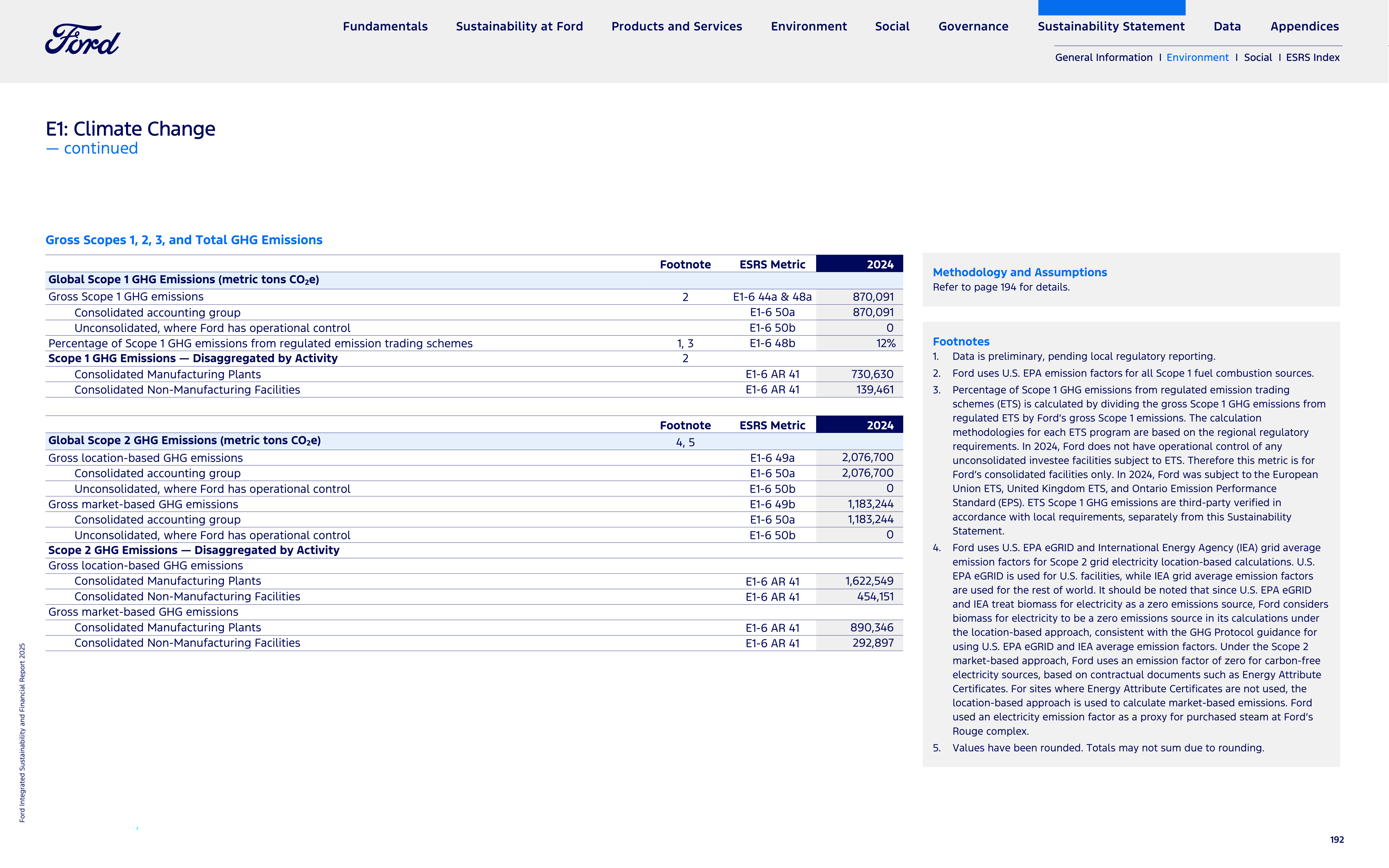
Fundamentals
Sustainability at Ford
Products and Services
Environment
Social
Governance
Sustainability Statement
Data
Appendices
General Information
Environment
Social
ESRS Index
|
|
|
E1: Climate Change
— continued
,
Ford Integrated Sustainability and Financial Report 2025
192
Gross Scopes 1, 2, 3, and Total GHG Emissions
Footnote
ESRS Metric
2024
Global Scope 1 GHG Emissions (metric tons CO
2
e)
Gross Scope 1 GHG emissions
2
E1-6 44a & 48a
870,091
Consolidated accounting group
E1-6 50a
870,091
Unconsolidated, where Ford has operational control
E1-6 50b
0
Percentage of Scope 1 GHG emissions from regulated emission trading schemes
1, 3
E1-6 48b
12 %
Scope 1 GHG Emissions — Disaggregated by Activity
2
Consolidated Manufacturing Plants
E1-6 AR 41
730,630
Consolidated Non-Manufacturing Facilities
E1-6 AR 41
139,461
Footnote
ESRS Metric
2024
Global Scope 2 GHG Emissions (metric tons CO
2
e)
4, 5
Gross location-based GHG emissions
E1-6 49a
2,076,700
Consolidated accounting group
E1-6 50a
2,076,700
Unconsolidated, where Ford has operational control
E1-6 50b
0
Gross market-based GHG emissions
E1-6 49b
1,183,244
Consolidated accounting group
E1-6 50a
1,183,244
Unconsolidated, where Ford has operational control
E1-6 50b
0
Scope 2 GHG Emissions — Disaggregated by Activity
Gross location-based GHG emissions
Consolidated Manufacturing Plants
E1-6 AR 41
1,622,549
Consolidated Non-Manufacturing Facilities
E1-6 AR 41
454,151
Gross market-based GHG emissions
Consolidated Manufacturing Plants
E1-6 AR 41
890,346
Consolidated Non-Manufacturing Facilities
E1-6 AR 41
292,897
Methodology and Assumptions
Refer to page 194 for details.
Footnotes
1.
Data is preliminary, pending local regulatory reporting.
2.
Ford uses U.S. EPA emission factors for all Scope 1 fuel combustion sources.
3.
Percentage of Scope 1 GHG emissions from regulated emission trading
schemes (ETS) is calculated by dividing the gross Scope 1 GHG emissions from
regulated ETS by Ford’s gross Scope 1 emissions. The calculation
methodologies for each ETS program are based on the regional regulatory
requirements. In 2024, Ford does not have operational control of any
unconsolidated investee facilities subject to ETS. Therefore this metric is for
Ford’s consolidated facilities only. In 2024, Ford was subject to the European
Union ETS, United Kingdom ETS, and Ontario Emission Performance
Standard (EPS). ETS Scope 1 GHG emissions are third-party verified in
accordance with local requirements, separately from this Sustainability
Statement.
4.
Ford uses U.S. EPA eGRID and International Energy Agency (IEA) grid average
emission factors for Scope 2 grid electricity location-based calculations. U.S.
EPA eGRID is used for U.S. facilities, while IEA grid average emission factors
are used for the rest of world. It should be noted that since U.S. EPA eGRID
and IEA treat biomass for electricity as a zero emissions source, Ford considers
biomass for electricity to be a zero emissions source in its calculations under
the location-based approach, consistent with the GHG Protocol guidance for
using U.S. EPA eGRID and IEA average emission factors. Under the Scope 2
market-based approach, Ford uses an emission factor of zero for carbon-free
electricity sources, based on contractual documents such as Energy Attribute
Certificates. For sites where Energy Attribute Certificates are not used, the
location-based approach is used to calculate market-based emissions. Ford
used an electricity emission factor as a proxy for purchased steam at Ford’s
Rouge complex.
5.
Values have been rounded. Totals may not sum due to rounding.
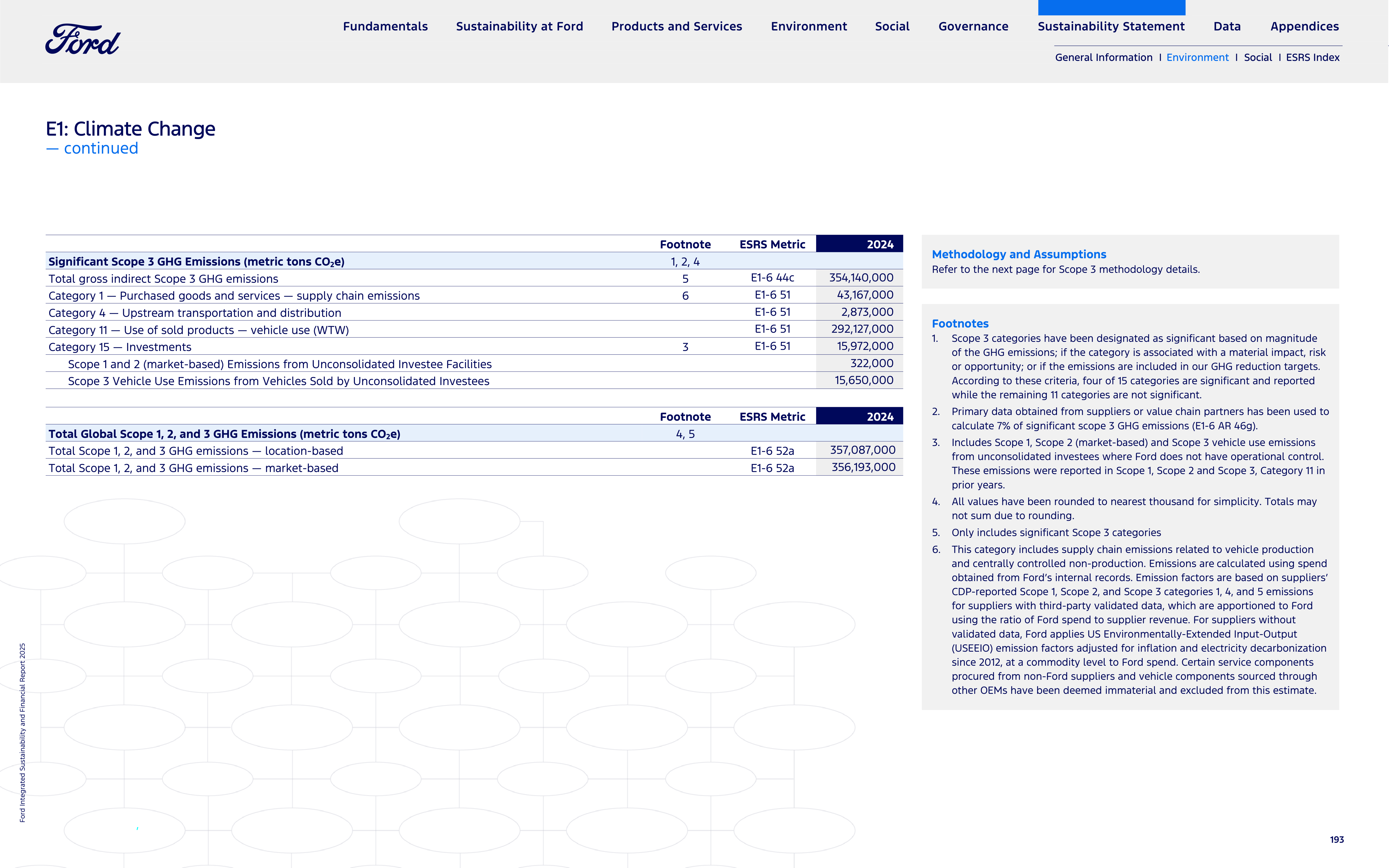

Fundamentals
Sustainability at Ford
Products and Services
Environment
Social
Governance
Sustainability Statement
Data
Appendices
General Information
Environment
Social
ESRS Index
|
|
|
E1: Climate Change
— continued
,
Ford Integrated Sustainability and Financial Report 2025
193
Footnote
ESRS Metric
2024
Significant Scope 3 GHG Emissions (metric tons CO
2
e)
1, 2, 4
Total gross indirect Scope 3 GHG emissions
5
E1-6 44c
354,140,000
Category 1 — Purchased goods and services — supply chain emissions
6
E1-6 51
43,167,000
Category 4 — Upstream transportation and distribution
E1-6 51
2,873,000
Category 11 — Use of sold products — vehicle use (WTW)
E1-6 51
292,127,000
Category 15 — Investments
3
E1-6 51
15,972,000
Scope 1 and 2 (market-based) Emissions from Unconsolidated Investee Facilities
322,000
Scope 3 Vehicle Use Emissions from Vehicles Sold by Unconsolidated Investees
15,650,000
Footnote
ESRS Metric
2024
Total Global Scope 1, 2, and 3 GHG Emissions (metric tons CO
2
e)
4, 5
Total Scope 1, 2, and 3 GHG emissions — location-based
E1-6 52a
357,087,000
Total Scope 1, 2, and 3 GHG emissions — market-based
E1-6 52a
356,193,000
Methodology and Assumptions
Refer to the next page for Scope 3 methodology details.
Footnotes
1.
Scope 3 categories have been designated as significant based on magnitude
of the GHG emissions; if the category is associated with a material impact, risk
or opportunity; or if the emissions are included in our GHG reduction targets.
According to these criteria, four of 15 categories are significant and reported
while the remaining 11 categories are not significant.
2.
Primary data obtained from suppliers or value chain partners has been used to
calculate 7% of significant scope 3 GHG emissions (E1-6 AR 46g).
3.
Includes Scope 1, Scope 2 (market-based) and Scope 3 vehicle use emissions
from unconsolidated investees where Ford does not have operational control.
These emissions were reported in Scope 1, Scope 2 and Scope 3, Category 11 in
prior years.
4.
All values have been rounded to nearest thousand for simplicity. Totals may
not sum due to rounding.
5.
Only includes significant Scope 3 categories
6.
This category includes supply chain emissions related to vehicle production
and centrally controlled non-production. Emissions are calculated using spend
obtained from Ford’s internal records. Emission factors are based on suppliers’
CDP-reported Scope 1, Scope 2, and Scope 3 categories 1, 4, and 5 emissions
for suppliers with third-party validated data, which are apportioned to Ford
using the ratio of Ford spend to supplier revenue. For suppliers without
validated data, Ford applies US Environmentally-Extended Input-Output
(USEEIO) emission factors adjusted for inflation and electricity decarbonization
since 2012, at a commodity level to Ford spend. Certain service components
procured from non-Ford suppliers and vehicle components sourced through
other OEMs have been deemed immaterial and excluded from this estimate.
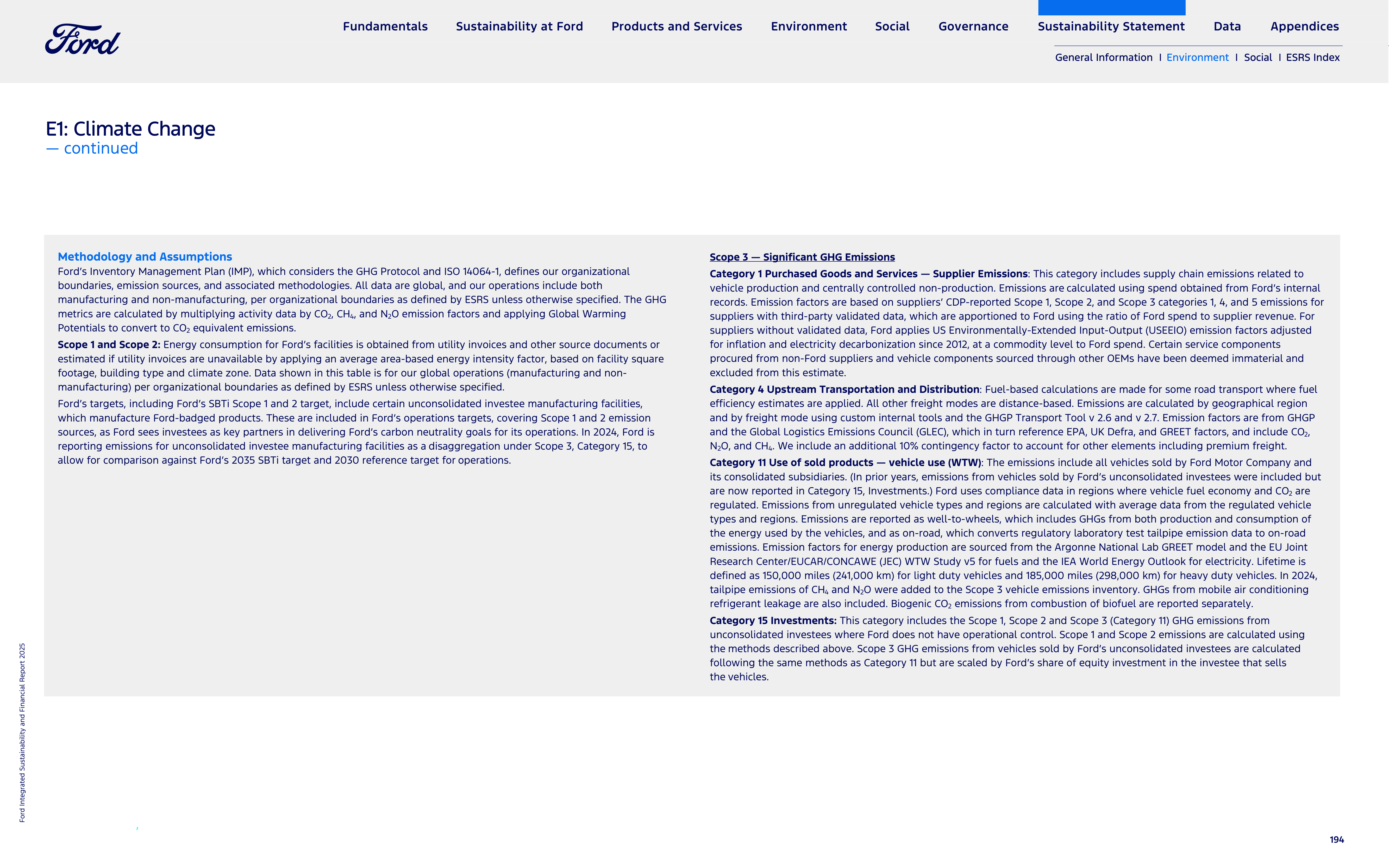
Fundamentals
Sustainability at Ford
Products and Services
Environment
Social
Governance
Sustainability Statement
Data
Appendices
General Information
Environment
Social
ESRS Index
|
|
|
E1: Climate Change
— continued
,
Ford Integrated Sustainability and Financial Report 2025
194
Methodology and Assumptions
Ford’s Inventory Management Plan (IMP), which considers the GHG Protocol and ISO 14064-1, defines our organizational
boundaries, emission sources, and associated methodologies. All data are global, and our operations include both
manufacturing and non-manufacturing, per organizational boundaries as defined by ESRS unless otherwise specified. The GHG
metrics are calculated by multiplying activity data by CO
2
, CH
4
, and N
2
O emission factors and applying Global Warming
Potentials to convert to CO
2
equivalent emissions.
Scope 1 and Scope 2:
Energy consumption for Ford’s facilities is obtained from utility invoices and other source documents or
estimated if utility invoices are unavailable by applying an average area-based energy intensity factor, based on facility square
footage, building type and climate zone. Data shown in this table is for our global operations (manufacturing and non-
manufacturing) per organizational boundaries as defined by ESRS unless otherwise specified.
Ford’s targets, including Ford’s SBTi Scope 1 and 2 target, include certain unconsolidated investee manufacturing facilities,
which manufacture Ford-badged products. These are included in Ford’s operations targets, covering Scope 1 and 2 emission
sources, as Ford sees investees as key partners in delivering Ford’s carbon neutrality goals for its operations. In 2024, Ford is
reporting emissions for unconsolidated investee manufacturing facilities as a disaggregation under Scope 3, Category 15, to
allow for comparison against Ford’s 2035 SBTi target and 2030 reference target for operations.
Scope 3 — Significant GHG Emissions
Category 1 Purchased Goods and Services — Supplier Emissions
: This category includes supply chain emissions related to
vehicle production and centrally controlled non-production. Emissions are calculated using spend obtained from Ford’s internal
records. Emission factors are based on suppliers’ CDP-reported Scope 1, Scope 2, and Scope 3 categories 1, 4, and 5 emissions for
suppliers with third-party validated data, which are apportioned to Ford using the ratio of Ford spend to supplier revenue. For
suppliers without validated data, Ford applies US Environmentally-Extended Input-Output (USEEIO) emission factors adjusted
for inflation and electricity decarbonization since 2012, at a commodity level to Ford spend. Certain service components
procured from non-Ford suppliers and vehicle components sourced through other OEMs have been deemed immaterial and
excluded from this estimate.
Category 4 Upstream Transportation and Distribution
: Fuel-based calculations are made for some road transport where fuel
efficiency estimates are applied. All other freight modes are distance-based. Emissions are calculated by geographical region
and by freight mode using custom internal tools and the GHGP Transport Tool v 2.6 and v 2.7. Emission factors are from GHGP
and the Global Logistics Emissions Council (GLEC), which in turn reference EPA, UK Defra, and GREET factors, and include CO
2
,
N
2
O, and CH
4
. We include an additional 10% contingency factor to account for other elements including premium freight.
Category 11 Use of sold products — vehicle use (WTW)
: The emissions include all vehicles sold by Ford Motor Company and
its consolidated subsidiaries. (In prior years, emissions from vehicles sold by Ford’s unconsolidated investees were included but
are now reported in Category 15, Investments.) Ford uses compliance data in regions where vehicle fuel economy and CO
2
are
regulated. Emissions from unregulated vehicle types and regions are calculated with average data from the regulated vehicle
types and regions. Emissions are reported as well-to-wheels, which includes GHGs from both production and consumption of
the energy used by the vehicles, and as on-road, which converts regulatory laboratory test tailpipe emission data to on-road
emissions. Emission factors for energy production are sourced from the Argonne National Lab GREET model and the EU Joint
Research Center/EUCAR/CONCAWE (JEC) WTW Study v5 for fuels and the IEA World Energy Outlook for electricity. Lifetime is
defined as 150,000 miles (241,000 km) for light duty vehicles and 185,000 miles (298,000 km) for heavy duty vehicles. In 2024,
tailpipe emissions of CH
4
and N
2
O were added to the Scope 3 vehicle emissions inventory. GHGs from mobile air conditioning
refrigerant leakage are also included. Biogenic CO
2
emissions from combustion of biofuel are reported separately.
Category 15 Investments:
This category includes the Scope 1, Scope 2 and Scope 3 (Category 11) GHG emissions from
unconsolidated investees where Ford does not have operational control. Scope 1 and Scope 2 emissions are calculated using
the methods described above. Scope 3 GHG emissions from vehicles sold by Ford’s unconsolidated investees are calculated
following the same methods as Category 11 but are scaled by Ford’s share of equity investment in the investee that sells
the vehicles.
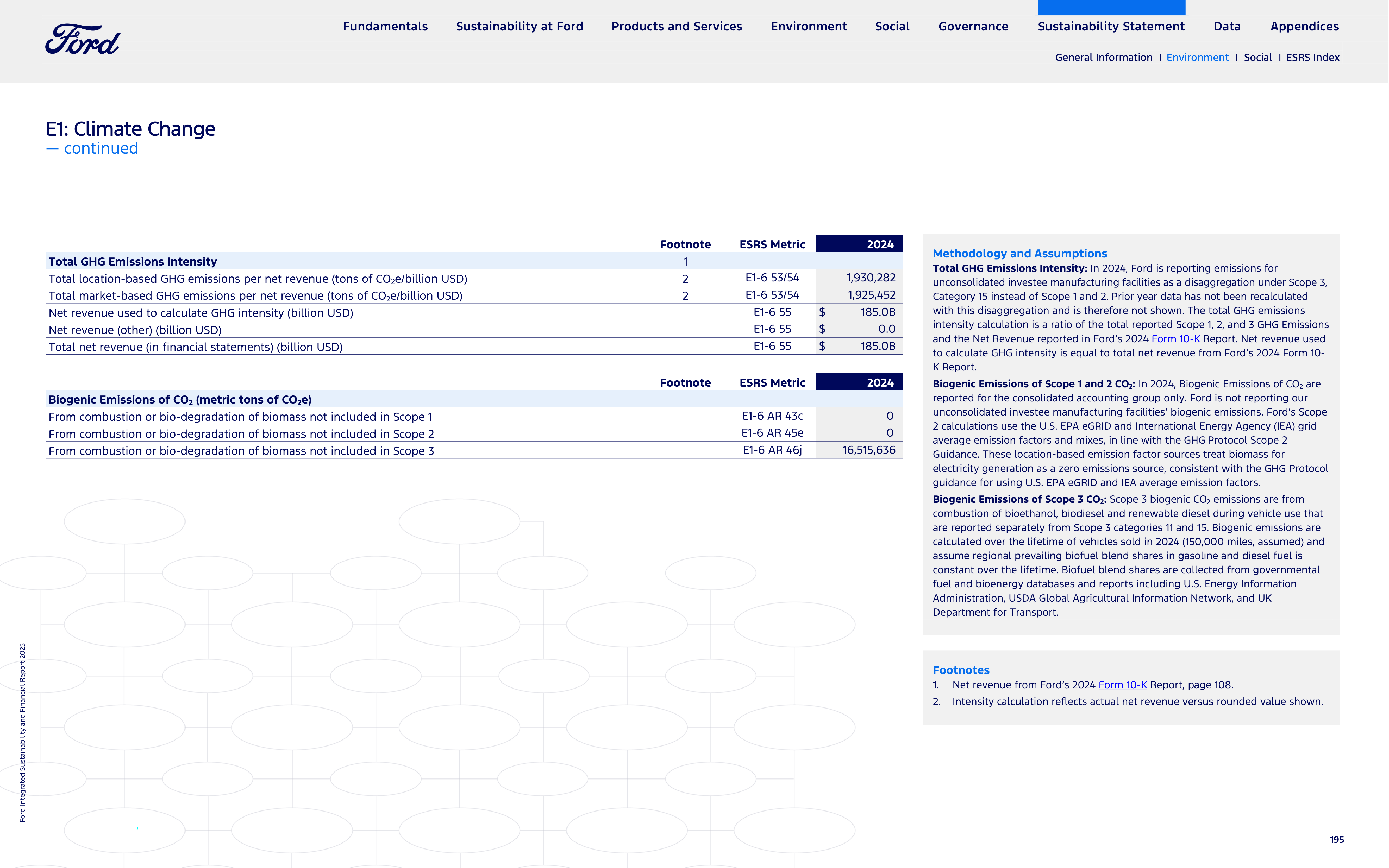

Fundamentals
Sustainability at Ford
Products and Services
Environment
Social
Governance
Sustainability Statement
Data
Appendices
General Information
Environment
Social
ESRS Index
|
|
|
Footnote
ESRS Metric
2024
Total GHG Emissions Intensity
1
Total location-based GHG emissions per net revenue (tons of CO
2
e/billion USD)
2
E1-6 53/54
1,930,282
Total market-based GHG emissions per net revenue (tons of CO
2
e/billion USD)
2
E1-6 53/54
1,925,452
Net revenue used to calculate GHG intensity (billion USD)
E1-6 55
$
185.0 B
Net revenue (other) (billion USD)
E1-6 55
$
0.0
Total net revenue (in financial statements) (billion USD)
E1-6 55
$
185.0 B
Footnote
ESRS Metric
2024
Biogenic Emissions of CO
2
(metric tons of CO
2
e)
From combustion or bio-degradation of biomass not included in Scope 1
E1-6 AR 43c
0
From combustion or bio-degradation of biomass not included in Scope 2
E1-6 AR 45e
0
From combustion or bio-degradation of biomass not included in Scope 3
E1-6 AR 46j
16,515,636
E1: Climate Change
— continued
,
Ford Integrated Sustainability and Financial Report 2025
195
Methodology and Assumptions
Total GHG Emissions Intensity:
In 2024, Ford is reporting emissions for
unconsolidated investee manufacturing facilities as a disaggregation under Scope 3,
Category 15 instead of Scope 1 and 2. Prior year data has not been recalculated
with this disaggregation and is therefore not shown. The total GHG emissions
intensity calculation is a ratio of the total reported Scope 1, 2, and 3 GHG Emissions
and the Net Revenue reported in Ford’s 2024
Form 10-K
Report. Net revenue used
to calculate GHG intensity is equal to total net revenue from Ford’s 2024 Form 10-
K Report.
Biogenic Emissions of Scope 1 and 2 CO
2
:
In 2024, Biogenic Emissions of CO
2
are
reported for the consolidated accounting group only. Ford is not reporting our
unconsolidated investee manufacturing facilities’ biogenic emissions. Ford’s Scope
2 calculations use the U.S. EPA eGRID and International Energy Agency (IEA) grid
average emission factors and mixes, in line with the GHG Protocol Scope 2
Guidance. These location-based emission factor sources treat biomass for
electricity generation as a zero emissions source, consistent with the GHG Protocol
guidance for using U.S. EPA eGRID and IEA average emission factors.
Biogenic Emissions of Scope 3 CO
2
:
Scope 3 biogenic CO
2
emissions are from
combustion of bioethanol, biodiesel and renewable diesel during vehicle use that
are reported separately from Scope 3 categories 11 and 15. Biogenic emissions are
calculated over the lifetime of vehicles sold in 2024 (150,000 miles, assumed) and
assume regional prevailing biofuel blend shares in gasoline and diesel fuel is
constant over the lifetime. Biofuel blend shares are collected from governmental
fuel and bioenergy databases and reports including U.S. Energy Information
Administration, USDA Global Agricultural Information Network, and UK
Department for Transport.
Footnotes
1.
Net revenue from Ford’s 2024
Form 10-K
Report, page 108.
2.
Intensity calculation reflects actual net revenue versus rounded value shown.
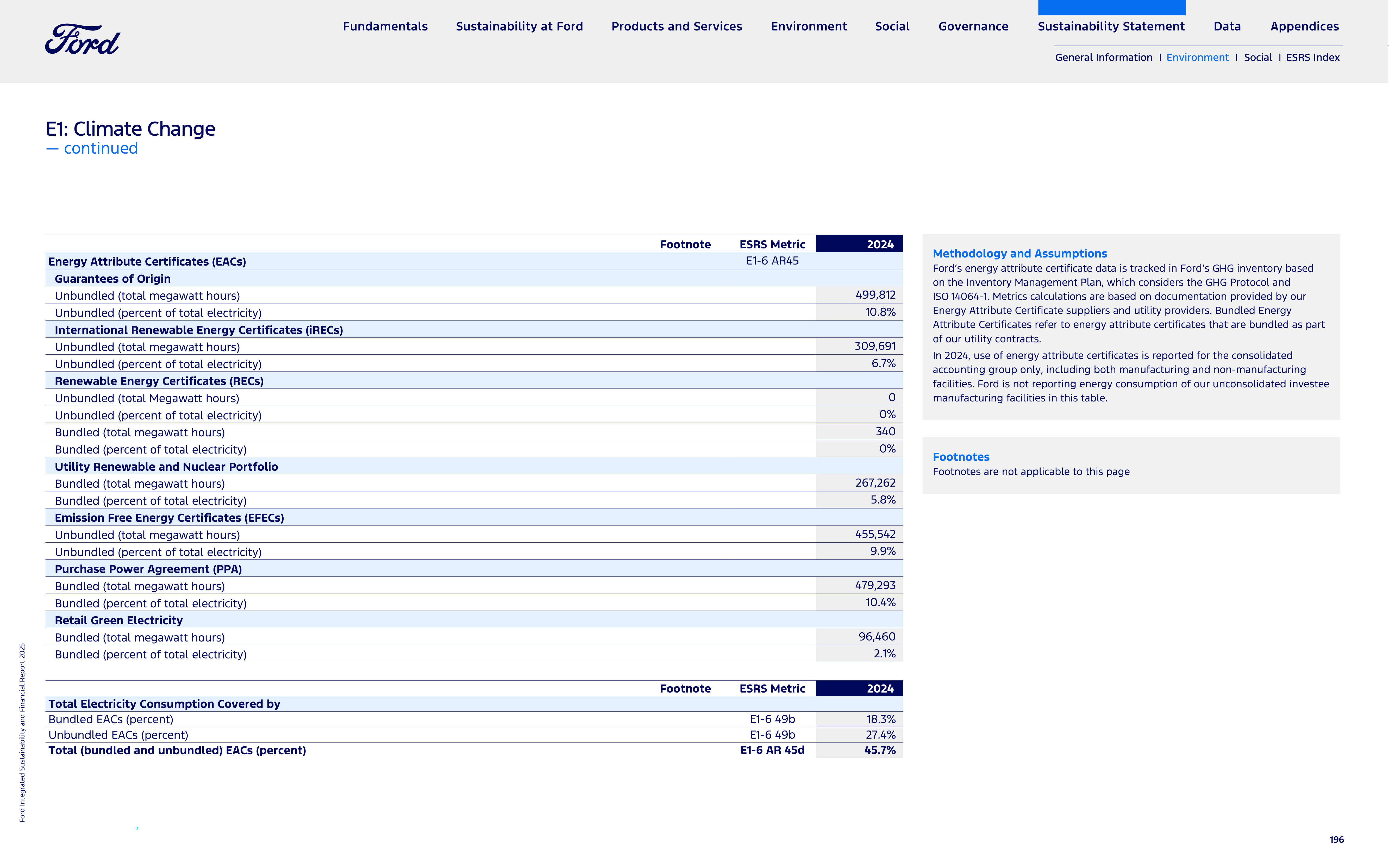
Fundamentals
Sustainability at Ford
Products and Services
Environment
Social
Governance
Sustainability Statement
Data
Appendices
General Information
Environment
Social
ESRS Index
|
|
|
Footnote
ESRS Metric
2024
Energy Attribute Certificates (EACs)
E1-6 AR45
Guarantees of Origin
Unbundled (total megawatt hours)
499,812
Unbundled (percent of total electricity)
10.8 %
International Renewable Energy Certificates (iRECs)
Unbundled (total megawatt hours)
309,691
Unbundled (percent of total electricity)
6.7 %
Renewable Energy Certificates (RECs)
Unbundled (total Megawatt hours)
0
Unbundled (percent of total electricity)
0 %
Bundled (total megawatt hours)
340
Bundled (percent of total electricity)
0 %
Utility Renewable and Nuclear Portfolio
Bundled (total megawatt hours)
267,262
Bundled (percent of total electricity)
5.8 %
Emission Free Energy Certificates (EFECs)
Unbundled (total megawatt hours)
455,542
Unbundled (percent of total electricity)
9.9 %
Purchase Power Agreement (PPA)
Bundled (total megawatt hours)
479,293
Bundled (percent of total electricity)
10.4 %
Retail Green Electricity
Bundled (total megawatt hours)
96,460
Bundled (percent of total electricity)
2.1 %
Footnote
ESRS Metric
2024
Total Electricity Consumption Covered by
Bundled EACs (percent)
E1-6 49b
18.3 %
Unbundled EACs (percent)
E1-6 49b
27.4 %
Total (bundled and unbundled) EACs (percent)
E1-6 AR 45d
45.7 %
E1: Climate Change
— continued
,
Ford Integrated Sustainability and Financial Report 2025
196
Methodology and Assumptions
Ford’s energy attribute certificate data is tracked in Ford’s GHG inventory based
on the Inventory Management Plan, which considers the GHG Protocol and
ISO 14064-1. Metrics calculations are based on documentation provided by our
Energy Attribute Certificate suppliers and utility providers. Bundled Energy
Attribute Certificates refer to energy attribute certificates that are bundled as part
of our utility contracts.
In 2024, use of energy attribute certificates is reported for the consolidated
accounting group only, including both manufacturing and non-manufacturing
facilities. Ford is not reporting energy consumption of our unconsolidated investee
manufacturing facilities in this table.
Footnotes
Footnotes are not applicable to this page
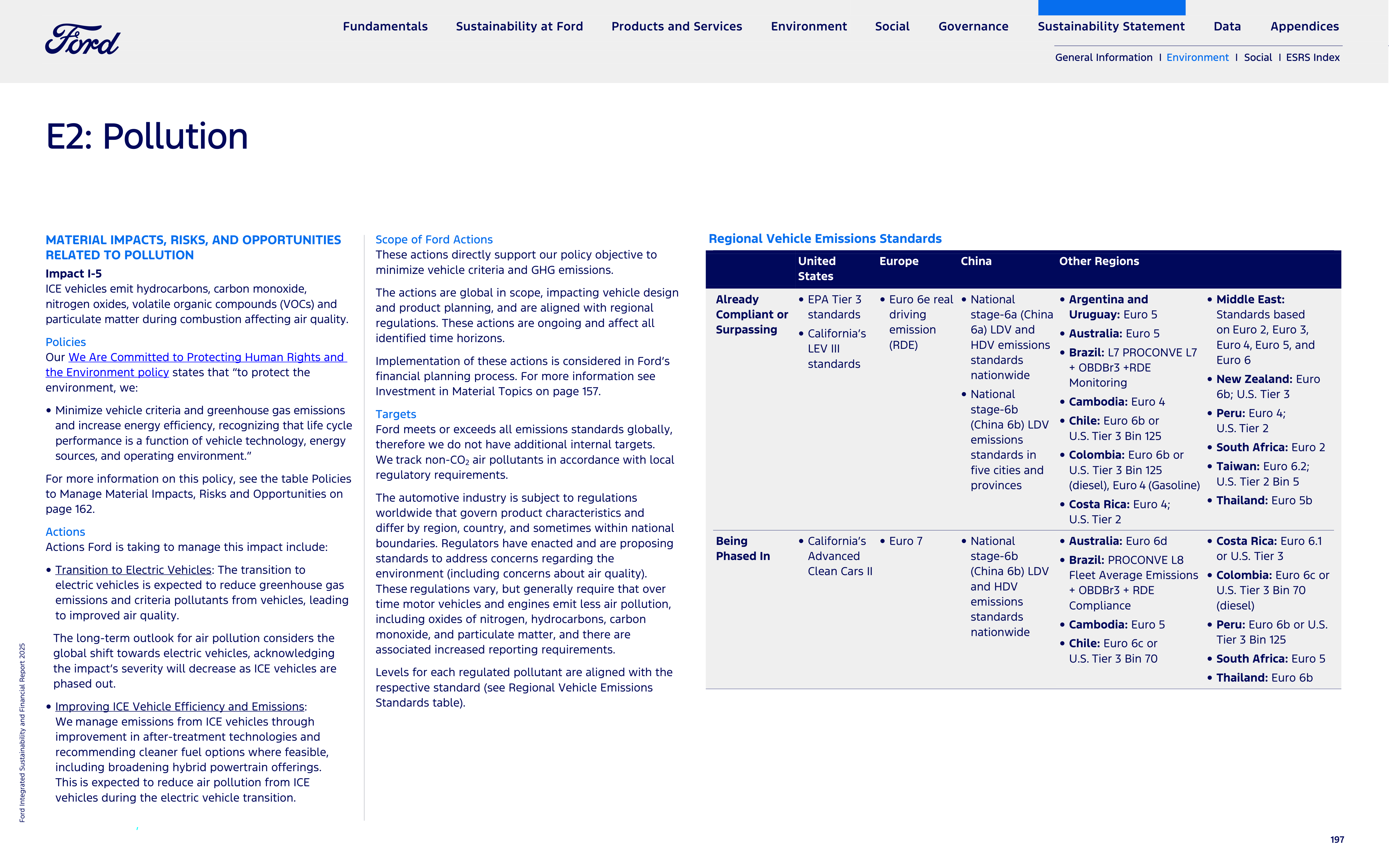
Fundamentals
Sustainability at Ford
197
Products and Services
Environment
Social
Governance
Sustainability Statement
Data
Appendices
General Information
Environment
Social
ESRS Index
|
|
|
E2: Pollution
MATERIAL IMPACTS, RISKS, AND OPPORTUNITIES
RELATED TO POLLUTION
Impact I-5
ICE vehicles emit hydrocarbons, carbon monoxide,
nitrogen oxides, volatile organic compounds (VOCs) and
particulate matter during combustion affecting air quality.
Policies
Our
We Are Committed to Protecting Human Rights and
the Environment policy
states that “to protect the
environment, we:
•
Minimize vehicle criteria and greenhouse gas emissions
and increase energy efficiency, recognizing that life cycle
performance is a function of vehicle technology, energy
sources, and operating environment.”
For more information on this policy, see the table Policies
to Manage Material Impacts, Risks and Opportunities on
page 162.
Actions
Actions Ford is taking to manage this impact include:
•
Transition to Electric Vehicles:
The transition to
electric vehicles is expected to reduce greenhouse gas
emissions and criteria pollutants from vehicles, leading
to improved air quality.
The long-term outlook for air pollution considers the
global shift towards electric vehicles, acknowledging
the impact’s severity will decrease as ICE vehicles are
phased out.
•
Improving ICE Vehicle Efficiency and Emissions:
We manage emissions from ICE vehicles through
improvement in after-treatment technologies and
recommending cleaner fuel options where feasible,
including broadening hybrid powertrain offerings.
This is expected to reduce air pollution from ICE
vehicles during the electric vehicle transition.
Scope of Ford Actions
These actions directly support our policy objective to
minimize vehicle criteria and GHG emissions.
The actions are global in scope, impacting vehicle design
and product planning, and are aligned with regional
regulations. These actions are ongoing and affect all
identified time horizons.
Implementation of these actions is considered in Ford’s
financial planning process. For more information see
Investment in Material Topics on page 157.
Targets
Ford meets or exceeds all emissions standards globally,
therefore we do not have additional internal targets.
We track non-CO
2
air pollutants in accordance with local
regulatory requirements.
The automotive industry is subject to regulations
worldwide that govern product characteristics and
differ by region, country, and sometimes within national
boundaries. Regulators have enacted and are proposing
standards to address concerns regarding the
environment (including concerns about air quality).
These regulations vary, but generally require that over
time motor vehicles and engines emit less air pollution,
including oxides of nitrogen, hydrocarbons, carbon
monoxide, and particulate matter, and there are
associated increased reporting requirements.
Levels for each regulated pollutant are aligned with the
respective standard (see Regional Vehicle Emissions
Standards table).
,
Ford Integrated Sustainability and Financial Report 2025
Regional Vehicle Emissions Standards
United
States
Europe
China
Other Regions
Already
Compliant or
Surpassing
•
EPA Tier 3
standards
•
California’s
LEV III
standards
•
Euro 6e real
driving
emission
(RDE)
•
National
stage-6a (China
6a) LDV and
HDV emissions
standards
nationwide
•
National
stage-6b
(China 6b) LDV
emissions
standards in
five cities and
provinces
•
Argentina and
Uruguay:
Euro 5
•
Australia:
Euro 5
•
Brazil:
L7 PROCONVE L7
+ OBDBr3 +RDE
Monitoring
•
Cambodia:
Euro 4
•
Chile:
Euro 6b or
U.S. Tier 3 Bin 125
•
Colombia:
Euro 6b or
U.S. Tier 3 Bin 125
(diesel), Euro 4 (Gasoline)
•
Costa Rica:
Euro 4;
U.S. Tier 2
•
Middle East:
Standards based
on Euro 2, Euro 3,
Euro 4, Euro 5, and
Euro 6
•
New Zealand:
Euro
6b; U.S. Tier 3
•
Peru:
Euro 4;
U.S. Tier 2
•
South Africa:
Euro 2
•
Taiwan:
Euro 6.2;
U.S. Tier 2 Bin 5
•
Thailand:
Euro 5b
Being
Phased In
•
California’s
Advanced
Clean Cars II
•
Euro 7
•
National
stage-6b
(China 6b) LDV
and HDV
emissions
standards
nationwide
•
Australia:
Euro 6d
•
Brazil:
PROCONVE L8
Fleet Average Emissions
+ OBDBr3 + RDE
Compliance
•
Cambodia:
Euro 5
•
Chile:
Euro 6c or
U.S. Tier 3 Bin 70
•
Costa Rica:
Euro 6.1
or U.S. Tier 3
•
Colombia:
Euro 6c or
U.S. Tier 3 Bin 70
(diesel)
•
Peru:
Euro 6b or U.S.
Tier 3 Bin 125
•
South Africa:
Euro 5
•
Thailand:
Euro 6b

Fundamentals
Sustainability at Ford
Products and Services
Environment
Social
Governance
Sustainability Statement
Data
Appendices
General Information
Environment
Social
ESRS Index
|
|
|
Impact I-6
Waste from mining may pollute local water resources.
Policies
Our
We Are Committed to Protecting Human Rights and
the Environment policy
includes direction to Ford and
our suppliers to protect the environment by supporting
safe and accessible drinking water in our manufacturing
operations and communities.
The
Supplier Code of Conduct
also requires our suppliers,
including raw material and mining suppliers, to support
access to clean and safe drinking water in local
communities and “avoid incidents and emergency
situations by taking proactive measures and be prepared
for emergencies in order to limit the impact on people
and the environment.”
For more information on these policies, see the table
Policies to Manage Material Impacts, Risks and
Opportunities on page 162.
Actions
Actions Ford is taking to support waste management
in our supply chain include:
•
Promoting Responsible Water Use: Ford promotes
closed loop water systems and responsible tailings
management, integrating water pollution into supply
chain due diligence.
•
Supplier Training: Training programs educate suppliers
on responsible water management, waste reduction,
and environmental impact mitigation, incorporating
best practices and international standards.
•
Data-Driven Improvement: Ford requires ISO 14001-
certified environmental management systems and is
expanding data collection on hazardous waste for more
precise measurement and targeted improvements in
the supply chain.
198
•
Collaboration on Sustainability: We are increasing the
number of suppliers participating in our best practice
program with M2030. M2030 supports suppliers in
establishing science-based targets and measuring,
managing, and reducing water use and waste. M2030
participants are expected to improve environmental
performance by setting targets, monitoring
environmental performance indicators, and driving
continuous improvement.
Scope of Ford Actions
These efforts support our policy objectives and supplier
expectations outlined in the We Are Committed to
Protecting Human Rights and the Environment policy
and Supplier Code of Conduct.
These actions encompass Ford’s global upstream value
chain, including suppliers involved in the mining and
processing of raw materials. Ford collaborates with
upstream suppliers to improve waste management
and prevent water pollution, minimizing mining waste.
The geographic scope is global, with specific
requirements tailored to local regulations. Affected
stakeholder groups include Ford, our suppliers, and local
communities near mining sites.
Promoting responsible water use, driving data-driven
improvements and encouraging collaboration on
sustainability are ongoing processes that could affect
all identified time horizons. Supplier training is
implemented annually.
Implementation of these actions is considered in Ford’s
financial planning process. For more information see
Investment in Material Topics on page 157.
Targets
Ford has policies related to waste management and
supporting clean water in our Supplier Code of Conduct.
We have not set targets related this impact because we
have a complex global supply chain and Ford’s direct
control over supplier’s actions and targets is limited.
However, we assess the effectiveness of environmental
policies and actions within our supply chain, including
water usage and waste management, through various
means such as ongoing due diligence, site assessments,
and the use of M2030 to support suppliers in their water
usage and waste reduction efforts. Currently, there is no
defined level of ambition related to these processes.
E2: Pollution
— continued
,
Ford Integrated Sustainability and Financial Report 2025

Fundamentals
Sustainability at Ford
Products and Services
Environment
Social
Governance
Sustainability Statement
Data
Appendices
General Information
Environment
Social
ESRS Index
|
|
|
E3: Water and Marine Resources
MATERIAL IMPACTS, RISKS, AND OPPORTUNITIES
RELATED TO WATER AND MARINE RESOURCES
Impact I-7
Critical minerals mining requires significant water use
which may impact limited freshwater supplies
Policies
Our
We Are Committed to Protecting Human Rights and
the Environment policy
states that “to protect the
environment, we:
•
Mimic ecosystem performance, eliminate waste, divert
waste from landfill to products, reduce freshwater
usage, reduce single use plastic, and support safe and
accessible drinking water in our manufacturing
operations and communities.”
All Ford operations are covered by this policy and we
require our suppliers and expect partners and joint
ventures to adopt and enforce similar policies and extend
them to their own supply chain.
Our
Supplier Code of Conduct
outlines our due diligence
and assurance requirements for suppliers, including
mining suppliers and mineral processors. The Supplier
Code of Conduct states “we require our suppliers to:
ó In alignment with the United Nations CEO Water
Mandate, reduce freshwater usage in their operations
and support access to clean and safe drinking water
in local communities.”
For more information on these policies, see the table
Policies to Manage Material Impacts, Risks and
Opportunities on page 162.
Actions
Actions Ford is taking to support minimal freshwater
usage in our supply chain include:
•
Supplier Requirements:
Ford incorporates contractual
requirements for suppliers to maintain ESG
management systems aligned with Ford’s policies.
Raw material suppliers must undergo an IRMA or third-
party equivalent audit covering environmental aspects,
including water usage and management.
•
Due Diligence:
Ford conducts due diligence
assessments of potential suppliers, evaluating their
ESG credentials and reviewing their public policies,
risk mitigation history, and relevant country-level risks
to mitigate the impact of water usage. Water risk
assessments are integrated into the supply chain due
diligence process, identifying and addressing potential
water-related challenges. Ford’s due diligence efforts,
as required by law, include onsite assessments.
•
Supplier Assessments:
Ford assesses supplier’s
environmental policies through a Drive Sustainability
(DS) Sustainability Assessment Questionnaire (SAQ),
including demonstrating the existence of an
environmental policy that addresses water quality
and consumption management.
Scope of Ford Actions
These actions directly support our policy objectives
and supplier expectations of reducing freshwater usage
and supporting access to clean drinking water in local
communities.
The scope includes activities related to water usage in
the supply chain, including raw material extraction and
processing. Our focus is global, with particular attention
to water-stressed regions. Affected stakeholder groups
include Ford, our suppliers, local communities near
mining sites, and regulatory bodies.
These actions are ongoing and could affect all identified
time horizons.
Implementation of these actions is considered in Ford’s
financial planning process. For more information see
Investment in Material Topics on page 157.
Targets
Ford has policies related to water management in our
Supplier Code of Conduct. We have not set targets
related this impact because we have a complex global
supply chain and Ford’s direct control over supplier’s
actions and targets is limited.
However, we are monitoring water stewardship policies
and actions in our value chain through various means
such as site assessments, and the use of our DS SAQ to
assess supplier environmental policies (including water
quality and consumption management). We also use
M2030 to support suppliers in their water usage and
waste reduction efforts. Currently, there is no defined
level of ambition related to these processes.
199
,
Ford Integrated Sustainability and Financial Report 2025
Fundamentals
Sustainability at Ford
Products and Services
Environment
Social
Governance
Sustainability Statement
Data
Appendices
General Information
Environment
Social
ESRS Index
|
|
|
E5: Resource Use and Circular Economy
MATERIAL IMPACTS, RISKS, AND
OPPORTUNITIES RELATED TO RESOURCE
USE AND CIRCULAR ECONOMY
Impact I-8
Heavy reliance on a range of natural resources may
contribute to resource depletion and associated impacts
Policies
Our
We Are Committed to Protecting Human Rights and
the Environment policy
states that “to protect the
environment, we:
•
Use recycled and renewable materials, reduce
substances of concern, and improve recyclability of our
products through material selection and product design.”
All Ford operations are covered by this policy and we
explicitly require our suppliers and expect partners and
joint ventures to adopt and enforce similar policies and
extend them to their own supply chain.
The
Supplier Code of Conduct
mandates adherence to
environmental and social standards, including requiring
suppliers to:
•
“Use recycled and renewable materials where possible
in packaging.
•
Improve recyclability of Ford products through material
selection and product design as approved by Ford.
•
Work to eliminate single use plastics throughout the
manufacturing process.”
For more information on these policies, see the table
Policies to Manage Material Impacts, Risks, and
Opportunities on page 162.
Actions
200
Incorporating renewable and recycled materials in our
vehicles allows us to reduce waste, conserve natural
resources, and potentially improve vehicle quality and
performance. Actions Ford is taking to manage our
reliance on natural resources include:
•
Use of Renewable Materials in Vehicles: Ford has used
various renewable plant-based materials in its products
including wheat straw, rice hulls, and coffee chaff.
These were chosen for their suitability as reinforcement
materials, their ability to offset the use of virgin
materials, and because they mostly originate as waste
streams from other industries. Current efforts focus on
increasing the content and use of scalable sustainable
materials, including cellulose, and castor oil.
•
Recycled and Renewable Plastics: Recognizing the high
metal recycling rate in vehicles, our primary focus is
increasing the use of recycled and renewable content
in plastics. To support this, Ford is requiring new
vehicle designs in North America, Europe and Türkiye
to use 20% recycled and renewable content in vehicle
plastics starting in 2025, and in China 10%.
This has been integrated into company deliverables
and procedures for new programs. To track the
recycled and renewable plastic content in vehicles, a
database tool has been modified to allow engineers to
specify the amount of recycled and renewable plastics
used, by weight, in each component of a vehicle.
•
Closed Loop Aluminum Recycling: Aluminum recycling
in Ford plants reduces the need for primary metal. In
collaboration with aluminum sheet suppliers, we have
developed unique alloys that enable us to increase the
reuse of aluminum within our own plants. In addition
to recovering aluminum scrap during parts stamping,
our system separates the various aluminum alloys so
they can be recycled back into fresh alloy for new
vehicles. Making recycled aluminum takes around 5%
of the energy needed to make new aluminum,
according to the Aluminum Association, and reduces
the need for primary metal. We currently recycle up
to 20 million pounds of aluminum each month at our
Dearborn Stamping, Kentucky Truck and Buffalo
Stamping facilities. This represents approximately 25%
of our aluminum sheet coil purchases.
•
Recycling and Remanufacturing Vehicle Parts: Ford
collaborates with parts recyclers and remanufacturers
to enable the use of recycled and remanufactured parts
in vehicle repairs, reducing the need for new materials.
Ford works with dealers and remanufacturing experts
to collect, evaluate and certify used parts for repair and
reuse, offering them as alternatives to new components.
Ford also invests in recycling infrastructure research to
expand its recycling capabilities.
Scope of Ford Actions
These actions support the requirements to protect the
environment by using recycled and renewable materials
and improving recyclability outlined in Ford’s We Are
Committed to Protecting Human Rights and the
Environment policy and Supplier Code of Conduct.
The actions being taken to reduce reliance on natural
resources involve upstream (sourcing, materials),
Ford (manufacturing, product design, research and
development), and downstream (end-of-life
management) aspects of the value chain.
Resource depletion driven by automotive material
demands is a global consideration, impacting resource
extraction locations, manufacturing hubs, and consumer
markets worldwide. Multiple stakeholders are affected,
including suppliers, employees, customers, communities,
investors, and government/regulatory bodies.
These actions are ongoing and could affect all identified
time horizons.
Implementation of these actions is considered in Ford’s
financial planning process. For more information see
Investment in Material Topics on page 157.
Targets
Ford did not have 2024 targets related to this impact.
However, starting in 2025, Ford is requiring new vehicle
designs in North America, Europe and Türkiye to use 20%
recycled and renewable content in vehicle plastics, and
in China 10%.
Effectiveness of actions being taken to reduce reliance
on natural resources are tracked within each
responsible organization.
,
Ford Integrated Sustainability and Financial Report 2025

Fundamentals
Sustainability at Ford
Products and Services
Environment
Social
Governance
Sustainability Statement
Data
Appendices
General Information
Environment
Social
ESRS Index
|
|
|
RESOURCE INFLOWS
Steel and Aluminum
Ford Motor Company sources steel and aluminum in the
form of sheet coils, lineal extrusions, ingots, and billets
directly from raw material suppliers for use in stamping,
hydroforming, casting, and forging processes essential
for producing automotive parts. Recognizing the
environmental impact associated with these resource
inflows, we are committed to a circular and sustainable
economy through innovations in integrated
computational materials engineering (ICME), advanced
manufacturing techniques, and advanced product design
and optimization.
Our strategies include reducing material consumption
by optimizing part design and manufacturing processes,
increasing the use of recycled content by collaborating
with suppliers, extending product end-of-life through
design for durability, repairability, and recyclability, and
developing closed loop systems to recover and reuse
end-of-life vehicle materials. These research efforts are
informed by Life Cycle Assessments (LCAs) that guide our
material development and process improvements.
We engage with our suppliers to promote sustainable
sourcing practices and are implementing initiatives to
improve the traceability of our raw materials. By
prioritizing these strategies, we aim to reduce the
environmental impact associated with our resource
inflows and contribute to a more circular and sustainable
automotive industry.
Plastics
Ford Motor Company sources plastic and elastomeric
automotive parts from suppliers. While most polymeric
materials used for the manufacture of such parts are
sourced from petroleum feedstocks, our commitment
to a circular and sustainable economy drives innovation
to reduce these resource inflows. We require our plastic
parts and materials suppliers to reduce environmental
impact from virgin plastics and petroleum feedstocks
where possible. Our strategies for reducing
environmental impact include incorporating recovered,
recycled, and renewable feedstocks to displace
petroleum derived feedstock for polymeric materials;
reducing material usage through optimization of part
design; and reducing manufacturing emissions through
novel process technologies.
E5: Resource Use and Circular Economy
— continued
,
Ford Integrated Sustainability and Financial Report 2025
201

Fundamentals
Sustainability at Ford
Products and Services
Environment
Social
Governance
Sustainability Statement
Data
Appendices
General Information
Environment
Social
ESRS Index
|
|
|
,
Ford Integrated Sustainability and Financial Report 2025
Sustainability Statement
Social
202
203
S1: Own Workforce
207
S2: Workers in the Value Chain
215
S3: Affected Communities
219
S4: Consumers and End Users
221
Entity Specific
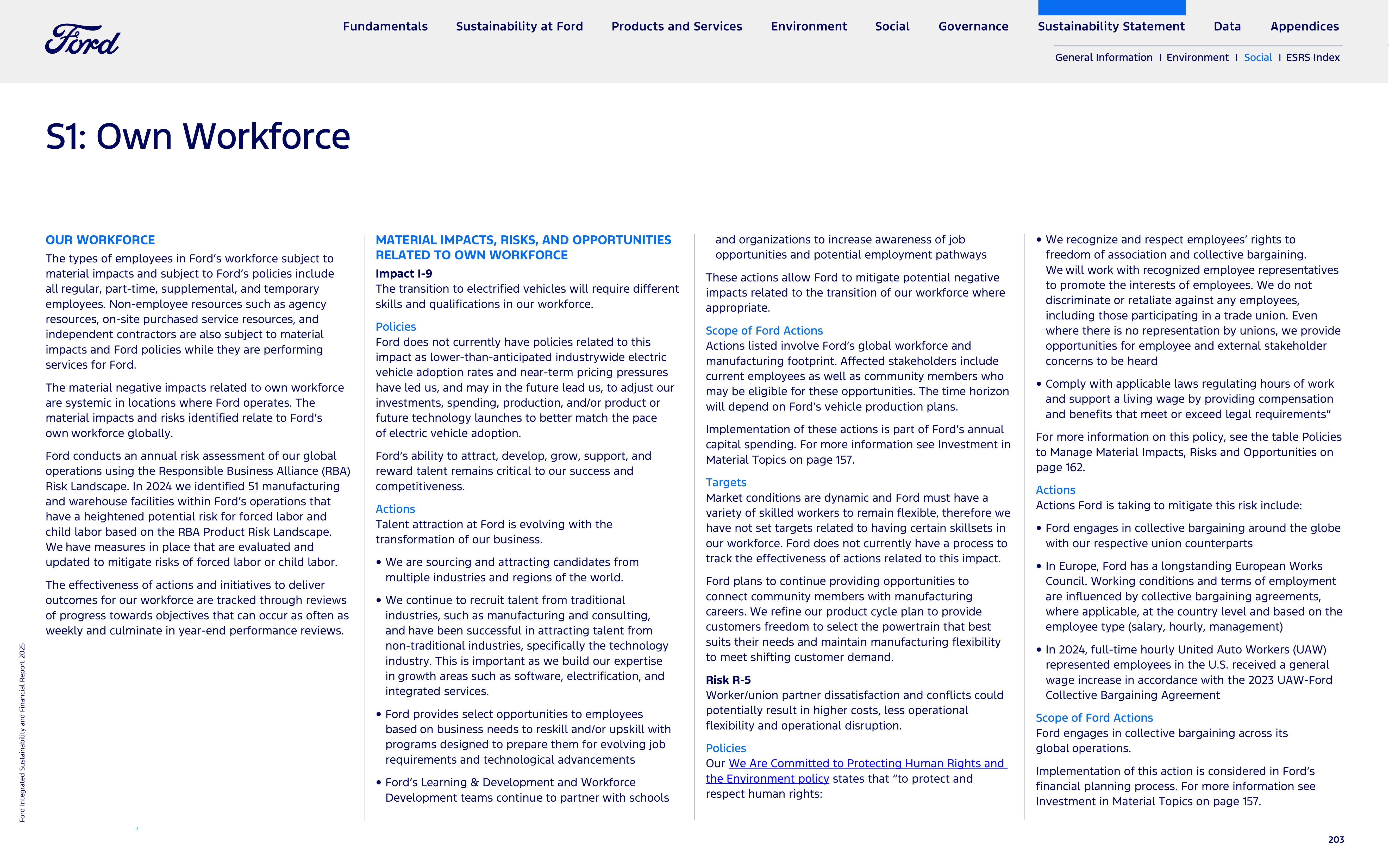
Fundamentals
Sustainability at Ford
Products and Services
Environment
Social
Governance
Sustainability Statement
Data
Appendices
General Information
Environment
Social
ESRS Index
|
|
|
S1: Own Workforce
203
,
Ford Integrated Sustainability and Financial Report 2025
OUR WORKFORCE
The types of employees in Ford’s workforce subject to
material impacts and subject to Ford’s policies include
all regular, part-time, supplemental, and temporary
employees. Non-employee resources such as agency
resources, on-site purchased service resources, and
independent contractors are also subject to material
impacts and Ford policies while they are performing
services for Ford.
The material negative impacts related to own workforce
are systemic in locations where Ford operates. The
material impacts and risks identified relate to Ford’s
own workforce globally.
Ford conducts an annual risk assessment of our global
operations using the Responsible Business Alliance (RBA)
Risk Landscape. In 2024 we identified 51 manufacturing
and warehouse facilities within Ford’s operations that
have a heightened potential risk for forced labor and
child labor based on the RBA Product Risk Landscape.
We have measures in place that are evaluated and
updated to mitigate risks of forced labor or child labor.
The effectiveness of actions and initiatives to deliver
outcomes for our workforce are tracked through reviews
of progress towards objectives that can occur as often as
weekly and culminate in year-end performance reviews.
MATERIAL IMPACTS, RISKS, AND OPPORTUNITIES
RELATED TO OWN WORKFORCE
Impact I-9
The transition to electrified vehicles will require different
skills and qualifications in our workforce.
Policies
Ford does not currently have policies related to this
impact as lower-than-anticipated industrywide electric
vehicle adoption rates and near-term pricing pressures
have led us, and may in the future lead us, to adjust our
investments, spending, production, and/or product or
future technology launches to better match the pace
of electric vehicle adoption.
Ford’s ability to attract, develop, grow, support, and
reward talent remains critical to our success and
competitiveness.
Actions
Talent attraction at Ford is evolving with the
transformation of our business.
•
We are sourcing and attracting candidates from
multiple industries and regions of the world.
•
We continue to recruit talent from traditional
industries, such as manufacturing and consulting,
and have been successful in attracting talent from
non-traditional industries, specifically the technology
industry. This is important as we build our expertise
in growth areas such as software, electrification, and
integrated services.
•
Ford provides select opportunities to employees
based on business needs to reskill and/or upskill with
programs designed to prepare them for evolving job
requirements and technological advancements
•
Ford’s Learning & Development and Workforce
Development teams continue to partner with schools
and organizations to increase awareness of job
opportunities and potential employment pathways
These actions allow Ford to mitigate potential negative
impacts related to the transition of our workforce where
appropriate.
Scope of Ford Actions
Actions listed involve Ford’s global workforce and
manufacturing footprint. Affected stakeholders include
current employees as well as community members who
may be eligible for these opportunities. The time horizon
will depend on Ford’s vehicle production plans.
Implementation of these actions is part of Ford’s annual
capital spending. For more information see Investment in
Material Topics on page 157.
Targets
Market conditions are dynamic and Ford must have a
variety of skilled workers to remain flexible, therefore we
have not set targets related to having certain skillsets in
our workforce. Ford does not currently have a process to
track the effectiveness of actions related to this impact.
Ford plans to continue providing opportunities to
connect community members with manufacturing
careers. We refine our product cycle plan to provide
customers freedom to select the powertrain that best
suits their needs and maintain manufacturing flexibility
to meet shifting customer demand.
Risk R-5
Worker/union partner dissatisfaction and conflicts could
potentially result in higher costs, less operational
flexibility and operational disruption.
Policies
Our
We Are Committed to Protecting Human Rights and
the Environment policy
states that “to protect and
respect human rights:
•
We recognize and respect employees’ rights to
freedom of association and collective bargaining.
We will work with recognized employee representatives
to promote the interests of employees. We do not
discriminate or retaliate against any employees,
including those participating in a trade union. Even
where there is no representation by unions, we provide
opportunities for employee and external stakeholder
concerns to be heard
•
Comply with applicable laws regulating hours of work
and support a living wage by providing compensation
and benefits that meet or exceed legal requirements”
For more information on this policy, see the table Policies
to Manage Material Impacts, Risks and Opportunities on
page 162.
Actions
Actions Ford is taking to mitigate this risk include:
•
Ford engages in collective bargaining around the globe
with our respective union counterparts
•
In Europe, Ford has a longstanding European Works
Council. Working conditions and terms of employment
are influenced by collective bargaining agreements,
where applicable, at the country level and based on the
employee type (salary, hourly, management)
•
In 2024, full-time hourly United Auto Workers (UAW)
represented employees in the U.S. received a general
wage increase in accordance with the 2023 UAW-Ford
Collective Bargaining Agreement
Scope of Ford Actions
Ford engages in collective bargaining across its
global operations.
Implementation of this action is considered in Ford’s
financial planning process. For more information see
Investment in Material Topics on page 157.
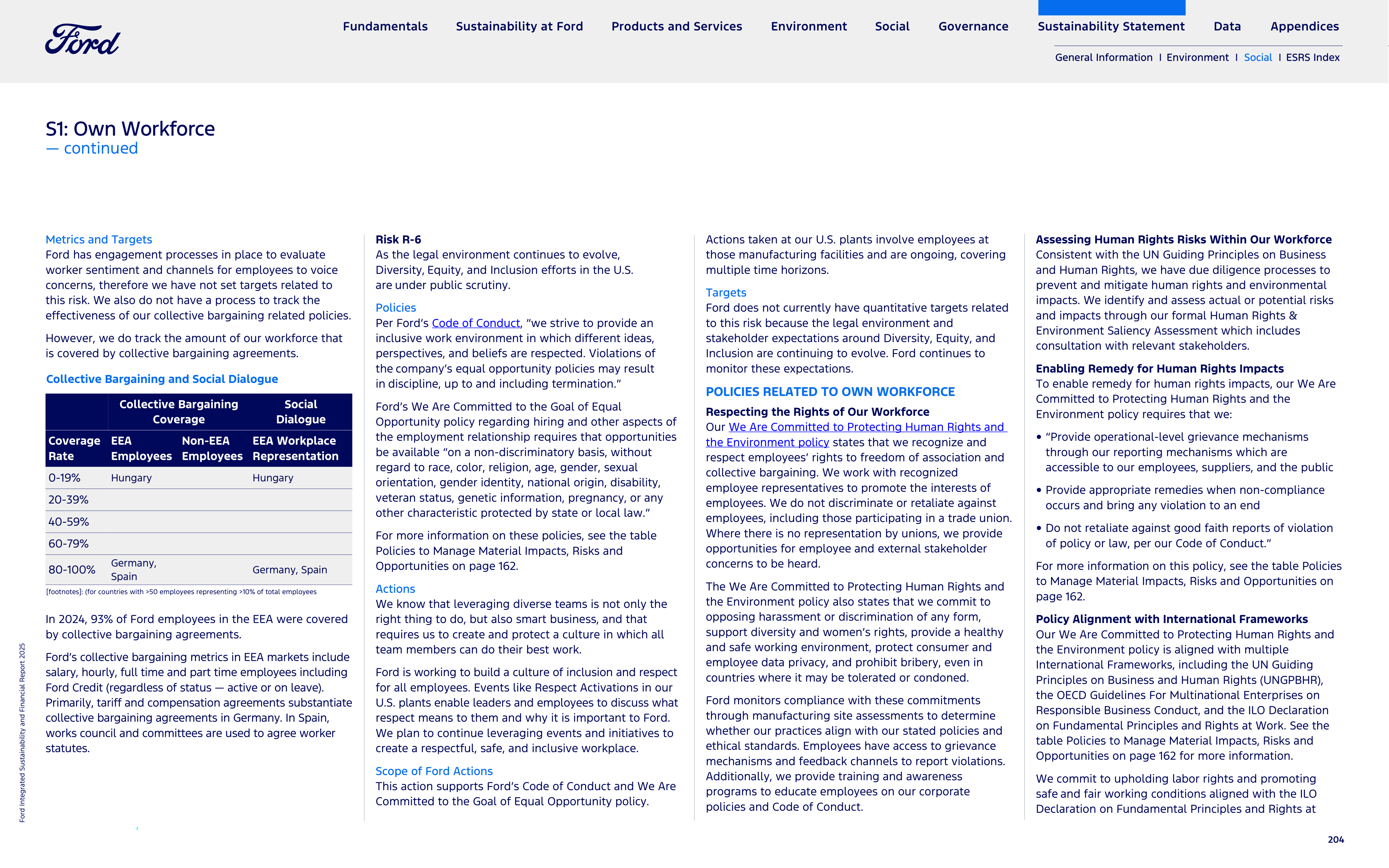
Fundamentals
Sustainability at Ford
Products and Services
Environment
Social
Governance
Sustainability Statement
Data
Appendices
General Information
Environment
Social
ESRS Index
|
|
|
Metrics and Targets
Ford has engagement processes in place to evaluate
worker sentiment and channels for employees to voice
concerns, therefore we have not set targets related to
this risk. We also do not have a process to track the
effectiveness of our collective bargaining related policies.
However, we do track the amount of our workforce that
is covered by collective bargaining agreements.
Collective Bargaining and Social Dialogue
Collective Bargaining
Coverage
Social
Dialogue
Coverage
Rate
EEA
Employees
Non-EEA
Employees
EEA Workplace
Representation
0-19%
Hungary
Hungary
20-39%
40-59%
60-79%
80-100%
Germany,
Spain
Germany, Spain
[footnotes]: (for countries with >50 employees representing >10% of total employees
In 2024, 93% of Ford employees in the EEA were covered
by collective bargaining agreements.
Ford’s collective bargaining metrics in EEA markets include
salary, hourly, full time and part time employees including
Ford Credit (regardless of status — active or on leave).
Primarily, tariff and compensation agreements substantiate
collective bargaining agreements in Germany. In Spain,
works council and committees are used to agree worker
statutes.
Risk R-6
As the legal environment continues to evolve,
Diversity, Equity, and Inclusion efforts in the U.S.
are under public scrutiny.
Policies
Per Ford’s
Code of Conduct
, “we strive to provide an
inclusive work environment in which different ideas,
perspectives, and beliefs are respected. Violations of
the company’s equal opportunity policies may result
in discipline, up to and including termination.”
Ford’s We Are Committed to the Goal of Equal
Opportunity policy regarding hiring and other aspects of
the employment relationship requires that opportunities
be available “on a non-discriminatory basis, without
regard to race, color, religion, age, gender, sexual
orientation, gender identity, national origin, disability,
veteran status, genetic information, pregnancy, or any
other characteristic protected by state or local law.”
For more information on these policies, see the table
Policies to Manage Material Impacts, Risks and
Opportunities on page 162.
Actions
We know that leveraging diverse teams is not only the
right thing to do, but also smart business, and that
requires us to create and protect a culture in which all
team members can do their best work.
Ford is working to build a culture of inclusion and respect
for all employees. Events like Respect Activations in our
U.S. plants enable leaders and employees to discuss what
respect means to them and why it is important to Ford.
We plan to continue leveraging events and initiatives to
create a respectful, safe, and inclusive workplace.
Scope of Ford Actions
This action supports Ford’s Code of Conduct and We Are
Committed to the Goal of Equal Opportunity policy.
Actions taken at our U.S. plants involve employees at
those manufacturing facilities and are ongoing, covering
multiple time horizons.
Targets
Ford does not currently have quantitative targets related
to this risk because the legal environment and
stakeholder expectations around Diversity, Equity, and
Inclusion are continuing to evolve. Ford continues to
monitor these expectations.
POLICIES RELATED TO OWN WORKFORCE
Respecting the Rights of Our Workforce
Our
We Are Committed to Protecting Human Rights and
the Environment policy
states that we recognize and
respect employees’ rights to freedom of association and
collective bargaining. We work with recognized
employee representatives to promote the interests of
employees. We do not discriminate or retaliate against
employees, including those participating in a trade union.
Where there is no representation by unions, we provide
opportunities for employee and external stakeholder
concerns to be heard.
The We Are Committed to Protecting Human Rights and
the Environment policy also states that we commit to
opposing harassment or discrimination of any form,
support diversity and women’s rights, provide a healthy
and safe working environment, protect consumer and
employee data privacy, and prohibit bribery, even in
countries where it may be tolerated or condoned.
Ford monitors compliance with these commitments
through manufacturing site assessments to determine
whether our practices align with our stated policies and
ethical standards. Employees have access to grievance
mechanisms and feedback channels to report violations.
Additionally, we provide training and awareness
programs to educate employees on our corporate
policies and Code of Conduct.
Assessing Human Rights Risks Within Our Workforce
Consistent with the UN Guiding Principles on Business
and Human Rights, we have due diligence processes to
prevent and mitigate human rights and environmental
impacts. We identify and assess actual or potential risks
and impacts through our formal Human Rights &
Environment Saliency Assessment which includes
consultation with relevant stakeholders.
Enabling Remedy for Human Rights Impacts
To enable remedy for human rights impacts, our We Are
Committed to Protecting Human Rights and the
Environment policy requires that we:
•
“Provide operational-level grievance mechanisms
through our reporting mechanisms which are
accessible to our employees, suppliers, and the public
•
Provide appropriate remedies when non-compliance
occurs and bring any violation to an end
•
Do not retaliate against good faith reports of violation
of policy or law, per our Code of Conduct.”
For more information on this policy, see the table Policies
to Manage Material Impacts, Risks and Opportunities on
page 162.
Policy Alignment with International Frameworks
Our We Are Committed to Protecting Human Rights and
the Environment policy is aligned with multiple
International Frameworks, including the UN Guiding
Principles on Business and Human Rights (UNGPBHR),
the OECD Guidelines For Multinational Enterprises on
Responsible Business Conduct, and the ILO Declaration
on Fundamental Principles and Rights at Work. See the
table Policies to Manage Material Impacts, Risks and
Opportunities on page 162 for more information.
We commit to upholding labor rights and promoting
safe and fair working conditions aligned with the ILO
Declaration on Fundamental Principles and Rights at
S1: Own Workforce
— continued
,
Ford Integrated Sustainability and Financial Report 2025
204
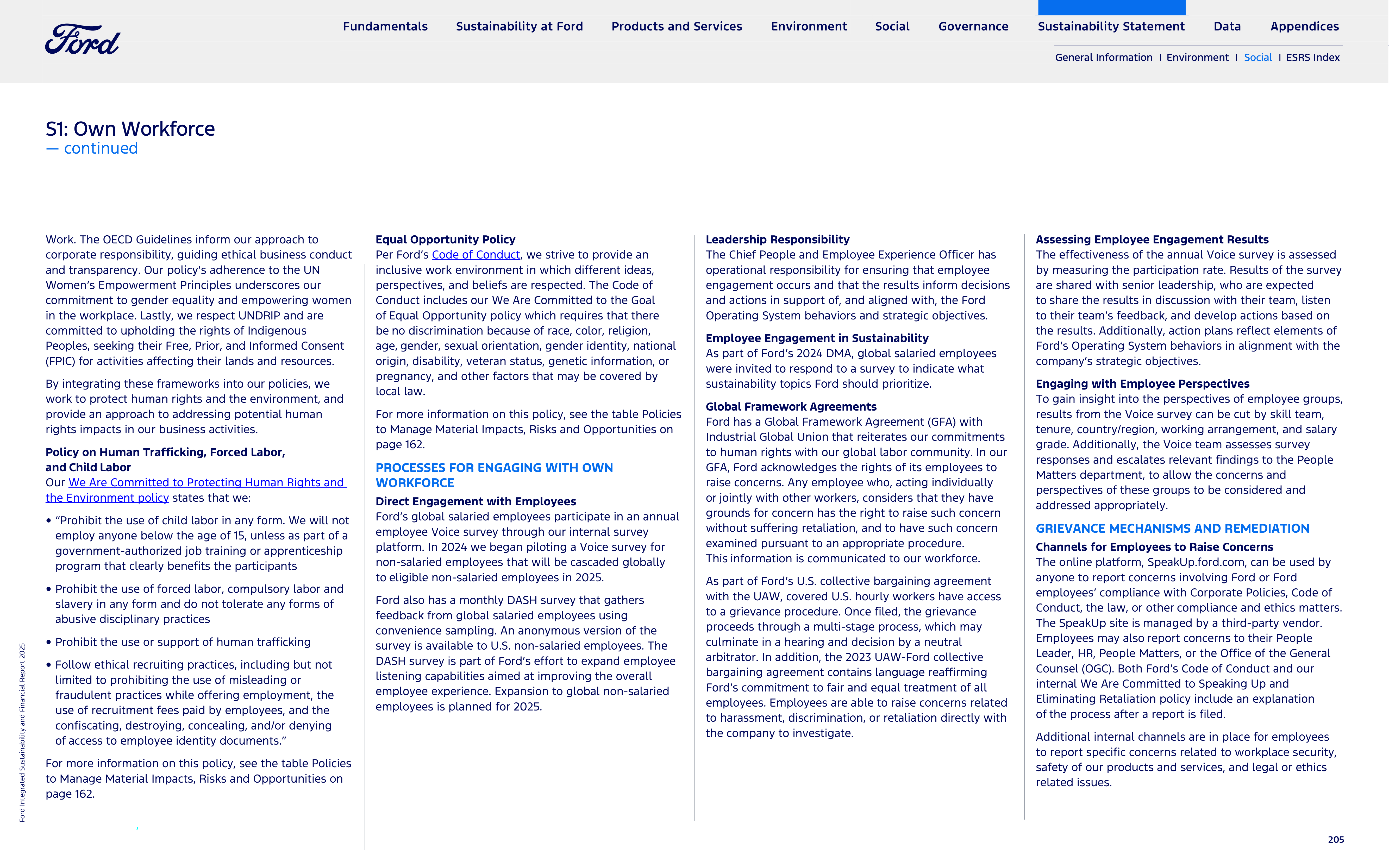
Fundamentals
Sustainability at Ford
Products and Services
Environment
Social
Governance
Sustainability Statement
Data
Appendices
General Information
Environment
Social
ESRS Index
|
|
|
Work. The OECD Guidelines inform our approach to
corporate responsibility, guiding ethical business conduct
and transparency. Our policy’s adherence to the UN
Women’s Empowerment Principles underscores our
commitment to gender equality and empowering women
in the workplace. Lastly, we respect UNDRIP and are
committed to upholding the rights of Indigenous
Peoples, seeking their Free, Prior, and Informed Consent
(FPIC) for activities affecting their lands and resources.
By integrating these frameworks into our policies, we
work to protect human rights and the environment, and
provide an approach to addressing potential human
rights impacts in our business activities.
Policy on Human Trafficking, Forced Labor,
and Child Labor
Our
We Are Committed to Protecting Human Rights and
the Environment policy
states that we:
•
“Prohibit the use of child labor in any form. We will not
employ anyone below the age of 15, unless as part of a
government-authorized job training or apprenticeship
program that clearly benefits the participants
•
Prohibit the use of forced labor, compulsory labor and
slavery in any form and do not tolerate any forms of
abusive disciplinary practices
•
Prohibit the use or support of human trafficking
•
Follow ethical recruiting practices, including but not
limited to prohibiting the use of misleading or
fraudulent practices while offering employment, the
use of recruitment fees paid by employees, and the
confiscating, destroying, concealing, and/or denying
of access to employee identity documents.”
For more information on this policy, see the table Policies
to Manage Material Impacts, Risks and Opportunities on
page 162.
Equal Opportunity Policy
Per Ford’s
Code of Conduct
, we strive to provide an
inclusive work environment in which different ideas,
perspectives, and beliefs are respected. The Code of
Conduct includes our We Are Committed to the Goal
of Equal Opportunity policy which requires that there
be no discrimination because of race, color, religion,
age, gender, sexual orientation, gender identity, national
origin, disability, veteran status, genetic information, or
pregnancy, and other factors that may be covered by
local law.
For more information on this policy, see the table Policies
to Manage Material Impacts, Risks and Opportunities on
page 162.
PROCESSES FOR ENGAGING WITH OWN
WORKFORCE
Direct Engagement with Employees
Ford’s global salaried employees participate in an annual
employee Voice survey through our internal survey
platform. In 2024 we began piloting a Voice survey for
non-salaried employees that will be cascaded globally
to eligible non-salaried employees in 2025.
Ford also has a monthly DASH survey that gathers
feedback from global salaried employees using
convenience sampling. An anonymous version of the
survey is available to U.S. non-salaried employees. The
DASH survey is part of Ford’s effort to expand employee
listening capabilities aimed at improving the overall
employee experience. Expansion to global non-salaried
employees is planned for 2025.
Leadership Responsibility
The Chief People and Employee Experience Officer has
operational responsibility for ensuring that employee
engagement occurs and that the results inform decisions
and actions in support of, and aligned with, the Ford
Operating System behaviors and strategic objectives.
Employee Engagement in Sustainability
As part of Ford’s 2024 DMA, global salaried employees
were invited to respond to a survey to indicate what
sustainability topics Ford should prioritize.
Global Framework Agreements
Ford has a Global Framework Agreement (GFA) with
Industrial Global Union that reiterates our commitments
to human rights with our global labor community. In our
GFA, Ford acknowledges the rights of its employees to
raise concerns. Any employee who, acting individually
or jointly with other workers, considers that they have
grounds for concern has the right to raise such concern
without suffering retaliation, and to have such concern
examined pursuant to an appropriate procedure.
This information is communicated to our workforce.
As part of Ford’s U.S. collective bargaining agreement
with the UAW, covered U.S. hourly workers have access
to a grievance procedure. Once filed, the grievance
proceeds through a multi-stage process, which may
culminate in a hearing and decision by a neutral
arbitrator. In addition, the 2023 UAW-Ford collective
bargaining agreement contains language reaffirming
Ford’s commitment to fair and equal treatment of all
employees. Employees are able to raise concerns related
to harassment, discrimination, or retaliation directly with
the company to investigate.
Assessing Employee Engagement Results
The effectiveness of the annual Voice survey is assessed
by measuring the participation rate. Results of the survey
are shared with senior leadership, who are expected
to share the results in discussion with their team, listen
to their team’s feedback, and develop actions based on
the results. Additionally, action plans reflect elements of
Ford’s Operating System behaviors in alignment with the
company’s strategic objectives.
Engaging with Employee Perspectives
To gain insight into the perspectives of employee groups,
results from the Voice survey can be cut by skill team,
tenure, country/region, working arrangement, and salary
grade. Additionally, the Voice team assesses survey
responses and escalates relevant findings to the People
Matters department, to allow the concerns and
perspectives of these groups to be considered and
addressed appropriately.
GRIEVANCE MECHANISMS AND REMEDIATION
Channels for Employees to Raise Concerns
The online platform, SpeakUp.ford.com, can be used by
anyone to report concerns involving Ford or Ford
employees’ compliance with Corporate Policies, Code of
Conduct, the law, or other compliance and ethics matters.
The SpeakUp site is managed by a third-party vendor.
Employees may also report concerns to their People
Leader, HR, People Matters, or the Office of the General
Counsel (OGC). Both Ford’s Code of Conduct and our
internal We Are Committed to Speaking Up and
Eliminating Retaliation policy include an explanation
of the process after a report is filed.
Additional internal channels are in place for employees
to report specific concerns related to workplace security,
safety of our products and services, and legal or ethics
related issues.
S1: Own Workforce
— continued
,
Ford Integrated Sustainability and Financial Report 2025
205

Fundamentals
Sustainability at Ford
Products and Services
Environment
Social
Governance
Sustainability Statement
Data
Appendices
General Information
Environment
Social
ESRS Index
|
|
|
Providing Remedy for Negative Impacts
206
Ford has a process in place to review and respond to
reports. Ford’s We Are Committed to Speaking Up and
Eliminating Retaliation policy requires information
related to reports to be kept confidential and shared only
as needed to carry out an investigation by designated
individuals. The policy also prohibits retaliation against
anyone who raises a good-faith concern in connection
with a potential violation of the
Code of Conduct
,
company policies, or the law.
There are specific channels for handling employee-
related matters including work-related issues relating
to compensation, discrimination, harassment, employee
benefit concerns, the Code of Conduct, and company
policies. All corporate policies and the Code of Conduct
include a section emphasizing the importance of
speaking up and a reference to the We Are Committed
to Speaking Up and Eliminating Retaliation policy.
Addressing Issues Raised
Once a report has been filed, the report is logged into
our internal grievance tracking system and then routed
to the appropriate internal resource. When warranted,
an investigation plan is developed and the investigation
proceeds. The allegations are then verified or found to
be without merit. The process concludes with the
appropriate action being taken.
The investigation proc
ess enables nec
essary information
to be gathered and assessed and confirms issues are
properly resolved. We may evaluate if any process or
program enhancements are needed, or if policies or
procedures need alteration.
Supporting the Availability of Reporting Channels
Ford supports the availability of grievance channels
for employees by communicating their accessibility.
This includes annual Code of Conduct training sessions
that feature a section on “speaking up and preventing
retaliation,” internal communications such as “What to
Watch” emails, and employee surveys like the Voice and
Quick Voice surveys, which also invite employees to
report specific concerns using the SpeakUp platform.
Collecting Feedback
To assess whether employees are aware of processes
that allow them to raise their concerns and have them
addressed, the annual Voice survey includes a question
that asks employees whether Ford provides multiple
ways and outlets for them to share feedback about
their experience as an employee. To assess whether
employees trust these processes, the annual Voice
survey also asks whether employees believe that the
results from the survey will be used to make decisions
or changes at Ford.
Policies Against Retaliation
Ford’s We Are Committed to Speaking Up and
Eliminating Retaliation policy prohibits retaliation.
No one at Ford is permitted to take adverse action
against another person for reporting a suspected
violation in good faith or for assisting with an
investigation. Violations of this policy may lead to
disciplinary action up to and including termination.
S1: Own Workforce
— continued
,
Ford Integrated Sustainability and Financial Report 2025
Fundamentals
Sustainability at Ford
Products and Services
Environment
Social
Governance
Sustainability Statement
Data
Appendices
General Information
Environment
Social
ESRS Index
|
|
|
WORKERS IN THE VALUE CHAIN
For the purposes of these disclosures, workers in the
value chain are defined as workers in Ford’s supply chain,
including Tier 1 and Tier 2+ suppliers.
The material negative impacts related to workers in the
value chain are systemic in contexts where Ford or our
suppliers or business partners operate. The material
impacts and risks identified relate to Ford’s supply chain
globally.
MATERIAL IMPACTS, RISKS, AND OPPORTUNITIES
RELATED TO WORKERS IN THE VALUE CHAIN
Impact I-10
Mined materials are associated with higher risks of
child labor.
Impact I-11
Suppliers may be complicit of exploitative and
forced labor.
Policies Related to Child Labor
Per our
Supplier Code of Conduct
, we require our
suppliers to:
•
“Meet the minimum working age in any region where
they operate while prohibiting employment of anyone
below the age of 15, even if permitted under local law.
Government-authorized job training or apprenticeship
programs that clearly benefit the participants are the
only exceptions to this requirement
•
Responsibly manage student workers by performing
rigorous due diligence on educational partners, keeping
appropriate student work records, and protecting
student workers’ rights
•
Prohibit workers under the age of 18 from performing
work that could jeopardize their health or safety,
including night shifts, overtime, or hazardous work
in compliance with ILO Worst Forms of Child Labour
Convention (No. 182)
•
Implement an appropriate mechanism to verify that
the age of workers complies with the ILO Minimum Age
Convention (No. 138), and provide substantiation of this
verification mechanism upon request
•
Ensure that all recruitment efforts for workers,
including recruitment performed by third-party
contractors, include mechanisms to verify that the age
of potential applicants complies with the ILO Minimum
Age Convention (No. 138)
•
Cease employment of the child/children and take
reasonable measures to enroll the child/children in a
remediation/education program if child labor is
discovered in its own facilities or in their supply chain.
•
Enable appropriate measures to minimize risks,
including risks related to the direct or indirect financing
of armed conflict, serious violations of human rights
such as child labor, forced labor and slavery, unethical
business conduct, or environmental damage.”
For more information on these policies, see the policy
table on page 162.
Policies related to Forced Labor
Per our Supplier Code of Conduct, we strictly prohibit
our suppliers from both using and supporting human
trafficking. We require our suppliers to:
•
“Confirm that work is conducted on a voluntary basis.
Employees should be free to terminate employment
without penalty by giving reasonable notice per their
contract, if any, and in accordance with applicable laws
•
Prohibit the use of bonded, indentured or exploitive
prison labor
•
Not engage in activities intended to restrict worker
freedom of movement
•
Not allow physically or psychologically cruel, inhuman
or degrading treatment.”
We require our suppliers to not use nor condone forced
labor, compulsory labor, or slavery in any form and to
not employ any form of abusive disciplinary practices.
Our suppliers must follow ethical recruiting practices.
We prohibit our suppliers from:
•
“Misleading or defrauding potential workers about the
nature of the work
•
Asking employees to pay recruitment fees or pay off a
loan by working for an agreed-upon or unclear period
of time for little or no salary, with the work performed
greatly exceeding the worth of the initial loan
•
Confiscating, destroying, concealing, and/or denying
access to employee passports and other government-
issued identity documents.”
For more information on these policies, see the table
Policies to Manage Material Impacts, Risks and
Opportunities on page 162.
Actions for Preventing Child and Forced Labor
Actions Ford is taking to manage these impacts include:
•
Risk assessments: We aim to identify relevant human
rights and environment-related risks at suppliers, in
particular those covered by supply chain due diligence
obligations, including the German Supply Chain Due
Diligence Act. When we identify human rights and
environment-related risks, we engage with the buyer
and supplier to create a corrective action plan with the
supplier and implement sufficient risk management
measures.
•
Requirements for suppliers and their sub-tiers: We
make risk-based use of contractual mechanisms such
as third-party audits and on-site assessments to
monitor our suppliers. To align with forced labor and
supply chain due diligence legislation, in 2023 we
updated our Supplier Code of Conduct and supplier
contractual obligations to require suppliers to share
sub-tier supply chain information upon request. We
have utilized these updates to conduct supply chain
audits for electric vehicle batteries, Value Stream
Mapping, and traceability data. We are expanding our
supply chain mapping capabilities by migrating them
into a third-party supply chain platform designed to
integrate data across multiple Ford supply chain
activities. This system enables us to conduct supply
chain investigations when issues are identified and to
confirm sub-tier suppliers and collect evidence of these
connections within our highest risk categories.
•
Post-sourcing risk assessments: Ford has a tailored risk
management system in place to handle human rights
and environment-related risks and uses due diligence
processes to identify and prevent human rights risks,
including child labor and forced labor risks, along our
supply chain.
We have developed a risk assessment process to
identify and drive action on our highest risk Tier 1
suppliers first. We first perform an inherent analysis
based on country risk, industry risk, and dollars spent
with each supplier site. From this we develop a list of
potential inherently high-risk suppliers.
We also evaluate suppliers’ alignment with Ford’s
Supplier Code of Conduct utilizing the Drive
Sustainability (DS) Sustainability Assessment
Questionnaire (SAQ). The third-party validated DS
SAQ asks suppliers for evidence of a formal policy,
management system, and training covering human
rights and working conditions. If a supplier does not
have measures in place to prevent forced labor and
child labor, they are prioritized for an audit and must
implement corrective actions for any gaps.
S2: Workers in the Value Chain
,
Ford Integrated Sustainability and Financial Report 2025
207
Fundamentals
Sustainability at Ford
Products and Services
Environment
Social
Governance
Sustainability Statement
Data
Appendices
General Information
Environment
Social
ESRS Index
|
|
|
Once the DS SAQs are received, we conduct a risk
analysis to determine which suppliers will require an
audit based on severity and likelihood. Third-party on-
site audits are then conducted on potential high-risk
Tier 1 suppliers in accordance with the Validated
Assessment Program or Responsible Supply Chain
Initiative Protocol. Following an audit, suppliers submit
corrective action processes to strengthen any areas
where non-conformances were found. We identify
material impacts on supply chain workers through third-
party audits and grievance mechanisms.
•
Corrective actions: When potential child labor or forced
labor issues are identified in our supply chain, we
initiate an investigation to determine whether the
supplier is providing parts to Ford. In case of
substantiated knowledge of violations of human rights,
Ford will implement appropriate preventive measures
and take appropriate remedial actions to immediately
end or mitigate such violations. This may include
working with our Tier 1 supplier to conduct an RBA
audit to identify what, if any, child labor or forced labor
flags are present and work with the audited supplier
to correct critical non-compliances and remediate any
identified issues. Our corrective action process (CAP)
monitors compliance and prevents future risks.
Closure audits take place after the corrective actions
are developed and measure the effectiveness of
these actions.
•
Required reporting: Per our
Policy Statement on
Ford’s Human Rights Strategy, Policies and Processes
,
“Adherence to our
Supplier Code of Conduct
requires
that suppliers report and remediate any non-
compliance and, when issues are identified,
transparently report their remediation progress.
Ford maintains an open dialogue with suppliers and
business partners to find a common solution to end
or mitigate the violation. To accomplish these goals,
we conduct a preliminary assessment of the violation
and its impact, mitigate and contain the violation and
its negative impacts in the short-term, and provide
appropriate remedies when non-compliance occurs
and bring any violation to an end.”
•
Mapping mica and cobalt supply chains: Mica and
cobalt have a higher association with child labor risks
in the upstream supply chain. In 2021, we initiated
electric vehicle battery material supply chain audits
with RCS Global Group to determine our sub-tier
suppliers for cobalt, lithium, and nickel to the mine
to determine risks at the supplier level. In 2024, we
expanded our supply chain auditing and mapping to
include mica. Ford also joined the Responsible Mica
Initiative in 2024, a global coalition for action to help
eliminate unacceptable working conditions and
eradicate child labor by 2030.
•
OECD due diligence: In compliance with the U.S. Dodd
Frank Act, section 1502, we have filed an annual
Conflict Minerals Disclosure report with the U.S. SEC
since 2013. The report describes our due diligence
process, as defined by the OECD Due Diligence
Guidance for Responsible Supply Chains of Minerals
from Conflict-Affected and High-Risk Areas, to confirm
suppliers who provide us with components containing
tin, tungsten, tantalum, and gold (3TG) understand the
origins of such minerals, source them responsibly, and
not knowingly provide parts containing minerals that
contribute to conflict. Suppliers are required to use
smelters and refiners that have been validated as
conforming to an independent third-party responsible
mineral sourcing validation program.
We have expanded our Responsible Materials Sourcing
program and the scope of our due diligence to include
additional industry-relevant materials and mineral
provenance from Conflict Affected and High-Risk Areas
beyond the Democratic Republic of the Congo (DRC)
and adjoining countries. Ford has conducted a formal
due diligence process on cobalt since 2018; mica due
diligence since 2019, which was formalized in 2020;
and formalized lithium and nickel due diligence
since 2022.
•
Participating in industry leadership: We utilize data
collected through Responsible Minerals Initiative (RMI)
reporting templates to engage processors of mined
materials to undergo RMI’s Responsible Material
Assurance Process (RMAP) and their ESG assessment,
which identify and address risks of child labor and
forced labor. We are also active members of multiple
RMI working groups, including the RMI Smelter
Engagement Team, the Mineral Reporting Templates
Team, the Gold Team, and the Emerging Minerals
Team. We also co-chair the Automotive Industry Action
Group (AIAG) Smelter Engagement Team and the
Corporate Responsibility Steering Team, and are
members of the Responsible Materials Work Group.
Our participation in both RMI and AIAG allows us to
extend our capabilities to reach more eligible smelters
to participate in third-party responsible sourcing audits.
Additional Actions for Preventing Child Labor in Mining
In addition, Ford is taking the following actions to
manage the potential impact of child labor:
•
Supporting Economic Opportunities for Women: Ford
is addressing one of the root causes of child labor
through a program that provides economic
opportunities for women in the Democratic Republic
of the Congo (DRC). Ford’s supply chain team, in
partnership with Ford Philanthropy, provides funding
for the Oil and Mines Governance Center (OMGC) to
implement a program that aims to break down barriers
that prevent women in the DRC from equitably
accessing opportunities that cobalt demand provides.
The project’s goal is to improve the working conditions
of these women, increase their incomes, support the
stability of their households, and reduce the presence
of children in mining.
•
Better Mining Project: Ford supports Better Mining
of Cobalt in the DRC, an on-the-ground program to
identify risks and implement corrective actions and
training at designated artisanal and small-scale (ASM)
mine sites. Better Mining aims for the contracted
volume of mica to be traceable to the specific mines
and sourced with demonstrable risk management in
place. In 2024, this effort led to tangible risk
management improvements, including expansion
of the recently established grievance mechanism for
the ASM site monitoring, the prevention of incidents
of child labor and work by individuals without
adequate personal protective equipment, as well as
the improvement of work and safety conditions on
mine sites.
Scope of Ford’s Actions
These actions support Ford’s zero-tolerance policy for
child labor and forced labor in our supply chain outlined
in our Policy Statement on Ford’s Human Rights Strategy,
Policies and Processes.
The actions encompass Ford’s global upstream supply
chain, including sub-tiers related to mining and the
processing of raw materials. The geographic scope
is global, with specific requirements tailored to local
regulations. Affected stakeholder groups include Ford,
its suppliers, and local communities near mining sites.
These actions are ongoing and could affect all identified
time horizons.
Implementation of these actions is considered in Ford’s
financial planning process. For more information see
Investment in Material Topics on page 157.
S2: Workers in the Value Chain
— continued
,
Ford Integrated Sustainability and Financial Report 2025
208
Fundamentals
Sustainability at Ford
Products and Services
Environment
Social
Governance
Sustainability Statement
Data
Appendices
General Information
Environment
Social
ESRS Index
|
|
|
Targets
Ford has policies and procedures in place to detect
violations of human rights and react appropriately. Ford
applies a zero-tolerance policy regarding violations of
human rights. We have not set targets related to this
impact because we have a complex global supply chain
and Ford’s direct control over supplier’s actions is limited.
Nonetheless, we aim to eliminate child labor and forced
labor in our supply chains through increased supply
chain transparency and engagement throughout the
supply chain. We track the effectiveness of our
requirements of suppliers, including our zero tolerance
for child labor and forced labor, through our audit
process outlined above.
Impact I-12
Employees within the value chain in hazardous working
conditions may be at risk of injury and even death
without proper mitigation.
Policies
Per our
Supplier Code of Conduct
, our suppliers are
required to provide a safe and healthy work
environment. We require our suppliers to:
•
”Provide a working environment that meets or exceeds
prevailing industry standards and local, regional, and
national safety, occupational health and fire safety
regulations
•
Perform regular risk assessments and put in place
corrective and preventative measures to minimize
workplace hazards including, but not limited to
mechanical, electrical, chemical, fire, and physical
hazards
•
Provide regular health and safety training to workers
•
Provide required rest breaks to prevent excessive
physical and mental fatigue
•
Provide Personal Protective Equipment (PPE) at no cost
to workers
•
Implement an effective fire safety management system
and emergency plan at every supplier worksite that
safeguards employees and others by providing an
appropriate number of clearly marked and
unobstructed emergency exits and evacuation routes
and providing first aid material and medical assistance/
procedures to workers
•
Provide workers with clean toilet facilities, potable
water, and sanitary eating facilities
•
Keep worker dormitories clean and safe, with
appropriate emergency exits and reasonable entry and
exit privileges
•
Encourage workers to openly raise health and safety
concerns and provide safeguards against retaliation.”
In addition, Ford expects its suppliers to maintain a
health and safety management system to limit worker
exposure to hazards and promote continuous
improvement of working conditions and occupational
health and safety.
For more information on this policy, see the table Policies
to Manage Material Impacts, Risks and Opportunities on
page 162.
Actions
Actions Ford is taking to protect workers in the supply
chain:
•
Assess Supplier Health and Safety Risks: We have
developed a risk assessment process to identify and
drive action on highest-risk suppliers first. We first
perform an inherent analysis based on country risk,
industry risk, and dollars spent with each supplier site.
From this we develop a list of potential inherently
high-risk suppliers that may be prioritized for an audit.
We evaluate suppliers’ alignment with Ford’s Supplier
Code of Conduct utilizing the DS SAQ. Having a health
and safety policy in place is a critical requirement in the
DS SAQ and includes requirements such as personal
protective equipment, machine safety, and incident and
accident management. If a supplier’s health and safety
management system does not meet the DS SAQ
requirements, the supplier is prioritized for an audit.
•
Audit Supplier Health and Safety Performance: Once
the DS SAQs are received, we conduct further risk
analysis to determine which suppliers will require an
audit based on severity and likelihood. Third-party
audits are then conducted on high-risk Tier 1 suppliers
and electric vehicle battery material sub-tier suppliers.
We identify material impacts on supply chain workers
through third-party audits, grievance mechanisms, or
via escalation to the buyers for the supplier. Our CAP
monitors compliance and prevents future risks. Closure
audits take place after the corrective actions are
implemented. Along with resolved grievances, closure
audits measure the effectiveness of these actions.
Scope of Ford’s Actions
These actions support Ford’s policies around health and
safety in our value chain to minimize risk of injury and
even death, as outlined in our Supplier Code of Conduct.
The actions encompass Ford’s global upstream supply
chain, including sub-tiers. The geographic scope is
global, with specific requirements tailored to local
regulations. Affected stakeholder groups include Ford,
its suppliers, and local communities near supplier sites.
These actions are ongoing and could affect all identified
time horizons.
Implementation of these actions is considered in Ford’s
financial planning process. For more information see
Investment in Material Topics on page 157.
Targets
Ford has policies related to working conditions in our
Supplier Code of Conduct, and Ford has policies and
procedures in place to detect violations of human
rights and react appropriately. We have not set targets
related to this impact because we have a complex global
supply chain and Ford’s direct control over supplier’s
actions is limited.
Nonetheless, we aim to minimize risk of injury and death
in our supply chains through increased supply chain
transparency and engagement throughout the supply
chain. We track the effectiveness of our requirements of
suppliers, including health and safety concerns, through
our risk assessment and audit processes outlined above.
Risk R-7
Non-compliance with regulations prohibiting forced labor
could result in immediate product withdrawal and
disposal, substantial financial costs, and a loss of sales
Policies
Ford is committed to prohibiting forced labor in our
business. We continue to work with our suppliers to
confirm their policies align with the Ford Supplier Code of
Conduct, which expressly mandates that our suppliers
“neither use nor condone forced or compulsory labor in any
form and do not employ any form of abusive disciplinary
practices” and “follow ethical recruiting practices.”
We provide training to support suppliers in updating
their policies to align with the Supplier Code of Conduct.
Our focus is on helping our suppliers meet our ESG
commitments, build their capacity, and improve their
business practices.
For more information on this policy, see the table Policies
to Manage Material Impacts, Risks and Opportunities on
page 162.
S2: Workers in the Value Chain
— continued
,
Ford Integrated Sustainability and Financial Report 2025
209
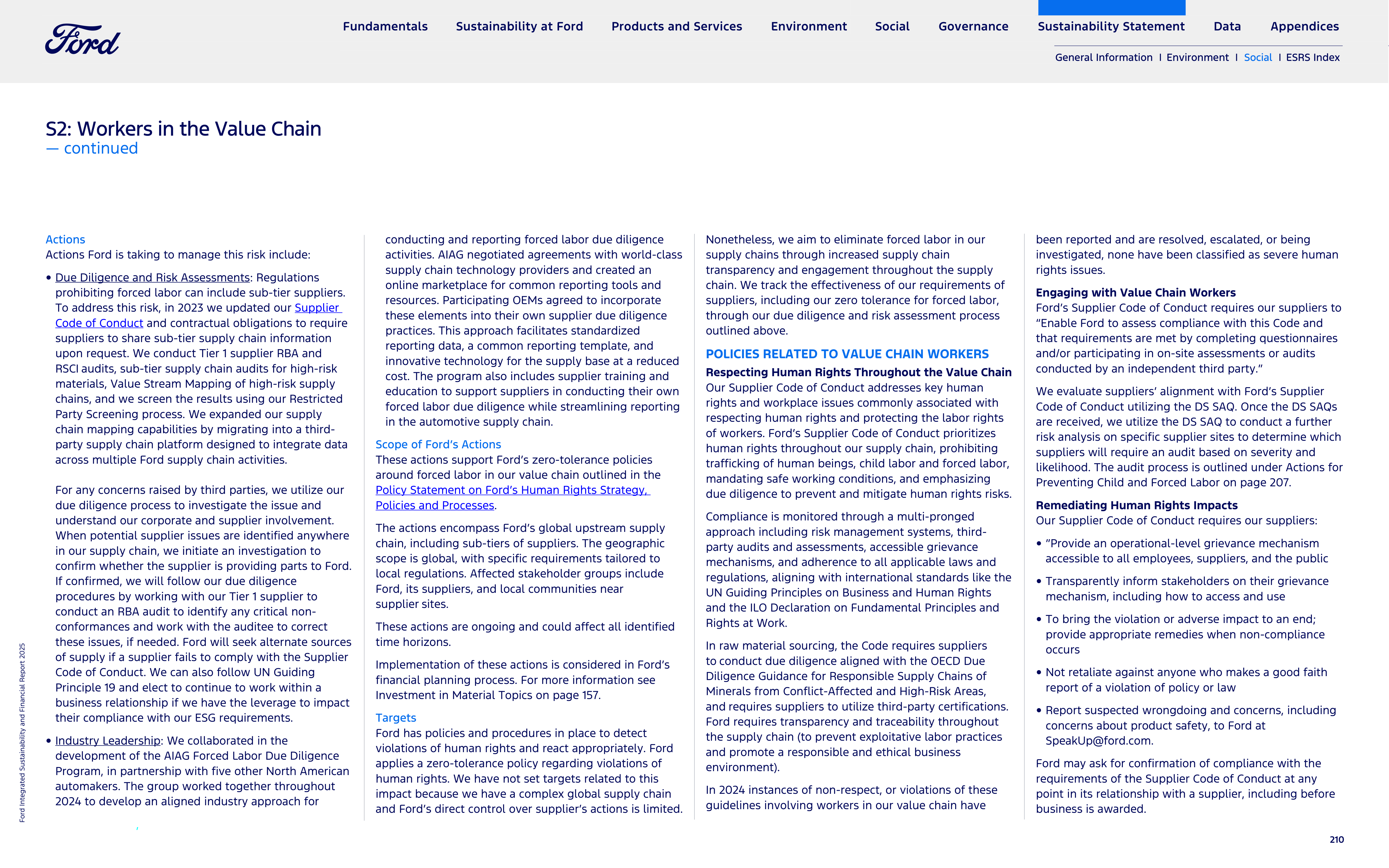
Fundamentals
Sustainability at Ford
Products and Services
Environment
Social
Governance
Sustainability Statement
Data
Appendices
General Information
Environment
Social
ESRS Index
|
|
|
Actions
Actions Ford is taking to manage this risk include:
•
Due Diligence and Risk Assessments: Regulations
prohibiting forced labor can include sub-tier suppliers.
To address this risk, in 2023 we updated our
Supplier
Code of Conduct
and contractual obligations to require
suppliers to share sub-tier supply chain information
upon request. We conduct Tier 1 supplier RBA and
RSCI audits, sub-tier supply chain audits for high-risk
materials, Value Stream Mapping of high-risk supply
chains, and we screen the results using our Restricted
Party Screening process. We expanded our supply
chain mapping capabilities by migrating into a third-
party supply chain platform designed to integrate data
across multiple Ford supply chain activities.
For any concerns raised by third parties, we utilize our
due diligence process to investigate the issue and
understand our corporate and supplier involvement.
When potential supplier issues are identified anywhere
in our supply chain, we initiate an investigation to
confirm whether the supplier is providing parts to Ford.
If confirmed, we will follow our due diligence
procedures by working with our Tier 1 supplier to
conduct an RBA audit to identify any critical non-
conformances and work with the auditee to correct
these issues, if needed. Ford will seek alternate sources
of supply if a supplier fails to comply with the Supplier
Code of Conduct. We can also follow UN Guiding
Principle 19 and elect to continue to work within a
business relationship if we have the leverage to impact
their compliance with our ESG requirements.
•
Industry Leadership: We collaborated in the
development of the AIAG Forced Labor Due Diligence
Program, in partnership with five other North American
automakers. The group worked together throughout
2024 to develop an aligned industry approach for
conducting and reporting forced labor due diligence
activities. AIAG negotiated agreements with world-class
supply chain technology providers and created an
online marketplace for common reporting tools and
resources. Participating OEMs agreed to incorporate
these elements into their own supplier due diligence
practices. This approach facilitates standardized
reporting data, a common reporting template, and
innovative technology for the supply base at a reduced
cost. The program also includes supplier training and
education to support suppliers in conducting their own
forced labor due diligence while streamlining reporting
in the automotive supply chain.
Scope of Ford’s Actions
These actions support Ford’s zero-tolerance policies
around forced labor in our value chain outlined in the
Policy Statement on Ford’s Human Rights Strategy,
Policies and Processes
.
The actions encompass Ford’s global upstream supply
chain, including sub-tiers of suppliers. The geographic
scope is global, with specific requirements tailored to
local regulations. Affected stakeholder groups include
Ford, its suppliers, and local communities near
supplier sites.
These actions are ongoing and could affect all identified
time horizons.
Implementation of these actions is considered in Ford’s
financial planning process. For more information see
Investment in Material Topics on page 157.
Targets
Ford has policies and procedures in place to detect
violations of human rights and react appropriately. Ford
applies a zero-tolerance policy regarding violations of
human rights. We have not set targets related to this
impact because we have a complex global supply chain
and Ford’s direct control over supplier’s actions is limited.
Nonetheless, we aim to eliminate forced labor in our
supply chains through increased supply chain
transparency and engagement throughout the supply
chain. We track the effectiveness of our requirements of
suppliers, including our zero tolerance for forced labor,
through our due diligence and risk assessment process
outlined above.
POLICIES RELATED TO VALUE CHAIN WORKERS
Respecting Human Rights Throughout the Value Chain
Our Supplier Code of Conduct addresses key human
rights and workplace issues commonly associated with
respecting human rights and protecting the labor rights
of workers. Ford’s Supplier Code of Conduct prioritizes
human rights throughout our supply chain, prohibiting
trafficking of human beings, child labor and forced labor,
mandating safe working conditions, and emphasizing
due diligence to prevent and mitigate human rights risks.
Compliance is monitored through a multi-pronged
approach including risk management systems, third-
party audits and assessments, accessible grievance
mechanisms, and adherence to all applicable laws and
regulations, aligning with international standards like the
UN Guiding Principles on Business and Human Rights
and the ILO Declaration on Fundamental Principles and
Rights at Work.
In raw material sourcing, the Code requires suppliers
to conduct due diligence aligned with the OECD Due
Diligence Guidance for Responsible Supply Chains of
Minerals from Conflict-Affected and High-Risk Areas,
and requires suppliers to utilize third-party certifications.
Ford requires transparency and traceability throughout
the supply chain (to prevent exploitative labor practices
and promote a responsible and ethical business
environment).
In 2024 instances of non-respect, or violations of these
guidelines involving workers in our value chain have
been reported and are resolved, escalated, or being
investigated, none have been classified as severe human
rights issues.
Engaging with Value Chain Workers
Ford’s Supplier Code of Conduct requires our suppliers to
“Enable Ford to assess compliance with this Code and
that requirements are met by completing questionnaires
and/or participating in on-site assessments or audits
conducted by an independent third party.”
We evaluate suppliers’ alignment with Ford’s Supplier
Code of Conduct utilizing the DS SAQ. Once the DS SAQs
are received, we utilize the DS SAQ to conduct a further
risk analysis on specific supplier sites to determine which
suppliers will require an audit based on severity and
likelihood. The audit process is outlined under Actions for
Preventing Child and Forced Labor on page 207.
Remediating Human Rights Impacts
Our Supplier Code of Conduct requires our suppliers:
•
”Provide an operational-level grievance mechanism
accessible to all employees, suppliers, and the public
•
Transparently inform stakeholders on their grievance
mechanism, including how to access and use
•
To bring the violation or adverse impact to an end;
provide appropriate remedies when non-compliance
occurs
•
Not retaliate against anyone who makes a good faith
report of a violation of policy or law
•
Report suspected wrongdoing and concerns, including
concerns about product safety, to Ford at
SpeakUp@ford.com.
Ford may ask for confirmation of compliance with the
requirements of the Supplier Code of Conduct at any
point in its relationship with a supplier, including before
business is awarded.
S2: Workers in the Value Chain
— continued
,
Ford Integrated Sustainability and Financial Report 2025
210
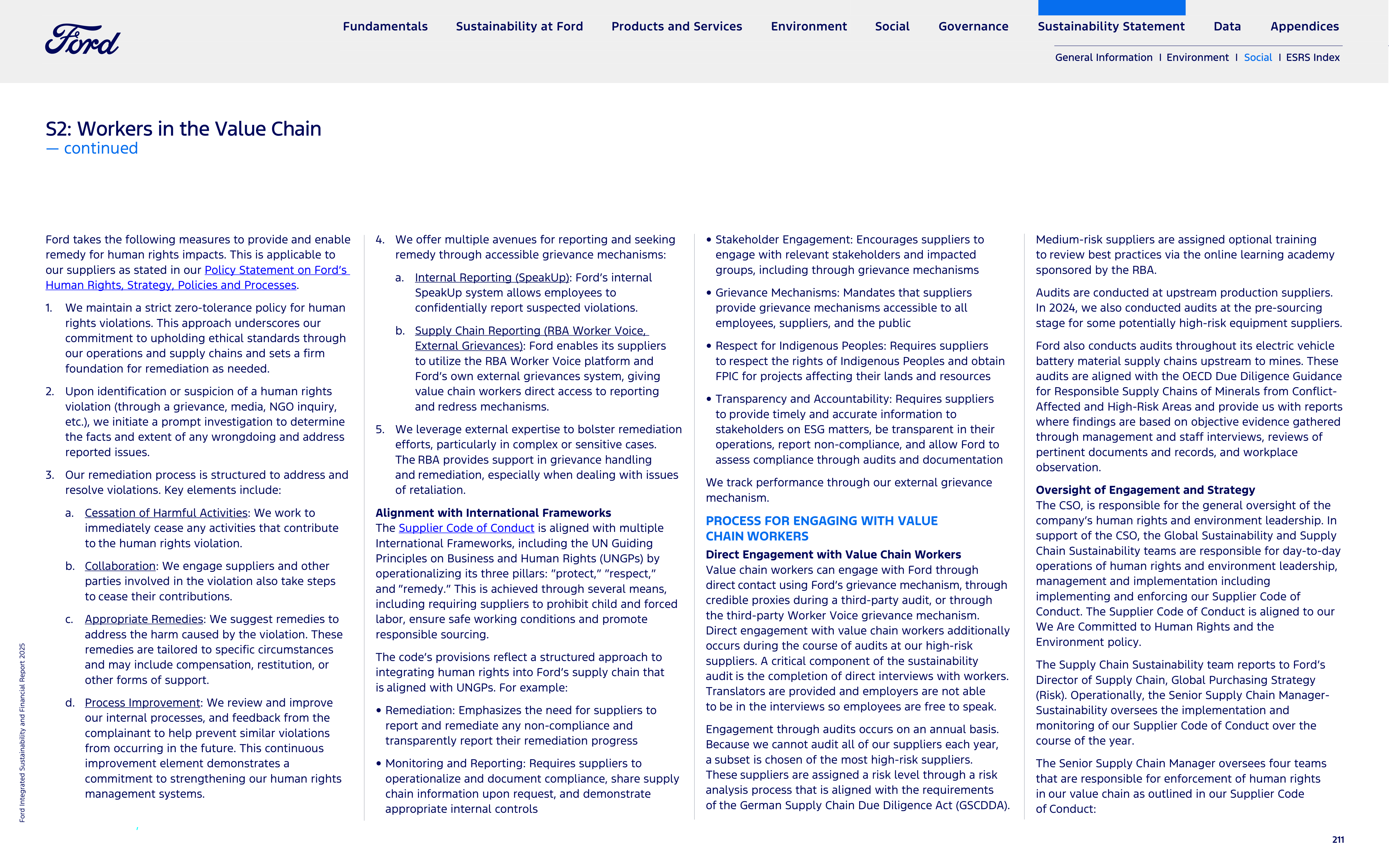
Fundamentals
Sustainability at Ford
Products and Services
Environment
Social
Governance
Sustainability Statement
Data
Appendices
General Information
Environment
Social
ESRS Index
|
|
|
Ford takes the following measures to provide and enable
remedy for human rights impacts. This is applicable to
our suppliers as stated in our
Policy Statement on Ford’s
Human Rights, Strategy, Policies and Processes
.
1.
We maintain a strict zero-tolerance policy for human
rights violations. This approach underscores our
commitment to upholding ethical standards through
our operations and supply chains and sets a firm
foundation for remediation as needed.
2. Upon identification or suspicion of a human rights
violation (through a grievance, media, NGO inquiry,
etc.), we initiate a prompt investigation to determine
the facts and extent of any wrongdoing and address
reported issues.
3. Our remediation process is structured to address and
resolve violations. Key elements include:
a. Cessation of Harmful Activities: We work to
immediately cease any activities that contribute
to the human rights violation.
b. Collaboration: We engage suppliers and other
parties involved in the violation also take steps
to cease their contributions.
c. Appropriate Remedies: We suggest remedies to
address the harm caused by the violation. These
remedies are tailored to specific circumstances
and may include compensation, restitution, or
other forms of support.
d. Process Improvement: We review and improve
our internal processes, and feedback from the
complainant to help prevent similar violations
from occurring in the future. This continuous
improvement element demonstrates a
commitment to strengthening our human rights
management systems.
4. We offer multiple avenues for reporting and seeking
remedy through accessible grievance mechanisms:
a. Internal Reporting (SpeakUp): Ford’s internal
SpeakUp system allows employees to
confidentially report suspected violations.
b. Supply Chain Reporting (RBA Worker Voice,
External Grievances): Ford enables its suppliers
to utilize the RBA Worker Voice platform and
Ford’s own external grievances system, giving
value chain workers direct access to reporting
and redress mechanisms.
5. We leverage external expertise to bolster remediation
efforts, particularly in complex or sensitive cases.
The RBA provides support in grievance handling
and remediation, especially when dealing with issues
of retaliation.
Alignment with International Frameworks
The
Supplier Code of Conduct
is aligned with multiple
International Frameworks, including the UN Guiding
Principles on Business and Human Rights (UNGPs) by
operationalizing its three pillars: ”protect,” ”respect,”
and ”remedy.” This is achieved through several means,
including requiring suppliers to prohibit child and forced
labor, ensure safe working conditions and promote
responsible sourcing.
The code’s provisions reflect a structured approach to
integrating human rights into Ford’s supply chain that
is aligned with UNGPs. For example:
•
Remediation: Emphasizes the need for suppliers to
report and remediate any non-compliance and
transparently report their remediation progress
•
Monitoring and Reporting: Requires suppliers to
operationalize and document compliance, share supply
chain information upon request, and demonstrate
appropriate internal controls
•
Stakeholder Engagement: Encourages suppliers to
engage with relevant stakeholders and impacted
groups, including through grievance mechanisms
•
Grievance Mechanisms: Mandates that suppliers
provide grievance mechanisms accessible to all
employees, suppliers, and the public
•
Respect for Indigenous Peoples: Requires suppliers
to respect the rights of Indigenous Peoples and obtain
FPIC for projects affecting their lands and resources
•
Transparency and Accountability: Requires suppliers
to provide timely and accurate information to
stakeholders on ESG matters, be transparent in their
operations, report non-compliance, and allow Ford to
assess compliance through audits and documentation
We track performance through our external grievance
mechanism.
PROCESS FOR ENGAGING WITH VALUE
CHAIN WORKERS
Direct Engagement with Value Chain Workers
Value chain workers can engage with Ford through
direct contact using Ford’s grievance mechanism, through
credible proxies during a third-party audit, or through
the third-party Worker Voice grievance mechanism.
Direct engagement with value chain workers additionally
occurs during the course of audits at our high-risk
suppliers. A critical component of the sustainability
audit is the completion of direct interviews with workers.
Translators are provided and employers are not able
to be in the interviews so employees are free to speak.
Engagement through audits occurs on an annual basis.
Because we cannot audit all of our suppliers each year,
a subset is chosen of the most high-risk suppliers.
These suppliers are assigned a risk level through a risk
analysis process that is aligned with the requirements
of the German Supply Chain Due Diligence Act (GSCDDA).
Medium-risk suppliers are assigned optional training
to review best practices via the online learning academy
sponsored by the RBA.
Audits are conducted at upstream production suppliers.
In 2024, we also conducted audits at the pre-sourcing
stage for some potentially high-risk equipment suppliers.
Ford also conducts audits throughout its electric vehicle
battery material supply chains upstream to mines. These
audits are aligned with the OECD Due Diligence Guidance
for Responsible Supply Chains of Minerals from Conflict-
Affected and High-Risk Areas and provide us with reports
where findings are based on objective evidence gathered
through management and staff interviews, reviews of
pertinent documents and records, and workplace
observation.
Oversight of Engagement and Strategy
The CSO, is responsible for the general oversight of the
company’s human rights and environment leadership. In
support of the CSO, the Global Sustainability and Supply
Chain Sustainability teams are responsible for day-to-day
operations of human rights and environment leadership,
management and implementation including
implementing and enforcing our Supplier Code of
Conduct. The Supplier Code of Conduct is aligned to our
We Are Committed to Human Rights and the
Environment policy.
The Supply Chain Sustainability team reports to Ford’s
Director of Supply Chain, Global Purchasing Strategy
(Risk). Operationally, the Senior Supply Chain Manager-
Sustainability oversees the implementation and
monitoring of our Supplier Code of Conduct over the
course of the year.
The Senior Supply Chain Manager oversees four teams
that are responsible for enforcement of human rights
in our value chain as outlined in our Supplier Code
of Conduct:
S2: Workers in the Value Chain
— continued
,
Ford Integrated Sustainability and Financial Report 2025
211
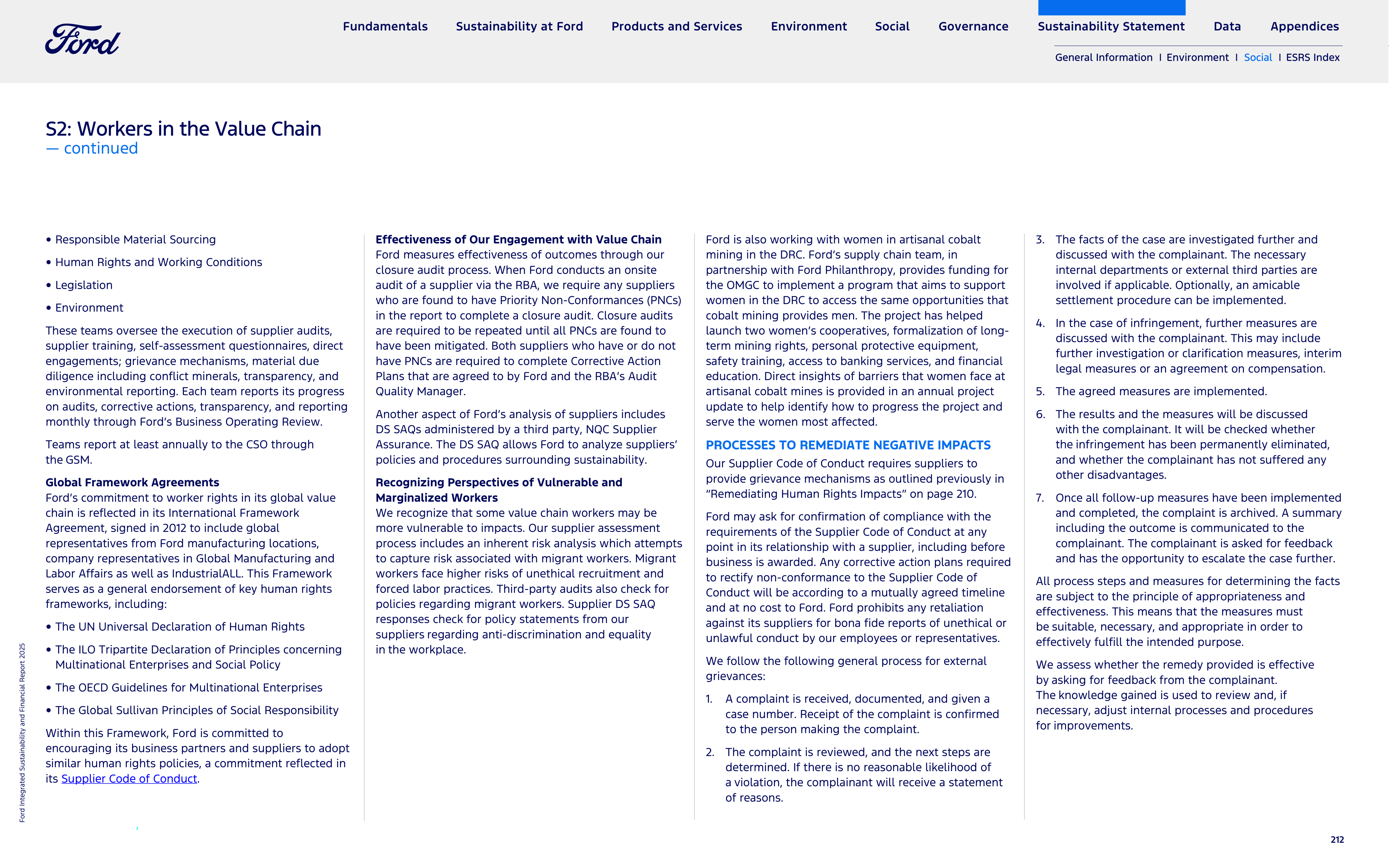
Fundamentals
Sustainability at Ford
Products and Services
Environment
Social
Governance
Sustainability Statement
Data
Appendices
General Information
Environment
Social
ESRS Index
|
|
|
•
Responsible Material Sourcing
•
Human Rights and Working Conditions
•
Legislation
•
Environment
These teams oversee the execution of supplier audits,
supplier training, self-assessment questionnaires, direct
engagements; grievance mechanisms, material due
diligence including conflict minerals, transparency, and
environmental reporting. Each team reports its progress
on audits, corrective actions, transparency, and reporting
monthly through Ford’s Business Operating Review.
Teams report at least annually to the CSO through
the GSM.
Global Framework Agreements
Ford’s commitment to worker rights in its global value
chain is reflected in its International Framework
Agreement, signed in 2012 to include global
representatives from Ford manufacturing locations,
company representatives in Global Manufacturing and
Labor Affairs as well as IndustrialALL. This Framework
serves as a general endorsement of key human rights
frameworks, including:
•
The UN Universal Declaration of Human Rights
•
The ILO Tripartite Declaration of Principles concerning
Multinational Enterprises and Social Policy
•
The OECD Guidelines for Multinational Enterprises
•
The Global Sullivan Principles of Social Responsibility
Within this Framework, Ford is committed to
encouraging its business partners and suppliers to adopt
similar human rights policies, a commitment reflected in
its
Supplier Code of Conduct
.
Effectiveness of Our Engagement with Value Chain
Ford measures effectiveness of outcomes through our
closure audit process. When Ford conducts an onsite
audit of a supplier via the RBA, we require any suppliers
who are found to have Priority Non-Conformances (PNCs)
in the report to complete a closure audit. Closure audits
are required to be repeated until all PNCs are found to
have been mitigated. Both suppliers who have or do not
have PNCs are required to complete Corrective Action
Plans that are agreed to by Ford and the RBA’s Audit
Quality Manager.
Another aspect of Ford’s analysis of suppliers includes
DS SAQs administered by a third party, NQC Supplier
Assurance. The DS SAQ allows Ford to analyze suppliers’
policies and procedures surrounding sustainability.
Recognizing Perspectives of Vulnerable and
Marginalized Workers
We recognize that some value chain workers may be
more vulnerable to impacts. Our supplier assessment
process includes an inherent risk analysis which attempts
to capture risk associated with migrant workers. Migrant
workers face higher risks of unethical recruitment and
forced labor practices. Third-party audits also check for
policies regarding migrant workers. Supplier DS SAQ
responses check for policy statements from our
suppliers regarding anti-discrimination and equality
in the workplace.
Ford is also working with women in artisanal cobalt
mining in the DRC. Ford’s supply chain team, in
partnership with Ford Philanthropy, provides funding for
the OMGC to implement a program that aims to support
women in the DRC to access the same opportunities that
cobalt mining provides men. The project has helped
launch two women’s cooperatives, formalization of long-
term mining rights, personal protective equipment,
safety training, access to banking services, and financial
education. Direct insights of barriers that women face at
artisanal cobalt mines is provided in an annual project
update to help identify how to progress the project and
serve the women most affected.
PROCESSES TO REMEDIATE NEGATIVE IMPACTS
Our Supplier Code of Conduct requires suppliers to
provide grievance mechanisms as outlined previously in
“Remediating Human Rights Impacts” on page 210.
Ford may ask for confirmation of compliance with the
requirements of the Supplier Code of Conduct at any
point in its relationship with a supplier, including before
business is awarded. Any corrective action plans required
to rectify non-conformance to the Supplier Code of
Conduct will be according to a mutually agreed timeline
and at no cost to Ford. Ford prohibits any retaliation
against its suppliers for bona fide reports of unethical or
unlawful conduct by our employees or representatives.
We follow the following general process for external
grievances:
1.
A complaint is received, documented, and given a
case number. Receipt of the complaint is confirmed
to the person making the complaint.
2. The complaint is reviewed, and the next steps are
determined. If there is no reasonable likelihood of
a violation, the complainant will receive a statement
of reasons.
3. The facts of the case are investigated further and
discussed with the complainant. The necessary
internal departments or external third parties are
involved if applicable. Optionally, an amicable
settlement procedure can be implemented.
4. In the case of infringement, further measures are
discussed with the complainant. This may include
further investigation or clarification measures, interim
legal measures or an agreement on compensation.
5. The agreed measures are implemented.
6. The results and the measures will be discussed
with the complainant. It will be checked whether
the infringement has been permanently eliminated,
and whether the complainant has not suffered any
other disadvantages.
7. Once all follow-up measures have been implemented
and completed, the complaint is archived. A summary
including the outcome is communicated to the
complainant. The complainant is asked for feedback
and has the opportunity to escalate the case further.
All process steps and measures for determining the facts
are subject to the principle of appropriateness and
effectiveness. This means that the measures must
be suitable, necessary, and appropriate in order to
effectively fulfill the intended purpose.
We assess whether the remedy provided is effective
by asking for feedback from the complainant.
The knowledge gained is used to review and, if
necessary, adjust internal processes and procedures
for improvements.
S2: Workers in the Value Chain
— continued
,
Ford Integrated Sustainability and Financial Report 2025
212
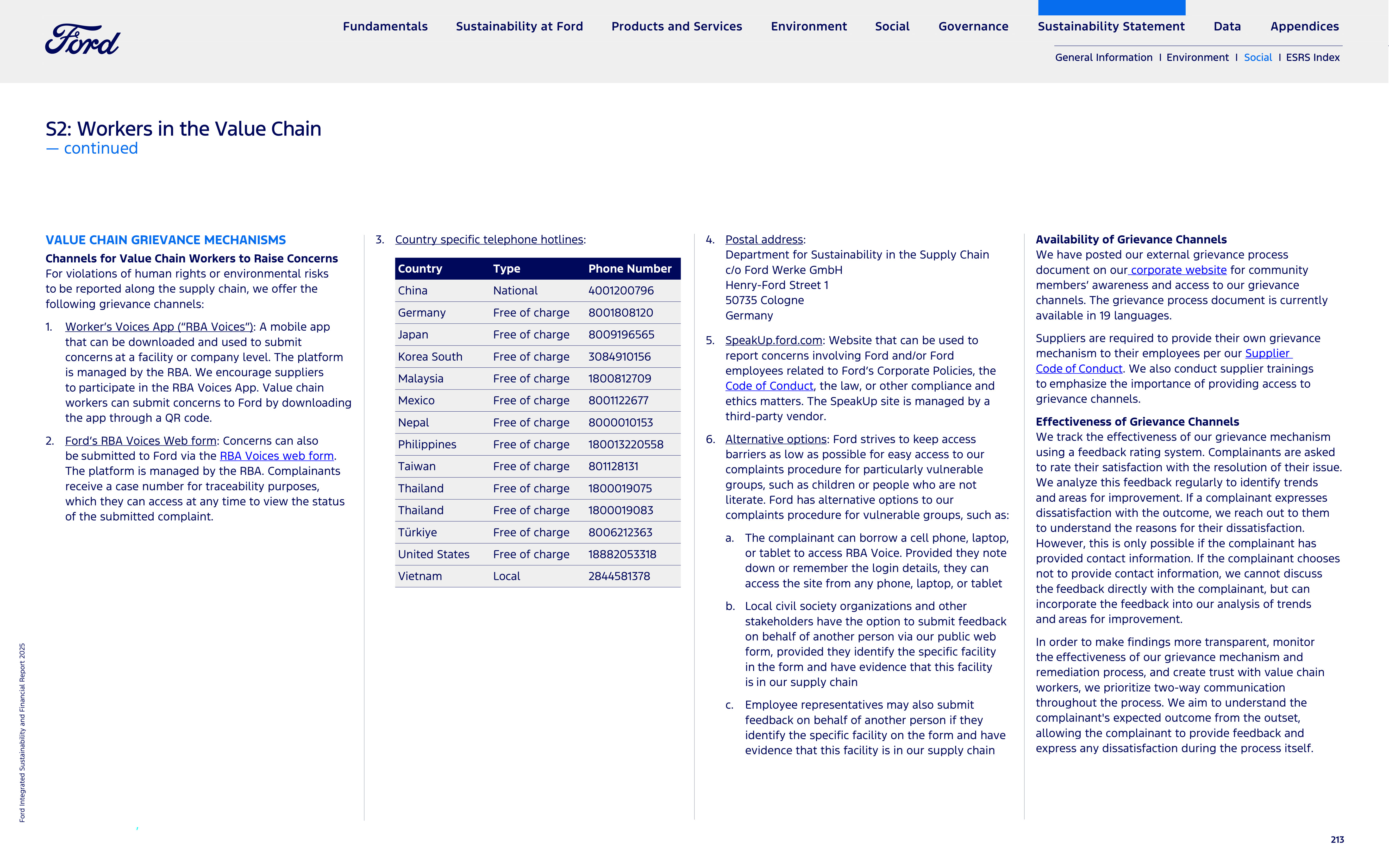
:
Fundamentals
Sustainability at Ford
Products and Services
Environment
Social
Governance
Sustainability Statement
Data
Appendices
General Information
Environment
Social
ESRS Index
|
|
|
VALUE CHAIN GRIEVANCE MECHANISMS
Channels for Value Chain Workers to Raise Concerns
For violations of human rights or environmental risks
to be reported along the supply chain, we offer the
following grievance channels:
1.
Worker’s Voices App (“RBA Voices”): A mobile app
that can be downloaded and used to submit
concerns at a facility or company level. The platform
is managed by the RBA. We encourage suppliers
to participate in the RBA Voices App. Value chain
workers can submit concerns to Ford by downloading
the app through a QR code.
2. Ford’s RBA Voices Web form: Concerns can also
be submitted to Ford via the
RBA Voices web form
.
The platform is managed by the RBA. Complainants
receive a case number for traceability purposes,
which they can access at any time to view the status
of the submitted complaint.
3. Country specific telephone hotlines
Country
Type
Phone Number
China
National
4001200796
Germany
Free of charge
8001808120
Japan
Free of charge
8009196565
Korea South
Free of charge
3084910156
Malaysia
Free of charge
1800812709
Mexico
Free of charge
8001122677
Nepal
Free of charge
8000010153
Philippines
Free of charge
180013220558
Taiwan
Free of charge
801128131
Thailand
Free of charge
1800019075
Thailand
Free of charge
1800019083
Türkiye
Free of charge
8006212363
United States
Free of charge
18882053318
Vietnam
Local
2844581378
4. Postal address:
Department for Sustainability in the Supply Chain
c/o Ford Werke GmbH
Henry-Ford Street 1
50735 Cologne
Germany
5. SpeakUp.ford.com: Website that can be used to
report concerns involving Ford and/or Ford
employees related to Ford’s Corporate Policies, the
Code of Conduct
, the law, or other compliance and
ethics matters. The SpeakUp site is managed by a
third-party vendor.
6. Alternative options: Ford strives to keep access
barriers as low as possible for easy access to our
complaints procedure for particularly vulnerable
groups, such as children or people who are not
literate. Ford has alternative options to our
complaints procedure for vulnerable groups, such as:
a. The complainant can borrow a cell phone, laptop,
or tablet to access RBA Voice. Provided they note
down or remember the login details, they can
access the site from any phone, laptop, or tablet
b. Local civil society organizations and other
stakeholders have the option to submit feedback
on behalf of another person via our public web
form, provided they identify the specific facility
in the form and have evidence that this facility
is in our supply chain
c. Employee representatives may also submit
feedback on behalf of another person if they
identify the specific facility on the form and have
evidence that this facility is in our supply chain
Availability of Grievance Channels
We have posted our external grievance process
document on our
corporate website
for community
members’ awareness and access to our grievance
channels. The grievance process document is currently
available in 19 languages.
Suppliers are required to provide their own grievance
mechanism to their employees per our
Supplier
Code of Conduct
. We also conduct supplier trainings
to emphasize the importance of providing access to
grievance channels.
Effectiveness of Grievance Channels
We track the effectiveness of our grievance mechanism
using a feedback rating system. Complainants are asked
to rate their satisfaction with the resolution of their issue.
We analyze this feedback regularly to identify trends
and areas for improvement. If a complainant expresses
dissatisfaction with the outcome, we reach out to them
to understand the reasons for their dissatisfaction.
However, this is only possible if the complainant has
provided contact information. If the complainant chooses
not to provide contact information, we cannot discuss
the feedback directly with the complainant, but can
incorporate the feedback into our analysis of trends
and areas for improvement.
In order to make findings more transparent, monitor
the effectiveness of our grievance mechanism and
remediation process, and create trust with value chain
workers, we prioritize two-way communication
throughout the process. We aim to understand the
complainant's expected outcome from the outset,
allowing the complainant to provide feedback and
express any dissatisfaction during the process itself.
S2: Workers in the Value Chain
— continued
,
Ford Integrated Sustainability and Financial Report 2025
213

Fundamentals
Sustainability at Ford
Products and Services
Environment
Social
Governance
Sustainability Statement
Data
Appendices
General Information
Environment
Social
ESRS Index
|
|
|
Worker Awareness and Trust in Grievance Processes
To build awareness and trust in the process we conduct
supplier training sessions covering the importance of
grievance mechanisms and how workers can utilize the
RBA Worker Voice App to meet Ford’s requirement that
suppliers have an operational-level grievance mechanism
in place.
By asking complainants if they are satisfied with the
results of the process, we provide an opportunity for
complainants to let us know if they experience any
negative impact based on their grievance submitted.
Complainants can choose to escalate a submitted
complaint through our grievance mechanism to be
coordinated accordingly by a third party (RBA).
Protection Against Retaliation
Ford does not tolerate any retaliatory measures,
intimidation, or discrimination against complainants.
Our
Supplier Code of Conduct
requires suppliers to
provide safeguards against retaliation and not retaliate
against anyone who makes a good faith report.
In cases where a complainant rates their experience
negatively due to experiencing a negative impact or
retaliation after submitting their grievance, we escalate
the case to the RBA for additional support and mediation.
The complainant also has an option to escalate to RBA
on their own behalf. The RBA has a dedicated process for
addressing these types of situations, and their involvement
can help support a fair and impartial resolution.
S2: Workers in the Value Chain
— continued
,
Ford Integrated Sustainability and Financial Report 2025
214
Fundamentals
Sustainability at Ford
Products and Services
Environment
Social
Governance
Sustainability Statement
Data
Appendices
General Information
Environment
Social
ESRS Index
|
|
|
S3: Affected Communities
AFFECTED COMMUNITIES
Through our Community Relations team, we focus on
the communities where we have manufacturing facilities.
We engage with these communities in multiple ways
to manage Ford’s impact and understand community
sentiment. Under the responsibility of Ford’s Director
of Community Relations, this engagement helps to
inform Ford’s business model and strategy by
providing valuable insights into community needs and
expectations, enabling us to align our operations and
initiatives with the broader goals of the communities
we serve.
Ford also considers the role that its strategy and
business model may play in creating, exacerbating, or
mitigating material impacts on affected communities
beyond our own manufacturing facilities. We assess how
our business activities influence these communities and
adapt our policies as needed to address such material
impacts. By doing so, we aim to mitigate negative effects
and enhance positive outcomes, working to contribute
positively to the social and economic wellbeing of the
communities we engage with.
ASSESSING MATERIAL IMPACTS, RISKS
AND OPPORTUNITIES
Ford’s strategy and business model may impact the
communities where we operate through business
activities such as manufacturing, supply chain sourcing,
and philanthropic initiatives. We aim to create positive
impacts and mitigate any potential negative impacts
by engaging with the communities where we operate
and adhering to all regulatory requirements related to
our operations.
To assess our actual and potential IROs, we conducted
a DMA. For more details on this process, see page 156.
Types of Communities Subject to Material Impacts
Our DMA considered impacts to communities around
Ford’s operations and value chain. Communities,
including indigenous peoples’ near mining operations,
may be impacted by land use and environmental
degradation, while those around recycling facilities may
face issues related to waste management and pollution.
Characteristics of Material Negative Impacts
The negative impact from upstream activities such as
mining and smelting can be both widespread and related
to individual incidents, depending on the context.
Negative effects on safe drinking water and livelihoods
can affect large communities over extended periods,
resulting in chronic health issues, economic
disadvantage, and environmental degradation.
Understanding Types of Affected Communities
Communities at the most risk of negative impact from
our own operations and value chain typically include
those located near raw material extraction sites,
manufacturing facilities, and logistics hubs. At Ford,
our strategies and policies are developed with these
communities in mind, striving to support their well-
being, promote sustainable development, and mitigate
any negative impacts associated with our operations
and value chain.
Our strategy includes involving at-risk communities
in dialogue and decision-making processes regarding
community needs and impacts from our operations.
Ford aims to empower local voices by facilitating forums,
consultations, and grievance mechanisms that allow
community members to express their concerns and
preferences. This engagement was implemented in
an effort to foster transparency and build trust. As part
of this engagement, we assess the effectiveness of our
strategies and make necessary adjustments to better
meet our commitments to the communities we impact.
MATERIAL IMPACTS, RISKS, AND OPPORTUNITIES
RELATED TO AFFECTED COMMUNITIES
Impact I-13
Activities such as mining and smelting negatively impact
biodiversity, ecosystem health, and local communities.
Policies
Our
We Are Committed to Protecting Human Rights and
the Environment policy
requires us to:
•
“Minimize negative impacts, on both human beings and
the environment, while striving for positive impact
•
Mimic ecosystem performance.”
All Ford operations are covered by this policy and we
explicitly require our suppliers and expect partners and
joint ventures to adopt and enforce similar policies and
extend them to their own supply chain.
Ford’s
Supplier Code of Conduct
requires our suppliers
to:
•
“Comply with or exceed Ford’s environmental
requirements and policies, including all relevant
national, regional, environmental, and chemical
legislation
•
Mimic ecosystem performance
•
Refrain from causing any harmful soil change.”
We also require suppliers to manage their sub-tiers and
cooperate with Ford’s efforts to secure full transparency
and traceability of their raw materials supply chain.
Suppliers must conduct due diligence related to raw
materials. We require our suppliers to:
•
“Provide information, upon request, to verify the
materials in the products supplied to Ford have been
sourced responsibly in accordance with Ford’s
Responsible Materials Sourcing Policy Including
Conflict Minerals.
•
Secure critical raw minerals from material processors
that are certified through a third-party responsible
sourcing standard such the Responsible Minerals
Initiative’s (RMI) Responsible Minerals Assurance
Process (RMAP)
•
Ensure this requirement is communicated to sub-
suppliers and/or directly to identified smelters/refiners/
processors who are not RMAP certified
•
Disclose sub-tier and raw material supply chain actors
and locations that provide material used in products to
Ford, such as conflict minerals, cobalt, mica, lithium,
nickel, graphite, copper, aluminum, steel, rare earth
elements, rubber, leather or any other materials that
Ford requests
•
Participate in initiatives to support responsible material
sourcing
•
Mining suppliers are required to seek certification by an
independent third-party responsible mining assurance
standard, such as the Standard for Responsible Mining
from the Initiative for Responsible Mining Assurance
(IRMA) or an agreed upon third-party certified
equivalent.”
For more information on these policies, see the table
Policies to Manage Material Impacts, Risks and
Opportunities on page 162.
,
Ford Integrated Sustainability and Financial Report 2025
215
Fundamentals
Sustainability at Ford
Products and Services
Environment
Social
Governance
Sustainability Statement
Data
Appendices
General Information | Environment |
Social
| ESRS Index
Actions
Ford is taking the following actions to mitigate the
impacts of mining and smelting in our value chain on
affected communities:
•
Preventative measures: Ford takes proactive measures
to avoid or mitigate mining and processing activities in
our supply chain that may have negative impacts on
surrounding communities. This includes pre-sourcing
assessments of suppliers and requiring that suppliers
we source from are aligned with our
Supplier Code of
Conduct
and Responsible Materials Sourcing Policy.
•
Due diligence: Ford conducts annual due diligence to
assess whether mining and smelting activities in our
supply chain are in compliance with our Supplier Code
of Conduct and Responsible Materials Sourcing Policy.
•
Third-party assurance for mined materials: Third-party
assured ESG standards are critical to protecting
communities in areas where mines and processors
operate. We require mines we directly source from
to agree to undergo applicable ESG audits such as
the Responsible Minerals Initiative ESG Standard,
The Copper Mark, or IRMA. We require our suppliers
who directly source mined materials to do the same.
•
Third-party assurance for material processors: Per our
Responsible Materials Sourcing Policy, suppliers should
request identified processors that supply materials in
parts supplied to Ford to undergo an independent
third-party assessment against a responsible mineral
sourcing validation program such as the Responsible
Minerals Initiative’s RMAP and ESG Standard.
•
Community engagement: Ford engages with affected
communities to find mutually beneficial solutions to
potential tensions that may arise. Our approach is
guided by its commitment to ethical practices and
corporate responsibility, striving to conduct business
operations in a manner that does not compromise the
wellbeing of communities and the environment.
Scope of Ford’s Actions
These actions support Ford’s corporate policy and
Supplier Code of Conduct requiring Ford and suppliers
to minimize negative impacts on both human beings
and the environment.
The actions encompass Ford’s global upstream supply
chain, including suppliers involved in mining and the
processing of raw materials. The geographic scope
is global, with specific requirements tailored to local
regulations. Affected stakeholder groups include Ford,
its suppliers, local communities near supplier and
mining sites, and other stakeholders impacted by the
environmental performance of Ford’s supply chain.
These actions are ongoing and could affect all identified
time horizons.
Implementation of these actions is considered in Ford’s
financial planning process. For more information see
Investment in Material Topics on page 157.
Actions for remedying negative, actual impacts
If a material impact is identified, Ford works closely
with the community and government officials and
agencies to determine a remedy. The remedy may
consist of a combination of mitigating any negative
impacts and compensating those affected through
the appropriate channels.
Targets
Ford has set an aspiration to only source raw materials
that are responsibly produced. We have not set targets
related to this impact because Ford has a complex global
supply chain and Ford’s direct control over mining and
processing supplier’s practices is limited.
We track the effectiveness of our related policies and
actions related through our supplier assessment
processes and listening to stakeholder feedback. The
CAP, which is part of our supplier assessment activities,
monitors compliance and prevents future risks. Closure
audits take place after the corrective audits are
developed. Along with resolved grievances, they
measure the effectiveness of actions taken. Stakeholder
feedback allows us to gauge community sentiment and
track progress toward aligning Ford policies and actions
with the needs and values of the communities within
which we work.
Currently, there is no defined level of ambition to track
effectiveness of these policies and actions, however
future targets are under development. Ford is developing
targets for suppliers to implement management systems
to reduce pollution from mining
party ESG assurances.
waste through third
POLICIES RELATED TO INDIGENOUS PEOPLES
Ford has policy provisions for preventing and addressing
impacts on Indigenous Peoples.
Per our
We Are Committed to Protecting Human Rights
and the Environment policy
, we:
•
”Are committed to respecting the United Nations
Declaration on the Rights of Indigenous Peoples
(UNDRIP)
•
Strive to ensure Free, Prior, and Informed Consent
(FPIC) of Indigenous communities is pursued and
obtained prior to projects or activities that may affect
their lands, resources, and rights
•
Integrate due diligence findings in our business
planning and decision making, considering the
environment, human rights, public health, indigenous
populations, and the communities where we operate.
We seek to align our business goals with respect for
people and the environment
•
Engage constructively with suppliers, local
communities, governments, non-governmental
organizations, and other stakeholders, including
indigenous peoples.”
Per our Supplier Code of Conduct, we require our
suppliers to:
•
”Integrate due diligence findings in business planning
and decision making, considering the environment,
human rights, public health, Indigenous people, and
the communities where they operate
•
Engage transparently and constructively with suppliers,
local communities, governments, non-governmental
and advocacy organizations, and other stakeholders,
including Indigenous groups, regarding the matters
covered in this Code
•
When securing raw material, obtain Free, Prior, and
Informed Consent of indigenous communities prior
to projects or activities that may affect their lands,
resources, and rights.”
Per our
Responsible Material Sourcing Policy
, we require
our suppliers to:
•
”Respect the rights of Indigenous Peoples in
accordance with the United Nations Declaration on the
Rights of Indigenous Peoples (UNDRIP). In accordance
with Supplier Code of Conduct, suppliers directly
sourcing raw materials must not engage in any acts
S3: Affected Communities
— continued
,
Ford Integrated Sustainability and Financial Report 2025
216
constituting or aiding unlawful eviction or unlawful
taking of land, forests, or waters securing the livelihood
of human beings. Suppliers must also ensure Free,
Prior and Informed Consent of communities is pursued
and obtained prior to project or activities that may
affect their lands, resources and rights.”
Fundamentals
Sustainability at Ford
Products and Services
Environment
Social
Governance
Sustainability Statement
Data
Appendices
General Information | Environment |
Social
| ESRS Index
As part of our commitment to transparency, our
We Are
Committed to Protecting Human Rights and the
Environment policy
and our
Supplier Code of Conduct
are
posted on our corporate website along with Ford’s
Code
of Conduct
.
Policy on Engagement with Affected Communities
Per our We Are Committed to Respecting Human Rights
and the Environment policy, we “engage constructively
with suppliers, local communities, governments, non-
governmental organizations, and other stakeholders,
including indigenous people.”
Policy on Remediating Human Rights Impacts
We strive to prevent and mitigate human rights and
environmental impacts. To accomplish these goals, we:
•
”Provide operational-level grievance mechanisms
that are accessible to our employees, suppliers, and
the public
•
Provide appropriate remedies when non-compliance
occurs and bring any violation to an end
•
Do not retaliate against good faith reports of violation
of policy or law, per our Code of Conduct”
For more information on this policy, see the table Policies
to Manage Material Impacts, Risks and Opportunities on
page 162.
Alignment with Internationally Recognized Standards
Ford’s We Are Committed to Protecting Human Rights
and the Environment policy aligns with several
internationally recognized standards and frameworks,
as listed in the table Policies to Manage Material Impacts,
Risks and Opportunities on page 162.
By aligning with these internationally recognized
standards, the We Are Committed to Protecting Human
Rights and the Environment policy reinforces Ford’s
commitment to ethical business practices that prioritize
human rights and environmental sustainability
throughout its operations and supply chain.
Ford Motor Company aligns with the UN Guiding
Principles on Business and Human Rights, the ILO
Declaration on Fundamental Principles and Rights
at Work, and the OECD Guidelines for Multinational
Enterprises throughout our value chain.
We have established various mechanisms for communities,
customers, dealerships, and other stakeholders to raise
concerns directly with us, and through which we identify
potential instances of non-respect for these guidelines. To
enhance our oversight, we are currently working to develop
a process to better capture all validated concerns received
through these various channels into a consolidated record.
In 2024, we found no instances of non-respect or violations
of these guidelines involving affected communities within
our upstream value chain, as verified through our annual
review of grievance reports and audit data.
PROCESSES FOR ENGAGING WITH
AFFECTED COMMUNITIES
Engagement with Affected Communities and
Their Representatives
Ford engages with affected communities both directly
and through credible proxies. Community members
reach out to Ford through contact with our plant
leadership as well as through our dealers and
government officials. In addition, residents can contact
Ford directly through our corporate website, community
relations email address, or through our on-the-ground
representatives in the community.
Ford is an active member of the communities in which
we do business. We engage with the community through
business organization memberships, interactions with
government officials at multiple levels of government
that represent the facility, as well as presence at
community events and philanthropic endeavors.
Ford tracks community sentiment through various forms
including: surveys; listening sessions; monitoring of
media articles and social media posts; and discussions
with government, community leaders, and residents on
what they are hearing.
When Ford has a change in its manufacturing footprint
that may impact residents, we host listening sessions
and provide updates on our website.
Ford’s Director of Community Relations is responsible
for community engagements and that the results inform
Ford’s activities.
Effectiveness of Our Community Engagement
In 2024, Ford benchmarked our community engagement
efforts in partnership with a third-party social
responsibility consulting firm. In addition, Ford tracks
community sentiment through various mechanisms
which include monthly polling in manufacturing
communities as well as periodic community listening
sessions and surveys. We also monitor social media
posts and media outlets for stories involving
community sentiment.
Ford believes in a participatory approach to community
engagement which means we seek out community input
to help shape our engagement efforts. For example,
Ford’s Community Relations team has created
Neighborhood Advisory Councils in its U.S. assembly
plant locations to obtain feedback directly from residents
and community leaders to determine the most critical
community needs and how Ford should prioritize its
investments in the community. The Community Relations
team also has defined goals with respect to community
initiatives such as event sponsorships and donations to
support an effective level of engagement.
Learning Perspectives of Affected Communities
We partner with local nonprofits, community groups,
and advocacy organizations that work directly with
vulnerable populations to gain deeper insights into their
challenges and the potential impacts of our operations.
We conduct social impact assessments to identify and
evaluate the impacts of our operations on local
communities and develop targeted strategies for
mitigating adverse effects.
Our stakeholder engagement platforms enable multiple
voices to be heard and we strive to incorporate their
perspectives in decision-making. Ford has established
accessible and confidential grievance mechanisms that
allow community members to report concerns and
feedback without fear of retaliation. We also conduct
focus groups and surveys to gather qualitative and
quantitative data on the perspectives of different groups,
which helps us tailor our community engagement and
impact mitigation strategies.
Aligned with our policies, when securing raw materials,
Ford and our suppliers respect the rights of Indigenous
peoples in accordance with the UNDRIP and ensure FPIC
of indigenous communities is pursued and obtained prior
to projects or activities that may affect their lands,
territories, resources, or rights including their cultural,
intellectual, religious, and spiritual property. Any
legislative or administrative measures, such as rezoning,
resulting from Ford or our suppliers’ activities that may
affect communities and Indigenous Peoples must be
addressed in the stakeholder engagement process, with
the goal of giving due consideration to their concerns
and upholding their rights.
S3: Affected Communities
— continued
,
Ford Integrated Sustainability and Financial Report 2025
217

Fundamentals
Sustainability at Ford
Products and Services
Environment
Social
Governance
Sustainability Statement
Data
Appendices
General Information | Environment |
Social
| ESRS Index
PROCESSES TO REMEDIATE NEGATIVE IMPACTS
AND CHANNELS FOR AFFECTED COMMUNITIES
TO RAISE CONCERNS
Remediating Negative Impacts
If a material impact is identified, Ford works closely with
the community and government officials and agencies
to determine the appropriate remedy. The remedy may
consist of a combination of mitigating any negative
impacts and compensating those affected through the
appropriate channels.
Channels for Affected Communities to Raise Concerns
Community members can contact Ford directly through
our SpeakUp website or through our representatives
present in the community. The SpeakUp website is
managed by a third party contracted by Ford and is not
part of the Ford Motor Company website or intranet.
Supporting the Availability of Grievance Channels
Ford provides forums for community members to engage
with the company and raise concerns including
neighborhood advisory councils, listening sessions, and
impact assessments. Communities in our supply chain
can also raise concerns through our suppliers. We require
suppliers to provide an operational-level grievance
mechanism accessible to all employees, suppliers, and
the public.
Tracking the Effectiveness of Grievance Channels
To assess the effectiveness of the grievance channels
and the remedy provided, Ford implements monitoring
and evaluation processes, engaging with stakeholders to
assess the outcomes and make necessary adjustments.
Feedback from affected communities is sought to
confirm that the remedies are meeting their needs and
expectations, promoting accountability and transparency
in the remediation process. Along with resolved
grievances, community engagement and feedback allow
us to measure the effectiveness of our grievance
channels and remedies.
Ford has direct relationships with community leaders and
organizations. In affected communities, we partner with
trusted community leaders and nonprofits who serve as
advisors to Ford to help meet the needs of residents and
the community. To build awareness and trust, we spend
time in the community giving residents access to Ford
representatives. We have also established a Community
Relations email contact which residents and community
organizations can use to reach out to us with concerns
or questions. We strive to build trust by listening and
making investments in the community based on
resident input.
S3: Affected Communities
— continued
,
Ford Integrated Sustainability and Financial Report 2025
218
Fundamentals
Sustainability at Ford
Products and Services
Environment
Social
Governance
Sustainability Statement
Data
Appendices
General Information | Environment |
Social
| ESRS Index
S4: Consumers and End Users
CONSUMERS AND END USERS
Ford has defined our downstream value chain to include
dealers, customers, and recyclers. Consumers are defined
as Ford customers, meaning people that drive and use
Ford vehicles and services.
For more information on Ford’s value chain, including
end users, see Our Value Chain on page 152.
MATERIAL IMPACTS, RISKS, AND OPPORTUNITIES
RELATED TO CONSUMERS AND END USERS
Risk R-8
Ford may incur significant costs due to product recalls
Risk R-9
Poor product quality could damage Ford’s reputation
Policies
We are committed to safety and quality in our products
and services. Per Ford’s
Code of Conduct
, we:
•
“Design and manufacture safety into our products and
services, seeking to continuously advance safety in the
transportation operating system
•
Provide products and services that meet or exceed
regulatory requirements
•
Promote safe and responsible consumer practices
•
Take seriously any safety concerns or product
complaints, and address them appropriately
•
Prioritize quality in our products and services, seeking
continuous improvement
•
Implement and follow disciplined systems to measure
performance, enhance consistency, and manage feedback
•
Take quality concerns seriously, whether from inside or
outside the company, and address them appropriately.”
For more information on this policy, see the table Policies
to Manage Material Impacts, Risks and Opportunities on
page 162.
Actions
Actions Ford is taking to reduce potential recalls and
quality issues include:
•
Product Warranties: We provide warranties on the
vehicles we sell. Warranties are offered for specific
periods of time and/or mileage and vary depending
upon the type of product and the geographic location
of its sale. Pursuant to these warranties, we will repair,
replace, or adjust parts on a vehicle that are defective
in factory-supplied materials or workmanship during
the specified warranty period.
•
Data-based Problem Resolution: Metrics and data drive
our decision-making, objective setting, and problem
resolution. We utilize risk assessments to determine
factors that could impact our quality operating system
based on the needs of internal and external customers.
We focus on continually improving our products and
services. Our customers want products and services
that meet their needs and expectations at a cost that
represents value.
•
Field Service Actions: To mitigate and remediate
negative impacts on consumers related to recalls,
Ford’s Field Service Action (FSA) Implementation Team
optimizes FSA execution and takes care of customers
involved in FSAs more efficiently. This enhanced
coordination with cross-functional teams has improved
timing for production and service parts availability so
customer vehicles can be updated quickly when an FSA
is required.
To track effectiveness and deliver the intended
outcomes for consumers, we have developed an
integrated data management system that tracks
investigations through recall remedy implementation.
In 2023, we further enhanced system functionality,
with new data reports for early-stage investigations
and integration of our problem reporting system and
quality discipline analysis tools.
We can generate custom reports and metrics within
the tool to help track our progress. Customers can
also view the status of recalls on their vehicles via
the Ford website.
Scope of Ford Actions
These actions support Ford’s corporate Code of Conduct.
These actions encompass Ford’s own operations
globally, and are ongoing and could affect all identified
time horizons.
Implementation of these actions is considered in Ford’s
financial planning process. For more information see
Investment in Material Topics on page 157.
Targets
The Company manages this risk, however, our approach,
including targets and the process to track the
effectiveness of policies and actions, is proprietary to the
company and is not disclosed for competitive reasons.
RESPECT FOR THE HUMAN RIGHTS
OF CONSUMERS
Our commitment to customer engagement is written into
our corporate Code of Conduct which states: “We seek to
engage our customers in new and inclusive ways to get
deeper knowledge of their wants and needs.”
Per Ford’s
We Are Committed to Protecting Human
Rights and the Environment policy
:
“We strive to prevent and mitigate human rights and
environmental impacts. To accomplish these goals, we:
•
Provide operational-level grievance mechanisms
through our reporting mechanisms (described in
Section 8 below); these are accessible to our
employees, suppliers, and the public.
•
Provide appropriate remedies when non-compliance
occurs and bring any violation to an end.
•
Do not retaliate against good faith reports of violation
of policy or law, per our Code of Conduct.
Report suspected wrongdoing through Ford’s reporting
channels: We report suspected violations of this policy.
Ford takes reports of potential violations seriously. See
our reporting policy at We Are Committed to Speaking
Up and Eliminating Retaliation. External stakeholders
may report by visiting
www.speakup.ford.com
.
Violations of this We Are Committed to Protecting
Human Rights and the Environment policy may lead to
disciplinary action up to and including termination, we
respect human rights in all our activities and seek to
address concerns that may arise on a timely basis.”
In 2024, we found no instances of non-respect or
violations of these guidelines involving consumers within
our downstream value chain.
For more information on these policies, see the table
Policies to Manage Material Impacts, Risks and
Opportunities on page 162.
,
Ford Integrated Sustainability and Financial Report 2025
219

Fundamentals
Sustainability at Ford
Products and Services
Environment
Social
Governance
Sustainability Statement
Data
Appendices
General Information | Environment |
Social
| ESRS Index
PROCESSES FOR ENGAGING WITH CUSTOMERS
Engagement with Customers
Ford provides multiple channels for customers to engage
with the company directly. Customers engage with the
company face-to-face in our dealerships, over the phone,
on our websites and social media, at our contact centers,
and inside our vehicles. Through our internal customer
experience measurement platform and market research,
we listen and respond to customer feedback, increasing
our understanding of their needs, concerns, and
preferences, and providing insights to our dealers and
touchpoint owners.
Customers can contact us through the
Contact Centers
on our website any time during our service hours. Agents
in our Global Contact Centers are dedicated to helping
our customers and dealers with any questions or
concerns related to Ford or Lincoln products and
services. We offer multiple ways to engage with the
Global Contact Centers, capturing inbound and outbound
contacts via phone, chat, SMS, email, postal mail, and our
website. In addition, we actively engage in selected social
media forums and directly engage with customers who
flag issues and concerns on key social media platforms.
Our Global Director, Uptime & Customer Retention is
responsible for customer engagement and informs the
Company’s approach to customer experience.
Effectiveness of Customer Engagement and
Resolution of Concerns
Ford’s customer relationship center uses internal metrics
to help monitor customers’ inquiries raised and how they
are addressed or resolved. At the end of every case, a
survey is sent to the customer to create a closed loop
feedback process. The closed loop feedback process
allows the Contact Centers to assess whether customers
are satisfied with the overall experience.
Questions include how satisfied they are with the
overall experience with the agent on a scale of 1-5. If the
customer rates their experience less than 5, the survey
asks what can be done to improve their recent experience.
With the survey information, the Contact Centers can act
based on the score. Scores of 1 go into an internal Ford
tool, and the customer can be further contacted to try
to resolve their concerns, if they gave consent.
Team leads, supervisors, and managers analyze customer
feedback, focusing on any customer rating below
“excellent.” We reopen cases if required, provide
feedback to customers, and review improvement
opportunities with agents.
Inclusive Access to Customer Service
Ford is committed to making our website accessible
for our site visitors. The contact center website is ADA
compliant, and Customer Support is available to help
with accessibility issues.
Protection Against Retaliation
Ford’s corporate policy strictly prohibits retaliation. Ford
will support and protect anyone who raises a good-faith
concern in connection with a potential violation of our
Code of Conduct
, company policies, or the law.
S4: Consumers and End Users
— continued
,
Ford Integrated Sustainability and Financial Report 2025
220

Fundamentals
Sustainability at Ford
Products and Services
Environment
Social
Governance
Sustainability Statement
Data
Appendices
General Information | Environment |
Social
| ESRS Index
Entity Specific
ENTITY SPECIFIC MATERIAL IMPACTS,
RISKS, AND OPPORTUNITIES
Opportunity O-1
Connected vehicles generate significant amounts of data,
which can enhance customer experiences and optimize
vehicle performance.
Policies
Ford is committed to maintaining effective privacy
practices. We consider applicable legal requirements as
we collect, use, share, and store personal information (PI),
including personal information from our employees,
customers, dealers and suppliers. We recognize that
protecting privacy is important to maintaining trust, so
we act in a transparent and ethical manner as outlined
in our
Code of Conduct
. We collect and use PI in a
manner compliant with applicable law.
Per our Code of Conduct, we:
•
Are transparent about what PI we collect, how we
use it, and with whom we share it
•
Strive to provide customer choices about how we
use and share PI, and honor their choices
•
Limit data collected to that which is relevant for
the purpose
•
Maintain accurate PI
•
Restrict access to PI to those who have a legitimate
business need
•
Properly manage and safeguard PI
•
Report potential loss or disclosure of PI to
www.speakup.ford.com, and report incidents involving
European PI to dpeurope@ford.com
•
Retain PI only as long as necessary for legitimate
business purposes
,
•
Enter into appropriate agreements when we share
PI with a supplier or obtain PI from a third party
For more information on this policy, see the table Policies
to Manage Material Impacts, Risks and Opportunities on
page 162.
Actions
We design and build our products with privacy in mind —
from considering what data to collect, to how we use and
store it, to how we responsibly dispose of it.
Specific actions being taken to capitalize on this
opportunity are proprietary to the company and not
disclosed for competitive reasons.
Targets
Ford does not currently have quantitative metrics
or targets related to this risk, nor are we tracking
effectiveness of our policy, as this technology is
still evolving.
However, Ford is subject to laws, rules, guidelines from
privacy and other regulators, and regulations in the U.S.
and other countries (such as the EU’s and the U.K.’s
General Data Protection Regulations and the California
Consumer Privacy Act) relating to the collection, use,
cross-border data transfer, and security of personal
information of consumers. Our privacy notices for
countries where Ford offers connectivity services are
available at https://www.fordconnected.com/
Ford Integrated Sustainability and Financial Report 2025
221
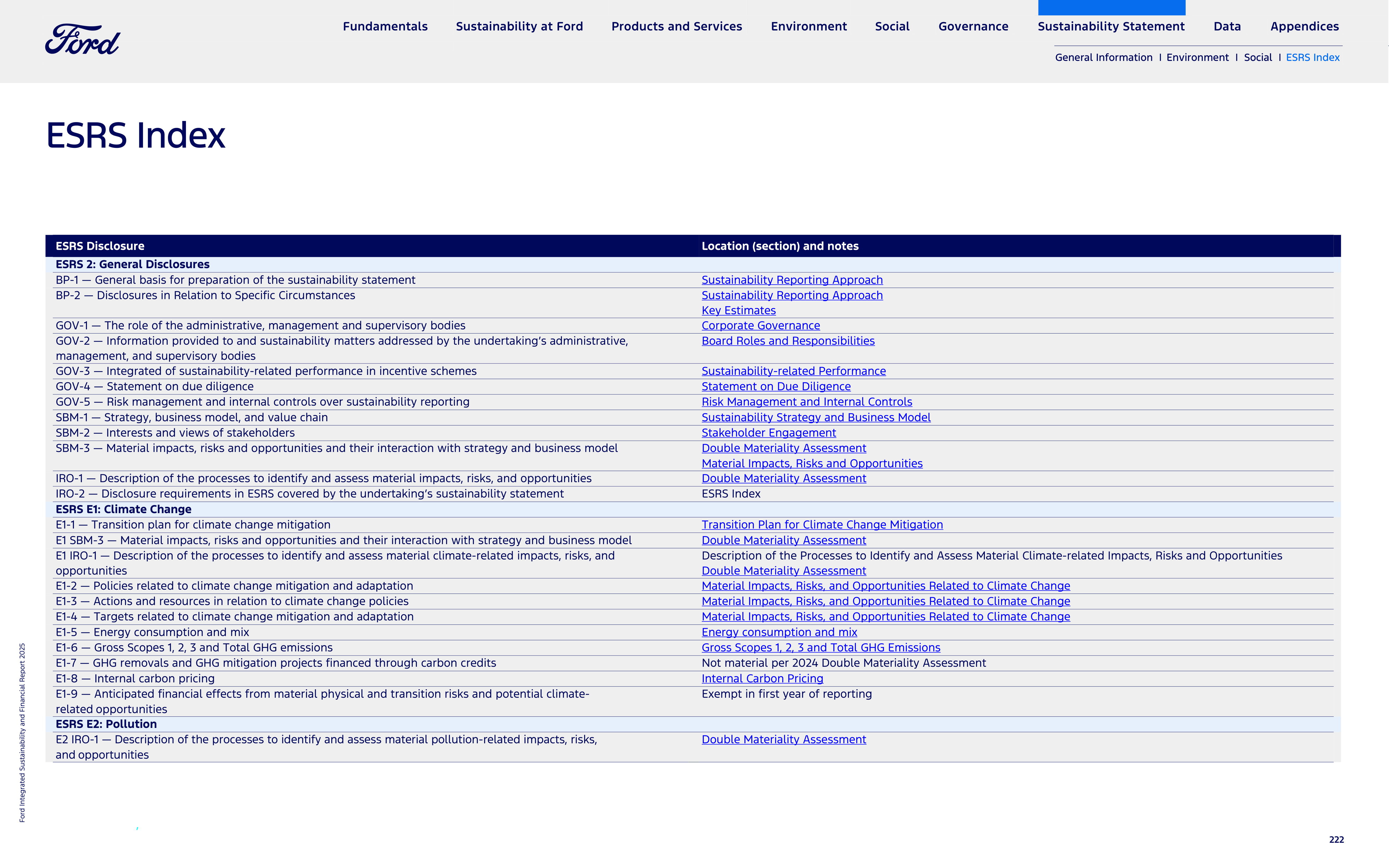
Fundamentals
Sustainability at Ford
Products and Services
Environment
Social
Governance
Sustainability Statement
Data
Appendices
General Information | Environment | Social |
ESRS Index
ESRS Index
ESRS Disclosure
Location (section) and notes
ESRS 2: General Disclosures
BP-1 — General basis for preparation of the sustainability statement
Sustainability Reporting Approach
BP-2 — Disclosures in Relation to Specific Circumstances
Sustainability Reporting Approach
Key Estimates
GOV-1 — The role of the administrative, management and supervisory bodies
Corporate Governance
GOV-2 — Information provided to and sustainability matters addressed by the undertaking’s administrative,
management, and supervisory bodies
Board Roles and Responsibilities
GOV-3 — Integrated of sustainability-related performance in incentive schemes
Sustainability-related Performance
GOV-4 — Statement on due diligence
Statement on Due Diligence
GOV-5 — Risk management and internal controls over sustainability reporting
Risk Management and Internal Controls
SBM-1 — Strategy, business model, and value chain
Sustainability Strategy and Business Model
SBM-2 — Interests and views of stakeholders
Stakeholder Engagement
SBM-3 — Material impacts, risks and opportunities and their interaction with strategy and business model
Double Materiality Assessment
Material Impacts, Risks and Opportunities
IRO-1 — Description of the processes to identify and assess material impacts, risks, and opportunities
Double Materiality Assessment
IRO-2 — Disclosure requirements in ESRS covered by the undertaking’s sustainability statement
ESRS Index
ESRS E1: Climate Change
E1-1 — Transition plan for climate change mitigation
Transition Plan for Climate Change Mitigation
E1 SBM-3 — Material impacts, risks and opportunities and their interaction with strategy and business model
Double Materiality Assessment
E1 IRO-1 — Description of the processes to identify and assess material climate-related impacts, risks, and
opportunities
Description of the Processes to Identify and Assess Material Climate-related Impacts, Risks and Opportunities
Double Materiality Assessment
E1-2 — Policies related to climate change mitigation and adaptation
Material Impacts, Risks, and Opportunities Related to Climate Change
E1-3 — Actions and resources in relation to climate change policies
Material Impacts, Risks, and Opportunities Related to Climate Change
E1-4 — Targets related to climate change mitigation and adaptation
Material Impacts, Risks, and Opportunities Related to Climate Change
E1-5 — Energy consumption and mix
Energy consumption and mix
E1-6 — Gross Scopes 1, 2, 3 and Total GHG emissions
Gross Scopes 1, 2, 3 and Total GHG Emissions
E1-7 — GHG removals and GHG mitigation projects financed through carbon credits
Not material per 2024 Double Materiality Assessment
E1-8 — Internal carbon pricing
Internal Carbon Pricing
E1-9 — Anticipated financial effects from material physical and transition risks and potential climate-
related opportunities
Exempt in first year of reporting
ESRS E2: Pollution
E2 IRO-1 — Description of the processes to identify and assess material pollution-related impacts, risks,
and opportunities
Double Materiality Assessment
,
Ford Integrated Sustainability and Financial Report 2025
222
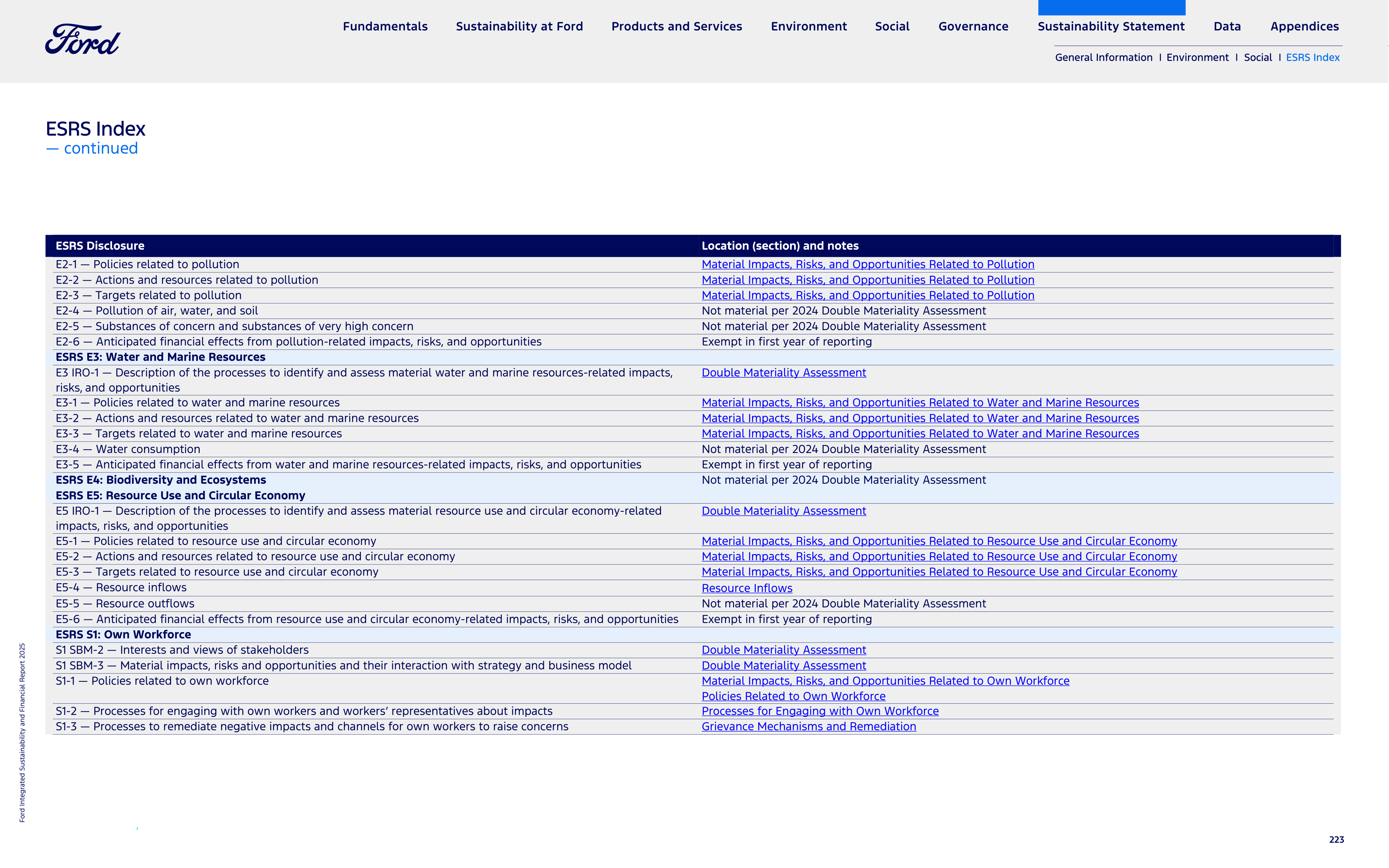
E2-1 — Policies related to pollution
Material Impacts, Risks, and Opportunities Related to Pollution
E2-2 — Actions and resources related to pollution
Material Impacts, Risks, and Opportunities Related to Pollution
E2-3 — Targets related to pollution
Material Impacts, Risks, and Opportunities Related to Pollution
E2-4 — Pollution of air, water, and soil
Not material per 2024 Double Materiality Assessment
E2-5 — Substances of concern and substances of very high concern
Not material per 2024 Double Materiality Assessment
E2-6 — Anticipated financial effects from pollution-related impacts, risks, and opportunities
Exempt in first year of reporting
ESRS E3: Water and Marine Resources
E3 IRO-1 — Description of the processes to identify and assess material water and marine resources-related impacts,
risks, and opportunities
Double Materiality Assessment
E3-1 — Policies related to water and marine resources
Material Impacts, Risks, and Opportunities Related to Water and Marine Resources
E3-2 — Actions and resources related to water and marine resources
Material Impacts, Risks, and Opportunities Related to Water and Marine Resources
E3-3 — Targets related to water and marine resources
Material Impacts, Risks, and Opportunities Related to Water and Marine Resources
E3-4 — Water consumption
Not material per 2024 Double Materiality Assessment
E3-5 — Anticipated financial effects from water and marine resources-related impacts, risks, and opportunities
Exempt in first year of reporting
ESRS E4: Biodiversity and Ecosystems
ESRS E5: Resource Use and Circular Economy
Not material per 2024 Double Materiality Assessment
E5 IRO-1 — Description of the processes to identify and assess material resource use and circular economy-related
impacts, risks, and opportunities
Double Materiality Assessment
E5-1 — Policies related to resource use and circular economy
Material Impacts, Risks, and Opportunities Related to Resource Use and Circular Economy
E5-2 — Actions and resources related to resource use and circular economy
Material Impacts, Risks, and Opportunities Related to Resource Use and Circular Economy
E5-3 — Targets related to resource use and circular economy
Material Impacts, Risks, and Opportunities Related to Resource Use and Circular Economy
E5-4 — Resource inflows
Resource Inflows
E5-5 — Resource outflows
Not material per 2024 Double Materiality Assessment
E5-6 — Anticipated financial effects from resource use and circular economy-related impacts, risks, and opportunities
Exempt in first year of reporting
ESRS S1: Own Workforce
S1 SBM-2 — Interests and views of stakeholders
Double Materiality Assessment
S1 SBM-3 — Material impacts, risks and opportunities and their interaction with strategy and business model
Double Materiality Assessment
S1-1 — Policies related to own workforce
Material Impacts, Risks, and Opportunities Related to Own Workforce
Policies Related to Own Workforce
S1-2 — Processes for engaging with own workers and workers’ representatives about impacts
Processes for Engaging with Own Workforce
S1-3 — Processes to remediate negative impacts and channels for own workers to raise concerns
Grievance Mechanisms and Remediation
Fundamentals
Sustainability at Ford
Products and Services
Environment
Social
Governance
Sustainability Statement
Data
Appendices
General Information | Environment | Social |
ESRS Index
ESRS Disclosure
Location (section) and notes
ESRS Index
— continued
,
Ford Integrated Sustainability and Financial Report 2025
223
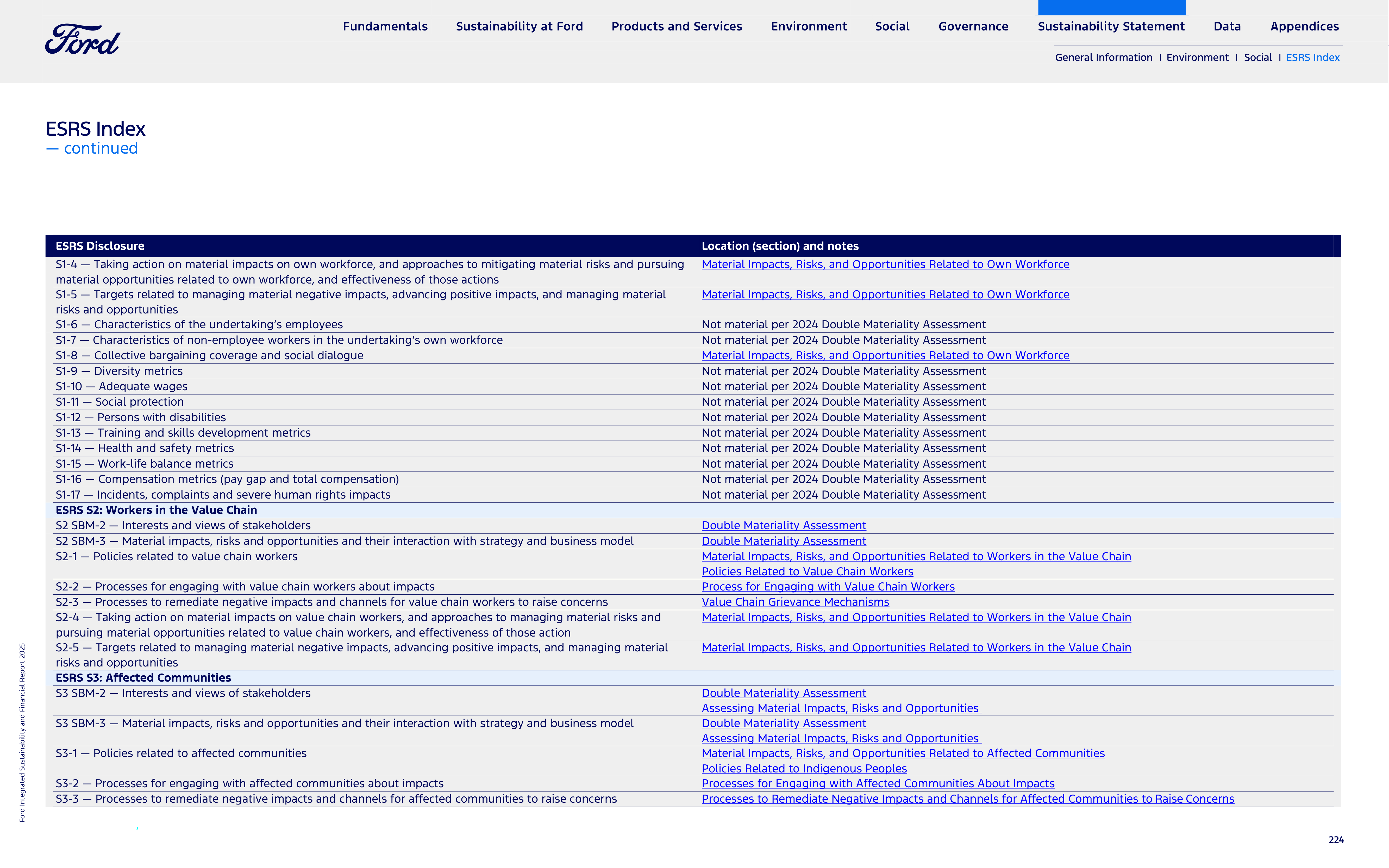
S1-4 — Taking action on material impacts on own workforce, and approaches to mitigating material risks and pursuing
material opportunities related to own workforce, and effectiveness of those actions
Material Impacts, Risks, and Opportunities Related to Own Workforce
S1-5 — Targets related to managing material negative impacts, advancing positive impacts, and managing material
risks and opportunities
Material Impacts, Risks, and Opportunities Related to Own Workforce
S1-6 — Characteristics of the undertaking’s employees
Not material per 2024 Double Materiality Assessment
S1-7 — Characteristics of non-employee workers in the undertaking’s own workforce
Not material per 2024 Double Materiality Assessment
S1-8 — Collective bargaining coverage and social dialogue
Material Impacts, Risks, and Opportunities Related to Own Workforce
S1-9 — Diversity metrics
Not material per 2024 Double Materiality Assessment
S1-10 — Adequate wages
Not material per 2024 Double Materiality Assessment
S1-11 — Social protection
Not material per 2024 Double Materiality Assessment
S1-12 — Persons with disabilities
Not material per 2024 Double Materiality Assessment
S1-13 — Training and skills development metrics
Not material per 2024 Double Materiality Assessment
S1-14 — Health and safety metrics
Not material per 2024 Double Materiality Assessment
S1-15 — Work-life balance metrics
Not material per 2024 Double Materiality Assessment
S1-16 — Compensation metrics (pay gap and total compensation)
Not material per 2024 Double Materiality Assessment
S1-17 — Incidents, complaints and severe human rights impacts
Not material per 2024 Double Materiality Assessment
ESRS S2: Workers in the Value Chain
S2 SBM-2 — Interests and views of stakeholders
Double Materiality Assessment
S2 SBM-3 — Material impacts, risks and opportunities and their interaction with strategy and business model
Double Materiality Assessment
S2-1 — Policies related to value chain workers
Material Impacts, Risks, and Opportunities Related to Workers in the Value Chain
Policies Related to Value Chain Workers
S2-2 — Processes for engaging with value chain workers about impacts
Process for Engaging with Value Chain Workers
S2-3 — Processes to remediate negative impacts and channels for value chain workers to raise concerns
Value Chain Grievance Mechanisms
S2-4 — Taking action on material impacts on value chain workers, and approaches to managing material risks and
pursuing material opportunities related to value chain workers, and effectiveness of those action
Material Impacts, Risks, and Opportunities Related to Workers in the Value Chain
S2-5 — Targets related to managing material negative impacts, advancing positive impacts, and managing material
risks and opportunities
Material Impacts, Risks, and Opportunities Related to Workers in the Value Chain
ESRS S3: Affected Communities
S3 SBM-2 — Interests and views of stakeholders
Double Materiality Assessment
Assessing Material Impacts, Risks and Opportunities
S3 SBM-3 — Material impacts, risks and opportunities and their interaction with strategy and business model
Double Materiality Assessment
Assessing Material Impacts, Risks and Opportunities
S3-1 — Policies related to affected communities
Material Impacts, Risks, and Opportunities Related to Affected Communities
Policies Related to Indigenous Peoples
S3-2 — Processes for engaging with affected communities about impacts
Processes for Engaging with Affected Communities About Impacts
S3-3 — Processes to remediate negative impacts and channels for affected communities to raise concerns
Processes to Remediate Negative Impacts and Channels for Affected Communities to Raise Concerns
Fundamentals
Sustainability at Ford
Products and Services
Environment
Social
Governance
Sustainability Statement
Data
Appendices
General Information | Environment | Social |
ESRS Index
ESRS Disclosure
Location (section) and notes
ESRS Index
— continued
,
Ford Integrated Sustainability and Financial Report 2025
224
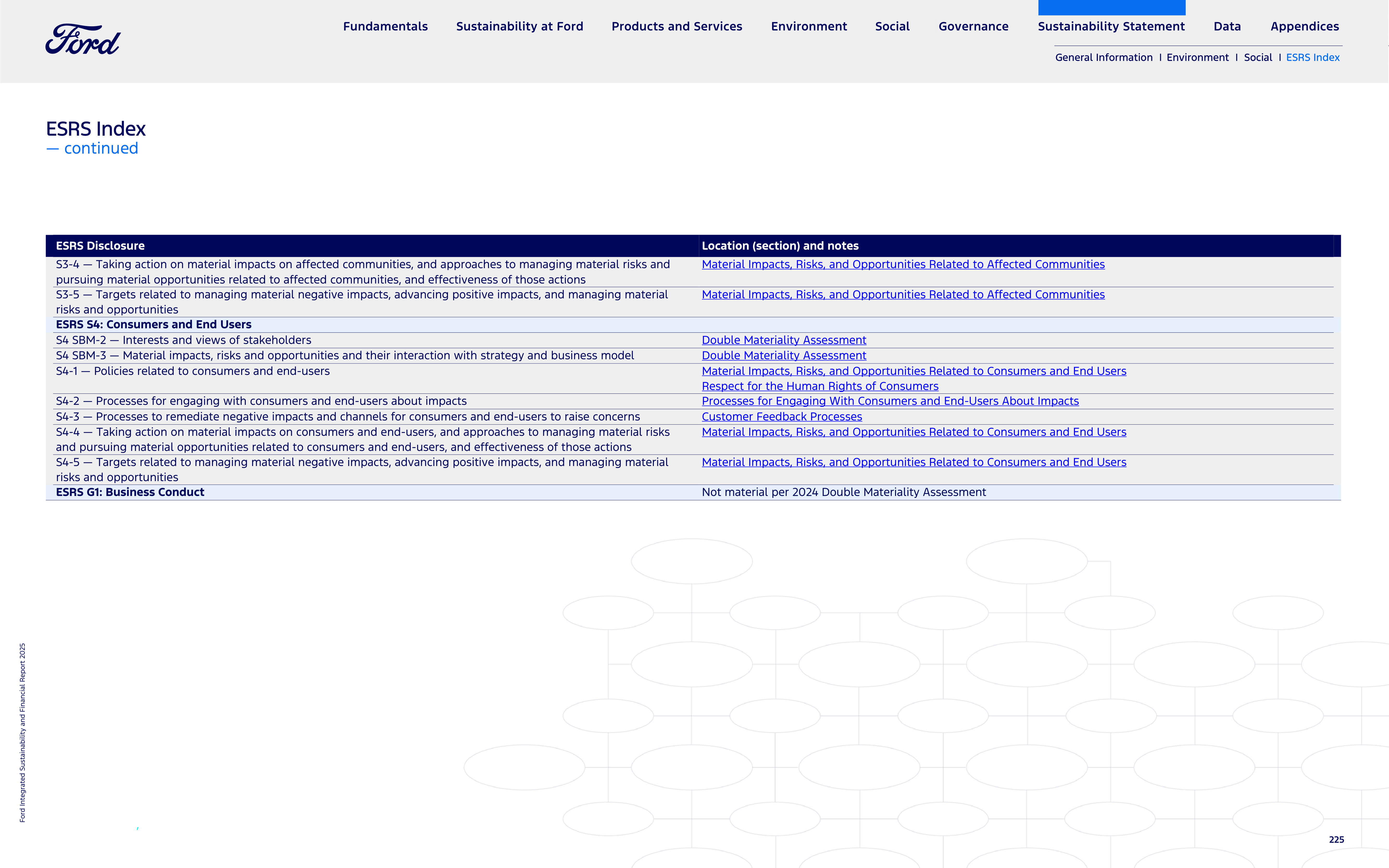

S3-4 — Taking action on material impacts on affected communities, and approaches to managing material risks and
pursuing material opportunities related to affected communities, and effectiveness of those actions
Material Impacts, Risks, and Opportunities Related to Affected Communities
S3-5 — Targets related to managing material negative impacts, advancing positive impacts, and managing material
risks and opportunities
Material Impacts, Risks, and Opportunities Related to Affected Communities
ESRS S4: Consumers and End Users
S4 SBM-2 — Interests and views of stakeholders
Double Materiality Assessment
S4 SBM-3 — Material impacts, risks and opportunities and their interaction with strategy and business model
Double Materiality Assessment
S4-1 — Policies related to consumers and end-users
Material Impacts, Risks, and Opportunities Related to Consumers and End Users
Respect for the Human Rights of Consumers
S4-2 — Processes for engaging with consumers and end-users about impacts
Processes for Engaging With Consumers and End-Users About Impacts
S4-3 — Processes to remediate negative impacts and channels for consumers and end-users to raise concerns
Customer Feedback Processes
S4-4 — Taking action on material impacts on consumers and end-users, and approaches to managing material risks
and pursuing material opportunities related to consumers and end-users, and effectiveness of those actions
Material Impacts, Risks, and Opportunities Related to Consumers and End Users
S4-5 — Targets related to managing material negative impacts, advancing positive impacts, and managing material
risks and opportunities
Material Impacts, Risks, and Opportunities Related to Consumers and End Users
ESRS G1: Business Conduct
ESRS Disclosure
Not material per 2024 Double Materiality Assessment
Fundamentals
Sustainability at Ford
Products and Services
Environment
Social
Governance
Sustainability Statement
Data
Appendices
General Information | Environment | Social |
ESRS Index
Location (section) and notes
ESRS Index
— continued
,
Ford Integrated Sustainability and Financial Report 2025
225
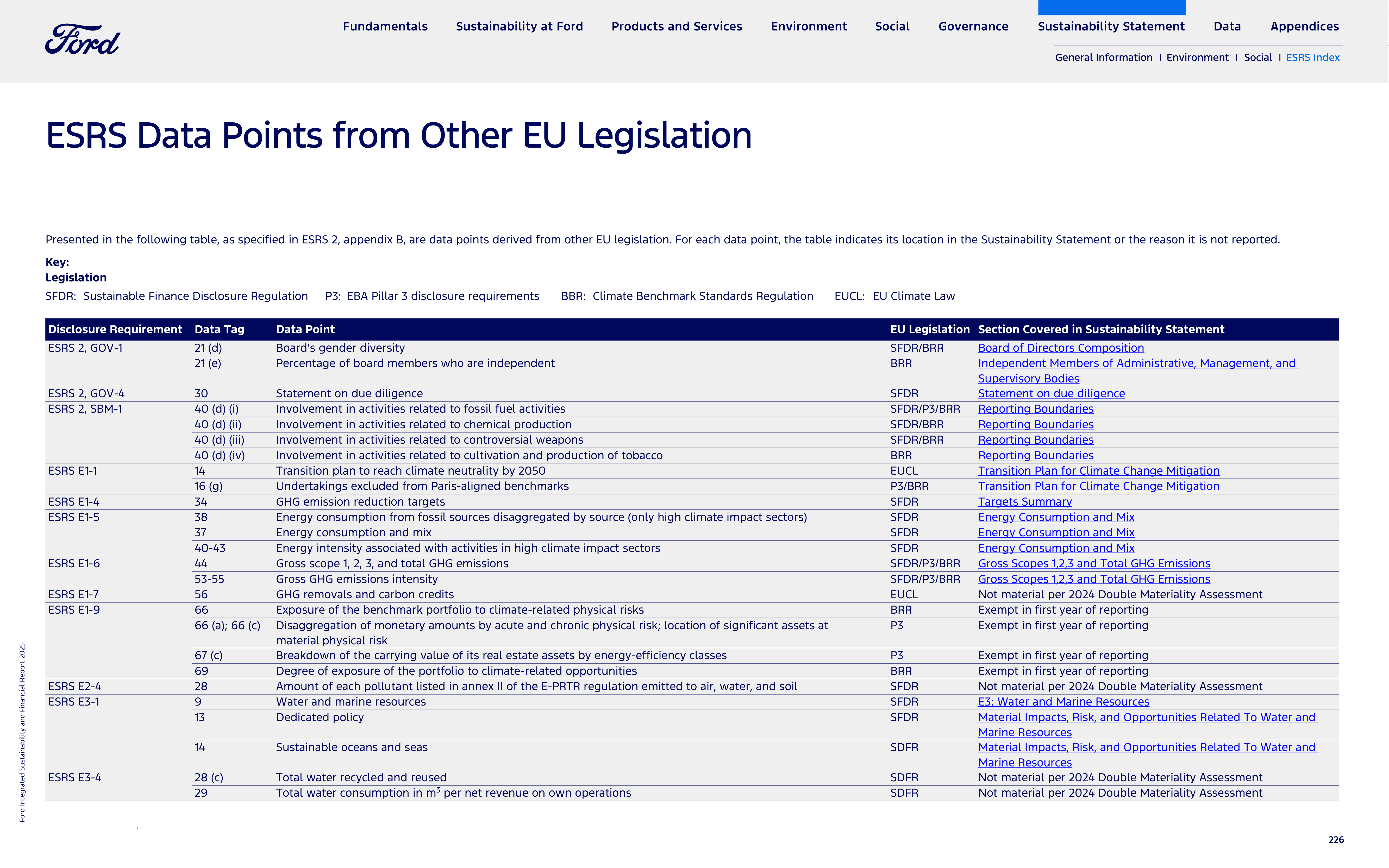
Fundamentals
Sustainability at Ford
Products and Services
Environment
Social
Governance
Sustainability Statement
Data
Appendices
General Information | Environment | Social |
ESRS Index
ESRS Data Points from Other EU Legislation
Presented in the following table, as specified in ESRS 2, appendix B, are data points derived from other EU legislation. For each data point, the table indicates its location in the Sustainability Statement or the reason it is not reported.
Key:
Legislation
SFDR:
Sustainable Finance Disclosure Regulation
P3:
EBA Pillar 3 disclosure requirements
BBR:
Climate Benchmark Standards Regulation
EUCL:
EU Climate Law
,
Ford Integrated Sustainability and Financial Report 2025
226
Disclosure Requirement
Data Tag
Data Point
EU Legislation
Section Covered in Sustainability Statement
ESRS 2, GOV-1
21 (d)
Board’s gender diversity
SFDR/BRR
Board of Directors Composition
21 (e)
Percentage of board members who are independent
BRR
Independent Members of Administrative, Management, and
Supervisory Bodies
ESRS 2, GOV-4
30
Statement on due diligence
SFDR
Statement on due diligence
ESRS 2, SBM-1
40 (d) (i)
Involvement in activities related to fossil fuel activities
SFDR/P3/BRR
Reporting Boundaries
40 (d) (ii)
Involvement in activities related to chemical production
SFDR/BRR
Reporting Boundaries
40 (d) (iii)
Involvement in activities related to controversial weapons
SFDR/BRR
Reporting Boundaries
40 (d) (iv)
Involvement in activities related to cultivation and production of tobacco
BRR
Reporting Boundaries
ESRS E1-1
14
Transition plan to reach climate neutrality by 2050
EUCL
Transition Plan for Climate Change Mitigation
16 (g)
Undertakings excluded from Paris-aligned benchmarks
P3/BRR
Transition Plan for Climate Change Mitigation
ESRS E1-4
34
GHG emission reduction targets
SFDR
Targets Summary
ESRS E1-5
38
Energy consumption from fossil sources disaggregated by source (only high climate impact sectors)
SFDR
Energy Consumption and Mix
37
Energy consumption and mix
SFDR
Energy Consumption and Mix
40-43
Energy intensity associated with activities in high climate impact sectors
SFDR
Energy Consumption and Mix
ESRS E1-6
44
Gross scope 1, 2, 3, and total GHG emissions
SFDR/P3/BRR
Gross Scopes 1,2,3 and Total GHG Emissions
53-55
Gross GHG emissions intensity
SFDR/P3/BRR
Gross Scopes 1,2,3 and Total GHG Emissions
ESRS E1-7
56
GHG removals and carbon credits
EUCL
Not material per 2024 Double Materiality Assessment
ESRS E1-9
66
Exposure of the benchmark portfolio to climate-related physical risks
BRR
Exempt in first year of reporting
66 (a); 66 (c)
Disaggregation of monetary amounts by acute and chronic physical risk; location of significant assets at
material physical risk
P3
Exempt in first year of reporting
67 (c)
Breakdown of the carrying value of its real estate assets by energy-efficiency classes
P3
Exempt in first year of reporting
69
Degree of exposure of the portfolio to climate-related opportunities
BRR
Exempt in first year of reporting
ESRS E2-4
28
Amount of each pollutant listed in annex II of the E-PRTR regulation emitted to air, water, and soil
SFDR
Not material per 2024 Double Materiality Assessment
ESRS E3-1
9
Water and marine resources
SFDR
E3: Water and Marine Resources
13
Dedicated policy
SFDR
Material Impacts, Risk, and Opportunities Related To Water and
Marine Resources
14
Sustainable oceans and seas
SDFR
Material Impacts, Risk, and Opportunities Related To Water and
Marine Resources
ESRS E3-4
28 (c)
Total water recycled and reused
SDFR
Not material per 2024 Double Materiality Assessment
29
Total water consumption in m
3
per net revenue on own operations
SDFR
Not material per 2024 Double Materiality Assessment
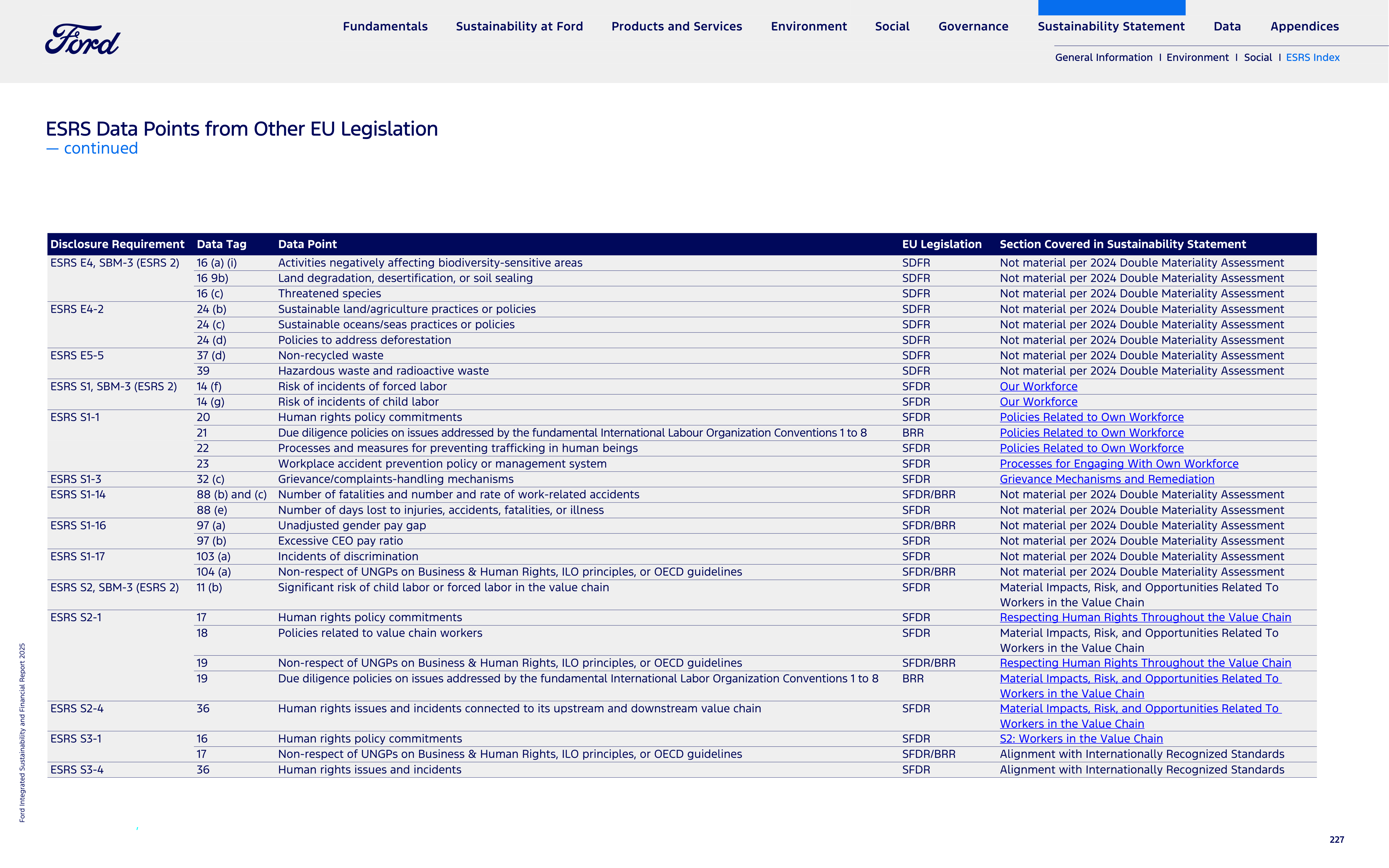
ESRS Data Points from Other EU Legislation
— continued
,
Ford Integrated Sustainability and Financial Report 2025
227
Disclosure Requirement
Data Tag
Data Point
EU Legislation
Section Covered in Sustainability Statement
ESRS E4, SBM-3 (ESRS 2)
16 (a) (i)
Activities negatively affecting biodiversity-sensitive areas
SDFR
Not material per 2024 Double Materiality Assessment
16 9b)
Land degradation, desertification, or soil sealing
SDFR
Not material per 2024 Double Materiality Assessment
16 (c)
Threatened species
SDFR
Not material per 2024 Double Materiality Assessment
ESRS E4-2
24 (b)
Sustainable land/agriculture practices or policies
SDFR
Not material per 2024 Double Materiality Assessment
24 (c)
Sustainable oceans/seas practices or policies
SDFR
Not material per 2024 Double Materiality Assessment
24 (d)
Policies to address deforestation
SDFR
Not material per 2024 Double Materiality Assessment
ESRS E5-5
37 (d)
Non-recycled waste
SDFR
Not material per 2024 Double Materiality Assessment
39
Hazardous waste and radioactive waste
SDFR
Not material per 2024 Double Materiality Assessment
ESRS S1, SBM-3 (ESRS 2)
14 (f)
Risk of incidents of forced labor
SFDR
Our Workforce
14 (g)
Risk of incidents of child labor
SFDR
Our Workforce
ESRS S1-1
20
Human rights policy commitments
SFDR
Policies Related to Own Workforce
21
Due diligence policies on issues addressed by the fundamental International Labour Organization Conventions 1 to 8
BRR
Policies Related to Own Workforce
22
Processes and measures for preventing trafficking in human beings
SFDR
Policies Related to Own Workforce
23
Workplace accident prevention policy or management system
SFDR
Processes for Engaging With Own Workforce
ESRS S1-3
32 (c)
Grievance/complaints-handling mechanisms
SFDR
Grievance Mechanisms and Remediation
ESRS S1-14
88 (b) and (c)
Number of fatalities and number and rate of work-related accidents
SFDR/BRR
Not material per 2024 Double Materiality Assessment
88 (e)
Number of days lost to injuries, accidents, fatalities, or illness
SFDR
Not material per 2024 Double Materiality Assessment
ESRS S1-16
97 (a)
Unadjusted gender pay gap
SFDR/BRR
Not material per 2024 Double Materiality Assessment
97 (b)
Excessive CEO pay ratio
SFDR
Not material per 2024 Double Materiality Assessment
ESRS S1-17
103 (a)
Incidents of discrimination
SFDR
Not material per 2024 Double Materiality Assessment
104 (a)
Non-respect of UNGPs on Business & Human Rights, ILO principles, or OECD guidelines
SFDR/BRR
Not material per 2024 Double Materiality Assessment
ESRS S2, SBM-3 (ESRS 2)
11 (b)
Significant risk of child labor or forced labor in the value chain
SFDR
Material Impacts, Risk, and Opportunities Related To
Workers in the Value Chain
ESRS S2-1
17
Human rights policy commitments
SFDR
Respecting Human Rights Throughout the Value Chain
18
Policies related to value chain workers
SFDR
Material Impacts, Risk, and Opportunities Related To
Workers in the Value Chain
19
Non-respect of UNGPs on Business & Human Rights, ILO principles, or OECD guidelines
SFDR/BRR
Respecting Human Rights Throughout the Value Chain
19
Due diligence policies on issues addressed by the fundamental International Labor Organization Conventions 1 to 8
BRR
Material Impacts, Risk, and Opportunities Related To
Workers in the Value Chain
ESRS S2-4
36
Human rights issues and incidents connected to its upstream and downstream value chain
SFDR
Material Impacts, Risk, and Opportunities Related To
Workers in the Value Chain
ESRS S3-1
16
Human rights policy commitments
SFDR
S2: Workers in the Value Chain
17
Non-respect of UNGPs on Business & Human Rights, ILO principles, or OECD guidelines
SFDR/BRR
Alignment with Internationally Recognized Standards
ESRS S3-4
36
Human rights issues and incidents
SFDR
Alignment with Internationally Recognized Standards
Fundamentals
Sustainability at Ford
Products and Services
Environment
Social
Governance
Sustainability Statement
Data
Appendices
General Information | Environment | Social |
ESRS Index
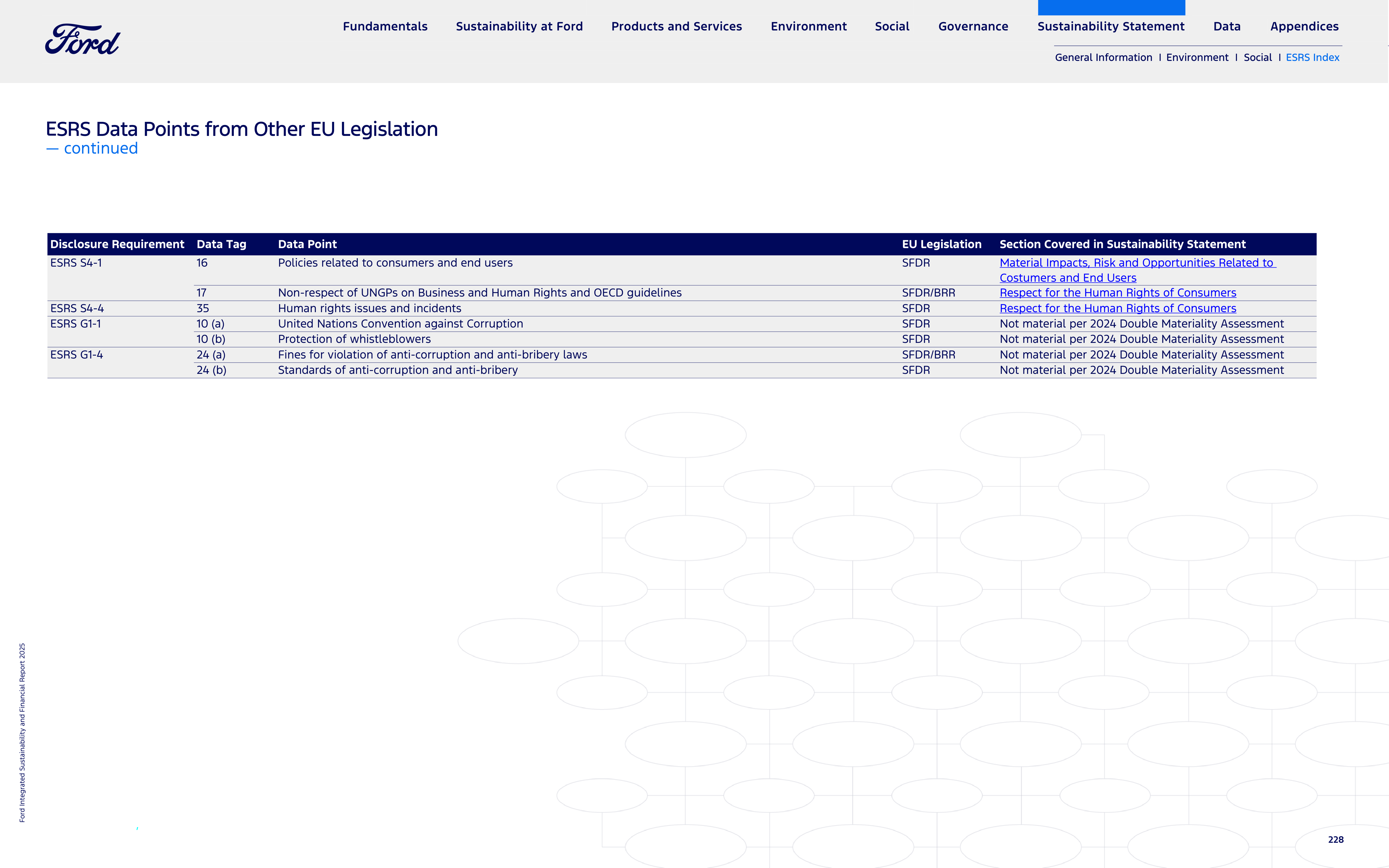

ESRS Data Points from Other EU Legislation
— continued
,
Ford Integrated Sustainability and Financial Report 2025
228
Disclosure Requirement
Data Tag
Data Point
EU Legislation
Section Covered in Sustainability Statement
ESRS S4-1
16
Policies related to consumers and end users
SFDR
Material Impacts, Risk and Opportunities Related to
Costumers and End Users
17
Non-respect of UNGPs on Business and Human Rights and OECD guidelines
SFDR/BRR
Respect for the Human Rights of Consumers
ESRS S4-4
35
Human rights issues and incidents
SFDR
Respect for the Human Rights of Consumers
ESRS G1-1
10 (a)
United Nations Convention against Corruption
SFDR
Not material per 2024 Double Materiality Assessment
10 (b)
Protection of whistleblowers
SFDR
Not material per 2024 Double Materiality Assessment
ESRS G1-4
24 (a)
Fines for violation of anti-corruption and anti-bribery laws
SFDR/BRR
Not material per 2024 Double Materiality Assessment
24 (b)
Standards of anti-corruption and anti-bribery
SFDR
Not material per 2024 Double Materiality Assessment
Fundamentals
Sustainability at Ford
Products and Services
Environment
Social
Governance
Sustainability Statement
Data
Appendices
General Information | Environment | Social |
ESRS Index
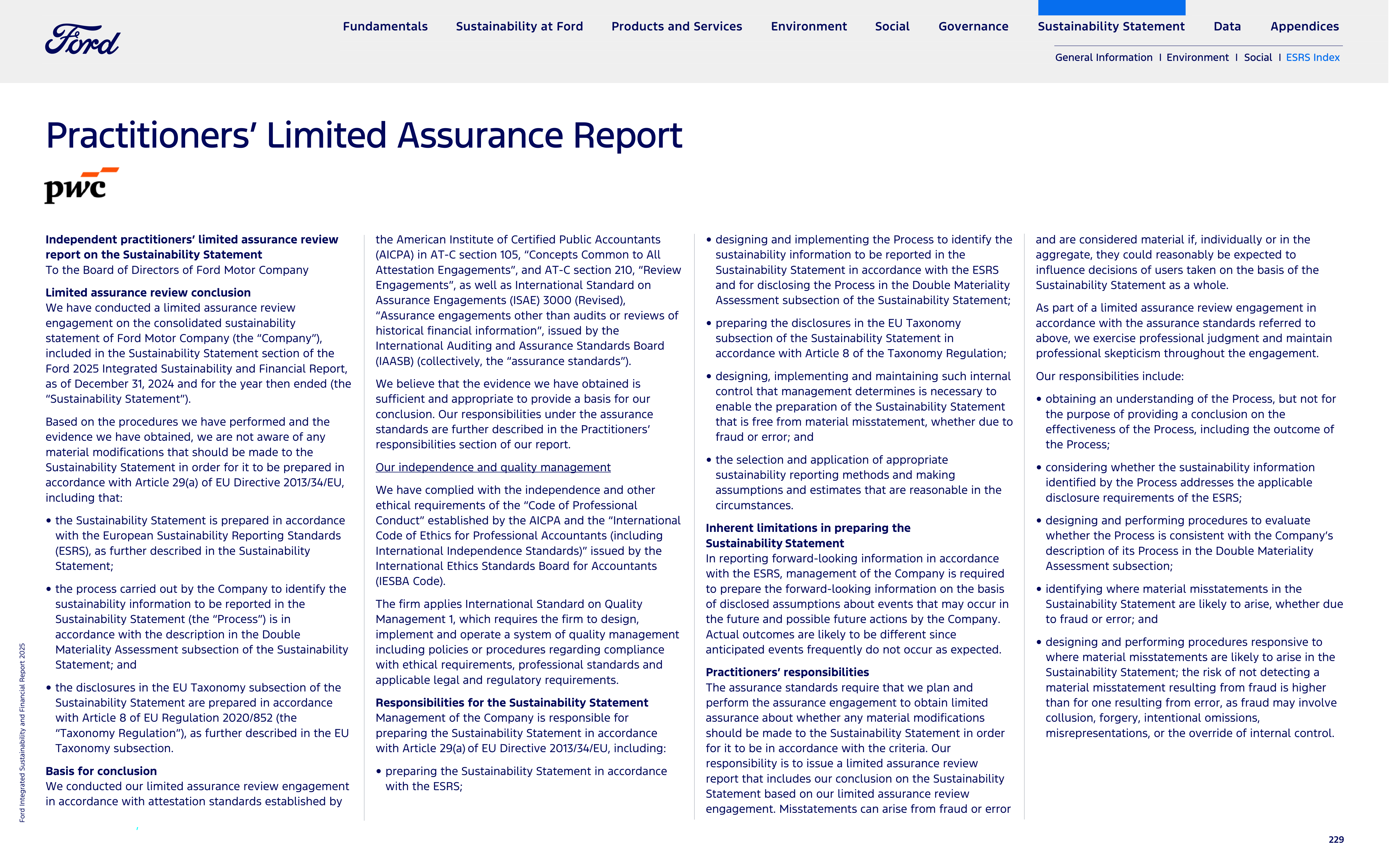

Fundamentals
Sustainability at Ford
Products and Services
Environment
Social
Governance
Sustainability Statement
Data
Appendices
General Information |
|
|
Environment
Social
ESRS Index
Practitioners’ Limited Assurance Report
Independent practitioners’ limited assurance review
report on the Sustainability Statement
To the Board of Directors of Ford Motor Company
Limited assurance review conclusion
We have conducted a limited assurance review
engagement on the consolidated sustainability
statement of Ford Motor Company (the “Company”),
included in the Sustainability Statement section of the
Ford 2025 Integrated Sustainability and Financial Report,
as of December 31, 2024 and for the year then ended (the
“Sustainability Statement”).
Based on the procedures we have performed and the
evidence we have obtained, we are not aware of any
material modifications that should be made to the
Sustainability Statement in order for it to be prepared in
accordance with Article 29(a) of EU Directive 2013/34/EU,
including that:
•
the Sustainability Statement is prepared in accordance
with the European Sustainability Reporting Standards
(ESRS), as further described in the Sustainability
Statement;
•
the process carried out by the Company to identify the
sustainability information to be reported in the
Sustainability Statement (the “Process”) is in
accordance with the description in the Double
Materiality Assessment subsection of the Sustainability
Statement; and
•
the disclosures in the EU Taxonomy subsection of the
Sustainability Statement are prepared in accordance
with Article 8 of EU Regulation 2020/852 (the
“Taxonomy Regulation”), as further described in the EU
Taxonomy subsection.
Basis for conclusion
We conducted our limited assurance review engagement
in accordance with attestation standards established by
the American Institute of Certified Public Accountants
(AICPA) in AT-C section 105, “Concepts Common to All
Attestation Engagements”, and AT-C section 210, “Review
Engagements”, as well as International Standard on
Assurance Engagements (ISAE) 3000 (Revised),
“Assurance engagements other than audits or reviews of
historical financial information”, issued by the
International Auditing and Assurance Standards Board
(IAASB) (collectively, the “assurance standards”).
We believe that the evidence we have obtained is
sufficient and appropriate to provide a basis for our
conclusion. Our responsibilities under the assurance
standards are further described in the Practitioners’
responsibilities section of our report.
Our independence and quality management
We have complied with the independence and other
ethical requirements of the “Code of Professional
Conduct” established by the AICPA and the “International
Code of Ethics for Professional Accountants (including
International Independence Standards)” issued by the
International Ethics Standards Board for Accountants
(IESBA Code).
The firm applies International Standard on Quality
Management 1, which requires the firm to design,
implement and operate a system of quality management
including policies or procedures regarding compliance
with ethical requirements, professional standards and
applicable legal and regulatory requirements.
Responsibilities for the Sustainability Statement
Management of the Company is responsible for
preparing the Sustainability Statement in accordance
with Article 29(a)
of EU Directive 2013/34/EU, including:
•
preparing the Sustainability Statement in accordance
with the ESRS;
•
designing and implementing the Process to identify the
sustainability information to be reported in the
Sustainability Statement in accordance with the ESRS
and for disclosing the Process in the Double Materiality
Assessment subsection of the Sustainability Statement;
•
preparing the disclosures in the EU Taxonomy
subsection of the Sustainability Statement in
accordance with Article 8 of the Taxonomy Regulation;
•
designing, implementing and maintaining such internal
control that management determines is necessary to
enable the preparation of the Sustainability Statement
that is free from material misstatement, whether due to
fraud or error; and
•
the selection and application of appropriate
sustainability reporting methods and making
assumptions and estimates that are reasonable in the
circumstances.
Inherent limitations in preparing the
Sustainability Statement
In reporting forward-looking information in accordance
with the ESRS, management of the Company is required
to prepare the forward-looking information on the basis
of disclosed assumptions about events that may occur in
the future and possible future actions by the Company.
Actual outcomes are likely to be different since
anticipated events frequently do not occur as expected.
Practitioners’ responsibilities
The assurance standards require that we plan and
perform the assurance engagement to obtain limited
assurance about whether any material modifications
should be made to the Sustainability Statement in order
for it to be in accordance with the criteria. Our
responsibility is to issue a limited assurance review
report that includes our conclusion on the Sustainability
Statement based on our limited assurance review
engagement. Misstatements can arise from fraud or error
and are considered material if, individually or in the
aggregate, they could reasonably be expected to
influence decisions of users taken on the basis of the
Sustainability Statement as a whole.
As part of a limited assurance review engagement in
accordance with the assurance standards referred to
above, we exercise professional judgment and maintain
professional skepticism throughout the engagement.
Our responsibilities include:
•
obtaining an understanding of the Process, but not for
the purpose of providing a conclusion on the
effectiveness of the Process, including the outcome of
the Process;
•
considering whether the sustainability information
identified by the Process addresses the applicable
disclosure requirements of the ESRS;
•
designing and performing procedures to evaluate
whether the Process is consistent with the Company’s
description of its Process in the Double Materiality
Assessment subsection;
•
identifying where material misstatements in the
Sustainability Statement are likely to arise, whether due
to fraud or error; and
•
designing and performing procedures responsive to
where material misstatements are likely to arise in the
Sustainability Statement; the risk of not detecting a
material misstatement resulting from fraud is higher
than for one resulting from error, as fraud may involve
collusion, forgery, intentional omissions,
misrepresentations, or the override of internal control.
,
Ford Integrated Sustainability and Financial Report 2025
229
Fundamentals
Sustainability at Ford
Products and Services
Environment
Social
Governance
Sustainability Statement
Data
Appendices
General Information |
|
|
Environment
Social
ESRS Index
Summary of the work performed
A limited assurance review engagement involves
performing procedures to obtain evidence about the
Sustainability Statement. The procedures in a limited
assurance review engagement vary in nature and timing
from, and are substantially less in extent than for, a
reasonable assurance examination engagement, the
objective of which is to obtain reasonable assurance
about whether the subject matter is in accordance with
the criteria, in all material respects, in order to express an
opinion. Accordingly, we do not express such an opinion.
Consequently, because of the limited nature of the
engagement, the level of assurance obtained in a limited
assurance review engagement is substantially lower than
the assurance that would have been obtained had a
reasonable assurance examination engagement been
performed.
The nature, timing and extent of procedures selected
depend on professional judgment, including the
identification of disclosures where material
misstatements are likely to arise in the Sustainability
Statement, whether due to fraud or error.
In conducting our limited assurance review engagement,
we have, among other things:
•
obtained an understanding of the Process by
performing inquiries to understand the sources of the
information used by management and reviewing the
Company’s documentation of its Process;
•
evaluated whether the Process implemented by the
Company was consistent with the description of the
Process set out in the Double Materiality Assessment
subsection;
•
obtained an understanding of the Company’s reporting
processes relevant to the preparation of its
Sustainability Statement;
•
evaluated whether the sustainability information
identified by the Process is included in the
Sustainability Statement;
•
evaluated whether the structure and the presentation
of the Sustainability Statement is in accordance with
the ESRS;
•
performed inquiries about and analytical procedures on
selected sustainability information in the Sustainability
Statement;
•
reviewed supporting documentation regarding the
completeness and accuracy of selected sustainability
information in the Sustainability Statement on a sample
basis;
•
where applicable, compared selected disclosures in the
Sustainability Statement with the corresponding
disclosures in the financial statements and the Ford
2025 Integrated Sustainability and Financial Report;
•
evaluated the appropriateness of methods,
reasonableness of assumptions, and completeness and
accuracy of data for developing selected estimates and
forward-looking information; and
•
obtained an understanding of the Company’s process
to identify taxonomy-eligible and taxonomy-aligned
economic activities and the corresponding disclosures
in the EU Taxonomy subsection of the Sustainability
Statement.
Practitioners’ Limited Assurance Report
— continued
,
Ford Integrated Sustainability and Financial Report 2025
230
/s/ PricewaterhouseCoopers LLP
Detroit, Michigan
June 19, 2025

,
Ford Integrated Sustainability and Financial Report 2025
231
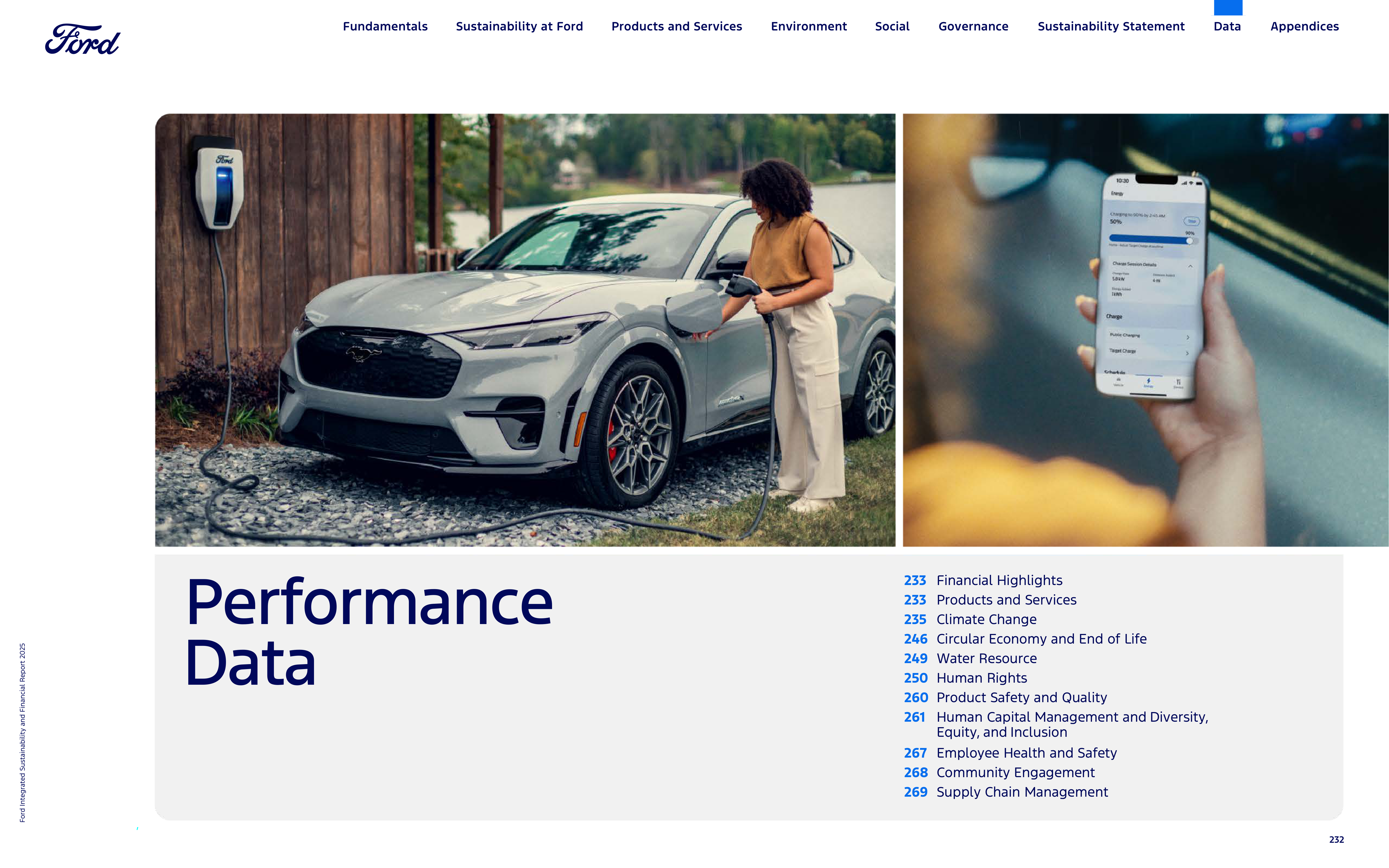
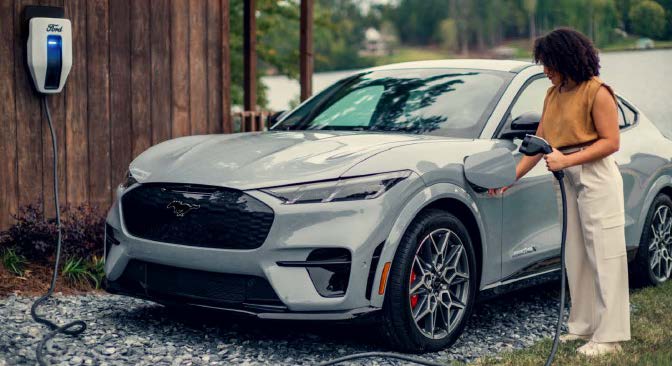

Fundamentals
Sustainability at Ford
Products and Services
Environment
Social
Governance
Sustainability Statement
Data
Appendices
,
Ford Integrated Sustainability and Financial Report 2025
232
Performance
Data
233
Financial Highlights
233
Products and Services
235
Climate Change
246
Circular Economy and End of Life
249
Water Resource
250
Human Rights
260
Product Safety and Quality
261
Human Capital Management and Diversity,
Equity, and Inclusion
267
Employee Health and Safety
268
Community Engagement
269
Supply Chain Management
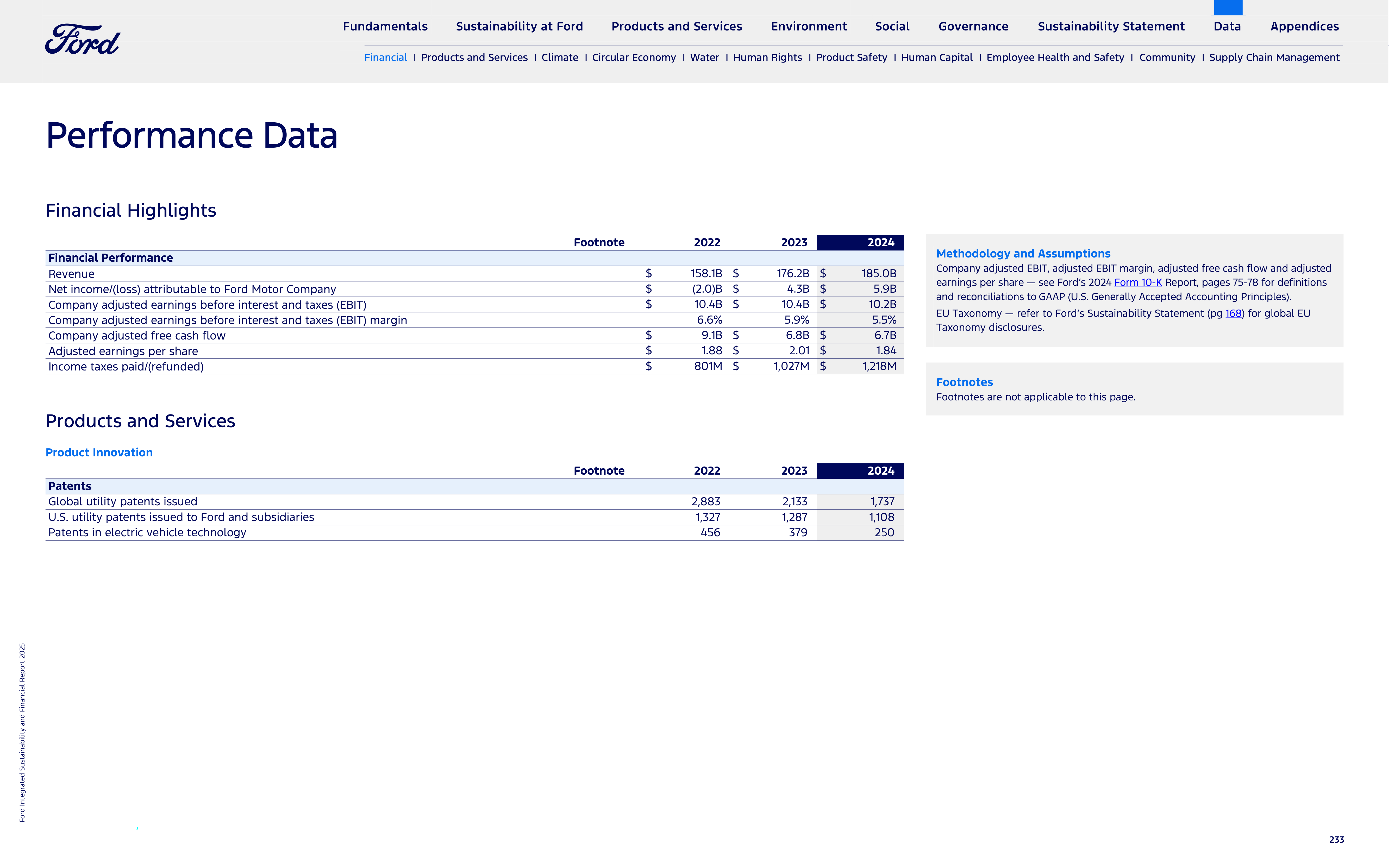
Fundamentals
Sustainability at Ford
Products and Services
Environment
Social
Governance
Sustainability Statement
Data
Appendices
Financial
| Products and Services | Climate | Circular Economy | Water | Human Rights | Product Safety | Human Capital | Employee Health and Safety | Community | Supply Chain Management
Performance Data
Financial Highlights
Footnote
2022
2023
2024
Financial Performance
Revenue
$
158.1B
$
176.2B
$
185.0B
Net income/(loss) attributable to Ford Motor Company
$
(2.0)B
$
4.3B
$
5.9B
Company adjusted earnings before interest and taxes (EBIT)
$
10.4B
$
10.4B
$
10.2B
Company adjusted earnings before interest and taxes (EBIT) margin
6.6 %
5.9 %
5.5 %
Company adjusted free cash flow
$
9.1B
$
6.8B
$
6.7B
Adjusted earnings per share
$
1.88
$
2.01
$
1.84
Income taxes paid/(refunded)
$
801M
$
1,027M
$
1,218 M
Products and Services
Product Innovation
Footnote
2022
2023
2024
Patents
Global utility patents issued
2,883
2,133
1,737
U.S. utility patents issued to Ford and subsidiaries
1,327
1,287
1,108
Patents in electric vehicle technology
456
379
250
,
Ford Integrated Sustainability and Financial Report 2025
233
Methodology and Assumptions
Company adjusted EBIT, adjusted EBIT margin, adjusted free cash flow and adjusted
earnings per share — see Ford’s 2024
Form 10-K
Report, pages 75-78 for definitions
and reconciliations to GAAP (U.S. Generally Accepted Accounting Principles).
EU Taxonomy — refer to Ford’s Sustainability Statement (pg
168
) for global EU
Taxonomy disclosures.
Footnotes
Footnotes are not applicable to this page.
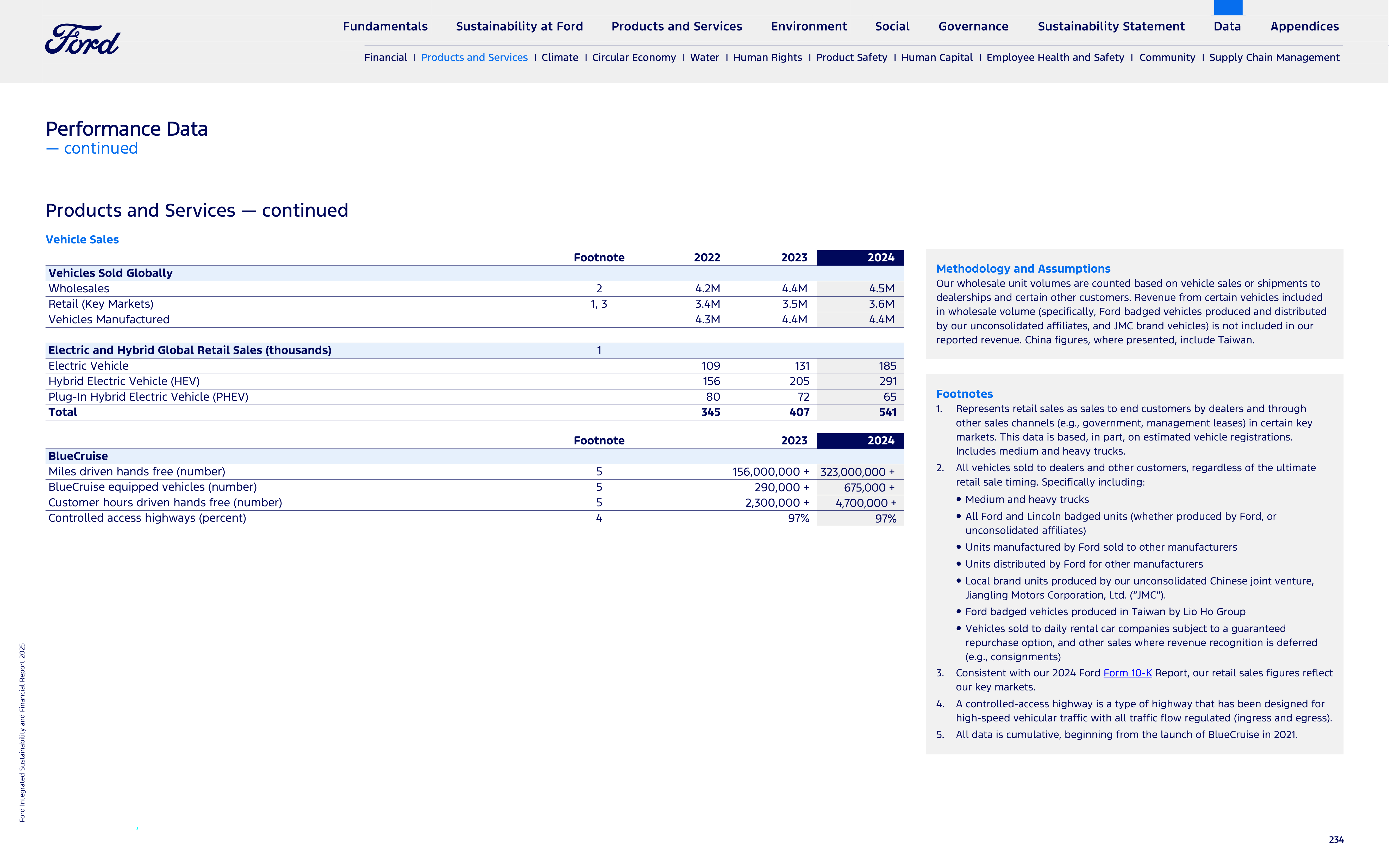
Fundamentals
Sustainability at Ford
Products and Services
Environment
Social
Governance
Sustainability Statement
Data
Appendices
Financial |
Products and Services
| Climate | Circular Economy | Water | Human Rights | Product Safety | Human Capital | Employee Health and Safety | Community | Supply Chain Management
Vehicle Sales
Footnote
2022
2023
2024
Vehicles Sold Globally
Wholesales
2
4.2M
4.4M
4.5M
Retail (Key Markets)
1, 3
3.4M
3.5M
3.6M
Vehicles Manufactured
4.3M
4.4M
4.4M
Electric and Hybrid Global Retail Sales (thousands)
1
Electric Vehicle
109
131
185
Hybrid Electric Vehicle (HEV)
156
205
291
Plug-In Hybrid Electric Vehicle (PHEV)
80
72
65
Total
345
407
541
Footnote
2023
2024
BlueCruise
Miles driven hands free (number)
5
156,000,000 +
323,000,000 +
BlueCruise equipped vehicles (number)
5
290,000 +
675,000 +
Customer hours driven hands free (number)
5
2,300,000 +
4,700,000 +
Controlled access highways (percent)
4
97%
97%
Performance Data
— continued
,
Ford Integrated Sustainability and Financial Report 2025
234
Methodology and Assumptions
Our wholesale unit volumes are counted based on vehicle sales or shipments to
dealerships and certain other customers. Revenue from certain vehicles included
in wholesale volume (specifically, Ford badged vehicles produced and distributed
by our unconsolidated affiliates, and JMC brand vehicles) is not included in our
reported revenue. China figures, where presented, include Taiwan.
Footnotes
1.
Represents retail sales as sales to end customers by dealers and through
other sales channels (e.g., government, management leases) in certain key
markets. This data is based, in part, on estimated vehicle registrations.
Includes medium and heavy trucks.
2.
All vehicles sold to dealers and other customers, regardless of the ultimate
retail sale timing. Specifically including:
•
Medium and heavy trucks
•
All Ford and Lincoln badged units (whether produced by Ford, or
unconsolidated affiliates)
•
Units manufactured by Ford sold to other manufacturers
•
Units distributed by Ford for other manufacturers
•
Local brand units produced by our unconsolidated Chinese joint venture,
Jiangling Motors Corporation, Ltd. (“JMC”).
•
Ford badged vehicles produced in Taiwan by Lio Ho Group
•
Vehicles sold to daily rental car companies subject to a guaranteed
repurchase option, and other sales where revenue recognition is deferred
(e.g., consignments)
3.
Consistent with our 2024 Ford
Form 10-K
Report, our retail sales figures reflect
our key markets.
4.
A controlled-access highway is a type of highway that has been designed for
high-speed vehicular traffic with all traffic flow regulated (ingress and egress).
5.
All data is cumulative, beginning from the launch of BlueCruise in 2021.
Products and Services — continued
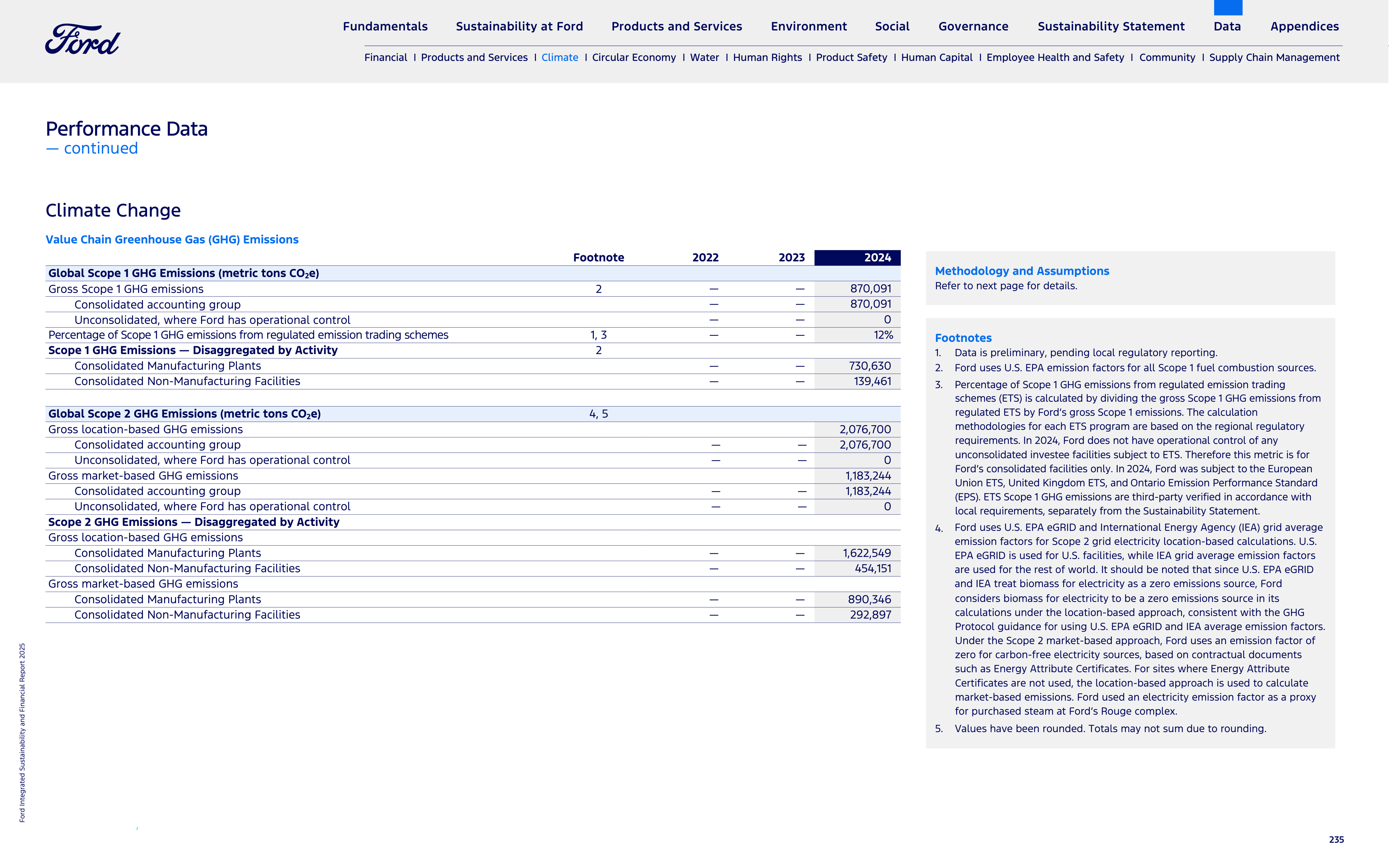
Fundamentals
Sustainability at Ford
Products and Services
Environment
Social
Governance
Sustainability Statement
Data
Appendices
Financial | Products and Services |
Climate
| Circular Economy | Water | Human Rights | Product Safety | Human Capital | Employee Health and Safety | Community | Supply Chain Management
Climate Change
Value Chain Greenhouse Gas (GHG) Emissions
Footnote
2022
2023
2024
Global Scope 1 GHG Emissions (metric tons CO
2
e)
Gross Scope 1 GHG emissions
2
—
—
870,091
Consolidated accounting group
—
—
870,091
Unconsolidated, where Ford has operational control
—
—
0
Percentage of Scope 1 GHG emissions from regulated emission trading schemes
1, 3
—
—
12%
Scope 1 GHG Emissions — Disaggregated by Activity
2
Consolidated Manufacturing Plants
—
—
730,630
Consolidated Non-Manufacturing Facilities
—
—
139,461
Global Scope 2 GHG Emissions (metric tons CO
2
e)
4, 5
Gross location-based GHG emissions
2,076,700
Consolidated accounting group
—
—
2,076,700
Unconsolidated, where Ford has operational control
—
—
0
Gross market-based GHG emissions
1,183,244
Consolidated accounting group
—
—
1,183,244
Unconsolidated, where Ford has operational control
—
—
0
Scope 2 GHG Emissions — Disaggregated by Activity
Gross location-based GHG emissions
Consolidated Manufacturing Plants
—
—
1,622,549
Consolidated Non-Manufacturing Facilities
—
—
454,151
Gross market-based GHG emissions
Consolidated Manufacturing Plants
—
—
890,346
Consolidated Non-Manufacturing Facilities
—
—
292,897
Performance Data
— continued
,
Ford Integrated Sustainability and Financial Report 2025
235
Methodology and Assumptions
Refer to next page for details.
Footnotes
1.
Data is preliminary, pending local regulatory reporting.
2.
Ford uses U.S. EPA emission factors for all Scope 1 fuel combustion sources.
3.
Percentage of Scope 1 GHG emissions from regulated emission trading
schemes (ETS) is calculated by dividing the gross Scope 1 GHG emissions from
regulated ETS by Ford’s gross Scope 1 emissions. The calculation
methodologies for each ETS program are based on the regional regulatory
requirements. In 2024, Ford does not have operational control of any
unconsolidated investee facilities subject to ETS. Therefore this metric is for
Ford’s consolidated facilities only. In 2024, Ford was subject to the European
Union ETS, United Kingdom ETS, and Ontario Emission Performance Standard
(EPS). ETS Scope 1 GHG emissions are third-party verified in accordance with
local requirements, separately from the Sustainability Statement.
4.
Ford uses U.S. EPA eGRID and International Energy Agency (IEA) grid average
emission factors for Scope 2 grid electricity location-based calculations. U.S.
EPA eGRID is used for U.S. facilities, while IEA grid average emission factors
are used for the rest of world. It should be noted that since U.S. EPA eGRID
and IEA treat biomass for electricity as a zero emissions source, Ford
considers biomass for electricity to be a zero emissions source in its
calculations under the location-based approach, consistent with the GHG
Protocol guidance for using U.S. EPA eGRID and IEA average emission factors.
Under the Scope 2 market-based approach, Ford uses an emission factor of
zero for carbon-free electricity sources, based on contractual documents
such as Energy Attribute Certificates. For sites where Energy Attribute
Certificates are not used, the location-based approach is used to calculate
market-based emissions. Ford used an electricity emission factor as a proxy
for purchased steam at Ford’s Rouge complex.
5.
Values have been rounded. Totals may not sum due to rounding.
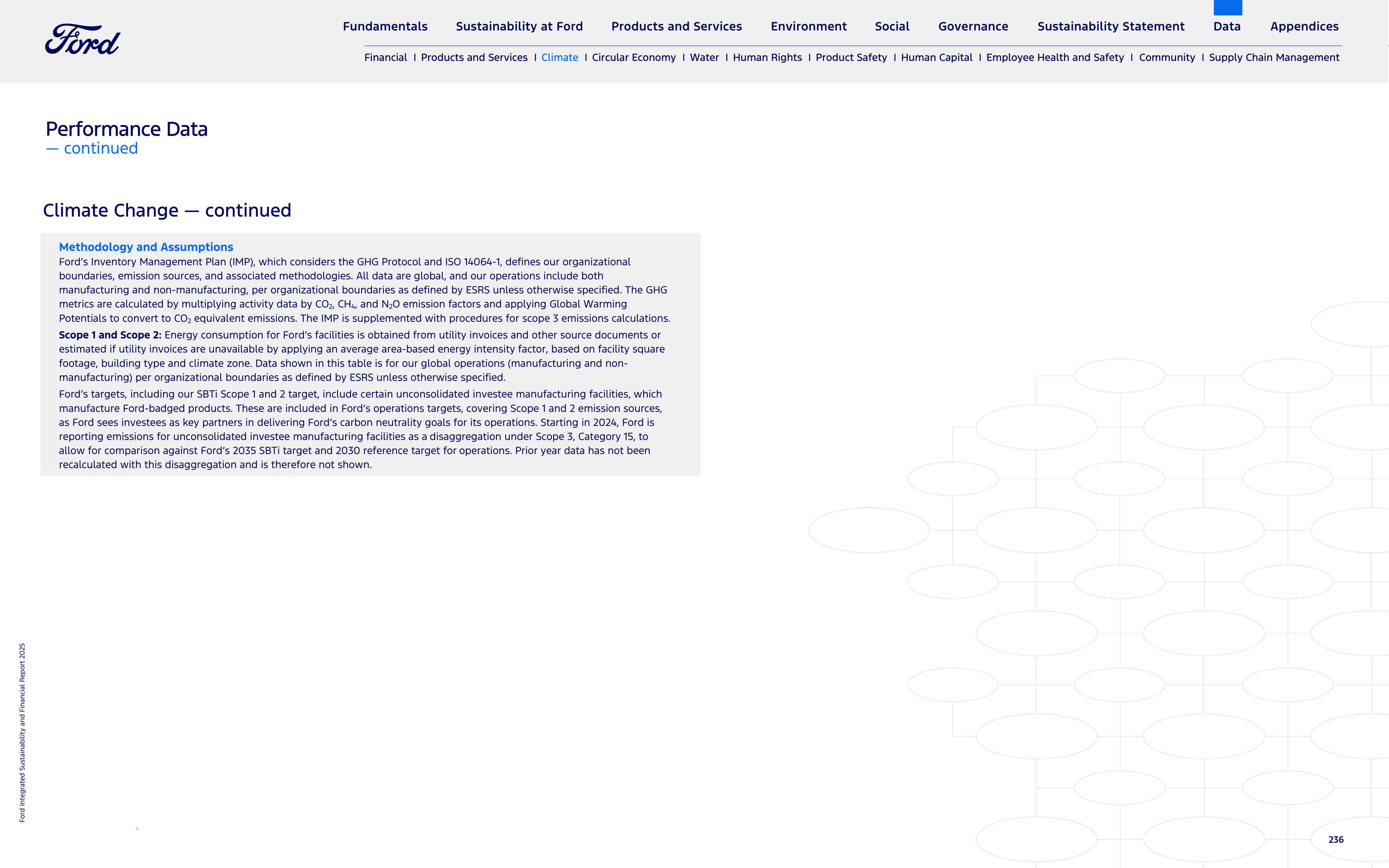

Fundamentals
Sustainability at Ford
Products and Services
Environment
Social
Governance
Sustainability Statement
Data
Appendices
Financial
|
Products and Services
|
Climate
|
Circular Economy
|
Water
|
Human Rights
|
Product Safety
|
Human Capital
|
Employee Health and Safety
|
Community
|
Supply Chain Management
Performance Data
— continued
,
Ford Integrated Sustainability and Financial Report 2025
236
Climate Change — continued
Methodology and Assumptions
Ford’s Inventory Management Plan (IMP), which considers the GHG Protocol and ISO 14064-1, defines our organizational
boundaries, emission sources, and associated methodologies. All data are global, and our operations include both
manufacturing and non-manufacturing, per organizational boundaries as defined by ESRS unless otherwise specified. The GHG
metrics are calculated by multiplying activity data by CO
2
, CH
4
, and N
2
O emission factors and applying Global Warming
Potentials to convert to CO
2
equivalent emissions. The IMP is supplemented with procedures for scope 3 emissions calculations.
Scope 1 and Scope 2:
Energy consumption for Ford’s facilities is obtained from utility invoices and other source documents or
estimated if utility invoices are unavailable by applying an average area-based energy intensity factor, based on facility square
footage, building type and climate zone. Data shown in this table is for our global operations (manufacturing and non-
manufacturing) per organizational boundaries as defined by ESRS unless otherwise specified.
Ford’s targets, including our SBTi Scope 1 and 2 target, include certain unconsolidated investee manufacturing facilities, which
manufacture Ford-badged products. These are included in Ford’s operations targets, covering Scope 1 and 2 emission sources,
as Ford sees investees as key partners in delivering Ford’s carbon neutrality goals for its operations. Starting in 2024, Ford is
reporting emissions for unconsolidated investee manufacturing facilities as a disaggregation under Scope 3, Category 15, to
allow for comparison against Ford’s 2035 SBTi target and 2030 reference target for operations. Prior year data has not been
recalculated with this disaggregation and is therefore not shown.
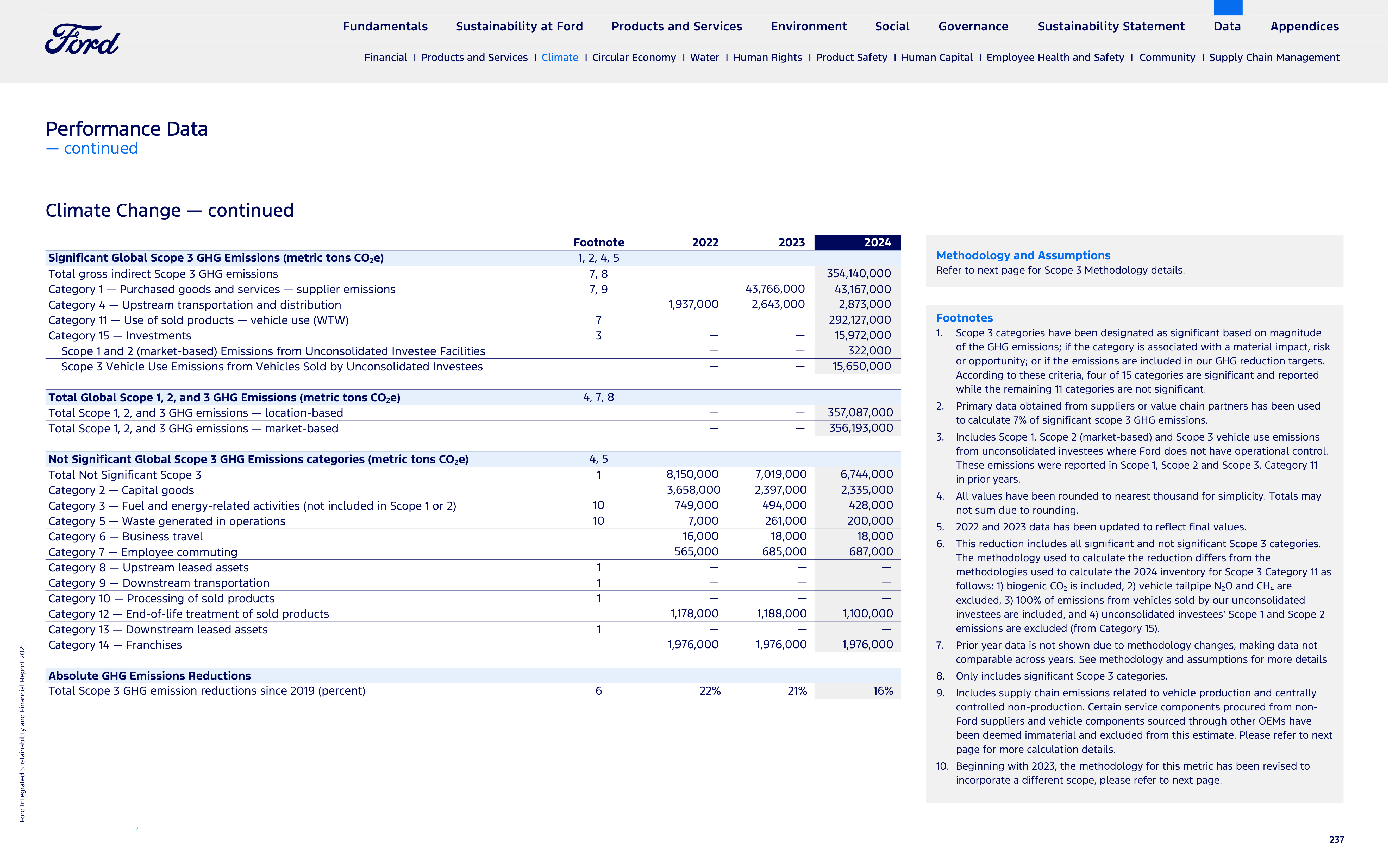
Fundamentals
Sustainability at Ford
Products and Services
Environment
Social
Governance
Sustainability Statement
Data
Appendices
Financial | Products and Services |
Climate
| Circular Economy | Water | Human Rights | Product Safety | Human Capital | Employee Health and Safety | Community | Supply Chain Management
Footnote
2022
2023
2024
Significant Global Scope 3 GHG Emissions (metric tons CO
2
e)
1, 2, 4, 5
Total gross indirect Scope 3 GHG emissions
7, 8
354,140,000
Category 1 — Purchased goods and services — supplier emissions
7, 9
43,766,000
43,167,000
Category 4 — Upstream transportation and distribution
1,937,000
2,643,000
2,873,000
Category 11 — Use of sold products — vehicle use (WTW)
7
292,127,000
Category 15 — Investments
3
—
—
15,972,000
Scope 1 and 2 (market-based) Emissions from Unconsolidated Investee Facilities
—
—
322,000
Scope 3 Vehicle Use Emissions from Vehicles Sold by Unconsolidated Investees
—
—
15,650,000
Total Global Scope 1, 2, and 3 GHG Emissions (metric tons CO
2
e)
4, 7, 8
Total Scope 1, 2, and 3 GHG emissions — location-based
—
—
357,087,000
Total Scope 1, 2, and 3 GHG emissions — market-based
—
—
356,193,000
Not Significant Global Scope 3 GHG Emissions categories (metric tons CO
2
e)
4, 5
Total Not Significant Scope 3
1
8,150,000
7,019,000
6,744,000
Category 2 — Capital goods
3,658,000
2,397,000
2,335,000
Category 3 — Fuel and energy-related activities (not included in Scope 1 or 2)
10
749,000
494,000
428,000
Category 5 — Waste generated in operations
10
7,000
261,000
200,000
Category 6 — Business travel
16,000
18,000
18,000
Category 7 — Employee commuting
565,000
685,000
687,000
Category 8 — Upstream leased assets
1
—
—
—
Category 9 — Downstream transportation
1
—
—
—
Category 10 — Processing of sold products
1
—
—
—
Category 12 — End-of-life treatment of sold products
1,178,000
1,188,000
1,100,000
Category 13 — Downstream leased assets
1
—
—
—
Category 14 — Franchises
1,976,000
1,976,000
1,976,000
Absolute GHG Emissions Reductions
Total Scope 3 GHG emission reductions since 2019 (percent)
6
22%
21%
16%
Performance Data
— continued
,
Ford Integrated Sustainability and Financial Report 2025
237
Climate Change — continued
Methodology and Assumptions
Refer to next page for Scope 3 Methodology details.
Footnotes
1.
Scope 3 categories have been designated as significant based on magnitude
of the GHG emissions; if the category is associated with a material impact, risk
or opportunity; or if the emissions are included in our GHG reduction targets.
According to these criteria, four of 15 categories are significant and reported
while the remaining 11 categories are not significant.
2.
Primary data obtained from suppliers or value chain partners has been used
to calculate 7% of significant scope 3 GHG emissions.
3.
Includes Scope 1, Scope 2 (market-based) and Scope 3 vehicle use emissions
from unconsolidated investees where Ford does not have operational control.
These emissions were reported in Scope 1, Scope 2 and Scope 3, Category 11
in prior years.
4.
All values have been rounded to nearest thousand for simplicity. Totals may
not sum due to rounding.
5.
2022 and 2023 data has been updated to reflect final values.
6.
This reduction includes all significant and not significant Scope 3 categories.
The methodology used to calculate the reduction differs from the
methodologies used to calculate the 2024 inventory for Scope 3 Category 11 as
follows: 1) biogenic CO
2
is included, 2) vehicle tailpipe N
2
O and CH
4
are
excluded, 3) 100% of emissions from vehicles sold by our unconsolidated
investees are included, and 4) unconsolidated investees’ Scope 1 and Scope 2
emissions are excluded (from Category 15).
7.
Prior year data is not shown due to methodology changes, making data not
comparable across years. See methodology and assumptions for more details
8.
Only includes significant Scope 3 categories.
9.
Includes supply chain emissions related to vehicle production and centrally
controlled non-production. Certain service components procured from non-
Ford suppliers and vehicle components sourced through other OEMs have
been deemed immaterial and excluded from this estimate. Please refer to next
page for more calculation details.
10.
Beginning with 2023, the methodology for this metric has been revised to
incorporate a different scope, please refer to next page.
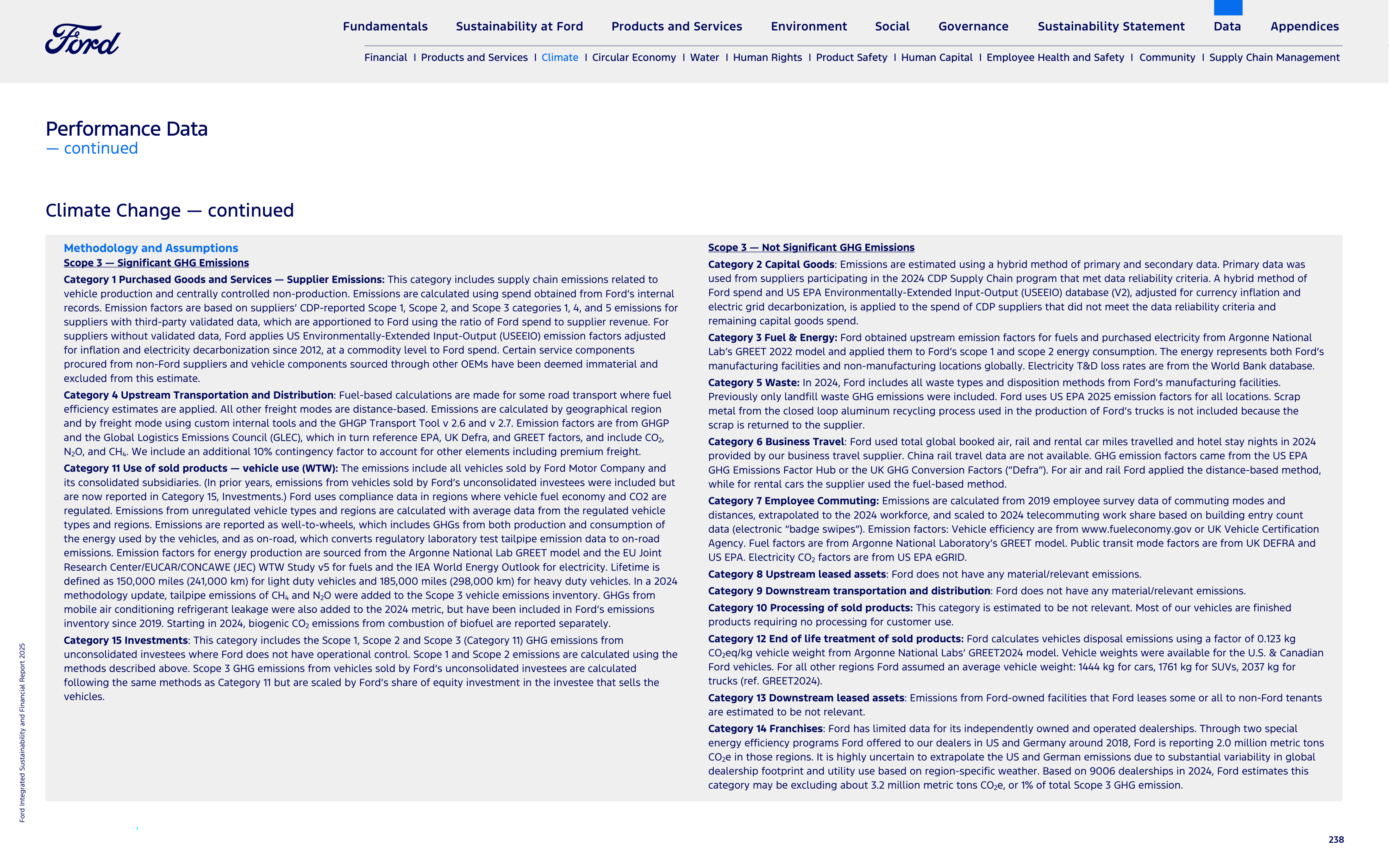
Fundamentals
Sustainability at Ford
Products and Services
Environment
Social
Governance
Sustainability Statement
Data
Appendices
Financial | Products and Services |
Climate
| Circular Economy | Water | Human Rights | Product Safety | Human Capital | Employee Health and Safety | Community | Supply Chain Management
Performance Data
— continued
,
Ford Integrated Sustainability and Financial Report 2025
238
Climate Change — continued
Methodology and Assumptions
Scope 3 — Significant GHG Emissions
Category 1 Purchased Goods and Services — Supplier Emissions:
This category includes supply chain emissions related to
vehicle production and centrally controlled non-production. Emissions are calculated using spend obtained from Ford’s internal
records. Emission factors are based on suppliers’ CDP-reported Scope 1, Scope 2, and Scope 3 categories 1, 4, and 5 emissions for
suppliers with third-party validated data, which are apportioned to Ford using the ratio of Ford spend to supplier revenue. For
suppliers without validated data, Ford applies US Environmentally-Extended Input-Output (USEEIO) emission factors adjusted
for inflation and electricity decarbonization since 2012, at a commodity level to Ford spend. Certain service components
procured from non-Ford suppliers and vehicle components sourced through other OEMs have been deemed immaterial and
excluded from this estimate.
Category 4 Upstream Transportation and Distribution
: Fuel-based calculations are made for some road transport where fuel
efficiency estimates are applied. All other freight modes are distance-based. Emissions are calculated by geographical region
and by freight mode using custom internal tools and the GHGP Transport Tool v 2.6 and v 2.7. Emission factors are from GHGP
and the Global Logistics Emissions Council (GLEC), which in turn reference EPA, UK Defra, and GREET factors, and include CO
2
,
N
2
O, and CH
4
. We include an additional 10% contingency factor to account for other elements including premium freight.
Category 11 Use of sold products — vehicle use (WTW):
The emissions include all vehicles sold by Ford Motor Company and
its consolidated subsidiaries. (In prior years, emissions from vehicles sold by Ford’s unconsolidated investees were included but
are now reported in Category 15, Investments.) Ford uses compliance data in regions where vehicle fuel economy and CO2 are
regulated. Emissions from unregulated vehicle types and regions are calculated with average data from the regulated vehicle
types and regions. Emissions are reported as well-to-wheels, which includes GHGs from both production and consumption of
the energy used by the vehicles, and as on-road, which converts regulatory laboratory test tailpipe emission data to on-road
emissions. Emission factors for energy production are sourced from the Argonne National Lab GREET model and the EU Joint
Research Center/EUCAR/CONCAWE (JEC) WTW Study v5 for fuels and the IEA World Energy Outlook for electricity. Lifetime is
defined as 150,000 miles (241,000 km) for light duty vehicles and 185,000 miles (298,000 km) for heavy duty vehicles. In a 2024
methodology update, tailpipe emissions of CH
4
and N
2
O were added to the Scope 3 vehicle emissions inventory. GHGs from
mobile air conditioning refrigerant leakage were also added to the 2024 metric, but have been included in Ford’s emissions
inventory since 2019. Starting in 2024, biogenic CO
2
emissions from combustion of biofuel are reported separately.
Category 15 Investments
: This category includes the Scope 1, Scope 2 and Scope 3 (Category 11) GHG emissions from
unconsolidated investees where Ford does not have operational control. Scope 1 and Scope 2 emissions are calculated using the
methods described above. Scope 3 GHG emissions from vehicles sold by Ford’s unconsolidated investees are calculated
following the same methods as Category 11 but are scaled by Ford’s share of equity investment in the investee that sells the
vehicles.
Scope 3 — Not Significant GHG Emissions
Category 2 Capital Goods
: Emissions are estimated using a hybrid method of primary and secondary data. Primary data was
used from suppliers participating in the 2024 CDP Supply Chain program that met data reliability criteria. A hybrid method of
Ford spend and US EPA Environmentally-Extended Input-Output (USEEIO) database (V2), adjusted for currency inflation and
electric grid decarbonization, is applied to the spend of CDP suppliers that did not meet the data reliability criteria and
remaining capital goods spend.
Category 3 Fuel & Energy:
Ford obtained upstream emission factors for fuels and purchased electricity from Argonne National
Lab’s GREET 2022 model and applied them to Ford’s scope 1 and scope 2 energy consumption. The energy represents both Ford’s
manufacturing facilities and non-manufacturing locations globally. Electricity T&D loss rates are from the World Bank database.
Category 5 Waste:
In 2024, Ford includes all waste types and disposition methods from Ford’s manufacturing facilities.
Previously only landfill waste GHG emissions were included. Ford uses US EPA 2025 emission factors for all locations. Scrap
metal from the closed loop aluminum recycling process used in the production of Ford’s trucks is not included because the
scrap is returned to the supplier.
Category 6 Business Travel
: Ford used total global booked air, rail and rental car miles travelled and hotel stay nights in 2024
provided by our business travel supplier. China rail travel data are not available. GHG emission factors came from the US EPA
GHG Emissions Factor Hub or the UK GHG Conversion Factors (“Defra”). For air and rail Ford applied the distance-based method,
while for rental cars the supplier used the fuel-based method.
Category 7 Employee Commuting:
Emissions are calculated from 2019 employee survey data of commuting modes and
distances, extrapolated to the 2024 workforce, and scaled to 2024 telecommuting work share based on building entry count
data (electronic “badge swipes”). Emission factors: Vehicle efficiency are from www.fueleconomy.gov or UK Vehicle Certification
Agency. Fuel factors are from Argonne National Laboratory’s GREET model. Public transit mode factors are from UK DEFRA and
US EPA. Electricity CO
2
factors are from US EPA eGRID.
Category 8 Upstream leased assets
: Ford does not have any material/relevant emissions.
Category 9 Downstream transportation and distribution
: Ford does not have any material/relevant emissions.
Category 10 Processing of sold products:
This category is estimated to be not relevant. Most of our vehicles are finished
products requiring no processing for customer use.
Category 12 End of life treatment of sold products:
Ford calculates vehicles disposal emissions using a factor of 0.123 kg
CO
2
eq/kg vehicle weight from Argonne National Labs’ GREET2024 model. Vehicle weights were available for the U.S. & Canadian
Ford vehicles. For all other regions Ford assumed an average vehicle weight: 1444 kg for cars, 1761 kg for SUVs, 2037 kg for
trucks (ref. GREET2024).
Category 13 Downstream leased assets
: Emissions from Ford-owned facilities that Ford leases some or all to non-Ford tenants
are estimated to be not relevant.
Category 14 Franchises
: Ford has limited data for its independently owned and operated dealerships. Through two special
energy efficiency programs Ford offered to our dealers in US and Germany around 2018, Ford is reporting 2.0 million metric tons
CO
2
e in those regions. It is highly uncertain to extrapolate the US and German emissions due to substantial variability in global
dealership footprint and utility use based on region-specific weather. Based on 9006 dealerships in 2024, Ford estimates this
category may be excluding about 3.2 million metric tons CO
2
e, or 1% of total Scope 3 GHG emission.
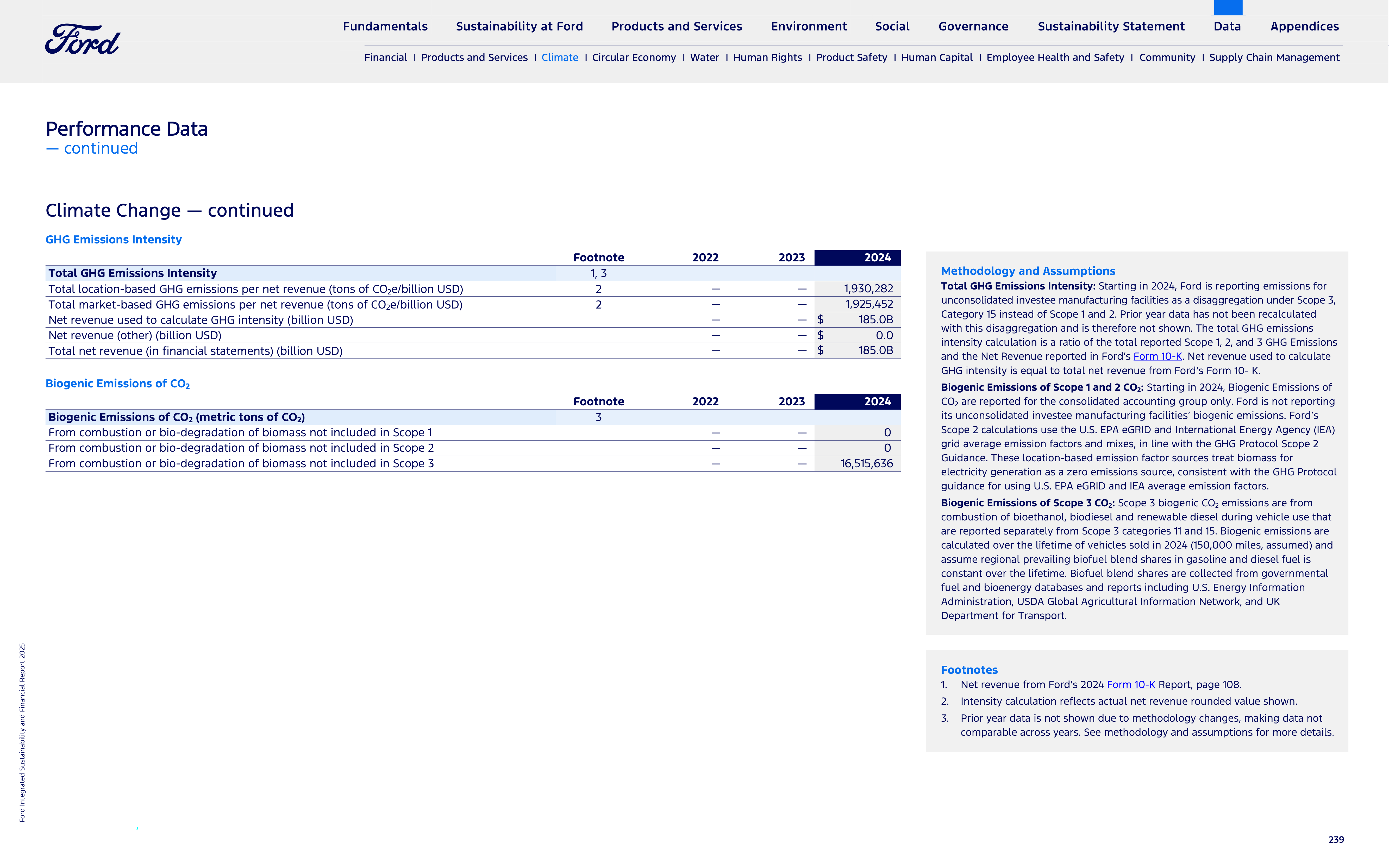
Fundamentals
Sustainability at Ford
Products and Services
Environment
Social
Governance
Sustainability Statement
Data
Appendices
Financial | Products and Services |
Climate
| Circular Economy | Water | Human Rights | Product Safety | Human Capital | Employee Health and Safety | Community | Supply Chain Management
GHG Emissions Intensity
Footnote
2022
2023
2024
Total GHG Emissions Intensity
1, 3
Total location-based GHG emissions per net revenue (tons of CO
2
e/billion USD)
2
—
—
1,930,282
Total market-based GHG emissions per net revenue (tons of CO
2
e/billion USD)
2
—
—
1,925,452
Net revenue used to calculate GHG intensity (billion USD)
—
—
$
185.0B
Net revenue (other) (billion USD)
—
—
$
0.0
Total net revenue (in financial statements) (billion USD)
—
—
$
185.0B
Biogenic Emissions of CO
2
Footnote
2022
2023
2024
Biogenic Emissions of CO
2
(metric tons of CO
2
)
3
From combustion or bio-degradation of biomass not included in Scope 1
—
—
0
From combustion or bio-degradation of biomass not included in Scope 2
—
—
0
From combustion or bio-degradation of biomass not included in Scope 3
—
—
16,515,636
Performance Data
— continued
,
Ford Integrated Sustainability and Financial Report 2025
239
Climate Change — continued
Methodology and Assumptions
Total GHG Emissions Intensity:
Starting in 2024, Ford is reporting emissions for
unconsolidated investee manufacturing facilities as a disaggregation under Scope 3,
Category 15 instead of Scope 1 and 2. Prior year data has not been recalculated
with this disaggregation and is therefore not shown. The total GHG emissions
intensity calculation is a ratio of the total reported Scope 1, 2, and 3 GHG Emissions
and the Net Revenue reported in Ford’s
Form 10-K
. Net revenue used to calculate
GHG intensity is equal to total net revenue from Ford’s Form 10- K.
Biogenic Emissions of Scope 1 and 2 CO
2
:
Starting in 2024, Biogenic Emissions of
CO
2
are reported for the consolidated accounting group only. Ford is not reporting
its unconsolidated investee manufacturing facilities’ biogenic emissions. Ford’s
Scope 2 calculations use the U.S. EPA eGRID and International Energy Agency (IEA)
grid average emission factors and mixes, in line with the GHG Protocol Scope 2
Guidance. These location-based emission factor sources treat biomass for
electricity generation as a zero emissions source, consistent with the GHG Protocol
guidance for using U.S. EPA eGRID and IEA average emission factors.
Biogenic Emissions of Scope 3 CO
2
:
Scope 3 biogenic CO
2
emissions are from
combustion of bioethanol, biodiesel and renewable diesel during vehicle use that
are reported separately from Scope 3 categories 11 and 15. Biogenic emissions are
calculated over the lifetime of vehicles sold in 2024 (150,000 miles, assumed) and
assume regional prevailing biofuel blend shares in gasoline and diesel fuel is
constant over the lifetime. Biofuel blend shares are collected from governmental
fuel and bioenergy databases and reports including U.S. Energy Information
Administration, USDA Global Agricultural Information Network, and UK
Department for Transport.
Footnotes
1.
Net revenue from Ford’s 2024
Form 10-K
Report, page 108.
2.
Intensity calculation reflects actual net revenue rounded value shown.
3.
Prior year data is not shown due to methodology changes, making data not
comparable across years. See methodology and assumptions for more details.
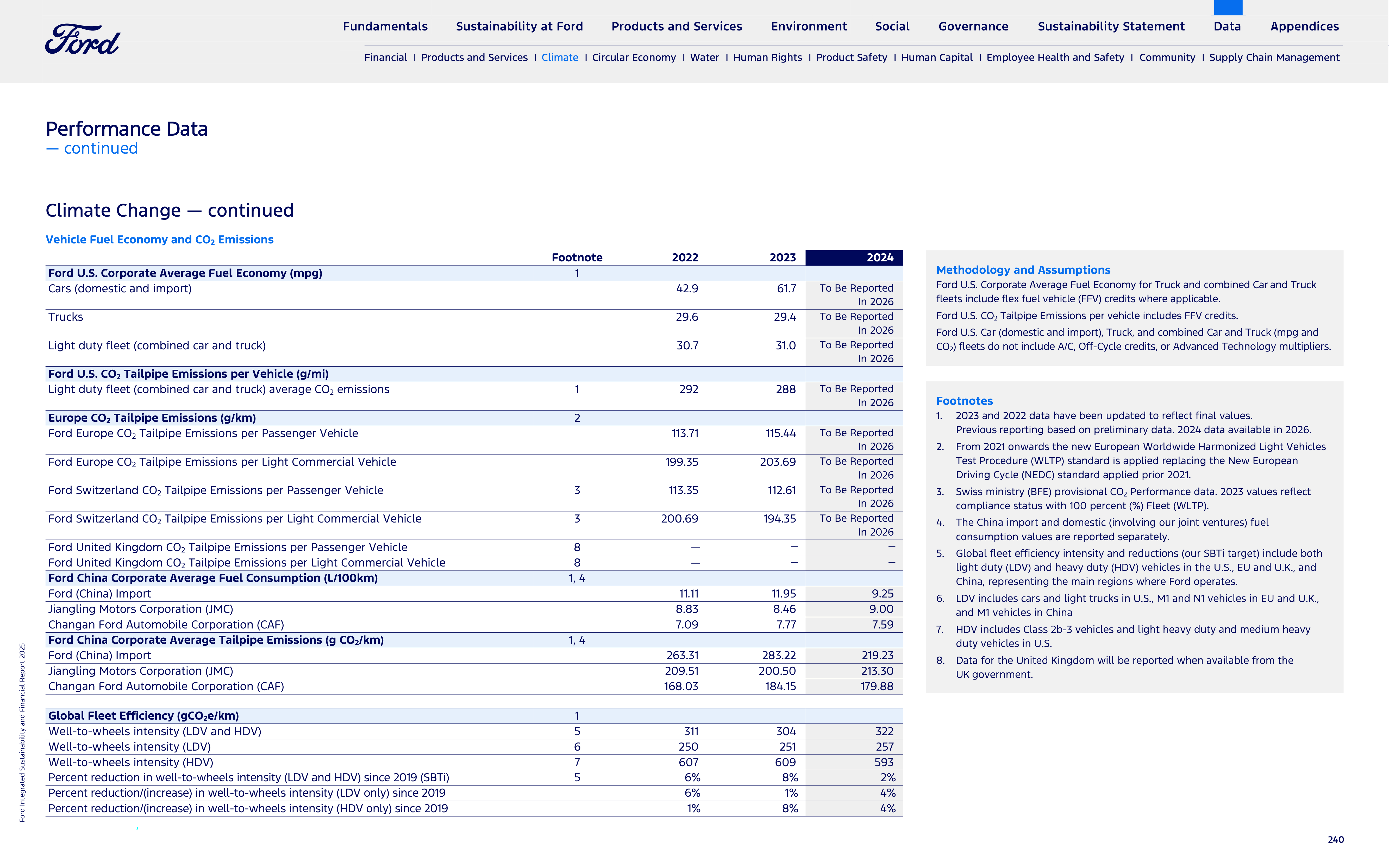
Fundamentals
Sustainability at Ford
Products and Services
Environment
Social
Governance
Sustainability Statement
Data
Appendices
Financial | Products and Services |
Climate
| Circular Economy | Water | Human Rights | Product Safety | Human Capital | Employee Health and Safety | Community | Supply Chain Management
Vehicle Fuel Economy and CO
2
Emissions
Footnote
2022
2023
2024
Ford U.S. Corporate Average Fuel Economy (mpg)
1
Cars (domestic and import)
42.9
61.7
To Be Reported
In 2026
Trucks
29.6
29.4
To Be Reported
In 2026
Light duty fleet (combined car and truck)
30.7
31.0
To Be Reported
In 2026
Ford U.S. CO
2
Tailpipe Emissions per Vehicle (g/mi)
Light duty fleet (combined car and truck) average CO
2
emissions
1
292
288
To Be Reported
In 2026
Europe CO
2
Tailpipe Emissions (g/km)
2
Ford Europe CO
2
Tailpipe Emissions per Passenger Vehicle
113.71
115.44
To Be Reported
In 2026
Ford Europe CO
2
Tailpipe Emissions per Light Commercial Vehicle
199.35
203.69
To Be Reported
In 2026
Ford Switzerland CO
2
Tailpipe Emissions per Passenger Vehicle
3
113.35
112.61
To Be Reported
In 2026
Ford Switzerland CO
2
Tailpipe Emissions per Light Commercial Vehicle
3
200.69
194.35
To Be Reported
In 2026
Ford United Kingdom CO
2
Tailpipe Emissions per Passenger Vehicle
8
—
—
—
Ford United Kingdom CO
2
Tailpipe Emissions per Light Commercial Vehicle
8
—
—
—
Ford China Corporate Average Fuel Consumption (L/100km)
1, 4
Ford (China) Import
11.11
11.95
9.25
Jiangling Motors Corporation (JMC)
8.83
8.46
9.00
Changan Ford Automobile Corporation (CAF)
7.09
7.77
7.59
Ford China Corporate Average Tailpipe Emissions (g CO
2
/km)
1, 4
Ford (China) Import
263.31
283.22
219.23
Jiangling Motors Corporation (JMC)
209.51
200.50
213.30
Changan Ford Automobile Corporation (CAF)
168.03
184.15
179.88
Global Fleet Efficiency (gCO
2
e/km)
1
Well-to-wheels intensity (LDV and HDV)
5
311
304
322
Well-to-wheels intensity (LDV)
6
250
251
257
Well-to-wheels intensity (HDV)
7
607
609
593
Percent reduction in well-to-wheels intensity (LDV and HDV) since 2019 (SBTi)
5
6%
8%
2%
Percent reduction/(increase) in well-to-wheels intensity (LDV only) since 2019
6%
1%
4%
Percent reduction/(increase) in well-to-wheels intensity (HDV only) since 2019
1%
8%
4%
Performance Data
— continued
,
Ford Integrated Sustainability and Financial Report 2025
240
Climate Change — continued
Methodology and Assumptions
Ford U.S. Corporate Average Fuel Economy for Truck and combined Car and Truck
fleets include flex fuel vehicle (FFV) credits where applicable.
Ford U.S. CO
2
Tailpipe Emissions per vehicle includes FFV credits.
Ford U.S. Car (domestic and import), Truck, and combined Car and Truck (mpg and
CO
2
) fleets do not include A/C, Off-Cycle credits, or Advanced Technology multipliers.
Footnotes
1.
2023 and 2022 data have been updated to reflect final values.
Previous reporting based on preliminary data. 2024 data available in 2026.
2.
From 2021 onwards the new European Worldwide Harmonized Light Vehicles
Test Procedure (WLTP) standard is applied replacing the New European
Driving Cycle (NEDC) standard applied prior 2021.
3.
Swiss ministry (BFE) provisional CO
2
Performance data. 2023 values reflect
compliance status with 100 percent (%) Fleet (WLTP).
4.
The China import and domestic (involving our joint ventures) fuel
consumption values are reported separately.
5.
Global fleet efficiency intensity and reductions (our SBTi target) include both
light duty (LDV) and heavy duty (HDV) vehicles in the U.S., EU and U.K., and
China, representing the main regions where Ford operates.
6.
LDV includes cars and light trucks in U.S., M1 and N1 vehicles in EU and U.K.,
and M1 vehicles in China
7.
HDV includes Class 2b-3 vehicles and light heavy duty and medium heavy
duty vehicles in U.S.
8.
Data for the United Kingdom will be reported when available from the
UK government.
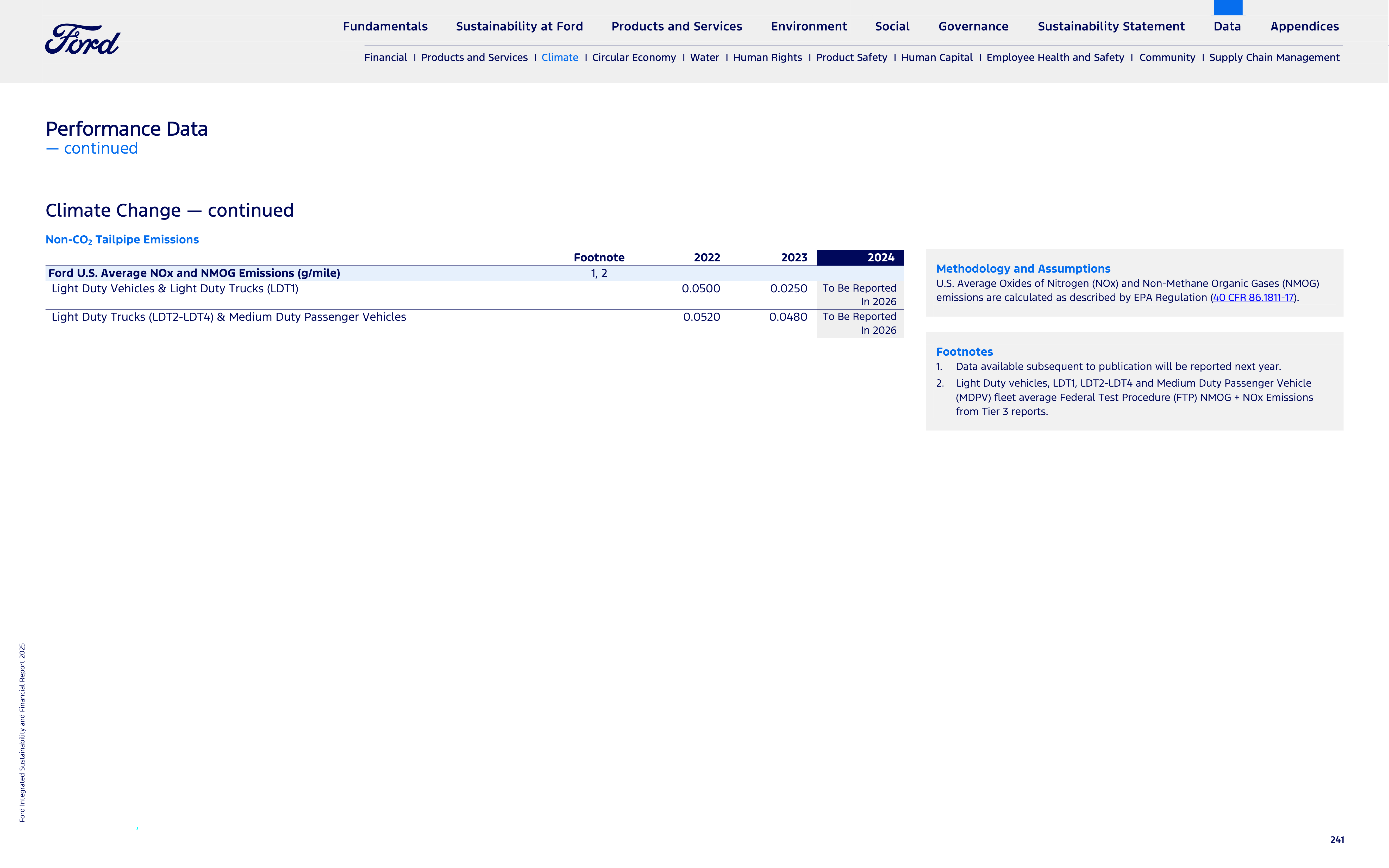
Fundamentals
Sustainability at Ford
Products and Services
Environment
Social
Governance
Sustainability Statement
Data
Appendices
Financial | Products and Services |
Climate
| Circular Economy | Water | Human Rights | Product Safety | Human Capital | Employee Health and Safety | Community | Supply Chain Management
Non-CO
2
Tailpipe Emissions
Footnote
2022
2023
2024
Ford U.S. Average NOx and NMOG Emissions (g/mile)
1, 2
Light Duty Vehicles & Light Duty Trucks (LDT1)
0.0500
0.0250
To Be Reported
In 2026
Light Duty Trucks (LDT2-LDT4) & Medium Duty Passenger Vehicles
0.0520
0.0480
To Be Reported
In 2026
Performance Data
— continued
,
Ford Integrated Sustainability and Financial Report 2025
241
Climate Change — continued
Methodology and Assumptions
U.S. Average Oxides of Nitrogen (NOx) and Non-Methane Organic Gases (NMOG)
emissions are calculated as described by EPA Regulation (
40 CFR 86.1811-17
).
Footnotes
1.
Data available subsequent to publication will be reported next year.
2.
Light Duty vehicles, LDT1, LDT2-LDT4 and Medium Duty Passenger Vehicle
(MDPV) fleet average Federal Test Procedure (FTP) NMOG + NOx Emissions
from Tier 3 reports.
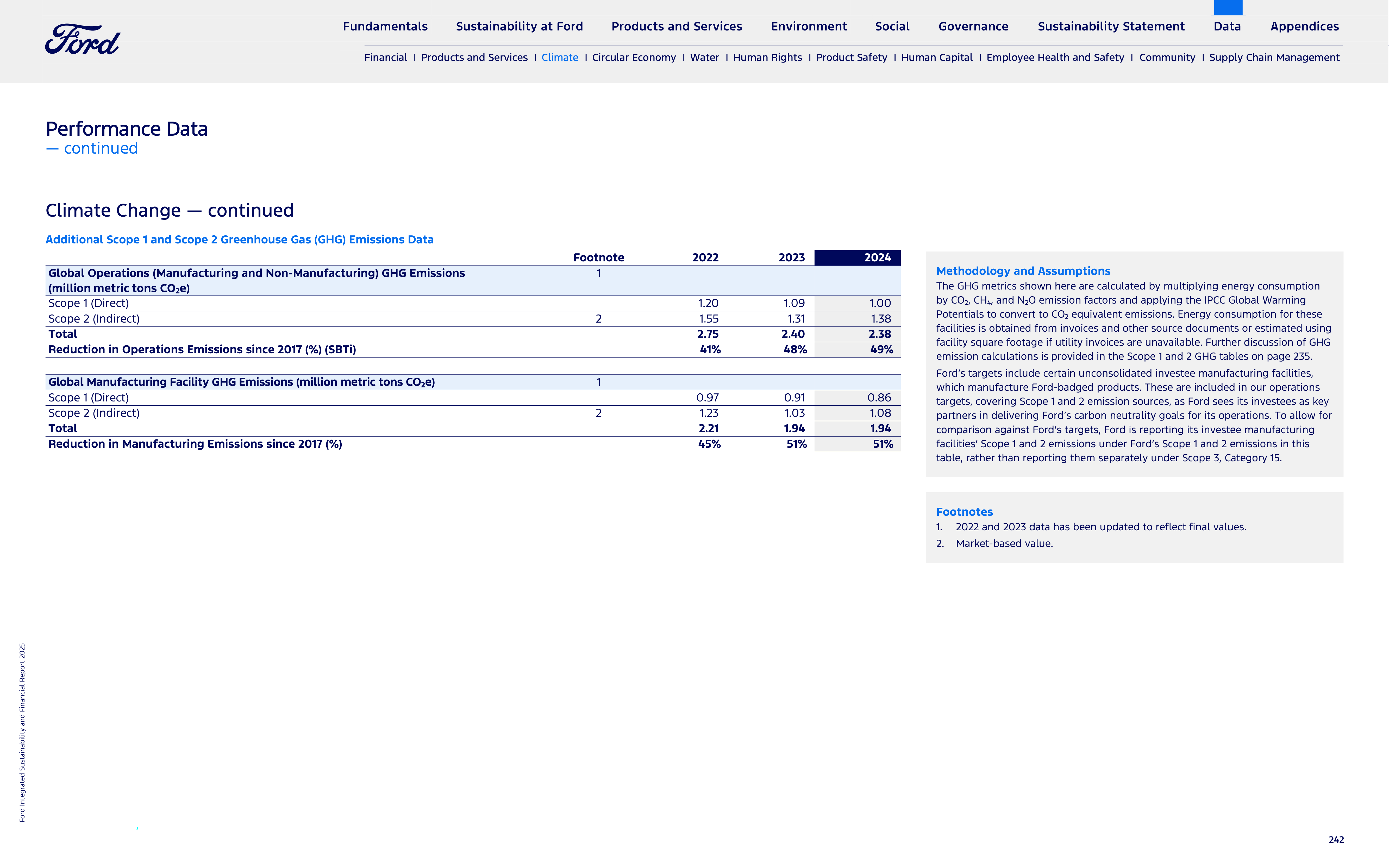
Fundamentals
Sustainability at Ford
Products and Services
Environment
Social
Governance
Sustainability Statement
Data
Appendices
Financial | Products and Services |
Climate
| Circular Economy | Water | Human Rights | Product Safety | Human Capital | Employee Health and Safety | Community | Supply Chain Management
Additional Scope 1 and Scope 2 Greenhouse Gas (GHG) Emissions Data
Footnote
2022
2023
2024
Global Operations (Manufacturing and Non-Manufacturing) GHG Emissions
(million metric tons CO
2
e)
1
Scope 1 (Direct)
1.20
1.09
1.00
Scope 2 (Indirect)
2
1.55
1.31
1.38
Total
2.75
2.40
2.38
Reduction in Operations Emissions since 2017 (%) (SBTi)
41%
48%
49%
Global Manufacturing Facility GHG Emissions (million metric tons CO
2
e)
1
Scope 1 (Direct)
0.97
0.91
0.86
Scope 2 (Indirect)
2
1.23
1.03
1.08
Total
2.21
1.94
1.94
Reduction in Manufacturing Emissions since 2017 (%)
45%
51%
51%
Performance Data
— continued
,
Ford Integrated Sustainability and Financial Report 2025
242
Methodology and Assumptions
The GHG metrics shown here are calculated by multiplying energy consumption
by CO
2
, CH
4
, and N
2
O emission factors and applying the IPCC Global Warming
Potentials to convert to CO
2
equivalent emissions. Energy consumption for these
facilities is obtained from invoices and other source documents or estimated using
facility square footage if utility invoices are unavailable. Further discussion of GHG
emission calculations is provided in the Scope 1 and 2 GHG tables on page 235.
Ford’s targets include certain unconsolidated investee manufacturing facilities,
which manufacture Ford-badged products. These are included in our operations
targets, covering Scope 1 and 2 emission sources, as Ford sees its investees as key
partners in delivering Ford’s carbon neutrality goals for its operations. To allow for
comparison against Ford’s targets, Ford is reporting its investee manufacturing
facilities’ Scope 1 and 2 emissions under Ford’s Scope 1 and 2 emissions in this
table, rather than reporting them separately under Scope 3, Category 15.
Footnotes
1.
2022 and 2023 data has been updated to reflect final values.
2.
Market-based value.
Climate Change — continued
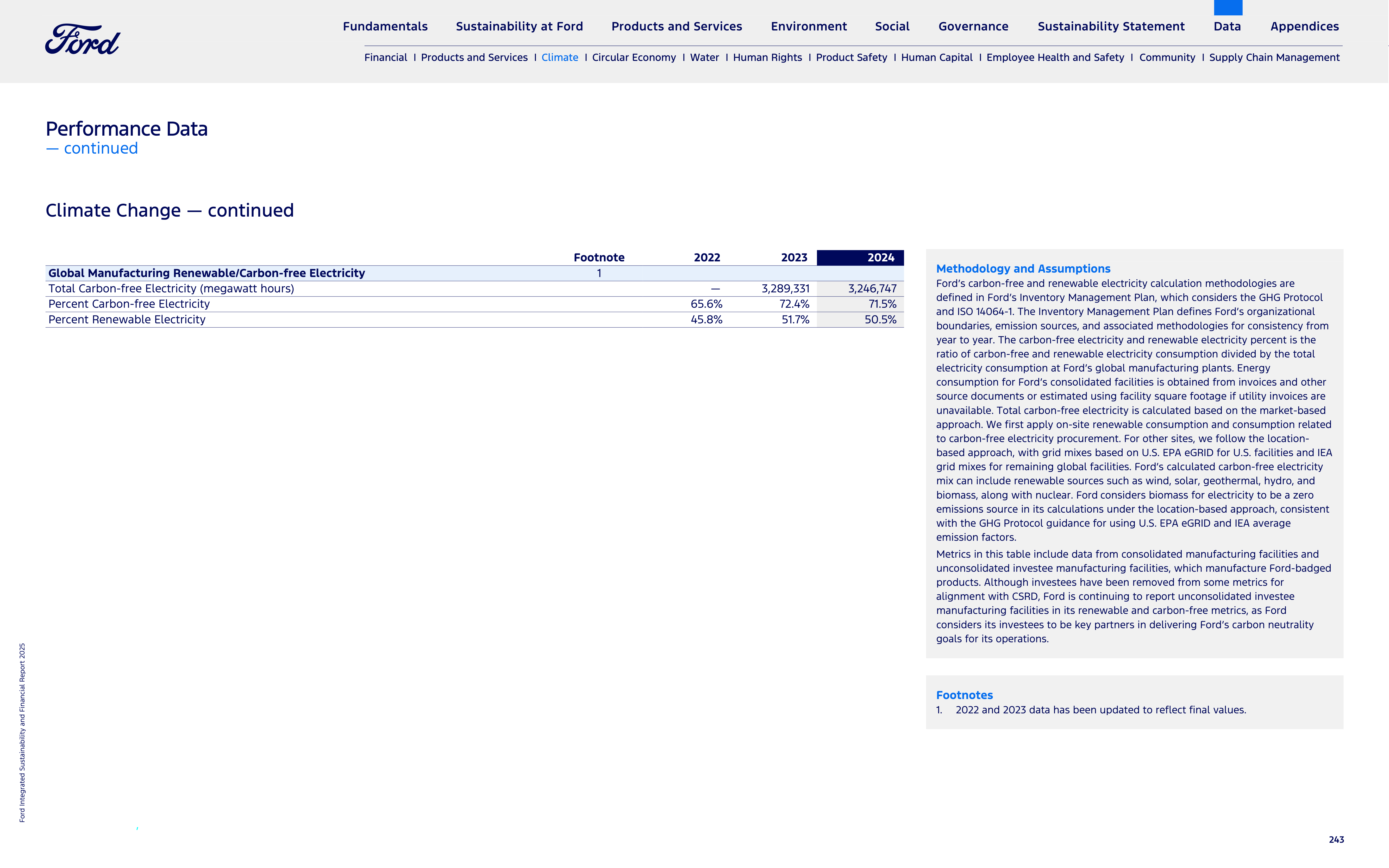
Footnote
2022
2023
2024
Global Manufacturing Renewable/Carbon-free Electricity
1
Total Carbon-free Electricity (megawatt hours)
—
3,289,331
3,246,747
Percent Carbon-free Electricity
65.6%
72.4%
71.5%
Percent Renewable Electricity
45.8%
51.7%
50.5%
Fundamentals
Sustainability at Ford
Products and Services
Environment
Social
Governance
Sustainability Statement
Data
Appendices
Financial | Products and Services |
Climate
| Circular Economy | Water | Human Rights | Product Safety | Human Capital | Employee Health and Safety | Community | Supply Chain Management
Performance Data
— continued
,
Ford Integrated Sustainability and Financial Report 2025
243
Climate Change — continued
Methodology and Assumptions
Ford’s carbon-free and renewable electricity calculation methodologies are
defined in Ford’s Inventory Management Plan, which considers the GHG Protocol
and ISO 14064-1. The Inventory Management Plan defines Ford’s organizational
boundaries, emission sources, and associated methodologies for consistency from
year to year. The carbon-free electricity and renewable electricity percent is the
ratio of carbon-free and renewable electricity consumption divided by the total
electricity consumption at Ford’s global manufacturing plants. Energy
consumption for Ford’s consolidated facilities is obtained from invoices and other
source documents or estimated using facility square footage if utility invoices are
unavailable. Total carbon-free electricity is calculated based on the market-based
approach. We first apply on-site renewable consumption and consumption related
to carbon-free electricity procurement. For other sites, we follow the location-
based approach, with grid mixes based on U.S. EPA eGRID for U.S. facilities and IEA
grid mixes for remaining global facilities. Ford’s calculated carbon-free electricity
mix can include renewable sources such as wind, solar, geothermal, hydro, and
biomass, along with nuclear. Ford considers biomass for electricity to be a zero
emissions source in its calculations under the location-based approach, consistent
with the GHG Protocol guidance for using U.S. EPA eGRID and IEA average
emission factors.
Metrics in this table include data from consolidated manufacturing facilities and
unconsolidated investee manufacturing facilities, which manufacture Ford-badged
products. Although investees have been removed from some metrics for
alignment with CSRD, Ford is continuing to report unconsolidated investee
manufacturing facilities in its renewable and carbon-free metrics, as Ford
considers its investees to be key partners in delivering Ford’s carbon neutrality
goals for its operations.
Footnotes
1.
2022 and 2023 data has been updated to reflect final values.
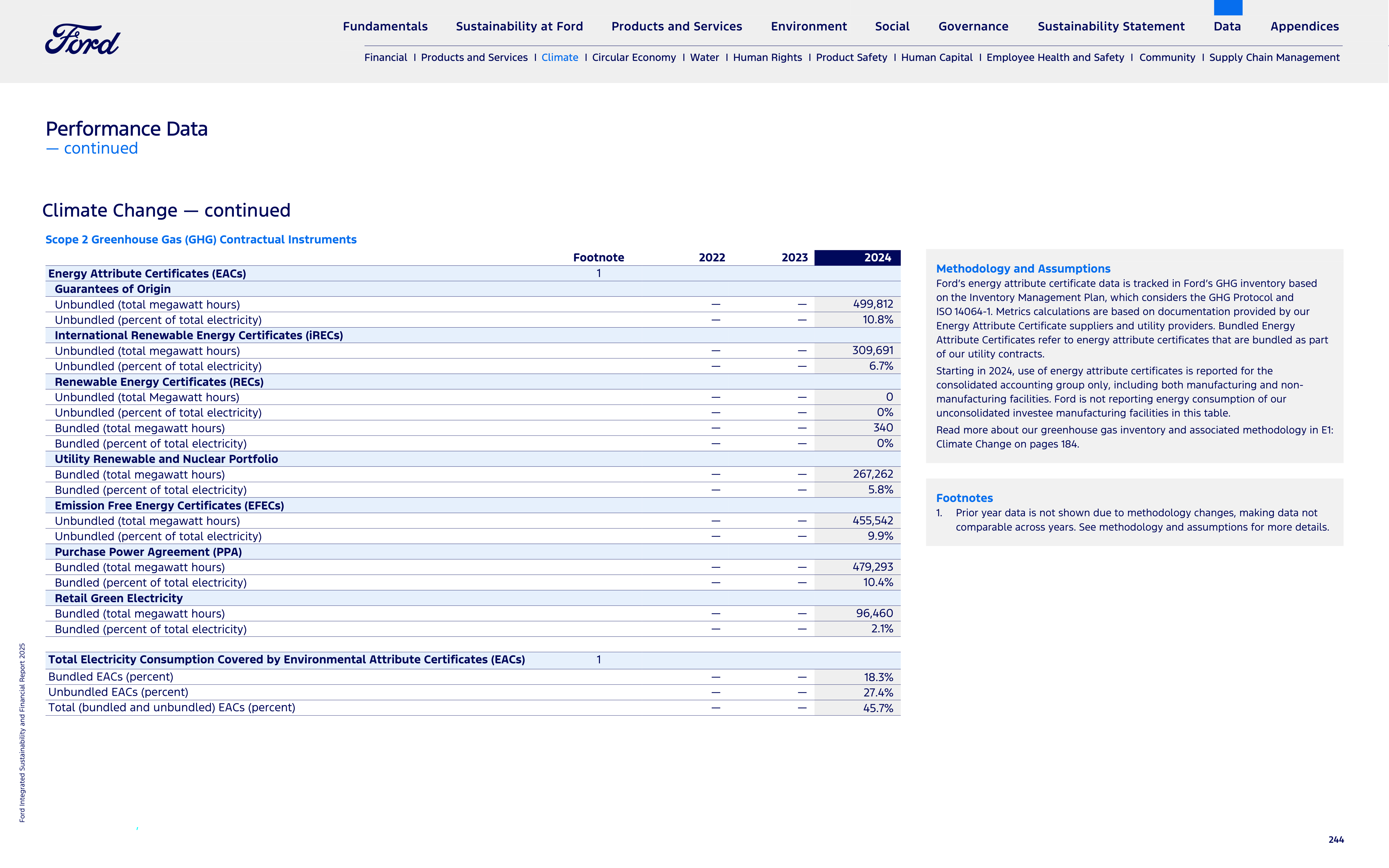
Fundamentals
Sustainability at Ford
Products and Services
Environment
Social
Governance
Sustainability Statement
Data
Appendices
Financial | Products and Services |
Climate
| Circular Economy | Water | Human Rights | Product Safety | Human Capital | Employee Health and Safety | Community | Supply Chain Management
Scope 2 Greenhouse Gas (GHG) Contractual Instruments
Footnote
2022
2023
2024
Energy Attribute Certificates (EACs)
1
Guarantees of Origin
Unbundled (total megawatt hours)
—
—
499,812
Unbundled (percent of total electricity)
—
—
10.8%
International Renewable Energy Certificates (iRECs)
Unbundled (total megawatt hours)
—
—
309,691
Unbundled (percent of total electricity)
—
—
6.7%
Renewable Energy Certificates (RECs)
Unbundled (total Megawatt hours)
—
—
0
Unbundled (percent of total electricity)
—
—
0%
Bundled (total megawatt hours)
—
—
340
Bundled (percent of total electricity)
—
—
0%
Utility Renewable and Nuclear Portfolio
Bundled (total megawatt hours)
—
—
267,262
Bundled (percent of total electricity)
—
—
5.8%
Emission Free Energy Certificates (EFECs)
Unbundled (total megawatt hours)
—
—
455,542
Unbundled (percent of total electricity)
—
—
9.9%
Purchase Power Agreement (PPA)
Bundled (total megawatt hours)
—
—
479,293
Bundled (percent of total electricity)
—
—
10.4%
Retail Green Electricity
Bundled (total megawatt hours)
—
—
96,460
Bundled (percent of total electricity)
—
—
2.1%
Total Electricity Consumption Covered by Environmental Attribute Certificates (EACs)
1
Bundled EACs (percent)
—
—
18.3%
Unbundled EACs (percent)
—
—
27.4%
Total (bundled and unbundled) EACs (percent)
—
—
45.7%
Performance Data
— continued
,
Ford Integrated Sustainability and Financial Report 2025
244
Climate Change — continued
Methodology and Assumptions
Ford’s energy attribute certificate data is tracked in Ford’s GHG inventory based
on the Inventory Management Plan, which considers the GHG Protocol and
ISO 14064-1. Metrics calculations are based on documentation provided by our
Energy Attribute Certificate suppliers and utility providers. Bundled Energy
Attribute Certificates refer to energy attribute certificates that are bundled as part
of our utility contracts.
Starting in 2024, use of energy attribute certificates is reported for the
consolidated accounting group only, including both manufacturing and non-
manufacturing facilities. Ford is not reporting energy consumption of our
unconsolidated investee manufacturing facilities in this table.
Read more about our greenhouse gas inventory and associated methodology in E1:
Climate Change on pages 184.
Footnotes
1.
Prior year data is not shown due to methodology changes, making data not
comparable across years. See methodology and assumptions for more details.
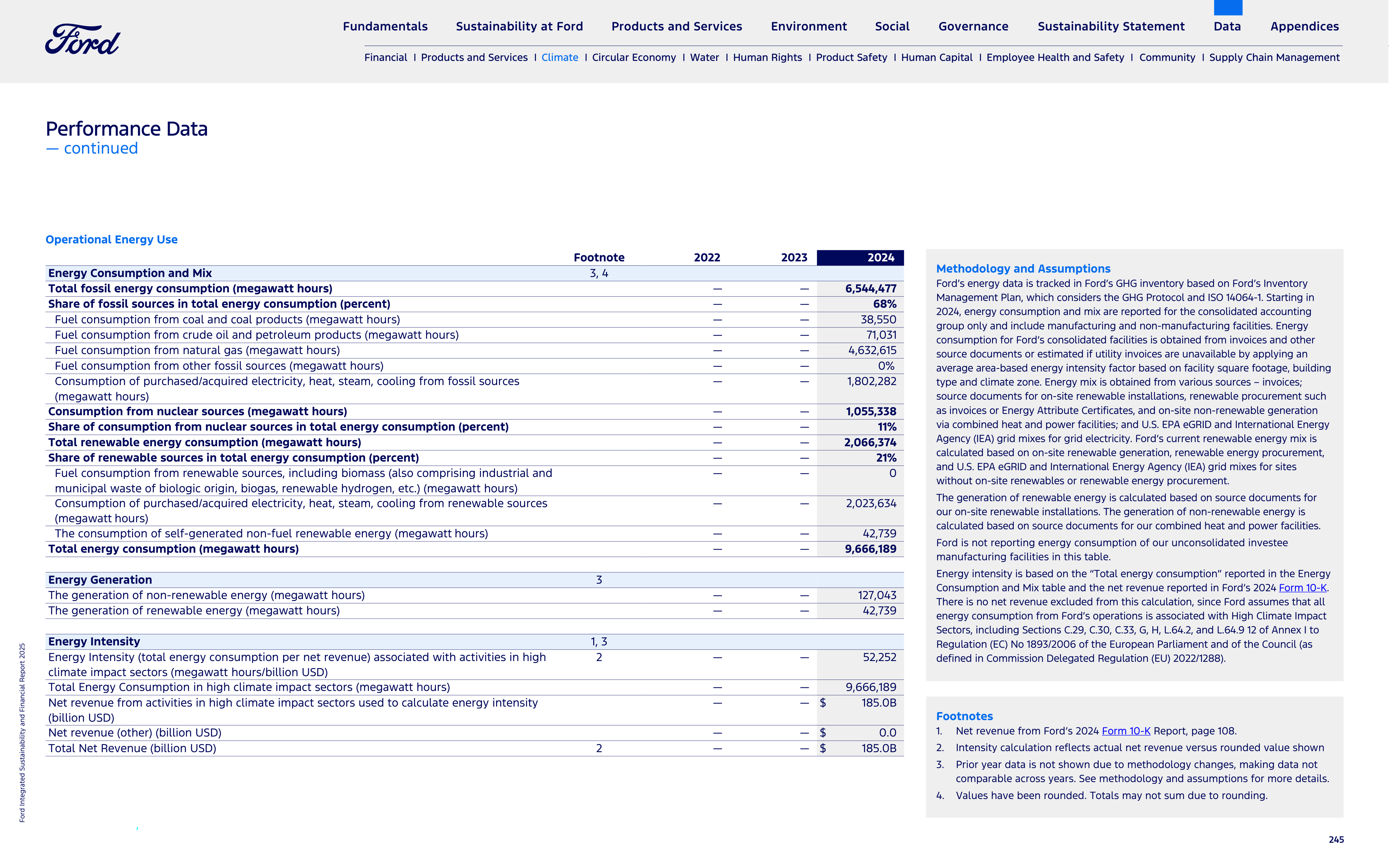
Fundamentals
Sustainability at Ford
Products and Services
Environment
Social
Governance
Sustainability Statement
Data
Appendices
Financial | Products and Services |
Climate
| Circular Economy | Water | Human Rights | Product Safety | Human Capital | Employee Health and Safety | Community | Supply Chain Management
Operational Energy Use
Footnote
2022
2023
2024
Energy Consumption and Mix
3, 4
Total fossil energy consumption (megawatt hours)
—
—
6,544,477
Share of fossil sources in total energy consumption (percent)
—
—
68%
Fuel consumption from coal and coal products (megawatt hours)
—
—
38,550
Fuel consumption from crude oil and petroleum products (megawatt hours)
—
—
71,031
Fuel consumption from natural gas (megawatt hours)
—
—
4,632,615
Fuel consumption from other fossil sources (megawatt hours)
—
—
0%
Consumption of purchased/acquired electricity, heat, steam, cooling from fossil sources
(megawatt hours)
—
—
1,802,282
Consumption from nuclear sources (megawatt hours)
—
—
1,055,338
Share of consumption from nuclear sources in total energy consumption (percent)
—
—
11%
Total renewable energy consumption (megawatt hours)
—
—
2,066,374
Share of renewable sources in total energy consumption (percent)
—
—
21%
Fuel consumption from renewable sources, including biomass (also comprising industrial and
municipal waste of biologic origin, biogas, renewable hydrogen, etc.) (megawatt hours)
—
—
0
Consumption of purchased/acquired electricity, heat, steam, cooling from renewable sources
(megawatt hours)
—
—
2,023,634
The consumption of self-generated non-fuel renewable energy (megawatt hours)
—
—
42,739
Total energy consumption (megawatt hours)
—
—
9,666,189
Energy Generation
3
The generation of non-renewable energy (megawatt hours)
—
—
127,043
The generation of renewable energy (megawatt hours)
—
—
42,739
Energy Intensity
1, 3
Energy Intensity (total energy consumption per net revenue) associated with activities in high
climate impact sectors (megawatt hours/billion USD)
2
—
—
52,252
Total Energy Consumption in high climate impact sectors (megawatt hours)
—
—
9,666,189
Net revenue from activities in high climate impact sectors used to calculate energy intensity
(billion USD)
—
—
$
185.0B
Net revenue (other) (billion USD)
—
—
$
0.0
Total Net Revenue (billion USD)
2
—
—
$
185.0B
Performance Data
— continued
,
Ford Integrated Sustainability and Financial Report 2025
245
Methodology and Assumptions
Ford’s energy data is tracked in Ford’s GHG inventory based on Ford’s Inventory
Management Plan, which considers the GHG Protocol and ISO 14064-1. Starting in
2024, energy consumption and mix are reported for the consolidated accounting
group only and include manufacturing and non-manufacturing facilities. Energy
consumption for Ford’s consolidated facilities is obtained from invoices and other
source documents or estimated if utility invoices are unavailable by applying an
average area-based energy intensity factor based on facility square footage, building
type and climate zone. Energy mix is obtained from various sources – invoices;
source documents for on-site renewable installations, renewable procurement such
as invoices or Energy Attribute Certificates, and on-site non-renewable generation
via combined heat and power facilities; and U.S. EPA eGRID and International Energy
Agency (IEA) grid mixes for grid electricity. Ford’s current renewable energy mix is
calculated based on on-site renewable generation, renewable energy procurement,
and U.S. EPA eGRID and International Energy Agency (IEA) grid mixes for sites
without on-site renewables or renewable energy procurement.
The generation of renewable energy is calculated based on source documents for
our on-site renewable installations. The generation of non-renewable energy is
calculated based on source documents for our combined heat and power facilities.
Ford is not reporting energy consumption of our unconsolidated investee
manufacturing facilities in this table.
Energy intensity is based on the “Total energy consumption” reported in the Energy
Consumption and Mix table and the net revenue reported in Ford’s 2024
Form 10-K
.
There is no net revenue excluded from this calculation, since Ford assumes that all
energy consumption from Ford’s operations is associated with High Climate Impact
Sectors, including Sections C.29, C.30, C.33, G, H, L.64.2, and L.64.9 12 of Annex I to
Regulation (EC) No 1893/2006 of the European Parliament and of the Council (as
defined in Commission Delegated Regulation (EU) 2022/1288).
Footnotes
1.
Net revenue from Ford’s 2024
Form 10-K
Report, page 108.
2.
Intensity calculation reflects actual net revenue versus rounded value shown
3.
Prior year data is not shown due to methodology changes, making data not
comparable across years. See methodology and assumptions for more details.
4.
Values have been rounded. Totals may not sum due to rounding.
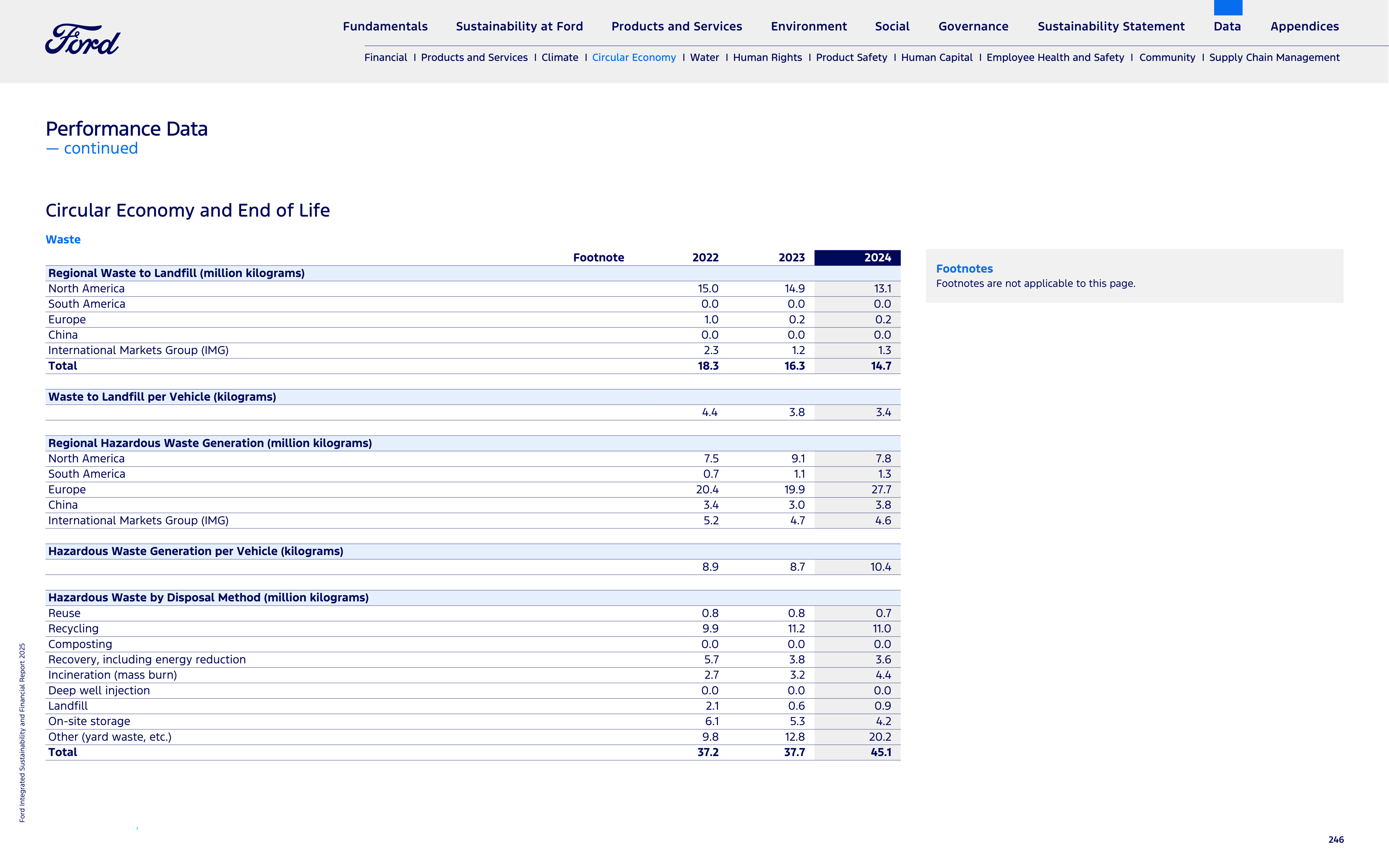
Fundamentals
Sustainability at Ford
Products and Services
Environment
Social
Governance
Sustainability Statement
Data
Appendices
Financial | Products and Services | Climate |
Circular Economy
| Water | Human Rights | Product Safety | Human Capital | Employee Health and Safety | Community | Supply Chain Management
Circular Economy and End of Life
Waste
Footnote
2022
2023
2024
Regional Waste to Landfill (million kilograms)
North America
15.0
14.9
13.1
South America
0.0
0.0
0.0
Europe
1.0
0.2
0.2
China
0.0
0.0
0.0
International Markets Group (IMG)
2.3
1.2
1.3
Total
18.3
16.3
14.7
Waste to Landfill per Vehicle (kilograms)
4.4
3.8
3.4
Regional Hazardous Waste Generation (million kilograms)
North America
7.5
9.1
7.8
South America
0.7
1.1
1.3
Europe
20.4
19.9
27.7
China
3.4
3.0
3.8
International Markets Group (IMG)
5.2
4.7
4.6
Hazardous Waste Generation per Vehicle (kilograms)
8.9
8.7
10.4
Hazardous Waste by Disposal Method (million kilograms)
Reuse
0.8
0.8
0.7
Recycling
9.9
11.2
11.0
Composting
0.0
0.0
0.0
Recovery, including energy reduction
5.7
3.8
3.6
Incineration (mass burn)
2.7
3.2
4.4
Deep well injection
0.0
0.0
0.0
Landfill
2.1
0.6
0.9
On-site storage
6.1
5.3
4.2
Other (yard waste, etc.)
9.8
12.8
20.2
Total
37.2
37.7
45.1
Performance Data
— continued
,
Ford Integrated Sustainability and Financial Report 2025
246
Footnotes
Footnotes are not applicable to this page.
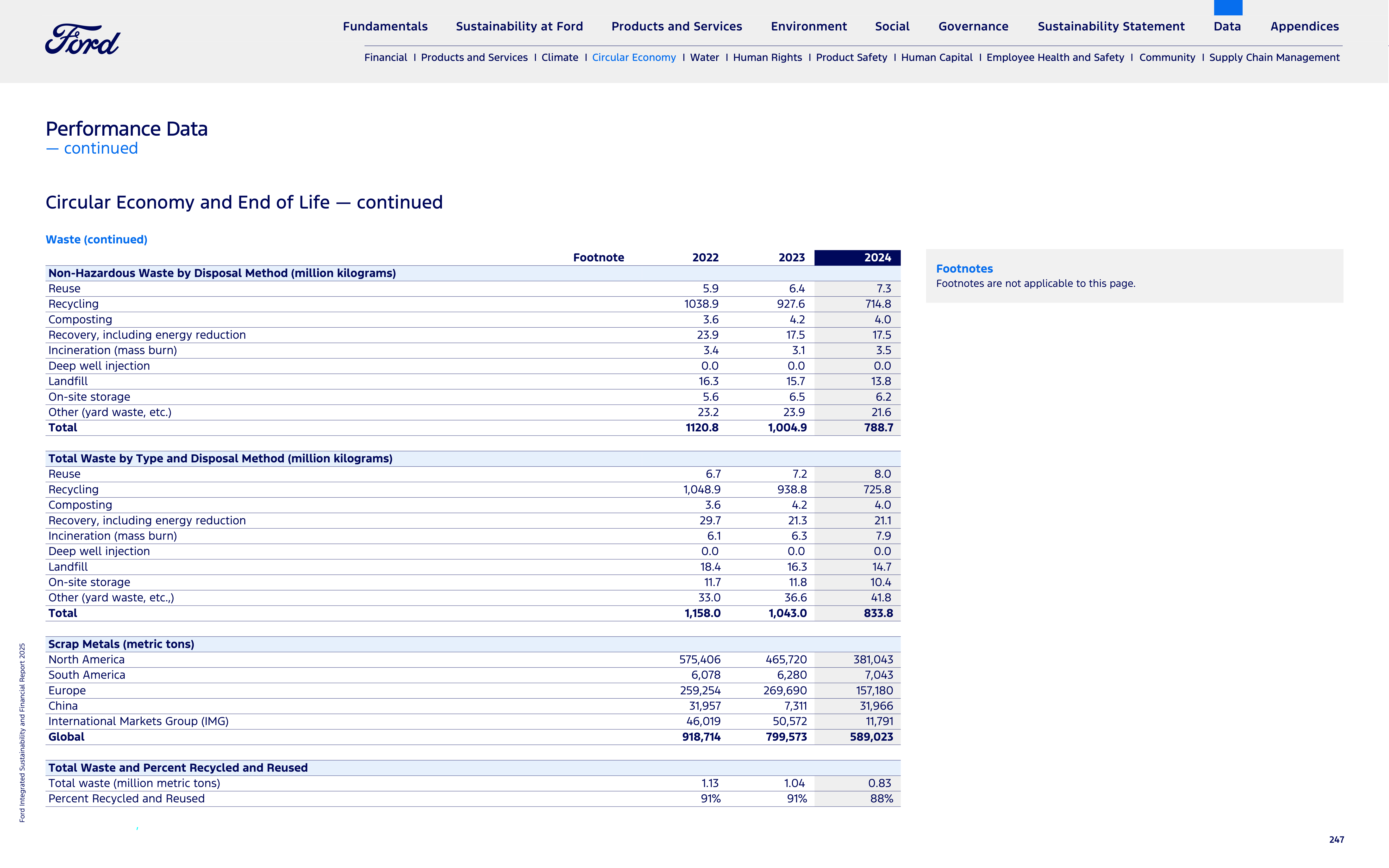
Waste (continued)
Footnote
2022
2023
2024
Non-Hazardous Waste by Disposal Method (million kilograms)
Reuse
5.9
6.4
7.3
Recycling
1038.9
927.6
714.8
Composting
3.6
4.2
4.0
Recovery, including energy reduction
23.9
17.5
17.5
Incineration (mass burn)
3.4
3.1
3.5
Deep well injection
0.0
0.0
0.0
Landfill
16.3
15.7
13.8
On-site storage
5.6
6.5
6.2
Other (yard waste, etc.)
23.2
23.9
21.6
Total
1120.8
1,004.9
788.7
Total Waste by Type and Disposal Method (million kilograms)
Reuse
6.7
7.2
8.0
Recycling
1,048.9
938.8
725.8
Composting
3.6
4.2
4.0
Recovery, including energy reduction
29.7
21.3
21.1
Incineration (mass burn)
6.1
6.3
7.9
Deep well injection
0.0
0.0
0.0
Landfill
18.4
16.3
14.7
On-site storage
11.7
11.8
10.4
Other (yard waste, etc.,)
33.0
36.6
41.8
Total
1,158.0
1,043.0
833.8
Scrap Metals (metric tons)
North America
575,406
465,720
381,043
South America
6,078
6,280
7,043
Europe
259,254
269,690
157,180
China
31,957
7,311
31,966
International Markets Group (IMG)
46,019
50,572
11,791
Global
918,714
799,573
589,023
Total Waste and Percent Recycled and Reused
Total waste (million metric tons)
1.13
1.04
0.83
Percent Recycled and Reused
91%
91%
88%
Fundamentals
Sustainability at Ford
Products and Services
Environment
Social
Governance
Sustainability Statement
Data
Appendices
Financial | Products and Services | Climate |
Circular Economy
| Water | Human Rights | Product Safety | Human Capital | Employee Health and Safety | Community | Supply Chain Management
Performance Data
— continued
,
Ford Integrated Sustainability and Financial Report 2025
247
Circular Economy and End of Life — continued
Footnotes
Footnotes are not applicable to this page.
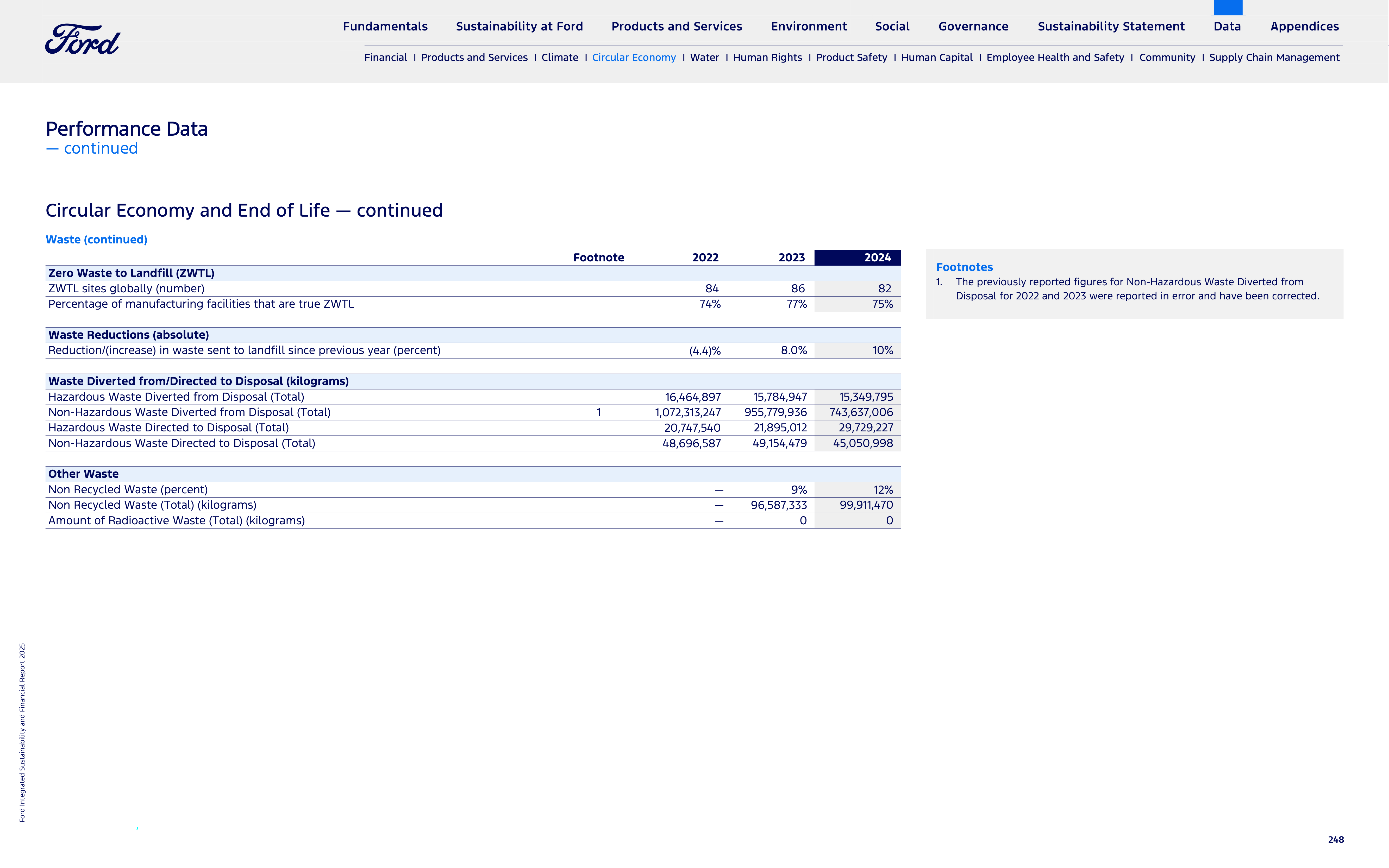
Waste (continued)
Zero Waste to Landfill (ZWTL)
ZWTL sites globally (number)
84
86
82
Percentage of manufacturing facilities that are true ZWTL
74%
77%
75%
Waste Reductions (absolute)
Reduction/(increase) in waste sent to landfill since previous year (percent)
(4.4)%
8.0%
10%
Waste Diverted from/Directed to Disposal (kilograms)
Hazardous Waste Diverted from Disposal (Total)
16,464,897
15,784,947
15,349,795
Non-Hazardous Waste Diverted from Disposal (Total)
1
1,072,313,247
955,779,936
743,637,006
Hazardous Waste Directed to Disposal (Total)
20,747,540
21,895,012
29,729,227
Non-Hazardous Waste Directed to Disposal (Total)
48,696,587
49,154,479
45,050,998
Other Waste
Non Recycled Waste (percent)
—
9%
12%
Non Recycled Waste (Total) (kilograms)
—
96,587,333
99,911,470
Amount of Radioactive Waste (Total) (kilograms)
—
0
0
Footnote
2022
2023
2024
Fundamentals
Sustainability at Ford
Products and Services
Environment
Social
Governance
Sustainability Statement
Data
Appendices
Financial | Products and Services | Climate |
Circular Economy
| Water | Human Rights | Product Safety | Human Capital | Employee Health and Safety | Community | Supply Chain Management
Performance Data
— continued
,
Ford Integrated Sustainability and Financial Report 2025
248
Footnotes
1.
The previously reported figures for Non-Hazardous Waste Diverted from
Disposal for 2022 and 2023 were reported in error and have been corrected.
Circular Economy and End of Life — continued
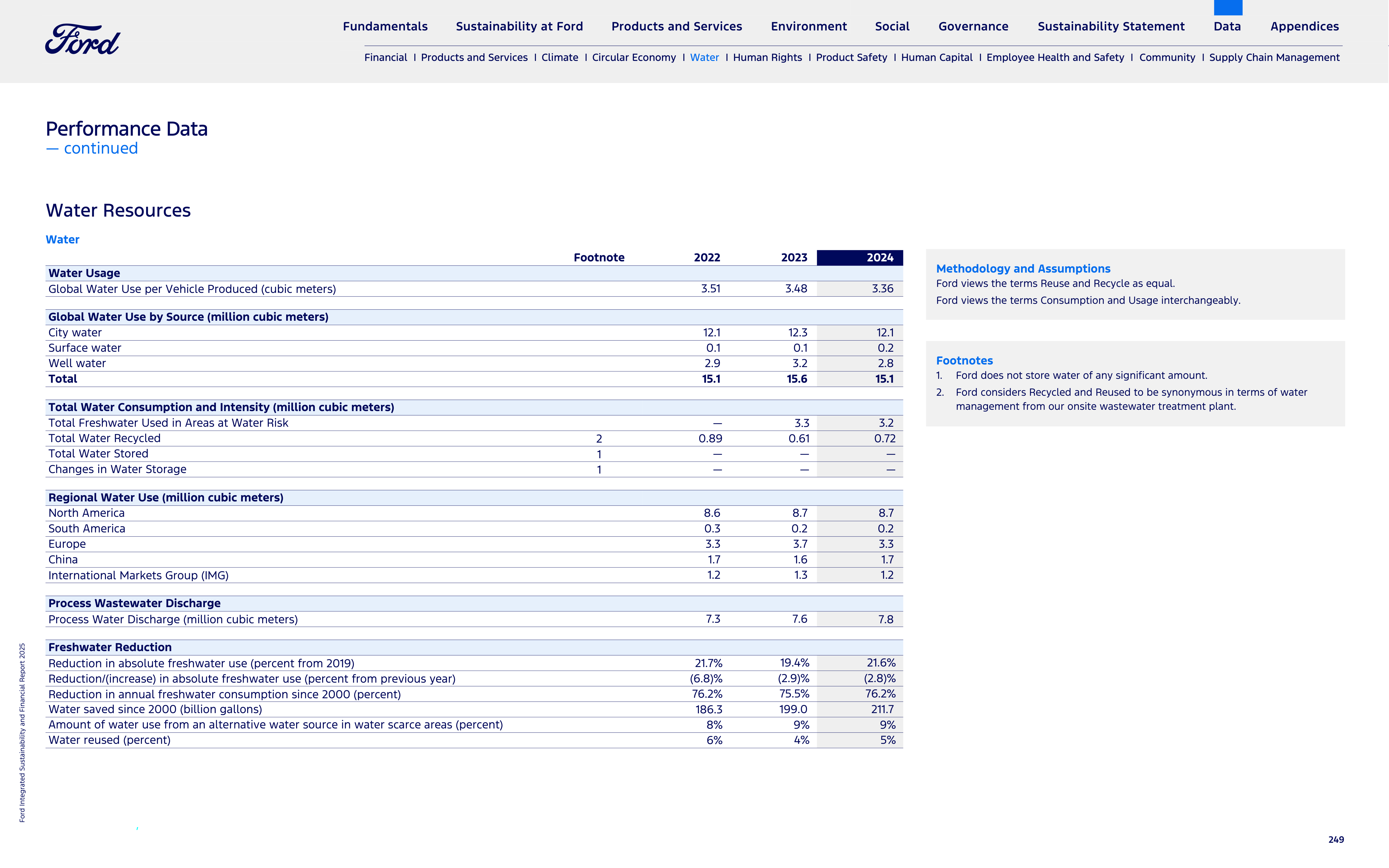
Fundamentals
Sustainability at Ford
Products and Services
Environment
Social
Governance
Sustainability Statement
Data
Appendices
Financial | Products and Services | Climate | Circular Economy |
Water
| Human Rights | Product Safety | Human Capital | Employee Health and Safety | Community | Supply Chain Management
Water Resources
Water
Footnote
2022
2023
2024
Water Usage
Global Water Use per Vehicle Produced (cubic meters)
3.51
3.48
3.36
Global Water Use by Source (million cubic meters)
City water
12.1
12.3
12.1
Surface water
0.1
0.1
0.2
Well water
2.9
3.2
2.8
Total
15.1
15.6
15.1
Total Water Consumption and Intensity (million cubic meters)
Total Freshwater Used in Areas at Water Risk
—
3.3
3.2
Total Water Recycled
2
0.89
0.61
0.72
Total Water Stored
1
—
—
—
Changes in Water Storage
1
—
—
—
Regional Water Use (million cubic meters)
North America
8.6
8.7
8.7
South America
0.3
0.2
0.2
Europe
3.3
3.7
3.3
China
1.7
1.6
1.7
International Markets Group (IMG)
1.2
1.3
1.2
Process Wastewater Discharge
Process Water Discharge (million cubic meters)
7.3
7.6
7.8
Freshwater Reduction
Reduction in absolute freshwater use (percent from 2019)
21.7%
19.4%
21.6%
Reduction/(increase) in absolute freshwater use (percent from previous year)
(6.8)%
(2.9)%
(2.8)%
Reduction in annual freshwater consumption since 2000 (percent)
76.2%
75.5%
76.2%
Water saved since 2000 (billion gallons)
186.3
199.0
211.7
Amount of water use from an alternative water source in water scarce areas (percent)
8%
9%
9%
Water reused (percent)
6%
4%
5%
Performance Data
— continued
,
Ford Integrated Sustainability and Financial Report 2025
249
Methodology and Assumptions
Ford views the terms Reuse and Recycle as equal.
Ford views the terms Consumption and Usage interchangeably.
Footnotes
1.
Ford does not store water of any significant amount.
2.
Ford considers Recycled and Reused to be synonymous in terms of water
management from our onsite wastewater treatment plant.
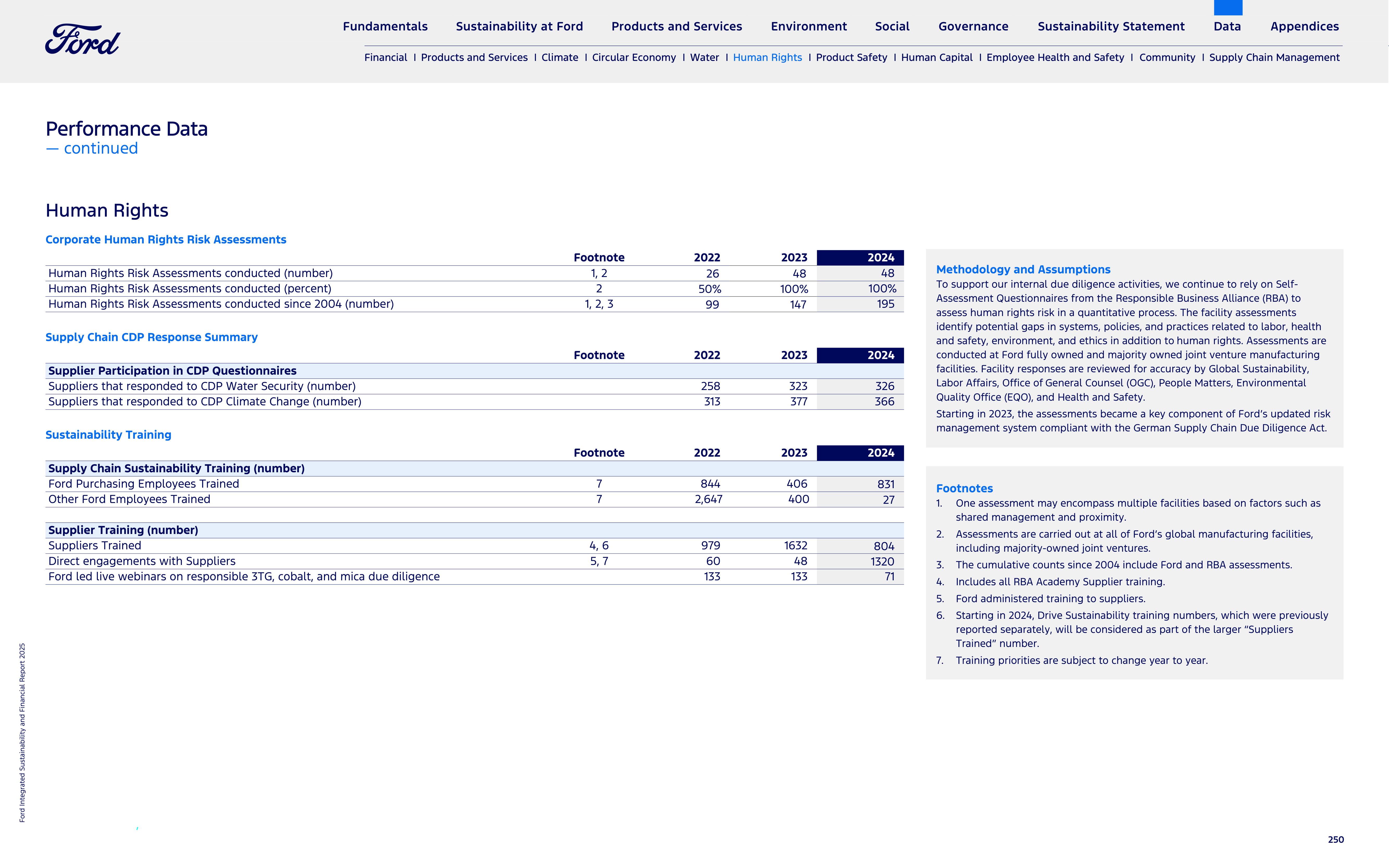
Fundamentals
Sustainability at Ford
Products and Services
Environment
Social
Governance
Sustainability Statement
Data
Appendices
Financial | Products and Services | Climate | Circular Economy | Water |
Human Rights
| Product Safety | Human Capital | Employee Health and Safety | Community | Supply Chain Management
Human Rights
Corporate Human Rights Risk Assessments
Footnote
2022
2023
2024
Human Rights Risk Assessments conducted (number)
1, 2
26
48
48
Human Rights Risk Assessments conducted (percent)
2
50%
100%
100%
Human Rights Risk Assessments conducted since 2004 (number)
1, 2, 3
99
147
195
Supply Chain CDP Response Summary
Footnote
2022
2023
2024
Supplier Participation in CDP Questionnaires
Suppliers that responded to CDP Water Security (number)
258
323
326
Suppliers that responded to CDP Climate Change (number)
313
377
366
Sustainability Training
Footnote
2022
2023
2024
Supply Chain Sustainability Training (number)
Ford Purchasing Employees Trained
7
844
406
831
Other Ford Employees Trained
7
2,647
400
27
Supplier Training (number)
Suppliers Trained
4, 6
979
1632
804
Direct engagements with Suppliers
5, 7
60
48
1320
Ford led live webinars on responsible 3TG, cobalt, and mica due diligence
133
133
71
Performance Data
— continued
,
Ford Integrated Sustainability and Financial Report 2025
250
Methodology and Assumptions
To support our internal due diligence activities, we continue to rely on Self-
Assessment Questionnaires from the Responsible Business Alliance (RBA) to
assess human rights risk in a quantitative process. The facility assessments
identify potential gaps in systems, policies, and practices related to labor, health
and safety, environment, and ethics in addition to human rights. Assessments are
conducted at Ford fully owned and majority owned joint venture manufacturing
facilities. Facility responses are reviewed for accuracy by Global Sustainability,
Labor Affairs, Office of General Counsel (OGC), People Matters, Environmental
Quality Office (EQO), and Health and Safety.
Starting in 2023, the assessments became a key component of Ford’s updated risk
management system compliant with the German Supply Chain Due Diligence Act.
Footnotes
1.
One assessment may encompass multiple facilities based on factors such as
shared management and proximity.
2.
Assessments are carried out at all of Ford’s global manufacturing facilities,
including majority-owned joint ventures.
3.
The cumulative counts since 2004 include Ford and RBA assessments.
4.
Includes all RBA Academy Supplier training.
5.
Ford administered training to suppliers.
6.
Starting in 2024, Drive Sustainability training numbers, which were previously
reported separately, will be considered as part of the larger “Suppliers
Trained” number.
7.
Training priorities are subject to change year to year.
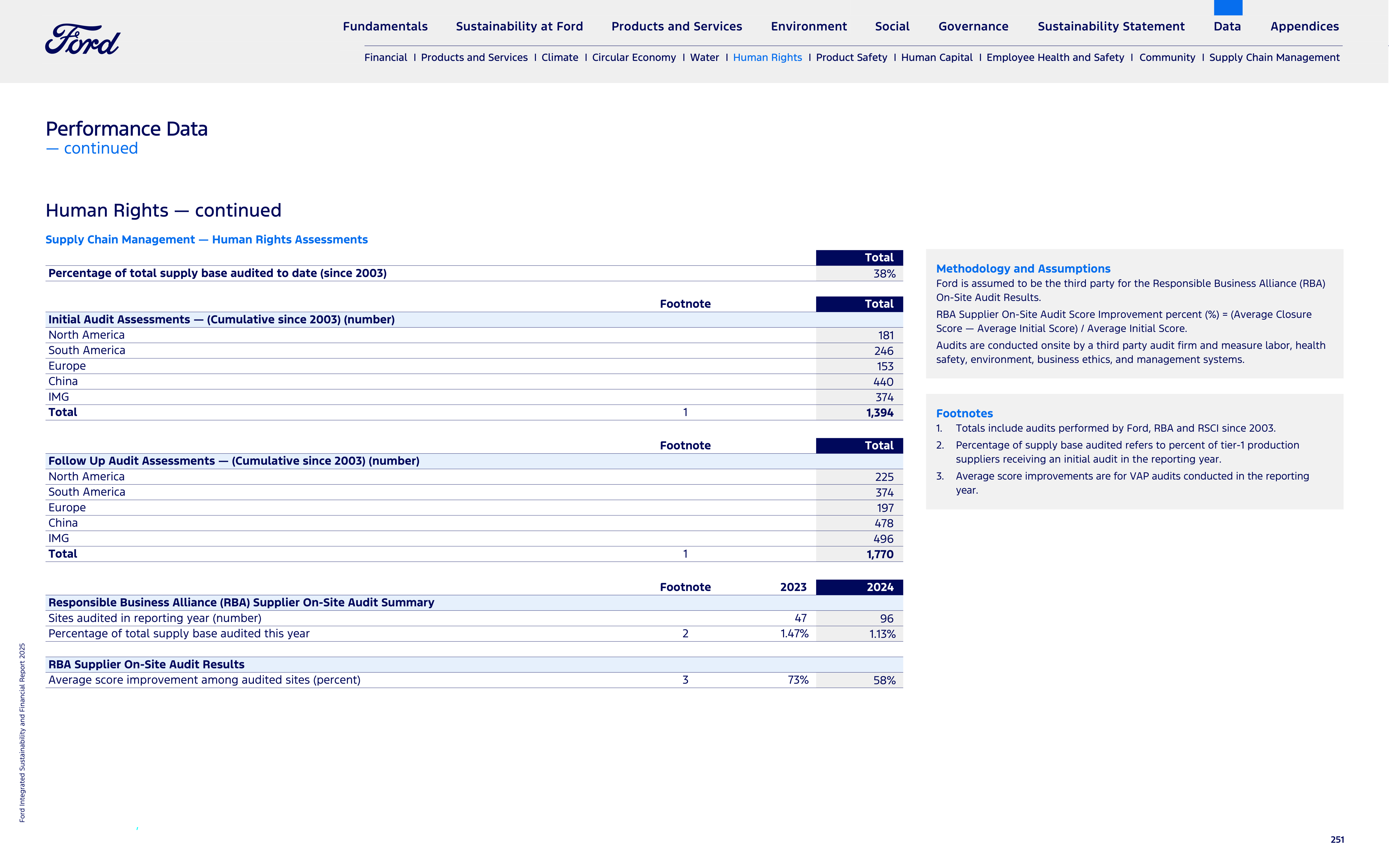
Fundamentals
Sustainability at Ford
Products and Services
Environment
Social
Governance
Sustainability Statement
Data
Appendices
Financial | Products and Services | Climate | Circular Economy | Water |
Human Rights
| Product Safety | Human Capital | Employee Health and Safety | Community | Supply Chain Management
Supply Chain Management — Human Rights Assessments
Total
Percentage of total supply base audited to date (since 2003)
38%
Footnote
Total
Initial Audit Assessments — (Cumulative since 2003) (number)
North America
181
South America
246
Europe
153
China
440
IMG
374
Total
1
1,394
Footnote
Total
Follow Up Audit Assessments — (Cumulative since 2003) (number)
North America
225
South America
374
Europe
197
China
478
IMG
496
Total
1
1,770
Footnote
2023
2024
Responsible Business Alliance (RBA) Supplier On-Site Audit Summary
Sites audited in reporting year (number)
47
96
Percentage of total supply base audited this year
2
1.47%
1.13%
RBA Supplier On-Site Audit Results
Average score improvement among audited sites (percent)
3
73%
58%
Performance Data
— continued
,
Ford Integrated Sustainability and Financial Report 2025
251
Human Rights — continued
Methodology and Assumptions
Ford is assumed to be the third party for the Responsible Business Alliance (RBA)
On-Site Audit Results.
RBA Supplier On-Site Audit Score Improvement percent (%) = (Average Closure
Score — Average Initial Score) / Average Initial Score.
Audits are conducted onsite by a third party audit firm and measure labor, health
safety, environment, business ethics, and management systems.
Footnotes
1.
Totals include audits performed by Ford, RBA and RSCI since 2003.
2.
Percentage of supply base audited refers to percent of tier-1 production
suppliers receiving an initial audit in the reporting year.
3.
Average score improvements are for VAP audits conducted in the reporting
year.
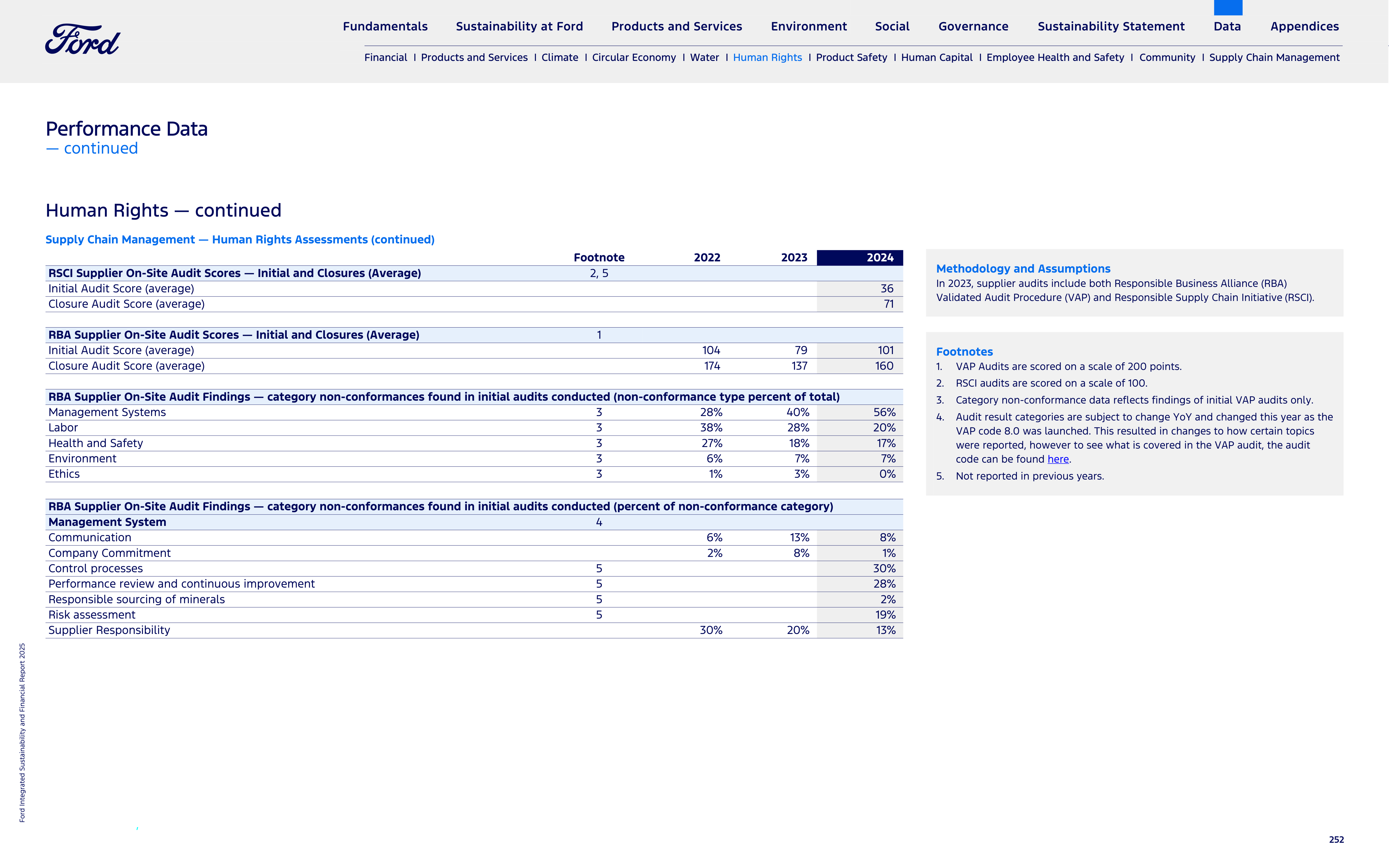
Fundamentals
Sustainability at Ford
Products and Services
Environment
Social
Governance
Sustainability Statement
Data
Appendices
Financial | Products and Services | Climate | Circular Economy | Water |
Human Rights
| Product Safety | Human Capital | Employee Health and Safety | Community | Supply Chain Management
Supply Chain Management — Human Rights Assessments (continued)
Footnote
2022
2023
2024
RSCI Supplier On-Site Audit Scores — Initial and Closures (Average)
2, 5
Initial Audit Score (average)
36
Closure Audit Score (average)
71
RBA Supplier On-Site Audit Scores — Initial and Closures (Average)
1
Initial Audit Score (average)
104
79
101
Closure Audit Score (average)
174
137
160
RBA Supplier On-Site Audit Findings — category non-conformances found in initial audits conducted (non-conformance type percent of total)
Management Systems
3
28%
40%
56%
Labor
3
38%
28%
20%
Health and Safety
3
27%
18%
17%
Environment
3
6%
7%
7%
Ethics
3
1%
3%
0%
RBA Supplier On-Site Audit Findings — category non-conformances found in initial audits conducted (percent of non-conformance category)
Management System
4
Communication
6%
13%
8%
Company Commitment
2%
8%
1%
Control processes
5
30%
Performance review and continuous improvement
5
28%
Responsible sourcing of minerals
5
2%
Risk assessment
5
19%
Supplier Responsibility
30%
20%
13%
Performance Data
— continued
,
Ford Integrated Sustainability and Financial Report 2025
252
Human Rights — continued
Methodology and Assumptions
In 2023, supplier audits include both Responsible Business Alliance (RBA)
Validated Audit Procedure (VAP) and Responsible Supply Chain Initiative (RSCI).
Footnotes
1.
VAP Audits are scored on a scale of 200 points.
2.
RSCI audits are scored on a scale of 100.
3.
Category non-conformance data reflects findings of initial VAP audits only.
4.
Audit result categories are subject to change YoY and changed this year as the
VAP code 8.0 was launched. This resulted in changes to how certain topics
were reported, however to see what is covered in the VAP audit, the audit
code can be found
here
.
5.
Not reported in previous years.
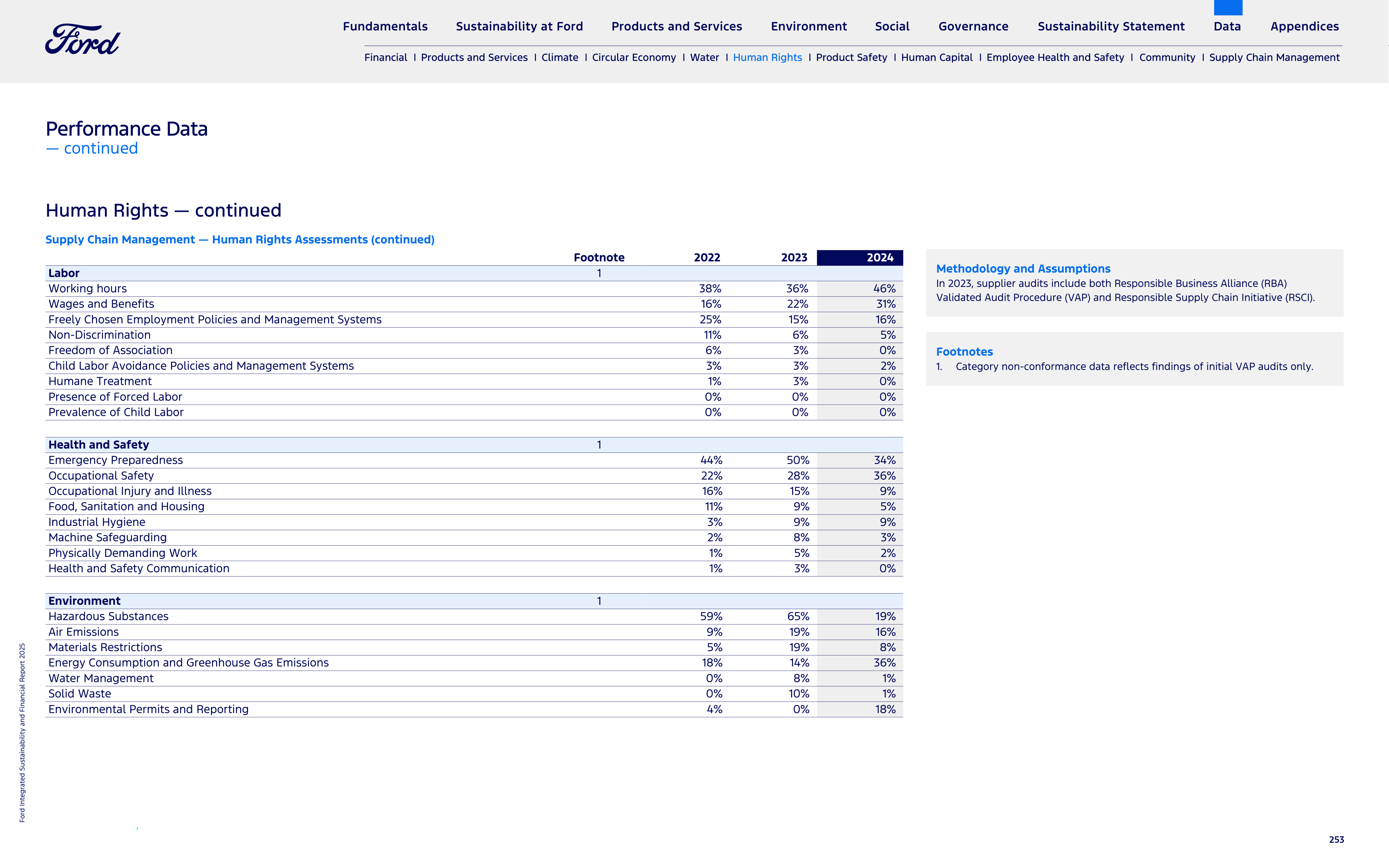
Supply Chain Management — Human Rights Assessments (continued)
Footnote
2022
2023
2024
Labor
1
Working hours
38%
36%
46%
Wages and Benefits
16%
22%
31%
Freely Chosen Employment Policies and Management Systems
25%
15%
16%
Non-Discrimination
11%
6%
5%
Freedom of Association
6%
3%
0%
Child Labor Avoidance Policies and Management Systems
3%
3%
2%
Humane Treatment
1%
3%
0%
Presence of Forced Labor
0%
0%
0%
Prevalence of Child Labor
0%
0%
0%
Health and Safety
1
Emergency Preparedness
44%
50%
34%
Occupational Safety
22%
28%
36%
Occupational Injury and Illness
16%
15%
9%
Food, Sanitation and Housing
11%
9%
5%
Industrial Hygiene
3%
9%
9%
Machine Safeguarding
2%
8%
3%
Physically Demanding Work
1%
5%
2%
Health and Safety Communication
1%
3%
0%
Environment
1
Hazardous Substances
59%
65%
19%
Air Emissions
9%
19%
16%
Materials Restrictions
5%
19%
8%
Energy Consumption and Greenhouse Gas Emissions
18%
14%
36%
Water Management
0%
8%
1%
Solid Waste
0%
10%
1%
Environmental Permits and Reporting
4%
0%
18%
Fundamentals
Sustainability at Ford
Products and Services
Environment
Social
Governance
Sustainability Statement
Data
Appendices
Financial | Products and Services | Climate | Circular Economy | Water |
Human Rights
| Product Safety | Human Capital | Employee Health and Safety | Community | Supply Chain Management
Performance Data
— continued
,
Ford Integrated Sustainability and Financial Report 2025
253
Human Rights — continued
Methodology and Assumptions
In 2023, supplier audits include both Responsible Business Alliance (RBA)
Validated Audit Procedure (VAP) and Responsible Supply Chain Initiative (RSCI).
Footnotes
1.
Category non-conformance data reflects findings of initial VAP audits only.
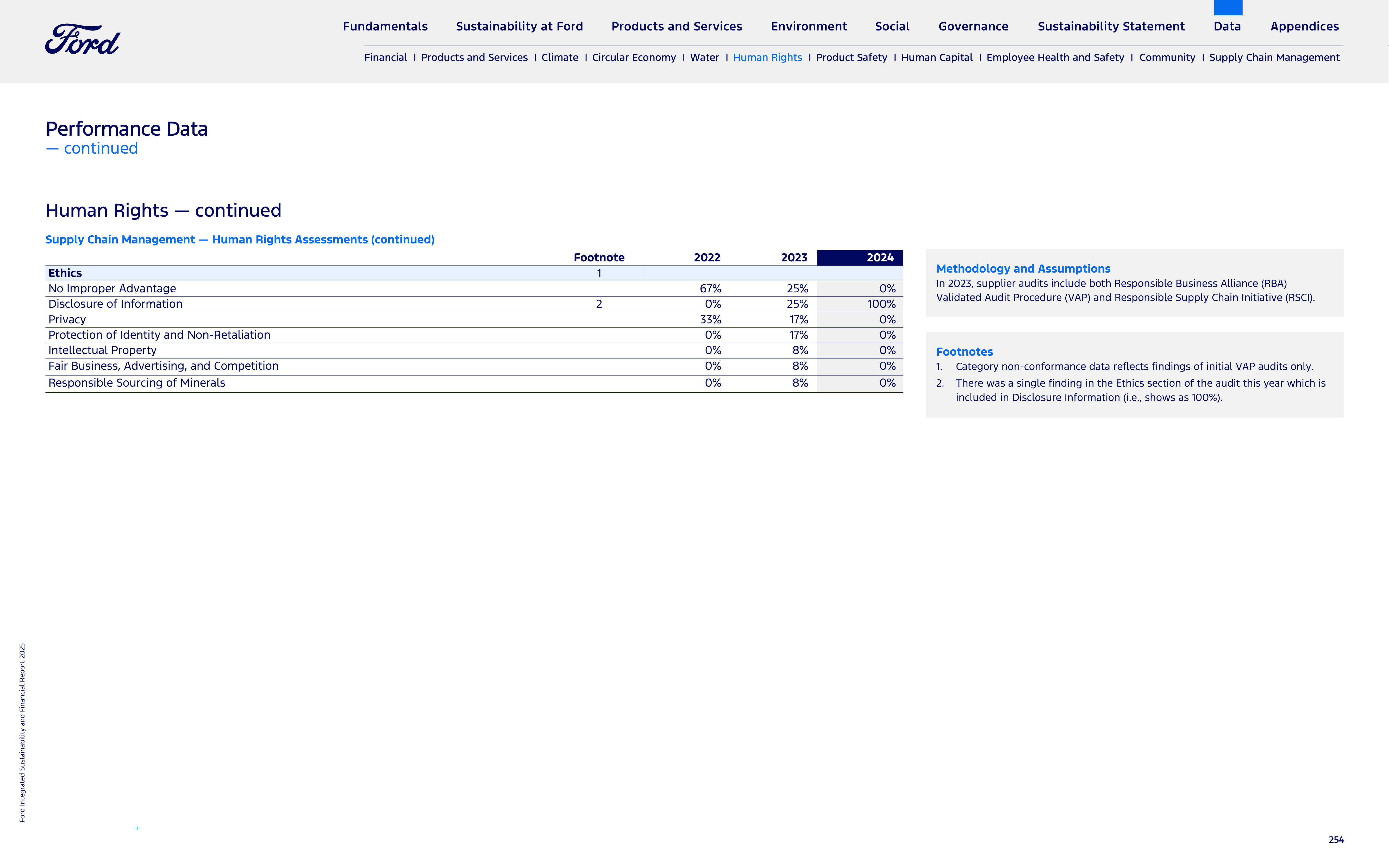
Supply Chain Management — Human Rights Assessments (continued)
Footnote
2022
2023
2024
Ethics
1
No Improper Advantage
67%
25%
0%
Disclosure of Information
2
0%
25%
100%
Privacy
33%
17%
0%
Protection of Identity and Non-Retaliation
0%
17%
0%
Intellectual Property
0%
8%
0%
Fair Business, Advertising, and Competition
0%
8%
0%
Responsible Sourcing of Minerals
0%
8%
0%
Fundamentals
Sustainability at Ford
Products and Services
Environment
Social
Governance
Sustainability Statement
Data
Appendices
Financial | Products and Services | Climate | Circular Economy | Water |
Human Rights
| Product Safety | Human Capital | Employee Health and Safety | Community | Supply Chain Management
Performance Data
— continued
,
Ford Integrated Sustainability and Financial Report 2025
254
Human Rights — continued
Methodology and Assumptions
In 2023, supplier audits include both Responsible Business Alliance (RBA)
Validated Audit Procedure (VAP) and Responsible Supply Chain Initiative (RSCI).
Footnotes
1.
Category non-conformance data reflects findings of initial VAP audits only.
2.
There was a single finding in the Ethics section of the audit this year which is
included in Disclosure Information (i.e., shows as 100%).
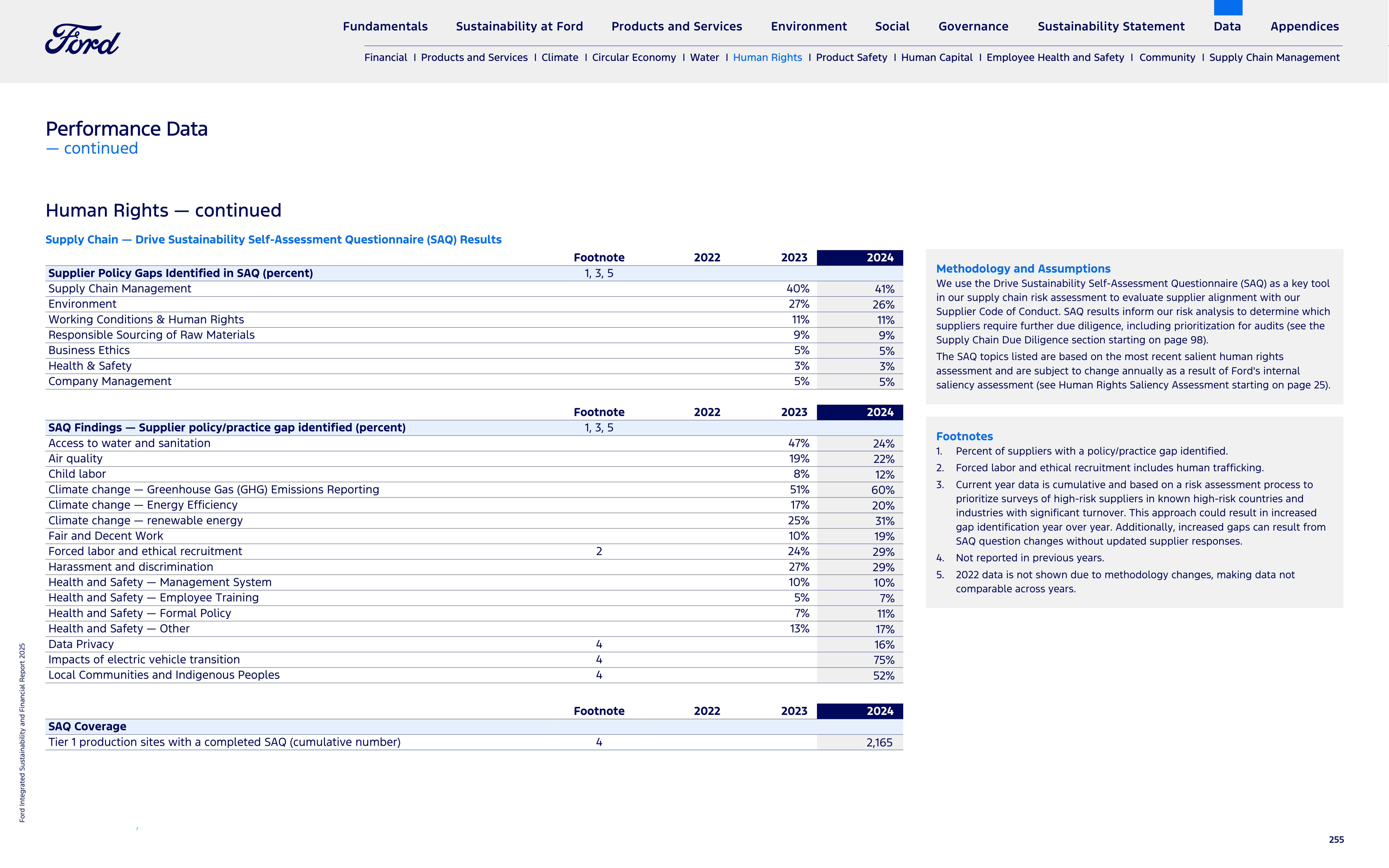
Fundamentals
Sustainability at Ford
Products and Services
Environment
Social
Governance
Sustainability Statement
Data
Appendices
Financial | Products and Services | Climate | Circular Economy | Water |
Human Rights
| Product Safety | Human Capital | Employee Health and Safety | Community | Supply Chain Management
Supply Chain — Drive Sustainability Self-Assessment Questionnaire (SAQ) Results
Footnote
2022
2023
2024
Supplier Policy Gaps Identified in SAQ (percent)
1, 3, 5
Supply Chain Management
40%
41%
Environment
27%
26%
Working Conditions & Human Rights
11%
11%
Responsible Sourcing of Raw Materials
9%
9%
Business Ethics
5%
5%
Health & Safety
3%
3%
Company Management
5%
5%
Footnote
2022
2023
2024
SAQ Findings — Supplier policy/practice gap identified (percent)
1, 3, 5
Access to water and sanitation
47%
24%
Air quality
19%
22%
Child labor
8%
12%
Climate change — Greenhouse Gas (GHG) Emissions Reporting
51%
60%
Climate change — Energy Efficiency
17%
20%
Climate change — renewable energy
25%
31%
Fair and Decent Work
10%
19%
Forced labor and ethical recruitment
2
24%
29%
Harassment and discrimination
27%
29%
Health and Safety — Management System
10%
10%
Health and Safety — Employee Training
5%
7%
Health and Safety — Formal Policy
7%
11%
Health and Safety — Other
13%
17%
Data Privacy
4
16%
Impacts of electric vehicle transition
4
75%
Local Communities and Indigenous Peoples
4
52%
Footnote
2022
2023
2024
SAQ Coverage
Tier 1 production sites with a completed SAQ (cumulative number)
4
2,165
Performance Data
— continued
,
Ford Integrated Sustainability and Financial Report 2025
255
Human Rights — continued
Methodology and Assumptions
We use the Drive Sustainability Self-Assessment Questionnaire (SAQ) as a key tool
in our supply chain risk assessment to evaluate supplier alignment with our
Supplier Code of Conduct. SAQ results inform our risk analysis to determine which
suppliers require further due diligence, including prioritization for audits (see the
Supply Chain Due Diligence section starting on page 98).
The SAQ topics listed are based on the most recent salient human rights
assessment and are subject to change annually as a result of Ford's internal
saliency assessment (see Human Rights Saliency Assessment starting on page 25).
Footnotes
1.
Percent of suppliers with a policy/practice gap identified.
2.
Forced labor and ethical recruitment includes human trafficking.
3.
Current year data is cumulative and based on a risk assessment process to
prioritize surveys of high-risk suppliers in known high-risk countries and
industries with significant turnover. This approach could result in increased
gap identification year over year. Additionally, increased gaps can result from
SAQ question changes without updated supplier responses.
4.
Not reported in previous years.
5.
2022 data is not shown due to methodology changes, making data not
comparable across years.
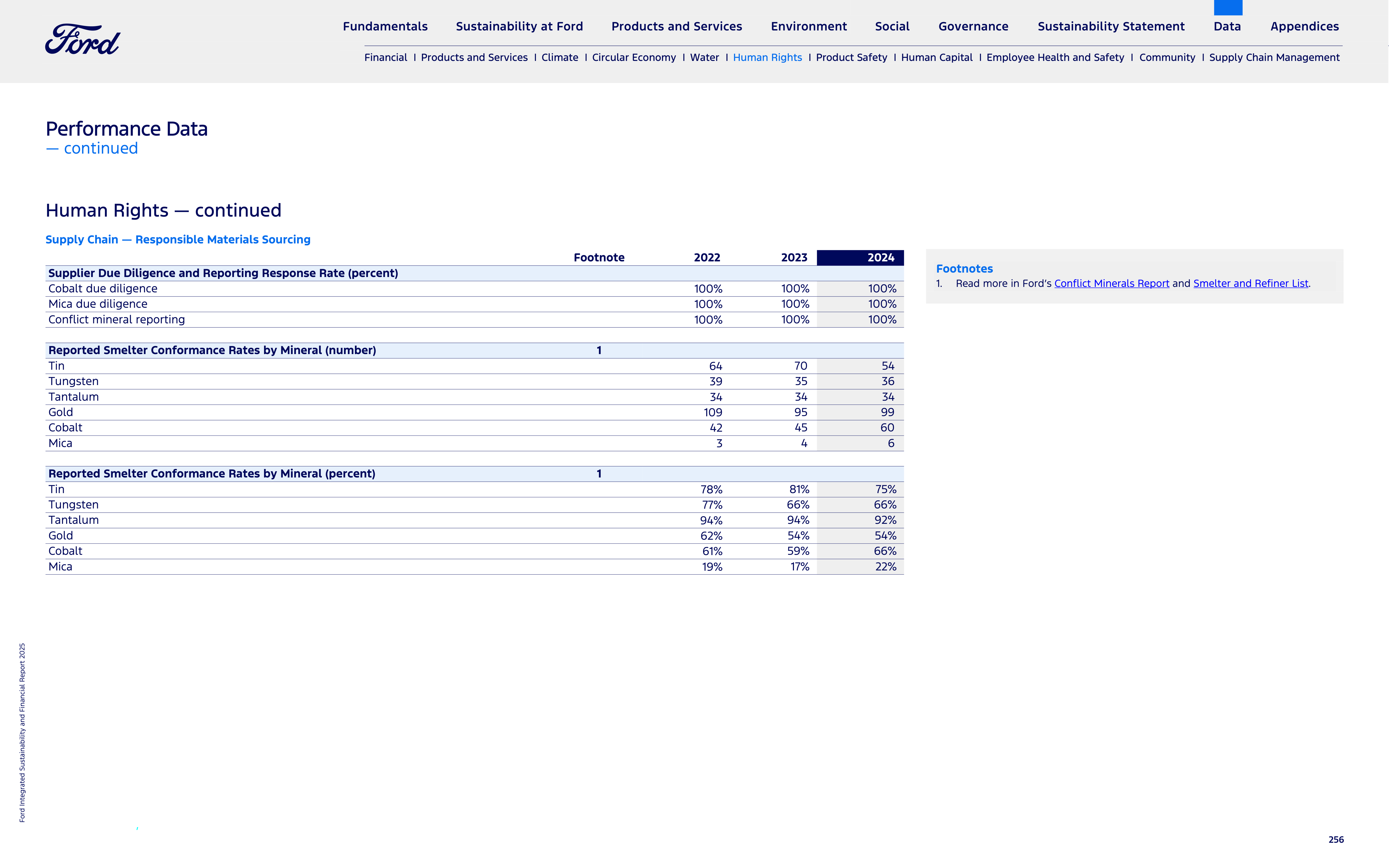
Fundamentals
Sustainability at Ford
Products and Services
Environment
Social
Governance
Sustainability Statement
Data
Appendices
Financial | Products and Services | Climate | Circular Economy | Water |
Human Rights
| Product Safety | Human Capital | Employee Health and Safety | Community | Supply Chain Management
Supply Chain — Responsible Materials Sourcing
Footnote
2022
2023
2024
Supplier Due Diligence and Reporting Response Rate (percent)
Cobalt due diligence
100 %
100 %
100 %
Mica due diligence
100 %
100 %
100 %
Conflict mineral reporting
100 %
100 %
100 %
Reported Smelter Conformance Rates by Mineral (number)
1
Tin
64
70
54
Tungsten
39
35
36
Tantalum
34
34
34
Gold
109
95
99
Cobalt
42
45
60
Mica
3
4
6
Reported Smelter Conformance Rates by Mineral (percent)
1
Tin
78%
81%
75%
Tungsten
77%
66%
66%
Tantalum
94%
94%
92%
Gold
62%
54%
54%
Cobalt
61%
59%
66%
Mica
19%
17%
22%
Performance Data
— continued
,
Ford Integrated Sustainability and Financial Report 2025
256
Human Rights — continued
Footnotes
1.
Read more in Ford’s
Conflict Minerals Report
and
Smelter and Refiner List
.
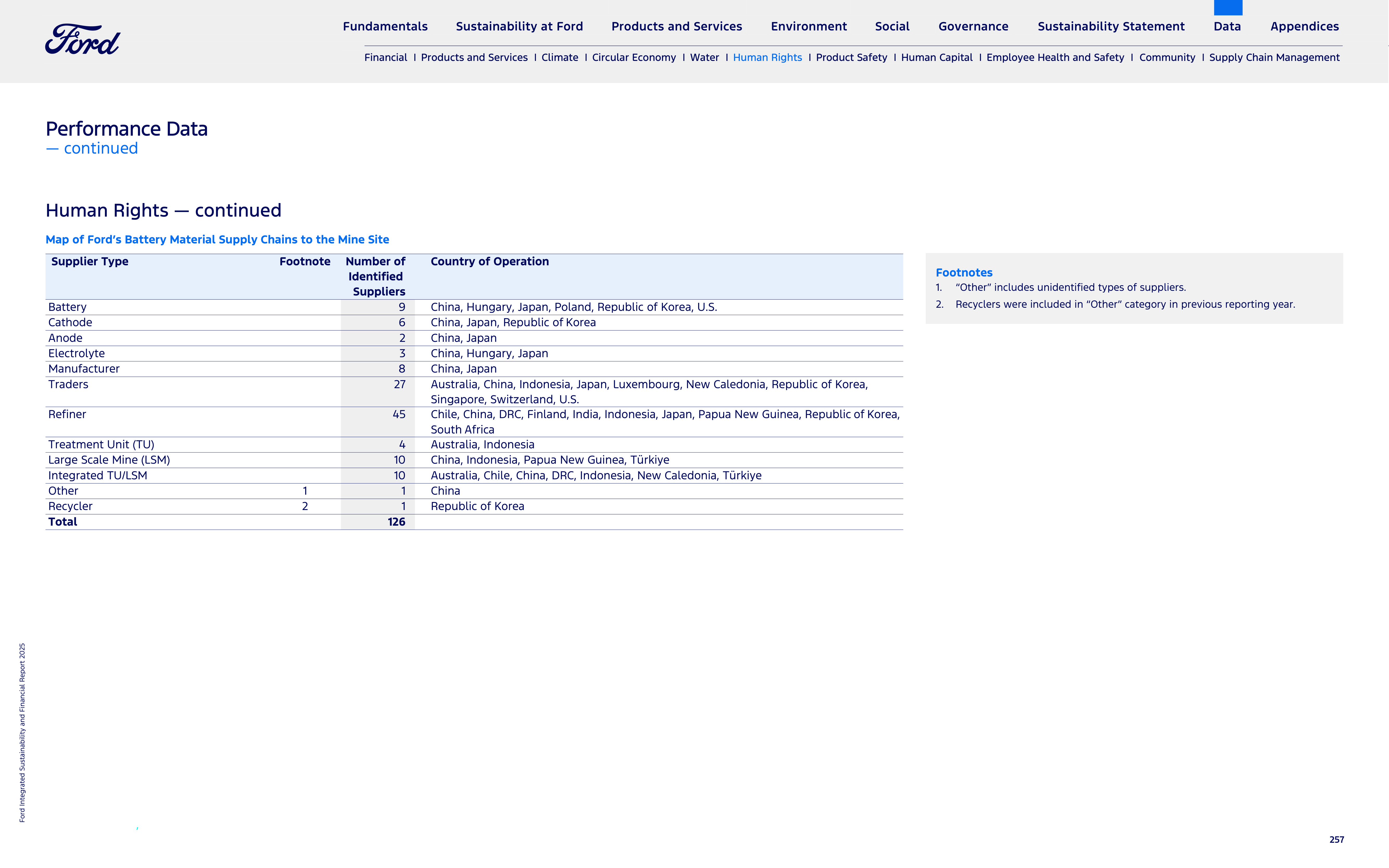
Fundamentals
Sustainability at Ford
Products and Services
Environment
Social
Governance
Sustainability Statement
Data
Appendices
Financial | Products and Services | Climate | Circular Economy | Water |
Human Rights
| Product Safety | Human Capital | Employee Health and Safety | Community | Supply Chain Management
Map of Ford’s Battery Material Supply Chains to the Mine Site
Supplier Type
Footnote
Number of
Identified
Suppliers
Country of Operation
Battery
9
China, Hungary, Japan, Poland, Republic of Korea, U.S.
Cathode
6
China, Japan, Republic of Korea
Anode
2
China, Japan
Electrolyte
3
China, Hungary, Japan
Manufacturer
8
China, Japan
Traders
27
Australia, China, Indonesia, Japan, Luxembourg, New Caledonia, Republic of Korea,
Singapore, Switzerland, U.S.
Refiner
45
Chile, China, DRC, Finland, India, Indonesia, Japan, Papua New Guinea, Republic of Korea,
South Africa
Treatment Unit (TU)
4
Australia, Indonesia
Large Scale Mine (LSM)
10
China, Indonesia, Papua New Guinea, Türkiye
Integrated TU/LSM
10
Australia, Chile, China, DRC, Indonesia, New Caledonia, Türkiye
Other
1
1
China
Recycler
2
1
Republic of Korea
Total
126
Performance Data
— continued
,
Ford Integrated Sustainability and Financial Report 2025
257
Footnotes
Human Rights — continued
1.
“Other” includes unidentified types of suppliers.
2.
Recyclers were included in “Other” category in previous reporting year.
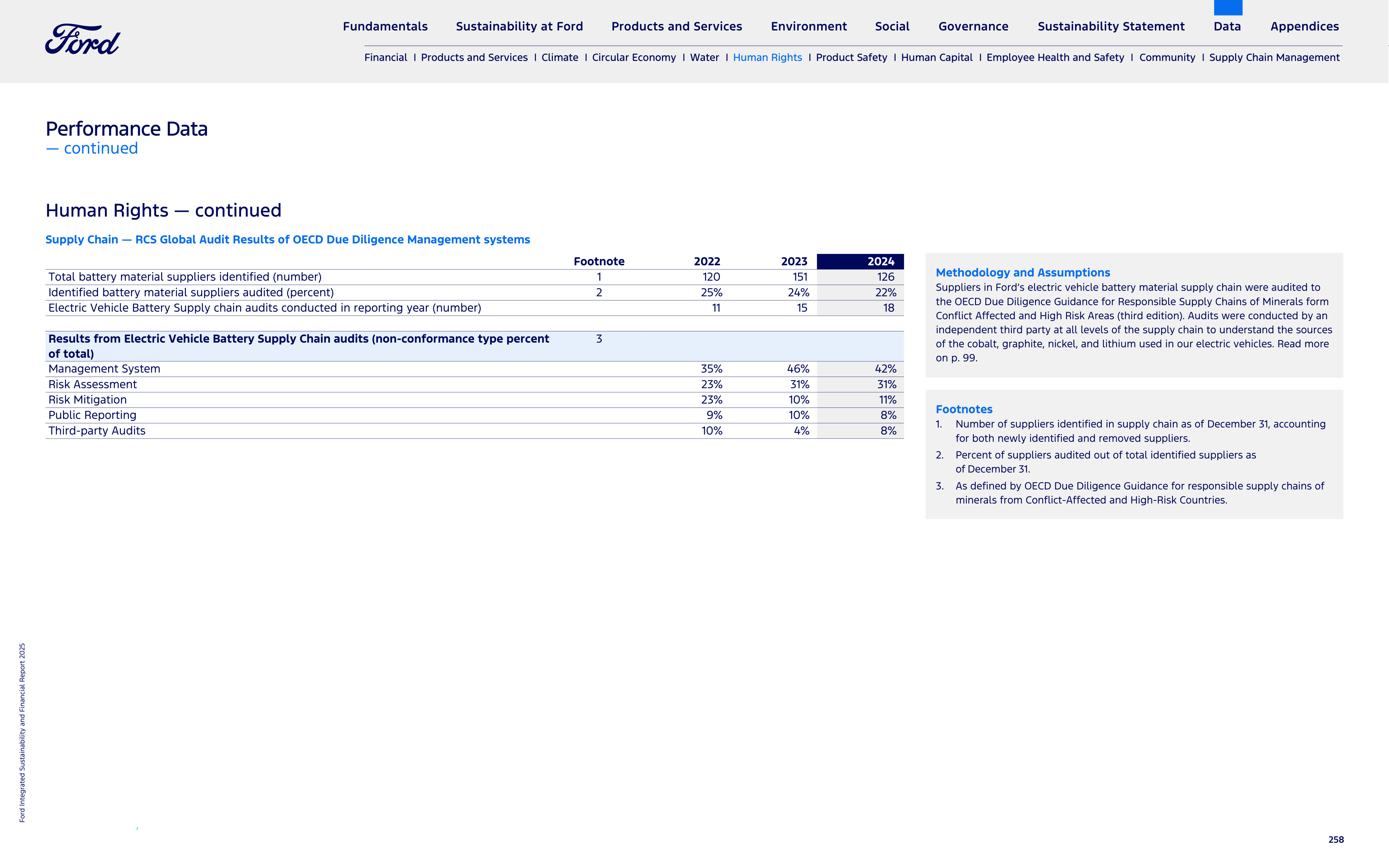
Fundamentals
Sustainability at Ford
Products and Services
Environment
Social
Governance
Sustainability Statement
Data
Appendices
Financial | Products and Services | Climate | Circular Economy | Water |
Human Rights
| Product Safety | Human Capital | Employee Health and Safety | Community | Supply Chain Management
Supply Chain — RCS Global Audit Results of OECD Due Diligence Management systems
Footnote
2022
2023
2024
Total battery material suppliers identified (number)
1
120
151
126
Identified battery material suppliers audited (percent)
2
25 %
24 %
22 %
Electric Vehicle Battery Supply chain audits conducted in reporting year (number)
11
15
18
Results from Electric Vehicle Battery Supply Chain audits (non-conformance type percent
of total)
3
Management System
35 %
46 %
42 %
Risk Assessment
23 %
31 %
31 %
Risk Mitigation
23 %
10 %
11 %
Public Reporting
9 %
10 %
8 %
Third-party Audits
10 %
4 %
8 %
Performance Data
— continued
,
Ford Integrated Sustainability and Financial Report 2025
258
Human Rights — continued
Methodology and Assumptions
Suppliers in Ford’s electric vehicle battery material supply chain were audited to
the OECD Due Diligence Guidance for Responsible Supply Chains of Minerals form
Conflict Affected and High Risk Areas (third edition). Audits were conducted by an
independent third party at all levels of the supply chain to understand the sources
of the cobalt, graphite, nickel, and lithium used in our electric vehicles. Read more
on p. 99.
Footnotes
1.
Number of suppliers identified in supply chain as of December 31, accounting
for both newly identified and removed suppliers.
2.
Percent of suppliers audited out of total identified suppliers as
of December 31.
3.
As defined by OECD Due Diligence Guidance for responsible supply chains of
minerals from Conflict-Affected and High-Risk Countries.
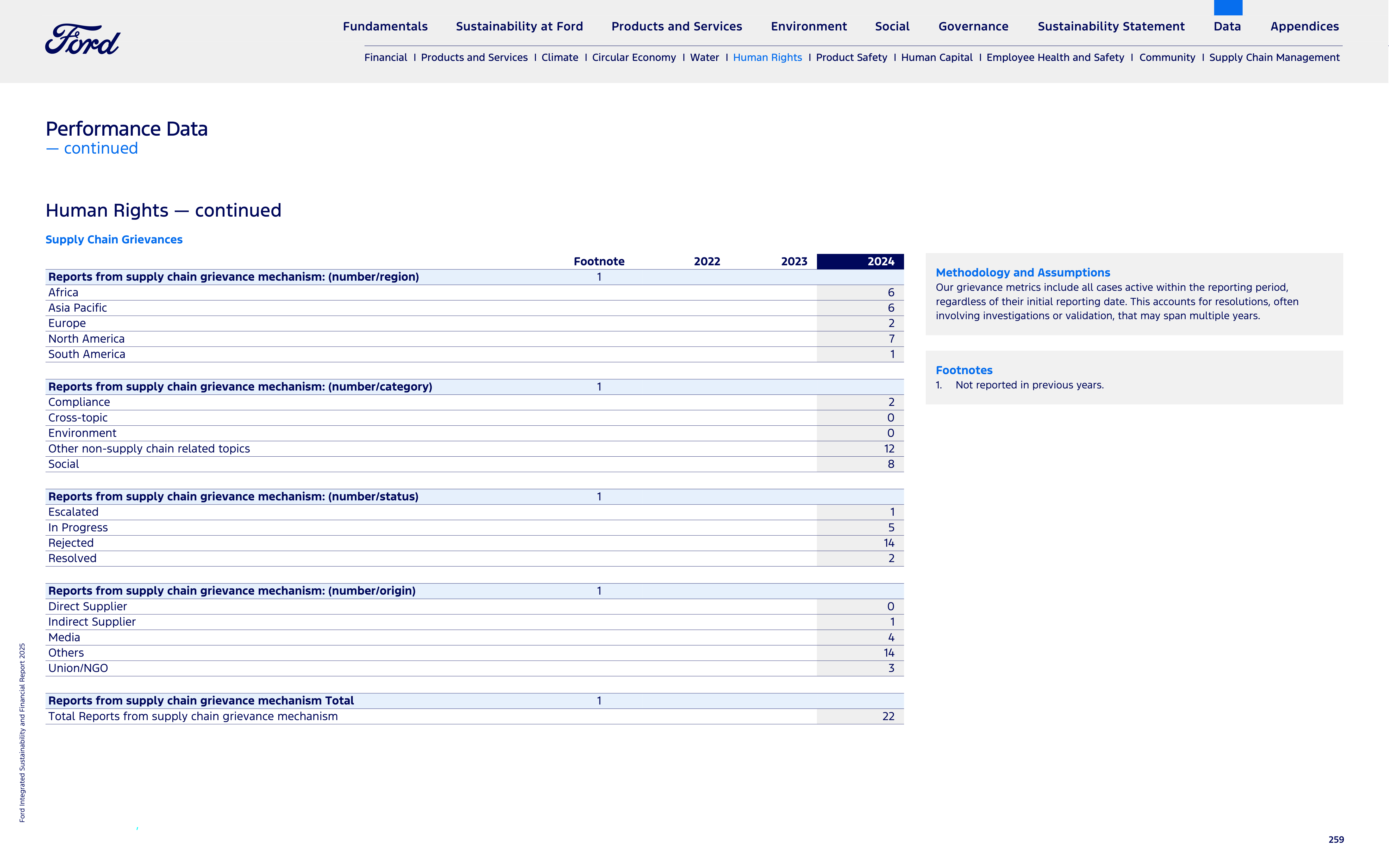
Fundamentals
Sustainability at Ford
Products and Services
Environment
Social
Governance
Sustainability Statement
Data
Appendices
Financial | Products and Services | Climate | Circular Economy | Water |
Human Rights
| Product Safety | Human Capital | Employee Health and Safety | Community | Supply Chain Management
Supply Chain Grievances
Footnote
2022
2023
2024
Reports from supply chain grievance mechanism: (number/region)
1
Africa
6
Asia Pacific
6
Europe
2
North America
7
South America
1
Reports from supply chain grievance mechanism: (number/category)
1
Compliance
2
Cross-topic
0
Environment
0
Other non-supply chain related topics
12
Social
8
Reports from supply chain grievance mechanism: (number/status)
1
Escalated
1
In Progress
5
Rejected
14
Resolved
2
Reports from supply chain grievance mechanism: (number/origin)
1
Direct Supplier
0
Indirect Supplier
1
Media
4
Others
14
Union/NGO
3
Reports from supply chain grievance mechanism Total
1
Total Reports from supply chain grievance mechanism
22
Performance Data
— continued
,
Ford Integrated Sustainability and Financial Report 2025
259
Human Rights — continued
Methodology and Assumptions
Our grievance metrics include all cases active within the reporting period,
regardless of their initial reporting date. This accounts for resolutions, often
involving investigations or validation, that may span multiple years.
Footnotes
1.
Not reported in previous years.
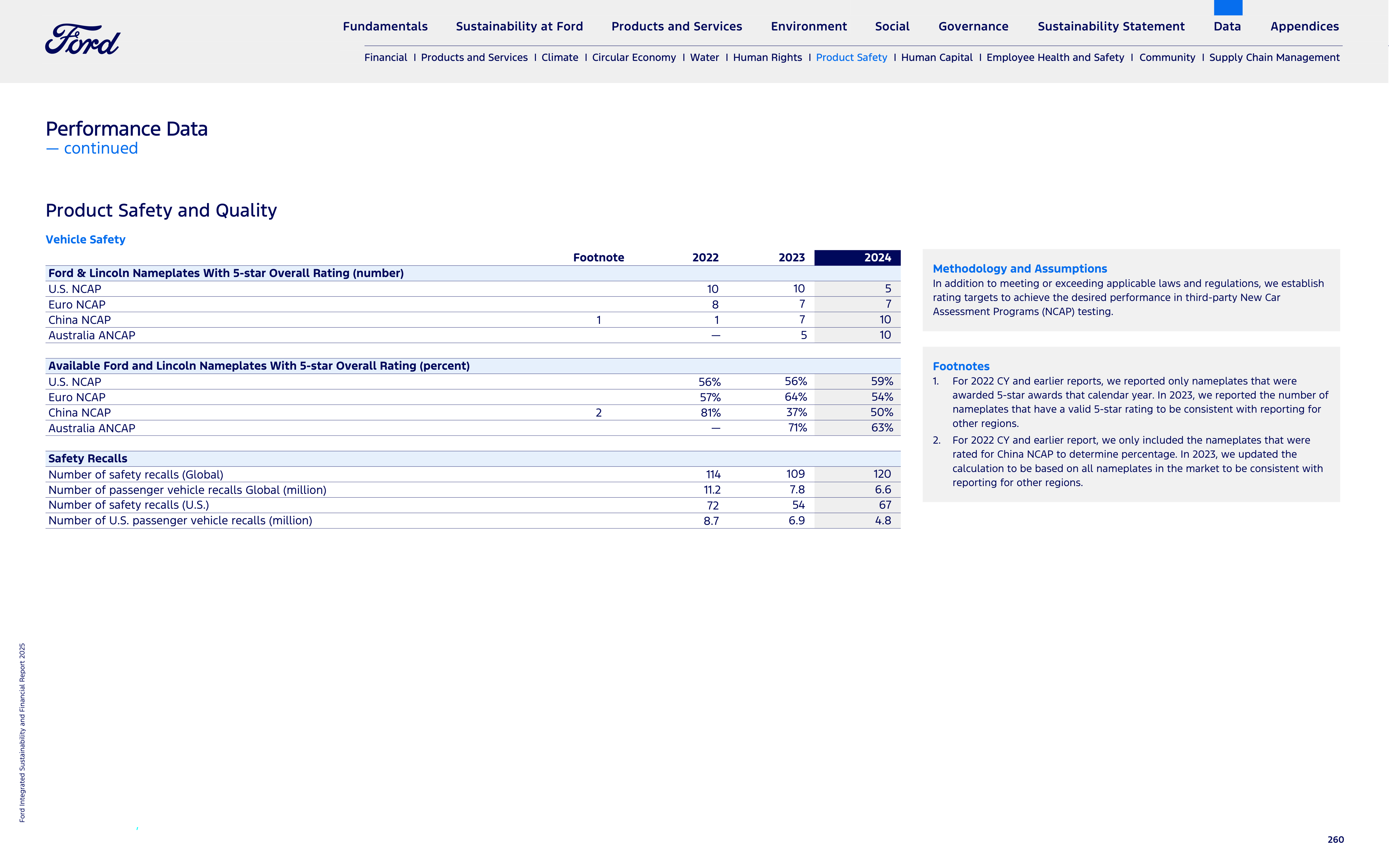
Fundamentals
Sustainability at Ford
Products and Services
Environment
Social
Governance
Sustainability Statement
Data
Appendices
Financial | Products and Services | Climate | Circular Economy | Water | Human Rights |
Product Safety
| Human Capital | Employee Health and Safety | Community | Supply Chain Management
Product Safety and Quality
Vehicle Safety
260
Footnote
2022
2023
2024
Ford & Lincoln Nameplates With 5-star Overall Rating (number)
U.S. NCAP
10
10
5
Euro NCAP
8
7
7
China NCAP
1
1
7
10
Australia ANCAP
—
5
10
Available Ford and Lincoln Nameplates With 5-star Overall Rating (percent)
U.S. NCAP
56 %
56 %
59 %
Euro NCAP
57 %
64 %
54 %
China NCAP
2
81 %
37 %
50 %
Australia ANCAP
—
71 %
63 %
Safety Recalls
Number of safety recalls (Global)
114
109
120
Number of passenger vehicle recalls Global (million)
11.2
7.8
6.6
Number of safety recalls (U.S.)
72
54
67
Number of U.S. passenger vehicle recalls (million)
8.7
6.9
4.8
Performance Data
— continued
,
Ford Integrated Sustainability and Financial Report 2025
Methodology and Assumptions
In addition to meeting or exceeding applicable laws and regulations, we establish
rating targets to achieve the desired performance in third-party New Car
Assessment Programs (NCAP) testing.
Footnotes
1.
For 2022 CY and earlier reports, we reported only nameplates that were
awarded 5-star awards that calendar year. In 2023, we reported the number of
nameplates that have a valid 5-star rating to be consistent with reporting for
other regions.
2.
For 2022 CY and earlier report, we only included the nameplates that were
rated for China NCAP to determine percentage. In 2023, we updated the
calculation to be based on all nameplates in the market to be consistent with
reporting for other regions.
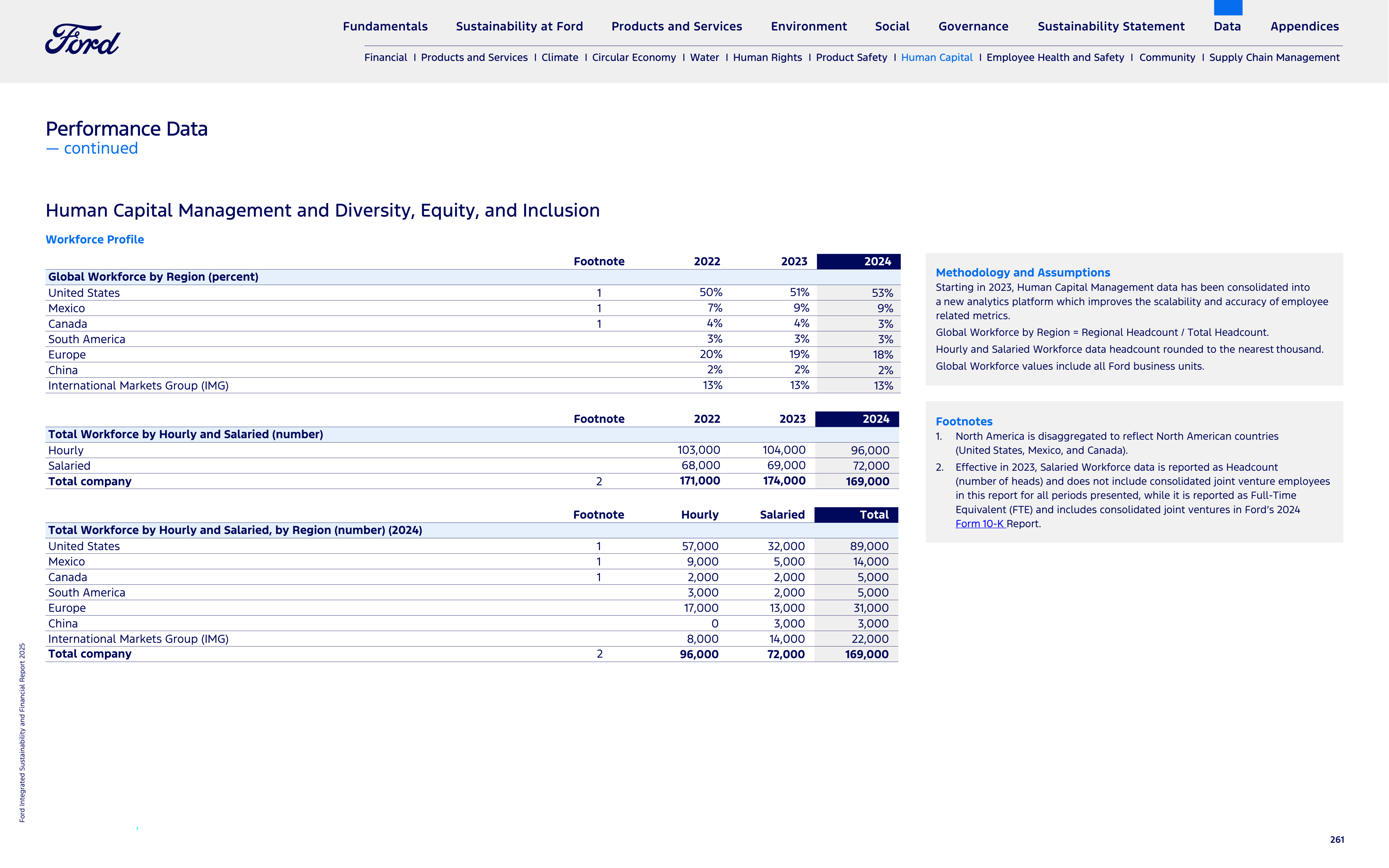
Fundamentals
Sustainability at Ford
Products and Services
Environment
Social
Governance
Sustainability Statement
Data
Appendices
Financial
Products and Services
Climate
Circular Economy
Water
Human Rights
Product Safety
Human Capital
Employee Health and Safety
Community
Supply Chain Management
|
|
|
|
|
|
|
|
|
|
Performance Data
— continued
,
Ford Integrated Sustainability and Financial Report 2025
261
Human Capital Management and Diversity, Equity, and Inclusion
Workforce Profile
Footnote
2022
2023
2024
Global Workforce by Region (percent)
United States
1
50 %
51 %
53 %
Mexico
1
7 %
9 %
9 %
Canada
1
4 %
4 %
3 %
South America
3 %
3 %
3 %
Europe
20 %
19 %
18 %
China
2 %
2 %
2 %
International Markets Group (IMG)
13 %
13 %
13 %
Footnote
2022
2023
2024
Total Workforce by Hourly and Salaried (number)
Hourly
103,000
104,000
96,000
Salaried
68,000
69,000
72,000
Total company
2
171,000
174,000
169,000
Footnote
Hourly
Salaried
Total
Total Workforce by Hourly and Salaried, by Region (number) (2024)
United States
1
57,000
32,000
89,000
Mexico
1
9,000
5,000
14,000
Canada
1
2,000
2,000
5,000
South America
3,000
2,000
5,000
Europe
17,000
13,000
31,000
China
0
3,000
3,000
International Markets Group (IMG)
8,000
14,000
22,000
Total company
2
96,000
72,000
169,000
Methodology and Assumptions
Starting in 2023, Human Capital Management data has been consolidated into
a new analytics platform which improves the scalability and accuracy of employee
related metrics.
Global Workforce by Region = Regional Headcount / Total Headcount.
Hourly and Salaried Workforce data headcount rounded to the nearest thousand.
Global Workforce values include all Ford business units.
Footnotes
1.
North America is disaggregated to reflect North American countries
(United States, Mexico, and Canada).
2.
Effective in 2023, Salaried Workforce data is reported as Headcount
(number of heads) and does not include consolidated joint venture employees
in this report for all periods presented, while it is reported as Full-Time
Equivalent (FTE) and includes consolidated joint ventures in Ford’s 2024
Form 10-K
Report.
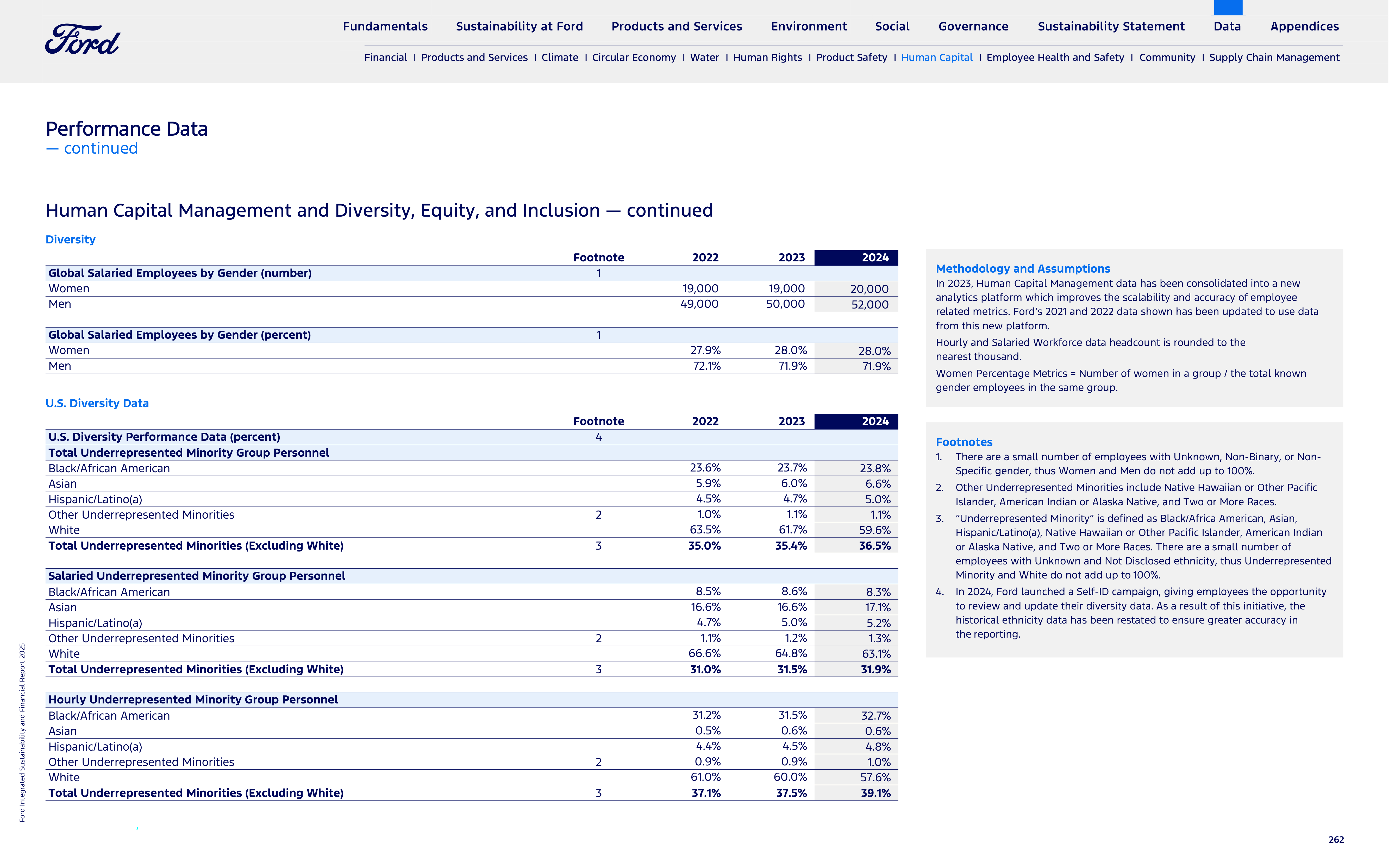
Fundamentals
Sustainability at Ford
Products and Services
Environment
Social
Governance
Sustainability Statement
Data
Appendices
Financial
Products and Services
Climate
Circular Economy
Water
Human Rights
Product Safety
Human Capital
Employee Health and Safety
Community
Supply Chain Management
|
|
|
|
|
|
|
|
|
|
Performance Data
— continued
,
Ford Integrated Sustainability and Financial Report 2025
262
Human Capital Management and Diversity, Equity, and Inclusion — continued
Diversity
Footnote
2022
2023
2024
Global Salaried Employees by Gender (number)
1
Women
19,000
19,000
20,000
Men
49,000
50,000
52,000
Global Salaried Employees by Gender (percent)
1
Women
27.9 %
28.0 %
28.0 %
Men
72.1 %
71.9 %
71.9 %
U.S. Diversity Data
Footnote
2022
2023
2024
U.S. Diversity Performance Data (percent)
4
Total Underrepresented Minority Group Personnel
Black/African American
23.6 %
23.7 %
23.8 %
Asian
5.9 %
6.0 %
6.6 %
Hispanic/Latino(a)
4.5 %
4.7 %
5.0 %
Other Underrepresented Minorities
2
1.0 %
1.1 %
1.1 %
White
63.5 %
61.7 %
59.6 %
Total Underrepresented Minorities (Excluding White)
3
35.0 %
35.4 %
36.5 %
Salaried Underrepresented Minority Group Personnel
Black/African American
8.5 %
8.6 %
8.3 %
Asian
16.6 %
16.6 %
17.1 %
Hispanic/Latino(a)
4.7 %
5.0 %
5.2 %
Other Underrepresented Minorities
2
1.1 %
1.2 %
1.3 %
White
66.6 %
64.8 %
63.1 %
Total Underrepresented Minorities (Excluding White)
3
31.0 %
31.5 %
31.9 %
Hourly Underrepresented Minority Group Personnel
Black/African American
31.2 %
31.5 %
32.7 %
Asian
0.5 %
0.6 %
0.6 %
Hispanic/Latino(a)
4.4 %
4.5 %
4.8 %
Other Underrepresented Minorities
2
0.9 %
0.9 %
1.0 %
White
61.0 %
60.0 %
57.6 %
Total Underrepresented Minorities (Excluding White)
3
37.1 %
37.5 %
39.1 %
Methodology and Assumptions
In 2023, Human Capital Management data has been consolidated into a new
analytics platform which improves the scalability and accuracy of employee
related metrics. Ford’s 2021 and 2022 data shown has been updated to use data
from this new platform.
Hourly and Salaried Workforce data headcount is rounded to the
nearest thousand.
Women Percentage Metrics = Number of women in a group / the total known
gender employees in the same group.
Footnotes
1.
There are a small number of employees with Unknown, Non-Binary, or Non-
Specific gender, thus Women and Men do not add up to 100%.
2.
Other Underrepresented Minorities include Native Hawaiian or Other Pacific
Islander, American Indian or Alaska Native, and Two or More Races.
3.
”Underrepresented Minority” is defined as Black/Africa American, Asian,
Hispanic/Latino(a), Native Hawaiian or Other Pacific Islander, American Indian
or Alaska Native, and Two or More Races. There are a small number of
employees with Unknown and Not Disclosed ethnicity, thus Underrepresented
Minority and White do not add up to 100%.
4.
In 2024, Ford launched a Self-ID campaign, giving employees the opportunity
to review and update their diversity data. As a result of this initiative, the
historical ethnicity data has been restated to ensure greater accuracy in
the reporting.
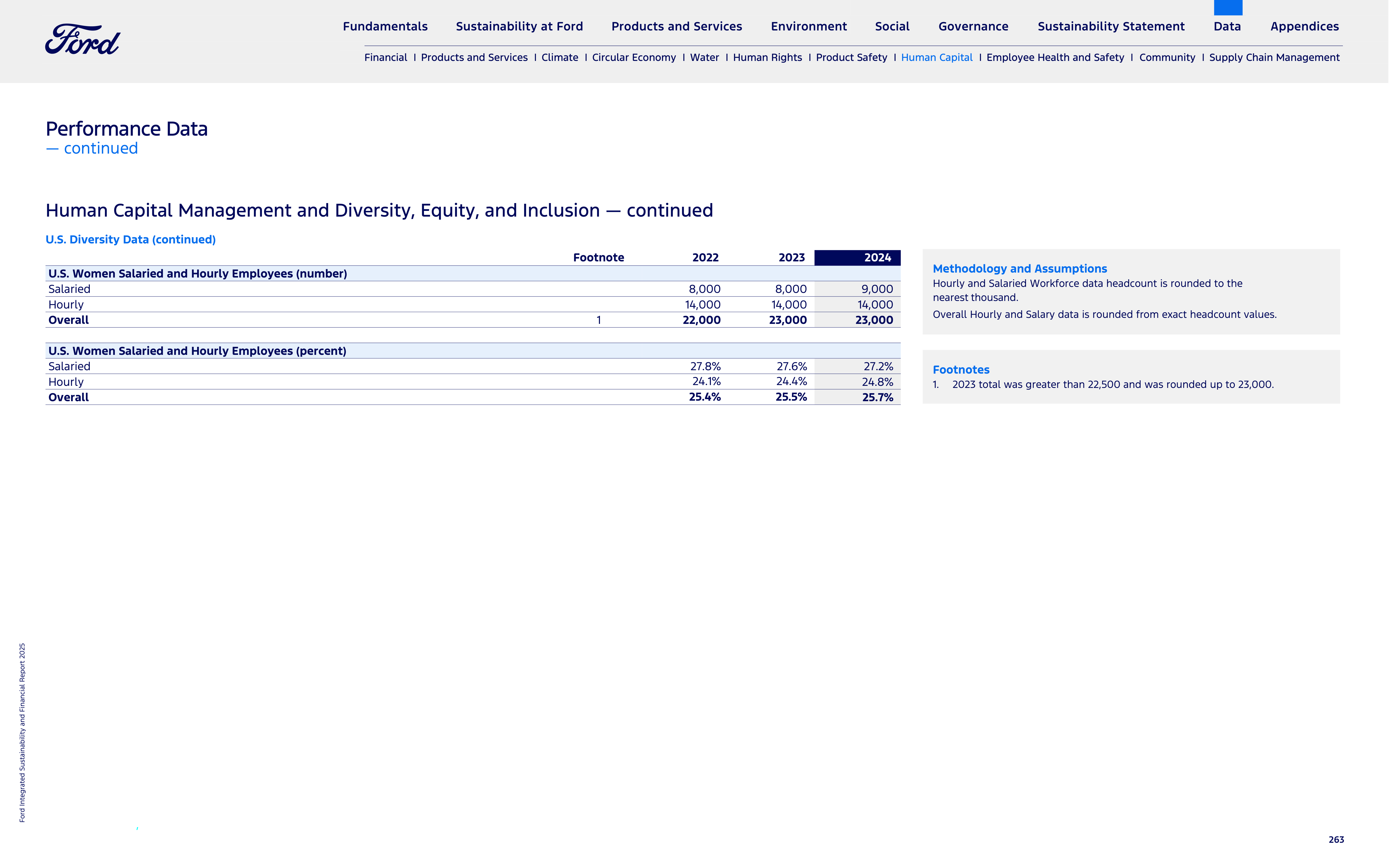
Fundamentals
Sustainability at Ford
Products and Services
Environment
Social
Governance
Sustainability Statement
Data
Appendices
Financial | Products and Services | Climate | Circular Economy | Water | Human Rights | Product Safety |
Human Capital
| Employee Health and Safety | Community | Supply Chain Management
Performance Data
— continued
,
Ford Integrated Sustainability and Financial Report 2025
263
Human Capital Management and Diversity, Equity, and Inclusion — continued
U.S. Diversity Data (continued)
Footnote
2022
2023
2024
U.S. Women Salaried and Hourly Employees (number)
Salaried
8,000
8,000
9,000
Hourly
14,000
14,000
14,000
Overall
1
22,000
23,000
23,000
U.S. Women Salaried and Hourly Employees (percent)
Salaried
27.8 %
27.6 %
27.2 %
Hourly
24.1 %
24.4 %
24.8 %
Overall
25.4 %
25.5 %
25.7 %
Methodology and Assumptions
Hourly and Salaried Workforce data headcount is rounded to the
nearest thousand.
Overall Hourly and Salary data is rounded from exact headcount values.
Footnotes
1.
2023 total was greater than 22,500 and was rounded up to 23,000.
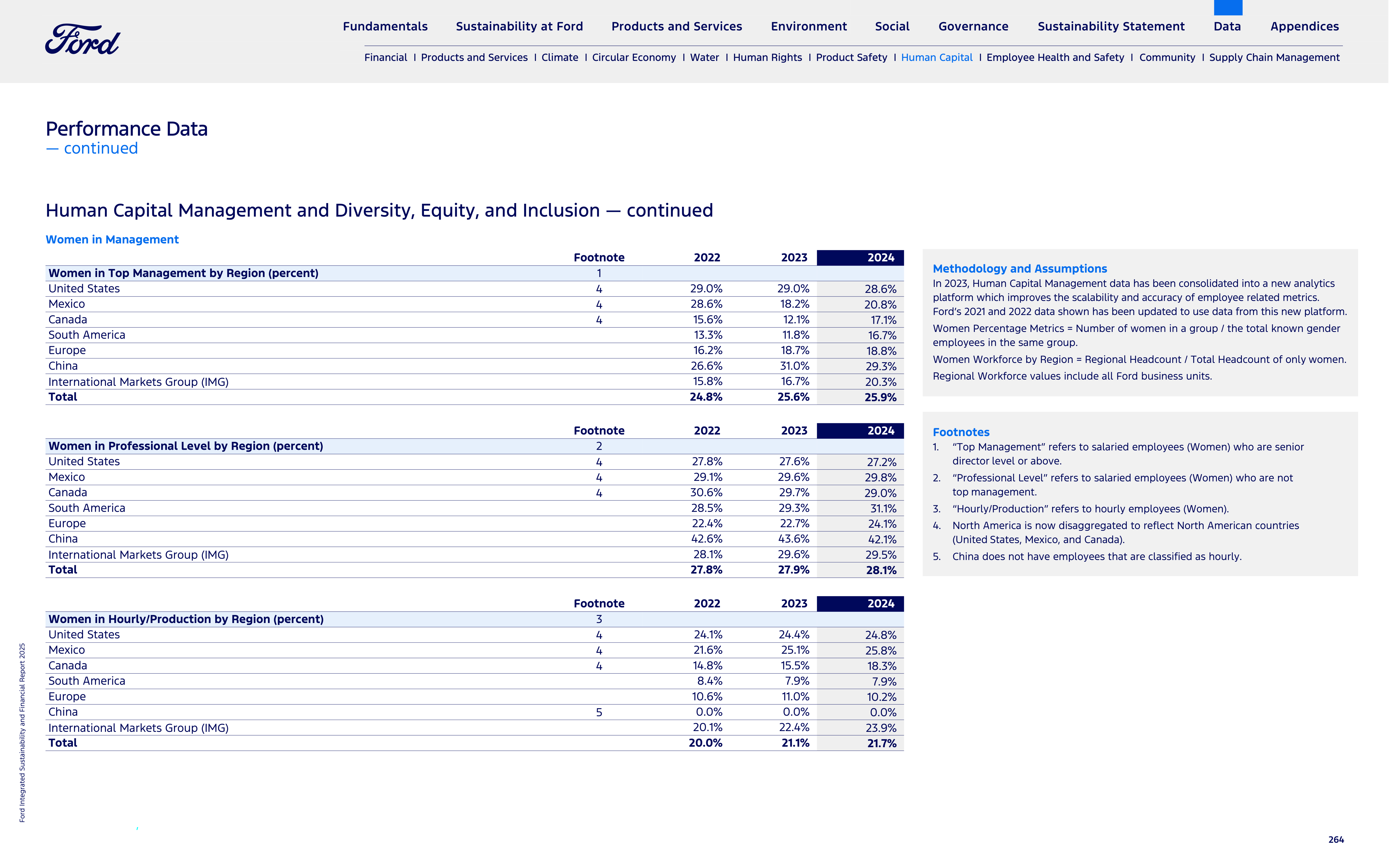
Fundamentals
Sustainability at Ford
Products and Services
Environment
Social
Governance
Sustainability Statement
Data
Appendices
Financial | Products and Services | Climate | Circular Economy | Water | Human Rights | Product Safety |
Human Capital
| Employee Health and Safety | Community | Supply Chain Management
Performance Data
— continued
,
Ford Integrated Sustainability and Financial Report 2025
264
Human Capital Management and Diversity, Equity, and Inclusion — continued
Women in Management
Footnote
2022
2023
2024
Women in Top Management by Region (percent)
1
United States
4
29.0 %
29.0 %
28.6 %
Mexico
4
28.6 %
18.2 %
20.8 %
Canada
4
15.6 %
12.1 %
17.1 %
South America
13.3 %
11.8 %
16.7 %
Europe
16.2 %
18.7 %
18.8 %
China
26.6 %
31.0 %
29.3 %
International Markets Group (IMG)
15.8 %
16.7 %
20.3 %
Total
24.8 %
25.6 %
25.9 %
Footnote
2022
2023
2024
Women in Professional Level by Region (percent)
2
United States
4
27.8 %
27.6 %
27.2 %
Mexico
4
29.1 %
29.6 %
29.8 %
Canada
4
30.6 %
29.7 %
29.0 %
South America
28.5 %
29.3 %
31.1 %
Europe
22.4 %
22.7 %
24.1 %
China
42.6 %
43.6 %
42.1 %
International Markets Group (IMG)
28.1 %
29.6 %
29.5 %
Total
27.8 %
27.9 %
28.1 %
Footnote
2022
2023
2024
Women in Hourly/Production by Region (percent)
3
United States
4
24.1 %
24.4 %
24.8 %
Mexico
4
21.6 %
25.1 %
25.8 %
Canada
4
14.8 %
15.5 %
18.3 %
South America
8.4 %
7.9 %
7.9 %
Europe
10.6 %
11.0 %
10.2 %
China
5
0.0 %
0.0 %
0.0 %
International Markets Group (IMG)
20.1 %
22.4 %
23.9 %
Total
20.0 %
21.1 %
21.7 %
Methodology and Assumptions
In 2023, Human Capital Management data has been consolidated into a new analytics
platform which improves the scalability and accuracy of employee related metrics.
Ford’s 2021 and 2022 data shown has been updated to use data from this new platform.
Women Percentage Metrics = Number of women in a group / the total known gender
employees in the same group.
Women Workforce by Region = Regional Headcount / Total Headcount of only women.
Regional Workforce values include all Ford business units.
Footnotes
1.
“Top Management” refers to salaried employees (Women) who are senior
director level or above.
2.
“Professional Level” refers to salaried employees (Women) who are not
top management.
3.
“Hourly/Production” refers to hourly employees (Women).
4.
North America is now disaggregated to reflect North American countries
(United States, Mexico, and Canada).
5.
China does not have employees that are classified as hourly.
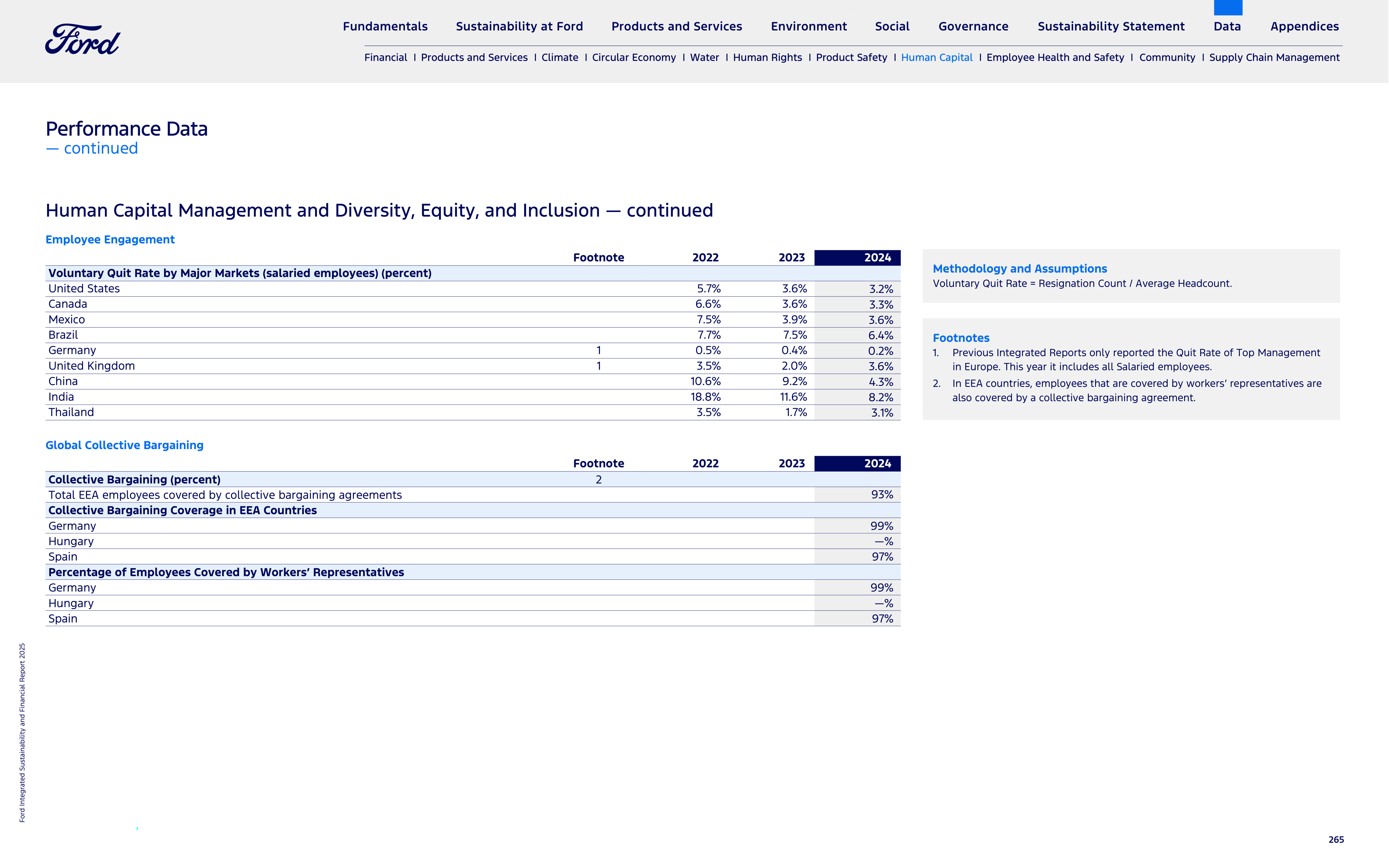
Fundamentals
Sustainability at Ford
Products and Services
Environment
Social
Governance
Sustainability Statement
Data
Appendices
Financial | Products and Services | Climate | Circular Economy | Water | Human Rights | Product Safety |
Human Capital
| Employee Health and Safety | Community | Supply Chain Management
Performance Data
— continued
,
Ford Integrated Sustainability and Financial Report 2025
265
Human Capital Management and Diversity, Equity, and Inclusion — continued
Employee Engagement
Footnote
2022
2023
2024
Voluntary Quit Rate by Major Markets (salaried employees) (percent)
United States
5.7 %
3.6 %
3.2 %
Canada
6.6 %
3.6 %
3.3 %
Mexico
7.5 %
3.9 %
3.6 %
Brazil
7.7 %
7.5 %
6.4 %
Germany
1
0.5 %
0.4 %
0.2 %
United Kingdom
1
3.5 %
2.0 %
3.6 %
China
10.6 %
9.2 %
4.3 %
India
18.8 %
11.6 %
8.2 %
Thailand
3.5 %
1.7 %
3.1 %
Global Collective Bargaining
Footnote
2022
2023
2024
Collective Bargaining (percent)
2
Total EEA employees covered by collective bargaining agreements
93 %
Collective Bargaining Coverage in EEA Countries
Germany
99 %
Hungary
— %
Spain
97 %
Percentage of Employees Covered by Workers’ Representatives
Germany
99 %
Hungary
— %
Spain
97 %
Methodology and Assumptions
Voluntary Quit Rate = Resignation Count / Average Headcount.
Footnotes
1.
Previous Integrated Reports only reported the Quit Rate of Top Management
in Europe. This year it includes all Salaried employees.
2.
In EEA countries, employees that are covered by workers’ representatives are
also covered by a collective bargaining agreement.
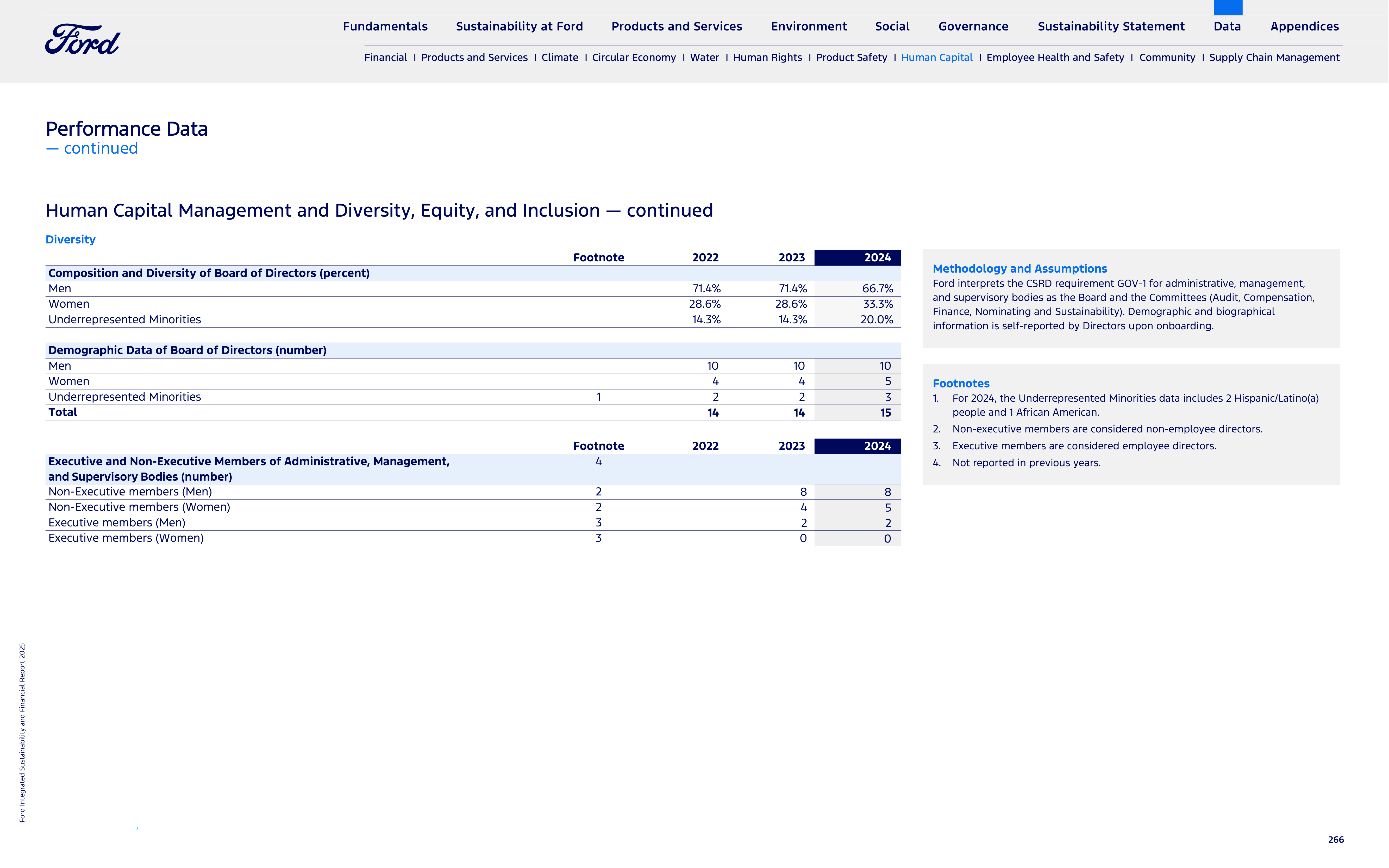
Fundamentals
Sustainability at Ford
Products and Services
Environment
Social
Governance
Sustainability Statement
Data
Appendices
Financial | Products and Services | Climate | Circular Economy | Water | Human Rights | Product Safety |
Human Capital
| Employee Health and Safety | Community | Supply Chain Management
Performance Data
— continued
,
Ford Integrated Sustainability and Financial Report 2025
266
Human Capital Management and Diversity, Equity, and Inclusion — continued
Diversity
Footnote
2022
2023
2024
Composition and Diversity of Board of Directors (percent)
Men
71.4 %
71.4 %
66.7 %
Women
28.6 %
28.6 %
33.3 %
Underrepresented Minorities
14.3 %
14.3 %
20.0 %
Demographic Data of Board of Directors (number)
Men
10
10
10
Women
4
4
5
Underrepresented Minorities
1
2
2
3
Total
14
14
15
Footnote
2022
2023
2024
Executive and Non-Executive Members of Administrative, Management,
and Supervisory Bodies (number)
4
Non-Executive members (Men)
2
8
8
Non-Executive members (Women)
2
4
5
Executive members (Men)
3
2
2
Executive members (Women)
3
0
0
Methodology and Assumptions
Ford interprets the CSRD requirement GOV-1 for administrative, management,
and supervisory bodies as the Board and the Committees (Audit, Compensation,
Finance, Nominating and Sustainability). Demographic and biographical
information is self-reported by Directors upon onboarding.
Footnotes
1.
For 2024, the Underrepresented Minorities data includes 2 Hispanic/Latino(a)
people and 1 African American.
2.
Non-executive members are considered non-employee directors.
3.
Executive members are considered employee directors.
4.
Not reported in previous years.
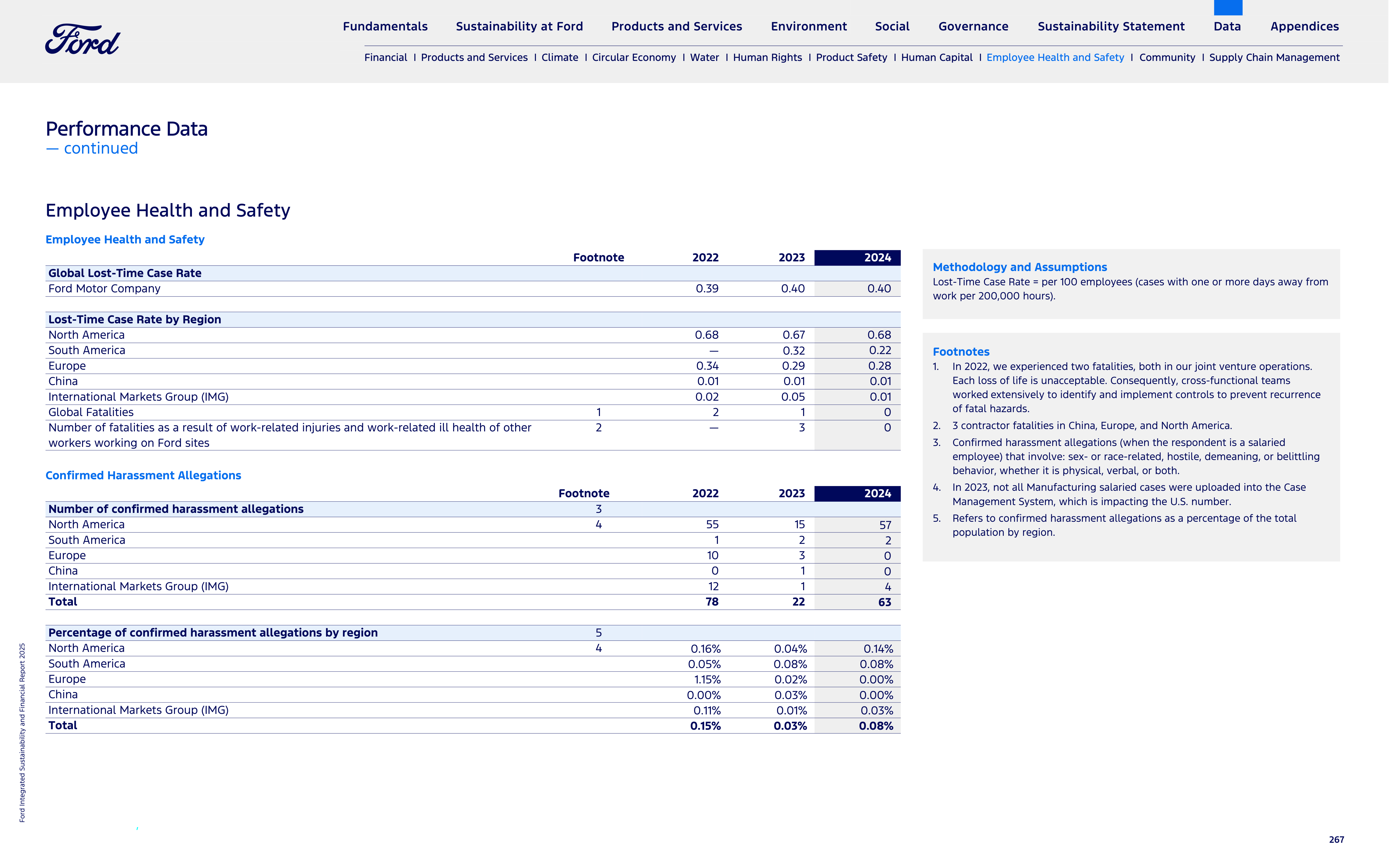
Fundamentals
Sustainability at Ford
Products and Services
Environment
Social
Governance
Sustainability Statement
Data
Appendices
Financial | Products and Services | Climate | Circular Economy | Water | Human Rights | Product Safety | Human Capital |
Employee Health and Safety
| Community | Supply Chain Management
Performance Data
— continued
,
Ford Integrated Sustainability and Financial Report 2025
267
Employee Health and Safety
Employee Health and Safety
Footnote
2022
2023
2024
Global Lost-Time Case Rate
Ford Motor Company
0.39
0.40
0.40
Lost-Time Case Rate by Region
North America
0.68
0.67
0.68
South America
—
0.32
0.22
Europe
0.34
0.29
0.28
China
0.01
0.01
0.01
International Markets Group (IMG)
0.02
0.05
0.01
Global Fatalities
1
2
1
0
Number of fatalities as a result of work-related injuries and work-related ill health of other
workers working on Ford sites
2
—
3
0
Confirmed Harassment Allegations
Footnote
2022
2023
2024
Number of confirmed harassment allegations
3
North America
4
55
15
57
South America
1
2
2
Europe
10
3
0
China
0
1
0
International Markets Group (IMG)
12
1
4
Total
78
22
63
Percentage of confirmed harassment allegations by region
5
North America
4
0.16 %
0.04 %
0.14 %
South America
0.05 %
0.08 %
0.08 %
Europe
1.15 %
0.02 %
0.00 %
China
0.00 %
0.03 %
0.00 %
International Markets Group (IMG)
0.11 %
0.01 %
0.03 %
Total
0.15 %
0.03 %
0.08 %
Methodology and Assumptions
Lost-Time Case Rate = per 100 employees (cases with one or more days away from
work per 200,000 hours).
Footnotes
1.
In 2022, we experienced two fatalities, both in our joint venture operations.
Each loss of life is unacceptable. Consequently, cross-functional teams
worked extensively to identify and implement controls to prevent recurrence
of fatal hazards.
2.
3 contractor fatalities in China, Europe, and North America.
3.
Confirmed harassment allegations (when the respondent is a salaried
employee) that involve: sex- or race-related, hostile, demeaning, or belittling
behavior, whether it is physical, verbal, or both.
4.
In 2023, not all Manufacturing salaried cases were uploaded into the Case
Management System, which is impacting the U.S. number.
5.
Refers to confirmed harassment allegations as a percentage of the total
population by region.
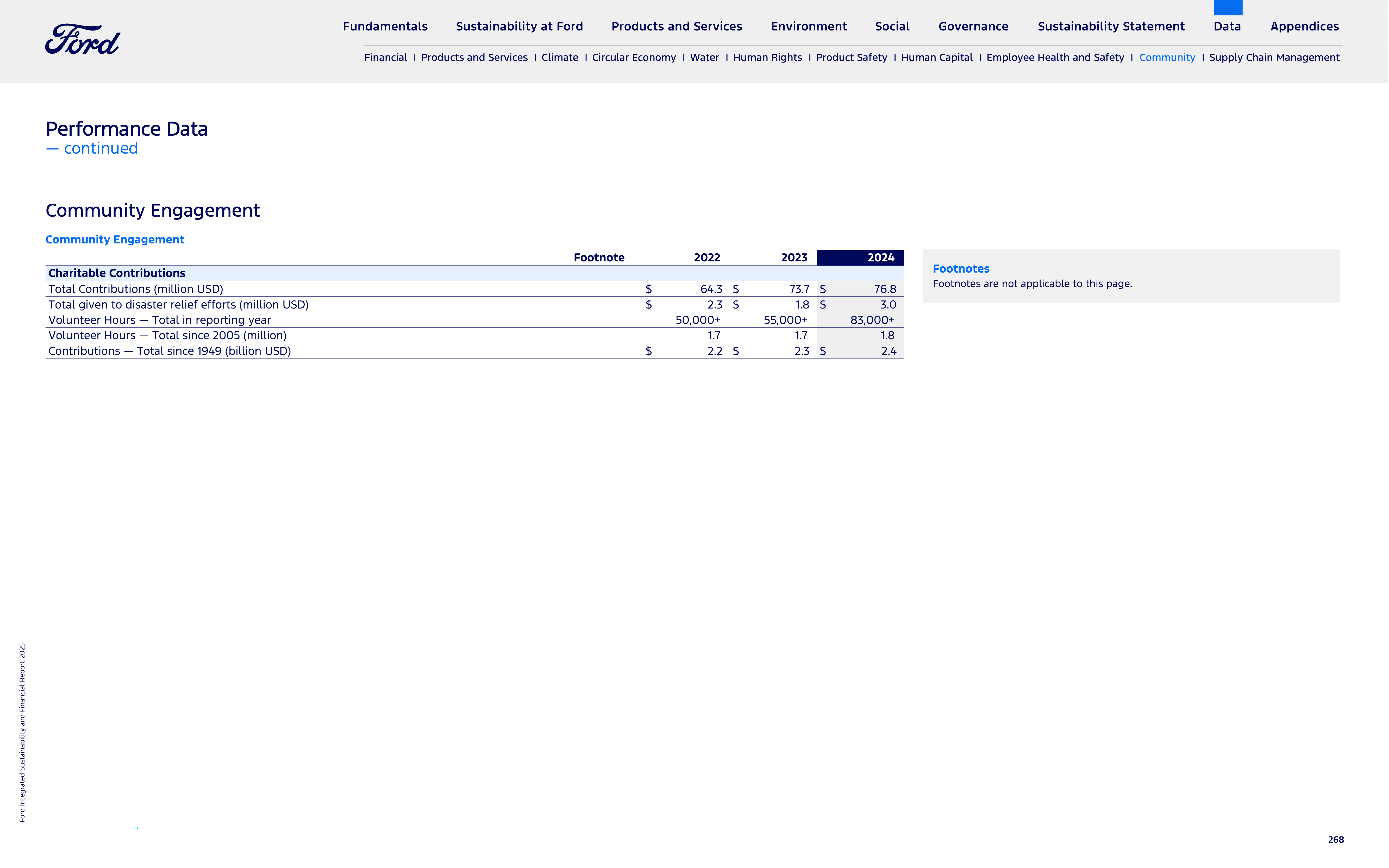
Fundamentals
Sustainability at Ford
Products and Services
Environment
Social
Governance
Sustainability Statement
Data
Appendices
Financial | Products and Services | Climate | Circular Economy | Water | Human Rights | Product Safety | Human Capital | Employee Health and Safety |
Community
| Supply Chain Management
Performance Data
— continued
,
Ford Integrated Sustainability and Financial Report 2025
268
Community Engagement
Community Engagement
Footnote
2022
2023
2024
Charitable Contributions
Total Contributions (million USD)
$
64.3 $
73.7 $
76.8
Total given to disaster relief efforts (million USD)
$
2.3 $
1.8 $
3.0
Volunteer Hours — Total in reporting year
50,000+
55,000+
83,000+
Volunteer Hours — Total since 2005 (million)
1.7
1.7
1.8
Contributions — Total since 1949 (billion USD)
$
2.2 $
2.3 $
2.4
Footnotes
Footnotes are not applicable to this page.
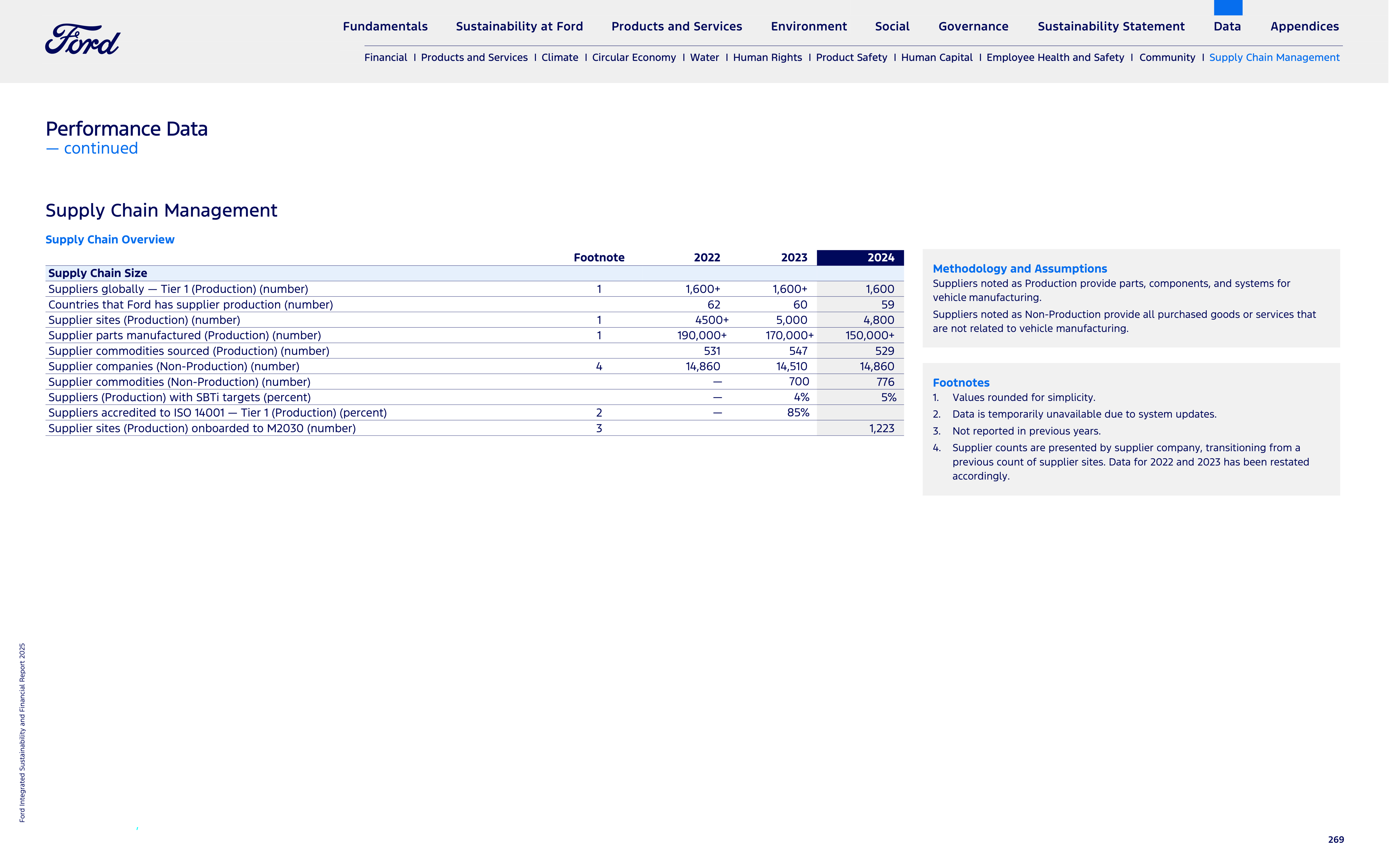
Fundamentals
Sustainability at Ford
Products and Services
Environment
Social
Governance
Sustainability Statement
Data
Appendices
Financial | Products and Services | Climate | Circular Economy | Water | Human Rights | Product Safety | Human Capital | Employee Health and Safety | Community |
Supply Chain Management
Performance Data
— continued
,
Ford Integrated Sustainability and Financial Report 2025
269
Supply Chain Management
Supply Chain Overview
Footnote
2022
2023
2024
Supply Chain Size
Suppliers globally — Tier 1 (Production) (number)
1
1,600+
1,600+
1,600
Countries that Ford has supplier production (number)
62
60
59
Supplier sites (Production) (number)
1
4500+
5,000
4,800
Supplier parts manufactured (Production) (number)
1
190,000+
170,000+
150,000+
Supplier commodities sourced (Production) (number)
531
547
529
Supplier companies (Non-Production) (number)
4
14,860
14,510
14,860
Supplier commodities (Non-Production) (number)
—
700
776
Suppliers (Production) with SBTi targets (percent)
—
4 %
5 %
Suppliers accredited to ISO 14001 — Tier 1 (Production) (percent)
2
—
85 %
Supplier sites (Production) onboarded to M2030 (number)
3
1,223
Methodology and Assumptions
Suppliers noted as Production provide parts, components, and systems for
vehicle manufacturing.
Suppliers noted as Non-Production provide all purchased goods or services that
are not related to vehicle manufacturing.
Footnotes
1.
Values rounded for simplicity.
2.
Data is temporarily unavailable due to system updates.
3.
Not reported in previous years.
4.
Supplier counts are presented by supplier company, transitioning from a
previous count of supplier sites. Data for 2022 and 2023 has been restated
accordingly.
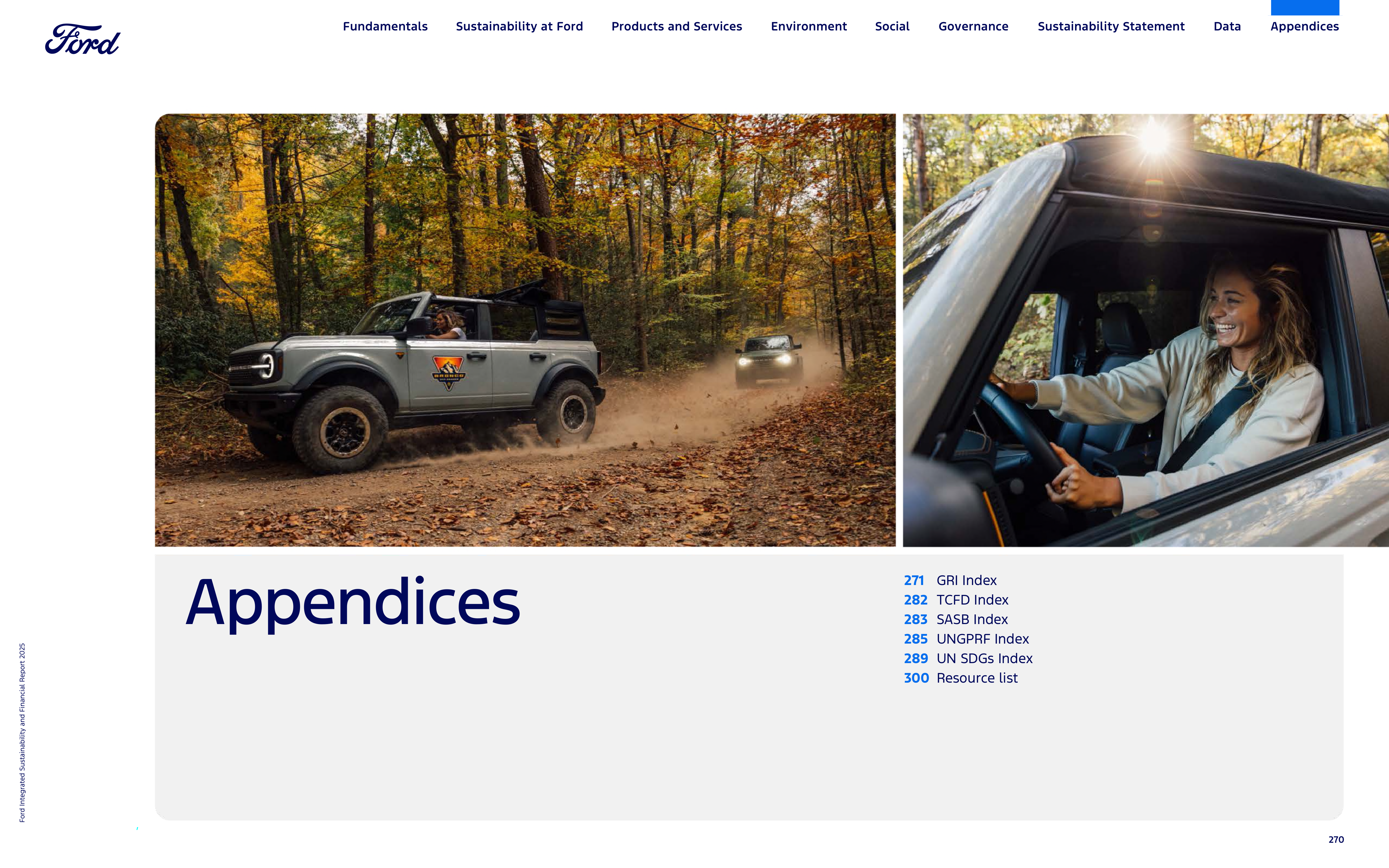



Fundamentals
Sustainability at Ford
Products and Services
Environment
Social
Governance
Sustainability Statement
Data
Appendices
,
Ford Integrated Sustainability and Financial Report 2025
270
Appendices
271
GRI Index
282
TCFD Index
283
SASB Index
285
UNGPRF Index
289
UN SDGs Index
300
Resource list
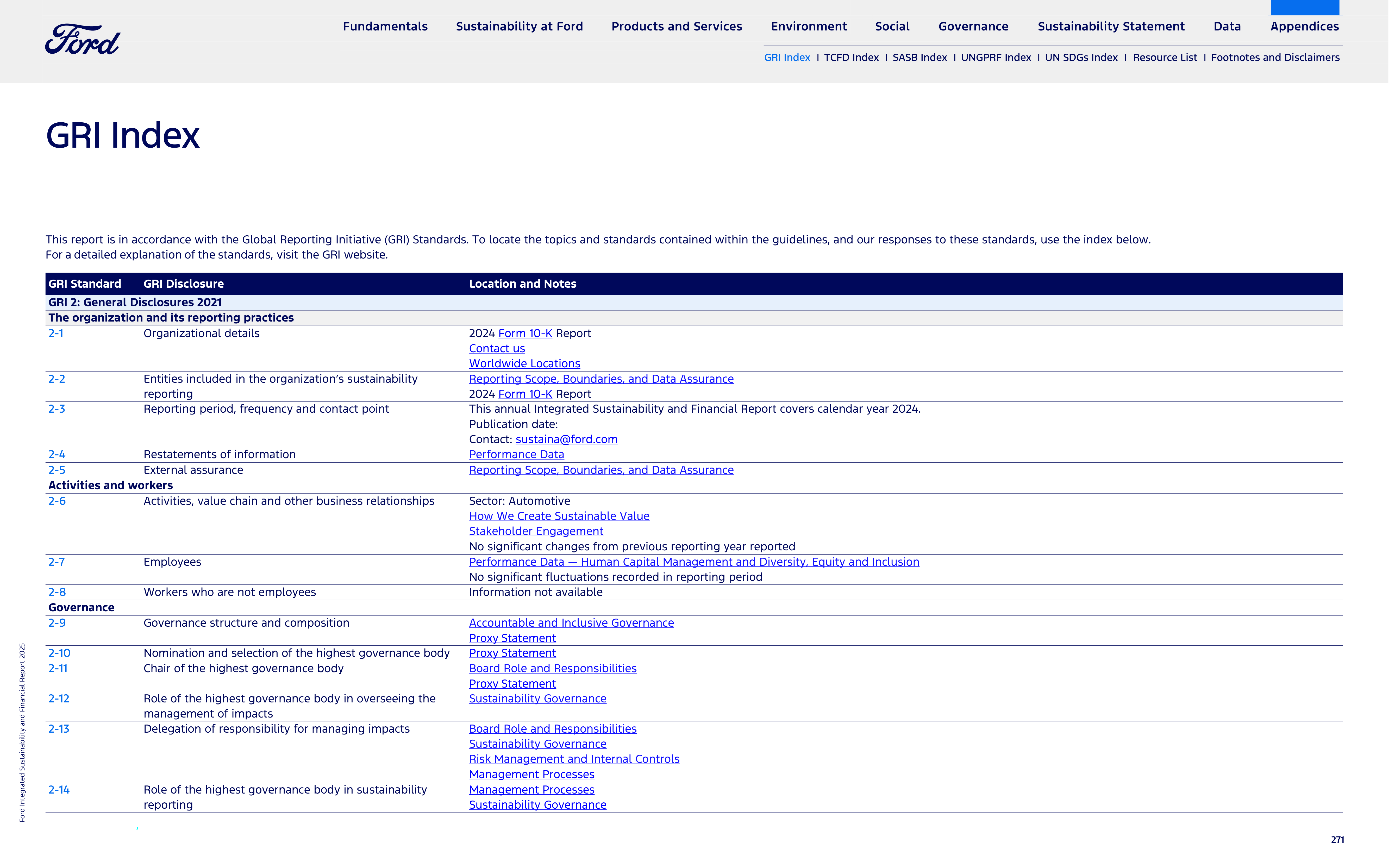
Fundamentals
Sustainability at Ford
Products and Services
Environment
Social
Governance
Sustainability Statement
Data
Appendices
GRI Index
| TCFD Index | SASB Index | UNGPRF Index | UN SDGs Index | Resource List | Footnotes and Disclaimers
GRI Index
,
Ford Integrated Sustainability and Financial Report 2025
271
This report is in accordance with the Global Reporting Initiative (GRI) Standards. To locate the topics and standards contained within the guidelines, and our responses to these standards, use the index below.
For a detailed explanation of the standards, visit the GRI website.
GRI Standard
GRI Disclosure
Location and Notes
GRI 2: General Disclosures 2021
The organization and its reporting practices
2-1
Organizational details
2024
Form 10-K
Report
Contact us
Worldwide Locations
2-2
Entities included in the organization’s sustainability
reporting
Reporting Scope, Boundaries, and Data Assurance
2024
Form 10-K
Report
2-3
Reporting period, frequency and contact point
This annual Integrated Sustainability and Financial Report covers calendar year 2024.
Publication date:
Contact:
sustaina@ford.com
2-4
Restatements of information
Performance Data
2-5
External assurance
Reporting Scope, Boundaries, and Data Assurance
Activities and workers
2-6
Activities, value chain and other business relationships
Sector: Automotive
How We Create Sustainable Value
Stakeholder Engagement
No significant changes from previous reporting year reported
2-7
Employees
Performance Data — Human Capital Management and Diversity, Equity and Inclusion
No significant fluctuations recorded in reporting period
2-8
Workers who are not employees
Information not available
Governance
2-9
Governance structure and composition
Accountable and Inclusive Governance
Proxy Statement
2-10
Nomination and selection of the highest governance body
Proxy Statement
2-11
Chair of the highest governance body
Board Role and Responsibilities
Proxy Statement
2-12
Role of the highest governance body in overseeing the
management of impacts
Sustainability Governance
2-13
Delegation of responsibility for managing impacts
Board Role and Responsibilities
Sustainability Governance
Risk Management and Internal Controls
Management Processes
2-14
Role of the highest governance body in sustainability
reporting
Management Processes
Sustainability Governance
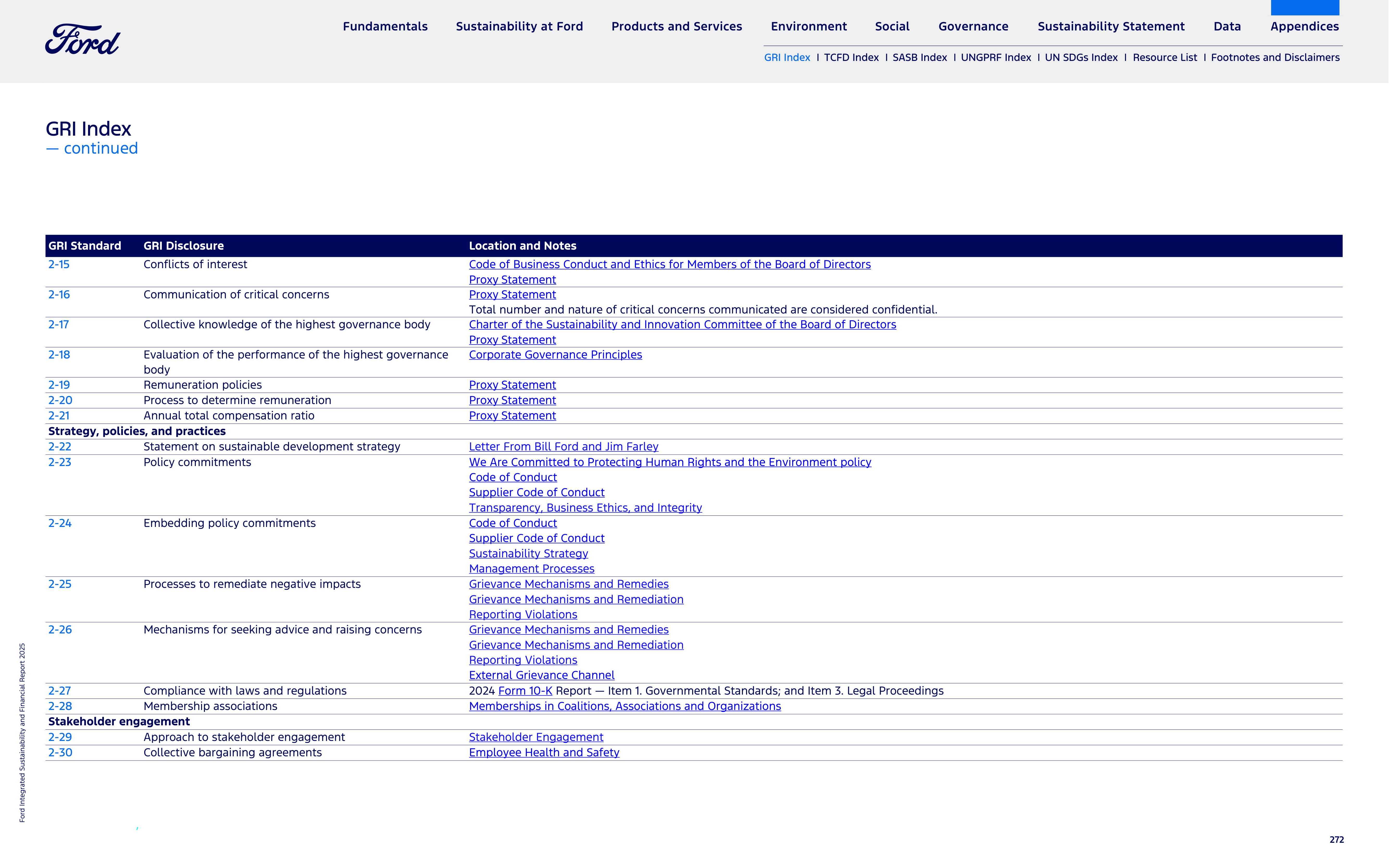
2-15
Conflicts of interest
Code of Business Conduct and Ethics for Members of the Board of Directors
Proxy Statement
2-16
Communication of critical concerns
Proxy Statement
Total number and nature of critical concerns communicated are considered confidential.
2-17
Collective knowledge of the highest governance body
Charter of the Sustainability and Innovation Committee of the Board of Directors
Proxy Statement
2-18
Evaluation of the performance of the highest governance
body
Corporate Governance Principles
2-19
Remuneration policies
Proxy Statement
2-20
Process to determine remuneration
Proxy Statement
2-21
Annual total compensation ratio
Proxy Statement
Strategy, policies, and practices
2-22
Statement on sustainable development strategy
Letter From Bill Ford and Jim Farley
2-23
Policy commitments
We Are Committed to Protecting Human Rights and the Environment policy
Code of Conduct
Supplier Code of Conduct
Transparency, Business Ethics, and Integrity
2-24
Embedding policy commitments
Code of Conduct
Supplier Code of Conduct
Sustainability Strategy
Management Processes
2-25
Processes to remediate negative impacts
Grievance Mechanisms and Remedies
Grievance Mechanisms and Remediation
Reporting Violations
2-26
Mechanisms for seeking advice and raising concerns
Grievance Mechanisms and Remedies
Grievance Mechanisms and Remediation
Reporting Violations
External Grievance Channel
2-27
Compliance with laws and regulations
2024
Form 10-K
Report — Item 1. Governmental Standards; and Item 3. Legal Proceedings
2-28
Membership associations
Memberships in Coalitions, Associations and Organizations
Stakeholder engagement
2-29
Approach to stakeholder engagement
Stakeholder Engagement
2-30
Collective bargaining agreements
Employee Health and Safety
Fundamentals
Sustainability at Ford
Products and Services
Environment
Social
Governance
Sustainability Statement
Data
Appendices
GRI Index
| TCFD Index | SASB Index | UNGPRF Index | UN SDGs Index | Resource List | Footnotes and Disclaimers
GRI Index
— continued
,
Ford Integrated Sustainability and Financial Report 2025
272
GRI Standard
GRI Disclosure
Location and Notes
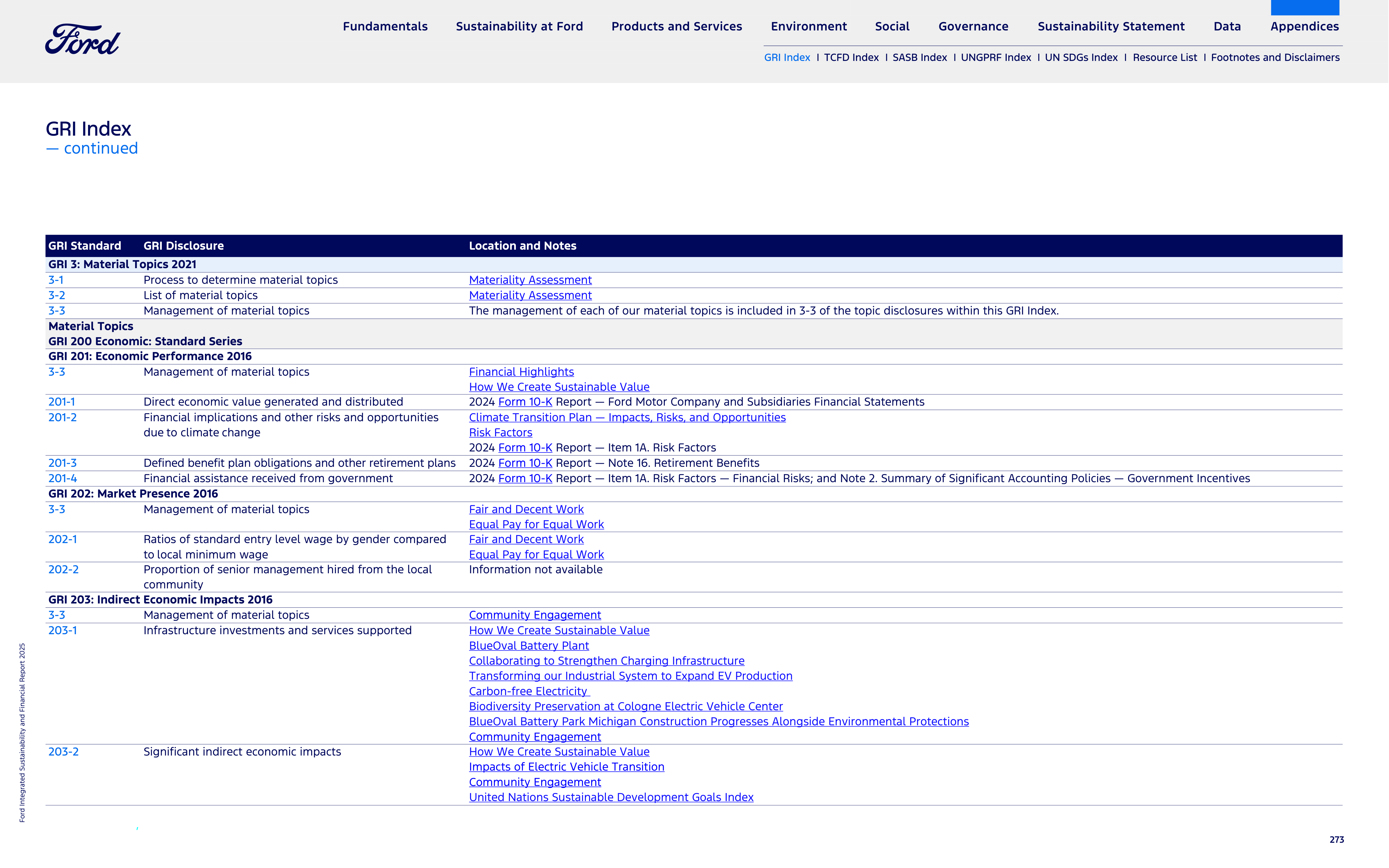
GRI 3: Material Topics 2021
3-1
Process to determine material topics
Materiality Assessment
3-2
List of material topics
Materiality Assessment
3-3
Management of material topics
The management of each of our material topics is included in 3-3 of the topic disclosures within this GRI Index.
Material Topics
GRI 200 Economic: Standard Series
GRI 201: Economic Performance 2016
3-3
Management of material topics
Financial Highlights
How We Create Sustainable Value
201-1
Direct economic value generated and distributed
2024
Form 10-K
Report — Ford Motor Company and Subsidiaries Financial Statements
201-2
Financial implications and other risks and opportunities
due to climate change
Climate Transition Plan — Impacts, Risks, and Opportunities
Risk Factors
2024
Form 10-K
Report — Item 1A. Risk Factors
201-3
Defined benefit plan obligations and other retirement plans
2024
Form 10-K
Report — Note 16. Retirement Benefits
201-4
Financial assistance received from government
2024
Form 10-K
Report — Item 1A. Risk Factors — Financial Risks; and Note 2. Summary of Significant Accounting Policies — Government Incentives
GRI 202: Market Presence 2016
3-3
Management of material topics
Fair and Decent Work
Equal Pay for Equal Work
202-1
Ratios of standard entry level wage by gender compared
to local minimum wage
Fair and Decent Work
Equal Pay for Equal Work
202-2
Proportion of senior management hired from the local
community
Information not available
GRI 203: Indirect Economic Impacts 2016
3-3
Management of material topics
Community Engagement
203-1
Infrastructure investments and services supported
How We Create Sustainable Value
BlueOval Battery Plant
Collaborating to Strengthen Charging Infrastructure
Transforming our Industrial System to Expand EV Production
Carbon-free Electricity
Biodiversity Preservation at Cologne Electric Vehicle Center
BlueOval Battery Park Michigan Construction Progresses Alongside Environmental Protections
Community Engagement
203-2
Significant indirect economic impacts
How We Create Sustainable Value
Impacts of Electric Vehicle Transition
Community Engagement
United Nations Sustainable Development Goals Index
Fundamentals
Sustainability at Ford
Products and Services
Environment
Social
Governance
Sustainability Statement
Data
Appendices
GRI Index
| TCFD Index | SASB Index | UNGPRF Index | UN SDGs Index | Resource List | Footnotes and Disclaimers
GRI Index
— continued
,
Ford Integrated Sustainability and Financial Report 2025
273
GRI Standard
GRI Disclosure
Location and Notes
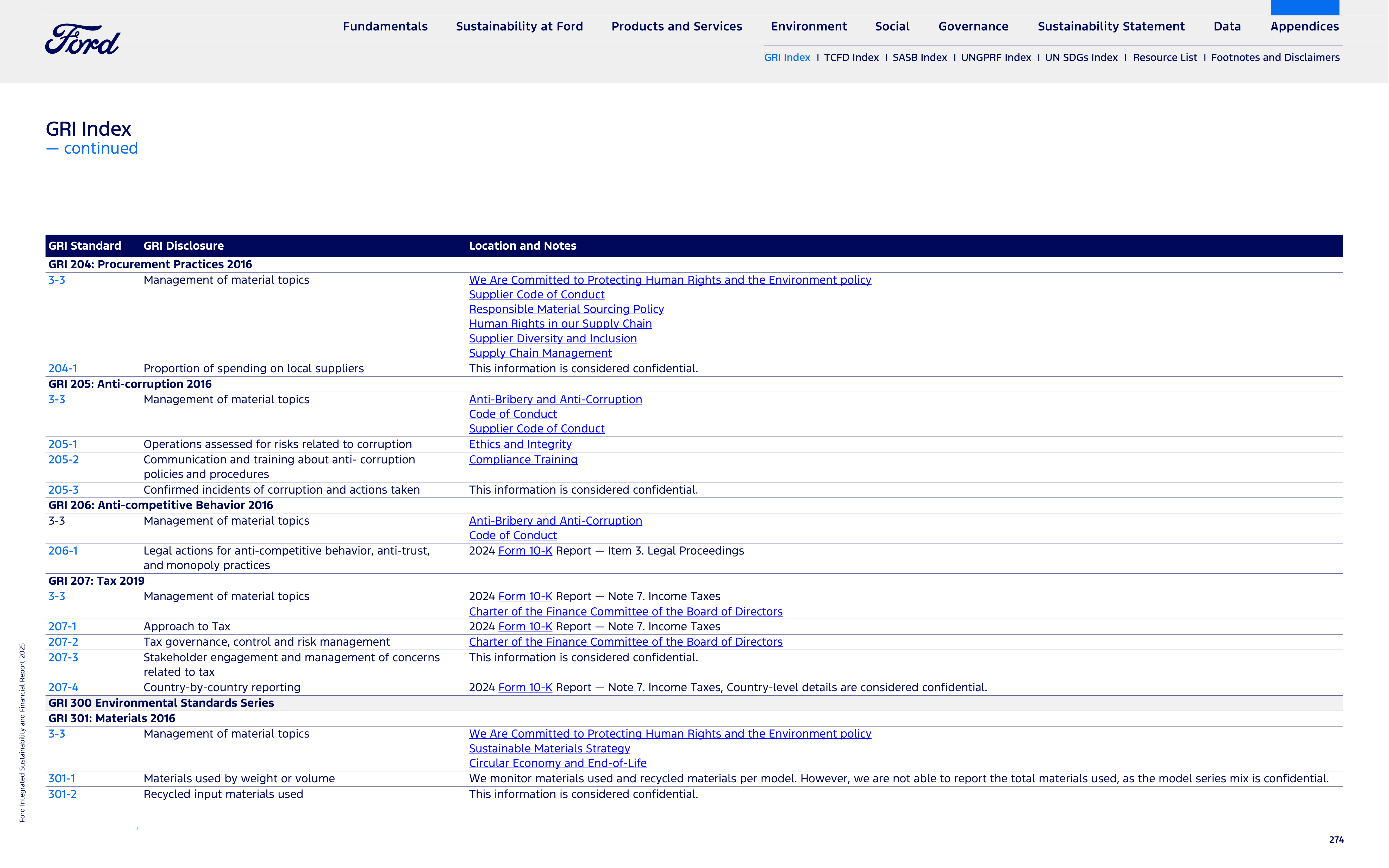
GRI 204: Procurement Practices 2016
3-3
Management of material topics
We Are Committed to Protecting Human Rights and the Environment policy
Supplier Code of Conduct
Responsible Material Sourcing Policy
Human Rights in our Supply Chain
Supplier Diversity and Inclusion
Supply Chain Management
204-1
Proportion of spending on local suppliers
This information is considered confidential.
GRI 205: Anti-corruption 2016
3-3
Management of material topics
Anti-Bribery and Anti-Corruption
Code of Conduct
Supplier Code of Conduct
205-1
Operations assessed for risks related to corruption
Ethics and Integrity
205-2
Communication and training about anti- corruption
policies and procedures
Compliance Training
205-3
Confirmed incidents of corruption and actions taken
This information is considered confidential.
GRI 206: Anti-competitive Behavior 2016
3-3
Management of material topics
Anti-Bribery and Anti-Corruption
Code of Conduct
206-1
Legal actions for anti-competitive behavior, anti-trust,
and monopoly practices
2024
Form 10-K
Report — Item 3. Legal Proceedings
GRI 207: Tax 2019
3-3
Management of material topics
2024
Form 10-K
Report — Note 7. Income Taxes
Charter of the Finance Committee of the Board of Directors
207-1
Approach to Tax
2024
Form 10-K
Report — Note 7. Income Taxes
207-2
Tax governance, control and risk management
Charter of the Finance Committee of the Board of Directors
207-3
Stakeholder engagement and management of concerns
related to tax
This information is considered confidential.
207-4
Country-by-country reporting
2024
Form 10-K
Report — Note 7. Income Taxes, Country-level details are considered confidential.
GRI 300 Environmental Standards Series
GRI 301: Materials 2016
3-3
Management of material topics
We Are Committed to Protecting Human Rights and the Environment policy
Sustainable Materials Strategy
Circular Economy and End-of-Life
301-1
Materials used by weight or volume
We monitor materials used and recycled materials per model. However, we are not able to report the total materials used, as the model series mix is confidential.
301-2
Recycled input materials used
This information is considered confidential.
Fundamentals
Sustainability at Ford
Products and Services
Environment
Social
Governance
Sustainability Statement
Data
Appendices
GRI Index
| TCFD Index | SASB Index | UNGPRF Index | UN SDGs Index | Resource List | Footnotes and Disclaimers
GRI Index
— continued
,
Ford Integrated Sustainability and Financial Report 2025
274
GRI Standard
GRI Disclosure
Location and Notes
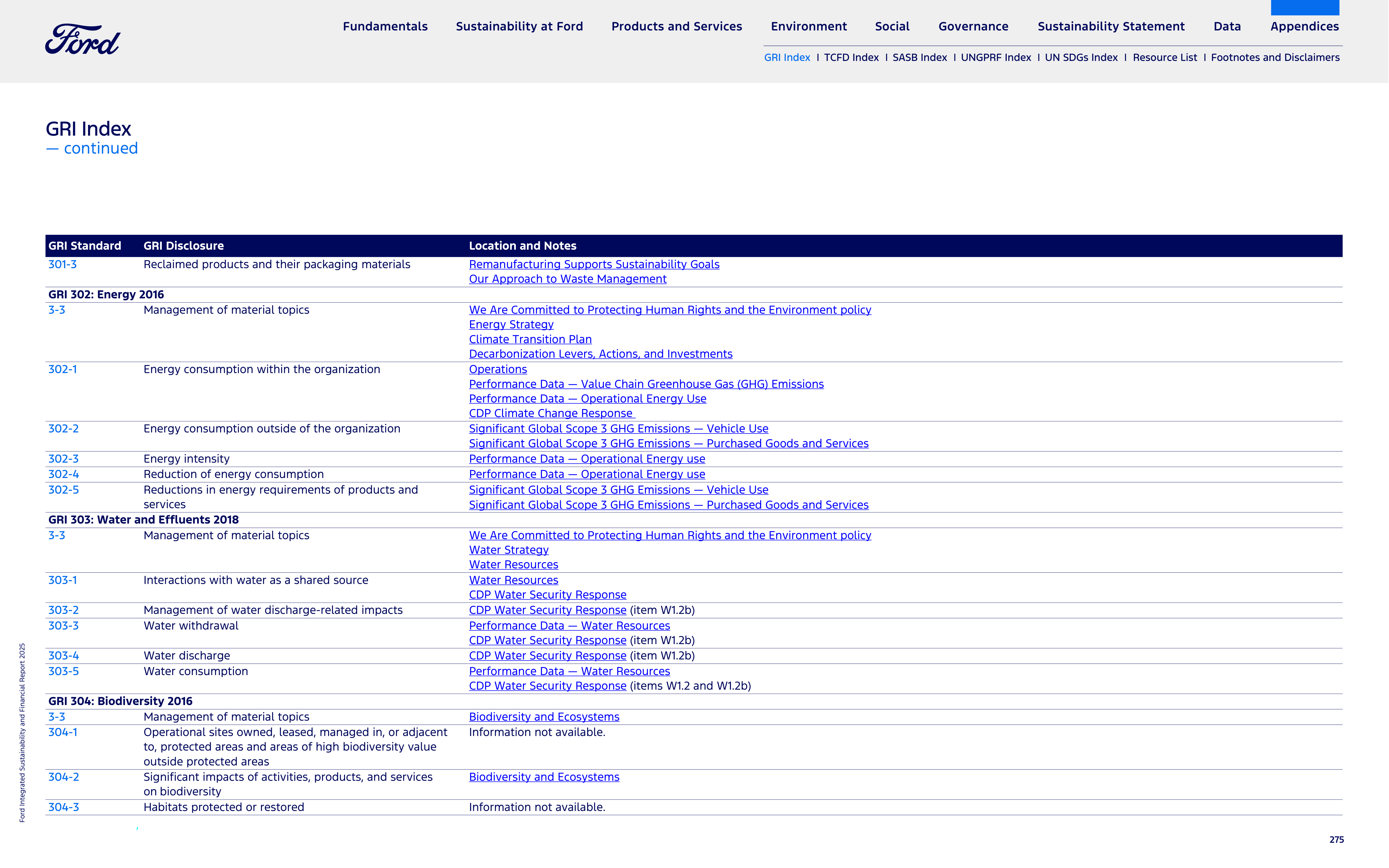
301-3
Reclaimed products and their packaging materials
Remanufacturing Supports Sustainability Goals
Our Approach to Waste Management
GRI 302: Energy 2016
3-3
Management of material topics
We Are Committed to Protecting Human Rights and the Environment policy
Energy Strategy
Climate Transition Plan
Decarbonization Levers, Actions, and Investments
302-1
Energy consumption within the organization
Operations
Performance Data — Value Chain Greenhouse Gas (GHG) Emissions
Performance Data — Operational Energy Use
CDP Climate Change Response
302-2
Energy consumption outside of the organization
Significant Global Scope 3 GHG Emissions — Vehicle Use
Significant Global Scope 3 GHG Emissions — Purchased Goods and Services
302-3
Energy intensity
Performance Data — Operational Energy use
302-4
Reduction of energy consumption
Performance Data — Operational Energy use
302-5
Reductions in energy requirements of products and
services
Significant Global Scope 3 GHG Emissions — Vehicle Use
Significant Global Scope 3 GHG Emissions — Purchased Goods and Services
GRI 303: Water and Effluents 2018
3-3
Management of material topics
We Are Committed to Protecting Human Rights and the Environment policy
Water Strategy
Water Resources
303-1
Interactions with water as a shared source
Water Resources
CDP Water Security Response
303-2
Management of water discharge-related impacts
CDP Water Security Response
(item W1.2b)
303-3
Water withdrawal
Performance Data — Water Resources
CDP Water Security Response
(item W1.2b)
303-4
Water discharge
CDP Water Security Response
(item W1.2b)
303-5
Water consumption
Performance Data — Water Resources
CDP Water Security Response
(items W1.2 and W1.2b)
GRI 304: Biodiversity 2016
3-3
Management of material topics
Biodiversity and Ecosystems
304-1
Operational sites owned, leased, managed in, or adjacent
to, protected areas and areas of high biodiversity value
outside protected areas
Information not available.
304-2
Significant impacts of activities, products, and services
on biodiversity
Biodiversity and Ecosystems
304-3
Habitats protected or restored
Information not available.
Fundamentals
Sustainability at Ford
Products and Services
Environment
Social
Governance
Sustainability Statement
Data
Appendices
GRI Index
| TCFD Index | SASB Index | UNGPRF Index | UN SDGs Index | Resource List | Footnotes and Disclaimers
GRI Index
— continued
,
Ford Integrated Sustainability and Financial Report 2025
275
GRI Standard
GRI Disclosure
Location and Notes
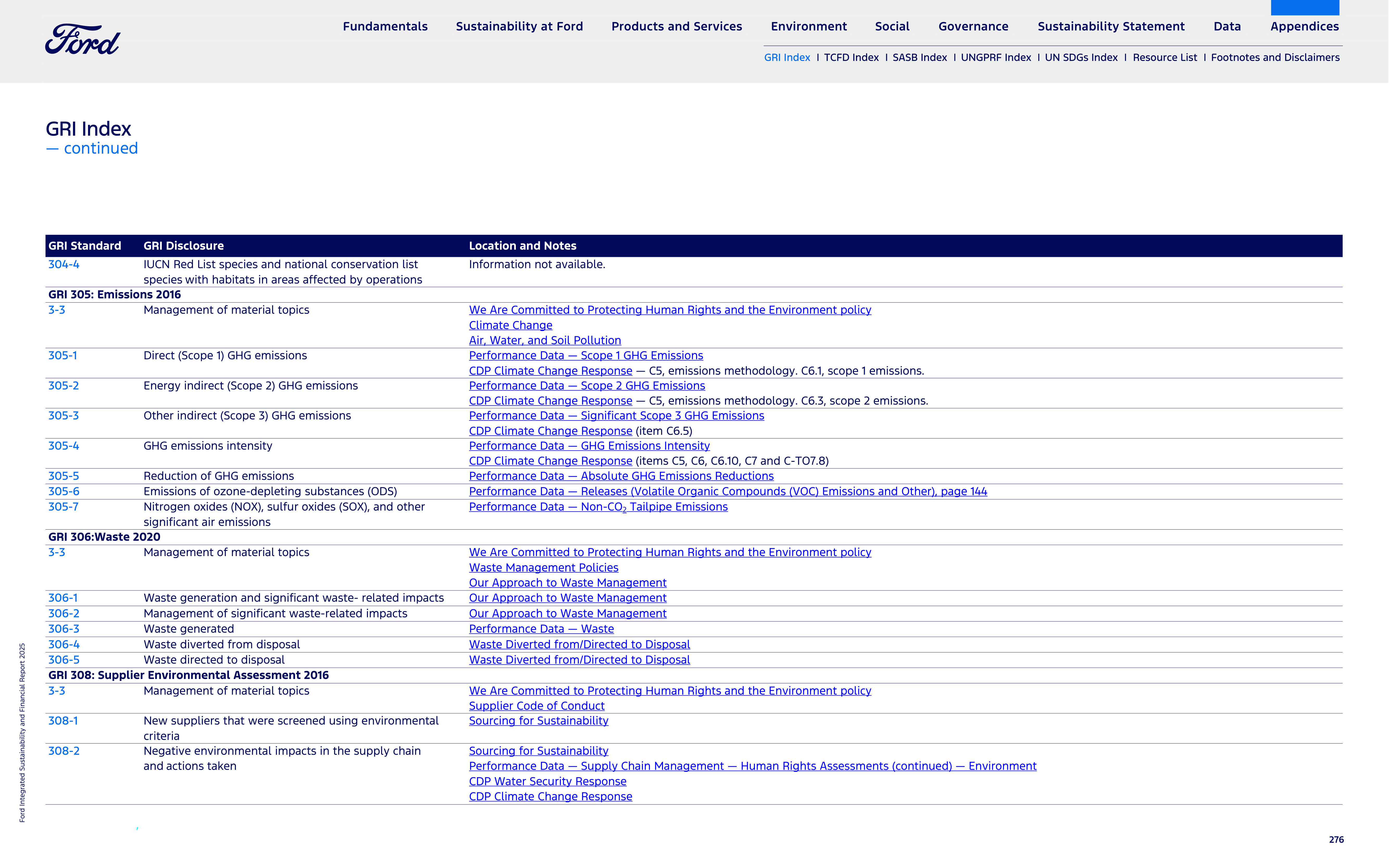
304-4
IUCN Red List species and national conservation list
species with habitats in areas affected by operations
Information not available.
GRI 305: Emissions 2016
3-3
Management of material topics
We Are Committed to Protecting Human Rights and the Environment policy
Climate Change
Air, Water, and Soil Pollution
305-1
Direct (Scope 1) GHG emissions
Performance Data — Scope 1 GHG Emissions
CDP Climate Change Response
— C5, emissions methodology. C6.1, scope 1 emissions.
305-2
Energy indirect (Scope 2) GHG emissions
Performance Data — Scope 2 GHG Emissions
CDP Climate Change Response
— C5, emissions methodology. C6.3, scope 2 emissions.
305-3
Other indirect (Scope 3) GHG emissions
Performance Data — Significant Scope 3 GHG Emissions
CDP Climate Change Response
(item C6.5)
305-4
GHG emissions intensity
Performance Data — GHG Emissions Intensity
CDP Climate Change Response
(items C5, C6, C6.10, C7 and C-TO7.8)
305-5
Reduction of GHG emissions
Performance Data — Absolute GHG Emissions Reductions
305-6
Emissions of ozone-depleting substances (ODS)
Performance Data — Releases (Volatile Organic Compounds (VOC) Emissions and Other), page 144
305-7
Nitrogen oxides (NOX), sulfur oxides (SOX), and other
significant air emissions
Performance Data — Non-CO Tailpipe Emissions
2
GRI 306:Waste 2020
3-3
Management of material topics
We Are Committed to Protecting Human Rights and the Environment policy
Waste Management Policies
Our Approach to Waste Management
306-1
Waste generation and significant waste- related impacts
Our Approach to Waste Management
306-2
Management of significant waste-related impacts
Our Approach to Waste Management
306-3
Waste generated
Performance Data — Waste
306-4
Waste diverted from disposal
Waste Diverted from/Directed to Disposal
306-5
Waste directed to disposal
Waste Diverted from/Directed to Disposal
GRI 308: Supplier Environmental Assessment 2016
3-3
Management of material topics
We Are Committed to Protecting Human Rights and the Environment policy
Supplier Code of Conduct
308-1
New suppliers that were screened using environmental
criteria
Sourcing for Sustainability
308-2
Negative environmental impacts in the supply chain
and actions taken
Sourcing for Sustainability
Performance Data — Supply Chain Management — Human Rights Assessments (continued) — Environment
CDP Water Security Response
CDP Climate Change Response
Fundamentals
Sustainability at Ford
Products and Services
Environment
Social
Governance
Sustainability Statement
Data
Appendices
GRI Index
| TCFD Index | SASB Index | UNGPRF Index | UN SDGs Index | Resource List | Footnotes and Disclaimers
GRI Index
— continued
,
Ford Integrated Sustainability and Financial Report 2025
276
GRI Standard
GRI Disclosure
Location and Notes
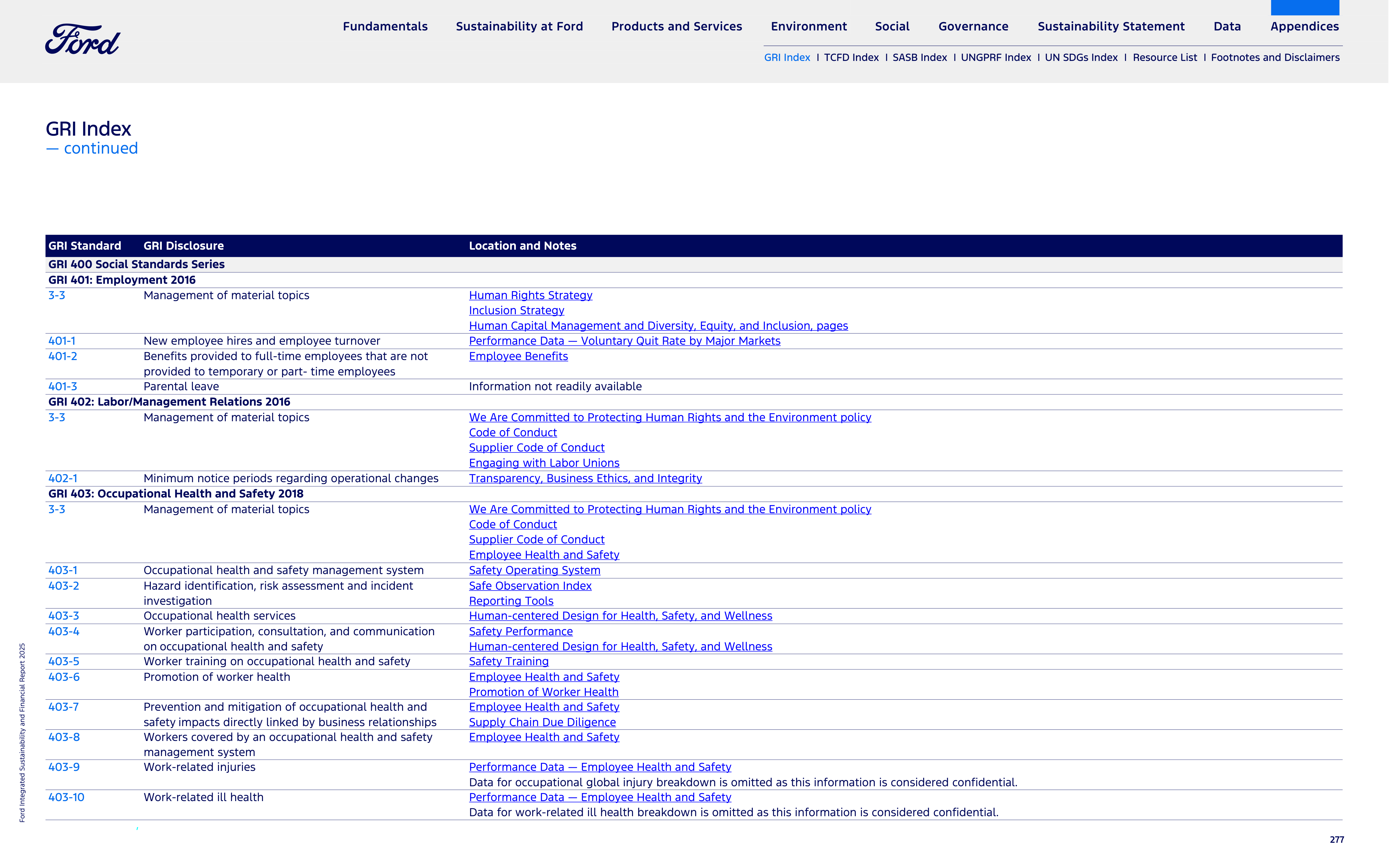
GRI 400 Social Standards Series
GRI 401: Employment 2016
3-3
Management of material topics
Human Rights Strategy
Inclusion Strategy
Human Capital Management and Diversity, Equity, and Inclusion, pages
401-1
New employee hires and employee turnover
Performance Data — Voluntary Quit Rate by Major Markets
401-2
Benefits provided to full-time employees that are not
provided to temporary or part- time employees
Employee Benefits
401-3
Parental leave
Information not readily available
GRI 402: Labor/Management Relations 2016
3-3
Management of material topics
We Are Committed to Protecting Human Rights and the Environment policy
Code of Conduct
Supplier Code of Conduct
Engaging with Labor Unions
402-1
Minimum notice periods regarding operational changes
Transparency, Business Ethics, and Integrity
GRI 403: Occupational Health and Safety 2018
3-3
Management of material topics
We Are Committed to Protecting Human Rights and the Environment policy
Code of Conduct
Supplier Code of Conduct
Employee Health and Safety
403-1
Occupational health and safety management system
Safety Operating System
403-2
Hazard identification, risk assessment and incident
investigation
Safe Observation Index
Reporting Tools
403-3
Occupational health services
Human-centered Design for Health, Safety, and Wellness
403-4
Worker participation, consultation, and communication
on occupational health and safety
Safety Performance
Human-centered Design for Health, Safety, and Wellness
403-5
Worker training on occupational health and safety
Safety Training
403-6
Promotion of worker health
Employee Health and Safety
Promotion of Worker Health
403-7
Prevention and mitigation of occupational health and
safety impacts directly linked by business relationships
Employee Health and Safety
Supply Chain Due Diligence
403-8
Workers covered by an occupational health and safety
management system
Employee Health and Safety
403-9
Work-related injuries
Performance Data — Employee Health and Safety
Data for occupational global injury breakdown is omitted as this information is considered confidential.
403-10
Work-related ill health
Performance Data — Employee Health and Safety
Data for work-related ill health breakdown is omitted as this information is considered confidential.
Fundamentals
Sustainability at Ford
Products and Services
Environment
Social
Governance
Sustainability Statement
Data
Appendices
GRI Index
| TCFD Index | SASB Index | UNGPRF Index | UN SDGs Index | Resource List | Footnotes and Disclaimers
GRI Index
— continued
,
Ford Integrated Sustainability and Financial Report 2025
277
GRI Standard
GRI Disclosure
Location and Notes
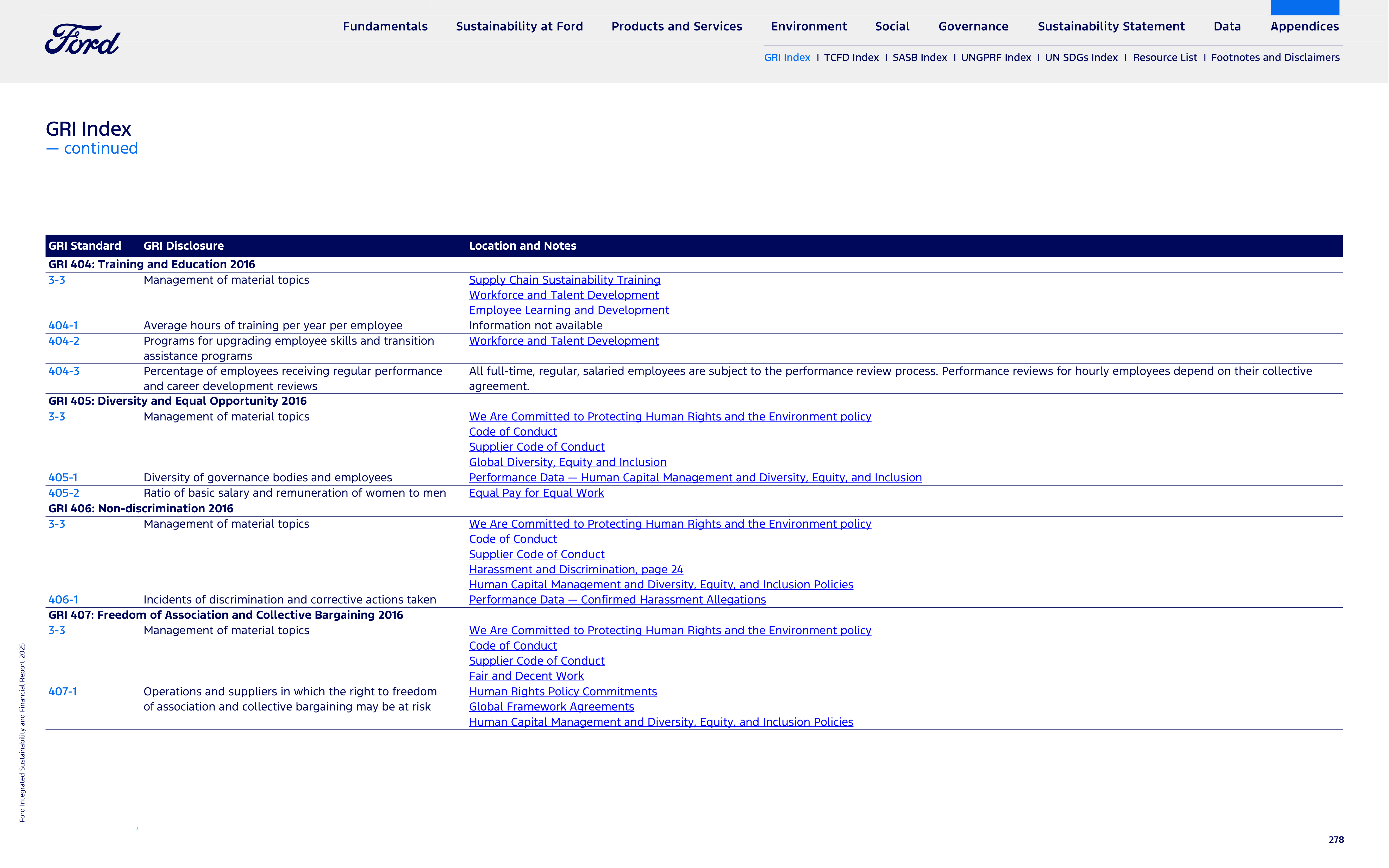
GRI 404: Training and Education 2016
3-3
Management of material topics
Supply Chain Sustainability Training
Workforce and Talent Development
Employee Learning and Development
404-1
Average hours of training per year per employee
Information not available
404-2
Programs for upgrading employee skills and transition
assistance programs
Workforce and Talent Development
404-3
Percentage of employees receiving regular performance
and career development reviews
All full-time, regular, salaried employees are subject to the performance review process. Performance reviews for hourly employees depend on their collective
agreement.
GRI 405: Diversity and Equal Opportunity 2016
3-3
Management of material topics
We Are Committed to Protecting Human Rights and the Environment policy
Code of Conduct
Supplier Code of Conduct
Global Diversity, Equity and Inclusion
405-1
Diversity of governance bodies and employees
Performance Data — Human Capital Management and Diversity, Equity, and Inclusion
405-2
Ratio of basic salary and remuneration of women to men
Equal Pay for Equal Work
GRI 406: Non-discrimination 2016
3-3
Management of material topics
We Are Committed to Protecting Human Rights and the Environment policy
Code of Conduct
Supplier Code of Conduct
Harassment and Discrimination, page 24
Human Capital Management and Diversity, Equity, and Inclusion Policies
406-1
Incidents of discrimination and corrective actions taken
Performance Data — Confirmed Harassment Allegations
GRI 407: Freedom of Association and Collective Bargaining 2016
3-3
Management of material topics
We Are Committed to Protecting Human Rights and the Environment policy
Code of Conduct
Supplier Code of Conduct
Fair and Decent Work
407-1
Operations and suppliers in which the right to freedom
of association and collective bargaining may be at risk
Human Rights Policy Commitments
Global Framework Agreements
Human Capital Management and Diversity, Equity, and Inclusion Policies
Fundamentals
Sustainability at Ford
Products and Services
Environment
Social
Governance
Sustainability Statement
Data
Appendices
GRI Index
| TCFD Index | SASB Index | UNGPRF Index | UN SDGs Index | Resource List | Footnotes and Disclaimers
GRI Index
— continued
,
Ford Integrated Sustainability and Financial Report 2025
278
GRI Standard
GRI Disclosure
Location and Notes
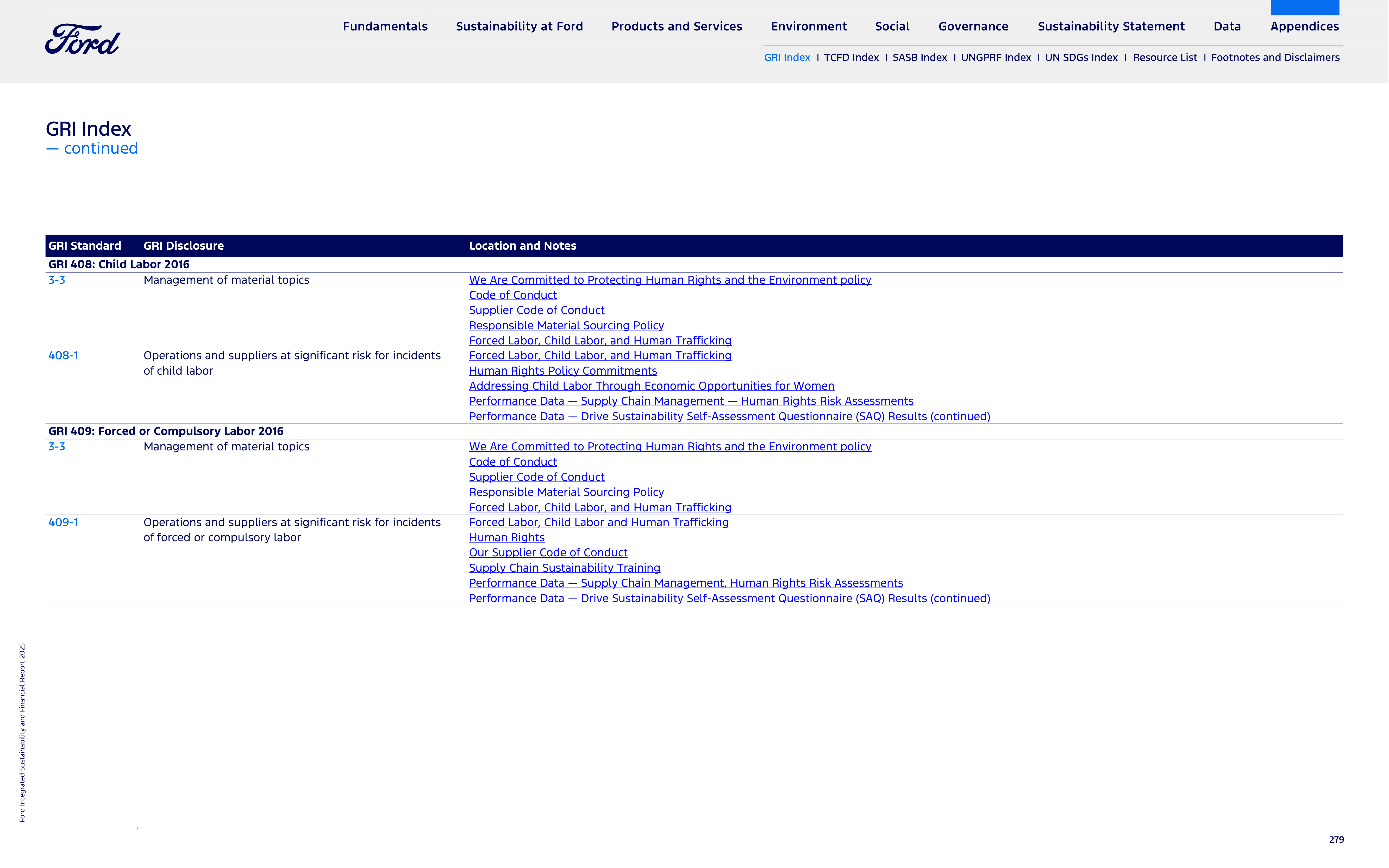
GRI 408: Child Labor 2016
3-3
Management of material topics
We Are Committed to Protecting Human Rights and the Environment policy
Code of Conduct
Supplier Code of Conduct
Responsible Material Sourcing Policy
Forced Labor, Child Labor, and Human Trafficking
408-1
Operations and suppliers at significant risk for incidents
of child labor
Forced Labor, Child Labor, and Human Trafficking
Human Rights Policy Commitments
Addressing Child Labor Through Economic Opportunities for Women
Performance Data — Supply Chain Management — Human Rights Risk Assessments
Performance Data — Drive Sustainability Self-Assessment Questionnaire (SAQ) Results (continued)
GRI 409: Forced or Compulsory Labor 2016
3-3
Management of material topics
We Are Committed to Protecting Human Rights and the Environment policy
Code of Conduct
Supplier Code of Conduct
Responsible Material Sourcing Policy
Forced Labor, Child Labor, and Human Trafficking
409-1
Operations and suppliers at significant risk for incidents
of forced or compulsory labor
Forced Labor, Child Labor and Human Trafficking
Human Rights
Our Supplier Code of Conduct
Supply Chain Sustainability Training
Performance Data — Supply Chain Management, Human Rights Risk Assessments
Performance Data — Drive Sustainability Self-Assessment Questionnaire (SAQ) Results (continued)
Fundamentals
Sustainability at Ford
Products and Services
Environment
Social
Governance
Sustainability Statement
Data
Appendices
GRI Index
| TCFD Index | SASB Index | UNGPRF Index | UN SDGs Index | Resource List | Footnotes and Disclaimers
GRI Index
— continued
,
Ford Integrated Sustainability and Financial Report 2025
279
GRI Standard
GRI Disclosure
Location and Notes
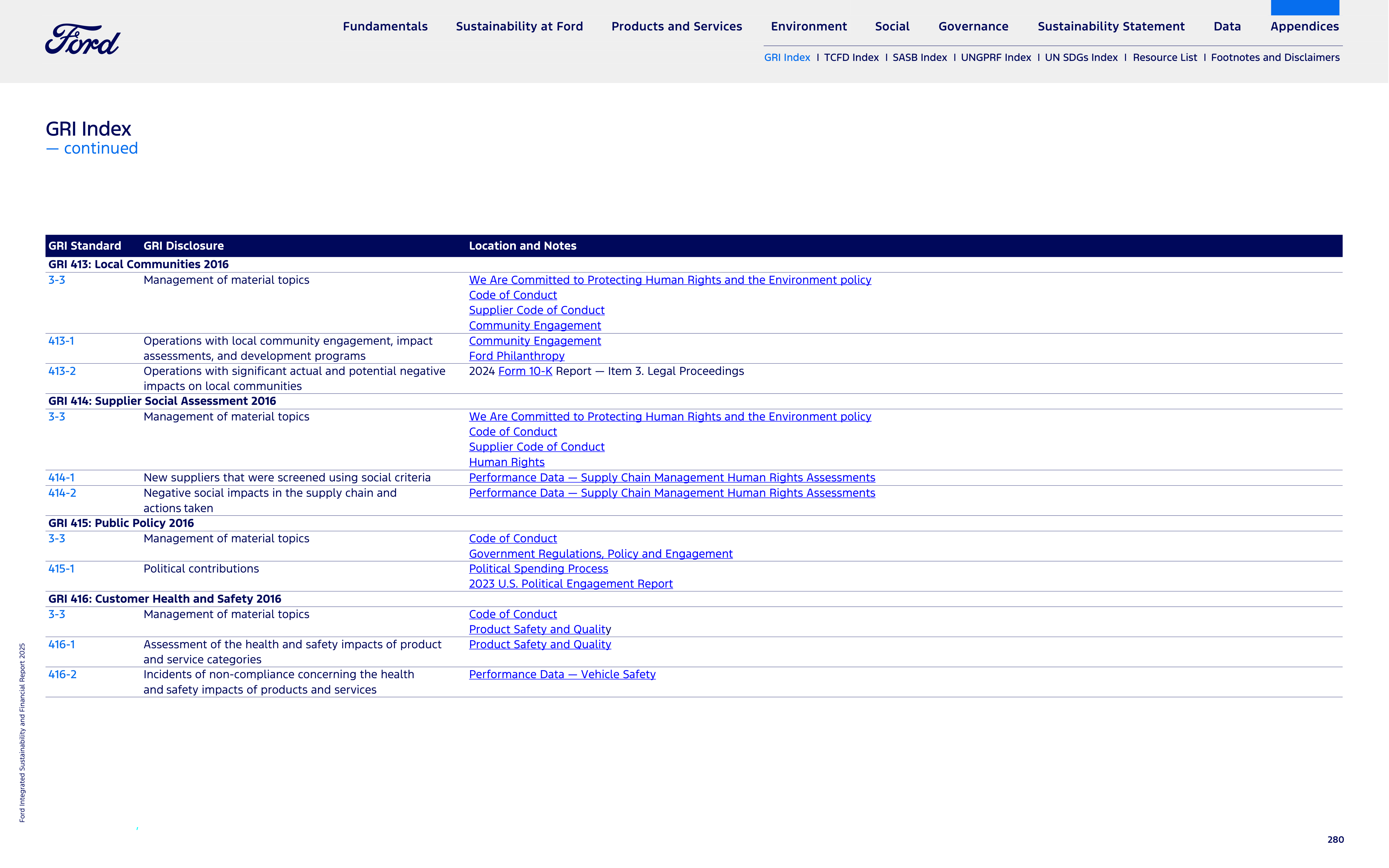
GRI 413: Local Communities 2016
3-3
Management of material topics
We Are Committed to Protecting Human Rights and the Environment policy
Code of Conduct
Supplier Code of Conduct
Community Engagement
413-1
Operations with local community engagement, impact
assessments, and development programs
Community Engagement
Ford Philanthropy
413-2
Operations with significant actual and potential negative
impacts on local communities
2024
Form 10-K
Report — Item 3. Legal Proceedings
GRI 414: Supplier Social Assessment 2016
3-3
Management of material topics
We Are Committed to Protecting Human Rights and the Environment policy
Code of Conduct
Supplier Code of Conduct
Human Rights
414-1
New suppliers that were screened using social criteria
Performance Data — Supply Chain Management Human Rights Assessments
414-2
Negative social impacts in the supply chain and
actions taken
Performance Data — Supply Chain Management Human Rights Assessments
GRI 415: Public Policy 2016
3-3
Management of material topics
Code of Conduct
Government Regulations, Policy and Engagement
415-1
Political contributions
Political Spending Process
2023 U.S. Political Engagement Report
GRI 416: Customer Health and Safety 2016
3-3
Management of material topics
Code of Conduct
Product Safety and Qualit
y
416-1
Assessment of the health and safety impacts of product
and service categories
Product Safety and Quality
416-2
Incidents of non-compliance concerning the health
and safety impacts of products and services
Performance Data — Vehicle Safety
Fundamentals
Sustainability at Ford
Products and Services
Environment
Social
Governance
Sustainability Statement
Data
Appendices
GRI Index
| TCFD Index | SASB Index | UNGPRF Index | UN SDGs Index | Resource List | Footnotes and Disclaimers
GRI Index
— continued
,
Ford Integrated Sustainability and Financial Report 2025
280
GRI Standard
GRI Disclosure
Location and Notes
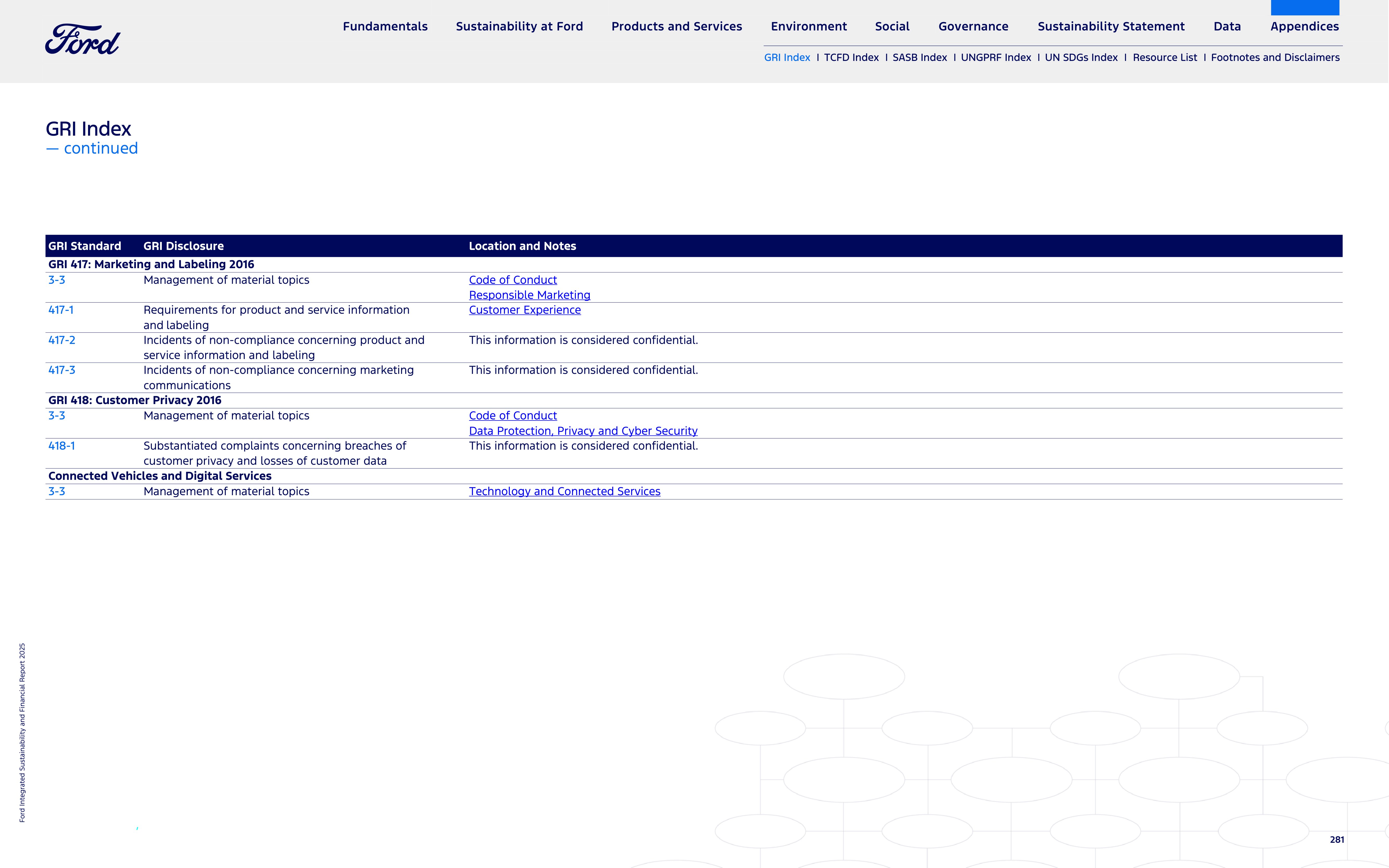

GRI 417: Marketing and Labeling 2016
3-3
Management of material topics
Code of Conduct
Responsible Marketing
417-1
Requirements for product and service information
and labeling
Customer Experience
417-2
Incidents of non-compliance concerning product and
service information and labeling
This information is considered confidential.
417-3
Incidents of non-compliance concerning marketing
communications
This information is considered confidential.
GRI 418: Customer Privacy 2016
3-3
Management of material topics
Code of Conduct
Data Protection, Privacy and Cyber Security
418-1
Substantiated complaints concerning breaches of
customer privacy and losses of customer data
This information is considered confidential.
Connected Vehicles and Digital Services
3-3
Management of material topics
Technology and Connected Services
Fundamentals
Sustainability at Ford
Products and Services
Environment
Social
Governance
Sustainability Statement
Data
Appendices
GRI Index
| TCFD Index | SASB Index | UNGPRF Index | UN SDGs Index | Resource List | Footnotes and Disclaimers
GRI Index
— continued
,
Ford Integrated Sustainability and Financial Report 2025
281
GRI Standard
GRI Disclosure
Location and Notes
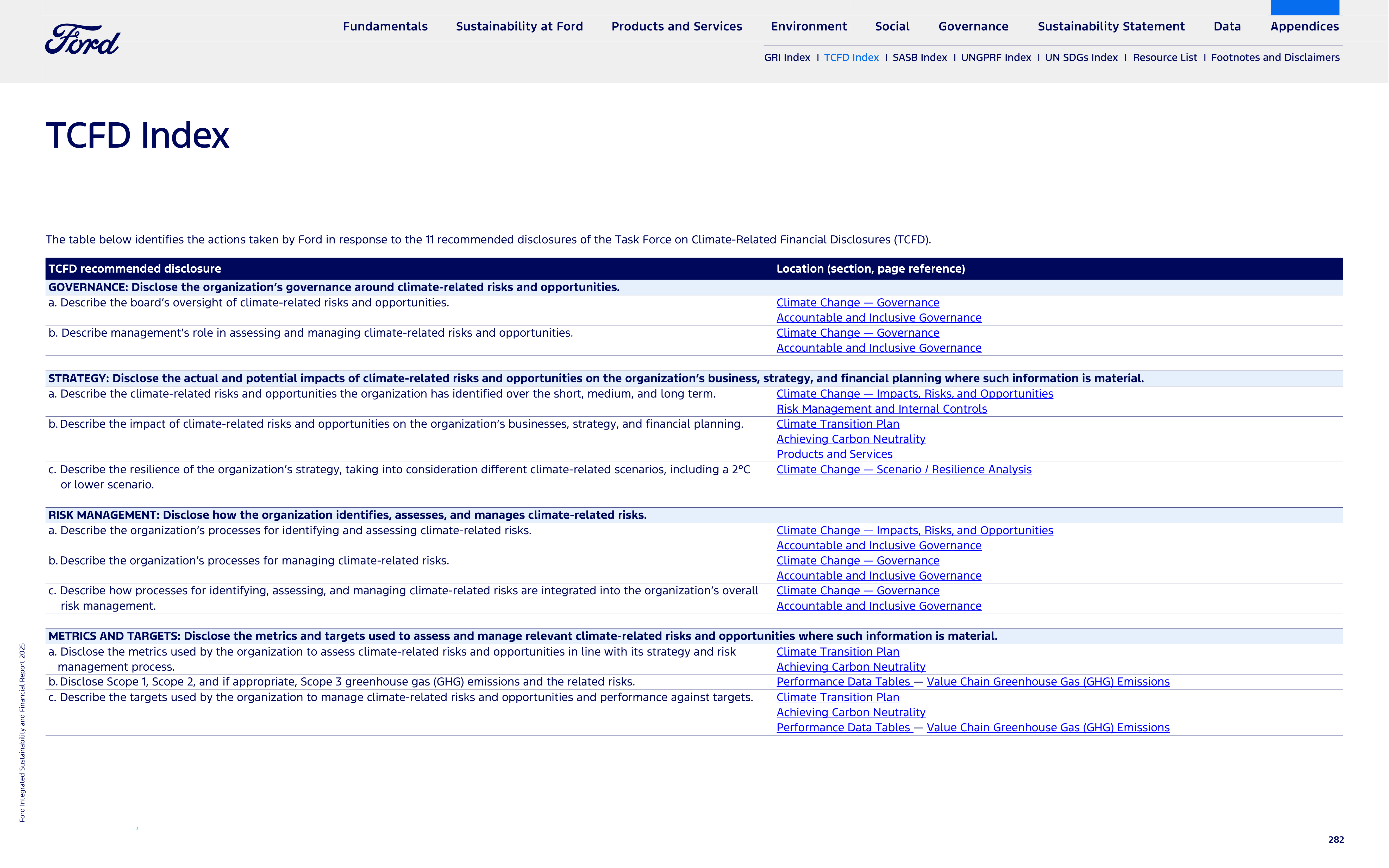
Fundamentals
Sustainability at Ford
Products and Services
Environment
Social
Governance
Sustainability Statement
Data
Appendices
GRI Index
TCFD Index
SASB Index
UNGPRF Index
UN SDGs Index
Resource List
Footnotes and Disclaimers
|
|
|
|
|
|
TCFD Index
,
Ford Integrated Sustainability and Financial Report 2025
282
The table below identifies the actions taken by Ford in response to the 11 recommended disclosures of the Task Force on Climate-Related Financial Disclosures (TCFD).
TCFD recommended disclosure
Location (section, page reference)
GOVERNANCE: Disclose the organization’s governance around climate-related risks and opportunities.
a. Describe the board’s oversight of climate-related risks and opportunities.
Climate Change — Governance
Accountable and Inclusive Governance
b. Describe management’s role in assessing and managing climate-related risks and opportunities.
Climate Change — Governance
Accountable and Inclusive Governance
STRATEGY: Disclose the actual and potential impacts of climate-related risks and opportunities on the organization’s business, strategy, and financial planning where such information is material.
a. Describe the climate-related risks and opportunities the organization has identified over the short, medium, and long term.
Climate Change — Impacts, Risks, and Opportunities
Risk Management and Internal Controls
b. Describe the impact of climate-related risks and opportunities on the organization’s businesses, strategy, and financial planning.
Climate Transition Plan
Achieving Carbon Neutrality
Products and Services
c. Describe the resilience of the organization’s strategy, taking into consideration different climate-related scenarios, including a 2°C
or lower scenario.
Climate Change — Scenario / Resilience Analysis
RISK MANAGEMENT: Disclose how the organization identifies, assesses, and manages climate-related risks.
a. Describe the organization’s processes for identifying and assessing climate-related risks.
Climate Change — Impacts, Risks, and Opportunities
Accountable and Inclusive Governance
b. Describe the organization’s processes for managing climate-related risks.
Climate Change — Governance
Accountable and Inclusive Governance
c. Describe how processes for identifying, assessing, and managing climate-related risks are integrated into the organization’s overall
risk management.
Climate Change — Governance
Accountable and Inclusive Governance
METRICS AND TARGETS: Disclose the metrics and targets used to assess and manage relevant climate-related risks and opportunities where such information is material.
a. Disclose the metrics used by the organization to assess climate-related risks and opportunities in line with its strategy and risk
management process.
Climate Transition Plan
Achieving Carbon Neutrality
b. Disclose Scope 1, Scope 2, and if appropriate, Scope 3 greenhouse gas (GHG) emissions and the related risks.
Performance Data Tables
—
Value Chain Greenhouse Gas (GHG) Emissions
c. Describe the targets used by the organization to manage climate-related risks and opportunities and performance against targets.
Climate Transition Plan
Achieving Carbon Neutrality
Performance Data Tables
—
Value Chain Greenhouse Gas (GHG) Emissions
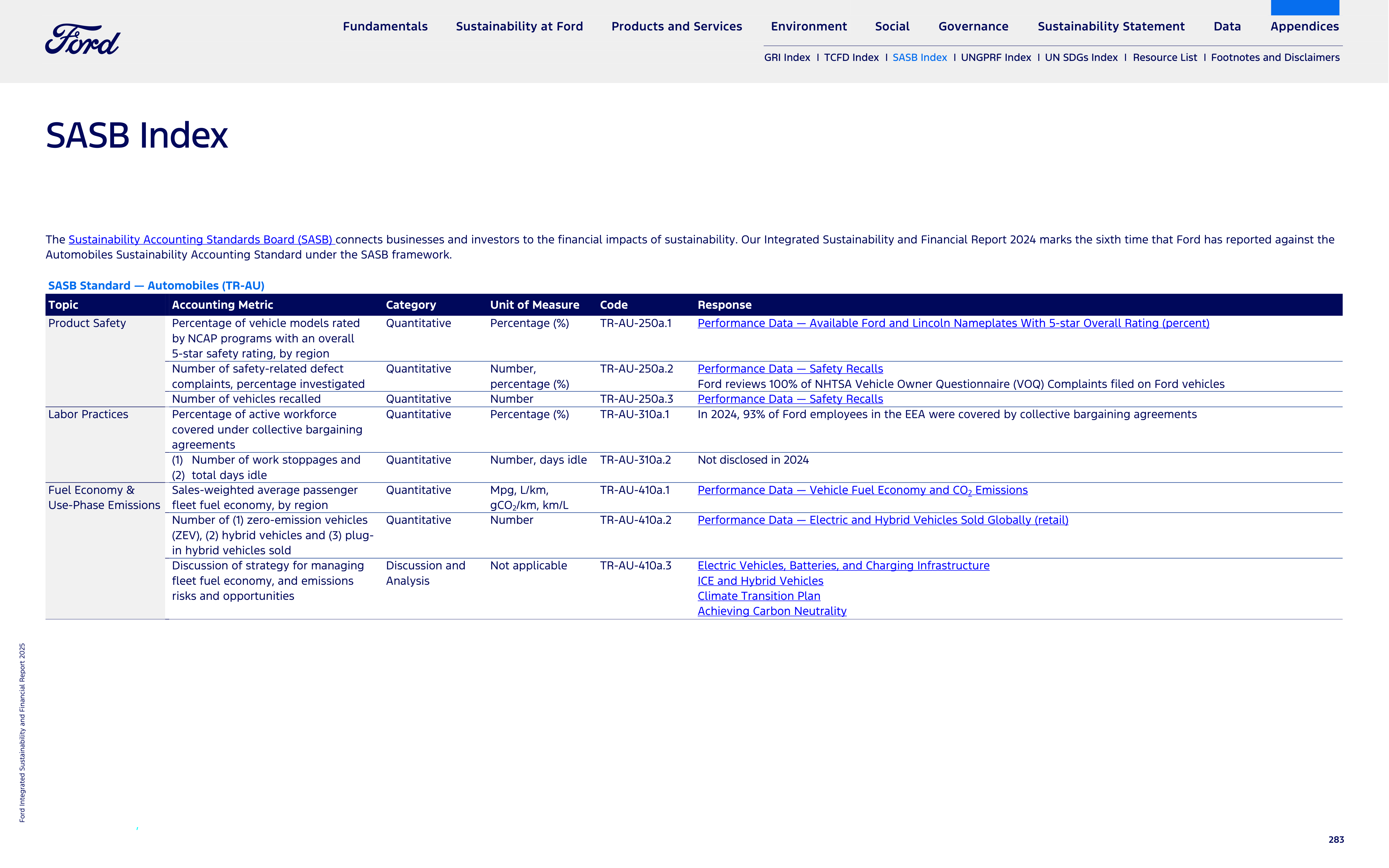
Fundamentals
Sustainability at Ford
Products and Services
Environment
Social
Governance
Sustainability Statement
Data
Appendices
GRI Index
TCFD Index
SASB Index
UNGPRF Index
UN SDGs Index
Resource List
Footnotes and Disclaimers
|
|
|
|
|
|
SASB Index
,
Ford Integrated Sustainability and Financial Report 2025
283
The
Sustainability Accounting Standards Board (SASB)
connects businesses and investors to the financial impacts of sustainability. Our Integrated Sustainability and Financial Report 2024 marks the sixth time that Ford has reported against the
Automobiles Sustainability Accounting Standard under the SASB framework.
SASB Standard — Automobiles (TR-AU)
Topic
Accounting Metric
Category
Unit of Measure
Code
Response
Product Safety
Percentage of vehicle models rated
by NCAP programs with an overall
5-star safety rating, by region
Quantitative
Percentage (%)
TR-AU-250a.1
Performance Data — Available Ford and Lincoln Nameplates With 5-star Overall Rating (percent)
Number of safety-related defect
complaints, percentage investigated
Quantitative
Number,
percentage (%)
TR-AU-250a.2
Performance Data — Safety Recalls
Ford reviews 100% of NHTSA Vehicle Owner Questionnaire (VOQ) Complaints filed on Ford vehicles
Number of vehicles recalled
Quantitative
Number
TR-AU-250a.3
Performance Data — Safety Recalls
Labor Practices
Percentage of active workforce
covered under collective bargaining
agreements
Quantitative
Percentage (%)
TR-AU-310a.1
In 2024, 93% of Ford employees in the EEA were covered by collective bargaining agreements
(1) Number of work stoppages and
(2) total days idle
Quantitative
Number, days idle
TR-AU-310a.2
Not disclosed in 2024
Fuel Economy &
Use-Phase Emissions
Sales-weighted average passenger
fleet fuel economy, by region
Quantitative
Mpg, L/km,
gCO
2
/km, km/L
TR-AU-410a.1
Performance Data — Vehicle Fuel Economy and CO
2
Emissions
Number of (1) zero-emission vehicles
(ZEV), (2) hybrid vehicles and (3) plug-
in hybrid vehicles sold
Quantitative
Number
TR-AU-410a.2
Performance Data — Electric and Hybrid Vehicles Sold Globally (retail)
Discussion of strategy for managing
fleet fuel economy, and emissions
risks and opportunities
Discussion and
Analysis
Not applicable
TR-AU-410a.3
Electric Vehicles, Batteries, and Charging Infrastructure
ICE and Hybrid Vehicles
Climate Transition Plan
Achieving Carbon Neutrality
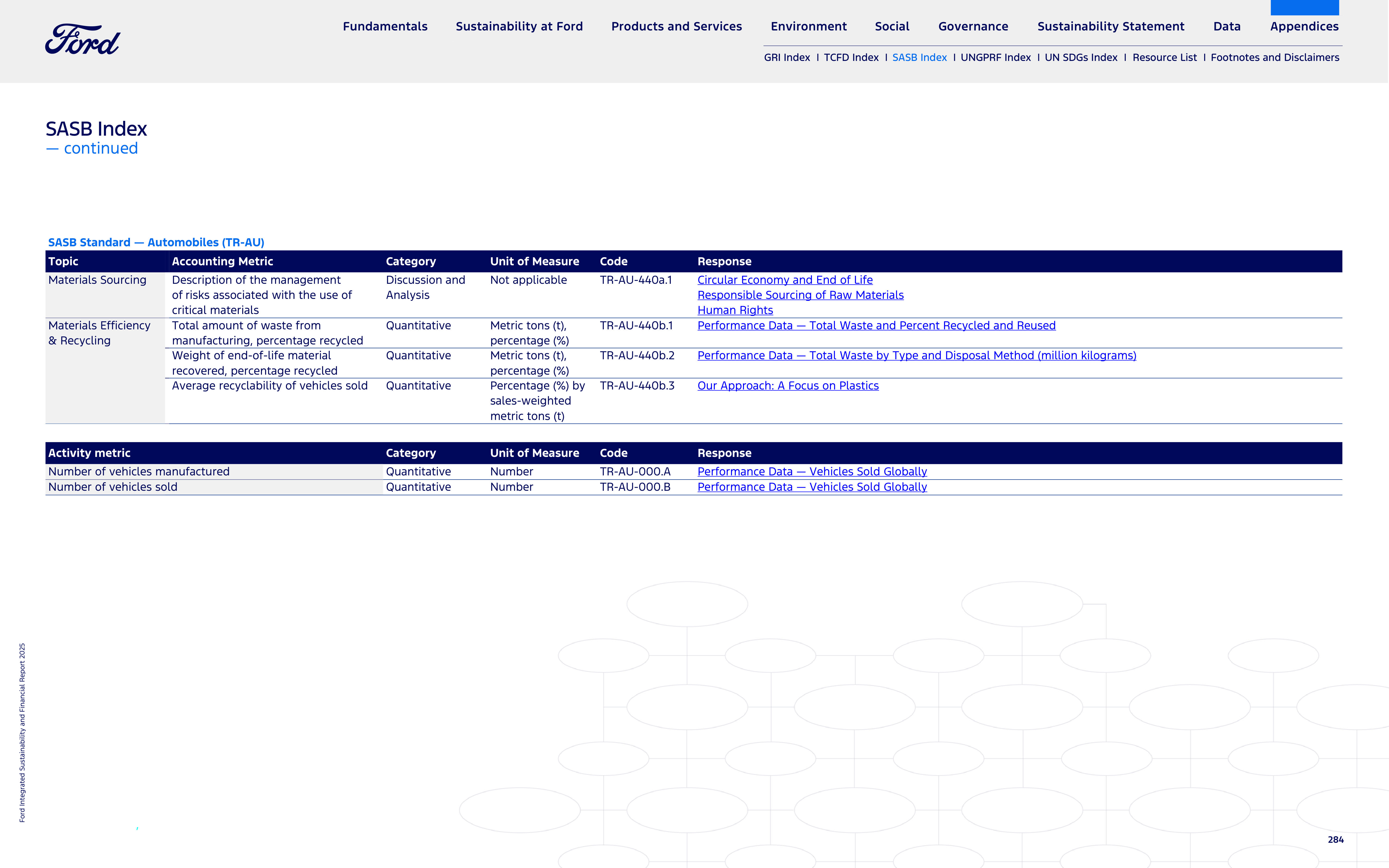

Materials Sourcing
Description of the management
of risks associated with the use of
critical materials
Discussion and
Analysis
Not applicable
TR-AU-440a.1
Circular Economy and End of Life
Responsible Sourcing of Raw Materials
Human Rights
Materials Efficiency
& Recycling
Total amount of waste from
manufacturing, percentage recycled
Quantitative
Metric tons (t),
percentage (%)
TR-AU-440b.1
Performance Data — Total Waste and Percent Recycled and Reused
Weight of end-of-life material
recovered, percentage recycled
Quantitative
Metric tons (t),
percentage (%)
TR-AU-440b.2
Performance Data — Total Waste by Type and Disposal Method (million kilograms)
Average recyclability of vehicles sold
Quantitative
Percentage (%) by
sales-weighted
metric tons (t)
TR-AU-440b.3
Our Approach: A Focus on Plastics
Fundamentals
Sustainability at Ford
Products and Services
Environment
Social
Governance
Sustainability Statement
Data
Appendices
GRI Index | TCFD Index
SASB Index
UNGPRF Index
UN SDGs Index
Resource List
Footnotes and Disclaimers
|
|
|
|
|
SASB Index
— continued
,
Ford Integrated Sustainability and Financial Report 2025
284
Activity metric
Category
Unit of Measure
Code
Response
Number of vehicles manufactured
Quantitative
Number
TR-AU-000.A
Performance Data — Vehicles Sold Globally
Number of vehicles sold
Quantitative
Number
TR-AU-000.B
Performance Data — Vehicles Sold Globally
SASB Standard — Automobiles (TR-AU)
Topic
Accounting Metric
Category
Unit of Measure
Code
Response
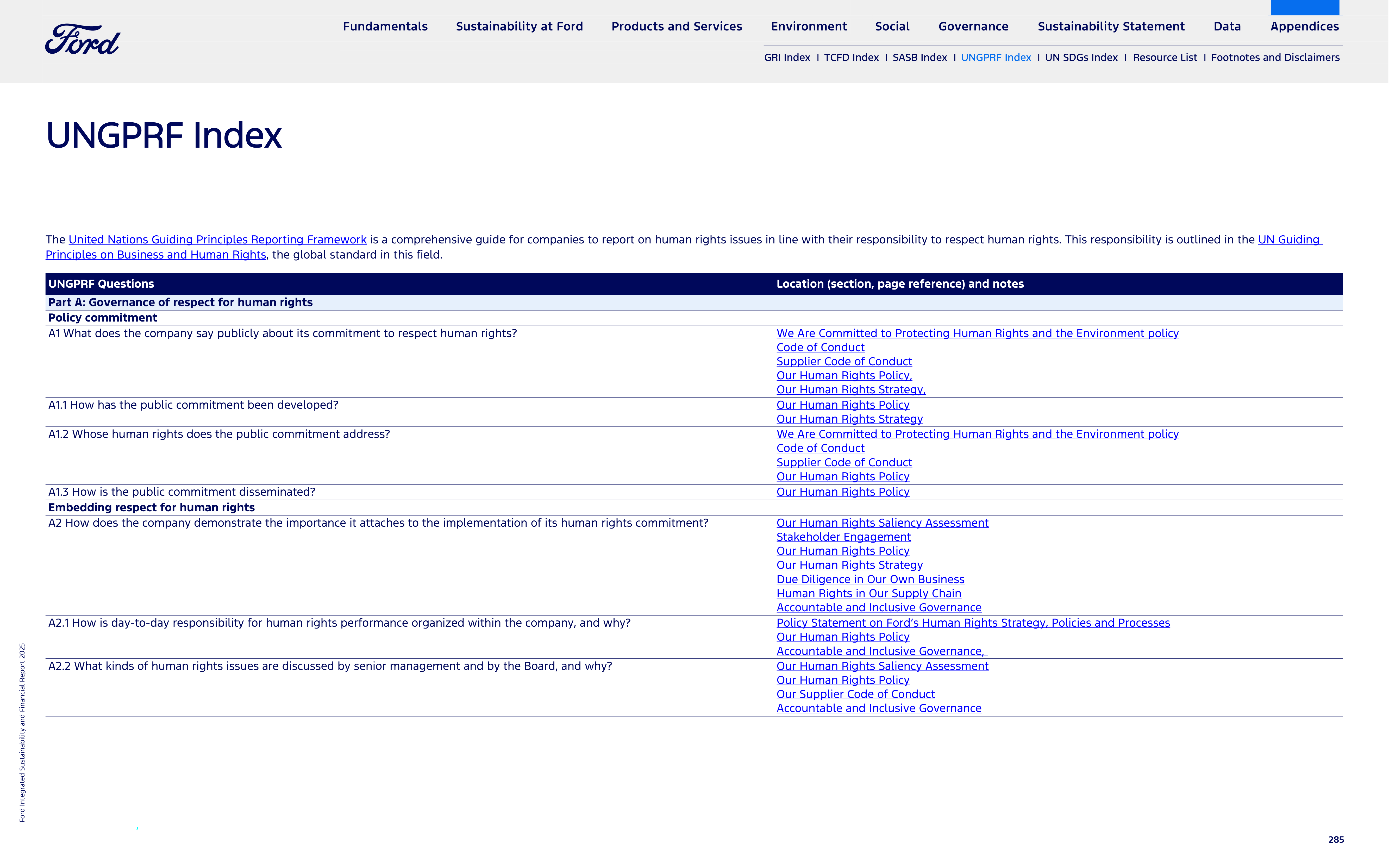
Fundamentals
Sustainability at Ford
Products and Services
Environment
Social
Governance
Sustainability Statement
Data
Appendices
GRI Index
TCFD Index
SASB Index
UNGPRF Index
UN SDGs Index
Resource List
Footnotes and Disclaimers
|
|
|
|
|
|
UNGPRF Index
,
Ford Integrated Sustainability and Financial Report 2025
285
The
United Nations Guiding Principles Reporting Framework
is a comprehensive guide for companies to report on human rights issues in line with their responsibility to respect human rights. This responsibility is outlined in the
UN Guiding
Principles on Business and Human Rights
, the global standard in this field.
UNGPRF Questions
Location (section, page reference) and notes
Part A: Governance of respect for human rights
Policy commitment
A1 What does the company say publicly about its commitment to respect human rights?
We Are Committed to Protecting Human Rights and the Environment policy
Code of Conduct
Supplier Code of Conduct
Our Human Rights Policy,
Our Human Rights Strategy,
A1.1 How has the public commitment been developed?
Our Human Rights Policy
Our Human Rights Strategy
A1.2 Whose human rights does the public commitment address?
We Are Committed to Protecting Human Rights and the Environment policy
Code of Conduct
Supplier Code of Conduct
Our Human Rights Policy
A1.3 How is the public commitment disseminated?
Our Human Rights Policy
Embedding respect for human rights
A2 How does the company demonstrate the importance it attaches to the implementation of its human rights commitment?
Our Human Rights Saliency Assessment
Stakeholder Engagement
Our Human Rights Policy
Our Human Rights Strategy
Due Diligence in Our Own Business
Human Rights in Our Supply Chain
Accountable and Inclusive Governance
A2.1 How is day-to-day responsibility for human rights performance organized within the company, and why?
Policy Statement on Ford’s Human Rights Strategy, Policies and Processes
Our Human Rights Policy
Accountable and Inclusive Governance,
A2.2 What kinds of human rights issues are discussed by senior management and by the Board, and why?
Our Human Rights Saliency Assessment
Our Human Rights Policy
Our Supplier Code of Conduct
Accountable and Inclusive Governance
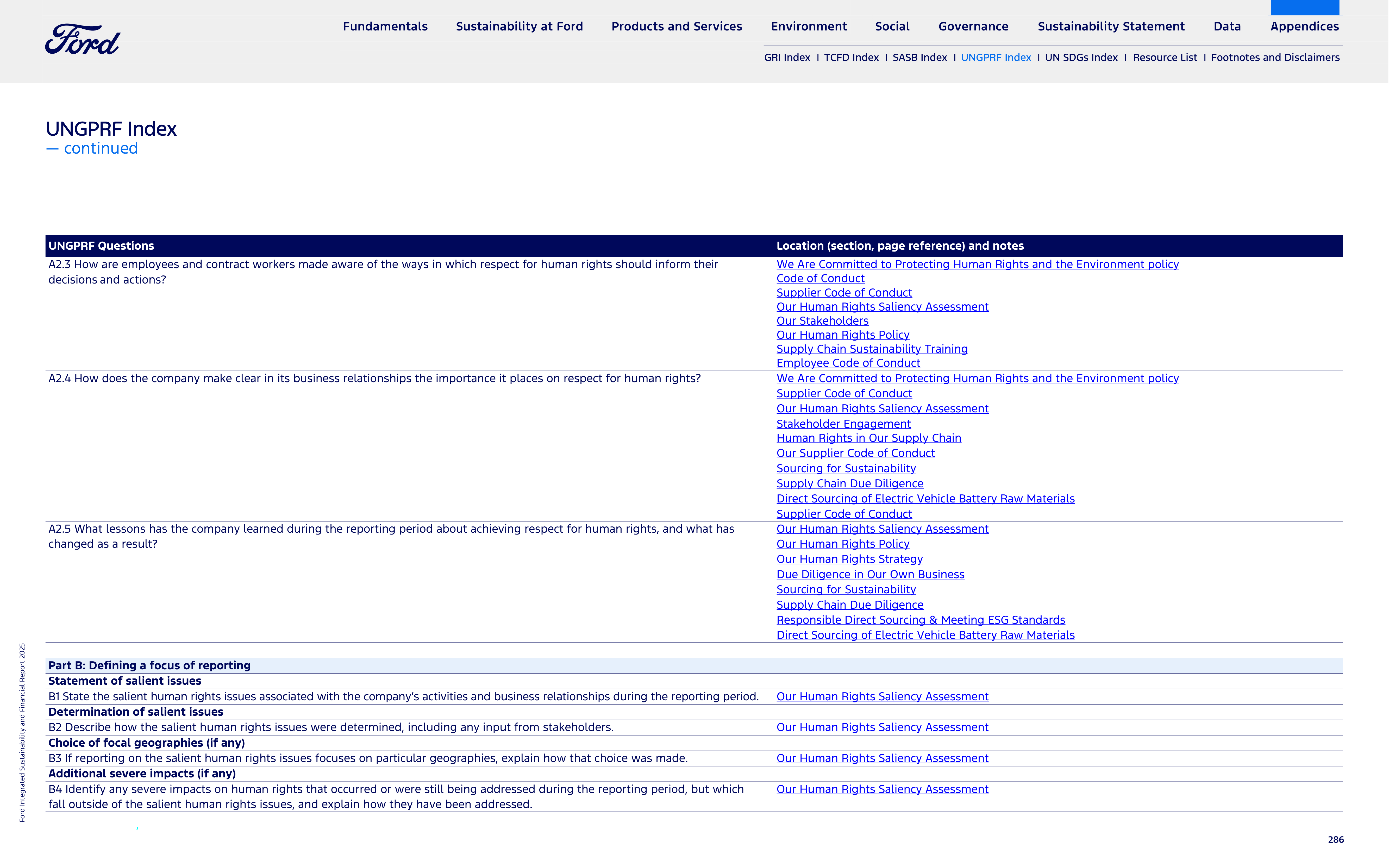
A2.3 How are employees and contract workers made aware of the ways in which respect for human rights should inform their
decisions and actions?
We Are Committed to Protecting Human Rights and the Environment policy
Code of Conduct
Supplier Code of Conduct
Our Human Rights Saliency Assessment
Our Stakeholders
Our Human Rights Policy
Supply Chain Sustainability Training
Employee Code of Conduct
A2.4 How does the company make clear in its business relationships the importance it places on respect for human rights?
We Are Committed to Protecting Human Rights and the Environment policy
Supplier Code of Conduct
Our Human Rights Saliency Assessment
Stakeholder Engagement
Human Rights in Our Supply Chain
Our Supplier Code of Conduct
Sourcing for Sustainability
Supply Chain Due Diligence
Direct Sourcing of Electric Vehicle Battery Raw Materials
Supplier Code of Conduct
A2.5 What lessons has the company learned during the reporting period about achieving respect for human rights, and what has
changed as a result?
Our Human Rights Saliency Assessment
Our Human Rights Policy
Our Human Rights Strategy
Due Diligence in Our Own Business
Sourcing for Sustainability
Supply Chain Due Diligence
Responsible Direct Sourcing & Meeting ESG Standards
Direct Sourcing of Electric Vehicle Battery Raw Materials
Part B: Defining a focus of reporting
Statement of salient issues
B1 State the salient human rights issues associated with the company’s activities and business relationships during the reporting period.
Our Human Rights Saliency Assessment
Determination of salient issues
B2 Describe how the salient human rights issues were determined, including any input from stakeholders.
Our Human Rights Saliency Assessment
Choice of focal geographies (if any)
B3 If reporting on the salient human rights issues focuses on particular geographies, explain how that choice was made.
Our Human Rights Saliency Assessment
Additional severe impacts (if any)
B4 Identify any severe impacts on human rights that occurred or were still being addressed during the reporting period, but which
fall outside of the salient human rights issues, and explain how they have been addressed.
Our Human Rights Saliency Assessment
Fundamentals
Sustainability at Ford
Products and Services
Environment
Social
Governance
Sustainability Statement
Data
Appendices
GRI Index
TCFD Index
SASB Index
UNGPRF Index
UN SDGs Index
Resource List
Footnotes and Disclaimers
|
|
|
|
|
|
UNGPRF Index
— continued
,
Ford Integrated Sustainability and Financial Report 2025
286
UNGPRF Questions
Location (section, page reference) and notes
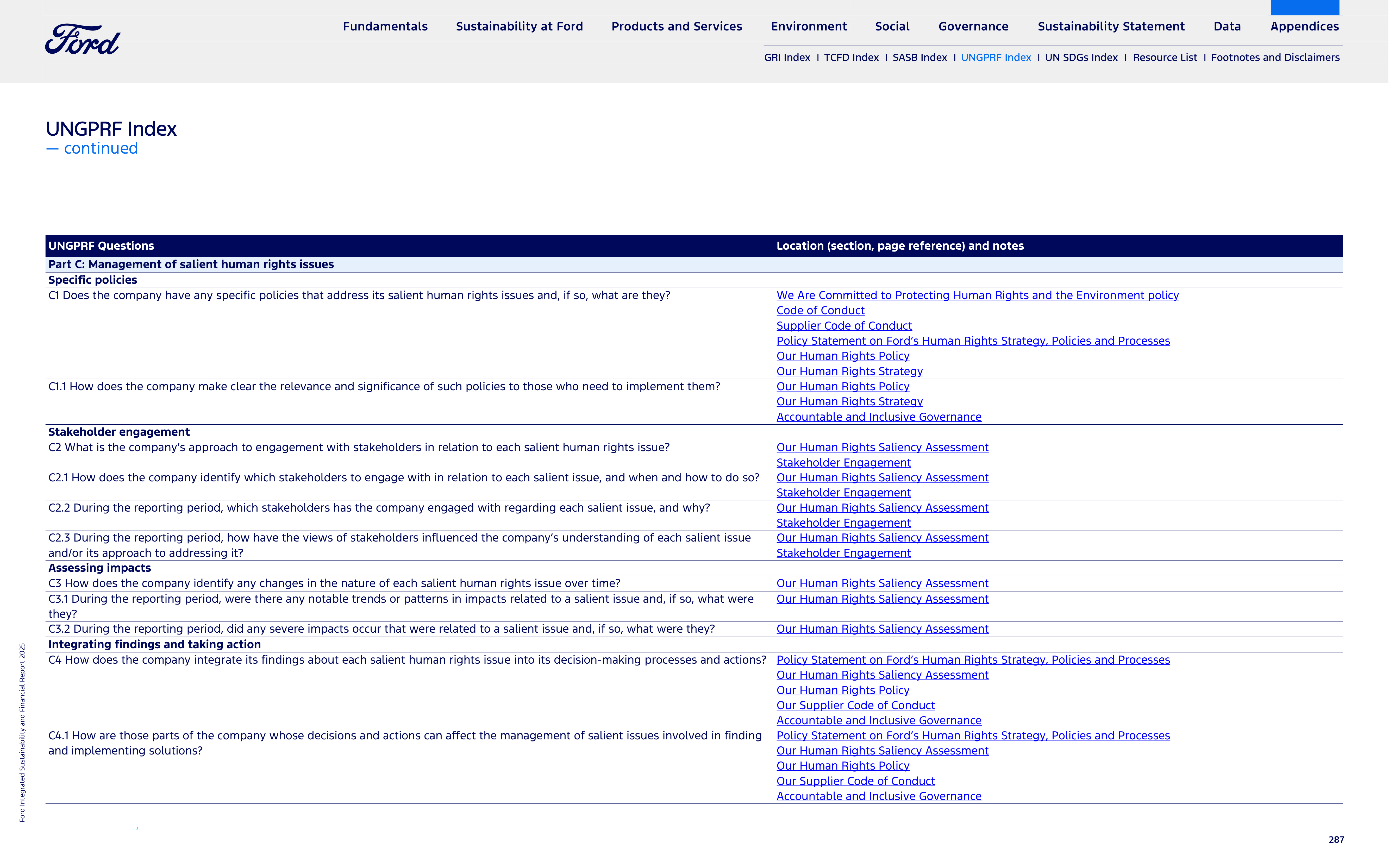
Part C: Management of salient human rights issues
Specific policies
C1 Does the company have any specific policies that address its salient human rights issues and, if so, what are they?
We Are Committed to Protecting Human Rights and the Environment policy
Code of Conduct
Supplier Code of Conduct
Policy Statement on Ford’s Human Rights Strategy, Policies and Processes
Our Human Rights Policy
Our Human Rights Strategy
C1.1 How does the company make clear the relevance and significance of such policies to those who need to implement them?
Our Human Rights Policy
Our Human Rights Strategy
Accountable and Inclusive Governance
Stakeholder engagement
C2 What is the company’s approach to engagement with stakeholders in relation to each salient human rights issue?
Our Human Rights Saliency Assessment
Stakeholder Engagement
C2.1 How does the company identify which stakeholders to engage with in relation to each salient issue, and when and how to do so?
Our Human Rights Saliency Assessment
Stakeholder Engagement
C2.2 During the reporting period, which stakeholders has the company engaged with regarding each salient issue, and why?
Our Human Rights Saliency Assessment
Stakeholder Engagement
C2.3 During the reporting period, how have the views of stakeholders influenced the company’s understanding of each salient issue
and/or its approach to addressing it?
Our Human Rights Saliency Assessment
Stakeholder Engagement
Assessing impacts
C3 How does the company identify any changes in the nature of each salient human rights issue over time?
Our Human Rights Saliency Assessment
C3.1 During the reporting period, were there any notable trends or patterns in impacts related to a salient issue and, if so, what were
they?
Our Human Rights Saliency Assessment
C3.2 During the reporting period, did any severe impacts occur that were related to a salient issue and, if so, what were they?
Our Human Rights Saliency Assessment
Integrating findings and taking action
C4 How does the company integrate its findings about each salient human rights issue into its decision-making processes and actions?
Policy Statement on Ford’s Human Rights Strategy, Policies and Processes
Our Human Rights Saliency Assessment
Our Human Rights Policy
Our Supplier Code of Conduct
Accountable and Inclusive Governance
C4.1 How are those parts of the company whose decisions and actions can affect the management of salient issues involved in finding
and implementing solutions?
Policy Statement on Ford’s Human Rights Strategy, Policies and Processes
Our Human Rights Saliency Assessment
Our Human Rights Policy
Our Supplier Code of Conduct
Accountable and Inclusive Governance
Fundamentals
Sustainability at Ford
Products and Services
Environment
Social
Governance
Sustainability Statement
Data
Appendices
GRI Index
TCFD Index
SASB Index
UNGPRF Index
UN SDGs Index
Resource List
Footnotes and Disclaimers
|
|
|
|
|
|
UNGPRF Index
— continued
,
Ford Integrated Sustainability and Financial Report 2025
287
UNGPRF Questions
Location (section, page reference) and notes
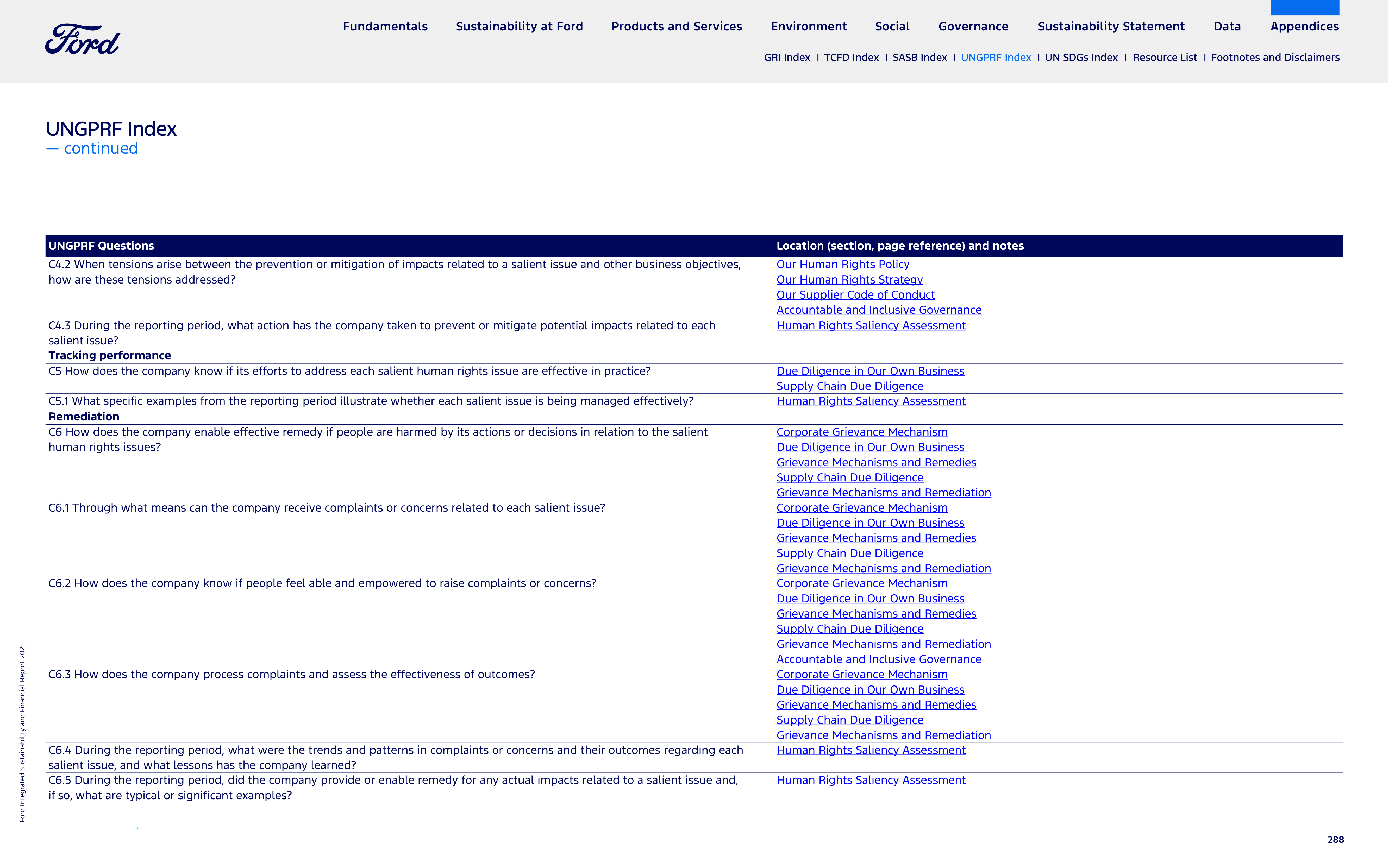
C4.2 When tensions arise between the prevention or mitigation of impacts related to a salient issue and other business objectives,
how are these tensions addressed?
Our Human Rights Policy
Our Human Rights Strategy
Our Supplier Code of Conduct
Accountable and Inclusive Governance
C4.3 During the reporting period, what action has the company taken to prevent or mitigate potential impacts related to each
salient issue?
Human Rights Saliency Assessment
Tracking performance
C5 How does the company know if its efforts to address each salient human rights issue are effective in practice?
Due Diligence in Our Own Business
Supply Chain Due Diligence
C5.1 What specific examples from the reporting period illustrate whether each salient issue is being managed effectively?
Human Rights Saliency Assessment
Remediation
C6 How does the company enable effective remedy if people are harmed by its actions or decisions in relation to the salient
human rights issues?
Corporate Grievance Mechanism
Due Diligence in Our Own Business
Grievance Mechanisms and Remedies
Supply Chain Due Diligence
Grievance Mechanisms and Remediation
C6.1 Through what means can the company receive complaints or concerns related to each salient issue?
Corporate Grievance Mechanism
Due Diligence in Our Own Business
Grievance Mechanisms and Remedies
Supply Chain Due Diligence
Grievance Mechanisms and Remediation
C6.2 How does the company know if people feel able and empowered to raise complaints or concerns?
Corporate Grievance Mechanism
Due Diligence in Our Own Business
Grievance Mechanisms and Remedies
Supply Chain Due Diligence
Grievance Mechanisms and Remediation
Accountable and Inclusive Governance
C6.3 How does the company process complaints and assess the effectiveness of outcomes?
Corporate Grievance Mechanism
Due Diligence in Our Own Business
Grievance Mechanisms and Remedies
Supply Chain Due Diligence
Grievance Mechanisms and Remediation
C6.4 During the reporting period, what were the trends and patterns in complaints or concerns and their outcomes regarding each
salient issue, and what lessons has the company learned?
Human Rights Saliency Assessment
C6.5 During the reporting period, did the company provide or enable remedy for any actual impacts related to a salient issue and,
if so, what are typical or significant examples?
Human Rights Saliency Assessment
Fundamentals
Sustainability at Ford
Products and Services
Environment
Social
Governance
Sustainability Statement
Data
Appendices
GRI Index
TCFD Index
SASB Index
UNGPRF Index
UN SDGs Index
Resource List
Footnotes and Disclaimers
|
|
|
|
|
|
UNGPRF Index
— continued
,
Ford Integrated Sustainability and Financial Report 2025
288
UNGPRF Questions
Location (section, page reference) and notes
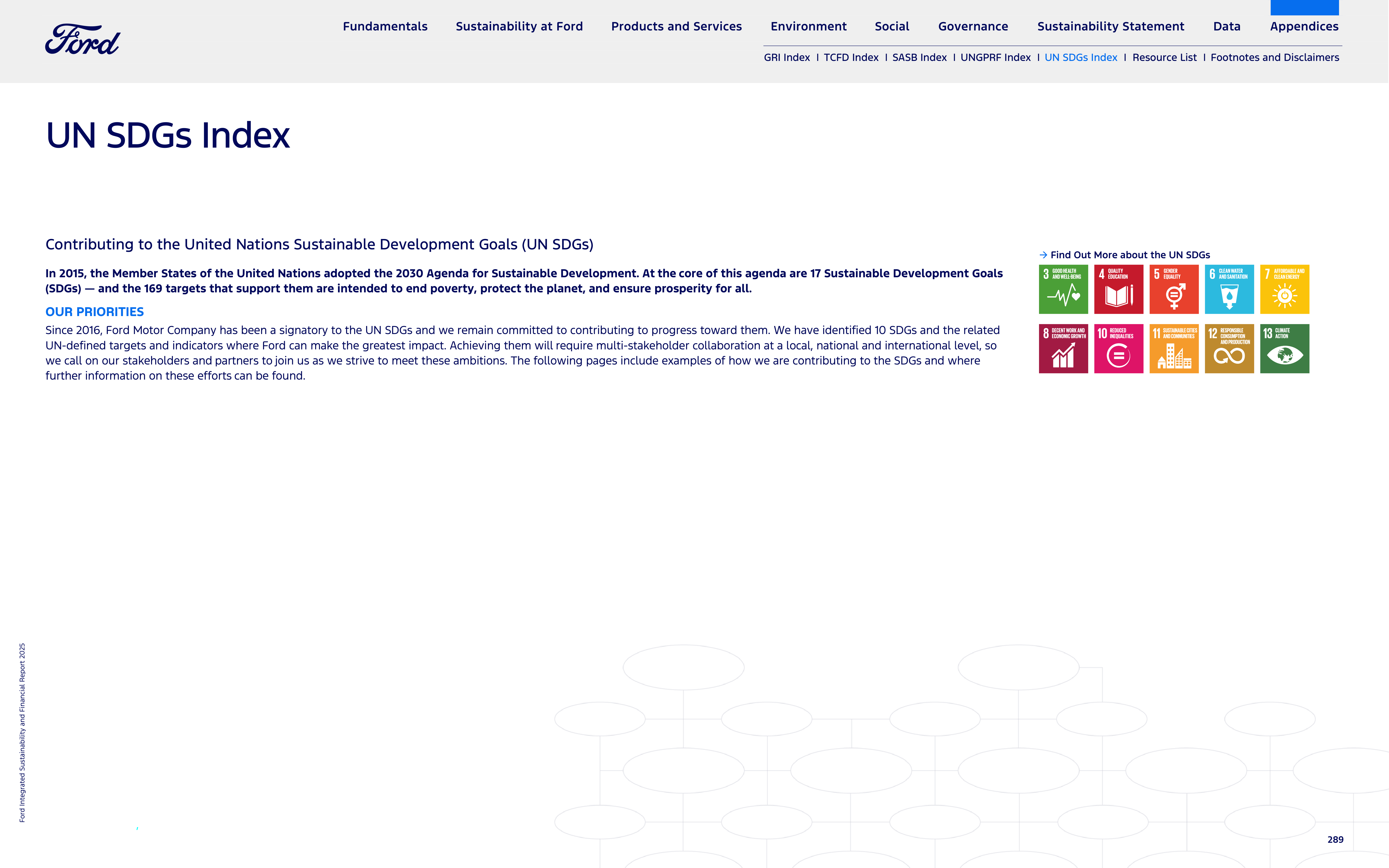

Fundamentals
Sustainability at Ford
Products and Services
Environment
Social
Governance
Sustainability Statement
Data
Appendices
GRI Index
TCFD Index
SASB Index
UNGPRF Index
UN SDGs Index
Resource List
Footnotes and Disclaimers
|
|
|
|
|
|
UN SDGs Index
Contributing to the United Nations Sustainable Development Goals (UN SDGs)
In 2015, the Member States of the United Nations adopted the 2030 Agenda for Sustainable Development. At the core of this agenda are 17 Sustainable Development Goals
(SDGs) — and the 169 targets that support them are intended to end poverty, protect the planet, and ensure prosperity for all.
OUR PRIORITIES
Since 2016, Ford Motor Company has been a signatory to the UN SDGs and we remain committed to contributing to progress toward them. We have identified 10 SDGs and the related
UN-defined targets and indicators where Ford can make the greatest impact. Achieving them will require multi-stakeholder collaboration at a local, national and international level, so
we call on our stakeholders and partners to join us as we strive to meet these ambitions. The following pages include examples of how we are contributing to the SDGs and where
further information on these efforts can be found.
,
Ford Integrated Sustainability and Financial Report 2025
289
à
Find Out More about the UN SDGs
3 GOOD HEALTH AND WELL-BEING
4 QUALITY EDUCATION
5 GENDER EQUALITY
6 CLEAN WATER AND SANITATION
7 AFFORDABLE AND CLEAN ENERGY
8 DECENT WORK AND ECONOMIC GROWTH
10 REDUCED INEQUALITIES
11 SUSTAINABLE CITIES AND COMMUNITIES
12 RESPONSIBLE CONSUMPTION AND PRODUCTION
13 CLIMATE ACTION
Fundamentals
Sustainability at Ford
Products and Services
Environment
Social
Governance
Sustainability Statement
Data
Appendices
GRI Index
TCFD Index
SASB Index
UNGPRF Index
UN SDGs Index
Resource List
Footnotes and Disclaimers
|
|
|
|
|
|
3 GOOD HEALTH AND WELL-BEING
UN SDGs Index
— continued
,
Ford Integrated Sustainability and Financial Report 2025
290
SDG 3: Good Health and Well-Being
Ensure healthy lives and promote well-being for all at all age
Why is this a priority for Ford?
Ford’s material topics
Most relevant SDG targets
Examples of Ford’s impact
We aspire to attain zero-emissions from our vehicles
and facilities to help improve air quality, and work
towards a future that is free from vehicle crashes and
workplace injuries. A clean, healthy, and sustainable
environment; health and safety; and rights of
Indigenous Peoples are salient human rights issues
for Ford. Ford cares about customer safety, and vehicle
safety will always be one of our highest priorities.
We understand that for our own employees and
community members to reach their full potential, we
must support their physical, mental, and emotional
health and wellness and maintain the highest levels
of safety throughout the value chain.
•
Air, Water, and Soil Pollution
•
Employee Health and Safety
•
Human Rights
•
Product Safety and Quality
3.6: By 2020, halve the number of global deaths and injuries
from road traffic accidents
3.9: By 2030, substantially reduce the number of deaths and
illnesses from hazardous chemicals and air, water and soil
pollution and contamination
Accelerating Progress (Air, Water)
Accelerating Progress (Safety)
Climate Transition Plan
Air, Water, and Soil Pollution
Water Resources
Product Safety and Quality
Employee Health and Safety
Performance Data — Non-CO
2
Tailpipe Emissions
Performance Data — Water
Performance Data — Vehicle Safety
Performance Data — Employee Health and Safety
Fundamentals
Sustainability at Ford
Products and Services
Environment
Social
Governance
Sustainability Statement
Data
Appendices
GRI Index
TCFD Index
SASB Index
UNGPRF Index
UN SDGs Index
Resource List
Footnotes and Disclaimers
|
|
|
|
|
|
4 QUALITY EDUCATION
UN SDGs Index
— continued
,
Ford Integrated Sustainability and Financial Report 2025
291
SDG 4: Quality Education
Ensure inclusive and equitable quality education and promote lifelong learning opportunities for all
Why is this a priority for Ford?
Ford’s material topics
Most relevant SDG targets
Examples of Ford’s impact
Through continual, agile learning, we can support our
employees, suppliers, dealers, and communities to
keep pace with a rapidly evolving world. Education
and training opportunities give people the best chance
of fulfilling their potential, support capacity building
in our supply chain, and prepare the next generation
of designers, engineers, and technicians for the
challenges and changes in technology that lie ahead.
•
Human Rights
•
Socioeconomic Contribution and
Community Engagement
4.3: By 2030, ensure equal access for all women and men to
affordable and quality technical, vocational and tertiary education,
including university
4.4: By 2030, substantially increase the number of youth and
adults who have relevant skills, including technical and vocational
skills, for employment, decent jobs and entrepreneurship
4.7: By 2030, ensure that all learners acquire the knowledge and
skills needed to promote sustainable development, including,
among others, through education for sustainable development
and sustainable lifestyles, human rights, gender equality,
promotion of a culture of peace and non-violence, global
citizenship and appreciation of cultural diversity and of culture’s
contribution to sustainable development
4.b: By 2020, substantially expand globally the number of
scholarships available to developing countries, in particular least
developed countries, small island developing States and African
countries, for enrollment in higher education, including vocational
training and information and communications technology,
technical, engineering and scientific programmes, in developed
countries and other developing countries
Accelerating Progress (Human Rights)
Workforce and Talent Development
Community Engagement
Performance Data — Community Engagement

Fundamentals
Sustainability at Ford
Products and Services
Environment
Social
Governance
Sustainability Statement
Data
Appendices
GRI Index
TCFD Index
SASB Index
UNGPRF Index
UN SDGs Index
Resource List
Footnotes and Disclaimers
|
|
|
|
|
|
5 GENDER EQUALITY
UN SDGs Index
— continued
,
Ford Integrated Sustainability and Financial Report 2025
292
SDG 5: Gender Equality
Achieve gender equality and empower all women and girls
Why is this a priority for Ford?
Ford’s material topics
Most relevant SDG targets
Examples of Ford’s impact
We aspire to support a respectful, safe, and inclusive
workplace where each person is valued. Fair and
decent work; forced labor, child labor, and human
trafficking; and harassment and discrimination are
salient human rights issues for Ford. Supporting and
sustaining a diverse and inclusive workplace includes
ensuring women are equally represented at all levels
of our business and supporting initiatives that
empower women and girls. The strongest businesses
promote diversity, equity, and inclusion.
•
Human Capital Management and
Diversity, Equity and Inclusion
•
Human Rights
5.1: End all forms of discrimination against all women and
girls everywhere
5.5: Ensure women’s full and effective participation and equal
opportunities for leadership at all levels of decision-making
in political, economic and public life
5.b: Enhance the use of enabling technology, in particular
information and communications technology, to promote the
empowerment of women
Accelerating Progress (Human rights)
Accelerating Progress (Diversity, Equity, and Inclusion)
Human Capital Management and Diversity, Equity and Inclusion
Performance Data — Human Capital Management and Diversity, Equity,
and Inclusion
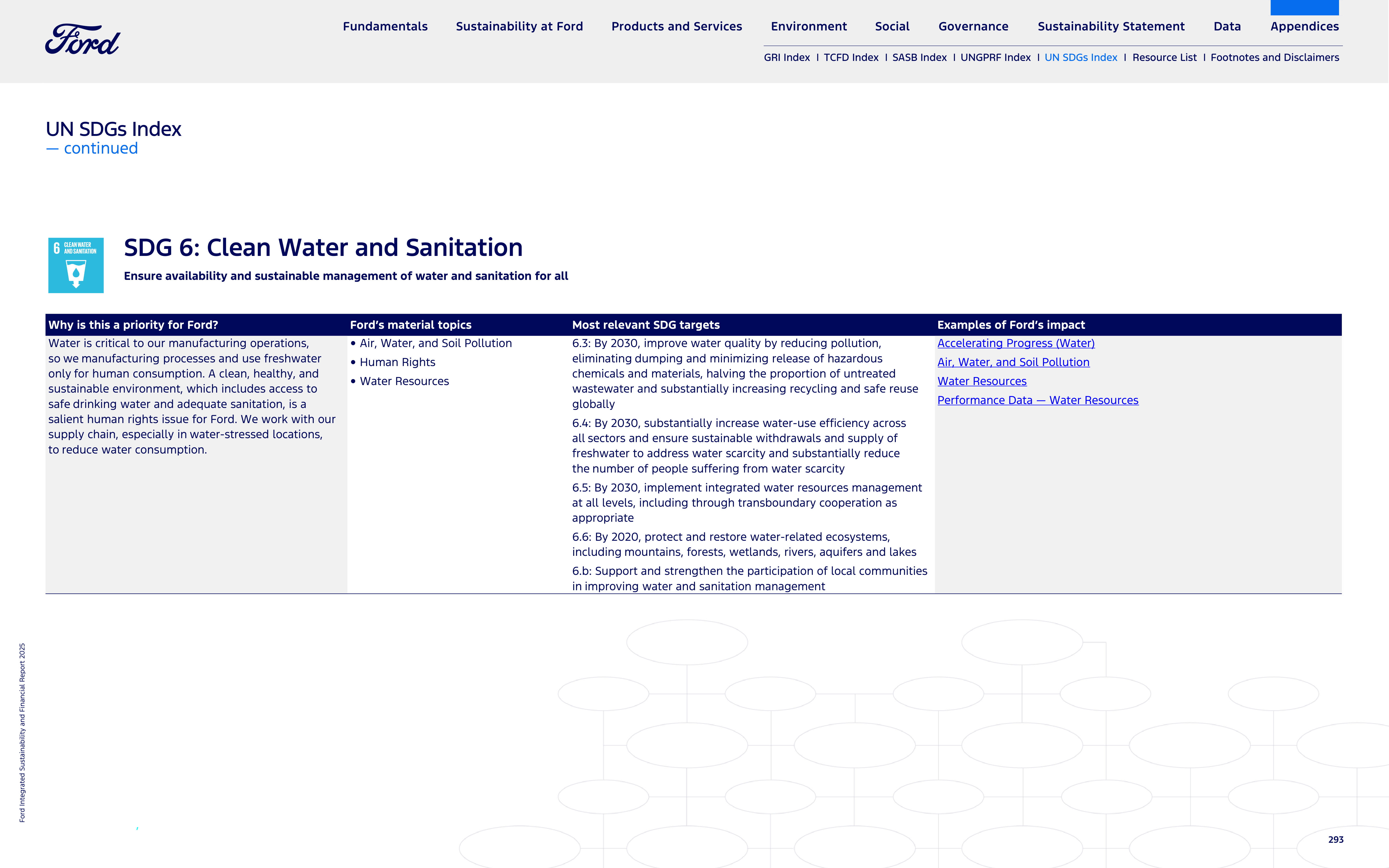

Fundamentals
Sustainability at Ford
Products and Services
Environment
Social
Governance
Sustainability Statement
Data
Appendices
GRI Index
TCFD Index
SASB Index
UNGPRF Index
UN SDGs Index
Resource List
Footnotes and Disclaimers
|
|
|
|
|
|
6 CLEAN WATER AND SANITATION
UN SDGs Index
— continued
,
Ford Integrated Sustainability and Financial Report 2025
293
SDG 6: Clean Water and Sanitation
Ensure availability and sustainable management of water and sanitation for all
Why is this a priority for Ford?
Ford’s material topics
Most relevant SDG targets
Examples of Ford’s impact
Water is critical to our manufacturing operations,
so we manufacturing processes and use freshwater
only for human consumption. A clean, healthy, and
sustainable environment, which includes access to
safe drinking water and adequate sanitation, is a
salient human rights issue for Ford. We work with our
supply chain, especially in water-stressed locations,
to reduce water consumption.
•
Air, Water, and Soil Pollution
•
Human Rights
•
Water Resources
6.3: By 2030, improve water quality by reducing pollution,
eliminating dumping and minimizing release of hazardous
chemicals and materials, halving the proportion of untreated
wastewater and substantially increasing recycling and safe reuse
globally
6.4: By 2030, substantially increase water-use efficiency across
all sectors and ensure sustainable withdrawals and supply of
freshwater to address water scarcity and substantially reduce
the number of people suffering from water scarcity
6.5: By 2030, implement integrated water resources management
at all levels, including through transboundary cooperation as
appropriate
6.6: By 2020, protect and restore water-related ecosystems,
including mountains, forests, wetlands, rivers, aquifers and lakes
6.b: Support and strengthen the participation of local communities
in improving water and sanitation management
Accelerating Progress (Water)
Air, Water, and Soil Pollution
Water Resources
Performance Data — Water Resources
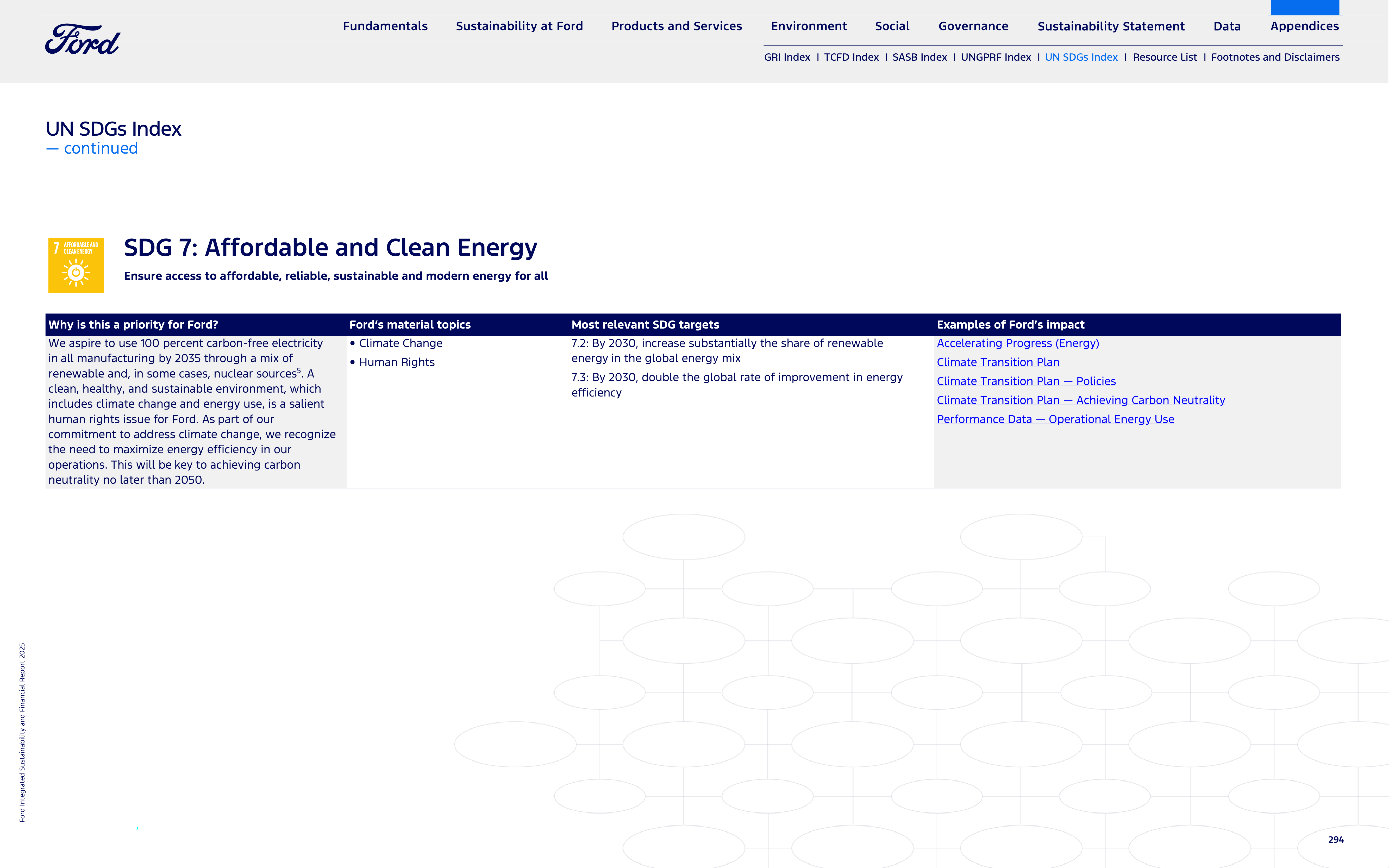

Fundamentals
Sustainability at Ford
Products and Services
Environment
Social
Governance
Sustainability Statement
Data
Appendices
GRI Index
TCFD Index
SASB Index
UNGPRF Index
UN SDGs Index
Resource List
Footnotes and Disclaimers
|
|
|
|
|
|
7 AFFORDABLE AND CLEAN ENERGY
UN SDGs Index
— continued
,
Ford Integrated Sustainability and Financial Report 2025
294
SDG 7: Affordable and Clean Energy
Ensure access to affordable, reliable, sustainable and modern energy for all
Why is this a priority for Ford?
Ford’s material topics
Most relevant SDG targets
Examples of Ford’s impact
We aspire to use 100 percent carbon-free electricity
in all manufacturing by 2035 through a mix of
renewable and, in some cases, nuclear sources
5
. A
clean, healthy, and sustainable environment, which
includes climate change and energy use, is a salient
human rights issue for Ford. As part of our
commitment to address climate change, we recognize
the need to maximize energy efficiency in our
operations. This will be key to achieving carbon
neutrality no later than 2050.
•
Climate Change
•
Human Rights
7.2: By 2030, increase substantially the share of renewable
energy in the global energy mix
7.3: By 2030, double the global rate of improvement in energy
efficiency
Accelerating Progress (Energy)
Climate Transition Plan
Climate Transition Plan — Policies
Climate Transition Plan — Achieving Carbon Neutrality
Performance Data — Operational Energy Use
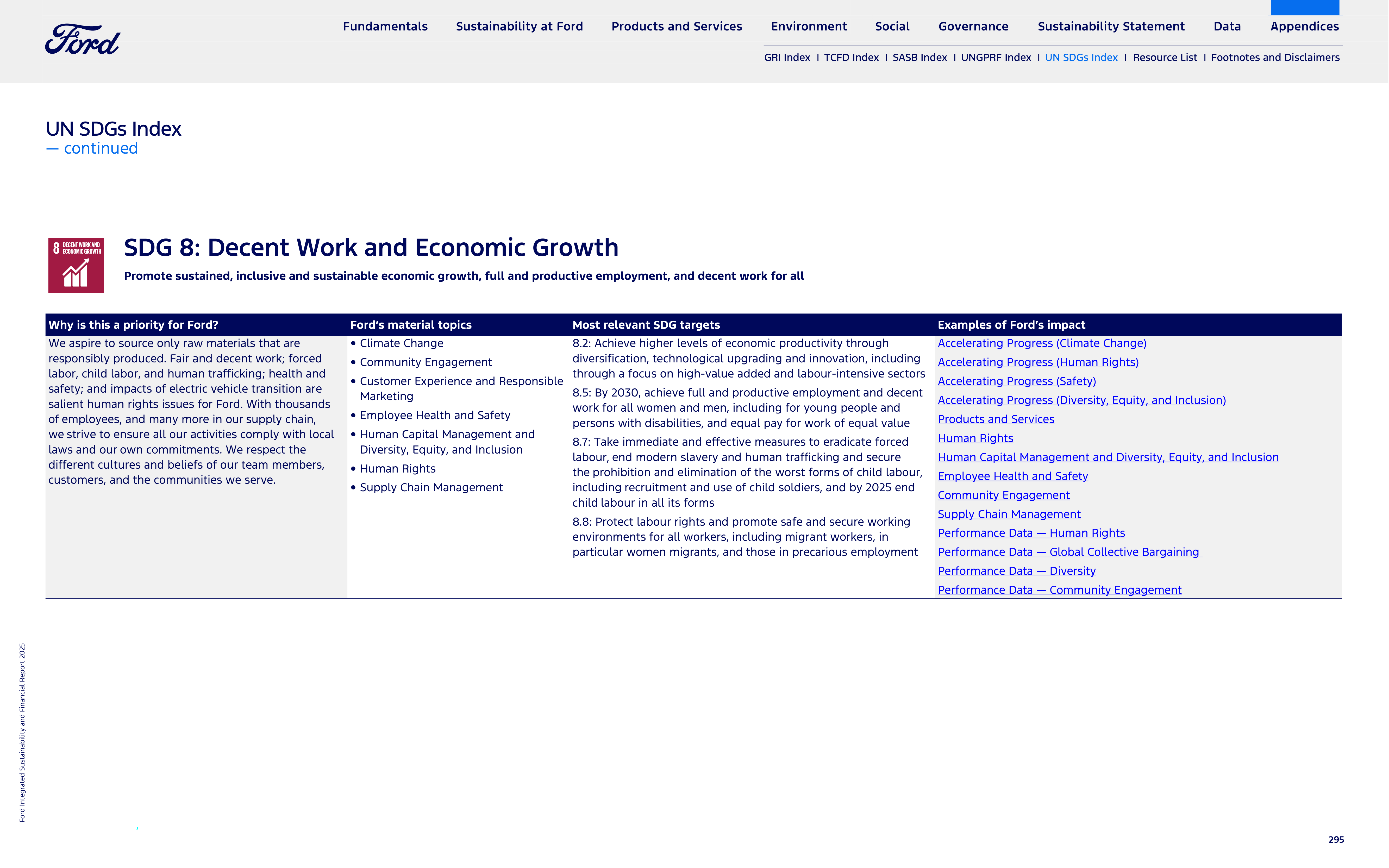
Fundamentals
Sustainability at Ford
Products and Services
Environment
Social
Governance
Sustainability Statement
Data
Appendices
GRI Index
TCFD Index
SASB Index
UNGPRF Index
UN SDGs Index
Resource List
Footnotes and Disclaimers
8 DECENT WORK AND ECONOMIC GROWTH
|
|
|
|
|
|
UN SDGs Index
— continued
,
Ford Integrated Sustainability and Financial Report 2025
295
SDG 8: Decent Work and Economic Growth
Promote sustained, inclusive and sustainable economic growth, full and productive employment, and decent work for all
Why is this a priority for Ford?
Ford’s material topics
Most relevant SDG targets
Examples of Ford’s impact
We aspire to source only raw materials that are
responsibly produced. Fair and decent work; forced
labor, child labor, and human trafficking; health and
safety; and impacts of electric vehicle transition are
salient human rights issues for Ford. With thousands
of employees, and many more in our supply chain,
we strive to ensure all our activities comply with local
laws and our own commitments. We respect the
different cultures and beliefs of our team members,
customers, and the communities we serve.
•
Climate Change
•
Community Engagement
•
Customer Experience and Responsible
Marketing
•
Employee Health and Safety
•
Human Capital Management and
Diversity, Equity, and Inclusion
•
Human Rights
•
Supply Chain Management
8.2: Achieve higher levels of economic productivity through
diversification, technological upgrading and innovation, including
through a focus on high-value added and labour-intensive sectors
8.5: By 2030, achieve full and productive employment and decent
work for all women and men, including for young people and
persons with disabilities, and equal pay for work of equal value
8.7: Take immediate and effective measures to eradicate forced
labour, end modern slavery and human trafficking and secure
the prohibition and elimination of the worst forms of child labour,
including recruitment and use of child soldiers, and by 2025 end
child labour in all its forms
8.8: Protect labour rights and promote safe and secure working
environments for all workers, including migrant workers, in
particular women migrants, and those in precarious employment
Accelerating Progress (Climate Change)
Accelerating Progress (Human Rights)
Accelerating Progress (Safety)
Accelerating Progress (Diversity, Equity, and Inclusion)
Products and Services
Human Rights
Human Capital Management and Diversity, Equity, and Inclusion
Employee Health and Safety
Community Engagement
Supply Chain Management
Performance Data — Human Rights
Performance Data — Global Collective Bargaining
Performance Data — Diversity
Performance Data — Community Engagement
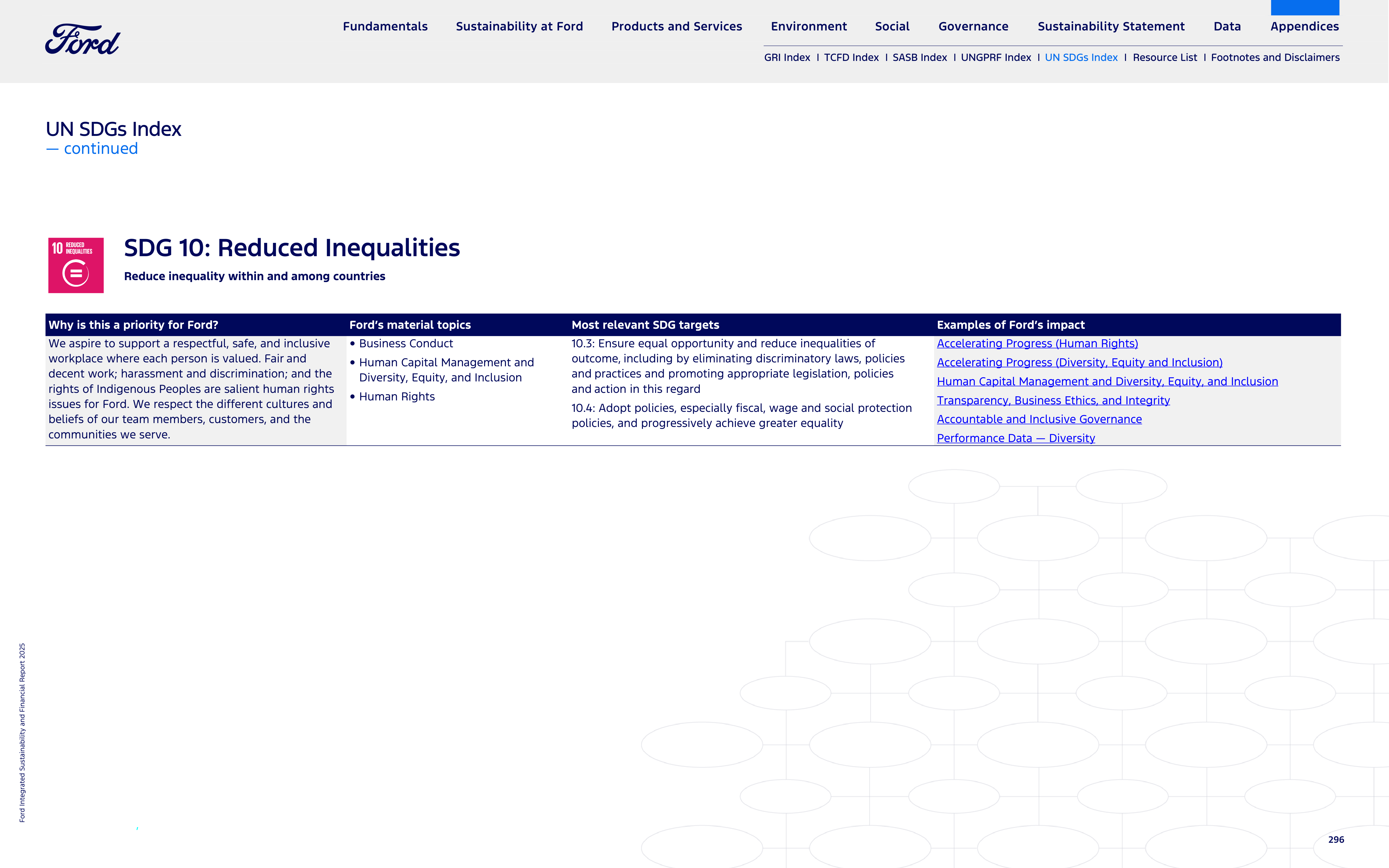

Fundamentals
Sustainability at Ford
Products and Services
Environment
Social
Governance
Sustainability Statement
Data
Appendices
GRI Index
TCFD Index
SASB Index
UNGPRF Index
UN SDGs Index
Resource List
Footnotes and Disclaimers
|
|
|
|
|
|
10 REDUCED INEQUALITIES
UN SDGs Index
— continued
,
Ford Integrated Sustainability and Financial Report 2025
296
SDG 10: Reduced Inequalities
Reduce inequality within and among countries
Why is this a priority for Ford?
Ford’s material topics
Most relevant SDG targets
Examples of Ford’s impact
We aspire to support a respectful, safe, and inclusive
workplace where each person is valued. Fair and
decent work; harassment and discrimination; and the
rights of Indigenous Peoples are salient human rights
issues for Ford. We respect the different cultures and
beliefs of our team members, customers, and the
communities we serve.
•
Business Conduct
•
Human Capital Management and
Diversity, Equity, and Inclusion
•
Human Rights
10.3: Ensure equal opportunity and reduce inequalities of
outcome, including by eliminating discriminatory laws, policies
and practices and promoting appropriate legislation, policies
and action in this regard
10.4: Adopt policies, especially fiscal, wage and social protection
policies, and progressively achieve greater equality
Accelerating Progress (Human Rights)
Accelerating Progress (Diversity, Equity and Inclusion)
Human Capital Management and Diversity, Equity, and Inclusion
Transparency, Business Ethics, and Integrity
Accountable and Inclusive Governance
Performance Data — Diversity
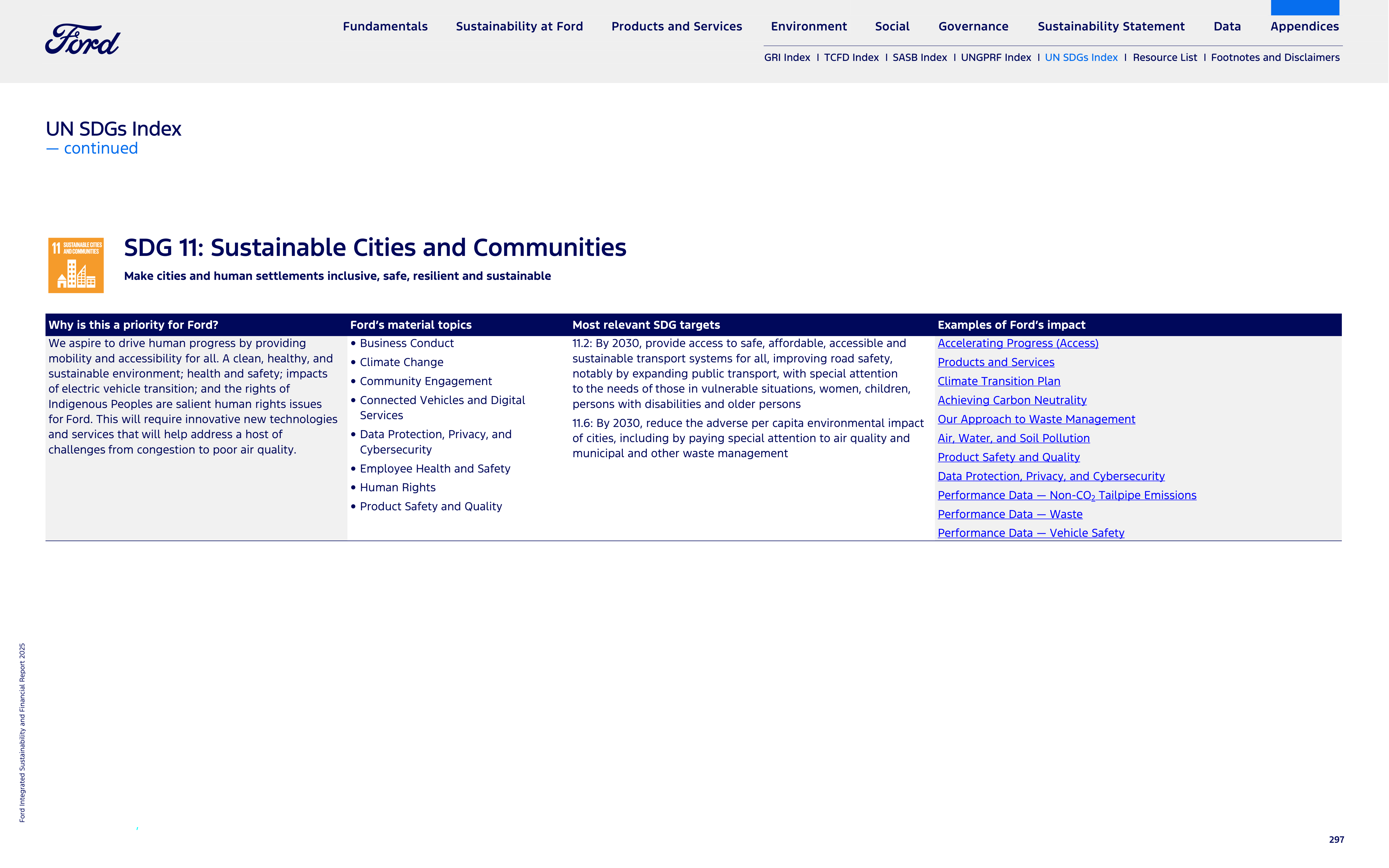
Fundamentals
Sustainability at Ford
Products and Services
Environment
Social
Governance
Sustainability Statement
Data
Appendices
GRI Index
TCFD Index
SASB Index
UNGPRF Index
UN SDGs Index
Resource List
Footnotes and Disclaimers
|
|
|
|
|
|
11 SUSTAINABLE CITIES AND COMMUNITIES
UN SDGs Index
— continued
,
Ford Integrated Sustainability and Financial Report 2025
297
SDG 11: Sustainable Cities and Communities
Make cities and human settlements inclusive, safe, resilient and sustainable
Why is this a priority for Ford?
Ford’s material topics
Most relevant SDG targets
Examples of Ford’s impact
We aspire to drive human progress by providing
mobility and accessibility for all. A clean, healthy, and
sustainable environment; health and safety; impacts
of electric vehicle transition; and the rights of
Indigenous Peoples are salient human rights issues
for Ford. This will require innovative new technologies
and services that will help address a host of
challenges from congestion to poor air quality.
•
Business Conduct
•
Climate Change
•
Community Engagement
•
Connected Vehicles and Digital
Services
•
Data Protection, Privacy, and
Cybersecurity
•
Employee Health and Safety
•
Human Rights
•
Product Safety and Quality
11.2: By 2030, provide access to safe, affordable, accessible and
sustainable transport systems for all, improving road safety,
notably by expanding public transport, with special attention
to the needs of those in vulnerable situations, women, children,
persons with disabilities and older persons
11.6: By 2030, reduce the adverse per capita environmental impact
of cities, including by paying special attention to air quality and
municipal and other waste management
Accelerating Progress (Access)
Products and Services
Climate Transition Plan
Achieving Carbon Neutrality
Our Approach to Waste Management
Air, Water, and Soil Pollution
Product Safety and Quality
Data Protection, Privacy, and Cybersecurity
Performance Data — Non-CO
2
Tailpipe Emissions
Performance Data — Waste
Performance Data — Vehicle Safety
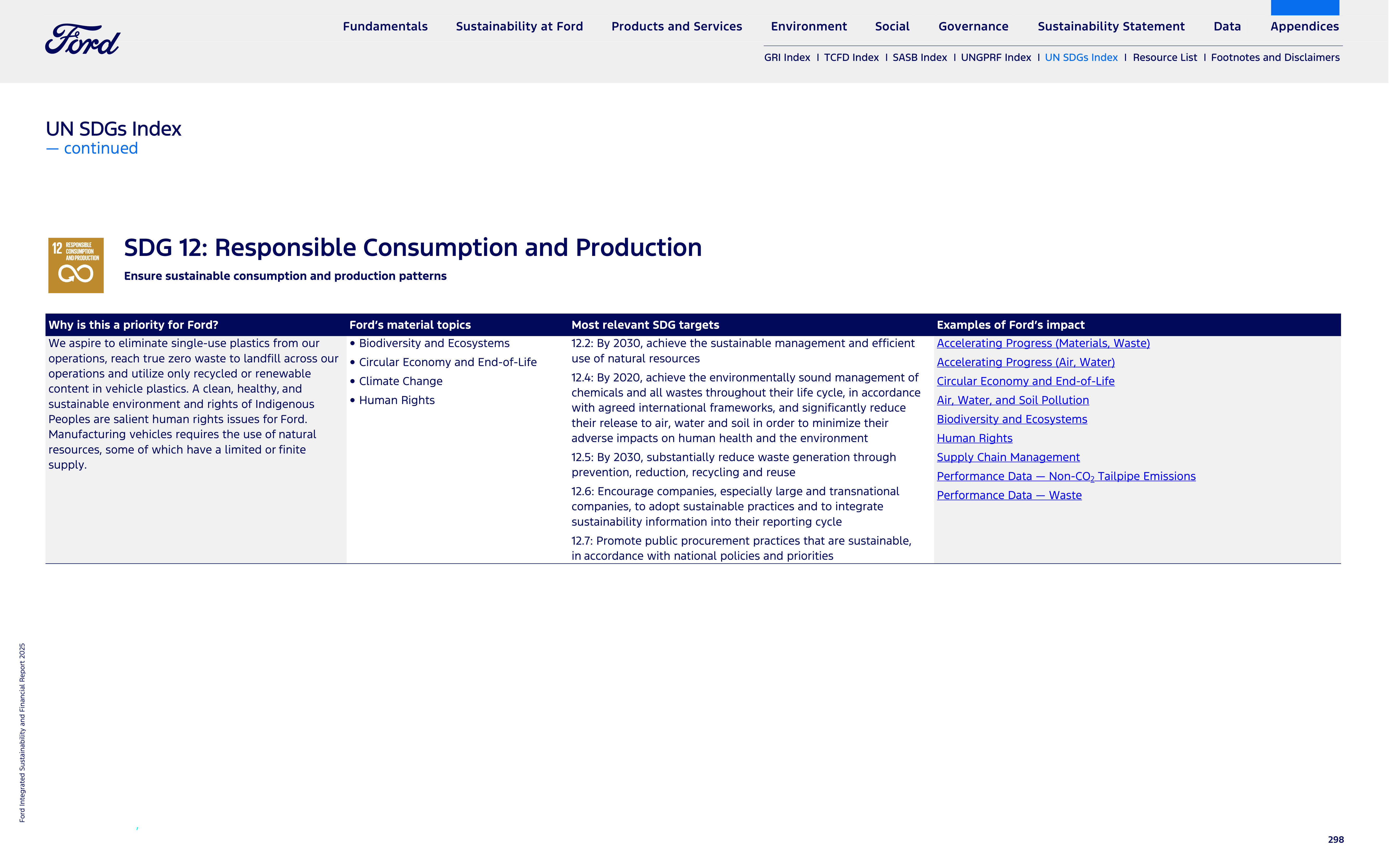
SDG 12: Responsible Consumption and Production
Ensure sustainable consumption and production patterns
Why is this a priority for Ford?
Ford’s material topics
Most relevant SDG targets
Examples of Ford’s impact
We aspire to eliminate single-use plastics from our
operations, reach true zero waste to landfill across our
operations and utilize only recycled or renewable
content in vehicle plastics. A clean, healthy, and
sustainable environment and rights of Indigenous
Peoples are salient human rights issues for Ford.
Manufacturing vehicles requires the use of natural
resources, some of which have a limited or finite
supply.
•
Biodiversity and Ecosystems
•
Circular Economy and End-of-Life
•
Climate Change
•
Human Rights
12.2: By 2030, achieve the sustainable management and efficient
use of natural resources
12.4: By 2020, achieve the environmentally sound management of
chemicals and all wastes throughout their life cycle, in accordance
with agreed international frameworks, and significantly reduce
their release to air, water and soil in order to minimize their
adverse impacts on human health and the environment
12.5: By 2030, substantially reduce waste generation through
prevention, reduction, recycling and reuse
12.6: Encourage companies, especially large and transnational
companies, to adopt sustainable practices and to integrate
sustainability information into their reporting cycle
12.7: Promote public procurement practices that are sustainable,
in accordance with national policies and priorities
Accelerating Progress (Materials, Waste)
Accelerating Progress (Air, Water)
Circular Economy and End-of-Life
Air, Water, and Soil Pollution
Biodiversity and Ecosystems
Human Rights
Supply Chain Management
Performance Data — Non-CO
2
Tailpipe Emissions
Performance Data — Waste
Fundamentals
Sustainability at Ford
Products and Services
Environment
Social
Governance
Sustainability Statement
Data
Appendices
GRI Index | TCFD Index | SASB Index | UNGPRF Index |
UN SDGs Index
| Resource List | Footnotes and Disclaimers
UN SDGs Index
— continued
,
Ford Integrated Sustainability and Financial Report 2025
298
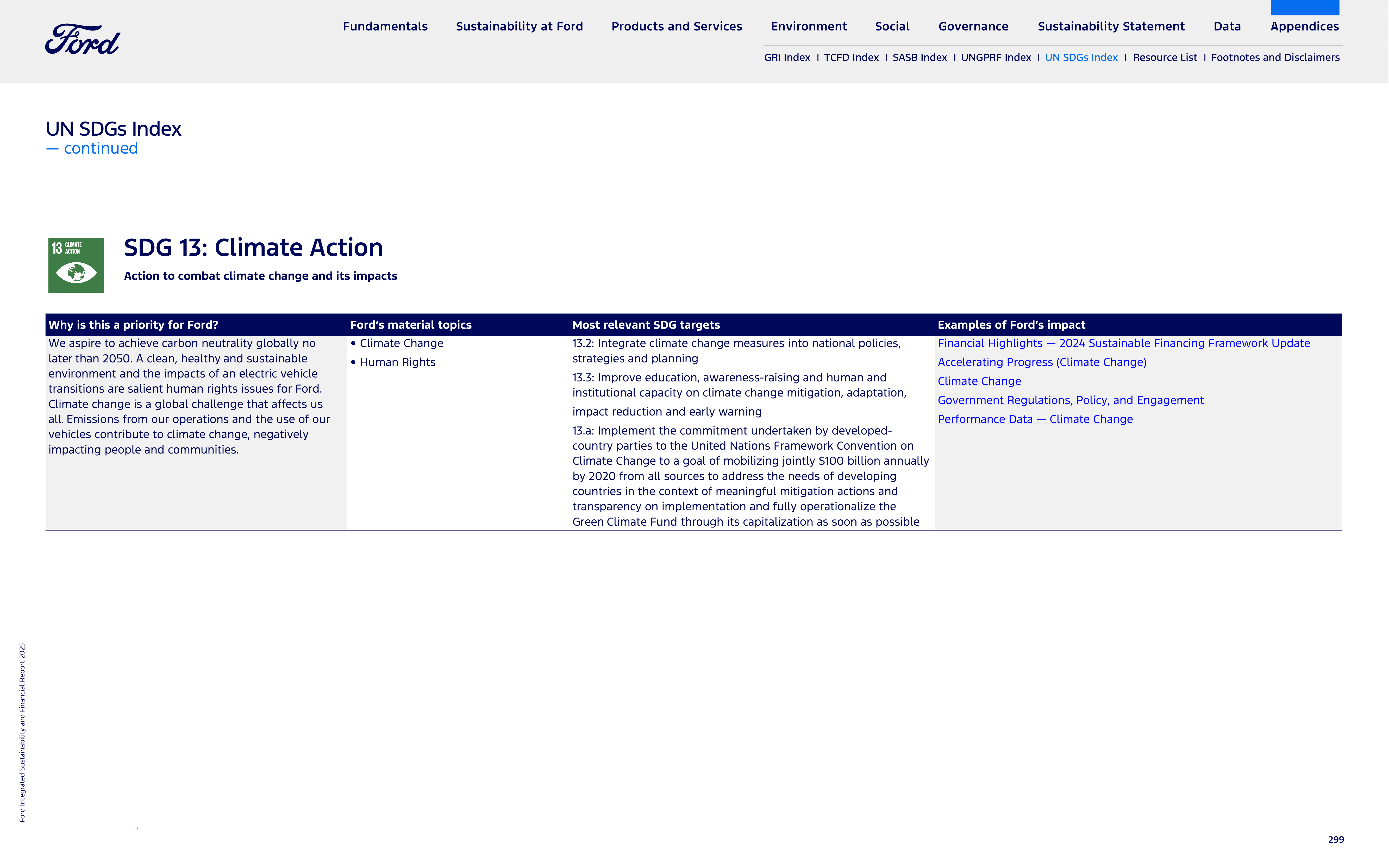
Fundamentals
Sustainability at Ford
Products and Services
Environment
Social
Governance
Sustainability Statement
Data
Appendices
GRI Index
TCFD Index
SASB Index
UNGPRF Index
UN SDGs Index
Resource List
Footnotes and Disclaimers
|
|
|
|
|
|
13 CLIMATE ACTION
UN SDGs Index
— continued
,
Ford Integrated Sustainability and Financial Report 2025
299
SDG 13: Climate Action
Action to combat climate change and its impacts
Why is this a priority for Ford?
Ford’s material topics
Most relevant SDG targets
Examples of Ford’s impact
We aspire to achieve carbon neutrality globally no
later than 2050. A clean, healthy and sustainable
environment and the impacts of an electric vehicle
transitions are salient human rights issues for Ford.
Climate change is a global challenge that affects us
all. Emissions from our operations and the use of our
vehicles contribute to climate change, negatively
impacting people and communities.
•
Climate Change
•
Human Rights
13.2: Integrate climate change measures into national policies,
strategies and planning
13.3: Improve education, awareness-raising and human and
institutional capacity on climate change mitigation, adaptation,
impact reduction and early warning
13.a: Implement the commitment undertaken by developed-
country parties to the United Nations Framework Convention on
Climate Change to a goal of mobilizing jointly $100 billion annually
by 2020 from all sources to address the needs of developing
countries in the context of meaningful mitigation actions and
transparency on implementation and fully operationalize the
Green Climate Fund through its capitalization as soon as possible
Financial Highlights — 2024 Sustainable Financing Framework Update
Accelerating Progress (Climate Change)
Climate Change
Government Regulations, Policy, and Engagement
Performance Data — Climate Change
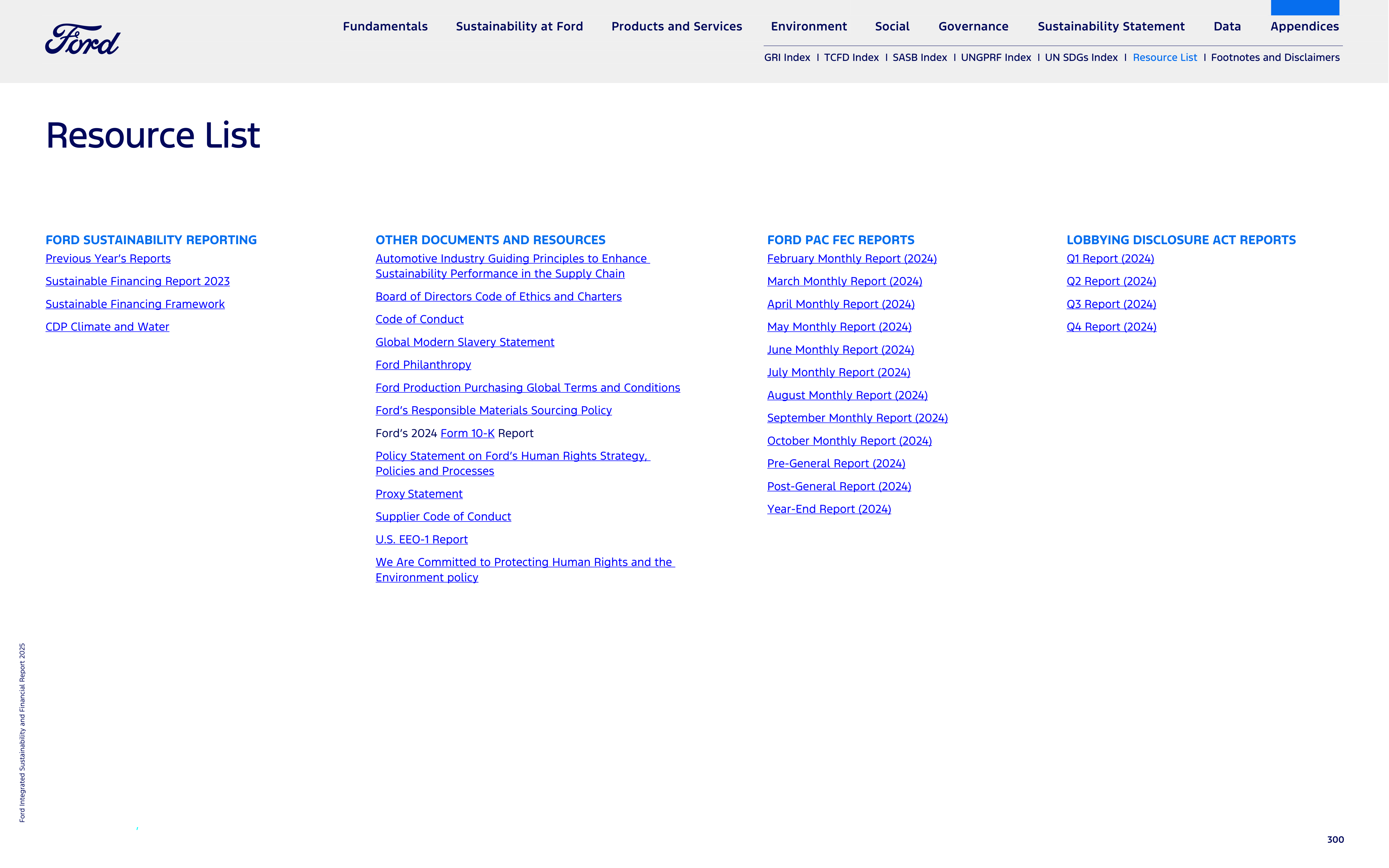
Fundamentals
Sustainability at Ford
Products and Services
Environment
Social
Governance
Sustainability Statement
Data
Appendices
GRI Index
TCFD Index
SASB Index
UNGPRF Index
UN SDGs Index
Resource List
Footnotes and Disclaimers
|
|
|
|
|
|
Resource List
,
Ford Integrated Sustainability and Financial Report 2025
300
FORD SUSTAINABILITY REPORTING
Previous Year’s Reports
Sustainable Financing Report 2023
Sustainable Financing Framework
CDP Climate and Water
OTHER DOCUMENTS AND RESOURCES
Automotive Industry Guiding Principles to Enhance
Sustainability Performance in the Supply Chain
Board of Directors Code of Ethics and Charters
Code of Conduct
Global Modern Slavery Statement
Ford Philanthropy
Ford Production Purchasing Global Terms and Conditions
Ford’s Responsible Materials Sourcing Policy
Ford’s 2024
Form 10-K
Report
Policy Statement on Ford’s Human Rights Strategy,
Policies and Processes
Proxy Statement
Supplier Code of Conduct
U.S. EEO-1 Report
We Are Committed to Protecting Human Rights and the
Environment policy
FORD PAC FEC REPORTS
February Monthly Report (2024)
March Monthly Report (2024)
April Monthly Report (2024)
May Monthly Report (2024)
June Monthly Report (2024)
July Monthly Report (2024)
August Monthly Report (2024)
September Monthly Report (2024)
October Monthly Report (2024)
Pre-General Report (2024)
Post-General Report (2024)
Year-End Report (2024)
LOBBYING DISCLOSURE ACT REPORTS
Q1 Report (2024)
Q2 Report (2024)
Q3 Report (2024)
Q4 Report (2024)
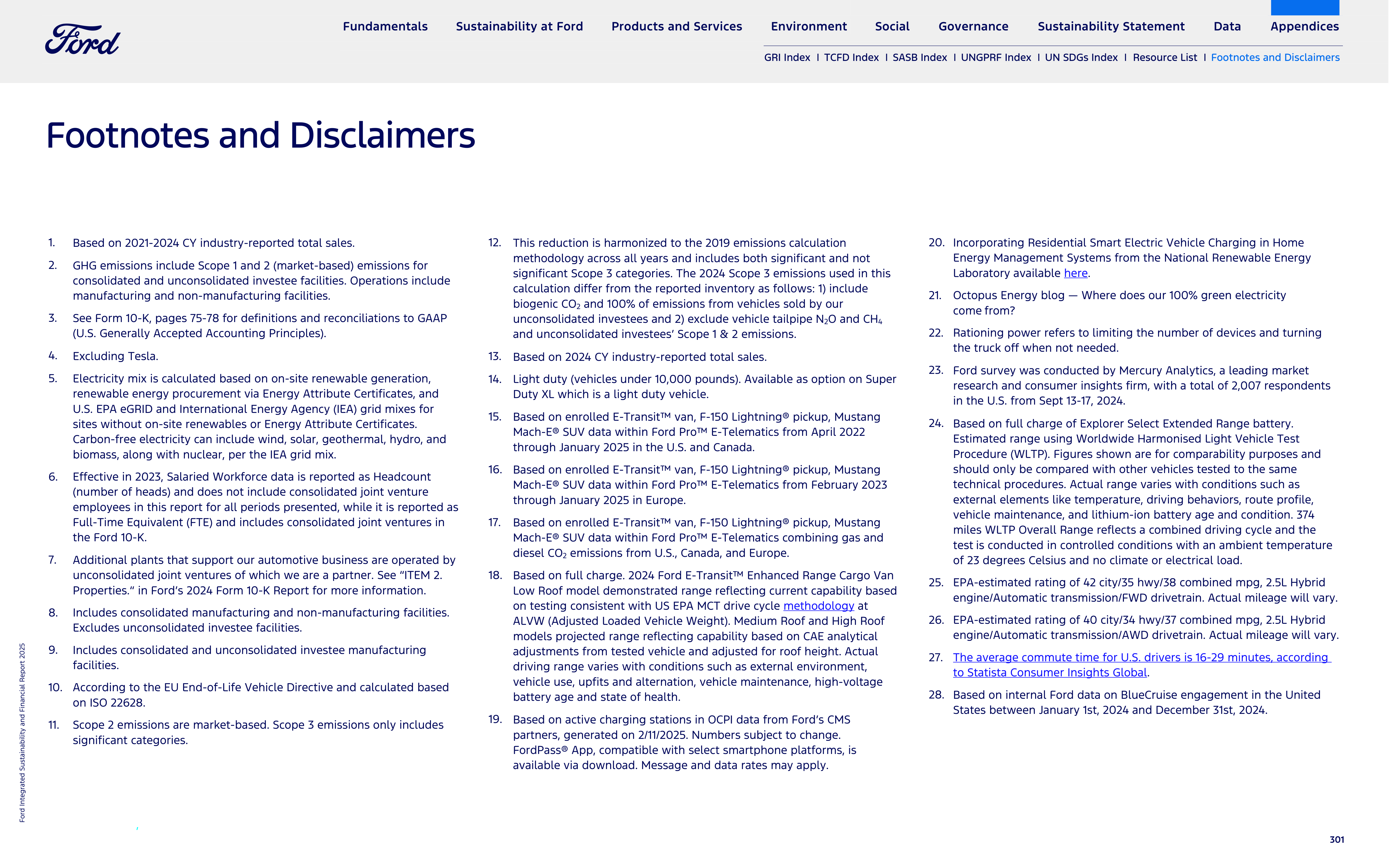
Fundamentals
Sustainability at Ford
Products and Services
Environment
Social
Governance
Sustainability Statement
Data
Appendices
GRI Index
TCFD Index
SASB Index
UNGPRF Index
UN SDGs Index
Resource List
Footnotes and Disclaimers
|
|
|
|
|
|
Footnotes and Disclaimers
,
Ford Integrated Sustainability and Financial Report 2025
301
1.
Based on 2021-2024 CY industry-reported total sales.
2.
GHG emissions include Scope 1 and 2 (market-based) emissions for
consolidated and unconsolidated investee facilities. Operations include
manufacturing and non-manufacturing facilities.
3.
See Form 10-K, pages 75-78 for definitions and reconciliations to GAAP
(U.S. Generally Accepted Accounting Principles).
4.
Excluding Tesla.
5.
Electricity mix is calculated based on on-site renewable generation,
renewable energy procurement via Energy Attribute Certificates, and
U.S. EPA eGRID and International Energy Agency (IEA) grid mixes for
sites without on-site renewables or Energy Attribute Certificates.
Carbon-free electricity can include wind, solar, geothermal, hydro, and
biomass, along with nuclear, per the IEA grid mix.
6.
Effective in 2023, Salaried Workforce data is reported as Headcount
(number of heads) and does not include consolidated joint venture
employees in this report for all periods presented, while it is reported as
Full-Time Equivalent (FTE) and includes consolidated joint ventures in
the Ford 10-K.
7.
Additional plants that support our automotive business are operated by
unconsolidated joint ventures of which we are a partner. See “ITEM 2.
Properties.“ in Ford’s 2024 Form 10-K Report for more information.
8.
Includes consolidated manufacturing and non-manufacturing facilities.
Excludes unconsolidated investee facilities.
9.
Includes consolidated and unconsolidated investee manufacturing
facilities.
10. According to the EU End-of-Life Vehicle Directive and calculated based
on ISO 22628.
11.
Scope 2 emissions are market-based. Scope 3 emissions only includes
significant categories.
12. This reduction is harmonized to the 2019 emissions calculation
methodology across all years and includes both significant and not
significant Scope 3 categories. The 2024 Scope 3 emissions used in this
calculation differ from the reported inventory as follows: 1) include
biogenic CO
2
and 100% of emissions from vehicles sold by our
unconsolidated investees and 2) exclude vehicle tailpipe N
2
O and CH
4
and unconsolidated investees’ Scope 1 & 2 emissions.
13. Based on 2024 CY industry-reported total sales.
14. Light duty (vehicles under 10,000 pounds). Available as option on Super
Duty XL which is a light duty vehicle.
15. Based on enrolled E-Transit™ van, F-150 Lightning® pickup, Mustang
Mach-E® SUV data within Ford Pro™ E-Telematics from April 2022
through January 2025 in the U.S. and Canada.
16. Based on enrolled E-Transit™ van, F-150 Lightning® pickup, Mustang
Mach-E® SUV data within Ford Pro™ E-Telematics from February 2023
through January 2025 in Europe.
17.
Based on enrolled E-Transit™ van, F-150 Lightning® pickup, Mustang
Mach-E® SUV data within Ford Pro™ E-Telematics combining gas and
diesel CO
2
emissions from U.S., Canada, and Europe.
18. Based on full charge. 2024 Ford E-Transit™ Enhanced Range Cargo Van
Low Roof model demonstrated range reflecting current capability based
on testing consistent with US EPA MCT drive cycle
methodology
at
ALVW (Adjusted Loaded Vehicle Weight). Medium Roof and High Roof
models projected range reflecting capability based on CAE analytical
adjustments from tested vehicle and adjusted for roof height. Actual
driving range varies with conditions such as external environment,
vehicle use, upfits and alternation, vehicle maintenance, high-voltage
battery age and state of health.
19. Based on active charging stations in OCPI data from Ford’s CMS
partners, generated on 2/11/2025. Numbers subject to change.
FordPass® App, compatible with select smartphone platforms, is
available via download. Message and data rates may apply.
20. Incorporating Residential Smart Electric Vehicle Charging in Home
Energy Management Systems from the National Renewable Energy
Laboratory available
here
.
21. Octopus Energy blog — Where does our 100% green electricity
come from?
22. Rationing power refers to limiting the number of devices and turning
the truck off when not needed.
23. Ford survey was conducted by Mercury Analytics, a leading market
research and consumer insights firm, with a total of 2,007 respondents
in the U.S. from Sept 13-17, 2024.
24. Based on full charge of Explorer Select Extended Range battery.
Estimated range using Worldwide Harmonised Light Vehicle Test
Procedure (WLTP). Figures shown are for comparability purposes and
should only be compared with other vehicles tested to the same
technical procedures. Actual range varies with conditions such as
external elements like temperature, driving behaviors, route profile,
vehicle maintenance, and lithium-ion battery age and condition. 374
miles WLTP Overall Range reflects a combined driving cycle and the
test is conducted in controlled conditions with an ambient temperature
of 23 degrees Celsius and no climate or electrical load.
25. EPA-estimated rating of 42 city/35 hwy/38 combined mpg, 2.5L Hybrid
engine/Automatic transmission/FWD drivetrain. Actual mileage will vary.
26. EPA-estimated rating of 40 city/34 hwy/37 combined mpg, 2.5L Hybrid
engine/Automatic transmission/AWD drivetrain. Actual mileage will vary.
27.
The average commute time for U.S. drivers is 16-29 minutes, according
to Statista Consumer Insights Global
.
28. Based on internal Ford data on BlueCruise engagement in the United
States between January 1st, 2024 and December 31st, 2024.
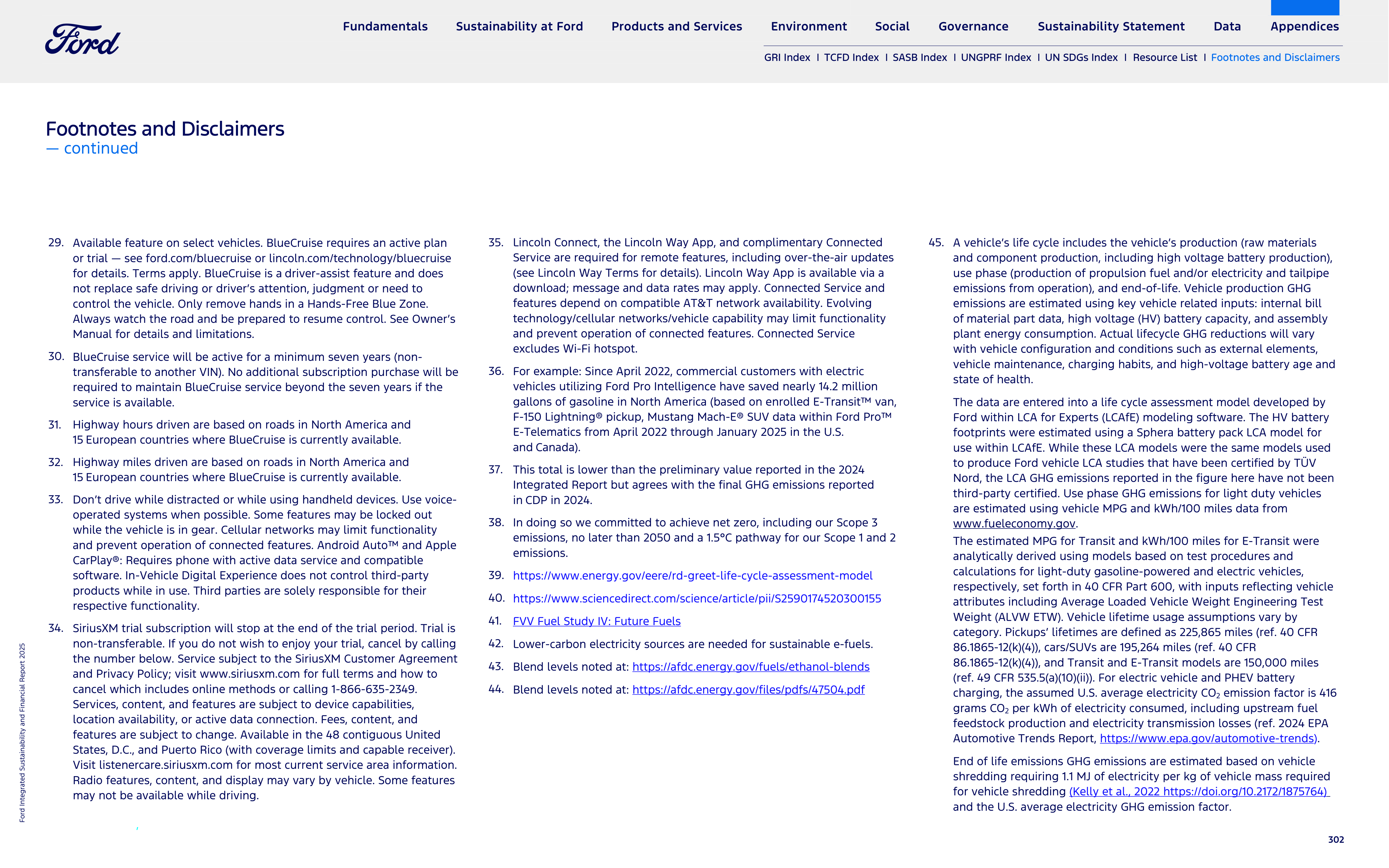
Fundamentals
Sustainability at Ford
Products and Services
Environment
Social
Governance
Sustainability Statement
Data
Appendices
GRI Index
TCFD Index
SASB Index
UNGPRF Index
UN SDGs Index
Resource List
Footnotes and Disclaimers
|
|
|
|
|
|
Footnotes and Disclaimers
— continued
,
Ford Integrated Sustainability and Financial Report 2025
302
29. Available feature on select vehicles. BlueCruise requires an active plan
or trial — see ford.com/bluecruise or lincoln.com/technology/bluecruise
for details. Terms apply. BlueCruise is a driver-assist feature and does
not replace safe driving or driver’s attention, judgment or need to
control the vehicle. Only remove hands in a Hands-Free Blue Zone.
Always watch the road and be prepared to resume control. See Owner’s
Manual for details and limitations.
30. BlueCruise service will be active for a minimum seven years (non-
transferable to another VIN). No additional subscription purchase will be
required to maintain BlueCruise service beyond the seven years if the
service is available.
31. Highway hours driven are based on roads in North America and
15 European countries where BlueCruise is currently available.
32. Highway miles driven are based on roads in North America and
15 European countries where BlueCruise is currently available.
33. Don’t drive while distracted or while using handheld devices. Use voice-
operated systems when possible. Some features may be locked out
while the vehicle is in gear. Cellular networks may limit functionality
and prevent operation of connected features. Android Auto™ and Apple
CarPlay®: Requires phone with active data service and compatible
software. In-Vehicle Digital Experience does not control third-party
products while in use. Third parties are solely responsible for their
respective functionality.
34. SiriusXM trial subscription will stop at the end of the trial period. Trial is
non-transferable. If you do not wish to enjoy your trial, cancel by calling
the number below. Service subject to the SiriusXM Customer Agreement
and Privacy Policy; visit www.siriusxm.com for full terms and how to
cancel which includes online methods or calling 1-866-635-2349.
Services, content, and features are subject to device capabilities,
location availability, or active data connection. Fees, content, and
features are subject to change. Available in the 48 contiguous United
States, D.C., and Puerto Rico (with coverage limits and capable receiver).
Visit listenercare.siriusxm.com for most current service area information.
Radio features, content, and display may vary by vehicle. Some features
may not be available while driving.
35. Lincoln Connect, the Lincoln Way App, and complimentary Connected
Service are required for remote features, including over-the-air updates
(see Lincoln Way Terms for details). Lincoln Way App is available via a
download; message and data rates may apply. Connected Service and
features depend on compatible AT&T network availability. Evolving
technology/cellular networks/vehicle capability may limit functionality
and prevent operation of connected features. Connected Service
excludes Wi‑Fi hotspot.
36. For example: Since April 2022, commercial customers with electric
vehicles utilizing Ford Pro Intelligence have saved nearly 14.2 million
gallons of gasoline in North America (based on enrolled E-Transit™ van,
F-150 Lightning® pickup, Mustang Mach-E® SUV data within Ford Pro™
E-Telematics from April 2022 through January 2025 in the U.S.
and Canada).
37. This total is lower than the preliminary value reported in the 2024
Integrated Report but agrees with the final GHG emissions reported
in CDP in 2024.
38. In doing so we committed to achieve net zero, including our Scope 3
emissions, no later than 2050 and a 1.5°C pathway for our Scope 1 and 2
emissions.
39.
https://www.energy.gov/eere/rd-greet-life-cycle-assessment-model
40.
https://www.sciencedirect.com/science/article/pii/S2590174520300155
41.
FVV Fuel Study IV: Future Fuels
42. Lower-carbon electricity sources are needed for sustainable e-fuels.
43. Blend levels noted at:
https://afdc.energy.gov/fuels/ethanol-blends
44. Blend levels noted at:
https://afdc.energy.gov/files/pdfs/47504.pdf
45. A vehicle’s life cycle includes the vehicle’s production (raw materials
and component production, including high voltage battery production),
use phase (production of propulsion fuel and/or electricity and tailpipe
emissions from operation), and end-of-life. Vehicle production GHG
emissions are estimated using key vehicle related inputs: internal bill
of material part data, high voltage (HV) battery capacity, and assembly
plant energy consumption. Actual lifecycle GHG reductions will vary
with vehicle configuration and conditions such as external elements,
vehicle maintenance, charging habits, and high-voltage battery age and
state of health.
The data are entered into a life cycle assessment model developed by
Ford within LCA for Experts (LCAfE) modeling software. The HV battery
footprints were estimated using a Sphera battery pack LCA model for
use within LCAfE. While these LCA models were the same models used
to produce Ford vehicle LCA studies that have been certified by TÜV
Nord, the LCA GHG emissions reported in the figure here have not been
third-party certified. Use phase GHG emissions for light duty vehicles
are estimated using vehicle MPG and kWh/100 miles data from
www.fueleconomy.gov.
The estimated MPG for Transit and kWh/100 miles for E-Transit were
analytically derived using models based on test procedures and
calculations for light-duty gasoline-powered and electric vehicles,
respectively, set forth in 40 CFR Part 600, with inputs reflecting vehicle
attributes including Average Loaded Vehicle Weight Engineering Test
Weight (ALVW ETW). Vehicle lifetime usage assumptions vary by
category. Pickups’ lifetimes are defined as 225,865 miles (ref. 40 CFR
86.1865-12(k)(4)), cars/SUVs are 195,264 miles (ref. 40 CFR
86.1865-12(k)(4)), and Transit and E-Transit models are 150,000 miles
(ref. 49 CFR 535.5(a)(10)(ii)). For electric vehicle and PHEV battery
charging, the assumed U.S. average electricity CO
2
emission factor is 416
grams CO
2
per kWh of electricity consumed, including upstream fuel
feedstock production and electricity transmission losses (ref. 2024 EPA
Automotive Trends Report,
https://www.epa.gov/automotive-trends)
.
End of life emissions GHG emissions are estimated based on vehicle
shredding requiring 1.1 MJ of electricity per kg of vehicle mass required
for vehicle shredding
(Kelly et al., 2022 https://doi.org/10.2172/1875764)
and the U.S. average electricity GHG emission factor.
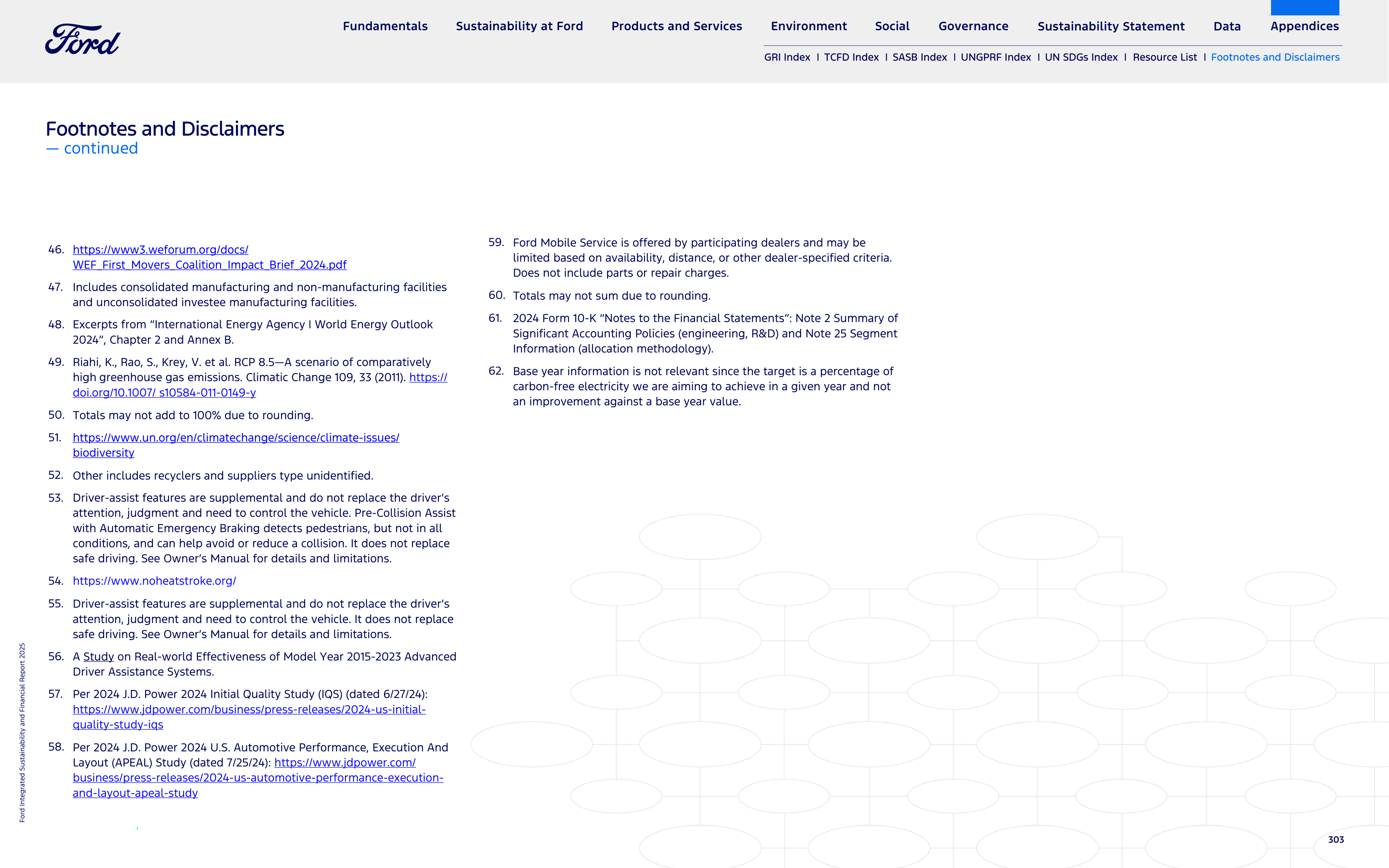

Fundamentals
Sustainability at Ford
Products and Services
Environment
Social
Governance
Sustainability Statement
Data
Appendices
GRI Index
TCFD Index
SASB Index
UNGPRF Index
UN SDGs Index
Resource List
Footnotes and Disclaimers
|
|
|
|
|
|
Footnotes and Disclaimers
— continued
,
Ford Integrated Sustainability and Financial Report 2025
303
46.
https://www3.weforum.org/docs/
WEF_First_Movers_Coalition_Impact_Brief_2024.pdf
47. Includes consolidated manufacturing and non-manufacturing facilities
and unconsolidated investee manufacturing facilities.
48. Excerpts from “International Energy Agency | World Energy Outlook
2024”, Chapter 2 and Annex B.
49. Riahi, K., Rao, S., Krey, V. et al. RCP 8.5—A scenario of comparatively
high greenhouse gas emissions. Climatic Change 109, 33 (2011).
https://
doi.org/10.1007/ s10584-011-0149-y
50. Totals may not add to 100% due to rounding.
51.
https://www.un.org/en/climatechange/science/climate-issues/
biodiversity
52. Other includes recyclers and suppliers type unidentified.
53. Driver-assist features are supplemental and do not replace the driver’s
attention, judgment and need to control the vehicle. Pre-Collision Assist
with Automatic Emergency Braking detects pedestrians, but not in all
conditions, and can help avoid or reduce a collision. It does not replace
safe driving. See Owner’s Manual for details and limitations.
54.
https://www.noheatstroke.org/
55. Driver-assist features are supplemental and do not replace the driver’s
attention, judgment and need to control the vehicle. It does not replace
safe driving. See Owner’s Manual for details and limitations.
56. A Study on Real-world Effectiveness of Model Year 2015-2023 Advanced
Driver Assistance Systems.
57. Per 2024 J.D. Power 2024 Initial Quality Study (IQS) (dated 6/27/24):
https://www.jdpower.com/business/press-releases/2024-us-initial-
quality-study-iqs
58. Per 2024 J.D. Power 2024 U.S. Automotive Performance, Execution And
Layout (APEAL) Study (dated 7/25/24):
https://www.jdpower.com/
business/press-releases/2024-us-automotive-performance-execution-
and-layout-apeal-study
59. Ford Mobile Service is offered by participating dealers and may be
limited based on availability, distance, or other dealer-specified criteria.
Does not include parts or repair charges.
60. Totals may not sum due to rounding.
61. 2024 Form 10-K “Notes to the Financial Statements”: Note 2 Summary of
Significant Accounting Policies (engineering, R&D) and Note 25 Segment
Information (allocation methodology).
62. Base year information is not relevant since the target is a percentage of
carbon-free electricity we are aiming to achieve in a given year and not
an improvement against a base year value.

Ford Motor Company
One American Road
Dearborn, MI 48126, U.S.A.
sustainability.ford.com
shareholder.ford.com