


























2025
50
th
Contents
Page No
Directors’ Report to the Members
7
Auditors’ Report to the Members
32
Balance Sheet
42
Statement of Profit & Loss
43
Statement of Changes in equity
44
Statement of Cash Flow
45
Notes to Financial Statements
46


BofA Securities India Limited

5
Annual Report 2025
Board of Directors
Mr. Manishi Kansal
Chairman and Non-executive Director
Ms. Mitali Ghosh
Independent Director
Mr. Kumar Shah
Independent Director
Mr. Asit Bhatia
Whole-time Director
Mr. Rajnarayan Balakrishnan
Whole-time Director
Mr. Arbind Maheswari
Whole-time Director
Mr. Sudhir Jain
Non-executive Director
Compliance Officer
Mr. Shervin Purohit
Chief Financial Officer
Mr. Rahul Manjeshwar
Company Secretary
Ms. Priyesha Sehgal
Auditors
Price Waterhouse Chartered Accountants LLP
Bankers
Bank of America, N.A.
Citibank, N.A.
HDFC Bank Limited
ICICI Bank Limited
Registrar and Share Transfer Agent
MUFG Intime India Private Limited
C-101, 247 Park, LBS Marg,
Vikhroli (West), Mumbai 400 083
+91 8108116767,
+91 22 49186060
Tel
Fax
rnt.helpdesk@in.mpms.mufg.com,
www.in.mpms.mufg.com
E-mail
Website
Registered Office
Ground Floor, A Wing, One BKC, G Block,
Bandra Kurla Complex, Bandra (East), Mumbai 400 051
U74140MH1975PLC018618,
+91 22 66328000,
+91 22 66328580
CIN
Tel
Fax
dg.secretarial@bofa.com,
https://business.bofa.com/bofas-india
E-mail
Website

6
BofA Securities India Limited
BofA Securities India Limited
Directors' Report to the Members
Your Directors have pleasure in presenting the 50
Annual Report, together with the Audited Financial Statements of BofA Securities India
th
Limited (“the Company”/ “BofASI”), for the financial year ended March 31, 2025 (FY2024-25)
State of the Company's Affairs
Financial Highlights:
The Financial Results of the Company are summarized as under:
7
Annual Report 2025
Gross income for the year was Rs. 12,105 million which increased from Rs. 11,837 million in the previous year, primarily on account of increase
in fees and other income.
Expenses increased to Rs. 4,772 million from Rs. 4,142 million in the previous year, primarily on account of increase in legal and professional
fees and repairs and maintenance.
The above resulted in decrease in Profit before Tax to Rs.7,333 million from Rs. 7,695 million in the previous year. Profit after Tax decreased to
Rs. 5,507 million from Rs. 5,740 million in the previous year.
Particulars
Financial Year
2024-25
Financial Year
2023-24
Gross Income
12,105
11,837
Profit before Depreciation and Tax
7,673
8,024
Depreciation and Amortization
340
329
Profit before Tax
7,333
7,695
Profit after Tax
5,507
5,740
Retained Earnings:
Balance at the beginning of the year
28,088
22,335
Profit for the year
5,507
5,740
Other transfers
(229)
-
Other Comprehensive Income for the year
(7)
13
Total Comprehensive Income for the year
5,271
5,753
Less: Appropriations
Nil
Nil
Balance at the end of the year
33,359
28,088
Earnings per share (in Rs.)
237.84
247.91
(Rs. in million)
Transfer to Reserves
The Board of Directors of your Company has decided not to transfer any amount to General Reserve from the profits of the Company for
FY2024-25.
Dividend
The Board of Directors has decided not to recommend any Dividend on the Equity Shares of the Company for FY2024-25.
Material Changes and Commitments Affecting the Financial Position of the Company
There have been no material changes and commitments affecting the financial position of the Company, which have occurred between the
end of FY2024-25 and the date of this Report.
Share Capital
During the year under review, there has been no change in the Share Capital of the Company. At the end of FY2024-25, the Authorized Share
Capital stood at Rs. 10,937,500,000 divided into 283,750,000 Equity Shares of the face value of Rs. 10 each and 810,000,000 Cumulative
Redeemable Preference Shares of the face value of Rs. 10 each.
The Issued, Subscribed and Paid-up Share Capital of the Company stood at Rs. 231,550,390, divided into 23,155,039 Equity Shares of the face
value of Rs. 10 each, as on March 31, 2025.
Transfer of Unclaimed Dividend and Shares to Investor Education & Protection Fund (IEPF)
Pursuant to the provisions of section 125 read with 124(5) of the Companies Act, 2013 ( ”the Act” ) and the Investor Education and Protection
Fund Authority (Accounting, Audit, Transfer and Refund) Rules, 2016 (the “IEPF Rules”), the Company is required to transfer the amount of
dividend lying unclaimed for a period of seven years from the date of its transfer to the unpaid dividend account to the Investor Education
and Protection Fund (the “IEPF”).
Pursuant to the provisions of sections 124 and 125 of the Act and the relevant provisions of the IEPF Rules, the equity shares of the Company
on which dividend has not been claimed for seven consecutive years are liable to be transferred by the Company to the IEPF.
In compliance with aforesaid provisions, the details of unclaimed dividends and shares transferred by the Company to IEPF during FY2024-
25 till the date of the report are as follows:
Financial Year
Amount of Unclaimed Dividend
Number of Shares Transferred
Transferred
2016-2017
Rs. 3,965
11
2017-2018
Rs.10,125
1
The unclaimed dividend and the equity shares transferred to IEPF can be claimed by making an application in the prescribed form available
on the website of IEPF at (www.iepf.gov.in).
Significant Developments During the Year and Change in Nature of Business
There were no significant changes in the nature of business of your Company during the year.
Corporate Update, Operations and Future Outlook
Economic Update
Following a strong GDP growth in FY2023-24 (at +9.2% YoY), FY2024-25 saw growth momentum moderating on a cyclical weakness largely
driven by unintended policy tightening - both fiscal and monetary with real GDP growth at 6.5% YoY. With general election in the Q1FY2025,
pace of spending was impacted leading to a much softer growth in H1 last year due to lower government consumption and investment. With
stronger consumption demand, H2 saw pickup in growth with recovery in government spending in Q4FY2025. GVA growth averaged at 6.4%
YoY in FY2024-25 slowing from 8.6% in FY2023-24. The supply side was majorly driven by sustained growth in services coupled with uptick in
construction aided by the real estate cycle. Agri growth also picked up following a good monsoon last year. In FY2025-26, we expect real GDP
growth to remain at 6.5% YoY with policy recalibrated to support growth amidst global uncertainty. We expect consumption to continue to
drive GDP in FY2025-26 boosted by the tax cuts announced in the February Budget and with frontloading of RBI rate cuts, while the
uncertainty around trade and geopolitics is likely to weigh on investment growth.
8
BofA Securities India Limited
Equity Broking
Nifty returned 6.35% gains for the financial year after peaking out in September 2024 as earnings at home and global trade and tariff related
macro headwinds took a toll on sentiment. The story was similar across emerging markets, where the MSCI EM index returned less than 6% as
well. The broader market was worse off, with NSE 500 returns dropping to 5.9% for the year as retail / HNI holdings took a hit in a correction
that saw 5 consecutive months of negative returns from end of September 2024 to March 2025, which was a record for the index. A large part
of the stabilizing factor in this turmoil was Domestic Institutional buying which was $76 billion for the past financial year. Foreigners sold
$15.6 billion over the same period. For the present year, RBI rate cuts, a reduction in personal income tax and a pickup in capital expenditure
by corporates should provide growth triggers. SEBI's 2.0 rules for F&O would likely result in curbing of speculation especially in the index
options space.
Our Company's equity broking volumes reflected this activity and were up by 35% YoY across Cash and F&O which helped increase
commission by 15% YoY and improve market share.
Capital Markets Business
FY2024-25 saw the highest ever activity in India's Equity Capital Markets. India ranked #1 in Asia and #2 globally in terms of amount raised via
Equity Capital Markets across product categories. A total of Rs. 535,960 crores was raised in FY2024-25 as compared to Rs. 360,367 crores
raised in FY2023-24, a YoY growth of 49%. This growth was driven by record inflows of Rs. 607,000 crores from domestic institutional
investors owing to strong economic fundamentals.
Investment Banking
The industry wide M&A (announced) volumes rose to Rs. 11,644 billion (vs. Rs. 10,205 billion in the previous year). M&A deals in FY2024-25
were majorly in Banking & Finance, Utility & Energy, and TMT.
Key Deals during FY2024-25
Equity Capital Markets
Sole Bookrunner for US$ 331 million Block Trade by Vodafone Plc in Indus Towers
Joint Bookrunner for US$ 708 million Qualified Institutional Placement for Godrej Properties
Book Running Lead Manager for US$ 1,343 million IPO of Swiggy
Book Running Lead Manager for US$ 781 million IPO of Bajaj Housing Finance
Sole Bookrunner for US$ 146 million Block Trade by TPG in Tata Technologies
Book Running Lead Manager for US$ 499 million IPO of BrainBees Solutions
Book Running Lead Manager for US$ 732 million IPO of Ola Electric Mobility
Sole Bookrunner for US$ 109 million Block Trade for CPPIB in Delhivery
Joint Bookrunner for US$ 1,809 million Block Trade for Vodafone Plc in Indus Towers
Sole Bookrunner for US$ 235 million Block Trade for Timken Singapore in Timken India
Sole Bookrunner for US$ 429 million Block Trade by Bain Capital in Axis Bank
Mergers & Acquisitions
Advisor to Fourth Partner Energy on US$275 million Investment by International Finance Corporation (IFC), Asian Development Bank
(ABD) and DEG (KfW Group) in Fourth Partner Energy
Placement Agent on US$300 million Investment by Blackstone in Bagmane Group
Exclusive advisor to Macquarie on US$325 million sale of Stride Climate Investments portfolio to Actis
Debt Capital Markets
Joint Lead Manager and Joint Global Coordinator for Biocon Biologics US$800 million 5NC2 Senior Secured Notes
Joint Lead Manager and Joint Bookrunner for EXIM US$1 billion 10y Senior Unsecured Bond Offering
9
Annual Report 2025
Franchise Awards
The Asset: Best India IPO (Swiggy)
The Asset: Best India Block Trade (BAT PLC US$2.11 billion block trade in ITC Limited)
The Asset: Best India New Bond (Biocon Biologics)
The Asset: Best India Green Financing (Reliance Industries)
IFR Asia Awards: Best High Yield Bond (Biocon Biologics)
Dun & Bradstreet: Leading Foreign Bank in India
Institutional Investor (Extel): Ranked #1 Research House in India, 2025
Business Outlook
Global economy is expected to witness a slowdown in FY2025-26 due to rising trade frictions, persistent geopolitical and policy
uncertainties, elevated market volatility and divergence in inflation trajectories across major economies. Despite these external headwinds,
India is poised to sustain its growth momentum with real GDP projected to grow by 6.5%, same as the previous year. This resilience is
underpinned by strong domestic demand, moderating inflationary pressure, robust capital markets, and growing exports.
Capital market activity is expected to remain buoyant through FY2025-26. In the Equity Capital Market (ECM), IPO activity is likely to gain
further traction, backed by a strong pipeline and positive investor sentiment. Quick-to-market deals, including Qualified Institutional
Placements (QIPs) and Block trades are anticipated to remain robust, driven by a favorable market sentiment and strong institutional
liquidity. On the debt side, the Debt Capital Market (DCM) is expected to benefit from India's inclusion in global bond indices, lower
inflationary pressures, and a stable interest rate environment, driving higher corporate Bond issuances.
Extract of Annual Return
In terms of section 92(3) of the Companies Act, 2013 and rule 12 of the Companies (Management and Administration) Rules, 2014, the draft
Annual Return of the Company is available on the website of the Company at https://business.bofa.com/in/en/about-us/corporate-
governance.html.
Number of Meetings of the Board
During FY2024-25 the Board of Directors met six times on the dates as stated below:
Sr. No.
Date of Board Meetings
1.
June 12, 2024
2.
July 23, 2024
3.
September 27, 2024
4.
January 20, 2025
5.
February 21, 2025
6.
March 28, 2025
10
BofA Securities India Limited
Board of Directors
The details of Directors as on the date of this Report are as follows:
Sr.
Name of the Director
Designation
Director
Dates of Appointment / Re-appointment
No.
Identification
Number (DIN)
1.
Mr. Manishi Kansal
Chairman & Non-
05166146
December 18, 2023.
executive Director
2.
Ms. Mitali Ghosh
Independent Director
09184497
1 Term: June 15, 2021 to June 14, 2026.
st
3.
Mr. Kumar Shah
Independent Director
00033865
1 Term: July 14, 2022 to July 13, 2027.
st
4.
Mr. Asit Bhatia
Whole-time Director
05112750
Appointment as Director: November 25, 2011.
Appointment as a Whole-time Director:
1
Term: June 16, 2021 to June 15, 2024;
st
2
Term: June 16, 2024 to June 15, 2026.
nd
5.
Mr. Rajnarayan Balakrishnan Whole-time Director
06694243
1 Term: May 28, 2015 to May 27, 2018;
st
2 Term: May 28, 2018 to May 27, 2021;
nd
3 Term: May 28, 2021 to May 27, 2024;
rd
4 Term: May 28, 2024 to May 27, 2027.
th
6.
Mr. Arbind Maheswari
Whole-time Director
07415888
1 Term: January 25, 2016 to January 24, 2019;
st
2 Term: January 25, 2019 to January 24, 2022;
nd
3 Term: January 25, 2022 to January 24, 2025;
rd
4 Term: January 25, 2025 to January 24, 2028.
th
7.
Mr. Sudhir Jain
Non-executive Director
08765695
July 24, 2020.
Changes in Directors till the Date of the Report
Appointment(s)/Re-appointment(s)
Mr. Rajnarayan Balakrishnan, Whole-time Director and Key Managerial Personnel of the Company and Mr. Sudhir Jain, Non-Executive
Director of the Company, who retired by rotation in accordance with section 152(6) of the Companies Act, 2013 (“the Act”) at the Annual
General Meeting (AGM) of the Company held on September 27, 2024, were duly re-appointed at the said Meeting.
In accordance with the provisions of section 161 and other applicable provisions of the Act, Mr. Manishi Kansal was appointed as the
Additional Non-Executive Director of the Company by the Board of Directors at its Meeting held on December 18, 2023, with effect from
December 18, 2023. The appointment was approved by the Members at the AGM of the Company held on September 27, 2024.
In accordance with the provisions of sections 2(51), 196, 197 and 203 of the Act read with rule 8 of the Companies (Appointment and
Remuneration of Managerial Personnel) Rules, 2014 and Schedule V of the Act and other applicable provisions of the Act, Mr. Rajnarayan
Balakrishnan and Mr. Arbind Maheshwari, were re-appointed as Whole-time Directors and Key Managerial Personnel of the Company, liable
to retire by rotation, by the Board of Directors, at its Meetings held on March 28, 2024 and July 23, 2024, respectively, for a period of 3 years,
with effect from May 28, 2024 till May 27, 2027 and from January 25, 2025 till January 24, 2028, respectively. The respective appointments
were approved by the Members of the Company at the AGM of the Company held on September 27, 2024.
In accordance with the provisions of sections 2(51), 196, 197 and 203 of the Act read with rule 8 of the Companies (Appointment and
Remuneration of Managerial Personnel) Rules, 2014 and Schedule V of the Act and other applicable provisions of the Act, Mr. Asit Bhatia, was
re-appointed as a Whole-time Director and Key Managerial Personnel of the Company, liable to retire by rotation, by the Board of Directors,
at its Meeting held on June 12, 2024, for a period of 2 years, with effect from June 16, 2024 till June 15, 2026. The appointment was approved
by the Members of the Company at the AGM of the Company held on September 27, 2024.
In accordance with section 152(6) of the Act, Mr. Asit Bhatia and Mr. Arbind Maheswari, Whole-time Directors and Key Managerial Personnel
of the Company are liable to retire by rotation and being eligible, seek re-appointment.
Resolutions in respect to the aforesaid re-appointments have been included in the Notice convening the 50 AGM of the Company.
th
11
Annual Report 2025
Cessation/Resignation
No Directors have resigned from the Board of the Company since April 1, 2024 till the date of this report.
Declaration Given by Independent Directors and Statement on Compliance of Code of Conduct
The Company has received declaration from both its Independent Directors, Ms. Mitali Ghosh and Mr. Kumar Shah, confirming that they meet
the criteria of independence, as prescribed under section 149(6) of the Companies Act, 2013( ”the Act” ).
In the opinion of the Board, the Independent Directors possess the requisite integrity, experience, expertise and proficiency required to
discharge their duties and functions as Independent Directors.
Further, the Independent Directors have complied with the Code for Independent Directors, prescribed in Schedule IV to the Act.
Changes in Key Managerial Personnel till the Date of the Report
Appointment(s)/Re-appointment(s)
By virtue of the re-appointments as stated above, Mr. Rajnarayan Balakrishnan, Mr. Asit Bhatia and Mr. Arbind Maheswari were re-appointed
as the Key Managerial Personnel of the Company, with effect from May 28, 2024, June 16, 2024, and January 25, 2025, respectively.
Mr. Rahul Manjeshwar was appointed as the Chief Financial Officer, Key Managerial Personnel of the Company by the Board at its Meeting
held on May 26, 2025, with effect from May 26, 2025.
Ms. Priyesha Sehgal, Company Secretary, Key Managerial Personnel of the Company remained in her position.
Resignation
During FY2024-25, Mr. Naresh Shah resigned as the Chief Financial Officer, Key Managerial Personnel of the Company with effect from close
of business hours of March 31, 2025. The Board expresses its sincere appreciation for the valuable services rendered by him during his tenure
in the Company.
Directors' Responsibility Statement
Pursuant to section 134(3)(c) of the Companies Act, 2013 (“the Act”), your Directors confirm that
-
a) in the preparation of the annual accounts, the applicable accounting standards had been followed along with proper explanation
relating to material departures;
b) the Directors had selected such accounting policies and applied them consistently and made judgments and estimates that are
reasonable and prudent so as to give a true and fair view of the state of affairs of the Company for the financial year ended March 31, 2025
and of the profit of the Company for that period;
c) the Directors had taken proper and sufficient care for the maintenance of adequate accounting records in accordance with the provisions
of the Act for safeguarding the assets of the Company and for preventing and detecting fraud and other irregularities;
d) the Directors had prepared the annual accounts on a going concern basis;
e) the Directors had laid down internal financial controls with reference to the financial statements to be followed by the Company and such
internal financial controls are adequate and were operating effectively;
f) the Directors had devised proper systems to ensure compliance with the provisions of all applicable laws and that such systems were
adequate and operating effectively.
Evaluation of Board Performance
In accordance with the provisions of the Companies Act, 2013 (“the Act”), the performance of the Board of Directors and of its Committees
and individual Directors were evaluated taking into consideration various performance related aspects.
Ms. Mitali Ghosh and Mr. Kumar Shah, Independent Directors of the Company, reviewed the matters pertaining to performance evaluation of
the Board, Committees and Directors, as prescribed under Schedule IV of the said Act, at a separate meeting of Independent Directors
convened on March 28, 2025.
12
BofA Securities India Limited
The Independent Directors had the following observations:
The Board, the Chairman, the Audit Committee, the Corporate Social Responsibility Committee and the Nomination and Remuneration
Committee of the Company are operating in an effective and efficient manner. Critical business issues are deliberated at Meetings and
relevant financial information is reported in a timely manner. The Board Members have appropriate and diverse range of Indian and
international experience and possess appropriate regulatory knowledge and are conversant with the evolving regulatory landscape. The
Board and the Committees are balanced and productive with appropriate oversight of risk. There is a smooth and timely flow of information
between the Board, Committees and the Company Management.
The Company is not listed on any stock exchanges and only 0.05% of the Company's shares are held by external shareholders. The Company
holds Annual General Meeting of the shareholders every year and maintains a healthy dialogue.
In general, the Independent Directors expressed their satisfaction in respect of the following aspects of governance:
a) Performance of non-Independent Directors and the Board as a whole;
b) Performance of the Chairperson of the Company, taking into account the views of the executive and non-executive Directors;
c) The quality, quantity and timeliness of flow of information between the company management and the Board that is necessary for the
Board to effectively and reasonably perform its duties;
d) The Company Secretary performed her duties in connection with the Board effectively.
Both the Independent Directors stated that all the information and the meeting material required by the Committees and the Board were
shared in time. They, however, requested that the Board should be briefed more proactively on any matters with potentially material
regulatory and/or legal implications. The Independent Directors expressed their appreciation towards the performance of the Chairman, the
Board and the Company Secretary of the Company.
The Board of Directors at its Meeting held on March 28, 2025, reviewed the performance of every (i) Director; (ii) Committees; and (iii) Board
as a whole in terms of the under mentioned parameters and formed the following opinion:
The information provided to the Directors prior to Board Meetings meets desired expectations in terms of the flow of information,
adequacy and compliance with the applicable laws;
The Board of Directors of the Company were effective in decision making;
The Company's systems of control were effective for identifying material risks and reporting material violations of policies and law;
The Board of Directors are effective in providing necessary advice and suggestions to the Company's Management;
The Board's Chairman effectively and appropriately leads and facilitates the Board Meetings and the policy and governance work of
the Board;
The Board Committees devote adequate time in discharging their duties;
The Directors encouraged open communication, meaningful participation, and timely resolution of issues, at various Meetings;
The Directors have knowledge of the sector in which the Company operates.
The Company Secretary performed her duties in connection with the Board effectively.
Policy on Appointment and Remuneration of Directors, Key Managerial Personnel and other Employees
The Company's Policy on Appointment and Remuneration of Directors, Key Managerial Personnel and other Employees, including criteria for
determining qualifications, positive attributes, independence of a director and other matters, as prescribed under section 178(3) of the
Companies Act, 2013, has been annexed as
and forms part of this Report.
ANNEXURE-I
Committees of the Board
(i)
Audit Committee:
The composition of the Audit Committee, as on the date of the Report, is as under:
1) Mr. Kumar Shah
2) Ms. Mitali Ghosh
3) Mr. Manishi Kansal
The Audit Committee met four times, during the year under review, on July 23, 2024, February 21, 2025, and March 28, 2025. There
were two meetings of the Audit Committee on March 28, 2025.
13
Annual Report 2025
(ii)
Nomination and Remuneration Committee:
The composition of the Nomination and Remuneration Committee, as on the date of the Report, is as under:
1) Ms. Mitali Ghosh
2) Mr. Kumar Shah
3) Mr. Manishi Kansal
The Nomination and Remuneration Committee met six times, during the year under review, on June 12, 2024, July 23, 2024, January
20, 2025, February 21, 2025, and March 28, 2025. There were two meetings of the Nomination & Remuneration Committee on January
20, 2025.
(iii) Corporate Social Responsibility Committee:
The composition of the Corporate Social Responsibility Committee, as on the date of the Report, is as under:
1) Ms. Mitali Ghosh
2) Mr. Asit Bhatia
3) Mr. Manishi Kansal
The Corporate Social Responsibility Committee met twice during the year under review, on July 23, 2024, and March 28, 2025.
(iv) IT Committee:
The composition of the IT Committee, as on the date of the Report, is as under:
1) Mr. Rakesh Shetty
2) Mr. Manishi Kansal
3) Mr. Sarfraz Ahmed
4) Mr. Mandar Donde
5) Ms. Vinata Mhatre
6) Mr. Vivian Trang
7) Mr. Riten Shah
8) Mr. Mohit Dixit
9) Mr. Sangram Mohite
10) Mr. Himanshu Mathur
11) Mr. Ajit Nair
12) Representative from ANB Solutions Pvt. Ltd.
The Board at its Meeting held on March 28, 2025, approved the change of name of the Technology Committee to IT Committee.
The IT Committee met twice during the year under review, on June 26, 2024, and December 5, 2024.
Ms. Prittam Desai ceased to be a Member of the IT Committee with effect from July 23, 2024.
Mr. Sangram Mohite was appointed as a Member of the IT Committee with effect from July 23, 2024.
Mr. Arbind Maheswari ceased to be the Chairperson and Member w.e.f. April 1, 2025 and Mr. Rakesh Shetty was appointed as the
Chairperson of the IT Committee w.e.f. April 1, 2025.
Mr. Manishi Kansal, Ms. Vinata Mhatre, Mr. Mandar Donde, Mr. Vivian Trang, Mr. Riten Shah, Mr. Mohit Dixit, and Mr. Himanshu Mathur
were appointed as Members of the IT Committee w.e.f. April 1, 2025. Further, a representative from ANB Solutions Pvt. Ltd. was also
appointed as a Member of the IT Committee w.e.f. April 1, 2025.
Mr. Sethu Thangavelu ceased to be a Member of the IT Committee w.e.f. April 1, 2025.
Auditors
Statutory Auditors:
In accordance with section 139 of the Companies Act, 2013, M/s. Price Waterhouse Chartered Accountants LLP, (ICAI Firm Registration No.
012754N/N500016), were appointed by the shareholders of the Company at the Annual General Meeting held on September 27, 2024, as
Statutory Auditors, for a period of 5 years, to hold office until the conclusion of the 54 Annual General Meeting of the Company in year 2029.
th
The Auditors' Report for the year under review issued by M/s. Price Waterhouse Chartered Accountants LLP, does not contain any
qualification, reservation, adverse remark or disclaimer.
14
BofA Securities India Limited
15
Annual Report 2025
Secretarial Auditors:
Your Directors have appointed M/s. Surendra Kanstiya Associates, Company Secretaries, as the Secretarial Auditor of the Company, in
accordance with section 204 of the Companies Act, 2013 ( ”the Act” ) and rule 9 of the Companies (Appointment and Remuneration of
Managerial Personnel) Rules, 2014.
In terms of the provisions of section 204 of the Act, the Secretarial Audit Report for FY2024-25, in the prescribed Form MR – 3, is annexed as
ANNEXURE–II
and forms part of this Report.
The Secretarial Audit Report does not contain any qualification, reservation, adverse remark or disclaimer.
Reporting of Frauds by the Auditors
During the year under review, the Auditors have not reported any instances of frauds committed in the Company by its Officers or
Employees, to the Audit Committee, under section 143(12) of the Companies Act, 2013, that warrants mention in this Report.
Risk Management Policy
The extract of the Risk Management Policy, adopted by the Company, including identification of elements of risk pursuant to section
134(3)(n) of the Companies Act, 2013, is attached as
and forms part of this Report.
ANNEXURE-III
Corporate Social Responsibility
The extract of the Corporate Social Responsibility Policy implemented by the Company and the initiatives taken during the year under
review, pursuant to section 134(3)(o) of the Companies Act, 2013 and the Companies (Corporate Social Responsibility) Rules, 2014 is
attached as
and forms part of this Report.
ANNEXURE-IV
Changes in Company's Subsidiary, Joint Venture or Associate Company
There are no companies which have become or ceased to be the Company's subsidiary, joint venture or associate company during the year
under review.
Statement Containing Salient Features of the Financial Statement of Subsidiaries, Joint Ventures and Associate Companies
Since the Company does not have any subsidiary company, joint ventures and associate companies, accordingly, Form AOC-1 shall not be
applicable to the Company, for the year under review.
Particulars of Loans, Guarantees or Investments
The Company has not given loans, provided guarantees or made investments under section 186 of the Companies Act, 2013, during the year
under review.
Particulars of Contracts or Arrangements with Related Parties
All contracts, arrangements and transactions entered by the Company with the related parties, during FY2024-25, were in the ordinary
course of business and on arm's length basis. During the year under review, the Company had not entered into any contract or arrangement
with related parties, referred to in section 188(1) of the Companies Act, 2013 ( ”the Act” ), which could be considered material. Accordingly,
the disclosure of related party transactions to be provided under section 134(3)(h) of the Act, in Form AOC-2 is not applicable to the
Company. Contracts or arrangement or transactions are considered as 'material' if they exceed the limit requiring Shareholder's approval, as
specified in section 188 of the Act and rules made thereunder.
Deposits
The Company has not accepted any deposits during FY2024-25, from the public, within the meaning of section 73 of the Companies Act,
2013 read with the Companies (Acceptance of Deposits) Rules, 2014.
16
BofA Securities India Limited
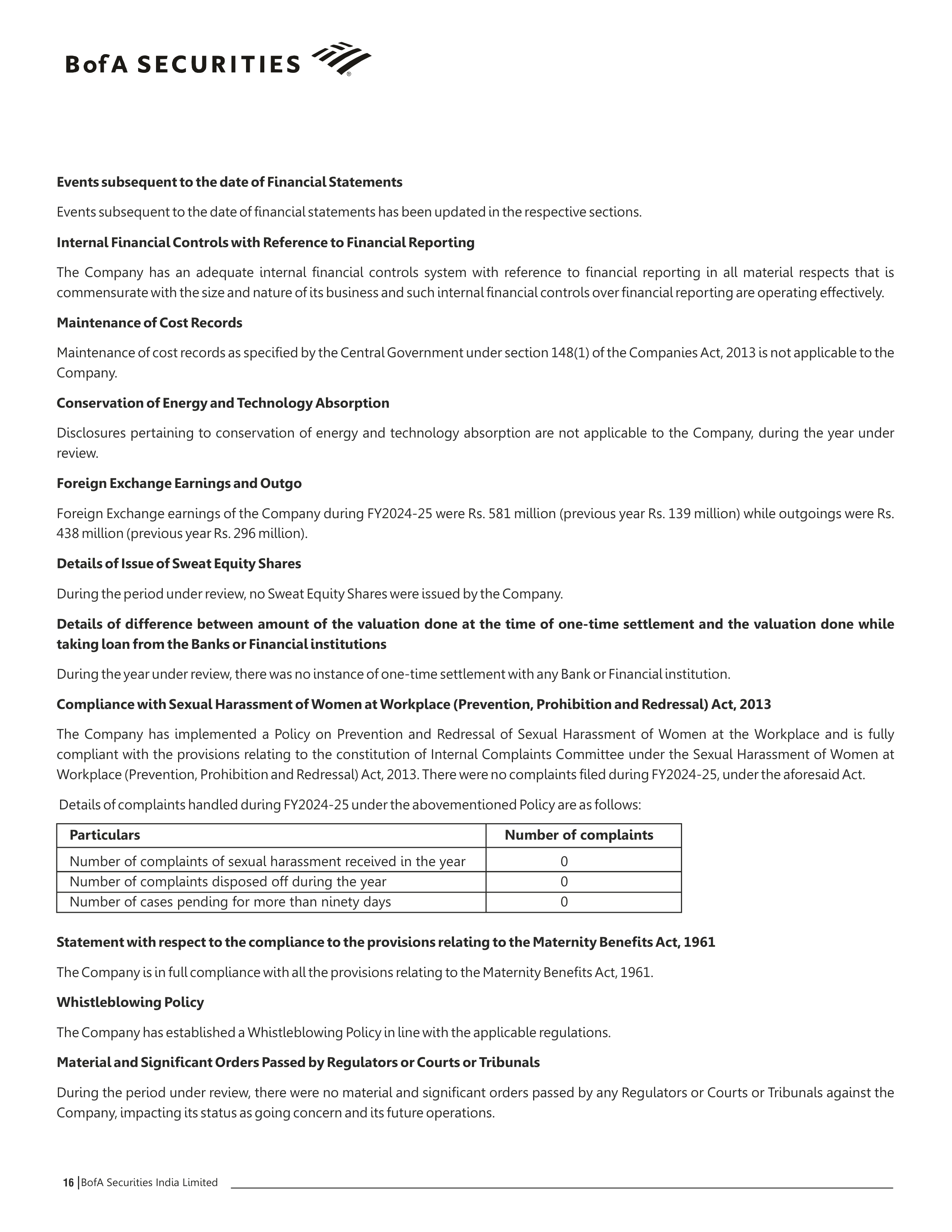
Events subsequent to the date of Financial Statements
Events subsequent to the date of financial statements has been updated in the respective sections.
Internal Financial Controls with Reference to Financial Reporting
The Company has an adequate internal financial controls system with reference to financial reporting in all material respects that is
commensurate with the size and nature of its business and such internal financial controls over financial reporting are operating effectively.
Maintenance of Cost Records
Maintenance of cost records as specified by the Central Government under section 148(1) of the Companies Act, 2013 is not applicable to the
Company.
Conservation of Energy and Technology Absorption
Disclosures pertaining to conservation of energy and technology absorption are not applicable to the Company, during the year under
review.
Foreign Exchange Earnings and Outgo
Foreign Exchange earnings of the Company during FY2024-25 were Rs. 581 million (previous year Rs. 139 million) while outgoings were Rs.
438 million (previous year Rs. 296 million).
Details of Issue of Sweat Equity Shares
During the period under review, no Sweat Equity Shares were issued by the Company.
Details of difference between amount of the valuation done at the time of one-time settlement and the valuation done while
taking loan from the Banks or Financial institutions
During the year under review, there was no instance of one-time settlement with any Bank or Financial institution.
Compliance with Sexual Harassment of Women at Workplace (Prevention, Prohibition and Redressal) Act, 2013
The Company has implemented a Policy on Prevention and Redressal of Sexual Harassment of Women at the Workplace and is fully
compliant with the provisions relating to the constitution of Internal Complaints Committee under the Sexual Harassment of Women at
Workplace (Prevention, Prohibition and Redressal) Act, 2013. There were no complaints filed during FY2024-25, under the aforesaid Act.
Details of complaints handled during FY2024-25 under the abovementioned Policy are as follows:
Particulars
Number of complaints
Number of complaints of sexual harassment received in the year
0
Number of complaints disposed off during the year
0
Number of cases pending for more than ninety days
0
Statement with respect to the compliance to the provisions relating to the Maternity Benefits Act, 1961
The Company is in full compliance with all the provisions relating to the Maternity Benefits Act, 1961.
Whistleblowing Policy
The Company has established a Whistleblowing Policy in line with the applicable regulations.
Material and Significant Orders Passed by Regulators or Courts or Tribunals
During the period under review, there were no material and significant orders passed by any Regulators or Courts or Tribunals against the
Company, impacting its status as going concern and its future operations.
17
Annual Report 2025
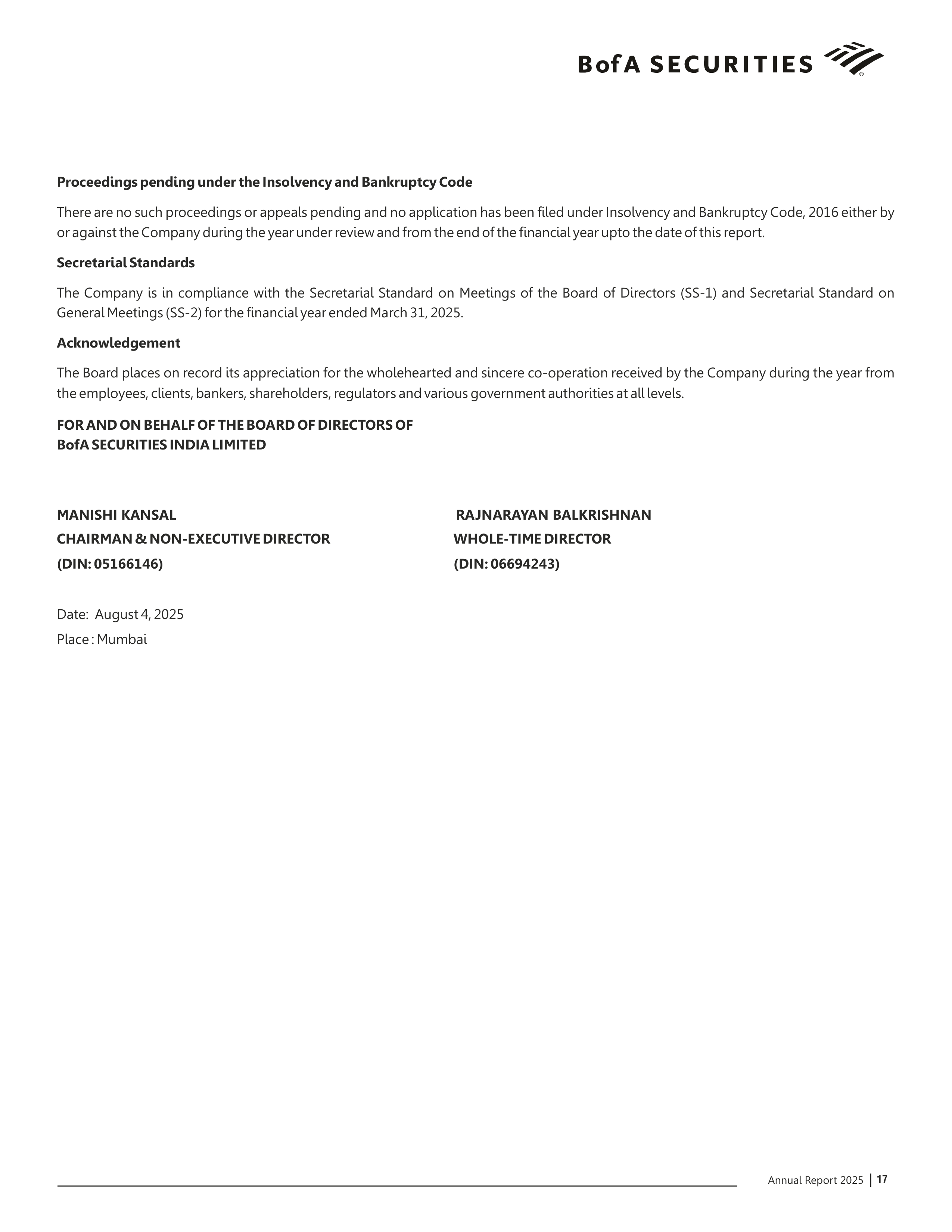
Proceedings pending under the Insolvency and Bankruptcy Code
There are no such proceedings or appeals pending and no application has been filed under Insolvency and Bankruptcy Code, 2016 either by
or against the Company during the year under review and from the end of the financial year upto the date of this report.
Secretarial Standards
The Company is in compliance with the Secretarial Standard on Meetings of the Board of Directors (SS-1) and Secretarial Standard on
General Meetings (SS-2) for the financial year ended March 31, 2025.
Acknowledgement
The Board places on record its appreciation for the wholehearted and sincere co-operation received by the Company during the year from
the employees, clients, bankers, shareholders, regulators and various government authorities at all levels.
FOR AND ON BEHALF OF THE BOARD OF DIRECTORS OF
BofA SECURITIES INDIA LIMITED
MANISHI KANSAL
RAJNARAYAN BALKRISHNAN
CHAIRMAN & NON-EXECUTIVE DIRECTOR
WHOLE-TIME DIRECTOR
(DIN: 05166146)
(DIN: 06694243)
Date: August 4, 2025
Place : Mumbai
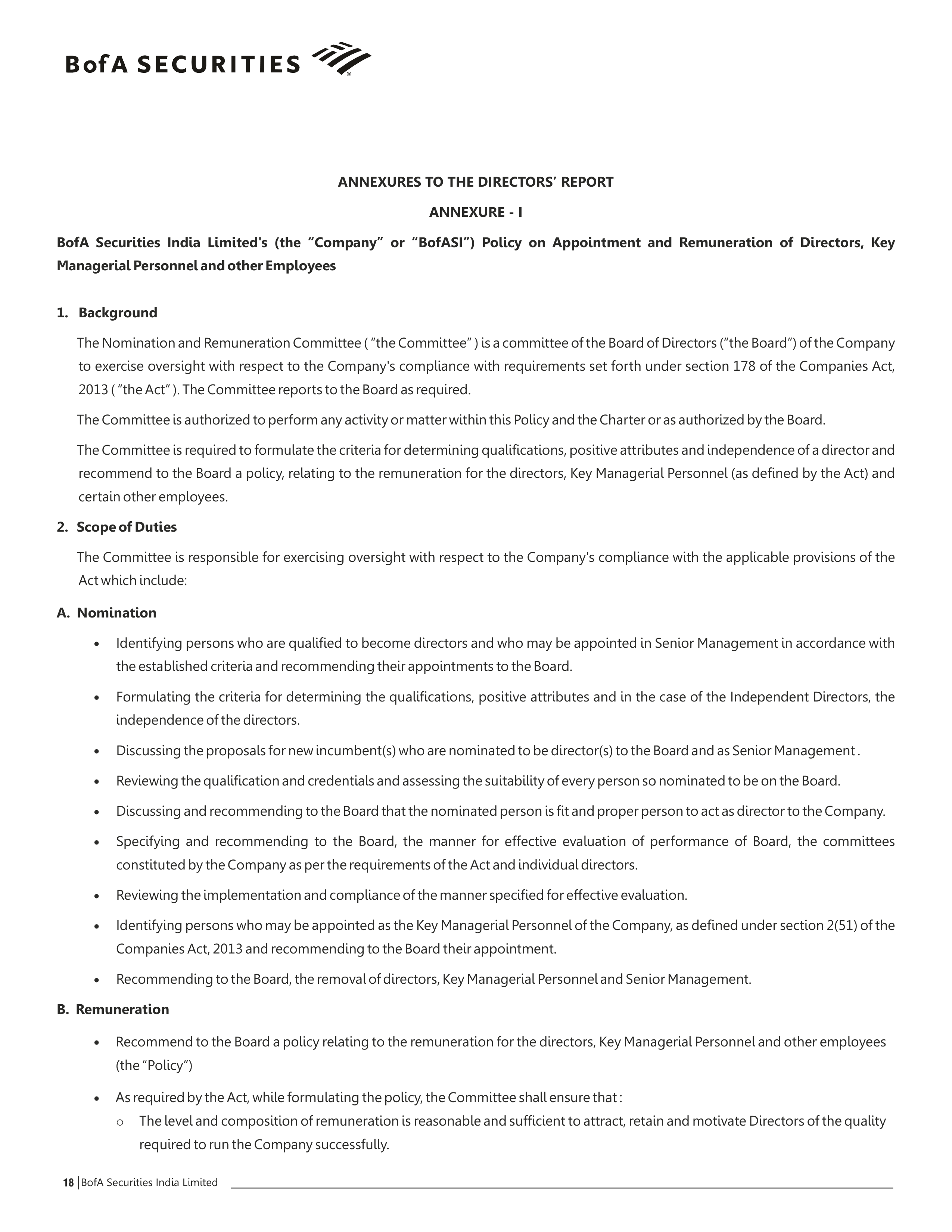
ANNEXURES TO THE DIRECTORS’ REPORT
ANNEXURE - I
BofA Securities India Limited's (the “Company” or “BofASI”) Policy on Appointment and Remuneration of Directors, Key
Managerial Personnel and other Employees
1. Background
The Nomination and Remuneration Committee ( “the Committee” ) is a committee of the Board of Directors (“the Board”) of the Company
to exercise oversight with respect to the Company's compliance with requirements set forth under section 178 of the Companies Act,
2013 ( “the Act” ). The Committee reports to the Board as required.
The Committee is authorized to perform any activity or matter within this Policy and the Charter or as authorized by the Board.
The Committee is required to formulate the criteria for determining qualifications, positive attributes and independence of a director and
recommend to the Board a policy, relating to the remuneration for the directors, Key Managerial Personnel (as defined by the Act) and
certain other employees.
2. Scope of Duties
The Committee is responsible for exercising oversight with respect to the Company's compliance with the applicable provisions of the
Act which include:
A. Nomination
Identifying persons who are qualified to become directors and who may be appointed in Senior Management in accordance with
the established criteria and recommending their appointments to the Board.
Formulating the criteria for determining the qualifications, positive attributes and in the case of the Independent Directors, the
independence of the directors.
Discussing the proposals for new incumbent(s) who are nominated to be director(s) to the Board and as Senior Management .
Reviewing the qualification and credentials and assessing the suitability of every person so nominated to be on the Board.
Discussing and recommending to the Board that the nominated person is fit and proper person to act as director to the Company.
Specifying and recommending to the Board, the manner for effective evaluation of performance of Board, the committees
constituted by the Company as per the requirements of the Act and individual directors.
Reviewing the implementation and compliance of the manner specified for effective evaluation.
Identifying persons who may be appointed as the Key Managerial Personnel of the Company, as defined under section 2(51) of the
Companies Act, 2013 and recommending to the Board their appointment.
Recommending to the Board, the removal of directors, Key Managerial Personnel and Senior Management.
B. Remuneration
Recommend to the Board a policy relating to the remuneration for the directors, Key Managerial Personnel and other employees
(the “Policy”)
As required by the Act, while formulating the policy, the Committee shall ensure that :
The level and composition of remuneration is reasonable and sufficient to attract, retain and motivate Directors of the quality
required to run the Company successfully.
18
BofA Securities India Limited
19
Annual Report 2025
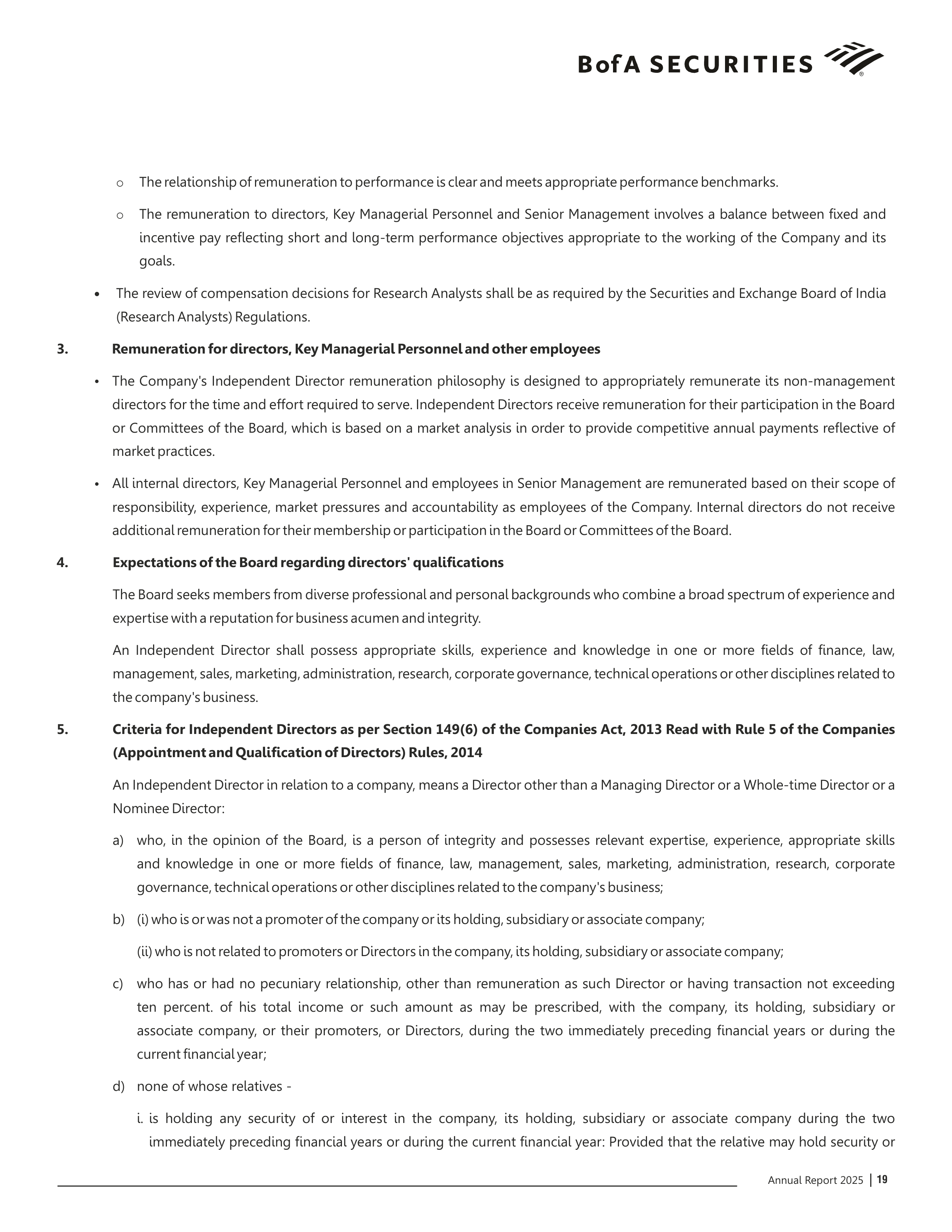
The relationship of remuneration to performance is clear and meets appropriate performance benchmarks.
The remuneration to directors, Key Managerial Personnel and Senior Management involves a balance between fixed and
incentive pay reflecting short and long-term performance objectives appropriate to the working of the Company and its
goals.
The review of compensation decisions for Research Analysts shall be as required by the Securities and Exchange Board of India
(Research Analysts) Regulations.
3.
Remuneration for directors, Key Managerial Personnel and other employees
The Company's Independent Director remuneration philosophy is designed to appropriately remunerate its non-management
directors for the time and effort required to serve. Independent Directors receive remuneration for their participation in the Board
or Committees of the Board, which is based on a market analysis in order to provide competitive annual payments reflective of
market practices.
All internal directors, Key Managerial Personnel and employees in Senior Management are remunerated based on their scope of
responsibility, experience, market pressures and accountability as employees of the Company. Internal directors do not receive
additional remuneration for their membership or participation in the Board or Committees of the Board.
4.
Expectations of the Board regarding directors' qualifications
The Board seeks members from diverse professional and personal backgrounds who combine a broad spectrum of experience and
expertise with a reputation for business acumen and integrity.
An Independent Director shall possess appropriate skills, experience and knowledge in one or more fields of finance, law,
management, sales, marketing, administration, research, corporate governance, technical operations or other disciplines related to
the company's business.
5.
Criteria for Independent Directors as per Section 149(6) of the Companies Act, 2013 Read with Rule 5 of the Companies
(Appointment and Qualification of Directors) Rules, 2014
An Independent Director in relation to a company, means a Director other than a Managing Director or a Whole-time Director or a
Nominee Director:
a) who, in the opinion of the Board, is a person of integrity and possesses relevant expertise, experience, appropriate skills
and knowledge in one or more fields of finance, law, management, sales, marketing, administration, research, corporate
governance, technical operations or other disciplines related to the company's business;
b) (i) who is or was not a promoter of the company or its holding, subsidiary or associate company;
(ii) who is not related to promoters or Directors in the company, its holding, subsidiary or associate company;
c) who has or had no pecuniary relationship, other than remuneration as such Director or having transaction not exceeding
ten percent. of his total income or such amount as may be prescribed, with the company, its holding, subsidiary or
associate company, or their promoters, or Directors, during the two immediately preceding financial years or during the
current financial year;
d) none of whose relatives -
i. is holding any security of or interest in the company, its holding, subsidiary or associate company during the two
immediately preceding financial years or during the current financial year: Provided that the relative may hold security or
20
BofA Securities India Limited
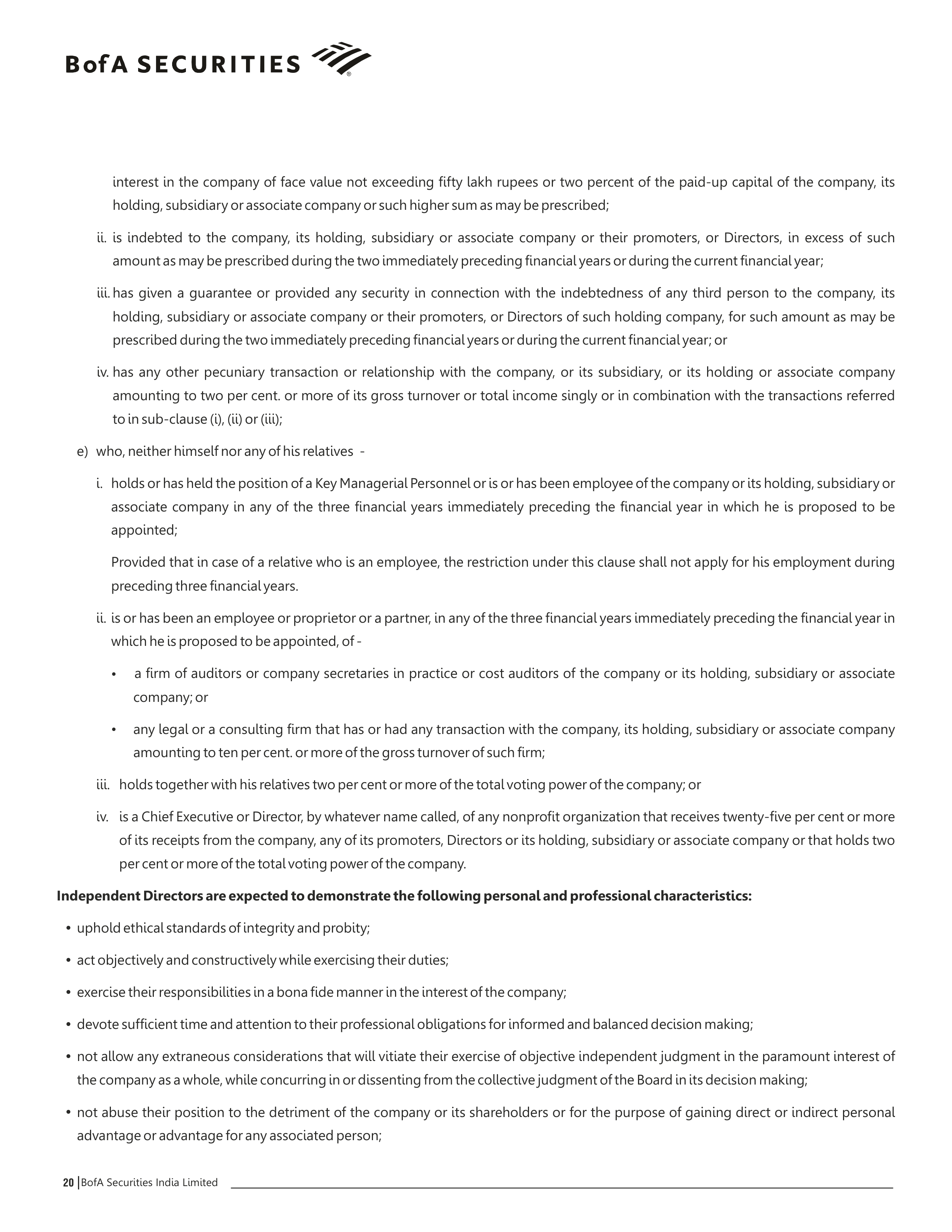
interest in the company of face value not exceeding fifty lakh rupees or two percent of the paid-up capital of the company, its
holding, subsidiary or associate company or such higher sum as may be prescribed;
ii. is indebted to the company, its holding, subsidiary or associate company or their promoters, or Directors, in excess of such
amount as may be prescribed during the two immediately preceding financial years or during the current financial year;
iii. has given a guarantee or provided any security in connection with the indebtedness of any third person to the company, its
holding, subsidiary or associate company or their promoters, or Directors of such holding company, for such amount as may be
prescribed during the two immediately preceding financial years or during the current financial year; or
iv. has any other pecuniary transaction or relationship with the company, or its subsidiary, or its holding or associate company
amounting to two per cent. or more of its gross turnover or total income singly or in combination with the transactions referred
to in sub-clause (i), (ii) or (iii);
e) who, neither himself nor any of his relatives -
i. holds or has held the position of a Key Managerial Personnel or is or has been employee of the company or its holding, subsidiary or
associate company in any of the three financial years immediately preceding the financial year in which he is proposed to be
appointed;
Provided that in case of a relative who is an employee, the restriction under this clause shall not apply for his employment during
preceding three financial years.
ii. is or has been an employee or proprietor or a partner, in any of the three financial years immediately preceding the financial year in
which he is proposed to be appointed, of -
a firm of auditors or company secretaries in practice or cost auditors of the company or its holding, subsidiary or associate
company; or
any legal or a consulting firm that has or had any transaction with the company, its holding, subsidiary or associate company
amounting to ten per cent. or more of the gross turnover of such firm;
iii. holds together with his relatives two per cent or more of the total voting power of the company; or
iv. is a Chief Executive or Director, by whatever name called, of any nonprofit organization that receives twenty-five per cent or more
of its receipts from the company, any of its promoters, Directors or its holding, subsidiary or associate company or that holds two
per cent or more of the total voting power of the company.
Independent Directors are expected to demonstrate the following personal and professional characteristics:
uphold ethical standards of integrity and probity;
act objectively and constructively while exercising their duties;
exercise their responsibilities in a bona fide manner in the interest of the company;
devote sufficient time and attention to their professional obligations for informed and balanced decision making;
not allow any extraneous considerations that will vitiate their exercise of objective independent judgment in the paramount interest of
the company as a whole, while concurring in or dissenting from the collective judgment of the Board in its decision making;
not abuse their position to the detriment of the company or its shareholders or for the purpose of gaining direct or indirect personal
advantage or advantage for any associated person;
21
Annual Report 2025
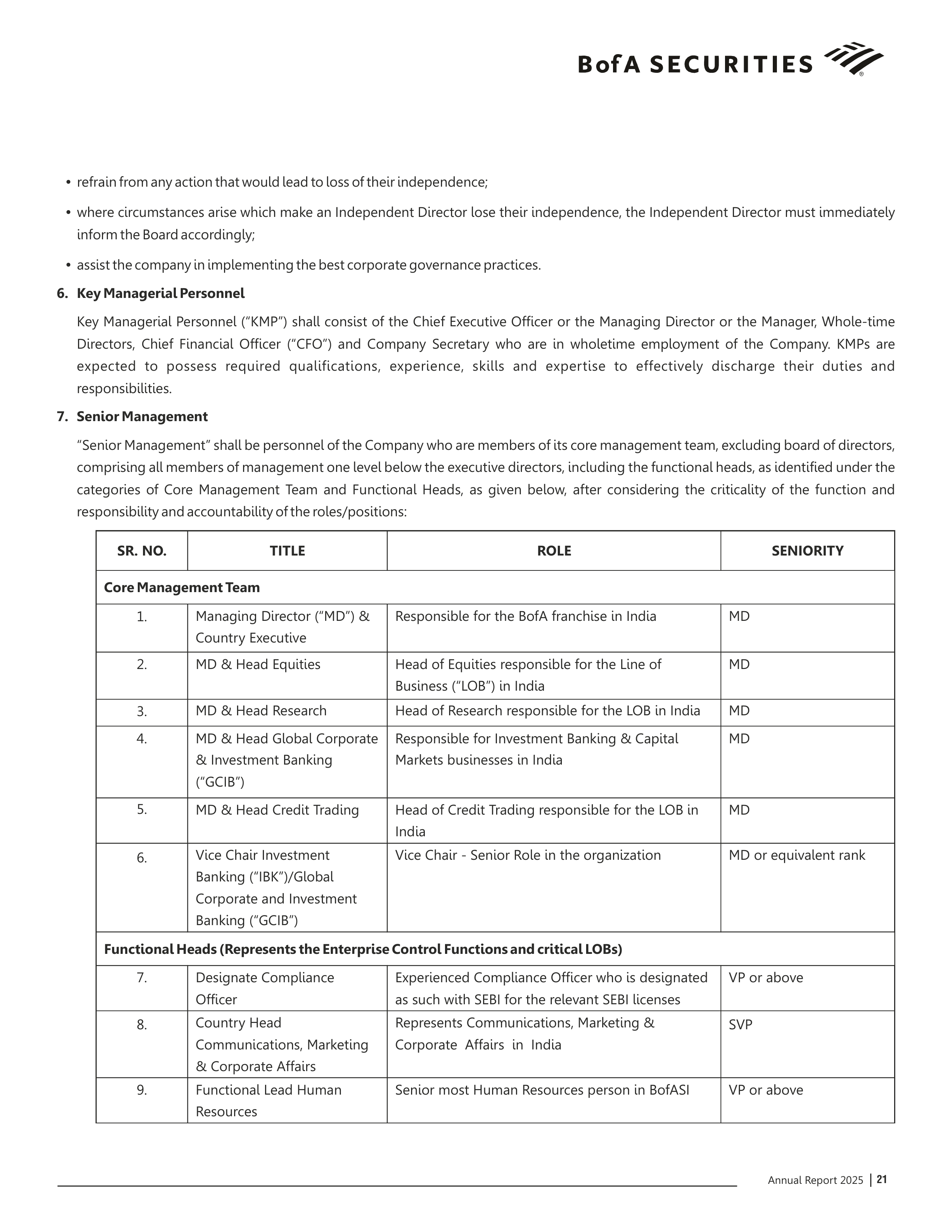
refrain from any action that would lead to loss of their independence;
where circumstances arise which make an Independent Director lose their independence, the Independent Director must immediately
inform the Board accordingly;
assist the company in implementing the best corporate governance practices.
6. Key Managerial Personnel
Key Managerial Personnel (“KMP”) shall consist of the Chief Executive Officer or the Managing Director or the Manager, Whole-time
Directors, Chief Financial Officer (“CFO”) and Company Secretary who are in wholetime employment of the Company. KMPs are
expected to possess required qualifications, experience, skills and expertise to effectively discharge their duties and
responsibilities.
7. Senior Management
“Senior Management” shall be personnel of the Company who are members of its core management team, excluding board of directors,
comprising all members of management one level below the executive directors, including the functional heads, as identified under the
categories of Core Management Team and Functional Heads, as given below, after considering the criticality of the function and
responsibility and accountability of the roles/positions:
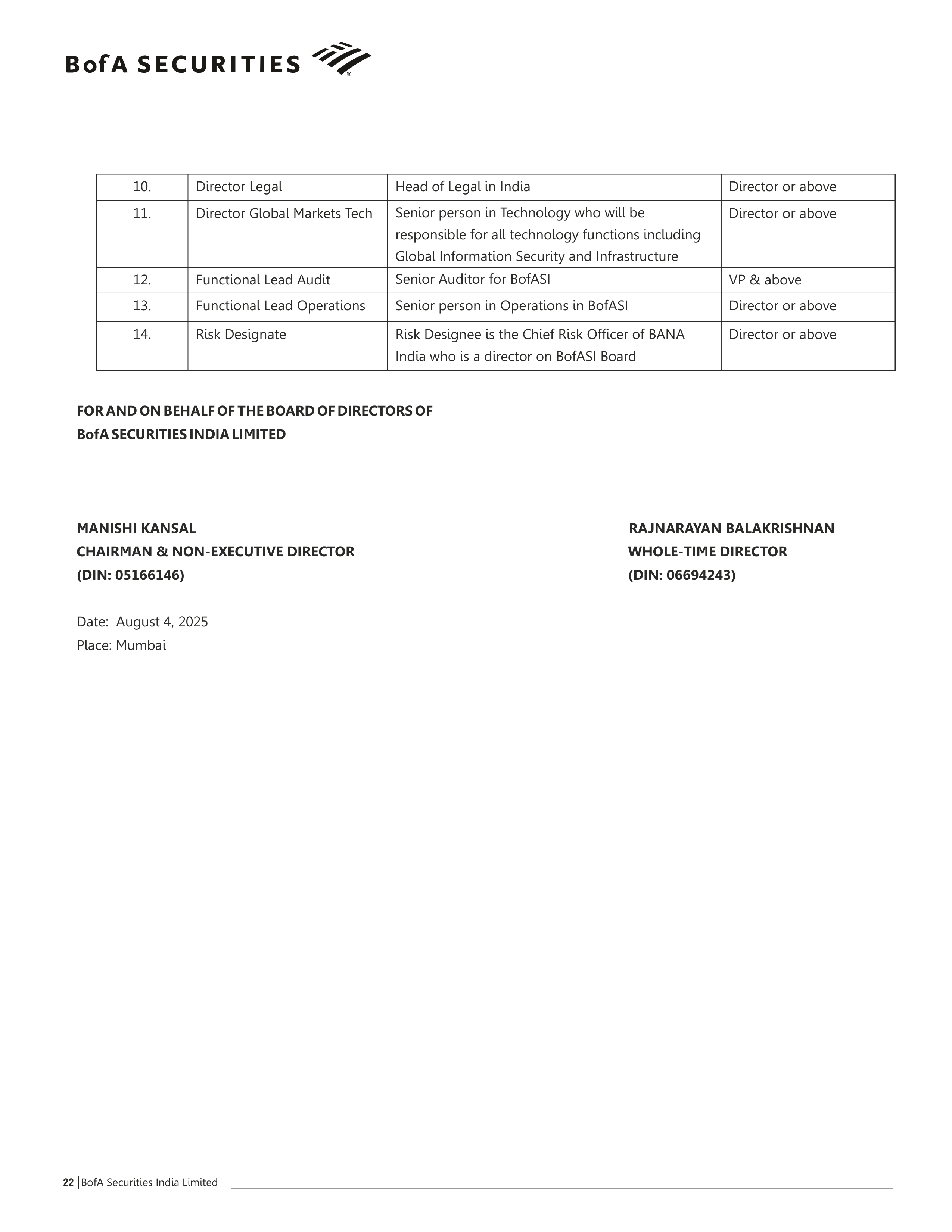
SR. NO.
TITLE
ROLE
SENIORITY
Core Management Team
1.
Managing Director (“MD”) &
Country Executive
Responsible for the BofA franchise in India
MD
2.
MD & Head Equities
Head of Equities responsible for the Line of
Business (“LOB”) in India
MD
3.
MD & Head Research
Head of Research responsible for the LOB in India
MD
4.
MD & Head Global Corporate
& Investment Banking
(“GCIB”)
Responsible for Investment Banking & Capital
Markets businesses in India
MD
5.
MD & Head Credit Trading
Head of Credit Trading responsible for the LOB in
India
MD
6.
Vice Chair Investment
Banking (“IBK”)/Global
Corporate and Investment
Banking (“GCIB”)
Vice Chair - Senior Role in the organization
MD or equivalent rank
Functional Heads (Represents the Enterprise Control Functions and critical LOBs)
7.
Designate Compliance
Officer
Experienced Compliance Officer who is designated
as such with SEBI for the relevant SEBI licenses
VP or above
8.
Country Head
Communications, Marketing
& Corporate Affairs
Represents Communications, Marketing &
Corporate Affairs in India
SVP
9.
Functional Lead Human
Resources
Senior most Human Resources person in BofASI
VP or above
22
BofA Securities India Limited
FOR AND ON BEHALF OF THE BOARD OF DIRECTORS OF
BofA SECURITIES INDIA LIMITED
MANISHI KANSAL
RAJNARAYAN BALAKRISHNAN
CHAIRMAN & NON-EXECUTIVE DIRECTOR
WHOLE-TIME DIRECTOR
(DIN: 05166146)
(DIN: 06694243)
Date: August 4, 2025
Place: Mumbai
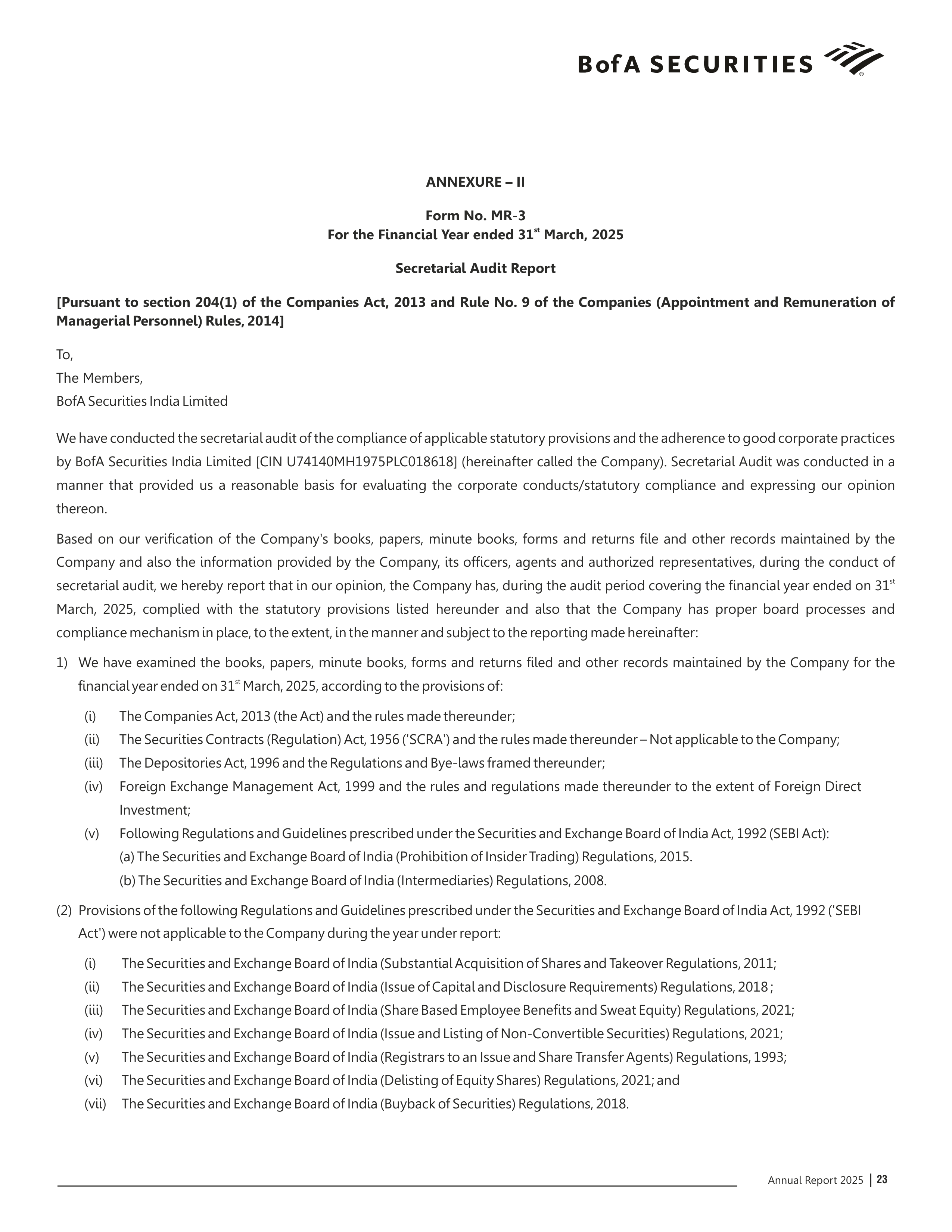
10.
Director Legal
Head of Legal in India
Director or above
11.
Director Global Markets Tech
Senior person in Technology who will be
responsible for all technology functions including
Global Information Security and Infrastructure
Director or above
12.
Functional Lead Audit
Senior Auditor for BofASI
VP & above
13.
Functional Lead Operations
Senior person in Operations in BofASI
Director or above
14.
Risk Designate
Risk Designee is the Chief Risk Officer of BANA
India who is a director on BofASI Board
Director or above
ANNEXURE – II
Form No. MR-3
For the Financial Year ended 31 March, 2025
st
Secretarial Audit Report
[Pursuant to section 204(1) of the Companies Act, 2013 and Rule No. 9 of the Companies (Appointment and Remuneration of
Managerial Personnel) Rules, 2014]
To,
The Members,
BofA Securities India Limited
We have conducted the secretarial audit of the compliance of applicable statutory provisions and the adherence to good corporate practices
by BofA Securities India Limited [CIN U74140MH1975PLC018618] (hereinafter called the Company). Secretarial Audit was conducted in a
manner that provided us a reasonable basis for evaluating the corporate conducts/statutory compliance and expressing our opinion
thereon.
Based on our verification of the Company's books, papers, minute books, forms and returns file and other records maintained by the
Company and also the information provided by the Company, its officers, agents and authorized representatives, during the conduct of
secretarial audit, we hereby report that in our opinion, the Company has, during the audit period covering the financial year ended on 31
st
March, 2025, complied with the statutory provisions listed hereunder and also that the Company has proper board processes and
compliance mechanism in place, to the extent, in the manner and subject to the reporting made hereinafter:
1) We have examined the books, papers, minute books, forms and returns filed and other records maintained by the Company for the
financial year ended on 31 March, 2025, according to the provisions of:
st
(i)
The Companies Act, 2013 (the Act) and the rules made thereunder;
(ii)
The Securities Contracts (Regulation) Act, 1956 ('SCRA') and the rules made thereunder – Not applicable to the Company;
(iii)
The Depositories Act, 1996 and the Regulations and Bye-laws framed thereunder;
(iv)
Foreign Exchange Management Act, 1999 and the rules and regulations made thereunder to the extent of Foreign Direct
Investment;
(v)
Following Regulations and Guidelines prescribed under the Securities and Exchange Board of India Act, 1992 (SEBI Act):
(a) The Securities and Exchange Board of India (Prohibition of Insider Trading) Regulations, 2015.
(b) The Securities and Exchange Board of India (Intermediaries) Regulations, 2008.
(2) Provisions of the following Regulations and Guidelines prescribed under the Securities and Exchange Board of India Act, 1992 ('SEBI
Act') were not applicable to the Company during the year under report:
(i)
The Securities and Exchange Board of India (Substantial Acquisition of Shares and Takeover Regulations, 2011;
(ii)
The Securities and Exchange Board of India (Issue of Capital and Disclosure Requirements) Regulations, 2018 ;
(iii)
The Securities and Exchange Board of India (Share Based Employee Benefits and Sweat Equity) Regulations, 2021;
(iv)
The Securities and Exchange Board of India (Issue and Listing of Non-Convertible Securities) Regulations, 2021;
(v)
The Securities and Exchange Board of India (Registrars to an Issue and Share Transfer Agents) Regulations, 1993;
(vi)
The Securities and Exchange Board of India (Delisting of Equity Shares) Regulations, 2021; and
(vii) The Securities and Exchange Board of India (Buyback of Securities) Regulations, 2018.
23
Annual Report 2025
3) The Company is registered with the Securities and Exchange Board of India as a Stock Broker, Merchant Banker, and Research Analyst and
has complied with the applicable Regulations /Guidelines issued by the Securities and Exchange Board of India and Stock Exchanges.
We have also examined compliance with the applicable clauses of the following:
Secretarial Standard 1 and 2 issued by the Institute of Company Secretaries of India.
During the period under review the Company has complied with the provisions of the Act, Rules, Regulations, Guidelines, Standards, etc.
We further report that -
The Board of Directors of the Company is duly constituted with proper balance of Executive Directors, Non-Executive Directors and
Independent Directors. The changes in the composition of the Board of Directors that took place during the period under review were
carried out in compliance with the provisions of the Act.
Adequate notice is given to all directors to schedule the Board Meetings, agenda and detailed notes on agenda were sent at least seven days
in advance and a system exists for seeking and obtaining further information and clarifications on the agenda items before the meeting and
for meaningful participation at the meeting.
All majority decisions are carried through and there have not been any instances where any member has offered dissenting views on any
business.
We further report that there are adequate systems and processes in the Company commensurate with the size and operations of the
Company to monitor and ensure compliance with applicable laws, rules, regulations and guidelines.
For Surendra Kanstiya Associates
Company Secretaries
UIN S1990MH007900
Date: August 4, 2025
UDIN: F002777G000921783
Surendra U. Kanstiya
FCS 2777. CP 1744
This Report is to be read with our letter of even date which is annexed as Annexure A and forms an integral part of this report.
24
BofA Securities India Limited
Annexure A
To,
The Members,
BofA Securities India Limited
Our report of even date is to be read along with this letter.
1. Maintenance of Secretarial records is the responsibility of the Management of the Company. Our responsibility is to express
an opinion on these Secretarial records based on our audit.
2. We have followed the audit practices and processes as were appropriate to obtain reasonable assurance about the
correctness of the contents of the Secretarial records. The verification was done on test basis to ensure that correct facts are
reflected in the Secretarial records. We believe that the processes and practices we followed, provide a reasonable basis for
our opinion.
3. We have not verified the correctness and appropriateness of financial records and Books of Account of the Company.
4. Wherever required, we have obtained the Management representation about the compliance of Laws, Rules and
Regulations and happening of events, etc.
5. The compliance of the provisions of Corporate and other applicable Laws, Rules, Regulations, standards is the
responsibility of the Management. Our examination was limited to the verification of procedures on test basis.
6. The Secretarial Audit report is neither an assurance as to the future viability of the Company nor the efficacy or effectiveness
with which the Management has conducted the affairs of the Company.
For Surendra Kanstiya Associates
Company Secretaries
UIN S1990MH007900
Date: August 4, 2025
UDIN: F002777G000921783
Surendra U. Kanstiya
FCS 2777. CP 1744
25
Annual Report 2025


ANNEXURE – III
Relevant Extract of Risk Management Policy
BofASI
is an operating company engaged in activities as Stock Broker, Merchant Banker and Research Analyst. It is an indirect subsidiary of
Bank of America Corporation.
Parent Company Risk Management Statement:
Bank of America Corporation's (BAC, “Company”) Risk Appetite Statement serves as the foundation for consistent and effective
management of risks facing BAC and its subsidiaries. BAC Risk Appetite Statement defines and communicates the amount of capital,
earnings or liquidity we are willing to put at risk to achieve our strategic objectives and business plans, consistent with applicable
regulatory requirements. The Risk Appetite Statement reinforces that the Company maintains an acceptable risk profile in alignment
with our strategic and capital plans. The Risk Appetite Statement provides a common framework and a comparable set of measures for
senior management and the board of directors to clearly indicate the aggregate level of risk the Company is willing to accept. The Risk
Appetite Statement includes both qualitative components and quantitative limits that are reviewed and approved by the BAC Board of
Directors at least annually.
The Risk Appetite Statement is rooted in several principles:
Overall risk capacity – BAC's overall capacity to take risk is limited, therefore the Company prioritizes the risks it takes. BAC's risk capacity
informs the Company's risk appetite, which is the level and types of risk BAC is willing to take to achieve business objectives.
Financial strength to absorb adverse outcomes – BAC must maintain a strong and flexible financial position so we can weather
challenging economic times and take advantage of organic growth opportunities. Therefore, BAC sets objectives and targets for capital
and liquidity that permit the Company to continue to operate in a safe and sound manner at all times, including during periods of stress.
Risk-reward evaluation – Risks taken must fit BAC's risk appetite and offer acceptable risk-adjusted returns for shareholders.
Acceptable risks – BAC considers all types of risk including those that are difficult to quantify. Qualitative guidance within the risk
appetite statement describes the company's approach to managing such risks in a manner consistent with the culture. For example,
actions considered in a line of business that unduly threaten the Company's reputation should be escalated and restricted appropriately.
Skills and capabilities – BAC seeks to assume only those risks we have the skills and capabilities to identify, measure, monitor and control.
BofASI Risk Management:
BofASI's Risk Policy operates alongside BAC's global framework and encompasses the seven risk types described as below. It is noted that
due to limited scope of business activities (primarily being fee based business), some of the below mentioned risks are currently not
applicable to BofASI:
Credit risk
is defined as the the risk of loss arising from the inability or failure of a borrower or counterparty to meet its obligations. No
lending activity is carried out under BofASI. Debt & Equity Capital market underwriting activity is approved through regional committees
including local risk manager representation.
Market risk
is the risk that changes in market conditions and may adversely impact the value of assets or liabilities, or otherwise
negatively impact earnings. Market risk is inherent in the operations and arises from investments (No trading activity currently
undertaken). Organization uses Value at Risk (“VAR”) modeling to evaluate the risks in its trading activities. The calculated VaR represents
the worst loss the portfolio is expected to experience with a given level of confidence. It reflects the volatility of the positions in the
portfolio and how strongly the risks are correlated. All limit excesses are communicated to senior management for review.
Operational risk
is the risk of loss resulting from inadequate or failed internal processes, people and systems or from external events.
Operational Risk Events: inadequate or failed internal processes, people, systems and external events may result in unexpected or
undesired consequences including a financial loss, an unexpected gain, a near miss and/or an opportunity cost (lost future revenue). The
events associated with these unintended and/or undesired consequences are termed as operational risk events.
26
BofA Securities India Limited


Strategic risk
is the risk resulting from incorrect assumptions about external or internal factors; inappropriate business plans; ineffective
business strategy execution; or failure to respond in a timely manner to changes in the regulatory, macroeconomic or competitive
environments in the geographic locations in which we operate. BofASI manages strategic risk through assessing earnings and risk profile
throughout the year. These are periodically discussed in appropriate governance committee.
Liquidity risk
is the inability to meet expected or unexpected cash flow and collateral needs while continuing to support the businesses
and customers under a range of economic conditions. Sources of liquidity risk include unavailability of funding at the price or amount
anticipated or credit rating downgrades
Reputational risk
is the risk that negative perceptions of the Company's conduct or business practices may adversely impact its
profitability or operations through an inability to establish or maintain existing, customer/client relationships or otherwise impact
relationships with key stakeholders, such as investors, regulators, employees and the community. Reputational risk is mitigated by good
governance controls.
Compliance risk
Compliance risk is the risk of legal or regulatory sanctions, material financial loss or damage to the reputation of the
Company arising from the failure of the Company to comply with the requirements of applicable laws, rules, regulations and related self-
regulatory organizations' standards and codes of conduct (collectively, “applicable laws, rules and regulations”). The Company is
committed to complying with applicable laws, rules and regulations governing the processes and activities of our front line units and
control functions.
FOR AND ON BEHALF OF THE BOARD OF DIRECTORS OF
BofA SECURITIES INDIA LIMITED
MANISHI KANSAL
RAJNARAYAN BALAKRISHNAN
CHAIRMAN & NON-EXECUTIVE DIRECTOR
WHOLE-TIME DIRECTOR
(DIN: 05166146)
(DIN: 06694243)
Date: August 4, 2025
Place : Mumbai
27
Annual Report 2025
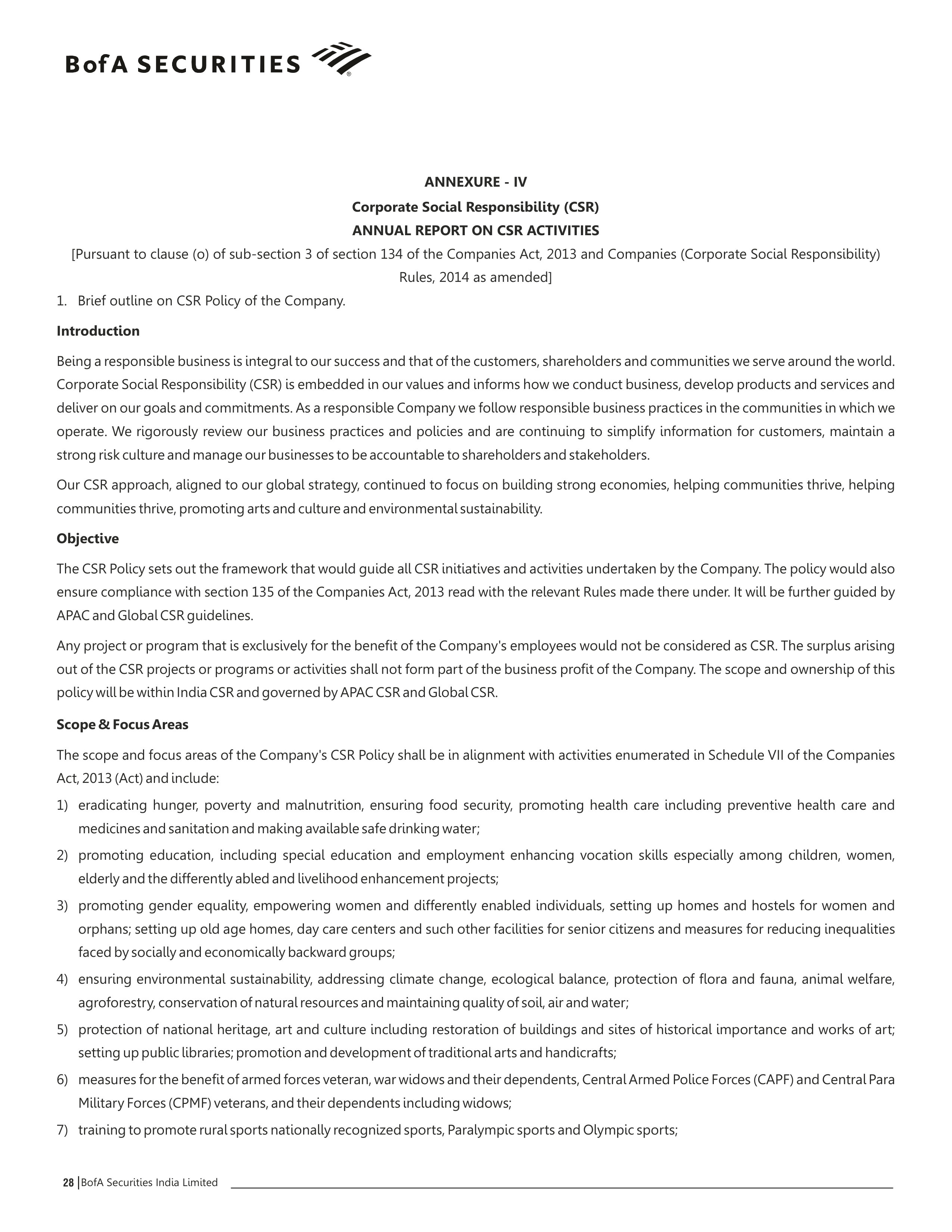
ANNEXURE - IV
Corporate Social Responsibility (CSR)
ANNUAL REPORT ON CSR ACTIVITIES
[Pursuant to clause (o) of sub-section 3 of section 134 of the Companies Act, 2013 and Companies (Corporate Social Responsibility)
Rules, 2014 as amended]
1. Brief outline on CSR Policy of the Company.
Introduction
Being a responsible business is integral to our success and that of the customers, shareholders and communities we serve around the world.
Corporate Social Responsibility (CSR) is embedded in our values and informs how we conduct business, develop products and services and
deliver on our goals and commitments. As a responsible Company we follow responsible business practices in the communities in which we
operate. We rigorously review our business practices and policies and are continuing to simplify information for customers, maintain a
strong risk culture and manage our businesses to be accountable to shareholders and stakeholders.
Our CSR approach, aligned to our global strategy, continued to focus on building strong economies, helping communities thrive, helping
communities thrive, promoting arts and culture and environmental sustainability.
Objective
The CSR Policy sets out the framework that would guide all CSR initiatives and activities undertaken by the Company. The policy would also
ensure compliance with section 135 of the Companies Act, 2013 read with the relevant Rules made there under. It will be further guided by
APAC and Global CSR guidelines.
Any project or program that is exclusively for the benefit of the Company's employees would not be considered as CSR. The surplus arising
out of the CSR projects or programs or activities shall not form part of the business profit of the Company. The scope and ownership of this
policy will be within India CSR and governed by APAC CSR and Global CSR.
Scope & Focus Areas
The scope and focus areas of the Company's CSR Policy shall be in alignment with activities enumerated in Schedule VII of the Companies
Act, 2013 (Act) and include:
1) eradicating hunger, poverty and malnutrition, ensuring food security, promoting health care including preventive health care and
medicines and sanitation and making available safe drinking water;
2) promoting education, including special education and employment enhancing vocation skills especially among children, women,
elderly and the differently abled and livelihood enhancement projects;
3) promoting gender equality, empowering women and differently enabled individuals, setting up homes and hostels for women and
orphans; setting up old age homes, day care centers and such other facilities for senior citizens and measures for reducing inequalities
faced by socially and economically backward groups;
4) ensuring environmental sustainability, addressing climate change, ecological balance, protection of flora and fauna, animal welfare,
agroforestry, conservation of natural resources and maintaining quality of soil, air and water;
5) protection of national heritage, art and culture including restoration of buildings and sites of historical importance and works of art;
setting up public libraries; promotion and development of traditional arts and handicrafts;
6) measures for the benefit of armed forces veteran, war widows and their dependents, Central Armed Police Forces (CAPF) and Central Para
Military Forces (CPMF) veterans, and their dependents including widows;
7) training to promote rural sports nationally recognized sports, Paralympic sports and Olympic sports;
28
BofA Securities India Limited
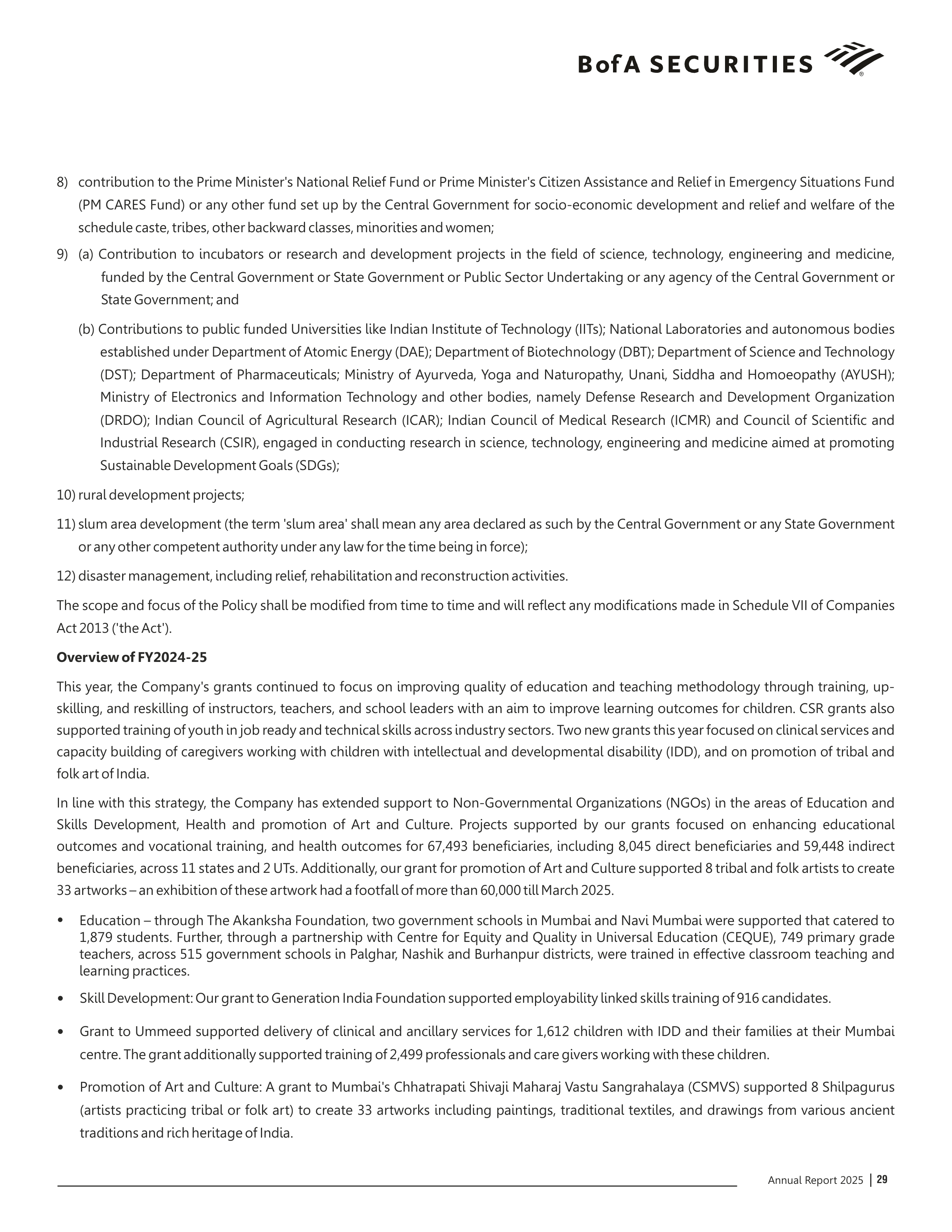
8) contribution to the Prime Minister's National Relief Fund or Prime Minister's Citizen Assistance and Relief in Emergency Situations Fund
(PM CARES Fund) or any other fund set up by the Central Government for socio-economic development and relief and welfare of the
schedule caste, tribes, other backward classes, minorities and women;
9) (a) Contribution to incubators or research and development projects in the field of science, technology, engineering and medicine,
funded by the Central Government or State Government or Public Sector Undertaking or any agency of the Central Government or
State Government; and
(b) Contributions to public funded Universities like Indian Institute of Technology (IITs); National Laboratories and autonomous bodies
established under Department of Atomic Energy (DAE); Department of Biotechnology (DBT); Department of Science and Technology
(DST); Department of Pharmaceuticals; Ministry of Ayurveda, Yoga and Naturopathy, Unani, Siddha and Homoeopathy (AYUSH);
Ministry of Electronics and Information Technology and other bodies, namely Defense Research and Development Organization
(DRDO); Indian Council of Agricultural Research (ICAR); Indian Council of Medical Research (ICMR) and Council of Scientific and
Industrial Research (CSIR), engaged in conducting research in science, technology, engineering and medicine aimed at promoting
Sustainable Development Goals (SDGs);
10) rural development projects;
11) slum area development (the term 'slum area' shall mean any area declared as such by the Central Government or any State Government
or any other competent authority under any law for the time being in force);
12) disaster management, including relief, rehabilitation and reconstruction activities.
The scope and focus of the Policy shall be modified from time to time and will reflect any modifications made in Schedule VII of Companies
Act 2013 ('the Act').
Overview of FY2024-25
This year, the Company's grants continued to focus on improving quality of education and teaching methodology through training, up-
skilling, and reskilling of instructors, teachers, and school leaders with an aim to improve learning outcomes for children. CSR grants also
supported training of youth in job ready and technical skills across industry sectors. Two new grants this year focused on clinical services and
capacity building of caregivers working with children with intellectual and developmental disability (IDD), and on promotion of tribal and
folk art of India.
In line with this strategy, the Company has extended support to Non-Governmental Organizations (NGOs) in the areas of Education and
Skills Development, Health and promotion of Art and Culture. Projects supported by our grants focused on enhancing educational
outcomes and vocational training, and health outcomes for 67,493 beneficiaries, including 8,045 direct beneficiaries and 59,448 indirect
beneficiaries, across 11 states and 2 UTs. Additionally, our grant for promotion of Art and Culture supported 8 tribal and folk artists to create
33 artworks – an exhibition of these artwork had a footfall of more than 60,000 till March 2025.
Education – through The Akanksha Foundation, two government schools in Mumbai and Navi Mumbai were supported that catered to
1,879 students. Further, through a partnership with Centre for Equity and Quality in Universal Education (CEQUE), 749 primary grade
teachers, across 515 government schools in Palghar, Nashik and Burhanpur districts, were trained in effective classroom teaching and
learning practices.
Skill Development: Our grant to Generation India Foundation supported employability linked skills training of 916 candidates.
Grant to Ummeed supported delivery of clinical and ancillary services for 1,612 children with IDD and their families at their Mumbai
centre. The grant additionally supported training of 2,499 professionals and care givers working with these children.
Promotion of Art and Culture: A grant to Mumbai's Chhatrapati Shivaji Maharaj Vastu Sangrahalaya (CSMVS) supported 8 Shilpagurus
(artists practicing tribal or folk art) to create 33 artworks including paintings, traditional textiles, and drawings from various ancient
traditions and rich heritage of India.
29
Annual Report 2025
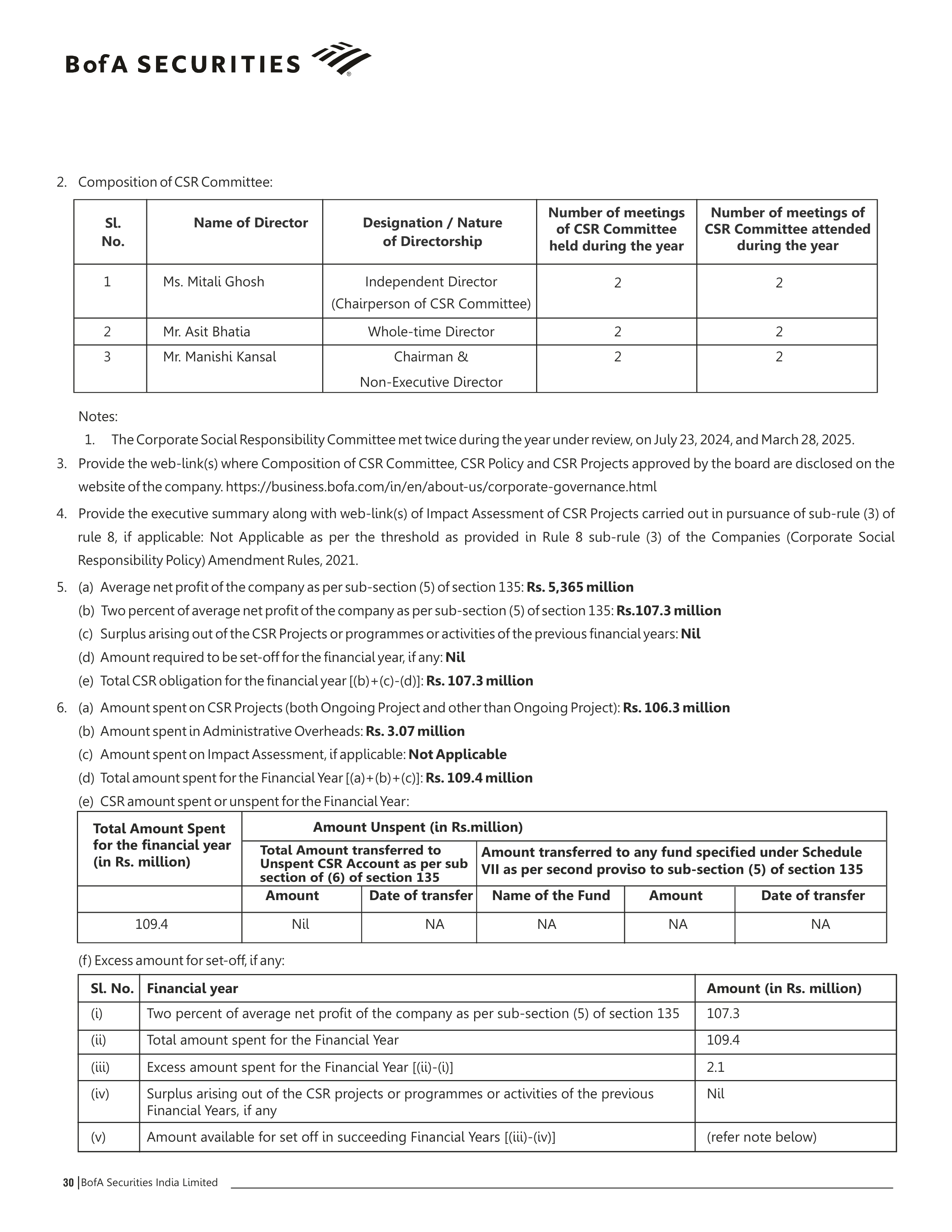
2. Composition of CSR Committee:
Notes:
1.
The Corporate Social Responsibility Committee met twice during the year under review, on July 23, 2024, and March 28, 2025.
3. Provide the web-link(s) where Composition of CSR Committee, CSR Policy and CSR Projects approved by the board are disclosed on the
website of the company.
https://business.bofa.com/in/en/about-us/corporate-governance.html
4. Provide the executive summary along with web-link(s) of Impact Assessment of CSR Projects carried out in pursuance of sub-rule (3) of
rule 8, if applicable: Not Applicable as per the threshold as provided in Rule 8 sub-rule (3) of the Companies (Corporate Social
Responsibility Policy) Amendment Rules, 2021.
5. (a) Average net profit of the company as per sub-section (5) of section 135:
Rs. 5,365 million
(b) Two percent of average net profit of the company as per sub-section (5) of section 135:
Rs.107.3 million
(c) Surplus arising out of the CSR Projects or programmes or activities of the previous financial years:
Nil
(d) Amount required to be set-off for the financial year, if any:
Nil
(e) Total CSR obligation for the financial year [(b)+(c)-(d)]:
Rs. 107.3 million
6. (a) Amount spent on CSR Projects (both Ongoing Project and other than Ongoing Project):
Rs. 106.3 million
(b) Amount spent in Administrative Overheads:
Rs. 3.07 million
(c) Amount spent on Impact Assessment, if applicable:
Not Applicable
(d) Total amount spent for the Financial Year [(a)+(b)+(c)]:
Rs. 109.4 million
(e) CSR amount spent or unspent for the Financial Year:
(f) Excess amount for set-off, if any:
Amount Unspent (in Rs.million)
Amount
Date of transfer
Name of the Fund
Amount
Date of transfer
109.4
Nil
NA
NA
NA
NA
Total Amount Spent
for the financial year
(in Rs. million)
Amount transferred to any fund specified under Schedule
VII as per second proviso to sub-section (5) of section 135
Total Amount transferred to
Unspent CSR Account as per sub
section of (6) of section 135
BofA Securities India Limited
30
1
Ms. Mitali Ghosh
Independent Director
(Chairperson of CSR Committee)
2
2
2
Mr. Asit Bhatia
Whole-time Director
2
2
3
Mr. Manishi Kansal
Chairman &
2
2
Non-Executive Director
Sl.
No.
Name of Director
Designation / Nature
of Directorship
Number of meetings
of CSR Committee
held during the year
Number of meetings of
CSR Committee attended
during the year
Sl. No. Financial year
Amount (in Rs. million)
(i)
Two percent of average net profit of the company as per sub-section (5) of section 135
107.3
(ii)
Total amount spent for the Financial Year
109.4
(iii)
Excess amount spent for the Financial Year [(ii)-(i)]
2.1
(iv)
Surplus arising out of the CSR projects or programmes or activities of the previous
Nil
Financial Years, if any
(v)
Amount available for set off in succeeding Financial Years [(iii)-(iv)]
(refer note below)
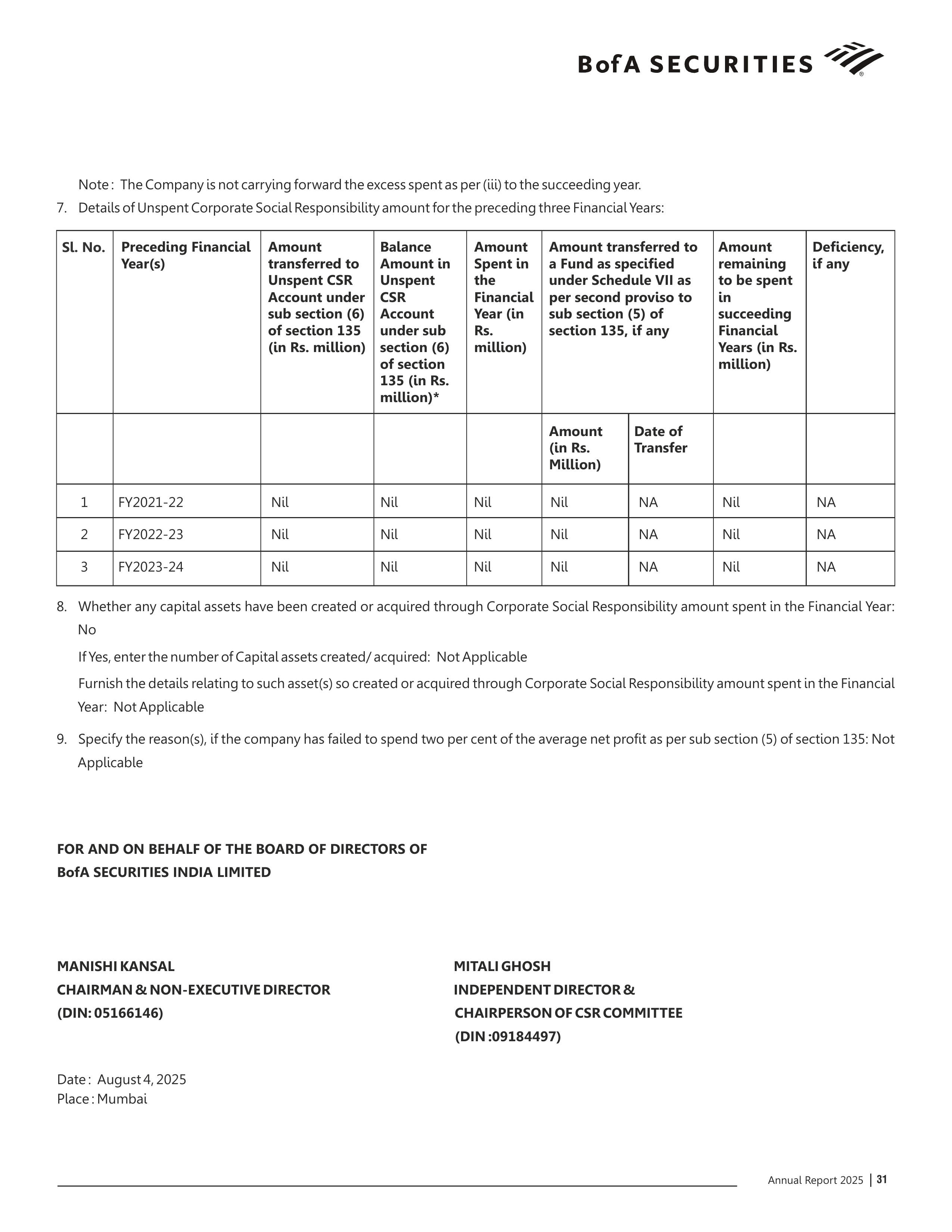
Note : The Company is not carrying forward the excess spent as per (iii) to the succeeding year.
7. Details of Unspent Corporate Social Responsibility amount for the preceding three Financial Years:
8. Whether any capital assets have been created or acquired through Corporate Social Responsibility amount spent in the Financial Year:
No
If Yes, enter the number of Capital assets created/ acquired: Not Applicable
Furnish the details relating to such asset(s) so created or acquired through Corporate Social Responsibility amount spent in the Financial
Year: Not Applicable
9. Specify the reason(s), if the company has failed to spend two per cent of the average net profit as per sub section (5) of section 135: Not
Applicable
Sl. No.
Preceding Financial
Year(s)
Amount
transferred to
Unspent CSR
Account under
sub section (6)
of section 135
(in Rs. million)
Balance
Amount in
Unspent
CSR
Account
under sub
section (6)
of section
135 (in Rs.
million)*
Amount
Spent in
the
Financial
Year (in
Rs.
million)
Amount transferred to
a Fund as specified
under Schedule VII as
per second proviso to
sub section (5) of
section 135, if any
Amount
remaining
to be spent
in
succeeding
Financial
Years (in Rs.
million)
Deficiency,
if any
1
FY2021-22
Nil
Nil
Nil
Nil
NA
Nil
NA
2
FY2022-23
Nil
Nil
Nil
Nil
NA
Nil
NA
3
FY2023-24
Nil
Nil
Nil
Nil
NA
Nil
NA
Amount
(in Rs.
Million)
Date of
Transfer
31
Annual Report 2025
FOR AND ON BEHALF OF THE BOARD OF DIRECTORS OF
BofA SECURITIES INDIA LIMITED
MANISHI KANSAL
MITALI GHOSH
CHAIRMAN & NON-EXECUTIVE DIRECTOR
INDEPENDENT DIRECTOR &
(DIN: 05166146)
CHAIRPERSON OF CSR COMMITTEE
(DIN :09184497)
Date : August 4, 2025
Place : Mumbai
INDEPENDENT AUDITORS’ REPORT
To the Members of BofA Securities India Limited
Report on the Audit of the Financial Statements
32
Annual Report 2025
Opinion
1. We have audited the accompanying financial statements of BofA Securities India Limited (“the Company”), which comprise the Balance
Sheet as at March 31, 2025, and the Statement of Profit and Loss (including Other Comprehensive Income), the Statement of Changes in
Equity and the Statement of Cash Flows for the year then ended, and notes to the financial statements, including material accounting
policy information and other explanatory information.
2. In our opinion and to the best of our information and according to the explanations given to us, the aforesaid financial statements give
the information required by the Companies Act, 2013 (“the Act") in the manner so required and give a true and fair view in conformity
with the accounting principles generally accepted in India, of the state of affairs of the Company as at March, 31, 2025, and total
comprehensive income (comprising of profit and other comprehensive income), changes in equity and its cash flows for the year then
ended.
Basis for Opinion
3.
We conducted our audit in accordance with the Standards on Auditing (SAs) specified under Section 143(10) of the Act. Our
responsibilities under those Standards are further described in the “Auditor's Responsibilities for the Audit of the Financial Statements”
section of our report. We are independent of the Company in accordance with the Code of Ethics issued by the Institute of Chartered
Accountants of India together with the ethical requirements that are relevant to our audit of the financial statements under the
provisions of the Act and the Rules thereunder, and we have fulfilled our other ethical responsibilities in accordance with these
requirements and the Code of Ethics. We believe that the audit evidence we have obtained is sufficient and appropriate to provide a
basis for our opinion.
Other Information
4.
The Company's Board of Directors is responsible for the other information. The other information comprises the information included in
the Directors report, but does not include the financial statements and our auditor's report thereon.
Our opinion on the financial statements does not cover the other information and we do not express any form of assurance conclusion
thereon.
In connection with our audit of the financial statements, our responsibility is to read the other information and, in doing so, consider
whether the other information is materially inconsistent with the financial statements or our knowledge obtained in the audit or
otherwise appears to be materially misstated. If, based on the work we have performed, we conclude that there is a material
misstatement of this other information, we are required to report that fact.
We have nothing to report in this regard.
Responsibilities of management and those charged with governance for the financial statements
5.
The Company's Board of Directors is responsible for the matters stated in Section 134(5) of the Act with respect to the preparation of
these financial statements that give a true and fair view of the financial position, financial performance, changes in equity and cash flows
of the Company in accordance with the accounting principles generally accepted in India, including the Indian Accounting Standards
specified under Section 133 of the Act. This responsibility also includes maintenance of adequate accounting records in accordance with
the provisions of the Act for safeguarding of the assets of the Company and for preventing and detecting frauds and other irregularities;
selection and application of appropriate accounting policies; making judgments and estimates that are reasonable and prudent; and
design, implementation and maintenance of adequate internal financial controls, that were operating effectively for ensuring the
accuracy and completeness of the accounting records, relevant to the preparation and presentation of the financial statements that give
a true and fair view and are free from material misstatement, whether due to fraud or error.
6.
In preparing the financial statements, Board of Directors is responsible for assessing the Company's ability to continue as a going
33
BofA Securities India Limited
concern, disclosing, as applicable, matters related to going concern and using the going concern basis of accounting unless Board of
Directors either intends to liquidate the Company or to cease operations, or has no realistic alternative but to do so.
7.
Those Board of Directors are also responsible for overseeing the Company's financial reporting process.
Auditor's responsibilities for the audit of the financial statements
8. Our objectives are to obtain reasonable assurance about whether the financial statements as a whole are free from material
misstatement, whether due to fraud or error, and to issue an auditor's report that includes our opinion. Reasonable assurance is a high
level of assurance but is not a guarantee that an audit conducted in accordance with SAs will always detect a material misstatement
when it exists. Misstatements can arise from fraud or error and are considered material if, individually or in the aggregate, they could
reasonably be expected to influence the economic decisions of users taken on the basis of these financial statements.
9. As part of an audit in accordance with SAs, we exercise professional judgement and maintain professional scepticism throughout the
audit. We also:
•
Identify and assess the risks of material misstatement of the financial statements, whether due to fraud or error, design and perform
audit procedures responsive to those risks, and obtain audit evidence that is sufficient and appropriate to provide a basis for our
opinion. The risk of not detecting a material misstatement resulting from fraud is higher than for one resulting from error, as fraud
may involve collusion, forgery, intentional omissions, misrepresentations, or the override of internal control.
•
Obtain an understanding of internal control relevant to the audit in order to design audit procedures that are appropriate in the
circumstances. Under Section 143(3)(i) of the Act, we are also responsible for expressing our opinion on whether the Company has
adequate internal financial controls with reference to financial statements in place and the operating effectiveness of such controls.
•
Evaluate the appropriateness of accounting policies used and the reasonableness of accounting estimates and related disclosures
made by management.
•
Conclude on the appropriateness of management's use of the going concern basis of accounting and, based on the audit evidence
obtained, whether a material uncertainty exists related to events or conditions that may cast significant doubt on the Company's
ability to continue as a going concern. If we conclude that a material uncertainty exists, we are required to draw attention in our
auditor's report to the related disclosures in the financial statements or, if such disclosures are inadequate, to modify our opinion.
Our conclusions are based on the audit evidence obtained up to the date of our auditor's report. However, future events or
conditions may cause the Company to cease to continue as a going concern.
•
Evaluate the overall presentation, structure and content of the financial statements, including the disclosures, and whether the
financial statements represent the underlying transactions and events in a manner that achieves fair presentation.
10. We communicate with those charged with governance regarding, among other matters, the planned scope and timing of the audit and
significant audit findings, including any significant deficiencies in internal control that we identify during our audit.
11. We also provide those charged with governance with a statement that we have complied with relevant ethical requirements regarding
independence, and to communicate with them all relationships and other matters that may reasonably be thought to bear on our
independence, and where applicable, related safeguards.
Other Matter
12. The financial statements of the Company for the year ended March 31, 2024, were audited by another firm of chartered accountants
under the Act who, vide their report dated July 23, 2024, expressed an unmodified opinion on those financial statements.
Report on other legal and regulatory requirements
13. As required by the Companies (Auditor's Report) Order, 2020 (“the Order”), issued by the Central Government of India in terms of sub-
section (11) of Section 143 of the Act, we give in the Annexure B a statement on the matters specified in paragraphs 3 and 4 of the Order,
to the extent applicable.
34
Annual Report 2025
14. As required by Section 143(3) of the Act, we report that:
(a) We have sought and obtained all the information and explanations which to the best of our knowledge and belief were necessary
for the purposes of our audit.
(b) In our opinion, proper books of account as required by law have been kept by the Company so far as it appears from our
examination of those books other than the back-up of the books of account and other books and papers maintained in electronic
mode that have been kept on servers physically located in India on a daily basis on every working day, but for stated holidays and
weekends on the next working day, and that the backup of certain audit trail logs has not been maintained on a server located in
India on a daily basis, and the matters stated in paragraph 14(h)(vi) below on reporting under Rule 11(g) of the Companies (Audit
and Auditors) Rules, 2014 (as amended).
(c) The Balance Sheet, the Statement of Profit and Loss (including other comprehensive income), the Statement of Changes in Equity
and the Statement of Cash Flows dealt with by this Report are in agreement with the books of account.
(d) In our opinion, the aforesaid financial statements comply with the Indian Accounting Standards specified under Section 133 of the
Act.
(e) On the basis of the written representations received from the directors as on March 31, 2025, taken on record by the Board of
Directors, none of the directors is disqualified as on March 31, 2025, from being appointed as a director in terms of Section 164(2) of
the Act.
(f) With respect to the maintenance of accounts and other matters connected therewith, reference is made to our remarks in
paragraph 14(b) above on reporting under Section 143(3)(b) and paragraph 14(h)(vi) below on reporting under Rule 11(g) of the
Companies (Audit and Auditors) Rules, 2014 (as amended).
(g) With respect to the adequacy of the internal financial controls with reference to financial statements of the Company and the
operating effectiveness of such controls, refer to our separate Report in “Annexure A”.
(h) With respect to the other matters to be included in the Auditor's Report in accordance with Rule 11 of the Companies (Audit and
Auditors) Rules, 2014 (as amended), in our opinion and to the best of our information and according to the explanations given to
us:
i.
The Company has disclosed the impact of pending litigations on its financial position in its financial statements – Refer Note 30
to the financial statements.
ii.
The Company has long term contracts as at March 31, 2025 for which there were no material foreseeable losses. The Company
did not have any derivative contracts as at March 31, 2025.
iii. There were no amounts which were required to be transferred to the Investor Education and Protection Fund by the Company
during the year ended March 31, 2025.
iv.
(a) The management has represented that, to the best of its knowledge and belief, as disclosed in Note 32(c)(xi) to the
financial statements, no funds have been advanced or loaned or invested (either from borrowed funds or share premium
or any other sources or kind of funds) by the Company to or in any other person(s) or entity(ies), including foreign entities
(“Intermediaries”), with the understanding, whether recorded in writing or otherwise, that the Intermediary shall, whether
directly or indirectly, lend or invest in other persons or entities identified in any manner whatsoever by or on behalf of the
Company (“Ultimate Beneficiaries”) or provide any guarantee, security or the like on behalf of the Ultimate Beneficiaries
(b) The management has represented that, to the best of its knowledge and belief, as disclosed in the Note 32(c)(xii) to the
financial statements, no funds have been received by the Company from any person(s) or entity(ies), including foreign
entities (“Funding Parties”), with the understanding, whether recorded in writing or otherwise, that the Company shall,
whether directly or indirectly, lend or invest in other persons or entities identified in any manner whatsoever by or on
behalf of the Funding Party (“Ultimate Beneficiaries”) or provide any guarantee, security or the like on behalf of the
Ultimate Beneficiaries and
(c) Based on such audit procedures that we considered reasonable and appropriate in the circumstances, nothing has come
35
BofA Securities India Limited
For
Price Waterhouse Chartered Accountants LLP
Firm Registration Number: No. 012754N/N500016
Sd/-
Sharad Vasant
Partner
Membership Number: 101119
UDIN: 25101119BMIFEM2412
Place : Mumbai
Date : August 04, 2025
to our notice that has caused us to believe that the representations under sub-clause (a) and (b) contain any material
misstatement.
v.
The Company has not declared or paid any dividend during the year.
vi. Based on our examination, which included test checks, the Company has used multiple accounting software for maintaining its
books of account that have a feature of recording audit trail (edit log) facility and that has operated throughout the year for all
relevant transactions recorded in the software, except for the following:
(i)
in respect of one software, the audit trail feature was not enabled at the database level to log any direct data changes; and
(ii) with respect to one of the accounting software managed by a third-party service provider used for the period April 1, 2024
to March 31, 2025, in the absence of any information pertaining to audit trail in the independent service auditor's report,
we are unable to comment on the audit trail (edit log) feature in that accounting software.
During the course of performing our procedures, other than the aforesaid instances of audit trail not maintained, we did
not notice any instance of audit trail feature being tampered with. Further, the Company has preserved the audit trail for
prior financial year in compliance with the statutory record retention requirements, except in relation to the accounting
software for which audit trail feature was not enabled.
15. The Company has paid/ provided for managerial remuneration in accordance with the requisite approvals mandated by the provisions
of Section 197 read with Schedule V to the Act.
36
Annual Report 2025
Report on the Internal Financial Controls with reference to Financial Statements under clause (i) of sub-section 3 of Section 143 of
the Act
1.
We have audited the internal financial controls with reference to financial statements of BofA Securities India Limited (“the Company”)
as of March 31, 2025 in conjunction with our audit of the financial statements of the Company for the year ended on that date.
Management's Responsibility for Internal Financial Controls
2. The Company's management is responsible for establishing and maintaining internal financial controls based on the internal control
over financial reporting criteria established by the Company considering the essential components of internal control stated in the
Guidance Note on Audit of Internal Financial Controls Over Financial Reporting (“the Guidance Note”) issued by the Institute of
Chartered Accountants of India (“ICAI”). These responsibilities include the design, implementation and maintenance of adequate
internal financial controls that were operating effectively for ensuring the orderly and efficient conduct of its business, including
adherence to company's policies, the safeguarding of its assets, the prevention and detection of frauds and errors, the accuracy and
completeness of the accounting records, and the timely preparation of reliable financial information, as required under the Act.
Auditor's Responsibility
3.
Our responsibility is to express an opinion on the Company's internal financial controls with reference to financial statements based on
our audit. We conducted our audit in accordance with the Guidance Note and the Standards on Auditing specified under Section
143(10) of the Act to the extent applicable to an audit of internal financial controls, both applicable to an audit of internal financial
controls and both issued by the ICAI. Those Standards and the Guidance Note require that we comply with ethical requirements and
plan and perform the audit to obtain reasonable assurance about whether adequate internal financial controls with reference to
financial statements was established and maintained and if such controls operated effectively in all material respects.
4. Our audit involves performing procedures to obtain audit evidence about the adequacy of the internal financial controls system with
reference to financial statements and their operating effectiveness. Our audit of internal financial controls with reference to financial
statements included obtaining an understanding of internal financial controls with reference to financial statements, assessing the risk
that a material weakness exists, and testing and evaluating the design and operating effectiveness of internal control based on the
assessed risk. The procedures selected depend on the auditor's judgement, including the assessment of the risks of material
misstatement of the financial statements, whether due to fraud or error.
5.
We believe that the audit evidence we have obtained is sufficient and appropriate to provide a basis for our audit opinion on the
Company's internal financial controls system with reference to financial statements.
Meaning of Internal Financial Controls with reference to financial statements
6.
A company's internal financial controls with reference to financial statements is a process designed to provide reasonable assurance
regarding the reliability of financial reporting and the preparation of financial statements for external purposes in accordance with
generally accepted accounting principles. A company's internal financial controls with reference to financial statements includes those
policies and procedures that (1) pertain to the maintenance of records that, in reasonable detail, accurately and fairly reflect the
transactions and dispositions of the assets of the company; (2) provide reasonable assurance that transactions are recorded as
necessary to permit preparation of financial statements in accordance with generally accepted accounting principles, and that receipts
and expenditures of the company are being made only in accordance with authorisations of management and directors of the company;
and (3) provide reasonable assurance regarding prevention or timely detection of unauthorised acquisition, use, or disposition of the
company's assets that could have a material effect on the financial statements.
Inherent Limitations of Internal Financial Controls with reference to financial statements
7. Because of the inherent limitations of internal financial controls with reference to financial statements, including the possibility of
collusion or improper management override of controls, material misstatements due to error or fraud may occur and not be detected.
Also, projections of any evaluation of the internal financial controls with reference to financial statements to future periods are subject
to the risk that the internal financial controls with reference to financial statements may become inadequate because of changes in
conditions, or that the degree of compliance with the policies or procedures may deteriorate.
Opinion
8.
In our opinion, the Company has, in all material respects, adequate internal financial controls system with reference to financial
statements and such internal financial controls with reference to financial statements were operating effectively as at March 31, 2025,
Annexure A to Independent Auditor's Report
Referred to in paragraph 14(g) of the Independent Auditor’s Report of even date to the members of BofA Securities India Limited
on the financial statements as of and for the year ended March 31, 2025
37
BofA Securities India Limited
based on the internal control over financial reporting criteria established by the Company considering the essential components of
internal control stated in the Guidance Note issued by ICAI.
For
Price Waterhouse Chartered Accountants LLP
Firm Registration Number: No. 012754N/N500016
Sd/-
Sharad Vasant
Partner
Membership Number: 101119
UDIN: 25101119BMIFEM2412
Place : Mumbai
Date : August 04, 2025
38
Annual Report 2025
In terms of the information and explanations sought by us and furnished by the Company, and the books of account and records examined
by us during the course of our audit, and to the best of our knowledge and belief, we report that:
i.
(a) (A) The Company is maintaining proper records showing full particulars, including quantitative details and situation, of Property,
Plant and Equipment.
(B) The Company is maintaining proper records showing full particulars of Intangible Assets.
(b) The Property, Plant and Equipment are physically verified by the Management according to a phased programme designed to cover
all the items over a period of three years which, in our opinion, is reasonable having regard to the size of the Company and the
nature of its assets. Pursuant to the programme, a portion of the Property, Plant and Equipment has been physically verified by the
Management during the year and no material discrepancies have been noticed on such verification.
(c) The Company does not own any immovable properties (Refer Note 12 and Note 32(c)(i) to the financial statements). Accordingly,
reporting under clause 3(i)(c) of the Order is not applicable to the Company.
(d) The Company has not revalued its Property, Plant and Equipment (including Right of Use assets) or Intangible Assets or both during
the year.
(e) No proceedings have been initiated on (or) are pending against the Company for holding benami property under the Prohibition of
Benami Property Transactions Act, 1988 (as amended in 2016) (formerly the Benami Transactions (Prohibition) Act, 1988 (45 of
1988)) and Rules made thereunder, and therefore the question of our commenting on whether the Company has appropriately
disclosed the details in the financial statements does not arise.
ii.
(a) The Company is in the business of rendering services and, consequently, does not hold any inventory. Accordingly, reporting under
clause 3(ii)(a) of the Order is not applicable to the Company.
(b) During the year, the Company has been sanctioned working capital limits in excess of Rs. 5 crores, in aggregate, from banks on the
basis of security of current assets. The terms of sanction do not stipulate filing of quarterly returns or statements with such banks,
and accordingly, the question of our commenting on whether the returns or statements are in agreement with the unaudited books
of account of the Company, does not arise.
iii. The Company has not made any investments, granted secured/ unsecured loans/advances in nature of loans, or stood guarantee, or
provided security to any parties. Therefore, the reporting under clause 3(iii), (iii)(a), (iii)(b),(iii)(c), (iii)(d), (iii)(e) and (iii)(f) of the Order are
not applicable to the Company.
iv. The Company has not granted any loans or made any investments or provided any guarantees or security to the parties covered under
Sections 185 and 186. Therefore, the reporting under clause 3(iv) of the Order are not applicable to the Company.
v. The Company has not accepted any deposits or amounts which are deemed to be deposits referred in Sections 73, 74, 75 and 76 of the
Act and the Rules framed there under.
vi
The Central Government of India has not specified the maintenance of cost records under sub- section (1) of Section 148 of the Act for
any of the services of the Company. Accordingly, reporting under clause 3(vi) of the Order is not applicable to the Company.
vii. (a) In our opinion, the Company is regular in depositing the undisputed statutory dues, including goods and services tax, provident
fund, employees' state insurance, income tax, and other statutory dues, as applicable, with the appropriate authorities.
(b) The particulars of statutory dues referred to in sub-clause (a) as at March 31, 2025 which have not been deposited on account of a
dispute, are as follows:
Annexure B to the Independent Auditor's Report
Referred to in paragraph 13 of the Independent Auditors’ Report of even date to the members of BofA Securities India Limited on
the financial statements as of and for the year ended March 31, 2025
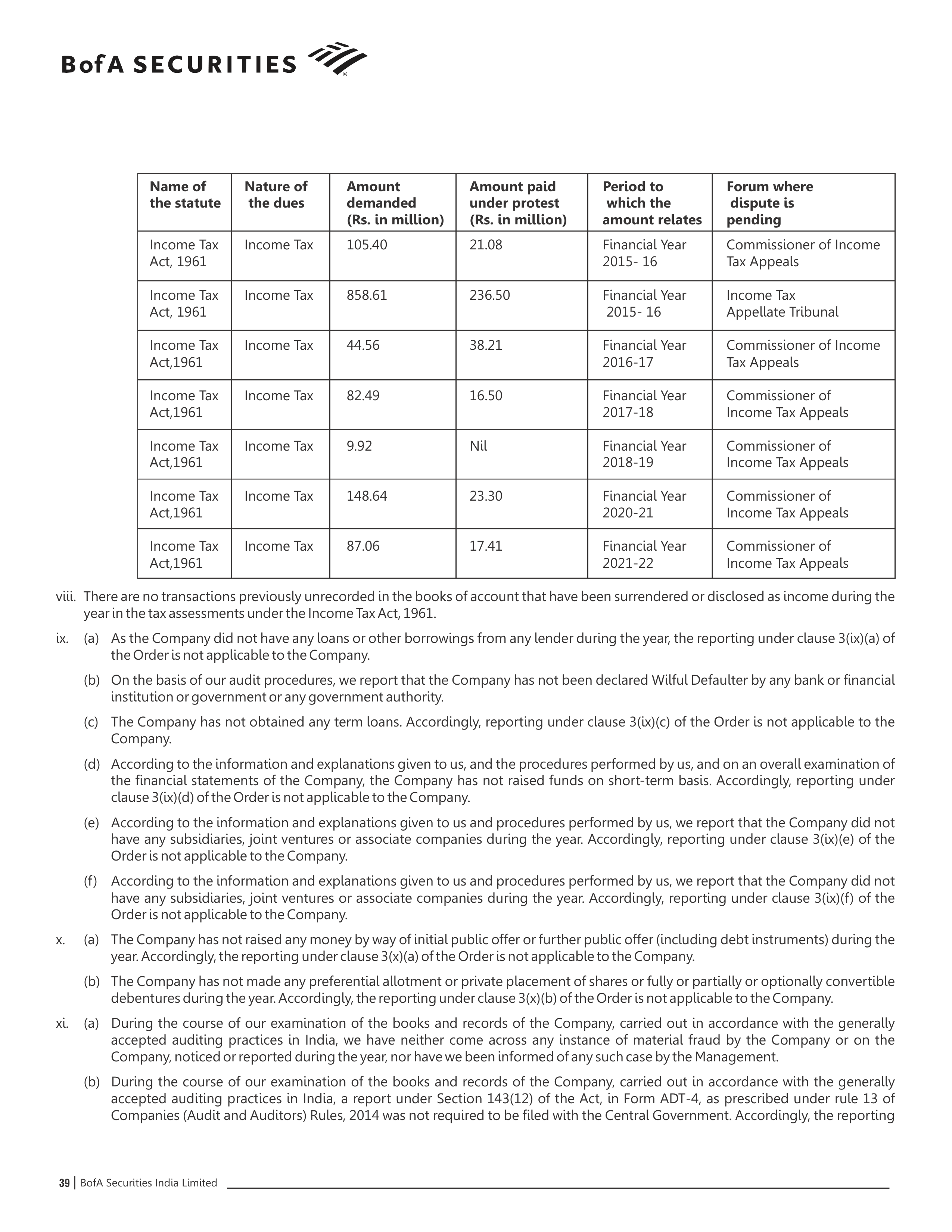
Name of
Nature of
Amount
Amount paid
Period to
Forum where
the statute
the dues
demanded
under protest
which the
dispute is
(Rs. in million)
(Rs. in million)
amount relates
pending
Income Tax
Income Tax
105.40
21.08
Financial Year
Commissioner of Income
Act, 1961
2015- 16
Tax Appeals
Income Tax
Income Tax
858.61
236.50
Financial Year
Income Tax
Act, 1961
2015- 16
Appellate Tribunal
Income Tax
Income Tax
44.56
38.21
Financial Year
Commissioner of Income
Act,1961
2016-17
Tax Appeals
Income Tax
Income Tax
82.49
16.50
Financial Year
Commissioner of
Act,1961
2017-18
Income Tax Appeals
Income Tax
Income Tax
9.92
Nil
Financial Year
Commissioner of
Act,1961
2018-19
Income Tax Appeals
Income Tax
Income Tax
148.64
23.30
Financial Year
Commissioner of
Act,1961
2020-21
Income Tax Appeals
Income Tax
Income Tax
87.06
17.41
Financial Year
Commissioner of
Act,1961
2021-22
Income Tax Appeals
viii. There are no transactions previously unrecorded in the books of account that have been surrendered or disclosed as income during the
year in the tax assessments under the Income Tax Act, 1961.
ix. (a) As the Company did not have any loans or other borrowings from any lender during the year, the reporting under clause 3(ix)(a) of
the Order is not applicable to the Company.
(b) On the basis of our audit procedures, we report that the Company has not been declared Wilful Defaulter by any bank or financial
institution or government or any government authority.
(c) The Company has not obtained any term loans. Accordingly, reporting under clause 3(ix)(c) of the Order is not applicable to the
Company.
(d) According to the information and explanations given to us, and the procedures performed by us, and on an overall examination of
the financial statements of the Company, the Company has not raised funds on short-term basis. Accordingly, reporting under
clause 3(ix)(d) of the Order is not applicable to the Company.
(e) According to the information and explanations given to us and procedures performed by us, we report that the Company did not
have any subsidiaries, joint ventures or associate companies during the year. Accordingly, reporting under clause 3(ix)(e) of the
Order is not applicable to the Company.
(f) According to the information and explanations given to us and procedures performed by us, we report that the Company did not
have any subsidiaries, joint ventures or associate companies during the year. Accordingly, reporting under clause 3(ix)(f) of the
Order is not applicable to the Company.
x.
(a) The Company has not raised any money by way of initial public offer or further public offer (including debt instruments) during the
year. Accordingly, the reporting under clause 3(x)(a) of the Order is not applicable to the Company.
(b) The Company has not made any preferential allotment or private placement of shares or fully or partially or optionally convertible
debentures during the year. Accordingly, the reporting under clause 3(x)(b) of the Order is not applicable to the Company.
xi. (a) During the course of our examination of the books and records of the Company, carried out in accordance with the generally
accepted auditing practices in India, we have neither come across any instance of material fraud by the Company or on the
Company, noticed or reported during the year, nor have we been informed of any such case by the Management.
(b) During the course of our examination of the books and records of the Company, carried out in accordance with the generally
accepted auditing practices in India, a report under Section 143(12) of the Act, in Form ADT-4, as prescribed under rule 13 of
Companies (Audit and Auditors) Rules, 2014 was not required to be filed with the Central Government. Accordingly, the reporting
39
BofA Securities India Limited
40
Annual Report 2025
under clause 3(xi)(b) of the Order is not applicable to the Company.
(c) During the course of our examination of the books and records of the Company carried out in accordance with the generally
accepted auditing practices in India, we noted that the Company has received whistle-blower complaint during the year, which
have been considered by us for any bearing on our audit and reporting under this clause.
xii. As the Company is not a Nidhi Company and the Nidhi Rules, 2014 are not applicable to it, the reporting under clause 3(xii) of the Order
is not applicable to the Company.
xiii. The Company has entered into transactions with related parties in compliance with the provisions of Sections 177 and 188 of the Act.
The details of related party transactions have been disclosed in the financial statements as required under Indian Accounting Standard
24 “Related Party Disclosures” specified under Section 133 of the Act.
xiv. (a) In our opinion, the Company has an internal audit system commensurate with the size and nature of its business.
(b) The reports of the Internal Auditor for the period under audit have been considered by us.
xv. In our opinion, the Company has not entered into any non-cash transactions with its directors or persons connected with him.
Accordingly, the reporting on compliance with the provisions of Section 192 of the Act under clause 3(xv) of the Order is not applicable
to the Company.
xvi. (a) The Company is not required to be registered under Section 45-IA of the Reserve Bank of India Act, 1934. Accordingly, the reporting
under clause 3(xvi)(a) of the Order is not applicable to the Company.
(b) The Company has not conducted non-banking financial / housing finance activities during the year. Accordingly, the reporting
under clause 3(xvi)(b) of the Order is not applicable to the Company.
(c) The Company is not a Core Investment Company (CIC) as defined in the regulations made by the Reserve Bank of India. Accordingly,
the reporting under clause 3(xvi)(c) of the Order is not applicable to the Company.
(d) In our opinion, the Group (as defined in the Core Investment Companies (Reserve Bank) Directions, 2016) does not have any CICs,
which are part of the Group. Accordingly, the reporting under clause 3(xvi)(d) of the Order is not applicable to the Company.
xvii. The Company has not incurred any cash losses in the financial year or in the immediately preceding financial year.
xviii. There has been no resignation of the statutory auditors during the year and accordingly the reporting under clause 3(xviii) of the Order
is not applicable.
xix. The financial ratios prescribed under Division III of Schedule III of the Act are not applicable to the Company (Refer Note 32(c)(xv) to the
financial statements). Further, according to the information and explanations given to us and on the basis of ageing and expected dates
of realisation of financial assets and payment of financial liabilities, other information accompanying the financial statements, our
knowledge of the Board of Directors and management plans and based on our examination of the evidence supporting the
assumptions, nothing has come to our attention, which causes us to believe that any material uncertainty exists as on the date of the
audit report that Company is not capable of meeting its liabilities existing at the date of balance sheet as and when they fall due within a
period of one year from the balance sheet date. We, however, state that this is not an assurance as to the future viability of the Company.
We further state that our reporting is based on the facts up to the date of the audit report and we neither give any guarantee nor any
assurance that all liabilities falling due within a period of one year from the balance sheet date will get discharged by the Company as
and when they fall due.
xx. As at balance sheet date, the Company does not have any amount remaining unspent under Section 135(5) of the Act. Accordingly,
reporting under clause 3(xx) of the Order is not applicable.
xxi. The reporting under clause 3(xxi) of the Order is not applicable in respect of audit of Financial Statements. Accordingly, no comment in
respect of the said clause has been included in this report.
For
Price Waterhouse Chartered Accountants LLP
Firm Registration Number: No. 012754N/N500016
Sd/-
Sharad Vasant
Partner
Membership Number: 101119
UDIN: 25101119BMIFEM2412
Place : Mumbai
Date : August 04, 2025
41
BofA Securities India Limited
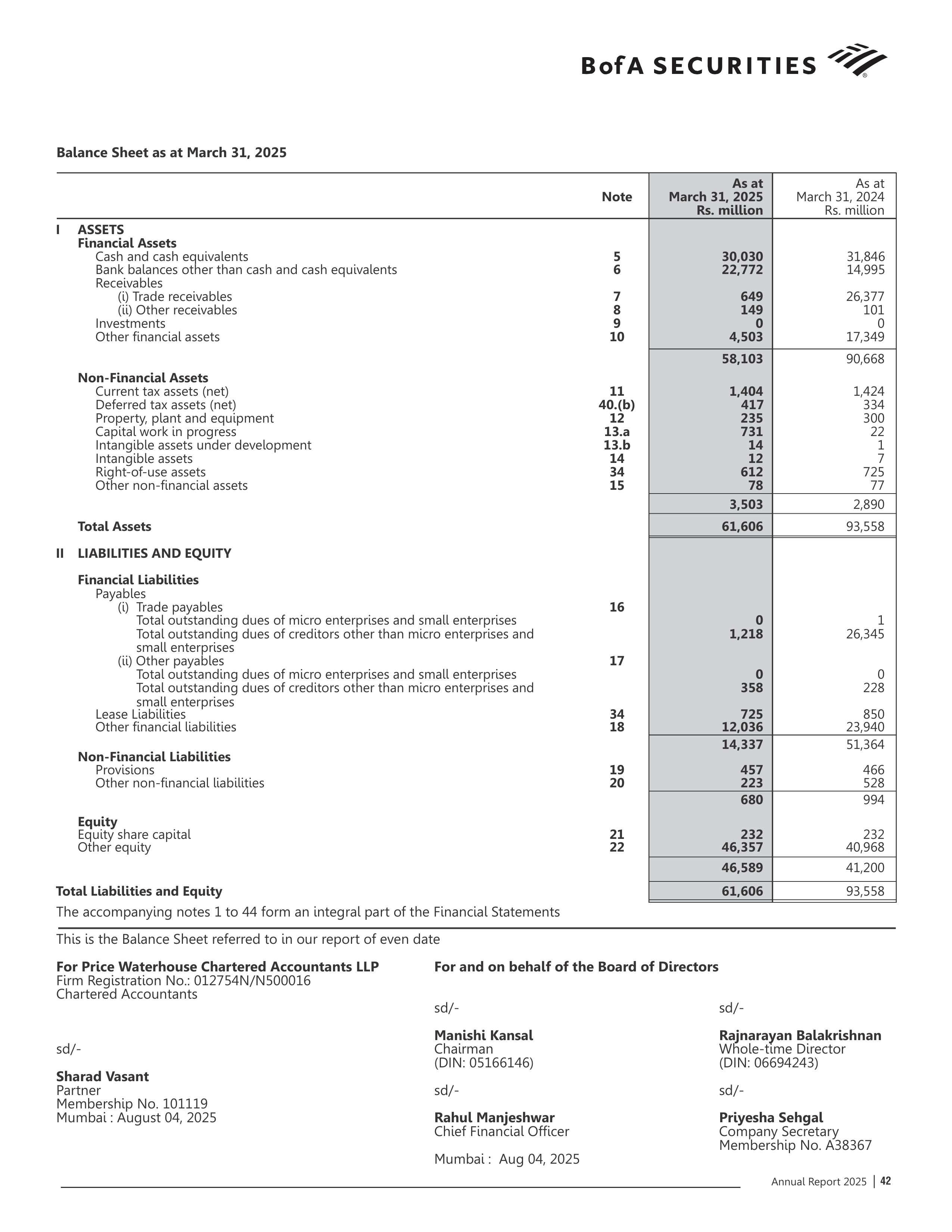
Balance Sheet as at March 31, 2025
As at
As at
Note
March 31, 2025
March 31, 2024
Rs. million
Rs. million
I
ASSETS
Financial Assets
Cash and cash equivalents
31,846
5 30,030
Bank balances other than cash and cash equivalents
14,995
6 22,772
Receivables
(i) Trade receivables
26,377
7 649
(ii) Other receivables
101
8 149
Investments
0
9
0
Other financial assets
17,349
10 4,503
58,103
90,668
Non-Financial Assets
Current tax assets (net)
1,424
11
1,404
Deferred tax assets (net)
334
40.(b) 417
Property, plant and equipment
300
12 235
Capital work in progress
22
13.a 731
Intangible assets under development
1
13.b 14
Intangible assets
7
14 12
34 612
Right-of-use assets
725
Other non-financial assets
77
15 78
2,890
3,503
93,558
Total Assets
61,606
II LIABILITIES AND EQUITY
Financial Liabilities
Payables
(i) Trade payables
16
Total outstanding dues of micro enterprises and small enterprises
1
0
Total outstanding dues of creditors other than micro enterprises and
26,345
1,218
small enterprises
(ii) Other payables
17
Total outstanding dues of micro enterprises and small enterprises
0
0
Total outstanding dues of creditors other than micro enterprises and
228
358
small enterprises
Lease Liabilities
850
34 725
Other financial liabilities
23,940
18 12,036
14,337
51,364
Non-Financial Liabilities
Provisions
466
19 457
Other non-financial liabilities
528
20 223
680
994
Equity
Equity share capital
232
21
232
Other equity
40,968
22 46,357
41,200
46,589
Total Liabilities and Equity
61,606
93,558
The accompanying notes 1 to 44 form an integral part of the Financial Statements
This is the Balance Sheet referred to in our report of even date
For Price Waterhouse Chartered Accountants LLP
For and on behalf of the Board of Directors
Firm Registration No.: 012754N/N500016
Chartered Accountants
sd/-
sd/-
Manishi Kansal
Rajnarayan Balakrishnan
sd/-
Chairman
Whole-time Director
(DIN: 05166146)
(DIN: 06694243)
Sharad Vasant
Partner
sd/-
sd/-
Membership No. 101119
Mumbai : August 04, 2025
Rahul Manjeshwar
Priyesha Sehgal
Chief Financial Officer
Company Secretary
Membership No. A38367
Mumbai : Aug 04, 2025
42
Annual Report 2025
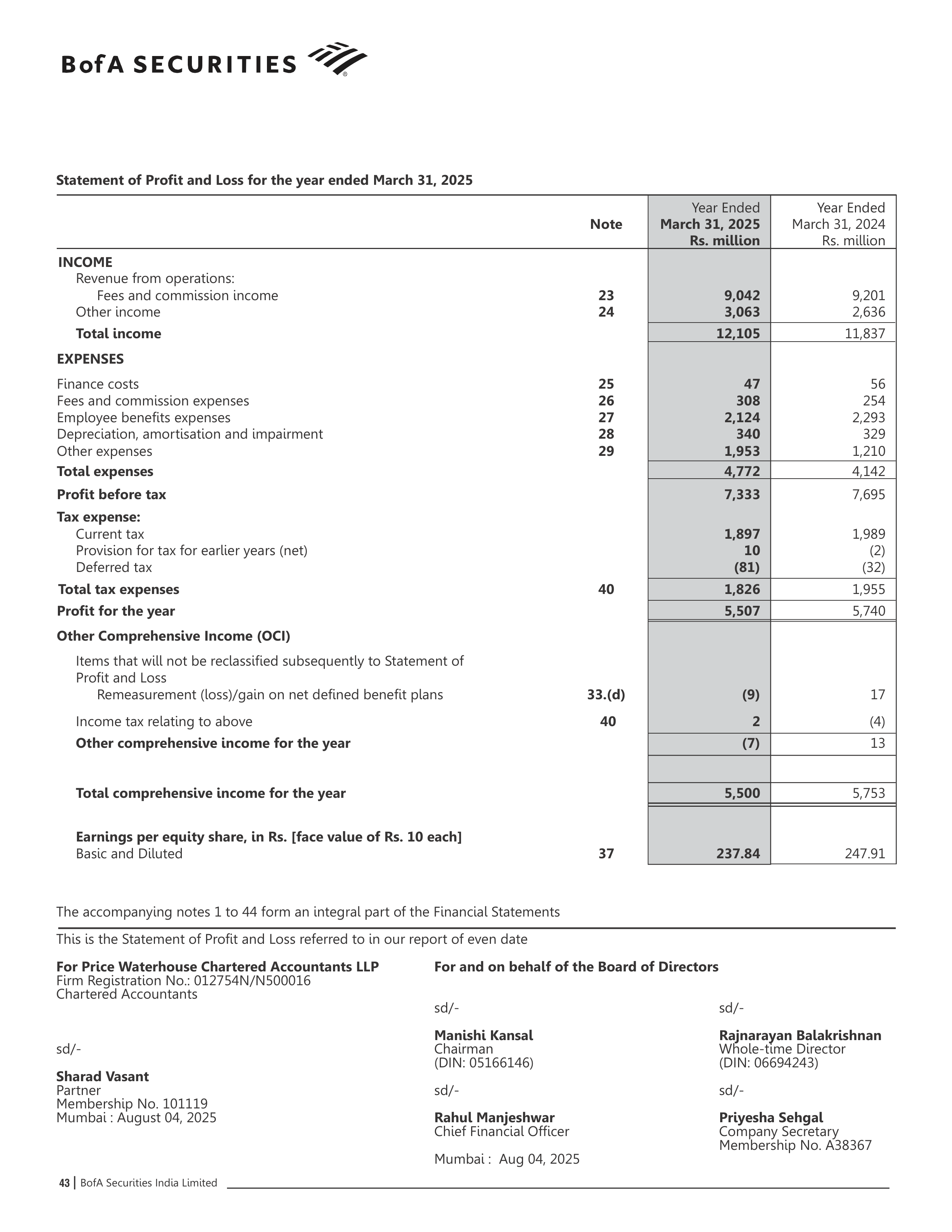
Year Ended
Year Ended
Note
March 31, 2025
March 31, 2024
Rs. million
Rs. million
INCOME
Revenue from operations:
Fees and commission income
9,201
23
9,042
Other income
2,636
24
3,063
Total income
12,105
11,837
EXPENSES
Finance costs
56
25
47
Fees and commission expenses
254
26
308
Employee benefits expenses
2,293
27 2,124
Depreciation, amortisation and impairment
329
28
340
Other expenses
1,210
29 1,953
Total expenses
4,772
4,142
Profit before tax
7,333
7,695
Tax expense:
Current tax
1,989
1,897
Provision for tax for earlier years (net)
(2)
10
Deferred tax
(32)
(81)
Total tax expenses
40
1,826
1,955
Profit for the year
5,507
5,740
Other Comprehensive Income (OCI)
Items that will not be reclassified subsequently to Statement of
Profit and Loss
Remeasurement (loss)/gain on net defined benefit plans
17
33.(d)
(9)
40
2
Income tax relating to above
(4)
Other comprehensive income for the year
(7)
13
Total comprehensive income for the year
5,500
5,753
Earnings per equity share, in Rs. [face value of Rs. 10 each]
Basic and Diluted
247.91
37
237.84
Statement of Profit and Loss for the year ended March 31, 2025
The accompanying notes 1 to 44 form an integral part of the Financial Statements
This is the Statement of Profit and Loss referred to in our report of even date
For Price Waterhouse Chartered Accountants LLP
For and on behalf of the Board of Directors
Firm Registration No.: 012754N/N500016
Chartered Accountants
sd/-
sd/-
Manishi Kansal
Rajnarayan Balakrishnan
sd/-
Chairman
Whole-time Director
(DIN: 05166146)
(DIN: 06694243)
Sharad Vasant
Partner
sd/-
sd/-
Membership No. 101119
Mumbai : August 04, 2025
Rahul Manjeshwar
Priyesha Sehgal
Chief Financial Officer
Company Secretary
Membership No. A38367
Mumbai : Aug 04, 2025
43
BofA Securities India Limited
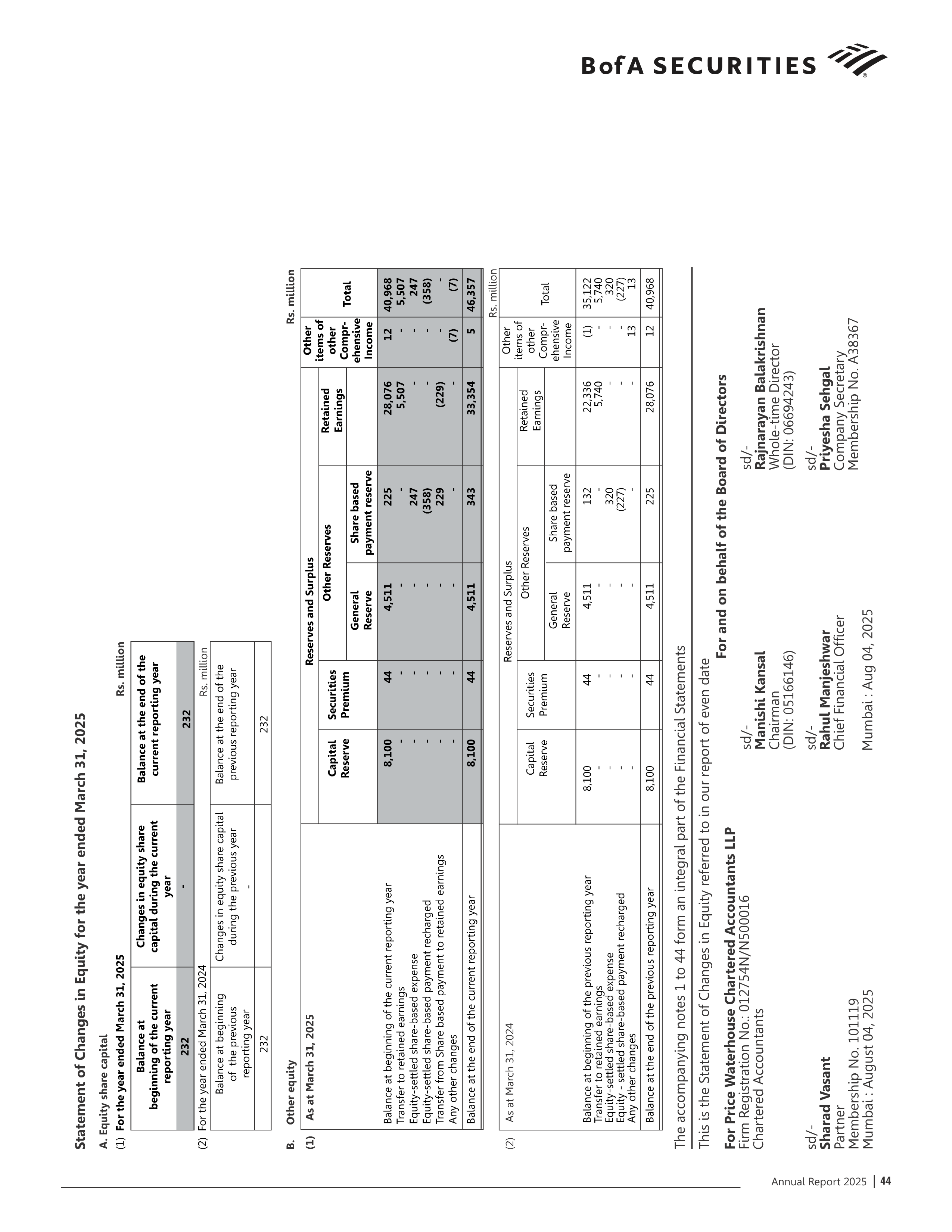
44
Annual Report 2025
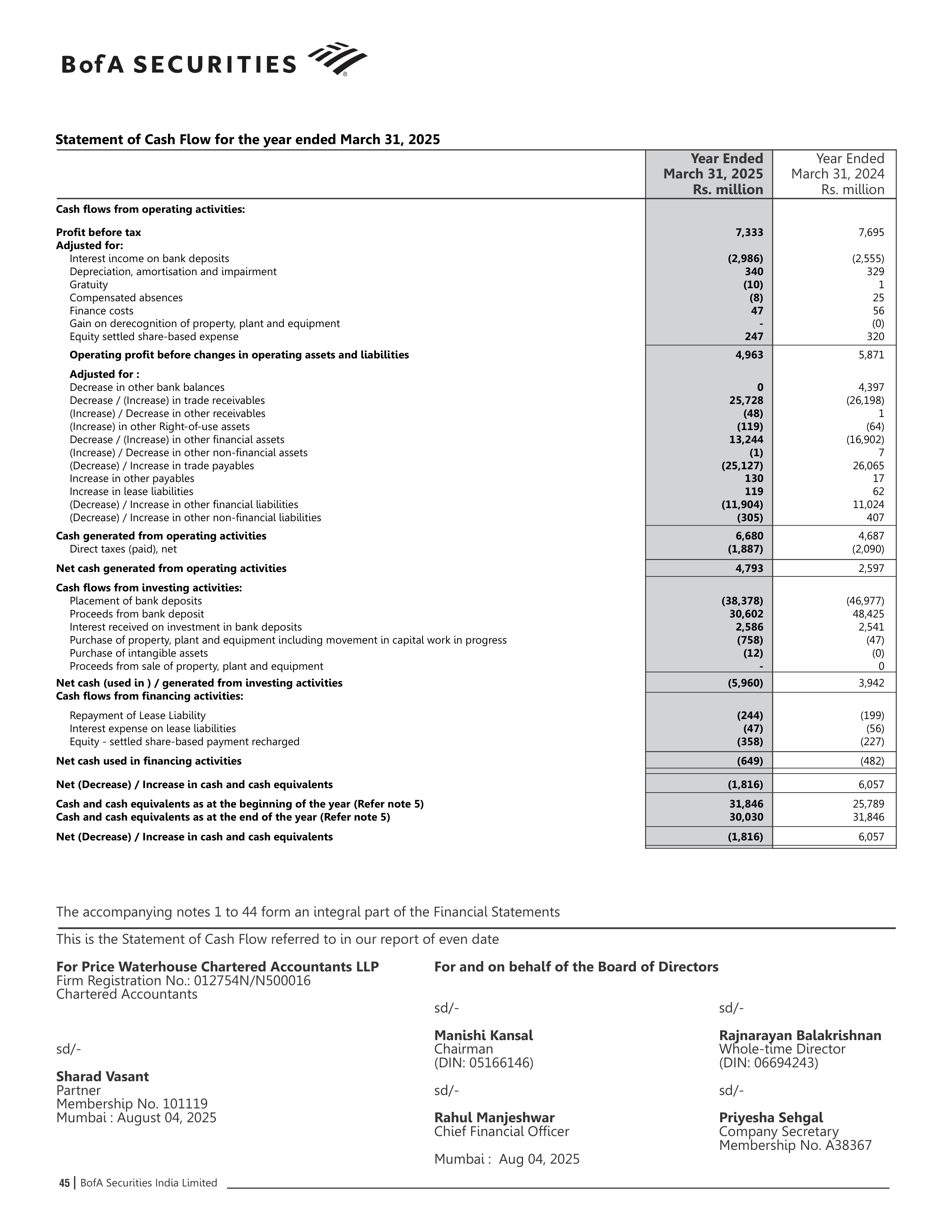
Year Ended
Year Ended
March 31, 2024
March 31, 2025
Rs. million
Rs. million
Cash flows from operating activities:
Profit before tax
7,333
7,695
Adjusted for:
Interest income on bank deposits
(2,555)
(2,986)
Depreciation, amortisation and impairment
329
340
Gratuity
1
(10)
Compensated absences
25
(8)
Finance costs
56
47
Gain on derecognition of property, plant and equipment
(0)
-
Equity settled share-based expense
320
247
Operating profit before changes in operating assets and liabilities
4,963
5,871
Adjusted for :
Decrease in other bank balances
4,397
0
Decrease / (Increase) in trade receivables
(26,198)
25,728
(Increase) / Decrease in other receivables
1
(48)
(Increase) in other Right-of-use assets
(64)
(119)
Decrease / (Increase) in other financial assets
(16,902)
13,244
(Increase) / Decrease in other non-financial assets
7
(1)
(Decrease) / Increase in trade payables
26,065
(25,127)
Increase in other payables
17
130
Increase in lease liabilities
62
119
(Decrease) / Increase in other financial liabilities
11,024
(11,904)
(Decrease) / Increase in other non-financial liabilities
407
(305)
Cash generated from operating activities
6,680
4,687
Direct taxes (paid), net
(2,090)
(1,887)
Net cash generated from operating activities
4,793
2,597
Cash flows from investing activities:
Placement of bank deposits
(46,977)
(38,378)
Proceeds from bank deposit
48,425
30,602
Interest received on investment in bank deposits
2,541
2,586
Purchase of property, plant and equipment including movement in capital work in progress
(47)
(758)
Purchase of intangible assets
(0)
(12)
Proceeds from sale of property, plant and equipment
0
-
Net cash (used in ) / generated from investing activities
(5,960)
3,942
Cash flows from financing activities:
Repayment of Lease Liability
(199)
(244)
Interest expense on lease liabilities
(56)
(47)
Equity - settled share-based payment recharged
(227)
(358)
Net cash used in financing activities
(649)
(482)
Net (Decrease) / Increase in cash and cash equivalents
(1,816)
6,057
Cash and cash equivalents as at the beginning of the year (Refer note 5)
31,846
25,789
Cash and cash equivalents as at the end of the year (Refer note 5)
30,030
31,846
Net (Decrease) / Increase in cash and cash equivalents
(1,816)
6,057
The accompanying notes 1 to 44 form an integral part of the Financial Statements
This is the Statement of Cash Flow referred to in our report of even date
For Price Waterhouse Chartered Accountants LLP
For and on behalf of the Board of Directors
Firm Registration No.: 012754N/N500016
Chartered Accountants
sd/-
sd/-
Manishi Kansal
Rajnarayan Balakrishnan
sd/-
Chairman
Whole-time Director
(DIN: 05166146)
(DIN: 06694243)
Sharad Vasant
Partner
sd/-
sd/-
Membership No. 101119
Mumbai : August 04, 2025
Rahul Manjeshwar
Priyesha Sehgal
Chief Financial Officer
Company Secretary
Membership No. A38367
Mumbai : Aug 04, 2025
Statement of Cash Flow for the year ended March 31, 2025
45
BofA Securities India Limited
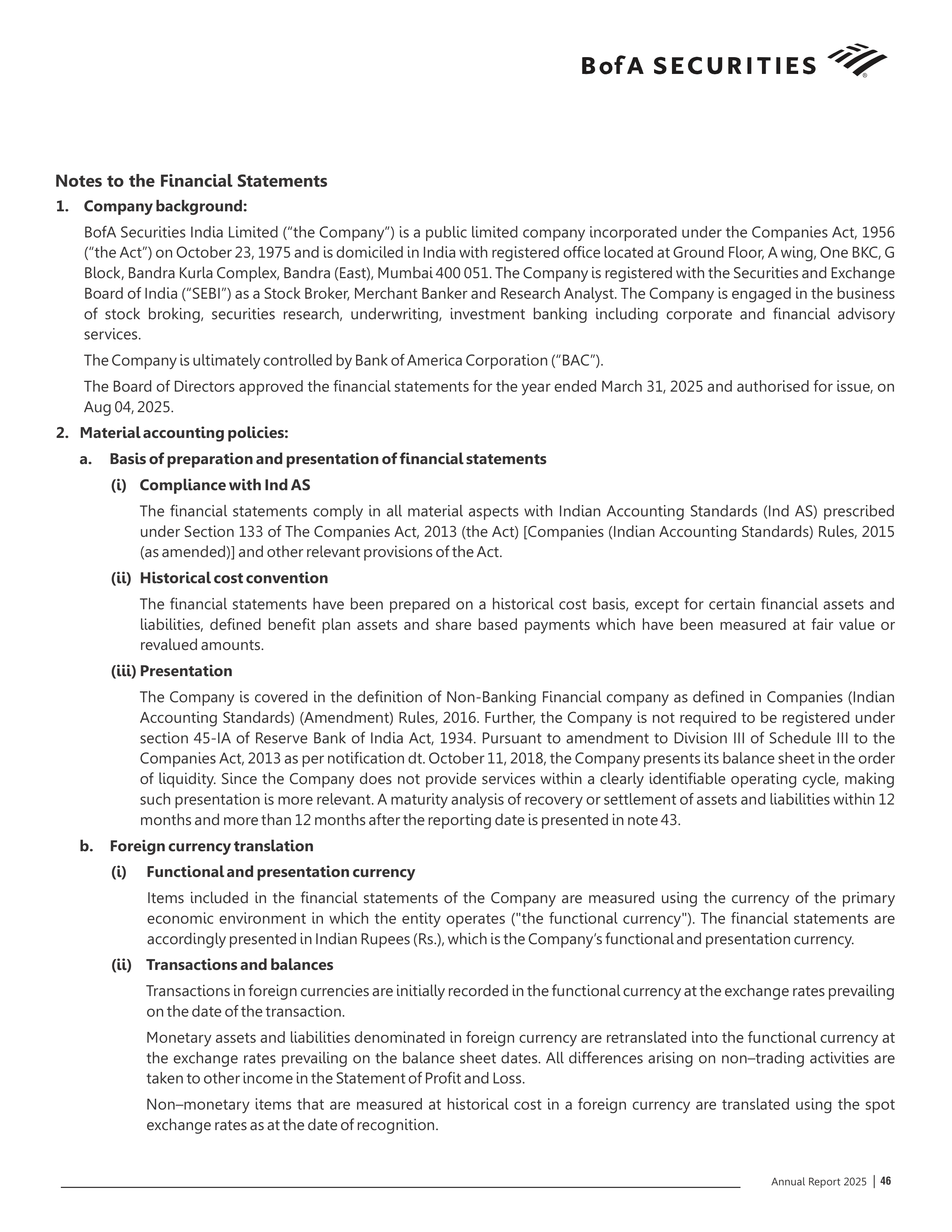
Notes to the Financial Statements
1. Company background:
BofA Securities India Limited (“the Company”) is a public limited company incorporated under the Companies Act, 1956
(“the Act”) on October 23, 1975 and is domiciled in India with registered office located at Ground Floor, A wing, One BKC, G
Block, Bandra Kurla Complex, Bandra (East), Mumbai 400 051. The Company is registered with the Securities and Exchange
Board of India (“SEBI”) as a Stock Broker, Merchant Banker and Research Analyst. The Company is engaged in the business
of stock broking, securities research, underwriting, investment banking including corporate and financial advisory
services.
The Company is ultimately controlled by Bank of America Corporation (“BAC”).
The Board of Directors approved the financial statements for the year ended March 31, 2025 and authorised for issue, on
Aug 04, 2025.
2. Material accounting policies:
a. Basis of preparation and presentation of financial statements
(i) Compliance with Ind AS
The financial statements comply in all material aspects with Indian Accounting Standards (Ind AS) prescribed
under Section 133 of The Companies Act, 2013 (the Act) [Companies (Indian Accounting Standards) Rules, 2015
(as amended)] and other relevant provisions of the Act.
(ii) Historical cost convention
The financial statements have been prepared on a historical cost basis, except for certain financial assets and
liabilities, defined benefit plan assets and share based payments which have been measured at fair value or
revalued amounts.
(iii) Presentation
The Company is covered in the definition of Non-Banking Financial company as defined in Companies (Indian
Accounting Standards) (Amendment) Rules, 2016. Further, the Company is not required to be registered under
section 45-IA of Reserve Bank of India Act, 1934. Pursuant to amendment to Division III of Schedule III to the
Companies Act, 2013 as per notification dt. October 11, 2018, the Company presents its balance sheet in the order
of liquidity. Since the Company does not provide services within a clearly identifiable operating cycle, making
such presentation is more relevant. A maturity analysis of recovery or settlement of assets and liabilities within 12
months and more than 12 months after the reporting date is presented in note 43.
b. Foreign currency translation
(i)
Functional and presentation currency
Items included in the financial statements of the Company are measured using the currency of the primary
economic environment in which the entity operates ("the functional currency"). The financial statements are
accordingly presented in Indian Rupees (Rs.), which is the Company’s functional and presentation currency.
(ii) Transactions and balances
Transactions in foreign currencies are initially recorded in the functional currency at the exchange rates prevailing
on the date of the transaction.
Monetary assets and liabilities denominated in foreign currency are retranslated into the functional currency at
the exchange rates prevailing on the balance sheet dates. All differences arising on non–trading activities are
taken to other income in the Statement of Profit and Loss.
Non–monetary items that are measured at historical cost in a foreign currency are translated using the spot
exchange rates as at the date of recognition.
46
Annual Report 2025
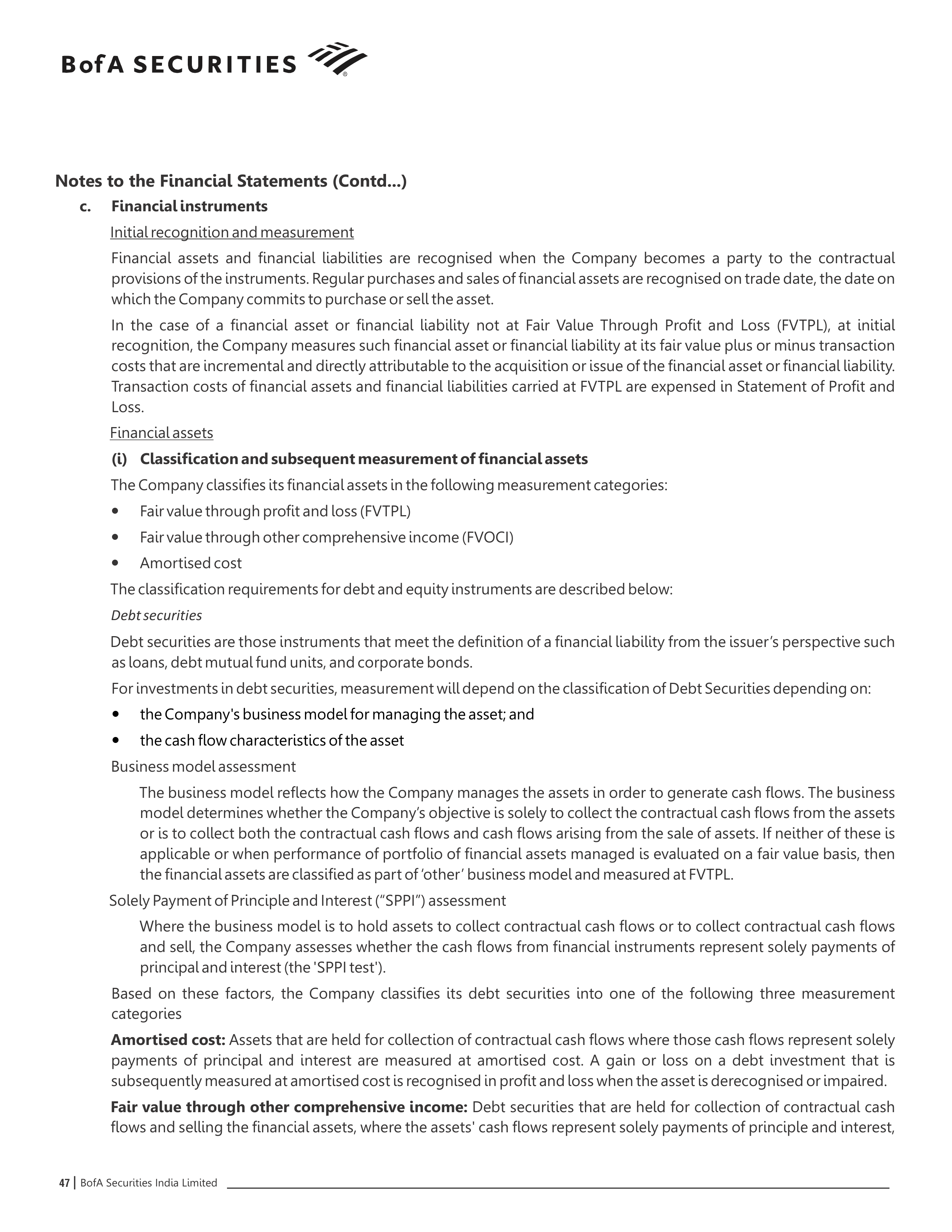
Notes to the Financial Statements (Contd...)
c. Financial instruments
Initial recognition and measurement
Financial assets and financial liabilities are recognised when the Company becomes a party to the contractual
provisions of the instruments. Regular purchases and sales of financial assets are recognised on trade date, the date on
which the Company commits to purchase or sell the asset.
In the case of a financial asset or financial liability not at Fair Value Through Profit and Loss (FVTPL), at initial
recognition, the Company measures such financial asset or financial liability at its fair value plus or minus transaction
costs that are incremental and directly attributable to the acquisition or issue of the financial asset or financial liability.
Transaction costs of financial assets and financial liabilities carried at FVTPL are expensed in Statement of Profit and
Loss.
Financial assets
(i) Classification and subsequent measurement of financial assets
The Company classifies its financial assets in the following measurement categories:
Fair value through profit and loss (FVTPL)
Fair value through other comprehensive income (FVOCI)
Amortised cost
The classification requirements for debt and equity instruments are described below:
Debt securities
Debt securities are those instruments that meet the definition of a financial liability from the issuer’s perspective such
as loans, debt mutual fund units, and corporate bonds.
For investments in debt securities, measurement will depend on the classification of Debt Securities depending on:
the Company's business model for managing the asset; and
the cash flow characteristics of the asset
Business model assessment
The business model reflects how the Company manages the assets in order to generate cash flows. The business
model determines whether the Company’s objective is solely to collect the contractual cash flows from the assets
or is to collect both the contractual cash flows and cash flows arising from the sale of assets. If neither of these is
applicable or when performance of portfolio of financial assets managed is evaluated on a fair value basis, then
the financial assets are classified as part of ‘other’ business model and measured at FVTPL.
Solely Payment of Principle and Interest (“SPPI”) assessment
Where the business model is to hold assets to collect contractual cash flows or to collect contractual cash flows
and sell, the Company assesses whether the cash flows from financial instruments represent solely payments of
principal and interest (the 'SPPI test').
Based on these factors, the Company classifies its debt securities into one of the following three measurement
categories
Amortised cost:
Assets that are held for collection of contractual cash flows where those cash flows represent solely
payments of principal and interest are measured at amortised cost. A gain or loss on a debt investment that is
subsequently measured at amortised cost is recognised in profit and loss when the asset is derecognised or impaired.
Fair value through other comprehensive income:
Debt securities that are held for collection of contractual cash
flows and selling the financial assets, where the assets' cash flows represent solely payments of principle and interest,
47
BofA Securities India Limited
Notes to the Financial Statements (Contd...)
are measured at fair value through other comprehensive income. Movement in the carrying amount are taken through
Other Comprehensive Income (OCI), except for the recognition of impairment gains or losses, interest revenue and
foreign exchange gains and losses which are recognised in Statement of Profit and Loss. When the financial asset is
derecognised, the cumulative gain or loss previously recognised in OCI is reclassified from equity to statement of
profit and loss and recognised in other gains / losses. Interest income from these financial assets is included in other
income using the effective interest rate method. Foreign exchange gains and losses are presented in other gains and
losses and impairment expenses under impairment on financial instruments.
Fair value through profit and loss:
Assets that do not meet the criteria for amortised cost or FVOCI, are measured at
FVTPL. A gain or loss on a debt investment that is subsequently measured at FVTPL is recognised in profit and loss and
presented in the Statement of Profit and Loss within other gains/losses in the period in which it arises.
Equity instruments
Equity instruments are instruments that meet the definition of equity from the issuer's perspective; that is, instruments
that do not contain a contractual obligation to pay and that evidence a residual interest in the issuer’s net assets.
The Company has elected an irrevocable option to measure its investment in equity shares (other than trade
Investments) at FVOCI as these are strategic investments made by the Company. All the gains/ losses on such FVOCI
investments are recognised in the other comprehensive income and are not subsequently reclassified to profit and
loss, including on disposal. Impairment losses (and reversal of impairment losses) are not reported separately from
other changes in fair value.
(ii) Impairment
The Company assesses on a forward-looking basis the expected credit losses ('ECL') associated with its financial
instrument measured at amortised cost and FVOCI. The impairment methodology depends upon whether there
has been significant increase in credit risk of the investment.
(iii) Income recognition
Interest income
The Company calculates interest income by applying the Effective Interest Rate (EIR) to the gross carrying amount
of financial assets other than credit-impaired assets. The effective interest rate is the rate that exactly discounts
estimated future cash receipts through the expected life of the financial asset to the gross carrying amount of a
financial asset.
Dividend income
Dividend income is recognised when the Company’s right to receive the payment is established, it is probable that
the economic benefits associated with the dividend will flow to the entity and the amount of the dividend can be
measured reliably. This is generally when the shareholders approve the dividend.
(iv) De-recognition of financial assets
Financial assets, or a portion thereof, are derecognised when the contractual rights to receive the cash flows from
the assets have expired, or when they have been transferred. On derecognition of a financial asset in its entirety,
the difference between the asset’s carrying amount and the sum of the consideration received and receivable is
recognised in profit and loss on disposal of that financial asset.
Financial liabilities and equity instruments
(i) Classification as debt or equity
Debt and equity instruments issued by the Company are classified as either financial liabilities or as equity in
accordance with the substance of the contractual arrangements and the definitions of a financial liability and an
48
Annual Report 2025
equity instrument.
An equity instrument is any contract that evidences a residual interest in the assets of an entity after deducting all
of its liabilities.
(ii) Classification and subsequent measurement
Financial liabilities are subsequently measured at amortised cost using the effective interest method. The
effective interest rate is the rate that exactly discounts estimated future cash payments through the expected life
of the financial liability to the gross carrying amount of a financial liability.
(iii) De-recognition of financial liabilities
The Company derecognises financial liabilities when, and only when, the Company’s obligations are discharged,
cancelled or have expired.
d. Offsetting financial instruments
Financial assets and liabilities are offset and the net amount is reported in the Balance Sheet where there is a legally
enforceable right to offset the recognised amounts and there is an intention to settle on a net basis or realise the asset
and settle the liability simultaneously.
e. Revenue recognition
Revenue is measured at fair value of the consideration received or receivable. Ind AS 115, Revenue from contracts with
customers outlines a single comprehensive model of accounting for revenue arising from contracts with clients.
The standard is based on the principle that revenue is recognised when control of a good or service transfers to a
customer. A five-step process is applied before revenue can be recognised:
-
identify contracts with customers
-
identify the separate performance obligation
-
determine the transaction price of the contract
-
allocate the transaction price to each of the separate performance obligations, and
-
recognise the revenue as each performance obligation is satisfied.
(i) Brokerage fees and trading revenue (principal transactions) - Point of time
Revenue from contracts with customers is recognised at a point in time when performance obligation is satisfied
(when the trade is executed). Revenue from principal transactions are recognised at a point in time when the
trade is executed.
(ii) Fees and commission income
Revenue from fees from investment banking activities including issue management, mergers and acquisitions
and advisory services is recognised at a point in time as per terms agreed with the customer.
Revenue excludes goods and services tax and securities transactions tax.
f.
Income Tax
The income tax expense or credit for the period is the tax payable on the taxable income of the current period based on
the applicable income tax rates adjusted by changes in deferred tax assets and liabilities attributable to temporary
differences and unused tax losses.
(i) Current Tax
The current income tax charge is calculated on the basis of the tax laws enacted or substantively enacted at the end of
the reporting period. Management periodically evaluates positions taken in tax returns with respect to situations in
Notes to the Financial Statements (Contd...)
49
BofA Securities India Limited
which applicable tax regulation is subject to interpretation. It establishes provisions, where appropriate, on the basis
of amounts expected to be paid to the tax authorities.
(ii) Deferred Tax
Deferred tax is recognised on temporary differences between the carrying amounts of assets and liabilities in the
financial statements and the corresponding tax bases used in the computation of taxable profit.
Deferred tax liabilities are recognised for all taxable temporary differences. Deferred tax assets are recognised for all
deductible temporary differences, unused tax losses and unused tax credits to the extent that it is probable that
taxable profits will be available against which those deductible temporary differences can be utilised.
The carrying amount of deferred tax assets is reviewed at the end of each reporting period and reduced to the extent
that it is no longer probable that sufficient taxable profits will be available to allow all or part of the asset to be
recovered.
Deferred tax liabilities and assets are measured at the tax rates that are expected to apply in the period in which the
liability is settled or the asset realised, based on tax rates (and tax laws) that have been enacted or substantively
enacted by the end of the reporting period.
Deferred tax assets and liabilities are offset when there is a legally enforceable right to offset current tax assets and
liabilities and when the deferred tax balances relate to the same taxation authority.
Deferred tax is recognised in profit and loss, except to the extent that it relates to items recognised in other
comprehensive income or directly in equity.
g Leases
A contract is, or contains, a lease if the contract conveys the right to control the use of an identified asset for a period of
time in exchange for consideration. The Company assesses whether a contract contains a lease, at inception of a
contract.
The determination of whether an arrangement is a lease, or contains a lease, is based on the substance of the
arrangement and requires an assessment of whether the fulfilment of the arrangement is dependent on the use of a
specific asset or assets or whether the arrangement conveys a right to use the asset.
To assess whether a contract conveys the right to control the use of an identified asset, the Company assesses whether:
(i) the contract involves the use of an identified asset,
(ii) the Company has substantially all of the economic benefits from use of the asset through the period of the lease
and
(iii) the Company has the right to direct the use of the asset.
Company as a lessee- Operating Lease
The Company recognises right-of-use asset representing its right to use the underlying asset for the lease term at the
lease commencement date. The cost of the right-of-use asset measured at inception shall comprise of the amount of
the initial measurement of the lease liability adjusted for any lease payments made at or before the commencement
date less any lease incentives received, any initial direct costs incurred and an estimate of costs to be incurred by the
lessee in dismantling and removing the underlying asset or restoring the underlying asset or site on which it is located.
The right-of-use assets is subsequently measured at cost less any accumulated depreciation, accumulated impairment
losses, if any and adjusted for any remeasurement of the lease liability. The right-of-use assets is depreciated using the
straight-line method from the commencement date over the shorter of lease term or useful life of right-of-use asset.
Right-of-use assets are tested for impairment whenever there is any indication that their carrying amounts may not be
recoverable. Impairment loss, if any, is recognised in the statement of profit and loss.
Notes to the Financial Statements (Contd...)
50
Annual Report 2025
The Company measures the lease liability at the present value of the lease payments that are not paid at the
commencement date of the lease. The lease payments are discounted using the interest rate implicit in the lease, if
that rate can be readily determined. If that rate cannot be readily determined, the Company uses incremental
borrowing rate. The lease liability is subsequently remeasured by increasing the carrying amount to reflect interest on
the lease liability, reducing the carrying amount to reflect the lease payments made and remeasuring the carrying
amount to reflect any reassessment or lease modifications or to reflect revised in-substance fixed lease payments. The
Company recognises the amount of the re-measurement of lease liability due to modification as an adjustment to the
right-of-use asset and statement of profit and loss depending upon the nature of modification.
The Company made an accounting policy election not to separate lease and non-lease components of a contract that
is or contains a lease for its office premises. As such, lease payments represent payments on both lease and non-lease
components.
The Company has elected not to apply the requirements of Ind AS 116 Leases to leases for which the underlying asset
is of low value. The lease payments associated with these leases are recognised as an expense on a straight-line basis
over the lease term.
h.
Cash and cash equivalents
Cash comprises of cash on hand and demand deposits with banks.
The Company considers all highly liquid financial instruments, which are readily convertible into cash and have
original maturities of three months or less and which are subject to insignificant risk of change in value, to be cash
equivalents.
i.
Trade Receivables
Trade receivables are amounts due from clients for services performed in the ordinary course of business. Trade
receivables are recognised initially at the amount of consideration that is unconditional unless they contain significant
financing components, when they are recognised at fair value. The Company holds the trade receivables with the
objective to collect the contractual cash flows and therefore measures them subsequently at amortised cost less loss
allowance. For determining the impairment allowance, if any, please refer note 2 (c)(ii).
j.
Property, plant and equipment
Property, plant and equipment are stated at historical cost less accumulated depreciation. Historical cost includes
expenditure that is directly attributable to the acquisition of the items including import duties and other
nonrefundable taxes or levies (if any).
Subsequent costs are included in the asset's carrying value or recognised as a separate asset, as appropriate, only
when it is probable that future economic benefits associated with the item will flow to the Company and the cost of the
item can be measured reliably. The carrying value of any component accounted for as a separate asset is derecognised
when replaced. All other repairs and maintenance are charged to Statement of Profit and Loss during the reporting
period in which they are incurred. Assets, which are not under active use and held for disposal, are stated at lower of
net book value and net realizable value.
k. Intangible assets
The Company capitalizes intangible assets, where it is reasonably estimated that the intangible asset has an enduring
useful life. Intangible assets are recorded at the consideration paid for acquisition of such assets and are carried at cost
less accumulated amortisation and accumulated impairment losses, if any.
l. Depreciation methods, estimated useful lives and residual value
i.
Except for items forming part of (ii) and (iii) below, depreciation on tangible assets is provided, pro-rata for the
period of use, by straight line method (SLM), based on management’s estimate of useful lives for the fixed assets
Notes to the Financial Statements (Contd...)
51
BofA Securities India Limited
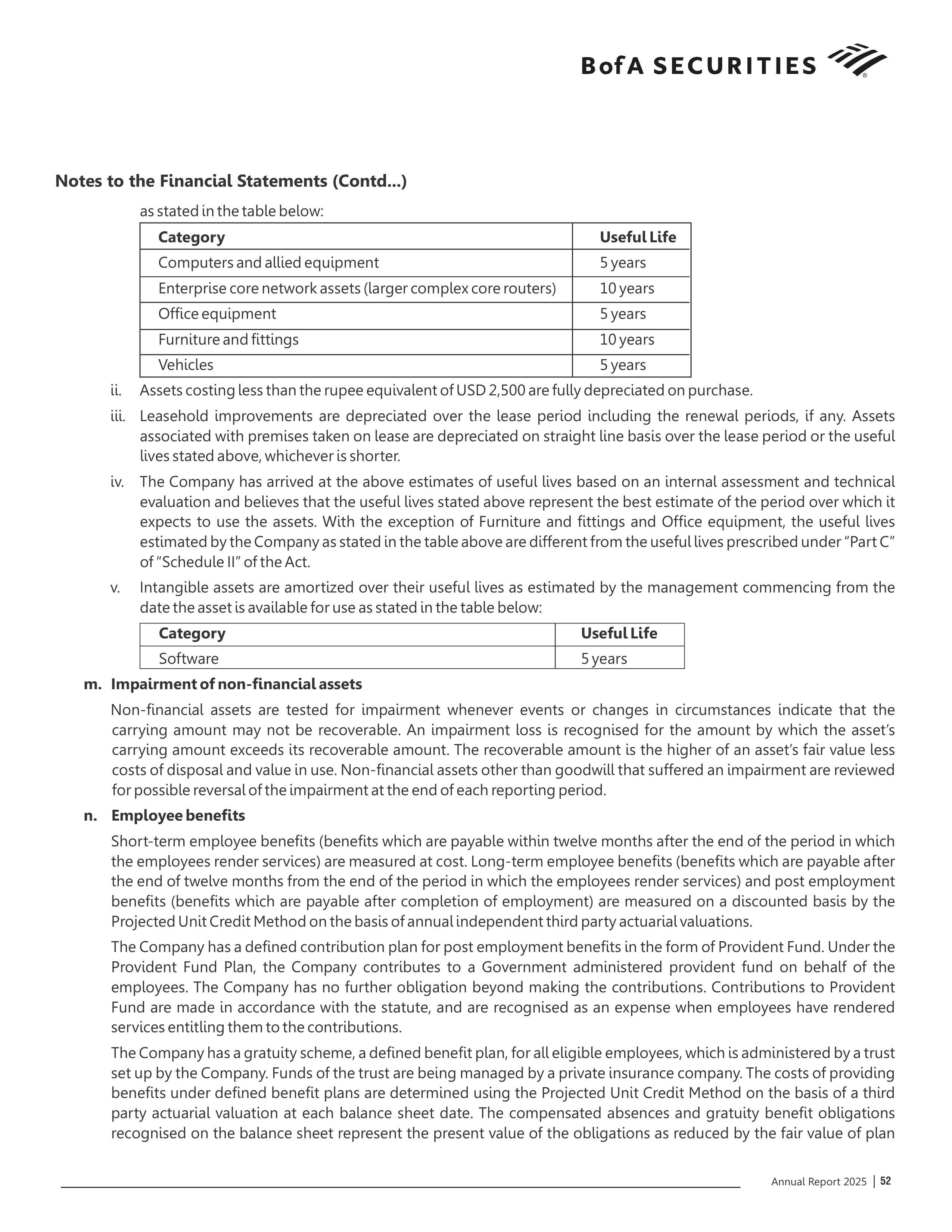
as stated in the table below:
Category
Useful Life
Computers and allied equipment
5 years
Enterprise core network assets (larger complex core routers)
10 years
Office equipment
5 years
Furniture and fittings
10 years
Vehicles
5 years
ii. Assets costing less than the rupee equivalent of USD 2,500 are fully depreciated on purchase.
iii. Leasehold improvements are depreciated over the lease period including the renewal periods, if any. Assets
associated with premises taken on lease are depreciated on straight line basis over the lease period or the useful
lives stated above, whichever is shorter.
iv. The Company has arrived at the above estimates of useful lives based on an internal assessment and technical
evaluation and believes that the useful lives stated above represent the best estimate of the period over which it
expects to use the assets. With the exception of Furniture and fittings and Office equipment, the useful lives
estimated by the Company as stated in the table above are different from the useful lives prescribed under “Part C”
of “Schedule II” of the Act.
v. Intangible assets are amortized over their useful lives as estimated by the management commencing from the
date the asset is available for use as stated in the table below:
Category
Useful Life
Software
5 years
m. Impairment of non-financial assets
Non-financial assets are tested for impairment whenever events or changes in circumstances indicate that the
carrying amount may not be recoverable. An impairment loss is recognised for the amount by which the asset’s
carrying amount exceeds its recoverable amount. The recoverable amount is the higher of an asset’s fair value less
costs of disposal and value in use. Non-financial assets other than goodwill that suffered an impairment are reviewed
for possible reversal of the impairment at the end of each reporting period.
n. Employee benefits
Short-term employee benefits (benefits which are payable within twelve months after the end of the period in which
the employees render services) are measured at cost. Long-term employee benefits (benefits which are payable after
the end of twelve months from the end of the period in which the employees render services) and post employment
benefits (benefits which are payable after completion of employment) are measured on a discounted basis by the
Projected Unit Credit Method on the basis of annual independent third party actuarial valuations.
The Company has a defined contribution plan for post employment benefits in the form of Provident Fund. Under the
Provident Fund Plan, the Company contributes to a Government administered provident fund on behalf of the
employees. The Company has no further obligation beyond making the contributions. Contributions to Provident
Fund are made in accordance with the statute, and are recognised as an expense when employees have rendered
services entitling them to the contributions.
The Company has a gratuity scheme, a defined benefit plan, for all eligible employees, which is administered by a trust
set up by the Company. Funds of the trust are being managed by a private insurance company. The costs of providing
benefits under defined benefit plans are determined using the Projected Unit Credit Method on the basis of a third
party actuarial valuation at each balance sheet date. The compensated absences and gratuity benefit obligations
recognised on the balance sheet represent the present value of the obligations as reduced by the fair value of plan
Notes to the Financial Statements (Contd...)
52
Annual Report 2025
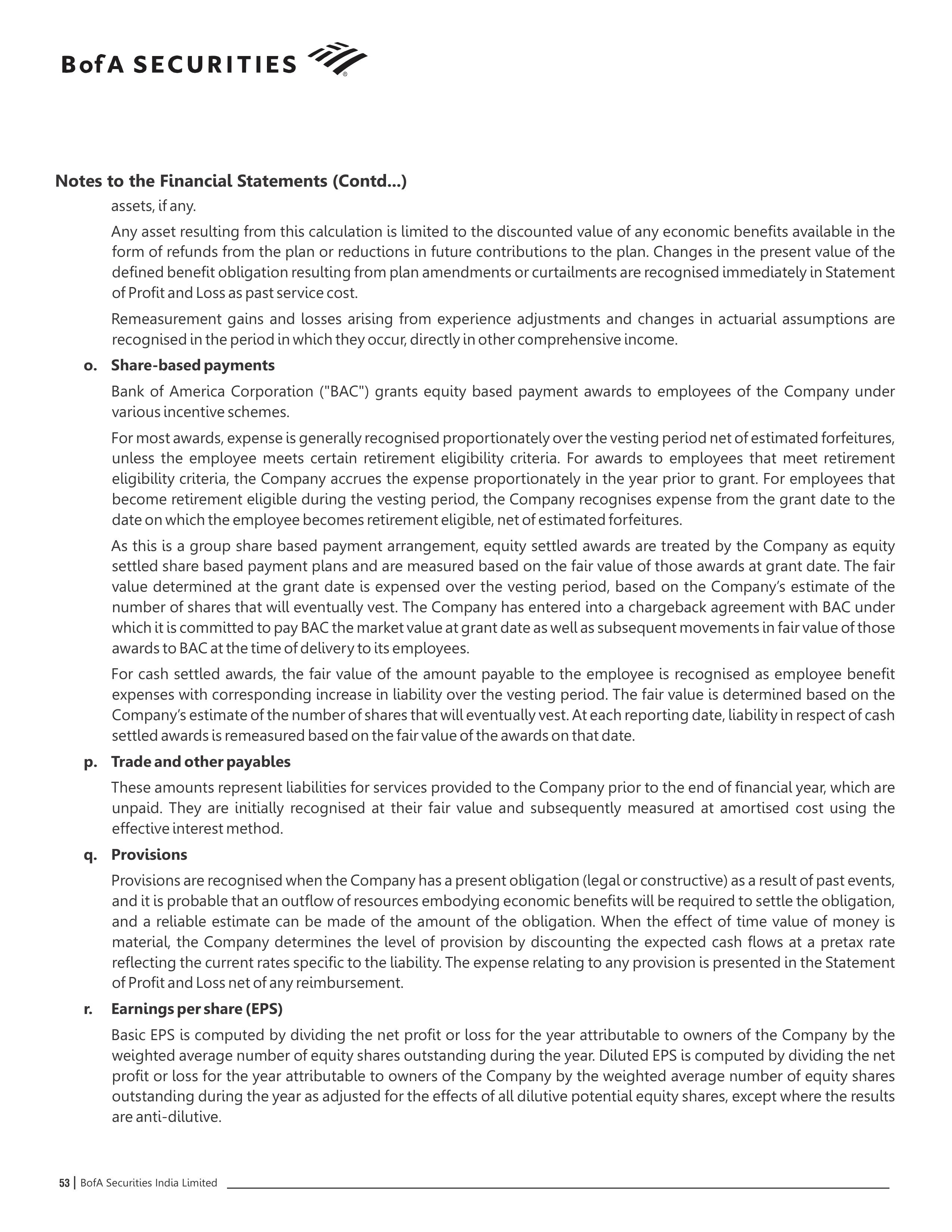
assets, if any.
Any asset resulting from this calculation is limited to the discounted value of any economic benefits available in the
form of refunds from the plan or reductions in future contributions to the plan. Changes in the present value of the
defined benefit obligation resulting from plan amendments or curtailments are recognised immediately in Statement
of Profit and Loss as past service cost.
Remeasurement gains and losses arising from experience adjustments and changes in actuarial assumptions are
recognised in the period in which they occur, directly in other comprehensive income.
o. Share-based payments
Bank of America Corporation ("BAC") grants equity based payment awards to employees of the Company under
various incentive schemes.
For most awards, expense is generally recognised proportionately over the vesting period net of estimated forfeitures,
unless the employee meets certain retirement eligibility criteria. For awards to employees that meet retirement
eligibility criteria, the Company accrues the expense proportionately in the year prior to grant. For employees that
become retirement eligible during the vesting period, the Company recognises expense from the grant date to the
date on which the employee becomes retirement eligible, net of estimated forfeitures.
As this is a group share based payment arrangement, equity settled awards are treated by the Company as equity
settled share based payment plans and are measured based on the fair value of those awards at grant date. The fair
value determined at the grant date is expensed over the vesting period, based on the Company’s estimate of the
number of shares that will eventually vest. The Company has entered into a chargeback agreement with BAC under
which it is committed to pay BAC the market value at grant date as well as subsequent movements in fair value of those
awards to BAC at the time of delivery to its employees.
For cash settled awards, the fair value of the amount payable to the employee is recognised as employee benefit
expenses with corresponding increase in liability over the vesting period. The fair value is determined based on the
Company’s estimate of the number of shares that will eventually vest. At each reporting date, liability in respect of cash
settled awards is remeasured based on the fair value of the awards on that date.
p. Trade and other payables
These amounts represent liabilities for services provided to the Company prior to the end of financial year, which are
unpaid. They are initially recognised at their fair value and subsequently measured at amortised cost using the
effective interest method.
q. Provisions
Provisions are recognised when the Company has a present obligation (legal or constructive) as a result of past events,
and it is probable that an outflow of resources embodying economic benefits will be required to settle the obligation,
and a reliable estimate can be made of the amount of the obligation. When the effect of time value of money is
material, the Company determines the level of provision by discounting the expected cash flows at a pretax rate
reflecting the current rates specific to the liability. The expense relating to any provision is presented in the Statement
of Profit and Loss net of any reimbursement.
r. Earnings per share (EPS)
Basic EPS is computed by dividing the net profit or loss for the year attributable to owners of the Company by the
weighted average number of equity shares outstanding during the year. Diluted EPS is computed by dividing the net
profit or loss for the year attributable to owners of the Company by the weighted average number of equity shares
outstanding during the year as adjusted for the effects of all dilutive potential equity shares, except where the results
are anti-dilutive.
Notes to the Financial Statements (Contd...)
53
BofA Securities India Limited
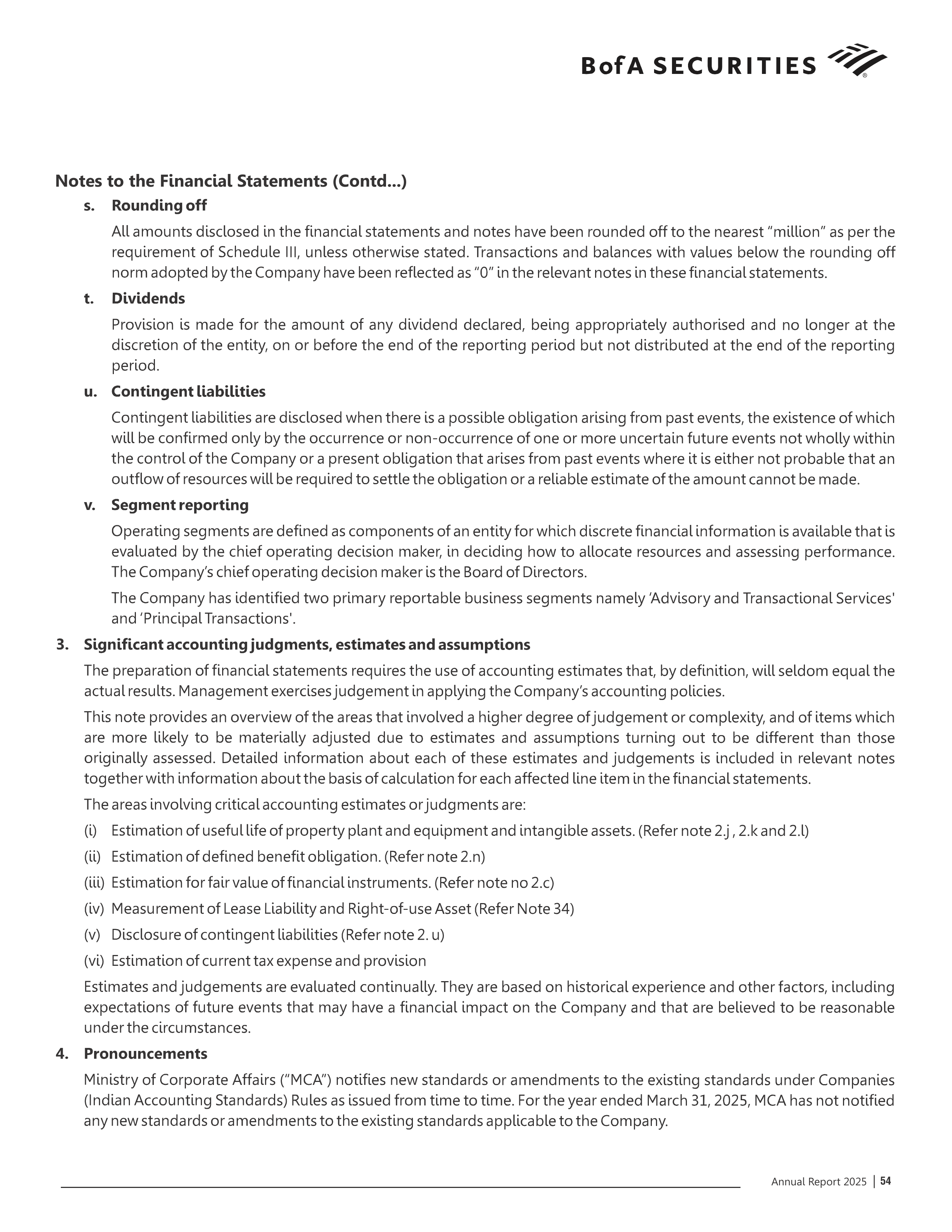
Notes to the Financial Statements (Contd...)
54
Annual Report 2025
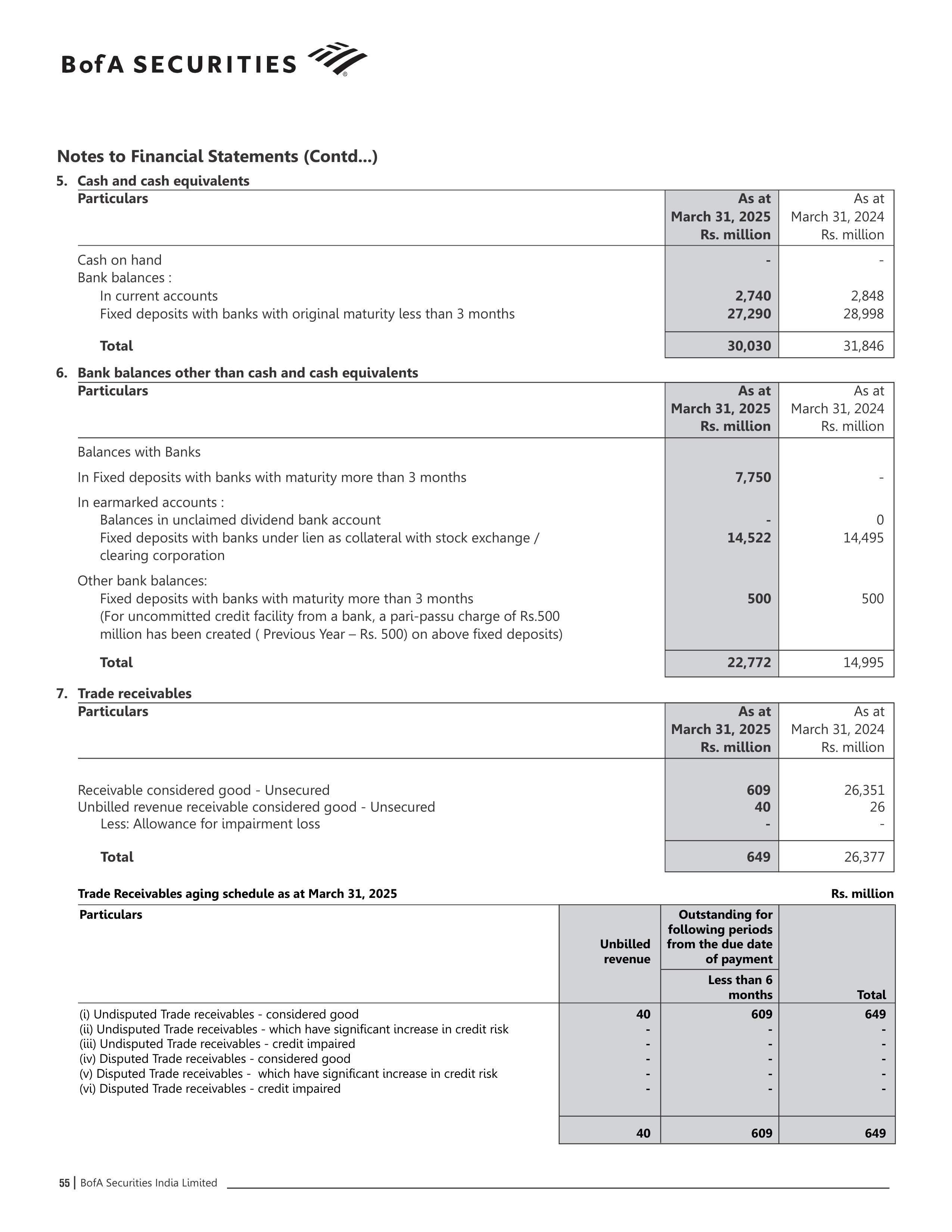
Notes to Financial Statements (Contd...)
5. Cash and cash equivalents
Particulars
As at
As at
March 31, 2025
March 31, 2024
Rs. million
Rs. million
Cash on hand
-
-
Bank balances :
In current accounts
2,848
2,740
Fixed deposits with banks with original maturity less than 3 months
28,998
27,290
Total
30,030
31,846
6. Bank balances other than cash and cash equivalents
Particulars
As at
As at
March 31, 2025
March 31, 2024
Rs. million
Rs. million
Balances with Banks
In Fixed deposits with banks with maturity more than 3 months
-
7,750
In earmarked accounts :
Balances in unclaimed dividend bank account
0
-
Fixed deposits with banks under lien as collateral with stock exchange /
14,495
14,522
clearing corporation
Other bank balances:
Fixed deposits with banks with maturity more than 3 months
500
500
(For uncommitted credit facility from a bank, a pari-passu charge of Rs.500
million has been created ( Previous Year – Rs. 500) on above fixed deposits)
Total
22,772
14,995
7. Trade receivables
Particulars
As at
As at
March 31, 2025
March 31, 2024
Rs. million
Rs. million
Receivable considered good - Unsecured
26,351
609
Unbilled revenue receivable considered good - Unsecured
26
40
Less: Allowance for impairment loss
-
-
Total
649
26,377
Particulars
Outstanding for
following periods
Unbilled
from the due date
revenue
of payment
Less than 6
months
Total
(i) Undisputed Trade receivables - considered good
40
609
649
(ii) Undisputed Trade receivables - which have significant increase in credit risk
-
-
-
(iii) Undisputed Trade receivables - credit impaired
-
-
-
(iv) Disputed Trade receivables - considered good
-
-
-
(v) Disputed Trade receivables - which have significant increase in credit risk
-
-
-
(vi) Disputed Trade receivables - credit impaired
-
-
-
40
609 649
Trade Receivables aging schedule as at March 31, 2025
Rs. million
55
BofA Securities India Limited
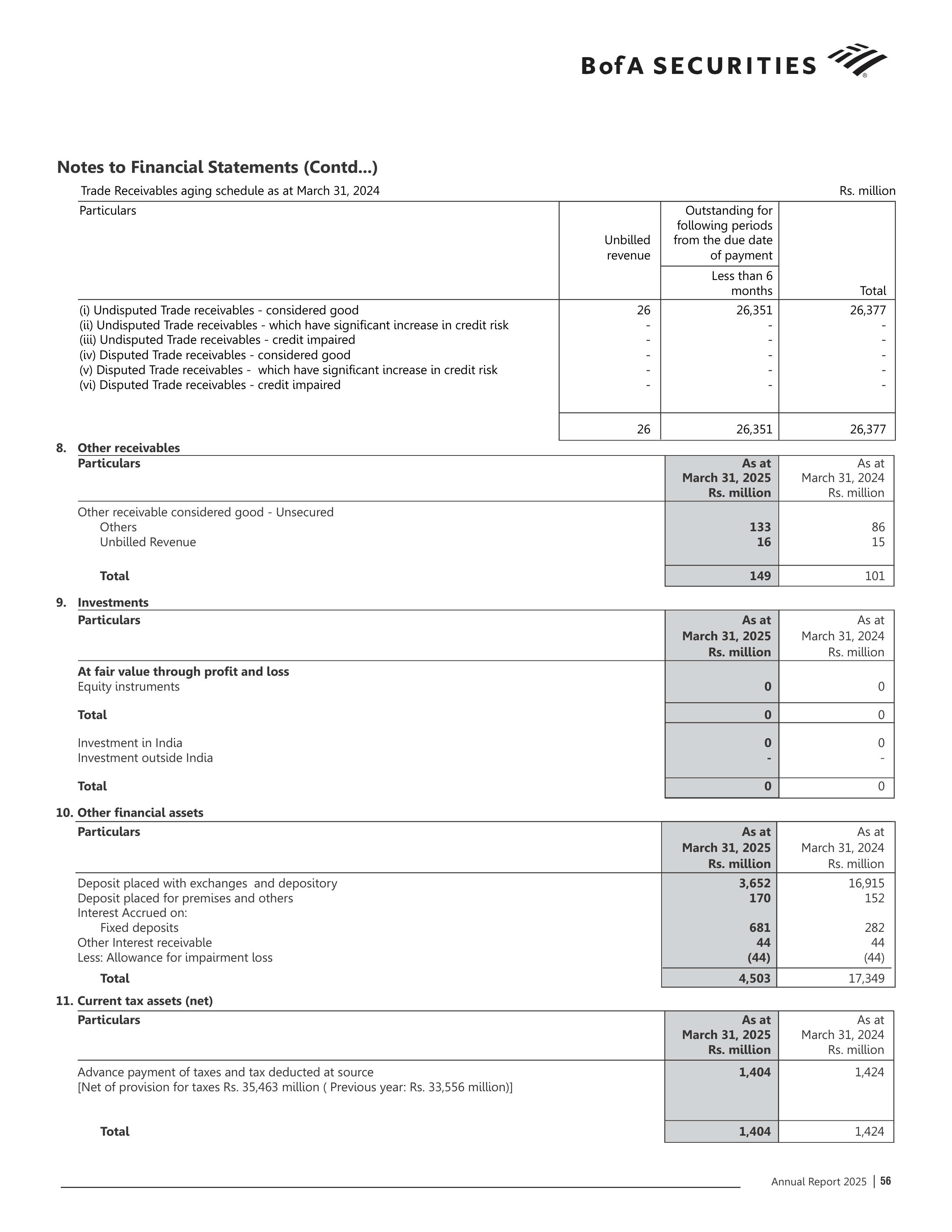
9. Investments
Particulars
As at
As at
March 31, 2025
March 31, 2024
Rs. million
Rs. million
At fair value through profit and loss
Equity instruments
0
0
Total
0
0
Investment in India
0
0
Investment outside India
-
-
Total
0
0
8. Other receivables
Particulars
As at
As at
March 31, 2025
March 31, 2024
Rs. million
Rs. million
Other receivable considered good - Unsecured
Others
86
133
Unbilled Revenue
15
16
Total
149
101
11. Current tax assets (net)
Particulars
As at
As at
March 31, 2025
March 31, 2024
Rs. million
Rs. million
Advance payment of taxes and tax deducted at source
1,424
1,404
[Net of provision for taxes Rs. 35,463 million ( Previous year: Rs. 33,556 million)]
1,424
Total
1,404
10. Other financial assets
Particulars
As at
As at
March 31, 2025
March 31, 2024
Rs. million
Rs. million
Deposit placed with exchanges and depository
16,915
3,652
Deposit placed for premises and others
152
170
Interest Accrued on:
Fixed deposits
282
681
Other Interest receivable
44
44
Less: Allowance for impairment loss
(44)
(44)
17,349
Total
4,503
Notes to Financial Statements (Contd...)
Particulars
Outstanding for
following periods
Unbilled
from the due date
revenue
of payment
Less than 6
months
Total
(i) Undisputed Trade receivables - considered good
26
26,351
26,377
(ii) Undisputed Trade receivables - which have significant increase in credit risk
-
-
-
(iii) Undisputed Trade receivables - credit impaired
-
-
-
(iv) Disputed Trade receivables - considered good
-
-
-
(v) Disputed Trade receivables - which have significant increase in credit risk
-
-
-
(vi) Disputed Trade receivables - credit impaired
-
-
-
26
26,351
26,377
Trade Receivables aging schedule as at March 31, 2024
Rs. million
56
Annual Report 2025
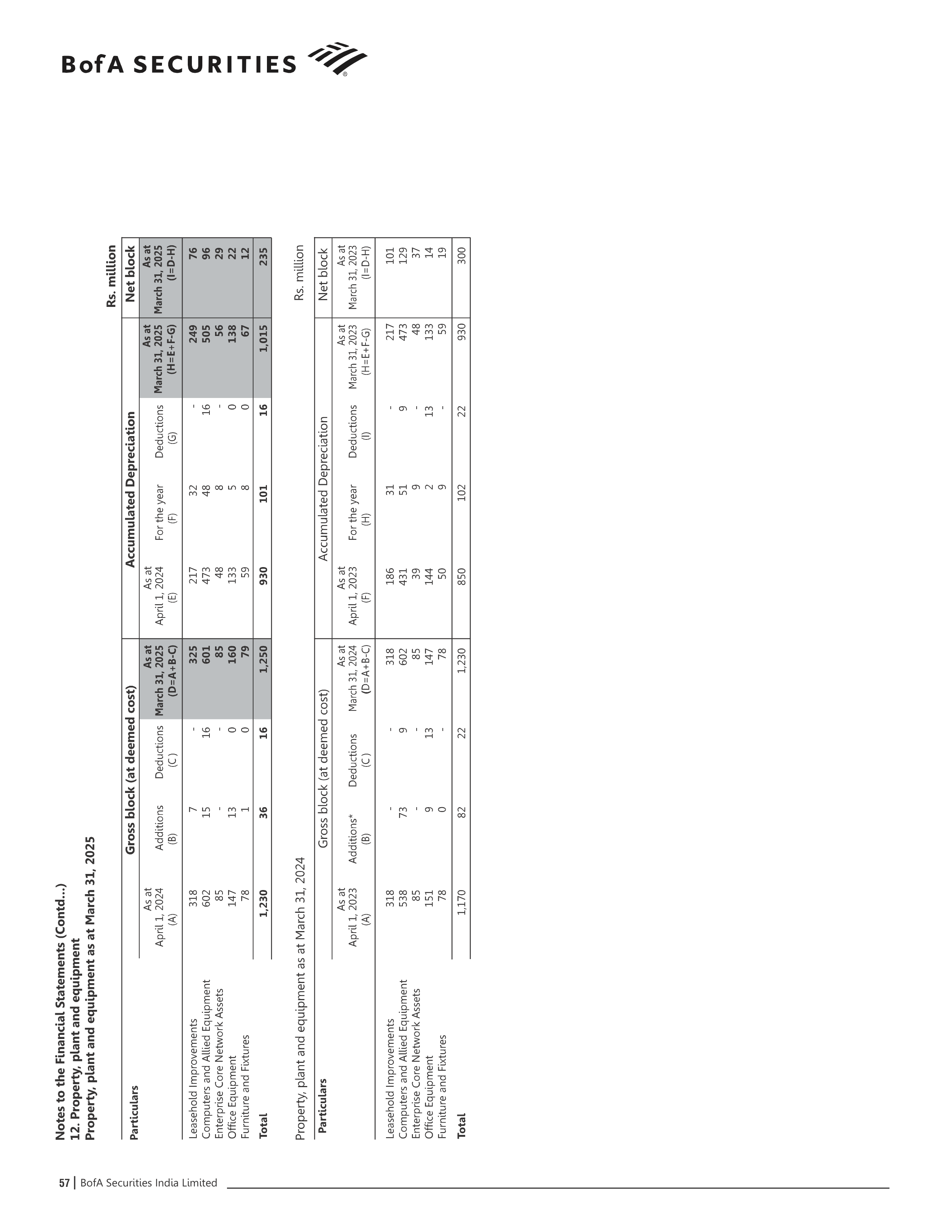
57
BofA Securities India Limited
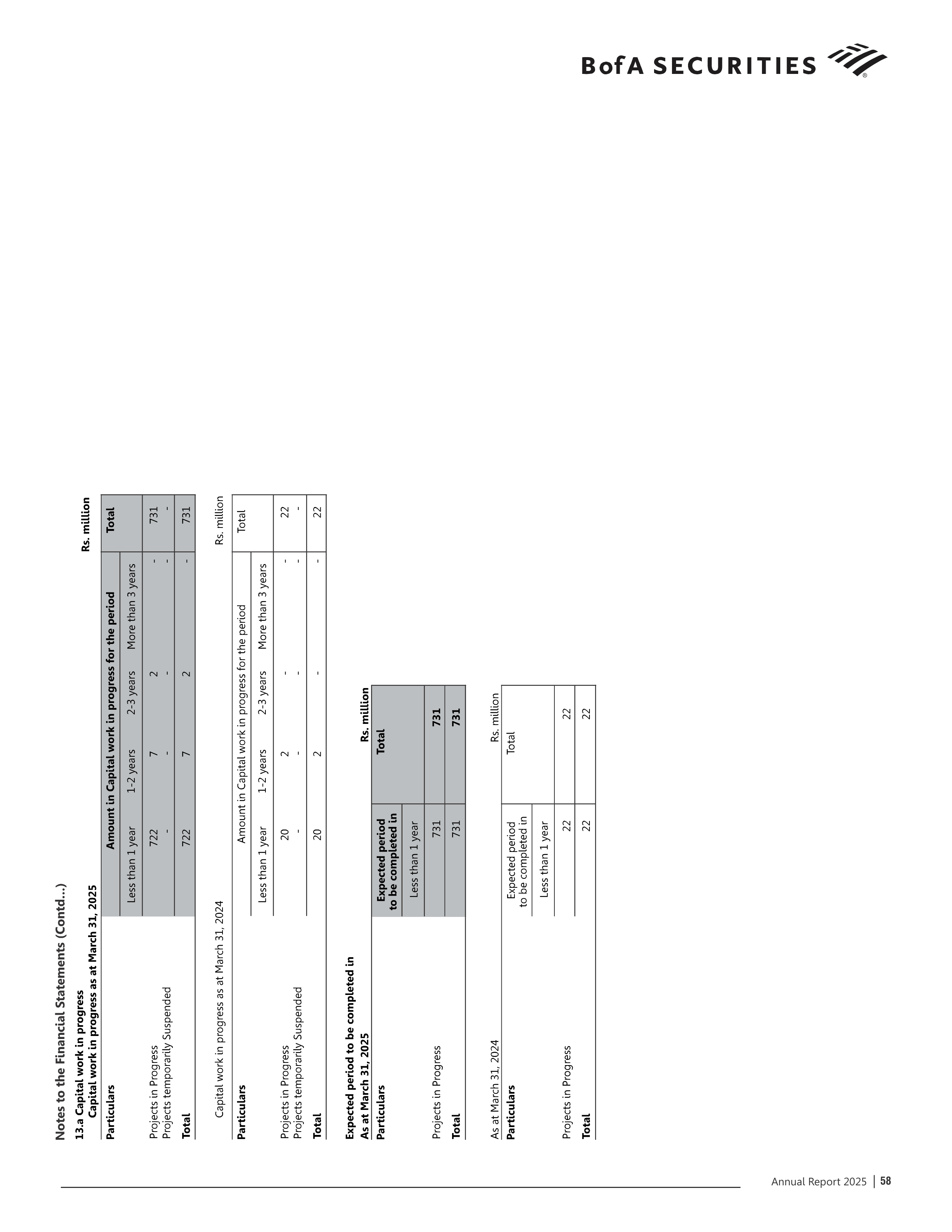
58
Annual Report 2025
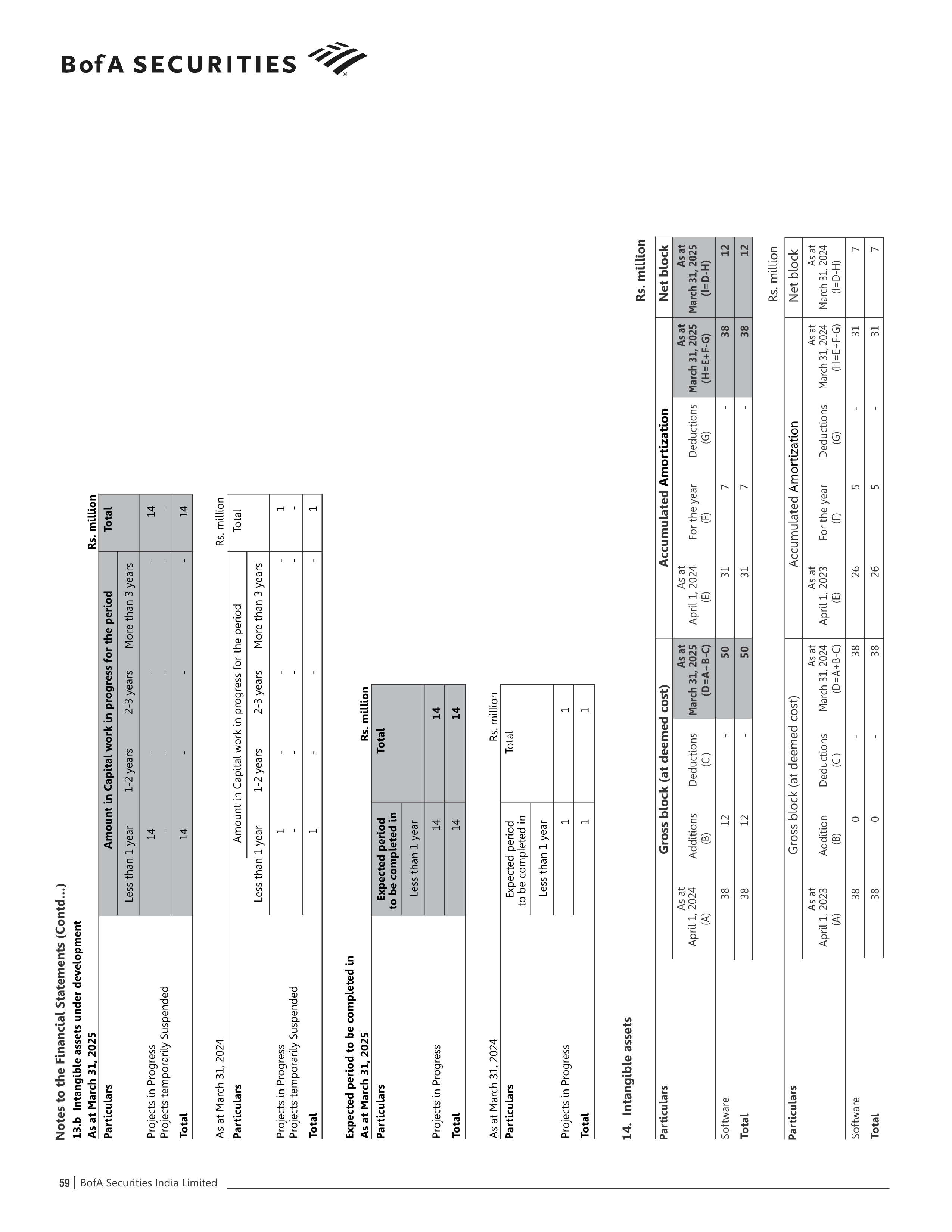
59
BofA Securities India Limited
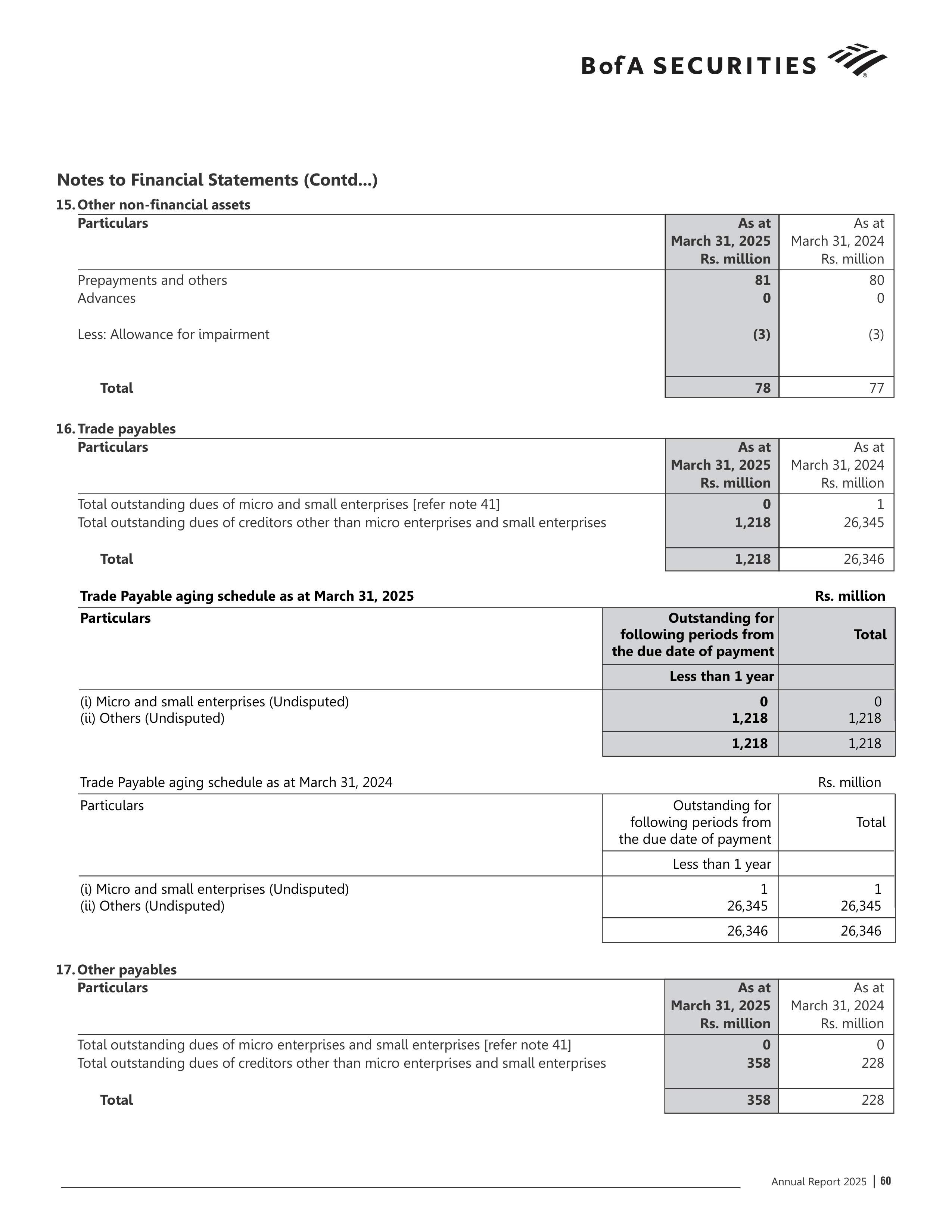
Notes to Financial Statements (Contd...)
15. Other non-financial assets
Particulars
As at
As at
March 31, 2025
March 31, 2024
Rs. million
Rs. million
Prepayments and others
80
81
Advances
0
0
Less: Allowance for impairment
(3)
(3)
77
Total
78
16. Trade payables
Particulars
As at
As at
March 31, 2025
March 31, 2024
Rs. million
Rs. million
Total outstanding dues of micro and small enterprises [refer note 41]
1
0
Total outstanding dues of creditors other than micro enterprises and small enterprises
26,345
1,218
26,346
Total
1,218
Trade Payable aging schedule as at March 31, 2025
Rs. million
Particulars
Outstanding for
following periods from
Total
the due date of payment
Less than 1 year
(i) Micro and small enterprises (Undisputed)
0
0
(ii) Others (Undisputed)
1,218
1,218
1,218
1,218
60
Annual Report 2025
Trade Payable aging schedule as at March 31, 2024
Rs. million
Particulars
Outstanding for
following periods from
Total
the due date of payment
Less than 1 year
(i) Micro and small enterprises (Undisputed)
1
1
(ii) Others (Undisputed)
26,345
26,345
26,346
26,346
17. Other payables
Particulars
As at
As at
March 31, 2025
March 31, 2024
Rs. million
Rs. million
Total outstanding dues of micro enterprises and small enterprises [refer note 41]
0
0
Total outstanding dues of creditors other than micro enterprises and small enterprises
228
358
228
Total
358
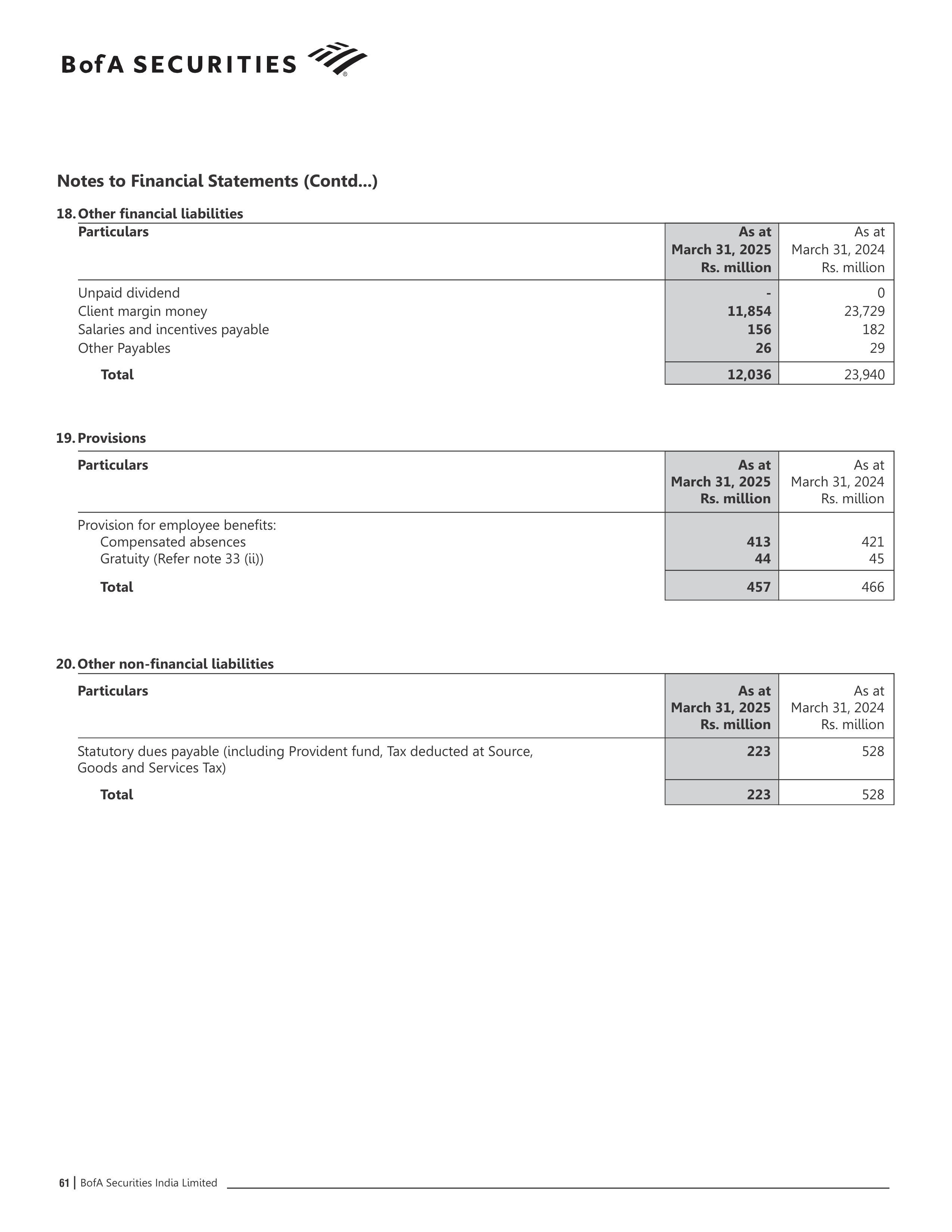
Notes to Financial Statements (Contd...)
19. Provisions
Particulars
As at
As at
March 31, 2025
March 31, 2024
Rs. million
Rs. million
Provision for employee benefits:
Compensated absences
421
413
Gratuity (Refer note 33 (ii))
45
44
466
Total
457
20. Other non-financial liabilities
Particulars
As at
As at
March 31, 2025
March 31, 2024
Rs. million
Rs. million
Statutory dues payable (including Provident fund, Tax deducted at Source,
528
223
Goods and Services Tax)
528
Total
223
18. Other financial liabilities
Particulars
As at
As at
March 31, 2025
March 31, 2024
Rs. million
Rs. million
Unpaid dividend
0
-
Client margin money
23,729
11,854
Salaries and incentives payable
182
156
Other Payables
29
26
23,940
Total
12,036
61
BofA Securities India Limited
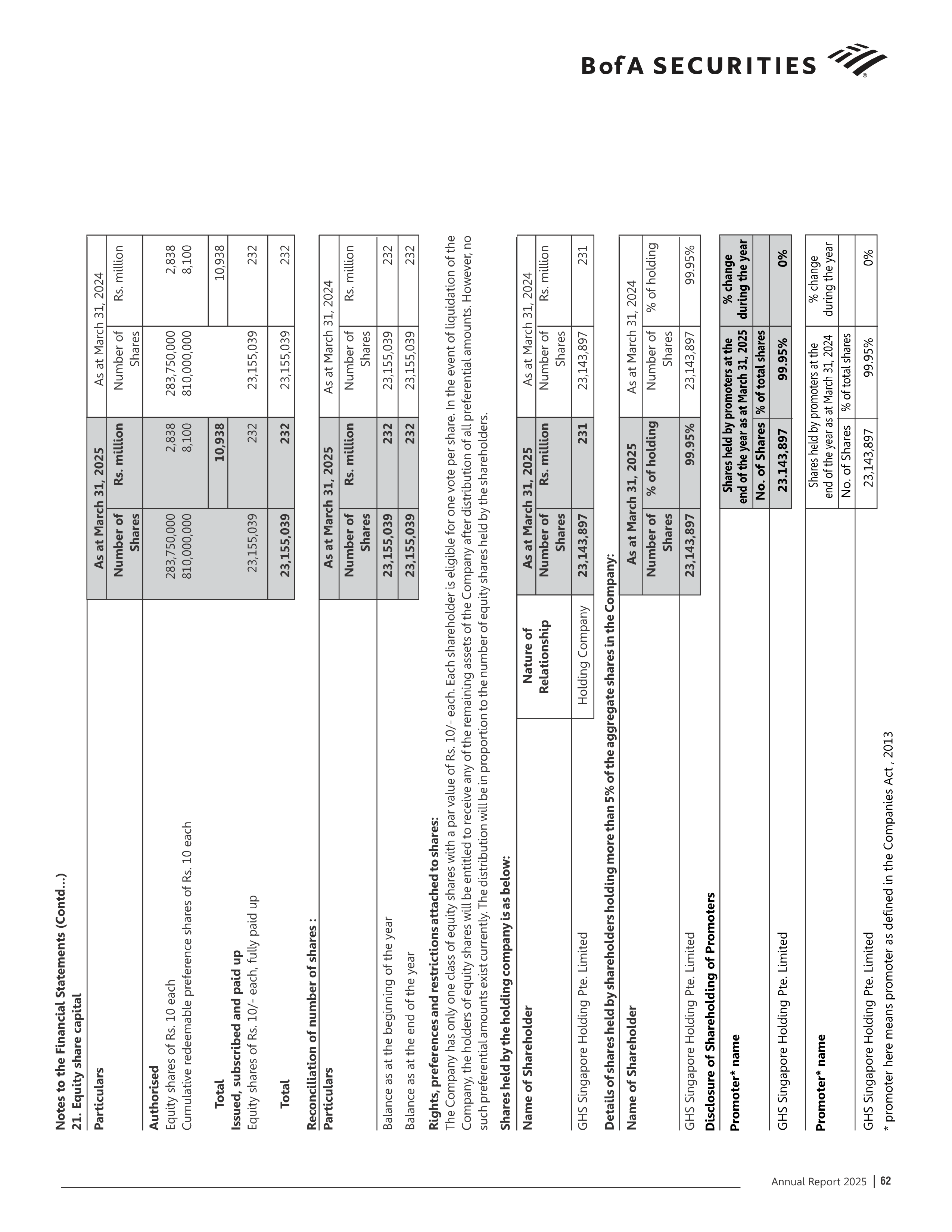
62
Annual Report 2025
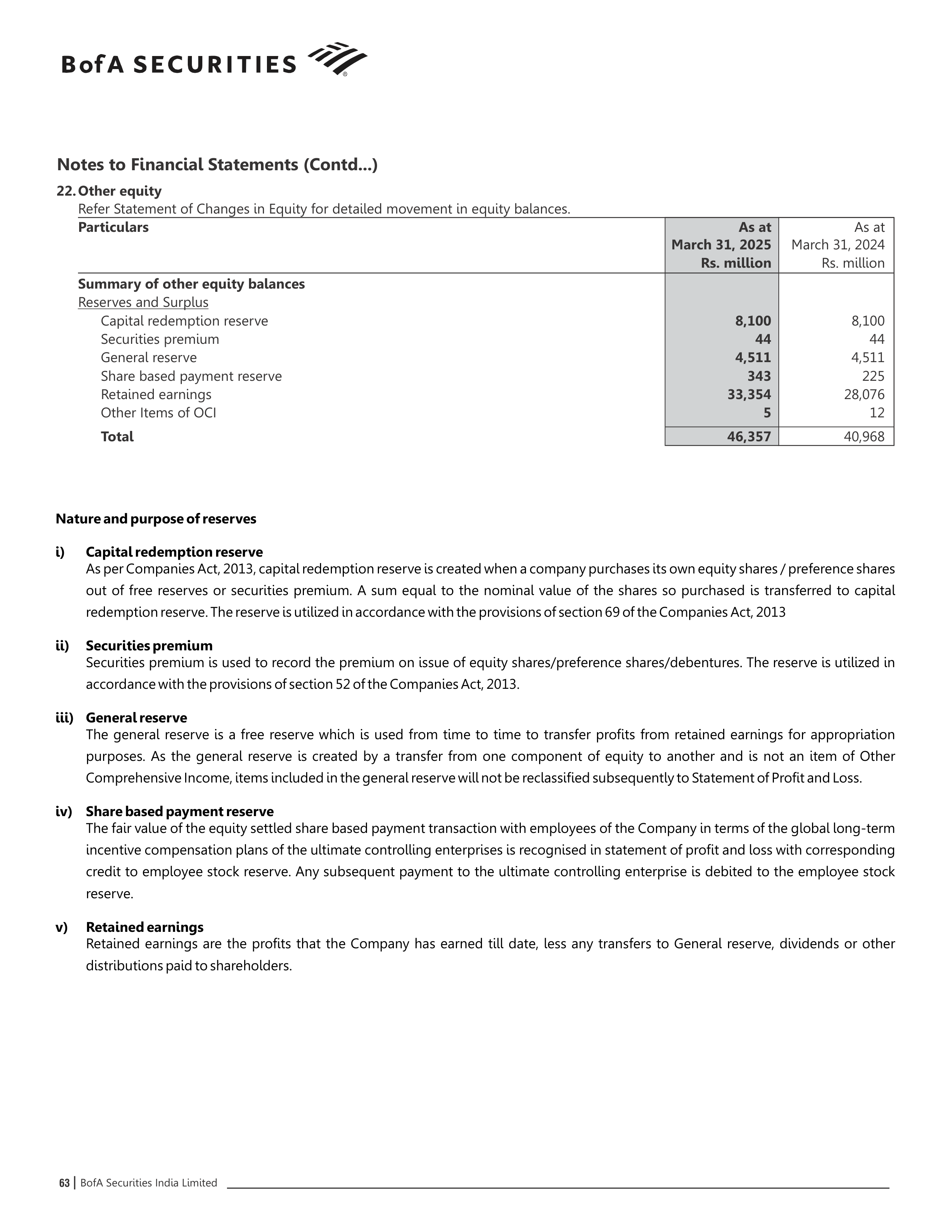
Notes to Financial Statements (Contd...)
22. Other equity
Refer Statement of Changes in Equity for detailed movement in equity balances.
Particulars
As at
As at
March 31, 2025
March 31, 2024
Rs. million
Rs. million
Summary of other equity balances
Reserves and Surplus
Capital redemption reserve
8,100
8,100
Securities premium
44
44
General reserve
4,511
4,511
Share based payment reserve
225
343
Retained earnings
28,076
33,354
Other Items of OCI
12
5
40,968
Total
46,357
Nature and purpose of reserves
i)
Capital redemption reserve
As per Companies Act, 2013, capital redemption reserve is created when a company purchases its own equity shares / preference shares
out of free reserves or securities premium. A sum equal to the nominal value of the shares so purchased is transferred to capital
redemption reserve. The reserve is utilized in accordance with the provisions of section 69 of the Companies Act, 2013
ii)
Securities premium
Securities premium is used to record the premium on issue of equity shares/preference shares/debentures. The reserve is utilized in
accordance with the provisions of section 52 of the Companies Act, 2013.
iii) General reserve
The general reserve is a free reserve which is used from time to time to transfer profits from retained earnings for appropriation
purposes. As the general reserve is created by a transfer from one component of equity to another and is not an item of Other
Comprehensive Income, items included in the general reserve will not be reclassified subsequently to Statement of Profit and Loss.
iv) Share based payment reserve
The fair value of the equity settled share based payment transaction with employees of the Company in terms of the global long-term
incentive compensation plans of the ultimate controlling enterprises is recognised in statement of profit and loss with corresponding
credit to employee stock reserve. Any subsequent payment to the ultimate controlling enterprise is debited to the employee stock
reserve.
v)
Retained earnings
Retained earnings are the profits that the Company has earned till date, less any transfers to General reserve, dividends or other
distributions paid to shareholders.
63
BofA Securities India Limited
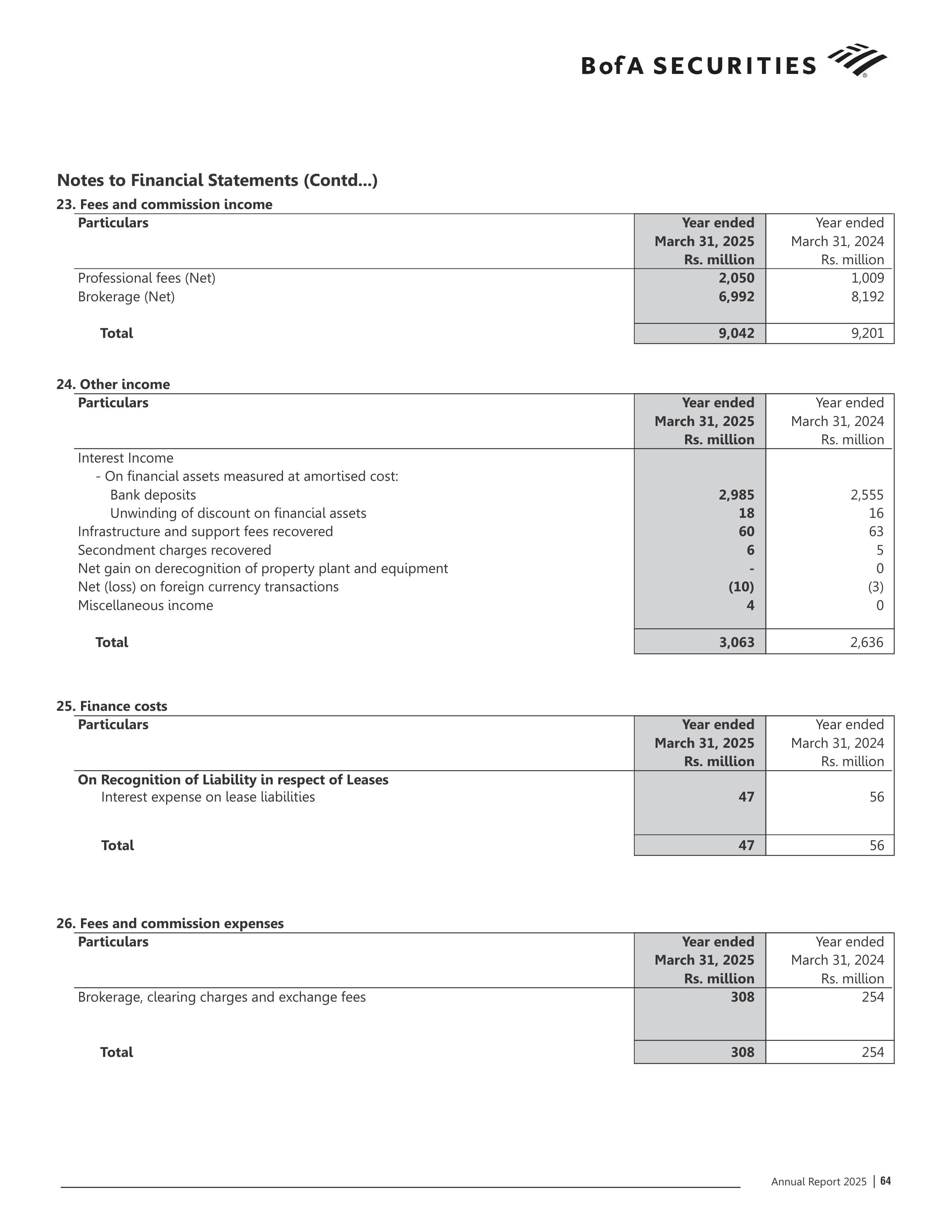
23. Fees and commission income
Particulars
Year ended
Year ended
March 31, 2025
March 31, 2024
Rs. million
Rs. million
2,050
Professional fees (Net)
1,009
Brokerage (Net)
8,192
6,992
9,201
Total
9,042
Notes to Financial Statements (Contd...)
24. Other income
Particulars
Year ended
Year ended
March 31, 2025
March 31, 2024
Rs. million
Rs. million
Interest Income
- On financial assets measured at amortised cost:
Bank deposits
2,555
2,985
Unwinding of discount on financial assets
16
18
Infrastructure and support fees recovered
63
60
Secondment charges recovered
5
6
Net gain on derecognition of property plant and equipment
0
-
Net (loss) on foreign currency transactions
(3)
(10)
Miscellaneous income
0
4
Total
3,063
2,636
25. Finance costs
Particulars
Year ended
Year ended
March 31, 2025
March 31, 2024
Rs. million
Rs. million
On Recognition of Liability in respect of Leases
Interest expense on lease liabilities
56
47
56
Total
47
26. Fees and commission expenses
Particulars
Year ended
Year ended
March 31, 2025
March 31, 2024
Rs. million
Rs. million
308
Brokerage, clearing charges and exchange fees
254
254
Total
308
64
Annual Report 2025
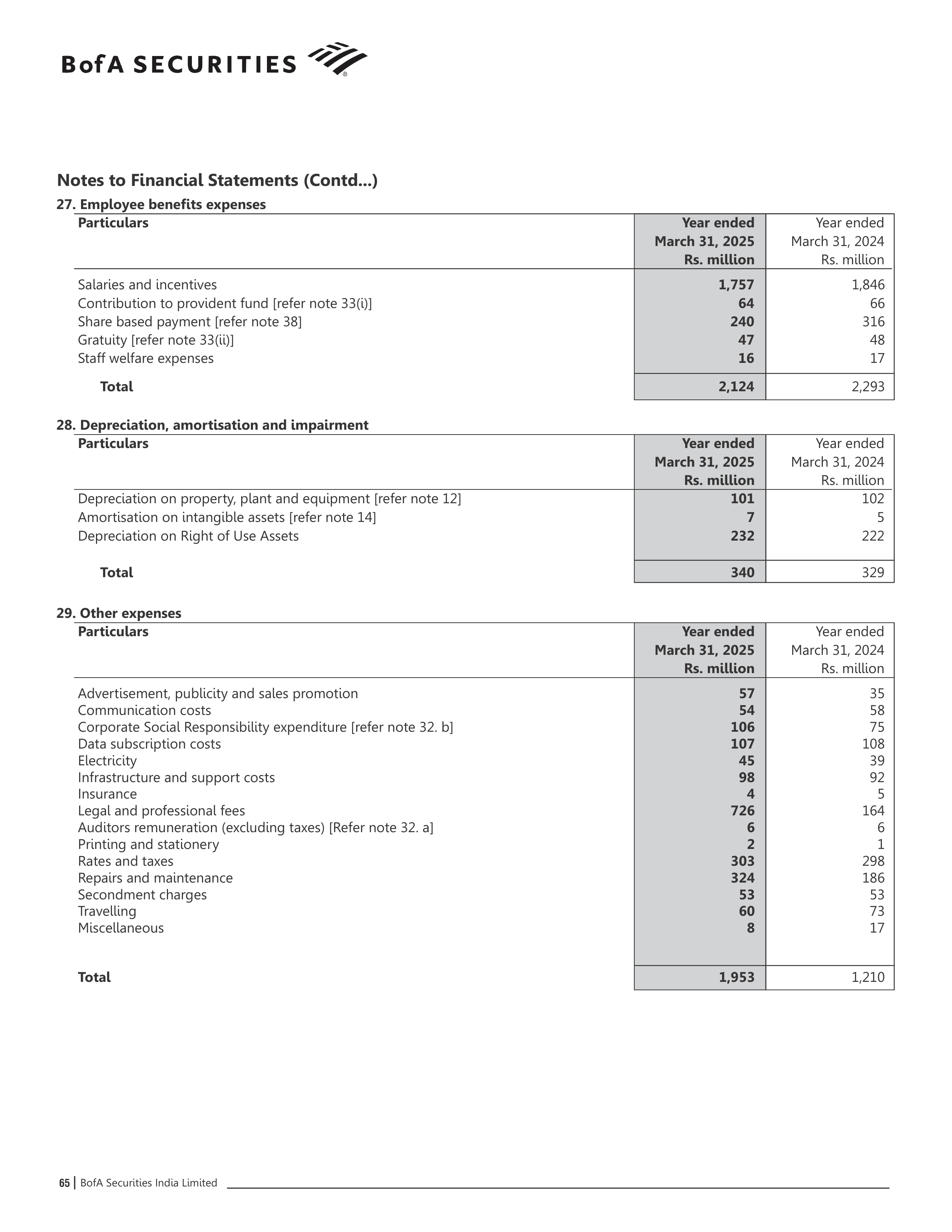
Notes to Financial Statements (Contd...)
27. Employee benefits expenses
Particulars
Year ended
Year ended
March 31, 2025
March 31, 2024
Rs. million
Rs. million
Salaries and incentives
1,846
1,757
Contribution to provident fund [refer note 33(i)]
66
64
Share based payment [refer note 38]
316
240
Gratuity [refer note 33(ii)]
48
47
Staff welfare expenses
17
16
Total
2,124
2,293
28. Depreciation, amortisation and impairment
Particulars
Year ended
Year ended
March 31, 2025
March 31, 2024
Rs. million
Rs. million
101
Depreciation on property, plant and equipment [refer note 12]
102
Amortisation on intangible assets [refer note 14]
5
7
Depreciation on Right of Use Assets
222
232
329
Total
340
29. Other expenses
Particulars
Year ended
Year ended
March 31, 2025
March 31, 2024
Rs. million
Rs. million
Advertisement, publicity and sales promotion
35
57
Communication costs
58
54
Corporate Social Responsibility expenditure [refer note 32. b]
75
106
Data subscription costs
108
107
Electricity
39
45
Infrastructure and support costs
92
98
Insurance
5
4
Legal and professional fees
164
726
Auditors remuneration (excluding taxes) [Refer note 32. a]
6
6
Printing and stationery
1
2
Rates and taxes
298
303
Repairs and maintenance
186
324
Secondment charges
53
53
Travelling
73
60
Miscellaneous
17
8
Total
1,953
1,210
65
BofA Securities India Limited
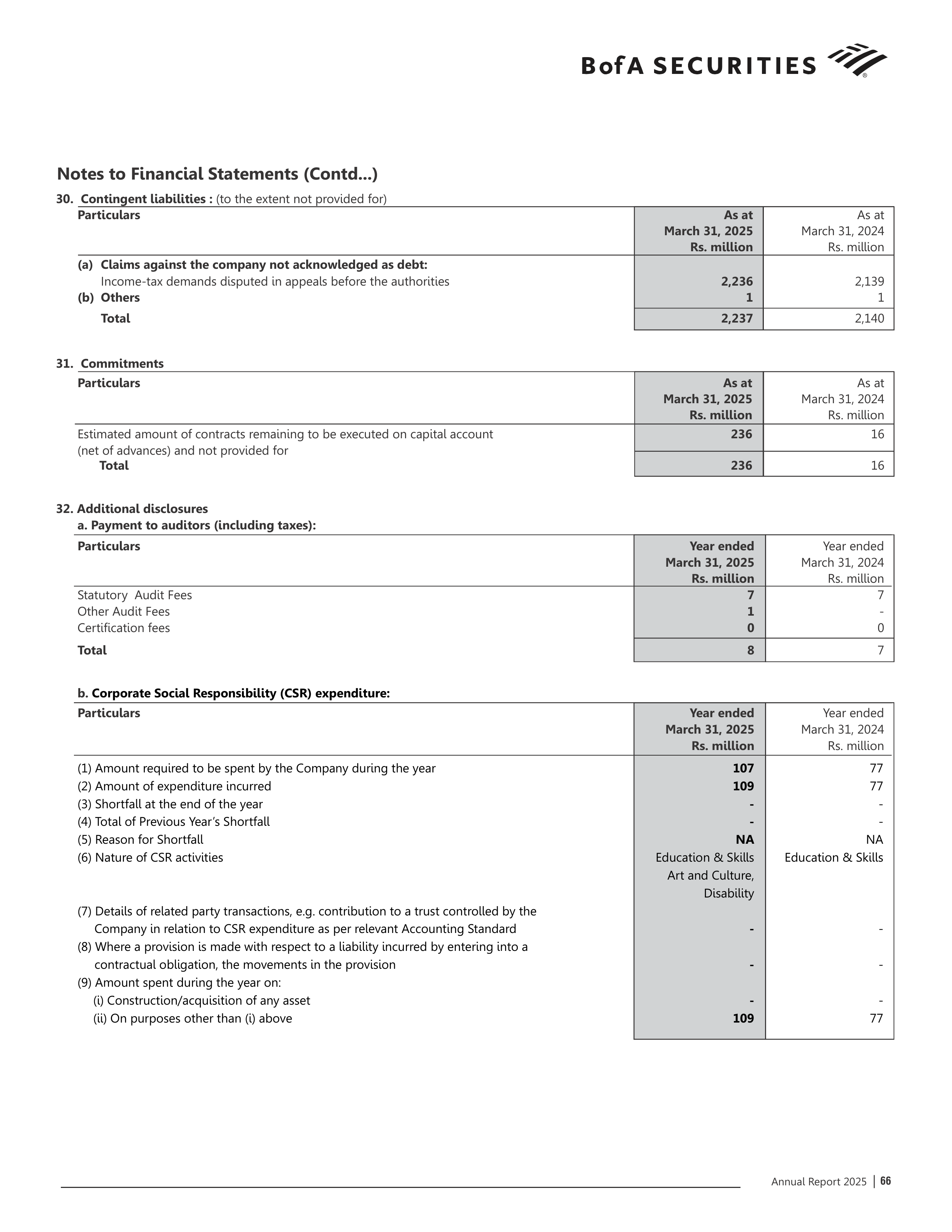
31. Commitments
Particulars
As at
As at
March 31, 2025
March 31, 2024
Rs. million
Rs. million
Estimated amount of contracts remaining to be executed on capital account
16
236
(net of advances) and not provided for
16
Total
236
32. Additional disclosures
a. Payment to auditors (including taxes):
Particulars
Year ended
Year ended
March 31, 2025
March 31, 2024
Rs. million
Rs. million
7
Statutory Audit Fees
7
Other Audit Fees
-
1
Certification fees
0
0
7
Total
8
b.
Corporate Social Responsibility (CSR) expenditure:
Particulars
Year ended
Year ended
March 31, 2025
March 31, 2024
Rs. million
Rs. million
(1) Amount required to be spent by the Company during the year
77
107
(2) Amount of expenditure incurred
77
109
(3) Shortfall at the end of the year
-
-
(4) Total of Previous Year’s Shortfall
-
-
(5) Reason for Shortfall
NA
NA
(6) Nature of CSR activities
Education & Skills
Education & Skills
Art and Culture,
Disability
(7) Details of related party transactions, e.g. contribution to a trust controlled by the
Company in relation to CSR expenditure as per relevant Accounting Standard
-
-
(8) Where a provision is made with respect to a liability incurred by entering into a
contractual obligation, the movements in the provision
-
-
(9) Amount spent during the year on:
(i) Construction/acquisition of any asset
-
-
(ii) On purposes other than (i) above
77
109
Notes to Financial Statements (Contd...)
30. Contingent liabilities :
(to the extent not provided for)
Particulars
As at
As at
March 31, 2025
March 31, 2024
Rs. million
Rs. million
(a) Claims against the company not acknowledged as debt:
Income-tax demands disputed in appeals before the authorities
2,139
2,236
1
(b) Others
1
2,140
Total
2,237
66
Annual Report 2025
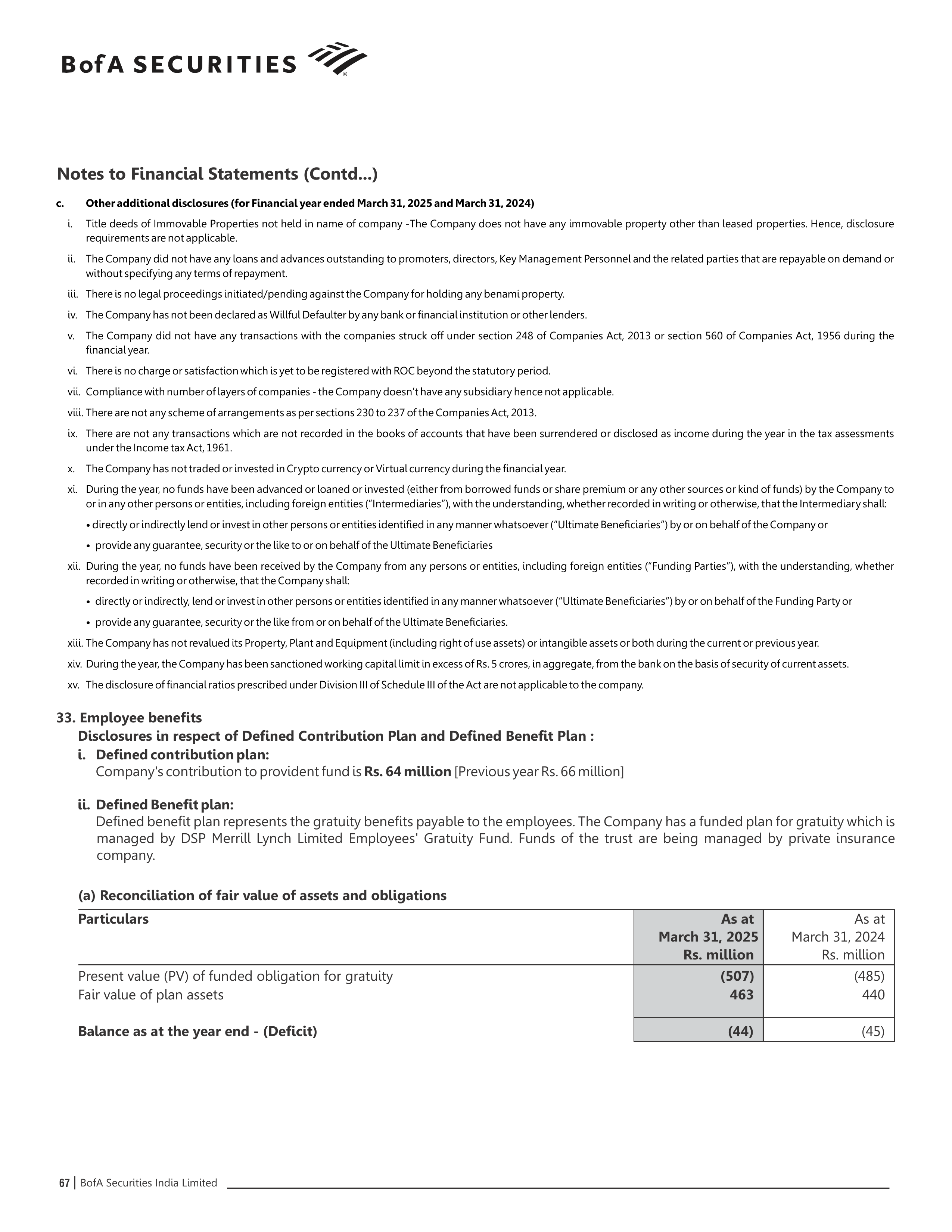
c.
Other additional disclosures (for Financial year ended March 31, 2025 and March 31, 2024)
i.
Title deeds of Immovable Properties not held in name of company -The Company does not have any immovable property other than leased properties. Hence, disclosure
requirements are not applicable.
ii. The Company did not have any loans and advances outstanding to promoters, directors, Key Management Personnel and the related parties that are repayable on demand or
without specifying any terms of repayment.
iii. There is no legal proceedings initiated/pending against the Company for holding any benami property.
iv. The Company has not been declared as Willful Defaulter by any bank or financial institution or other lenders.
v. The Company did not have any transactions with the companies struck off under section 248 of Companies Act, 2013 or section 560 of Companies Act, 1956 during the
financial year.
vi. There is no charge or satisfaction which is yet to be registered with ROC beyond the statutory period.
vii. Compliance with number of layers of companies - the Company doesn’t have any subsidiary hence not applicable.
viii. There are not any scheme of arrangements as per sections 230 to 237 of the Companies Act, 2013.
ix. There are not any transactions which are not recorded in the books of accounts that have been surrendered or disclosed as income during the year in the tax assessments
under the Income tax Act, 1961.
x. The Company has not traded or invested in Crypto currency or Virtual currency during the financial year.
xi. During the year, no funds have been advanced or loaned or invested (either from borrowed funds or share premium or any other sources or kind of funds) by the Company to
or in any other persons or entities, including foreign entities (“Intermediaries”), with the understanding, whether recorded in writing or otherwise, that the Intermediary shall:
•
directly or indirectly lend or invest in other persons or entities identified in any manner whatsoever (“Ultimate Beneficiaries”) by or on behalf of the Company or
•
provide any guarantee, security or the like to or on behalf of the Ultimate Beneficiaries
xii. During the year, no funds have been received by the Company from any persons or entities, including foreign entities (“Funding Parties”), with the understanding, whether
recorded in writing or otherwise, that the Company shall:
•
directly or indirectly, lend or invest in other persons or entities identified in any manner whatsoever (“Ultimate Beneficiaries”) by or on behalf of the Funding Party or
•
provide any guarantee, security or the like from or on behalf of the Ultimate Beneficiaries.
xiii. The Company has not revalued its Property, Plant and Equipment (including right of use assets) or intangible assets or both during the current or previous year.
xiv. During the year, the Company has been sanctioned working capital limit in excess of Rs. 5 crores, in aggregate, from the bank on the basis of security of current assets.
xv. The disclosure of financial ratios prescribed under Division III of Schedule III of the Act are not applicable to the company.
Notes to Financial Statements (Contd...)
33. Employee benefits
Disclosures in respect of Defined Contribution Plan and Defined Benefit Plan :
i. Defined contribution plan:
Company's contribution to provident fund is
[Previous year Rs. 66 million]
Rs. 64 million
ii. Defined Benefit plan:
Defined benefit plan represents the gratuity benefits payable to the employees. The Company has a funded plan for gratuity which is
managed by DSP Merrill Lynch Limited Employees' Gratuity Fund. Funds of the trust are being managed by private insurance
company.
(a) Reconciliation of fair value of assets and obligations
Particulars
As at
As at
March 31, 2025
March 31, 2024
Rs. million
Rs. million
Present value (PV) of funded obligation for gratuity
(485)
(507)
Fair value of plan assets
440
463
(45)
Balance as at the year end - (Deficit)
(44)
67
BofA Securities India Limited
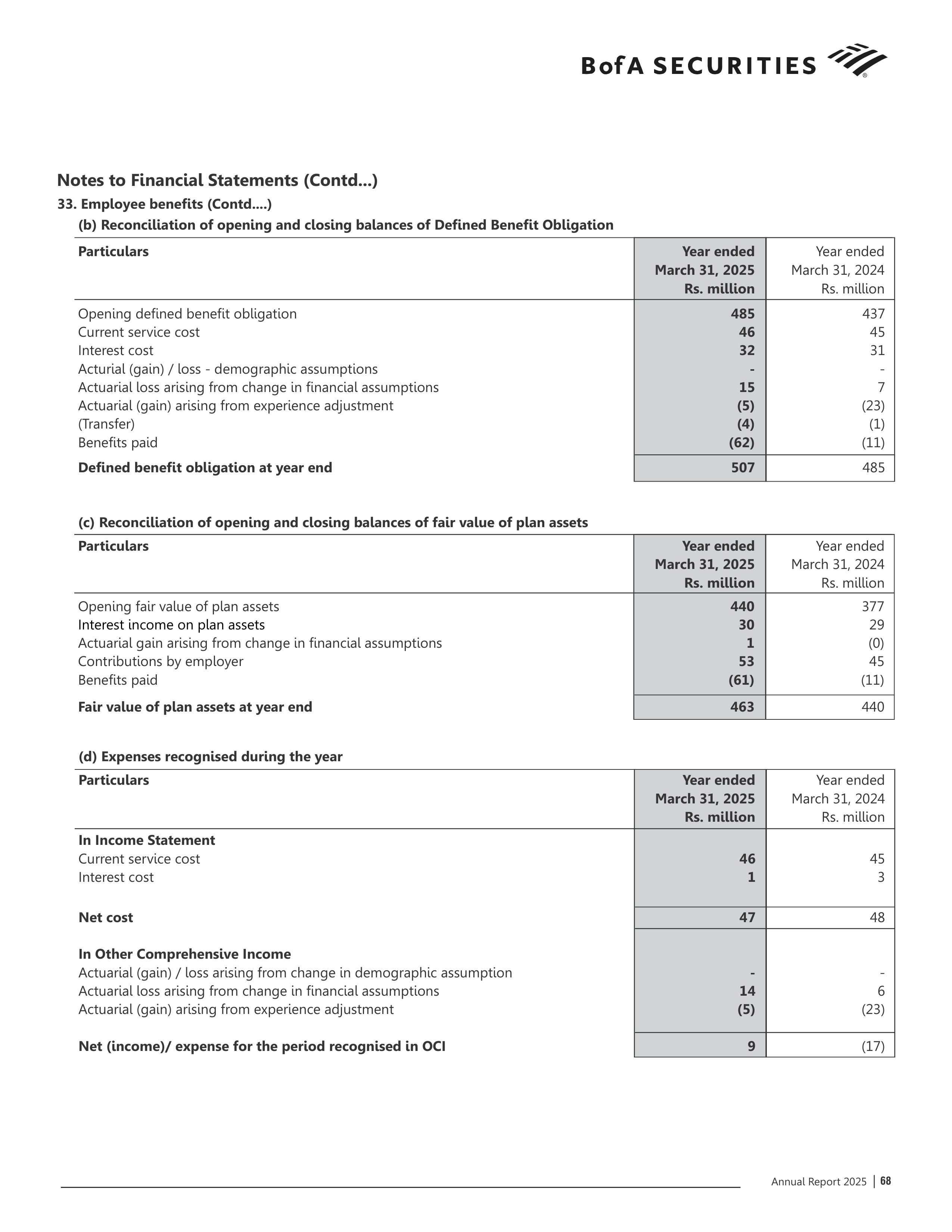
Notes to Financial Statements (Contd...)
(b) Reconciliation of opening and closing balances of Defined Benefit Obligation
Particulars
Year ended
Year ended
March 31, 2025
March 31, 2024
Rs. million
Rs. million
Opening defined benefit obligation
437
485
Current service cost
45
46
Interest cost
31
32
Acturial (gain) / loss - demographic assumptions
-
-
Actuarial loss arising from change in financial assumptions
7
15
Actuarial (gain) arising from experience adjustment
(23)
(5)
(Transfer)
(1)
(4)
Benefits paid
(11)
(62)
Defined benefit obligation at year end
507
485
(c) Reconciliation of opening and closing balances of fair value of plan assets
Particulars
Year ended
Year ended
March 31, 2025
March 31, 2024
Rs. million
Rs. million
Opening fair value of plan assets
377
440
29
30
Interest income on plan assets
Actuarial gain arising from change in financial assumptions
(0)
1
Contributions by employer
45
53
Benefits paid
(11)
(61)
Fair value of plan assets at year end
463
440
33. Employee benefits (Contd....)
(d) Expenses recognised during the year
Particulars
Year ended
Year ended
March 31, 2025
March 31, 2024
Rs. million
Rs. million
In Income Statement
Current service cost
45
46
Interest cost
3
1
Net cost
47
48
In Other Comprehensive Income
Actuarial (gain) / loss arising from change in demographic assumption
-
-
Actuarial loss arising from change in financial assumptions
6
14
Actuarial (gain) arising from experience adjustment
(23)
(5)
Net (income)/ expense for the period recognised in OCI
9
(17)
68
Annual Report 2025
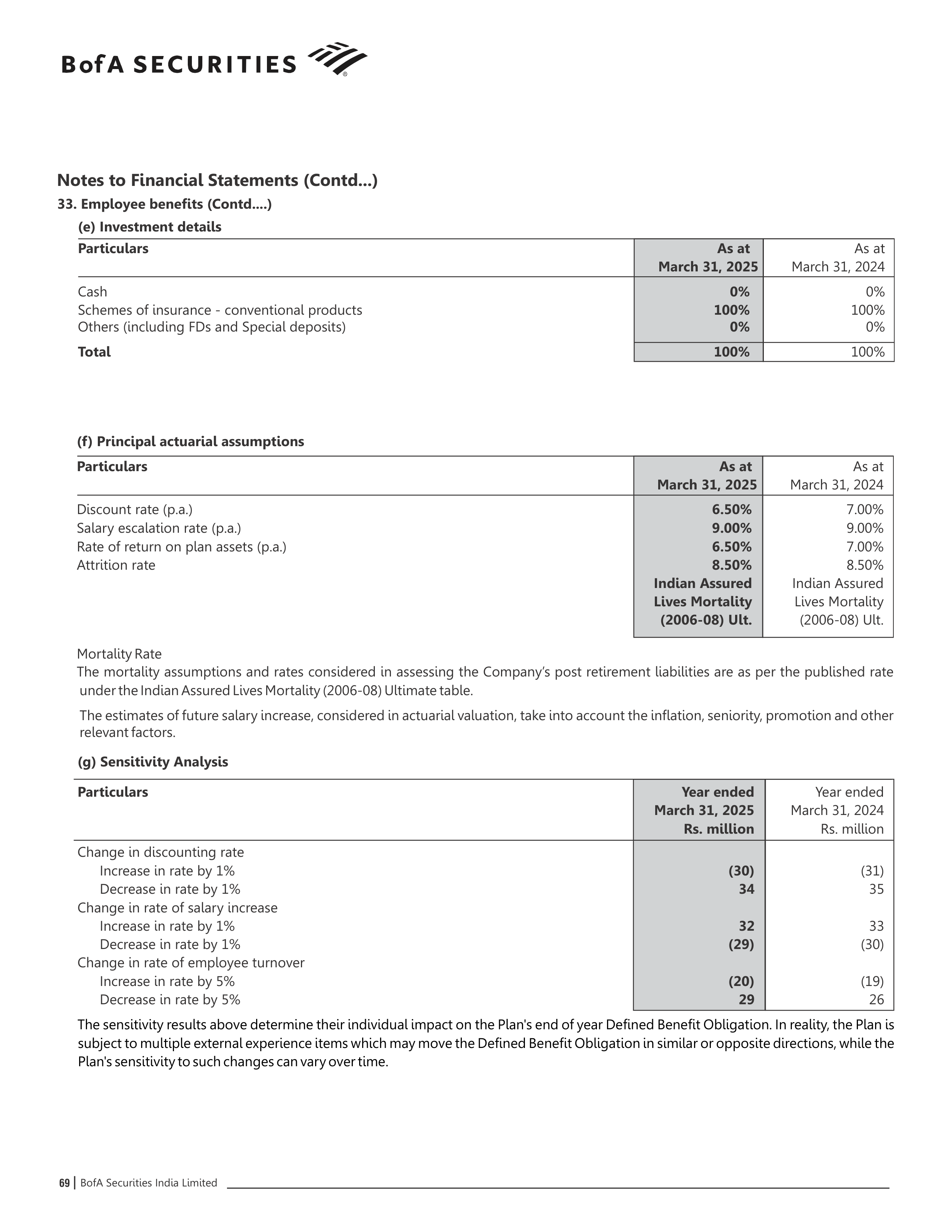
(f) Principal actuarial assumptions
Particulars
As at
As at
March 31, 2025
March 31, 2024
Discount rate (p.a.)
7.00%
6.50%
Salary escalation rate (p.a.)
9.00%
9.00%
Rate of return on plan assets (p.a.)
7.00%
6.50%
Attrition rate
8.50%
8.50%
Indian Assured
Indian Assured
Lives Mortality
Lives Mortality
(2006-08) Ult.
(2006-08) Ult.
Mortality Rate
The mortality assumptions and rates considered in assessing the Company’s post retirement liabilities are as per the published rate
under the Indian Assured Lives Mortality (2006-08) Ultimate table.
The estimates of future salary increase, considered in actuarial valuation, take into account the inflation, seniority, promotion and other
relevant factors.
Notes to Financial Statements (Contd...)
33. Employee benefits (Contd....)
(e) Investment details
Particulars
As at
As at
March 31, 2025
March 31, 2024
Cash
0%
0%
Schemes of insurance - conventional products
100%
100%
Others (including FDs and Special deposits)
0%
0%
Total
100%
100%
(g) Sensitivity Analysis
Particulars
Year ended
Year ended
March 31, 2025
March 31, 2024
Rs. million
Rs. million
Change in discounting rate
Increase in rate by 1%
(31)
(30)
Decrease in rate by 1%
35
34
Change in rate of salary increase
Increase in rate by 1%
33
32
Decrease in rate by 1%
(30)
(29)
Change in rate of employee turnover
Increase in rate by 5%
(19)
(20)
Decrease in rate by 5%
26
29
The sensitivity results above determine their individual impact on the Plan's end of year Defined Benefit Obligation. In reality, the Plan is
subject to multiple external experience items which may move the Defined Benefit Obligation in similar or opposite directions, while the
Plan's sensitivity to such changes can vary over time.
69
BofA Securities India Limited
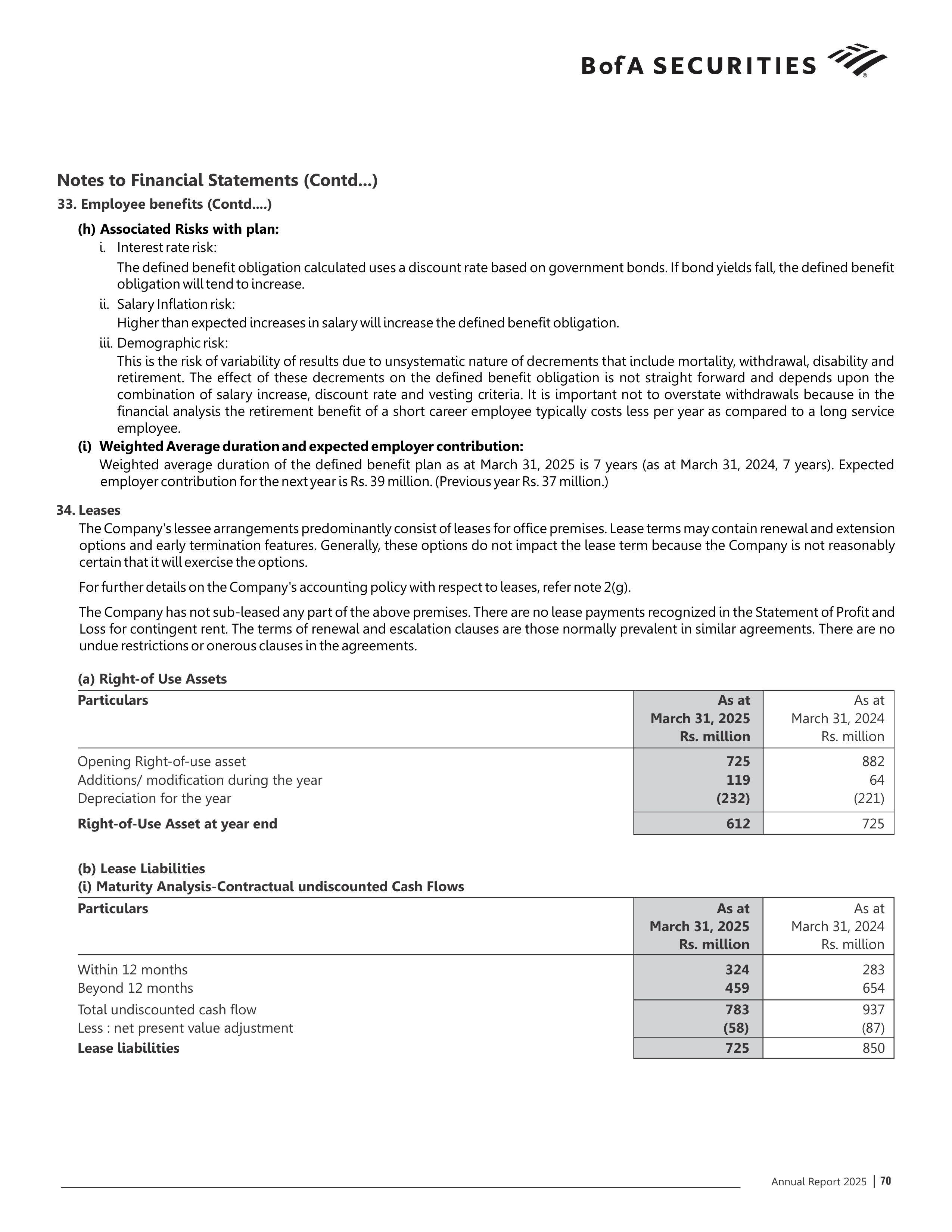
Notes to Financial Statements (Contd...)
(h) Associated Risks with plan:
i. Interest rate risk:
The defined benefit obligation calculated uses a discount rate based on government bonds. If bond yields fall, the defined benefit
obligation will tend to increase.
ii. Salary Inflation risk:
Higher than expected increases in salary will increase the defined benefit obligation.
iii. Demographic risk:
This is the risk of variability of results due to unsystematic nature of decrements that include mortality, withdrawal, disability and
retirement. The effect of these decrements on the defined benefit obligation is not straight forward and depends upon the
combination of salary increase, discount rate and vesting criteria. It is important not to overstate withdrawals because in the
financial analysis the retirement benefit of a short career employee typically costs less per year as compared to a long service
employee.
(i) Weighted Average duration and expected employer contribution:
Weighted average duration of the defined benefit plan as at March 31, 2025 is 7 years (as at March 31, 2024, 7 years). Expected
employer contribution for the next year is Rs. 39 million. (Previous year Rs. 37 million.)
33. Employee benefits (Contd....)
34. Leases
The Company's lessee arrangements predominantly consist of leases for office premises. Lease terms may contain renewal and extension
options and early termination features. Generally, these options do not impact the lease term because the Company is not reasonably
certain that it will exercise the options.
For further details on the Company's accounting policy with respect to leases, refer note 2(g).
The Company has not sub-leased any part of the above premises. There are no lease payments recognized in the Statement of Profit and
Loss for contingent rent. The terms of renewal and escalation clauses are those normally prevalent in similar agreements. There are no
undue restrictions or onerous clauses in the agreements.
(a) Right-of Use Assets
Particulars
As at
As at
March 31, 2025
March 31, 2024
Rs. million
Rs. million
Opening Right-of-use asset
882
725
Additions/ modification during the year
64
119
Depreciation for the year
(221)
(232)
Right-of-Use Asset at year end
612
725
(b) Lease Liabilities
(i) Maturity Analysis-Contractual undiscounted Cash Flows
Particulars
As at
As at
March 31, 2025
March 31, 2024
Rs. million
Rs. million
Within 12 months
283
324
Beyond 12 months
654
459
Total undiscounted cash flow
937
783
Less : net present value adjustment
(87)
(58)
Lease liabilities
725
850
70
Annual Report 2025
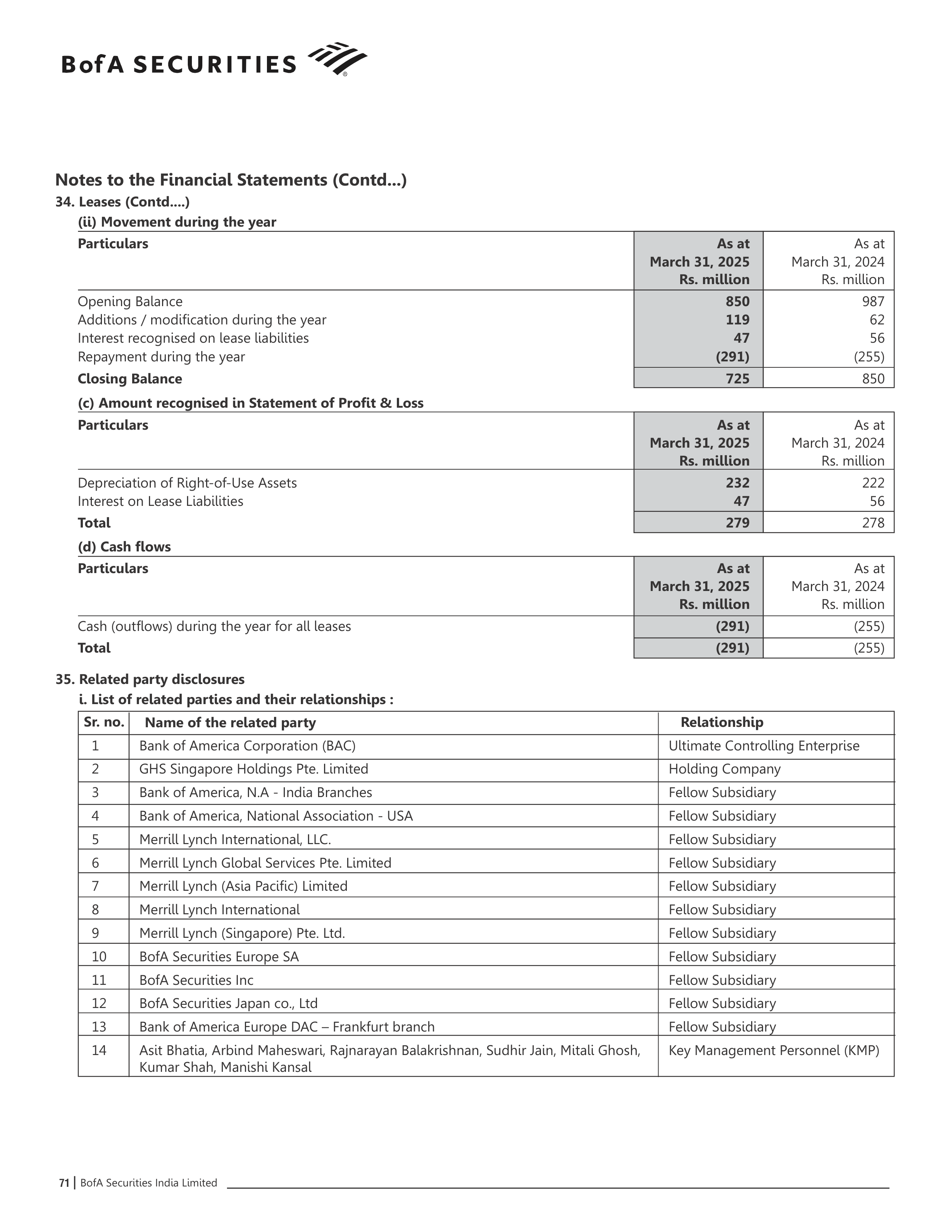
Notes to the Financial Statements (Contd...)
34. Leases (Contd....)
(c) Amount recognised in Statement of Profit & Loss
Particulars
As at
As at
March 31, 2025
March 31, 2024
Rs. million
Rs. million
Depreciation of Right-of-Use Assets
222
232
Interest on Lease Liabilities
56
47
Total
279
278
(d) Cash flows
Particulars
As at
As at
March 31, 2025
March 31, 2024
Rs. million
Rs. million
Cash (outflows) during the year for all leases
(255)
(291)
Total
(291)
(255)
35. Related party disclosures
i. List of related parties and their relationships :
Sr. no.
Name of the related party
Relationship
(ii) Movement during the year
Particulars
As at
As at
March 31, 2025
March 31, 2024
Rs. million
Rs. million
Opening Balance
987
850
Additions / modification during the year
62
119
Interest recognised on lease liabilities
56
47
Repayment during the year
(255)
(291)
Closing Balance
725
850
1
Bank of America Corporation (BAC)
Ultimate Controlling Enterprise
2
GHS Singapore Holdings Pte. Limited
Holding Company
3
Bank of America, N.A - India Branches
Fellow Subsidiary
4
Bank of America, National Association - USA
Fellow Subsidiary
5
Merrill Lynch International, LLC.
Fellow Subsidiary
6
Merrill Lynch Global Services Pte. Limited
Fellow Subsidiary
7
Merrill Lynch (Asia Pacific) Limited
Fellow Subsidiary
8
Merrill Lynch International
Fellow Subsidiary
9
Merrill Lynch (Singapore) Pte. Ltd.
Fellow Subsidiary
10
BofA Securities Europe SA
Fellow Subsidiary
11
BofA Securities Inc
Fellow Subsidiary
12
BofA Securities Japan co., Ltd
Fellow Subsidiary
13
Bank of America Europe DAC – Frankfurt branch
Fellow Subsidiary
14
Asit Bhatia, Arbind Maheswari, Rajnarayan Balakrishnan, Sudhir Jain, Mitali Ghosh,
Key Management Personnel (KMP)
Kumar Shah, Manishi Kansal
71
BofA Securities India Limited
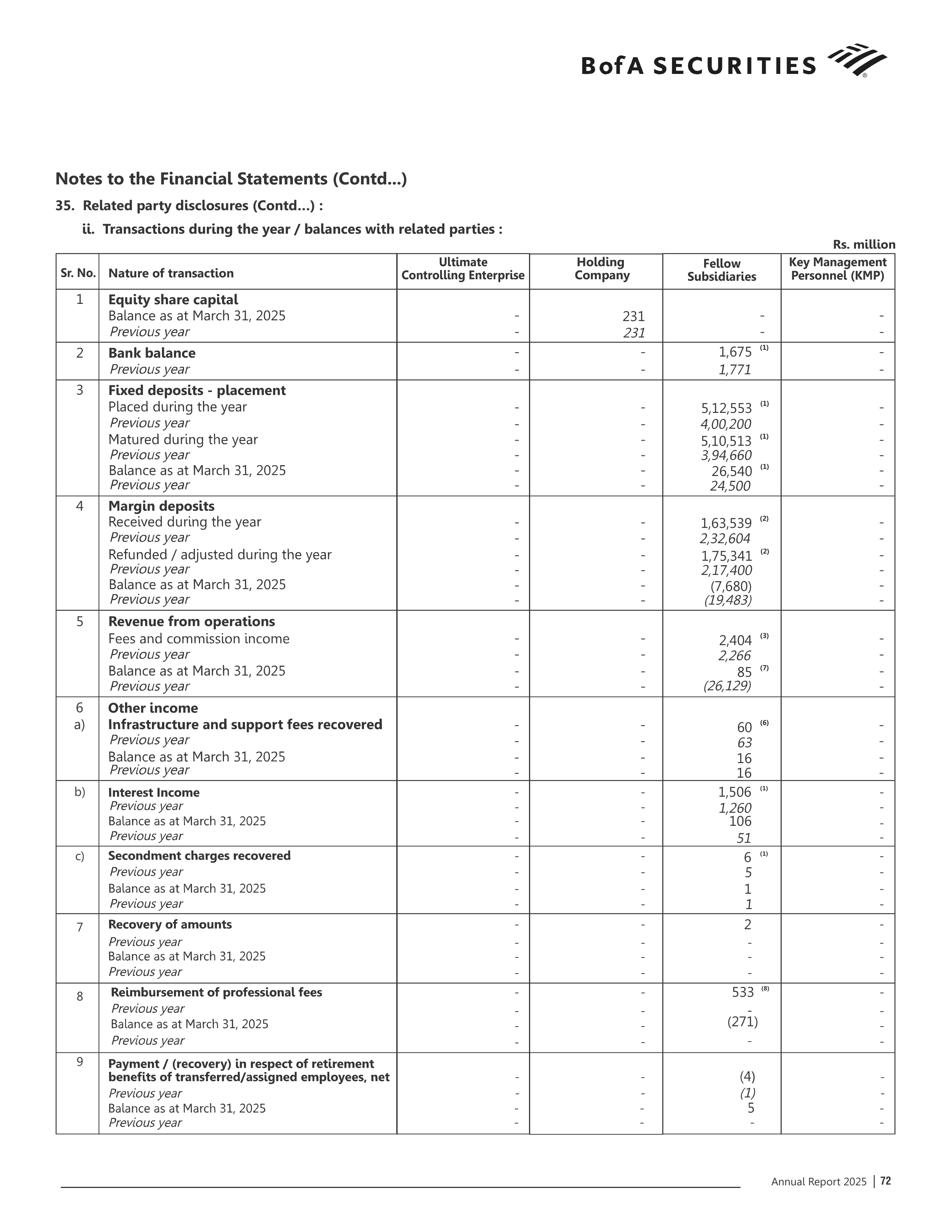
Notes to the Financial Statements (Contd...)
35. Related party disclosures (Contd…) :
ii. Transactions during the year / balances with related parties :
Sr. No.
Nature of transaction
1
Equity share capital
Rs. million
3
Fixed deposits - placement
4
Margin deposits
5
Revenue from operations
6
a)
Other income
Holding
Company
Fellow
Subsidiaries
Key Management
Personnel (KMP)
Balance as at March 31, 2025
-
-
-
231
-
-
-
-
-
-
2
Bank balance
-
1,675
(1)
-
-
-
-
-
-
-
-
-
-
-
-
-
-
5,12,553
(1)
-
-
-
26,540
(1)
-
-
-
5,10,513
(1)
-
-
-
-
-
-
-
-
-
-
-
-
-
-
-
1,63,539
(2)
(7,680)
1,75,341
(2)
-
-
-
-
-
-
-
-
-
-
-
-
-
-
-
2,404
(3)
-
-
-
-
-
-
-
-
-
-
-
-
60
(6)
16
16
-
-
-
-
-
-
-
-
-
-
-
-
1,506
(1)
106
-
-
-
-
-
-
-
-
-
-
-
-
6
(1)
1
b)
c)
7
-
-
-
-
2
8
-
-
-
-
-
-
Ultimate
Controlling Enterprise
85
(7)
-
-
-
-
-
-
-
-
-
-
-
-
-
533
(8)
(271)
-
-
-
-
9
72
Annual Report 2025
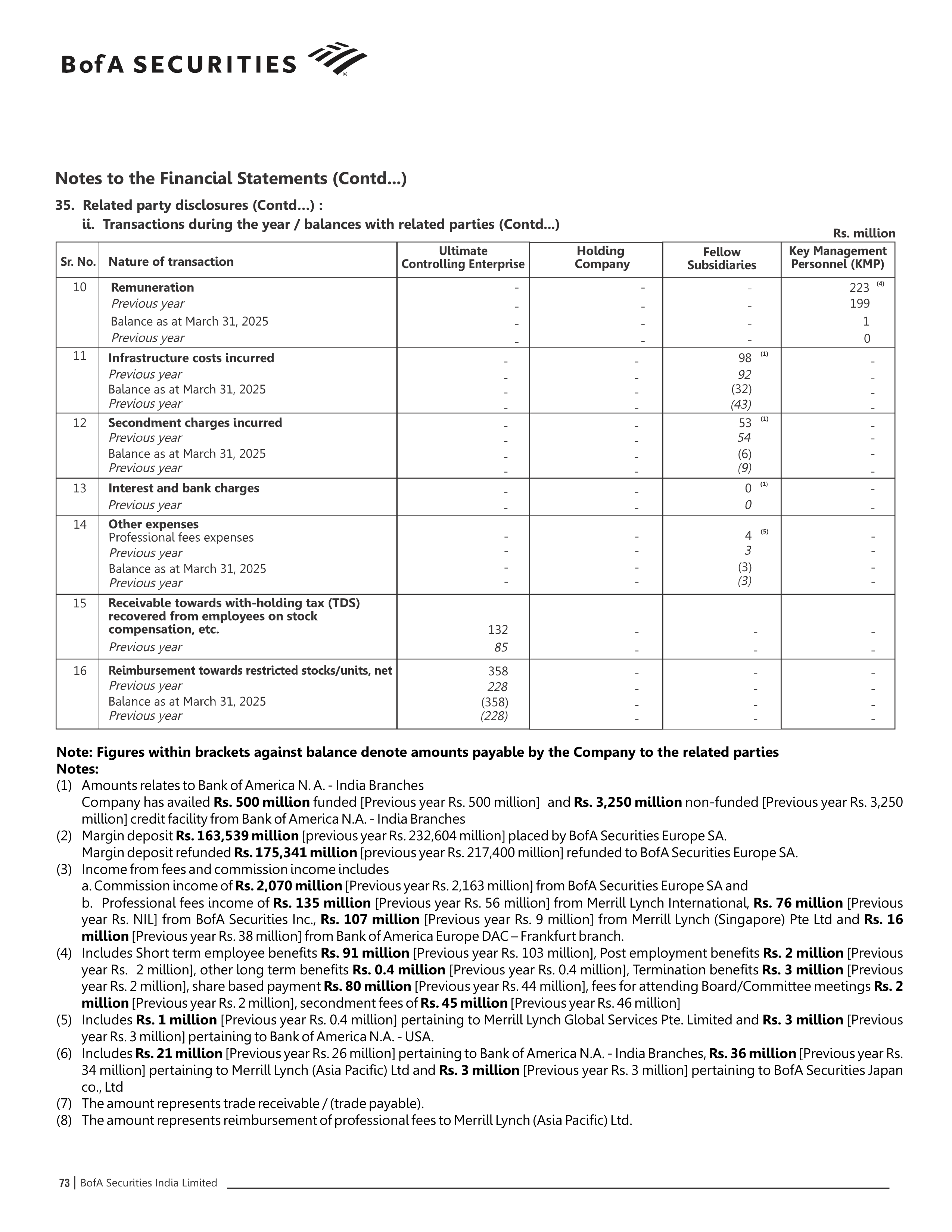
Notes to the Financial Statements (Contd...)
35. Related party disclosures (Contd…) :
ii. Transactions during the year / balances with related parties (Contd...)
12
-
-
-
-
-
-
-
-
(6)
53
(1)
13
-
-
Sr. No.
Nature of transaction
Holding
Company
Fellow
Subsidiaries
Key Management
Personnel (KMP)
Ultimate
Controlling Enterprise
Rs. million
-
-
14
-
-
-
-
-
-
-
-
-
-
-
-
15
-
-
-
-
-
-
132
358
16
-
-
-
-
-
-
-
-
-
-
-
-
(358)
-
0
(1
)
-
Note: Figures within brackets against balance denote amounts payable by the Company to the related parties
Notes:
(1) Amounts relates to Bank of America N. A. - India Branches
Company has availed
funded [Previous year Rs. 500 million] and
non-funded [Previous year Rs. 3,250
Rs. 500 million
Rs. 3,250 million
million] credit facility from Bank of America N.A. - India Branches
(2) Margin deposit
[previous year Rs. 232,604 million] placed by BofA Securities Europe SA.
Rs. 163,539 million
Margin deposit refunded
[previous year Rs. 217,400 million] refunded to BofA Securities Europe SA.
Rs. 175,341 million
(3) Income from fees and commission income includes
a. Commission income of
[Previous year Rs. 2,163 million] from BofA Securities Europe SA and
Rs. 2,070 million
b. Professional fees income of
[Previous year Rs. 56 million] from Merrill Lynch International,
[Previous
Rs. 135 million
Rs. 76 million
year Rs. NIL] from BofA Securities Inc.,
[Previous year Rs. 9 million] from Merrill Lynch (Singapore) Pte Ltd and
Rs. 107 million
Rs. 16
million
[Previous year Rs. 38 million] from Bank of America Europe DAC – Frankfurt branch.
(4) Includes Short term employee benefits
[Previous year Rs. 103 million], Post employment benefits
[Previous
Rs. 91 million
Rs. 2 million
year Rs. 2 million], other long term benefits
[Previous year Rs. 0.4 million], Termination benefits
[Previous
Rs. 0.4 million
Rs. 3 million
year Rs. 2 million], share based payment
[Previous year Rs. 44 million], fees for attending Board/Committee meetings
Rs. 80 million
Rs. 2
million
Rs. 45 million
[Previous year Rs. 2 million], secondment fees of
[Previous year Rs. 46 million]
(5) Includes
[Previous year Rs. 0.4 million] pertaining to Merrill Lynch Global Services Pte. Limited and
[Previous
Rs. 1 million
Rs. 3 million
year Rs. 3 million] pertaining to Bank of America N.A. - USA.
(6) Includes
[Previous year Rs. 26 million] pertaining to Bank of America N.A. - India Branches,
[Previous year Rs.
Rs. 21 million
Rs. 36 million
34 million] pertaining to Merrill Lynch (Asia Pacific) Ltd and
[Previous year Rs. 3 million] pertaining to BofA Securities Japan
Rs. 3 million
co., Ltd
(7) The amount represents trade receivable / (trade payable).
(8) The amount represents reimbursement of professional fees to Merrill Lynch (Asia Pacific) Ltd.
-
-
199
-
-
1
-
-
223
(4)
0
-
-
10
11
-
-
-
-
-
-
-
-
-
-
-
-
(32)
98
(1)
-
-
-
-
(3)
4
(5)
73
BofA Securities India Limited
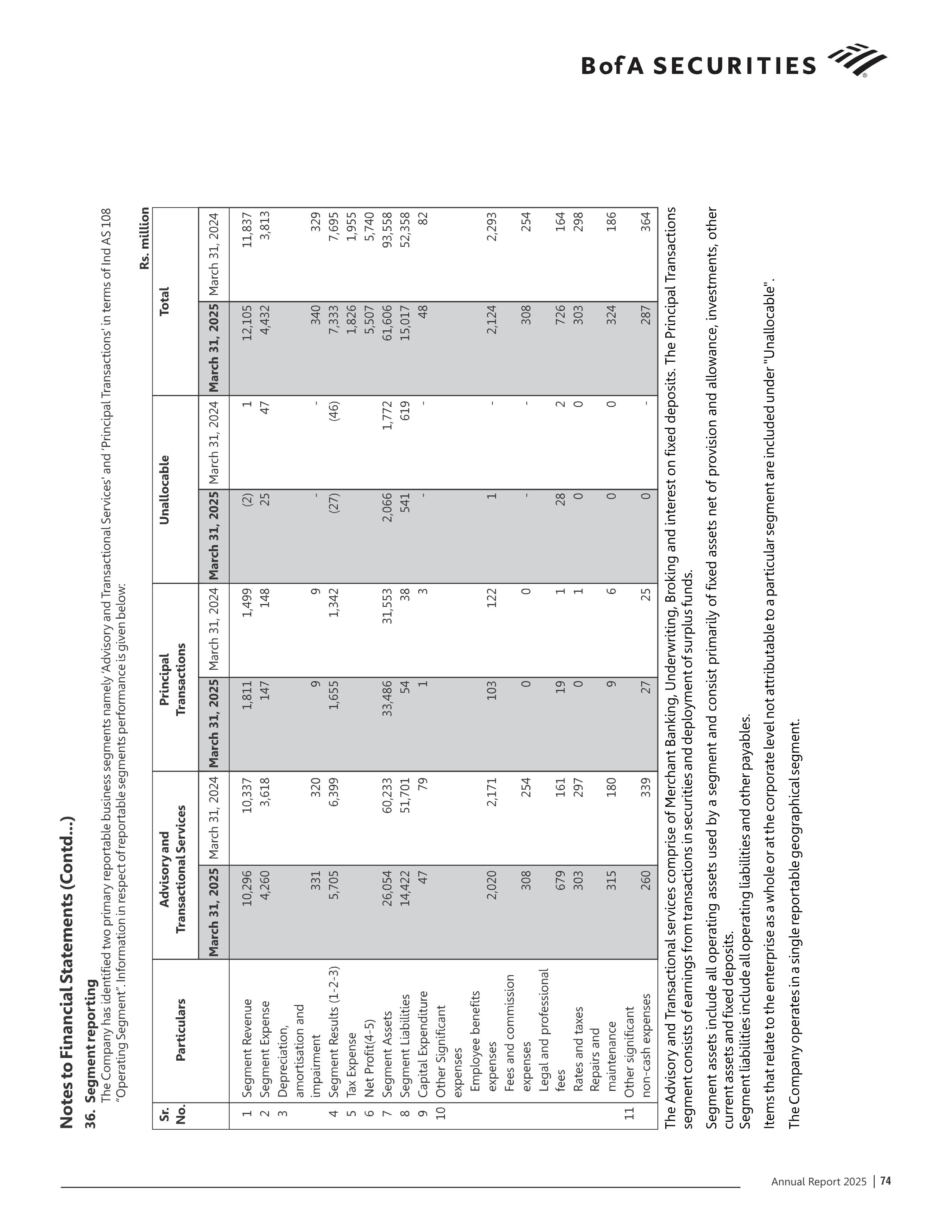
74
Annual Report 2025
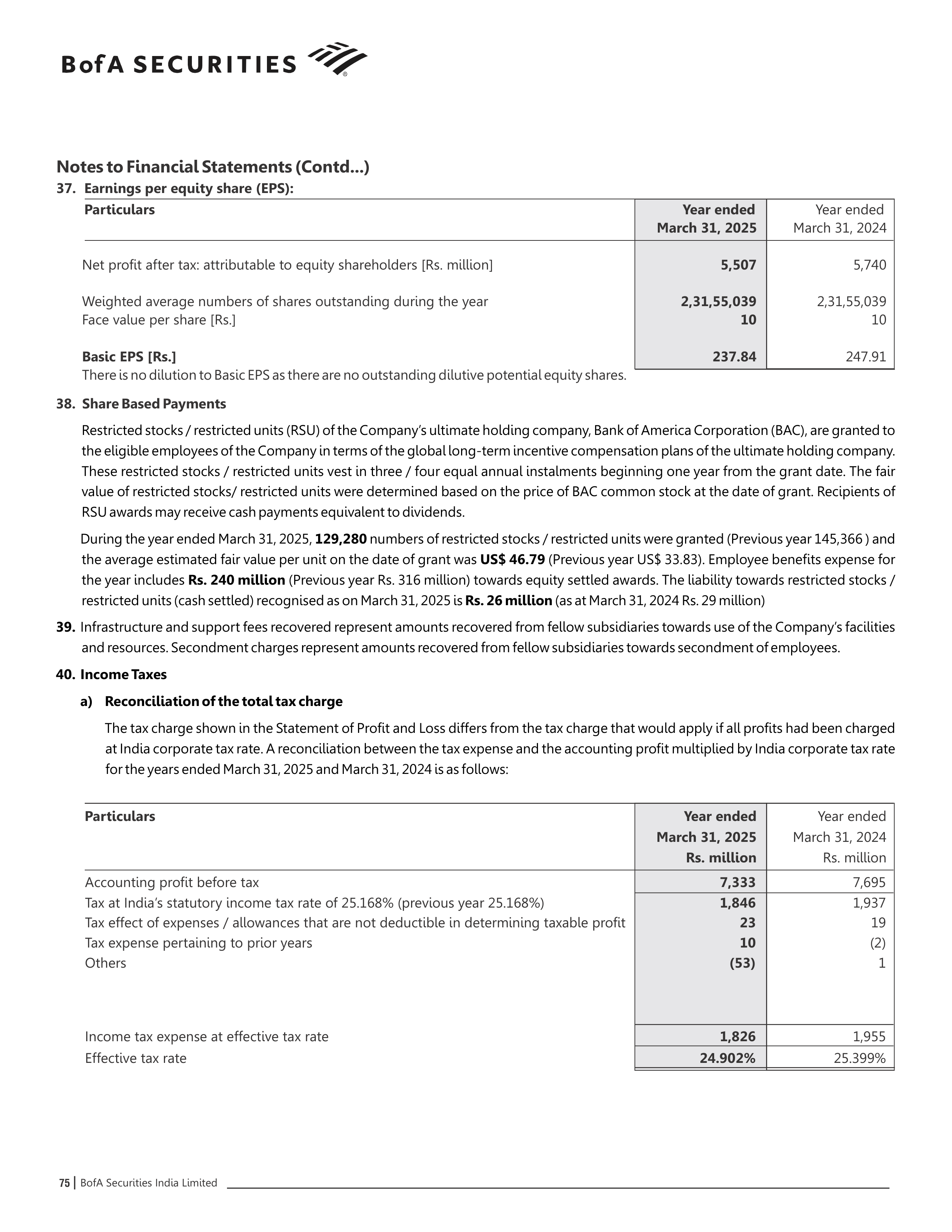
Notes to Financial Statements (Contd...)
37. Earnings per equity share (EPS):
Particulars
Year ended
Year ended
March 31, 2025
March 31, 2024
Net profit after tax: attributable to equity shareholders [Rs. million]
5,740
5,507
Weighted average numbers of shares outstanding during the year
2,31,55,039
2,31,55,039
Face value per share [Rs.]
10
10
247.91
Basic EPS [Rs.]
237.84
There is no dilution to Basic EPS as there are no outstanding dilutive potential equity shares.
38. Share Based Payments
Restricted stocks / restricted units (RSU) of the Company’s ultimate holding company, Bank of America Corporation (BAC), are granted to
the eligible employees of the Company in terms of the global long-term incentive compensation plans of the ultimate holding company.
These restricted stocks / restricted units vest in three / four equal annual instalments beginning one year from the grant date. The fair
value of restricted stocks/ restricted units were determined based on the price of BAC common stock at the date of grant. Recipients of
RSU awards may receive cash payments equivalent to dividends.
During the year ended March 31, 2025,
numbers of restricted stocks / restricted units were granted (Previous year 145,366 ) and
129,280
the average estimated fair value per unit on the date of grant was
(Previous year US$ 33.83). Employee benefits expense for
US$ 46.79
the year includes
(Previous year Rs. 316 million) towards equity settled awards. The liability towards restricted stocks /
Rs. 240 million
restricted units (cash settled) recognised as on March 31, 2025 is
(as at March 31, 2024 Rs. 29 million)
Rs. 26 million
39.
Infrastructure and support fees recovered represent amounts recovered from fellow subsidiaries towards use of the Company’s facilities
and resources. Secondment charges represent amounts recovered from fellow subsidiaries towards secondment of employees.
40.
Income Taxes
a) Reconciliation of the total tax charge
The tax charge shown in the Statement of Profit and Loss differs from the tax charge that would apply if all profits had been charged
at India corporate tax rate. A reconciliation between the tax expense and the accounting profit multiplied by India corporate tax rate
for the years ended March 31, 2025 and March 31, 2024 is as follows:
Particulars
Year ended
Year ended
March 31, 2025
March 31, 2024
Rs. million
Rs. million
Accounting profit before tax
7,695
7,333
Tax at India’s statutory income tax rate of 25.168% (previous year 25.168%)
1,937
1,846
Tax effect of expenses / allowances that are not deductible in determining taxable profit
19
23
Tax expense pertaining to prior years
(2)
10
Others
1
(53)
Income tax expense at effective tax rate
1,955
1,826
Effective tax rate
25.399%
24.902%
75
BofA Securities India Limited
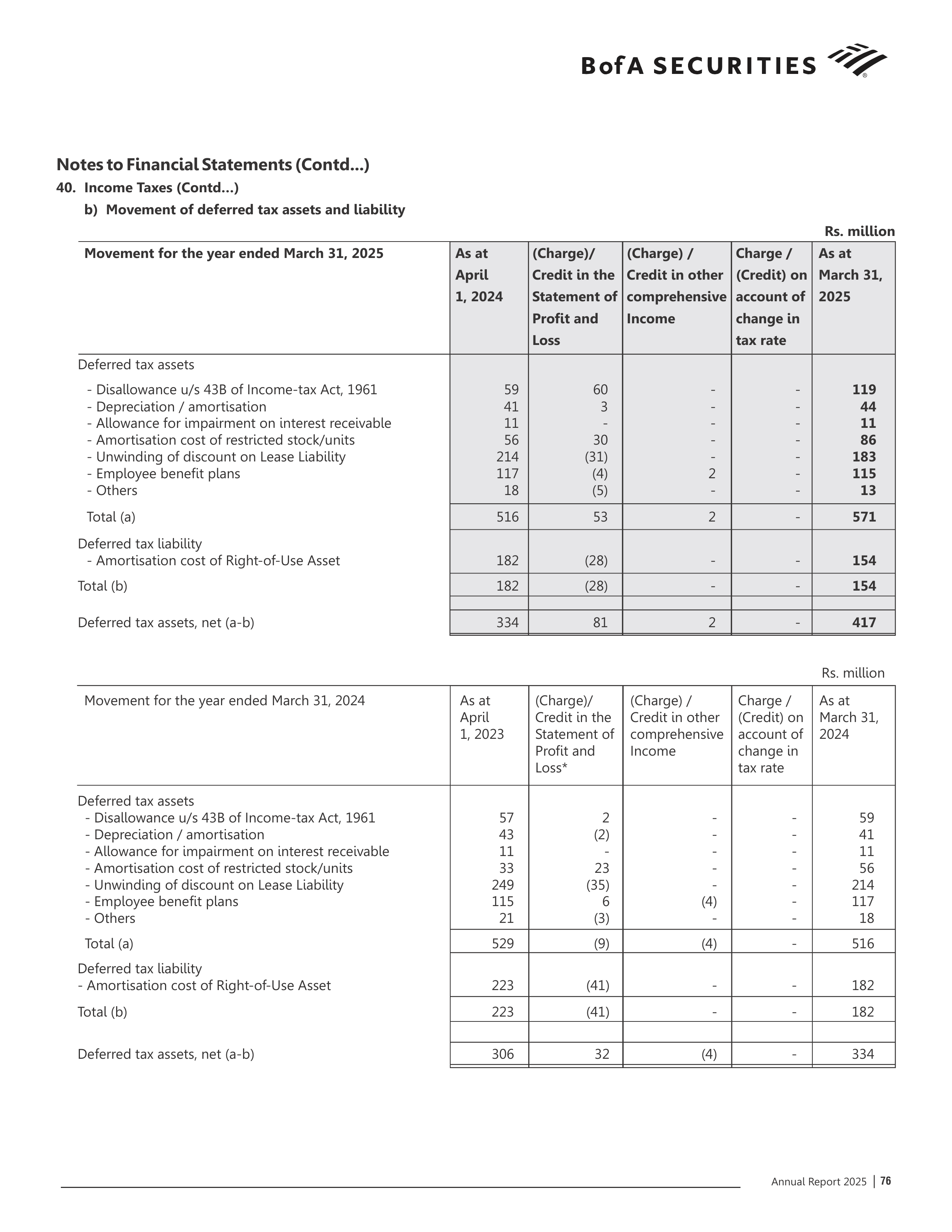
Notes to Financial Statements (Contd...)
40. Income Taxes (Contd…)
b) Movement of deferred tax assets and liability
Rs. million
Movement for the year ended March 31, 2025
As at
(Charge)/
(Charge) /
Charge /
As at
April
Credit in the Credit in other (Credit) on March 31,
1, 2024
Statement of comprehensive account of 2025
Profit and
Income
change in
Loss
tax rate
Deferred tax assets
- Disallowance u/s 43B of Income-tax Act, 1961
59
60
-
-
119
- Depreciation / amortisation
41
3
-
-
44
- Allowance for impairment on interest receivable
11
-
-
-
11
- Amortisation cost of restricted stock/units
56
30
-
-
86
- Unwinding of discount on Lease Liability
214
(31)
-
-
183
- Employee benefit plans
117
(4)
2
-
115
- Others
18
(5)
-
-
13
Total (a)
516
53
2
-
571
Deferred tax liability
- Amortisation cost of Right-of-Use Asset
182
(28)
-
-
154
Total (b)
182
(28)
-
-
154
Deferred tax assets, net (a-b)
334
81
2
-
417
Rs. million
Movement for the year ended March 31, 2024
As at
(Charge)/
(Charge) /
Charge /
As at
April
Credit in the
Credit in other
(Credit) on
March 31,
1, 2023
Statement of
comprehensive account of
2024
Profit and
Income
change in
Loss*
tax rate
Deferred tax assets
- Disallowance u/s 43B of Income-tax Act, 1961
57
2
-
-
59
- Depreciation / amortisation
43
(2)
-
-
41
- Allowance for impairment on interest receivable
11
-
-
-
11
- Amortisation cost of restricted stock/units
33
23
-
-
56
- Unwinding of discount on Lease Liability
249
(35)
-
-
214
- Employee benefit plans
115
6
(4)
-
117
- Others
21
(3)
-
-
18
Total (a)
529
(9)
(4)
-
516
Deferred tax liability
- Amortisation cost of Right-of-Use Asset
223
(41)
-
-
182
Total (b)
223
(41)
-
-
182
Deferred tax assets, net (a-b)
306
32
(4)
-
334
76
Annual Report 2025
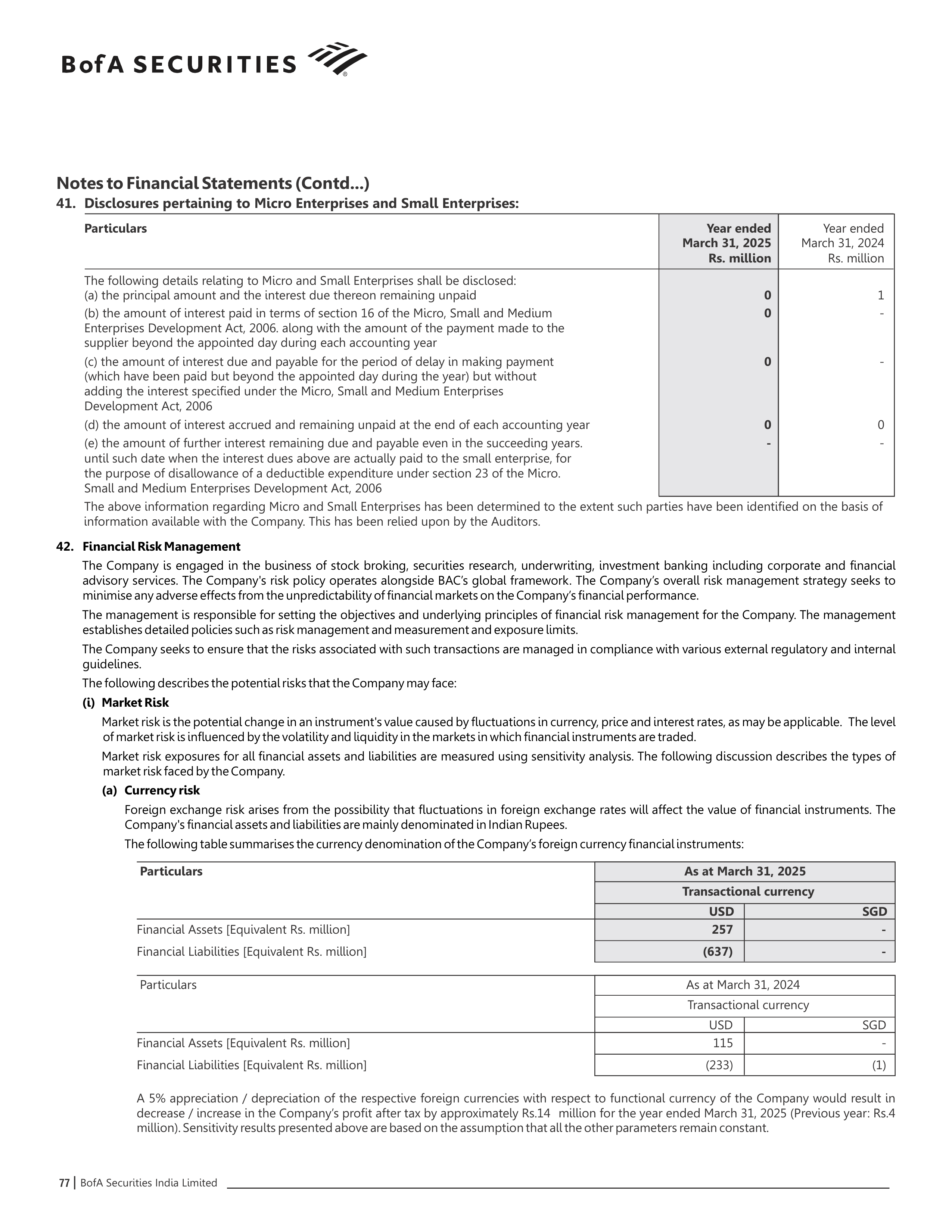
Notes to Financial Statements (Contd...)
41. Disclosures pertaining to Micro Enterprises and Small Enterprises:
Particulars
Year ended
Year ended
March 31, 2025
March 31, 2024
Rs. million
Rs. million
The following details relating to Micro and Small Enterprises shall be disclosed:
(a) the principal amount and the interest due thereon remaining unpaid
1
0
(b) the amount of interest paid in terms of section 16 of the Micro, Small and Medium
-
0
Enterprises Development Act, 2006. along with the amount of the payment made to the
supplier beyond the appointed day during each accounting year
(c) the amount of interest due and payable for the period of delay in making payment
-
0
(which have been paid but beyond the appointed day during the year) but without
adding the interest specified under the Micro, Small and Medium Enterprises
Development Act, 2006
(d) the amount of interest accrued and remaining unpaid at the end of each accounting year
0
0
(e) the amount of further interest remaining due and payable even in the succeeding years.
-
-
until such date when the interest dues above are actually paid to the small enterprise, for
the purpose of disallowance of a deductible expenditure under section 23 of the Micro.
Small and Medium Enterprises Development Act, 2006
The above information regarding Micro and Small Enterprises has been determined to the extent such parties have been identified on the basis of
information available with the Company. This has been relied upon by the Auditors.
42. Financial Risk Management
The Company is engaged in the business of stock broking, securities research, underwriting, investment banking including corporate and financial
advisory services. The Company's risk policy operates alongside BAC’s global framework. The Company’s overall risk management strategy seeks to
minimise any adverse effects from the unpredictability of financial markets on the Company’s financial performance.
The management is responsible for setting the objectives and underlying principles of financial risk management for the Company. The management
establishes detailed policies such as risk management and measurement and exposure limits.
The Company seeks to ensure that the risks associated with such transactions are managed in compliance with various external regulatory and internal
guidelines.
The following describes the potential risks that the Company may face:
(i) Market Risk
Market risk is the potential change in an instrument's value caused by fluctuations in currency, price and interest rates, as may be applicable. The level
of market risk is influenced by the volatility and liquidity in the markets in which financial instruments are traded.
Market risk exposures for all financial assets and liabilities are measured using sensitivity analysis. The following discussion describes the types of
market risk faced by the Company.
(a) Currency risk
Foreign exchange risk arises from the possibility that fluctuations in foreign exchange rates will affect the value of financial instruments. The
Company's financial assets and liabilities are mainly denominated in Indian Rupees.
The following table summarises the currency denomination of the Company’s foreign currency financial instruments:
As at March 31, 2025
Particulars
Transactional currency
USD
SGD
Financial Assets [Equivalent Rs. million]
257
-
Financial Liabilities [Equivalent Rs. million]
(637)
-
As at March 31, 2024
Particulars
Transactional currency
USD
SGD
Financial Assets [Equivalent Rs. million]
115
-
Financial Liabilities [Equivalent Rs. million]
(233)
(1)
A 5% appreciation / depreciation of the respective foreign currencies with respect to functional currency of the Company would result in
decrease / increase in the Company’s profit after tax by approximately Rs.14 million for the year ended March 31, 2025 (Previous year: Rs.4
million). Sensitivity results presented above are based on the assumption that all the other parameters remain constant.
77
BofA Securities India Limited
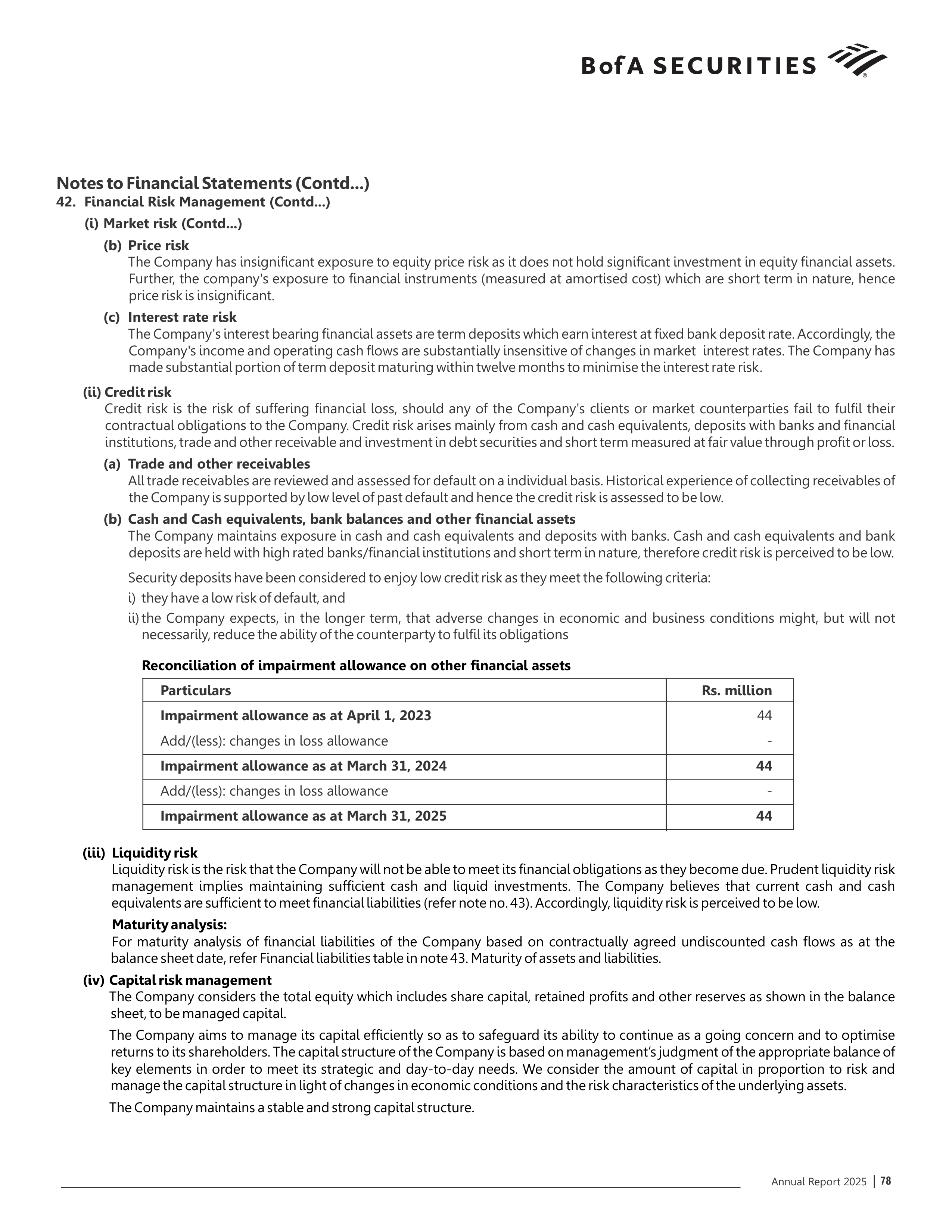
Notes to Financial Statements (Contd...)
42. Financial Risk Management (Contd...)
(i) Market risk (Contd...)
(b) Price risk
The Company has insignificant exposure to equity price risk as it does not hold significant investment in equity financial assets.
Further, the company's exposure to financial instruments (measured at amortised cost) which are short term in nature, hence
price risk is insignificant.
(c) Interest rate risk
The Company's interest bearing financial assets are term deposits which earn interest at fixed bank deposit rate. Accordingly, the
Company's income and operating cash flows are substantially insensitive of changes in market interest rates. The Company has
made substantial portion of term deposit maturing within twelve months to minimise the interest rate risk.
(ii) Credit risk
Credit risk is the risk of suffering financial loss, should any of the Company's clients or market counterparties fail to fulfil their
contractual obligations to the Company. Credit risk arises mainly from cash and cash equivalents, deposits with banks and financial
institutions, trade and other receivable and investment in debt securities and short term measured at fair value through profit or loss.
(a) Trade and other receivables
All trade receivables are reviewed and assessed for default on a individual basis. Historical experience of collecting receivables of
the Company is supported by low level of past default and hence the credit risk is assessed to be low.
(b) Cash and Cash equivalents, bank balances and other financial assets
The Company maintains exposure in cash and cash equivalents and deposits with banks. Cash and cash equivalents and bank
deposits are held with high rated banks/financial institutions and short term in nature, therefore credit risk is perceived to be low.
Security deposits have been considered to enjoy low credit risk as they meet the following criteria:
i) they have a low risk of default, and
ii) the Company expects, in the longer term, that adverse changes in economic and business conditions might, but will not
necessarily, reduce the ability of the counterparty to fulfil its obligations
78
Annual Report 2025
Particulars
Rs. million
44
Impairment allowance as at April 1, 2023
Add/(less): changes in loss allowance
-
Impairment allowance as at March 31, 2024
44
Add/(less): changes in loss allowance
-
Impairment allowance as at March 31, 2025
44
Reconciliation of impairment allowance on other financial assets
(iii)
Liquidity risk
Liquidity risk is the risk that the Company will not be able to meet its financial obligations as they become due. Prudent liquidity risk
management implies maintaining sufficient cash and liquid investments. The Company believes that current cash and cash
equivalents are sufficient to meet financial liabilities (refer note no. 43). Accordingly, liquidity risk is perceived to be low.
Maturity analysis:
For maturity analysis of financial liabilities of the Company based on contractually agreed undiscounted cash flows as at the
balance sheet date, refer Financial liabilities table in note 43. Maturity of assets and liabilities.
(iv) Capital risk management
The Company considers the total equity which includes share capital, retained profits and other reserves as shown in the balance
sheet, to be managed capital.
The Company aims to manage its capital efficiently so as to safeguard its ability to continue as a going concern and to optimise
returns to its shareholders. The capital structure of the Company is based on management’s judgment of the appropriate balance of
key elements in order to meet its strategic and day-to-day needs. We consider the amount of capital in proportion to risk and
manage the capital structure in light of changes in economic conditions and the risk characteristics of the underlying assets.
The Company maintains a stable and strong capital structure.
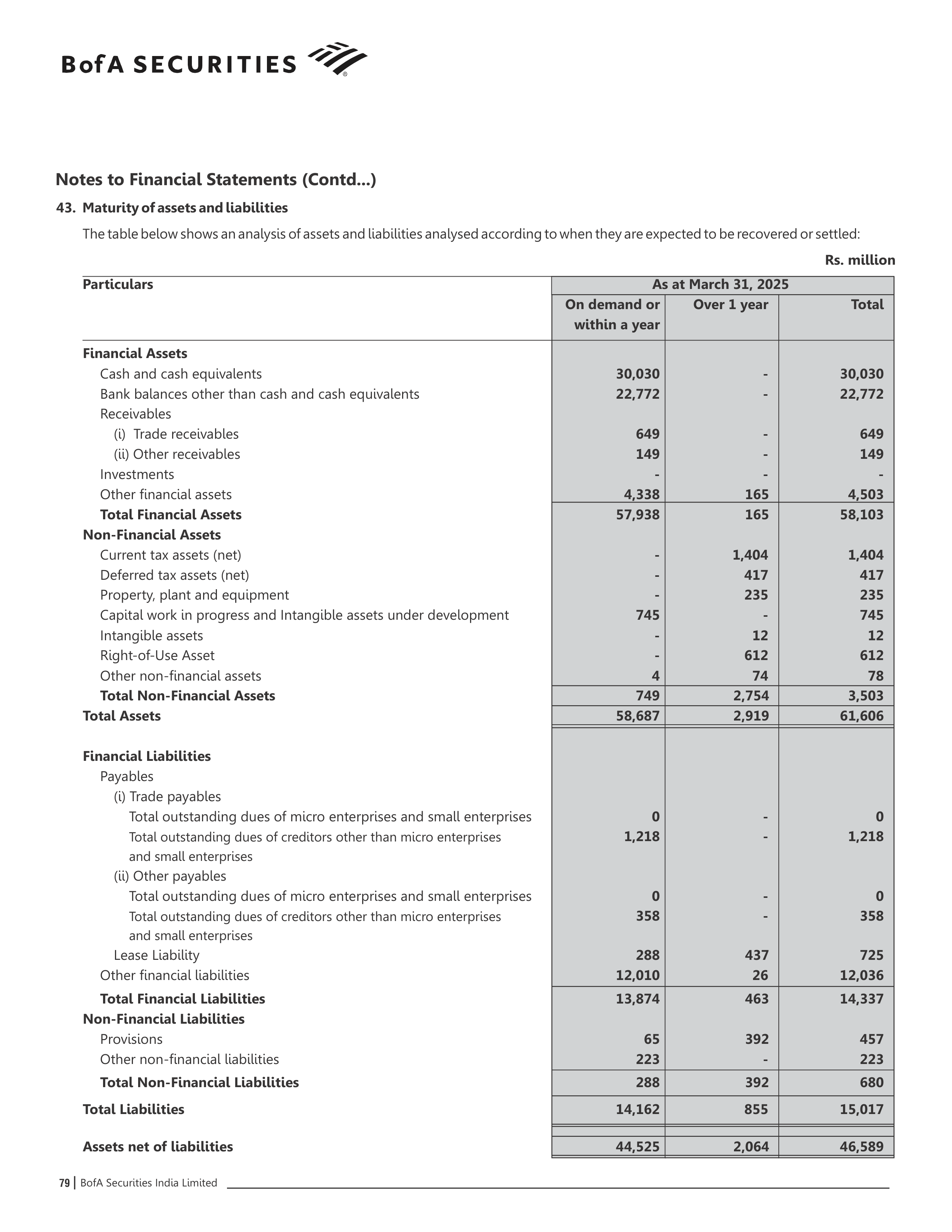
Notes to Financial Statements (Contd...)
43. Maturity of assets and liabilities
The table below shows an analysis of assets and liabilities analysed according to when they are expected to be recovered or settled:
Rs. million
Particulars
As at March 31, 2025
On demand or
Over 1 year
Total
within a year
Financial Assets
Cash and cash equivalents
30,030
- 30,030
Bank balances other than cash and cash equivalents
22,772
- 22,772
Receivables
(i) Trade receivables
649
- 649
(ii) Other receivables
149
- 149
Investments
-
-
-
Other financial assets
4,338 165 4,503
Total Financial Assets
57,938 165 58,103
Non-Financial Assets
Current tax assets (net)
- 1,404 1,404
Deferred tax assets (net)
- 417 417
Property, plant and equipment
- 235 235
745
- 745
Capital work in progress and Intangible assets under development
Intangible assets
-
12 12
-
612 612
Right-of-Use Asset
Other non-financial assets
4
74 78
Total Non-Financial Assets
749 2,754 3,503
Total Assets
58,687 2,919 61,606
Financial Liabilities
Payables
(i) Trade payables
Total outstanding dues of micro enterprises and small enterprises
0
-
0
Total outstanding dues of creditors other than micro enterprises
1,218
- 1,218
and small enterprises
(ii) Other payables
Total outstanding dues of micro enterprises and small enterprises
0
-
0
Total outstanding dues of creditors other than micro enterprises
358
-
358
and small enterprises
Lease Liability
288 437 725
Other financial liabilities
12,010
26
12,036
Total Financial Liabilities
13,874 463
14,337
Non-Financial Liabilities
Provisions
65 392
457
Other non-financial liabilities
223
- 223
Total Non-Financial Liabilities
288 392 680
Total Liabilities
14,162
855 15,017
Assets net of liabilities
44,525 2,064 46,589
79
BofA Securities India Limited
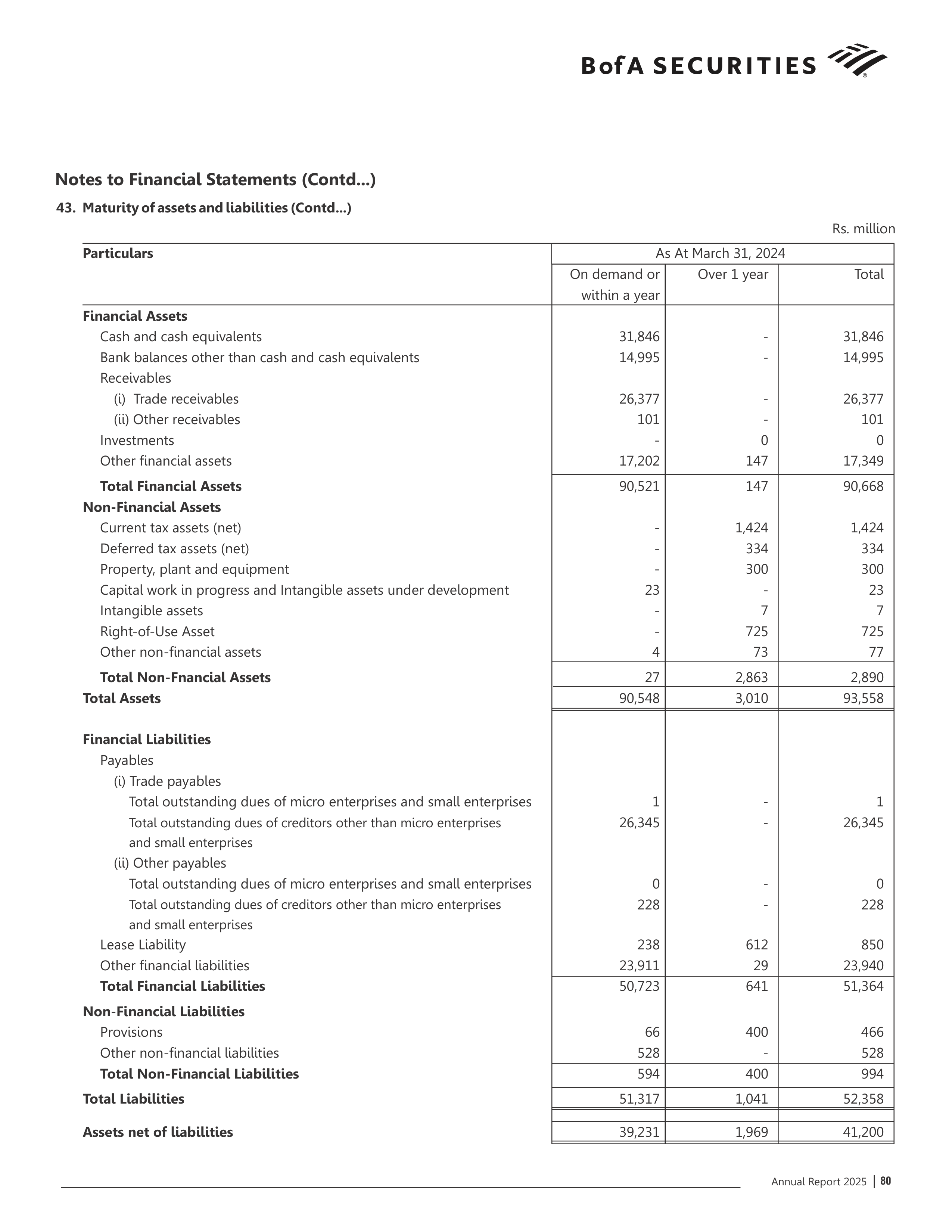
Notes to Financial Statements (Contd...)
43. Maturity of assets and liabilities (Contd...)
Rs. million
Particulars
As At March 31, 2024
On demand or
Over 1 year
Total
within a year
Financial Assets
Cash and cash equivalents
31,846
-
31,846
Bank balances other than cash and cash equivalents
14,995
-
14,995
Receivables
(i) Trade receivables
26,377
-
26,377
(ii) Other receivables
101
-
101
Investments
-
0
0
Other financial assets
17,202
147
17,349
Total Financial Assets
90,521
147 90,668
Non-Financial Assets
Current tax assets (net)
- 1,424 1,424
Deferred tax assets (net)
- 334 334
Property, plant and equipment
-
300
300
Capital work in progress and Intangible assets under development
23
-
23
Intangible assets
-
7
7
Right-of-Use Asset
-
725
725
Other non-financial assets
4
73
77
Total Non-Fnancial Assets
27 2,863 2,890
Total Assets
90,548
3,010
93,558
Financial Liabilities
Payables
(i) Trade payables
Total outstanding dues of micro enterprises and small enterprises
1
-
1
26,345
-
26,345
Total outstanding dues of creditors other than micro enterprises
and small enterprises
(ii) Other payables
Total outstanding dues of micro enterprises and small enterprises
0
-
0
228
-
228
Total outstanding dues of creditors other than micro enterprises
and small enterprises
Lease Liability
238
612
850
Other financial liabilities
23,911
29
23,940
Total Financial Liabilities
50,723
641
51,364
Non-Financial Liabilities
Provisions
66
400
466
Other non-financial liabilities
528
-
528
Total Non-Financial Liabilities
594
400
994
Total Liabilities
51,317 1,041 52,358
Assets net of liabilities
39,231 1,969 41,200
80
Annual Report 2025
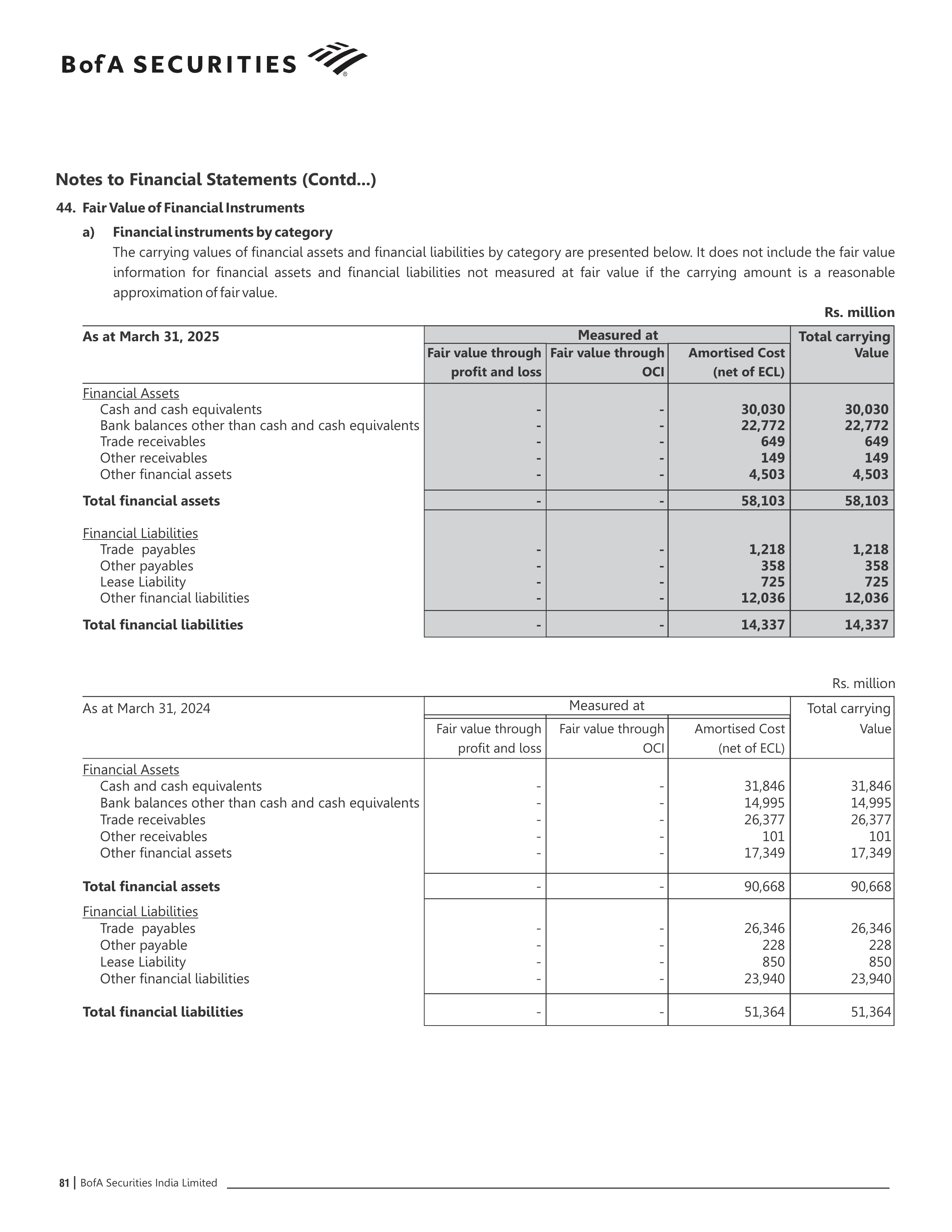
Notes to Financial Statements (Contd...)
Rs. million
As at March 31, 2024
Total carrying
Fair value through
Fair value through
Amortised Cost
Value
profit and loss
OCI
(net of ECL)
Financial Assets
Cash and cash equivalents
-
- 31,846
31,846
Bank balances other than cash and cash equivalents
-
- 14,995
14,995
Trade receivables
-
- 26,377
26,377
Other receivables
-
- 101
101
Other financial assets
-
- 17,349
17,349
Total financial assets
-
- 90,668
90,668
Financial Liabilities
Trade payables
-
- 26,346
26,346
Other payable
-
- 228
228
Lease Liability
-
- 850
850
Other financial liabilities
-
- 23,940
23,940
Total financial liabilities
-
- 51,364
51,364
81
BofA Securities India Limited
Measured at
44. Fair Value of Financial Instruments
a)
Financial instruments by category
The carrying values of financial assets and financial liabilities by category are presented below. It does not include the fair value
information for financial assets and financial liabilities not measured at fair value if the carrying amount is a reasonable
approximation of fair value.
Rs. million
As at March 31, 2025
Total carrying
Fair value through Fair value through
Amortised Cost
Value
profit and loss
OCI
(net of ECL)
Financial Assets
Cash and cash equivalents
-
- 30,030
30,030
Bank balances other than cash and cash equivalents
-
- 22,772 22,772
Trade receivables
-
- 649
649
Other receivables
-
- 149
149
Other financial assets
-
- 4,503
4,503
Total financial assets
-
- 58,103
58,103
Financial Liabilities
Trade payables
-
- 1,218
1,218
Other payables
-
- 358
358
-
- 725
725
Lease Liability
Other financial liabilities
-
- 12,036
12,036
Total financial liabilities
-
- 14,337
14,337
Measured at
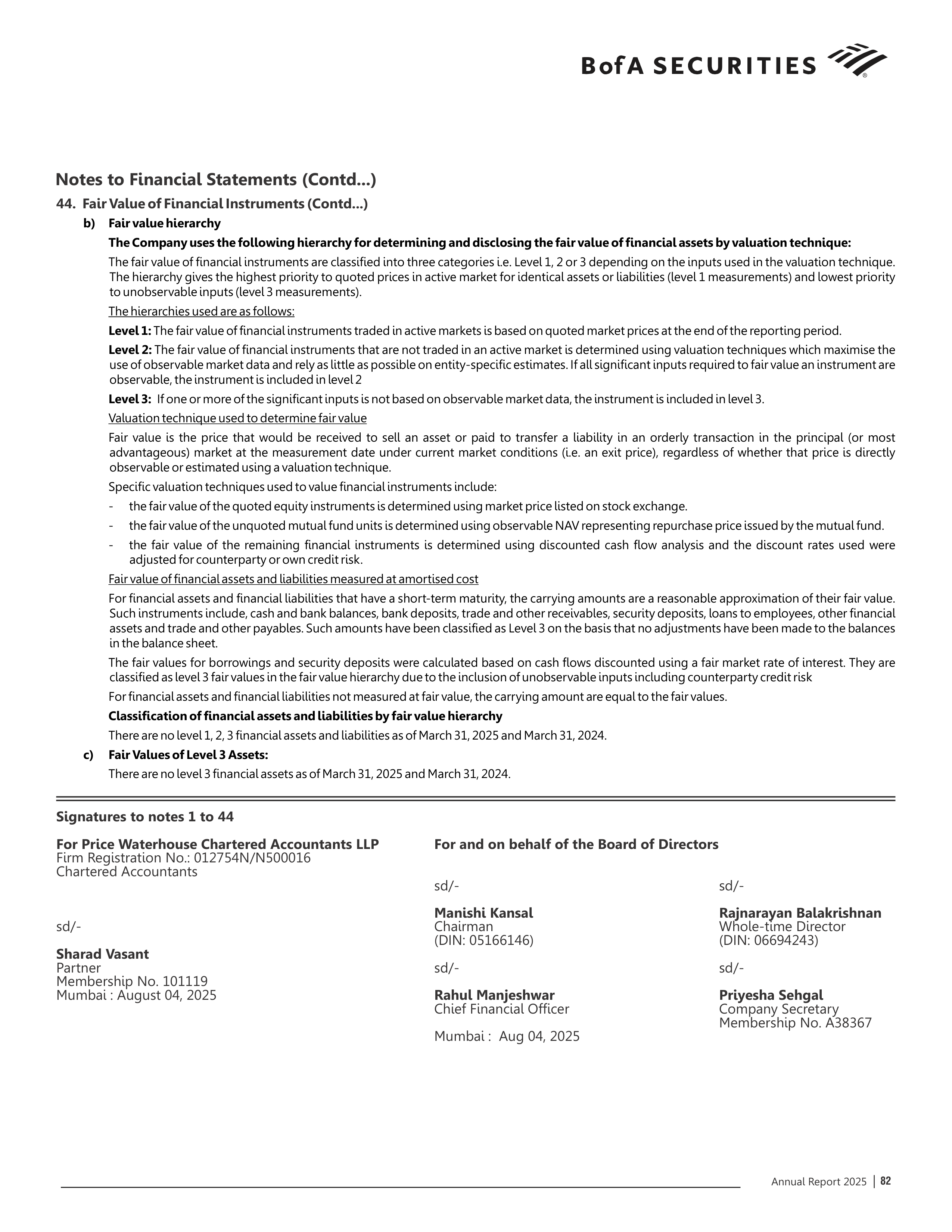
Notes to Financial Statements (Contd...)
44. Fair Value of Financial Instruments (Contd...)
b) Fair value hierarchy
The Company uses the following hierarchy for determining and disclosing the fair value of financial assets by valuation technique:
The fair value of financial instruments are classified into three categories i.e. Level 1, 2 or 3 depending on the inputs used in the valuation technique.
The hierarchy gives the highest priority to quoted prices in active market for identical assets or liabilities (level 1 measurements) and lowest priority
to unobservable inputs (level 3 measurements).
The hierarchies used are as follows:
The fair value of financial instruments traded in active markets is based on quoted market prices at the end of the reporting period.
Level 1:
The fair value of financial instruments that are not traded in an active market is determined using valuation techniques which maximise the
Level 2:
use of observable market data and rely as little as possible on entity-specific estimates. If all significant inputs required to fair value an instrument are
observable, the instrument is included in level 2
If one or more of the significant inputs is not based on observable market data, the instrument is included in level 3.
Level 3:
Valuation technique used to determine fair value
Fair value is the price that would be received to sell an asset or paid to transfer a liability in an orderly transaction in the principal (or most
advantageous) market at the measurement date under current market conditions (i.e. an exit price), regardless of whether that price is directly
observable or estimated using a valuation technique.
Specific valuation techniques used to value financial instruments include:
- the fair value of the quoted equity instruments is determined using market price listed on stock exchange.
- the fair value of the unquoted mutual fund units is determined using observable NAV representing repurchase price issued by the mutual fund.
- the fair value of the remaining financial instruments is determined using discounted cash flow analysis and the discount rates used were
adjusted for counterparty or own credit risk.
Fair value of financial assets and liabilities measured at amortised cost
For financial assets and financial liabilities that have a short-term maturity, the carrying amounts are a reasonable approximation of their fair value.
Such instruments include, cash and bank balances, bank deposits, trade and other receivables, security deposits, loans to employees, other financial
assets and trade and other payables. Such amounts have been classified as Level 3 on the basis that no adjustments have been made to the balances
in the balance sheet.
The fair values for borrowings and security deposits were calculated based on cash flows discounted using a fair market rate of interest. They are
classified as level 3 fair values in the fair value hierarchy due to the inclusion of unobservable inputs including counterparty credit risk
For financial assets and financial liabilities not measured at fair value, the carrying amount are equal to the fair values.
Classification of financial assets and liabilities by fair value hierarchy
There are no level 1, 2, 3 financial assets and liabilities as of March 31, 2025 and March 31, 2024.
c) Fair Values of Level 3 Assets:
There are no level 3 financial assets as of March 31, 2025 and March 31, 2024.
82
Annual Report 2025
Signatures to notes 1 to 44
For Price Waterhouse Chartered Accountants LLP
For and on behalf of the Board of Directors
Firm Registration No.: 012754N/N500016
Chartered Accountants
sd/-
sd/-
Manishi Kansal
Rajnarayan Balakrishnan
sd/-
Chairman
Whole-time Director
(DIN: 05166146)
(DIN: 06694243)
Sharad Vasant
Partner
sd/-
sd/-
Membership No. 101119
Mumbai : August 04, 2025
Rahul Manjeshwar
Priyesha Sehgal
Chief Financial Officer
Company Secretary
Membership No. A38367
Mumbai : Aug 04, 2025

NOTES
83
BofA Securities India Limited

NOTES
84
Annual Report 2025






Ground Floor, A Wing, One BKC, G Block, Bandra Kurla Complex,
Bandra (East), Mumbai 400 051, India. | Website: https://business.bofa.com/bofas-india
CIN: U74140MH1975PLC018618
BofA Securities India Limited