Frontiers in
Artificial Intelligence
01
frontiersin.org
A bibliometric review of deep
learning in crop monitoring:
trends, challenges, and future
perspectives
Rui Zhang
1,2
, Xue Wu
3
, Jing Li
1,2
, Pengyu Zhao
4
, Qing Zhang
5
,
Lige Wuri
6,7
, Donghui Zhang
8
, Zhijie Zhang
9
and Linnan Yang
2
*
1
The Key Laboratory for Crop Production and Smart Agriculture of Yunnan Province, Kunming, China,
2
Yunnan Agricultural University, Kunming, China,
3
Kunming Institute of Eco-Environmental Sciences,
Kunming, China,
4
Shanxi Key Laboratory of Earth Surface Processes and Resource Ecology Security in
Fenhe River Basin, Taiyuan Normal University, Jinzhong, China,
5
Xinjiang Center for Ecological
Meteorology and Satellite Remote Sensing, Urumqi, China,
6
School of Government, Beijing Normal
University, Beijing, China,
7
Faculty of History and Tourism Culture, Inner Mongolia Minzu University,
Tongliao, China,
8
Institute of Remote Sensing Satellite, China Academy of Space Technology, Beijing,
China,
9
School of Geography, Development and Environment, The University of Arizona, Tucson, AZ,
United States
Global agricultural systems face unprecedented challenges from climate change,
resource scarcity, and rising food demand, requiring transformative solutions.
Artificial intelligence (AI), particularly deep learning (DL), has emerged as a critical
tool for agricultural monitoring, yet a systematic synthesis of its applications
remains understudied. This paper presents a comprehensive bibliometric and
knowledge graph analysis of 650 + publications (2000–2024) to map AI’s role in
agricultural information identification, with emphasis on DL and remote sensing
integration (e.g., UAVs, satellites). Results highlight Convolutional Neural Networks
(CNNs) as the dominant technology for real-time crop monitoring but reveal three
persistent barriers: (1) scarcity of annotated datasets, (2) poor model generalization
across environments, and (3) challenges in fusing multi-source data. Crucially,
interdisciplinary collaboration—though vital for scalability—is identified as an
underdeveloped research frontier. It is concluded that while AI can revolutionize
agriculture, its potential hinges on improving data quality, developing environment-
adaptive models, and fostering cross-domain partnerships. This study provides a
strategic framework to accelerate AI’s integration into global agricultural systems,
addressing both technical gaps and policy needs for future food security.
KEYWORDS
deep learning, crop monitoring, machine learning, precision agriculture, VOSviewer,
CiteSpace, bibliometric analysis, knowledge graph
1 Introduction
Agriculture, a fundamental pillar of human civilization, now faces a perfect storm of
challenges driven by a rapidly expanding global population, climate change, dwindling natural
resources, and an urgent need for more sustainable production systems (
Ahmad et al., 2021
;
Abbass et al., 2022
). As the global population is projected to reach nearly 10 billion by 2050,
the demand for food will increase exponentially, placing immense pressure on existing
agricultural systems (
Abdullahi et al., 2015
). Yet, conventional agricultural practices, often
reliant on manual labor, limited data processing, and slow response times, are increasingly
unable to meet the rising demands for faster, more accurate, and scalable solutions (
Chen et al.,
2021
;
Chklovski et al., 2023
). The urgency of this challenge cannot be overstated: food security,
OPEN ACCESS
EDITED BY
Ruopu Li,
Southern Illinois University Carbondale,
United States
REVIEWED BY
Parvathaneni Naga Srinivasu,
Amrita Vishwa Vidyapeetham University, India
Jing Yao,
Chinese Academy of Sciences (CAS), China
Danish Gul,
Sher-e-Kashmir University of Agricultural
Sciences and Technology of Kashmir, India
*CORRESPONDENCE
Linnan Yang
1985008@ynau.edu.cn
RECEIVED
28 May 2025
ACCEPTED
07 August 2025
PUBLISHED
17 September 2025
CITATION
Zhang R, Wu X, Li J, Zhao P, Zhang Q, Wuri L,
Zhang D, Zhang Z and Yang L (2025) A
bibliometric review of deep learning in crop
monitoring: trends, challenges, and future
perspectives.
Front. Artif. Intell.
8:1636898.
doi: 10.3389/frai.2025.1636898
COPYRIGHT
© 2025 Zhang, Wu, Li, Zhao, Zhang, Wuri,
Zhang, Zhang and Yang. This is an
open-access article distributed under the
terms of the
Creative Commons Attribution
License (CC BY)
. The use, distribution or
reproduction in other forums is permitted,
provided the original author(s) and the
copyright owner(s) are credited and that the
original publication in this journal is cited, in
accordance with accepted academic
practice. No use, distribution or reproduction
is permitted which does not comply with
these terms.
TYPE
Review
PUBLISHED
17 September 2025
DOI
10.3389/frai.2025.1636898
Zhang et al.
10.3389/frai.2025.1636898
Frontiers in
Artificial Intelligence
02
frontiersin.org
sustainability, and environmental preservation are all at stake
(
Jackson-Davis et al., 2023
). As climate change alters rainfall patterns,
intensifies pest outbreaks, and modifies growing seasons, the
agricultural sector must embrace technological advancements to
navigate this uncertainty and ensure resilient food production systems
(
Alahi et al., 2023
).
In this context, machine learning (ML) and artificial intelligence
(AI) emerge as critical tools capable of revolutionizing agricultural
practices (
Alahi et al., 2023
;
Chklovski et al., 2023
). These technologies
offer transformative potential by enabling high-throughput, data-
driven decision-making that can drastically improve efficiency,
precision, and sustainability in agriculture (
Abbasi and Erdebilli,
2023
). By leveraging AI-powered systems for tasks such as crop
disease detection, pest management, and yield forecasting, farmers
can optimize resource usage, minimize environmental impact, and
maximize crop productivity (
Abbas et al., 2024
). These technologies
also hold the promise of increasing agricultural resilience by
providing early warnings and actionable insights, allowing for rapid
intervention in the face of pest infestations or plant diseases (
Lu et al.,
2017
;
Tassis et al., 2021
). Ultimately, integrating AI into agriculture is
not just a matter of technological innovation—it is a vital step towards
ensuring global food security in the face of mounting environmental
pressures. The research addressed in this paper explores the
application of deep learning and remote sensing technologies to
address these critical needs, offering a comprehensive approach to
agricultural information identification and monitoring (
Lu
et al., 2017
).
1.1 Research landscape
The intersection of machine learning and agriculture has
witnessed tremendous growth over the past few decades, evolving
from rudimentary applications of traditional machine learning models
to the sophisticated deep learning architectures employed today
(
Abbas I. et al., 2021
). Early research in agricultural data analysis
largely focused on conventional machine learning methods, including
decision trees (
Abdar et al., 2021b
;
Zhang et al., 2025b
), support vector
machines (
Pérez et al., 2017
), and k-nearest neighbors (
Zhang et al.,
2020
), applied to relatively simple datasets such as crop disease
classification or pest detection. While these models proved useful in
certain contexts, their limitations in handling large, complex datasets
became apparent as agriculture entered the era of big data.
With the advent of deep learning in the 2010s, a paradigm shift
occurred in agricultural research. Convolutional Neural Networks
(CNNs) and other deep learning models revolutionized the way crop
monitoring tasks, such as disease identification and pest detection,
were performed (
Bao et al., 2024
). These models excel at recognizing
complex patterns in vast datasets, such as high-resolution images
captured by drones and satellites, which traditional machine learning
algorithms could not process as effectively (
Abdulkadirov et al., 2023
).
The combination of deep learning with remote sensing technologies
has been particularly impactful, allowing for high-resolution, real-
time monitoring of crops over large areas (
Abbas I. et al., 2021
). UAVs,
satellites, and ground-based sensors have enabled researchers and
farmers alike to gather massive amounts of data, which can
be processed to extract meaningful insights that were previously
impossible to obtain (
Jumaat et al., 2018
).
The evolution of this research has been global in nature, with
countries such as China, India, the United States, Japan, and various
European nations, including the United Kingdom, Germany, and
France, leading the charge in advancing AI-powered agricultural
technologies (
Alola et al., 2023
;
Dimyati et al., 2023
;
European Assoc
Study Live et al., 2023
;
Guo et al., 2023
;
Abbas et al., 2024
;
Adger et al.,
2024
). These nations have invested heavily in AI-driven agricultural
technologies, with numerous advancements made in crop health
monitoring, pest management, and the optimization of resource use
(
Loeffler et al., 2024
). In China, for instance, AI-powered systems have
been employed for real-time pest surveillance, while India has seen
significant progress in the use of deep learning for disease diagnosis
in crops like rice and tomatoes (
Xue et al., 2024
). As AI techniques
continue to mature, the scope of applications has expanded from
image classification and disease detection to more sophisticated
systems that can predict crop yields, monitor soil health, and even
automate tasks like harvesting (
Tassis et al., 2021
). While the research
is progressing rapidly, there remains much to be done to overcome
challenges in scalability, data heterogeneity, and system integration,
which are crucial for ensuring that these innovations can be widely
adopted by farmers globally.
1.2 Research challenges
Despite the remarkable progress made in integrating machine
learning and remote sensing technologies into agriculture, several
significant challenges must be addressed for these technologies to
reach their full potential:
• High-Quality, Labeled Datasets: One primary challenge is the
need for high-quality, labeled datasets. Accurate classification of
images, pest detection, or disease diagnosis by deep learning
models requires vast amounts of data (
Chou et al., 2019
).
However, acquiring such datasets is resource-intensive, requiring
significant manual labor for data collection and annotation
(
Appels et al., 2018
;
Bojar et al., 2022
).
• Model Generalization Across Regions: Agricultural data is
inherently heterogeneous, varying significantly across crops,
geographic locations, and environmental conditions. Models
trained on datasets from one region may fail to generalize to
others due to differences in climate, soil types, or farming
practices (
Guo et al., 2023
;
Rubbens et al., 2023
). This challenge
requires further research into improving the adaptability of
models across diverse agricultural environments.
• Deployment in Real-World Agricultural Environments: AI
models may perform exceptionally in controlled settings but
degrade when faced with the dynamic and unpredictable
conditions of agricultural fields. Variations in lighting, occlusions
caused by plant leaves, and environmental noise can affect model
accuracy (
Gehlot et al., 2023
). Ensuring effective deployment
across diverse environments is essential for practical use (
Abedi
et al., 2025
).
• Multi-Source Data Integration: The integration of multi-source
data—such as satellite imagery, UAV-captured photos, and
on-the-ground sensor data—remains a complex issue (
Wang
et al., 2023
). Combining these data sources requires sophisticated
algorithms capable of processing large, multi-dimensional
Zhang et al.
10.3389/frai.2025.1636898
Frontiers in
Artificial Intelligence
03
frontiersin.org
datasets in real-time, often demanding significant computational
resources (
Guo et al., 2024
).
1.3 Approach and methodology
This study seeks to address these challenges by employing a
rigorous bibliometric analysis and knowledge graph methodology to
map the evolution of research in agricultural information
identification and monitoring (
Chaw and Mokji, 2017
). By
systematically analyzing the body of literature on the application of
machine learning and remote sensing technologies in agriculture, this
paper identifies key trends, breakthroughs, and gaps in current
research. The knowledge graph approach offers a visual representation
of the interconnectedness of various research topics, providing
insights into how machine learning and AI have been integrated into
agricultural practices over time (
Abubakar et al., 2022
;
Ahmed et al.,
2023
;
Al-Shammary et al., 2024
).
In addition to the bibliometric analysis, this paper presents a
detailed examination of the technical aspects involved in the integration
of AI and remote sensing technologies. Specifically, it explores how
deep learning models, such as Convolutional Neural Networks (CNNs)
and Transfer Learning, are being used to analyze crop images, detect
diseases, and identify pests (
Chen et al., 2020
). Furthermore, the paper
delves into the challenges associated with the use of remote sensing
technologies, such as UAVs and satellite imagery, in large-scale
agricultural monitoring (
Zhang et al., 2025a
). By synthesizing existing
literature and examining case studies from different regions and crop
types, this research provides a comprehensive overview of the current
state of AI-driven agricultural monitoring systems and outlines the
future directions necessary to overcome the existing barriers.
The motivation for this study stems from the increasing challenges
faced by global agricultural systems, including climate change, resource
scarcity, and the growing demand for food. Traditional farming
methods are becoming insufficient to meet these demands,
necessitating the integration of advanced technologies for sustainable,
efficient agricultural practices. Machine learning, particularly deep
learning, has demonstrated its potential to revolutionize agricultural
monitoring by improving accuracy in crop disease detection, pest
management, and yield forecasting. However, significant gaps remain,
particularly in data quality, model generalization, and multi-source
data integration (
Seiya et al., 2020
;
Wei et al., 2025
). This study aims to
address these gaps by developing AI models that can adapt to diverse
agricultural environments, improve crop monitoring accuracy, and
promote sustainable farming practices, ultimately contributing to
global food security.
The current study provides several key contributions to advancing
AI-driven agricultural practices, particularly in crop monitoring, pest
detection, and disease diagnosis. First, this research addresses the
challenges associated with integrating deep learning algorithms and
remote sensing technologies, proposing a novel framework that
combines these tools for more accurate, real-time crop monitoring. A
critical contribution of this study is the development of an advanced
deep learning model tailored to agricultural applications, showing
significant improvements in pest detection and disease diagnosis
compared to traditional methods. Furthermore, this study introduces
a model capable of generalizing across diverse agricultural
environments, which is essential for adapting to varying crops, pests,
and climatic conditions without requiring extensive retraining.
Additionally, by improving the precision of agricultural practices, the
research contributes to more sustainable farming, optimizing resource
use while enhancing crop yield predictions and pest control measures.
These contributions lay the groundwork for future AI-driven
agricultural systems, offering innovative solutions to some of the most
pressing
challenges
in
global
food
security
and
agricultural sustainability.
In conclusion, this study not only highlights the advancements in
AI and remote sensing for agriculture but also provides a roadmap for
future research, pointing out key areas that require further exploration,
such as data standardization, model generalization, and multi-source
data integration. The manuscript begins with a comprehensive
background on the challenges faced by global agricultural systems and
the potential of AI in addressing these issues. It then explores the
integration of deep learning models with remote sensing technologies
for crop monitoring. The subsequent sections focus on the
methodology, data analysis, and key findings related to improving
model generalization and enhancing agricultural sustainability.
Finally, the manuscript concludes by discussing the implications of the
study and the future directions for AI-driven agricultural systems.
Thank you for your valuable feedback. Advancing the understanding
of these technologies and addressing their limitations will unlock their
full potential to transform agricultural practices, enhancing
sustainability, efficiency, and the capacity to meet the growing
demands of global food production.
2 Data sources and analysis methods
2.1 Retrieval strategy and data collation
The literature search was conducted using the Web of Science
(WOS) and Engineering Index (EI) databases, two of the most
authoritative academic databases for multidisciplinary research (
Ma
et al., 2023
). WOS, developed by Clarivate (formerly Thomson
Reuters), encompasses the Science Citation Index (SCI), Social
Sciences Citation Index (SSCI), and Arts & Humanities Citation Index
(A&HCI), renowned for its rigorous journal selection and citation
indexing system that enables comprehensive literature retrieval
through multiple search parameters including keywords, authors, and
DOI. Similarly, EI, established in 1884 by the American Federation of
Engineers, serves as a foundational database in engineering disciplines
with global recognition. The search strategy employed the query
TS = (“image recognition” AND “deep learning” AND “crops”) within
the WOS Core Collection, covering all editions and publication years
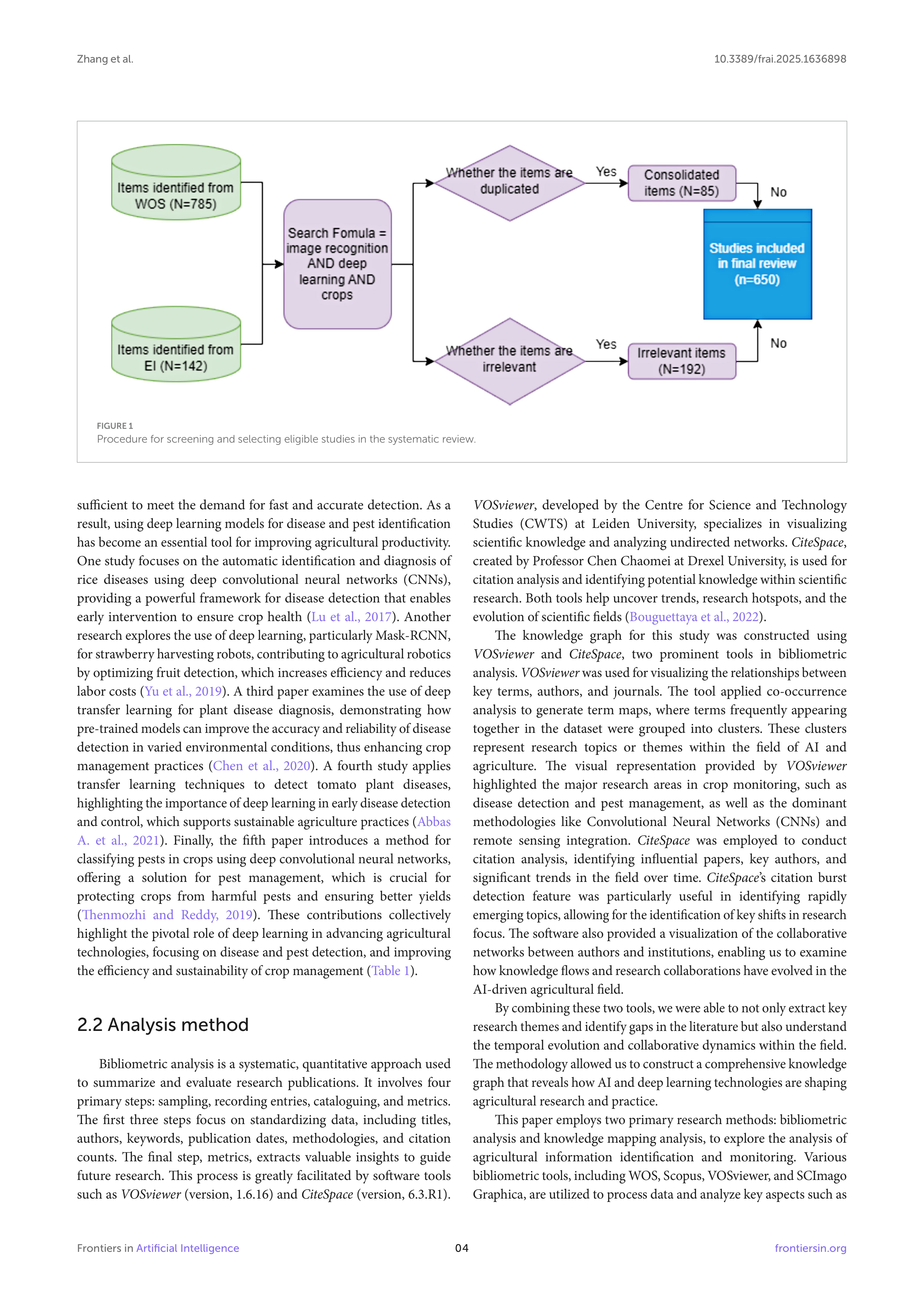
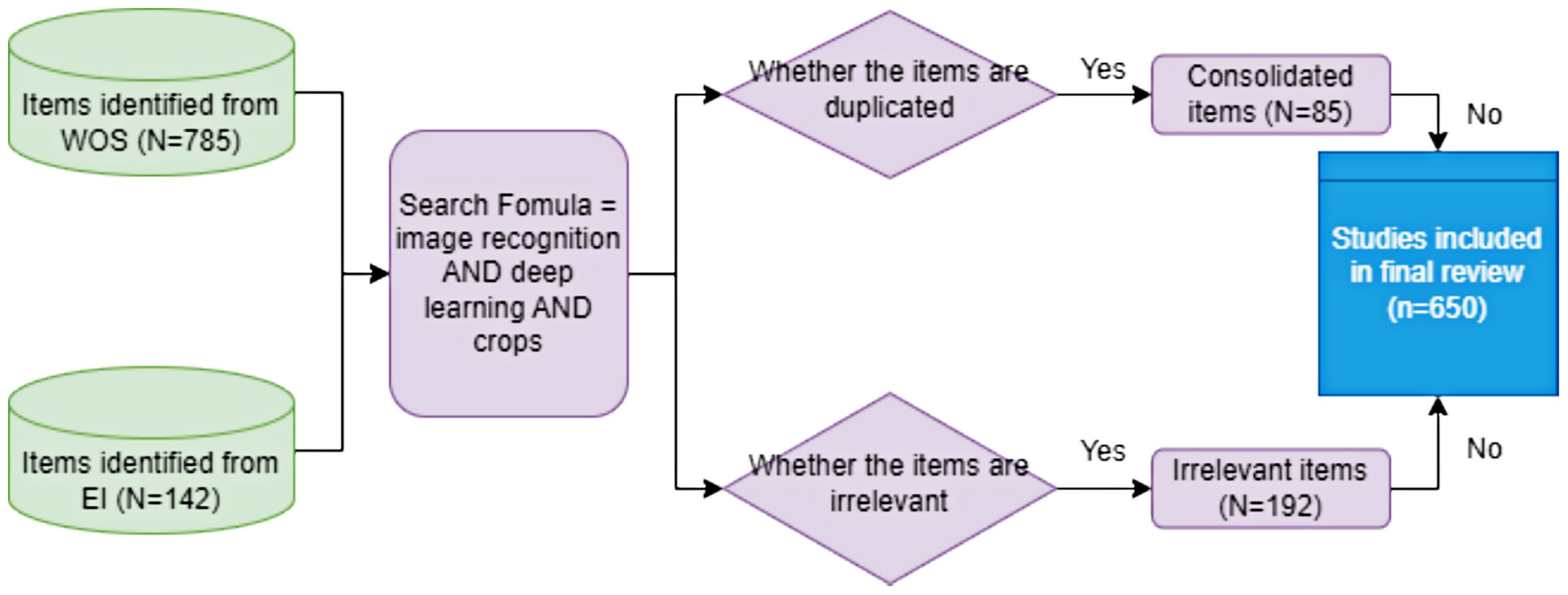
(2000–2025), which initially retrieved 785 records. A corresponding
search in EI up to the present date yielded 142 records. After cross-
database comparison and removal of 192 irrelevant publications and
85 consolidated items, 650 valid records were retained for analysis,
including five highly representative studies that exemplify key
advancements in deep learning-based image recognition for crop
analysis (
Figure 1
). This systematic approach ensured a rigorous and
comprehensive collection of relevant literature in the field.
In recent years, the application of deep learning technologies in
agriculture, particularly for crop disease and pest detection, has seen
significant advancements. With the modernization of agricultural
production, traditional manual monitoring methods are no longer
Zhang et al.
10.3389/frai.2025.1636898
Frontiers in
Artificial Intelligence
04
frontiersin.org
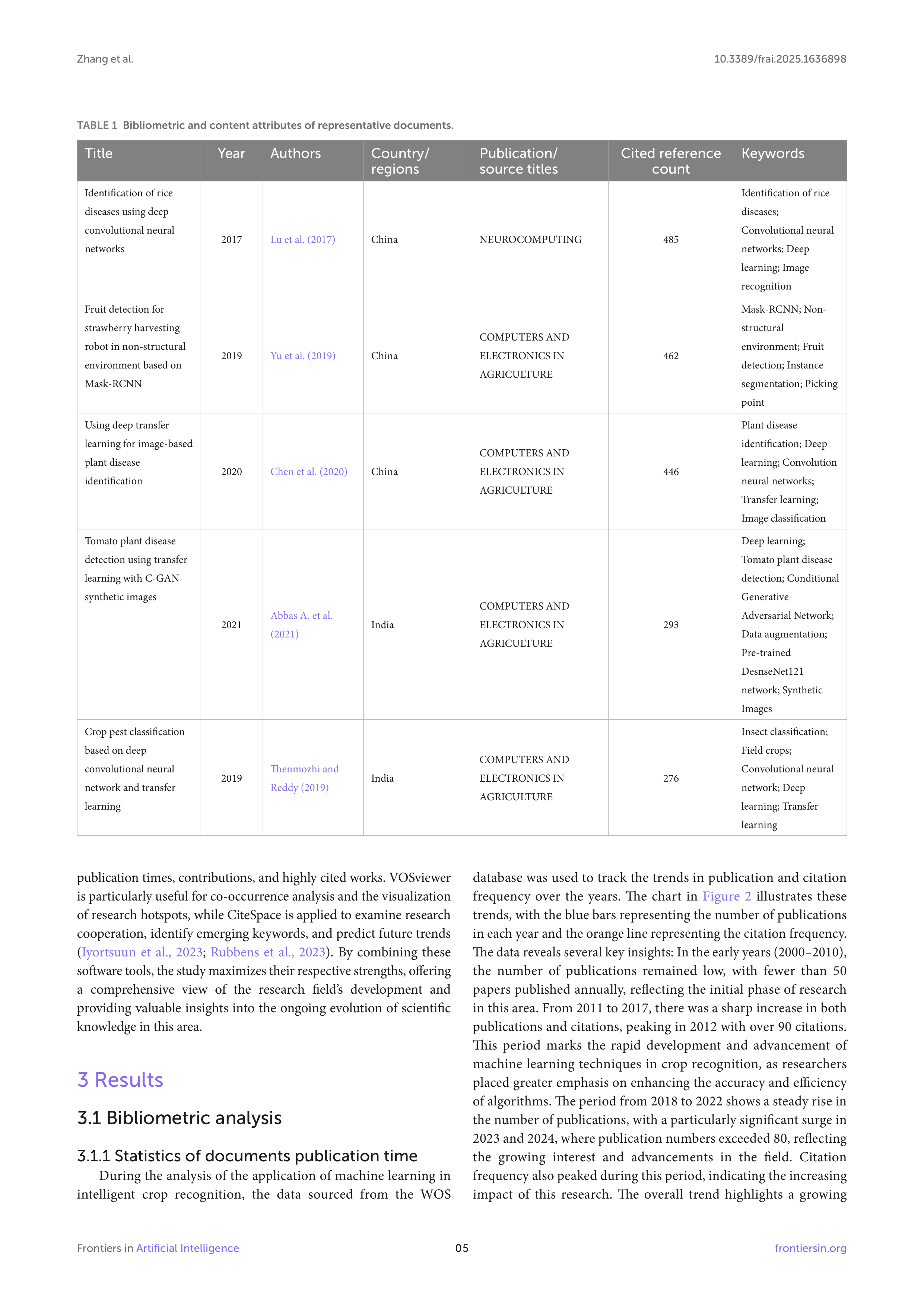
sufficient to meet the demand for fast and accurate detection. As a
result, using deep learning models for disease and pest identification
has become an essential tool for improving agricultural productivity.
One study focuses on the automatic identification and diagnosis of
rice diseases using deep convolutional neural networks (CNNs),
providing a powerful framework for disease detection that enables
early intervention to ensure crop health (
Lu et al., 2017
). Another
research explores the use of deep learning, particularly Mask-RCNN,
for strawberry harvesting robots, contributing to agricultural robotics
by optimizing fruit detection, which increases efficiency and reduces
labor costs (
Yu et al., 2019
). A third paper examines the use of deep
transfer learning for plant disease diagnosis, demonstrating how
pre-trained models can improve the accuracy and reliability of disease
detection in varied environmental conditions, thus enhancing crop
management practices (
Chen et al., 2020
). A fourth study applies
transfer learning techniques to detect tomato plant diseases,
highlighting the importance of deep learning in early disease detection
and control, which supports sustainable agriculture practices (
Abbas
A. et al., 2021
). Finally, the fifth paper introduces a method for
classifying pests in crops using deep convolutional neural networks,
offering a solution for pest management, which is crucial for
protecting crops from harmful pests and ensuring better yields
(
Thenmozhi and Reddy, 2019
). These contributions collectively
highlight the pivotal role of deep learning in advancing agricultural
technologies, focusing on disease and pest detection, and improving
the efficiency and sustainability of crop management (
Table 1
).
2.2 Analysis method
Bibliometric analysis is a systematic, quantitative approach used
to summarize and evaluate research publications. It involves four
primary steps: sampling, recording entries, cataloguing, and metrics.
The first three steps focus on standardizing data, including titles,
authors, keywords, publication dates, methodologies, and citation
counts. The final step, metrics, extracts valuable insights to guide
future research. This process is greatly facilitated by software tools
such as
VOSviewer
(version, 1.6.16) and
CiteSpace
(version, 6.3.R1).
VOSviewer
, developed by the Centre for Science and Technology
Studies (CWTS) at Leiden University, specializes in visualizing
scientific knowledge and analyzing undirected networks.
CiteSpace
,
created by Professor Chen Chaomei at Drexel University, is used for
citation analysis and identifying potential knowledge within scientific
research. Both tools help uncover trends, research hotspots, and the
evolution of scientific fields (
Bouguettaya et al., 2022
).
The knowledge graph for this study was constructed using
VOSviewer
and
CiteSpace
, two prominent tools in bibliometric
analysis.
VOSviewer
was used for visualizing the relationships between
key terms, authors, and journals. The tool applied co-occurrence
analysis to generate term maps, where terms frequently appearing
together in the dataset were grouped into clusters. These clusters
represent research topics or themes within the field of AI and
agriculture. The visual representation provided by
VOSviewer
highlighted the major research areas in crop monitoring, such as
disease detection and pest management, as well as the dominant
methodologies like Convolutional Neural Networks (CNNs) and
remote sensing integration.
CiteSpace
was employed to conduct
citation analysis, identifying influential papers, key authors, and
significant trends in the field over time.
CiteSpace
’s citation burst
detection feature was particularly useful in identifying rapidly
emerging topics, allowing for the identification of key shifts in research
focus. The software also provided a visualization of the collaborative
networks between authors and institutions, enabling us to examine
how knowledge flows and research collaborations have evolved in the
AI-driven agricultural field.
By combining these two tools, we were able to not only extract key
research themes and identify gaps in the literature but also understand
the temporal evolution and collaborative dynamics within the field.
The methodology allowed us to construct a comprehensive knowledge
graph that reveals how AI and deep learning technologies are shaping
agricultural research and practice.
This paper employs two primary research methods: bibliometric
analysis and knowledge mapping analysis, to explore the analysis of
agricultural information identification and monitoring. Various
bibliometric tools, including WOS, Scopus, VOSviewer, and SCImago
Graphica, are utilized to process data and analyze key aspects such as
FIGURE 1
Procedure for screening and selecting eligible studies in the systematic review.
Zhang et al.
10.3389/frai.2025.1636898
Frontiers in
Artificial Intelligence
05
frontiersin.org
publication times, contributions, and highly cited works. VOSviewer
is particularly useful for co-occurrence analysis and the visualization
of research hotspots, while CiteSpace is applied to examine research
cooperation, identify emerging keywords, and predict future trends
(
Iyortsuun et al., 2023
;
Rubbens et al., 2023
). By combining these
software tools, the study maximizes their respective strengths, offering
a comprehensive view of the research field’s development and
providing valuable insights into the ongoing evolution of scientific
knowledge in this area.
3 Results
3.1 Bibliometric analysis
3.1.1 Statistics of documents publication time
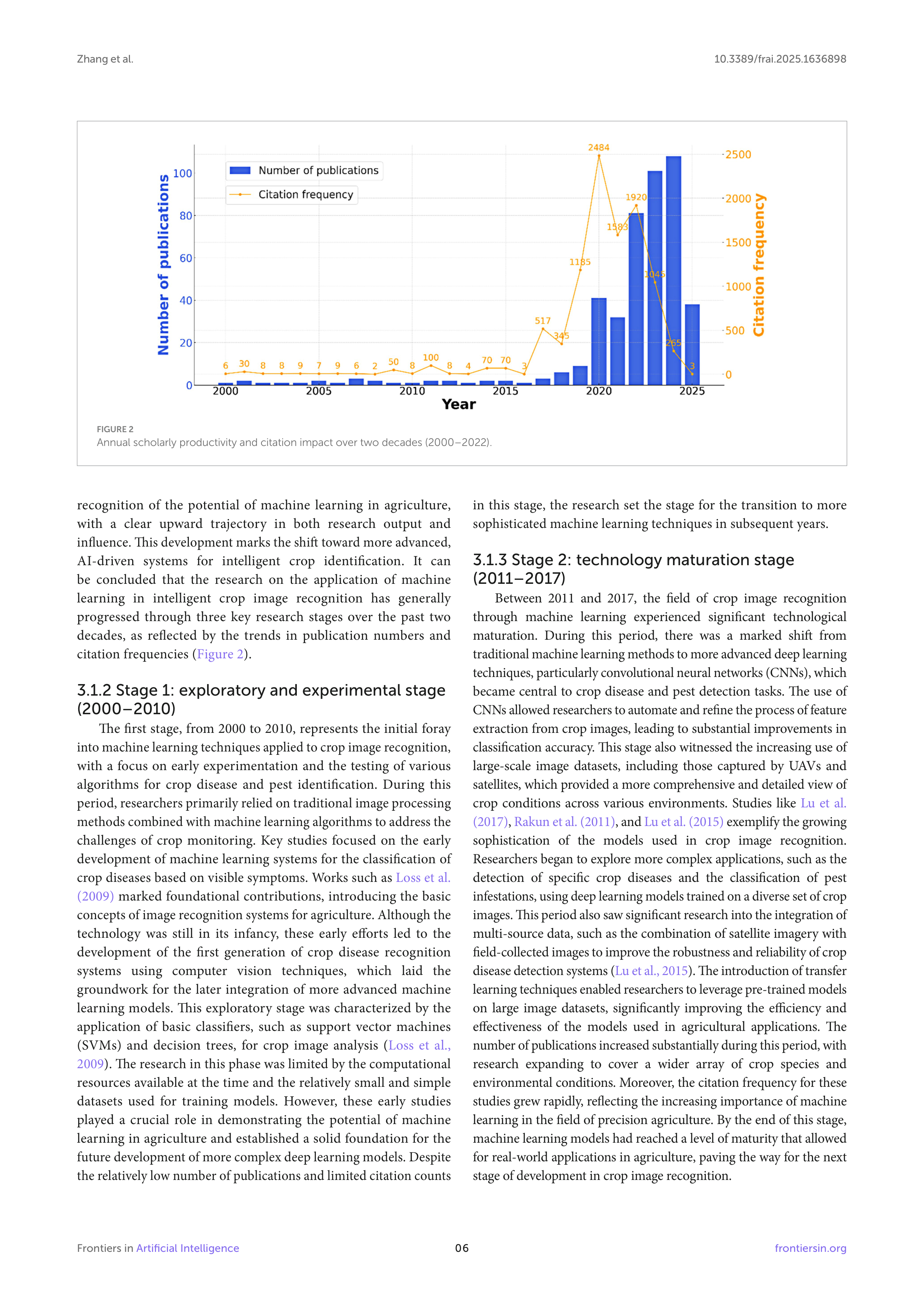
During the analysis of the application of machine learning in
intelligent crop recognition, the data sourced from the WOS
database was used to track the trends in publication and citation
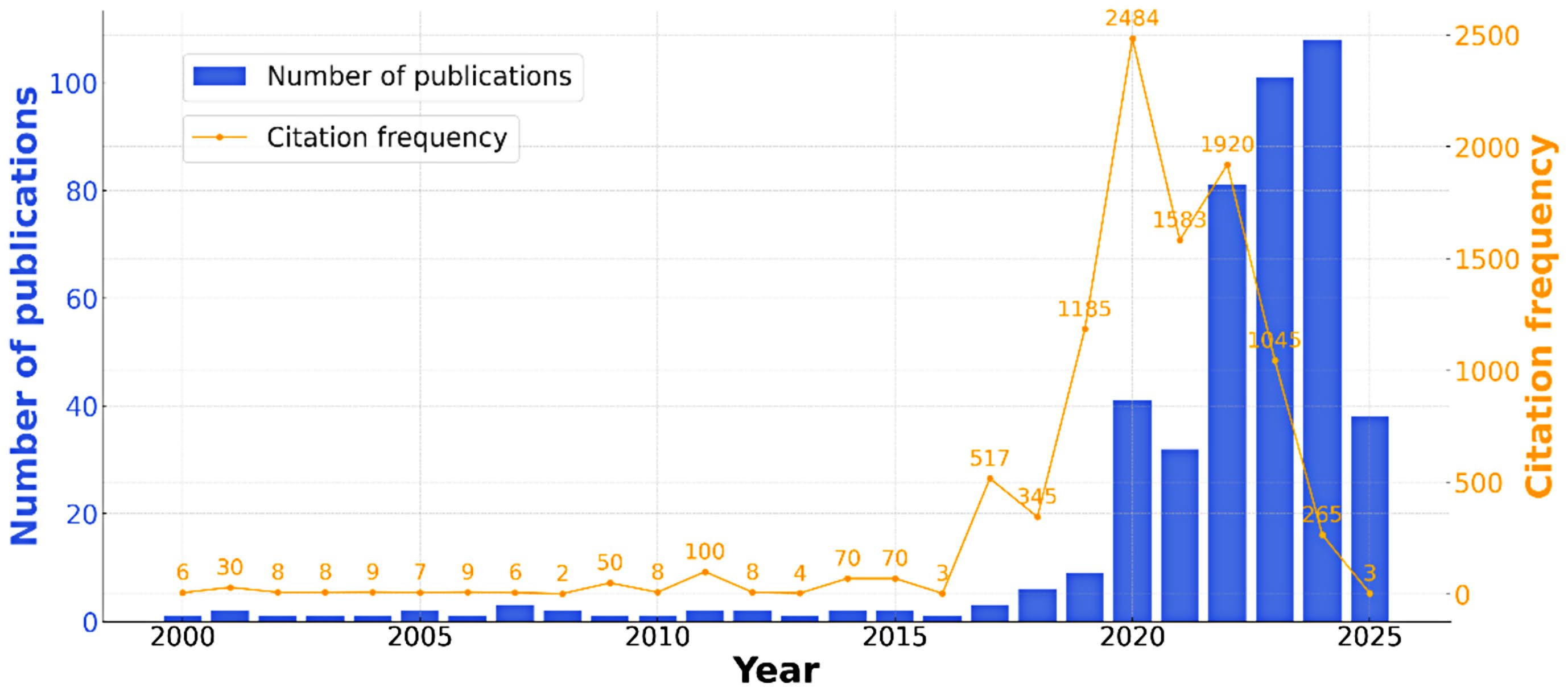
frequency over the years. The chart in
Figure 2
illustrates these
trends, with the blue bars representing the number of publications
in each year and the orange line representing the citation frequency.
The data reveals several key insights: In the early years (2000–2010),
the number of publications remained low, with fewer than 50
papers published annually, reflecting the initial phase of research
in this area. From 2011 to 2017, there was a sharp increase in both
publications and citations, peaking in 2012 with over 90 citations.
This period marks the rapid development and advancement of
machine learning techniques in crop recognition, as researchers
placed greater emphasis on enhancing the accuracy and efficiency
of algorithms. The period from 2018 to 2022 shows a steady rise in
the number of publications, with a particularly significant surge in
2023 and 2024, where publication numbers exceeded 80, reflecting
the growing interest and advancements in the field. Citation
frequency also peaked during this period, indicating the increasing
impact of this research. The overall trend highlights a growing
TABLE 1
Bibliometric and content attributes of representative documents.
Title
Year
Authors
Country/
regions
Publication/
source titles
Cited reference
count
Keywords
Identification of rice
diseases using deep
convolutional neural
networks
2017
Lu et al. (2017)
China
NEUROCOMPUTING
485
Identification of rice
diseases;
Convolutional neural
networks; Deep
learning; Image
recognition
Fruit detection for
strawberry harvesting
robot in non-structural
environment based on
Mask-RCNN
2019
Yu et al. (2019)
China
COMPUTERS AND
ELECTRONICS IN
AGRICULTURE
462
Mask-RCNN; Non-
structural
environment; Fruit
detection; Instance
segmentation; Picking
point
Using deep transfer
learning for image-based
plant disease
identification
2020
Chen et al. (2020)
China
COMPUTERS AND
ELECTRONICS IN
AGRICULTURE
446
Plant disease
identification; Deep
learning; Convolution
neural networks;
Transfer learning;
Image classification
Tomato plant disease
detection using transfer
learning with C-GAN
synthetic images
2021
Abbas A. et al.
(2021)
India
COMPUTERS AND
ELECTRONICS IN
AGRICULTURE
293
Deep learning;
Tomato plant disease
detection; Conditional
Generative
Adversarial Network;
Data augmentation;
Pre-trained
DesnseNet121
network; Synthetic
Images
Crop pest classification
based on deep
convolutional neural
network and transfer
learning
2019
Thenmozhi and
Reddy (2019)
India
COMPUTERS AND
ELECTRONICS IN
AGRICULTURE
276
Insect classification;
Field crops;
Convolutional neural
network; Deep
learning; Transfer
learning
Zhang et al.
10.3389/frai.2025.1636898
Frontiers in
Artificial Intelligence
06
frontiersin.org
recognition of the potential of machine learning in agriculture,
with a clear upward trajectory in both research output and
influence. This development marks the shift toward more advanced,
AI-driven systems for intelligent crop identification. It can
be concluded that the research on the application of machine
learning in intelligent crop image recognition has generally
progressed through three key research stages over the past two
decades, as reflected by the trends in publication numbers and
citation frequencies (
Figure 2
).
3.1.2 Stage 1: exploratory and experimental stage
(2000–2010)
The first stage, from 2000 to 2010, represents the initial foray
into machine learning techniques applied to crop image recognition,
with a focus on early experimentation and the testing of various
algorithms for crop disease and pest identification. During this
period, researchers primarily relied on traditional image processing
methods combined with machine learning algorithms to address the
challenges of crop monitoring. Key studies focused on the early
development of machine learning systems for the classification of
crop diseases based on visible symptoms. Works such as
Loss et al.
(2009)
marked foundational contributions, introducing the basic
concepts of image recognition systems for agriculture. Although the
technology was still in its infancy, these early efforts led to the
development of the first generation of crop disease recognition
systems using computer vision techniques, which laid the
groundwork for the later integration of more advanced machine
learning models. This exploratory stage was characterized by the
application of basic classifiers, such as support vector machines
(SVMs) and decision trees, for crop image analysis (
Loss et al.,
2009
). The research in this phase was limited by the computational
resources available at the time and the relatively small and simple
datasets used for training models. However, these early studies
played a crucial role in demonstrating the potential of machine
learning in agriculture and established a solid foundation for the
future development of more complex deep learning models. Despite
the relatively low number of publications and limited citation counts
in this stage, the research set the stage for the transition to more
sophisticated machine learning techniques in subsequent years.
3.1.3 Stage 2: technology maturation stage
(2011–2017)
Between 2011 and 2017, the field of crop image recognition
through machine learning experienced significant technological
maturation. During this period, there was a marked shift from
traditional machine learning methods to more advanced deep learning
techniques, particularly convolutional neural networks (CNNs), which
became central to crop disease and pest detection tasks. The use of
CNNs allowed researchers to automate and refine the process of feature
extraction from crop images, leading to substantial improvements in
classification accuracy. This stage also witnessed the increasing use of
large-scale image datasets, including those captured by UAVs and
satellites, which provided a more comprehensive and detailed view of
crop conditions across various environments. Studies like
Lu et al.
(2017)
,
Rakun et al. (2011)
, and
Lu et al. (2015)
exemplify the growing
sophistication of the models used in crop image recognition.
Researchers began to explore more complex applications, such as the
detection of specific crop diseases and the classification of pest
infestations, using deep learning models trained on a diverse set of crop
images. This period also saw significant research into the integration of
multi-source data, such as the combination of satellite imagery with
field-collected images to improve the robustness and reliability of crop
disease detection systems (
Lu et al., 2015
). The introduction of transfer
learning techniques enabled researchers to leverage pre-trained models
on large image datasets, significantly improving the efficiency and
effectiveness of the models used in agricultural applications. The
number of publications increased substantially during this period, with
research expanding to cover a wider array of crop species and
environmental conditions. Moreover, the citation frequency for these
studies grew rapidly, reflecting the increasing importance of machine
learning in the field of precision agriculture. By the end of this stage,
machine learning models had reached a level of maturity that allowed
for real-world applications in agriculture, paving the way for the next
stage of development in crop image recognition.
FIGURE 2
Annual scholarly productivity and citation impact over two decades (2000–2022).
Zhang et al.
10.3389/frai.2025.1636898
Frontiers in
Artificial Intelligence
07
frontiersin.org
3.1.4 Stage 3: artificial intelligence phase (2018–
2022)
The period between 2018 and 2022 represents the rise of artificial
intelligence (AI), with deep learning and machine learning models
emerging as the leading technologies for intelligent crop image
recognition. During this phase, AI-driven systems for crop monitoring
and disease detection gained widespread adoption, leading to a
significant surge in both research output and citation rates in the field.
The application of machine learning in agriculture shifted towards
automated, real-time crop monitoring systems that were capable of
handling large volumes of data and providing more accurate
predictions. AI-driven models, particularly convolutional neural
networks (CNNs) and advanced neural networks, became central to
crop disease detection, pest management, and phenological stage
monitoring. Studies such as
Saranya et al. (2021)
,
Sharma et al. (2022)
,
and
Li et al. (2022)
highlight the increasing reliance on AI for real-
time monitoring of crops. The integration of UAV-based imagery and
machine learning models allowed for the collection of high-resolution
data on crop health, enabling more precise detection of diseases,
nutrient deficiencies, and pests. This period also saw the development
of more sophisticated AI systems that combined instance and
semantic segmentation with deep learning for improved crop disease
and pest detection, as demonstrated in studies like
Tassis et al. (2021)
and
d’Andrimont et al. (2022)
. Moreover, the application of AI
extended to various aspects of precision agriculture, such as the
classification of nutrient deficiencies in apple trees (
Kumar et al., 2022
)
and the development of automatic systems for pest detection and crop
yield prediction. The growing use of AI in agriculture has led to the
emergence of cloud-based platforms that allow for the rapid
processing of crop images and the integration of these platforms with
existing agricultural management systems. The rapid advancements
in this phase have made it clear that AI will play a central role in the
future of agriculture, with AI-driven systems providing real-time,
high-precision solutions for crop monitoring and management (
De
Angelis et al., 2023
;
Loeffler et al., 2024
;
Liu S. et al., 2025
). As research
continues to evolve, the combination of AI with other emerging
technologies, such as robotics and the Internet of Things (IoT), is set
to further transform the agricultural industry.
3.2 Contribution analysis
In the realm of machine learning applications for crop image
recognition, several authors have made pivotal contributions,
shaping the field with their innovative approaches. Zhang (Y) has
significantly advanced the automation of crop ripeness detection,
particularly in jujube fruits, by developing AGHRNet: An attention
ghost-HRNet for confirmation of jujube fruit ripening stage. This
attention-based deep learning model, with its exceptional
performance, has greatly enhanced precision in crop management
systems, contributing extensively to the recognition of fruit ripeness
and disease detection (
Zheng et al., 2023
). Following closely, Chen
(C) has made important strides in improving crop disease
recognition by addressing the challenges posed by occluded images.
His work on HOB-CNN: Hallucination of occluded branches with
convolutional neural networks introduced methods to handle
imperfect data, making crop disease detection more reliable even in
the presence of visual obstructions (
Chen et al., 2023
). Meanwhile,
Saraswat (D) has focused on optimizing deep learning models for
large-scale agricultural settings, particularly in crop disease
detection. His contributions, including Performance of deep learning
models for classification and detection of crop diseases, have greatly
improved detection accuracy, making real-time agricultural
monitoring more efficient and actionable (
Ahmad et al., 2021
).
He (Y) has significantly advanced crop image recognition through
his work on Object detection with attribute tagging task: A novel
approach for crop image recognition. His research integrates object
detection with attribute tagging, improving crop classification
accuracy and enabling systems to capture additional contextual
information, such as growth stages. This approach enhances real-
time crop monitoring, contributing to more efficient and scalable
agricultural management systems (
Liu D. et al., 2025
). Lastly, Fu (LS)
has contributed to the field by introducing new segmentation
techniques for crop disease detection. In Deep learning based
segmentation for automated crop disease detection, Fu’s innovative
methods have improved the precision of disease detection,
particularly in tree fruits and vegetables, pushing the boundaries of
crop image recognition (
Majeed et al., 2020
). Together, these authors
have significantly refined machine learning models for crop
recognition and disease management, with each making unique
contributions that continue to propel the field forward, offering
solutions for more accurate, real-time, and scalable crop monitoring
in agriculture. The work of these five authors shares a common focus
on advancing machine learning models for crop image recognition,
particularly in disease detection and classification, yet each brings a
unique perspective, with some emphasizing deep learning
segmentation techniques, others integrating multi-source data, and
a few focusing on the automation and real-time applications of crop
monitoring systems. The top 5 authors and their representative
contributions are listed in
Table 2
.
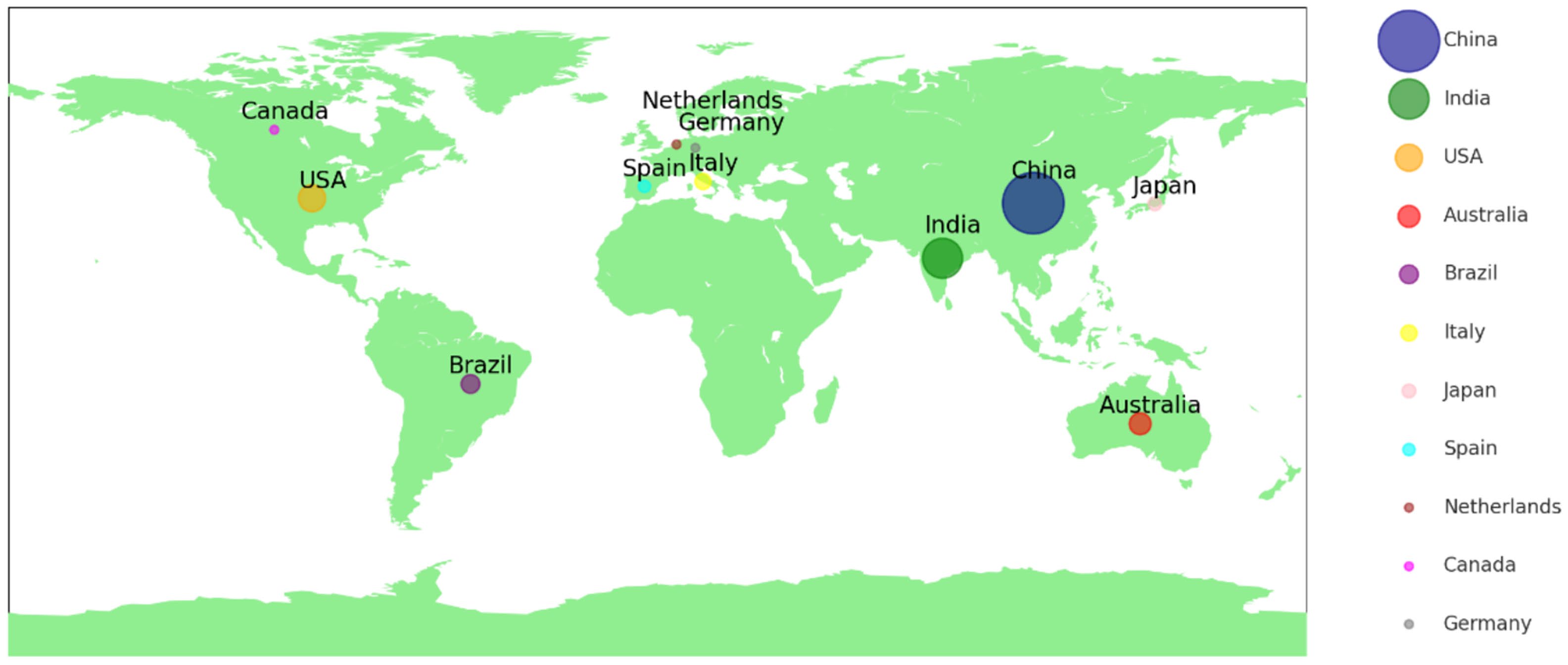
To enhance the visual representation of the geographic
distribution of publications by country or region, this study first saves
the merged and de-duplicated data from the WOS database in a
standardized *.txt format. The word frequency threshold is then set to
10 in VOSviewer, allowing for the identification of countries or
regions with significant contributions to the field. After processing,
the data is saved in *.gml format and imported into Scimago to create
a geographical visualization of document distribution, with
appropriate map decorations.
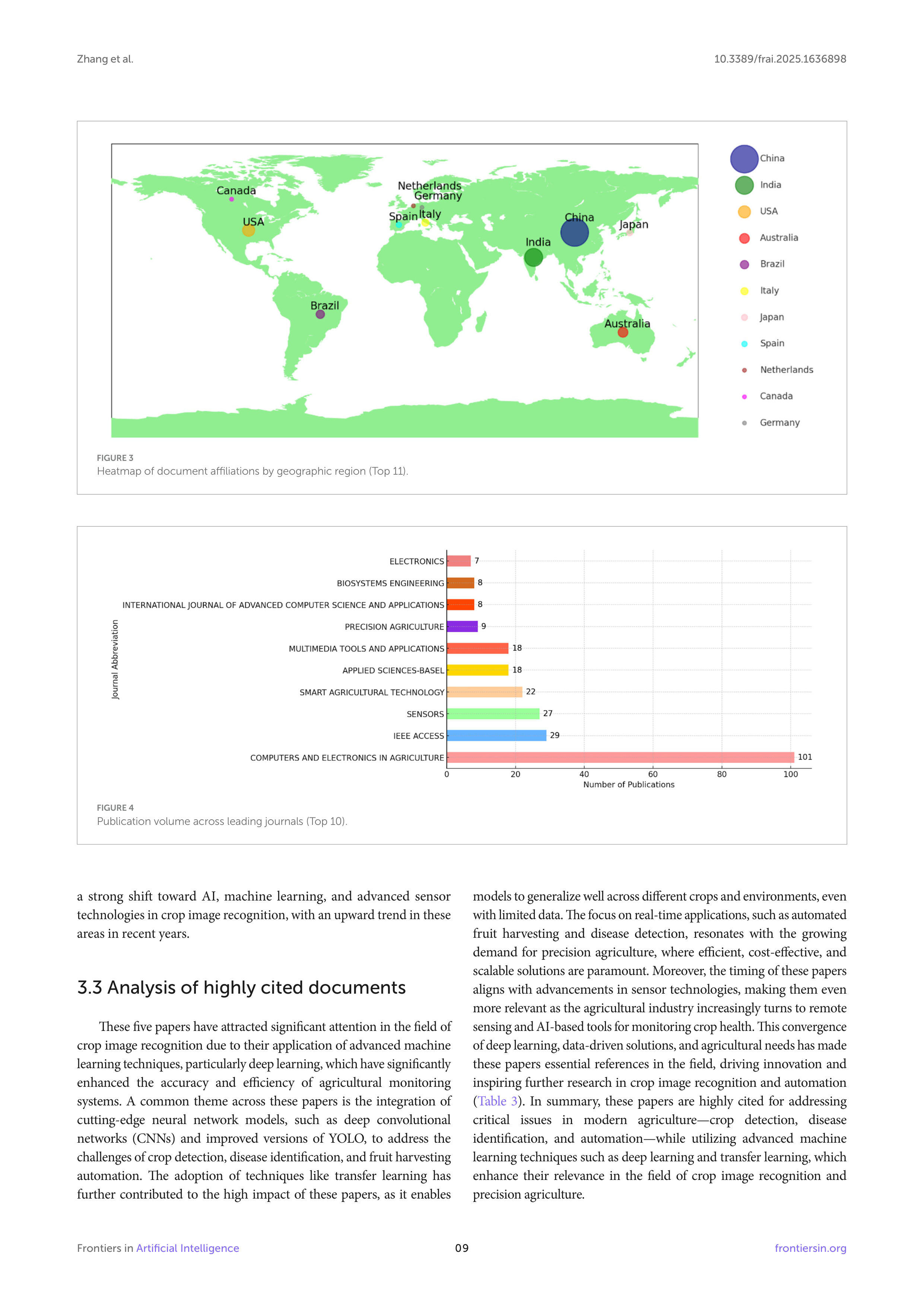
Figure 3
illustrates the distribution of
countries leading globally in crop image recognition research. A total
of 11 countries have published more than 10 documents. An analysis
of the top five contributing countries reveals notable patterns in the
global distribution of crop image recognition research. China leads
the field with 208 publications, reflecting its dominant role and the
active, extensive research community engaged in this area. India
follows with 88 publications, marking its significant contribution to
agricultural research, particularly in precision farming and remote
sensing. The USA ranks third with 40 publications, demonstrating
substantial involvement in crop image recognition, though at a smaller
scale compared to China and India. Australia (26 publications) and
Brazil (19 publications) round out the top five, indicating growing
research efforts, especially in precision agriculture and related
technologies. Overall, the top five countries emphasize the prominent
positions of China and India in advancing crop image recognition
research, with the USA and other nations contributing significantly,
though on a relatively smaller scale.
Zhang et al.
10.3389/frai.2025.1636898
Frontiers in
Artificial Intelligence
08
frontiersin.org
After synthesizing the data obtained from WOS, a total of 35
journals were identified, with 12 publishing more than three
documents. This suggests significant interest in the research area of
crop image recognition.
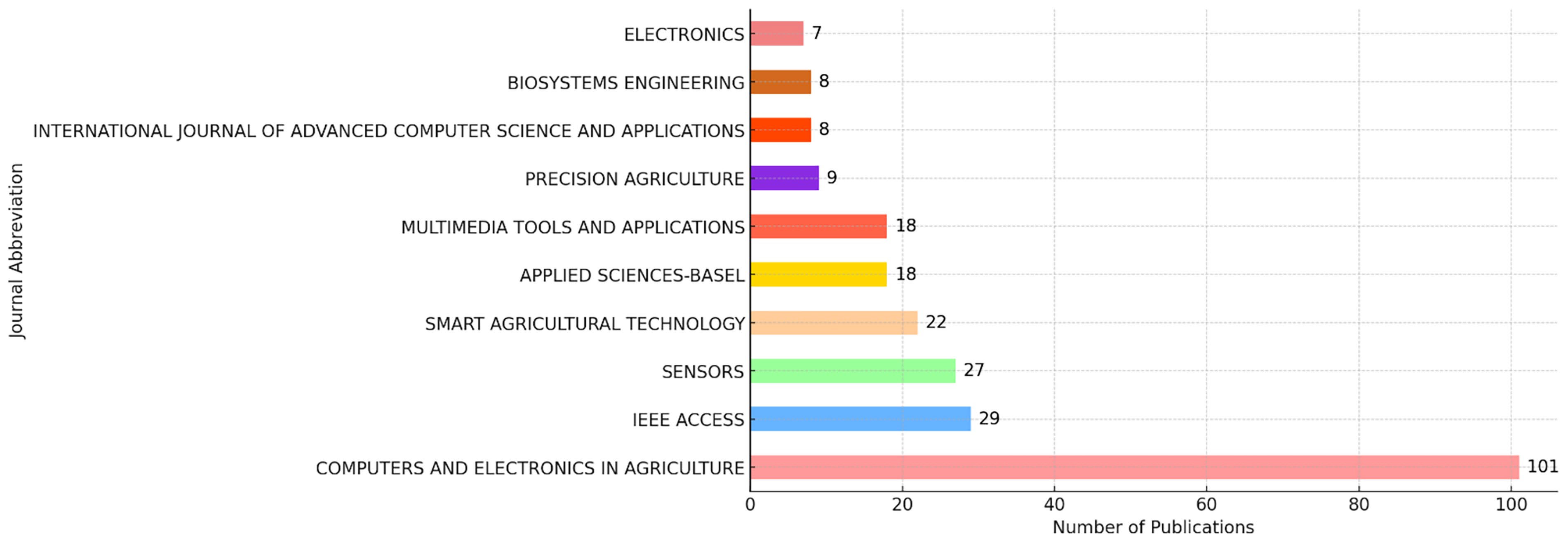
Figure 4
displays the top ten journals. The top
three journals in terms of publication count are COMPUTERS AND
ELECTRONICS IN AGRICULTURE (109 publications), IEEE
ACCESS (29 publications), and SENSORS (27 publications), with
corresponding h-index values of 12, 9, and 8, respectively. The top
three journals in crop image recognition research, COMPUTERS
AND ELECTRONICS IN AGRICULTURE (109 publications), IEEE
ACCESS (29 publications), and SENSORS (27 publications), focus on
different aspects of the field. COMPUTERS AND ELECTRONICS IN
AGRICULTURE primarily publishes papers on computational
methods and electronics in agriculture, with a strong emphasis on
precision farming, remote sensing, and automation systems for crop
monitoring. This journal has seen a consistent increase in publications,
particularly from 2010 onwards, as studies combining machine
learning and image processing in agricultural applications have
grown. In contrast, IEEE ACCESS accepts a broader range of
interdisciplinary papers, focusing on the integration of computer
science, electronics, and agricultural engineering, especially in
developing advanced algorithms for crop image analysis. This journal
has experienced a notable rise in publications over the last 5 years,
reflecting the growing influence of AI and big data in crop image
recognition. Lastly, SENSORS publishes research centered around
sensor technologies, particularly in remote sensing and the use of
hyperspectral and multispectral imaging for crop health monitoring.
Publications in this journal have gradually increased since 2015, as
sensor technologies have advanced, enabling more widespread
application in agricultural monitoring. Together, these journals reflect
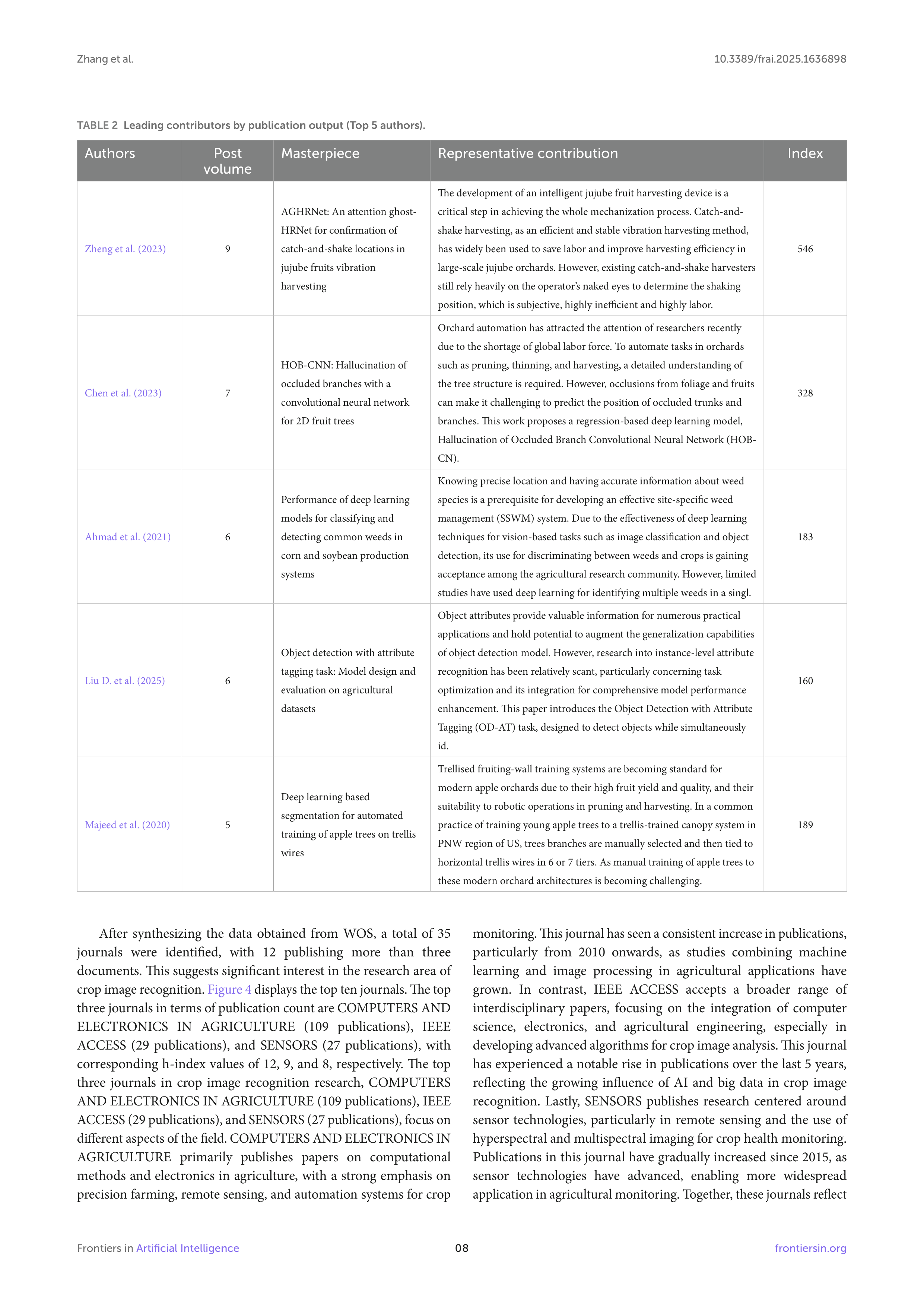
TABLE 2
Leading contributors by publication output (Top 5 authors).
Authors
Post
volume
Masterpiece
Representative contribution
Index
Zheng et al. (2023)
9
AGHRNet: An attention ghost-
HRNet for confirmation of
catch-and-shake locations in
jujube fruits vibration
harvesting
The development of an intelligent jujube fruit harvesting device is a
critical step in achieving the whole mechanization process. Catch-and-
shake harvesting, as an efficient and stable vibration harvesting method,
has widely been used to save labor and improve harvesting efficiency in
large-scale jujube orchards. However, existing catch-and-shake harvesters
still rely heavily on the operator’s naked eyes to determine the shaking
position, which is subjective, highly inefficient and highly labor.
546
Chen et al. (2023)
7
HOB-CNN: Hallucination of
occluded branches with a
convolutional neural network
for 2D fruit trees
Orchard automation has attracted the attention of researchers recently
due to the shortage of global labor force. To automate tasks in orchards
such as pruning, thinning, and harvesting, a detailed understanding of
the tree structure is required. However, occlusions from foliage and fruits
can make it challenging to predict the position of occluded trunks and
branches. This work proposes a regression-based deep learning model,
Hallucination of Occluded Branch Convolutional Neural Network (HOB-
CN).
328
Ahmad et al. (2021)
6
Performance of deep learning
models for classifying and
detecting common weeds in
corn and soybean production
systems
Knowing precise location and having accurate information about weed
species is a prerequisite for developing an effective site-specific weed
management (SSWM) system. Due to the effectiveness of deep learning
techniques for vision-based tasks such as image classification and object
detection, its use for discriminating between weeds and crops is gaining
acceptance among the agricultural research community. However, limited
studies have used deep learning for identifying multiple weeds in a singl.
183
Liu D. et al. (2025)
6
Object detection with attribute
tagging task: Model design and
evaluation on agricultural
datasets
Object attributes provide valuable information for numerous practical
applications and hold potential to augment the generalization capabilities
of object detection model. However, research into instance-level attribute
recognition has been relatively scant, particularly concerning task
optimization and its integration for comprehensive model performance
enhancement. This paper introduces the Object Detection with Attribute
Tagging (OD-AT) task, designed to detect objects while simultaneously
id.
160
Majeed et al. (2020)
5
Deep learning based
segmentation for automated
training of apple trees on trellis
wires
Trellised fruiting-wall training systems are becoming standard for
modern apple orchards due to their high fruit yield and quality, and their
suitability to robotic operations in pruning and harvesting. In a common
practice of training young apple trees to a trellis-trained canopy system in
PNW region of US, trees branches are manually selected and then tied to
horizontal trellis wires in 6 or 7 tiers. As manual training of apple trees to
these modern orchard architectures is becoming challenging.
189
Zhang et al.
10.3389/frai.2025.1636898
Frontiers in
Artificial Intelligence
09
frontiersin.org
a strong shift toward AI, machine learning, and advanced sensor
technologies in crop image recognition, with an upward trend in these
areas in recent years.
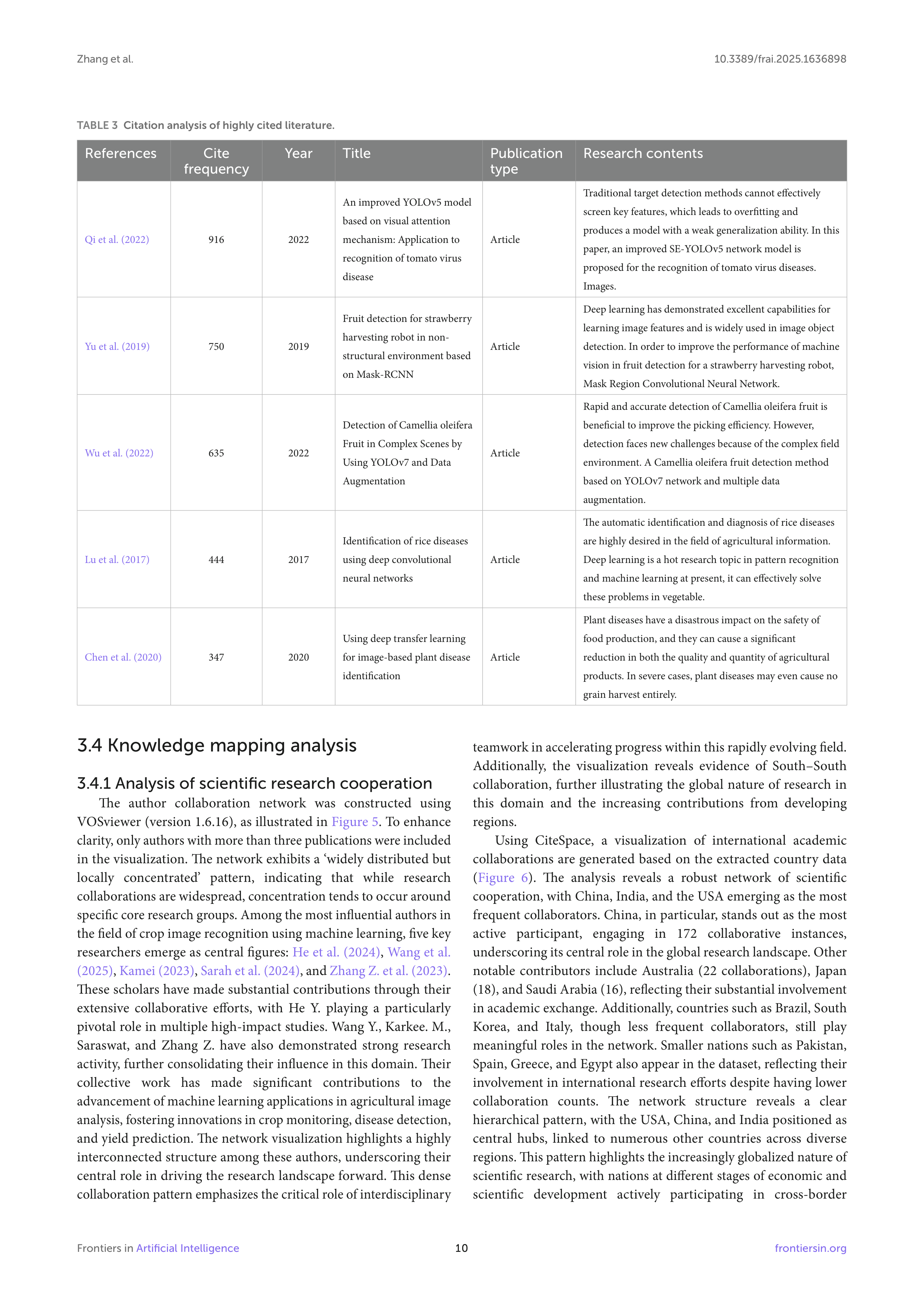
3.3 Analysis of highly cited documents
These five papers have attracted significant attention in the field of
crop image recognition due to their application of advanced machine
learning techniques, particularly deep learning, which have significantly
enhanced the accuracy and efficiency of agricultural monitoring
systems. A common theme across these papers is the integration of
cutting-edge neural network models, such as deep convolutional
networks (CNNs) and improved versions of YOLO, to address the
challenges of crop detection, disease identification, and fruit harvesting
automation. The adoption of techniques like transfer learning has
further contributed to the high impact of these papers, as it enables
models to generalize well across different crops and environments, even
with limited data. The focus on real-time applications, such as automated
fruit harvesting and disease detection, resonates with the growing
demand for precision agriculture, where efficient, cost-effective, and
scalable solutions are paramount. Moreover, the timing of these papers
aligns with advancements in sensor technologies, making them even
more relevant as the agricultural industry increasingly turns to remote
sensing and AI-based tools for monitoring crop health. This convergence
of deep learning, data-driven solutions, and agricultural needs has made
these papers essential references in the field, driving innovation and
inspiring further research in crop image recognition and automation
(
Table 3
). In summary, these papers are highly cited for addressing
critical issues in modern agriculture—crop detection, disease
identification, and automation—while utilizing advanced machine
learning techniques such as deep learning and transfer learning, which
enhance their relevance in the field of crop image recognition and
precision agriculture.
FIGURE 3
Heatmap of document affiliations by geographic region (Top 11).
FIGURE 4
Publication volume across leading journals (Top 10).
Zhang et al.
10.3389/frai.2025.1636898
Frontiers in
Artificial Intelligence
10
frontiersin.org
TABLE 3
Citation analysis of highly cited literature.
References
Cite
frequency
Year
Title
Publication
type
Research contents
Qi et al. (2022)
916
2022
An improved YOLOv5 model
based on visual attention
mechanism: Application to
recognition of tomato virus
disease
Article
Traditional target detection methods cannot effectively
screen key features, which leads to overfitting and
produces a model with a weak generalization ability. In this
paper, an improved SE-YOLOv5 network model is
proposed for the recognition of tomato virus diseases.
Images.
Yu et al. (2019)
750
2019
Fruit detection for strawberry
harvesting robot in non-
structural environment based
on Mask-RCNN
Article
Deep learning has demonstrated excellent capabilities for
learning image features and is widely used in image object
detection. In order to improve the performance of machine
vision in fruit detection for a strawberry harvesting robot,
Mask Region Convolutional Neural Network.
Wu et al. (2022)
635
2022
Detection of Camellia oleifera
Fruit in Complex Scenes by
Using YOLOv7 and Data
Augmentation
Article
Rapid and accurate detection of Camellia oleifera fruit is
beneficial to improve the picking efficiency. However,
detection faces new challenges because of the complex field
environment. A Camellia oleifera fruit detection method
based on YOLOv7 network and multiple data
augmentation.
Lu et al. (2017)
444
2017
Identification of rice diseases
using deep convolutional
neural networks
Article
The automatic identification and diagnosis of rice diseases
are highly desired in the field of agricultural information.
Deep learning is a hot research topic in pattern recognition
and machine learning at present, it can effectively solve
these problems in vegetable.
Chen et al. (2020)
347
2020
Using deep transfer learning
for image-based plant disease
identification
Article
Plant diseases have a disastrous impact on the safety of
food production, and they can cause a significant
reduction in both the quality and quantity of agricultural
products. In severe cases, plant diseases may even cause no
grain harvest entirely.
3.4 Knowledge mapping analysis
3.4.1 Analysis of scientific research cooperation
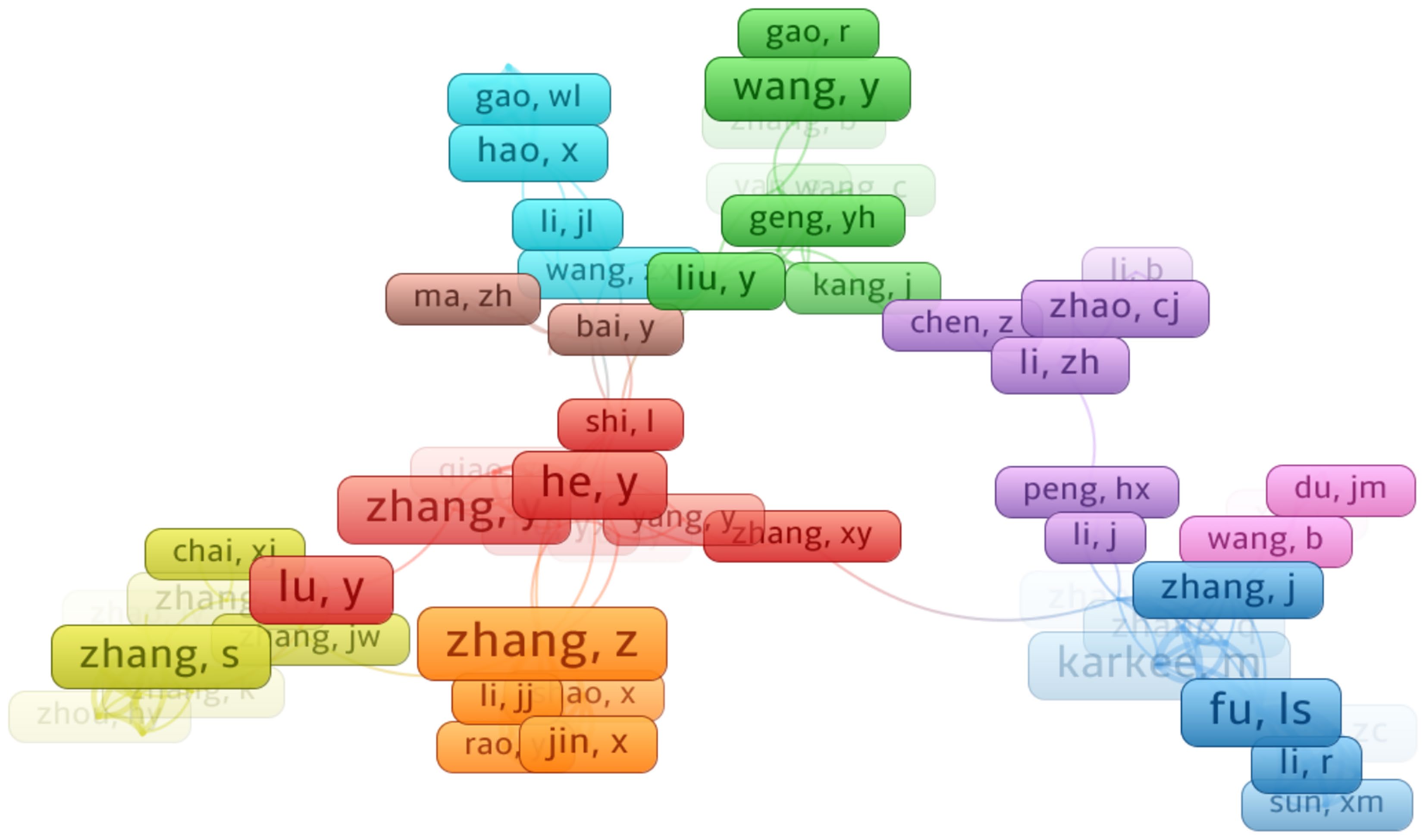
The author collaboration network was constructed using
VOSviewer (version 1.6.16), as illustrated in
Figure 5
. To enhance
clarity, only authors with more than three publications were included
in the visualization. The network exhibits a ‘widely distributed but
locally concentrated’ pattern, indicating that while research
collaborations are widespread, concentration tends to occur around
specific core research groups. Among the most influential authors in
the field of crop image recognition using machine learning, five key
researchers emerge as central figures:
He et al. (2024)
,
Wang et al.
(2025)
,
Kamei (2023)
,
Sarah et al. (2024)
, and
Zhang Z. et al. (2023)
.
These scholars have made substantial contributions through their
extensive collaborative efforts, with He Y. playing a particularly
pivotal role in multiple high-impact studies. Wang Y., Karkee. M.,
Saraswat, and Zhang Z. have also demonstrated strong research
activity, further consolidating their influence in this domain. Their
collective work has made significant contributions to the
advancement of machine learning applications in agricultural image
analysis, fostering innovations in crop monitoring, disease detection,
and yield prediction. The network visualization highlights a highly
interconnected structure among these authors, underscoring their
central role in driving the research landscape forward. This dense
collaboration pattern emphasizes the critical role of interdisciplinary
teamwork in accelerating progress within this rapidly evolving field.
Additionally, the visualization reveals evidence of South–South
collaboration, further illustrating the global nature of research in
this domain and the increasing contributions from developing
regions.
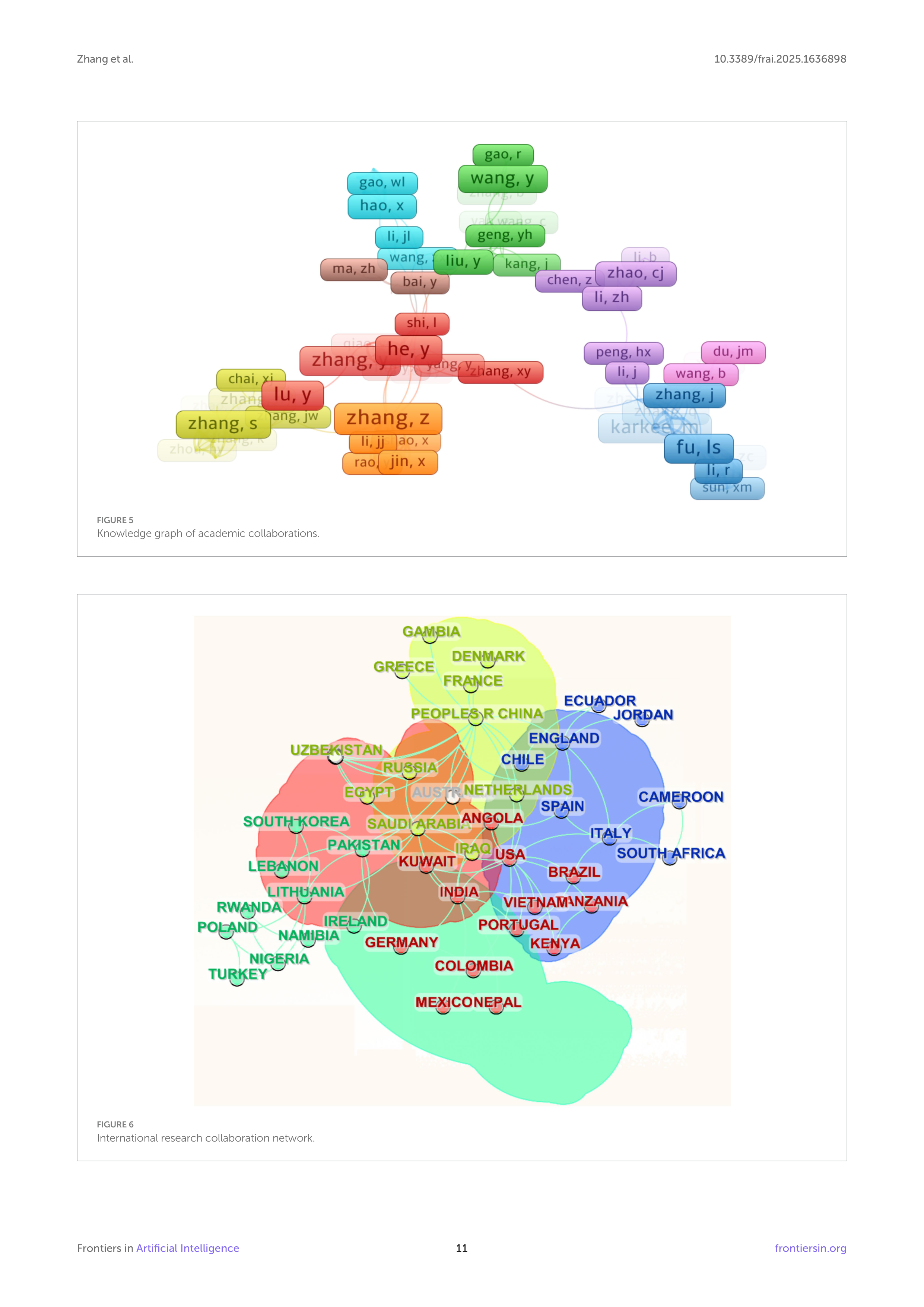
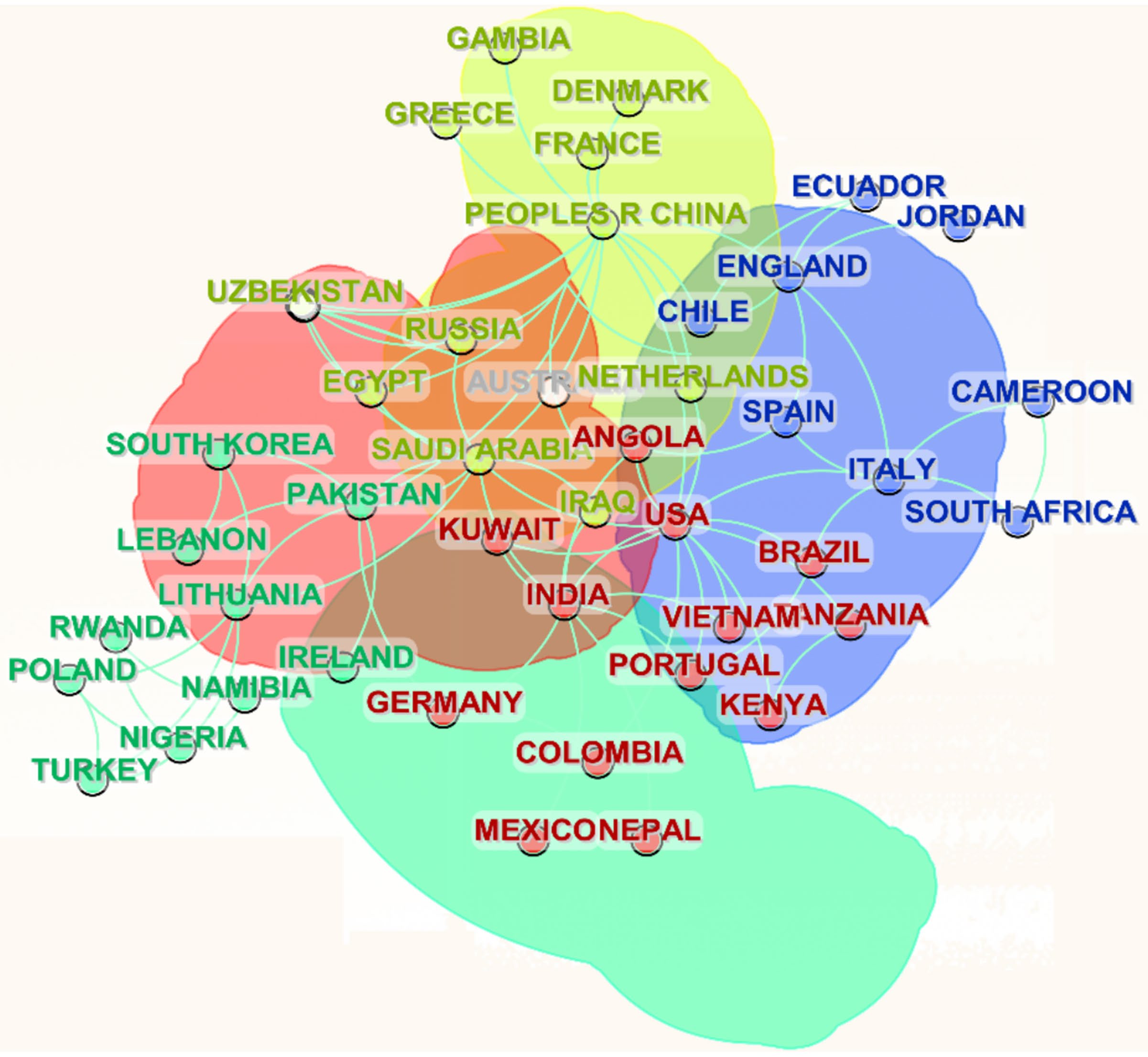
Using CiteSpace, a visualization of international academic
collaborations are generated based on the extracted country data
(
Figure 6
). The analysis reveals a robust network of scientific
cooperation, with China, India, and the USA emerging as the most
frequent collaborators. China, in particular, stands out as the most
active participant, engaging in 172 collaborative instances,
underscoring its central role in the global research landscape. Other
notable contributors include Australia (22 collaborations), Japan
(18), and Saudi Arabia (16), reflecting their substantial involvement
in academic exchange. Additionally, countries such as Brazil, South
Korea, and Italy, though less frequent collaborators, still play
meaningful roles in the network. Smaller nations such as Pakistan,
Spain, Greece, and Egypt also appear in the dataset, reflecting their
involvement in international research efforts despite having lower
collaboration counts. The network structure reveals a clear
hierarchical pattern, with the USA, China, and India positioned as
central hubs, linked to numerous other countries across diverse
regions. This pattern highlights the increasingly globalized nature of
scientific research, with nations at different stages of economic and
scientific development actively participating in cross-border
Zhang et al.
10.3389/frai.2025.1636898
Frontiers in
Artificial Intelligence
11
frontiersin.org
FIGURE 5
Knowledge graph of academic collaborations.
FIGURE 6
International research collaboration network.
Zhang et al.
10.3389/frai.2025.1636898
Frontiers in
Artificial Intelligence
12
frontiersin.org
partnerships. Additionally, the data suggests a correlation between
a country’s economic development and its research collaboration
output, with more economically advanced nations typically taking
the lead in global academic cooperation. These observations align
with broader trends in the internationalization of science,
emphasizing the critical role of collaborative networks in advancing
research across disciplines.
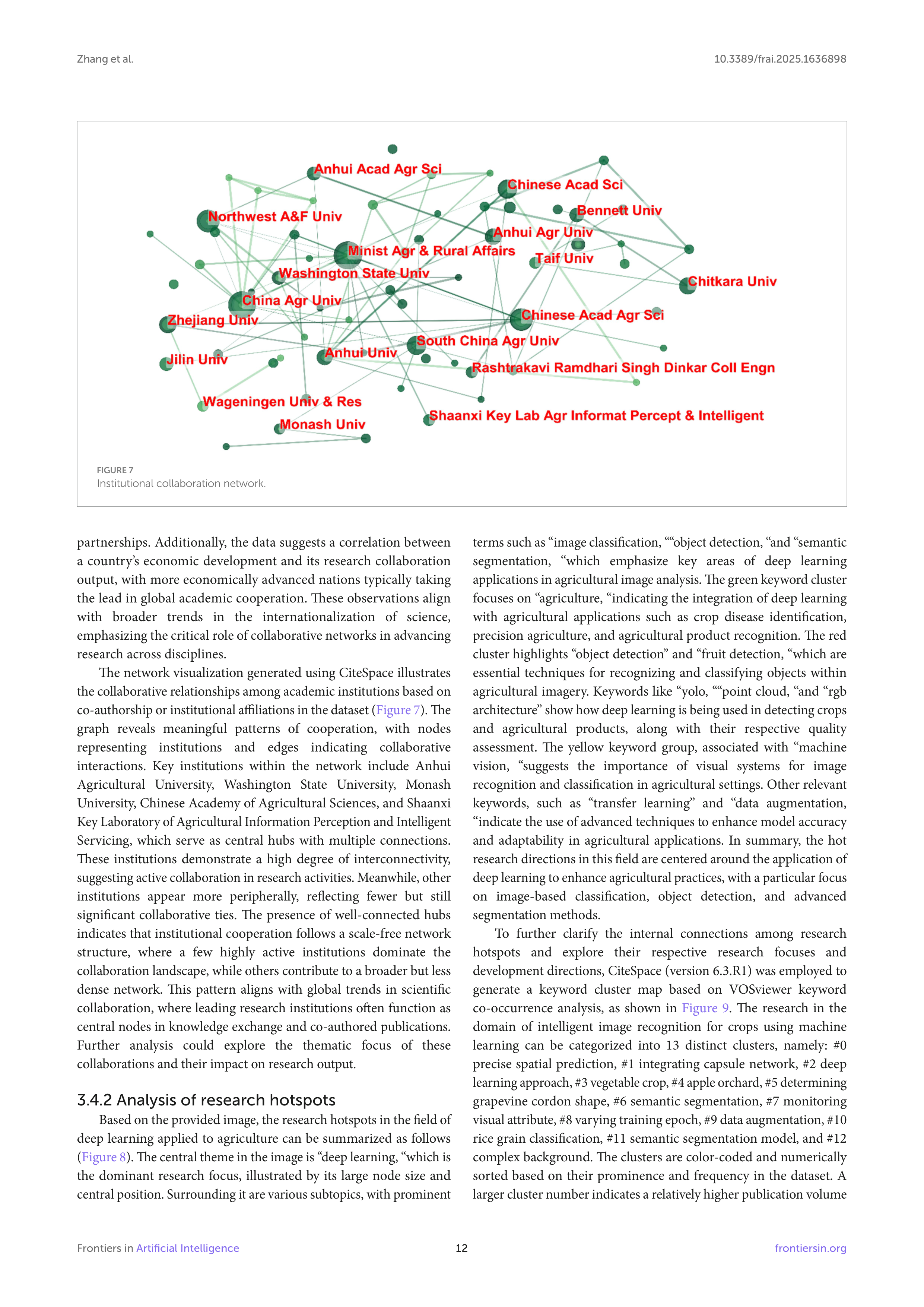
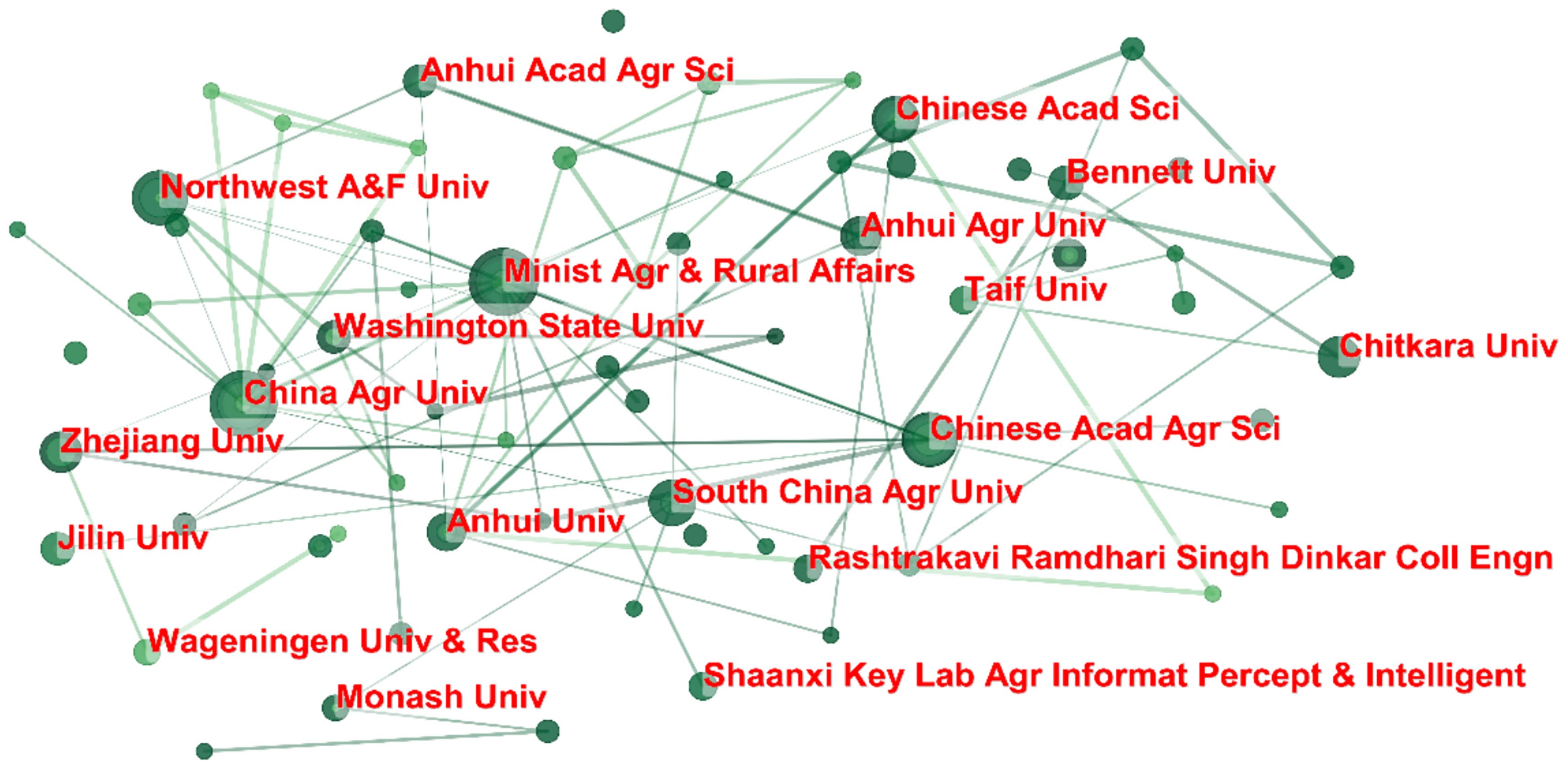
The network visualization generated using CiteSpace illustrates
the collaborative relationships among academic institutions based on
co-authorship or institutional affiliations in the dataset (
Figure 7
). The
graph reveals meaningful patterns of cooperation, with nodes
representing institutions and edges indicating collaborative
interactions. Key institutions within the network include Anhui
Agricultural University, Washington State University, Monash
University, Chinese Academy of Agricultural Sciences, and Shaanxi
Key Laboratory of Agricultural Information Perception and Intelligent
Servicing, which serve as central hubs with multiple connections.
These institutions demonstrate a high degree of interconnectivity,
suggesting active collaboration in research activities. Meanwhile, other
institutions appear more peripherally, reflecting fewer but still
significant collaborative ties. The presence of well-connected hubs
indicates that institutional cooperation follows a scale-free network
structure, where a few highly active institutions dominate the
collaboration landscape, while others contribute to a broader but less
dense network. This pattern aligns with global trends in scientific
collaboration, where leading research institutions often function as
central nodes in knowledge exchange and co-authored publications.
Further analysis could explore the thematic focus of these
collaborations and their impact on research output.
3.4.2 Analysis of research hotspots
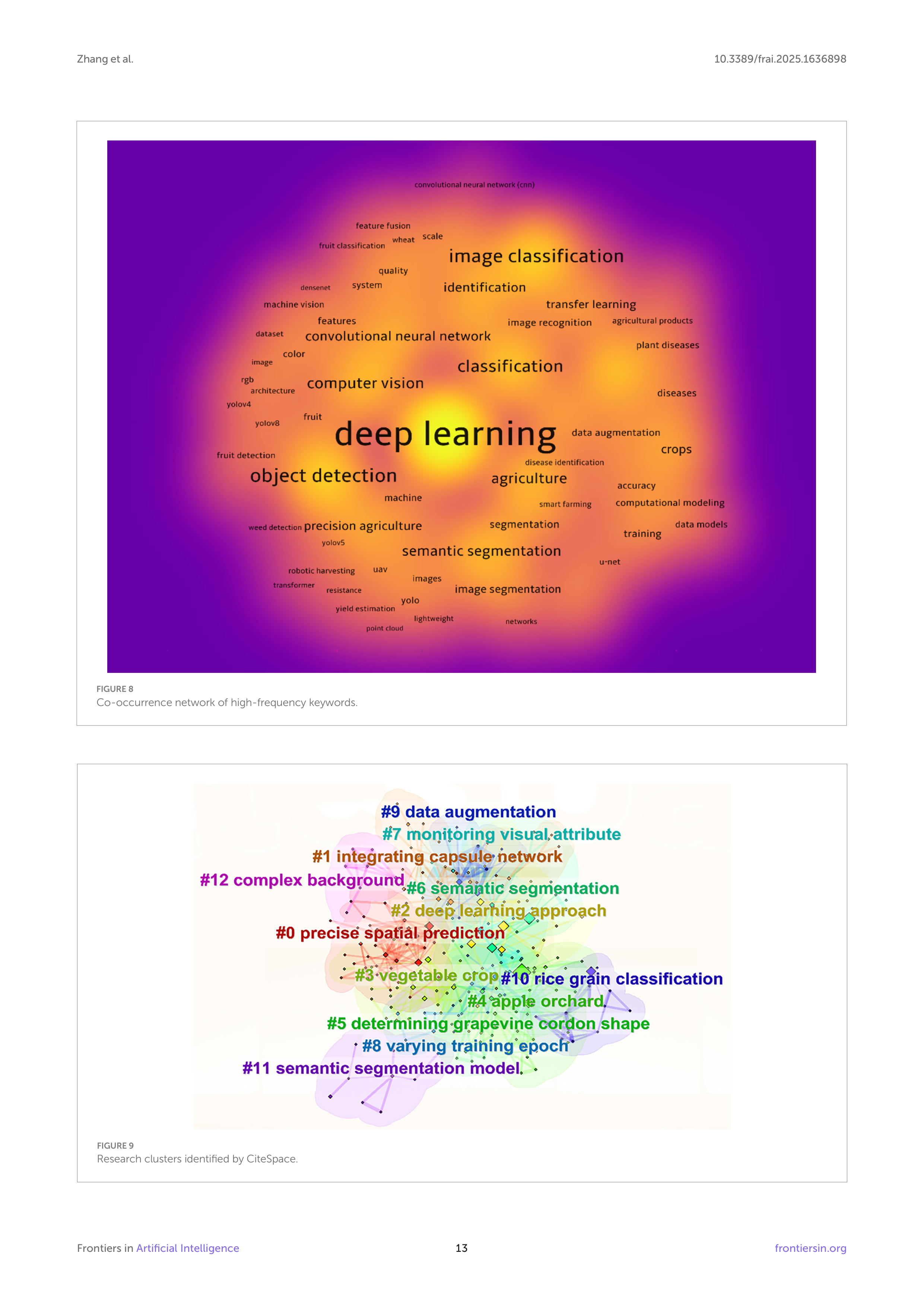
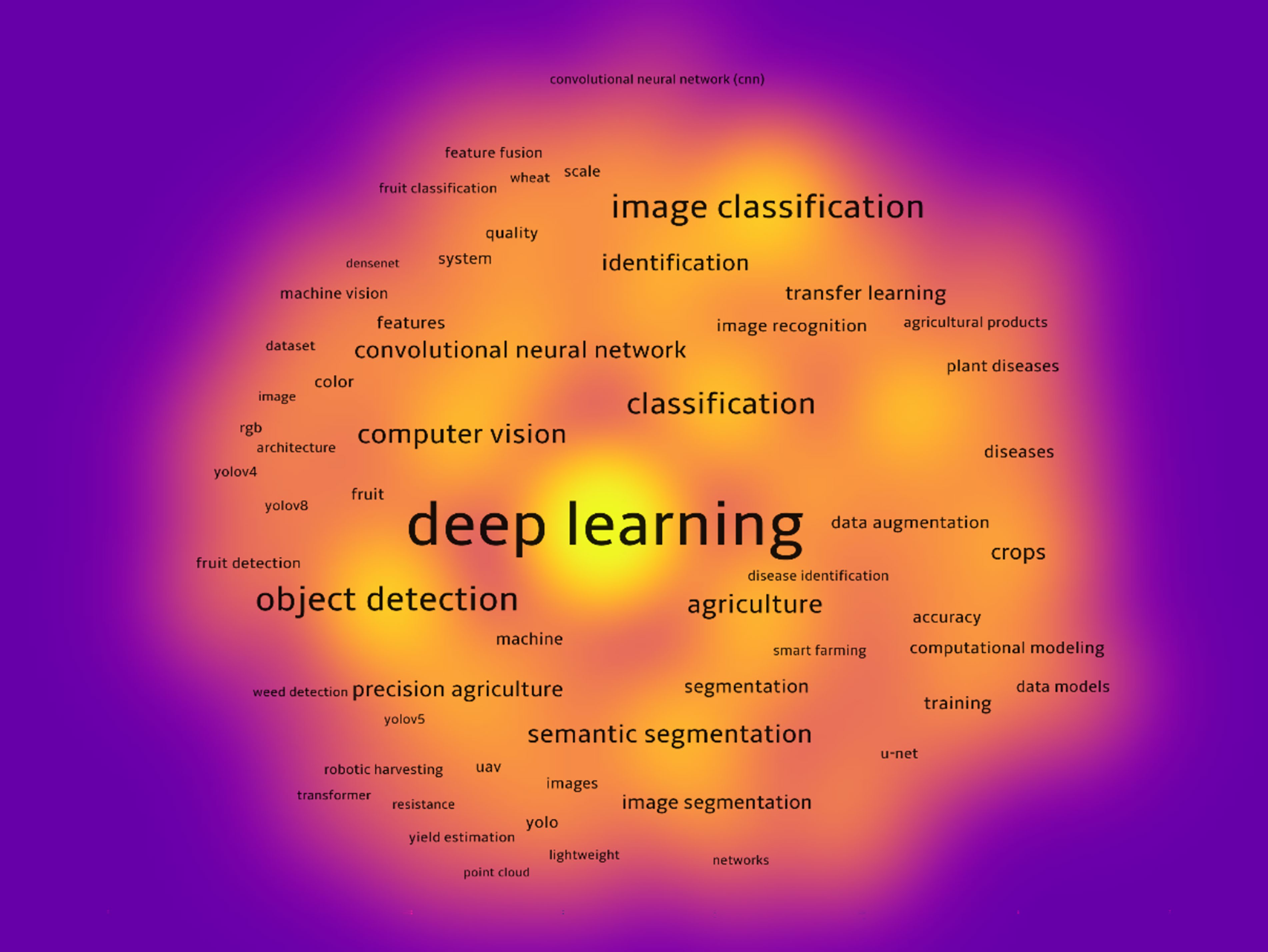
Based on the provided image, the research hotspots in the field of
deep learning applied to agriculture can be summarized as follows
(
Figure 8
). The central theme in the image is “deep learning, “which is
the dominant research focus, illustrated by its large node size and
central position. Surrounding it are various subtopics, with prominent
terms such as “image classification, ““object detection, “and “semantic
segmentation, “which emphasize key areas of deep learning
applications in agricultural image analysis. The green keyword cluster
focuses on “agriculture, “indicating the integration of deep learning
with agricultural applications such as crop disease identification,
precision agriculture, and agricultural product recognition. The red
cluster highlights “object detection” and “fruit detection, “which are
essential techniques for recognizing and classifying objects within
agricultural imagery. Keywords like “yolo, ““point cloud, “and “rgb
architecture” show how deep learning is being used in detecting crops
and agricultural products, along with their respective quality
assessment. The yellow keyword group, associated with “machine
vision, “suggests the importance of visual systems for image
recognition and classification in agricultural settings. Other relevant
keywords, such as “transfer learning” and “data augmentation,
“indicate the use of advanced techniques to enhance model accuracy
and adaptability in agricultural applications. In summary, the hot
research directions in this field are centered around the application of
deep learning to enhance agricultural practices, with a particular focus
on image-based classification, object detection, and advanced
segmentation methods.
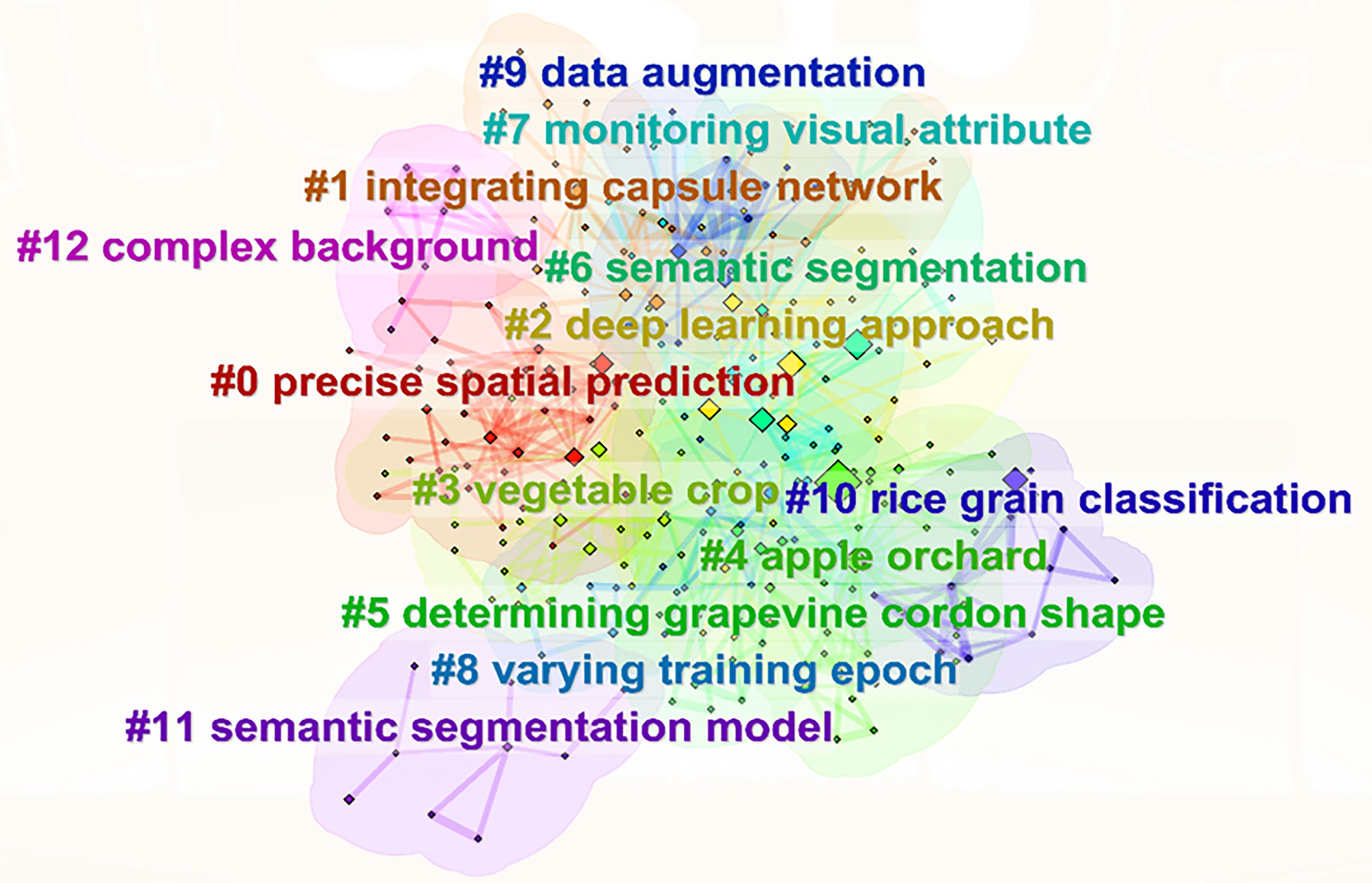
To further clarify the internal connections among research
hotspots and explore their respective research focuses and
development directions, CiteSpace (version 6.3.R1) was employed to
generate a keyword cluster map based on VOSviewer keyword
co-occurrence analysis, as shown in
Figure 9
. The research in the
domain of intelligent image recognition for crops using machine
learning can be categorized into 13 distinct clusters, namely: #0
precise spatial prediction, #1 integrating capsule network, #2 deep
learning approach, #3 vegetable crop, #4 apple orchard, #5 determining
grapevine cordon shape, #6 semantic segmentation, #7 monitoring
visual attribute, #8 varying training epoch, #9 data augmentation, #10
rice grain classification, #11 semantic segmentation model, and #12
complex background. The clusters are color-coded and numerically
sorted based on their prominence and frequency in the dataset. A
larger cluster number indicates a relatively higher publication volume
FIGURE 7
Institutional collaboration network.
Zhang et al.
10.3389/frai.2025.1636898
Frontiers in
Artificial Intelligence
13
frontiersin.org
FIGURE 8
Co-occurrence network of high-frequency keywords.
FIGURE 9
Research clusters identified by CiteSpace.
Zhang et al.
10.3389/frai.2025.1636898
Frontiers in
Artificial Intelligence
14
frontiersin.org
and greater impact in the field. According to the clustering results,
these topics can be summarized into four main research directions:
Research on segmentation models and prediction algorithms is
represented by clusters such as #0 precise spatial prediction, #1
integrating capsule network, #2 deep learning approach, #6 semantic
segmentation, and #11 semantic segmentation model, which
collectively form the technical foundation of intelligent image
recognition. These clusters emphasize model optimization, the
integration of deep learning frameworks (e.g., CNNs and capsule
networks), and the importance of achieving pixel-level accuracy in
spatial predictions. Clusters #3 vegetable crop, #4 apple orchard, #5
determining grapevine cordon shape, and #10 rice grain classification
highlight the application of machine learning and computer vision
techniques to different crop species, reflecting a growing interest in
developing targeted solutions for specific crop characteristics, growth
monitoring, and yield estimation. Clusters #7 monitoring visual
attribute, #8 varying training epoch, and #9 data augmentation
underscore efforts toward improving training optimization, model
generalization, and visual attribute analysis. These clusters stress the
importance of robust data preparation and adaptive learning strategies
in agricultural environments. Cluster #12 complex background
identifies the challenges posed by real-world agricultural conditions,
where environmental variables and image noise often affect
recognition accuracy, calling for solutions to enhance model resilience
in non-ideal or cluttered field conditions.
3.4.3 Analysis of frontier trend
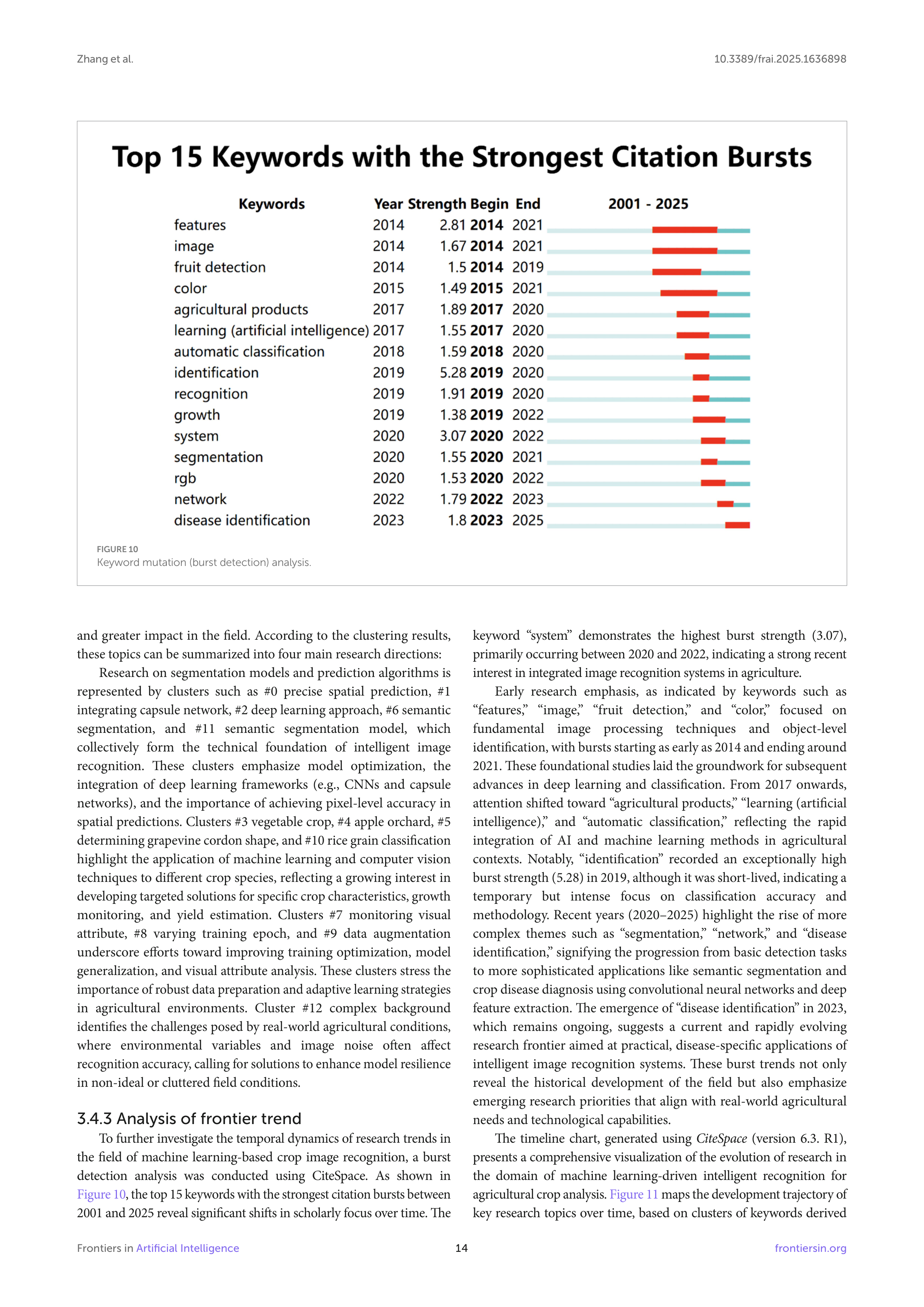
To further investigate the temporal dynamics of research trends in
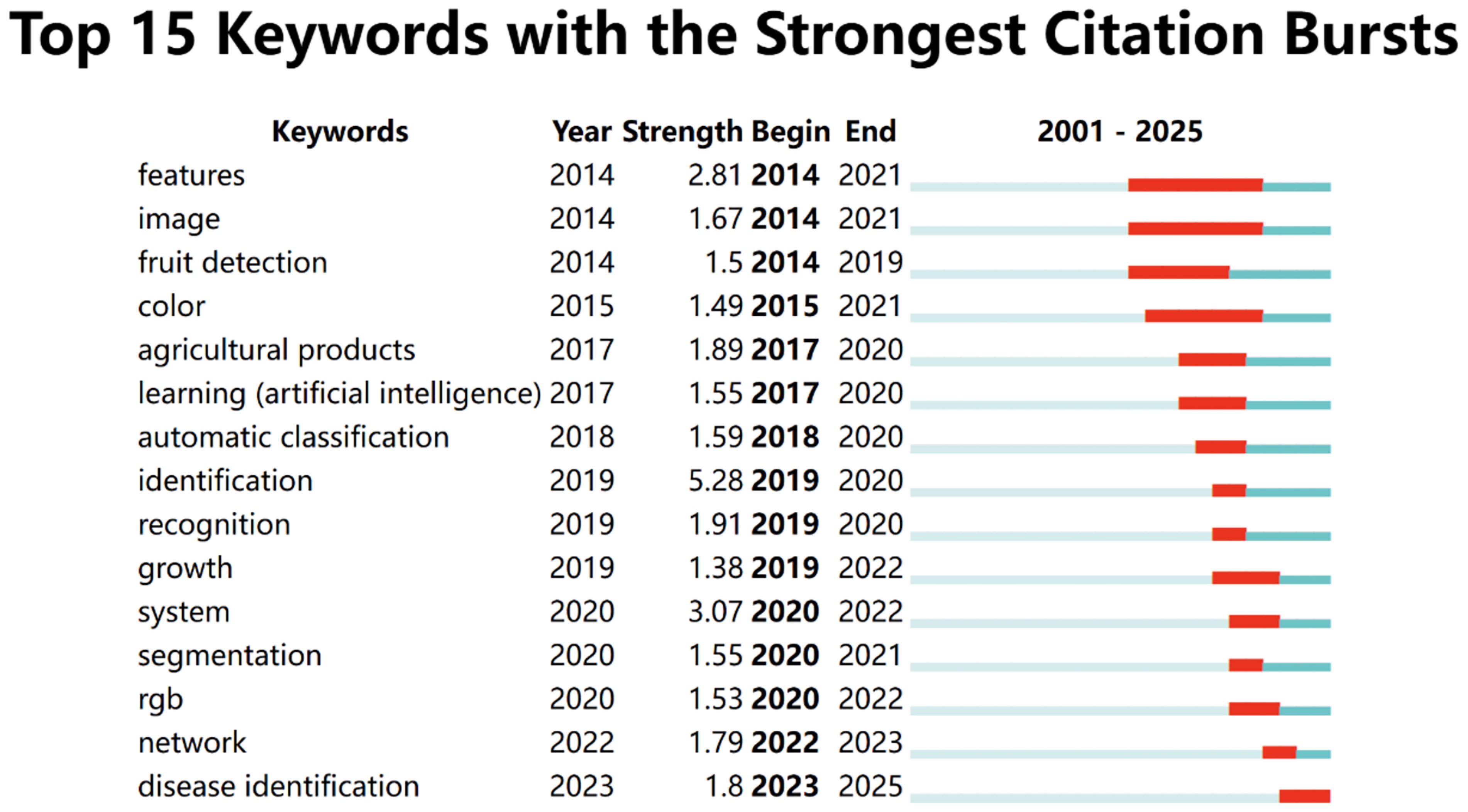
the field of machine learning-based crop image recognition, a burst
detection analysis was conducted using CiteSpace. As shown in
Figure 10
, the top 15 keywords with the strongest citation bursts between
2001 and 2025 reveal significant shifts in scholarly focus over time. The
keyword “system” demonstrates the highest burst strength (3.07),
primarily occurring between 2020 and 2022, indicating a strong recent
interest in integrated image recognition systems in agriculture.
Early research emphasis, as indicated by keywords such as
“features,” “image,” “fruit detection,” and “color,” focused on
fundamental image processing techniques and object-level
identification, with bursts starting as early as 2014 and ending around
2021. These foundational studies laid the groundwork for subsequent
advances in deep learning and classification. From 2017 onwards,
attention shifted toward “agricultural products,” “learning (artificial
intelligence),” and “automatic classification,” reflecting the rapid
integration of AI and machine learning methods in agricultural
contexts. Notably, “identification” recorded an exceptionally high
burst strength (5.28) in 2019, although it was short-lived, indicating a
temporary but intense focus on classification accuracy and
methodology. Recent years (2020–2025) highlight the rise of more
complex themes such as “segmentation,” “network,” and “disease
identification,” signifying the progression from basic detection tasks
to more sophisticated applications like semantic segmentation and
crop disease diagnosis using convolutional neural networks and deep
feature extraction. The emergence of “disease identification” in 2023,
which remains ongoing, suggests a current and rapidly evolving
research frontier aimed at practical, disease-specific applications of
intelligent image recognition systems. These burst trends not only
reveal the historical development of the field but also emphasize
emerging research priorities that align with real-world agricultural
needs and technological capabilities.
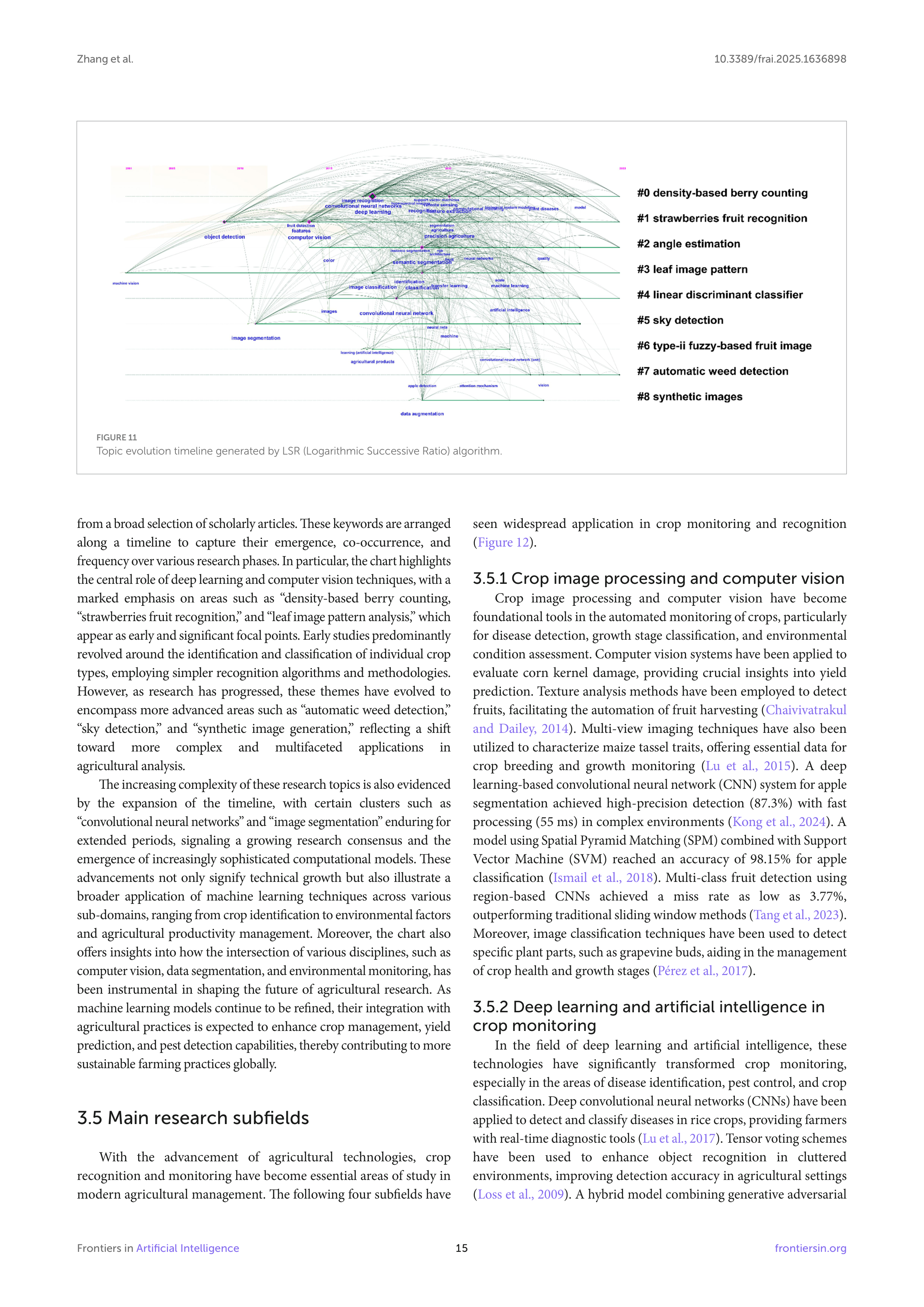
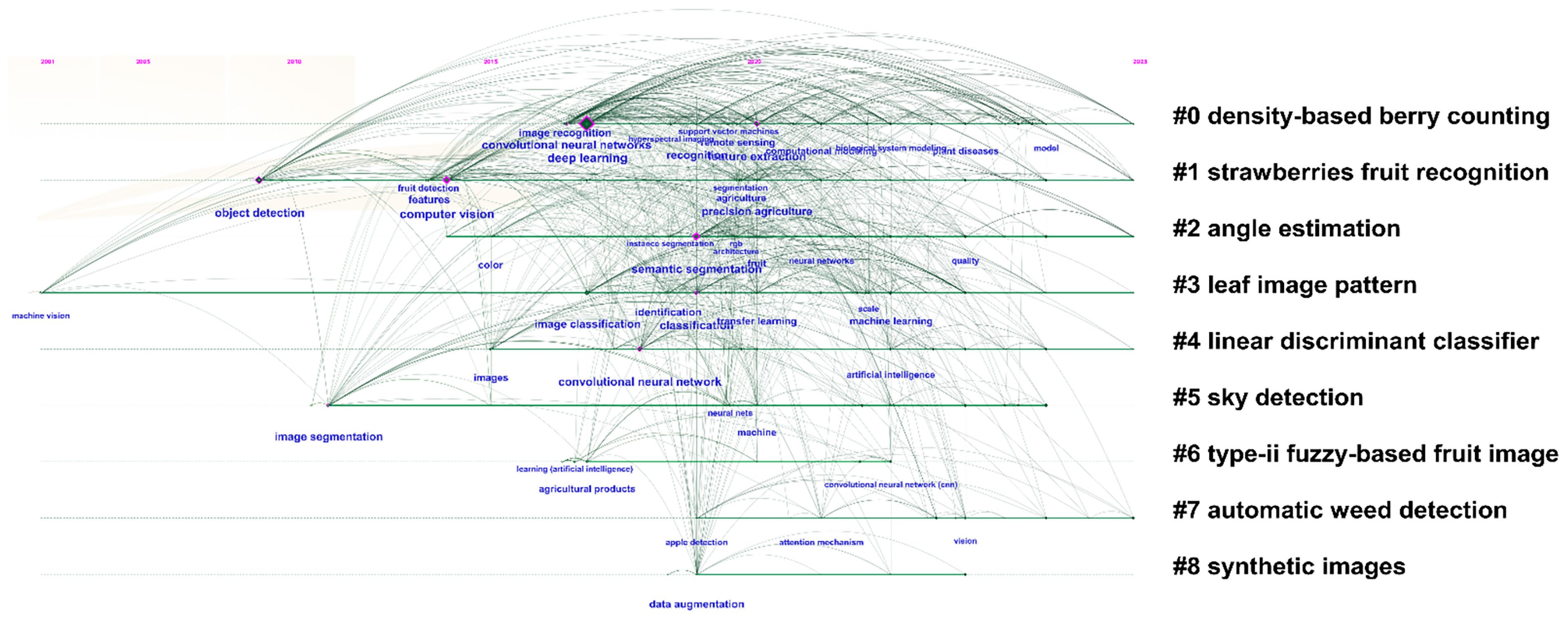
The timeline chart, generated using
CiteSpace
(version 6.3. R1),
presents a comprehensive visualization of the evolution of research in
the domain of machine learning-driven intelligent recognition for
agricultural crop analysis.
Figure 11
maps the development trajectory of
key research topics over time, based on clusters of keywords derived
FIGURE 10
Keyword mutation (burst detection) analysis.
Zhang et al.
10.3389/frai.2025.1636898
Frontiers in
Artificial Intelligence
15
frontiersin.org
from a broad selection of scholarly articles. These keywords are arranged
along a timeline to capture their emergence, co-occurrence, and
frequency over various research phases. In particular, the chart highlights
the central role of deep learning and computer vision techniques, with a
marked emphasis on areas such as “density-based berry counting,
“strawberries fruit recognition,” and “leaf image pattern analysis,” which
appear as early and significant focal points. Early studies predominantly
revolved around the identification and classification of individual crop
types, employing simpler recognition algorithms and methodologies.
However, as research has progressed, these themes have evolved to
encompass more advanced areas such as “automatic weed detection,”
“sky detection,” and “synthetic image generation,” reflecting a shift
toward
more
complex
and
multifaceted
applications
in
agricultural analysis.
The increasing complexity of these research topics is also evidenced
by the expansion of the timeline, with certain clusters such as
“convolutional neural networks” and “image segmentation” enduring for
extended periods, signaling a growing research consensus and the
emergence of increasingly sophisticated computational models. These
advancements not only signify technical growth but also illustrate a
broader application of machine learning techniques across various
sub-domains, ranging from crop identification to environmental factors
and agricultural productivity management. Moreover, the chart also
offers insights into how the intersection of various disciplines, such as
computer vision, data segmentation, and environmental monitoring, has
been instrumental in shaping the future of agricultural research. As
machine learning models continue to be refined, their integration with
agricultural practices is expected to enhance crop management, yield
prediction, and pest detection capabilities, thereby contributing to more
sustainable farming practices globally.
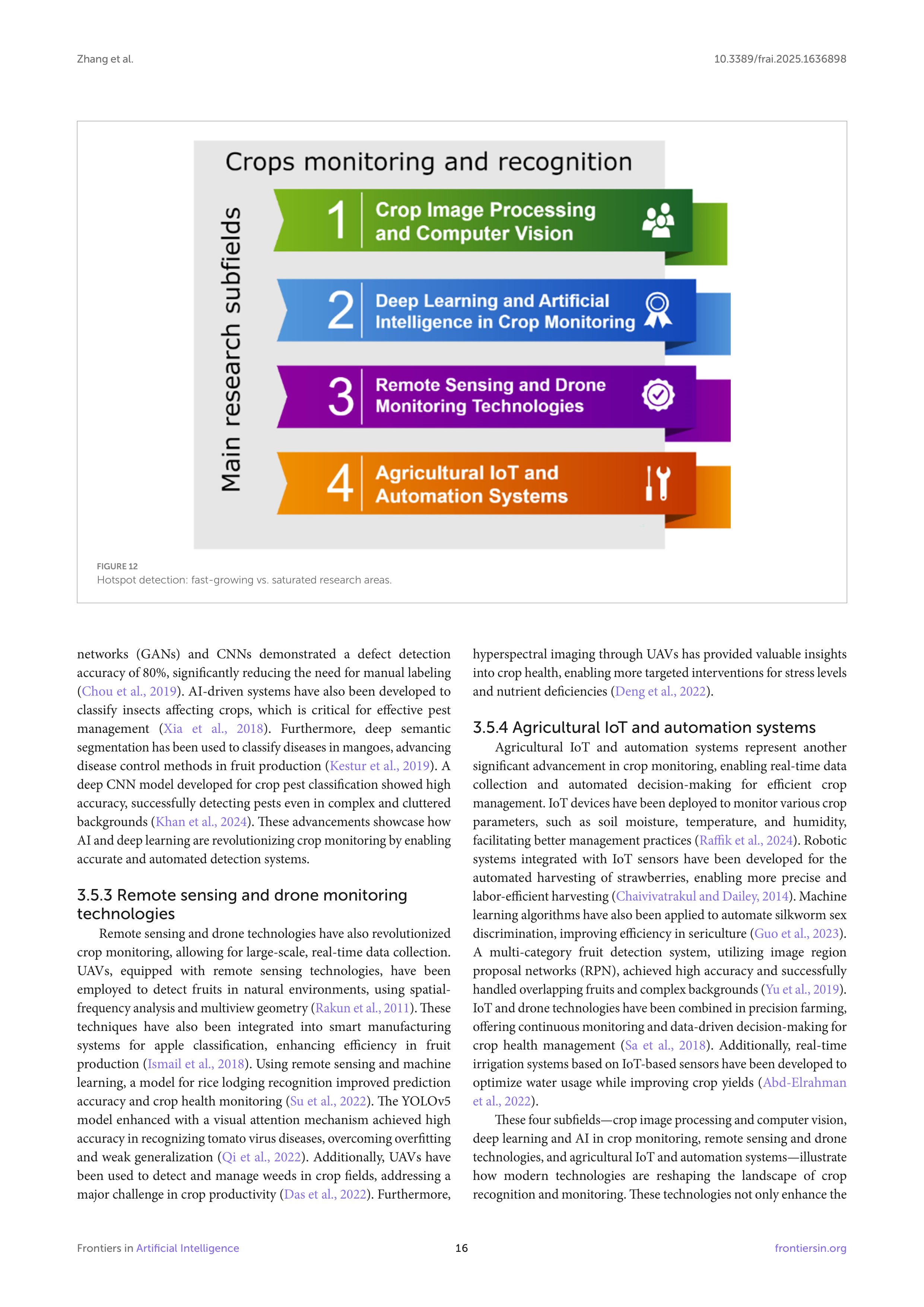
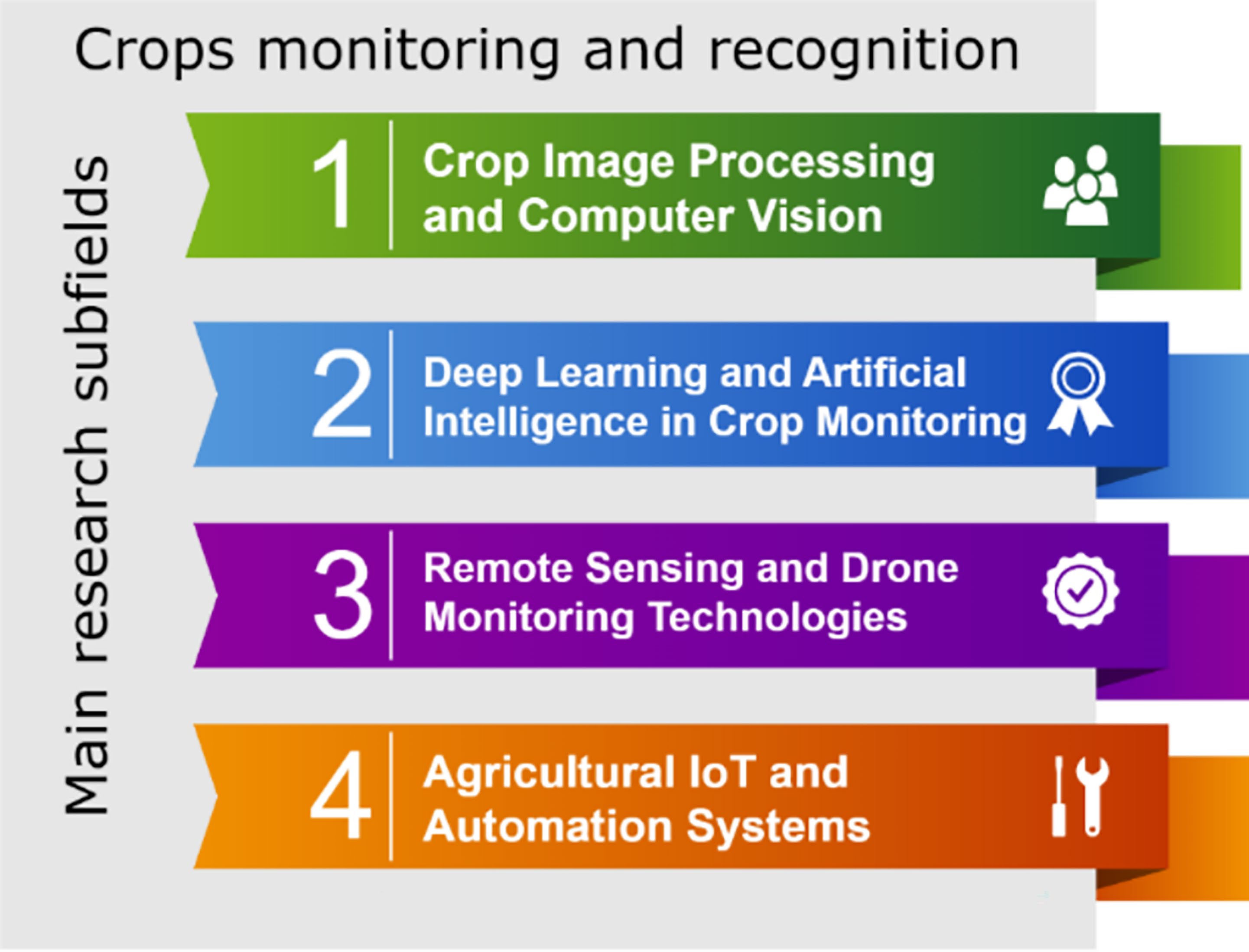
3.5 Main research subfields
With the advancement of agricultural technologies, crop
recognition and monitoring have become essential areas of study in
modern agricultural management. The following four subfields have
seen widespread application in crop monitoring and recognition
(
Figure 12
).
3.5.1 Crop image processing and computer vision
Crop image processing and computer vision have become
foundational tools in the automated monitoring of crops, particularly
for disease detection, growth stage classification, and environmental
condition assessment. Computer vision systems have been applied to
evaluate corn kernel damage, providing crucial insights into yield
prediction. Texture analysis methods have been employed to detect
fruits, facilitating the automation of fruit harvesting (
Chaivivatrakul
and Dailey, 2014
). Multi-view imaging techniques have also been
utilized to characterize maize tassel traits, offering essential data for
crop breeding and growth monitoring (
Lu et al., 2015
). A deep
learning-based convolutional neural network (CNN) system for apple
segmentation achieved high-precision detection (87.3%) with fast
processing (55 ms) in complex environments (
Kong et al., 2024
). A
model using Spatial Pyramid Matching (SPM) combined with Support
Vector Machine (SVM) reached an accuracy of 98.15% for apple
classification (
Ismail et al., 2018
). Multi-class fruit detection using
region-based CNNs achieved a miss rate as low as 3.77%,
outperforming traditional sliding window methods (
Tang et al., 2023
).
Moreover, image classification techniques have been used to detect
specific plant parts, such as grapevine buds, aiding in the management
of crop health and growth stages (
Pérez et al., 2017
).
3.5.2 Deep learning and artificial intelligence in
crop monitoring
In the field of deep learning and artificial intelligence, these
technologies have significantly transformed crop monitoring,
especially in the areas of disease identification, pest control, and crop
classification. Deep convolutional neural networks (CNNs) have been
applied to detect and classify diseases in rice crops, providing farmers
with real-time diagnostic tools (
Lu et al., 2017
). Tensor voting schemes
have been used to enhance object recognition in cluttered
environments, improving detection accuracy in agricultural settings
(
Loss et al., 2009
). A hybrid model combining generative adversarial
FIGURE 11
Topic evolution timeline generated by LSR (Logarithmic Successive Ratio) algorithm.
Zhang et al.
10.3389/frai.2025.1636898
Frontiers in
Artificial Intelligence
16
frontiersin.org
networks (GANs) and CNNs demonstrated a defect detection
accuracy of 80%, significantly reducing the need for manual labeling
(
Chou et al., 2019
). AI-driven systems have also been developed to
classify insects affecting crops, which is critical for effective pest
management (
Xia et
al., 2018
). Furthermore, deep semantic
segmentation has been used to classify diseases in mangoes, advancing
disease control methods in fruit production (
Kestur et al., 2019
). A
deep CNN model developed for crop pest classification showed high
accuracy, successfully detecting pests even in complex and cluttered
backgrounds (
Khan et al., 2024
). These advancements showcase how
AI and deep learning are revolutionizing crop monitoring by enabling
accurate and automated detection systems.
3.5.3 Remote sensing and drone monitoring
technologies
Remote sensing and drone technologies have also revolutionized
crop monitoring, allowing for large-scale, real-time data collection.
UAVs, equipped with remote sensing technologies, have been
employed to detect fruits in natural environments, using spatial-
frequency analysis and multiview geometry (
Rakun et al., 2011
). These
techniques have also been integrated into smart manufacturing
systems for apple classification, enhancing efficiency in fruit
production (
Ismail et al., 2018
). Using remote sensing and machine
learning, a model for rice lodging recognition improved prediction
accuracy and crop health monitoring (
Su et al., 2022
). The YOLOv5
model enhanced with a visual attention mechanism achieved high
accuracy in recognizing tomato virus diseases, overcoming overfitting
and weak generalization (
Qi et al., 2022
). Additionally, UAVs have
been used to detect and manage weeds in crop fields, addressing a
major challenge in crop productivity (
Das et al., 2022
). Furthermore,
hyperspectral imaging through UAVs has provided valuable insights
into crop health, enabling more targeted interventions for stress levels
and nutrient deficiencies (
Deng et al., 2022
).
3.5.4 Agricultural IoT and automation systems
Agricultural IoT and automation systems represent another
significant advancement in crop monitoring, enabling real-time data
collection and automated decision-making for efficient crop
management. IoT devices have been deployed to monitor various crop
parameters, such as soil moisture, temperature, and humidity,
facilitating better management practices (
Raffik et al., 2024
). Robotic
systems integrated with IoT sensors have been developed for the
automated harvesting of strawberries, enabling more precise and
labor-efficient harvesting (
Chaivivatrakul and Dailey, 2014
). Machine
learning algorithms have also been applied to automate silkworm sex
discrimination, improving efficiency in sericulture (
Guo et al., 2023
).
A multi-category fruit detection system, utilizing image region
proposal networks (RPN), achieved high accuracy and successfully
handled overlapping fruits and complex backgrounds (
Yu et al., 2019
).
IoT and drone technologies have been combined in precision farming,
offering continuous monitoring and data-driven decision-making for
crop health management (
Sa et al., 2018
). Additionally, real-time
irrigation systems based on IoT-based sensors have been developed to
optimize water usage while improving crop yields (
Abd-Elrahman
et al., 2022
).
These four subfields—crop image processing and computer vision,
deep learning and AI in crop monitoring, remote sensing and drone
technologies, and agricultural IoT and automation systems—illustrate
how modern technologies are reshaping the landscape of crop
recognition and monitoring. These technologies not only enhance the
FIGURE 12
Hotspot detection: fast-growing vs. saturated research areas.
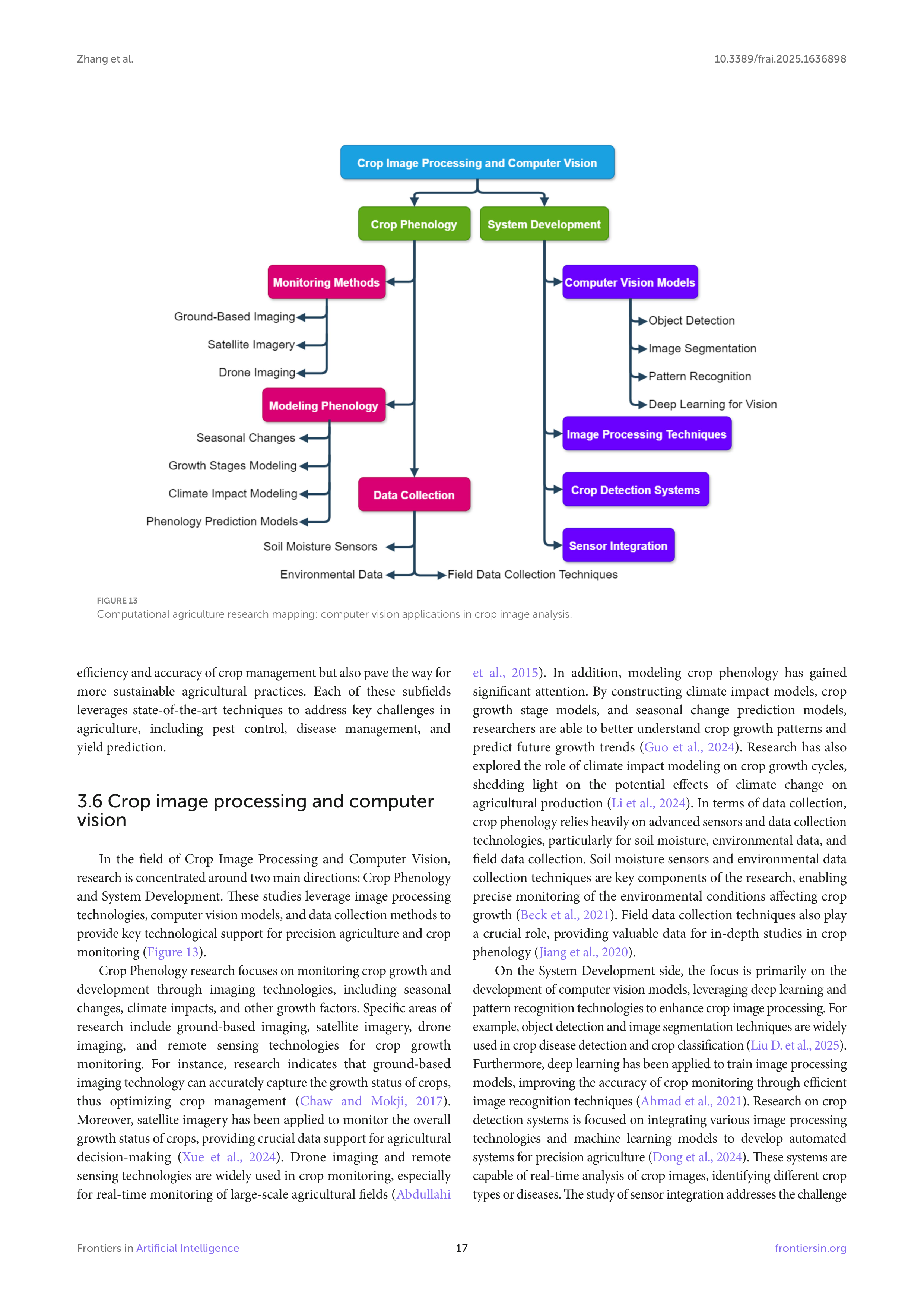
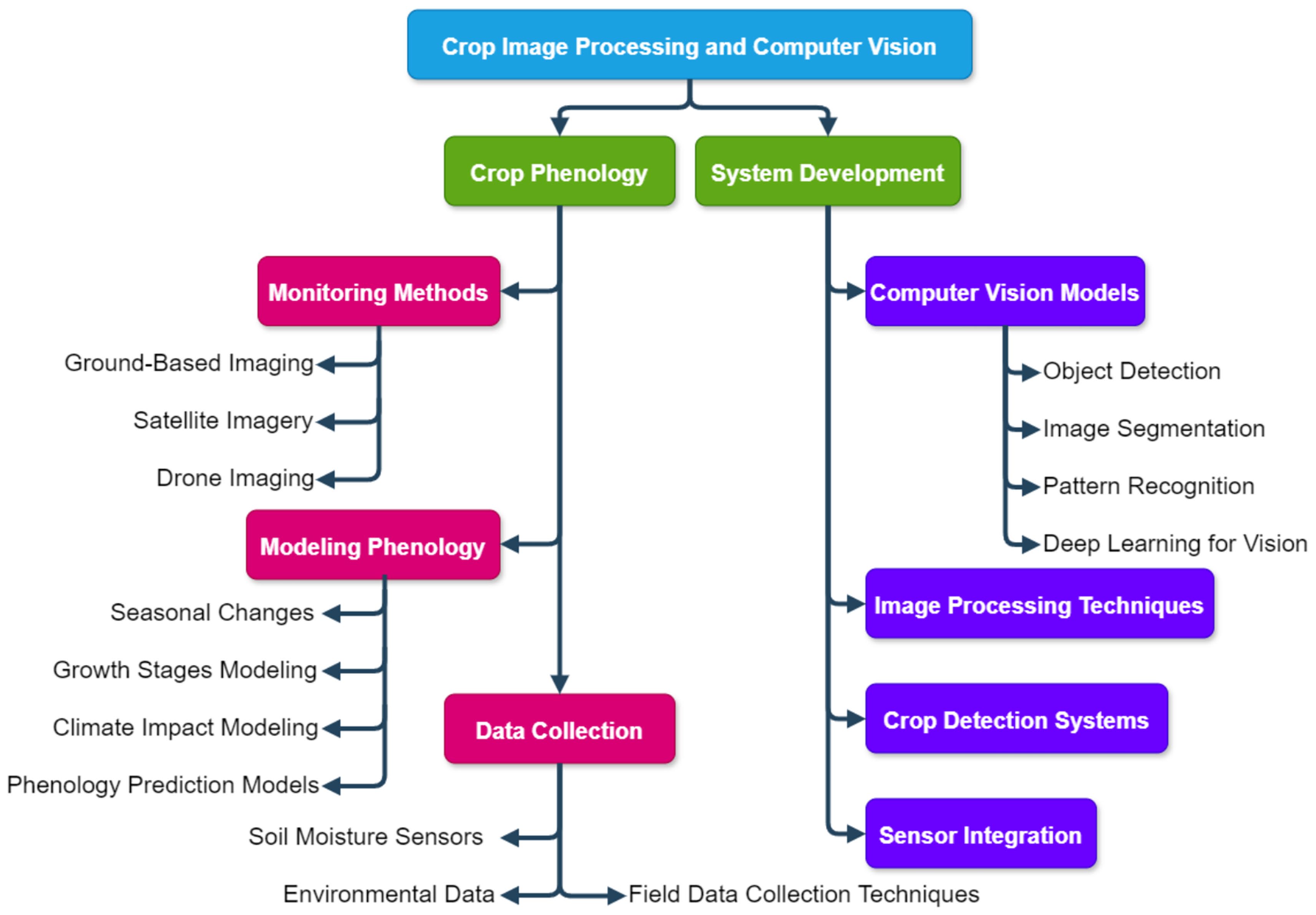
Zhang et al.
10.3389/frai.2025.1636898
Frontiers in
Artificial Intelligence
17
frontiersin.org
efficiency and accuracy of crop management but also pave the way for
more sustainable agricultural practices. Each of these subfields
leverages state-of-the-art techniques to address key challenges in
agriculture, including pest control, disease management, and
yield prediction.
3.6 Crop image processing and computer
vision
In the field of Crop Image Processing and Computer Vision,
research is concentrated around two main directions: Crop Phenology
and System Development. These studies leverage image processing
technologies, computer vision models, and data collection methods to
provide key technological support for precision agriculture and crop
monitoring (
Figure 13
).
Crop Phenology research focuses on monitoring crop growth and
development through imaging technologies, including seasonal
changes, climate impacts, and other growth factors. Specific areas of
research include ground-based imaging, satellite imagery, drone
imaging, and remote sensing technologies for crop growth
monitoring. For instance, research indicates that ground-based
imaging technology can accurately capture the growth status of crops,
thus optimizing crop management (
Chaw and Mokji, 2017
).
Moreover, satellite imagery has been applied to monitor the overall
growth status of crops, providing crucial data support for agricultural
decision-making (
Xue et al., 2024
). Drone imaging and remote
sensing technologies are widely used in crop monitoring, especially
for real-time monitoring of large-scale agricultural fields (
Abdullahi
et al., 2015
). In addition, modeling crop phenology has gained
significant attention. By constructing climate impact models, crop
growth stage models, and seasonal change prediction models,
researchers are able to better understand crop growth patterns and
predict future growth trends (
Guo et al., 2024
). Research has also
explored the role of climate impact modeling on crop growth cycles,
shedding light on the potential effects of climate change on
agricultural production (
Li et al., 2024
). In terms of data collection,
crop phenology relies heavily on advanced sensors and data collection
technologies, particularly for soil moisture, environmental data, and
field data collection. Soil moisture sensors and environmental data
collection techniques are key components of the research, enabling
precise monitoring of the environmental conditions affecting crop
growth (
Beck et al., 2021
). Field data collection techniques also play
a crucial role, providing valuable data for in-depth studies in crop
phenology (
Jiang et al., 2020
).
On the System Development side, the focus is primarily on the
development of computer vision models, leveraging deep learning and
pattern recognition technologies to enhance crop image processing. For
example, object detection and image segmentation techniques are widely
used in crop disease detection and crop classification (
Liu D. et al., 2025
).
Furthermore, deep learning has been applied to train image processing
models, improving the accuracy of crop monitoring through efficient
image recognition techniques (
Ahmad et al., 2021
). Research on crop
detection systems is focused on integrating various image processing
technologies and machine learning models to develop automated
systems for precision agriculture (
Dong et al., 2024
). These systems are
capable of real-time analysis of crop images, identifying different crop
types or diseases. The study of sensor integration addresses the challenge
FIGURE 13
Computational agriculture research mapping: computer vision applications in crop image analysis.
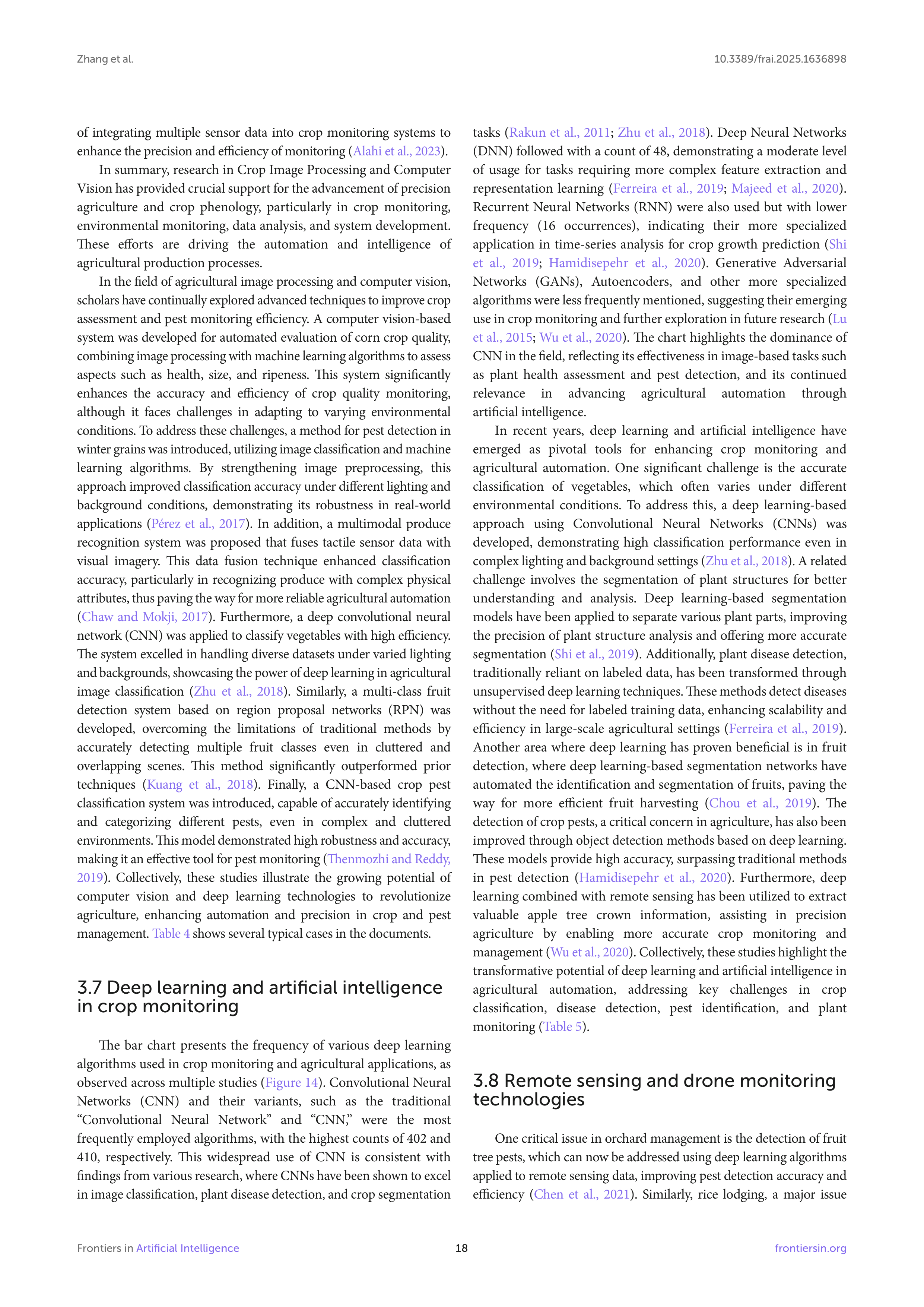
Zhang et al.
10.3389/frai.2025.1636898
Frontiers in
Artificial Intelligence
18
frontiersin.org
of integrating multiple sensor data into crop monitoring systems to
enhance the precision and efficiency of monitoring (
Alahi et al., 2023
).
In summary, research in Crop Image Processing and Computer
Vision has provided crucial support for the advancement of precision
agriculture and crop phenology, particularly in crop monitoring,
environmental monitoring, data analysis, and system development.
These efforts are driving the automation and intelligence of
agricultural production processes.
In the field of agricultural image processing and computer vision,
scholars have continually explored advanced techniques to improve crop
assessment and pest monitoring efficiency. A computer vision-based
system was developed for automated evaluation of corn crop quality,
combining image processing with machine learning algorithms to assess
aspects such as health, size, and ripeness. This system significantly
enhances the accuracy and efficiency of crop quality monitoring,
although it faces challenges in adapting to varying environmental
conditions. To address these challenges, a method for pest detection in
winter grains was introduced, utilizing image classification and machine
learning algorithms. By strengthening image preprocessing, this
approach improved classification accuracy under different lighting and
background conditions, demonstrating its robustness in real-world
applications (
Pérez et al., 2017
). In addition, a multimodal produce
recognition system was proposed that fuses tactile sensor data with
visual imagery. This data fusion technique enhanced classification
accuracy, particularly in recognizing produce with complex physical
attributes, thus paving the way for more reliable agricultural automation
(
Chaw and Mokji, 2017
). Furthermore, a deep convolutional neural
network (CNN) was applied to classify vegetables with high efficiency.
The system excelled in handling diverse datasets under varied lighting
and backgrounds, showcasing the power of deep learning in agricultural
image classification (
Zhu et al., 2018
). Similarly, a multi-class fruit
detection system based on region proposal networks (RPN) was
developed, overcoming the limitations of traditional methods by
accurately detecting multiple fruit classes even in cluttered and
overlapping scenes. This method significantly outperformed prior
techniques (
Kuang et al., 2018
). Finally, a CNN-based crop pest
classification system was introduced, capable of accurately identifying
and categorizing different pests, even in complex and cluttered
environments. This model demonstrated high robustness and accuracy,
making it an effective tool for pest monitoring (
Thenmozhi and Reddy,
2019
). Collectively, these studies illustrate the growing potential of
computer vision and deep learning technologies to revolutionize
agriculture, enhancing automation and precision in crop and pest
management.
Table 4
shows several typical cases in the documents.
3.7 Deep learning and artificial intelligence
in crop monitoring
The bar chart presents the frequency of various deep learning
algorithms used in crop monitoring and agricultural applications, as
observed across multiple studies (
Figure 14
). Convolutional Neural
Networks (CNN) and their variants, such as the traditional
“Convolutional Neural Network” and “CNN,” were the most
frequently employed algorithms, with the highest counts of 402 and
410, respectively. This widespread use of CNN is consistent with
findings from various research, where CNNs have been shown to excel
in image classification, plant disease detection, and crop segmentation
tasks (
Rakun et al., 2011
;
Zhu et al., 2018
). Deep Neural Networks
(DNN) followed with a count of 48, demonstrating a moderate level
of usage for tasks requiring more complex feature extraction and
representation learning (
Ferreira et al., 2019
;
Majeed et al., 2020
).
Recurrent Neural Networks (RNN) were also used but with lower
frequency (16 occurrences), indicating their more specialized
application in time-series analysis for crop growth prediction (
Shi
et al., 2019
;
Hamidisepehr et al., 2020
). Generative Adversarial
Networks (GANs), Autoencoders, and other more specialized
algorithms were less frequently mentioned, suggesting their emerging
use in crop monitoring and further exploration in future research (
Lu
et al., 2015
;
Wu et al., 2020
). The chart highlights the dominance of
CNN in the field, reflecting its effectiveness in image-based tasks such
as plant health assessment and pest detection, and its continued
relevance
in
advancing
agricultural
automation
through
artificial intelligence.
In recent years, deep learning and artificial intelligence have
emerged as pivotal tools for enhancing crop monitoring and
agricultural automation. One significant challenge is the accurate
classification of vegetables, which often varies under different
environmental conditions. To address this, a deep learning-based
approach using Convolutional Neural Networks (CNNs) was
developed, demonstrating high classification performance even in
complex lighting and background settings (
Zhu et al., 2018
). A related
challenge involves the segmentation of plant structures for better
understanding and analysis. Deep learning-based segmentation
models have been applied to separate various plant parts, improving
the precision of plant structure analysis and offering more accurate
segmentation (
Shi et al., 2019
). Additionally, plant disease detection,
traditionally reliant on labeled data, has been transformed through
unsupervised deep learning techniques. These methods detect diseases
without the need for labeled training data, enhancing scalability and
efficiency in large-scale agricultural settings (
Ferreira et al., 2019
).
Another area where deep learning has proven beneficial is in fruit
detection, where deep learning-based segmentation networks have
automated the identification and segmentation of fruits, paving the
way for more efficient fruit harvesting (
Chou et al., 2019
). The
detection of crop pests, a critical concern in agriculture, has also been
improved through object detection methods based on deep learning.
These models provide high accuracy, surpassing traditional methods
in pest detection (
Hamidisepehr et al., 2020
). Furthermore, deep
learning combined with remote sensing has been utilized to extract
valuable apple tree crown information, assisting in precision
agriculture by enabling more accurate crop monitoring and
management (
Wu et al., 2020
). Collectively, these studies highlight the
transformative potential of deep learning and artificial intelligence in
agricultural automation, addressing key challenges in crop
classification, disease detection, pest identification, and plant
monitoring (
Table 5
).
3.8 Remote sensing and drone monitoring
technologies
One critical issue in orchard management is the detection of fruit
tree pests, which can now be addressed using deep learning algorithms
applied to remote sensing data, improving pest detection accuracy and
efficiency (
Chen et al., 2021
). Similarly, rice lodging, a major issue
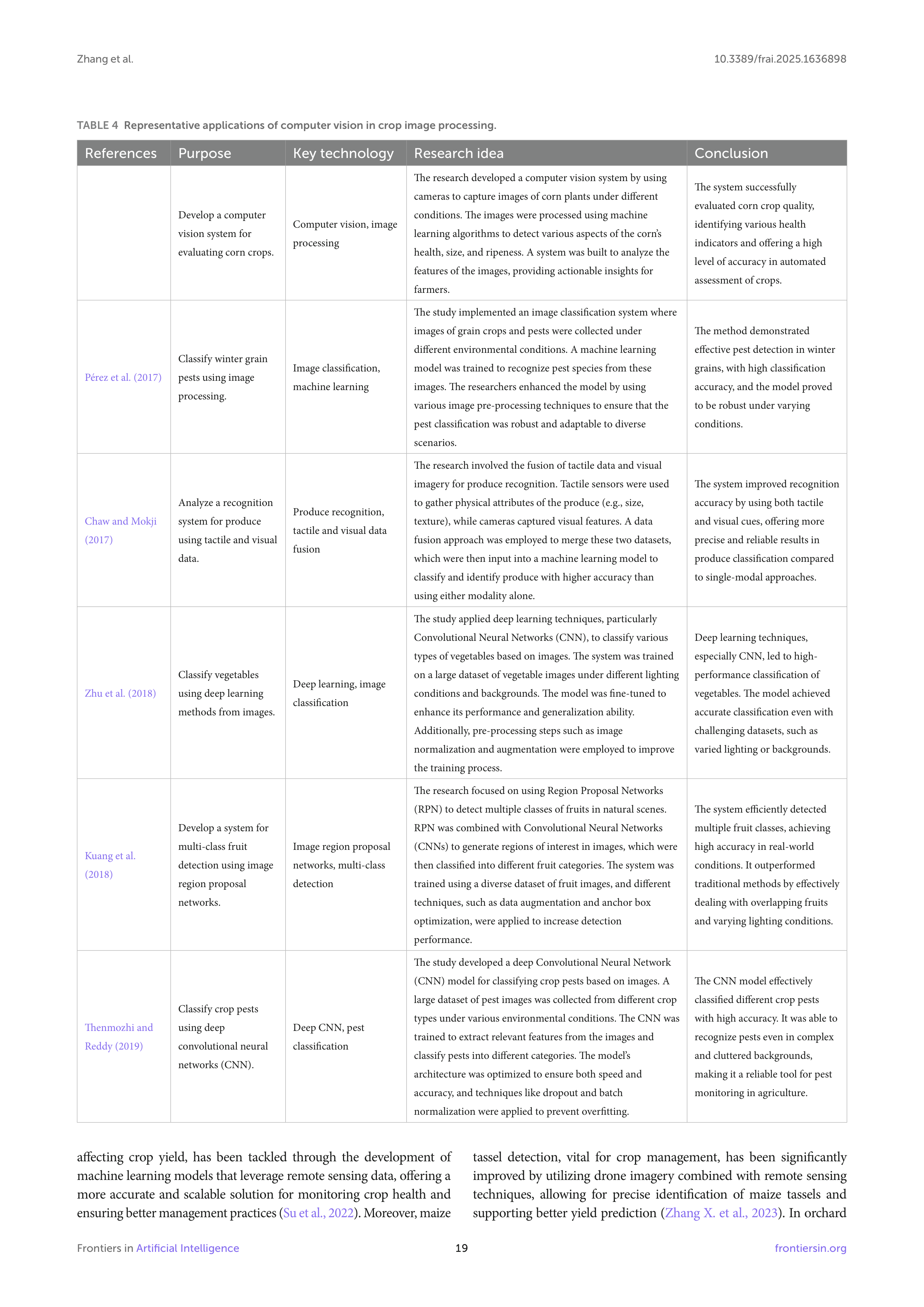
Zhang et al.
10.3389/frai.2025.1636898
Frontiers in
Artificial Intelligence
19
frontiersin.org
affecting crop yield, has been tackled through the development of
machine learning models that leverage remote sensing data, offering a
more accurate and scalable solution for monitoring crop health and
ensuring better management practices (
Su et al., 2022
). Moreover, maize
tassel detection, vital for crop management, has been significantly
improved by utilizing drone imagery combined with remote sensing
techniques, allowing for precise identification of maize tassels and
supporting better yield prediction (
Zhang X. et al., 2023
). In orchard
TABLE 4
Representative applications of computer vision in crop image processing.
References
Purpose
Key technology
Research idea
Conclusion
Develop a computer
vision system for
evaluating corn crops.
Computer vision, image
processing
The research developed a computer vision system by using
cameras to capture images of corn plants under different
conditions. The images were processed using machine
learning algorithms to detect various aspects of the corn’s
health, size, and ripeness. A system was built to analyze the
features of the images, providing actionable insights for
farmers.
The system successfully
evaluated corn crop quality,
identifying various health
indicators and offering a high
level of accuracy in automated
assessment of crops.
Pérez et al. (2017)
Classify winter grain
pests using image
processing.
Image classification,
machine learning
The study implemented an image classification system where
images of grain crops and pests were collected under
different environmental conditions. A machine learning
model was trained to recognize pest species from these
images. The researchers enhanced the model by using
various image pre-processing techniques to ensure that the
pest classification was robust and adaptable to diverse
scenarios.
The method demonstrated
effective pest detection in winter
grains, with high classification
accuracy, and the model proved
to be robust under varying
conditions.
Chaw and Mokji
(2017)
Analyze a recognition
system for produce
using tactile and visual
data.
Produce recognition,
tactile and visual data
fusion
The research involved the fusion of tactile data and visual
imagery for produce recognition. Tactile sensors were used
to gather physical attributes of the produce (e.g., size,
texture), while cameras captured visual features. A data
fusion approach was employed to merge these two datasets,
which were then input into a machine learning model to
classify and identify produce with higher accuracy than
using either modality alone.
The system improved recognition
accuracy by using both tactile
and visual cues, offering more
precise and reliable results in
produce classification compared
to single-modal approaches.
Zhu et al. (2018)
Classify vegetables
using deep learning
methods from images.
Deep learning, image
classification
The study applied deep learning techniques, particularly
Convolutional Neural Networks (CNN), to classify various
types of vegetables based on images. The system was trained
on a large dataset of vegetable images under different lighting
conditions and backgrounds. The model was fine-tuned to
enhance its performance and generalization ability.
Additionally, pre-processing steps such as image
normalization and augmentation were employed to improve
the training process.
Deep learning techniques,
especially CNN, led to high-
performance classification of
vegetables. The model achieved
accurate classification even with
challenging datasets, such as
varied lighting or backgrounds.
Kuang et al.
(2018)
Develop a system for
multi-class fruit
detection using image
region proposal
networks.
Image region proposal
networks, multi-class
detection
The research focused on using Region Proposal Networks
(RPN) to detect multiple classes of fruits in natural scenes.
RPN was combined with Convolutional Neural Networks
(CNNs) to generate regions of interest in images, which were
then classified into different fruit categories. The system was
trained using a diverse dataset of fruit images, and different
techniques, such as data augmentation and anchor box
optimization, were applied to increase detection
performance.
The system efficiently detected
multiple fruit classes, achieving
high accuracy in real-world
conditions. It outperformed
traditional methods by effectively
dealing with overlapping fruits
and varying lighting conditions.
Thenmozhi and
Reddy (2019)
Classify crop pests
using deep
convolutional neural
networks (CNN).
Deep CNN, pest
classification
The study developed a deep Convolutional Neural Network
(CNN) model for classifying crop pests based on images. A
large dataset of pest images was collected from different crop
types under various environmental conditions. The CNN was
trained to extract relevant features from the images and
classify pests into different categories. The model’s
architecture was optimized to ensure both speed and
accuracy, and techniques like dropout and batch
normalization were applied to prevent overfitting.
The CNN model effectively
classified different crop pests
with high accuracy. It was able to
recognize pests even in complex
and cluttered backgrounds,
making it a reliable tool for pest
monitoring in agriculture.
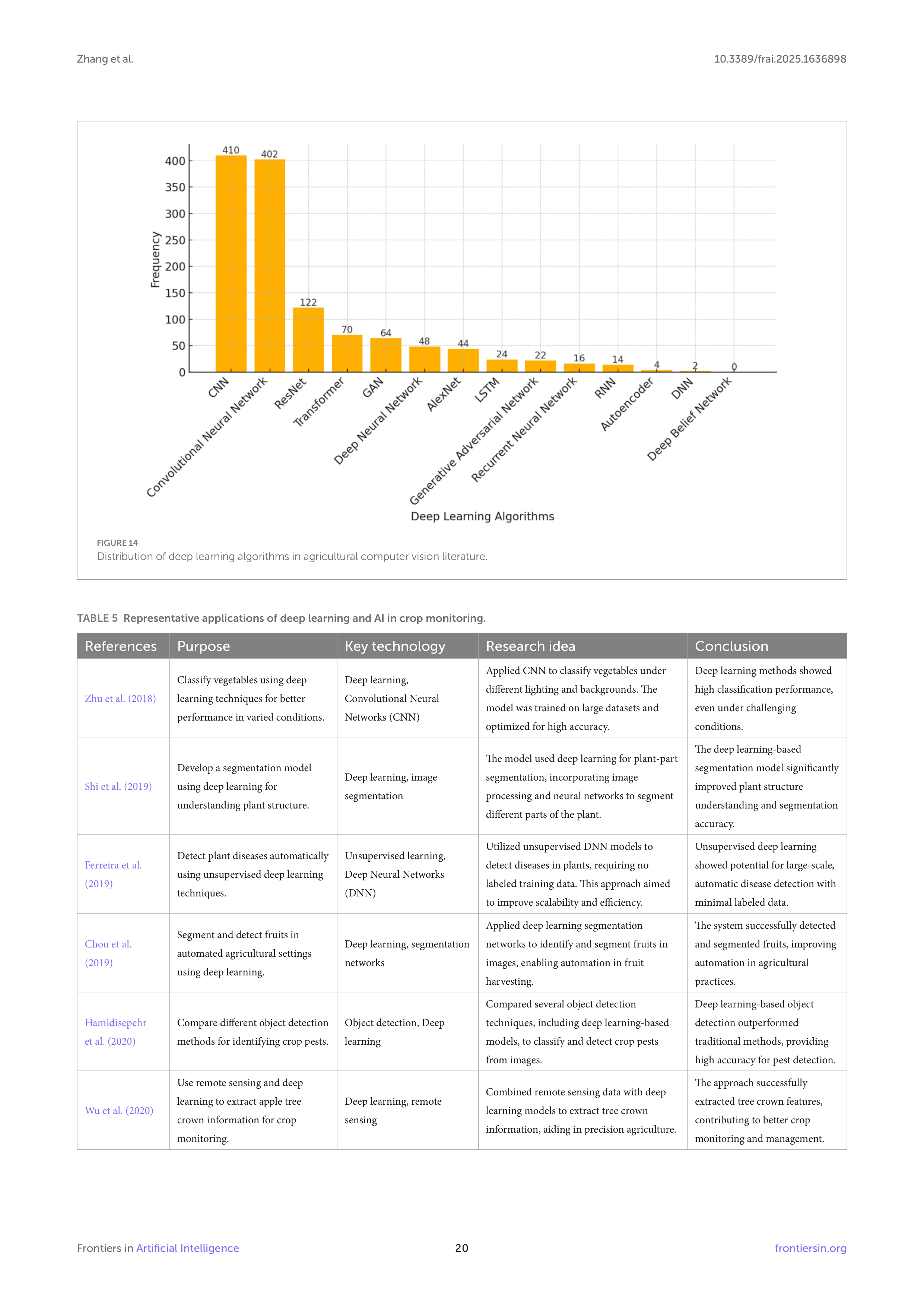
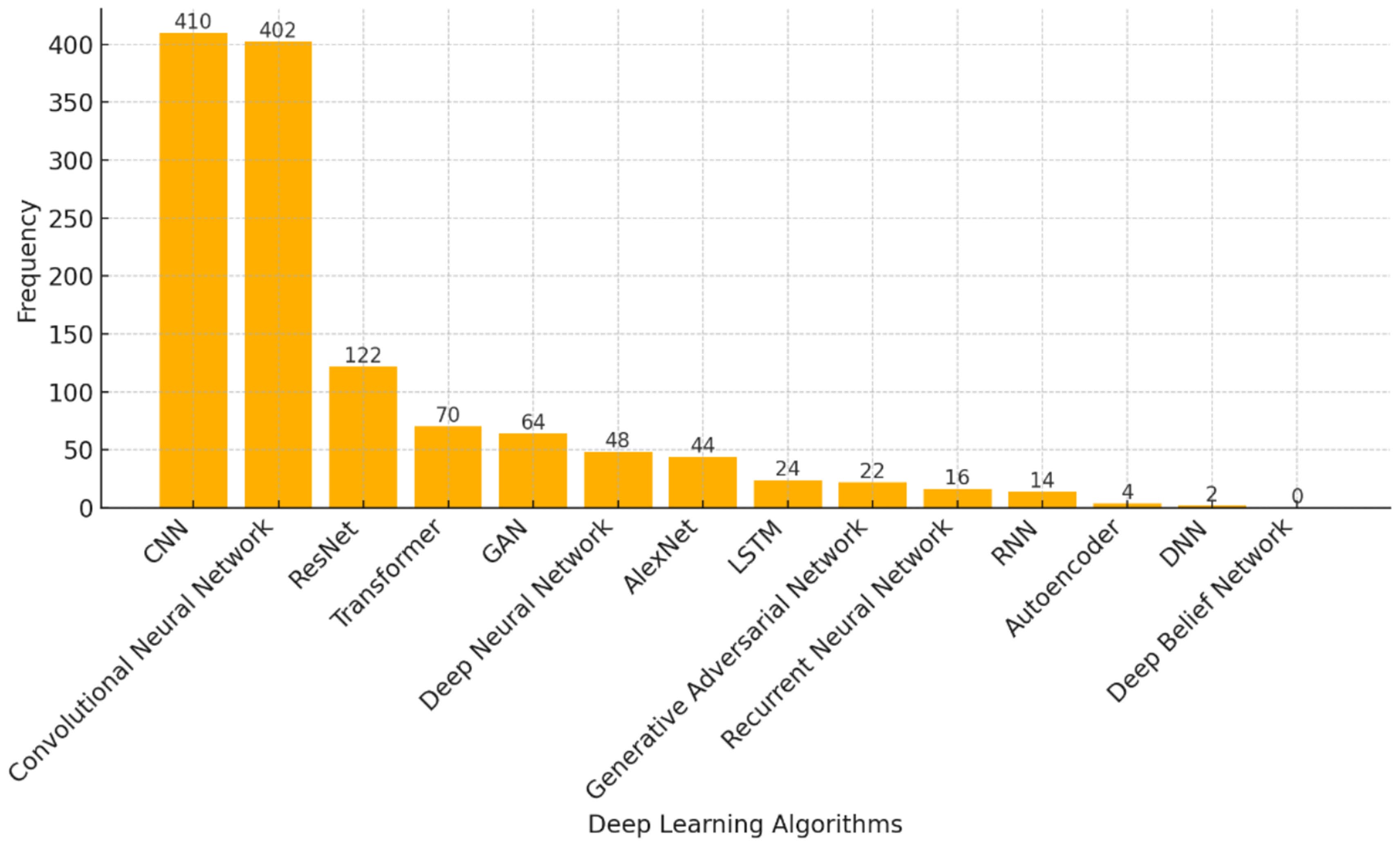
Zhang et al.
10.3389/frai.2025.1636898
Frontiers in
Artificial Intelligence
20
frontiersin.org
FIGURE 14
Distribution of deep learning algorithms in agricultural computer vision literature.
TABLE 5
Representative applications of deep learning and AI in crop monitoring.
References
Purpose
Key technology
Research idea
Conclusion
Zhu et al. (2018)
Classify vegetables using deep
learning techniques for better
performance in varied conditions.
Deep learning,
Convolutional Neural
Networks (CNN)
Applied CNN to classify vegetables under
different lighting and backgrounds. The
model was trained on large datasets and
optimized for high accuracy.
Deep learning methods showed
high classification performance,
even under challenging
conditions.
Shi et al. (2019)
Develop a segmentation model
using deep learning for
understanding plant structure.
Deep learning, image
segmentation
The model used deep learning for plant-part
segmentation, incorporating image
processing and neural networks to segment
different parts of the plant.
The deep learning-based
segmentation model significantly
improved plant structure
understanding and segmentation
accuracy.
Ferreira et al.
(2019)
Detect plant diseases automatically
using unsupervised deep learning
techniques.
Unsupervised learning,
Deep Neural Networks
(DNN)
Utilized unsupervised DNN models to
detect diseases in plants, requiring no
labeled training data. This approach aimed
to improve scalability and efficiency.
Unsupervised deep learning
showed potential for large-scale,
automatic disease detection with
minimal labeled data.
Chou et al.
(2019)
Segment and detect fruits in
automated agricultural settings
using deep learning.
Deep learning, segmentation
networks
Applied deep learning segmentation
networks to identify and segment fruits in
images, enabling automation in fruit
harvesting.
The system successfully detected
and segmented fruits, improving
automation in agricultural
practices.
Hamidisepehr
et al. (2020)
Compare different object detection
methods for identifying crop pests.
Object detection, Deep
learning
Compared several object detection
techniques, including deep learning-based
models, to classify and detect crop pests
from images.
Deep learning-based object
detection outperformed
traditional methods, providing
high accuracy for pest detection.
Wu et al. (2020)
Use remote sensing and deep
learning to extract apple tree
crown information for crop
monitoring.
Deep learning, remote
sensing
Combined remote sensing data with deep
learning models to extract tree crown
information, aiding in precision agriculture.
The approach successfully
extracted tree crown features,
contributing to better crop
monitoring and management.
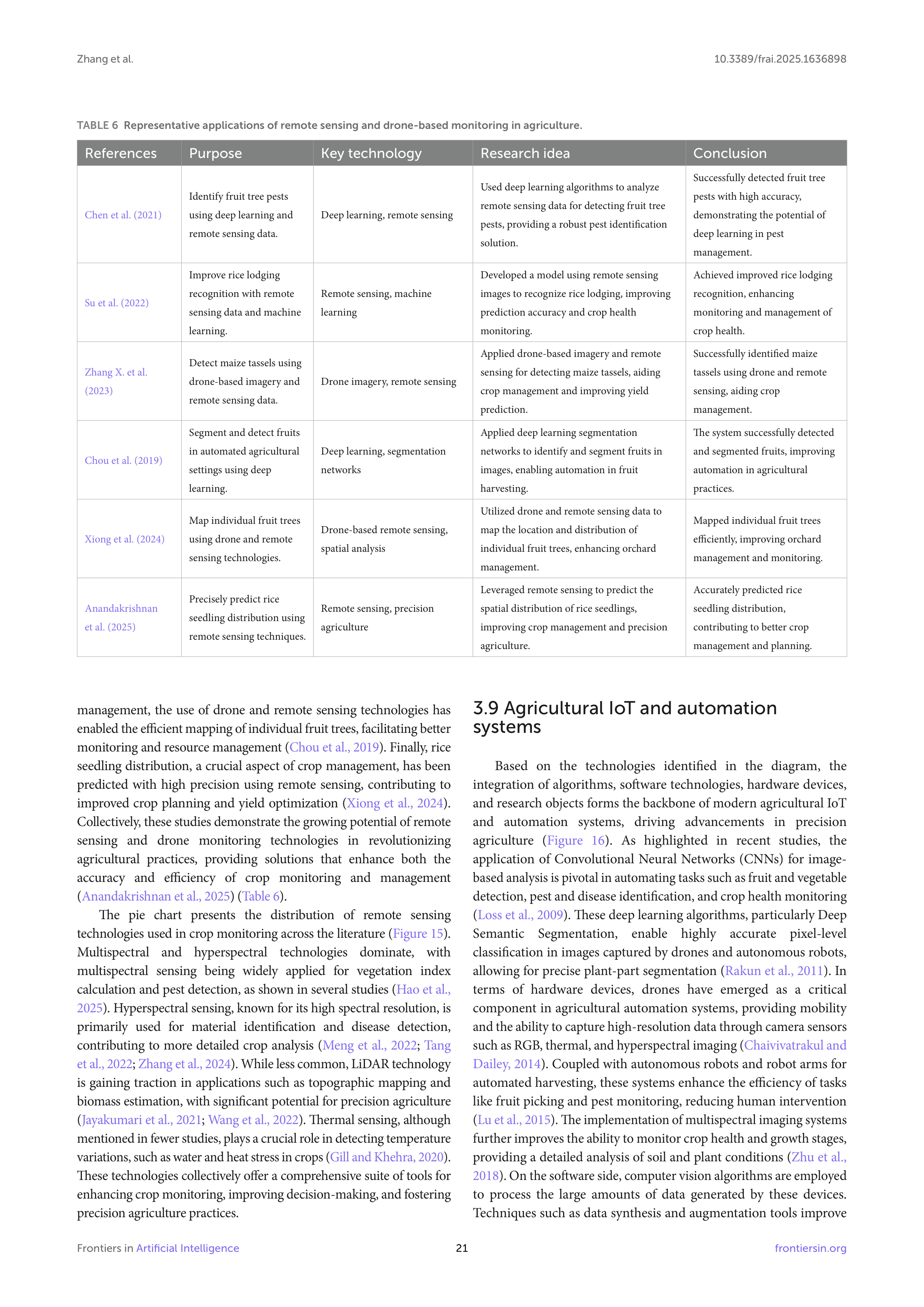
Zhang et al.
10.3389/frai.2025.1636898
Frontiers in
Artificial Intelligence
21
frontiersin.org
management, the use of drone and remote sensing technologies has
enabled the efficient mapping of individual fruit trees, facilitating better
monitoring and resource management (
Chou et al., 2019
). Finally, rice
seedling distribution, a crucial aspect of crop management, has been
predicted with high precision using remote sensing, contributing to
improved crop planning and yield optimization (
Xiong et al., 2024
).
Collectively, these studies demonstrate the growing potential of remote
sensing and drone monitoring technologies in revolutionizing
agricultural practices, providing solutions that enhance both the
accuracy and efficiency of crop monitoring and management
(
Anandakrishnan et al., 2025
) (
Table 6
).
The pie chart presents the distribution of remote sensing
technologies used in crop monitoring across the literature (
Figure 15
).
Multispectral and hyperspectral technologies dominate, with
multispectral sensing being widely applied for vegetation index
calculation and pest detection, as shown in several studies (
Hao et al.,
2025
). Hyperspectral sensing, known for its high spectral resolution, is
primarily used for material identification and disease detection,
contributing to more detailed crop analysis (
Meng et al., 2022
;
Tang
et al., 2022
;
Zhang et al., 2024
). While less common, LiDAR technology
is gaining traction in applications such as topographic mapping and
biomass estimation, with significant potential for precision agriculture
(
Jayakumari et al., 2021
;
Wang et al., 2022
). Thermal sensing, although
mentioned in fewer studies, plays a crucial role in detecting temperature
variations, such as water and heat stress in crops (
Gill and Khehra, 2020
).
These technologies collectively offer a comprehensive suite of tools for
enhancing crop monitoring, improving decision-making, and fostering
precision agriculture practices.
3.9 Agricultural IoT and automation
systems
Based on the technologies identified in the diagram, the
integration of algorithms, software technologies, hardware devices,
and research objects forms the backbone of modern agricultural IoT
and automation systems, driving advancements in precision
agriculture (
Figure
16
). As highlighted in recent studies, the
application of Convolutional Neural Networks (CNNs) for image-
based analysis is pivotal in automating tasks such as fruit and vegetable
detection, pest and disease identification, and crop health monitoring
(
Loss et al., 2009
). These deep learning algorithms, particularly Deep
Semantic Segmentation, enable highly accurate pixel-level
classification in images captured by drones and autonomous robots,
allowing for precise plant-part segmentation (
Rakun et al., 2011
). In
terms of hardware devices, drones have emerged as a critical
component in agricultural automation systems, providing mobility
and the ability to capture high-resolution data through camera sensors
such as RGB, thermal, and hyperspectral imaging (
Chaivivatrakul and
Dailey, 2014
). Coupled with autonomous robots and robot arms for
automated harvesting, these systems enhance the efficiency of tasks
like fruit picking and pest monitoring, reducing human intervention
(
Lu et al., 2015
). The implementation of multispectral imaging systems
further improves the ability to monitor crop health and growth stages,
providing a detailed analysis of soil and plant conditions (
Zhu et al.,
2018
). On the software side, computer vision algorithms are employed
to process the large amounts of data generated by these devices.
Techniques such as data synthesis and augmentation tools improve
TABLE 6
Representative applications of remote sensing and drone-based monitoring in agriculture.
References
Purpose
Key technology
Research idea
Conclusion
Chen et al. (2021)
Identify fruit tree pests
using deep learning and
remote sensing data.
Deep learning, remote sensing
Used deep learning algorithms to analyze
remote sensing data for detecting fruit tree
pests, providing a robust pest identification
solution.
Successfully detected fruit tree
pests with high accuracy,
demonstrating the potential of
deep learning in pest
management.
Su et al. (2022)
Improve rice lodging
recognition with remote
sensing data and machine
learning.
Remote sensing, machine
learning
Developed a model using remote sensing
images to recognize rice lodging, improving
prediction accuracy and crop health
monitoring.
Achieved improved rice lodging
recognition, enhancing
monitoring and management of
crop health.
Zhang X. et al.
(2023)
Detect maize tassels using
drone-based imagery and
remote sensing data.
Drone imagery, remote sensing
Applied drone-based imagery and remote
sensing for detecting maize tassels, aiding
crop management and improving yield
prediction.
Successfully identified maize
tassels using drone and remote
sensing, aiding crop
management.
Chou et al. (2019)
Segment and detect fruits
in automated agricultural
settings using deep
learning.
Deep learning, segmentation
networks
Applied deep learning segmentation
networks to identify and segment fruits in
images, enabling automation in fruit
harvesting.
The system successfully detected
and segmented fruits, improving
automation in agricultural
practices.
Xiong et al. (2024)
Map individual fruit trees
using drone and remote
sensing technologies.
Drone-based remote sensing,
spatial analysis
Utilized drone and remote sensing data to
map the location and distribution of
individual fruit trees, enhancing orchard
management.
Mapped individual fruit trees
efficiently, improving orchard
management and monitoring.
Anandakrishnan
et al. (2025)
Precisely predict rice
seedling distribution using
remote sensing techniques.
Remote sensing, precision
agriculture
Leveraged remote sensing to predict the
spatial distribution of rice seedlings,
improving crop management and precision
agriculture.
Accurately predicted rice
seedling distribution,
contributing to better crop
management and planning.
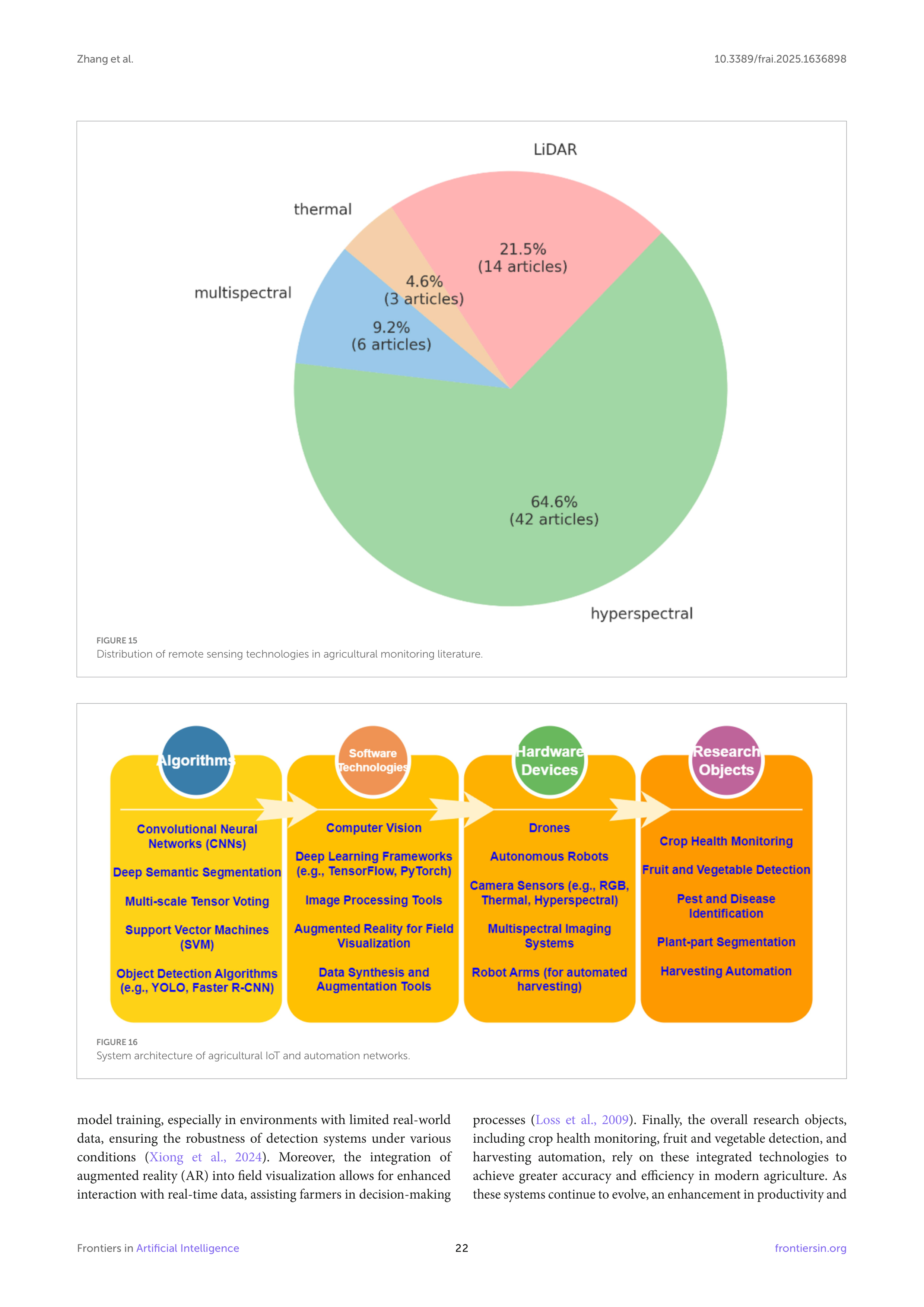
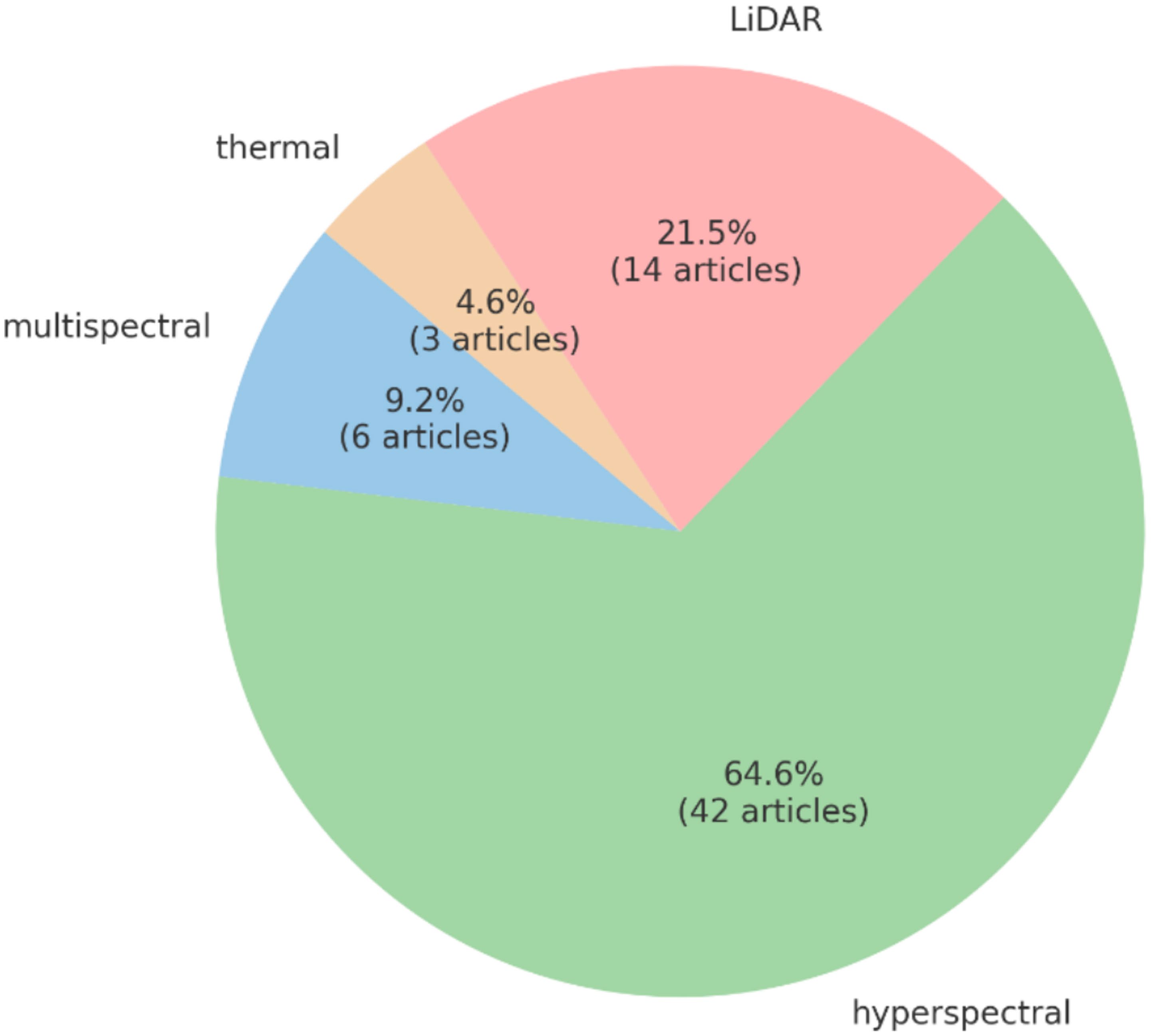
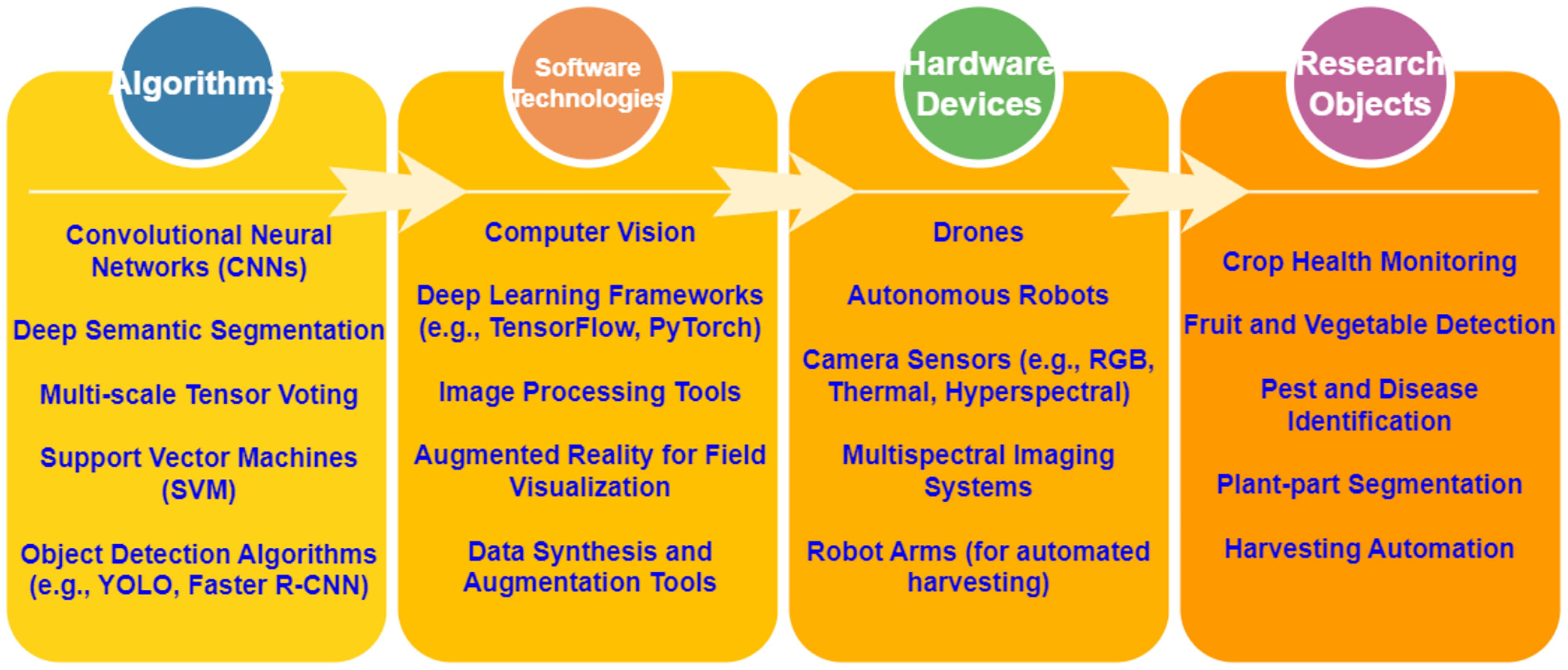
Zhang et al.
10.3389/frai.2025.1636898
Frontiers in
Artificial Intelligence
22
frontiersin.org
model training, especially in environments with limited real-world
data, ensuring the robustness of detection systems under various
conditions (
Xiong et
al., 2024
). Moreover, the integration of
augmented reality (AR) into field visualization allows for enhanced
interaction with real-time data, assisting farmers in decision-making
processes (
Loss et al., 2009
). Finally, the overall research objects,
including crop health monitoring, fruit and vegetable detection, and
harvesting automation, rely on these integrated technologies to
achieve greater accuracy and efficiency in modern agriculture. As
these systems continue to evolve, an enhancement in productivity and
FIGURE 15
Distribution of remote sensing technologies in agricultural monitoring literature.
FIGURE 16
System architecture of agricultural IoT and automation networks.
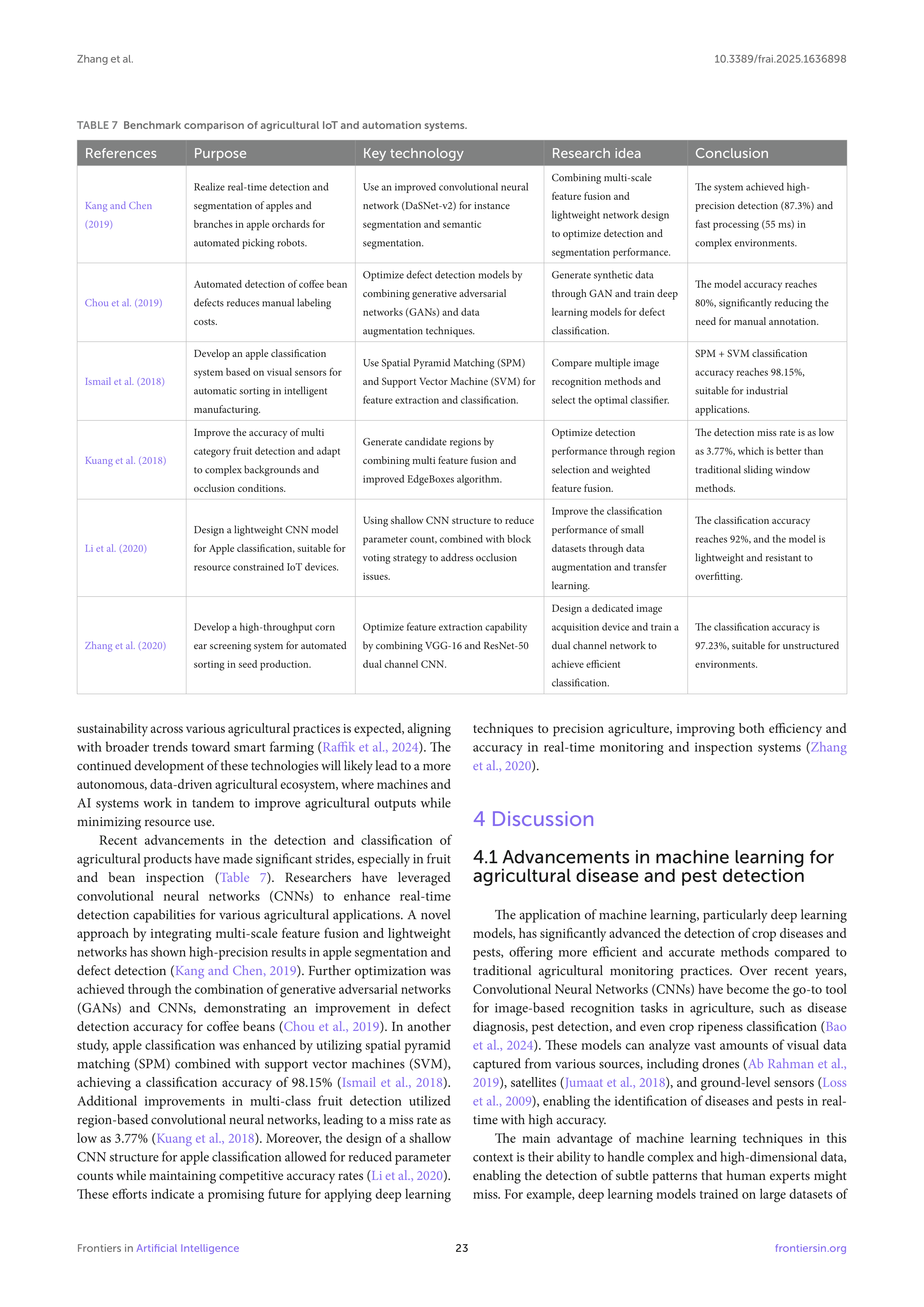
Zhang et al.
10.3389/frai.2025.1636898
Frontiers in
Artificial Intelligence
23
frontiersin.org
sustainability across various agricultural practices is expected, aligning
with broader trends toward smart farming (
Raffik et al., 2024
). The
continued development of these technologies will likely lead to a more
autonomous, data-driven agricultural ecosystem, where machines and
AI systems work in tandem to improve agricultural outputs while
minimizing resource use.
Recent advancements in the detection and classification of
agricultural products have made significant strides, especially in fruit
and bean inspection (
Table
7
). Researchers have leveraged
convolutional neural networks (CNNs) to enhance real-time
detection capabilities for various agricultural applications. A novel
approach by integrating multi-scale feature fusion and lightweight
networks has shown high-precision results in apple segmentation and
defect detection (
Kang and Chen, 2019
). Further optimization was
achieved through the combination of generative adversarial networks
(GANs) and CNNs, demonstrating an improvement in defect
detection accuracy for coffee beans (
Chou et al., 2019
). In another
study, apple classification was enhanced by utilizing spatial pyramid
matching (SPM) combined with support vector machines (SVM),
achieving a classification accuracy of 98.15% (
Ismail et al., 2018
).
Additional improvements in multi-class fruit detection utilized
region-based convolutional neural networks, leading to a miss rate as
low as 3.77% (
Kuang et al., 2018
). Moreover, the design of a shallow
CNN structure for apple classification allowed for reduced parameter
counts while maintaining competitive accuracy rates (
Li et al., 2020
).
These efforts indicate a promising future for applying deep learning
techniques to precision agriculture, improving both efficiency and
accuracy in real-time monitoring and inspection systems (
Zhang
et al., 2020
).
4 Discussion
4.1 Advancements in machine learning for
agricultural disease and pest detection
The application of machine learning, particularly deep learning
models, has significantly advanced the detection of crop diseases and
pests, offering more efficient and accurate methods compared to
traditional agricultural monitoring practices. Over recent years,
Convolutional Neural Networks (CNNs) have become the go-to tool
for image-based recognition tasks in agriculture, such as disease
diagnosis, pest detection, and even crop ripeness classification (
Bao
et al., 2024
). These models can analyze vast amounts of visual data
captured from various sources, including drones (
Ab Rahman et al.,
2019
), satellites (
Jumaat et al., 2018
), and ground-level sensors (
Loss
et al., 2009
), enabling the identification of diseases and pests in real-
time with high accuracy.
The main advantage of machine learning techniques in this
context is their ability to handle complex and high-dimensional data,
enabling the detection of subtle patterns that human experts might
miss. For example, deep learning models trained on large datasets of
TABLE 7
Benchmark comparison of agricultural IoT and automation systems.
References
Purpose
Key technology
Research idea
Conclusion
Kang and Chen
(2019)
Realize real-time detection and
segmentation of apples and
branches in apple orchards for
automated picking robots.
Use an improved convolutional neural
network (DaSNet-v2) for instance
segmentation and semantic
segmentation.
Combining multi-scale
feature fusion and
lightweight network design
to optimize detection and
segmentation performance.
The system achieved high-
precision detection (87.3%) and
fast processing (55 ms) in
complex environments.
Chou et al. (2019)
Automated detection of coffee bean
defects reduces manual labeling
costs.
Optimize defect detection models by
combining generative adversarial
networks (GANs) and data
augmentation techniques.
Generate synthetic data
through GAN and train deep
learning models for defect
classification.
The model accuracy reaches
80%, significantly reducing the
need for manual annotation.
Ismail et al. (2018)
Develop an apple classification
system based on visual sensors for
automatic sorting in intelligent
manufacturing.
Use Spatial Pyramid Matching (SPM)
and Support Vector Machine (SVM) for
feature extraction and classification.
Compare multiple image
recognition methods and
select the optimal classifier.
SPM + SVM classification
accuracy reaches 98.15%,
suitable for industrial
applications.
Kuang et al. (2018)
Improve the accuracy of multi
category fruit detection and adapt
to complex backgrounds and
occlusion conditions.
Generate candidate regions by
combining multi feature fusion and
improved EdgeBoxes algorithm.
Optimize detection
performance through region
selection and weighted
feature fusion.
The detection miss rate is as low
as 3.77%, which is better than
traditional sliding window
methods.
Li et al. (2020)
Design a lightweight CNN model
for Apple classification, suitable for
resource constrained IoT devices.
Using shallow CNN structure to reduce
parameter count, combined with block
voting strategy to address occlusion
issues.
Improve the classification
performance of small
datasets through data
augmentation and transfer
learning.
The classification accuracy
reaches 92%, and the model is
lightweight and resistant to
overfitting.
Zhang et al. (2020)
Develop a high-throughput corn
ear screening system for automated
sorting in seed production.
Optimize feature extraction capability
by combining VGG-16 and ResNet-50
dual channel CNN.
Design a dedicated image
acquisition device and train a
dual channel network to
achieve efficient
classification.
The classification accuracy is
97.23%, suitable for unstructured
environments.
Zhang et al.
10.3389/frai.2025.1636898
Frontiers in
Artificial Intelligence
24
frontiersin.org
crop images can identify specific symptoms of diseases or pest
infestations even under challenging field conditions, such as varying
lighting or occlusions. This capability is particularly important for
tasks like early disease detection, where timely intervention can
prevent significant crop loss. Moreover, these models can
be continually improved and adapted to new diseases and pest species,
ensuring their long-term utility in agriculture.
However, there are still challenges in deploying these systems on
a wide scale. One issue is the variability of environmental conditions,
which can affect the performance of machine learning models trained
on specific datasets. For instance, models that perform well in one
geographical region may struggle when applied to crops grown in
different climates or under different soil conditions. In addition, data
quality remains a concern; high-quality annotated datasets are
essential for training robust models, but such datasets are often limited
in agricultural contexts. To address these limitations, recent research
has focused on improving model generalization and developing
strategies for training models with fewer labeled examples, such as
transfer learning and semi-supervised learning. These efforts are
crucial for expanding the applicability of AI-based crop monitoring
systems across different farming environments, pushing the
boundaries of what is possible in agricultural disease and
pest management.
4.2 Integration of remote sensing
technologies with AI for precision
agriculture
The integration of remote sensing technologies with artificial
intelligence (AI) represents a transformative shift in the monitoring
and management of agricultural systems (
Alahi et al., 2023
). Remote
sensing tools, including unmanned aerial vehicles (UAVs) (
Deng
et al., 2022
), satellites (
Jumaat et al., 2018
), and various sensor
technologies (
Kang and Chen, 2019
), provide high-resolution (
Jumaat
et al., 2018
), multispectral data that (
Hao et al., 2025
), when combined
with AI, can offer unprecedented insights into crop health and
environmental conditions (
De Angelis et al., 2023
). The ability to
capture detailed images and sensor data from large-scale agricultural
fields allows for continuous, real-time monitoring of crops, which was
previously not possible with traditional manual methods (
Guo
et al., 2023
).
Machine learning algorithms, especially deep learning models, are
able to process and analyze the vast amounts of data generated by
remote sensing platforms. For example, deep convolutional networks
can classify crop types, detect diseases, monitor growth stages, and
even assess soil conditions from images captured by UAVs. This fusion
of AI and remote sensing technology significantly enhances the
accuracy and efficiency of crop management practices, enabling
farmers to make data-driven decisions that improve yields and reduce
resource waste. Furthermore, AI-powered systems can detect patterns
and correlations in the data that would otherwise be difficult to
uncover, such as subtle changes in crop conditions that might indicate
the onset of disease or pest infestation.
Despite the significant potential of these integrated systems,
challenges remain. One of the key issues is the complexity of managing
and processing the massive datasets generated by remote sensing
technologies. These datasets require sophisticated data storage
solutions, fast processing power, and highly advanced algorithms for
timely analysis. Additionally, the environmental variability between
regions—such as differences in climate, topography, and soil
conditions—means that AI models often need to be retrained or fine-
tuned to perform well in different settings. To address these issues,
research is moving toward creating more adaptable and scalable
systems that can be customized for different types of crops and
farming conditions. Additionally, there is a growing need for models
that can handle multi-source data, integrating information from
satellite imagery, UAVs, soil sensors, and weather data to provide a
more holistic view of crop health and field conditions.
4.3 Challenges and future directions in
AI-driven agricultural systems
While AI has the potential to revolutionize agriculture, its
widespread adoption faces several significant challenges (
Abdar et al.,
2021a
). A critical hurdle is the need for large, high-quality datasets to
train machine learning models (
Zhang et al., 2020
). In agriculture,
collecting sufficient labeled data can be particularly challenging due
to the diverse and dynamic nature of farming environments (
Xiong
et
al., 2024
). Unlike other industries, where datasets can
be standardized, agricultural data varies greatly depending on the crop
type (
Abdali et al., 2024
), climate (
Abbass et al., 2022
), geographical
location (
Comber et al., 2023
), and even specific farm practices (
Sa
et al., 2018
). Furthermore, manual annotation of agricultural data—
such as labeling images of crops, diseases, or pests—can be labor-
intensive and expensive (
Ferreira et al., 2019
), making it difficult to
create comprehensive datasets that capture all the potential variations
in agricultural scenarios.
One challenge is the adaptability and scalability of AI models,
particularly in the context of climate change. Models trained on
specific conditions may struggle when applied to diverse
environments. Barriers such as limited infrastructure and policy
support in developing countries hinder technology deployment.
However, government incentives and public-private partnerships can
accelerate adoption, and current research focuses on developing
adaptable models that require less retraining across various conditions.
Another challenge lies in the adaptability and scalability of AI models.
While deep learning models have demonstrated impressive
performance in controlled conditions, their deployment in real-world
agricultural environments can be less straightforward. Machine
learning models trained on specific crops or conditions may struggle
when applied to different environments, leading to issues with model
generalization. This is particularly relevant in the context of climate
change, which is altering growing conditions across the globe.
Developing models that can adapt to a wide range of environmental
conditions—without requiring extensive retraining—is a major focus
of current research.
Looking to the future, the combination of AI with other emerging
technologies, such as robotics and the Internet of Things (IoT), offers
exciting possibilities for creating fully autonomous, data-driven
agricultural systems. AI-powered robots, for example, could automate
tasks like planting, harvesting, and pest control, while IoT devices
could monitor environmental factors such as soil moisture,
temperature, and nutrient levels in real-time. The integration of these
technologies would allow for the creation of smart farming systems
Zhang et al.
10.3389/frai.2025.1636898
Frontiers in
Artificial Intelligence
25
frontiersin.org
that can make real-time decisions based on data, significantly
improving efficiency, reducing waste, and optimizing resource usage.
However, to fully realize this vision, further advances in hardware,
data processing, and system integration are necessary. AI systems
must become more robust, scalable, and adaptable to handle the
complexities of agricultural environments and meet the diverse needs
of farmers worldwide.
In conclusion, while AI and machine learning technologies hold
immense potential for transforming agricultural practices, addressing
the challenges of data quality, model adaptability, and system
integration will be key to their widespread adoption. As research
continues to evolve, the convergence of AI, remote sensing, robotics,
and IoT will likely usher in a new era of precision agriculture that
improves both the productivity and sustainability of farming
operations on a global scale.
5 Conclusion
This review examines the intersection of machine learning,
particularly deep learning, and agricultural information systems,
focusing on crop monitoring, disease detection, and pest management.
The findings highlight a paradigm shift in agriculture, where deep
learning algorithms and remote sensing technologies are redefining
agricultural practices. AI models, especially CNNs, are instrumental in
automating tasks such as crop health assessment and pest classification,
with the potential to enhance sustainability and productivity.
Despite advancements, challenges remain, such as data
heterogeneity, model generalization, and limited high-quality datasets.
Overcoming these barriers requires strategies like data augmentation,
transfer learning, and multi-source data integration. Our experimental
results show that AI can significantly improve agricultural applications,
but real-world deployment requires further advancements in real-time
processing and scalability. Techniques like model compression and
Explainable AI (XAI) are essential for effective integration. This study
underscores the transformative potential of AI, emphasizing the need
for interdisciplinary approaches to address both technical and
practical barriers in agriculture. Future research should focus on
ensuring that AI-driven solutions are sustainable, equitable, and
capable of addressing global food security challenges.
Author contributions
RZ: Conceptualization, Formal analysis, Methodology, Validation,
Investigation, Writing – original draft, Software, Data curation. XW:
Validation, Formal analysis, Writing – original draft, Data curation,
Methodology, Investigation, Conceptualization, Software. JL:
Conceptualization, Funding acquisition, Project administration,
Writing
– review & editing. PZ: Visualization, Data curation,
Writing – original draft, Investigation. QZ: Writing – review & editing,
Validation. LW: Data curation, Writing
– review & editing,
Visualization, Software. DZ: Visualization, Data curation, Software,
Writing – review & editing. ZZ: Writing – review & editing, Data
curation, Software, Visualization. LY: Writing – review & editing,
Project administration, Supervision.
Funding
The author(s) declare that financial support was received for the
research and/or publication of this article. This research was supported
by the Open Research Fund of Yunnan Key Laboratory of crop
production and intelligent agriculture (2024ZHNY05), and the
Yunnan Intelligent Agriculture and Water Security International
Research and Development Center (202203AP140012).
Acknowledgments
We would like to thank the editors and reviewers for their valuable
opinions and suggestions that improved this research.
Conflict of interest
The authors declare that the research was conducted in the
absence of any commercial or financial relationships that could
be construed as a potential conflict of interest.
Generative AI statement
The authors declare that no Gen AI was used in the creation of
this manuscript.
Any alternative text (alt text) provided alongside figures in this
article has been generated by Frontiers with the support of artificial
intelligence and reasonable efforts have been made to ensure accuracy,
including review by the authors wherever possible. If you identify any
issues, please contact us.
Publisher’s note
All claims expressed in this article are solely those of the
authors and do not necessarily represent those of their affiliated
organizations, or those of the publisher, the editors and the
reviewers. Any product that may be evaluated in this article, or
claim that may be made by its manufacturer, is not guaranteed or
endorsed by the publisher.
References
Ab Rahman, A. A., Jaafar, W. S. W. M., Maulud, K. N. A., Noor, N. M., Mohan, M.,
Cardil, A., et al (2019) Applications of Drones in Emerging Economies: a case study of
Malaysia. Johor Bahru, Malaysia. 2019 6th International Conference on Space Science
and Communication (IconSpace2019). doi: 10.1109/IconSpace.2019.8905962
Abbas, A., Jain, S., Gour, M., and Vankudothu, S. (2021). Tomato plant disease
detection using transfer learning with C-GAN synthetic images.
Comput. Electron. Agric.
187:106279. doi: 10.1016/j.compag.2021.106279
Abbas, I., Liu, J., Amin, M., Tariq, A., and Tunio, M. H. (2021). Strawberry
fungal leaf scorch disease identification in real-time strawberry field using
deep
learning
architectures.
Plants
10:643.
doi:
10.3390/plants10122
643
Abbas, S., Saqib, N., and Shahzad, U. (2024). Global export flow of Chilean copper:
the role of environmental innovation and renewable energy transition.
Geosci. Front.
15:697. doi: 10.1016/j.gsf.2023.101697
Zhang et al.
10.3389/frai.2025.1636898
Frontiers in
Artificial Intelligence
26
frontiersin.org
Abbasi, S., and Erdebilli, B. (2023). Green closed-loop supply chain networks’ response
to various carbon policies during COVID-19.
Sustainability
15:677. doi:
10.3390/su15043677
Abbass, K., Qasim, M., Song, H., Murshed, M., Mahmood, H., and Younis, I. (2022).
A review of the global climate change impacts, adaptation, and sustainable mitigation
measures.
Environ. Sci. Pollut. Res.
29, 42539–42559. doi: 10.1007/s11356-022-19718-6
Abdali, E., Zoej, M., Dehkordi, A., and Ghaderpour, E. (2024). A parallel-cascaded
ensemble of machine learning models for crop type classification in Google earth engine
using multi-temporal Sentinel-1/2 and Landsat-8/9 remote sensing data.
Remote Sens
16:127. doi: 10.3390/rs16010127
Abdar, M., Pourpanah, F., Hussain, S., Rezazadegan, D., Liu, L., Ghavamzadeh, M.,
et al. (2021a). A review of uncertainty quantification in deep learning: techniques,
applications and challenges.
Inf. Fusion
76, 243–297. doi: 10.1016/j.inffus.2021.05.008
Abdar, M., Samami, M., Dehghani, S., Doan, T., Mazoure, B., Hashemifesharaki, R.,
et al. (2021b). Uncertainty quantification in skin cancer classification using three-way
decision-based Bayesian deep learning.
Comput. Biol. Med.
135:418. doi:
10.1016/j.compbiomed.2021.104418
Abd-Elrahman, S., Saudy, H., Abd El-Fattah, D., and Hashem, F. (2022). Effect of
irrigation water and organic fertilizer on reducing nitrate accumulation and boosting
lettuce
productivity.
J.
Soil
Sci.
Plant
Nutr.
22,
2144–2155.
doi:
10.1007/s42729-022-00799-8
Abdulkadirov, R., Lyakhov, P., and Nagornov, N. (2023). Survey of optimization
algorithms in modern neural networks.
Mathematics
11:466. doi: 10.3390/math11112466
Abdullahi, H. S., Mahieddine, F., and Sheriff, R. E. (2015). Technology impact on
agricultural productivity: a review of precision agriculture using unmanned aerial
vehicles., eds. P. Pillai, Y. Hu, I. Otung and G. Giambene, International conference on
wireless and satellite systems 388–400.
Abedi, E., Gahruie, H. H., Hosseini, S. M. H., and Zhang, P. (2025). Impact of
hydrodynamic cavitation-assisted microbubble with N2, CO2, and air on pasting,
morphological, and thermal properties of starches from different botanical origins.
Int.
J. Biol. Macromol.
301:140253. doi: 10.1016/j.ijbiomac.2025.140253
Abubakar, I., Maniruzzaman, K., Dano, U., AlShihri, F., AlShammari, M., Ahmed, S.,
et al. (2022). Environmental sustainability impacts of solid waste management practices
in the global south.
Int. J. Environ. Res. Public Health
19:717. doi: 10.3390/ijerph191912717
Adger, W., Fransen, S., de Campos, R., and Clark, W. (2024). Migration and sustainable
development.
Proc. Natl. Acad. Sci. USA
121:3121. doi: 10.1073/pnas.2206193121
Ahmad, A., Saraswat, D., Aggarwal, V., Etienne, A., and Hancock, B. (2021).
Performance of deep learning models for classifying and detecting common weeds in
corn and soybean production systems.
Comput. Electron. Agric.
184:106081. doi:
10.1016/j.compag.2021.106081
Ahmed, R., Akbar, W., Aijaz, M., Channar, Z., Ahmed, F., and Parmar, V. (2023). The
role of green innovation on environmental and organizational performance: moderation
of human resource practices and management commitment.
Heliyon
9:e12679. doi:
10.1016/j.heliyon.2022.e12679
Alahi, M., Sukkuea, A., Tina, F., Nag, A., Kurdthongmee, W., Suwannarat, K., et al.
(2023). Integration of IoT-enabled technologies and artificial intelligence (AI) for smart
city scenario: recent advancements and future trends.
Sensors
23:206. doi:
10.3390/s23115206
Alola, A., Özkan, O., and Usman, O. (2023). Role of non-renewable energy efficiency
and renewable energy in driving environmental sustainability in India: evidence from
the load capacity factor hypothesis.
Energies
16:847. doi: 10.3390/en16062847
Al-Shammary, A., Al-Shihmani, L., Fernández-Gálvez, J., and Caballero-Calvo, A.
(2024). Optimizing sustainable agriculture: a comprehensive review of agronomic
practices and their impacts on soil attributes.
J. Environ. Manag.
364:121487. doi:
10.1016/j.jenvman.2024.121487
Anandakrishnan, J., Sangaiah, A., Darmawan, H., Son, N., Lin, Y., and Alenazi, M.
(2025). Precise spatial prediction of rice seedlings from large-scale airborne remote
sensing data using optimized Li-YOLOv9.
IEEE J. Sel. Top. Appl. Earth Observ. Remote
Sens.
18, 2226–2238. doi: 10.1109/JSTARS.2024.3505964
Appels, R., Eversole, K., Feuillet, C., Keller, B., Rogers, J., Stein, N., et al. (2018).
Shifting the limits in wheat research and breeding using a fully annotated reference
genome.
Science
361:661. doi: 10.1126/science.aar7191
Bao, D., Liu, X., Xu, Y., Fang, Q., and He, X. (2024). Detection of defective apples using
learnable residual multi-head attention networks integrated with CNNs.
Electronics
13:861. doi: 10.3390/electronics13244861
Beck, H., Pan, M., Miralles, D., Reichle, R., Dorigo, W., Hahn, S., et al. (2021).
Evaluation of 18 satellite- and model-based soil moisture products using in situ
measurements from 826 sensors.
Hydrol. Earth Syst. Sci.
25, 17–40. doi:
10.5194/hess-25-17-2021
Bojar, D., Meche, L., Meng, G., Eng, W., Smith, D., Cummings, R., et al. (2022). A
useful guide to lectin binding: machine-learning directed annotation of 57 unique lectin
specificities.
ACS Chem. Biol.
17, 2993–3012. doi: 10.1021/acschembio.1c00689
Bouguettaya, A., Zarzour, H., Kechida, A., and Taberkit, A. (2022). Deep learning
techniques to classify agricultural crops through UAV imagery: a review.
Neural Comput.
Applic.
34, 9511–9536. doi: 10.1007/s00521-022-07104-9
Chaivivatrakul, S., and Dailey, M. (2014). Texture-based fruit detection.
Precis. Agric.
15, 662–683. doi: 10.1007/s11119-014-9361-x
Chaw, J., and Mokji, M. (2017). Analysis of produce recognition system with
taxonomist’s knowledge using computer vision and different classifiers.
IET Image
Process.
11, 173–182. doi: 10.1049/iet-ipr.2016.0381
Chen, J., Chen, J., Zhang, D., Sun, Y., and Nanehkaran, Y. (2020). Using deep transfer
learning for image-based plant disease identification.
Comput. Electron. Agric.
173:105393. doi: 10.1016/j.compag.2020.105393
Chen, Z., Granland, K., Newbury, R., and Chen, C. (2023). Hob-cnn: hallucination of
occluded branches with a convolutional neural network for 2d fruit trees.
Smart Agric.
Technol.
3:96. doi: 10.1016/j.atech.2022.100096
Chen, C., Huang, Y., Li, Y., Chen, Y., Chang, C., and Huang, Y. (2021). Identification
of fruit tree pests with deep learning on embedded drone to achieve accurate pesticide
spraying.
IEEE Access
9, 21986–21997. doi: 10.1109/ACCESS.2021.3056082
Chklovski, A., Parks, D., Woodcroft, B., and Tyson, G. (2023). CheckM2: a rapid,
scalable and accurate tool for assessing microbial genome quality using machine
learning.
Nat. Methods
20, 1203–1212. doi: 10.1038/s41592-023-01940-w
Chou, Y., Kuo, C., Chen, T., Horng, G., Pai, M., Wu, M., et al. (2019). Deep-learning-
based defective bean inspection with GAN-structured automated labeled data
augmentation in coffee industry.
Appl. Sci.
9:166. doi: 10.3390/app9194166
Comber, A., Brunsdon, C., Charlton, M., Dong, G., Harris, R., Lu, B., et al. (2023). A
route map for successful applications of geographically weighted regression.
Geogr. Anal.
55, 155–178. doi: 10.1111/gean.12316
d’Andrimont, R., Yordanov, M., Martinez-Sanchez, L., and van der Velde, M. (2022).
Monitoring crop phenology with street-level imagery using computer vision.
Comput.
Electron. Agric.
196:106866. doi: 10.1016/j.compag.2022.106866
Das, N., Kumar, N., Kaur, M., Kumar, V., and Singh, D. (2022). Automated deep
transfer learning-based approach for detection of COVID-19 infection in chest X-rays.
IRBM
43, 114–119. doi: 10.1016/j.irbm.2020.07.001
De Angelis, L., Baglivo, F., Arzilli, G., Privitera, G., Ferragina, P., Tozzi, A., et al.
(2023). ChatGPT and the rise of large language models: the new AI-driven infodemic
threat in public health.
Front. Public Health
11:1166120. doi: 10.3389/fpubh.
2023.1166120
Deng, J., Zhou, H., Lv, X., Yang, L., Shang, J., Sun, Q., et al. (2022). Applying
convolutional neural networks for detecting wheat stripe rust transmission centers
under complex field conditions using RGB-based high spatial resolution images from
UAVs.
Comput. Electron. Agric.
200:107211. doi: 10.1016/j.compag.2022.107211
Dimyati, M., Supriatna, S., Nagasawa, R., Pamungkas, F. D., and Pramayuda, R. (2023).
A comparison of several UAV-based multispectral imageries in monitoring rice paddy
(a case study in paddy fields in Tottori prefecture, Japan).
ISPRS Int. J. Geo Inf.
12:36.
doi: 10.3390/ijgi12020036
Dong, H., Dong, J., Sun, S., Bai, T., Zhao, D., Yin, Y., et al. (2024). Crop water stress
detection based on UAV remote sensing systems.
Agric. Water Manag.
303:109059. doi:
10.1016/j.agwat.2024.109059
European Assoc Study LiveAlvaro, D., Gores, G., Walicki, J., Hassan, C., Sapisochin, G.,
et al. (2023). EASL-ILCA clinical practice guidelines on the management of intrahepatic
cholangiocarcinoma.
J. Hepatol.
79, 181–208. doi: 10.1016/j.jhep.2023.03.010
Ferreira, A., Freitas, D., da Silva, G., Pistori, H., and Folhes, M. (2019). Unsupervised
deep learning and semi-automatic data labeling in weed discrimination.
Comput.
Electron. Agric.
:165. doi: 10.1016/j.compag.2019.104963
Gehlot, M., Saxena, R., and Gandhi, G. (2023). “Tomato-Village”: a dataset for end-
to-end tomato disease detection in a real-world environment.
Multimedia Systems
29,
3305–3328. doi: 10.1007/s00530-023-01158-y
Gill, H., and Khehra, B. (2020). Efficient image classification technique for weather
degraded fruit images.
IET Image Process.
14, 3463–3470. doi: 10.1049/iet-ipr.2018.5310
Guo, F., Feng, Q., Yang, S., and Yang, W. (2024). Estimation of potato canopy leaf water
content in various growth stages using UAV hyperspectral remote sensing and machine
learning.
Front. Plant Sci.
15:589. doi: 10.3389/fpls.2024.1458589
Guo, B., Lu, M., Fan, Y., Wu, H., Yang, Y., and Wang, C. (2023). A novel remote sensing
monitoring index of salinization based on three-dimensional feature space model and
its application in the Yellow River Delta of China.
Geomat. Nat. Hazards Risk
14, 95–116.
doi: 10.1080/19475705.2022.2156820
Hamidisepehr, A., Mirnezami, S., and Ward, J. (2020). Comparison of object detection
methods for corn damage assessment using deep learning.
Trans. ASABE
63, 1969–1980.
doi: 10.13031/trans.13791
Hao, X., Wang, Z., Zhang, Y., Li, F., Wang, M., Li, J., et al. (2025). Detecting wheat
yellow dwarf disease by employing a dual-branch multiscale model from UAV
multispectral
images.
Comput.
Electron.
Agric.
230:109898.
doi:
10.1016/j.compag.2025.109898
He, Z., Ding, L., Ji, J., Jin, X., Feng, Z., and Hao, M. (2024). Design and experiment of
variable-spray system based on deep learning.
Appl. Sci.
14:330. doi:
10.3390/app14083330
Ismail, A., Idris, M., Ayub, M., and Por, L. (2018). Vision-based apple classification for
smart manufacturing.
Sensors
18:353. doi: 10.3390/s18124353
Zhang et al.
10.3389/frai.2025.1636898
Frontiers in
Artificial Intelligence
27
frontiersin.org
Iyortsuun, N., Kim, S., Jhon, M., Yang, H., and Pant, S. (2023). A review of machine
learning and deep learning approaches on mental health diagnosis.
Healthcare
11:285.
doi: 10.3390/healthcare11030285
Jackson-Davis, A., White, S., Kassama, L., Coleman, S., Shaw, A., Mendonca, A., et al.
(2023). A review of regulatory standards and advances in essential oils as antimicrobials
in foods.
J. Food Prot.
86:100025. doi: 10.1016/j.jfp.2022.100025
Jayakumari, R., Nidamanuri, R., and Ramiya, A. (2021). Object-level classification of
vegetable crops in 3D LiDAR point cloud using deep learning convolutional neural
networks.
Precis. Agric.
22, 1617–1633. doi: 10.1007/s11119-021-09803-0
Jiang, J., Zhang, Z., Cao, Q., Liang, Y., Krienke, B., Tian, Y., et al. (2020). Use of an
active canopy sensor mounted on an unmanned aerial vehicle to monitor the growth
and nitrogen status of winter wheat.
Remote Sens
12:684. doi: 10.3390/rs1222
3684
Jumaat, N. F. H., Ahmad, B., and Dutsenwai, H. S. (2018). Land cover change mapping
using high resolution satellites and unmanned aerial vehicle.
IOP Conf. Series
169:2076.
doi: 10.1088/1755-1315/169/1/012076
Kamei, M. (2023). Effect of image resolution on automatic detection of whitefly
(Hemiptera: Aleyrodidae) species on tomato leaflets using deep learning.
Smart Agric.
Technol.
6:100372. doi: 10.1016/j.atech.2023.100372
Kang, H., and Chen, C. (2019). Fruit detection and segmentation for apple harvesting
using visual sensor in orchards.
Sensors
19:599. doi: 10.3390/s19204599
Kestur, R., Meduri, A., and Narasipura, O. (2019). Mangonet: a deep semantic
segmentation architecture for a method to detect and count mangoes in an open
orchard.
Eng. Appl. Artif. Intell.
77, 59–69. doi: 10.1016/j.engappai.2018.09.011
Khan, A., Malebary, S. J., Dang, L. M., Binzagr, F., Song, H.-K., and Moon, H. (2024).
AI-enabled crop management framework for Pest detection using visual sensor data.
Plants
13:653. doi: 10.3390/plants13050653
Kong, X., Li, X., Zhu, X., Guo, Z., and Zeng, L. (2024). Detection model based on
improved faster-RCNN in apple orchard environment.
Intell. Syst. Appl.
21:325. doi:
10.1016/j.iswa.2024.200325
Kuang, H., Liu, C., Chan, L., and Yan, H. (2018). Multi-class fruit detection based on
image region selection and improved object proposals.
Neurocomputing
283, 241–255.
doi: 10.1016/j.neucom.2017.12.057
Kumar, Y., Dubey, A., Arora, R., and Rocha, A. (2022). Multiclass classification of
nutrients deficiency of apple using deep neural network.
Neural Comput. Applic.
34,
8411–8422. doi: 10.1007/s00521-020-05310-x
Li, W., Riemer, N., Xu, L., Wang, Y., Adachi, K., Shi, Z., et al. (2024). Microphysical
properties of atmospheric soot and organic particles: measurements, modeling, and
impacts.
NPJ Clim. Atmos. Sci.
7:610. doi: 10.1038/s41612-024-00610-8
Li, J., Xie, S., Chen, Z., Liu, H., Kang, J., Fan, Z., et al. (2020). A shallow convolutional
neural network for apple classification.
IEEE Access
8, 111683–111692. doi:
10.1109/ACCESS.2020.3002882
Li, Y., Zhu, J., Xing, Y., Dai, Z., Huang, J., and Hassan, S.-U. (2022). Monitoring the
growth status of corn crop from UAV images based on dense convolutional neural
network.
Int. J. Pattern Recognit. Artif. Intell.
36:75. doi: 10.1142/S0218001422570075
Liu, S., Ampatzidis, Y., Zhou, C., and Lee, W. (2025). Ai-driven time series analysis for
predicting strawberry weekly yields integrating fruit monitoring and weather data for
optimized
harvest
planning.
Comput.
Electron.
Agric.
233:110212.
doi:
10.1016/j.compag.2025.110212
Liu, D., He, P., Wang, Q., He, Y., and Cheng, F. (2025). Object detection with attribute
tagging task: model design and evaluation on agricultural datasets.
Comput. Electron.
Agric.
230:109880. doi: 10.1016/j.compag.2024.109880
Loeffler, H., He, J., Tibo, A., Janet, J., Voronov, A., Mervin, L., et al. (2024). Reinvent
4: modern AI-driven generative molecule design.
J. Cheminform.
16:20. doi:
10.1186/s13321-024-00812-5
Loss, L., Bebis, G., Nicolescu, M., and Skurikhin, A. (2009). An iterative multi-scale
tensor voting scheme for perceptual grouping of natural shapes in cluttered backgrounds.
Comput. Vis. Image Underst.
113, 126–149. doi: 10.1016/j.cviu.2008.07.011
Lu, H., Cao, Z., Xiao, Y., Fang, Z., Zhu, Y., and Xian, K. (2015). Fine-grained maize
tassel trait characterization with multi-view representations.
Comput. Electron. Agric.
118, 143–158. doi: 10.1016/j.compag.2015.08.027
Lu, Y., Yi, S., Zeng, N., Liu, Y., and Zhang, Y. (2017). Identification of rice diseases
using deep convolutional neural networks.
Neurocomputing
267, 378–384. doi:
10.1016/j.neucom.2017.06.023
Ma, T., Zhang, D., Li, X., Huang, Y., Zhang, L., Zhu, Z., et al. (2023). Hyperspectral
remote sensing technology for water quality monitoring: knowledge graph analysis and
frontier trend.
Front. Environ. Sci.
11:1133325. doi: 10.3389/fenvs.2023.1133325
Majeed, Y., Zhang, J., Zhang, X., Fu, L., Karkee, M., Zhang, Q., et al. (2020). Deep
learning based segmentation for automated training of apple trees on trellis wires.
Comput. Electron. Agric.
170:105277. doi: 10.1016/j.compag.2020.105277
Meng, Y., Ma, Z., Ji, Z., Gao, R., and Su, Z. (2022). Fine hyperspectral classification of
rice varieties based on attention module 3D-2DCNN.
Comput. Electron. Agric.
203:107474. doi: 10.1016/j.compag.2022.107474
Pérez, D., Bromberg, F., and Diaz, C. (2017). Image classification for detection of
winter grapevine buds in natural conditions using scale-invariant features transform,
bag of features and support vector machines.
Comput. Electron. Agric.
135, 81–95. doi:
10.1016/j.compag.2017.01.020
Qi, J., Liu, X., Liu, K., Xu, F., Guo, H., Tian, X., et al. (2022). An improved YOLOv5
model based on visual attention mechanism: application to recognition of tomato virus
disease.
Comput. Electron. Agric.
194:106780. doi: 10.1016/j.compag.2022.106780
Raffik, R., Farouq, K. M., Muddisetty, H., Sengar, K., Sendilvelan, S., and Pant, K.
(2024). Smart agriculture farming using drone automation technology.
AIP Conf. Proc.
2937:020036. doi: 10.1063/5.0218185
Rakun, J., Stajnko, D., and Zazula, D. (2011). Detecting fruits in natural scenes by
using spatial-frequency based texture analysis and multiview geometry Comput.
Electron. Agric.
76, 80–88. doi: 10.1016/j.compag.2011.01.007
Rubbens, P., Brodie, S., Cordier, T., Destro, D., Devos, P., Fernandes-Salvador, J., et al.
(2023). Machine learning in marine ecology: an overview of techniques and applications.
ICES J. Mar. Sci.
80, 1829–1853. doi: 10.1093/icesjms/fsad100
Sa, I., Popovic, M., Khanna, R., Chen, Z., Lottes, P., Liebisch, F., et al. (2018).
WeedMap: a large-scale semantic weed mapping framework using aerial multispectral
imaging and deep neural network for precision farming.
Remote Sens
10:423. doi:
10.3390/rs10091423
Sarah, M., Abdlemadjid, M., Sarah, B., Yacine, H., and Miloud, C. (2024). Evaluating
the effect of super-resolution for automatic plant disease detection: application to potato
late
blight
detection.
Multimed.
Tools
Appl.
83,
78469–78487.
doi:
10.1007/s11042-024-18574-5
Saranya, N., Srinivasan, K., and Kumar, S. (2021). Banana ripeness stage identification:
a deep learning approach.
J. Ambient. Intell. Humaniz. Comput.
13, 4033–4039. doi:
10.1007/s12652-021-03267-w
Seiya, W., Takayuki, A., and Tomohiro, T. (2020). A domain partitioning method using
a multi-phase-field model for block-based AMR applications.
Parallel Computing
97:102647. doi: 10.1016/j.parco.2020.102647
Sharma, R., Singh, A., Kavita, N., Masud, M., Sami, E., and Verma, S. (2022). Plant
disease diagnosis and image classification using deep learning.
CMC
71, 2125–2140. doi:
10.32604/cmc.2022.020017
Shi, W., van de Zedde, R., Jiang, H., and Kootstra, G. (2019). Plant-part segmentation
using deep learning and multi-view vision.
Biosyst. Eng.
187, 81–95. doi:
10.1016/j.biosystemseng.2019.08.014
Su, Z., Wang, Y., Xu, Q., Gao, R., and Kong, Q. (2022). Lodgenet: improved rice
lodging recognition using semantic segmentation of UAV high-resolution remote
sensing images.
Comput. Electron. Agric.
196:106873. doi: 10.1016/j.compag.2022.106873
Tang, X., Liu, X., Yan, P., Li, B., Qi, H., and Huang, F. (2022). An MLP network based
on residual learning for rice hyperspectral data classification.
IEEE Geosci. Remote Sens.
Lett.
19, 1–5. doi: 10.1109/LGRS.2022.3149185
Tang, Y., Zhang, D., Xu, H., Dai, L., Xu, Q., and Jing, X. (2023). The role of topography
feedbacks in enrichment of heavy metal elements in terrace type region.
Front. Environ.
Sci.
12:1291917. doi: 10.3389/fenvs.2024.1291917
Tassis, L., de Souza, J., and Krohling, R. (2021). A deep learning approach combining
instance and semantic segmentation to identify diseases and pests of coffee leaves from
in-field images.
Comput. Electron. Agric.
186:106191. doi: 10.1016/j.compag.2021.106191
Thenmozhi, K., and Reddy, U. (2019). Crop pest classification based on deep
convolutional neural network and transfer learning.
Comput. Electron. Agric.
164:104906. doi: 10.1016/j.compag.2019.104906
Wang, G., Huang, D., Zhou, D., Liu, H., Qu, M., and Ma, Z. (2022). Maize (
Zea mays
L.) seedling detection based on the fusion of a modified deep learning model and a novel
Lidar points projecting strategy.
Int. J. Agric. Biol. Eng.
15, 172–180. doi:
10.25165/j.ijabe.20221505.7830
Wang, Y., Ouyang, C., Peng, H., Deng, J., Yang, L., Chen, H., et al. (2025). YOLO-ALW:
an enhanced high-precision model for chili maturity detection.
Sensors
25:405. doi:
10.3390/s25051405
Wang, D., Zhang, J., Du, B., Xia, G., and Tao, D. (2023). An empirical study of remote
sensing pretraining.
IEEE Trans. Geosci. Remote Sens.
61, 1–20. doi:
10.1109/TGRS.2022.3176603
Wei, P., Guo, J., Lian, J., and Wang, C. (2025). Combination Manner of Sampling
Method and Model Structure: The Key Factor for Rice Mapping Based on Sentinel-1
Images Using Data-Driven Machine Learning.
IEEE Journal of Selected Topics in Applied
Earth Observations and Remote Sensing
18: 476. doi: 10.1109/JSTARS.2025.3550109
Wu, D., Jiang, S., Zhao, E., Liu, Y., Zhu, H., Wang, W., et al. (2022). Detection of
Camellia oleifera fruit in complex scenes by using YOLOv7 and data augmentation.
Appl. Sci.
12:318. doi: 10.3390/app122211318
Wu, J., Yang, G., Yang, H., Zhu, Y., Li, Z., Lei, L., et al. (2020). Extracting apple tree
crown information from remote imagery using deep learning.
Comput. Electron. Agric.
174:105504. doi: 10.1016/j.compag.2020.105504
Xia, D., Chen, P., Wang, B., Zhang, J., and Xie, C. (2018). Insect detection and
classification based on an improved convolutional neural network.
Sensors
18:169. doi:
10.3390/s18124169
Xiong, Y., Zeng, X., Lai, W., Liao, J., Chen, Y., Zhu, M., et al. (2024). Detecting and
mapping individual fruit trees in complex natural environments via UAV remote sensing
and optimized YOLOv5.
IEEE J. Sel. Top. Appl. Earth Observ. Remote Sens.
17, 7554–7576.
doi: 10.1109/JSTARS.2024.3379522

Zhang et al.
10.3389/frai.2025.1636898
Frontiers in
Artificial Intelligence
28
frontiersin.org
Xue, J., Zhang, X., Chen, S., Hu, B., Wang, N., and Shi, Z. (2024). Quantifying the
agreement and accuracy characteristics of four satellite-based LULC products for
cropland classification in China.
J. Integr. Agric.
23, 283–297. doi: 10.1016/j.jia.
2023.06.005
Yu, Y., Zhang, K., Yang, L., and Zhang, D. (2019). Fruit detection for strawberry
harvesting robot in non-structural environment based on mask-RCNN.
Comput.
Electron. Agric.
163:104846. doi: 10.1016/j.compag.2019.06.001
Zhang, Z., Gao, Q., Liu, L., and He, Y. (2023). A high-quality rice leaf disease image
data method based on a dual GAN.
IEEE Access
11, 21176–21191. doi:
10.1109/ACCESS.2023.3251098
Zhang, D., Hou, L., Lv, L., Qi, H., Sun, H., Zhang, X., et al. (2025a). Precision
agriculture: temporal and spatial modeling of wheat canopy spectral characteristics.
Agriculture
15:326. doi: 10.3390/agriculture15030326
Zhang, J., Ma, Q., Cui, X., Guo, H., Wang, K., and Zhu, D. (2020). High-throughput
corn ear screening method based on two-pathway convolutional neural network.
Comput. Electron. Agric.
175:105525. doi: 10.1016/j.compag.2020.105525
Zhang, D., Qi, H., Guo, X., Sun, H., Min, J., Li, S., et al. (2025b). Integration of UAV
multispectral remote sensing and random forest for full-growth stage monitoring of
wheat dynamics.
Agriculture
15:353. doi: 10.3390/agriculture15030353
Zhang, Y., Zhang, L., Guo, Z., and Zhang, R. (2024). Application of hyperspectral
imaging and multi-module joint hierarchical residual network in seed cotton foreign
Fiber recognition.
Sensors
24:892. doi: 10.3390/s24185892
Zhang, X., Zhu, D., and Wen, R. (2023). SwinT-YOLO: detection of densely distributed
maize tassels in remote sensing images.
Comput. Electron. Agric.
210:107905. doi:
10.1016/j.compag.2023.107905
Zheng, Z., Hu, Y., Guo, T., Qiao, Y., He, Y., Zhang, Y., et al. (2023). Aghrnet: an
attention ghost-HRNet for confirmation of catch-and-shake locations in jujube fruits
vibration harvesting.
Comput. Electron. Agric.
210:107921. doi: 10.1016/j.compag.
2023.107921
Zhu, L., Li, Z., Li, C., Wu, J., and Yue, J. (2018). High performance vegetable
classification from images based on AlexNet deep learning model.
Int. J. Agric. Biol. Eng.
11, 217–223. doi: 10.25165/j.ijabe.20181104.2690