Received:
15 January 2026
Revised:
9 February 2026
Accepted:
10 February 2026
Published:
14 February 2026
Copyright:
© 2026 by the authors.
Licensee MDPI, Basel, Switzerland.
This article is an open access article
distributed under the terms and
conditions of the
Creative Commons
Attribution (CC BY) license
.
Review
A Review of Artificial Intelligence for Financial Fraud Detection
Haiquan Yang
1,2,
*, Zarina Shukur
1
and Shahnorbanun Sahran
3
1
Center for Cyber Security, Faculty of Information Science and Technology,
Universiti Kebangsaan Malaysia (UKM), Bangi 43600, Selangor, Malaysia; zarinashukur@ukm.edu.my
2
Faculty of Information and Intelligent Engineering, Yunnan College of Business Management,
Kunming 650106, China
3
Center for Artificial Intelligence Technology, Faculty of Information Science and Technology,
Universiti Kebangsaan Malaysia (UKM), Bangi 43600, Selangor, Malaysia; shahnorbanun@ukm.edu.my
*
Correspondence:
808xiaozi@163.com
Abstract
Financial fraud has expanded rapidly with the growth of the digital economy, evolving
from conventional transactional misconduct to more complex and data-intensive forms.
Traditional rule-based detection methods are increasingly inadequate for addressing the
scale,
heterogeneity,
and
dynamic
behavior
of
modern
fraud.
In
this
context,
artificial
intelligence (AI) has become a core tool in financial fraud detection research.
This review
systematically surveys AI-based financial fraud detection studies published between 2015
and 2025.
It summarizes representative machine learning and deep learning approaches,
including tree-based models, neural networks, and graph-based methods, and examines
their
applications
in
major
fraud
scenarios
such
as
credit
card
fraud,
loan
fraud,
and
anti-money laundering.
In addition, emerging research on cryptocurrency- and blockchain-
related
fraud
is
reviewed,
highlighting
the
distinct
challenges
posed
by
decentralized
transaction
environments.
Through
a
comparative
analysis
of
methods,
datasets,
and
evaluation
practices,
this
review
identifies
persistent
issues
in
the
literature,
including
severe class imbalance, concept drift, limited access to labeled data, and trade-offs between
detection performance and interpretability.
Based on these findings, the paper discusses
practical considerations for applied fraud detection systems and outlines future research
directions from a data-centric and application-oriented perspective.
This review aims to
provide
a
structured
reference
for
researchers
and
practitioners
working
on
real-world
financial fraud detection problems.
Keywords:
financial fraud detection; machine learning; deep learning; emerging fraud;
data quality; model interpretability
1.
Introduction
The rapid expansion of the digital economy has fostered financial innovation while
simultaneously opening novel avenues for fraudulent activities.
Consumers and financial
institutions worldwide have suffered substantial financial losses as fraud schemes become
increasingly
diverse
and
concealed
[
1
].
A
2022
study
found
that
financial
fraud
costs
billions of dollars every year worldwide.
In the US alone, losses are over $400 billion [
2
].
Fraud tactics are becoming more complex.
This makes rule-based detection systems less
effective [
3
].
Owing to its strong capabilities in pattern recognition and predictive analytics,
artificial
intelligence
(AI),
particularly
machine
learning
(ML)
and
deep
learning
(DL),
has become a key enabling technology in modern financial fraud detection systems [
4
,
5
].
Appl.
Sci.
2026
,
16
, 1931
https://doi.org/10.3390/app16041931
Appl.
Sci.
2026
,
16
, 1931
2 of 32
Many studies have shown that artificial intelligence is effective in different fraud detection
settings, including credit card use and insurance claims.
While recent systematic reviews have examined AI in financial fraud detection [
6
–
9
],
they predominantly focus on general machine learning efficacy or traditional banking and
accounting sectors.
Specifically, Ali et al. [
10
] and Kamuangu [
11
] provide comprehensive
analyses of standard ML classifiers, while Bao et al. [
12
] concentrate on financial statement
auditing.
However, a holistic analysis that explicitly examines the technical characteristics
of
DeFi-native
attacks
(e.g.,
rug
pulls
and
flash
loan
exploits)
and
discusses
systematic
approaches to dataset construction remains limited.
Moreover,
systematic reviews and
comparative analyses are still rare, despite the fact that problems like dataset imbalance
and accessibility have been recognized [
11
].
These gaps underline the necessity of a thor-
ough and current review that spans methodological developments, dataset characteristics,
traditional and emerging domains,
and future directions.
Such a review is particularly
valuable for guiding the design and deployment of practical fraud detection systems in
real-world financial environments.
This review gives a full overview of AI use in financial fraud detection.
It also adds
new areas such as cryptocurrency scams, DeFi attacks, and NFT rug pulls.
It covers these
together with traditional fraud cases.
It synthesizes recent methodological advancements,
including
natural
language
processing,
deep
learning,
and
graph
neural
networks.
In
addition, it systematically analyzes commonly used datasets and evaluation metrics, and
discusses
emerging
research
directions
such
as
explainable
AI,
federated
learning,
and
blockchain integration.
To clearly distinguish this survey from existing reviews on financial fraud detection,
the main contributions of this work are summarized as follows:
•
A structured and task-driven taxonomy of AI-based fraud detection methods, organiz-
ing prior studies according to fraud types, data modalities, and modeling paradigms,
rather than providing a purely algorithm-centric overview.
•
A
comprehensive
analysis
of
datasets
and
data-related
challenges,
including
a
roadmap of commonly used public datasets, labeling limitations, and data scarcity is-
sues, with particular emphasis on emerging and decentralized financial environments.
•
Dedicated
coverage
of
emerging
fraud
scenarios,
such
as
cryptocurrency-related
fraud,
rug
pulls,
and
flash
loan
attacks,
highlighting
their
unique
characteristics,
data
requirements,
and
modeling
challenges
that
are
not
adequately
addressed
in
traditional fraud detection surveys.
•
A
critical
discussion
of
evaluation
challenges
and
open
research
issues,
extending
beyond
predictive
accuracy
to
include
robustness,
interpretability,
scalability,
and
adversarial considerations in real-world financial systems.
To
make
these
contributions
clear
at
a
glance,
Table
1
contrasts
this
review
with
representative existing surveys.
Table 1.
Comparison between this review and existing surveys on AI-based financial fraud detection.
Existing Reviews
Their Main Focus & Scope
This Review’s Unique Contribution
[
6
]
Traditional ML (2010–2021):
Primarily
reviews classical algorithms (SVM, Naïve
Bayes) applied to banking and credit card
fraud.
Advanced Tech & Newer Threats:
Extends coverage to 2025, focusing on
advanced AI (GNNs, LLMs) and
specifically addressing DeFi-native
attacks (Flash loans) absent in Ali et al.
https://doi.org/10.3390/app16041931
Appl.
Sci.
2026
,
16
, 1931
3 of 32
Table 1.
Cont.
Existing Reviews
Their Main Focus & Scope
This Review’s Unique Contribution
[
7
]
Accounting Fraud Focus:
Discusses AI
challenges (rare events, data quality,
regime shift, etc.)
specifically within the
context of financial statement fraud and
auditor detection tasks.
Broader Fraud Spectrum:
Beyond
accounting, we cover crypto-crime and
P2P lending, offering a holistic view of
fraud across the entire digital finance
ecosystem.
[
8
]
General ML Efficacy:
Focuses on the
performance of standard classifiers (RF,
Neural Networks) in general financial
misconduct.
Systematic Dataset Roadmap:
Unlike
general efficacy reviews, we provide a
concrete roadmap for dataset
construction (see Table 8), addressing the
critical “data scarcity” bottleneck.
As summarized in Table
1
, this review offers broader coverage and a more integrated
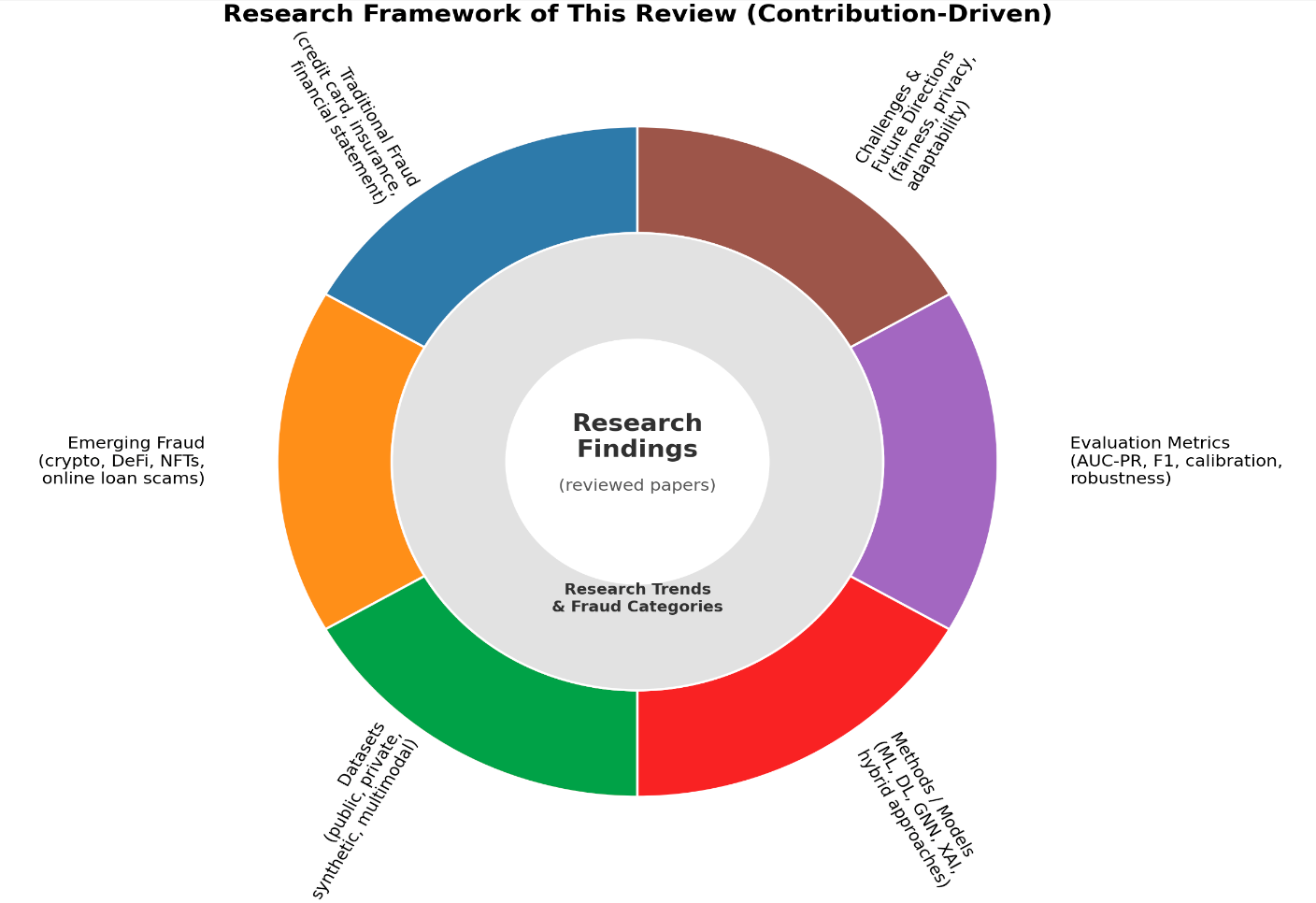
methodological perspective compared with existing surveys. Figure
1
presents a conceptual
synthesis framework of this review, illustrating how findings from the surveyed literature
are systematically organized across fraud categories, datasets, methodologies, evaluation
metrics, and future research directions.
Figure 1.
Research framework of this review.
2.
Related Research
Both
industry
and
academia
have
shown
increasing
interest
in
applying
artificial
intelligence (AI) techniques to financial fraud detection in recent years.
This section reviews
representative studies that use machine learning, deep learning, graph-based modeling,
and natural language processing (NLP) across traditional and emerging fraud scenarios.
https://doi.org/10.3390/app16041931
Appl.
Sci.
2026
,
16
, 1931
4 of 32
Rather than only listing reported results,
we also comment on why particular methods
tend to work (or break) in specific fraud settings, and we relate these findings to practical
constraints
that
shape
real
deployments,
such
as
extreme
class
imbalance,
delayed
or
selective supervision, temporal drift, scalability, and auditability.
2.1.
Machine Learning Methods
For classical machine learning, Awoyemi et al. [
13
] compared several algorithms for
credit card fraud detection and found that k-nearest neighbors outperformed Naïve Bayes
and logistic regression.
One reason k-nearest neighbors can appear strong is that it does
not impose a restrictive functional form:
if fraudulent transactions form small and irregular
pockets in feature space, an instance-based decision rule can capture such local structure
without assuming linear separability. At the same time, its performance is tightly coupled to
representation choices.
In real transaction data, features are often high-dimensional, sparse,
and
partly
categorical,
and
the
induced
distance
can
become
less
informative,
making
“nearest” neighbors noisy.
The method is also sensitive to temporal drift—neighbors drawn
from historical behavior may stop being relevant once fraud strategies shift.
Beyond these
modeling aspects, kNN also raises practical concerns for large-scale deployment because
exact neighbor search can be expensive at high throughput, often requiring approximate
indexing and careful system engineering.
While [
13
] provides an early comparative analysis in this domain, its evaluation setting
still departs from operational conditions in several technical respects.
First, the benchmark
covers a limited time span, which makes it difficult to assess robustness under temporal
drift.
Second, class rebalancing through resampling (e.g., under- and/or over-sampling)
can make training feasible, but it also alters the effective class prior;
as a result, metrics
and model rankings observed under resampled distributions may not translate directly to
production alerting behavior, where base rates are extremely low and calibration matters.
Finally,
the PCA-anonymized feature space limits interpretability and provides limited
insight into which signals would remain stable and actionable in real deployments.
Dal Pozzolo et al. [
14
] moved closer to operational reality by proposing a learning
strategy
that
treats
feedback
data
and
delayed
supervision
samples
separately.
This
is
important because confirmed labels in finance are commonly delayed (e.g., chargebacks),
and the observed labels are shaped by review processes.
Handling delayed supervision
explicitly helps reduce the bias that arises when “not yet confirmed” cases are implicitly
treated as legitimate during training.
The main caveat is that the method assumes feedback
is
continuously
available
and
sufficiently
representative.
In
practice,
feedback
can
be
sporadic and policy-driven (e.g., limited review capacity concentrates attention on a subset
of
alerts).
Under
such
selection
effects,
a
model
may
end
up
fitting
the
institution’s
investigation policy rather than fraud itself, and performance can shift when thresholds or
review processes change.
In the insurance domain, Aslam et al. [
15
] proposed an auto insurance fraud detection
framework that performs feature selection using the Boruta algorithm and then develops
predictive models using logistic regression,
support vector machines,
and Naïve Bayes.
Their results suggest that, even under the same feature set, different classical learners can
behave quite differently across evaluation metrics, underscoring the sensitivity of claim
fraud
detection
to
model
choice
and
metric
selection.
Nevertheless,
the
study
is
built
on
a
publicly
available
dataset
with
a
specific
feature
schema
and
label
definition,
and
such
design
choices
are
often
tied
to
local
claim
processes
and
investigation
standards.
This raises a practical question about how reliably learned decision rules would transfer
across insurers, product lines, or jurisdictions where coding practices, fraud definitions,
and review workflows differ.
Finally, while classical models are generally viewed as more
https://doi.org/10.3390/app16041931
Appl.
Sci.
2026
,
16
, 1931
5 of 32
transparent than deep architectures, transparency becomes operationally meaningful only
when explanations are stable at the case level and can be mapped to auditable claim factors;
in practice, the combined effects of feature selection, preprocessing, and model-specific
decision boundaries can still make regulatory justification non-trivial.
Overall, traditional ML methods remain attractive because they are relatively simple
to
implement,
easier
to
control,
and
useful
as
baselines.
Their
weaknesses,
however,
align
with
two
persistent
properties
of
fraud
data:
severe
class
imbalance
and
concept
drift.
In
addition,
most
tabular
classifiers
do
not
naturally
exploit
relational
structure
(shared devices, counterparties, coordinated rings) unless those dependencies are manually
engineered into features.
2.2.
Deep Learning Approaches
Deep learning approaches are often adopted to reduce manual feature engineering and
to model nonlinear interactions and temporal dependencies more directly.
Ghosh Dastidar
et
al.
[
16
]
proposed
the
Neural
Aggregate
Generator
(NAG),
which
learns
transaction-
history representations end-to-end by combining feature embeddings with lightweight 1-D
convolutional components that implement learnable aggregation over past transactions.
They reported improved performance compared with generic CNN and LSTM baselines.
Embeddings are particularly useful for high-cardinality categorical variables (e.g., merchant
or channel identifiers), since dense representations make interaction learning feasible.
The
flip side is that such representations can become fragile when the categorical space evolves:
new merchants, devices, or channels create cold-start behavior, and shifting semantics can
degrade
embeddings
unless
the
model
is
updated
regularly.
In
addition,
performance
gains from convolution-style components remain sensitive to how transaction histories are
structured and aligned in the input; if the imposed structure does not match the underlying
behavioral process,
improvements can be dataset-specific and harder to transfer across
institutions or products.
Forough et al. [
17
] proposed an ensemble of deep sequential models with a voting
mechanism for detecting fraud in transaction sequences.
Sequence models are a natural
choice when fraud is expressed as a tactic over time—bursts of activity, probing transac-
tions, or abrupt shifts in spending context.
The cost is operational:
long histories, multiple
base models, and the voting stage increase implementation complexity and can pressure
latency
budgets
in
authorization-time
settings.
While
[
17
]
reports
favorable
time
anal-
ysis,
whether
such
ensembles
can
consistently
meet
strict
sub-second
constraints
still
depends on production-specific factors such as feature availability, batching strategy, and
hardware limits.
More
broadly,
deep
models
can
be
effective
when
supervision
is
sufficiently
rich
and stable, but fraud labels are often delayed, noisy, and shaped by intervention policies.
Without
careful
temporal
evaluation
and
monitoring,
deep
models
may
overfit
dataset
artifacts and then degrade quietly in production.
Interpretability remains another practical
sticking point:
in high-stakes financial environments, explanations typically need to be
grounded in traceable, case-level evidence, which deep representations do not provide by
default and often require additional design to support.
2.3.
Graph-Based Methods for Relational and Collective Fraud
Graph-based modeling is increasingly used for fraud types where relationships are the
main signal, including collusion rings, mule networks, and multi-entity laundering patterns.
Shi [
18
] proposed a Hierarchical Graph Attention Network (HGAT) that encodes both local
and global structural information via multi-head self-attention, achieving improved results
on public datasets.
Attention-based aggregation is appealing in financial graphs because
https://doi.org/10.3390/app16041931
Appl.
Sci.
2026
,
16
, 1931
6 of 32
connectivity is often extremely uneven:
prioritizing informative neighbors can matter more
than averaging over large, noisy neighborhoods.
The hierarchical design is also consistent
with how fraud evidence can appear at multiple scales, from immediate counterparties to
broader communities.
However, bringing GNN-style models into production is not straightforward.
First,
real transaction graphs are large and dynamic:
edges arrive continuously, and multi-hop
aggregation can quickly trigger neighbor explosion, pushing both training and inference
costs upward.
Second, graph construction is itself a modeling decision—what becomes
a
node,
what
becomes
an
edge,
and
how
time
is
represented—and
small
choices
here
can change outcomes substantially.
Time handling is especially delicate:
if future-linked
information leaks into training or evaluation, offline results can be inflated without any real
operational value.
Third, graph supervision is typically sparse and delayed, and labels tend
to be concentrated in investigated regions of the graph.
This makes training sensitive to
sampling strategies and to selection bias, and it can reduce robustness when review policies
or alerting thresholds shift.
Finally, while attention weights can be informative, they do not
automatically translate into audit-ready explanations; additional constraints or analysis
is usually needed to turn learned structure into human-verifiable evidence.
These issues,
together with the need for large annotated graphs and higher computational complexity,
remain major barriers to broad deployment.
2.4.
Natural Language Processing (NLP) Techniques
NLP becomes relevant when unstructured text is central to the fraud signal, such as
financial disclosures, narrative reports, or social media coordination.
Li et al. [
19
] used NLP
for financial statement fraud detection and reported notable gains when narrative disclo-
sures were incorporated alongside traditional features.
A clear advantage of NLP in this
context is that it can capture linguistic cues that are awkward to hand-code (inconsistent
phrasing, unusual hedging, selective disclosure).
Yet financial narratives are also heavily
templated.
Models can end up learning issuer style, sector conventions, or formatting arti-
facts rather than fraud intent.
Long documents add another practical limitation:
truncation,
uneven distribution of signal across sections, and the frequent mixing of text with numeric
statements all make it difficult for standard text encoders to reliably preserve the subtle
cues that matter.
In cryptocurrency settings, Mirtaheri et al. [
20
] examined pump-and-dump schemes
coordinated
on
social
platforms
by
combining
NLP
with
social
network
analysis.
This
is technically well motivated because coordination can show up in language and group
structure
before
market
anomalies
fully
develop.
Even
so,
much
of
the
NLP-focused
literature
still
concentrates
on
a
narrow
set
of
scenarios
and
often
evaluates
models
in
modality-specific pipelines [
20
].
In practice, text-only detectors can be brittle under plat-
form migration, rapid slang shifts, and adversarial phrasing.
Robust detection typically
requires aligning text with transactional and relational evidence, but multimodal alignment
is not trivial:
the modalities differ in timing, granularity, and noise, and naïve fusion can
produce unstable behavior across domains.
2.5.
Dataset Characteristics and Research Implications
Dataset characteristics and evaluation design often decide whether improvements are
meaningful beyond a controlled benchmark.
Dahee Choi et al. [
21
] surveyed public corpora
and found that many datasets are small, feature-limited, and lack temporal depth.
These
constraints help explain why models can look strong offline yet degrade under real-world
conditions where attackers adapt and labels arrive late.
To mitigate scarcity, later studies
explored synthetic data generation with generative adversarial networks [
22
] and cross-
https://doi.org/10.3390/app16041931
Appl.
Sci.
2026
,
16
, 1931
7 of 32
domain transfer learning [
23
,
24
].
These directions are promising, but they also introduce
new risks.
Synthetic data must be checked for fidelity—rare but operationally important
fraud
modes
must
not
be
washed
out—and
privacy
concerns
must
be
addressed
[
25
].
Transfer
learning
can
reduce
labeling
effort,
but
differences
in
label
definitions,
feature
semantics, and operational policies across organizations can cause negative transfer if not
handled carefully.
In conclusion, although AI techniques have shown considerable promise in financial
fraud detection, much of the literature still relies on limited datasets, narrow validations,
or model choices that emphasize offline accuracy without fully confronting deployment
realities such as drift, delayed supervision, scalability, and auditability.
These gaps point
to
the
need
for
fraud
detection
approaches
that
remain
reliable
and
transparent
under
evolving fraud patterns and real operational constraints.
3.
Research Methods
This
study
examines
the
current
state
of
artificial
intelligence
(AI)
applications
in
financial
fraud
detection
using
a
systematic
literature
review
(SLR)
methodology.
The
research process is guided by the PRISMA [
26
] framework, with a focus on study identifi-
cation, screening, eligibility assessment, and reporting transparency.
The review procedure
consists of the following key steps:
(1)
Research Question Formulation:
This review is structured around the following five
core questions:
Q1:
What are the traditional and emerging types of financial fraud?
Q2:
How is artificial intelligence currently being used in conventional fraud detec-
tion, like credit card and insurance fraud?
What is the performance comparison of
various techniques?
Q3:
What are the potential applications, key challenges, and emerging research oppor-
tunities of AI for identifying novel fraud types, such as cryptocurrency-related fraud
and flash loan attacks?
Q4:
What are the boundaries of the public datasets that are currently available in this
field?
How can we create better datasets to propel new advancements?
Q5:
What
are
the
primary
limitations
and
gaps
in
the
existing
research?
Which
avenues for further research are recommended?
(2)
Search
strategy:
Relevant
studies
were
retrieved
from
major
academic
databases,
including
Web
of
Science,
IEEE
Xplore,
ScienceDirect,
and
Scopus.
Search
terms
included:
“financial fraud” or “financial fraud detection” or “credit card fraud” or “insurance
fraud” or “loan fraud” or “money laundering” or “cryptocurrency fraud” or “online
loan
fraud”
or
“rug
pulls”
or
“flash
loan
attacks”)
and
(“artificial
intelligence”
or
“machine
learning”
or
“deep
learning”
or
“graph
neural
network”
or
“GNN”
or
“natural language processing” or “federated learning” or “explainable AI” or “XAI”).
The search was limited to English-language journal and conference papers published
since 2015.
Considering that the large-scale application of deep learning, graph neural
networks,
and
other
advanced
AI
techniques
in
fraud
detection
began
to
emerge
after 2015,
this review takes 2015 as the starting year to capture the most relevant
and
technologically
important
advances.
The
search
and
screening
process
was
independently reviewed to ensure consistency and completeness.
(3)
Eligibility criteria:
The following inclusion and exclusion criteria were applied:
https://doi.org/10.3390/app16041931
Appl.
Sci.
2026
,
16
, 1931
8 of 32
Inclusion criteria:
(i)
Studies explicitly applying artificial intelligence techniques (including ML, DL,
GNNs, NLP, or hybrid approaches) to financial fraud detection, such as credit
card
fraud,
loan
fraud,
insurance
fraud,
anti-money
laundering,
cryptocur-
rency fraud, and DeFi-specific attacks (e.g., rug pulls or flash loan exploits);
(ii)
Studies presenting experimental, benchmark, or real-world evaluation results,
including datasets and evaluation metrics;
(iii)
Publications in peer-reviewed journals or conferences published between 2015
and 2025;
(iv)
Full-text available in English.
Exclusion criteria:
(i)
Editorials,
commentaries,
or
opinion
pieces
without
methodological contribution;
(ii)
Studies unrelated to financial fraud (e.g., general intrusion detection without a
financial context);
(iii)
Duplicate records;
(iv)
Studies
with
inaccessible
full
text
or
insufficient
methodological
details
for
quality assessment;
(v)
Non-English publications.
(4)
Study selection and screening:
Potentially
eligible
studies
were
subsequently
assessed
at
the
full-text
level
based
on the predefined inclusion and exclusion criteria.
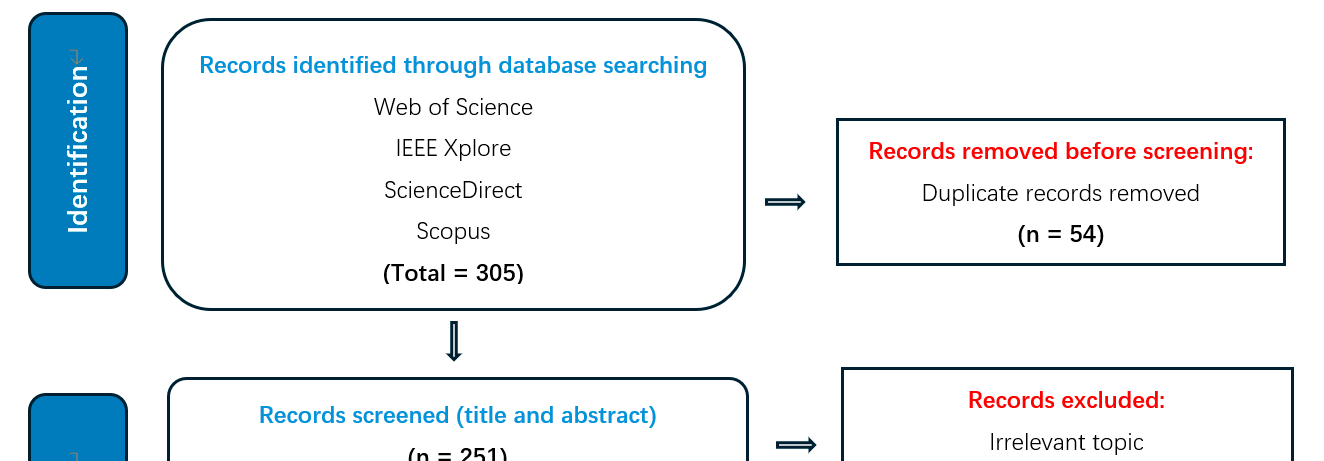
The study selection process was
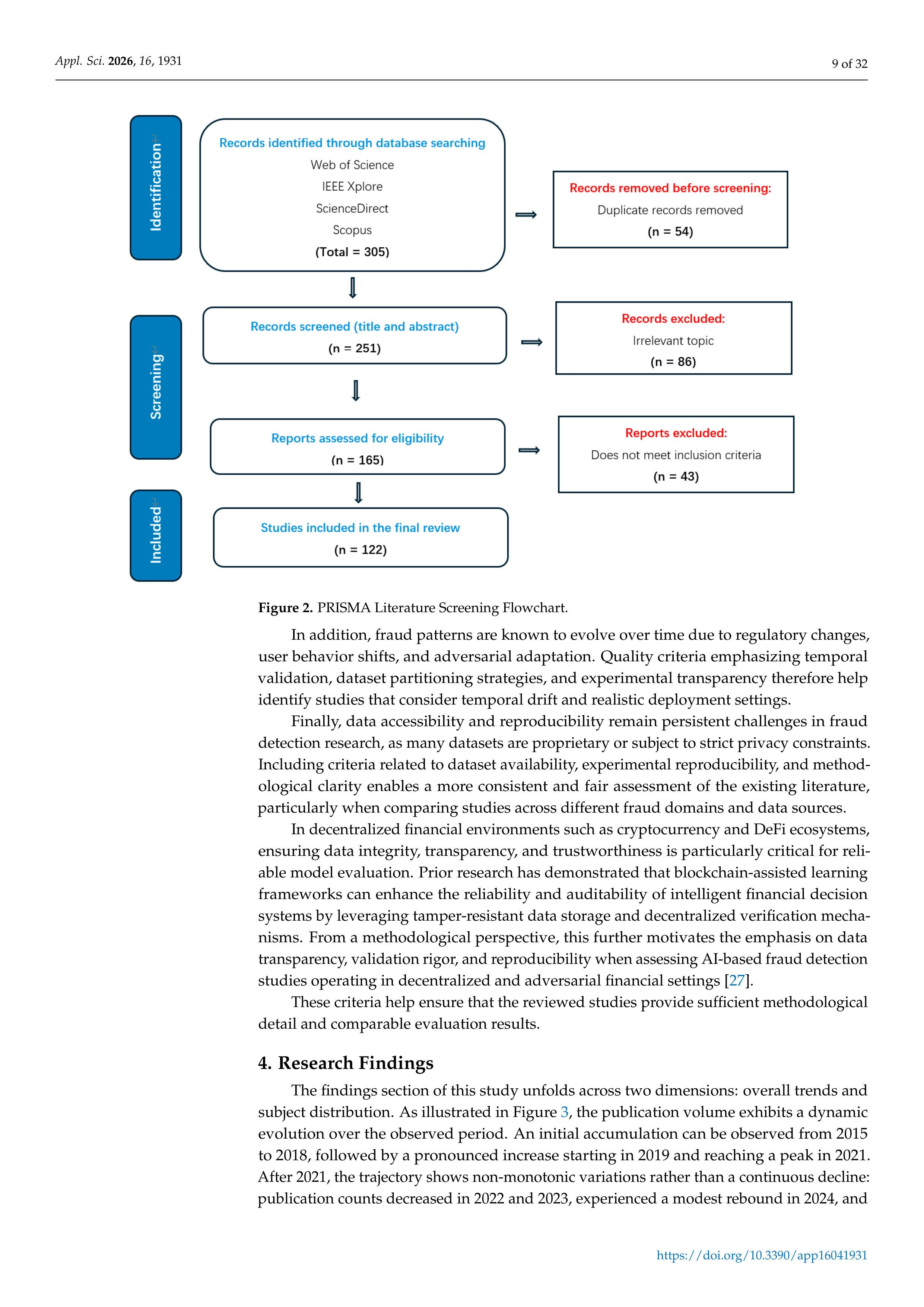
documented in accordance with PRISMA and is summarized in the flow diagram
(Figure
2
).
(5)
Quality assessment criteria:
Using the quality evaluation criteria listed in Table
2
, we screened the chosen studies
and assessed their methodological quality. The final dataset consists of 122 studies cov-
ering a wide range of financial fraud scenarios, including credit card fraud, insurance
fraud, loan fraud, anti-money laundering, and cryptocurrency-related fraud.
Table 2.
Quality assessment criteria for included studies.
No
Criterion Description
1
Is the research objective of the study clearly stated?
2
Does the study explicitly apply at least one AI/ML/DL technique to financial fraud detection?
3
Are the datasets clearly described (e.g., name, size, fraud ratio, source and accessibility)?
4
Are the performance evaluation metrics clearly reported (e.g., AUROC, AUPRC, F1-score, precision, recall)?
5
Is the validation strategy clearly described (e.g., k-fold CV, temporal split, hold-out test set) and leakage
risks addressed?
The quality assessment criteria adopted in this review (Table
2
) are specifically de-
signed to reflect the methodological characteristics and practical constraints of financial
fraud detection research.
Fraud detection datasets are typically highly imbalanced, with
fraudulent cases representing only a small fraction of observed instances.
Consequently,
criteria related to data description, evaluation metrics, and validation strategies are essen-
tial for distinguishing studies that adequately address class imbalance from those relying
on overly optimistic performance reporting.
https://doi.org/10.3390/app16041931
Appl.
Sci.
2026
,
16
, 1931
9 of 32
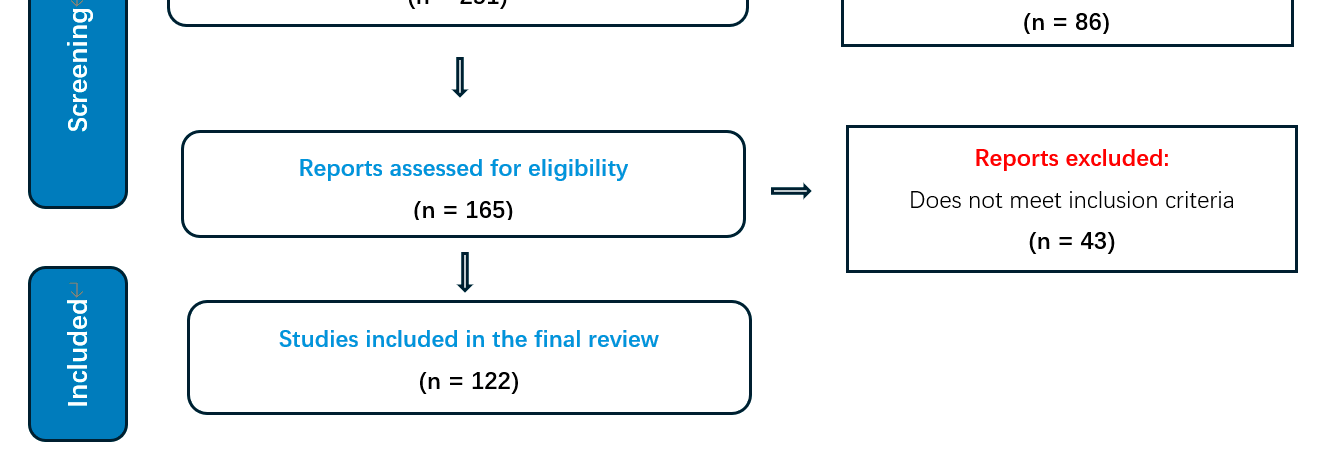
Figure 2.
PRISMA Literature Screening Flowchart.
In addition, fraud patterns are known to evolve over time due to regulatory changes,
user behavior shifts, and adversarial adaptation.
Quality criteria emphasizing temporal
validation, dataset partitioning strategies, and experimental transparency therefore help
identify studies that consider temporal drift and realistic deployment settings.
Finally, data accessibility and reproducibility remain persistent challenges in fraud
detection research, as many datasets are proprietary or subject to strict privacy constraints.
Including criteria related to dataset availability, experimental reproducibility, and method-
ological
clarity
enables
a
more
consistent
and
fair
assessment
of
the
existing
literature,
particularly when comparing studies across different fraud domains and data sources.
In decentralized financial environments such as cryptocurrency and DeFi ecosystems,
ensuring data integrity, transparency, and trustworthiness is particularly critical for reli-
able model evaluation.
Prior research has demonstrated that blockchain-assisted learning
frameworks can enhance the reliability and auditability of intelligent financial decision
systems by leveraging tamper-resistant data storage and decentralized verification mecha-
nisms.
From a methodological perspective, this further motivates the emphasis on data
transparency, validation rigor, and reproducibility when assessing AI-based fraud detection
studies operating in decentralized and adversarial financial settings [
27
].
These criteria help ensure that the reviewed studies provide sufficient methodological
detail and comparable evaluation results.
4.
Research Findings
The findings section of this study unfolds across two dimensions:
overall trends and
subject distribution.
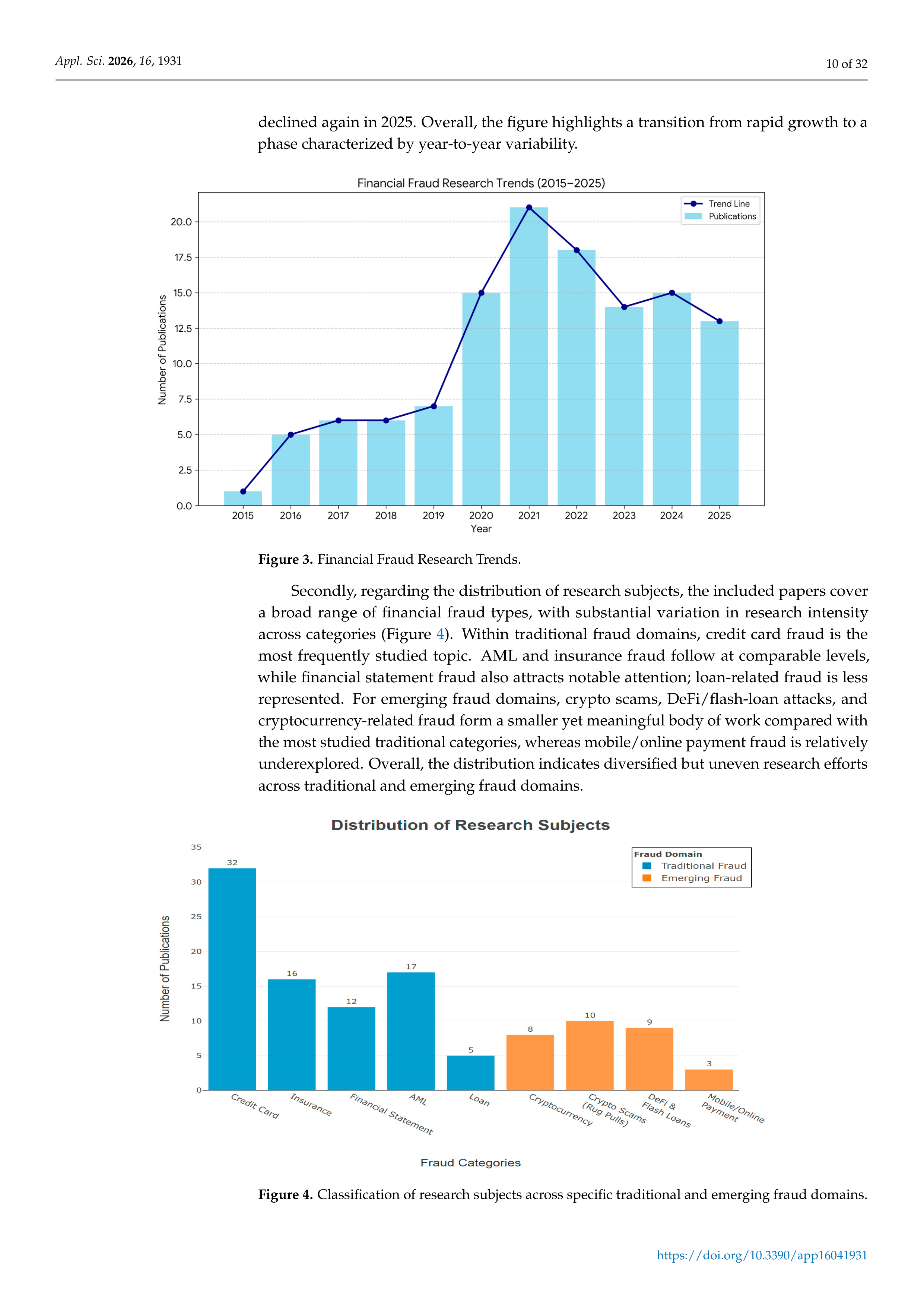
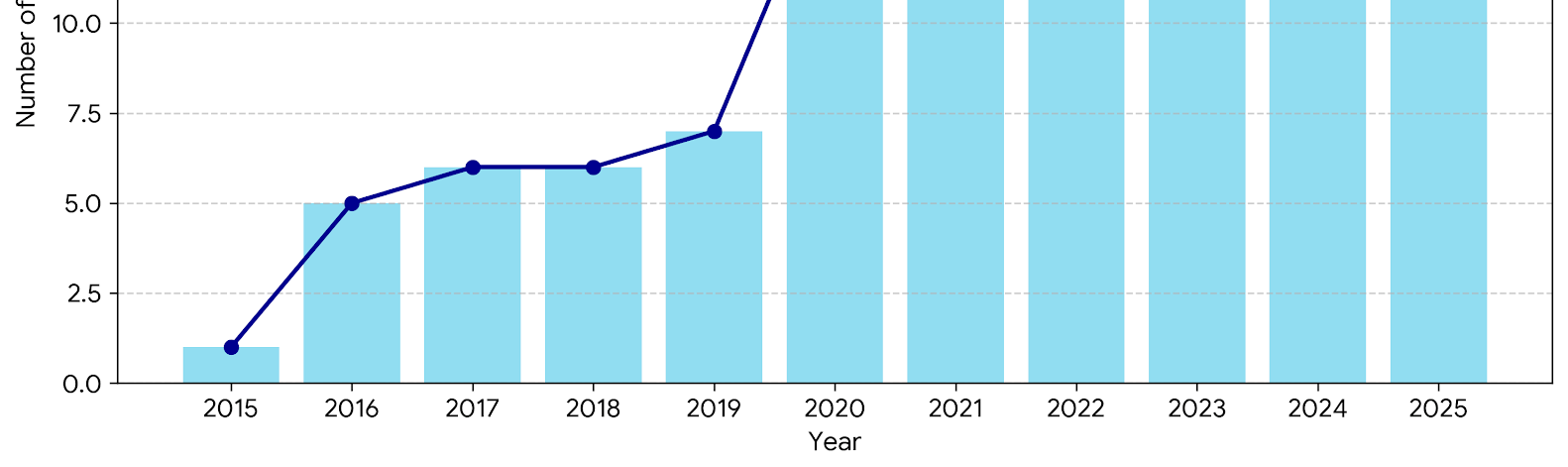
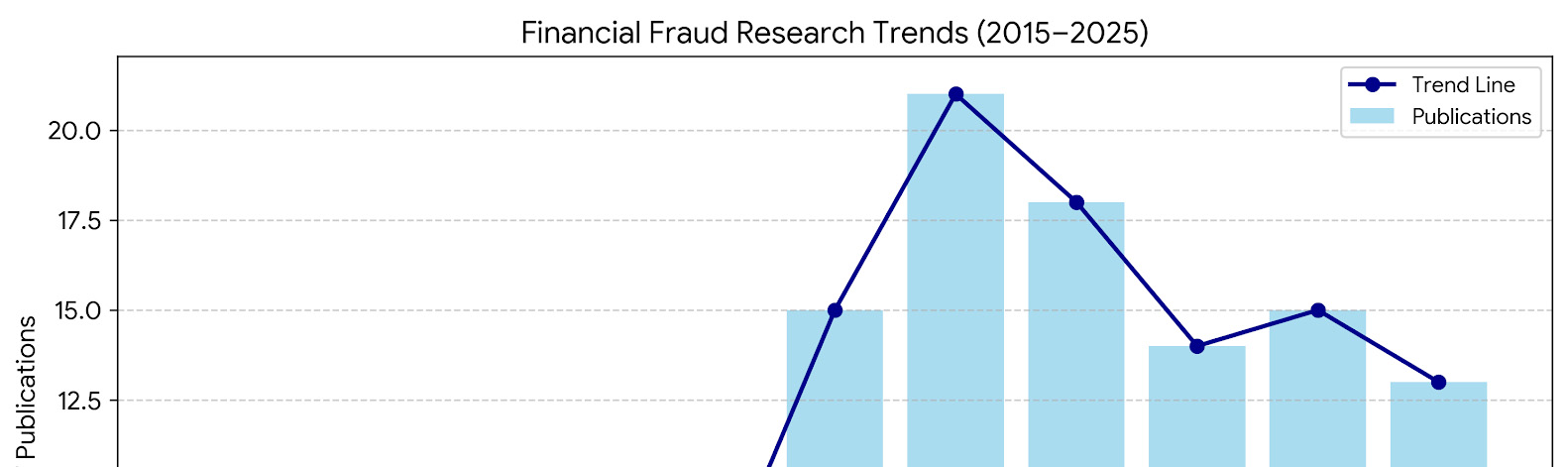
As illustrated in Figure
3
, the publication volume exhibits a dynamic
evolution over the observed period.
An initial accumulation can be observed from 2015
to 2018, followed by a pronounced increase starting in 2019 and reaching a peak in 2021.
After 2021, the trajectory shows non-monotonic variations rather than a continuous decline:
publication counts decreased in 2022 and 2023, experienced a modest rebound in 2024, and
https://doi.org/10.3390/app16041931
Appl.
Sci.
2026
,
16
, 1931
10 of 32
declined again in 2025.
Overall, the figure highlights a transition from rapid growth to a
phase characterized by year-to-year variability.
Figure 3.
Financial Fraud Research Trends.
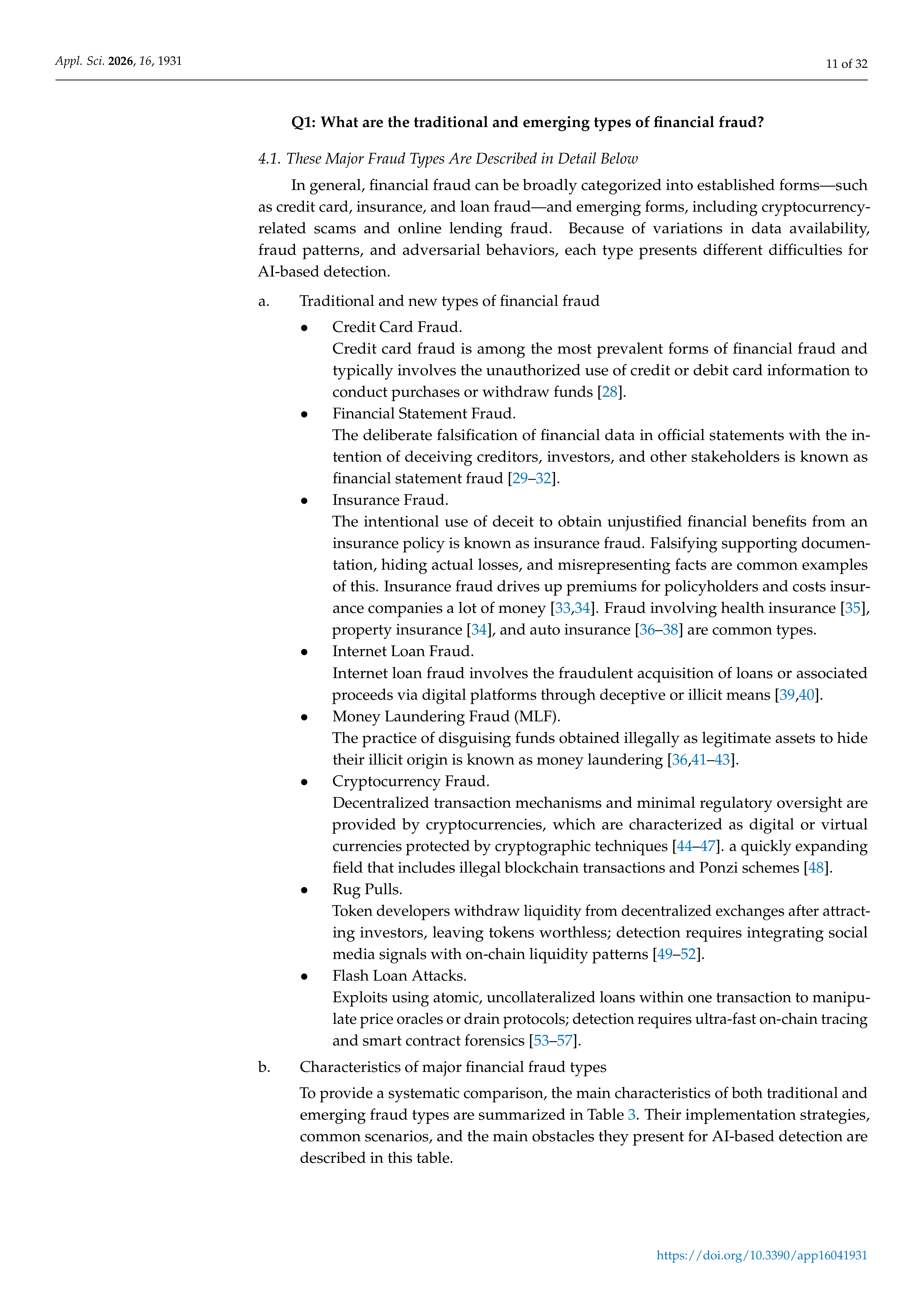
Secondly, regarding the distribution of research subjects, the included papers cover
a
broad
range
of
financial
fraud
types,
with
substantial
variation
in
research
intensity
across
categories
(Figure
4
).
Within
traditional
fraud
domains,
credit
card
fraud
is
the
most
frequently
studied
topic.
AML
and
insurance
fraud
follow
at
comparable
levels,
while financial statement fraud also attracts notable attention; loan-related fraud is less
represented.
For
emerging
fraud
domains,
crypto
scams,
DeFi/flash-loan
attacks,
and
cryptocurrency-related fraud form a smaller yet meaningful body of work compared with
the most studied traditional categories, whereas mobile/online payment fraud is relatively
underexplored.
Overall, the distribution indicates diversified but uneven research efforts
across traditional and emerging fraud domains.
Figure 4.
Classification of research subjects across specific traditional and emerging fraud domains.
https://doi.org/10.3390/app16041931
Appl.
Sci.
2026
,
16
, 1931
11 of 32
Q1:
What are the traditional and emerging types of financial fraud?
4.1.
These Major Fraud Types Are Described in Detail Below
In general, financial fraud can be broadly categorized into established forms—such
as credit card, insurance, and loan fraud—and emerging forms, including cryptocurrency-
related
scams
and
online
lending
fraud.
Because
of
variations
in
data
availability,
fraud
patterns,
and
adversarial
behaviors,
each
type
presents
different
difficulties
for
AI-based detection.
a.
Traditional and new types of financial fraud
•
Credit Card Fraud.
Credit
card
fraud
is
among
the
most
prevalent
forms
of
financial
fraud
and
typically involves the unauthorized use of credit or debit card information to
conduct purchases or withdraw funds [
28
].
•
Financial Statement Fraud.
The deliberate falsification of financial data in official statements with the in-
tention of deceiving creditors, investors, and other stakeholders is known as
financial statement fraud [
29
–
32
].
•
Insurance Fraud.
The
intentional
use
of
deceit
to
obtain
unjustified
financial
benefits
from
an
insurance policy is known as insurance fraud.
Falsifying supporting documen-
tation, hiding actual losses, and misrepresenting facts are common examples
of this.
Insurance fraud drives up premiums for policyholders and costs insur-
ance companies a lot of money [
33
,
34
].
Fraud involving health insurance [
35
],
property insurance [
34
], and auto insurance [
36
–
38
] are common types.
•
Internet Loan Fraud.
Internet loan fraud involves the fraudulent acquisition of loans or associated
proceeds via digital platforms through deceptive or illicit means [
39
,
40
].
•
Money Laundering Fraud (MLF).
The practice of disguising funds obtained illegally as legitimate assets to hide
their illicit origin is known as money laundering [
36
,
41
–
43
].
•
Cryptocurrency Fraud.
Decentralized transaction mechanisms and minimal regulatory oversight are
provided
by
cryptocurrencies,
which
are
characterized
as
digital
or
virtual
currencies protected by cryptographic techniques [
44
–
47
].
a quickly expanding
field that includes illegal blockchain transactions and Ponzi schemes [
48
].
•
Rug Pulls.
Token developers withdraw liquidity from decentralized exchanges after attract-
ing
investors,
leaving
tokens
worthless;
detection
requires
integrating
social
media signals with on-chain liquidity patterns [
49
–
52
].
•
Flash Loan Attacks.
Exploits using atomic, uncollateralized loans within one transaction to manipu-
late price oracles or drain protocols; detection requires ultra-fast on-chain tracing
and smart contract forensics [
53
–
57
].
b.
Characteristics of major financial fraud types
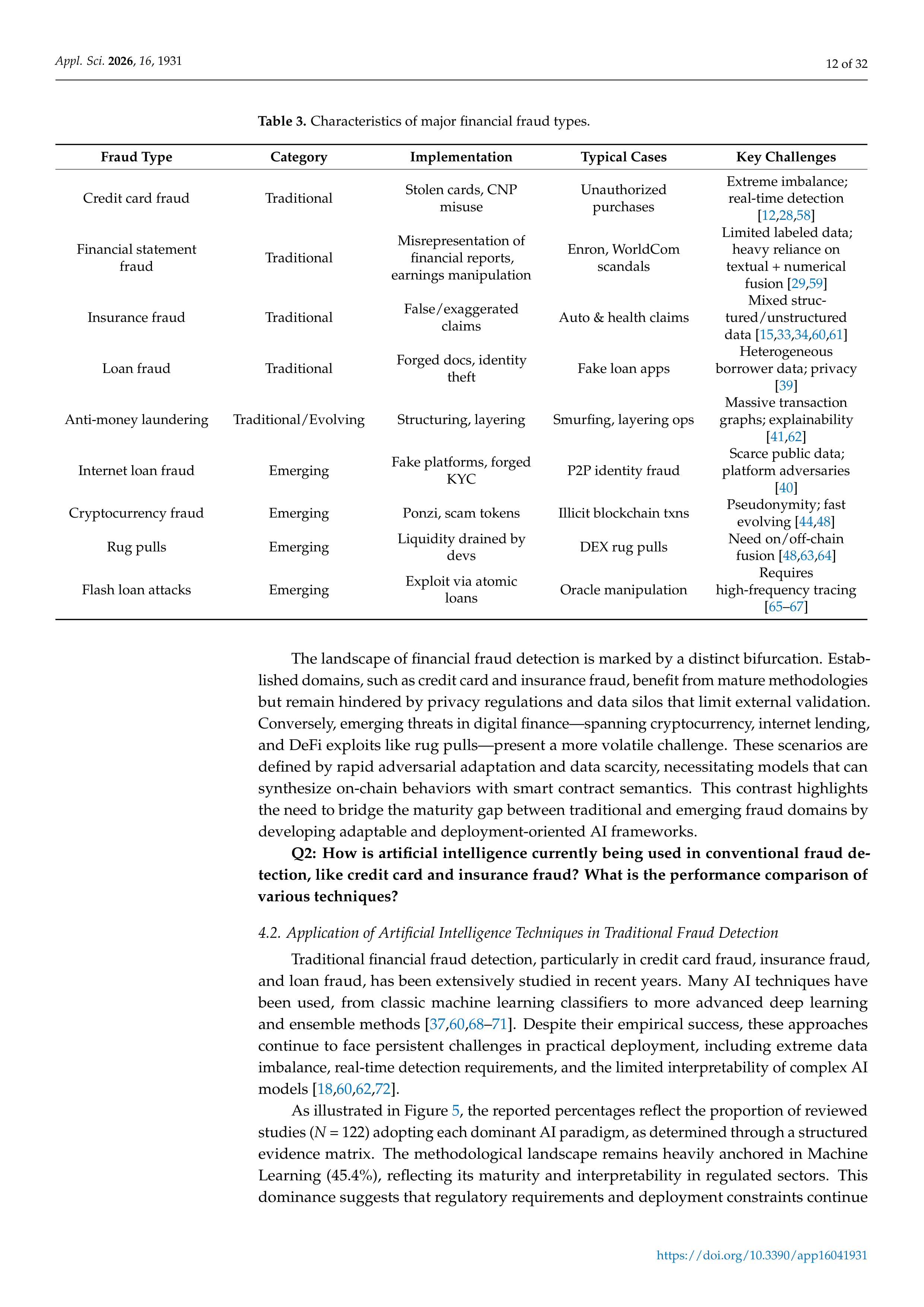
To provide a systematic comparison, the main characteristics of both traditional and
emerging fraud types are summarized in Table
3
.
Their implementation strategies,
common scenarios, and the main obstacles they present for AI-based detection are
described in this table.
https://doi.org/10.3390/app16041931
Appl.
Sci.
2026
,
16
, 1931
12 of 32
Table 3.
Characteristics of major financial fraud types.
Fraud Type
Category
Implementation
Typical Cases
Key Challenges
Credit card fraud
Traditional
Stolen cards, CNP
misuse
Unauthorized
purchases
Extreme imbalance;
real-time detection
[
12
,
28
,
58
]
Financial statement
fraud
Traditional
Misrepresentation of
financial reports,
earnings manipulation
Enron, WorldCom
scandals
Limited labeled data;
heavy reliance on
textual + numerical
fusion [
29
,
59
]
Insurance fraud
Traditional
False/exaggerated
claims
Auto & health claims
Mixed struc-
tured/unstructured
data [
15
,
33
,
34
,
60
,
61
]
Loan fraud
Traditional
Forged docs, identity
theft
Fake loan apps
Heterogeneous
borrower data; privacy
[
39
]
Anti-money laundering
Traditional/Evolving
Structuring, layering
Smurfing, layering ops
Massive transaction
graphs; explainability
[
41
,
62
]
Internet loan fraud
Emerging
Fake platforms, forged
KYC
P2P identity fraud
Scarce public data;
platform adversaries
[
40
]
Cryptocurrency fraud
Emerging
Ponzi, scam tokens
Illicit blockchain txns
Pseudonymity; fast
evolving [
44
,
48
]
Rug pulls
Emerging
Liquidity drained by
devs
DEX rug pulls
Need on/off-chain
fusion [
48
,
63
,
64
]
Flash loan attacks
Emerging
Exploit via atomic
loans
Oracle manipulation
Requires
high-frequency tracing
[
65
–
67
]
The landscape of financial fraud detection is marked by a distinct bifurcation.
Estab-
lished domains, such as credit card and insurance fraud, benefit from mature methodologies
but remain hindered by privacy regulations and data silos that limit external validation.
Conversely, emerging threats in digital finance—spanning cryptocurrency, internet lending,
and DeFi exploits like rug pulls—present a more volatile challenge.
These scenarios are
defined by rapid adversarial adaptation and data scarcity, necessitating models that can
synthesize
on-chain
behaviors
with
smart
contract
semantics.
This
contrast
highlights
the need to bridge the maturity gap between traditional and emerging fraud domains by
developing adaptable and deployment-oriented AI frameworks.
Q2:
How is artificial intelligence currently being used in conventional fraud de-
tection, like credit card and insurance fraud?
What is the performance comparison of
various techniques?
4.2.
Application of Artificial Intelligence Techniques in Traditional Fraud Detection
Traditional financial fraud detection, particularly in credit card fraud, insurance fraud,
and loan fraud, has been extensively studied in recent years.
Many AI techniques have
been
used,
from
classic
machine
learning
classifiers
to
more
advanced
deep
learning
and ensemble methods [
37
,
60
,
68
–
71
].
Despite their empirical success, these approaches
continue
to
face
persistent
challenges
in
practical
deployment,
including
extreme
data
imbalance, real-time detection requirements, and the limited interpretability of complex AI
models [
18
,
60
,
62
,
72
].
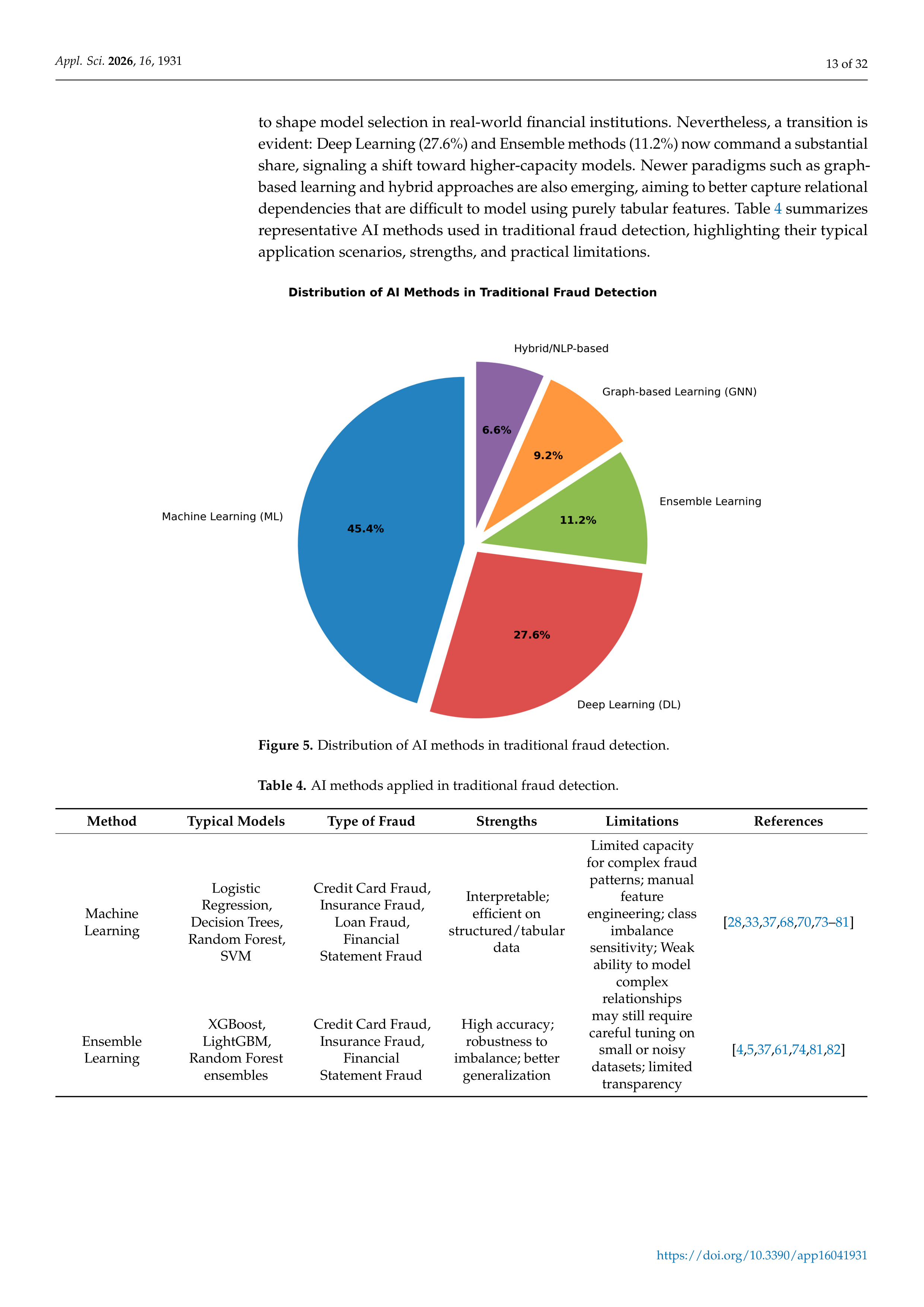
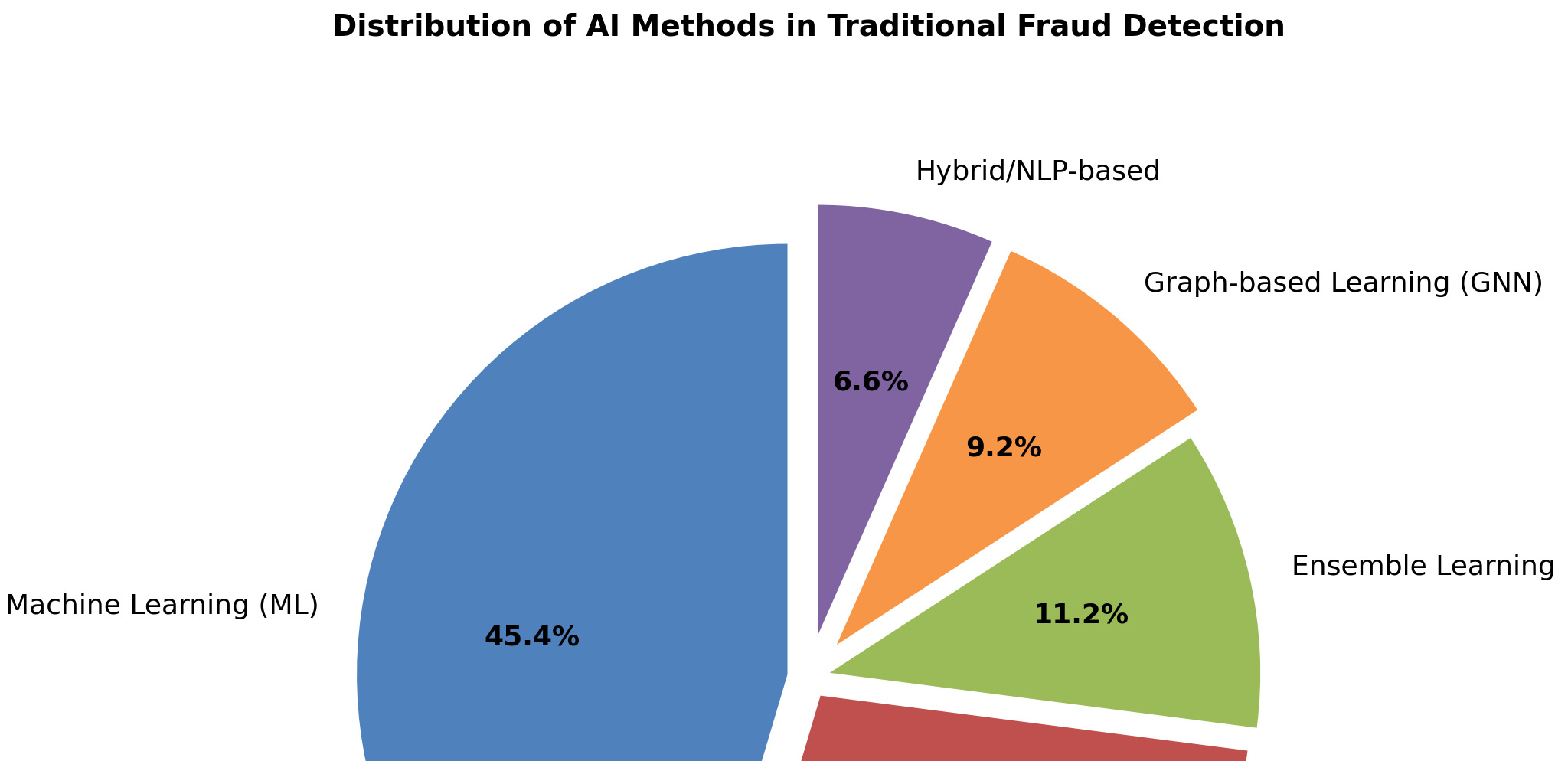
As illustrated in Figure
5
, the reported percentages reflect the proportion of reviewed
studies (
N
= 122) adopting each dominant AI paradigm, as determined through a structured
evidence
matrix.
The
methodological
landscape
remains
heavily
anchored
in
Machine
Learning
(45.4%),
reflecting
its
maturity
and
interpretability
in
regulated
sectors.
This
dominance suggests that regulatory requirements and deployment constraints continue
https://doi.org/10.3390/app16041931

Appl.
Sci.
2026
,
16
, 1931
13 of 32
to shape model selection in real-world financial institutions.
Nevertheless, a transition is
evident: Deep Learning (27.6%) and Ensemble methods (11.2%) now command a substantial
share, signaling a shift toward higher-capacity models.
Newer paradigms such as graph-
based learning and hybrid approaches are also emerging, aiming to better capture relational
dependencies that are difficult to model using purely tabular features.
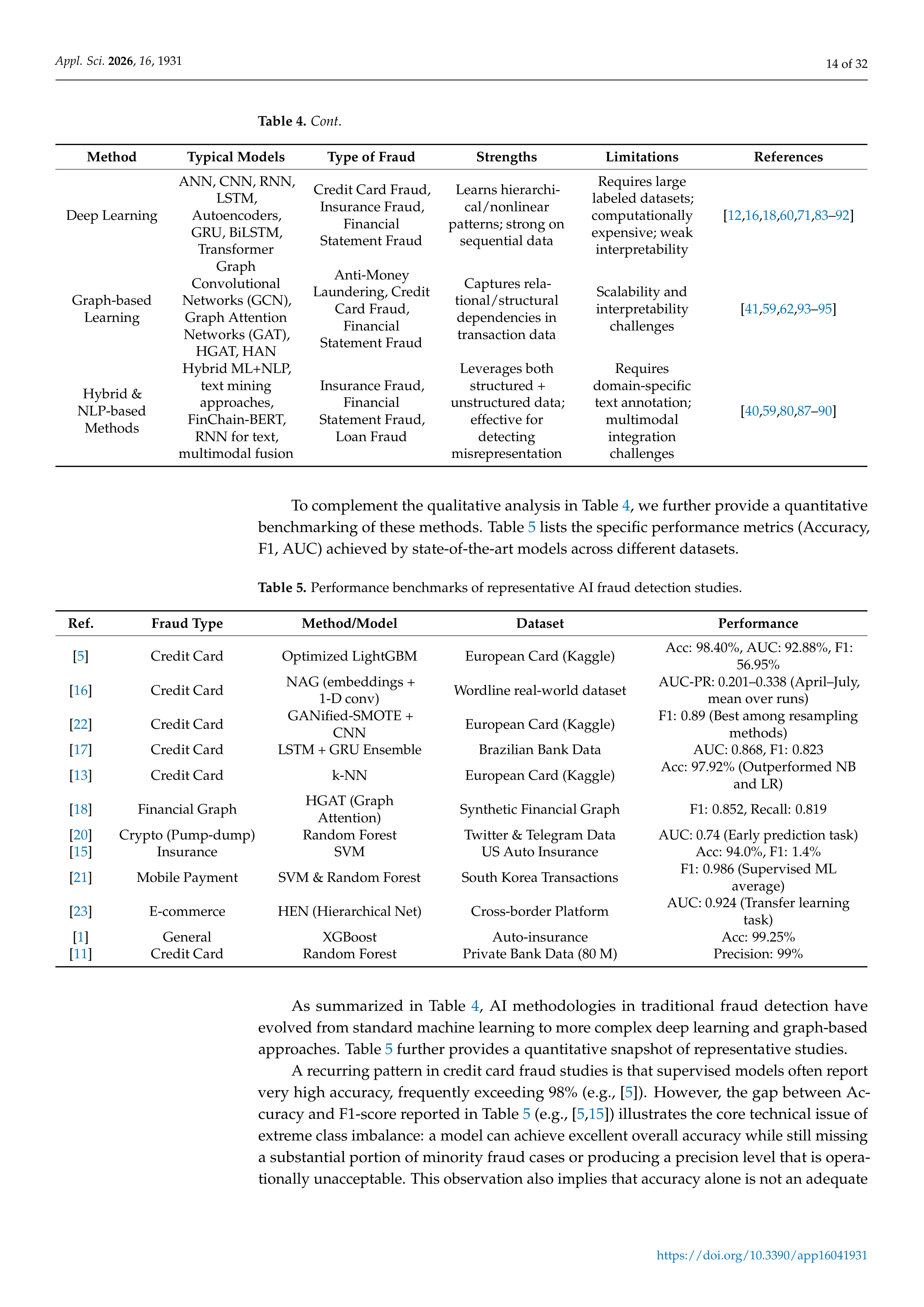
Table
4
summarizes
representative AI methods used in traditional fraud detection, highlighting their typical
application scenarios, strengths, and practical limitations.
Figure 5.
Distribution of AI methods in traditional fraud detection.
Table 4.
AI methods applied in traditional fraud detection.
Method
Typical Models
Type of Fraud
Strengths
Limitations
References
Machine
Learning
Logistic
Regression,
Decision Trees,
Random Forest,
SVM
Credit Card Fraud,
Insurance Fraud,
Loan Fraud,
Financial
Statement Fraud
Interpretable;
efficient on
structured/tabular
data
Limited capacity
for complex fraud
patterns; manual
feature
engineering; class
imbalance
sensitivity; Weak
ability to model
complex
relationships
[
28
,
33
,
37
,
68
,
70
,
73
–
81
]
Ensemble
Learning
XGBoost,
LightGBM,
Random Forest
ensembles
Credit Card Fraud,
Insurance Fraud,
Financial
Statement Fraud
High accuracy;
robustness to
imbalance; better
generalization
may still require
careful tuning on
small or noisy
datasets; limited
transparency
[
4
,
5
,
37
,
61
,
74
,
81
,
82
]
https://doi.org/10.3390/app16041931
Appl.
Sci.
2026
,
16
, 1931
14 of 32
Table 4.
Cont.
Method
Typical Models
Type of Fraud
Strengths
Limitations
References
Deep Learning
ANN, CNN, RNN,
LSTM,
Autoencoders,
GRU, BiLSTM,
Transformer
Credit Card Fraud,
Insurance Fraud,
Financial
Statement Fraud
Learns hierarchi-
cal/nonlinear
patterns; strong on
sequential data
Requires large
labeled datasets;
computationally
expensive; weak
interpretability
[
12
,
16
,
18
,
60
,
71
,
83
–
92
]
Graph-based
Learning
Graph
Convolutional
Networks (GCN),
Graph Attention
Networks (GAT),
HGAT, HAN
Anti-Money
Laundering, Credit
Card Fraud,
Financial
Statement Fraud
Captures rela-
tional/structural
dependencies in
transaction data
Scalability and
interpretability
challenges
[
41
,
59
,
62
,
93
–
95
]
Hybrid &
NLP-based
Methods
Hybrid ML+NLP,
text mining
approaches,
FinChain-BERT,
RNN for text,
multimodal fusion
Insurance Fraud,
Financial
Statement Fraud,
Loan Fraud
Leverages both
structured +
unstructured data;
effective for
detecting
misrepresentation
Requires
domain-specific
text annotation;
multimodal
integration
challenges
[
40
,
59
,
80
,
87
–
90
]
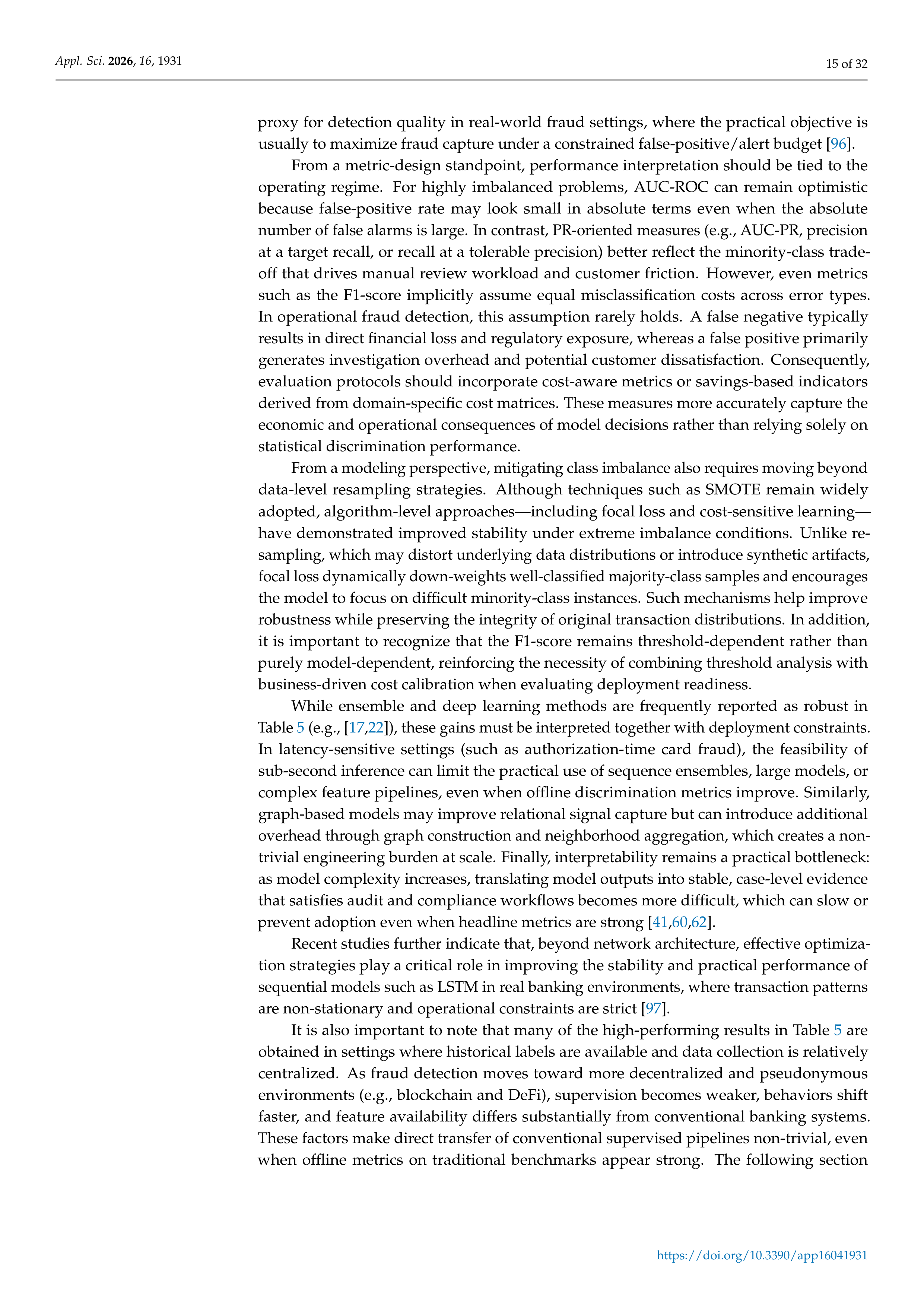
To complement the qualitative analysis in Table
4
, we further provide a quantitative
benchmarking of these methods.
Table
5
lists the specific performance metrics (Accuracy,
F1, AUC) achieved by state-of-the-art models across different datasets.
Table 5.
Performance benchmarks of representative AI fraud detection studies.
Ref.
Fraud Type
Method/Model
Dataset
Performance
[
5
]
Credit Card
Optimized LightGBM
European Card (Kaggle)
Acc:
98.40%, AUC: 92.88%, F1:
56.95%
[
16
]
Credit Card
NAG (embeddings +
1-D conv)
Wordline real-world dataset
AUC-PR: 0.201–0.338 (April–July,
mean over runs)
[
22
]
Credit Card
GANified-SMOTE +
CNN
European Card (Kaggle)
F1:
0.89 (Best among resampling
methods)
[
17
]
Credit Card
LSTM + GRU Ensemble
Brazilian Bank Data
AUC: 0.868, F1:
0.823
[
13
]
Credit Card
k-NN
European Card (Kaggle)
Acc:
97.92% (Outperformed NB
and LR)
[
18
]
Financial Graph
HGAT (Graph
Attention)
Synthetic Financial Graph
F1:
0.852, Recall:
0.819
[
20
]
Crypto (Pump-dump)
Random Forest
Twitter & Telegram Data
AUC: 0.74 (Early prediction task)
[
15
]
Insurance
SVM
US Auto Insurance
Acc:
94.0%, F1:
1.4%
[
21
]
Mobile Payment
SVM & Random Forest
South Korea Transactions
F1:
0.986 (Supervised ML
average)
[
23
]
E-commerce
HEN (Hierarchical Net)
Cross-border Platform
AUC: 0.924 (Transfer learning
task)
[
1
]
General
XGBoost
Auto-insurance
Acc:
99.25%
[
11
]
Credit Card
Random Forest
Private Bank Data (80 M)
Precision:
99%
As
summarized
in
Table
4
,
AI
methodologies
in
traditional
fraud
detection
have
evolved from standard machine learning to more complex deep learning and graph-based
approaches.
Table
5
further provides a quantitative snapshot of representative studies.
A recurring pattern in credit card fraud studies is that supervised models often report
very high accuracy, frequently exceeding 98% (e.g., [
5
]).
However, the gap between Ac-
curacy and F1-score reported in Table
5
(e.g., [
5
,
15
]) illustrates the core technical issue of
extreme class imbalance:
a model can achieve excellent overall accuracy while still missing
a substantial portion of minority fraud cases or producing a precision level that is opera-
tionally unacceptable.
This observation also implies that accuracy alone is not an adequate
https://doi.org/10.3390/app16041931
Appl.
Sci.
2026
,
16
, 1931
15 of 32
proxy for detection quality in real-world fraud settings, where the practical objective is
usually to maximize fraud capture under a constrained false-positive/alert budget [
96
].
From a metric-design standpoint, performance interpretation should be tied to the
operating
regime.
For
highly
imbalanced
problems,
AUC-ROC
can
remain
optimistic
because
false-positive
rate
may
look
small
in
absolute
terms
even
when
the
absolute
number of false alarms is large.
In contrast, PR-oriented measures (e.g., AUC-PR, precision
at a target recall, or recall at a tolerable precision) better reflect the minority-class trade-
off that drives manual review workload and customer friction.
However,
even metrics
such
as
the
F1-score
implicitly
assume
equal
misclassification
costs
across
error
types.
In operational fraud detection,
this assumption rarely holds.
A false negative typically
results in direct financial loss and regulatory exposure, whereas a false positive primarily
generates investigation overhead and potential customer dissatisfaction.
Consequently,
evaluation protocols should incorporate cost-aware metrics or savings-based indicators
derived from domain-specific cost matrices.
These measures more accurately capture the
economic and operational consequences of model decisions rather than relying solely on
statistical discrimination performance.
From a modeling perspective, mitigating class imbalance also requires moving beyond
data-level
resampling
strategies.
Although
techniques
such
as
SMOTE
remain
widely
adopted, algorithm-level approaches—including focal loss and cost-sensitive learning—
have demonstrated improved stability under extreme imbalance conditions.
Unlike re-
sampling, which may distort underlying data distributions or introduce synthetic artifacts,
focal loss dynamically down-weights well-classified majority-class samples and encourages
the model to focus on difficult minority-class instances.
Such mechanisms help improve
robustness while preserving the integrity of original transaction distributions.
In addition,
it
is
important
to
recognize
that
the
F1-score
remains
threshold-dependent
rather
than
purely model-dependent, reinforcing the necessity of combining threshold analysis with
business-driven cost calibration when evaluating deployment readiness.
While
ensemble
and
deep
learning
methods
are
frequently
reported
as
robust
in
Table
5
(e.g., [
17
,
22
]), these gains must be interpreted together with deployment constraints.
In
latency-sensitive
settings
(such
as
authorization-time
card
fraud),
the
feasibility
of
sub-second inference can limit the practical use of sequence ensembles, large models, or
complex feature pipelines, even when offline discrimination metrics improve.
Similarly,
graph-based models may improve relational signal capture but can introduce additional
overhead through graph construction and neighborhood aggregation, which creates a non-
trivial engineering burden at scale.
Finally, interpretability remains a practical bottleneck:
as model complexity increases, translating model outputs into stable, case-level evidence
that satisfies audit and compliance workflows becomes more difficult, which can slow or
prevent adoption even when headline metrics are strong [
41
,
60
,
62
].
Recent studies further indicate that, beyond network architecture, effective optimiza-
tion strategies play a critical role in improving the stability and practical performance of
sequential models such as LSTM in real banking environments, where transaction patterns
are non-stationary and operational constraints are strict [
97
].
It is also important to note that many of the high-performing results in Table
5
are
obtained in settings where historical labels are available and data collection is relatively
centralized.
As
fraud
detection
moves
toward
more
decentralized
and
pseudonymous
environments (e.g., blockchain and DeFi), supervision becomes weaker, behaviors shift
faster,
and feature availability differs substantially from conventional banking systems.
These factors make direct transfer of conventional supervised pipelines non-trivial, even
when
offline
metrics
on
traditional
benchmarks
appear
strong.
The
following
section
https://doi.org/10.3390/app16041931
Appl.
Sci.
2026
,
16
, 1931
16 of 32
(Q3) therefore examines recent efforts to adapt AI techniques to emerging fraud threats in
decentralized financial environments.
Q3:
What
are
the
potential
applications,
key
challenges,
and
emerging
research
opportunities of AI for identifying novel fraud types, such as cryptocurrency-related
fraud and flash loan attacks?
4.3.
Application of AI Technologies in Emerging Fraud Scenarios
Compared with traditional fraud detection tasks, emerging fraud types—such as cryp-
tocurrency fraud, online loan scams, and DeFi-specific attacks including rug pulls and flash
loan exploits—exhibit fundamentally different characteristics that challenge conventional
AI-based detection pipelines.
These schemes evolve rapidly, frequently lack large and con-
sistently annotated datasets, and rely on heterogeneous data sources, including blockchain
transaction graphs, project documentation, and social media content [
48
,
90
,
95
,
98
,
99
].
More-
over, participant pseudonymity and highly adversarial settings further complicate reliable
fraud identification and limit the direct transferability of models developed for centralized
financial systems.
To address these complexities, recent work has explored a range of methods.
Sequen-
tial models have been applied to capture temporal patterns in transaction sequences [
85
,
87
];
network-based
techniques
have
been
used
to
represent
relationships
in
transaction
graphs [
62
,
93
,
100
,
101
]; and approaches combining text analysis with structured data have
been used to leverage unstructured information [
80
,
90
].
Despite these advances, this lit-
erature is still in a formative stage, and many issues—such as scalability, interpretability,
and robustness in adversarial environments—remain unresolved.
This reflects the fact that
most
existing
approaches
remain
problem-specific
and
have
yet
to
demonstrate
robust
generalization across different emerging fraud scenarios.
To
synthesize
these
fragmented
efforts,
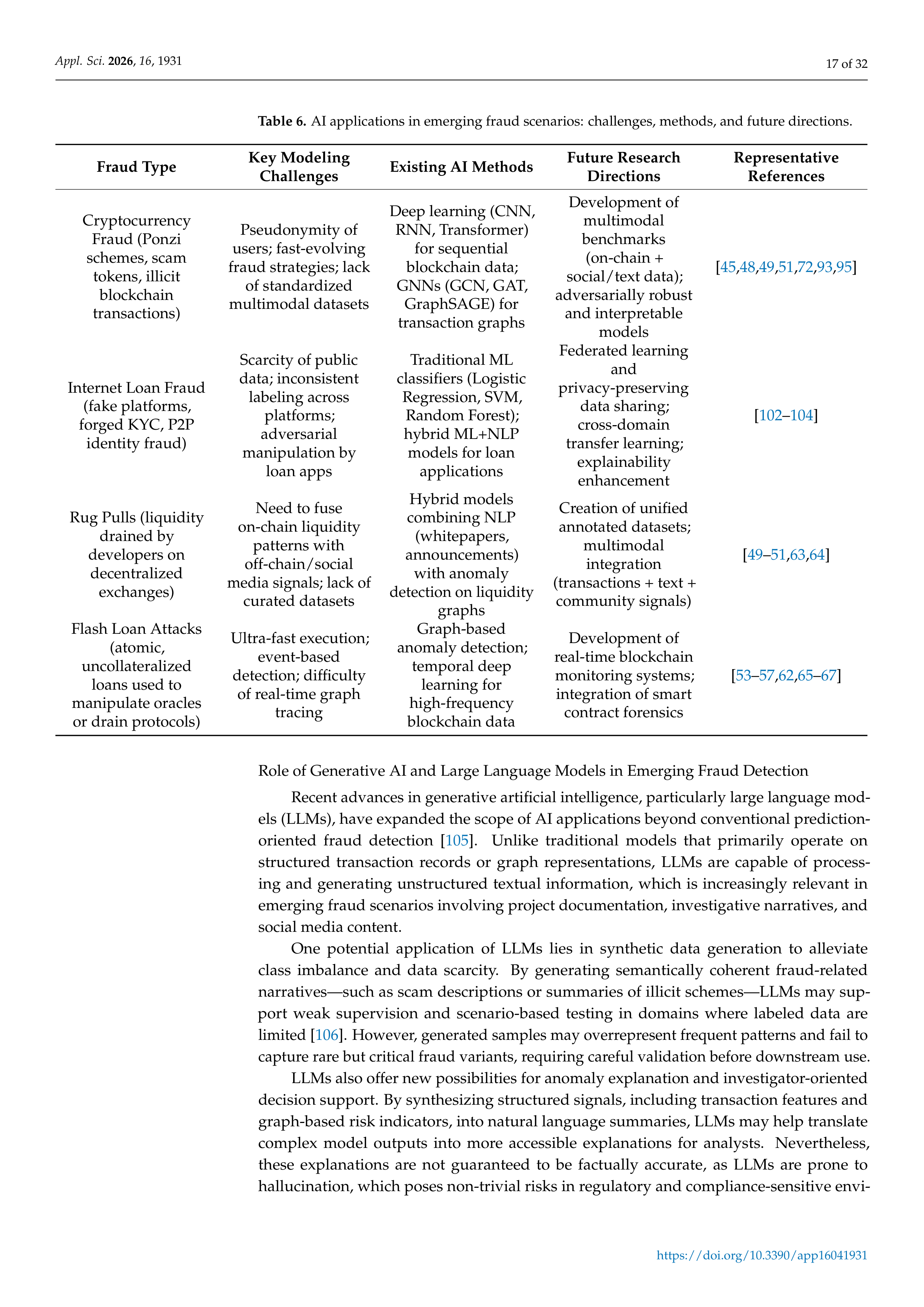
Table
6
provides
a
structured
overview
of
representative emerging fraud scenarios, highlighting their core modeling challenges, com-
monly adopted AI techniques, and open research directions.
For example, in the context
of cryptocurrency fraud, user pseudonymity and rapidly shifting strategies have led re-
searchers to examine both sequential patterns and graph structures.
In online lending fraud,
the scarcity of publicly available labeled data and inconsistent labeling across platforms has
prompted the use of hybrid text and tabular methods.
For DeFi-specific threats such as rug
pulls, integrating on-chain market behavior with off-chain social signals appears promising.
In the case of flash loan attacks, which unfold over extremely short timescales, researchers
have
begun
investigating
methods
capable
of
capturing
both
temporal
dynamics
and
transaction relationships.
Overall, existing AI-based approaches show promise in addressing the diverse char-
acteristics of emerging fraud types; however, their level of maturity remains noticeably
lower than that observed in traditional fraud detection domains.
Multimodal approaches
that integrate on-chain behaviors with textual or social signals have demonstrated poten-
tial, yet their practical effectiveness is constrained by limited domain-specific annotations
and
the
inherent
difficulty
of
aligning
heterogeneous
data
sources
[
64
,
80
,
90
].
Moving
forward, meaningful progress will depend not only on methodological refinement, but
also on the construction of higher-quality datasets, improved cross-scenario generaliza-
tion, and greater emphasis on model transparency and robustness in adversarial financial
environments [
53
,
65
–
67
,
94
,
95
].
In parallel with these model-centric advances, recent progress in generative artificial
intelligence—particularly large language models (LLMs)—has introduced a complemen-
tary research direction for addressing several unresolved challenges in emerging fraud
detection.
https://doi.org/10.3390/app16041931
Appl.
Sci.
2026
,
16
, 1931
17 of 32
Table 6.
AI applications in emerging fraud scenarios:
challenges, methods, and future directions.
Fraud Type
Key Modeling
Challenges
Existing AI Methods
Future Research
Directions
Representative
References
Cryptocurrency
Fraud (Ponzi
schemes, scam
tokens, illicit
blockchain
transactions)
Pseudonymity of
users; fast-evolving
fraud strategies; lack
of standardized
multimodal datasets
Deep learning (CNN,
RNN, Transformer)
for sequential
blockchain data;
GNNs (GCN, GAT,
GraphSAGE) for
transaction graphs
Development of
multimodal
benchmarks
(on-chain +
social/text data);
adversarially robust
and interpretable
models
[
45
,
48
,
49
,
51
,
72
,
93
,
95
]
Internet Loan Fraud
(fake platforms,
forged KYC, P2P
identity fraud)
Scarcity of public
data; inconsistent
labeling across
platforms;
adversarial
manipulation by
loan apps
Traditional ML
classifiers (Logistic
Regression, SVM,
Random Forest);
hybrid ML+NLP
models for loan
applications
Federated learning
and
privacy-preserving
data sharing;
cross-domain
transfer learning;
explainability
enhancement
[
102
–
104
]
Rug Pulls (liquidity
drained by
developers on
decentralized
exchanges)
Need to fuse
on-chain liquidity
patterns with
off-chain/social
media signals; lack of
curated datasets
Hybrid models
combining NLP
(whitepapers,
announcements)
with anomaly
detection on liquidity
graphs
Creation of unified
annotated datasets;
multimodal
integration
(transactions + text +
community signals)
[
49
–
51
,
63
,
64
]
Flash Loan Attacks
(atomic,
uncollateralized
loans used to
manipulate oracles
or drain protocols)
Ultra-fast execution;
event-based
detection; difficulty
of real-time graph
tracing
Graph-based
anomaly detection;
temporal deep
learning for
high-frequency
blockchain data
Development of
real-time blockchain
monitoring systems;
integration of smart
contract forensics
[
53
–
57
,
62
,
65
–
67
]
Role of Generative AI and Large Language Models in Emerging Fraud Detection
Recent advances in generative artificial intelligence, particularly large language mod-
els (LLMs), have expanded the scope of AI applications beyond conventional prediction-
oriented
fraud
detection
[
105
].
Unlike
traditional
models
that
primarily
operate
on
structured
transaction
records
or
graph
representations,
LLMs
are
capable
of
process-
ing
and
generating
unstructured
textual
information,
which
is
increasingly
relevant
in
emerging fraud scenarios involving project documentation, investigative narratives, and
social media content.
One
potential
application
of
LLMs
lies
in
synthetic
data
generation
to
alleviate
class
imbalance
and
data
scarcity.
By
generating
semantically
coherent
fraud-related
narratives—such
as scam descriptions or summaries of illicit schemes—LLMs may sup-
port
weak
supervision
and
scenario-based
testing
in
domains
where
labeled
data
are
limited [
106
].
However, generated samples may overrepresent frequent patterns and fail to
capture rare but critical fraud variants, requiring careful validation before downstream use.
LLMs also offer new possibilities for anomaly explanation and investigator-oriented
decision support.
By synthesizing structured signals, including transaction features and
graph-based risk indicators, into natural language summaries, LLMs may help translate
complex
model
outputs
into
more
accessible
explanations
for
analysts.
Nevertheless,
these
explanations
are
not
guaranteed
to
be
factually
accurate,
as
LLMs
are
prone
to
hallucination, which poses non-trivial risks in regulatory and compliance-sensitive envi-
https://doi.org/10.3390/app16041931
Appl.
Sci.
2026
,
16
, 1931
18 of 32
ronments [
107
].
As a result, explanation generation should be constrained and embedded
within human-in-the-loop workflows.
Beyond classification-oriented NLP tasks, LLMs enable higher-level semantic analysis
of
fraud-related
narratives,
such
as
summarizing
fraud
schemes
and
identifying
recur-
ring behavioral patterns across cases [
108
].
These capabilities are particularly relevant for
emerging fraud types, including rug pulls and Ponzi schemes, where textual communi-
cation plays a central role.
At the same time, LLM-based approaches remain vulnerable
to adversarial language manipulation and domain shifts, limiting their robustness when
deployed in isolation.
Overall,
generative
AI
and
LLMs
represent
a
promising
yet
still
complementary
direction in emerging fraud detection.
Their strengths lie in semantic understanding, expla-
nation support, and unstructured data analysis rather than in standalone fraud prediction.
Future research should therefore focus on integrating LLMs with established sequential,
graph-based, and multimodal models in a controlled and auditable manner, while carefully
addressing reliability, adversarial robustness, and data privacy concerns [
109
,
110
].
Q4:
What are the boundaries of the public datasets that are currently available in
this field?
How can we create better datasets to propel new advancements?
4.4.
Dataset Limitations and Development
The availability and design of datasets fundamentally influence both model perfor-
mance and the fairness, reproducibility, and deployment relevance of evaluation results.
However, different fraud types rely on different data sources and labeling processes, and
these differences often dominate model outcomes.
In what follows, we first summarize
commonly used datasets and their accessibility, then discuss the technical limitations of
existing public benchmarks, and finally outline directions for building more realistic and
reusable datasets.
a.
Representative datasets for financial fraud detection.
Apart
from
their
distinguishing
features,
dataset
accessibility
strongly
shapes
the
direction
of
research.
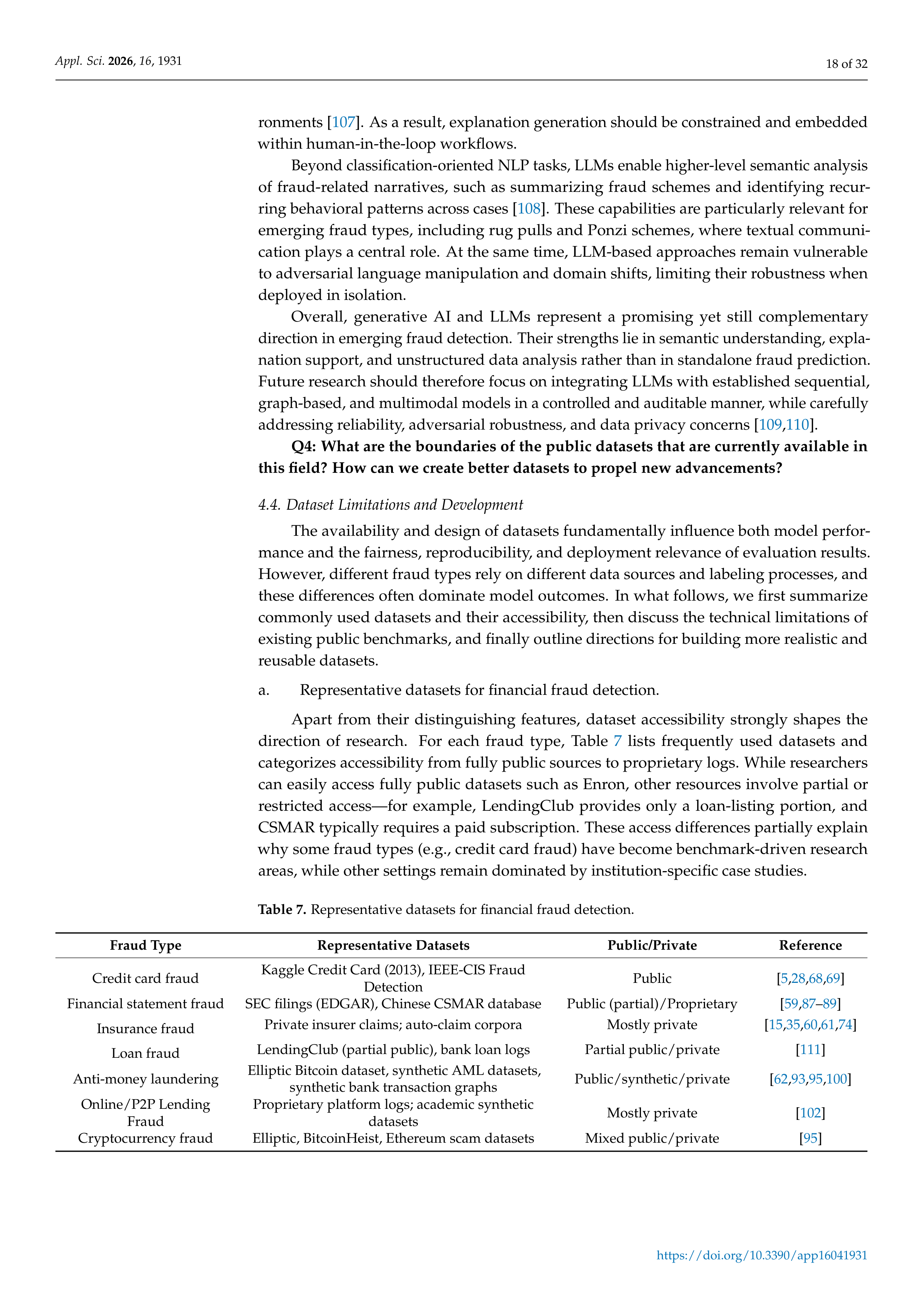
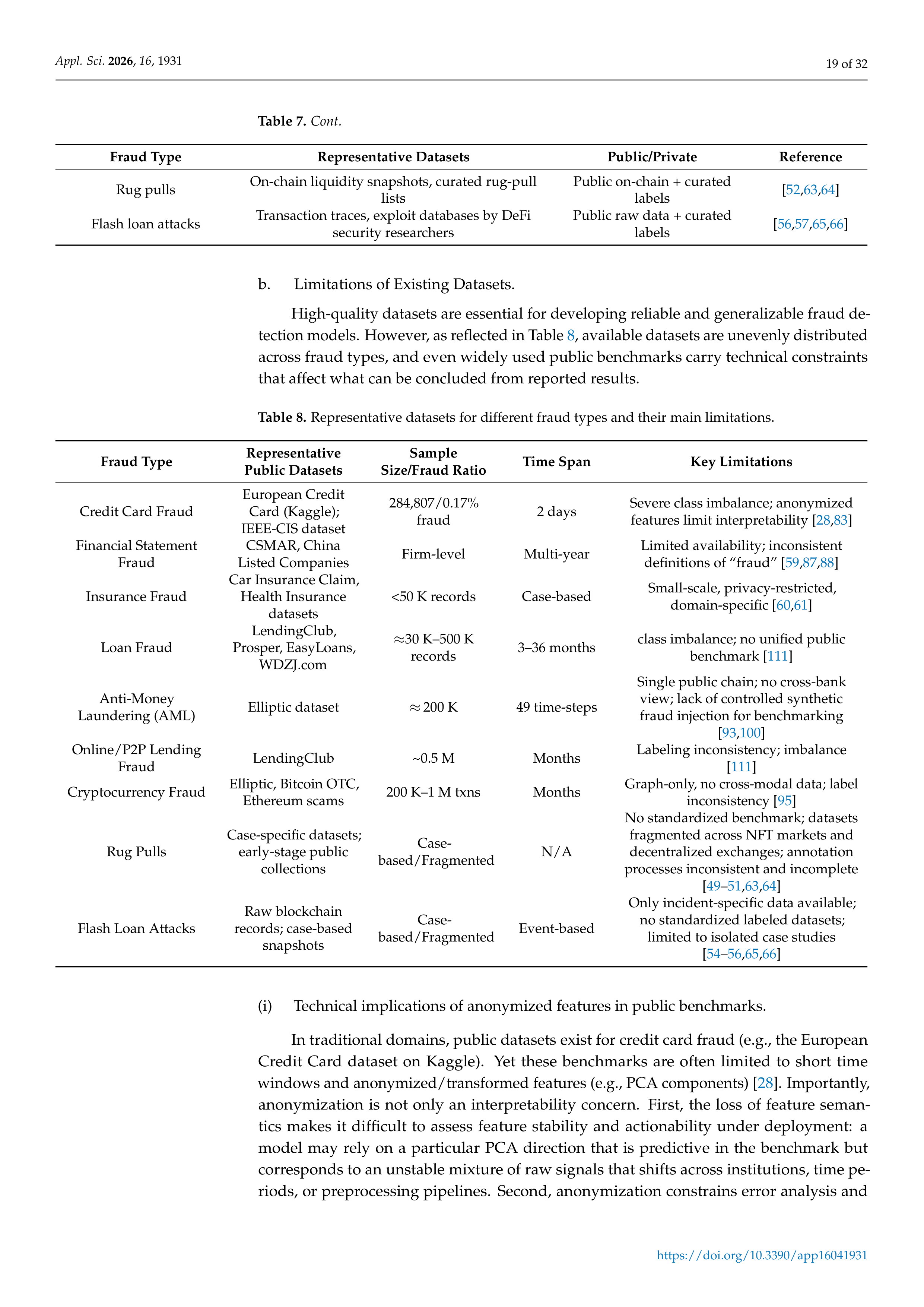
For
each
fraud
type,
Table
7
lists
frequently
used
datasets
and
categorizes accessibility from fully public sources to proprietary logs.
While researchers
can
easily access
fully public
datasets
such as
Enron,
other
resources
involve partial
or
restricted
access—for
example,
LendingClub
provides
only
a
loan-listing
portion,
and
CSMAR typically requires a paid subscription.
These access differences partially explain
why some fraud types (e.g., credit card fraud) have become benchmark-driven research
areas, while other settings remain dominated by institution-specific case studies.
Table 7.
Representative datasets for financial fraud detection.
Fraud Type
Representative Datasets
Public/Private
Reference
Credit card fraud
Kaggle Credit Card (2013), IEEE-CIS Fraud
Detection
Public
[
5
,
28
,
68
,
69
]
Financial statement fraud
SEC filings (EDGAR), Chinese CSMAR database
Public (partial)/Proprietary
[
59
,
87
–
89
]
Insurance fraud
Private insurer claims; auto-claim corpora
Mostly private
[
15
,
35
,
60
,
61
,
74
]
Loan fraud
LendingClub (partial public), bank loan logs
Partial public/private
[
111
]
Anti-money laundering
Elliptic Bitcoin dataset, synthetic AML datasets,
synthetic bank transaction graphs
Public/synthetic/private
[
62
,
93
,
95
,
100
]
Online/P2P Lending
Fraud
Proprietary platform logs; academic synthetic
datasets
Mostly private
[
102
]
Cryptocurrency fraud
Elliptic, BitcoinHeist, Ethereum scam datasets
Mixed public/private
[
95
]
https://doi.org/10.3390/app16041931
Appl.
Sci.
2026
,
16
, 1931
19 of 32
Table 7.
Cont.
Fraud Type
Representative Datasets
Public/Private
Reference
Rug pulls
On-chain liquidity snapshots, curated rug-pull
lists
Public on-chain + curated
labels
[
52
,
63
,
64
]
Flash loan attacks
Transaction traces, exploit databases by DeFi
security researchers
Public raw data + curated
labels
[
56
,
57
,
65
,
66
]
b.
Limitations of Existing Datasets.
High-quality datasets are essential for developing reliable and generalizable fraud de-
tection models.
However, as reflected in Table
8
, available datasets are unevenly distributed
across fraud types, and even widely used public benchmarks carry technical constraints
that affect what can be concluded from reported results.
Table 8.
Representative datasets for different fraud types and their main limitations.
Fraud Type
Representative
Public Datasets
Sample
Size/Fraud Ratio
Time Span
Key Limitations
Credit Card Fraud
European Credit
Card (Kaggle);
IEEE-CIS dataset
284,807/0.17%
fraud
2 days
Severe class imbalance; anonymized
features limit interpretability [
28
,
83
]
Financial Statement
Fraud
CSMAR, China
Listed Companies
Firm-level
Multi-year
Limited availability; inconsistent
definitions of “fraud” [
59
,
87
,
88
]
Insurance Fraud
Car Insurance Claim,
Health Insurance
datasets
<50 K records
Case-based
Small-scale, privacy-restricted,
domain-specific [
60
,
61
]
Loan Fraud
LendingClub,
Prosper, EasyLoans,
WDZJ.com
≈
30 K–500 K
records
3–36 months
class imbalance; no unified public
benchmark [
111
]
Anti-Money
Laundering (AML)
Elliptic dataset
≈
200 K
49 time-steps
Single public chain; no cross-bank
view; lack of controlled synthetic
fraud injection for benchmarking
[
93
,
100
]
Online/P2P Lending
Fraud
LendingClub
~0.5 M
Months
Labeling inconsistency; imbalance
[
111
]
Cryptocurrency Fraud
Elliptic, Bitcoin OTC,
Ethereum scams
200 K–1 M txns
Months
Graph-only, no cross-modal data; label
inconsistency [
95
]
Rug Pulls
Case-specific datasets;
early-stage public
collections
Case-
based/Fragmented
N/A
No standardized benchmark; datasets
fragmented across NFT markets and
decentralized exchanges; annotation
processes inconsistent and incomplete
[
49
–
51
,
63
,
64
]
Flash Loan Attacks
Raw blockchain
records; case-based
snapshots
Case-
based/Fragmented
Event-based
Only incident-specific data available;
no standardized labeled datasets;
limited to isolated case studies
[
54
–
56
,
65
,
66
]
(i)
Technical implications of anonymized features in public benchmarks.
In traditional domains, public datasets exist for credit card fraud (e.g., the European
Credit
Card
dataset
on
Kaggle).
Yet
these
benchmarks
are
often
limited
to
short
time
windows and anonymized/transformed features (e.g., PCA components) [
28
].
Importantly,
anonymization
is
not
only
an
interpretability
concern.
First,
the
loss
of
feature
seman-
tics
makes
it
difficult
to
assess
feature
stability
and
actionability
under
deployment:
a
model
may
rely
on
a
particular
PCA
direction
that
is
predictive
in
the
benchmark
but
corresponds to an unstable mixture of raw signals that shifts across institutions, time pe-
riods, or preprocessing pipelines.
Second, anonymization constrains error analysis and
https://doi.org/10.3390/app16041931
Appl.
Sci.
2026
,
16
, 1931
20 of 32
debugging.
When false positives increase, it becomes difficult to trace model behavior back
to business-relevant factors (channels, merchant characteristics, devices, geography), which
complicates operational remediation and audit justification.
Third,
anonymized bench-
marks reduce the value of domain-informed robustness design (e.g., targeted monitoring
of semantically meaningful features, or rule-based constraints that align with operational
controls).
As a result, strong performance on anonymized benchmarks may overstate how
easily the approach transfers to real institutional data, where feature definitions, availability,
and preprocessing differ.
(ii)
Limited temporal depth and the under-evaluation of drift
A
second
recurring
limitation
is
insufficient
temporal
coverage.
Short
time
spans
make
it
difficult
to
meaningfully
assess
concept
drift,
even
though
drift
is
one
of
the
defining challenges in operational fraud detection [
14
,
23
,
109
].
In practice, drift may appear
as
(a)
prior
drift
(fraud
prevalence
changes
after
interventions,
campaigns,
or
seasonal
cycles), (b) covariate shift (new products, channels, and user segments change the feature
distribution), and (c) behavioral/adversarial drift (attackers adjust to deployed controls).
These shifts can break thresholds and calibration even when rank-based metrics appear
stable.
Consequently, evaluations that rely on random splits or that do not respect time
ordering can underestimate degradation and overstate long-term stability.
(iii)
Emerging domains:
public raw data does not automatically yield usable benchmarks
In
contrast
to
credit
card
benchmarks,
insurance,
P2P
lending,
and
emerging
cryptocurrency-related
fraud
still
lack
unified,
standardized
datasets
[
5
,
49
,
56
,
64
].
For
DeFi-related
threats
such
as
rug
pulls
and
flash-loan
attacks,
raw
on-chain
transaction
traces are publicly available, yet constructing representative labeled datasets remains tech-
nically challenging [
52
,
56
,
57
,
63
–
66
].
Two issues are particularly limiting.
First, “ground
truth” labels are often incident-driven and curated from heterogeneous sources (security
reports, exploit lists, post-mortems), which leads to inconsistent labeling criteria and in-
complete coverage across studies.
Second, defining negative samples is non-trivial:
many
benign on-chain behaviors can look superficially similar to attacks (e.g., arbitrage, liquida-
tion, MEV-driven bursts).
Naïve negative sampling therefore introduces label noise and
can inflate offline metrics without improving true detection capability.
Moreover,
DeFi
ecosystems evolve rapidly (protocol upgrades, migrations, multi-chain fragmentation), so
benchmarks built around fixed incident sets can become stale quickly.
These constraints
push
many
studies
toward
fragmented
case-based
evaluation
instead
of
standardized
training and testing pipelines, which limits meaningful cross-study comparisons (Table
8
).
Overall, Table
8
highlights that while established datasets exist for certain traditional
fraud types, many other domains—especially insurance fraud, online lending, and novel
cryptocurrency-related frauds—still lack standardized, large-scale, and multimodal bench-
marks.
This disparity helps explain why reported advances are often difficult to compare
across studies and why performance may not translate smoothly across deployment set-
tings [
5
,
54
–
56
,
60
,
61
,
63
].
c.
Toward High-Quality Datasets
Toward
more
reliable
benchmarks,
dataset
development
should
not
only
increase
sample size but also improve technical realism along three dimensions:
time, labels, and
feature/graph
construction.
First,
temporal
design
should
reflect
deployment:
bench-
marks should adopt chronological splits, support sliding-window evaluation, and report
how
performance
and
calibration
drift
over
time,
rather
than
relying
on
a
single
static
split [
14
,
23
,
109
].
Second, labeling pipelines should be treated as part of the dataset spec-
ification:
label
delay,
investigation
selection
bias,
and
incident
definition
criteria
(espe-
https://doi.org/10.3390/app16041931
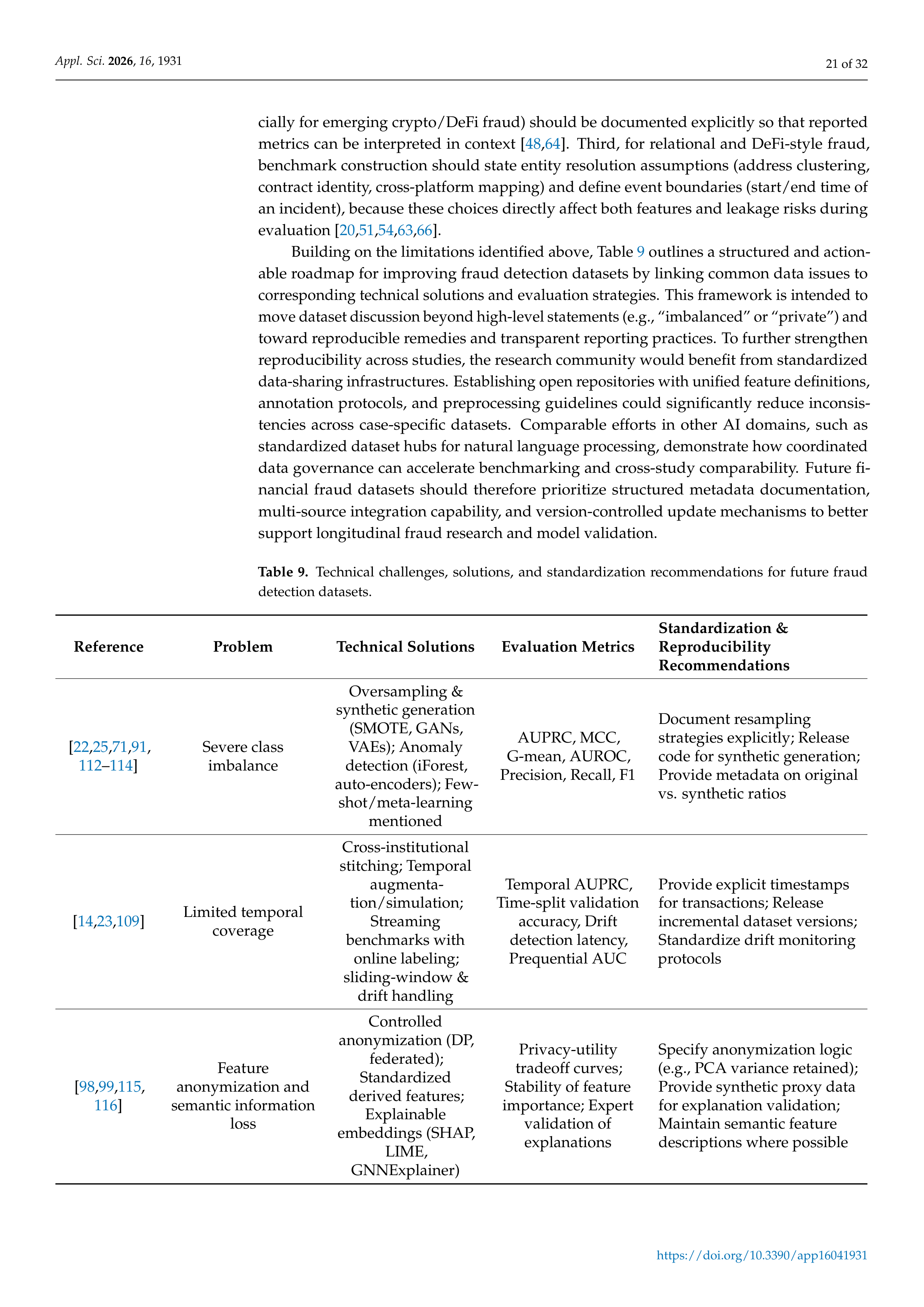
Appl.
Sci.
2026
,
16
, 1931
21 of 32
cially for emerging crypto/DeFi fraud) should be documented explicitly so that reported
metrics can
be interpreted
in context [
48
,
64
].
Third,
for
relational and
DeFi-style fraud,
benchmark construction should state entity resolution assumptions (address clustering,
contract identity, cross-platform mapping) and define event boundaries (start/end time of
an incident), because these choices directly affect both features and leakage risks during
evaluation [
20
,
51
,
54
,
63
,
66
].
Building on the limitations identified above, Table
9
outlines a structured and action-
able roadmap for improving fraud detection datasets by linking common data issues to
corresponding technical solutions and evaluation strategies.
This framework is intended to
move dataset discussion beyond high-level statements (e.g., “imbalanced” or “private”) and
toward reproducible remedies and transparent reporting practices.
To further strengthen
reproducibility across studies, the research community would benefit from standardized
data-sharing infrastructures.
Establishing open repositories with unified feature definitions,
annotation protocols,
and preprocessing guidelines could significantly reduce inconsis-
tencies
across
case-specific
datasets.
Comparable
efforts
in
other
AI
domains,
such
as
standardized dataset hubs for natural language processing, demonstrate how coordinated
data governance can accelerate benchmarking and cross-study comparability.
Future fi-
nancial
fraud
datasets
should
therefore
prioritize
structured
metadata
documentation,
multi-source integration capability, and version-controlled update mechanisms to better
support longitudinal fraud research and model validation.
Table
9.
Technical
challenges,
solutions,
and
standardization
recommendations
for
future
fraud
detection datasets.
Reference
Problem
Technical Solutions
Evaluation Metrics
Standardization &
Reproducibility
Recommendations
[
22
,
25
,
71
,
91
,
112
–
114
]
Severe class
imbalance
Oversampling &
synthetic generation
(SMOTE, GANs,
VAEs); Anomaly
detection (iForest,
auto-encoders); Few-
shot/meta-learning
mentioned
AUPRC, MCC,
G-mean, AUROC,
Precision, Recall, F1
Document resampling
strategies explicitly; Release
code for synthetic generation;
Provide metadata on original
vs.
synthetic ratios
[
14
,
23
,
109
]
Limited temporal
coverage
Cross-institutional
stitching; Temporal
augmenta-
tion/simulation;
Streaming
benchmarks with
online labeling;
sliding-window &
drift handling
Temporal AUPRC,
Time-split validation
accuracy, Drift
detection latency,
Prequential AUC
Provide explicit timestamps
for transactions; Release
incremental dataset versions;
Standardize drift monitoring
protocols
[
98
,
99
,
115
,
116
]
Feature
anonymization and
semantic information
loss
Controlled
anonymization (DP,
federated);
Standardized
derived features;
Explainable
embeddings (SHAP,
LIME,
GNNExplainer)
Privacy-utility
tradeoff curves;
Stability of feature
importance; Expert
validation of
explanations
Specify anonymization logic
(e.g., PCA variance retained);
Provide synthetic proxy data
for explanation validation;
Maintain semantic feature
descriptions where possible
https://doi.org/10.3390/app16041931
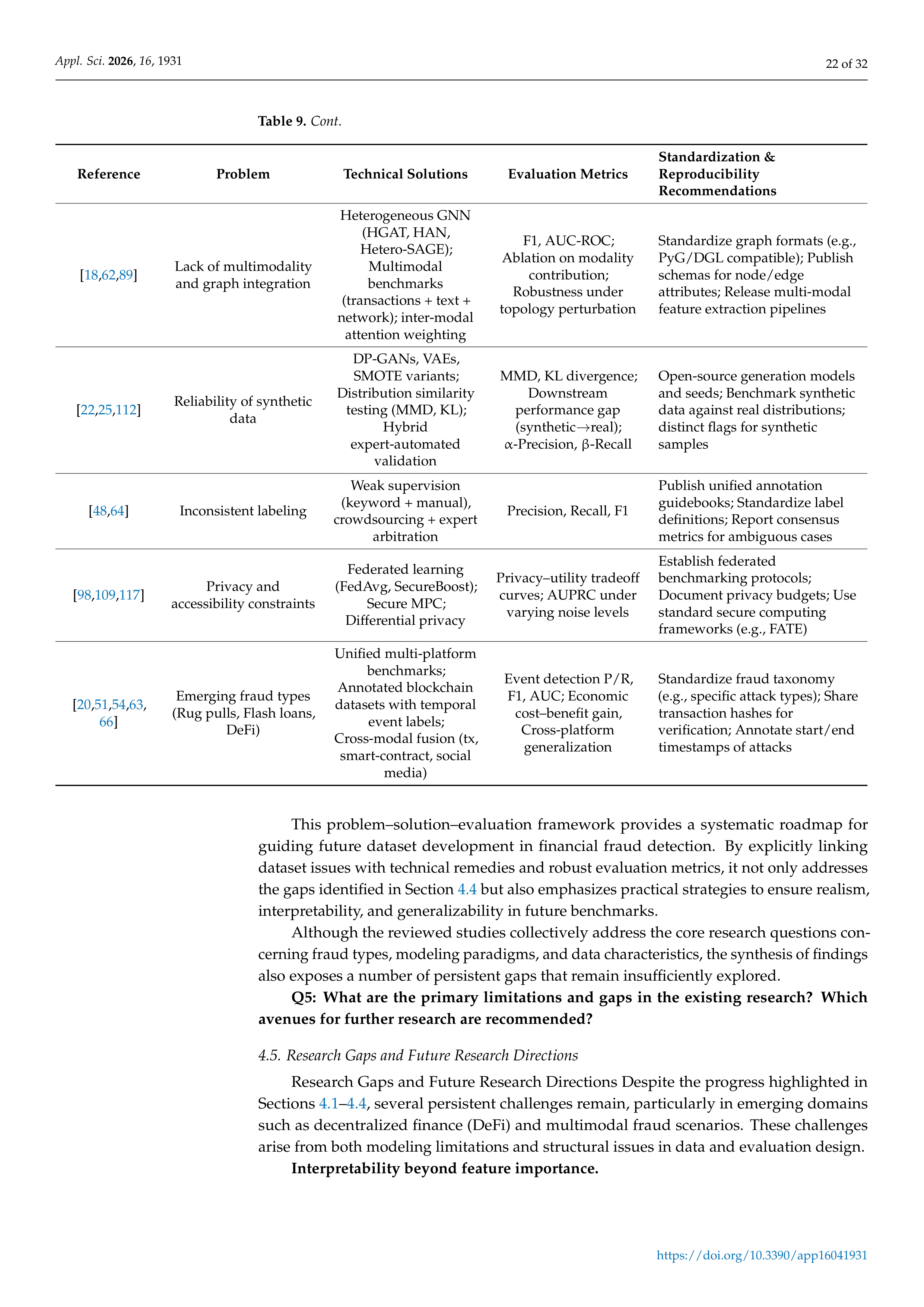
Appl.
Sci.
2026
,
16
, 1931
22 of 32
Table 9.
Cont.
Reference
Problem
Technical Solutions
Evaluation Metrics
Standardization &
Reproducibility
Recommendations
[
18
,
62
,
89
]
Lack of multimodality
and graph integration
Heterogeneous GNN
(HGAT, HAN,
Hetero-SAGE);
Multimodal
benchmarks
(transactions + text +
network); inter-modal
attention weighting
F1, AUC-ROC;
Ablation on modality
contribution;
Robustness under
topology perturbation
Standardize graph formats (e.g.,
PyG/DGL compatible); Publish
schemas for node/edge
attributes; Release multi-modal
feature extraction pipelines
[
22
,
25
,
112
]
Reliability of synthetic
data
DP-GANs, VAEs,
SMOTE variants;
Distribution similarity
testing (MMD, KL);
Hybrid
expert-automated
validation
MMD, KL divergence;
Downstream
performance gap
(synthetic
→
real);
α
-Precision,
β
-Recall
Open-source generation models
and seeds; Benchmark synthetic
data against real distributions;
distinct flags for synthetic
samples
[
48
,
64
]
Inconsistent labeling
Weak supervision
(keyword + manual),
crowdsourcing + expert
arbitration
Precision, Recall, F1
Publish unified annotation
guidebooks; Standardize label
definitions; Report consensus
metrics for ambiguous cases
[
98
,
109
,
117
]
Privacy and
accessibility constraints
Federated learning
(FedAvg, SecureBoost);
Secure MPC;
Differential privacy
Privacy–utility tradeoff
curves; AUPRC under
varying noise levels
Establish federated
benchmarking protocols;
Document privacy budgets; Use
standard secure computing
frameworks (e.g., FATE)
[
20
,
51
,
54
,
63
,
66
]
Emerging fraud types
(Rug pulls, Flash loans,
DeFi)
Unified multi-platform
benchmarks;
Annotated blockchain
datasets with temporal
event labels;
Cross-modal fusion (tx,
smart-contract, social
media)
Event detection P/R,
F1, AUC; Economic
cost–benefit gain,
Cross-platform
generalization
Standardize fraud taxonomy
(e.g., specific attack types); Share
transaction hashes for
verification; Annotate start/end
timestamps of attacks
This
problem–solution–evaluation
framework
provides
a
systematic
roadmap
for
guiding
future
dataset
development
in
financial
fraud
detection.
By
explicitly
linking
dataset issues with technical remedies and robust evaluation metrics, it not only addresses
the gaps identified in Section
4.4
but also emphasizes practical strategies to ensure realism,
interpretability, and generalizability in future benchmarks.
Although the reviewed studies collectively address the core research questions con-
cerning fraud types, modeling paradigms, and data characteristics, the synthesis of findings
also exposes a number of persistent gaps that remain insufficiently explored.
Q5:
What
are
the
primary
limitations
and
gaps
in
the
existing
research?
Which
avenues for further research are recommended?
4.5.
Research Gaps and Future Research Directions
Research Gaps and Future Research Directions Despite the progress highlighted in
Sections
4.1
–
4.4
, several persistent challenges remain, particularly in emerging domains
such as decentralized finance (DeFi) and multimodal fraud scenarios.
These challenges
arise from both modeling limitations and structural issues in data and evaluation design.
Interpretability beyond feature importance.
https://doi.org/10.3390/app16041931
Appl.
Sci.
2026
,
16
, 1931
23 of 32
Interpretability has been investigated from multiple perspectives, including feature
attribution methods such as SHAP and LIME [
118
,
119
], post hoc explanation frameworks
for black-box models [
119
], and regulatory-oriented explainability requirements in financial
systems [
120
,
121
].
While these approaches provide useful insights into feature relevance,
they offer limited support for understanding the underlying mechanisms of complex fraud
behaviors.
This limitation becomes especially evident in scenarios involving sequential
decision processes or programmatic execution, such as money laundering chains or smart
contract
exploits.
In
such
contexts,
feature-level
explanations
alone
are
insufficient
to
capture
the
temporal
and
causal
structure
of
fraudulent
activities.
A
deeper
notion
of
interpretability—one that connects model outputs to interpretable representations of event
sequences and decision logic—remains largely underexplored.
Future research may benefit
from explanation frameworks that can be evaluated against expert judgments in realistic
audit and investigation settings.
In addition, existing interpretability studies rarely consider how explanation outputs
are operationalized within real-world fraud detection systems, where explanations must
support regulatory audits, analyst review workflows, and time-critical decision making.
Bridging the gap between explanation methods and their system-level integration therefore
represents an important yet underexplored research direction.
Joint modeling of on-chain and off-chain signals.
Emerging
fraud
patterns
increasingly
span
heterogeneous
data
modalities,
includ-
ing
transaction
graphs,
market
indicators,
project
documentation,
and
social
media
or
community discussions.
However, most existing approaches analyze these information
sources in isolation, which limits their ability to detect fraud behaviors that only emerge
through cross-modal interactions.
Although several studies have begun exploring hybrid
or multimodal representations, systematic frameworks for jointly modeling semantic text,
temporal transaction data, and structural graph features remain limited.
Moreover, the
generalization of such multimodal models across different fraud types and platforms has
not been sufficiently examined [
10
,
120
].
Synthetic and simulation-driven data for rare events.
As
identified
in
Section
4.4
,
a
major
bottleneck
in
emerging
fraud
detection
is
the
scarcity of labeled data for rare or novel attack patterns.
Traditional oversampling tech-
niques, such as SMOTE, provide limited benefits when new fraud strategies lack close histor-
ical analogues [
14
]. Under current data constraints, there is increasing interest in simulation-
based and synthetic data generation approaches that incorporate domain-informed assump-
tions about adversarial behavior.
However, the effectiveness of such synthetic benchmarks
depends critically on their realism and their ability to transfer to real-world detection tasks.
Rigorous evaluation against real fraud cases therefore remains essential.
Collaborative and cross-domain learning.
Fraud activities frequently transcend institutional, platform, and even jurisdictional
boundaries,
while
available
datasets
are
typically
confined
to
isolated
organizations
or
individual platforms.
As discussed in Section
4.4
,
this fragmentation limits model gen-
eralization
and
hampers
the
detection
of
coordinated
or
cross-platform
fraud
schemes.
Although privacy-preserving learning paradigms such as federated learning have been
explored in traditional financial settings, extending these approaches to heterogeneous and
decentralized environments introduces additional challenges.
Future research may explore
cross-domain learning protocols that balance privacy preservation with the need to capture
shared fraud patterns across institutions and platforms.
Standardized evaluation and benchmarking frameworks.
Across both traditional and emerging fraud domains, the absence of widely adopted
benchmarks remains a fundamental obstacle to reproducibility and fair comparison.
Cur-
https://doi.org/10.3390/app16041931
Appl.
Sci.
2026
,
16
, 1931
24 of 32
rent studies employ diverse evaluation metrics, dataset splits, and validation strategies,
making it difficult to assess relative performance under realistic conditions.
In particular,
there is no consensus on how to evaluate models in the presence of severe class imbalance,
temporal concept drift, and adversarial adaptation [
122
].
More comprehensive and stan-
dardized evaluation frameworks are therefore needed to reflect real operational constraints
and deployment requirements.
5.
Discussion
The studies reviewed in this work collectively demonstrate both substantial progress
and persistent structural challenges in AI-based financial fraud detection.
Across method-
ological
choices,
data
availability,
and
application
contexts,
several
cross-cutting
pat-
terns
emerge
that
help
explain
the
current
research
landscape
and
the
factors
shaping
research priorities.
One notable observation is the uneven distribution of research attention across fraud
types.
Domains such as credit card fraud and cryptocurrency-related schemes dominate
the literature, largely due to the availability of public or semi-public datasets that facilitate
benchmarking and comparative evaluation.
In contrast, insurance fraud, loan fraud, and
several decentralized finance (DeFi)-related threats remain comparatively underexplored
despite their significant economic impact.
As discussed in Section
4.4
, data accessibility con-
tinues to shape benchmark-driven research progress while also constraining investigation
into institution-specific or emerging fraud scenarios.
Fraud detection in blockchain-based ecosystems introduces additional technical com-
plexities beyond those encountered in traditional financial systems. Pseudonymity of wallet
addresses obscures direct identity linkage, while transaction transparency paradoxically
coexists with limited contextual metadata.
Furthermore, effective analysis often requires
integrating
on-chain
transaction
graphs
with
off-chain
behavioral
or
exchange-level
in-
formation.
These
characteristics
have
motivated
the
development
of
hybrid
detection
frameworks that combine graph neural networks with advanced anomaly detection algo-
rithms and blockchain-specific feature engineering.
Such approaches leverage relational
transaction patterns, temporal interaction dynamics, and smart contract behavior to im-
prove detection capability in decentralized financial environments.
From a methodological perspective, the field has gradually transitioned from tradi-
tional machine learning toward ensemble learning, deep neural networks, and graph-based
approaches capable of capturing nonlinear dependencies, temporal transaction dynamics,
and
relational
structures.
However,
these
advances
introduce
important
trade-offs.
In-
creased model complexity often reduces interpretability and operational transparency, both
of which are critical requirements in regulated financial environments such as banking
and anti-money laundering compliance.
Consequently, improvements in predictive perfor-
mance do not necessarily translate into deployment readiness or regulatory acceptance.
Dataset characteristics continue to exert a strong influence on research outcomes and
evaluation
practices.
Widely
adopted
benchmarks,
including
the
Kaggle
Credit
Card
and Elliptic Bitcoin datasets, have enabled reproducible experimentation and standard-
ized comparison across studies.
Nevertheless, these datasets remain constrained by class
imbalance, feature anonymization, and limited temporal coverage.
For emerging fraud
domains,
datasets
are
frequently
fragmented,
case-specific,
or
platform-dependent,
re-
stricting cross-study comparability and weakening the external validity of reported results.
These
structural
limitations
help
explain
why
models
achieving
strong
performance
in
controlled experimental settings often face robustness and generalization challenges in
real-world deployments.
https://doi.org/10.3390/app16041931
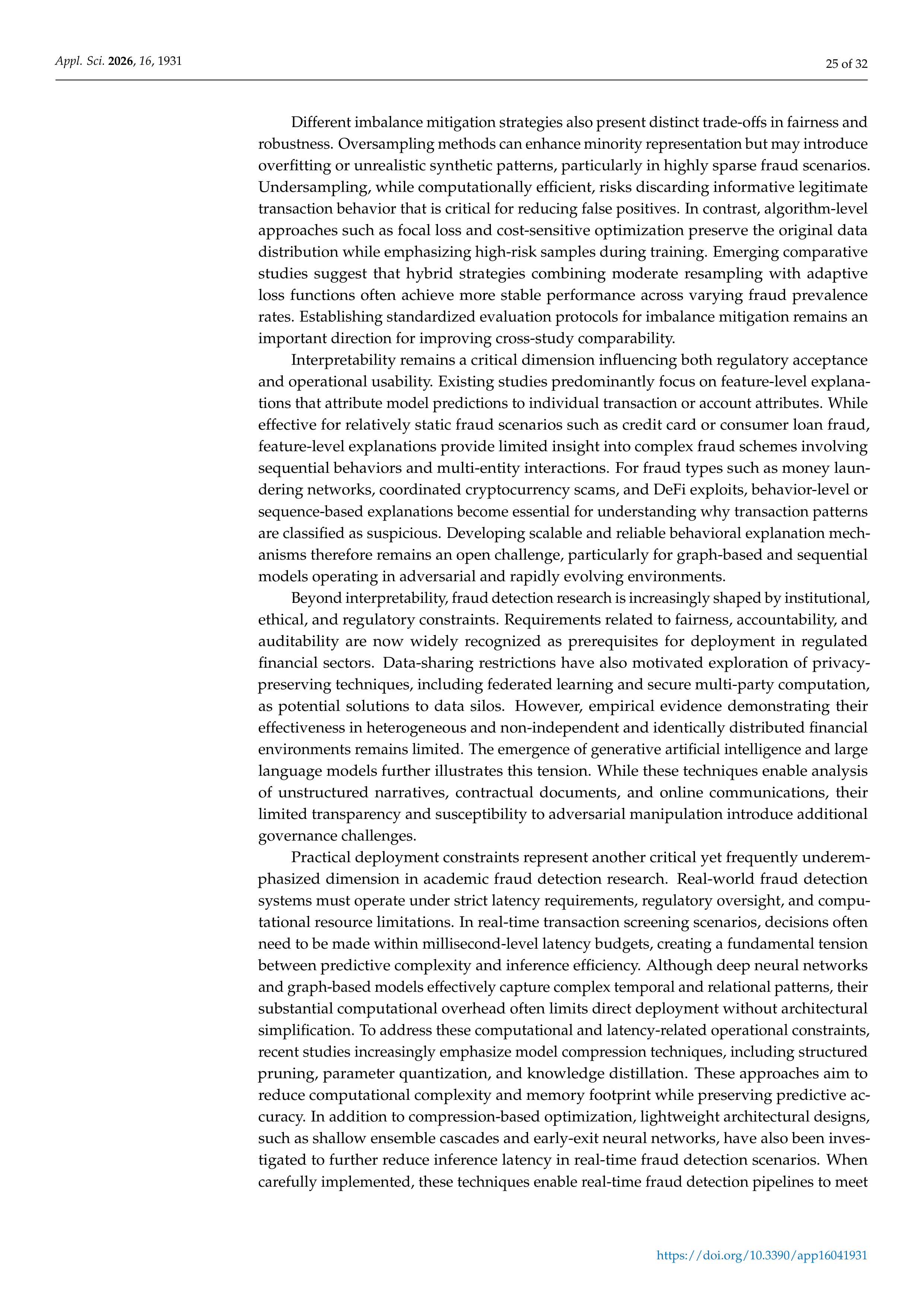
Appl.
Sci.
2026
,
16
, 1931
25 of 32
Different imbalance mitigation strategies also present distinct trade-offs in fairness and
robustness. Oversampling methods can enhance minority representation but may introduce
overfitting or unrealistic synthetic patterns, particularly in highly sparse fraud scenarios.
Undersampling, while computationally efficient, risks discarding informative legitimate
transaction behavior that is critical for reducing false positives.
In contrast, algorithm-level
approaches such as focal loss and cost-sensitive optimization preserve the original data
distribution while emphasizing high-risk samples during training.
Emerging comparative
studies
suggest
that
hybrid
strategies
combining
moderate
resampling
with
adaptive
loss
functions
often
achieve
more
stable
performance
across
varying
fraud
prevalence
rates.
Establishing standardized evaluation protocols for imbalance mitigation remains an
important direction for improving cross-study comparability.
Interpretability remains a critical dimension influencing both regulatory acceptance
and operational usability.
Existing studies predominantly focus on feature-level explana-
tions that attribute model predictions to individual transaction or account attributes.
While
effective for relatively static fraud scenarios such as credit card or consumer loan fraud,
feature-level explanations provide limited insight into complex fraud schemes involving
sequential behaviors and multi-entity interactions.
For fraud types such as money laun-
dering networks, coordinated cryptocurrency scams, and DeFi exploits, behavior-level or
sequence-based explanations become essential for understanding why transaction patterns
are classified as suspicious.
Developing scalable and reliable behavioral explanation mech-
anisms therefore remains an open challenge, particularly for graph-based and sequential
models operating in adversarial and rapidly evolving environments.
Beyond interpretability, fraud detection research is increasingly shaped by institutional,
ethical, and regulatory constraints.
Requirements related to fairness, accountability, and
auditability
are
now
widely
recognized
as
prerequisites
for
deployment
in
regulated
financial
sectors.
Data-sharing
restrictions
have
also
motivated
exploration
of
privacy-
preserving techniques, including federated learning and secure multi-party computation,
as
potential
solutions
to
data
silos.
However,
empirical
evidence
demonstrating
their
effectiveness in heterogeneous and non-independent and identically distributed financial
environments remains limited.
The emergence of generative artificial intelligence and large
language models further illustrates this tension.
While these techniques enable analysis
of
unstructured
narratives,
contractual
documents,
and
online
communications,
their
limited transparency and susceptibility to adversarial manipulation introduce additional
governance challenges.
Practical deployment constraints represent another critical yet frequently underem-
phasized
dimension
in
academic
fraud
detection
research.
Real-world
fraud
detection
systems must operate under strict latency requirements, regulatory oversight, and compu-
tational resource limitations.
In real-time transaction screening scenarios, decisions often
need to be made within millisecond-level latency budgets, creating a fundamental tension
between predictive complexity and inference efficiency.
Although deep neural networks
and graph-based models effectively capture complex temporal and relational patterns, their
substantial computational overhead often limits direct deployment without architectural
simplification.
To address these computational and latency-related operational constraints,
recent studies increasingly emphasize model compression techniques, including structured
pruning, parameter quantization, and knowledge distillation.
These approaches aim to
reduce computational complexity and memory footprint while preserving predictive ac-
curacy.
In addition to compression-based optimization, lightweight architectural designs,
such as shallow ensemble cascades and early-exit neural networks, have also been inves-
tigated to further reduce inference latency in real-time fraud detection scenarios.
When
carefully implemented, these techniques enable real-time fraud detection pipelines to meet
https://doi.org/10.3390/app16041931
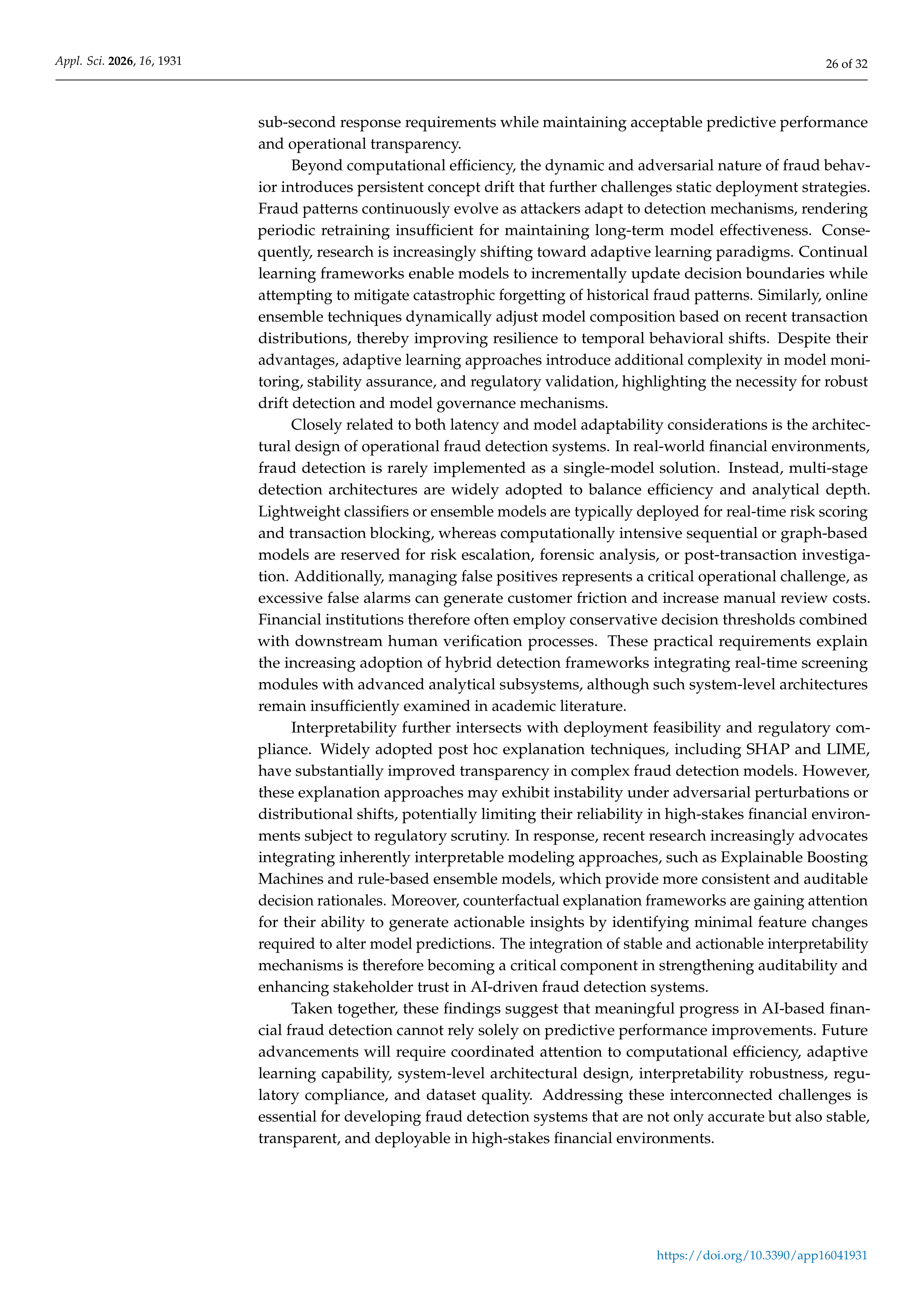
Appl.
Sci.
2026
,
16
, 1931
26 of 32
sub-second response requirements while maintaining acceptable predictive performance
and operational transparency.
Beyond computational efficiency, the dynamic and adversarial nature of fraud behav-
ior introduces persistent concept drift that further challenges static deployment strategies.
Fraud patterns continuously evolve as attackers adapt to detection mechanisms, rendering
periodic
retraining
insufficient
for
maintaining
long-term
model
effectiveness.
Conse-
quently, research is increasingly shifting toward adaptive learning paradigms.
Continual
learning frameworks enable models to incrementally update decision boundaries while
attempting to mitigate catastrophic forgetting of historical fraud patterns.
Similarly, online
ensemble techniques dynamically adjust model composition based on recent transaction
distributions,
thereby
improving
resilience
to
temporal
behavioral
shifts.
Despite
their
advantages, adaptive learning approaches introduce additional complexity in model moni-
toring, stability assurance, and regulatory validation, highlighting the necessity for robust
drift detection and model governance mechanisms.
Closely related to both latency and model adaptability considerations is the architec-
tural design of operational fraud detection systems.
In real-world financial environments,
fraud
detection
is
rarely
implemented
as
a
single-model
solution.
Instead,
multi-stage
detection
architectures
are
widely
adopted
to
balance
efficiency
and
analytical
depth.
Lightweight classifiers or ensemble models are typically deployed for real-time risk scoring
and transaction blocking, whereas computationally intensive sequential or graph-based
models
are
reserved
for
risk
escalation,
forensic
analysis,
or
post-transaction
investiga-
tion.
Additionally, managing false positives represents a critical operational challenge, as
excessive false alarms can generate customer friction and increase manual review costs.
Financial institutions therefore often employ conservative decision thresholds combined
with
downstream
human
verification
processes.
These
practical
requirements
explain
the increasing adoption of hybrid detection frameworks integrating real-time screening
modules with advanced analytical subsystems, although such system-level architectures
remain insufficiently examined in academic literature.
Interpretability
further
intersects
with
deployment
feasibility
and
regulatory
com-
pliance.
Widely
adopted
post
hoc
explanation
techniques,
including
SHAP
and
LIME,
have substantially improved transparency in complex fraud detection models.
However,
these explanation approaches may exhibit instability under adversarial perturbations or
distributional shifts, potentially limiting their reliability in high-stakes financial environ-
ments subject to regulatory scrutiny.
In response, recent research increasingly advocates
integrating inherently interpretable modeling approaches, such as Explainable Boosting
Machines and rule-based ensemble models, which provide more consistent and auditable
decision rationales.
Moreover, counterfactual explanation frameworks are gaining attention
for
their
ability
to
generate
actionable
insights
by
identifying
minimal
feature
changes
required to alter model predictions.
The integration of stable and actionable interpretability
mechanisms is therefore becoming a critical component in strengthening auditability and
enhancing stakeholder trust in AI-driven fraud detection systems.
Taken together, these findings suggest that meaningful progress in AI-based finan-
cial fraud detection cannot rely solely on predictive performance improvements.
Future
advancements
will
require
coordinated
attention
to
computational
efficiency,
adaptive
learning
capability,
system-level
architectural
design,
interpretability
robustness,
regu-
latory
compliance,
and
dataset
quality.
Addressing
these
interconnected
challenges
is
essential for developing fraud detection systems that are not only accurate but also stable,
transparent, and deployable in high-stakes financial environments.
https://doi.org/10.3390/app16041931
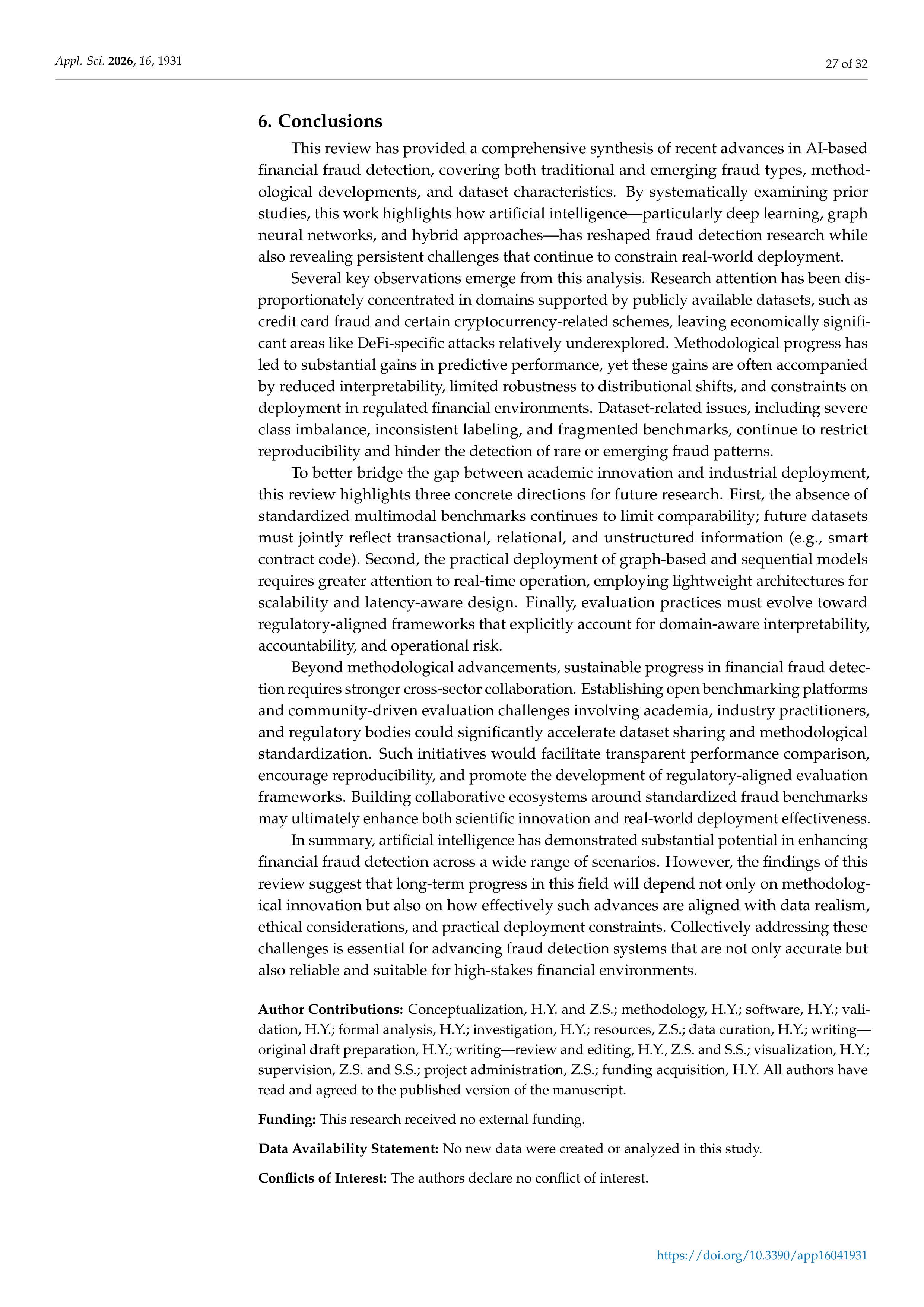
Appl.
Sci.
2026
,
16
, 1931
27 of 32
6.
Conclusions
This review has provided a comprehensive synthesis of recent advances in AI-based
financial fraud detection,
covering both traditional and emerging fraud types,
method-
ological
developments,
and
dataset
characteristics.
By
systematically
examining
prior
studies, this work highlights how artificial intelligence—particularly deep learning, graph
neural networks, and hybrid approaches—has reshaped fraud detection research while
also revealing persistent challenges that continue to constrain real-world deployment.
Several key observations emerge from this analysis.
Research attention has been dis-
proportionately concentrated in domains supported by publicly available datasets, such as
credit card fraud and certain cryptocurrency-related schemes, leaving economically signifi-
cant areas like DeFi-specific attacks relatively underexplored.
Methodological progress has
led to substantial gains in predictive performance, yet these gains are often accompanied
by reduced interpretability, limited robustness to distributional shifts, and constraints on
deployment in regulated financial environments.
Dataset-related issues, including severe
class imbalance, inconsistent labeling, and fragmented benchmarks, continue to restrict
reproducibility and hinder the detection of rare or emerging fraud patterns.
To better bridge the gap between academic innovation and industrial deployment,
this review highlights three concrete directions for future research.
First, the absence of
standardized multimodal benchmarks continues to limit comparability;
future datasets
must
jointly
reflect
transactional,
relational,
and
unstructured
information
(e.g.,
smart
contract code).
Second, the practical deployment of graph-based and sequential models
requires greater attention to real-time operation, employing lightweight architectures for
scalability
and
latency-aware
design.
Finally,
evaluation
practices
must
evolve
toward
regulatory-aligned frameworks that explicitly account for domain-aware interpretability,
accountability, and operational risk.
Beyond methodological advancements, sustainable progress in financial fraud detec-
tion requires stronger cross-sector collaboration. Establishing open benchmarking platforms
and community-driven evaluation challenges involving academia, industry practitioners,
and regulatory bodies could significantly accelerate dataset sharing and methodological
standardization.
Such initiatives would facilitate transparent performance comparison,
encourage reproducibility, and promote the development of regulatory-aligned evaluation
frameworks.
Building collaborative ecosystems around standardized fraud benchmarks
may ultimately enhance both scientific innovation and real-world deployment effectiveness.
In summary, artificial intelligence has demonstrated substantial potential in enhancing
financial fraud detection across a wide range of scenarios.
However, the findings of this
review suggest that long-term progress in this field will depend not only on methodolog-
ical innovation but also on how effectively such advances are aligned with data realism,
ethical considerations, and practical deployment constraints.
Collectively addressing these
challenges is essential for advancing fraud detection systems that are not only accurate but
also reliable and suitable for high-stakes financial environments.
Author Contributions:
Conceptualization, H.Y. and Z.S.; methodology, H.Y.; software, H.Y.; vali-
dation, H.Y.; formal analysis, H.Y.; investigation, H.Y.; resources, Z.S.; data curation, H.Y.; writing—
original draft preparation, H.Y.; writing—review and editing, H.Y., Z.S. and S.S.; visualization, H.Y.;
supervision, Z.S. and S.S.; project administration, Z.S.; funding acquisition, H.Y. All authors have
read and agreed to the published version of the manuscript.
Funding:
This research received no external funding.
Data Availability Statement:
No new data were created or analyzed in this study.
Conflicts of Interest:
The authors declare no conflict of interest.
https://doi.org/10.3390/app16041931
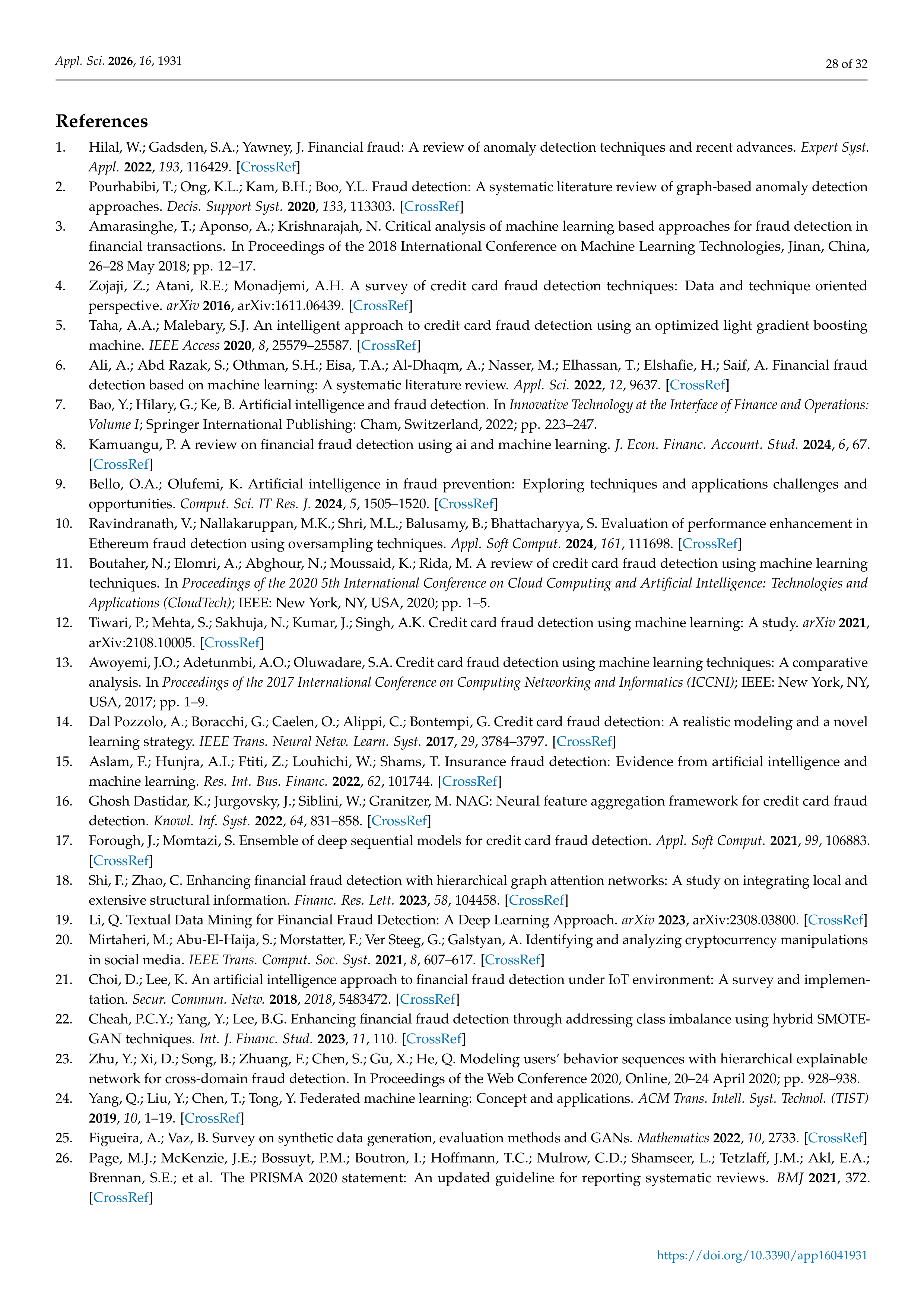
Appl.
Sci.
2026
,
16
, 1931
28 of 32
References
1.
Hilal, W.; Gadsden, S.A.; Yawney, J. Financial fraud:
A review of anomaly detection techniques and recent advances.
Expert Syst.
Appl.
2022
,
193
, 116429.
[
CrossRef
]
2.
Pourhabibi, T.; Ong, K.L.; Kam, B.H.; Boo, Y.L. Fraud detection:
A systematic literature review of graph-based anomaly detection
approaches.
Decis.
Support Syst.
2020
,
133
, 113303.
[
CrossRef
]
3.
Amarasinghe, T.; Aponso, A.; Krishnarajah, N. Critical analysis of machine learning based approaches for fraud detection in
financial transactions.
In Proceedings of the 2018 International Conference on Machine Learning Technologies, Jinan, China,
26–28 May 2018; pp.
12–17.
4.
Zojaji,
Z.;
Atani,
R.E.;
Monadjemi,
A.H.
A
survey
of
credit
card
fraud
detection
techniques:
Data
and
technique
oriented
perspective.
arXiv
2016
, arXiv:1611.06439.
[
CrossRef
]
5.
Taha,
A.A.;
Malebary,
S.J. An intelligent approach to credit card fraud detection using an optimized light gradient boosting
machine.
IEEE Access
2020
,
8
, 25579–25587.
[
CrossRef
]
6.
Ali, A.; Abd Razak, S.; Othman, S.H.; Eisa, T.A.; Al-Dhaqm, A.; Nasser, M.; Elhassan, T.; Elshafie, H.; Saif, A. Financial fraud
detection based on machine learning:
A systematic literature review.
Appl.
Sci.
2022
,
12
, 9637.
[
CrossRef
]
7.
Bao, Y.; Hilary, G.; Ke, B. Artificial intelligence and fraud detection.
In
Innovative Technology at the Interface of Finance and Operations:
Volume I
; Springer International Publishing:
Cham, Switzerland, 2022; pp.
223–247.
8.
Kamuangu, P. A review on financial fraud detection using ai and machine learning.
J. Econ.
Financ.
Account.
Stud.
2024
,
6
, 67.
[
CrossRef
]
9.
Bello,
O.A.;
Olufemi,
K.
Artificial
intelligence
in
fraud
prevention:
Exploring
techniques
and
applications
challenges
and
opportunities.
Comput.
Sci.
IT Res.
J.
2024
,
5
, 1505–1520.
[
CrossRef
]
10.
Ravindranath, V.; Nallakaruppan, M.K.; Shri, M.L.; Balusamy, B.; Bhattacharyya, S. Evaluation of performance enhancement in
Ethereum fraud detection using oversampling techniques.
Appl.
Soft Comput.
2024
,
161
, 111698.
[
CrossRef
]
11.
Boutaher, N.; Elomri, A.; Abghour, N.; Moussaid, K.; Rida, M. A review of credit card fraud detection using machine learning
techniques.
In
Proceedings of the 2020 5th International Conference on Cloud Computing and Artificial Intelligence:
Technologies and
Applications (CloudTech)
; IEEE: New York, NY, USA, 2020; pp.
1–5.
12.
Tiwari, P.; Mehta, S.; Sakhuja, N.; Kumar, J.; Singh, A.K. Credit card fraud detection using machine learning:
A study.
arXiv
2021
,
arXiv:2108.10005.
[
CrossRef
]
13.
Awoyemi, J.O.; Adetunmbi, A.O.; Oluwadare, S.A. Credit card fraud detection using machine learning techniques:
A comparative
analysis.
In
Proceedings of the 2017 International Conference on Computing Networking and Informatics (ICCNI)
; IEEE: New York, NY,
USA, 2017; pp.
1–9.
14.
Dal Pozzolo, A.; Boracchi, G.; Caelen, O.; Alippi, C.; Bontempi, G. Credit card fraud detection:
A realistic modeling and a novel
learning strategy.
IEEE Trans.
Neural Netw.
Learn.
Syst.
2017
,
29
, 3784–3797.
[
CrossRef
]
15.
Aslam, F.;
Hunjra, A.I.;
Ftiti, Z.;
Louhichi, W.;
Shams, T. Insurance fraud detection:
Evidence from artificial intelligence and
machine learning.
Res.
Int.
Bus.
Financ.
2022
,
62
, 101744.
[
CrossRef
]
16.
Ghosh Dastidar, K.; Jurgovsky, J.; Siblini, W.; Granitzer, M. NAG: Neural feature aggregation framework for credit card fraud
detection.
Knowl.
Inf.
Syst.
2022
,
64
, 831–858.
[
CrossRef
]
17.
Forough, J.; Momtazi, S. Ensemble of deep sequential models for credit card fraud detection.
Appl.
Soft Comput.
2021
,
99
, 106883.
[
CrossRef
]
18.
Shi, F.; Zhao, C. Enhancing financial fraud detection with hierarchical graph attention networks:
A study on integrating local and
extensive structural information.
Financ.
Res.
Lett.
2023
,
58
, 104458.
[
CrossRef
]
19.
Li, Q. Textual Data Mining for Financial Fraud Detection:
A Deep Learning Approach.
arXiv
2023
, arXiv:2308.03800.
[
CrossRef
]
20.
Mirtaheri, M.; Abu-El-Haija, S.; Morstatter, F.; Ver Steeg, G.; Galstyan, A. Identifying and analyzing cryptocurrency manipulations
in social media.
IEEE Trans.
Comput.
Soc.
Syst.
2021
,
8
, 607–617.
[
CrossRef
]
21.
Choi, D.; Lee, K. An artificial intelligence approach to financial fraud detection under IoT environment:
A survey and implemen-
tation.
Secur.
Commun.
Netw.
2018
,
2018
, 5483472.
[
CrossRef
]
22.
Cheah, P.C.Y.; Yang, Y.; Lee, B.G. Enhancing financial fraud detection through addressing class imbalance using hybrid SMOTE-
GAN techniques.
Int.
J. Financ.
Stud.
2023
,
11
, 110.
[
CrossRef
]
23.
Zhu, Y.; Xi, D.; Song, B.; Zhuang, F.; Chen, S.; Gu, X.; He, Q. Modeling users’ behavior sequences with hierarchical explainable
network for cross-domain fraud detection.
In Proceedings of the Web Conference 2020, Online, 20–24 April 2020; pp.
928–938.
24.
Yang, Q.; Liu, Y.; Chen, T.; Tong, Y. Federated machine learning:
Concept and applications.
ACM Trans.
Intell.
Syst.
Technol.
(TIST)
2019
,
10
, 1–19.
[
CrossRef
]
25.
Figueira, A.; Vaz, B. Survey on synthetic data generation, evaluation methods and GANs.
Mathematics
2022
,
10
, 2733.
[
CrossRef
]
26.
Page,
M.J.;
McKenzie,
J.E.;
Bossuyt,
P.M.;
Boutron,
I.;
Hoffmann,
T.C.;
Mulrow,
C.D.;
Shamseer,
L.;
Tetzlaff,
J.M.;
Akl,
E.A.;
Brennan,
S.E.;
et
al.
The
PRISMA
2020
statement:
An
updated
guideline
for
reporting
systematic
reviews.
BMJ
2021
,
372.
[
CrossRef
]
https://doi.org/10.3390/app16041931
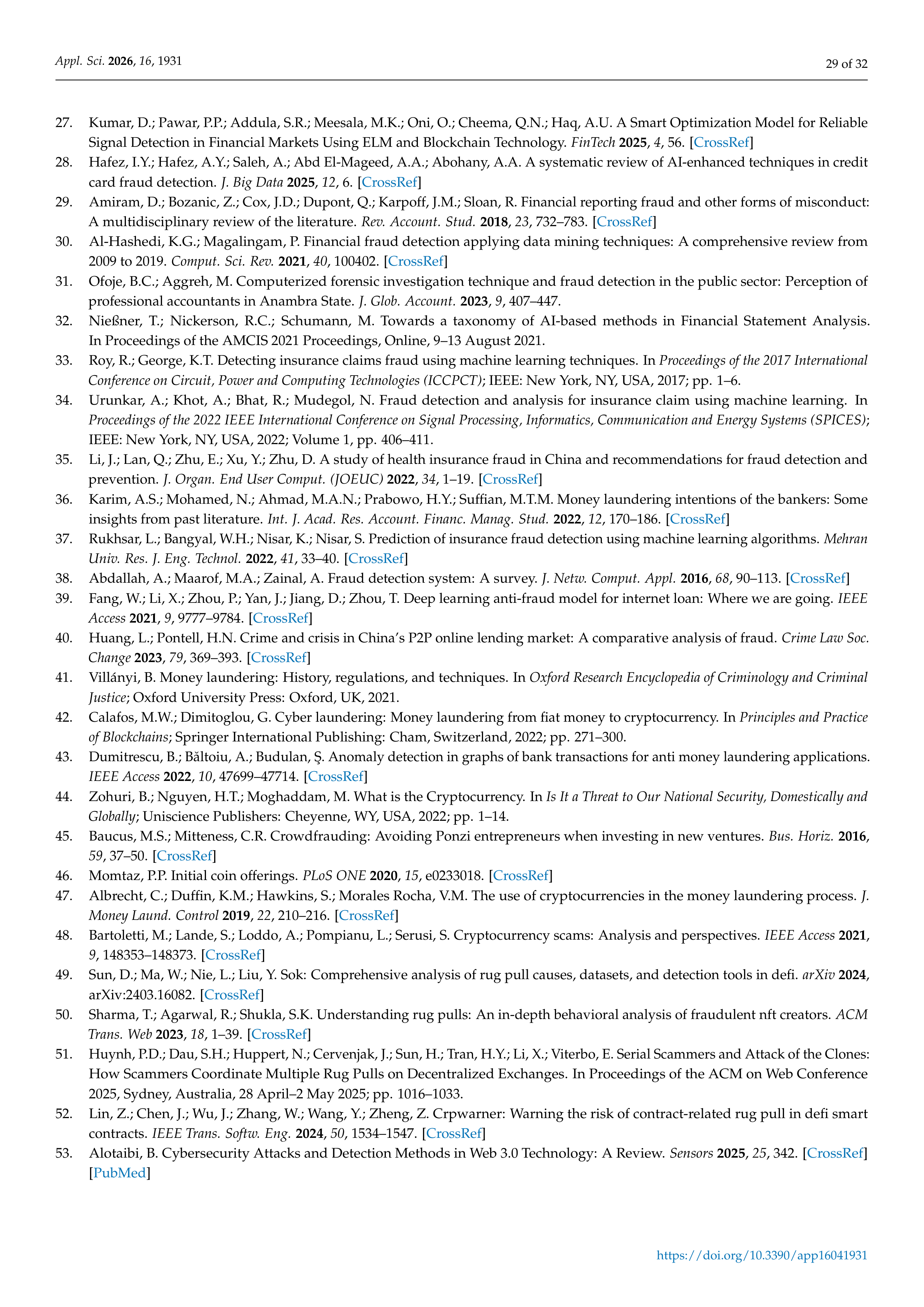
Appl.
Sci.
2026
,
16
, 1931
29 of 32
27.
Kumar, D.; Pawar, P.P.; Addula, S.R.; Meesala, M.K.; Oni, O.; Cheema, Q.N.; Haq, A.U. A Smart Optimization Model for Reliable
Signal Detection in Financial Markets Using ELM and Blockchain Technology.
FinTech
2025
,
4
, 56.
[
CrossRef
]
28.
Hafez, I.Y.; Hafez, A.Y.; Saleh, A.; Abd El-Mageed, A.A.; Abohany, A.A. A systematic review of AI-enhanced techniques in credit
card fraud detection.
J. Big Data
2025
,
12
, 6.
[
CrossRef
]
29.
Amiram, D.; Bozanic, Z.; Cox, J.D.; Dupont, Q.; Karpoff, J.M.; Sloan, R. Financial reporting fraud and other forms of misconduct:
A multidisciplinary review of the literature.
Rev.
Account.
Stud.
2018
,
23
, 732–783.
[
CrossRef
]
30.
Al-Hashedi, K.G.; Magalingam, P. Financial fraud detection applying data mining techniques:
A comprehensive review from
2009 to 2019.
Comput.
Sci.
Rev.
2021
,
40
, 100402.
[
CrossRef
]
31.
Ofoje, B.C.; Aggreh, M. Computerized forensic investigation technique and fraud detection in the public sector:
Perception of
professional accountants in Anambra State.
J. Glob.
Account.
2023
,
9
, 407–447.
32.
Nießner,
T.;
Nickerson,
R.C.;
Schumann,
M.
Towards
a
taxonomy
of
AI-based
methods
in
Financial
Statement
Analysis.
In Proceedings of the AMCIS 2021 Proceedings, Online, 9–13 August 2021.
33.
Roy, R.; George, K.T. Detecting insurance claims fraud using machine learning techniques.
In
Proceedings of the 2017 International
Conference on Circuit, Power and Computing Technologies (ICCPCT)
; IEEE: New York, NY, USA, 2017; pp.
1–6.
34.
Urunkar,
A.;
Khot,
A.;
Bhat,
R.;
Mudegol,
N.
Fraud
detection
and
analysis
for
insurance
claim
using
machine
learning.
In
Proceedings of the 2022 IEEE International Conference on Signal Processing, Informatics, Communication and Energy Systems (SPICES)
;
IEEE: New York, NY, USA, 2022; Volume 1, pp.
406–411.
35.
Li, J.; Lan, Q.; Zhu, E.; Xu, Y.; Zhu, D. A study of health insurance fraud in China and recommendations for fraud detection and
prevention.
J. Organ.
End User Comput.
(JOEUC)
2022
,
34
, 1–19.
[
CrossRef
]
36.
Karim, A.S.; Mohamed, N.; Ahmad, M.A.N.; Prabowo, H.Y.; Suffian, M.T.M. Money laundering intentions of the bankers:
Some
insights from past literature.
Int.
J. Acad.
Res.
Account.
Financ.
Manag.
Stud.
2022
,
12
, 170–186.
[
CrossRef
]
37.
Rukhsar, L.; Bangyal, W.H.; Nisar, K.; Nisar, S. Prediction of insurance fraud detection using machine learning algorithms.
Mehran
Univ.
Res.
J. Eng.
Technol.
2022
,
41
, 33–40.
[
CrossRef
]
38.
Abdallah, A.; Maarof, M.A.; Zainal, A. Fraud detection system:
A survey.
J. Netw.
Comput.
Appl.
2016
,
68
, 90–113.
[
CrossRef
]
39.
Fang, W.; Li, X.; Zhou, P.; Yan, J.; Jiang, D.; Zhou, T. Deep learning anti-fraud model for internet loan:
Where we are going.
IEEE
Access
2021
,
9
, 9777–9784.
[
CrossRef
]
40.
Huang, L.; Pontell, H.N. Crime and crisis in China’s P2P online lending market:
A comparative analysis of fraud.
Crime Law Soc.
Change
2023
,
79
, 369–393.
[
CrossRef
]
41.
Villányi, B. Money laundering:
History, regulations, and techniques.
In
Oxford Research Encyclopedia of Criminology and Criminal
Justice
; Oxford University Press:
Oxford, UK, 2021.
42.
Calafos, M.W.; Dimitoglou, G. Cyber laundering:
Money laundering from fiat money to cryptocurrency.
In
Principles and Practice
of Blockchains
; Springer International Publishing:
Cham, Switzerland, 2022; pp.
271–300.
43.
Dumitrescu, B.; B
ă
ltoiu, A.; Budulan,
¸S. Anomaly detection in graphs of bank transactions for anti money laundering applications.
IEEE Access
2022
,
10
, 47699–47714.
[
CrossRef
]
44.
Zohuri, B.; Nguyen, H.T.; Moghaddam, M. What is the Cryptocurrency.
In
Is It a Threat to Our National Security, Domestically and
Globally
; Uniscience Publishers:
Cheyenne, WY, USA, 2022; pp.
1–14.
45.
Baucus, M.S.; Mitteness, C.R. Crowdfrauding:
Avoiding Ponzi entrepreneurs when investing in new ventures.
Bus.
Horiz.
2016
,
59
, 37–50.
[
CrossRef
]
46.
Momtaz, P.P. Initial coin offerings.
PLoS ONE
2020
,
15
, e0233018.
[
CrossRef
]
47.
Albrecht, C.; Duffin, K.M.; Hawkins, S.; Morales Rocha, V.M. The use of cryptocurrencies in the money laundering process.
J.
Money Laund.
Control
2019
,
22
, 210–216.
[
CrossRef
]
48.
Bartoletti, M.; Lande, S.; Loddo, A.; Pompianu, L.; Serusi, S. Cryptocurrency scams:
Analysis and perspectives.
IEEE Access
2021
,
9
, 148353–148373.
[
CrossRef
]
49.
Sun, D.; Ma, W.; Nie, L.; Liu, Y. Sok:
Comprehensive analysis of rug pull causes, datasets, and detection tools in defi.
arXiv
2024
,
arXiv:2403.16082.
[
CrossRef
]
50.
Sharma, T.; Agarwal, R.; Shukla, S.K. Understanding rug pulls:
An in-depth behavioral analysis of fraudulent nft creators.
ACM
Trans.
Web
2023
,
18
, 1–39.
[
CrossRef
]
51.
Huynh, P.D.; Dau, S.H.; Huppert, N.; Cervenjak, J.; Sun, H.; Tran, H.Y.; Li, X.; Viterbo, E. Serial Scammers and Attack of the Clones:
How Scammers Coordinate Multiple Rug Pulls on Decentralized Exchanges.
In Proceedings of the ACM on Web Conference
2025, Sydney, Australia, 28 April–2 May 2025; pp.
1016–1033.
52.
Lin, Z.; Chen, J.; Wu, J.; Zhang, W.; Wang, Y.; Zheng, Z. Crpwarner:
Warning the risk of contract-related rug pull in defi smart
contracts.
IEEE Trans.
Softw.
Eng.
2024
,
50
, 1534–1547.
[
CrossRef
]
53.
Alotaibi, B. Cybersecurity Attacks and Detection Methods in Web 3.0 Technology:
A Review.
Sensors
2025
,
25
, 342.
[
CrossRef
]
[
PubMed
]
https://doi.org/10.3390/app16041931
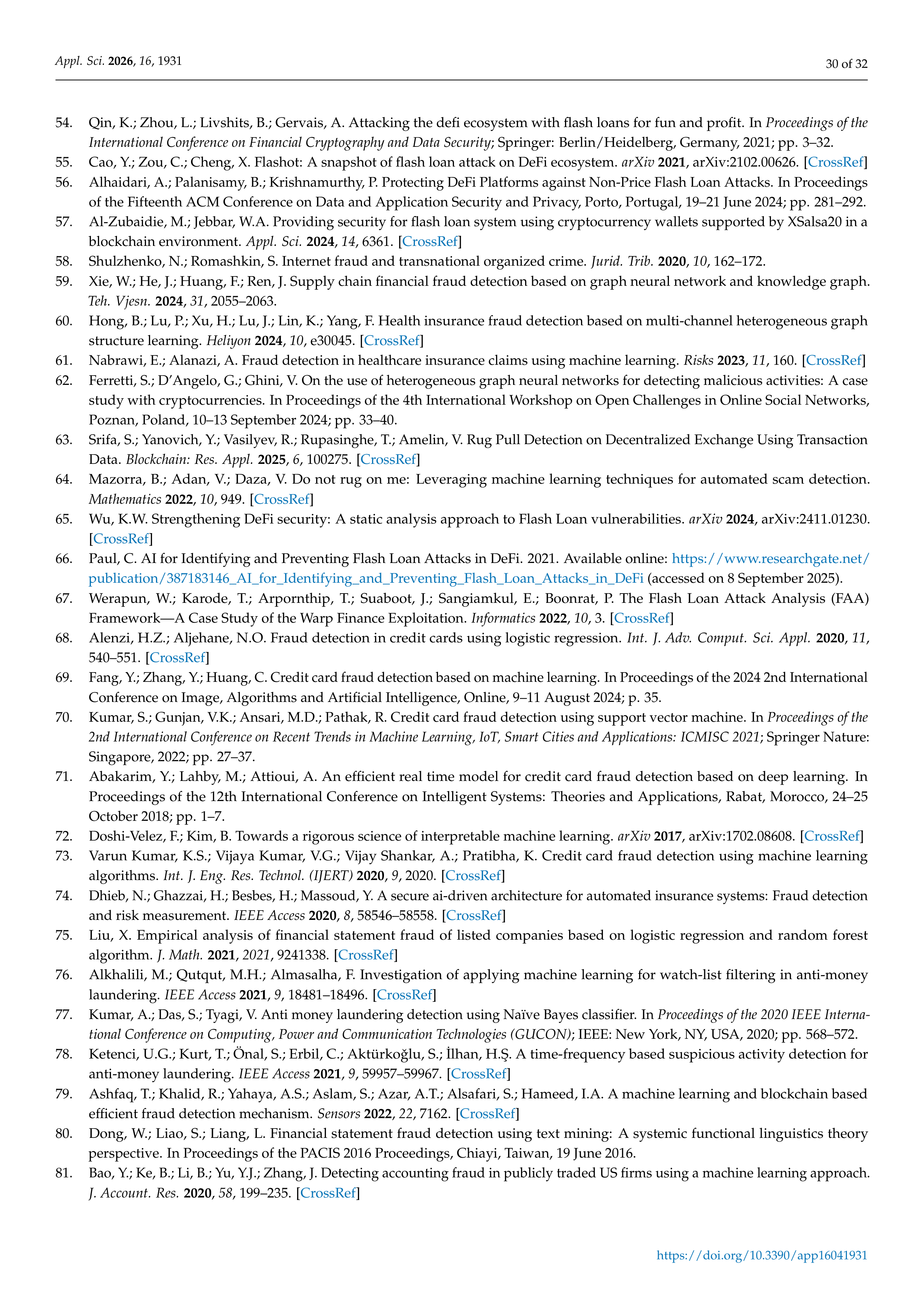
Appl.
Sci.
2026
,
16
, 1931
30 of 32
54.
Qin, K.; Zhou, L.; Livshits, B.; Gervais, A. Attacking the defi ecosystem with flash loans for fun and profit.
In
Proceedings of the
International Conference on Financial Cryptography and Data Security
; Springer:
Berlin/Heidelberg, Germany, 2021; pp.
3–32.
55.
Cao, Y.; Zou, C.; Cheng, X. Flashot:
A snapshot of flash loan attack on DeFi ecosystem.
arXiv
2021
, arXiv:2102.00626.
[
CrossRef
]
56.
Alhaidari, A.; Palanisamy, B.; Krishnamurthy, P. Protecting DeFi Platforms against Non-Price Flash Loan Attacks.
In Proceedings
of the Fifteenth ACM Conference on Data and Application Security and Privacy, Porto, Portugal, 19–21 June 2024; pp.
281–292.
57.
Al-Zubaidie, M.; Jebbar, W.A. Providing security for flash loan system using cryptocurrency wallets supported by XSalsa20 in a
blockchain environment.
Appl.
Sci.
2024
,
14
, 6361.
[
CrossRef
]
58.
Shulzhenko, N.; Romashkin, S. Internet fraud and transnational organized crime.
Jurid.
Trib.
2020
,
10
, 162–172.
59.
Xie, W.; He, J.; Huang, F.; Ren, J. Supply chain financial fraud detection based on graph neural network and knowledge graph.
Teh.
Vjesn.
2024
,
31
, 2055–2063.
60.
Hong, B.; Lu, P.; Xu, H.; Lu, J.; Lin, K.; Yang, F. Health insurance fraud detection based on multi-channel heterogeneous graph
structure learning.
Heliyon
2024
,
10
, e30045.
[
CrossRef
]
61.
Nabrawi, E.; Alanazi, A. Fraud detection in healthcare insurance claims using machine learning.
Risks
2023
,
11
, 160.
[
CrossRef
]
62.
Ferretti, S.; D’Angelo, G.; Ghini, V. On the use of heterogeneous graph neural networks for detecting malicious activities:
A case
study with cryptocurrencies.
In Proceedings of the 4th International Workshop on Open Challenges in Online Social Networks,
Poznan, Poland, 10–13 September 2024; pp.
33–40.
63.
Srifa, S.; Yanovich, Y.; Vasilyev, R.; Rupasinghe, T.; Amelin, V. Rug Pull Detection on Decentralized Exchange Using Transaction
Data.
Blockchain:
Res.
Appl.
2025
,
6
, 100275.
[
CrossRef
]
64.
Mazorra,
B.;
Adan,
V.;
Daza,
V.
Do
not
rug
on
me:
Leveraging
machine
learning
techniques
for
automated
scam
detection.
Mathematics
2022
,
10
, 949.
[
CrossRef
]
65.
Wu, K.W. Strengthening DeFi security:
A static analysis approach to Flash Loan vulnerabilities.
arXiv
2024
, arXiv:2411.01230.
[
CrossRef
]
66.
Paul, C. AI for Identifying and Preventing Flash Loan Attacks in DeFi.
2021.
Available online:
https://www.researchgate.net/
publication/387183146_AI_for_Identifying_and_Preventing_Flash_Loan_Attacks_in_DeFi
(accessed on 8 September 2025).
67.
Werapun,
W.;
Karode,
T.;
Arpornthip,
T.;
Suaboot,
J.;
Sangiamkul,
E.;
Boonrat,
P.
The
Flash
Loan
Attack
Analysis
(FAA)
Framework—A Case Study of the Warp Finance Exploitation.
Informatics
2022
,
10
, 3.
[
CrossRef
]
68.
Alenzi, H.Z.; Aljehane, N.O. Fraud detection in credit cards using logistic regression.
Int.
J. Adv.
Comput.
Sci.
Appl.
2020
,
11
,
540–551.
[
CrossRef
]
69.
Fang, Y.; Zhang, Y.; Huang, C. Credit card fraud detection based on machine learning.
In Proceedings of the 2024 2nd International
Conference on Image, Algorithms and Artificial Intelligence, Online, 9–11 August 2024; p.
35.
70.
Kumar, S.; Gunjan, V.K.; Ansari, M.D.; Pathak, R. Credit card fraud detection using support vector machine.
In
Proceedings of the
2nd International Conference on Recent Trends in Machine Learning, IoT, Smart Cities and Applications:
ICMISC 2021
; Springer Nature:
Singapore, 2022; pp.
27–37.
71.
Abakarim,
Y.;
Lahby,
M.;
Attioui,
A. An efficient real time model for credit card fraud detection based on deep learning.
In
Proceedings of the 12th International Conference on Intelligent Systems:
Theories and Applications,
Rabat,
Morocco,
24–25
October 2018; pp.
1–7.
72.
Doshi-Velez, F.; Kim, B. Towards a rigorous science of interpretable machine learning.
arXiv
2017
, arXiv:1702.08608.
[
CrossRef
]
73.
Varun
Kumar,
K.S.;
Vijaya
Kumar,
V.G.;
Vijay
Shankar,
A.;
Pratibha,
K.
Credit
card
fraud
detection
using
machine
learning
algorithms.
Int.
J. Eng.
Res.
Technol.
(IJERT)
2020
,
9
, 2020.
[
CrossRef
]
74.
Dhieb, N.; Ghazzai, H.; Besbes, H.; Massoud, Y. A secure ai-driven architecture for automated insurance systems:
Fraud detection
and risk measurement.
IEEE Access
2020
,
8
, 58546–58558.
[
CrossRef
]
75.
Liu,
X.
Empirical
analysis
of
financial
statement
fraud
of
listed
companies
based
on
logistic
regression
and
random
forest
algorithm.
J. Math.
2021
,
2021
, 9241338.
[
CrossRef
]
76.
Alkhalili,
M.;
Qutqut,
M.H.;
Almasalha,
F. Investigation of applying machine learning for watch-list filtering in anti-money
laundering.
IEEE Access
2021
,
9
, 18481–18496.
[
CrossRef
]
77.
Kumar, A.; Das, S.; Tyagi, V. Anti money laundering detection using Naïve Bayes classifier.
In
Proceedings of the 2020 IEEE Interna-
tional Conference on Computing, Power and Communication Technologies (GUCON)
; IEEE: New York, NY, USA, 2020; pp.
568–572.
78.
Ketenci, U.G.; Kurt, T.; Önal, S.; Erbil, C.; Aktürko
ˇ
glu, S.;
˙
Ilhan, H.¸S. A time-frequency based suspicious activity detection for
anti-money laundering.
IEEE Access
2021
,
9
, 59957–59967.
[
CrossRef
]
79.
Ashfaq, T.; Khalid, R.; Yahaya, A.S.; Aslam, S.; Azar, A.T.; Alsafari, S.; Hameed, I.A. A machine learning and blockchain based
efficient fraud detection mechanism.
Sensors
2022
,
22
, 7162.
[
CrossRef
]
80.
Dong, W.;
Liao, S.;
Liang, L. Financial statement fraud detection using text mining:
A systemic functional linguistics theory
perspective.
In Proceedings of the PACIS 2016 Proceedings, Chiayi, Taiwan, 19 June 2016.
81.
Bao, Y.; Ke, B.; Li, B.; Yu, Y.J.; Zhang, J. Detecting accounting fraud in publicly traded US firms using a machine learning approach.
J. Account.
Res.
2020
,
58
, 199–235.
[
CrossRef
]
https://doi.org/10.3390/app16041931
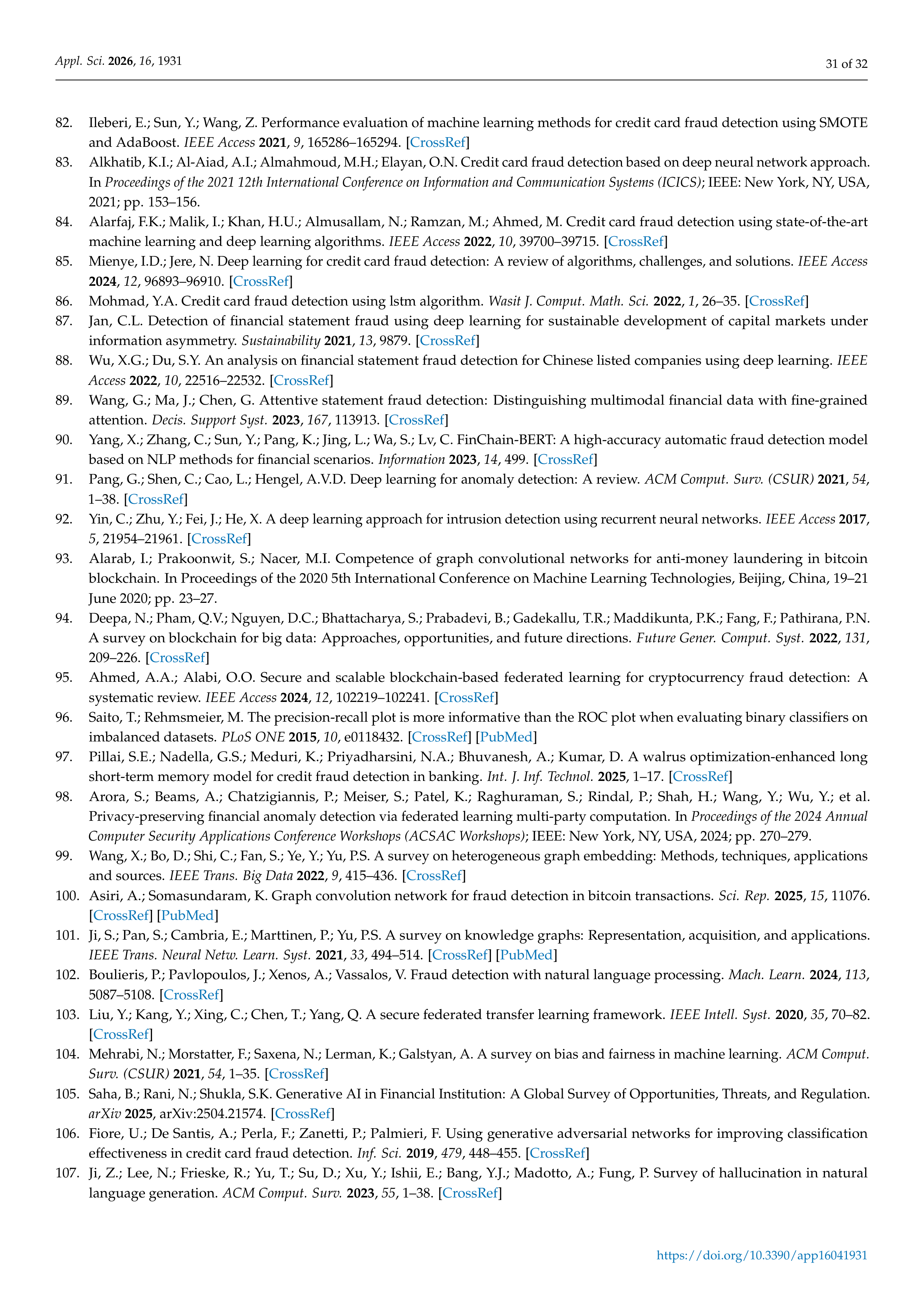
Appl.
Sci.
2026
,
16
, 1931
31 of 32
82.
Ileberi, E.; Sun, Y.; Wang, Z. Performance evaluation of machine learning methods for credit card fraud detection using SMOTE
and AdaBoost.
IEEE Access
2021
,
9
, 165286–165294.
[
CrossRef
]
83.
Alkhatib, K.I.; Al-Aiad, A.I.; Almahmoud, M.H.; Elayan, O.N. Credit card fraud detection based on deep neural network approach.
In
Proceedings of the 2021 12th International Conference on Information and Communication Systems (ICICS)
; IEEE: New York, NY, USA,
2021; pp.
153–156.
84.
Alarfaj, F.K.; Malik, I.; Khan, H.U.; Almusallam, N.; Ramzan, M.; Ahmed, M. Credit card fraud detection using state-of-the-art
machine learning and deep learning algorithms.
IEEE Access
2022
,
10
, 39700–39715.
[
CrossRef
]
85.
Mienye, I.D.; Jere, N. Deep learning for credit card fraud detection:
A review of algorithms, challenges, and solutions.
IEEE Access
2024
,
12
, 96893–96910.
[
CrossRef
]
86.
Mohmad, Y.A. Credit card fraud detection using lstm algorithm.
Wasit J. Comput.
Math.
Sci.
2022
,
1
, 26–35.
[
CrossRef
]
87.
Jan,
C.L.
Detection
of
financial
statement
fraud
using
deep
learning
for
sustainable
development
of
capital
markets
under
information asymmetry.
Sustainability
2021
,
13
, 9879.
[
CrossRef
]
88.
Wu, X.G.; Du, S.Y. An analysis on financial statement fraud detection for Chinese listed companies using deep learning.
IEEE
Access
2022
,
10
, 22516–22532.
[
CrossRef
]
89.
Wang, G.;
Ma, J.;
Chen, G. Attentive statement fraud detection:
Distinguishing multimodal financial data with fine-grained
attention.
Decis.
Support Syst.
2023
,
167
, 113913.
[
CrossRef
]
90.
Yang, X.; Zhang, C.; Sun, Y.; Pang, K.; Jing, L.; Wa, S.; Lv, C. FinChain-BERT: A high-accuracy automatic fraud detection model
based on NLP methods for financial scenarios.
Information
2023
,
14
, 499.
[
CrossRef
]
91.
Pang, G.; Shen, C.; Cao, L.; Hengel, A.V.D. Deep learning for anomaly detection:
A review.
ACM Comput.
Surv.
(CSUR)
2021
,
54
,
1–38.
[
CrossRef
]
92.
Yin, C.; Zhu, Y.; Fei, J.; He, X. A deep learning approach for intrusion detection using recurrent neural networks.
IEEE Access
2017
,
5
, 21954–21961.
[
CrossRef
]
93.
Alarab,
I.;
Prakoonwit,
S.;
Nacer,
M.I.
Competence
of
graph
convolutional
networks
for
anti-money
laundering
in
bitcoin
blockchain.
In Proceedings of the 2020 5th International Conference on Machine Learning Technologies, Beijing, China, 19–21
June 2020; pp.
23–27.
94.
Deepa, N.; Pham, Q.V.; Nguyen, D.C.; Bhattacharya, S.; Prabadevi, B.; Gadekallu, T.R.; Maddikunta, P.K.; Fang, F.; Pathirana, P.N.
A survey on blockchain for big data:
Approaches, opportunities, and future directions.
Future Gener.
Comput.
Syst.
2022
,
131
,
209–226.
[
CrossRef
]
95.
Ahmed,
A.A.;
Alabi,
O.O.
Secure
and
scalable
blockchain-based
federated
learning
for
cryptocurrency
fraud
detection:
A
systematic review.
IEEE Access
2024
,
12
, 102219–102241.
[
CrossRef
]
96.
Saito, T.; Rehmsmeier, M. The precision-recall plot is more informative than the ROC plot when evaluating binary classifiers on
imbalanced datasets.
PLoS ONE
2015
,
10
, e0118432.
[
CrossRef
] [
PubMed
]
97.
Pillai, S.E.;
Nadella, G.S.;
Meduri, K.;
Priyadharsini, N.A.;
Bhuvanesh, A.;
Kumar, D. A walrus optimization-enhanced long
short-term memory model for credit fraud detection in banking.
Int.
J. Inf.
Technol.
2025
, 1–17.
[
CrossRef
]
98.
Arora,
S.;
Beams,
A.;
Chatzigiannis,
P.;
Meiser,
S.;
Patel,
K.;
Raghuraman,
S.;
Rindal,
P.;
Shah,
H.;
Wang,
Y.;
Wu,
Y.;
et
al.
Privacy-preserving financial anomaly detection via federated learning multi-party computation.
In
Proceedings of the 2024 Annual
Computer Security Applications Conference Workshops (ACSAC Workshops)
; IEEE: New York, NY, USA, 2024; pp.
270–279.
99.
Wang, X.; Bo, D.; Shi, C.; Fan, S.; Ye, Y.; Yu, P.S. A survey on heterogeneous graph embedding:
Methods, techniques, applications
and sources.
IEEE Trans.
Big Data
2022
,
9
, 415–436.
[
CrossRef
]
100.
Asiri, A.; Somasundaram, K. Graph convolution network for fraud detection in bitcoin transactions.
Sci.
Rep.
2025
,
15
, 11076.
[
CrossRef
] [
PubMed
]
101.
Ji, S.; Pan, S.; Cambria, E.; Marttinen, P.; Yu, P.S. A survey on knowledge graphs:
Representation, acquisition, and applications.
IEEE Trans.
Neural Netw.
Learn.
Syst.
2021
,
33
, 494–514.
[
CrossRef
] [
PubMed
]
102.
Boulieris, P.; Pavlopoulos, J.; Xenos, A.; Vassalos, V. Fraud detection with natural language processing.
Mach.
Learn.
2024
,
113
,
5087–5108.
[
CrossRef
]
103.
Liu, Y.; Kang, Y.; Xing, C.; Chen, T.; Yang, Q. A secure federated transfer learning framework.
IEEE Intell.
Syst.
2020
,
35
, 70–82.
[
CrossRef
]
104.
Mehrabi, N.; Morstatter, F.; Saxena, N.; Lerman, K.; Galstyan, A. A survey on bias and fairness in machine learning.
ACM Comput.
Surv.
(CSUR)
2021
,
54
, 1–35.
[
CrossRef
]
105.
Saha, B.; Rani, N.; Shukla, S.K. Generative AI in Financial Institution:
A Global Survey of Opportunities, Threats, and Regulation.
arXiv
2025
, arXiv:2504.21574.
[
CrossRef
]
106.
Fiore,
U.;
De Santis,
A.;
Perla,
F.;
Zanetti,
P.;
Palmieri,
F. Using generative adversarial networks for improving classification
effectiveness in credit card fraud detection.
Inf.
Sci.
2019
,
479
, 448–455.
[
CrossRef
]
107.
Ji,
Z.;
Lee,
N.;
Frieske,
R.;
Yu,
T.;
Su,
D.;
Xu,
Y.;
Ishii,
E.;
Bang,
Y.J.;
Madotto,
A.;
Fung,
P. Survey of hallucination in natural
language generation.
ACM Comput.
Surv.
2023
,
55
, 1–38.
[
CrossRef
]
https://doi.org/10.3390/app16041931
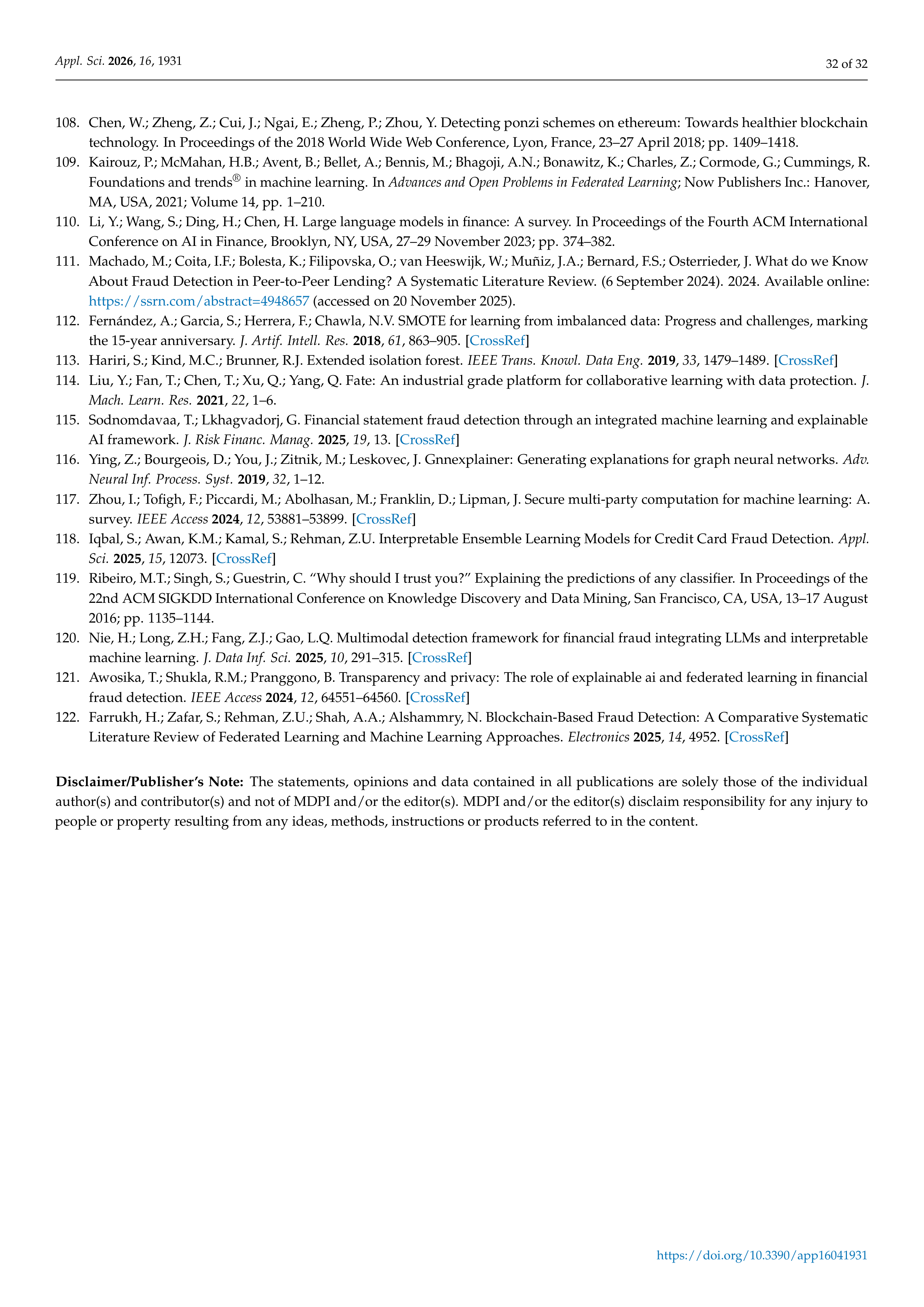
Appl.
Sci.
2026
,
16
, 1931
32 of 32
108.
Chen, W.; Zheng, Z.; Cui, J.; Ngai, E.; Zheng, P.; Zhou, Y. Detecting ponzi schemes on ethereum:
Towards healthier blockchain
technology.
In Proceedings of the 2018 World Wide Web Conference, Lyon, France, 23–27 April 2018; pp.
1409–1418.
109.
Kairouz, P.; McMahan, H.B.; Avent, B.; Bellet, A.; Bennis, M.; Bhagoji, A.N.; Bonawitz, K.; Charles, Z.; Cormode, G.; Cummings, R.
Foundations and trends
®
in machine learning.
In
Advances and Open Problems in Federated Learning
; Now Publishers Inc.:
Hanover,
MA, USA, 2021; Volume 14, pp.
1–210.
110.
Li, Y.; Wang, S.; Ding, H.; Chen, H. Large language models in finance:
A survey.
In Proceedings of the Fourth ACM International
Conference on AI in Finance, Brooklyn, NY, USA, 27–29 November 2023; pp.
374–382.
111.
Machado, M.; Coita, I.F.; Bolesta, K.; Filipovska, O.; van Heeswijk, W.; Muñiz, J.A.; Bernard, F.S.; Osterrieder, J. What do we Know
About Fraud Detection in Peer-to-Peer Lending?
A Systematic Literature Review.
(6 September 2024).
2024.
Available online:
https://ssrn.com/abstract=4948657
(accessed on 20 November 2025).
112.
Fernández, A.; Garcia, S.; Herrera, F.; Chawla, N.V. SMOTE for learning from imbalanced data:
Progress and challenges, marking
the 15-year anniversary.
J. Artif.
Intell.
Res.
2018
,
61
, 863–905.
[
CrossRef
]
113.
Hariri, S.; Kind, M.C.; Brunner, R.J. Extended isolation forest.
IEEE Trans.
Knowl.
Data Eng.
2019
,
33
, 1479–1489.
[
CrossRef
]
114.
Liu, Y.; Fan, T.; Chen, T.; Xu, Q.; Yang, Q. Fate:
An industrial grade platform for collaborative learning with data protection.
J.
Mach.
Learn.
Res.
2021
,
22
, 1–6.
115.
Sodnomdavaa, T.; Lkhagvadorj, G. Financial statement fraud detection through an integrated machine learning and explainable
AI framework.
J. Risk Financ.
Manag.
2025
,
19
, 13.
[
CrossRef
]
116.
Ying, Z.; Bourgeois, D.; You, J.; Zitnik, M.; Leskovec, J. Gnnexplainer:
Generating explanations for graph neural networks.
Adv.
Neural Inf.
Process.
Syst.
2019
,
32
, 1–12.
117.
Zhou, I.; Tofigh, F.; Piccardi, M.; Abolhasan, M.; Franklin, D.; Lipman, J. Secure multi-party computation for machine learning:
A.
survey.
IEEE Access
2024
,
12
, 53881–53899.
[
CrossRef
]
118.
Iqbal, S.; Awan, K.M.; Kamal, S.; Rehman, Z.U. Interpretable Ensemble Learning Models for Credit Card Fraud Detection.
Appl.
Sci.
2025
,
15
, 12073.
[
CrossRef
]
119.
Ribeiro, M.T.; Singh, S.; Guestrin, C. “Why should I trust you?” Explaining the predictions of any classifier.
In Proceedings of the
22nd ACM SIGKDD International Conference on Knowledge Discovery and Data Mining, San Francisco, CA, USA, 13–17 August
2016; pp.
1135–1144.
120.
Nie, H.; Long, Z.H.; Fang, Z.J.; Gao, L.Q. Multimodal detection framework for financial fraud integrating LLMs and interpretable
machine learning.
J. Data Inf.
Sci.
2025
,
10
, 291–315.
[
CrossRef
]
121.
Awosika, T.; Shukla, R.M.; Pranggono, B. Transparency and privacy:
The role of explainable ai and federated learning in financial
fraud detection.
IEEE Access
2024
,
12
, 64551–64560.
[
CrossRef
]
122.
Farrukh, H.; Zafar, S.; Rehman, Z.U.; Shah, A.A.; Alshammry, N. Blockchain-Based Fraud Detection:
A Comparative Systematic
Literature Review of Federated Learning and Machine Learning Approaches.
Electronics
2025
,
14
, 4952.
[
CrossRef
]
Disclaimer/Publisher’s
Note:
The
statements,
opinions
and
data
contained
in
all
publications
are
solely
those
of
the
individual
author(s) and contributor(s) and not of MDPI and/or the editor(s).
MDPI and/or the editor(s) disclaim responsibility for any injury to
people or property resulting from any ideas, methods, instructions or products referred to in the content.
https://doi.org/10.3390/app16041931