Academic Editor: Yunchao Tang
Received: 1 June 2025
Revised: 22 June 2025
Accepted: 3 July 2025
Published: 7 July 2025
Citation:
Ren, Z.; Kim, J.I. The Role of
AI in On-Site Construction Robotics: A
State-of-the-Art Review Using the
Sense–Think–Act Framework.
Buildings
2025
,
15
, 2374.
https://
doi.org/10.3390/buildings15132374
Copyright:
© 2025 by the authors.
Licensee MDPI, Basel, Switzerland.
This article is an open access article
distributed under the terms and
conditions of the Creative Commons
Attribution (CC BY) license
(https://creativecommons.org/
licenses/by/4.0/).
Systematic Review
The Role of AI in On-Site Construction Robotics:
A State-of-
the-Art Review Using the Sense–Think–Act Framework
Zhihao Ren
1
and Jung In Kim
2,
*
1
Department of Architecture and Civil Engineering, City University of Hong Kong, Kowloon,
Hong Kong SAR, China; z.ren@my.cityu.edu.hk
2
School of Civil and Environmental Engineering, Kookmin University, Seoul 02707, Republic of Korea
*
Correspondence:
jikim07@kookmin.ac.kr
Abstract
The construction sector is confronted with significant challenges, such as reduced produc-
tivity, high injury rates, and labor deficits, driving research into autonomous robotics as
a viable solution.
This study delivers a comprehensive review of recent advancements in
AI-driven autonomous construction robotics, organized within the sense–think–act (STA)
framework.
A rigorous bibliometric analysis of 319 selected publications from 2015 to 2024
highlights
key
research
trends
and
notable
contributors.
A
systematic
content
analysis
elaborates on advancements in each STA component, including technologies for perception
and environmental understanding, decision-making algorithms for reasoning and planning,
and varied actuation methods addressing scale and collaborative robotics.
The study also
explores challenges such as environmental unpredictability, specialized task demands, and
structural safety concerns.
Finally, it underscores future research priorities, focusing on
balanced robotic system design, dataset standardization, domain-specific knowledge incor-
poration, and enhanced robustness to support the broader implementation of autonomous
construction robotics.
Keywords:
construction robotics; construction automation; artificial intelligence; sense–
think–act; literature review
1.
Introduction
1.1.
Background
The construction sector is marked by a substantial dependence on a human workforce,
an
elevated
incidence
of
occupational
accidents
and
deaths,
and
sluggish
productivity
growth compared to other industries over recent decades [
1
,
2
].
With the global challenges
such as climate change, an aging labor pool, and a scarcity of qualified workers, conven-
tional building practices struggle to address the rising demands for productivity, quality,
safety,
and
environmental
sustainability [
3
].
To counter
these
challenges,
significant ef-
forts
have
been
directed
toward
the
development
of
on-site
robotic
systems
capable
of
independently performing tasks in hazardous construction settings, thereby reducing the
physical burden and risks borne by human workers.
Evidence from prior research indicates
that
autonomous
construction
robotics
can
decrease
repetitive
on-site
labor
by
25%
to
90% and reduce exposure to dangerous activities by 72% while concurrently improving
precision, cost-effectiveness, and adherence to project timelines [
4
–
6
].
The incorporation of
AI and autonomous robotic systems plays an essential role in modernizing construction
methodologies and reshaping construction practices.
Buildings
2025
,
15
, 2374
https://doi.org/10.3390/buildings15132374
Buildings
2025
,
15
, 2374
2 of 30
1.2.
Role of the Sense–Think–Act Framework
In
recent
years,
AI-driven
on-site
construction
robotics
has
attracted
considerable
attention
across
multiple academic
disciplines.
Central
to the
functionality
of these
au-
tonomous
systems
are
three
core
technological
components:
sense,
think,
and
act
[
7
,
8
].
The “sense” component enables robots to interpret their surroundings and acquire task-
relevant data (e.g., force feedback when performing pick-and-place tasks [
9
]) using tools
like visual imaging devices [
10
–
13
], light detection and ranging (LiDAR) systems [
14
,
15
],
inertial
measurement
unit
(IMU)
sensors,
and
other
measurement
instruments
[
16
–
19
].
This
information
includes
visual
depictions,
spatial
coordinates,
distance
metrics,
and
additional data influencing operational performance.
The “think” component leverages
AI algorithms and data repositories to process this information and generate decisions.
For instance, advanced machine learning (ML) techniques allow robots to detect and cat-
egorize workers [
20
], machinery [
21
], various types of materials [
22
,
23
], and tools [
24
] as
they work, while navigation algorithms determine efficient pathways, avoiding obstacles
and
prioritizing
safety
[
25
–
28
].
Finally,
the
“act”
component
translates
these
decisions
into physical outcomes through mechanical systems, including articulated limbs [
29
–
31
],
guided tracks [
32
], suspension mechanisms [
33
,
34
], rotors [
16
,
35
–
37
], robotic arms [
38
–
40
],
or
heavy
machinery-like
cranes
[
41
–
43
].
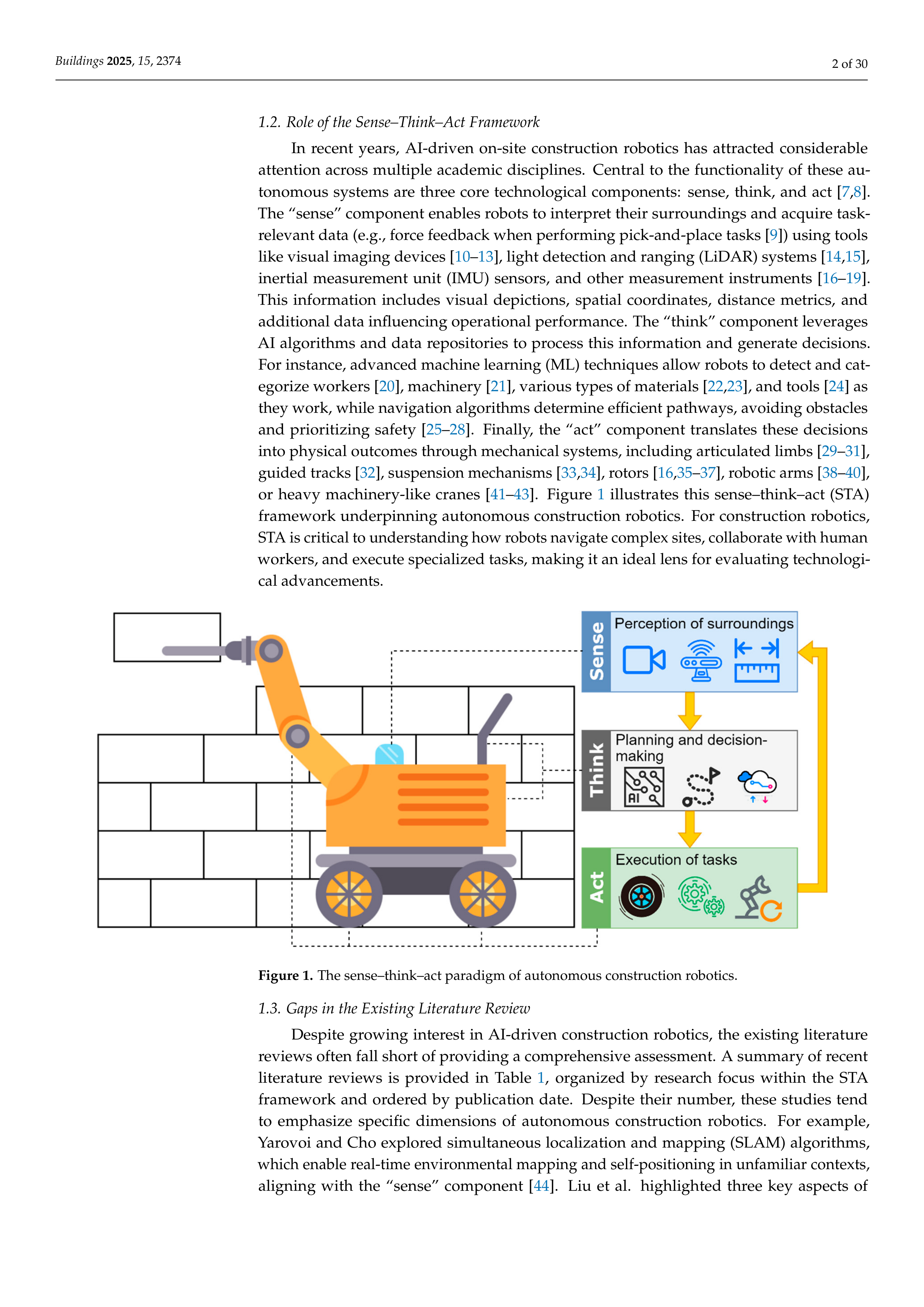
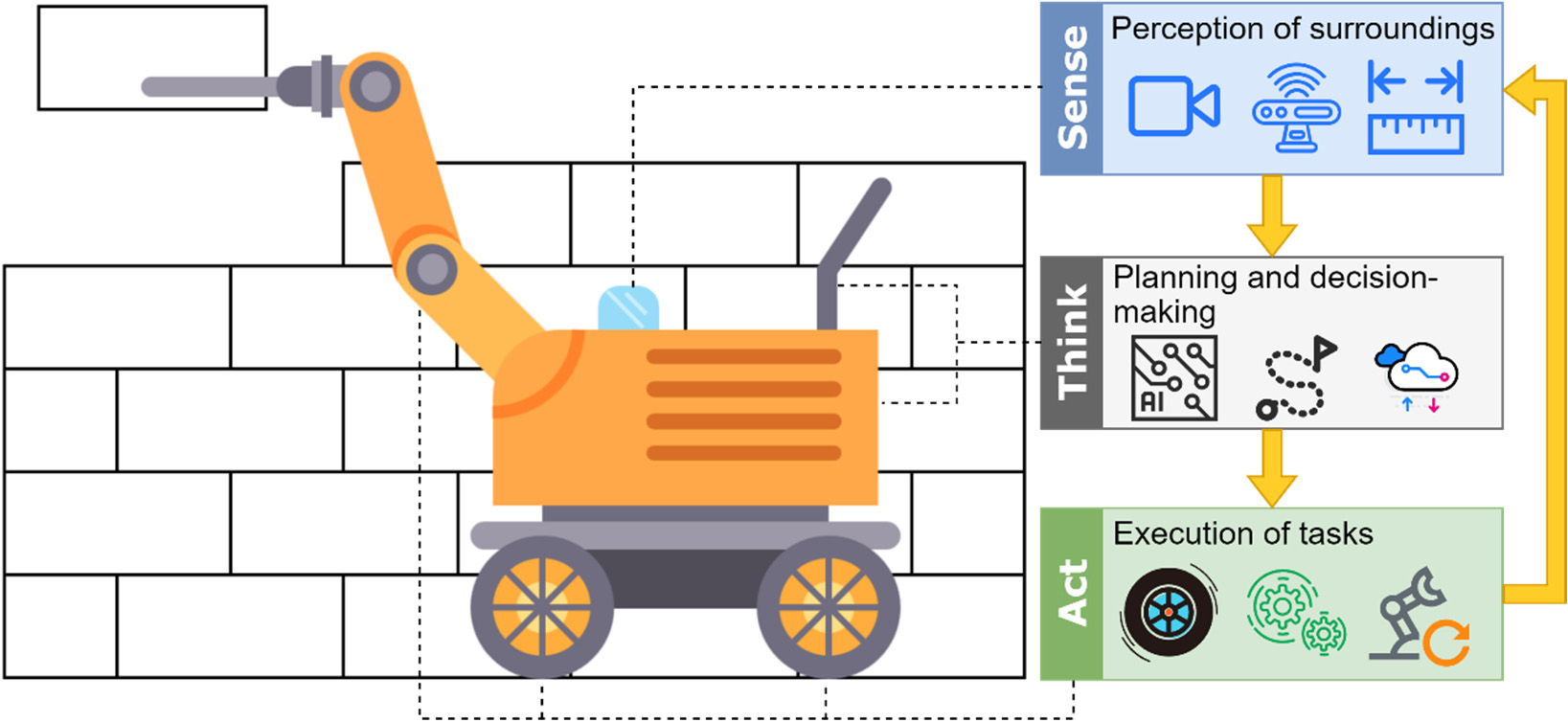
Figure
1
illustrates
this
sense–think–act
(STA)
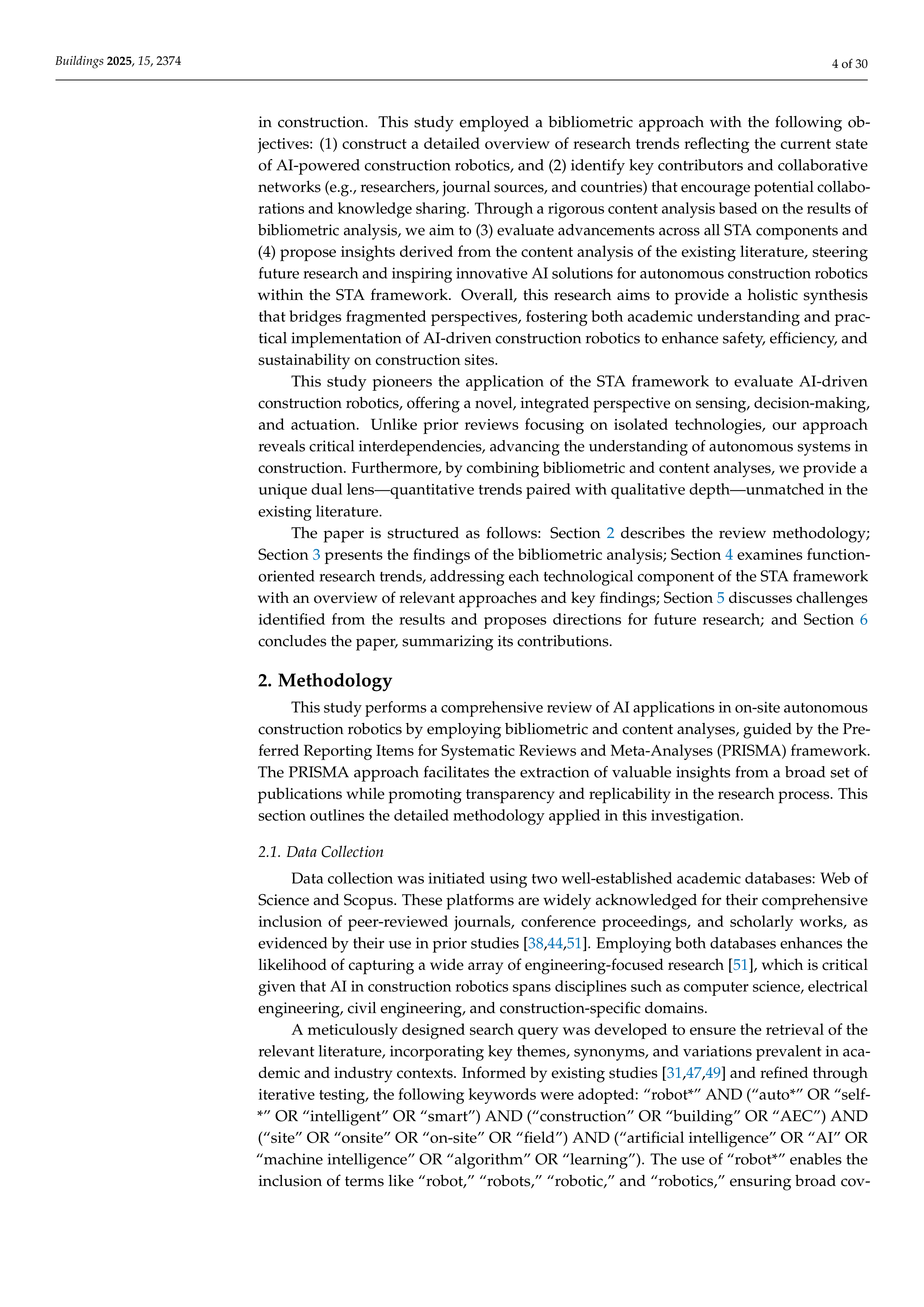
framework underpinning autonomous construction robotics.
For construction robotics,
STA is critical to understanding how robots navigate complex sites, collaborate with human
workers, and execute specialized tasks, making it an ideal lens for evaluating technologi-
cal advancements.
Figure 1.
The sense–think–act paradigm of autonomous construction robotics.
1.3.
Gaps in the Existing Literature Review
Despite
growing
interest
in
AI-driven
construction
robotics,
the
existing
literature
reviews often fall short of providing a comprehensive assessment.
A summary of recent
literature
reviews
is
provided
in
Table
1
,
organized
by
research
focus
within
the
STA
framework
and
ordered
by
publication
date.
Despite
their
number,
these
studies
tend
to
emphasize
specific
dimensions
of
autonomous
construction
robotics.
For
example,
Yarovoi and Cho explored simultaneous localization and mapping (SLAM) algorithms,
which enable real-time environmental mapping and self-positioning in unfamiliar contexts,
aligning
with
the
“sense”
component
[
44
].
Liu
et
al.
highlighted
three
key
aspects
of
Buildings
2025
,
15
, 2374
3 of 30
construction robotics—building information modeling (BIM), human–robot collaboration
(HRC),
and
deep
reinforcement
learning—primarily
tied
to
the
“think”
component
for
data processing and task planning [
45
].
Guaman-Rivera et al.
examined material compo-
sitions and 3D-printing techniques in additive manufacturing robotics, pertinent to the
“act” component [
46
].
Although Pan et al.
conducted an extensive review spanning all
STA components, their analysis was restricted to prefabricated and modular construction
robotics [
47
].
While valuable, these reviews lack a holistic integration of all STA compo-
nents, limiting insights into their interdependence and overall progress.
Furthermore, few
studies employ quantitative methods, such as bibliometric analysis, to systematically map
research trends and identify collaborative networks.
This fragmentation hinders a unified
understanding of AI-driven construction robotics, leaving researchers and practitioners
without
a
clear
roadmap
for
advancing
the
field.
This
reveals
a
gap
in
comprehensive
assessments
of
AI-driven
autonomous
construction
robotics
under
the
STA
framework
using quantitative approaches.
To address this, the present study seeks to deliver a com-
prehensive overview of recent technological advancements, providing valuable guidance
to
researchers
and
practitioners
on
the
design,
implementation
strategies,
and
adapta-
tion concerns of autonomous construction robotics, thus fostering further innovation and
practical applications.
Table 1.
Recent literature review research related to autonomous construction robotics.
Ref.
Title
Year
Source
Review Topic Category
[
44
]
Review of Simultaneous
Localization and Mapping (SLAM)
for Construction Robotics
Applications
2024
Automation in Construction
“Sense” component
[
48
]
Methods and Applications of
Space Understanding in Indoor
Environment-A Decade Survey
2024
Applied Sciences
“Sense” component
[
45
]
Exploring Three Pillars of
Construction Robotics via
Dual-Track Quantitative Analysis
2024
Automation in Construction
“Think” component
[
49
]
Construction Robotics:
Review of
Intelligent Features
2023
International Journal of
Intelligent Robotics and
Applications
“Act” component
[
47
]
Artificial Intelligence and Robotics
for Prefabricated and Modular
Construction:
A Systematic
Literature Review
2022
Journal of Construction
Engineering and Management
“Think” and “Act” for
specific construction
[
46
]
Recent Developments and
Challenges of 3D-Printed
Construction:
A Review of
Research Fronts
2022
Buildings
“Act” for specific
construction
[
50
]
Human-Robot Collaboration in
Construction:
Classification and
Research Trends
2021
Journal of Construction
Engineering and Management
“Act” for specific
construction
1.4.
Research Objectives
This study addresses the identified gap by delivering a comprehensive, STA-driven re-
view of AI applications in on-site autonomous construction robotics.
Bibliometric analysis
offers
a
quantitative
method
to
map
research
trends
and
evaluate
their
impact,
illumi-
nating future directions and supporting the advancement of AI-driven robotic systems
Buildings
2025
,
15
, 2374
4 of 30
in
construction.
This
study
employed
a
bibliometric
approach
with
the
following
ob-
jectives:
(1) construct a detailed overview of research trends reflecting the current state
of AI-powered construction robotics, and (2) identify key contributors and collaborative
networks (e.g., researchers, journal sources, and countries) that encourage potential collabo-
rations and knowledge sharing.
Through a rigorous content analysis based on the results of
bibliometric analysis, we aim to (3) evaluate advancements across all STA components and
(4) propose insights derived from the content analysis of the existing literature, steering
future research and inspiring innovative AI solutions for autonomous construction robotics
within
the
STA
framework.
Overall,
this
research
aims
to
provide
a
holistic
synthesis
that bridges fragmented perspectives, fostering both academic understanding and prac-
tical implementation of AI-driven construction robotics to enhance safety, efficiency, and
sustainability on construction sites.
This
study
pioneers
the
application
of
the
STA
framework
to
evaluate
AI-driven
construction robotics, offering a novel, integrated perspective on sensing, decision-making,
and
actuation.
Unlike
prior
reviews
focusing
on
isolated
technologies,
our
approach
reveals critical interdependencies, advancing the understanding of autonomous systems in
construction.
Furthermore, by combining bibliometric and content analyses, we provide a
unique dual lens—quantitative trends paired with qualitative depth—unmatched in the
existing literature.
The
paper
is
structured
as
follows:
Section
2
describes
the
review
methodology;
Section
3
presents the findings of the bibliometric analysis; Section
4
examines function-
oriented research trends, addressing each technological component of the STA framework
with an overview of relevant approaches and key findings; Section
5
discusses challenges
identified
from
the
results
and
proposes
directions
for
future
research;
and
Section
6
concludes the paper, summarizing its contributions.
2.
Methodology
This study performs a comprehensive review of AI applications in on-site autonomous
construction robotics by employing bibliometric and content analyses, guided by the Pre-
ferred Reporting Items for Systematic Reviews and Meta-Analyses (PRISMA) framework.
The PRISMA approach facilitates the extraction of valuable insights from a broad set of
publications while promoting transparency and replicability in the research process.
This
section outlines the detailed methodology applied in this investigation.
2.1.
Data Collection
Data collection was initiated using two well-established academic databases:
Web of
Science and Scopus.
These platforms are widely acknowledged for their comprehensive
inclusion
of
peer-reviewed
journals,
conference
proceedings,
and
scholarly
works,
as
evidenced by their use in prior studies [
38
,
44
,
51
].
Employing both databases enhances the
likelihood of capturing a wide array of engineering-focused research [
51
], which is critical
given that AI in construction robotics spans disciplines such as computer science, electrical
engineering, civil engineering, and construction-specific domains.
A meticulously designed search query was developed to ensure the retrieval of the
relevant literature, incorporating key themes, synonyms, and variations prevalent in aca-
demic and industry contexts.
Informed by existing studies [
31
,
47
,
49
] and refined through
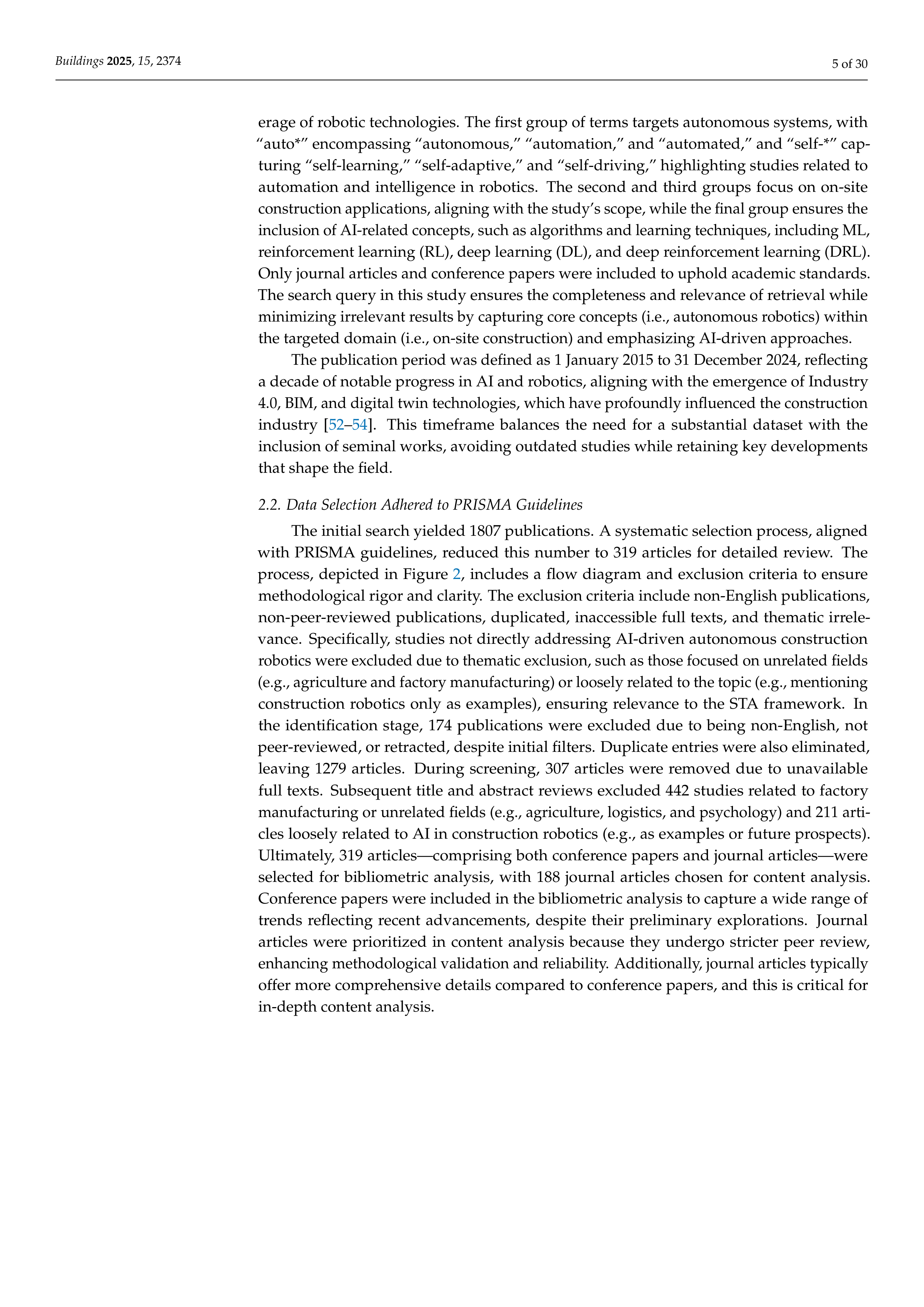
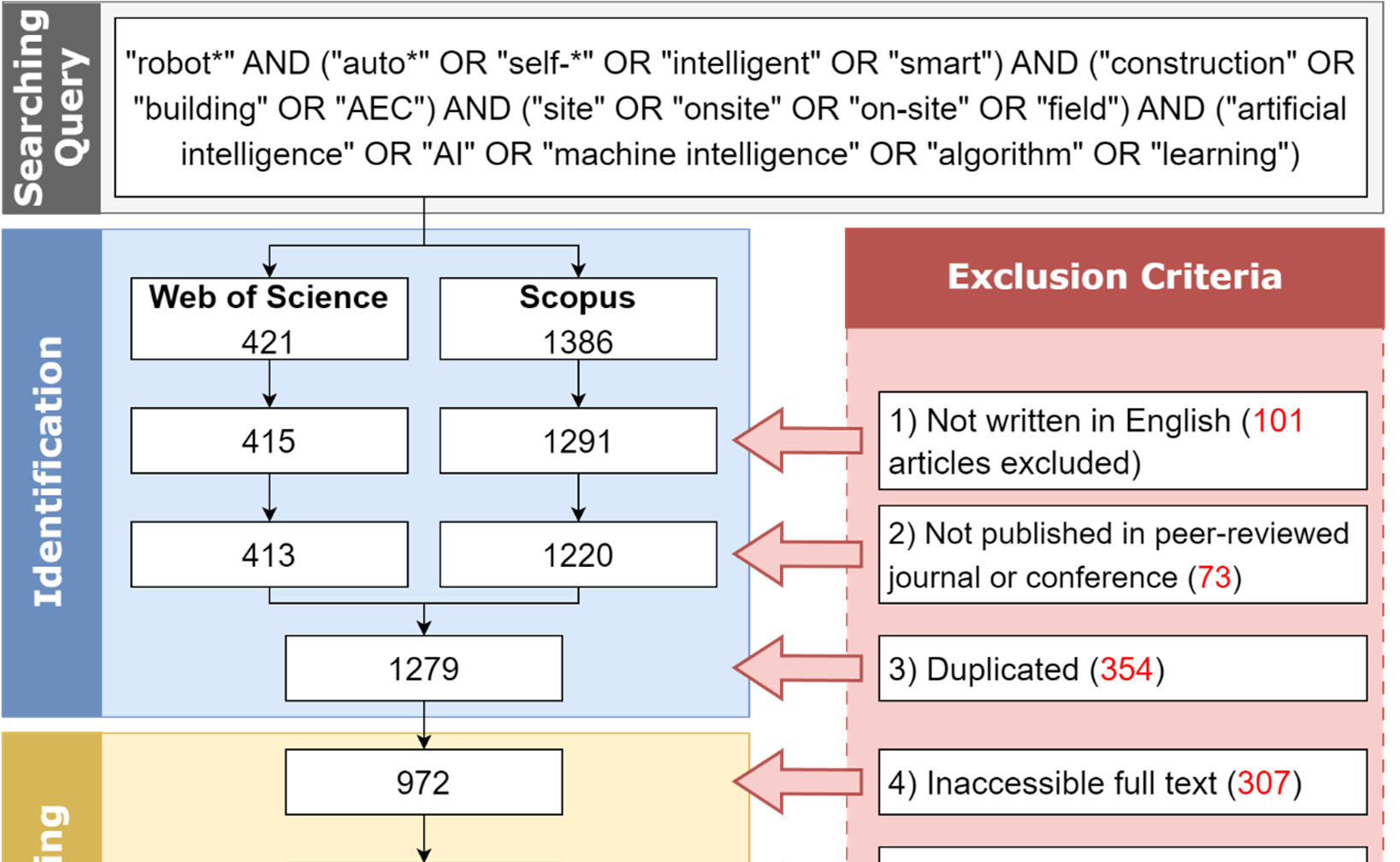
iterative testing, the following keywords were adopted:
“robot*” AND (“auto*” OR “self-
*” OR “intelligent” OR “smart”) AND (“construction” OR “building” OR “AEC”) AND
(“site” OR “onsite” OR “on-site” OR “field”) AND (“artificial intelligence” OR “AI” OR
“machine intelligence” OR “algorithm” OR “learning”).
The use of “robot*” enables the
inclusion of terms like “robot,” “robots,” “robotic,” and “robotics,” ensuring broad cov-
Buildings
2025
,
15
, 2374
5 of 30
erage of robotic technologies.
The first group of terms targets autonomous systems, with
“auto*” encompassing “autonomous,” “automation,” and “automated,” and “self-*” cap-
turing “self-learning,” “self-adaptive,” and “self-driving,” highlighting studies related to
automation
and
intelligence
in
robotics.
The
second
and
third
groups
focus
on
on-site
construction applications, aligning with the study’s scope, while the final group ensures the
inclusion of AI-related concepts, such as algorithms and learning techniques, including ML,
reinforcement learning (RL), deep learning (DL), and deep reinforcement learning (DRL).
Only journal articles and conference papers were included to uphold academic standards.
The search query in this study ensures the completeness and relevance of retrieval while
minimizing irrelevant results by capturing core concepts (i.e., autonomous robotics) within
the targeted domain (i.e., on-site construction) and emphasizing AI-driven approaches.
The publication period was defined as 1 January 2015 to 31 December 2024, reflecting
a decade of notable progress in AI and robotics, aligning with the emergence of Industry
4.0, BIM, and digital twin technologies, which have profoundly influenced the construction
industry
[
52
–
54
].
This
timeframe
balances
the
need
for
a
substantial
dataset
with
the
inclusion of seminal works, avoiding outdated studies while retaining key developments
that shape the field.
2.2.
Data Selection Adhered to PRISMA Guidelines
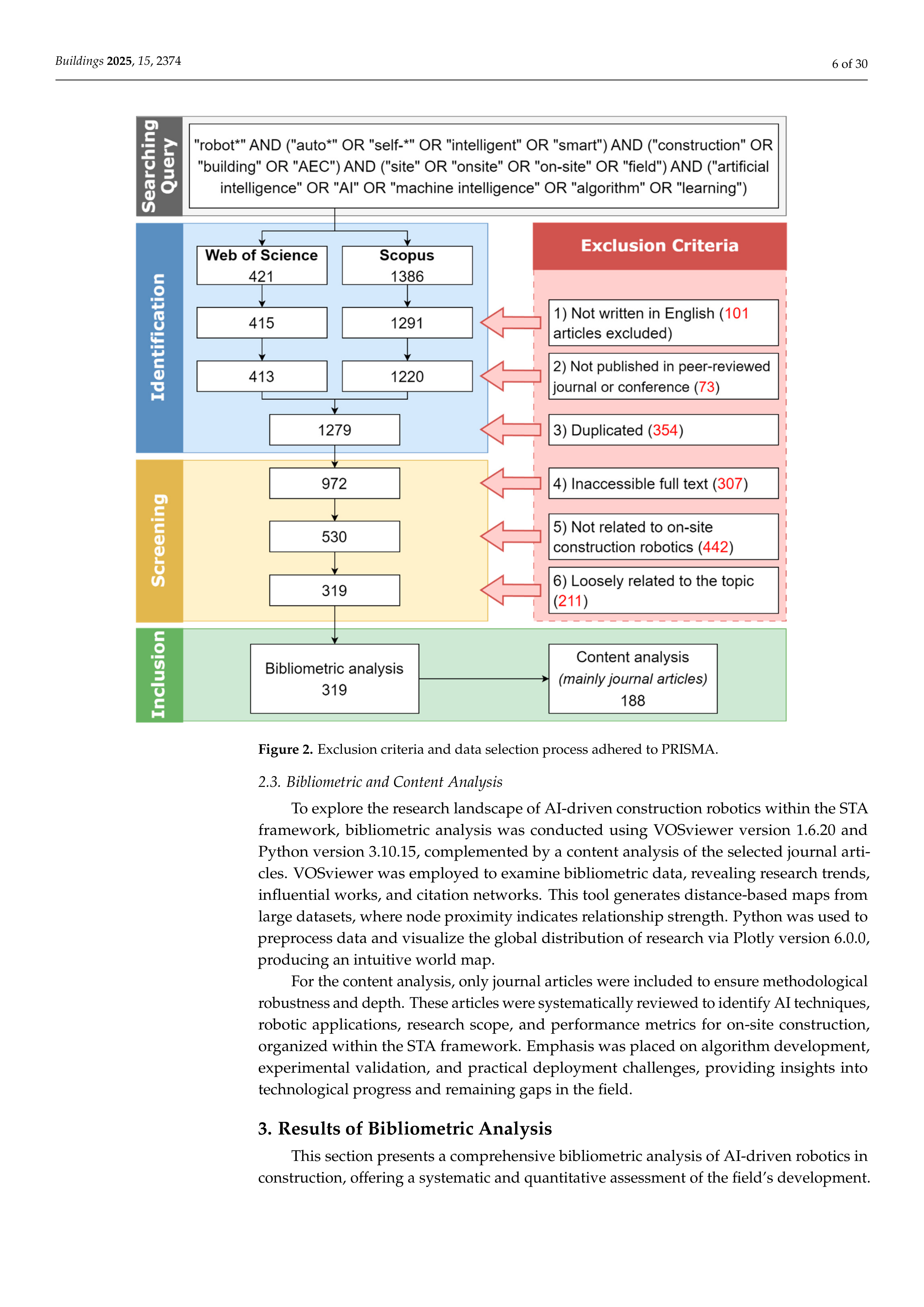
The initial search yielded 1807 publications.
A systematic selection process, aligned
with
PRISMA
guidelines,
reduced
this
number
to
319
articles
for
detailed
review.
The
process,
depicted
in
Figure
2
,
includes
a
flow
diagram
and
exclusion
criteria
to
ensure
methodological rigor and clarity.
The exclusion criteria include non-English publications,
non-peer-reviewed
publications,
duplicated,
inaccessible
full
texts,
and
thematic
irrele-
vance.
Specifically, studies not directly addressing AI-driven autonomous construction
robotics were excluded due to thematic exclusion, such as those focused on unrelated fields
(e.g., agriculture and factory manufacturing) or loosely related to the topic (e.g., mentioning
construction
robotics
only
as
examples),
ensuring
relevance
to
the
STA
framework.
In
the
identification
stage,
174
publications
were
excluded
due
to
being
non-English,
not
peer-reviewed, or retracted, despite initial filters.
Duplicate entries were also eliminated,
leaving
1279
articles.
During
screening,
307
articles
were
removed
due
to
unavailable
full texts.
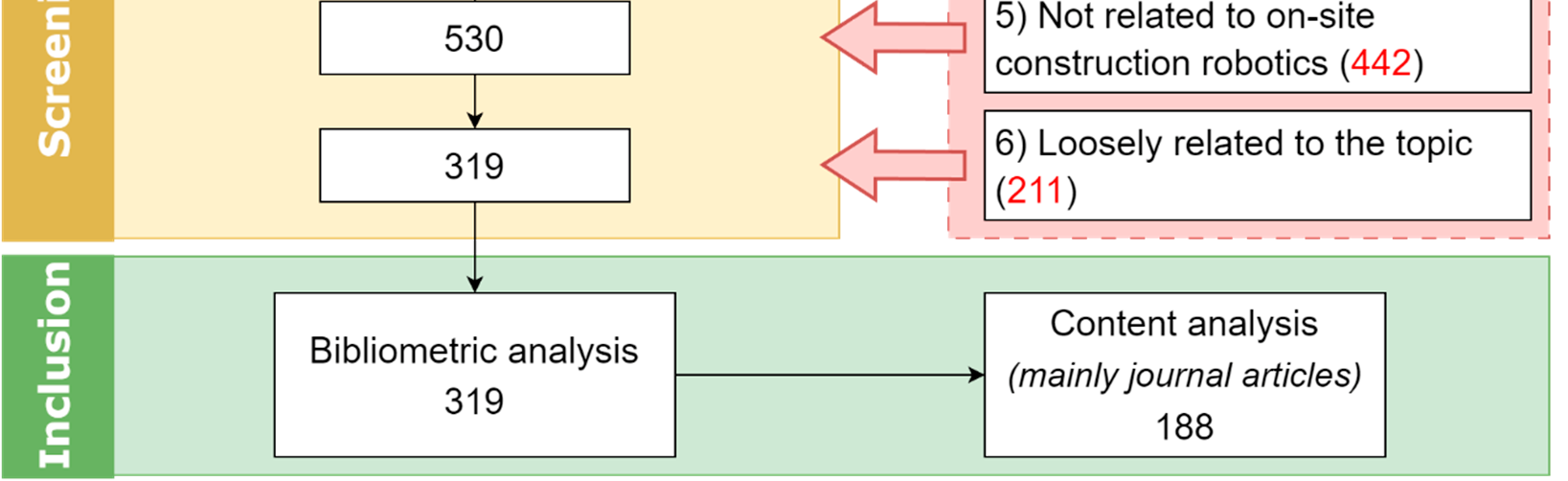
Subsequent title and abstract reviews excluded 442 studies related to factory
manufacturing or unrelated fields (e.g., agriculture, logistics, and psychology) and 211 arti-
cles loosely related to AI in construction robotics (e.g., as examples or future prospects).
Ultimately, 319 articles—comprising both conference papers and journal articles—were
selected
for
bibliometric
analysis,
with
188
journal
articles
chosen
for
content
analysis.
Conference papers were included in the bibliometric analysis to capture a wide range of
trends
reflecting
recent
advancements,
despite
their
preliminary
explorations.
Journal
articles
were
prioritized
in
content
analysis
because
they
undergo
stricter
peer
review,
enhancing methodological validation and reliability.
Additionally, journal articles typically
offer more comprehensive details compared to conference papers, and this is critical for
in-depth content analysis.
Buildings
2025
,
15
, 2374
6 of 30
Figure 2.
Exclusion criteria and data selection process adhered to PRISMA.
2.3.
Bibliometric and Content Analysis
To explore the research landscape of AI-driven construction robotics within the STA
framework,
bibliometric
analysis
was
conducted
using
VOSviewer
version
1.6.20
and
Python version 3.10.15, complemented by a content analysis of the selected journal arti-
cles.
VOSviewer was employed to examine bibliometric data, revealing research trends,
influential works, and citation networks.
This tool generates distance-based maps from
large datasets, where node proximity indicates relationship strength.
Python was used to
preprocess data and visualize the global distribution of research via Plotly version 6.0.0,
producing an intuitive world map.
For the content analysis, only journal articles were included to ensure methodological
robustness and depth. These articles were systematically reviewed to identify AI techniques,
robotic
applications,
research
scope,
and
performance
metrics
for
on-site
construction,
organized within the STA framework.
Emphasis was placed on algorithm development,
experimental
validation,
and
practical
deployment
challenges,
providing
insights
into
technological progress and remaining gaps in the field.
3.
Results of Bibliometric Analysis
This section presents a comprehensive bibliometric analysis of AI-driven robotics in
construction, offering a systematic and quantitative assessment of the field’s development.
Buildings
2025
,
15
, 2374
7 of 30
It explores publication trends by year and country, research trends, key contributors, and
collaborative networks, providing insights into the evolution of this research domain.
3.1.
Overview of Publications by Year and Country
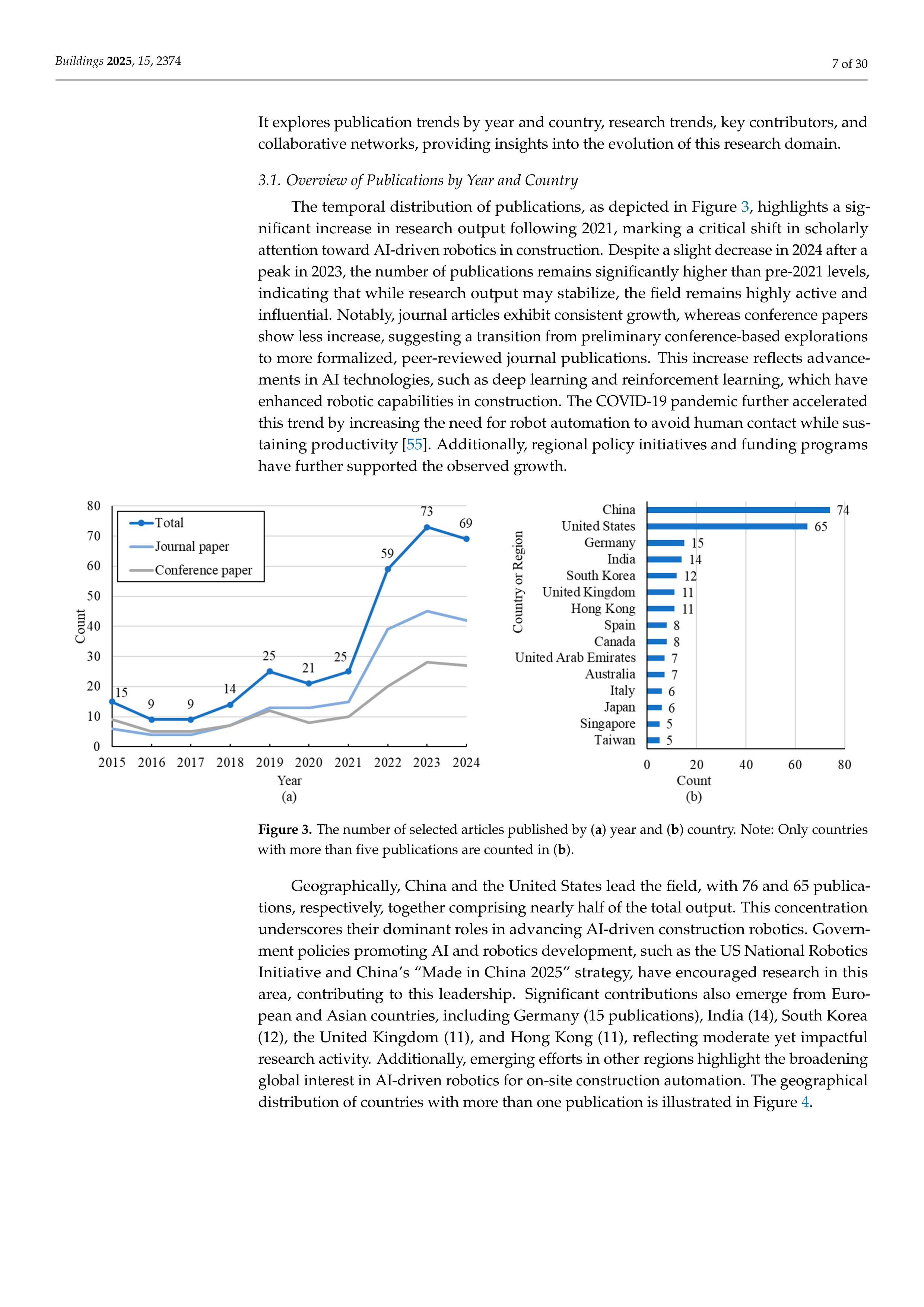
The temporal distribution of publications, as depicted in Figure
3
, highlights a sig-
nificant
increase
in
research
output
following
2021,
marking
a
critical
shift
in
scholarly
attention toward AI-driven robotics in construction.
Despite a slight decrease in 2024 after a
peak in 2023, the number of publications remains significantly higher than pre-2021 levels,
indicating that while research output may stabilize, the field remains highly active and
influential.
Notably, journal articles exhibit consistent growth, whereas conference papers
show less increase, suggesting a transition from preliminary conference-based explorations
to more formalized, peer-reviewed journal publications.
This increase reflects advance-
ments in AI technologies, such as deep learning and reinforcement learning, which have
enhanced robotic capabilities in construction.
The COVID-19 pandemic further accelerated
this trend by increasing the need for robot automation to avoid human contact while sus-
taining productivity [
55
].
Additionally, regional policy initiatives and funding programs
have further supported the observed growth.
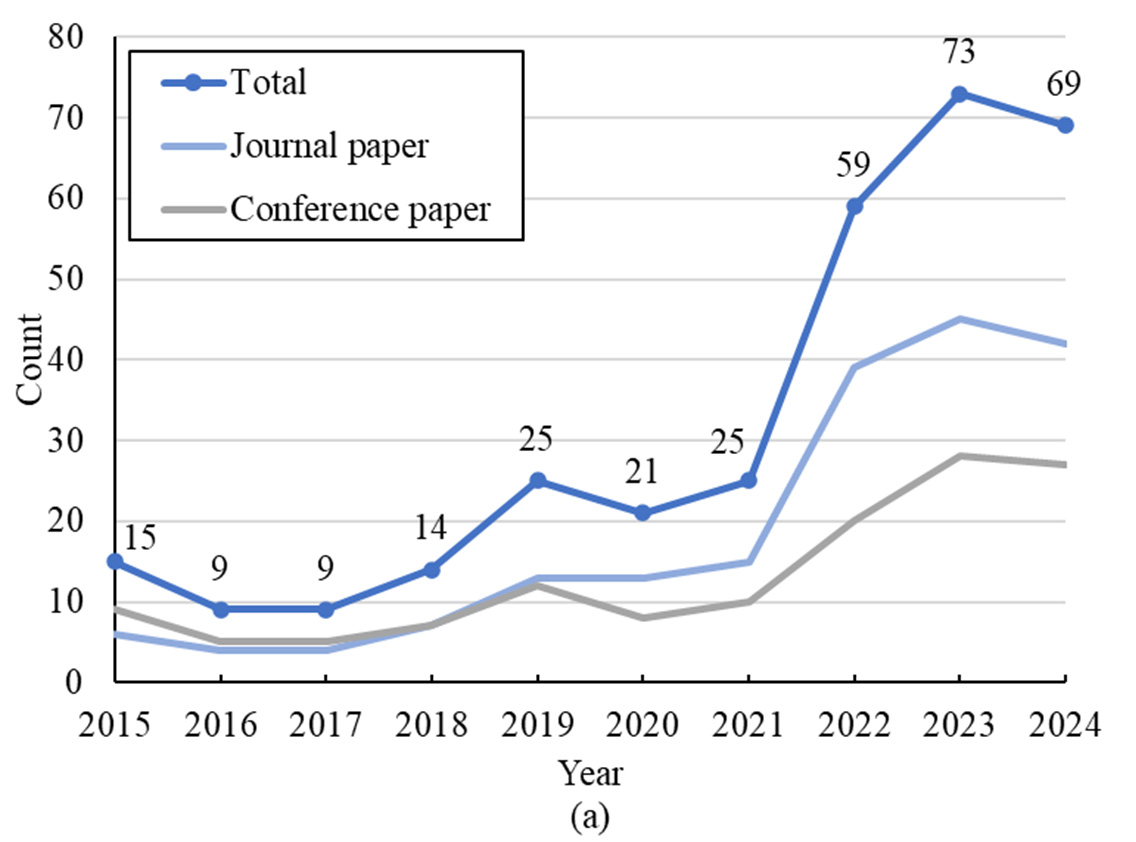
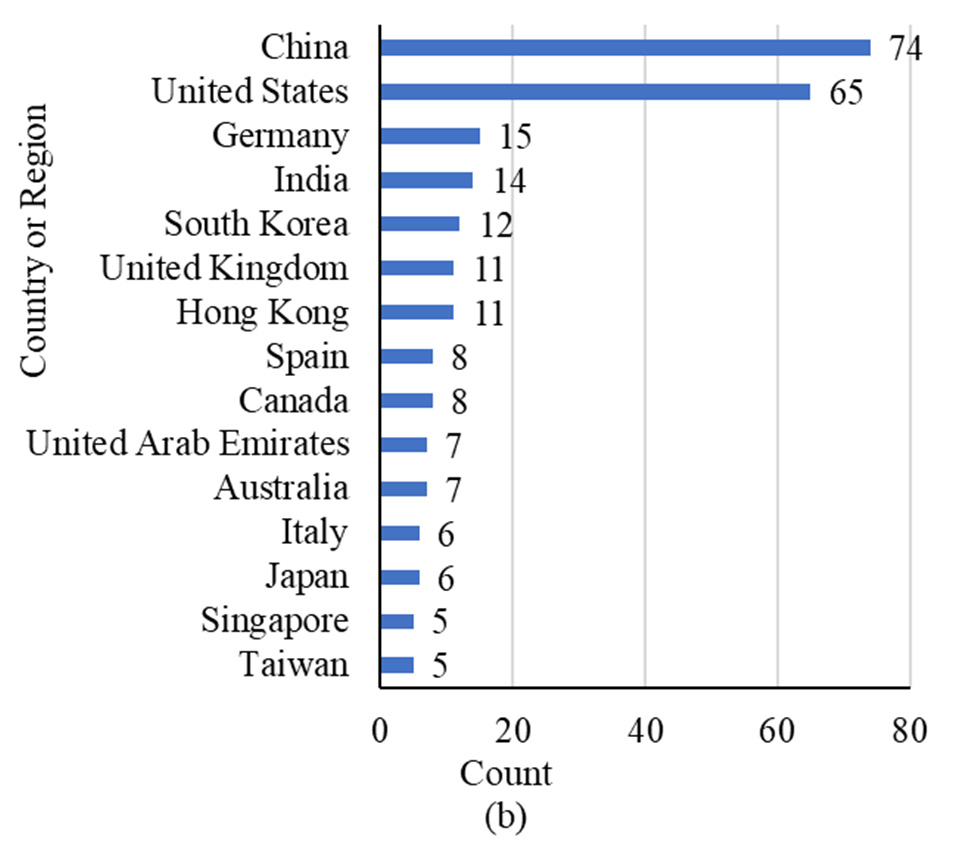
Figure 3.
The number of selected articles published by (
a
) year and (
b
) country.
Note:
Only countries
with more than five publications are counted in (
b
).
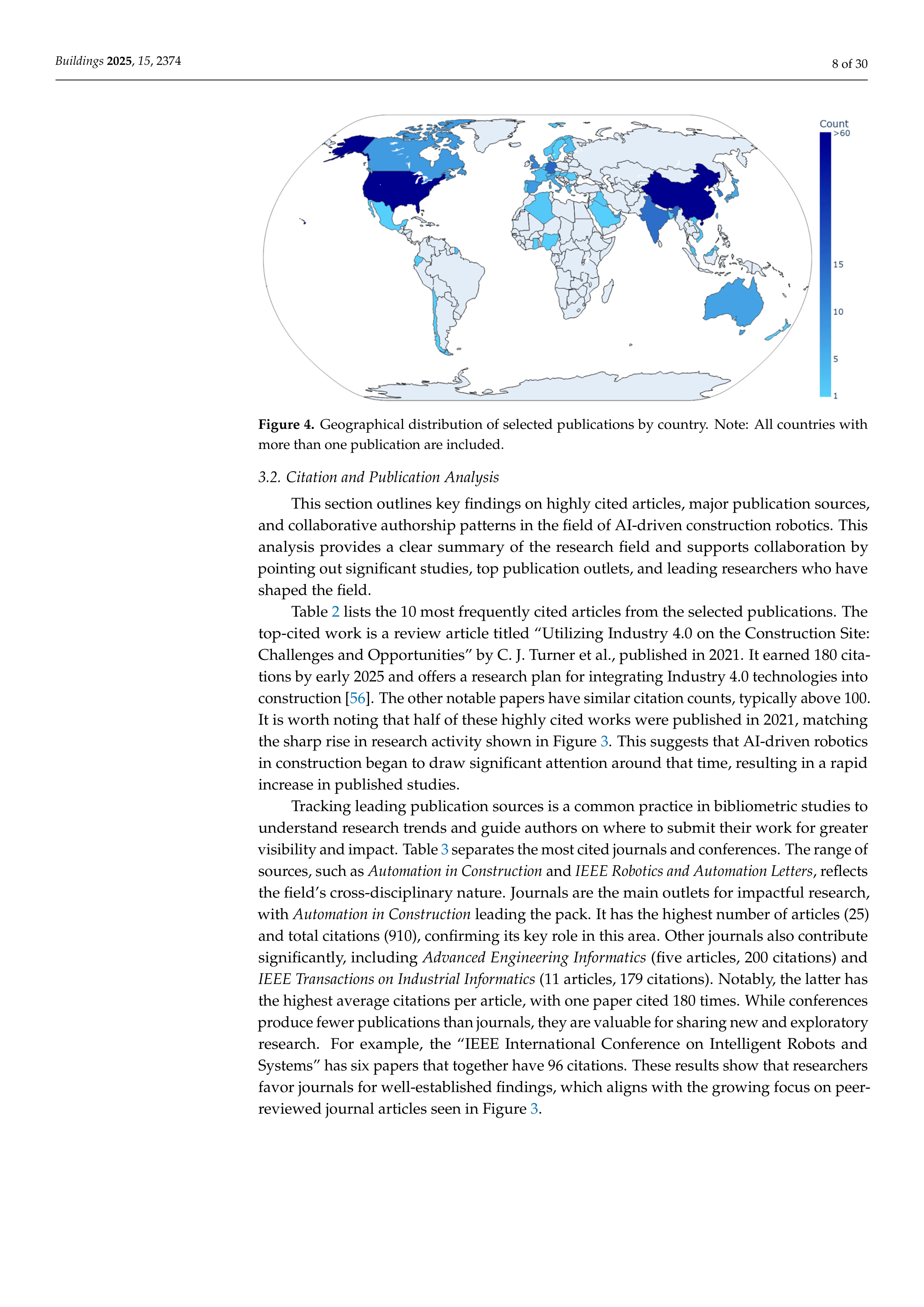
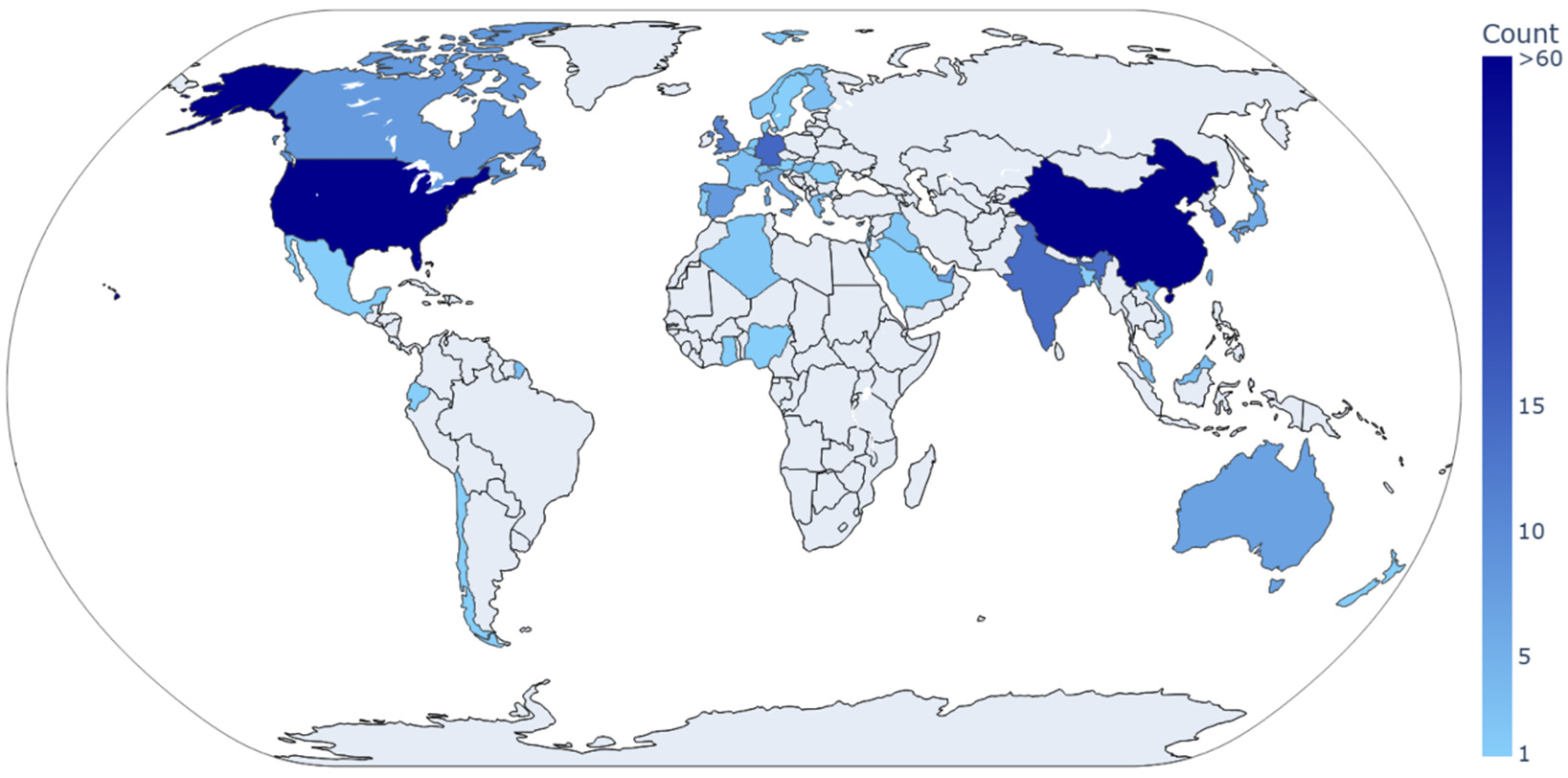
Geographically, China and the United States lead the field, with 76 and 65 publica-
tions, respectively, together comprising nearly half of the total output.
This concentration
underscores their dominant roles in advancing AI-driven construction robotics.
Govern-
ment policies promoting AI and robotics development, such as the US National Robotics
Initiative and China’s “Made in China 2025” strategy, have encouraged research in this
area,
contributing
to
this
leadership.
Significant
contributions
also
emerge
from
Euro-
pean and Asian countries, including Germany (15 publications), India (14), South Korea
(12),
the
United
Kingdom
(11),
and
Hong
Kong
(11),
reflecting
moderate
yet
impactful
research activity.
Additionally, emerging efforts in other regions highlight the broadening
global interest in AI-driven robotics for on-site construction automation.
The geographical
distribution of countries with more than one publication is illustrated in Figure
4
.
Buildings
2025
,
15
, 2374
8 of 30
Figure 4.
Geographical distribution of selected publications by country.
Note:
All countries with
more than one publication are included.
3.2.
Citation and Publication Analysis
This section outlines key findings on highly cited articles, major publication sources,
and collaborative authorship patterns in the field of AI-driven construction robotics.
This
analysis
provides
a
clear
summary
of
the
research
field
and
supports
collaboration
by
pointing out significant studies, top publication outlets, and leading researchers who have
shaped the field.
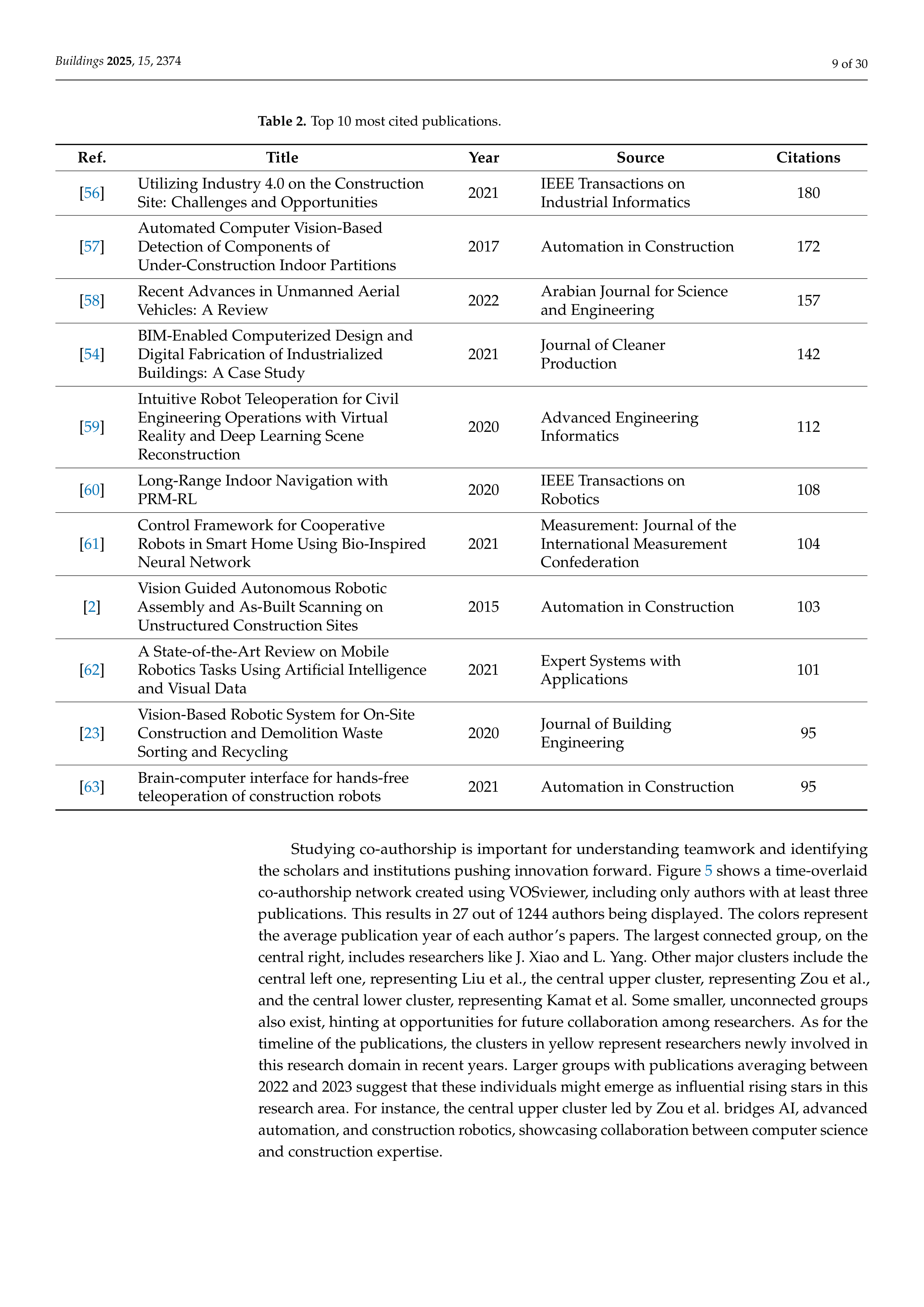
Table
2
lists the 10 most frequently cited articles from the selected publications.
The
top-cited work is a review article titled “Utilizing Industry 4.0 on the Construction Site:
Challenges and Opportunities” by C. J. Turner et al., published in 2021.
It earned 180 cita-
tions by early 2025 and offers a research plan for integrating Industry 4.0 technologies into
construction [
56
].
The other notable papers have similar citation counts, typically above 100.
It is worth noting that half of these highly cited works were published in 2021, matching
the sharp rise in research activity shown in Figure
3
.
This suggests that AI-driven robotics
in construction began to draw significant attention around that time, resulting in a rapid
increase in published studies.
Tracking leading publication sources is a common practice in bibliometric studies to
understand research trends and guide authors on where to submit their work for greater
visibility and impact. Table
3
separates the most cited journals and conferences. The range of
sources, such as
Automation in Construction
and
IEEE Robotics and Automation Letters
, reflects
the field’s cross-disciplinary nature.
Journals are the main outlets for impactful research,
with
Automation in Construction
leading the pack.
It has the highest number of articles (25)
and total citations (910), confirming its key role in this area.
Other journals also contribute
significantly, including
Advanced Engineering Informatics
(five articles, 200 citations) and
IEEE Transactions on Industrial Informatics
(11 articles, 179 citations).
Notably, the latter has
the highest average citations per article, with one paper cited 180 times.
While conferences
produce fewer publications than journals, they are valuable for sharing new and exploratory
research.
For
example,
the
“IEEE
International
Conference
on
Intelligent
Robots
and
Systems” has six papers that together have 96 citations.
These results show that researchers
favor journals for well-established findings, which aligns with the growing focus on peer-
reviewed journal articles seen in Figure
3
.
Buildings
2025
,
15
, 2374
9 of 30
Table 2.
Top 10 most cited publications.
Ref.
Title
Year
Source
Citations
[
56
]
Utilizing Industry 4.0 on the Construction
Site:
Challenges and Opportunities
2021
IEEE Transactions on
Industrial Informatics
180
[
57
]
Automated Computer Vision-Based
Detection of Components of
Under-Construction Indoor Partitions
2017
Automation in Construction
172
[
58
]
Recent Advances in Unmanned Aerial
Vehicles:
A Review
2022
Arabian Journal for Science
and Engineering
157
[
54
]
BIM-Enabled Computerized Design and
Digital Fabrication of Industrialized
Buildings:
A Case Study
2021
Journal of Cleaner
Production
142
[
59
]
Intuitive Robot Teleoperation for Civil
Engineering Operations with Virtual
Reality and Deep Learning Scene
Reconstruction
2020
Advanced Engineering
Informatics
112
[
60
]
Long-Range Indoor Navigation with
PRM-RL
2020
IEEE Transactions on
Robotics
108
[
61
]
Control Framework for Cooperative
Robots in Smart Home Using Bio-Inspired
Neural Network
2021
Measurement:
Journal of the
International Measurement
Confederation
104
[
2
]
Vision Guided Autonomous Robotic
Assembly and As-Built Scanning on
Unstructured Construction Sites
2015
Automation in Construction
103
[
62
]
A State-of-the-Art Review on Mobile
Robotics Tasks Using Artificial Intelligence
and Visual Data
2021
Expert Systems with
Applications
101
[
23
]
Vision-Based Robotic System for On-Site
Construction and Demolition Waste
Sorting and Recycling
2020
Journal of Building
Engineering
95
[
63
]
Brain-computer interface for hands-free
teleoperation of construction robots
2021
Automation in Construction
95
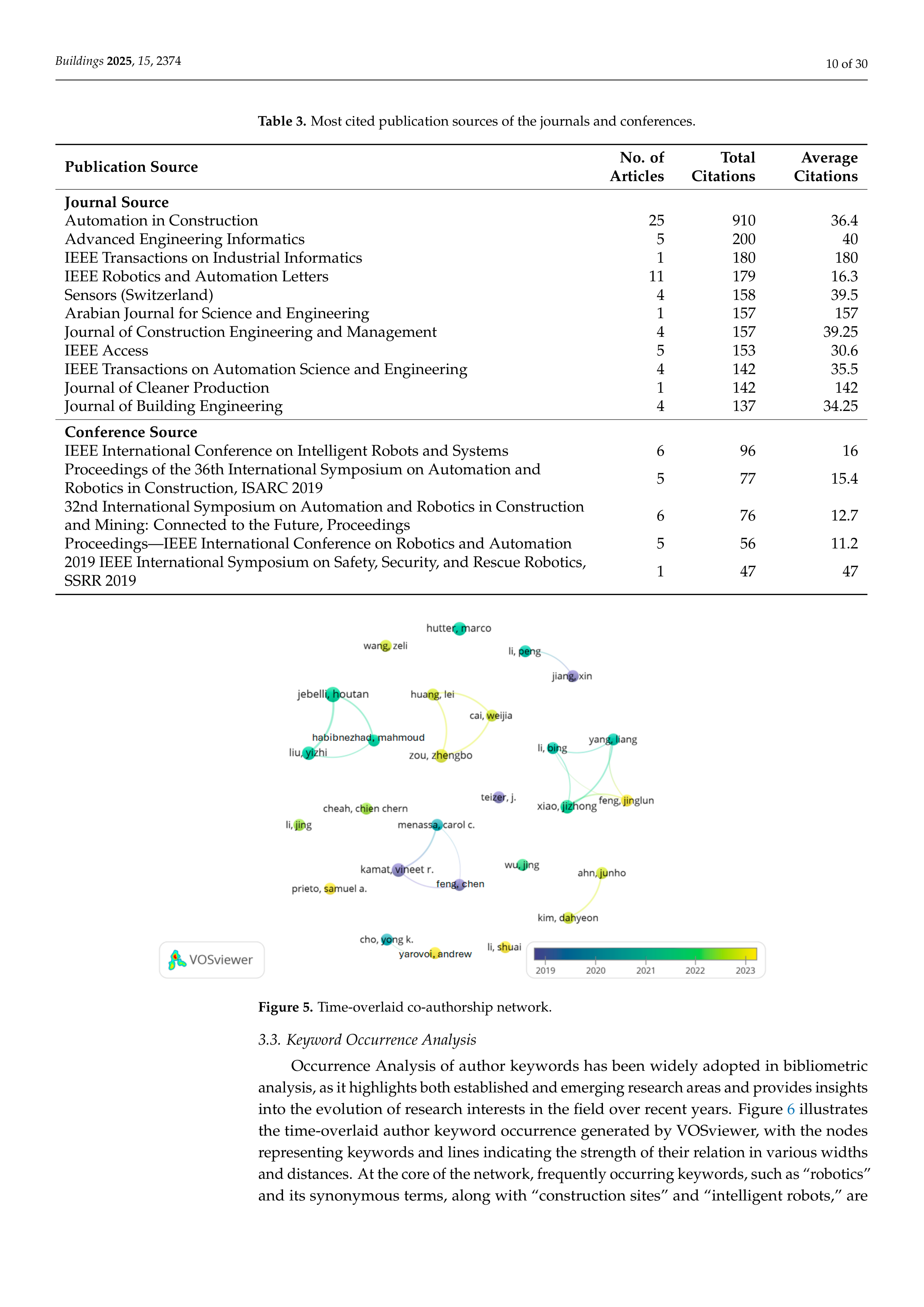
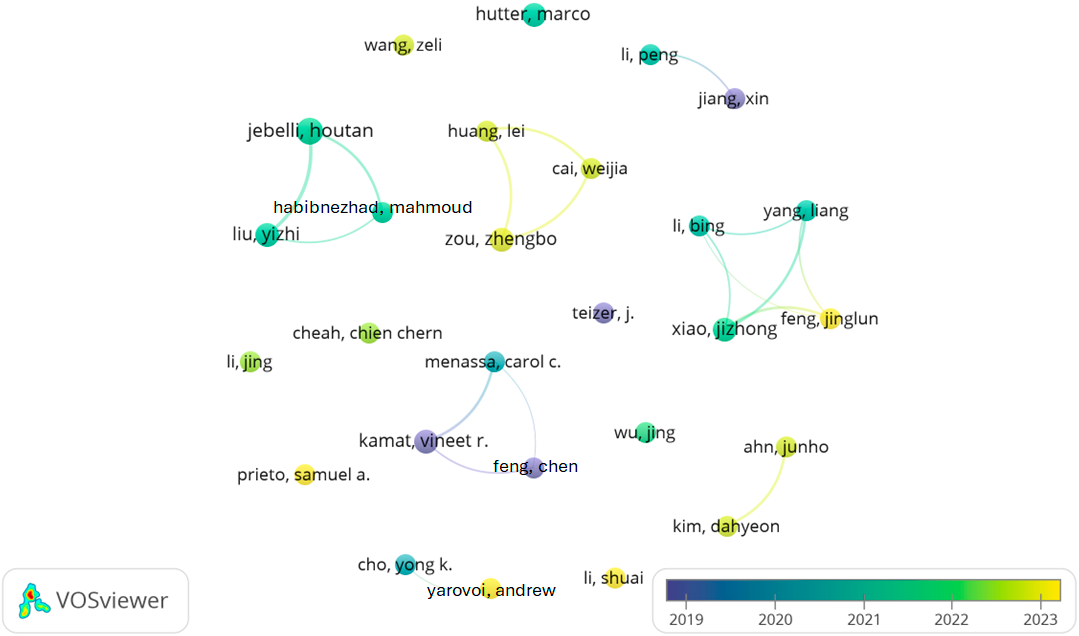
Studying co-authorship is important for understanding teamwork and identifying
the scholars and institutions pushing innovation forward.
Figure
5
shows a time-overlaid
co-authorship network created using VOSviewer, including only authors with at least three
publications.
This results in 27 out of 1244 authors being displayed.
The colors represent
the average publication year of each author’s papers.
The largest connected group, on the
central right, includes researchers like J. Xiao and L. Yang.
Other major clusters include the
central left one, representing Liu et al., the central upper cluster, representing Zou et al.,
and the central lower cluster, representing Kamat et al.
Some smaller, unconnected groups
also exist, hinting at opportunities for future collaboration among researchers.
As for the
timeline of the publications, the clusters in yellow represent researchers newly involved in
this research domain in recent years.
Larger groups with publications averaging between
2022 and 2023 suggest that these individuals might emerge as influential rising stars in this
research area.
For instance, the central upper cluster led by Zou et al.
bridges AI, advanced
automation, and construction robotics, showcasing collaboration between computer science
and construction expertise.
Buildings
2025
,
15
, 2374
10 of 30
Table 3.
Most cited publication sources of the journals and conferences.
Publication Source
No.
of
Articles
Total
Citations
Average
Citations
Journal Source
Automation in Construction
25
910
36.4
Advanced Engineering Informatics
5
200
40
IEEE Transactions on Industrial Informatics
1
180
180
IEEE Robotics and Automation Letters
11
179
16.3
Sensors (Switzerland)
4
158
39.5
Arabian Journal for Science and Engineering
1
157
157
Journal of Construction Engineering and Management
4
157
39.25
IEEE Access
5
153
30.6
IEEE Transactions on Automation Science and Engineering
4
142
35.5
Journal of Cleaner Production
1
142
142
Journal of Building Engineering
4
137
34.25
Conference Source
IEEE International Conference on Intelligent Robots and Systems
6
96
16
Proceedings of the 36th International Symposium on Automation and
Robotics in Construction, ISARC 2019
5
77
15.4
32nd International Symposium on Automation and Robotics in Construction
and Mining:
Connected to the Future, Proceedings
6
76
12.7
Proceedings—IEEE International Conference on Robotics and Automation
5
56
11.2
2019 IEEE International Symposium on Safety, Security, and Rescue Robotics,
SSRR 2019
1
47
47
Figure 5.
Time-overlaid co-authorship network.
3.3.
Keyword Occurrence Analysis
Occurrence Analysis of author keywords has been widely adopted in bibliometric
analysis, as it highlights both established and emerging research areas and provides insights
into the evolution of research interests in the field over recent years.
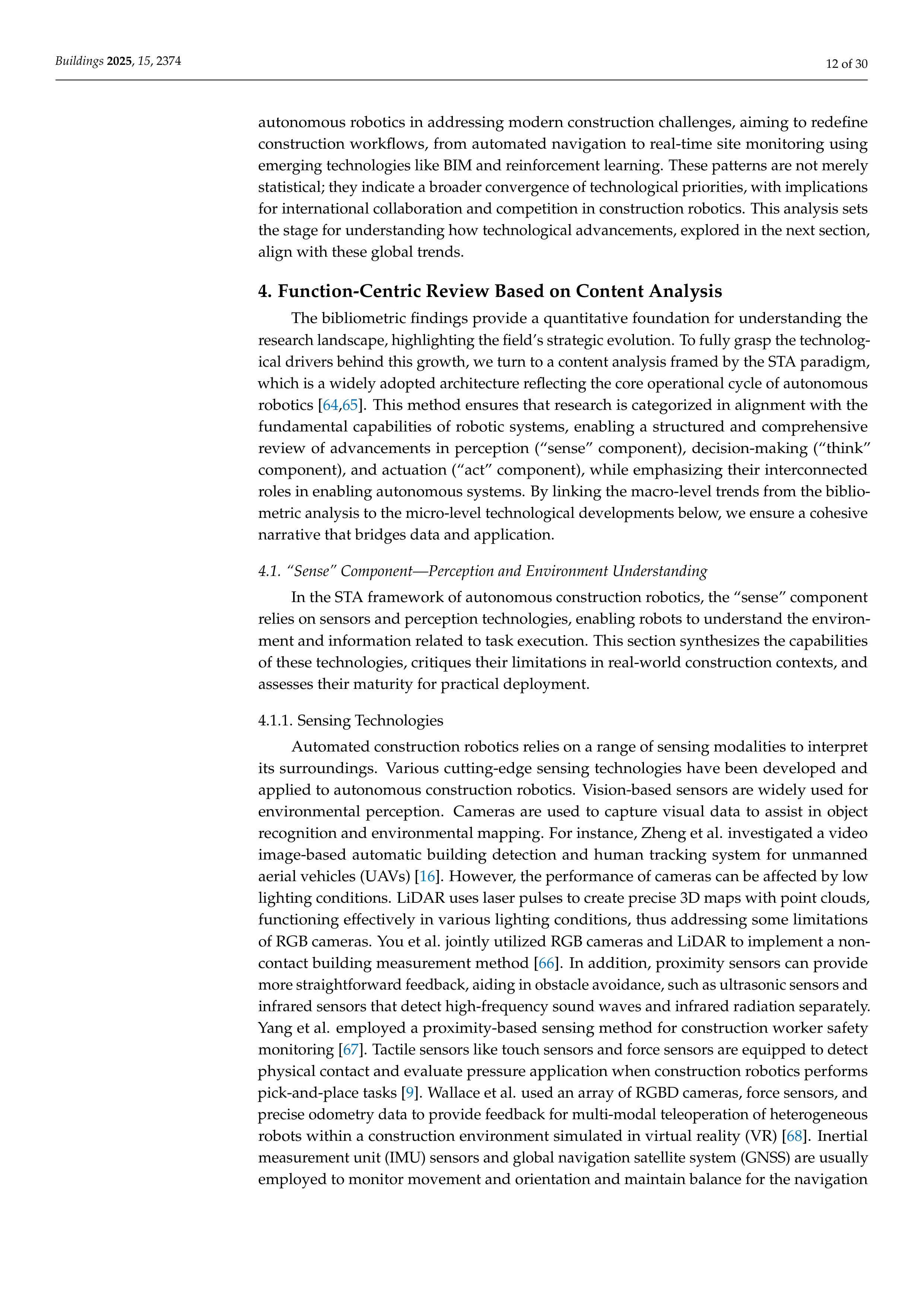
Figure
6
illustrates
the time-overlaid author keyword occurrence generated by VOSviewer, with the nodes
representing keywords and lines indicating the strength of their relation in various widths
and distances. At the core of the network, frequently occurring keywords, such as “robotics”
and its synonymous terms, along with “construction sites” and “intelligent robots,” are
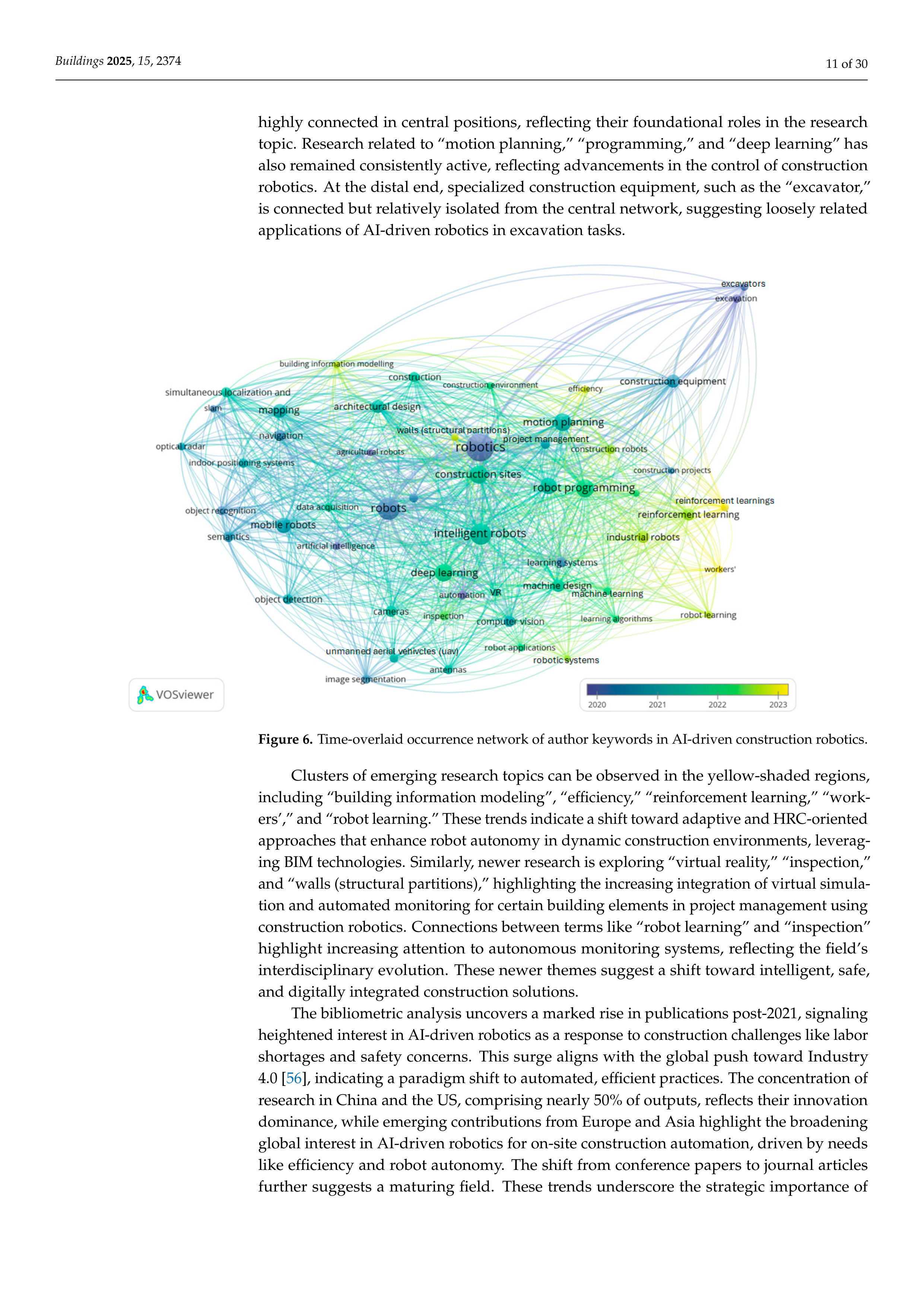
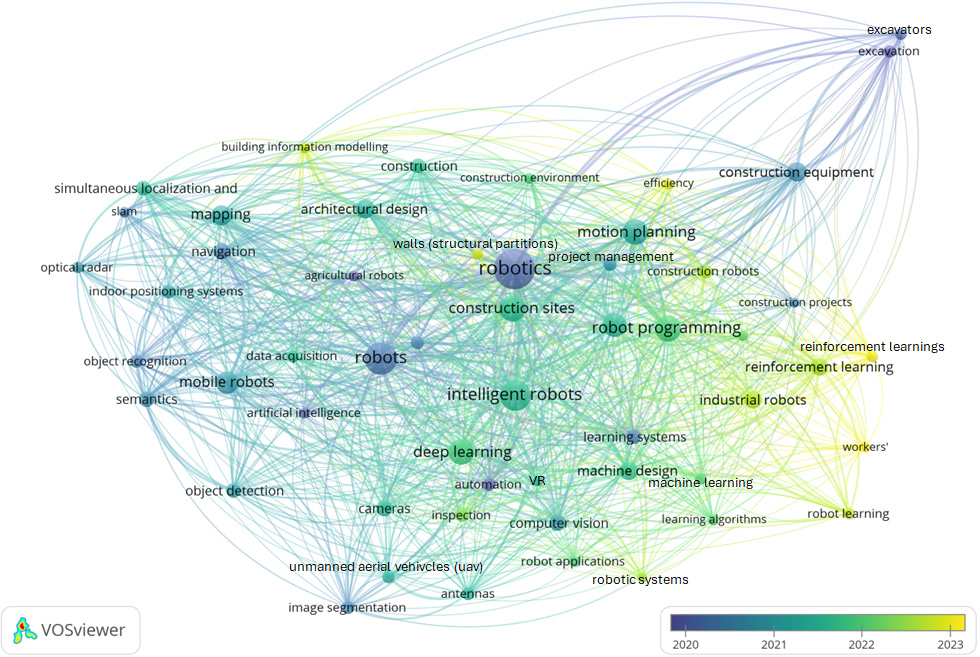
Buildings
2025
,
15
, 2374
11 of 30
highly connected in central positions,
reflecting their foundational roles in the research
topic.
Research related to “motion planning,” “programming,” and “deep learning” has
also remained consistently active, reflecting advancements in the control of construction
robotics.
At the distal end, specialized construction equipment, such as the “excavator,”
is connected but relatively isolated from the central network, suggesting loosely related
applications of AI-driven robotics in excavation tasks.
Figure 6.
Time-overlaid occurrence network of author keywords in AI-driven construction robotics.
Clusters of emerging research topics can be observed in the yellow-shaded regions,
including “building information modeling”, “efficiency,” “reinforcement learning,” “work-
ers’,” and “robot learning.” These trends indicate a shift toward adaptive and HRC-oriented
approaches that enhance robot autonomy in dynamic construction environments, leverag-
ing BIM technologies.
Similarly, newer research is exploring “virtual reality,” “inspection,”
and “walls (structural partitions),” highlighting the increasing integration of virtual simula-
tion and automated monitoring for certain building elements in project management using
construction robotics.
Connections between terms like “robot learning” and “inspection”
highlight
increasing
attention
to
autonomous
monitoring
systems,
reflecting
the
field’s
interdisciplinary evolution.
These newer themes suggest a shift toward intelligent, safe,
and digitally integrated construction solutions.
The bibliometric analysis uncovers a marked rise in publications post-2021, signaling
heightened interest in AI-driven robotics as a response to construction challenges like labor
shortages and safety concerns.
This surge aligns with the global push toward Industry
4.0 [
56
], indicating a paradigm shift to automated, efficient practices.
The concentration of
research in China and the US, comprising nearly 50% of outputs, reflects their innovation
dominance, while emerging contributions from Europe and Asia highlight the broadening
global interest in AI-driven robotics for on-site construction automation, driven by needs
like efficiency and robot autonomy.
The shift from conference papers to journal articles
further
suggests
a
maturing
field.
These
trends
underscore
the
strategic
importance
of
Buildings
2025
,
15
, 2374
12 of 30
autonomous robotics in addressing modern construction challenges, aiming to redefine
construction
workflows,
from
automated
navigation
to
real-time
site
monitoring
using
emerging technologies like BIM and reinforcement learning.
These patterns are not merely
statistical; they indicate a broader convergence of technological priorities, with implications
for international collaboration and competition in construction robotics.
This analysis sets
the stage for understanding how technological advancements, explored in the next section,
align with these global trends.
4.
Function-Centric Review Based on Content Analysis
The bibliometric findings provide a quantitative foundation for understanding the
research landscape, highlighting the field’s strategic evolution.
To fully grasp the technolog-
ical drivers behind this growth, we turn to a content analysis framed by the STA paradigm,
which is a widely adopted architecture reflecting the core operational cycle of autonomous
robotics [
64
,
65
].
This method ensures that research is categorized in alignment with the
fundamental
capabilities
of
robotic
systems,
enabling
a
structured
and
comprehensive
review
of
advancements
in
perception
(“sense”
component),
decision-making
(“think”
component), and actuation (“act” component),
while emphasizing their interconnected
roles in enabling autonomous systems.
By linking the macro-level trends from the biblio-
metric analysis to the micro-level technological developments below, we ensure a cohesive
narrative that bridges data and application.
4.1.
“Sense” Component—Perception and Environment Understanding
In the STA framework of autonomous construction robotics, the “sense” component
relies on sensors and perception technologies, enabling robots to understand the environ-
ment and information related to task execution.
This section synthesizes the capabilities
of these technologies, critiques their limitations in real-world construction contexts, and
assesses their maturity for practical deployment.
4.1.1.
Sensing Technologies
Automated construction robotics relies on a range of sensing modalities to interpret
its
surroundings.
Various
cutting-edge
sensing
technologies
have
been
developed
and
applied to autonomous construction robotics.
Vision-based sensors are widely used for
environmental
perception.
Cameras
are
used
to
capture
visual
data
to
assist
in
object
recognition and environmental mapping.
For instance, Zheng et al.
investigated a video
image-based
automatic
building
detection
and
human
tracking
system
for
unmanned
aerial vehicles (UAVs) [
16
].
However, the performance of cameras can be affected by low
lighting conditions.
LiDAR uses laser pulses to create precise 3D maps with point clouds,
functioning effectively in various lighting conditions, thus addressing some limitations
of RGB cameras.
You et al.
jointly utilized RGB cameras and LiDAR to implement a non-
contact building measurement method [
66
].
In addition, proximity sensors can provide
more straightforward feedback, aiding in obstacle avoidance, such as ultrasonic sensors and
infrared sensors that detect high-frequency sound waves and infrared radiation separately.
Yang et al.
employed a proximity-based sensing method for construction worker safety
monitoring [
67
].
Tactile sensors like touch sensors and force sensors are equipped to detect
physical contact and evaluate pressure application when construction robotics performs
pick-and-place tasks [
9
].
Wallace et al.
used an array of RGBD cameras, force sensors, and
precise odometry data to provide feedback for multi-modal teleoperation of heterogeneous
robots within a construction environment simulated in virtual reality (VR) [
68
].
Inertial
measurement unit (IMU) sensors and global navigation satellite system (GNSS) are usually
employed to monitor movement and orientation and maintain balance for the navigation
Buildings
2025
,
15
, 2374
13 of 30
of mobile robots [
69
].
Some researchers used proximity sensors to slow or halt robotic arms
when human proximity is detected to ensure safety for HRC [
70
,
71
].
4.1.2.
Deep Learning-Based Computer Vision
DL–based computer vision relies on neural networks to learn features directly from
images or video data in an accurate and automated way, in which convolutional neural
networks (CNNs) are commonly used to detect objects (e.g., workers, machinery, building
elements,
and construction wastes) by training on labeled images [
72
].
Wang et al.
em-
ployed CNNs to detect and track workers and machinery for hazard identification [
73
].
Approaches like region-based CNN (R-CNN), faster R-CNN, and mask R-CNN perform
localized detection by generating region proposals, which refine the framework and boost
speed and accuracy over the original CNN. Tung et al.
adopted Mask R-CNN to detect the
window weld seam to guide the robot manipulator in its cleaning process, reporting 95%
mean average precision (less than 1 cm) [
74
].
Kim et al.
used Mask R-CNN with a camera
and LiDAR to detect floor surfaces, atypical obstacles, and people, facilitating fast search
and rescue work at damaged buildings [
75
,
76
].
You Only Look Once (YOLO) is a commonly
used object detection model that identifies and localizes instances of predefined classes
in visual inputs with high-speed, real-time scanning of video feeds to identify hazards or
navigable routes [
75
,
77
].
Additionally, some researchers implemented end-to-end DL that
integrates detection, classification, and scene understanding within a combined pipeline to
streamline the entire sense–think–act loop by providing immediate semantic data to the
“think” component [
78
].
4.1.3.
Simultaneous Localization and Mapping
SLAM
enables
a
construction
robot
to
map
its
environment
while
simultaneously
tracking
its
own
location
along
with
the
trajectory
that
the
robot
follows
within
that
map [
44
].
Visual SLAM utilizes camera images to build and maintain a map, matching
features frame-to-frame to estimate the robot’s trajectory. It is compatible with various types
of cameras, such as monocular cameras [
79
], stereo cameras [
80
], and RGB-D cameras [
15
].
However, it suffers from scale drift, especially when using monocular RGB cameras and
in low lighting conditions.
LiDAR-based SLAM, namely LiDAR odometry and mapping
(LOAM), uses LiDAR sensors to generate point clouds for accurate distance measurement
and obstacle detection,
even in low-texture and low-lighting conditions [
81
].
Kim et al.
developed a SLAM-driven autonomous mobile robot form of navigation for construction
progress monitoring, safety hazard identification, and defect detection [
82
].
4.1.4.
Multi-Modal Sensor Fusion
Multi-modal sensor fusion combines data from multiple sensors (e.g., camera, LiDAR,
IMU, and GNSS) to enhance perception robustness, adaptability, and accuracy compared
to a single sensor sensing method.
AI techniques (like Kalman filters, deep networks, or
Bayesian methods) merge heterogeneous data into a consistent world model.
Cameras
are frequently integrated into multi-sensor sensing systems to perceive environments.
For
instance,
Kim
et
al.
developed
a
fire
rescue
robot
that
recognizes
collapsed
areas
and
rescuers in adverse indoor conditions based on fusion algorithms for a parallelly connected
camera and 3D LiDAR, where color and people are detected by cameras using YOLOv4
and LiDAR to localize the robot, draw an indoor map, and estimate the distance between
actual objects [
75
,
83
].
Wang et al.
designed a fusion algorithm for UAVs using a fisheye
camera, an RGB-D camera, a LiDAR, and GNSS, achieving seven-fold energy savings while
maintaining planning success rates of 98% in simulation scenarios [
27
].
Buildings
2025
,
15
, 2374
14 of 30
4.1.5.
Comparative Summary and Maturity in Construction Context
In comparison, cameras, particularly RGB variants, offer high-resolution, cost-effective,
and versatile solutions for tasks like object recognition, environmental mapping, and track-
ing, though their effectiveness diminishes under poor lighting, dust, or occlusion, which
are prevalent conditions on construction sites.
LiDAR provides accurate 3D mapping and
performs reliably across diverse lighting scenarios; however, its high cost and limited reso-
lution for fine details constrain its broader adoption.
Proximity sensors, such as ultrasonic
and infrared types, are simple and affordable, excelling in close-range obstacle detection,
yet their low resolution and short range limit their utility for complex perception tasks.
Tactile sensors enable precise physical interactions, such as pick-and-place operations, but
their
complexity
and
high
cost
restrict
scalability.
IMU
and
GNSS
are
vital
for
naviga-
tion and positioning, though GNSS falters in indoor or GPS-denied environments, often
requiring supplementary techniques like SLAM.
From the perspective of practical applications, through DL architecture such as CNNs,
robots
achieve
robust
detection
and
tracking
of
on-site
objects
(e.g.,
workers,
building
elements), while SLAM algorithms ensure reliable localization and mapping in adverse
conditions (e.g.,
low-lighting or
GPS-denied settings).
Sensor
fusion methods combine
diverse data streams to perceive the environment robustly by reducing the weaknesses
of
any
single
sensor.
These
technologies
advance
robotic
perception
in
real-world,
un-
structured sites by improving accuracy, reliability, and adaptability.
Figure
7
illustrates
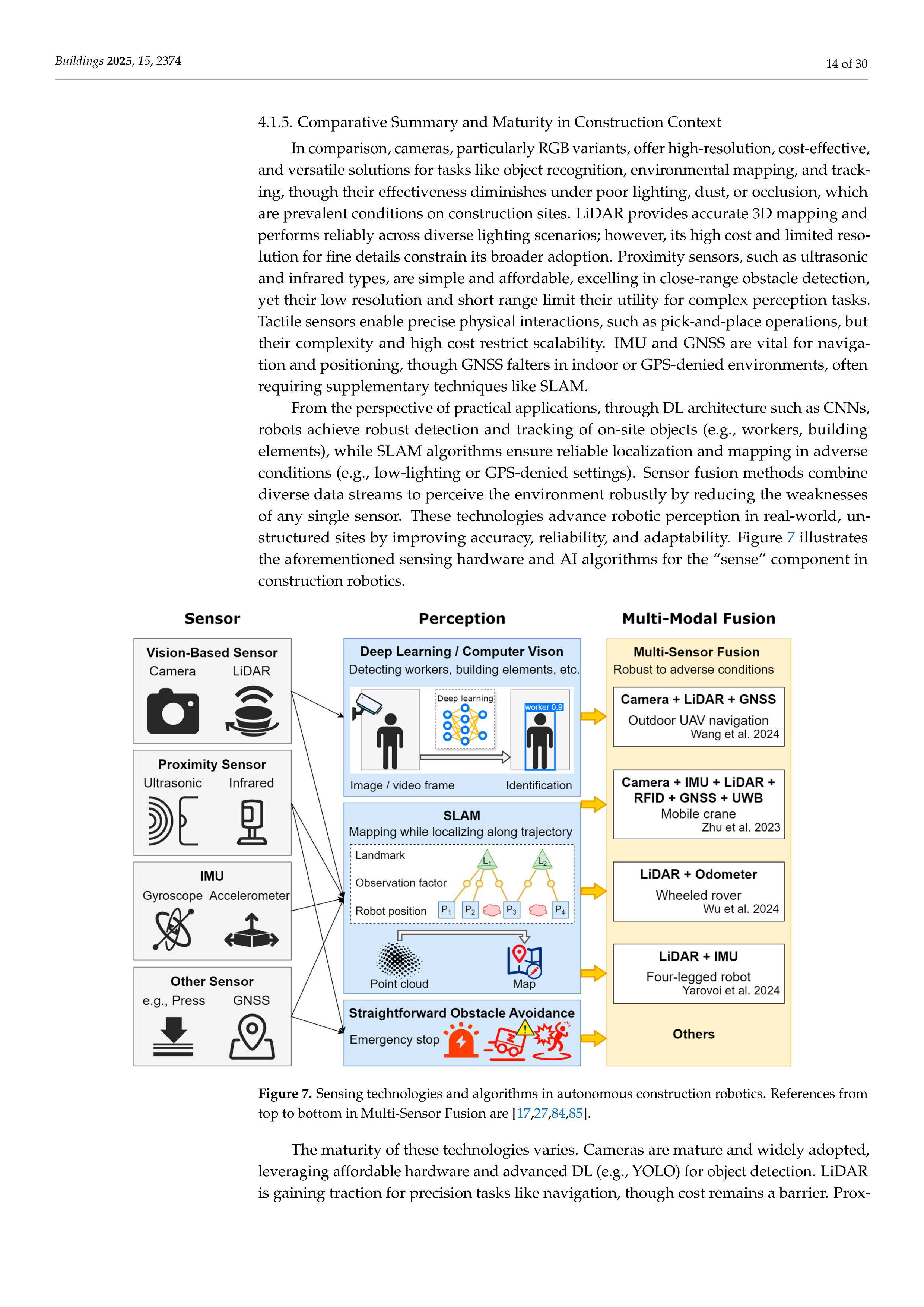
the aforementioned sensing hardware and AI algorithms for the “sense” component in
construction robotics.
Figure 7.
Sensing technologies and algorithms in autonomous construction robotics.
References from
top to bottom in Multi-Sensor Fusion are [
17
,
27
,
84
,
85
].
The maturity of these technologies varies.
Cameras are mature and widely adopted,
leveraging affordable hardware and advanced DL (e.g., YOLO) for object detection.
LiDAR
is gaining traction for precision tasks like navigation, though cost remains a barrier.
Prox-
Buildings
2025
,
15
, 2374
15 of 30
imity sensors are well-established in safety roles but lack sophistication for broader use.
Tactile sensors, while promising, are experimental due to scalability issues.
IMU and GNSS
are standard, though GNSS limitations drive SLAM advancements.
Cameras and LiDAR
have neared widespread use in controlled settings, while tactile and multi-modal systems
need
further
refinement
for
dynamic
construction
environments.
Common
challenges
include performance degradation from dust, rain, or extreme lighting, alongside integra-
tion
hurdles
requiring
significant
computational
resources
and
calibration.
Real-world
deployment is further complicated by costs, maintenance needs, and compatibility with
construction workflows.
Therefore, advancements in sensing technologies have enhanced robots’ ability to per-
ceive complex construction environments. These developments are not isolated; they feed into
decision-making systems that rely on accurate, high-resolution data to function effectively.
4.2.
“Think” Component—Reasoning and Planning Approaches
In the “think” component of the STA framework, autonomous construction robots
process
sensory
data
to
plan
their
next
actions,
e.g.,
reasoning,
decision-making,
and
planning.
This section synthesizes findings from multiple studies to offer a comprehensive
overview of reasoning and planning approaches, critically comparing classical planning,
RL, and hybrid methods.
4.2.1.
Classical Path-Planning Algorithms
Classical graph-search methods utilize grid or graph representations to find optimal or
near-optimal paths, such as Dijkstra’s algorithm and A* [
25
,
86
]. They typically discretize the
environment into nodes (e.g., grid cells or other segments), with edges defining connectivity
and traversal costs that encode distance, time, safety margins, and energy use.
Dijkstra’s
algorithm systematically explores the graph from start to finish, while A* enhances it by
adding a heuristic (e.g., Euclidean distance) to increase the efficiency of exploration.
Ye
et al.
implemented a real-time “safe space” concept for construction robots, considering
worker movements by pairing an A* method for global planning and an enhanced dynamic
window approach for collision avoidance [
87
].
Sampling-based methods, such as rapidly
exploring
random
trees
(RRTs),
randomly
sample
the
space,
gradually
building
a
tree
until the goal is reached.
They consider the kinematic constraints of construction vehicles
like trailers or excavators, enabling high-dimensional and complex constraints for various
platforms of construction robotics compared to the A* method.
RRT* refines paths of RRT
by rewiring the tree, steadily improving path quality.
Yang et al.
combined an RRT for
global pathfinding and an actor-centric RL for local obstacle avoidance,
demonstrating
cooperativity between classical sampling-based global planning and adaptive local control
to find feasible paths in cluttered office buildings [
26
].
Meanwhile, evolutionary algorithms
(e.g., genetic algorithms and particle swarm optimization) arose to handle more complex
problems by mimicking the principles of natural selection or swarm behaviors.
It maintains
a population of candidate solutions (i.e., paths), iteratively evolving them through selection,
crossover, and mutation.
Zhou et al.
compared six global path-planning algorithms (i.e.,
Dijkstra, A*, RRT, RRT*, genetic algorithms, and deep Q-learning) for truck-trailers and
excavators on real-world building sites, and reported that the genetic algorithms produce
smoother travel paths [
25
].
In conclusion, classical path-planning algorithms have been widely employed for navi-
gation in construction environments.
These methods discretize the environment into nodes
and edges, identifying optimal paths based on predefined criteria like distance or safety.
Their computational efficiency makes them suitable for real-time applications in static set-
Buildings
2025
,
15
, 2374
16 of 30
tings.
However, their reliance on fixed representations limits their effectiveness in dynamic
and unstructured construction sites, where obstacles and layouts frequently change.
4.2.2.
Reinforcement Learning and Deep Reinforcement Learning
When environments are highly dynamic or partially known, as on busy construction
sites, classical path-planning approaches may become inefficient or require frequent restarts.
RL can adapt rapidly in real time.
It optimizes an agent’s actions via trial-and-error interac-
tions with its environment.
DRL leverages neural networks for function approximation,
making RL suitable for large or continuous states, that is, action spaces commonly encoun-
tered in unstructured construction environments.
This method adopts Markov decision
processes with a mathematical four-tuple to model the decision-making of a dynamic sys-
tem, where states observed from sensors (e.g., distance to obstacles and IMU data), action
spaces representing robot control (e.g., velocity vectors, angles of steering, and manipulator
joints), probabilities that an action will lead to another state, and corresponding rewards
guiding the policy toward optimal path are defined.
Two methods are typically used to
determine the optimal path.
Policy-based (e.g., actor–critic) methods directly learn a deter-
ministic policy while a critic network stabilizes training by estimating value functions [
26
].
Value-based methods like Deep Q network (DQN) learn a CNN-based Q-value function by
mapping each state–action pair to a value and then selecting actions with the highest esti-
mated future return.
This is adaptive to changes in the environment by updating policies
and mapping high-dimensional sensor data directly into actions.
Zhou et al.
reported that
DQN can discover feasible routes but sometimes struggles with producing the smoothest
paths
on
real-world
building
sites
[
25
].
Yi
et
al.
presented
an
offline
RL
approach
that
learns diverse construction-task planning (e.g., assembling blocks into structures) and can
adapt to new environments [
88
].
After an extensive literature review, Liu et al.
emphasized
DRL as one of the “three pillars” shaping current construction robotics research [
45
].
RL, especially DRL, has gained prominence as an adaptive alternative.
DRL enables
robots to learn policies through trial and error,
making it well-suited for complex tasks
like path planning and assembly in evolving environments.
Despite its adaptability, DRL
requires significant computational resources and extensive training data, posing challenges
in resource-constrained construction contexts.
Furthermore, its opaque decision-making
process raises safety concerns in safety-critical applications.
4.2.3.
Hybrid Approaches
Classical
path-planning
algorithms
suffer
from
handling
large
graphs
and
fail
to
react to frequently changing environments.
Despite adaptability and multi-objective opti-
mization, RL requires intensive data collection and challenging hyperparameter tuning.
Additionally, as a black box, its lower interpretability raises safety concerns that hinder
applications in real construction sites.
Many researchers combined multiple methods to
perform more robust planning methods on complex construction sites, reducing the disad-
vantages of using any single method alone [
25
,
26
,
60
,
89
].
In addition to identifying objects,
such as workers and building elements, as mentioned in Section
4.1.2
, computer vision can
also be used to understand instructions from workers directly (e.g., gesture recognition)
for its decision-making.
Halder et al.
developed a vision-based hand gesture control for
construction robotics with 99.11% validation accuracy [
90
].
Other sensors, like IMU, can
also be used for gesture control of 3D-printing robotic arms [
91
].
Hybrid adoptions of BIM,
SLAM, computer vision, and CNN are reported to facilitate the reasoning and planning of
various construction robots [
92
–
94
].
Hybrid approaches, which integrate classical planning with RL, seek to combine the
strengths of both methods.
For example, classical planners can provide high-level path
Buildings
2025
,
15
, 2374
17 of 30
guidance, while RL manages low-level obstacle avoidance and real-time adjustments. These
systems offer a balance of robustness and adaptability, though their design and tuning can
be complex, necessitating careful integration.
4.2.4.
Integration of Domain Knowledge
Aiming to facilitate on-site construction tasks, construction robots should not only
sense and plan independently but also consider specific domain knowledge of the construc-
tion industry.
BIM and 4D data store precise geometry, material specifics, and sequences of
project tasks.
Path-planning and SLAM algorithms can reference BIM data to anticipate
walls and columns yet to be built or align real-time sensor data with the planned or as-built
structure.
For instance, Spinner and Degani enabled explicit injection of prior knowledge
from a 4D BIM (e.g., building’s construction schedule, inter-element dependencies, surface
roughness,
and
common
installation
errors)
to
further
robotic
monitoring
in
construc-
tion
sites
with
high-level
reasoning
[
92
].
Villanueva
used
digital
design
data
obtained
from
BIM/CAD
models
to
guide
path
planning
for
machining
cross-laminated
timber
panels [
95
].
Construction tasks often require robots to operate near moving people or to
collaborate with workers.
Guidelines for minimum clearances and hazard avoidance can
be combined with path-planning, reducing collisions and downtime.
Ye et al.
established
worker
trajectory
forecasts
derived
from
statistics
of
existing
worker
behavior
patterns
to improve the path-planning of construction robotics by proposing a potential collision
zone between the paths of workers and robots [
87
].
They reported an 8% reduction in path
length, preventing collision and avoiding unnecessary local planning repeatedly.
Johns
et al.
integrated the construction site scanning data of irregular dry stones with geometric
planning software to determine the preferred placement on the fly, stone by stone, in less
time than it takes for the excavator to physically locate, grasp, and place a stone [
96
].
4.2.5.
Comparative Summary and Maturity in Construction Context
To facilitate comparison, we evaluate these planning approaches based on robustness,
real-time adaptability,
and computational load.
Classical planning approaches, such as
Dijkstra’s algorithm and A*, excel in static environments due to their high robustness and
low computational demands, but they struggle to adapt to dynamic conditions.
In contrast,
DRL
offers
high
adaptability,
making
it
ideal
for
evolving
construction
sites,
though
it
demands significant computational resources and extensive training data, with its opaque
decision-making raising safety concerns.
Hybrid methods, blending classical planning with
reinforcement learning, aim to balance robustness and adaptability, yet they often require
moderate to high computational effort and careful tuning.
While classical planning falters
in dynamic settings, current DRL models face limitations, including their substantial data
requirements and safety risks stemming from their black box nature.
Transfer learning and
domain adaptation present viable solutions by enabling models to leverage knowledge
from
related
tasks
or
simulated
environments.
For
instance,
pre-training
DRL
models
in simulated construction sites can reduce real-world data needs and enhance safety by
refining policies in controlled settings.
In summary, while classical planning provides a reliable baseline, DRL and hybrid
approaches offer greater potential for advancing the decision-making capabilities of con-
struction robots.
Modern “think” systems for autonomous construction robots can blend
multiple technologies to overcome the individual limitations of each technique for robust
reasoning and planning.
For instance, a robot might adopt computer vision for visual scene
understanding (both environment and instructions from the worker’s gestures).
Its motion
control can be refined by reinforcement learning,
while a classical planner ensures safe
navigation under constraints extracted from BIM or other domain knowledge.
By combin-
Buildings
2025
,
15
, 2374
18 of 30
ing these approaches, autonomous construction robots can be both safe and intelligent in
dynamic real-world construction sites.
AI algorithms, including RL and DRL, form the
“thinking”
core
of
autonomous
robotics.
These
systems
process
sensory
inputs
to
plan
tasks like optimal pathfinding or resource allocation.
The sophistication of these algorithms
depends heavily on robust sensing, illustrating the synergy within the STA framework.
4.3.
“Act” Component—Motion and Actuation
In
the
realm
of
construction
robotics,
the
“act”
component
of
the
STA
framework
includes a diverse array of robotic systems, each varying in scale and function.
Their sizes
and structures vary significantly depending on task types and features.
Focusing on the
“act” component, this section outlines construction robotics and related AI technologies
regarding their physical actions and interactions within construction sites.
This perspective
emphasizes the robots’ embodiment and operations, allowing for differentiation by physical
scale
and
interactions
to
perform
specific
construction
tasks.
This
section
provides
a
comparative evaluation of robotic platforms classified by their scale and critically examines
the coordination and communication constraints in multi-robot and HRC systems, with a
focus on real-world integration challenges.
4.3.1.
Level of the Scale of Robotic Platforms
Construction robotics refers to a wide spectrum of advanced machinery for automating
construction-related tasks.
This research systematically classifies these robotics based on
their
physical
scales,
ranging
from
large-scale
structures,
like
cranes,
to
smaller,
more
flexible
units,
like
UAVs
and
bio-inspired
soft
robotics.
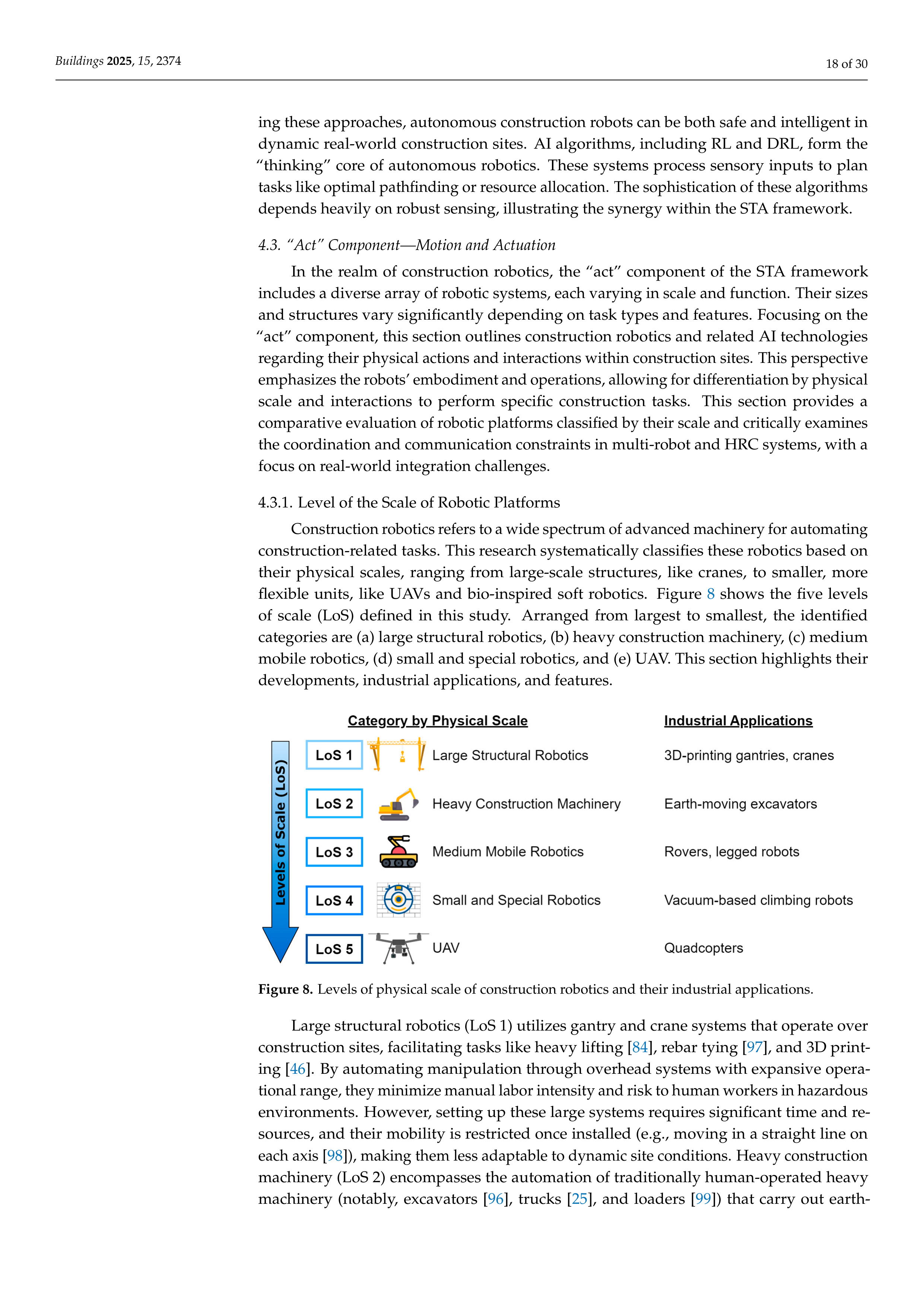
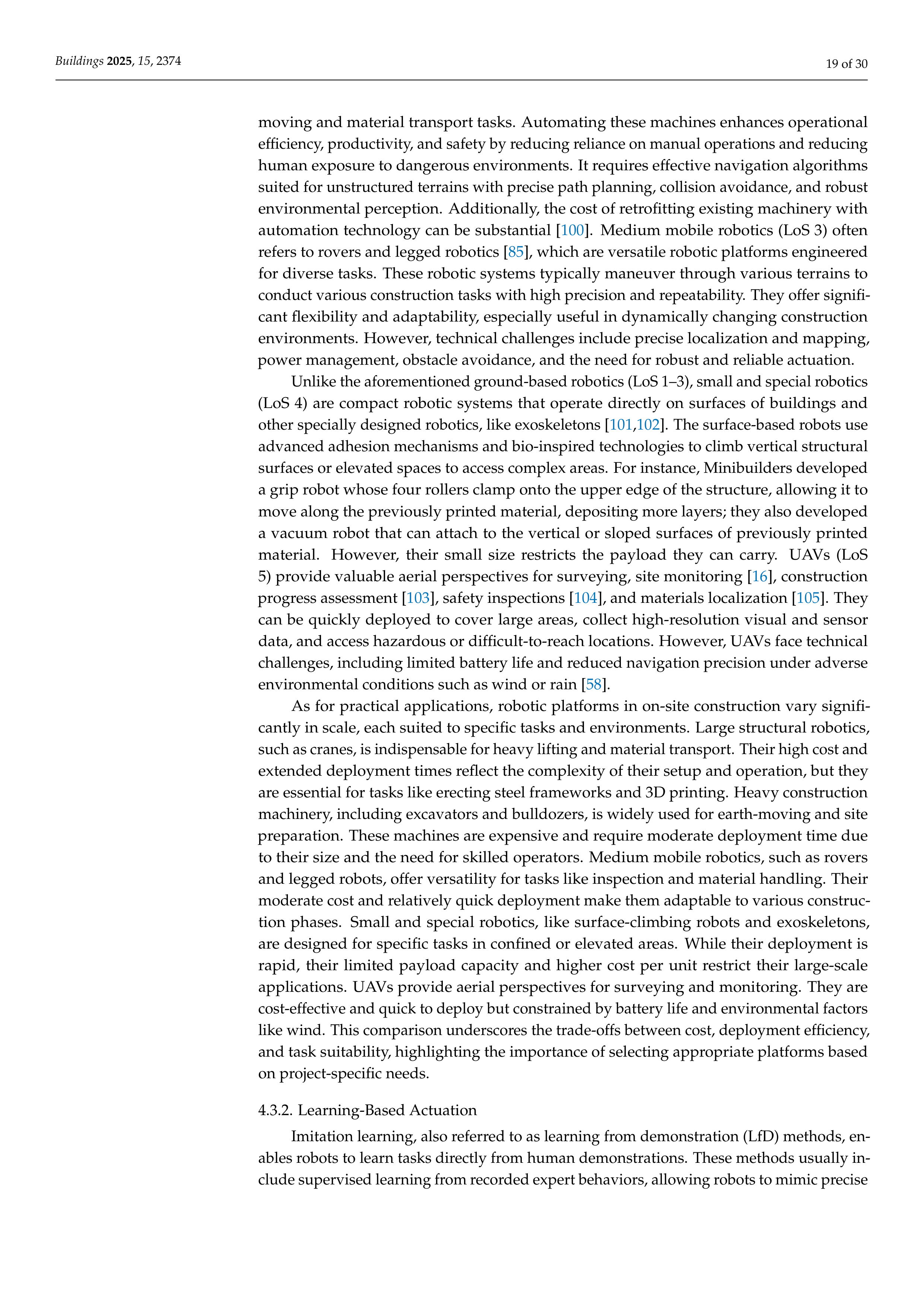
Figure
8
shows
the
five
levels
of
scale
(LoS)
defined
in
this
study.
Arranged
from
largest
to
smallest,
the
identified
categories are (a) large structural robotics, (b) heavy construction machinery, (c) medium
mobile robotics, (d) small and special robotics, and (e) UAV. This section highlights their
developments, industrial applications, and features.
Figure 8.
Levels of physical scale of construction robotics and their industrial applications.
Large structural robotics (LoS 1) utilizes gantry and crane systems that operate over
construction sites, facilitating tasks like heavy lifting [
84
], rebar tying [
97
], and 3D print-
ing [
46
].
By automating manipulation through overhead systems with expansive opera-
tional range, they minimize manual labor intensity and risk to human workers in hazardous
environments.
However, setting up these large systems requires significant time and re-
sources, and their mobility is restricted once installed (e.g., moving in a straight line on
each axis [
98
]), making them less adaptable to dynamic site conditions.
Heavy construction
machinery (LoS 2) encompasses the automation of traditionally human-operated heavy
machinery
(notably,
excavators
[
96
],
trucks
[
25
],
and
loaders
[
99
])
that
carry
out
earth-
Buildings
2025
,
15
, 2374
19 of 30
moving and material transport tasks.
Automating these machines enhances operational
efficiency, productivity, and safety by reducing reliance on manual operations and reducing
human exposure to dangerous environments.
It requires effective navigation algorithms
suited for unstructured terrains with precise path planning, collision avoidance, and robust
environmental perception.
Additionally, the cost of retrofitting existing machinery with
automation technology can be substantial [
100
].
Medium mobile robotics (LoS 3) often
refers to rovers and legged robotics [
85
], which are versatile robotic platforms engineered
for diverse tasks.
These robotic systems typically maneuver through various terrains to
conduct various construction tasks with high precision and repeatability.
They offer signifi-
cant flexibility and adaptability, especially useful in dynamically changing construction
environments.
However, technical challenges include precise localization and mapping,
power management, obstacle avoidance, and the need for robust and reliable actuation.
Unlike the aforementioned ground-based robotics (LoS 1–3), small and special robotics
(LoS
4)
are
compact
robotic
systems
that
operate
directly
on
surfaces
of
buildings
and
other specially designed robotics, like exoskeletons [
101
,
102
].
The surface-based robots use
advanced adhesion mechanisms and bio-inspired technologies to climb vertical structural
surfaces or elevated spaces to access complex areas.
For instance, Minibuilders developed
a grip robot whose four rollers clamp onto the upper edge of the structure, allowing it to
move along the previously printed material, depositing more layers; they also developed
a
vacuum
robot
that
can
attach
to
the
vertical
or
sloped
surfaces
of
previously
printed
material.
However,
their
small
size
restricts
the
payload
they
can
carry.
UAVs
(LoS
5) provide valuable aerial perspectives for surveying, site monitoring [
16
], construction
progress assessment [
103
], safety inspections [
104
], and materials localization [
105
].
They
can
be
quickly
deployed
to
cover
large
areas,
collect
high-resolution
visual
and
sensor
data, and access hazardous or difficult-to-reach locations.
However, UAVs face technical
challenges, including limited battery life and reduced navigation precision under adverse
environmental conditions such as wind or rain [
58
].
As for practical applications,
robotic platforms in on-site construction vary signifi-
cantly in scale, each suited to specific tasks and environments.
Large structural robotics,
such as cranes, is indispensable for heavy lifting and material transport.
Their high cost and
extended deployment times reflect the complexity of their setup and operation, but they
are essential for tasks like erecting steel frameworks and 3D printing.
Heavy construction
machinery, including excavators and bulldozers, is widely used for earth-moving and site
preparation.
These machines are expensive and require moderate deployment time due
to their size and the need for skilled operators.
Medium mobile robotics, such as rovers
and legged robots, offer versatility for tasks like inspection and material handling.
Their
moderate cost and relatively quick deployment make them adaptable to various construc-
tion
phases.
Small
and
special
robotics,
like
surface-climbing
robots
and
exoskeletons,
are designed for specific tasks in confined or elevated areas.
While their deployment is
rapid,
their
limited
payload
capacity
and
higher
cost
per
unit
restrict
their
large-scale
applications.
UAVs provide aerial perspectives for surveying and monitoring.
They are
cost-effective and quick to deploy but constrained by battery life and environmental factors
like wind.
This comparison underscores the trade-offs between cost, deployment efficiency,
and task suitability, highlighting the importance of selecting appropriate platforms based
on project-specific needs.
4.3.2.
Learning-Based Actuation
Imitation learning, also referred to as learning from demonstration (LfD) methods, en-
ables robots to learn tasks directly from human demonstrations.
These methods usually in-
clude supervised learning from recorded expert behaviors, allowing robots to mimic precise
Buildings
2025
,
15
, 2374
20 of 30
movements or tasks performed by skilled human workers.
Rasines et al.
automated robotic
joint filling tasks in construction sites, using a teleoperated demonstration by humans and
imitation learning to estimate motion control parameters accurately [
106
].
In addition to the
“think” component (as described in Section
4.2.2
), RL algorithms enable construction robots
to perform complex tasks without requiring hand-crafted control instructions.
It allows
robots to learn optimal actions through trial and error, improving construction skills pro-
gressively, such as excavation [
104
], assembly [
105
], and material placement [
106
].
Schmidt
et al.
integrated RL for autonomous shotcrete spraying robots, optimizing spraying paths
in construction tasks [
18
].
It is worth noting that inverse reinforcement learning combines
LfD and RL to infer reward functions from expert demonstrations and derive optimal task
behaviors through self-exploration, without explicitly defined reward functions [
107
].
4.3.3.
Collaborations of Construction Robotics
Multi-agent collaboration involves multiple robotic systems working cooperatively to
perform complex construction tasks to enhance robustness to environmental uncertainties,
thereby improving productivity and reducing individual robot workload.
Multiple robots
coordinate their actions via communication among robots for task allocation, coordinated
path planning, and decision-making.
Duan et al.
developed multi-agent RL frameworks
facilitating collaboration among multiple robots for pick-and-place tasks on construction
sites, enhancing efficiency and safety [
108
].
Prieto et al.
introduced multi-robot systems
for collaboratively collecting construction data in complex environments effectively, using
cooperative
exploration
algorithms
[
109
].
For
construction
robots
operated
in
remote
and connectivity-constrained sites, they often utilize decentralized control strategies and
edge
computing.
Petráˇcek
et
al.
presented
a
self-sustaining
system
that
interconnects
solutions for all crucial robotic tasks and a multi-robot cooperation for the efficient homing
of a team of robots in order to enable full autonomy in complex, unknown subterranean
environments without access to GNSS [
110
].
Multi-robot systems enhance construction efficiency through collaborative task execu-
tion, yet they encounter significant coordination and communication challenges.
Reliable
network infrastructure is essential for real-time data sharing and task allocation among
robots.
However,
construction sites often experience poor connectivity due to physical
obstructions and remote locations.
Although intermittent communication can lead to task
delays and reduced system robustness, decentralized control strategies mitigate reliance on
central networks while demanding advanced algorithms to prevent conflicts and ensure
operational safety.
HRC involves human and robotics working cooperatively, combining human intelli-
gence, adaptability, and robotic precision and strength to enhance productivity and safety
in
construction
tasks.
Robots
interpret
human
intentions
and
actions
through
sensors
and advanced human-motion prediction algorithms [
50
,
111
–
113
], ensuring safety through
collision avoidance algorithms, and intuitive human–machine interfaces like augmented
reality [
114
].
Shah and Kim developed a motion-intention recognition method using muscle
activity data with deep learning, allowing robots to predict the motion that workers will
take at the next moment and, ultimately, improve the contextual awareness of robots for
human–robot collaboration [
115
].
As for HRC, real-world integration challenges include battery life, safety protocols,
and
worker
acceptance.
Battery
limitations
in
mobile
robots
can
interrupt
workflows,
requiring efficient power management or frequent on-site charging.
Safety protocols, such
as
collision
avoidance
and
emergency
stop
mechanisms,
are
critical
to
protect
workers.
Worker acceptance poses another hurdle, which requires trust in robotic systems driven by
Buildings
2025
,
15
, 2374
21 of 30
transparency in robot behavior and robust safety communication.
Addressing these issues
through training and intuitive interfaces is vital for effective HRC implementation.
In conclusion, while robotic platforms across various scales offer distinct advantages,
their successful deployment relies on overcoming integration challenges.
Actuation tech-
nologies,
ranging
from
articulated
robotic
arms
to
diverse
mobile
platforms,
translate
decisions into physical actions.
Innovations like soft robotics and reconfigurable actuators
allow for greater flexibility, enabling robots to handle diverse tasks such as laying bricks
or assembling modular structures.
The effectiveness of these systems hinges on precise
decision-making,
which
in
turn
relies
on
comprehensive
sensory
data,
reinforcing
the
interconnectedness of the STA components.
The
true
potential
of
autonomous
construction
robotics
lies
in
the
integration
of
sensing,
thinking,
and
acting.
For
instance,
a
robot
equipped
with
advanced
LiDAR
(sense) can map a site in detail, allowing an AI system (think) to calculate the safest path
through debris, which a mobile actuator (act) then executes with precision.
This interplay
amplifies system performance, enabling robots to tackle complex, dynamic tasks that single-
component
innovations
cannot
address
alone.
By
framing
our
analysis
within
the
STA
paradigm, we highlight these synergies, offering a clearer roadmap for future development.
5.
Discussion
5.1.
Impacts
The adoption of the STA framework in this research sets it apart from prior reviews by
providing a structured, holistic lens that uncovers these interdependencies.
Additionally,
the integration of bibliometric and content analyses offers a dual perspective, i.e., quanti-
tative breadth paired with qualitative depth.
Specific insights, such as the link between
publication trends and the potential of hybrid AI models, further distinguish this work,
providing actionable guidance for researchers and industry leaders alike.
From the results
of the bibliometric analysis and content analysis using a feature-centric perspective within
the STA paradigm, despite increasing research interest with a broad scope of keywords,
several aspects still have not been covered or need to be enhanced.
Our findings reveal that while individual STA components have advanced significantly,
the field’s next frontier lies in their seamless integration.
Sensing systems must evolve to
handle the chaotic, unstructured nature of construction sites (e.g., dust, noise, and variable
lighting),
yet
their
success
depends
on
equally
robust
thinking
algorithms
to
interpret
this data under uncertainty.
Similarly, cutting-edge actuators can perform intricate tasks
but
only
if
guided
by
domain
knowledge-enhanced
thinking
systems
that
account
for
real-world constraints like material, schedule, working sequences, or worker safety.
5.2.
Challenges to Autonomous Construction Robotics
The challenges and future directions in AI-driven autonomous construction robotics
are intricately tied to the STA framework, which underpins the operational capabilities
of these systems.
This and the next subsection synthesize the identified challenges with
insights from prior literature and propose future research directions organized under the
themes of hardware, software, collaboration, and implementation.
By explicitly connecting
these elements, we aim to contribute to the broader goal of developing robust, adaptable,
and safe robotic systems for construction environments.
•
Dynamic and unstructured construction sites.
Unlike industrial robotics operating
in controlled factory environments with assembly lines, construction robotics faces
more
complex
environments
and
tasks.
The
unstructured
nature
of
construction
sites, including uneven terrain, partially built structures, and variable storage areas,
introduces
constant
unpredictability
in
robot
navigation,
which
poses
significant
Buildings
2025
,
15
, 2374
22 of 30
challenges
to
the
“sense”
and
“act”
components.
Accurate
sensing
is
essential
for
the perception of environmental features, while a reliable acting component ensures
operational
success in
task
execution.
Robotics
should
not
only navigate
evolving
geometry
but
also
adapt
to
changing
obstacles
that
may
appear
or
move
during
construction.
Robust real-time mapping is essential to deal with on-the-fly deviations
in building geometry.
Many of the current studies rely on vision-based sensors (e.g.,
camera and LiDAR) coupled with other sensors, but weather factors, such as dust,
low-lighting, or bright sunlight, can degrade vision sensor reliability.
Handling such
sensor uncertainties in adverse construction sites remains challenging.
•
Hardware constraints and over-specialization.
Construction tasks range from placing
large building elements to the fine placement of tiles and welding.
The differences
in required precision,
kinematic constraints,
and dynamic payloads (especially for
crane-based robotics [
84
]) complicate the use of general-purpose construction robotics.
This primarily affects the “act” component, as inflexible hardware increases costs and
coordination complexity.
Current construction robotics platforms are often optimized
for specific tasks (e.g., masonry, material transport, and steel placement), emphasizing
payload,
reach,
or
stability
for
a
single
operation.
For
instance,
large-scale
gantry
printers excel at 3D-printing building shells but are ill-suited to indoor installation
tasks. Robotic solutions that are too specialized introduce many unique robotic systems
in a construction site, resulting in difficulties in sharing roles and resources, thereby
incurring excessive costs in coordination and task allocation among multiple robots
and restricting overall productivity gains.
•
Ensuring the safety of human workers, robots, and structures.
The construction in-
dustry is high-risk due to the nature of partial structures, which should support their
own weight and that of subsequent added elements.
It also remains labor-intensive,
necessitating close interactions between human workers and robots.
Safety concerns
span the “think” and “act” components, requiring predictive decision-making and
precise execution.
The “think” component must anticipate human movements and
structural risks, while the “act” component ensures safe task performance.
Although
the sensing component can detect human presence (e.g., via on-board sensors or wear-
able devices), anticipating human actions and preventing collisions is more complex.
Any failure in sensing or motion planning can jeopardize both the worker’s safety and
the partially built structure’s integrity.
It remains a challenge for construction robotics
to assess safety margins when planning motion and actuation.
•
Limited integration of construction domain knowledge.
Existing robotics research of-
ten employs advanced algorithms for navigation and task allocation but lacks explicit
construction knowledge, such as structural load-bearing constraints or working se-
quencing dependencies.
Thus, the “think” component is challenged by the inadequate
incorporation
of
construction-specific
knowledge,
such
as
task
dependencies
and
structural requirements.
Without this domain-specific information, motion-planning
techniques may miss critical safety or scheduling constraints from the perspectives of
multi-phase construction projects.
The lack of bidirectional links with BIM and digital
twins further hinders the robot’s capacity to integrate construction domain knowledge
and adapt to on-site changes.
5.3.
Future Directions
Future
research
should
prioritize
cross-component
solutions,
such
as
end-to-end
systems that optimize sensing-to-actuation pipelines.
Addressing challenges like real-time
adaptability,
hardware
durability,
and
knowledge
transfer
will
be
key
to
scaling
these
technologies.
Our
analysis
lays
the
groundwork
for
these
efforts
by
identifying
where
Buildings
2025
,
15
, 2374
23 of 30
the
current
strengths
and
gaps
lie.
This
subsection
pairs
each
challenge
with
targeted
future directions, thereby clarifying how researchers and industry practitioners can address
existing gaps and push the field toward robust, large-scale implementation.
•
Robust sensing system for complex environments.
To address the challenges posed
by
complex
construction
sites,
future
robotic
systems
must
go
beyond
adaptively
degrading when sensors fail.
They should also balance the cost and efficiency for peri-
odic fine-tuning.
Such “on-the-fly” adaptation can be achieved through the following
framework.
First, integrating multi-sensor fusion (e.g., combining LiDAR, cameras,
thermal imaging, or GPS when available) enables a robot to compensate for degraded
input from any single modality.
Second, reinforcement learning can be layered onto
classical planners to adapt motion paths in response to real-time feedback.
However,
these techniques should be designed with consideration of computational efficiency
so that partial re-planning or incremental retraining targets only the affected modules
(e.g., the segment of a neural network responsible for obstacle detection under low
lighting).
This selective approach reduces downtime, conserves energy, and curbs the
costs associated with field recalibration.
•
Balanced reconfigurable robotic platforms.
Some researchers suggested specialized
robotic platforms, manipulation, and actuation tailored to specific tasks to increase
efficiency [
31
].
However, over-reliance on specialized robots leads to parallel systems
that may be difficult to integrate, coordinate, or maintain on construction sites.
Balanc-
ing trade-offs between adaptability vs.
efficiency, size vs.
trafficability, and payload
capacity
vs.
battery
life
is
crucial
for
future
construction
robotics.
Future
research
could
develop
a
balanced
design
or
quick-change
tool
attachments
that
let
robots
perform multiple tasks with less manual intervention.
By combining standardized
locomotion bases (e.g., four-legged robotics or wheeled rovers) with easily swappable
end-effectors (e.g., welding torches, grippers, and drilling units), a single platform can
handle multiple tasks throughout different project phases.
This multi-functionality
cuts costs related to deployment, training, and maintenance while also simplifying
scheduling, as the same robot base can transition between tasks.
Additionally, shared
data
interfaces
and
power
supply
modules
can
streamline
integration,
enabling
a
scalable fleet of robots that collectively manage diverse on-site operations.
•
Predictive
safety
and
human–robot
collaboration.
Overcoming
safety
challenges
starts
with
human-intent
recognition.
Deep
learning
approaches
that
incorporate
wearable sensors with computer vision can move beyond simple hazard detection
to predict worker trajectories and tasks.
This proactive approach allows the robot to
reduce speed, modify its path, or pause if it anticipates a hazardous overlap.
Physical
safety
mechanisms,
such
as
soft
materials
in
robotic
limbs
or
compliant
actuators,
further protect against collisions.
Collaborative autonomy protocols, including shared
decision-making loops, whereby humans can override or guide robot actions, ensure
that expert experience complements robotic efficiency.
•
Integrate
construction
domain
knowledge.
On-site
construction
robotics
usually
operates
in
environments
that
are
complex,
high-risk,
and
heavily
influenced
by
worker
activity
and
machinery.
Integrating
construction
domain
knowledge
into
robotic systems allows them to work more effectively and safely alongside human
workers.
By embedding knowledge of construction tasks and procedures, robots can
better recognize worker activity and predict their intention, thereby taking proactive
steps to facilitate or avoid interference.
Construction domain knowledge also includes
site layouts and building geometry.
A robot that integrates domain information can
make
more
informed
path-planning
decisions.
Domain
knowledge
helps
identify
high-risk phases of construction.
By knowing which parts of a structure can safely
Buildings
2025
,
15
, 2374
24 of 30
bear
weight
and
where
and
when
the
risks
are
greatest,
the
robot
can
adjust
its
decision-making to maintain buffer zones and communicate warnings in real time.
Future research should investigate how robots can align their tasks with 4D BIM and
digital twins.
Automated sync between physical progress and digital blueprints helps
coordinate scheduling, material transportation, task allocation, and real-time updates
to building models.
•
Standardized datasets and evaluation metrics.
Comprehensive datasets that cover di-
verse construction scenarios ensure robotic systems trained on them can generalize to
real-world scenarios.
It is difficult to compare results and reproduce existing research
when researchers test their methods on different platforms or use unique datasets.
Many existing studies remain too conceptualized, as they make narrow assumptions
about construction context, such as ignoring building elements’ properties or simplify-
ing complex construction site environments with pre-defined trajectories of workers.
A standardized testing environment can enable direct comparisons, making it easier
to measure progress and identify the most promising approaches.
It also facilitates
collaboration and knowledge transfer between teams in academia and industry by
accessing a common dataset and testing platform to build on each other’s work more
easily, instead of starting from scratch.
6.
Conclusions
The integration of AI into on-site construction robotics, evaluated through the STA
framework, constitutes a transformative step toward overcoming persistent challenges in
the construction sector.
This review has traced the rapid growth and evolving focus of
AI-driven construction robotics through a PRISMA-guided dual approach that combined
bibliometric mapping of 319 publications with close content analysis of 188 peer-reviewed
journal articles.
The bibliometric analysis highlights rapid growth in research activities
post-2021, revealing a global surge in interest, with China and the US together accounting
for nearly half of all publications.
Key journals such as
Automation in Construction
and
IEEE
Transactions on Industrial Informatics
emerged as leading outlets, while co-authorship and
keyword networks highlighted growing collaboration and shifts toward topics like RL,
BIM, and HRC. Through the lens of the STA framework, the content analysis has shown the
following:
vision and LiDAR sensors, when fused through robust SLAM and DL methods,
now enable reliable perception, even under the challenging conditions of active building
sites;
the fusion of classical path-planning techniques with RL strategies promises ever
greater adaptability for decision-making; learning-based actuation, supported by multi-
robot and HRC systems, is paving the way for more flexible, safe task execution, using
robotic platforms across various scales.
Looking forward, we argue that realizing fully resilient construction robots will de-
pend on codesigning,
sensing,
thinking,
and actuation as a single,
adaptive pipeline in
complicated, dynamic sites.
Tight coupling with construction domain knowledge like BIM
and digital twins offers a pathway for robots to anticipate structural changes,
optimize
task
scheduling,
and
reduce
costly
delays,
thereby
reshaping
research
agendas
toward
multidisciplinary collaborations between robotics, civil engineering, and computer science.
To foster fair comparison and accelerate breakthroughs, the community should prioritize
the creation of open benchmarking protocols, diverse datasets, and unified evaluation met-
rics.
Such benchmarks will not only guide future algorithm development but also inform
practitioners seeking to evaluate vendor solutions and establish performance guarantees.
Equally important will be the ethical and safety dimensions of HRC. We recommend that
follow-up studies develop standardized frameworks for HRC ethics, covering risk assess-
ment,
operator training,
and accountability,
and that they explore long-term field trials
Buildings
2025
,
15
, 2374
25 of 30
to validate system robustness and user acceptance in live construction environments.
By
integrating explainable AI techniques and transfer-learning approaches, future research
can deliver transparent, trustworthy systems that meet both regulatory requirements and
on-site productivity demands.
While this review offers an extensive analysis of recent advancements in AI-driven
autonomous
construction
robotics,
several
limitations
should
be
acknowledged.
The
bibliometric analysis may inadvertently overlook the relevant literature published outside
of the selected databases or beyond the defined timeframe.
Furthermore, the review’s broad
scope necessitates a high-level overview, potentially missing in-depth technical details of
specific technologies or case studies.
Nevertheless, these limitations present opportunities
for future focused reviews and case studies that could complement and enrich the findings
presented here.
Overall,
this review has charted the current strengths and gaps in AI-enabled con-
struction robotics and set an agenda for research that bridges algorithmic innovation with
practical deployment.
By focusing on end-to-end STA integration, digital twin synergy,
open
benchmarking,
and
ethical
HRC
protocols,
the
field
can
advance
toward
robotic
systems
that
are
not
only
technically
capable
but
also
economically
viable
and
socially
responsible in shaping the construction sites of tomorrow.
Author Contributions:
Conceptualization, Z.R. and J.I.K.; methodology, Z.R. and J.I.K.; software,
Z.R.; validation, J.I.K.; formal analysis, Z.R.; investigation, Z.R.; resources, J.I.K.; data curation, Z.R.;
writing—original
draft
preparation,
Z.R.;
writing—review
and
editing,
J.I.K.;
visualization,
Z.R.;
supervision, J.I.K. All authors have read and agreed to the published version of the manuscript.
Funding:
This work is supported by the Korea Agency for Infrastructure Technology Advancement
(KAIA) grant funded by the Ministry of Land, Infrastructure and Transport (Grant RS-2025-02532980).
Data Availability Statement:
Not applicable.
Conflicts of Interest:
The authors declare no conflict of interest.
References
1.
Amani, M.; Akhavian, R. Intelligent ergonomic optimization in bimanual worker-robot interaction:
A Reinforcement Learning
approach.
Autom.
Constr.
2024
,
168
, 105741.
[
CrossRef
]
2.
Feng, C.; Xiao, Y.; Willette, A.; McGee, W.; Kamat, V.R. Vision guided autonomous robotic assembly and as-built scanning on
unstructured construction sites.
Autom.
Constr.
2015
,
59
, 128–138.
[
CrossRef
]
3.
Chen, X.; Yu, Y. An unsupervised low-light image enhancement method for improving V-SLAM localization in uneven low-light
construction sites.
Autom.
Constr.
2024
,
162
, 105404.
[
CrossRef
]
4.
Chea, C.P.; Bai, Y.; Pan, X.; Arashpour, M.; Xie, Y. An integrated review of automation and robotic technologies for structural
prefabrication and construction.
Transp.
Saf.
Environ.
2020
,
2
, 81–96.
[
CrossRef
]
5.
Wang, L.; Naito, T.; Leng, Y.; Fukuda, H.; Zhang, T.; Wang, L.; Naito, T.; Leng, Y.; Fukuda, H.; Zhang, T. Research on Construction
Performance Evaluation of Robot in Wooden Structure Building Method.
Buildings
2022
,
12
, 1437.
[
CrossRef
]
6.
Brosque, C.; Fischer, M. Safety, quality, schedule, and cost impacts of ten construction robots.
Constr.
Robot.
2022
,
6
, 163–186.
[
CrossRef
]
7.
Fazeli, N.; Oller, M.; Wu, J.; Wu, Z.; Tenenbaum, J.B.; Rodriguez, A. See, feel, act:
Hierarchical learning for complex manipulation
skills with multisensory fusion.
Sci.
Robot.
2019
,
4
, eaav3123.
[
CrossRef
]
8.
Bekey, G.A. On autonomous robots.
Knowl.
Eng.
Rev.
1998
,
13
, 143–146.
[
CrossRef
]
9.
Jiménez-Cano, A.E.; Sanalitro, D.; Tognon, M.; Franchi, A.; Cortés, J. Precise Cable-Suspended Pick-and-Place with an Aerial
Multi-robot System:
A Proof of Concept for Novel Robotics-Based Construction Techniques.
J. Intell.
Robot.
Syst.
2022
,
105
, 68.
[
CrossRef
]
10.
Kang, H.; Zhang, W.; Ge, Y.; Liao, H.; Huang, B.; Wu, J.; Yan, R.-J.; Chen, I.-M. A high-accuracy hollowness inspection system
with sensor fusion of ultra-wide-band radar and depth camera.
Robotica
2023
,
41
, 1258–1274.
[
CrossRef
]
11.
Das,
D.;
Miura,
J.
Camera
Motion
Compensation
and
Person
Detection
in
Construction
Site
Using
Yolo-Bayes
Model.
In
Proceedings of the 2022 26th International Conference on Pattern Recognition (ICPR), Montreal, QC, Canada, 21–25 August 2022;
Institute of Electrical and Electronics Engineers Inc.:
Piscataway, NJ, USA, 2022; pp.
4566–4572.
Buildings
2025
,
15
, 2374
26 of 30
12.
Bentz, W.; Qian, L.; Panagou, D. Expanding human visual field:
Online learning of assistive camera views by an aerial co-robot.
Auton.
Robot.
2022
,
46
, 949–970.
[
CrossRef
]
13.
Leduc, J.-P. 3D+T motion analysis:
Motion sensor network versus multiple video cameras.
Opt.
Photonics Inf.
Process.
XII
2018
,
10751
, 107510X. [
CrossRef
]
14.
Yang, Z.; Li, J.; Wu, H.; Zlatanova, S.; Wang, W.; Fox, J.; Yang, B.; Tang, Y.; Zhang, R.; Gong, J.; et al.
Robust and accurate visual
geo-localization using prior map constructed by handheld LiDAR SLAM with camera image and terrestrial LiDAR point cloud.
Int.
J. Digit.
Earth
2024
,
17
, 2416468.
[
CrossRef
]
15.
Kang, X.; Li, J.; Fan, X.; Wan, W. Real-time RGB-D simultaneous localization and mapping guided by terrestrial LiDAR point
cloud for indoor 3-D reconstruction and camera pose estimation.
Appl.
Sci.
2019
,
9
, 3264.
[
CrossRef
]
16.
Zheng,
D.a.;
Sun,
Y.;
He,
D.;
Wang,
J.;
Ju,
H.;
Zhao,
H. Application of UAV Target Detection and Tracking System Based on
Intelligent Image Recognition.
In Proceedings of the 2024 2nd World Conference on Communication & Computing (WCONF),
Raipur, India, 12–14 July 2024; Institute of Electrical and Electronics Engineers Inc.:
Piscataway, NJ, USA, 2024.
17.
Wu, H.; Ma, M.; Yang, Y.; Han, L.; Wu, S. On-Site Measuring Robot Technology for Post-Construction Quality Assessment of
Building Projects.
Buildings
2024
,
14
, 3085.
[
CrossRef
]
18.
Schmidt, P.; Katsatos, D.; Alexiou, D.; Kostavelis, I.; Giakoumis, D.; Tzovaras, D.; Nalpantidis, L. Towards autonomous shotcrete
construction:
Semantic 3D reconstruction for concrete deposition using stereo vision and deep learning.
In Proceedings of the 41st
International Symposium on Automation and Robotics in Construction—LILLIAD—Learning Center Innovation, Lille, France,
3–7 June 2024; International Association for Automation and Robotics in Construction (IAARC): Oulu, Finland, 2024; pp.
896–903.
[
CrossRef
]
19.
Li, S.; Niu, Y.; Feng, C.; Liu, H.; Zhang, D.; Qin, H. An onsite calibration method for MEMS-IMU in building mapping fields.
Sensors
2019
,
19
, 4150.
[
CrossRef
]
20.
Xu, G. Analysis of Safety Behavior of Prefabricated Building Workers’ Hoisting Operation Based on Computer Vision.
Math.
Probl.
Eng.
2022
,
2022
, 1715332.
[
CrossRef
]
21.
Kuenzel, R.; Teizer, J.; Mueller, M.; Blickle, A. SmartSite:
Intelligent and autonomous environments, machinery, and processes to
realize smart road construction projects.
Autom.
Constr.
2016
,
71
, 21–33.
[
CrossRef
]
22.
Chen,
X.;
Huang,
H.;
Liu,
Y.;
Li,
J.;
Liu,
M.
Robot
for
automatic
waste
sorting
on
construction
sites.
Autom.
Constr.
2022
,
141
, 104387.
[
CrossRef
]
23.
Wang, Z.; Li, H.; Yang, X. Vision-based robotic system for on-site construction and demolition waste sorting and recycling.
J.
Build.
Eng.
2020
,
32
, 101769.
[
CrossRef
]
24.
Han, S.; Park, W.; Jeong, K.; Hong, T.; Koo, C. Utilizing synthetic images to enhance the automated recognition of small-sized
construction tools.
Autom.
Constr.
2024
,
163
, 105415.
[
CrossRef
]
25.
Zhou, Z.; Abdi, E.; Chea, C.P.; Bai, Y. Global path planning for autonomous construction vehicles in building construction:
A
comparative study with a focus on vehicle kinematic characteristics.
J. Build.
Eng.
2024
,
93
, 109837.
[
CrossRef
]
26.
Yang, Y.; Huang, T.; Wang, T.; Yang, W.; Chen, H.; Li, B.; Wen, C.-Y. Sampling-efficient path planning and improved actor-critic-
based obstacle avoidance for autonomous robots.
Sci.
China Inf.
Sci.
2024
,
67
, 152204.
[
CrossRef
]
27.
Wang,
J.;
Sun,
Z.;
Guan,
X.;
Shen,
T.;
Huang,
D.;
Zhang,
Z.;
Duan,
T.;
Liu,
F.;
Cui,
H.
HE-Nav:
A
High-Performance
and
Efficient Navigation System for Aerial-Ground Robots in Cluttered Environments.
IEEE Robot.
Autom.
Lett.
2024
,
9
, 10383–10390.
[
CrossRef
]
28.
Herrmann, F.; Zach, S.; Banfi, J.; Peters, J.; Chalvatzaki, G.; Tateo, D. Safe and Efficient Path Planning Under Uncertainty via Deep
Collision Probability Fields.
IEEE Robot.
Autom.
Lett.
2024
,
9
, 9327–9334.
[
CrossRef
]
29.
Dassori, I.; Adams, M.; Vasquez, J. Four-Legged Gait Control via the Fusion of Computer Vision and Reinforcement Learning.
In
Proceedings of the FUSION 2024—27th International Conference on Information Fusion, Venice, Italy, 8–11 July 2024; Institute of
Electrical and Electronics Engineers Inc.:
Piscataway, NJ, USA, 2024.
[
CrossRef
]
30.
Aziz,
A.;
Herbers,
P.;
Bayer,
H.;
König,
M.
Fully
autonomous
fire
safety
equipment
inspection
missions
on
a
legged
robot.
In
Computing in Civil Engineering 2023:
Data,
Sensing,
and Analytics—Selected Papers from the ASCE International Conference on
Computing in Civil Engineering, Corvallis, OR, USA, 25–28 June 2023
; Turkan, Y., Louis, J., Leite, F., Ergan, S., Eds.; American Society
of Civil Engineers (ASCE): Reston, VA, USA, 2024; pp.
804–812.
[
CrossRef
]
31.
Gong, Y.; Sun, G.; Nair, A.; Bidwai, A.; CS, R.; Grezmak, J.; Sartoretti, G.; Daltorio, K.A. Legged robots for object manipulation:
A
review.
Front.
Mech.
Eng.
2023
,
9
, 1142421.
[
CrossRef
]
32.
Moon, S.-M.; Huh, J.; Hong, D.; Lee, S.; Han, C.-S. Vertical motion control of building façade maintenance robot with built-in
guide rail.
Robot.
Comput.-Integr.
Manuf.
2015
,
31
, 11–20.
[
CrossRef
]
33.
Grimshaw, A.; Oyekan, J. Applying Deep Reinforcement Learning to Cable Driven Parallel Robots for Balancing Unstable Loads:
A Ball Case Study.
Front.
Robot.
AI
2021
,
7
, 611203.
[
CrossRef
]
34.
Ye, X.; Wu, G.; Fan, F.; Peng, X.; Wang, K. Overhead ground wire detection by fusion global and local features and supervised
learning method for a cable inspection robot.
Sens.
Rev.
2018
,
38
, 376–386.
[
CrossRef
]
Buildings
2025
,
15
, 2374
27 of 30
35.
Patel, A.; Kanellakis, C.; Agha-Mohammadi, A.-A.; Nikolakopoulos, G. Traversability Aware graph-based Subterranean Explo-
ration with Unmanned Aerial Vehicles.
IFAC-Pap.
2023
,
56
, 9263–9268.
[
CrossRef
]
36.
Cujó Blasco, J.; Bemposta Rosende, S.; Sánchez-Soriano, J. Automatic Real-Time Creation of Three-Dimensional (3D) Representa-
tions of Objects, Buildings, or Scenarios Using Drones and Artificial Intelligence Techniques.
Drones
2023
,
7
, 516.
[
CrossRef
]
37.
Wang, K.; Cheng, J.C.P. Integrating Hardware-in-the-loop simulation and BIM for planning UAV-based as-built MEP inspection
with deep learning techniques.
Int.
Assoc.
Autom.
Robot.
Constr.
2019
,
36
, 310–316.
[
CrossRef
]
38.
Sarker,
A.;
Ul
Islam,
T.;
Islam,
M.R.
A
Review
on
Recent
Trends
of
Bioinspired
Soft
Robotics:
Actuators,
Control
Methods,
Materials Selection, Sensors, Challenges, and Future Prospects.
Adv.
Intell.
Syst.
2024
,
7
, 2400414.
[
CrossRef
]
39.
Murzynski, C.J.; Ashour, O.; Sammoud, A. Constructing Reconfigurable and Affordable Robotic Arm Platform to Teach Robotics
and Automation.
In Proceedings of the ASEE Annual Conference and Exposition, Conference Proceedings, American Society for
Engineering Education, Portland, OR, USA, 23–26 June 2024.
40.
Stefanoni, M.; Pesti, R.; Odry, A.; Sarcevic, P. Measurement System for the Simulation of Indoor Magnetic Disturbances using a
Robotic Arm.
In Proceedings of the 2023 IEEE 21st World Symposium on Applied Machine Intelligence and Informatics, SAMI
2023—Proceedings, Herl’any, Slovakia, 19–21 January 2023; pp.
273–278.
41.
Ku, T.K.X.; Zuo, B.; Ang, W.T. Robotic tower cranes with hardware-in-the-loop:
Enhancing construction safety and efficiency.
Autom.
Constr.
2024
,
168
, 105765.
[
CrossRef
]
42.
Liong, S.-T.; Kuo, F.-W.; Gan, Y.S.; Sheng, Y.-T.; Wang, S.-Y. Predicting trajectory of crane-lifted load using LSTM network:
A
comparative study of simulated and real-world scenarios.
Expert Syst.
Appl.
2023
,
228
, 120215.
[
CrossRef
]
43.
Aghajamali,
K.;
Nekouvaght Tak,
A.;
Taghaddos,
H.;
Mousaei,
A.;
Behzadipour,
S.;
Hermann,
U. Planning of Mobile Crane
Walking Operations in Congested Industrial Construction Sites.
J. Constr.
Eng.
Manag.
2023
,
149
.
[
CrossRef
]
44.
Yarovoi, A.; Cho, Y.K. Review of simultaneous localization and mapping (SLAM) for construction robotics applications.
Autom.
Constr.
2024
,
162
, 105344.
[
CrossRef
]
45.
Liu, Y.; Bin Alias, A.H.; Haron, N.A.; Abu Bakar, N.; Wang, H. Exploring three pillars of construction robotics via dual-track
quantitative analysis.
Autom.
Constr.
2024
,
162
, 105391.
[
CrossRef
]
46.
Guaman-Rivera, R.; Martinez-Rocamora, A.; Garcia-Alvarado, R.; Munoz-Sanguinetti, C.; Gonzalez-Bohme, L.F.; Auat-Cheein,
F.
Recent
Developments
and
Challenges
of
3D-Printed
Construction:
A
Review
of
Research
Fronts.
Buildings
2022
,
12
,
229.
[
CrossRef
]
47.
Pan, M.; Yang, Y.; Zheng, Z.; Pan, W. Artificial Intelligence and Robotics for Prefabricated and Modular Construction: A Systematic
Literature Review.
J. Constr.
Eng.
Manage.
2022
,
148
.
[
CrossRef
]
48.
Pokucinski, S.; Mrozek, D. Methods and Applications of Space Understanding in Indoor Environment—A Decade Survey.
Appl.
Sci.-Basel
2024
,
14
, 3974.
[
CrossRef
]
49.
Attalla, A.; Attalla, O.; Moussa, A.; Shafique, D.; Raean, S.B.; Hegazy, T. Construction robotics:
Review of intelligent features.
Int.
J. Intell.
Robot.
2023
,
7
, 535–555.
[
CrossRef
]
50.
Liang, C.-J.; Wang, X.; Kamat, V.R.; Menassa, C.C. Human-Robot Collaboration in Construction:
Classification and Research
Trends.
J. Constr.
Eng.
Manage.
2021
,
147
.
[
CrossRef
]
51.
Ma, S.; Zayed, T.; Xing, J.; Shao, Y. A state-of-the-art review for the prediction of overflow in urban sewer systems.
J. Clean Prod.
2024
,
434
, 139923.
[
CrossRef
]
52.
Lai, Z.; Xiao, Y.; Chen, Z.; Li, H.; Huang, L. Preserving Woodcraft in the Digital Age:
A Meta-Model-Based Robotic Approach for
Sustainable Timber Construction.
Buildings
2024
,
14
, 2900.
[
CrossRef
]
53.
Lee, D.; Lee, S.; Masoud, N.; Krishnan, M.S.; Li, V.C. Digital twin-driven deep reinforcement learning for adaptive task allocation
in robotic construction.
Adv.
Eng.
Inform.
2022
,
53
, 101710.
[
CrossRef
]
54.
He, R.; Li, M.; Gan, V.J.L.; Ma, J. BIM-enabled computerized design and digital fabrication of industrialized buildings:
A case
study.
J. Clean Prod.
2021
,
278
, 123505.
[
CrossRef
]
55.
Shen, Y.; Guo, D.; Long, F.; Mateos, L.A.; Ding, H.; Xiu, Z.; Hellman, R.B.; King, A.; Chen, S.; Zhang, C.; et al.
Robots Under
COVID-19 Pandemic:
A Comprehensive Survey.
IEEE Access
2021
,
9
, 1590–1615.
[
CrossRef
]
56.
Turner, C.J.; Oyekan, J.; Stergioulas, L.; Griffin, D. Utilizing Industry 4.0 on the Construction Site:
Challenges and Opportunities.
IEEE Trans.
Ind.
Inform.
2021
,
17
, 746–756.
[
CrossRef
]
57.
Hamledari, H.; McCabe, B.; Davari, S. Automated computer vision-based detection of components of under-construction indoor
partitions.
Autom.
Constr.
2017
,
74
, 78–94.
[
CrossRef
]
58.
Ahmed, F.; Mohanta, J.C.; Keshari, A.; Yadav, P.S. Recent Advances in Unmanned Aerial Vehicles:
A Review.
Arab.
J. Sci.
Eng.
2022
,
47
, 7963–7984.
[
CrossRef
] [
PubMed
]
59.
Zhou, T.; Zhu, Q.; Du, J. Intuitive robot teleoperation for civil engineering operations with virtual reality and deep learning scene
reconstruction.
Adv.
Eng.
Inform.
2020
,
46
, 101170.
[
CrossRef
]
60.
Francis, A.; Faust, A.; Chiang, H.-T.L.; Hsu, J.; Kew, J.C.; Fiser, M.; Lee, T.-W.E. Long-Range Indoor Navigation with PRM-RL.
IEEE Trans.
Robot.
2020
,
36
, 1115–1134.
[
CrossRef
]
Buildings
2025
,
15
, 2374
28 of 30
61.
Khan, A.T.; Li, S.; Cao, X. Control framework for cooperative robots in smart home using bio-inspired neural network.
Meas J Int
Meas Confed
2021
,
167
, 108253.
[
CrossRef
]
62.
Cebollada,
S.;
Payá,
L.;
Flores,
M.;
Peidró,
A.;
Reinoso,
O.
A
state-of-the-art
review
on
mobile
robotics
tasks
using
artificial
intelligence and visual data.
Expert Syst.
Appl.
2021
,
167
, 114195.
[
CrossRef
]
63.
Liu, Y.; Habibnezhad, M.; Jebelli, H. Brain-computer interface for hands-free teleoperation of construction robots.
Autom.
Constr.
2021
,
123
, 103523.
[
CrossRef
]
64.
Khalastchi,
E.;
Kalech,
M.
On
Fault
Detection
and
Diagnosis
in
Robotic
Systems.
ACM
Comput.
Surv.
(CSUR)
2018
,
51
,
9.
[
CrossRef
]
65.
Nguyen, K.; Le, M.; Martin, B.; Cil, I.; Fookes, C.; Nguyen, K.; Le, M.; Martin, B.; Cil, I.; Fookes, C. When AI meets store layout
design:
A review.
Artif.
Intell.
Rev.
2022
,
55
, 5707–5729.
[
CrossRef
]
66.
You, J.; Wang, B.; Wang, D.; Jin, N.; Zhao, X.; Li, F.; Sun, F.; Dou, G.; Bai, H. Design and testing of a low-cost mobile platform for
contactless building surveying.
J. Eng.
Res.
2024
,
in press
.
[
CrossRef
]
67.
Yang, J.; Shi, Z.; Wu, Z. Automatic recognition of construction worker activities using dense trajectories.
In Proceedings of the
2015 32nd ISARC, Oulu, Finland, 15–18 June 2015; International Association for Automation and Robotics in Construction:
Ouluu,
Finland, 2015.
[
CrossRef
]
68.
Wallace,
D.;
He,
Y.H.;
Chagas
Vaz,
J.;
Georgescu,
L.;
Oh,
P.Y.
Multimodal
teleoperation
of
heterogeneous
robots
within
a
construction environment.
In Proceedings of the 2020 IEEE/RSJ International Conference on Intelligent Robots and Systems
(IROS), Las Vegas, NV, USA, 24 October 2020–24 January 2021; Institute of Electrical and Electronics Engineers Inc.:
Piscataway,
NJ, USA, 2020; pp.
2698–2705.
[
CrossRef
]
69.
Niloy, M.A.K.; Shama, A.; Chakrabortty, R.K.; Ryan, M.J.; Badal, F.R.; Tasneem, Z.; Ahamed, M.H.; Moyeen, S.I.; Das, S.K.; Ali,
M.F.; et al.
Critical Design and Control Issues of Indoor Autonomous Mobile Robots:
A Review.
IEEE Access
2021
,
9
, 35338–35370.
[
CrossRef
]
70.
Losey, D.P.; McDonald, C.G.; Battaglia, E.; O’Malley, M.K. A Review of Intent Detection, Arbitration, and Communication Aspects
of Shared Control for Physical Human–Robot Interaction.
Appl.
Mech.
Rev.
2018
,
70
, 010804.
[
CrossRef
]
71.
Mazhar, O.; Navarro, B.; Ramdani, S.; Passama, R.; Cherubini, A. A real-time human-robot interaction framework with robust
background invariant hand gesture detection.
Robot.
Comput.-Integr.
Manuf.
2019
,
60
, 34–48.
[
CrossRef
]
72.
Wu,
D.;
Xu,
X.;
Li,
R.;
Peng,
X.;
Gong,
X.;
Lee,
C.-H.;
Pan,
P.;
Jiang,
S.
Curtain
wall
frame
segmentation
using
a
dual-flow
aggregation network:
Application to robot pose estimation.
Autom.
Constr.
2024
,
168
, 105816.
[
CrossRef
]
73.
Wang, M.; Wong, P.; Luo, H.; Kumar, S.; Delhi, V.; Cheng, J. Predicting safety hazards among construction workers and equipment
using computer vision and deep learning techniques.
In Proceedings of the 2019 36th ISARC, Banff, AL, Canada, 21–24 May 2019;
International Association for Automation and Robotics in Construction:
Oulu, Finland, 2019; pp.
399–406.
[
CrossRef
]
74.
Tung, T.-J.; Al-Hussein, M.; Martinez, P. Vision-Based Guiding System for Autonomous Robotic Corner Cleaning of Window
Frames.
Buildings
2023
,
13
, 2990.
[
CrossRef
]
75.
Kim,
D.;
Min,
J.;
Song,
Y.;
Kim,
C.;
Ahn,
J.
Intelligent
Risk-Identification
Algorithm
with
Vision
and
3D
LiDAR
Patterns
at
Damaged Buildings.
Intell.
Autom.
Soft Comput.
2023
,
36
, 2315–2331.
[
CrossRef
]
76.
Kim, D.; Kim, C.; Ahn, J. Vision-based recognition algorithm for up-To-date indoor digital map generations at damaged buildings.
Comput.
Mater.
Contin.
2022
,
72
, 2765–2781.
[
CrossRef
]
77.
Ngo, H.Q.T.; Bui, T.T. Application of the Image Processing Technique for Powerline Robot.
Lect.
Notes Inst.
Comput.
Sci.
Soc.
Inform.
Telecommun.
Eng.
2023
,
475 LNICST
, 178–189.
[
CrossRef
]
78.
Lee, M.-F.R.; Chien, T.-W. Intelligent robot for worker safety surveillance:
Deep learning perception and visual navigation.
In
Proceedings of the 2020 International Conference on Advanced Robotics and Intelligent Systems (ARIS), Taipei, Taiwan, 19–21
August 2020; Institute of Electrical and Electronics Engineers Inc.:
Piscataway, NJ, USA, 2020.
[
CrossRef
]
79.
Akemoto, A.; Zhu, F. Cooperative Lunar Surface Exploration using Transfer Learning with Multi-Agent Visual Teach and Repeat.
In Proceedings of the IEEE Computer Society, Big Sky, MT, USA, 4–11 March 2023.
[
CrossRef
]
80.
Yuan, C.; Xiong, B.; Li, X.; Sang, X.; Kong, Q. A novel intelligent inspection robot with deep stereo vision for three-dimensional
concrete damage detection and quantification.
Struct.
Health Monit.
2022
,
21
, 788–802.
[
CrossRef
]
81.
Zhang, J.; Singh, S.
LOAM: Lidar Odometry and Mapping in Real-Time
; Robotics:
Science and Systems:
Berkeley, CA, USA, 2014;
pp. 1–9.
82.
Kim, P.; Chen, J.; Kim, J.; Cho, Y.K. SLAM-driven intelligent autonomous mobile robot navigation for construction applications.
Lect.
Notes Comput.
Sci.
2018
,
10863 LNCS
, 254–269.
[
CrossRef
]
83.
Kim, D.; Ahn, J. Intelligent SLAM Algorithm Fusing Low-Cost Sensors at Risk of Building Collapses.
Comput.
Mater.
Contin.
2023
,
74
, 1657–1671.
[
CrossRef
]
84.
Zhu, A.; Zhang, Z.; Pan, W. Technologies, levels and directions of crane-lift automation in construction.
Autom.
Constr.
2023
,
153
, 104960.
[
CrossRef
]
Buildings
2025
,
15
, 2374
29 of 30
85.
Yarovoi, A.; Mo, P.; Cho, Y.K. Robust High-Precision LiDAR Localization in Construction Environments.
In Proceedings of the
2024
Proceedings
of
the
41st
ISARC,
Lille,
France,
3–5
June
2024;
International
Association
for
Automation
and
Robotics
in
Construction (IAARC): Oulu, Finland, 2024; pp.
988–994.
[
CrossRef
]
86.
Ahmed, Z.A.; Raafat, S.M. Enhanced Global Path Planning Efficiency by Bidirectional A*, Gradient Descent, and Orientation
Interpolation Algorithms.
Int.
J. Intell.
Eng.
Syst.
2023
,
16
, 449–461.
[
CrossRef
]
87.
Ye, X.; Guo, H.; Guo, Z.; Luo, Z. A construction robot path planning method based on safe space and worker trajectory prediction.
In Proceedings of the International Association for Automation and Robotics in Construction (IAARC), Lille, France, 3–5 June
2024; pp.
227–235.
[
CrossRef
]
88.
Yi, Y.; Lu, Y.; Zhu, W.; Zhang, M.; Mu, Y.; Chellali, R. Substructure-Preserving Generalization for on-site robotic construction
planning.
In Proceedings of the 2024 9th International Symposium on Computer and Information Processing Technology (ISCIPT),
Xi’an, China, 24–26 May 2024;
Institute of Electrical and Electronics Engineers Inc.:
Piscataway, NJ, USA, 2024;
pp.
135–138.
[
CrossRef
]
89.
Hu, G.; Ji, X.; Meng, B. D_ Modeling and Simulation of Intelligent Building Robot Based on Star Algorithm.
Lect.
Notes Data Eng.
Commun.
Technol.
2023
,
169
, 3–10.
[
CrossRef
]
90.
Halder, S.; Gandra, H.; Afsari, K.
Vision-Based Control of Construction Robots Using Transfer Learning Approach
; American Society of
Civil Engineers (ASCE): Reston, VA, USA, 2024; pp.
657–665.
[
CrossRef
]
91.
Ghatti, M.S.; Yadav, S.K.; Shevade, D.S. Gesture Controlled 3D-Printed Robotic Arm Using IMU Sensors.
Lect.
Notes Mech.
Eng.
2022
, 823–837.
[
CrossRef
]
92.
Spinner, A.; Degani, A. Online as-Built Building Information Model Update for Robotic Monitoring in Construction Sites.
J. Intell.
Rob.
Syst.
Theor.
Appl.
2024
,
110
, 50.
[
CrossRef
]
93.
Liao,
H.;
Huang,
B.;
Dong,
K.;
Jia,
Z.;
Wu,
J.
Robot-Assisted
After-Process
Progress-Monitoring
System
Based
on
BIM
and
Computer Vision.
In Proceedings of the 2023 IEEE International Conference on Robotics and Biomimetics (ROBIO), Koh Samui,
Thailand, 4–9 December 2023; Institute of Electrical and Electronics Engineers Inc.:
Piscataway, NJ, USA, 2023.
[
CrossRef
]
94.
Cai, W.; Zhang, L.; Huang, L.; Yu, X.; Zou, Z. TEA-bot:
A Thermography Enabled Autonomous Robot for Detecting Thermal
Leaks of HVAC Systems in Ceilings.
In Proceedings of the BuildSys ‘22:
Proceedings of the 9th ACM International Conference
on Systems for Energy-Efficient Buildings, Cities, and Transportation, Boston MA, USA, 9–10 November 2022; Association for
Computing Machinery, Inc.:
New York, NY, USA, 2022; pp.
30–39.
[
CrossRef
]
95.
Villanueva, E.M.; Martinez, P.; Ahmad, R. Target-path planning and manufacturability check for robotic CLT machining operations
from BIM information.
Autom.
Constr.
2024
,
158
, 105191.
[
CrossRef
]
96.
Johns, R.L.; Wermelinger, M.; Mascaro, R.; Jud, D.; Gramazio, F.; Kohler, M.; Chli, M.; Hutter, M.; Johns, R.L.; Wermelinger, M.;
et al.
Autonomous dry stone.
Constr.
Robot.
2020
,
4
, 127–140.
[
CrossRef
]
97.
Vidovszky, I. Analyzing Some Aspects of Robot-oriented Design Approach at Material Handling and Manipulation Systems of
On-site Automated Construction Technologies.
Period.
Polytech.
Mech.
Eng.
2024
,
68
, 352–360.
[
CrossRef
]
98.
Wenna, W.; Weili, D.; Changchun, H.; Heng, Z.; Haibing, F.; Yao, Y. A digital twin for 3D path planning of large-span curved-arm
gantry robot.
Robot.
Comput.-Integr.
Manuf.
2022
,
76
, 102330.
[
CrossRef
]
99.
Chen, G.; Chang, R.; Bai, J.; Li, J.; Li, X. Shovel parameter sensitivity analysis and online optimization method for unmanned
loaders.
Autom.
Constr.
2024
,
157
, 105149.
[
CrossRef
]
100.
Fan, H.; Huang, Z.; Xie, Y. Cost-effectiveness assessment of retrofitting construction equipment for reducing diesel emissions—A
life cycle and public health effects perspective.
Environ.
Impact Assess.
Rev.
2025
,
113
, 107864.
[
CrossRef
]
101.
Chen, W.; Li, G.; Li, M.; Wang, W.; Li, P.; Xue, X.; Zhao, X.; Liu, L. LLM-Enabled Incremental Learning Framework for Hand
Exoskeleton Control.
IEEE Trans.
Autom.
Sci.
Eng.
2024
,
22
, 2617–2626.
[
CrossRef
]
102.
Olivo, J.; Cucuzza, R.; Bertagnoli, G.; Domaneschi, M. Optimal design of steel exoskeleton for the retrofitting of RC buildings via
genetic algorithm.
Comput.
Struct.
2024
,
299
, 107396.
[
CrossRef
]
103.
Elmakis, O.; Shaked, T.; Degani, A. Vision-Based UAV-UGV Collaboration for Autonomous Construction Site Preparation.
IEEE
Access
2022
,
10
, 51209–51220.
[
CrossRef
]
104.
Szóstak, M.; Mahamadu, A.-M.; Prabhakaran, A.; Caparros Pérez, D.; Agyekum, K. Development and testing of immersive virtual
reality environment for safe unmanned aerial vehicle usage in construction scenarios.
Saf.
Sci.
2024
,
176
, 106547.
[
CrossRef
]
105.
Wang, Z.; Yang, X.; Zheng, X.; Li, H. Vision-Based On-Site Construction Waste Localization Using Unmanned Aerial Vehicle.
Sensors
2024
,
24
, 2816.
[
CrossRef
] [
PubMed
]
106.
Rasines,
I.;
Prada,
M.;
Dominguez,
A.;
Prada,
E.;
Remazeilles,
A.;
Axpe,
I.C.
Task
Automation
in
Construction
Sites:
Robot
Learning from Teleoperated Demonstrations.
In Proceedings of the 2024 7th Iberian Robotics Conference (ROBOT), Madrid,
Spain, 6–8 November 2024; Institute of Electrical and Electronics Engineers Inc.:
Piscataway, NJ, USA, 2024.
[
CrossRef
]
107.
Li,
R.;
Zou,
Z.
Enhancing
construction
robot
learning
for
collaborative
and
long-horizon
tasks
using
generative
adversarial
imitation learning.
Adv.
Eng.
Inform.
2023
,
58
, 102140.
[
CrossRef
]
Buildings
2025
,
15
, 2374
30 of 30
108.
Duan,
K.;
Suen,
C.W.K.;
Zou,
Z.
MARC:
A
multi-agent
robots
control
framework
for
enhancing
reinforcement
learning
in
construction tasks.
arXiv
2023
.
[
CrossRef
]
109.
Prieto, S.A.; Giakoumidis, N.; García de Soto, B. Multiagent robotic systems and exploration algorithms:
Applications for data
collection in construction sites.
J. Field Robot.
2024
,
41
, 1187–1203.
[
CrossRef
]
110.
Petráˇcek, P.; Krátk
ý
, V.; Petrlík, M.; Báˇca, T.; Kratochvíl, R.; Saska, M. Large-Scale Exploration of Cave Environments by Unmanned
Aerial Vehicles.
IEEE Robot.
Autom.
Lett.
2021
,
6
, 3098304.
[
CrossRef
]
111.
Liu, Y.; Habibnezhad, M.; Jebelli, H.; Monga, V.
Worker-in-the-Loop Cyber-Physical System for Safe Human-Robot Collaboration in
Construction
; American Society of Civil Engineers (ASCE): Reston, VA, USA, 2021; pp.
1075–1083.
112.
Kramberger, A.; Kunic, A.; Iturrate, I.; Sloth, C.; Naboni, R.; Schlette, C. Robotic Assembly of Timber Structures in a Human-Robot
Collaboration Setup.
Front.
Robot.
AI
2022
,
8
, 768038.
[
CrossRef
] [
PubMed
]
113.
Marinelli,
M.
Human-Robot
Collaboration
and
Lean
Waste
Elimination:
Conceptual
Analogies
and
Practical
Synergies
in
Industrialized Construction.
Buildings
2022
,
12
, 2057.
[
CrossRef
]
114.
Xiang, S.; Wang, R.; Feng, C. Mobile projective augmented reality for collaborative robots in construction.
Autom.
Constr.
2021
,
127
, 103704.
[
CrossRef
]
115.
Shah, J.D.; Kim, K.
Motion Intention Recognition of Construction Workers for Human-Robot Collaboration in Construction
; American
Society of Civil Engineers (ASCE): Reston, VA, USA, 2024; pp.
717–726.
[
CrossRef
]
Disclaimer/Publisher’s
Note:
The
statements,
opinions
and
data
contained
in
all
publications
are
solely
those
of
the
individual
author(s) and contributor(s) and not of MDPI and/or the editor(s).
MDPI and/or the editor(s) disclaim responsibility for any injury to
people or property resulting from any ideas, methods, instructions or products referred to in the content.