
Academic Editor: Heming Jia
Received: 12 March 2025
Revised: 6 May 2025
Accepted: 8 May 2025
Published: 13 May 2025
Citation:
Teixeira, A.R.; Ferreira, J.V.;
Ramos, A.L. Intelligent Supply Chain
Management: A Systematic Literature
Review on Artificial Intelligence
Contributions.
Information
2025
,
16
,
399.
https://doi.org/10.3390/
info16050399
Copyright:
© 2025 by the authors.
Licensee MDPI, Basel, Switzerland.
This article is an open access article
distributed under the terms and
conditions of the Creative Commons
Attribution (CC BY) license
(https://creativecommons.org/
licenses/by/4.0/).
Systematic Review
Intelligent Supply Chain Management:
A Systematic Literature
Review on Artificial Intelligence Contributions
António R. Teixeira
1,
*
, José Vasconcelos Ferreira
2
and Ana Luísa Ramos
2
1
Department of Economics, Management, Industrial Engineering and Tourism (DEGEIT), University of Aveiro,
3810-193 Aveiro, Portugal
2
Research Unit on Governance, Competitiveness and Public Policies (GOVCOPP), Department of Economics,
Management, Industrial Engineering and Tourism (DEGEIT), University of Aveiro, 3810-193 Aveiro, Portugal;
josev@ua.pt (J.V.F.); aramos@ua.pt (A.L.R.)
*
Correspondence:
antoniorteixeira@ua.pt
Abstract:
This systematic literature review investigates the recent applications of artificial
intelligence (AI) in supply chain management (SCM), particularly in the domains of re-
silience, process optimization, sustainability, and implementation challenges.
The study is
motivated by gaps identified in previous reviews, which often exclude literature published
after
2020
and
lack
an
integrated
analysis
of
AI’s
contributions
across
multiple
supply
chain phases.
The review aims to provide an updated synthesis of AI technologies—such
as machine learning, deep learning, and generative AI—and their practical implementation
between 2021 and 2024.
Following the PRISMA framework, a rigorous methodology was
applied using the Scopus database, complemented by bibliometric and content analyses.
A
total of 66 studies were selected based on predefined inclusion criteria and evaluated for
methodological quality and thematic relevance.
The findings reveal a diverse classification
of AI applications across strategic and operational SCM phases and highlight emerging
techniques like explainable AI, neurosymbolic systems, and federated learning.
The review
also identifies persistent barriers such as data governance, ethical concerns, and scalability.
Future research should focus on hybrid AI–human collaboration, transparency through
explainable models, and integration with technologies such as IoT and blockchain.
This
review contributes to the literature by offering a structured synthesis of AI’s transformative
impact on SCM and by outlining key research directions to guide future investigations and
managerial practice.
Keywords:
artificial
intelligence;
supply
chain
management;
sustainability;
systematic
literature review; PRISMA methodology
1.
Introduction
1.1.
Research Territory
The
increasing
complexity,
globalization,
and
vulnerability
of
supply
chains
have
driven organizations to seek innovative solutions for enhancing their operational resilience,
efficiency, and sustainability.
In this context, artificial intelligence (AI) has emerged as a
transformative force, enabling data-driven decision-making and intelligent automation
across multiple supply chain functions.
The proliferation of AI applications—ranging from
predictive
analytics
to
autonomous
systems—has
reshaped
supply
chain
management
(SCM), particularly in sectors where responsiveness and adaptability are critical [
1
–
3
].
AI
technologies
have
demonstrated
significant
potential
in
optimizing
key
supply
chain functions, including supplier selection, inventory management, and logistics plan-
Information
2025
,
16
, 399
https://doi.org/10.3390/info16050399
Information
2025
,
16
, 399
2 of 40
ning.
The use of advanced AI algorithms facilitates precise demand forecasting, reduces
stockouts, and enhances decision-making under conditions of uncertainty [
3
,
4
].
In addi-
tion
to
AI,
the
integration
of
complementary
digital
technologies—such
as
the
Internet
of Things (IoT) and Augmented Reality (AR)—has also contributed to improved organi-
zational
performance
by
enhancing
real-time
visibility
and
collaboration
across
supply
chain networks [
5
].
In the context of sustainability, AI-based models have demonstrated significant poten-
tial in addressing economic, environmental, and social dimensions within supply chains.
By integrating technologies such as machine learning and optimization algorithms, busi-
nesses can minimize costs, reduce environmental impacts, and enhance the reliability of
operations.
These
capabilities
were
particularly
vital
during
the
COVID-19
pandemic,
where sustainable supply chain networks for essential goods became a priority [
6
].
Moreover, the ongoing digital transformation in supply chain operations underscores
the critical role of AI as part of a broader technological ecosystem, including blockchain,
IoT,
and
big
data.
Such
technologies
not
only
enable
better
information
exchange
and
responsiveness
but
also
drive
sustainable
supply
chain
performance
[
7
].
Despite
these
advancements, there are persistent challenges, including data governance, workforce up-
skilling, and the equitable adoption of AI technologies.
Addressing these issues is essential
to
unlocking
the
full
potential
of
AI
in
SCM
and
achieving
both
operational
excellence
and
long-term
resilience
[
8
].
The
scalability
of
AI
solutions,
the
ethical
implications
of
data-driven technologies, and the integration of these systems into existing frameworks
remain
significant
hurdles
[
2
].
However,
as
demonstrated
in
bibliometric
and
content
analyses of AI applications in various industries, including manufacturing and retail, the
benefits often outweigh the challenges, particularly when AI is used strategically to address
critical issues such as sustainability and operational efficiency [
2
,
9
].
1.2.
Previous Research
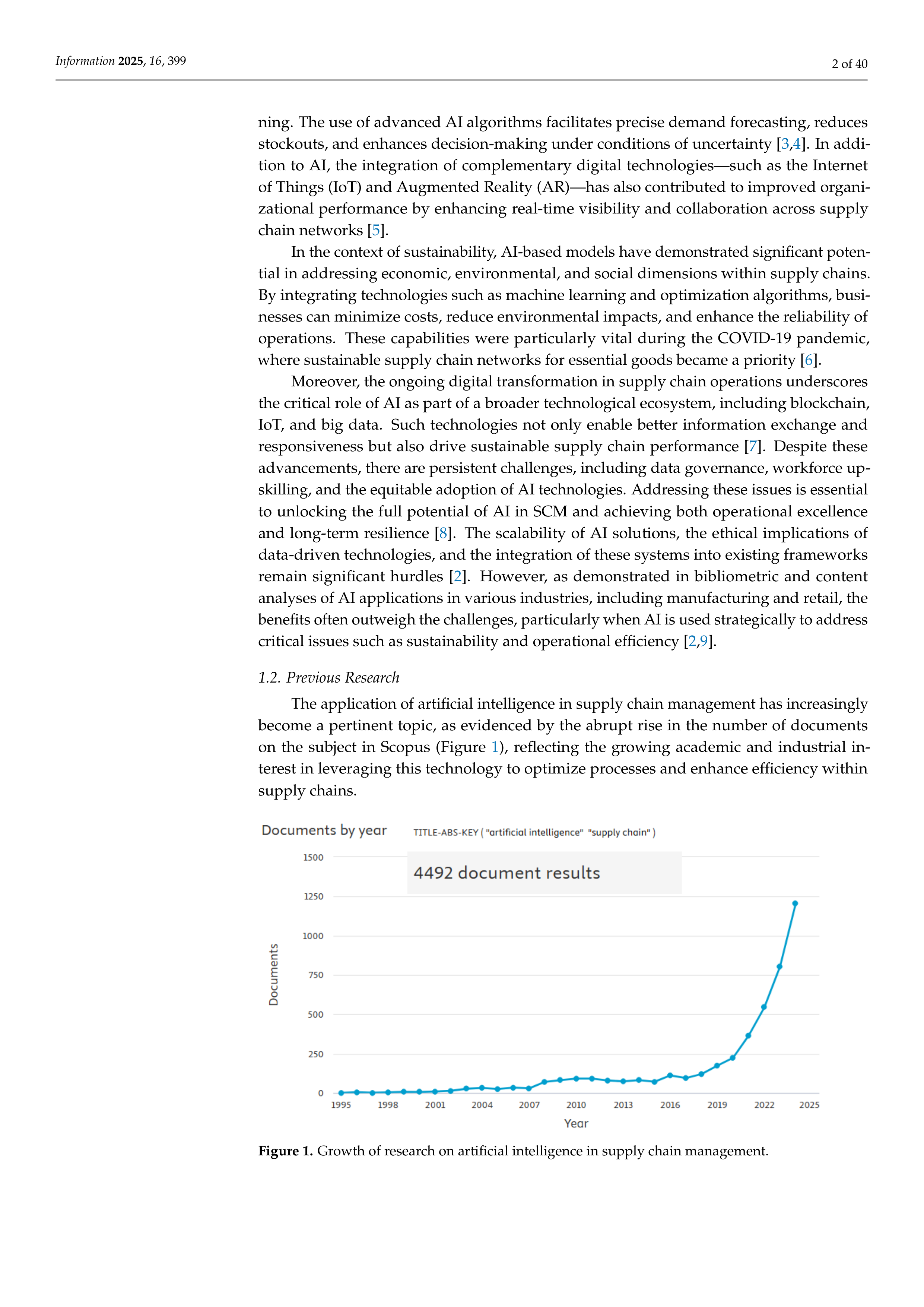
The application of artificial intelligence in supply chain management has increasingly
become
a
pertinent
topic,
as
evidenced
by
the
abrupt
rise
in
the
number
of
documents
on
the
subject
in
Scopus
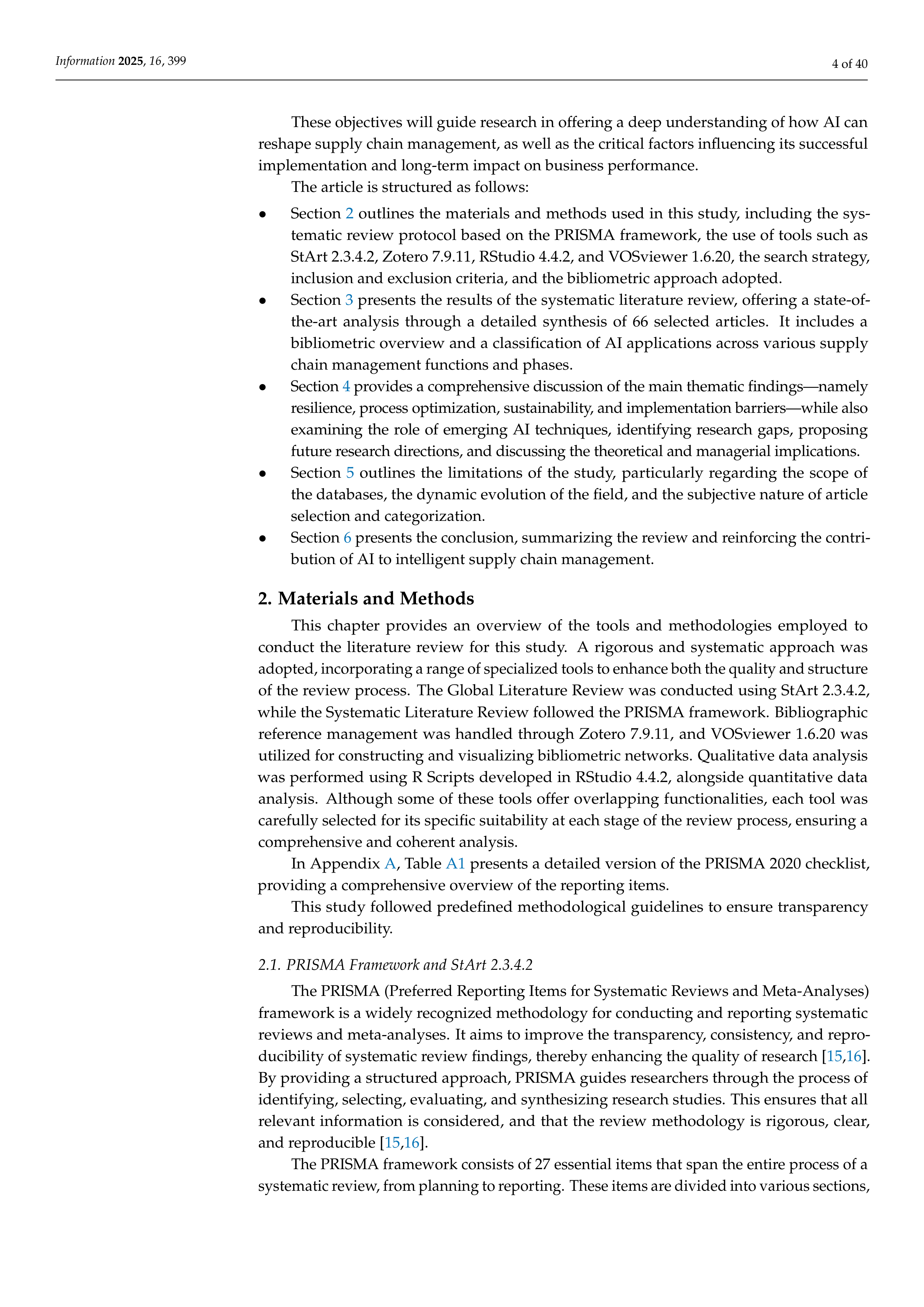
(Figure
1
),
reflecting
the
growing
academic
and
industrial
in-
terest in leveraging this technology to optimize processes and enhance efficiency within
supply chains.
Figure 1.
Growth of research on artificial intelligence in supply chain management.
Information
2025
,
16
, 399
3 of 40
Despite the growing interest in artificial intelligence (AI) within supply chain manage-
ment (SCM), several prior literature reviews reveal important gaps that limit a comprehen-
sive understanding of the field.
Toorajipour et al.
(2021) [
10
] conducted one of the earliest
systematic reviews but focused mainly on identifying the prevalent AI techniques and their
potential without an in-depth analysis of adoption barriers or emerging trends such as gen-
erative AI. Smyth et al.
(2024) [
11
] expanded the scope by exploring prescriptive analytics
and resilience, yet their study was fragmented by the diversity of AI tools and lacked a
structured categorization of supply chain functions. Similarly,
Rolf et al.
(2023) [
12
]
focused
exclusively on reinforcement learning in SCM, identifying the dominance of Q-learning
and highlighting a reliance on simulated rather than real-world data.
Jahin et al.
(2025) [
13
]
provided a combined bibliometric and content analysis for AI in risk assessment but did
not explore cross-phase integration in SCM or broader managerial implications.
Finally,
Hao and Demir (2024) [
14
] analyzed adoption through an ESG framework, yet their em-
phasis on governance and inhibitors overlooks the functional and technological evolution
of AI tools.
These limitations—such as limited focus on recent developments, lack of inte-
grated phase-wise supply chain analysis, insufficient discussion of emerging AI techniques
(e.g.,
generative
AI,
explainable
AI),
and
absence
of
structured
future
research
directions—justify the need for a comprehensive and updated review.
This study aims
to bridge these gaps by systematically reviewing recent literature (2021–2024), classifying
the
use
of
AI
across
SCM
phases,
analyzing
technological
trends,
identifying
adoption
challenges, and outlining future research avenues.
1.3.
Research Objectives
This review aims to synthesize recent advancements in AI applications in SCM, span-
ning 2021 to 2024, to provide a comprehensive understanding of emerging trends, chal-
lenges, and opportunities.
The insights gained will contribute to both academic discourse
and
practical
strategies
for
leveraging
AI
in
achieving
efficient
and
sustainable
supply
chains.
By combining bibliometric and content analysis, this review classifies AI use across
SCM
phases,
identifies
technological
trends,
discusses
barriers
to
implementation,
and
proposes future research avenues.
Specifically, the study aims to do the following:
1.
Examine
the
role
of
AI
in
enhancing
supply
chain
resilience:
Investigate
how
AI
technologies contribute to improving the adaptability and recovery of supply chains
in response to disruptions, including the optimization of risk management strategies
and operational efficiency.
2.
Identify key AI-driven solutions for supply chain optimization:
Analyze the specific
AI
techniques,
such
as
machine
learning,
predictive
analytics,
and
real-time
data
processing, that are currently being used to optimize critical functions in supply chain
management, such as demand forecasting, inventory control, and logistics planning.
3.
Assess the impact of AI on sustainability in supply chains: Explore how the integration
of AI in supply chains contributes to achieving sustainability goals, including eco-
nomic, environmental, and social dimensions, with a particular focus on the fashion,
manufacturing, and retail sectors.
4.
Investigate the challenges and barriers to AI implementation in supply chains:
Iden-
tify
the
key
challenges,
such
as
scalability,
ethical
concerns,
and
integration
with
existing
systems,
that
organizations
face
when
adopting
AI
solutions
in
supply
chain management.
5.
Outline
future
research
directions:
Identify
and
structure
key
gaps
in
the
existing
literature to propose future avenues for investigation.
Information
2025
,
16
, 399
4 of 40
These objectives will guide research in offering a deep understanding of how AI can
reshape supply chain management, as well as the critical factors influencing its successful
implementation and long-term impact on business performance.
The article is structured as follows:
•
Section
2
outlines the materials and methods used in this study,
including the sys-
tematic review protocol based on the PRISMA framework, the use of tools such as
StArt 2.3.4.2, Zotero 7.9.11, RStudio 4.4.2, and VOSviewer 1.6.20, the search strategy,
inclusion and exclusion criteria, and the bibliometric approach adopted.
•
Section
3
presents the results of the systematic literature review, offering a state-of-
the-art
analysis
through
a
detailed
synthesis
of
66
selected
articles.
It
includes
a
bibliometric overview and a classification of AI applications across various supply
chain management functions and phases.
•
Section
4
provides a comprehensive discussion of the main thematic findings—namely
resilience, process optimization, sustainability, and implementation barriers—while also
examining
the
role
of
emerging
AI
techniques,
identifying
research
gaps,
proposing
future research directions, and discussing the theoretical and managerial implications.
•
Section
5
outlines
the
limitations
of
the
study,
particularly
regarding
the
scope
of
the databases, the dynamic evolution of the field, and the subjective nature of article
selection and categorization.
•
Section
6
presents the conclusion, summarizing the review and reinforcing the contri-
bution of AI to intelligent supply chain management.
2.
Materials and Methods
This
chapter
provides
an
overview
of
the
tools
and
methodologies
employed
to
conduct
the
literature
review
for
this
study.
A
rigorous
and
systematic
approach
was
adopted, incorporating a range of specialized tools to enhance both the quality and structure
of the review process.
The Global Literature Review was conducted using StArt 2.3.4.2,
while the Systematic Literature Review followed the PRISMA framework.
Bibliographic
reference
management
was
handled
through
Zotero
7.9.11,
and
VOSviewer
1.6.20
was
utilized for constructing and visualizing bibliometric networks.
Qualitative data analysis
was performed using R Scripts developed in RStudio 4.4.2,
alongside quantitative data
analysis.
Although some of these tools offer overlapping functionalities,
each tool was
carefully selected for its specific suitability at each stage of the review process, ensuring a
comprehensive and coherent analysis.
In Appendix
A
, Table
A1
presents a detailed version of the PRISMA 2020 checklist,
providing a comprehensive overview of the reporting items.
This study followed predefined methodological guidelines to ensure transparency
and reproducibility.
2.1.
PRISMA Framework and StArt 2.3.4.2
The PRISMA (Preferred Reporting Items for Systematic Reviews and Meta-Analyses)
framework is a widely recognized methodology for conducting and reporting systematic
reviews and meta-analyses.
It aims to improve the transparency, consistency, and repro-
ducibility of systematic review findings, thereby enhancing the quality of research [
15
,
16
].
By providing a structured approach, PRISMA guides researchers through the process of
identifying, selecting, evaluating, and synthesizing research studies.
This ensures that all
relevant
information
is
considered,
and
that
the
review
methodology
is
rigorous,
clear,
and reproducible [
15
,
16
].
The PRISMA framework consists of 27 essential items that span the entire process of a
systematic review, from planning to reporting. These items are divided into various sections,
Information
2025
,
16
, 399
5 of 40
each addressing different aspects of the review process.
The framework emphasizes not
only the importance of a comprehensive search strategy and clear data synthesis but also the
necessity of transparency in reporting.
The following sections outline the main components
of PRISMA [
15
,
16
].
By
adhering
to
the
PRISMA
framework,
researchers
ensure
methodological
rigor,
making their systematic reviews not only reproducible but also relevant in the evolving
landscape of AI applications in industries like supply chain management.
To support the systematic review process, the StArt 2.3.4.2 (State of the Art through
Systematic Review) tool was employed for managing and organizing the retrieved studies.
StArt 2.3.4.2 is a software application specifically developed to facilitate systematic liter-
ature reviews, enabling researchers to structure the inclusion and exclusion process in a
transparent and replicable manner.
It provides functionalities for importing search results,
applying screening criteria, and extracting relevant data, contributing to the methodological
rigor of the review.
Regarding the study selection process, an initial filtering criterion was
applied to ensure relevance, wherein studies were required to include references to both
“artificial intelligence” and “supply chain” within the title, abstract, or keywords.
While
it
is
acknowledged
that
such
terms
may
appear
infrequently
in
some
relevant
studies,
this
approach
served
as
a
preliminary
filter
to
manage
the
volume
of
retrieved
articles
and focus the analysis.
This criterion has been used in previous systematic reviews [
17
],
where keyword-based thresholds were employed to ensure thematic alignment with the
research objectives.
Nevertheless, all selected papers were subsequently assessed manually
to confirm their relevance beyond simple keyword occurrence.
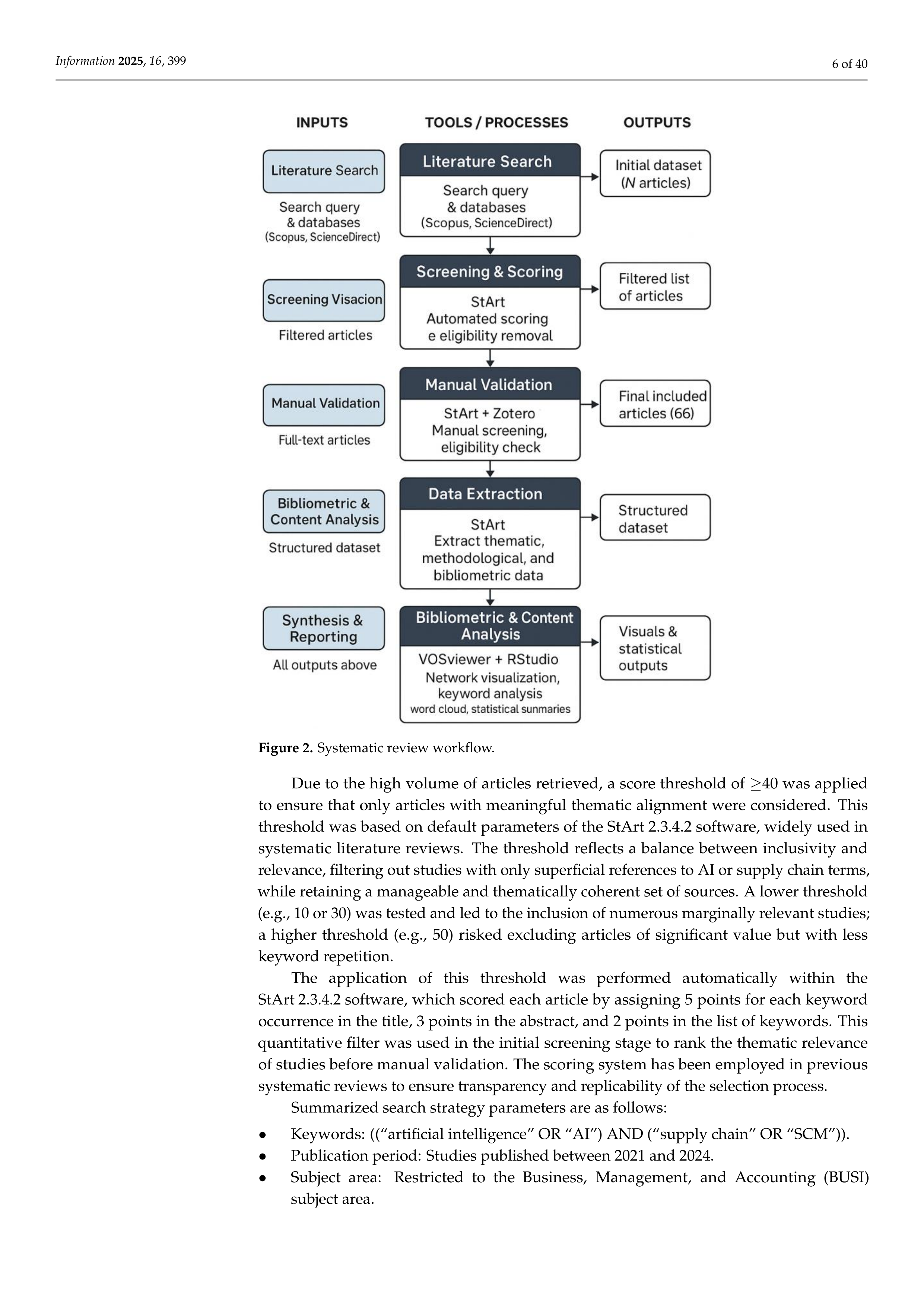
To
enhance
the
clarity
and
transparency
of
the
methodological
process,
Figure
2
presents
a
detailed
flowchart
summarizing
the
systematic
review
workflow.
The
di-
agram
outlines
the
main
stages—from
literature
search
to
bibliometric
and
content
analysis—highlighting
the specific inputs, tools and software employed (e.g., StArt 2.3.4.2,
Zotero 7.9.11, RStudio 4.4.2, VOSviewer 1.6.20), and the corresponding outputs at each step.
This visualization supports a clearer understanding of how data were collected, processed,
and synthesized to ensure methodological rigor and reproducibility.
2.2.
Search Strategy
The
search
was
limited
to
studies
published
between
2021
and
2024
to
ensure
an
updated and focused review aligned with recent technological advances and post-pandemic
shifts in supply chain dynamics.
This timeframe also reflects a research gap identified in
prior reviews that do not incorporate the latest literature, particularly regarding emerging
technologies such as generative AI and explainable AI.
Two
reputable
databases
were
selected
for
this
review:
Scopus,
due
to
its
broad
coverage
of
high-impact
journals
and
its
compatibility
with
bibliometric
tools
such
as
VOSviewer 1.6.20; and ScienceDirect, for its extensive repository of peer-reviewed articles
in
both
business
and
technical
disciplines.
These
platforms
were
chosen
to
ensure
a
comprehensive, high-quality, and multidisciplinary dataset relevant to AI applications in
supply chain management.
The search focused on the Business, Management, and Accounting (BUSI) subject area
to ensure relevance to managerial and operational perspectives on AI implementation in
supply chain contexts.
While other fields such as engineering and environmental science
are
relevant,
studies
with
cross-disciplinary
insights
often
appear
in
business-indexed
journals.
This
focus
aligns
with
the
scope
of
the
study,
which
seeks
to
assess
not
only
technical contributions but also strategic, organizational, and sustainability implications
within business-oriented supply chains.
Information
2025
,
16
, 399
6 of 40
Figure 2.
Systematic review workflow.
Due to the high volume of articles retrieved, a score threshold of
≥
40 was applied
to ensure that only articles with meaningful thematic alignment were considered.
This
threshold was based on default parameters of the StArt 2.3.4.2 software, widely used in
systematic
literature
reviews.
The
threshold
reflects
a
balance
between
inclusivity
and
relevance, filtering out studies with only superficial references to AI or supply chain terms,
while retaining a manageable and thematically coherent set of sources.
A lower threshold
(e.g., 10 or 30) was tested and led to the inclusion of numerous marginally relevant studies;
a
higher
threshold
(e.g.,
50)
risked
excluding
articles
of
significant
value
but
with
less
keyword repetition.
The
application
of
this
threshold
was
performed
automatically
within
the
StArt 2.3.4.2 software
, which scored each article by assigning 5 points for each keyword
occurrence in the title, 3 points in the abstract, and 2 points in the list of keywords.
This
quantitative filter was used in the initial screening stage to rank the thematic relevance
of studies before manual validation.
The scoring system has been employed in previous
systematic reviews to ensure transparency and replicability of the selection process.
Summarized search strategy parameters are as follows:
•
Keywords:
((“artificial intelligence” OR “AI”) AND (“supply chain” OR “SCM”)).
•
Publication period:
Studies published between 2021 and 2024.
•
Subject
area:
Restricted
to
the
Business,
Management,
and
Accounting
(BUSI)
subject area.
Information
2025
,
16
, 399
7 of 40
•
Document type:
Limited to articles (ar) and reports (re).
•
Language:
Only English-language studies were included.
•
Open
Access:
Open
access
articles
available
through
the
University
of
Aveiro
library’s affiliation.
Search
query:
TITLE-ABS-KEY
((“artificial
intelligence”
OR
“AI”)
AND
(“supply
chain”
OR
“SCM”))
AND
PUBYEAR
>
2020
AND
PUBYEAR
<
2025
AND
(LIMIT-TO
(SUBJAREA, “BUSI”)) AND (LIMIT-TO (LANGUAGE, “English”)) AND (LIMIT-TO (OA,
“all”)) AND (LIMIT-TO (DOCTYPE, “ar”) OR LIMIT-TO (DOCTYPE, “re”)).
These search criteria were designed to identify relevant literature on the application of
artificial intelligence in supply chains, with a focus on the quality and academic impact of
the selected studies.
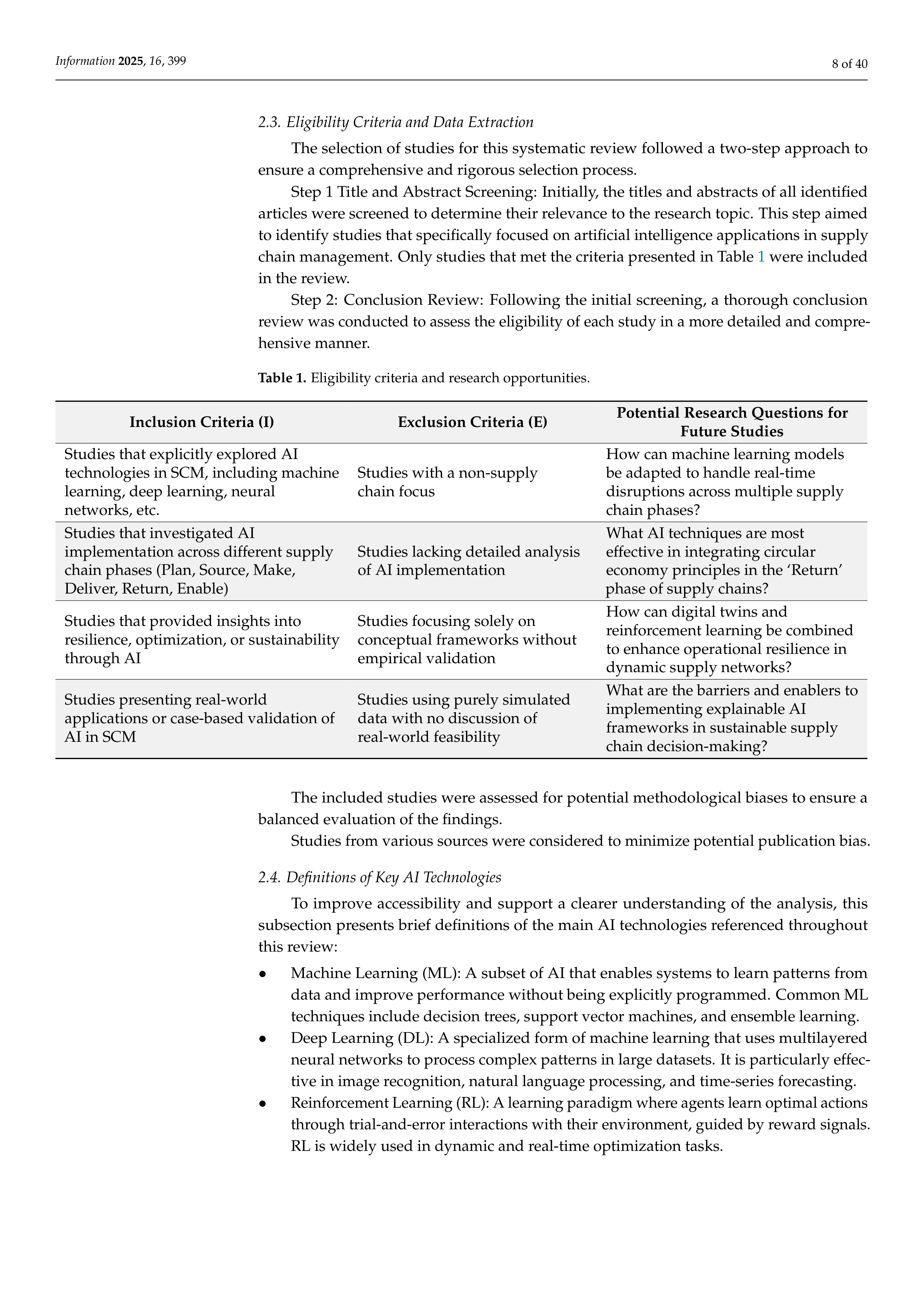
A PRISMA (2020) [
11
] flowchart was used to display the process of
study selection (Figure
3
).
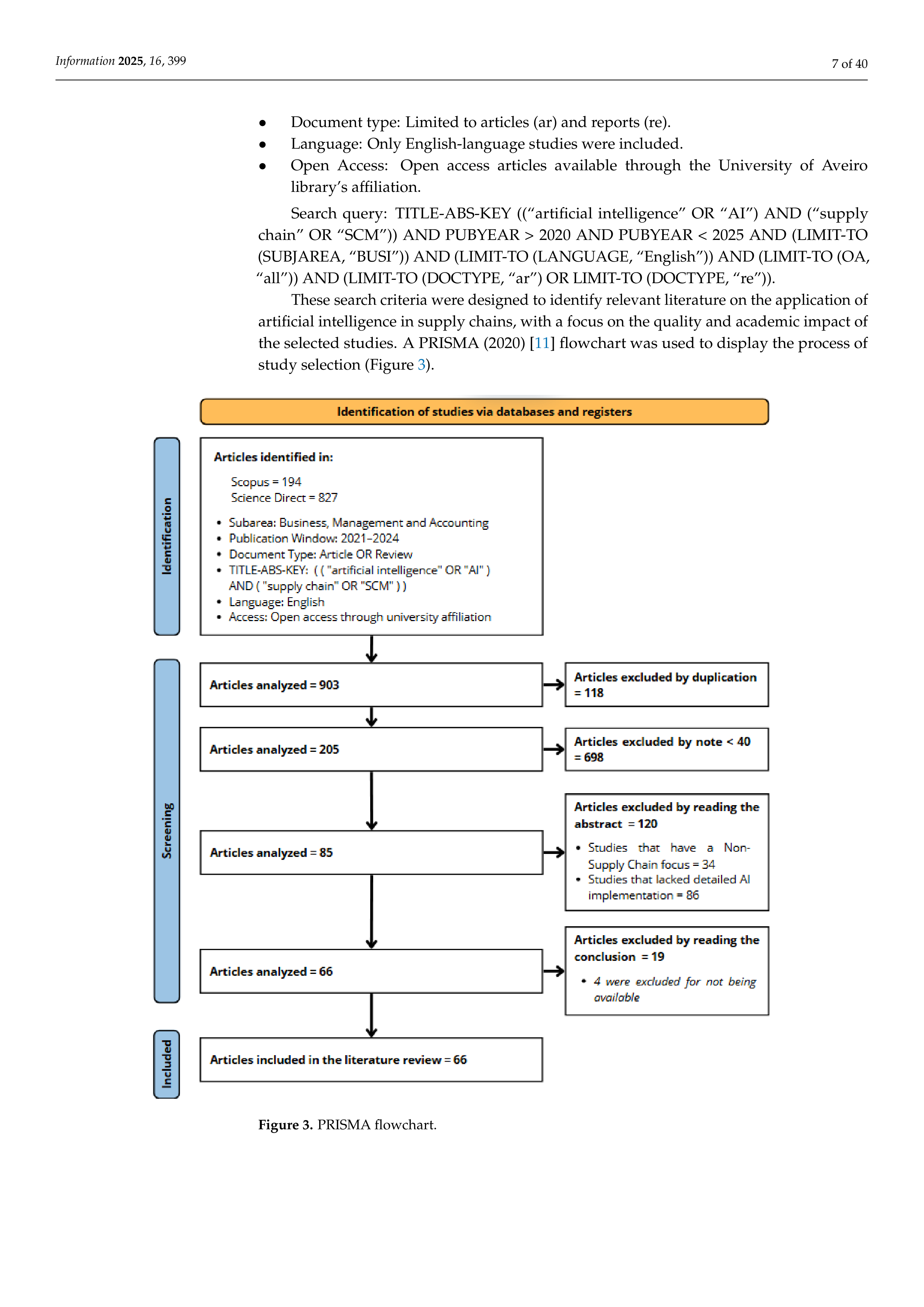
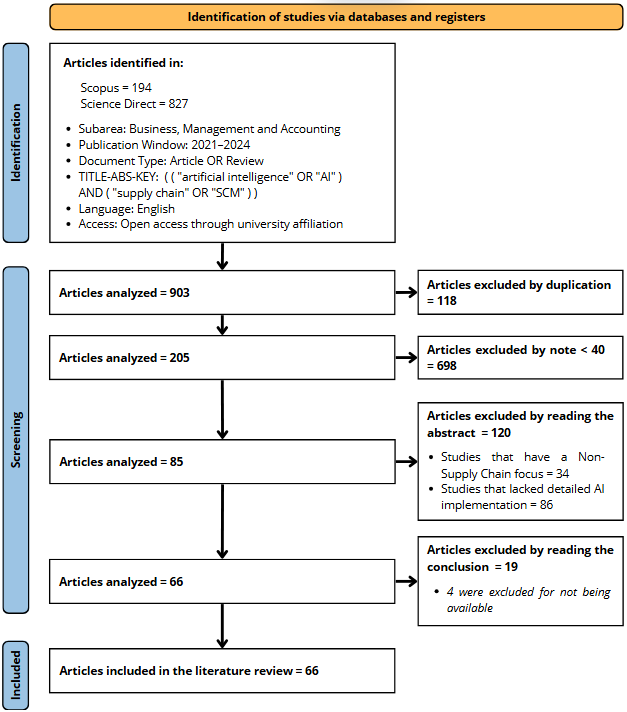
Figure 3.
PRISMA flowchart.
Information
2025
,
16
, 399
8 of 40
2.3.
Eligibility Criteria and Data Extraction
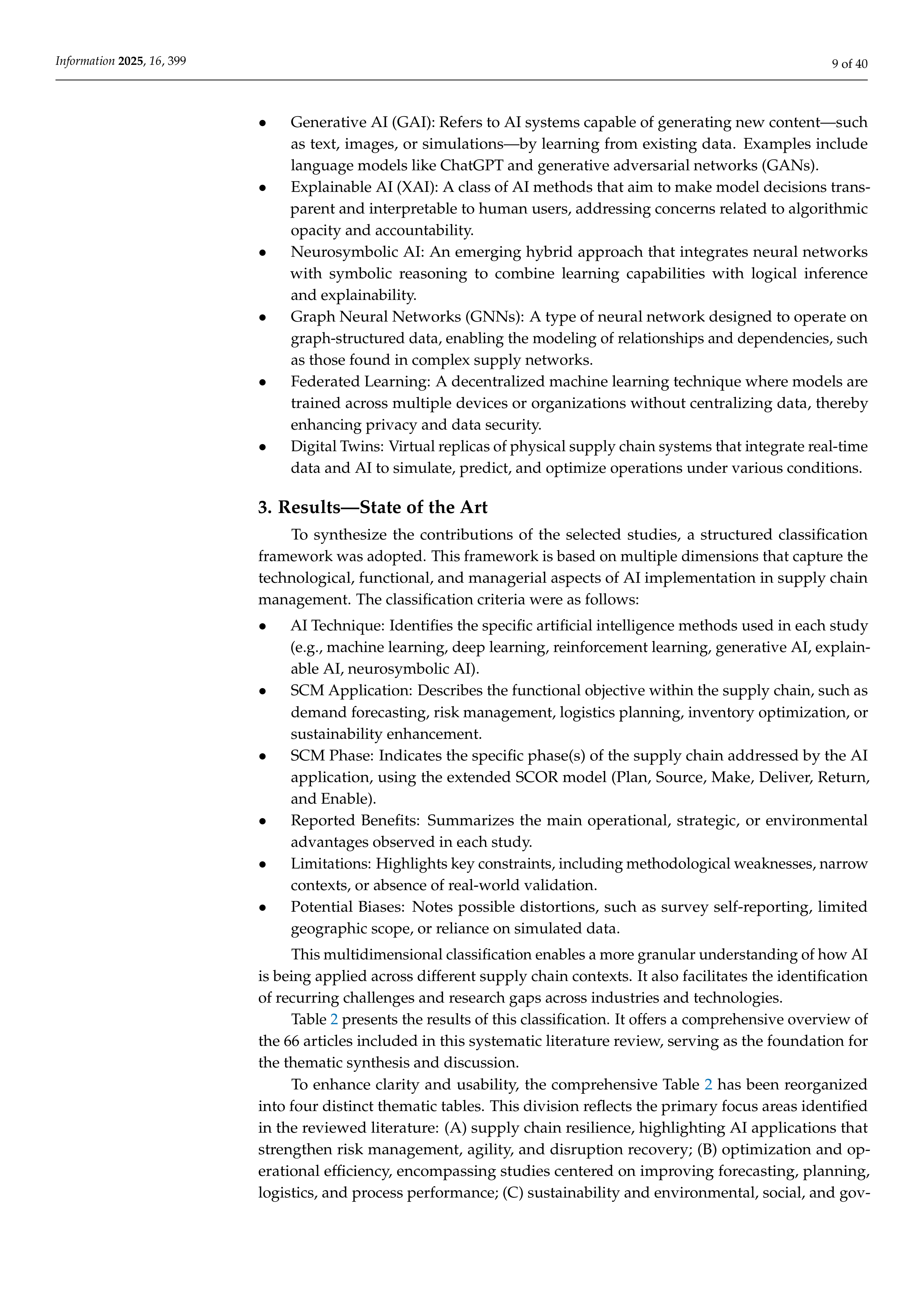
The selection of studies for this systematic review followed a two-step approach to
ensure a comprehensive and rigorous selection process.
Step 1 Title and Abstract Screening:
Initially, the titles and abstracts of all identified
articles were screened to determine their relevance to the research topic.
This step aimed
to identify studies that specifically focused on artificial intelligence applications in supply
chain management.
Only studies that met the criteria presented in Table
1
were included
in the review.
Step 2:
Conclusion Review:
Following the initial screening, a thorough conclusion
review was conducted to assess the eligibility of each study in a more detailed and compre-
hensive manner.
Table 1.
Eligibility criteria and research opportunities.
Inclusion Criteria (I)
Exclusion Criteria (E)
Potential Research Questions for
Future Studies
Studies that explicitly explored AI
technologies in SCM, including machine
learning, deep learning, neural
networks, etc.
Studies with a non-supply
chain focus
How can machine learning models
be adapted to handle real-time
disruptions across multiple supply
chain phases?
Studies that investigated AI
implementation across different supply
chain phases (Plan, Source, Make,
Deliver, Return, Enable)
Studies lacking detailed analysis
of AI implementation
What AI techniques are most
effective in integrating circular
economy principles in the ‘Return’
phase of supply chains?
Studies that provided insights into
resilience, optimization, or sustainability
through AI
Studies focusing solely on
conceptual frameworks without
empirical validation
How can digital twins and
reinforcement learning be combined
to enhance operational resilience in
dynamic supply networks?
Studies presenting real-world
applications or case-based validation of
AI in SCM
Studies using purely simulated
data with no discussion of
real-world feasibility
What are the barriers and enablers to
implementing explainable AI
frameworks in sustainable supply
chain decision-making?
The included studies were assessed for potential methodological biases to ensure a
balanced evaluation of the findings.
Studies from various sources were considered to minimize potential publication bias.
2.4.
Definitions of Key AI Technologies
To
improve
accessibility
and
support
a
clearer
understanding
of
the
analysis,
this
subsection presents brief definitions of the main AI technologies referenced throughout
this review:
•
Machine Learning (ML): A subset of AI that enables systems to learn patterns from
data and improve performance without being explicitly programmed.
Common ML
techniques include decision trees, support vector machines, and ensemble learning.
•
Deep Learning (DL): A specialized form of machine learning that uses multilayered
neural networks to process complex patterns in large datasets.
It is particularly effec-
tive in image recognition, natural language processing, and time-series forecasting.
•
Reinforcement Learning (RL): A learning paradigm where agents learn optimal actions
through trial-and-error interactions with their environment, guided by reward signals.
RL is widely used in dynamic and real-time optimization tasks.
Information
2025
,
16
, 399
9 of 40
•
Generative AI (GAI): Refers to AI systems capable of generating new content—such
as text,
images,
or simulations—by learning from existing data.
Examples include
language models like ChatGPT and generative adversarial networks (GANs).
•
Explainable AI (XAI): A class of AI methods that aim to make model decisions trans-
parent and interpretable to human users, addressing concerns related to algorithmic
opacity and accountability.
•
Neurosymbolic AI: An emerging hybrid approach that integrates neural networks
with
symbolic
reasoning
to
combine
learning
capabilities
with
logical
inference
and explainability.
•
Graph Neural Networks (GNNs):
A type of neural network designed to operate on
graph-structured data, enabling the modeling of relationships and dependencies, such
as those found in complex supply networks.
•
Federated Learning:
A decentralized machine learning technique where models are
trained across multiple devices or organizations without centralizing data, thereby
enhancing privacy and data security.
•
Digital Twins: Virtual replicas of physical supply chain systems that integrate real-time
data and AI to simulate, predict, and optimize operations under various conditions.
3.
Results—State of the Art
To
synthesize
the
contributions
of
the
selected
studies,
a
structured
classification
framework was adopted.
This framework is based on multiple dimensions that capture the
technological, functional, and managerial aspects of AI implementation in supply chain
management.
The classification criteria were as follows:
•
AI Technique:
Identifies the specific artificial intelligence methods used in each study
(e.g., machine learning, deep learning, reinforcement learning, generative AI, explain-
able AI, neurosymbolic AI).
•
SCM Application:
Describes the functional objective within the supply chain, such as
demand forecasting, risk management, logistics planning, inventory optimization, or
sustainability enhancement.
•
SCM Phase:
Indicates the specific phase(s) of the supply chain addressed by the AI
application, using the extended SCOR model (Plan, Source, Make, Deliver, Return,
and Enable).
•
Reported
Benefits:
Summarizes
the
main
operational,
strategic,
or
environmental
advantages observed in each study.
•
Limitations: Highlights key constraints, including methodological weaknesses, narrow
contexts, or absence of real-world validation.
•
Potential
Biases:
Notes
possible
distortions,
such
as
survey
self-reporting,
limited
geographic scope, or reliance on simulated data.
This multidimensional classification enables a more granular understanding of how AI
is being applied across different supply chain contexts.
It also facilitates the identification
of recurring challenges and research gaps across industries and technologies.
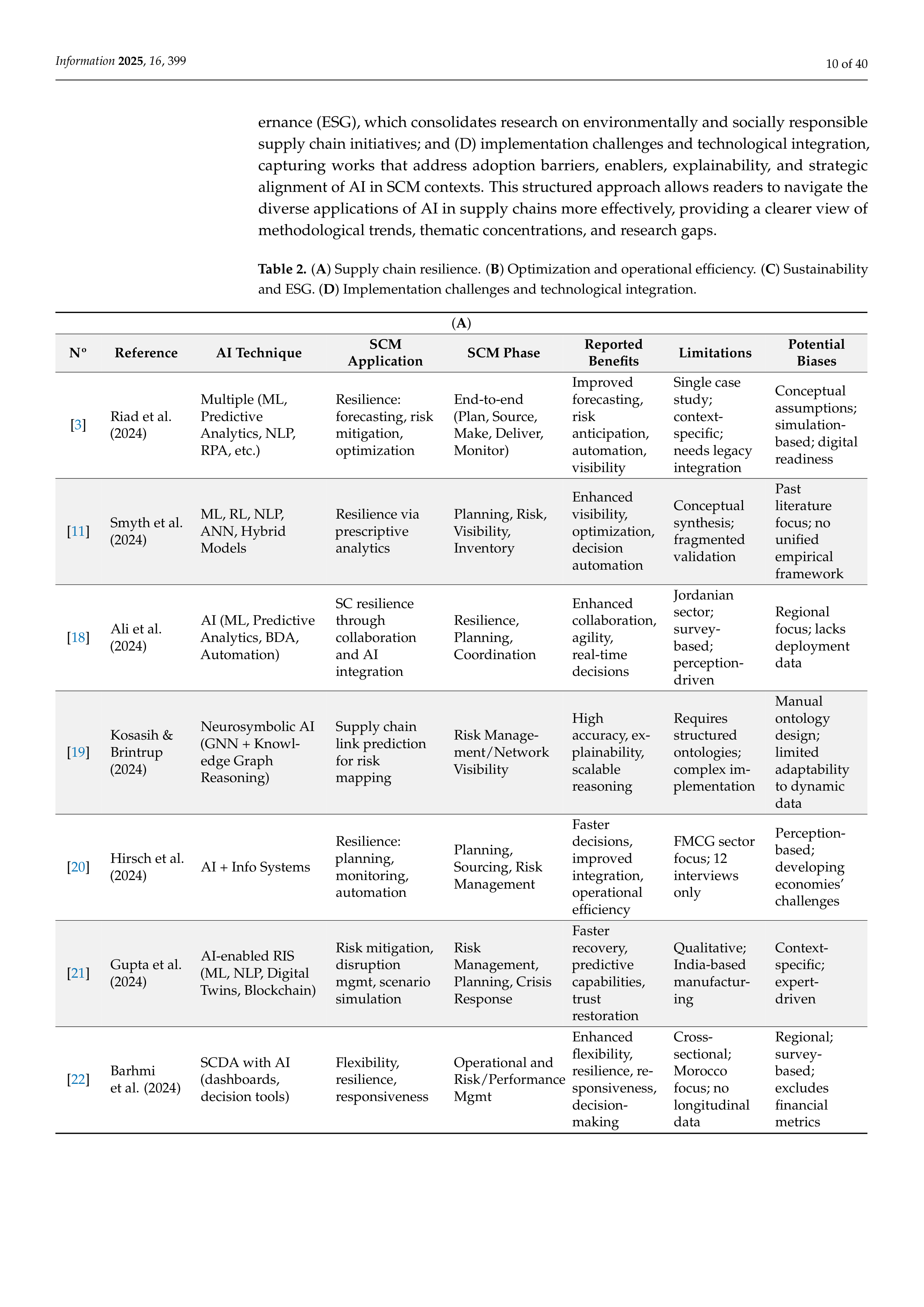
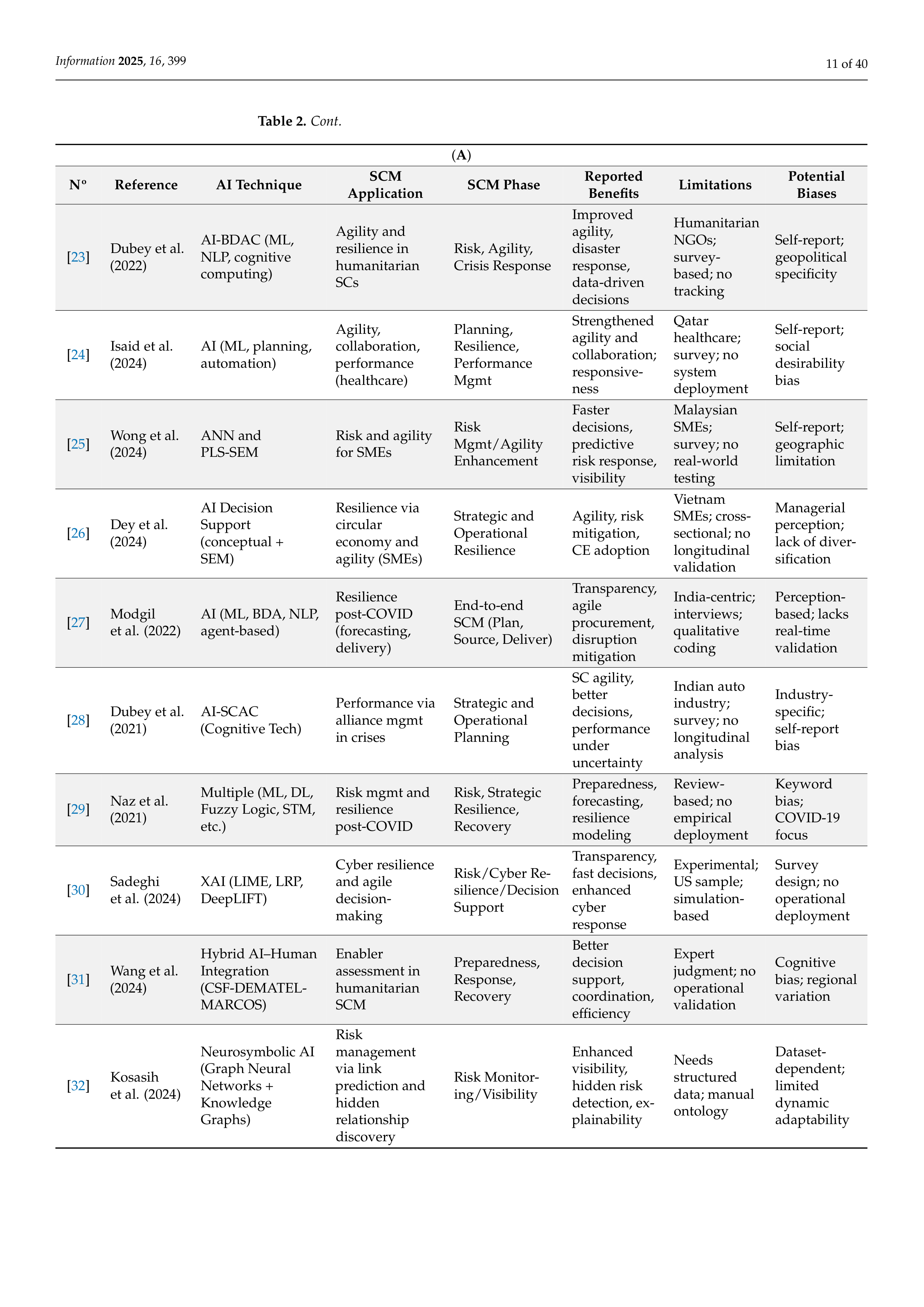
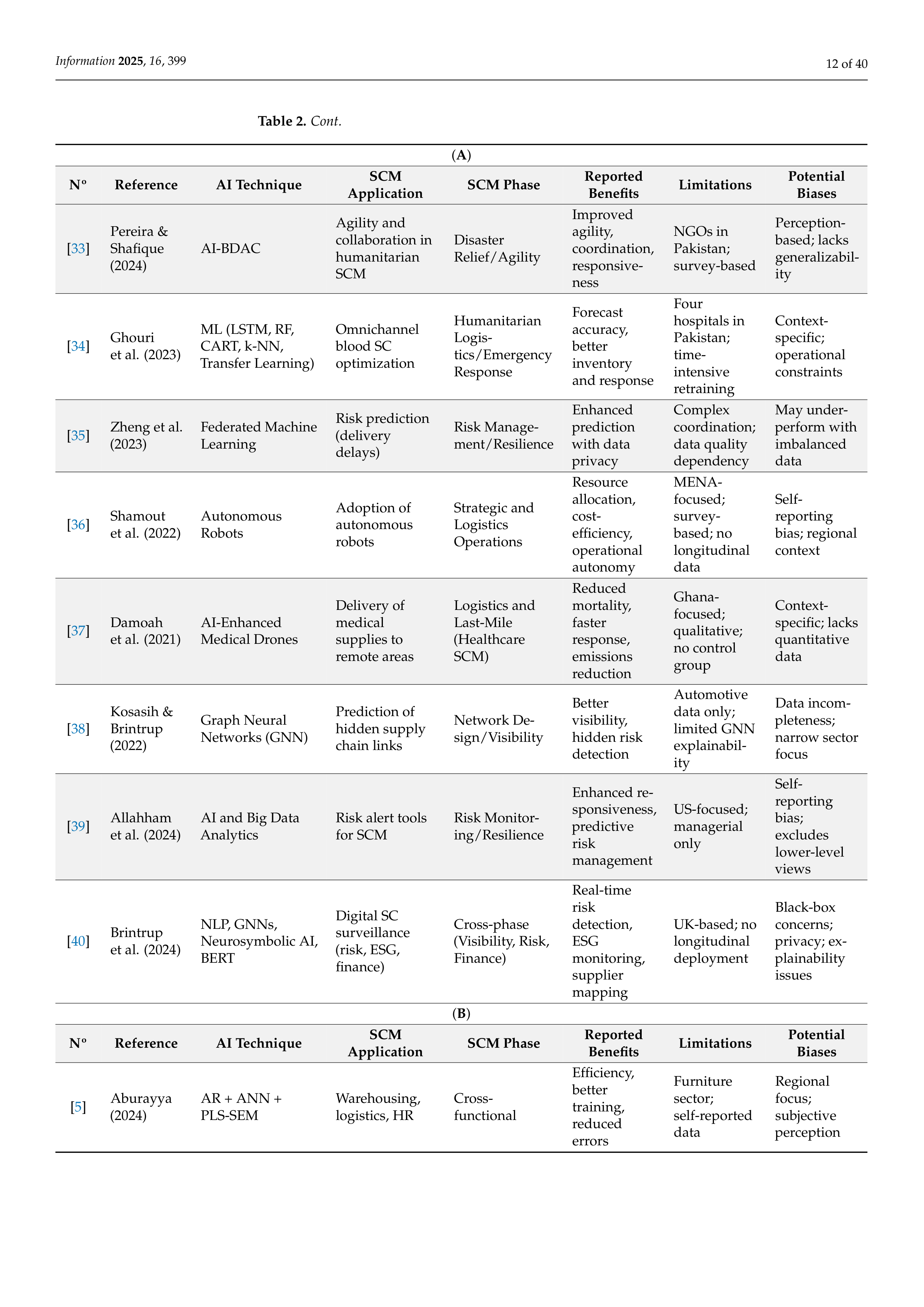
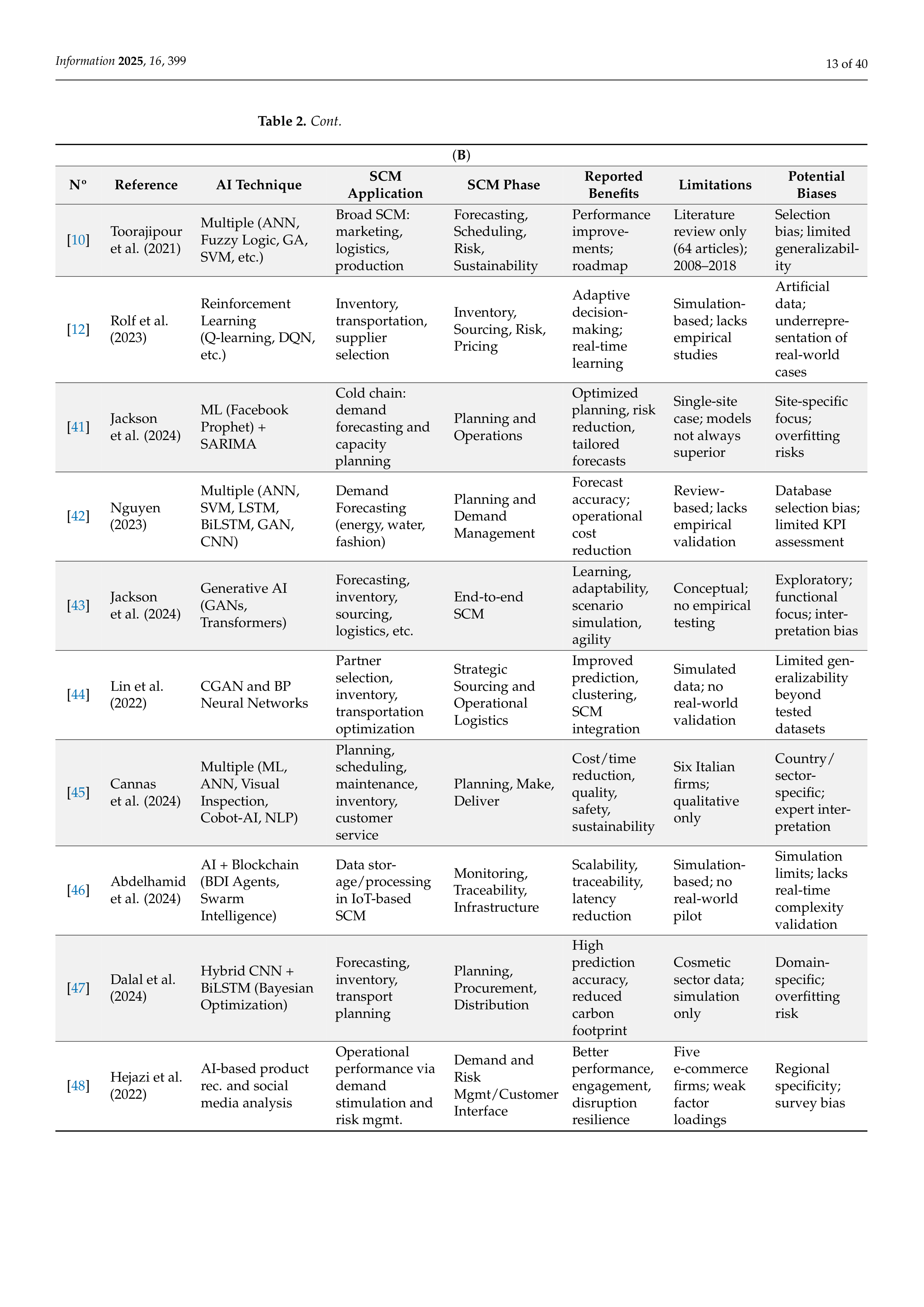
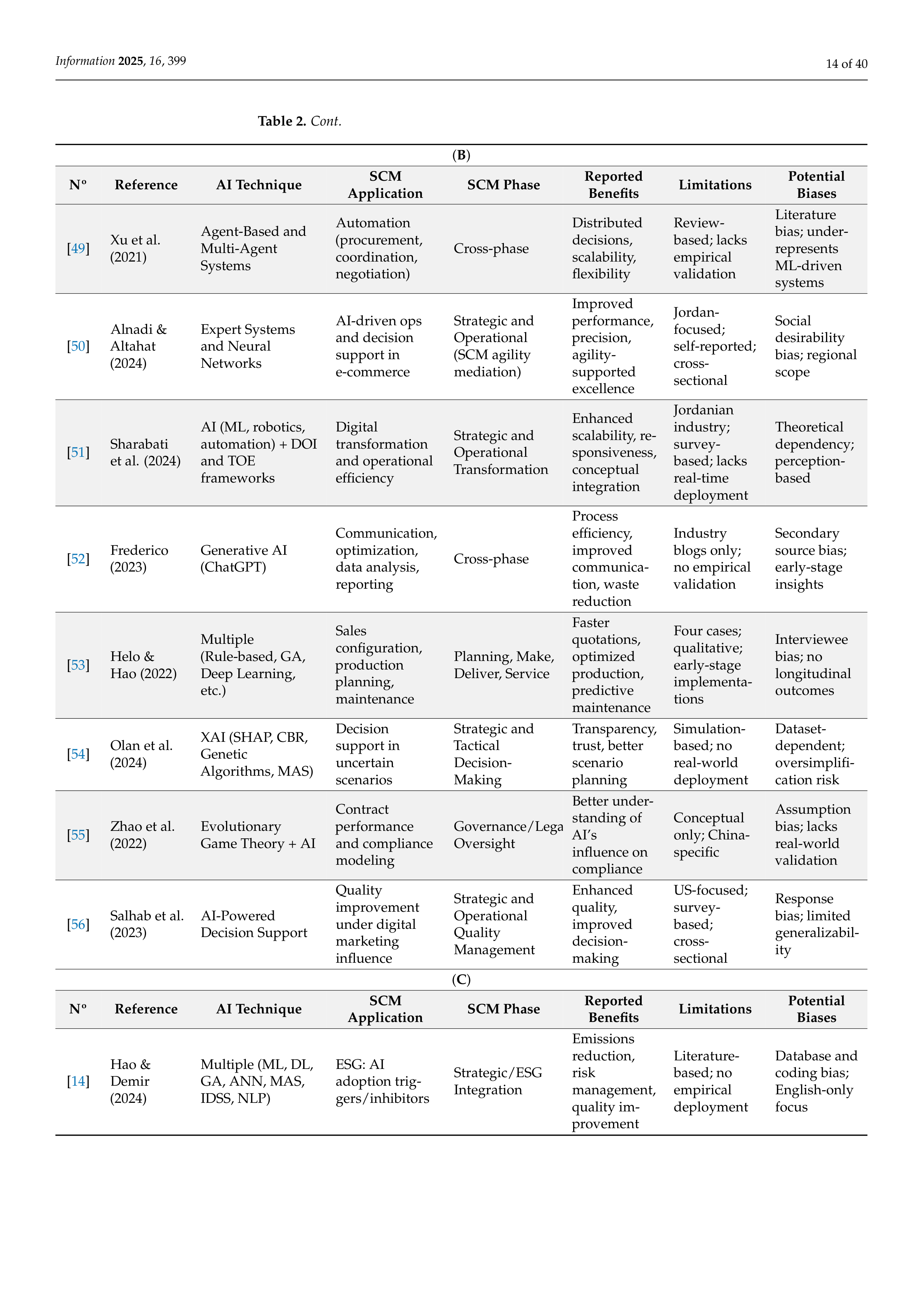
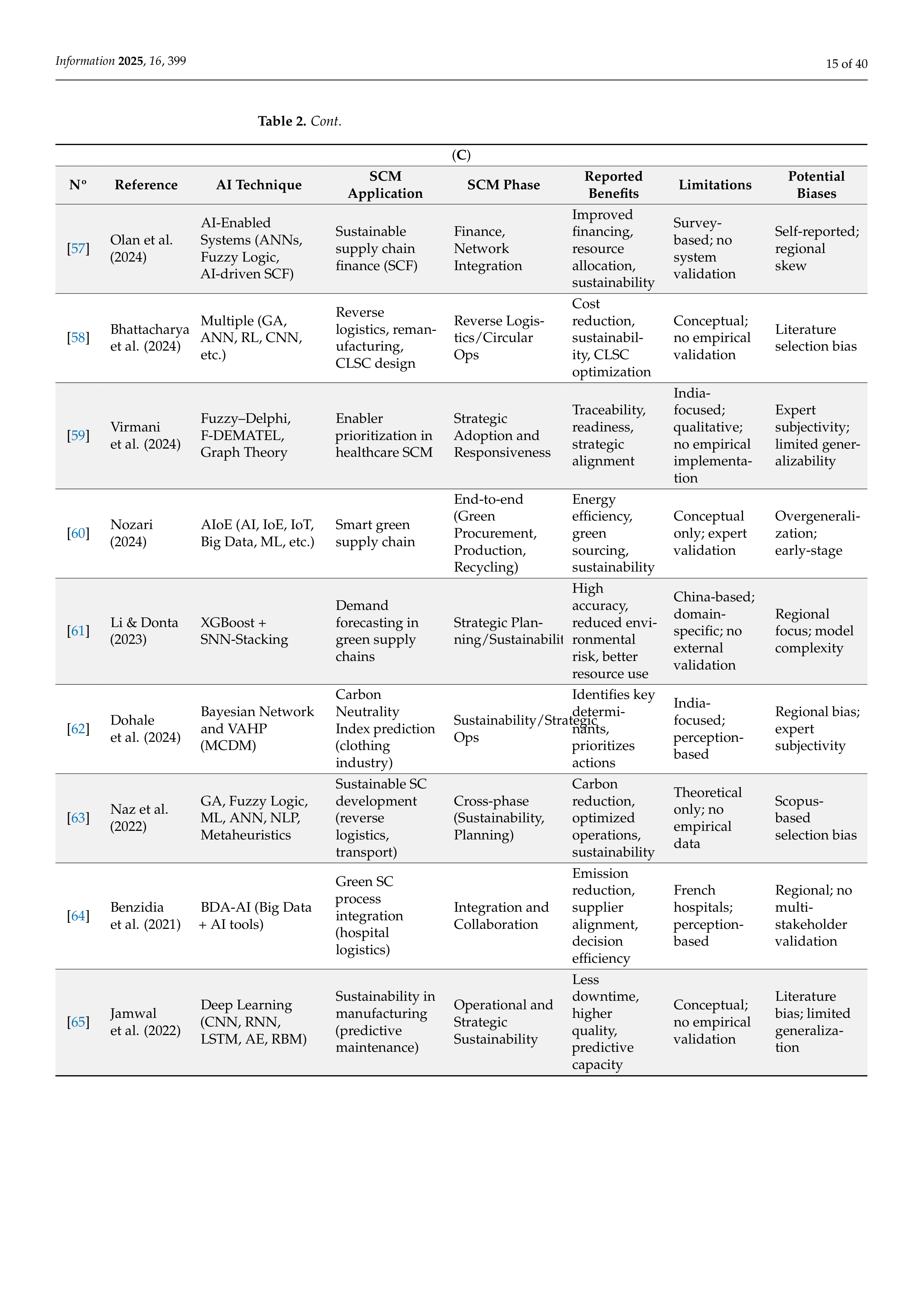
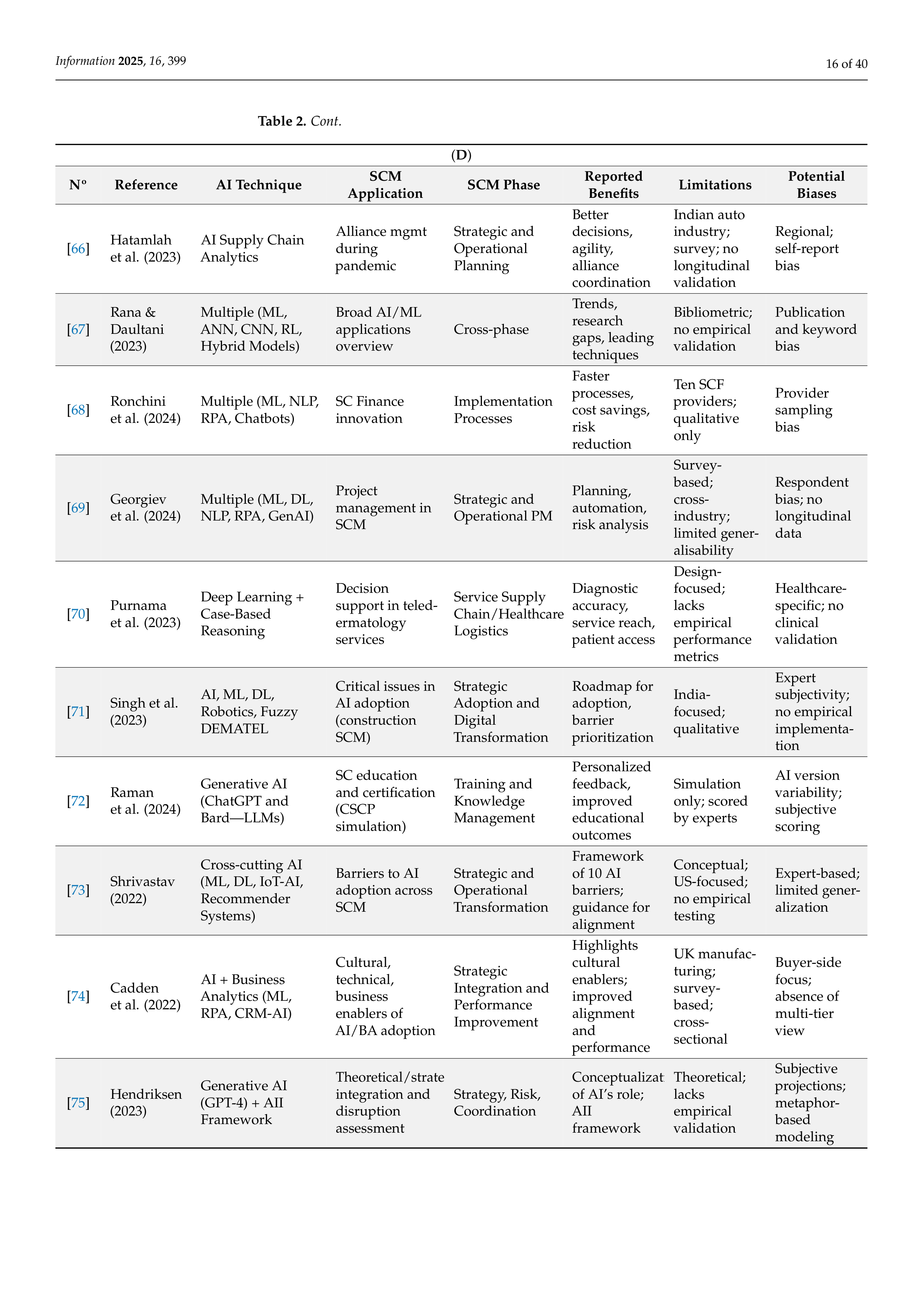
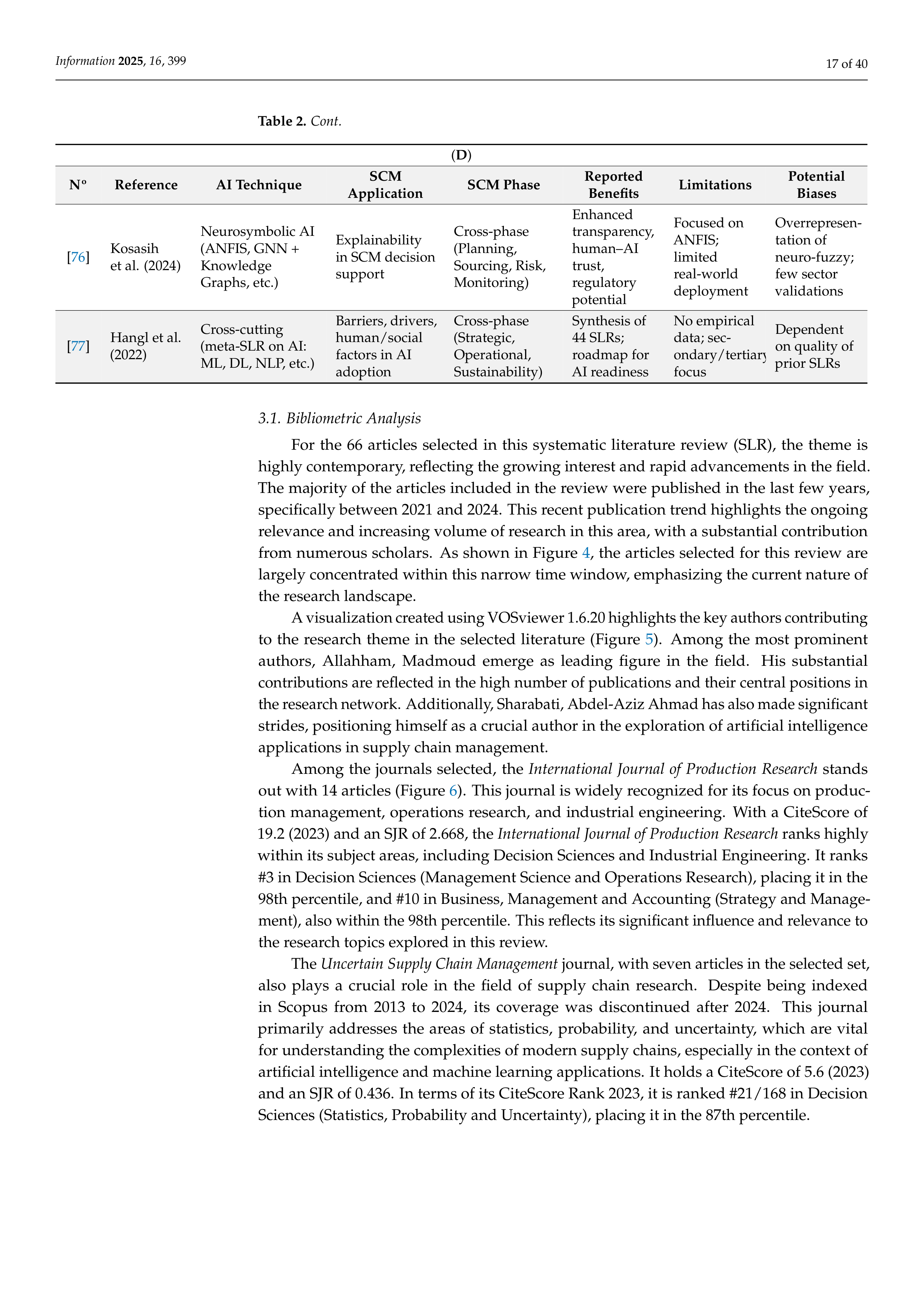
Table
2
presents the results of this classification.
It offers a comprehensive overview of
the 66 articles included in this systematic literature review, serving as the foundation for
the thematic synthesis and discussion.
To
enhance
clarity
and
usability,
the
comprehensive
Table
2
has
been
reorganized
into four distinct thematic tables.
This division reflects the primary focus areas identified
in the reviewed literature:
(A) supply chain resilience, highlighting AI applications that
strengthen risk management, agility, and disruption recovery;
(B) optimization and op-
erational efficiency, encompassing studies centered on improving forecasting, planning,
logistics, and process performance; (C) sustainability and environmental, social, and gov-
Information
2025
,
16
, 399
10 of 40
ernance (ESG), which consolidates research on environmentally and socially responsible
supply chain initiatives; and (D) implementation challenges and technological integration,
capturing
works
that
address
adoption
barriers,
enablers,
explainability,
and
strategic
alignment of AI in SCM contexts.
This structured approach allows readers to navigate the
diverse applications of AI in supply chains more effectively, providing a clearer view of
methodological trends, thematic concentrations, and research gaps.
Table 2.
(
A
) Supply chain resilience.
(
B
) Optimization and operational efficiency.
(
C
) Sustainability
and ESG. (
D
) Implementation challenges and technological integration.
(
A
)
Nº
Reference
AI Technique
SCM
Application
SCM Phase
Reported
Benefits
Limitations
Potential
Biases
[
3
]
Riad et al.
(2024)
Multiple (ML,
Predictive
Analytics, NLP,
RPA, etc.)
Resilience:
forecasting, risk
mitigation,
optimization
End-to-end
(Plan, Source,
Make, Deliver,
Monitor)
Improved
forecasting,
risk
anticipation,
automation,
visibility
Single case
study;
context-
specific;
needs legacy
integration
Conceptual
assumptions;
simulation-
based; digital
readiness
[
11
]
Smyth et al.
(2024)
ML, RL, NLP,
ANN, Hybrid
Models
Resilience via
prescriptive
analytics
Planning, Risk,
Visibility,
Inventory
Enhanced
visibility,
optimization,
decision
automation
Conceptual
synthesis;
fragmented
validation
Past
literature
focus; no
unified
empirical
framework
[
18
]
Ali et al.
(2024)
AI (ML, Predictive
Analytics, BDA,
Automation)
SC resilience
through
collaboration
and AI
integration
Resilience,
Planning,
Coordination
Enhanced
collaboration,
agility,
real-time
decisions
Jordanian
sector;
survey-
based;
perception-
driven
Regional
focus; lacks
deployment
data
[
19
]
Kosasih &
Brintrup
(2024)
Neurosymbolic AI
(GNN + Knowl-
edge Graph
Reasoning)
Supply chain
link prediction
for risk
mapping
Risk Manage-
ment/Network
Visibility
High
accuracy, ex-
plainability,
scalable
reasoning
Requires
structured
ontologies;
complex im-
plementation
Manual
ontology
design;
limited
adaptability
to dynamic
data
[
20
]
Hirsch et al.
(2024)
AI + Info Systems
Resilience:
planning,
monitoring,
automation
Planning,
Sourcing, Risk
Management
Faster
decisions,
improved
integration,
operational
efficiency
FMCG sector
focus; 12
interviews
only
Perception-
based;
developing
economies’
challenges
[
21
]
Gupta et al.
(2024)
AI-enabled RIS
(ML, NLP, Digital
Twins, Blockchain)
Risk mitigation,
disruption
mgmt, scenario
simulation
Risk
Management,
Planning, Crisis
Response
Faster
recovery,
predictive
capabilities,
trust
restoration
Qualitative;
India-based
manufactur-
ing
Context-
specific;
expert-
driven
[
22
]
Barhmi
et al.
(2024)
SCDA with AI
(dashboards,
decision tools)
Flexibility,
resilience,
responsiveness
Operational and
Risk/Performance
Mgmt
Enhanced
flexibility,
resilience, re-
sponsiveness,
decision-
making
Cross-
sectional;
Morocco
focus; no
longitudinal
data
Regional;
survey-
based;
excludes
financial
metrics
Information
2025
,
16
, 399
11 of 40
Table 2.
Cont.
(
A
)
Nº
Reference
AI Technique
SCM
Application
SCM Phase
Reported
Benefits
Limitations
Potential
Biases
[
23
]
Dubey et al.
(2022)
AI-BDAC (ML,
NLP, cognitive
computing)
Agility and
resilience in
humanitarian
SCs
Risk, Agility,
Crisis Response
Improved
agility,
disaster
response,
data-driven
decisions
Humanitarian
NGOs;
survey-
based; no
tracking
Self-report;
geopolitical
specificity
[
24
]
Isaid et al.
(2024)
AI (ML, planning,
automation)
Agility,
collaboration,
performance
(healthcare)
Planning,
Resilience,
Performance
Mgmt
Strengthened
agility and
collaboration;
responsive-
ness
Qatar
healthcare;
survey; no
system
deployment
Self-report;
social
desirability
bias
[
25
]
Wong et al.
(2024)
ANN and
PLS-SEM
Risk and agility
for SMEs
Risk
Mgmt/Agility
Enhancement
Faster
decisions,
predictive
risk response,
visibility
Malaysian
SMEs;
survey; no
real-world
testing
Self-report;
geographic
limitation
[
26
]
Dey et al.
(2024)
AI Decision
Support
(conceptual +
SEM)
Resilience via
circular
economy and
agility (SMEs)
Strategic and
Operational
Resilience
Agility, risk
mitigation,
CE adoption
Vietnam
SMEs; cross-
sectional; no
longitudinal
validation
Managerial
perception;
lack of diver-
sification
[
27
]
Modgil
et al.
(2022)
AI (ML, BDA, NLP,
agent-based)
Resilience
post-COVID
(forecasting,
delivery)
End-to-end
SCM (Plan,
Source, Deliver)
Transparency,
agile
procurement,
disruption
mitigation
India-centric;
interviews;
qualitative
coding
Perception-
based; lacks
real-time
validation
[
28
]
Dubey et al.
(2021)
AI-SCAC
(Cognitive Tech)
Performance via
alliance mgmt
in crises
Strategic and
Operational
Planning
SC agility,
better
decisions,
performance
under
uncertainty
Indian auto
industry;
survey; no
longitudinal
analysis
Industry-
specific;
self-report
bias
[
29
]
Naz et al.
(2021)
Multiple (ML, DL,
Fuzzy Logic, STM,
etc.)
Risk mgmt and
resilience
post-COVID
Risk, Strategic
Resilience,
Recovery
Preparedness,
forecasting,
resilience
modeling
Review-
based; no
empirical
deployment
Keyword
bias;
COVID-19
focus
[
30
]
Sadeghi
et al.
(2024)
XAI (LIME, LRP,
DeepLIFT)
Cyber resilience
and agile
decision-
making
Risk/Cyber Re-
silience/Decision
Support
Transparency,
fast decisions,
enhanced
cyber
response
Experimental;
US sample;
simulation-
based
Survey
design; no
operational
deployment
[
31
]
Wang et al.
(2024)
Hybrid AI–Human
Integration
(CSF-DEMATEL-
MARCOS)
Enabler
assessment in
humanitarian
SCM
Preparedness,
Response,
Recovery
Better
decision
support,
coordination,
efficiency
Expert
judgment; no
operational
validation
Cognitive
bias; regional
variation
[
32
]
Kosasih
et al.
(2024)
Neurosymbolic AI
(Graph Neural
Networks +
Knowledge
Graphs)
Risk
management
via link
prediction and
hidden
relationship
discovery
Risk Monitor-
ing/Visibility
Enhanced
visibility,
hidden risk
detection, ex-
plainability
Needs
structured
data; manual
ontology
Dataset-
dependent;
limited
dynamic
adaptability
Information
2025
,
16
, 399
12 of 40
Table 2.
Cont.
(
A
)
Nº
Reference
AI Technique
SCM
Application
SCM Phase
Reported
Benefits
Limitations
Potential
Biases
[
33
]
Pereira &
Shafique
(2024)
AI-BDAC
Agility and
collaboration in
humanitarian
SCM
Disaster
Relief/Agility
Improved
agility,
coordination,
responsive-
ness
NGOs in
Pakistan;
survey-based
Perception-
based; lacks
generalizabil-
ity
[
34
]
Ghouri
et al.
(2023)
ML (LSTM, RF,
CART, k-NN,
Transfer Learning)
Omnichannel
blood SC
optimization
Humanitarian
Logis-
tics/Emergency
Response
Forecast
accuracy,
better
inventory
and response
Four
hospitals in
Pakistan;
time-
intensive
retraining
Context-
specific;
operational
constraints
[
35
]
Zheng et al.
(2023)
Federated Machine
Learning
Risk prediction
(delivery
delays)
Risk Manage-
ment/Resilience
Enhanced
prediction
with data
privacy
Complex
coordination;
data quality
dependency
May under-
perform with
imbalanced
data
[
36
]
Shamout
et al.
(2022)
Autonomous
Robots
Adoption of
autonomous
robots
Strategic and
Logistics
Operations
Resource
allocation,
cost-
efficiency,
operational
autonomy
MENA-
focused;
survey-
based; no
longitudinal
data
Self-
reporting
bias; regional
context
[
37
]
Damoah
et al.
(2021)
AI-Enhanced
Medical Drones
Delivery of
medical
supplies to
remote areas
Logistics and
Last-Mile
(Healthcare
SCM)
Reduced
mortality,
faster
response,
emissions
reduction
Ghana-
focused;
qualitative;
no control
group
Context-
specific; lacks
quantitative
data
[
38
]
Kosasih &
Brintrup
(2022)
Graph Neural
Networks (GNN)
Prediction of
hidden supply
chain links
Network De-
sign/Visibility
Better
visibility,
hidden risk
detection
Automotive
data only;
limited GNN
explainabil-
ity
Data incom-
pleteness;
narrow sector
focus
[
39
]
Allahham
et al.
(2024)
AI and Big Data
Analytics
Risk alert tools
for SCM
Risk Monitor-
ing/Resilience
Enhanced re-
sponsiveness,
predictive
risk
management
US-focused;
managerial
only
Self-
reporting
bias;
excludes
lower-level
views
[
40
]
Brintrup
et al.
(2024)
NLP, GNNs,
Neurosymbolic AI,
BERT
Digital SC
surveillance
(risk, ESG,
finance)
Cross-phase
(Visibility, Risk,
Finance)
Real-time
risk
detection,
ESG
monitoring,
supplier
mapping
UK-based; no
longitudinal
deployment
Black-box
concerns;
privacy; ex-
plainability
issues
(
B
)
Nº
Reference
AI Technique
SCM
Application
SCM Phase
Reported
Benefits
Limitations
Potential
Biases
[
5
]
Aburayya
(2024)
AR + ANN +
PLS-SEM
Warehousing,
logistics, HR
Cross-
functional
Efficiency,
better
training,
reduced
errors
Furniture
sector;
self-reported
data
Regional
focus;
subjective
perception
Information
2025
,
16
, 399
13 of 40
Table 2.
Cont.
(
B
)
Nº
Reference
AI Technique
SCM
Application
SCM Phase
Reported
Benefits
Limitations
Potential
Biases
[
10
]
Toorajipour
et al.
(2021)
Multiple (ANN,
Fuzzy Logic, GA,
SVM, etc.)
Broad SCM:
marketing,
logistics,
production
Forecasting,
Scheduling,
Risk,
Sustainability
Performance
improve-
ments;
roadmap
Literature
review only
(64 articles);
2008–2018
Selection
bias; limited
generalizabil-
ity
[
12
]
Rolf et al.
(2023)
Reinforcement
Learning
(Q-learning, DQN,
etc.)
Inventory,
transportation,
supplier
selection
Inventory,
Sourcing, Risk,
Pricing
Adaptive
decision-
making;
real-time
learning
Simulation-
based; lacks
empirical
studies
Artificial
data;
underrepre-
sentation of
real-world
cases
[
41
]
Jackson
et al.
(2024)
ML (Facebook
Prophet) +
SARIMA
Cold chain:
demand
forecasting and
capacity
planning
Planning and
Operations
Optimized
planning, risk
reduction,
tailored
forecasts
Single-site
case; models
not always
superior
Site-specific
focus;
overfitting
risks
[
42
]
Nguyen
(2023)
Multiple (ANN,
SVM, LSTM,
BiLSTM, GAN,
CNN)
Demand
Forecasting
(energy, water,
fashion)
Planning and
Demand
Management
Forecast
accuracy;
operational
cost
reduction
Review-
based; lacks
empirical
validation
Database
selection bias;
limited KPI
assessment
[
43
]
Jackson
et al.
(2024)
Generative AI
(GANs,
Transformers)
Forecasting,
inventory,
sourcing,
logistics, etc.
End-to-end
SCM
Learning,
adaptability,
scenario
simulation,
agility
Conceptual;
no empirical
testing
Exploratory;
functional
focus; inter-
pretation bias
[
44
]
Lin et al.
(2022)
CGAN and BP
Neural Networks
Partner
selection,
inventory,
transportation
optimization
Strategic
Sourcing and
Operational
Logistics
Improved
prediction,
clustering,
SCM
integration
Simulated
data; no
real-world
validation
Limited gen-
eralizability
beyond
tested
datasets
[
45
]
Cannas
et al.
(2024)
Multiple (ML,
ANN, Visual
Inspection,
Cobot-AI, NLP)
Planning,
scheduling,
maintenance,
inventory,
customer
service
Planning, Make,
Deliver
Cost/time
reduction,
quality,
safety,
sustainability
Six Italian
firms;
qualitative
only
Country/
sector-
specific;
expert inter-
pretation
[
46
]
Abdelhamid
et al.
(2024)
AI + Blockchain
(BDI Agents,
Swarm
Intelligence)
Data stor-
age/processing
in IoT-based
SCM
Monitoring,
Traceability,
Infrastructure
Scalability,
traceability,
latency
reduction
Simulation-
based; no
real-world
pilot
Simulation
limits; lacks
real-time
complexity
validation
[
47
]
Dalal et al.
(2024)
Hybrid CNN +
BiLSTM (Bayesian
Optimization)
Forecasting,
inventory,
transport
planning
Planning,
Procurement,
Distribution
High
prediction
accuracy,
reduced
carbon
footprint
Cosmetic
sector data;
simulation
only
Domain-
specific;
overfitting
risk
[
48
]
Hejazi et al.
(2022)
AI-based product
rec.
and social
media analysis
Operational
performance via
demand
stimulation and
risk mgmt.
Demand and
Risk
Mgmt/Customer
Interface
Better
performance,
engagement,
disruption
resilience
Five
e-commerce
firms; weak
factor
loadings
Regional
specificity;
survey bias
Information
2025
,
16
, 399
14 of 40
Table 2.
Cont.
(
B
)
Nº
Reference
AI Technique
SCM
Application
SCM Phase
Reported
Benefits
Limitations
Potential
Biases
[
49
]
Xu et al.
(2021)
Agent-Based and
Multi-Agent
Systems
Automation
(procurement,
coordination,
negotiation)
Cross-phase
Distributed
decisions,
scalability,
flexibility
Review-
based; lacks
empirical
validation
Literature
bias; under-
represents
ML-driven
systems
[
50
]
Alnadi &
Altahat
(2024)
Expert Systems
and Neural
Networks
AI-driven ops
and decision
support in
e-commerce
Strategic and
Operational
(SCM agility
mediation)
Improved
performance,
precision,
agility-
supported
excellence
Jordan-
focused;
self-reported;
cross-
sectional
Social
desirability
bias; regional
scope
[
51
]
Sharabati
et al.
(2024)
AI (ML, robotics,
automation) + DOI
and TOE
frameworks
Digital
transformation
and operational
efficiency
Strategic and
Operational
Transformation
Enhanced
scalability, re-
sponsiveness,
conceptual
integration
Jordanian
industry;
survey-
based; lacks
real-time
deployment
Theoretical
dependency;
perception-
based
[
52
]
Frederico
(2023)
Generative AI
(ChatGPT)
Communication,
optimization,
data analysis,
reporting
Cross-phase
Process
efficiency,
improved
communica-
tion, waste
reduction
Industry
blogs only;
no empirical
validation
Secondary
source bias;
early-stage
insights
[
53
]
Helo &
Hao (2022)
Multiple
(Rule-based, GA,
Deep Learning,
etc.)
Sales
configuration,
production
planning,
maintenance
Planning, Make,
Deliver, Service
Faster
quotations,
optimized
production,
predictive
maintenance
Four cases;
qualitative;
early-stage
implementa-
tions
Interviewee
bias; no
longitudinal
outcomes
[
54
]
Olan et al.
(2024)
XAI (SHAP, CBR,
Genetic
Algorithms, MAS)
Decision
support in
uncertain
scenarios
Strategic and
Tactical
Decision-
Making
Transparency,
trust, better
scenario
planning
Simulation-
based; no
real-world
deployment
Dataset-
dependent;
oversimplifi-
cation risk
[
55
]
Zhao et al.
(2022)
Evolutionary
Game Theory + AI
Contract
performance
and compliance
modeling
Governance/Legal
Oversight
Better under-
standing of
AI’s
influence on
compliance
Conceptual
only; China-
specific
Assumption
bias; lacks
real-world
validation
[
56
]
Salhab et al.
(2023)
AI-Powered
Decision Support
Quality
improvement
under digital
marketing
influence
Strategic and
Operational
Quality
Management
Enhanced
quality,
improved
decision-
making
US-focused;
survey-
based;
cross-
sectional
Response
bias; limited
generalizabil-
ity
(
C
)
Nº
Reference
AI Technique
SCM
Application
SCM Phase
Reported
Benefits
Limitations
Potential
Biases
[
14
]
Hao &
Demir
(2024)
Multiple (ML, DL,
GA, ANN, MAS,
IDSS, NLP)
ESG: AI
adoption trig-
gers/inhibitors
Strategic/ESG
Integration
Emissions
reduction,
risk
management,
quality im-
provement
Literature-
based; no
empirical
deployment
Database and
coding bias;
English-only
focus
Information
2025
,
16
, 399
15 of 40
Table 2.
Cont.
(
C
)
Nº
Reference
AI Technique
SCM
Application
SCM Phase
Reported
Benefits
Limitations
Potential
Biases
[
57
]
Olan et al.
(2024)
AI-Enabled
Systems (ANNs,
Fuzzy Logic,
AI-driven SCF)
Sustainable
supply chain
finance (SCF)
Finance,
Network
Integration
Improved
financing,
resource
allocation,
sustainability
Survey-
based; no
system
validation
Self-reported;
regional
skew
[
58
]
Bhattacharya
et al.
(2024)
Multiple (GA,
ANN, RL, CNN,
etc.)
Reverse
logistics, reman-
ufacturing,
CLSC design
Reverse Logis-
tics/Circular
Ops
Cost
reduction,
sustainabil-
ity, CLSC
optimization
Conceptual;
no empirical
validation
Literature
selection bias
[
59
]
Virmani
et al.
(2024)
Fuzzy–Delphi,
F-DEMATEL,
Graph Theory
Enabler
prioritization in
healthcare SCM
Strategic
Adoption and
Responsiveness
Traceability,
readiness,
strategic
alignment
India-
focused;
qualitative;
no empirical
implementa-
tion
Expert
subjectivity;
limited gener-
alizability
[
60
]
Nozari
(2024)
AIoE (AI, IoE, IoT,
Big Data, ML, etc.)
Smart green
supply chain
End-to-end
(Green
Procurement,
Production,
Recycling)
Energy
efficiency,
green
sourcing,
sustainability
Conceptual
only; expert
validation
Overgenerali-
zation;
early-stage
[
61
]
Li & Donta
(2023)
XGBoost +
SNN-Stacking
Demand
forecasting in
green supply
chains
Strategic Plan-
ning/Sustainability
High
accuracy,
reduced envi-
ronmental
risk, better
resource use
China-based;
domain-
specific; no
external
validation
Regional
focus; model
complexity
[
62
]
Dohale
et al.
(2024)
Bayesian Network
and VAHP
(MCDM)
Carbon
Neutrality
Index prediction
(clothing
industry)
Sustainability/Strategic
Ops
Identifies key
determi-
nants,
prioritizes
actions
India-
focused;
perception-
based
Regional bias;
expert
subjectivity
[
63
]
Naz et al.
(2022)
GA, Fuzzy Logic,
ML, ANN, NLP,
Metaheuristics
Sustainable SC
development
(reverse
logistics,
transport)
Cross-phase
(Sustainability,
Planning)
Carbon
reduction,
optimized
operations,
sustainability
Theoretical
only; no
empirical
data
Scopus-
based
selection bias
[
64
]
Benzidia
et al.
(2021)
BDA-AI (Big Data
+ AI tools)
Green SC
process
integration
(hospital
logistics)
Integration and
Collaboration
Emission
reduction,
supplier
alignment,
decision
efficiency
French
hospitals;
perception-
based
Regional; no
multi-
stakeholder
validation
[
65
]
Jamwal
et al.
(2022)
Deep Learning
(CNN, RNN,
LSTM, AE, RBM)
Sustainability in
manufacturing
(predictive
maintenance)
Operational and
Strategic
Sustainability
Less
downtime,
higher
quality,
predictive
capacity
Conceptual;
no empirical
validation
Literature
bias; limited
generaliza-
tion
Information
2025
,
16
, 399
16 of 40
Table 2.
Cont.
(
D
)
Nº
Reference
AI Technique
SCM
Application
SCM Phase
Reported
Benefits
Limitations
Potential
Biases
[
66
]
Hatamlah
et al.
(2023)
AI Supply Chain
Analytics
Alliance mgmt
during
pandemic
Strategic and
Operational
Planning
Better
decisions,
agility,
alliance
coordination
Indian auto
industry;
survey; no
longitudinal
validation
Regional;
self-report
bias
[
67
]
Rana &
Daultani
(2023)
Multiple (ML,
ANN, CNN, RL,
Hybrid Models)
Broad AI/ML
applications
overview
Cross-phase
Trends,
research
gaps, leading
techniques
Bibliometric;
no empirical
validation
Publication
and keyword
bias
[
68
]
Ronchini
et al.
(2024)
Multiple (ML, NLP,
RPA, Chatbots)
SC Finance
innovation
Implementation
Processes
Faster
processes,
cost savings,
risk
reduction
Ten SCF
providers;
qualitative
only
Provider
sampling
bias
[
69
]
Georgiev
et al.
(2024)
Multiple (ML, DL,
NLP, RPA, GenAI)
Project
management in
SCM
Strategic and
Operational PM
Planning,
automation,
risk analysis
Survey-
based;
cross-
industry;
limited gener-
alisability
Respondent
bias; no
longitudinal
data
[
70
]
Purnama
et al.
(2023)
Deep Learning +
Case-Based
Reasoning
Decision
support in teled-
ermatology
services
Service Supply
Chain/Healthcare
Logistics
Diagnostic
accuracy,
service reach,
patient access
Design-
focused;
lacks
empirical
performance
metrics
Healthcare-
specific; no
clinical
validation
[
71
]
Singh et al.
(2023)
AI, ML, DL,
Robotics, Fuzzy
DEMATEL
Critical issues in
AI adoption
(construction
SCM)
Strategic
Adoption and
Digital
Transformation
Roadmap for
adoption,
barrier
prioritization
India-
focused;
qualitative
Expert
subjectivity;
no empirical
implementa-
tion
[
72
]
Raman
et al.
(2024)
Generative AI
(ChatGPT and
Bard—LLMs)
SC education
and certification
(CSCP
simulation)
Training and
Knowledge
Management
Personalized
feedback,
improved
educational
outcomes
Simulation
only; scored
by experts
AI version
variability;
subjective
scoring
[
73
]
Shrivastav
(2022)
Cross-cutting AI
(ML, DL, IoT-AI,
Recommender
Systems)
Barriers to AI
adoption across
SCM
Strategic and
Operational
Transformation
Framework
of 10 AI
barriers;
guidance for
alignment
Conceptual;
US-focused;
no empirical
testing
Expert-based;
limited gener-
alization
[
74
]
Cadden
et al.
(2022)
AI + Business
Analytics (ML,
RPA, CRM-AI)
Cultural,
technical,
business
enablers of
AI/BA adoption
Strategic
Integration and
Performance
Improvement
Highlights
cultural
enablers;
improved
alignment
and
performance
UK manufac-
turing;
survey-
based;
cross-
sectional
Buyer-side
focus;
absence of
multi-tier
view
[
75
]
Hendriksen
(2023)
Generative AI
(GPT-4) + AII
Framework
Theoretical/strategic
integration and
disruption
assessment
Strategy, Risk,
Coordination
Conceptualization
of AI’s role;
AII
framework
Theoretical;
lacks
empirical
validation
Subjective
projections;
metaphor-
based
modeling
Information
2025
,
16
, 399
17 of 40
Table 2.
Cont.
(
D
)
Nº
Reference
AI Technique
SCM
Application
SCM Phase
Reported
Benefits
Limitations
Potential
Biases
[
76
]
Kosasih
et al.
(2024)
Neurosymbolic AI
(ANFIS, GNN +
Knowledge
Graphs, etc.)
Explainability
in SCM decision
support
Cross-phase
(Planning,
Sourcing, Risk,
Monitoring)
Enhanced
transparency,
human–AI
trust,
regulatory
potential
Focused on
ANFIS;
limited
real-world
deployment
Overrepresen-
tation of
neuro-fuzzy;
few sector
validations
[
77
]
Hangl et al.
(2022)
Cross-cutting
(meta-SLR on AI:
ML, DL, NLP, etc.)
Barriers, drivers,
human/social
factors in AI
adoption
Cross-phase
(Strategic,
Operational,
Sustainability)
Synthesis of
44 SLRs;
roadmap for
AI readiness
No empirical
data; sec-
ondary/tertiary
focus
Dependent
on quality of
prior SLRs
3.1.
Bibliometric Analysis
For
the
66
articles
selected
in
this
systematic
literature
review
(SLR),
the
theme
is
highly contemporary, reflecting the growing interest and rapid advancements in the field.
The majority of the articles included in the review were published in the last few years,
specifically between 2021 and 2024.
This recent publication trend highlights the ongoing
relevance and increasing volume of research in this area, with a substantial contribution
from numerous scholars.
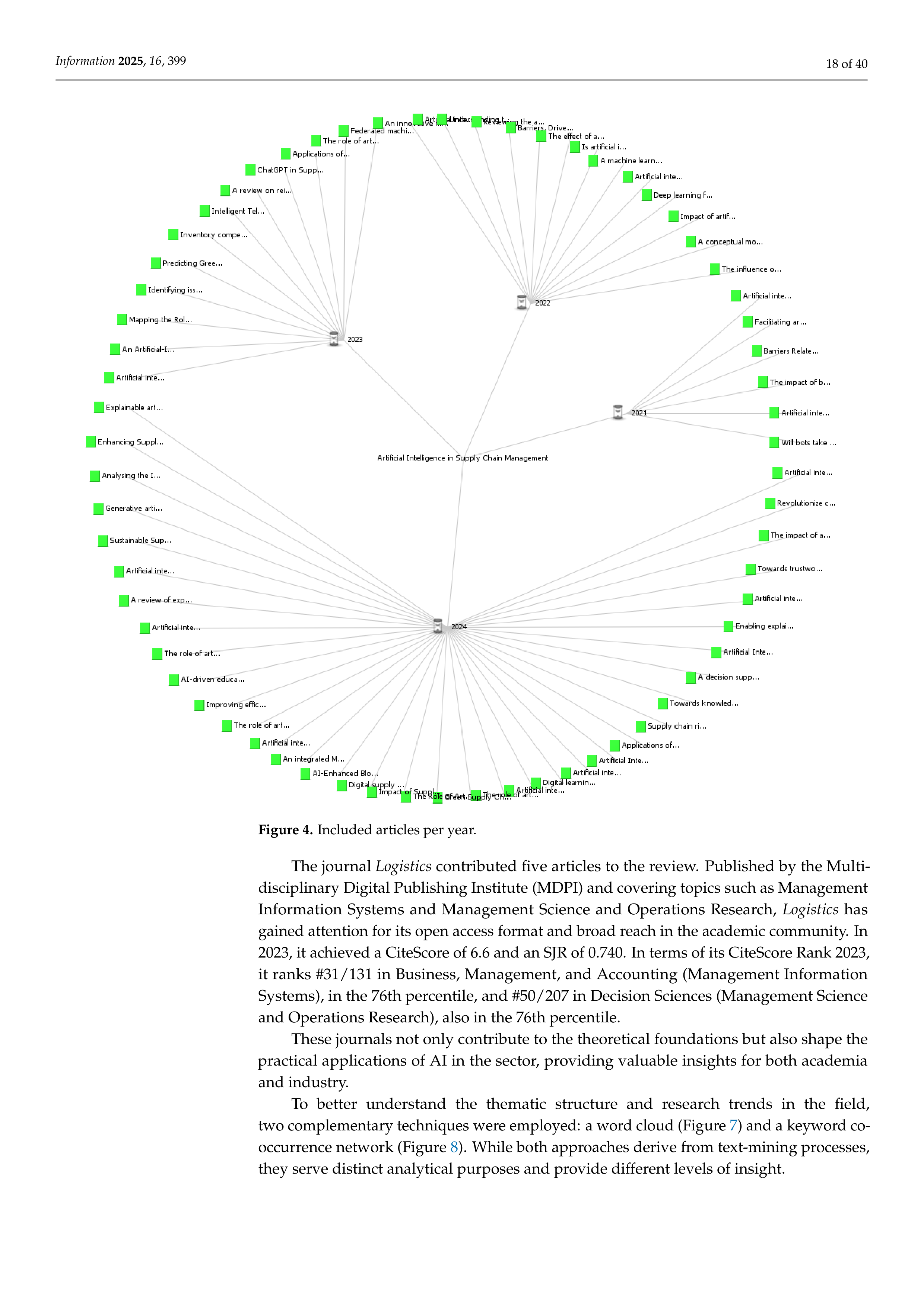
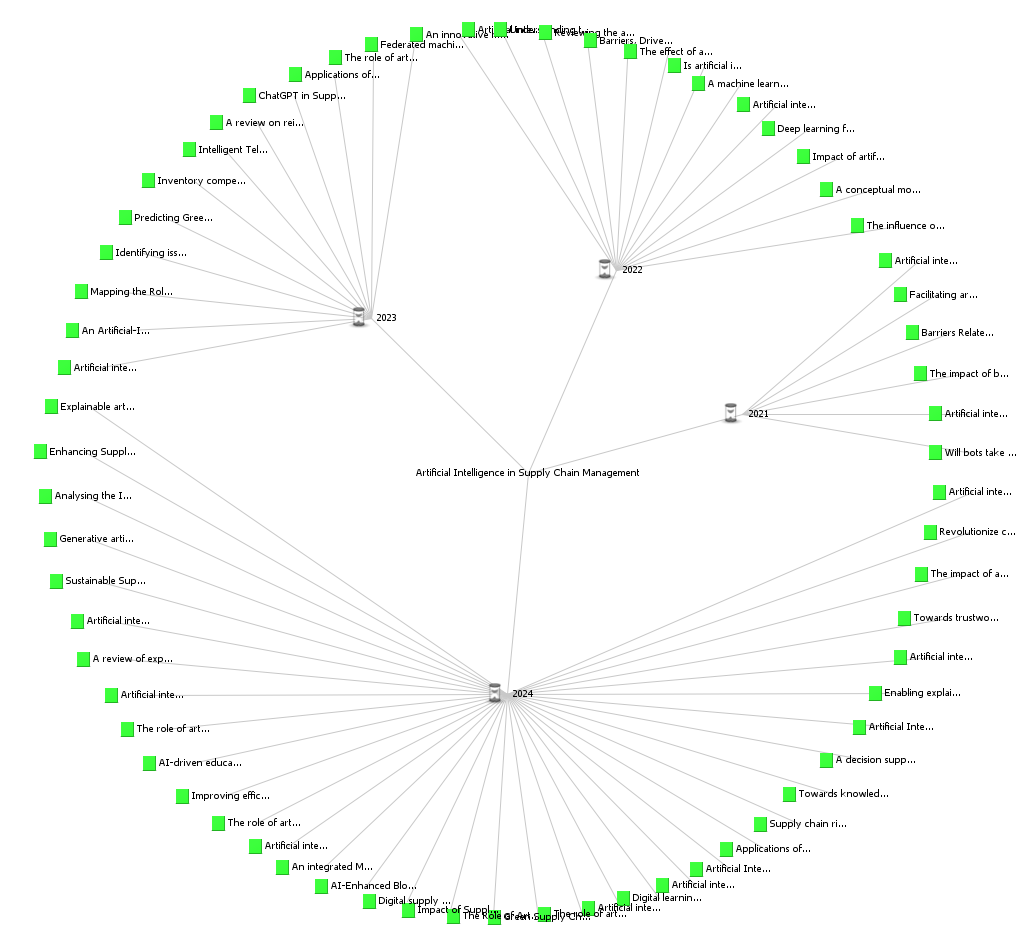
As shown in Figure
4
, the articles selected for this review are
largely concentrated within this narrow time window, emphasizing the current nature of
the research landscape.
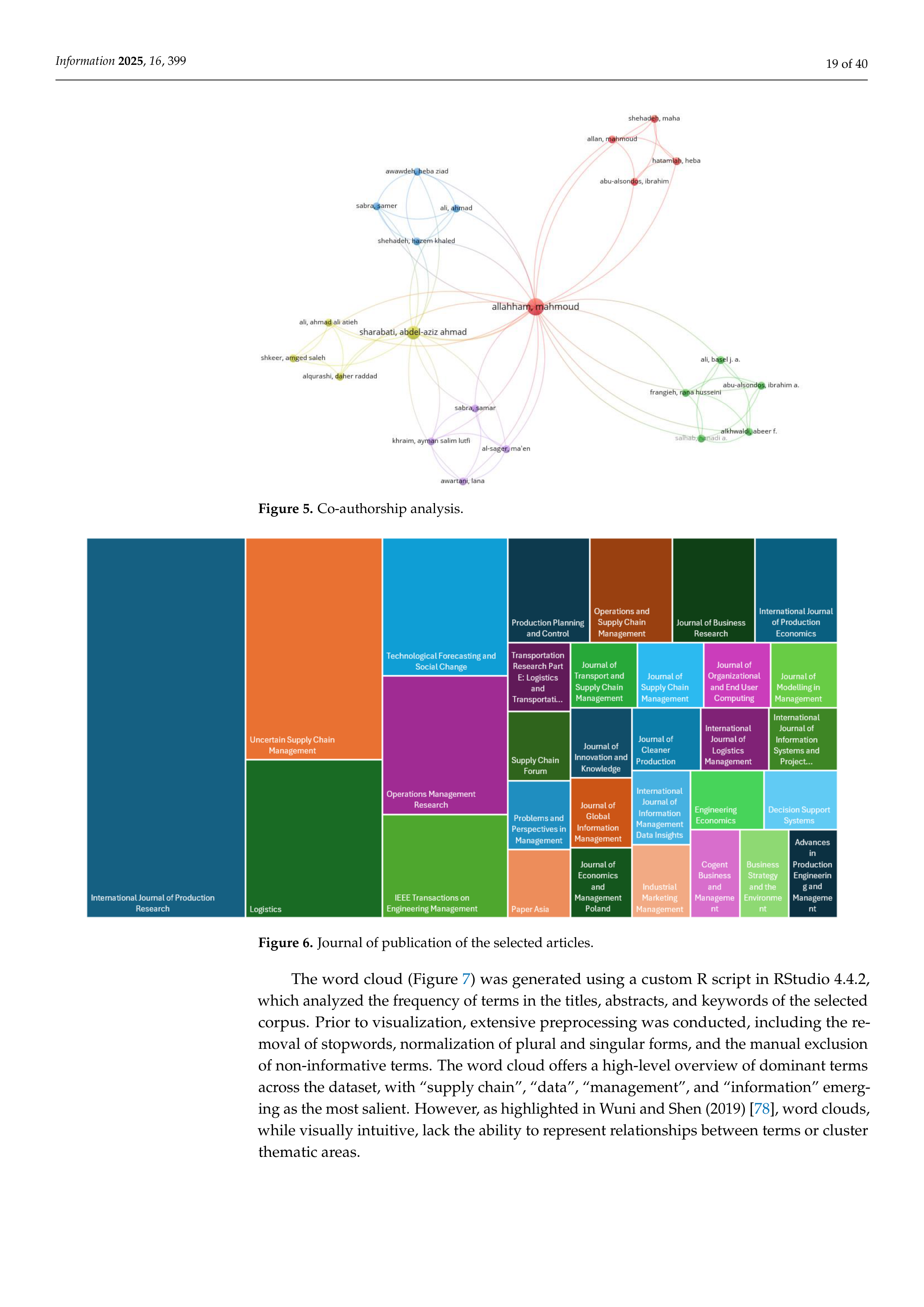
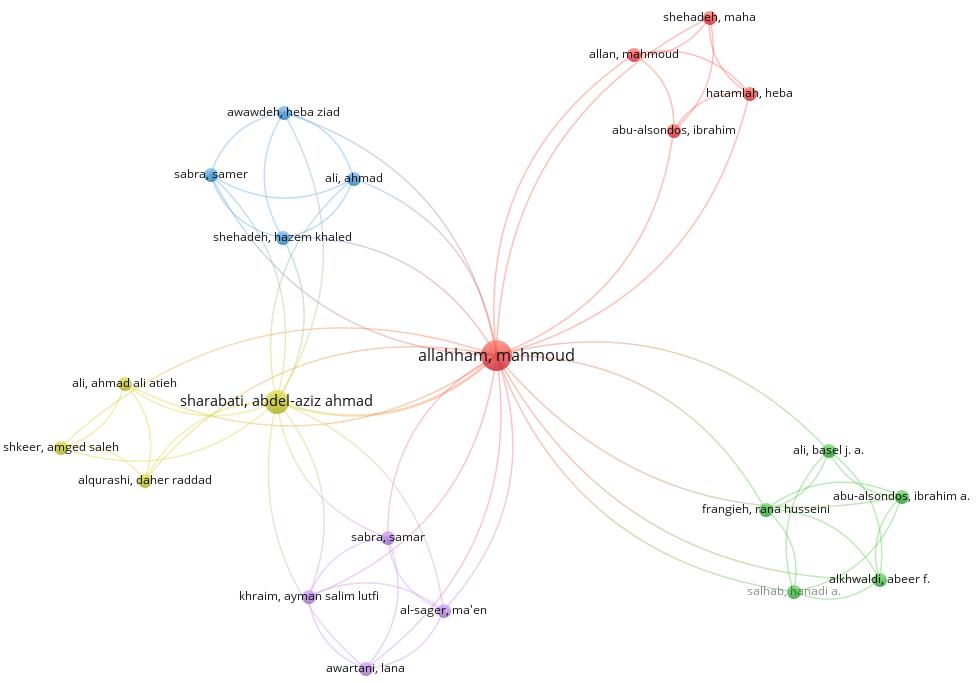
A visualization created using VOSviewer 1.6.20 highlights the key authors contributing
to
the
research
theme
in
the
selected
literature
(Figure
5
).
Among
the
most
prominent
authors,
Allahham,
Madmoud
emerge
as
leading
figure
in
the
field.
His
substantial
contributions are reflected in the high number of publications and their central positions in
the research network. Additionally, Sharabati, Abdel-Aziz Ahmad has also made significant
strides, positioning himself as a crucial author in the exploration of artificial intelligence
applications in supply chain management.
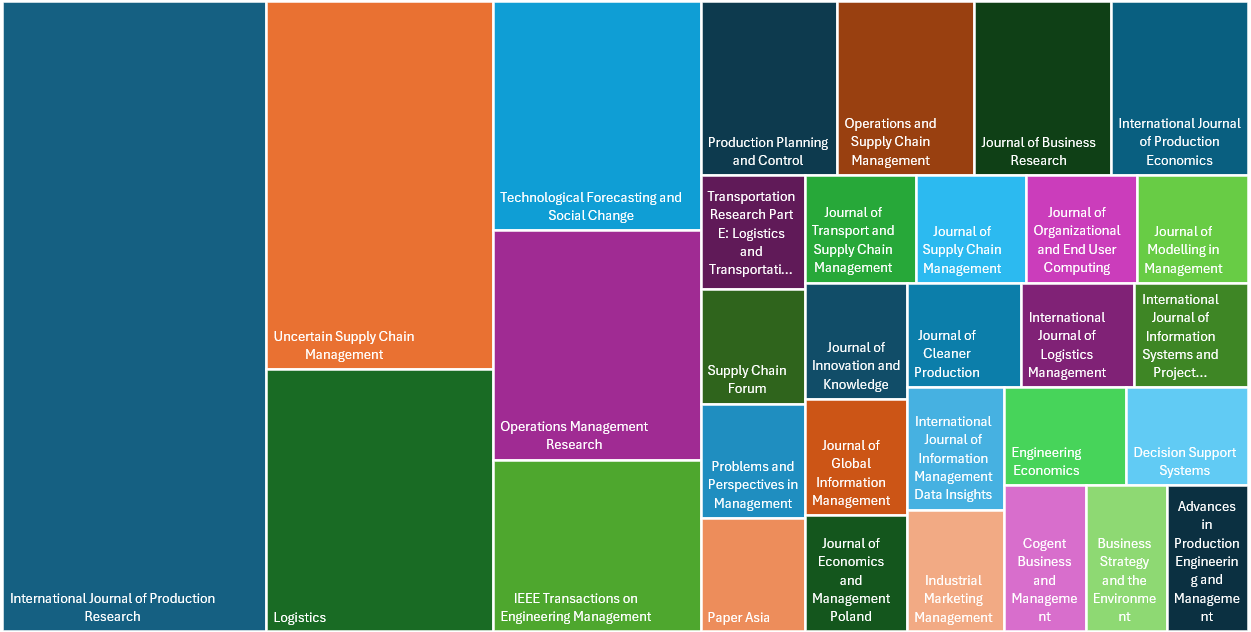
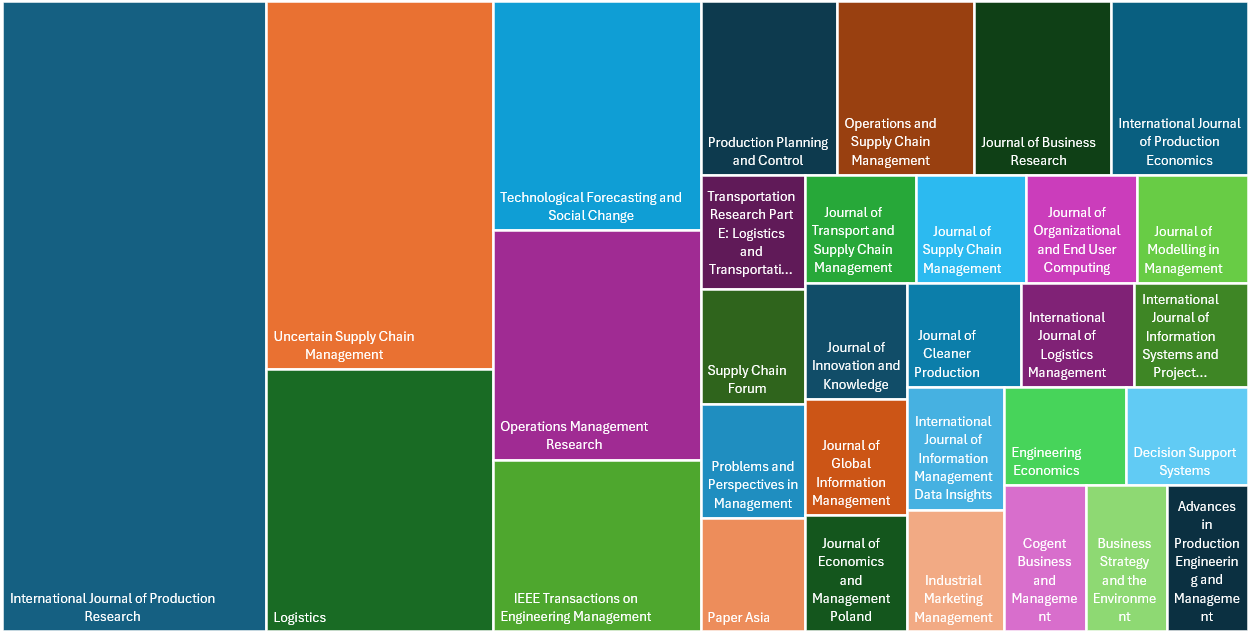
Among
the
journals
selected,
the
International
Journal
of
Production
Research
stands
out with 14 articles (Figure
6
).
This journal is widely recognized for its focus on produc-
tion management,
operations research,
and industrial engineering.
With a CiteScore of
19.2 (2023) and an SJR of 2.668, the
International Journal of Production Research
ranks highly
within its subject areas, including Decision Sciences and Industrial Engineering.
It ranks
#3 in Decision Sciences (Management Science and Operations Research), placing it in the
98th percentile, and #10 in Business, Management and Accounting (Strategy and Manage-
ment), also within the 98th percentile.
This reflects its significant influence and relevance to
the research topics explored in this review.
The
Uncertain Supply Chain Management
journal, with seven articles in the selected set,
also
plays
a
crucial
role
in
the
field
of
supply
chain
research.
Despite
being
indexed
in
Scopus
from
2013
to
2024,
its
coverage
was
discontinued
after
2024.
This
journal
primarily
addresses
the
areas
of
statistics,
probability,
and
uncertainty,
which
are
vital
for understanding the complexities of modern supply chains, especially in the context of
artificial intelligence and machine learning applications.
It holds a CiteScore of 5.6 (2023)
and an SJR of 0.436.
In terms of its CiteScore Rank 2023, it is ranked #21/168 in Decision
Sciences (Statistics, Probability and Uncertainty), placing it in the 87th percentile.
Information
2025
,
16
, 399
18 of 40
Figure 4.
Included articles per year.
The journal
Logistics
contributed five articles to the review.
Published by the Multi-
disciplinary Digital Publishing Institute (MDPI) and covering topics such as Management
Information
Systems
and
Management
Science
and
Operations
Research,
Logistics
has
gained attention for its open access format and broad reach in the academic community.
In
2023, it achieved a CiteScore of 6.6 and an SJR of 0.740.
In terms of its CiteScore Rank 2023,
it ranks #31/131 in Business,
Management,
and Accounting (Management Information
Systems), in the 76th percentile, and #50/207 in Decision Sciences (Management Science
and Operations Research), also in the 76th percentile.
These journals not only contribute to the theoretical foundations but also shape the
practical applications of AI in the sector, providing valuable insights for both academia
and industry.
To
better
understand
the
thematic
structure
and
research
trends
in
the
field,
two complementary techniques were employed:
a word cloud (Figure
7
) and a keyword co-
occurrence network (Figure
8
).
While both approaches derive from text-mining processes,
they serve distinct analytical purposes and provide different levels of insight.
Information
2025
,
16
, 399
19 of 40
Figure 5.
Co-authorship analysis.
Figure 6.
Journal of publication of the selected articles.
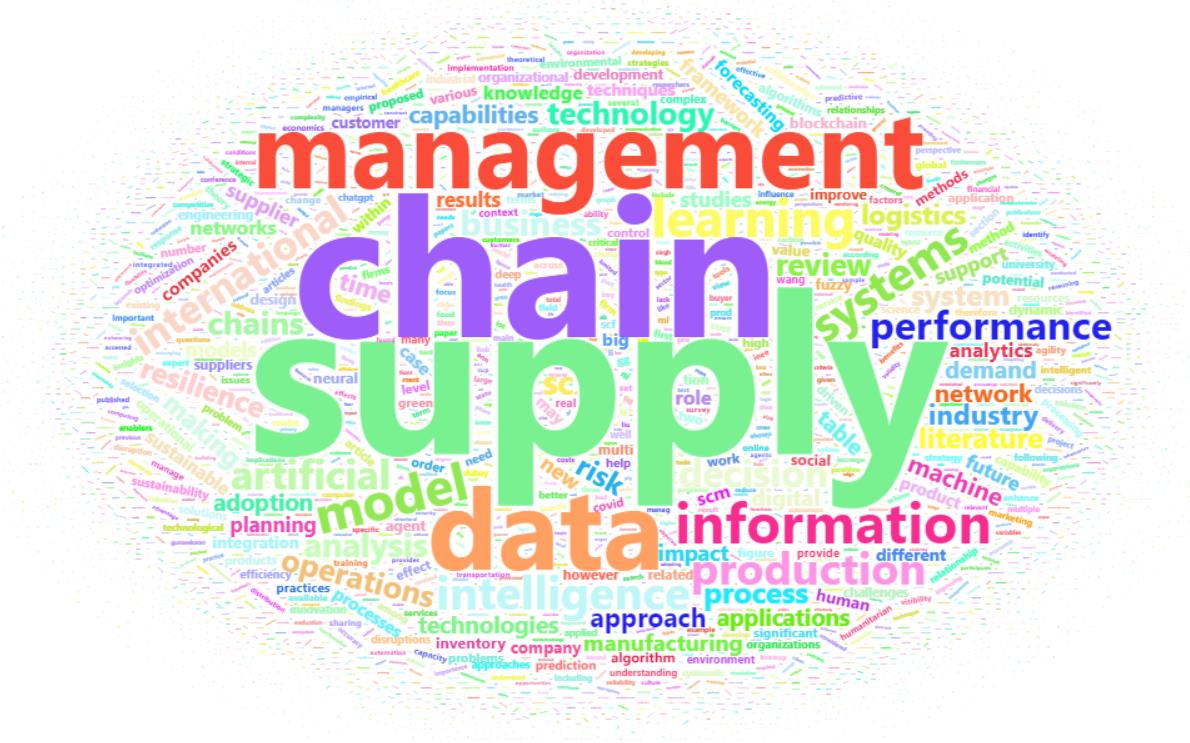
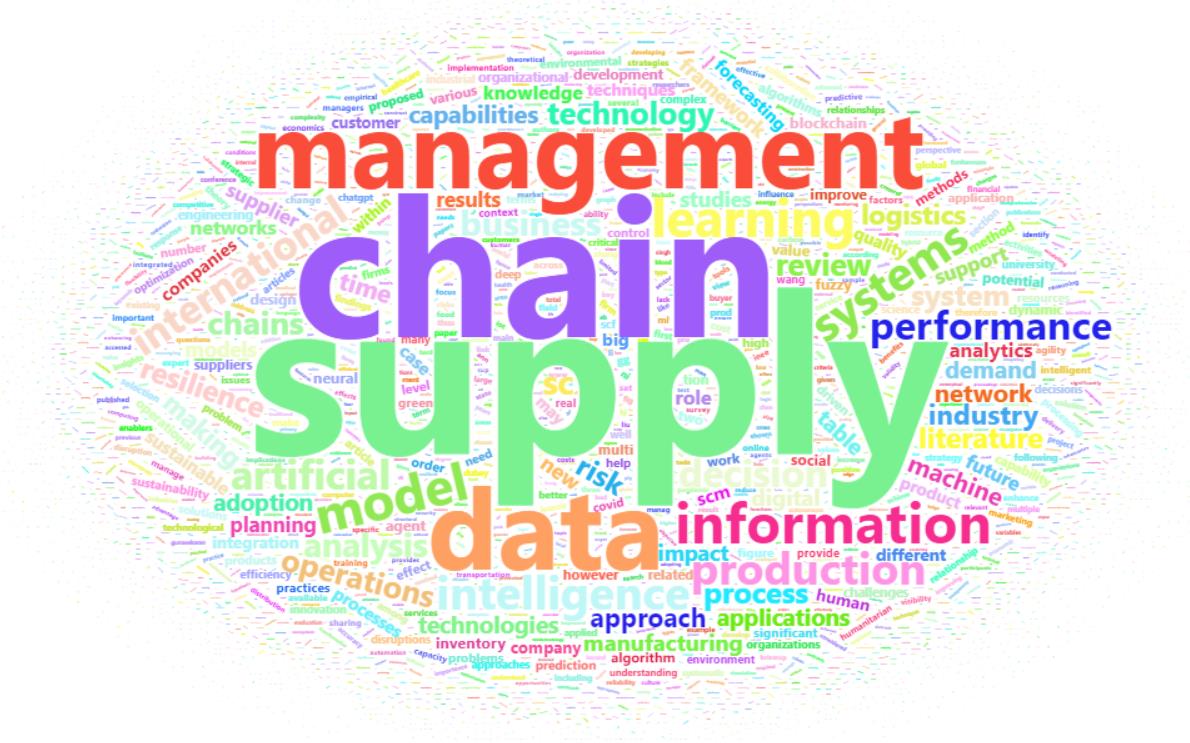
The word cloud (Figure
7
) was generated using a custom R script in RStudio 4.4.2,
which analyzed the frequency of terms in the titles, abstracts, and keywords of the selected
corpus.
Prior to visualization, extensive preprocessing was conducted, including the re-
moval of stopwords, normalization of plural and singular forms, and the manual exclusion
of non-informative terms.
The word cloud offers a high-level overview of dominant terms
across the dataset, with “supply chain”, “data”, “management”, and “information” emerg-
ing as the most salient.
However, as highlighted in Wuni and Shen (2019) [
78
], word clouds,
while visually intuitive, lack the ability to represent relationships between terms or cluster
thematic areas.
Information
2025
,
16
, 399
20 of 40
Figure 7.
Word cloud.
Figure 8.
Co-occurrence of all keywords.
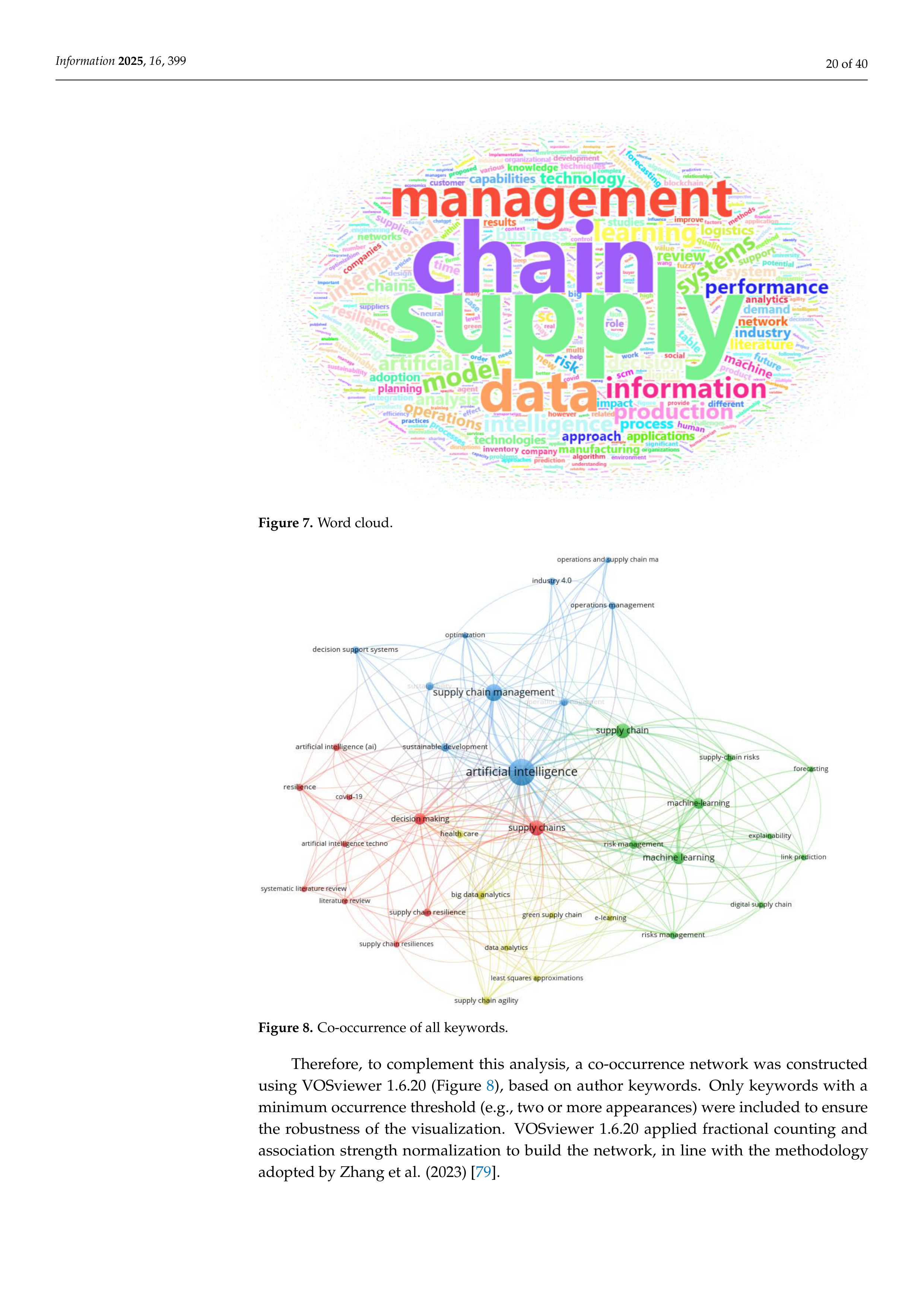
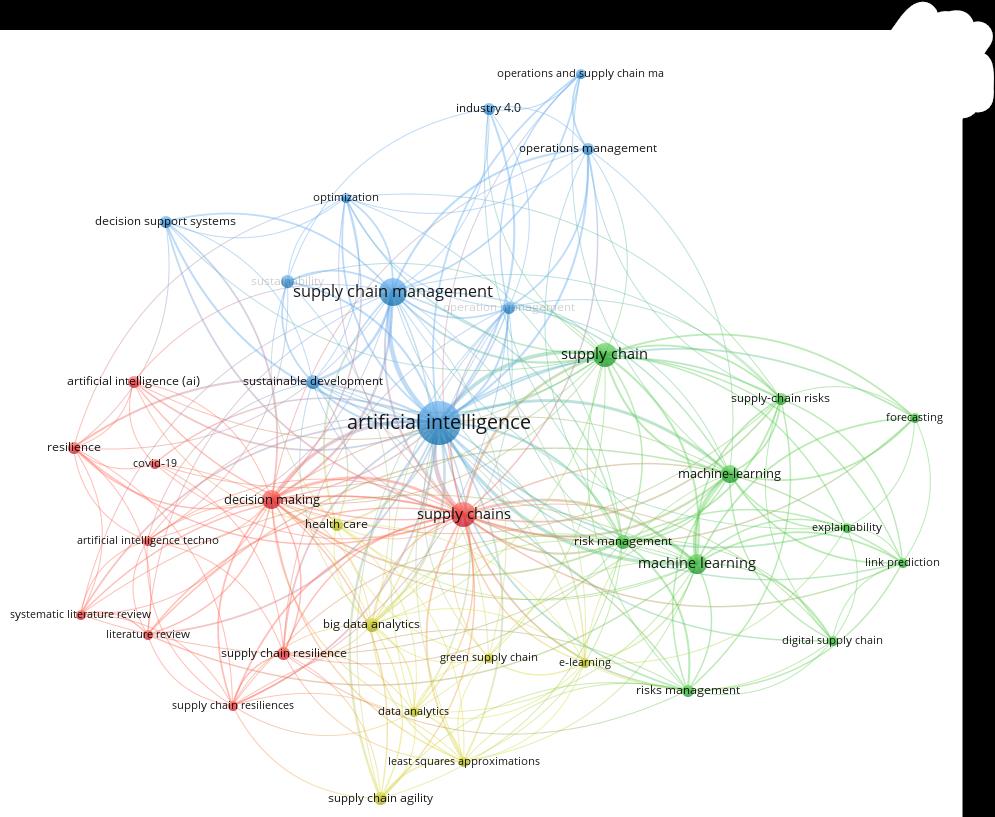
Therefore,
to
complement
this
analysis,
a
co-occurrence
network
was
constructed
using
VOSviewer
1.6.20
(Figure
8
),
based
on
author
keywords.
Only
keywords
with
a
minimum occurrence threshold (e.g., two or more appearances) were included to ensure
the
robustness
of
the
visualization.
VOSviewer
1.6.20
applied
fractional
counting
and
association
strength
normalization
to
build
the
network,
in
line
with
the
methodology
adopted by Zhang et al.
(2023) [
79
].
Information
2025
,
16
, 399
21 of 40
This network visualization enables the identification of conceptual clusters and the-
matic proximities, with the following examples:
•
The blue cluster centers around “supply chain management”, “decision support sys-
tems”, and “optimization”, indicating a stream of research concerned with operational
performance and planning.
•
The
green
cluster
highlights
“machine
learning”,
“forecasting”,
and
“risk
manage-
ment”, pointing to predictive analytics and data-driven risk mitigation approaches.
•
The red cluster links “resilience”, “COVID-19”, and “decision making”, suggesting a
focus on adaptive strategies under uncertainty and disruption.
•
The yellow cluster includes terms such as “big data analytics”, “green supply chain”,
and “sustainability”, showing intersections between digital transformation and envi-
ronmental objectives.
This structured mapping reveals how different research streams are interconnected
and identifies gaps or emerging trends that are less evident in the word cloud.
For instance,
the presence of keywords like “health care” and “e-learning” within the network suggests
the diffusion of supply chain AI applications into sector-specific contexts.
In contrast to the word cloud, the co-occurrence network facilitates a more rigorous
bibliometric
interpretation.
Following
the
principles
in
Zhang
et
al.
(2023)
[
79
],
this
enables researchers to move beyond simple frequency counts and begin exploring thematic
evolution, conceptual influence, and future research trajectories.
The density, clustering,
and centrality of nodes in Figure
8
thus provide key insights that can inform the formulation
of research questions and the development of analytical frameworks.
In
summary,
while
the
word
cloud
(Figure
7
)
serves
as
an
accessible
entry
point
for identifying prominent terms, it is the co-occurrence network (Figure
8
) that delivers
substantive value in identifying intellectual structures and interrelationships within the
field.
This justifies the inclusion of both figures in the analysis, as each offers complemen-
tary perspectives for understanding the literature landscape on artificial intelligence in
supply chains.
To provide a structured and analytically rigorous synthesis of the selected literature,
the results of this systematic review are organized into distinct yet interrelated thematic
dimensions.
This
structure
was
designed
to
reflect
the
most
recurrent
and
impactful
application areas of AI within SCM, as well as to enable a clearer articulation of emerging
trends, research gaps, and practical implications.
The first four thematic sections were developed based on the dominant axes identified
during the content analysis, and their scope was cross-validated against the bibliometric
structures—particularly
the
keyword
co-occurrence
network.
This
integration
ensures
that the thematic synthesis is not presented in isolation but is grounded in the structural
patterns of the literature.
Specifically, each thematic axis corresponds closely to clusters
within the co-occurrence network, reinforcing the analytical continuity between publication
trends and the substantive content of AI applications in SCM.
•
Section
3.2
—Enhancing Supply Chain Resilience examines how AI technologies con-
tribute to risk mitigation, agility, and recovery capabilities across supply chains.
This
theme is strongly aligned with a co-occurrence cluster centered on keywords such as
“machine learning”, “forecasting”, and “risk management”, reflecting the field’s focus
on predictive analytics and resilience-building.
•
Section
3.3
—Optimizing Supply Chain Processes explores the role of AI in improv-
ing forecasting accuracy, inventory control, logistics planning, and automation.
This
section connects directly to the cluster dominated by terms like “supply chain manage-
ment”, “decision support systems”, and “optimization”, highlighting the operational
and strategic performance dimensions emphasized in the literature.
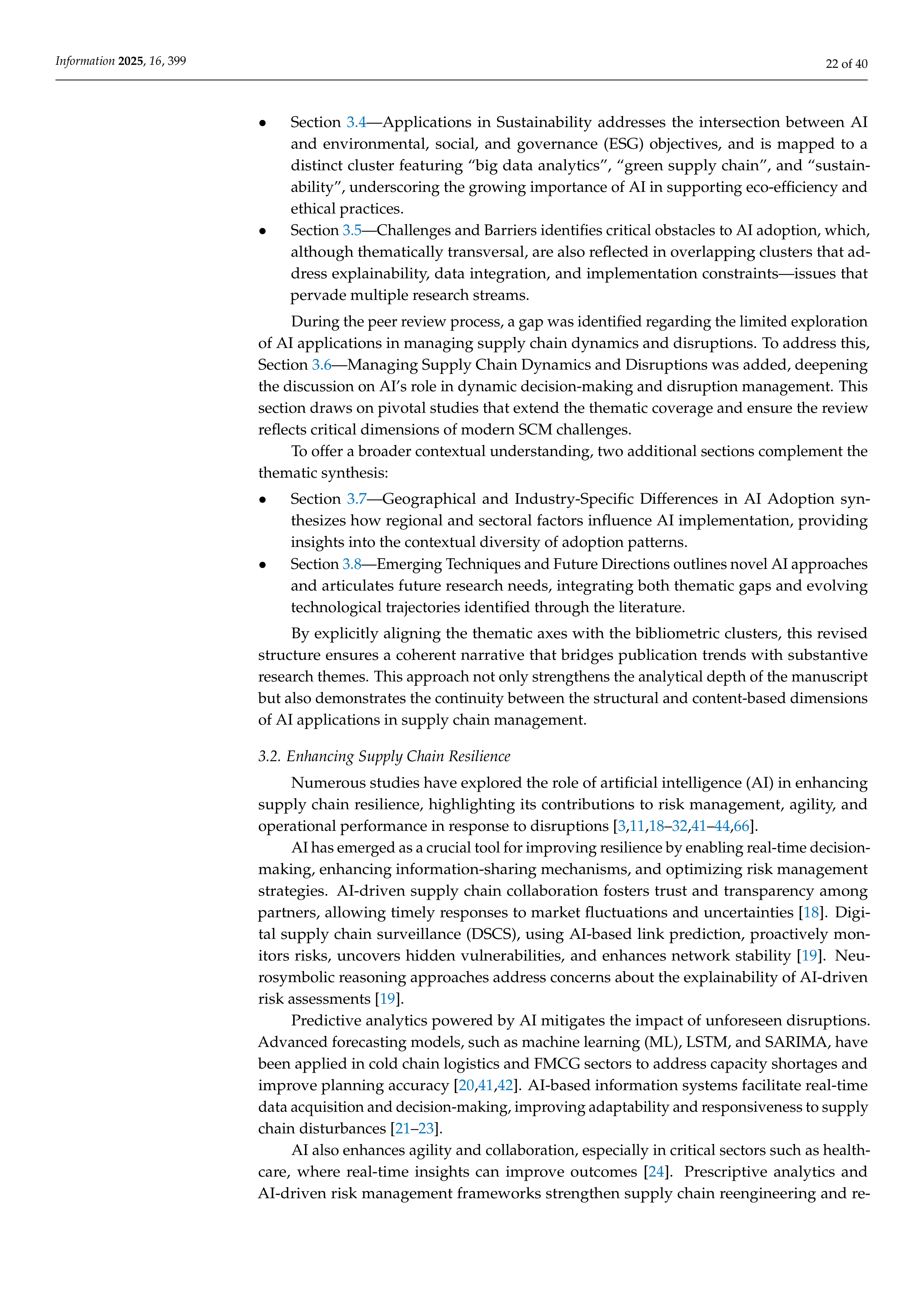
Information
2025
,
16
, 399
22 of 40
•
Section
3.4
—Applications
in
Sustainability
addresses
the
intersection
between
AI
and
environmental,
social,
and
governance
(ESG)
objectives,
and
is
mapped
to
a
distinct
cluster
featuring
“big
data
analytics”,
“green
supply
chain”,
and
“sustain-
ability”, underscoring the growing importance of AI in supporting eco-efficiency and
ethical practices.
•
Section
3.5
—Challenges and Barriers identifies critical obstacles to AI adoption, which,
although thematically transversal, are also reflected in overlapping clusters that ad-
dress explainability,
data integration,
and implementation constraints—issues that
pervade multiple research streams.
During the peer review process, a gap was identified regarding the limited exploration
of AI applications in managing supply chain dynamics and disruptions.
To address this,
Section
3.6
—Managing Supply Chain Dynamics and Disruptions was added, deepening
the discussion on AI’s role in dynamic decision-making and disruption management.
This
section draws on pivotal studies that extend the thematic coverage and ensure the review
reflects critical dimensions of modern SCM challenges.
To offer a broader contextual understanding, two additional sections complement the
thematic synthesis:
•
Section
3.7
—Geographical
and
Industry-Specific
Differences
in
AI
Adoption
syn-
thesizes how regional and sectoral factors influence AI implementation, providing
insights into the contextual diversity of adoption patterns.
•
Section
3.8
—Emerging Techniques and Future Directions outlines novel AI approaches
and articulates future research needs, integrating both thematic gaps and evolving
technological trajectories identified through the literature.
By explicitly
aligning the thematic axes
with the bibliometric clusters,
this revised
structure
ensures
a
coherent
narrative
that
bridges
publication
trends
with
substantive
research themes.
This approach not only strengthens the analytical depth of the manuscript
but also demonstrates the continuity between the structural and content-based dimensions
of AI applications in supply chain management.
3.2.
Enhancing Supply Chain Resilience
Numerous studies have explored the role of artificial intelligence (AI) in enhancing
supply
chain
resilience,
highlighting
its
contributions
to
risk
management,
agility,
and
operational performance in response to disruptions [
3
,
11
,
18
–
32
,
41
–
44
,
66
].
AI has emerged as a crucial tool for improving resilience by enabling real-time decision-
making, enhancing information-sharing mechanisms, and optimizing risk management
strategies.
AI-driven
supply
chain
collaboration
fosters
trust
and
transparency
among
partners,
allowing timely responses to market fluctuations and uncertainties [
18
].
Digi-
tal
supply
chain
surveillance
(DSCS),
using
AI-based
link
prediction,
proactively
mon-
itors
risks,
uncovers
hidden
vulnerabilities,
and
enhances
network
stability
[
19
].
Neu-
rosymbolic reasoning approaches address concerns about the explainability of AI-driven
risk assessments [
19
].
Predictive analytics powered by AI mitigates the impact of unforeseen disruptions.
Advanced forecasting models, such as machine learning (ML), LSTM, and SARIMA, have
been applied in cold chain logistics and FMCG sectors to address capacity shortages and
improve planning accuracy [
20
,
41
,
42
].
AI-based information systems facilitate real-time
data acquisition and decision-making, improving adaptability and responsiveness to supply
chain disturbances [
21
–
23
].
AI also enhances agility and collaboration, especially in critical sectors such as health-
care,
where
real-time
insights
can
improve
outcomes
[
24
].
Prescriptive
analytics
and
AI-driven risk management frameworks strengthen supply chain reengineering and re-
Information
2025
,
16
, 399
23 of 40
sponsiveness among SMEs [
11
,
25
].
In Vietnamese SMEs, AI has enabled adaptive responses
to
unexpected
disruptions
[
26
],
and
generative
AI
contributes
by
enabling
predictive
decision support [
43
].
The
relevance
of
AI
for
resilience
is
particularly
evident
during
crises.
AI-driven
strategies
improve
transparency,
last-mile
delivery,
and
agile
procurement,
while
AI-
integrated analytics enhance alliance management and operational performance [
27
,
28
].
ML models such as CGANs help optimize member selection in supply chain alliances [
44
].
AI-based
sourcing
strategies
enable
proactive
operational
adjustments
in
response
to
emerging threats [
27
].
Post-pandemic
research
confirms
AI’s
critical
role
in
fostering
resilience.
Stud-
ies
emphasize
predictive
modeling
and
intelligent
automation
as
key
to
recovery
and
continuity [
29
,
66
]
.
AI-powered
analytics
and
demand
forecasting
tools
help
maintain
balance and increase resilience, especially in fast-evolving environments [
3
,
23
,
30
,
42
].
3.3.
Optimizing Supply Chain Processes
AI
significantly
improves
supply
chain
performance
across
key
processes
such
as
demand
forecasting,
inventory
management,
logistics
planning,
and
automation [
5
,
10
,
12
,
20
,
22
,
23
,
28
,
33
–
36
,
41
,
42
,
44
–
53
,
57
,
58
,
67
–
69
].
The
critical
role
of
artificial
intelligence—particularly
through
big
data
analytics
capabilities—in enhancing supply chain agility by improving information alignment and
collaboration has been highlighted, emphasizing its importance in achieving responsiveness
and adaptability in dynamic and uncertain environments [
33
].
AI-driven predictive analytics and real-time data processing reduce lead times, im-
prove accuracy, and lower operational costs.
Case study analyses using the SCOR model
show how AI strengthens service levels, product quality, and safety, while also addressing
sustainability [
45
].
AI-enhanced decision support systems (DSSs), particularly those incor-
porating explainable AI (XAI), bring transparency and reliability to decision-making [
57
].
AI has been mapped across various digital transformation initiatives, emphasizing
its role in improving logistics and inventory strategies [
67
].
Blockchain-integrated AI sys-
tems
help
overcome
data
inconsistency
and
latency
in
IoT-driven
supply
chains
[
46
],
while
in
finance,
AI
supports
transaction
optimization,
credit
risk
assessment,
and
supplier financing [
68
].
Omnichannel
models,
such
as
in
the
blood
supply
chain,
show
how
AI
balances
supply and demand using intelligent mechanisms [
34
].
AI tools like CNNs and BiLSTM
enhance pattern recognition, resource allocation, and predictive analysis [
47
].
Reinforce-
ment learning adds adaptivity,
particularly in dynamic inventory systems [
12
].
AI also
contributes to risk mitigation in project management and enhances coordination in complex
supply networks [
69
].
AI
supports
logistics
automation,
improving
vehicle
routing
and
distribution
effi-
ciency [
44
].
It enhances e-commerce through intelligent product recommendations and
product information management [
48
]. Agent-based systems boost interoperability through
IoT and smart contracts [
49
].
Emerging technologies such as federated learning allow privacy-preserving collabora-
tive models for shared risk prediction [
35
].
Research on autonomous robots identifies key
adoption factors, including efficiency gains and cost barriers [
36
], while AR-based tools
support organizational performance in planning and operations [
5
].
Information
2025
,
16
, 399
24 of 40
3.4.
Applications in Sustainability
AI enables sustainability in supply chains by reducing waste, controlling emissions,
and
supporting
ethical
sourcing
across
environmental,
social,
and
governance
(ESG)
dimensions [
14
,
26
,
32
–
34
,
37
,
38
,
47
,
54
,
55
,
58
–
65
,
70
,
71
].
Environmental
sustainability
benefits
from
AI’s
ability
to
optimize
operations,
re-
duce greenhouse gas emissions, and manage resources efficiently [
14
].
AI ensures prod-
uct
security,
supports
responsible
sourcing,
and
enhances
supply
chain
transparency.
In
healthcare,
AI
improves
supply
chain
traceability
and
responsiveness,
especially
post-pandemic [
59
].
Neurosymbolic ML approaches support sustainability by identifying non-compliant
suppliers
and
enabling
ethical
audits
[
32
].
Intelligent
Teledermatology
Systems
(ITDS)
exemplify AI’s role in optimizing healthcare logistics and service delivery [
70
].
In
closed-loop
supply
chains
(CLSCs),
AI
aids
in
waste
reduction
and
resource
re-
covery
[
58
].
Green
supply
chain
management
(GSCM)
uses
tools
like
AIoE
to
embed
sustainable decision-making into operations [
60
].
AI also supports humanitarian supply
chains by improving coordination and resource use in disaster response [
33
].
AI-driven analytics align supply with market needs, enhance resource efficiency, and
support green supplier selection [
61
].
Predictive tools estimate carbon neutrality indices,
helping firms comply with environmental regulations [
62
].
In construction supply chains,
AI identifies risks and supports sustainable practices [
71
].
In
the
post-COVID
financial
landscape,
AI
optimizes
supply
chain
finance
(SCF),
supporting sustainability by reducing waste and inefficiencies [
54
].
AI-powered routing
tools,
using CNNs and BiLSTM, help reduce environmental impact,
while AI supports
circular economy (CE) strategies through better resource recovery [
26
,
47
].
Medical drones enhance healthcare supply chains by reducing emissions and support-
ing SDG targets [
37
].
AI-based collaboration improves eco-efficiency and emissions control
through big data analytics [
63
,
64
].
In Industry 4.0, AI enhances energy efficiency via pre-
dictive maintenance and quality control [
65
], and supports transparency through visibility
systems and ethical compliance tools such as AI-based judicial reasoning models [
38
,
55
].
3.5.
Challenges and Barriers
Several studies have explored the challenges and barriers to AI adoption in supply
chain management, highlighting issues such as data quality, interoperability, ethical con-
cerns,
and
scalability
[
12
,
14
,
19
,
20
,
30
,
32
,
35
,
36
,
39
,
40
,
42
,
43
,
45
,
49
–
51
,
56
,
57
,
68
,
71
–
77
].
These
challenges impact the effective integration of AI-driven solutions across various supply
chain functions.
Despite its transformative potential, AI adoption in supply chain management faces
several challenges.
Key barriers include data quality issues, lack of skilled personnel, high
implementation costs, and concerns regarding the economic benefits of AI investments [
45
].
Organizations often struggle to integrate AI with existing systems due to interoperability
challenges and the complexity of legacy infrastructures.
Additionally, regulatory uncertain-
ties and ethical considerations, such as data privacy and algorithmic biases, pose significant
hurdles to AI adoption in supply chains [
14
].
One major limitation is the reluctance of suppliers to share data [
32
], which restricts
the
effectiveness
of
AI-driven
risk
management
systems.
Additionally,
the
integration
of AI in supply chains requires continuous adaptation and training of personnel to keep
up with technological advancements [
50
].
Ethical considerations, including the need for
responsible AI usage and mitigation of biases in decision-making,
also pose significant
challenges.
Furthermore, variations in AI performance across different models highlight
the necessity for continuous model adaptation and validation to ensure reliability in real-
Information
2025
,
16
, 399
25 of 40
world
applications,
comparing
the
performance
of
ChatGPT
and
Bard
in
supply
chain
contexts, demonstrating how different AI models yield varying levels of accuracy, relevance,
and readability [
72
].
The
lack
of
explainability
in
AI
models
exacerbates
adoption
challenges,
as
practi-
tioners
often
find
black-box
models
difficult
to
trust.
Efforts
to
develop
explainable
AI
frameworks,
such
as
the
SHapley
Additive
exPlanations
(SHAP)
technique,
have
been
explored to enhance transparency and interpretability in AI-driven decision support sys-
tems [
57
].
Furthermore, AI apprehensions among managerial personnel can hinder the
effectiveness of risk alert tools, emphasizing the need for a balanced approach between
technological and human elements in supply chain management [
39
].
Scalability and integration with existing infrastructures pose additional barriers to
AI
implementation.
Many
AI-driven
solutions
remain
at
a
theoretical
or
experimental
stage, with limited deployment in real-world industry settings [
12
].
AI implementation in
supply chain finance faces challenges related to fraud detection, supplier onboarding, and
administrative efficiency [
68
].
Moreover, the lack of digital readiness and slow adoption of
AI-driven technologies, particularly in the FMCG industry, pose further constraints [
20
].
Ethical and legal implications, including AI-driven surveillance technologies leading
to
biased
decision-making
and
privacy
infringements,
remain
significant
concerns
[
40
].
Additionally, research highlights issues such as lack of trust in AI outcomes, cybersecurity
risks, and uncertainties regarding the cost–benefit trade-off in AI adoption [
71
].
Addressing
these
barriers
requires
organizations
to
develop
strategies
that
align
AI
adoption
with
long-term business objectives [
51
].
Organizational and cultural factors also play a critical role in AI adoption.
A struc-
tured
review
identified
issues
such
as
resistance
to
AI-driven
automation,
integration
difficulties
with
legacy
systems,
and
the
lack
of
comprehensive
AI
governance
frame-
works
[
73
].
Furthermore,
the
cultural
and
managerial
enablers
of
AI
adoption
remain
underexplored, necessitating further research on behavioral factors influencing successful
AI integration [
74
].
Additional challenges include multi-actor collaboration complexities and disparities
in data accessibility, which hinder the seamless implementation of AI-driven solutions [
74
].
Overcoming these barriers requires targeted policy interventions and organizational change
management strategies to enhance AI readiness in supply chain contexts.
Agent-based AI systems, while promising, face adoption challenges due to the need
for standardized protocols and interoperability with enterprise resource planning (ERP)
systems [
49
].
Furthermore, selecting appropriate AI models for specific supply chain tasks
remains a challenge.
For instance, demand forecasting models require careful selection of
inputs and parameters to ensure reliability and accuracy [
42
].
Organizations must invest in
research and development to optimize AI-driven forecasting techniques for their unique
supply chain needs.
Scalability, ethical considerations, and integration complexities continue to impede
widespread AI adoption.
Resistance to AI implementation arises due to concerns over data
privacy,
algorithmic
biases,
and
interoperability
with
legacy
systems.
For
instance,
the
adoption of federated machine learning for supply chain risk prediction is constrained by
disparities in data access, algorithmic selection, and data-sharing reluctance [
35
].
Another
critical
challenge
lies
in
the
cost
and
perceived
value
of
AI
technologies.
Research on autonomous robot adoption suggests that while cost is a major determinant,
firms
may
struggle
to
recognize
the
full
potential
benefits
of
automation,
thereby
lim-
iting
adoption
rates
[
36
].
Furthermore,
concerns
surrounding
explainability
and
trans-
parency
in
AI-driven
decision-making
persist,
as
stakeholders
demand
greater
inter-
pretability in AI-generated insights.
Addressing these challenges requires strategic invest-
Information
2025
,
16
, 399
26 of 40
ments in AI governance frameworks and interdisciplinary collaboration to enhance trust
and adoption [
30
].
3.6.
Managing Supply Chain Dynamics and Disruptions
In the initial analysis of the 66 selected articles, no substantial focus was identified
on
the
application
of
AI
in
managing
dynamic
and
disrupted
production-distribution
systems.
Despite
the
relevance
of
this
topic
to
modern
supply
chain
challenges,
this
gap
suggests
that
current
literature
reviews
may
overlook
this
crucial
dimen-
sion.
To
ensure
a
more
comprehensive
understanding
of
the
field,
additional
pivotal
studies—Priore et al.
(2019) [
80
]
,
Badakhshan
and
Ball
(2023)
[
81
],
Ivanov
(2020)
[
82
],
Modgil et al.
(2022) [
27
]
, and
Yashan et al.
(2024) [
83
]—were
incorporated into the discus-
sion.
These works provide critical insights into how AI can be leveraged to mitigate both
operational volatility and systemic disruptions in supply chain networks.
Modern supply chains are increasingly exposed to volatility, uncertainty, and sudden
disruptions in both supply and demand.
As such, AI has emerged as a strategic enabler,
enhancing decision-making, adaptability, and resilience.
For instance, Ivanov (2020) [
82
]
investigates the distinctive features of epidemic outbreaks—characterized by long-term
disruptions, ripple effects, and simultaneous supply-demand shocks—and demonstrates,
via simulation-based modeling, how AI-enhanced digital twins can predict and mitigate
the impacts of pandemics on global supply chains.
Notably, the study underscores that
factors such as the timing of facility closures and the speed of epidemic propagation are
pivotal in determining performance outcomes.
Priore
et
al.
(2019)
[
80
]
contribute
a
machine
learning-based
framework
designed
to
dynamically
select
optimal
replenishment
policies
in
rapidly
evolving
supply
chain
environments.
Their inductive learning approach, utilizing C4.5 decision trees, facilitates
managers’ understanding of the interplay between controllable and uncontrollable vari-
ables, resulting in significant cost savings and reduced bullwhip effects.
Complementarily,
Badakhshan and Ball (2023) [
81
] extend this approach by developing a digital twin frame-
work that integrates machine learning with discrete-event simulation, aiming to balance
inventory and cash management during both physical and financial disruptions.
Their
inclusion of financial metrics, such as the Cash Conversion Cycle (CCC), offers a nuanced
understanding of liquidity interdependencies across the supply network.
Further deepening the discourse, Modgil et al.
(2022) [
27
] highlight five critical areas
where AI fortifies supply chain resilience:
transparency, last-mile delivery, personalized
stakeholder solutions, disruption impact minimization, and agile procurement strategies.
Their
empirical
findings
emphasize
AI’s
role
in
enhancing
dynamic
capabilities,
thus
enabling firms to better anticipate, respond to, and recover from disruptions.
Yashan
et
al.
(2024)
[
83
]
propose
a
synergistic
integration
of
blockchain
and
AI
to
address transparency and trust issues that often exacerbate disruption impacts.
Their study
illustrates
how
AI-driven
predictive
analytics,
combined
with
blockchain’s
immutable
ledger,
can
prevent
fraud,
optimize
traceability,
and
enhance
real-time
visibility
across
complex global networks, offering a robust framework for disruption management.
Taken together, these studies underscore the transformative potential of AI in fortifying
supply chain resilience and responsiveness.
While Priore et al.
(2019) [
80
] and Badakhshan
and Ball (2023) [
81
] emphasize operational and financial decision support, Ivanov (2020) [
82
]
and Modgil et al.
(2022) [
27
] broaden the perspective by incorporating digital twins and
dynamic capabilities into disruption response strategies.
Yashan et al.
(2024) [
83
] further
extend the conversation by advocating for integrated technology frameworks that fuse AI
with blockchain to achieve unparalleled transparency and robustness.
Information
2025
,
16
, 399
27 of 40
AI integration transcends mere technological advancement; it signifies a structural
reconfiguration toward intelligent, adaptive, and resilient supply networks. Future research
may
benefit
from
synthesizing
these
approaches—combining
adaptive
replenishment
strategies, financial sensitivity, dynamic capability development, and blockchain-enabled
transparency—to build holistic, disruption-resilient models that reflect the intricacies of
global supply chains.
3.7.
Geographical and Industry-Specific Differences in AI Adoption
An analysis of the selected studies reveals considerable geographical and industry-
specific
heterogeneity
in
the
adoption
of
artificial
intelligence
(AI)
within
supply
chain
management
(SCM).
These
differences
are
shaped
by
contextual
factors
such
as
digital
maturity,
regulatory
environment,
sectoral
requirements,
and
cultural
readiness,
all
of
which influence the implementation pathways and performance outcomes of AI-driven
supply chains.
Several studies highlight a strong regional focus, which introduces potential biases
but also uncovers context-specific dynamics.
For example, research conducted in India
emphasizes AI’s role in alliance management during the COVID-19 crisis and the need
for adaptive strategies in auto component industries [
28
,
66
].
Similarly, studies in Jordan
and the broader MENA region explore digital transformation through AI, particularly in
e-commerce and industrial sectors [
50
,
51
].
These contexts often rely on perception-based
surveys, revealing both enthusiasm for AI and concerns regarding implementation capacity.
In
contrast,
studies
based
in
developed
economies,
such
as
the
United
States
and
the United Kingdom, tend to focus on more advanced applications, including generative
AI for education and risk surveillance, and emphasize explainability, transparency, and
regulatory alignment [
40
,
43
,
54
].
In particular, research from the UK highlights the strategic
integration
of
neurosymbolic
AI
and
graph
neural
networks
to
support
digital
supply
chain surveillance [
19
].
Other notable geographical examples include the following:
•
Southeast
Asia:
Vietnamese
SMEs
adopting
AI
for
agility
and
circular
economy
integration [
26
].
•
Africa:
Case
studies
from
Ghana
and
South
Africa
showing
AI’s
role
in
last-mile
healthcare delivery and FMCG supply chain resilience [
20
,
37
].
•
Pakistan
and
Indonesia:
AI
in
humanitarian
and
healthcare
logistics,
focusing
on
operational efficiency under constrained resources [
34
,
70
].
These findings suggest that while AI adoption is a global phenomenon, its drivers
and barriers vary considerably.
Developing regions often emphasize practical outcomes
(e.g., cost savings, efficiency), whereas developed regions explore advanced AI concepts
(e.g., XAI, federated learning) with more focus on governance and data ethics [
35
,
57
].
The reviewed literature also indicates distinct patterns of AI adoption across industries.
Manufacturing
remains
the
most
represented
sector,
particularly
in
studies
addressing
predictive maintenance, quality control, and sustainability in smart factories [
45
,
65
].
Here,
AI contributes to performance optimization through deep learning, computer vision, and
digital twin technologies.
Healthcare
and
humanitarian
logistics
form
another
cluster
of
interest.
Studies
in
these domains highlight AI’s value in improving traceability, responsiveness, and decision
support under crisis conditions [
24
,
33
,
59
].
These sectors show a higher adoption of AI for
agility and resilience rather than cost-based efficiency alone.
Retail and e-commerce applications focus on customer experience, demand stimula-
tion, and inventory optimization.
AI tools such as recommender systems and sentiment
analysis are used to drive performance via customer engagement and operational adapta-
Information
2025
,
16
, 399
28 of 40
tion [
48
,
50
].
Meanwhile, finance-oriented supply chains leverage AI for fraud detection,
credit assessment, and smart contracting, indicating an emerging frontier of AI-SCM inte-
gration in financial services [
57
,
68
].
The
construction
and
fashion
industries,
though
less
frequently
represented,
are
emerging
as
testbeds
for
AI
applications
in
sustainability,
reverse
logistics,
and
risk mapping [
58
,
71
].
Finally, the energy, water, and food sectors are gaining visibility, particularly in multi-
industry forecasting applications, underscoring AI’s growing versatility in critical infras-
tructure contexts [
42
].
Table
2
indicates
that
sector-specific
AI
implementations
are
often
closely
tied
to
regional characteristics.
For instance, sustainable supply chain models in India’s clothing
and healthcare sectors reflect national policy trends and resource constraints [
59
,
62
], while
advanced AI applications in European and North American studies mirror higher digital
maturity and regulatory readiness [
40
,
74
].
These variations reinforce the need for localized
AI strategies and context-sensitive policy frameworks.
In sum, AI adoption in SCM is not uniform; it is shaped by the interplay between ge-
ography, industry, and institutional readiness.
Future research should further explore these
dimensions, particularly in underrepresented regions and sectors, to support equitable and
effective diffusion of AI technologies across global supply chains.
These geographical and industry-specific differences are not merely descriptive but
have profound implications for the nature, pace, and success of AI integration in supply
chain management.
Contextual factors such as digital infrastructure maturity, regulatory
frameworks,
workforce
skills,
and
sector-specific
operational
complexities
fundamen-
tally shape the pathways through which AI is adopted and scaled.
For instance, regions
with advanced digital ecosystems and supportive policy environments tend to experience
more
seamless
and
accelerated
AI
integration,
while
industries
characterized
by
high
complexity or stringent compliance requirements may face distinct barriers despite high
potential benefits.
Moreover, cultural attitudes toward technology adoption and the availability of local
expertise also influence managerial perceptions and investment decisions, thereby affecting
AI implementation outcomes.
These variations highlight the need for nuanced, context-
aware strategies that align AI adoption with local capabilities and constraints.
Future research could benefit from cross-country and cross-sector comparative anal-
yses
to
identify
best
practices
and
adaptive
models
that
account
for
these
contextual
contingencies.
Additionally,
longitudinal
studies
examining
how
evolving
economic,
technological, and regulatory environments impact AI integration trajectories across dif-
ferent settings would further enrich the understanding of global AI adoption dynamics in
supply chains.
3.8.
Emerging Techniques and Future Directions
Recent advances in artificial intelligence (AI) are reshaping supply chain management
through enhanced decision-making,
real-time optimization,
and predictive capabilities.
The most promising developments include explainable AI, reinforcement learning, digital
twins,
generative
AI,
and
AI–human
intelligence
collaboration
[
10
–
12
,
19
,
21
,
29
,
31
,
32
,
34
,
35
,
38
,
43
,
46
,
52
,
54
,
55
,
63
,
64
,
67
,
68
,
75
,
76
].
These innovations are increasingly integrated with
disruptive technologies such as blockchain, IoT, and knowledge graph reasoning.
Neurosymbolic
AI—combining
machine
learning
with
symbolic
reasoning—has
gained relevance for enhancing transparency and trust in supply chain applications [
19
].
Similarly,
knowledge graph reasoning powered by graph neural networks (GNNs) has
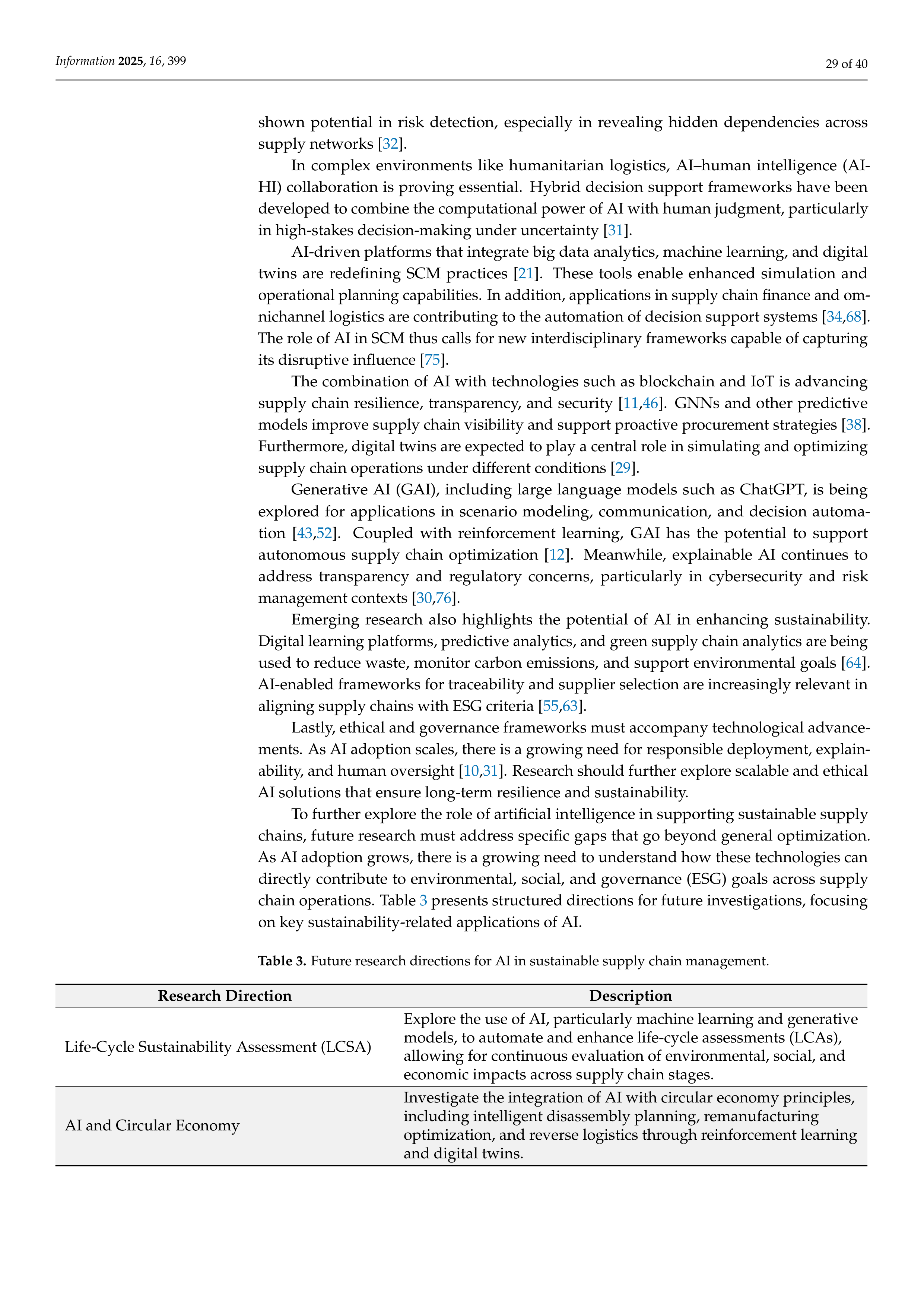
Information
2025
,
16
, 399
29 of 40
shown
potential
in
risk
detection,
especially
in
revealing
hidden
dependencies
across
supply networks [
32
].
In
complex
environments
like
humanitarian
logistics,
AI–human
intelligence
(AI-
HI) collaboration is proving essential.
Hybrid decision support frameworks have been
developed to combine the computational power of AI with human judgment, particularly
in high-stakes decision-making under uncertainty [
31
].
AI-driven platforms that integrate big data analytics, machine learning, and digital
twins
are
redefining
SCM
practices
[
21
].
These
tools
enable
enhanced
simulation
and
operational planning capabilities.
In addition, applications in supply chain finance and om-
nichannel logistics are contributing to the automation of decision support systems [
34
,
68
].
The role of AI in SCM thus calls for new interdisciplinary frameworks capable of capturing
its disruptive influence [
75
].
The combination of AI with technologies such as blockchain and IoT is advancing
supply
chain
resilience,
transparency,
and
security
[
11
,
46
].
GNNs
and
other
predictive
models improve supply chain visibility and support proactive procurement strategies [
38
].
Furthermore, digital twins are expected to play a central role in simulating and optimizing
supply chain operations under different conditions [
29
].
Generative
AI
(GAI),
including
large
language
models
such
as
ChatGPT,
is
being
explored
for
applications
in
scenario
modeling,
communication,
and
decision
automa-
tion
[
43
,
52
].
Coupled
with
reinforcement
learning,
GAI
has
the
potential
to
support
autonomous
supply
chain
optimization
[
12
].
Meanwhile,
explainable
AI
continues
to
address
transparency
and
regulatory
concerns,
particularly
in
cybersecurity
and
risk
management contexts [
30
,
76
].
Emerging
research
also
highlights
the
potential
of
AI
in
enhancing
sustainability.
Digital learning platforms, predictive analytics, and green supply chain analytics are being
used to reduce waste, monitor carbon emissions, and support environmental goals [
64
].
AI-enabled frameworks for traceability and supplier selection are increasingly relevant in
aligning supply chains with ESG criteria [
55
,
63
].
Lastly, ethical and governance frameworks must accompany technological advance-
ments.
As AI adoption scales, there is a growing need for responsible deployment, explain-
ability, and human oversight [
10
,
31
].
Research should further explore scalable and ethical
AI solutions that ensure long-term resilience and sustainability.
To further explore the role of artificial intelligence in supporting sustainable supply
chains, future research must address specific gaps that go beyond general optimization.
As AI adoption grows, there is a growing need to understand how these technologies can
directly contribute to environmental,
social,
and governance (ESG) goals across supply
chain operations.
Table
3
presents structured directions for future investigations, focusing
on key sustainability-related applications of AI.
Table 3.
Future research directions for AI in sustainable supply chain management.
Research Direction
Description
Life-Cycle Sustainability Assessment (LCSA)
Explore the use of AI, particularly machine learning and generative
models, to automate and enhance life-cycle assessments (LCAs),
allowing for continuous evaluation of environmental, social, and
economic impacts across supply chain stages.
AI and Circular Economy
Investigate the integration of AI with circular economy principles,
including intelligent disassembly planning, remanufacturing
optimization, and reverse logistics through reinforcement learning
and digital twins.
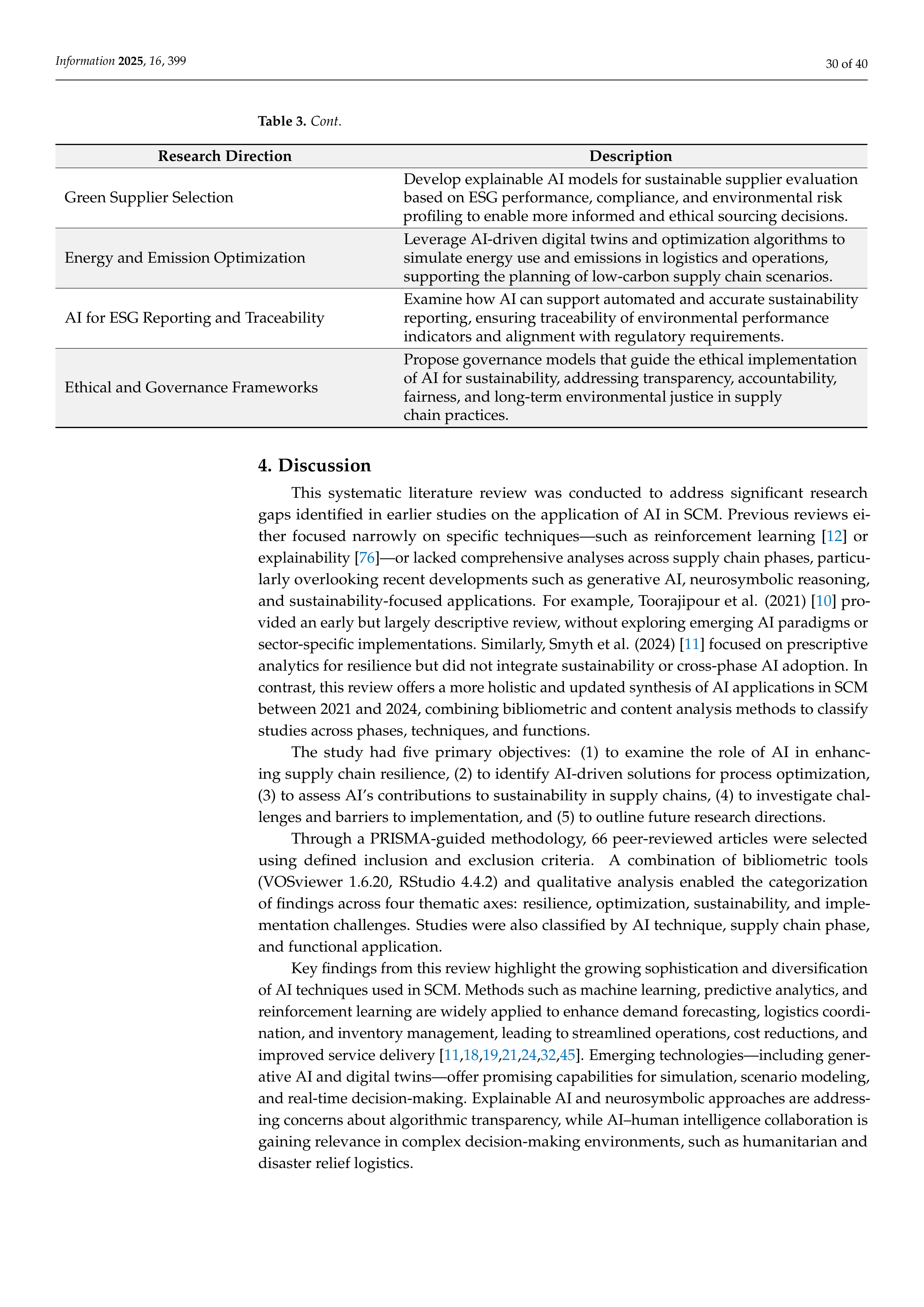
Information
2025
,
16
, 399
30 of 40
Table 3.
Cont.
Research Direction
Description
Green Supplier Selection
Develop explainable AI models for sustainable supplier evaluation
based on ESG performance, compliance, and environmental risk
profiling to enable more informed and ethical sourcing decisions.
Energy and Emission Optimization
Leverage AI-driven digital twins and optimization algorithms to
simulate energy use and emissions in logistics and operations,
supporting the planning of low-carbon supply chain scenarios.
AI for ESG Reporting and Traceability
Examine how AI can support automated and accurate sustainability
reporting, ensuring traceability of environmental performance
indicators and alignment with regulatory requirements.
Ethical and Governance Frameworks
Propose governance models that guide the ethical implementation
of AI for sustainability, addressing transparency, accountability,
fairness, and long-term environmental justice in supply
chain practices.
4.
Discussion
This
systematic
literature
review
was
conducted
to
address
significant
research
gaps
identified
in
earlier
studies
on
the
application
of
AI
in
SCM.
Previous
reviews
ei-
ther
focused
narrowly
on
specific
techniques—such
as
reinforcement
learning
[
12
]
or
explainability [
76
]—or lacked comprehensive analyses across supply chain phases, particu-
larly overlooking recent developments such as generative AI, neurosymbolic reasoning,
and sustainability-focused applications.
For example, Toorajipour et al.
(2021) [
10
] pro-
vided an early but largely descriptive review, without exploring emerging AI paradigms or
sector-specific implementations.
Similarly, Smyth et al.
(2024) [
11
] focused on prescriptive
analytics for resilience but did not integrate sustainability or cross-phase AI adoption.
In
contrast, this review offers a more holistic and updated synthesis of AI applications in SCM
between 2021 and 2024, combining bibliometric and content analysis methods to classify
studies across phases, techniques, and functions.
The
study
had
five
primary
objectives:
(1)
to
examine
the
role
of
AI
in
enhanc-
ing supply chain resilience, (2) to identify AI-driven solutions for process optimization,
(3) to assess AI’s contributions to sustainability in supply chains, (4) to investigate chal-
lenges and barriers to implementation, and (5) to outline future research directions.
Through
a
PRISMA-guided
methodology,
66
peer-reviewed
articles
were
selected
using
defined
inclusion
and
exclusion
criteria.
A
combination
of
bibliometric
tools
(VOSviewer
1.6.20,
RStudio
4.4.2)
and
qualitative
analysis
enabled
the
categorization
of findings across four thematic axes:
resilience, optimization, sustainability, and imple-
mentation challenges.
Studies were also classified by AI technique, supply chain phase,
and functional application.
Key findings from this review highlight the growing sophistication and diversification
of AI techniques used in SCM. Methods such as machine learning, predictive analytics, and
reinforcement learning are widely applied to enhance demand forecasting, logistics coordi-
nation, and inventory management, leading to streamlined operations, cost reductions, and
improved service delivery [
11
,
18
,
19
,
21
,
24
,
32
,
45
].
Emerging technologies—including gener-
ative AI and digital twins—offer promising capabilities for simulation, scenario modeling,
and real-time decision-making.
Explainable AI and neurosymbolic approaches are address-
ing concerns about algorithmic transparency, while AI–human intelligence collaboration is
gaining relevance in complex decision-making environments, such as humanitarian and
disaster relief logistics.
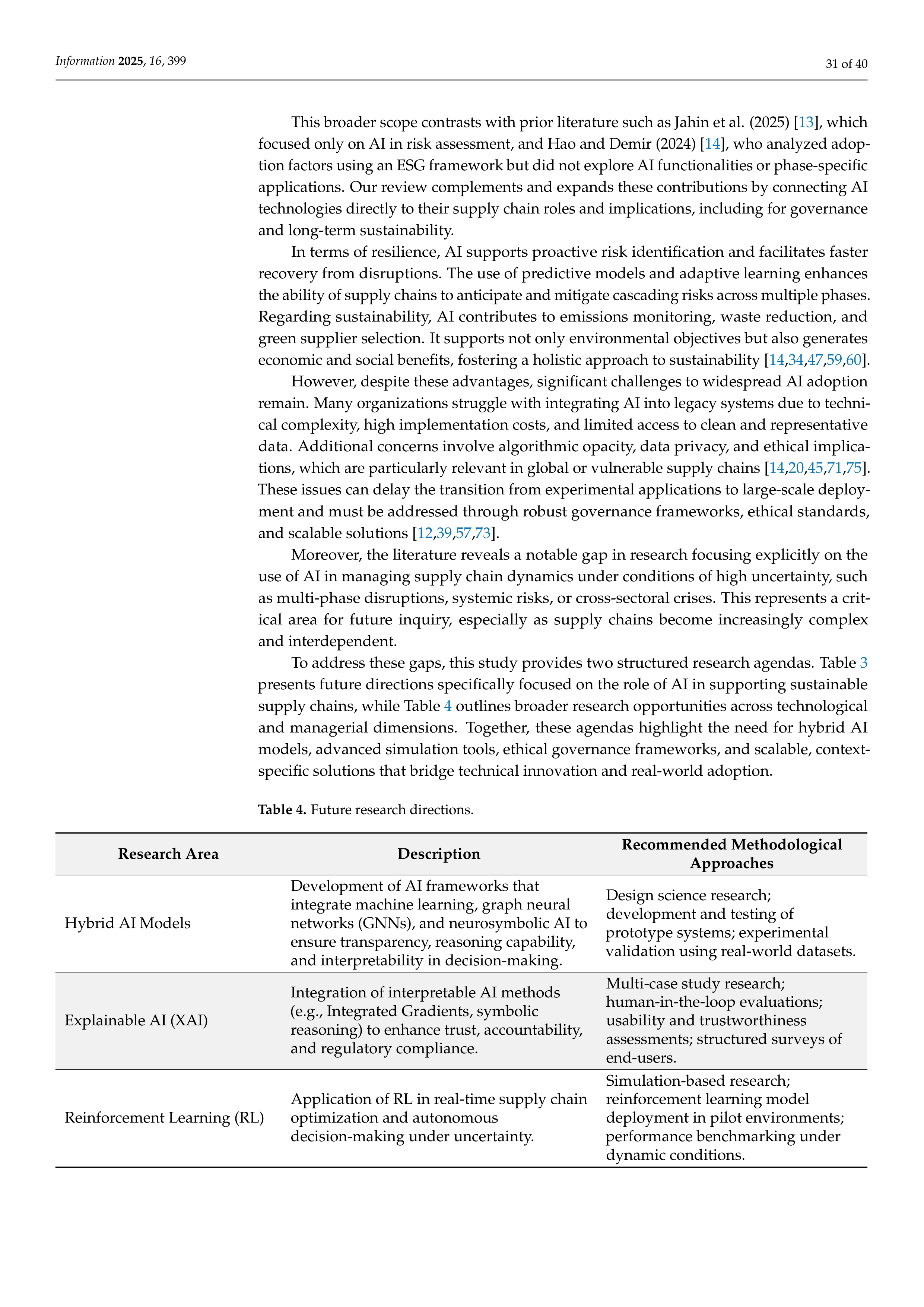
Information
2025
,
16
, 399
31 of 40
This broader scope contrasts with prior literature such as Jahin et al.
(2025) [
13
], which
focused only on AI in risk assessment, and Hao and Demir (2024) [
14
], who analyzed adop-
tion factors using an ESG framework but did not explore AI functionalities or phase-specific
applications.
Our review complements and expands these contributions by connecting AI
technologies directly to their supply chain roles and implications, including for governance
and long-term sustainability.
In terms of resilience, AI supports proactive risk identification and facilitates faster
recovery from disruptions.
The use of predictive models and adaptive learning enhances
the ability of supply chains to anticipate and mitigate cascading risks across multiple phases.
Regarding sustainability,
AI contributes to emissions monitoring,
waste reduction,
and
green supplier selection.
It supports not only environmental objectives but also generates
economic and social benefits, fostering a holistic approach to sustainability [
14
,
34
,
47
,
59
,
60
].
However, despite these advantages, significant challenges to widespread AI adoption
remain.
Many organizations struggle with integrating AI into legacy systems due to techni-
cal complexity, high implementation costs, and limited access to clean and representative
data.
Additional concerns involve algorithmic opacity, data privacy, and ethical implica-
tions, which are particularly relevant in global or vulnerable supply chains [
14
,
20
,
45
,
71
,
75
].
These issues can delay the transition from experimental applications to large-scale deploy-
ment and must be addressed through robust governance frameworks, ethical standards,
and scalable solutions [
12
,
39
,
57
,
73
].
Moreover, the literature reveals a notable gap in research focusing explicitly on the
use of AI in managing supply chain dynamics under conditions of high uncertainty, such
as multi-phase disruptions, systemic risks, or cross-sectoral crises.
This represents a crit-
ical
area
for
future
inquiry,
especially
as
supply
chains
become
increasingly
complex
and interdependent.
To address these gaps, this study provides two structured research agendas.
Table
3
presents future directions specifically focused on the role of AI in supporting sustainable
supply chains, while Table
4
outlines broader research opportunities across technological
and
managerial
dimensions.
Together,
these
agendas
highlight
the
need
for
hybrid
AI
models, advanced simulation tools, ethical governance frameworks, and scalable, context-
specific solutions that bridge technical innovation and real-world adoption.
Table 4.
Future research directions.
Research Area
Description
Recommended Methodological
Approaches
Hybrid AI Models
Development of AI frameworks that
integrate machine learning, graph neural
networks (GNNs), and neurosymbolic AI to
ensure transparency, reasoning capability,
and interpretability in decision-making.
Design science research;
development and testing of
prototype systems; experimental
validation using real-world datasets.
Explainable AI (XAI)
Integration of interpretable AI methods
(e.g., Integrated Gradients, symbolic
reasoning) to enhance trust, accountability,
and regulatory compliance.
Multi-case study research;
human-in-the-loop evaluations;
usability and trustworthiness
assessments; structured surveys of
end-users.
Reinforcement Learning (RL)
Application of RL in real-time supply chain
optimization and autonomous
decision-making under uncertainty.
Simulation-based research;
reinforcement learning model
deployment in pilot environments;
performance benchmarking under
dynamic conditions.
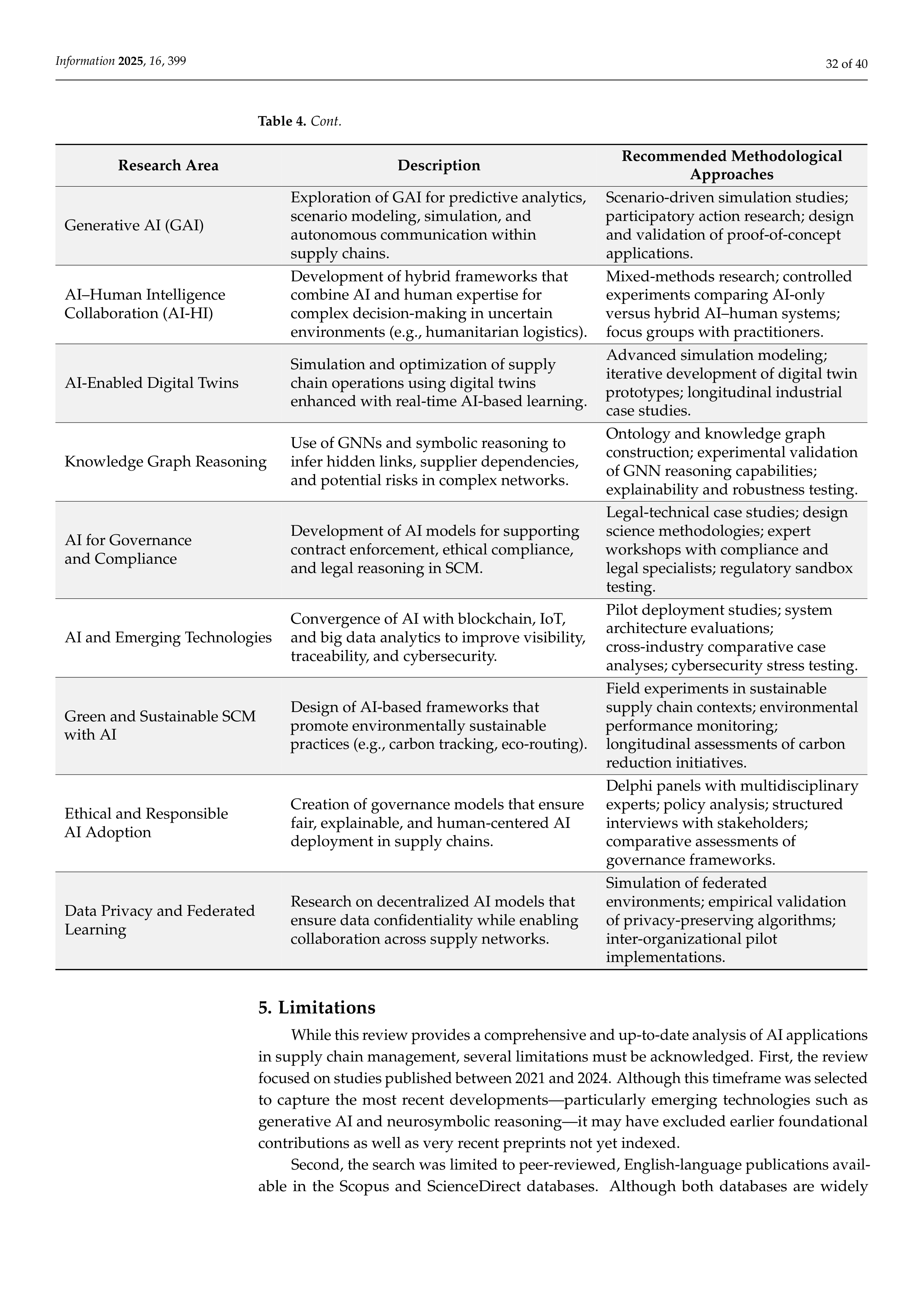
Information
2025
,
16
, 399
32 of 40
Table 4.
Cont.
Research Area
Description
Recommended Methodological
Approaches
Generative AI (GAI)
Exploration of GAI for predictive analytics,
scenario modeling, simulation, and
autonomous communication within
supply chains.
Scenario-driven simulation studies;
participatory action research; design
and validation of proof-of-concept
applications.
AI–Human Intelligence
Collaboration (AI-HI)
Development of hybrid frameworks that
combine AI and human expertise for
complex decision-making in uncertain
environments (e.g., humanitarian logistics).
Mixed-methods research; controlled
experiments comparing AI-only
versus hybrid AI–human systems;
focus groups with practitioners.
AI-Enabled Digital Twins
Simulation and optimization of supply
chain operations using digital twins
enhanced with real-time AI-based learning.
Advanced simulation modeling;
iterative development of digital twin
prototypes; longitudinal industrial
case studies.
Knowledge Graph Reasoning
Use of GNNs and symbolic reasoning to
infer hidden links, supplier dependencies,
and potential risks in complex networks.
Ontology and knowledge graph
construction; experimental validation
of GNN reasoning capabilities;
explainability and robustness testing.
AI for Governance
and Compliance
Development of AI models for supporting
contract enforcement, ethical compliance,
and legal reasoning in SCM.
Legal-technical case studies; design
science methodologies; expert
workshops with compliance and
legal specialists; regulatory sandbox
testing.
AI and Emerging Technologies
Convergence of AI with blockchain, IoT,
and big data analytics to improve visibility,
traceability, and cybersecurity.
Pilot deployment studies; system
architecture evaluations;
cross-industry comparative case
analyses; cybersecurity stress testing.
Green and Sustainable SCM
with AI
Design of AI-based frameworks that
promote environmentally sustainable
practices (e.g., carbon tracking, eco-routing).
Field experiments in sustainable
supply chain contexts; environmental
performance monitoring;
longitudinal assessments of carbon
reduction initiatives.
Ethical and Responsible
AI Adoption
Creation of governance models that ensure
fair, explainable, and human-centered AI
deployment in supply chains.
Delphi panels with multidisciplinary
experts; policy analysis; structured
interviews with stakeholders;
comparative assessments of
governance frameworks.
Data Privacy and Federated
Learning
Research on decentralized AI models that
ensure data confidentiality while enabling
collaboration across supply networks.
Simulation of federated
environments; empirical validation
of privacy-preserving algorithms;
inter-organizational pilot
implementations.
5.
Limitations
While this review provides a comprehensive and up-to-date analysis of AI applications
in supply chain management, several limitations must be acknowledged.
First, the review
focused on studies published between 2021 and 2024. Although this timeframe was selected
to
capture
the
most
recent
developments—particularly
emerging
technologies
such
as
generative AI and neurosymbolic reasoning—it may have excluded earlier foundational
contributions as well as very recent preprints not yet indexed.
Second, the search was limited to peer-reviewed, English-language publications avail-
able
in
the
Scopus
and
ScienceDirect
databases.
Although
both
databases
are
widely
Information
2025
,
16
, 399
33 of 40
recognized and cover a broad range of relevant literature, this scope may have excluded
regional studies, gray literature, or relevant publications indexed in alternative repositories
such as Web of Science, IEEE Xplore, or SpringerLink.
Third,
the
eligibility
criteria
emphasized
studies
that
explicitly
addressed
both
AI
and supply chain applications.
As a result, interdisciplinary research employing adjacent
terms—such as decision-support systems, intelligent automation, or digital transforma-
tion—may have been inadvertently excluded, even when highly relevant.
Fourth, the processes of content interpretation and thematic classification were con-
ducted manually, following a structured protocol using the StArt 2.3.4.2 tool and PRISMA
guidelines.
Despite
efforts
to
ensure
consistency
and
validation
through
repeated
re-
view cycles, subjective bias in the interpretation and categorization of studies cannot be
entirely eliminated.
Fifth, one methodological limitation concerns the application of the threshold score
(
≥
40)
used
during
the
article
selection
process
to
filter
studies
for
thematic
relevance.
While this quantitative filter ensured that only articles with a significant focus on artificial
intelligence
and
supply
chain
management
were
retained,
it
may
have
inadvertently
excluded recent publications or studies with novel perspectives that, despite their relevance,
did not yet accumulate sufficient keyword density or citation weight.
This introduces a
potential citation and keyword-based bias, which may affect the comprehensiveness of the
review.
Although a manual validation step was employed to confirm the relevance of the
included articles, the risk of overlooking valuable emerging research remains an inherent
constraint.
Future reviews may consider complementary qualitative screening strategies to
mitigate this limitation and ensure broader thematic inclusivity.
Finally,
although the review offers a thorough bibliometric and qualitative synthe-
sis, it does not include empirical validation of the AI tools or sector-specific evaluations
of
implementation
outcomes.
The
insights
provided
are
thus
based
on
published
find-
ings
rather
than
first-hand
experimentation
or
industrial
assessment.
Future
research
could expand this work through meta-analyses, longitudinal case studies, or real-world
implementation frameworks.
6.
Conclusions
This review contributes to both academic understanding and practical discourse by
offering a structured and forward-looking overview of AI applications in supply chain
management
(SCM).
The
findings
confirm
that
AI
is
not
merely
enhancing
individual
supply
chain
functions
but
is
catalyzing
a
systemic
transformation
toward
intelligent,
adaptive,
and
sustainable
supply
networks.
Nevertheless,
the
realization
of
AI’s
full
potential depends on overcoming implementation challenges and aligning technological
progress with ethical, regulatory, and organizational frameworks.
In terms of theoretical contributions, this study advances the field in several signif-
icant ways.
First, unlike prior literature reviews [
10
,
11
], which often addressed specific
AI
techniques
or
narrowly
focused
on
isolated
SCM
functions,
this
review
employs
a
multidimensional thematic framework that systematically integrates resilience, process
optimization,
sustainability,
and
adoption
challenges.
Second,
it
delivers
an
updated
bibliometric synthesis spanning 2021–2024, capturing the fast-evolving landscape of AI
applications post-pandemic and bridging temporal gaps left by earlier reviews.
Third, by
explicitly aligning bibliometric clusters with thematic axes, it introduces a novel analyti-
cal approach that strengthens the link between the structural and substantive evolution
of
the
literature.
Furthermore,
the
identification
and
incorporation
of
underexplored
areas—most notably AI’s role in managing dynamic and disrupted supply chains—expand
the theoretical and practical scope of AI in SCM research.
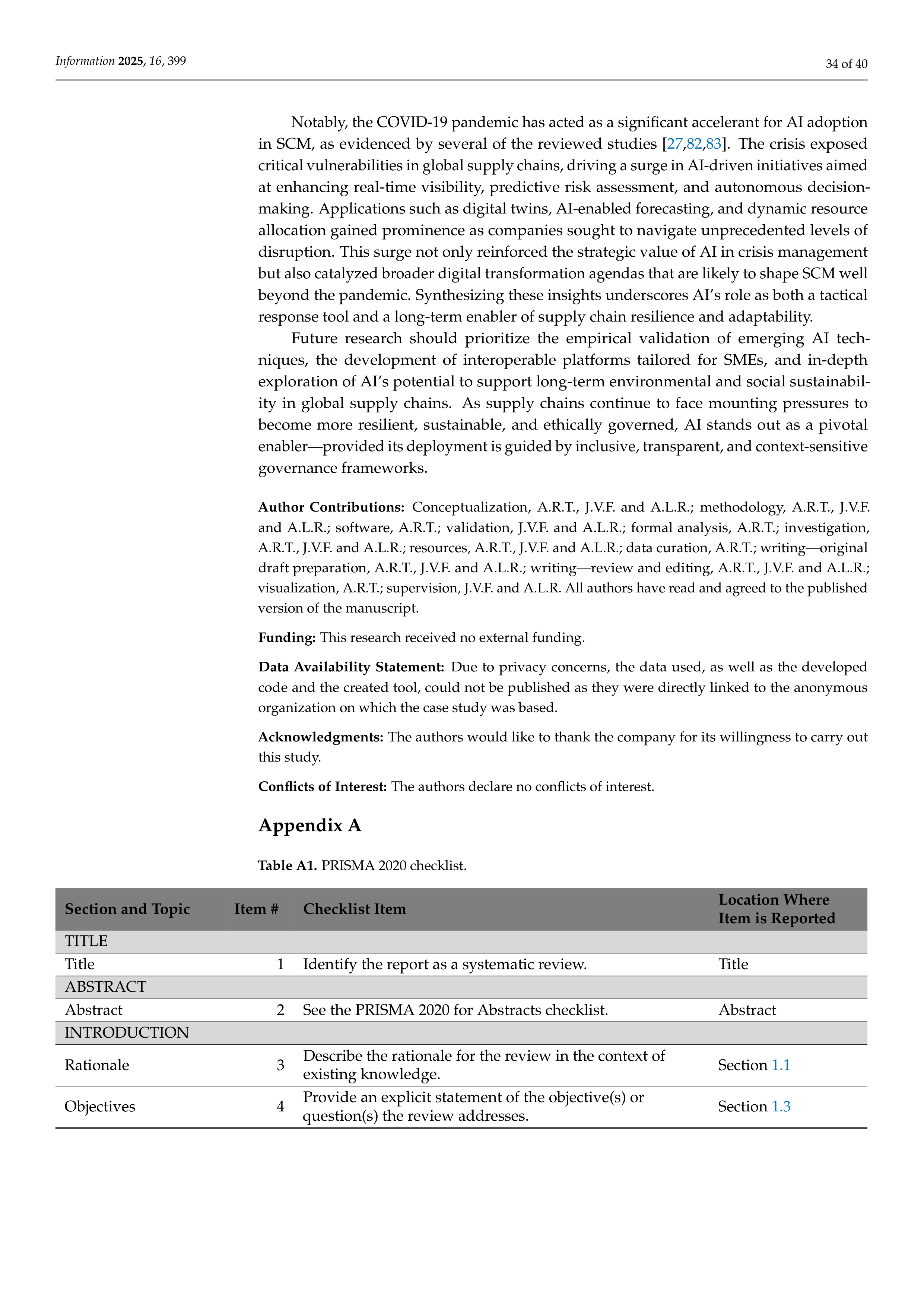
Information
2025
,
16
, 399
34 of 40
Notably, the COVID-19 pandemic has acted as a significant accelerant for AI adoption
in
SCM,
as
evidenced
by
several
of
the
reviewed
studies
[
27
,
82
,
83
].
The
crisis
exposed
critical vulnerabilities in global supply chains, driving a surge in AI-driven initiatives aimed
at
enhancing
real-time
visibility,
predictive
risk
assessment,
and
autonomous
decision-
making.
Applications such as digital twins, AI-enabled forecasting, and dynamic resource
allocation gained prominence as companies sought to navigate unprecedented levels of
disruption.
This surge not only reinforced the strategic value of AI in crisis management
but also catalyzed broader digital transformation agendas that are likely to shape SCM well
beyond the pandemic.
Synthesizing these insights underscores AI’s role as both a tactical
response tool and a long-term enabler of supply chain resilience and adaptability.
Future
research
should
prioritize
the
empirical
validation
of
emerging
AI
tech-
niques,
the
development
of
interoperable
platforms
tailored
for
SMEs,
and
in-depth
exploration of AI’s potential to support long-term environmental and social sustainabil-
ity
in
global
supply
chains.
As
supply
chains
continue
to
face
mounting
pressures
to
become
more
resilient,
sustainable,
and
ethically
governed,
AI
stands
out
as
a
pivotal
enabler—provided its deployment is guided by inclusive, transparent, and context-sensitive
governance frameworks.
Author
Contributions:
Conceptualization,
A.R.T.,
J.V.F.
and
A.L.R.;
methodology,
A.R.T.,
J.V.F.
and
A.L.R.;
software,
A.R.T.;
validation,
J.V.F.
and
A.L.R.;
formal
analysis,
A.R.T.;
investigation,
A.R.T., J.V.F. and A.L.R.; resources, A.R.T., J.V.F. and A.L.R.; data curation, A.R.T.; writing—original
draft preparation, A.R.T., J.V.F. and A.L.R.; writing—review and editing, A.R.T., J.V.F. and A.L.R.;
visualization, A.R.T.; supervision, J.V.F. and A.L.R. All authors have read and agreed to the published
version of the manuscript.
Funding:
This research received no external funding.
Data
Availability
Statement:
Due
to
privacy
concerns,
the
data
used,
as
well
as
the
developed
code and the created tool, could not be published as they were directly linked to the anonymous
organization on which the case study was based.
Acknowledgments:
The authors would like to thank the company for its willingness to carry out
this study.
Conflicts of Interest:
The authors declare no conflicts of interest.
Appendix A
Table A1.
PRISMA 2020 checklist.
Section and Topic
Item #
Checklist Item
Location Where
Item is Reported
TITLE
Title
1
Identify the report as a systematic review.
Title
ABSTRACT
Abstract
2
See the PRISMA 2020 for Abstracts checklist.
Abstract
INTRODUCTION
Rationale
3
Describe the rationale for the review in the context of
existing knowledge.
Section
1.1
Objectives
4
Provide an explicit statement of the objective(s) or
question(s) the review addresses.
Section
1.3
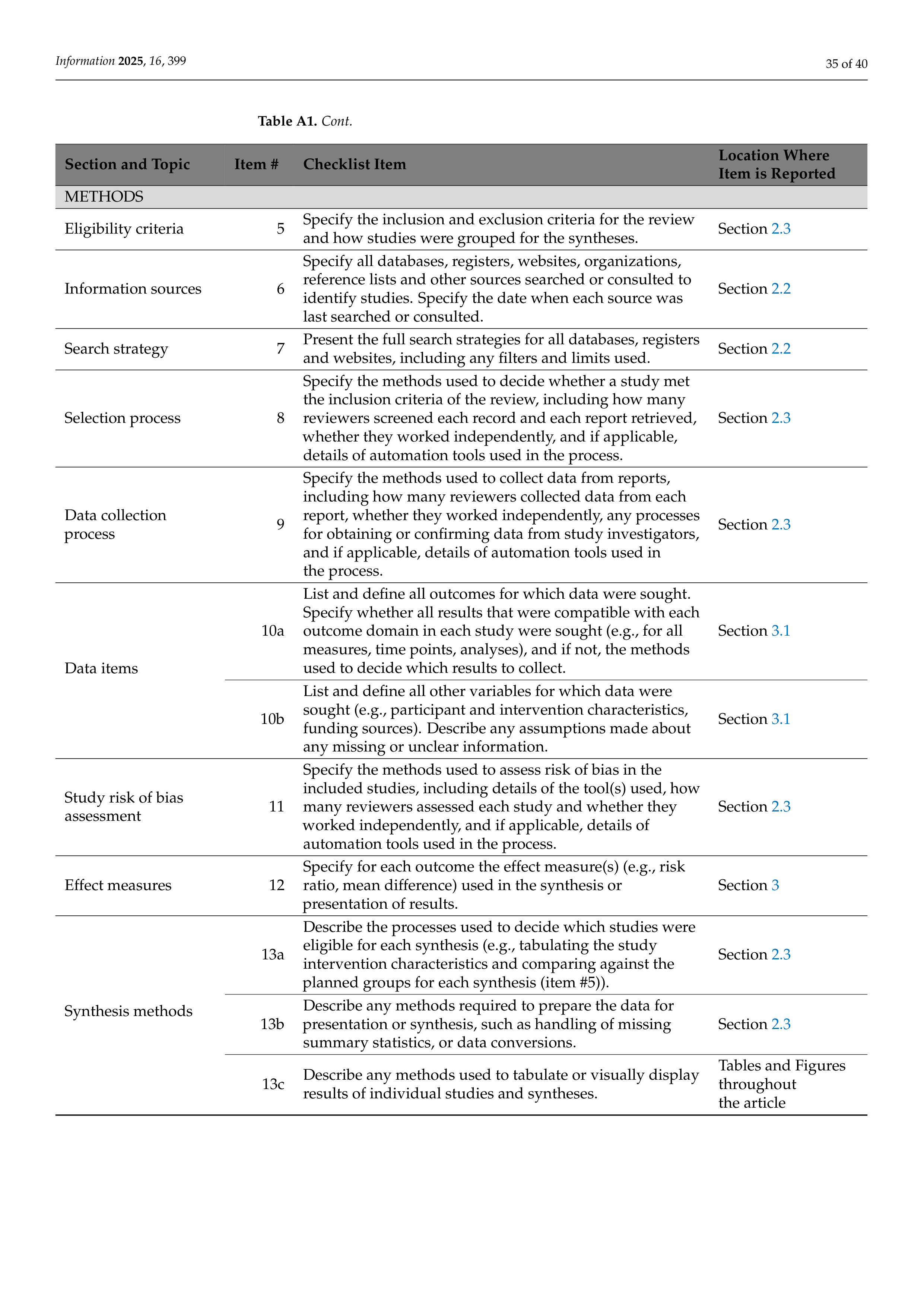
Information
2025
,
16
, 399
35 of 40
Table A1.
Cont.
Section and Topic
Item #
Checklist Item
Location Where
Item is Reported
METHODS
Eligibility criteria
5
Specify the inclusion and exclusion criteria for the review
and how studies were grouped for the syntheses.
Section
2.3
Information sources
6
Specify all databases, registers, websites, organizations,
reference lists and other sources searched or consulted to
identify studies.
Specify the date when each source was
last searched or consulted.
Section
2.2
Search strategy
7
Present the full search strategies for all databases, registers
and websites, including any filters and limits used.
Section
2.2
Selection process
8
Specify the methods used to decide whether a study met
the inclusion criteria of the review, including how many
reviewers screened each record and each report retrieved,
whether they worked independently, and if applicable,
details of automation tools used in the process.
Section
2.3
Data collection
process
9
Specify the methods used to collect data from reports,
including how many reviewers collected data from each
report, whether they worked independently, any processes
for obtaining or confirming data from study investigators,
and if applicable, details of automation tools used in
the process.
Section
2.3
Data items
10a
List and define all outcomes for which data were sought.
Specify whether all results that were compatible with each
outcome domain in each study were sought (e.g., for all
measures, time points, analyses), and if not, the methods
used to decide which results to collect.
Section
3.1
10b
List and define all other variables for which data were
sought (e.g., participant and intervention characteristics,
funding sources).
Describe any assumptions made about
any missing or unclear information.
Section
3.1
Study risk of bias
assessment
11
Specify the methods used to assess risk of bias in the
included studies, including details of the tool(s) used, how
many reviewers assessed each study and whether they
worked independently, and if applicable, details of
automation tools used in the process.
Section
2.3
Effect measures
12
Specify for each outcome the effect measure(s) (e.g., risk
ratio, mean difference) used in the synthesis or
presentation of results.
Section
3
Synthesis methods
13a
Describe the processes used to decide which studies were
eligible for each synthesis (e.g., tabulating the study
intervention characteristics and comparing against the
planned groups for each synthesis (item #5)).
Section
2.3
13b
Describe any methods required to prepare the data for
presentation or synthesis, such as handling of missing
summary statistics, or data conversions.
Section
2.3
13c
Describe any methods used to tabulate or visually display
results of individual studies and syntheses.
Tables and Figures
throughout
the article
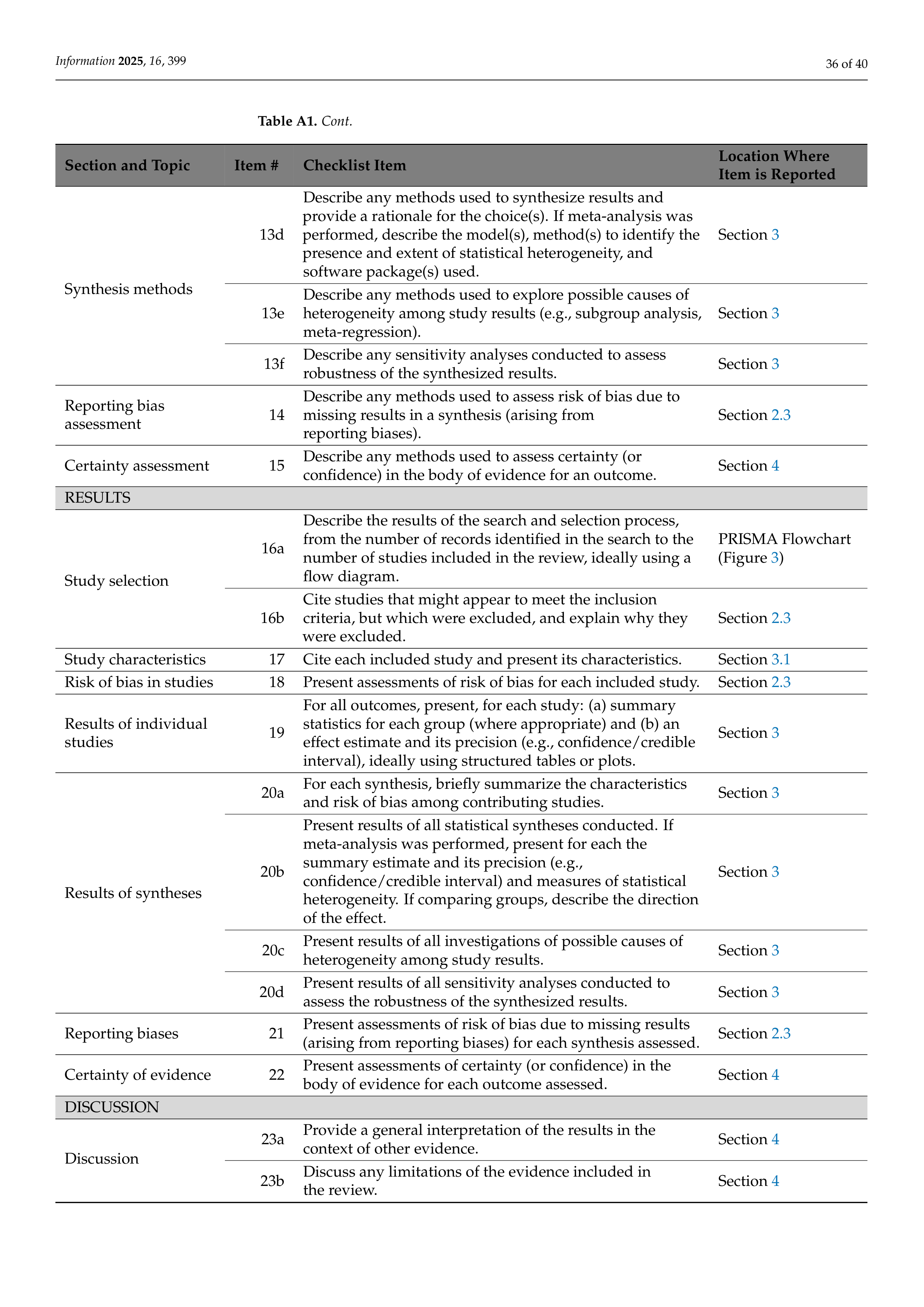
Information
2025
,
16
, 399
36 of 40
Table A1.
Cont.
Section and Topic
Item #
Checklist Item
Location Where
Item is Reported
Synthesis methods
13d
Describe any methods used to synthesize results and
provide a rationale for the choice(s).
If meta-analysis was
performed, describe the model(s), method(s) to identify the
presence and extent of statistical heterogeneity, and
software package(s) used.
Section
3
13e
Describe any methods used to explore possible causes of
heterogeneity among study results (e.g., subgroup analysis,
meta-regression).
Section
3
13f
Describe any sensitivity analyses conducted to assess
robustness of the synthesized results.
Section
3
Reporting bias
assessment
14
Describe any methods used to assess risk of bias due to
missing results in a synthesis (arising from
reporting biases).
Section
2.3
Certainty assessment
15
Describe any methods used to assess certainty (or
confidence) in the body of evidence for an outcome.
Section
4
RESULTS
Study selection
16a
Describe the results of the search and selection process,
from the number of records identified in the search to the
number of studies included in the review, ideally using a
flow diagram.
PRISMA Flowchart
(Figure
3
)
16b
Cite studies that might appear to meet the inclusion
criteria, but which were excluded, and explain why they
were excluded.
Section
2.3
Study characteristics
17
Cite each included study and present its characteristics.
Section
3.1
Risk of bias in studies
18
Present assessments of risk of bias for each included study.
Section
2.3
Results of individual
studies
19
For all outcomes, present, for each study:
(a) summary
statistics for each group (where appropriate) and (b) an
effect estimate and its precision (e.g., confidence/credible
interval), ideally using structured tables or plots.
Section
3
Results of syntheses
20a
For each synthesis, briefly summarize the characteristics
and risk of bias among contributing studies.
Section
3
20b
Present results of all statistical syntheses conducted.
If
meta-analysis was performed, present for each the
summary estimate and its precision (e.g.,
confidence/credible interval) and measures of statistical
heterogeneity.
If comparing groups, describe the direction
of the effect.
Section
3
20c
Present results of all investigations of possible causes of
heterogeneity among study results.
Section
3
20d
Present results of all sensitivity analyses conducted to
assess the robustness of the synthesized results.
Section
3
Reporting biases
21
Present assessments of risk of bias due to missing results
(arising from reporting biases) for each synthesis assessed.
Section
2.3
Certainty of evidence
22
Present assessments of certainty (or confidence) in the
body of evidence for each outcome assessed.
Section
4
DISCUSSION
Discussion
23a
Provide a general interpretation of the results in the
context of other evidence.
Section
4
23b
Discuss any limitations of the evidence included in
the review.
Section
4
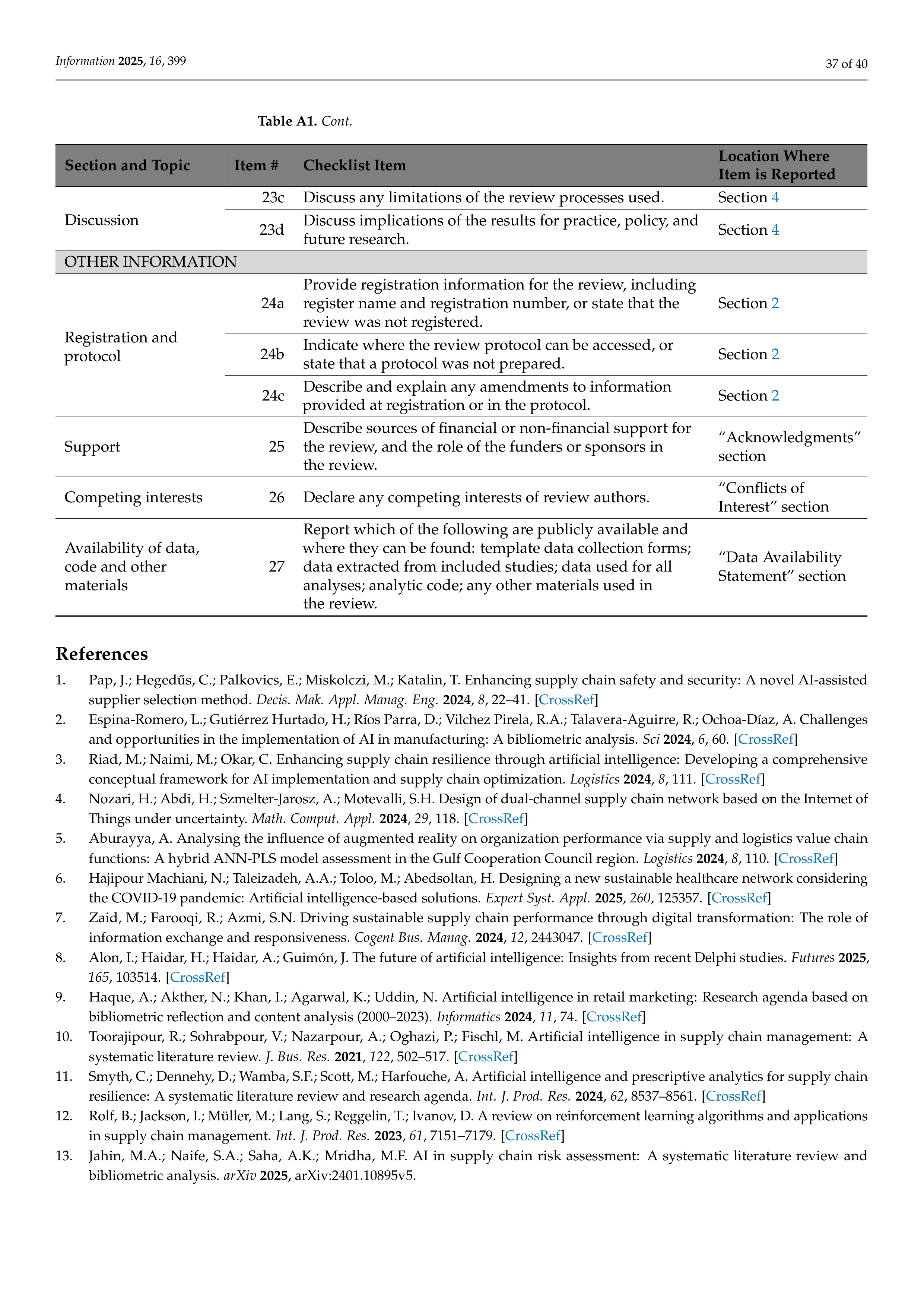
Information
2025
,
16
, 399
37 of 40
Table A1.
Cont.
Section and Topic
Item #
Checklist Item
Location Where
Item is Reported
Discussion
23c
Discuss any limitations of the review processes used.
Section
4
23d
Discuss implications of the results for practice, policy, and
future research.
Section
4
OTHER INFORMATION
Registration and
protocol
24a
Provide registration information for the review, including
register name and registration number, or state that the
review was not registered.
Section
2
24b
Indicate where the review protocol can be accessed, or
state that a protocol was not prepared.
Section
2
24c
Describe and explain any amendments to information
provided at registration or in the protocol.
Section
2
Support
25
Describe sources of financial or non-financial support for
the review, and the role of the funders or sponsors in
the review.
“Acknowledgments”
section
Competing interests
26
Declare any competing interests of review authors.
“Conflicts of
Interest” section
Availability of data,
code and other
materials
27
Report which of the following are publicly available and
where they can be found:
template data collection forms;
data extracted from included studies; data used for all
analyses; analytic code; any other materials used in
the review.
“Data Availability
Statement” section
References
1.
Pap, J.; Heged˝us, C.; Palkovics, E.; Miskolczi, M.; Katalin, T. Enhancing supply chain safety and security:
A novel AI-assisted
supplier selection method.
Decis.
Mak.
Appl.
Manag.
Eng.
2024
,
8
, 22–41.
[
CrossRef
]
2.
Espina-Romero, L.; Gutiérrez Hurtado, H.; Ríos Parra, D.; Vilchez Pirela, R.A.; Talavera-Aguirre, R.; Ochoa-Díaz, A. Challenges
and opportunities in the implementation of AI in manufacturing:
A bibliometric analysis.
Sci
2024
,
6
, 60.
[
CrossRef
]
3.
Riad, M.; Naimi, M.; Okar, C. Enhancing supply chain resilience through artificial intelligence:
Developing a comprehensive
conceptual framework for AI implementation and supply chain optimization.
Logistics
2024
,
8
, 111.
[
CrossRef
]
4.
Nozari, H.; Abdi, H.; Szmelter-Jarosz, A.; Motevalli, S.H. Design of dual-channel supply chain network based on the Internet of
Things under uncertainty.
Math.
Comput.
Appl.
2024
,
29
, 118.
[
CrossRef
]
5.
Aburayya, A. Analysing the influence of augmented reality on organization performance via supply and logistics value chain
functions:
A hybrid ANN-PLS model assessment in the Gulf Cooperation Council region.
Logistics
2024
,
8
, 110.
[
CrossRef
]
6.
Hajipour Machiani, N.; Taleizadeh, A.A.; Toloo, M.; Abedsoltan, H. Designing a new sustainable healthcare network considering
the COVID-19 pandemic:
Artificial intelligence-based solutions.
Expert Syst.
Appl.
2025
,
260
, 125357.
[
CrossRef
]
7.
Zaid, M.;
Farooqi, R.;
Azmi, S.N. Driving sustainable supply chain performance through digital transformation:
The role of
information exchange and responsiveness.
Cogent Bus.
Manag.
2024
,
12
, 2443047.
[
CrossRef
]
8.
Alon, I.; Haidar, H.; Haidar, A.; Guimón, J. The future of artificial intelligence:
Insights from recent Delphi studies.
Futures
2025
,
165
, 103514.
[
CrossRef
]
9.
Haque, A.; Akther, N.; Khan, I.; Agarwal, K.; Uddin, N. Artificial intelligence in retail marketing:
Research agenda based on
bibliometric reflection and content analysis (2000–2023).
Informatics
2024
,
11
, 74.
[
CrossRef
]
10.
Toorajipour,
R.;
Sohrabpour,
V.;
Nazarpour,
A.;
Oghazi,
P.;
Fischl,
M. Artificial intelligence in supply chain management:
A
systematic literature review.
J. Bus.
Res.
2021
,
122
, 502–517.
[
CrossRef
]
11.
Smyth, C.; Dennehy, D.; Wamba, S.F.; Scott, M.; Harfouche, A. Artificial intelligence and prescriptive analytics for supply chain
resilience:
A systematic literature review and research agenda.
Int.
J. Prod.
Res.
2024
,
62
, 8537–8561.
[
CrossRef
]
12.
Rolf, B.; Jackson, I.; Müller, M.; Lang, S.; Reggelin, T.; Ivanov, D. A review on reinforcement learning algorithms and applications
in supply chain management.
Int.
J. Prod.
Res.
2023
,
61
, 7151–7179.
[
CrossRef
]
13.
Jahin,
M.A.;
Naife,
S.A.;
Saha,
A.K.;
Mridha,
M.F.
AI
in
supply
chain
risk
assessment:
A
systematic
literature
review
and
bibliometric analysis.
arXiv
2025
, arXiv:2401.10895v5.
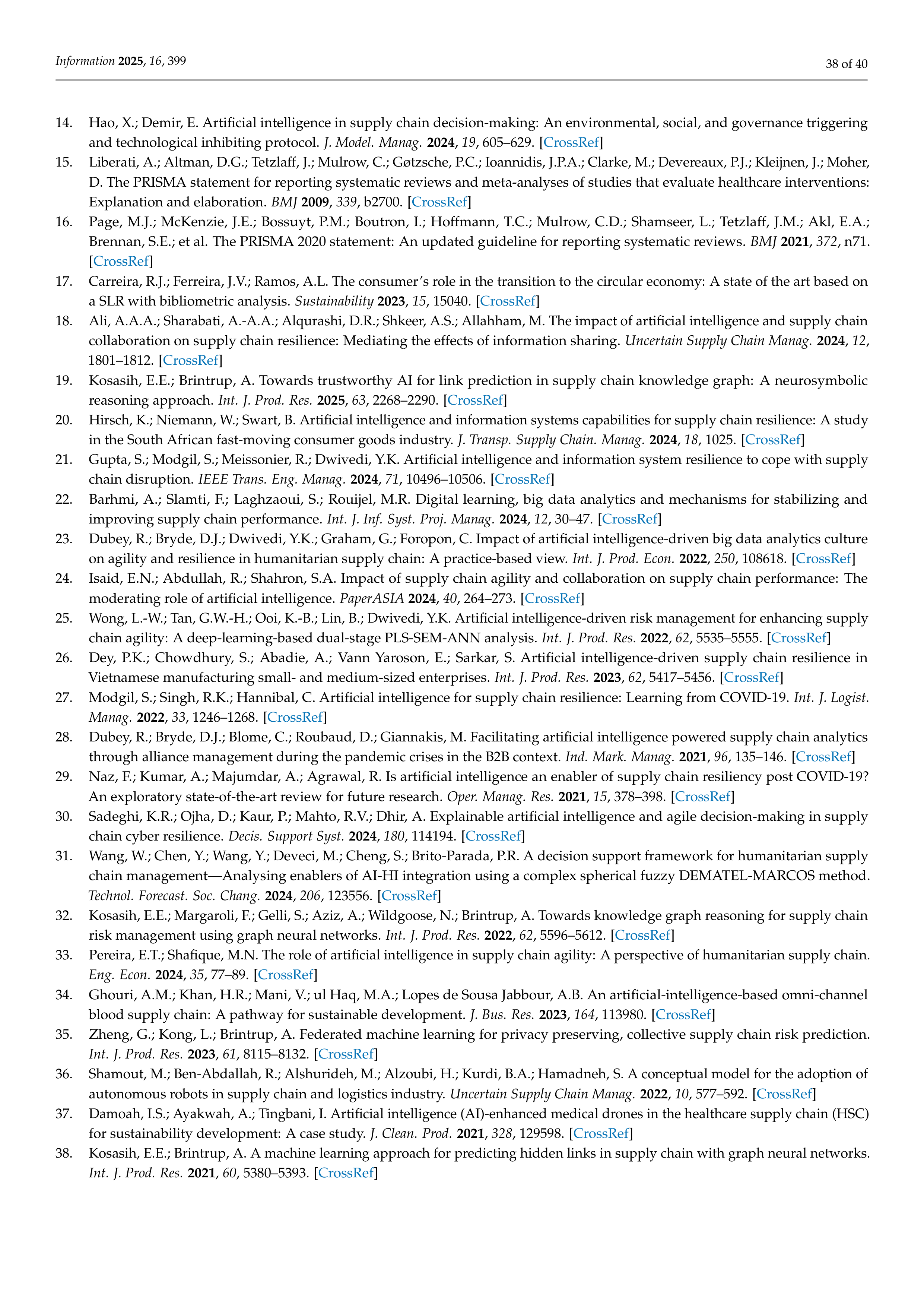
Information
2025
,
16
, 399
38 of 40
14.
Hao, X.; Demir, E. Artificial intelligence in supply chain decision-making:
An environmental, social, and governance triggering
and technological inhibiting protocol.
J. Model.
Manag.
2024
,
19
, 605–629.
[
CrossRef
]
15.
Liberati, A.; Altman, D.G.; Tetzlaff, J.; Mulrow, C.; Gøtzsche, P.C.; Ioannidis, J.P.A.; Clarke, M.; Devereaux, P.J.; Kleijnen, J.; Moher,
D. The PRISMA statement for reporting systematic reviews and meta-analyses of studies that evaluate healthcare interventions:
Explanation and elaboration.
BMJ
2009
,
339
, b2700.
[
CrossRef
]
16.
Page,
M.J.;
McKenzie,
J.E.;
Bossuyt,
P.M.;
Boutron,
I.;
Hoffmann,
T.C.;
Mulrow,
C.D.;
Shamseer,
L.;
Tetzlaff,
J.M.;
Akl,
E.A.;
Brennan, S.E.; et al.
The PRISMA 2020 statement:
An updated guideline for reporting systematic reviews.
BMJ
2021
,
372
, n71.
[
CrossRef
]
17.
Carreira, R.J.; Ferreira, J.V.; Ramos, A.L. The consumer’s role in the transition to the circular economy:
A state of the art based on
a SLR with bibliometric analysis.
Sustainability
2023
,
15
, 15040.
[
CrossRef
]
18.
Ali, A.A.A.; Sharabati, A.-A.A.; Alqurashi, D.R.; Shkeer, A.S.; Allahham, M. The impact of artificial intelligence and supply chain
collaboration on supply chain resilience:
Mediating the effects of information sharing.
Uncertain Supply Chain Manag.
2024
,
12
,
1801–1812.
[
CrossRef
]
19.
Kosasih,
E.E.;
Brintrup,
A. Towards trustworthy AI for link prediction in supply chain knowledge graph:
A neurosymbolic
reasoning approach.
Int.
J. Prod.
Res.
2025
,
63
, 2268–2290.
[
CrossRef
]
20.
Hirsch, K.; Niemann, W.; Swart, B. Artificial intelligence and information systems capabilities for supply chain resilience:
A study
in the South African fast-moving consumer goods industry.
J. Transp.
Supply Chain.
Manag.
2024
,
18
, 1025.
[
CrossRef
]
21.
Gupta, S.; Modgil, S.; Meissonier, R.; Dwivedi, Y.K. Artificial intelligence and information system resilience to cope with supply
chain disruption.
IEEE Trans.
Eng.
Manag.
2024
,
71
, 10496–10506.
[
CrossRef
]
22.
Barhmi,
A.;
Slamti,
F.;
Laghzaoui,
S.;
Rouijel,
M.R.
Digital
learning,
big
data
analytics
and
mechanisms
for
stabilizing
and
improving supply chain performance.
Int.
J. Inf.
Syst.
Proj.
Manag.
2024
,
12
, 30–47.
[
CrossRef
]
23.
Dubey, R.; Bryde, D.J.; Dwivedi, Y.K.; Graham, G.; Foropon, C. Impact of artificial intelligence-driven big data analytics culture
on agility and resilience in humanitarian supply chain:
A practice-based view.
Int.
J. Prod.
Econ.
2022
,
250
, 108618.
[
CrossRef
]
24.
Isaid, E.N.;
Abdullah, R.;
Shahron, S.A. Impact of supply chain agility and collaboration on supply chain performance:
The
moderating role of artificial intelligence.
PaperASIA
2024
,
40
, 264–273.
[
CrossRef
]
25.
Wong, L.-W.; Tan, G.W.-H.; Ooi, K.-B.; Lin, B.; Dwivedi, Y.K. Artificial intelligence-driven risk management for enhancing supply
chain agility:
A deep-learning-based dual-stage PLS-SEM-ANN analysis.
Int.
J. Prod.
Res.
2022
,
62
, 5535–5555.
[
CrossRef
]
26.
Dey,
P.K.;
Chowdhury,
S.;
Abadie,
A.;
Vann
Yaroson,
E.;
Sarkar,
S.
Artificial
intelligence-driven
supply
chain
resilience
in
Vietnamese manufacturing small- and medium-sized enterprises.
Int.
J. Prod.
Res.
2023
,
62
, 5417–5456.
[
CrossRef
]
27.
Modgil, S.; Singh, R.K.; Hannibal, C. Artificial intelligence for supply chain resilience:
Learning from COVID-19.
Int.
J. Logist.
Manag.
2022
,
33
, 1246–1268.
[
CrossRef
]
28.
Dubey, R.; Bryde, D.J.; Blome, C.; Roubaud, D.; Giannakis, M. Facilitating artificial intelligence powered supply chain analytics
through alliance management during the pandemic crises in the B2B context.
Ind.
Mark.
Manag.
2021
,
96
, 135–146.
[
CrossRef
]
29.
Naz, F.; Kumar, A.; Majumdar, A.; Agrawal, R. Is artificial intelligence an enabler of supply chain resiliency post COVID-19?
An exploratory state-of-the-art review for future research.
Oper.
Manag.
Res.
2021
,
15
, 378–398.
[
CrossRef
]
30.
Sadeghi, K.R.; Ojha, D.; Kaur, P.; Mahto, R.V.; Dhir, A. Explainable artificial intelligence and agile decision-making in supply
chain cyber resilience.
Decis.
Support Syst.
2024
,
180
, 114194.
[
CrossRef
]
31.
Wang, W.; Chen, Y.; Wang, Y.; Deveci, M.; Cheng, S.; Brito-Parada, P.R. A decision support framework for humanitarian supply
chain management—Analysing enablers of AI-HI integration using a complex spherical fuzzy DEMATEL-MARCOS method.
Technol.
Forecast.
Soc.
Chang.
2024
,
206
, 123556.
[
CrossRef
]
32.
Kosasih, E.E.; Margaroli, F.; Gelli, S.; Aziz, A.; Wildgoose, N.; Brintrup, A. Towards knowledge graph reasoning for supply chain
risk management using graph neural networks.
Int.
J. Prod.
Res.
2022
,
62
, 5596–5612.
[
CrossRef
]
33.
Pereira, E.T.; Shafique, M.N. The role of artificial intelligence in supply chain agility:
A perspective of humanitarian supply chain.
Eng.
Econ.
2024
,
35
, 77–89.
[
CrossRef
]
34.
Ghouri, A.M.; Khan, H.R.; Mani, V.; ul Haq, M.A.; Lopes de Sousa Jabbour, A.B. An artificial-intelligence-based omni-channel
blood supply chain:
A pathway for sustainable development.
J. Bus.
Res.
2023
,
164
, 113980.
[
CrossRef
]
35.
Zheng, G.; Kong, L.; Brintrup, A. Federated machine learning for privacy preserving, collective supply chain risk prediction.
Int.
J. Prod.
Res.
2023
,
61
, 8115–8132.
[
CrossRef
]
36.
Shamout, M.; Ben-Abdallah, R.; Alshurideh, M.; Alzoubi, H.; Kurdi, B.A.; Hamadneh, S. A conceptual model for the adoption of
autonomous robots in supply chain and logistics industry.
Uncertain Supply Chain Manag.
2022
,
10
, 577–592.
[
CrossRef
]
37.
Damoah, I.S.; Ayakwah, A.; Tingbani, I. Artificial intelligence (AI)-enhanced medical drones in the healthcare supply chain (HSC)
for sustainability development:
A case study.
J. Clean.
Prod.
2021
,
328
, 129598.
[
CrossRef
]
38.
Kosasih, E.E.; Brintrup, A. A machine learning approach for predicting hidden links in supply chain with graph neural networks.
Int.
J. Prod.
Res.
2021
,
60
, 5380–5393.
[
CrossRef
]
Information
2025
,
16
, 399
39 of 40
39.
Allahham, M.; Sharabati, A.-A.A.; Al-Sager, M.; Sabra, S.; Awartani, L.; Khraim, A.S.L. Supply chain risks in the age of big data
and artificial intelligence:
The role of risk alert tools and managerial apprehensions.
Uncertain Supply Chain.
Manag.
2024
,
12
,
399–406.
[
CrossRef
]
40.
Brintrup, A.; Kosasih, E.; Schaffer, P.; Zheng, G.; Demirel, G.; MacCarthy, B.L. Digital supply chain surveillance using artificial
intelligence:
Definitions, opportunities and risks.
Int.
J. Prod.
Res.
2023
,
62
, 4674–4695.
[
CrossRef
]
41.
Jackson, I.; Namdar, J.; Saénz, M.J.; Elmquist, R.A., III; Dávila Novoa, L.R. Revolutionize cold chain:
An AI/ML driven approach
to overcome capacity shortages.
Int.
J. Prod.
Res.
2025
,
63
, 2190–2212.
[
CrossRef
]
42.
Nguyen, T.T.H. Applications of artificial intelligence for demand forecasting.
Oper.
Supply Chain.
Manag.
Int.
J.
2023
,
16
, 424–434.
[
CrossRef
]
43.
Jackson, I.; Ivanov, D.; Dolgui, A.; Namdar, J. Generative artificial intelligence in supply chain and operations management:
A
capability-based framework for analysis and implementation.
Int.
J. Prod.
Res.
2024
,
62
, 6120–6145.
[
CrossRef
]
44.
Lin, H.; Lin, J.; Wang, F. An innovative machine learning model for supply chain management.
J. Innov.
Knowl.
2022
,
7
, 100276.
[
CrossRef
]
45.
Cannas, V.G.; Ciano, M.P.; Saltalamacchia, M.; Secchi, R. Artificial intelligence in supply chain and operations management:
A
multiple case study research.
Int.
J. Prod.
Res.
2023
,
62
, 3333–3360.
[
CrossRef
]
46.
Abdelhamid, M.M.; Sliman, L.; Ben Djemaa, R. AI-enhanced blockchain for scalable IoT-based supply chain.
Logistics
2024
,
8
, 109.
[
CrossRef
]
47.
Dalal,
S.;
Lilhore,
U.K.;
Simaiya,
S.;
Radulescu,
M.;
Belascu,
L.
Improving
efficiency
and
sustainability
via
supply
chain
optimization through CNNs and BiLSTM.
Technol.
Forecast.
Soc.
Chang.
2024
,
209
, 123841.
[
CrossRef
]
48.
Hejazi, M.; Alrusaini, O.; Beyari, H. The effect of artificial intelligence and payment flexibility on operational performance:
The
enabling role of supply chain risk management.
Uncertain Supply Chain Manag.
2022
,
10
, 1117–1130.
[
CrossRef
]
49.
Xu, L.; Mak, S.; Brintrup, A. Will bots take over the supply chain?
Revisiting agent-based supply chain automation.
Int.
J. Prod.
Econ.
2021
,
241
, 108279.
[
CrossRef
]
50.
Alnadi, M.; Altahat, S. Artificial intelligence applications for enhancing organizational excellence:
Modifying role of supply chain
agility.
Probl.
Perspect.
Manag.
2024
,
22
, 339–351.
[
CrossRef
]
51.
Sharabati,
A.-A.A.;
Awawdeh,
H.Z.;
Sabra,
S.;
Shehadeh,
H.K.;
Allahham,
M.;
Ali,
A.
The
role
of
artificial
intelligence
on
digital supply chain in industrial companies:
Mediating effect of operational efficiency.
Uncertain Supply Chain Manag.
2024
,
12
,
1867–1878.
[
CrossRef
]
52.
Frederico, G.F. ChatGPT in supply chains:
Initial evidence of applications and potential research agenda.
Logistics
2023
,
7
, 26.
[
CrossRef
]
53.
Helo, P.; Hao, Y. Artificial intelligence in operations management and supply chain management:
An exploratory case study.
Prod.
Plan.
Control
2021
,
33
, 1573–1590.
[
CrossRef
]
54.
Olan, F.; Arakpogun, E.O.; Jayawickrama, U.; Suklan, J.; Liu, S. Sustainable supply chain finance and supply networks:
The role
of artificial intelligence.
IEEE Trans.
Eng.
Manag.
2024
,
71
, 13296–13311.
[
CrossRef
]
55.
Zhao, G.; Shi, H.B.; Wang, J.F. The influence of artificial intelligence technology judicial decision reasoning on contract performance
in manufacturing supply chain:
A simulation analysis using evolutionary game approach.
Adv.
Prod.
Eng.
Manag.
2022
,
17
,
108–120.
[
CrossRef
]
56.
Salhab, H.A.; Allahham, M.; Abu-AlSondos, I.A.; Frangieh, R.H.; Alkhwaldi, A.F.; Ali, B.J.A. Inventory competition, artificial
intelligence, and quality improvement decisions in supply chains with digital marketing.
Uncertain Supply Chain Manag.
2023
,
11
,
1915–1924.
[
CrossRef
]
57.
Olan,
F.;
Spanaki,
K.;
Ahmed,
W.;
Zhao,
G.
Enabling
explainable
artificial
intelligence
capabilities
in
supply
chain
decision
support making.
Prod.
Plan.
Control
2025
,
36
, 808–819.
[
CrossRef
]
58.
Bhattacharya, S.; Govindan, K.; Ghosh Dastidar, S.; Sharma, P. Applications of artificial intelligence in closed-loop supply chains:
Systematic literature review and future research agenda.
Transp.
Res.
Part E Logist.
Transp.
Rev.
2024
,
184
, 103455.
[
CrossRef
]
59.
Virmani, N.; Singh, R.K.; Agarwal, V.; Aktas, E. Artificial intelligence applications for responsive healthcare supply chains:
A
decision-making framework.
IEEE Trans.
Eng.
Manag.
2024
,
71
, 8591–8605.
[
CrossRef
]
60.
Nozari, H. Green supply chain management based on artificial intelligence of everything.
J. Econ.
Manag.
2024
,
46
, 171–188.
[
CrossRef
]
61.
Li, T.; Donta, P.K. Predicting green supply chain impact with SNN-stacking model in digital transformation context.
J. Organ.
End
User Comput.
2023
,
35
, 1–19.
[
CrossRef
]
62.
Dohale, V.; Kamble, S.; Ambilkar, P.; Gold, S.; Belhadi, A. An integrated MCDM-ML approach for predicting the carbon neutrality
index in manufacturing supply chains.
Technol.
Forecast.
Soc.
Chang.
2024
,
201
, 123243.
[
CrossRef
]
63.
Naz, F.; Agrawal, R.; Kumar, A.; Gunasekaran, A.; Majumdar, A.; Luthra, S. Reviewing the applications of artificial intelligence
in sustainable supply chains:
Exploring research propositions for future directions.
Bus.
Strategy Environ.
2022
,
31
, 2400–2423.
[
CrossRef
]
Information
2025
,
16
, 399
40 of 40
64.
Benzidia, S.; Makaoui, N.; Bentahar, O. The impact of big data analytics and artificial intelligence on green supply chain process
integration and hospital environmental performance.
Technol.
Forecast.
Soc.
Chang.
2021
,
165
, 120557.
[
CrossRef
]
65.
Jamwal, A.; Agrawal, R.; Sharma, M. Deep learning for manufacturing sustainability:
Models, applications in Industry 4.0 and
implications.
Int.
J. Inf.
Manag.
Data Insights
2022
,
2
, 100107.
[
CrossRef
]
66.
Hatamlah, H.; Allan, M.; Abu-AlSondos, I.; Shehadeh, M.; Allahham, M. The role of artificial intelligence in supply chain analytics
during the pandemic.
Uncertain Supply Chain.
Manag.
2023
,
11
, 1175–1186.
[
CrossRef
]
67.
Rana, J.; Daultani, Y. Mapping the role and impact of artificial intelligence and machine learning applications in supply chain
digital transformation:
A bibliometric analysis.
Oper.
Manag.
Res.
2022
,
16
, 1641–1666.
[
CrossRef
]
68.
Ronchini, A.; Guida, M.; Moretto, A.; Caniato, F. The role of artificial intelligence in the supply chain finance innovation process.
Oper.
Manag.
Res.
2024
,
17
, 1213–1243.
[
CrossRef
]
69.
Georgiev, S.; Polychronakis, Y.; Sapountzis, S.; Polychronakis, N. The role of artificial intelligence in project management:
A
supply chain perspective.
Supply Chain Forum Int.
J.
2024
, 1–14.
[
CrossRef
]
70.
Purnama,
I.K.E.;
Wibowo,
A.;
Suyanto,
R.M.;
Hartati,
S.;
Lestari,
S.;
Fitriani,
Y.;
Wahyudi,
R.D.;
Handayani,
P.W. Intelligent
teledermatology system:
A case of implementing artificial intelligence-based services in healthcare supply chain.
Oper.
Supply
Chain Manag.
Int.
J.
2023
,
16
, 140–151.
[
CrossRef
]
71.
Singh,
A.;
Dwivedi,
A.;
Agrawal,
D.;
Singh,
D.
Identifying
issues
in
adoption
of
AI
practices
in
construction
supply
chains:
Towards managing sustainability.
Oper.
Manag.
Res.
2023
,
16
, 1667–1683.
[
CrossRef
]
72.
Raman, R.; Sreenivasan, A.; Suresh, M.; Gunasekaran, A.; Nedungadi, P. AI-driven education:
A comparative study on ChatGPT
and Bard in supply chain management contexts.
Cogent Bus.
Manag.
2024
,
11
, 2412742.
[
CrossRef
]
73.
Shrivastav, M. Barriers related to AI implementation in supply chain management.
J. Glob.
Inf.
Manag.
2022
,
30
, 1–19.
[
CrossRef
]
74.
Cadden, T.; Dennehy, D.; Mantymaki, M.; Treacy, R. Understanding the influential and mediating role of cultural enablers of AI
integration to supply chain.
Int.
J. Prod.
Res.
2021
,
60
, 4592–4620.
[
CrossRef
]
75.
Hendriksen, C. Artificial intelligence for supply chain management:
Disruptive innovation or innovative disruption?
J. Supply
Chain Manag.
2023
,
59
, 65–76.
[
CrossRef
]
76.
Kosasih, E.E.; Papadakis, E.; Baryannis, G.; Brintrup, A. A review of explainable artificial intelligence in supply chain management
using neurosymbolic approaches.
Int.
J. Prod.
Res.
2023
,
62
, 1510–1540.
[
CrossRef
]
77.
Hangl, J.; Behrens, V.J.; Krause, S. Barriers, drivers, and social considerations for AI adoption in supply chain management:
A
tertiary study.
Logistics
2022
,
6
, 63.
[
CrossRef
]
78.
Wuni, I.Y.; Shen, G.Q.P.; Osei-Kyei, R. Scientometric review of global research trends on green buildings in construction journals
from 1992 to 2018.
Energy Build.
2019
,
190
, 69–85.
[
CrossRef
]
79.
Zhang, R.; Gomaa, S.M.M.H.; Hussein, M.; Zayed, T.; Meguid, M. Review of numerical approaches used in soil–pipe interaction
analysis of water mains.
Transp.
Geotech.
2023
,
42
, 101008.
[
CrossRef
]
80.
Priore, P.; Ponte, B.; Rosillo, R.; de la Fuente, D. Applying machine learning to the dynamic selection of replenishment policies in
fast-changing supply chain environments.
Int.
J. Prod.
Res.
2019
,
57
, 6455–6469.
[
CrossRef
]
81.
Badakhshan, E.; Ball, P. Applying digital twins for inventory and cash management in supply chains under physical and financial
disruptions.
Int.
J. Prod.
Res.
2022
,
60
, 7059–7079.
[
CrossRef
]
82.
Ivanov, D. Predicting the impacts of epidemic outbreaks on global supply chains:
A simulation-based analysis on the coronavirus
outbreak (COVID-19/SARS-CoV-2) case.
Transp.
Res.
Part E Logist.
Transp.
Rev.
2020
,
136
, 101922.
[
CrossRef
] [
PubMed
]
83.
Yashan, N.; Samanta, K.; Sahu, S.R.; Sundari, V.M.; Dande, M.P. Blockchain and AI integration:
Transforming transparency in
supply chain management.
Eur.
Econ.
Lett.
2024
,
14
, 1238–1247.
[
CrossRef
]
Disclaimer/Publisher’s
Note:
The
statements,
opinions
and
data
contained
in
all
publications
are
solely
those
of
the
individual
author(s) and contributor(s) and not of MDPI and/or the editor(s).
MDPI and/or the editor(s) disclaim responsibility for any injury to
people or property resulting from any ideas, methods, instructions or products referred to in the content.