
Academic Editor: Robin Haunschild
Received: 4 January 2026
Revised: 18 February 2026
Accepted: 24 February 2026
Published: 25 February 2026
Copyright:
© 2026 by the author.
Licensee MDPI, Basel, Switzerland.
This article is an open access article
distributed under the terms and
conditions of the
Creative Commons
Attribution (CC BY) license
.
Systematic Review
From Recommendations to Delegation:
A Systematic Review
Mapping Agentic AI in E-Commerce and Its Consumer Effects
Stefanos Balaskas
eGovernment & eCommerce Lab (Innovation & Entrepreneurship), Department of Business Administration,
University of Patras, 26504 Patras, Greece; s.balaskas@ac.upatras.gr
Abstract
Agentic AI is increasingly framed as enabling consumers to delegate commerce decisions
and actions to digital assistants, yet consumer-facing evidence still centers on assistive chat-
bots and recommender-like systems, with scarce evaluation of execution-level delegation.
This study provides an evidence-mapping review of empirical work on agentic commerce
and synthesizes determinants and outcomes of delegation across three questions:
(RQ1)
how systems are operationalized (autonomy, task scope, interaction mode, and transaction
capability/evidence realism), (RQ2) what facilitates or inhibits delegation, and (RQ3) what
downstream outcomes follow for marketing performance and consumer experience.
We
searched Scopus and Web of Science for English-language, peer-reviewed primary studies
(2015–2026) and applied conservative coding rules that distinguish claimed capability from
simulated or demonstrated execution.
The mapped literature is concentrated in text-based,
low-autonomy assistants focused on recommendation and post-purchase support; coverage
drops sharply for workflow-level autonomy, cart building, checkout/payment execution,
and
negotiation.
Across
studies,
findings
cluster
into
two
motifs:
a
utility/assurance
pathway in which performance cues and interaction quality increase perceived usefulness,
satisfaction, and trust, and a governance pathway in which autonomy cues and system-
initiated control trigger reactance/powerlessness and reduce acceptance unless mitigated
by safeguards; urgency can attenuate governance resistance.
Because most outcomes are
intention- or vignette-based, calibration, verification, and error-recovery behaviors remain
under-measured. Overall, delegation appears to depend less on maximizing autonomy than
on coupling capability with user governance (consent, oversight, recourse, accountability),
and we outline measurement priorities for evaluating execution-capable agents.
Keywords:
agentic AI; agentic commerce; decision delegation; conversational commerce;
autonomy;
perceived
control;
psychological
reactance;
trust;
privacy
risk;
transaction
capability; trust calibration; systematic review
1.
Introduction
Advances in artificial intelligence (AI) research have revolutionized the state of online
e-commerce from being passive, static decision support tools to increasingly interactive,
adaptive decision-support systems and early forms of delegated automation that can in
some cases autonomously carry out limited two-step decisions on behalf of consumers [
1
–
3
].
Such a transition from decision support to decision delegation marks a serious paradigm
shift in human–AI interactions, where algorithms and models are increasingly planning,
negotiating,
and trading in online environments as a technological trajectory;
however,
most
consumer-facing
empirical
studies
still
examine
assistive
conversational
systems
Information
2026
,
17
, 222
https://doi.org/10.3390/info17030222
Information
2026
,
17
, 222
2 of 51
and
intention-based
delegation
rather
than
fully
delegated
execution
[
4
,
5
].
Agentic
e-
commerce
systems,
fueled
by
advances
in
large
language
models
(LLMs),
multi-agent
frameworks, and the application of reinforcement learning, enhance the application fron-
tiers of commercial AI while heightening psychological conflicts over autonomy, agency,
and accountability [
6
–
8
].
In this review, we therefore distinguish between (i) capabilities
claimed or demonstrated in technical systems and (ii) behaviors empirically studied in
consumer commerce contexts.
On the technological front, there is a robust pace of innovation for multi-layered agentic
systems with end-to-end decision workflows. According to Bai et al. [
9
], Insight Agents are a
good example, using a hierarchical multi-agent approach—manager and worker
agents—to
produce autonomous business insights for Amazon sellers.
The trend is also found in the
approaches of Nie et al. [
10
] (Hybrid-MACRS) and Huang et al. [
11
] (InteRecAgent), where a
team of specialized agents is leveraged for joint latency mitigation, scalability enhancement,
and increased context interpretation for conversational recommenders.
Taken together,
these
systems
represent
a
shift
towards
multi-agent
“societies”
for
“hybrid
reasoning,”
moving
beyond
standalone
chatbots
and
towards
a
world
where
a
single
conversation
may involve a network of agents capable of breaking down tasks in shared environments,
integrating memories,
and reasoning together [
12
–
18
].
However,
consumer/marketing
evaluations of these systems most often focus on recommendation and interaction quality
rather than on observed execution-level delegation (e.g., checkout/payment) in realistic
settings.
Notably, Stummer et al. [
19
] and
ˇ
Cavoški et al. [
20
] illustrate, using agent-based
simulations,
how
autonomy
is
not
only
a
source
for
efficiency
but
also
for
simulation
of bounded rationality,
social interactions,
and competition,
all of which are crucial for
adoption process research.
With the rise in machine agency, the issue of behavioral and moral complexity has
emerged more noticeably between consumers and platforms [
8
,
21
,
22
].
Delegation via the
use of artificial intelligence in the form of AI agents has influenced the means by which
control,
trust,
and emotional engagement are processed in online spaces.
According to
Yoon
et
al.
[
23
],
personalized
chatbots
pose
a
threat
to
freedom
of
choice
as
consumers
react
in
the
form
of
psychological
reactance
and
avoidance,
specifically
when
product
involvement is high.
Pizzi et al. [
24
] found in another study that non-anthropomorphic,
computer-initiated assistants are more prone to reactance in consumers yet enhance levels
of satisfaction due to improved performance certainty.
This indicates the means by which
delegation might have cost as opposed to the expected benefits.
The study of Schindler
et al. [
8
] showed that communication modality between text and voice affects cognitive
focus on enhanced levels regarding choice satisfaction [
25
–
29
].
This further illustrates how
the interface acts as a critical mechanism through which experiences regarding freedom
are
processed
in
terms
of
depth
rather
than
a
superficial
addition.
Importantly,
these
effects are largely documented in assistive or scenario-based operationalizations, leaving
open how they translate to execution-capable agents once control rights are transferred for
consequential actions.
The socio-technical tension that results from agentic commerce is centered on trust and
control [
30
–
33
].
While task-oriented conversational agents can mimic “physical store-like”
interactions and even facilitate integrative negotiation—thereby fostering relational trust
when designed for transparency and mutual gain [
2
,
34
,
35
]—greater autonomy can also
erode trust when oversight is weak, a risk amplified by documented vulnerabilities like
prompt injection and memory poisoning (Agent Security Bench; >80% success).
Because
such vulnerabilities are primarily evidenced in technical/security evaluations, we treat
them as governance-relevant risks rather than as consumer-validated behavioral effects
within
the
mapped
empirical
corpus.
At
the
same
time,
research
on
simulation
and
https://doi.org/10.3390/info17030222
Information
2026
,
17
, 222
3 of 51
modeling shows that delegation is part of a broader process of adoption and diffusion that
is affected by different preferences, network effects, and social influence [
19
,
36
].
Applied
work on autonomous delivery also shows that it needs to be able to scale and adapt to
changes [
37
].
In summary, these streams frame agentic commerce as a technical architecture
and
a
psychological
ecosystem.
However,
the
literature
is
still
fragmented.
Technical
studies
improve
performance
without
looking
at
how
consumers
work,
and
consumer
studies look at trust/control/reactance without saying how autonomy should be designed.
This means that there is no clear link between autonomy level, task scope, interaction mode,
and transaction capability and delegation and downstream outcomes.
Moreover, technical
“end-to-end” capability does not automatically imply that execution-level delegation has
been empirically studied with consumers in realistic transaction contexts.
Consistent
with
the
empirical
profile
mapped
in
this
review,
we
position
the
manuscript as an evidence-mapping systematic review rather than a new adoption theory.
The empirical contribution is to clarify how “agentic commerce” is operationalized and
evidenced across studies by jointly coding autonomy level, task scope, interaction mode,
and transaction/evidence realism, thereby separating claimed technical capability from
empirically studied delegation behavior.
The conceptual contribution is integrative and
boundary-conditioning:
we show why utility/assurance pathways (e.g., usefulness–trust–
intention)
dominate
in
assistive
settings,
and
we
specify
when
governance
conditions
(control-rights transfer, oversight scaffolding, recourse, accountability) become decisive
as autonomy increases.
Accordingly, the two-lane framing is presented as a testable orga-
nizing framework that structures the mapped evidence and directs future work toward
behavioral delegation, execution realism, and calibration outcomes rather than intention-
only acceptance.
A further limitation of the existing corpus is its evidentiary profile.
Many studies rely
on simulated systems or intention data, whereas observed delegation behavior, transaction
execution, and longitudinal dynamics remain comparatively scarce.
Constructs central to
safe and robust delegation, trust calibration, verification behavior, recovery after error, and
post-delegation regret/blame, are frequently theorized but inconsistently operationalized.
Contextual boundary conditions (e.g., involvement, stakes, and regulatory setting) are also
recognized but rarely examined systematically across designs and samples.
These patterns
constrain generalizability and make it difficult to align consumer evidence with emerging
technical claims about execution-capable agents.
To address these issues, we conduct a socio-technical evidence map that integrates
consumer, marketing, and HCI evidence with conservative coding of autonomy and evi-
dentiary realism.
Specifically, this review answers three linked questions:
RQ1—Phenomenon
mapping.
How
is
agentic
commerce
operationalized
in
the
literature (agent autonomy level, task scope, interaction mode, and transaction capability)?
RQ2—Decision delegation.
What factors explain consumers’ willingness to delegate
shopping decisions to AI agents (e.g., trust, perceived control, risk/privacy, effort reduction,
empowerment vs.
loss of power)?
RQ3—Outcomes.
What behavioral and attitudinal effects does agentic commerce (and
decision delegation to AI agents) have on marketing outcomes (e.g., purchase/conversion,
spend,
loyalty,
satisfaction)
and
consumer
outcomes
(e.g.,
trust
calibration,
perceived
autonomy/control, fairness perceptions, regret/reliance)?
2.
Conceptual Background
2.1.
Defining Agentic Commerce and Its Boundaries
Recent breakthroughs in generation and conversation artificial intelligence (AI) have
increased the overlap among traditional chat robots, recommendation systems, and fully
https://doi.org/10.3390/info17030222
Information
2026
,
17
, 222
4 of 51
autonomous
agents
who
can
perform
multiple-step
commercial
transactions
[
23
,
38
,
39
].
While end-to-end “agentic” systems are increasingly discussed as a technological trajectory,
the consumer-facing empirical literature has primarily evaluated assistive conversational
systems and only rarely tested execution-level delegation.
The idea of agentic commerce
refers to the use of artificial intelligence that requires autonomy, initiative, and transaction
capacity at various stages of the purchasing process, from simply providing information to
active processing and carrying out actions on the buyer’s behalf.
In this review, “agentic
commerce” is treated as an umbrella concept spanning a continuum from assistive decision
support to delegated execution, but we reserve the strongest “agentic” claims for systems
that demonstrate workflow-level initiative and/or execution capacity beyond conversa-
tional
guidance.
These
stages
include
autonomy
initiation,
memory
use,
tool
use,
and
execution of transactions [
40
,
41
].
Crucially, “transaction capacity” is defined as evidence
that an agent can initiate or complete a commercial action (e.g., checkout/payment) in a
functioning system or validated sandbox, rather than merely being described as capable
in principle.
Such
systems
are
still
treated
as
traditional
conversational
agents
in
an
extensive
amount of current research, which emphasizes interaction quality, perceived usefulness,
and
satisfaction.
Le
et
al.
[
42
]
discover
that
utilitarian,
hedonistic,
and
social
gratifica-
tions outweigh privacy concerns in driving satisfaction among Vietnamese users, while
Chakraborty et al. [
33
] combine the Elaboration Likelihood Model and Status Quo Bias The-
ory to demonstrate how interaction quality, credibility, and threat perceptions shape trust
in generative AI chatbots.
While functional acceptance is confirmed by these studies, their
empirical focus largely reflects assistive autonomy (information and persuasion) and true
autonomy and complete task completion are rarely considered or empirically validated.
Factors regarding interface and design further obscure the user experience regarding
agency.
Pizzi
et
al.
[
24
]
show
that
non-anthropomorphic,
computer-initiated
assistants
increase psychological reactance and can improve satisfaction as perceived performance
gains improve.
A factor added by Chua et al. [
43
] regarding the overall meaningful use of
visual, identity, and conversation features is that they all together influence human-likeness
and social presence, implying that it is the inference of “agentic-ness” from more expressive
rather than simply functional aspects that matters to the user.
In support of findings from
Puertas et al. [
4
] and Vebrianti et al. [
44
], it appears that properly designed assistants may
increase loyalty when they balance effectively between entertaining, providing information,
and
usability,
as
well
as
overcoming
concerns
about
privacy
risks.
However,
research
focuses almost entirely upon satisfaction and purchasing intentions rather than upon the
post-action follow-throughs when agency is placed into action autonomously.
This creates a boundary problem:
many studies address conversational commerce and
decision support (often measured via intentions), whereas fewer studies test observable del-
egation behaviors or execution outcomes.
From an automation perspective, this distinction
is not merely semantic:
adoption-oriented constructs (e.g., perceived usefulness and trust)
do not fully capture whether reliance is appropriate once systems can act on the user’s
behalf.
In trust-in-automation research, trust is analytically distinct from reliance, and the
normative benchmark is calibration—aligning reliance with actual system capability and
uncertainty—because miscalibration yields misuse (overreliance) or disuse (avoidance).
In agentic commerce, this implies that the central boundary is not only “chatbot versus
agent,” but whether studies observe calibrated reliance, oversight, and recoverability when
execution fails.
With the growing use of large-language-model architectures (as in ChatGPT
models; [
5
]) in enhancing transactional functionality, it has become critical to differentiate
assistive from agentic systems to provide clarity on the concept.
Accordingly, this review
differentiates (i) assistive systems that inform and recommend, (ii) semi-agentic systems
https://doi.org/10.3390/info17030222
Information
2026
,
17
, 222
5 of 51
that guide multi-step workflows without executing transactions, and (iii) high-autonomy
systems that alter control rights and/or execute actions—while tracking whether evidence
is behavioral, system-demonstrated, or scenario-based.
This positioning also motivates our
governance focus:
execution-capable systems raise accountability and error-recovery re-
quirements (e.g., approval gates, action traceability, and recourse), which are not addressed
by intention-only evidence.
2.2.
Decision Delegation as the Core Mechanism
Decision delegation consistently serves as the conduit linking system autonomy and
consumer outcomes across various studies [
37
,
45
–
47
].
Delegation is when users are willing
to allow AI agents the authority to arrive at decisions or execute actions on their behalf.
In this review, delegation is treated as an automation-reliance mechanism:
it ranges from
willingness to accept advice (low-stakes reliance) to willingness to cede control rights for
consequential actions (execution-level delegation).
This distinction is important because
trust
can
increase
favorable attitudes
without
producing
calibrated
reliance
in contexts
where errors, uncertainty, and accountability are salient.
This is influenced by trust, control,
privacy, and perceived usefulness.
Recent research, grounded in psychological and behav-
ioral theories, elucidates the facilitators and obstacles to delegation in
commercial contexts
.
Trust is an antecedent to delegation.
Gao et al. [
48
] show that problem-solving profi-
ciency, confirmation, and perceived ease of use increase user satisfaction and trust, which
further mediate chatbot usage.
Likewise, Qi et al. [
6
] show that credibility and image ubiq-
uity positively influence perceived usefulness and ease of use, thereby boosting attitude
and intentions to use visual search AI chatbots.
These findings unequivocally confirm prior
research, indicating that trust grounded on performance, as well as perceived diagnosticity,
positively contribute to successful engagement particularly when it comes to assisting users
with searching and comparing.
However, much of this evidence operationalizes delega-
tion
indirectly
via
satisfaction
or
intention
constructs
rather
than
via
observed
reliance
behaviors, which limits inference about calibrated delegation under real execution risk.
However, delegation does not have entirely positive effects.
Yoon et al. [
23
] demon-
strate that personalized systems proposed by AI-driven chatbots stimulate reactance and
avoidance, mediated by freedom-threat and negative affect.
Their results are consistent
with those from Frank et al. [
40
], who propose that high autonomy leads to lower adoption
intentions because it evokes feelings of powerlessness—a conflict between human and ma-
chine autonomy.
Insignificant effects are observed regarding scarcity conditions, implying
that external conditions (for example, time pressure and sense of urgency) influence the
relationship between autonomy and its adoption.
Finally, value and risk barrier effects are
confirmed to evoke negative emotions and innovation resistance by Chang et al. [
49
] on the
theory of innovation resistance, affirming that functionality and psychological barriers are
still fundamental factors to determine user response to automation.
These findings align with broader automation research showing that user responses
are dynamic and error-sensitive:
salient failures can shift users toward avoidance (disuse),
whereas well-scaffolded control and accountability cues can support continued reliance
even when performance is imperfect.
In agentic commerce, the implication is that delega-
tion is shaped not only by initial trust formation, but also by how systems support error
recovery (undo/cancel, escalation), communicate uncertainty, and clarify responsibility
when outcomes are negative.
Delegation
decisions
are
influenced
by
psychological
factors
other
than
trust
and
control,
such as hedonic motivation,
social influence,
and gratifications.
While Puertas
et
al.
[
4
]
found
social
presence
and
entertainment
as
powerful
antecedents
of
positive
customer experience and purchase intention, Le et al. [
42
] emphasize the significance of
https://doi.org/10.3390/info17030222
Information
2026
,
17
, 222
6 of 51
peer
validation
and
social
dynamics,
demonstrating
that
social
influence
can
override
privacy
concerns.
Collectively,
these
studies
indicate
that
the
best
way
to
understand
delegation is as a multifaceted assessment process that balances instrumental advantages
against ethical and emotional costs.
At the same time, the dominance of cross-sectional, self-
reported intention designs creates a risk of theoretical self-confirmation:
usefulness–trust–
intention pathways are repeatedly tested and “validated” with similar instruments, while
key delegation constructs—appropriate reliance, overreliance, accountability judgments,
and recovery after agent errors—remain under-measured.
However, most of the research is
still self-reported and cross-sectional, offering little insight into how delegation changes
with repeated interaction or actual transactional exposure.
2.3.
Outcomes of Agentic Commerce
The empirical research on the effects of agentic commerce is still dispersed but sug-
gests an interrelated set of commerce and psychological effects [
7
,
44
,
50
,
51
].
However, the
mapped
outcomes
are
better
interpreted
through
an
“appropriate
reliance”
lens
rather
than a simple adoption lens:
as systems become more autonomous, the central outcome
is not only whether users trust the agent, but whether they rely on it in a calibrated way
(i.e.,
aligning reliance with demonstrated capability,
uncertainty,
and error risk).
In the
context of the marketing discipline, the performance of the chatbot has been identified as
an effective indicator of satisfaction, loyalty, or purchase intention.
The research conducted
by Vebrianti et al. [
44
] has shown that the combined effect of the response time, the quality
of information, usefulness, and ease of use has positively influenced the satisfaction level
and the level of loyalty, while the customer experience has acted as the mediator between
the purchase intention or the effect of the chatbot design in the 2023 research conducted
by
[
4
].
These
results
align
with
a
utility/assurance
pathway,
but
they
also
illustrate
a
measurement concentration:
many “positive outcomes” are inferred from satisfaction and
intention
measures
in
assistive
settings,
rather
than
from
observed
delegation
choices,
verification behavior, or post-error updating.
Consumer-level outcomes are more mixed, showing that there are conflicts between
convenience and freedom.
Yoon et al. [
23
] identify perceived freedom threats as key me-
diators
of
avoidance,
while
[
40
,
41
]
demonstrate
that
elevated
AI
autonomy
engenders
a
sense
of
powerlessness
that
hinders
adoption.
In
reliance
terms,
these
patterns
map
onto “disuse” dynamics (avoidance of automation) when autonomy cues imply loss of
agency or responsibility without safeguards.
Conversely, as systems become more persua-
sive or friction-reducing, an opposing risk emerges:
“misuse” (overreliance/automation
bias), where users may accept recommendations or delegated actions without sufficient
verification—an outcome that is rarely measured directly in the reviewed studies.
Con-
cerns about privacy, accountability, and fairness endure even when productivity and effort
reduction increase satisfaction.
While Chang et al. [
49
] show that value and risk barriers
produce negative emotions and resistance, highlighting that technological innovation alone
does not guarantee acceptance, Chakraborty et al. [
33
] emphasize how perceived threat and
regret avoidance shape trust formation.
These findings imply that governance outcomes
(perceived accountability, blame/regret, and recourse after errors) are not peripheral but
central to delegation:
in execution-capable settings,
“trust” must be evaluated together
with
error
recovery
(undo/cancel/escalate),
responsibility
partition,
and
the
ability
to
inspect and contest the agent’s rationale.
Moderators related to culture and context further
complicate results.
According to Le et al. [
42
], Romanian consumers’ acceptance varies by
age, with younger cohorts displaying greater openness to AI, while Vietnamese consumers
prioritize hedonic and social gratifications over privacy risk.
Therefore, culture, product
involvement,
and
perceived
stakes
all
influence
autonomy’s
effects.
Importantly,
these
https://doi.org/10.3390/info17030222
Information
2026
,
17
, 222
7 of 51
moderators may also shape calibration: high-stakes contexts and prior negative experiences
can heighten verification, trigger algorithm aversion after salient errors, or alternatively
increase appreciation when performance advantages are reliably demonstrated.
There are still significant gaps despite encouraging evidence.
Most of the research em-
phasizes self-reported intentions, examines assistive rather than truly agentic systems, and
ignores the socio-technical relationships between autonomy, task scope, and transaction
capability.
By addressing these limitations,
the current study provides a unified frame-
work for understanding when delegation to AI agents improves or degrades consumer
experience and market performance by connecting design parameters to psychological
mechanisms—trust, control, privacy, and effort reduction—as well as to marketing and
consumer outcomes (Table
1
).
Table 1.
Construct dictionary and typical measures.
Construct
What It Means
Typical Operationalizations
Example Indicators
(Illustrative)
Agent autonomy (objective)
Degree to which the system
initiates, plans, and executes
without continuous user
instruction
autonomy level (0–3);
initiative (user vs.
agent);
approval requirement;
tool-use/memory
“Actions required my
approval”; observed:
#steps
executed without user input
Task scope
Breadth of commerce tasks
supported across the journey
task checklist
(search/compare/recommend/
cart/checkout/postpurchase);
scope index
“Supports cart
building/returns”; count of
tasks supported
Transaction capability
Ability to execute transactions
rather than only suggest
simulated vs.
real; order
placement (Y/N); payment
execution (Y/N)
“The agent placed an order”;
logged transaction completion
Decision delegation
Willingness to let the agent
decide and/or act on one’s
behalf
delegation intention; agent vs.
manual choice; % tasks
delegated
“I would delegate checkout”;
choosing “Auto” mode
Trust (agent/platform)
Confidence in agent
competence/intent and
platform governance
trust scales;
competence/integrity;
platform
credibility/safeguards
“I trust the agent/platform to
act in my interests”
Perceived control/agency
Felt ability to oversee,
intervene, and retain
ownership of choices
controllability;
override/undo;
agency/autonomy scales
“I can override decisions”; “I
feel I’m still deciding”
Powerlessness/reactance
Aversive response to
perceived restriction of
freedom
reactance/powerlessness
scales; negative affect
pathways
“The agent restricts my
freedom”; “I feel powerless”
Risk/privacy concern
Anticipated loss or harm from
errors, misuse, or data
practices
financial/performance/privacy
risk; creepiness/surveillance
concern
“This could lead to a costly
mistake”; “I worry about my
data”
Usefulness/convenience
Perceived performance gains
and effort/time savings
PU + convenience/ease;
reduced friction/decision
fatigue
“It improves outcomes”; “It
saves me time/effort”
Reliance quality (incl.
overreliance and calibration)
Whether reliance matches true
competence (appropriate vs.
excessive use)
reliance/verification behavior;
automation bias;
confidence–accuracy
alignment
observed:
acceptance rate +
checking; reliance decreases
after errors
https://doi.org/10.3390/info17030222
Information
2026
,
17
, 222
8 of 51
3.
Research Method
3.1.
Search Strategy
We conducted a systematic literature search in Scopus and the Web of Science Core
Collection utilizing a singular theory-driven Boolean query aimed at identifying (i) agentic
AI/assistant terminology, (ii) consumer commerce and shopping contexts, and (iii) dele-
gation or acting-on-behalf concepts.
Searches were limited to English-language records
published from 2015 to 2026 to document the rise of conversational agents via contemporary
LLM-enabled agentic systems.
To put primary evidence first, we left out records that were
indexed as Review at the database-filter level. Web of Science and Scopus were last searched
on 20 December 2025.
We retained review articles only for background framing and citation
chasing.
Because “agentic commerce” is used inconsistently across fields (marketing, HCI,
and computing), we intentionally included adjacent terms (e.g., conversational AI, chat-
bot) and relied on full-text eligibility rules and coding thresholds (Sections
3.2
and
3.4
) to
distinguish assistive systems from higher-autonomy, execution-capable agents.
To reduce
the
risk
of
terminology-driven
omission
from
the
adjacent
literature
(e.g.,
algorithmic
advice, automation bias, reliance, and decision delegation), we complemented the primary
query with targeted backward/forward citation chasing of included studies and relevant
reviews,
and a focused keyword check using adjacent terms combined with commerce
constraints
(e.g.,
“automation
bias”
AND
shopping/e-commerce;
“algorithmic
advice”
AND purchase/checkout; “decision delegation” AND e-commerce).
Records retrieved via
these supplementary routes were screened under the same eligibility criteria and coded
using the same autonomy and evidence thresholds (Section
3.4
).
We did not systematically
search the grey literature (e.g., industry white papers, product documentation, blogs, or
non-peer-reviewed preprints) because our aim was to map peer-reviewed consumer-facing
empirical
and
evaluative
evidence.
This
scope
choice
reduces
coverage
of
practitioner
implementations but increases interpretability and comparability of the included evidence.
The final search string was:
(agentic
OR
(AI
AND
agent)
OR
(autonomous
AND
(agent
OR
assistant
*))
OR
“conversational
AI”
OR
chatbot
*)
AND
(“online
shopping”
OR
“e-commerce”
OR
ecommerce
OR
checkout
OR
cart
OR
“purchase
decision”
OR
“shopping
assistant”)
AND (delegat * OR reliance OR “act on behalf” OR “acting on behalf” OR “user control”
OR approval OR confirm * OR autonomy OR planning OR “tool use” OR tools OR
“multi step” OR multistep OR memory OR “task completion”).
3.2.
Eligibility Criteria
Studies were included if they: (a) examined an AI agent/assistant with agentic features
relevant to autonomy or acting-on-behalf (e.g., planning, approval/confirmation logic, tool
use, memory, or delegation-related control);
(b) were situated in a consumer commerce
context (e.g., online shopping/e-commerce, cart/checkout, purchase decisions); and (c) re-
ported empirical or evaluative evidence related to decision delegation and/or downstream
outcomes, including marketing outcomes (e.g., purchase intention/behavior, conversion,
satisfaction, loyalty) and/or consumer outcomes (e.g., trust, perceived control/autonomy,
reliance).
We included articles from peer-reviewed journals and papers from peer-reviewed
conferences
and
proceedings.
Studies
were
excluded
if
they:
(a)
concentrated
on
non-
commercial contexts lacking purchase-decision relevance (e.g., general customer service,
education, healthcare); (b) represented solely technical or architectural contributions de-
void
of
consumer-facing
evaluation
or
quantifiable
consumer/marketing
outcomes;
or
(c) constituted non-primary publication types (reviews, editorials, commentaries).
To
address
conceptual
ambiguity
in
“agentic”
claims,
we
applied
an
evidentiary
threshold at inclusion and coding; in particular, studies were eligible if they provided at
https://doi.org/10.3390/info17030222
Information
2026
,
17
, 222
9 of 51
least one of the following forms of delegation-relevant evidence: (i) demonstrated workflow
initiative (multi-step orchestration) or (ii) explicit delegation/acting-on-behalf control logic
(e.g., approval gates, confirmation steps, reversible actions) or (iii) transaction execution
or a validated proxy (e.g., order placement, checkout completion, payment initiation in
a
sandbox)
or
(iv)
consumer
measures
explicitly
tied
to
delegation
(e.g.,
willingness
to
delegate,
delegation choice,
proportion of tasks delegated),
rather than generic chatbot
satisfaction alone.
Accordingly, conversational assistants remained eligible when they were
analyzed as part of the broader continuum, but their autonomy was coded separately as
assistive unless execution-level autonomy was demonstrated (Section
3.4
).
3.3.
Screening and Study Selection
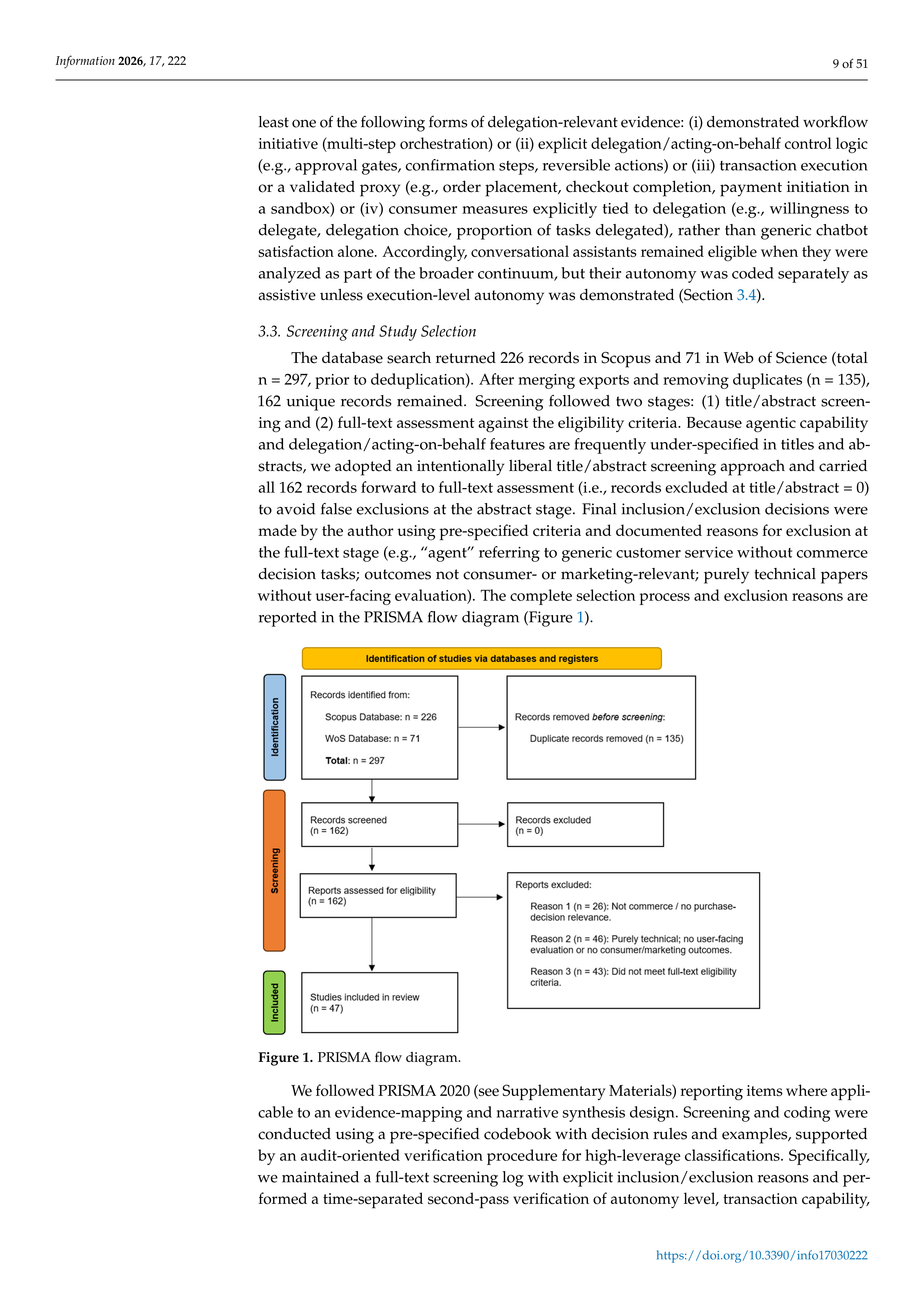
The database search returned 226 records in Scopus and 71 in Web of Science (total
n = 297
, prior to deduplication).
After merging exports and removing duplicates (
n = 135
),
162
unique
records
remained.
Screening
followed
two
stages:
(1)
title/abstract
screen-
ing and (2) full-text assessment against the eligibility criteria.
Because agentic capability
and delegation/acting-on-behalf features are frequently under-specified in titles and ab-
stracts, we adopted an intentionally liberal title/abstract screening approach and carried
all 162 records forward to full-text assessment (i.e., records excluded at title/abstract = 0)
to avoid false exclusions at the abstract stage.
Final inclusion/exclusion decisions were
made by the author using pre-specified criteria and documented reasons for exclusion at
the full-text stage (e.g., “agent” referring to generic customer service without commerce
decision tasks;
outcomes not consumer- or marketing-relevant;
purely technical papers
without user-facing evaluation).
The complete selection process and exclusion reasons are
reported in the PRISMA flow diagram (Figure
1
).
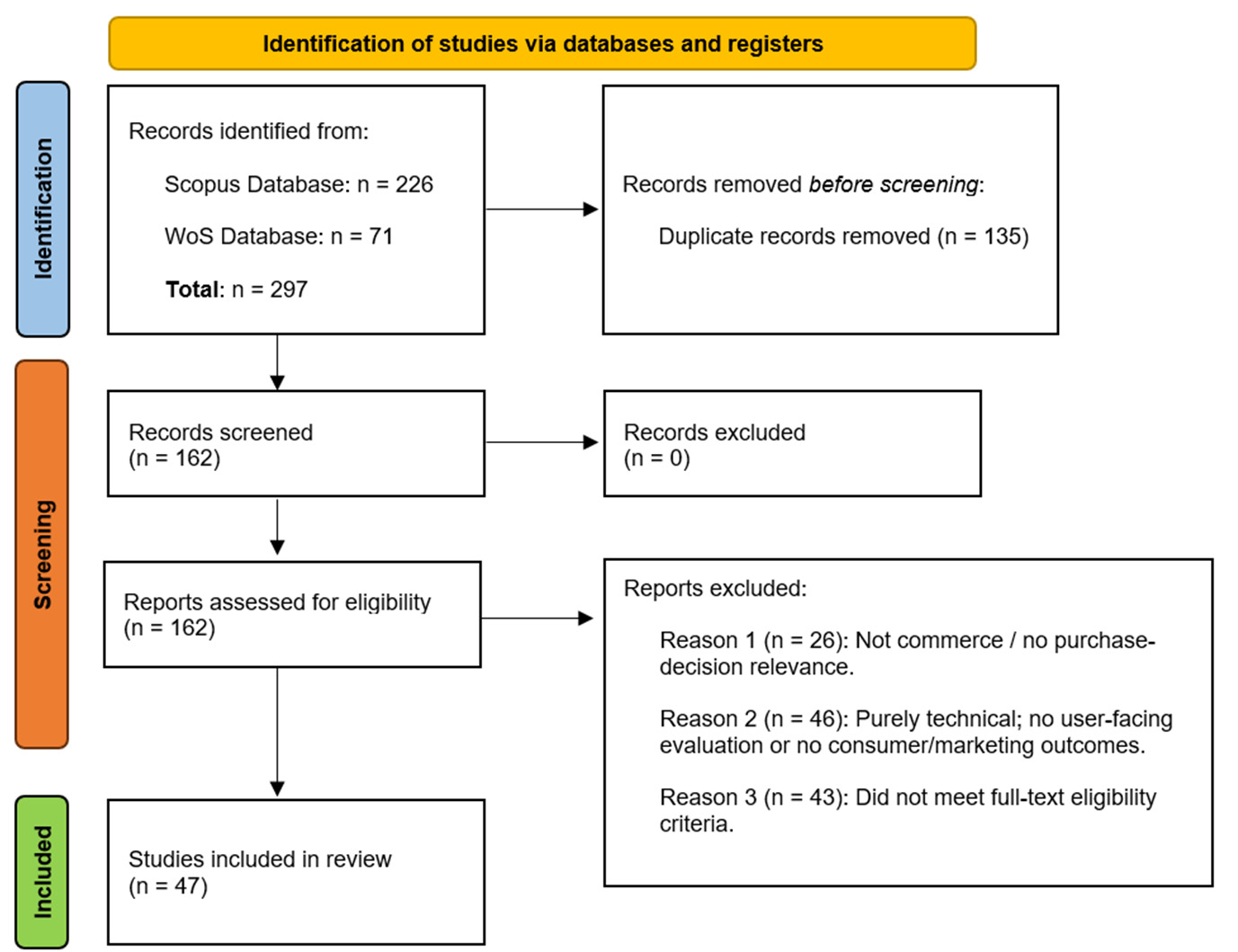
Figure 1.
PRISMA flow diagram.
We followed PRISMA 2020 (see Supplementary Materials) reporting items where appli-
cable to an evidence-mapping and narrative synthesis design.
Screening and coding were
conducted using a pre-specified codebook with decision rules and examples, supported
by an audit-oriented verification procedure for high-leverage classifications.
Specifically,
we maintained a full-text screening log with explicit inclusion/exclusion reasons and per-
formed a time-separated second-pass verification of autonomy level, transaction capability,
https://doi.org/10.3390/info17030222
Information
2026
,
17
, 222
10 of 51
evidence type, and delegation operationalization, resolving discrepancies by re-checking
the
original
text
and
applying
the
same
rules.
We
additionally
conducted
a
purposive
boundary-case audit for ambiguous agentic claims (e.g., autonomy framed as perception
only, transaction capability asserted but not evidenced) and applied conservative default
rules (lower autonomy/evidence grade) unless the full text provided sufficient operational
detail to justify a higher classification.
All included studies were coded using a structured scheme aligned with the three re-
search questions.
For RQ1 (phenomenon mapping), we coded agent design and implemen-
tation features including autonomy level, task scope (search/compare/recommend/cart/
checkout/postpurchase), interaction mode (text/voice/multimodal;
initiative;
explana-
tion), and transaction capability (simulated vs.
real; order placement/payment execution).
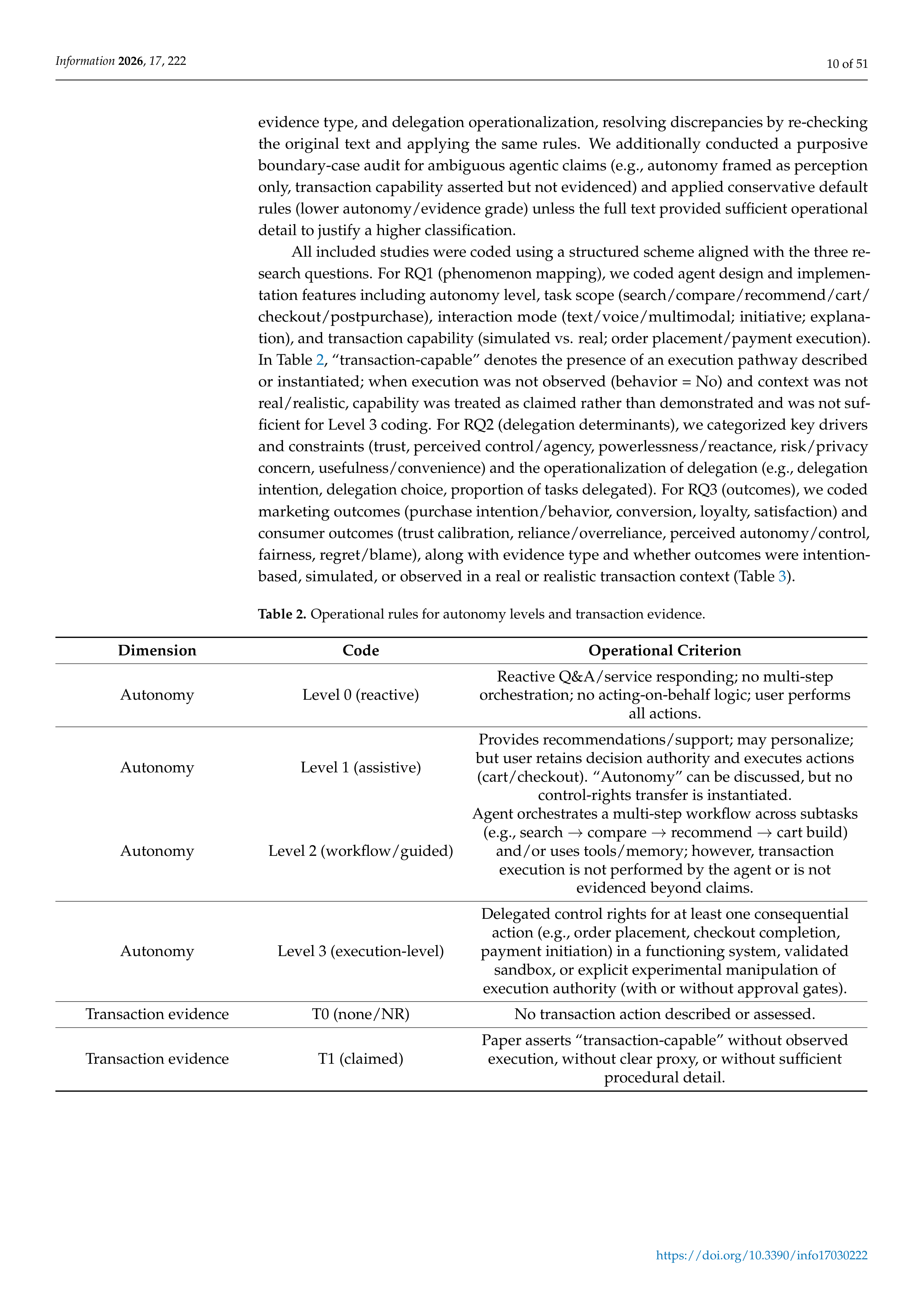
In Table
2
, “transaction-capable” denotes the presence of an execution pathway described
or instantiated; when execution was not observed (behavior = No) and context was not
real/realistic, capability was treated as claimed rather than demonstrated and was not suf-
ficient for Level 3 coding.
For RQ2 (delegation determinants), we categorized key drivers
and constraints (trust, perceived control/agency, powerlessness/reactance, risk/privacy
concern, usefulness/convenience) and the operationalization of delegation (e.g., delegation
intention, delegation choice, proportion of tasks delegated).
For RQ3 (outcomes), we coded
marketing outcomes (purchase intention/behavior, conversion, loyalty, satisfaction) and
consumer outcomes (trust calibration, reliance/overreliance, perceived autonomy/control,
fairness, regret/blame), along with evidence type and whether outcomes were intention-
based, simulated, or observed in a real or realistic transaction context (Table
3
).
Table 2.
Operational rules for autonomy levels and transaction evidence.
Dimension
Code
Operational Criterion
Autonomy
Level 0 (reactive)
Reactive Q&A/service responding; no multi-step
orchestration; no acting-on-behalf logic; user performs
all actions.
Autonomy
Level 1 (assistive)
Provides recommendations/support; may personalize;
but user retains decision authority and executes actions
(cart/checkout).
“Autonomy” can be discussed, but no
control-rights transfer is instantiated.
Autonomy
Level 2 (workflow/guided)
Agent orchestrates a multi-step workflow across subtasks
(e.g., search
→
compare
→
recommend
→
cart build)
and/or uses tools/memory; however, transaction
execution is not performed by the agent or is not
evidenced beyond claims.
Autonomy
Level 3 (execution-level)
Delegated control rights for at least one consequential
action (e.g., order placement, checkout completion,
payment initiation) in a functioning system, validated
sandbox, or explicit experimental manipulation of
execution authority (with or without approval gates).
Transaction evidence
T0 (none/NR)
No transaction action described or assessed.
Transaction evidence
T1 (claimed)
Paper asserts “transaction-capable” without observed
execution, without clear proxy, or without sufficient
procedural detail.
https://doi.org/10.3390/info17030222
Information
2026
,
17
, 222
11 of 51
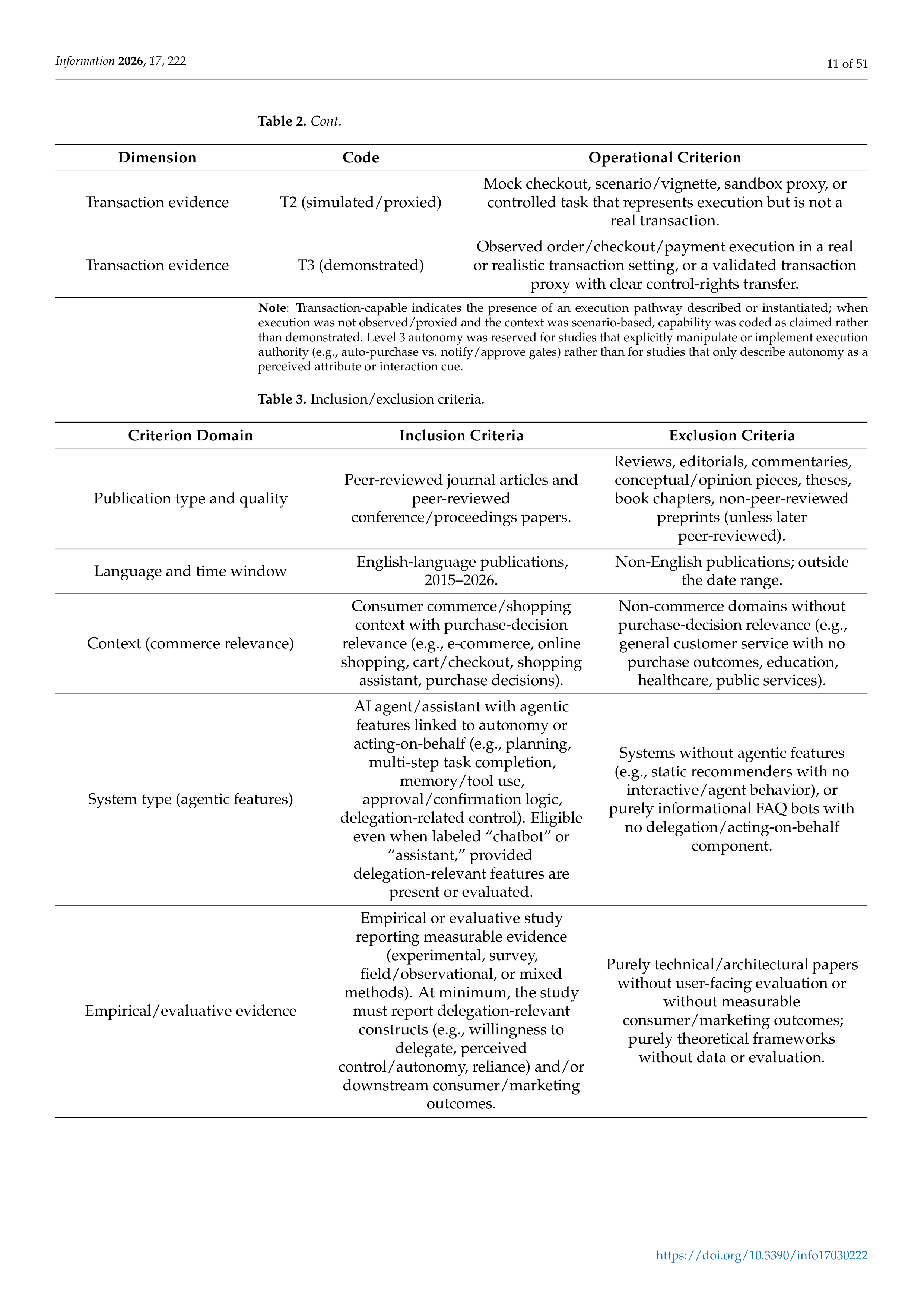
Table 2.
Cont.
Dimension
Code
Operational Criterion
Transaction evidence
T2 (simulated/proxied)
Mock checkout, scenario/vignette, sandbox proxy, or
controlled task that represents execution but is not a
real transaction.
Transaction evidence
T3 (demonstrated)
Observed order/checkout/payment execution in a real
or realistic transaction setting, or a validated transaction
proxy with clear control-rights transfer.
Note
:
Transaction-capable
indicates
the
presence
of
an
execution
pathway
described
or
instantiated;
when
execution was not observed/proxied and the context was scenario-based, capability was coded as claimed rather
than demonstrated.
Level 3 autonomy was reserved for studies that explicitly manipulate or implement execution
authority (e.g., auto-purchase vs.
notify/approve gates) rather than for studies that only describe autonomy as a
perceived attribute or interaction cue.
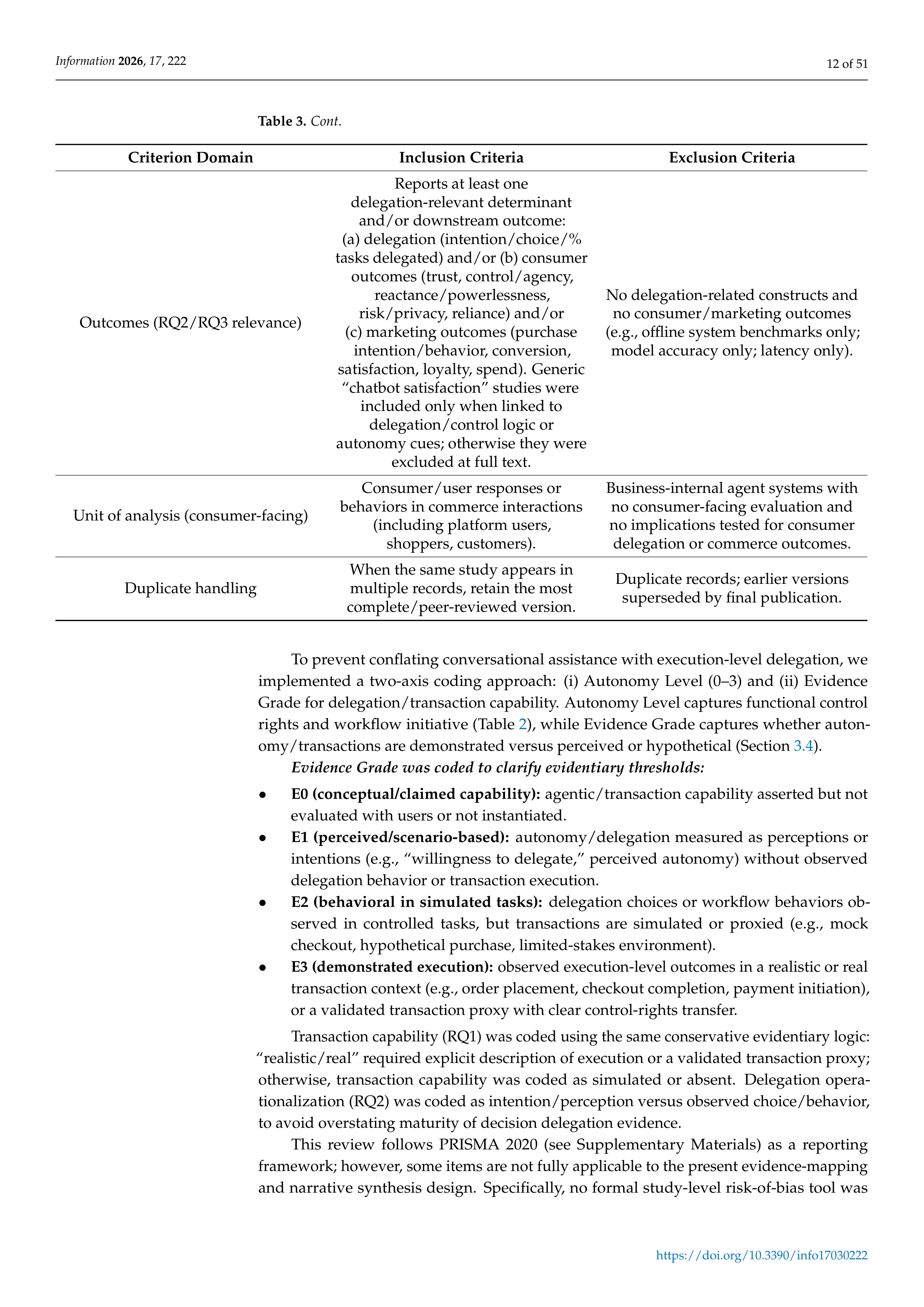
Table 3.
Inclusion/exclusion criteria.
Criterion Domain
Inclusion Criteria
Exclusion Criteria
Publication type and quality
Peer-reviewed journal articles and
peer-reviewed
conference/proceedings papers.
Reviews, editorials, commentaries,
conceptual/opinion pieces, theses,
book chapters, non-peer-reviewed
preprints (unless later
peer-reviewed).
Language and time window
English-language publications,
2015–2026.
Non-English publications; outside
the date range.
Context (commerce relevance)
Consumer commerce/shopping
context with purchase-decision
relevance (e.g., e-commerce, online
shopping, cart/checkout, shopping
assistant, purchase decisions).
Non-commerce domains without
purchase-decision relevance (e.g.,
general customer service with no
purchase outcomes, education,
healthcare, public services).
System type (agentic features)
AI agent/assistant with agentic
features linked to autonomy or
acting-on-behalf (e.g., planning,
multi-step task completion,
memory/tool use,
approval/confirmation logic,
delegation-related control).
Eligible
even when labeled “chatbot” or
“assistant,” provided
delegation-relevant features are
present or evaluated.
Systems without agentic features
(e.g., static recommenders with no
interactive/agent behavior), or
purely informational FAQ bots with
no delegation/acting-on-behalf
component.
Empirical/evaluative evidence
Empirical or evaluative study
reporting measurable evidence
(experimental, survey,
field/observational, or mixed
methods).
At minimum, the study
must report delegation-relevant
constructs (e.g., willingness to
delegate, perceived
control/autonomy, reliance) and/or
downstream consumer/marketing
outcomes.
Purely technical/architectural papers
without user-facing evaluation or
without measurable
consumer/marketing outcomes;
purely theoretical frameworks
without data or evaluation.
https://doi.org/10.3390/info17030222
Information
2026
,
17
, 222
12 of 51
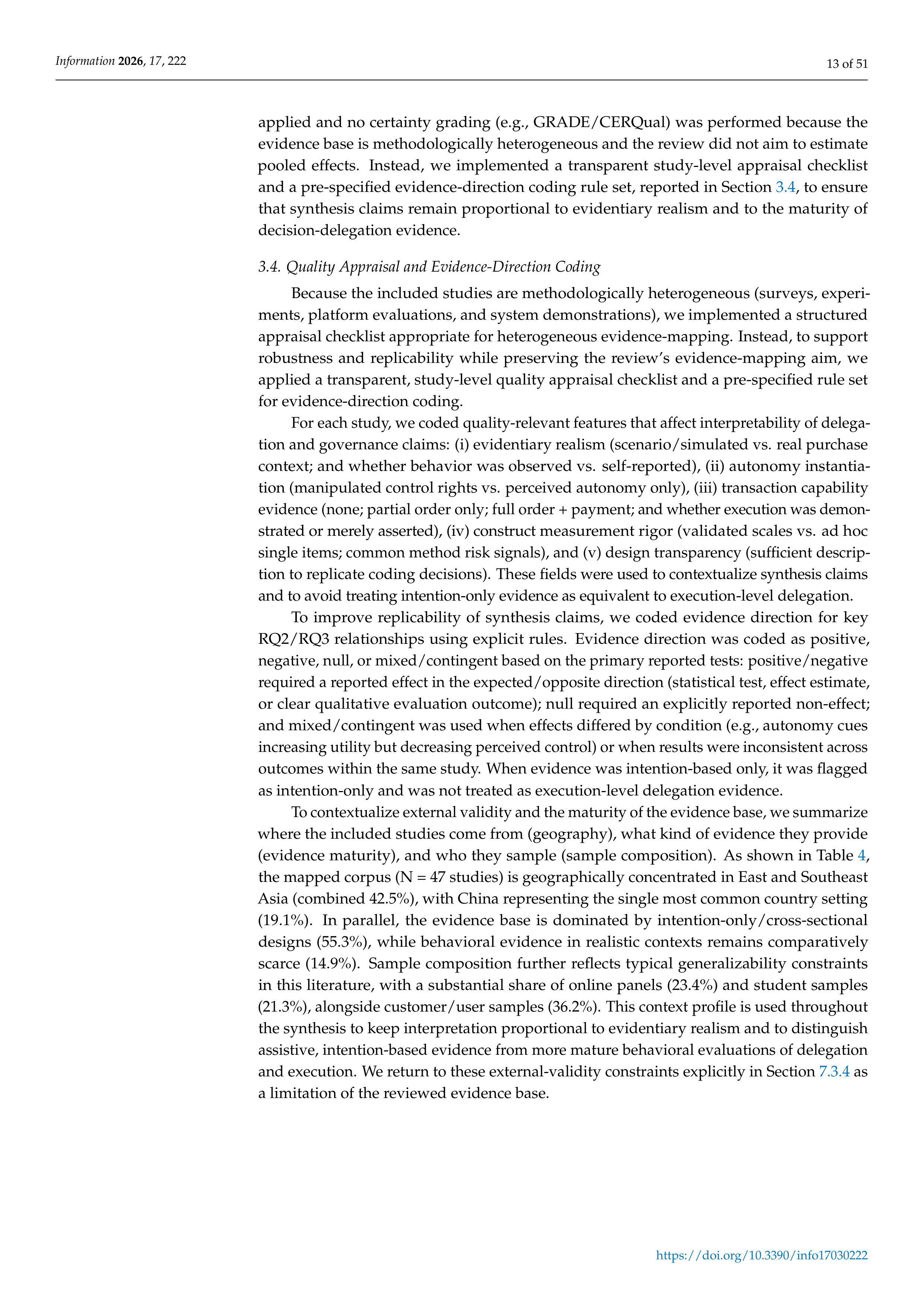
Table 3.
Cont.
Criterion Domain
Inclusion Criteria
Exclusion Criteria
Outcomes (RQ2/RQ3 relevance)
Reports at least one
delegation-relevant determinant
and/or downstream outcome:
(a) delegation (intention/choice/%
tasks delegated) and/or (b) consumer
outcomes (trust, control/agency,
reactance/powerlessness,
risk/privacy, reliance) and/or
(c) marketing outcomes (purchase
intention/behavior, conversion,
satisfaction, loyalty, spend).
Generic
“chatbot satisfaction” studies were
included only when linked to
delegation/control logic or
autonomy cues; otherwise they were
excluded at full text.
No delegation-related constructs and
no consumer/marketing outcomes
(e.g., offline system benchmarks only;
model accuracy only; latency only).
Unit of analysis (consumer-facing)
Consumer/user responses or
behaviors in commerce interactions
(including platform users,
shoppers, customers).
Business-internal agent systems with
no consumer-facing evaluation and
no implications tested for consumer
delegation or commerce outcomes.
Duplicate handling
When the same study appears in
multiple records, retain the most
complete/peer-reviewed version.
Duplicate records; earlier versions
superseded by final publication.
To prevent conflating conversational assistance with execution-level delegation, we
implemented
a
two-axis
coding
approach:
(i)
Autonomy
Level
(0–3)
and
(ii)
Evidence
Grade for delegation/transaction capability.
Autonomy Level captures functional control
rights and workflow initiative (Table
2
), while Evidence Grade captures whether auton-
omy/transactions are demonstrated versus perceived or hypothetical (Section
3.4
).
Evidence Grade was coded to clarify evidentiary thresholds:
•
E0 (conceptual/claimed capability):
agentic/transaction capability asserted but not
evaluated with users or not instantiated.
•
E1 (perceived/scenario-based):
autonomy/delegation measured as perceptions or
intentions
(e.g.,
“willingness
to
delegate,”
perceived
autonomy)
without
observed
delegation behavior or transaction execution.
•
E2
(behavioral
in
simulated
tasks):
delegation
choices
or
workflow
behaviors
ob-
served
in
controlled
tasks,
but
transactions
are
simulated
or
proxied
(e.g.,
mock
checkout, hypothetical purchase, limited-stakes environment).
•
E3 (demonstrated execution):
observed execution-level outcomes in a realistic or real
transaction context (e.g., order placement, checkout completion, payment initiation),
or a validated transaction proxy with clear control-rights transfer.
Transaction capability (RQ1) was coded using the same conservative evidentiary logic:
“realistic/real” required explicit description of execution or a validated transaction proxy;
otherwise,
transaction
capability
was
coded
as
simulated
or
absent.
Delegation
opera-
tionalization (RQ2) was coded as intention/perception versus observed choice/behavior,
to avoid overstating maturity of decision delegation evidence.
This
review
follows
PRISMA
2020
(see
Supplementary
Materials)
as
a
reporting
framework; however, some items are not fully applicable to the present evidence-mapping
and narrative synthesis design.
Specifically, no formal study-level risk-of-bias tool was
https://doi.org/10.3390/info17030222
Information
2026
,
17
, 222
13 of 51
applied and no certainty grading (e.g.,
GRADE/CERQual) was performed because the
evidence base is methodologically heterogeneous and the review did not aim to estimate
pooled
effects.
Instead,
we
implemented
a
transparent
study-level
appraisal
checklist
and a pre-specified evidence-direction coding rule set, reported in Section
3.4
, to ensure
that synthesis claims remain proportional to evidentiary realism and to the maturity of
decision-delegation evidence.
3.4.
Quality Appraisal and Evidence-Direction Coding
Because the included studies are methodologically heterogeneous (surveys, experi-
ments, platform evaluations, and system demonstrations), we implemented a structured
appraisal checklist appropriate for heterogeneous evidence-mapping.
Instead, to support
robustness
and
replicability
while
preserving
the
review’s
evidence-mapping
aim,
we
applied a transparent, study-level quality appraisal checklist and a pre-specified rule set
for evidence-direction coding.
For each study, we coded quality-relevant features that affect interpretability of delega-
tion and governance claims:
(i) evidentiary realism (scenario/simulated vs.
real purchase
context; and whether behavior was observed vs.
self-reported), (ii) autonomy instantia-
tion (manipulated control rights vs.
perceived autonomy only), (iii) transaction capability
evidence (none; partial order only; full order + payment; and whether execution was demon-
strated or merely asserted), (iv) construct measurement rigor (validated scales vs.
ad hoc
single items; common method risk signals), and (v) design transparency (sufficient descrip-
tion to replicate coding decisions).
These fields were used to contextualize synthesis claims
and to avoid treating intention-only evidence as equivalent to execution-level delegation.
To
improve
replicability
of
synthesis
claims,
we
coded
evidence
direction
for
key
RQ2/RQ3
relationships
using
explicit
rules.
Evidence
direction
was
coded
as
positive,
negative, null, or mixed/contingent based on the primary reported tests:
positive/negative
required a reported effect in the expected/opposite direction (statistical test, effect estimate,
or clear qualitative evaluation outcome); null required an explicitly reported non-effect;
and mixed/contingent was used when effects differed by condition (e.g., autonomy cues
increasing utility but decreasing perceived control) or when results were inconsistent across
outcomes within the same study.
When evidence was intention-based only, it was flagged
as intention-only and was not treated as execution-level delegation evidence.
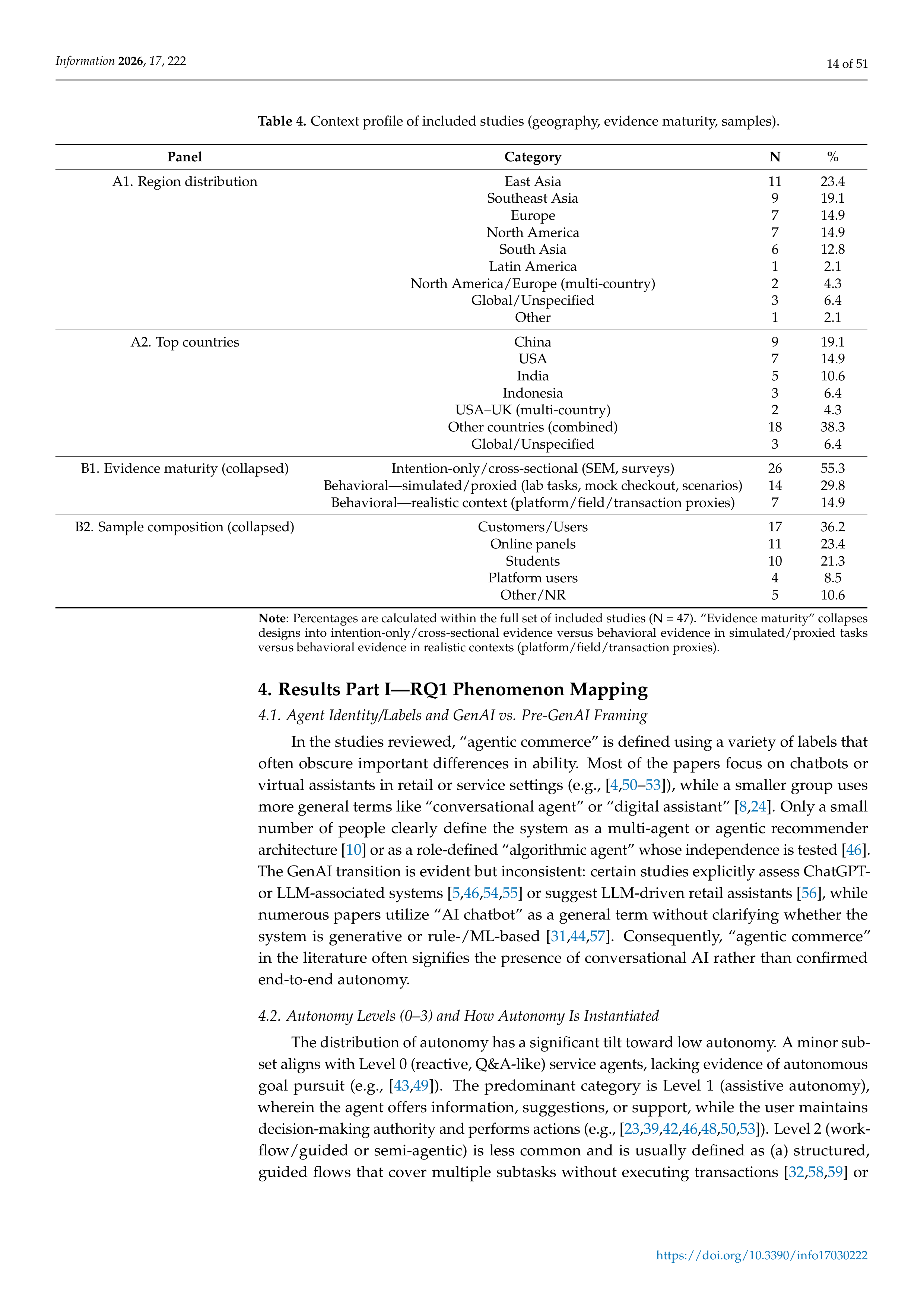
To contextualize external validity and the maturity of the evidence base, we summarize
where the included studies come from (geography), what kind of evidence they provide
(evidence maturity),
and who they sample (sample composition).
As shown in Table
4
,
the mapped corpus (N = 47 studies) is geographically concentrated in East and Southeast
Asia (combined 42.5%), with China representing the single most common country setting
(19.1%).
In
parallel,
the
evidence
base
is
dominated
by
intention-only/cross-sectional
designs
(55.3%),
while
behavioral
evidence
in
realistic
contexts
remains
comparatively
scarce
(14.9%).
Sample
composition
further
reflects
typical
generalizability
constraints
in this literature, with a substantial share of online panels (23.4%) and student samples
(21.3%), alongside customer/user samples (36.2%).
This context profile is used throughout
the synthesis to keep interpretation proportional to evidentiary realism and to distinguish
assistive, intention-based evidence from more mature behavioral evaluations of delegation
and execution.
We return to these external-validity constraints explicitly in Section
7.3.4
as
a limitation of the reviewed evidence base.
https://doi.org/10.3390/info17030222
Information
2026
,
17
, 222
14 of 51
Table 4.
Context profile of included studies (geography, evidence maturity, samples).
Panel
Category
N
%
A1.
Region distribution
East Asia
11
23.4
Southeast Asia
9
19.1
Europe
7
14.9
North America
7
14.9
South Asia
6
12.8
Latin America
1
2.1
North America/Europe (multi-country)
2
4.3
Global/Unspecified
3
6.4
Other
1
2.1
A2.
Top countries
China
9
19.1
USA
7
14.9
India
5
10.6
Indonesia
3
6.4
USA–UK (multi-country)
2
4.3
Other countries (combined)
18
38.3
Global/Unspecified
3
6.4
B1.
Evidence maturity (collapsed)
Intention-only/cross-sectional (SEM, surveys)
26
55.3
Behavioral—simulated/proxied (lab tasks, mock checkout, scenarios)
14
29.8
Behavioral—realistic context (platform/field/transaction proxies)
7
14.9
B2.
Sample composition (collapsed)
Customers/Users
17
36.2
Online panels
11
23.4
Students
10
21.3
Platform users
4
8.5
Other/NR
5
10.6
Note
:
Percentages are calculated within the full set of included studies (N = 47).
“Evidence maturity” collapses
designs
into
intention-only/cross-sectional
evidence
versus
behavioral
evidence
in
simulated/proxied
tasks
versus behavioral evidence in realistic contexts (platform/field/transaction proxies).
4.
Results Part I—RQ1 Phenomenon Mapping
4.1.
Agent Identity/Labels and GenAI vs.
Pre-GenAI Framing
In the studies reviewed, “agentic commerce” is defined using a variety of labels that
often
obscure
important
differences
in
ability.
Most
of
the
papers
focus
on
chatbots
or
virtual assistants in retail or service settings (e.g., [
4
,
50
–
53
]), while a smaller group uses
more general terms like “conversational agent” or “digital assistant” [
8
,
24
].
Only a small
number
of
people
clearly
define
the
system
as
a
multi-agent
or
agentic
recommender
architecture [
10
] or as a role-defined “algorithmic agent” whose independence is tested [
46
].
The GenAI transition is evident but inconsistent:
certain studies explicitly assess ChatGPT-
or LLM-associated systems [
5
,
46
,
54
,
55
] or suggest LLM-driven retail assistants [
56
], while
numerous papers utilize “AI chatbot” as a general term without clarifying whether the
system
is
generative
or
rule-/ML-based
[
31
,
44
,
57
].
Consequently,
“agentic
commerce”
in the literature often signifies the presence of conversational AI rather than confirmed
end-to-end autonomy.
4.2.
Autonomy Levels (0–3) and How Autonomy Is Instantiated
The distribution of autonomy has a significant tilt toward low autonomy.
A minor sub-
set aligns with Level 0 (reactive, Q&A-like) service agents, lacking evidence of autonomous
goal
pursuit
(e.g.,
[
43
,
49
]).
The
predominant
category
is
Level
1
(assistive
autonomy),
wherein the agent offers information, suggestions, or support, while the user maintains
decision-making authority and performs actions (e.g., [
23
,
39
,
42
,
46
,
48
,
50
,
53
]).
Level 2 (work-
flow/guided
or
semi-agentic)
is
less
common
and
is
usually
defined
as
(a)
structured,
guided
flows
that
cover
multiple
subtasks
without
executing
transactions
[
32
,
58
,
59
]
or
https://doi.org/10.3390/info17030222
Information
2026
,
17
, 222
15 of 51
(b) systems that are framed as more agentic through architecture/tool-use or fewer LLM-
calls in conversational recommendation [
10
].
To reduce conceptual ambiguity, Level 2 is coded only when studies show workflow-
level initiative (multi-step orchestration) beyond single-turn assistance, even if transactions
remain
user-executed.
Level
3
(high
autonomy
with
execution)
is
infrequent
and
pre-
dominantly realized through experimental frameworks that distinctly alter control rights
and execution [
40
,
41
,
46
].
Level 3 is reserved for cases with explicit delegation of control
rights and demonstrated execution (or validated transaction proxy),
rather than purely
conversational
completion
of
a
task
narrative.
Significantly,
even
when
“autonomy”
is
pivotal, it is frequently implemented as a perceived characteristic [
60
] or as a contrived
scenario condition [
40
,
46
] rather than as actual task-level delegation in a functioning sys-
tem.
Therefore,
autonomy
in
the
evidence
base
is
often
“perceived
autonomy”
rather
than “demonstrated autonomy,” and the literature currently provides stronger support for
acceptance and governance perceptions than for mature, real-world decision delegation at
execution level.
4.3.
Task Scope Patterns Across the Commerce Journey
Task scope clusters around pre-purchase decision support and post-purchase service,
with limited coverage of true execution.
Most studies incorporate search and/or recom-
mendation functionalities (e.g., [
10
,
33
,
46
,
48
,
54
,
56
]), whereas comparison is observed spo-
radically [
5
,
8
,
24
,
46
].
Structured ordering flows, such as cart-builds, are not very common
and usually show limited workflows, like listing/build tasks [
7
,
61
] or messenger-based
ordering scripts [
62
].
The checkout/payment process delineates the distinction between
“assistive chatbots” and agentic commerce, manifesting in a limited number of instances,
typically via experimental execution frameworks [
40
,
41
] or through more generalized “or-
dering/payment support” assertions rather than documented autonomous completion [
45
].
Negotiation is virtually nonexistent in the coded set (with no significant N = Yes cases),
suggesting that a commonly addressed agentic capability in theoretical discourse is inad-
equately reflected in empirical commerce research.
In general, the literature focuses on
S/R/A (search–recommend–support) instead of end-to-end shopping delegation (Table
3
).
4.4.
Interaction Modes, Initiative, Anthropomorphism, and Explanation
Only a few studies demonstrate system-guided initiation [
61
] or autonomy-contingent
initiative
[
40
,
46
].
The
majority
of
interaction
is
text-based
chat,
usually
user-initiated
(e.g., [
42
,
46
,
48
,
55
]).
Voice is relatively uncommon and primarily manifests as an anthro-
pomorphic cue [
52
] or as a modality manipulation [
8
].
Additionally rare is multimodal
interaction, which is mainly operationalized as image + text search in fashion shopping [
6
].
Anthropomorphism is common but conceptually distinct from autonomy; numerous stud-
ies use it as a manipulation or measured cue, frequently through avatars, naming, warmth
cues, or social presence [
24
,
38
,
63
–
65
].
On the other hand, XAI and explanations are rarely
clear.
When
they
do
exist,
they
are
usually
procedural
or
minimal
[
10
]
or
presented
as
a
design
element
rather
than
a
tried-and-true
oversight
mechanism
[
5
,
61
].
As
a
result,
the interaction layer frequently increases human-likeness and engagement while under-
specifying features that are pertinent to governance, such as explanations, overrides, and
confirmations (Table
5
).
4.5.
Transaction Capability and Evidentiary Realism
Even when “commerce” is the setting, the agent usually does not place orders or carry
out payments (e.g., [
4
,
46
,
50
,
51
,
54
,
66
]).
Most systems are not transaction-capable.
Partial
transaction capability, such as placing an order without making a payment, is a small sub-
set [
33
,
62
].
The high-autonomy manipulation studies [
40
,
41
] focus on full execution (order
https://doi.org/10.3390/info17030222
Information
2026
,
17
, 222
16 of 51
+ payment), which makes them crucial but also shows how infrequently execution is seen
in naturalistic commerce use.
Numerous studies assert the existence of a genuine purchase
context through mechanisms such as consumer recall or field surveys (e.g., [
38
,
42
,
48
,
56
,
64
]).
However, direct observation of actual behavior is relatively scarce, primarily manifesting
in
controlled
experiments
or
platform-integrated
evaluations
[
8
,
10
,
24
,
38
,
41
,
55
,
61
]
.
The
phenomenon map shows that the empirical literature is still mostly about assistive con-
versational commerce.
There is only a small amount of evidence for true delegation and
autonomous transaction execution, which are the main characteristics of agentic commerce
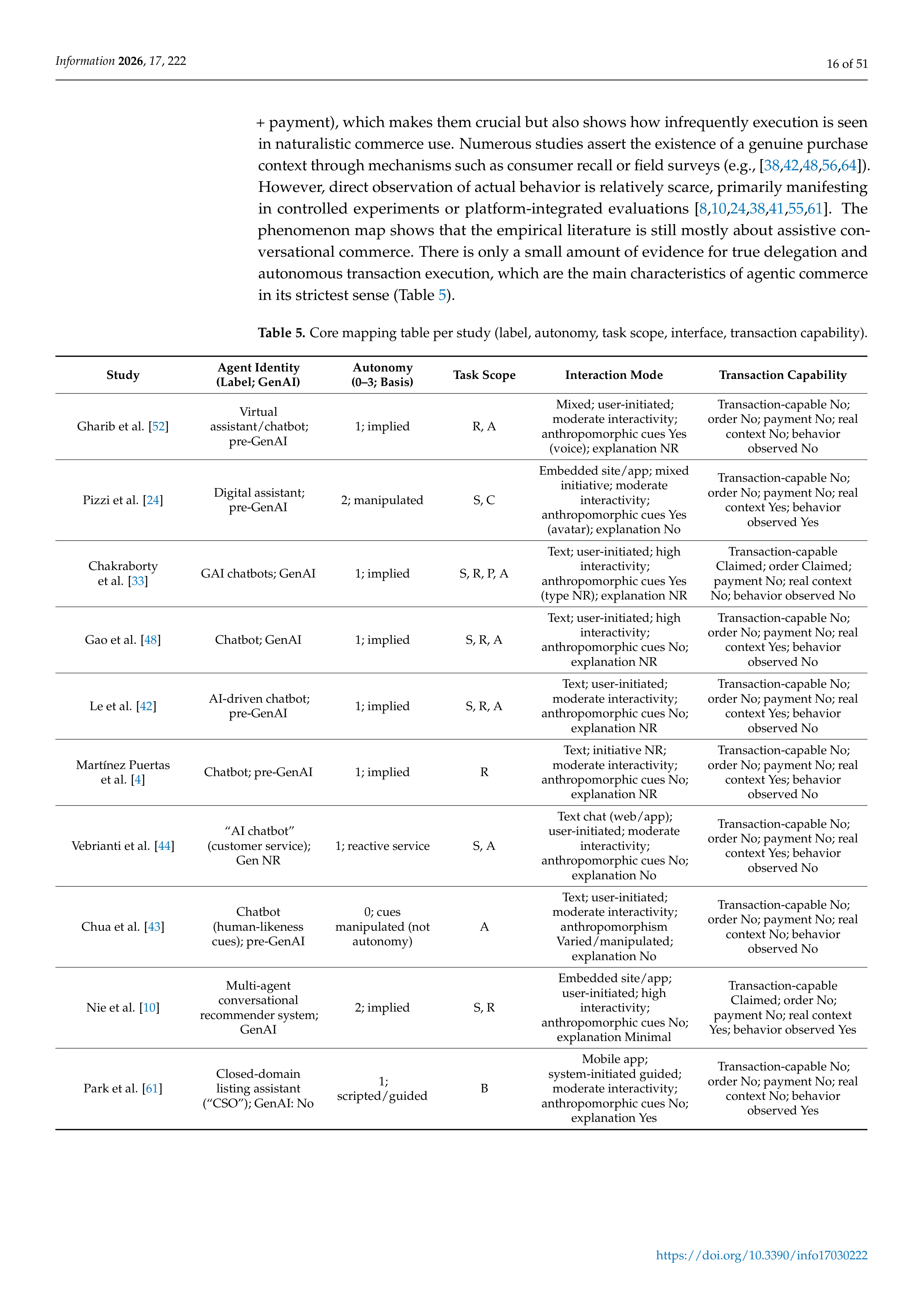
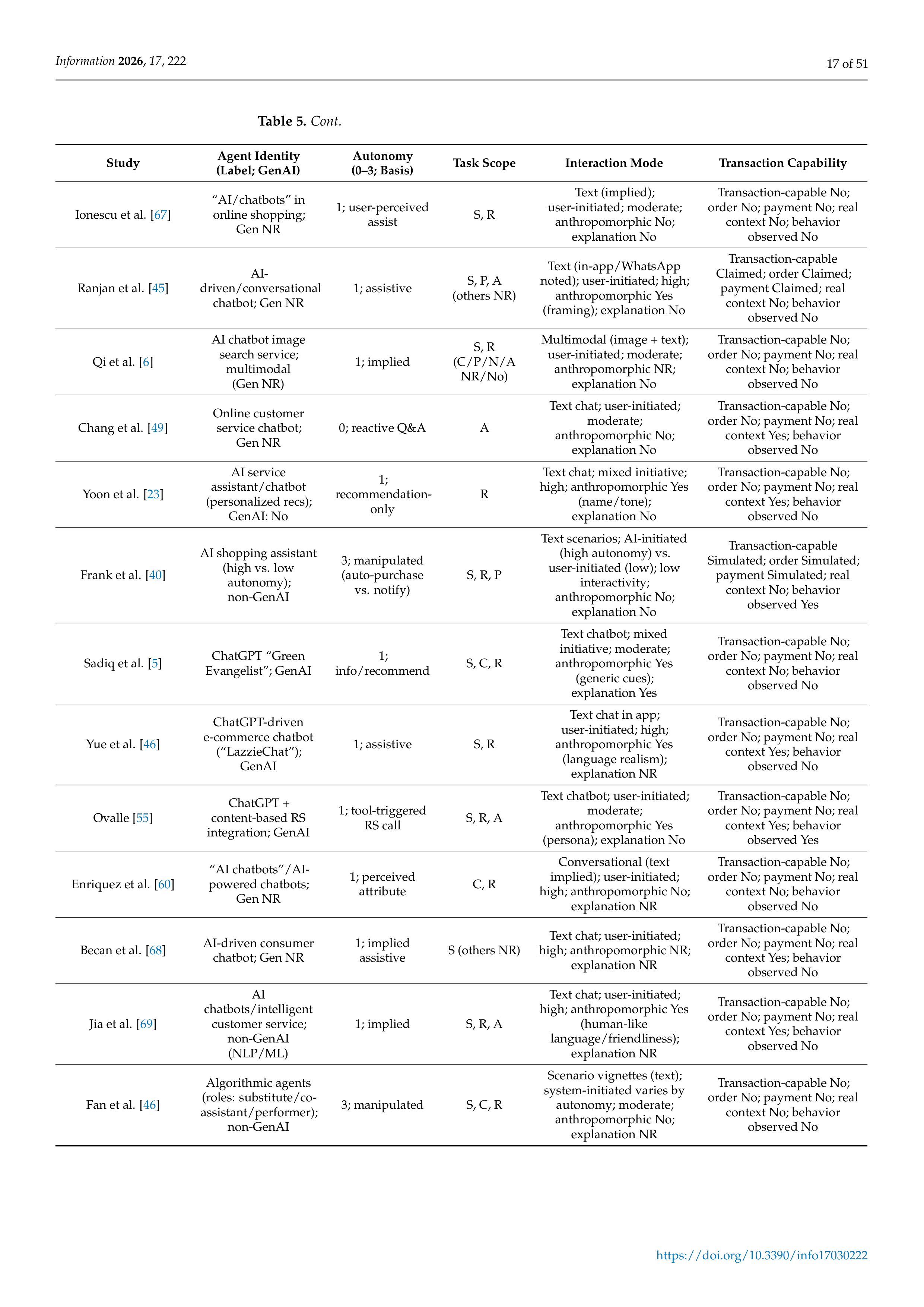
in its strictest sense (Table
5
).
Table 5.
Core mapping table per study (label, autonomy, task scope, interface, transaction capability).
Study
Agent Identity
(Label; GenAI)
Autonomy
(0–3; Basis)
Task Scope
Interaction Mode
Transaction Capability
Gharib et al.
[
52
]
Virtual
assistant/chatbot;
pre-GenAI
1; implied
R, A
Mixed; user-initiated;
moderate interactivity;
anthropomorphic cues Yes
(voice); explanation NR
Transaction-capable No;
order No; payment No; real
context No; behavior
observed No
Pizzi et al.
[
24
]
Digital assistant;
pre-GenAI
2; manipulated
S, C
Embedded site/app; mixed
initiative; moderate
interactivity;
anthropomorphic cues Yes
(avatar); explanation No
Transaction-capable No;
order No; payment No; real
context Yes; behavior
observed Yes
Chakraborty
et al.
[
33
]
GAI chatbots; GenAI
1; implied
S, R, P, A
Text; user-initiated; high
interactivity;
anthropomorphic cues Yes
(type NR); explanation NR
Transaction-capable
Claimed; order Claimed;
payment No; real context
No; behavior observed No
Gao et al.
[
48
]
Chatbot; GenAI
1; implied
S, R, A
Text; user-initiated; high
interactivity;
anthropomorphic cues No;
explanation NR
Transaction-capable No;
order No; payment No; real
context Yes; behavior
observed No
Le et al.
[
42
]
AI-driven chatbot;
pre-GenAI
1; implied
S, R, A
Text; user-initiated;
moderate interactivity;
anthropomorphic cues No;
explanation NR
Transaction-capable No;
order No; payment No; real
context Yes; behavior
observed No
Martínez Puertas
et al.
[
4
]
Chatbot; pre-GenAI
1; implied
R
Text; initiative NR;
moderate interactivity;
anthropomorphic cues No;
explanation NR
Transaction-capable No;
order No; payment No; real
context Yes; behavior
observed No
Vebrianti et al.
[
44
]
“AI chatbot”
(customer service);
Gen NR
1; reactive service
S, A
Text chat (web/app);
user-initiated; moderate
interactivity;
anthropomorphic cues No;
explanation No
Transaction-capable No;
order No; payment No; real
context Yes; behavior
observed No
Chua et al.
[
43
]
Chatbot
(human-likeness
cues); pre-GenAI
0; cues
manipulated (not
autonomy)
A
Text; user-initiated;
moderate interactivity;
anthropomorphism
Varied/manipulated;
explanation No
Transaction-capable No;
order No; payment No; real
context No; behavior
observed No
Nie et al.
[
10
]
Multi-agent
conversational
recommender system;
GenAI
2; implied
S, R
Embedded site/app;
user-initiated; high
interactivity;
anthropomorphic cues No;
explanation Minimal
Transaction-capable
Claimed; order No;
payment No; real context
Yes; behavior observed Yes
Park et al.
[
61
]
Closed-domain
listing assistant
(“CSO”); GenAI: No
1;
scripted/guided
B
Mobile app;
system-initiated guided;
moderate interactivity;
anthropomorphic cues No;
explanation Yes
Transaction-capable No;
order No; payment No; real
context No; behavior
observed Yes
https://doi.org/10.3390/info17030222
Information
2026
,
17
, 222
17 of 51
Table 5.
Cont.
Study
Agent Identity
(Label; GenAI)
Autonomy
(0–3; Basis)
Task Scope
Interaction Mode
Transaction Capability
Ionescu et al.
[
67
]
“AI/chatbots” in
online shopping;
Gen NR
1; user-perceived
assist
S, R
Text (implied);
user-initiated; moderate;
anthropomorphic No;
explanation No
Transaction-capable No;
order No; payment No; real
context No; behavior
observed No
Ranjan et al.
[
45
]
AI-
driven/conversational
chatbot; Gen NR
1; assistive
S, P, A
(others NR)
Text (in-app/WhatsApp
noted); user-initiated; high;
anthropomorphic Yes
(framing); explanation No
Transaction-capable
Claimed; order Claimed;
payment Claimed; real
context No; behavior
observed No
Qi et al.
[
6
]
AI chatbot image
search service;
multimodal
(Gen NR)
1; implied
S, R
(C/P/N/A
NR/No)
Multimodal (image + text);
user-initiated; moderate;
anthropomorphic NR;
explanation No
Transaction-capable No;
order No; payment No; real
context No; behavior
observed No
Chang et al.
[
49
]
Online customer
service chatbot;
Gen NR
0; reactive Q&A
A
Text chat; user-initiated;
moderate;
anthropomorphic No;
explanation No
Transaction-capable No;
order No; payment No; real
context Yes; behavior
observed No
Yoon et al.
[
23
]
AI service
assistant/chatbot
(personalized recs);
GenAI: No
1;
recommendation-
only
R
Text chat; mixed initiative;
high; anthropomorphic Yes
(name/tone);
explanation No
Transaction-capable No;
order No; payment No; real
context Yes; behavior
observed No
Frank et al.
[
40
]
AI shopping assistant
(high vs.
low
autonomy);
non-GenAI
3; manipulated
(auto-purchase
vs.
notify)
S, R, P
Text scenarios; AI-initiated
(high autonomy) vs.
user-initiated (low); low
interactivity;
anthropomorphic No;
explanation No
Transaction-capable
Simulated; order Simulated;
payment Simulated; real
context No; behavior
observed Yes
Sadiq et al.
[
5
]
ChatGPT “Green
Evangelist”; GenAI
1;
info/recommend
S, C, R
Text chatbot; mixed
initiative; moderate;
anthropomorphic Yes
(generic cues);
explanation Yes
Transaction-capable No;
order No; payment No; real
context No; behavior
observed No
Yue et al.
[
46
]
ChatGPT-driven
e-commerce chatbot
(“LazzieChat”);
GenAI
1; assistive
S, R
Text chat in app;
user-initiated; high;
anthropomorphic Yes
(language realism);
explanation NR
Transaction-capable No;
order No; payment No; real
context Yes; behavior
observed No
Ovalle [
55
]
ChatGPT +
content-based RS
integration; GenAI
1; tool-triggered
RS call
S, R, A
Text chatbot; user-initiated;
moderate;
anthropomorphic Yes
(persona); explanation No
Transaction-capable No;
order No; payment No; real
context Yes; behavior
observed Yes
Enriquez et al.
[
60
]
“AI chatbots”/AI-
powered chatbots;
Gen NR
1; perceived
attribute
C, R
Conversational (text
implied); user-initiated;
high; anthropomorphic No;
explanation NR
Transaction-capable No;
order No; payment No; real
context No; behavior
observed No
Becan et al.
[
68
]
AI-driven consumer
chatbot; Gen NR
1; implied
assistive
S (others NR)
Text chat; user-initiated;
high; anthropomorphic NR;
explanation NR
Transaction-capable No;
order No; payment No; real
context Yes; behavior
observed No
Jia et al.
[
69
]
AI
chatbots/intelligent
customer service;
non-GenAI
(NLP/ML)
1; implied
S, R, A
Text chat; user-initiated;
high; anthropomorphic Yes
(human-like
language/friendliness);
explanation NR
Transaction-capable No;
order No; payment No; real
context Yes; behavior
observed No
Fan et al.
[
46
]
Algorithmic agents
(roles:
substitute/co-
assistant/performer);
non-GenAI
3; manipulated
S, C, R
Scenario vignettes (text);
system-initiated varies by
autonomy; moderate;
anthropomorphic No;
explanation NR
Transaction-capable No;
order No; payment No; real
context No; behavior
observed No
https://doi.org/10.3390/info17030222
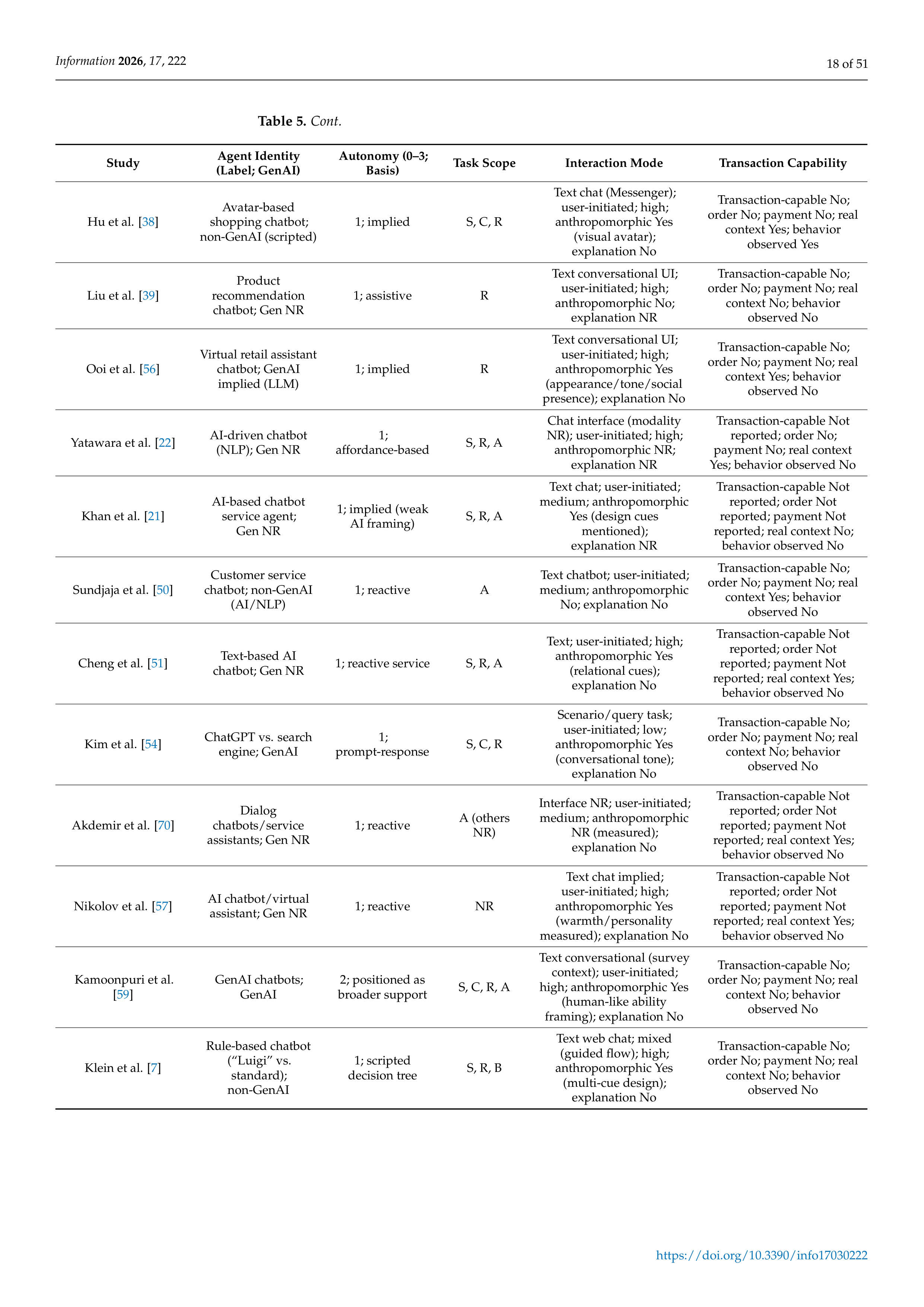
Information
2026
,
17
, 222
18 of 51
Table 5.
Cont.
Study
Agent Identity
(Label; GenAI)
Autonomy (0–3;
Basis)
Task Scope
Interaction Mode
Transaction Capability
Hu et al.
[
38
]
Avatar-based
shopping chatbot;
non-GenAI (scripted)
1; implied
S, C, R
Text chat (Messenger);
user-initiated; high;
anthropomorphic Yes
(visual avatar);
explanation No
Transaction-capable No;
order No; payment No; real
context Yes; behavior
observed Yes
Liu et al.
[
39
]
Product
recommendation
chatbot; Gen NR
1; assistive
R
Text conversational UI;
user-initiated; high;
anthropomorphic No;
explanation NR
Transaction-capable No;
order No; payment No; real
context No; behavior
observed No
Ooi et al.
[
56
]
Virtual retail assistant
chatbot; GenAI
implied (LLM)
1; implied
R
Text conversational UI;
user-initiated; high;
anthropomorphic Yes
(appearance/tone/social
presence); explanation No
Transaction-capable No;
order No; payment No; real
context Yes; behavior
observed No
Yatawara et al.
[
22
]
AI-driven chatbot
(NLP); Gen NR
1;
affordance-based
S, R, A
Chat interface (modality
NR); user-initiated; high;
anthropomorphic NR;
explanation NR
Transaction-capable Not
reported; order No;
payment No; real context
Yes; behavior observed No
Khan et al.
[
21
]
AI-based chatbot
service agent;
Gen NR
1; implied (weak
AI framing)
S, R, A
Text chat; user-initiated;
medium; anthropomorphic
Yes (design cues
mentioned);
explanation NR
Transaction-capable Not
reported; order Not
reported; payment Not
reported; real context No;
behavior observed No
Sundjaja et al.
[
50
]
Customer service
chatbot; non-GenAI
(AI/NLP)
1; reactive
A
Text chatbot; user-initiated;
medium; anthropomorphic
No; explanation No
Transaction-capable No;
order No; payment No; real
context Yes; behavior
observed No
Cheng et al.
[
51
]
Text-based AI
chatbot; Gen NR
1; reactive service
S, R, A
Text; user-initiated; high;
anthropomorphic Yes
(relational cues);
explanation No
Transaction-capable Not
reported; order Not
reported; payment Not
reported; real context Yes;
behavior observed No
Kim et al.
[
54
]
ChatGPT vs.
search
engine; GenAI
1;
prompt-response
S, C, R
Scenario/query task;
user-initiated; low;
anthropomorphic Yes
(conversational tone);
explanation No
Transaction-capable No;
order No; payment No; real
context No; behavior
observed No
Akdemir et al.
[
70
]
Dialog
chatbots/service
assistants; Gen NR
1; reactive
A (others
NR)
Interface NR; user-initiated;
medium; anthropomorphic
NR (measured);
explanation No
Transaction-capable Not
reported; order Not
reported; payment Not
reported; real context Yes;
behavior observed No
Nikolov et al.
[
57
]
AI chatbot/virtual
assistant; Gen NR
1; reactive
NR
Text chat implied;
user-initiated; high;
anthropomorphic Yes
(warmth/personality
measured); explanation No
Transaction-capable Not
reported; order Not
reported; payment Not
reported; real context Yes;
behavior observed No
Kamoonpuri et al.
[
59
]
GenAI chatbots;
GenAI
2; positioned as
broader support
S, C, R, A
Text conversational (survey
context); user-initiated;
high; anthropomorphic Yes
(human-like ability
framing); explanation No
Transaction-capable No;
order No; payment No; real
context No; behavior
observed No
Klein et al.
[
7
]
Rule-based chatbot
(“Luigi” vs.
standard);
non-GenAI
1; scripted
decision tree
S, R, B
Text web chat; mixed
(guided flow); high;
anthropomorphic Yes
(multi-cue design);
explanation No
Transaction-capable No;
order No; payment No; real
context No; behavior
observed No
https://doi.org/10.3390/info17030222
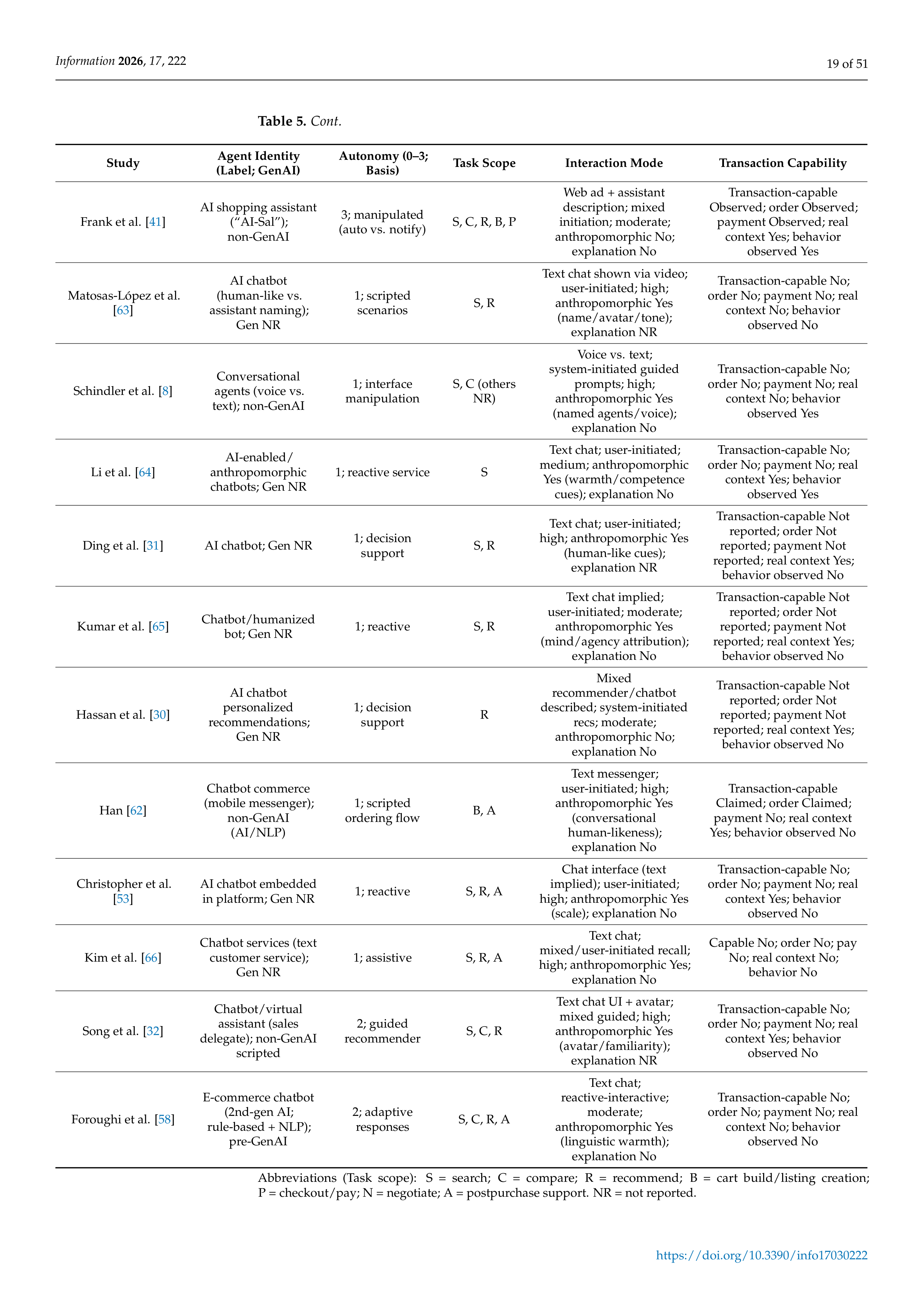
Information
2026
,
17
, 222
19 of 51
Table 5.
Cont.
Study
Agent Identity
(Label; GenAI)
Autonomy (0–3;
Basis)
Task Scope
Interaction Mode
Transaction Capability
Frank et al.
[
41
]
AI shopping assistant
(“AI-Sal”);
non-GenAI
3; manipulated
(auto vs.
notify)
S, C, R, B, P
Web ad + assistant
description; mixed
initiation; moderate;
anthropomorphic No;
explanation No
Transaction-capable
Observed; order Observed;
payment Observed; real
context Yes; behavior
observed Yes
Matosas-López et al.
[
63
]
AI chatbot
(human-like vs.
assistant naming);
Gen NR
1; scripted
scenarios
S, R
Text chat shown via video;
user-initiated; high;
anthropomorphic Yes
(name/avatar/tone);
explanation NR
Transaction-capable No;
order No; payment No; real
context No; behavior
observed No
Schindler et al.
[
8
]
Conversational
agents (voice vs.
text); non-GenAI
1; interface
manipulation
S, C (others
NR)
Voice vs.
text;
system-initiated guided
prompts; high;
anthropomorphic Yes
(named agents/voice);
explanation No
Transaction-capable No;
order No; payment No; real
context No; behavior
observed Yes
Li et al.
[
64
]
AI-enabled/
anthropomorphic
chatbots; Gen NR
1; reactive service
S
Text chat; user-initiated;
medium; anthropomorphic
Yes (warmth/competence
cues); explanation No
Transaction-capable No;
order No; payment No; real
context Yes; behavior
observed Yes
Ding et al.
[
31
]
AI chatbot; Gen NR
1; decision
support
S, R
Text chat; user-initiated;
high; anthropomorphic Yes
(human-like cues);
explanation NR
Transaction-capable Not
reported; order Not
reported; payment Not
reported; real context Yes;
behavior observed No
Kumar et al.
[
65
]
Chatbot/humanized
bot; Gen NR
1; reactive
S, R
Text chat implied;
user-initiated; moderate;
anthropomorphic Yes
(mind/agency attribution);
explanation No
Transaction-capable Not
reported; order Not
reported; payment Not
reported; real context Yes;
behavior observed No
Hassan et al.
[
30
]
AI chatbot
personalized
recommendations;
Gen NR
1; decision
support
R
Mixed
recommender/chatbot
described; system-initiated
recs; moderate;
anthropomorphic No;
explanation No
Transaction-capable Not
reported; order Not
reported; payment Not
reported; real context Yes;
behavior observed No
Han [
62
]
Chatbot commerce
(mobile messenger);
non-GenAI
(AI/NLP)
1; scripted
ordering flow
B, A
Text messenger;
user-initiated; high;
anthropomorphic Yes
(conversational
human-likeness);
explanation No
Transaction-capable
Claimed; order Claimed;
payment No; real context
Yes; behavior observed No
Christopher et al.
[
53
]
AI chatbot embedded
in platform; Gen NR
1; reactive
S, R, A
Chat interface (text
implied); user-initiated;
high; anthropomorphic Yes
(scale); explanation No
Transaction-capable No;
order No; payment No; real
context Yes; behavior
observed No
Kim et al.
[
66
]
Chatbot services (text
customer service);
Gen NR
1; assistive
S, R, A
Text chat;
mixed/user-initiated recall;
high; anthropomorphic Yes;
explanation No
Capable No; order No; pay
No; real context No;
behavior No
Song et al.
[
32
]
Chatbot/virtual
assistant (sales
delegate); non-GenAI
scripted
2; guided
recommender
S, C, R
Text chat UI + avatar;
mixed guided; high;
anthropomorphic Yes
(avatar/familiarity);
explanation NR
Transaction-capable No;
order No; payment No; real
context Yes; behavior
observed No
Foroughi et al.
[
58
]
E-commerce chatbot
(2nd-gen AI;
rule-based + NLP);
pre-GenAI
2; adaptive
responses
S, C, R, A
Text chat;
reactive-interactive;
moderate;
anthropomorphic Yes
(linguistic warmth);
explanation No
Transaction-capable No;
order No; payment No; real
context No; behavior
observed No
Abbreviations
(Task
scope):
S
=
search;
C
=
compare;
R
=
recommend;
B
=
cart
build/listing
creation;
P = checkout/pay; N = negotiate; A = postpurchase support.
NR = not reported.
https://doi.org/10.3390/info17030222
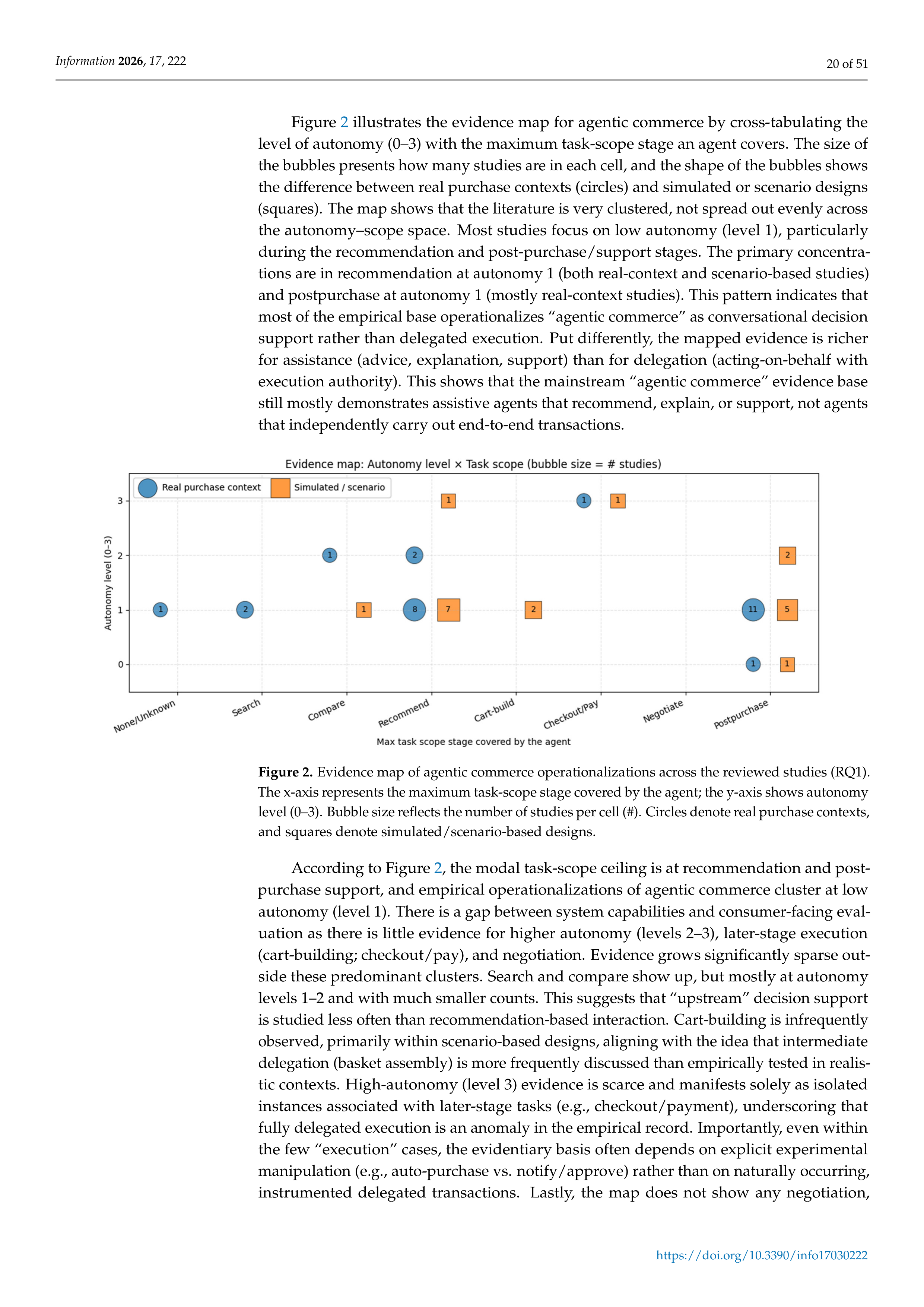
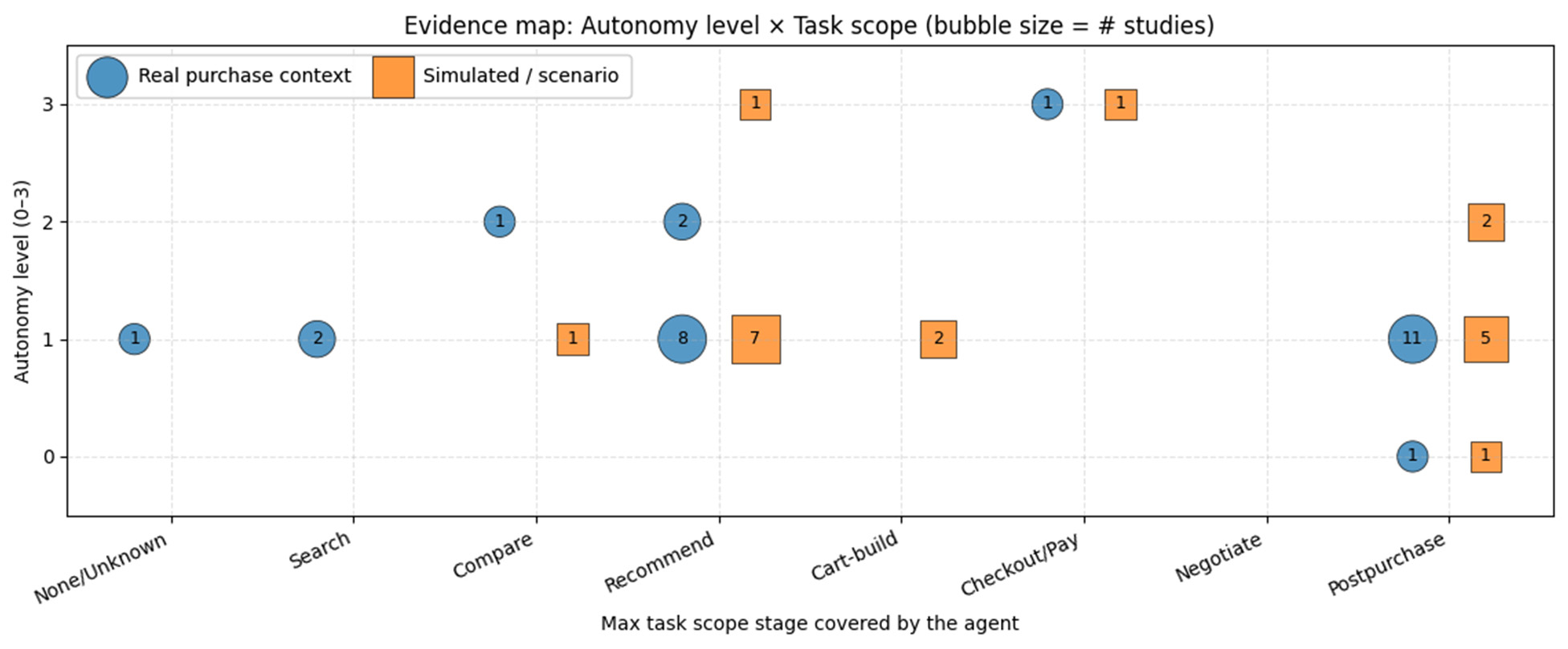
Information
2026
,
17
, 222
20 of 51
Figure
2
illustrates the evidence map for agentic commerce by cross-tabulating the
level of autonomy (0–3) with the maximum task-scope stage an agent covers.
The size of
the bubbles presents how many studies are in each cell, and the shape of the bubbles shows
the difference between real purchase contexts (circles) and simulated or scenario designs
(squares).
The map shows that the literature is very clustered, not spread out evenly across
the autonomy–scope space.
Most studies focus on low autonomy (level 1), particularly
during the recommendation and post-purchase/support stages.
The primary concentra-
tions are in recommendation at autonomy 1 (both real-context and scenario-based studies)
and postpurchase at autonomy 1 (mostly real-context studies).
This pattern indicates that
most of the empirical base operationalizes “agentic commerce” as conversational decision
support rather than delegated execution.
Put differently, the mapped evidence is richer
for
assistance
(advice,
explanation,
support)
than
for
delegation
(acting-on-behalf with
execution authority).
This shows that the mainstream “agentic commerce” evidence base
still mostly demonstrates assistive agents that recommend, explain, or support, not agents
that independently carry out end-to-end transactions.
Figure 2.
Evidence map of agentic commerce operationalizations across the reviewed studies (RQ1).
The x-axis represents the maximum task-scope stage covered by the agent; the y-axis shows autonomy
level (0–3). Bubble size reflects the number of studies per cell (#). Circles denote real purchase contexts,
and squares denote simulated/scenario-based designs.
According to Figure
2
, the modal task-scope ceiling is at recommendation and post-
purchase support, and empirical operationalizations of agentic commerce cluster at low
autonomy (level 1).
There is a gap between system capabilities and consumer-facing eval-
uation as there is little evidence for higher autonomy (levels 2–3),
later-stage execution
(cart-building; checkout/pay), and negotiation.
Evidence grows significantly sparse out-
side these predominant clusters.
Search and compare show up, but mostly at autonomy
levels 1–2 and with much smaller counts.
This suggests that “upstream” decision support
is studied less often than recommendation-based interaction.
Cart-building is infrequently
observed, primarily within scenario-based designs, aligning with the idea that intermediate
delegation (basket assembly) is more frequently discussed than empirically tested in realis-
tic contexts.
High-autonomy (level 3) evidence is scarce and manifests solely as isolated
instances associated with later-stage tasks (e.g.,
checkout/payment),
underscoring that
fully delegated execution is an anomaly in the empirical record.
Importantly, even within
the few “execution” cases, the evidentiary basis often depends on explicit experimental
manipulation (e.g., auto-purchase vs.
notify/approve) rather than on naturally occurring,
instrumented
delegated
transactions.
Lastly,
the
map
does
not
show
any
negotiation,
https://doi.org/10.3390/info17030222
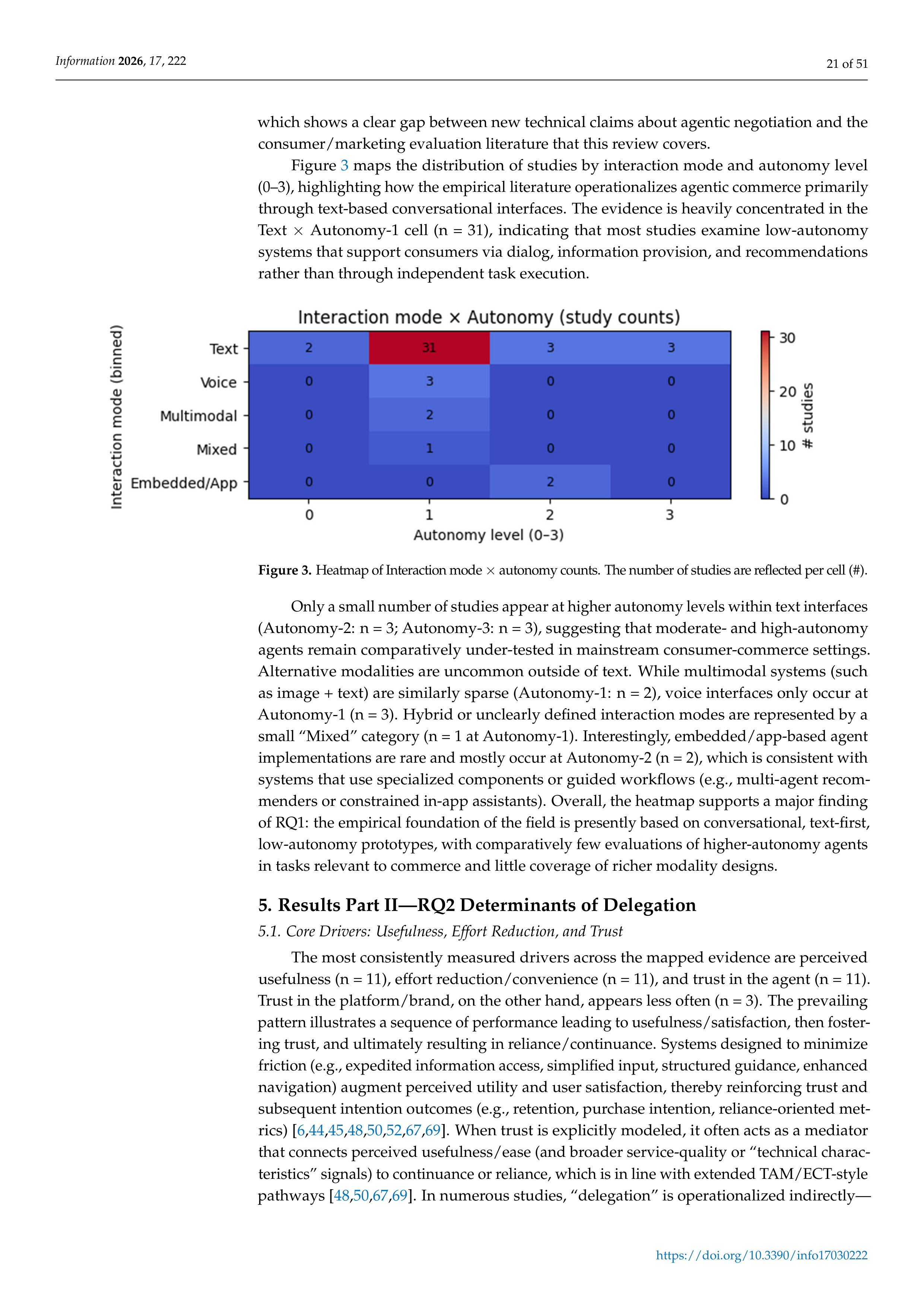
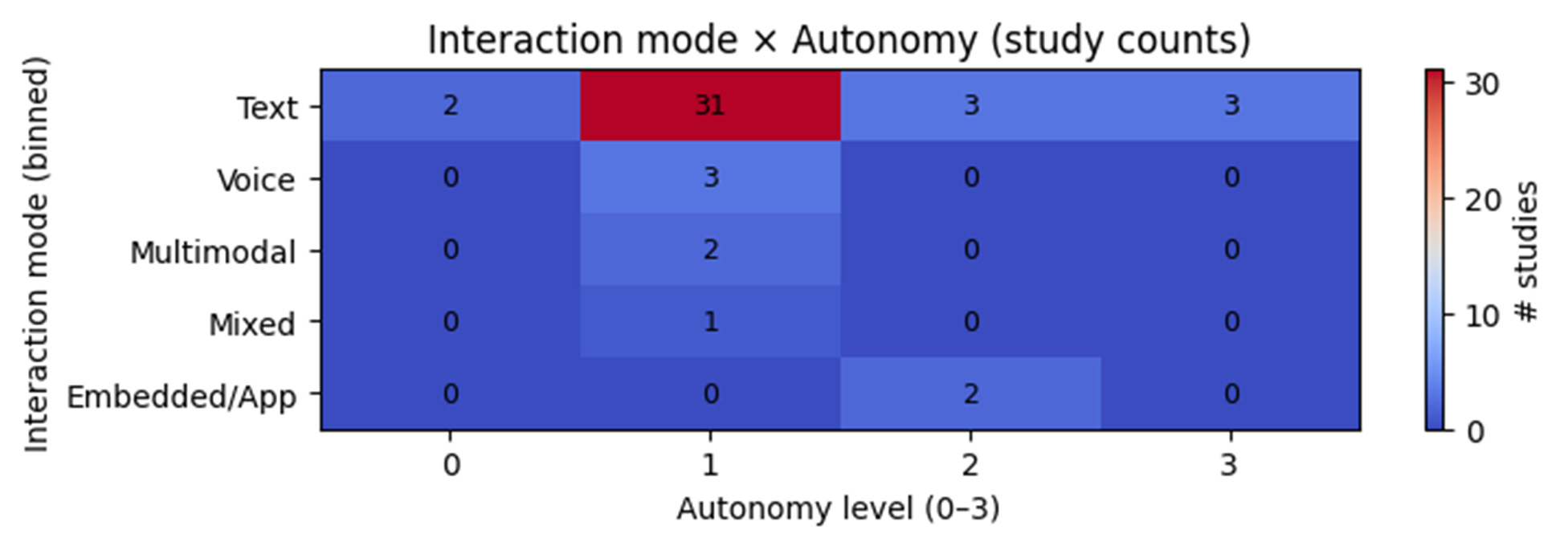
Information
2026
,
17
, 222
21 of 51
which shows a clear gap between new technical claims about agentic negotiation and the
consumer/marketing evaluation literature that this review covers.
Figure
3
maps the distribution of studies by interaction mode and autonomy level
(0–3), highlighting how the empirical literature operationalizes agentic commerce primarily
through text-based conversational interfaces.
The evidence is heavily concentrated in the
Text
×
Autonomy-1
cell
(n
=
31),
indicating
that
most
studies
examine
low-autonomy
systems that support consumers via dialog, information provision, and recommendations
rather than through independent task execution.
Figure 3.
Heatmap of Interaction mode
×
autonomy counts. The number of studies are reflected per cell (#).
Only a small number of studies appear at higher autonomy levels within text interfaces
(Autonomy-2:
n = 3; Autonomy-3:
n = 3), suggesting that moderate- and high-autonomy
agents remain comparatively under-tested in mainstream consumer-commerce settings.
Alternative modalities are uncommon outside of text.
While multimodal systems (such
as image + text) are similarly sparse (Autonomy-1:
n = 2), voice interfaces only occur at
Autonomy-1 (n = 3).
Hybrid or unclearly defined interaction modes are represented by a
small “Mixed” category (n = 1 at Autonomy-1).
Interestingly, embedded/app-based agent
implementations are rare and mostly occur at Autonomy-2 (n = 2), which is consistent with
systems that use specialized components or guided workflows (e.g., multi-agent recom-
menders or constrained in-app assistants).
Overall, the heatmap supports a major finding
of RQ1:
the empirical foundation of the field is presently based on conversational, text-first,
low-autonomy prototypes, with comparatively few evaluations of higher-autonomy agents
in tasks relevant to commerce and little coverage of richer modality designs.
5.
Results Part II—RQ2 Determinants of Delegation
5.1.
Core Drivers:
Usefulness, Effort Reduction, and Trust
The most consistently measured drivers across the mapped evidence are perceived
usefulness (n = 11), effort reduction/convenience (n = 11), and trust in the agent (n = 11).
Trust in the platform/brand, on the other hand, appears less often (n = 3).
The prevailing
pattern illustrates a sequence of performance leading to usefulness/satisfaction, then foster-
ing trust, and ultimately resulting in reliance/continuance.
Systems designed to minimize
friction (e.g., expedited information access, simplified input, structured guidance, enhanced
navigation) augment perceived utility and user satisfaction, thereby reinforcing trust and
subsequent intention outcomes (e.g., retention, purchase intention, reliance-oriented met-
rics) [
6
,
44
,
45
,
48
,
50
,
52
,
67
,
69
].
When trust is explicitly modeled, it often acts as a mediator
that connects perceived usefulness/ease (and broader service-quality or “technical charac-
teristics” signals) to continuance or reliance, which is in line with extended TAM/ECT-style
pathways [
48
,
50
,
67
,
69
].
In numerous studies, “delegation” is operationalized indirectly—
https://doi.org/10.3390/info17030222
Information
2026
,
17
, 222
22 of 51
through adoption, purchase intention, or continuance intention—rather than through a
direct delegation choice or verified hand-off/execution (e.g., [
44
–
46
,
50
,
52
,
67
]).
Evidence
with more behavior-proximal outcomes is available but is relatively scarce in the mapped
set (e.g., [
10
,
38
,
53
,
55
]).
5.2.
Control and Agency:
Empowerment Versus Reactance/Powerlessness
A second cluster centers on perceived control (n = 4), perceived autonomy/agency
(
n = 5
), and reactance/powerlessness (n = 4).
This stream illustrates that delegation encom-
passes both a utility assessment and a governance perspective:
when an agent transitions
from “advisor” to “decider/executor,” users may perceive diminished agency,
eliciting
threat-to-freedom reactions (reactance) or feelings of powerlessness, which inhibit adop-
tion and delegation intentions [
23
,
24
,
40
,
58
].
Experimental autonomy manipulations (e.g.,
auto-purchase vs.
notify) demonstrate that increased autonomy can diminish acceptance
via pathways of powerlessness [
40
,
58
].
Simultaneously, interface and interaction design
decisions
can
influence
these
responses:
the
type
of
assistant
and
the
initiation
mode
(user- vs.
system-initiated) affect reactance and subsequent satisfaction/choice certainty
outcomes [
24
], whereas personalization-based recommendation cues can induce avoidance
through threats to freedom and negative affect pathways, contingent upon user engage-
ment [
23
].
The control/agency evidence indicates a trade-off:
delegation increases when
agents perceive themselves as “capable yet still governable,” and decreases when autonomy
cues suggest displacement rather than support [
23
,
24
,
40
,
58
].
5.3.
Risk and Privacy:
Barrier Pathways and the Limited Role of Transparency Testing
Privacy concern (n = 4) and perceived risk (n = 3) manifest less frequently than useful-
ness/trust and exhibit more heterogeneous effects.
Numerous models conceptualize risk
and privacy as impediments that amplify adverse emotions and resistance or directly inhibit
purchase or adoption intentions [
4
,
49
,
67
].
Nonetheless, additional evidence suggests that
risk/privacy may be insignificant compared to gratification and utility drivers in specific
contexts/samples [
42
], and that effects may differ based on usage frequency/experience [
4
].
Importantly for “agentic” delegation governance, while transparency and disclosure are
frequently examined conceptually, there is a scarcity of empirical studies that operational-
ize
transparency
as
a
significant
governance
factor
(e.g.,
approval
gates,
explainability,
accountability cues).
When disclosure is modeled, it typically functions as an antecedent
or contextual factor rather than a direct delegation-control mechanism; for instance, dis-
closure
can
influence
perceived
quality
in
an
ECT
chain
or
moderate
attribute-to-trust
relationships [
50
,
51
].
Consequently, the available evidence is insufficient regarding when
transparency effectively adjusts trust and mitigates over-delegation or regret as systems
transition from assistive chatbots to transaction-executing agents.
5.4.
Boundary Conditions:
When Delegation Drivers Strengthen, Weaken, or Reverse
Moderation and boundary conditions are reported inconsistently (moderators tested:
varied
across
determinants),
yet
several
recurring
themes
surface.
First,
beliefs
about
one’s ability (such as perceived task-solving competence) strengthen the usefulness and
trust routes stronger.
Delegation is more likely when the agent is seen as competent for
the task [
51
,
52
,
69
].
Second, task and contextual pressures influence autonomy responses:
scarcity and time constraints can diminish the negative autonomy-to-powerlessness tra-
jectory, rendering elevated autonomy more acceptable in urgent situations [
40
,
41
].
Third,
user characteristics and experience (technological readiness/AI literacy n = 5; self-efficacy
n = 5; prior usage/experience) consistently function as acceptance “facilitators,” enhancing
positive pathways to persistence or reliance [
4
,
7
,
39
,
46
,
68
,
69
].
Fourth, design and channel
factors (voice vs.
text; initiation mode; anthropomorphic cues) influence perceived con-
https://doi.org/10.3390/info17030222
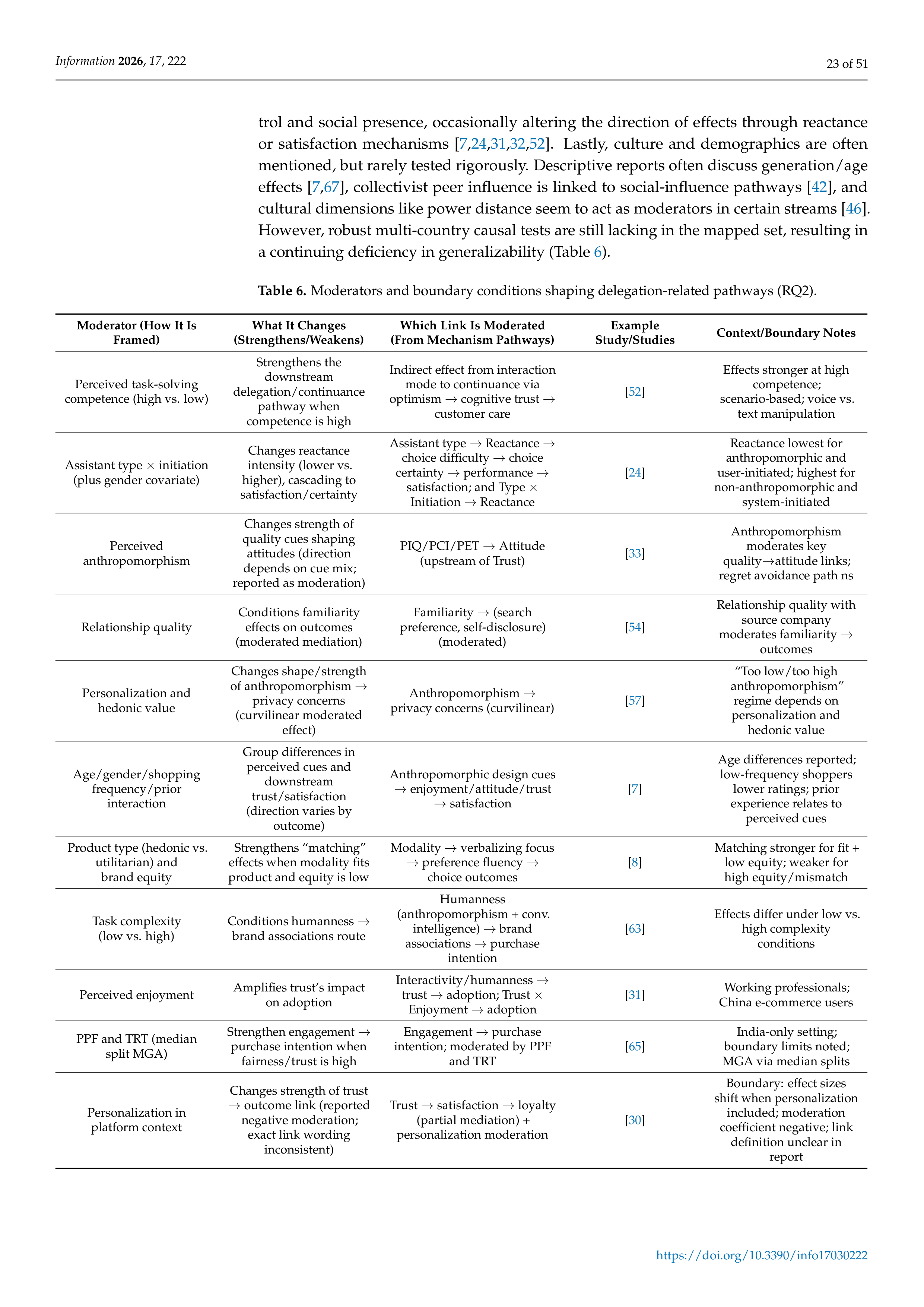
Information
2026
,
17
, 222
23 of 51
trol and social presence,
occasionally altering the direction of effects through reactance
or
satisfaction
mechanisms
[
7
,
24
,
31
,
32
,
52
].
Lastly,
culture
and
demographics
are
often
mentioned, but rarely tested rigorously.
Descriptive reports often discuss generation/age
effects [
7
,
67
],
collectivist peer influence is linked to social-influence pathways [
42
],
and
cultural dimensions like power distance seem to act as moderators in certain streams [
46
].
However, robust multi-country causal tests are still lacking in the mapped set, resulting in
a continuing deficiency in generalizability (Table
6
).
Table 6.
Moderators and boundary conditions shaping delegation-related pathways (RQ2).
Moderator (How It Is
Framed)
What It Changes
(Strengthens/Weakens)
Which Link Is Moderated
(From Mechanism Pathways)
Example
Study/Studies
Context/Boundary Notes
Perceived task-solving
competence (high vs.
low)
Strengthens the
downstream
delegation/continuance
pathway when
competence is high
Indirect effect from interaction
mode to continuance via
optimism
→
cognitive trust
→
customer care
[
52
]
Effects stronger at high
competence;
scenario-based; voice vs.
text manipulation
Assistant type
×
initiation
(plus gender covariate)
Changes reactance
intensity (lower vs.
higher), cascading to
satisfaction/certainty
Assistant type
→
Reactance
→
choice difficulty
→
choice
certainty
→
performance
→
satisfaction; and Type
×
Initiation
→
Reactance
[
24
]
Reactance lowest for
anthropomorphic and
user-initiated; highest for
non-anthropomorphic and
system-initiated
Perceived
anthropomorphism
Changes strength of
quality cues shaping
attitudes (direction
depends on cue mix;
reported as moderation)
PIQ/PCI/PET
→
Attitude
(upstream of Trust)
[
33
]
Anthropomorphism
moderates key
quality
→
attitude links;
regret avoidance path ns
Relationship quality
Conditions familiarity
effects on outcomes
(moderated mediation)
Familiarity
→
(search
preference, self-disclosure)
(moderated)
[
54
]
Relationship quality with
source company
moderates familiarity
→
outcomes
Personalization and
hedonic value
Changes shape/strength
of anthropomorphism
→
privacy concerns
(curvilinear moderated
effect)
Anthropomorphism
→
privacy concerns (curvilinear)
[
57
]
“Too low/too high
anthropomorphism”
regime depends on
personalization and
hedonic value
Age/gender/shopping
frequency/prior
interaction
Group differences in
perceived cues and
downstream
trust/satisfaction
(direction varies by
outcome)
Anthropomorphic design cues
→
enjoyment/attitude/trust
→
satisfaction
[
7
]
Age differences reported;
low-frequency shoppers
lower ratings; prior
experience relates to
perceived cues
Product type (hedonic vs.
utilitarian) and
brand equity
Strengthens “matching”
effects when modality fits
product and equity is low
Modality
→
verbalizing focus
→
preference fluency
→
choice outcomes
[
8
]
Matching stronger for fit +
low equity; weaker for
high equity/mismatch
Task complexity
(low vs.
high)
Conditions humanness
→
brand associations route
Humanness
(anthropomorphism + conv.
intelligence)
→
brand
associations
→
purchase
intention
[
63
]
Effects differ under low vs.
high complexity
conditions
Perceived enjoyment
Amplifies trust’s impact
on adoption
Interactivity/humanness
→
trust
→
adoption; Trust
×
Enjoyment
→
adoption
[
31
]
Working professionals;
China e-commerce users
PPF and TRT (median
split MGA)
Strengthen engagement
→
purchase intention when
fairness/trust is high
Engagement
→
purchase
intention; moderated by PPF
and TRT
[
65
]
India-only setting;
boundary limits noted;
MGA via median splits
Personalization in
platform context
Changes strength of trust
→
outcome link (reported
negative moderation;
exact link wording
inconsistent)
Trust
→
satisfaction
→
loyalty
(partial mediation) +
personalization moderation
[
30
]
Boundary:
effect sizes
shift when personalization
included; moderation
coefficient negative; link
definition unclear in
report
https://doi.org/10.3390/info17030222
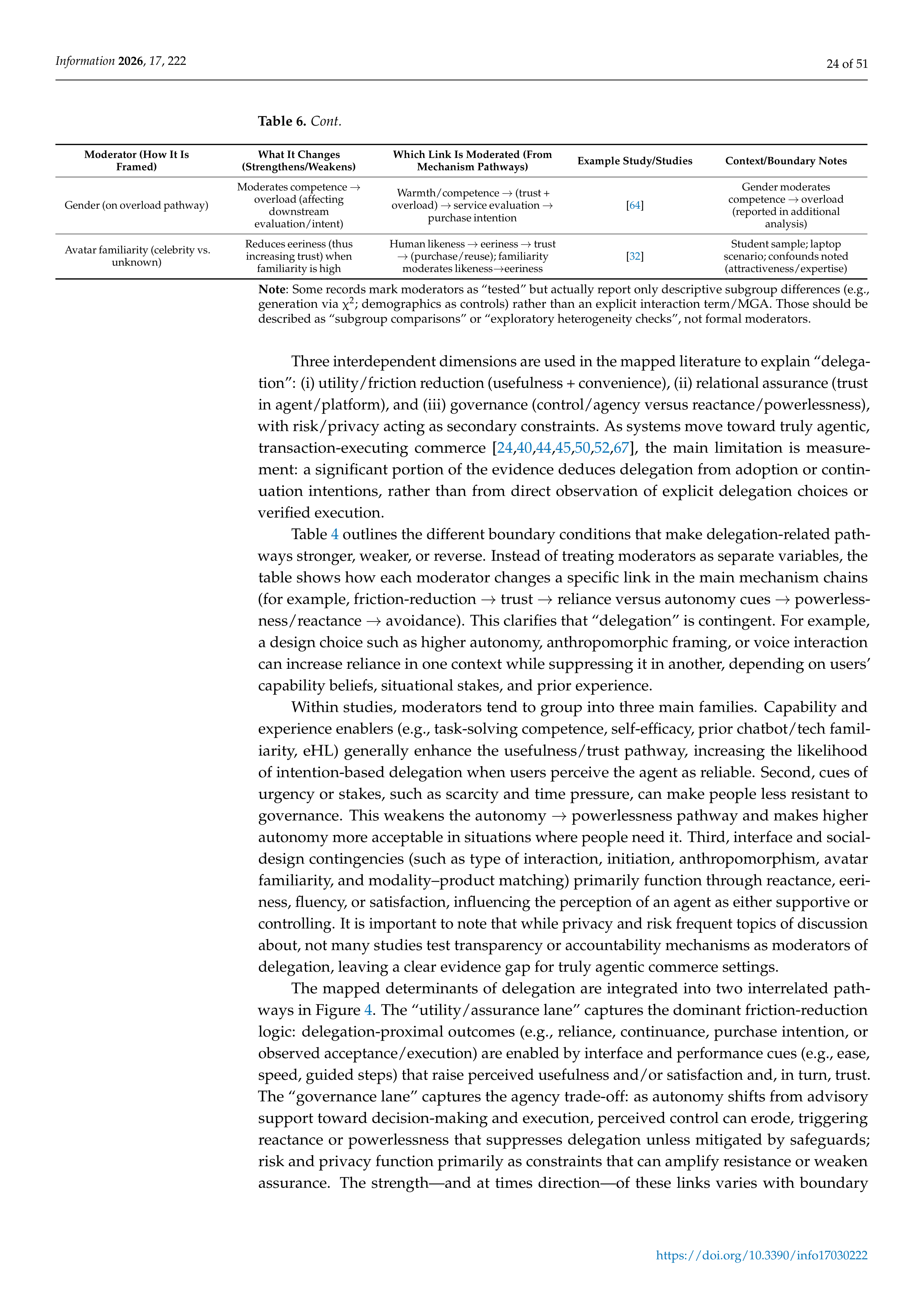
Information
2026
,
17
, 222
24 of 51
Table 6.
Cont.
Moderator (How It Is
Framed)
What It Changes
(Strengthens/Weakens)
Which Link Is Moderated (From
Mechanism Pathways)
Example Study/Studies
Context/Boundary Notes
Gender (on overload pathway)
Moderates competence
→
overload (affecting
downstream
evaluation/intent)
Warmth/competence
→
(trust +
overload)
→
service evaluation
→
purchase intention
[
64
]
Gender moderates
competence
→
overload
(reported in additional
analysis)
Avatar familiarity (celebrity vs.
unknown)
Reduces eeriness (thus
increasing trust) when
familiarity is high
Human likeness
→
eeriness
→
trust
→
(purchase/reuse); familiarity
moderates likeness
→
eeriness
[
32
]
Student sample; laptop
scenario; confounds noted
(attractiveness/expertise)
Note
:
Some records mark moderators as “tested” but actually report only descriptive subgroup differences (e.g.,
generation via
χ
2
;
demographics as controls) rather than an explicit interaction term/MGA. Those should be
described as “subgroup comparisons” or “exploratory heterogeneity checks”, not formal moderators.
Three interdependent dimensions are used in the mapped literature to explain “delega-
tion”: (i) utility/friction reduction (usefulness + convenience), (ii) relational assurance (trust
in agent/platform), and (iii) governance (control/agency versus reactance/powerlessness),
with risk/privacy acting as secondary constraints.
As systems move toward truly agentic,
transaction-executing
commerce
[
24
,
40
,
44
,
45
,
50
,
52
,
67
],
the
main
limitation
is
measure-
ment:
a significant portion of the evidence deduces delegation from adoption or contin-
uation
intentions,
rather
than
from
direct
observation
of
explicit
delegation
choices
or
verified execution.
Table
4
outlines the different boundary conditions that make delegation-related path-
ways stronger, weaker, or reverse.
Instead of treating moderators as separate variables, the
table shows how each moderator changes a specific link in the main mechanism chains
(for example, friction-reduction
→
trust
→
reliance versus autonomy cues
→
powerless-
ness/reactance
→
avoidance).
This clarifies that “delegation” is contingent.
For example,
a design choice such as higher autonomy, anthropomorphic framing, or voice interaction
can increase reliance in one context while suppressing it in another, depending on users’
capability beliefs, situational stakes, and prior experience.
Within studies, moderators tend to group into three main families.
Capability and
experience enablers (e.g., task-solving competence, self-efficacy, prior chatbot/tech famil-
iarity,
eHL)
generally
enhance
the
usefulness/trust
pathway,
increasing
the
likelihood
of intention-based delegation when users perceive the agent as reliable.
Second, cues of
urgency or stakes, such as scarcity and time pressure, can make people less resistant to
governance.
This weakens the autonomy
→
powerlessness pathway and makes higher
autonomy more acceptable in situations where people need it.
Third, interface and social-
design contingencies (such as type of interaction, initiation, anthropomorphism, avatar
familiarity, and modality–product matching) primarily function through reactance, eeri-
ness, fluency, or satisfaction, influencing the perception of an agent as either supportive or
controlling.
It is important to note that while privacy and risk frequent topics of discussion
about, not many studies test transparency or accountability mechanisms as moderators of
delegation, leaving a clear evidence gap for truly agentic commerce settings.
The
mapped
determinants
of
delegation
are
integrated
into
two
interrelated
path-
ways in Figure
4
.
The “utility/assurance lane” captures the dominant friction-reduction
logic:
delegation-proximal outcomes (e.g., reliance, continuance, purchase intention, or
observed acceptance/execution) are enabled by interface and performance cues (e.g., ease,
speed, guided steps) that raise perceived usefulness and/or satisfaction and, in turn, trust.
The “governance lane” captures the agency trade-off:
as autonomy shifts from advisory
support toward decision-making and execution, perceived control can erode, triggering
reactance
or
powerlessness
that
suppresses
delegation
unless
mitigated
by
safeguards;
risk and privacy function primarily as constraints that can amplify resistance or weaken
assurance.
The
strength—and
at
times
direction—of
these
links
varies
with
boundary
https://doi.org/10.3390/info17030222
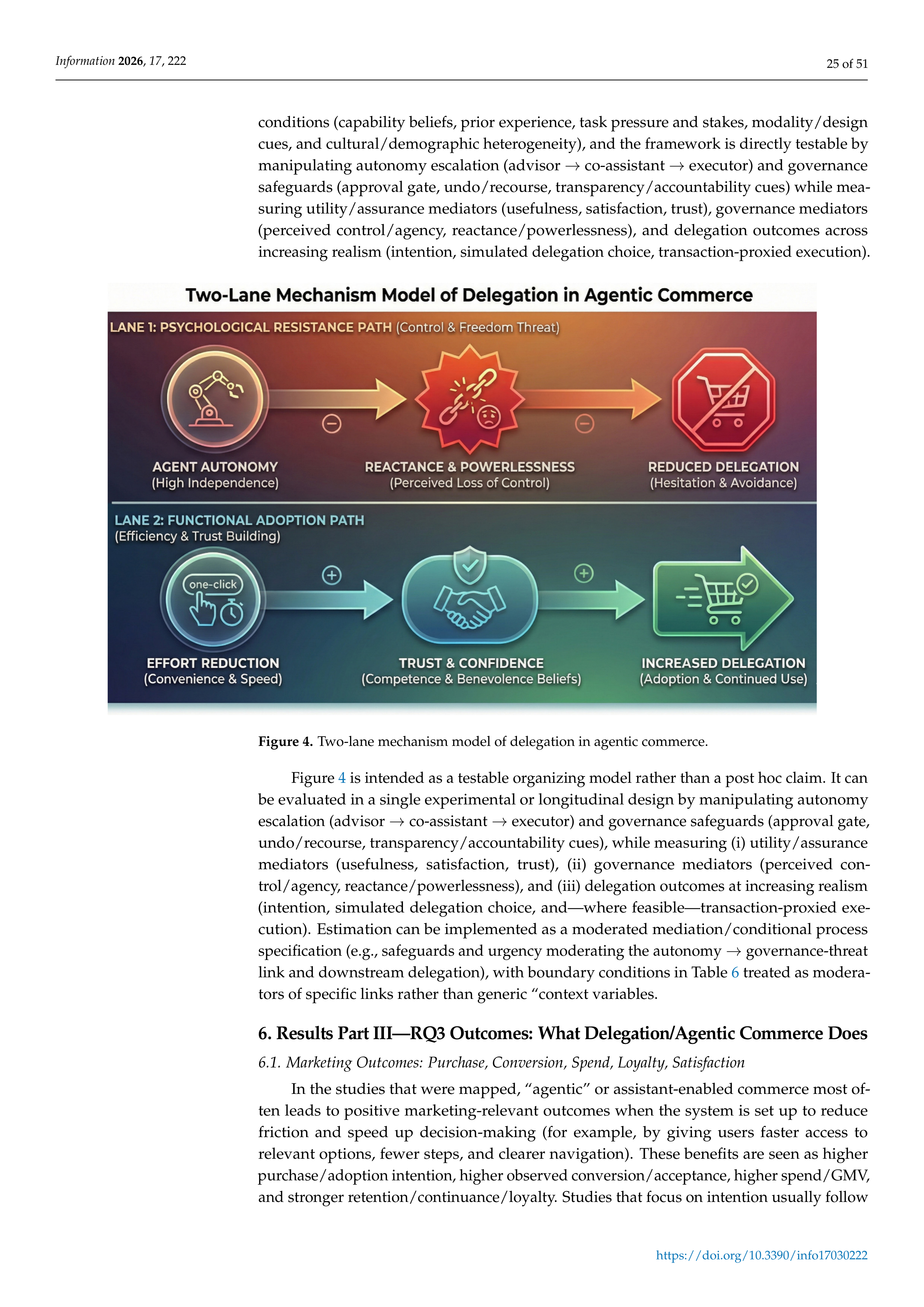
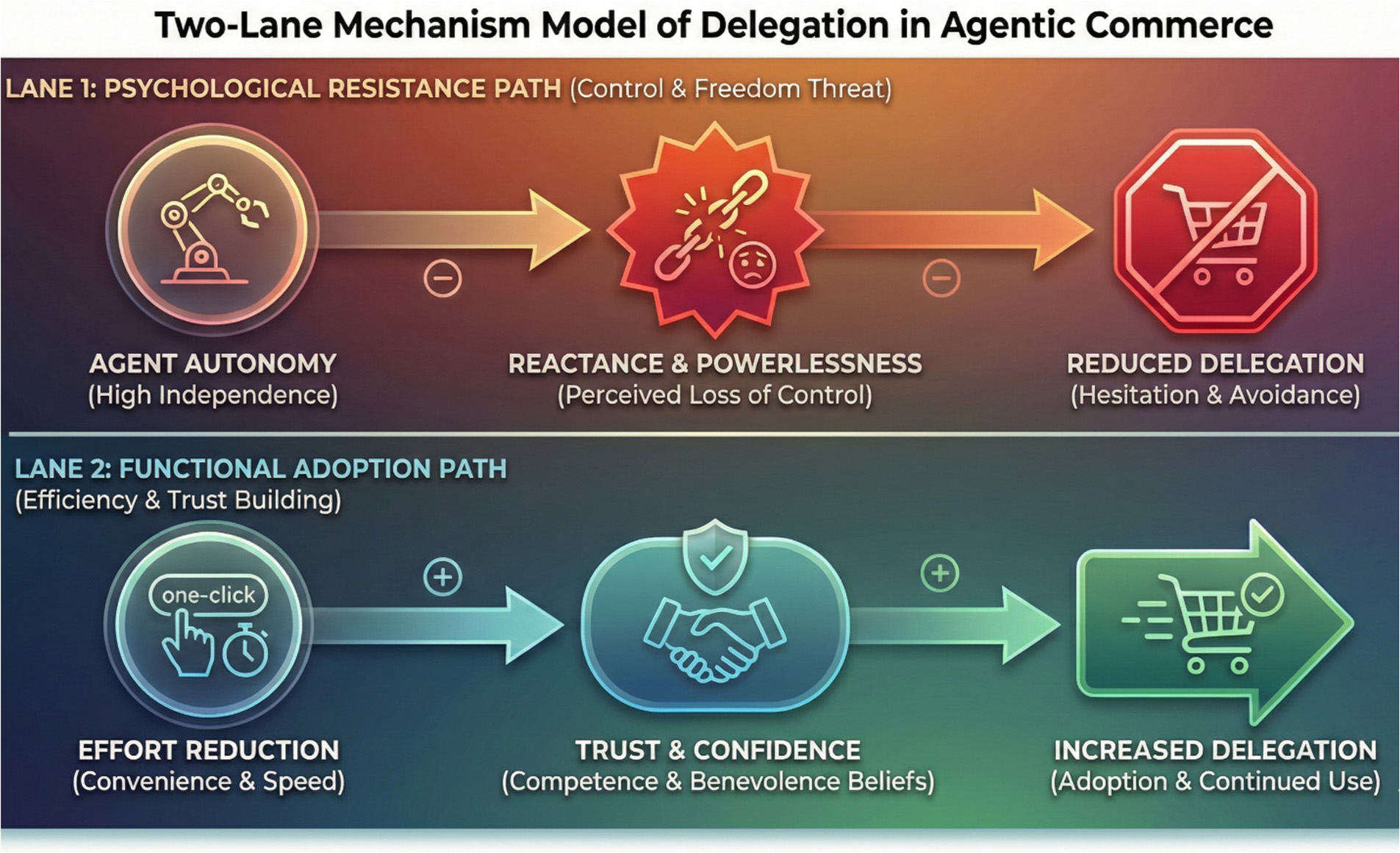
Information
2026
,
17
, 222
25 of 51
conditions (capability beliefs, prior experience, task pressure and stakes, modality/design
cues, and cultural/demographic heterogeneity), and the framework is directly testable by
manipulating autonomy escalation (advisor
→
co-assistant
→
executor) and governance
safeguards (approval gate, undo/recourse, transparency/accountability cues) while mea-
suring utility/assurance mediators (usefulness, satisfaction, trust), governance mediators
(perceived
control/agency,
reactance/powerlessness),
and
delegation
outcomes
across
increasing realism (intention, simulated delegation choice, transaction-proxied execution).
Figure 4.
Two-lane mechanism model of delegation in agentic commerce.
Figure
4
is intended as a testable organizing model rather than a post hoc claim.
It can
be evaluated in a single experimental or longitudinal design by manipulating autonomy
escalation (advisor
→
co-assistant
→
executor) and governance safeguards (approval gate,
undo/recourse, transparency/accountability cues), while measuring (i) utility/assurance
mediators
(usefulness,
satisfaction,
trust),
(ii)
governance
mediators
(perceived
con-
trol/agency, reactance/powerlessness), and (iii) delegation outcomes at increasing realism
(intention,
simulated
delegation
choice,
and—where
feasible—transaction-proxied
exe-
cution).
Estimation can be implemented as a moderated mediation/conditional process
specification (e.g., safeguards and urgency moderating the autonomy
→
governance-threat
link and downstream delegation), with boundary conditions in Table
6
treated as modera-
tors of specific links rather than generic “context variables.
6. Results Part III—RQ3 Outcomes: What Delegation/Agentic Commerce Does
6.1.
Marketing Outcomes:
Purchase, Conversion, Spend, Loyalty, Satisfaction
In the studies that were mapped, “agentic” or assistant-enabled commerce most of-
ten leads to positive marketing-relevant outcomes when the system is set up to reduce
friction
and
speed
up
decision-making
(for
example,
by
giving
users
faster
access
to
relevant options, fewer steps, and clearer navigation).
These benefits are seen as higher
purchase/adoption intention, higher observed conversion/acceptance, higher spend/GMV,
and stronger retention/continuance/loyalty.
Studies that focus on intention usually follow
https://doi.org/10.3390/info17030222
Information
2026
,
17
, 222
26 of 51
the extended TAM/ECT/TPB logic, which says that quality/usefulness and confirmation
lead to higher satisfaction and/or attitudes, which then predict outcomes like continued
use, purchase intention, or loyalty (e.g., [
21
,
30
,
44
,
46
,
48
,
50
,
66
,
69
,
70
]).
Field and quasi-field
designs demonstrate that enhancements in performance can lead to quantifiable business re-
sults, such as increased option acceptance and GMV per user [
10
], heightened click-through
rates under scarcity–autonomy framing [
41
], and elevated repurchase rates following an
experimental recommendation treatment in a live-store environment [
55
].
However, marketing outcomes are not uniformly positive.
Some studies show that
design
elements
that
give
agents
more
freedom
or
make
them
feel
more
personal
can
make people less likely to buy [
23
,
40
], and some situations show that “trust” or “capability
affordances” do not always lead to buying intention (for example, CA
→
trust not leading
to PI in Yatawara et al. [
22
]).
When systems continue to be seen as helpful, capable, and
efficient while still giving users control, rather than taking away their freedom, the best
marketing results happen.
6.2.
Consumer Outcomes:
Trust Calibration, Reliance/Overreliance, Autonomy/Control, Fairness,
Regret/Blame
Consumer
outcomes
are
not
as
consistently
covered
as
marketing
outcomes,
and
measurement
is
often
indirect.
“Trust”
is
frequently
conceptualized
as
a
mediator
or
downstream
belief;
however,
formal
trust
calibration
(distinguishing
appropriate
trust
from
miscalibrated
overtrust)
is
seldom
implemented
within
the
mapped
framework.
When “trust calibration” is indicated,
the implementation typically mirrors trust levels
within satisfaction/experience frameworks rather than calibration tests under varying accu-
racy/accountability conditions (e.g., [
42
,
68
]).
Evidence regarding reliance is more definitive
than that concerning overreliance:
reliance generally escalates with trust and diminishes
with resistance, while task complexity and disclosure influence the translation of empa-
thy and friendliness cues into trust [
51
], and trust directly forecasts reliance in simplified
models [
53
].
Across studies, calibration indicators such as confidence–accuracy alignment,
verification frequency, and reliance adjustment after errors are rarely reported; thus, ‘trust’
should be interpreted primarily as an attitudinal belief rather than an appropriateness-of-
reliance measure.
Outcomes
related
to
control
and
autonomy/agency
exhibit
the
most
pronounced
“agentic-commerce” signature.
Several studies indicate that when systems signal greater
autonomy (e.g., auto-execution), users may experience diminished control or agency due
to
feelings
of
powerlessness
or
perceived
threats
to
freedom,
thereby
inhibiting
adop-
tion
intentions
[
40
].
Other
research,
however,
shows
that
design
can
also
boost
per-
ceived
autonomy
and
psychological
ownership,
which
can
boost
trust
and
sometimes
attitudes
toward
the
product
[
38
].
This
indicates
that
governance
is
a
key
consumer
outcome
domain:
agentic
systems
can
either
facilitate
agency
(ownership,
controlla-
bility)
or
undermine
it
(powerlessness),
impacting
downstream
acceptance.
Fairness
constructs primarily function as boundary-strengtheners (e.g., price fairness enhancing
the
engagement
→
continuous
purchase intention relationship [
65
]), whereas explicit re-
gret/blame attribution outcomes are predominantly absent in the coded set (despite their
conceptual significance in delegation contexts).
6.3.
Net-Positive vs.
Net-Negative Regimes:
When Outcomes Flip
The mapped results indicate that, depending on how agency and efficiency are per-
ceived, delegation-related effects cluster into recognizable “regimes” where impacts change
from net-positive to net-negative.
Systems that provide clear utility—higher perceived use-
fulness, confirmation, and satisfaction—while maintaining user control over consequential
decisions
yield
the
best
results
in
a
net-positive
regime.
According
to
numerous
stud-
https://doi.org/10.3390/info17030222
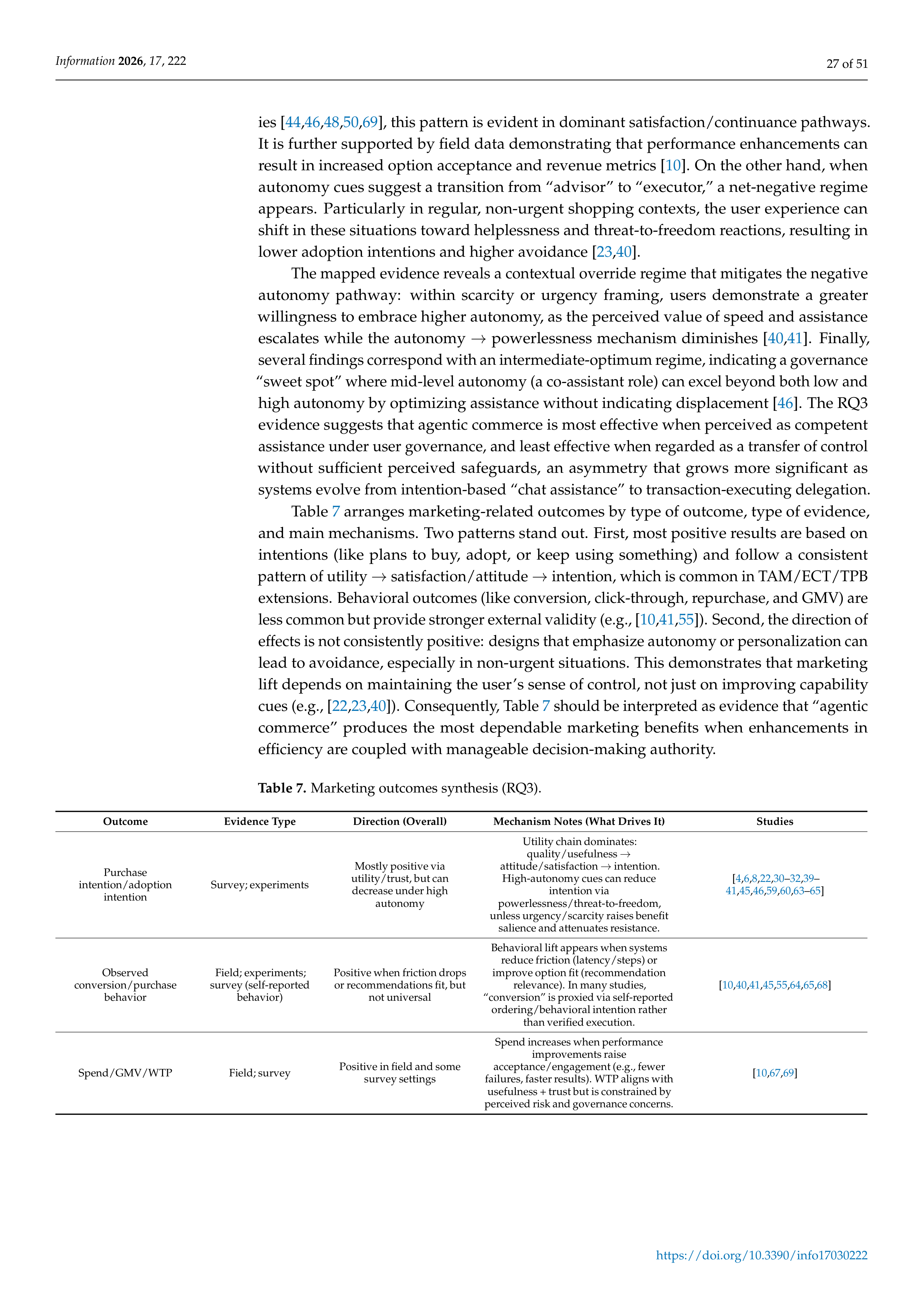
Information
2026
,
17
, 222
27 of 51
ies [
44
,
46
,
48
,
50
,
69
], this pattern is evident in dominant satisfaction/continuance pathways.
It is further supported by field data demonstrating that performance enhancements can
result in increased option acceptance and revenue metrics [
10
].
On the other hand, when
autonomy cues suggest a transition from “advisor” to “executor,” a net-negative regime
appears.
Particularly in regular, non-urgent shopping contexts, the user experience can
shift in these situations toward helplessness and threat-to-freedom reactions, resulting in
lower adoption intentions and higher avoidance [
23
,
40
].
The mapped evidence reveals a contextual override regime that mitigates the negative
autonomy
pathway:
within
scarcity
or
urgency
framing,
users
demonstrate
a
greater
willingness to embrace higher autonomy, as the perceived value of speed and assistance
escalates while the autonomy
→
powerlessness mechanism diminishes [
40
,
41
].
Finally,
several findings correspond with an intermediate-optimum regime, indicating a governance
“sweet spot” where mid-level autonomy (a co-assistant role) can excel beyond both low and
high autonomy by optimizing assistance without indicating displacement [
46
].
The RQ3
evidence suggests that agentic commerce is most effective when perceived as competent
assistance under user governance, and least effective when regarded as a transfer of control
without
sufficient
perceived
safeguards,
an
asymmetry
that
grows
more
significant
as
systems evolve from intention-based “chat assistance” to transaction-executing delegation.
Table
7
arranges marketing-related outcomes by type of outcome, type of evidence,
and main mechanisms.
Two patterns stand out.
First, most positive results are based on
intentions
(like
plans
to
buy,
adopt,
or
keep
using
something)
and
follow
a
consistent
pattern of utility
→
satisfaction/attitude
→
intention, which is common in TAM/ECT/TPB
extensions.
Behavioral outcomes (like conversion, click-through, repurchase, and GMV) are
less common but provide stronger external validity (e.g., [
10
,
41
,
55
]). Second, the direction of
effects is not consistently positive: designs that emphasize autonomy or personalization can
lead to avoidance, especially in non-urgent situations.
This demonstrates that marketing
lift depends on maintaining the user’s sense of control, not just on improving capability
cues (e.g., [
22
,
23
,
40
]).
Consequently, Table
7
should be interpreted as evidence that “agentic
commerce”
produces
the
most
dependable
marketing
benefits
when
enhancements
in
efficiency are coupled with manageable decision-making authority.
Table 7.
Marketing outcomes synthesis (RQ3).
Outcome
Evidence Type
Direction (Overall)
Mechanism Notes (What Drives It)
Studies
Purchase
intention/adoption
intention
Survey; experiments
Mostly positive via
utility/trust, but can
decrease under high
autonomy
Utility chain dominates:
quality/usefulness
→
attitude/satisfaction
→
intention.
High-autonomy cues can reduce
intention via
powerlessness/threat-to-freedom,
unless urgency/scarcity raises benefit
salience and attenuates resistance.
[
4
,
6
,
8
,
22
,
30
–
32
,
39
–
41
,
45
,
46
,
59
,
60
,
63
–
65
]
Observed
conversion/purchase
behavior
Field; experiments;
survey (self-reported
behavior)
Positive when friction drops
or recommendations fit, but
not universal
Behavioral lift appears when systems
reduce friction (latency/steps) or
improve option fit (recommendation
relevance). In many studies,
“conversion” is proxied via self-reported
ordering/behavioral intention rather
than verified execution.
[
10
,
40
,
41
,
45
,
55
,
64
,
65
,
68
]
Spend/GMV/WTP
Field; survey
Positive in field and some
survey settings
Spend increases when performance
improvements raise
acceptance/engagement (e.g., fewer
failures, faster results). WTP aligns with
usefulness + trust but is constrained by
perceived risk and governance concerns.
[
10
,
67
,
69
]
https://doi.org/10.3390/info17030222
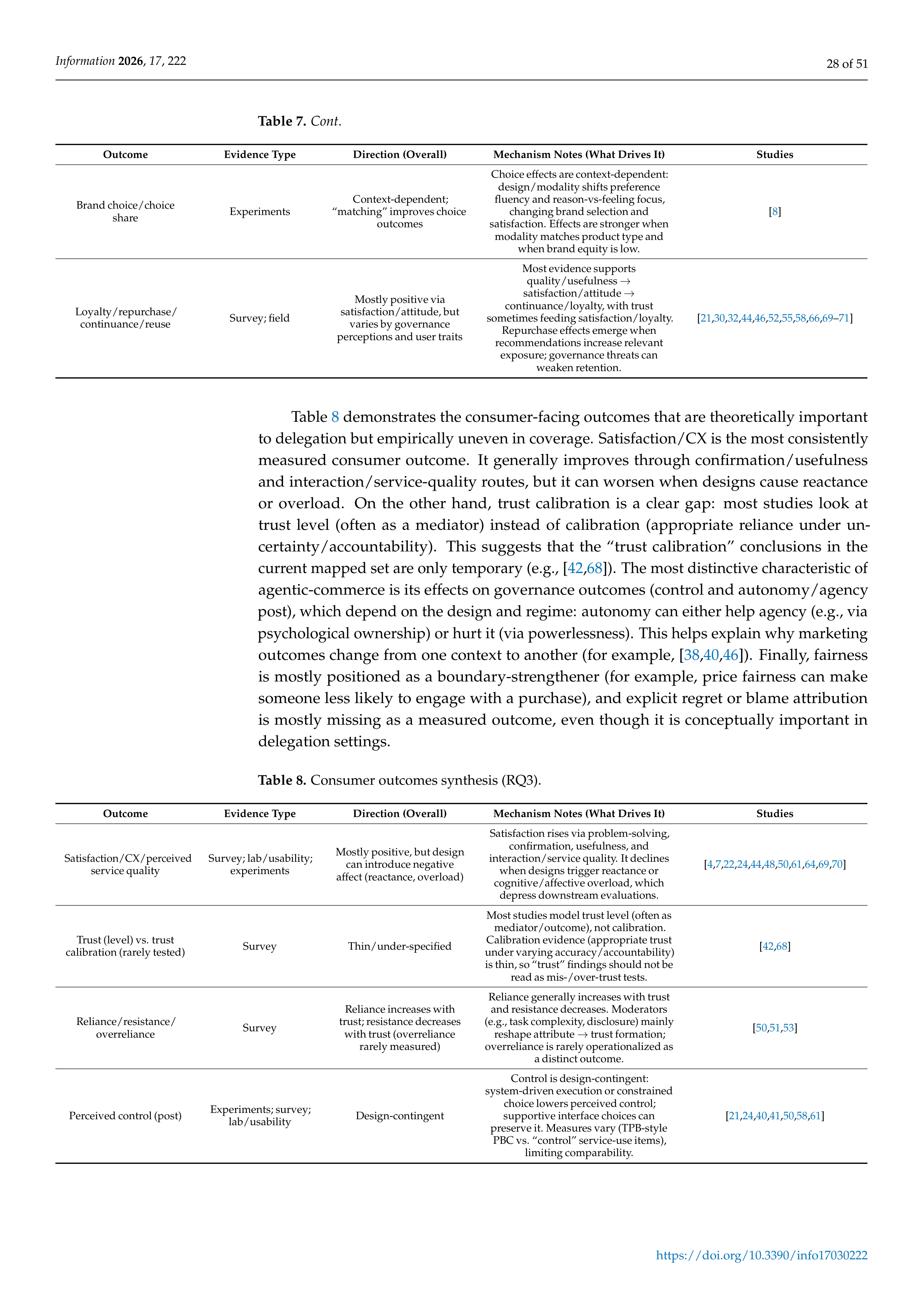
Information
2026
,
17
, 222
28 of 51
Table 7.
Cont.
Outcome
Evidence Type
Direction (Overall)
Mechanism Notes (What Drives It)
Studies
Brand choice/choice
share
Experiments
Context-dependent;
“matching” improves choice
outcomes
Choice effects are context-dependent:
design/modality shifts preference
fluency and reason-vs-feeling focus,
changing brand selection and
satisfaction. Effects are stronger when
modality matches product type and
when brand equity is low.
[
8
]
Loyalty/repurchase/
continuance/reuse
Survey; field
Mostly positive via
satisfaction/attitude, but
varies by governance
perceptions and user traits
Most evidence supports
quality/usefulness
→
satisfaction/attitude
→
continuance/loyalty, with trust
sometimes feeding satisfaction/loyalty.
Repurchase effects emerge when
recommendations increase relevant
exposure; governance threats can
weaken retention.
[
21
,
30
,
32
,
44
,
46
,
52
,
55
,
58
,
66
,
69
–
71
]
Table
8
demonstrates the consumer-facing outcomes that are theoretically important
to delegation but empirically uneven in coverage.
Satisfaction/CX is the most consistently
measured
consumer
outcome.
It
generally
improves
through
confirmation/usefulness
and interaction/service-quality routes, but it can worsen when designs cause reactance
or
overload.
On
the
other
hand,
trust
calibration
is
a
clear
gap:
most
studies
look
at
trust
level
(often
as
a
mediator)
instead
of
calibration
(appropriate
reliance
under
un-
certainty/accountability).
This
suggests
that
the
“trust
calibration”
conclusions
in
the
current mapped set are only temporary (e.g., [
42
,
68
]).
The most distinctive characteristic of
agentic-commerce is its effects on governance outcomes (control and autonomy/agency
post), which depend on the design and regime:
autonomy can either help agency (e.g., via
psychological ownership) or hurt it (via powerlessness).
This helps explain why marketing
outcomes change from one context to another (for example, [
38
,
40
,
46
]).
Finally, fairness
is
mostly
positioned
as
a
boundary-strengthener
(for
example,
price
fairness
can
make
someone less likely to engage with a purchase), and explicit regret or blame attribution
is
mostly
missing
as
a
measured
outcome,
even
though
it
is
conceptually
important
in
delegation settings.
Table 8.
Consumer outcomes synthesis (RQ3).
Outcome
Evidence Type
Direction (Overall)
Mechanism Notes (What Drives It)
Studies
Satisfaction/CX/perceived
service quality
Survey; lab/usability;
experiments
Mostly positive, but design
can introduce negative
affect (reactance, overload)
Satisfaction rises via problem-solving,
confirmation, usefulness, and
interaction/service quality. It declines
when designs trigger reactance or
cognitive/affective overload, which
depress downstream evaluations.
[
4
,
7
,
22
,
24
,
44
,
48
,
50
,
61
,
64
,
69
,
70
]
Trust (level) vs. trust
calibration (rarely tested)
Survey
Thin/under-specified
Most studies model trust level (often as
mediator/outcome), not calibration.
Calibration evidence (appropriate trust
under varying accuracy/accountability)
is thin, so “trust” findings should not be
read as mis-/over-trust tests.
[
42
,
68
]
Reliance/resistance/
overreliance
Survey
Reliance increases with
trust; resistance decreases
with trust (overreliance
rarely measured)
Reliance generally increases with trust
and resistance decreases. Moderators
(e.g., task complexity, disclosure) mainly
reshape attribute
→
trust formation;
overreliance is rarely operationalized as
a distinct outcome.
[
50
,
51
,
53
]
Perceived control (post)
Experiments; survey;
lab/usability
Design-contingent
Control is design-contingent:
system-driven execution or constrained
choice lowers perceived control;
supportive interface choices can
preserve it. Measures vary (TPB-style
PBC vs. “control” service-use items),
limiting comparability.
[
21
,
24
,
40
,
41
,
50
,
58
,
61
]
https://doi.org/10.3390/info17030222
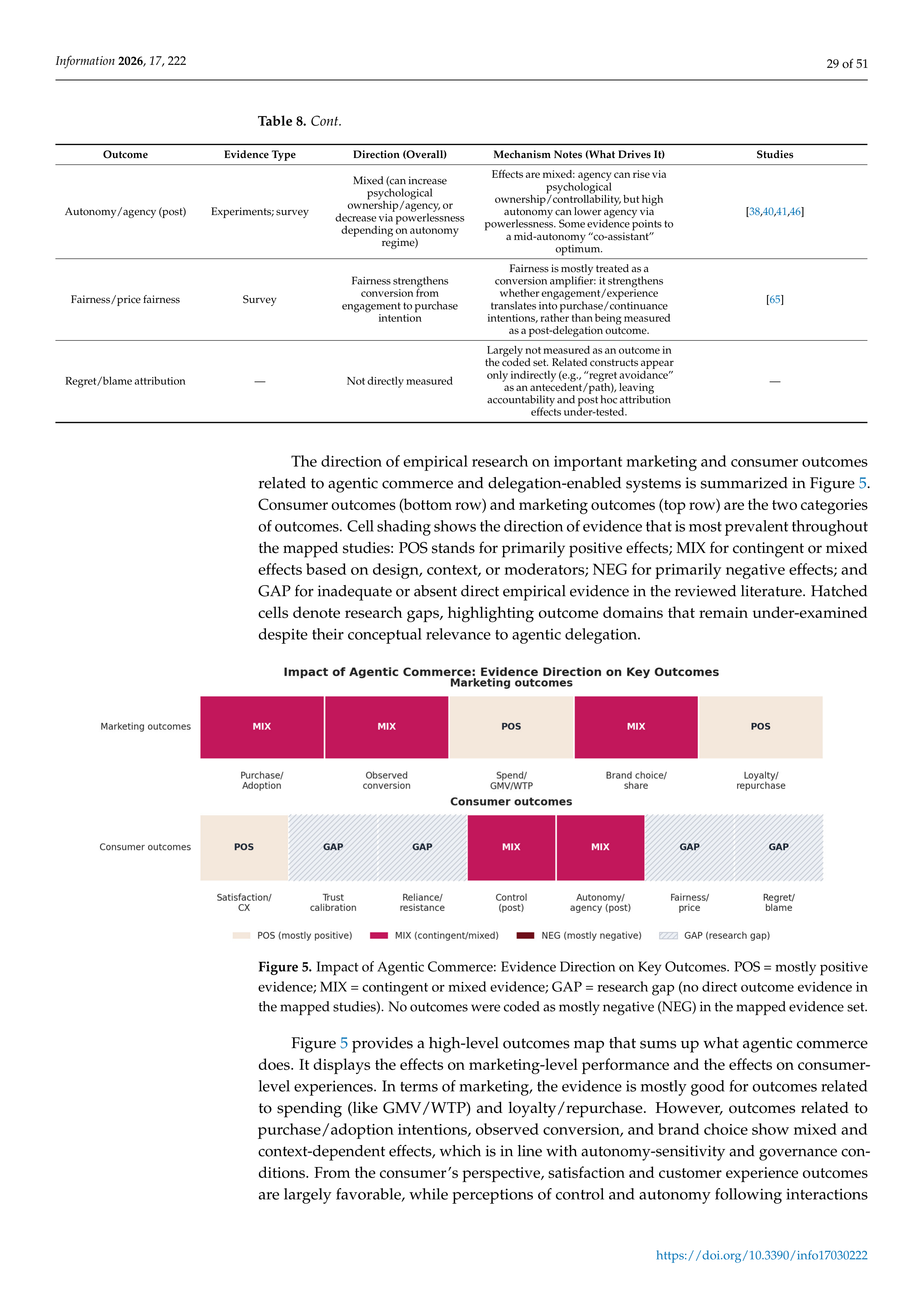
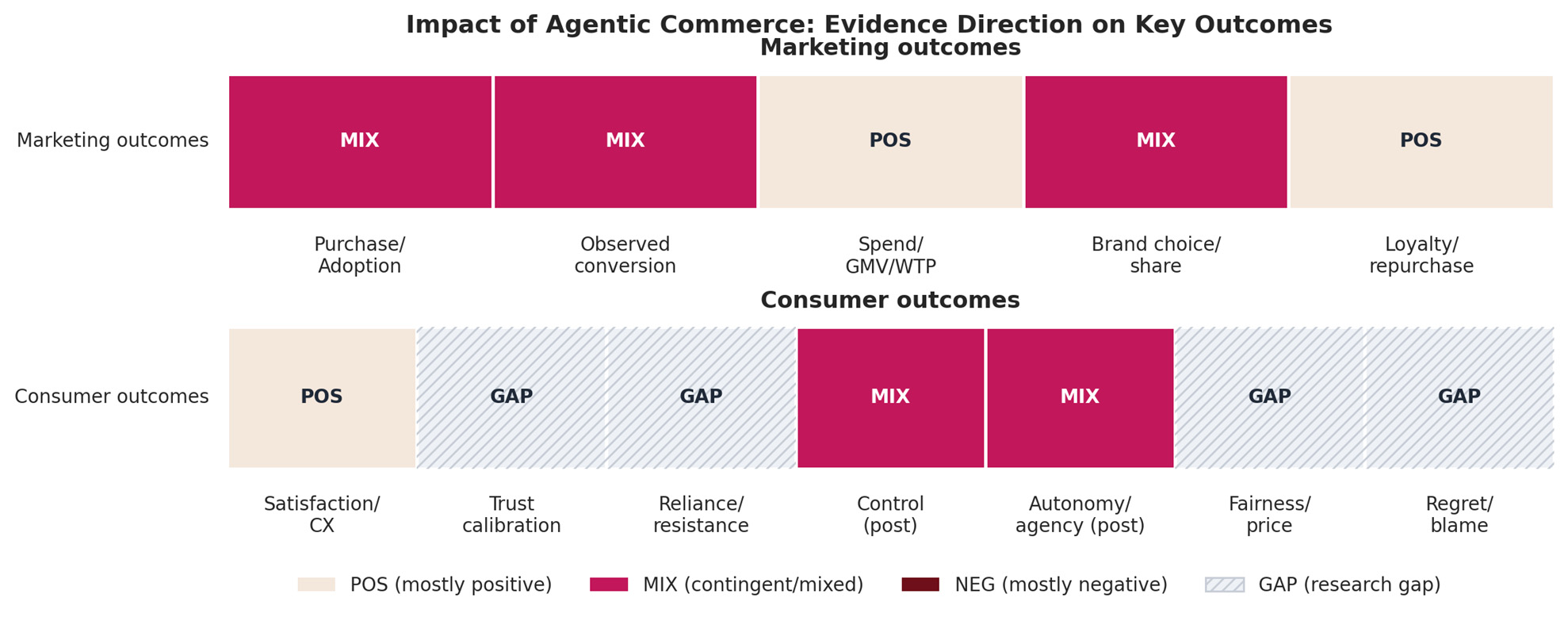
Information
2026
,
17
, 222
29 of 51
Table 8.
Cont.
Outcome
Evidence Type
Direction (Overall)
Mechanism Notes (What Drives It)
Studies
Autonomy/agency (post)
Experiments; survey
Mixed (can increase
psychological
ownership/agency, or
decrease via powerlessness
depending on autonomy
regime)
Effects are mixed: agency can rise via
psychological
ownership/controllability, but high
autonomy can lower agency via
powerlessness. Some evidence points to
a mid-autonomy “co-assistant”
optimum.
[
38
,
40
,
41
,
46
]
Fairness/price fairness
Survey
Fairness strengthens
conversion from
engagement to purchase
intention
Fairness is mostly treated as a
conversion amplifier: it strengthens
whether engagement/experience
translates into purchase/continuance
intentions, rather than being measured
as a post-delegation outcome.
[
65
]
Regret/blame attribution
—
Not directly measured
Largely not measured as an outcome in
the coded set. Related constructs appear
only indirectly (e.g., “regret avoidance”
as an antecedent/path), leaving
accountability and post hoc attribution
effects under-tested.
—
The direction of empirical research on important marketing and consumer outcomes
related to agentic commerce and delegation-enabled systems is summarized in Figure
5
.
Consumer outcomes (bottom row) and marketing outcomes (top row) are the two categories
of outcomes. Cell shading shows the direction of evidence that is most prevalent throughout
the mapped studies:
POS stands for primarily positive effects; MIX for contingent or mixed
effects based on design, context, or moderators; NEG for primarily negative effects; and
GAP for inadequate or absent direct empirical evidence in the reviewed literature.
Hatched
cells denote research gaps, highlighting outcome domains that remain under-examined
despite their conceptual relevance to agentic delegation.
Figure 5.
Impact of Agentic Commerce:
Evidence Direction on Key Outcomes.
POS = mostly positive
evidence; MIX = contingent or mixed evidence; GAP = research gap (no direct outcome evidence in
the mapped studies). No outcomes were coded as mostly negative (NEG) in the mapped
evidence set
.
Figure
5
provides a high-level outcomes map that sums up what agentic commerce
does.
It displays the effects on marketing-level performance and the effects on consumer-
level experiences.
In terms of marketing, the evidence is mostly good for outcomes related
to
spending
(like
GMV/WTP)
and
loyalty/repurchase.
However,
outcomes
related
to
purchase/adoption intentions, observed conversion, and brand choice show mixed and
context-dependent effects, which is in line with autonomy-sensitivity and governance con-
ditions.
From the consumer’s perspective, satisfaction and customer experience outcomes
are largely favorable, while perceptions of control and autonomy following interactions
https://doi.org/10.3390/info17030222
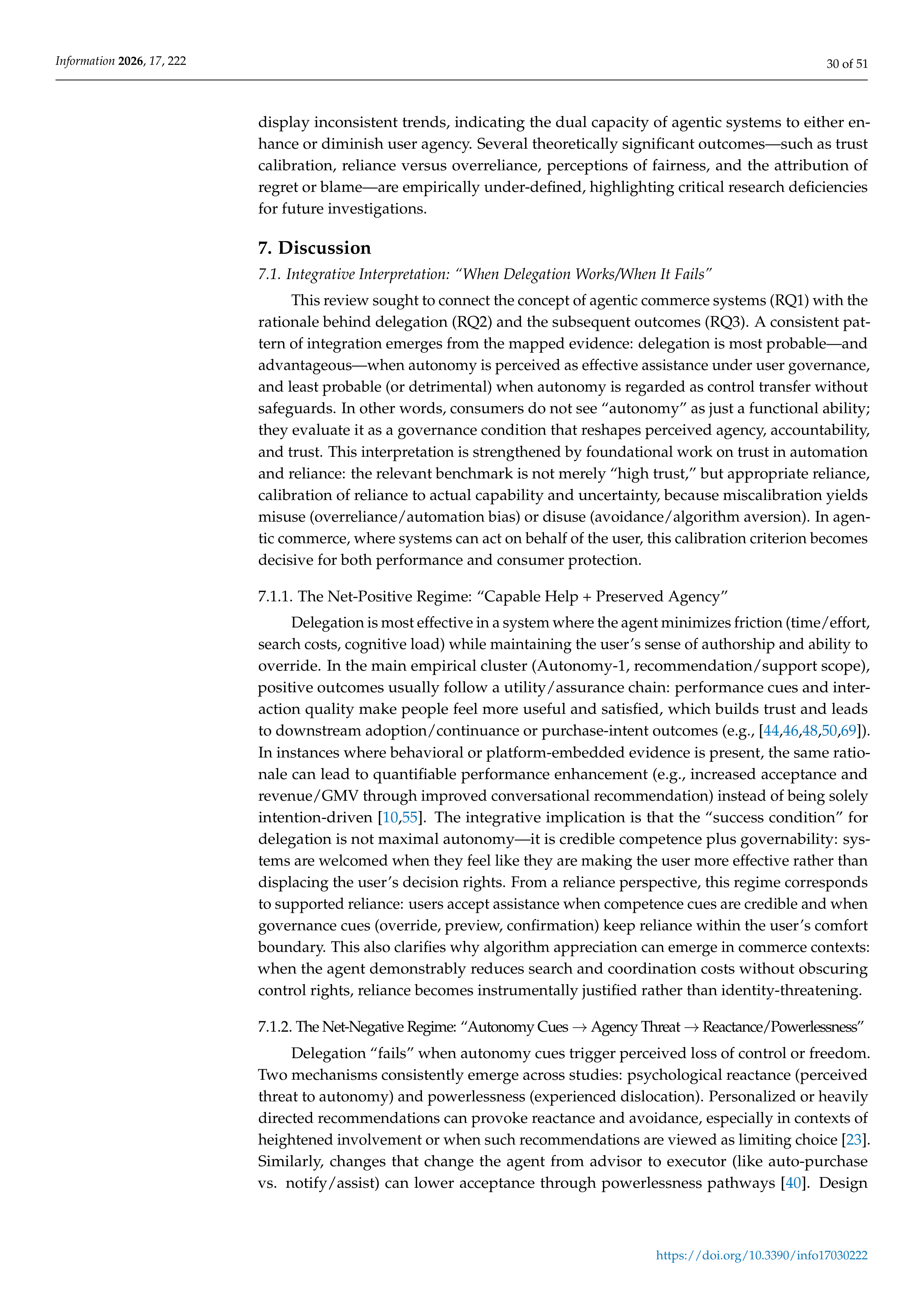
Information
2026
,
17
, 222
30 of 51
display inconsistent trends, indicating the dual capacity of agentic systems to either en-
hance or diminish user agency.
Several theoretically significant outcomes—such as trust
calibration,
reliance
versus
overreliance,
perceptions
of
fairness,
and
the
attribution
of
regret or blame—are empirically under-defined, highlighting critical research deficiencies
for future investigations.
7.
Discussion
7.1.
Integrative Interpretation:
“When Delegation Works/When It Fails”
This review sought to connect the concept of agentic commerce systems (RQ1) with the
rationale behind delegation (RQ2) and the subsequent outcomes (RQ3).
A consistent pat-
tern of integration emerges from the mapped evidence:
delegation is most probable—and
advantageous—when autonomy is perceived as effective assistance under user governance,
and least probable (or detrimental) when autonomy is regarded as control transfer without
safeguards.
In other words, consumers do not see “autonomy” as just a functional ability;
they evaluate it as a governance condition that reshapes perceived agency, accountability,
and trust.
This interpretation is strengthened by foundational work on trust in automation
and reliance:
the relevant benchmark is not merely “high trust,” but appropriate reliance,
calibration of reliance to actual capability and uncertainty, because miscalibration yields
misuse (overreliance/automation bias) or disuse (avoidance/algorithm aversion).
In agen-
tic commerce, where systems can act on behalf of the user, this calibration criterion becomes
decisive for both performance and consumer protection.
7.1.1.
The Net-Positive Regime:
“Capable Help + Preserved Agency”
Delegation is most effective in a system where the agent minimizes friction (time/effort,
search costs, cognitive load) while maintaining the user’s sense of authorship and ability to
override.
In the main empirical cluster (Autonomy-1, recommendation/support scope),
positive outcomes usually follow a utility/assurance chain:
performance cues and inter-
action quality make people feel more useful and satisfied, which builds trust and leads
to downstream adoption/continuance or purchase-intent outcomes (e.g., [
44
,
46
,
48
,
50
,
69
]).
In instances where behavioral or platform-embedded evidence is present, the same ratio-
nale can lead to quantifiable performance enhancement (e.g.,
increased acceptance and
revenue/GMV through improved conversational recommendation) instead of being solely
intention-driven
[
10
,
55
].
The
integrative
implication
is
that
the
“success
condition”
for
delegation is not maximal autonomy—it is credible competence plus governability:
sys-
tems are welcomed when they feel like they are making the user more effective rather than
displacing the user’s decision rights.
From a reliance perspective, this regime corresponds
to supported reliance:
users accept assistance when competence cues are credible and when
governance cues (override, preview, confirmation) keep reliance within the user’s comfort
boundary.
This also clarifies why algorithm appreciation can emerge in commerce contexts:
when the agent demonstrably reduces search and coordination costs without obscuring
control rights, reliance becomes instrumentally justified rather than identity-threatening.
7.1.2. The Net-Negative Regime: “Autonomy Cues
→
Agency Threat
→
Reactance/Powerlessness”
Delegation “fails” when autonomy cues trigger perceived loss of control or freedom.
Two mechanisms consistently emerge across studies:
psychological reactance (perceived
threat to autonomy) and powerlessness (experienced dislocation).
Personalized or heavily
directed recommendations can provoke reactance and avoidance, especially in contexts of
heightened involvement or when such recommendations are viewed as limiting choice [
23
].
Similarly,
changes
that
change
the
agent
from
advisor
to
executor
(like
auto-purchase
vs.
notify/assist)
can
lower
acceptance
through
powerlessness
pathways
[
40
].
Design
https://doi.org/10.3390/info17030222
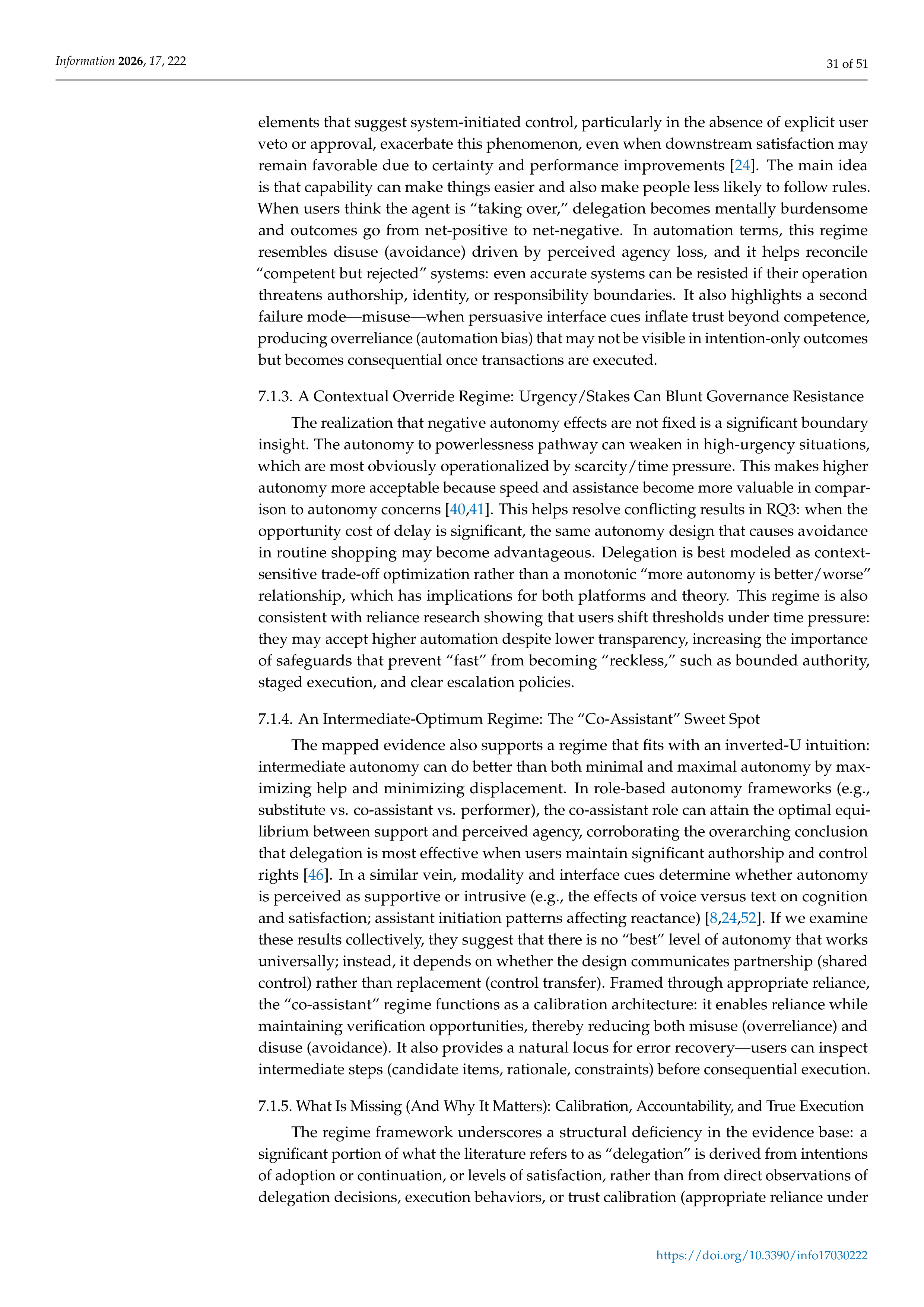
Information
2026
,
17
, 222
31 of 51
elements that suggest system-initiated control, particularly in the absence of explicit user
veto or approval, exacerbate this phenomenon, even when downstream satisfaction may
remain
favorable
due
to
certainty
and
performance
improvements
[
24
].
The
main
idea
is that capability can make things easier and also make people less likely to follow rules.
When users think the agent is “taking over,” delegation becomes mentally burdensome
and
outcomes
go
from
net-positive
to
net-negative.
In
automation
terms,
this
regime
resembles
disuse
(avoidance)
driven
by
perceived
agency
loss,
and
it
helps
reconcile
“competent but rejected” systems:
even accurate systems can be resisted if their operation
threatens
authorship,
identity,
or
responsibility
boundaries.
It
also
highlights
a
second
failure mode—misuse—when persuasive interface cues inflate trust beyond competence,
producing overreliance (automation bias) that may not be visible in intention-only outcomes
but becomes consequential once transactions are executed.
7.1.3.
A Contextual Override Regime:
Urgency/Stakes Can Blunt Governance Resistance
The realization that negative autonomy effects are not fixed is a significant boundary
insight.
The autonomy to powerlessness pathway can weaken in high-urgency situations,
which are most obviously operationalized by scarcity/time pressure.
This makes higher
autonomy more acceptable because speed and assistance become more valuable in compar-
ison to autonomy concerns [
40
,
41
].
This helps resolve conflicting results in RQ3:
when the
opportunity cost of delay is significant, the same autonomy design that causes avoidance
in routine shopping may become advantageous.
Delegation is best modeled as context-
sensitive trade-off optimization rather than a monotonic “more autonomy is better/worse”
relationship,
which has implications for both platforms and theory.
This regime is also
consistent with reliance research showing that users shift thresholds under time pressure:
they may accept higher automation despite lower transparency, increasing the importance
of safeguards that prevent “fast” from becoming “reckless,” such as bounded authority,
staged execution, and clear escalation policies.
7.1.4.
An Intermediate-Optimum Regime:
The “Co-Assistant” Sweet Spot
The mapped evidence also supports a regime that fits with an inverted-U intuition:
intermediate autonomy can do better than both minimal and maximal autonomy by max-
imizing
help
and
minimizing
displacement.
In
role-based
autonomy
frameworks
(e.g.,
substitute vs.
co-assistant vs.
performer), the co-assistant role can attain the optimal equi-
librium between support and perceived agency, corroborating the overarching conclusion
that delegation is most effective when users maintain significant authorship and control
rights [
46
].
In a similar vein, modality and interface cues determine whether autonomy
is perceived as supportive or intrusive (e.g., the effects of voice versus text on cognition
and satisfaction; assistant initiation patterns affecting reactance) [
8
,
24
,
52
].
If we examine
these results collectively, they suggest that there is no “best” level of autonomy that works
universally; instead, it depends on whether the design communicates partnership (shared
control) rather than replacement (control transfer).
Framed through appropriate reliance,
the “co-assistant” regime functions as a calibration architecture:
it enables reliance while
maintaining verification opportunities, thereby reducing both misuse (overreliance) and
disuse (avoidance).
It also provides a natural locus for error recovery—users can inspect
intermediate steps (candidate items, rationale, constraints) before consequential execution.
7.1.5. What Is Missing (And Why It Matters): Calibration, Accountability, and True Execution
The regime framework underscores a structural deficiency in the evidence base:
a
significant portion of what the literature refers to as “delegation” is derived from intentions
of adoption or continuation, or levels of satisfaction, rather than from direct observations of
delegation decisions, execution behaviors, or trust calibration (appropriate reliance under
https://doi.org/10.3390/info17030222
Information
2026
,
17
, 222
32 of 51
uncertainty).
Even in contexts where trust is paramount, it is typically assessed in terms of
trust level rather than calibration (e.g., confidence–accuracy alignment, verification behav-
ior, response to errors) [
42
,
68
].
In the same way, true agentic execution (placing an order
and paying for it) is still rare and mostly limited to scenario manipulations rather than
embedded transaction observation [
40
,
41
].
This measurement gap is significant because
governance failures in agentic commerce are essentially post-delegation occurrences (over-
reliance, blame/regret, auditability following error).
Without calibration and accountability
measures,
the
field
risks
overgeneralizing
from
“chat
satisfaction”
to
“safe
delegation.”
In particular, foundational automation findings suggest that trust is path-dependent and
error-sensitive:
users update reliance after failures and successes, and these dynamics are
central to long-run delegation.
From a human factors perspective, the core construct is not
global trust but appropriate reliance—whether users monitor, verify, and intervene in ways
that match the system’s competence and uncertainty.
The reviewed corpus rarely measures
(i) verification behavior (cross-checking, seeking second opinions), (ii) reliance under stated
uncertainty, (iii) recovery actions (undo/cancel/escalate), or (iv) accountability judgments
(who is blamed, how responsibility is partitioned, and whether recourse is available).
These
behaviors are the practical markers of calibrated reliance (monitoring, intervention, and
recovery), yet they are largely absent from the commerce evidence base.
These constructs
are especially consequential for agentic commerce because execution errors have direct
monetary and reputational consequences and can trigger “algorithm aversion” after salient
failures, even when average performance is high.
Moreover, as autonomy increases, users’
oversight demands typically rise (supervisory control), but situation awareness can deterio-
rate when intermediate steps, uncertainty, and constraints are not externalized; this makes
governance
mechanisms
(visible
state,
confidence
cues,
approval
gates,
and
reversible
actions) central to safe delegation rather than optional UX features.
Delegation is successful across domains and designs when systems provide felt com-
petence
under
user
governance;
it
fails
when
autonomy
cues
suggest
a
loss
of
agency
in the absence of safeguards.
The strongest unresolved frontier is empirical:
as systems
advance beyond assistive chat into transaction-capable agents, we need more studies that
observe real delegation, real execution, and calibration/oversight behaviors (monitoring,
intervention, recovery).
However, urgency and mid-level “co-assistant” designs can tip the
scales in favor of acceptance.
Accordingly, the ‘delegation regimes’ synthesis should be
read as mapping acceptance dynamics under largely assistive or scenario-based autonomy,
not as definitive evidence about safe execution-level delegation in the wild.
7.2.
Implications for Design (What to Build:
Autonomy, Controls, Explanations, Privacy)
A
fundamental
implication
of
the
mapped
evidence
is
that
“more
autonomy”
is
not a universal enhancement; rather, it constitutes a governance decision that alters the
consumer’s experience of agency, accountability, and risk.
Negative reactions arise when
autonomy cues suggest a loss of control (reactance/threat-to-freedom) or displacement
(powerlessness); conversely, positive outcomes are observed when systems facilitate friction
reduction while maintaining perceived authorship and recourse [
23
,
24
,
40
].
Design should,
therefore, be based on a straightforward principle:
Default to “co-assistant” autonomy for consequential steps, and use escalation (to
executor) only with explicit user consent, strong recourse, and clear accountability.
This principle is also consistent with human factors research on levels of automation
and supervisory control:
as automation increases, users shift from doing to monitoring,
and therefore require stronger support for situation awareness and intervention.
In agentic
commerce, this means that higher autonomy must be paired with “oversight scaffolding”—
clear
visibility
into
what
the
agent
is
doing,
the
option
to
pause/override,
and
reliable
https://doi.org/10.3390/info17030222
Information
2026
,
17
, 222
33 of 51
recovery paths when errors occur—otherwise, autonomy cues are likely to be interpreted
as control transfer rather than assistance.
In practice, this implies that autonomy design
and
oversight
design
must
be
specified
together:
a
higher
“automation
level”
without
corresponding
monitoring
and
recovery
affordances
increases
the
risk
of
both
misuse
(overreliance) and disuse (avoidance after failure).
This principle aligns with the review’s “regimes” structure.
In everyday shopping
situations, executor-like behavior can stop people from adopting something by making
them feel powerless [
40
] and can make reactance worse when recommendations seem to
be steering or limiting [
23
].
Conversely, co-assistant designs can maintain satisfaction and
choice
certainty
when
users
recognize
performance
advantages
without
a
reduction
in
governance [
24
], and modality/interaction selections can additionally influence whether
autonomy
is
perceived
as
supportive
or
intrusive
[
8
].
The
literature
seldom
evaluates
transparency and oversight mechanisms as first-class levers, rather than mere background
“quality” indicators.
Consequently,
the design agenda must delineate not only what to
construct but also what to assess to guarantee secure delegation.
Specifically, governance
should be treated as a calibration toolkit: its role is to keep reliance aligned with competence
and uncertainty, thereby preventing both overreliance (misuse/automation bias) and avoid-
ance after failure (disuse/algorithm aversion).
Practically, this requires measurement that
goes beyond “trust level” toward calibration outcomes (e.g., verification and intervention
rates conditional on uncertainty, error-following reliance, and recovery success), because
these are the behaviors that determine whether delegation remains safe over repeated use.
Accordingly,
the
most
policy-relevant
design
question
is
not
whether
users
“trust”
the
agent, but whether they rely appropriately—monitor when needed, intervene when stakes
are high, and recover effectively when errors occur.
Tables
9
and
10
employs a governance levers
×
risk zones approach to translate the
review’s socio-technical synthesis into actionable design guidance.
The framework does
not
treat
autonomy
as
a
single
“more
vs.
less”
setting.
Instead,
it
breaks
agentic
com-
merce down into a select few consumer-harm failure modes that are already visible—either
directly
or
indirectly—across
the
mapped
studies.
First,
feelings
of
powerlessness
and
psychological reactance occur when cues of autonomy or personalization are perceived
as threats to freedom or displacement, leading to decreased acceptance and heightened
avoidance
[
23
,
24
,
40
]
.
Second, because most studies measure trust as a level rather than
as
calibration
(i.e.,
appropriate
reliance
under
uncertainty
and
error),
overreliance
and
miscalibrated trust remain empirically under-measured despite representing a conceptually
central risk in delegated decision-making—automation bias and blind acceptance.
Third,
privacy may function as a conditional constraint rather than a uniform inhibitor because pri-
vacy risk and surveillance concerns—including creepiness and fear of data
misuse—appear
in resistance and barrier pathways and exhibit heterogeneous significance across settings
and
user
groups
[
4
,
42
,
49
].
Fourth,
the
evidence
currently
available
treats
fairness
and
price fairness risks (such as opaque rankings, discriminatory offer selection, and hidden
markups)
as
boundary
conditions
or
conversion
amplifiers.
However,
as
agents
move
from recommending to executing and optimizing offers, these risks become structurally
more significant [
65
].
Fifth, despite being crucial for long-term trust and willingness to
delegate, regret and blame attribution—who is accountable when delegated decisions go
wrong—are
rarely
measured
directly
in
the
mapped
set.
Lastly,
security-induced
gov-
ernance
failures,
such
as
compromised
instructions
or
memory
that
can
reroute
agent
behavior, are highlighted by the broader framing of agentic systems.
Although this risk
has not yet been thoroughly examined in consumer studies, it emphasizes the necessity of
auditability, confirmation gates, and recourse mechanisms in transaction-capable designs.
Viewed through a human factors lens, these risk zones correspond to predictable failure
https://doi.org/10.3390/info17030222
Information
2026
,
17
, 222
34 of 51
modes in supervised automation:
reduced perceived control (reactance/powerlessness),
inappropriate reliance (misuse), inappropriate avoidance (disuse), and weak recovery after
error—each of which can be mitigated by explicit oversight and intervention mechanisms.
Table 9.
Governance levers
×
risk zones in agentic commerce:
what to build and what to measure.
Risk Zone
Autonomy Level Design
Override/Undo/Recourse
Confirmation Gates
(Human-in-the-Loop)
Powerlessness/reactance
•
Build
: default to co-assistant for
consequential steps; avoid
auto-execute as default.
•
Measure
: powerlessness +
reactance; “felt control” items;
TTFF to controls/undo.
•
Build
: always-visible
“Cancel/Undo/Revert” + fast
rollback.
•
Measure
: undo use rate;
“recovery confidence”; perceived
reversibility.
•
Build
: explicit “Approve before
purchase” and “Review changes”
step.
•
Measure
: opt-in to auto;
approval latency; drop-off at
gate.
Overreliance/miscalibrated trust
•
Build
: constrain executor mode
to low-stakes/low-variance
tasks; require training period.
•
Measure
: reliance vs.
performance; error-following
rate.
•
Build
: “Why this could be
wrong” + “Show alternatives” +
easy revert.
•
Measure
: alternative-view rate;
correction rate after errors.
•
Build
: mandatory review when
confidence is low/high impact
(price, brand, returns).
•
Measure
: calibration curve;
acceptance conditional on
confidence.
Privacy risk/surveillance concern
•
Build
: keep personalization
optional; avoid “overly
knowing” cues by default.
•
Measure
: creepiness; privacy
concern; opt-out rates.
•
Build
: one-click delete, “forget
this,” and consent revision.
•
Measure
: deletion requests;
perceived control over data.
•
Build
: consent gates for sensitive
data and cross-app actions.
•
Measure
: consent acceptance by
data type; abandonment at
consent.
Fairness/price fairness
•
Build
: avoid fully automated
price/offer selection without
fairness checks.
•
Measure
: perceived price
fairness; differential outcomes
across groups.
•
Build
: dispute/appeal + price
breakdown + “report unfair
price.”
•
Measure
: appeal rate; perceived
procedural fairness.
•
Build
: confirmation gate for
price changes, upsells,
substitutions.
•
Measure
: acceptance of price
changes; regret after purchase.
Regret/blame attribution
•
Build
: executor mode requires
explicit accountability framing +
user choice.
•
Measure
: regret intensity; blame
allocation
(agent/platform/user).
•
Build
: guaranteed remediation
path (refund/return assistance) +
logs.
•
Measure
: complaint handling
time; satisfaction with resolution.
•
Build
: “Final review” summary
(price, brand, constraints, return
policy).
•
Measure
: post-purchase regret;
“I noticed errors” rate.
Table 10.
Governance levers
×
risk zones in agentic commerce:
what to build and what to measure
(explanation depth, data controls and accountability signals).
Risk Zone
Explanation Depth
Data and Privacy Controls
Accountability Signals
Powerlessness/reactance
•
Build
: “What I’m about to do” +
“You can stop me anytime.”
•
Measure
: comprehension check;
perceived transparency; reduced
reactance.
•
Build
: “Use minimal data”
toggle; session-only mode.
•
Measure
: privacy comfort;
willingness-to-delegate under
privacy constraints.
•
Build
: “You’re in charge”
framing + clear escalation to
human/support.
•
Measure
: perceived
responsibility clarity; reduced
avoidance.
Overreliance/miscalibrated trust
•
Build
: show evidence strength
(sources, constraints,
uncertainty).
•
Measure
: trust calibration tasks
(good/bad advice
discrimination).
•
Build
: data provenance display +
permission boundaries (what it
can/cannot access).
•
Measure
: boundary awareness;
misuse attempts.
•
Build
: “Agent recommendation”
vs. “Merchant/Platform claim”
labeling.
•
Measure
: attribution accuracy;
trust placement (agent vs.
platform).
Privacy risk/surveillance concern
•
Build
: “Why I asked for this
data” + retention duration.
•
Measure
: understanding of data
use; perceived legitimacy.
•
Build
: granular permissions +
local processing where possible.
•
Measure
: permission choices;
delegation willingness under
privacy-safe mode.
•
Build
: audit trail (“what data
used, when, by whom”) + policy
link.
•
Measure
: perceived
accountability; trust under high
transparency.
https://doi.org/10.3390/info17030222
Information
2026
,
17
, 222
35 of 51
Table 10.
Cont.
Risk Zone
Explanation Depth
Data and Privacy Controls
Accountability Signals
Fairness/price fairness
•
Build
: explain ranking/offer
logic (e.g., “best value vs.
fastest”).
•
Measure
: perceived fairness;
understanding of ranking
criteria.
•
Build
: allow “no
personalization” pricing and
comparator view.
•
Measure
: fairness perceptions
under personalization off vs. on.
•
Build
: disclose
incentives/affiliations
(“sponsored”, “commission”).
•
Measure
: trust erosion vs.
transparency benefit; choice
shifts.
Regret/blame attribution
•
Build
: rationale + constraint
satisfaction (“matched your
constraint X”).
•
Measure
: counterfactual regret
(“should’ve chosen Y”);
perceived justifiability.
•
Build
: privacy-safe logs for
dispute resolution
(minimization).
•
Measure
: acceptance of logging
trade-off; perceived fairness.
•
Build
: clear responsibility
partition (agent suggestion vs.
platform execution).
•
Measure
: attribution clarity;
reduced hostility/avoidance.
•
Across all risk zones, the same six governance “building blocks” recur:
•
Autonomy defaults and escalation (advisor
→
co-assistant
→
executor)
•
Override/undo/recourse
•
Confirmation gates (human-in-the-loop)
•
Explanation depth (what/why/uncertainty; inputs used)
•
Data and privacy controls
•
Accountability signals (responsibility partition and audit trail)
The implication of design is that governance should not be an afterthought.
If the field
continues to define “agentic commerce” mainly through satisfaction or intention, it will
miss the conditions that decide whether delegation is safe, trusted, and resilient.
This is
especially true when systems move from assisting individuals chat to execution.
Therefore,
future evaluations should treat oversight, intervention, and recovery as first-class outcome
variables, not merely interface features.
7.3.
Limitations of Reviewed Studies
The mapped literature provides a preliminary evidence base regarding delegation
in commerce-oriented AI assistants;
however, it is limited by (i) the insufficient realism
of “agentic” execution, (ii) an excessive dependence on cross-sectional self-reporting, and
(iii) inconsistent focus on governance-relevant constructs (e.g.,
calibration, recourse, ac-
countability).
Tables
11
and
12
summarize these limitations by separating higher-evidence
designs (field/quasi-field/experiments/usability) from observational and mixed-method
studies, thereby clarifying where inference is comparatively stronger and where it remains
provisional.
In addition, two review-process constraints should be interpreted transpar-
ently and proportionately:
screening/coding were performed by a single reviewer, and we
did not apply a single formal risk-of-bias instrument (e.g., a clinical-style RoB tool) because
the evidence base spans heterogeneous designs and the aim is evidence mapping rather
than pooled causal estimation.
Instead, we implemented audit-oriented safeguards (time-
separated second-pass verification; boundary-case audits; conservative default rules) and
a transparent study-level appraisal checklist and evidence-direction rule set (Section
3.4
).
These procedures reduce interpretive drift but do not eliminate the possibility of residual
selection/coding error; accordingly, our conclusions are framed as a structured evidence
map and mechanism synthesis rather than definitive causal claims.
https://doi.org/10.3390/info17030222
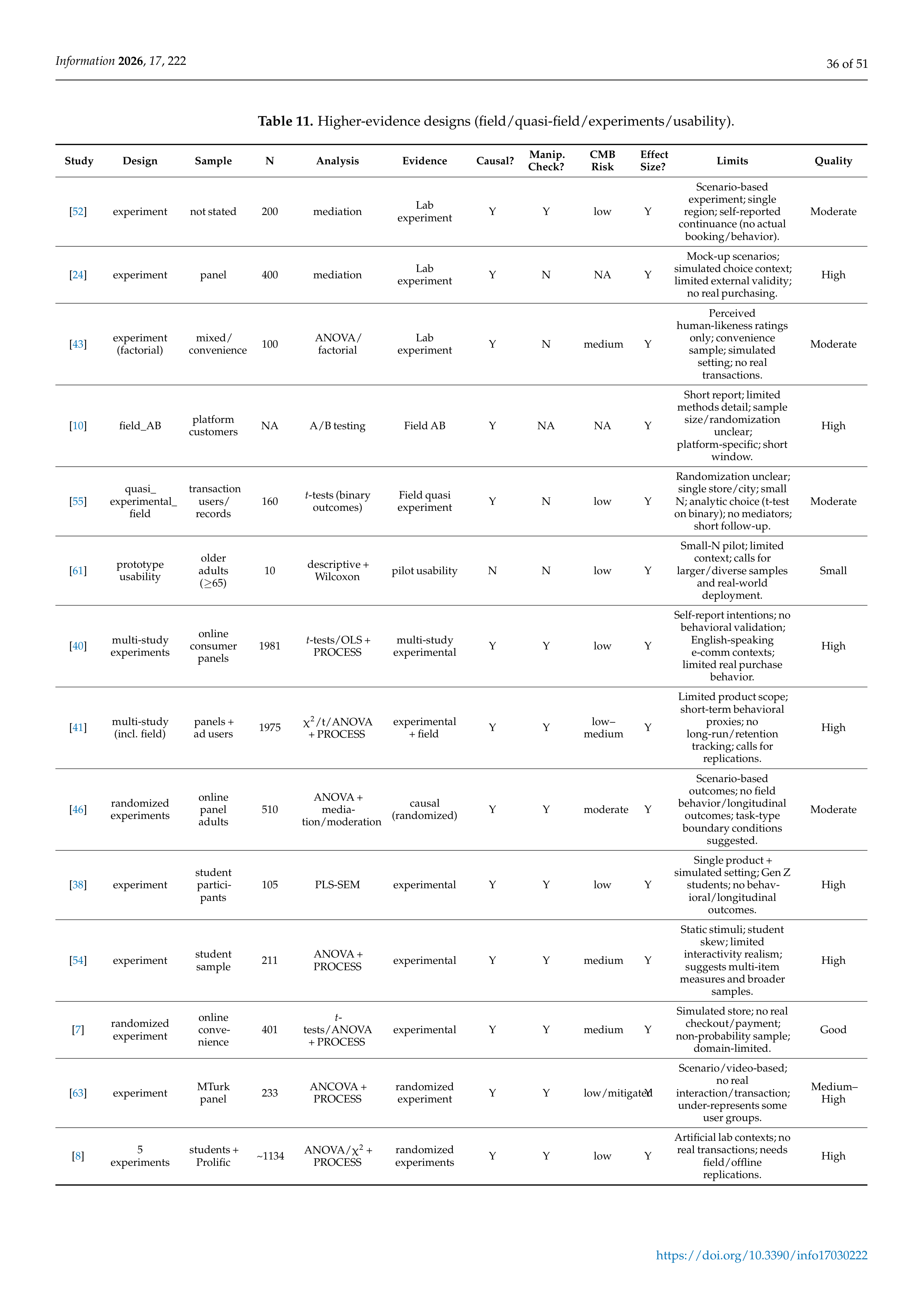
Information
2026
,
17
, 222
36 of 51
Table 11.
Higher-evidence designs (field/quasi-field/experiments/usability).
Study
Design
Sample
N
Analysis
Evidence
Causal?
Manip.
Check?
CMB
Risk
Effect
Size?
Limits
Quality
[
52
]
experiment
not stated
200
mediation
Lab
experiment
Y
Y
low
Y
Scenario-based
experiment; single
region; self-reported
continuance (no actual
booking/behavior).
Moderate
[
24
]
experiment
panel
400
mediation
Lab
experiment
Y
N
NA
Y
Mock-up scenarios;
simulated choice context;
limited external validity;
no real purchasing.
High
[
43
]
experiment
(factorial)
mixed/
convenience
100
ANOVA/
factorial
Lab
experiment
Y
N
medium
Y
Perceived
human-likeness ratings
only; convenience
sample; simulated
setting; no real
transactions.
Moderate
[
10
]
field_AB
platform
customers
NA
A/B testing
Field AB
Y
NA
NA
Y
Short report; limited
methods detail; sample
size/randomization
unclear;
platform-specific; short
window.
High
[
55
]
quasi_
experimental_
field
transaction
users/
records
160
t
-tests (binary
outcomes)
Field quasi
experiment
Y
N
low
Y
Randomization unclear;
single store/city; small
N; analytic choice (t-test
on binary); no mediators;
short follow-up.
Moderate
[
61
]
prototype
usability
older
adults
(
≥
65)
10
descriptive +
Wilcoxon
pilot usability
N
N
low
Y
Small-N pilot; limited
context; calls for
larger/diverse samples
and real-world
deployment.
Small
[
40
]
multi-study
experiments
online
consumer
panels
1981
t
-tests/OLS +
PROCESS
multi-study
experimental
Y
Y
low
Y
Self-report intentions; no
behavioral validation;
English-speaking
e-comm contexts;
limited real purchase
behavior.
High
[
41
]
multi-study
(incl. field)
panels +
ad users
1975
χ
2
/t/ANOVA
+ PROCESS
experimental
+ field
Y
Y
low–
medium
Y
Limited product scope;
short-term behavioral
proxies; no
long-run/retention
tracking; calls for
replications.
High
[
46
]
randomized
experiments
online
panel
adults
510
ANOVA +
media-
tion/moderation
causal
(randomized)
Y
Y
moderate
Y
Scenario-based
outcomes; no field
behavior/longitudinal
outcomes; task-type
boundary conditions
suggested.
Moderate
[
38
]
experiment
student
partici-
pants
105
PLS-SEM
experimental
Y
Y
low
Y
Single product +
simulated setting; Gen Z
students; no behav-
ioral/longitudinal
outcomes.
High
[
54
]
experiment
student
sample
211
ANOVA +
PROCESS
experimental
Y
Y
medium
Y
Static stimuli; student
skew; limited
interactivity realism;
suggests multi-item
measures and broader
samples.
High
[
7
]
randomized
experiment
online
conve-
nience
401
t
-
tests/ANOVA
+ PROCESS
experimental
Y
Y
medium
Y
Simulated store; no real
checkout/payment;
non-probability sample;
domain-limited.
Good
[
63
]
experiment
MTurk
panel
233
ANCOVA +
PROCESS
randomized
experiment
Y
Y
low/mitigated
Y
Scenario/video-based;
no real
interaction/transaction;
under-represents some
user groups.
Medium–
High
[
8
]
5
experiments
students +
Prolific
~1134
ANOVA/
χ
2
+
PROCESS
randomized
experiments
Y
Y
low
Y
Artificial lab contexts; no
real transactions; needs
field/offline
replications.
High
https://doi.org/10.3390/info17030222
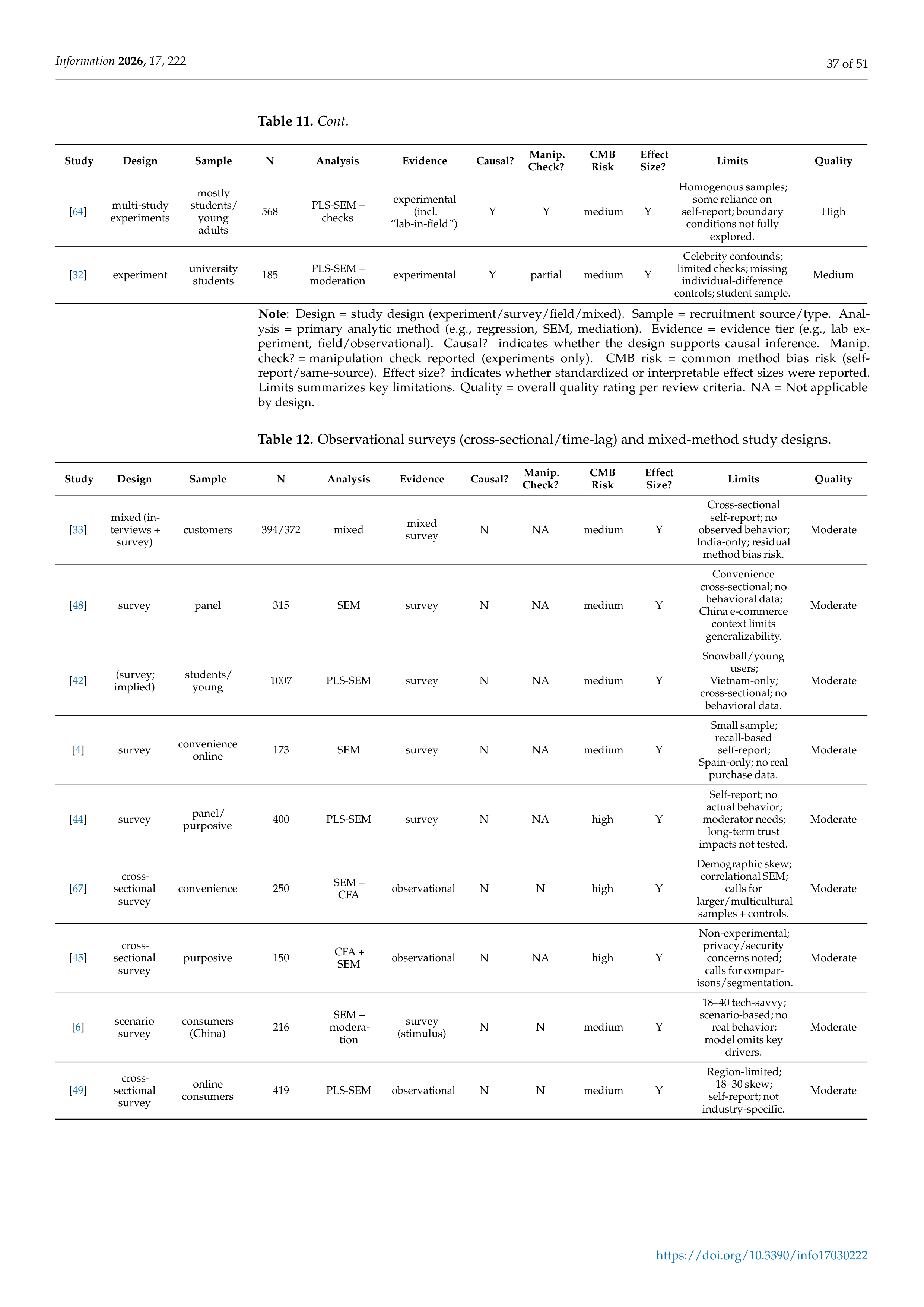
Information
2026
,
17
, 222
37 of 51
Table 11.
Cont.
Study
Design
Sample
N
Analysis
Evidence
Causal?
Manip.
Check?
CMB
Risk
Effect
Size?
Limits
Quality
[
64
]
multi-study
experiments
mostly
students/
young
adults
568
PLS-SEM +
checks
experimental
(incl.
“lab-in-field”)
Y
Y
medium
Y
Homogenous samples;
some reliance on
self-report; boundary
conditions not fully
explored.
High
[
32
]
experiment
university
students
185
PLS-SEM +
moderation
experimental
Y
partial
medium
Y
Celebrity confounds;
limited checks; missing
individual-difference
controls; student sample.
Medium
Note
:
Design
=
study
design
(experiment/survey/field/mixed).
Sample
=
recruitment
source/type.
Anal-
ysis
=
primary
analytic
method
(e.g.,
regression,
SEM,
mediation).
Evidence
=
evidence
tier
(e.g.,
lab
ex-
periment,
field/observational).
Causal?
indicates
whether
the
design
supports
causal
inference.
Manip.
check?
= manipulation
check
reported
(experiments
only).
CMB
risk
=
common
method
bias
risk
(self-
report/same-source).
Effect
size?
indicates
whether
standardized
or
interpretable
effect
sizes
were
reported.
Limits summarizes key limitations.
Quality = overall quality rating per review criteria.
NA = Not applicable
by design.
Table 12.
Observational surveys (cross-sectional/time-lag) and mixed-method study designs.
Study
Design
Sample
N
Analysis
Evidence
Causal?
Manip.
Check?
CMB
Risk
Effect
Size?
Limits
Quality
[
33
]
mixed (in-
terviews +
survey)
customers
394/372
mixed
mixed
survey
N
NA
medium
Y
Cross-sectional
self-report; no
observed behavior;
India-only; residual
method bias risk.
Moderate
[
48
]
survey
panel
315
SEM
survey
N
NA
medium
Y
Convenience
cross-sectional; no
behavioral data;
China e-commerce
context limits
generalizability.
Moderate
[
42
]
(survey;
implied)
students/
young
1007
PLS-SEM
survey
N
NA
medium
Y
Snowball/young
users;
Vietnam-only;
cross-sectional; no
behavioral data.
Moderate
[
4
]
survey
convenience
online
173
SEM
survey
N
NA
medium
Y
Small sample;
recall-based
self-report;
Spain-only; no real
purchase data.
Moderate
[
44
]
survey
panel/
purposive
400
PLS-SEM
survey
N
NA
high
Y
Self-report; no
actual behavior;
moderator needs;
long-term trust
impacts not tested.
Moderate
[
67
]
cross-
sectional
survey
convenience
250
SEM +
CFA
observational
N
N
high
Y
Demographic skew;
correlational SEM;
calls for
larger/multicultural
samples + controls.
Moderate
[
45
]
cross-
sectional
survey
purposive
150
CFA +
SEM
observational
N
NA
high
Y
Non-experimental;
privacy/security
concerns noted;
calls for compar-
isons/segmentation.
Moderate
[
6
]
scenario
survey
consumers
(China)
216
SEM +
modera-
tion
survey
(stimulus)
N
N
medium
Y
18–40 tech-savvy;
scenario-based; no
real behavior;
model omits key
drivers.
Moderate
[
49
]
cross-
sectional
survey
online
consumers
419
PLS-SEM
observational
N
N
medium
Y
Region-limited;
18–30 skew;
self-report; not
industry-specific.
Moderate
https://doi.org/10.3390/info17030222
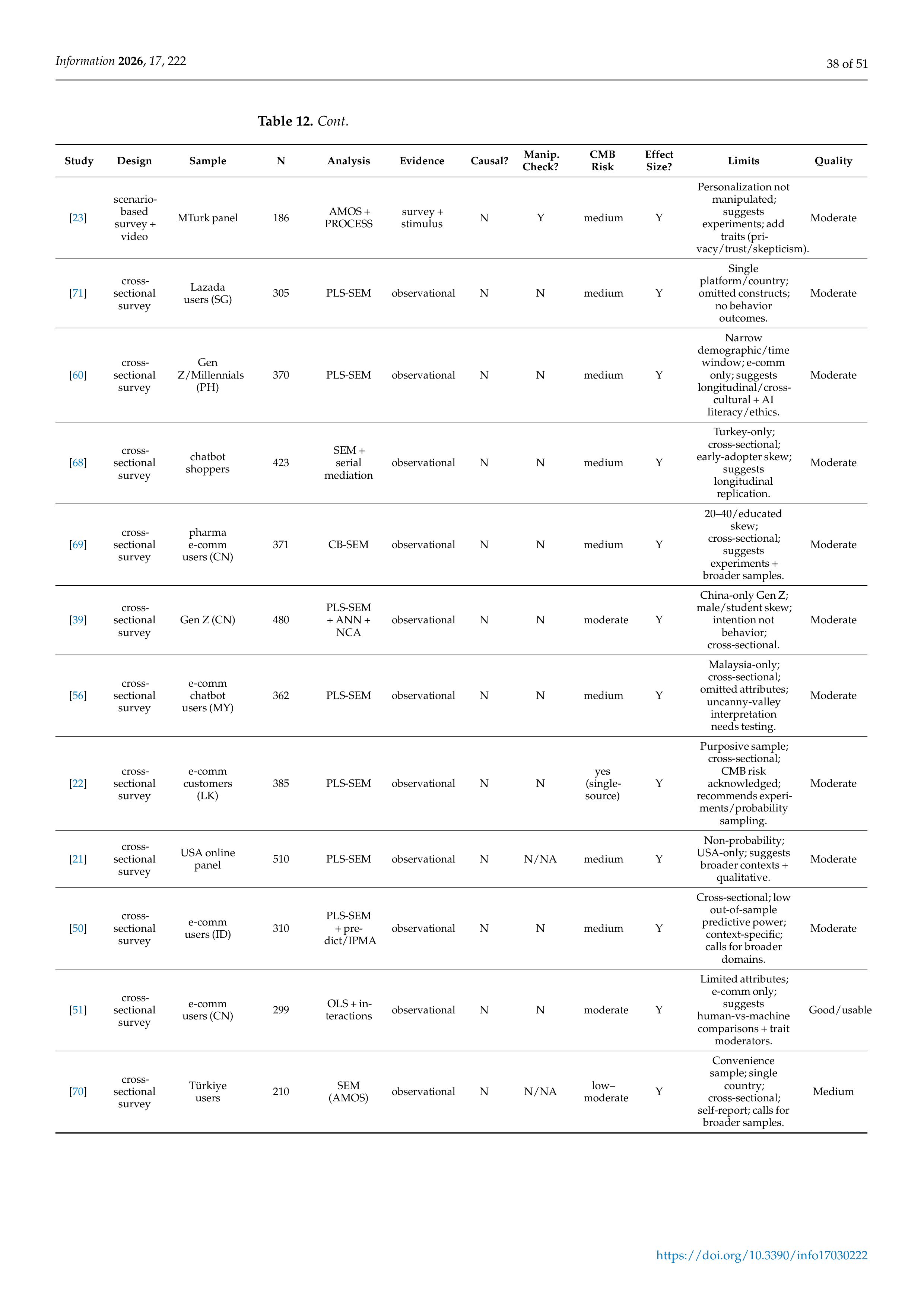
Information
2026
,
17
, 222
38 of 51
Table 12.
Cont.
Study
Design
Sample
N
Analysis
Evidence
Causal?
Manip.
Check?
CMB
Risk
Effect
Size?
Limits
Quality
[
23
]
scenario-
based
survey +
video
MTurk panel
186
AMOS +
PROCESS
survey +
stimulus
N
Y
medium
Y
Personalization not
manipulated;
suggests
experiments; add
traits (pri-
vacy/trust/skepticism).
Moderate
[
71
]
cross-
sectional
survey
Lazada
users (SG)
305
PLS-SEM
observational
N
N
medium
Y
Single
platform/country;
omitted constructs;
no behavior
outcomes.
Moderate
[
60
]
cross-
sectional
survey
Gen
Z/Millennials
(PH)
370
PLS-SEM
observational
N
N
medium
Y
Narrow
demographic/time
window; e-comm
only; suggests
longitudinal/cross-
cultural + AI
literacy/ethics.
Moderate
[
68
]
cross-
sectional
survey
chatbot
shoppers
423
SEM +
serial
mediation
observational
N
N
medium
Y
Turkey-only;
cross-sectional;
early-adopter skew;
suggests
longitudinal
replication.
Moderate
[
69
]
cross-
sectional
survey
pharma
e-comm
users (CN)
371
CB-SEM
observational
N
N
medium
Y
20–40/educated
skew;
cross-sectional;
suggests
experiments +
broader samples.
Moderate
[
39
]
cross-
sectional
survey
Gen Z (CN)
480
PLS-SEM
+ ANN +
NCA
observational
N
N
moderate
Y
China-only Gen Z;
male/student skew;
intention not
behavior;
cross-sectional.
Moderate
[
56
]
cross-
sectional
survey
e-comm
chatbot
users (MY)
362
PLS-SEM
observational
N
N
medium
Y
Malaysia-only;
cross-sectional;
omitted attributes;
uncanny-valley
interpretation
needs testing.
Moderate
[
22
]
cross-
sectional
survey
e-comm
customers
(LK)
385
PLS-SEM
observational
N
N
yes
(single-
source)
Y
Purposive sample;
cross-sectional;
CMB risk
acknowledged;
recommends experi-
ments/probability
sampling.
Moderate
[
21
]
cross-
sectional
survey
USA online
panel
510
PLS-SEM
observational
N
N/NA
medium
Y
Non-probability;
USA-only; suggests
broader contexts +
qualitative.
Moderate
[
50
]
cross-
sectional
survey
e-comm
users (ID)
310
PLS-SEM
+ pre-
dict/IPMA
observational
N
N
medium
Y
Cross-sectional; low
out-of-sample
predictive power;
context-specific;
calls for broader
domains.
Moderate
[
51
]
cross-
sectional
survey
e-comm
users (CN)
299
OLS + in-
teractions
observational
N
N
moderate
Y
Limited attributes;
e-comm only;
suggests
human-vs-machine
comparisons + trait
moderators.
Good/usable
[
70
]
cross-
sectional
survey
Türkiye
users
210
SEM
(AMOS)
observational
N
N/NA
low–
moderate
Y
Convenience
sample; single
country;
cross-sectional;
self-report; calls for
broader samples.
Medium
https://doi.org/10.3390/info17030222
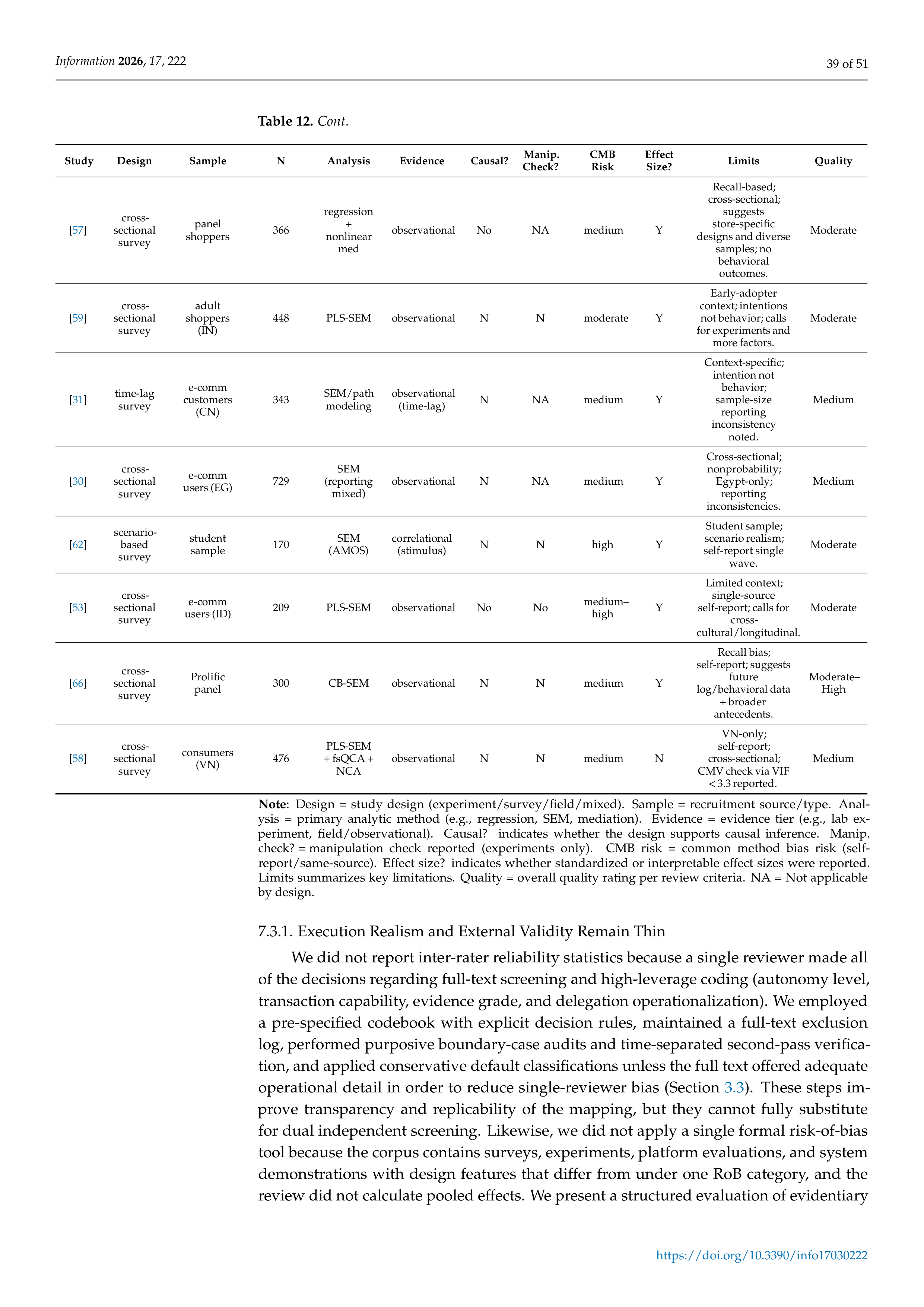
Information
2026
,
17
, 222
39 of 51
Table 12.
Cont.
Study
Design
Sample
N
Analysis
Evidence
Causal?
Manip.
Check?
CMB
Risk
Effect
Size?
Limits
Quality
[
57
]
cross-
sectional
survey
panel
shoppers
366
regression
+
nonlinear
med
observational
No
NA
medium
Y
Recall-based;
cross-sectional;
suggests
store-specific
designs and diverse
samples; no
behavioral
outcomes.
Moderate
[
59
]
cross-
sectional
survey
adult
shoppers
(IN)
448
PLS-SEM
observational
N
N
moderate
Y
Early-adopter
context; intentions
not behavior; calls
for experiments and
more factors.
Moderate
[
31
]
time-lag
survey
e-comm
customers
(CN)
343
SEM/path
modeling
observational
(time-lag)
N
NA
medium
Y
Context-specific;
intention not
behavior;
sample-size
reporting
inconsistency
noted.
Medium
[
30
]
cross-
sectional
survey
e-comm
users (EG)
729
SEM
(reporting
mixed)
observational
N
NA
medium
Y
Cross-sectional;
nonprobability;
Egypt-only;
reporting
inconsistencies.
Medium
[
62
]
scenario-
based
survey
student
sample
170
SEM
(AMOS)
correlational
(stimulus)
N
N
high
Y
Student sample;
scenario realism;
self-report single
wave.
Moderate
[
53
]
cross-
sectional
survey
e-comm
users (ID)
209
PLS-SEM
observational
No
No
medium–
high
Y
Limited context;
single-source
self-report; calls for
cross-
cultural/longitudinal.
Moderate
[
66
]
cross-
sectional
survey
Prolific
panel
300
CB-SEM
observational
N
N
medium
Y
Recall bias;
self-report; suggests
future
log/behavioral data
+ broader
antecedents.
Moderate–
High
[
58
]
cross-
sectional
survey
consumers
(VN)
476
PLS-SEM
+ fsQCA +
NCA
observational
N
N
medium
N
VN-only;
self-report;
cross-sectional;
CMV check via VIF
< 3.3 reported.
Medium
Note
:
Design
=
study
design
(experiment/survey/field/mixed).
Sample
=
recruitment
source/type.
Anal-
ysis
=
primary
analytic
method
(e.g.,
regression,
SEM,
mediation).
Evidence
=
evidence
tier
(e.g.,
lab
ex-
periment,
field/observational).
Causal?
indicates
whether
the
design
supports
causal
inference.
Manip.
check?
= manipulation
check
reported
(experiments
only).
CMB
risk
=
common
method
bias
risk
(self-
report/same-source).
Effect
size?
indicates
whether
standardized
or
interpretable
effect
sizes
were
reported.
Limits summarizes key limitations.
Quality = overall quality rating per review criteria.
NA = Not applicable
by design.
7.3.1.
Execution Realism and External Validity Remain Thin
We did not report inter-rater reliability statistics because a single reviewer made all
of the decisions regarding full-text screening and high-leverage coding (autonomy level,
transaction capability, evidence grade, and delegation operationalization).
We employed
a
pre-specified
codebook
with
explicit
decision
rules,
maintained
a
full-text
exclusion
log, performed purposive boundary-case audits and time-separated second-pass verifica-
tion, and applied conservative default classifications unless the full text offered adequate
operational
detail
in
order
to
reduce
single-reviewer
bias
(Section
3.3
).
These
steps
im-
prove
transparency
and
replicability
of
the
mapping,
but
they
cannot
fully
substitute
for dual independent screening.
Likewise, we did not apply a single formal risk-of-bias
tool because the corpus contains surveys, experiments, platform evaluations, and system
demonstrations
with
design
features
that
differ
from
under
one
RoB
category,
and
the
review did not calculate pooled effects.
We present a structured evaluation of evidentiary
https://doi.org/10.3390/info17030222
Information
2026
,
17
, 222
40 of 51
realism, autonomy instantiation, transaction evidence, measurement rigor, and reporting
transparency (Section
3.4
), utilizing these criteria to ensure that synthesis claims remain
commensurate with evidentiary maturity.
Consequently, our most robust assertions pertain
to (i) the concentration versus scarcity of evidence and (ii) the mechanisms that consistently
emerge within particular autonomy/evidence frameworks, whereas assertions regarding
execution-level delegation and governance outcomes are regarded as preliminary in the
absence of substantial behavioral evidence.
A
primary
constraint
is
that
a
significant
portion
of
the
evidence
categorized
as
“agentic” continues to represent assistive conversational commerce rather than validated
delegated execution.
Even studies with more evidence often use scenarios, mock-ups, or
limited tasks instead of real purchases.
For instance,
lab experiments often manipulate
the
design
of
the
assistant
or
give
them
more
freedom,
but
they
measure
the
results
as
intentions or simulated choice instead of actual checkout/payment [
7
,
8
,
24
,
38
,
43
,
52
,
54
,
63
].
The autonomy-to-powerlessness mechanism is well-supported in controlled experiments,
but it is often not tested in real-life transactions [
40
,
46
].
Field evidence is not uncommon,
and
when it
is,
it
is
often
reported
with
little
methodological
detail (for
example,
short
A/B
reports
with
unclear
sampling/randomization)
[
10
].
Quasi-field
studies
enhance
ecological validity but encounter challenges including ambiguous randomization, limited
site contexts, and short follow-up intervals [
55
]. Due to these factors, the literature can point
to possible psychological mechanisms, but it is still less clear on how these mechanisms
work when people use them a lot, spend real money, and platform governance constraints.
7.3.2.
Causal Identification Is Uneven Even in “Higher-Evidence” Designs
Table
11
demonstrates that experimental research frequently substantiates causal asser-
tions when randomization is evident and manipulation checks are documented; nonethe-
less, limitations endure, characterized by scenario-based autonomy, restricted domains,
and
intention-laden
outcomes
[
40
,
41
,
46
].
Numerous
studies
exhibit
robust
internal
va-
lidity while functioning within simulated purchasing contexts [
7
,
8
,
24
,
63
].
Some studies
incorporate execution framings but are constrained by contextual scope or sample compo-
sition (e.g., experiments with a predominance of students) [
32
,
38
,
54
].
Field and quasi-field
contributions enhance inferences regarding market outcomes; however, methodological
limitations—including ambiguous assignment, platform specificity, abbreviated observa-
tion periods, and analytical simplifications—constrain generalizability and the testing of
mechanisms [
10
,
55
].
Pilot usability studies provide detailed understanding of interface
comprehension and control requirements; however, small-N prototypes are inadequate for
substantiating extensive behavioral assertions [
61
].
7.3.3.
The Observational Core Is Dominated by Cross-Sectional SEM and Single-Source
Self-Report
Table
10
indicates that the bulk of the literature relies on cross-sectional survey de-
signs (often SEM/PLS-SEM) that usually measure usefulness, satisfaction, trust, and pur-
chase/continuance intention in one wave.
This establishes foreseeable limitations on causal
interpretation and heightens susceptibility to common method bias, notwithstanding the
reporting of statistical validations (e.g., VIF heuristics, single-factor tests, procedural reme-
dies) [
39
,
42
,
44
–
46
,
50
,
56
,
58
,
67
–
69
].
Time-lag designs are infrequent and typically confined
to
intention-based
outcomes
rather
than
actual
behavior
[
31
].
Mixed-method
contribu-
tions
(e.g.,
interviews
plus
surveys)
enhance
contextual
richness
but
generally
rely
on
self-reporting
and
fail
to
address
gaps
in
behavioral
verification
[
33
].
As
a
result,
the
main evidence base backs up correlational “acceptance-style” pathways (utility
→
satisfac-
tion/trust
→
intention), but does not give us much information about actual delegation
choices, verification behavior, or recovery after delegation.
https://doi.org/10.3390/info17030222
Information
2026
,
17
, 222
41 of 51
7.3.4.
Sampling and Context Concentration Constrain Generalizability
Empirically, the mapped corpus is geographically concentrated and demographically
skewed.
In
the
included
studies
(N
=
47),
East
Asia
and
Southeast
Asia
account
for
42.5% of settings, and China is the single most common country context (19.1%) (Table
4
).
Sample
frames
also
reflect
common
generalizability
constraints:
students
(21.3%)
and
online panels (23.4%) represent a substantial share of samples, while behavioral evidence in
realistic contexts remains limited (14.9%) relative to intention-only/cross-sectional designs
(55.3%) (Table
4
).
Accordingly,
cultural/regulatory boundary conditions are frequently
acknowledged but rarely tested systematically, and synthesis claims are interpreted as most
applicable to digitally intensive, early-adopter, platform-specific contexts rather than as
universal effects across regulatory regimes and consumer segments.
The
majority
of the
samples in
both tables
are
based on
convenience or
are biased
toward students or young adults.
Also, most of the studies are limited to e-commerce in
one country, such as China, Vietnam, Indonesia, Turkey, Malaysia, Sri Lanka, Egypt, India,
Singapore, or the Philippines. This concentration renders it challenging to draw conclusions
across cultures and may make early adopters, people who are very familiar with digital
technology, or platform-specific norms more common [
22
,
30
,
39
,
42
,
46
,
48
–
51
,
56
,
60
].
Panels
are often not random samples, and the range of topics they cover can be very limited (for
example, just one product category, one platform, or a few types of tasks) [
7
,
8
,
41
].
These
limits are especially important for agentic commerce because acceptance of autonomy is
likely
affected
by
stakes,
norms,
literacy,
and
regulatory
expectations—factors
that
are
difficult to generalize from geographically and demographically concentrated samples.
7.3.5. Measurement Gaps: Delegation, Calibration, and Accountability Are Under-Specified
This limitation is not peripheral:
it constrains what can be claimed about execution-
level delegation and governance outcomes.
A final limitation pertains to the construct level:
numerous studies operationalize “delegation” indirectly through adoption, continuance,
or
purchase
intention,
instead
of
through
explicit
delegation
choice
or
the
proportion
of
tasks
delegated.
In
the
same
way,
“trust”
is
usually
thought
of
as
a
level
(often
a
mediator)
instead
of
a
calibration
(the
right
amount
of
trust
when
things
are
uncertain
or mistakes happen).
Governance-critical outcomes—regret, blame attribution, dispute
behavior, recourse utilization, and auditability perceptions—are seldom measured directly,
despite
their
significance
in
high-autonomy
execution
environments.
This
disparity
is
evident in both experimental and survey methodologies:
experiments confirm autonomy
→
powerlessness/reactance mechanisms [
23
,
40
] and interface-driven reactance shifts [
24
],
whereas surveys focus on usefulness/satisfaction/trust chains [
42
,
44
,
69
].
However, there
is
a
scarcity
of
studies
employing
calibration
tasks,
error-and-recovery
paradigms,
or
behavioral logging of oversight (e.g., checking, undo, gate dropout).
Overall, evidence tables (Tables
9
and
10
) demonstrate a body of research that is strong
at
identifying
acceptance
mechanisms
under
assistive
autonomy
but
still
falls
short
in
capturing the empirical hallmark of genuinely agentic commerce, which includes actual
execution,
continuous
human
oversight,
and
accountability
following
mistakes.
This
pattern
serves
as
the
basis
for
the
intended
agenda
and
drives
the
emphasis
on
design
and measurement.
7.4.
Implications for Theory (Delegation as Mediator; Autonomy as Boundary Condition)
The evidence compiled from RQ1 to RQ3 substantiates a distinct theoretical assertion:
agentic commerce ought to be conceptualized not as “AI presence on outcomes,” but rather
as “design capability on delegation (mechanism) to outcomes,” with autonomy influencing
the timing and manner of the mechanism’s operation.
In other words, delegation is the
https://doi.org/10.3390/info17030222
Information
2026
,
17
, 222
42 of 51
main
link
between
system
design
and
marketing
and
consumer
outcomes.
Autonomy,
on the other hand, is best seen as a boundary condition that changes the meaning of the
interaction and the sign and strength of key effects.
7.4.1.
Delegation Is the Mechanism That Links Agent Design to Outcomes
Customers’ favorable reactions to commercial chatbots follow a well-known accep-
tance pathway in which usability/service quality signals boost perceived usefulness and sat-
isfaction, which in turn strengthen trust and continuation/purchase intentions, according
to a large portion of the survey-dominant evidence.
However, rather than measuring dele-
gation explicitly, this chain frequently makes assumptions about it.
The theoretical improve-
ment is to make the “handoff” unambiguous:
perceived utility and trust are transformed
into behavior-proximal outcomes through delegation (transfer of decision rights/actions).
Perceived usefulness/satisfaction mediating design cues
→
trust/continuance and trust
mediating performance cues
→
intention are two examples of mediation structures fre-
quently reported in the mapped studies [
44
,
46
,
48
,
50
,
69
].
Additionally, it is consistent with
research demonstrating that design decisions and interface modalities function through
psychological
pathways
that
ultimately
determine
a
user’s
willingness
to
rely
on
the
agent [
8
,
24
].
Higher-autonomy studies critically illuminate the mechanism:
as systems transition
from advising to executing, outcomes increasingly hinge on users’ willingness to delegate
significant actions rather than their “attitude toward the chatbot.” This is why negative
pathways often come up through governance-related mediators, like powerlessness and
reactance,
which
make
adoption
and
delegation
less
likely
even
when
the
benefits
are
clear
[
23
,
40
].
Consequently,
theory
ought
to
regard
delegation
as
a
separate
construct
(decision-right transfer) instead of a synonym for adoption or continuance.
Future theoretical models must explicitly incorporate (i) a delegation construct (choice
to delegate; proportion delegated; or observed execution acceptance), (ii) mediators that
facilitate delegation (trust, perceived control, usefulness/effort reduction), and (iii) down-
stream consequences resulting from delegation (conversion, expenditure, loyalty; alongside
post-delegation autonomy/control, regret/blame, and trust calibration).
7.4.2.
Autonomy Is Not Just an Antecedent—It Changes the Regime of Effects
Another implication is that autonomy is not just an “intensity” variable; it is a regime
switch.
Autonomy is often weakly defined in the mapped record (for example, “perceived
autonomy”
and
vague
“AI
chatbot”
labels),
but
the
most
prominent
differences
in
out-
comes occur when autonomy is manipulated as a change in control rights and execution
authority [
40
,
46
].
These studies show that more autonomy can make people less accepting
by making them feel powerless.
On the other hand, “co-assistant” roles that are in between
low and high autonomy can do better than both.
This suggests that autonomy should be
seen as a boundary condition that affects the delegation mechanism rather than as a simple
main effect [
40
,
46
].
Another implication is that autonomy is a regime change rather than merely a “in-
tensity”
variable.
The
most
noticeable
variations
in
results
happen
when
autonomy
is
manipulated as a change in control rights and execution authority [
40
,
46
].
Autonomy can
be poorly defined in the mapped record (e.g., “perceived autonomy” and ambiguous “AI
chatbot” labels).
According to these studies, having more autonomy can make people feel
helpless and less accepting.
However, “co-assistant” positions that fall between low and
high autonomy can outperform both.
According to this, autonomy should not be viewed
as a straightforward main effect but rather as a boundary condition that influences the
delegation mechanism [
40
,
46
].
https://doi.org/10.3390/info17030222
Information
2026
,
17
, 222
43 of 51
7.4.3.
A Two-Lane Theoretical Synthesis:
Utility/Assurance vs.
Governance
Putting
the
above
together,
the
evidence
supports
a
two-lane
theoretical
framing
consistent with Figure
4
:
1.
Utility/assurance
lane:
Design
quality
leads
to
usefulness
and
less
effort,
which
leads to satisfaction and trust, which results in to delegation and proximal outcomes
like continuing purchasing or converting when possible.
This lane predominates in
cross-sectional SEM studies within the corpus [
44
,
46
,
48
,
50
,
69
].
2.
Governance lane:
Autonomy and steering cues lead to perceived control or agency
versus
powerlessness
or
reactance,
which
in
turn
affects
willingness
to
delegate
or
avoid.
This
lane
becomes
prominent
when
agents
seem
to
decide
or
act
“on
behalf,” and is most evident in experimental autonomy manipulations and reactance
studies [
23
,
24
,
40
].
Theoretically,
these
lanes
are
active
at
any
given
time,
and
the
dominant
lane
is
determined by autonomy.
Benefits typically take precedence under low autonomy, and
delegation
is
inferred
loosely
from
adoption
and
continuation.
Delegation
becomes
a
more brittle mechanism under increased autonomy because governance costs may take
precedence unless safeguards are prominent.
7.4.4.
Positioning Agentic Commerce Relative to Adjacent Theories
Ultimately, these implications elucidate the disparity between the positive outcomes
frequently
observed
in
traditional
technology
acceptance
frameworks
(TAM/ECT-like
chains) and the mixed or negative results reported in autonomy-centric studies.
Acceptance
theories encompass the utility/assurance dimension, while reactance/control frameworks
address the governance dimension.
The agentic-commerce contribution is to bring these
two ideas together around delegation. Acceptance models usually assume that delegation is
the action-level construct, and autonomy is the boundary condition that makes governance
costs important [
23
,
24
,
40
].
7.5.
Research Agenda:
Design-Ready Gaps and Testable Recommendations
The
research
agenda
prioritizes
design-testable
questions
over
further
descriptive
mapping, building on the evidence map (RQ1), the determinants synthesis (RQ2), and the
outcomes review (RQ3).
The agenda is motivated by two cross-cutting patterns.
First, gen-
uinely agentic execution (cart/checkout/payment) and negotiation are still uncommon, and
the empirical base is still focused on low-autonomy, text-based assistants with outcomes
dominated by intentions and satisfaction constructs [
10
,
40
].
Second, the effects of manip-
ulating autonomy frequently shift through governance mechanisms,
such as perceived
control and powerlessness/reactance, indicating that future research should treat gover-
nance and delegation as causal constructs rather than downstream correlates [
23
,
24
,
46
].
As a result, the following agenda is structured around gaps that prevent safe design and
generalizable theory:
behavioral identification, autonomy regimes, external validity and
replication, governance levers, calibration/overreliance, and accountability/fairness.
7.5.1.
Strengthen External Validity and Replicability of Field Evidence
The
review
includes
a
small
number
of
field
or
quasi-field
studies
that
show
the
strongest link to real outcomes (like acceptance/conversion, spend/GMV), but these studies
are often hard to replicate across platforms and agent architectures because they fail to
report
enough
on
assignment,
exposure
windows,
and
guardrails
[
10
,
55
].
This
is
an
“existence proof” problem:
we can see that performance improves in a platform setting,
but it is hard to say for sure if the effect depends on a certain interface, user base, product
area,
or
level
of
autonomy.
The
agenda
puts
a
lot
of
weight
on
clear,
pre-registered
https://doi.org/10.3390/info17030222
Information
2026
,
17
, 222
44 of 51
field
experiments
and
replicating
them
on
multiple
platforms,
along
with
mechanism
measurement
(for
example,
acceptance
→
GMV
mediation;
heterogeneity
for
new
vs.
returning users).
This suggestion fits with the fact that a lot of the strongest causal evidence
in the corpus comes from experiments instead of natural settings, leaving the real-world
persistence of effects under-identified [
8
,
40
].
7.5.2. Move from Intention-Centric Models to Behavioral Identification and Mechanism Testing
One major drawback is that many studies use cross-sectional SEM/PLS-SEM path-
ways (e.g., usefulness/satisfaction
→
trust
→
intention) to infer “delegation” from adop-
tion/continuance or purchase intention [
44
,
46
,
48
,
50
].
However, the advantages and dis-
advantages
of
autonomy
are
essentially
behavioral:
whether
users
accept,
verify,
over-
ride, revert, or abandon when the agent acts.
In order to recover governance mediators
(trust,
control,
and
powerlessness),
the
agenda
calls
for
randomized
field
A/B
designs
(or stepped-wedge rollouts) with behavioral outcomes modeled appropriately (e.g., logis-
tic/Poisson/negative binomial for conversions and counts), along with minimal post-task
surveys and longer retention windows (30/60/90 days).
This directly addresses findings
that
personalization
can
cause
avoidance
through
threat-to-freedom
mechanisms
[
23
]
and
that
high
autonomy
can
decrease
adoption
through
helplessness
in
routine
con-
texts [
40
].
However, these pathways are rarely validated against actual purchase behavior
and repeat usage.
7.5.3.
Test Autonomy Regimes as Boundary Conditions, Not Merely Main Effects
The mapped evidence suggests that autonomy effects are contingent upon context—
especially regarding urgency and scarcity—and may not extend to routine shopping with-
out education, safeguards, and trust recalibration [
40
,
41
].
So, one of the main things on the
agenda is to broaden the boundary conditions and test persistence and learning:
do users
feel more at ease with autonomy after a lot of successful interactions, or does governance
anxiety build up?.
Multi-context experiments (routine vs.
urgent), with longitudinal follow-
up and manipulations of autonomy and governance (override availability, confirmations),
can determine whether autonomy is effective due to contextual pressure or because users
acquire the skills to delegate safely.
This agenda also expands the assertion of the “auton-
omy sweet spot”:
evidence indicating that an intermediate co-assistant role may surpass
both advisor and executor modes is theoretically significant, yet it lacks robust behavioral
validation and task classification (Fan & Liu).
Future designs ought to examine three tiers of
autonomy (advisor/co-assistant/executor) in conjunction with task type (objective versus
preference-based), and explicitly incorporate nonlinearity (quadratic/splines) in behavioral
outcomes and regret.
7.5.4.
Bridge Lab Cue Effects to Conversion and Retention Under Governance Constraints
A significant body of literature examines anthropomorphism, modality, warmth/competence
cues,
and
initiation
patterns,
frequently
demonstrating
impacts
on
satisfaction,
social
presence, or reactance in controlled environments [
8
,
24
].
Nonetheless, these cue effects are
not reliably associated with conversion and retention, particularly in transaction-capable
environments.
The agenda thus emphasizes “lab-in-the-field” methodologies that connect
controlled manipulations (voice versus text; anthropomorphic cues; explanation formats) to
quantifiable platform outcomes (add-to-cart, conversion, repeat usage), while maintaining
manipulation checks and incorporating governance safeguards (privacy disclosure, control
toggles).
This bridging logic follows the review’s broader conclusion that interface design
is not superficial appearance;
cues can shift agency perceptions and reactance—but the
market importance of these cue pathways is still not well understood [
23
,
24
].
https://doi.org/10.3390/info17030222
Information
2026
,
17
, 222
45 of 51
7.5.5.
Treat Governance as a Design Variable:
Overrides, Confirmations, Transparency,
and Revocation
In RQ2–RQ3, governance-related constructs (perceived control/agency, powerless-
ness/reactance, risk/privacy) consistently influence whether delegation is perceived as
empowerment or displacement [
23
,
24
].
However, governance is typically assessed as a
perception
rather
than
manipulated
through
experimental
design.
The
agenda
necessi-
tates governance-focused experiments that alter override/undo availability, confirmation
gates, explainability depth, and permission revocation, subsequently evaluating media-
tion through perceived control and powerlessness in relation to adoption, avoidance, and
retention.
This
is
especially
important
because
most
of
the
corpus
is
still
at
autonomy
level 1 (assistive), where governance costs are low.
As systems move toward execution,
governance design will determine whether autonomy effects change.
7.5.6.
Build a Measurement Standard for Trust Calibration and Miscalibrated Reliance
A
recurrent
deficiency
is
that
“trust”
is
typically
assessed
as
a
level
(frequently
a
mediator) instead of as calibration—suitable reliance amidst uncertainty, fluctuating ac-
curacy,
and error exposure.
In the mapped set,
miscalibrated reliance and overreliance
are conceptually central but empirically sparse, which constrains the theory regarding the
detrimental effects of delegation (automation bias) despite high satisfaction levels.
The
agenda thus advocates for calibration paradigms that adjust agent accuracy and confidence,
monitor
reliance
based
on
correct
versus
incorrect
advice,
and
measure
trust–accuracy
alignment (calibration indices), including trust modification following errors.
This direction
aligns with the review’s characterization of governance-lane outcomes (control/agency)
as the unique hallmark of agentic commerce, thereby transforming “trust” from a mere
acceptance facilitator into a construct pertinent to safety.
7.5.7.
Expanding Accountability, Fairness Outcomes as Autonomy Increases and the Issue
of Population Validity
Fairness/price
fairness
appears
in
the
mapped
evidence
primarily
as
a
boundary
condition or conversion amplifier, but agentic execution—such as substitutions, dynamic
pricing, and opaque rankings—makes fairness and accountability outcome-critical.
Sim-
ilarly,
despite
being crucial
to
post-delegation trust
and
platform switching,
regret and
blame attribution—who is at fault when the agent makes a mistake—are mainly absent as
measured outcomes.
Therefore, the agenda calls for experiments that include price/offer
optimization and dynamic recommendation contexts, measure fairness as a moderator and
an outcome, and include accountability endpoints such as switching, regret intensity, blame
allocation (agent vs.
platform vs.
self), complaint behavior, and recourse preferences.
This
directly addresses the noted discrepancy between conceptual importance and empirical
measurement coverage and expands the review’s risk-zone framing.
Finally, context concentration (single-country/platform studies, young/skewed sam-
ples) limits population validity,
and in the survey-heavy core,
CMV mitigation is often
more about how things are done than how they are designed.
The agenda gives priority
to
multi-country
harmonized
designs
(with
invariance
testing),
dividing
people
up
by
tech readiness, age, and risk sensitivity, and making sure that regulatory expectations are
included as context variables.
Methodologically, it necessitates multi-wave measurement,
marker variables, and—crucially—the integration of survey constructs with subsequent us-
age logs to evaluate predictive generalization.
This addresses the review’s conclusion that
numerous “works in practice” assertions lack out-of-sample evaluation, and that behavioral
endpoints are insufficiently utilized despite the potential support from platform data.
When
taken
as
a
whole,
this
agenda
changes
the
topic
of
discussion
from
“what
predicts intentions toward chatbots” to “what changes delegation behavior, under which
https://doi.org/10.3390/info17030222
Information
2026
,
17
, 222
46 of 51
autonomy
regime,
and
with
which
governance
safeguards”
(Table
13
).
Additionally,
it
makes the next empirical step understandable:
designs that jointly manipulate autonomy
×
governance, capture behavioral outcomes, and measure calibration, accountability, and
fairness—the outcome domains that are least tested in the current body of evidence but are
most theoretically central [
8
,
23
,
24
,
40
,
41
,
46
].
Table 13.
Future Research Agenda:
Design-ready gaps and testable recommendations.
Research Gap
Future Recommendation(s)
Suggested Design/Measures
Field evidence exists but is hard to
generalize/replicate across platforms and
agent types
Replicate with transparent protocols and
multiple platforms/agent architectures
Pre-registered field A/B; report allocation,
exposure windows, guardrails; include
acceptance
→
GMV mediation; heterogeneous
treatment effects (new vs.
returning users)
Behavioral effects are under-identified and
mechanisms untested in natural settings
Re-run with stronger identification and
analytics aligned to outcomes
Randomized field A/B or stepped-wedge;
logistic/Poisson models for behavioral DVs;
add post-purchase surveys for trust/control;
longer retention horizon (30/60/90 days)
When autonomy “works” is context-bound
(scarcity/urgency) and may not translate to
routine shopping
Expand boundary conditions and test
persistence/learning
Multi-context experiments (routine vs.
urgent);
longitudinal panel follow-up; manipulate
autonomy + governance (override,
confirmations); measure powerlessness,
perceived safeguards, and delayed reuse
Autonomy sweet-spot evidence lacks
behavioral validation and task taxonomy
Validate inverted-U in behavioral settings and
differentiate task types
3-level autonomy
(advisor/co-assistant/executor) + task type
(objective vs.
preference) factorial; behavioral
choice + downstream regret; analyze
nonlinearity (quadratic/splines)
UX/satisfaction mechanisms may not hold in
real transactions
Re-test in live platforms and high-stakes
purchases
Field pilots with clickstream + post-task UX;
measure reactance
→
difficulty
→
certainty
→
performance
→
satisfaction with behavioral
time/effort indicators
Cue effects (anthropomor-
phism/modality/warmth/competence) not
anchored to real conversion and retention
Bridge lab-to-field by linking cues to
measurable outcomes
“Lab-in-the-field” (real store links, real carts);
track add-to-cart, conversion, repeat; include
manipulation checks + guardrails (privacy
disclosure, control toggles)
Interface comparisons (search vs.
chatbot)
need realistic interaction
Test interactive use and real information
disclosure behavior
Interactive tasks with real queries; behavioral
disclosure metrics; multi-item measures;
compare with/without explanation and
privacy assurances
Accessibility and comprehension constraints
underrepresented in delegation research
Scale accessibility research with diverse
ability/age groups
Larger usability trials; standardized
accessibility measures; task success +
NASA-TLX; comprehension checks for agent
actions/intent
Over-reliance on correlational SEM; weak
evidence about actual delegation outcomes
and causal mechanisms
Shift from “what predicts intention” to “what
changes behavior and under what
governance”
Mixed-method programs:
(1) randomized
experiments manipulating
autonomy/governance; (2) field telemetry; (3)
longitudinal panels.
Use robust CMV controls;
report effect sizes; replicate across
cultures/platforms
Personalization can trigger threat-to-freedom,
but causality needs direct tests
Manipulate personalization and
autonomy independently
2
×
2:
personalization (low/high)
×
autonomy
(advisor/executor); measure
threat-to-freedom, negative affect, avoidance;
include involvement moderation
Miscalibrated reliance (overtrust/overreliance)
largely unmeasured
Add calibration and error-sensitive reliance
outcomes
Calibration tasks with varying agent accuracy;
measure reliance under correct vs.
incorrect
recommendations; compute calibration indices
(Brier score-style; trust–accuracy alignment)
Trust calibration is a missing construct in
agentic commerce
Build a calibration measurement standard
Use trust calibration paradigms (appropriate
reliance, skepticism under low accuracy);
include accountability cues; measure trust
updating after errors
https://doi.org/10.3390/info17030222
Information
2026
,
17
, 222
47 of 51
Table 13.
Cont.
Research Gap
Future Recommendation(s)
Suggested Design/Measures
User governance is central but under-specified
(override, confirmations, transparency)
Treat governance as a design variable, not just
a perception
Manipulate override availability, confirmation
steps, explainability depth, revocation;
measure perceived control, agency,
powerlessness; test mediation to
adoption/avoidance
Price/fairness dynamics in delegation
under-modeled (especially when agent
executes)
Extend fairness to outcomes and accountability
Experiments with dynamic pricing
recommendations; measure fairness as
outcome + moderator; add blame attribution
and complaint intention
Accountability outcomes are a blind spot in
delegation
Add regret/blame, responsibility, and
recourse outcomes
Scenarios with good vs.
bad agent outcomes +
varying explanations; outcomes:
regret, blame
attribution (agent vs.
platform vs.
self),
complaint, switching, legal/recourse
preferences
Rich constructs, limited causal/behavioral
validation
Extend mixed-methods into behavioral trials
Sequential design:
qualitative
→
preregistered
experiment
→
field telemetry; incorporate
context-specific constraints and adoption
stages
Nonlinear effects (e.g., anthropomorphism
→
privacy) need causal tests
Experimentally test nonlinearities and
privacy mechanisms
Manipulate anthropomorphism levels;
measure privacy concern, disclosure, and
adoption; identify turning points; include
heterogeneous effects (privacy-sensitive
segments)
Predictive generalization is weak for “works in
practice” claims
Use out-of-sample validation and
behavioral endpoints
Train/test splits, rolling validation; link survey
constructs to subsequent usage logs; compare
model families (SEM vs.
ML) on behavioral
prediction
Population validity is limited (age, literacy,
culture, regulation)
Systematically test cross-cultural and
demographic heterogeneity
Multi-country harmonized designs; invariance
testing; segment by tech readiness, age, risk;
include policy/regulation as context variables
CMV mitigation often procedural, not
design-based
Strengthen causal and multi-source
measurement
Multi-wave surveys; objective behavioral data;
marker variables; experimental manipulations;
triangulate with logs/observations
8.
Conclusions
This review integrated evidence on agentic commerce by correlating the operational-
ization
of
autonomy
(RQ1)
with
the
rationale
behind
consumers
delegating
decisions
to
AI
agents
(RQ2)
and
the
resultant
outcomes
(RQ3).
In
the
corpus,
most
of
the
em-
pirical
work
is
still
focused
on
low-autonomy,
text-based
assistants
which
assist
with
search,
recommendations,
and post-purchase interactions.
Full delegation of execution
(cart/checkout/payment) and negotiation, on the other hand, is rare.
In this evidence pro-
file, delegation is most probable—and outcomes most advantageous—when agents provide
explicit friction reduction and perceived competence while maintaining user governance
(control, oversight, and reversibility).
On the other hand, when autonomy cues suggest a
transfer of control rather than a partnership, the effects can reverse through governance
mechanisms like powerlessness and psychological reactance, leading to avoidance even
when the benefits of performance are clear.
The primary contribution is a comprehensive
socio-technical framework linking design parameters (autonomy, scope, modality, trans-
action capability) to delegation mechanisms (trust, usefulness, control versus reactance,
risk/privacy) and to marketing and consumer outcomes, elucidating the circumstances in
which delegation facilitates value creation as opposed to diminishing agency and trust.
The evidence base examined is limited by inadequate execution realism, excessive
dependence on cross-sectional single-source self-reporting, and inconsistent measurement
of governance-relevant outcomes.
Although we mitigated terminology risk through cita-
tion chasing and adjacent-term checks, it remains possible that some relevant work outside
https://doi.org/10.3390/info17030222
Information
2026
,
17
, 222
48 of 51
commerce-scoped keywords (e.g., general automation bias studies without shopping con-
text) was not captured.
In numerous studies, “delegation” is derived from intentions of
adoption
or
continuation
rather
than
from
direct
observation
of
handoff
behavior,
and
“trust” is generally assessed as a level rather than as calibration, indicating suitable reliance
in the face of uncertainty and subsequent to errors [
62
,
63
,
67
].
Samples are frequently con-
centrated demographically and geographically, which restricts their generalizability across
cultures, regulatory expectations, and product-stakes contexts [
23
,
39
,
46
].
Future research
should
(i)
transition
from
intention-centric
models
to
behavioral
identification
through
field A/B tests or platform rollouts with conversion, expenditure, and retention metrics;
(ii) evaluate autonomy frameworks (advisor vs.
co-assistant vs.
executor) in conjunction
with task type and stakes, explicitly incorporating nonlinearity and contextual pressures
(e.g., scarcity/urgency); and (iii) consider governance as a manipulable design variable by
experimentally altering confirmation gates, override/undo options, explanation depth, and
permission controls, while integrating standardized metrics for trust calibration, overre-
liance, regret/blame attribution, and recovery behavior [
62
,
64
,
67
].
These steps would close
the main gap that the review identified:
understanding not only whether consumers like
AI shopping assistants, but when—and under what safeguards—they will safely delegate
consequential commercial decisions.
Supplementary
Materials:
The
following
supporting
information
can
be
downloaded
at:
https:
//www.mdpi.com/article/10.3390/info17030222/s1
.
PRISMA 2020 Checklist.
Reference [
72
] is cited
in the Supplementary Materials.
Funding:
This research received no external funding.
Institutional Review Board Statement:
Not applicable.
Informed Consent Statement:
Not applicable.
Data Availability Statement:
Dataset available upon reasonable request from the author.
Conflicts of Interest:
The author declares no conflicts of interest.
References
1.
Kim, T.; Lee, O.K.D.; Kang, J. Why People Trust AI Software Robots:
A Mediated Moderation Perspective on the Interaction
between Their Intelligence and Appearance.
Ind.
Manag.
Data Syst.
2025
,
125
, 2426–2456.
[
CrossRef
]
2.
Park, A.; Lee, S.B. Examining AI and Systemic Factors for Improved Chatbot Sustainability.
J. Comput.
Inf.
Syst.
2024
,
64
, 728–742.
[
CrossRef
]
3.
Baran, Z.; Karaca, S. Factors Affecting Customer Experience, Attitude, and Repurchase Intention on Smart Tourism Applications.
Curr.
Issues Tour.
2024
,
29
, 902–920.
[
CrossRef
]
4.
Martínez Puertas, S.; Illescas Manzano, M.D.; Segovia López, C.; Ribeiro Cardoso, P. Purchase Intentions in a Chatbot Environment:
An Examination of the Effects of Customer Experience.
Oeconomia Copernic.
2024
,
15
, 145–194.
[
CrossRef
]
5.
Sadiq, M.W.; Akhtar, M.W.; Huo, C.; Zulfiqar, S. ChatGPT-Powered Chatbot as a Green Evangelist:
An Innovative Path toward
Sustainable Consumerism in E-Commerce.
Serv.
Ind.
J.
2024
,
44
, 173–217.
[
CrossRef
]
6.
Qi, L.; Ko, E.; Cho, M. AI Chatbots with Visual Search:
Impact on Luxury Fashion Shopping Behavior.
J. Glob.
Sch.
Mark.
Sci.
Bridg.
Asia World
2025
,
35
, 99–117.
[
CrossRef
]
7.
Klein, K.; Martinez, L.F. The Impact of Anthropomorphism on Customer Satisfaction in Chatbot Commerce:
An Experimental
Study in the Food Sector.
Electron.
Commer.
Res.
2023
,
23
, 2789–2825.
[
CrossRef
]
8.
Schindler, D.; Maiberger, T.; Koschate-Fischer, N.; Hoyer, W.D. How Speaking versus Writing to Conversational Agents Shapes
Consumers’ Choice and Choice Satisfaction.
J. Acad.
Mark.
Sci.
2024
,
52
, 634–652.
[
CrossRef
]
9.
Bai,
J.;
Zhang,
Z.;
Zhang,
J.;
Zhu,
J.
Insight
Agents:
An
LLM-Based
Multi-Agent
System
for
Data
Insights.
In
Proceedings
of
the SIGIR 2025—Proceedings of the 48th International ACM SIGIR Conference on Research and Development in Information Retrieval
;
Association for Computing Machinery, Inc.:
New York, NY, USA, 2025; pp.
4335–4339.
10.
Nie,
G.;
Zhi,
R.;
Yan,
X.;
Du,
Y.;
Zhang,
X.;
Chen,
J.;
Zhou,
M.;
Chen,
H.;
Li,
T.;
Cheng,
Z.;
et
al.
A
Hybrid
Multi-Agent
Conversational Recommender System with LLM and Search Engine in E-Commerce.
In
Proceedings of the RecSys 2024—Proceedings
https://doi.org/10.3390/info17030222
Information
2026
,
17
, 222
49 of 51
of the 18th ACM Conference on Recommender Systems
;
Association for Computing Machinery,
Inc.:
New York,
NY, USA, 2024;
pp.
745–747.
11.
Huang, X.; Lian, J.; Lei, Y.; Yao, J.; Lian, D.; Xie, X. Recommender AI Agent:
Integrating Large Language Models for Interactive
Recommendations.
ACM Trans.
Inf.
Syst.
2025
,
43
, 96.
[
CrossRef
]
12.
Zhang, H.; Huang, J.; Mei, K.; Yao, Y.; Wang, Z.; Zhan, C.; Wang, H.; Zhang, Y. Agent Security Bench (ASB): Formalizing and
Benchmarking Attacks and Defenses in LLM-Based Agents.
arXiv
2025
, arXiv:2410.02644.
13.
Benke, I.; Gnewuch, U.; Maedche, A. Understanding the Impact of Control Levels over Emotion-Aware Chatbots.
Comput.
Hum.
Behav.
2022
,
129
, 107122.
[
CrossRef
]
14.
Andrzejak,
E.G.
AI-Powered
Digital
Transformation:
Tools,
Benefits
and
Challenges
for
Marketers-Case
Study
of
Lpp.
In
Proceedings of the Procedia Computer Science
; Elsevier B.V.:
Amsterdam, The Netherlands, 2023; Volume 219, pp.
397–404.
15.
Alti,
A.;
Lakehal,
A.
AI-MDD-UX:
Revolutionizing
E-Commerce
User
Experience
with
Generative
AI
and
Model-Driven
Development.
Future Internet
2025
,
17
, 180.
[
CrossRef
]
16.
Orzol, M.;
Szopik-Depczynska, K. ChatGPT as an Innovative Tool for Increasing Sales in Online Stores.
In
Proceedings of the
Procedia Computer Science
; Elsevier B.V.:
Amsterdam, The Netherlands, 2023; Volume 225, pp.
3450–3459.
17.
Gružauskas, V.; Gimžauskien
˙
e, E.; Navickas, V. Forecasting Accuracy Influence on Logistics Clusters Activities:
The Case of the
Food Industry.
J. Clean.
Prod.
2019
,
240
, 118225.
[
CrossRef
]
18.
Vhatkar, M.S.; Raut, R.D.; Gokhale, R.; Kumar, M.; Akarte, M.; Ghoshal, S. Leveraging Digital Technology in Retailing Business:
Unboxing Synergy between Omnichannel Retail Adoption and Sustainable Retail Performance.
J. Retail.
Consum.
Serv.
2024
,
81
,
104047.
[
CrossRef
]
19.
Stummer, C.; Kiesling, E.; Günther, M.; Vetschera, R. Innovation Diffusion of Repeat Purchase Products in a Competitive Market:
An Agent-Based Simulation Approach.
Eur.
J. Oper.
Res.
2015
,
245
, 157–167.
[
CrossRef
]
20.
ˇCavoški, S.; Markovi´c, A. Agent-Based Modelling and Simulation in the Analysis of Customer Behaviour on B2C e-Commerce
Sites.
J. Simul.
2017
,
11
, 335–345.
[
CrossRef
]
21.
Khan,
R.A.;
Feng,
G.;
Zhu,
J. Impact of Knowledge and Electronic Word of Mouth About AI-Based Chatbots on Customers’
Intention to Continue Using Chatbots in E-Commerce.
J. Organ.
Comput.
Electron.
Commer.
2025
,
36
, 78–99.
[
CrossRef
]
22.
Yatawara,
K.M.B.;
Sampath,
T.;
Kalupahana,
P.L.;
Rathnayake,
S.O.;
Jayasuriya,
N.;
Rathnayake,
N.
Bridging
the
Chatbot
Connection:
The Role of AI-Driven Chatbot Affordances in e-Commerce Purchase Intentions.
Int.
J. Sociol.
Soc.
Policy
2025
, 1–21.
[
CrossRef
]
23.
Yoon, N.; Choi, D.; Lee, H.K. Avoidance of AI-Empowered Digital Service Assistants in Fashion Shopping:
The Negative Side of
Personalized Recommendation of Chatbots.
J. Glob.
Fash.
Mark.
2025
,
16
, 423–442.
[
CrossRef
]
24.
Pizzi, G.; Scarpi, D.; Pantano, E. Artificial Intelligence and the New Forms of Interaction:
Who Has the Control When Interacting
with a Chatbot?
J. Bus.
Res.
2021
,
129
, 878–890.
[
CrossRef
]
25.
Chopra, A.K.; Christie, V.S.H.; Singh, M.P. Interaction-Oriented Programming:
An Application Semantics Approach for Engineer-
ing Decentralized Applications.
In
Proceedings of the Annual ACM Symposium on Principles of Distributed Computing
; Association
for Computing Machinery:
New York, NY, USA, 2021; pp.
575–576.
26.
Patel, V.; Tejani, P.; Parekh, J.; Huang, K.; Tan, X. Developing A Chatbot:
A Hybrid Approach Using Deep Learning and RAG. In
Proceedings of the—2024 IEEE/WIC International Conference on Web Intelligence and Intelligent Agent Technology, WI-IAT 2024
; Institute
of Electrical and Electronics Engineers Inc.:
New York, NY, USA, 2024; pp.
273–280.
27.
Dahiyat, E.A.R. Law and Software Agents:
Are They “Agents” by the Way?
Artif.
Intell.
Law
2021
,
29
, 59–86.
[
CrossRef
]
28.
Lieder,
M.;
Asif,
F.M.A.;
Rashid,
A. Towards Circular Economy Implementation:
An Agent-Based Simulation Approach for
Business Model Changes.
Auton.
Agents Multi Agent Syst.
2017
,
31
, 1377–1402.
[
CrossRef
]
29.
Sabeg, S.; Maarouk, M.; El, M.; Souidi, H. A New Formal Multi-Agent Organization Based on the DD-LOTOS Language.
J. Inf.
Sci.
Eng.
2024
,
40
, 1273–1295.
[
CrossRef
]
30.
Hassan, N.; Abdelraouf, M.; El-Shihy, D. The Moderating Role of Personalized Recommendations in the Trust–Satisfaction–Loyalty
Relationship:
An Empirical Study of AI-Driven e-Commerce.
Future Bus.
J.
2025
,
11
, 66.
[
CrossRef
]
31.
Ding, Y.; Najaf, M. Interactivity, Humanness, and Trust:
A Psychological Approach to AI Chatbot Adoption in e-Commerce.
BMC
Psychol.
2024
,
12
, 595.
[
CrossRef
]
32.
Song, S.W.; Shin, M. Uncanny Valley Effects on Chatbot Trust, Purchase Intention, and Adoption Intention in the Context of
E-Commerce:
The Moderating Role of Avatar Familiarity.
Int.
J. Hum.
Comput.
Interact.
2024
,
40
, 441–456.
[
CrossRef
]
33.
Chakraborty, D.; Kumar Kar, A.; Patre, S.; Gupta, S. Enhancing Trust in Online Grocery Shopping through Generative AI Chatbots.
J. Bus.
Res.
2024
,
180
, 114737.
[
CrossRef
]
34.
Sousa, R.G.; Ferreira, P.M.; Costa, P.M.; Azevedo, P.; Costeira, J.P.; Santiago, C.; Magalhaes, J.; Semedo, D.; Ferreira, R.; Rudnicky,
A.I.; et al.
IFetch:
Multimodal Conversational Agents for the Online Fashion Marketplace.
In
Proceedings of the MuCAI 2021—
Proceedings of the 2nd ACM Multimedia Workshop on Multimodal Conversational AI, Co-Located with ACM MM 2021
; Association for
Computing Machinery, Inc.:
New York, NY, USA, 2021; pp.
25–26.
https://doi.org/10.3390/info17030222
Information
2026
,
17
, 222
50 of 51
35.
Park, J.; Rahman, H.A.; Suh, J.; Hussin, H. A Study of Integrative Bargaining Model with Argumentation-Based Negotiation.
Sustainability
2019
,
11
, 6832.
[
CrossRef
]
36.
Xu, J.; Bi, Y. An Agent-Based Modeling Approach for The Diffusion Analysis Of Electric Vehicles With Two-Stage Purchase Choice
Modeling.
J. Comput.
Inf.
Sci.
Eng.
2023
,
24
, 064502.
[
CrossRef
]
37.
Guo, J.; Zhou, Y.; Burlion, L.; Savkin, A.V.; Huang, C. Autonomous UAV Last-Mile Delivery in Urban Environments:
A Survey on
Deep Learning and Reinforcement Learning Solutions.
Control Eng.
Pract.
2025
,
165
, 106491.
[
CrossRef
]
38.
Hu, X.; Xu, X.; Chen, C. Empowering Consumers:
The Role of Avatar Choice in Consumer-Chatbot Interaction and Psychological
Ownership.
Int.
J. Hum.
Comput.
Interact.
2025
,
41
, 15311–15322.
[
CrossRef
]
39.
Liu, J.; Chen, J. Chatbot-Aided Product Purchases among Generation Z: The Role of Personality Traits.
Front.
Psychol.
2025
,
16
,
1454197.
[
CrossRef
]
40.
Frank, D.A.; Otterbring, T. Autonomy, Power and the Special Case of Scarcity:
Consumer Adoption of Highly Autonomous
Artificial Intelligence.
Br.
J. Manag.
2024
,
35
, 1700–1723.
[
CrossRef
]
41.
Frank, D.A.;
Folwarczny, M.;
Otterbring, T. Consumer Acceptance of High-Autonomy AI Assistants Is Driven by Perceived
Benefits in Online Shopping Settings Characterized by Scarcity.
Psychol.
Mark.
2025
,
43
, 538–555.
[
CrossRef
]
42.
Le, M.H.; Duong, Q.N.; Nguyen, H.N.; Au, Q.N.; Pham, N.N. The Impact of Digital Innovation on E-Commerce Young Customer
Satisfaction In Vietnam.
J. Cent.
Bank.
Law Inst.
2025
,
4
, 79–112.
[
CrossRef
]
43.
Chua,
A.J.;
Cardino,
J.L.;
Filamor,
J.K.;
Lao,
M.R.;
Bernardo,
E.L.;
Tangsoc,
J.
Human-Likeness
Design
Combinations
That
Affect User Trust in M-Commerce Chatbots.
In
Proceedings of the ACM International Conference Proceeding Series
; Association for
Computing Machinery, Inc.:
New York, NY, USA, 2023; pp.
255–260.
44.
Vebrianti, R.; Aras, M.; Putri, M.S.S.; Swandewi, I.A. AI Chatbots in E-Commerce:
Enhancing Customer Engagement, Satisfaction
and Loyalty.
PaperASIA
2025
,
41
, 248–260.
[
CrossRef
]
45.
Ranjan, N.; Gupta, A.; Sharma, L.K.; Kapoor, S. Adoption of AI Chatbots:
Revolutionizing E-Grocery Shopping in Delhi-NCR. In
Proceedings of the 2024 International Conference on Artificial Intelligence and Emerging Technology, Global AI Summit 2024
; Institute of
Electrical and Electronics Engineers Inc.:
New York, NY, USA, 2024; pp.
1292–1297.
46.
Fan,
Y.;
Liu,
X. Exploring the Role of AI Algorithmic Agents:
The Impact of Algorithmic Decision Autonomy on Consumer
Purchase Decisions.
Front.
Psychol.
2022
,
13
, 1009173.
[
CrossRef
]
47.
Luo,
Y.;
Kumar,
N.;
Yazdanmehr,
A. AI Nudging and Decision Quality:
Evidence from Randomized Experiments in Online
Recommendation Setting.
Decis.
Support Syst.
2026
,
200
, 114565.
[
CrossRef
]
48.
Gao,
J.;
Opute,
A.P.;
Jawad,
C.;
Zhan,
M.
The
Influence
of
Artificial
Intelligence
Chatbot
Problem
Solving
on
Customers’
Continued Usage Intention in e-Commerce Platforms:
An Expectation-Confirmation Model Approach.
J. Bus.
Res.
2025
,
200
,
115661.
[
CrossRef
]
49.
Chang, T.S.; Hsiao, W.H. Understand Resist Use Online Customer Service Chatbot:
An Integrated Innovation Resist Theory and
Negative Emotion Perspective.
Aslib J. Inf.
Manag.
2025
,
77
, 962–989.
[
CrossRef
]
50.
Sundjaja, A.M.; Utomo, P.; Colline, F. The Determinant Factors of Continuance Use of Customer Service Chatbot in Indonesia
E-Commerce:
Extended Expectation Confirmation Theory.
J. Sci.
Technol.
Policy Manag.
2025
,
16
, 182–203.
[
CrossRef
]
51.
Cheng, X.; Bao, Y.; Zarifis, A.; Gong, W.; Mou, J. Exploring Consumers’ Response to Text-Based Chatbots in e-Commerce:
The
Moderating Role of Task Complexity and Chatbot Disclosure.
Internet Res.
2022
,
32
, 496–517.
[
CrossRef
]
52.
Gharib,
M.;
Trivedi,
V.;
Trivedi,
A.
Conversational
AI
in
E-Commerce:
Strategic
Implications
of
Voice-Based
Chatbots
for
Consumer Engagement and Trust.
Int.
Rev.
Manag.
Mark.
2025
,
15
, 1–9.
[
CrossRef
]
53.
Christopher, Y.; Sundjaja, A.M.; Mulvono.
The Role of AI Chatbots on E-Commerce Platforms:
Understanding Its Influence on
Customer Trust and Dependability.
In
Proceedings of the 2024 9th International Conference on Information Technology and Digital
Applications, ICITDA 2024
; Institute of Electrical and Electronics Engineers Inc.:
New York, NY, USA, 2024.
54.
Kim, S.; Priluck, R. Consumer Responses to Generative AI Chatbots Versus Search Engines for Product Evaluation.
J. Theor.
Appl.
Electron.
Commer.
Res.
2025
,
20
, 93.
[
CrossRef
]
55.
Ovalle, C. Integrated Recommendation System in ChatGPT to Analyze Post-Purchase Behavior of E-Commerce Store Users.
In
Proceedings of the LACCEI International Multi-Conference for Engineering, Education and Technology
; Latin American and Caribbean
Consortium of Engineering Institutions:
Boca Raton, FL, USA, 2024.
56.
Ooi, M.Y.; Lo, P.S.; Cheng-Xi Aw, E.; Dastane, O.; Tan, G.W.H. From Chat to Cart:
How AI Boosts Online Impulse Buying.
J.
Comput.
Inf.
Syst.
2025
.
[
CrossRef
]
57.
Nikolov, A.N.; Iyer, P.; Rokonuzzaman, M.; Batra, G.; Eskridge, B.; Sen, S. The AI chatbot anthropomorphism dilemma.
Mark.
Intell.
Plan.
2025
, 1–24.
[
CrossRef
]
58.
Foroughi, B.; Huy, T.Q.; Iranmanesh, M.; Ghobakhloo, M.; Rejeb, A.; Nikbin, D. Why Users Continue E-Commerce Chatbots?
Insights from PLS-FsQCA-NCA Approach.
Serv.
Ind.
J.
2025
,
45
, 935–965.
[
CrossRef
]
59.
Kamoonpuri, S.Z.; Sengar, A. Predicting Consumer Intentions for Shopping Using Generative AI Chatbots.
J. Decis.
Syst.
2025
,
34
,
2521614.
[
CrossRef
]
https://doi.org/10.3390/info17030222
Information
2026
,
17
, 222
51 of 51
60.
Enriquez, T.; Moreno, D.E.; Mendoza, H.; Claire Roxas, A.J.; Janel Rodriguez, K.; Tesoro, E.M. Do Consumers’ Perceptions of
Artificial Intelligence Drive Chatbot Adoption in Shopping?
The Impact of Perceived Information Quality on Intent to Use.
In
Proceedings of the 2025 16th International Conference on E-Education, E-Business, E-Management and E-Learning, IC4e 2025
; Institute of
Electrical and Electronics Engineers Inc.:
New York, NY, USA, 2025; pp.
143–147.
61.
Park,
S.;
Jung,
H.;
Ryskeldiev,
B.;
Lee,
J.;
Lee,
G.;
Jeong,
H.;
Chun,
M.
Toward
Closed-Domain
Conversational
Item
Listing
Assistant for Improvement of Experiences of Older Adults in Customer-to-Customer (C2C) Marketplaces.
In
Proceedings of the
ASSETS 2024—Proceedings of the 26th International ACM SIGACCESS Conference on Computers and Accessibility
; Association for
Computing Machinery, Inc.:
New York, NY, USA, 2024.
62.
Han, M.C. The Impact of Anthropomorphism on Consumers’ Purchase Decision in Chatbot Commerce.
J. Internet Commer.
2021
,
20
, 46–65.
[
CrossRef
]
63.
Matosas-López, L. The Effect of Chatbots Humanness and Brand Associations on Consumer Purchase Intentions: An Experimental
Approach.
Electron.
Commer.
Res.
2025
.
[
CrossRef
]
64.
Li, Y.; Gan, Z.; Zheng, B. How Do Artificial Intelligence Chatbots Affect Customer Purchase?
Uncovering the Dual Pathways of
Anthropomorphism on Service Evaluation.
Inf.
Syst.
Front.
2025
,
27
, 283–300.
[
CrossRef
]
65.
Kumar, N.; Garg, P.; Gupta, N.; Upreti, K. Examining Humanized Bot Interaction for the Retail Revenue Growth.
J. Revenue
Pricing Manag.
2025
,
25
, 25–40.
[
CrossRef
]
66.
Kim, J.; Li, Y.; Choi, J. Understanding the Continuance Intention to Use Chatbot Services.
Asia Mark.
J.
2023
,
25
, 99–110.
[
CrossRef
]
67.
Ionescu, I.-M.; Ardelean, A. The Romanian Consumer’s Perspective on the Integration of Artifi Cial Intelligence in E-Commerce.
Rom.
Stat.
Rev.
2024.
Available
online:
https://www.google.com/url?sa=t&source=web&rct=j&opi=89978449&url=https:
//www.revistadestatistica.ro/2024/12/the-romanian-consumers-perspective-on-the-integration-of-artificial-intelligence-in-
e-commerce/&ved=2ahUKEwigo7jzyviSAxXfKtAFHXflHOMQFnoECBwQAQ&usg=AOvVaw2T7upPRWaNo-21PkBVTiff
(accessed on 23 February 2026).
68.
Becan, C.; Çeber, B. How Technology Readiness Influences Behavioral and Purchasing Intention:
Serial Multiple Mediating Role
of Attitude toward AI and AI-Driven Consumer Chatbot Experience.
Digit.
Transform.
Soc.
2025
,
5
, 78–104.
[
CrossRef
]
69.
Jia, J.; Chen, L.; Zhang, L.; Xiao, M.; Wu, C. A Study on the Factors That Influence Consumers’ Continuance Intention to Use
Artificial Intelligence Chatbots in a Pharmaceutical e-Commerce Context.
Electron Libre
2025
,
43
, 303–321.
[
CrossRef
]
70.
Akdemir,
D.M.;
Bulut,
Z.A.
Business
and
Customer-Based
Chatbot
Activities:
The
Role
of
Customer
Satisfaction
in
Online
Purchase Intention and Intention to Reuse Chatbots.
J. Theor.
Appl.
Electron.
Commer.
Res.
2024
,
19
, 2961–2979.
[
CrossRef
]
71.
Commer, P.J.; Sci, S.; Yue, Y.; Ng, S.-I.; Kamal Basha, N. Consumption Values, Attitudes and Continuance Intention to Adopt
ChatGPT-Driven E-Commerce AI Chatbot (LazzieChat).
Pak.
J. Commer.
Soc.
Sci.
2024
,
18
, 249–284.
72.
Page,
M.J.;
McKenzie,
J.E.;
Bossuyt,
P.M.;
Boutron,
I.;
Hoffmann,
T.C.;
Mulrow,
C.D.;
Shamseer,
L.;
Tetzlaff,
J.M.;
Akl,
E.A.;
Brennan, S.E.; et al.
The PRISMA 2020 statement:
An updated guideline for reporting systematic reviews.
BMJ
2021
,
372
, n71.
[
CrossRef
]
Disclaimer/Publisher’s
Note:
The
statements,
opinions
and
data
contained
in
all
publications
are
solely
those
of
the
individual
author(s) and contributor(s) and not of MDPI and/or the editor(s).
MDPI and/or the editor(s) disclaim responsibility for any injury to
people or property resulting from any ideas, methods, instructions or products referred to in the content.
https://doi.org/10.3390/info17030222