Int. J. Advanced Networking and Applications
Volume: 17 Issue: 04 Pages: 6992-7007 (2026) ISSN: 0975-0290
DOI :
6992
A Systematic Review on Data-Driven Traffic
Management for Sustainable Urban Transport
Hikmat AL-Quhfa, Ali Mothana, Jie Song
Software College, Northeastern University, ChuangXin Road, Shenyang 110819, China
Email: 2327005@stu.neu.edu.cn, 2328023@stu.neu.edu.cn, songjie@mail.neu.edu.cn
----------------------------------------------------------------------
ABSTRACT
--------------------------------------------------------------
The rapid growth of urban areas has intensified challenges in traffic management, including congestion, air pollution,
and high energy consumption. To address these issues, cities must adopt sustainable transport solutions that balance
environmental, economic, and social factors while leveraging data-driven innovations. This review examines recent
studies on optimizing traffic management through artificial intelligence and machine learning techniques. By applying
a structured search strategy and strict inclusion criteria, we synthesize key findings from relevant academic sources.
The results indicate that AI-driven approaches can significantly improve traffic flow, reduce congestion, and enhance
transportation efficiency. Techniques such as machine learning and deep reinforcement learning show strong potential
in predicting traffic patterns and optimizing signal control systems. However, challenges remain, particularly in
ensuring data quality, integrating diverse data sources, processing information in real time, and scaling these solutions
effectively. While data-driven traffic management strategies are promising, further research is needed to develop
robust integration frameworks, refine scalable AI models, and enhance real-time analytics. Additionally, a deeper
assessment of long-term sustainability impacts will be crucial in shaping the future of intelligent urban traffic
management. This study provides a foundation for future research aimed at optimizing urban mobility through
advanced data-driven methodologies.
Keywords -
Artificial Intelligence in Traffic, Data-Driven Traffic Management, Predictive Analytics for Urban
Mobility, Sustainable Urban Transport, Traffic Optimization Algorithms, Traffic Signal Control
----------------------------------------------------------------------------------------------------------------------------------------------------
Date of Submission: November 10, 2025 Date of Acceptance: December 17, 2025
----------------------------------------------------------------------------------------------------------------------------------------------------
1.
INTRODUCTION
T
he rapid urbanization of cities worldwide has led to
significant challenges in managing traffic congestion, air
pollution, and energy consumption
[1].
Urban transport
systems are critical to the functioning of cities, yet they
often suffer from inefficiencies that result in negative
environmental, economic, and social impacts. Traditional
traffic management approaches are increasingly inadequate
in addressing these issues, necessitating innovative, data-
driven strategies. Addition- ally, increasing vehicle
ownership exacerbates these problems, contributing to
higher traffic congestion and environmental pollution
[2].
Sustainable urban transport aims to create efficient,
accessible, and environmentally friendly transportation
systems
[3].
It is essential for reducing greenhouse gas
emissions, lowering energy consumption, and improving
the overall quality of life in urban areas. Achieving
sustainability in urban transport requires a holistic approach
that integrates environmental, economic, and social
considerations
[4].
Data-driven approaches, leveraging
advancements in AI, machine learning, and information and
communication technology (ICT), have emerged as
powerful tools to optimize traffic management, reduce
emissions, and enhance the quality of life for urban
residents
[5].
Numerous studies have explored the application of data-
driven techniques in traffic management, utilizing various
data sources such as traffic sensors, GPS data, IoT devices,
traffic cameras, and social media feeds
[6,
7].
Advanced
analytics techniques, including machine learning, artificial
intelligence, and optimization algorithms, have been
employed to enhance traffic flow, reduce congestion, and
improve overall transportation efficiency. Research has
demonstrated the potential of these techniques to predict
traffic patterns, optimize traffic signal timings, and
implement
adaptive
traffic
signal
control
using
Reinforcement Learning (RL) and Deep Reinforcement
Learning (DRL), leading to significant reductions in
congestion and emissions
[8–10].
Despite these advancements, several gaps remain in the
current research. Data quality and availability continue to
be significant challenges, with many studies relying on
specific data sources that may not provide a comprehensive
view of traffic conditions
[10].
Integrating diverse data
sources into cohesive traffic management systems poses
technical challenges, requiring sophisticated algorithms and
robust ICT infrastructure
[7].
Additionally, real-time data
processing and scalability remain critical issues, as current
systems often struggle with the vast amounts of data
required for timely decision-making
[6].
Furthermore, there
is a need for more advanced traffic signal control systems
that can adapt in real-time to dynamic traffic conditions
[9].
This study aims to address these gaps by providing a
systematic review of data-driven traffic management
strategies for sustainable urban transport. The specific
objectives are to:
1)
Provide a comprehensive overview of the various data
sources and analytics techniques employed in data-driven
traffic management systems.
2)
Analyze the effectiveness of these approaches in
optimizing traffic flow while promoting environmental
sustainability.
Int. J. Advanced Networking and Applications
Volume: 17 Issue: 04 Pages: 6992-7007 (2026) ISSN: 0975-0290
DOI :
6993
3)
Identify potential gaps and limitations in current traffic
management optimization techniques specific to achieving
sustainable urban transport.
4)
Explore
the
challenges
and
opportunities
of
implementing data-driven strategies in real-world traffic
management scenarios.
5)
Highlight emerging trends and future directions in data-
driven traffic management, including potential applications
for next-generation transportation systems.
This study contributes to the growing body of literature on
sustainable urban transport by synthesizing current
knowledge and identifying areas for future research. By
addressing the identified gaps, this research aims to enhance
the effectiveness of data-driven traffic management
strategies, thereby contributing to the development of more
sustainable and efficient urban transportation systems. The
findings have practical implications for policymakers,
urban planners, and transportation authorities, providing
evidence-based
recommendations
for
implementing
effective and sustainable traffic management strategies.
The rest of this paper is structured as follows: Section
2
describes the systematic review methodology, including the
research questions, search strategy, and criteria for
inclusion and exclusion of studies. Section
3
explores
sustainability factors in traffic management, focusing on
environmental, economic, and social dimensions. Section
4
discusses technical solutions for optimizing data-driven
traffic management, highlighting predictive, adaptive, and
optimization-based approaches. Section
5
reviews key
applications of these solutions and examines case studies
that demonstrate their effectiveness. Section
6
identifies
gaps in current research and suggests future directions.
Finally, Section
7
summarizes the main findings and
provides recommendations for future research and policy
directions.
2.
S
URVEY METHODS
This section outlines the systematic approach adopted to
identify, select, and analyze relevant studies for this review
on data-driven traffic management optimization for
sustainable urban transport. The methodology includes a
comprehensive search strategy, clear inclusion and
exclusion criteria, and a detailed data extraction and
analysis process.
2.1.
Research Questions
Following the design science
[11]
, the study starts with the
general question” How can data-driven traffic management
achieve
sustainable
urban
transport?”,
which
is
subsequently divided into four Research Questions (RQs).
The study ex- amines the available literature to address the
research questions, summarizing and analyzing the data.
Research questions include:
1) How do existing data-driven traffic management
approaches consider environmental sustainability and
emission re- duction goals within urban transport systems?
(Addressed in
3.4
).
2) What are the different data sources and analytics
techniques used in data-driven traffic management
strategies, and how do they contribute to optimizing traffic
flow for sustainable urban transport? (Addressed in
4.3
).
3) How
can
data-driven
strategies
be
effectively
implemented in real-world traffic management systems for
sustainable urban transport? (Addressed in
5.5
).
4) What are the limitations of current traffic management
optimization techniques, and how might emerging trends
and future directions address these gaps to achieve
sustainable urban transport? (Addressed in
6.5
).
2.2.
Search Strategy and Database Selection
To ensure transparency and integrity in our systematic
review, we strictly complied to the Preferred Reporting
Items for Systematic Reviews and Meta-Analyses
(PRISMA) standards
[12].
The PRISMA standard checklist
facilitates the clear and thorough documentation of the
systematic review process. This includes choosing studies,
identifying the research focus, implementing a search
strategy, extracting data, and summarizing findings. A
systematic search was conducted across multiple academic
databases including DBLP, IEEE Xplore, ScienceDirect,
SpringerLink, Web of Science, and Google Scholar to
ensure comprehensive coverage of the relevant literature.
These databases were selected for their extensive coverage
of engineering, computer science, and transportation
research. The search was conducted between January and
March 2024, covering publications from 2019 to 2024 to
capture the most recent advancements in this rapidly
evolving field. The search strategy employed a combination
of keywords related to data-driven traffic management,
such as "data-driven traffic management", "traffic
optimization",
"sustainable
urban
transport",
"environmental sustainability in traffic management", "AI
in traffic management", "traffic management", "data-
driven", "machine learning", "intelligent transportation
systems", and "urban traffic optimization". Boolean
operators (AND, OR) were used to refine the search and
combine different keywords effectively. The initial search
yielded 487 potentially relevant studies for review.
2.3.
Inclusion and Exclusion Criteria
To ensure the relevance and quality of the selected studies,
the following inclusion and exclusion criteria were applied:
2.3.1.
Inclusion Criteria
•
Studies published in peer-reviewed journals or
conference proceedings.
•
Research focusing on data-driven approaches to
traffic management.
•
Studies addressing sustainability factors such as
emission reduction, energy consumption, and
pollution reduction.
•
Papers published between 2019 and 2024 to capture
the most recent advancements.
2.3.2.
Exclusion Criteria
•
Studies not available in English.
•
Studies
not
directly
addressing
data-driven
techniques or sustainability.
•
Papers that did not provide empirical data or case
studies.
Int. J. Advanced Networking and Applications
Volume: 17 Issue: 04 Pages: 6992-7007 (2026) ISSN: 0975-0290
DOI :
6994
•
Research focusing solely on non-urban settings or
non-traffic-related issues.
•
Papers with titles containing” cars,”” vehicles,” or”
autonomous vehicles” (focusing on broader urban
transport)
Table 1: All Related Works and Their Catalogs
Dimensions
Approach/Category
Count
References
Sustainability Factors in
Traffic Management
Environmental Impact
19
[8–10, 13–28]
Economic Efficiency
14
[6, 8, 14, 15, 22, 23, 29–36]
Social Aspects
12
[6, 14, 15, 17, 18, 20, 22, 30, 34
,
37–39]
Data-Driven Traffic
Management
Predictive Traffic Management
16
[6, 8, 10, 13, 15, 20, 25, 28–31, 38–42]
Adaptive Traffic Management
12
[10, 15–17, 21–24, 26, 30, 34, 43]
Optimization-Based Traffic Management
14
[14–17, 22, 28, 31–34, 44–47]
Applications in
Data-Driven Traffic
Management
Traffic Signal Control
13
[7–10, 15, 16, 24, 26, 29, 34, 35, 38, 43]
Urban Passenger Transport
11
[6, 13–15, 17, 21, 27, 30, 33, 39, 48]
Freight and Heavy Vehicle Management
8
[23, 31, 36, 37, 41, 44
,
45, 47]
Special Applications and Short-Term Traffic
Management
7
[6, 17, 30, 34, 39, 49, 50]
2.3.3.
Study Selection Process
The study selection process followed PRISMA guidelines
and comprised multiple stages:
•
Identification (n=487): The initial database search
identified 487 potentially relevant articles based on the
search strategy described above.
•
Screening (n=363): After removing 124 duplicates, 363
unique studies underwent title and abstract screening. Two
reviewers independently screened titles and abstracts
against the inclusion criteria.
•
Eligibility Assessment (n=89): Following title and abstract
screening, 274 studies were excluded (not focused on data-
driven approaches: n=156; insufficient sustainability focus:
n=98; outside timeframe: n=20). The remaining 89 studies
underwent full-text review for detailed eligibility
assessment.
•
Final Inclusion (n=43): After detailed full-text assessment,
46 studies were excluded for the following reasons: not
focused on data-driven approaches (n=18), insufficient
sustainability focus (n=15), not peer-reviewed or
insufficient methodological detail (n=8), and not available
in English (n=5). This resulted in 43 studies included in the
final synthesis. The extracted data were categorized into
three
dimensions:
sustainability
factors,
technical
solutions, and Applications. This structured approach
facilitated comprehensive analysis, ensuring that the
research questions and objectives were thoroughly
addressed. The grouping of the 43 studies across these
dimensions is summarized in Table
1.
This comprehensive approach ensures that our research
follows best practices in systematic literature review
methodologies,
which
improves
the
study’s
rigor,
transparency, and reliability. The inclusion and exclusion
criteria were care- fully defined, and their implementation
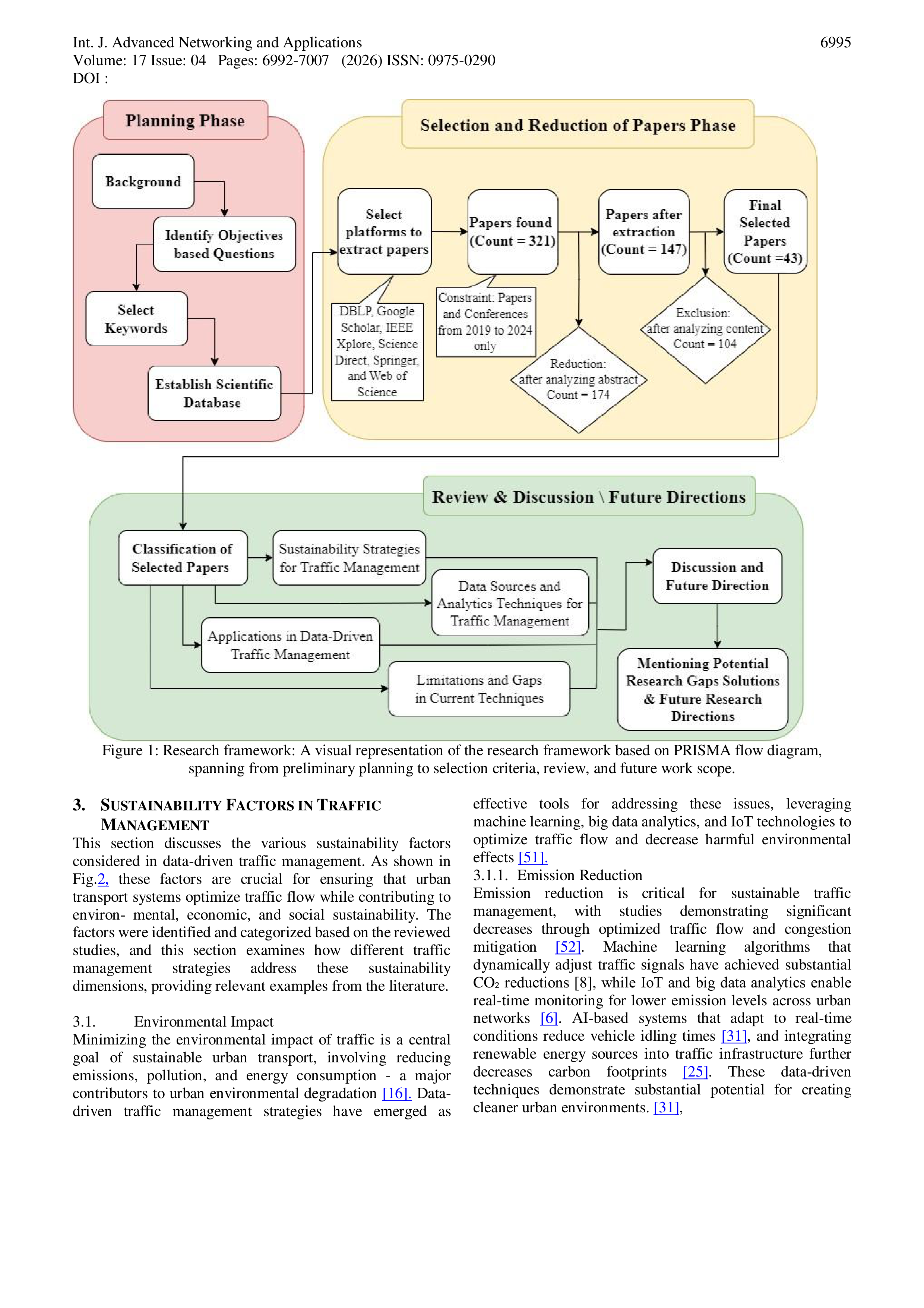
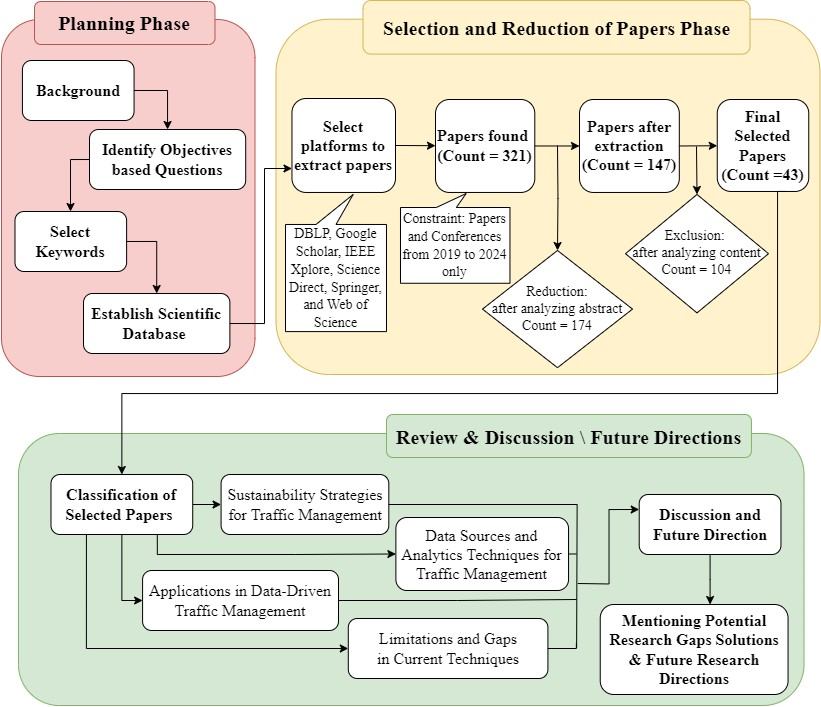
was meticulous, with strong and valid reasons. Fig.
1
shows a
comprehensive overview of the research framework
presented in this paper. It includes every step of the work
plan, from the preliminary planning stage to the literature
review study’s selection and exclusion criteria, and then the
review and discussion of the findings. Furthermore, this
figure emphasizes the scope of future work, providing a
visual representation of the systematic approach used in this
study.
2.4.
Data Extraction and Analysis
The extracted data were systematically organized into three
primary dimensions: sustainability factors, technical
solutions, and applications. For each study, we extracted
bibliographic details, study characteristics (geographic
context, design, data sources), methodological approaches
(AI/ML techniques, traffic management strategies), reported
outcomes
(sustainability
metrics,
performance
improvements), and implementation details. The grouping of
43 studies across these dimensions is summarized in Table 1.
For studies reporting quantitative outcomes, we extracted
percentage improvements in emissions, congestion, energy
consumption, and costs to provide a comprehensive view of
demonstrated benefits.
2.5.
Summary
This methodology ensures comprehensive database selection,
clear inclusion/exclusion criteria, and systematic data
extraction and analysis, providing a robust synthesis of data-
driven traffic management optimization for sustainable urban
transport. Subsequent sections address the research questions
and objectives based on these findings.
Int. J. Advanced Networking and Applications
Volume: 17 Issue: 04 Pages: 6992-7007 (2026) ISSN: 0975-0290
DOI :
6995
Figure 1: Research framework: A visual representation of the research framework based on PRISMA flow diagram,
spanning from preliminary planning to selection criteria, review, and future work scope.
3.
S
USTAINABILITY
F
ACTORS IN
T
RAFFIC
M
ANAGEMENT
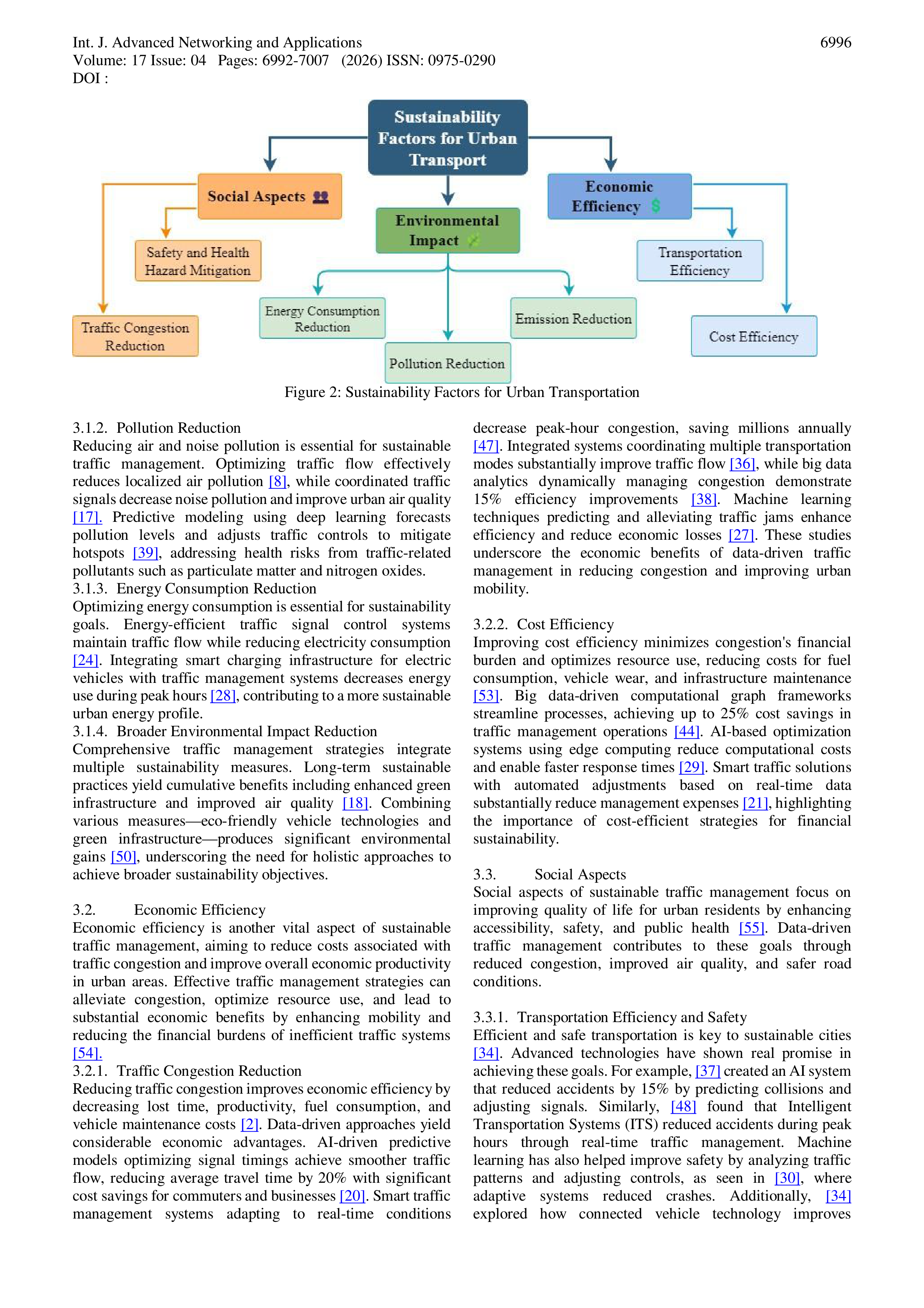
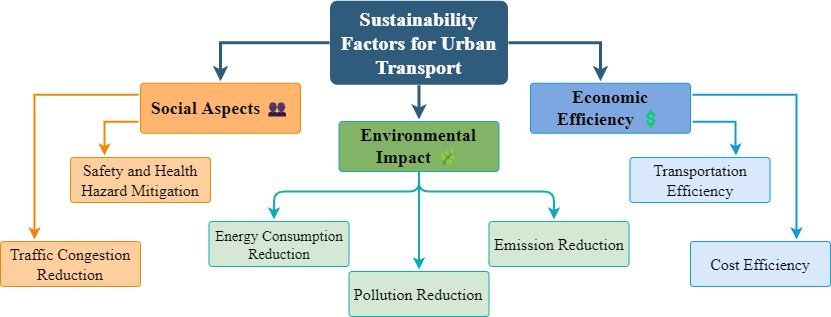
This section discusses the various sustainability factors
considered in data-driven traffic management. As shown in
Fig.
2,
these factors are crucial for ensuring that urban
transport systems optimize traffic flow while contributing to
environ- mental, economic, and social sustainability. The
factors were identified and categorized based on the reviewed
studies, and this section examines how different traffic
management
strategies
address
these
sustainability
dimensions, providing relevant examples from the literature.
3.1.
Environmental Impact
Minimizing the environmental impact of traffic is a central
goal of sustainable urban transport, involving reducing
emissions, pollution, and energy consumption - a major
contributors to urban environmental degradation
[16].
Data-
driven traffic management strategies have emerged as
effective tools for addressing these issues, leveraging
machine learning, big data analytics, and IoT technologies to
optimize traffic flow and decrease harmful environmental
effects
[51].
3.1.1.
Emission Reduction
Emission reduction is critical for sustainable traffic
management,
with
studies
demonstrating
significant
decreases through optimized traffic flow and congestion
mitigation
[52]
.
Machine
learning
algorithms
that
dynamically adjust traffic signals have achieved substantial
CO₂ reductions [8], while IoT and big data analytics enable
real-time monitoring for lower emission levels across urban
networks
[6]
. AI-based systems that adapt to real-time
conditions reduce vehicle idling times
[31]
, and integrating
renewable energy sources into traffic infrastructure further
decreases carbon footprints
[25]
. These data-driven
techniques demonstrate substantial potential for creating
cleaner urban environments.
[31]
,
Int. J. Advanced Networking and Applications
Volume: 17 Issue: 04 Pages: 6992-7007 (2026) ISSN: 0975-0290
DOI :
6996
Figure 2: Sustainability Factors for Urban Transportation
3.1.2.
Pollution Reduction
Reducing air and noise pollution is essential for sustainable
traffic management. Optimizing traffic flow effectively
reduces localized air pollution
[8]
, while coordinated traffic
signals decrease noise pollution and improve urban air quality
[17].
Predictive modeling using deep learning forecasts
pollution levels and adjusts traffic controls to mitigate
hotspots
[39]
, addressing health risks from traffic-related
pollutants such as particulate matter and nitrogen oxides.
3.1.3.
Energy Consumption Reduction
Optimizing energy consumption is essential for sustainability
goals. Energy-efficient traffic signal control systems
maintain traffic flow while reducing electricity consumption
[24]
. Integrating smart charging infrastructure for electric
vehicles with traffic management systems decreases energy
use during peak hours
[28]
, contributing to a more sustainable
urban energy profile.
3.1.4.
Broader Environmental Impact Reduction
Comprehensive traffic management strategies integrate
multiple sustainability measures. Long-term sustainable
practices yield cumulative benefits including enhanced green
infrastructure and improved air quality
[18]
. Combining
various measures—eco-friendly vehicle technologies and
green infrastructure—produces significant environmental
gains
[50]
, underscoring the need for holistic approaches to
achieve broader sustainability objectives.
3.2.
Economic Efficiency
Economic efficiency is another vital aspect of sustainable
traffic management, aiming to reduce costs associated with
traffic congestion and improve overall economic productivity
in urban areas. Effective traffic management strategies can
alleviate congestion, optimize resource use, and lead to
substantial economic benefits by enhancing mobility and
reducing the financial burdens of inefficient traffic systems
[54].
3.2.1.
Traffic Congestion Reduction
Reducing traffic congestion improves economic efficiency by
decreasing lost time, productivity, fuel consumption, and
vehicle maintenance costs
[2]
. Data-driven approaches yield
considerable economic advantages. AI-driven predictive
models optimizing signal timings achieve smoother traffic
flow, reducing average travel time by 20% with significant
cost savings for commuters and businesses
[20]
. Smart traffic
management systems adapting to real-time conditions
decrease peak-hour congestion, saving millions annually
[47]
. Integrated systems coordinating multiple transportation
modes substantially improve traffic flow
[36]
, while big data
analytics dynamically managing congestion demonstrate
15% efficiency improvements
[38]
. Machine learning
techniques predicting and alleviating traffic jams enhance
efficiency and reduce economic losses
[27]
. These studies
underscore the economic benefits of data-driven traffic
management in reducing congestion and improving urban
mobility.
3.2.2.
Cost Efficiency
Improving cost efficiency minimizes congestion's financial
burden and optimizes resource use, reducing costs for fuel
consumption, vehicle wear, and infrastructure maintenance
[53]
. Big data-driven computational graph frameworks
streamline processes, achieving up to 25% cost savings in
traffic management operations
[44]
. AI-based optimization
systems using edge computing reduce computational costs
and enable faster response times
[29]
. Smart traffic solutions
with automated adjustments based on real-time data
substantially reduce management expenses
[21]
, highlighting
the importance of cost-efficient strategies for financial
sustainability.
3.3.
Social Aspects
Social aspects of sustainable traffic management focus on
improving quality of life for urban residents by enhancing
accessibility, safety, and public health
[55]
. Data-driven
traffic management contributes to these goals through
reduced congestion, improved air quality, and safer road
conditions.
3.3.1.
Transportation Efficiency and Safety
Efficient and safe transportation is key to sustainable cities
[34]
. Advanced technologies have shown real promise in
achieving these goals. For example,
[37]
created an AI system
that reduced accidents by 15% by predicting collisions and
adjusting signals. Similarly,
[48]
found that Intelligent
Transportation Systems (ITS) reduced accidents during peak
hours through real-time traffic management. Machine
learning has also helped improve safety by analyzing traffic
patterns and adjusting controls, as seen in
[30]
, where
adaptive systems reduced crashes. Additionally,
[34]
explored how connected vehicle technology improves
Int. J. Advanced Networking and Applications
Volume: 17 Issue: 04 Pages: 6992-7007 (2026) ISSN: 0975-0290
DOI :
6997
communication between cars and infrastructure, further
enhancing safety.
3.3.2.
Health Hazard Mitigation
Traffic-related pollution, like PM2.5 and nitrogen oxides,
poses serious health risks, contributing to respiratory and
heart problems
[56]
. Data-driven systems help reduce these
risks by cutting down on pollution. For instance,
[45]
showed
that smart traffic management reduced PM2.5 levels by 10%,
improving air quality and public health. Likewise,
[22]
demonstrated that managing traffic flow reduces pollution
during peak hours, highlighting the importance of integrating
health-focused strategies into traffic management to protect
public health and reduce healthcare costs.
3.4.
Summary (RQ1)
This section addresses RQ1 by highlighting how data-driven
traffic
management
is
essential
for
environmental
sustainability. By reducing emissions, pollution, and energy
consumption, technologies like machine learning and real-
time data analytics make traffic flow more efficient. While
there are challenges with scaling these systems, they have the
potential to significantly improve urban mobility and
contribute to long-term environmental goals.
4.
T
ECHNICAL
S
OLUTIONS FOR
D
ATA
-D
RIVEN
T
RAFFIC
M
ANAGEMENT
O
PTIMIZATION
As urban areas continue to grow, the complexity of managing
traffic efficiently becomes increasingly challenging. Data-
driven approaches have emerged as critical strategies for
optimizing traffic management, providing insights that
enhance decision-making processes
[5].
These solutions
leverage diverse data sources—such as traffic sensors, GPS
data, IoT devices, and environmental conditions—to inform
more intelligent traffic systems that improve flow, reduce
congestion, and enhance safety.
Table 2: Data Types and Sources for Traffic Management Systems.
Data Types
Sources
Key Characteristics
Real-Time Traffic Data
Inductive loop detectors, GPS
data, IoT sensors
Provides current traffic volumes, vehicle speeds, and incident data,
crucial for dynamic traffic management.
Environmental Data
Weather stations, Road
Weather Information Systems,
air quality sensors
Monitors external factors such as weather and pollution that can
affect traffic flow and safety.
Historical Traffic Data
Archived traffic flow data,
congestion records, incident
reports
Used for analyzing long-term traffic trends and building predictive
models to forecast future conditions.
Vehicle-to-
Infrastructure (V2I)
Smart traffic signals, roadside
communication devices
Facilitates real-time communication between vehicles and
infrastructure to optimize traffic flow and reduce fuel
consumption.
Public Transportation
Data
Public transit management
systems, shared mobility
platforms
Provides data on vehicle availability, routes, and passenger loads,
contributing to the efficiency of multimodal transport systems.
Crowdsourced Data
Social media platforms, traffic
apps
User-generated data offers real-time insights into incidents, road
conditions, and traffic flow, complementing traditional sensor
networks.
4.1.
Data in Traffic Management
Effective traffic management relies on integrating data from
multiple sources, enabling real-time monitoring, predictive
analytics, and informed decision-making. The combination of
various data types—such as traffic sensors, GPS data, and IoT
devices—helps develop a comprehensive understanding of
traffic patterns
[57].
These insights allow for more adaptive
and responsive traffic control systems, which are essential for
improving traffic flow, reducing congestion, and enhancing
road safety. Table
2
summarizes the main data types and their
sources, highlighting the critical role each plays in modern
traffic management systems.
Each of these data types contributes uniquely to enhancing
traffic management by allowing systems to address different
aspects of urban mobility. For instance, real-time traffic data
enables adaptive signal control and rerouting during peak
congestion periods, while historical traffic data allows urban
planners
to
identify
long-term
trends
that
inform
infrastructure improvements. Additionally, the use of
environmental data ensures that external factors, such as
adverse weather or high pollution levels, are accounted for in
real-time traffic decisions.
The integration of these data sources is essential for
developing a unified traffic management framework capable
of real- time decision-making and long-term planning. Data
fusion techniques, which combine information from different
sources, play a key role in generating a more accurate and
holistic view of traffic conditions.
[21]
discussed the benefits
of data fusion in smart traffic management, noting that
integrating real-time data with historical patterns improves
traffic forecasts and system responsiveness.
Int. J. Advanced Networking and Applications
Volume: 17 Issue: 04 Pages: 6992-7007 (2026) ISSN: 0975-0290
DOI :
6998
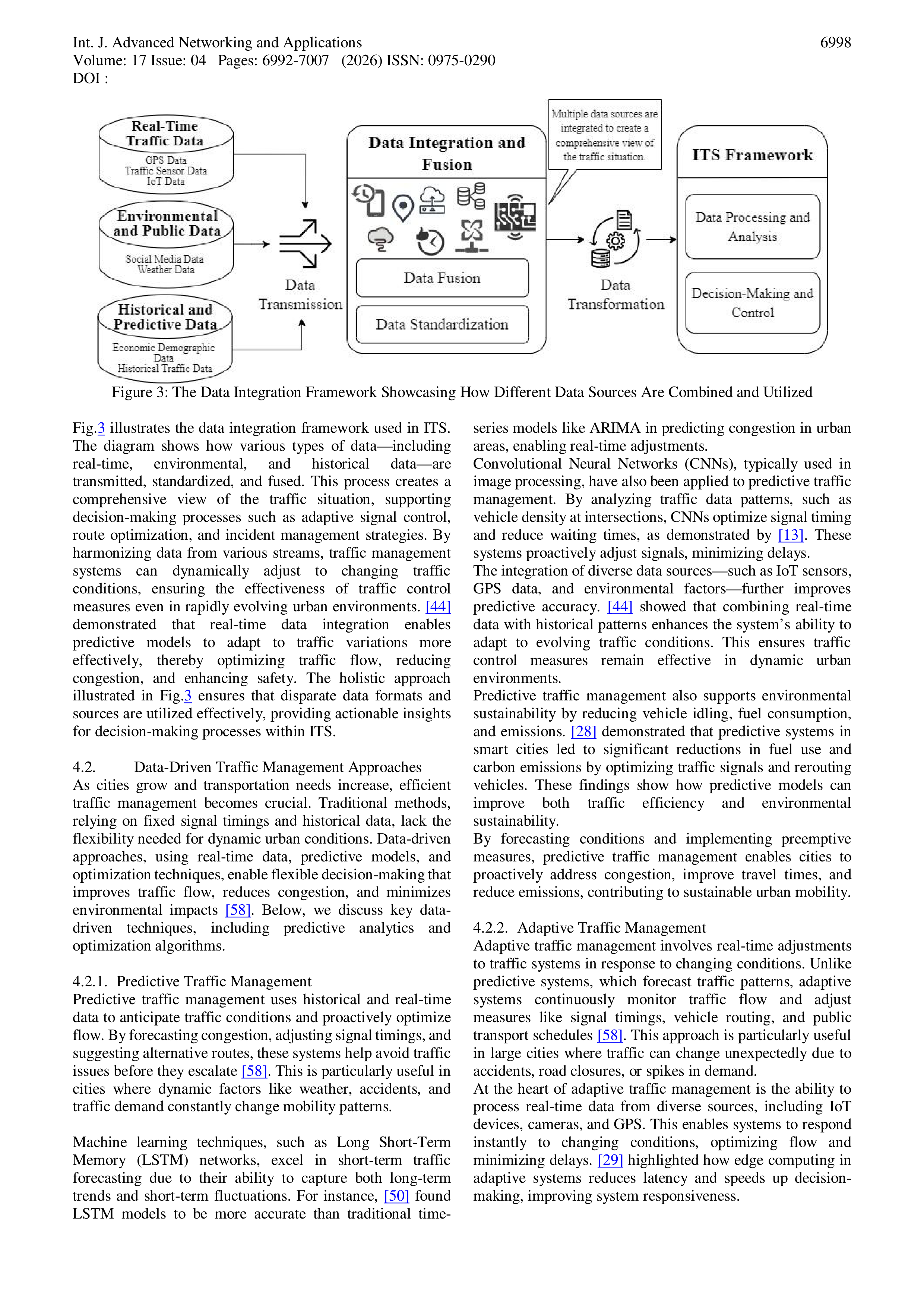
Figure 3: The Data Integration Framework Showcasing How Different Data Sources Are Combined and Utilized
Fig.
3
illustrates the data integration framework used in ITS.
The diagram shows how various types of data—including
real-time,
environmental,
and
historical
data—are
transmitted, standardized, and fused. This process creates a
comprehensive view of the traffic situation, supporting
decision-making processes such as adaptive signal control,
route optimization, and incident management strategies. By
harmonizing data from various streams, traffic management
systems can dynamically adjust to changing traffic
conditions, ensuring the effectiveness of traffic control
measures even in rapidly evolving urban environments.
[44]
demonstrated that real-time data integration enables
predictive models to adapt to traffic variations more
effectively, thereby optimizing traffic flow, reducing
congestion, and enhancing safety. The holistic approach
illustrated in Fig.
3
ensures that disparate data formats and
sources are utilized effectively, providing actionable insights
for decision-making processes within ITS.
4.2.
Data-Driven Traffic Management Approaches
As cities grow and transportation needs increase, efficient
traffic management becomes crucial. Traditional methods,
relying on fixed signal timings and historical data, lack the
flexibility needed for dynamic urban conditions. Data-driven
approaches, using real-time data, predictive models, and
optimization techniques, enable flexible decision-making that
improves traffic flow, reduces congestion, and minimizes
environmental impacts
[58]
. Below, we discuss key data-
driven techniques, including predictive analytics and
optimization algorithms.
4.2.1.
Predictive Traffic Management
Predictive traffic management uses historical and real-time
data to anticipate traffic conditions and proactively optimize
flow. By forecasting congestion, adjusting signal timings, and
suggesting alternative routes, these systems help avoid traffic
issues before they escalate
[58]
. This is particularly useful in
cities where dynamic factors like weather, accidents, and
traffic demand constantly change mobility patterns.
Machine learning techniques, such as Long Short-Term
Memory (LSTM) networks, excel in short-term traffic
forecasting due to their ability to capture both long-term
trends and short-term fluctuations. For instance,
[50]
found
LSTM models to be more accurate than traditional time-
series models like ARIMA in predicting congestion in urban
areas, enabling real-time adjustments.
Convolutional Neural Networks (CNNs), typically used in
image processing, have also been applied to predictive traffic
management. By analyzing traffic data patterns, such as
vehicle density at intersections, CNNs optimize signal timing
and reduce waiting times, as demonstrated by
[13]
. These
systems proactively adjust signals, minimizing delays.
The integration of diverse data sources—such as IoT sensors,
GPS data, and environmental factors—further improves
predictive accuracy.
[44]
showed that combining real-time
data with historical patterns enhances the system’s ability to
adapt to evolving traffic conditions. This ensures traffic
control measures remain effective in dynamic urban
environments.
Predictive traffic management also supports environmental
sustainability by reducing vehicle idling, fuel consumption,
and emissions.
[28]
demonstrated that predictive systems in
smart cities led to significant reductions in fuel use and
carbon emissions by optimizing traffic signals and rerouting
vehicles. These findings show how predictive models can
improve
both
traffic
efficiency
and
environmental
sustainability.
By forecasting conditions and implementing preemptive
measures, predictive traffic management enables cities to
proactively address congestion, improve travel times, and
reduce emissions, contributing to sustainable urban mobility.
4.2.2.
Adaptive Traffic Management
Adaptive traffic management involves real-time adjustments
to traffic systems in response to changing conditions. Unlike
predictive systems, which forecast traffic patterns, adaptive
systems continuously monitor traffic flow and adjust
measures like signal timings, vehicle routing, and public
transport schedules
[58]
. This approach is particularly useful
in large cities where traffic can change unexpectedly due to
accidents, road closures, or spikes in demand.
At the heart of adaptive traffic management is the ability to
process real-time data from diverse sources, including IoT
devices, cameras, and GPS. This enables systems to respond
instantly to changing conditions, optimizing flow and
minimizing delays.
[29]
highlighted how edge computing in
adaptive systems reduces latency and speeds up decision-
making, improving system responsiveness.
Int. J. Advanced Networking and Applications
Volume: 17 Issue: 04 Pages: 6992-7007 (2026) ISSN: 0975-0290
DOI :
6999
RL is one of the most effective techniques for adaptive traffic
management. RL-based systems learn from real-time
feedback and adjust behavior accordingly.
[10]
implemented
an RL system in Nicosia, which dynamically adjusted signal
timings, leading to shorter wait times and better fuel
efficiency—demonstrating RL’s potential to improve both
traffic flow and sustainability.
Multi-agent
systems,
where
each
signal
operates
independently and communicates with others to optimize
flow, are also key to adaptive traffic management.
[15]
applied multi-agent RL to manage traffic in large urban areas,
showing that decentralization allows for scalability and better
performance in complex networks. These systems reduce the
computational complexity of centralized control systems.
The environmental benefits of adaptive traffic management
are significant. By reducing congestion and optimizing signal
timings, these systems lower vehicle idling times, cut fuel
consumption, and reduce emissions. For example,
[9]
found
that an RL-based system reduced CO2 emissions by 8.1% and
decreased delays by 34%. These findings highlight how
adaptive traffic management contributes to sustainable urban
mobility.
Adaptive traffic management provides a dynamic solution for
real-time traffic management. Techniques like RL and multi-
agent systems can quickly respond to changes in traffic
conditions,
enhancing
efficiency
and
supporting
sustainability by lowering emissions and fuel consumption.
4.2.3.
Optimization-Based Traffic Management
Optimization-based traffic management tackles complex,
multi-objective problems in urban transport, such as reducing
congestion, travel times, and emissions, while accounting for
environmental and operational constraints. This approach
uses advanced algorithms to dynamically adjust traffic
measures, offering efficient solutions in changing traffic
conditions, especially in urban areas with fluctuating
demands.
Heuristic optimization methods like Genetic Algorithms
(GA), Particle Swarm Optimization (PSO), and Ant Colony
Optimization (ACO) are widely used in traffic management
due to their ability to handle large solution spaces and balance
multiple goals. For example,
[22]
used GA to optimize traffic
signal timings, reducing travel times and fuel consumption by
evolving strategies based on natural selection principles. This
iterative process allows GA to adapt effectively to dynamic
traffic systems, outperforming traditional methods.
PSO, inspired by the collective behavior of swarms, is
another key technique. In PSO, each “particle” represents a
potential solution, adjusting its position based on the best-
performing solutions in the group.
[22]
showed that PSO
optimized vehicle routing and signal control, leading to
reductions in fuel consumption and emissions. PSO’s ability
to quickly adapt to changing traffic makes it ideal for real-
time applications.
Multi-objective optimization is essential for balancing
competing goals like travel time, emissions, and energy
consumption.
[39]
applied a multi-objective framework
during large public events, optimizing road occupancy,
reducing travel times by 37.7%, and cutting emissions by
89.6%, demonstrating the potential of this approach to handle
traffic surges while minimizing environmental impacts.
Dynamic traffic routing, where routes are adjusted based on
real-time data, helps avoid congested areas and improves
traffic flow.
[23]
implemented this in last-mile logistics,
improving delivery efficiency and reducing fuel use by
optimizing routes in real-time. This contributes to more
sustainable urban logistics by minimizing travel distances and
emissions.
The sustainability benefits of optimization-based traffic
management are substantial. By optimizing signals, routing,
and schedules, these systems reduce idling, fuel consumption,
and emissions.
[39]
demonstrated a significant reduction in
emissions during special event management, while
[22]
found that GA and PSO methods enhanced both
environmental and operational sustainability.
Optimization-based traffic management offers a robust
solution to urban traffic challenges, using advanced
algorithms to improve flow, reduce environmental impacts,
and optimize resource use.
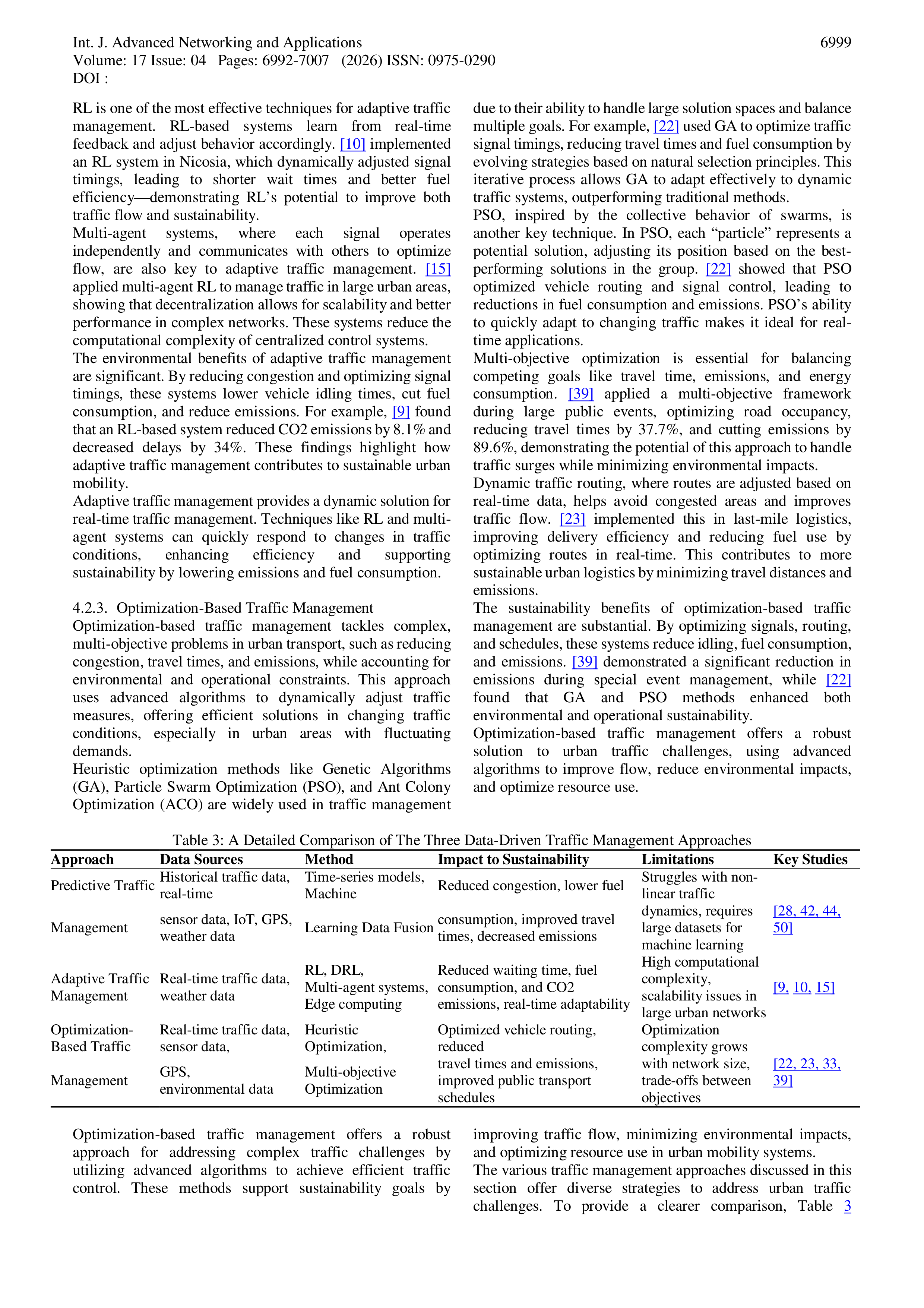
Table 3: A Detailed Comparison of The Three Data-Driven Traffic Management Approaches
Approach
Data Sources
Method
Impact to Sustainability
Limitations
Key Studies
Predictive Traffic
Historical traffic data,
real-time
Time-series models,
Machine
Reduced congestion, lower fuel
Struggles with non-
linear traffic
[28, 42, 44,
50]
Management
sensor data, IoT, GPS,
weather data
Learning Data Fusion
consumption, improved travel
times, decreased emissions
dynamics, requires
large datasets for
machine learning
Adaptive Traffic
Management
Real-time traffic data,
weather data
RL, DRL,
Multi-agent systems,
Edge computing
Reduced waiting time, fuel
consumption, and CO2
emissions, real-time adaptability
High computational
complexity,
scalability issues in
large urban networks
[9,
10,
15]
Optimization-
Based Traffic
Real-time traffic data,
sensor data,
Heuristic
Optimization,
Optimized vehicle routing,
reduced
Optimization
complexity grows
[22, 23, 33,
39]
Management
GPS,
environmental data
Multi-objective
Optimization
travel times and emissions,
improved public transport
schedules
with network size,
trade-offs between
objectives
Optimization-based traffic management offers a robust
approach for addressing complex traffic challenges by
utilizing advanced algorithms to achieve efficient traffic
control. These methods support sustainability goals by
improving traffic flow, minimizing environmental impacts,
and optimizing resource use in urban mobility systems.
The various traffic management approaches discussed in this
section offer diverse strategies to address urban traffic
challenges. To provide a clearer comparison, Table
3
Int. J. Advanced Networking and Applications
Volume: 17 Issue: 04 Pages: 6992-7007 (2026) ISSN: 0975-0290
DOI :
7000
provides a detailed comparison of the three data-driven traffic
management
approaches;
Predictive,
Adaptive,
and
Optimization-Based,
highlighting
their
data
sources,
methods, impact on sustainability, limitations, and key
studies.
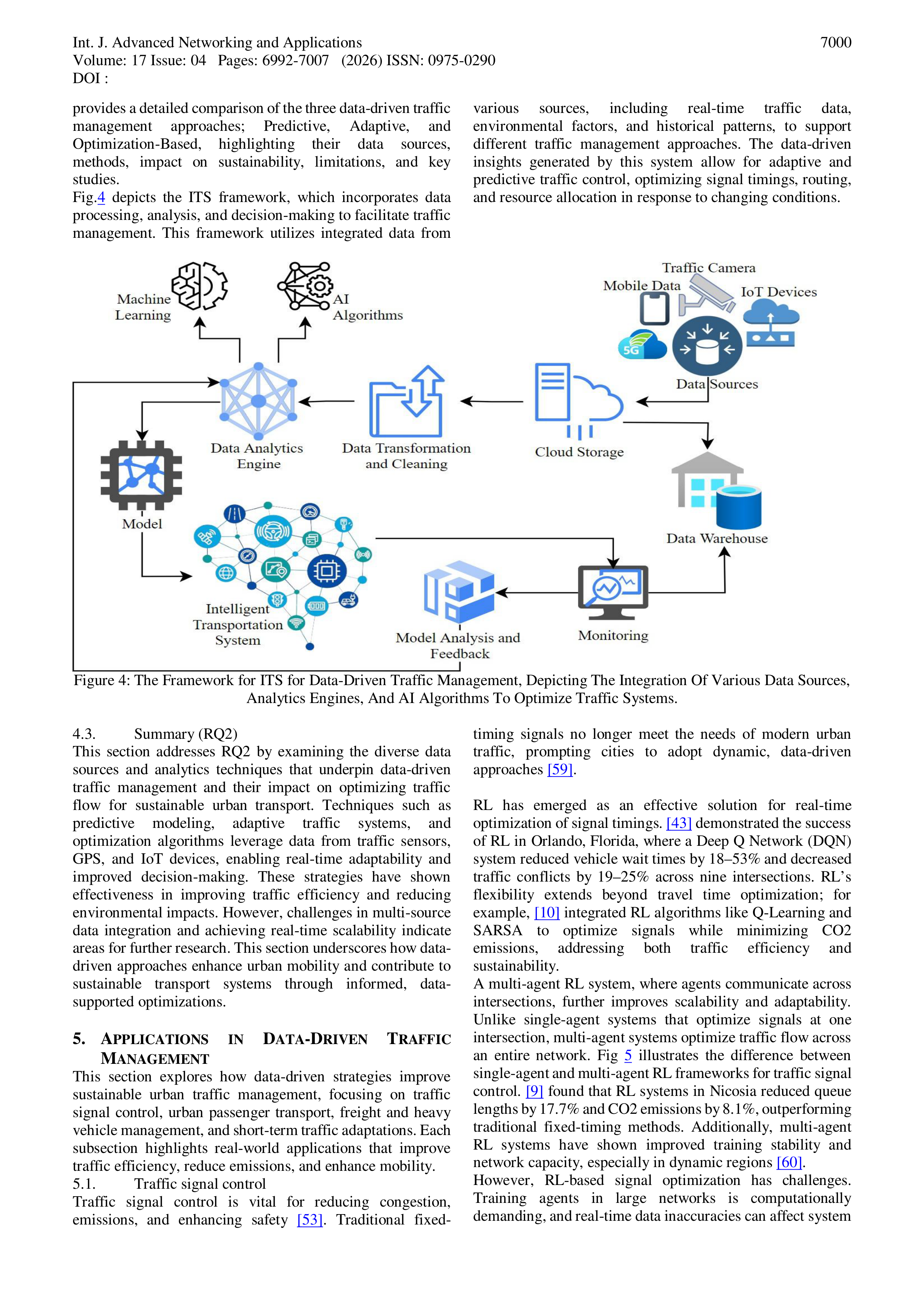
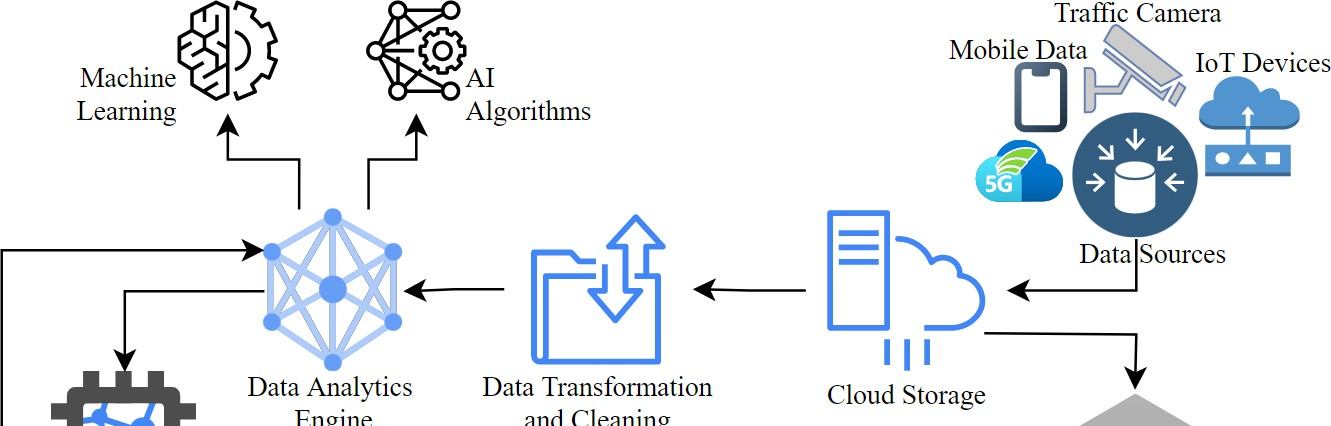
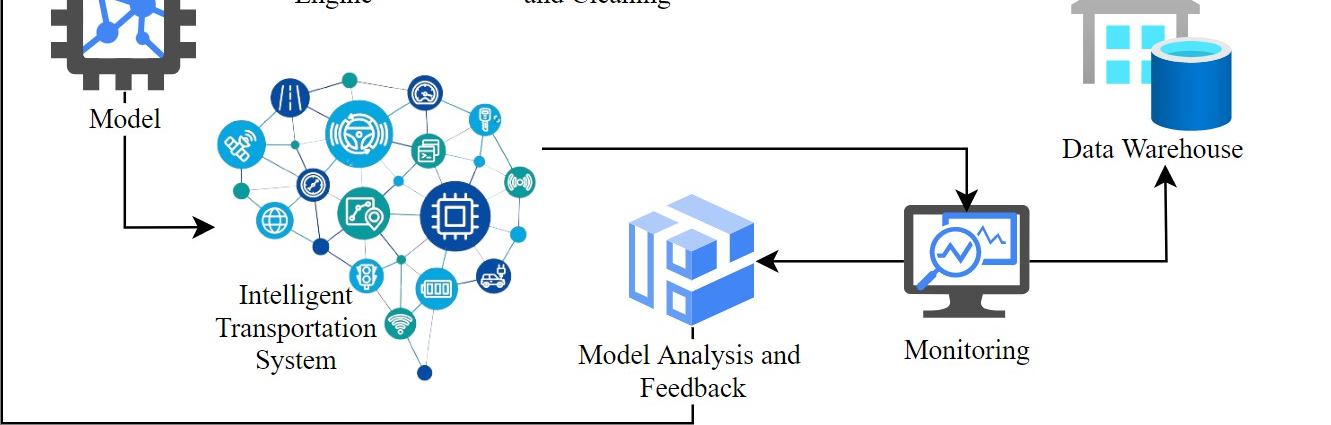
Fig.
4
depicts the ITS framework, which incorporates data
processing, analysis, and decision-making to facilitate traffic
management. This framework utilizes integrated data from
various
sources,
including
real-time
traffic
data,
environmental factors, and historical patterns, to support
different traffic management approaches. The data-driven
insights generated by this system allow for adaptive and
predictive traffic control, optimizing signal timings, routing,
and resource allocation in response to changing conditions.
Figure 4: The Framework for ITS for Data-Driven Traffic Management, Depicting The Integration Of Various Data Sources,
Analytics Engines, And AI Algorithms To Optimize Traffic Systems.
4.3.
Summary (RQ2)
This section addresses RQ2 by examining the diverse data
sources and analytics techniques that underpin data-driven
traffic management and their impact on optimizing traffic
flow for sustainable urban transport. Techniques such as
predictive
modeling,
adaptive
traffic
systems,
and
optimization algorithms leverage data from traffic sensors,
GPS, and IoT devices, enabling real-time adaptability and
improved decision-making. These strategies have shown
effectiveness in improving traffic efficiency and reducing
environmental impacts. However, challenges in multi-source
data integration and achieving real-time scalability indicate
areas for further research. This section underscores how data-
driven approaches enhance urban mobility and contribute to
sustainable transport systems through informed, data-
supported optimizations.
5.
A
PPLICATIONS
IN
D
ATA
-D
RIVEN
T
RAFFIC
M
ANAGEMENT
This section explores how data-driven strategies improve
sustainable urban traffic management, focusing on traffic
signal control, urban passenger transport, freight and heavy
vehicle management, and short-term traffic adaptations. Each
subsection highlights real-world applications that improve
traffic efficiency, reduce emissions, and enhance mobility.
5.1.
Traffic signal control
Traffic signal control is vital for reducing congestion,
emissions, and enhancing safety
[53]
. Traditional fixed-
timing signals no longer meet the needs of modern urban
traffic, prompting cities to adopt dynamic, data-driven
approaches
[59]
.
RL has emerged as an effective solution for real-time
optimization of signal timings.
[43]
demonstrated the success
of RL in Orlando, Florida, where a Deep Q Network (DQN)
system reduced vehicle wait times by 18–53% and decreased
traffic conflicts by 19–25% across nine intersections. RL’s
flexibility extends beyond travel time optimization; for
example,
[10]
integrated RL algorithms like Q-Learning and
SARSA to optimize signals while minimizing CO2
emissions,
addressing
both
traffic
efficiency
and
sustainability.
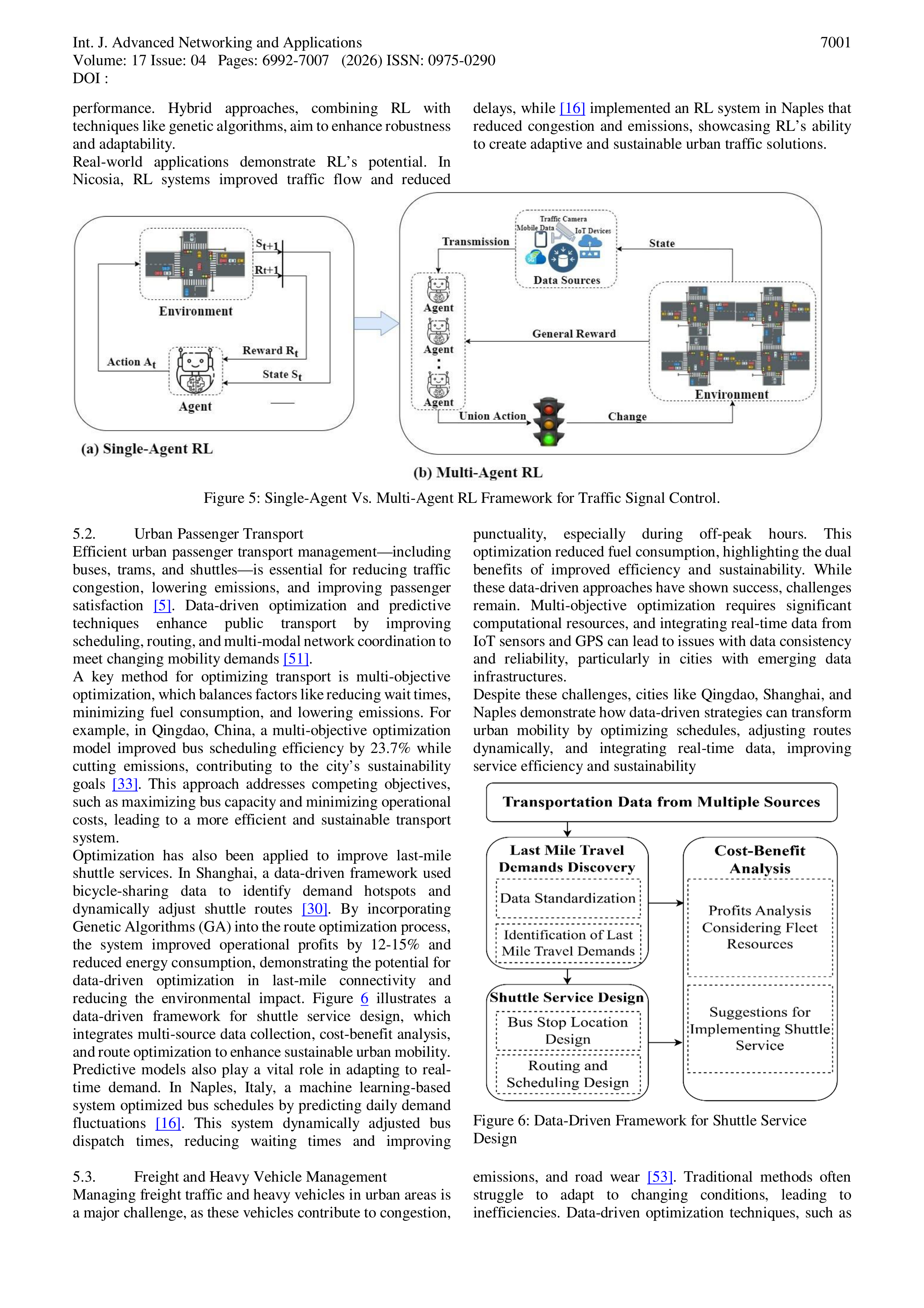
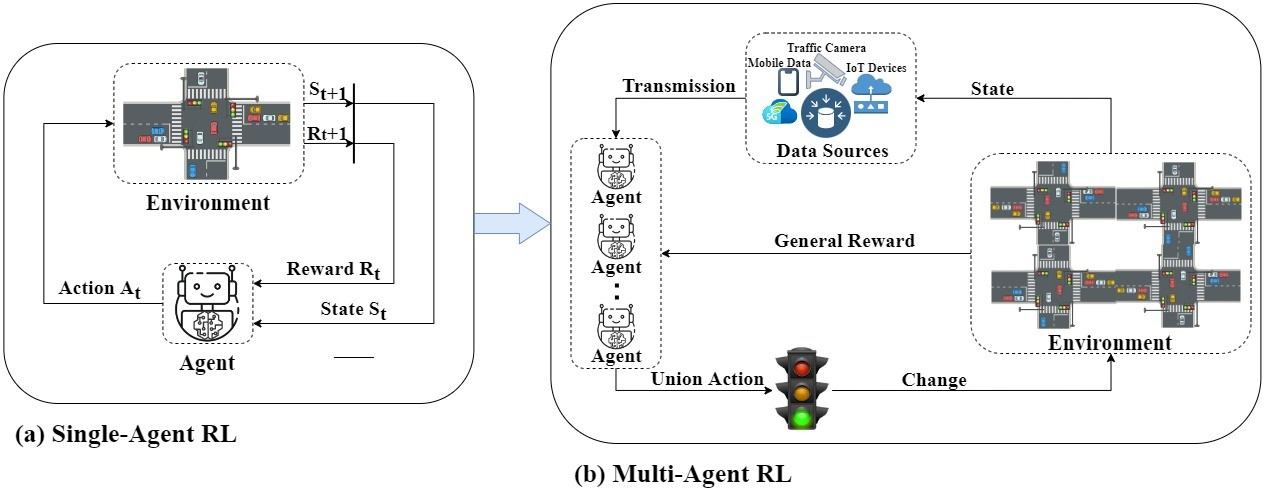
A multi-agent RL system, where agents communicate across
intersections, further improves scalability and adaptability.
Unlike single-agent systems that optimize signals at one
intersection, multi-agent systems optimize traffic flow across
an entire network. Fig
5
illustrates the difference between
single-agent and multi-agent RL frameworks for traffic signal
control.
[9]
found that RL systems in Nicosia reduced queue
lengths by 17.7% and CO2 emissions by 8.1%, outperforming
traditional fixed-timing methods. Additionally, multi-agent
RL systems have shown improved training stability and
network capacity, especially in dynamic regions
[60]
.
However, RL-based signal optimization has challenges.
Training agents in large networks is computationally
demanding, and real-time data inaccuracies can affect system
Int. J. Advanced Networking and Applications
Volume: 17 Issue: 04 Pages: 6992-7007 (2026) ISSN: 0975-0290
DOI :
7001
performance. Hybrid approaches, combining RL with
techniques like genetic algorithms, aim to enhance robustness
and adaptability.
Real-world applications demonstrate RL’s potential. In
Nicosia, RL systems improved traffic flow and reduced
delays, while
[16]
implemented an RL system in Naples that
reduced congestion and emissions, showcasing RL’s ability
to create adaptive and sustainable urban traffic solutions.
Figure 5: Single-Agent Vs. Multi-Agent RL Framework for Traffic Signal Control.
5.2.
Urban Passenger Transport
Efficient urban passenger transport management—including
buses, trams, and shuttles—is essential for reducing traffic
congestion, lowering emissions, and improving passenger
satisfaction
[5]
. Data-driven optimization and predictive
techniques
enhance
public
transport
by
improving
scheduling, routing, and multi-modal network coordination to
meet changing mobility demands
[51]
.
A key method for optimizing transport is multi-objective
optimization, which balances factors like reducing wait times,
minimizing fuel consumption, and lowering emissions. For
example, in Qingdao, China, a multi-objective optimization
model improved bus scheduling efficiency by 23.7% while
cutting emissions, contributing to the city’s sustainability
goals
[33]
. This approach addresses competing objectives,
such as maximizing bus capacity and minimizing operational
costs, leading to a more efficient and sustainable transport
system.
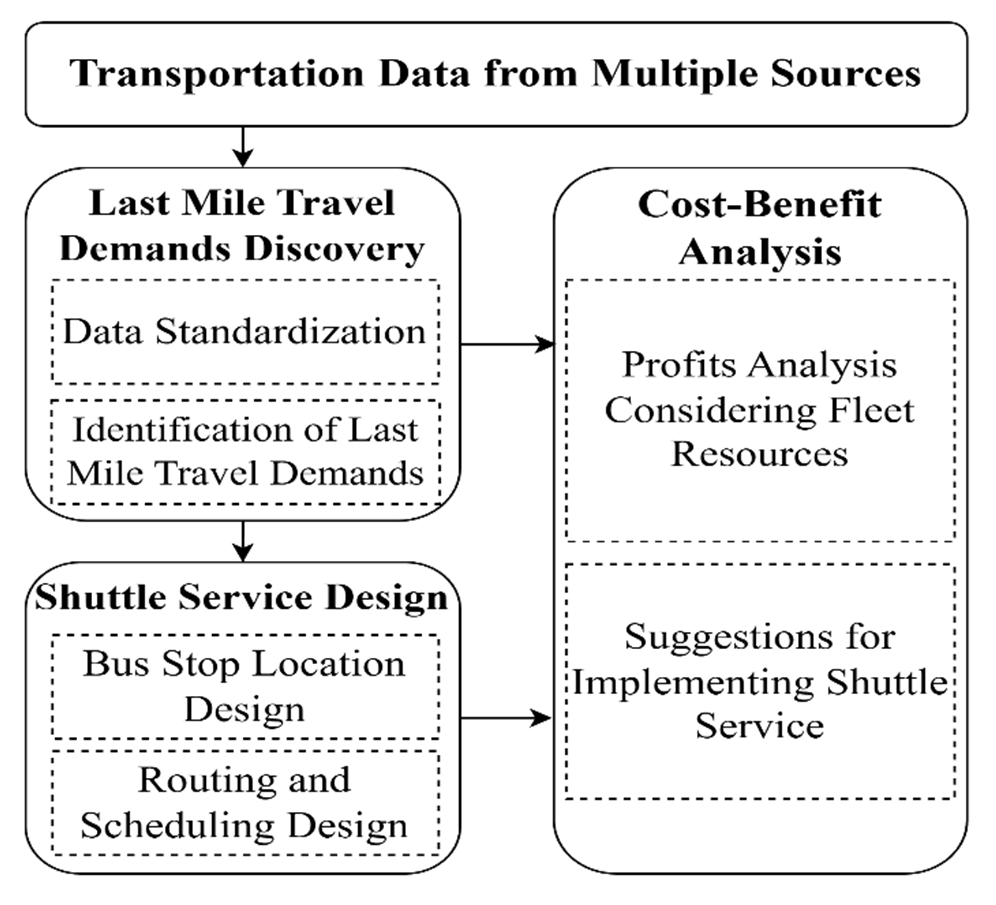
Optimization has also been applied to improve last-mile
shuttle services. In Shanghai, a data-driven framework used
bicycle-sharing data to identify demand hotspots and
dynamically adjust shuttle routes
[30]
. By incorporating
Genetic Algorithms (GA) into the route optimization process,
the system improved operational profits by 12-15% and
reduced energy consumption, demonstrating the potential for
data-driven optimization in last-mile connectivity and
reducing the environmental impact. Figure
6
illustrates a
data-driven framework for shuttle service design, which
integrates multi-source data collection, cost-benefit analysis,
and route optimization to enhance sustainable urban mobility.
Predictive models also play a vital role in adapting to real-
time demand. In Naples, Italy, a machine learning-based
system optimized bus schedules by predicting daily demand
fluctuations
[16]
. This system dynamically adjusted bus
dispatch times, reducing waiting times and improving
punctuality,
especially
during
off-peak
hours. This
optimization reduced fuel consumption, highlighting the dual
benefits of improved efficiency and sustainability. While
these data-driven approaches have shown success, challenges
remain. Multi-objective optimization requires significant
computational resources, and integrating real-time data from
IoT sensors and GPS can lead to issues with data consistency
and reliability, particularly in cities with emerging data
infrastructures.
Despite these challenges, cities like Qingdao, Shanghai, and
Naples demonstrate how data-driven strategies can transform
urban mobility by optimizing schedules, adjusting routes
dynamically, and integrating real-time data, improving
service efficiency and sustainability
Figure 6: Data-Driven Framework for Shuttle Service
Design
5.3.
Freight and Heavy Vehicle Management
Managing freight traffic and heavy vehicles in urban areas is
a major challenge, as these vehicles contribute to congestion,
emissions, and road wear
[53]
. Traditional methods often
struggle to adapt to changing conditions, leading to
inefficiencies. Data-driven optimization techniques, such as
Int. J. Advanced Networking and Applications
Volume: 17 Issue: 04 Pages: 6992-7007 (2026) ISSN: 0975-0290
DOI :
7002
predictive modeling and IoT-enabled systems, offer
significant potential to improve the efficiency and
sustainability of freight management.
One approach involves using IoT systems to optimize last-
mile logistics by integrating real-time traffic data with
machine learning. In Singapore, an IoT-based system
adjusted delivery routes dynamically to avoid congestion,
reducing travel distances by 5.5% and lowering delivery costs
by 11%
[23]
. By continuously monitoring traffic with IoT
sensors and GPS, the system minimized fuel use and
emissions, aligning with environmental goals.
AI-driven systems also help optimize heavy vehicle
movement in urban areas. In Italy, an AI system analyzed
historical and real-time data to optimize delivery schedules,
reducing stops and delays
[36]
. This approach improved fuel
efficiency and reduced CO2 emissions by forecasting traffic
conditions and adjusting routes. This demonstrates how
predictive management benefits both the environment and
operations.
Despite these successes, challenges remain. Real-time data
from IoT sensors, GPS, and traffic cameras requires
substantial computational resources. Data accuracy is also
critical; any delays or inaccuracies can lead to poor routing
decisions, which affect system performance
[21]
.
Studies show that data-driven approaches outperform
traditional methods in freight management. AI systems have
led to notable reductions in travel times and emissions
compared to conventional methods
[10]
. Optimization
techniques, such as genetic algorithms, have been
successfully used to improve route planning and minimize
fuel consumption
[22]
.
Data-driven methods offer substantial opportunities to
enhance urban freight logistics, reducing emissions and
operational costs. However, overcoming challenges related to
data processing, real-time accuracy, and infrastructure
investment is key for broader implementation.
5.4.
Special Applications and Short-Term Traffic
Management
Urban traffic management faces unique challenges during
events and short-term surges, such as festivals, sports events,
accidents, road closures, or peak-hour congestion. These
situations can overwhelm infrastructure, causing delays and
increased emissions
[2]
. Data-driven approaches, including
multi-objective optimization, RL, and predictive modeling,
effectively address these dynamic conditions.
Multi-objective optimization helps manage traffic during
large events by balancing objectives like minimizing travel
times, reducing road occupancy, and lowering emissions. In
Tianjin, China, a multi-objective model improved travel
times by 37.7% and reduced road occupancy by 89.6% during
festivals and sports events
[39]
, demonstrating how data-
driven strategies can relieve pressure on urban infrastructure
during high-demand periods.
RL is another valuable tool for managing short-term traffic
fluctuations. In Orlando, Florida, a DQN-based system
dynamically adjusted signal timings based on real-time data,
reducing wait times at intersections and improving flow
[43]
.
This flexibility is crucial for handling traffic surges due to
accidents or sudden congestion.
Predictive modeling also plays a key role in managing
congestion by enabling proactive measures. In Buxton, UK,
an IoT-enabled system predicted congestion points with 95%
accuracy, allowing city planners to reroute traffic in advance
and prevent delays
[20]
, thus enhancing urban mobility.
Despite their success, these approaches face challenges.
Timely and accurate data is crucial, as delays or inaccuracies
can hinder their effectiveness. Additionally, multi-objective
optimization requires significant computational resources to
process large data volumes and make real-time decisions
[21]
. Hybrid approaches combining RL, predictive modeling,
and optimization are emerging as solutions to enable real-
time adaptations while balancing multiple objectives.
Data-driven methods like multi-objective optimization, RL,
and predictive modeling show strong potential in managing
traffic during special events and short-term surges. They help
optimize flow, reduce congestion, and support urban mobility
in dynamic environments. However, addressing challenges
related to data accuracy, computational demands, and
scalability is key for successful implementation.
5.5.
Summary (RQ3)
This section addresses RQ3 by examining the practical
application of data-driven strategies in urban traffic
management. It highlights how RL improves signal timing,
predictive modeling enhances public transportation planning,
and multi-objective optimization helps with real-time event
routing, reducing traffic and pollution. IoT-based systems
optimize freight routing, contributing to sustainable urban
mobility. While these strategies show great potential, broader
adoption requires overcoming challenges like data accuracy,
computational needs, and scalability. The findings highlight
promising approaches to sustainable and efficient urban
mobility through data-driven traffic management.
Int. J. Advanced Networking and Applications
Volume: 17 Issue: 04 Pages: 6992-7007 (2026) ISSN: 0975-0290
DOI :
7003
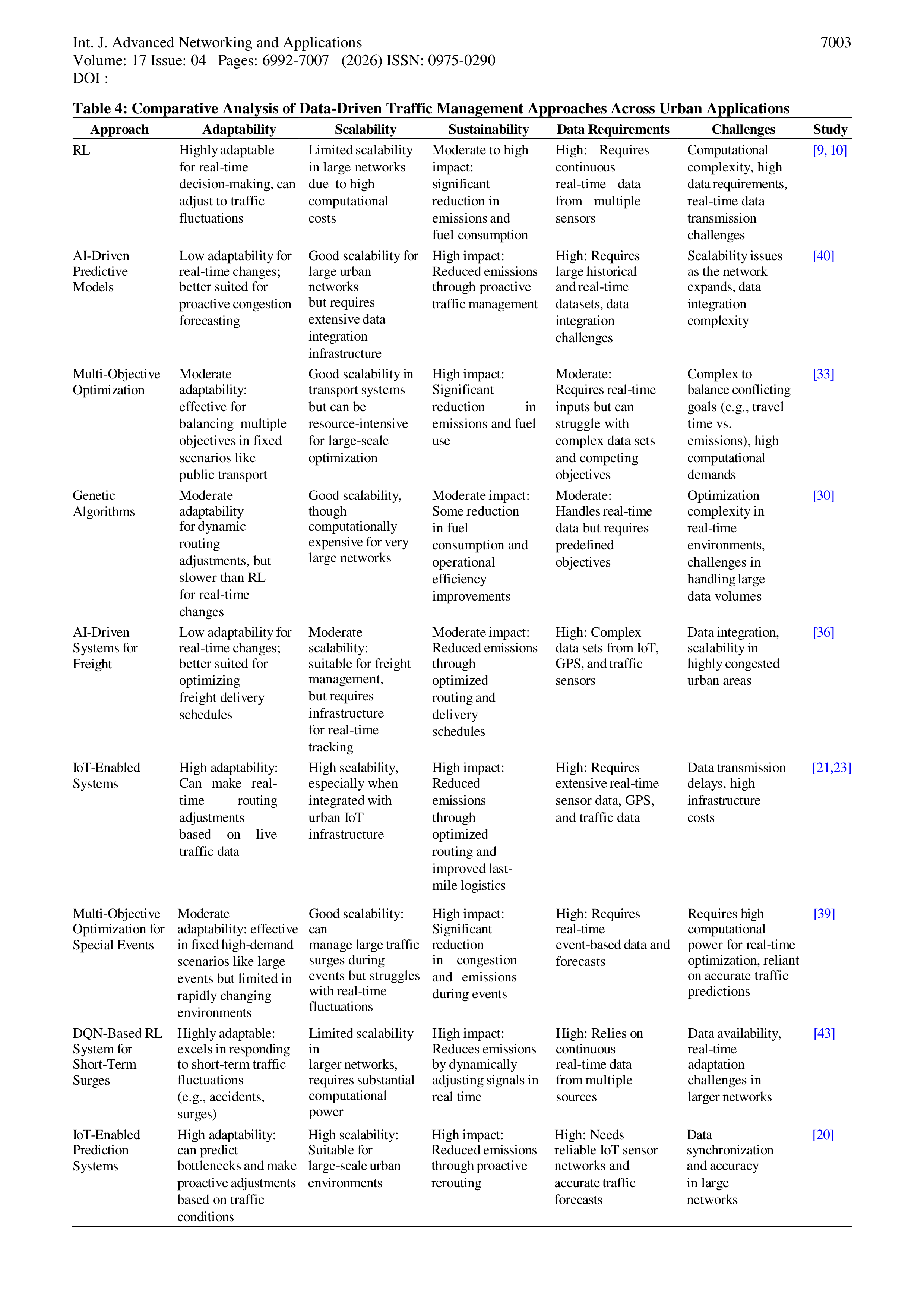
Table 4: Comparative Analysis of Data-Driven Traffic Management Approaches Across Urban Applications
Approach
Adaptability
Scalability
Sustainability
Data Requirements
Challenges
Study
RL
Highly adaptable
for real-time
decision-making, can
adjust to traffic
fluctuations
Limited scalability
in large networks
due to high
computational
costs
Moderate to high
impact:
significant
reduction in
emissions and
fuel consumption
High: Requires
continuous
real-time data
from multiple
sensors
Computational
complexity, high
data requirements,
real-time data
transmission
challenges
[9, 10]
AI-Driven
Predictive
Models
Low adaptability for
real-time changes;
better suited for
proactive congestion
forecasting
Good scalability for
large urban
networks
but requires
extensive data
integration
infrastructure
High impact:
Reduced emissions
through proactive
traffic management
High: Requires
large historical
and real-time
datasets, data
integration
challenges
Scalability issues
as the network
expands, data
integration
complexity
[40]
Multi-Objective
Optimization
Moderate
adaptability:
effective for
balancing multiple
objectives in fixed
scenarios like
public transport
Good scalability in
transport systems
but can be
resource-intensive
for large-scale
optimization
High impact:
Significant
reduction
in
emissions and fuel
use
Moderate:
Requires real-time
inputs but can
struggle with
complex data sets
and competing
objectives
Complex to
balance conflicting
goals (e.g., travel
time vs.
emissions), high
computational
demands
[33]
Genetic
Algorithms
Moderate
adaptability
for dynamic
routing
adjustments, but
slower than RL
for real-time
changes
Good scalability,
though
computationally
expensive for very
large networks
Moderate impact:
Some reduction
in fuel
consumption and
operational
efficiency
improvements
Moderate:
Handles real-time
data but requires
predefined
objectives
Optimization
complexity in
real-time
environments,
challenges in
handling large
data volumes
[30]
AI-Driven
Systems for
Freight
Low adaptability for
real-time changes;
better suited for
optimizing
freight delivery
schedules
Moderate
scalability:
suitable for freight
management,
but requires
infrastructure
for real-time
tracking
Moderate impact:
Reduced emissions
through
optimized
routing and
delivery
schedules
High: Complex
data sets from IoT,
GPS, and traffic
sensors
Data integration,
scalability in
highly congested
urban areas
[36]
IoT-Enabled
Systems
High adaptability:
Can make real-
time
routing
adjustments
based
on
live
traffic data
High scalability,
especially when
integrated with
urban IoT
infrastructure
High impact:
Reduced
emissions
through
optimized
routing and
improved last-
mile logistics
High: Requires
extensive real-time
sensor data, GPS,
and traffic data
Data transmission
delays, high
infrastructure
costs
[21,23]
Multi-Objective
Optimization for
Special Events
Moderate
adaptability: effective
in fixed high-demand
scenarios like large
events but limited in
rapidly changing
environments
Good scalability:
can
manage large traffic
surges during
events but struggles
with real-time
fluctuations
High impact:
Significant
reduction
in congestion
and emissions
during events
High: Requires
real-time
event-based data and
forecasts
Requires high
computational
power for real-time
optimization, reliant
on accurate traffic
predictions
[39]
DQN-Based RL
System for
Short-Term
Surges
Highly adaptable:
excels in responding
to short-term traffic
fluctuations
(e.g., accidents,
surges)
Limited scalability
in
larger networks,
requires substantial
computational
power
High impact:
Reduces emissions
by dynamically
adjusting signals in
real time
High: Relies on
continuous
real-time data
from multiple
sources
Data availability,
real-time
adaptation
challenges in
larger networks
[43]
IoT-Enabled
Prediction
Systems
High adaptability:
can predict
bottlenecks and make
proactive adjustments
based on traffic
conditions
High scalability:
Suitable for
large-scale urban
environments
High impact:
Reduced emissions
through proactive
rerouting
High: Needs
reliable IoT sensor
networks and
accurate traffic
forecasts
Data
synchronization
and accuracy
in large
networks
[20]
Int. J. Advanced Networking and Applications
Volume: 17 Issue: 04 Pages: 6992-7007 (2026) ISSN: 0975-0290
DOI :
7004
6.
R
ESEARCH
G
APS AND
P
OTENTIAL
S
OLUTIONS
Despite advances in data-driven traffic management, several
gaps remain, particularly in the areas of scalability, real-time
data processing, and long-term sustainability. Addressing
these gaps is crucial for improving the overall efficiency and
resilience of urban transport systems.
6.1.
Synthesis of Current Evidence
Our systematic review of 43 studies reveals substantial but
highly
variable
reported
benefits
across
different
sustainability dimensions. Studies reported congestion
reductions ranging from 8% to 45% (mean: 24%, median:
22%), CO₂ emissions reductions from 5% to 58% (mean:
29%, median: 25%), energy savings from 10% to 35% (mean:
19%, median: 18%), and cost savings from 12% to 38%
(mean: 22%, median: 20%). This wide variability reflects
differences in study contexts (urban morphology, baseline
traffic conditions, existing infrastructure), methodological
approaches (simulation-based vs. real-world testing, different
algorithmic
techniques),
intervention
types
(signal
optimization, routing, comprehensive traffic management
systems), and measurement approaches (different simulation
models, evaluation periods, metrics).
The heterogeneity underscores that data-driven traffic
management effectiveness is highly context-dependent, and
solutions optimized for one setting may require substantial
adaptation for others. Notably, the predominance of
simulation-based approaches across the reviewed literature
suggests that while theoretical potential is well-demonstrated,
more real-world validation studies are needed to build
confidence in practical applicability and to understand how
simulated benefits translate to operational deployments.
These findings inform the research gaps and future directions
discussed below, highlighting areas where the field must
advance to realize the full potential of data-driven traffic
management for sustainable urban transport.
6.2.
Scalability of AI and Machine Learning Models
As urban areas grow and traffic networks become more
complex, scaling AI-driven traffic management systems
presents significant challenges. With increasing city
intersections and traffic volumes, AI techniques, particularly
RL, face limitations in managing real-time, city-wide traffic.
Large-scale systems with many intersections can create
computational bottlenecks, slowing down responses and
reducing efficiency. Studies by
[38, 43]
show that while RL
models perform well in isolated cases, extending them to
larger networks poses challenges.
One solution to these computational constraints is hybrid
traffic management frameworks combining rule-based
systems and machine learning. In this setup, rule-based
systems handle predictable conditions, such as off-peak
traffic, while RL models are reserved for dynamic situations
like traffic surges or accidents. This division allows RL to be
used more efficiently, reducing computational strain and
prioritizing resources only when needed. As suggested by
[10]
, hybrid frameworks balance stability and adaptability,
addressing traffic fluctuations without overwhelming the
system.
Distributed RL further improves scalability by dividing
control across city regions, each managed by an independent
RL agent. This decentralized approach allows agents to
optimize traffic in their areas while coordinating with
neighboring agents.
[15]
demonstrated this with a scalable RL
framework that reduces congestion by allowing agents to
operate independently while sharing updates for broader
network coordination. This split of responsibilities makes
large-scale systems more feasible, even in densely populated
cities.
Federated
learning
offers
another advancement
for
scalability. This method keeps data local, on devices like
traffic sensors and IoT nodes, instead of sending it to a central
server. Local models are trained with region-specific data,
and only the updates are sent to the central server, reducing
data transfer and improving privacy.
[21]
highlighted the
benefits of federated learning for decentralized urban
mobility, noting its scalability and enhanced data privacy.
By leveraging hybrid frameworks, distributed RL, and
federated learning, traffic management systems can become
more scalable and resilient. These techniques help systems
adapt to varying regional demands, balance computational
loads, and provide real-time, data-driven solutions to urban
traffic challenges. This makes AI-driven traffic management
systems better equipped to enhance mobility and reduce
congestion in modern cities.
6.3.
Real-Time Data Processing and Decision-Making
Building on scalable frameworks, real-time data processing
is crucial for dynamic, adaptive traffic management. As urban
traffic networks grow and become more complex, the volume
of data from traffic sensors, cameras, and other sources
increases exponentially. Efficiently managing this real-time
data is vital for optimizing traffic flow and responding to
events like accidents, congestion, and surges. However, many
existing systems rely on centralized data processing, which
struggles to handle such vast amounts of real-time data. This
limitation leads to delays and reduces the system's
adaptability, compromising overall traffic management
effectiveness
[15, 39]
.
A hybrid approach that combines predictive AI models with
RL provides a powerful solution. Predictive models forecast
traffic patterns, while RL agents make dynamic adjustments
in real time, allowing the system to proactively respond to
anticipated conditions and adapt to unexpected events. This
approach is also essential for demand-responsive last-mile
solutions, such as shuttles and micro-transit services, which
optimize routes based on peak demand, supporting smoother
transitions between transit hubs and final destinations
[21]
.
The process begins with data collection from sensors and
cameras. Predictive AI models analyze this data to forecast
traffic patterns, allowing the system to adjust signal timings
before congestion occurs. Simultaneously, RL agents monitor
real-time data, adjusting signals dynamically in response to
traffic fluctuations, such as accidents or sudden congestion.
This combination of proactive forecasting and real-time
adaptation
ensures
efficient
and
responsive
traffic
management.
Predictive AI models, especially Long Short-Term Memory
(LSTM) networks, anticipate traffic conditions and adjust
signals in advance to prevent congestion, reducing the need
for last-minute interventions. On the other hand, RL enables
Int. J. Advanced Networking and Applications
Volume: 17 Issue: 04 Pages: 6992-7007 (2026) ISSN: 0975-0290
DOI :
7005
real-time adaptations. RL agents adjust signals based on
current traffic conditions and respond to unexpected events,
such as accidents or road closures, to minimize delays.
By integrating predictive AI for forecasting and RL for real-
time control, this hybrid approach significantly improves
traffic management systems, making them more efficient,
adaptive, and responsive to the unpredictable nature of
modern urban traffic.
6.4.
Integration of Diverse Data Sources
Integrating diverse data sources is crucial for enhancing real-
time decision-making in urban traffic management. Modern
cities generate vast amounts of data from traffic sensors, GPS
devices, IoT networks, and social media platforms. While
each source provides valuable insights, the lack of integration
across these data streams limits the effectiveness of traffic
management systems. Without combining these datasets,
systems struggle to offer comprehensive, real-time analyses,
which hampers the development of adaptive control
strategies.
Incorporating social media and crowdsourced data alongside
traditional sensors and GPS enhances adaptability during
events like public gatherings or unexpected incidents. These
additional sources can provide early warning of congestion
hotspots,
enabling
proactive
traffic
management.
Furthermore, transfer learning allows cities with limited
historical data to leverage models trained in similar
environments, facilitating accurate forecasting and adaptive
responses, even in data-scarce regions
[25]
.
To address these challenges, advanced data fusion algorithms
are essential. These algorithms integrate real-time and
historical data, boosting the predictive capabilities of traffic
systems. A cloud-based platform could serve as the backbone
for this fusion, handling large-scale data integration while
maintaining flexibility
[17]
. By implementing this solution,
traffic management systems can provide more accurate
predictions, optimize traffic flow dynamically, and respond
more effectively to external factors like weather or accidents,
ultimately contributing to more resilient and sustainable
urban transport systems.
6.5.
Long-Term Sustainability Assessments
While data-driven traffic management has shown short-term
benefits, such as reducing congestion and emissions, there is
a significant gap in long-term sustainability assessments.
Current studies often overlook the broader impacts of these
systems on urban environments, infrastructure durability, and
energy consumption. Without evaluating these long-term
factors, traffic management solutions may fail to align with
sustainability goals.
To address this, future studies should incorporate
comprehensive sustainability assessments that evaluate the
impact of traffic management over extended periods. These
assessments should include environmental impact, energy
use, infrastructure costs, and their role in urban development
plans. By considering these factors, traffic systems can align
with long-term urban planning, ensuring that short-term
improvements don’t compromise future sustainability. This
approach will support solutions that not only meet immediate
mobility needs but also enhance the long-term resilience and
sustainability of urban transport systems.
Addressing these gaps will improve the efficiency,
adaptability, and sustainability of data-driven traffic
management systems. By resolving challenges like data
integration, scalability, real-time processing, and long-term
impact assessments, cities can build urban transport systems
that meet the needs of growing populations while supporting
sustainable development.
6.6.
Summary (RQ4)
Emerging trends in traffic management tackle key limitations
in current systems, advancing sustainable urban transport.
Traditional models struggle with scalability, real-time data
processing, and comprehensive data integration, reducing
their effectiveness in complex urban networks. Hybrid
models that combine rule-based systems with RL are
improving scalability, while distributed RL frameworks
enhance resource management in large cities. Integrating
predictive
models
with
RL
improves
real-time
responsiveness, allowing systems to anticipate and adapt to
changes. Multi-source data integration—from IoT to social
media—fills gaps left by isolated data streams, enabling
systems to respond to non-recurring events. Future research
must focus on long-term sustainability by including
environmental and infrastructure metrics to ensure systems
support both immediate needs and urban resilience. These
innovations offer comprehensive solutions, aligning traffic
management with the goals of sustainable urban mobility.
C
ONCLUSION
This systematic review analyzes data-driven traffic
management strategies aimed at advancing sustainable urban
transport. It highlights the transformative potential of
artificial intelligence, machine learning, and data analytics in
addressing key urban challenges like congestion, emissions,
and energy consumption. Organized around four research
questions, the review synthesizes findings across three key
areas:
Sustainability
in
Traffic
Management:
Reducing
environmental impact, improving economic efficiency, and
providing social benefits are crucial for sustainable urban
transport. AI-driven strategies show promise in reducing
emissions, easing congestion, and improving efficiency.
However, scalability and infrastructure readiness remain
challenges that limit their broader impact.
Data-Driven Techniques for Traffic Management: Case
studies demonstrate the success of data-driven solutions like
adaptive signal control using RL and IoT-enabled monitoring
in smart cities. These systems improve traffic flow, reduce
emissions, and enhance mobility. However, scalability and
high implementation costs remain significant barriers.
Applications in Real-World Urban Contexts: Comparative
analyses of real-world applications highlight the benefits and
limitations of data-driven traffic strategies. Integrated
approaches combining various techniques show improved
adaptability and efficiency, especially in diverse urban
settings.
To advance sustainable traffic management, this review
recommends developing robust data integration systems,
exploring scalable AI models for real-time management, and
establishing
frameworks
for
long-term
sustainability
assessments. Incorporating emerging technologies such as
autonomous vehicles and IoT can further optimize traffic
management and support urban sustainability goals.
Int. J. Advanced Networking and Applications
Volume: 17 Issue: 04 Pages: 6992-7007 (2026) ISSN: 0975-0290
DOI :
7006
This review highlights that while data-driven approaches
show promise, challenges related to scalability and operation
must be addressed. Continued research is crucial to transition
to smarter, more sustainable urban transportation systems
R
EFERENCES
[1]
Othman B, De Nunzio G, Di Domenico D. Ecological traffic
management: A review of the modeling and control strategies for
improving environmental sustainability of road transportation.
Annual Reviews in Control. 2019. 48:292–311 [DOI:
https://doi.org/10.1016/j.arcontrol.2019.09.003]
[2]
Afrin T, and Yodo N. A survey of road traffic congestion measures
towards a sustainable and resilient transportation system.
Sustainability. 2020. 12(11) [DOI:10.3390/su12114660]
[3]
Butler L, Yigitcanlar T, and Paz A. Smart urban mobility
innovations: A comprehensive review and evaluation. IEEE
Access.
2020.
8:196034–196049
[DOI:10.1109/ACCESS.2020.3034596]
[4]
Goldman T, and Gorham R. Sustainable urban transport: Four
innovative directions. Technology in Society. 2006. 28(1):261–
273
[DOI:
https://doi.org/10.1016/j.techsoc.2005.10.007]
sustainable Cities
[5]
Mahrez Z, Sabir E, Badidi E. Smart urban mobility: When mobility
systems meet smart data. IEEE Transactions on Intelligent
Transportation
Systems.
2022.
23(7):6222–6239
[DOI:10.1109/TITS.2021.3084907]
[6]
Dalal S, Seth B, Radulescu M. Optimized Deep Learning with
Learning without Forgetting (LwF) for Weather Classification
for Sustainable Transportation and Traffic Safety. Sustainability.
2023 3. 15(7):6070 [DOI: 10.3390/su15076070]
[7]
Ismaeel AG, Mary J, Chelliah A. Enhancing Traffic Intelligence in
Smart Cities Using Sustainable Deep Radial Function.
Sustainability.
2023
10.
15(19):14441
[DOI:10.3390/su151914441]
[8]
Chen L, Anandhan P, and S B. Analysis of performance-based issues
in green transportation management systems in smart cities. EL.
2020 12. 38(5/6):963–977 [DOI:10.1108/EL-07-2020-0205]
[9]
Ballis H, and Dimitriou L. Evaluation of Reinforcement Learning
Traffic Signalling Strategies for Alternative Ob- jectives:
Implementation in the Network of Nicosia, Cyprus. Transport
and Telecommunication Journal. 2020 12. 21(4):295–302
[DOI:10.2478/ttj-2020-0024]
[10]
Agand P, Iskrov A, and Chen M. Deep Reinforcement Learning-
based Intelligent Traffic Signal Controls with Opti- mized CO2
emissions. 2023 10. arXiv:2310.13129 [cs, eess]
[11]
Simon H, and Laird J. The Sciences of the Artificial, reissue of
the third edition with a new introduction by John Laird. MIT
Press. 2019.
[12]
Moher D, Liberati A, Tetzlaff J. Preferred Reporting Items for
Systematic Reviews and Meta-Analyses: The PRISMA
Statement. PLOS Medicine. 2009 7. 6(7): e1000097 [DOI:
10.1371/journal.pmed.1000097] publisher: Public Library of
Science
[13]
Batiebo MR, Kone T, N’Guessan BG. Optimising urban traffic
management: A dynamic approach to traffic lights using artificial
intelligence. International Journal of Innovation and Applied
Studies. 2023. 41(2)
[14]
Bibri SE, and Krogstie J. The emerging data–driven Smart City
and its innovative applied solutions for sustainability: the cases
of London and Barcelona. Energy Inform. 2020 12. 3(1):5
[DOI:10.1186/s42162-020-00108-6]
[15]
Chamideh S, Ta¨rneberg W, and Kihl M. Scalable Intelligent
Traffic
Balancing:
Advancing
Efficiency,
Safety,
and
Sustainability in Urban Transportation Through Machine
Learning and AIM Integration. In: 2023 IEEE Global Conference
on Artificial Intelligence and Internet of Things (GCAIoT).
Dubai,
United
Arab
Emirates:
IEEE.
p.
72–79.
[DOI:10.1109/GCAIoT61060.2023.10385120]
[16]
De Luca S, Di Pace R, Memoli S. Sustainable Traffic
Management in an Urban Area: An Integrated Frame- work for
Real-Time Traffic Control and Route Guidance Design.
Sustainability. 2020 1. 12(2):726 [DOI: 10.3390/su12020726]
[17]
Ferna´ndez
EI,
Ku¨hne
NG,
Mulero
NB.
Advancing
Sustainability Impact Assessment: A Comprehensive Tool for
Low Emissions Zone Management. In: 2023 8th International
Conference on Smart and Sustainable Technologies (SpliTech).
Split/Bol,
Croatia:
IEEE.
p.
1–6.
[DOI:10.23919/SpliTech58164.2023.10193202]
[18]
Feizi A, Joo S, Kwigizile V. A pervasive framework toward
sustainability
and
smart-growth:
Assessing
multifaceted
transportation performance measures for smart cities. Journal of
Transport
&
Health.
2020
12.
19:100956
[DOI:
10.1016/j.jth.2020.100956]
[19]
Kar AK, Choudhary SK, and Singh VK. How can artificial
intelligence impact sustainability: A systematic literature
review? Journal of Cleaner Production. 2022 11. 376:134120
[DOI: 10.1016/j.jclepro.2022.134120]
[20]
Majumdar S, Subhani MM, Roullier B. Congestion prediction for
smart sustainable cities using IoT and machine learning
approaches. Sustainable Cities and Society. 2021 1. 64:102500
[DOI: 10.1016/j.scs.2020.102500]
[21]
Moumen I, Abouchabaka J, and Rafalia N. Enhancing urban
mobility: integration of IoT road traffic data and artificial
intelligence in smart city environment. IJEECS. 2023 11.
32(2):985 [DOI:10.11591/ijeecs.v32.i2.pp985- 993]
[22]
Nguyen TH, and Jung JJ. Swarm intelligence-based green
optimization
framework
for
sustainable
transportation.
Sustainable Cities and Society. 2021 8. 71:102947 [DOI:
10.1016/j.scs.2021.102947]
[23]
Orsˇicˇ J, Jereb B, and Obrecht M. Sustainable Operations of Last
Mile Logistics Based on Machine Learning Processes. Processes.
2022 11. 10(12):2524 [DOI:10.3390/pr10122524]
[24]
Othmani T, Boubaker S, Rehimi F. Improving Energy
Consumption Efficiency and Environmental Sustainability
Through Smart Traffic Control Adaptation. In: 2023 IEEE
International Conference on Artificial Intelligence & Green
Energy
(ICAIGE).
Sousse,
Tunisia:
IEEE.
p.
1–6.
[DOI:10.1109/ICAIGE58321.2023.10346256]
[25]
Rauniyar A, Berge T, Kuijpers A. NEMO: Real-Time Noise and
Exhaust Emissions Monitoring for Sustainable and Intelligent
Transportation
Systems.
IEEE
Sensors
J..
2023
10.
23(20):25497–25517 [DOI: 10.1109/JSEN.2023.3312861]
[26]
Rimoldi A, Cenedese C, Padoan A. Urban traffic congestion
control: a DeePC change. 2023 11. arXiv:2311.09851 [cs, eess,
math, stat]
[27]
Wu M, Yan B, Huang Y. Big Data-Driven Urban Management:
Potential for Urban Sustainability. Land. 2022 5. 11(5):680
[DOI:10.3390/land11050680]
[28]
Tao X, Cheng L, Zhang R. Towards Green Innovation in Smart
Cities: Leveraging Traffic Flow Prediction with Machine
Learning Algorithms for Sustainable Transportation Systems.
Sustainability. 2023 12. 16(1):251 [DOI: 10.3390/su16010251]
[29]
Chen C, Liu B, Wan S. An Edge Traffic Flow Detection Scheme
Based on Deep Learning in an Intelligent Transportation System.
IEEE Trans. Intell. Transport. Syst.. 2021 3. 22(3):1840–1852
[DOI:10.1109/TITS.2020.3025687]
[30]
Shu P, Sun Y, Xie B. Data-driven shuttle service design for
sustainable last mile transportation. Advanced Engineering
Informatics.
2021
8.
49:101344
[DOI:
10.1016/j.aei.2021.101344]
[31]
Peng T, Yang X, Xu Z. Constructing an Environmental Friendly
Low-Carbon-Emission Intelligent Transportation System Based
on Big Data and Machine Learning Methods. Sustainability.
2020 10. 12(19):8118 [DOI: 10.3390/su12198118]
[32]
Jafarzadeh Ghoushchi S, Shaffiee Haghshenas S, Vahabzadeh S.
Development of a robust hybrid framework for evaluating and
ranking smartification measures for sustainable mobility: A case
study of Sicilian roadways, Southern Italy. Expert Systems with
Applications.
2024
5.
241:122595
[DOI:
10.1016/j.eswa.2023.122595]
[33]
Li X, Zhan J, Pan F. A multi-objective optimization model of
urban passenger transportation structure under low- carbon
orientation considering participating subjects. Environ Sci Pollut
Res. 2023 10. 30(54):115839–115854 [DOI: 10.1007/s11356-
023-30423-w]
Int. J. Advanced Networking and Applications
Volume: 17 Issue: 04 Pages: 6992-7007 (2026) ISSN: 0975-0290
DOI :
7007
[34]
Sˇosˇtaric´ M, Vidovic´ K, Jakovljevic´ M. Data-Driven
Methodology for Sustainable Urban Mobility Assessment and
Improvement.
Sustainability.
2021
6.
13(13):7162
[DOI:10.3390/su13137162]
[35]
Musa AA, Malami SI, Alanazi F. Sustainable Traffic
Management for Smart Cities Using Internet-of-Things-
Oriented Intelligent Transportation Systems (ITS): Challenges
and Recommendations. Sustainability. 2023 6. 15(13):9859
[DOI:10.3390/su15139859]
[36]
Russo F, and Comi A. Sustainable Urban Delivery: The Learning
Process of Path Costs Enhanced by Information and
Communication
Technologies.
Sustainability.2021-11.
13(23):13103 [DOI:10.3390/su132313103]
[37]
Jia D, Chen H, Zheng Z. An Enhanced Predictive Cruise Control
System Design with Data-Driven Traffic Prediction. IEEE Trans.
Intell.
Transport.
Syst.
2022
7.
23(7):8170–8183
[DOI:10.1109/TITS.2021.3076494]
[38]
Tsalikidis N, Mystakidis A, Koukaras P. Urban Traffic
Congestion Prediction: A Multi-Step Approach Utilizing Sensor
Data and Weather Information. Smart Cities. 2024 1. 7(1):233–
253 [DOI:10.3390/smartcities7010010]
[39]
Tian Y, Yang D, Wang J. Designing and planning sustainable
customized bus service for departing attendees of planned special
events: A two-phase methodology integrating data-driven and
demand-responsive. Sustainable Cities and Society. 2023 9.
96:104630 [DOI: 10.1016/j.scs.2023.104630]
[40]
Cheng ZA, Pang MS, and Pavlou PA. Mitigating Traffic
Congestion: The Role of Intelligent Transportation Systems.
Information
Systems Research. 2020 9. 31(3):653–674
[DOI:10.1287/isre.2019.0894]
[41]
Li Y, Lin H, and Jin J. Decision-making for sustainable urban
transportation: A statistical exploration of innovative mobility
solutions and reduced emissions. Sustainable Cities and Society.
2024 3. 102:105219 [DOI: 10.1016/j.scs.2024.105219]
[42]
Zheng J, and Huang M. Traffic Flow Forecast Through Time
Series Analysis Based on Deep Learning. IEEEAccess. 2020.
8:82562–82570 [DOI:10.1109/ACCESS.2020.2990738]
[43]
Shabab KR, Ali SM, and Zaki MH. Deep Reinforcement
Learning-Based Short-Term Traffic Signal Optimizing Using
Disaggregated Vehicle Data. Data Sci. Transp. 2023 8. 5(2):13
[DOI:10.1007/s42421-023-00074-x]
[44]
Bellini P, Bilotta S, Collini E. Data Sources and Models for
Integrated Mobility and Transport Solutions. Sensors. 2024 1.
24(2):441 [DOI:10.3390/s24020441]
[45]
Gutierrez-Franco E, Mejia-Argueta C, and Rabelo L. Data-
Driven Methodology to Support Long-Lasting Logistics and
Decision
Making
for
Urban
Last-Mile
Operations.
Sustainability. 2021 6. 13(11):6230 [DOI: 10.3390/su13116230]
[46]
Ketter W, Schroer K, and Valogianni K. Information Systems
Research for Smart Sustainable Mobility: A Frame- work and
Call for Action. Information Systems Research. 2023 9.
34(3):1045–1065 [DOI:10.1287/isre.2022.1167]
[47]
Resat HG. Design and Analysis of Novel Hybrid Multi-Objective
Optimization Approach for Data-Driven Sustain- able Delivery
Systems.
IEEE
Access.2020.8:90280–90293
[DOI:10.1109/ACCESS.2020.2994186]
[48]
Qiao J. Smart City and Intelligent Upgrading of Urban
Transportation System: based on Sustainable Investment
Strategy. In: 2022 Second International Conference on Advanced
Technologies in Intelligent Control, Environment, Computing &
Communication Engineering (ICATIECE). Bangalore, India:
IEEE. p. 1–6.[DOI: 10.1109/ICATIECE56365.2022.10047675]
[49]
Jagatheesaperumal SK, Bibri SE, Ganesan S. Artificial
Intelligence for road quality assessment in smart cities: a
machine
learning
approach
to
acoustic
data
analysis.
Comput.Urban Sci. 2023 9. 3(1):28 [DOI:10.1007/s43762- 023-
00104-y]
[50]
Sun J, Guo J, Wu X. Analyzing the Impact of Traffic Congestion
Mitigation: From an Explainable Neural Network Learning
Framework to Marginal Effect Analyses. Sensors. 2019 5.
19(10):2254 [DOI:10.3390/s19102254]
[51]
Dutta A, Jain M, Khan A. Deep reinforcement learning to
maximize arterial usage during extreme congestion. 2023.
[52]
Chen Z, Zan Z, and Jia S. Effect of urban traffic-restriction policy
on improving air quality based on system dynamics and a non-
homogeneous discrete grey model. Clean Technologies and
Environmental
Policy.
2022
Oct.
24(8):2365–
2384
[DOI:10.1007/s10098-022-02319-9]
[53]
Sheikh MS, and Peng Y. A Comprehensive Review on Traffic
Control Modeling for Obtaining Sustainable Objectives in a
Freeway
Traffic
Environment.
Journal
of
Advanced
Transportation.
2022.
2022(1):1012206
[DOI:
10.1155/2022/1012206]eprint:
https://onlinelibrary.wiley.com/doi/pdf/10.1155/2022/1012206
[54]
Sato K, Seo T, and Fuse T. Dynamic network congestion pricing
based
on
deep
reinforcement
learning.
2022
Jun.
arXiv:2206.12188 [eess]
[55]
Spirin IV, Matantseva OY, and Grishaeva YM. The Strategy of
Sustainable Development of Urban Transport. Atlantis Press. p.
2624–2628. [DOI:10.2991/aebmr.k.200312.369] iSSN: 2352-
5428
[56]
Khreis H. Chapter three - traffic, air pollution, and health. In:
Nieuwenhuijsen MJ, and Khreis H. editors. Advances in
Transportation
and
Health.
Elsevier.
2020.
p.59–104.
DOI:https://doi.org/10.1016/B978-0-12-819136-1.00003-6
[57]
P AB, and Sumathi R. Data sources for urban traffic prediction:
A review on classification, comparison and technologies. In:
2020 3rd International Conference on Intelligent Sustainable
Systems
(ICISS).
p.
628–635.
[DOI:10.1109/ICISS49785.2020.9316096]
[58]
Liu X, and Rastgoftar H. Boundary control of traffic congestion
modeled as a non-stationary stochastic process. In: 2022 17th
International Conference on Control, Automation, Robotics and
Vision
(ICARCV).
p.455–461.
[DOI:10.1109/ICARCV57592.2022.10004375]
[59]
Eom M, and Kim BI. The traffic signal control problem for
intersections: a review. European Transport Research Review.
2020 Dec. 12(1):50 [DOI:10.1186/s12544-020-00440-8]
[60]
Zhang Z, Wang Z, Ling Y, Li X. Evaluating Parameter Update
Strategies in Deep Reinforcement Learning for Intelligent Traffic
Signal Control. International Journal of Advanced Networking
and
Applications.
2025.
17(03):6885-6894.[DOI:
10.35444/IJANA.2025.17301]
B
IOGRAPHY
Hikmat Al-Quhfa
is a Ph.D. student at the Software College,
Northeastern University. Her research interests include big
data analytics, machine learning, and large language models.
Ali Mothana
is completing the M.S. degree at the Software
College, Northeastern University. His research interests
include machine learning and cloud computing.
Jie Song
received the Ph.D. degree from Northeastern
University in 2008. He is Professor of Software College,
Northeastern University. His research interest includes big
data management, green computing and machine learning.