Journal of Autonomous Intelligence (2024) Volume 7 Issue 1
doi: 10.32629/jai.v7i1.1099
1
Original Research Article
From tradition to innovation: The telecommunications metamorphosis
with AI and advanced technologies
Khadija Slimani
1,2,*
, Samira Khoulji
1
, Aslane Mortreau
2
, Mohamed Larbi Kerkeb
3
1
ISI Laboratory, Telecommunications Department, National School of Applied Sciences (ENSA), Abdelmalek Essaadi
University, Tetouan 93000, Morocco
2
LDR Laboratory, Higher School of Computer Science, Electronics and Automation (ESIEA), 75000 Paris, France
3
Ibn Tofail University, Kenitra 14000, Morocco
* Corresponding author:
Khadija Slimani, khadija.slimani@esiea.fr
ABSTRACT
Businesses in the telecommunications industry provide global communication using a variety of channels, including
but not limited to mobile phones, landlines, satellites, the Internet, and other electronic media. These businesses built the
networks that enable the global transfer of text, audio, speech, and video. Companies in the telecommunications industry
include those that provide landline and cellular telephone service, as well as those that provide cable television, satellite
television, and online access. Once upon a time, the telecommunications industry was dominated by a small group of
extremely large multinational and regional conglomerates. The industry has been caught up in a wave of liberalization and
innovation since the early 2000s. Government monopolies have been privatized in several nations, exposing them to an
explosion of new rivals. As mobile services continue to grow at a faster rate than fixed-line ones, and as Internet traffic
begins to surpass voice traffic as the dominant form of commerce, established marketplaces have been turned on their heads.
The undertaken paper endeavors to highlight the vulnerabilities that the telecommunication networking sector could be
facing in the present as well as the future in light of the usage of artificial intelligence as assistive and advanced tech.
Keywords:
telecommunication; network; industry; cloud; AI; NGN
1. Introduction
The fax, the first motorized communications device, was invented in
the 1830s and marked the beginning of the modern telecommunications
sector
[1]
. As with the time it takes to communicate a huge volume of data
using modern mobile technologies, communication was cut from days to
hours. With the development of technologies like the telephone, computer,
video, radio, and mobile devices, the market was able to expand
[1,2]
. The
way people work and live has shifted as a result of these innovations in
technology. There was a period when people needed to use actual cables
to communicate with each other. Mobile devices have become ubiquitous
in today’s culture. The use of wireless digital technologies is rapidly
replacing older methods of contact. There used to be only a handful of
major companies in this industry, but now it is much more fragmented and
easier to break into. Large publicly-traded organizations provide the
services, while specialized businesses sell and maintain the hardware
ARTICLE INFO
Received: 7 August 2023
Accepted: 7 September 2023
Available online:
8
October 2023
COPYRIGHT
Copyright © 2023 by author(s).
Journal of Autonomous Intelligence
is
published by Frontier Scientific Publishing.
This work is licensed under the Creative
Commons Attribution-NonCommercial 4.0
International License (CC BY-NC 4.0).
https://creativecommons.org/licenses/by-
nc/4.0/
2
necessary to make this kind of communication possible.
Despite the fact that network technology has advanced, traditional telephone calls still account for the vast
majority of the industry’s income. Less emphasis is being placed on voice communication and more on video, text,
and data in the field of telecommunications
[3]
. Interactive entertainment or broadband information services are just
two examples of the data-based computer application types that are making their way into homes and companies
all over the world, due to the expansion of fast Internet accessibility. Digital Subscriber Line (DSL), which is the
dominant broadband communication technology, has been ushering in a brand-new era. The most rapid expansion
is occurring in mobile network-delivered services. It may be said that small business marketing decisions are the
most competitive of all client marketplaces
[4,5]
. Hundreds of companies are competitors; therefore, brand
recognition and effective billing systems are crucial to standing out from the crowd.
In contrast, businesses are still the industry’s preferred clientele. Unlike individual consumers, businesses
care more about the consistency and quality of their phone conversations and data transmissions, and are therefore
less price-conscious. Some companies, like large multinationals, invest extensively in communication
infrastructure to facilitate global operations
[6,7]
. Additionally, they have no problem shelling out extra cash for
upscale options like private, high-definition video conferencing and encrypted networks. Wireless communication,
telecom services, and telecom equipment are the three main components of the broader telecommunications
industry.
These sub-sectors are further broken down into the following major categories:
⚫
Conveyance without wires.
⚫
Vehicle networking.
⚫
Tools for making and receiving phone calls.
⚫
Items and methods of processing.
⚫
Interstate carriers.
⚫
Services of domestic telecommunications.
⚫
Various methods of transmission.
Traditional landlines have been threatened by the rise of mobile and WIFI phone services due to the ever-
changing nature of modern communications. Telecommunications firms can struggle as a result of this or thrive as
they adopt the new technology, integrate it into their operations, and see rapid expansion as consumers buy
cutting-edge gadgets. The main objective of this state-of-the-art survey is to highlight the vulnerabilities that the
telecommunication networking sector could be confronting in the present, as well as preview an overview of this
emerging topic and indicates future directions to grow this research in light of the artificial intelligence usage as
assistive and advanced tech. The following sections of this research work are arranged in the following order:
section 2 illustrates the state-of-the-art, 2.1 reviews the life cycle and vulnerabilities of artificial intelligence (AI)
systems, and 2.2 reviews the intelligent agents in telecommunications networks. Section 3 provides a detailed
explanation of the approach and the evolution of modern telecommunication clouds. The analysis and discussion
are presented in section 4. To sum up, we conclude this work in section 5.
2. Related reviews
After its inception in the 1950s, the field of AI flourished twice, in the 1960s and again in the 1980s. In the
twenty-first century, advances in cloud and Internet computing have led to the widespread use of information
infrastructure, which in turn has led to an expansion in the computing power of devices like the Graphics
Processing Unit (GPU). This, in turn, sparked the creation of deep learning (DL), which has been credited with
helping usher in AI’s golden age. Examples of this mass acceptance and further advancement in the real world
3
include the computer-programmed AlphaGo’s defeat of the human Go game champion and the widespread usage
of facial emotion recognition
[8,9]
. With the telecommunications cloud as the backbone of the information
communication system, there are numerous openings for implementing AI technology, such as in network
automation and optimization.
2.1. Life cycle and vulnerabilities of AI systems
Artificial intelligence systems can be split into two types: non-symbolic/connectionist artificial intelligence
(cAI), and symbolic artificial intelligence (sAI)
[10,11]
.
sAI is a rule-based system that relies on a human-readable Knowledge Base. Constraint solvers, rule-based
systems with decision trees, and systems experts are all examples of sAI. Easily explainable, these systems are
more complicated to build because they have to be built from scratch. On the other hand, cAI architectures are
built from networks of millions of basic pre-built processors that are integrated in a way that mimics the work of
the biological brain work. Convnets (CNNs), Recurrent Neural Networks (RNN), Deep Neural Networks (DNNs),
Deep Belief Networks (DBN), and Support Vector Machines (SVMs) are all included in the broad category of
connectionist artificial intelligence (cAI). Models for operational cAI are developed in a roundabout way, via
training data, and are typically not understood by humans. Important concepts of modern cAI systems can be
traced back to 1943
[12]
. The 1970s were a time of relative inactivity, Despite the fact that cAI systems only began
to regain some traction in the nineties
[13]
. At the beginning of 2009, advancements in computing power and the
availability of example data led to dramatic increases in the effectiveness of cAI systems. Therefore, they got a
great turnout, with seemingly fresh recommendations for uses being made on a regular basis.
Unlike traditional computer systems and symbolic AI, connectionist AI technologies are not built by human
programmers from scratch. Instead of directly coding the AI system, after identifying the appropriate finite
element method, the developer selects a process whereby a machine learning algorithm is utilized to train an
untrained AI system. Both supervised learning and unsupervised learning are viable scenarios for training an AI
system. In the first approach, input data is pre-labeled to indicate the expected output. Machine learning involves
repeating a series of training and validation cycles until the AI system achieves its desired level of performance. If
the expected level of performance is not met after a set number of training iterations, the training process is
terminated, and a new training session is initiated.
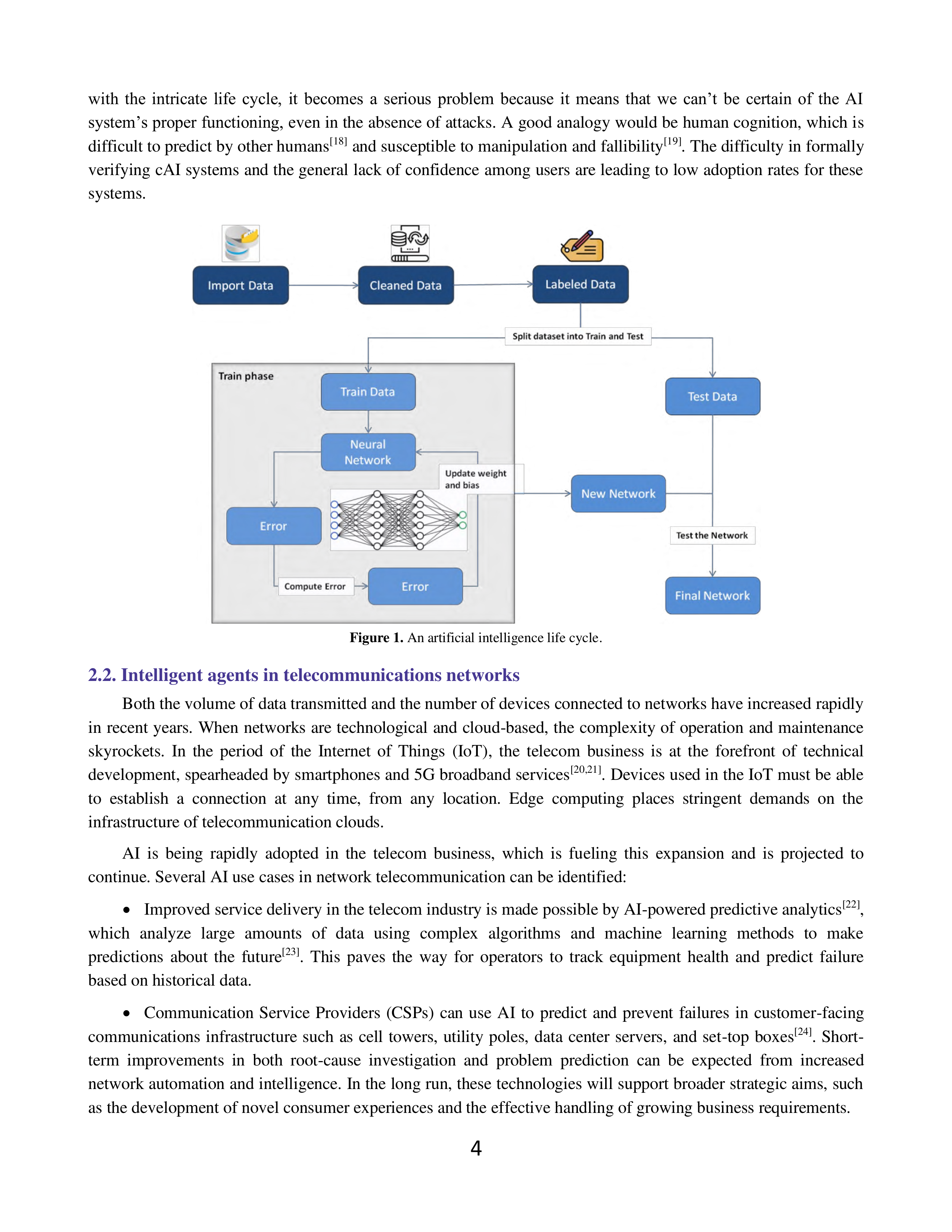
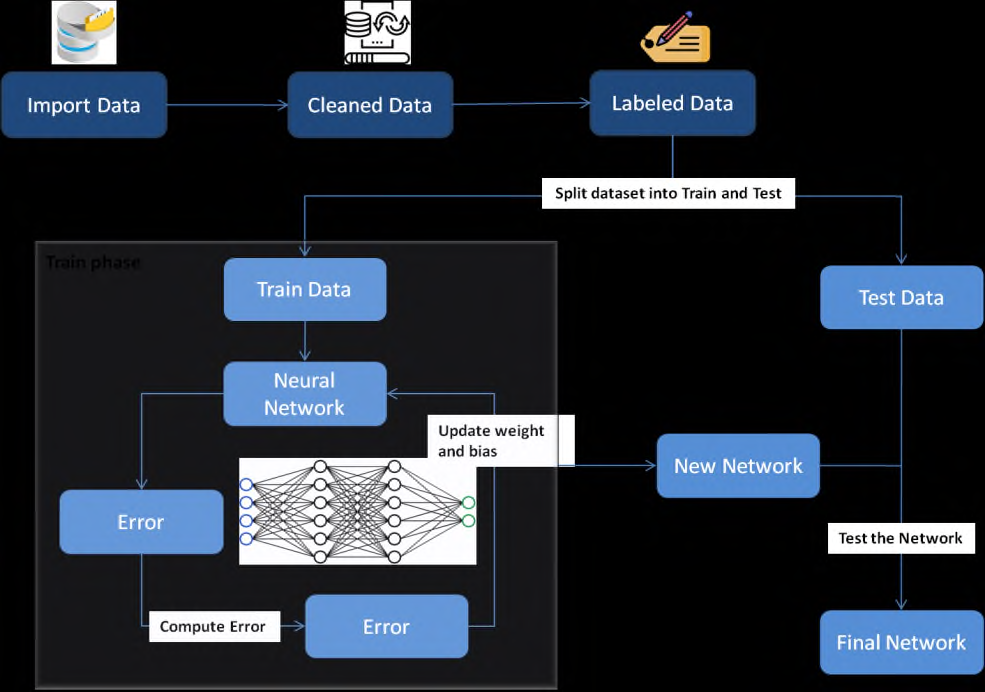
A new training session can be started using randomly generated initial conditions or the model parameters
can be tweaked by hand based on the machine learning (ML) policy. After reaching the target performance, the
model is tested on a separate test data set to ensure it is truly independent of the training set (as illustrated in
Figure 1
). After the AI has been trained, it can be used for inference, or prediction, on unseen input data. AI
systems can be developed using either machine learning algorithms or pre-existing datasets to train connectionist
AI systems. Nonetheless, symbolic AI systems are easy to understand and formed precisely by human developers.
The distributed nature of cAI systems’ decision-making and their own indirect design make them difficult to
interpret. The use of this method for building cAI systems can integrate life cycles, involving intricate data supply
chains, pre-existing trained systems, and the underlying foundations of ML, which may impact the security and
safety of the systems.
It’s common knowledge that vulnerabilities in cAI systems are qualitatively different from those in
traditional software. One such example is the so-called “adversarial examples,” or data intentionally designed to
trick AI systems
[14,15]
. In most real-world scenarios, cAI systems are inherently difficult to interpret and evaluate,
which further increases their susceptibility to attack
[16,17]
. However, even if the trained system performs admirably,
it is frequently impossible for a person to comprehend why the system arrived at its conclusions. When coupled
4
with the intricate life cycle, it becomes a serious problem because it means that we can’t be certain of the AI
system’s proper functioning, even in the absence of attacks. A good analogy would be human cognition, which is
difficult to predict by other humans
[18]
and susceptible to manipulation and fallibility
[19]
. The difficulty in formally
verifying cAI systems and the general lack of confidence among users are leading to low adoption rates for these
systems.
Figure 1.
An artificial intelligence life cycle.
2.2. Intelligent agents in telecommunications networks
Both the volume of data transmitted and the number of devices connected to networks have increased rapidly
in recent years. When networks are technological and cloud-based, the complexity of operation and maintenance
skyrockets. In the period of the Internet of Things (IoT), the telecom business is at the forefront of technical
development, spearheaded by smartphones and 5G broadband services
[20,21]
. Devices used in the IoT must be able
to establish a connection at any time, from any location. Edge computing places stringent demands on the
infrastructure of telecommunication clouds.
AI is being rapidly adopted in the telecom business, which is fueling this expansion and is projected to
continue. Several AI use cases in network telecommunication can be identified:
•
Improved service delivery in the telecom industry is made possible by AI-powered predictive analytics
[22]
,
which analyze large amounts of data using complex algorithms and machine learning methods to make
predictions about the future
[23]
. This paves the way for operators to track equipment health and predict failure
based on historical data.
•
Communication Service Providers (CSPs) can use AI to predict and prevent failures in customer-facing
communications infrastructure such as cell towers, utility poles, data center servers, and set-top boxes
[24]
. Short-
term improvements in both root-cause investigation and problem prediction can be expected from increased
network automation and intelligence. In the long run, these technologies will support broader strategic aims, such
as the development of novel consumer experiences and the effective handling of growing business requirements.
5
•
Using AI’s superior analytical powers, the telecom industry is cracking down on fraud
[25]
. Telecom fraud,
such as unauthorized network access, and bogus accounts, can be substantially reduced with the help of artificial
intelligence and machine learning algorithms’ ability to detect anomalies in real-time. As soon as the system
detects fraudulent activity, it can automatically deny access to the perpetrator, limiting the harm
[26]
.
•
The communication services providers serve a massive population that conducts millions of transactions
every day, all of which are prone to human mistakes. AI-based Robotic Process Automation (RPA) is a type of
software used to automate various business procedures
[27,28]
. With RPA, telecoms may better manage their back-
office functions and massive quantities of repetitive and rules-based tasks, bringing about higher efficiency across
the board
[29]
. By automating complicated, time-consuming tasks like billing, data entry, management systems, and
order fulfillment, RPA frees up employees to focus on greater value-add activities.
•
Conversational AI platforms are another way that AI is being used in the telecom industry. In other words,
these programmers, which go by the name “virtual assistants,” have figured out how to automate and scale up
individual interactions. The widespread use of AI in telecommunications is easing the strain on CSPs, caused by
the avalanche of requests for assistance with setup, configuration, troubleshooting, and routine maintenance.
Operators can use AI to introduce self-service features that instruct users on how to set up and use their devices
independently
[30]
.
Devices, networks, mobile services, geolocation data, complete customer profiles, and billing data are just
some of the many types of information that AI can effectively combine and make sense of Telecoms can raise
Average Revenue Per User (ARPU) with the help of AI-driven data analysis by intelligently upselling and cross-
selling their services to existing customers. The telecommunications industry may better serve its customers by
anticipating their needs and delivering tailored offers in the most appropriate ways.
3. Method
The telecommunications network is always being tested and confronted with new difficulties as technology
advances in the field of communication. To accomplish the performance and litheness while supplying services
and migration to the telecom cloud, networks must bring technology innovation and improvement, spanning IP
networks to the cloud with software-defined infrastructure. There have been many significant advances in the
evolution of modern telecommunication clouds, including 5G/6G
[31]
, digitalization, cloudification, and the IoT.
Each new technology poses formidable difficulties to the telecommunications cloud’s design, and operation,
including maintenance since it alters the existing network architecture in fundamental ways.
3.1. Cloud-based assistive approach
To put it simply, the communication cloud is really the backbone of the information technology sector. Due
to its massive size and intricate design, the information society can directly count on the participation and support
of countless network nodes
[32]
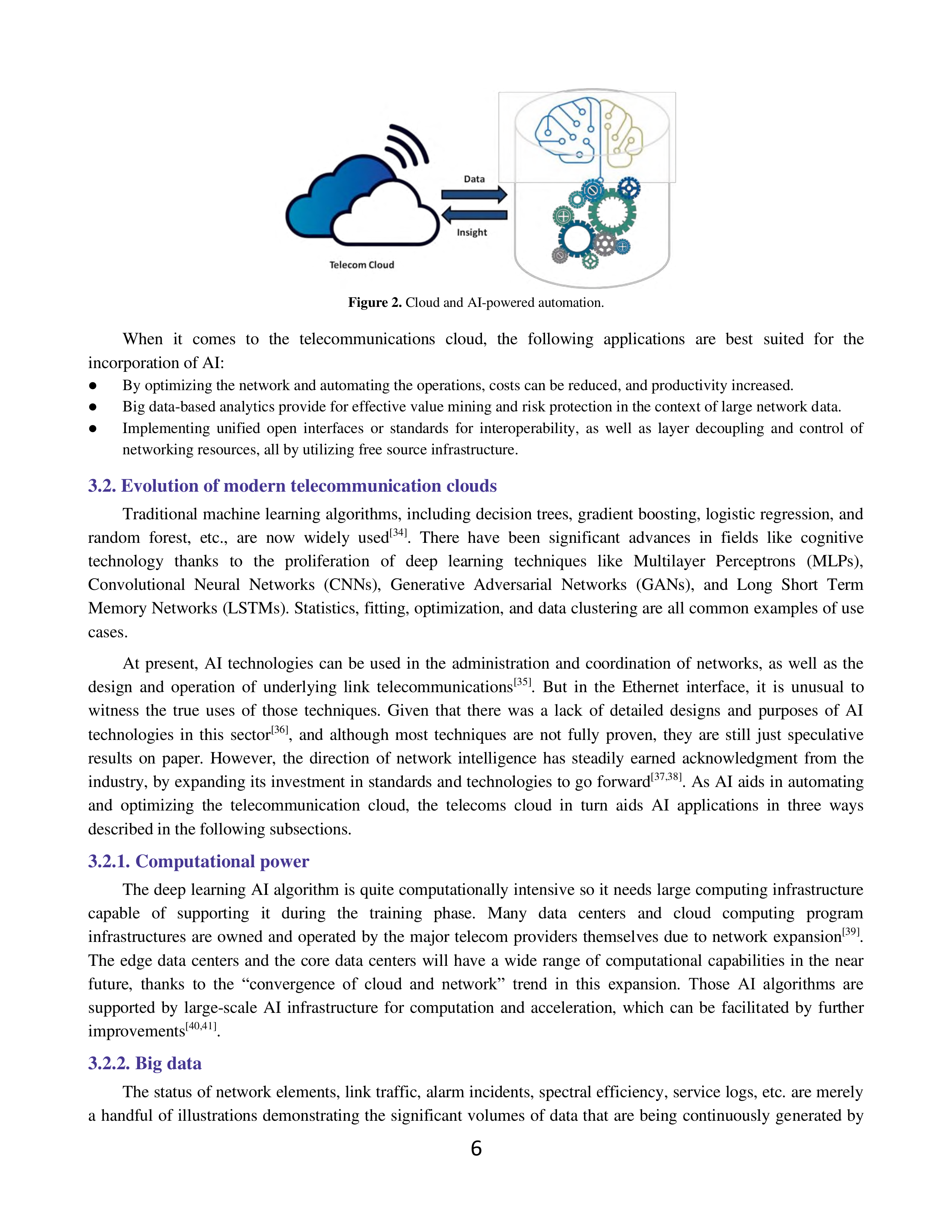
. Despite these obstacles, the telecommunications cloud now has access to exciting
new possibilities made possible by the rapid progress of AI technology (see
Figure 2
). The ability to gather
information and exploit data is crucial for telecom providers
[33]
. AI uses strong data analysis and knowledge
extraction skills to aid operators in turning data into actionable insights and suggestions. Incorporating AI
technology into telecommunication clouds is an attempt to address issues with efficiency and capability in
existing infrastructure. In addition, the sector intends to offer adaptable digital and material services to people
everywhere, realizing network intelligence with an “intelligent brain” in the communication network process.

6
Figure 2.
Cloud and AI-powered automation.
When it comes to the telecommunications cloud, the following applications are best suited for the
incorporation of AI:
⚫
By optimizing the network and automating the operations, costs can be reduced, and productivity increased.
⚫
Big data-based analytics provide for effective value mining and risk protection in the context of large network data.
⚫
Implementing unified open interfaces or standards for interoperability, as well as layer decoupling and control of
networking resources, all by utilizing free source infrastructure.
3.2. Evolution of modern telecommunication clouds
Traditional machine learning algorithms, including decision trees, gradient boosting, logistic regression, and
random forest, etc., are now widely used
[34]
. There have been significant advances in fields like cognitive
technology thanks to the proliferation of deep learning techniques like Multilayer Perceptrons (MLPs),
Convolutional Neural Networks (CNNs), Generative Adversarial Networks (GANs), and Long Short Term
Memory Networks (LSTMs). Statistics, fitting, optimization, and data clustering are all common examples of use
cases.
At present, AI technologies can be used in the administration and coordination of networks, as well as the
design and operation of underlying link telecommunications
[35]
. But in the Ethernet interface, it is unusual to
witness the true uses of those techniques. Given that there was a lack of detailed designs and purposes of AI
technologies in this sector
[36]
, and although most techniques are not fully proven, they are still just speculative
results on paper. However, the direction of network intelligence has steadily earned acknowledgment from the
industry, by expanding its investment in standards and technologies to go forward
[37,38]
. As AI aids in automating
and optimizing the telecommunication cloud, the telecoms cloud in turn aids AI applications in three ways
described in the following subsections.
3.2.1. Computational power
The deep learning AI algorithm is quite computationally intensive so it needs large computing infrastructure
capable of supporting it during the training phase. Many data centers and cloud computing program
infrastructures are owned and operated by the major telecom providers themselves due to network expansion
[39]
.
The edge data centers and the core data centers will have a wide range of computational capabilities in the near
future, thanks to the “convergence of cloud and network” trend in this expansion. Those AI algorithms are
supported by large-scale AI infrastructure for computation and acceleration, which can be facilitated by further
improvements
[40,41]
.
3.2.2. Big data
The status of network elements, link traffic, alarm incidents, spectral efficiency, service logs, etc. are merely
a handful of illustrations demonstrating the significant volumes of data that are being continuously generated by
7
multiple nodes and service systems, which make up the telecommunications cloud
[42]
. The network’s performance
can be improved by analyzing and extracting useful structures and information from this data utilizing AI-related
methods.
3.2.3. Many possible outcomes
The telecommunications cloud is rich in AI use cases, both internal and external applications. To begin, the
telecommunications cloud is itself an advanced data system that is both massive in scope and in the scope of data
it stores and constantly expanding in both directions. There is a wide range of scenarios where the use of AI
technology could lead to increased performance or efficiency in the communication and networking industries,
from initial research and development through actual network planning, construction, operation, and maintenance.
The telecommunications cloud could benefit all sectors of society by meeting the computerization and intelligence
requirements of a wide range of niche markets. This includes the smart city, transportation, healthcare, education,
finance, manufacturing, agricultural sectors, etc. As more and more applications and services are made available
through the telecommunications cloud, AI technology can be developed and promoted.
4. Analysis and discussion
Next-Generation Networks (NGN) have high requirements, including improvement of the repair
productivity and network control, accuracy adjustments of resource provisioning, etc. Furthermore, operating
challenges are a key barrier to full cloudification of the network, as the size of the telecom and its complexity
increase. This is why the traditional form where issues are dealt with manually is not sufficient to support these
requirements. However, the mobile transceiver has reached 5G
[31]
. As the fixed-line transceiver continues to
evolve; such as the number of connections it can support, the network throughput, and latency; the number of
possible use cases for mobile devices and customers continues to grow.
Changes in efficiency and adaptability are substantial and fundamental. The operation and 5G network
maintenance face new challenges due to the network’s growing complexity and users’ rising demand for
flexibility. The issue becomes more noticeable when dealing with matters that necessitate the use of
conventional methods of operation and upkeep. Cloud service providers often take care of maintenance and
upkeep
[43–45]
. Nonetheless, telecom providers are eager to operate virtual network functions above the cloud
environments they constructed, so that they may exert complete authority over and responsibility for the
underlying infrastructure.
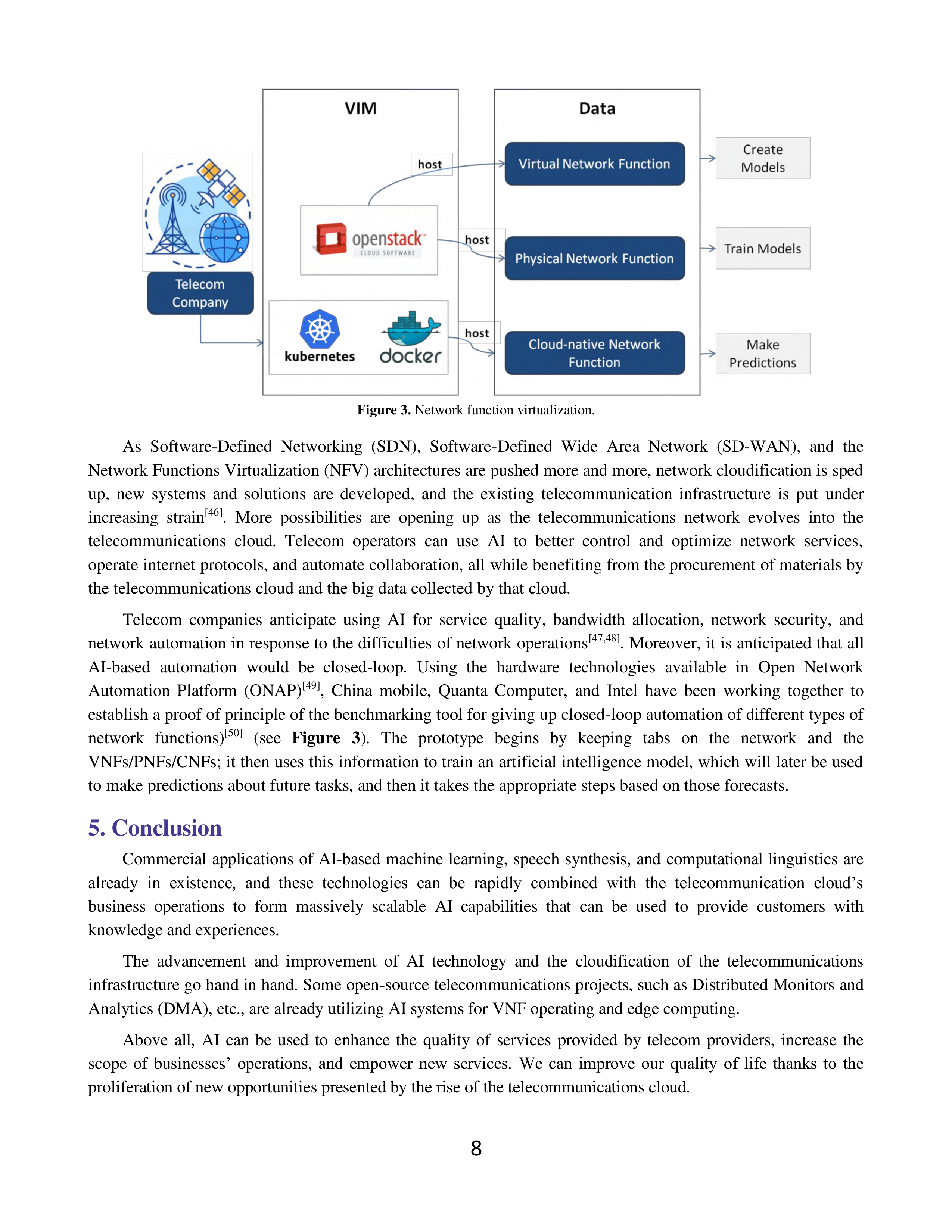
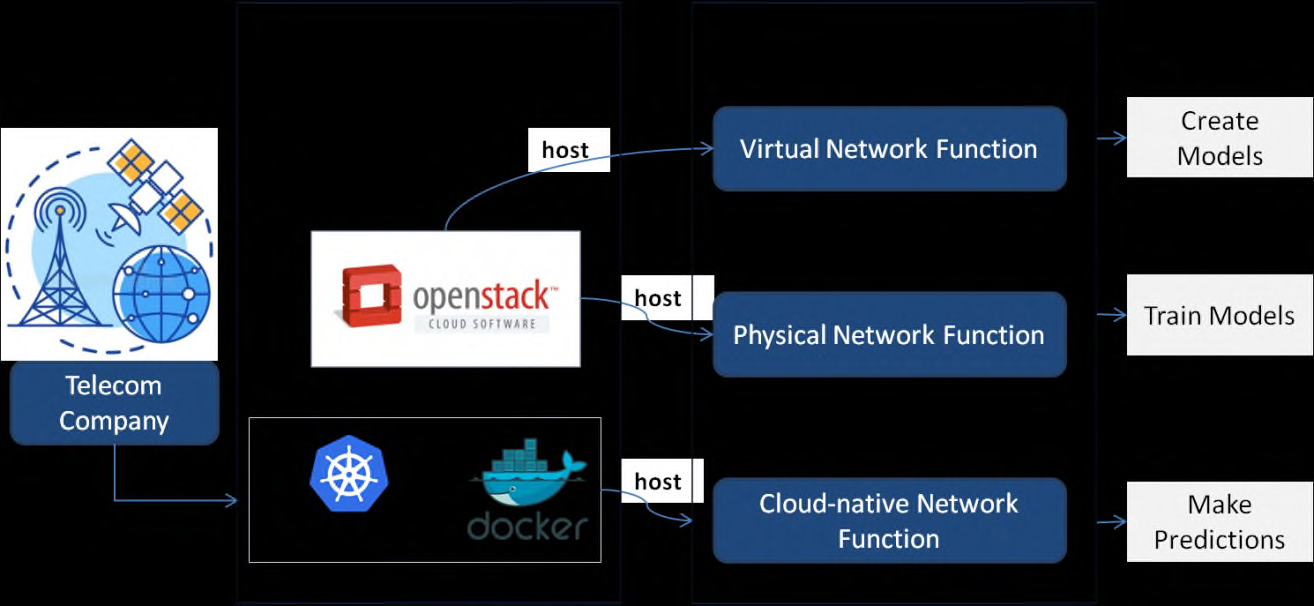
The standard operating methods followed by the majority of telecom companies are illustrated in
Figure 3
.
For their Virtualized Infrastructure Manager (VIM), they may opt for open-source software like Open-Stack,
which can be used with bare metal or virtualization to host virtual network functions (VNFs) or physical network
functions (PNFs), or Kubernetes which can be used with containers to host cloud-native network function
(CNFs).
8
Figure 3.
Network function virtualization.
As Software-Defined Networking (SDN), Software-Defined Wide Area Network (SD-WAN), and the
Network Functions Virtualization (NFV) architectures are pushed more and more, network cloudification is sped
up, new systems and solutions are developed, and the existing telecommunication infrastructure is put under
increasing strain
[46]
. More possibilities are opening up as the telecommunications network evolves into the
telecommunications cloud. Telecom operators can use AI to better control and optimize network services,
operate internet protocols, and automate collaboration, all while benefiting from the procurement of materials by
the telecommunications cloud and the big data collected by that cloud.
Telecom companies anticipate using AI for service quality, bandwidth allocation, network security, and
network automation in response to the difficulties of network operations
[47,48]
. Moreover, it is anticipated that all
AI-based automation would be closed-loop. Using the hardware technologies available in Open Network
Automation Platform (ONAP)
[49]
, China mobile, Quanta Computer, and Intel have been working together to
establish a proof of principle of the benchmarking tool for giving up closed-loop automation of different types of
network functions)
[50]
(see
Figure 3
). The prototype begins by keeping tabs on the network and the
VNFs/PNFs/CNFs; it then uses this information to train an artificial intelligence model, which will later be used
to make predictions about future tasks, and then it takes the appropriate steps based on those forecasts.
5. Conclusion
Commercial applications of AI-based machine learning, speech synthesis, and computational linguistics are
already in existence, and these technologies can be rapidly combined with the telecommunication cloud’s
business operations to form massively scalable AI capabilities that can be used to provide customers with
knowledge and experiences.
The advancement and improvement of AI technology and the cloudification of the telecommunications
infrastructure go hand in hand. Some open-source telecommunications projects, such as Distributed Monitors and
Analytics (DMA), etc., are already utilizing AI systems for VNF operating and edge computing.
Above all, AI can be used to enhance the quality of services provided by telecom providers, increase the
scope of businesses’ operations, and empower new services. We can improve our quality of life thanks to the
proliferation of new opportunities presented by the rise of the telecommunications cloud.
9
Author contributions
Conceptualization, KS and SK; methodology, KS; validation, KS, SK and MLK; formal analysis, KS;
resources, KS, AM; data curation, KS; writing—original draft preparation, KS; writing—review and editing, KS,
SK, AM; supervision, SK and MLK. All authors have read and agreed to the published version of the manuscript.
Conflict of interest
The authors declare no conflict of interest.
References
1.
Jiang Y, Gu J. Technological transformation. In:
Technology and Industrial Transformation of China
. Springer; 2022.
pp. 1–19.
2.
Hoolihan DD. A review of developments in wireless and electrical engineering.
IEEE Electromagnetic Compatibility
Magazine
2022; 12(1): 29–30. doi: 10.1109/MEMC.2023.10135175
3.
Khan N, Ray RL, Zhang S, et al. Influence of mobile phone and internet technology on income of rural farmers:
Evidence from khyber Pakhtunkhwa province, Pakistan.
Technology in Society
2022; 68: 101866. doi:
10.1016/j.techsoc.2022.101866
4.
Maryam, Husniati AM, Fahira L, Suwiji Y. Implementation of policies for devoleping aceh’s micro, small and
medium enterprises. In: Proceedings of International Conference on Social Science, Political Science, and Humanities
(ICoSPOLHUM); 22 December 2022; Aceh Utara, Indonesia. p. 00013.
5.
Bourekkadi S, El Imrani O, Kandili M, et al. Intelligent solution based on information technologies—The correct value
of the business in economic organization is intangible asset. In: Proceedings of the 33rd International Business
Information Management Association Conference, IBIMA; 10–11 April 2019; Granada, Spain. pp. 6310–6317.
6.
Antioco M, Coussement K, Fletcher-Chen CCY, Prange C. What’s in a word? Adopting a linguistic-style analysis of
western MNCs’ global press releases.
Journal of World Business
2023; 58(2): 101414. doi:
10.1016/j.jwb.2022.101414
7.
Teece DJ. A wider-aperture lens for global strategic management: The multinational enterprise in a bifurcated global
economy.
Global Strategy Journal
2022; 12(3): 488–519. doi: 10.1002/gsj.1462
8.
Slimani K, Bourekkadi S, Messoussi R, et al. Sharing emotions in the distance education experience: Attitudes and
motivation of university students. In: Proceedings of the 2020 International Conference on Intelligent Systems and
Computer Vision (ISCV); 9–11 June 2020; Fez, Morocco. pp. 1–10.
9.
Slimani K, Ruichek Y, Messoussi R. Compound facial emotional expression recognition using CNN deep features.
Engineering Letters
2022; 30(4): 1402–1416.
10.
Goel AK. Looking back, looking ahead: Symbolic versus connectionist AI.
AI Magazine
2022; 42(4): 83–85. doi:
10.1609/aaai.12026
11.
Huang Z. Introducing neuro-symbolic artificial intelligence to humanities and social sciences: Why is it possible and
what can be done?
TEM Journal
2022; 11(4): 1863–1870. doi: 10.18421/TEM114-54
12.
McCulloch WS, Pitts W. A logical calculus of the ideas immanent in nervous activity.
Bulletin of Mathematical
Biology
1943; 5: 115–133. doi: 10.1007/BF02478259
13.
Jensen JR, Qiu F, Ji M. Predictive modelling of coniferous forest age using statistical and artificial neural network
approaches applied to remote sensor data.
International Journal of Remote Sensing
1999; 20(14): 2805–2822. doi:
10.1080/014311699211804
14.
Sun P, Halak B, Kazmierski T. Towards hardware trojan resilient design of convolutional neural networks. In:
Proceedings of the 2022 IEEE 35th International System-on-Chip Conference (SOCC); 5–8 September 2022; Belfast,
United Kingdom. pp. 1–6.
15.
Biggio B, Roli F. Wild patterns: Ten years after the rise of adversarial machine learning.
arXiv
2018;
arXiv:1712.03141. doi: 10.1016/j.patcog.2018.07.023
16.
Rudin C. Stop explaining black box machine learning models for high stakes decisions and use interpretable models
instead.
Nature Machine Intelligence
2019; 1(5): 206–215. doi: 10.1038/s42256-019-0048-x
17.
Xuan S, Liu G, Li Z, et al. Random forest for credit card fraud detection. In: Proceedings of the 2018 IEEE 15th
international conference on networking, sensing and control (ICNSC); 27–29 March 2018; Zhuhai, China. pp. 1–6.
18.
Sun Q, Zhang H, Zhang J, Zhang X. Why can’t we accurately predict others’ decisions? Prediction discrepancy in
risky decision-making.
Frontiers in Psychology
2018; 9: 2190. doi: 10.3389/fpsyg.2018.02190
19.
Jakubovitz D, Giryes R, Rodrigues MRD. Generalization error in deep learning. In: Boche H, Caire G, Calderbank R
(editors).
Compressed Sensing and its Applications
. Springer; 2019. pp. 153–193.
10
20.
Ssengonzi C, Kogeda OP, Olwal TO. A survey of deep reinforcement learning application in 5G and beyond network
slicing and virtualization.
Array
2022; 14: 100142. doi: 10.1016/j.array.2022.100142
21.
Parulekar DD. Decoding ‘sovereign strategic networks’ in the indo-pacific: Contesting china’s ‘ascendant-rise’. In:
Singh S, Marwah R (editors).
China and the Indo-Pacific: Maneuvers and Manifestations
. Springer; 2023. pp. 21–40.
22.
Nagaty KA. Iot commercial and industrial applications and AI-powered IoT. In: Iranmanesh A (editor).
Frontiers of
Quality Electronic Design (QED) AI, IoT and Hardware Security
. Springer; 2023. pp. 465–500.
23.
Baabdullah AM, Alalwan AA, Algharabat RS, et al. Virtual agents and flow experience: An empirical examination of
AI-powered chatbots.
Technological Forecasting and Social Change
2022; 181: 121772. doi:
10.1016/j.techfore.2022.121772
24.
Dixit S. Artifical intelligence and crm: A case of telecom industry. In:
Adoption and Implementation of AI in Customer
Relationship Management
. IGI Global; 2022. pp. 92–114.
25.
Wang X. Reflection on prevention and control of telecommunication network fraud in big data era.
Journal of
Networking and Telecommunications
2020; 2(2): 43. doi: 10.18282/jnt.v2i2.1103
26.
Alzahrani RA, Aljabri M. AI-based techniques for Ad click fraud detection and prevention: Review and research
directions.
Journal of Sensor and Actuator Networks
2022; 12(1): 4. doi: 10.3390/jsan12010004
27.
Beerbaum DO. Artificial intelligence ethics taxonomy—Robotic process automation (RPA) as business case.
Available online: https://papers.ssrn.com/sol3/papers.cfm?abstract_id=3834361 (accessed on 12 September 2023).
28.
Du Y. On the transparency of artificial intelligence system.
Journal of Autonomous Intelligence
2022; 5(1): 13–22.
29.
Yatskiv N, Yatskiv S, Vasylyk A. Method of robotic process automation in software testing using artificial intelligence.
In: Proceedings of the 2020 10th International Conference on Advanced Computer Information Technologies (ACIT);
16–18 September 2020; Deggendorf, Germany. pp. 501–504.
30.
Ng YL, Lin Z. Exploring conversation topics in conversational artificial intelligence-based social mediated
communities of practice.
Computers in Human Behavior
2022; 134: 107326. doi: 10.1016/j.chb.2022.107326
31.
Slimani K, Khoulji S, Kerkeb ML. Advancements and challenges in energy-efficient 6G mobile communication
network.
E3S Web of Conferences, EDP Sciences
2023; 412: 01036. doi: 10.1051/e3sconf/202341201036
32.
Morawiec P, Sołtysik-Piorunkiewicz A. Cloud computing, big data, and blockchain technology adoption in ERP
implementation methodology.
Sustainability
2022; 14(7): 3714. doi: 10.3390/su14073714
33.
Belgaum MR, Alansari Z, Musa S, et al. Role of artificial intelligence in cloud computing, IoT and SDN: Reliability
and scalability issues.
International Journal of Electrical and Computer Engineering
2021; 11(5): 4458. doi:
10.11591/ijece.v11i5.pp4458-4470
34.
Solyman AAA, Yahya K. Evolution of wireless communication networks: From 1G to 6G and future perspective.
International Journal of Electrical and Computer Engineering
2022; 12(4): 3943. doi: 10.11591/ijece.v12i4.pp3943-
3950
35.
Guo R, Zheng Q, Wang L, et al. Porous N-doped Ni@ SiO
2
/graphene network: Three-dimensional hierarchical
architecture for strong and broad electromagnetic wave absorption.
Journal of Materials Science & Technology
2022;
106: 108–117. doi: 10.1016/j.jmst.2021.07.046
36.
Husain S, Kunz A, Song J. 3GPP 5G Core network: An overview and future directions.
Journal of Information and
Communication Convergence Engineering
2022; 20(1): 8–15.
37.
Wang Z, Sun Y, Yuan S. Intelligent radio access networks: Architectures, key techniques, and experimental platforms.
Frontiers of Information Technology & Electronic Engineering
2022; 23(1): 5–18. doi: 10.1631/FITEE.2100305
38.
Hicham GT, Chaker EA. Cloud computing CPU allocation and scheduling algorithms using cloudsim simulator.
International Journal of Electrical & Computer Engineering
2016; 6(4): 1866–1879. doi: 10.11591/ijece.v6i4.pp1866-
1879
39.
Oztoprak K, Tuncel YK, Butun I. Technological transformation of telco operators towards seamless IoT edge-cloud
continuum.
Sensors
2023; 23(2): 1004. doi: 10.3390/s23021004
40.
Huang MF, Han S, Narisetty C, et al. AI-driven applications over telecom networks by distributed fiber optic sensing
technologies. In: Proceedings of the Next-Generation Optical Communication: Components, Sub-Systems, and
Systems XI; 2022. San Francisco, California, US. pp. 116–121.
41.
Lundberg L, Grahn H. Research trends, enabling technologies and application areas for big data.
Algorithms
2022;
15(8): 280. doi: 10.3390/a15080280
42.
Kalra V, Rahi S, Pawar N, et al. A tour towards the security issues of mobile cloud computing: A survey. In: Singh PK,
Kolekar MH, Tanwar S (editors).
Emerging Technologies for Computing, Communication and Smart Cities
. Springer;
2022. pp. 577–589.
43.
Al-Jumaili A, Muniyandi R, Hasan MK, et al. Intelligent transmission line fault diagnosis using the Apriori associated
rule algorithm under cloud computing environment.
Journal of Autonomous Intelligence
2023; 6(1): 640. doi:
10.32629/jai.v6i1.640
44.
Godfrey DM, Price LL, Lusch RF. Repair, consumption, and sustainability: Fixing fragile objects and maintaining
consumer practices.
Journal of Consumer Research
2022; 49(2): 229–251.

11
45.
Gharbaoui M, Contoli C, Davoli G, et al. Demonstration of latency-aware and self-adaptive service chaining in
5G/SDN/NFV infrastructures. In: Proceedings of the 2018 IEEE Conference on Network Function Virtualization and
Software Defined Networks (NFV-SDN); 27–29 November 2018; Verona, Italy. pp. 1–2.
46.
Albalawi AM, Almaiah MA. Assessing and reviewing of cyber-security threats, attacks, mitigation techniques in IoT
environment.
Journal of Theoretical and Applied Information Technology
2022; 100(9): 2988–3011.
47.
Gilbert M. The role of artificial intelligence for network automation and security. In:
Artificial Intelligence for
Autonomous Networks
. Chapman and Hall/CRC; 2018. pp. 1–23.
48.
Choudhary D. Security challenges and countermeasures for the heterogeneity of IoT applications.
Journal of
Autonomous Intelligence
2019; 1(2): 16–22. doi: 10.32629/jai.v1i2.25
49.
Verdecchia R, Malavolta I, Lago P, Ozkaya I. Empirical evaluation of an architectural technical debt index in the
context of the Apache and ONAP ecosystems.
PeerJ Computer Science
2022; 8: e833.
50.
Sauvanaud C, Lazri K, Kaˆaniche M, Kanoun K. Anomaly detection and root cause localization in virtual network
functions. In: Proceedings of the 2016 IEEE 27th International Symposium on Software Reliability Engineering
(ISSRE); 2016. pp. 196–206.