Applications of Artificial Intelligence in Tourism and
Hospitality: A systematic literature review
Ana Elisa Sousa
1
, Sónia Pais
2
and Ana Sofia Viana
3
1,2,3
Polytechnic of Leiria, CiTUR, Rua do Conhecimento 4, 2520-614, Portugal
ana.c.sousa@ipleiria.pt
sonia.i.pais@ipleiria.pt
sviana@ipleiria.pt
Abstract.
Artificial Intelligence (AI) has received special attention in the Tourism and
Hospitality sector. The researchers of this paper conducted a systematic literature review, in the
timeframe from 1990 to October 2022, in three scientific databases: Scopus, Web of Science
and Science Direct. This study allows the identification of the authors and relevant publications
in the research area and to verify the applications that Artificial Intelligence has in Tourism and
Hospitality. The main results reveal that the possibilities of application of AI in Tourism and
Hospitality are numerous and range from the use of robots for customer service delivery in the
hotel and restaurant industry, to Chatbots and Messaging, to Business Intelligence tools pow-
ered by Machine Learning, to virtual reality and augmented reality, to the possibility of analysis
of large databases. As a conclusion, we can say that the use of Artificial Intelligence in Tourism
and Hospitality has already taken its first steps, but still has a lot of potential to develop and to
be at the service of an industry, which is "people to people", but that can be improved with its
help.
Keywords:
Artificial Intelligence, Applications, Tourism, Hospitality, System-
atic literature review
1
Introduction
The Tourism and Hospitality sector has faced multiple challenges in recent years
(Tussyadiah, 2020). With the advances in technology, it has become urgent to include
it in this sector as well, in order to make services faster and more efficient and to im-
prove tourists' experiences (Grundner and Neuhofer, 2021). Although, many technol-
ogies have been successful in their integration in the sector, this study focuses specifi-
cally on the use of Artificial Intelligence in Tourism and Hospitality.
Artificial intelligence is one of the digital technologies that allows businesses to ad-
vance and grow in the digital age, influencing how businesses innovate and respond
to customers’ changing needs (Mustak et al., 2021).
John McCarthy, the father of AI, defined it as “the science and engineering of making
intelligent machines, especially intelligent computer programs”.
Artificial Intelligence has had different applications in the Tourism and Hospitality
industry, revolutionizing the sector, although it has not yet reached its full potential
(Tussyadiah, 2020). This fact, associated with the novelty of the subject, has led re-
searchers to develop studies in the area. In this sense, it became important to carry out
2
a systematic review of the literature, through three scientific databases: Scopus, Web
of Science and Science Direct, on the use of Artificial Intelligence in Tourism and
Hospitality.
The objectives of this study are: 1) to identify the authors and publications that stand
out in the area; and 2) to make an inventory of the different applications of Artificial
Intelligence in Tourism and Hospitality.
After analyzing the main studies, we can conclude that the applications of AI in Tour-
ism and Hospitality range from customer service delivery robots in hotels and restau-
rants, through the use of technology in check-in, check-out, or reception, for example;
Chatbots and Messaging (chatbots or chat blogs for direct communication with the
customer and room service directly through the mobile device); Business Intelligence
tools powered by Machine Learning (facial recognition); Virtual Reality and Aug-
mented Reality (describing the hotel on the website, creating a virtual tour of the ho-
tel, virtual travel experiences and virtual booking interface); to the possibility of ana-
lysing large databases (being able for example to process and analyse the preference
information of tourists/guests, and provide users with satisfactory tourist information
and services), among others.
This paper intends to leverage knowledge on the subject and contribute to systematiz-
ing the state of the art on Artificial Intelligence in Tourism and Hospitality.
2
Methodology
To carry out this study, a selection of documents was carried out in the databases
of scientific publications Scopus, Web of Science and Science Direct. The survey was
carried out in October 2022 through different phases.
In the first phase, a search was carried out in the aforementioned three bases of scien-
tific publications using the keywords “artificial intelligence and tourism”, “artificial
intelligence and hospitality”, “artificial intelligence and hospitality industry” and
“artificial intelligence and travel”. This search was carried out both in the title, ab-
stract and keywords of the documents, without restriction as to the type of documents,
in the time frame of 1990 to October 2022, with the language in English. This re-
search resulted in 34 documents in the following thematic fields: Business, Manage-
ment and Accounting; Environmental Science; Social Sciences; Computer Science;
Economics, Econometrics and Finance; Decision Sciences, Engineering, Mathemat-
ics, Physics and Astronomy, Earth and Planetary Sciences, Materials Science and
Psychology.
In a second phase, the documents were read, with 23 documents having been exclud-
ed, either because they did not address the topic of artificial intelligence applied to
tourism and hospitality or because they were repeated. In the end, 11 documents were
cleared.
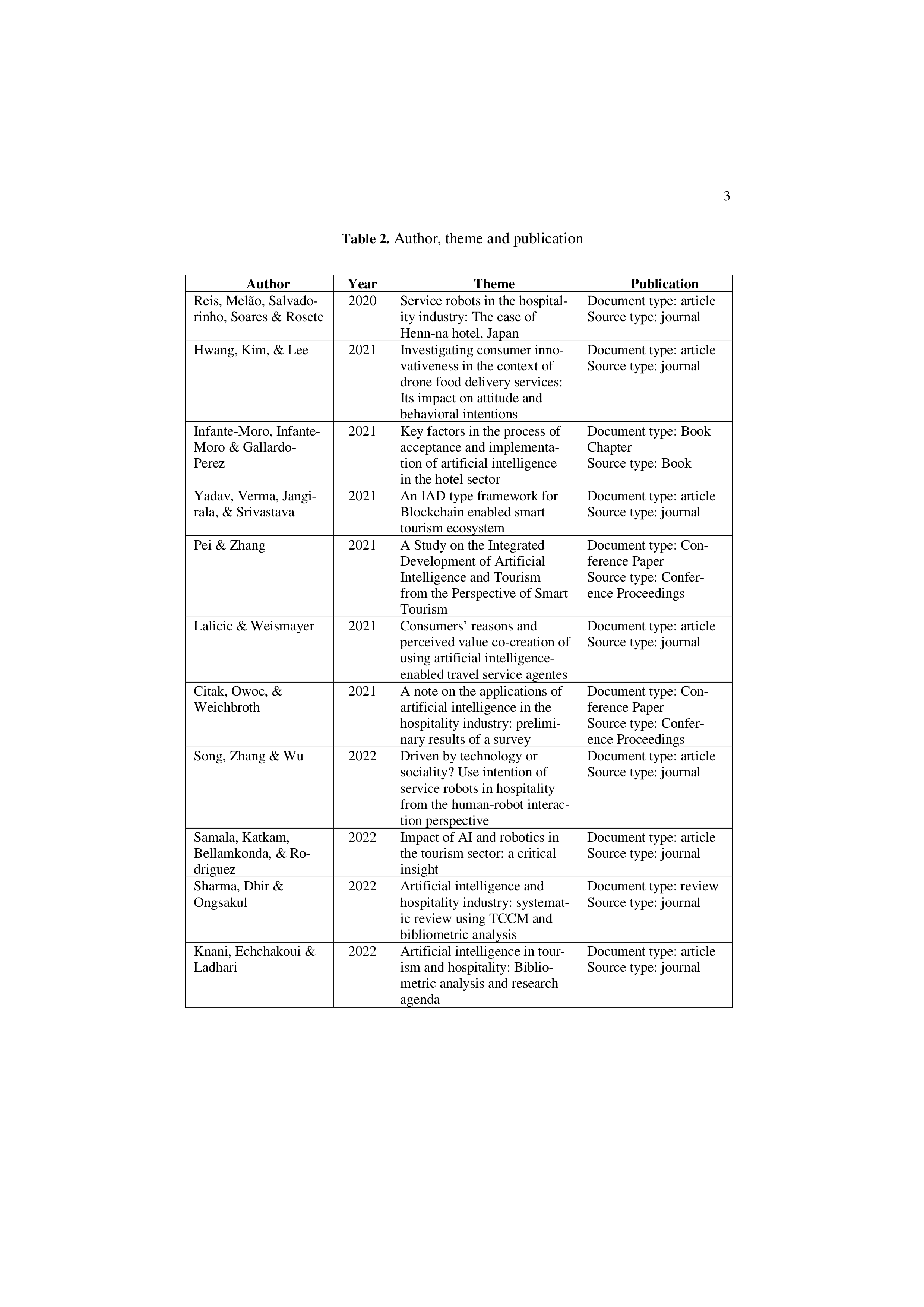
Of these documents, it stands out the fact that they are from the years 2020, 2021 and
2022, which demonstrates the recent nature of the research in this area. The research
revealed that in relation to the type of document: 7 are articles, 1 is a book chapter, 1
is a review and 2 are conference papers. The studies were published in journals (8),
book (1) and conference proceedings (2).
3
Table 2.
Author, theme and publication
Author
Year
Theme
Publication
Reis, Melão, Salvado-
rinho, Soares & Rosete
2020
Service robots in the hospital-
ity industry: The case of
Henn-na hotel, Japan
Document type: article
Source type: journal
Hwang, Kim, & Lee
2021
Investigating consumer inno-
vativeness in the context of
drone food delivery services:
Its impact on attitude and
behavioral intentions
Document type: article
Source type: journal
Infante-Moro, Infante-
Moro & Gallardo-
Perez
2021
Key factors in the process of
acceptance and implementa-
tion of artificial intelligence
in the hotel sector
Document type: Book
Chapter
Source type: Book
Yadav, Verma, Jangi-
rala, & Srivastava
2021
An IAD type framework for
Blockchain enabled smart
tourism ecosystem
Document type: article
Source type: journal
Pei & Zhang
2021
A Study on the Integrated
Development of Artificial
Intelligence and Tourism
from the Perspective of Smart
Tourism
Document type: Con-
ference Paper
Source type: Confer-
ence Proceedings
Lalicic & Weismayer
2021
Consumers’ reasons and
perceived value co-creation of
using artificial intelligence-
enabled travel service agentes
Document type: article
Source type: journal
Citak, Owoc, &
Weichbroth
2021
A note on the applications of
artificial intelligence in the
hospitality industry: prelimi-
nary results of a survey
Document type: Con-
ference Paper
Source type: Confer-
ence Proceedings
Song, Zhang & Wu
2022
Driven by technology or
sociality? Use intention of
service robots in hospitality
from the human-robot interac-
tion perspective
Document type: article
Source type: journal
Samala, Katkam,
Bellamkonda, & Ro-
driguez
2022
Impact of AI and robotics in
the tourism sector: a critical
insight
Document type: article
Source type: journal
Sharma, Dhir &
Ongsakul
2022
Artificial intelligence and
hospitality industry: systemat-
ic review using TCCM and
bibliometric analysis
Document type: review
Source type: journal
Knani, Echchakoui &
Ladhari
2022
Artificial intelligence in tour-
ism and hospitality: Biblio-
metric analysis and research
agenda
Document type: article
Source type: journal
4
3 Applications of AI in Tourism and Hospitality
Artificial intelligence (AI) has received special attention in the area of Tourism and
Hospitality (Knani, 2022) and its applicability in this sector has grown exponentially
in recent years. AI has provided more efficient services and optimised tourism experi-
ences. For example, robots have been used for different functions in the area of Tour-
ism and Hospitality, such as in frontline services (Reis, J. et al., 2020). The study of
these authors highlights the use of robots in Hospitality, in the roles of receptionist,
serving guests and cleaning. Another example is a stationary robot arm that works to
carry and store the luggage and a vending machine in hotel to sell some amenities.
Robots are also used to carry the guests' bags to their rooms. In their studies, Reis et
al. (2020), Samala et al. (2022) and Knani et al. (2022) mention that another use of
robots is inside the room, where they operate by voice command and react to the
guests' requests through AI technology, i.e. speech recognition, to control the televi-
sion, lights, temperature, etc. Some robots are even able to provide immediate an-
swers to questions, suggest attractions worth visiting, best restaurants in the area and
learn on their own to improve performance. In airports, robots are starting to be pre-
sent and used as guides and assistants. Another form to use AI-enabled technologies
in the hospitality sector has been through the use of virtual agents and chatbots, work-
ing through speech recognition and helping guests to request room services, providing
online information assistance, etc., 24 hours a day, seven days a week. The AI-chatbot
is also used to trip planning and to offer a wide range of services like ordering food
services, cab services, reading out the messages, scheduling the tasks and appoint-
ments, setting up alarms, room services, house-keeping services, informing the hotel
facilities, etc. (Gajdosˇı´k and Marcisˇ, 2019).
Also Infante-Moro et al. (2021) refer
that among the services where this Artificial Intelligence can be observed and that
could be carried out exclusively by this technology in the future are: check-in, check-
out, reception, meal services, accomodation procedures, valet parking, chatbots or
chat blogs for direct communication with the customer and service of rooms directly
through the mobile device, among others. Other authors refer to the use of IA to book
rooms, answering customers inquiries, solving typical problems, or even assisting
with hotel services. This type of technology helps personalise the experience of hotel
guests (Citak et al., 2021).
Hwang, Kim & Lee (2021) recall that drones may also play an important role in the
field of tourism and hospitality, with ever increasing demand for a quick and produc-
tive delivery system.
One of the most common uses of AI is virtual reality (VR) in the hospitality sector, to
create virtual travel experiences using 360 degree video technology. This technology
is capable to recreate a different aspects of travel, from the flight, to the arrival, and
on to some of the key sights (Citak et al., 2021), and demonstrate tourist spots and
hotel locations using 3D videos. This technology is perfect to show unseen locations
beforehand. Virtual Booking Interface allows the customers real-time, simulated ex-
perience of walking through a plane and selecting the seat in the aircraft. Customers
also select other services like cab service & make the payment (Samala et al., 2022).
The applications of virtual reality and augmented reality portray the representation of
a real experience and increase visual and emotional engagement, which leads to in-
5
creased competitiveness of destinations and a greater likelihood of tourists visiting
them (Marasco et al., 2018)
The use of facial recognition is an important technology because recognizes the face
of the tourists, verifies it with the face in the documents and provides hassle-free
check-ins. By using this technology, tourists can comfortably pass through the airport
check-ins and all other station check-ins, without the document verifications by vari-
ous authorities such as immigration, customs, etc. (Samala et al., 2022)
The great advantage of artificial intelligence is the possibility of offering a personal-
ised service to the customer (all references), for example by registering their location,
interests and preferences online (Yadav et al., 2021; Pei & Zhang, 2021; Samala et al.,
2022). Also “blockchain technology improves tourist experience, offering personal-
ized solutions with reduced risk of data misuse, more user control in a trusted ecosys-
tem, real-time international remittances, reduced exchange transaction cost, and real-
time transactions in even in remote locations where banking facility is not readily
available. Other inherent advantages of Blockchain in smart tourism can be the
cheaper rebooking of hotel rooms and the absence of double bookings, which implies
solving the problem of double spending due to the integration of all means of travel
on a single platform” (Varelas, Georgitseas, Nechita, & Sahinidis, 2019 apud Yadav
et al., 2021). The aim of tourism and hospitality businesses using AI is to become
more competitive by collecting knowledge and analysing a large amount of data
(Köseoglu et al., 2019).
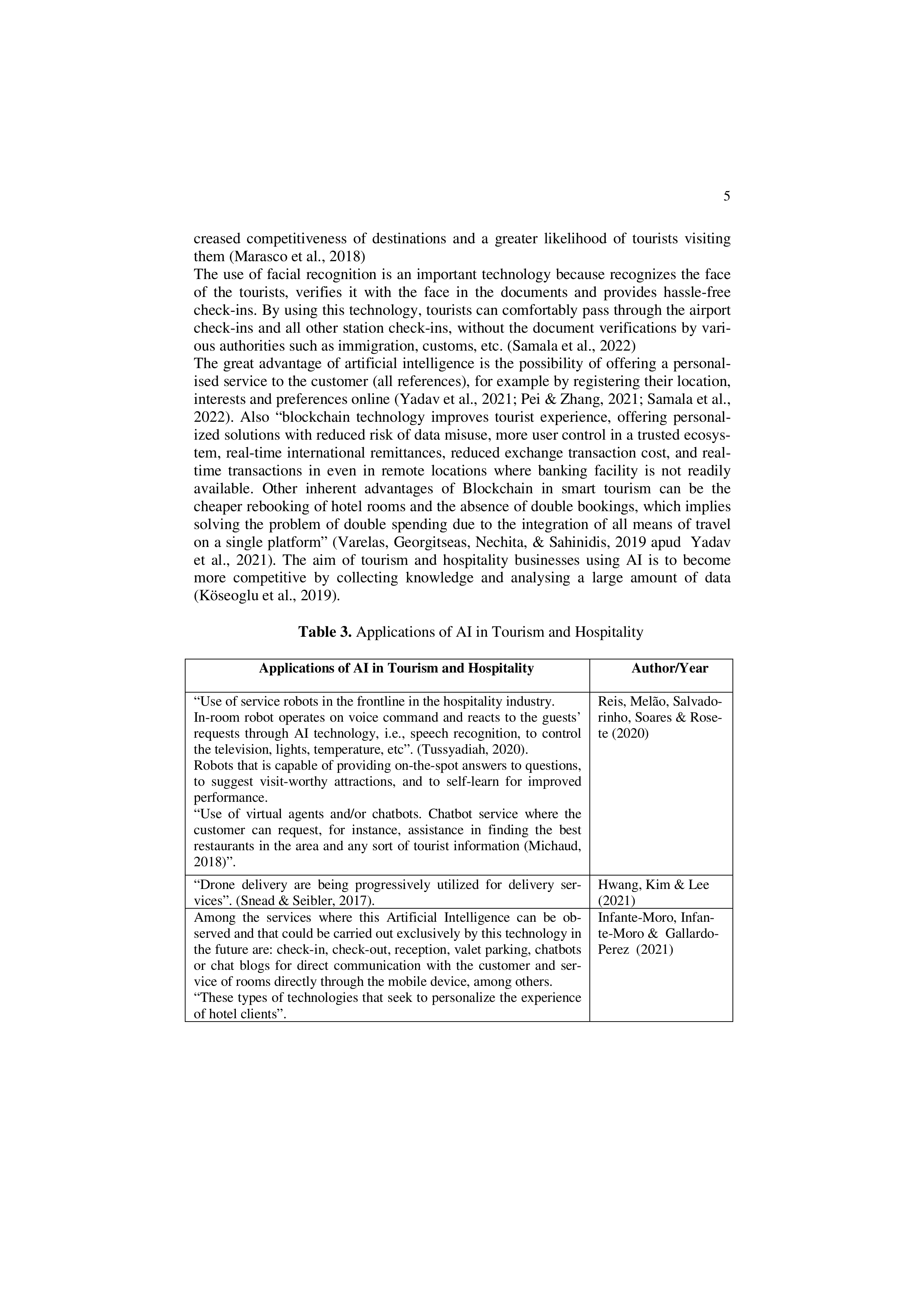
Table 3.
Applications of AI in Tourism and Hospitality
Applications of AI in Tourism and Hospitality
Author/Year
“Use of service robots in the frontline in the hospitality industry.
In-room robot operates on voice command and reacts to the guests’
requests through AI technology, i.e., speech recognition, to control
the television, lights, temperature, etc”. (Tussyadiah, 2020).
Robots that is capable of providing on-the-spot answers to questions,
to suggest visit-worthy attractions, and to self-learn for improved
performance.
“Use of virtual agents and/or chatbots. Chatbot service where the
customer can request, for instance, assistance in finding the best
restaurants in the area and any sort of tourist information (Michaud,
2018)”.
Reis, Melão, Salvado-
rinho, Soares & Rose-
te (2020)
“Drone delivery are being progressively utilized for delivery ser-
vices”. (Snead & Seibler, 2017).
Hwang, Kim & Lee
(2021)
Among the services where this Artificial Intelligence can be ob-
served and that could be carried out exclusively by this technology in
the future are: check-in, check-out, reception, valet parking, chatbots
or chat blogs for direct communication with the customer and ser-
vice of rooms directly through the mobile device, among others.
“These types of technologies that seek to personalize the experience
of hotel clients”.
Infante-Moro, Infan-
te-Moro & Gallardo-
Perez (2021)
6
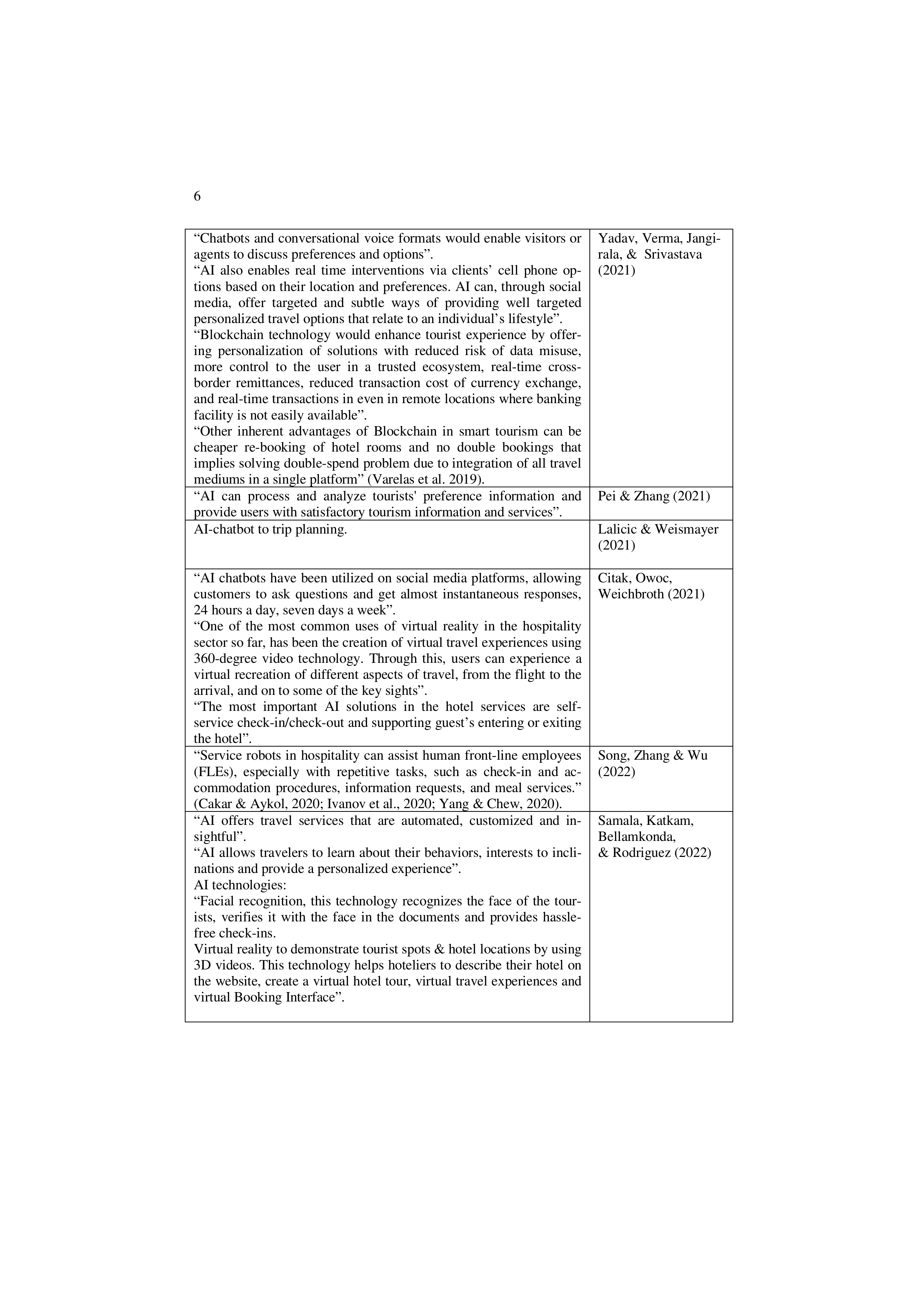
“Chatbots and conversational voice formats would enable visitors or
agents to discuss preferences and options”.
“AI also enables real time interventions via clients’ cell phone op-
tions based on their location and preferences. AI can, through social
media, offer targeted and subtle ways of providing well targeted
personalized travel options that relate to an individual’s lifestyle”.
“Blockchain technology would enhance tourist experience by offer-
ing personalization of solutions with reduced risk of data misuse,
more control to the user in a trusted ecosystem, real-time cross-
border remittances, reduced transaction cost of currency exchange,
and real-time transactions in even in remote locations where banking
facility is not easily available”.
“Other inherent advantages of Blockchain in smart tourism can be
cheaper re-booking of hotel rooms and no double bookings that
implies solving double-spend problem due to integration of all travel
mediums in a single platform” (Varelas et al. 2019).
Yadav, Verma, Jangi-
rala, & Srivastava
(2021)
“AI can process and analyze tourists' preference information and
provide users with satisfactory tourism information and services”.
Pei & Zhang (2021)
AI-chatbot to trip planning.
Lalicic & Weismayer
(2021)
“AI chatbots have been utilized on social media platforms, allowing
customers to ask questions and get almost instantaneous responses,
24 hours a day, seven days a week”.
“One of the most common uses of virtual reality in the hospitality
sector so far, has been the creation of virtual travel experiences using
360-degree video technology. Through this, users can experience a
virtual recreation of different aspects of travel, from the flight to the
arrival, and on to some of the key sights”.
“The most important AI solutions in the hotel services are self-
service check-in/check-out and supporting guest’s entering or exiting
the hotel”.
Citak, Owoc,
Weichbroth (2021)
“Service robots in hospitality can assist human front-line employees
(FLEs), especially with repetitive tasks, such as check-in and ac-
commodation procedures, information requests, and meal services.”
(Cakar & Aykol, 2020; Ivanov et al., 2020; Yang & Chew, 2020).
Song, Zhang & Wu
(2022)
“AI offers travel services that are automated, customized and in-
sightful”.
“AI allows travelers to learn about their behaviors, interests to incli-
nations and provide a personalized experience”.
AI technologies:
“Facial recognition, this technology recognizes the face of the tour-
ists, verifies it with the face in the documents and provides hassle-
free check-ins.
Virtual reality to demonstrate tourist spots & hotel locations by using
3D videos. This technology helps hoteliers to describe their hotel on
the website, create a virtual hotel tour, virtual travel experiences and
virtual Booking Interface”.
Samala, Katkam,
Bellamkonda,
& Rodriguez (2022)
7
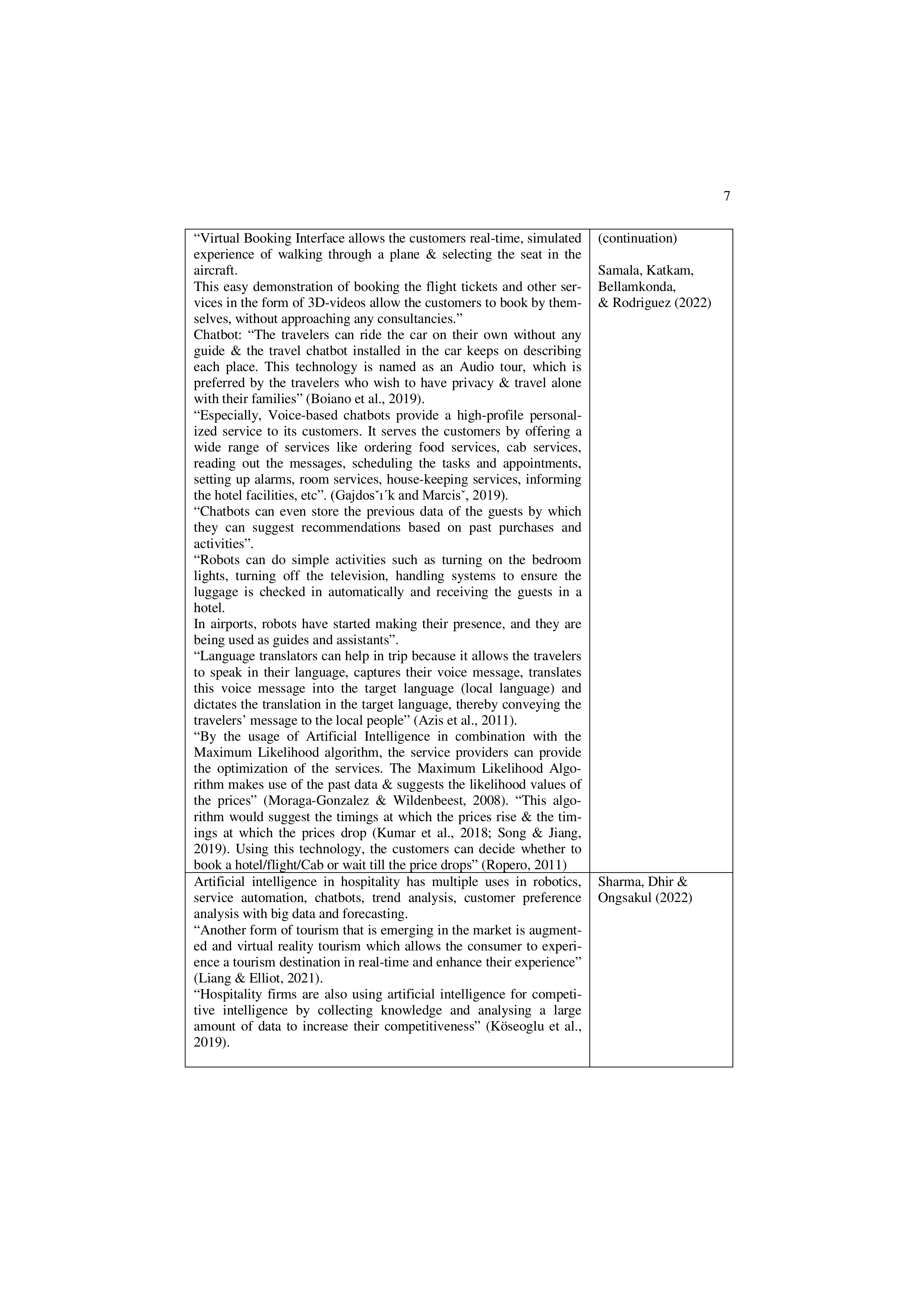
“Virtual Booking Interface allows the customers real-time, simulated
experience of walking through a plane & selecting the seat in the
aircraft.
This easy demonstration of booking the flight tickets and other ser-
vices in the form of 3D-videos allow the customers to book by them-
selves, without approaching any consultancies.”
Chatbot: “The travelers can ride the car on their own without any
guide & the travel chatbot installed in the car keeps on describing
each place. This technology is named as an Audio tour, which is
preferred by the travelers who wish to have privacy & travel alone
with their families” (Boiano et al., 2019).
“Especially, Voice-based chatbots provide a high-profile personal-
ized service to its customers. It serves the customers by offering a
wide range of services like ordering food services, cab services,
reading out the messages, scheduling the tasks and appointments,
setting up alarms, room services, house-keeping services, informing
the hotel facilities, etc”. (Gajdosˇı´k and Marcisˇ, 2019).
“Chatbots can even store the previous data of the guests by which
they can suggest recommendations based on past purchases and
activities”.
“Robots can do simple activities such as turning on the bedroom
lights, turning off the television, handling systems to ensure the
luggage is checked in automatically and receiving the guests in a
hotel.
In airports, robots have started making their presence, and they are
being used as guides and assistants”.
“Language translators can help in trip because it allows the travelers
to speak in their language, captures their voice message, translates
this voice message into the target language (local language) and
dictates the translation in the target language, thereby conveying the
travelers’ message to the local people” (Azis et al., 2011).
“By the usage of Artificial Intelligence in combination with the
Maximum Likelihood algorithm, the service providers can provide
the optimization of the services. The Maximum Likelihood Algo-
rithm makes use of the past data & suggests the likelihood values of
the prices” (Moraga-Gonzalez & Wildenbeest, 2008). “This algo-
rithm would suggest the timings at which the prices rise & the tim-
ings at which the prices drop (Kumar et al., 2018; Song & Jiang,
2019). Using this technology, the customers can decide whether to
book a hotel/flight/Cab or wait till the price drops” (Ropero, 2011)
(continuation)
Samala, Katkam,
Bellamkonda,
& Rodriguez (2022)
Artificial intelligence in hospitality has multiple uses in robotics,
service automation, chatbots, trend analysis, customer preference
analysis with big data and forecasting.
“Another form of tourism that is emerging in the market is augment-
ed and virtual reality tourism which allows the consumer to experi-
ence a tourism destination in real-time and enhance their experience”
(Liang & Elliot, 2021).
“Hospitality firms are also using artificial intelligence for competi-
tive intelligence by collecting knowledge and analysing a large
amount of data to increase their competitiveness” (Köseoglu et al.,
2019).
Sharma, Dhir &
Ongsakul (2022)
8
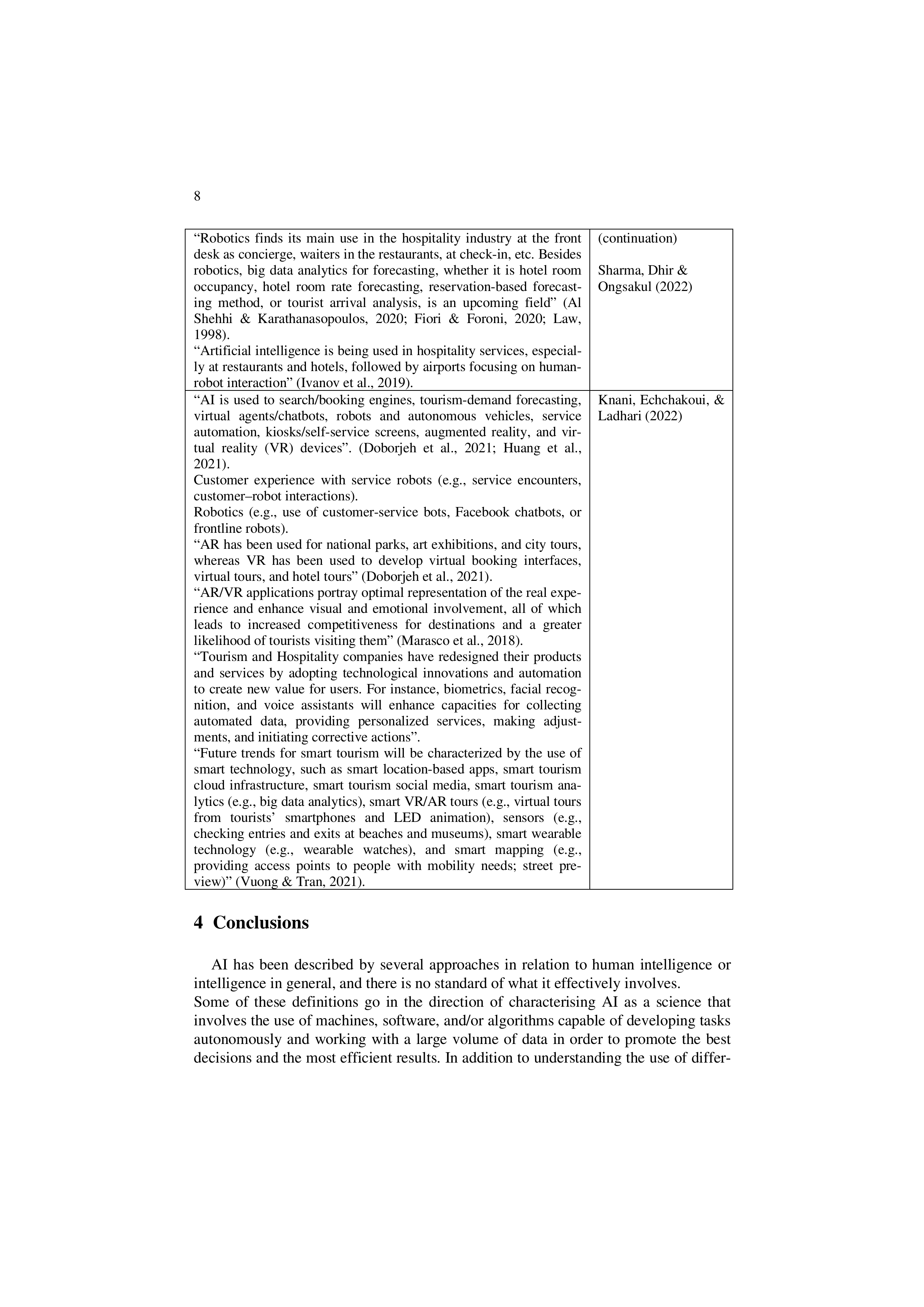
“Robotics finds its main use in the hospitality industry at the front
desk as concierge, waiters in the restaurants, at check-in, etc. Besides
robotics, big data analytics for forecasting, whether it is hotel room
occupancy, hotel room rate forecasting, reservation-based forecast-
ing method, or tourist arrival analysis, is an upcoming field” (Al
Shehhi & Karathanasopoulos, 2020; Fiori & Foroni, 2020; Law,
1998).
“Artificial intelligence is being used in hospitality services, especial-
ly at restaurants and hotels, followed by airports focusing on human-
robot interaction” (Ivanov et al., 2019).
(continuation)
Sharma, Dhir &
Ongsakul (2022)
“AI is used to search/booking engines, tourism-demand forecasting,
virtual agents/chatbots, robots and autonomous vehicles, service
automation, kiosks/self-service screens, augmented reality, and vir-
tual reality (VR) devices”. (Doborjeh et al., 2021; Huang et al.,
2021).
Customer experience with service robots (e.g., service encounters,
customer–robot interactions).
Robotics (e.g., use of customer-service bots, Facebook chatbots, or
frontline robots).
“AR has been used for national parks, art exhibitions, and city tours,
whereas VR has been used to develop virtual booking interfaces,
virtual tours, and hotel tours” (Doborjeh et al., 2021).
“AR/VR applications portray optimal representation of the real expe-
rience and enhance visual and emotional involvement, all of which
leads to increased competitiveness for destinations and a greater
likelihood of tourists visiting them” (Marasco et al., 2018).
“Tourism and Hospitality companies have redesigned their products
and services by adopting technological innovations and automation
to create new value for users. For instance, biometrics, facial recog-
nition, and voice assistants will enhance capacities for collecting
automated data, providing personalized services, making adjust-
ments, and initiating corrective actions”.
“Future trends for smart tourism will be characterized by the use of
smart technology, such as smart location-based apps, smart tourism
cloud infrastructure, smart tourism social media, smart tourism ana-
lytics (e.g., big data analytics), smart VR/AR tours (e.g., virtual tours
from tourists’ smartphones and LED animation), sensors (e.g.,
checking entries and exits at beaches and museums), smart wearable
technology (e.g., wearable watches), and smart mapping (e.g.,
providing access points to people with mobility needs; street pre-
view)” (Vuong & Tran, 2021).
Knani, Echchakoui, &
Ladhari (2022)
4 Conclusions
AI has been described by several approaches in relation to human intelligence or
intelligence in general, and there is no standard of what it effectively involves.
Some of these definitions go in the direction of characterising AI as a science that
involves the use of machines, software, and/or algorithms capable of developing tasks
autonomously and working with a large volume of data in order to promote the best
decisions and the most efficient results. In addition to understanding the use of differ-
9
ent technologies and tools, such as the Internet of Things, virtual and augmented reali-
ty, big data, robots, etc.
After analysing the main studies on this AI theme, selected from the scientific publi-
cation databases Scopus, Web of Science and Science Direct, we can conclude that
the possibilities of AI application in Tourism and Hospitality are numerous. These
applications range from customer service delivery robots in hotels and restaurants,
through the use of technology in check-in, check-out, or reception, for example;
Chatbots and Messaging (chatbots or chat blogs for direct communication with the
customer and room service directly through the mobile device); Business Intelligence
tools powered by Machine Learning (facial recognition); Virtual Reality and Aug-
mented Reality (describing the hotel on the website, creating a virtual tour of the ho-
tel, virtual travel experiences and virtual booking interface); to the possibility of ana-
lysing large databases (being able for example to process and analyse the preference
information of tourists/guests, and provide users with satisfactory tourist information
and services), among others.
However, there are still few studies that allow a global understanding of the applica-
tions of Artificial Intelligence in Tourism and Hospitality. Studies on the individual
use of a technology that makes use of AI (VR, AR, IoT…) for a specific use within
the Tourism and Hospitality industry still predominate.
This paper allows a synthesis of the different applications of Artificial Intelligence in
Tourism and Hospitality, which contributes to the knowledge about the path that this
industry is taking in relation to the adoption of Artificial Intelligence. Although there
is an increasing number of scientific documents on the subject, it is necessary to carry
out more studies on the subject, which contribute to the knowledge about the applica-
tion of AI in Tourism and Hospitality.
References
1.
Citak, J., Owoc, M. & Weichbroth, P.: A note on the applications of artificial
intelligence in the hospitality industry: preliminary results of a survey.
Pro-
cedia Computer Science, 192
, 4552–4559 (2021)
2.
Gajdosˇı´k, T. & Marcisˇ, M.: Artificial intelligence tools for smart tourism
development, Computer Science Online Conference, Springer (2019).
3.
Grundner, L. & Neuhofer, B.: The bright and dark sides of artificial intelli-
gence: a futures perspective on tourist destination experiences.
J. Destin.
Mark. Manag. 19
, 100511 (2021).
4.
Hwang, J., Kim, J. J. & Lee, K-W.: Investigating consumer innovativeness in
the context of drone food delivery services: Its impact on attitude and behav-
ioral intentions.
Technological Forecasting & Social Change.
163
, 120433.
https://doi.org/10.1016/j.techfore.2020.120433 (2021).
5.
Infante-Moro, A., Infante-Moro, J.C. & Gallardo-Perez, J.: Key Factors in
the Process of Acceptance and Implementation of Artificial Intelligence in
the Hotel Sector.
Applied Data Science and Artificial Intelligence in Busi-
ness and Industry
, 304-322. https://doi.org/10.4018/978-1-7998-6985-
6.ch014 (2021).
10
6.
Knani, M., Echchakoui, S. & Ladhari, R.: Artificial intelligence in tourism
and hospitality: Bibliometric analysis and research agenda.
Int.l J. of Hosp.
Man.,
107, 103317. DOI: https://doi.org/10.1016/j.ijhm.2022.103317 (2022).
7.
Köseoglu, M.A., Morvillo, A., Altin, M., De Martino & M., Okumus, F.:
Competitive intelligence in hospitality and tourism: a perspective article,
Tourism Review
,
75
(1), 239–242 (2019).Lalicic, L.& Weismayer, C.: Con-
sumers’ reasons and perceived value co-creation of using artificial intelli-
gence-enabled travel service agentes.
Journal of Business Research
129
(2021) 891–901. DOI: https://doi.org/10.1016/j.jbusres.2020.11.005 (2021).
8.
Marasco, A., Buonincontri, P., van Niekerk, M., Orlowski, M. & Okumus,
F.: Exploring the role of next-generation virtual technologies in destination
marketing.
J. Destin. Mark. Manag. 9
, 138–148 (2018).
9.
Mustak, M., Salminen, J., Pl´e, L. & Wirtz, J.: Artificial intelligence in mar-
keting: topic modeling, scientometric analysis, and research agenda.
J. Bus.
Res
. 124, 389–404 (2021)
10.
Pei, Y. & Zhang, Y.: A Study on the Integrated Development of Artificial In-
telligence and Tourism from the Perspective of Smart Tourism.
Journal of
Physics:
Conference
Series.
1852
,
032016.
Doi:10.1088/1742-
6596/1852/3/032016 (2021).
11.
Reis, J., Melão, N., Salvadorinho, J., Soares, B. & Rosete, A.: Service robots
in the hospitality industry: The case of Henn-na hotel, Japan.
Technology in
Society,
63,
101423. DOI: https://doi.org/10.1016/j.techsoc.2020.101423
(2020).
12.
Samala, N., Katkam, B.S., Bellamkonda, R.S. & Rodriguez, R.V.: Impact of
AI and robotics in the tourism sector: a critical insight.
Journal of Tourism
Futures
,
8
(1), 73-87. DOI 10.1108/JTF-07-2019-0065 (2022).
13.
Sharma, K., Dhir, S. and Ongsakul, V.: Artificial intelligence and hospitality
industry: systematic review using TCCM and bibliometric analysis’,
J. Int.
Bus. and Entr. D
., 14(1), 48–71 (2022).
14.
Song, H. & Jiang, Y.: Dynamic pricing decisions by potential tourists under
uncertainty: the effects of tourism advertising.
Tourism Economics
, 25(2),
213-234 (2019).
15.
Tussyadiah, I.: A review of research into automation in tourism: launching
the annals of tourism research curated collection on artificial intelligence and
robotics in tourism,
Ann. Tourism Res
. 81,102883, DOI: https://doi.org/
10.1016/j.annals.2020.102883 (2020).
16.
Yadav, J.K., Verma, D.C., Jangirala, S. & Srivastava, S.K.: An IAD type
framework for Blockchain enabled smart tourism ecosystem.
J. of High
Tech. M. R.,
32
, 100404.https://doi.org/10.1016/j.hitech.2021.100404 (2021).