
R E V I E W
A review of artificial intelligence applications
in manufacturing operations
Siby Jose Plathottam
|
Arin Rzonca
|
Rishi Lakhnori
|
Chukwunwike O. Iloeje
Energy Systems and Infrastructure
Analysis Division, Argonne National
Laboratory, Lemont, Illinois, USA
Correspondence
Siby Jose Plathottam and Chukwunwike
O. Iloeje, Energy Systems and
Infrastructure Analysis Division, Argonne
National Laboratory, Lemont, IL 60439,
USA.
Email:
splathottam@anl.gov
and
ciloeje@anl.gov
Funding
information
Office of Energy Efficiency and Renewable
Energy,
Grant/Award
Number:
DE-
AC02-06CH11357
Abstract
Artificial
intelligence
(AI)
and
machine
learning
(ML)
can
improve
manufacturing
efficiency,
productivity,
and
sustainability.
However,
using
AI
in
manufacturing
also
presents
several
challenges,
including
issues
with
data
acquisition
and
management,
human
resources,
infrastructure,
as
well
as
security
risks,
trust,
and
implementation
challenges.
For
example,
get-
ting
the
data
needed
to
train
AI
models
can
be
difficult
for
rare
events
or
costly for large datasets that need labeling. AI models can also pose security
risks
when
integrated
into
industrial
control
systems.
In
addition,
some
industry
players
may
be
hesitant
to
use
AI
due
to
a
lack
of
trust
or
under-
standing
of
how
it
works.
Despite
these
challenges,
AI
has
the
potential
to
be
extremely
helpful
in
manufacturing,
particularly
in
applications
such
as
predictive
maintenance,
quality
assurance,
and
process
optimization.
It
is
important
to
consider
the
specific
needs
and
capabilities
of
each
manufacturing
scenario
when
deciding
whether
and
how
to
use
AI
in
manufacturing.
This
review
identifies
current
developments,
challenges,
and
future
directions
in
AI/ML
relevant
to
manufacturing,
with
the
goal
of
improving
understanding
of
AI/ML
technologies
available
for
solving
manufacturing
problems,
providing
decision-support
for
prioritizing
and
selecting
appropriate
AI/ML
technologies,
and
identifying
areas
where
fur-
ther
research
can
yield
transformational
returns
for
the
industry.
Early
experience
suggests
that
AI/ML
can
have
significant
cost
and
efficiency
benefits
in
manufacturing,
especially
when
combined
with
the
ability
to
capture enormous amounts of data from manufacturing systems.
K E Y W O R D S
AI, AI challenges, industry automation, industry operations, machine learning,
manufacturing industry
Rishi Lakhnori and Arin Rzonca were Research Intern at Argonne National Laboratory at the time of contribution.
Received:
26
December
2022
Revised:
17
March
2023
Accepted:
1
April
2023
DOI:
10.1002/amp2.10159
This is an open access article under the terms of the
Creative Commons Attribution
License, which permits use, distribution and reproduction in any medium, provided
the original work is properly cited.
© 2023 UChicago Argonne, LLC, Operator of Argonne National Laboratory.
Journal of Advanced Manufacturing and Processing
published by Wiley Periodicals LLC on
behalf of American Institute of Chemical Engineers.
J
Adv
Manuf
Process.
2023;5:e10159.
wileyonlinelibrary.com/journal/amp2
1 of 19
https://doi.org/10.1002/amp2.10159
1
|
INTRODUCTION
1.1
|
Overview
The
transformation
of
artificial
intelligence
(AI)
and
machine
learning
(ML)
from
computer
science
theory
into real-world technologies is a key enabler of the fourth
industrial
revolution
(Industry
4.0),
to
the
extent
that
it
integrates
AI/ML
and
other
emerging
technologies
to
transform
industry.
Governments
and
industries
world-
wide have recognized the strategic implications of AI/ML
technologies and launched a host of initiatives seeking to
explore and capitalize on this new revolution by incorpo-
rating
of
AI/ML
into
manufacturing
and
industrial
pro-
cesses.
These
initiatives
involve
bringing
AI/ML
onto
the
factory
floor
[
1,2
]
and
integrating
information
technology
advances
(e.g.,
Internet
of
Things
[IoT],
big
data
analyt-
ics,
edge
computing,
and
cybersecurity)
into
the
existing
process
automation
infrastructure.
[
3
]
With
such
AI/ML
solutions,
the
manufacturing
industry
can
leverage
the
vast
amounts
of data
created
by
measurement
devices
on
the
factory
floor
to
improve
manufacturing
efficiency,
productivity, and sustainability.
[
4
–
7
]
Incorporating
AI
into
manufacturing
is
considered
distinct
from
digitization
and
integration
of
information
technology.
The
latter
may
be
seen
as
a
pre-requisite
for
the
former,
that
is,
digitization
and
information
technol-
ogy
provide
the
infrastructure
required
to
implement
AI/ML-based
solutions.
In
the
same
vein,
AI/ML
solu-
tions can provide additional value for established digitiza-
tion
and
information
technologies
by
extracting
new,
actionable
intelligence
from
data,
such
as
better
process
control
paradigms
or
optimized
preventive
maintenance
schedules
which
leverage
large
volumes
of
historical
operations
and
failure
mode
data,
as
well
as
better
busi-
ness
insights
from
data
analytics.
Early
experience
in
the
industry
demonstrates
the
potential
of
AI/ML
to
bolster
cost, efficiency, and productivity gains for a wide range of
applications.
These
applications
include
predictive
main-
tenance
to
improve
real-time
monitoring
of
equipment
performance
to
reduce
the
likelihood
of
unexpected
fail-
ures;
quality
assurance
to
identify
product
imperfections
and support factory floor error detection; energy forecast-
ing
to
improve
sustainability
and
manage
energy
needs;
safety
and
security
to
mitigate
cybersecurity
risks
and
rapidly detect and flag unsafe practices; generative design
to
drive
rapid
topology
optimization
in
product
design,
and
experimentation
to
simulate
normal
and
anomalous
behavior
without
needing
to
run
disruptive
tests
on
the
actual manufacturing process.
[
8
]
Incorporating
AI
into
manufacturing
processes
and
facilities faces significant challenges. First, it can be capital-
intensive,
in
terms
of
the
hardware
and
software
infrastructure
required
to
collect
and
process
data.
Second,
it can be challenging to recruit additional human resources
with AI/ML expertise, and train existing personnel for new
roles involving AI/ML solutions. Third, interpreting predic-
tive
outcomes
and
deriving
and
implementing
actionable
intelligence
is
nontrivial.
Finally,
several
aspects
of
AI/ML
technology
are
not
fully
mature,
and
there
is
a
non-zero
probability
that
implementation
might
not
yield
sufficient
return
on
investment
to
justify
it.
[
4
]
Additional
challenges
include,
(a)
unintended
security
risks
could
arise
when
AI/ML
solutions
are
introduced
into
industrial
control
sys-
tems,
(b)
computationally
intensive
AI/ML
models
could
increase
the
energy
and
environmental
footprint
of
manufacturing
facilities,
(c)
AI/ML
techniques
have
the
capability to take on some of the higher level decision mak-
ing responsibility, and by doing so, fundamentally alter the
nature
of
human-machine
interaction
in
a
manufacturing
plant.
However,
there
is
limited
trust
in
the
reliability
of
AI/ML
techniques,
lack
of
interpretability
in
the
outputs
from
AI/ML
models,
and
behavioral
inertia
towards
the
culture
change
that
will
be
brought
about
by
introducing
AI/ML to manufacturing, and (d) the field of AI/ML is con-
stantly evolving, which makes implementation challenging,
especially
for
firms
that
are
not
computer
science
technology-oriented,
and
without
ready
access
to
required
ML expertise.
[
9
]
However, as research continues to develop,
these
areas of concern
can become minimized through, for
example,
(i)
the
use
of
generative
models
to
supplement
sparse datasets, (ii) developing power and memory-efficient
computing
architectures
for
IoT
devices,
(iii)
developing
appropriate
metrics
to
quantify
confidence
in
decisions
made through AI/ML models, and (iv) the growth of a wide
variety of automated AI/ML
tools
provided as
“
Software
as
a
Service
(SaaS)
”
that
save
individual
companies
the
need
to build their own in-house AI/ML capability.
1.2
|
Study approach
Literature
review
on
AI/ML
in
manufacturing
primarily
focused
on
three
sources,
namely,
academic
literature,
blog
posts,
and
industry
reports.
In
this
review,
we priori-
tized
academic
literature,
and
used
other
sources
for
spe-
cific
use-case
illustrations.
The
initial
survey
started
with
over
200
sources,
which
we
narrowed
down
to
around
100
sources
using
the
following
criteria:
(a)
published
within
the
last
10 years;
(b)
focuses
on
AI/ML
applied
to
manufacturing;
(c)
uses
mature
AI/ML
techniques
which
have
found
success
in
non-manufacturing
industry
appli-
cations.
The
main
takeaway
from
each
technical
article
is
summarized
and
categorized
by
manufacturing
applica-
tion
and
AI
technique.
The
review
also
incorporated
dif-
fering
perspectives
on
certain
applications
of
AI/ML
in
2 of 19
PLATHOTTAM
ET
AL
.
manufacturing
to
provide
additional
context
for
the
chal-
lenges and benefits AI/ML has in manufacturing. For easy
organization,
each
reference
was
summarized
and
tagged
according
to
year
(as
illustrated
in
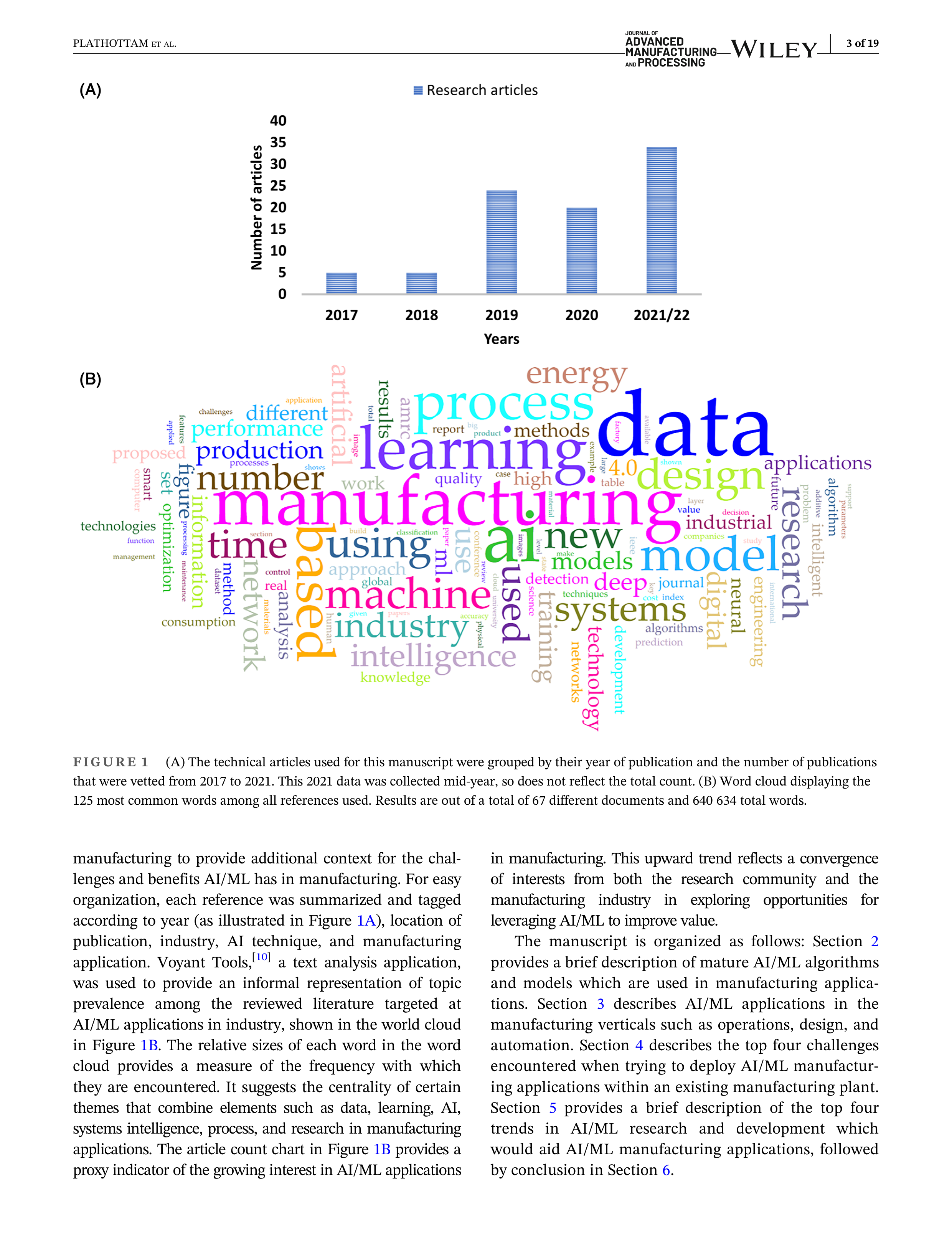
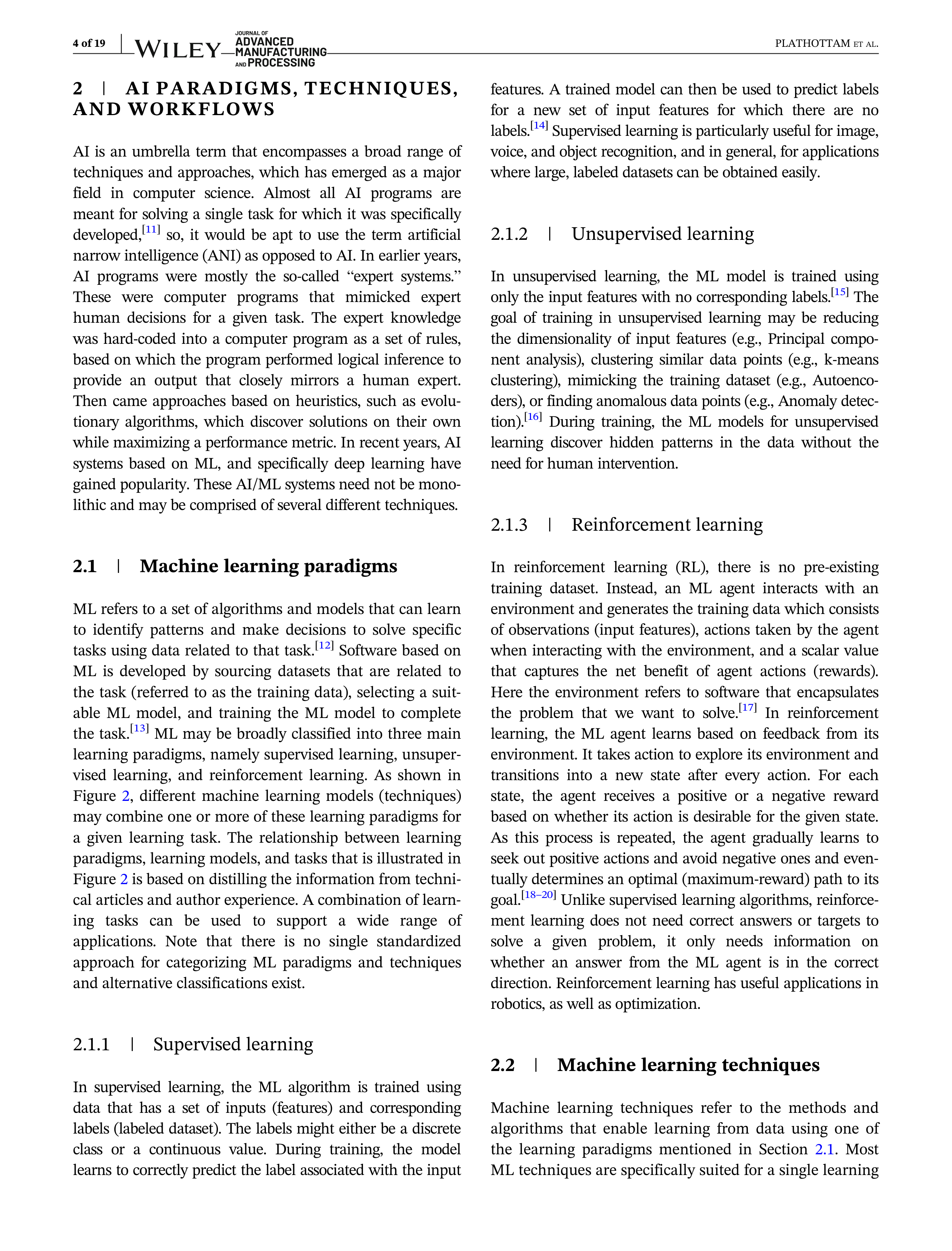
Figure
1A
),
location
of
publication,
industry,
AI
technique,
and
manufacturing
application.
Voyant
Tools,
[
10
]
a
text
analysis
application,
was
used
to
provide
an
informal
representation
of
topic
prevalence
among
the
reviewed
literature
targeted
at
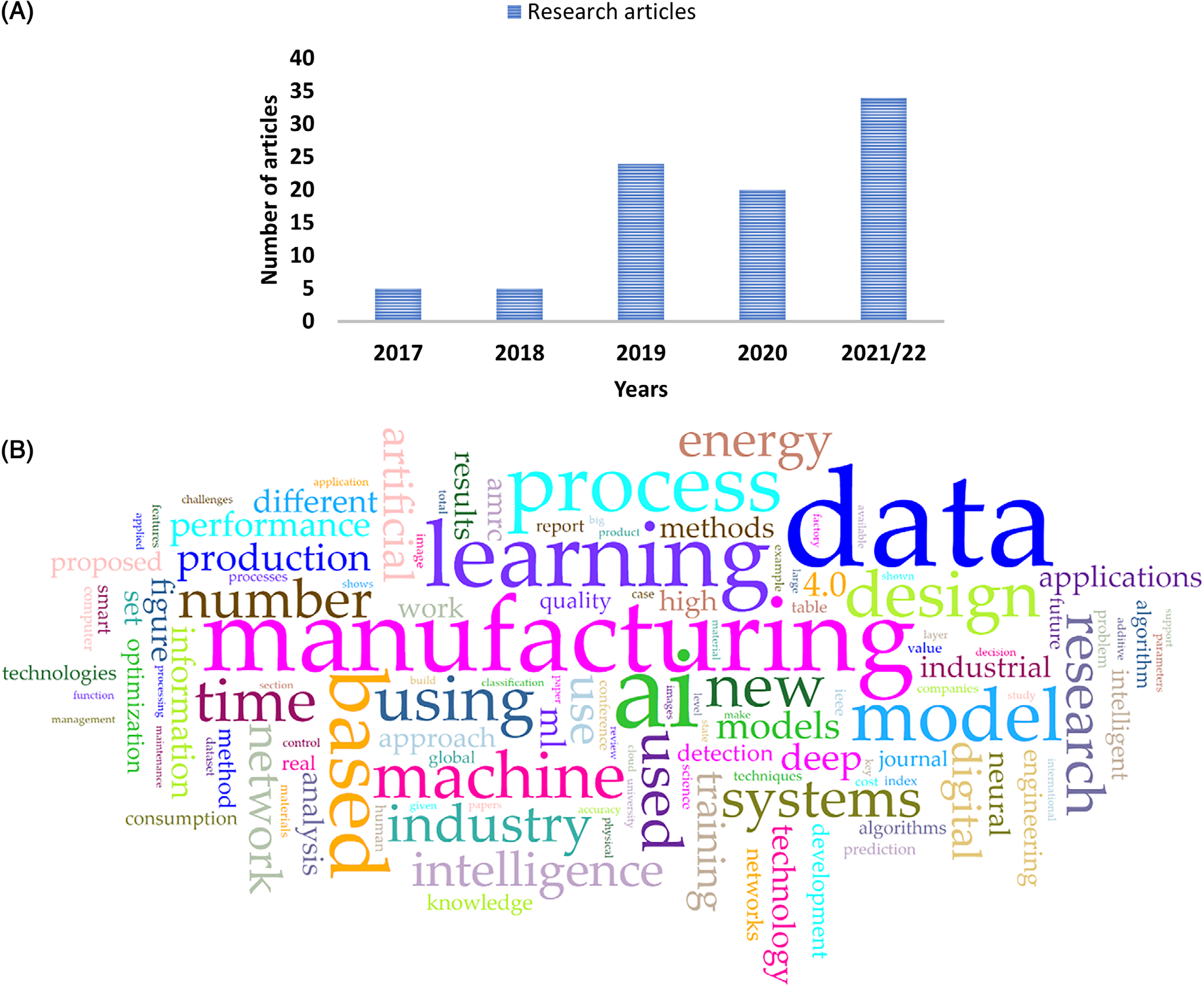
AI/ML applications in industry, shown in the world cloud
in
Figure
1B
.
The
relative
sizes
of
each
word
in
the
word
cloud
provides
a
measure
of
the
frequency
with
which
they
are
encountered.
It
suggests
the
centrality
of
certain
themes
that
combine
elements
such
as
data,
learning,
AI,
systems intelligence, process, and research in manufacturing
applications. The article count chart in Figure
1B
provides a
proxy indicator of the growing interest in AI/ML applications
in
manufacturing.
This
upward
trend
reflects
a
convergence
of
interests
from
both
the
research
community
and
the
manufacturing
industry
in
exploring
opportunities
for
leveraging AI/ML to improve value.
The
manuscript
is
organized
as
follows:
Section
2
provides a brief description of mature AI/ML algorithms
and
models
which
are
used
in
manufacturing
applica-
tions.
Section
3
describes
AI/ML
applications
in
the
manufacturing
verticals
such
as
operations,
design,
and
automation.
Section
4
describes
the
top
four
challenges
encountered
when
trying
to
deploy
AI/ML
manufactur-
ing applications within an existing manufacturing plant.
Section
5
provides
a
brief
description
of
the
top
four
trends
in
AI/ML
research
and
development
which
would
aid
AI/ML
manufacturing
applications,
followed
by conclusion in Section
6
.
FIGURE
1
(A) The technical articles used for this manuscript were grouped by their year of publication and the number of publications
that were vetted from 2017 to 2021. This 2021 data was collected mid-year, so does not reflect the total count. (B) Word cloud displaying the
125 most common words among all references used. Results are out of a total of 67 different documents and 640 634 total words.
PLATHOTTAM
ET
AL
.
3 of 19
2
|
AI
PARADIGMS,
TECHNIQUES,
AND
WORKFLOWS
AI
is
an
umbrella
term
that
encompasses
a
broad
range
of
techniques
and
approaches,
which
has
emerged
as
a
major
field
in
computer
science.
Almost
all
AI
programs
are
meant for solving a single task for which it was specifically
developed,
[
11
]
so,
it
would
be
apt
to
use
the
term
artificial
narrow intelligence (ANI) as opposed to AI. In earlier years,
AI
programs
were
mostly
the
so-called
“
expert
systems.
”
These
were
computer
programs
that
mimicked
expert
human
decisions
for
a
given
task.
The
expert
knowledge
was
hard-coded
into
a
computer
program
as
a
set
of
rules,
based on which the program performed logical inference to
provide
an
output
that
closely
mirrors
a
human
expert.
Then
came
approaches
based
on
heuristics,
such
as
evolu-
tionary
algorithms,
which
discover
solutions
on
their
own
while maximizing a performance metric. In recent years, AI
systems
based
on
ML,
and
specifically
deep
learning
have
gained popularity. These AI/ML systems need not be mono-
lithic and may be comprised of several different techniques.
2.1
|
Machine learning paradigms
ML refers to a set of algorithms and models that can learn
to
identify
patterns
and
make
decisions
to
solve
specific
tasks
using data
related to that task.
[
12
]
Software based
on
ML
is
developed
by
sourcing
datasets
that
are
related
to
the
task
(referred
to
as
the
training
data),
selecting
a
suit-
able
ML
model,
and
training
the
ML
model
to
complete
the
task.
[
13
]
ML
may
be
broadly
classified
into
three
main
learning paradigms, namely supervised learning, unsuper-
vised
learning,
and
reinforcement
learning.
As
shown
in
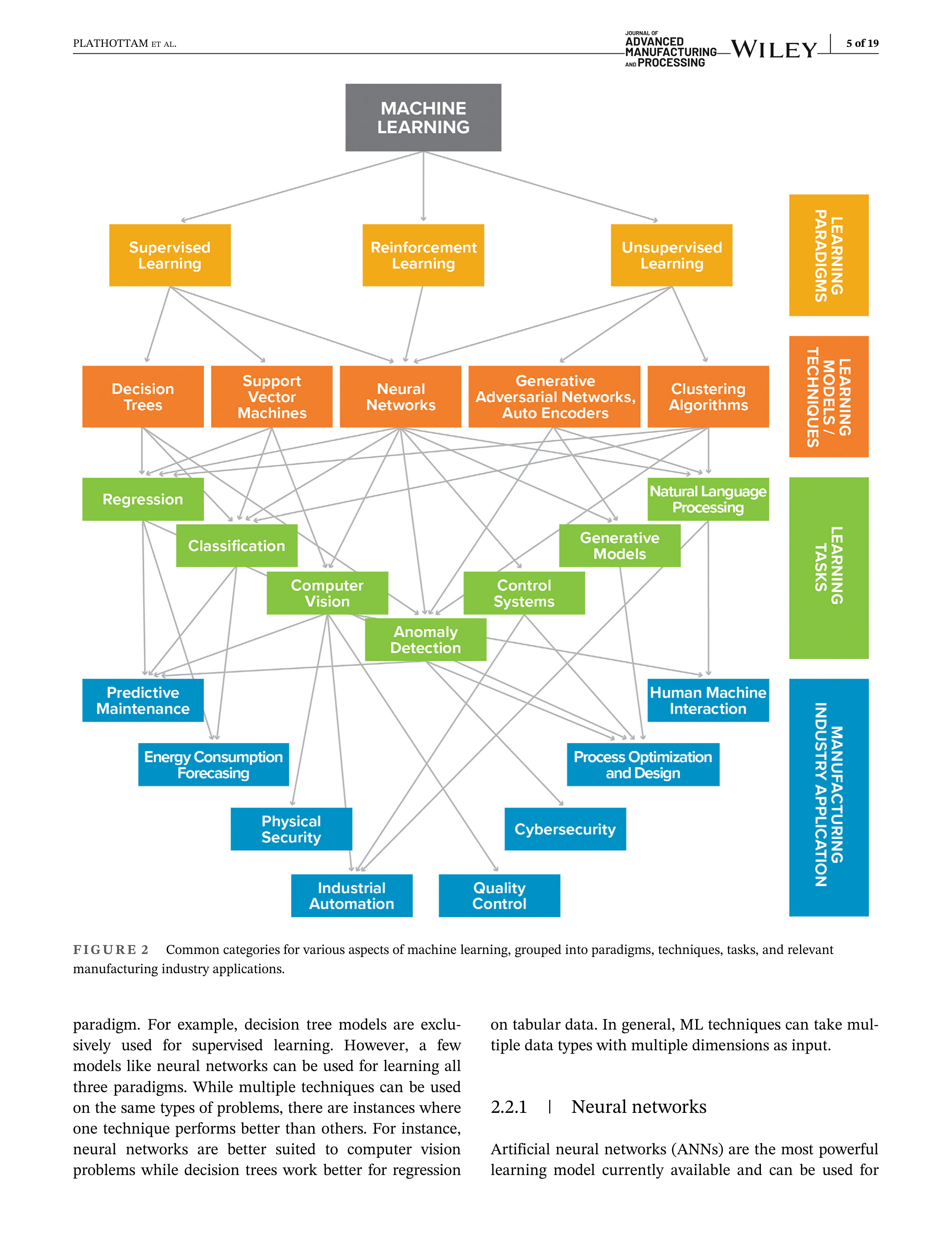
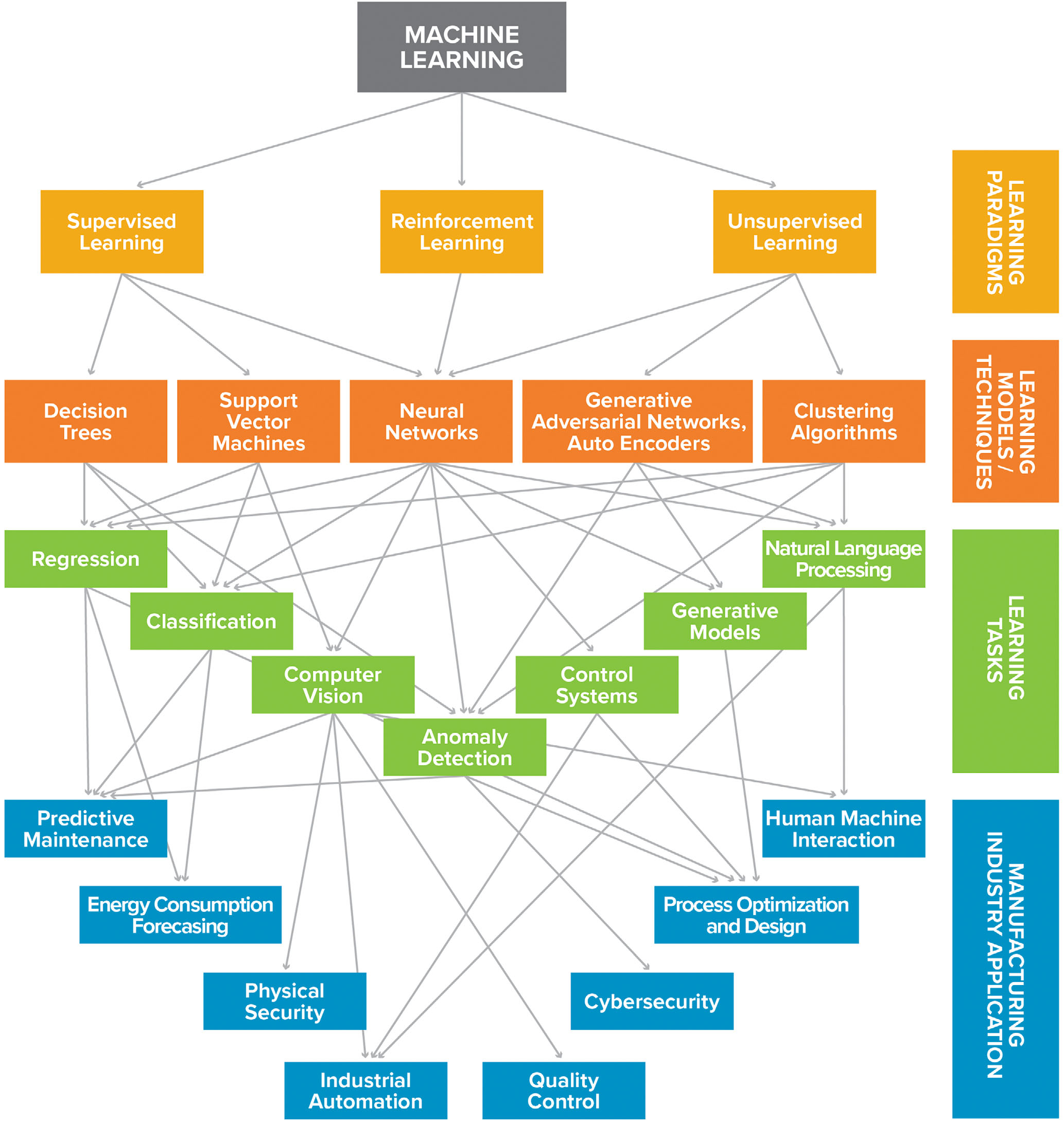
Figure
2
,
different
machine
learning
models
(techniques)
may combine one or more of these learning paradigms for
a
given
learning
task.
The
relationship
between
learning
paradigms, learning models, and tasks that is illustrated in
Figure
2
is based on distilling the information from techni-
cal articles and author experience. A combination of learn-
ing
tasks
can
be
used
to
support
a
wide
range
of
applications.
Note
that
there
is
no
single
standardized
approach
for
categorizing
ML
paradigms
and
techniques
and alternative classifications exist.
2.1.1
|
Supervised learning
In
supervised
learning,
the
ML
algorithm
is
trained
using
data
that
has
a
set
of
inputs
(features)
and
corresponding
labels (labeled dataset). The labels might either be a discrete
class
or
a
continuous
value.
During
training,
the
model
learns to correctly predict the label associated with the input
features. A trained model can then be used to predict labels
for
a
new
set
of
input
features
for
which
there
are
no
labels.
[
14
]
Supervised learning is particularly useful for image,
voice, and object recognition, and in general, for applications
where large, labeled datasets can be obtained easily.
2.1.2
|
Unsupervised learning
In
unsupervised
learning,
the
ML
model
is
trained
using
only the input features with no corresponding labels.
[
15
]
The
goal
of
training
in
unsupervised
learning
may
be
reducing
the
dimensionality
of
input
features
(e.g.,
Principal
compo-
nent
analysis),
clustering
similar
data
points
(e.g.,
k-means
clustering),
mimicking
the
training
dataset
(e.g.,
Autoenco-
ders), or finding anomalous data points (e.g., Anomaly detec-
tion).
[
16
]
During
training,
the
ML
models
for
unsupervised
learning
discover
hidden
patterns
in
the
data
without
the
need for human intervention.
2.1.3
|
Reinforcement learning
In
reinforcement
learning
(RL),
there
is
no
pre-existing
training
dataset.
Instead,
an
ML
agent
interacts
with
an
environment and generates the training data which consists
of
observations
(input
features),
actions
taken
by
the
agent
when
interacting
with
the
environment,
and
a
scalar
value
that
captures
the
net
benefit
of
agent
actions
(rewards).
Here
the
environment
refers
to
software
that
encapsulates
the
problem
that
we
want
to
solve.
[
17
]
In
reinforcement
learning,
the
ML
agent
learns
based
on
feedback
from
its
environment. It takes action to explore its environment and
transitions
into
a
new
state
after
every
action.
For
each
state,
the
agent
receives
a
positive
or
a
negative
reward
based
on
whether
its
action
is
desirable
for
the
given
state.
As
this
process
is
repeated,
the
agent
gradually
learns
to
seek out positive actions and avoid negative ones and even-
tually determines an optimal (maximum-reward) path to its
goal.
[
18
–
20
]
Unlike supervised learning algorithms, reinforce-
ment
learning
does
not
need
correct
answers
or
targets
to
solve
a
given
problem,
it
only
needs
information
on
whether
an
answer
from
the
ML
agent
is
in
the
correct
direction. Reinforcement learning has useful applications in
robotics, as well as optimization.
2.2
|
Machine learning techniques
Machine
learning
techniques
refer
to
the
methods
and
algorithms
that
enable
learning
from
data
using
one
of
the
learning
paradigms
mentioned
in
Section
2.1
.
Most
ML techniques are specifically suited for a single learning
4 of 19
PLATHOTTAM
ET
AL
.
paradigm.
For
example,
decision
tree
models
are
exclu-
sively
used
for
supervised
learning.
However,
a
few
models
like
neural
networks
can
be
used
for
learning
all
three
paradigms.
While
multiple
techniques
can
be
used
on the same types of problems, there are instances where
one
technique
performs
better
than
others.
For
instance,
neural
networks
are
better
suited
to
computer
vision
problems
while
decision
trees
work
better
for
regression
on tabular data. In general, ML techniques can take mul-
tiple data types with multiple dimensions as input.
2.2.1
|
Neural networks
Artificial
neural
networks
(ANNs)
are
the
most
powerful
learning
model
currently
available
and
can
be
used
for
FIGURE
2
Common categories for various aspects of machine learning, grouped into paradigms, techniques, tasks, and relevant
manufacturing industry applications.
PLATHOTTAM
ET
AL
.
5 of 19
supervised,
unsupervised,
and
reinforcement
learning.
They
have
a
weak
analogy
to
the
network
in
the
human
brain
formed by the biological
neurons
[
6,21
]
and are com-
prised of connected layers of artificial neurons. Each neu-
ron
transmits
the
weighted
sum
of
inputs
through
a
nonlinear
activation
function
(e.g.,
sigmoid,
rectified
lin-
ear)
to
produce
an
output
that
proceeds
to
the
next
layer
of
neurons.
[
22
]
An
ANN
with
two
or
more
layer
of
neu-
rons is known as a deep neural network (DNN), which is
more widely referred to as deep learning in both industry
and academia. DNNs can be further classified into convo-
lutional
neural
networks
(CNNs),
which
apply
a
filter
at
each
layer
of
nodes
meant
to
observe
a
different
feature
and
preserve
spatial
information;
and
Recurrent
Neural
Networks, whose nodes retain information from previous
inputs and preserve state information.
2.2.2
|
Decision trees
Decision
trees
fall
into
the
supervised
learning
category
and are a tree-like learning model of decisions that weigh
decisions
based
on
factors
like
consequences,
likelihood,
and
associated
costs.
Decision
trees
are
visual
maps
that
represent the outcomes of related choices. They start with
a
single
node
—
analogous
to
a
root
of
a
tree
—
that,
for
instance,
represents
a
decision
such
as
whether
to
make
a
sub-assembly
of
a
product
in-house
or
to
outsource
the
assembly
[
23
]
and
then
branches
into
possible
outcomes
(
“
Yes
”
or
“
No
”
in this case) based on the weighted benefit
of
answers
to
that
question.
[
24
]
These
possible
outcomes
then
lead
to
more
nodes
with
each
having
its
own
dis-
tinct set of possibilities, giving it a tree-like structure. The
tree
is
constructed
such
that
the
decisions
taken
within
the
tree
lead
to
classifications
that
result
in
the
least
entropy.
Decision
trees
are
particularly
useful
because
they
allow
users
to
quantitatively
weigh
the
outcomes
of
actions
based
on
parameters
such
as
cost,
benefits,
and
likelihood,
[
25
]
and
can
be
supplemented
with
algorithms
that objectively demonstrate the best action to take.
2.2.3
|
Support vector machines
Support
vector
machines
(SVMs)
are
a
supervised
learn-
ing method used for regression analysis and for the classi-
fication
of
data.
They
are
discriminative
classifiers
defined
by
hyperplanes
that
divide
a
potentially
large
dataset
into
distinct
classes
or
groupings
of
data.
[
26
]
SVMs,
initially,
generate
a
hyperplane
onto
a
graph
that
contains
all
the
data.
This
hyperplane
acts
as
a
line
of
separation
that
separates
two
or
more
classes.
[
27
]
The
SVM
uses
an
optimization
algorithm
to
find
the
hyperplane
that
has
the
maximum
margin,
that
is,
the
maximum
distance
between
data
points
of
the
different
classes.
SVMs
have
the
advantage
of
quickly
classifying
and
categorizing
data,
which
reduces
the
costs
related
to
manually sorting the data.
2.2.4
|
Clustering algorithms
Clustering
algorithms
are
unsupervised
learning
algo-
rithms
that
employ
an
iterative
process
to
sort
data
into
specific
categories
or
groupings
known
as
clusters
based
on
the
“
nearness
”
(e.g.,
Euclidean
distance)
of
the
data
points
to
a
center
of
gravity.
This
machine
learning
tech-
nique
is
particularly
useful
for
large
sets
of
data
as
the
resulting
clusters
can
give
rise
to
conclusions
or
previ-
ously
undiscovered
patterns
within
sets
of
data,
which
can be visually represented.
[
28
]
2.2.5
|
Generative adversarial networks
Generative
modeling
is
an
application
of
unsupervised
learning
to
develop
a
probabilistic
model
that
describes
training
datasets.
Generative
adversarial
networks
(GANs)
have
been
one
of
the
most
successful
learning
models
for
generative
modeling.
GANS
consists
of
two
neural
networks,
a
generator
that
learns
from
a
training
dataset
to
generate
new
data
that
could
plausibly
have
come
from
the
original
dataset,
and
a
discriminator,
which evaluates whether
the data point is from the origi-
nal
dataset
or
created
by
the
generator.
During
training,
the
generator
and
discriminator
try
to
outcompete
each
other until the generator starts producing more and more
plausible results.
[
21
]
2.2.6
|
Scientific machine learning
AI/ML
has
found
increasing
use
in
the
domain
of
scien-
tific
computing
through
an
emerging
field
known
as
sci-
entific
machine
learning
(SciML).
SciML
is
a
data-driven
approach that utilizes conventional ML models in combi-
nation
with
known
physical
laws
for
a
given
problem
within
a
scientific
domain.
[
29
]
SciML
can
be
used
to
per-
form
high-performance
simulations
that
are
several
orders
of
magnitude
faster
than
those
using
classical
approaches.
SciML
utilizes
the
differential
equations
that
define
the
known
physics
of
a
process
while
training
the
ML
model.
Their
major
use
cases
are
(a)
surrogate
models
which
are
orders
of
magnitude
faster
than
classi-
cal models. (b) Parameterization of classical models using
sparse measurement data.
[
30
]
6 of 19
PLATHOTTAM
ET
AL
.
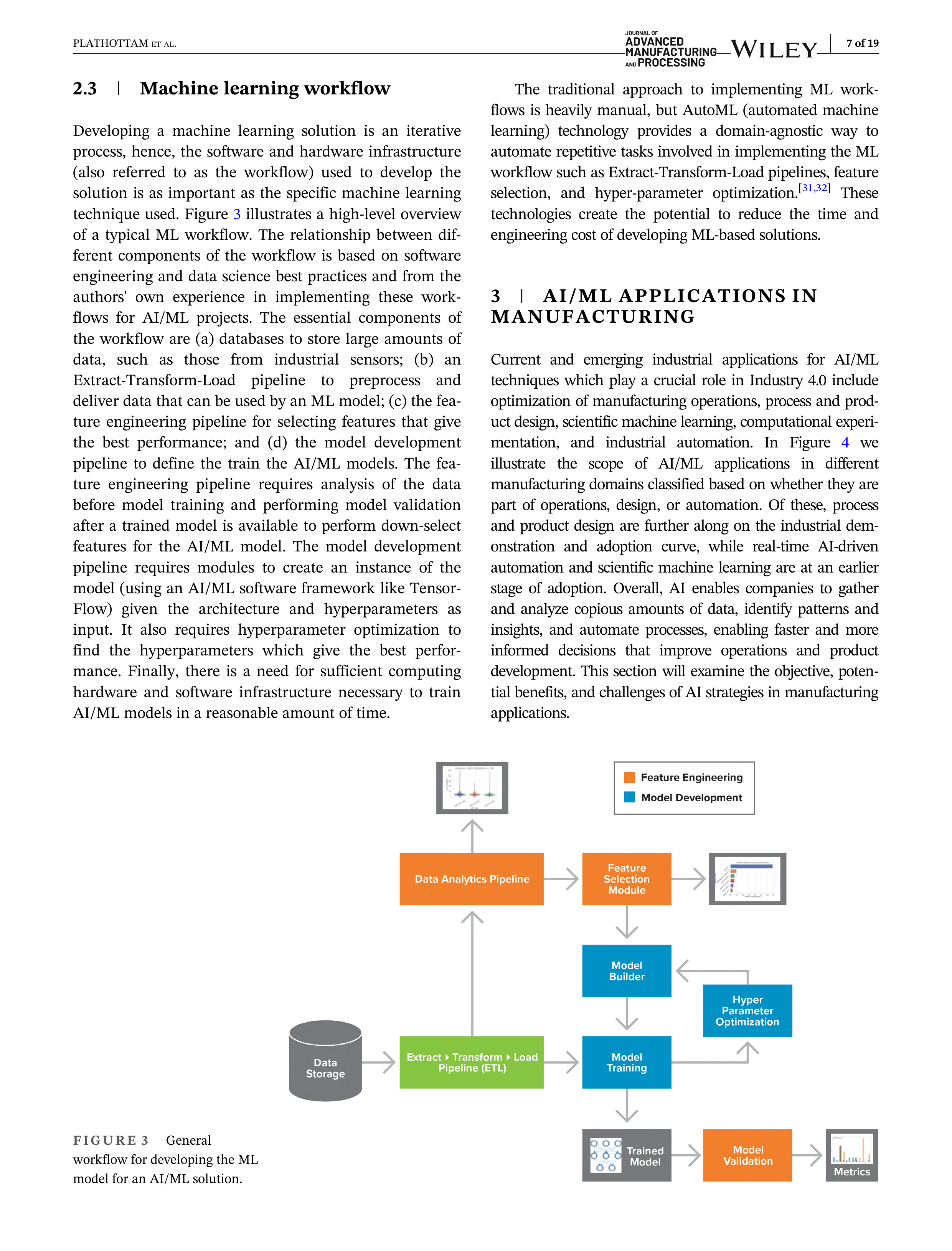
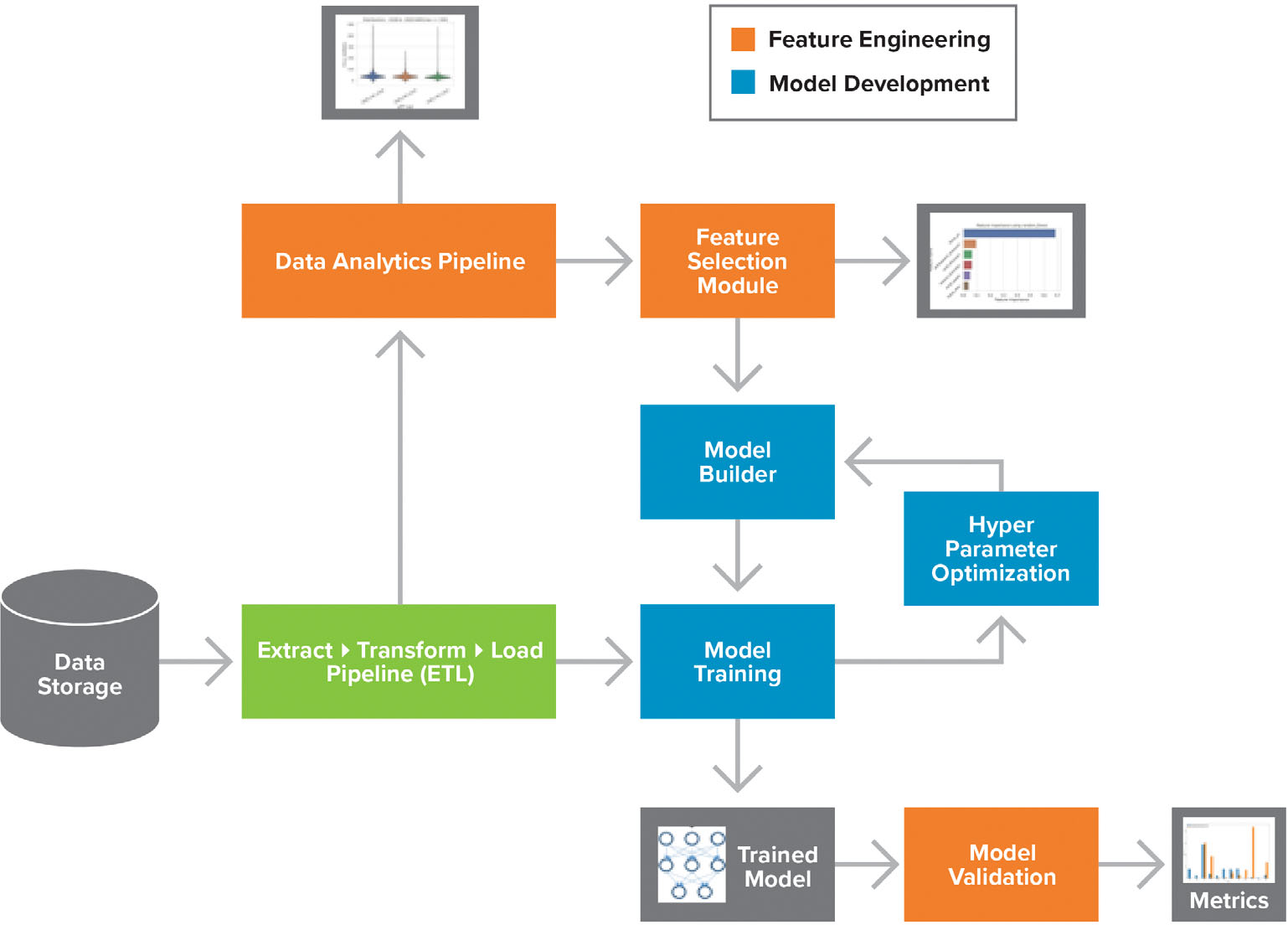
2.3
|
Machine learning workflow
Developing
a
machine
learning
solution
is
an
iterative
process,
hence,
the
software
and
hardware
infrastructure
(also
referred
to
as
the
workflow)
used
to
develop
the
solution
is
as
important
as
the
specific
machine
learning
technique
used.
Figure
3
illustrates
a
high-level
overview
of
a
typical
ML
workflow.
The
relationship
between
dif-
ferent
components
of
the
workflow
is
based
on
software
engineering
and
data
science
best
practices
and
from
the
authors'
own
experience
in
implementing
these
work-
flows
for
AI/ML
projects.
The
essential
components
of
the
workflow
are
(a)
databases
to
store
large
amounts
of
data,
such
as
those
from
industrial
sensors;
(b)
an
Extract-Transform-Load
pipeline
to
preprocess
and
deliver data that can be used by an ML model; (c) the fea-
ture
engineering
pipeline
for
selecting
features
that
give
the
best
performance;
and
(d)
the
model
development
pipeline
to
define
the
train
the
AI/ML
models.
The
fea-
ture
engineering
pipeline
requires
analysis
of
the
data
before
model
training
and
performing
model
validation
after
a
trained
model
is
available
to
perform
down-select
features
for
the
AI/ML
model.
The
model
development
pipeline
requires
modules
to
create
an
instance
of
the
model
(using
an
AI/ML
software
framework
like
Tensor-
Flow)
given
the
architecture
and
hyperparameters
as
input.
It
also
requires
hyperparameter
optimization
to
find
the
hyperparameters
which
give
the
best
perfor-
mance.
Finally,
there
is
a
need
for
sufficient
computing
hardware
and
software
infrastructure
necessary
to
train
AI/ML models in a reasonable amount of time.
The
traditional
approach
to
implementing
ML
work-
flows
is
heavily
manual,
but
AutoML
(automated
machine
learning)
technology
provides
a
domain-agnostic
way
to
automate repetitive tasks involved in implementing the ML
workflow such as Extract-Transform-Load pipelines, feature
selection,
and
hyper-parameter
optimization.
[
31,32
]
These
technologies
create
the
potential
to
reduce
the
time
and
engineering cost of developing ML-based solutions.
3
|
AI/ML
APPLICATIONS
IN
MANUFACTURING
Current
and
emerging
industrial
applications
for
AI/ML
techniques
which
play
a
crucial
role
in
Industry
4.0
include
optimization of manufacturing operations, process and prod-
uct design, scientific machine learning, computational experi-
mentation,
and
industrial
automation.
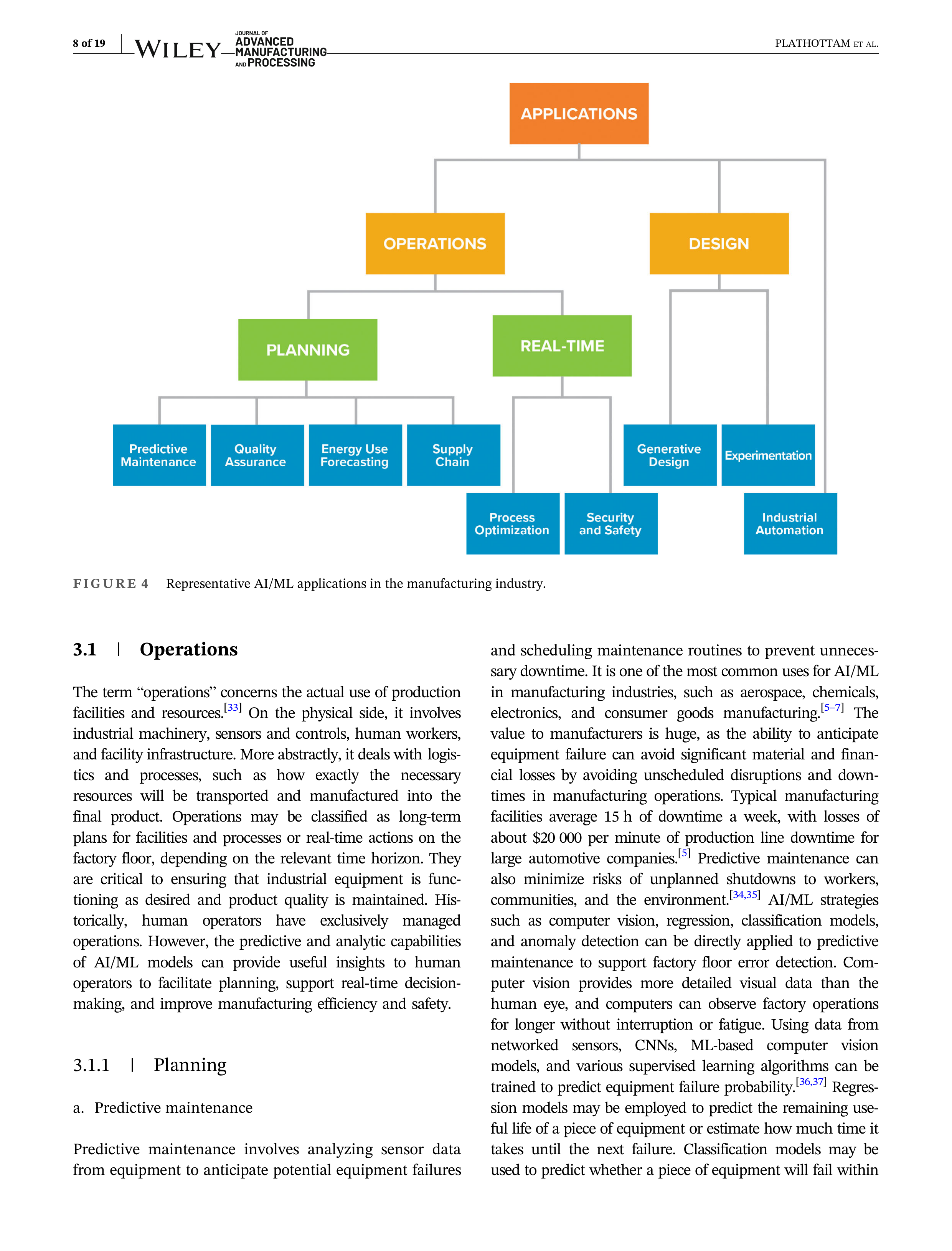
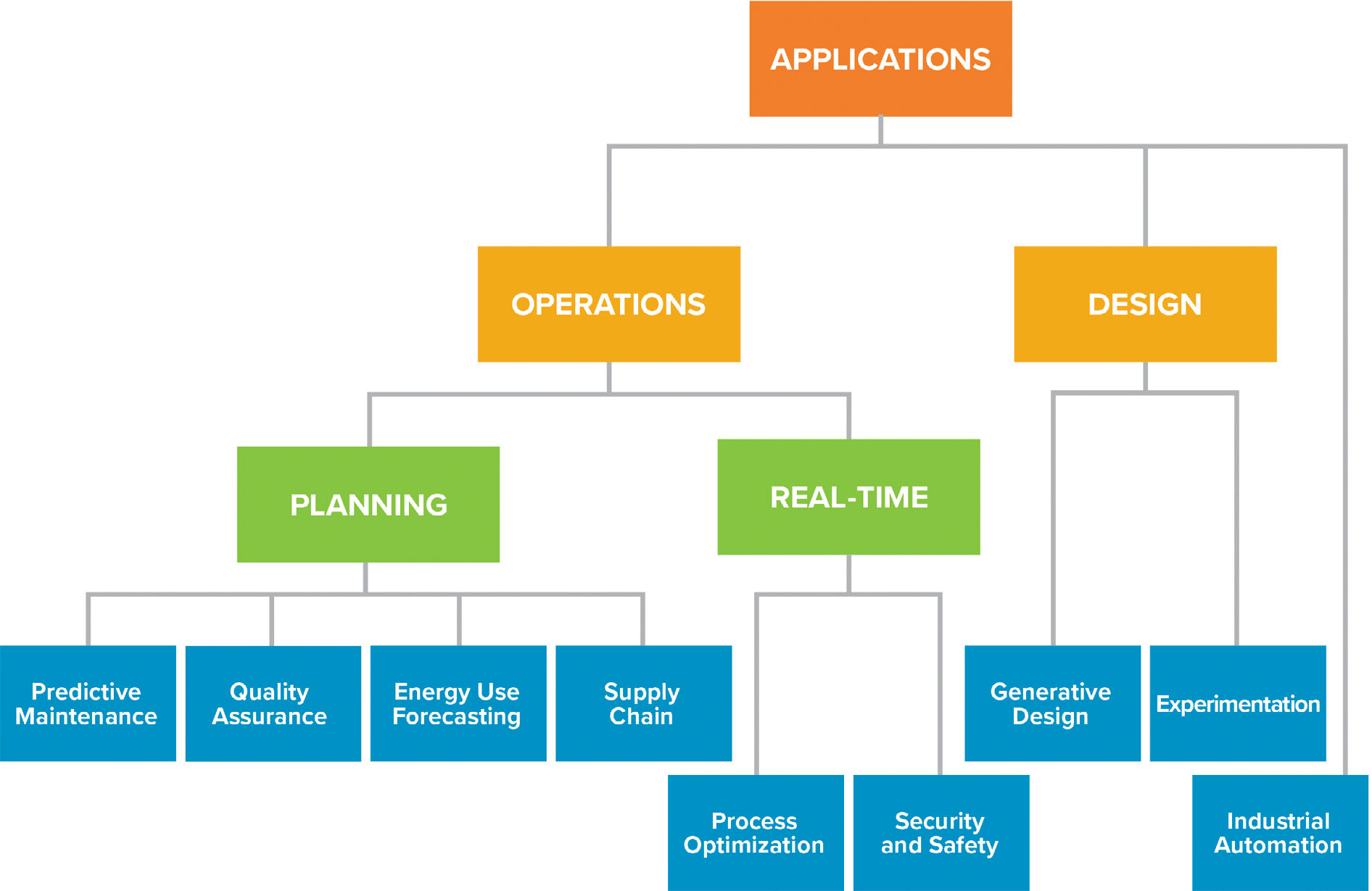
In
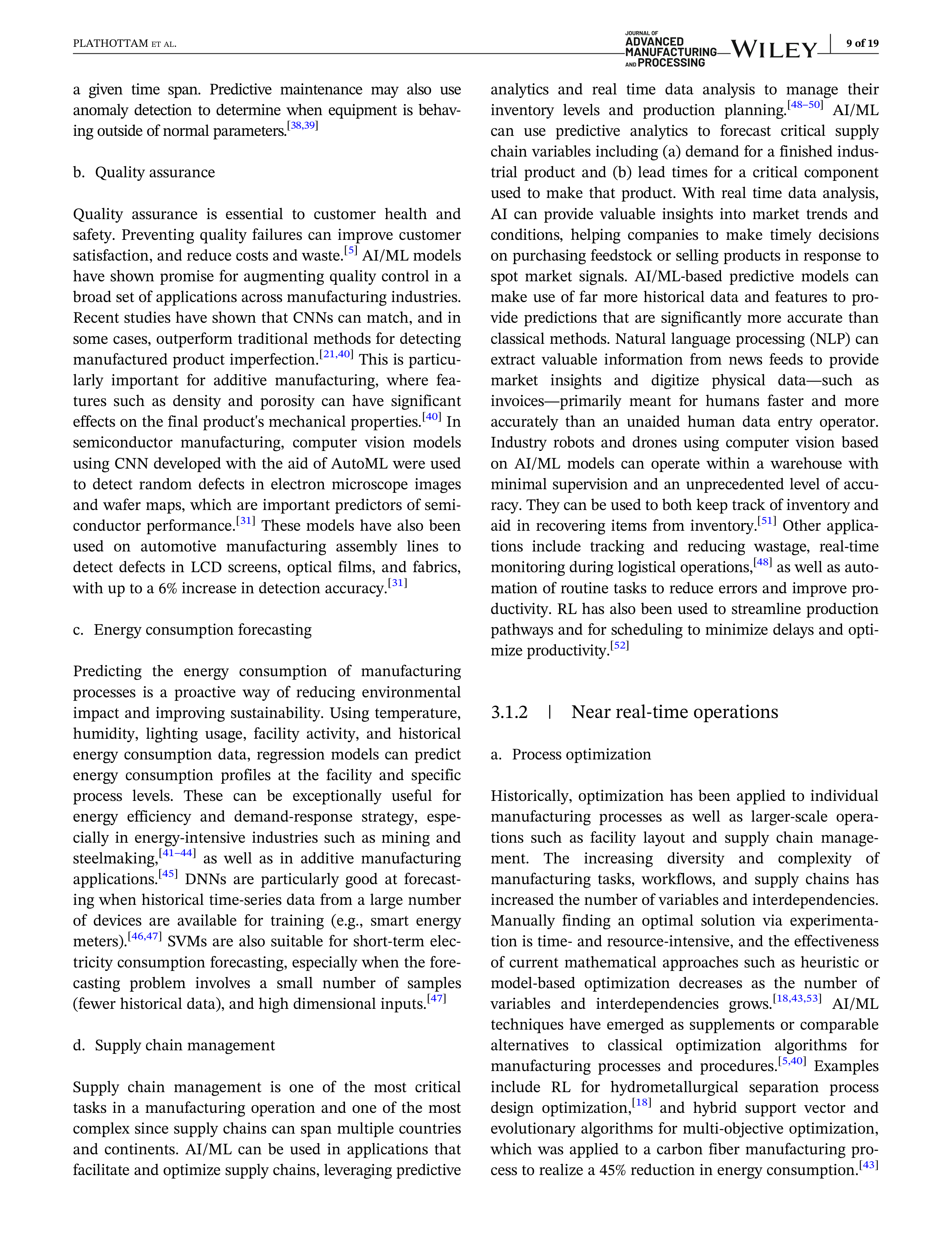
Figure
4
we
illustrate
the
scope
of
AI/ML
applications
in
different
manufacturing domains classified based on whether they are
part
of
operations,
design,
or
automation.
Of
these,
process
and
product
design
are
further along
on
the
industrial
dem-
onstration
and
adoption
curve,
while
real-time
AI-driven
automation
and
scientific machine
learning are at
an
earlier
stage
of
adoption.
Overall,
AI
enables
companies
to
gather
and
analyze
copious
amounts
of
data,
identify
patterns
and
insights,
and
automate
processes,
enabling
faster
and
more
informed
decisions
that
improve
operations
and
product
development. This section will examine the objective, poten-
tial benefits, and challenges of AI strategies in manufacturing
applications.
FIGURE
3
General
workflow for developing the ML
model for an AI/ML solution.
PLATHOTTAM
ET
AL
.
7 of 19
3.1
|
Operations
The term
“
operations
”
concerns the actual use of production
facilities
and
resources.
[
33
]
On
the
physical
side,
it
involves
industrial
machinery,
sensors
and
controls,
human
workers,
and facility infrastructure. More abstractly, it deals with
logis-
tics
and
processes,
such
as
how
exactly
the
necessary
resources
will
be
transported
and
manufactured
into
the
final
product.
Operations
may
be
classified
as
long-term
plans
for
facilities
and
processes
or
real-time
actions
on
the
factory
floor,
depending
on
the
relevant
time
horizon.
They
are
critical
to
ensuring
that
industrial
equipment
is
func-
tioning
as
desired
and
product
quality
is
maintained.
His-
torically,
human
operators
have
exclusively
managed
operations.
However,
the
predictive
and
analytic
capabilities
of
AI/ML
models
can
provide
useful
insights
to
human
operators
to
facilitate
planning,
support
real-time
decision-
making,
and
improve
manufacturing
efficiency
and
safety.
3.1.1
|
Planning
a.
Predictive maintenance
Predictive
maintenance
involves
analyzing
sensor
data
from equipment to anticipate potential equipment failures
and scheduling
maintenance
routines
to
prevent
unneces-
sary downtime. It is one of the most common uses for AI/ML
in
manufacturing
industries,
such
as
aerospace,
chemicals,
electronics,
and
consumer
goods
manufacturing.
[
5
–
7
]
The
value
to
manufacturers
is
huge,
as
the
ability
to
anticipate
equipment
failure
can
avoid
significant
material
and
finan-
cial
losses
by
avoiding
unscheduled
disruptions
and
down-
times
in
manufacturing
operations.
Typical
manufacturing
facilities
average
15 h
of
downtime
a
week,
with
losses
of
about
$20 000
per
minute
of
production
line
downtime
for
large
automotive
companies.
[
5
]
Predictive
maintenance
can
also
minimize
risks
of
unplanned
shutdowns
to
workers,
communities,
and
the
environment.
[
34,35
]
AI/ML
strategies
such
as
computer
vision,
regression,
classification
models,
and
anomaly
detection
can
be
directly
applied
to
predictive
maintenance
to
support
factory
floor
error
detection.
Com-
puter
vision
provides
more
detailed
visual
data
than
the
human
eye,
and
computers
can
observe
factory
operations
for
longer
without
interruption
or
fatigue.
Using
data
from
networked
sensors,
CNNs,
ML-based
computer
vision
models,
and
various
supervised
learning
algorithms
can
be
trained to predict equipment failure probability.
[
36,37
]
Regres-
sion models may be employed to predict the remaining use-
ful life of a piece of equipment or estimate how much time it
takes
until
the
next
failure.
Classification
models
may
be
used to predict whether a piece of equipment will fail within
FIGURE
4
Representative AI/ML applications in the manufacturing industry.
8 of 19
PLATHOTTAM
ET
AL
.
a
given
time
span.
Predictive
maintenance
may
also
use
anomaly
detection
to
determine
when
equipment
is
behav-
ing outside of normal parameters.
[
38,39
]
b.
Quality assurance
Quality
assurance
is
essential
to
customer
health
and
safety.
Preventing
quality
failures
can
improve
customer
satisfaction, and reduce costs and waste.
[
5
]
AI/ML models
have
shown
promise
for
augmenting
quality
control
in
a
broad set of applications across manufacturing industries.
Recent studies
have shown
that CNNs can match, and
in
some
cases,
outperform
traditional
methods
for
detecting
manufactured
product
imperfection.
[
21,40
]
This
is
particu-
larly
important
for
additive
manufacturing,
where
fea-
tures
such
as
density
and
porosity
can
have
significant
effects on the final product's mechanical properties.
[
40
]
In
semiconductor
manufacturing,
computer
vision
models
using
CNN
developed
with
the
aid
of
AutoML
were
used
to
detect
random
defects
in
electron
microscope
images
and
wafer
maps,
which
are
important
predictors
of
semi-
conductor
performance.
[
31
]
These
models
have
also
been
used
on
automotive
manufacturing
assembly
lines
to
detect
defects
in
LCD
screens,
optical
films,
and
fabrics,
with up to a 6% increase in detection accuracy.
[
31
]
c.
Energy consumption forecasting
Predicting
the
energy
consumption
of
manufacturing
processes
is
a
proactive
way
of
reducing
environmental
impact
and
improving
sustainability.
Using
temperature,
humidity,
lighting
usage,
facility
activity,
and
historical
energy
consumption
data,
regression
models
can
predict
energy
consumption
profiles
at
the
facility
and
specific
process
levels.
These
can
be
exceptionally
useful
for
energy
efficiency
and
demand-response
strategy,
espe-
cially
in
energy-intensive
industries
such
as
mining
and
steelmaking,
[
41
–
44
]
as
well
as
in
additive
manufacturing
applications.
[
45
]
DNNs
are
particularly
good
at
forecast-
ing
when
historical
time-series data
from
a large
number
of
devices
are
available
for
training
(e.g.,
smart
energy
meters).
[
46,47
]
SVMs
are
also
suitable
for
short-term
elec-
tricity consumption forecasting, especially when the fore-
casting
problem
involves
a
small
number
of
samples
(fewer historical data), and high dimensional inputs.
[
47
]
d.
Supply chain management
Supply
chain
management
is
one
of
the
most
critical
tasks
in
a
manufacturing
operation
and
one
of
the
most
complex
since
supply
chains
can
span
multiple
countries
and
continents.
AI/ML
can
be
used
in
applications
that
facilitate and optimize supply chains, leveraging predictive
analytics
and
real
time
data
analysis
to
manage
their
inventory
levels
and
production
planning.
[
48
–
50
]
AI/ML
can
use
predictive
analytics
to
forecast
critical
supply
chain variables including (a) demand for a finished indus-
trial
product
and
(b)
lead
times
for
a
critical
component
used
to
make
that
product.
With
real
time
data
analysis,
AI
can
provide
valuable
insights
into
market
trends
and
conditions,
helping
companies
to
make
timely
decisions
on purchasing feedstock or selling products in response to
spot
market
signals.
AI/ML-based
predictive
models
can
make
use
of
far
more
historical
data
and
features
to
pro-
vide
predictions
that
are
significantly
more
accurate
than
classical
methods.
Natural
language
processing
(NLP)
can
extract
valuable
information
from
news
feeds
to
provide
market
insights
and
digitize
physical
data
—
such
as
invoices
—
primarily
meant
for
humans
faster
and
more
accurately
than
an
unaided
human
data
entry
operator.
Industry
robots
and
drones
using
computer
vision
based
on
AI/ML
models
can
operate
within
a
warehouse
with
minimal
supervision
and
an
unprecedented
level
of
accu-
racy. They can be used to both keep track of inventory and
aid
in
recovering
items
from
inventory.
[
51
]
Other
applica-
tions
include
tracking
and
reducing
wastage,
real-time
monitoring during logistical operations,
[
48
]
as well as auto-
mation
of
routine
tasks to reduce
errors
and
improve pro-
ductivity.
RL
has
also
been
used
to
streamline
production
pathways and for scheduling to minimize delays and opti-
mize productivity.
[
52
]
3.1.2
|
Near real-time operations
a.
Process optimization
Historically,
optimization
has
been
applied
to
individual
manufacturing
processes
as
well
as
larger-scale
opera-
tions
such
as
facility
layout
and
supply
chain
manage-
ment.
The
increasing
diversity
and
complexity
of
manufacturing
tasks,
workflows,
and
supply
chains
has
increased the number of variables and interdependencies.
Manually
finding
an
optimal
solution
via
experimenta-
tion is time- and resource-intensive, and the effectiveness
of
current
mathematical
approaches
such
as
heuristic
or
model-based
optimization
decreases
as
the
number
of
variables
and
interdependencies
grows.
[
18,43,53
]
AI/ML
techniques
have
emerged
as
supplements
or
comparable
alternatives
to
classical
optimization
algorithms
for
manufacturing
processes
and
procedures.
[
5,40
]
Examples
include
RL
for
hydrometallurgical
separation
process
design
optimization,
[
18
]
and
hybrid
support
vector
and
evolutionary
algorithms
for
multi-objective
optimization,
which
was
applied
to
a
carbon
fiber
manufacturing
pro-
cess to realize a 45% reduction in energy consumption.
[
43
]
PLATHOTTAM
ET
AL
.
9 of 19
AI/ML
may
also
be
used
to
optimize
larger-scale
pro-
cesses
such
as
factory
layout
design,
inter-
and
intra-
facility
dispatch
management,
and
logistics.
Recurrent
Neural
Networks
have
been
used
to
optimize
delivery
and
dispatch
services
by
autonomous
guided
vehicles
while
avoiding
conflicts
with
workers
or
other
vehi-
cles.
[
54
]
RL
has
also
been
used
to
optimize
dispatch
within a facility
[
20
]
(such as a factory floor or warehouse),
and
for
job-shop
scheduling
—
where
one
product
requir-
ing
several
tasks
which
must
be
completed
on
separate
machines
while
ensuring
an
optimal
layout
of
equip-
ment.
[
55
]
Other
use
case
applications
for
RL
include
improving the ability of robots to identify and pick out an
object from specific bins,
[
56
]
select the best paths to mini-
mize unnecessary stops, and avoid obstacles and interfer-
ence
with
human
operators.
[
57
]
It
is
also
becoming
more
common to see hybrid applications where machine learn-
ing
techniques
are
integrated
with
classical
optimization
techniques and process simulation.
[
58
]
Digital
twins
represent
another
application
where
AI/ML
can
have
significant
impact
on
manufacturing,
with a 2020 case study reporting significant benefits from
the
use
of
digital
twins
in
large
scale
smart
manufactur-
ing
operations.
[
59
]
Digital
twins
are
virtual
replicas
of
a
manufacturing
unit
or
facility
within
a
simulated
envi-
ronment.
One
major
value
proposition
of
AI/ML-based
digital twins
is that
they provide several orders of magni-
tude
reduction
in
simulation
time
over
conventional
approaches,
which
makes
it
feasible
to
use
them
for
real
time
data
analysis
and
process
control.
They
can
also
be
used
to
conduct
experiments
and
to
test
minor
changes
to system design, allowing operators to evaluate potential
process
responses
and
behaviors
before
actuating
an
updated
control
logic
on
the
factory
floor.
AI/ML
based
digital
twins
may
also
assist
with
automation
to
enable
intelligent and autonomous manufacturing.
[
60,61
]
b.
Security and safety
AI/ML
can
also
improve
worker
and
critical
equipment
safety
within
factories
through
intelligent
access
control
systems.
It
can
also
be
used
to
mitigate
the
cybersecurity
risks
introduced
by
the
ever-increasing
number
of
net-
worked
devices
within
a
manufacturing
plant.
Computer
vision
based
on
deep learning
can
visually
identify
unsafe
behaviors
for
employees
and
identify
the
presence
of
unauthorized
personnel
within
a
facility.
[
62
–
64
]
A
study
of
process
manufacturing
in
the
chemicals
industries
used
deep
learning
to
examine
the
relationships
between
pro-
cess factors to predict potential accidents
[
65
]
For industrial
cybersecurity,
AI/ML
models
are
used
in
intrusion
detec-
tion
systems
[
66
]
by
detecting
anomalous
patterns
in
user
behavior or network traffic such as, for example, analyze a
program's
sequence
of
system
calls
to
evaluate
whether
it
is malicious or not.
[
67
]
Unsupervised learning models may
be
combined
with
expert
systems
for
anomaly
detection,
as data generated by operational technology is predictable.
GANs
can
be
used
to
generate
data
that
can
model
the
relationship
and
information
flow
between
cyber
and
physical
systems,
using
the
information
to
determine
whether security requirements are met.
[
21
]
3.2
|
Design
Design
involves
developing
new
or
modified
products
and
processes,
modeling
them
either
digitally
or
physi-
cally,
and
testing
them
to
ensure
they
are
feasible
and
meet the manufacturer's goals. The typical design process
for manufacturing is iterative, requiring tests of each new
design
to
determine
its
effectiveness,
and
requiring
pro-
cess
designers
to
expend
considerable
time,
labor,
and
materials
while
iterating
towards
an
ideal
result.
Emerg-
ing
AI/ML
techniques
for
aiding
process/product
design
include
predictive
modeling,
generative
design,
and
rein-
forcement
learning.
AI/ML-based
predictive
models
provide
significant
productivity
leverage
to
product
designers,
[
68
]
and when coupled with AutoML to simplify
the
predictive
analytics
workflow,
speed
up
implementa-
tion
while
avoiding
drawbacks
in
the
traditional
approach
due
to
costly
experiments
and
time-consuming
simulations.
Currently,
NVIDIA
(through
the
Omniverse
platform)
and
ANSYS
(through
the
Twinbuilder
tool)
provide
some
of
the
most
powerful
design
tools
that
uti-
lize by AI/ML models.
[
69,70
]
3.2.1
|
Process and product design
Generative
design
involves
the
use
of
AI
to
explore
the
design
space
for
a
product
or
process
based
on
user-
provided
requirements.
To
achieve
this,
the
AI
is
first
trained on a large corpus of existing designs. New designs
are
then
generated
by
interpolating
or
sampling
within
the space. This approach permits a wide variety of design
options
to
be
explored
in
a
shorter
amount
of
time.
The
human
designer
can
then
focus
on
selecting
from
the
generated
design
alternatives.
[
71
]
Generative
models
can
also
be
repurposed
to
make
modifications
to
an
existing
product
design
to
enhance
customization,
improve
per-
formance,
or
adapt
to
new
situations.
[
72
]
GANs
are
the
most
popular
because
of
their
ability
to
generate
high-
grade
image
data
consistently
and
allow
for
multi-modal
inputs
[
73
]
and
may
be
applied
to
generative
design.
GANs
are
most
effective
when
training
data
is
available,
and
a
basic idea for the design is already known (e.g., developing
10 of 19
PLATHOTTAM
ET
AL
.
new
models
of
cars
in
the
same
segment
[
5,21
]
).
Reinforce-
ment
learning
has
been
used
for
performance-optimized
layouts
for
computer
chips,
given
density
and
congestion
constraints.
[
19
]
SciML
has
been
used
in
fluid
mechanics
modeling
and
was
shown
to
reduce
the
computational
time
required
to
solve
these
higher
dimensional
Partial
Differ-
ential
Equations,
allowing
designers
to
iterate
faster.
[
74
]
In one study, a fluid mechanics-based model of a 2D noz-
zle design was simulated using a surrogate
SciML
model,
saving
significant
labor
and
expenses
otherwise
needed
for the traditional approach that requires multiple design
iterations
involving
computationally
intensive
simula-
tions.
[
75
]
SciML can be used to speed up solving optimiza-
tion
problems
in
cases
where
optimization
algorithms
need
to
solve
a
Partial
Differential
Equations
at
every
iteration.
[
76
]
3.2.2
|
Experimentation
AI
and
ML
can
be
used
for
high-fidelity
simulations
of
manufacturing processes and to reduce the need for man-
ual
experimentation
which
saves
cost
and
time.
This
is
especially
beneficial
in
situations
where
the
process
or
experiment is complex or expensive. ML models can sim-
ulate
experiments,
optimize
independent
variables,
and
predict outcomes with accuracy comparable to traditional
experimentation. For instance,
techniques
such
as Bayes-
ian
optimization
have
been
used
to
develop
autonomous
experimentation
systems
to
perform
mechanical
testing
of
additive
manufacturing
structures
towards
identifying
best-performing
configurations
for
different
applications,
and achieved a 60-fold reduction in the number of experi-
ments
needed.
[
77
]
Hybrid
AI/ML
workflows
integrating
statistical
methods,
machine
learning
surrogate
model-
ing,
and
Bayesian
optimization
have
also
been
used
suc-
cessfully
in
design
of
experiments
for
applications
such
as
nanomaterial
production
via
flame
spray
pyrolysis,
where it reduced number of in-situ particle size measure-
ments
and
improved
particle
size
distribution
in
the
product.
[
78
]
Similar
success
was
reported
for
a
bioprocess
development
study
that
combined
design
of
experiment
with
surrogate
modeling
using
DNNs.
[
79
]
ML
experimen-
tation
involving
a
range
of
supervised
and
unsupervised
ML
techniques
has
been
used
successfully
in
advanced
materials development to examine how various substances
will
behave
under
extreme
heat
and
pressure
[
80
–
82
]
and
to
reduce
costs
and
development
time
for
additive
manufacturing
processes
for
high-strength
light-weight
alloys
in
aerospace
components.
[
83
]
These
studies
show
that
different
learning
approaches
can
play
complemen-
tary
roles.
For
instance,
unsupervised
learning
can
filter
trends in the data that model underlying behavior/proper-
ties,
simplifying
datasets
ahead
of
more
complex,
detailed
treatment
with
supervised
learning
to
inform
material
selection.
[
82
]
3.3
|
Automation and human
–
machine
interaction
Industrial
robots
are
already
a
mainstay
of
modern
manufacturing.
Incorporating
AI
into
existing
industrial
robots
has
the
potential
to
facilitate
a
step
change
in
the
cooperation
between
human
workers
and
robots.
It
could
allow
robots
to
quickly
adapt
to
variable
human
behavior
to
maintain
safety
and
efficiency.
AI/ML
can
assist
with
shortages
of
human
expertise
by
enabling
robots
to
copy
expert
human
behavior.
This
can
be
achieved
by
using
supervised
learning
techniques
to
train
an
ML
model
to
imitate
the
decision-making
skills
of
experts.
A
2018
study
on
using
deep
reinforcement
learning
for
automating
water
purification
plants
pro-
posed
combining
supervised
learning
with
RL
for
greater
versatility
—
allowing
the
agent
to
both
refer
to
a
“
manual
”
of
information
and
make
experience-based
decisions.
[
84
]
Other
studies
have
also
shown
that
AI/ML
can
enable
robots
to
perform
tasks
such
as
support
removal
in
metal
additive
manufacturing,
[
85
]
or
autono-
mous
vehicle
management
[
54
]
that
were
dangerous
or
tedious
for
humans
while
being
too
complex
for
con-
ventional
robots.
Human
flexibility
is
still
a
necessity
in
manufacturing,
and
as
AI
for
industrial
robots
becomes
more
common,
human-machine
interaction
becomes
unavoidable.
It
is
necessary
to
examine
methods
of
facilitating
these
interactions
and
permitting
machines
to
adapt
to
the
nuances
of
human
behavior.
This
may
come
in
the
form
of
NLP
—
for
example,
developing
a
language
database
and
then
applying
a
recurrent
neural
network
to
understand
verbal
complaints
and
assist
with
maintenance
or
repair.
[
86
]
It
may
also
involve
RL
as
a
tool
for
allowing
industrial
robots
to
observe
the
state
of
the
factory
floor
and
take
actions
corresponding
to
the
need.
[
87
]
4
|
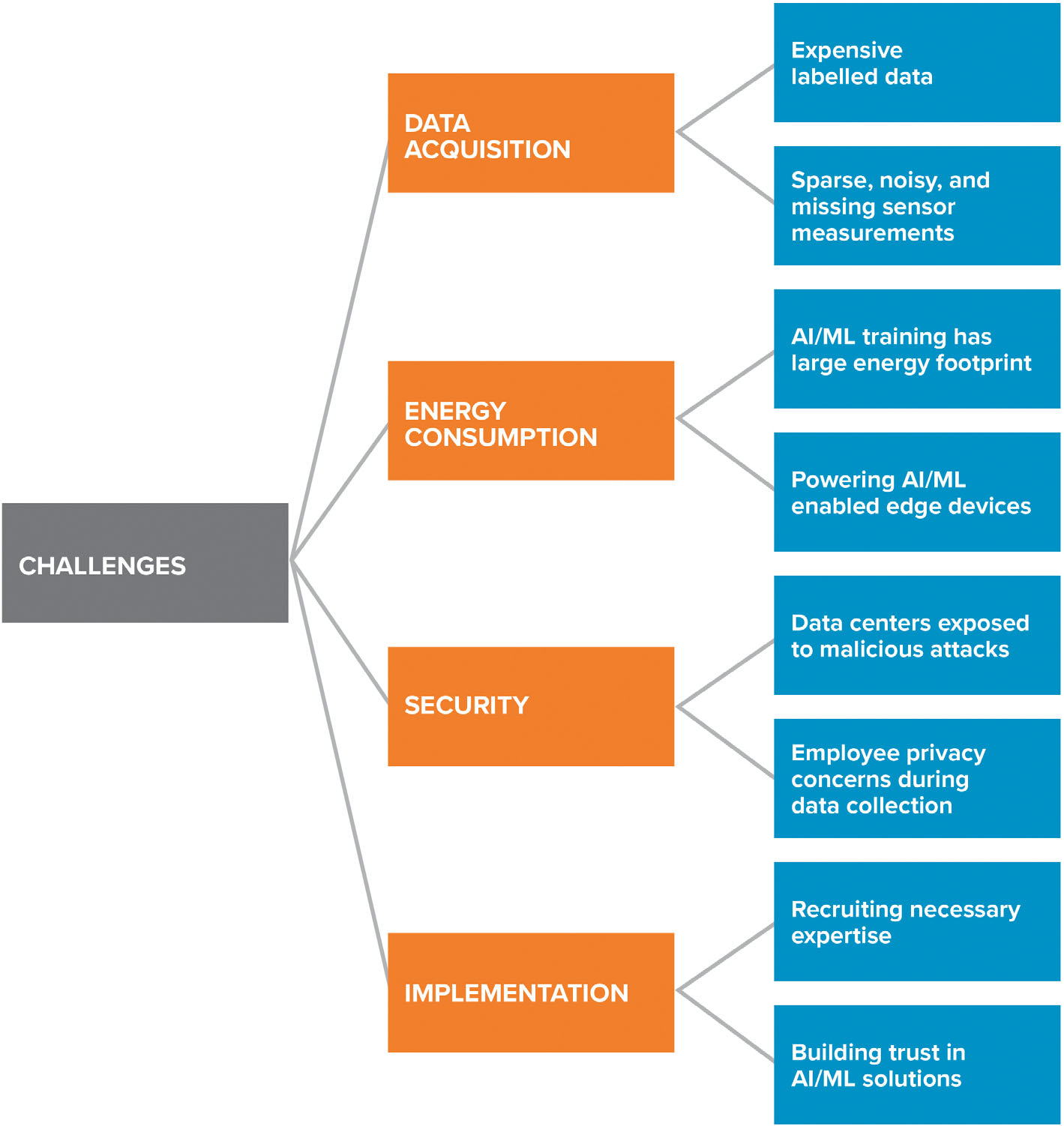
CHALLENGES
Incorporating
AI/ML
into
manufacturing
involves
sev-
eral
challenges
in
the
areas
of
data
acquisition,
energy
consumption,
implementation,
security
and
privacy,
and
decision
validation.
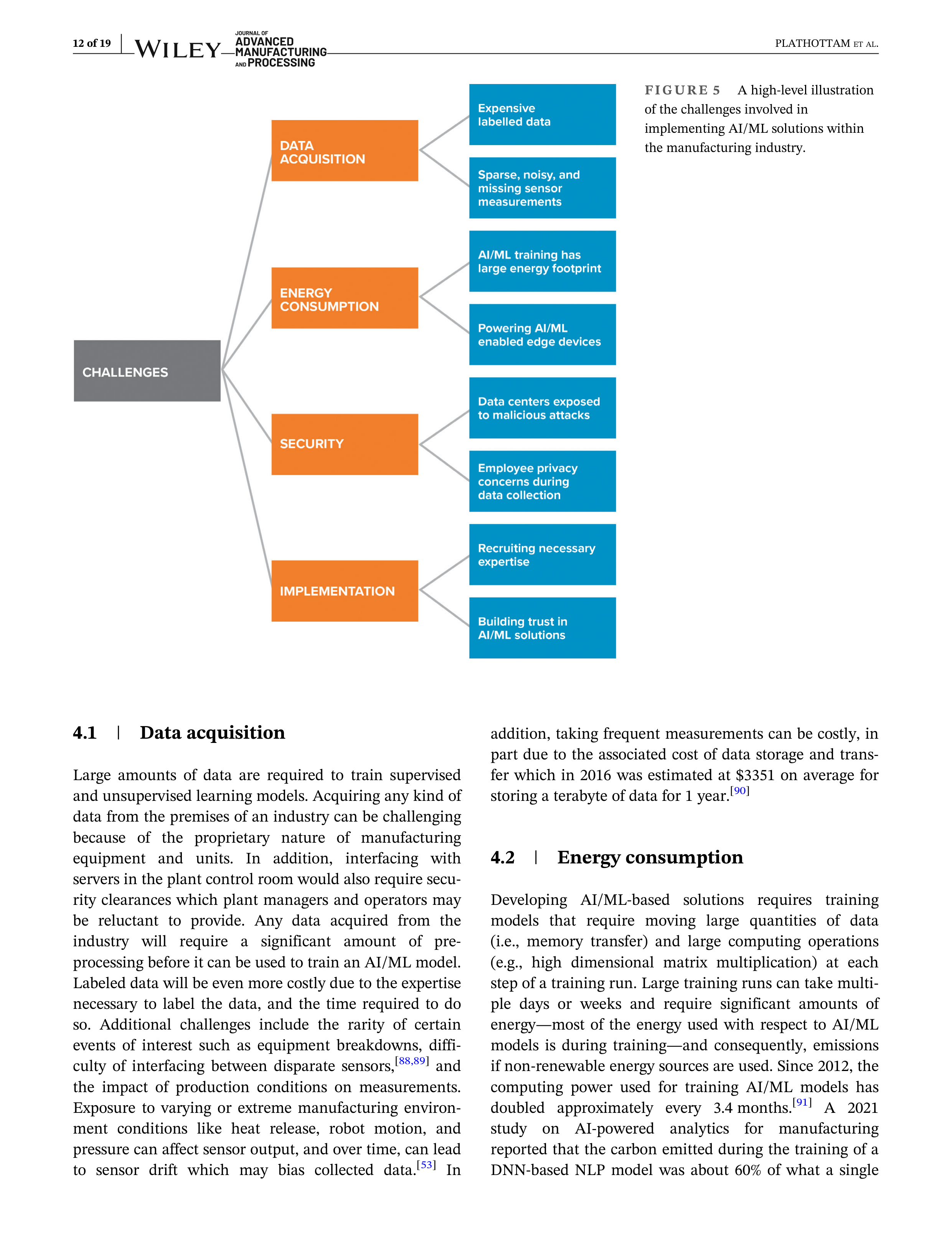
Figure
5
illustrates
some
of
these
broad challenges and their underlying causes. The rest of
the
section
discusses
their
implications
for
implementing
AI/ML in manufacturing.
PLATHOTTAM
ET
AL
.
11 of 19
4.1
|
Data acquisition
Large
amounts
of
data
are
required
to
train
supervised
and unsupervised learning models. Acquiring any kind of
data from the premises of an industry can be challenging
because
of
the
proprietary
nature
of
manufacturing
equipment
and
units.
In
addition,
interfacing
with
servers in the plant control room would also require secu-
rity
clearances
which
plant
managers
and
operators
may
be
reluctant
to
provide.
Any
data
acquired
from
the
industry
will
require
a
significant
amount
of
pre-
processing before it can be used to train an AI/ML model.
Labeled data will be even more costly due to the expertise
necessary
to
label
the
data,
and
the
time
required
to
do
so.
Additional
challenges
include
the
rarity
of
certain
events
of
interest
such
as
equipment
breakdowns,
diffi-
culty
of
interfacing
between
disparate
sensors,
[
88,89
]
and
the
impact
of
production
conditions
on
measurements.
Exposure
to
varying
or
extreme
manufacturing
environ-
ment
conditions
like
heat
release,
robot
motion,
and
pressure can affect sensor output, and over time, can lead
to
sensor
drift
which
may
bias
collected
data.
[
53
]
In
addition,
taking
frequent
measurements
can
be
costly,
in
part
due
to
the
associated
cost
of
data
storage
and
trans-
fer
which
in
2016
was
estimated
at
$3351
on
average
for
storing a terabyte of data for 1 year.
[
90
]
4.2
|
Energy consumption
Developing
AI/ML-based
solutions
requires
training
models
that
require
moving
large
quantities
of
data
(i.e.,
memory
transfer)
and
large
computing
operations
(e.g.,
high
dimensional
matrix
multiplication)
at
each
step of a training run. Large training runs can take multi-
ple
days
or
weeks
and
require
significant
amounts
of
energy
—
most
of
the
energy
used
with
respect
to
AI/ML
models
is
during
training
—
and
consequently,
emissions
if non-renewable energy sources are used. Since 2012, the
computing
power
used
for
training
AI/ML
models
has
doubled
approximately
every
3.4 months.
[
91
]
A
2021
study
on
AI-powered
analytics
for
manufacturing
reported
that
the
carbon
emitted
during
the
training
of
a
DNN-based
NLP
model
was
about
60%
of
what
a
single
FIGURE
5
A high-level illustration
of the challenges involved in
implementing AI/ML solutions within
the manufacturing industry.
12 of 19
PLATHOTTAM
ET
AL
.
average
car
produced
over
its
entire
lifetime.
[
51
]
While
energy consumed during inference is orders of magnitude
less than that during training, a study on energy comput-
ing
trends
reported
that
the
average
energy
consumption
to
perform
one
inference
step
in
DNNs
increased
from
0.1 to 20 J during the period from 2012 to 2022.
[
92
]
Hence
energy-intensive
AI
models
can
have
consequences
for
the
environment.
Assessments
and
conclusions
from
multiple
studies
suggest
that
to
significantly
integrate
AI/ML-based
solutions,
manufacturers
face
a
trade-off
between
complex,
detailed
algorithms
that
provide
high
levels
of
accuracy
on
the
one
hand,
and
the
need
to
reduce
training
time
and
consequent
energy
consump-
tion on the other.
[
40,51,66,82,88,93
]
4.3
|
Security and privacy
Developing
AI/ML
applications
requires
accessing
data
on
servers
(historians)
located
within
plant
control
rooms.
There
is
a
potential
for
malicious
actors
to
use
this
opportunity
to
engage
in
cyberattacks
on
industrial
control
systems
which
would
result
in
large
financial
costs
as
well
as
safety
concerns
due
to
possibility
of
seri-
ous
equipment
malfunctions.
[
66
]
In 2020,
the
global
aver-
age
cost
of
a
data
breach
was
reported
at
$3.86
million.
[
94
]
In
2021,
an
IBM
report
estimated
the
global
average
cost
at
$4.35
million,
with
the
United
States
average
closer
to
$8.5
million.
[
95
]
While
general
cyberse-
curity solutions are also available,
[
66
]
and the deployment
AI
security
solutions
can
potentially
reduce
the
cost
of
data
breaches
by
up
to
70%,
[
95
]
the
nature
of
threat
advancement
means
this
problem
is
always
changing
and
requires
constant
adaptation.
Research
into
safety
systems
and
human-machine
interaction
involves
using
human
data
and
monitoring
employees
and
there
is
a
debate
concerning
employee
privacy.
[
87
]
Data
involving
employees
must
be
kept
secure
and
anonymous
and
applied
in
a
way
that
respects
their
rights.
Additionally
pre-processing should be applied to key performance var-
iables such that bias is removed.
4.4
|
Implementation
Implementing
AI
solutions,
including
using
mature
AI/ML technologies remains challenging. There are diffi-
culties
with
establishing
a
foundation
of
infrastructure
and
personnel,
limited
consideration
of
the
interrelation-
ships between the complex human and technical systems
affected,
or
discrepancies
between
the
most
accepted
solutions
and
the
solutions
that
work
best
in
a
particular
setting. Lastly, the manufacturing industry practices have
been
built
upon
on
decades
or
even
centuries
of
human
experience
on
the
factory
floor.
Many
of
these
practices
still
exist
because
they
are
tried-and-true,
and
not
neces-
sarily
because
they
are
the
most
efficient.
Consequently,
there is no guarantee that any AI/ML based solution
—
no
matter
how
efficient
—
will
be
readily
accepted
on
the
fac-
tory
floor,
especially
if
it
requires
radical
changes
to
exist-
ing industry practice. A 2019 survey of 250 manufacturing
professionals analyzed the challenges industries have faced
when implementing AI and identified difficulties in estab-
lishing
a
clear
industry-specific
implementation
plan.
[
9
]
According
to
the
survey
responses,
pressure
from
within
the
industry
to
use
AI
has
contributed
to
companies
feel-
ing
obligated
to
pursue
AI/ML
solutions
even
when
they
lack
a
concrete
plan.
Moreover,
AI/ML
is
often
deployed
in
isolated,
specialized
situations,
and
thus
does
not
pick
up
contextual
information
that
could
benefit
the
process
further.
[
96
]
Moreover, every AI/ML solution for a given manufactur-
ing
problem
has
its
risks
and
benefits
and
it
differs
across
companies,
across
applications,
and
across
specific
instances
of
said
applications.
For
instance,
a
study
on
AI-powered
real-time
analytics
for
manufacturing
compared
three
ML-
based approaches to solving the problem of product collisions
on
a
conveyor
belt.
[
51
]
The
first,
a
classification
algorithm
using
classical
ML
approaches
for
video
data,
was
easy
to
implement but lacked adaptability for situations that did not
resemble
the
sample
footage.
The
second,
a
CNN
trained
to
classify objects as
“
together
”
or
“
apart
”
and alert operators if
objects were
“
together
”
for too long, was fast but not general-
izable.
The
third
approach
used
two
CNNs
in
succession,
tracked multiple objects on the product line, and transferred
information
between
frames
about
product
position
and
velocity
relative
to
other
products.
This
was
accurate
but
required
heavy
computational
power
and
a
long
time
to
train. Thus, in general, the choice of which AI/ML solutions
to
implement
for
specific
manufacturing
problems
is
not
always
trivial
and
involves
a
certain
degree
of
trade-offs.
Manufacturers
must
be
able
to
decide
what
drawbacks
they
can afford when implementing AI.
4.5
|
Decision validation
Decision
validation
plays
a
key
role
in
the
consideration
of
AI/ML
for
manufacturing.
The
lack
of
interpretability
of
the
outputs
from
the
AI/ML
model
makes
it
difficult
to use for planning considering
that the human, environ-
mental,
and
financial
costs
of
failure
in
a
manufacturing
operation
may
be
significant.
Determining
the
trustwor-
thiness
of decisions
made by AI/ML is a topic
of ongoing
research,
particularly
since
ML
models
typically
take
the
form
of
black
boxes.
Historically,
human
operators
PLATHOTTAM
ET
AL
.
13 of 19
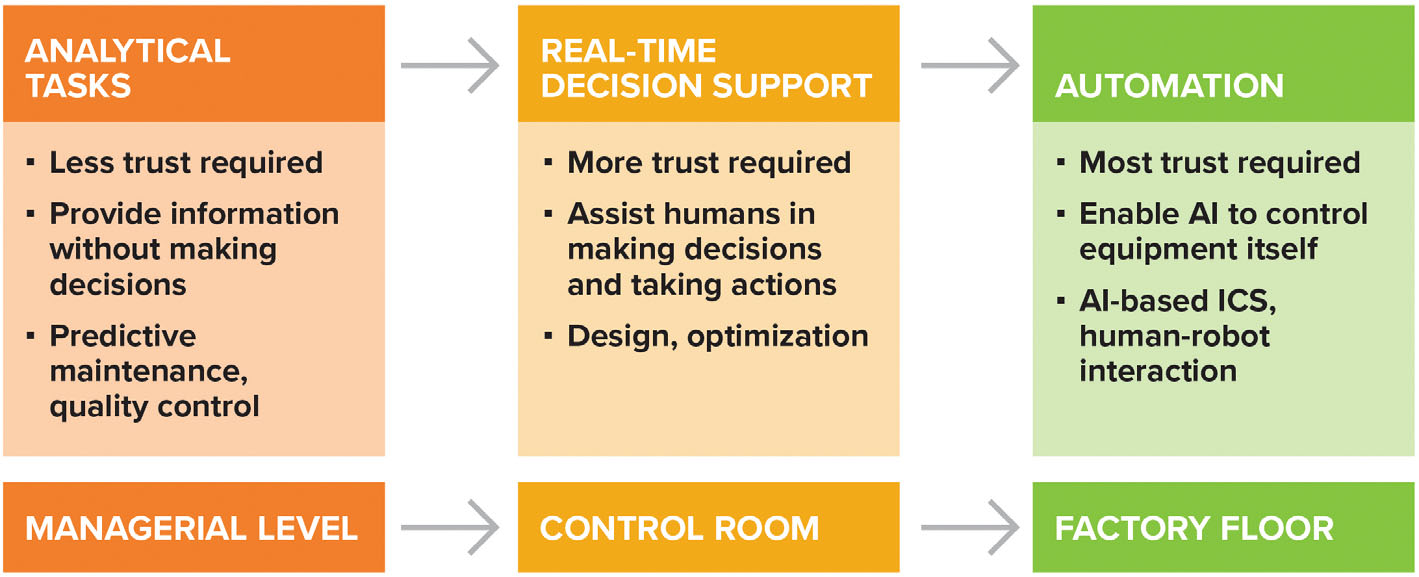
gradually
learn
how
much
trust
to
place
in
new
software
technologies
after
observing
outputs
from
these
systems
over
time
and
it
would
be
expected
that
the
same
would
be true for AI/ML applications.
[
96
]
5
|
AI/ML
TRENDS
AND
OPPORTUNITIES
IN
MANUFACTURING
The
literature
that
was
surveyed
in
the
previous
sections
suggests
that
currently,
AI/ML-based
solutions
supple-
ment
human
labor
rather
than
provide
complete
automa-
tion.
This
is
further
corroborated
by
the
survey
done
in
Wee
[
97
]
which found that 38% of manufacturers use AI for
operations
related
to
business
continuity,
38%
use
it
to
help
employees
be
more
efficient,
and
34%
found
it
to
be
helpful
for
employees
overall.
In
the
opinion
of
the
authors, we may be currently witnessing a gradual process
whereby
manufacturing
industries
steadily
develop
trust
and
experience
with
AI/ML
solutions
starting
with
high-
level
analytical
tasks
and
ending
with
automation
on
the
factory
floor.
We
illustrate
this
gradual
development
in
Figure
6
. Hence, AI/ML solutions that allow companies to
experiment
with
AI/ML
with
minimal
risk
(e.g.,
obtain
high-level
analytics
useful
for
plant
operators
on
existing
processes
generating
copious
amounts
of
data)
would
be
most sought after. Applications that support decision-mak-
ing, such as design and
optimization
algorithms
would
be
the
next
solutions
of
interest.
Finally,
AI/ML
solutions
that
directly
integrate
with
the
automation
and
robotics
on
the
factory
floor
would
be
implemented
after
a
signifi-
cant
level of trust has been generated and in-house
exper-
tise
created.
In
addition,
the
AI/ML-based
analytical
and
decision-support support applications should have demon-
strated measurable value.
In terms of fundamental AI, research and development,
there
are
four
areas
where
advances
would
benefit
AI/ML
solutions
in
manufacturing
and
overcome
the
challenges
mentioned
in
the
previous
section.
First,
high
quality
synthetic
data
suitable
for
training
AI/ML
models
or
aug-
menting existing sparse datasets can be obtained using gen-
erative
models
like
GANs,
[
21,98
–
100
]
to
compensate
for
smaller
quantities
of
data
from
manufacturing
operations.
This
technique
cannot
extrapolate
or
generate
results
beyond
the
extremes
of
its
training
data.
But
it
is
low-risk
and addresses a challenge of providing anonymized data to
train
AI/ML
models.
[
100
]
Researchers
have
used
DNNs
to
deal
specifically
with
sparse
functional
data.
[
101
]
An
archi-
tectural framework to unify data acquisition from disparate
networked industry devices, signal processing, and analysis
within
a
robust
interface
was
presented
in
Serizawa
and
Shomura.
[
89
]
Second,
improving
the
FLOPS
to
Watt
ratio
(i.e., energy efficiency) of AI/ML hardware accelerators will
translate to lowering the capital cost incurred in both devel-
oping
and
deploying
AI/ML
solutions
in
manufacturing.
Another approach is reducing the size of trained models. In
Ding et al.,
[
61
]
the efforts to develop a framework for reduc-
ing
memory
use
in
a
variety
of
DNN
architectures
are
described
by
removing
unused
parameters
which
reduced
memory by 96% and computation by 90%. Third, improving
the
computing
and
communication
capabilities
of
edge
computing
hardware
(e.g.,
Jetson
NANO
which
can
run
AI/ML
models
for
applications
like
image
classification,
object
detection,
segmentation,
and
speech
processing
[
102
]
)
can
accelerate
the
deployment
of
AI/ML
solutions
on
the
factory
floor
by
removing
the
need
to
run
AI/ML
models
on
a
server.
[
103
]
Fourth,
building
trust
in
decisions
from
AI/ML
decisions
through
the
concept
of
Explainable
AI,
[
104
]
which
involves
working
to
develop
a
formal
deci-
sion confidence measure for AI, to improve interpretability
by
humans.
This
provides
human
operators
with
more
detailed
information
to
determine
whether
to
trust
a
deci-
sion
made
by
AI/ML.
Another
concept
is
that
of
“
humble
AI
”
[
105
]
that
can
understand
its
limitations
and
revert
to
a
default, safer state of behavior if it is uncertain about its sit-
uation
or
competence.
Another
approach
to
improve
explainability
of
AI
predictions
is
the
use
of
easy-to-
understand
graphs
to
interpret
decisions
from
AI/ML
models. For instance, a study on equipment health indicator
FIGURE
6
The progression of
AI/ML solutions for manufacturing as
trust in AI grows. The arrows at the
bottom represent proximity to the
factory floor for each application, with
analytical tasks being the farthest and
automation being nearest.
14 of 19
PLATHOTTAM
ET
AL
.
learning with DRL developed a time-based graph correlated
with
system
health
and
operating
conditions
to
address
the
black box concern in predictive maintenance algorithms.
[
38
]
Table
1
summarizes
the
challenges
and
associated
research
opportunities
for
improving
the
adoption
of
AI/ML
tech-
niques in manufacturing.
6
|
CONCLUSION
The
rapid
evolution
of
AI/ML
technologies
offers
an
unprecedented
opportunity
to
transform
the
manufacturing
industry.
This
review
covered
a
broad
range
of
manufacturing
applications,
detailing
the
potential
of
AI/ML
to
improve
the
safety,
efficiency,
productivity,
and
sustainability
of
manufacturing.
It
examined
applications,
potential
benefits,
and
chal-
lenges
of
integrating
AI/ML
in
the
manufacturing
pipe-
line,
including
operations,
planning,
quality
assurance,
energy
consumption
forecasting,
process
optimization,
security
and
safety,
product
design,
automation,
and
human-machine
interaction.
Consequently,
the
review
identified
nascent
developments,
current
challenges,
and
future
directions
in
AI/ML
relevant
to
manufactur-
ing,
highlighted
AI/ML
technologies
available
for
solv-
ing
manufacturing
problems
and
identified
areas
where
further
research
can
yield
transformational
returns
for
the
industry.
AI/ML
can
leverage
the
large
amount
of
data
gener-
ated
from
industrial
sensors
to
derive
actionable
insights
as
well
as
take
optimal
actions
independently.
AI/ML
models can improve over time as the data, infrastructure,
and algorithms are iterated upon and provide compound-
ing
benefits
to
the
manufacturing
industry
over
the
next
decade.
At
the
same
time,
the
AI/ML
solutions
also
require
a
thorough
understanding
of
the
possible
trade-
offs
involved
(e.g.,
restructuring
facilities,
energy
costs,
and
expertise)
and
the
specific
needs
and
capabilities
of
the
company
and
stakeholders.
The
trends
indicate
that
AI/ML
will
continue
to
be
applied
cooperatively,
along-
side
human
skills,
while
at
the
same
time
gradually
increasing
the
amount
of
automation.
The
rapid
evolu-
tion
and
advancement
of
AI/ML
algorithms
and
tech-
niques
will
drive
adoption
in
manufacturing
industry
applications,
to
the
extent
that
they
keep
demonstrating
improvements
in
safety,
product
quality,
and
operational
efficiency.
With
the
increasing
adoption
of
AI/ML
in
industry,
trust
in
the
efficacy
and
productivity
potential
of
this
technology
will
grow
across
industrial
sectors
and
among
practitioners.
However,
the
rate
of
adoption
will
be
constrained
by
the
associated
risks,
especially
as
the
application
moves
from
analytical
support
to
AI
control
of
industrial
operations.
AI/ML
implementation
deci-
sions
must
be
suited
to
each
company's
unique
situation
and needs and in the future, this field would benefit from
longer-term
case
studies
of
manufacturers
that
have
adopted AI/ML versus those that have not.
NOTATION
AI
artificial intelligence
ANI
artificial narrow intelligence
ANN
artificial neural network
AutoML
automated machine learning
CNN
convolutional neural network
DL
deep learning
DNN
deep neural network
DRL
deep reinforcement learning
FLOPS
floating point operations per second
GAN
generative adversarial network
IoT
internet of things
ML
machine learning
NLP
natural language processing
NN
neural networks
RL
reinforcement learning
SaaS
Software as a Service
SciML
scientific machine learning
SVM
support vector machine
AUTHOR
CONTRIBUTIONS
Siby Jose Plathottam:
Conceptualization (equal); meth-
odology
(equal);
supervision
(equal);
validation
(equal);
visualization
(lead);
writing
–
original
draft
(lead);
writing
–
review
and
editing
(lead).
Arin
Rzonca:
Data
curation
(equal);
formal
analysis
(supporting);
investigation
(supporting);
visualization
(supporting);
writing
–
original
TABLE
1
Challenges and opportunities for AI/ML in
manufacturing.
Challenges
Research
opportunities
Data paucity: Obtaining sufficient
data is expensive
Generative models,
transfer learning
Data privacy: Industry data is
sensitive
Edge computing,
generative models
Energy consumption: Large AI/ML
models tend to have higher
performance but training large
AI/ML models is energy intensive
Energy efficient AI/ML
models
Implementation: New workflows
introduced by AI/ML applications
may not be readily accepted
Edge computing, large
language models
Decision validation: Higher level
decisions from AI/ML
applications may not be trusted
Explainable AI
PLATHOTTAM
ET
AL
.
15 of 19
draft
(supporting).
Rishi
Lakhnori:
Data
curation
(equal);
formal analysis (supporting); investigation (supporting); visu-
alization
(supporting);
writing
–
original
draft
(supporting).
Chukwunwike O. Iloeje:
Conceptualization (lead); meth-
odology
(lead);
project
administration
(lead);
supervision
(lead);
validation
(equal);
writing
–
original
draft
(equal);
writing
–
review and editing (equal).
ACKNOWLEDGMENTS
The submitted manuscript has been created by UChicago
Argonne
LLC,
Operator
of
Argonne
National
Laboratory
(
“
Argonne
”
).
Argonne,
a
U.S.
Department
of
Energy
Office
of
Science
laboratory,
is
operated
under
Contract
No.
DE-AC02-06CH11357.
The
U.S.
Government
retains
for itself, and others acting on its behalf, a paid-up nonex-
clusive,
irrevocable
worldwide
license
in
said
article
to
reproduce,
prepare
derivative
works,
distribute
copies
to
the
public,
and
perform
publicly
and
display
publicly,
by
or
on
behalf
of
the
Government.
The
Department
of
Energy will provide public access to these results of feder-
ally sponsored research in accordance with the DOE Pub-
lic Access Plan. Argonne National Laboratory's work was
supported
by
the
U.S.
Department
of
Energy,
Office
of
Energy
Efficiency
and
Renewable
Energy,
Advanced
Materials Office under contract DE-AC02-06CH11357.
CONFLICT
OF
INTEREST
STATEMENT
The authors declare no competing interests.
DATA
AVAILABILITY
STATEMENT
Data
sharing
is
not
applicable
to
this
article
as
no
new
data were created or analyzed in this study.
ORCID
Siby Jose Plathottam
https://orcid.org/0000-0003-4813-
5724
Chukwunwike O. Iloeje
https://orcid.org/0000-0002-
3426-9425
REFERENCES
[1]
J. Zhou, P. Li, Y. Zhou, B. Wang, J. Zang, L. Meng,
Engineer-
ing
2018
,
4
(1), 11.
[2]
R.
Y.
Zhong,
X.
Xu,
E.
Klotz,
S.
T.
Newman,
Engineering
2017
,
3
(5), 616.
[3]
S.
K.
Jagatheesaperumal,
M.
Rahouti,
K.
Ahmad,
A.
Al-
Fuqaha, M. Guizani.
The Duo of Artificial Intelligence and Big
Data
for
Industry
4.0:
Review
of
Applications,
Techniques,
Challenges,
and
Future
Research
Directions.
ArXiv210402425
Cs
,
2021
.
http://arxiv.org/abs/2104.02425
(accessed:
July,
2021).
[4]
R.
Geissbauer,
S.
Schrauf,
P.
Berttram,
F.
Cheraghi,
Digital
Factories
2020:
Shaping
the
Future
of
Manufacturing
,
Price-
waterhouseCoopers,
2017
.
https://www.pwc.de/de/digitale-
transformation/digital-factories-2020-shaping-the-future-of-
manufacturing.pdf
(accessed: June, 2021).
[5]
P.
Brosset, A.
L.
Thieullent,
S.
Patsko,
P. Ravix,
Scaling
AI
in
Manufacturing
Operations:
A
Practitioners'
Perspective
,
Cap-
gemini
Research
Institute,
Paris
2019
.
https://www.cap
gemini.com/wp-content/uploads/2019/12/AI-in-manufacturing-
operations.pdf
(accessed: June, 2021).
[6]
S. Fahle, C. Prinz, B. Kuhlenkötter,
Proc. CIRP
2020
,
93
, 413.
[7]
R.
Cioffi,
M.
Travaglioni,
G.
Piscitelli,
A.
Petrillo,
F.
De
Felice,
Sustainability
2020
,
12
(2), 492.
[8]
A.
Rizzoli,
7
Out-of-the-Box
Applications
of
AI
in
Manufactur-
ing
,
V7
Labs
Blog,
2022
.
https://www.v7labs.com/blog/ai-in-
manufacturing
[9]
Plutoshift,
Breaking
Ground
on
Implementing
AI:
Instituting
Strategic
AI
Programs
–
From
Promise
to
Productivity
,
Pluto-
shift,
Palo
Alto
2019
.
https://plutoshift.com/wp-content/
uploads/2022/02/plutoshift-breaking-ground-on-implementing-
ai.pdf
(accessed: May 2023).
[10]
Voyant
Tools,
https://voyant-tools.org/
(accessed:
March,
2023).
[11]
V.
Kanade,
Narrow
AI
vs.
General
AI
vs.
Super
AI:
Key
Com-
parisons
,
SpiceWorks,
2022
.
https://www.spiceworks.com/
tech/artificial-intelligence/articles/narrow-general-super-ai-
difference/
[12]
Machine
learning,
Wikipedia
,
Machine
learning,
2022
.
https://en.wikipedia.org/w/index.php?title
=
Machine_learnin
g&oldid
=
1084622324
(accessed: April, 2022).
[13]
Amazon (AWS),
Training ML Models
–
Amazon Machine Learn-
ing
,
Amazon
(AWS),
2022
.
https://docs.aws.amazon.com/
machine-learning/latest/dg/training-ml-models.html
(accessed:
April, 2022).
[14]
IBM
Cloud
Education,
What
is
Supervised
Learning?
IBM
Cloud
Education,
2021
.
https://www.ibm.com/cloud/learn/
supervised-learning
(accessed: April, 2022).
[15]
javapoint,
Unsupervised
Machine
Learning
–
Javatpoint
,
java-
point,
2022
.
https://www.javatpoint.com/unsupervised-
machine-learning
(accessed: April, 2022).
[16]
IBM Cloud Team,
Supervised vs. Unsupervised Learning: What's
the
Difference?
IBM
Cloud
Team,
2021
.
https://www.ibm.com/
cloud/blog/supervised-vs-unsupervised-learning
(accessed:
April, 2022).
[17]
V.
François-Lavet,
P.
Henderson,
R.
Islam,
M.
G.
Bellemare,
J.
Pineau,
Found
Trends
Mach.
Learn.
Mach.
Learn.
2018
,
11
(3
–
4), 219.
[18]
S.
J.
Plathottam,
B.
Richey,
G.
Curry,
J.
Cresko,
C.
O.
Iloeje,
J. Adv. Manuf. Process.
2021
,
3
(2), e10079.
[19]
A. Mirhoseini, A. Goldie, M. Yazgan, J. Jiang, E. Songhori, S.
Wang,
Y.-J.
Lee,
E.
Johnson,
O.
Pathak,
S.
Bae,
A.
Nazi,
J.
Pak,
A.
Tong,
K.
Srinivasa,
W.
Hang,
E.
Tuncer,
A.
Babu,
Q. V. Le, J. Laudon, R. Ho, R. Carpenter, J. Dean.
Chip Place-
ment
with
Deep
Reinforcement
Learning.
ArXiv200410746
Cs
,
2020
.
http://arxiv.org/abs/2004.10746
(accessed: June, 2022).
[20]
S.
Zheng,
C.
Gupta,
S.
Serita.
Manufacturing
Dispatching
using
Reinforcement
and
Transfer
Learning
,
2019
.
https://doi.
org/10.48550/arXiv.1910.02035
[21]
A. Kusiak,
Int. J. Prod. Res.
2020
,
58
(5), 1594.
[22]
S. Madhavan, M. T. Jones,
Deep Learning Architectures
–
IBM
Developer
,
IBM
Developer
Articles,
2017
.
https://developer.
ibm.com/articles/cc-machine-learning-deep-learning-architec
tures/
[23]
Vortarus
Technologies
LLC,
Evaluating
a
Manufacturing
Decision
with
a
Decision
Tree
,
Vortarus
Technologies
LLC,
16 of 19
PLATHOTTAM
ET
AL
.
2017
.
https://vortarus.com/manufacturing-decision-decision-
tree/
(accessed: April, 2022).
[24]
Lucidchart,
What
is
a
Decision
Tree
Diagram
,
Lucidchart,
2022
.
https://www.lucidchart.com/pages/decision-tree
(accessed:
April,
2022).
[25]
Master's in Data Science,
What is a Decision Tree?
Master's in
Data
Science,
2022
.
https://www.mastersindatascience.org/
learning/introduction-to-machine-learning-algorithms/decision-
tree/
(accessed: April, 2022).
[26]
R.
Mall,
Support
Vector
Machine
,
Medium,
2019
.
https://
medium.com/@mallrishabh52/support-vector-machine-
2f4280d8ad18
(accessed: April, 2022).
[27]
R. Gandhi,
Support Vector Machine
–
Introduction to Machine
Learning
Algorithms
,
Medium,
2018
.
https://towardsdata
science.com/support-vector-machine-introduction-to-machine
-learning-algorithms-934a444fca47
(accessed: April, 2022).
[28]
D. Xu, Y. Tian,
Ann. Data Sci.
2015
,
2
(2), 165.
[29]
Brown
University,
What
is
SciML?
SciML
Research
Group,
Providence
2022
.
https://sites.brown.edu/bergen-lab/research/
what-is-sciml/
(accessed: April, 2022).
[30]
P. Nair,
43rd AIAA/ASME/ASCE/AHS/ASC Structures, Struc-
tural Dynamics, and Materials Conference
, American Institute
of
Aeronautics
and
Astronautics,
Denver
2002
.
https://doi.
org/10.2514/6.2002-1586
[31]
Y.
Fei,
V.
Tirumalashetty,
AI
and
Machine
Learning
Improve
Manufacturing
Visual
Inspection
Process
,
Google
Cloud
Blog,
2022
.
https://cloud.google.com/blog/products/ai-machine-
learning/ai-and-machine-learning-improve-manufacturing-
visual-inspection-process/
(accessed: April, 2022).
[32]
Dilmegani,
Cem,
AutoML:
In
depth
Guide
to
Automated
Machine
Learning
[2022]
,
Dilmegani,
Cem,
2018
.
https://
research.aimultiple.com/auto-ml/
(accessed: April, 2022).
[33]
Unnamed
A
removed
at
request
of
original,
Exploring
Busi-
ness
, University of Minnesota Libraries Publishing, Minneapo-
lis
2016
,
p.
466.
https://open.lib.umn.edu/exploringbusiness/
chapter/11-1-operations-management-in-manufacturing/
(accessed: March, 2023).
[34]
S.
Lygren,
M.
Piantanida,
A.
Amendola.
Unsupervised,
Deep
Learning-Based
Detection
of
Failures
in
Industrial
Equip-
ments:
The
Future
of
Predictive
Maintenance
,
2019
.
https://
doi.org/10.2118/197629-MS
[35]
L.
Leoni,
A.
BahooToroody,
M.
M.
Abaei,
F.
De
Carlo,
N.
Paltrinieri, F. Sgarbossa,
Process Saf. Environ. Prot.
2021
,
147
, 115.
[36]
Y.
Inoue,
H.
Nagayoshi.
in
2019
IEEE
Winter
Conference
on
Applications
of
Computer
Vision
(WACV)
2019
,
686.
https://
doi.org/10.1109/WACV.2019.00078
[37]
R.
Kaur,
J.
Acharya,
S.
Gaur,
Int.
J.
Comput.
Inform.
Eng.
2019
,
13
(7), 6.
[38]
C.
Zhang,
C.
Gupta,
A.
Farahat,
K.
Ristovski,
D.
Ghosh,
in
Machine
Learning
and
Knowledge
Discovery
in
Databases,
Lecture
Notes
in
Computer
Science
,
Vol.
11053
(Eds:
U.
Bre-
feld,
E.
Curry,
E.
Daly),
Springer
International
Publishing,
Cham
2019
, p. 488.
[39]
J.
Waring,
C.
Lindvall,
R.
Umeton,
Artif.
Intell.
Med.
2020
,
104
, 101822.
[40]
G.
D.
Goh,
S.
L.
Sing,
W.
Y.
Yeong,
Artif.
Intell.
Rev.
2021
,
54
(1), 63.
[41]
C. Chen, Y. Liu, M. Kumar, J. Qin, Y. Ren,
Comput. Ind. Eng.
2019
,
135
, 757.
[42]
D.
T.
Kearns,
Machine
Learning
in
the
Mining
Industry
–
A
Case
Study
,
Medium,
2017
.
https://medium.com/sustainable-
data/machine-learning-in-the-mining-industry-a-case-study-
33b771729eb2
(accessed: June, 2021).
[43]
G. Golkarnarenji, M. Naebe, K. Badii, A. S. Milani, A. Jamali,
A.
Bab-Hadiashar,
R.
N.
Jazar,
H.
Khayyam,
IEEE
Access
2019
,
7
, 67576.
[44]
M.
Willenbacher,
C.
Kunisch,
V.
Wohlgemuth,
in
From
Sci-
ence to Society. Progress in IS
(Eds: B. Otjacques, P. Hitzelber-
ger,
S.
Naumann,
V.
Wohlgemuth),
Springer
International
Publishing, Cham
2018
, p. 225.
https://doi.org/10.1007/978-3-
319-65687-8_20
[45]
J.
Qin,
Y.
Liu,
R.
Grosvenor,
F.
Lacan,
Z.
Jiang,
J.
Cleaner
Prod.
2020
,
245
, 118702.
[46]
N.
B.
Vanting,
Z.
Ma,
B.
N.
Jørgensen,
Energy
Inform.
2021
,
4
(2), 49.
[47]
J.
Duan,
X.
Tian,
W.
Ma,
X.
Qiu,
P.
Wang,
L.
An,
Entropy
2019
,
21
(7), 707.
[48]
P. Helo, Y. Hao,
Prod. Plan Control
2022
,
33
(16), 1573.
[49]
R. Dash, M. Mcmurtrey, C. Rebman, U. K. Kar,
Management
2019
,
14
, 43.
[50]
R.
Toorajipour,
V.
Sohrabpour,
A.
Nazarpour,
P.
Oghazi,
M.
Fischl,
J. Bus. Res.
2021
,
122
, 502.
[51]
B.
Ross,
Practical
AI-Powered
Real-Time
Analytics
for
Manufacturing:
Lessons
Learned
From
Design
to
Deployment
,
AI
Trends,
2019
.
https://www.aitrends.com/ai-software/soft
ware-development/practical-ai-powered-real-time-analytics-for-
manufacturing-lessons-learned-from-design-to-deployment/
(accessed: June, 2021).
[52]
Editorial
Team,
Reinforcement
Learning
and
its
Applications
in
Manufacturing
,
eeDesignIt.com,
2020
.
https://www.eede
signit.com/reinforcement-learning-and-its-applications-in-
manufacturing/
(accessed: April, 2022).
[53]
G.
Immerman,
Production
and
Process
Optimization
in
Manufacturing
,
MachineMetrics,
2022
.
https://www.machine
metrics.com/blog/process-optimization-manufacturing
(accessed:
April, 2022).
[54]
D. Li, B. Ouyang, D. Wu, Y. Wang.
Artificial Intelligence Empow-
ered
Multi-AGVs
in
Manufacturing
Systems.
ArXiv190903373
Cs
,
2019
.
http://arxiv.org/abs/1909.03373
(accessed: July, 2021).
[55]
Intelligent
Information
Research
Department,
Hitachi,
Ltd.,
Tokyo,
Japan,
R.
Kamoshida,
J.
Ind.
Intell.
Inf.
2019
,
7
(1),
12.
https://doi.org/10.18178/jiii.7.1.12-17
[56]
C.
Nicholson,
Deep
Reinforcement
Learning
will
Transform
Manufacturing
as
We
Know
It
,
TechCrunch,
2022
.
https://
social.techcrunch.com/2021/06/17/deep-reinforcement-learni
ng-will-transform-manufacturing-as-we-know-it/
(accessed:
April, 2022).
[57]
K.
Hao,
This
Robot
Taught
Itself
to
Walk
Entirely
on
Its
Own
,
MIT
Technology
Review,
Cambridge
2022
.
https://www.
technologyreview.com/2020/03/02/905593/ai-robot-learns-to-
walk-autonomously-reinforcement-learning/
(accessed:
April,
2022).
[58]
K. Ristovski, C. Gupta, K. Harada, H. K. Tang,
Proceedings of
the
23rd
ACM
SIGKDD
International
Conference
on
Knowl-
edge
Discovery
and
Data
Mining
,
Association
for
Computing
Machinery,
New
York
2017
,
p.
1981.
https://doi.org/10.1145/
3097983.3098178
[59]
J. O'Sullivan, D. O'Sullivan, K. Bruton,
Proc. Manuf.
2020
,
51
,
1523.
PLATHOTTAM
ET
AL
.
17 of 19
[60]
G.
Zhou,
C.
Zhang,
Z.
Li,
K.
Ding,
C.
Wang,
Int.
J.
Prod.
Res.
2020
,
58
(4), 1034.
[61]
K.
Ding,
F.
T.
S.
Chan,
X.
Zhang,
G.
Zhou,
F.
Zhang,
Int.
J. Prod. Res.
2019
,
57
(20), 6315.
[62]
Worker's
Compensation
Costs
are
the
Tip
of
a
Massive
Iceberg
–
But
Solutions
Exist
,
Intenseye
Blog,
2019
.
https://blog.
intenseye.com/worker-compansation-cost/
(accessed: July, 2021).
[63]
Get
a
Grip:
Prevent
Slip-and-falls
with
AI-powered
Solutions
,
HGS,
2021
.
https://hgs.cx/blog/get-a-grip-prevent-slip-and-
falls-with-ai-powered-solutions/
(accessed: July, 2021).
[64]
S.
Sen,
M.
Ravikiran.
in
2019
IEEE
Applied
Imagery
Pattern
Recognition
Workshop
(AIPR)
2019
,
1.
https://doi.org/10.
1109/AIPR47015.2019.9174567
[65]
S. Mao, B. Wang, Y. Tang, F. Qian,
Engineering
2019
,
5
(6), 995.
[66]
A. Bécue, I. Praça, J. Gama,
Artif. Intell. Rev.
2021
,
54
(5), 3849.
[67]
C. Wolf.
Breaking Down the Pros and Cons of AI in Cybersecu-
rity
,
2022
.
http://www.asisonline.org/security-management-
magazine/monthly-issues/security-technology/archive/2021/
april/breaking-down-the-pros-and-cons-of-ai-in-cybersecurity/
(accessed: April, 2022).
[68]
R.
Fujimaki,
The
Expanding
Role
of
Predictive
Analytics
in
Manufacturing
,
Manufacturing.net,
2020
.
https://www.manu
facturing.net/technology/blog/21205966/the-expanding-role-of-
predictive-analytics-in-manufacturing
(accessed: April, 2022).
[69]
Omniverse
Platform
for
Virtual
Collaboration.
NVIDIA
.
https://www.nvidia.com/en-us/omniverse/
(accessed:
March,
2023).
[70]
Ansys
Twin
Builder
j
Create
and
Deploy
Digital
Twin
Models
.
https://www.ansys.com/products/digital-twin/ansys-twin-builder
(accessed: March, 2023).
[71]
The
Next
Wave
of
Intelligent
Design
Automation
,
Harvard
Business School, Boston
2018
, p. 12.
[72]
R.
Matheson,
Design
Tool
Reveals
a
Product's
Many
Possible
Performance
Tradeoffs
,
MIT
News
j
Massachusetts
Institute
of
Technology,
Cambridge
2018
.
https://news.mit.edu/2018/
interactive-design-tool-product-performance-tradeoffs-0815
(accessed: June, 2021).
[73]
M.
Walla
Singh,
Generative
Adversarial
Networks
j
GANs
for
Image
Data
,
Analytics
Vidhya,
2021
.
https://www.analyt
icsvidhya.com/blog/2021/03/why-are-generative-adversarial-
networksgans-so-famous-and-how-will-gans-be-in-the-future/
(accessed: April, 2022).
[74]
C. Rackauckas, Y. Ma, J. Martensen, C. Warner, K. Zubov, R.
Supekar,
D.
Skinner,
A.
Ramadhan,
A.
Edelman.
Universal
Differential
Equations
for
Scientific
Machine
Learning.
ArXiv200104385
Cs
Math
Q-Bio
Stat
,
2021
.
http://arxiv.org/
abs/2001.04385
(accessed: April, 2022).
[75]
D.
Schmidt,
R.
Maulik,
K.
Lyras,
Phys.
Fluids
2021
,
33
(12),
127104.
[76]
C.
J.
Moore,
A.
J.
K.
Chua,
C.
P.
L.
Berry,
J.
R.
Gair,
R.
Soc.
Open Sci.
2016
,
3
(5), 160125.
[77]
A.
E.
Gongora,
B.
Xu,
W.
Perry,
C.
Okoye,
P.
Riley,
K.
G.
Reyes,
E.
F.
Morgan,
K.
A.
Brown,
Sci.
Adv.
2020
,
6
,
eaaz1708.
[78]
N.
H.
Paulson,
J.
A.
Libera,
M.
Stan,
Mater.
Des.
2020
,
196
,
108972.
[79]
D.
Rodriguez-Granrose,
A.
Jones,
H.
Loftus,
T.
Tandeski,
W.
Heaton,
K.
T.
Foley,
L.
Silverman,
Bioprocess
Biosyst.
Eng.
2021
,
44
(6), 1301.
[80]
N. S. Johnson, P. S. Vulimiri, A. C. To, X. Zhang, C. A. Brice,
B.
B.
Kappes,
A.
P.
Stebner.
Machine
Learning
for
Materials
Developments
in
Metals
Additive
Manufacturing.
ArXiv20
0505235
Cond-Mat
Physicsphysics
,
2020
.
http://arxiv.org/abs/
2005.05235
(accessed: July, 2021).
[81]
M. C. Messner,
J. Mech. Des.
2019
,
142
(2), 024503.
https://doi.
org/10.1115/1.4045040
[82]
D.
Merayo,
A.
Rodríguez-Prieto,
A.
M.
Camacho,
Proc.
Manuf.
2019
,
41
, 42.
[83]
K. Harston,
AMRC J.
2021
,
13
, 41.
[84]
P.
Nguyen,
E.
Takashi.
Automating
Water
Purification
Plant
Operations Using Deep Deterministic Policy Gradient
2018
.
[85]
K. Harston,
AMRC J.
2020
,
11
, 32.
[86]
W.
Shalaby,
A.
Arantes,
T.
GonzalezDiaz,
C.
Gupta,
2020
IEEE
International
Conference
on
Prognostics
and
Health
Management
(ICPHM)
,
IEEE,
Detroit
2020
,
p.
1.
https://doi.
org/10.1109/ICPHM49022.2020.9187036
[87]
H. Oliff, Y. Liu, M. Kumar, M. Williams,
Proc. CIRP
2020
,
93
,
1364.
[88]
K.
Bartsch,
A.
Pettke,
A.
Hübert,
J.
Lakämper,
F.
Lange,
J. Phys. Mater.
2021
,
4
(3), 032005.
[89]
Y. Serizawa, Y. Shomura,
Sens. Trand. J.
2019
,
238
(11), 8.
[90]
StorageCraft,
File Storage Cost, By The Numbers
, StorageCraft
Technology,
LLC,
2016
.
https://blog.storagecraft.com/file-
storage-cost-statistics/
(accessed: April, 2022).
[91]
R.
Perrault,
Y.
Shoham,
E.
Brynjolfsson,
J.
Clark,
J.
Etchemendy, B. Grosz, T. Lyons, J. Manyika, J. C. Niebles,
The
2019 AI Index Report
, Stanford University, Stanford
2019
.
[92]
R.
Desislavov,
F.
Martínez-Plumed,
J.
Hern
andez-Orallo.
Compute
and
Energy
Consumption
Trends
in
Deep
Learning
Inference.
ArXiv210905472
Cs
,
2021
.
http://arxiv.org/abs/
2109.05472
(accessed: April, 2022).
[93]
A. Carlson, T. Sakao,
Proc. CIRP.
2020
,
90
, 171.
[94]
Embroker
Team,
How
Much
Does
a
Data
Breach
Cost?
Embroker,
2022
.
https://www.embroker.com/blog/cost-of-a-
data-breach/
(accessed: April, 2022).
[95]
IBM
Security,
Cost
of
a
Data
Breach
Report
2022
,
IBM,
2022
.
https://www.ibm.com/reports/data-breach
(accessed:
March,
2023).
[96]
P.
Trakadas,
P.
Simoens,
P.
Gkonis,
L.
Sarakis,
A.
Angelopoulos,
A.
P.
Ramallo-Gonz
alez,
A.
Skarmeta,
C.
Trochoutsos,
D.
Calv
ο
,
T.
Pariente,
K.
Chintamani,
I.
Fernandez,
A.
A.
Irigaray,
J.
X.
Parreira,
P.
Petrali,
N.
Leligou, P. Karkazis,
Sensors
2020
,
20
(19), 5480.
[97]
D.
Wee,
Research
on
AI
Trends
in
Manufacturing
,
Google
Cloud Blog,
2022
.
https://cloud.google.com/blog/products/ai-
machine-learning/research-on-ai-trends-in-manufacturing/
(accessed: April, 2022).
[98]
S.
Zheng,
A.
Farahat,
C.
Gupta,
in
Machine
Learning
and
Knowledge
Discovery
in
Databases.
Lecture
Notes
in
Computer
Science
(Eds:
U.
Brefeld,
E.
Fromont,
A.
Hotho,
A.
Knobbe,
M.
Maathuis,
C.
Robardet),
Springer
International
Publish-
ing,
Cham
2020
,
p.
621.
https://doi.org/10.1007/978-3-030-
46133-1_37
[99]
Y. O. Lee, J. Jo, J. Hwang. in
2017 IEEE International Confer-
ence
on
Big
Data
(Big
Data)
2017
,
3248.
https://doi.org/10.
1109/BigData.2017.8258307
[100]
C.
Bowles,
L.
Chen,
R.
Guerrero,
P.
Bentley,
R.
Gunn,
A.
Hammers,
D.
A.
Dickie,
M.
V.
Hern
andez,
J.
Wardlaw,
D.
18 of 19
PLATHOTTAM
ET
AL
.

Rueckert.
GAN
Augmentation:
Augmenting
Training
Data
using
Generative
Adversarial
Networks.
ArXiv181010863
Cs
,
2018
.
http://arxiv.org/abs/1810.10863
(accessed:
August,
2021).
[101]
Q.
Wang,
S.
Zheng,
A.
Farahat,
S.
Serita,
T.
Saeki,
C.
Gupta.
in
2019
International
Joint
Conference
on
Neural
Net-
works
(IJCNN)
2019
,
1.
https://doi.org/10.1109/IJCNN.2019.
8851700
[102]
NVIDIA,
Jetson
Nano
Developer
Kit
,
NVIDIA
Developer,
2019
.
https://developer.nvidia.com/embedded/jetson-nano-
developer-kit
(accessed: April, 2022).
[103]
Red
Hat.
Understanding
Edge
Computing
for
Manufacturing
,
2022
.
https://www.redhat.com/en/topics/edge-computing/
manufacturing
(accessed: April, 2022).
[104]
J. v.
d. Waa, T. Schoonderwoerd,
J. v.
Diggelen, M. Neerincx,
Int. J. Hum-Comput. Stud.
2020
,
144
, 102493.
[105]
F.
Guterl,
Judgment
Call:
Why
GE
Is
Experimenting
With
‘
Humble
AI
’
,
GE
News,
2021
.
https://www.ge.com/news/
reports/judgment-call-ge-experimenting-humble-ai
(accessed:
July, 2021).
How to cite this article:
S. J. Plathottam,
A. Rzonca, R. Lakhnori, C. O. Iloeje,
J. Adv. Manuf.
Process.
2023
,
5
(3), e10159.
https://doi.org/10.1002/
amp2.10159
PLATHOTTAM
ET
AL
.
19 of 19