


Copyright: © the author(s), publisher and licensee Technoscience Academy. This is an open-access article distributed under the
terms of the Creative Commons Attribution Non-Commercial License, which permits unrestricted non-commercial use,
distribution, and reproduction in any medium, provided the original work is properly cited
International Journal of Scientific Research in Science, Engineering and Technology
Print ISSN - 2395-1990
Online ISSN : 2394-4099
Available Online at : www.ijsrset.com
doi :
https://doi.org/10.32628/IJSRSET2411212
142
Artificial Intelligence in Transportation: A Review
Miss. Asawari Satish Isalkar
*1
, Dr. Rajeshkumar U. Sambhe
2
*
1
UG Student, Department of CSE, Jawaharlal Darda Institute of Engineering & Technology, Yavatmal,
Maharashtra, India
2
Professor, Jawaharlal Darda Institute of Engineering & Technology, Yavatmal, Maharashtra, India
A
R
T
I
C
L
E
I
N
F
O
A
B
S
T
R
A
C
T
Article History:
Accepted: 10 March 2024
Published: 30 March 2024
The growing use of Artificial Intelligence, along with its factors is rapidly
increasing in various fields now a days. It providing the opportunity to
upgrade the efficiency of various industries and business, including
transportation sector. AI gives more efficient service to Public
Transportation to enhance the urban mobility. The goal of AI to acquire
the knowledge about reasoning, planning, perception and deal with
objects. The AI for transportation is assist to reduce the risk and enhance
the safety. AI applications is help to solve the challenges such as travel
demand, CO2 emissions, safety concerns, and fuel waste. The challenges
and desideratum faces during transportation can be easily addressed by AI
algorithm. This paper stretches a view about the AI technique use in
worldwide Transportation of methodology, applications, future of AI in
deep learning and limitations.
Keywords
:
Artificial
Intelligence,
Transportation,
Applications,
Methodology, Goal.
Publication Issue :
Volume 11, Issue 2
March-April-2024
Page Number :
142-146
I.
INTRODUCTION
It is without a doubt a developing piece of computer
science that will become an excellent feature of all
software in the years to come. In easy words, we may
state that it's a huge area of computer science that is
used in machines to enable them to function similarly
to human minds. It enables machines to think, behave,
and comprehend like humans do. John McCarty, who
discovered AI at Dartmouth in 1956, described it as a
science that enables the creation of intelligent
machines. Due to the availability of the vast amount of
data generated by numerous devices, as well as the
accessibility of various software, networks, and
hardware, this topic has gained significant attention
after more than six decades [3].
Numerous studies on AI in the transportation sector
have been conducted in a number of nations, with
various findings. Here are a few of them: In the area of
transportation, Transport Management Systems (TMS)
is a potent software program. TMS are well-known in
the market these days, especially for shippers that may
be moving high volumes, as they assist businesses in
preparing them for optimization, route planning, and
much more [3].

International Journal of Scientific Research in Science, Engineering and Technology | www.ijsrset.com | Vol 11 | Issue 2
Miss. Asawari Satish Isalkar et al Int J Sci Res Sci Eng Technol, March-April-2024, 11 (2) : 142-146
143
Transportation problems become a challenge when the
system and users’ behaviour is too difficult to model
and predict the travel patterns. Therefore, AI is
deemed to be a good fit for transportation systems to
overcome the challenges of an increasing travel
demand, CO2 emissions, safety concerns, and
environmental degradation. These challenges arise
from the steady growth of rural and urban traffic due
to the increasing number of population, especially in
the developing countries. In Australia, the cost of
congestion is expected to reach 53.3 billion as the
population increase to 30 million by 2031. In
Melbourne, Australia alone, more than 640 km of
arterial roads are congested during peak time with a
CO2 emission of 2.9 tons per year. It has a potential
application for the road infrastructure, drivers, road
users, and vehicles [2]. It has been a long time coming,
but computer chess programs are finally powerful
enough to beat humans. Computers are already widely
used in manufacturing facilities, despite the fact that
they can only do a limited number of activities. Robots
have a hard time figuring out what an object is by
looking at it or feeling it, and they're still terrible at
moving and handling it (Elkosantini & Darmoul, 2013)
[6]. The use of AI in the public transportation sector is
expected to improve services in terms of quality and
quantity to minimize the use of private vehicles and
reduce the potential for other losses [12]. There is a
growing need for an integrated system that enables the
use of different modes, without the need for different
physical tickets. However, dynamic information
systems are also required—which facilitate the sharing
of revenue between the distinct modes and operators
[1].
II.
AI METHODOLOGY
The goal of incorporating AI into daily life planning is
to be aware of community needs and to select the best
course of action to ensure that there will be no negative
effects on social, environmental, and economic aspects
of transportation. Being the backbone of urban
infrastructure, the transportation sector cannot ignore
data collection and consumption. Due to its emphasis
on people and substantial financial gain, it plays a
significant role in improvement [3].
To obtain the papers in this systematic literature
review, we went through the following steps. First, we
initially searched for macro-areas considering the
terms and an AI e.g., “Maintenance and Inspection” &
“Machine Learning”. This was done on the title,
abstract and keywords. Second, we additionally
included relevant (e.g., with a high number of citations)
papers that were published before 2010, and some
papers we previously analysed in but were not covered
by the first step. Third, we manually filtered and
removed the non-relevant. Fourth, we further
explored the literature databases using the additional
specific (subdivided) [9].
According to the forecast of Price Waterhouse Coopers,
the accelerated development and penetration of
artificial intelligence will ensure an increase in the
world gross product by 2030 by no less than 14%.
Global consultant McKinsey Institute expects about 70%
of companies to be actively using at least one type of
artificial intelligence technology by 2030 [8].
III. APPLICATIONS OF AI IN TRANSPORTS
Buses
Due to the importance of bus journeys and destinations
in public transportation, many research have been
conducted to enhance their safety and dependability.
Bus timetables are regulated by an algorithm known as
an Ant Colony Hybrid (ACAH). When it comes to
maximizing the scheduling of bus drivers, both are
reliable and successful. Bus riders may save time by
using ANNs to anticipate when the next one will arrive.
In addition to automobiles, automated buses are
another application of this technology [6].

International Journal of Scientific Research in Science, Engineering and Technology | www.ijsrset.com | Vol 11 | Issue 2
Miss. Asawari Satish Isalkar et al Int J Sci Res Sci Eng Technol, March-April-2024, 11 (2) : 142-146
144
Air Transport
The application of artificial intelligence in the air
transport industry has become increasingly prevalent,
offering improvements in safety, efficiency, and
customer service. These methods enable the industry
to better predict flight demand, optimise schedules and
pricing, analyse aircraft data to predict maintenance
needs, optimise slot distribution for landing aircraft,
facilitate air traffic management, plan fuel efficient
routes, and enhance the passenger experience through
AI-powered chatboots and virtual assistants. By
incorporating
AI
into
these
areas,
significant
advancements in efficiency and quality can be
achieved, leading to better outcomes for the industry
as a whole [10].
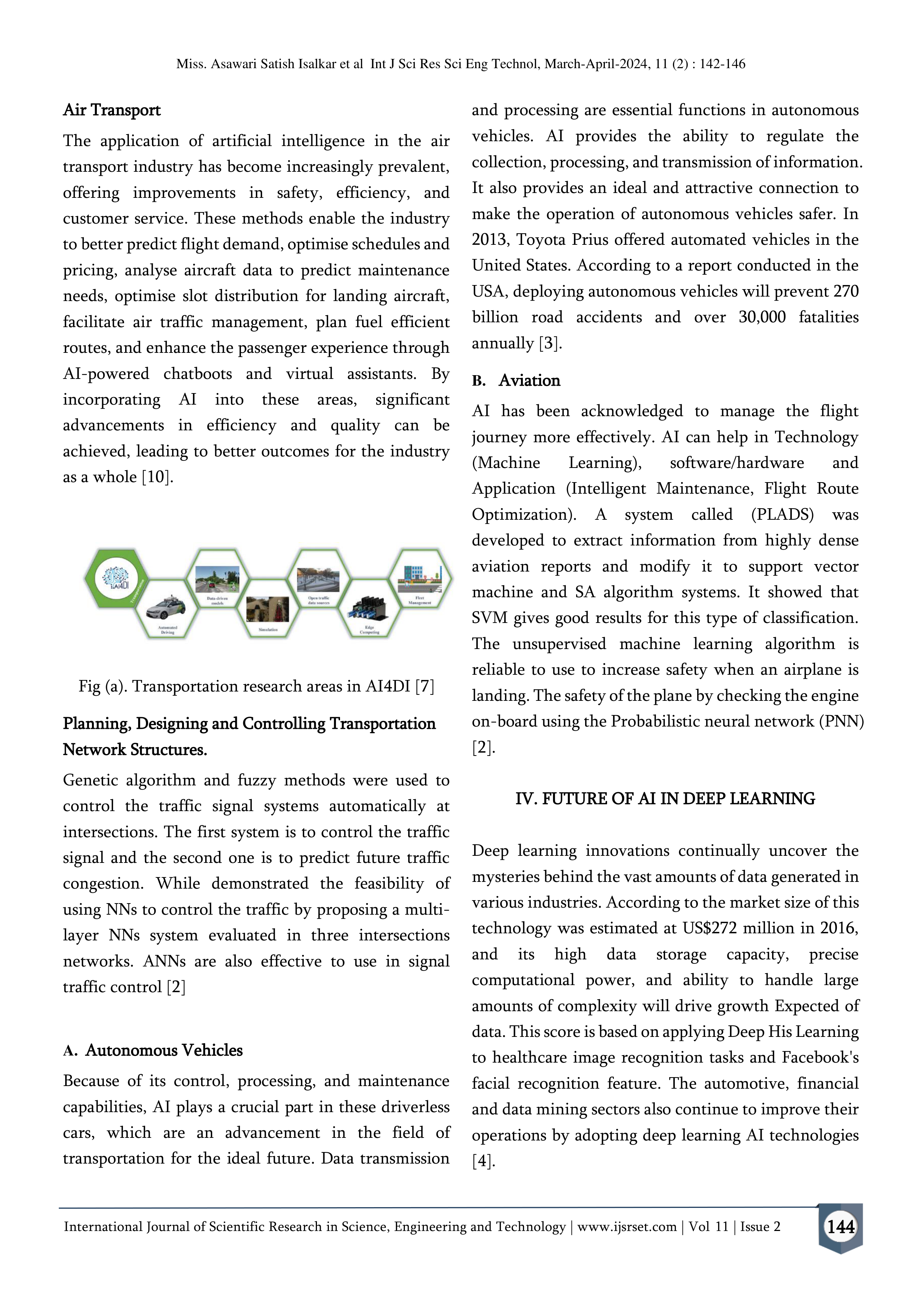
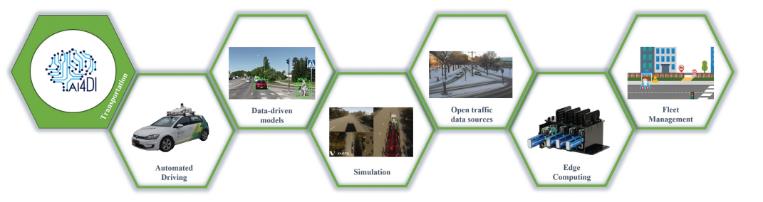
Fig (a). Transportation research areas in AI4DI [7]
Planning, Designing and Controlling Transportation
Network Structures.
Genetic algorithm and fuzzy methods were used to
control the traffic signal systems automatically at
intersections. The first system is to control the traffic
signal and the second one is to predict future traffic
congestion. While demonstrated the feasibility of
using NNs to control the traffic by proposing a multi-
layer NNs system evaluated in three intersections
networks. ANNs are also effective to use in signal
traffic control [2]
A.
Autonomous Vehicles
Because of its control, processing, and maintenance
capabilities, AI plays a crucial part in these driverless
cars, which are an advancement in the field of
transportation for the ideal future. Data transmission
and processing are essential functions in autonomous
vehicles. AI provides the ability to regulate the
collection, processing, and transmission of information.
It also provides an ideal and attractive connection to
make the operation of autonomous vehicles safer. In
2013, Toyota Prius offered automated vehicles in the
United States. According to a report conducted in the
USA, deploying autonomous vehicles will prevent 270
billion road accidents and over 30,000 fatalities
annually [3].
B.
Aviation
AI has been acknowledged to manage the flight
journey more effectively. AI can help in Technology
(Machine
Learning),
software/hardware
and
Application (Intelligent Maintenance, Flight Route
Optimization). A system called (PLADS) was
developed to extract information from highly dense
aviation reports and modify it to support vector
machine and SA algorithm systems. It showed that
SVM gives good results for this type of classification.
The unsupervised machine learning algorithm is
reliable to use to increase safety when an airplane is
landing. The safety of the plane by checking the engine
on-board using the Probabilistic neural network (PNN)
[2].
IV.
FUTURE OF AI IN DEEP LEARNING
Deep learning innovations continually uncover the
mysteries behind the vast amounts of data generated in
various industries. According to the market size of this
technology was estimated at US$272 million in 2016,
and
its
high
data
storage
capacity,
precise
computational power, and ability to handle large
amounts of complexity will drive growth Expected of
data. This score is based on applying Deep His Learning
to healthcare image recognition tasks and Facebook's
facial recognition feature. The automotive, financial
and data mining sectors also continue to improve their
operations by adopting deep learning AI technologies
[4].

International Journal of Scientific Research in Science, Engineering and Technology | www.ijsrset.com | Vol 11 | Issue 2
Miss. Asawari Satish Isalkar et al Int J Sci Res Sci Eng Technol, March-April-2024, 11 (2) : 142-146
145
Due to the conceptual nature of the present study, it
may lack generalizability of application in different
scenarios. An impact study based on primary data
collected from the stakeholders involved in the
transport industry can be taken up in future [5].
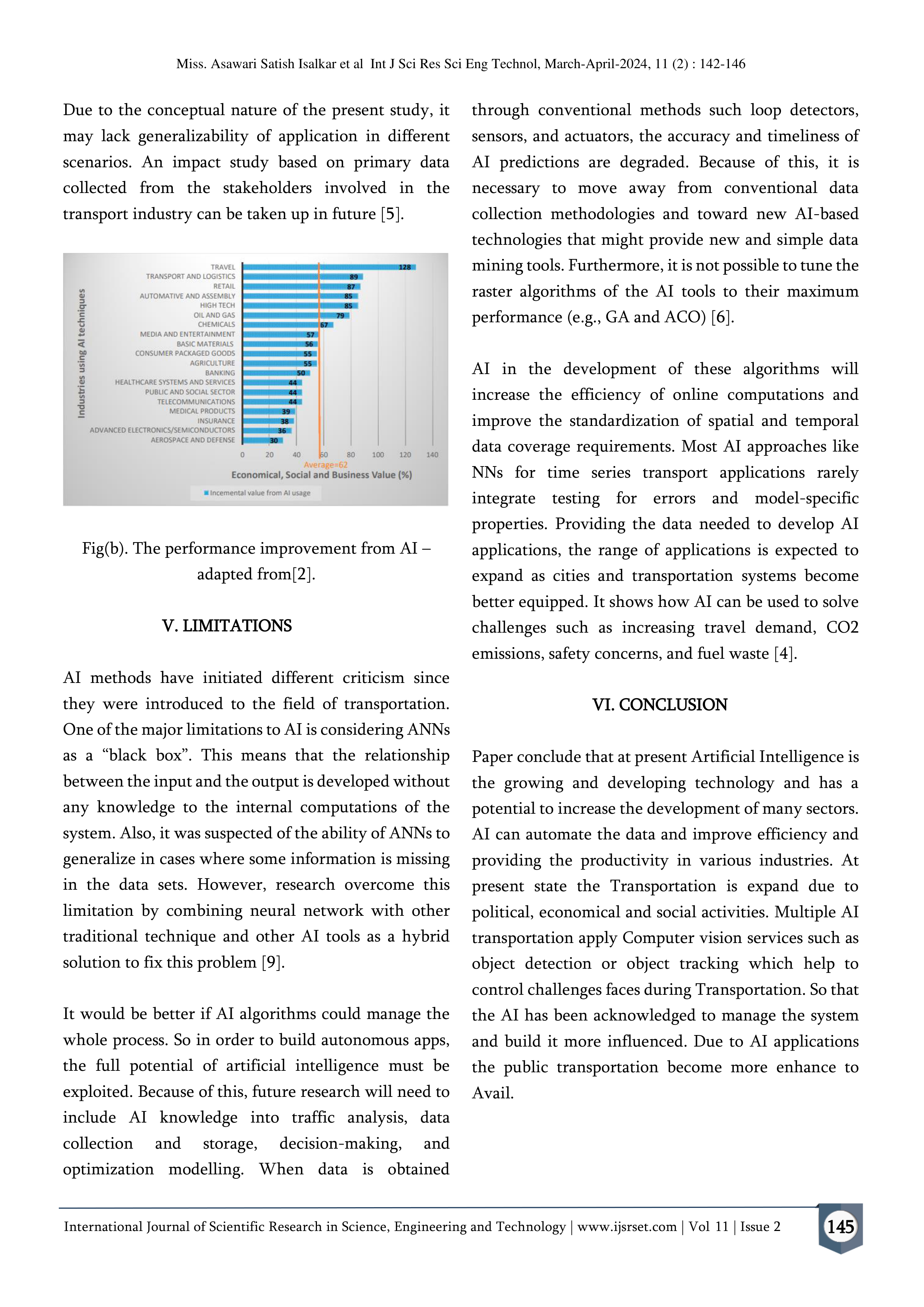
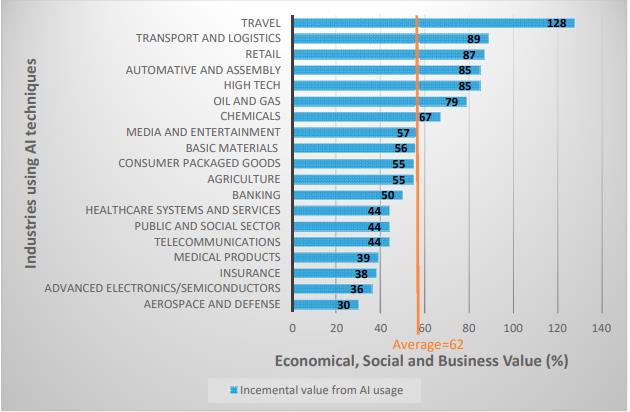
Fig(b). The performance improvement from AI –
adapted from[2].
V. LIMITATIONS
AI methods have initiated different criticism since
they were introduced to the field of transportation.
One of the major limitations to AI is considering ANNs
as a “black box”. This means that the relationship
between the input and the output is developed without
any knowledge to the internal computations of the
system. Also, it was suspected of the ability of ANNs to
generalize in cases where some information is missing
in the data sets. However, research overcome this
limitation by combining neural network with other
traditional technique and other AI tools as a hybrid
solution to fix this problem [9].
It would be better if AI algorithms could manage the
whole process. So in order to build autonomous apps,
the full potential of artificial intelligence must be
exploited. Because of this, future research will need to
include AI knowledge into traffic analysis, data
collection
and
storage,
decision-making,
and
optimization modelling. When data is obtained
through conventional methods such loop detectors,
sensors, and actuators, the accuracy and timeliness of
AI predictions are degraded. Because of this, it is
necessary to move away from conventional data
collection methodologies and toward new AI-based
technologies that might provide new and simple data
mining tools. Furthermore, it is not possible to tune the
raster algorithms of the AI tools to their maximum
performance (e.g., GA and ACO) [6].
AI in the development of these algorithms will
increase the efficiency of online computations and
improve the standardization of spatial and temporal
data coverage requirements. Most AI approaches like
NNs for time series transport applications rarely
integrate testing for errors and model-specific
properties. Providing the data needed to develop AI
applications, the range of applications is expected to
expand as cities and transportation systems become
better equipped. It shows how AI can be used to solve
challenges such as increasing travel demand, CO2
emissions, safety concerns, and fuel waste [4].
VI. CONCLUSION
Paper conclude that at present Artificial Intelligence is
the growing and developing technology and has a
potential to increase the development of many sectors.
AI can automate the data and improve efficiency and
providing the productivity in various industries. At
present state the Transportation is expand due to
political, economical and social activities. Multiple AI
transportation apply Computer vision services such as
object detection or object tracking which help to
control challenges faces during Transportation. So that
the AI has been acknowledged to manage the system
and build it more influenced. Due to AI applications
the public transportation become more enhance to
Avail.

International Journal of Scientific Research in Science, Engineering and Technology | www.ijsrset.com | Vol 11 | Issue 2
Miss. Asawari Satish Isalkar et al Int J Sci Res Sci Eng Technol, March-April-2024, 11 (2) : 142-146
146
V.
REFERENCES
[1]
Jasmin
Praful
Bharadiya1*,
“Artificial
Intelligence in Transportation Systems A
Critical
Review”,
American
Journal
of
Computing and Engineering ISSN 2790-5586
(Online) Vol.6, Issue 1, 2023, pp.35 – 45.
[2]
Rusul
Abduljabbar,
Hussein
Dia,
Sohani
Liyanage and Saeed Asadi Bagloee, “Applications
of Artificial Intelligence in Transport: An
Overview”, 2 January 2019, pp.1-15.
[3]
Shahzadi Parveen, Ramneet Singh Chadha
Department of Embedded System C-DAC Noida,
India Pradeep Kumar, Jasmehar Sing, “Artificial
Intelligence
in
Transportation
Industry”,
“International Journal of Innovative Science and
Research Technology, ISSN No:-2456-2165”,
Volume 7, Issue 8, August – 2022, pp.1274-1277.
[4]
Ajith Chandran G, Aswin Raj,Ayush Vinod,
“Artificial
Intelligence
in
Transportation”,
International Journal of Research in Engineering
and Science (IJRES) , Volume 11, Issue 3 , March
2023 , pp.366-369.
[5]
Lakshmi Shankar Iyer, “AI enabled applications
towards
intelligent
transportation”,
Transportation Engineering, 12 July 2021, pp.1-
9.
[6]
Denis Ushakova *, Egor Dudukalovb, Larisa
Shmatkoc,
Khodor
Shatilad,
“Artificial
Intelligence as a factor of public transportations
system development”, Transportation Research
Procedia-2022, pp.2401-2406.
[7]
Mathias Schneider1, Matti Kutila2 and Alfred
Höß1, “5.0 Applications of AI in Transportation
Industry”, pp.355-360.
[8]
Vladimir V. Okrepilov, Boris B. Kovalenko,
Galina V. Getmanova,* and Maria S. Turovskaj,
“Modern Trends in Artificial Intelligence in the
Transport System”, Transportation Research
Procedia, 2022, pp. 230-231.
[9]
Bhagyashree
Tanaji
Gawale,
Prof.
Sagar
Thakeracy,
“Artificial
Intelligence
in
Transport”, “International Journal of Advances
in Engineering and Management (IJAEM)
Volume 4, Issue 7 July 2022, pp.1364-1368.
[10]
Abderrahmane
Moubarek
Sadou1,
Eric
Tchouamou Njoya2, “Applications of Artificial
Intelligence in the Air Transport Industry: A
Bibliometric and Systematic Literature Review”,
July 23, 2023, pp.4-5.
[11]
Keisha
Dinya
Solihati,
Dian
Indriyani,
“Managing Artificial Intelligence on Public
Transportation
(Case
Study
Jakarta
City,
Indonesia)”, 2021,pp.1-3.