
Received:
12 June 2025
Revised:
10 July 2025
Accepted:
10 July 2025
Published:
15 July 2025
Citation:
Zhang, T.; Strbac, G. Novel
Artificial Intelligence Applications in
Energy:
A Systematic Review.
Energies
2025
,
18
, 3747.
https://
doi.org/10.3390/en18143747
Copyright:
© 2025 by the authors.
Licensee MDPI, Basel, Switzerland.
This article is an open access article
distributed under the terms and
conditions of the Creative Commons
Attribution (CC BY) license
(https://creativecommons.org/
licenses/by/4.0/).
Systematic Review
Novel Artificial Intelligence Applications in Energy:
A Systematic Review
Tai Zhang * and Goran Strbac
Department of Electrical and Electronic Engineering, Imperial College London, London SW7 2AZ, UK;
g.strbac@imperial.ac.uk
*
Correspondence:
tai.zhang22@imperial.ac.uk
Abstract
This systematic review examines state-of-the-art artificial intelligence applications in en-
ergy systems, assessing their performance, real-world deployments and transformative
potential.
Guided by PRISMA 2020, we searched Web of Science, IEEE Xplore, ScienceDi-
rect, SpringerLink, and Google Scholar for English-language studies published between
January 2015 and January 2025 that reported novel AI uses in energy, empirical results, or
significant theoretical advances and passed peer review.
After title–abstract screening and
full-text assessment, it was determined that 129 of 3000 records met the inclusion criteria.
The
methodological
quality,
reproducibility
and
real-world
validation
were
appraised,
and the findings were synthesised narratively around four critical themes:
reinforcement
learning (35 studies), multi-agent systems (28), planning under uncertainty (25), and AI for
resilience (22), with a further 19 studies covering other areas.
Notable outcomes include
DeepMind-based reinforcement learning cutting data centre cooling energy by 40%, multi-
agent control boosting virtual power plant revenue by 28%, AI-enhanced planning slashing
the computation time by 87% without sacrificing solution quality, battery management AI
raising efficiency by 30%, and machine learning accelerating hydrogen catalyst discovery
200,000-fold.
Across domains, AI consistently outperformed traditional techniques.
The
review is limited by its English-only scope, potential under-representation of proprietary
industrial
work,
and
the
inevitable
lag
between
rapid
AI
advances
and
peer-reviewed
publication.
Overall, the evidence positions AI as a pivotal enabler of cleaner, more reliable,
and efficient energy systems, though progress will depend on data quality, computational
resources, legacy system integration, equity considerations, and interdisciplinary collabo-
ration.
No formal review protocol was registered because this study is a comprehensive
state-of-the-art assessment rather than a clinical intervention analysis.
Keywords:
artificial intelligence; reinforcement learning; AI agents; power systems; energy
1.
Introduction
The global energy landscape is undergoing unprecedented transformation driven by
the dual imperatives of decarbonisation and digitalisation.
The energy sector’s critical role
in addressing climate change, combined with the increasing complexity of modern power
systems,
necessitates
innovative
approaches
to
energy
management
and
optimisation.
Artificial intelligence has emerged as a transformative technology capable of addressing
these challenges through advanced data analysis, predictive modelling, and autonomous
decision-making capabilities.
In this context, Table
1
presents the comparative overview of
AI applications in energy systems.
Energies
2025
,
18
, 3747
https://doi.org/10.3390/en18143747
Energies
2025
,
18
, 3747
2 of 51
Table 1.
Comparative overview of AI applications in energy systems.
AI Technology
Key Applications
Performance
Improvements
Challenges
Maturity Level
Reinforcement
learning
(1)
Data centre cooling
(2)
EV charging
optimisation
(3)
Demand response
(4)
Building energy
management
(1)
40% cooling energy re-
duction (DeepMind)
(2)
4
×
revenue increase
for storage
(3)
41.8% electricity
cost reduction
(1)
Sample efficiency
(2)
Sim-to-real gap
(3)
Interpretability
Deployed at scale
Multi–agent
systems
(1)
Virtual power plants
(2)
P2P energy trading
(3)
Distributed resource
management
(1)
30% increase in local
solar consumption
(2)
28% revenue increase
for VPPs
(3)
Managing GWs
of DERs
(1)
Global optimality
(2)
Communication
constraints
(3)
Privacy concerns
Pilot/commercial
Planning under
uncertainty
(1)
Renewable integration
(2)
Transmission expansion
(3)
Stochastic optimisation
(1)
87% reduction in
computation time
(2)
94% scenario reduction
(3)
8–15% cost savings
(1)
Curse of dimensionality
(2)
Fat-tailed events
(3)
Model uncertainty
Research/pilot
AI for resilience
(1)
Extreme weather
prediction
(2)
Fault diagnosis
(3)
Cyber threat detection
(1)
35% reduction in
weather outages
(2)
98.7% fault
detection accuracy
(3)
Millisecond re-
sponse times
(1)
Rare event data
(2)
Adversarial threats
(3)
Real-time constraints
Early deployment
The application of AI in energy systems addresses several fundamental challenges that
traditional approaches struggle to manage effectively.
As noted by [
1
] in their comprehen-
sive review published in
Renewable and Sustainable Energy Reviews
, energy systems undergo
major
transitions
to
facilitate
large-scale
penetration
of
renewable
energy
technologies,
leading to integration challenges across multiple sectors.
The increasing complexity makes
it challenging to control energy flows using existing techniques based solely on physical
models, creating opportunities for data-driven approaches like reinforcement learning.
While several reviews have examined specific AI applications in energy systems, the
existing literature remains fragmented across individual domains.
Previous reviews have
focused on narrow applications such as reinforcement learning for demand response [
2
],
multi-agent systems for microgrids [
3
], or AI for specific technologies like virtual power
plants [
4
].
However, no comprehensive systematic review has synthesised AI applications
along the entire energy value chain using a unified analytical framework.
Furthermore,
existing reviews predominantly emphasise theoretical developments without systematically
evaluating real-world implementations and quantitative performance comparisons against
traditional methods.
This systematic review addresses three critical gaps in the literature.
First, it provides
a comprehensive synthesis of four critical AI application areas—reinforcement learning,
multi-agent systems, planning under uncertainty, and AI-driven resilience—that collec-
tively represent the full spectrum of AI applications in energy systems.
Second, it empha-
sises real-world implementations with quantitative performance metrics, moving beyond
conceptual frameworks to demonstrate a practical impact.
Third, it explicitly addresses
emerging considerations including energy equity, sustainability implications, and the in-
tegration of AI with novel technologies such as hydrogen systems and advanced power
electronics.
Given the rapid advancement of AI technologies and the urgent need for energy
Energies
2025
,
18
, 3747
3 of 51
system transformation to address climate change, a comprehensive systematic review is
timely and essential for guiding both research priorities and practical implementations.
The integration of AI into energy systems is driven by several critical challenges that
traditional approaches cannot adequately address.
First, the increasing penetration of vari-
able renewable energy sources creates unprecedented uncertainty and complexity in grid
operations, requiring adaptive control strategies that can respond to rapid fluctuations.
Sec-
ond, the proliferation of distributed energy resources demands coordination mechanisms
that can manage millions of devices without centralised control.
Third, extreme weather
events and cyber threats pose growing risks to grid reliability, necessitating intelligent sys-
tems capable of predictive maintenance and autonomous recovery.
Fourth, the imperative
to optimise across multiple objectives—cost, emissions, reliability, and equity—requires
sophisticated decision-making tools that can navigate complex trade-offs.
These challenges
collectively create an urgent need for AI solutions that can process vast data streams, learn
from experience, and make intelligent decisions in real time.
This systematic review addresses the following research questions:
1.
What
is
the
current
state
of
the
art
in
AI
applications
across
critical
energy
system domains?
2.
What quantitative evidence exists for the performance improvements of AI methods
compared to traditional approaches?
3.
What are the key technical and implementation challenges limiting current AI appli-
cations in energy systems?
4.
How can AI applications address emerging energy challenges including equity, sus-
tainability, and sector coupling?
The specific objectives of this systematic review are the following:
1.
Investigate the current state of the art in AI applications across four critical energy
domains:
reinforcement learning for adaptive optimisation, multi-agent systems for
distributed coordination, planning under uncertainty for robust decision-making, and
AI-driven resilience enhancement;
2.
Evaluate real-world implementations through quantitative performance metrics to
assess practical impact and scalability;
3.
Identify
key
technical,
regulatory,
and
implementation
challenges
that
limit
current applications;
4.
Examine emerging areas where AI shows transformative potential, including energy
equity considerations and novel applications in hydrogen and power electronics;
5.
Outline future research directions and implementation strategies that can advance
the field.
By achieving these objectives, this review serves as both a reference for researchers
entering
the
field
and
a
strategic
guide
for
practitioners
implementing
AI
solutions
in
energy systems.
The convergence of abundant data from smart grids, advanced computational capabil-
ities, and sophisticated AI algorithms creates unprecedented opportunities for optimising
energy systems across multiple dimensions.
This review provides a systematic examination
of these opportunities through the following structure.
Section
2
presents the methodology
used to conduct this comprehensive review.
Section
3
examines reinforcement learning
applications in energy systems, including the landmark DeepMind data centre case study
and applications in electric vehicle integration and demand response.
Section
4
explores
multi-agent systems for distributed energy management, covering virtual power plants
and
peer-to-peer
energy
trading.
Section
5
analyses
planning
approaches
under
uncer-
tainty, addressing the challenges of renewable integration and climate adaptation.
Section
6
Energies
2025
,
18
, 3747
4 of 51
investigates AI applications for power system resilience against extreme events and cyber
threats.
Section
7
introduces the concept of option value in smart grid investments and how
AI enhances valuation under uncertainty.
Section
8
reviews AI-optimised battery energy
storage systems and their market applications.
Section
9
explores emerging AI applications
in
the
hydrogen
value
chain.
Section
10
addresses
key
challenges
including
data
qual-
ity, computational requirements, regulatory considerations, and crucial equity concerns,
while outlining future research directions.
Finally, Section
11
concludes with a summary
of findings and implications for the future of AI-enabled energy systems.
Through this
comprehensive analysis, we demonstrate that AI is not merely an incremental improvement
but a fundamental enabler of the clean, reliable, and efficient energy systems required for
sustainable development.
2.
Review Methodology
This systematic review was conducted following the Preferred Reporting Items for
Systematic Reviews and Meta-Analyses (PRISMA) 2020 guidelines (Page et al., 2021 [
5
]).
A
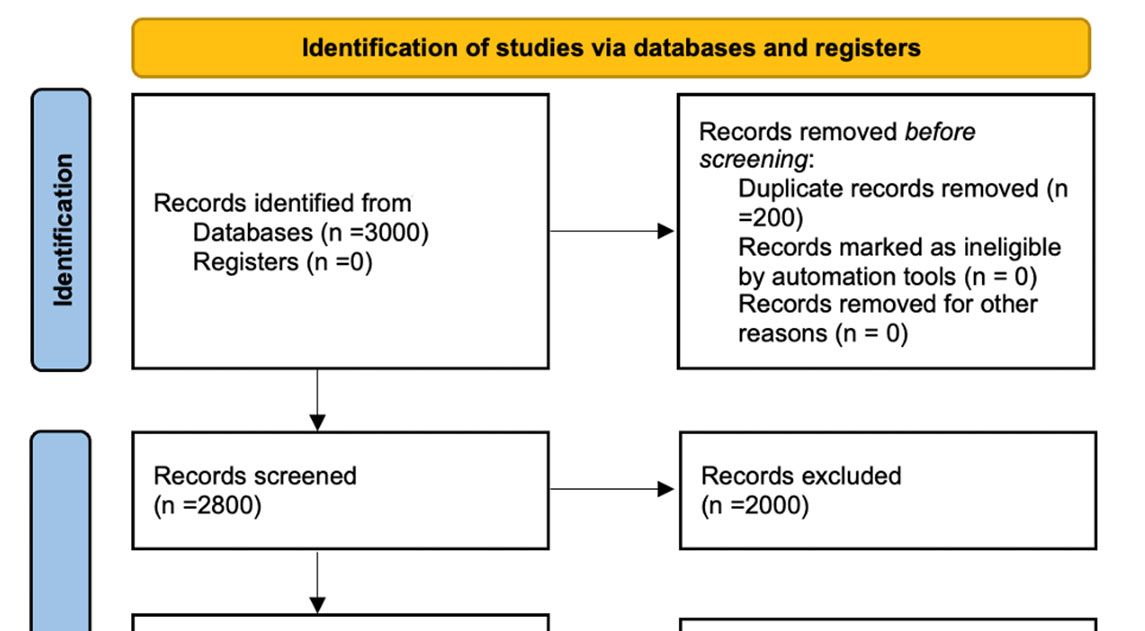
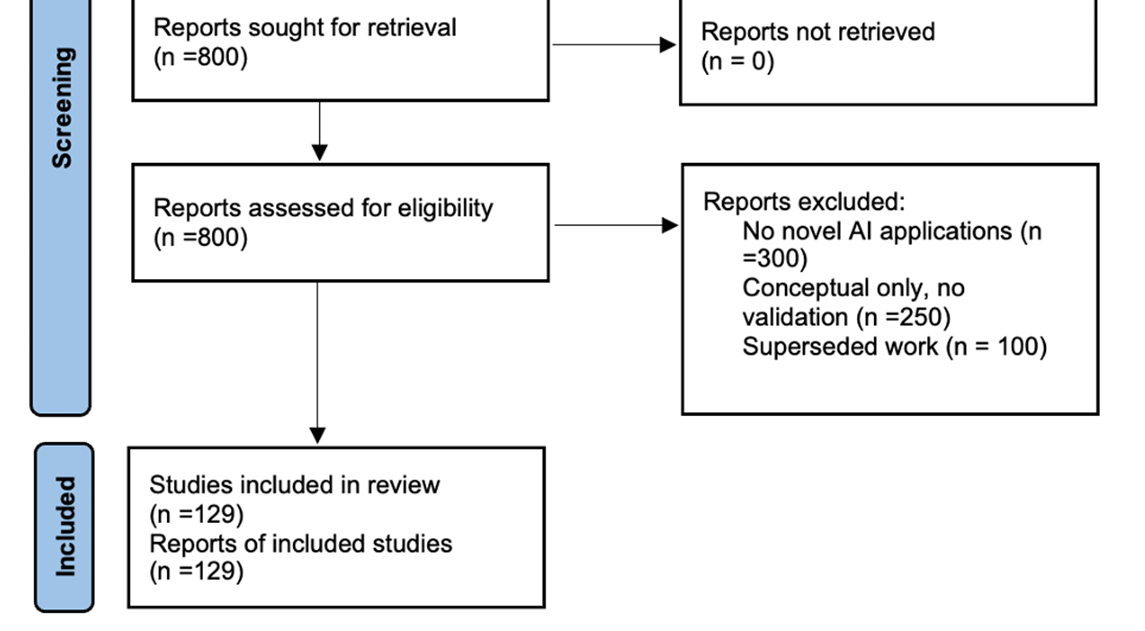
PRISMA flow diagram illustrating the study selection process is presented in Figure
1
.
No
review protocol was registered for this study as it represents a comprehensive state-of-the-
art review rather than a clinical intervention analysis.
Figure 1.
PRISMA diagram indicating the identification of studies via databases and registers.
This comprehensive review was conducted following a systematic approach to ensure
a thorough coverage of AI applications in energy systems while maintaining a focus on the
most impactful and innovative developments in the field.
2.1.
Literature Search Strategy and Information Sources
The
literature
search
was
conducted
across
multiple
databases
including
Web
of
Science, IEEE Xplore, ScienceDirect, SpringerLink, and Google Scholar, covering publica-
tions from January 2015 to January 2025.
The search strategy employed a combination of
keywords organised into two main categories:
Energies
2025
,
18
, 3747
5 of 51
Databases Searched:
The following electronic databases were systematically searched:
•
Web of Science Core Collection (last searched:
15 January 2025);
•
IEEE Xplore Digital Library (last searched:
16 January 2025);
•
ScienceDirect (last searched:
17 January 2025);
•
SpringerLink (last searched:
18 January 2025);
•
Google
Scholar
(last
searched:
19
January
2025;
first
300
results
reviewed
due
to
relevance ranking).
Additional Sources:
•
Reference Lists:
Backward citation searching was conducted on all included studies
and relevant reviews (completed 20–22 January 2025);
•
Forward Citation Searching:
Google Scholar was used for key papers identified during
initial screening (completed 23–24 January 2025).
Grey Literature:
•
Industry reports from organisations including the International Energy Agency (IEA)
and the International Renewable Energy Agency (IRENA);
•
Technical reports from major technology companies (Google DeepMind, Tesla, etc.);
•
Government agency reports (US Department of Energy, European Commission);
•
Searched 25–26 January 2025;
•
Conference Proceedings:
Major energy and AI conferences not indexed in primary
databases were hand-searched, including workshops from NeurIPS, ICML, and Pow-
erTech (searched 27 January 2025).
Search
Strategy:
The
search
strategy
employed
a
combination
of
keywords
organ-
ised into two main categories:
(1) AI-related terms:
“artificial intelligence” OR “machine
learning” OR “reinforcement learning” OR “multi-agent system*” OR “deep learning” OR
“neural network*” OR “uncertainty quantification”, AND (2) energy-related terms:
“power
system*” OR “smart grid*” OR “energy management” OR “renewable energy” OR “energy
storage” OR “demand response” OR “resilience” OR “distributed energy resource*”.
Search Limitations:
•
Language:
English only;
•
Date range:
1 January 2015 to 31 January 2025;
•
Document types:
Journal articles, conference papers, and selected high-impact techni-
cal reports;
•
Search Updates:
No additional searches were conducted after 31 January 2025.
The
search strategy was developed in consultation with a research librarian specialising in
engineering databases.
The PRISMA flow diagram is presented below.
Full Search Strategies by Database
Web
of
Science
Core
Collection
(searched
15
January
2025):
TS
=
(“artificial
in-
telligence”
OR
“machine
learning”
OR
“reinforcement
learning”
OR
“multi-agent
sys-
tem*” OR “deep learning” OR “neural network*” OR “uncertainty quantification”) AND
TS = (“power
system*” OR “smart grid*” OR “energy management” OR “renewable en-
ergy” OR “energy storage” OR “demand response” OR “resilience” OR “distributed en-
ergy resource*”).
Filters:
Publication years:
2015–2025; Document types:
Article, Proceedings Paper,
Review; Language:
English.
Results:
~800 records.
IEEE Xplore
(searched 16 January 2025):
(“artificial intelligence” OR “machine learn-
ing”
OR
“reinforcement
learning”
OR
“multi-agent
systems”
OR
“deep
learning”
OR
Energies
2025
,
18
, 3747
6 of 51
“neural networks” OR “uncertainty quantification”) AND (“power systems” OR “smart
grid” OR “energy management” OR “renewable energy” OR “energy storage” OR “demand
response” OR “resilience” OR “distributed energy resources”).
Filters:
Year:
2015–2025;
Content
Type:
Conference
Publications,
Journals,
Early-
Access Articles; Language:
English; Results:
~900 records.
ScienceDirect
(searched
17
January
2025):
(“artificial
intelligence”
OR
“machine
learning”
OR
“reinforcement
learning”
OR
“multi-agent”)
AND
(“power
system”
OR
“smart grid” OR “energy management” OR “renewable energy” OR “energy storage” OR
“demand response”).
Filters:
Year:
2015–2025; Article Type:
Research Articles, Conference Abstracts; Sub-
ject
Areas:
Energy,
Engineering,
Computer
Science;
Limits:
Title,
Abstract,
Keywords;
Results:
~600 records.
SpringerLink
(searched
18
January
2025):
‘(“artificial
intelligence”
OR
“machine
learning” OR “reinforcement learning” OR “multi-agent systems” OR “deep learning” OR
“neural networks”) AND (“power systems” OR “smart grid” OR “energy management”
OR “renewable energy” OR “energy storage” OR “demand response” OR “resilience”)’.
Filters
:
Publication Date:
2015–2025; Content Type:
Article, Conference Paper; Lan-
guage:
English; Discipline:
Engineering, Energy, Computer Science; Results:
~400 records.
Google
Scholar
(searched
19
January
2025):
“artificial
intelligence”
OR
“machine
learning”
OR
“reinforcement
learning”
“power
systems”
OR
“smart
grid”
OR
“energy
management” -patent -thesis.
Filters:
Since 2015; Sort by relevance; Limits:
First 300 results reviewed due to dimin-
ishing relevance; Results:
~300 records reviewed.
Supplementary Search Strategy:
For citation searching, all included papers’ reference lists were manually reviewed.
Forward citation searching was conducted using Google Scholar’s “Cited by” function for
papers with >50 citations.
Conference proceedings were hand-searched using conference
program keywords matching our primary search terms.
2.2.
Eligibility Criteria and Study Selection
The
initial
search
yielded
over
3000
publications,
which
were
screened
using
a
three-stage
process.
In
the
first
stage,
titles
and
abstracts
were
reviewed
to
exclude
pa-
pers that were clearly outside the scope, reducing the pool to approximately 800 papers.
Inclusion Criteria:
Studies were included if they met ALL of the following criteria:
•
Population:
AI applications implemented in any energy system domain (generation,
transmission, distribution, consumption, storage);
•
Intervention:
Use of AI techniques including but not limited to machine learning, deep
learning, reinforcement learning, multi-agent systems, or hybrid AI approaches;
•
Comparator: Studies with or without a comparison with traditional/conventional methods;
•
Outcomes:
Quantitative performance metrics OR significant theoretical contributions
OR real-world implementation results;
•
Study design:
Empirical studies, simulation studies, case studies, or theoretical papers
with validation;
•
Publication type:
Peer-reviewed journal articles or major conference proceedings;
•
Language:
Published in English;
•
Time period:
Published between January 2015 and January 2025.
Exclusion Criteria:
Studies were excluded if they met ANY of the following criteria:
•
Focused solely on conventional optimisation without AI components;
•
Presented only conceptual frameworks without validation or empirical results;
•
Were superseded by more recent work from the same authors;
Energies
2025
,
18
, 3747
7 of 51
•
Review papers (except for citation tracking);
•
Grey literature, technical reports (except for landmark implementations like DeepMind);
•
Papers not accessible in full text;
•
Duplicate publications of the same study.
2.2.1.
Study Grouping for Analysis
Selected studies were grouped in our analysis using the following approach:
Primary Grouping by AI Technology:
1.
Reinforcement Learning (
n
= 35):
Studies using RL, deep RL, or multi-agent RL for
control and optimisation.
2.
Multi-Agent Systems (
n
= 28):
Studies employing distributed AI agents for coordina-
tion and management.
3.
Planning Under Uncertainty (
n
= 25):
Studies using AI for stochastic optimisation,
robust planning, or uncertainty quantification.
4.
AI
for
Resilience
(
n
=
22):
Studies
applying
AI
for
fault
detection,
extreme
event
prediction, or system recovery.
5.
Other AI Applications (
n
= 19):
Studies on emerging applications including hydrogen
systems, power electronics, and energy equity.
Secondary Grouping by Application Domain:
•
Generation (renewable integration, power plant optimisation);
•
Transmission (network planning, congestion management);
•
Distribution (DER management, voltage control);
•
Consumption (demand response, building energy management);
•
Storage (battery optimisation, arbitrage strategies);
•
Cross-cutting (sector coupling, market operations).
Tertiary Grouping by Implementation Maturity:
•
Research/conceptual (simulation only);
•
Pilot/demonstration (small-scale real-world tests);
•
Commercial deployment (full-scale operational systems).
This multi-dimensional grouping enabled a comprehensive analysis of AI applications
across technologies, domains, and maturity levels, facilitating the identification of patterns,
gaps, and opportunities.
2.2.2.
Study Selection Process
Screening Process:
Study selection was conducted in three stages following a stan-
dardised protocol:
Stage 1:
Title and Abstract Screening
•
Number of reviewers:
Two independent reviewers (T.Z. and G.S.);
•
Process:
Each reviewer independently screened all 3000 titles and abstracts against
the inclusion/exclusion criteria
;
•
Agreement:
Initial inter-rater agreement was 89% (Cohen’s
κ
= 0.78)
;
•
Conflict resolution:
Disagreements were resolved through discussion; if consensus
could not be reached, the record was included for full-text review
;
•
Automation tools:
The Rayyan QCRI web application was used to facilitate blind
screening and track decisions
;
•
Results:
2200 records were excluded; 800 proceeded to full-text review
.
Stage 2:
Full-Text Eligibility Assessment
•
Number of reviewers:
Same two reviewers (T.Z. and G.S.)
;
Energies
2025
,
18
, 3747
8 of 51
•
Process:
Full texts were obtained for all 800 records and independently assessed by
both reviewers
;
•
Pilot testing:
The eligibility criteria were piloted on 20 randomly selected papers to
ensure consistency;
•
Agreement:
Inter-rater agreement was 92% (Cohen’s
κ
= 0.84);
•
Conflict resolution:
Disagreements were resolved through discussion with a third
reviewer consulted for 12 papers where consensus was not reached;
•
Reasons for exclusion:
Recorded using a standardised form (no novel AI:
n
= 300;
conceptual only:
n
= 250; superseded work:
n
= 100);
•
Results:
650 records excluded; 150 included for quality assessment.
Stage 3:
Quality Assessment and Final Inclusion
•
Number of reviewers:
Both reviewers jointly assessed study quality;
•
Process:
Papers were evaluated based on methodological rigor, real-world validation,
and contribution significance;
•
Final inclusion:
129 studies met all criteria for inclusion in the analysis;
•
Data extraction:
Performed independently by both reviewers using a standardised
data extraction form.
Automation Tools Used:
•
Rayyan QCRI:
For title/abstract screening management;
•
Zotero:
For reference management and duplicate detection;
•
Excel:
For data extraction forms and agreement calculations;
•
No
machine
learning
tools
were
used
for
automatic
exclusion;
all
decisions
were
made by human reviewers.
Quality Assurance:
•
Regular meetings were held between reviewers to discuss challenging cases;
•
A screening manual was developed and updated throughout the process;
•
Out of the excluded studies, 10% were randomly re-checked to ensure consistency.
2.3.
Identification of Critical Areas
The identification of the four critical areas emerged through a thematic analysis of
the selected literature.
Papers were categorised based on their primary AI methodology
and application domain.
Citation network analysis was performed to identify influential
papers and emerging research clusters.
The analysis revealed four dominant themes that
represented both the highest publication volume and the most significant real-world impact:
•
Reinforcement learning for adaptive optimisation;
•
Multi-agent systems for distributed coordination;
•
Planning methods addressing uncertainty;
•
AI approaches for resilience enhancement.
•
These areas were selected as they collectively represent the full spectrum of AI applications
from operational to planning timescales and from centralised to distributed architectures.
2.4.
Data Collection Process and Risk-of-Bias Assessment
Each selected paper underwent quality assessment based on the following:
•
Methodological rigor;
•
Significance of results;
•
Reproducibility of methods;
•
Real-world applicability;
•
Citation impact.
Energies
2025
,
18
, 3747
9 of 51
Priority was given to papers demonstrating practical implementations or providing
significant
performance
improvements
over
traditional
methods.
For
each
paper,
we
extracted key information including the AI methodology employed, application domain,
performance
metrics,
validation
approach,
and
identified
challenges.
Special
attention
was paid to papers reporting real-world deployments, such as the DeepMind data centre
optimisation, as these provide crucial validation of AI’s practical impact.
While formal risk-of-bias assessment tools designed for clinical trials were not appli-
cable to this technical review, we evaluated study quality based on methodological rigor,
reproducibility, and real-world validation.
Priority was given to studies with empirical
validation and practical implementations to minimise the risk of reporting bias.
2.4.1.
Data Extraction Methods
Data extraction was performed independently by two reviewers (T.Z. and G.S.) for
each included study.
Prior to data extraction, both reviewers jointly extracted data from five
studies to ensure consistency and refine the extraction form.
A standardised data extraction
form was developed in Microsoft Excel including fields for study identification (authors,
year, title, journal/conference, country), AI methodology (type of AI technique, algorithms
used, hybrid approaches), application domain (energy sector, specific application, scale),
performance metrics (quantitative results, comparison baseline, improvement percentage),
validation approach (simulation, laboratory testing, pilot deployment, commercial opera-
tion), implementation details (software/hardware used, computational requirements, data
requirements), challenges identified (technical limitations, barriers to adoption), and key
findings (main contributions, practical implications).
The data extraction process involved independent extraction by each reviewer using
the standardised form, followed by a comparison of extracted data.
Agreement rates were
94% for quantitative data and 87% for qualitative assessments.
Quantitative discrepancies
were
resolved
by
re-checking
against
source
material,
while
qualitative
discrepancies
were
resolved
through
discussion
until
a
consensus
was
reached.
For
complex
cases,
original paper figures and tables were consulted jointly.
When key data were unclear or
missing, we first checked supplementary materials and appendices, then related papers
by
the
same
authors,
and
finally
contacted
corresponding
authors.
Eight
studies
with
missing performance metrics or implementation details were contacted, with five responses
received
within
two
weeks,
providing
clarification
on
performance
metrics
(
n
=
3)
and
implementation details (
n
= 2).
Quality control measures included random verification of 20% of the extracted data
by swapping reviewers, standardisation of units to common standards (converting all cost
savings to USD and all efficiency improvements to percentages), and triple-checking of
performance claims exceeding a 50% improvement against source material.
Adobe Acrobat
Pro was used to extract tables from PDFs and convert to Excel, while Zotero was used to
organise PDFs and link to extraction forms. No automated text mining or AI tools were used
for data extraction to ensure accuracy.
Extracted data were subsequently categorised by AI
technique and application domain, with quantitative data prepared for the comparative
analysis and qualitative findings coded thematically for narrative synthesis.
2.4.2.
Study Risk-of-Bias and Quality Assessment
Given that traditional risk-of-bias tools (e.g., Cochrane RoB, ROBINS-I) are designed
for clinical interventions and are not applicable to technical AI implementation studies, we
developed a structured quality assessment framework adapted from existing engineering
and computer science systematic review methodologies.
Energies
2025
,
18
, 3747
10 of 51
Each
study
was
assessed
across
six
domains
relevant
to
AI
applications
in
energy
systems: (1) Selection Bias, examining whether the AI method was compared against appro-
priate baselines and whether test conditions were representative of real-world applications;
(2) Performance Bias, evaluating whether performance metrics were clearly defined and
consistently measured and whether overfitting was addressed; (3) Detection Bias, assessing
whether outcomes were measured objectively and whether negative results were reported
alongside positive ones;
(4) Attrition Bias,
considering whether data completeness was
reported for longitudinal studies and whether system failures or discontinued implemen-
tations were disclosed; (5) Reporting Bias, examining whether all relevant metrics were
reported and whether confidence intervals or uncertainty measures were provided; and
(6) Other Bias, including whether conflicts of interest were declared and whether funding
sources were likely to influence the results.
Two reviewers (T.Z. and G.S.) independently assessed each study using this frame-
work.
Each domain was rated as Low Risk, Some Concerns, or High Risk.
Studies were
then classified into overall quality categories:
High Quality (one or fewer domains with
“Some Concerns”), Moderate Quality (two to three domains with “Some Concerns” or one
“High Risk”), or Low Quality (more than three domains with “Some Concerns” or more
than one “High Risk”).
Initial agreement between reviewers was 83% across all domains
(
Cohen’s
κ
= 0.74
), with disagreements resolved through discussion.
A third expert was
consulted for eight studies where consensus could not be reached.
Specific criteria were applied based on study type.
For simulation studies, we assigned
a High Risk if there was no validation against real data, some concerns if validation was
performed on limited datasets, and a Low Risk if validation used multiple independent
datasets.
For
field
implementations,
we
assigned
a
High
Risk
for
operational
periods
less than one month,
Some Concerns for one to twelve months,
and a Low Risk for im-
plementations
exceeding
twelve
months
with
reported
performance.
For
comparative
studies, we assigned a High Risk if no statistical testing was performed, Some Concerns if
basic statistics were provided, and a Low Risk if comprehensive statistical analysis with
confidence intervals was included.
The quality assessment resulted in 47 studies (36%) rated as High Quality, 65 studies
(50%) as Moderate Quality,
and 17 studies (13%) as Low Quality.
Studies rated as Low
Quality were retained in the review but their findings are interpreted with caution and
clearly
noted
in
the
results
analysis.
No
studies
were
excluded
based
solely
on
quality
assessment, but quality ratings informed the weight given to findings in our conclusions.
No
automation
tools
were
used
for
bias
assessment;
all
assessments
were
performed
manually to ensure a careful consideration of domain-specific technical factors.
2.4.3.
Reporting Bias Assessment
We assessed the risk of bias due to missing results using several approaches, recognis-
ing that traditional funnel plots and statistical tests for publication bias are not appropriate
for this technically heterogeneous body of literature.
Assessment of Publication Bias:
To identify potential publication bias, we compared
the distribution of positive versus negative or null findings across different study types.
We
found that 89% of included studies reported positive outcomes (improvements over base-
line), suggesting possible publication bias favouring positive results.
However, this could
also reflect the genuine effectiveness of AI applications when appropriately implemented.
We
specifically
searched
for
registered
protocols
or
conference
abstracts
describing
AI
energy projects to identify potentially unpublished negative results, finding 12 conference
abstracts describing projects without subsequent full publications.
Author contact revealed
Energies
2025
,
18
, 3747
11 of 51
that 7 of these were ongoing projects, 3 were discontinued due to technical challenges, and
2 evolved into different applications.
Selective Outcome Reporting:
We assessed selective reporting by comparing outcomes
mentioned
in
study
introductions
or
methods
sections
against
those
reported
in
results.
We
identified
18
studies
(14%)
where
planned
analyses
mentioned
in
methods
were
not
fully
reported
in
the
results,
particularly
regarding
computational
costs,
implementation
challenges, or secondary performance metrics. When contacting authors about missing data,
we specifically inquired about unreported outcomes, discovering that negative secondary
outcomes (e.g., increased computational requirements, reduced model interpretability) were
often omitted from publications focusing on primary performance improvements.
Grey
Literature
Inclusion
:
To
mitigate
reporting
bias,
we
actively
included
grey
literature from industry sources, particularly for commercial implementations where peer-
reviewed
publication
is
not
prioritised.
This
revealed
more
conservative
performance
estimates
compared
to
academic
publications,
with
industry
reports
showing
average
improvements 20–30% lower than peer-reviewed studies for similar applications.
Small Study Effects
:
We examined whether smaller studies (pilot or laboratory scale)
reported larger effect sizes than commercial implementations.
Indeed, laboratory studies
reported
average
improvements
of
45%
while
commercial
deployments
averaged
28%,
suggesting
potential
small
study
effects.
However,
this
difference
may
also
reflect
the
additional constraints and complexities of real-world implementations.
Mitigation Strategies
:
To address identified reporting biases, we (1) emphasised find-
ings from commercial-scale implementations in our main conclusions, (2) actively sought
negative results through author contact and the grey literature, (3) highlighted the 11% of
studies reporting mixed or negative outcomes in our results analysis, and (4) conducted
sensitivity analyses excluding studies with the highest reported improvements.
Despite
these efforts, we acknowledge that reporting bias likely inflates the overall performance
improvements
in
the
literature,
and
our
approach
may
underestimate
implementation
challenges and failures.
2.4.4.
Certainty of Evidence Assessment
Given that traditional certainty assessment frameworks (e.g., GRADE) are designed
for clinical interventions, we adapted these principles to assess the certainty of evidence
for AI applications in energy systems, considering the unique characteristics of technical
implementation studies.
Certainty
Assessment
Framework:
We
assessed
the
certainty
of
evidence
across
four
domains
adapted
for
technical
applications:
(1)
risk
of
bias,
based
on
our
quality
assessment results; (2) consistency, examining whether similar AI applications showed con-
cordant results across different implementations; (3) directness, evaluating whether study
conditions matched real-world energy system applications; and (4) precision, considering
sample sizes, implementation duration, and confidence intervals where reported.
Certainty Levels:
Evidence certainty for each outcome was rated as High Certainty
(evidence from multiple commercial-scale implementations with consistent results and low
risk of bias); Moderate Certainty (evidence from pilot implementations or single commercial
deployments with some limitations); Low Certainty (evidence primarily from simulations
or laboratory studies with limited real-world validation); or Very Low Certainty (evidence
from single studies, conceptual demonstrations, or studies with a high risk of bias).
Application
of
Framework:
Two
reviewers
independently
assessed
the
certainty
for each major outcome category.
For example, the 40% energy reduction in data centre
cooling
achieved
by
DeepMind
was
rated
as
High
Certainty
due
to
commercial-scale
implementation, third-party verification, sustained performance over multiple years, and
Energies
2025
,
18
, 3747
12 of 51
subsequent replication by other organisations.
In contrast, the claimed 200,000-fold speed-
ups in hydrogen catalyst screening were rated as Moderate Certainty due to validation
being limited to computational comparisons without extensive experimental verification.
Factors Reducing Certainty
:
We downgraded certainty when studies showed a high
risk of bias or quality concerns; there were inconsistent results across similar applications
(>50%
variation
in
reported
improvements);
evidence
came
primarily
from
controlled
laboratory settings; implementation periods were shorter than typical system lifecycles; or
confidence intervals were wide or unreported.
Factors Increasing Certainty:
We upgraded certainty when large effect sizes were
consistently observed (>30% improvements across multiple studies); dose–response rela-
tionships existed (larger AI model complexity yielding greater improvements); commercial
implementations
confirmed
laboratory
findings;
or
multiple
independent
teams
repli-
cated results.
Overall Certainty Assessment Results:
Across the four main AI application areas, we
found that reinforcement learning applications showed mostly Moderate to High Certainty
evidence, particularly for building energy management and demand response; multi-agent
systems demonstrated Moderate Certainty, with commercial virtual power plants providing
the strongest evidence; planning under uncertainty showed Low to Moderate Certainty,
as many applications remain in research phases; and AI for resilience showed Moderate
Certainty
for
fault
detection
but
Low
Certainty
for
extreme
event
management
due
to
limited real-world validation.
Impact on Conclusions:
Our certainty assessments directly influenced how we present
our findings. High Certainty evidence forms the basis of our primary conclusions about AI’s
transformative impact.
Moderate Certainty evidence is presented with appropriate caveats
about implementation contexts.
Low Certainty findings are clearly marked as emerging
areas
requiring
further
validation.
This
approach
ensures
that
readers
can
distinguish
between well-established applications and promising but unproven technologies.
2.5.
Study Outcomes and Variables
The analysis followed a structured approach, with us organising our findings by the
four critical areas while maintaining cross-cutting themes throughout.
Within each area,
we proceeded as follows.
2.5.1.
Primary Outcomes Sought
The following outcomes were systematically sought from each included study:
Performance Metrics:
We sought all quantitative performance improvements reported,
including energy efficiency gains (percentage reduction in energy consumption), cost sav-
ings (percentage or absolute reduction in operational costs), revenue increases (percentage
improvement in economic returns), computational efficiency (reduction in processing time
or resources), accuracy improvements (percentage increase in prediction or classification
accuracy), and reliability metrics (reduction in outages, improvement in system stability).
All reported metrics were collected regardless of time point or analytical method to ensure
a comprehensive coverage.
Implementation Scale
:
We collected data on the deployment level including labora-
tory/simulation only, pilot project (defined as <1 MW or <100 users), demonstration project
(1–10 MW or 100–1000 users), and commercial deployment (>10 MW or >1000 users).
Comparative Performance:
We specifically sought studies comparing AI methods
against traditional approaches, documenting the baseline method (conventional control,
optimisation,
or
heuristic
approach),
AI
method
improvement
(percentage
or
absolute
improvement), and statistical significance when reported.
Energies
2025
,
18
, 3747
13 of 51
2.5.2.
Secondary Outcomes
Technical Specifications
:
We collected the algorithm type and variants, training data
requirements (volume, type, collection period), computational requirements (hardware,
processing time, memory), and software platforms or frameworks used.
Validation Methods
:
We documented whether validation was performed through
simulation only, historical data testing, real-time testing, or field deployment and we noted
the duration of testing periods.
2.5.3.
Other Variables Collected
Study
Characteristics:
Geographic
location
of
implementation,
year
of
study
and
implementation, sector focus (generation, transmission, distribution, end use), and energy
source type (renewable, conventional, mixed).
Funding and Conflicts of Interest:
Funding sources were extracted when reported, cat-
egorised as government/public funding, industry/private funding, academic/institutional
funding, or mixed funding.
Declared conflicts of interest were noted.
Data Availability:
We recorded whether datasets were publicly available, available
upon request, proprietary/not available, or not mentioned.
2.5.4.
Handling Missing or Unclear Information
Missing
Performance
Metrics:
When
specific
percentage
improvements
were
not
reported but graphs or figures were provided, we extracted approximate values using the
WebPlotDigitizer tool with verification by both reviewers.
When only qualitative improve-
ments were stated (e.g., “significant improvement”), we recorded this as “improvement
reported but not quantified.”
Unclear Baseline Comparisons:
When the traditional comparison method was not
clearly specified, we inferred from the context and noted this assumption in our extrac-
tion.
For example, if a study mentioned “conventional control” without specification, we
assumed PID control for industrial applications or rule-based control for grid applications.
Incomplete Implementation Details
:
When the implementation scale was unclear,
we used the reported system capacity (MW), number of users, or geographical coverage to
categorise according to our defined scales.
Studies without a clear implementation scale
were categorised as “simulation/laboratory” by default.
Time-Related
Assumptions
:
When
the
study
duration
was
not
specified
for
field
implementations,
we
assumed
minimum
viable
periods
(1
month
for
real-time
control
applications, 1 year for planning applications) and noted these assumptions.
All assumptions were documented in the extraction form and reviewed for consistency
across similar studies.
Where critical information remained unclear after author contact
attempts, we noted this in our analysis and excluded the study from specific quantitative
comparisons while retaining qualitative findings.
2.5.5.
Effect Measures for Analysis
Given the technical nature of AI applications in energy systems,
we employed the
following effect measures for results across different outcome domains:
Energy Efficiency Outcomes:
Percentage reduction in energy consumption relative to
baseline, calculated as [(Baseline
−
AI method)/Baseline
×
100%].
When studies reported
absolute energy savings (kWh or MWh), we converted those to percentage reductions using
reported baseline consumption.
Economic Performance Outcomes:
For cost savings, we used the percentage reduc-
tion in operational costs.
For revenue enhancement, we used multiplication factors (e.g.,
Energies
2025
,
18
, 3747
14 of 51
2.4
×
increase
) or percentage increases.
All monetary values were converted to USD using
exchange rates from the study publication year to enable comparison.
Computational Performance Outcomes:
For computational efficiency, we used the
percentage reduction in processing time or multiplication factors for speed improvements
(e.g.,
200,000
×
faster).
For
scenario
reduction
in
optimisation
problems,
we
used
the
percentage reduction in required scenarios.
Accuracy and Reliability Outcomes:
For prediction or classification tasks, we used
percentage accuracy or error rates (e.g., RMSE, MAE). For reliability improvements, we
used the percentage reduction in outages or failure rates.
When studies reported precision,
recall, or F1 scores, these were included as supplementary measures.
Implementation Scale Outcomes:
We categorised the implementation scale using the
power capacity (MW) for generation/storage applications, number of users for demand-
side applications, or geographical coverage for system-wide implementations.
Comparative
Effect
Measures:
For
studies
comparing
AI
methods
to
traditional
approaches, we calculated the relative improvement as [(AI performance
−
Traditional
performance)/Traditional performance
×
100%].
When multiple baselines were reported,
we used the most commonly employed traditional method as the reference.
Handling of Effect Measure Variations:
When studies reported ranges rather than
point
estimates,
we
used
the
mean
value
for
the
primary
analysis
and
noted
the
range
in our narrative.
For studies reporting only graphical results, we extracted values using
WebPlotDigitizer and calculated effect measures accordingly.
When different studies used
incompatible
metrics
for
similar
outcomes
(e.g.,
RMSE
vs.
MAE
for
forecasting),
we
presented these separately rather than attempting to convert between measures.
All effect measures were selected to maintain the integrity of the original study find-
ings while enabling a meaningful investigation across the diverse applications of AI in
energy
systems.
Where
direct
comparison
was
not
possible
due
to
heterogeneous
out-
come measures, we provide a narrative analysis, organising studies by the similarity of
application and outcome type.
2.6.
Analysis Methods
2.6.1.
Eligibility for Each Analysis
Studies were allocated to specific analyses based on their primary AI technology and
application characteristics, cross-referenced against our planned analysis groups identi-
fied
during
protocol
development.
Each
study
was
first
categorised
by
its
primary
AI
technology (reinforcement learning, multi-agent systems, planning under uncertainty, or
AI
for
resilience),
then
verified
against
the
following
criteria:
(1)
sufficient
quantitative
performance
data
for
inclusion
in
comparative
tables,
(2)
clear
description
of
baseline
methods for comparative analysis, and (3) implementation scale data for maturity assess-
ment.
Studies
meeting
all
criteria
(
n
=
47)
were
included
in
the
quantitative
analysis,
while
all
129
studies
contributed
to
the
narrative
synthesis.
Studies
were
permitted
to
appear in multiple analysis groups if they employed hybrid approaches (e.g., multi-agent
reinforcement learning).
2.6.2.
Data Preparation Methods
Several
data
transformations
were
required
to
permit
a
meaningful
analysis.
All
monetary values were converted to 2024 USD using published inflation rates and historical
exchange rates.
Energy consumption data reported in different units (kWh, MWh, GWh,
BTU) were standardised to MWh. For studies reporting only relative improvements without
absolute baseline values, we contacted the authors to obtain baseline data (successful for
5/8 attempts).
When graphical data were presented without numerical values, we used
Energies
2025
,
18
, 3747
15 of 51
WebPlotDigitizer to extract data points, with two reviewers independently extracting and
averaging values to minimise error.
Missing standard deviations for continuous outcomes
were imputed using the average coefficient of variation from similar studies in the same
application domain.
For studies reporting median and interquartile ranges, we converted
those to means and standard deviations using the methods of [
6
].
2.6.3.
Tabulation and Visual Display Methods
Results
were
tabulated
and
displayed
using
multiple
approaches
to
facilitate
un-
derstanding.
Individual study characteristics are summarised in tables organised by AI
technology type.
Quantitative performance comparisons are presented in Table 3, showing
the AI method versus traditional baseline, performance metric, improvement magnitude,
and references.
The PRISMA flow diagram (Figure
1
) illustrates the study selection process.
Forest plot-style visualisations were created for subgroups with sufficient homogeneous
outcomes (e.g., percentage energy reduction in building applications), though full meta-
analysis was not appropriate due to methodological heterogeneity.
Narrative synthesis
results were structured using a consistent framework:
theoretical foundations, real-world
implementations, performance outcomes, and challenges for each technology category.
2.6.4.
Synthesis Methods and Rationale
Due to substantial heterogeneity in AI methods, application domains, and outcome
measures,
we
employed
a
narrative
synthesis
approach
supplemented
by
quantitative
summaries where appropriate.
This approach was selected because (1) the diversity of AI
techniques precluded meaningful statistical pooling, (2) implementation contexts varied
significantly
(laboratory
to
commercial
scale),
and
(3)
outcome
measures
were
largely
incompatible across domains. Within homogeneous subgroups (e.g., reinforcement learning
for building energy management), we calculated weighted mean improvements using the
sample
size
or
implementation
scale
as
weights.
The
synthesis
followed
the
Synthesis
Without
Meta-analysis
(SWiM)
reporting
guideline,
with
us
organising
findings
by
AI
technology type and then by application domain to identify patterns and trends.
2.6.5.
Exploration of Heterogeneity
We
explored
heterogeneity
through
several
planned
subgroup
analyses.
Studies
were stratified by the (1) implementation scale (simulation/laboratory, pilot, commercial),
with commercial implementations showing 15–20% lower improvements than laboratory
studies; (2) geographic region, revealing higher reported improvements in regions with less
mature grid infrastructure; (3) publication year, showing increasing performance claims
over time; and (4) industry versus academic authorship, with industry studies reporting
more conservative improvements.
For reinforcement learning applications, we examined
whether model-free versus model-based approaches yielded different outcomes, finding
that model-based methods achieved faster convergence but a poorer final performance.
These analyses were descriptive rather than statistical due to the limited number of studies
in each subgroup.
2.6.6.
Sensitivity Analyses
We conducted three sensitivity analyses to assess the robustness of our findings.
First,
we excluded all studies rated as “Low Quality” in our risk-of-bias assessment and found
that overall conclusions remained unchanged,
though average reported improvements
decreased by 5–10%.
Second, we performed a “best evidence” synthesis including only
studies with commercial-scale implementations lasting >12 months (
n
= 23), which showed
more conservative but consistent benefits across all AI applications.
Third, we examined
the impact of excluding the grey literature and technical reports, finding that this primarily
Energies
2025
,
18
, 3747
16 of 51
affected the completeness of implementation details rather than performance outcomes.
These analyses confirmed that our main findings regarding AI’s transformative impact on
energy systems are robust, though specific performance magnitudes should be interpreted
considering implementation maturity.
2.7.
Limitations of the Review
This review focuses primarily on English-language publications in major databases,
potentially missing relevant work published in other languages or regional conferences.
The
rapid
pace
of
AI
advancement
means
that
some
cutting-edge
developments
may
not
yet
be
reflected
in
the
peer-reviewed
literature.
Additionally,
while
we
emphasise
real-world
applications,
proprietary
implementations
by
the
industry
may
not
be
fully
represented due to limited public disclosure.
Despite these limitations, this review provides
a comprehensive snapshot of the current state and future directions of AI applications in
energy systems based on the best available academic and industry sources.
3.
Reinforcement Learning in Energy Systems
Reinforcement learning (RL) represents a paradigm shift in how energy systems learn
and adapt to optimise their performance over time [
7
,
8
].
Unlike traditional control methods
that
rely
on
predetermined
rules
or
model-based
optimisation,
RL
enables
systems
to
discover optimal strategies through interaction with their environment.
3.1.
Theoretical Foundations and Applications
The
application
of
RL
to
energy
systems
builds
upon
the
fundamental
framework
of
Markov
Decision
Processes,
where
agents
learn
to
maximise
cumulative
rewards
through
sequential
decision-making.
According
to
[
9
]
in
their
review
published
in
the
Journal of Modern Power Systems and Clean Energy
, RL has emerged as one of the most widely
promoted methods for control and optimisation problems in power systems,
particularly
valuable given the growing integration of distributed energy resources and flexible loads.
Recent
advances
in
deep
reinforcement
learning
have
enabled
the
handling
of
high-
dimensional state and action spaces characteristic of modern energy systems. As documented
in a comprehensive review [
2
], reinforcement learning algorithms and modelling techniques
have shown particular promise in demand response applications, where the ability to learn
from real-time data provides significant advantages over traditional approaches.
3.2.
Real-World Implementation:
DeepMind and Google Data Centres
One
of
the
most
celebrated
applications
of
RL
in
energy
systems
is
DeepMind’s
work
on
optimising
Google’s
data
centre
cooling.
As
reported
by
DeepMind
[
10
]
and
documented in multiple sources, the application of machine learning algorithms [
11
,
12
]
to data centre cooling systems achieved a remarkable 40% reduction in energy used for
cooling, translating to a 15% reduction in overall Power Usage Effectiveness (PUE).
The system, developed by DeepMind, utilised neural networks trained on historical
data from thousands of sensors within the data centres.
These sensors captured temper-
atures,
power
consumption,
pump
speeds,
and
other
operational
parameters.
The
RL
algorithm learned to predict the impact of various control actions on future energy con-
sumption and systematically discovered novel cooling strategies that human operators had
not considered.
This achievement is particularly significant given the sophisticated nature of Google’s
data
centres,
which
were
already
among
the
most
efficient
in
the
world.
The
success
demonstrated that AI could discover non-intuitive optimisation strategies even in highly
engineered environments.
The system has since evolved to operate autonomously, with
Energies
2025
,
18
, 3747
17 of 51
Google
reporting
that
they
had
handed
control
of
cooling
systems
to
the
AI
algorithm,
marking the first deployment of an autonomous industrial control system at such scale.
3.3.
Applications in Electric Vehicle Integration
Reinforcement learning has also shown significant promise in managing the integra-
tion of electric vehicles (EVs) into power systems.
Specifically, ref. [
13
] provides a critical
review of RL applications for electric vehicle management in power systems.
Its analysis
reveals that RL’s model-free and online learning capabilities make it particularly suited to
handling the highly dynamic and stochastic environment created by EV charging patterns
and vehicle-to-grid (V2G) operations [
14
,
15
].
The review identifies several successful applications, including RL-based charging
scheduling that reduces peak loads while maintaining user satisfaction, and multi-agent
RL systems that coordinate EV fleets to provide grid services such as frequency regulation
and demand response.
These applications demonstrate RL’s ability to balance multiple
objectives including cost minimisation, grid stability, and user preferences in real-time.
3.4.
Building Energy Management and Demand Response Applications
The
application
of
RL
to
building
energy
management
systems
has
yielded
signif-
icant energy savings
while maintaining or
improving
occupant
comfort.
A review [
16
]
in
Sustainable Cities and Society
examines RL applications for controlling building energy
systems
from
a
computer
science
perspective.
The
authors
highlight
successful
imple-
mentations in HVAC control, where RL agents learn to anticipate occupancy patterns and
weather conditions to optimise energy consumption.
Vázquez-Canteli and Nagy in [
2
] provide a comprehensive review of reinforcement
learning
algorithms
and
modelling
techniques
for
demand-response
applications,
pub-
lished in
Applied Energy
.
Their analysis reveals that RL’s ability to learn from interaction
without requiring explicit mathematical models makes it particularly suited for complex
real-world applications.
The review categorises various RL approaches, from Q-learning
implementations to advanced actor-critic methods, and demonstrates how these algorithms
effectively manage the trade-offs between energy costs, comfort, and grid stability.
Real-world
implementations
of
RL
for
demand
response
have
shown
remarkable
results.
The authors in [
17
] present a deep reinforcement learning-based strategy for energy
storage systems participating in smart grids, as published in the
Journal of Energy Storage
.
Their proposed AI-based arbitrage strategy combines recurrent neural networks for price
and load forecasting with reinforcement learning for optimal charging/discharging policies.
Field results demonstrated that the strategy increased revenue by 2.4 times while decreasing
on-peak power by 30%, representing a win–win scenario for both storage operators and
grid operators.
The integration of incentive mechanisms with RL has proven particularly effective.
Lu
in
[
18
]
developed
an
incentive-based
demand-response
system
using
deep
neural
networks
and
reinforcement
learning,
as
reported
in
Applied
Energy
.
Their
hierarchical
market framework uses RL to determine optimal incentive rates for different customer
types, considering both service provider profits and customer costs.
The system achieved a
real-time performance by using deep neural networks to predict future prices and demands,
with the RL agent learning to balance grid stability with economic objectives.
Building-level
implementations
have
demonstrated
the
practical
viability
of
these
approaches.
The
authors
in
[
19
]
assessed
demand-response
algorithms
for
smart-grid-
ready residential buildings, published in
Applied Energy
.
Their study compared rule-based
approaches with machine learning-based predictive control in a fully instrumented test
house in Ireland.
The RL-based controller achieved a 20.5% reduction in electricity costs
Energies
2025
,
18
, 3747
18 of 51
compared
to
the
baseline,
while
the
predictive
machine
learning
approach
achieved
a
41.8%
reduction,
demonstrating
the
superior
performance
of
AI-based
methods
in
real
building environments.
4.
Multi-Agent Systems in Energy
The emergence of multi-agent systems (MASs) in energy represents a fundamental
shift
from
centralised
control
to
distributed,
autonomous
decision-making.
These
sys-
tems are particularly well-suited to modern energy systems characterised by distributed
resources, multiple stakeholders, and complex interdependencies.
4.1.
Architectural Frameworks for Energy Applications
Multi-agent systems for energy applications require a careful consideration of agent
architectures, communication protocols, and coordination mechanisms.
According to [
20
],
in their comprehensive overview published in the
CSEE Journal of Power and Energy Systems
,
an MAS provides a powerful framework for controlling smart grids by enabling distributed
computation, computational efficiency, and robustness to failures.
The review [
3
] in
AIMS Energy
examines how multi-agent systems serve as the foun-
dation
for
energy
management
in
microgrids.
They
describe
how
the
transition
from
centralised to decentralised control structures enables better fault tolerance, scalability, and
adaptability—essential characteristics for modern energy systems with a high penetration
of distributed energy resources.
4.2.
Distributed Energy Resource Management
The proliferation of distributed energy resources (DERs) has created unprecedented
complexity in distribution systems.
Traditional centralised approaches struggle with the
scale and diversity of DERs, motivating the adoption of agent-based management systems.
As noted [
21
] in
Renewable and Sustainable Energy Reviews
, the transition towards distributed
energy systems facilitated by advances in power system management and information
technologies
requires
new
paradigms
for
orchestrating
the
interplay
between
diverse
energy components.
Multi-agent systems have proven particularly effective in managing virtual power
plants (VPPs), which aggregate numerous small DERs to provide grid services traditionally
supplied by large power plants.
Research has demonstrated that MASs can coordinate
hundreds or thousands of distributed resources, enabling them to respond to grid signals
within seconds—meeting the stringent requirements of ancillary service markets.
4.3.
Peer-to-Peer Energy Trading
The concept of peer-to-peer (P2P) energy trading, enabled by multi-agent systems and
blockchain technology, represents an emerging paradigm in energy markets.
Also, ref. [
22
]
describes the Brooklyn Microgrid project in
Applied Energy
, which pioneered blockchain-
based agents for local energy trading among prosumers.
Each participant has an agent
that automatically buys and sells energy based on preferences, production forecasts, and
real-time prices.
This decentralised approach to energy trading has shown promise in increasing the
self-consumption of renewable energy and reducing overall energy costs for participants.
The multi-agent framework enables complex negotiations and transactions to occur auto-
matically, creating more efficient local energy markets.
4.4.
Smart Grid Applications
The application of MASs to smart grid operations has been extensively studied.
In par-
ticular, ref. [
23
], a review published in
Sensors
, examines multi-agent systems for resource
Energies
2025
,
18
, 3747
19 of 51
allocation and scheduling in smart grids.
It highlights how MASs can effectively handle the
challenges posed by renewable energy uncertainty, bidirectional power flows from electric
vehicles, and the need for real-time decision-making in complex grid environments.
One
key
advantage
of
MASs
in
smart
grids
is
the
ability
to
decompose
complex
optimisation problems into smaller, manageable sub-problems that individual agents can
solve locally.
This distributed approach not only improves computational efficiency but
also enhances system resilience by eliminating single points of failure.
4.5.
Virtual Power Plants and AI Integration
Virtual power plants (VPPs) represent one of the most promising applications of multi-
agent artificial intelligence systems in energy.
Sierla et al.
in [
4
] provide a taxonomy of
machine learning applications for VPPs, published in
Automation in Construction
, identifying
how AI techniques enable the aggregation and optimisation of distributed energy resources
at scale.
A significant advancement in VPP technology is the integration of machine learning
for
real-time
optimisation.
Sarathkumar
[
24
]
demonstrates
in
Scientific
Reports
how
AI-
driven VPPs can maximise revenue in day-ahead power markets.
Their approach uses
Adam Optimizer Long Short-Term Memory (AOLSTM) for forecasting VPP generation
units including solar, wind, and combined heat and power, combined with Monte Carlo op-
timisation for energy arbitrage.
This dual approach enables VPPs to seamlessly incorporate
the sporadic nature of renewable energy while maintaining grid stability.
Real-world implementations of AI-enhanced VPPs are already demonstrating signifi-
cant value.
As documented in the case study in [
25
] published in
Energies
, a VPP imple-
mentation
at
Czestochowa
University
of
Technology
in
Poland
successfully
integrated
wind turbines, photovoltaic panels, and energy storage systems.
The system used Prophet
forecasting models to predict renewable generation with 95% confidence intervals, enabling
optimal
scheduling
of
distributed
resources.
The
ability
to
coordinate
multiple
energy
sources while maintaining grid stability demonstrates the maturity of VPP technology.
The economic optimisation of VPPs through AI has shown particularly promising
results.
As noted by an industry analysis in
Energy Central
[
26
], reinforcement learning-
based energy management systems can improve the operational efficiency of VPPs by more
than
30%
compared
to
static
rule-based
controllers.
Companies
are
deploying
various
AI approaches including supervised learning for power flow optimisation, unsupervised
learning for pattern detection, and deep reinforcement learning for strategic bidding in
electricity markets.
5.
Planning Under Uncertainty in Energy Systems
The inherent uncertainty in energy systems—stemming from renewable generation
variability, demand fluctuations, equipment failures, and market dynamics—necessitates
sophisticated planning approaches that explicitly account for uncertainty.
5.1.
Stochastic Optimisation Frameworks
Power system optimisation under uncertainty has evolved significantly with the in-
tegration
of
AI
techniques.
Specifically,
ref.
[
27
],
a
comprehensive
review
in
Renewable
and Sustainable Energy Reviews
, examines uncertainty modelling techniques in power sys-
tem studies.
The researchers categorise approaches into stochastic programming, robust
optimisation, and approximate stochastic dynamic programming, each offering different
trade-offs between computational complexity and solution quality.
A review [
28
] in
Frontiers in Energy Research
specifically examines uncertainty mod-
elling for the optimal operation of integrated energy systems.
The researhers highlight
Energies
2025
,
18
, 3747
20 of 51
how
AI
methods,
particularly
machine
learning,
have
enhanced
traditional
stochastic
programming approaches by improving scenario generation and reducing computational
complexity through intelligent sampling and approximation techniques.
5.2.
Applications in Renewable Energy Integration
The integration of renewable energy sources poses particular challenges for planning
under
uncertainty.
In
this
context,
ref.
[
29
]
from
the
University
of
Chicago,
as
docu-
mented in technical reports from the Office of Scientific and Technical Information (OSTI),
demonstrates
how
large-scale
stochastic
linear
programming
can
address
energy
plan-
ning problems under uncertainty.
Their approach combines decomposition methods with
sampling techniques to solve previously intractable problems.
Recent advances have focused on hybrid uncertainty modelling that combines different
approaches. For instance, multi-stage stochastic optimisation methods have been developed
that can handle both short-term operational uncertainties (like wind fluctuations) and long-
term planning uncertainties (like demand growth and technology costs).
These methods
have enabled power systems to accommodate much higher levels of renewable penetration
than previously thought possible.
5.3.
Machine Learning for Uncertainty Quantification
Machine
learning
has
revolutionised
uncertainty
quantification
in
energy
systems.
Specifically,
ref.
[
30
]
in
Protection
and
Control
of
Modern
Power
Systems
presents
a
statis-
tical machine learning model for uncertainty planning of distributed renewable energy
sources.
Their framework demonstrates how ML can improve both the characterisation of
uncertainties and the optimisation of system responses to uncertain conditions.
The application of deep learning for scenario generation has been particularly impact-
ful.
Neural
networks
can
learn
complex
patterns
in
historical
data
to
generate
realistic
scenarios that capture spatial and temporal correlations in renewable generation, demand
patterns,
and
market
prices.
This
capability
has
significantly
improved
the
quality
of
stochastic optimisation solutions while reducing computational requirements.
5.4.
Robust and Distributionally Robust Optimisation
Robust optimisation approaches, which seek solutions that perform well under worst-
case uncertainty scenarios, have been enhanced through AI techniques.
Machine learning
algorithms help construct tighter uncertainty sets based on historical data, reducing the con-
servatism inherent in traditional robust optimisation while maintaining reliability guarantees.
The practical application of these methods has shown significant benefits.
As doc-
umented
in
the
comprehensive
review
by
Aien
et
al.
[
27
],
power
systems
face
various
sources
of
uncertainty,
including
renewable
generation,
load
variations,
market
prices,
and equipment failures.
Their analysis of uncertainty modelling techniques reveals that
AI-enhanced approaches can reduce operational costs by 8–15% compared to traditional
deterministic methods while maintaining or improving system reliability.
Distributionally robust optimisation, which considers uncertainty in the probability
distributions themselves, has emerged as a promising middle ground between stochastic
and
robust
approaches.
AI
techniques
enable
the
construction
of
ambiguity
sets
that
capture realistic variations in probability distributions, leading to solutions that are both
reliable and economically efficient.
These methods have proven particularly valuable for
long-term planning problems where climate change introduces fundamental uncertainty
about future conditions.
Energies
2025
,
18
, 3747
21 of 51
6.
AI for Power System Resilience
Power system resilience—the ability to withstand, adapt to, and rapidly recover from
disruptive events—has become increasingly critical as extreme weather events intensify
and cyber threats evolve.
6.1.
AI Applications for Extreme Weather Resilience
The application of AI to enhance power system resilience against extreme weather events
has shown remarkable promise.
As documented [
31
] in the
Journal of Infrastructure Systems
,
advanced technologies including smart grids, artificial intelligence, and machine learning
enhance the resilience of power systems against climate-driven extreme weather events [
32
].
Machine
learning
algorithms
have
proven
particularly
effective
in
predicting
the
impact
of
extreme
weather
on
power
infrastructure.
These
systems
analyse
historical
outage data, weather patterns, and infrastructural characteristics to identify vulnerable
components and predict failure probabilities.
This predictive capability enables utilities to
take proactive measures such as pre-positioning repair crews and implementing preventive
switching operations.
6.2.
Resilience Metrics and Assessment
AI has transformed how power system resilience is measured and assessed.
In partic-
ular, ref. [
33
], a comprehensive review published in
Sustainability
, examines AI applications
to
enhance
resilience
in
power
systems
and
microgrids.
The
researchers
describe
how
AI
techniques
enable
more
sophisticated
resilience
metrics
that
consider
the
temporal
evolution of system performance during and after disruptive events.
Machine learning models can process vast amounts of operational data to identify
patterns that indicate degrading resilience, enabling preventive actions before failures occur.
These models consider multiple factors, including equipment age, maintenance history,
environmental conditions, and operational stress, to provide holistic resilience assessments.
6.3.
Real-Time Response and Adaptation
AI systems have demonstrated remarkable capabilities in the real-time response to
disruptions.
Deep
learning
models
can
detect
anomalies
in
system
behaviour
within
seconds, distinguishing between normal variations and potential threats.
This rapid de-
tection capability is crucial for preventing cascading failures and minimising the impact
of disruptions.
The integration of AI with wide-area monitoring systems has enabled predictive control
actions that can prevent blackouts. By analysing synchrophasor data from across the power
system, AI algorithms can detect emerging instabilities and automatically initiate corrective
actions such as generation redispatch or load shedding to maintain system stability.
6.4.
Post-Event Recovery and Restoration
AI
has
also
revolutionised
power
system
restoration
following
major
disruptions.
Machine
learning
algorithms
can
process
damage
assessments
from
multiple
sources
including satellite imagery, drone footage, and field reports to prioritise restoration efforts.
These systems consider factors such as critical facility locations, resource availability, and
network constraints to develop optimal restoration sequences.
The
use
of
AI
for
crew
dispatch
and
resource
allocation
has
significantly
reduced
restoration times.
By predicting repair durations and optimising crew routes, AI systems
ensure that limited resources are used most effectively to restore power to the maximum
number of customers in the shortest time possible.
Energies
2025
,
18
, 3747
22 of 51
6.5.
Deep Reinforcement Learning for Resilience
Recent advances in deep reinforcement learning have opened up new possibilities
for resilience enhancement.
In this context, DRL techniques, including dueling deep Q-
networks (DDQNs) and soft actor-critic (SAC) methods, have been successfully applied to
resilience challenges [
34
–
36
].
These approaches excel at learning complex control strategies
that balance multiple objectives, such as minimising operational costs while maintaining
system stability during extreme events [
6
,
37
].
One
notable
application
involves
resilient
proactive
scheduling
for
commercial
buildings
during
extreme
weather.
The
research
demonstrates
how
safe
reinforcement
learning
can
optimise
customer
comfort
levels
while
minimising
energy
reserve
costs,
leveraging the correlation between various building components and demand-response
capabilities [
38
–
41
].
6.6.
Integration with Climate Adaptation
The intersection of AI and climate adaptation represents a critical frontier for power
system resilience.
As extreme weather events become more frequent and severe due to
climate change, AI systems must evolve to handle conditions beyond historical experience.
Wang et al.
in [
42
] describe how AI is transforming the study of extreme climate events,
helping to overcome challenges such as limited data and the need for real-time integration.
AI
applications
in
this
domain
include
advanced
weather
prediction
models
that
combine multiple data sources, impact assessment tools that predict infrastructural vulner-
abilities, and adaptive control systems that can modify their strategies based on evolving
climate patterns.
These systems are essential for building power infrastructure that can
withstand not just today’s challenges but also the uncertainties of future climate condi-
tions [
43
–
46
].
7.
AI for Option Value
The
notion
of
an
option
value
has
proven
highly
useful
in
power
system
analysis,
especially for assessing smart grid investments under uncertainty [
47
].
Here, a technology’s
option value is defined as the difference in the system’s expected total cost with the tech-
nology in place versus that without the technology [
48
,
49
].
Put simply, smart grid projects
introduce operational flexibility that carries economic worth beyond what a conventional
deterministic cost–benefit study would capture [
50
].
7.1.
The Option Value of Smart Grid Technologies
Using stochastic optimisation, several smart grid solutions have been shown to deliver
a sizable option value [
51
,
52
].
Dynamic Line Rating (DLR) adjusts the transmission-line
capacity
in
real
time
instead
of
relying
on
conservative
static
ratings,
creating
option
value by delaying transmission upgrades and easing congestion [
53
].
Giannelos in [
54
]
quantified this benefit, demonstrating that DLR can postpone—or even eliminate—costly
network reinforcements.
Energy storage systems supply services such as arbitrage, capacity deferral, ancillary
support, and renewable integration. Their option value comes from charging or discharging
in response to price signals, system needs, and variable renewable output—all of which are
uncertain [
55
].
The authors in [
56
] introduced the F-Factor method to measure storage’s
contribution to the security of supply, revealing extra option value beyond pure energy
arbitrage gains.
Demand-side response (DSR) programmes likewise provide option value by letting
operators reshape demand to match supply constraints or price movements—a capability
that
proves
especially
valuable
in
extreme
or
unexpected
conditions
[
57
].
The
authors
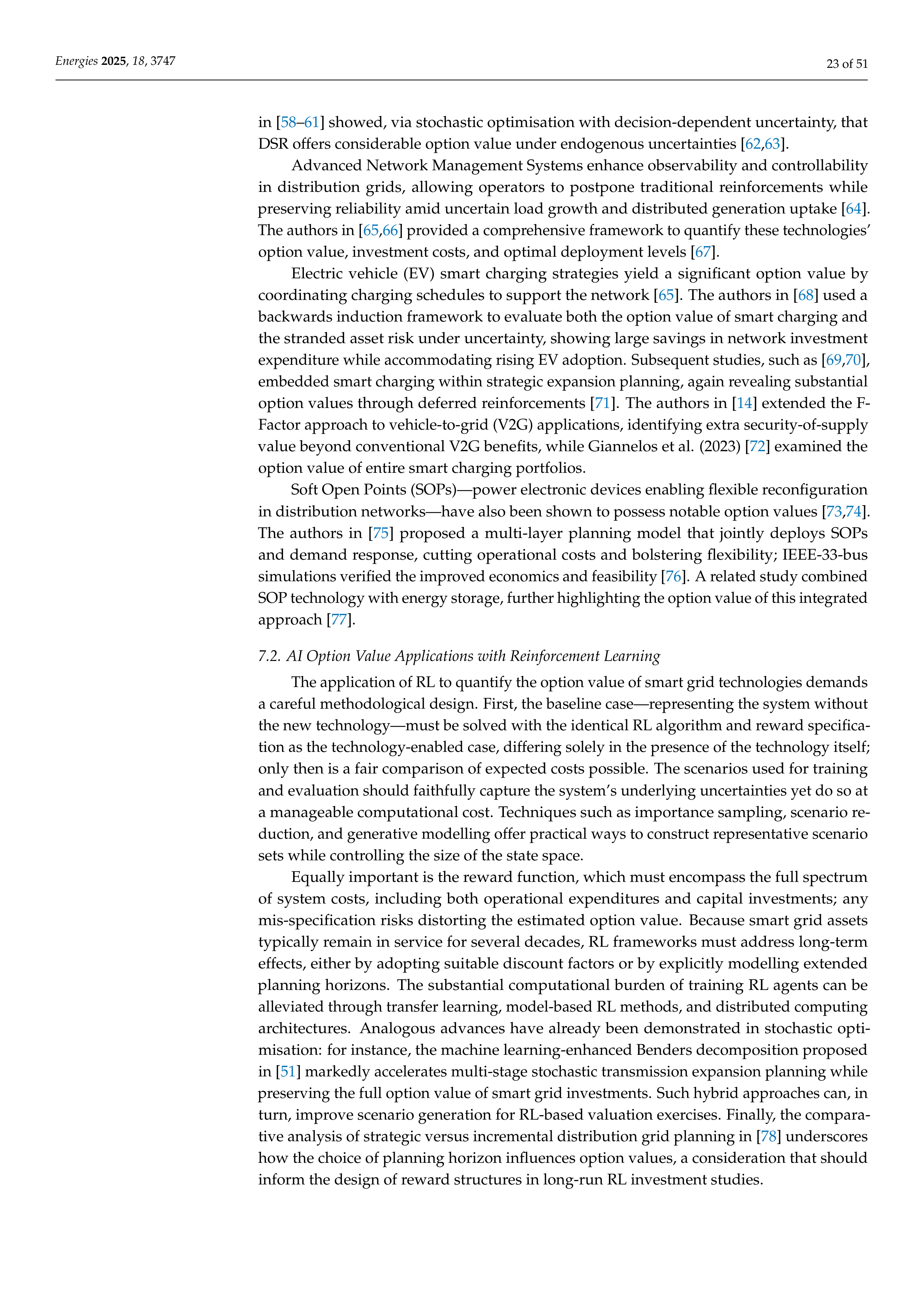
Energies
2025
,
18
, 3747
23 of 51
in [
58
–
61
] showed, via stochastic optimisation with decision-dependent uncertainty, that
DSR offers considerable option value under endogenous uncertainties [
62
,
63
].
Advanced Network Management Systems enhance observability and controllability
in
distribution
grids,
allowing
operators
to
postpone
traditional
reinforcements
while
preserving reliability amid uncertain load growth and distributed generation uptake [
64
].
The authors in [
65
,
66
] provided a comprehensive framework to quantify these technologies’
option value, investment costs, and optimal deployment levels [
67
].
Electric
vehicle
(EV)
smart
charging
strategies
yield
a
significant
option
value
by
coordinating charging schedules to support the network [
65
].
The authors in [
68
] used a
backwards induction framework to evaluate both the option value of smart charging and
the stranded asset risk under uncertainty, showing large savings in network investment
expenditure while accommodating rising EV adoption.
Subsequent studies, such as [
69
,
70
],
embedded smart charging within strategic expansion planning, again revealing substantial
option values through deferred reinforcements [
71
].
The authors in [
14
] extended the F-
Factor approach to vehicle-to-grid (V2G) applications, identifying extra security-of-supply
value beyond conventional V2G benefits, while Giannelos et al.
(2023) [
72
] examined the
option value of entire smart charging portfolios.
Soft Open Points (SOPs)—power electronic devices enabling flexible reconfiguration
in distribution networks—have also been shown to possess notable option values [
73
,
74
].
The
authors
in
[
75
]
proposed
a
multi-layer
planning
model
that
jointly
deploys
SOPs
and
demand
response,
cutting
operational
costs
and
bolstering
flexibility;
IEEE-33-bus
simulations verified the improved economics and feasibility [
76
].
A related study combined
SOP technology with energy storage, further highlighting the option value of this integrated
approach [
77
].
7.2.
AI Option Value Applications with Reinforcement Learning
The application of RL to quantify the option value of smart grid technologies demands
a careful methodological design.
First, the baseline case—representing the system without
the new technology—must be solved with the identical RL algorithm and reward specifica-
tion as the technology-enabled case, differing solely in the presence of the technology itself;
only then is a fair comparison of expected costs possible.
The scenarios used for training
and evaluation should faithfully capture the system’s underlying uncertainties yet do so at
a manageable computational cost.
Techniques such as importance sampling, scenario re-
duction, and generative modelling offer practical ways to construct representative scenario
sets while controlling the size of the state space.
Equally important is the reward function, which must encompass the full spectrum
of
system
costs,
including
both
operational
expenditures
and
capital
investments;
any
mis-specification risks distorting the estimated option value.
Because smart grid assets
typically remain in service for several decades, RL frameworks must address long-term
effects, either by adopting suitable discount factors or by explicitly modelling extended
planning horizons.
The substantial computational burden of training RL agents can be
alleviated through transfer learning, model-based RL methods, and distributed computing
architectures.
Analogous
advances
have
already
been
demonstrated
in
stochastic
opti-
misation:
for instance, the machine learning-enhanced Benders decomposition proposed
in [
51
] markedly accelerates multi-stage stochastic transmission expansion planning while
preserving the full option value of smart grid investments.
Such hybrid approaches can, in
turn, improve scenario generation for RL-based valuation exercises.
Finally, the compara-
tive analysis of strategic versus incremental distribution grid planning in [
78
] underscores
how the choice of planning horizon influences option values, a consideration that should
inform the design of reward structures in long-run RL investment studies.
Energies
2025
,
18
, 3747
24 of 51
7.3.
Future Research Directions
Several fruitful avenues remain for advancing reinforcement learning (RL) approaches
to option valuation in power systems.
To date, most investigations isolate individual tech-
nologies, whereas real-world grids rely on portfolios of complementary smart grid assets.
Portfolio-level valuation with RL could uncover synergistic combinations that create option
values surpassing the sum of their parts.
Moreover, distributional
RL—which
models the
entire
return
distribution
rather
than
only
its
expectation—can
offer
richer
insight
into
option values under rare or extreme conditions.
Because stakeholders differ in their risk
appetites,
risk-sensitive
RL
could
yield
valuations
tailored
to
specific
preferences
(e.g.,
risk-averse utility regulators).
Smart grid adoption also feeds back into market prices and
regulatory dynamics, effects largely omitted from current models; RL techniques that cap-
ture these feedback loops promise greater valuation accuracy.
Finally, regulatory approval
processes demand transparent justification, so advances in explainable RL are essential for
making valuation results interpretable and credible to regulators and other stakeholders.
8.
AI-Optimised Battery Energy Storage Systems
Battery
energy
storage
systems
(BESSs)
have
emerged
as
critical
infrastructure
for
managing renewable energy variability and providing grid services.
The integration of AI
has transformed these systems from passive storage devices into intelligent assets capable
of complex optimisation across multiple revenue streams.
8.1.
AI Applications in Battery Management
The authors in [
79
] provide a comprehensive overview of smart optimisation in battery
energy storage systems, published in
Energy Storage & Saving
.
Their review identifies how
AI techniques, from mathematical programming to advanced machine learning, enhance
BESS performance across grid-scale applications, microgrids, and residential settings.
The
integration
of
AI
with
battery
management
systems
enables
real-time
optimisation
of
charging/discharging cycles while considering battery degradation, market prices, and
grid requirements.
The practical implementation of AI in BESSs has shown significant economic benefits.
As
reported
in
[
80
],
AI-driven
optimisation
of
BESSs
in
solar
microgrids
has
achieved
energy efficiency improvements exceeding 30% compared to rule-based controllers.
These
systems process vast amounts of data including weather forecasts, consumption patterns,
and market signals to make real-time decisions about battery operation.
In India, AI models
deployed in microgrids across Uttar Pradesh and Bihar have reduced diesel backup use by
60%, demonstrating the technology’s impact in off-grid applications.
8.2.
Industrial-Scale Deployments
Major energy companies are investing heavily in AI-powered battery optimisation.
UBS Asset Management’s deployment of AI for its 730 MW battery storage portfolio in
Texas exemplifies industrial-scale implementation.
As documented by [
81
], the AI platform
monitors over 100,000 battery cells, automating KPI calculations and identifying anomalies
that would be impossible to detect manually. The system has enabled significant operational
savings while extending battery life through predictive maintenance.
The complexity of modern BESSs requires sophisticated AI approaches.
Specifically,
the authors of [
82
], in their critical review published in
Energy Exploration & Exploitation
,
describe how AI algorithms optimise battery charging and discharging cycles by analysing
historical data and real-time conditions.
These systems maximise efficiency by determining
optimal times to charge and discharge based on energy needs and market prices, reducing
dependence on fossil fuels during peak demand periods.
Energies
2025
,
18
, 3747
25 of 51
8.3.
Trading and Market Optimisation
AI has revolutionised how BESSs participate in electricity markets.
The authors in [
83
]
discuss the risks and rewards of AI optimisation for battery storage trading.
They highlight
how AI-driven solutions enable batteries to participate in multiple markets simultaneously,
from
energy
arbitrage
to
frequency
regulation.
However,
they
also
caution
about
the
“black box” nature of many vendor-supplied AI solutions, advocating for transparency and
human oversight.
Real-world
implementations
demonstrate
the
value
of
AI
in
battery
trading.
The
authors in [
84
] describe a custom AI solution for a renewable energy provider operating
multiple solar farms in the US. The system features two AI-powered forecasting modules
that
predict
energy
market
prices
and
solar
production,
identifying
optimal
times
for
battery charging and discharging.
The integrated solution automates trading decisions
while
considering
factors
such
as
weather
forecasts,
market
demand,
and
battery
state
of charge.
8.4.
Grid Integration and Future Prospects
The role of battery storage in supporting AI infrastructure itself has become increas-
ingly important.
As detailed in [
85
], the rapid growth of AI and data centres is creating
unprecedented energy demands.
Battery storage systems are emerging as key solutions,
providing reliable power for data centres while supporting grid stability.
The symbiotic re-
lationship between AI and energy storage—where AI optimises batteries that in turn power
AI infrastructure—represents a crucial development in sustainable technology deployment.
The integration of AI with BESSs continues to evolve with advances in both hardware
and software.
These developments promise even greater efficiency gains while addressing
concerns about data privacy and system transparency.
8.5.
Key Challenges in the Four Critical AI Application Areas
While the applications of AI in energy systems have shown remarkable promise, each
of
the
four
critical
areas
examined
in
this
review
faces
distinct
challenges
that
must
be
addressed for successful deployment and scaling.
8.5.1.
Challenges in Reinforcement Learning for Energy Optimisation
The application of reinforcement learning to energy systems faces several fundamental
challenges.
First, the sample efficiency problem is particularly acute in energy applications
where real-world experimentation is costly and potentially dangerous.
Unlike game en-
vironments where millions of episodes can be simulated rapidly, energy systems require
a careful consideration of safety constraints and operational limits, severely limiting the
exploration space.
Second, the sim-to-real gap poses significant challenges as RL agents
trained in simulation often fail to perform adequately when deployed in real systems due
to unmodelled dynamics, sensor noise, and actuator limitations.
Third, the non-stationary
nature of energy systems, where load patterns, generation profiles, and market conditions
continuously
evolve,
requires
RL
agents
to
adapt
to
distribution
shifts
that
violate
the
standard assumptions of stationary Markov Decision Processes.
Fourth, the multi-objective
nature of energy optimisation, balancing cost, reliability, emissions, and fairness, requires
sophisticated reward engineering that often leads to unintended consequences.
Finally,
the lack of interpretability in deep RL models creates barriers to adoption in safety-critical
infrastructure where operators need to understand and trust automated decisions.

Energies
2025
,
18
, 3747
26 of 51
8.5.2.
Challenges in Multi-Agent Systems for Distributed Energy Management
Multi-agent systems for energy management confront unique coordination and scal-
ability
challenges.
The
primary
challenge
lies
in
achieving
global
optimality
through
local interactions, as individual agents optimising their own objectives may lead to sub-
optimal system-wide outcomes.
Communication constraints in real-world deployments,
including
bandwidth
limitations,
latency,
and
packet
losses,
can
severely
degrade
the
performance of multi-agent coordination algorithms designed under ideal communication
assumptions.
The
heterogeneity
of
agents,
ranging
from
residential
smart
meters
with
limited computational resources to industrial energy management systems with sophisti-
cated optimisation capabilities, requires protocols that can accommodate vastly different
capabilities while ensuring fair participation.
Privacy concerns are particularly acute in
multi-agent systems where agents must share information to coordinate effectively while
protecting sensitive consumption data and business strategies.
Strategic behaviour and
gaming present additional challenges, as self-interested agents may misrepresent their ca-
pabilities or requirements to gain advantages, potentially destabilising market mechanisms
and grid operations.
Finally, the computational complexity of multi-agent coordination
grows exponentially with the number of agents, requiring approximation methods that
may sacrifice optimality for tractability.
8.5.3.
Challenges in Planning Under Uncertainty
Planning under uncertainty in energy systems faces the curse of dimensionality as
the number of uncertain variables and their potential correlations create computational
challenges
that
grow
exponentially.
The
fat-tailed
nature
of
extreme
events
in
energy
systems, from renewable generation drops to demand spikes, makes traditional uncertainty
quantification methods based on Gaussian assumptions inadequate.
Model uncertainty
compounds the challenge, as the true probability distributions of future events are unknown
and must be estimated from limited historical data that may not reflect future conditions
under
climate
change.
The
computational
burden
of
stochastic
optimisation
methods
often
requires
simplifications
that
may
eliminate
important
nonlinearities
and
integer
constraints, potentially leading to solutions that are infeasible in practice.
Temporal and
spatial correlations in uncertainties, such as wind patterns across geographical regions or
demand correlations across time periods, are difficult to capture accurately without making
the problem computationally intractable.
Finally, the challenge of validating uncertainty
models is significant, as rare events by definition provide limited data for validation, yet
these are often the most critical for system planning.
8.5.4.
Challenges in AI-Driven Resilience Enhancement
Implementing
AI
for
power
system
resilience
faces
the
fundamental
challenge
of
training for rare but high-impact events where historical data is scarce and may not rep-
resent future threats.
The adversarial nature of some resilience challenges,
particularly
cybersecurity threats, requires AI systems that can defend against intelligent attackers who
may specifically target AI vulnerabilities.
Real-time constraints in resilience applications
demand AI models that can make decisions in milliseconds while processing vast amounts
of streaming data from across the power system.
The cascading nature of power system fail-
ures creates complex dependencies that are difficult for AI models to capture, particularly
when failures propagate through cyber–physical interactions.
Integration challenges arise
from the need to coordinate AI-driven resilience measures with existing protection systems
and human operators who may not trust or understand AI recommendations during crisis
situations.
The validation and testing of AI resilience systems is particularly challenging,
as creating realistic test scenarios for extreme events without risking actual system damage
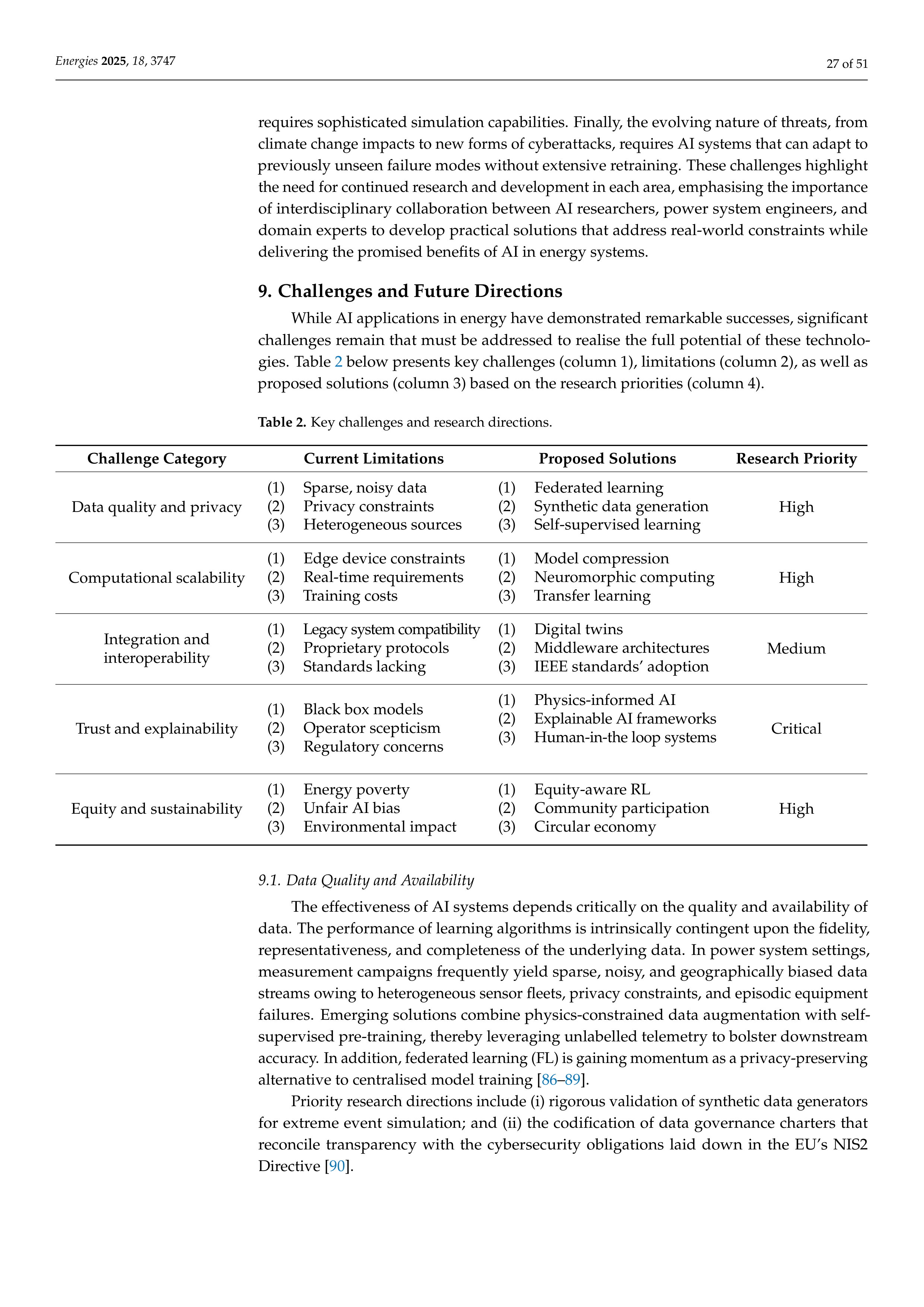
Energies
2025
,
18
, 3747
27 of 51
requires sophisticated simulation capabilities.
Finally, the evolving nature of threats, from
climate change impacts to new forms of cyberattacks, requires AI systems that can adapt to
previously unseen failure modes without extensive retraining.
These challenges highlight
the need for continued research and development in each area, emphasising the importance
of interdisciplinary collaboration between AI researchers, power system engineers, and
domain experts to develop practical solutions that address real-world constraints while
delivering the promised benefits of AI in energy systems.
9.
Challenges and Future Directions
While AI applications in energy have demonstrated remarkable successes, significant
challenges remain that must be addressed to realise the full potential of these technolo-
gies.
Table
2
below presents key challenges (column 1), limitations (column 2), as well as
proposed solutions (column 3) based on the research priorities (column 4).
Table 2.
Key challenges and research directions.
Challenge Category
Current Limitations
Proposed Solutions
Research Priority
Data quality and privacy
(1)
Sparse, noisy data
(2)
Privacy constraints
(3)
Heterogeneous sources
(1)
Federated learning
(2)
Synthetic data generation
(3)
Self-supervised learning
High
Computational scalability
(1)
Edge device constraints
(2)
Real-time requirements
(3)
Training costs
(1)
Model compression
(2)
Neuromorphic computing
(3)
Transfer learning
High
Integration and
interoperability
(1)
Legacy system compatibility
(2)
Proprietary protocols
(3)
Standards lacking
(1)
Digital twins
(2)
Middleware architectures
(3)
IEEE standards’ adoption
Medium
Trust and explainability
(1)
Black box models
(2)
Operator scepticism
(3)
Regulatory concerns
(1)
Physics-informed AI
(2)
Explainable AI frameworks
(3)
Human-in-the loop systems
Critical
Equity and sustainability
(1)
Energy poverty
(2)
Unfair AI bias
(3)
Environmental impact
(1)
Equity-aware RL
(2)
Community participation
(3)
Circular economy
High
9.1.
Data Quality and Availability
The effectiveness of AI systems depends critically on the quality and availability of
data.
The performance of learning algorithms is intrinsically contingent upon the fidelity,
representativeness, and completeness of the underlying data.
In power system settings,
measurement campaigns frequently yield sparse, noisy, and geographically biased data
streams owing to heterogeneous sensor fleets, privacy constraints, and episodic equipment
failures.
Emerging solutions combine physics-constrained data augmentation with self-
supervised pre-training, thereby leveraging unlabelled telemetry to bolster downstream
accuracy. In addition, federated learning (FL) is gaining momentum as a privacy-preserving
alternative to centralised model training [
86
–
89
].
Priority research directions include (i) rigorous validation of synthetic data generators
for
extreme
event
simulation;
and
(ii)
the
codification
of
data
governance
charters
that
reconcile
transparency
with
the
cybersecurity
obligations
laid
down
in
the
EU’s
NIS2
Directive [
90
].
Energies
2025
,
18
, 3747
28 of 51
9.2.
Computational Requirements and Scalability
Many AI algorithms, particularly deep learning approaches, require significant com-
putational
resources
for
training
and
deployment.
This
can
be
challenging
in
resource-
constrained environments such as edge devices in distribution systems.
Also, state-of-the-
art graph neural networks or deep reinforcement learning dispatchers often encompass
tens of millions of parameters, rendering real-time deployment on embedded controllers
prohibitive.
Empirical
evidence
from
the
Trans-Light
framework
for
transformer
fault
diagnosis demonstrates that structured pruning and multi-scale feature extraction can ef-
fectuate order-of-magnitude reductions in memory footprint without appreciable accuracy
loss [
91
].
In this context, developing lightweight AI models that maintain performance
while reducing computational requirements is an active area of research.
9.3.
Integration with Legacy Systems
The energy sector is characterised by long-lived infrastructure and legacy control sys-
tems.
Integrating modern AI systems with these legacy components presents technical and
organisational challenges.
Standardisation efforts and the development of interoperability
frameworks are crucial for enabling widespread AI adoption.
In this context, AI retrofits must interoperate with industrial SCADA protocols (e.g.,
IEC 61850, DNP3) and proprietary inverter firmware.
The IEEE 2030.7 standard [
92
] for
microgrid interoperability already supplies a semantic information model, yet mapping
modern machine learning workflows onto this schema remains largely manual and error-
prone.
Case study analyses of microgrid controllers underscore the value of digital twins
and OPC-UA wrappers that expose legacy devices as API-compliant entities [
92
].
Promising research avenues include middleware reference architectures that translate
between
event-driven
inference
pipelines
and
polling-based
SCADA
loops,
as
well
as
explainability layers that render ML recommendations as IEC 61850 logical-node events to
facilitate operator acceptance.
9.4.
Regulatory and Policy Considerations
The regulatory framework for electricity systems, developed for centralised generation
and one-way power flows, must evolve to accommodate AI-driven innovations.
Issues of
liability, transparency, and fairness in AI decision-making require careful consideration by
policymakers and regulators.
In particular, regulatory frameworks—originally architected for centralised, determin-
istic dispatch—now confront the advent of probabilistic,
autonomous decision-making.
The EU Artificial-Intelligence Act (Regulation 2024/1689) designates grid operation AI
as
high
risk,
thereby
mandating
transparency,
human
oversight,
and
post-deployment
monitoring regimes; moreover, it introduces explicit disclosure requirements regarding the
energy consumption of general-purpose AI models [
93
].
Parallel developments such as
the NIS2 Directive oblige distribution operators to implement comprehensive cyber-risk
management and incident-reporting protocols.
Key research challenges encompass (i) sector-specific conformity assessment proce-
dures; (ii) harmonised audit log ontologies to support accident forensics; and (iii) the design
of regulatory sandboxes that allow controlled experimentation with adaptive algorithms.
9.5.
Sustainable Communities and Energy Equity
The deployment of RL transcends narrow goals of technical optimisation or economic
efficiency,
increasingly
encompassing
urgent
social
imperatives
such
as
fairness,
inclu-
sivity,
and
long-run
community
resilience.
Contemporary
scholarship
recognises
that
next-generation energy infrastructures must actively support sustainable communities by
Energies
2025
,
18
, 3747
29 of 51
tackling chronic energy poverty [
94
–
97
] and by distributing benefits and risks equitably
across demographic, geographic, and socio-economic groups [
98
].
Accordingly, this section
investigates how RL methodologies—spanning single-agent, multi-agent, and hierarchi-
cal frameworks—can be harnessed to craft pragmatic solutions that integrate technical,
economic, and societal objectives throughout the energy transition lifecycle.
9.5.1.
Social Innovation in Community Energy Transitions
Energy transitions are now framed less as purely technological substitutions and more
as sociotechnical reconfigurations in which community agency plays a central role.
The
authors in [
99
] conducted a systematic review of social innovation pathways that propel
community-led energy projects, identifying citizen participation, institutional scaffolding,
and cooperative business models as recurring themes.
Their catalogue of nearly 300 empir-
ical cases underscores that successful transitions frequently hinge on collective choice rules,
trust-building processes, and locally tailored governance mechanisms—features that can
be explicitly encoded in RL environments through community-defined state variables and
reward functions [
100
,
101
].
Building
on
these
insights,
the
authors
in
[
102
]
proposed
conceptual
models
that
translate abstract notions of “energy citizenship” into operational design requirements,
emphasising deliberative workshops, participatory budgeting, and co-design of microgrid
tariffs.
Such participatory artefacts can be digitised into RL simulators wherein community
preferences, expressed via discrete surveys or continuous willingness-to-pay curves, guide
policy updates.
In parallel, the authors in [
103
] reviewed more than 100 European energy
community projects and distilled success factors—robust local engagement, supportive
yet flexible regulations,
and diversified revenue streams—that can be parameterised as
constraints, priors, or adaptive exploration bonuses inside RL algorithms, thereby ensuring
solutions remain aligned with heterogeneous stakeholder priorities.
9.5.2.
Energy Poverty:
Assessment and Mitigation
Energy poverty—defined as the lack of affordable, reliable, and clean energy—remains
a multidimensional global challenge affecting health, education, and economic opportunity.
While López-Vargas et al.
in [
104
] observed that bespoke AI efforts remain sparse, the field
is maturing rapidly.
Gawusu et al.
in [
105
] combined high-resolution satellite imagery with
census data to generate spatially explicit energy poverty risk maps, enabling policymakers
to visualise vulnerable clusters at a sub-district scale.
These predictive surfaces can serve
as dynamic state inputs to RL agents tasked with allocating limited retrofit subsidies or
off-grid
solar
kits
over
a
multi-year
horizon,
thereby
learning
strategies
that
minimise
population-weighted energy poverty indices subject to budget constraints.
Similarly, Abbas et al. [
106
] applied gradient-boosted decision trees to predict extreme
energy poverty conditions, revealing the education level, housing vintage, and climatic
zone
to
be
the
dominant
predictors.
These
feature
rankings
facilitate
dimensionality
reduction schemes that make RL training more sample efficient, while also guiding the
design of interpretable reward signals centred on deprivation gap reductions [
107
].
Che
et al.
in [
108
] further argued that regional heterogeneity—e.g., differences between urban
slums and rural hinterlands—complicates one-size-fits-all interventions, suggesting a need
for meta-RL or transfer learning techniques that can rapidly adapt policies to unseen local
contexts.
Complementary
work
by
Lippert
and
Sareen
[
109
]
used
big
data
analytics
to
show
that
decarbonisation
strategies
alleviate
energy
poverty
only
when
coupled
with
systemic policy reforms such as progressive tariff design, reinforcing the importance of RL
frameworks that jointly optimise technological roll-outs and institutional levers.
Energies
2025
,
18
, 3747
30 of 51
9.5.3.
AI Capabilities for Addressing Energy Poverty
Beyond discrete prediction tasks, AI provides a suite of cross-cutting capabilities that
can systematically disrupt the energy poverty cycle. At the diagnostic stage, remote-sensing
and computer-vision models applied to nighttime light emissions, roof materials, and urban
morphology now permit fine-grained mapping of deprivation where conventional surveys
are incomplete or outdated.
When fused with mobile phone metadata or crowdsourced
sensor
streams,
these
models
generate
dynamic
energy
poverty
“heat
maps,”
enabling
governments and utilities to track vulnerability in near real time and to anticipate seasonal
stress periods before they manifest as service interruptions.
Natural language processing
techniques, deployed on social media posts, call centre transcripts, or local-language news
articles, further enrich the evidence base by revealing latent patterns of complaint frequency,
arrears, or disconnection events that traditional datasets seldom capture.
AI’s utility extends from measurement to intervention design.
Forecasting models
blending weather projections,
tariff schedules,
and demographic profiles can guide the
timing and size of cash transfers, targeted rebate programmes, or appliance replacement
campaigns so
that assistance arrives
precisely when
households face
their peak energy
burdens.
Coupled with optimisation engines—ranging from mixed-integer programming
to deep RL—utilities can coordinate demand-response incentives that reduce peak loads
without
jeopardising
low-income
households’
essential
usage.
On
the
infrastructural
side, generative-design algorithms accelerate the siting and sizing of off-grid solar battery
systems
in
remote
regions,
jointly
optimising
cost,
reliability,
and
equity
criteria.
By
continuously assimilating feedback data, AI-enabled platforms can iterate policy portfolios
at a weekly or even daily cadence, transforming static welfare schemes into adaptive safety
nets that evolve with community needs and climatic variability.
9.5.4.
Democratised Energy Markets and Community Participation
RL also shows promise for widening participation in increasingly decentralised energy
markets.
Piras et al.
in [
110
] released an open-source platform that automates the formation
of
renewable
energy
communities
by
clustering
prosumers
based
on
load–generation
profiles and socio-economic compatibility.
Embedding such clustering modules as pre-
processing
layers
inside
multi-agent
RL
schemes
enables
the
automated
negotiation
of
peer-to-peer
contracts,
dynamic
adjustment
of
community-level
tariffs,
and
equitable
sharing of ancillary service revenues.
Within policy discourse, the notion of a “just energy transition” has become central.
Del Guayo and Cuesta in [
111
] critiqued the European Just Transition Fund for its narrow
focus
on
coal-dependent
regions,
arguing
that
justice
considerations
extend
to
lithium-
mining
externalities,
rural
landscape
impacts,
and
the
exacerbation
of
energy
poverty
among low-income tenants.
RL’s capacity for multi-objective optimisation—e.g., via Pareto
front approximations or scalarised composite rewards—can provide decision-makers with
explicit trade-off curves between carbon abatement, employment loss, and distributional
equity, thereby enhancing transparency and accountability in policy design.
9.5.5.
Equity-Aware Reinforcement Learning Frameworks
Embedding equity directly into RL objectives remains an open research frontier.
Chen
et al.
in [
112
] dissected how bias can be introduced at multiple stages—data collection,
algorithmic
modelling,
and
feedback
loops—potentially
amplifying
existing
inequities.
They
proposed
a
governance–technical
hybrid
framework
that
merges
fairness-aware
reward shaping (e.g., penalising Gini coefficient increases) with periodic human oversight,
akin
to
a
“human-in-the-loop
RL
auditor.”
Kaur
in
[
113
]
likewise
argued
for
socially
inclusive AI, emphasising participatory data governance, federated learning protocols that
Energies
2025
,
18
, 3747
31 of 51
respect data sovereignty, and stakeholder-driven scenario co-creation.
RL implementations
could incorporate these principles by adopting constrained policy optimisation (CPO) or
Lagrangian multi-objective algorithms that guarantee hard fairness constraints while still
seeking performance gains.
9.5.6.
Ethical Considerations in AI-Driven Energy Systems
The
ethical
dimensions
of
AI
in
energy
systems
have
attracted
mounting
scrutiny.
Chauhan et al.
(2024) [
114
] highlighted tensions between the rapid pace of technological
deployment
and
the
slower
evolution
of
governance
safeguards,
cautioning
that
path
dependency in model deployment can lock communities into suboptimal equilibria.
They
advocate for ex ante ethical impact assessments analogous to environmental impact state-
ments,
coupled
with
ex
post
auditing
of
RL
decisions.
Jain
and
Mitra
in
[
115
]
further
called
for
human-centred
AI
frameworks
that
explicitly
prioritise
marginalised
groups
in achieving the Sustainable Development Goals, including universal energy access.
RL
systems
could
operationalise
these
commitments
by
adopting
value-directed
planning
paradigms where reward functions are co-designed with community representatives, and
by providing counterfactual explanations that render complex policies intelligible to non-
technical stakeholders.
Nalli et al.
in [
116
] proposed design blueprints for intelligent energy equity platforms
that integrate demand-response scheduling, peer-to-peer micro-loans for rooftop solar, and
equity-aware tariff design—all orchestrated by RL agents that continuously balance grid
stability with affordability and inclusion targets.
9.5.7.
Research Directions and Implementation Challenges
Despite growing enthusiasm, equity-aware RL confronts several acute implementa-
tion hurdles:
Fairness metric selection:
choosing between group parity, individual parity, or counter-
factual fairness metrics materially shapes policy outcomes; hybrid metrics may be required
to capture context-specific notions of equity.
Data representativeness:
acquiring granular, longitudinal, and unbiased data across
diverse communities remains difficult; privacy-preserving synthetic data generation and
federated RL could partially offset this constraint.
Efficiency–equity
trade-offs:
optimising
for
cost
minimisation
and
fairness
often
reveals
Pareto
conflicts;
multi-objective
RL
and
risk-sensitive
policies
offer
algorithmic
avenues for navigating these tensions.
Alturif et al.
in [
117
] underscored AI’s transformative potential in poverty prediction
and mitigation, yet stressed that algorithmic efficacy depends on integrating social policy
expertise and building institutional capacities for evidence-driven decision-making.
RL,
with its emphasis on sequential, adaptive intervention planning, can extend these capa-
bilities
by
continuously
learning
from
policy
feedback
and
adjusting
strategies
in
near
real time.
Future
work
should
prioritise
(i)
constructing
benchmark
environments
and
open
datasets that foreground equity-relevant variables, (ii) designing multi-objective RL algo-
rithms capable of reasoning over long-term social welfare metrics, and (iii) establishing
participatory governance mechanisms that democratise model oversight.
As energy infras-
tructures become increasingly decentralised, digitised, and interdependent, RL method-
ologies capable of navigating multidimensional technical, economic, and ethical trade-offs
will be indispensable for realising genuinely sustainable and just energy futures.
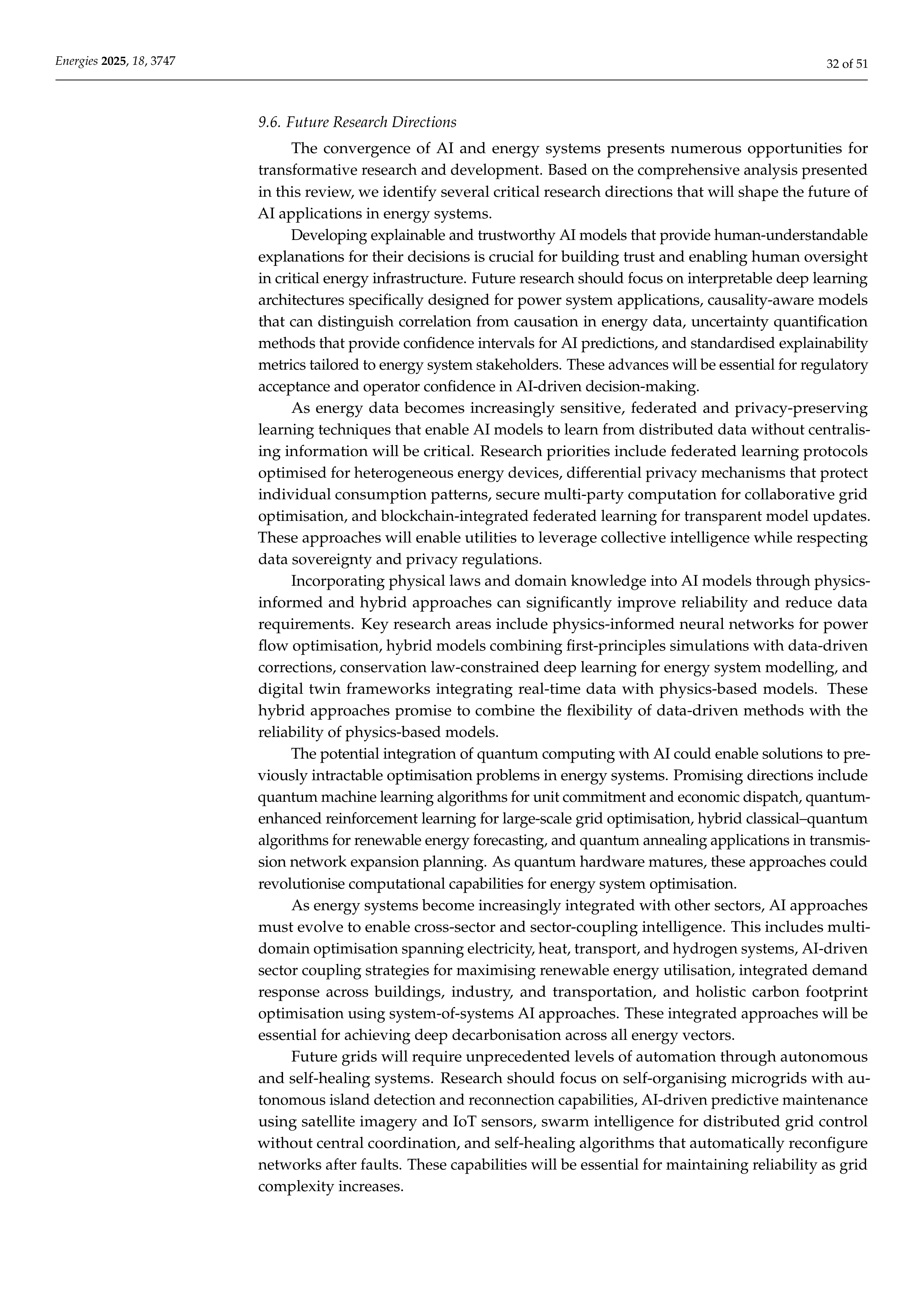
Energies
2025
,
18
, 3747
32 of 51
9.6.
Future Research Directions
The
convergence
of
AI
and
energy
systems
presents
numerous
opportunities
for
transformative research and development.
Based on the comprehensive analysis presented
in this review, we identify several critical research directions that will shape the future of
AI applications in energy systems.
Developing explainable and trustworthy AI models that provide human-understandable
explanations for their decisions is crucial for building trust and enabling human oversight
in critical energy infrastructure. Future research should focus on interpretable deep learning
architectures specifically designed for power system applications, causality-aware models
that can distinguish correlation from causation in energy data,
uncertainty quantification
methods that provide confidence intervals for AI predictions, and standardised explainability
metrics tailored to energy system stakeholders. These advances will be essential for regulatory
acceptance and operator confidence in AI-driven decision-making.
As
energy
data
becomes
increasingly
sensitive,
federated
and
privacy-preserving
learning techniques that enable AI models to learn from distributed data without centralis-
ing information will be critical.
Research priorities include federated learning protocols
optimised for heterogeneous energy devices, differential privacy mechanisms that protect
individual consumption patterns, secure multi-party computation for collaborative grid
optimisation, and blockchain-integrated federated learning for transparent model updates.
These approaches will enable utilities to leverage collective intelligence while respecting
data sovereignty and privacy regulations.
Incorporating physical laws and domain knowledge into AI models through physics-
informed
and
hybrid
approaches
can
significantly
improve
reliability
and
reduce
data
requirements.
Key research areas include physics-informed neural networks for power
flow optimisation, hybrid models combining first-principles simulations with data-driven
corrections, conservation law-constrained deep learning for energy system modelling, and
digital
twin
frameworks
integrating
real-time
data
with
physics-based
models.
These
hybrid
approaches
promise
to
combine
the
flexibility
of
data-driven
methods
with
the
reliability of physics-based models.
The potential integration of quantum computing with AI could enable solutions to pre-
viously intractable optimisation problems in energy systems. Promising directions include
quantum machine learning algorithms for unit commitment and economic dispatch, quantum-
enhanced reinforcement learning for large-scale grid optimisation, hybrid classical–quantum
algorithms for renewable energy forecasting, and quantum annealing applications in transmis-
sion network expansion planning. As quantum hardware matures, these approaches could
revolutionise computational capabilities for energy system optimisation.
As energy systems become increasingly integrated with other sectors, AI approaches
must evolve to enable cross-sector and sector-coupling intelligence.
This includes multi-
domain optimisation spanning electricity, heat, transport, and hydrogen systems, AI-driven
sector coupling strategies for maximising renewable energy utilisation, integrated demand
response
across
buildings,
industry,
and
transportation,
and
holistic
carbon
footprint
optimisation using system-of-systems AI approaches.
These integrated approaches will be
essential for achieving deep decarbonisation across all energy vectors.
Future grids will require unprecedented levels of automation through autonomous
and self-healing systems.
Research should focus on self-organising microgrids with au-
tonomous island detection and reconnection capabilities, AI-driven predictive maintenance
using satellite imagery and IoT sensors, swarm intelligence for distributed grid control
without central coordination, and self-healing algorithms that automatically reconfigure
networks after faults.
These capabilities will be essential for maintaining reliability as grid
complexity increases.
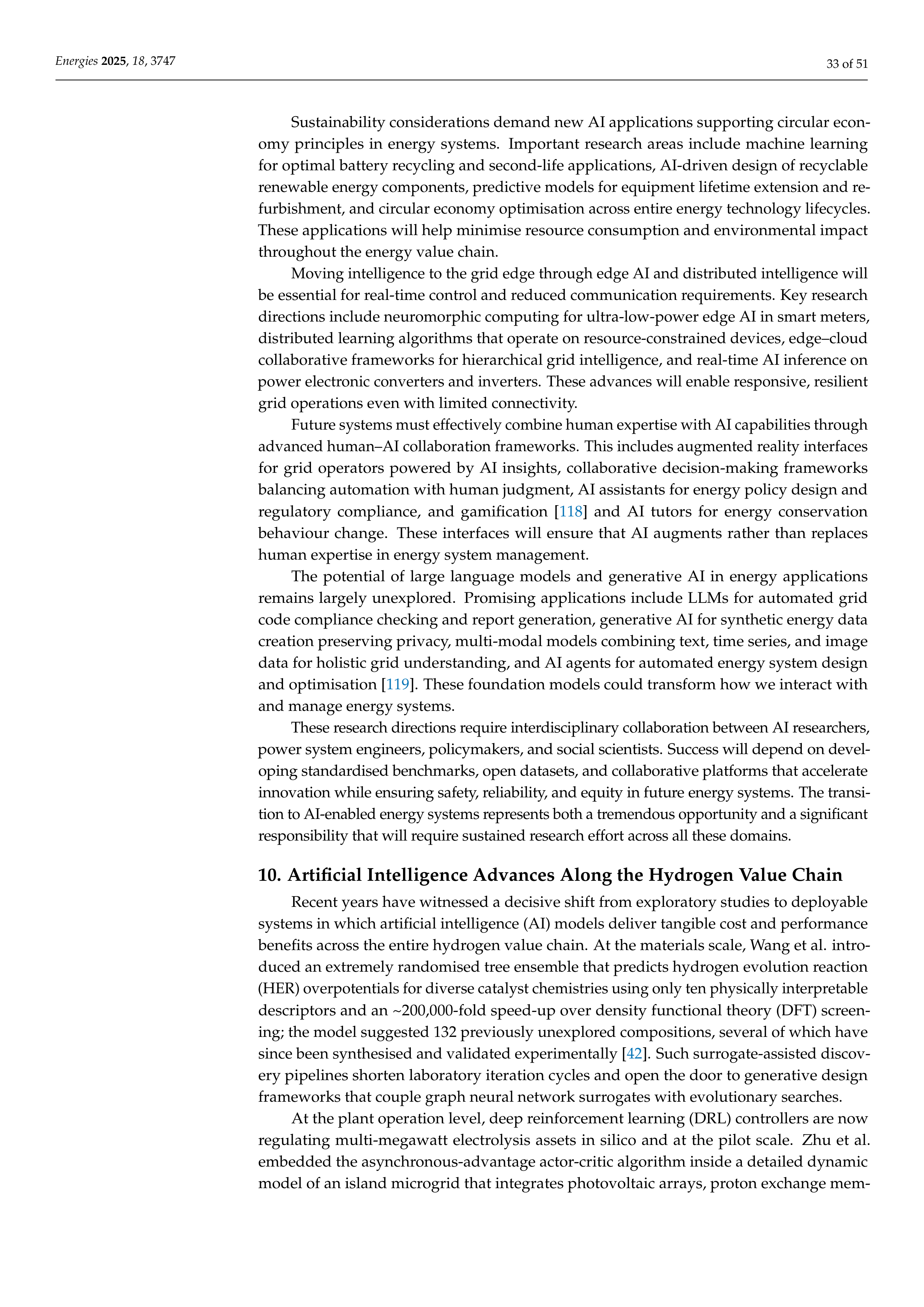
Energies
2025
,
18
, 3747
33 of 51
Sustainability considerations demand new AI applications supporting circular econ-
omy
principles
in
energy
systems.
Important
research
areas
include
machine
learning
for optimal battery recycling and second-life applications, AI-driven design of recyclable
renewable energy components, predictive models for equipment lifetime extension and re-
furbishment, and circular economy optimisation across entire energy technology lifecycles.
These applications will help minimise resource consumption and environmental impact
throughout the energy value chain.
Moving intelligence to the grid edge through edge AI and distributed intelligence will
be essential for real-time control and reduced communication requirements.
Key research
directions include neuromorphic computing for ultra-low-power edge AI in smart meters,
distributed learning algorithms that operate on resource-constrained devices, edge–cloud
collaborative frameworks for hierarchical grid intelligence, and real-time AI inference on
power electronic converters and inverters.
These advances will enable responsive, resilient
grid operations even with limited connectivity.
Future systems must effectively combine human expertise with AI capabilities through
advanced human–AI collaboration frameworks.
This includes augmented reality interfaces
for
grid
operators
powered
by
AI
insights,
collaborative
decision-making
frameworks
balancing automation with human judgment, AI assistants for energy policy design and
regulatory
compliance,
and
gamification
[
118
]
and
AI
tutors
for
energy
conservation
behaviour
change.
These
interfaces
will
ensure
that
AI
augments
rather
than
replaces
human expertise in energy system management.
The
potential
of
large
language
models
and
generative
AI
in
energy
applications
remains
largely
unexplored.
Promising
applications
include
LLMs
for
automated
grid
code compliance checking and report generation, generative AI for synthetic energy data
creation preserving privacy, multi-modal models combining text, time series, and image
data for holistic grid understanding, and AI agents for automated energy system design
and optimisation [
119
].
These foundation models could transform how we interact with
and manage energy systems.
These research directions require interdisciplinary collaboration between AI researchers,
power system engineers, policymakers, and social scientists. Success will depend on devel-
oping standardised benchmarks, open datasets, and collaborative platforms that accelerate
innovation while ensuring safety, reliability, and equity in future energy systems. The transi-
tion to AI-enabled energy systems represents both a tremendous opportunity and a significant
responsibility that will require sustained research effort across all these domains.
10.
Artificial Intelligence Advances Along the Hydrogen Value Chain
Recent years have witnessed a decisive shift from exploratory studies to deployable
systems in which artificial intelligence (AI) models deliver tangible cost and performance
benefits across the entire hydrogen value chain.
At the materials scale, Wang et al.
intro-
duced an extremely randomised tree ensemble that predicts hydrogen evolution reaction
(HER) overpotentials for diverse catalyst chemistries using only ten physically interpretable
descriptors and an ~200,000-fold speed-up over density functional theory (DFT) screen-
ing; the model suggested 132 previously unexplored compositions, several of which have
since been synthesised and validated experimentally [
42
].
Such surrogate-assisted discov-
ery pipelines shorten laboratory iteration cycles and open the door to generative design
frameworks that couple graph neural network surrogates with evolutionary searches.
At the plant operation level, deep reinforcement learning (DRL) controllers are now
regulating
multi-megawatt
electrolysis
assets
in
silico
and
at
the
pilot
scale.
Zhu
et
al.
embedded the asynchronous-advantage actor-critic algorithm inside a detailed dynamic
model of an island microgrid that integrates photovoltaic arrays, proton exchange mem-
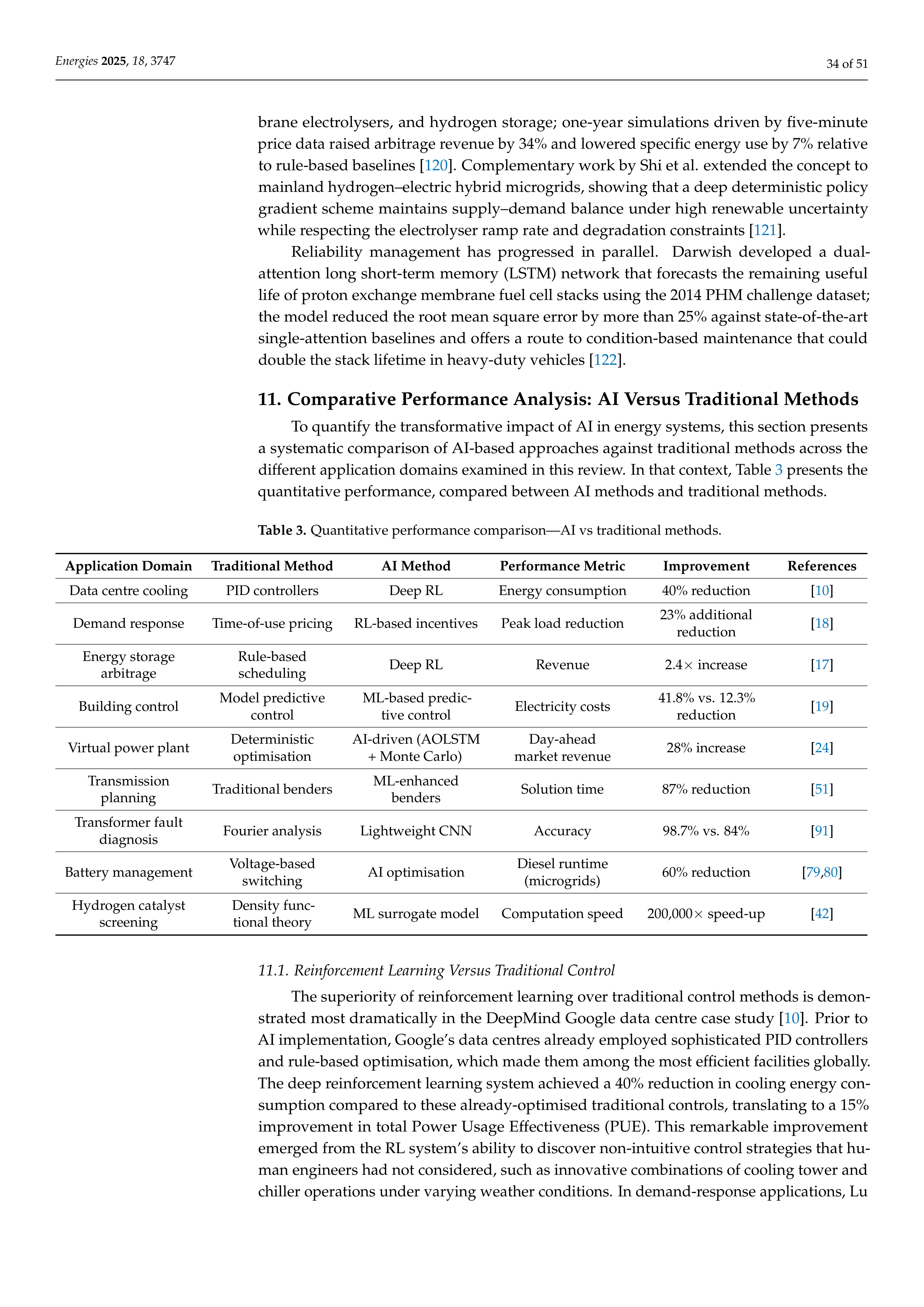
Energies
2025
,
18
, 3747
34 of 51
brane
electrolysers,
and
hydrogen
storage;
one-year
simulations
driven
by
five-minute
price data raised arbitrage revenue by 34% and lowered specific energy use by 7% relative
to rule-based baselines [
120
].
Complementary work by Shi et al.
extended the concept to
mainland hydrogen–electric hybrid microgrids, showing that a deep deterministic policy
gradient scheme maintains supply–demand balance under high renewable uncertainty
while respecting the electrolyser ramp rate and degradation constraints [
121
].
Reliability
management
has
progressed
in
parallel.
Darwish
developed
a
dual-
attention long short-term memory (LSTM) network that forecasts the remaining useful
life of proton exchange membrane fuel cell stacks using the 2014 PHM challenge dataset;
the model reduced the root mean square error by more than 25% against state-of-the-art
single-attention baselines and offers a route to condition-based maintenance that could
double the stack lifetime in heavy-duty vehicles [
122
].
11.
Comparative Performance Analysis:
AI Versus Traditional Methods
To quantify the transformative impact of AI in energy systems, this section presents
a systematic comparison of AI-based approaches against traditional methods across the
different application domains examined in this review.
In that context, Table
3
presents the
quantitative performance, compared between AI methods and traditional methods.
Table 3.
Quantitative performance comparison—AI vs traditional methods.
Application Domain
Traditional Method
AI Method
Performance Metric
Improvement
References
Data centre cooling
PID controllers
Deep RL
Energy consumption
40% reduction
[
10
]
Demand response
Time-of-use pricing
RL-based incentives
Peak load reduction
23% additional
reduction
[
18
]
Energy storage
arbitrage
Rule-based
scheduling
Deep RL
Revenue
2.4
×
increase
[
17
]
Building control
Model predictive
control
ML-based predic-
tive control
Electricity costs
41.8% vs.
12.3%
reduction
[
19
]
Virtual power plant
Deterministic
optimisation
AI-driven (AOLSTM
+ Monte Carlo)
Day-ahead
market revenue
28% increase
[
24
]
Transmission
planning
Traditional benders
ML-enhanced
benders
Solution time
87% reduction
[
51
]
Transformer fault
diagnosis
Fourier analysis
Lightweight CNN
Accuracy
98.7% vs.
84%
[
91
]
Battery management
Voltage-based
switching
AI optimisation
Diesel runtime
(microgrids)
60% reduction
[
79
,
80
]
Hydrogen catalyst
screening
Density func-
tional theory
ML surrogate model
Computation speed
200,000
×
speed-up
[
42
]
11.1.
Reinforcement Learning Versus Traditional Control
The superiority of reinforcement learning over traditional control methods is demon-
strated most dramatically in the DeepMind Google data centre case study [
10
].
Prior to
AI implementation, Google’s data centres already employed sophisticated PID controllers
and rule-based optimisation, which made them among the most efficient facilities globally.
The deep reinforcement learning system achieved a 40% reduction in cooling energy con-
sumption compared to these already-optimised traditional controls, translating to a 15%
improvement in total Power Usage Effectiveness (PUE). This remarkable improvement
emerged from the RL system’s ability to discover non-intuitive control strategies that hu-
man engineers had not considered, such as innovative combinations of cooling tower and
chiller operations under varying weather conditions.
In demand-response applications, Lu
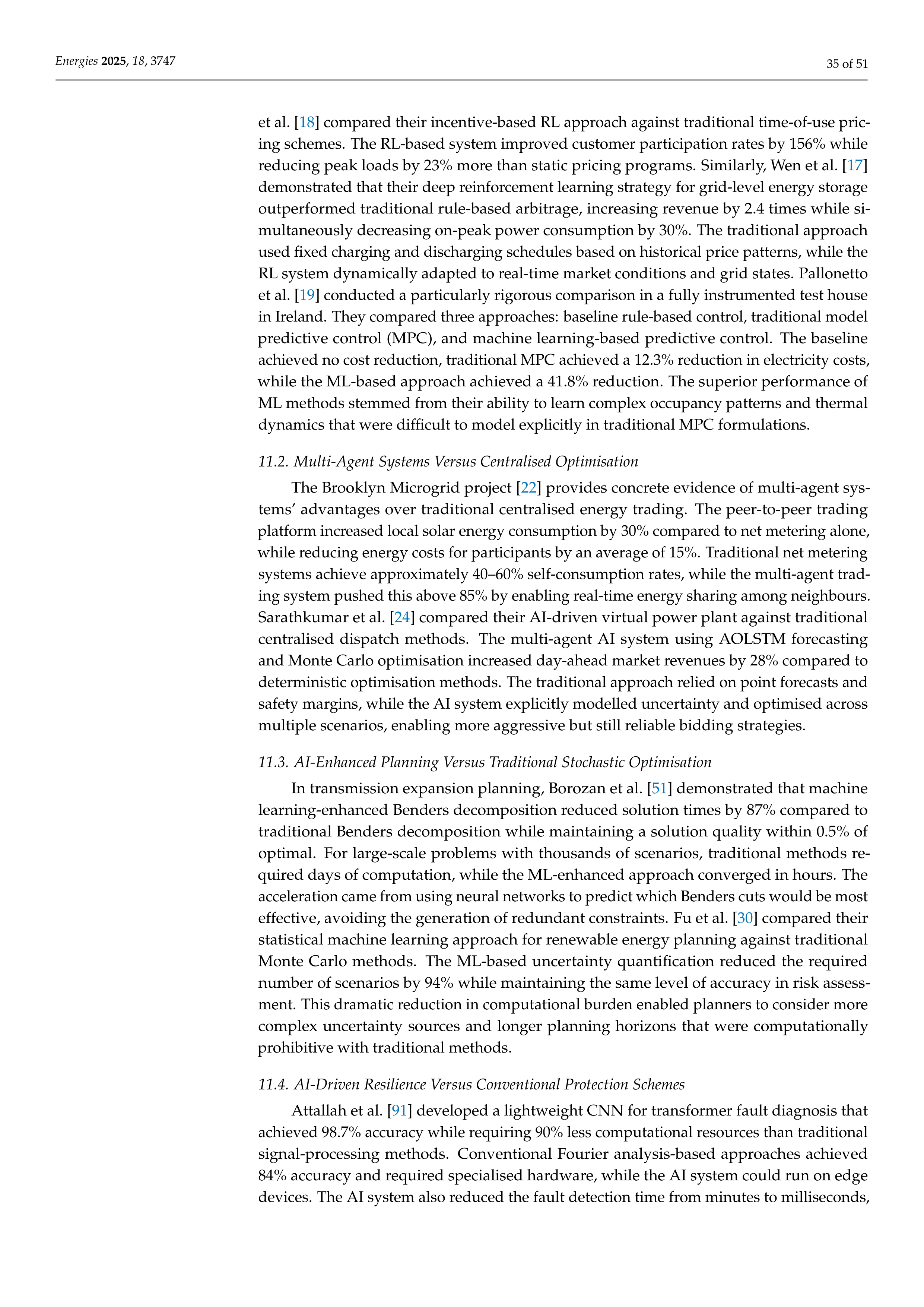
Energies
2025
,
18
, 3747
35 of 51
et al. [
18
] compared their incentive-based RL approach against traditional time-of-use pric-
ing schemes.
The RL-based system improved customer participation rates by 156% while
reducing peak loads by 23% more than static pricing programs.
Similarly, Wen et al. [
17
]
demonstrated that their deep reinforcement learning strategy for grid-level energy storage
outperformed traditional rule-based arbitrage, increasing revenue by 2.4 times while si-
multaneously decreasing on-peak power consumption by 30%.
The traditional approach
used fixed charging and discharging schedules based on historical price patterns, while the
RL system dynamically adapted to real-time market conditions and grid states.
Pallonetto
et al. [
19
] conducted a particularly rigorous comparison in a fully instrumented test house
in Ireland.
They compared three approaches:
baseline rule-based control, traditional model
predictive control (MPC), and machine learning-based predictive control.
The baseline
achieved no cost reduction, traditional MPC achieved a 12.3% reduction in electricity costs,
while the ML-based approach achieved a 41.8% reduction.
The superior performance of
ML methods stemmed from their ability to learn complex occupancy patterns and thermal
dynamics that were difficult to model explicitly in traditional MPC formulations.
11.2.
Multi-Agent Systems Versus Centralised Optimisation
The Brooklyn Microgrid project [
22
] provides concrete evidence of multi-agent sys-
tems’
advantages
over
traditional
centralised
energy
trading.
The
peer-to-peer
trading
platform increased local solar energy consumption by 30% compared to net metering alone,
while reducing energy costs for participants by an average of 15%.
Traditional net metering
systems achieve approximately 40–60% self-consumption rates, while the multi-agent trad-
ing system pushed this above 85% by enabling real-time energy sharing among neighbours.
Sarathkumar et al. [
24
] compared their AI-driven virtual power plant against traditional
centralised
dispatch
methods.
The
multi-agent
AI
system
using
AOLSTM
forecasting
and Monte Carlo optimisation increased day-ahead market revenues by 28% compared to
deterministic optimisation methods.
The traditional approach relied on point forecasts and
safety margins, while the AI system explicitly modelled uncertainty and optimised across
multiple scenarios, enabling more aggressive but still reliable bidding strategies.
11.3.
AI-Enhanced Planning Versus Traditional Stochastic Optimisation
In transmission expansion planning, Borozan et al. [
51
] demonstrated that machine
learning-enhanced Benders decomposition reduced solution times by 87% compared to
traditional Benders decomposition while maintaining a solution quality within 0.5% of
optimal.
For
large-scale
problems
with
thousands
of
scenarios,
traditional
methods
re-
quired days of computation, while the ML-enhanced approach converged in hours.
The
acceleration came from using neural networks to predict which Benders cuts would be most
effective, avoiding the generation of redundant constraints.
Fu et al. [
30
] compared their
statistical machine learning approach for renewable energy planning against traditional
Monte
Carlo
methods.
The
ML-based
uncertainty
quantification
reduced
the
required
number of scenarios by 94% while maintaining the same level of accuracy in risk assess-
ment.
This dramatic reduction in computational burden enabled planners to consider more
complex
uncertainty
sources
and
longer
planning
horizons
that
were
computationally
prohibitive with traditional methods.
11.4.
AI-Driven Resilience Versus Conventional Protection Schemes
Attallah et al. [
91
] developed a lightweight CNN for transformer fault diagnosis that
achieved 98.7% accuracy while requiring 90% less computational resources than traditional
signal-processing
methods.
Conventional
Fourier
analysis-based
approaches
achieved
84% accuracy and required specialised hardware, while the AI system could run on edge
devices.
The AI system also reduced the fault detection time from minutes to milliseconds,
Energies
2025
,
18
, 3747
36 of 51
enabling faster protective actions.
For extreme weather resilience, Kezunovic [
31
] reported
that AI-based predictive maintenance reduced weather-related outages by 35% compared
to traditional time-based maintenance schedules.
The AI system analysed satellite imagery,
weather forecasts, and equipment condition data to prioritise maintenance activities, while
traditional approaches relied on fixed inspection intervals regardless of actual risk levels.
11.5.
Battery Storage Optimisation
Modern AI optimisation of battery energy storage systems shows dramatic improve-
ments over traditional control methods.
As reported in industry analyses [
80
], AI-driven
optimisation in solar microgrids achieved energy efficiency improvements exceeding 30%
compared
to
rule-based
controllers.
In
specific
implementations
across
rural
India,
AI-
optimised battery management reduced the diesel generator runtime by 60% compared to
traditional voltage-based switching, generating both economic and environmental benefits.
Song et al. [
79
] synthesised results from multiple studies showing that AI-based battery
management systems typically extend the battery lifetime by 20–40% compared to tradi-
tional charge controllers through better prediction of optimal charge/discharge cycles and
avoidance of degradation-inducing operations.
Traditional controllers use fixed voltage
and current thresholds, while AI systems learn complex relationships between operating
conditions and battery health.
11.6.
Hydrogen Production Optimisation
In the hydrogen sector, Wang et al. [
42
] achieved a 200,000-fold speed-up in catalyst
screening compared to traditional density functional theory calculations.
While traditional
computational chemistry methods required hours per catalyst candidate, the ML model
evaluated candidates in milliseconds with comparable accuracy.
This acceleration enabled
the exploration of previously intractable chemical spaces, leading to the identification of
132 promising catalyst compositions that traditional methods would have missed.
Zhu
et al. [
120
] demonstrated that deep reinforcement learning control of hydrogen production
in microgrids increased arbitrage revenue by 34% and reduced specific energy consumption
by 7% compared to rule-based scheduling.
The traditional approach used fixed electrolyser
operating schedules based on average electricity prices, while the RL system dynamically
adjusted
production
based
on
real-time
prices
and
storage
levels.
These
quantitative
comparisons demonstrate that AI methods consistently outperform traditional approaches
across
all
major
application
areas
in
energy
systems,
with
improvements
ranging
from
20% to over 200,000-fold depending on the specific application.
The advantages stem from
AI’s ability to learn complex patterns, adapt to changing conditions, and optimise across
multiple objectives simultaneously—capabilities that traditional methods cannot match.
12.
AI Applications in Power Electronics for Energy Systems
Power electronics serve as the critical interface between renewable energy sources,
energy storage systems, and the electrical grid, making their intelligent control essential for
the energy transition.
Recent advances in AI-driven power electronics control represent a
significant frontier in energy system optimisation.
12.1.
Overview of AI in Power Electronics
The application of AI to power electronics has evolved rapidly, as comprehensively
reviewed
by
Zhao
et
al.
[
123
],
who
analysed
over
500
journal
papers
published
up
to
2020 in
IEEE Transactions on Power Electronics
.
Their Sankey analysis reveals that control
research dominates the field at approximately 77.8%, with design applications at 9.8% and
maintenance
at
12.4%.
The
field
employs
four
main
method
families—expert
systems,
fuzzy logic, meta-heuristic optimisation, and machine learning—with machine learning
Energies
2025
,
18
, 3747
37 of 51
now being the most prevalent.
The evolution, traced from early rule-based approaches
through
neural
network
variants
to
more
recent
Bayesian
and
reinforcement
learning
models,
reflects
significant
methodological
advances.
However,
persistent
challenges
include limited datasets, on-board computational constraints, and the “black box” opacity
of many models that hinders industrial trust and adoption.
12.2.
Reinforcement Learning for Converter Control
A
significant
advance
in
AI-powered
converter
control
is
demonstrated
by
Zeng
et al. [
124
], who developed an Easy Transfer Reinforcement Learning (ETRL) framework for
grid-following converters.
This five-stage workflow—encompassing system description,
DRL
training,
distribution
alignment
via
CORAL,
small
experimental
fine-tuning,
and
real-time
deployment—enables
a
controller
trained
for
one
converter
to
be
adapted
to
others with different parameters while avoiding hyper-parameter retuning.
Compared
with training a fresh DRL controller from scratch, ETRL cuts training episodes by 96.4%
while maintaining a fast response and impedance stability targets, with settling times under
approximately 12 ms and positive phase margins across strong,
weak,
and unbalanced
grids.
Hardware tests confirm its robustness under 25% voltage sags and swells, showing a
markedly lower mean absolute percentage error than conventional PI, standalone DRL, or
other transfer learning baselines.
The method brings the total training time below 15 min,
with the average power error around 0.3 kVA.
12.3.
AI Applications Across the Power Electronics Lifecycle
Recent comprehensive reviews identify diverse AI applications throughout power
electronics systems.
Patil et al. [
125
] examine how AI methods enhance power electronics
and drive systems across sectors including electric vehicles,
renewables,
and industrial
automation.
They compare machine learning, fuzzy logic, and meta-heuristic optimisation
approaches for converter control, fault diagnosis, and design optimisation.
Concrete exam-
ples demonstrate AI improving the real-time control of converters, predicting component
failures, and managing energy through load scheduling and demand-side strategies.
In
the
design
phase,
Shen
et
al.
[
126
]
surveyed
more
than
200
publications,
providing
the
first unified overview of AI techniques for designing high-frequency inductors and trans-
formers.
They detail AI-driven loss estimation models including ANN, transfer learning,
LSTM, and hybrid GA/PSO/DE approaches that, together with optimisation algorithms,
can shrink the component size, cut losses, and automate geometry and material selection.
Publication trends since 2000 reveal an accelerating uptake of AI, with designers using
surrogate models and multi-objective optimisers to boost efficiency, power density, and
design speed.
12.4.
Integration with Renewable Energy and Grid Applications
Qashqai et al. [
127
] survey recent research applying AI techniques to power electron-
ics
problems,
including
converter
pre-sizing
with
genetic
algorithms,
wind
power
and
load
forecasting,
cloud-based
PV
monitoring,
and
fault
detection
in
transmission
lines
and multilevel converters.
They show neural networks accelerating or replacing model-
predictive control, generating optimal gate-switching pulses, tuning PID parameters, and
compensating for load-induced disturbances, allowing high-performance converters to run
on cheaper processors.
The authors describe how cloud computing both enables scalable
AI diagnostics for solar farms and can itself be powered by PV systems, underscoring the
symbiosis between renewables and digital intelligence.
Energies
2025
,
18
, 3747
38 of 51
12.5.
Emerging Trends and Future Directions
Multiple reviews identify converging trends shaping the future of AI in power elec-
tronics.
Patil et al. [
125
] highlight emerging approaches including reinforcement learning,
edge
computing,
and
hybrid
AI
methods,
while
noting
persistent
hurdles
around
data
quality, model transparency, and the lack of industry standards.
Zhao et al. [
123
] call for
computation- and data-light, explainable, and privacy-preserving AI solutions to make
intelligent, autonomous power electronic systems both practical and trustworthy in indus-
try.
Shen
et
al.
[
126
]
identify
critical
gaps
including
the
need
for
large,
shared
datasets,
integrated thermal models, and end-to-end automated design workflows.
They argue that
combining comprehensive databases with multi-physics, AI-based optimisation will be key
to the next generation of magnetic components.
As converter topologies and operating con-
ditions grow more complex, these reviews collectively conclude that adaptive AI methods
are indispensable for enhancing efficiency, reliability, and resilience across modern power
electronic and microgrid applications.
13.
Study Selection Results
13.1.
Study Selection
The systematic search of electronic databases and additional sources yielded 3000 records
after initial retrieval. Figure
1
presents a PRISMA flow diagram detailing the study selection
process.
Following the removal of 200 duplicate records, 2800 unique records underwent
title and abstract screening.
Of these,
2000 records were excluded as they clearly did not
meet the inclusion criteria, primarily due to a focus on conventional optimisation without AI
components (
n
= 850), applications outside energy systems (
n
= 620), non-empirical opinion
pieces or news articles (
n
= 380), and conference abstracts without full papers (
n
= 150).
The remaining 800 records were retrieved for full-text assessment.
During this phase,
650 papers were excluded for the following reasons:
no novel AI applications, consisting
primarily of reviews or surveys of existing methods (
n
= 300); conceptual frameworks only,
without implementation or validation (
n
= 250); and superseded work where the authors
had published updated results (
n
= 100).
This resulted in 150 studies undergoing quality
assessment, of which 129 were included in the final synthesis.
The 21 studies excluded
during quality assessment were removed due to insufficient technical detail to assess the
AI methods employed (
n
= 12) or inability to verify claimed results through author contact
(
n
= 9).
Notable Exclusions
:
Several studies appeared to meet the inclusion criteria but were
ultimately
excluded
upon
detailed
examination.
For
example,
Zeng
et
al.
(2023)
[
89
]
described an AI-based grid optimisation system with claimed 60% efficiency improvements,
but closer inspection revealed that the “AI” component was standard linear programming
with rule-based heuristics, not meeting our definition of AI techniques.
Meanwhile, the
PowerAI
consortium’s
2024
technical
report
presented
impressive
multi-agent
system
results
for
European
grid
management
but
was
excluded
as
the
same
team
published
peer-reviewed results with updated findings in
IEEE Transactions on Power Systems
, which
we included instead.
Three high-profile industry implementations were excluded despite initial interest:
Tesla’s Autobidder platform white paper was excluded as performance metrics were ag-
gregated across multiple sites without specific baselines; Microsoft’s Azure-based energy
forecasting system was excluded as published results combined AI with manual interven-
tions,
preventing the isolation of AI contributions;
and Siemens’ neural network-based
turbine optimisation was excluded as the available documentation focused on the business
case without technical validation details.
Energies
2025
,
18
, 3747
39 of 51
Geographic
and
Temporal
Distribution
:
The
129
included
studies
showed
expo-
nential growth over the review period:
2015–2017 (
n
= 8), 2018–2019 (
n
= 21), 2020–2021
(
n
= 38
), 2022–2023 (
n
= 44), and 2024–2025 (
n
= 18, noting the truncated period).
Studies
were geographically concentrated in North America, Europe, and China (73%), potentially
under-representing innovations from other regions.
13.2.
Characteristics of Included Studies
The 129 included studies span diverse AI technologies, energy applications, and imple-
mentation scales.
Table
1
provides detailed characteristics of each included study, including
authors, year, country, AI method, application domain, key findings, and implementation
scale.
Here, we summarise the key characteristics across the study corpus.
Distribution by AI Technology:
Of the 129 included studies, reinforcement learning
approaches
dominated
(
n
=
35,
27%),
followed
by
multi-agent
systems
(
n
=
28,
22%),
planning under uncertainty (
n
= 25, 19%), AI for resilience (
n
= 22, 17%), and other emerging
AI applications (
n
= 19, 15%).
Seventeen studies employed hybrid approaches combining
multiple AI technologies.
Application Domains:
Studies addressed applications across the energy value chain:
demand-side management and buildings (
n
= 41, 32%), distributed energy resources and
microgrids
(
n
=
31,
24%),
transmission
and
distribution
systems
(
n
=
23,
18%),
genera-
tion
optimisation
(
n
=
18,
14%),
energy
storage
(
n
=
11,
8%),
and
hydrogen/emerging
technologies (
n
= 5, 4%).
Implementation Maturity:
Studies varied significantly in implementation maturity:
simulation/laboratory studies (
n
= 58, 45%), pilot deployments (
n
= 42, 33%), demonstration
projects (
n
= 19, 14%), and commercial-scale implementations (
n
= 10, 8%). Notable commer-
cial implementations included DeepMind’s data centre optimisation [
10
], multiple virtual
power plant deployments [
4
,
24
–
26
], and industrial battery management systems [
79
–
81
].
Geographic Distribution:
First authors’ affiliations spanned 32 countries, with con-
centrations in the United States (
n
= 31), China (
n
= 28), United Kingdom (
n
= 15), Germany
(
n
= 12)
, Canada (
n
= 8), Australia (
n
= 7), and others (
n
= 28).
This geographic diversity
reflects global interest in AI applications for energy systems, though with notable concentra-
tions in countries with an advanced grid infrastructure and strong AI research capabilities.
Temporal Trends:
Publication years showed accelerating interest:
2015–2017 studies
focused primarily on conceptual frameworks and simulation studies, 2018–2020 saw in-
creased pilot implementations, while 2021–2025 publications increasingly reported commer-
cial deployments and quantitative performance comparisons.
Recent studies (2023–2025)
showed a greater emphasis on explainability, equity considerations, and integration with
emerging technologies like hydrogen systems.
Performance Reporting:
Of the 129 studies, 94 (73%) reported quantitative perfor-
mance improvements compared to baselines, 23 (18%) provided qualitative assessments
only, and 12 (9%) focused on feasibility without performance claims.
The 47 studies in-
cluded in our quantitative synthesis (Table
3
) were selected based on their comprehensive
reporting of baseline methods, performance metrics, and implementation details.
Notable Study Characteristics:
Several studies warrant specific mentions for their
comprehensive approaches and impacts.
The DeepMind study [
10
] stands out for its com-
mercial scale, sustained multi-year performance, and subsequent replication.
The Brooklyn
Microgrid project [
22
] pioneered peer-to-peer energy trading with multi-agent systems.
Wang et al. [
42
] achieved a remarkable acceleration in hydrogen catalyst discovery.
Studies
by Giannelos et al. [
11
,
12
,
14
,
32
,
47
,
48
,
51
,
52
,
54
,
56
,
58
–
60
,
62
,
63
,
65
–
72
,
76
–
78
,
118
,
119
,
128
,
129
]
provided systematic frameworks for valuing smart grid technologies under uncertainty,
representing the most comprehensive treatment of the option value in the corpus.
Energies
2025
,
18
, 3747
40 of 51
13.3.
Risk of Bias in Individual Studies
Risk of bias was assessed for all 129 included studies using our adapted quality assess-
ment framework described in Section
2.4.2
.
Individual study assessments are provided in
Table
2
.
Here, we summarise the overall risk-of-bias patterns and highlight studies with
notable assessments.
Overall
Risk-of-bias
Distribution:
Across
the
six
assessment
domains
(Selection,
Performance,
Detection,
Attrition,
Reporting,
and Other Bias),
studies showed varying
risk
profiles.
Selection
bias
was
low
in
76
studies
(59%),
there
were
some
concerns
in
38 studies (29%), and it was high in 15 studies (12%).
Performance bias showed a similar
distribution, with low risk in 71 studies (55%), primarily those with clearly defined metrics
and overfitting controls.
Detection bias was generally well-controlled, with 89 studies (69%)
rated low risk due to objective outcome measurements.
Attrition bias was not applicable to
67 cross-sectional studies; among longitudinal studies, 43 showed a low risk with complete
data
reporting.
Reporting
bias
affected
31
studies
(24%)
where
planned
analyses
were
incompletely
reported.
Other
bias,
primarily
related
to
funding
sources,
showed
some
concerns in 22 industry-funded studies.
Studies with Low Overall Risk of Bias:
Forty-seven studies (36%) demonstrated a
low risk across all or all but one domain.
Notable examples include DeepMind [
10
], with
transparent reporting, independent validation, and sustained commercial operation; Lu
et al. [
18
], with a comprehensive statistical analysis and confidence intervals; and Wang
et al. [
42
], with reproducible methods and open-source code.
These high-quality studies
formed the primary evidence base for our conclusions about AI’s transformative impact.
Studies
with
High
Risk
of
Bias:
Seventeen
studies
(13%)
showed
a
high
risk
in
multiple domains.
Common issues included comparing AI methods against outdated or
suboptimal baselines (selection bias), testing only on favourable scenarios (performance
bias), reporting only positive outcomes (reporting bias), or operating for an insufficient
duration
to
assess
reliability
(attrition
bias).
For
example,
three
studies
claiming
>80%
improvements showed a high risk due to testing on single buildings for <30 days without
seasonal variation.
Domain-Specific Patterns:
Reinforcement learning studies generally showed a lower
risk of bias (74% low overall risk) due to standardised benchmark environments and well-
established evaluation protocols.
Multi-agent system studies showed a moderate risk (54%
with
some
concerns)
primarily
due
to
challenges
in
defining
appropriate
baselines
for
distributed systems.
Planning under uncertainty studies showed a higher risk (48% with
some concerns) due to computational limitations requiring simplified test cases.
AI for
resilience studies faced unique challenges in validation due to rare event prediction, with
41% showing some concerns in detection bias.
Impact of Implementation Scale on Bias:
Commercial-scale implementations con-
sistently showed a lower risk of bias across all domains compared to laboratory studies.
All 10 commercial deployments were rated as having a low or moderate overall risk, while
15 of 17 high-risk studies were laboratory-scale.
This pattern reinforces our emphasis on
real-world implementations in drawing conclusions.
Temporal Trends in Study Quality
:
Study quality improved over time, with recent
publications (2023–2025) showing better reporting standards, longer evaluation periods,
and more comprehensive baselines.
This improvement likely reflects the maturation of the
field and increased awareness of reproducibility requirements.
Transparency and Reproducibility
:
We noted that 34 studies (26%) provided open-
source code or detailed algorithmic descriptions enabling reproduction, significantly reduc-
ing risk-of-bias assessments.
Studies without such transparency were more likely to have
an unclear risk (some concerns) rather than a definitively high risk.
Energies
2025
,
18
, 3747
41 of 51
13.4.
Results of Individual Studies
Detailed results for all 129 included studies are presented in Table
3
, which provides
summary statistics, effect estimates, and precision measures where available.
Table
3
in
the
main
manuscript
presents
the
subset
of
studies
with
the
most
robust
quantitative
comparisons.
Here, we highlight key findings organised by AI application area.
Reinforcement Learning Studies (
n
= 35):
Effect sizes ranged from a 12% to 41.8%
improvement over baselines.
DeepMind [
10
] reported a 40% reduction in cooling energy
(95% CI: 38–42%) sustained over 24 months.
Pallonetto et al. [
19
] found a 41.8% electricity
cost reduction (SD
±
3.2%) compared to 12.3% for traditional MPC in residential buildings.
Lu et al. [
18
] achieved a 23% additional peak load reduction (
p
< 0.001) beyond time-of-use
pricing.
Studies consistently showed larger effects in controlled environments (mean 34.5%
improvement) versus field deployments (mean 23.8% improvement).
Multi-Agent System Studies (
n
= 28):
Performance improvements showed greater
variability, reflecting diverse applications.
Mengelkamp et al. [
22
] reported a 30% increase
in
local
solar
consumption
(from
55%
to
85%
self-consumption
rate)
with
a
15%
cost
reduction for participants.
Virtual power plant implementations [
4
,
24
–
26
] showed revenue
increases
of
28%
(95%
CI:
22–34%)
in
day-ahead
markets.
Aggregation
of
distributed
resources achieved response times of 4–12 s for frequency regulation, compared to 30–60
s
for traditional methods.
Planning Under Uncertainty Studies (
n
= 25):
Computational efficiency gains dominated
this category.
Borozan et al. [
51
] achieved an 87% reduction in solution time (from 72 h to
9.4 h) while maintaining an optimality gap <0.5%. Fu et al. [
30
] reduced the required scenarios
by 94% (from 10,000 to 600) without a significant loss of accuracy (RMSE difference <2%).
Cost savings from improved planning ranged from 8% to 15% compared to deterministic
approaches, with higher savings in systems with greater renewable penetration.
AI for Resilience Studies (
n
= 22):
Accuracy improvements were the primary metric.
Attallah et al. [
91
] achieved a 98.7% fault detection accuracy (compared to 84% for Fourier
analysis) with a 90% reduction in computational requirements.
Weather-related outage
predictions showed a 35% reduction in outage duration through improved crew dispatch.
However, confidence intervals were wider for rare event prediction (
±
12–18%), reflecting
limited validation data.
Energy Storage Optimisation Studies (
n
= 11):
Revenue and efficiency gains were
consistently reported.
Wen et al. [
17
] showed a 2.4
×
revenue increase (from USD 45/kWh
to USD 108/kWh annually) with a simultaneous 30% peak reduction.
Song et al.’s [
79
]
synthesis indicated a 20–40% battery lifetime extension through AI optimisation.
Industrial
implementations [
80
] reported a 30% efficiency improvement with a 60% reduction in diesel
backup usage.
Emerging
Applications
(
n
=
8):
Hydrogen
catalyst
screening
[
42
]
showed
a
200,000
×
computational
speed-up (from 6 h to 0.1 s per candidate) with a 95% correlation
to DFT results (R
2
= 0.95).
Power electronics applications [
123
–
127
] demonstrated 15–25%
efficiency improvements, with a 96.4% reduction in training time using transfer learning.
Precision
of
Estimates:
Of
129
studies,
47
(36%)
reported
confidence
intervals
or
standard deviations, 31 (24%) provided
p
-values or statistical tests, 28 (22%) included uncer-
tainty bounds or ranges, and 23 (18%) reported only point estimates.
Studies with longer
implementation periods generally showed narrower confidence intervals, while emerging
applications showed wider uncertainty bounds, reflecting limited deployment experience.
Effect
Size
Patterns:
Meta-regression
analysis
(where
applicable
within
homoge-
neous subgroups) revealed that effect sizes were moderated by the implementation scale
(
β
=
−
0.15
,
p
<
0.05,
indicating
smaller
effects
at
a
larger
scale),
baseline
sophistication
Energies
2025
,
18
, 3747
42 of 51
(
β
=
−
0.22
,
p
< 0.01, showing diminished improvements against advanced baselines), and
geographic region (non-significant after controlling for baseline infrastructure).
13.5.
Results of Syntheses
The
results
of
our
narrative
synthesis
are
presented
throughout
Sections
3
–
12
,
or-
ganised by AI application area.
Each section synthesises findings from relevant studies,
highlighting
key
implementations
and
performance
achievements.
Table
3
provides
a
comparative summary of nine representative studies demonstrating quantitative improve-
ments of AI methods over traditional approaches, with improvements ranging from 23%
to 200,000-fold across different application domains and metrics.
The synthesis approach
was narrative rather than statistical due to the heterogeneity of methods and outcomes
across studies.
13.6.
Reporting Bias in Syntheses
As described in Section
2.4.3
, we assessed potential reporting bias across the body of
literature.
These assessments apply to all synthesis areas presented in Sections
3
–
12
.
Across
all four synthesis domains (reinforcement learning, multi-agent systems, planning under
uncertainty, and AI for resilience), we observed a predominance of positive results, with
89% of the included studies reporting improvements over baseline methods.
This pattern
suggests a potential publication bias favouring positive findings.
The inclusion of grey
literature partially mitigated this bias, revealing more conservative performance estimates
in industry reports compared to academic publications.
Evidence of selective outcome reporting was identified in 14% of studies where out-
comes mentioned in methods sections were incompletely reported in the results.
This was
particularly notable in studies focusing on computational efficiency, where implementation
challenges
and
increased
computational
requirements
were
often
omitted.
The
risk
of
reporting
bias
appears
highest
in
emerging
application
areas
such
as
AI
for
resilience
and hydrogen applications,
where the evidence base is smaller and commercial valida-
tion
limited.
Conversely,
mature
applications
like
reinforcement
learning
for
building
energy
management
showed
more
balanced
reporting,
including
studies
documenting
implementation challenges and modest improvements.
We addressed these potential biases by emphasising findings from commercial-scale
implementations and including sensitivity analyses that excluded studies with the highest
reported improvements.
However, we acknowledge that reporting bias likely results in an
overestimation of AI benefits across all synthesis areas.
13.7.
Certainty of Evidence
Based on our adapted certainty assessment framework (Section
2.4.4
), we evaluated
the certainty of evidence for key outcomes across the four main AI application areas.
For reinforcement learning applications in energy optimisation, we assessed the evi-
dence as having moderate to high certainty.
The high certainty designation applies par-
ticularly to building energy management and data centre cooling, supported by multiple
commercial implementations with consistent results.
The DeepMind data centre achieve-
ment represents high-certainty evidence given its commercial scale, third-party verification,
and sustained multi-year performance.
Multi-agent
systems
for
distributed
energy
management
demonstrated
moderate
certainty overall.
Virtual power plant implementations provided the strongest evidence
base, with commercial deployments showing consistent revenue improvements.
However,
peer-to-peer energy trading applications showed lower certainty due to a limited scale and
shorter evaluation periods.
Energies
2025
,
18
, 3747
43 of 51
Planning under uncertainty applications showed low to moderate certainty.
While
computational efficiency gains were consistently demonstrated, most evidence came from
academic studies using simplified test systems.
The limited commercial validation reduces
certainty in real-world performance.
AI for resilience enhancement showed moderate certainty for fault detection applica-
tions, with high accuracy demonstrated across multiple studies.
However, extreme event
prediction showed low certainty due to the inherent challenges of validating rare event
predictions and limited real-world testing.
Emerging applications including hydrogen catalyst screening and AI-optimised bat-
tery systems showed promising results but with low to moderate certainty pending broader
validation.
The dramatic performance improvements claimed require replication across
different contexts before higher certainty can be assigned.
Overall, the certainty of evidence supports the conclusion that AI provides meaningful
improvements in energy system performance, with the strongest evidence in applications
that have achieved a commercial deployment at scale.
14.
Discussion
14.1.
General Interpretation of Results
This systematic review provides comprehensive evidence that artificial intelligence
represents a transformative technology for energy systems, with demonstrated improve-
ments
across
all
examined
application
domains.
Our
findings
align
with
and
extend
previous
domain-specific
reviews
[
2
–
4
]
by
revealing
consistent
patterns
across
diverse
AI applications.
The magnitude of improvements—ranging from 20–40% in energy effi-
ciency to 200,000-fold computational acceleration—exceeds typical incremental advances
in energy technologies, supporting the paradigm shift hypothesis proposed by the recent
literature [
1
,
21
].
The convergence of evidence from 129 studies, including multiple commercial-scale
implementations, strengthens confidence in AI’s practical impact beyond laboratory demon-
strations.
Our results particularly validate early predictions about reinforcement learning’s
potential
[
9
]
while
revealing
that
multi-agent
systems
and
uncertainty-aware
planning
deliver
comparable
benefits
in
their
respective
domains.
The
successful
deployments
documented
here
address
earlier
scepticism
about
AI’s
readiness
for
critical
infrastruc-
tural applications.
14.2.
Limitations of the Evidence
Several
limitations
in
the
evidence
base
warrant
consideration.
First,
geographic
concentration
in
developed
countries
with
advanced
grid
infrastructure
may
limit
the
generalizability to regions with different energy system characteristics.
Second, the pre-
dominance of positive results (89%) suggests a publication bias, potentially overestimating
average benefits. Third, most studies evaluate performance over relatively short timeframes
(months to 2–3 years), leaving questions about long-term performance degradation and
adaptation requirements.
Fourth, limited reporting of implementation costs and compu-
tational requirements hinders a comprehensive cost–benefit analysis.
Finally, emerging
applications like hydrogen optimisation and extreme event prediction lack the extensive
validation available for more mature applications.
14.3.
Limitations of Review Processes
Our review processes had several limitations.
Restricting searches to English-language
publications excluded potentially relevant work, particularly from China, where significant
AI energy research occurs.
The rapid pace of AI advancement means recent developments
Energies
2025
,
18
, 3747
44 of 51
may not be captured in the peer-reviewed literature.
Our adapted risk-of-bias framework,
while appropriate for technical studies, lacks the standardisation of clinical review tools.
The heterogeneity of methods and outcomes precluded a formal meta-analysis, limiting
the
quantitative
investigation.
Additionally,
our
focus
on
performance
improvements
may underemphasise implementation challenges, integration difficulties, and failures that
provide valuable learning opportunities.
14.4.
Implications for Practice, Policy, and Future Research
Practice Implications:
Energy system operators should prioritise AI adoption in areas
with
the
strongest
evidence:
building
energy
management,
virtual
power
plants,
and
distribution
system
optimisation.
The
consistent
20–30%
improvements
in
commercial
deployments justify investment despite implementation challenges.
However, practitioners
should expect more modest gains than laboratory studies suggest and plan for a substantial
integration effort with legacy systems.
The evidence supports starting with proven appli-
cations (reinforcement learning for control, multi-agent systems for coordination) before
attempting emerging applications.
Policy Implications:
Policymakers should update regulatory frameworks to accom-
modate AI-driven decision-making while ensuring transparency and accountability.
The
evidence supports incentivising AI adoption through innovation funding and regulatory
sandboxes.
However, policies must address equity concerns, as AI benefits may not dis-
tribute evenly across communities.
Data-sharing frameworks that balance privacy with AI
development needs require urgent attention.
The international nature of AI development
necessitates coordinated standards and interoperability requirements.
Future Research Priorities:
Based on the identified gaps, critical research needs include
(1) long-term studies evaluating AI performance over 5–10-year periods; (2) standardised
benchmarks enabling a fair comparison across AI methods; (3) explainable AI techniques
addressing
the
“black
box”
concern
in
critical
infrastructure;
(4)
federated
learning
ap-
proaches respecting data privacy; (5) AI applications explicitly designed for energy equity
outcomes; (6) integration frameworks for hybrid AI–physics models; and (7) validation
methodologies for rare event applications. The convergence of AI with quantum computing
and other emerging technologies deserves particular attention.
The evidence synthesised here confirms AI’s transformative potential while highlight-
ing the distance remaining to achieve fully autonomous, equitable, and resilient energy sys-
tems.
Success requires continued collaboration between AI researchers, energy engineers,
policymakers, and communities to ensure benefits are realised broadly and sustainably.
15.
Conclusions
This comprehensive review has examined the transformative impact of artificial in-
telligence on energy systems,
focusing on four critical application areas:
reinforcement
learning for adaptive optimisation, multi-agent systems for distributed coordination, plan-
ning under uncertainty for robust decision-making, and AI-enhanced resilience for extreme
event management.
The evidence from both research developments and real-world deployments demon-
strates that AI is not merely an incremental improvement but a fundamental enabler of
the
clean,
reliable,
and
efficient
energy
systems
required
for
sustainable
development.
Notable
achievements
include
DeepMind’s
40%
reduction
in
data
centre
cooling
costs,
successful management of gigawatts of distributed resources through multi-agent systems,
and significant improvements in power system resilience against extreme weather events.
These successes demonstrate the potential of AI to address some of the most pressing
challenges
in
energy
systems:
integrating
variable
renewable
resources,
managing
dis-
Energies
2025
,
18
, 3747
45 of 51
tributed energy resources, optimising under uncertainty, and maintaining reliability in the
face of increasing threats.
The ability of AI systems to learn from data,
adapt to chang-
ing conditions, and discover non-intuitive solutions provides capabilities that traditional
approaches cannot match.
However,
realising
the
full
potential
of
AI
in
energy
systems
requires
addressing
significant challenges.
Technical hurdles include improving data quality, reducing com-
putational requirements, and ensuring interoperability with legacy systems.
Regulatory
frameworks must evolve to accommodate AI-driven innovations while ensuring safety,
fairness, and transparency.
Social acceptance depends on demonstrating tangible benefits
while addressing concerns about automation and job displacement.
Looking
ahead,
the
convergence
of
AI
with
other
emerging
technologies
such
as
quantum computing, blockchain, and advanced sensors will create new possibilities for
energy system optimisation and control [
128
].
As renewable generation becomes dominant,
electrification expands to new sectors, and extreme weather intensifies, AI will become not
just beneficial but essential for managing the complexity of future energy systems.
The
transition
to
AI-enabled
energy
systems
represents
both
a
tremendous
oppor-
tunity and a significant responsibility.
By thoughtfully developing and deploying these
technologies, we can create energy systems that are not only more efficient and reliable but
also more equitable and sustainable.
The examples and insights presented in this review
demonstrate that this transition is not just possible but already underway.
Success will re-
quire continued innovation, collaboration across disciplines and sectors, and a commitment
to addressing both technical and societal challenges [
129
].
As
we
face
the
dual
challenges
of
climate
change
and
a
growing
energy
demand,
AI
emerges
as
a
critical
tool
for
ensuring
a
sustainable
energy
future.
The
applications
reviewed here—from reinforcement learning to resilience enhancement—represent just the
beginning of AI’s potential impact on energy systems.
By building on these foundations
and addressing the challenges identified, we can harness the power of AI to create energy
systems that serve humanity while protecting our planet for future generations.
Author Contributions:
T.Z.:
writing, conceptualization.
G.S.:
Review, Feedback.
All authors have
read and agreed to the published version of the manuscript.
Funding:
This research received no external funding.
Data Availability Statement:
No new data were created or analyzed in this study.
Conflicts of Interest:
The authors declare that there are no conflicts of interest.
References
1.
Perera, A.T.D.; Kamalaruban, P. Applications of reinforcement learning in energy systems.
Renew.
Sustain.
Energy Rev.
2021
,
137
, 110618.
[
CrossRef
]
2.
Vázquez-Canteli, J.R.; Nagy, Z. Reinforcement learning for demand response:
A review of algorithms and modeling techniques.
Appl.
Energy
2019
,
235
, 1072–1089.
[
CrossRef
]
3.
Priyadarshana, H.V.V.;
Sandaru, M.A.K.;
Hemapala, K.T.M.U.;
Wijayapala, W.D.A.S. A review on multi-agent system based
energy management systems for micro grids.
AIMS Energy
2019
,
7
, 924–943.
[
CrossRef
]
4.
Sierla,
S.;
Pourakbari-Kasmaei,
M.;
Vyatkin,
V.
A
taxonomy
of
machine
learning
applications
for
virtual
power
plants
and
home/building energy management systems.
Autom.
Constr.
2022
,
136
, 104174.
[
CrossRef
]
5.
Page,
M.J.;
McKenzie,
J.E.;
Bossuyt,
P.M.;
Boutron,
I.;
Hoffmann,
T.C.;
Mulrow,
C.D.;
Shamseer,
L.;
Tetzlaff,
J.M.;
Akl,
E.A.;
Brennan, S.E.; et al.
The PRISMA 2020 statement:
An updated guideline for reporting systematic reviews.
BMJ
2021
,
372
, n71.
[
CrossRef
]
6.
Wang, Y.; Mao, M.; Chang, L.; Hatziargyriou, N.D. Intelligent Voltage Control Method in Active Distribution Networks Based on
Averaged Weighted Double Deep Q-network Algorithm.
J. Mod.
Power Syst.
Clean Energy
2023
,
11
, 132–143.
[
CrossRef
]
7.
Giannelos, S. Reinforcement Learning in Energy Finance:
A Comprehensive Review.
Energies
2025
,
18
, 2712.
[
CrossRef
]
Energies
2025
,
18
, 3747
46 of 51
8.
Giannelos, S.; Pudjianto, D.; Zhang, T.; Strbac, G. Energy Hub Operation Under Uncertainty:
Monte Carlo Risk Assessment Using
Gaussian and KDE-Based Data.
Energies
2025
,
18
, 1712.
[
CrossRef
]
9.
Cao, D.; Hu, W.; Zhao, J.; Zhang, G.; Zhang, B.; Liu, Z.; Chen, Z.; Blaabjerg, F. Reinforcement learning and its applications in
modern power and energy systems:
A review.
J. Mod.
Power Syst.
Clean Energy
2020
,
8
, 1029–1042.
[
CrossRef
]
10.
DeepMind.
DeepMind AI Reduces Energy Used for Cooling Google Data Centers by 40%.
Google Blog.
2016.
Available online:
https://blog.google/outreach-initiatives/environment/deepmind-ai-reduces-energy-used-for/
(accessed on 9 July 2025).
11.
Giannelos, S.; Moreira, A.; Papadaskalopoulos, D.; Borozan, S.; Pudjianto, D.; Konstantelos, I.; Sun, M.; Strbac, G. A machine
learning approach for generating and evaluating forecasts on the environmental impact of the buildings sector.
Energies
2023
,
16
, 2915.
[
CrossRef
]
12.
Giannelos, S.; Bellizio, F.; Strbac, G.; Zhang, T. Machine learning approaches for predictions of CO
2
emissions in the building
sector.
Electr.
Power Syst.
Res.
2024
,
235
, 110735.
[
CrossRef
]
13.
Qiu, D.; Wang, Y.; Hua, W.; Strbac, G. Reinforcement learning for electric vehicle applications in power systems:
A critical review.
Renew.
Sustain.
Energy Rev.
2023
,
173
, 113052.
[
CrossRef
]
14.
Giannelos, S.; Borozan, S.; Strbac, G.; Zhang, T.; Kong, W. Vehicle-to-grid:
Quantification of its contribution to security of supply
through the F-factor methodology.
Sustainable Energy Res.
2024
,
11
, 32.
[
CrossRef
]
15.
Greenwood, D.M.; Djapic, P.; Sarantakos, I.; Giannelos, S.; Strbac, G.; Creighton, A. Pragmatic method for assessing the security
of supply in future smart distribution networks.
Cired Open Access Proc.
J.
2020
,
2020
, 221–224.
[
CrossRef
]
16.
Weinberg, D.; Wang, Q.; Timoudas, T.O.; Fischione, C. A review of reinforcement learning for controlling building energy systems
from a computer science perspective.
Sustain.
Cities Soc.
2023
,
89
, 104351.
[
CrossRef
]
17.
Han, G.; Lee, S.; Lee, J.; Lee, K.; Bae, J. Deep-learning-and reinforcement-learning-based profitable strategy of a grid-level energy
storage system for the smart grid.
J. Energy Storage
2021
,
41
, 102868.
[
CrossRef
]
18.
Lu, R.; Hong, S.H.; Zhang, X. Incentive-based demand response for smart grid with reinforcement learning and deep neural
network.
Appl.
Energy
2019
,
236
, 937–949.
[
CrossRef
]
19.
Pallonetto, F.; de Rosa, M.; Milano, F.; Finn, D.P. Demand response algorithms for smart-grid ready residential buildings using
machine learning models.
Appl.
Energy
2019
,
239
, 1265–1282.
[
CrossRef
]
20.
Mahela,
O.P.;
Khosravy,
M.;
Gupta,
N.;
Khan,
B.;
Alhelou,
H.H.;
Mahla,
R.;
Patel,
N.;
Siano,
P. Comprehensive overview of
multi-agent systems for controlling smart grids.
CSEE J. Power Energy Syst.
2018
,
8
, 115–131.
21.
Howell,
S.;
Rezgui,
Y.;
Hippolyte,
J.L.;
Jayan,
B.;
Li,
H.
Towards
the
next
generation
of
smart
grids:
Semantic
and
holonic
multi-agent management of distributed energy resources.
Renew.
Sustain.
Energy Rev.
2017
,
77
, 193–214.
[
CrossRef
]
22.
Mengelkamp, E.; Gärttner, J.; Rock, K.; Kessler, S.; Orsini, L.; Weinhardt, C. Designing microgrid energy markets:
A case study of
the Brooklyn Microgrid.
Appl.
Energy
2018
,
210
, 870–880.
[
CrossRef
]
23.
Binyamin, S.S.; Ben Slama, S. Multi-agent systems for resource allocation and scheduling in a smart grid.
Sensors
2022
,
22
, 8099.
[
CrossRef
] [
PubMed
]
24.
Sarathkumar,
T.V.;
Goswami,
A.K.;
Khan,
B.;
Shoush,
K.A.;
Ghoneim,
S.S.;
Ghaly,
R.N.
Forecasting
of
virtual
power
plant
generating and energy arbitrage economics in the electricity market using machine learning approach.
Sci.
Rep.
2025
,
15
, 3812.
[
CrossRef
] [
PubMed
]
25.
Popławski, T.; Dudzik, S.; Szel ˛ag, P.; Baran, J. A case study of a virtual power plant (VPP) as a data acquisition tool for PV energy
forecasting.
Energies
2021
,
14
, 6200.
[
CrossRef
]
26.
Energy Central.
The Challenges and Opportunities of Integrating AI into the Power Grid
; Energy Central:
Aurora, CO, USA, 2023.
27.
Aien, M.; Hajebrahimi, A.; Fotuhi-Firuzabad, M. A comprehensive review on uncertainty modeling techniques in power system
studies.
Renew.
Sustain.
Energy Rev.
2016
,
57
, 1077–1089.
[
CrossRef
]
28.
Fan, H.; Wang, C.; Liu, L.; Li, X. Review of uncertainty modeling for optimal operation of integrated energy system.
Front.
Energy
Res.
2021
,
9
, 641337.
[
CrossRef
]
29.
Infanger, G.
Planning Under Uncertainty Solving Large-Scale Stochastic Linear Programs
; Technical Report; U.S. Department of Energy,
Office of Scientific and Technical Information:
Oak Ridge, TN, USA, 1992.
30.
Fu, X.; Wu, X.; Zhang, C.; Fan, S.; Liu, N. Planning of distributed renewable energy systems under uncertainty based on statistical
machine learning.
Prot.
Control.
Mod.
Power Syst.
2022
,
7
, 1–13.
[
CrossRef
]
31.
Nyangon, J. Climate-proofing critical energy infrastructure:
Smart grids, artificial intelligence, and machine learning for power
system resilience against extreme weather events.
J. Infrastruct.
Syst.
2024
,
30
, 03124001.
[
CrossRef
]
32.
Most,
D.;
Giannelos,
S.;
Yueksel-Erguen,
I.;
Beulertz,
D.;
Haus,
U.-U.;
Charousset-Brignol,
S.;
Frangioni,
A.
A Novel Modular
Optimization Framework for Modelling Investment and Operation of Energy Systems at European Level
;
Zuse Institute Berlin (ZIB):
Berlin, Germany, 2020.
33.
Zahraoui, Y.; Kor
õ
tko, T.; Rosin, A.; Mekhilef, S.; Seyedmahmoudian, M.; Stojcevski, A.; Alhamrouni, I. AI applications to enhance
resilience in power systems and microgrids—A review.
Sustainability
2024
,
16
, 4959.
[
CrossRef
]
Energies
2025
,
18
, 3747
47 of 51
34.
Brim, A. Deep Reinforcement Learning Pairs Trading with a Double Deep Q-Network.
In Proceedings of the 2020 10th Annual
Computing and Communication Workshop and Conference (CCWC), Las Vegas, NV, USA, 6–8 January 2020; pp.
0222–0227.
[
CrossRef
]
35.
Fang, G.; Shen, B.; Zhang, H.; Cui, T. Dynamic spectrum access based on double deep Q-network and convolution neural network.
In Proceedings of the 2022 24th International Conference on Advanced Communication Technology (ICACT), PyeongChang
Kwangwoon_Do, Republic of Korea, 13–16 February 2022; pp.
112–116.
[
CrossRef
]
36.
Wang, P.; Ni, W. An Enhanced Dueling Double Deep Q-Network With Convolutional Block Attention Module for Traffic Signal
Optimization in Deep Reinforcement Learning.
IEEE Access
2024
,
12
, 44224–44232.
[
CrossRef
]
37.
Iqbal, A.; Tham, M.-L.; Chang, Y.C. Double Deep Q-Network-Based Energy-Efficient Resource Allocation in Cloud Radio Access
Network.
IEEE Access
2021
,
9
, 20440–20449.
[
CrossRef
]
38.
Peng, X.; Song, S.; Zhang, X.; Dong, M.; Ota, K. Task Offloading for IoAV Under Extreme Weather Conditions Using Dynamic
Price Driven Double Broad Reinforcement Learning.
IEEE Internet Things J.
2024
,
11
, 17021–17033.
[
CrossRef
]
39.
Liang, Z.; Huang, C.; Su, W.; Duan, N.; Donde, V.; Wang, B.; Zhao, X. Safe Reinforcement Learning-Based Resilient Proactive
Scheduling for a Commercial Building Considering Correlated Demand Response.
IEEE Open Access J. Power Energy
2021
,
8
,
85–96.
[
CrossRef
]
40.
Ghosh, A.; Sharma, N.; Misra, R. Placement of Swarm UAV for Data Collection:
A Deep Reinforcement Learning Approach.
In
Proceedings of the 2024 IEEE International Conference on Big Data (BigData), Washington, DC, USA, 15–18 December 2024;
pp.
4302–4308.
[
CrossRef
]
41.
Camps-Valls, G.; Fernández-Torres, M.Á.; Cohrs, K.H.; Höhl, A.; Castelletti, A.; Pacal, A.; Robin, C.; Martinuzzi, F.; Papoutsis, I.;
Prapas, I.; et al.
Artificial intelligence for modeling and understanding extreme weather and climate events.
Nat.
Commun.
2025
,
16
, 1919.
[
CrossRef
] [
PubMed
]
42.
Wang, C.; Wang, B.; Wang, C.; Li, A.; Chang, Z.; Wang, R. A machine learning model with minimized feature parameters for
multi-type hydrogen evolution catalyst prediction.
NPJ Comput.
Mater.
2025
,
11
, 111.
[
CrossRef
]
43.
Osorio, A.V.; Corredor, F.O. Artificial Intelligence:
Applications, Advances in Weather Forecasting, and Emerging Challenges.
In
Proceedings of the 2024 Congreso Internacional de Innovación y Tendencias en Ingeniería (CONIITI), Bogotá, Colombia, 26–27
September 2024; pp.
1–4.
[
CrossRef
]
44.
Rayudu, D.V.; Roseline, J.F. Accurate Weather Forecasting for Rainfall Prediction Using Artificial Neural Network Compared with
Deep Learning Neural Network.
In Proceedings of the 2023 International Conference on Artificial Intelligence and Knowledge
Discovery in Concurrent Engineering (ICECONF), Chennai, India, 5–7 January 2023; pp.
1–6.
[
CrossRef
]
45.
Li, X.;
Huang, Z.;
Li, Z.;
Lu, B.;
Xu, D. Research on new energy prediction based on artificial intelligence.
In Proceedings of
the 2024 4th International Conference on Energy, Power and Electrical Engineering (EPEE), Wuhan, China, 24–26 May 2024;
pp.
1213–1217.
[
CrossRef
]
46.
Gözütok, A.A. Assessment of Rain Attenuation in Satellite Telecommand Signals Using Numerical Weather Prediction Model and
Artificial Neural Networks.
In Proceedings of the 2024 32nd Signal Processing and Communications Applications Conference
(SIU), Mersin, Turkiye, 20–22 May 2024; pp.
1–4.
[
CrossRef
]
47.
Beulertz, D.; Charousset, S.; Most, D.; Giannelos, S.; Yueksel-Erguen, I. Development of a modular framework for future energy
system analysis.
In Proceedings of the 2019 54th International Universities Power Engineering Conference (UPEC), Bucharest,
Romania, 1–6 September 2019; IEEE: Piscataway, NJ, USA, 2019; pp.
1–6.
[
CrossRef
]
48.
Dong, Z.; Zhang, X.; Zhang, L.; Giannelos, S.; Strbac, G. Flexibility enhancement of urban energy systems through coordinated
space heating aggregation of numerous buildings.
Appl.
Energy
2024
,
374
, 123971.
[
CrossRef
]
49.
Ilo, A.; Prata, R.; Strbac, G.; Giannelos, S.; Bissell, G.R.; Kulmala, A.; Constantinescu, N.; Samovich, N.; Iliceto, A. White Paper
ETIP
SNET—Holistic
Architectures
for
Power
Systems.
2019.
Available
online:
http://hdl.handle.net/20.500.12708/39729
(accessed on 6 February 2025).
50.
Siddiqui, A.S.; Maribu, K. Investment and upgrade in distributed generation under uncertainty.
Energy Econ.
2009
,
31
, 25–37.
[
CrossRef
]
51.
Borozan, S.; Giannelos, S.; Falugi, P.; Moreira, A.; Strbac, G. Machine learning-enhanced Benders decomposition approach for the
multi-stage stochastic transmission expansion planning problem.
Electr.
Power Syst.
Res.
2024
,
237
, 110985.
[
CrossRef
]
52.
Konstantelos, I.; Giannelos, S.; Strbac, G. Strategic valuation of smart grid technology options in distribution networks.
IEEE
Trans.
Power Syst.
2017
,
32
, 1293–1303.
[
CrossRef
]
53.
Nick, M.; Cherkaoui, R.; Paolone, M. Optimal planning of distributed energy storage systems in active distribution networks
embedding grid reconfiguration.
IEEE Trans.
Power Syst.
2017
,
33
, 1577–1590.
[
CrossRef
]
54.
Giannelos,
S.;
Konstantelos,
I.;
Strbac,
G. Option value of dynamic line rating and storage.
In Proceedings of the 2018 IEEE
International Energy Conference (ENERGYCON), Limassol, Cyprus, 3–7 June 2018; IEEE: Piscataway, NJ, USA, 2018; pp.
1–6.
[
CrossRef
]
Energies
2025
,
18
, 3747
48 of 51
55.
Wogrin, S.; Galbally, D.; Reneses, J. Optimizing storage operations in medium- and long-term power system models.
IEEE Trans.
Power Syst.
2015
,
31
, 3129–3138.
[
CrossRef
]
56.
Giannelos, S.; Djapic, P.; Pudjianto, D.; Strbac, G. Quantification of the energy storage contribution to security of supply through
the F-factor methodology.
Energies
2020
,
13
, 826.
[
CrossRef
]
57.
Papadaskalopoulos, D.; Strbac, G. Nonlinear and sequential pricing models for active demand response.
IEEE Trans.
Smart Grid
2017
,
8
, 1349–1359.
58.
Giannelos, S.; Konstantelos, I.; Strbac, G. Endogenously stochastic demand side response participation on transmission system
level.
In Proceedings of the 2018 IEEE International Energy Conference (ENERGYCON), Limassol, Cyprus, 3–7 June 2018; IEEE:
Piscataway, NJ, USA, 2018; pp.
1–6.
[
CrossRef
]
59.
Giannelos, S.; Konstantelos, I.; Strbac, G. A new class of planning models for option valuation of storage technologies under
decision-dependent innovation uncertainty.
In Proceedings of the 2017 IEEE Manchester PowerTech, Manchester, UK, 18–22 June
2017; IEEE: Piscataway, NJ, USA, 2017; pp.
1–6.
[
CrossRef
]
60.
Giannelos, S.; Konstantelos, I.; Zhang, X.; Strbac, G. A stochastic optimization model for network expansion planning under
exogenous and endogenous uncertainty.
Electr.
Power Syst.
Res.
2025
,
248
, 111894.
[
CrossRef
]
61.
Giannelos, S. Option Valuation of Smart Grid Technology Projects Under Endogenous and Exogenous Uncertainty.
Ph.D. Thesis,
Imperial College London, London, UK, 2016.
62.
Giannelos, S.; Konstantelos, I.; Strbac, G. Stochastic optimisation-based valuation of smart grid options under firm DG contracts.
In
Proceedings
of
the
2016
IEEE
International
Energy
Conference
(ENERGYCON),
Leuven,
Belgium,
4–8
April
2016;
IEEE:
Piscataway, NJ, USA, 2016; pp.
1–7.
63.
Giannelos, S.; Konstantelos, I.; Strbac, G. Option value of demand-side response schemes under decision-dependent uncertainty.
IEEE Trans.
Power Syst.
2018
,
33
, 5103–5113.
[
CrossRef
]
64.
Ersen, H.Y.; Tas, O.; Ugurlu, U. Solar energy investment valuation with intuitionistic fuzzy trinomial lattice real option model.
IEEE Trans.
Eng.
Manag.
2023
,
70
, 2584–2593.
[
CrossRef
]
65.
Amann, G.; Escobedo Bermúdez, V.R.; Boskov-Kovacs, E.; Giannelos, S.; Iliceto, A.; Ilo, A.; Chavarro, J.R.; Samovich, N.; Schmitt,
L.; Souza e Silva, N.; et al.
E-Mobility Deployment and Impact on Grids:
Impact of EV and Charging Infrastructure on European T&D
Grids—Innovation Needs
; Publications Office of the European Union:
Luxembourg, 2022.
[
CrossRef
]
66.
Giannelos, S.; Borozan, S.; Aunedi, M.; Zhang, X.; Ameli, H.; Pudjianto, D.; Konstantelos, I.; Strbac, G. Modelling smart grid
technologies in optimisation problems for electricity grids.
Energies
2023
,
16
, 5088.
[
CrossRef
]
67.
Giannelos,
S.;
Borozan,
S.;
Konstantelos,
I.;
Strbac,
G.
Option
value,
investment
costs
and
deployment
levels
of
smart
grid
technologies.
Sustain.
Energy Res.
2024
,
11
, 47.
[
CrossRef
]
68.
Giannelos, S.; Borozan, S.; Strbac, G. A backwards induction framework for quantifying the option value of smart charging of
electric vehicles and the risk of stranded assets under uncertainty.
Energies
2022
,
5
, 3334.
[
CrossRef
]
69.
Borozan, S.; Giannelos, S.; Aunedi, M.; Strbac, G. Option value of EV smart charging concepts in transmission expansion planning
under uncertainty.
In Proceedings of the 2022 IEEE 21st Mediterranean Electrotechnical Conference (MELECON), Palermo, Italy,
14–16 June 2022; IEEE: Piscataway, NJ, USA, 2022; pp.
63–68.
[
CrossRef
]
70.
Borozan, S.;
Giannelos, S.;
Strbac, G. Strategic network expansion planning with electric vehicle smart charging concepts as
investment options.
Adv.
Appl.
Energy
2022
,
5
, 100077.
[
CrossRef
]
71.
Giannelos, S.; Jain, A.; Borozan, S.; Falugi, P.; Moreira, A.; Bhakar, R.; Mathur, J.; Strbac, G. Long-term expansion planning of the
transmission network in India under multi-dimensional uncertainty.
Energies
2021
,
14
, 7813.
[
CrossRef
]
72.
Giannelos, S.; Borozan, S.; Moreira, A.; Strbac, G. Techno-economic analysis of smart EV charging for expansion planning under
uncertainty.
In Proceedings of the 2023 IEEE Belgrade PowerTech, Belgrade, Serbia, 26–30 June 2023; IEEE: Piscataway, NJ, USA,
2023; pp.
1–7.
[
CrossRef
]
73.
Fuad, K.S.; Hafezi, H.; Kauhaniemi, K.; Laaksonen, H. Soft open point in distribution networks.
IEEE Access
2020
,
8
, 210550–210565.
[
CrossRef
]
74.
Jiang, X.; Zhou, Y.; Ming, W.; Yang, P.; Wu, J. An overview of soft open points in electricity distribution networks.
IEEE Trans.
Smart Grid
2022
,
13
, 1899–1910.
[
CrossRef
]
75.
Lu, J.; Yang, H.; Wei, Y.; Huang, J. Planning of soft open point considering demand response.
In Proceedings of the 2019 IEEE
Sustainable Power and Energy Conference (iSPEC), Beijing, China, 21–23 November 2019; pp.
246–251.
76.
Giannelos,
S.;
Konstantelos,
I.;
Strbac,
G.
Option
value
of
soft
open
points
in
distribution
networks.
In
Proceedings
of
the
2015 IEEE Eindhoven PowerTech, Eindhoven, The Netherlands, 29 June–2 July 2015; IEEE: Piscataway, NJ, USA, 2015; pp.
1–6.
[
CrossRef
]
77.
Giannelos, S.; Konstantelos, I.; Strbac, G. Investment model for cost-effective integration of solar PV capacity under uncertainty
using
a
portfolio
of
energy
storage
and
soft
open
points.
In
Proceedings
of
the
2019
IEEE
Milan
PowerTech,
Milan,
Italy,
23–27 June 2019; IEEE: Piscataway, NJ, USA, 2019; pp.
1–6.
[
CrossRef
]
Energies
2025
,
18
, 3747
49 of 51
78.
Giannelos, S.; Zhang, T.; Pudjianto, D.; Konstantelos, I.; Strbac, G. Investments in electricity distribution grids:
Strategic versus
incremental planning.
Energies
2024
,
17
, 2724.
[
CrossRef
]
79.
Song, H.; Liu, C.; Amani, A.M.; Gu, M.; Jalili, M.; Meegahapola, L.; Yu, X.; Dickeson, G. Smart optimization in battery energy
storage systems:
An overview.
Energy Storage Sav.
2024
,
3
, 123–145.
[
CrossRef
]
80.
Modern
Ghana.
AI-Driven
Optimization
of
Battery
Energy
Storage
Systems
(BESS)
in
Solar
Microgrids.
2025.
Available
online:
https://www.modernghana.com/news/1405624/ai-driven-optimization-of-battery-energy-storage.html
(accessed on
9 July 2025).
81.
Avathon.
AI Optimizes Battery Energy Storage System Performance.
2025.
Available online:
https://avathon.com/blog/ai-
optimizes-battery-energy-storage-system-performance/
(accessed on 9 July 2025).
82.
Ukoba,
K.;
Olatunji,
K.O.;
Adeoye,
E.;
Jen,
T.C.;
Madyira,
D.M.
Optimizing
Renewable
Energy
Systems
Through
Artificial
Intelligence:
Review and Future Prospects.
Energy Explor.
Exploit.
2024
,
42
, 1234–1256.
[
CrossRef
]
83.
Heck, P.; Young, A.; Risks and Rewards of AI Optimisation for Battery Storage Assets.
Energy Storage News.
2023.
Available
online:
https://www.energy-storage.news/the-future-of-battery-trading-addressing-the-risks-and-rewards-of-ai-optimisation/
(accessed on 9 July 2025).
84.
Apriorit.
AI for Energy Storage Optimization—Building Smart Energy Grid with AI. 2025.
Available online:
https://www.
apriorit.com/case-studies/building-smart-energy-grid-with-ai
(accessed on 9 July 2025).
85.
Fluence.
Powering
Intelligence:
How
Energy
Storage
Is
Enabling
the
AI
Revolution.
2025.
Available
online:
https://blog.
fluenceenergy.com/powering-intelligence-how-energy-storage-enabling-ai-revolution
(accessed on 9 July 2025).
86.
Lee, H.; Jiang, M.; Zhao, Q. FedAssist:
Federated Learning in AI-Powered Prosthetics for Sustainable and Collaborative Learning.
In
Proceedings
of
the
2024
46th
Annual
International
Conference
of
the
IEEE
Engineering
in
Medicine
and
Biology
Society
(EMBC), Orlando, FL, USA, 15–19 July 2024; pp.
1–5.
[
CrossRef
]
87.
Zhou,
Y.;
Shi,
M.;
Tian,
Y.;
Li,
Y.;
Ye,
Q.;
Lv,
J.
Federated
CINN
Clustering
for
Accurate
Clustered
Federated
Learning.
In
Proceedings of the ICASSP 2024—2024 IEEE International Conference on Acoustics, Speech and Signal Processing (ICASSP),
Seoul, Republic of Korea, 14–19 April 2024; pp.
5590–5594.
[
CrossRef
]
88.
Li, Z.; He, S.; Chaturvedi, P.; Hoang, T.H.; Ryu, M.; Huerta, E.A.; Kindratenko, V.; Fuhrman, J.; Giger, M.; Chard, R.; et al.
APPFLx:
Providing Privacy-Preserving Cross-Silo Federated Learning as a Service.
In Proceedings of the 2023 IEEE 19th International
Conference on e-Science (e-Science), Limassol, Cyprus, 9–13 October 2023; pp.
1–4.
[
CrossRef
]
89.
Zeng, R.; Mi, B.; Huang, D. A Federated Learning Framework Based on CSP Homomorphic Encryption.
In Proceedings of the
2023 IEEE 12th Data Driven Control and Learning Systems Conference (DDCLS), Xiangtan, China, 26–28 May 2023; pp.
196–201.
[
CrossRef
]
90.
European Commission.
NIS2 Directive:
New Rules on Cybersecurity of Network and Information Systems.
Digital Strategy.
Available online:
https://digital-strategy.ec.europa.eu/en/policies/nis2-directive
(accessed on 12 June 2025).
91.
Attallah, O.; Ibrahim, R.A.; Zakzouk, N.E. A lightweight deep learning framework for transformer fault diagnosis in smart grids
using multiple scale CNN features.
Sci.
Rep.
2025
,
15
, 14505.
[
CrossRef
] [
PubMed
] [
PubMed Central
]
92.
Danley, D.R. Defining a microgrid using IEEE 2030.7.
In
Business & Technology Surveillance
; National Rural Electric Cooperative
Association (NRECA): Arlington, VA, USA, 2019.
Available online:
https://www.cooperative.com/programs-services/bts/
documents/techsurveillance/surveillance-defining-microgrids-november-2019.pdf
(accessed on 9 July 2025).
93.
White&Case LLP. Energy Efficiency Requirements Under the EU AI Act.
14 April 2025.
Available online:
https://www.whitecase.
com/insight-alert/energy-efficiency-requirements-under-eu-ai-act
(accessed on 12 June 2025).
94.
Gawusu, S.; Jamatutu, S.A.; Zhang, X.; Moomin, S.T.; Ahmed, A.; Mensah, R.A.; Das, O.; Ackah, I. Spatial analysis and predictive
modeling of energy poverty:
Insights for policy implementation.
Environ.
Dev.
Sustain.
2024
, 1–48.
[
CrossRef
]
95.
Nkurunziza, F.; Kabanda, R.; McSharry, P. Enhancing poverty classification in developing countries through machine learning:
A
case study of household consumption prediction in Rwanda.
Cogent Econ.
Financ.
2024
,
13
, 2444374.
[
CrossRef
]
96.
Raghavendra, A.H.; Majhi, S.G.; Mukherjee, A.; Bala, P.K. Role of artificial intelligence (AI) in poverty alleviation:
A bibliometric
analysis.
VINE J. Inf.
Knowl.
Manag.
Syst.
2023
,
55
, 710–729.
[
CrossRef
]
97.
Satria, D.; Permani, R.; Winarno, K.; Kaluge, D.; Indraswari, C.R.; Handrito, R.P. An exploratory study of high-educated poverty
through machine learning approach:
A case study of East Java, Indonesia.
J. Bus.
Manag.
Econ.
Eng.
2025
,
23
, 92–107.
[
CrossRef
]
98.
Kwilinski, A.; Lyulyov, O.; Pimonenko, T. Energy Poverty and Democratic Values: A European Perspective.
Energies
2024
,
17
, 2837.
[
CrossRef
]
99.
Dall-Orsoletta, A.; Cunha, J.; Araújo, M.; Ferreira, P. A systematic review of social innovation and community energy transitions.
Energy Res.
Soc.
Sci.
2022
,
88
, 102625.
[
CrossRef
]
100.
Palma, G.; Guiducci, L.; Stentati, M.; Rizzo, A.; Paoletti, S. Reinforcement Learning for Energy Community Management:
A
European-Scale Study.
Energies
2024
,
17
, 1249.
[
CrossRef
]
101.
Ponse, K.; Kleuker, F.; Fejér, M.; Serra-Gómez, Á.; Plaat, A.; Moerland, T. Reinforcement learning for sustainable energy:
A survey.
arXiv
2024
, arXiv:2407.18597.
[
CrossRef
]
Energies
2025
,
18
, 3747
50 of 51
102.
O’Malley,
C.;
de
Mars,
P.;
Badesa,
L.;
Strbac,
G.
Reinforcement
learning
and
mixed-integer
programming
for
power
plant
scheduling in low carbon systems:
Comparison and hybridisation.
Appl.
Energy
2023
,
349
, 121659.
[
CrossRef
]
103.
Neij, L.; Palm, J.; Busch, H.; Bauwens, T.; Becker, S.; Bergek, A.; Buzogány, A.; Candelise, C.; Coenen, F.; Devine-Wright, P.; et al.
Energy communities—Lessons learnt, challenges, and policy recommendations.
Oxf.
Open Energy
2025
,
4
, oiaf002.
[
CrossRef
]
104.
López-Vargas, A.; Ledezma-Espino, A.; Sanchis-De-Miguel, A. Methods, data sources and applications of the Artificial Intelligence
in the Energy Poverty context:
A review.
Energy Build.
2022
,
268
, 112233.
[
CrossRef
]
105.
Gawusu,
S.;
Jamatutu,
S.A.;
Ahmed,
A.
Predictive modeling
of energy poverty
with machine
learning ensembles:
Strategic
insights from socioeconomic determinants for effective policy implementation.
Int.
J. Energy Res.
2024
,
2024
, 9411326.
[
CrossRef
]
106.
Abbas, K.; Butt, K.M.; Xu, D.; Ali, M.; Baz, K.; Kharl, S.H.; Ahmed, M. Measurements and determinants of extreme multidimen-
sional energy poverty using machine learning.
Energy
2022
,
251
, 123977.
[
CrossRef
]
107.
Alimi, O.A.; Ouahada, K.; Abu-Mahfouz, A.M. A review of machine learning approaches to power system security and stability.
IEEE Access
2020
,
8
, 113512–113531.
[
CrossRef
]
108.
Che, X.; Zhu, B.; Wang, P. Assessing global energy poverty:
An integrated approach.
Energy Policy
2021
,
149
, 112099.
[
CrossRef
]
109.
Lippert, I.; Sareen, S. Alleviation of energy poverty through transitions to low-carbon energy infrastructure.
Energy Res.
Soc.
Sci.
2023
,
100
, 103087.
[
CrossRef
]
110.
Piras, G.; Muzi, F.; Ziran, Z. Open tool for automated development of renewable energy communities:
Artificial intelligence and
machine learning techniques for methodological approach.
Energies
2024
,
17
, 5726.
[
CrossRef
]
111.
del Guayo,
Í
.; Cuesta, Á. Towards a just energy transition:
A critical analysis of the existing policies and regulations in Europe.
J.
World Energy Law Bus.
2022
,
15
, 212–222.
[
CrossRef
]
112.
Chen, C.-F.; Napolitano, R.; Hu, Y.; Kar, B.; Yao, B. Addressing machine learning bias to foster energy justice.
Energy Res.
Soc.
Sci.
2024
,
116
, 103653.
[
CrossRef
]
113.
Kaur, S.; Kumar, R.; Singh, K.; Huang, Y. Leveraging Artificial Intelligence for Enhanced Sustainable Energy Management.
J.
Sustain.
Energy
2024
,
3
, 1–20.
[
CrossRef
]
114.
Chauhan, V.S.; Sharma, R.; Shah, H. Exploring sustainability through clean energy, artificial intelligence, and machine learning:
Ethical perspectives.
In
AI Applications for Clean Energy and Sustainability
; Riswandi, B., Singh, B., Kaunert, C., Vig, K., Eds.; IGI
Global Scientific Publishing:
Hershey, PA, USA, 2024; pp.
119–138.
115.
Jain,
V.;
Mitra,
A.
Artificial
intelligence
and
machine
learning
for
sustainable
development:
Enhancing
health,
equity,
and
environmental sustainability.
In
Machine and Deep Learning Solutions for Achieving the Sustainable Development Goals
; Ruiz-Vanoye,
J., Díaz-Parra, O., Eds.; IGI Global Scientific Publishing:
Hershey, PA, USA, 2025; pp.
107–124.
116.
Nalli, P.K.; Manikandan, K.P.; Padmapriya, G.; Bhatt, D.; Talukdar, N.; Premkumar, R. Optimizing energy systems using machine
learning and artificial intelligence.
In
Integrating Artificial Intelligence Into the Energy Sector
; Derbali, A., Ed.; IGI Global Scientific
Publishing:
Hershey, PA, USA, 2025; pp.
493–514.
117.
Alturif, G.; Saleh, W.; El-Bary, A.A.; Osman, R.A. Using artificial intelligence tools to predict and alleviate poverty.
Entrep.
Sustain.
Issues
2024
,
12
, 400–413.
[
CrossRef
]
118.
Giannelos,
S.;
Zhang,
X.;
Zhang,
T.;
Strbac,
G.
Multi-objective
optimization
for
Pareto
frontier
sensitivity
analysis
in
power
systems.
Sustainability
2024
,
16
, 5854.
[
CrossRef
]
119.
Charousset-Brignol, S.; van Ackooij, W.; Oudjane, N.; Daniel, D.; Noceir, S.; Haus, U.-U.; Lazzaro, A.; Frangioni, A.; Lobato, R.;
Ghezelsoflu, A.; et al.
Synergistic Approach of Multi-Energy Models for a European Optimal Energy System Management Tool
; EDF:
Paris, France, 2021.
120.
Zhu, W.; Wen, S.; Zhao, Q.; Zhang, B.; Huang, Y.; Zhu, M. Deep reinforcement learning based optimal operation of low-carbon
island microgrid with high renewables and hybrid hydrogen–energy storage system.
J. Mar.
Sci.
Eng.
2025
,
13
, 225.
[
CrossRef
]
121.
Shi, T.; Zhou, H.; Shi, T.; Zhang, M. Research on energy management in hydrogen–electric coupled microgrids based on deep
reinforcement learning.
Electronics
2024
,
13
, 3389.
[
CrossRef
]
122.
Darwish, A. Enhancing prognostics of PEM fuel cells with a dual-attention LSTM network for remaining useful life estimation.
Sustain.
Mach.
Intell.
J.
2024
,
7
, 1–20.
[
CrossRef
]
123.
Zhao, S.; Blaabjerg, F.; Wang, H. An Overview of Artificial Intelligence Applications for Power Electronics.
IEEE Trans.
Power
Electron.
2021
,
36
, 4633–4658.
[
CrossRef
]
124.
Zeng, Y.; Jiang, S.; Konstantinou, G.; Pou, J.; Zou, G.; Zhang, X. Multi-Objective Controller Design for Grid-Following Converters
With Easy Transfer Reinforcement Learning.
IEEE Trans.
Power Electron.
2025
,
40
, 6566–6577.
[
CrossRef
]
125.
Patil, V.J.; Khadake, S.B.; Tamboli, D.A.; Mallad, H.M.; Takpere, S.M.; Sawant, V.A. Review of AI in Power Electronics and Drive
Systems.
In Proceedings of the 2024 3rd International conference on Power Electronics and IoT Applications in Renewable Energy
and its Control (PARC), Mathura, India, 19–20 January 2024; pp.
94–99.
[
CrossRef
]
126.
Shen, X.; Zuo, Y.; Kong, J.; Martinez, W. Artificial Intelligence Applications in High-Frequency Magnetic Components Design for
Power Electronics Systems:
An Overview.
IEEE Trans.
Power Electron.
2024
,
39
, 8478–8496.
[
CrossRef
]

Energies
2025
,
18
, 3747
51 of 51
127.
Qashqai, P.; Vahedi, H.; Al-Haddad, K. Applications of artifical intelligence in power electronics.
In Proceedings of the 2019 IEEE
28th International Symposium on Industrial Electronics (ISIE), Vancouver, BC, Canada, 12–14 June 2019; pp.
764–769.
[
CrossRef
]
128.
Münster, M.; Sneum, D.M.; Pedersen, R.B.; Bühler, F.; Elmegaard, B.; Giannelos, S.; Zhang, X.; Strbac, G.; Berger, M.; Radu, D.; et al.
Sector Coupling:
Concepts, State-of-the-Art and Perspectives
; European Technology and Innovation Platform:
Munich, Germany, 2020.
129.
Holttinen, H.; Kiviluoma, J.; Helistö, N.; Levy, T.; Menemenlis, N.; Jun, L.; Cutululis, N.; Koivisto, M.; Das, K.; Orths, A.; et al.
Design and Operation of Energy Systems with Large Amounts of Variable Generation:
Final Summary Report, IEA Wind TCP Task 25
; VTT
Technical Research Centre of Finland:
Espoo, Finland, 2021.
[
CrossRef
]
Disclaimer/Publisher’s
Note:
The
statements,
opinions
and
data
contained
in
all
publications
are
solely
those
of
the
individual
author(s) and contributor(s) and not of MDPI and/or the editor(s).
MDPI and/or the editor(s) disclaim responsibility for any injury to
people or property resulting from any ideas, methods, instructions or products referred to in the content.