
Vol.:(0123456789)
1 3
Archives of Computational Methods in Engineering
https://doi.org/10.1007/s11831-022-09879-5
REVIEW ARTICLE
Applications of Artificial Intelligence in Inventory Management:
A Systematic Review of the Literature
Özge Albayrak Ünal
1
· Burak Erkayman
1
· Bilal Usanmaz
2
Received: 13 August 2022 / Accepted: 23 December 2022
© The Author(s) under exclusive licence to International Center for Numerical Methods in Engineering (CIMNE) 2023
Abstract
Today, companies that want to keep up with technological development and globalization must be able to effectively manage
their supply chains to achieve high quality, increased efficiency, and low costs. Diversified customer needs, global competi-
tors, and market competition have led companies to pay more attention to inventory management. This article provides a
comprehensive and up-to-date review of Artificial Intelligence (AI) applications used in inventory management through a
systematic literature review. As a result of this analysis, which focused on research articles in two scientific databases pub-
lished between 2012 and 2022 for detailed study, 59 articles were identified. Furthermore, the current situation is summarized
and possible future aspects of inventory management are identified. The results show that the interest in AI methods has
increased in recent years and machine learning algorithms are the most commonly used methods. This study is meticulously
and comprehensively conducted so it will probably make significant contributions to the further studies in this field.
keywords
Inventory Management · Artificial Intelligence · Machine Learning · Deep Learning · Systematic Literature
Review
1 Introduction
As a result of increasing competition, customers today are
looking for the products they buy in global markets, at the
right time, in the right place, with good quality and at lower
prices. Supply chains are complex systems that connect the
world. Inventory management is essential for achieving the
goals of efficient supply chains, controlling costs, and deliv-
ering to customers with minimal delays [
1
] and goes hand
in hand with the supply chain. The word inventory refers
to investment in materials and end-products throughout the
supply chain for use in production or distribution to the end-
customer. Singh and Verma define inventory management as
a continuous process of planning, organizing and controlling
which minimizes inventory investment while balancing sup-
ply and demand [
2
].
Inventory management is primarily concerned with the
planning and controlling an industry’s inventory and is
an important component of supply chain management. It
includes issues such as estimating material requirements at
various points in the supply chain, determining necessary
material’s amount, ordering frequency, and safety stock lev-
els. It also includes inventory visibility, inventory forecast-
ing, inventory management, lead time, inventory shipping
costs, inventory forecasting, inventory valuation, forecast-
ing future inventory prices, available physical space, qual-
ity management, returns and defective goods, and demand
forecasting [
2
]. It plays a very important role in reducing
overall costs and rapid response objectives. Effective inven-
tory management requires the right inventory in the right
place at the right time to minimize system costs and meet
customer needs.
In inventory management, it is very important to avoid
uncertainties, which usually occur in demand forecasts
during the lead time. Demand forecasts form the basis
of all planning activities as they are the input for many
operational decisions [
3
,
4
]. Manufacturing companies
*
Burak Erkayman
erkayman@atauni.edu.tr
Özge Albayrak Ünal
ozgealbayrak@atauni.edu.tr
Bilal Usanmaz
bilal@atauni.edu.tr
1
Department of Industrial Engineering, Engineering Faculty,
Ataturk University, 25240 Erzurum, Turkey
2
Department of Computer Engineering, Engineering Faculty,
Ataturk University, 25240 Erzurum, Turkey
Ö. Albayrak Ünal et al.
1 3
significantly rely on demand forecasting since it deter-
mines production planning. When the demand process is
unknown, we generally depend on forecasting expected
demand during the lead time. Accurate and reliable
demand forecasts are critical as they thoroughly guide
supply chain managers’ planning, all major operational
decisions. Inaccurate estimations mislead service level
goals and create additional costs like shortages, lost rev-
enue, or excess inventory. Over demand may lead to inven-
tory depletion, while additional inventory costs may be
incurred if demand is below expectations. With sufficient
inventory, bottlenecks can be avoided or unnecessarily
high inventory costs can be avoided by keeping a corre-
spondingly lower inventory level. Inventory management
is used in various domains such as retail [
5
,
6
], logistics
[
7
,
8
], supply chain management [
9
,
10
], and availability
of multiple sources of supply [
11
].
Development in artificial intelligence technologies, one of
the innovations that technological development has brought
with the improving capabilities of computer hardware,
allows the inventory management applications turn into an
intelligent process. Machine learning (ML) and deep learn-
ing (DL) methods, which are sub-branches of AI, play an
important role in this sense. Number of studies conducted in
recent years shows that the interest in ML and DL techniques
is gradually increasing. These methods can quickly analyze
large and diverse data sets, and they improve the accuracy
of demand forecasting. In addition, combination of inven-
tory management with AI techniques makes it an efficient
and flexible process with lower operational costs, supplies
faster response times for customers as well as more contex-
tual information. Researchers were allowed to focus on ques-
tions aimed at clarifying the true potentials and potential
weaknesses of such algorithms, making it easier for them to
focus on these techniques.
The aim of this article is to provide a comprehensive over-
view of the current and future research potential of inventory
management through a systematic literature review of arti-
cles from 2012 to 2022. Inventory management and related
AI techniques are categorized and presented in a way that
facilitates orientation for researchers in the field. A biblio-
metric analysis was used to ensure that studies were inves-
tigated and explored in depth with a quantitative analysis.
This study comprehensively explores and investigates
AI methods used in inventory management. It also aims to
summarize the current applications and points out possible
future directions for inventory management. The contribu-
tions of this study are as follows:
1
The relevant literature by developing a classification
scheme based on previous studies are reviewed.
2
A step-by-step approach to conduct a systematic litera-
ture review is provided.
3
By analyzing the status of AI methods, the most com-
monly used methods in inventory management are iden-
tified.
4
Future research directions in the field of inventory man-
agement are identified.
The article is organized as follows: After the Sect.
1
,
information regarding the research methodology is given
in Sect.
2
. The literature review and related work evalua-
tion strategy are described in Sect.
3
. Section
4
contains the
practical implications, which explores the research questions
in detail. Conclusion and future work directions are given
in Sect.
5
.
2 Research Methodology
Systematic literature reviews, which are becoming increas-
ingly popular in academic research, are based on a rigorous,
robust, well-defined, and reliable methodology for literature
search, and they allows the reader to rapidly sample and
evaluate the related field [
12
]. They are used to gain a new
and comprehensive understanding of the relevant field and
identify other useful areas of research. This approach aims
to identify, interpret, evaluate, and categorize all articles
related to the identified research question(s). Compared to
a literature review, which focuses primarily on the descrip-
tive results of a particular field of knowledge, a systematic
literature review provides a more useful and comprehensive
overview of research fields [
13
].
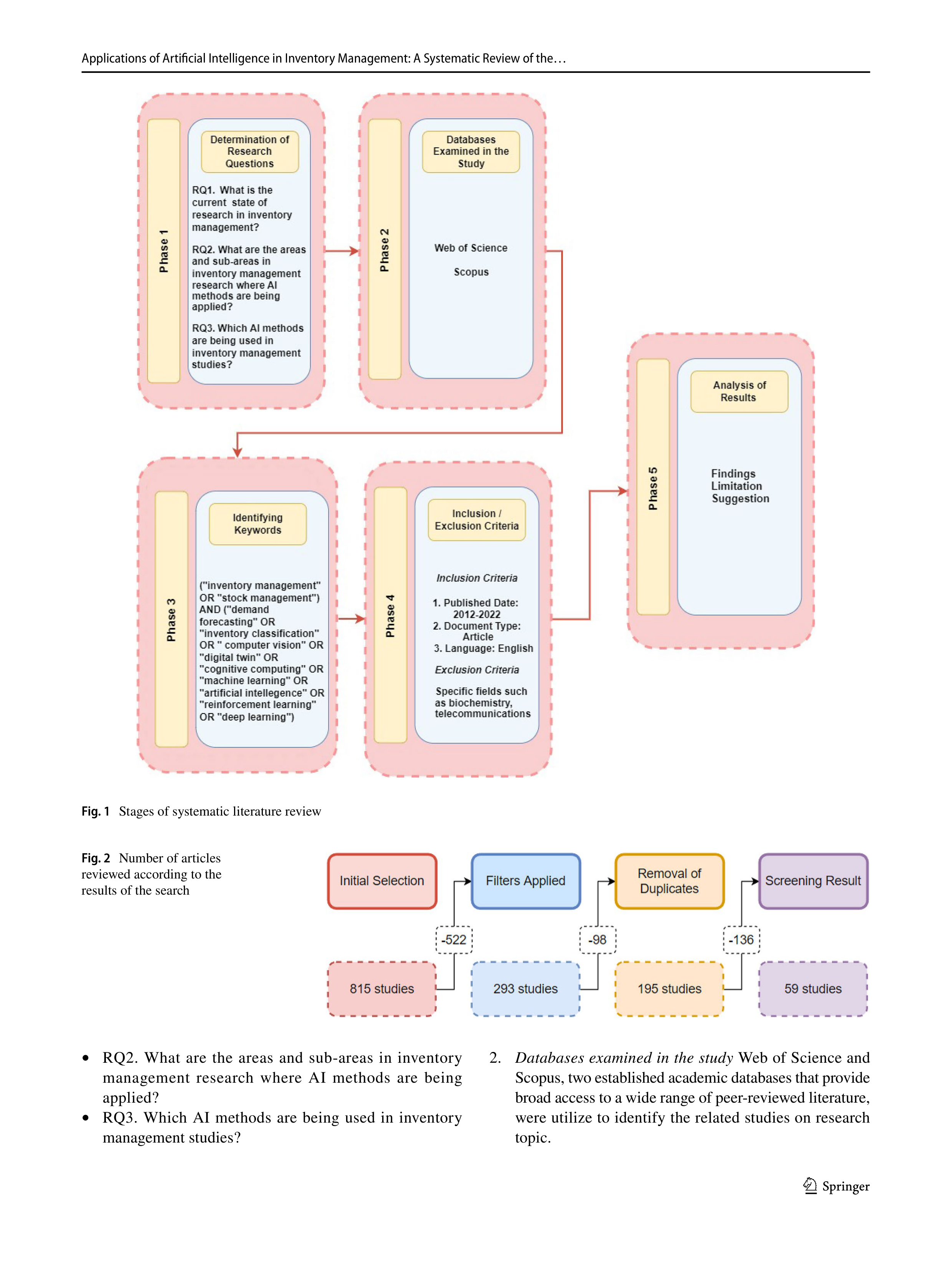
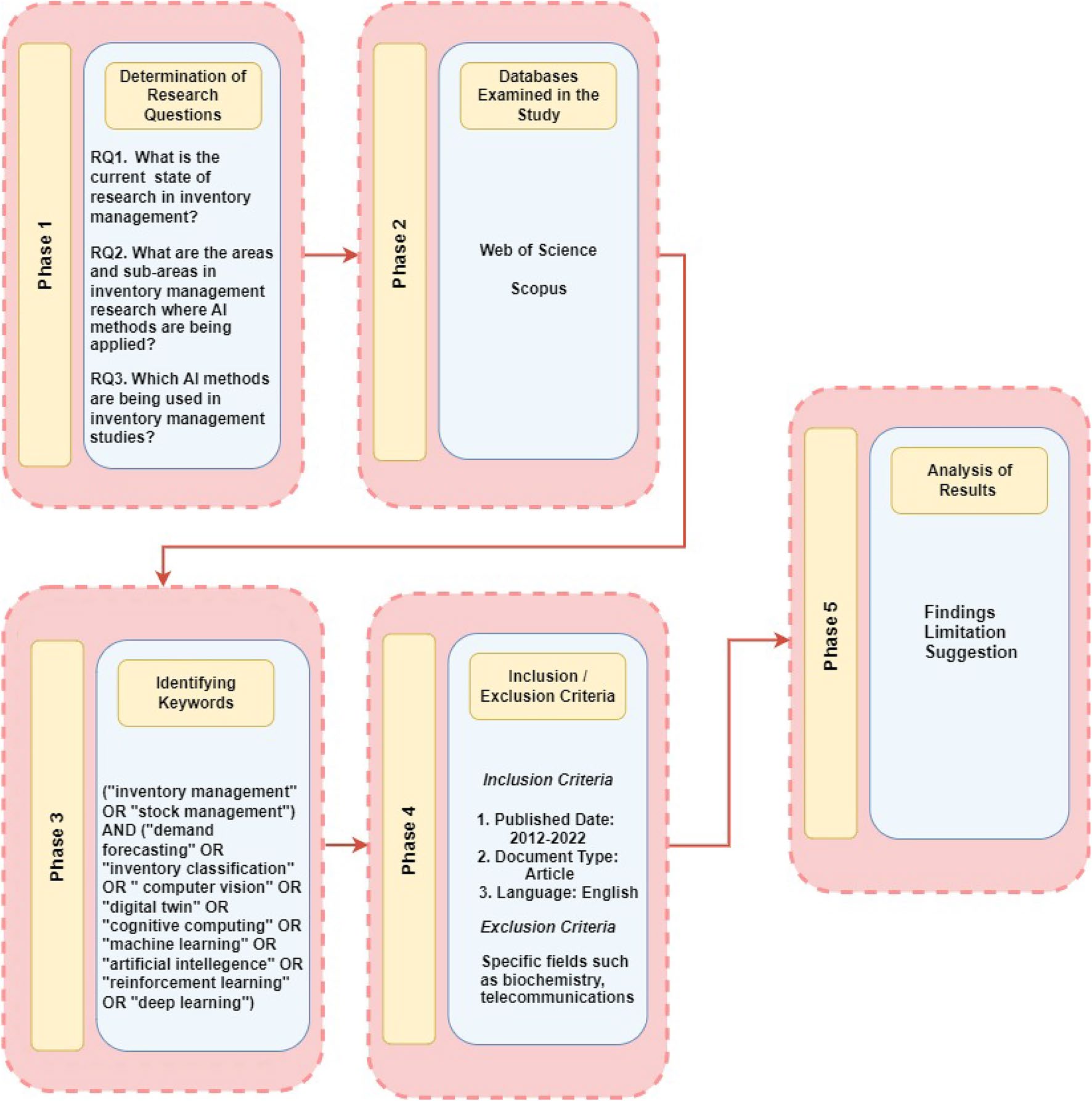
The current study followed a five-step process to better
understand the existing literature, identify research questions
and keywords, and develop further steps. Figure
1
shows the
stages of the systematic literature review used in the study,
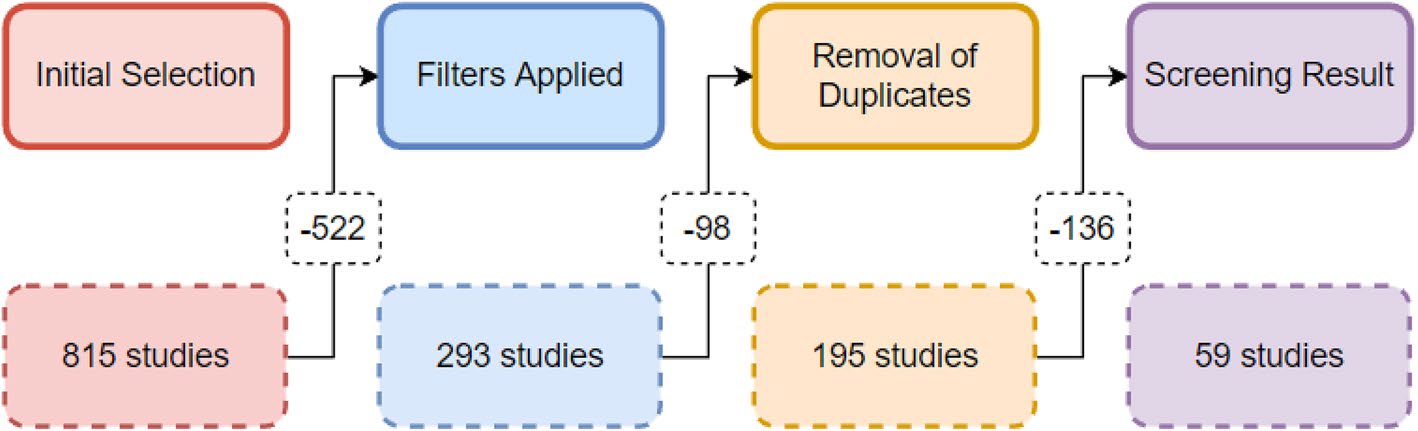
and Fig.
2
shows the number of articles examined through
the review process.
1.
Determination of research questions
Probably the most
important and difficult part of the research design is the
determination of the research questions. The formulation
of a research question leads to the selection of research
strategies and methods, i.e. the research is conducted
based on the research questions. Formulating a research
question plays an important role in the research process
as it helps to combat the collection and analysis of unre-
lated data [
14
].
Research questions were formulated to accurately
determine the purpose considering the scope of the study.
Research questions of this study are as follows:
•
RQ1. What is the current state of research in inventory
management?
Applications of Artificial Intelligence in Inventory Management: A Systematic Review of the…
1 3
•
RQ2. What are the areas and sub-areas in inventory
management research where AI methods are being
applied?
•
RQ3. Which AI methods are being used in inventory
management studies?
2.
Databases examined in the study
Web of Science and
Scopus, two established academic databases that provide
broad access to a wide range of peer-reviewed literature,
were utilize to identify the related studies on research
topic.
Fig. 1
Stages of systematic literature review
Fig. 2
Number of articles
reviewed according to the
results of the search
Ö. Albayrak Ünal et al.
1 3
3.
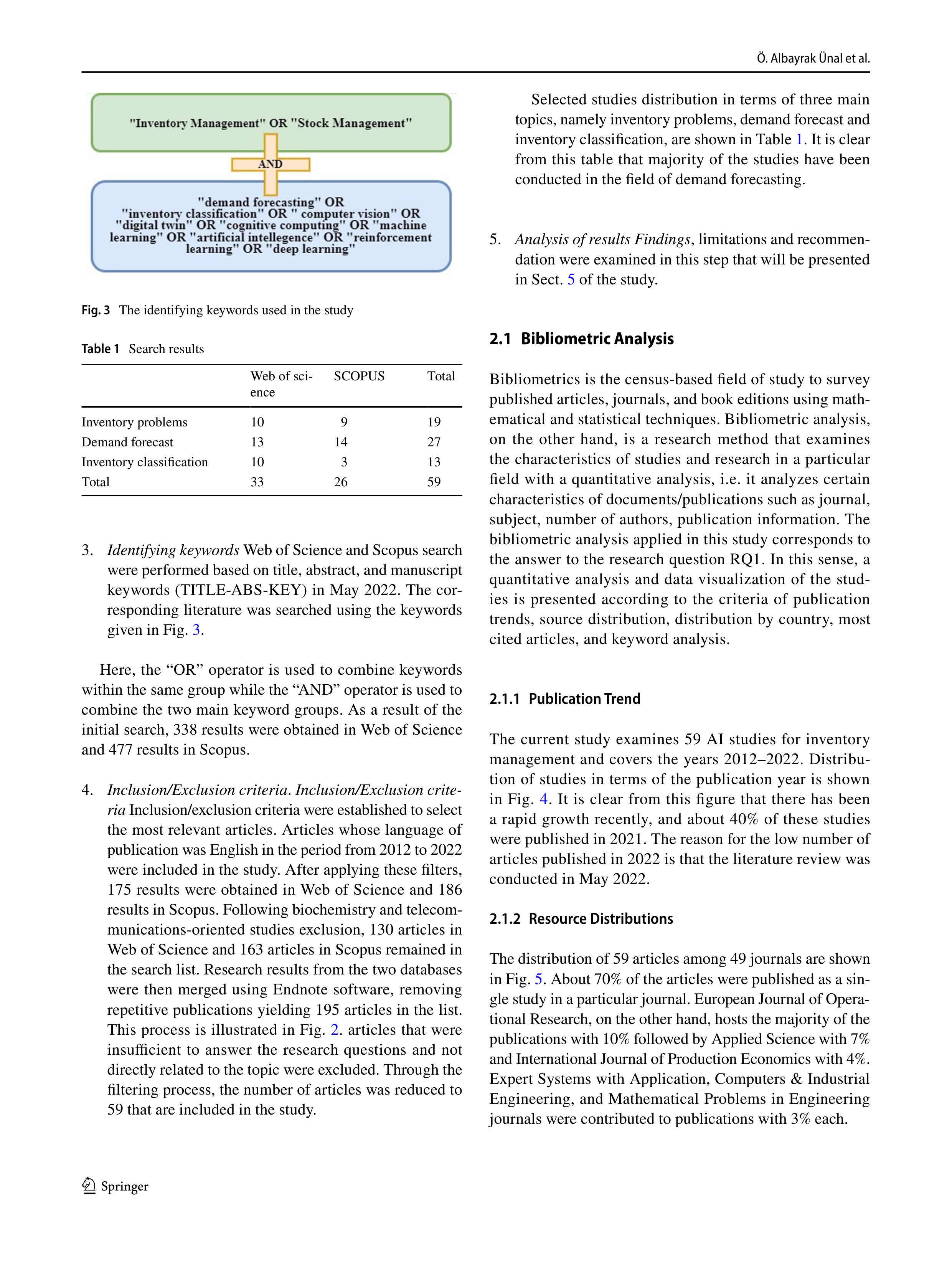
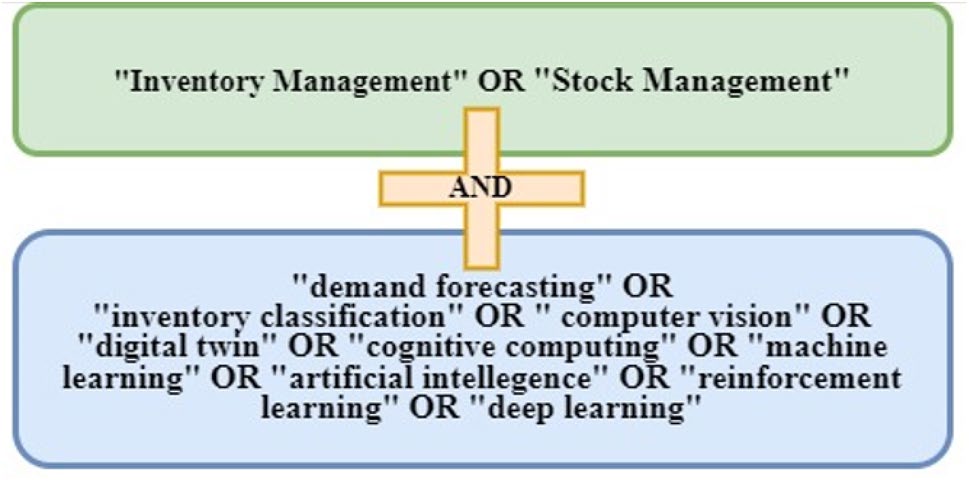
Identifying keywords
Web of Science and Scopus search
were performed based on title, abstract, and manuscript
keywords (TITLE-ABS-KEY) in May 2022. The cor-
responding literature was searched using the keywords
given in Fig.
3
.
Here, the “OR” operator is used to combine keywords
within the same group while the “AND” operator is used to
combine the two main keyword groups. As a result of the
initial search, 338 results were obtained in Web of Science
and 477 results in Scopus.
4.
Inclusion/Exclusion criteria
.
Inclusion/Exclusion crite-
ria
Inclusion/exclusion criteria were established to select
the most relevant articles. Articles whose language of
publication was English in the period from 2012 to 2022
were included in the study. After applying these filters,
175 results were obtained in Web of Science and 186
results in Scopus. Following biochemistry and telecom-
munications-oriented studies exclusion, 130 articles in
Web of Science and 163 articles in Scopus remained in
the search list. Research results from the two databases
were then merged using Endnote software, removing
repetitive publications yielding 195 articles in the list.
This process is illustrated in Fig.
2
. articles that were
insufficient to answer the research questions and not
directly related to the topic were excluded. Through the
filtering process, the number of articles was reduced to
59 that are included in the study.
Selected studies distribution in terms of three main
topics, namely inventory problems, demand forecast and
inventory classification, are shown in Table
1
. It is clear
from this table that majority of the studies have been
conducted in the field of demand forecasting.
5.
Analysis of results Findings
, limitations and recommen-
dation were examined in this step that will be presented
in Sect.
5
of the study.
2.1
Bibliometric Analysis
Bibliometrics is the census-based field of study to survey
published articles, journals, and book editions using math-
ematical and statistical techniques. Bibliometric analysis,
on the other hand, is a research method that examines
the characteristics of studies and research in a particular
field with a quantitative analysis, i.e. it analyzes certain
characteristics of documents/publications such as journal,
subject, number of authors, publication information. The
bibliometric analysis applied in this study corresponds to
the answer to the research question RQ1. In this sense, a
quantitative analysis and data visualization of the stud-
ies is presented according to the criteria of publication
trends, source distribution, distribution by country, most
cited articles, and keyword analysis.
2.1.1
Publication Trend
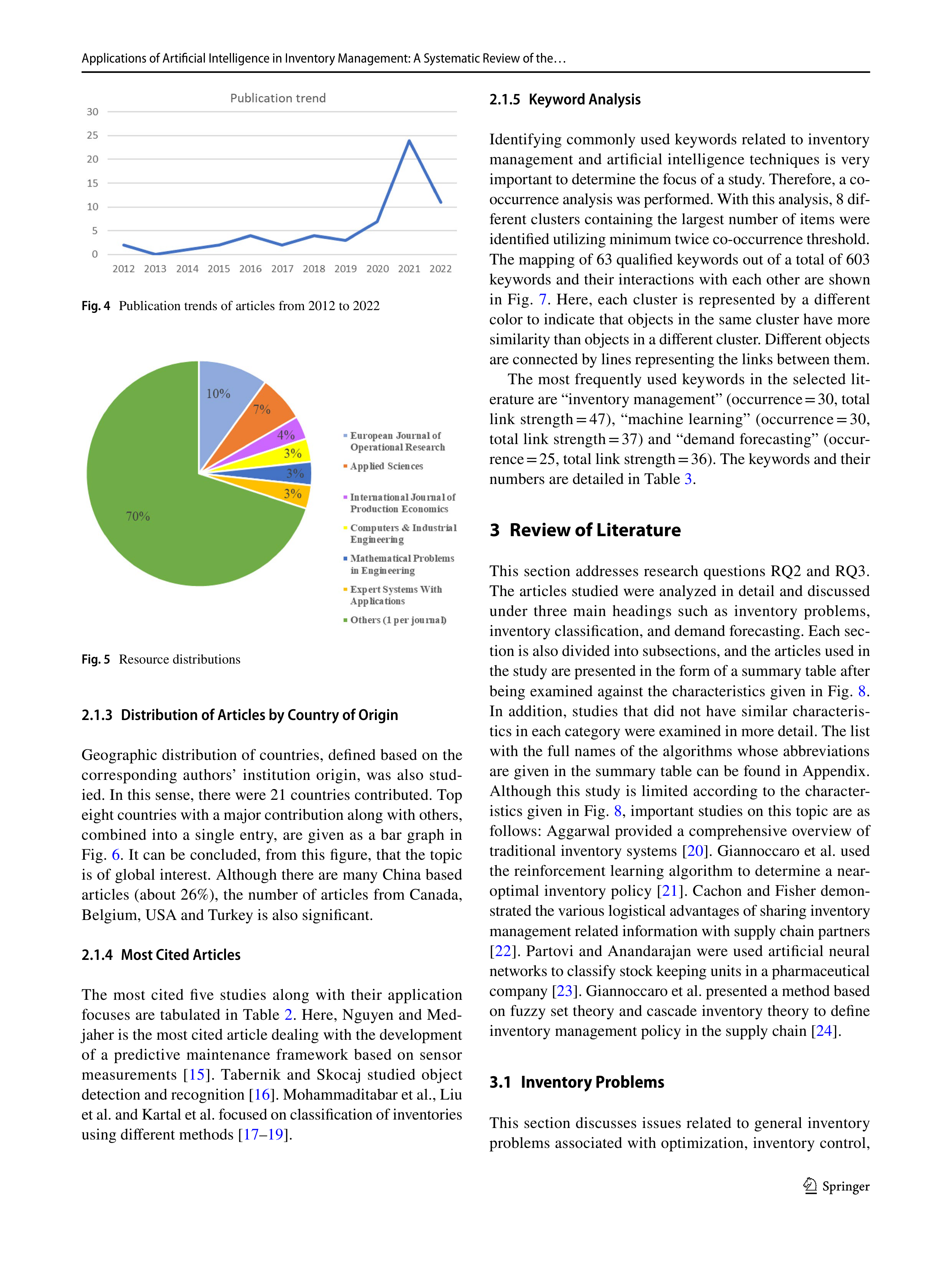
The current study examines 59 AI studies for inventory
management and covers the years 2012–2022. Distribu-
tion of studies in terms of the publication year is shown
in Fig.
4
. It is clear from this figure that there has been
a rapid growth recently, and about 40% of these studies
were published in 2021. The reason for the low number of
articles published in 2022 is that the literature review was
conducted in May 2022.
2.1.2
Resource Distributions
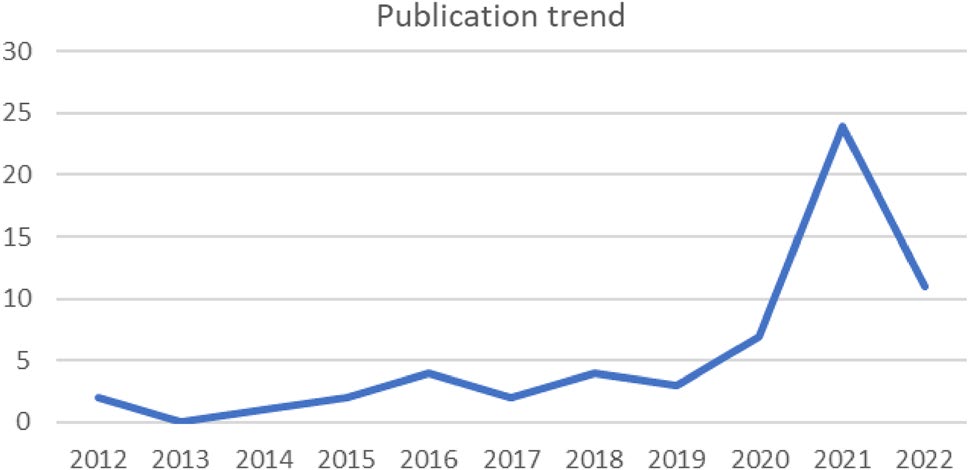
The distribution of 59 articles among 49 journals are shown
in Fig.
5
. About 70% of the articles were published as a sin-
gle study in a particular journal. European Journal of Opera-
tional Research, on the other hand, hosts the majority of the
publications with 10% followed by Applied Science with 7%
and International Journal of Production Economics with 4%.
Expert Systems with Application, Computers & Industrial
Engineering, and Mathematical Problems in Engineering
journals were contributed to publications with 3% each.
Fig. 3
The identifying keywords used in the study
Table 1
Search results
Web of sci-
ence
SCOPUS
Total
Inventory problems
10
9
19
Demand forecast
13
14
27
Inventory classification
10
3
13
Total
33
26
59
Applications of Artificial Intelligence in Inventory Management: A Systematic Review of the…
1 3
2.1.3
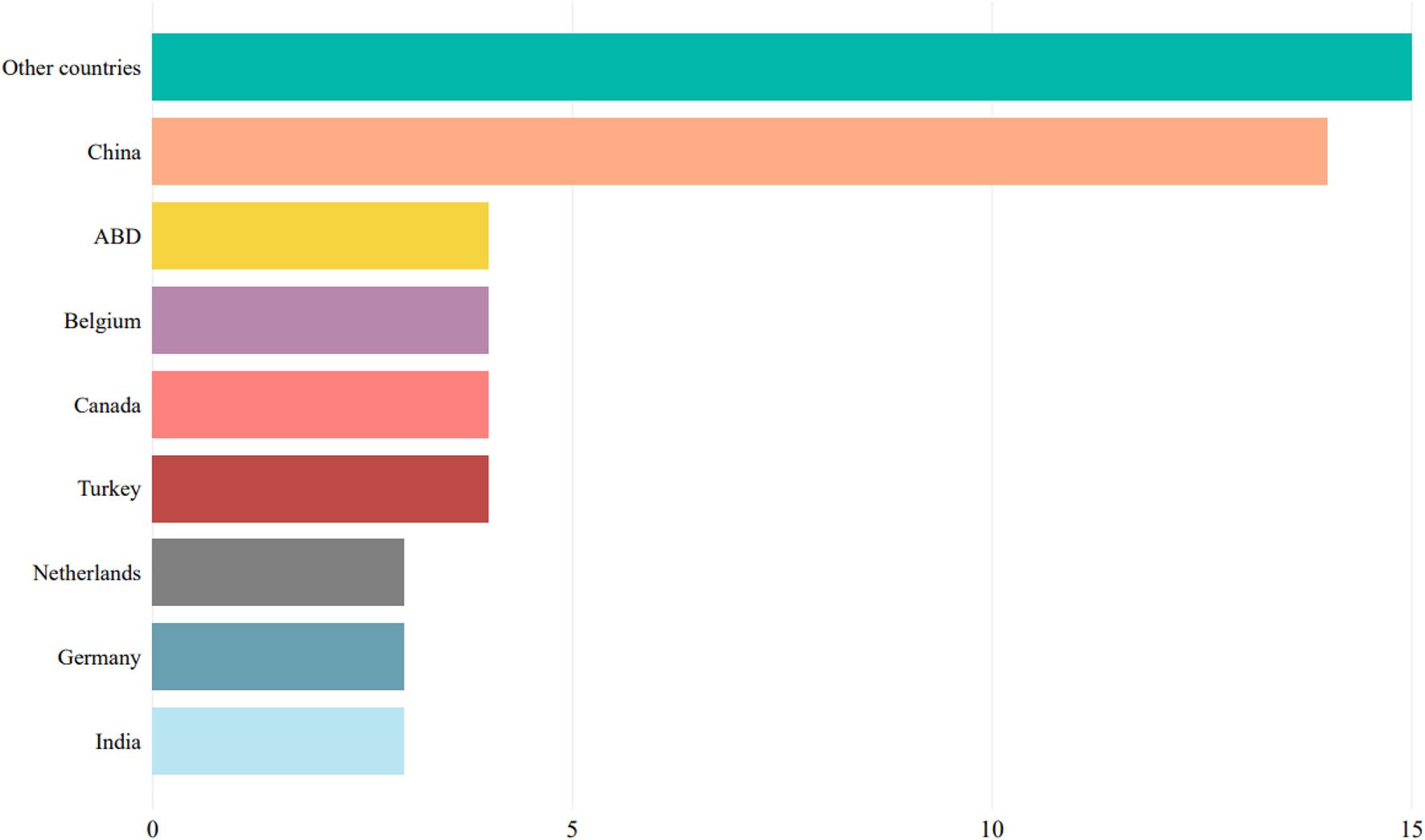
Distribution of Articles by Country of Origin
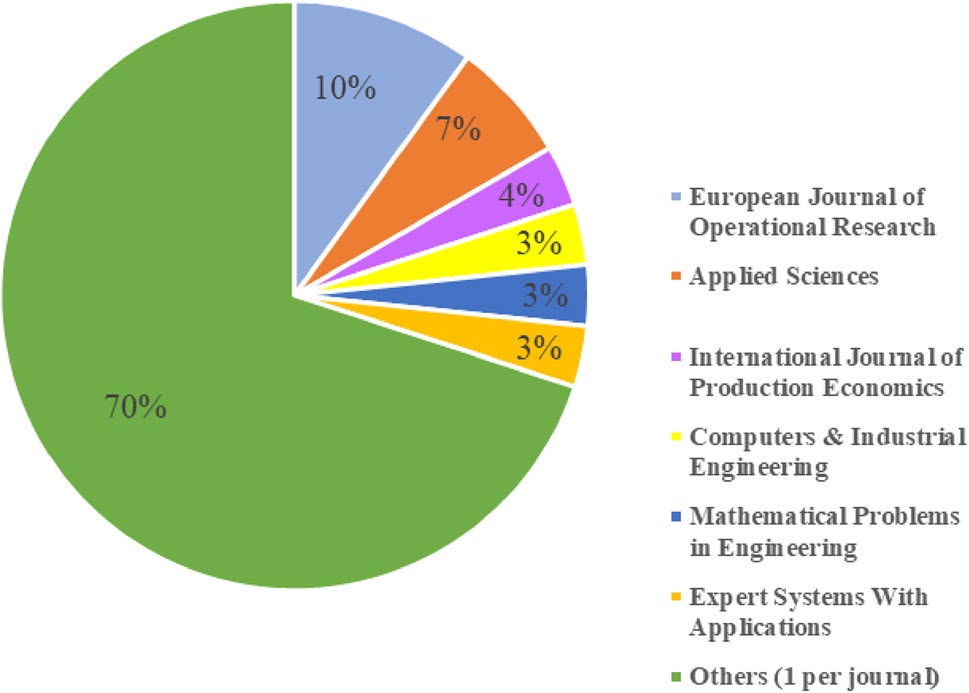
Geographic distribution of countries, defined based on the
corresponding authors’ institution origin, was also stud-
ied. In this sense, there were 21 countries contributed. Top
eight countries with a major contribution along with others,
combined into a single entry, are given as a bar graph in
Fig.
6
. It can be concluded, from this figure, that the topic
is of global interest. Although there are many China based
articles (about 26%), the number of articles from Canada,
Belgium, USA and Turkey is also significant.
2.1.4
Most Cited Articles
The most cited five studies along with their application
focuses are tabulated in Table
2
. Here, Nguyen and Med-
jaher is the most cited article dealing with the development
of a predictive maintenance framework based on sensor
measurements [
15
]. Tabernik and Skocaj studied object
detection and recognition [
16
]. Mohammaditabar et al., Liu
et al. and Kartal et al. focused on classification of inventories
using different methods [
17
–
19
].
2.1.5
Keyword Analysis
Identifying commonly used keywords related to inventory
management and artificial intelligence techniques is very
important to determine the focus of a study. Therefore, a co-
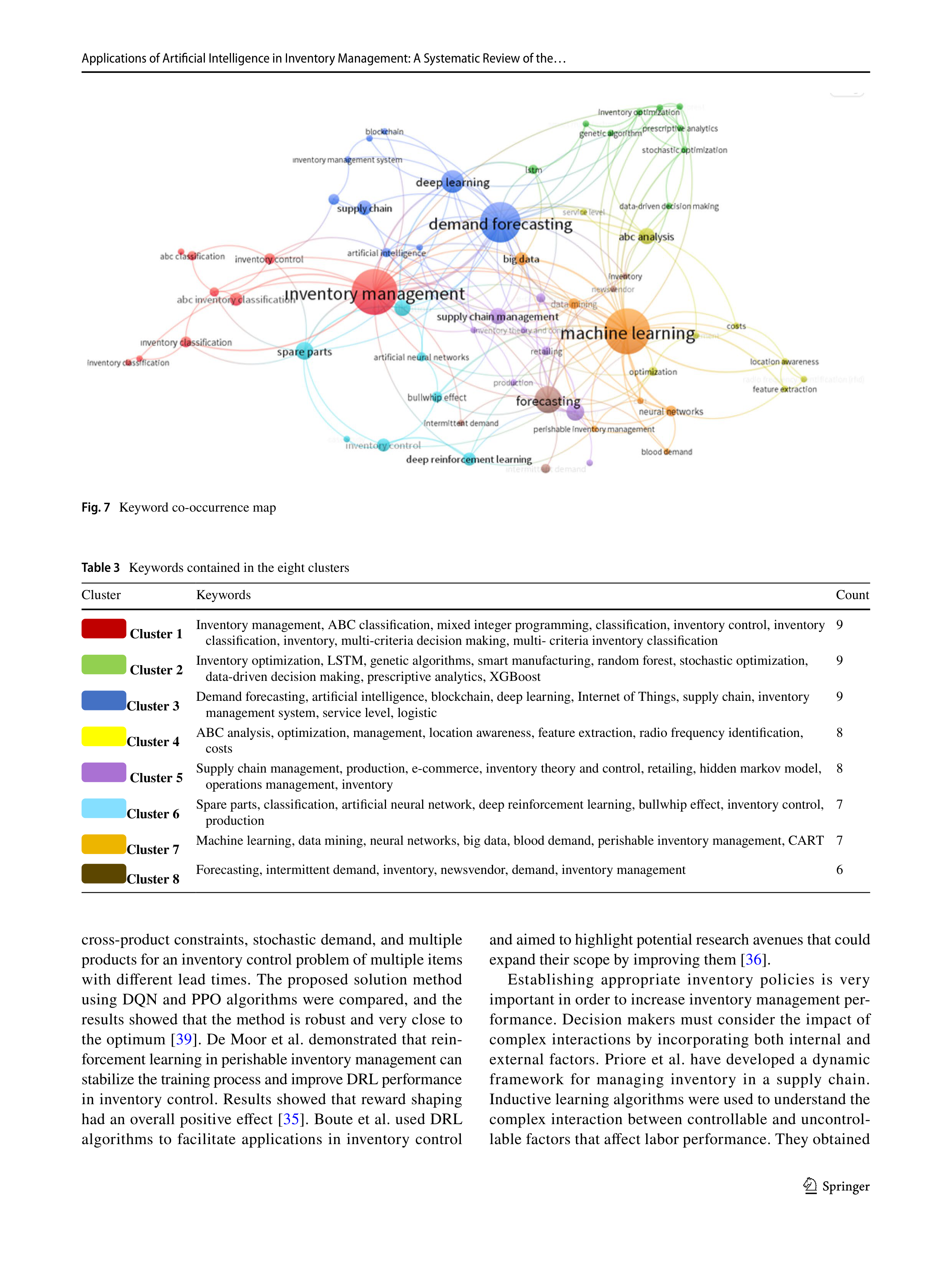
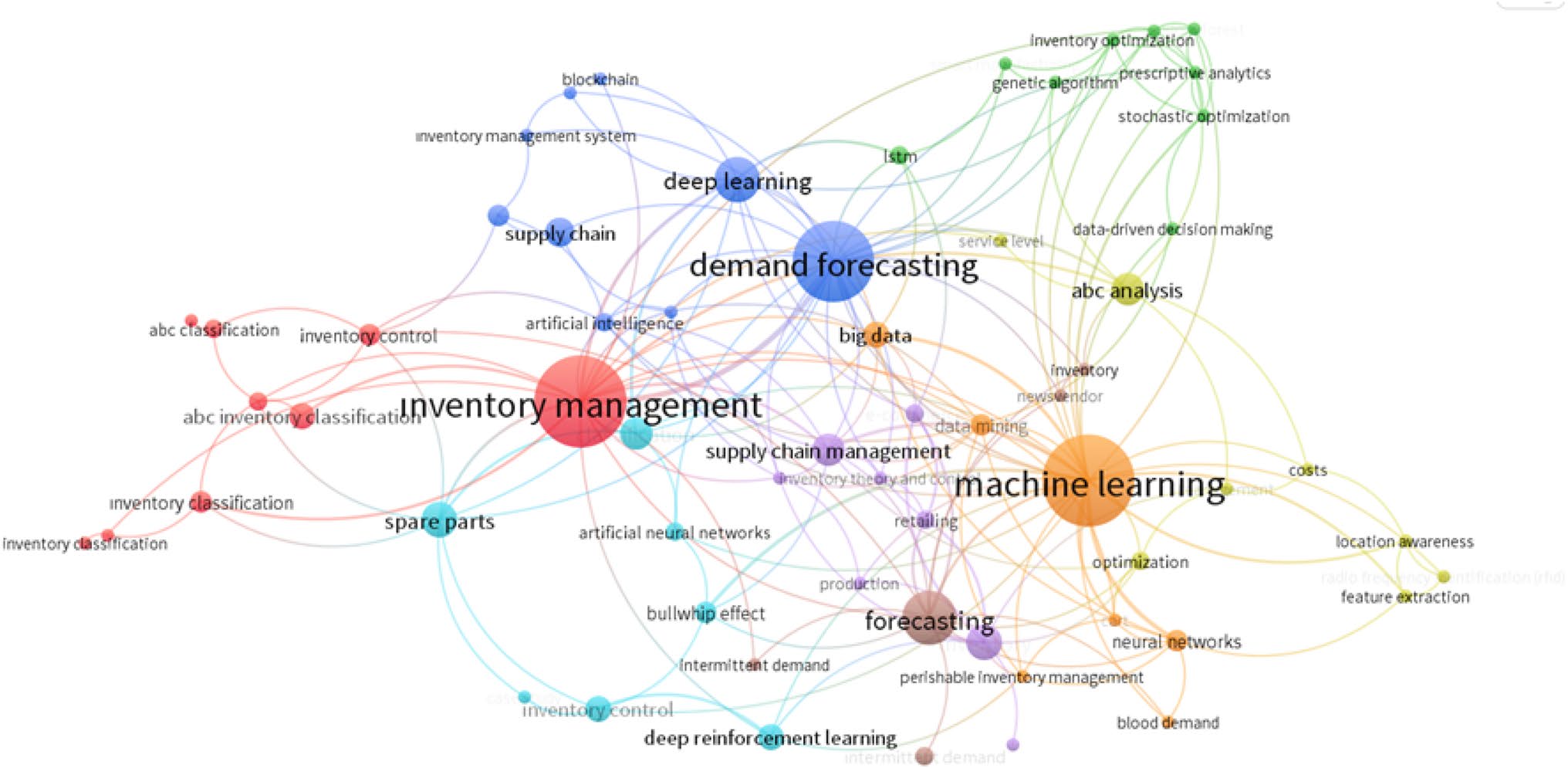
occurrence analysis was performed. With this analysis, 8 dif-
ferent clusters containing the largest number of items were
identified utilizing minimum twice co-occurrence threshold.
The mapping of 63 qualified keywords out of a total of 603
keywords and their interactions with each other are shown
in Fig.
7
. Here, each cluster is represented by a different
color to indicate that objects in the same cluster have more
similarity than objects in a different cluster. Different objects
are connected by lines representing the links between them.
The most frequently used keywords in the selected lit-
erature are “inventory management” (occurrence = 30, total
link strength = 47), “machine learning” (occurrence = 30,
total link strength = 37) and “demand forecasting” (occur-
rence = 25, total link strength = 36). The keywords and their
numbers are detailed in Table
3
.
3 Review of Literature
This section addresses research questions RQ2 and RQ3.
The articles studied were analyzed in detail and discussed
under three main headings such as inventory problems,
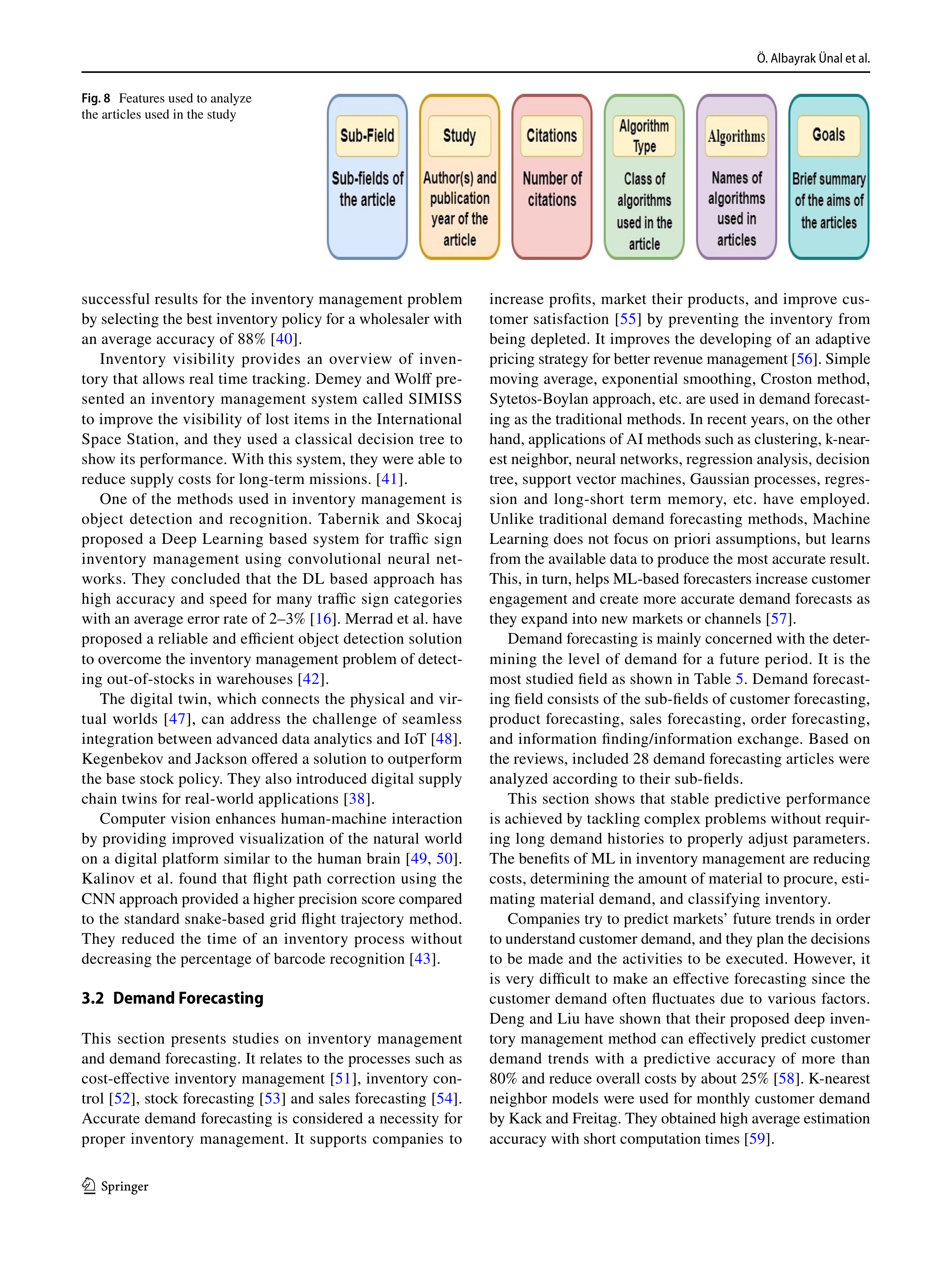
inventory classification, and demand forecasting. Each sec-
tion is also divided into subsections, and the articles used in
the study are presented in the form of a summary table after
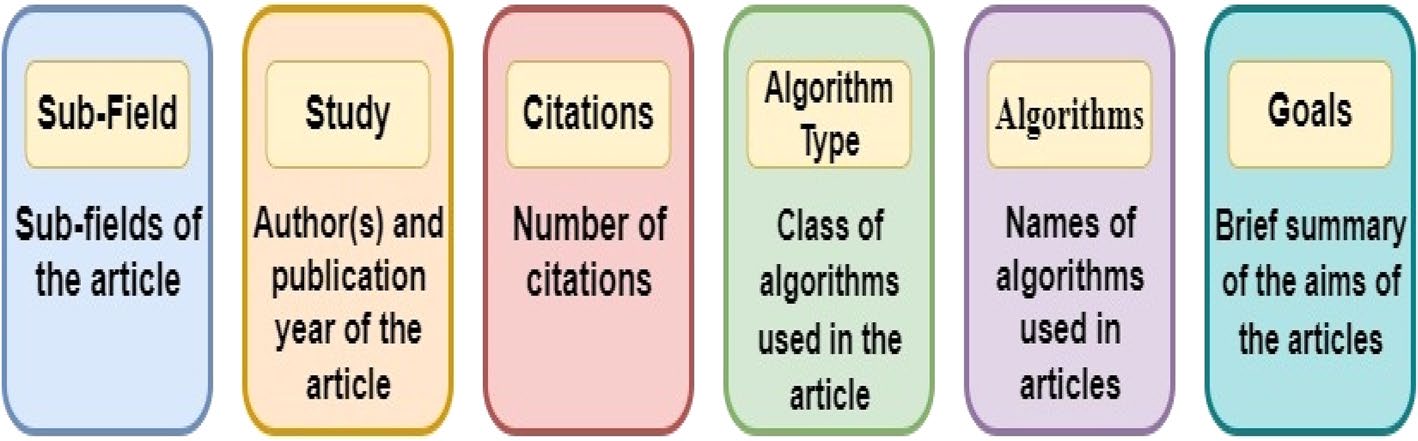
being examined against the characteristics given in Fig.
8
.
In addition, studies that did not have similar characteris-
tics in each category were examined in more detail. The list
with the full names of the algorithms whose abbreviations
are given in the summary table can be found in Appendix.
Although this study is limited according to the character-
istics given in Fig.
8
, important studies on this topic are as
follows: Aggarwal provided a comprehensive overview of
traditional inventory systems [
20
]. Giannoccaro et al. used
the reinforcement learning algorithm to determine a near-
optimal inventory policy [
21
]. Cachon and Fisher demon-
strated the various logistical advantages of sharing inventory
management related information with supply chain partners
[
22
]. Partovi and Anandarajan were used artificial neural
networks to classify stock keeping units in a pharmaceutical
company [
23
]. Giannoccaro et al. presented a method based
on fuzzy set theory and cascade inventory theory to define
inventory management policy in the supply chain [
24
].
3.1
Inventory Problems
This section discusses issues related to general inventory
problems associated with optimization, inventory control,
Fig. 4
Publication trends of articles from 2012 to 2022
Fig. 5
Resource distributions
Ö. Albayrak Ünal et al.
1 3
and policy setting. It is aimed to determine optimal inven-
tory level, minimize operating costs, and maintain that level
on a regular basis. In order for production processes to con-
tinue without an interruption, requirements must be supplied
in a timely manner. Order fulfillment [
25
], situations where
the distribution of demand suddenly changes [
26
], dynamic
inventory management and control [
27
] and inventory con-
trol [
28
] are studied in the literature.
As a result of the research in the field of inventory man-
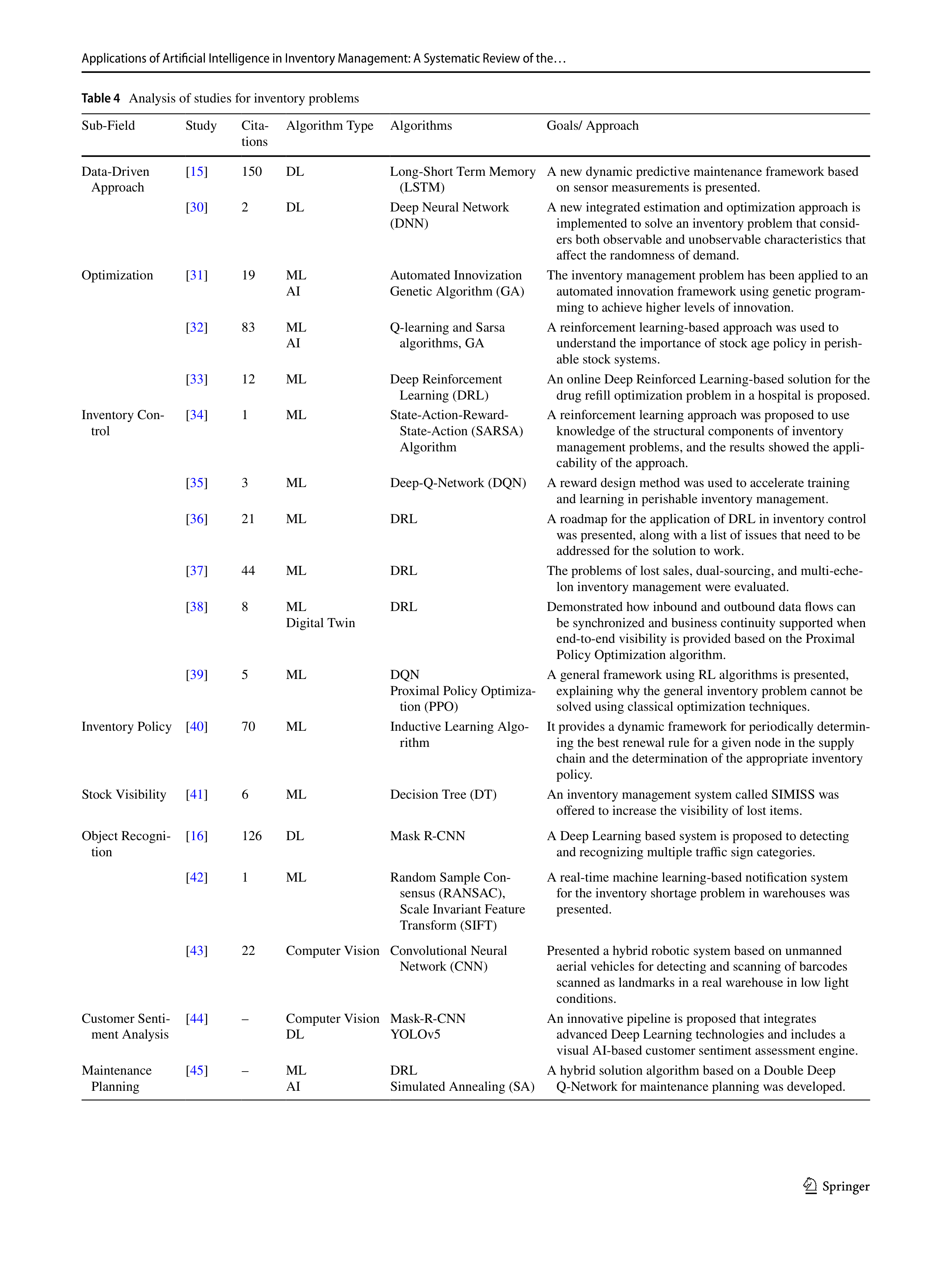
agement problems, 18 articles were identified, which are
presented in Table
4
. ML algorithms have been mainly used
in this field, and the results have shown that they can be well
adapted to this type of problems. Inventory control aims to
continuously monitor inventory movements, customer pur-
chasing tendencies, and timing analysis using cumulative
sales data. Most articles on inventory control have used rein-
forcement learning algorithms to track and control inventory
movements, solve complex sequential decision problems
Table 2
Most cited articles
Authors
Year
Citations
Application Focuses
Nguyen and Medjaher
2019
150
Data driven approach
Tabernik and Skocaj
2020
126
Object detection
Mohammaditabar et al.
2012
111
Inventory classification
Liu et al.
2016
102
MCABC inventory
classification
Kartal et al.
2016
86
Inventory classification
Fig. 6
Distribution of published articles by country of origin
based on learning using existing data, and enable dynamic
learning in a changing environment without the need for a
predetermined environment model [
29
].
The data-driven approach requires manual processing and
analysis of data by experts [
46
]. Inventory problems using ML
methods were explored in this subsection. Pirayesh Neghab
et al. studied the ordering problem for a single news vendor
problem to minimize the expected cost. To solve the model,
they proposed a new algorithm called HMMNV based on the
integration of neural networks and hidden Markov models,
and demonstrated the performance of the algorithm using
crude oil demand data. Their model performed 27% better
compared to other methods in terms of system cost [
30
].
The optimization subsection examines how products are
procured, managed, used, and product policies are deter-
mined. Better results were obtained based on the over-pro-
visioning, ski-rental, and max-min approaches in a problem
of replenishing the drug volume to manage a hospital’s drug
inventory by Zwaida et al. With this study they have proven
that DRL is a promising method [
33
]. Kara and Doğan eval-
uated inventory management performance under stochastic
customer demand and lead time to minimize a retailer’s total
cost. They observed that short-lived products showed better
results under higher variance in demand [
32
].
One of the widely studied areas in inventory problems
is the inventory control. Meisheri et al. suggested a new
approach of reinforcement learning to solve practical scenar-
ios with unit weights and quantities, shelf life and capacity,
Applications of Artificial Intelligence in Inventory Management: A Systematic Review of the…
1 3
cross-product constraints, stochastic demand, and multiple
products for an inventory control problem of multiple items
with different lead times. The proposed solution method
using DQN and PPO algorithms were compared, and the
results showed that the method is robust and very close to
the optimum [
39
]. De Moor et al. demonstrated that rein-
forcement learning in perishable inventory management can
stabilize the training process and improve DRL performance
in inventory control. Results showed that reward shaping
had an overall positive effect [
35
]. Boute et al. used DRL
algorithms to facilitate applications in inventory control
Fig. 7
Keyword co-occurrence map
Table 3
Keywords contained in the eight clusters
Cluster
Keywords
Count
Cluster 1
Inventory management, ABC classification, mixed integer programming, classification, inventory control, inventory
classification, inventory, multi-criteria decision making, multi- criteria inventory classification
9
Cluster 2
Inventory optimization, LSTM, genetic algorithms, smart manufacturing, random forest, stochastic optimization,
data-driven decision making, prescriptive analytics, XGBoost
9
Cluster 3
Demand forecasting, artificial intelligence, blockchain, deep learning, Internet of Things, supply chain, inventory
management system, service level, logistic
9
Cluster 4
ABC analysis, optimization, management, location awareness, feature extraction, radio frequency identification,
costs
8
Cluster 5
Supply chain management, production, e-commerce, inventory theory and control, retailing, hidden markov model,
operations management, inventory
8
Cluster 6
Spare parts, classification, artificial neural network, deep reinforcement learning, bullwhip effect, inventory control,
production
7
Cluster 7
Machine learning, data mining, neural networks, big data, blood demand, perishable inventory management, CART
7
Cluster 8
Forecasting, intermittent demand, inventory, newsvendor, demand, inventory management
6
and aimed to highlight potential research avenues that could
expand their scope by improving them [
36
].
Establishing appropriate inventory policies is very
important in order to increase inventory management per-
formance. Decision makers must consider the impact of
complex interactions by incorporating both internal and
external factors. Priore et al. have developed a dynamic
framework for managing inventory in a supply chain.
Inductive learning algorithms were used to understand the
complex interaction between controllable and uncontrol-
lable factors that affect labor performance. They obtained
Ö. Albayrak Ünal et al.
1 3
successful results for the inventory management problem
by selecting the best inventory policy for a wholesaler with
an average accuracy of 88% [
40
].
Inventory visibility provides an overview of inven-
tory that allows real time tracking. Demey and Wolff pre-
sented an inventory management system called SIMISS
to improve the visibility of lost items in the International
Space Station, and they used a classical decision tree to
show its performance. With this system, they were able to
reduce supply costs for long-term missions. [
41
].
One of the methods used in inventory management is
object detection and recognition. Tabernik and Skocaj
proposed a Deep Learning based system for traffic sign
inventory management using convolutional neural net-
works. They concluded that the DL based approach has
high accuracy and speed for many traffic sign categories
with an average error rate of 2–3% [
16
]. Merrad et al. have
proposed a reliable and efficient object detection solution
to overcome the inventory management problem of detect-
ing out-of-stocks in warehouses [
42
].
The digital twin, which connects the physical and vir-
tual worlds [
47
], can address the challenge of seamless
integration between advanced data analytics and IoT [
48
].
Kegenbekov and Jackson offered a solution to outperform
the base stock policy. They also introduced digital supply
chain twins for real-world applications [
38
].
Computer vision enhances human-machine interaction
by providing improved visualization of the natural world
on a digital platform similar to the human brain [
49
,
50
].
Kalinov et al. found that flight path correction using the
CNN approach provided a higher precision score compared
to the standard snake-based grid flight trajectory method.
They reduced the time of an inventory process without
decreasing the percentage of barcode recognition [
43
].
3.2
Demand Forecasting
This section presents studies on inventory management
and demand forecasting. It relates to the processes such as
cost-effective inventory management [
51
], inventory con-
trol [
52
], stock forecasting [
53
] and sales forecasting [
54
].
Accurate demand forecasting is considered a necessity for
proper inventory management. It supports companies to
increase profits, market their products, and improve cus-
tomer satisfaction [
55
] by preventing the inventory from
being depleted. It improves the developing of an adaptive
pricing strategy for better revenue management [
56
]. Simple
moving average, exponential smoothing, Croston method,
Sytetos-Boylan approach, etc. are used in demand forecast-
ing as the traditional methods. In recent years, on the other
hand, applications of AI methods such as clustering, k-near-
est neighbor, neural networks, regression analysis, decision
tree, support vector machines, Gaussian processes, regres-
sion and long-short term memory, etc. have employed.
Unlike traditional demand forecasting methods, Machine
Learning does not focus on priori assumptions, but learns
from the available data to produce the most accurate result.
This, in turn, helps ML-based forecasters increase customer
engagement and create more accurate demand forecasts as
they expand into new markets or channels [
57
].
Demand forecasting is mainly concerned with the deter-
mining the level of demand for a future period. It is the
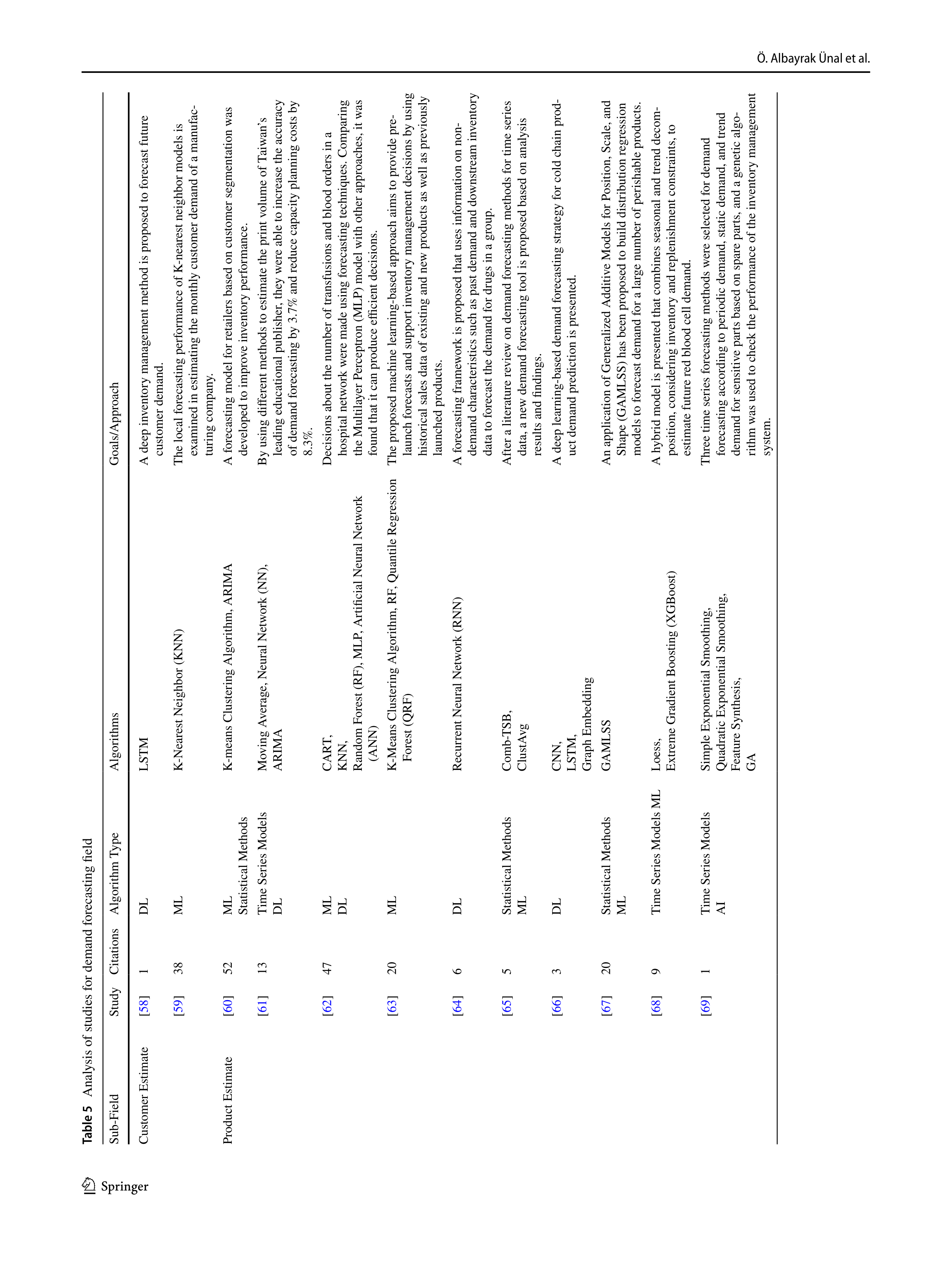
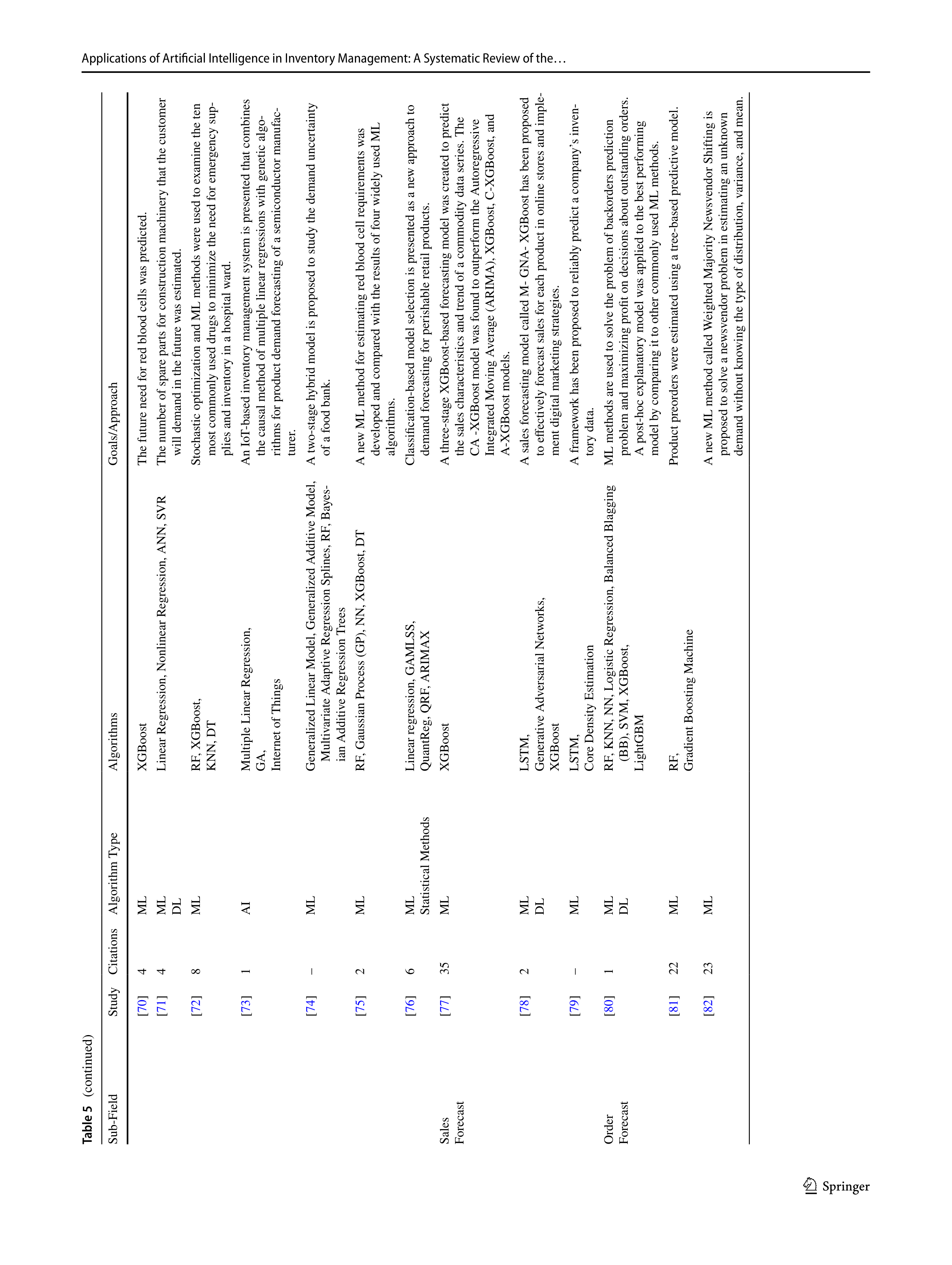
most studied field as shown in Table
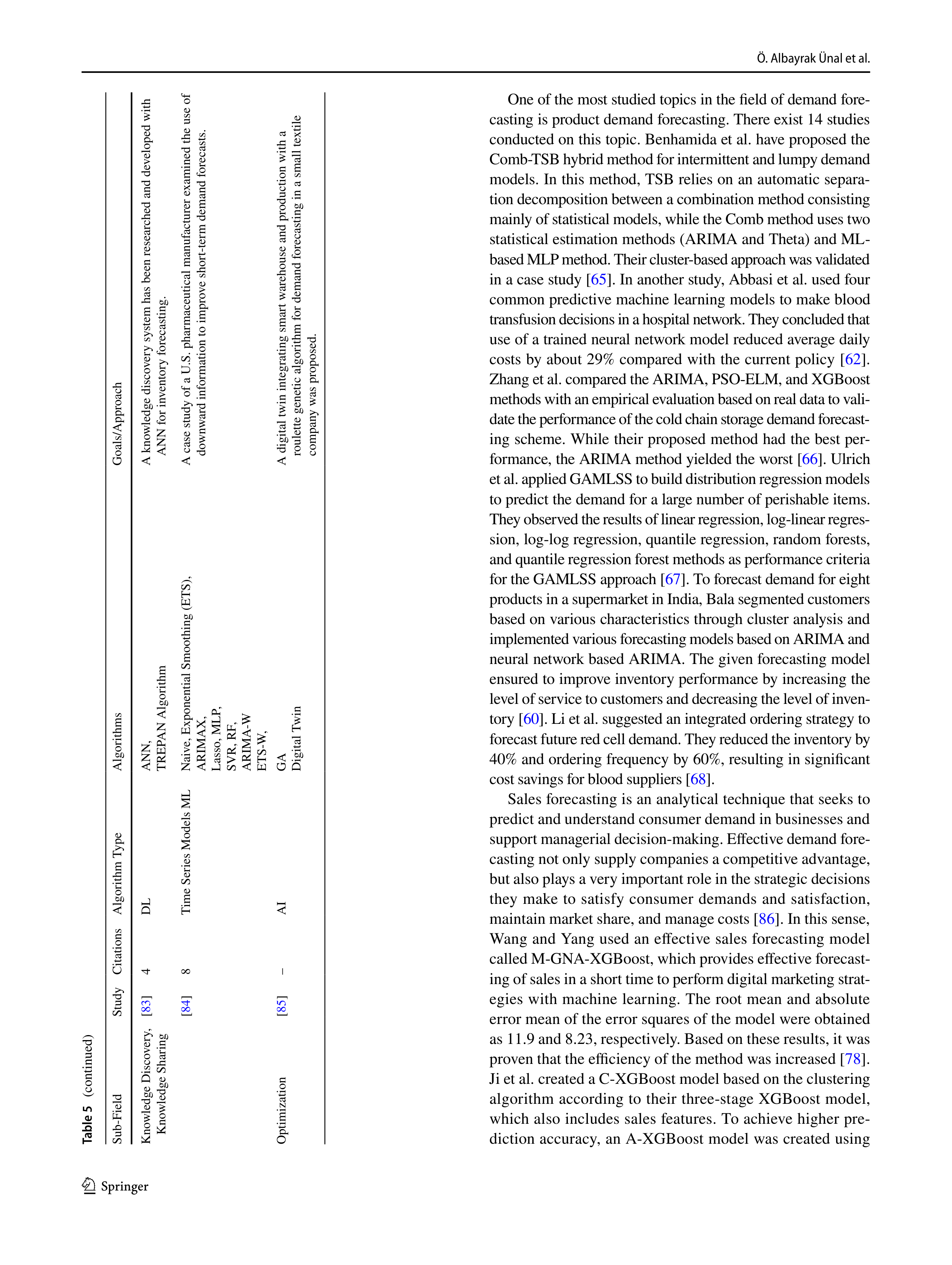
5
. Demand forecast-
ing field consists of the sub-fields of customer forecasting,
product forecasting, sales forecasting, order forecasting,
and information finding/information exchange. Based on
the reviews, included 28 demand forecasting articles were
analyzed according to their sub-fields.
This section shows that stable predictive performance
is achieved by tackling complex problems without requir-
ing long demand histories to properly adjust parameters.
The benefits of ML in inventory management are reducing
costs, determining the amount of material to procure, esti-
mating material demand, and classifying inventory.
Companies try to predict markets’ future trends in order
to understand customer demand, and they plan the decisions
to be made and the activities to be executed. However, it
is very difficult to make an effective forecasting since the
customer demand often fluctuates due to various factors.
Deng and Liu have shown that their proposed deep inven-
tory management method can effectively predict customer
demand trends with a predictive accuracy of more than
80% and reduce overall costs by about 25% [
58
]. K-nearest
neighbor models were used for monthly customer demand
by Kack and Freitag. They obtained high average estimation
accuracy with short computation times [
59
].
Fig. 8
Features used to analyze
the articles used in the study
Applications of Artificial Intelligence in Inventory Management: A Systematic Review of the…
1 3
Table 4
Analysis of studies for inventory problems
Sub-Field
Study
Cita-
tions
Algorithm Type
Algorithms
Goals/ Approach
Data-Driven
Approach
[
15
]
150
DL
Long-Short Term Memory
(LSTM)
A new dynamic predictive maintenance framework based
on sensor measurements is presented.
[
30
]
2
DL
Deep Neural Network
(DNN)
A new integrated estimation and optimization approach is
implemented to solve an inventory problem that consid-
ers both observable and unobservable characteristics that
affect the randomness of demand.
Optimization
[
31
]
19
ML
AI
Automated Innovization
Genetic Algorithm (GA)
The inventory management problem has been applied to an
automated innovation framework using genetic program-
ming to achieve higher levels of innovation.
[
32
]
83
ML
AI
Q-learning and Sarsa
algorithms, GA
A reinforcement learning-based approach was used to
understand the importance of stock age policy in perish-
able stock systems.
[
33
]
12
ML
Deep Reinforcement
Learning (DRL)
An online Deep Reinforced Learning-based solution for the
drug refill optimization problem in a hospital is proposed.
Inventory Con-
trol
[
34
]
1
ML
State-Action-Reward-
State-Action (SARSA)
Algorithm
A reinforcement learning approach was proposed to use
knowledge of the structural components of inventory
management problems, and the results showed the appli-
cability of the approach.
[
35
]
3
ML
Deep-Q-Network (DQN)
A reward design method was used to accelerate training
and learning in perishable inventory management.
[
36
]
21
ML
DRL
A roadmap for the application of DRL in inventory control
was presented, along with a list of issues that need to be
addressed for the solution to work.
[
37
]
44
ML
DRL
The problems of lost sales, dual-sourcing, and multi-eche-
lon inventory management were evaluated.
[
38
]
8
ML
Digital Twin
DRL
Demonstrated how inbound and outbound data flows can
be synchronized and business continuity supported when
end-to-end visibility is provided based on the Proximal
Policy Optimization algorithm.
[
39
]
5
ML
DQN
Proximal Policy Optimiza-
tion (PPO)
A general framework using RL algorithms is presented,
explaining why the general inventory problem cannot be
solved using classical optimization techniques.
Inventory Policy
[
40
]
70
ML
Inductive Learning Algo-
rithm
It provides a dynamic framework for periodically determin-
ing the best renewal rule for a given node in the supply
chain and the determination of the appropriate inventory
policy.
Stock Visibility
[
41
]
6
ML
Decision Tree (DT)
An inventory management system called SIMISS was
offered to increase the visibility of lost items.
Object Recogni-
tion
[
16
]
126
DL
Mask R-CNN
A Deep Learning based system is proposed to detecting
and recognizing multiple traffic sign categories.
[
42
]
1
ML
Random Sample Con-
sensus (RANSAC),
Scale Invariant Feature
Transform (SIFT)
A real-time machine learning-based notification system
for the inventory shortage problem in warehouses was
presented.
[
43
]
22
Computer Vision
Convolutional Neural
Network (CNN)
Presented a hybrid robotic system based on unmanned
aerial vehicles for detecting and scanning of barcodes
scanned as landmarks in a real warehouse in low light
conditions.
Customer Senti-
ment Analysis
[
44
]
–
Computer Vision
DL
Mask-R-CNN
YOLOv5
An innovative pipeline is proposed that integrates
advanced Deep Learning technologies and includes a
visual AI-based customer sentiment assessment engine.
Maintenance
Planning
[
45
]
–
ML
AI
DRL
Simulated Annealing (SA)
A hybrid solution algorithm based on a Double Deep
Q-Network for maintenance planning was developed.
Ö. Albayrak Ünal et al.
1 3
Table 5
Analysis of studies for demand forecasting field
Sub-Field
Study
Citations
Algorithm Type
Algorithms
Goals/Approach
Customer Estimate
[
58
]
1
DL
LSTM
A deep inventory management method is proposed to forecast future
customer demand.
[
59
]
38
ML
K-Nearest Neighbor (KNN)
The local forecasting performance of K-nearest neighbor models is
examined in estimating the monthly customer demand of a manufac-
turing company.
Product Estimate
[
60
]
52
ML
Statistical Methods
K-means Clustering Algorithm, ARIMA
A forecasting model for retailers based on customer segmentation was
developed to improve inventory performance.
[
61
]
13
Time Series Models
DL
Moving Average, Neural Network (NN),
ARIMA
By using different methods to estimate the print volume of Taiwan’s
leading educational publisher, they were able to increase the accuracy
of demand forecasting by 3.7% and reduce capacity planning costs by
8.3%.
[
62
]
47
ML
DL
CART,
KNN,
Random Forest (RF), MLP, Artificial Neural Network
(ANN)
Decisions about the number of transfusions and blood orders in a
hospital network were made using forecasting techniques. Comparing
the Multilayer Perceptron (MLP) model with other approaches, it was
found that it can produce efficient decisions.
[
63
]
20
ML
K-Means Clustering Algorithm, RF, Quantile Regression
Forest (QRF)
The proposed machine learning-based approach aims to provide pre-
launch forecasts and support inventory management decisions by using
historical sales data of existing and new products as well as previously
launched products.
[
64
]
6
DL
Recurrent Neural Network (RNN)
A forecasting framework is proposed that uses information on non-
demand characteristics such as past demand and downstream inventory
data to forecast the demand for drugs in a group.
[
65
]
5
Statistical Methods
ML
Comb-TSB,
ClustAvg
After a literature review on demand forecasting methods for time series
data, a new demand forecasting tool is proposed based on analysis
results and findings.
[
66
]
3
DL
CNN,
LSTM,
Graph Embedding
A deep learning-based demand forecasting strategy for cold chain prod-
uct demand prediction is presented.
[
67
]
20
Statistical Methods
ML
GAMLSS
An application of Generalized Additive Models for Position, Scale, and
Shape (GAMLSS) has been proposed to build distribution regression
models to forecast demand for a large number of perishable products.
[
68
]
9
Time Series Models ML
Loess,
Extreme Gradient Boosting (XGBoost)
A hybrid model is presented that combines seasonal and trend decom-
position, considering inventory and replenishment constraints, to
estimate future red blood cell demand.
[
69
]
1
Time Series Models
AI
Simple Exponential Smoothing,
Quadratic Exponential Smoothing,
Feature Synthesis,
GA
Three time series forecasting methods were selected for demand
forecasting according to periodic demand, static demand, and trend
demand for sensitive parts based on spare parts, and a genetic algo-
rithm was used to check the performance of the inventory management
system.
Applications of Artificial Intelligence in Inventory Management: A Systematic Review of the…
1 3
Table 5
(continued)
Sub-Field
Study
Citations
Algorithm Type
Algorithms
Goals/Approach
[
70
]
4
ML
XGBoost
The future need for red blood cells was predicted.
[
71
]
4
ML
DL
Linear Regression, Nonlinear Regression, ANN, SVR
The number of spare parts for construction machinery that the customer
will demand in the future was estimated.
[
72
]
8
ML
RF, XGBoost,
KNN, DT
Stochastic optimization and ML methods were used to examine the ten
most commonly used drugs to minimize the need for emergency sup-
plies and inventory in a hospital ward.
[
73
]
1
AI
Multiple Linear Regression,
GA,
Internet of Things
An IoT-based inventory management system is presented that combines
the causal method of multiple linear regressions with genetic algo-
rithms for product demand forecasting of a semiconductor manufac-
turer.
[
74
]
–
ML
Generalized Linear Model, Generalized Additive Model,
Multivariate Adaptive Regression Splines, RF, Bayes-
ian Additive Regression Trees
A two-stage hybrid model is proposed to study the demand uncertainty
of a food bank.
[
75
]
2
ML
RF, Gaussian Process (GP), NN, XGBoost, DT
A new ML method for estimating red blood cell requirements was
developed and compared with the results of four widely used ML
algorithms.
[
76
]
6
ML
Statistical Methods
Linear regression, GAMLSS,
QuantReg, QRF, ARIMAX
Classification-based model selection is presented as a new approach to
demand forecasting for perishable retail products.
Sales
Forecast
[
77
]
35
ML
XGBoost
A three-stage XGBoost-based forecasting model was created to predict
the sales characteristics and trend of a commodity data series. The
CA -XGBoost model was found to outperform the Autoregressive
Integrated Moving Average (ARIMA), XGBoost, C-XGBoost, and
A-XGBoost models.
[
78
]
2
ML
DL
LSTM,
Generative Adversarial Networks,
XGBoost
A sales forecasting model called M- GNA- XGBoost has been proposed
to effectively forecast sales for each product in online stores and imple-
ment digital marketing strategies.
[
79
]
–
ML
LSTM,
Core Density Estimation
A framework has been proposed to reliably predict a company’s inven-
tory data.
Order
Forecast
[
80
]
1
ML
DL
RF, KNN, NN, Logistic Regression, Balanced Blagging
(BB), SVM, XGBoost,
LightGBM
ML methods are used to solve the problem of backorders prediction
problem and maximizing profit on decisions about outstanding orders.
A post-hoc explanatory model was applied to the best performing
model by comparing it to other commonly used ML methods.
[
81
]
22
ML
RF,
Gradient Boosting Machine
Product preorders were estimated using a tree-based predictive model.
[
82
]
23
ML
A new ML method called Weighted Majority Newsvendor Shifting is
proposed to solve a newsvendor problem in estimating an unknown
demand without knowing the type of distribution, variance, and mean.
Ö. Albayrak Ünal et al.
1 3
Sub-Field
Study
Citations
Algorithm Type
Algorithms
Goals/Approach
Knowledge Discovery,
Knowledge Sharing
[
83
]
4
DL
ANN,
TREPAN Algorithm
A knowledge discovery system has been researched and developed with
ANN for inventory forecasting.
[
84
]
8
Time Series Models ML
Naive, Exponential Smoothing (ETS),
ARIMAX,
Lasso, MLP,
SVR, RF,
ARIMA-W
ETS-W,
A case study of a U.S. pharmaceutical manufacturer examined the use of
downward information to improve short-term demand forecasts.
Optimization
[
85
]
–
AI
GA
Digital Twin
A digital twin integrating smart warehouse and production with a
roulette genetic algorithm for demand forecasting in a small textile
company was proposed.
Table 5
(continued)
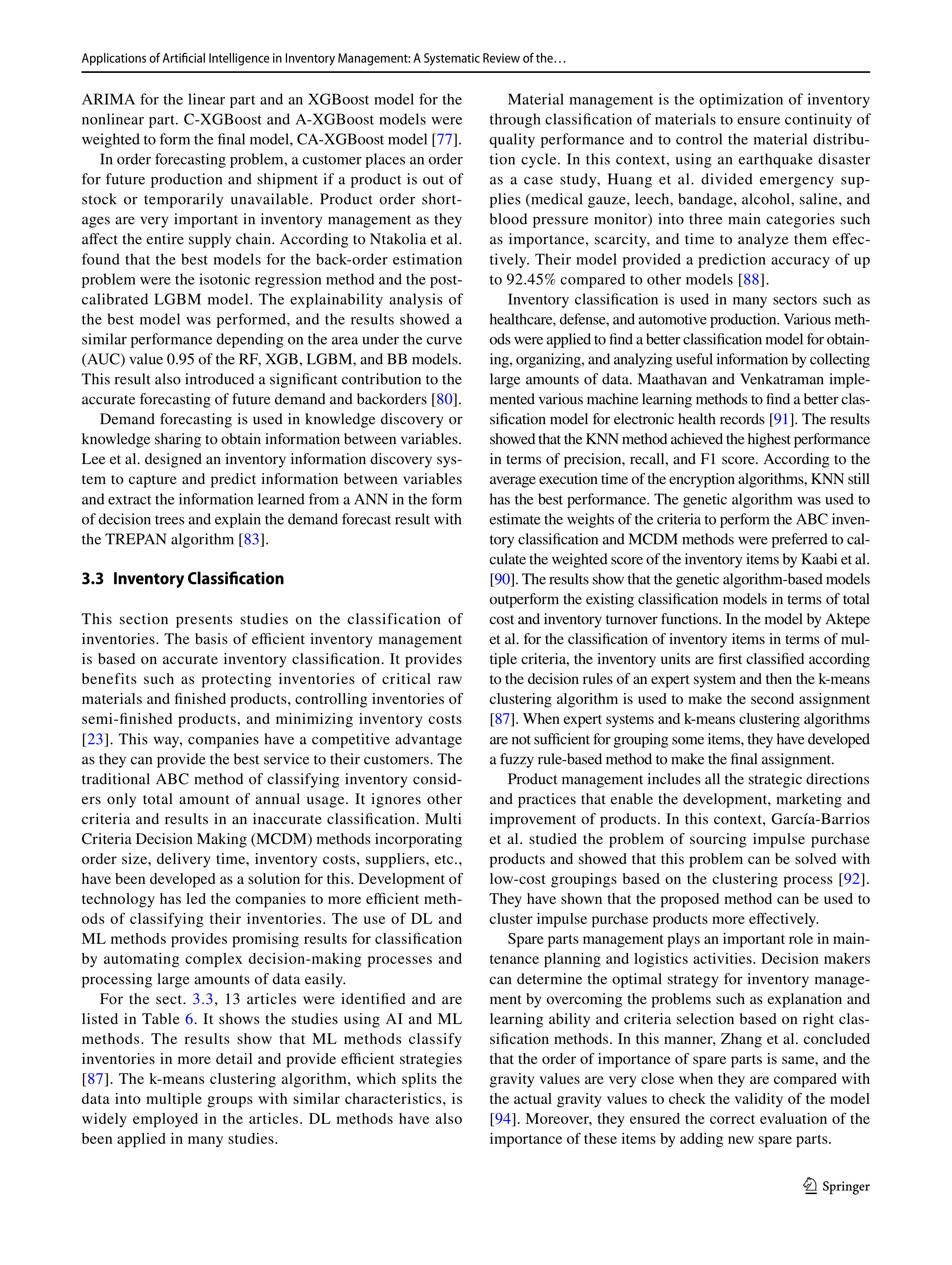
One of the most studied topics in the field of demand fore-
casting is product demand forecasting. There exist 14 studies
conducted on this topic. Benhamida et al. have proposed the
Comb-TSB hybrid method for intermittent and lumpy demand
models. In this method, TSB relies on an automatic separa-
tion decomposition between a combination method consisting
mainly of statistical models, while the Comb method uses two
statistical estimation methods (ARIMA and Theta) and ML-
based MLP method. Their cluster-based approach was validated
in a case study [
65
]. In another study, Abbasi et al. used four
common predictive machine learning models to make blood
transfusion decisions in a hospital network. They concluded that
use of a trained neural network model reduced average daily
costs by about 29% compared with the current policy [
62
].
Zhang et al. compared the ARIMA, PSO-ELM, and XGBoost
methods with an empirical evaluation based on real data to vali-
date the performance of the cold chain storage demand forecast-
ing scheme. While their proposed method had the best per-
formance, the ARIMA method yielded the worst [
66
]. Ulrich
et al. applied GAMLSS to build distribution regression models
to predict the demand for a large number of perishable items.
They observed the results of linear regression, log-linear regres-
sion, log-log regression, quantile regression, random forests,
and quantile regression forest methods as performance criteria
for the GAMLSS approach [
67
]. To forecast demand for eight
products in a supermarket in India, Bala segmented customers
based on various characteristics through cluster analysis and
implemented various forecasting models based on ARIMA and
neural network based ARIMA. The given forecasting model
ensured to improve inventory performance by increasing the
level of service to customers and decreasing the level of inven-
tory [
60
]. Li et al. suggested an integrated ordering strategy to
forecast future red cell demand. They reduced the inventory by
40% and ordering frequency by 60%, resulting in significant
cost savings for blood suppliers [
68
].
Sales forecasting is an analytical technique that seeks to
predict and understand consumer demand in businesses and
support managerial decision-making. Effective demand fore-
casting not only supply companies a competitive advantage,
but also plays a very important role in the strategic decisions
they make to satisfy consumer demands and satisfaction,
maintain market share, and manage costs [
86
]. In this sense,
Wang and Yang used an effective sales forecasting model
called M-GNA-XGBoost, which provides effective forecast-
ing of sales in a short time to perform digital marketing strat-
egies with machine learning. The root mean and absolute
error mean of the error squares of the model were obtained
as 11.9 and 8.23, respectively. Based on these results, it was
proven that the efficiency of the method was increased [
78
].
Ji et al. created a C-XGBoost model based on the clustering
algorithm according to their three-stage XGBoost model,
which also includes sales features. To achieve higher pre-
diction accuracy, an A-XGBoost model was created using
Applications of Artificial Intelligence in Inventory Management: A Systematic Review of the…
1 3
ARIMA for the linear part and an XGBoost model for the
nonlinear part. C-XGBoost and A-XGBoost models were
weighted to form the final model, CA-XGBoost model [
77
].
In order forecasting problem, a customer places an order
for future production and shipment if a product is out of
stock or temporarily unavailable. Product order short-
ages are very important in inventory management as they
affect the entire supply chain. According to Ntakolia et al.
found that the best models for the back-order estimation
problem were the isotonic regression method and the post-
calibrated LGBM model. The explainability analysis of
the best model was performed, and the results showed a
similar performance depending on the area under the curve
(AUC) value 0.95 of the RF, XGB, LGBM, and BB models.
This result also introduced a significant contribution to the
accurate forecasting of future demand and backorders [
80
].
Demand forecasting is used in knowledge discovery or
knowledge sharing to obtain information between variables.
Lee et al. designed an inventory information discovery sys-
tem to capture and predict information between variables
and extract the information learned from a ANN in the form
of decision trees and explain the demand forecast result with
the TREPAN algorithm [
83
].
3.3
Inventory Classification
This section presents studies on the classification of
inventories. The basis of efficient inventory management
is based on accurate inventory classification. It provides
benefits such as protecting inventories of critical raw
materials and finished products, controlling inventories of
semi-finished products, and minimizing inventory costs
[
23
]. This way, companies have a competitive advantage
as they can provide the best service to their customers. The
traditional ABC method of classifying inventory consid-
ers only total amount of annual usage. It ignores other
criteria and results in an inaccurate classification. Multi
Criteria Decision Making (MCDM) methods incorporating
order size, delivery time, inventory costs, suppliers, etc.,
have been developed as a solution for this. Development of
technology has led the companies to more efficient meth-
ods of classifying their inventories. The use of DL and
ML methods provides promising results for classification
by automating complex decision-making processes and
processing large amounts of data easily.
For the sect.
3.3
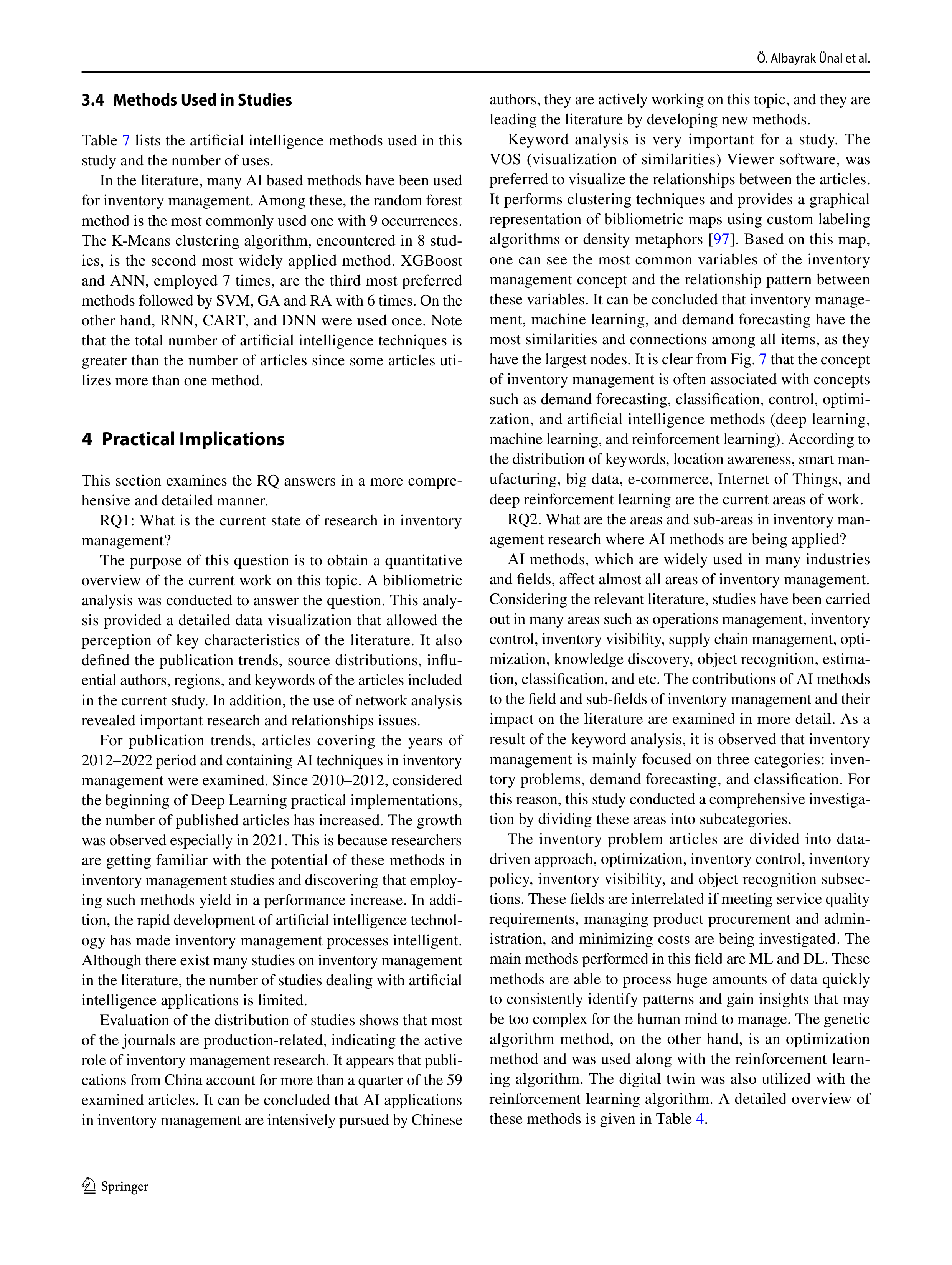
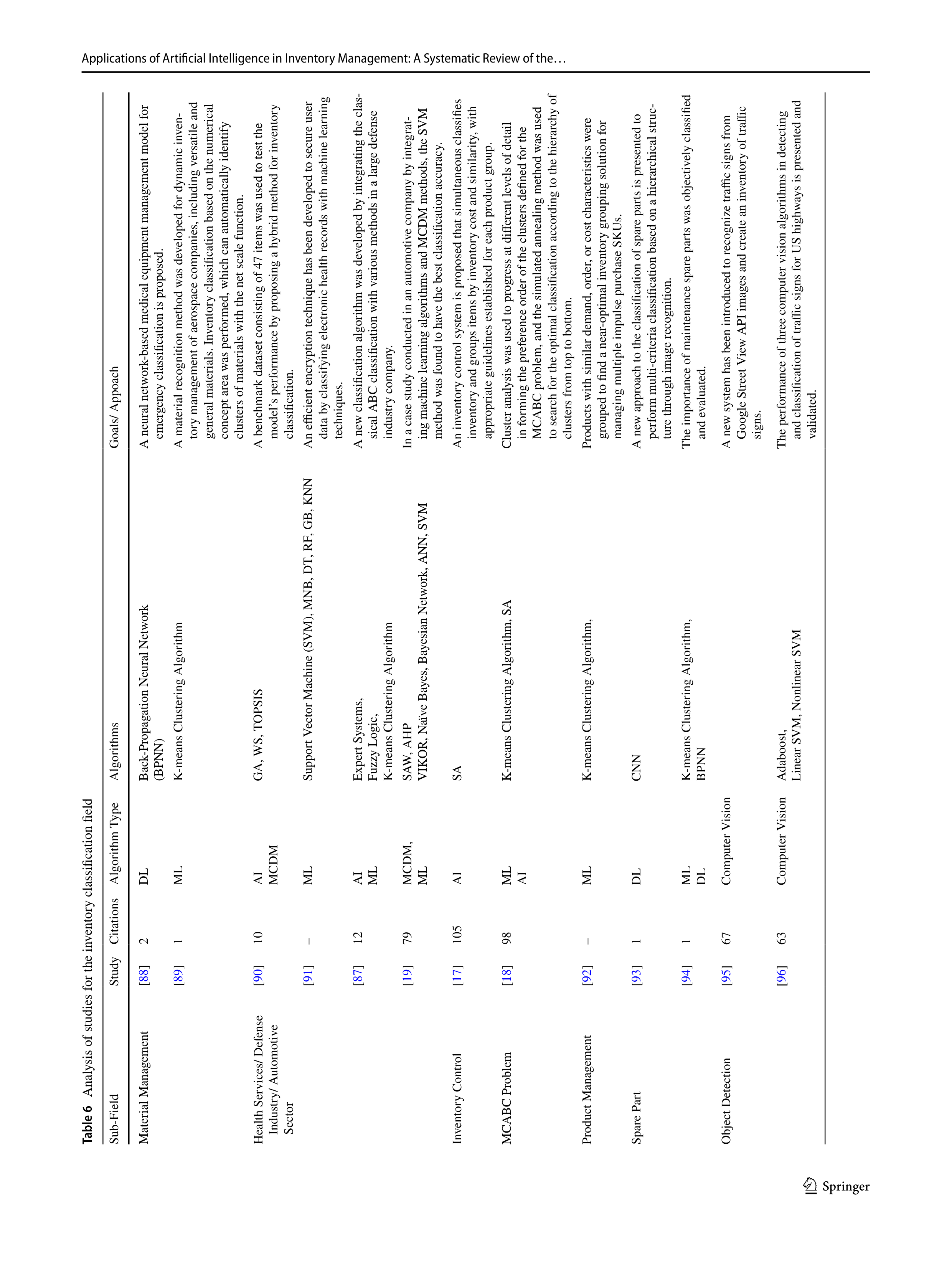
, 13 articles were identified and are
listed in Table
6
. It shows the studies using AI and ML
methods. The results show that ML methods classify
inventories in more detail and provide efficient strategies
[
87
]. The k-means clustering algorithm, which splits the
data into multiple groups with similar characteristics, is
widely employed in the articles. DL methods have also
been applied in many studies.
Material management is the optimization of inventory
through classification of materials to ensure continuity of
quality performance and to control the material distribu-
tion cycle. In this context, using an earthquake disaster
as a case study, Huang et al. divided emergency sup-
plies (medical gauze, leech, bandage, alcohol, saline, and
blood pressure monitor) into three main categories such
as importance, scarcity, and time to analyze them effec-
tively. Their model provided a prediction accuracy of up
to 92.45% compared to other models [
88
].
Inventory classification is used in many sectors such as
healthcare, defense, and automotive production. Various meth-
ods were applied to find a better classification model for obtain-
ing, organizing, and analyzing useful information by collecting
large amounts of data. Maathavan and Venkatraman imple-
mented various machine learning methods to find a better clas-
sification model for electronic health records [
91
]. The results
showed that the KNN method achieved the highest performance
in terms of precision, recall, and F1 score. According to the
average execution time of the encryption algorithms, KNN still
has the best performance. The genetic algorithm was used to
estimate the weights of the criteria to perform the ABC inven-
tory classification and MCDM methods were preferred to cal-
culate the weighted score of the inventory items by Kaabi et al.
[
90
]. The results show that the genetic algorithm-based models
outperform the existing classification models in terms of total
cost and inventory turnover functions. In the model by Aktepe
et al. for the classification of inventory items in terms of mul-
tiple criteria, the inventory units are first classified according
to the decision rules of an expert system and then the k-means
clustering algorithm is used to make the second assignment
[
87
]. When expert systems and k-means clustering algorithms
are not sufficient for grouping some items, they have developed
a fuzzy rule-based method to make the final assignment.
Product management includes all the strategic directions
and practices that enable the development, marketing and
improvement of products. In this context, García-Barrios
et al. studied the problem of sourcing impulse purchase
products and showed that this problem can be solved with
low-cost groupings based on the clustering process [
92
].
They have shown that the proposed method can be used to
cluster impulse purchase products more effectively.
Spare parts management plays an important role in main-
tenance planning and logistics activities. Decision makers
can determine the optimal strategy for inventory manage-
ment by overcoming the problems such as explanation and
learning ability and criteria selection based on right clas-
sification methods. In this manner, Zhang et al. concluded
that the order of importance of spare parts is same, and the
gravity values are very close when they are compared with
the actual gravity values to check the validity of the model
[
94
]. Moreover, they ensured the correct evaluation of the
importance of these items by adding new spare parts.
Ö. Albayrak Ünal et al.
1 3
3.4
Methods Used in Studies
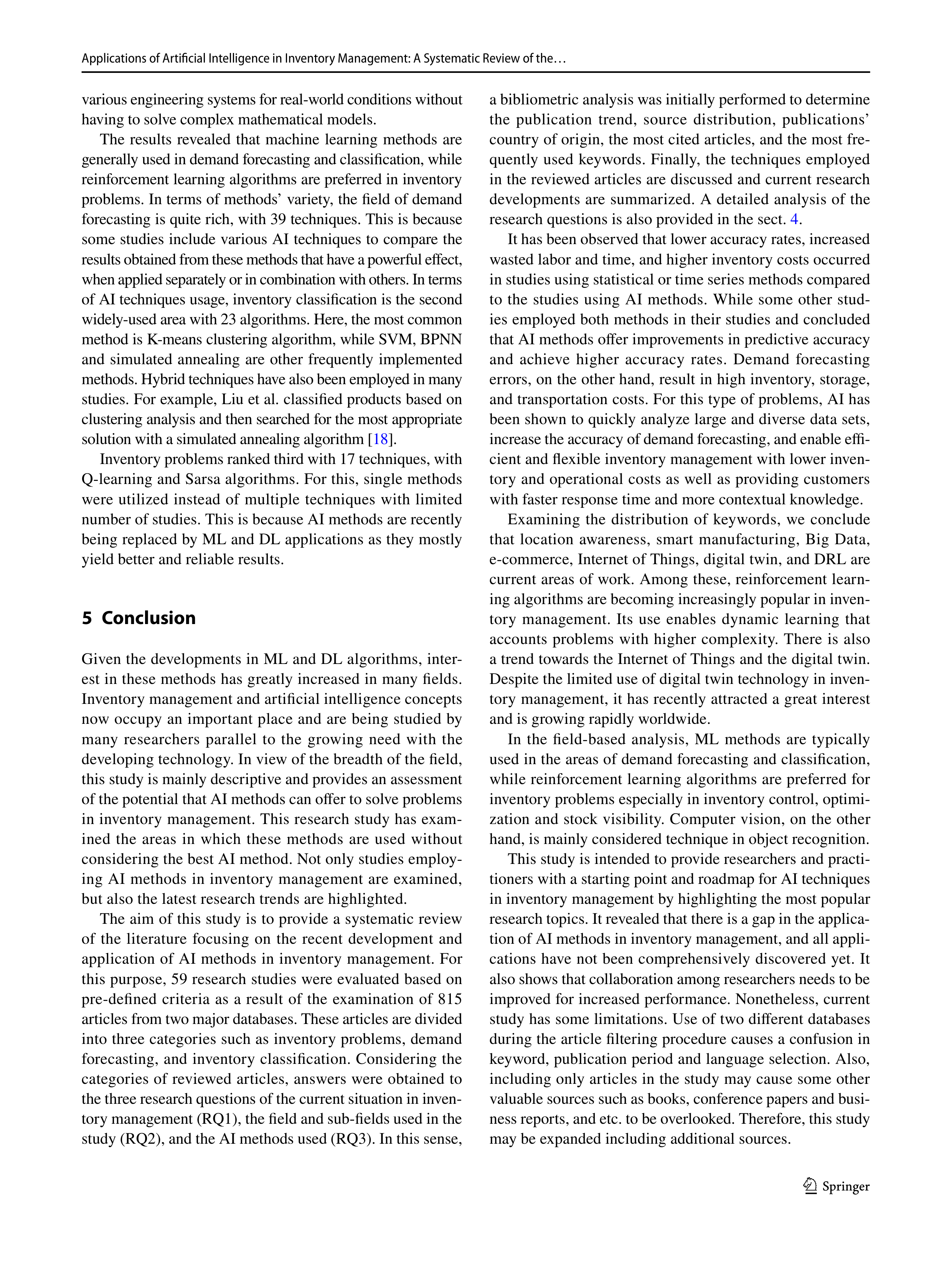
Table
7
lists the artificial intelligence methods used in this
study and the number of uses.
In the literature, many AI based methods have been used
for inventory management. Among these, the random forest
method is the most commonly used one with 9 occurrences.
The K-Means clustering algorithm, encountered in 8 stud-
ies, is the second most widely applied method. XGBoost
and ANN, employed 7 times, are the third most preferred
methods followed by SVM, GA and RA with 6 times. On the
other hand, RNN, CART, and DNN were used once. Note
that the total number of artificial intelligence techniques is
greater than the number of articles since some articles uti-
lizes more than one method.
4 Practical Implications
This section examines the RQ answers in a more compre-
hensive and detailed manner.
RQ1: What is the current state of research in inventory
management?
The purpose of this question is to obtain a quantitative
overview of the current work on this topic. A bibliometric
analysis was conducted to answer the question. This analy-
sis provided a detailed data visualization that allowed the
perception of key characteristics of the literature. It also
defined the publication trends, source distributions, influ-
ential authors, regions, and keywords of the articles included
in the current study. In addition, the use of network analysis
revealed important research and relationships issues.
For publication trends, articles covering the years of
2012–2022 period and containing AI techniques in inventory
management were examined. Since 2010–2012, considered
the beginning of Deep Learning practical implementations,
the number of published articles has increased. The growth
was observed especially in 2021. This is because researchers
are getting familiar with the potential of these methods in
inventory management studies and discovering that employ-
ing such methods yield in a performance increase. In addi-
tion, the rapid development of artificial intelligence technol-
ogy has made inventory management processes intelligent.
Although there exist many studies on inventory management
in the literature, the number of studies dealing with artificial
intelligence applications is limited.
Evaluation of the distribution of studies shows that most
of the journals are production-related, indicating the active
role of inventory management research. It appears that publi-
cations from China account for more than a quarter of the 59
examined articles. It can be concluded that AI applications
in inventory management are intensively pursued by Chinese
authors, they are actively working on this topic, and they are
leading the literature by developing new methods.
Keyword analysis is very important for a study. The
VOS (visualization of similarities) Viewer software, was
preferred to visualize the relationships between the articles.
It performs clustering techniques and provides a graphical
representation of bibliometric maps using custom labeling
algorithms or density metaphors [
97
]. Based on this map,
one can see the most common variables of the inventory
management concept and the relationship pattern between
these variables. It can be concluded that inventory manage-
ment, machine learning, and demand forecasting have the
most similarities and connections among all items, as they
have the largest nodes. It is clear from Fig.
7
that the concept
of inventory management is often associated with concepts
such as demand forecasting, classification, control, optimi-
zation, and artificial intelligence methods (deep learning,
machine learning, and reinforcement learning). According to
the distribution of keywords, location awareness, smart man-
ufacturing, big data, e-commerce, Internet of Things, and
deep reinforcement learning are the current areas of work.
RQ2. What are the areas and sub-areas in inventory man-
agement research where AI methods are being applied?
AI methods, which are widely used in many industries
and fields, affect almost all areas of inventory management.
Considering the relevant literature, studies have been carried
out in many areas such as operations management, inventory
control, inventory visibility, supply chain management, opti-
mization, knowledge discovery, object recognition, estima-
tion, classification, and etc. The contributions of AI methods
to the field and sub-fields of inventory management and their
impact on the literature are examined in more detail. As a
result of the keyword analysis, it is observed that inventory
management is mainly focused on three categories: inven-
tory problems, demand forecasting, and classification. For
this reason, this study conducted a comprehensive investiga-
tion by dividing these areas into subcategories.
The inventory problem articles are divided into data-
driven approach, optimization, inventory control, inventory
policy, inventory visibility, and object recognition subsec-
tions. These fields are interrelated if meeting service quality
requirements, managing product procurement and admin-
istration, and minimizing costs are being investigated. The
main methods performed in this field are ML and DL. These
methods are able to process huge amounts of data quickly
to consistently identify patterns and gain insights that may
be too complex for the human mind to manage. The genetic
algorithm method, on the other hand, is an optimization
method and was used along with the reinforcement learn-
ing algorithm. The digital twin was also utilized with the
reinforcement learning algorithm. A detailed overview of
these methods is given in Table
4
.
Applications of Artificial Intelligence in Inventory Management: A Systematic Review of the…
1 3
Table 6
Analysis of studies for the inventory classification field
Sub-Field
Study
Citations
Algorithm Type
Algorithms
Goals/ Appoach
Material Management
[
88
]
2
DL
Back-Propagation Neural Network
(BPNN)
A neural network-based medical equipment management model for
emergency classification is proposed.
[
89
]
1
ML
K-means Clustering Algorithm
A material recognition method was developed for dynamic inven-
tory management of aerospace companies, including versatile and
general materials. Inventory classification based on the numerical
concept area was performed, which can automatically identify
clusters of materials with the net scale function.
Health Services/ Defense
Industry/ Automotive
Sector
[
90
]
10
AI
MCDM
GA, WS, TOPSIS
A benchmark dataset consisting of 47 items was used to test the
model’s performance by proposing a hybrid method for inventory
classification.
[
91
]
–
ML
Support Vector Machine (SVM), MNB, DT, RF, GB, KNN
An efficient encryption technique has been developed to secure user
data by classifying electronic health records with machine learning
techniques.
[
87
]
12
AI
ML
Expert Systems,
Fuzzy Logic,
K-means Clustering Algorithm
A new classification algorithm was developed by integrating the clas-
sical ABC classification with various methods in a large defense
industry company.
[
19
]
79
MCDM,
ML
SAW, AHP
VIKOR, Naïve Bayes, Bayesian Network, ANN, SVM
In a case study conducted in an automotive company by integrat-
ing machine learning algorithms and MCDM methods, the SVM
method was found to have the best classification accuracy.
Inventory Control
[
17
]
105
AI
SA
An inventory control system is proposed that simultaneous classifies
inventory and groups items by inventory cost and similarity, with
appropriate guidelines established for each product group.
MCABC Problem
[
18
]
98
ML
AI
K-means Clustering Algorithm, SA
Cluster analysis was used to progress at different levels of detail
in forming the preference order of the clusters defined for the
MCABC problem, and the simulated annealing method was used
to search for the optimal classification according to the hierarchy of
clusters from top to bottom.
Product Management
[
92
]
–
ML
K-means Clustering Algorithm,
Products with similar demand, order, or cost characteristics were
grouped to find a near-optimal inventory grouping solution for
managing multiple impulse purchase SKUs.
Spare Part
[
93
]
1
DL
CNN
A new approach to the classification of spare parts is presented to
perform multi-criteria classification based on a hierarchical struc-
ture through image recognition.
[
94
]
1
ML
DL
K-means Clustering Algorithm,
BPNN
The importance of maintenance spare parts was objectively classified
and evaluated.
Object Detection
[
95
]
67
Computer Vision
A new system has been introduced to recognize traffic signs from
Google Street View API images and create an inventory of traffic
signs.
[
96
]
63
Computer Vision
Adaboost,
Linear SVM, Nonlinear SVM
The performance of three computer vision algorithms in detecting
and classification of traffic signs for US highways is presented and
validated.
Ö. Albayrak Ünal et al.
1 3
In the field of demand forecasting, the articles reviewed
consist of the sub-areas of customer forecasting, product
forecasting, sales forecasting, order forecasting, and infor-
mation exchange. In this sense, demand forecasts play an
important role in managing key operations. They aim to
meet incoming demand in the shortest possible time and at
the lowest possible cost. Here, the methods of ML provide
better results as they can handle complex interdependencies
among many causal factors affecting the demand [
57
]. While
CNN, LSTM, ANN and RNN were preferred more among
DL methods, KNN, QuantReg, QRF, RF, SVM, XGBoost,
CART and GAMLSS were preferred from ML methods. The
simple exponential smoothing, the quadratic exponential
smoothing, the feature synthesis, and Loess methods were
widely implemented among all time series methods. Also,
ML and DL methods were jointly applied in many studies,
while others used them separately. There are many stud-
ies that combine ML methods with time series methods. A
detailed overview of these methods is presented in Table
5
.
In the field of inventory classification, material manage-
ment consists of sub-fields on a sectoral basis (healthcare,
automotive, defense), inventory control, object detection, and
product management. While effective use of ML applications
can be observed in this area, GA, fuzzy logic, expert systems
and simulated annealing from artificial intelligence methods
are also adopted. These methods have been implemented
along with ML and MCDM algorithms. In addition, SAW,
AHP, TOPSIS and VIKOR are commonly preferred MCDM
methods. Another topic in inventory classification that was
applied with machine learning algorithms is Computer vision.
A detailed overview of these methods is given in Table
6
.
RQ3. Which AI methods are being used in inventory
management studies?
From the review of literature, it is clear that many AI
techniques have been applied to inventory management. In
this sense, the most common and effective method is the
random forest method, which was used in 9 studies. It is a
popular machine learning method introduced by Breiman
in 2001 and used to develop predictive models [
98
]. RF, an
ensemble learning method, is widely used in many fields
such as computer vision, product demand forecasting, scrap
feature filtering, and data mining [
99
] due to its excellent
performance and efficient training process. This unified
machine learning algorithm creates a group of trees where
each tree, combined with a set of tree classifiers, votes a unit
for the most popular class, and, the final ranking is obtained
by combining such results [
100
]. Cluster analysis is the sec-
ond most commonly used method. Cluster analysis, in short
clustering, is referred as an unsupervised learning approach
since it does not use label information. It provides infor-
mation about the data by dividing the objects into clusters,
ensuring that the objects in one cluster are more related than
objects in other clusters [
101
].
Following cluster analysis, XGBoost and ANN methods
were used in 7 studies. Here, XGBoost is another ensemble
learning method that has achieved remarkable results in many
research areas. It automatically implements multi-threading of
CPU to perform parallel computation and optimize the algo-
rithm. This way, the training speed and prediction accuracy
of the models significantly improve [
102
]. ANN, on the other
hand, is one of the most popular machine learning methods.
It is an information processing technique that is used to obtain
patterns, information or connections in large amount of data.
It belongs to the class of black-box models, since ANNs do
not require knowledge of the physical parameters of the pro-
cess [
103
]. ANN-based methods are useful tools in modeling
Table 7
Number of methods used in the study
Methods
Number of
Usage
Methods
Number of
Usage
Methods
Number
of Usage
RF
9
QRF
3
Internet of things
1
K-Means Clustering Algorithm
8
Digital Twin
3
LASSO
1
XGBoost
7
GAMLSS
2
CART
1
ANN
7
MLP
2
Automated innovization
1
SVM
6
BPNN
2
Fuzzy logic
1
GA
6
ETS
2
MNB
1
RA
6
Naïve/Naive Bayes
2
GB
1
KNN
5
Q-Learning
2
Expert systems
1
Time Series Models
5
Sarsa Algorithms
2
QuantReg
1
LSTM
5
DQN
2
PPO
1
CNN
5
DNN
2
GP
1
ARIMA
5
RNN
1
BB
1
DT
4
Graph Embedding
1
Inductive Learning Algorithm
1
DRL
4
Generative Adversarial Networks
1
SIFT algorithm
1
SA
3
Core Density Estimation
1
Yolov5
1
Applications of Artificial Intelligence in Inventory Management: A Systematic Review of the…
1 3
various engineering systems for real-world conditions without
having to solve complex mathematical models.
The results revealed that machine learning methods are
generally used in demand forecasting and classification, while
reinforcement learning algorithms are preferred in inventory
problems. In terms of methods’ variety, the field of demand
forecasting is quite rich, with 39 techniques. This is because
some studies include various AI techniques to compare the
results obtained from these methods that have a powerful effect,
when applied separately or in combination with others. In terms
of AI techniques usage, inventory classification is the second
widely-used area with 23 algorithms. Here, the most common
method is K-means clustering algorithm, while SVM, BPNN
and simulated annealing are other frequently implemented
methods. Hybrid techniques have also been employed in many
studies. For example, Liu et al. classified products based on
clustering analysis and then searched for the most appropriate
solution with a simulated annealing algorithm [
18
].
Inventory problems ranked third with 17 techniques, with
Q-learning and Sarsa algorithms. For this, single methods
were utilized instead of multiple techniques with limited
number of studies. This is because AI methods are recently
being replaced by ML and DL applications as they mostly
yield better and reliable results.
5 Conclusion
Given the developments in ML and DL algorithms, inter-
est in these methods has greatly increased in many fields.
Inventory management and artificial intelligence concepts
now occupy an important place and are being studied by
many researchers parallel to the growing need with the
developing technology. In view of the breadth of the field,
this study is mainly descriptive and provides an assessment
of the potential that AI methods can offer to solve problems
in inventory management. This research study has exam-
ined the areas in which these methods are used without
considering the best AI method. Not only studies employ-
ing AI methods in inventory management are examined,
but also the latest research trends are highlighted.
The aim of this study is to provide a systematic review
of the literature focusing on the recent development and
application of AI methods in inventory management. For
this purpose, 59 research studies were evaluated based on
pre-defined criteria as a result of the examination of 815
articles from two major databases. These articles are divided
into three categories such as inventory problems, demand
forecasting, and inventory classification. Considering the
categories of reviewed articles, answers were obtained to
the three research questions of the current situation in inven-
tory management (RQ1), the field and sub-fields used in the
study (RQ2), and the AI methods used (RQ3). In this sense,
a bibliometric analysis was initially performed to determine
the publication trend, source distribution, publications’
country of origin, the most cited articles, and the most fre-
quently used keywords. Finally, the techniques employed
in the reviewed articles are discussed and current research
developments are summarized. A detailed analysis of the
research questions is also provided in the sect.
4
.
It has been observed that lower accuracy rates, increased
wasted labor and time, and higher inventory costs occurred
in studies using statistical or time series methods compared
to the studies using AI methods. While some other stud-
ies employed both methods in their studies and concluded
that AI methods offer improvements in predictive accuracy
and achieve higher accuracy rates. Demand forecasting
errors, on the other hand, result in high inventory, storage,
and transportation costs. For this type of problems, AI has
been shown to quickly analyze large and diverse data sets,
increase the accuracy of demand forecasting, and enable effi-
cient and flexible inventory management with lower inven-
tory and operational costs as well as providing customers
with faster response time and more contextual knowledge.
Examining the distribution of keywords, we conclude
that location awareness, smart manufacturing, Big Data,
e-commerce, Internet of Things, digital twin, and DRL are
current areas of work. Among these, reinforcement learn-
ing algorithms are becoming increasingly popular in inven-
tory management. Its use enables dynamic learning that
accounts problems with higher complexity. There is also
a trend towards the Internet of Things and the digital twin.
Despite the limited use of digital twin technology in inven-
tory management, it has recently attracted a great interest
and is growing rapidly worldwide.
In the field-based analysis, ML methods are typically
used in the areas of demand forecasting and classification,
while reinforcement learning algorithms are preferred for
inventory problems especially in inventory control, optimi-
zation and stock visibility. Computer vision, on the other
hand, is mainly considered technique in object recognition.
This study is intended to provide researchers and practi-
tioners with a starting point and roadmap for AI techniques
in inventory management by highlighting the most popular
research topics. It revealed that there is a gap in the applica-
tion of AI methods in inventory management, and all appli-
cations have not been comprehensively discovered yet. It
also shows that collaboration among researchers needs to be
improved for increased performance. Nonetheless, current
study has some limitations. Use of two different databases
during the article filtering procedure causes a confusion in
keyword, publication period and language selection. Also,
including only articles in the study may cause some other
valuable sources such as books, conference papers and busi-
ness reports, and etc. to be overlooked. Therefore, this study
may be expanded including additional sources.
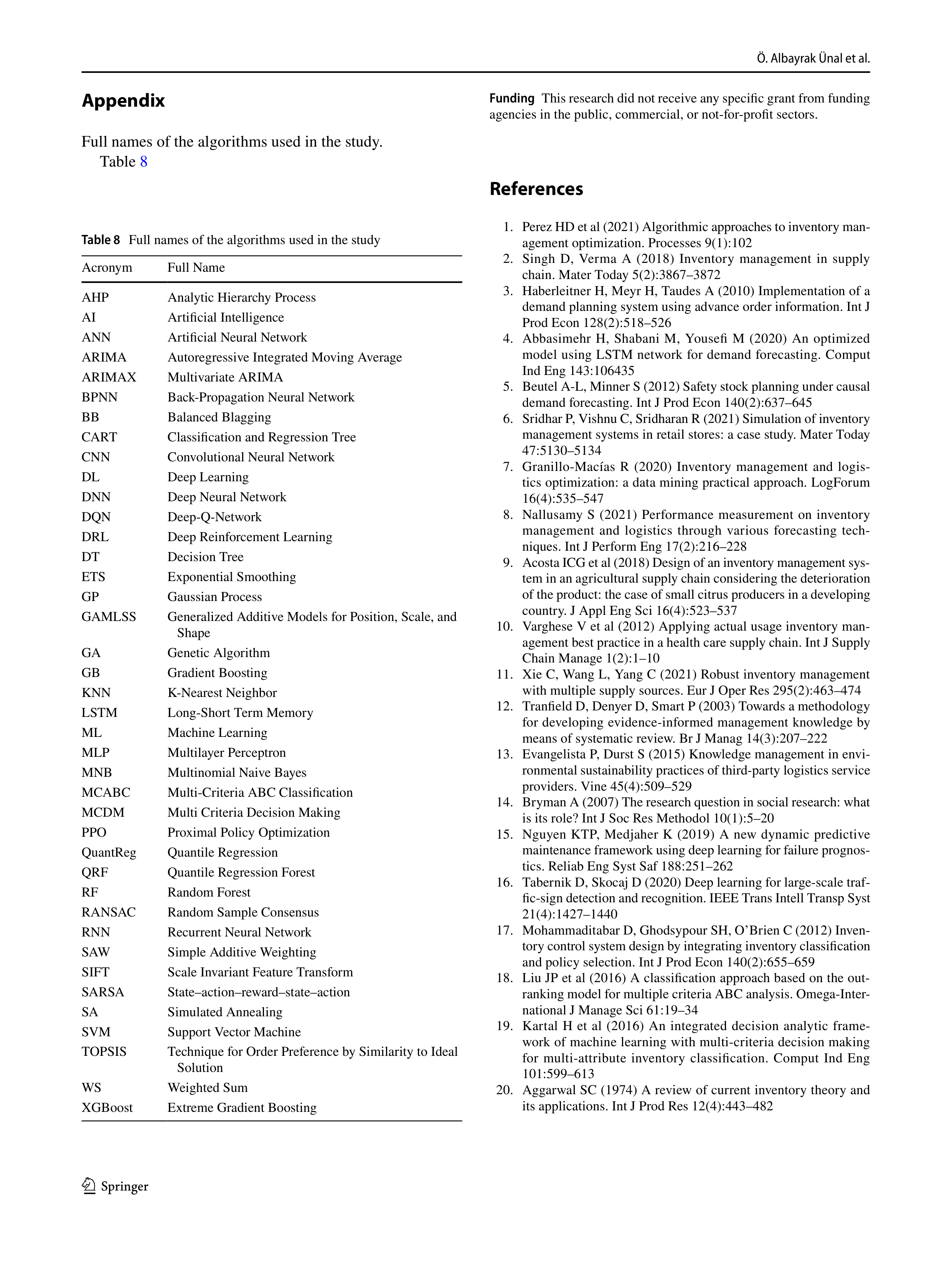
Ö. Albayrak Ünal et al.
1 3
Appendix
Full names of the algorithms used in the study.
Table
8
Funding
This research did not receive any specific grant from funding
agencies in the public, commercial, or not-for-profit sectors.
References
1.
Perez HD et al (2021) Algorithmic approaches to inventory man-
agement optimization. Processes 9(1):102
2.
Singh D, Verma A (2018) Inventory management in supply
chain. Mater Today 5(2):3867–3872
3.
Haberleitner H, Meyr H, Taudes A (2010) Implementation of a
demand planning system using advance order information. Int J
Prod Econ 128(2):518–526
4.
Abbasimehr H, Shabani M, Yousefi M (2020) An optimized
model using LSTM network for demand forecasting. Comput
Ind Eng 143:106435
5.
Beutel A-L, Minner S (2012) Safety stock planning under causal
demand forecasting. Int J Prod Econ 140(2):637–645
6.
Sridhar P, Vishnu C, Sridharan R (2021) Simulation of inventory
management systems in retail stores: a case study. Mater Today
47:5130–5134
7.
Granillo-Macías R (2020) Inventory management and logis-
tics optimization: a data mining practical approach. LogForum
16(4):535–547
8.
Nallusamy S (2021) Performance measurement on inventory
management and logistics through various forecasting tech-
niques. Int J Perform Eng 17(2):216–228
9.
Acosta ICG et al (2018) Design of an inventory management sys-
tem in an agricultural supply chain considering the deterioration
of the product: the case of small citrus producers in a developing
country. J Appl Eng Sci 16(4):523–537
10.
Varghese V et al (2012) Applying actual usage inventory man-
agement best practice in a health care supply chain. Int J Supply
Chain Manage 1(2):1–10
11.
Xie C, Wang L, Yang C (2021) Robust inventory management
with multiple supply sources. Eur J Oper Res 295(2):463–474
12.
Tranfield D, Denyer D, Smart P (2003) Towards a methodology
for developing evidence-informed management knowledge by
means of systematic review. Br J Manag 14(3):207–222
13.
Evangelista P, Durst S (2015) Knowledge management in envi-
ronmental sustainability practices of third-party logistics service
providers. Vine 45(4):509–529
14.
Bryman A (2007) The research question in social research: what
is its role? Int J Soc Res Methodol 10(1):5–20
15.
Nguyen KTP, Medjaher K (2019) A new dynamic predictive
maintenance framework using deep learning for failure prognos-
tics. Reliab Eng Syst Saf 188:251–262
16.
Tabernik D, Skocaj D (2020) Deep learning for large-scale traf-
fic-sign detection and recognition. IEEE Trans Intell Transp Syst
21(4):1427–1440
17.
Mohammaditabar D, Ghodsypour SH, O’Brien C (2012) Inven-
tory control system design by integrating inventory classification
and policy selection. Int J Prod Econ 140(2):655–659
18.
Liu JP et al (2016) A classification approach based on the out-
ranking model for multiple criteria ABC analysis. Omega-Inter-
national J Manage Sci 61:19–34
19.
Kartal H et al (2016) An integrated decision analytic frame-
work of machine learning with multi-criteria decision making
for multi-attribute inventory classification. Comput Ind Eng
101:599–613
20.
Aggarwal SC (1974) A review of current inventory theory and
its applications. Int J Prod Res 12(4):443–482
Table 8
Full names of the algorithms used in the study
Acronym
Full Name
AHP
Analytic Hierarchy Process
AI
Artificial Intelligence
ANN
Artificial Neural Network
ARIMA
Autoregressive Integrated Moving Average
ARIMAX
Multivariate ARIMA
BPNN
Back-Propagation Neural Network
BB
Balanced Blagging
CART
Classification and Regression Tree
CNN
Convolutional Neural Network
DL
Deep Learning
DNN
Deep Neural Network
DQN
Deep-Q-Network
DRL
Deep Reinforcement Learning
DT
Decision Tree
ETS
Exponential Smoothing
GP
Gaussian Process
GAMLSS
Generalized Additive Models for Position, Scale, and
Shape
GA
Genetic Algorithm
GB
Gradient Boosting
KNN
K-Nearest Neighbor
LSTM
Long-Short Term Memory
ML
Machine Learning
MLP
Multilayer Perceptron
MNB
Multinomial Naive Bayes
MCABC
Multi-Criteria ABC Classification
MCDM
Multi Criteria Decision Making
PPO
Proximal Policy Optimization
QuantReg
Quantile Regression
QRF
Quantile Regression Forest
RF
Random Forest
RANSAC
Random Sample Consensus
RNN
Recurrent Neural Network
SAW
Simple Additive Weighting
SIFT
Scale Invariant Feature Transform
SARSA
State–action–reward–state–action
SA
Simulated Annealing
SVM
Support Vector Machine
TOPSIS
Technique for Order Preference by Similarity to Ideal
Solution
WS
Weighted Sum
XGBoost
Extreme Gradient Boosting
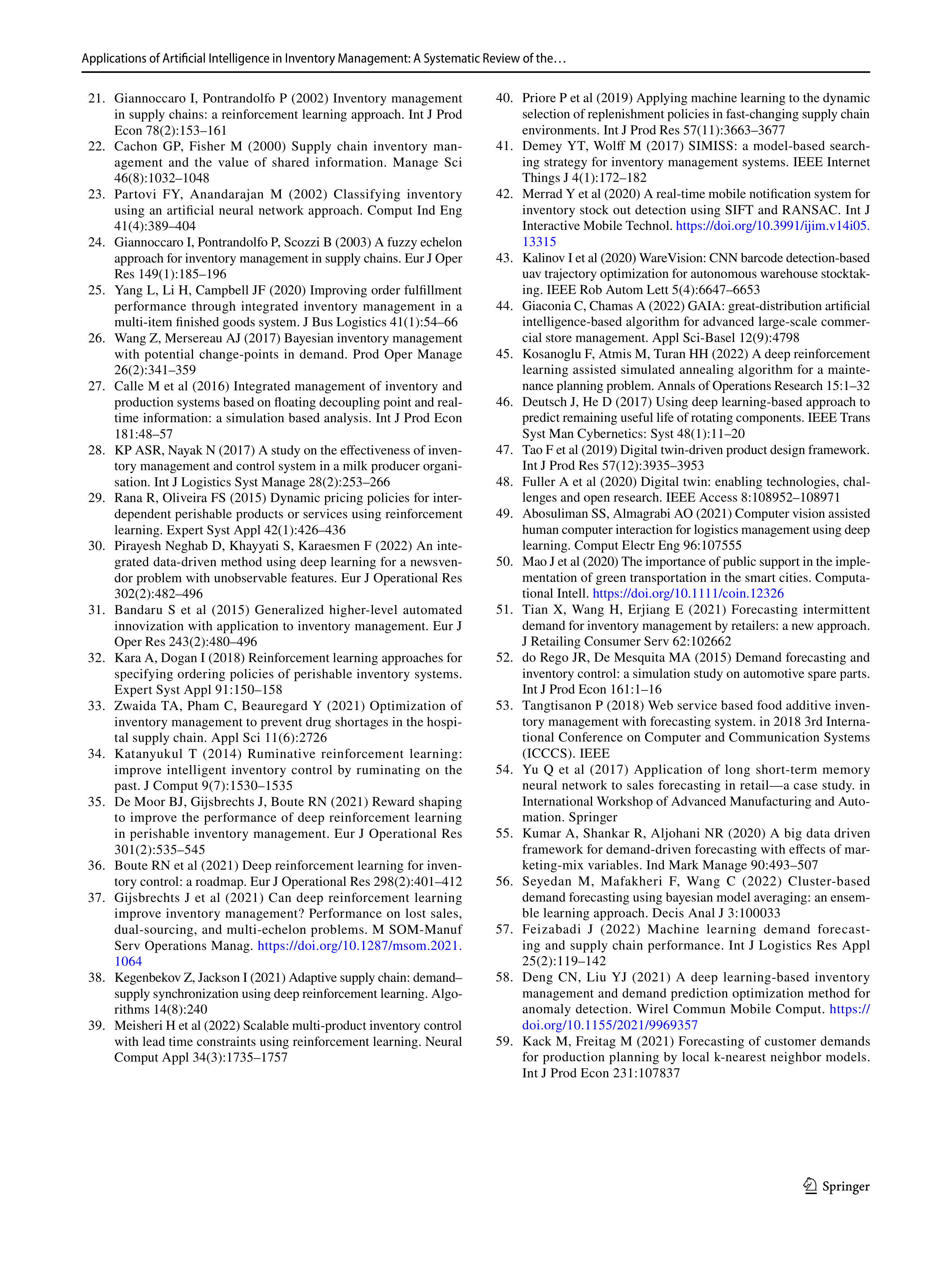
Applications of Artificial Intelligence in Inventory Management: A Systematic Review of the…
1 3
21.
Giannoccaro I, Pontrandolfo P (2002) Inventory management
in supply chains: a reinforcement learning approach. Int J Prod
Econ 78(2):153–161
22.
Cachon GP, Fisher M (2000) Supply chain inventory man-
agement and the value of shared information. Manage Sci
46(8):1032–1048
23.
Partovi FY, Anandarajan M (2002) Classifying inventory
using an artificial neural network approach. Comput Ind Eng
41(4):389–404
24.
Giannoccaro I, Pontrandolfo P, Scozzi B (2003) A fuzzy echelon
approach for inventory management in supply chains. Eur J Oper
Res 149(1):185–196
25.
Yang L, Li H, Campbell JF (2020) Improving order fulfillment
performance through integrated inventory management in a
multi-item finished goods system. J Bus Logistics 41(1):54–66
26.
Wang Z, Mersereau AJ (2017) Bayesian inventory management
with potential change-points in demand. Prod Oper Manage
26(2):341–359
27.
Calle M et al (2016) Integrated management of inventory and
production systems based on floating decoupling point and real-
time information: a simulation based analysis. Int J Prod Econ
181:48–57
28.
KP ASR, Nayak N (2017) A study on the effectiveness of inven-
tory management and control system in a milk producer organi-
sation. Int J Logistics Syst Manage 28(2):253–266
29.
Rana R, Oliveira FS (2015) Dynamic pricing policies for inter-
dependent perishable products or services using reinforcement
learning. Expert Syst Appl 42(1):426–436
30.
Pirayesh Neghab D, Khayyati S, Karaesmen F (2022) An inte-
grated data-driven method using deep learning for a newsven-
dor problem with unobservable features. Eur J Operational Res
302(2):482–496
31.
Bandaru S et al (2015) Generalized higher-level automated
innovization with application to inventory management. Eur J
Oper Res 243(2):480–496
32.
Kara A, Dogan I (2018) Reinforcement learning approaches for
specifying ordering policies of perishable inventory systems.
Expert Syst Appl 91:150–158
33.
Zwaida TA, Pham C, Beauregard Y (2021) Optimization of
inventory management to prevent drug shortages in the hospi-
tal supply chain. Appl Sci 11(6):2726
34.
Katanyukul T (2014) Ruminative reinforcement learning:
improve intelligent inventory control by ruminating on the
past. J Comput 9(7):1530–1535
35.
De Moor BJ, Gijsbrechts J, Boute RN (2021) Reward shaping
to improve the performance of deep reinforcement learning
in perishable inventory management. Eur J Operational Res
301(2):535–545
36.
Boute RN et al (2021) Deep reinforcement learning for inven-
tory control: a roadmap. Eur J Operational Res 298(2):401–412
37.
Gijsbrechts J et al (2021) Can deep reinforcement learning
improve inventory management? Performance on lost sales,
dual-sourcing, and multi-echelon problems. M SOM-Manuf
Serv Operations Manag.
https://doi.org/10.1287/msom.2021.
1064
38.
Kegenbekov Z, Jackson I (2021) Adaptive supply chain: demand–
supply synchronization using deep reinforcement learning. Algo-
rithms 14(8):240
39.
Meisheri H et al (2022) Scalable multi-product inventory control
with lead time constraints using reinforcement learning. Neural
Comput Appl 34(3):1735–1757
40.
Priore P et al (2019) Applying machine learning to the dynamic
selection of replenishment policies in fast-changing supply chain
environments. Int J Prod Res 57(11):3663–3677
41.
Demey YT, Wolff M (2017) SIMISS: a model-based search-
ing strategy for inventory management systems. IEEE Internet
Things J 4(1):172–182
42.
Merrad Y et al (2020) A real-time mobile notification system for
inventory stock out detection using SIFT and RANSAC. Int J
Interactive Mobile Technol.
https://doi.org/10.3991/ijim.v14i05.
13315
43.
Kalinov I et al (2020) WareVision: CNN barcode detection-based
uav trajectory optimization for autonomous warehouse stocktak-
ing. IEEE Rob Autom Lett 5(4):6647–6653
44.
Giaconia C, Chamas A (2022) GAIA: great-distribution artificial
intelligence-based algorithm for advanced large-scale commer-
cial store management. Appl Sci-Basel 12(9):4798
45.
Kosanoglu F, Atmis M, Turan HH (2022) A deep reinforcement
learning assisted simulated annealing algorithm for a mainte-
nance planning problem. Annals of Operations Research 15:1–32
46.
Deutsch J, He D (2017) Using deep learning-based approach to
predict remaining useful life of rotating components. IEEE Trans
Syst Man Cybernetics: Syst 48(1):11–20
47.
Tao F et al (2019) Digital twin-driven product design framework.
Int J Prod Res 57(12):3935–3953
48.
Fuller A et al (2020) Digital twin: enabling technologies, chal-
lenges and open research. IEEE Access 8:108952–108971
49.
Abosuliman SS, Almagrabi AO (2021) Computer vision assisted
human computer interaction for logistics management using deep
learning. Comput Electr Eng 96:107555
50.
Mao J et al (2020) The importance of public support in the imple-
mentation of green transportation in the smart cities. Computa-
tional Intell.
https://doi.org/10.1111/coin.12326
51.
Tian X, Wang H, Erjiang E (2021) Forecasting intermittent
demand for inventory management by retailers: a new approach.
J Retailing Consumer Serv 62:102662
52.
do Rego JR, De Mesquita MA (2015) Demand forecasting and
inventory control: a simulation study on automotive spare parts.
Int J Prod Econ 161:1–16
53.
Tangtisanon P (2018) Web service based food additive inven-
tory management with forecasting system. in 2018 3rd Interna-
tional Conference on Computer and Communication Systems
(ICCCS). IEEE
54.
Yu Q et al (2017) Application of long short-term memory
neural network to sales forecasting in retail—a case study. in
International Workshop of Advanced Manufacturing and Auto-
mation. Springer
55.
Kumar A, Shankar R, Aljohani NR (2020) A big data driven
framework for demand-driven forecasting with effects of mar-
keting-mix variables. Ind Mark Manage 90:493–507
56.
Seyedan M, Mafakheri F, Wang C (2022) Cluster-based
demand forecasting using bayesian model averaging: an ensem-
ble learning approach. Decis Anal J 3:100033
57.
Feizabadi J (2022) Machine learning demand forecast-
ing and supply chain performance. Int J Logistics Res Appl
25(2):119–142
58.
Deng CN, Liu YJ (2021) A deep learning-based inventory
management and demand prediction optimization method for
anomaly detection. Wirel Commun Mobile Comput.
https://
doi.org/10.1155/2021/9969357
59.
Kack M, Freitag M (2021) Forecasting of customer demands
for production planning by local k-nearest neighbor models.
Int J Prod Econ 231:107837
Ö. Albayrak Ünal et al.
1 3
60.
Bala PK (2012) Improving inventory performance with cluster-
ing based demand forecasts. J Modelling Manage 7(1):23–37
61.
Lee CY, Liang CL (2018) Manufacturer’s printing forecast,
reprinting decision, and contract design in the educational pub-
lishing industry. Comput Ind Eng 125:678–687
62.
Abbasi B et al (2020) Predicting solutions of large-scale
optimization problems via machine learning: a case study
in blood supply chain management. Comput Operations Res
119:104941
63.
van Steenbergen RM, Mes MRK (2020) Forecasting demand
profiles of new products. Decis Support Syst 139:113401
64.
Zhu XD et al (2021) Demand forecasting with supply-chain infor-
mation and machine learning: evidence in the Pharmaceutical
Industry. Prod Oper Manage 30(9):3231–3252
65.
Benhamida FZ et al (2021) Demand forecasting tool for inventory
control smart systemsy. J Commun Softw Syst 17(2):185–196
66.
Zhang P et al (2021) Pharmaceutical cold chain management
based on blockchain and deep learning. J Internet Technol
22(7):1531–1542
67.
Ulrich M et al (2021) Distributional regression for demand fore-
casting in e-grocery. Eur J Oper Res 294(3):831–842
68.
Li N et al (2021) A decision integration strategy for short-term
demand forecasting and ordering for red blood cell components.
Oper Res Health Care 29:100290
69.
Ran H (2021) Construction and optimization of inventory man-
agement system via cloud-edge collaborative computing in sup-
ply chain environment in the internet of things era. PLoS ONE
16:e0259284
70.
Sun X et al (2021) RBC inventory-management system
based on XGBoost model. Indian J Hematol Blood Transfus
37(1):126–133
71.
Aktepe A, Yanik E, Ersoz S (2021) Demand forecasting applica-
tion with regression and artificial intelligence methods in a con-
struction machinery company. J Intell Manuf 32(6):1587–1604
72.
Galli L et al (2021) Prescriptive analytics for inventory manage-
ment in health. J Oper Res Soc 72(10):2211–2224
73.
Eljaouhari A et al (2022) Demand forecasting application with
regression and iot based inventory management system: a case
study of a semiconductor manufacturing company. Int J Eng Res
Afr 60:189–210
74.
Sucharitha RS, Lee S (2022) GMM clustering for in-depth food
accessibility pattern exploration and prediction model of food
demand behavior. Socio-Economic Plan Sci.
https://doi.org/10.
48550/arXiv.2202.01347
75.
Wang Z et al (2022) Development and validation of a machine
learning method to predict intraoperative red blood cell transfu-
sions in cardiothoracic surgery. Sci Rep 12(1):1–9
76.
Ulrich M et al (2022) Classification-based model selection in
retail demand forecasting. Int J Forecast 38(1):209–223
77.
Ji S et al (2019) An application of a three-stage XGboost-based
model to sales forecasting of a cross-border e-commerce enter-
prise. Math Probl Eng.
https://doi.org/10.1155/2019/8503252
78.
Wang S, Yang Y (2021) M-GAN-XGBOOST model for sales
prediction and precision marketing strategy making of each prod-
uct in online stores. Data Technol Appl 55(5):749–770
79.
Kim M et al (2022) Framework of 2D KDE and LSTM-based
forecasting for cost-effective inventory management in smart
manufacturing. Appl Sci-Basel 12(5):2380
80.
Ntakolia C et al (2021) An explainable machine learning model
for material backorder prediction in inventory management. Sen-
sors 21(23):7926
81.
Islam S, Amin SH (2020) Prediction of probable backorder
scenarios in the supply chain using distributed random forest
and gradient boosting machine learning techniques. J Big Data
7(1):1–22
82.
O’Neil S et al (2016) Newsvendor problems with demand shocks
and unknown demand distributions. Decis Sci 47(1):125–156
83.
Lee CKM et al (2017) Design and development of inven-
tory knowledge discovery system. Enterp Inform Syst
11(8):1262–1282
84.
Van Belle J, Guns T, Verbeke W (2021) Using shared sell-
through data to forecast wholesaler demand in multi-echelon
supply chains. Eur J Oper Res 288(2):466–479
85.
Tang Y-M et al (2022) Integrated smart warehouse and manu-
facturing management with demand forecasting in small-scale
cyclical industries. Machines 10(6):472
86.
Ecemiş O, Irmak S (2018) Paslanmaz çelik sektörü satış tah-
mininde veri madenciliği yöntemlerinin karşılaştırılması. Kilis
7 Aralık Üniversitesi Sosyal Bilimler Dergisi. 8:148–16915
87.
Aktepe A et al (2018) An inventory classification approach com-
bining expert systems, clustering, and fuzzy logic with the abc
method, and an application. S Afr J Ind Eng 29(1):49–62
88.
Huang B, Gan W, Li Z (2021) Application of medical material
inventory model under deep learning in supply planning of public
emergency. IEEE Access 9:44128–44138
89.
Wang A, Gao XD (2021) A variable-scale dynamic clustering
method. Comput Commun 171:163–172
90.
Kaabi H, Jabeur K, Ladhari T (2018) A genetic algorithm-based
classification approach for multicriteria ABC analysis. Int J
Inform Technol Decis Mak 17(6):1805–1837
91.
Maathavan KSK, Venkatraman S (2022) A secure encrypted clas-
sified electronic healthcare data for public cloud environment.
Intell Autom Soft Comput 32(2):765–779
92.
García-Barrios D et al (2021) A machine learning based method
for managing multiple impulse purchase products: an inventory
management approach. J Eng Sci Technol Rev 14(1):25–37
93.
Yang K et al (2021) Multi-criteria spare parts classification
using the deep convolutional neural network method. Appl Sci
11(15):7088
94.
Zhang S et al (2020) Importance degree evaluation of spare parts
based on clustering algorithm and back-propagation neural net-
work. Math Problems Eng.
https://doi.org/10.1155/2020/61618
25
95.
Balali V, Ashouri Rad A, Golparvar-Fard M (2015) Detection,
classification, and mapping of U.S. traffic signs using google
street view images for roadway inventory management. Vis Eng
3(1):1–18
96.
Balali V, Golparvar-Fard M (2016) Evaluation of multiclass traf-
fic sign detection and classification methods for us roadway asset
inventory management. J Comput Civil Eng 30(2):04015022
97.
Van Eck NJ et al (2010) A comparison of two techniques for
bibliometric mapping: multidimensional scaling and VOS. J Am
Soc Inform Sci Technol 61(12):2405–2416
98.
Breiman L (2001) Random forests. Mach Learn 45(1):5–32
99.
Bai J et al (2022) Multinomial random forest. Pattern Recogn
122:108331
100.
Liu Y, Wang Y, Zhang J (2012) New machine learning algorithm:
Random forest. International Conference on Information Com-
puting and Applications. Springer, Berlin
101.
Hong JS, Lie CH (1993) Joint reliability-importance of two edges
in an undirected network. IEEE Trans Reliab 42(1):17–23
102.
Ma M et al (2021) XGBoost-based method for flash flood risk
assessment. J Hydrol 598:126382
103.
Jawad J, Hawari AH, Zaidi SJ (2021) Artificial neural network
modeling of wastewater treatment and desalination using mem-
brane processes: a review. Chem Eng J 419:129540

Applications of Artificial Intelligence in Inventory Management: A Systematic Review of the…
1 3
Publisher’s Note
Springer Nature remains neutral with regard to
jurisdictional claims in published maps and institutional affiliations.
Springer Nature or its licensor (e.g. a society or other partner) holds
exclusive rights to this article under a publishing agreement with the
author(s) or other rightsholder(s); author self-archiving of the accepted
manuscript version of this article is solely governed by the terms of
such publishing agreement and applicable law.