



1
AI-Generated
Content
(AIGC):
A
Survey
Jiayang
Wu,
Wensheng
Gan*,
Zefeng
Chen,
Shicheng
Wan,
and
Hong
Lin
Abstract
—To
address
the
challenges
of
digital
intelligence
in
the
digital
economy,
artificial
intelligence-generated
content
(AIGC) has emerged. AIGC uses artificial intelligence to assist or
replace
manual
content
generation
by
generating
content
based
on
user-inputted
keywords
or
requirements.
The
development
of
large
model
algorithms
has
significantly
strengthened
the
capabilities
of
AIGC,
which
makes
AIGC
products
a
promising
generative tool and adds convenience to our lives. As an upstream
technology,
AIGC
has
unlimited
potential
to
support
different
downstream
applications.
It
is
important
to
analyze
AIGC’s
current
capabilities
and
shortcomings
to
understand
how
it
can
be
best
utilized
in
future
applications.
Therefore,
this
paper
provides
an
extensive
overview
of
AIGC,
covering
its
defini-
tion,
essential
conditions,
cutting-edge
capabilities,
and
advanced
features.
Moreover,
it
discusses
the
benefits
of
large-scale
pre-
trained
models
and
the
industrial
chain
of
AIGC.
Furthermore,
the
article
explores
the
distinctions
between
auxiliary
generation
and
automatic
generation
within
AIGC,
providing
examples
of
text generation. The paper also examines the potential integration
of AIGC with the Metaverse. Lastly, the article highlights existing
issues
and
suggests
some
future
directions
for
application.
Impact
Statement–
It
is
necessary
for
academia
and
industry
to
take
an
overview
of
what
AIGC
is,
how
AIGC
works,
how
AIGC changes our lifestyles, and what AIGC will be in the future.
This
article
proposes
a
survey
of
AIGC
from
its
definition,
pros,
cons,
applications,
current
challenges,
and
future
directions
to
answer these urgent questions. We summarize the existing major
literature, which helps relevant researchers become familiar with
and understand the existing works and unsolved problems. Based
on the review of literature and the commercialization of scientific
and
research
findings,
we
conduct
some
cutting-edge
AIGC
research.
In
particular,
the
challenges
and
future
directions
of
AIGC
can
be
helpful
for
developing
AI.
Relevant
technologies
of
AIGC
will
boost
the
development
of
artificial
intelligence,
better
serve
human
society,
and
achieve
sustainable
development.
Index
Terms
—digital
economy,
artificial
intelligence,
AIGC,
large
model,
applications.
I.
I
NTRODUCTION
With
Web
3.0
still
in
its
blooming
stage
[
1
],
Artificial
Intelligence
(AI)
1
has
proven
to
be
an
effective
tool
for
many
challenging
tasks,
such
as
generating
content,
classification
and understanding. In recent years, some advancements within
AI
have
helped
the
technology
complete
more
complex
tasks
This
research
was
supported
in
part
by
the
National
Natural
Science
Foun-
dation
of
China
(Nos.
62002136
and
62272196),
Natural
Science
Foundation
of
Guangdong
Province
(No.
2022A1515011861),
Fundamental
Research
Funds
for
the
Central
Universities
of
Jinan
University
(No.
21622416),
the
Young
Scholar
Program
of
Pazhou
Lab
(No.
PZL2021KF0023),
Engineering
Research Center of Trustworthy AI, Ministry of Education (Jinan University),
and
Guangdong
Key
Laboratory
for
Data
Security
and
Privacy
Preserving.
Jiayang
Wu,
Wensheng
Gan,
Zefeng
Chen,
and
Hong
Lin
are
with
the
College
of
Cyber
Security,
Jinan
University,
Guangzhou
510632,
China;
and
also
with
Pazhou
Lab,
Guangzhou
510330,
China.
(E-mail:
ws-
gan001@gmail.com)
Shicheng
Wan
is
with
the
School
of
Business
Administration,
South
China
University
of
Technology,
Guangzhou
510641,
China.
Corresponding
author:
Wensheng
Gan
1
https://en.wikipedia.org/wiki/Artificial
intelligence
than before, such as understanding input data and then generat-
ing
content.
Artificial
Intelligence
Generated
Content
(AIGC)
is a new content creation method that complements traditional
content
creation
approaches
like
Professional
Generated
Con-
tent (PGC) and User Generated Content (UGC) [
2
], [
3
]. AIGC
generates
content
according
to
AI
technology
to
meet
the
requirements
of
users.
It
is
supposed
to
be
a
promising
tech-
nology
with
numerous
applications.
Understanding
AIGC’s
capabilities
and
limitations,
therefore,
is
critical
to
exploring
its
full
potential.
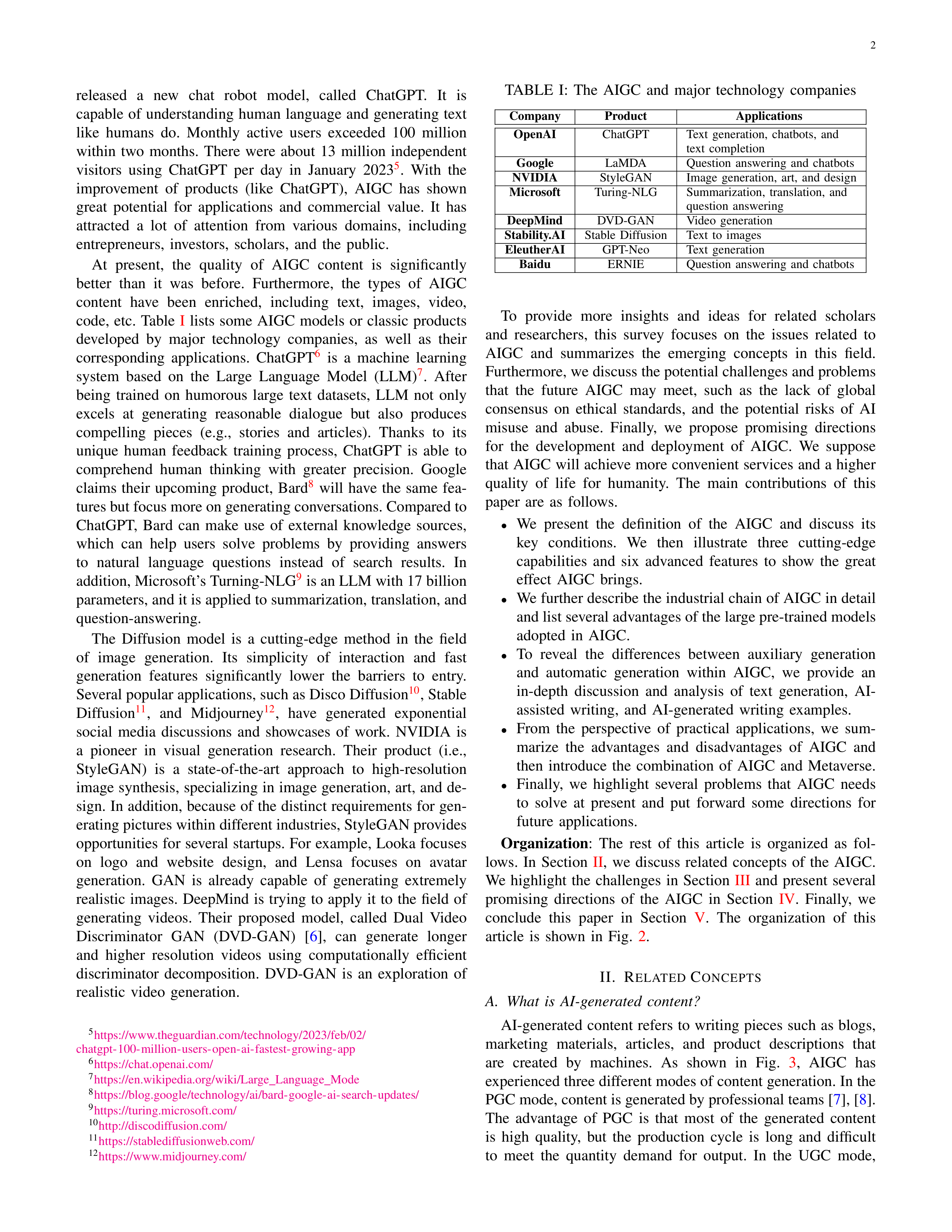
The first
stage
•
The “
1 The Road
” is the
the world's first novel
completely created by
artificial intelligence.
•
Microsoft showcased a fully
automatic simultaneous
interpretation system.
•
The world's first computer-
completed music, “Iliac
Suite”.
•
The world's first human-
computer interactive robot,
“Eliza''.
The second
stage
The third
stage
•
Goodfellow proposed GAN,
which can use existing data
to generate pictures.
•
In this year, OpenAI
released a new chat robot
model, called ChatGPT.
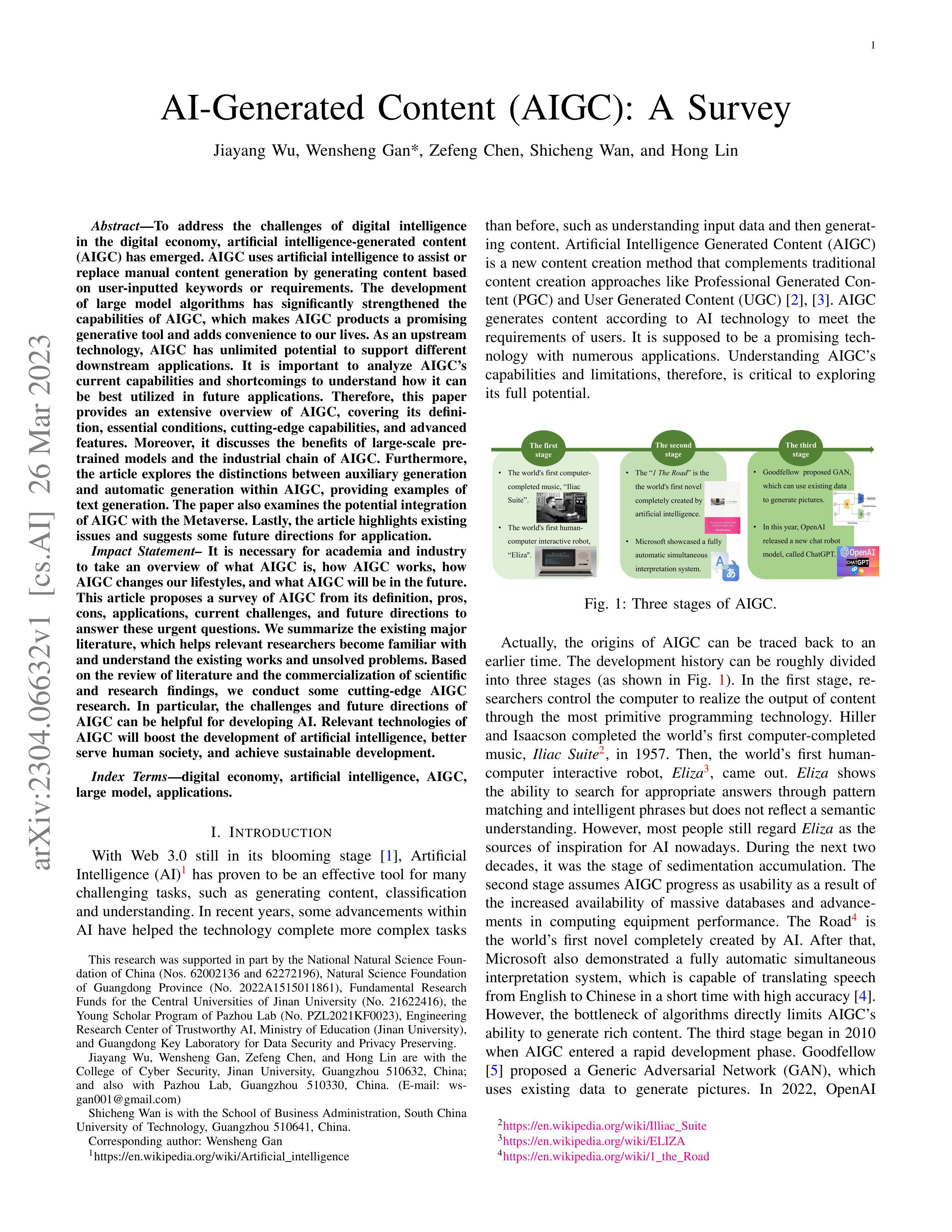
Fig.
1:
Three
stages
of
AIGC.
Actually,
the
origins
of
AIGC
can
be
traced
back
to
an
earlier
time.
The
development
history
can
be
roughly
divided
into
three
stages
(as
shown
in
Fig.
1
).
In
the
first
stage,
re-
searchers control the computer to realize the output of content
through
the
most
primitive
programming
technology.
Hiller
and
Isaacson
completed
the
world’s
first
computer-completed
music,
Iliac
Suite
2
,
in
1957.
Then,
the
world’s
first
human-
computer
interactive
robot,
Eliza
3
,
came
out.
Eliza
shows
the
ability
to
search
for
appropriate
answers
through
pattern
matching and intelligent phrases but does not reflect a semantic
understanding.
However,
most
people
still
regard
Eliza
as
the
sources
of
inspiration
for
AI
nowadays.
During
the
next
two
decades,
it
was
the
stage
of
sedimentation
accumulation.
The
second stage assumes AIGC progress as usability as a result of
the
increased
availability
of
massive
databases
and
advance-
ments
in
computing
equipment
performance.
The
Road
4
is
the
world’s
first
novel
completely
created
by
AI.
After
that,
Microsoft
also
demonstrated
a
fully
automatic
simultaneous
interpretation
system,
which
is
capable
of
translating
speech
from English to Chinese in a short time with high accuracy [
4
].
However,
the
bottleneck
of
algorithms
directly
limits
AIGC’s
ability
to
generate
rich
content.
The
third
stage
began
in
2010
when
AIGC
entered
a
rapid
development
phase.
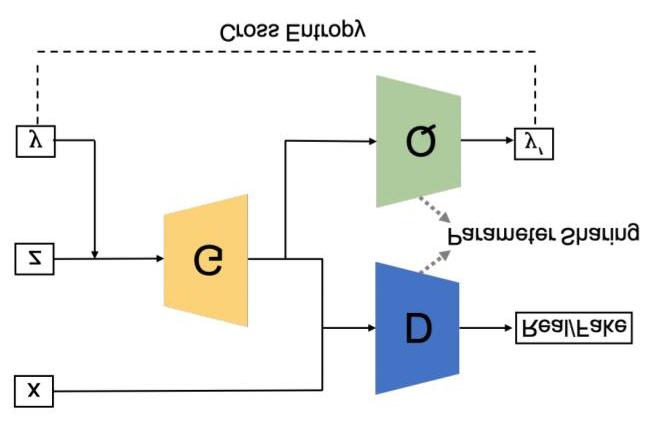
Goodfellow
[
5
]
proposed
a
Generic
Adversarial
Network
(GAN),
which
uses
existing
data
to
generate
pictures.
In
2022,
OpenAI
2
https://en.wikipedia.org/wiki/Illiac
Suite
3
https://en.wikipedia.org/wiki/ELIZA
4
https://en.wikipedia.org/wiki/1
the
Road
arXiv:2304.06632v1 [cs.AI] 26 Mar 2023
2
released
a
new
chat
robot
model,
called
ChatGPT.
It
is
capable
of
understanding
human
language
and
generating
text
like
humans
do.
Monthly
active
users
exceeded
100
million
within
two
months.
There
were
about
13
million
independent
visitors
using
ChatGPT
per
day
in
January
2023
5
.
With
the
improvement
of
products
(like
ChatGPT),
AIGC
has
shown
great
potential
for
applications
and
commercial
value.
It
has
attracted
a
lot
of
attention
from
various
domains,
including
entrepreneurs,
investors,
scholars,
and
the
public.
At
present,
the
quality
of
AIGC
content
is
significantly
better
than
it
was
before.
Furthermore,
the
types
of
AIGC
content
have
been
enriched,
including
text,
images,
video,
code,
etc.
Table
I
lists
some
AIGC
models
or
classic
products
developed
by
major
technology
companies,
as
well
as
their
corresponding
applications.
ChatGPT
6
is
a
machine
learning
system
based
on
the
Large
Language
Model
(LLM)
7
.
After
being
trained
on
humorous
large
text
datasets,
LLM
not
only
excels
at
generating
reasonable
dialogue
but
also
produces
compelling
pieces
(e.g.,
stories
and
articles).
Thanks
to
its
unique
human
feedback
training
process,
ChatGPT
is
able
to
comprehend
human
thinking
with
greater
precision.
Google
claims
their
upcoming
product,
Bard
8
will
have
the
same
fea-
tures but focus more on generating conversations. Compared to
ChatGPT,
Bard
can
make
use
of
external
knowledge
sources,
which
can
help
users
solve
problems
by
providing
answers
to
natural
language
questions
instead
of
search
results.
In
addition, Microsoft’s Turning-NLG
9
is an LLM with 17 billion
parameters, and it is applied to summarization, translation, and
question-answering.
The
Diffusion
model
is
a
cutting-edge
method
in
the
field
of
image
generation.
Its
simplicity
of
interaction
and
fast
generation
features
significantly
lower
the
barriers
to
entry.
Several popular applications, such as Disco Diffusion
10
, Stable
Diffusion
11
,
and
Midjourney
12
,
have
generated
exponential
social
media
discussions
and
showcases
of
work.
NVIDIA
is
a
pioneer
in
visual
generation
research.
Their
product
(i.e.,
StyleGAN)
is
a
state-of-the-art
approach
to
high-resolution
image synthesis, specializing in image generation, art, and de-
sign. In addition, because of the distinct requirements for gen-
erating pictures within different industries, StyleGAN provides
opportunities for several startups. For example, Looka focuses
on
logo
and
website
design,
and
Lensa
focuses
on
avatar
generation.
GAN
is
already
capable
of
generating
extremely
realistic
images.
DeepMind
is
trying
to
apply
it
to
the
field
of
generating
videos.
Their
proposed
model,
called
Dual
Video
Discriminator
GAN
(DVD-GAN)
[
6
],
can
generate
longer
and
higher
resolution
videos
using
computationally
efficient
discriminator
decomposition.
DVD-GAN
is
an
exploration
of
realistic
video
generation.
5
https://www.theguardian.com/technology/2023/feb/02/
chatgpt-100-million-users-open-ai-fastest-growing-app
6
https://chat.openai.com/
7
https://en.wikipedia.org/wiki/Large
Language
Mode
8
https://blog.google/technology/ai/bard-google-ai-search-updates/
9
https://turing.microsoft.com/
10
http://discodiffusion.com/
11
https://stablediffusionweb.com/
12
https://www.midjourney.com/
TABLE
I:
The
AIGC
and
major
technology
companies
Company
Product
Applications
OpenAI
ChatGPT
Text
generation,
chatbots,
and
text
completion
Google
LaMDA
Question
answering
and
chatbots
NVIDIA
StyleGAN
Image
generation,
art,
and
design
Microsoft
Turing-NLG
Summarization,
translation,
and
question
answering
DeepMind
DVD-GAN
Video
generation
Stability.AI
Stable
Diffusion
Text
to
images
EleutherAI
GPT-Neo
Text
generation
Baidu
ERNIE
Question
answering
and
chatbots
To
provide
more
insights
and
ideas
for
related
scholars
and
researchers,
this
survey
focuses
on
the
issues
related
to
AIGC
and
summarizes
the
emerging
concepts
in
this
field.
Furthermore, we discuss the potential challenges and problems
that
the
future
AIGC
may
meet,
such
as
the
lack
of
global
consensus
on
ethical
standards,
and
the
potential
risks
of
AI
misuse
and
abuse.
Finally,
we
propose
promising
directions
for
the
development
and
deployment
of
AIGC.
We
suppose
that AIGC will achieve more convenient services and a higher
quality
of
life
for
humanity.
The
main
contributions
of
this
paper
are
as
follows.
•
We
present
the
definition
of
the
AIGC
and
discuss
its
key
conditions.
We
then
illustrate
three
cutting-edge
capabilities
and
six
advanced
features
to
show
the
great
effect
AIGC
brings.
•
We further describe the industrial chain of AIGC in detail
and list several advantages of the large pre-trained models
adopted
in
AIGC.
•
To
reveal
the
differences
between
auxiliary
generation
and
automatic
generation
within
AIGC,
we
provide
an
in-depth
discussion
and
analysis
of
text
generation,
AI-
assisted
writing,
and
AI-generated
writing
examples.
•
From
the
perspective
of
practical
applications,
we
sum-
marize
the
advantages
and
disadvantages
of
AIGC
and
then
introduce
the
combination
of
AIGC
and
Metaverse.
•
Finally,
we
highlight
several
problems
that
AIGC
needs
to
solve
at
present
and
put
forward
some
directions
for
future
applications.
Organization
:
The
rest
of
this
article
is
organized
as
fol-
lows.
In
Section
II
,
we
discuss
related
concepts
of
the
AIGC.
We
highlight
the
challenges
in
Section
III
and
present
several
promising
directions
of
the
AIGC
in
Section
IV
.
Finally,
we
conclude
this
paper
in
Section
V
.
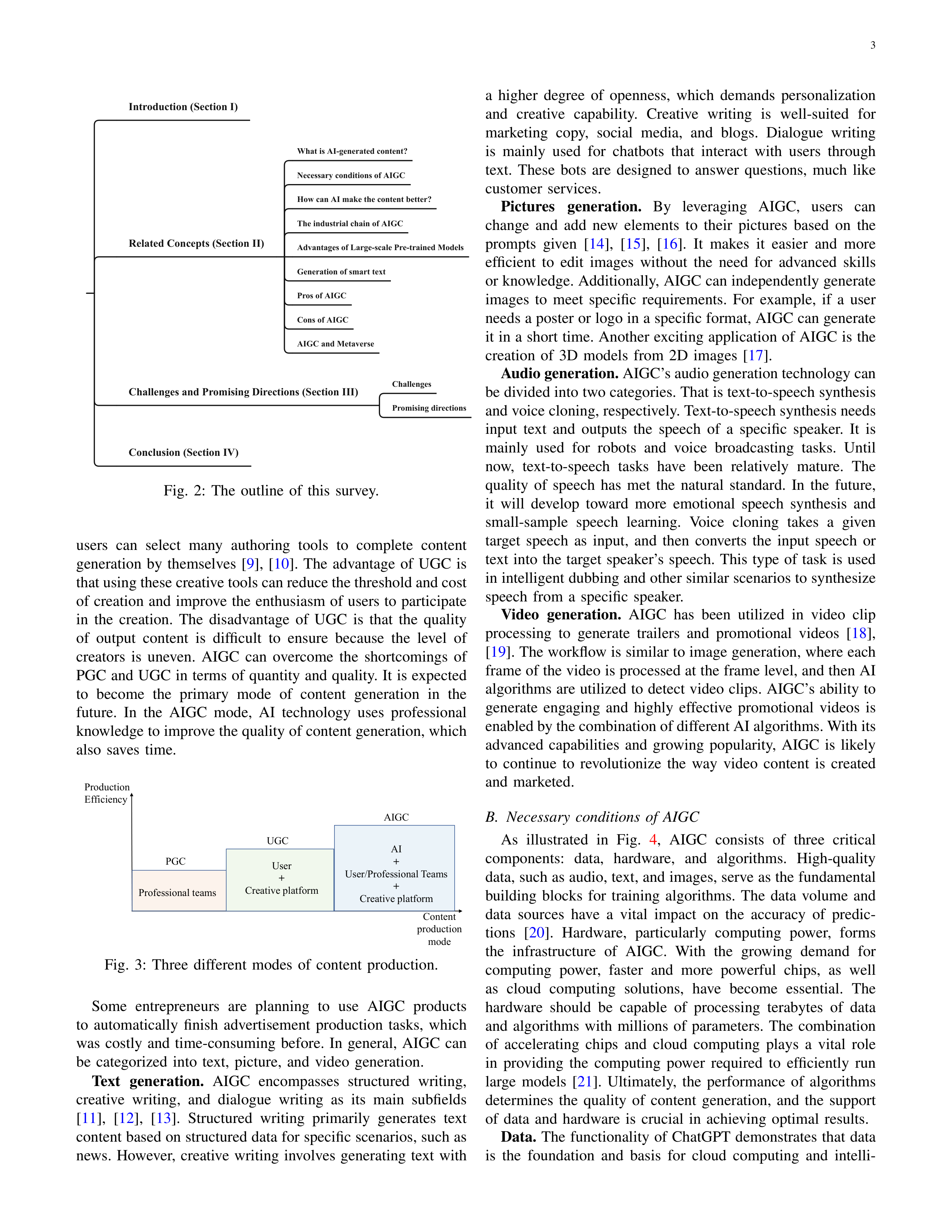
The
organization
of
this
article
is
shown
in
Fig.
2
.
II.
R
ELATED
C
ONCEPTS
A.
What
is
AI-generated
content?
AI-generated
content
refers
to
writing
pieces
such
as
blogs,
marketing
materials,
articles,
and
product
descriptions
that
are
created
by
machines.
As
shown
in
Fig.
3
,
AIGC
has
experienced three different modes of content generation. In the
PGC mode, content is generated by professional teams [
7
], [
8
].
The
advantage
of
PGC
is
that
most
of
the
generated
content
is
high
quality,
but
the
production
cycle
is
long
and
difficult
to
meet
the
quantity
demand
for
output.
In
the
UGC
mode,
3
Introduction (Section I)
Related Concepts (Section II)
What is AI-generated content?
Necessary conditions of AIGC
How can AI make the content better?
The industrial chain of AIGC
Advantages of Large-scale Pre-trained Models
Generation of smart text
Pros of AIGC
Cons of AIGC
AIGC and Metaverse
Challenges and Promising Directions (Section III)
Challenges
Promising directions
Conclusion (Section IV)
Fig.
2:
The
outline
of
this
survey.
users
can
select
many
authoring
tools
to
complete
content
generation
by
themselves
[
9
],
[
10
].
The
advantage
of
UGC
is
that using these creative tools can reduce the threshold and cost
of
creation
and
improve
the
enthusiasm
of
users
to
participate
in
the
creation.
The
disadvantage
of
UGC
is
that
the
quality
of
output
content
is
difficult
to
ensure
because
the
level
of
creators
is
uneven.
AIGC
can
overcome
the
shortcomings
of
PGC
and
UGC
in
terms
of
quantity
and
quality.
It
is
expected
to
become
the
primary
mode
of
content
generation
in
the
future.
In
the
AIGC
mode,
AI
technology
uses
professional
knowledge to improve the quality of content generation, which
also
saves
time.
PGC
UGC
AIGC
Production
Efficiency
Content
production
mode
Professional teams
User
+
Creative platform
AI
+
User/Professional Teams
+
Creative platform
Fig.
3:
Three
different
modes
of
content
production.
Some
entrepreneurs
are
planning
to
use
AIGC
products
to
automatically
finish
advertisement
production
tasks,
which
was
costly
and
time-consuming
before.
In
general,
AIGC
can
be
categorized
into
text,
picture,
and
video
generation.
Text
generation.
AIGC
encompasses
structured
writing,
creative
writing,
and
dialogue
writing
as
its
main
subfields
[
11
],
[
12
],
[
13
].
Structured
writing
primarily
generates
text
content based on structured data for specific scenarios, such as
news.
However,
creative
writing
involves
generating
text
with
a
higher
degree
of
openness,
which
demands
personalization
and
creative
capability.
Creative
writing
is
well-suited
for
marketing
copy,
social
media,
and
blogs.
Dialogue
writing
is
mainly
used
for
chatbots
that
interact
with
users
through
text.
These
bots
are
designed
to
answer
questions,
much
like
customer
services.
Pictures
generation.
By
leveraging
AIGC,
users
can
change
and
add
new
elements
to
their
pictures
based
on
the
prompts
given
[
14
],
[
15
],
[
16
].
It
makes
it
easier
and
more
efficient
to
edit
images
without
the
need
for
advanced
skills
or knowledge. Additionally, AIGC can independently generate
images
to
meet
specific
requirements.
For
example,
if
a
user
needs a poster or logo in a specific format, AIGC can generate
it in a short time. Another exciting application of
AIGC is the
creation
of
3D
models
from
2D
images
[
17
].
Audio generation.
AIGC’s audio generation technology can
be divided into two categories. That is text-to-speech synthesis
and voice cloning, respectively. Text-to-speech synthesis needs
input
text
and
outputs
the
speech
of
a
specific
speaker.
It
is
mainly
used
for
robots
and
voice
broadcasting
tasks.
Until
now,
text-to-speech
tasks
have
been
relatively
mature.
The
quality
of
speech
has
met
the
natural
standard.
In
the
future,
it
will
develop
toward
more
emotional
speech
synthesis
and
small-sample
speech
learning.
Voice
cloning
takes
a
given
target
speech
as
input,
and
then
converts
the
input
speech
or
text
into
the
target
speaker’s
speech.
This
type
of
task
is
used
in intelligent dubbing and other similar scenarios to synthesize
speech
from
a
specific
speaker.
Video
generation.
AIGC
has
been
utilized
in
video
clip
processing
to
generate
trailers
and
promotional
videos
[
18
],
[
19
]. The workflow is similar to image generation, where each
frame of the video is processed at the frame level, and then AI
algorithms
are
utilized
to
detect
video
clips.
AIGC’s
ability
to
generate
engaging
and
highly
effective
promotional
videos
is
enabled by the combination of different AI algorithms. With its
advanced
capabilities
and
growing
popularity,
AIGC
is
likely
to
continue
to
revolutionize
the
way
video
content
is
created
and
marketed.
B.
Necessary
conditions
of
AIGC
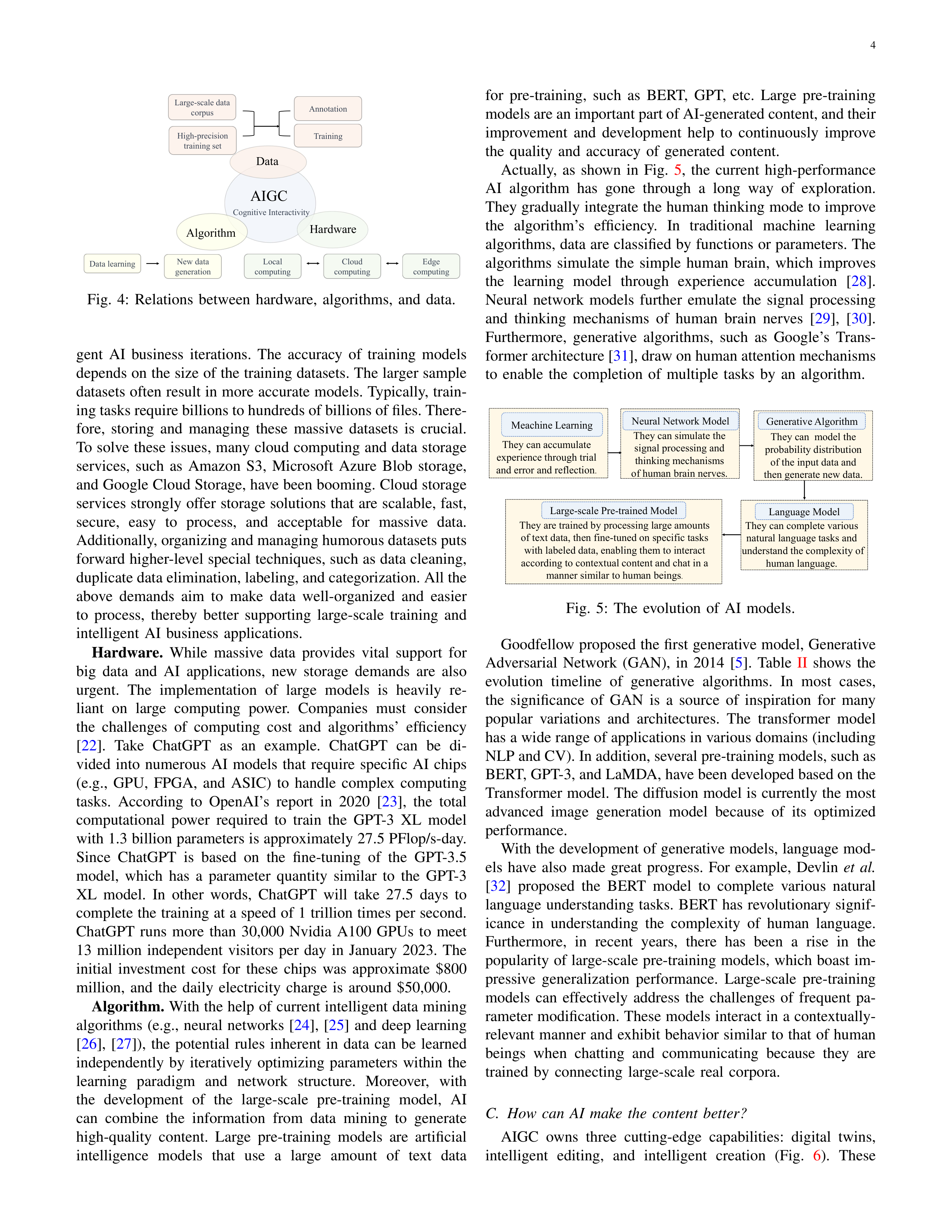
As
illustrated
in
Fig.
4
,
AIGC
consists
of
three
critical
components:
data,
hardware,
and
algorithms.
High-quality
data, such as audio, text, and images, serve as the fundamental
building
blocks
for
training
algorithms.
The
data
volume
and
data
sources
have
a
vital
impact
on
the
accuracy
of
predic-
tions
[
20
].
Hardware,
particularly
computing
power,
forms
the
infrastructure
of
AIGC.
With
the
growing
demand
for
computing
power,
faster
and
more
powerful
chips,
as
well
as
cloud
computing
solutions,
have
become
essential.
The
hardware
should
be
capable
of
processing
terabytes
of
data
and
algorithms
with
millions
of
parameters.
The
combination
of
accelerating
chips
and
cloud
computing
plays
a
vital
role
in
providing
the
computing
power
required
to
efficiently
run
large
models
[
21
].
Ultimately,
the
performance
of
algorithms
determines
the
quality
of
content
generation,
and
the
support
of
data
and
hardware
is
crucial
in
achieving
optimal
results.
Data.
The
functionality
of
ChatGPT
demonstrates
that
data
is
the
foundation
and
basis
for
cloud
computing
and
intelli-















4
Cognitive Interactivity
AIGC
Data
Algorithm
Hardware
Large-scale data
corpus
High-precision
training set
Annotation
Training
Data learning
New data
generation
Local
computing
Cloud
computing
Edge
computing
Fig.
4:
Relations
between
hardware,
algorithms,
and
data.
gent
AI
business
iterations.
The
accuracy
of
training
models
depends on the size of the training datasets. The larger sample
datasets often result in more accurate models. Typically, train-
ing tasks require billions to hundreds of billions of files. There-
fore,
storing
and
managing
these
massive
datasets
is
crucial.
To solve these issues, many cloud computing and data storage
services,
such
as
Amazon
S3,
Microsoft
Azure
Blob
storage,
and Google Cloud Storage, have been booming. Cloud storage
services
strongly
offer
storage
solutions
that
are
scalable,
fast,
secure,
easy
to
process,
and
acceptable
for
massive
data.
Additionally, organizing and managing humorous datasets puts
forward higher-level special techniques, such as data cleaning,
duplicate data elimination, labeling, and categorization. All the
above
demands
aim
to
make
data
well-organized
and
easier
to
process,
thereby
better
supporting
large-scale
training
and
intelligent
AI
business
applications.
Hardware.
While
massive
data
provides
vital
support
for
big
data
and
AI
applications,
new
storage
demands
are
also
urgent.
The
implementation
of
large
models
is
heavily
re-
liant
on
large
computing
power.
Companies
must
consider
the
challenges
of
computing
cost
and
algorithms’
efficiency
[
22
].
Take
ChatGPT
as
an
example.
ChatGPT
can
be
di-
vided
into
numerous
AI
models
that
require
specific
AI
chips
(e.g.,
GPU,
FPGA,
and
ASIC)
to
handle
complex
computing
tasks.
According
to
OpenAI’s
report
in
2020
[
23
],
the
total
computational
power
required
to
train
the
GPT-3
XL
model
with 1.3 billion parameters is approximately 27.5 PFlop/s-day.
Since
ChatGPT
is
based
on
the
fine-tuning
of
the
GPT-3.5
model,
which
has
a
parameter
quantity
similar
to
the
GPT-3
XL
model.
In
other
words,
ChatGPT
will
take
27.5
days
to
complete the training at a speed of 1 trillion times per second.
ChatGPT
runs
more
than
30,000
Nvidia
A100
GPUs
to
meet
13
million
independent
visitors
per
day
in
January
2023.
The
initial
investment
cost
for
these
chips
was
approximate
$800
million,
and
the
daily
electricity
charge
is
around
$50,000.
Algorithm.
With the help of current intelligent data mining
algorithms
(e.g.,
neural
networks
[
24
],
[
25
]
and
deep
learning
[
26
],
[
27
]),
the
potential
rules
inherent
in
data
can
be
learned
independently
by
iteratively
optimizing
parameters
within
the
learning
paradigm
and
network
structure.
Moreover,
with
the
development
of
the
large-scale
pre-training
model,
AI
can
combine
the
information
from
data
mining
to
generate
high-quality
content.
Large
pre-training
models
are
artificial
intelligence
models
that
use
a
large
amount
of
text
data
for
pre-training,
such
as
BERT,
GPT,
etc.
Large
pre-training
models are an important part of AI-generated content, and their
improvement
and
development
help
to
continuously
improve
the
quality
and
accuracy
of
generated
content.
Actually,
as
shown
in
Fig.
5
,
the
current
high-performance
AI
algorithm
has
gone
through
a
long
way
of
exploration.
They gradually integrate the human thinking mode to improve
the
algorithm’s
efficiency.
In
traditional
machine
learning
algorithms, data are classified by functions or parameters. The
algorithms
simulate
the
simple
human
brain,
which
improves
the
learning
model
through
experience
accumulation
[
28
].
Neural
network
models
further
emulate
the
signal
processing
and
thinking
mechanisms
of
human
brain
nerves
[
29
],
[
30
].
Furthermore,
generative
algorithms,
such
as
Google’s
Trans-
former architecture [
31
], draw on human attention mechanisms
to
enable
the
completion
of
multiple
tasks
by
an
algorithm.
Meachine Learning
Neural Network Model
Large-scale Pre-trained Model
They can accumulate
experience through trial
and error and reflection
.
They can simulate the
signal processing and
thinking mechanisms
of human brain nerves.
Language Model
Generative Algorithm
They can complete various
natural language tasks and
understand the complexity of
human language.
They can model the
probability distribution
of the input data and
then generate new data.
They are trained by processing large amounts
of text data, then fine-tuned on specific tasks
with labeled data, enabling them to interact
according to contextual content and chat in a
manner similar to human beings
.
Fig.
5:
The
evolution
of
AI
models.
Goodfellow proposed the first generative model, Generative
Adversarial
Network
(GAN),
in
2014
[
5
].
Table
II
shows
the
evolution
timeline
of
generative
algorithms.
In
most
cases,
the
significance
of
GAN
is
a
source
of
inspiration
for
many
popular
variations
and
architectures.
The
transformer
model
has a wide range of applications in various domains (including
NLP and CV). In addition, several pre-training models, such as
BERT, GPT-3, and LaMDA, have been developed based on the
Transformer model. The
diffusion model is
currently the most
advanced
image
generation
model
because
of
its
optimized
performance.
With the development of generative models, language mod-
els
have
also
made
great
progress.
For
example,
Devlin
et
al.
[
32
]
proposed
the
BERT
model
to
complete
various
natural
language
understanding
tasks.
BERT
has
revolutionary
signif-
icance
in
understanding
the
complexity
of
human
language.
Furthermore,
in
recent
years,
there
has
been
a
rise
in
the
popularity
of
large-scale
pre-training
models,
which
boast
im-
pressive
generalization
performance.
Large-scale
pre-training
models
can
effectively
address
the
challenges
of
frequent
pa-
rameter modification. These models interact in a contextually-
relevant
manner
and
exhibit
behavior
similar
to
that
of
human
beings
when
chatting
and
communicating
because
they
are
trained
by
connecting
large-scale
real
corpora.
C.
How
can
AI
make
the
content
better?
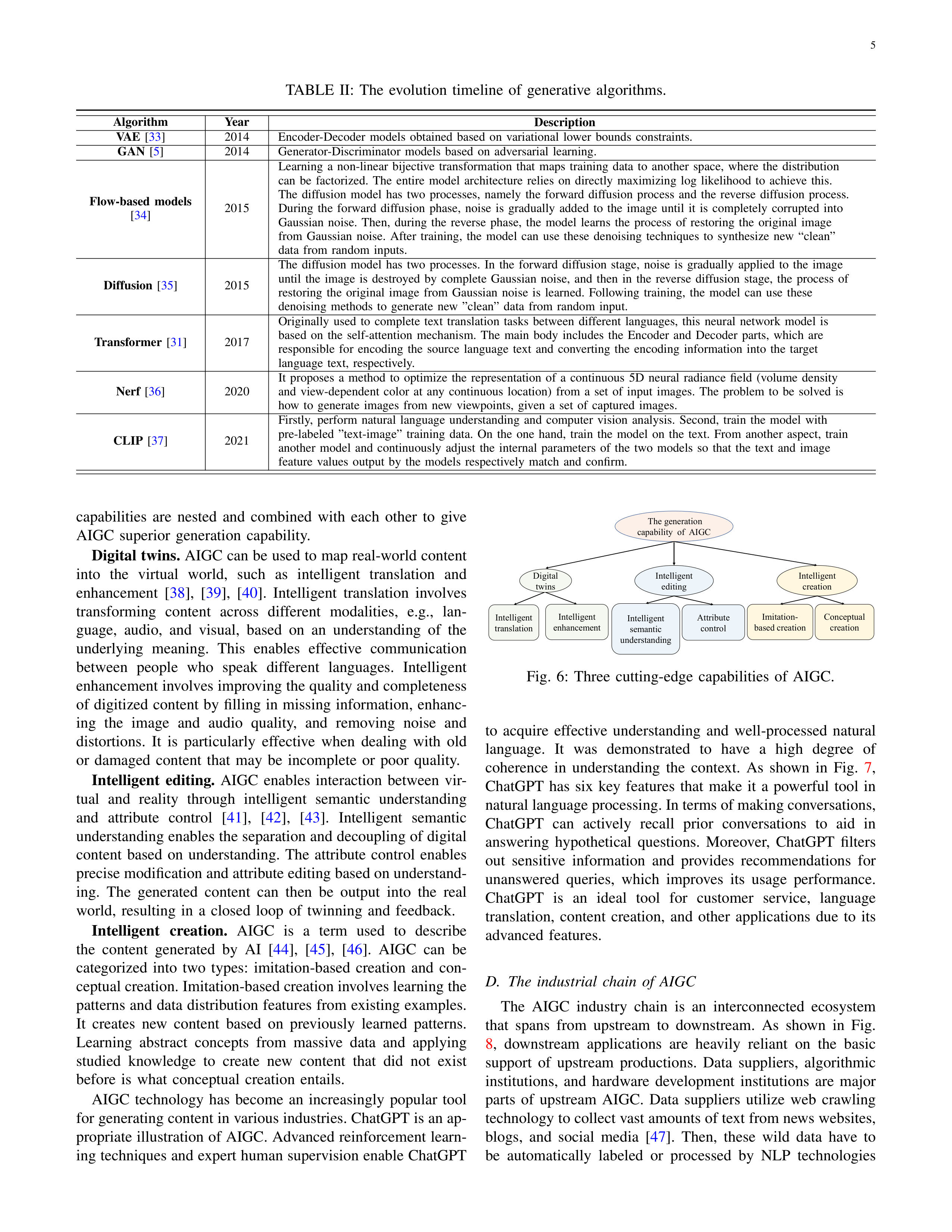
AIGC
owns
three
cutting-edge
capabilities:
digital
twins,
intelligent
editing,
and
intelligent
creation
(Fig.
6
).
These
5
TABLE
II:
The
evolution
timeline
of
generative
algorithms.
Algorithm
Year
Description
VAE
[
33
]
2014
Encoder-Decoder
models
obtained
based
on
variational
lower
bounds
constraints.
GAN
[
5
]
2014
Generator-Discriminator
models
based
on
adversarial
learning.
Flow-based
models
[
34
]
2015
Learning
a
non-linear
bijective
transformation
that
maps
training
data
to
another
space,
where
the
distribution
can
be
factorized.
The
entire
model
architecture
relies
on
directly
maximizing
log
likelihood
to
achieve
this.
The
diffusion
model
has
two
processes,
namely
the
forward
diffusion
process
and
the
reverse
diffusion
process.
During
the
forward
diffusion
phase,
noise
is
gradually
added
to
the
image
until
it
is
completely
corrupted
into
Gaussian
noise.
Then,
during
the
reverse
phase,
the
model
learns
the
process
of
restoring
the
original
image
from
Gaussian
noise.
After
training,
the
model
can
use
these
denoising
techniques
to
synthesize
new
“clean”
data
from
random
inputs.
Diffusion
[
35
]
2015
The
diffusion
model
has
two
processes.
In
the
forward
diffusion
stage,
noise
is
gradually
applied
to
the
image
until
the
image
is
destroyed
by
complete
Gaussian
noise,
and
then
in
the
reverse
diffusion
stage,
the
process
of
restoring
the
original
image
from
Gaussian
noise
is
learned.
Following
training,
the
model
can
use
these
denoising
methods
to
generate
new
”clean”
data
from
random
input.
Transformer
[
31
]
2017
Originally
used
to
complete
text
translation
tasks
between
different
languages,
this
neural
network
model
is
based
on
the
self-attention
mechanism.
The
main
body
includes
the
Encoder
and
Decoder
parts,
which
are
responsible
for
encoding
the
source
language
text
and
converting
the
encoding
information
into
the
target
language
text,
respectively.
Nerf
[
36
]
2020
It
proposes
a
method
to
optimize
the
representation
of
a
continuous
5D
neural
radiance
field
(volume
density
and
view-dependent
color
at
any
continuous
location)
from
a
set
of
input
images.
The
problem
to
be
solved
is
how
to
generate
images
from
new
viewpoints,
given
a
set
of
captured
images.
CLIP
[
37
]
2021
Firstly,
perform
natural
language
understanding
and
computer
vision
analysis.
Second,
train
the
model
with
pre-labeled
”text-image”
training
data.
On
the
one
hand,
train
the
model
on
the
text.
From
another
aspect,
train
another
model
and
continuously
adjust
the
internal
parameters
of
the
two
models
so
that
the
text
and
image
feature
values
output
by
the
models
respectively
match
and
confirm.
capabilities
are
nested
and
combined
with
each
other
to
give
AIGC
superior
generation
capability.
Digital twins.
AIGC can be used to map real-world content
into
the
virtual
world,
such
as
intelligent
translation
and
enhancement
[
38
],
[
39
],
[
40
].
Intelligent
translation
involves
transforming
content
across
different
modalities,
e.g.,
lan-
guage,
audio,
and
visual,
based
on
an
understanding
of
the
underlying
meaning.
This
enables
effective
communication
between
people
who
speak
different
languages.
Intelligent
enhancement involves improving the quality and completeness
of
digitized
content
by
filling
in
missing
information,
enhanc-
ing
the
image
and
audio
quality,
and
removing
noise
and
distortions.
It
is
particularly
effective
when
dealing
with
old
or
damaged
content
that
may
be
incomplete
or
poor
quality.
Intelligent
editing.
AIGC
enables
interaction
between
vir-
tual
and
reality
through
intelligent
semantic
understanding
and
attribute
control
[
41
],
[
42
],
[
43
].
Intelligent
semantic
understanding enables the separation and decoupling of digital
content
based
on
understanding.
The
attribute
control
enables
precise modification and attribute editing based on understand-
ing.
The
generated
content
can
then
be
output
into
the
real
world,
resulting
in
a
closed
loop
of
twinning
and
feedback.
Intelligent
creation.
AIGC
is
a
term
used
to
describe
the
content
generated
by
AI
[
44
],
[
45
],
[
46
].
AIGC
can
be
categorized
into
two
types:
imitation-based
creation
and
con-
ceptual creation. Imitation-based creation involves learning the
patterns and data distribution features from existing examples.
It
creates
new
content
based
on
previously
learned
patterns.
Learning
abstract
concepts
from
massive
data
and
applying
studied
knowledge
to
create
new
content
that
did
not
exist
before
is
what
conceptual
creation
entails.
AIGC
technology
has
become
an
increasingly
popular
tool
for generating content in various industries. ChatGPT is an ap-
propriate illustration of AIGC. Advanced reinforcement learn-
ing techniques and expert human supervision enable ChatGPT
Digital
twins
Intelligent
creation
Intelligent
editing
Intelligent
translation
Intelligent
enhancement
Intelligent
semantic
understanding
Attribute
control
Imitation-
based creation
Conceptual
creation
The generation
capability of AIGC
Fig.
6:
Three
cutting-edge
capabilities
of
AIGC.
to
acquire
effective
understanding
and
well-processed
natural
language.
It
was
demonstrated
to
have
a
high
degree
of
coherence
in
understanding
the
context.
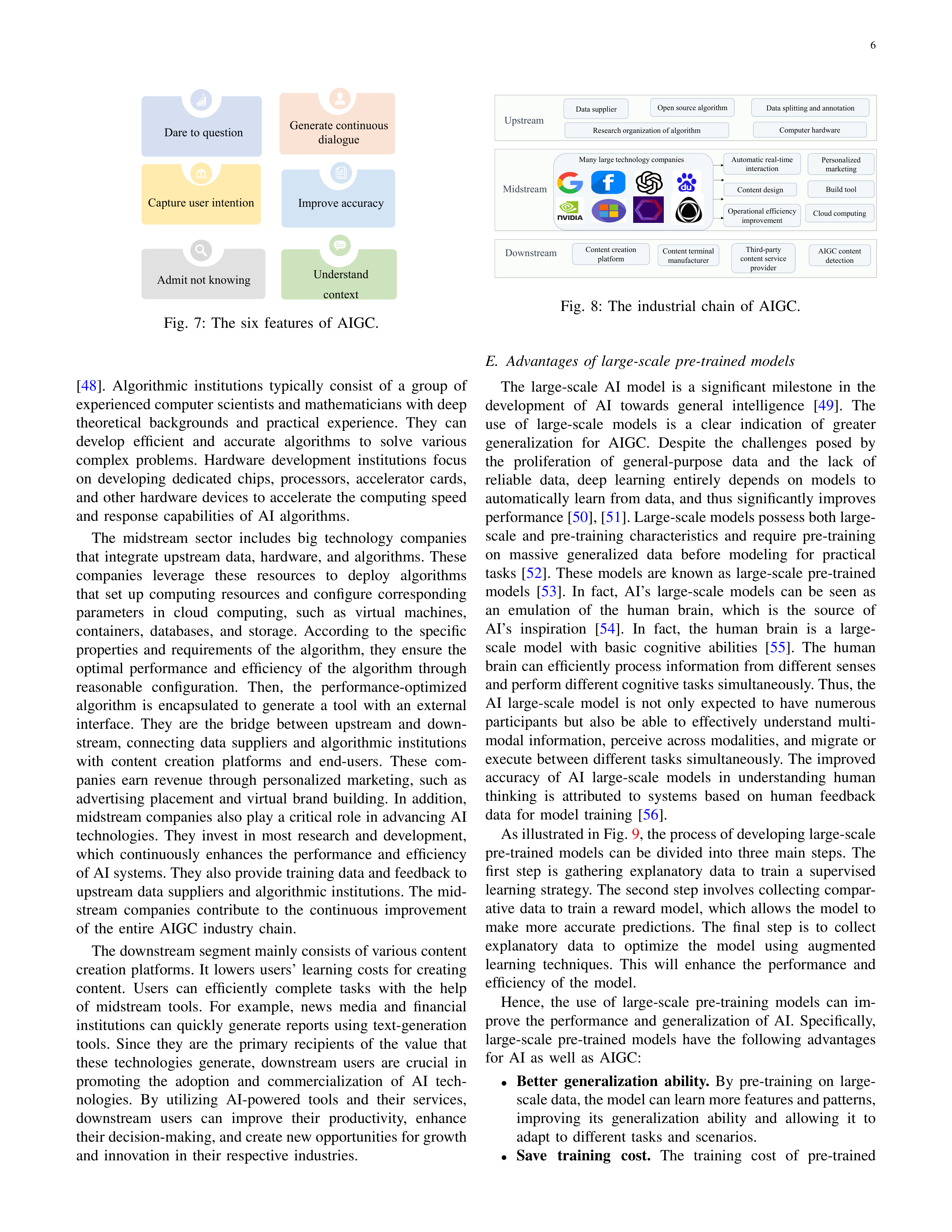
As
shown
in
Fig.
7
,
ChatGPT
has
six
key
features
that
make
it
a
powerful
tool
in
natural language processing. In terms of making conversations,
ChatGPT
can
actively
recall
prior
conversations
to
aid
in
answering
hypothetical
questions.
Moreover,
ChatGPT
filters
out
sensitive
information
and
provides
recommendations
for
unanswered
queries,
which
improves
its
usage
performance.
ChatGPT
is
an
ideal
tool
for
customer
service,
language
translation,
content
creation,
and
other
applications
due
to
its
advanced
features.
D.
The
industrial
chain
of
AIGC
The
AIGC
industry
chain
is
an
interconnected
ecosystem
that
spans
from
upstream
to
downstream.
As
shown
in
Fig.
8
,
downstream
applications
are
heavily
reliant
on
the
basic
support
of
upstream
productions.
Data
suppliers,
algorithmic
institutions,
and
hardware
development
institutions
are
major
parts
of
upstream
AIGC.
Data
suppliers
utilize
web
crawling
technology to collect vast amounts of text from news websites,
blogs,
and
social
media
[
47
].
Then,
these
wild
data
have
to
be
automatically
labeled
or
processed
by
NLP
technologies


























6
Understand
context
Improve accuracy
Capture user intention
Generate continuous
dialogue
Dare to question
Admit not knowing
Fig.
7:
The
six
features
of
AIGC.
[
48
].
Algorithmic
institutions
typically
consist
of
a
group
of
experienced computer scientists and mathematicians with deep
theoretical
backgrounds
and
practical
experience.
They
can
develop
efficient
and
accurate
algorithms
to
solve
various
complex
problems.
Hardware
development
institutions
focus
on
developing
dedicated
chips,
processors,
accelerator
cards,
and
other
hardware
devices
to
accelerate
the
computing
speed
and
response
capabilities
of
AI
algorithms.
The
midstream
sector
includes
big
technology
companies
that
integrate
upstream
data,
hardware,
and
algorithms.
These
companies
leverage
these
resources
to
deploy
algorithms
that
set
up
computing
resources
and
configure
corresponding
parameters
in
cloud
computing,
such
as
virtual
machines,
containers,
databases,
and
storage.
According
to
the
specific
properties
and
requirements
of
the
algorithm,
they
ensure
the
optimal
performance
and
efficiency
of
the
algorithm
through
reasonable
configuration.
Then,
the
performance-optimized
algorithm
is
encapsulated
to
generate
a
tool
with
an
external
interface.
They
are
the
bridge
between
upstream
and
down-
stream,
connecting
data
suppliers
and
algorithmic
institutions
with
content
creation
platforms
and
end-users.
These
com-
panies
earn
revenue
through
personalized
marketing,
such
as
advertising
placement
and
virtual
brand
building.
In
addition,
midstream companies also play a critical role in advancing AI
technologies.
They
invest
in
most
research
and
development,
which
continuously
enhances
the
performance
and
efficiency
of AI systems. They also provide training data and feedback to
upstream data suppliers and algorithmic institutions. The mid-
stream
companies
contribute
to
the
continuous
improvement
of
the
entire
AIGC
industry
chain.
The downstream segment mainly consists of various content
creation
platforms.
It
lowers
users’
learning
costs
for
creating
content.
Users
can
efficiently
complete
tasks
with
the
help
of
midstream
tools.
For
example,
news
media
and
financial
institutions
can
quickly
generate
reports
using
text-generation
tools.
Since
they
are
the
primary
recipients
of
the
value
that
these
technologies
generate,
downstream
users
are
crucial
in
promoting
the
adoption
and
commercialization
of
AI
tech-
nologies.
By
utilizing
AI-powered
tools
and
their
services,
downstream
users
can
improve
their
productivity,
enhance
their decision-making, and create new opportunities for growth
and
innovation
in
their
respective
industries.
Data supplier
Research organization of algorithm
Open source algorithm
Computer hardware
Cloud computing
Automatic real-time
interaction
Upstream
Midstream
Downstream
Many large technology companies
Content design
Operational efficiency
improvement
Personalized
marketing
Build tool
Content creation
platform
Content terminal
manufacturer
Third-party
content service
provider
AIGC content
detection
Data splitting and annotation
Fig.
8:
The
industrial
chain
of
AIGC.
E.
Advantages
of
large-scale
pre-trained
models
The
large-scale
AI
model
is
a
significant
milestone
in
the
development
of
AI
towards
general
intelligence
[
49
].
The
use
of
large-scale
models
is
a
clear
indication
of
greater
generalization
for
AIGC.
Despite
the
challenges
posed
by
the
proliferation
of
general-purpose
data
and
the
lack
of
reliable
data,
deep
learning
entirely
depends
on
models
to
automatically
learn
from
data,
and
thus
significantly
improves
performance [
50
], [
51
]. Large-scale models possess both large-
scale
and
pre-training
characteristics
and
require
pre-training
on
massive
generalized
data
before
modeling
for
practical
tasks
[
52
].
These
models
are
known
as
large-scale
pre-trained
models
[
53
].
In
fact,
AI’s
large-scale
models
can
be
seen
as
an
emulation
of
the
human
brain,
which
is
the
source
of
AI’s
inspiration
[
54
].
In
fact,
the
human
brain
is
a
large-
scale
model
with
basic
cognitive
abilities
[
55
].
The
human
brain can efficiently process information from different senses
and perform different cognitive tasks simultaneously. Thus, the
AI
large-scale
model
is
not
only
expected
to
have
numerous
participants
but
also
be
able
to
effectively
understand
multi-
modal
information,
perceive
across
modalities,
and
migrate
or
execute
between
different
tasks
simultaneously.
The
improved
accuracy
of
AI
large-scale
models
in
understanding
human
thinking
is
attributed
to
systems
based
on
human
feedback
data
for
model
training
[
56
].
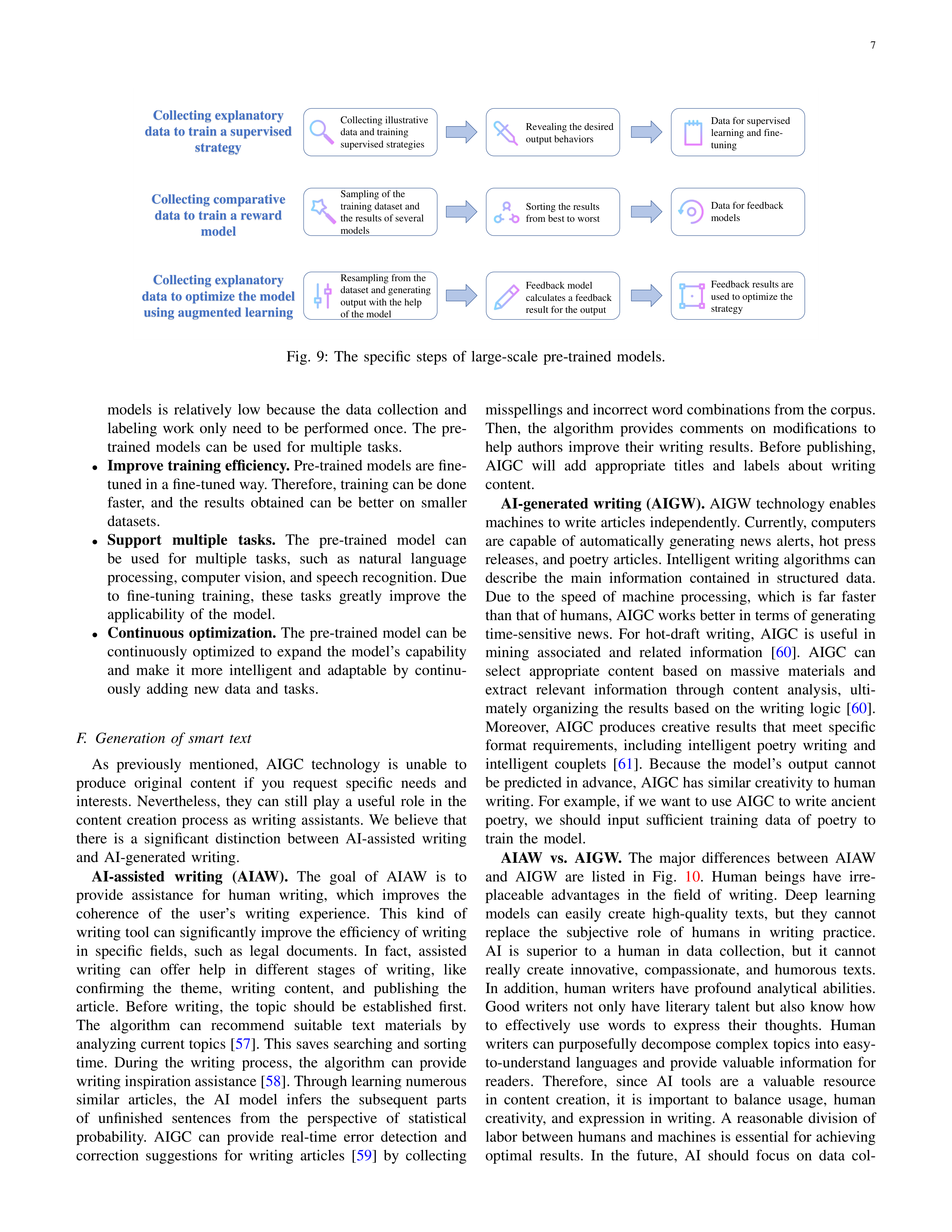
As illustrated in Fig.
9
, the process of developing large-scale
pre-trained
models
can
be
divided
into
three
main
steps.
The
first
step
is
gathering
explanatory
data
to
train
a
supervised
learning strategy. The second step involves collecting compar-
ative
data
to
train
a
reward
model,
which
allows
the
model
to
make
more
accurate
predictions.
The
final
step
is
to
collect
explanatory
data
to
optimize
the
model
using
augmented
learning
techniques.
This
will
enhance
the
performance
and
efficiency
of
the
model.
Hence,
the
use
of
large-scale
pre-training
models
can
im-
prove
the
performance
and
generalization
of
AI.
Specifically,
large-scale
pre-trained
models
have
the
following
advantages
for
AI
as
well
as
AIGC:
•
Better
generalization
ability.
By
pre-training
on
large-
scale data, the model can learn more features and patterns,
improving
its
generalization
ability
and
allowing
it
to
adapt
to
different
tasks
and
scenarios.
•
Save
training
cost.
The
training
cost
of
pre-trained























7
Collecting illustrative
data and training
supervised strategies
C
ollecting explanatory
data to train a supervised
strategy
Revealing the desired
output behaviors
Data for supervised
learning and fine-
tuning
Collecting
comparative
data to train a reward
model
Sampling of the
training dataset and
the results of several
models
Sorting the results
from best to worst
Data for feedback
models
C
ollecting
explanatory
data to optimize the model
using augmented
learning
Resampling from the
dataset and generating
output with the help
of the model
Feedback model
calculates a feedback
result for the output
Feedback results are
used to optimize the
strategy
Fig.
9:
The
specific
steps
of
large-scale
pre-trained
models.
models
is
relatively
low
because
the
data
collection
and
labeling
work
only
need
to
be
performed
once.
The
pre-
trained
models
can
be
used
for
multiple
tasks.
•
Improve training efficiency.
Pre-trained models are fine-
tuned in a fine-tuned way. Therefore, training can be done
faster,
and
the
results
obtained
can
be
better
on
smaller
datasets.
•
Support
multiple
tasks.
The
pre-trained
model
can
be
used
for
multiple
tasks,
such
as
natural
language
processing, computer vision, and speech recognition. Due
to
fine-tuning
training,
these
tasks
greatly
improve
the
applicability
of
the
model.
•
Continuous
optimization.
The
pre-trained
model
can
be
continuously
optimized
to
expand
the
model’s
capability
and
make
it
more
intelligent
and
adaptable
by
continu-
ously
adding
new
data
and
tasks.
F.
Generation
of
smart
text
As
previously
mentioned,
AIGC
technology
is
unable
to
produce
original
content
if
you
request
specific
needs
and
interests.
Nevertheless,
they
can
still
play
a
useful
role
in
the
content
creation
process
as
writing
assistants.
We
believe
that
there
is
a
significant
distinction
between
AI-assisted
writing
and
AI-generated
writing.
AI-assisted
writing
(AIAW).
The
goal
of
AIAW
is
to
provide
assistance
for
human
writing,
which
improves
the
coherence
of
the
user’s
writing
experience.
This
kind
of
writing tool can significantly improve the efficiency of writing
in
specific
fields,
such
as
legal
documents.
In
fact,
assisted
writing
can
offer
help
in
different
stages
of
writing,
like
confirming
the
theme,
writing
content,
and
publishing
the
article.
Before
writing,
the
topic
should
be
established
first.
The
algorithm
can
recommend
suitable
text
materials
by
analyzing current topics [
57
]. This saves searching and sorting
time.
During
the
writing
process,
the
algorithm
can
provide
writing inspiration assistance [
58
]. Through learning numerous
similar
articles,
the
AI
model
infers
the
subsequent
parts
of
unfinished
sentences
from
the
perspective
of
statistical
probability.
AIGC
can
provide
real-time
error
detection
and
correction
suggestions
for
writing
articles
[
59
]
by
collecting
misspellings and incorrect word combinations from the corpus.
Then,
the
algorithm
provides
comments
on
modifications
to
help
authors
improve
their
writing
results.
Before
publishing,
AIGC
will
add
appropriate
titles
and
labels
about
writing
content.
AI-generated writing (AIGW).
AIGW technology enables
machines to write articles independently. Currently, computers
are
capable
of
automatically
generating
news
alerts,
hot
press
releases, and poetry articles. Intelligent writing algorithms can
describe
the
main
information
contained
in
structured
data.
Due
to
the
speed
of
machine
processing,
which
is
far
faster
than that of humans, AIGC works better in terms of generating
time-sensitive
news.
For
hot-draft
writing,
AIGC
is
useful
in
mining
associated
and
related
information
[
60
].
AIGC
can
select
appropriate
content
based
on
massive
materials
and
extract
relevant
information
through
content
analysis,
ulti-
mately
organizing
the
results
based
on
the
writing
logic
[
60
].
Moreover,
AIGC
produces
creative
results
that
meet
specific
format
requirements,
including
intelligent
poetry
writing
and
intelligent
couplets
[
61
].
Because
the
model’s
output
cannot
be predicted in advance, AIGC has similar creativity to human
writing. For example, if we want to use AIGC to write ancient
poetry,
we
should
input
sufficient
training
data
of
poetry
to
train
the
model.
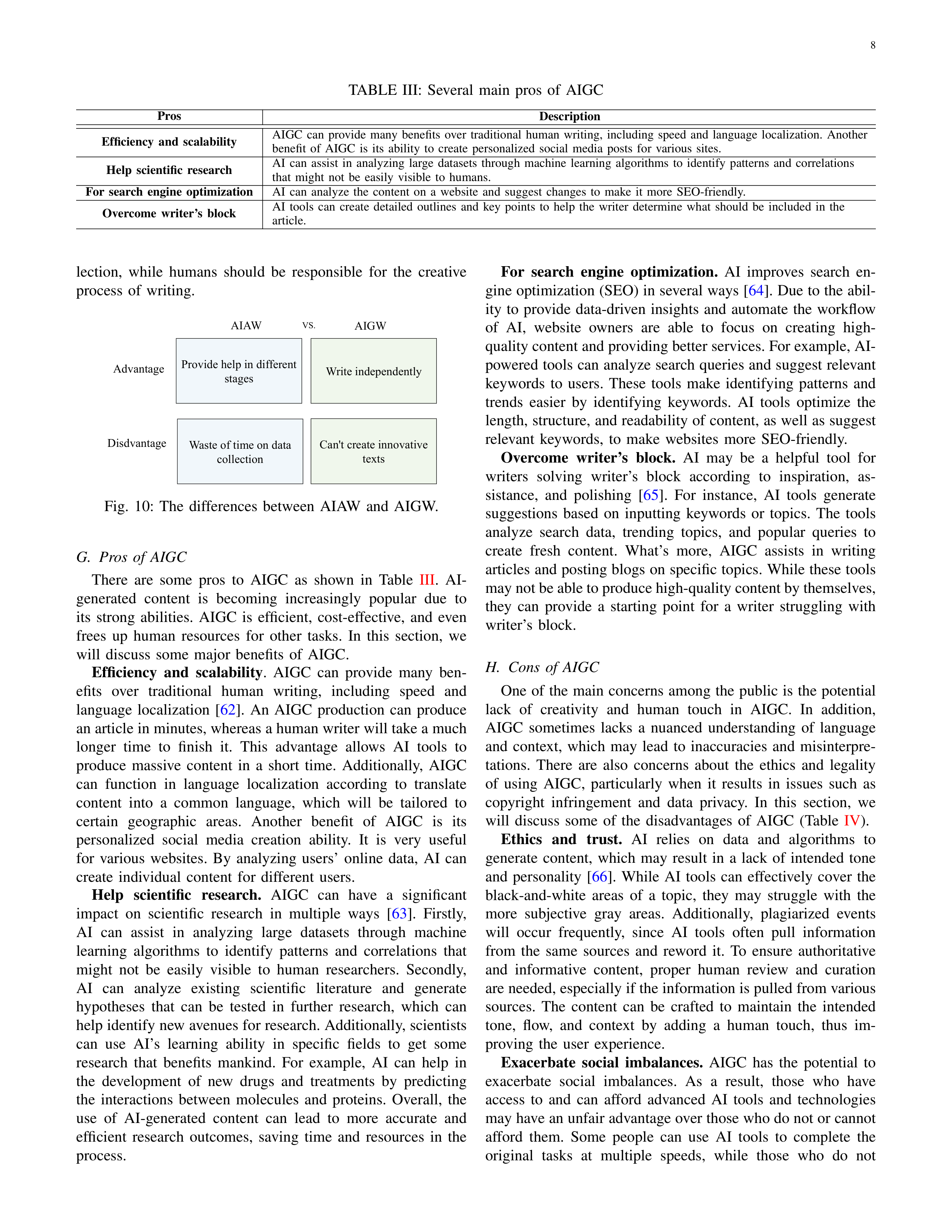
AIAW
vs.
AIGW.
The
major
differences
between
AIAW
and
AIGW
are
listed
in
Fig.
10
.
Human
beings
have
irre-
placeable
advantages
in
the
field
of
writing.
Deep
learning
models
can
easily
create
high-quality
texts,
but
they
cannot
replace
the
subjective
role
of
humans
in
writing
practice.
AI
is
superior
to
a
human
in
data
collection,
but
it
cannot
really
create
innovative,
compassionate,
and
humorous
texts.
In
addition,
human
writers
have
profound
analytical
abilities.
Good
writers
not
only
have
literary
talent
but
also
know
how
to
effectively
use
words
to
express
their
thoughts.
Human
writers can purposefully decompose complex topics into easy-
to-understand
languages
and
provide
valuable
information
for
readers.
Therefore,
since
AI
tools
are
a
valuable
resource
in
content
creation,
it
is
important
to
balance
usage,
human
creativity,
and
expression
in
writing.
A
reasonable
division
of
labor between humans and machines is essential for achieving
optimal
results.
In
the
future,
AI
should
focus
on
data
col-
8
TABLE
III:
Several
main
pros
of
AIGC
Pros
Description
Efficiency
and
scalability
AIGC
can
provide
many
benefits
over
traditional
human
writing,
including
speed
and
language
localization.
Another
benefit
of
AIGC
is
its
ability
to
create
personalized
social
media
posts
for
various
sites.
Help
scientific
research
AI
can
assist
in
analyzing
large
datasets
through
machine
learning
algorithms
to
identify
patterns
and
correlations
that
might
not
be
easily
visible
to
humans.
For
search
engine
optimization
AI
can
analyze
the
content
on
a
website
and
suggest
changes
to
make
it
more
SEO-friendly.
Overcome
writer’s
block
AI
tools
can
create
detailed
outlines
and
key
points
to
help
the
writer
determine
what
should
be
included
in
the
article.
lection,
while
humans
should
be
responsible
for
the
creative
process
of
writing.
Provide help in different
stages
Advantage
Write independently
Can't create innovative
texts
AIAW
AIGW
Waste of time on data
collection
Disdvantage
VS.
Fig.
10:
The
differences
between
AIAW
and
AIGW.
G.
Pros
of
AIGC
There
are
some
pros
to
AIGC
as
shown
in
Table
III
.
AI-
generated
content
is
becoming
increasingly
popular
due
to
its
strong
abilities.
AIGC
is
efficient,
cost-effective,
and
even
frees
up
human
resources
for
other
tasks.
In
this
section,
we
will
discuss
some
major
benefits
of
AIGC.
Efficiency
and
scalability
.
AIGC
can
provide
many
ben-
efits
over
traditional
human
writing,
including
speed
and
language
localization
[
62
].
An
AIGC
production
can
produce
an article in minutes, whereas a human writer will take a much
longer
time
to
finish
it.
This
advantage
allows
AI
tools
to
produce
massive
content
in
a
short
time.
Additionally,
AIGC
can
function
in
language
localization
according
to
translate
content
into
a
common
language,
which
will
be
tailored
to
certain
geographic
areas.
Another
benefit
of
AIGC
is
its
personalized
social
media
creation
ability.
It
is
very
useful
for
various
websites.
By
analyzing
users’
online
data,
AI
can
create
individual
content
for
different
users.
Help
scientific
research.
AIGC
can
have
a
significant
impact
on
scientific
research
in
multiple
ways
[
63
].
Firstly,
AI
can
assist
in
analyzing
large
datasets
through
machine
learning
algorithms
to
identify
patterns
and
correlations
that
might
not
be
easily
visible
to
human
researchers.
Secondly,
AI
can
analyze
existing
scientific
literature
and
generate
hypotheses
that
can
be
tested
in
further
research,
which
can
help identify new avenues for research. Additionally, scientists
can
use
AI’s
learning
ability
in
specific
fields
to
get
some
research
that
benefits
mankind.
For
example,
AI
can
help
in
the
development
of
new
drugs
and
treatments
by
predicting
the
interactions
between
molecules
and
proteins.
Overall,
the
use
of
AI-generated
content
can
lead
to
more
accurate
and
efficient
research
outcomes,
saving
time
and
resources
in
the
process.
For
search
engine
optimization.
AI
improves
search
en-
gine optimization (SEO) in several ways [
64
]. Due to the abil-
ity
to
provide
data-driven
insights
and
automate
the
workflow
of
AI,
website
owners
are
able
to
focus
on
creating
high-
quality content and providing better services. For example, AI-
powered tools can analyze search queries and suggest relevant
keywords
to
users.
These
tools
make
identifying
patterns
and
trends
easier
by
identifying
keywords.
AI
tools
optimize
the
length, structure, and readability of content, as well as suggest
relevant
keywords,
to
make
websites
more
SEO-friendly.
Overcome
writer’s
block.
AI
may
be
a
helpful
tool
for
writers
solving
writer’s
block
according
to
inspiration,
as-
sistance,
and
polishing
[
65
].
For
instance,
AI
tools
generate
suggestions
based
on
inputting
keywords
or
topics.
The
tools
analyze
search
data,
trending
topics,
and
popular
queries
to
create
fresh
content.
What’s
more,
AIGC
assists
in
writing
articles and posting blogs on specific topics. While these tools
may not be able to produce high-quality content by themselves,
they
can
provide
a
starting
point
for
a
writer
struggling
with
writer’s
block.
H.
Cons
of
AIGC
One
of
the
main
concerns
among
the
public
is
the
potential
lack
of
creativity
and
human
touch
in
AIGC.
In
addition,
AIGC
sometimes
lacks
a
nuanced
understanding
of
language
and
context,
which
may
lead
to
inaccuracies
and
misinterpre-
tations.
There
are
also
concerns
about
the
ethics
and
legality
of
using
AIGC,
particularly
when
it
results
in
issues
such
as
copyright
infringement
and
data
privacy.
In
this
section,
we
will
discuss
some
of
the
disadvantages
of
AIGC
(Table
IV
).
Ethics
and
trust.
AI
relies
on
data
and
algorithms
to
generate
content,
which
may
result
in
a
lack
of
intended
tone
and
personality
[
66
].
While
AI
tools
can
effectively
cover
the
black-and-white
areas
of
a
topic,
they
may
struggle
with
the
more
subjective
gray
areas.
Additionally,
plagiarized
events
will
occur
frequently,
since
AI
tools
often
pull
information
from
the
same
sources
and
reword
it.
To
ensure
authoritative
and
informative
content,
proper
human
review
and
curation
are needed, especially if the information is pulled from various
sources.
The
content
can
be
crafted
to
maintain
the
intended
tone,
flow,
and
context
by
adding
a
human
touch,
thus
im-
proving
the
user
experience.
Exacerbate
social
imbalances.
AIGC
has
the
potential
to
exacerbate
social
imbalances.
As
a
result,
those
who
have
access
to
and
can
afford
advanced
AI
tools
and
technologies
may have an unfair advantage over those who do not or cannot
afford
them.
Some
people
can
use
AI
tools
to
complete
the
original
tasks
at
multiple
speeds,
while
those
who
do
not
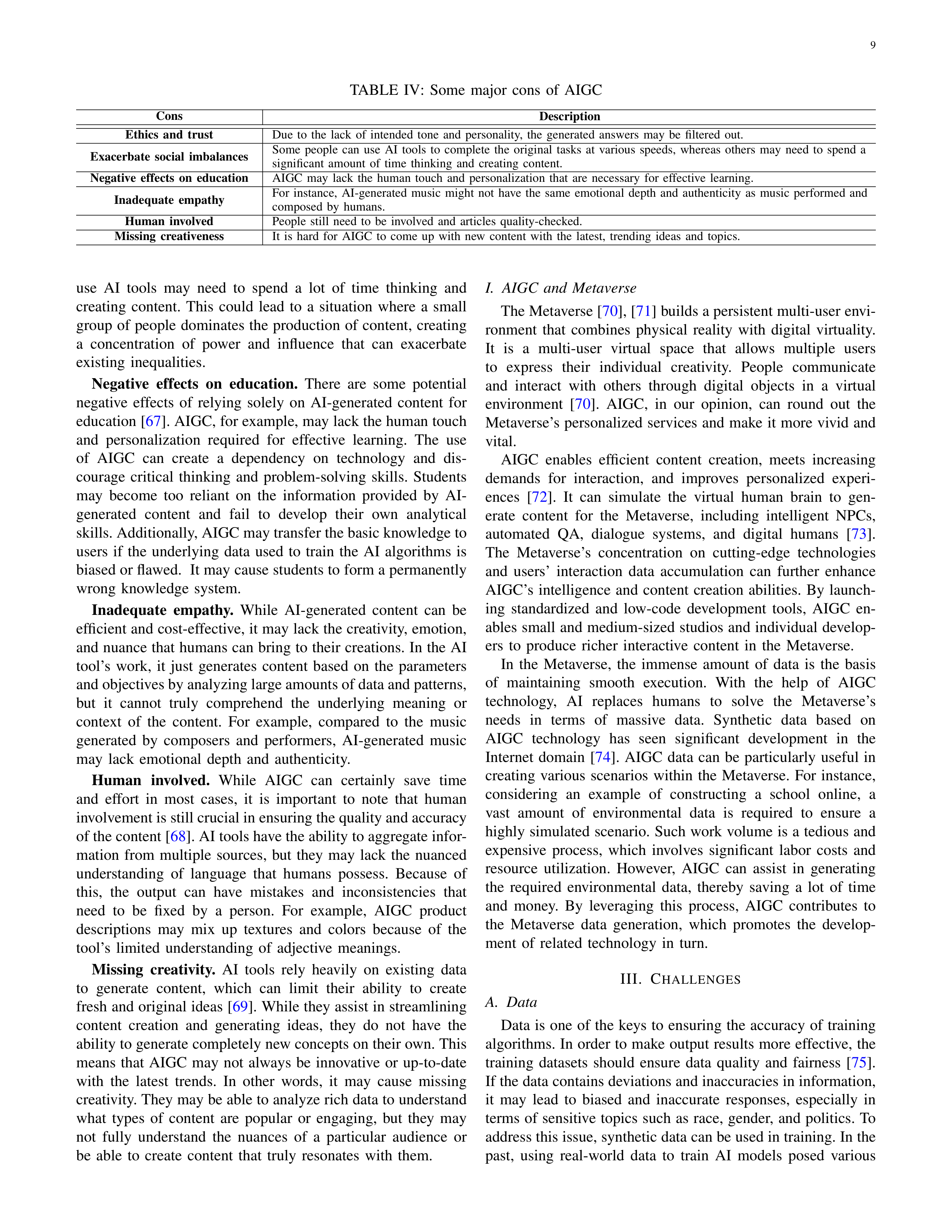
9
TABLE
IV:
Some
major
cons
of
AIGC
Cons
Description
Ethics
and
trust
Due
to
the
lack
of
intended
tone
and
personality,
the
generated
answers
may
be
filtered
out.
Exacerbate
social
imbalances
Some
people
can
use
AI
tools
to
complete
the
original
tasks
at
various
speeds,
whereas
others
may
need
to
spend
a
significant
amount
of
time
thinking
and
creating
content.
Negative
effects
on
education
AIGC
may
lack
the
human
touch
and
personalization
that
are
necessary
for
effective
learning.
Inadequate
empathy
For
instance,
AI-generated
music
might
not
have
the
same
emotional
depth
and
authenticity
as
music
performed
and
composed
by
humans.
Human
involved
People
still
need
to
be
involved
and
articles
quality-checked.
Missing
creativeness
It
is
hard
for
AIGC
to
come
up
with
new
content
with
the
latest,
trending
ideas
and
topics.
use
AI
tools
may
need
to
spend
a
lot
of
time
thinking
and
creating
content.
This
could
lead
to
a
situation
where
a
small
group
of
people
dominates
the
production
of
content,
creating
a
concentration
of
power
and
influence
that
can
exacerbate
existing
inequalities.
Negative
effects
on
education.
There
are
some
potential
negative
effects
of
relying
solely
on
AI-generated
content
for
education [
67
]. AIGC, for example, may lack the human touch
and
personalization
required
for
effective
learning.
The
use
of
AIGC
can
create
a
dependency
on
technology
and
dis-
courage
critical
thinking
and
problem-solving
skills.
Students
may
become
too
reliant
on
the
information
provided
by
AI-
generated
content
and
fail
to
develop
their
own
analytical
skills. Additionally, AIGC may transfer the basic knowledge to
users
if
the
underlying
data
used
to
train
the
AI
algorithms
is
biased or flawed.
It may cause students to form a permanently
wrong
knowledge
system.
Inadequate
empathy.
While
AI-generated
content
can
be
efficient and cost-effective, it may lack the creativity, emotion,
and nuance that humans can bring to their creations. In the AI
tool’s
work,
it
just
generates
content
based
on
the
parameters
and objectives by analyzing large amounts of data and patterns,
but
it
cannot
truly
comprehend
the
underlying
meaning
or
context
of
the
content.
For
example,
compared
to
the
music
generated
by
composers
and
performers,
AI-generated
music
may
lack
emotional
depth
and
authenticity.
Human
involved.
While
AIGC
can
certainly
save
time
and
effort
in
most
cases,
it
is
important
to
note
that
human
involvement is still crucial in ensuring the quality and accuracy
of the content [
68
]. AI tools have the ability to aggregate infor-
mation
from
multiple
sources,
but
they
may
lack
the
nuanced
understanding
of
language
that
humans
possess.
Because
of
this,
the
output
can
have
mistakes
and
inconsistencies
that
need
to
be
fixed
by
a
person.
For
example,
AIGC
product
descriptions
may
mix
up
textures
and
colors
because
of
the
tool’s
limited
understanding
of
adjective
meanings.
Missing
creativity.
AI
tools
rely
heavily
on
existing
data
to
generate
content,
which
can
limit
their
ability
to
create
fresh and original ideas [
69
]. While they assist in streamlining
content
creation
and
generating
ideas,
they
do
not
have
the
ability to generate completely new concepts on their own. This
means
that
AIGC
may
not
always
be
innovative
or
up-to-date
with
the
latest
trends.
In
other
words,
it
may
cause
missing
creativity. They may be able to analyze rich data to understand
what
types
of
content
are
popular
or
engaging,
but
they
may
not
fully
understand
the
nuances
of
a
particular
audience
or
be
able
to
create
content
that
truly
resonates
with
them.
I.
AIGC
and
Metaverse
The Metaverse [
70
], [
71
] builds a persistent multi-user envi-
ronment
that
combines
physical
reality
with
digital
virtuality.
It
is
a
multi-user
virtual
space
that
allows
multiple
users
to
express
their
individual
creativity.
People
communicate
and
interact
with
others
through
digital
objects
in
a
virtual
environment
[
70
].
AIGC,
in
our
opinion,
can
round
out
the
Metaverse’s
personalized
services
and
make
it
more
vivid
and
vital.
AIGC
enables
efficient
content
creation,
meets
increasing
demands
for
interaction,
and
improves
personalized
experi-
ences
[
72
].
It
can
simulate
the
virtual
human
brain
to
gen-
erate
content
for
the
Metaverse,
including
intelligent
NPCs,
automated
QA,
dialogue
systems,
and
digital
humans
[
73
].
The
Metaverse’s
concentration
on
cutting-edge
technologies
and
users’
interaction
data
accumulation
can
further
enhance
AIGC’s
intelligence
and
content
creation
abilities.
By
launch-
ing
standardized
and
low-code
development
tools,
AIGC
en-
ables small and medium-sized studios and individual develop-
ers
to
produce
richer
interactive
content
in
the
Metaverse.
In
the
Metaverse,
the
immense
amount
of
data
is
the
basis
of
maintaining
smooth
execution.
With
the
help
of
AIGC
technology,
AI
replaces
humans
to
solve
the
Metaverse’s
needs
in
terms
of
massive
data.
Synthetic
data
based
on
AIGC
technology
has
seen
significant
development
in
the
Internet
domain
[
74
].
AIGC
data
can
be
particularly
useful
in
creating
various
scenarios
within
the
Metaverse.
For
instance,
considering
an
example
of
constructing
a
school
online,
a
vast
amount
of
environmental
data
is
required
to
ensure
a
highly simulated
scenario. Such
work volume
is a
tedious and
expensive
process,
which
involves
significant
labor
costs
and
resource
utilization.
However,
AIGC
can
assist
in
generating
the
required
environmental
data,
thereby
saving
a
lot
of
time
and
money.
By
leveraging
this
process,
AIGC
contributes
to
the
Metaverse
data
generation,
which
promotes
the
develop-
ment
of
related
technology
in
turn.
III.
C
HALLENGES
A.
Data
Data
is
one
of
the
keys
to
ensuring
the
accuracy
of
training
algorithms. In order to make output results more effective, the
training
datasets
should
ensure
data
quality
and
fairness
[
75
].
If the data contains deviations and inaccuracies in information,
it
may
lead
to
biased
and
inaccurate
responses,
especially
in
terms
of
sensitive
topics
such
as
race,
gender,
and
politics.
To
address this issue, synthetic data can be used in training. In the
past,
using
real-world
data
to
train
AI
models
posed
various
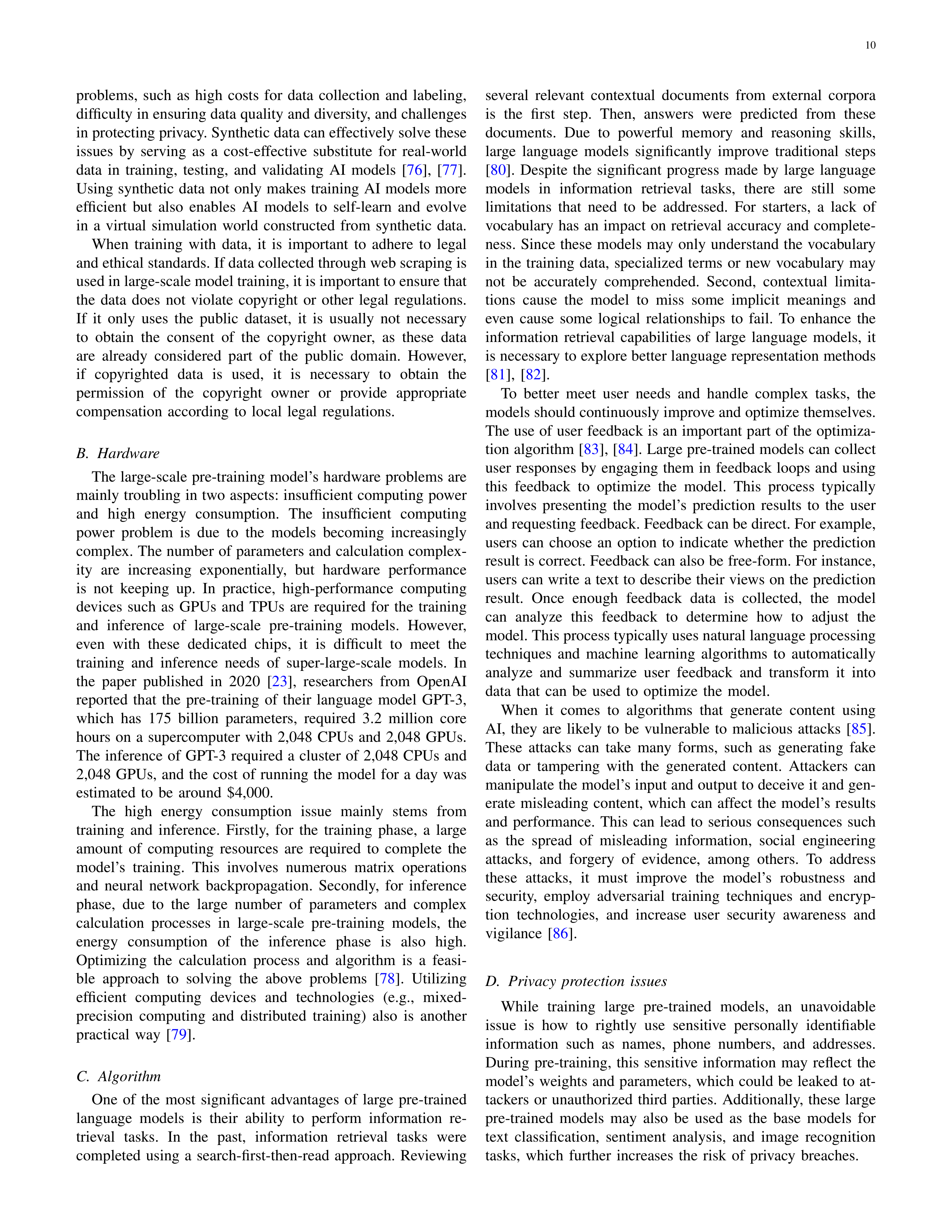
10
problems,
such
as
high
costs
for
data
collection
and
labeling,
difficulty in ensuring data quality and diversity, and challenges
in protecting privacy. Synthetic data can effectively solve these
issues
by
serving
as
a
cost-effective
substitute
for
real-world
data
in
training,
testing,
and
validating
AI
models
[
76
],
[
77
].
Using
synthetic
data
not
only
makes
training
AI
models
more
efficient
but
also
enables
AI
models
to
self-learn
and
evolve
in
a
virtual
simulation
world
constructed
from
synthetic
data.
When
training
with
data,
it
is
important
to
adhere
to
legal
and ethical standards. If data collected through web scraping is
used in large-scale model training, it is important to ensure that
the
data
does
not
violate
copyright
or
other
legal
regulations.
If
it
only
uses
the
public
dataset,
it
is
usually
not
necessary
to
obtain
the
consent
of
the
copyright
owner,
as
these
data
are
already
considered
part
of
the
public
domain.
However,
if
copyrighted
data
is
used,
it
is
necessary
to
obtain
the
permission
of
the
copyright
owner
or
provide
appropriate
compensation
according
to
local
legal
regulations.
B.
Hardware
The large-scale pre-training model’s hardware problems are
mainly troubling in two
aspects: insufficient computing power
and
high
energy
consumption.
The
insufficient
computing
power
problem
is
due
to
the
models
becoming
increasingly
complex. The number
of parameters
and
calculation complex-
ity
are
increasing
exponentially,
but
hardware
performance
is
not
keeping
up.
In
practice,
high-performance
computing
devices
such
as
GPUs
and
TPUs
are
required
for
the
training
and
inference
of
large-scale
pre-training
models.
However,
even
with
these
dedicated
chips,
it
is
difficult
to
meet
the
training
and
inference
needs
of
super-large-scale
models.
In
the
paper
published
in
2020
[
23
],
researchers
from
OpenAI
reported
that
the
pre-training
of
their
language
model
GPT-3,
which
has
175
billion
parameters,
required
3.2
million
core
hours
on
a
supercomputer
with
2,048
CPUs
and
2,048
GPUs.
The
inference
of
GPT-3
required
a
cluster
of
2,048
CPUs
and
2,048
GPUs,
and
the
cost
of
running
the
model
for
a
day
was
estimated
to
be
around
$4,000.
The
high
energy
consumption
issue
mainly
stems
from
training
and
inference.
Firstly,
for
the
training
phase,
a
large
amount
of
computing
resources
are
required
to
complete
the
model’s
training.
This
involves
numerous
matrix
operations
and
neural
network
backpropagation.
Secondly,
for
inference
phase,
due
to
the
large
number
of
parameters
and
complex
calculation
processes
in
large-scale
pre-training
models,
the
energy
consumption
of
the
inference
phase
is
also
high.
Optimizing
the
calculation
process
and
algorithm
is
a
feasi-
ble
approach
to
solving
the
above
problems
[
78
].
Utilizing
efficient
computing
devices
and
technologies
(e.g.,
mixed-
precision
computing
and
distributed
training)
also
is
another
practical
way
[
79
].
C.
Algorithm
One
of
the
most
significant
advantages
of
large
pre-trained
language
models
is
their
ability
to
perform
information
re-
trieval
tasks.
In
the
past,
information
retrieval
tasks
were
completed
using
a
search-first-then-read
approach.
Reviewing
several
relevant
contextual
documents
from
external
corpora
is
the
first
step.
Then,
answers
were
predicted
from
these
documents.
Due
to
powerful
memory
and
reasoning
skills,
large
language
models
significantly
improve
traditional
steps
[
80
].
Despite
the
significant
progress
made
by
large
language
models
in
information
retrieval
tasks,
there
are
still
some
limitations
that
need
to
be
addressed.
For
starters,
a
lack
of
vocabulary
has
an
impact
on
retrieval
accuracy
and
complete-
ness.
Since
these
models
may
only
understand
the
vocabulary
in
the
training
data,
specialized
terms
or
new
vocabulary
may
not
be
accurately
comprehended.
Second,
contextual
limita-
tions
cause
the
model
to
miss
some
implicit
meanings
and
even
cause
some
logical
relationships
to
fail.
To
enhance
the
information
retrieval
capabilities
of
large
language
models,
it
is necessary to explore better language representation methods
[
81
],
[
82
].
To
better
meet
user
needs
and
handle
complex
tasks,
the
models should continuously improve and optimize themselves.
The use of user feedback is an important part of the optimiza-
tion algorithm [
83
], [
84
]. Large pre-trained models can collect
user
responses
by
engaging
them
in
feedback
loops
and
using
this
feedback
to
optimize
the
model.
This
process
typically
involves
presenting
the
model’s
prediction
results
to
the
user
and requesting feedback. Feedback can be direct. For example,
users
can
choose
an
option
to
indicate
whether
the
prediction
result is correct. Feedback can also be free-form. For instance,
users can write a text to describe their views on the prediction
result.
Once
enough
feedback
data
is
collected,
the
model
can
analyze
this
feedback
to
determine
how
to
adjust
the
model. This process typically uses natural language processing
techniques
and
machine
learning
algorithms
to
automatically
analyze
and
summarize
user
feedback
and
transform
it
into
data
that
can
be
used
to
optimize
the
model.
When
it
comes
to
algorithms
that
generate
content
using
AI,
they
are
likely
to
be
vulnerable
to
malicious
attacks
[
85
].
These
attacks
can
take
many
forms,
such
as
generating
fake
data
or
tampering
with
the
generated
content.
Attackers
can
manipulate the model’s input and output to deceive it and gen-
erate
misleading
content,
which
can
affect
the
model’s
results
and
performance.
This
can
lead
to
serious
consequences
such
as
the
spread
of
misleading
information,
social
engineering
attacks,
and
forgery
of
evidence,
among
others.
To
address
these
attacks,
it
must
improve
the
model’s
robustness
and
security,
employ
adversarial
training
techniques
and
encryp-
tion
technologies,
and
increase
user
security
awareness
and
vigilance
[
86
].
D.
Privacy
protection
issues
While
training
large
pre-trained
models,
an
unavoidable
issue
is
how
to
rightly
use
sensitive
personally
identifiable
information
such
as
names,
phone
numbers,
and
addresses.
During
pre-training,
this
sensitive
information
may
reflect
the
model’s
weights
and
parameters,
which
could
be
leaked
to
at-
tackers
or
unauthorized
third
parties.
Additionally,
these
large
pre-trained
models
may
also
be
used
as
the
base
models
for
text
classification,
sentiment
analysis,
and
image
recognition
tasks,
which
further
increases
the
risk
of
privacy
breaches.
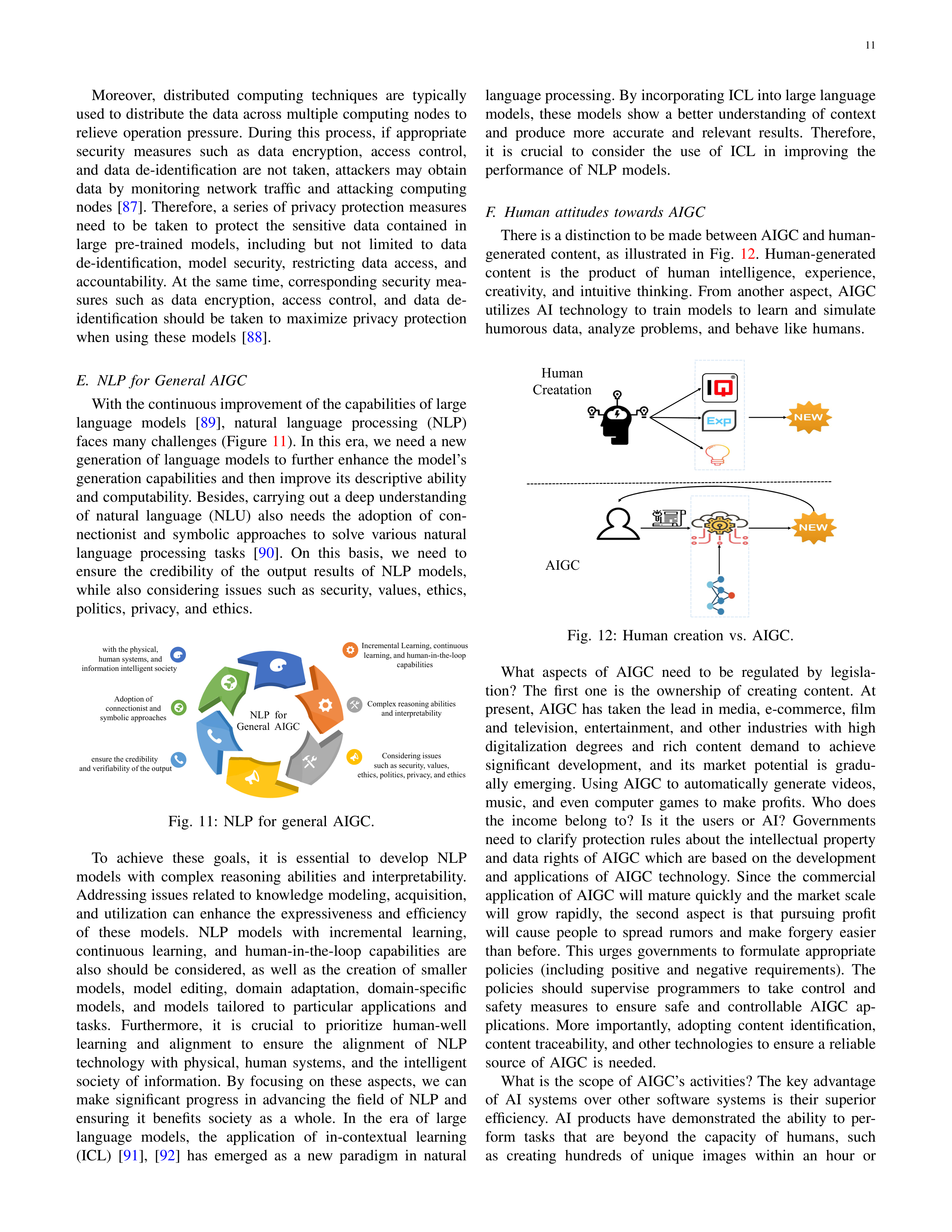












11
Moreover,
distributed
computing
techniques
are
typically
used
to
distribute
the
data
across
multiple
computing
nodes
to
relieve
operation
pressure.
During
this
process,
if
appropriate
security
measures
such
as
data
encryption,
access
control,
and
data
de-identification
are
not
taken,
attackers
may
obtain
data
by
monitoring
network
traffic
and
attacking
computing
nodes
[
87
].
Therefore,
a
series
of
privacy
protection
measures
need
to
be
taken
to
protect
the
sensitive
data
contained
in
large
pre-trained
models,
including
but
not
limited
to
data
de-identification,
model
security,
restricting
data
access,
and
accountability.
At
the
same
time,
corresponding
security
mea-
sures
such
as
data
encryption,
access
control,
and
data
de-
identification
should
be
taken
to
maximize
privacy
protection
when
using
these
models
[
88
].
E.
NLP
for
General
AIGC
With the continuous improvement of the capabilities of large
language
models
[
89
],
natural
language
processing
(NLP)
faces
many
challenges
(Figure
11
).
In
this
era,
we
need
a
new
generation
of
language
models
to
further
enhance
the
model’s
generation
capabilities
and
then
improve
its
descriptive
ability
and computability. Besides, carrying out a deep understanding
of
natural
language
(NLU)
also
needs
the
adoption
of
con-
nectionist
and
symbolic
approaches
to
solve
various
natural
language
processing
tasks
[
90
].
On
this
basis,
we
need
to
ensure
the
credibility
of
the
output
results
of
NLP
models,
while
also
considering
issues
such
as
security,
values,
ethics,
politics,
privacy,
and
ethics.
with the physical,
human systems, and
information intelligent society
Adoption of
connectionist and
symbolic approaches
Incremental Learning, continuous
learning, and human-in-the-loop
capabilities
Complex reasoning abilities
and interpretability
Considering issues
such as security, values,
ethics, politics, privacy, and ethics
ensure the credibility
and verifiability of the output
NLP for
General AIGC
Fig.
11:
NLP
for
general
AIGC.
To
achieve
these
goals,
it
is
essential
to
develop
NLP
models
with
complex
reasoning
abilities
and
interpretability.
Addressing issues related to knowledge modeling, acquisition,
and
utilization
can
enhance
the
expressiveness
and
efficiency
of
these
models.
NLP
models
with
incremental
learning,
continuous
learning,
and
human-in-the-loop
capabilities
are
also
should
be
considered,
as
well
as
the
creation
of
smaller
models,
model
editing,
domain
adaptation,
domain-specific
models,
and
models
tailored
to
particular
applications
and
tasks.
Furthermore,
it
is
crucial
to
prioritize
human-well
learning
and
alignment
to
ensure
the
alignment
of
NLP
technology
with
physical,
human
systems,
and
the
intelligent
society
of
information.
By
focusing
on
these
aspects,
we
can
make
significant
progress
in
advancing
the
field
of
NLP
and
ensuring
it
benefits
society
as
a
whole.
In
the
era
of
large
language
models,
the
application
of
in-contextual
learning
(ICL)
[
91
],
[
92
]
has
emerged
as
a
new
paradigm
in
natural
language processing. By incorporating ICL into large language
models,
these
models
show
a
better
understanding
of
context
and
produce
more
accurate
and
relevant
results.
Therefore,
it
is
crucial
to
consider
the
use
of
ICL
in
improving
the
performance
of
NLP
models.
F.
Human
attitudes
towards
AIGC
There is a distinction to be made between AIGC and human-
generated
content,
as
illustrated
in
Fig.
12
.
Human-generated
content
is
the
product
of
human
intelligence,
experience,
creativity,
and
intuitive
thinking.
From
another
aspect,
AIGC
utilizes
AI
technology
to
train
models
to
learn
and
simulate
humorous
data,
analyze
problems,
and
behave
like
humans.
AIGC
Human
Creatation
Fig.
12:
Human
creation
vs.
AIGC.
What
aspects
of
AIGC
need
to
be
regulated
by
legisla-
tion?
The
first
one
is
the
ownership
of
creating
content.
At
present,
AIGC
has
taken
the
lead
in
media,
e-commerce,
film
and
television,
entertainment,
and
other
industries
with
high
digitalization
degrees
and
rich
content
demand
to
achieve
significant
development,
and
its
market
potential
is
gradu-
ally
emerging.
Using
AIGC
to
automatically
generate
videos,
music,
and
even
computer
games
to
make
profits.
Who
does
the
income
belong
to?
Is
it
the
users
or
AI?
Governments
need
to
clarify
protection
rules
about
the
intellectual
property
and
data
rights
of
AIGC
which
are
based
on
the
development
and
applications
of
AIGC
technology.
Since
the
commercial
application
of
AIGC
will
mature
quickly
and
the
market
scale
will
grow
rapidly,
the
second
aspect
is
that
pursuing
profit
will
cause
people
to
spread
rumors
and
make
forgery
easier
than
before.
This
urges
governments
to
formulate
appropriate
policies
(including
positive
and
negative
requirements).
The
policies
should
supervise
programmers
to
take
control
and
safety
measures
to
ensure
safe
and
controllable
AIGC
ap-
plications.
More
importantly,
adopting
content
identification,
content traceability, and other technologies to ensure a reliable
source
of
AIGC
is
needed.
What
is
the
scope
of
AIGC’s
activities?
The
key
advantage
of
AI
systems
over
other
software
systems
is
their
superior
efficiency.
AI
products
have
demonstrated
the
ability
to
per-
form
tasks
that
are
beyond
the
capacity
of
humans,
such
as
creating
hundreds
of
unique
images
within
an
hour
or
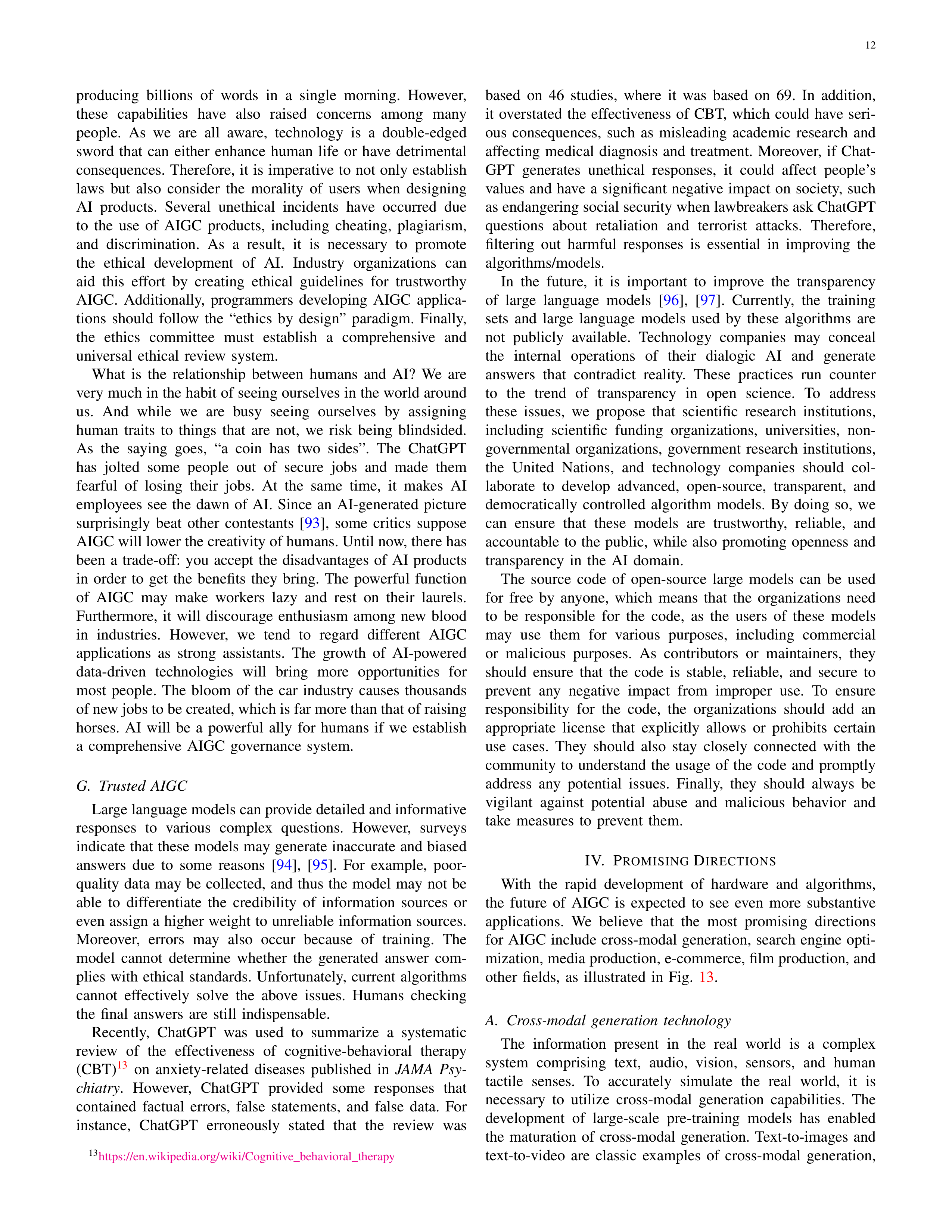
12
producing
billions
of
words
in
a
single
morning.
However,
these
capabilities
have
also
raised
concerns
among
many
people.
As
we
are
all
aware,
technology
is
a
double-edged
sword
that
can
either
enhance
human
life
or
have
detrimental
consequences.
Therefore,
it
is
imperative
to
not
only
establish
laws
but
also
consider
the
morality
of
users
when
designing
AI
products.
Several
unethical
incidents
have
occurred
due
to
the
use
of
AIGC
products,
including
cheating,
plagiarism,
and
discrimination.
As
a
result,
it
is
necessary
to
promote
the
ethical
development
of
AI.
Industry
organizations
can
aid
this
effort
by
creating
ethical
guidelines
for
trustworthy
AIGC.
Additionally,
programmers
developing
AIGC
applica-
tions
should
follow
the
“ethics
by
design”
paradigm.
Finally,
the
ethics
committee
must
establish
a
comprehensive
and
universal
ethical
review
system.
What
is
the
relationship
between
humans
and
AI?
We
are
very much in the habit of seeing ourselves in the world around
us.
And
while
we
are
busy
seeing
ourselves
by
assigning
human
traits
to
things
that
are
not,
we
risk
being
blindsided.
As
the
saying
goes,
“a
coin
has
two
sides”.
The
ChatGPT
has
jolted
some
people
out
of
secure
jobs
and
made
them
fearful
of
losing
their
jobs.
At
the
same
time,
it
makes
AI
employees
see
the
dawn
of
AI.
Since
an
AI-generated
picture
surprisingly
beat
other
contestants
[
93
],
some
critics
suppose
AIGC will lower the creativity of humans. Until now, there has
been
a
trade-off:
you
accept
the
disadvantages
of
AI
products
in
order
to
get
the
benefits
they
bring.
The
powerful
function
of
AIGC
may
make
workers
lazy
and
rest
on
their
laurels.
Furthermore,
it
will
discourage
enthusiasm
among
new
blood
in
industries.
However,
we
tend
to
regard
different
AIGC
applications
as
strong
assistants.
The
growth
of
AI-powered
data-driven
technologies
will
bring
more
opportunities
for
most
people.
The
bloom
of
the
car
industry
causes
thousands
of new jobs to be created, which is far more than that of raising
horses.
AI
will
be
a
powerful
ally
for
humans
if
we
establish
a
comprehensive
AIGC
governance
system.
G.
Trusted
AIGC
Large language models can provide detailed and informative
responses
to
various
complex
questions.
However,
surveys
indicate that these models may generate inaccurate and biased
answers
due
to
some
reasons
[
94
],
[
95
].
For
example,
poor-
quality
data
may
be
collected,
and
thus
the
model
may
not
be
able
to
differentiate
the
credibility
of
information
sources
or
even assign a higher weight to unreliable information sources.
Moreover,
errors
may
also
occur
because
of
training.
The
model
cannot
determine
whether
the
generated
answer
com-
plies
with
ethical
standards.
Unfortunately,
current
algorithms
cannot
effectively
solve
the
above
issues.
Humans
checking
the
final
answers
are
still
indispensable.
Recently,
ChatGPT
was
used
to
summarize
a
systematic
review
of
the
effectiveness
of
cognitive-behavioral
therapy
(CBT)
13
on
anxiety-related
diseases
published
in
JAMA
Psy-
chiatry
.
However,
ChatGPT
provided
some
responses
that
contained
factual
errors,
false
statements,
and
false
data.
For
instance,
ChatGPT
erroneously
stated
that
the
review
was
13
https://en.wikipedia.org/wiki/Cognitive
behavioral
therapy
based
on
46
studies,
where
it
was
based
on
69.
In
addition,
it
overstated
the
effectiveness
of
CBT,
which
could
have
seri-
ous
consequences,
such
as
misleading
academic
research
and
affecting
medical
diagnosis
and
treatment.
Moreover,
if
Chat-
GPT
generates
unethical
responses,
it
could
affect
people’s
values
and
have
a
significant
negative
impact
on
society,
such
as endangering social security when lawbreakers ask ChatGPT
questions
about
retaliation
and
terrorist
attacks.
Therefore,
filtering
out
harmful
responses
is
essential
in
improving
the
algorithms/models.
In
the
future,
it
is
important
to
improve
the
transparency
of
large
language
models
[
96
],
[
97
].
Currently,
the
training
sets
and
large
language
models
used
by
these
algorithms
are
not
publicly
available.
Technology
companies
may
conceal
the
internal
operations
of
their
dialogic
AI
and
generate
answers
that
contradict
reality.
These
practices
run
counter
to
the
trend
of
transparency
in
open
science.
To
address
these
issues,
we
propose
that
scientific
research
institutions,
including
scientific
funding
organizations,
universities,
non-
governmental
organizations,
government
research
institutions,
the
United
Nations,
and
technology
companies
should
col-
laborate
to
develop
advanced,
open-source,
transparent,
and
democratically
controlled
algorithm
models.
By
doing
so,
we
can
ensure
that
these
models
are
trustworthy,
reliable,
and
accountable
to
the
public,
while
also
promoting
openness
and
transparency
in
the
AI
domain.
The
source
code
of
open-source
large
models
can
be
used
for
free
by
anyone,
which
means
that
the
organizations
need
to
be
responsible
for
the
code,
as
the
users
of
these
models
may
use
them
for
various
purposes,
including
commercial
or
malicious
purposes.
As
contributors
or
maintainers,
they
should
ensure
that
the
code
is
stable,
reliable,
and
secure
to
prevent
any
negative
impact
from
improper
use.
To
ensure
responsibility
for
the
code,
the
organizations
should
add
an
appropriate
license
that
explicitly
allows
or
prohibits
certain
use
cases.
They
should
also
stay
closely
connected
with
the
community
to
understand
the
usage
of
the
code
and
promptly
address
any
potential
issues.
Finally,
they
should
always
be
vigilant
against
potential
abuse
and
malicious
behavior
and
take
measures
to
prevent
them.
IV.
P
ROMISING
D
IRECTIONS
With
the
rapid
development
of
hardware
and
algorithms,
the
future
of
AIGC
is
expected
to
see
even
more
substantive
applications.
We
believe
that
the
most
promising
directions
for
AIGC
include
cross-modal
generation,
search
engine
opti-
mization, media production, e-commerce, film production, and
other
fields,
as
illustrated
in
Fig.
13
.
A.
Cross-modal
generation
technology
The
information
present
in
the
real
world
is
a
complex
system
comprising
text,
audio,
vision,
sensors,
and
human
tactile
senses.
To
accurately
simulate
the
real
world,
it
is
necessary
to
utilize
cross-modal
generation
capabilities.
The
development
of
large-scale
pre-training
models
has
enabled
the
maturation
of
cross-modal
generation.
Text-to-images
and
text-to-video
are
classic
examples
of
cross-modal
generation,
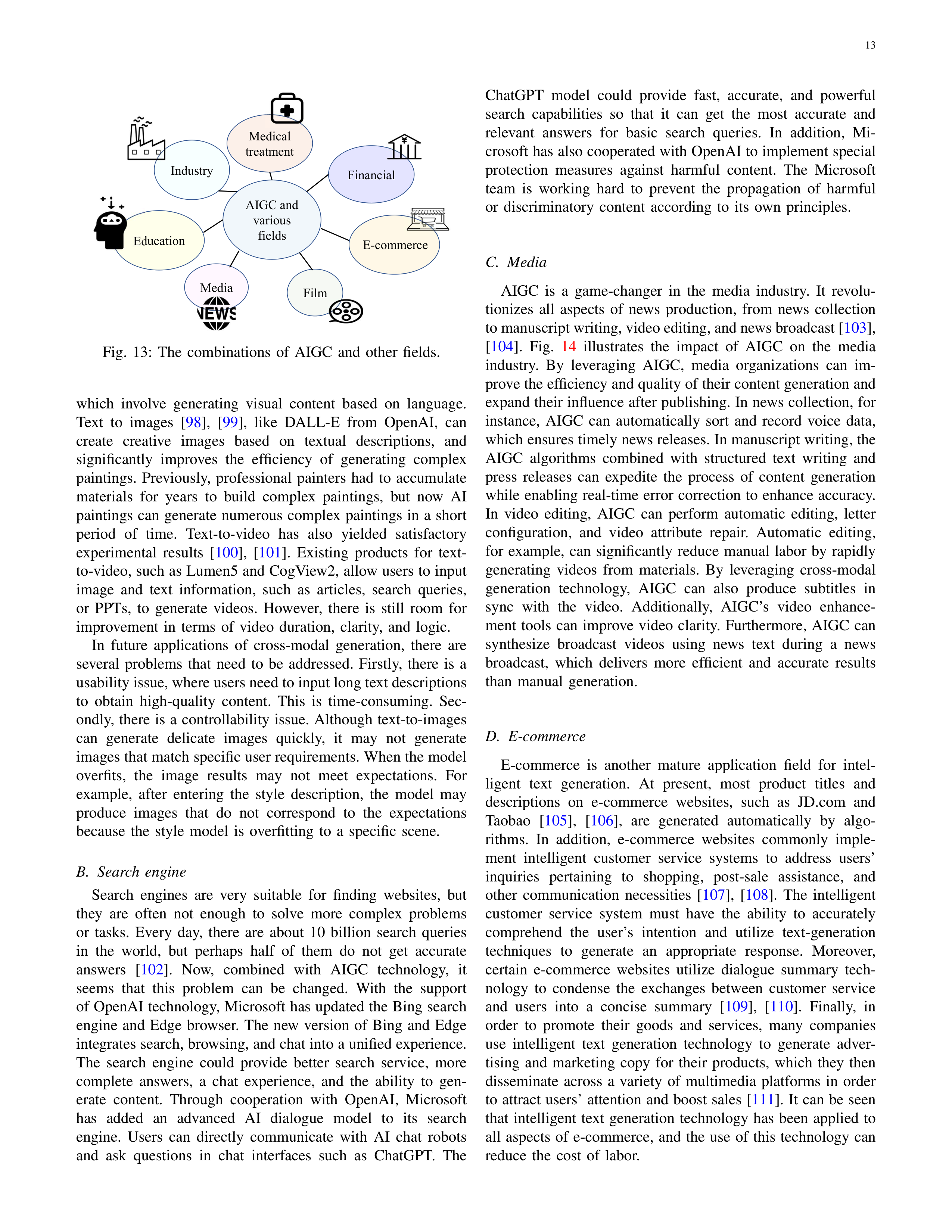






13
AIGC and
various
fields
Media
Film
Education
Industry
Medical
treatment
Financial
E-commerce
Fig.
13:
The
combinations
of
AIGC
and
other
fields.
which
involve
generating
visual
content
based
on
language.
Text
to
images
[
98
],
[
99
],
like
DALL-E
from
OpenAI,
can
create
creative
images
based
on
textual
descriptions,
and
significantly
improves
the
efficiency
of
generating
complex
paintings.
Previously,
professional
painters
had
to
accumulate
materials
for
years
to
build
complex
paintings,
but
now
AI
paintings
can
generate
numerous
complex
paintings
in
a
short
period
of
time.
Text-to-video
has
also
yielded
satisfactory
experimental
results
[
100
],
[
101
].
Existing
products
for
text-
to-video, such as Lumen5 and CogView2, allow users to input
image
and
text
information,
such
as
articles,
search
queries,
or
PPTs,
to
generate
videos.
However,
there
is
still
room
for
improvement
in
terms
of
video
duration,
clarity,
and
logic.
In
future
applications
of
cross-modal
generation,
there
are
several
problems
that
need
to
be
addressed.
Firstly,
there
is
a
usability issue, where users need to input long text descriptions
to
obtain
high-quality
content.
This
is
time-consuming.
Sec-
ondly,
there
is
a
controllability
issue.
Although
text-to-images
can
generate
delicate
images
quickly,
it
may
not
generate
images that match specific user requirements. When the model
overfits,
the
image
results
may
not
meet
expectations.
For
example,
after
entering
the
style
description,
the
model
may
produce
images
that
do
not
correspond
to
the
expectations
because
the
style
model
is
overfitting
to
a
specific
scene.
B.
Search
engine
Search
engines
are
very
suitable
for
finding
websites,
but
they
are
often
not
enough
to
solve
more
complex
problems
or
tasks.
Every
day,
there
are
about
10
billion
search
queries
in
the
world,
but
perhaps
half
of
them
do
not
get
accurate
answers
[
102
].
Now,
combined
with
AIGC
technology,
it
seems
that
this
problem
can
be
changed.
With
the
support
of OpenAI technology, Microsoft has updated the Bing search
engine
and
Edge
browser.
The
new
version
of
Bing
and
Edge
integrates search, browsing, and chat into a unified experience.
The
search
engine
could
provide
better
search
service,
more
complete
answers,
a
chat
experience,
and
the
ability
to
gen-
erate
content.
Through
cooperation
with
OpenAI,
Microsoft
has
added
an
advanced
AI
dialogue
model
to
its
search
engine.
Users
can
directly
communicate
with
AI
chat
robots
and
ask
questions
in
chat
interfaces
such
as
ChatGPT.
The
ChatGPT
model
could
provide
fast,
accurate,
and
powerful
search
capabilities
so
that
it
can
get
the
most
accurate
and
relevant
answers
for
basic
search
queries.
In
addition,
Mi-
crosoft has also cooperated with OpenAI to implement special
protection
measures
against
harmful
content.
The
Microsoft
team
is
working
hard
to
prevent
the
propagation
of
harmful
or
discriminatory
content
according
to
its
own
principles.
C.
Media
AIGC
is
a
game-changer
in
the
media
industry.
It
revolu-
tionizes
all
aspects
of
news
production,
from
news
collection
to manuscript writing, video editing, and news broadcast [
103
],
[
104
].
Fig.
14
illustrates
the
impact
of
AIGC
on
the
media
industry.
By
leveraging
AIGC,
media
organizations
can
im-
prove the efficiency and quality of their content generation and
expand their influence after publishing. In news collection, for
instance,
AIGC
can
automatically
sort
and
record
voice
data,
which ensures timely news releases. In manuscript writing, the
AIGC
algorithms
combined
with
structured
text
writing
and
press
releases
can
expedite
the
process
of
content
generation
while
enabling
real-time
error
correction
to
enhance
accuracy.
In
video
editing,
AIGC
can
perform
automatic
editing,
letter
configuration,
and
video
attribute
repair.
Automatic
editing,
for
example,
can
significantly
reduce
manual
labor
by
rapidly
generating
videos
from
materials.
By
leveraging
cross-modal
generation
technology,
AIGC
can
also
produce
subtitles
in
sync
with
the
video.
Additionally,
AIGC’s
video
enhance-
ment
tools
can
improve
video
clarity.
Furthermore,
AIGC
can
synthesize
broadcast
videos
using
news
text
during
a
news
broadcast,
which
delivers
more
efficient
and
accurate
results
than
manual
generation.
D.
E-commerce
E-commerce
is
another
mature
application
field
for
intel-
ligent
text
generation.
At
present,
most
product
titles
and
descriptions
on
e-commerce
websites,
such
as
JD.com
and
Taobao
[
105
],
[
106
],
are
generated
automatically
by
algo-
rithms.
In
addition,
e-commerce
websites
commonly
imple-
ment
intelligent
customer
service
systems
to
address
users’
inquiries
pertaining
to
shopping,
post-sale
assistance,
and
other
communication
necessities
[
107
],
[
108
].
The
intelligent
customer
service
system
must
have
the
ability
to
accurately
comprehend
the
user’s
intention
and
utilize
text-generation
techniques
to
generate
an
appropriate
response.
Moreover,
certain
e-commerce
websites
utilize
dialogue
summary
tech-
nology
to
condense
the
exchanges
between
customer
service
and
users
into
a
concise
summary
[
109
],
[
110
].
Finally,
in
order
to
promote
their
goods
and
services,
many
companies
use
intelligent
text
generation
technology
to
generate
adver-
tising
and
marketing
copy
for
their
products,
which
they
then
disseminate
across
a
variety
of
multimedia
platforms
in
order
to
attract
users’
attention
and
boost
sales
[
111
].
It
can
be
seen
that
intelligent
text
generation
technology
has
been
applied
to
all
aspects
of
e-commerce,
and
the
use
of
this
technology
can
reduce
the
cost
of
labor.
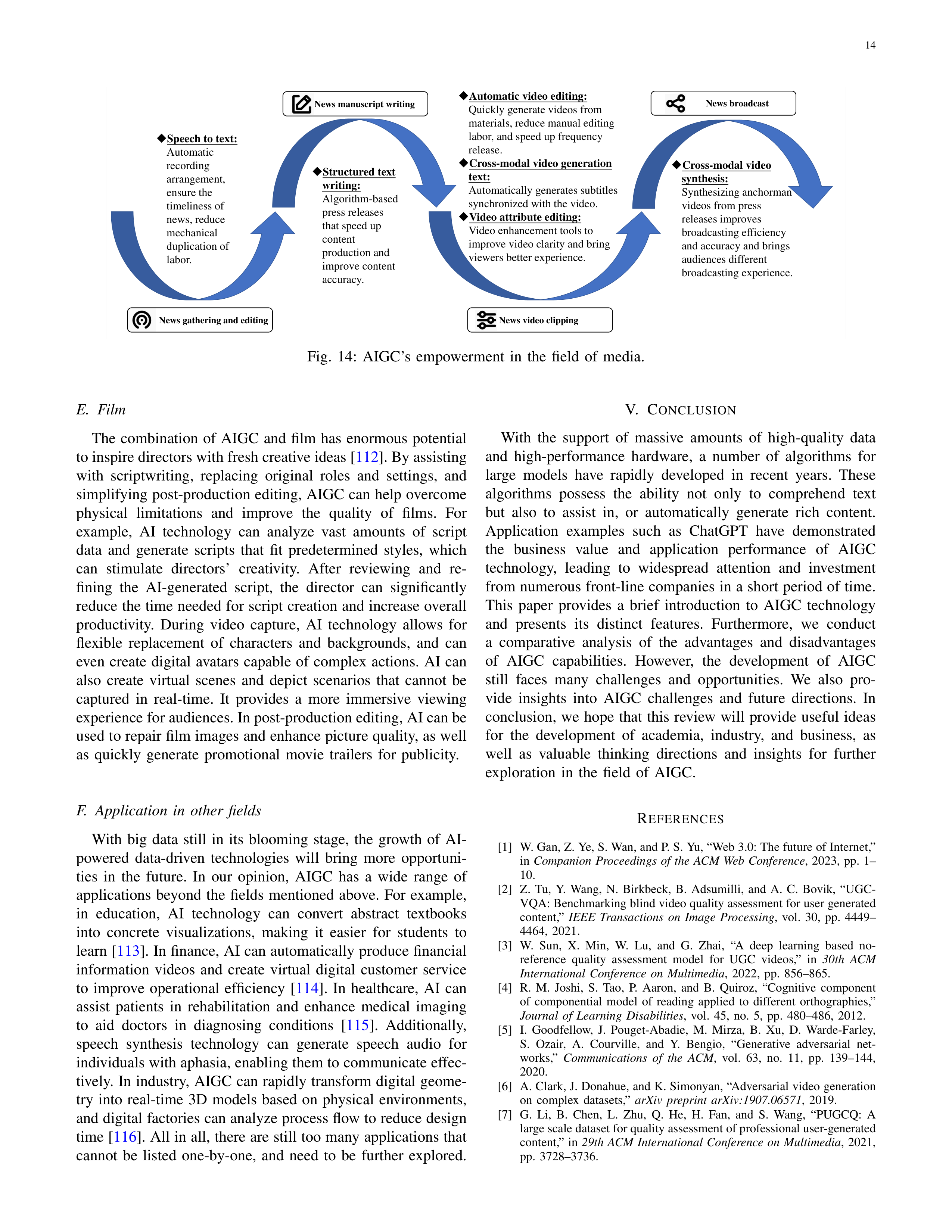



14
News gathering and editing
News manuscript writing
News video clipping
News broadcast
◆
Speech to text:
Automatic
recording
arrangement,
ensure the
timeliness of
news, reduce
mechanical
duplication of
labor.
◆
Structured text
writing:
Algorithm-based
press releases
that speed up
content
production and
improve content
accuracy.
◆
Automatic video editing:
Quickly generate videos from
materials, reduce manual editing
labor, and speed up frequency
release.
◆
Cross-modal video generation
text:
Automatically generates subtitles
synchronized with the video.
◆
Video attribute editing:
Video enhancement tools to
improve video clarity and bring
viewers better experience.
◆
Cross-modal video
synthesis:
Synthesizing anchorman
videos from press
releases improves
broadcasting efficiency
and accuracy and brings
audiences different
broadcasting experience.
Fig.
14:
AIGC’s
empowerment
in
the
field
of
media.
E.
Film
The
combination
of
AIGC
and
film
has
enormous
potential
to inspire directors with fresh creative ideas [
112
]. By assisting
with
scriptwriting,
replacing
original
roles
and
settings,
and
simplifying post-production editing, AIGC can help overcome
physical
limitations
and
improve
the
quality
of
films.
For
example,
AI
technology
can
analyze
vast
amounts
of
script
data
and
generate
scripts
that
fit
predetermined
styles,
which
can
stimulate
directors’
creativity.
After
reviewing
and
re-
fining
the
AI-generated
script,
the
director
can
significantly
reduce the time needed for script creation and increase overall
productivity.
During
video
capture,
AI
technology
allows
for
flexible
replacement
of
characters
and
backgrounds,
and
can
even
create
digital
avatars
capable
of
complex
actions.
AI
can
also
create
virtual
scenes
and
depict
scenarios
that
cannot
be
captured
in
real-time.
It
provides
a
more
immersive
viewing
experience for audiences. In post-production editing, AI can be
used to repair film images and enhance picture quality, as well
as
quickly
generate
promotional
movie
trailers
for
publicity.
F.
Application
in
other
fields
With
big
data
still
in
its
blooming
stage,
the
growth
of
AI-
powered
data-driven
technologies
will
bring
more
opportuni-
ties
in
the
future.
In
our
opinion,
AIGC
has
a
wide
range
of
applications
beyond
the
fields
mentioned
above.
For
example,
in
education,
AI
technology
can
convert
abstract
textbooks
into
concrete
visualizations,
making
it
easier
for
students
to
learn [
113
]. In finance, AI can automatically produce financial
information
videos
and
create
virtual
digital
customer
service
to
improve
operational
efficiency
[
114
].
In
healthcare,
AI
can
assist
patients
in
rehabilitation
and
enhance
medical
imaging
to
aid
doctors
in
diagnosing
conditions
[
115
].
Additionally,
speech
synthesis
technology
can
generate
speech
audio
for
individuals with aphasia, enabling them to communicate effec-
tively. In industry, AIGC can rapidly transform digital geome-
try
into
real-time
3D
models
based
on
physical
environments,
and digital factories can analyze process flow to reduce design
time [
116
]. All in all, there are still too many applications that
cannot
be
listed
one-by-one,
and
need
to
be
further
explored.
V.
C
ONCLUSION
With
the
support
of
massive
amounts
of
high-quality
data
and
high-performance
hardware,
a
number
of
algorithms
for
large
models
have
rapidly
developed
in
recent
years.
These
algorithms
possess
the
ability
not
only
to
comprehend
text
but
also
to
assist
in,
or
automatically
generate
rich
content.
Application
examples
such
as
ChatGPT
have
demonstrated
the
business
value
and
application
performance
of
AIGC
technology,
leading
to
widespread
attention
and
investment
from numerous front-line companies in a short period of time.
This
paper
provides
a
brief
introduction
to
AIGC
technology
and
presents
its
distinct
features.
Furthermore,
we
conduct
a
comparative
analysis
of
the
advantages
and
disadvantages
of
AIGC
capabilities.
However,
the
development
of
AIGC
still
faces
many
challenges
and
opportunities.
We
also
pro-
vide
insights
into
AIGC
challenges
and
future
directions.
In
conclusion,
we
hope
that
this
review
will
provide
useful
ideas
for
the
development
of
academia,
industry,
and
business,
as
well
as
valuable
thinking
directions
and
insights
for
further
exploration
in
the
field
of
AIGC.
R
EFERENCES
[1]
W. Gan, Z. Ye, S. Wan, and P. S. Yu, “Web 3.0: The future of Internet,”
in
Companion
Proceedings
of
the
ACM
Web
Conference
,
2023,
pp.
1–
10.
[2]
Z.
Tu,
Y.
Wang,
N.
Birkbeck,
B.
Adsumilli,
and
A.
C.
Bovik,
“UGC-
VQA: Benchmarking blind video quality assessment for user generated
content,”
IEEE
Transactions
on
Image
Processing
,
vol.
30,
pp.
4449–
4464,
2021.
[3]
W.
Sun,
X.
Min,
W.
Lu,
and
G.
Zhai,
“A
deep
learning
based
no-
reference
quality
assessment
model
for
UGC
videos,”
in
30th
ACM
International
Conference
on
Multimedia
,
2022,
pp.
856–865.
[4]
R.
M.
Joshi,
S.
Tao,
P.
Aaron,
and
B.
Quiroz,
“Cognitive
component
of
componential
model
of
reading
applied
to
different
orthographies,”
Journal
of
Learning
Disabilities
,
vol.
45,
no.
5,
pp.
480–486,
2012.
[5]
I.
Goodfellow,
J.
Pouget-Abadie,
M.
Mirza,
B.
Xu,
D.
Warde-Farley,
S.
Ozair,
A.
Courville,
and
Y.
Bengio,
“Generative
adversarial
net-
works,”
Communications
of
the
ACM
,
vol.
63,
no.
11,
pp.
139–144,
2020.
[6]
A. Clark, J. Donahue, and K. Simonyan, “Adversarial video generation
on
complex
datasets,”
arXiv
preprint
arXiv:1907.06571
,
2019.
[7]
G.
Li,
B.
Chen,
L.
Zhu,
Q.
He,
H.
Fan,
and
S.
Wang,
“PUGCQ:
A
large scale dataset for quality assessment of professional user-generated
content,”
in
29th
ACM
International
Conference
on
Multimedia
,
2021,
pp.
3728–3736.
15
[8]
J.
Kim,
“The
institutionalization
of
YouTube:
From
user-generated
content to professionally generated content,”
Media, Culture & Society
,
vol.
34,
no.
1,
pp.
53–67,
2012.
[9]
S.
Gao,
Y.
Liu,
Y.
Kang,
and
F.
Zhang,
“User-generated
content:
A
promising
data
source
for
urban
informatics,”
Urban
Informatics
,
pp.
503–522,
2021.
[10]
D. J. Welbourne and W. J. Grant, “Science communication on YouTube:
Factors that affect channel and video popularity,”
Public Understanding
of
Science
,
vol.
25,
no.
6,
pp.
706–718,
2016.
[11]
Z.
Li,
J.
Cai,
S.
He,
and
H.
Zhao,
“Seq2seq
dependency
parsing,”
in
27th International Conference on Computational Linguistics
, 2018, pp.
3203–3214.
[12]
A. See, P. J. Liu, and C. D. Manning, “Get to the point: Summarization
with
pointer-generator
networks,”
in
55th
Annual
Meeting
of
the
Association
for
Computational
Linguistics
,
2017,
pp.
1073–1083.
[13]
L.
Yu,
W.
Zhang,
J.
Wang,
and
Y.
Yu,
“Seqgan:
Sequence
generative
adversarial
nets
with
policy
gradient,”
in
AAAI
conference
on
artificial
intelligence
,
vol.
31,
no.
1,
2017,
pp.
2852–2858.
[14]
A.
Fan,
P.
Stock,
B.
Graham,
E.
Grave,
R.
Gribonval,
H.
Jegou,
and
A.
Joulin,
“Training
with
quantization
noise
for
extreme
model
compression,”
in
9th
International
Conference
on
Learning
Represen-
tations
,
2020,
pp.
1–20.
[15]
H.
Ren,
H.
Dai,
Z.
Dai,
M.
Yang,
J.
Leskovec,
D.
Schuurmans,
and
B. Dai, “Combiner: Full attention transformer with sparse computation
cost,”
Advances in Neural Information Processing Systems
, vol. 34, pp.
22 470–22 482,
2021.
[16]
E.
Hoogeboom,
A.
A.
Gritsenko,
J.
Bastings,
B.
Poole,
R.
v.
d.
Berg,
and
T.
Salimans,
“Autoregressive
diffusion
models,”
in
10th
International
Conference
on
Learning
Representations
,
2021,
pp.
1–
23.
[17]
M.
Pollefeys
and
L.
V.
Gool,
“From
images
to
3D
models,”
Commu-
nications
of
the
ACM
,
vol.
45,
no.
7,
pp.
50–55,
2002.
[18]
S.
Loeschcke,
S.
Belongie,
and
S.
Benaim,
“Text-driven
stylization
of
video
objects,”
in
Computer
Vision
–
ECCV
Workshops
,
2022,
pp.
594–609.
[19]
O. Texler, D. Futschik, M. Kuˇcera, O. Jamriˇska,
ˇ
S. Sochorov´a, M. Chai,
S.
Tulyakov,
and
D.
S`ykora,
“Interactive
video
stylization
using
few-
shot
patch-based
training,”
ACM
Transactions
on
Graphics
,
vol.
39,
no.
4,
pp.
73–1,
2020.
[20]
J. Zhang, “Multi-source remote sensing data fusion: Status and trends,”
International
Journal
of
Image
and
Data
Fusion
,
vol.
1,
no.
1,
pp.
5–
24,
2010.
[21]
V.
Sze,
Y.-H.
Chen,
J.
Emer,
A.
Suleiman,
and
Z.
Zhang,
“Hardware
for
machine
learning:
Challenges
and
opportunities,”
in
IEEE
Custom
Integrated
Circuits
Conference
.
IEEE,
2017,
pp.
1–8.
[22]
W. J. Dally, C. T. Gray, J. Poulton, B. Khailany, J. Wilson, and L. Den-
nison,
“Hardware-enabled
artificial
intelligence,”
in
IEEE
Symposium
on
VLSI
Circuits
.
IEEE,
2018,
pp.
3–6.
[23]
T.
Brown,
B.
Mann,
N.
Ryder,
M.
Subbiah,
J.
D.
Kaplan,
P.
Dhariwal,
A. Neelakantan, P. Shyam, G. Sastry, A. Askell
et al.
, “Language mod-
els
are
few-shot
learners,”
Advances
in
Neural
Information
Processing
Systems
,
vol.
33,
pp.
1877–1901,
2020.
[24]
C.
M.
Bishop,
“Neural
networks
and
their
applications,”
Review
of
Scientific
Instruments
,
vol.
65,
no.
6,
pp.
1803–1832,
1994.
[25]
J.
Lawrence,
Introduction
to
Neural
Networks
.
California
Scientific
Software,
1993.
[26]
Y.
LeCun,
Y.
Bengio,
and
G.
Hinton,
“Deep
learning,”
Nature
,
vol.
521,
no.
7553,
pp.
436–444,
2015.
[27]
I.
Goodfellow,
Y.
Bengio,
and
A.
Courville,
Deep
Learning
.
MIT
press,
2016.
[28]
T.
M.
Mitchell
and
T.
M.
Mitchell,
Machine
Learning
.
McGraw-hill
New
York,
1997,
vol.
1,
no.
9.
[29]
J.
Koutnik,
K.
Greff,
F.
Gomez,
and
J.
Schmidhuber,
“A
clockwork
RNN,”
in
International
Conference
on
Machine
Learning
.
PMLR,
2014,
pp.
1863–1871.
[30]
L. O. Chua and T. Roska, “The CNN paradigm,”
IEEE Transactions on
Circuits and Systems I: Fundamental Theory and Applications
, vol. 40,
no.
3,
pp.
147–156,
1993.
[31]
N.
Kitaev,
Ł.
Kaiser,
and
A.
Levskaya,
“Reformer:
The
efficient
trans-
former,”
in
8th
International
Conference
on
Learning
Representations
.
OpenReview,
2020,
pp.
1–12.
[32]
J. Devlin, M.-W. Chang, K. Lee, and K. Toutanova, “Bert: Pre-training
of
deep
bidirectional
transformers
for
language
understanding,”
in
The
Conference
of
the
North
American
Chapter
of
the
Association
for
Computational Linguistics
.
Association for Computational Linguistics,
2019,
pp.
4171–4186.
[33]
D.
P.
Kingma
and
M.
Welling,
“Auto-encoding
variational
bayes,”
in
2nd
International
Conference
on
Learning
Representations
,
2014.
[34]
D.
Rezende
and
S.
Mohamed,
“Variational
inference
with
normalizing
flows,”
in
International
Conference
on
Machine
Learning
.
PMLR,
2015,
pp.
1530–1538.
[35]
J. Lehtinen, J. Munkberg, J. Hasselgren, S. Laine, T. Karras, M. Aittala,
and
T.
Aila,
“Noise2Noise:
Learning
image
restoration
without
clean
data,”
in
35th
International
Conference
on
Machine
Learning
,
vol.
80.
PMLR,
2018,
pp.
2971–2980.
[36]
B. Mildenhall, P. P. Srinivasan, M. Tancik, J. T. Barron, R. Ramamoor-
thi,
and
R.
Ng,
“Nerf:
Representing
scenes
as
neural
radiance
fields
for
view
synthesis,”
Communications
of
the
ACM
,
vol.
65,
no.
1,
pp.
99–106,
2021.
[37]
A.
Radford,
J.
W.
Kim,
C.
Hallacy,
A.
Ramesh,
G.
Goh,
S.
Agarwal,
G.
Sastry,
A.
Askell,
P.
Mishkin,
J.
Clark
et
al.
,
“Learning
transferable
visual
models
from
natural
language
supervision,”
in
International
Conference
on
Machine
Learning
.
PMLR,
2021,
pp.
8748–8763.
[38]
Z.
Lv
and
S.
Xie,
“Artificial
intelligence
in
the
digital
twins:
State
of
the
art,
challenges,
and
future
research
topics,”
Digital
Twin
,
vol.
1,
no.
12,
pp.
1–12,
2022.
[39]
K.
Alexopoulos,
N.
Nikolakis,
and
G.
Chryssolouris,
“Digital
twin-
driven
supervised
machine
learning
for
the
development
of
artificial
intelligence
applications
in
manufacturing,”
International
Journal
of
Computer Integrated Manufacturing
, vol. 33, no. 5, pp. 429–439, 2020.
[40]
A. El Saddik, “Digital twins: The convergence of multimedia technolo-
gies,”
IEEE
Multimedia
,
vol.
25,
no.
2,
pp.
87–92,
2018.
[41]
L.
Dong
and
M.
Lapata,
“Language
to
logical
form
with
neural
atten-
tion,”
in
54th
Annual
Meeting
of
the
Association
for
Computational
Linguistics
.
The Association for Computer Linguistics,
2016, pp.
33–
43.
[42]
M.
Rabinovich,
M.
Stern,
and
D.
Klein,
“Abstract
syntax
networks
for
code
generation
and
semantic
parsing,”
in
55th
Annual
Meeting
of
the
Association
for
Computational
Linguistics
.
Association
for
Computational
Linguistics,
2017,
pp.
1139–1149.
[43]
P.
Yin
and
G.
Neubig,
“A
syntactic
neural
model
for
general-purpose
code
generation,”
in
55th
Annual
Meeting
of
the
Association
for
Computational Linguistics
.
Association for Computational Linguistics,
2017,
pp.
440–450.
[44]
X.
Wu,
V.
Kumar,
J.
Ross
Quinlan,
J.
Ghosh,
Q.
Yang,
H.
Motoda,
G.
J.
McLachlan,
A.
Ng,
B.
Liu,
P.
S.
Yu,
Z.
Zhou,
M.
Steinbach,
D.
J.
Hand,
and
D.
Steinberg,
“Top
10
algorithms
in
data
mining,”
Knowledge
and
Information
Systems
,
vol.
14,
pp.
1–37,
2008.
[45]
J.
Han,
M.
Kamber,
and
J.
Pei,
“Data
mining
concepts
and
techniques
third
edition,”
University
of
Illinois
at
Urbana-Champaign
Micheline
Kamber
Jian
Pei
Simon
Fraser
University
,
2012.
[46]
D. L. Olson and D. Delen,
Advanced data mining techniques
.
Springer
Science
&
Business
Media,
2008.
[47]
F.
J.
M.
Shamrat,
Z.
Tasnim,
A.
S.
Rahman,
N.
I.
Nobel,
and
S.
A.
Hossain,
“An
effective
implementation
of
web
crawling
technology
to
retrieve data from the world wide web (WWW),”
International Journal
of
Scientific
&
Technology
Research
,
vol.
9,
no.
01,
pp.
1252–1256,
2020.
[48]
S.
Sun,
C.
Luo,
and
J.
Chen,
“A
review
of
natural
language
processing
techniques
for
opinion
mining
systems,”
Information
Fusion
,
vol.
36,
pp.
10–25,
2017.
[49]
H.-Y.
Lin,
“Large-scale
artificial
intelligence
models,”
Computer
,
vol.
55,
no.
05,
pp.
76–80,
2022.
[50]
A.
L’heureux,
K.
Grolinger,
H.
F.
Elyamany,
and
M.
A.
Capretz,
“Machine
learning
with
big
data:
Challenges
and
approaches,”
IEEE
Access
,
vol.
5,
pp.
7776–7797,
2017.
[51]
Z.
Ghahramani,
“Probabilistic
machine
learning
and
artificial
intelli-
gence,”
Nature
,
vol.
521,
no.
7553,
pp.
452–459,
2015.
[52]
X.
Han,
Z.
Zhang,
N.
Ding,
Y.
Gu,
X.
Liu,
Y.
Huo,
J.
Qiu,
Y.
Yao,
A.
Zhang,
L.
Zhang
et
al.
,
“Pre-trained
models:
Past,
present
and
future,”
AI
Open
,
vol.
2,
pp.
225–250,
2021.
[53]
X.
Wang,
G.
Chen,
G.
Qian,
P.
Gao,
X.-Y.
Wei,
Y.
Wang,
Y.
Tian,
and
W.
Gao,
“Large-scale
multi-modal
pre-trained
models:
A
comprehen-
sive
survey,”
arXiv
preprint
arXiv:2302.10035
,
2023.
[54]
K.
Amit,
Artificial
Intelligence
and
Soft
Computing:
Behavioral
and
Cognitive
Modeling
of
the
Human
Brain
.
CRC
press,
2018.
[55]
D.
C.
Geary,
“Mitochondrial
functioning
and
the
relations
among
health,
cognition,
and
aging:
where
cell
biology
meets
cognitive
science,”
International
Journal
of
Molecular
Sciences
,
vol.
22,
no.
7,
p.
3562,
2021.
[56]
L. Ma and B. Sun, “Machine learning and AI in marketing–connecting
computing power to human insights,”
International Journal of Research
in
Marketing
,
vol.
37,
no.
3,
pp.
481–504,
2020.
16
[57]
H. Zhang, C. Liu, M. Zhang, and R. Zhu, “A hot spot clustering method
based on improved kmeans algorithm,” in
14th International Computer
Conference
on
Wavelet
Active
Media
Technology
and
Information
Processing
.
IEEE,
2017,
pp.
32–35.
[58]
R.
L.
Jackson,
P.
Hoffman,
G.
Pobric,
and
M.
A.
Lambon
Ralph,
“The
nature
and
neural
correlates
of
semantic
association
versus
conceptual
similarity,”
Cerebral
Cortex
,
vol.
25,
no.
11,
pp.
4319–4333,
2015.
[59]
N.-Y.
Kim,
“A
study
on
the
use
of
artificial
intelligence
chatbots
for
improving
english
grammar
skills,”
Journal
of
Digital
Convergence
,
vol.
17,
no.
8,
pp.
37–46,
2019.
[60]
Y.
Zhang,
M.
Chen,
and
L.
Liu,
“A
review
on
text
mining,”
in
6th
IEEE
International
Conference
on
Software
Engineering
and
Service
Science
.
IEEE,
2015,
pp.
681–685.
[61]
J.
He,
M.
Zhou,
and
L.
Jiang,
“Generating
chinese
classical
poems
with
statistical
machine
translation
models,”
in
26th
AAAI
Conference
on
Artificial
Intelligence
,
2012,
pp.
1650–1656.
[62]
D.
Adams
and
K.-M.
Chuah,
“Artificial
intelligence-based
tools
in
research
writing:
Current
trends
and
future
potentials,”
Artificial
In-
telligence
in
Higher
Education
,
pp.
169–184,
2022.
[63]
Y.
Xu,
X.
Liu,
X.
Cao,
C.
Huang,
E.
Liu,
S.
Qian,
X.
Liu,
Y.
Wu,
F. Dong, C.-W. Qiu
et al.
, “Artificial intelligence: A powerful paradigm
for
scientific
research,”
The
Innovation
,
vol.
2,
no.
4,
pp.
1–21,
2021.
[64]
D.
Sharma,
R.
Shukla,
A.
K.
Giri,
and
S.
Kumar,
“A
brief
review
on
search
engine
optimization,”
in
9th
International
Conference
on
Cloud
Computing,
Data
Science
&
Engineering
.
IEEE,
2019,
pp.
687–692.
[65]
D.
Ippolito,
A.
Yuan,
A.
Coenen,
and
S.
Burnam,
“Creative
Writing
with
an
AI-Powered
Writing
Assistant:
Perspectives
from
Professional
Writers,”
arXiv
preprint
arXiv:2211.05030
,
pp.
1–18,
2022.
[66]
C. Yuan, J. Wu, H. Li, and L. Wang, “Personality recognition based on
user
generated
content,”
in
15th
International
Conference
on
Service
Systems
and
Service
Management
.
IEEE,
2018,
pp.
1–6.
[67]
B.
Tao,
V.
D´ıaz,
and
Y.
Guerra,
“Artificial
intelligence
and
education,
challenges
and
disadvantages
for
the
teacher,”
Arctic
Journal
,
vol.
72,
no.
12,
pp.
30–50,
2019.
[68]
V.
Bader
and
S.
Kaiser,
“Algorithmic
decision-making?
the
user
in-
terface
and
its
role
for
human
involvement
in
decisions
supported
by
artificial intelligence,”
Organization
, vol. 26, no. 5, pp. 655–672, 2019.
[69]
K.
E.
Jennings,
“Developing
creativity:
Artificial
barriers
in
artificial
intelligence,”
Minds
and
Machines
,
vol.
20,
pp.
489–501,
2010.
[70]
S.
Mystakidis,
“Metaverse,”
Encyclopedia
,
vol.
2,
no.
1,
pp.
486–497,
2022.
[71]
Z.
Chen,
J.
Wu,
W.
Gan,
and
Z.
Qi,
“Metaverse
security
and
privacy:
An
overview,”
in
IEEE
International
Conference
on
Big
Data
.
IEEE,
2022,
pp.
2950–2959.
[72]
M. David Stone and N. David Woodcock, “Interactive, direct and digital
marketing: A future that depends on better use of business intelligence,”
Journal
of
Research
in
Interactive
Marketing
,
vol.
8,
no.
1,
pp.
4–17,
2014.
[73]
J.
Sun,
W.
Gan,
H.-C.
Chao,
and
P.
S.
Yu,
“Metaverse:
Survey,
appli-
cations,
security,
and
opportunities,”
arXiv
preprint
arXiv:2210.07990
,
2022.
[74]
J. Sun, W. Gan, Z. Chen, J. Li, and P. S. Yu, “Big data meets metaverse:
A
survey,”
arXiv
preprint
arXiv:2210.16282
,
pp.
1–17,
2022.
[75]
L.
Bertossi
and
F.
Geerts,
“Data
quality
and
explainable
AI,”
Journal
of
Data
and
Information
Quality
,
vol.
12,
no.
2,
pp.
1–9,
2020.
[76]
V.
Bol´on-Canedo,
N.
S´anchez-Maro˜no,
and
A.
Alonso-Betanzos,
“A
review of feature selection methods on synthetic data,”
Knowledge and
Information
Systems
,
vol.
34,
pp.
483–519,
2013.
[77]
S.
I.
Nikolenko,
Synthetic
Data
for
Deep
Learning
.
Springer,
2021,
vol.
174.
[78]
M. Le Gallo, A. Sebastian, R. Mathis, M. Manica, H. Giefers, T. Tuma,
C. Bekas, A. Curioni, and E. Eleftheriou, “Mixed-precision in-memory
computing,”
Nature
Electronics
,
vol.
1,
no.
4,
pp.
246–253,
2018.
[79]
Y.
Lin,
S.
Han,
H.
Mao,
Y.
Wang,
and
W.
J.
Dally,
“Deep
gradient
compression:
Reducing
the
communication
bandwidth
for
distributed
training,”
in
The
6th
International
Conference
on
Learning
Represen-
tations
.
OpenReview,
2018,
pp.
1–14.
[80]
L.
Bonifacio,
H.
Abonizio,
M.
Fadaee,
and
R.
Nogueira,
“InPars:
Data
augmentation
for
information
retrieval
using
large
language
models,”
arXiv
preprint
arXiv:2202.05144
,
2022.
[81]
Z.
Yang,
Z.
Dai,
Y.
Yang,
J.
Carbonell,
R.
R.
Salakhutdinov,
and
Q.
V.
Le,
“Xlnet:
Generalized
autoregressive
pretraining
for
language
understanding,”
Advances
in
Neural
Information
Processing
Systems
,
vol.
32,
2019.
[82]
L.
Zhuang,
L.
Wayne,
S.
Ya,
and
Z.
Jun,
“A
robustly
optimized
BERT
pre-training
approach
with
post-training,”
in
20th
Chinese
National
Conference
on
Computational
Linguistics
,
2021,
pp.
1218–1227.
[83]
S.
Stumpf,
V.
Rajaram,
L.
Li,
M.
Burnett,
T.
Dietterich,
E.
Sullivan,
R.
Drummond,
and
J.
Herlocker,
“Toward
harnessing
user
feedback
for
machine
learning,”
in
12th
International
Conference
on
Intelligent
User
Interfaces
,
2007,
pp.
82–91.
[84]
S.
S.
Shuvo
and
Y.
Yilmaz,
“Home
energy
recommendation
system
(HERS):
A
deep
reinforcement
learning
method
based
on
residents’
feedback
and
activity,”
IEEE
Transactions
on
Smart
Grid
,
vol.
13,
no.
4,
pp.
2812–2821,
2022.
[85]
B. Guembe, A. Azeta, S. Misra, V. C. Osamor, L. Fernandez-Sanz, and
V.
Pospelova,
“The
Emerging
Threat
of
AI-driven
Cyber
Attacks:
A
review,”
Applied
Artificial
Intelligence
,
vol.
36,
no.
1,
pp.
1–35,
2022.
[86]
J. Hayes and G. Danezis, “Generating steganographic images via adver-
sarial
training,”
Advances
in
Neural
Information
Processing
Systems
,
vol.
30,
pp.
1–10,
2017.
[87]
D.
Chen
and
H.
Zhao,
“Data
security
and
privacy
protection
issues
in
cloud
computing,”
in
International
Conference
on
Computer
Science
and
Electronics
Engineering
.
IEEE,
2012,
pp.
647–651.
[88]
P.
Jain,
M.
Gyanchandani,
and
N.
Khare,
“Big
data
privacy:
A
technological
perspective
and
review,”
Journal
of
Big
Data
,
vol.
3,
pp.
1–25,
2016.
[89]
M.
Chen,
J.
Tworek,
H.
Jun,
Q.
Yuan,
H.
P.
d.
O.
Pinto,
J.
Kaplan,
H. Edwards, Y. Burda, N. Joseph, G. Brockman
et al.
, “Evaluating large
language
models
trained
on
code,”
arXiv
preprint
arXiv:2107.03374
,
2021.
[90]
M.
Bates,
“Models
of
natural
language
understanding,”
National
Academy
of
Sciences
,
vol.
92,
no.
22,
pp.
9977–9982,
1995.
[91]
Q.
Dong,
L.
Li,
D.
Dai,
C.
Zheng,
Z.
Wu,
B.
Chang,
X.
Sun,
J.
Xu,
and
Z.
Sui,
“A
survey
for
in-context
learning,”
arXiv
preprint
arXiv:2301.00234
,
2022.
[92]
S.
Sun,
Y.
Liu,
D.
Iter,
C.
Zhu,
and
M.
Iyyer,
“How
does
in-context
learning
help
prompt
tuning?”
arXiv
preprint
arXiv:2302.11521
,
2023.
[93]
K.
Roose,
“An
AI-generated
picture
won
an
art
prize:
Artists
aren’t
happy,”
2022.
[Online].
Available:
https://www.nytimes.com/2022/09/
02/technology/ai-artificial-intelligence-artists.html
[94]
Y.
Shen,
L.
Heacock,
J.
Elias,
K.
D.
Hentel,
B.
Reig,
G.
Shih,
and
L.
Moy,
“ChatGPT
and
other
large
language
models
are
double-edged
swords,”
p.
230163,
2023.
[95]
J.
Austin,
A.
Odena,
M.
Nye,
M.
Bosma,
H.
Michalewski,
D.
Dohan,
E.
Jiang,
C.
Cai,
M.
Terry,
Q.
Le
et
al.
,
“Program
synthesis
with
large
language
models,”
arXiv
preprint
arXiv:2108.07732
,
2021.
[96]
T. Wu, M. Terry, and C. J. Cai, “AI chains: Transparent and controllable
human-AI
interaction
by
chaining
large
language
model
prompts,”
in
The
CHI
Conference
on
Human
Factors
in
Computing
Systems
,
2022,
pp.
1–22.
[97]
M. Janssen, P. Brous, E. Estevez, L. S. Barbosa, and T. Janowski, “Data
governance:
Organizing
data
for
trustworthy
Artificial
Intelligence,”
Government
Information
Quarterly
,
vol.
37,
no.
3,
pp.
1–8,
2020.
[98]
S.
Wu,
J.
Wieland,
O.
Farivar,
and
J.
Schiller,
“Automatic
alt-text:
Computer-generated
image
descriptions
for
blind
users
on
a
social
network
service,”
in
ACM
Conference
on
Computer
Supported
Co-
operative
Work
and
Social
Computing
,
2017,
pp.
1180–1192.
[99]
S.
Reed,
Z.
Akata,
X.
Yan,
L.
Logeswaran,
B.
Schiele,
and
H.
Lee,
“Generative
adversarial
text
to
image
synthesis,”
in
International
Con-
ference
on
Machine
Learning
.
PMLR,
2016,
pp.
1060–1069.
[100]
U.
Singer,
A.
Polyak,
T.
Hayes,
X.
Yin,
J.
An,
S.
Zhang,
Q.
Hu,
H.
Yang,
O.
Ashual,
O.
Gafni,
D.
Parikh,
S.
Gupta,
Y.
Taigman,
and
MetaAI,
“Make-a-video:
Text-to-video
generation
without
text-video
data,”
arXiv
preprint
arXiv:2209.14792
,
pp.
1–13,
2022.
[101]
Y.
Li,
M.
Min,
D.
Shen,
D.
Carlson,
and
L.
Carin,
“Video
generation
from text,” in
AAAI Conference on Artificial Intelligence
, vol. 32, no. 1,
2018,
pp.
7065–7072.
[102]
K.
Sekaran,
P.
Chandana,
J.
R.
V.
Jeny,
M.
N.
Meqdad,
and
S.
Kadry,
“Design
of
optimal
search
engine
using
text
summarization
through
artificial intelligence techniques,”
Telecommunication Computing Elec-
tronics
and
Control
,
vol.
18,
no.
3,
pp.
1268–1274,
2020.
[103]
M.-F.
de
Lima-Santos
and
W.
Ceron,
“Artificial
intelligence
in
news
media: Current perceptions and future outlook,”
Journalism and Media
,
vol.
3,
no.
1,
pp.
13–26,
2021.
[104]
S.
M.
Chan-Olmsted,
“A
review
of
artificial
intelligence
adoptions
in
the
media
industry,”
International
Journal
on
Media
Management
,
vol.
21,
no.
3-4,
pp.
193–215,
2019.
[105]
T.
Zhang,
J.
Zhang,
C.
Huo,
and
W.
Ren,
“Automatic
generation
of
pattern-controlled
product
description
in
e-commerce,”
in
The
World
Wide
Web
Conference
,
2019,
pp.
2355–2365.
[106]
Y.
Gong,
X.
Luo,
K.
Q.
Zhu,
W.
Ou,
Z.
Li,
and
L.
Duan,
“Automatic
generation
of
chinese
short
product
titles
for
mobile
display,”
in
AAAI
Conference
on
Artificial
Intelligence
,
2019,
pp.
9460–9465.
17
[107]
C.
Chen,
X.
Zhang,
S.
Ju,
C.
Fu,
C.
Tang,
J.
Zhou,
and
X.
Li,
“Antprophet:
An
intention
mining
system
behind
alipay’s
intelligent
customer
service
bot,”
in
28th
International
Joint
Conference
on
Artificial
Intelligence
,
vol.
8,
2019,
pp.
6497–6499.
[108]
S.
Song,
H.
Chen,
and
Z.
Shi,
“Intension
classification
of
user
queries
in intelligent customer service system,” in
International Conference on
Asian
Language
Processing
.
IEEE,
2017,
pp.
83–86.
[109]
A.
M.
Rush,
S.
Chopra,
and
J.
Weston,
“A
neural
attention
model
for
abstractive
sentence
summarization,”
in
Conference
on
Empirical
Methods
in
Natural
Language
Processing
.
The
Association
for
Computational
Linguistics,
2015,
pp.
379–389.
[110]
S.
Chopra,
M.
Auli,
and
A.
M.
Rush,
“Abstractive
sentence
summa-
rization
with
attentive
recurrent
neural
networks,”
in
The
Conference
of
the
North
American
Chapter
of
the
Association
for
Computational
Linguistics:
Human
Language
Technologies
,
2016,
pp.
93–98.
[111]
M.
Reisenbichler,
T.
Reutterer,
D.
A.
Schweidel,
and
D.
Dan,
“Fron-
tiers:
Supporting
content
marketing
with
natural
language
generation,”
Marketing
Science
,
vol.
41,
no.
3,
pp.
441–452,
2022.
[112]
Y.
Wan
and
M.
Ren,
“New
visual
expression
of
anime
film
based
on
artificial
intelligence
and
machine
learning
technology,”
Journal
of
Sensors
,
vol.
2021,
pp.
1–10,
2021.
[113]
H.
Lin,
S.
Wan,
W.
Gan,
J.
Chen,
and
H.-C.
Chao,
“Metaverse
in
education:
Opportunities
and
challenges,”
in
IEEE
International
Conference
on
Big
Data
.
IEEE,
2022,
pp.
2857–2866.
[114]
A.
Bahrammirzaee,
“A
comparative
survey
of
artificial
intelligence
applications
in
finance:
Artificial
neural
networks,
expert
system
and
hybrid
intelligent
systems,”
Neural
Computing
and
Applications
,
vol.
19,
no.
8,
pp.
1165–1195,
2010.
[115]
F.
Jiang,
Y.
Jiang,
H.
Zhi,
Y.
Dong,
H.
Li,
S.
Ma,
Y.
Wang,
Q.
Dong,
H.
Shen,
and
Y.
Wang,
“Artificial
intelligence
in
healthcare:
Past,
present and future,”
Stroke and Vascular Neurology
, vol. 2, no. 4, 2017.
[116]
H. Ning, H. Wang,
Y. Lin, W. Wang, S. Dhelim, F.
Farha, J. Ding, and
M. Daneshmand, “A survey on metaverse: the state-of-the-art, technolo-
gies,
applications,
and
challenges,”
arXiv
preprint
arXiv:2111.09673
,
2021.