Artificial
Intelligence
in
Education:
Applications,
Challenges,
and
Future
Directions–a Critical Review
Zahraa Ahmed Ali
Computer Science and IT Faculty, Wasit University, Kut, Iraq
zallaami@uowasit.edu.iq
Abstract
Artificial
Intelligence
(AI)
has
emerged
as
a
transformative
force
in
education,
reshaping
how
learning
is
delivered,
assessed,
and
managed.
This
review
critically
examines
the
evolution,
current
applications,
challenges,
and
future
opportunities of AI in educational systems. By synthesizing developments from early rule-based and intelligent tutoring
systems
to
contemporary
adaptive,
data-driven,
and
generative
AI
solutions,
the
paper
highlights
how
AI
enhances
personalized
learning,
predictive
analytics,
automated
assessment,
and
immersive
learning
environments.
Furthermore,
the
review
underscores
key
ethical,
technical,
and
pedagogical
challenges,
including
digital
inequality,
data
privacy
concerns,
algorithmic
bias,
and
overreliance
on
AI,
while
presenting
tables
and
visual
frameworks
to
clarify
their
interconnections
and
implications.
Finally,
the
paper
explores
future
directions,
emphasizing
human-AI
collaboration,
explainable
AI
(XAI),
multimodal
personalization,
and
immersive
experiential
learning
as
pathways
toward
inclusive,
ethical,
and
future-ready
educational
systems.
This
work
offers
a
strategic
and
holistic
perspective,
serving
as
both
an
academic reference and a practical roadmap for researchers, educators, and policymakers seeking to responsibly harness
AI in education.
Keywords
Artificial
Intelligence
in
Education,
Adaptive
Learning,
Intelligent
Tutoring
Systems,
Predictive
Analytics,
Generative
AI, Educational Innovation, Explainable AI (XAI), Ethical AI Integration
1. Introduction
The
integration
of
Artificial
Intelligence
(AI)
into
educational
systems
has
become
a
transformative
force
in
modern
pedagogy.
AI
technologies,
including
machine
learning
(ML),
natural
language
processing
(NLP),
and
deep
learning,
are
now
applied
to
support
personalized
learning,
predictive
analytics,
intelligent
tutoring,
and
automated
assessment
[1].
These
technologies
allow
educators
to
provide
data-driven,
adaptive
educational
experiences
that
respond
to
the
diverse needs of learners in real time.
Traditional
educational
models
often
adopt
a
one-size-fits-all
approach
that
struggles
to
address
variability
in
student
learning
pace,
engagement,
and
background
knowledge.
In contrast,
AI
systems
analyze
large-scale
student
interaction
data
to
recommend
learning
paths,
identify
at-risk
learners,
and
enhance
decision-making
for
instructors
[2,3].
For
example
,
intelligent tutoring systems (ITS) such as Carnegie Learning and AutoTutor can simulate human-like guidance
by adapting exercises and explanations based on student responses [4].
Moreover,
the
adoption
of
AI
in
education
is
expanding
globally,
driven
by
the
rise
of
online
learning
platforms,
Massive
Open
Online
Courses
(MOOCs),
and
hybrid
classrooms.
AI-powered
analytics
enable
early
identification
of
learning
difficulties
and
support
evidence-based
interventions,
which
are
increasingly
vital
in
higher
education
and
large-scale K-12 implementations [5].
However,
despite
the
benefits
of
AI-driven
education,
its
integration
raises
ethical,
technical,
and
pedagogical
challenges,
including
concerns
about
data
privacy,
algorithmic
bias,
and
digital
inequality
[6].
These
complexities
highlight the need for a critical review of AI approaches in educational systems.
2. Background
The
application
of
Artificial
Intelligence
(AI)
in
education
has
evolved
over
several
decades,
transitioning
from
early
computer-assisted
instruction
(CAI
)
systems
to
today’s
intelligent,
adaptive,
and
data-driven
educational
technologies.
This
evolution
reflects
the
increasing
complexity
and
scalability
of
educational
demands,
as
well
as
the
technological
advancements in machine learning, natural language processing (NLP), and big data analytics [1].
2.1 Early AI Applications in Education
The earliest integration of AI in education emerged during the 1970s and 1980s with rule-based expert systems and CAI
platforms,
which
provided
static,
pre-programmed
feedback
to
learners
[7].
These
systems
were
limited
in
adaptivity;
International Journal of Ethical AI Application
https://ijeaa.cultechpub.com/index.php/ijeaa
49
they
could
evaluate
correctness
but
could
not
personalize
instruction
based
on
learner
behavior.
For
example,
PLATO
(Programmed
Logic
for
Automatic
Teaching
Operations)
represented
one
of
the
first
large-scale
instructional
systems
but lacked real-time adaptivity [8].
The
1990s and early 2000s witnessed the
rise of Intelligent Tutoring
Systems (ITS), which combined machine learning
algorithms
and knowledge
representation to deliver
context-aware, individualized support. Systems
like
AutoTutor and
Cognitive
Tutor
(later
Carnegie
Learning)
could
model
learner
knowledge,
detect
misconceptions,
and
provide
interactive feedback, showing measurable improvements in STEM education [4,9].
2.2 Transition to Adaptive and Data-Driven Learning
By the
2010s, the
growth of big data and learning analytics
enabled the
shift
from static
ITS to
adaptive
and predictive
AI systems. Adaptive learning platforms such as DreamBox Learning and Squirrel AI could dynamically adjust content
and difficulty based on real-time learner performance, moving closer to a personalized learning paradigm [2].
In
parallel,
Learning
Analytics
(LA)
and
Educational
Data
Mining
(EDM)
emerged
as
critical
subfields,
enabling
institutions
to
analyze
large-scale
educational
data
to
predict
student
success,
identify
at-risk
learners,
and
guide
instructional interventions [10]. This shift reflects the convergence of AI with data-driven decision-making, forming the
foundation of next-generation educational ecosystems.
2.3 Emergence of Generative and Conversational AI
The
most
recent
wave
of
AI
in
education,
particularly
from
2020
onwards,
has
been
fueled
by
generative
AI
models
such as OpenAI’s GPT
-3
and
GPT
-4
,
Anthropic’s Claude, and
Google’s PaLM
[11,12]. These
models have
introduced
capabilities that go beyond traditional ITS, including:
Conversational tutoring and feedback
in natural language.
Automated content generation
, such as quizzes, summaries, and instructional materials.
Simulation of human-like dialogue
to foster engagement in self-paced online learning.
Early studies suggest that generative AI can enhance writing skills, improve critical thinking, and reduce cognitive load,
but concerns remain about academic integrity, bias, and dependency [13].
Table
1
provides
a
comparative
summary
of
the
evolution
of
AI
applications
in
education,
highlighting
their
key
characteristics, advantages, and limitations.
Table 1.
Historical Evolution of AI in Education with Core Characteristics and Constraints
Era
AI Approach
Key Features
Limitations
1970s–1980s
Rule-based CAI
Fixed content, immediate feedback
No adaptivity, limited scalability
1990s–2000s
Intelligent Tutoring Systems
Learner modeling, interactive guidance
High development cost, limited
domains
2010s
Adaptive & Data-driven
Systems
Personalized pathways, predictive
analytics
Requires large-scale data, privacy
concerns
2020s–Present
Generative & Conversational
AI
NLP-based tutoring, content creation
Risk of bias, ethical and integrity
issues
This
evolution
highlights
a
progressive
shift
from
static
to
adaptive
and
intelligent
systems
,
with
each
era
addressing
previous limitations but introducing new ethical, technical, and pedagogical challenges
.
3. Core AI Applications in Education
AI
is
not
only
providing
various
applications
that
are
seemingly
changing
education
and
improving
teaching
this
has
also helped support various learners and improve on administrative related tasks. With adaptive
learning systems
being
the most impactful, these applications personalize and adapt the learning experience for each user at their own pace and
ability level. In contrast to conventional classrooms where all students are subjected to the same pace, adaptive systems
constantly monitor learner performance after each question and adapt the instructional content and process dynamically
in real time. For example, some platforms like Dream Box Learning, Squirrel AI, are embedding reinforcement learning
algorithms that help generate customized learning paths. While these systems show improved engagement and mastery-
based
learning,
they
are
limited
by
available
high
quality
large-scale
data
to
utilize
and
still
struggle
with
modeling
affective aspects like motivation even if they are available[14].
Intelligent
Tutors
have
emerged
as
one
of the
key
AI
applications
by
mimicking
human
tutoring
when
it
comes
to
this
trend
in
personalization
[4,5].
ITS,
by
applying
machine
learning
along
with
knowledge
representation
and
natural
language processing (NLP), which can give interactive support focused on students action with almost instant feedback.
Some
more
popular
examples
are
Auto
Tutor,
with
its
Socratic-style
dialogues
with
students,
and
Carnegie
Learning
Cognitive
Tutor,
which
personalizes
mathematics
instruction
from
student
mistakes.
ITS
has
been
found
through
empirical evidence to be able to attain learning gains similar to that of human tutors, and in a more resource-bound and
domain-specific manner, particularly in well-structured domains like math’s and computer science[9,10].
International Journal of Ethical AI Application
https://ijeaa.cultechpub.com/index.php/ijeaa
50
A
critical
domain
of
AI
in
education
focuses
on
predicting
how
students
will
perform
and
identifying
students
at
risk
through
predictive
analytics
and
early
warning
systems.
In
these
systems,
learning
analytics
and
educational
data
mining
techniques
are
used
to
infer
patterns
in
behavioral,
attendance,
and
assessment
data.
Using
predictive
help
is
embodied in systems
like
Purdue University's
Course Signals,
which
identifies students at
risk of dropping out
of large
classes,
and
thereby
raising
retention
and
success
rates.
Although
predictive
analytics
promote
proactive,
data-driven
intervention,
they
give
rise
to
concerns
about
algorithmic
bias
and
data
privacy,
particularly
when
decisions
may
unintentionally disadvantage students from underrepresented groups[15].
Another
area
that
has
been
increasingly
transformed
by
AI
capabilities
is
assessment
and
feedback—an
area
closely
linked
to
the
learning
process
itself.
While
Grade
scope
is
a
tool
that
automatically
checks
the
results
for
assignments
and
grades
them,
Turnitin
is
an
anti-plagiarism
tool
using
NLP-based
algorithms
to
search
for
similarities
and
inconsistencies
in
writing.
They
allow
students
to
learn
iteratively
through
timely
formative
feedback
and
reduce
the
administrative burden on the teacher considerably. Their utility is limited with creative or open-ended assignments, and
how they generate scores is a pedagogical mystery [16].
The
latest
and
most
disruptive
advancement
in
this
area
is,
of
course,
the
near-instantaneous
activity
of generative
and
conversational AI, driven by models such as Open AI's GPT-4, and Google's PaLM 2. They can output human-like text,
create quizzes,
write
summaries, and
provide a conversational experience
to study in a way that
felt
more like
having
a
tutor.
Preliminary
research
suggests
these
tools
could
promote
greater
learner
autonomy,
critical
thinking,
and
engagement,
particularly
in
self-directed
online
contexts.
However,
this
new
generative
AI
phenomenon
also
brings
new
threats
to
academic
integrity,
excessive
reliance
on
machine-generated
texts
and
the
legacy
of
bias
or
untruths
in
the form of hallucinations [11,12].
In
summation,
the
uses
of
AI
in
education
represent
a
continuum
of
innovation
from
adaptive
content
delivery
(the
lowest level
of the innovation layer) to predictive analytics to generative tools that
push the frontiers of personalization
towards what can be called an upper extent of the learning personalization continuum. Although these innovations have
a
wide
potential
to
change
the
education
around
the
world,
at
the
same
time,
they
bring
technical,
ethical
and
pedagogical
challenges
that
need
to be
considered and
solved
to use
these innovations
in education
systems
effectively
and fairly.
4. Challenges and Ethical Considerations
Although the
impact of AI on education may
be vast
and advantageous, the
complexity of implementing AI in existing
educational
systems
comes
with
profound
dilemmas,
not
just
technical,
but
ethical
and
pedagogical
as
well.
These
challenges need to be analyzed critically to allow proper integration of these technologies into the field of education and
make it responsible and sustainable.
At the same time, bridging the digital divide and ensuring equitable access to AI-enabled learning solutions remains one
of
the
most
pressing
challenges.
In
regions
where
technology
is
advanced,
adaptive
learning
systems,
intelligent
tutoring and AI-enabled analytics may offer help for students; for students in rural areas or other under-resourced areas,
reliable
Internet
access,
proper
devices,
and
digital
literacy,
commonly
may
be
required. Such a
gap
can
lead
to a
two-
tier education system [17,18] with AI-stimulated learning experiences being available only for well-off groups. Instead,
AI
adoption
might
just
disproportionately
benefit
privileged
students
and
increase
educational
inequities,
unless
we
invest in the policies and infrastructures that can ensure otherwise.
Another
area
of
concern
is
data
privacy
and
security.
These
systems
depend
on
the
collection,
storage
and
analysis
of
sensitive student data — encompassing academic performance, behavioral patterns and even biometric data from use of
facial
recognition
or
gaze-tracking
tools.
The
collection
of
such
large
data
sets
begs
questions
of
ownership—the
ownership of educational data, its storage, and its ability to be secured against breaches or abuse [19]. Breach of data or
access
can
lead
to
more
than
just
the
breach
of
individual
privacy,
it
can
also
lead
to
a
loss
of
trust
in
artificial
intelligence-based educational technologies.
Simultaneously,
issues
surrounding
algorithmic
bias
and
fairness
have
developed
into
a
set
of
core
ethical
challenges.
AI
Models:
AI
models
are
reliant—at
least
for
the
foreseeable
future—on
the
data
used
to
train
them,
and
any
bias
in
historical data (e.g. whether certain socioeconomic, ethic, or linguistic groups are relatively over- or under-represented)
can
reproduce
or
even
amplify
inequities
in
education
recommendations.
Consider,
for
example
predictive
analytics
systems intended to identify students at risk of failing, which can produce false negatives or false positives, resulting in
a disparity impact, whereby marginalized students are misidentified, which could lead to unintentional discrimination in
academic interventions [15,20].
A further element of difficulty is the lack of transparency and explain ability of AI systems. Most deep learning and also
generative
AI
models
function
as
"black
boxes,"
Predicting
outputs
with
little
help
interpreting
the
details
of
how
it
comes
to.
The
opacity
of
many
systems
poses
accountability
issues,
especially
when
grading,
resource
allocation
or
discipline are determined based on AI-driven recommendations [21]. To ensure fairness and trust, XAI (explainable AI)
solutions are needed by educational stakeholders as they should clarify how the decisions are reached.
The
teacher–learner
relationship
is
also
affected
by
the
excessive
dependency
on
AI
—
from
a
pedagogical
point
of
view,
Journal
of
Strategic
Marketing
AI
can
help
with
routine
work
and
adaptive
responses
to
students,
but
AI
cannot
International Journal of Ethical AI Application
https://ijeaa.cultechpub.com/index.php/ijeaa
51
replace
mentorship,
emotional
support
and
socialization
that
are
symptomatic
of
holistic
learning
[5].
In
this
scenario,
the concern is that over-automation could deprive these students of critical thinking and problem-solving experiences by
replacing
human-led
instruction
with
machine-led
stimulus
at
inappropriate
levels
of
abundance,
reducing
teacher
agency as an unintended consequence.
Lastly, generative AI brings new challenges to The Tissue, academic integrity. While tools like GPT-4 and PaLM 2 can
help
students
write
essays,
summarize
texts,
and
generate
solutions
to
problems,
they
also
bring
with
them
a
host
of
concerns
about
plagiarism,
the
authenticity
of student
work,
and
reliance
on
AI-generated
content
[13].
Institutions
are
now struggling with what it looks like to revise assessment, where AI literacy should be and what the appropriate usage
policies should be to help AI augment human efforts rather than replace them.
In short, AI plays both sides of the coin in education. It has the potential to offer personalized, efficient and data-driven
learning,
but
the
successful
adoption
of
this
technology
needs
to
carefully
tackle
a
number
of
issues,
including
equal
access to technology, protection of privacy, reduction of bias, transparency, and lack of human factor in education. This
calls
for
proactive
ethical
frameworks
and
policy
interventions
to
enable
us
to
harness
the
power
of
AI
while
avoiding
its perils.
Table 2.
Key Challenges of AI Integration in Education and Their Implications
Category
Challenge
Practical Example
Potential Impact
Access & Equity
Digital Divide
Students in rural areas lack devices and
stable internet access
Exacerbation of educational
inequality
Data Privacy &
Security
Large-scale data
collection
Learning analytics platforms storing
sensitive student data
Risk of data breaches and loss
of trust
Algorithmic Bias
Biased predictions in AI
models
Predictive systems misclassify
underrepresented student groups
Unfair interventions and
systemic discrimination
Transparency &
Explainability
Black-box decision-
making
Deep learning models used for automated
grading without clear rationale
Reduced trust in AI
recommendations
Overreliance on AI
Reduced teacher-student
interaction
Excessive use of automated tutoring
replacing human mentorship
Loss of critical thinking and
social learning skills
Academic Integrity
Misuse of generative AI
in assignments
Students submitting AI-generated essays
without proper attribution
Increased plagiarism and
reduced authentic learning
To
better
contextualize
the
multifaceted
challenges
of
integrating
Artificial
Intelligence
into
educational
environments,
it
is
essential
to
visualize
how
technical,
pedagogical,
and
ethical
issues
are
interconnected
and
influence
one
another.
While
Table
2
provides
a
structured
summary
of
the
major
categories
of
challenges—including
access
and
equity
limitations,
data
privacy
and
security
risks,
algorithmic
bias,
transparency
and
explain
ability
issues,
the
risk
of
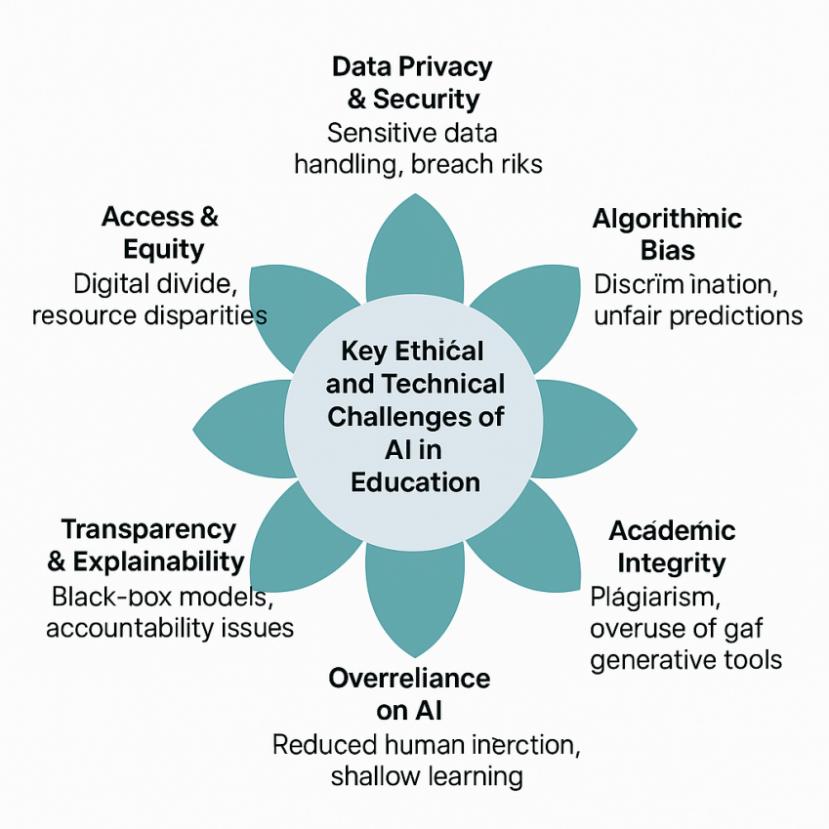
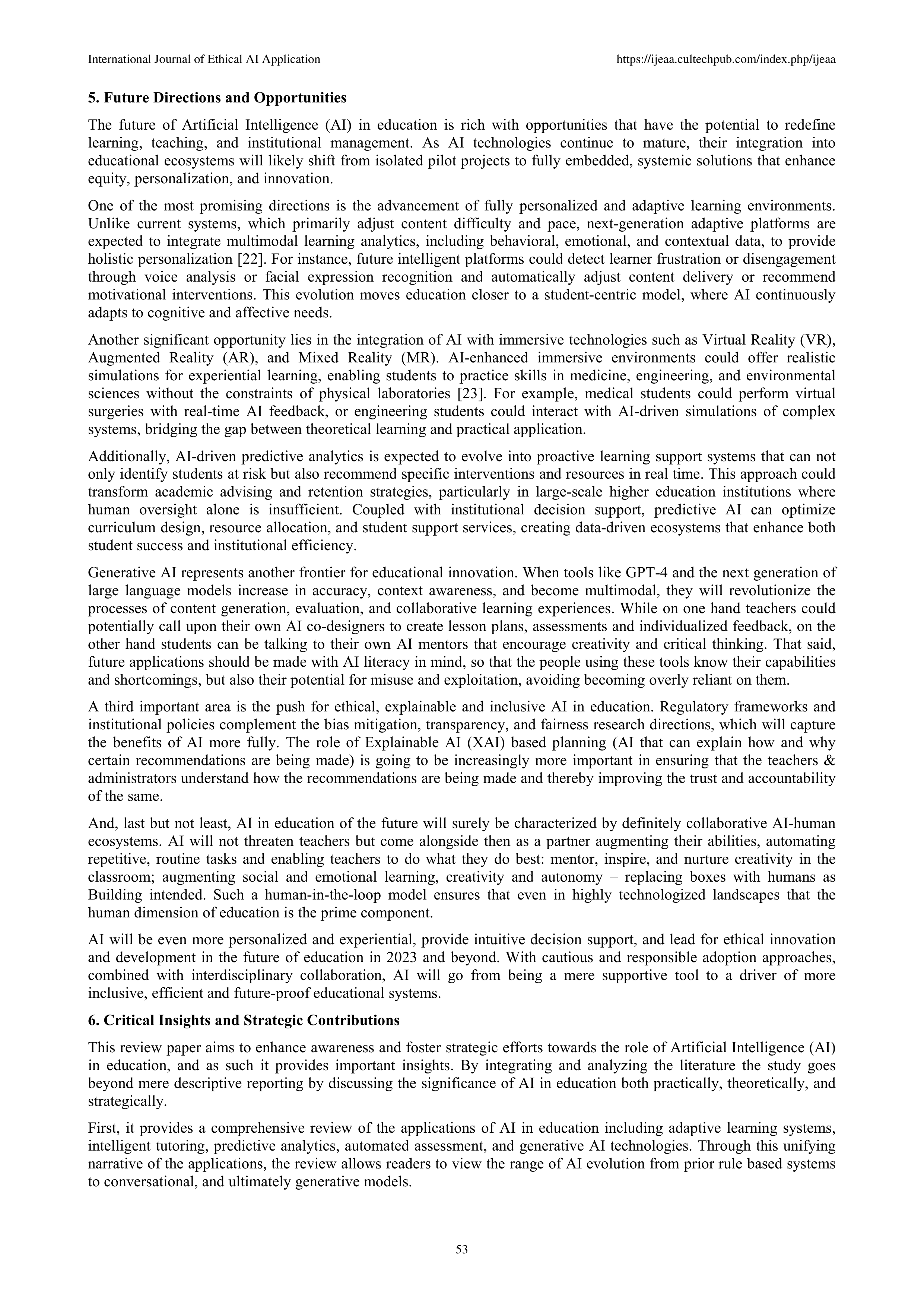
overreliance on AI, and academic integrity concerns—the following figure synthesizes these elements into a conceptual
visualization.
This
visual
representation
(Figure
1)
highlights
not
only
the
discrete
nature
of
each
challenge
but
also
their
overlapping
effects
on
educational
equity,
student
outcomes,
and
institutional
trust,
reinforcing
the
importance
of
adopting a holistic and proactive approach to AI governance in education.
Figure 1.
Key Ethical and Technical Challenges of AI in Education
International Journal of Ethical AI Application
https://ijeaa.cultechpub.com/index.php/ijeaa
52
5. Future Directions and Opportunities
The
future
of
Artificial
Intelligence
(AI)
in
education
is
rich
with
opportunities
that
have
the
potential
to
redefine
learning,
teaching,
and
institutional
management.
As
AI
technologies
continue
to
mature,
their
integration
into
educational
ecosystems
will
likely shift
from
isolated
pilot projects to
fully
embedded, systemic
solutions
that
enhance
equity, personalization, and innovation.
One
of
the
most
promising
directions
is
the
advancement
of
fully
personalized
and
adaptive
learning
environments.
Unlike
current
systems,
which
primarily
adjust
content
difficulty
and
pace,
next-generation
adaptive
platforms
are
expected
to
integrate
multimodal
learning
analytics,
including
behavioral,
emotional,
and
contextual
data,
to
provide
holistic personalization [22]. For instance, future intelligent
platforms could detect learner frustration or disengagement
through
voice
analysis
or
facial
expression
recognition
and
automatically
adjust
content
delivery
or
recommend
motivational
interventions.
This
evolution
moves
education
closer
to
a
student-centric
model,
where
AI
continuously
adapts to cognitive and affective needs.
Another
significant
opportunity lies in the
integration of AI
with immersive
technologies such as Virtual
Reality (VR),
Augmented
Reality
(AR),
and
Mixed
Reality
(MR).
AI-enhanced
immersive
environments
could
offer
realistic
simulations
for
experiential
learning,
enabling
students
to
practice
skills
in
medicine,
engineering,
and
environmental
sciences
without
the
constraints
of
physical
laboratories
[23].
For
example,
medical
students
could
perform
virtual
surgeries
with
real-time
AI
feedback,
or
engineering
students
could
interact
with
AI-driven
simulations
of
complex
systems, bridging the gap between theoretical learning and practical application.
Additionally,
AI-driven
predictive
analytics
is
expected
to
evolve
into
proactive
learning
support
systems
that
can
not
only identify students at risk but also recommend specific interventions and resources in real time. This approach could
transform
academic
advising
and
retention
strategies,
particularly
in
large-scale
higher
education
institutions
where
human
oversight
alone
is
insufficient.
Coupled
with
institutional
decision
support,
predictive
AI
can
optimize
curriculum
design, resource
allocation, and student
support services, creating data-driven ecosystems that
enhance both
student success and institutional efficiency.
Generative AI represents another frontier for educational innovation. When tools like GPT-4 and the next generation of
large
language
models
increase
in
accuracy,
context
awareness,
and
become
multimodal,
they
will
revolutionize
the
processes
of
content
generation,
evaluation,
and
collaborative
learning
experiences.
While
on
one
hand
teachers
could
potentially
call
upon their
own
AI
co-designers to
create lesson
plans,
assessments
and
individualized
feedback,
on the
other
hand
students
can
be
talking
to
their
own
AI
mentors
that
encourage
creativity
and
critical
thinking.
That
said,
future applications should be made with AI literacy in mind, so that the people using these tools know their capabilities
and shortcomings, but also their potential for misuse and exploitation, avoiding becoming overly reliant on them.
A
third
important
area
is
the
push
for
ethical,
explainable
and
inclusive
AI
in
education.
Regulatory
frameworks
and
institutional
policies complement
the
bias mitigation,
transparency,
and fairness
research directions,
which
will capture
the
benefits
of
AI
more
fully.
The
role
of
Explainable
AI
(XAI)
based
planning
(AI
that
can
explain
how
and
why
certain
recommendations
are
being
made)
is
going
to
be
increasingly
more
important
in
ensuring
that
the
teachers
&
administrators understand how the recommendations are being made and thereby improving the trust and accountability
of the same.
And,
last
but
not
least,
AI
in
education
of
the
future
will
surely
be
characterized
by
definitely
collaborative
AI-human
ecosystems.
AI
will
not
threaten
teachers
but
come
alongside
then
as
a
partner
augmenting
their
abilities,
automating
repetitive,
routine
tasks
and
enabling
teachers
to
do
what
they
do
best:
mentor,
inspire,
and
nurture
creativity
in
the
classroom;
augmenting
social
and
emotional
learning,
creativity
and
autonomy
–
replacing
boxes
with
humans
as
Building
intended.
Such
a
human-in-the-loop
model
ensures
that
even
in
highly
technologized
landscapes
that
the
human dimension of education is the prime component.
AI
will
be
even
more
personalized
and
experiential,
provide
intuitive
decision
support,
and
lead
for
ethical
innovation
and
development
in
the
future
of
education
in
2023
and
beyond.
With
cautious
and
responsible
adoption
approaches,
combined
with
interdisciplinary
collaboration,
AI
will
go
from
being
a
mere
supportive
tool
to
a
driver
of
more
inclusive, efficient and future-proof educational systems.
6. Critical Insights and Strategic Contributions
This review
paper aims to enhance
awareness and foster
strategic efforts towards the
role of Artificial Intelligence (AI)
in
education,
and
as
such
it
provides
important
insights.
By
integrating
and
analyzing
the
literature
the
study
goes
beyond
mere
descriptive
reporting
by discussing
the
significance
of AI
in
education
both practically,
theoretically,
and
strategically.
First,
it
provides
a
comprehensive
review
of
the
applications
of
AI
in
education
including
adaptive
learning
systems,
intelligent
tutoring,
predictive
analytics,
automated
assessment,
and
generative
AI
technologies.
Through
this
unifying
narrative of the applications, the review allows readers to view the
range of AI evolution from prior rule
based systems
to conversational, and ultimately generative models.
International Journal of Ethical AI Application
https://ijeaa.cultechpub.com/index.php/ijeaa
53
Third, the paper offers insights into the multifaceted crises that arise with the introduction of AI into educational arenas,
notably
ethical
hazards,
data
privacy
issues,
algorithmic
bias,
and
the
digital
divide.
Compared
to
many
previous
examples
which
describe each
of these
challenges
as discrete
matters,
this
work
depicts the
interdependencies
between
these
challenges
in tables and
conceptual
figures making
it
easier
for
stakeholders to recognize
systemic
risks
and
take
an anticipatory approach to mitigate them.
Third,
how
the
author
chooses
to
frame
its
insights
to
inform
policy
development,
institutional
planning,
and
future
research.
The
review
provides
a
glimpse
into
the
future,
among
others
by
identifying
emerging
opportunities
in
the
space
of
immersive
and
personalized
learning
experiences,
explainable
AI
(XAI)
within
education,
and
human-AI
collaboration
in
education,
which
can
help
researchers,
developers,
and
decision
makers
evolve
toward
an
ethical
and
transformative use of AI.
Thus,
the
key
part
of
new
work
on
a
strategic
scale
lies
in
bridging
theory
with
practice—it
provides
not
only
an
academic
resource,
but
also
a
practical
guide
to
integrating
AI
that
enhances
learning
impact
while
protecting
ethical
boundaries and ensuring equitable education innovation.
7. Conclusions
Artificial
Intelligence
(AI)
integration
into
education
is
disrupting
teachers,
learners,
and
institutions
like
never
before
through discovering new
levels of personalization, efficiency,
and innovation in education. This review
has highlighted
the
evolution,
modality,
applications,
challenges,
and
future
opportunities
for
AI
in
various
educational
contexts,
showcasing the key features of the positive and negative aspects of deploying AI in educational settings.
The evolution of AI in education depicts a transition from more rudimentary systems, to intelligent tutoring systems, to
the
aggrandizing
generative
and
conversational
AI
that
we
see
today—whereby,
the
future
of
education
becomes
adaptive,
responsive,
and
interactive
via
data-powered
learning.
There
are
specific
applications
like
adaptive
learning
systems, predictive analytics, automated assessment, and generative tools that
have demonstrated the
ability to increase
learner
engagement,
support
educators,,
and
improve
institutional
decision
making.
Meanwhile,
the
ethical
and
technical
hurdles—including data privacy, algorithmic bias, digital divide, and fear of overdependence on AI—stay the
most serious obstacles that urgently need to be mitigated.
The
future
of
AI
in
education,
therefore,
might
be
more
about
human-AI
collaboration,
where
AI
serves
as
a
support
tool
and
partner,
not
a
replacement.
Realizing
the
full
potential
of
AI
will
require
not
only
XAI,
equitable
access
to
learning
technologies
across
societal
divides,
and
policy
frameworks
that
prevent
abuse
of
learnersʼ
rights,
but
also
rather
severe
ethical
safeguards
to
foster
the
development
of
such
technologies.
Multimodal
personalized
learning,
multi-prong AI-powered immersive ecosystems, and predictive early interventions are some of the emerging trends that
could potentially reshape educational ecosystems into more inclusive and future-ready models.
Ultimately,
the
way
forward
is
about
finding
a
balance
between
innovation
and
the
human
aspects
of
education.
It
is
expected
that
institutions,
policymakers,
and
researchers
will
collaborate
to
capitalize
on
AI
responsibly,
so
that
the
integration brings equal, sustainable, and transformative learning experiences. With a principled and strategic approach,
AI
can
evolve
from
a
tool
that
supports
learning
into
one
that
undergirds
next-gen
educational
experiences
and
pathways for individual academic success and lifelong learning.
References
[1]
M.
Zawacki-Richter,
V.
Marín,
M.
Bond,
and
F.
Gouverneur,
“Systematic
review
of
research
on
artificial
intelligence
applications
in
higher
education
–
Where
are
the
educators?”
International
Journal
of
Educational
Technology
in
Higher
Education, vol. 16, no. 1, pp. 1–27, 2019.
[2]
R.
Luckin,
W.
Holmes,
M.
Griffiths,
and
L.
Baines,
“Enhancing
learning
and
teaching
with
artificial
intelligence:
Future
prospects in education,” The British Journal of Educational Technology, vol. 52, no. 4, pp. 1647–1664, 2021.
[3]
X.
Chen,
R.
Zou,
and
L.
Xie,
“Intelligent
learning
analytics:
Predictive
modeling
for
student
success
in
online
learning,”
Computers & Education, vol. 172, pp. 104–118, 2021.
[4]
A.
Graesser,
K.
VanLehn,
C.
Rosé,
P.
Jordan,
and
D.
Harter,
“Intelligent
tutoring
systems
with
conversational
dialogue,”
AI
Magazine, vol. 22, no. 4, pp. 39–51, 2001.
[5]
L. Popenici and S. Kerr, “Exploring the impact of artificial intelligence on teaching and learning in higher education,” Research
and Practice in Technology Enhanced Learning, vol. 12, no. 1, pp. 1–13, 2017.
[6]
J. Holmes, M. Bialik, and C. Fadel, Artificial Intelligence in Education: Promises and Implications for Teaching and Learning.
Boston: Center for Curriculum Redesign, 2019.
[7]
S.
Woolf,
Building
Intelligent
Interactive
Tutors:
Student-Centered
Strategies
for
Revolutionizing
E-Learning.
Burlington:
Morgan Kaufmann, 2009.
[8]
D. Bitzer and D. Skaperdas, PLATO: The Emergence of Online Learning. Urbana: University of Illinois Press, 1995.
[9]
K. Koedinger, R. Anderson, W. Hadley, and M. Mark, “Intelligent tutoring goes to school in the big city,” International Journal
of Artificial Intelligence in Education, vol. 8, pp. 30–43, 1997.
[10]
R. Baker and P. Inventado, “Educational data mining and learning analytics,” in Learning Analytics, Cham: Springer, 2014, pp.
61–75.
[11]
OpenAI, “GPT-4 Technical Report,” 2023. [Online]. Available: https://arxiv.org/abs/2303.08774
[12]
Google, “PaLM 2 Technical Overview,” Google Research, 2023.
[13]
T. Kasneci et al., “ChatGPT for good? On opportunities and challenges of large language models for education,” Learning and
Individual Differences, vol. 103, pp. 102274, 2023.
International Journal of Ethical AI Application
https://ijeaa.cultechpub.com/index.php/ijeaa
54
[14]
J. Arnold
and
L.
Pistilli, “Course
signals at
Purdue: Using
learning
analytics to
increase
student success,” Proc. 2nd
Int. Conf.
Learning Analytics & Knowledge, 2012, pp. 267–270.
[15]
S. Slade and P. Prinsloo, “Learning analytics: Ethical issues and dilemmas,” American Behavioral Scientist, vol. 57, no. 10, pp.
1510–1529, 2013.
[16]
Turnitin,
“AI
Writing
Detection
and
Plagiarism
Checking,”
2023.
[Online].
Available:
https://www.turnitin.com/solutions/ai-
writing-detection
[17]
M.
Warschauer
and
T.
Matuchniak,
“New
technology
and
digital
worlds:
Analyzing
evidence
of
equity
in
access,
use,
and
outcomes,” Review of Research in Education, vol. 34, no. 1, pp. 179–225, 2010.
[18]
A. Roblyer and H. Doering, Integrating Educational Technology into Teaching, 8th ed. Boston: Pearson, 2022.
[19]
P. Regan and D. Jesse, “Ethics, privacy, and data security in educational technologies,” Educational Technology
Research and
Development, vol. 69, pp. 263–280, 2021.
[20]
M. V. Floridi and
B. Cowls,
“A unified
framework
of five
principles for AI in
education,” Philosophy & Technology, vol. 34,
no. 4, pp. 1055–1074, 2021.
[21]
T.
K.
Shankar,
“Explainable
artificial
intelligence
for
education:
Challenges
and
perspectives,”
Computers
&
Education:
Artificial Intelligence, vol. 3, 100056, 2022.
[22]
Neamah,
Ali
Fahem,
and
Omar
Sadeq
Salman.
"E-learning
as
a
successful
alternative:
Proposing
an
online
tests
system
for
iraqi universities." In AIP Conference Proceedings, vol. 2398, no. 1, p. 050034. AIP Publishing LLC, 2022.
[23]
M.
Radianti,
T.
Majchrzak,
J.
Fromm,
and
I.
Wohlgenannt,
“A
systematic
review
of immersive
virtual
reality
applications
for
higher education: Design elements, lessons learned, and research agenda,” Computers & Education, vol. 147, 103778, 2020.
International Journal of Ethical AI Application
https://ijeaa.cultechpub.com/index.php/ijeaa
55