

1
REVIEW
PREMIER JOURNAL OF ARTIFICIAL INTELLIGENCE
Artificial Intelligence in Aviation: A Review of Machine Learning
and Deep Learning Applications for Enhanced Safety and Security
Waqas Ahmed
ABSTRACT
Artificial intelligence (AI) transforms aviation, driving
new, safe, and secure solutions. In this review, we dive
into the transformative role that machine learning and
deep learning play in critical aviation applications,
such as predictive maintenance, anomaly detection,
flight path optimization, and pilot assistance. AI-driven
systems use real-time data to predict equipment fail
ures and speed deviation from normal flight behavior
and to optimize resource management to improve op
erational efficiency. AI helps strengthen cybersecurity
in aviation security, enhances the accuracy of passen
ger screening, and boosts air traffic management with
predictive analytics. There has been a lot of progress
already, but data quality, scalability, governing frame
works, and ethical concerns are some factors that make
widespread adoption a challenge. Further advances
are anticipated in the coming years due to emerging
trends like explainable AI, quantum computing, and
collaborative AI. The lesson that this study illustrates
is that there remains much work to be done to ensure
that the full potential of AI can be used to deliver safer,
more secure, and faster air travel.
Keywords:
Predictive maintenance, Anomaly detec
tion, Aviation cybersecurity, Flight path optimization,
Explainable AI
Introduction
Overview of Safety and Security Challenges in
Modern Aviation
The aviation industry is critically dependent on safety
and security. Despite stringent regulatory frameworks
and advanced technological systems, challenges such as
mechanical failures, human errors, cybersecurity threats,
and airspace congestion continue to pose significant
risks. Strengthened by aging aircraft, weather conditions
that are hard to predict, and growing air traffic volumes,
safety concerns are ratcheted up. In addition, as com
munication and onboard systems in aviation networks
intensify, a cyberattack can continue to result in disas
trous consequences.
1
To solve these challenges, we have
to move from reactive to proactive means of safety, which
requires a reliance on predictive tools and automated sys
tems to anticipate and contain risks before escalation.
Artificial Intelligence (AI) and Its Transformative
Potential in Aviation
The industry by which machines learn, reason, and
make decisions (a role humans have traditionally han
dled) is being disrupted by AI. In aviation, AI’s poten
tial is to process huge datasets and look for patterns
humans cannot see. AI is impactful, but the subfields
of machine learning (ML) and deep learning (DL) are
the impactful subfields of AI.
2
ML algorithms train on
historical and real-time data to improve outcomes, just
like DL, which uses neural networks to imitate com
plex decision-making processes. These technologies
bring transformational solutions that enable the op
timization of design for maximum safety, expand the
scope of security protocols, and reduce wasteful opera
tions. Examples of AI applications are predictive main
tenance, anomaly detection, and cybersecurity, all of
which are now becoming essential parts of the aviation
industry to the advanced level by which it can operate
as intelligently and autonomously as possible.
3
Objectives and Scope of the Review
Primary Objective
A review and analysis of ML and DL applications for
increasing aviation safety and security.
Secondary Objectives
•
To explore the key use cases of ML/DL in aviation
that include anomaly detection, predictive mainte
nance, and cybersecurity.
•
To evaluate the potential for AI-driven solutions to
overcome the problems faced by Aviation Safety
and Security today.
•
To identify the gaps in existing research and ad
vocate for future directions for integrating AI into
aviation.
Exploratory Objective
To discuss emerging trends and potential advances in
AI technologies that can lead to an even further revolu
tionization of the aviation industry.
Scope of the Review
In reviewing, we will present new AI trends and tech
nology that may bring about disruption to aviation as
we know it today. It treats explainable AI (XAI) as a key
topic. The application of quantum computing to en
hanced AI performance, followed by the application of
collaborative AI systems for complex decision-making
in air traffic management (ATM) and urban air mobili
ty, respectively, conclude.
Methodology
This systematic review depended on select criteria to
identify relevant studies. Articles from peer-reviewed
journals and industry reports from 2013 to 2023 were
selected to study the latest ML and DL applications
in aviation safety and security. The research team
searched for specific studies that explained accurate
predictions in maintenance work plus advancements
in air traffic control systems security and aviation risk
evaluation techniques.
Air University, Islamabad,
Pakistan
Correspondence to:
Waqas Ahmed,
Waqaskhattak99@gmail.com
Additional material is published
online only. To view please visit
the journal online.
Cite this as:
Ahmed W. Artificial
Intelligence in Aviation: A
Review of Machine Learning and
Deep Learning Applications for
Enhanced Safety and Security.
Premier Journal of Artificial
Intelligence 2025;3:100013
DOI:
https://doi.org/10.70389/
PJAI.100013
Received:
5 January 2025
Revised:
21 January 2025
Accepted:
28 January 2025
Published:
5 February 2025
Ethical approval:
N/a
Consent:
N/a
Funding:
No industry funding
Conflicts of interest:
N/a
Author contribution:
Waqas Ahmed –
Conceptualization, Writing –
original draft, review and editing
Guarantor:
Waqas Ahmed
Provenance and peer-review:
Commissioned and externally
peer-reviewed
Data availability statement:
N/a
This is an open access article
distributed under the terms
of the Creative Commons
Attribution License, which
permits unrestricted use,
distribution, and reproduction
in any medium, provided the
original author and source are
credited.


2
PREMIER JOURNAL OF ARTIFICIAL INTELLIGENCE
REVIEW
DOI: https://doi.org/10.70389/PJAI.100013 | Premier Journal of Artificial Intelligence 2025;3:100013
Literature from four essential databases was re
trieved: IEEE Xplore, SpringerLink, ScienceDirect, and
PubMed. The review employed Boolean search filters
with terms such as “ML in aviation” and “DL for avi
ation safety” to obtain focused research outcomes.
Some papers from the review were removed because
they did not present measurable data, used theory
only, or were not in the English language.
The titles and abstracts were evaluated first, followed
by all the papers that qualified through our review. The
detailed selection method made sure we included only
top-quality research papers that fit our paper’s purpose.
Background
AIS Evolution in Aviation
You can quickly say that the history of AI in aviation is
the history of progress. Early implementations relied
upon rule-based systems that did not require repro
gramming yet could only perform very simple control
tasks. However, this consistency was non-adaptable or
learning.
2
The algorithms have become more sophisti
cated, the data available easier to store and analyze,
and the computation power has increased by leaps
and bounds through the decades to what AI is today,
a powerful tool that can dynamically decide and solve
complex problems.
Overview of ML and DL Methodologies
ML is a broad field and encompasses many things that
might not always be obvious to people who are new to
the field. However, a core component that we will cov
er in these tutorials is ML, sometimes referred to as
“learning from data and improving performance with
out explicit programming.” It can spot the patterns and
relationships in data and use that data to perform pre
dictions or decisions. There are three types of ML meth
odology. In short, supervised learning involves using a
model that pairs the input and output of the dataset,
and the technique used is based on labeled datasets.
4
A subset of ML known as “deep learning” (DL) in
volves artificial neural networks, which are inspired by
the brain’s structure and function. These deep neural
networks consist of multiple layers, each more and
more abstract of the extracted features of the data from
the data, to do such sophisticated tasks as image and
speech recognition.
5
DL has revolutionized image pro
cessing with a powerful definition of spatial patterns,
and convolutional neural networks (CNNs) have suc
cessfully defined spatial patterns. In aviation, bag X-ray
image security systems are dependent upon CNNs for
safety improvement as they analyze X-ray images to
detect prohibited items.
6
Recurrent neural networks
(RNNs) are another DL architecture that is designed to
learn sequential data and has been utilized in predic
tive systems using time series data—determining flight
parameters at each instant to identify anomalies.
7
Applications of AI in Aviation Safety
Predictive Maintenance
One of the best applications of AI in aviation safe
ty is based on predictive maintenance. Airlines and
maintenance teams are allowed to switch from reactive
maintenance to proactive interventions by leveraging
the opportunities when economics allows the incorpo
ration of the use of ML or DL algorithms. In predicting
when things are going to break, AI models use histori
cal performance data and real-time sensor input from
airplane components to anticipate injury taking place.
8
Improvement in this predictive capability increases op
erational safety by reducing downtime and catastroph
ic equipment failure and enabling timely repair. For
instance, sensor data streams in use for engine health
monitoring systems are continuous feeds of informa
tion trying to find tiny deviations in performance that
proclaim the origin of a fault.
6
For example, there are
cases of how AI has been employed in the Rolls-Royce
application of AI for predictive maintenance case stud
ies, which helps improve both operational efficiency as
well as safety and, hence, proves that AI can work in
such a way by saving some considerable costs.
7
Anomaly Detection
Yet AI also has a significant role to play in another major
application, which is anomaly detection, a technique
that significantly enhances aviation safety by discov
ering departures from expected performance patterns.
ML algorithms regularly parse through vast quantities
of flight data to identify flaws that point to mechani
cal failure, sensor inaccuracies, or process changes.
8
Real-time anomaly detection systems enhance situa
tional awareness for both pilots and ground control by
alerting pilots and ground control to potential hazards
as they occur. Systems can, for example, monitor flight
trajectory data to find unusual patterns associated with
mechanical problems or navigation errors. Moreover,
AI does what it does best in ATM: AI-driven anomaly
detection detects abnormal traffic patterns that could
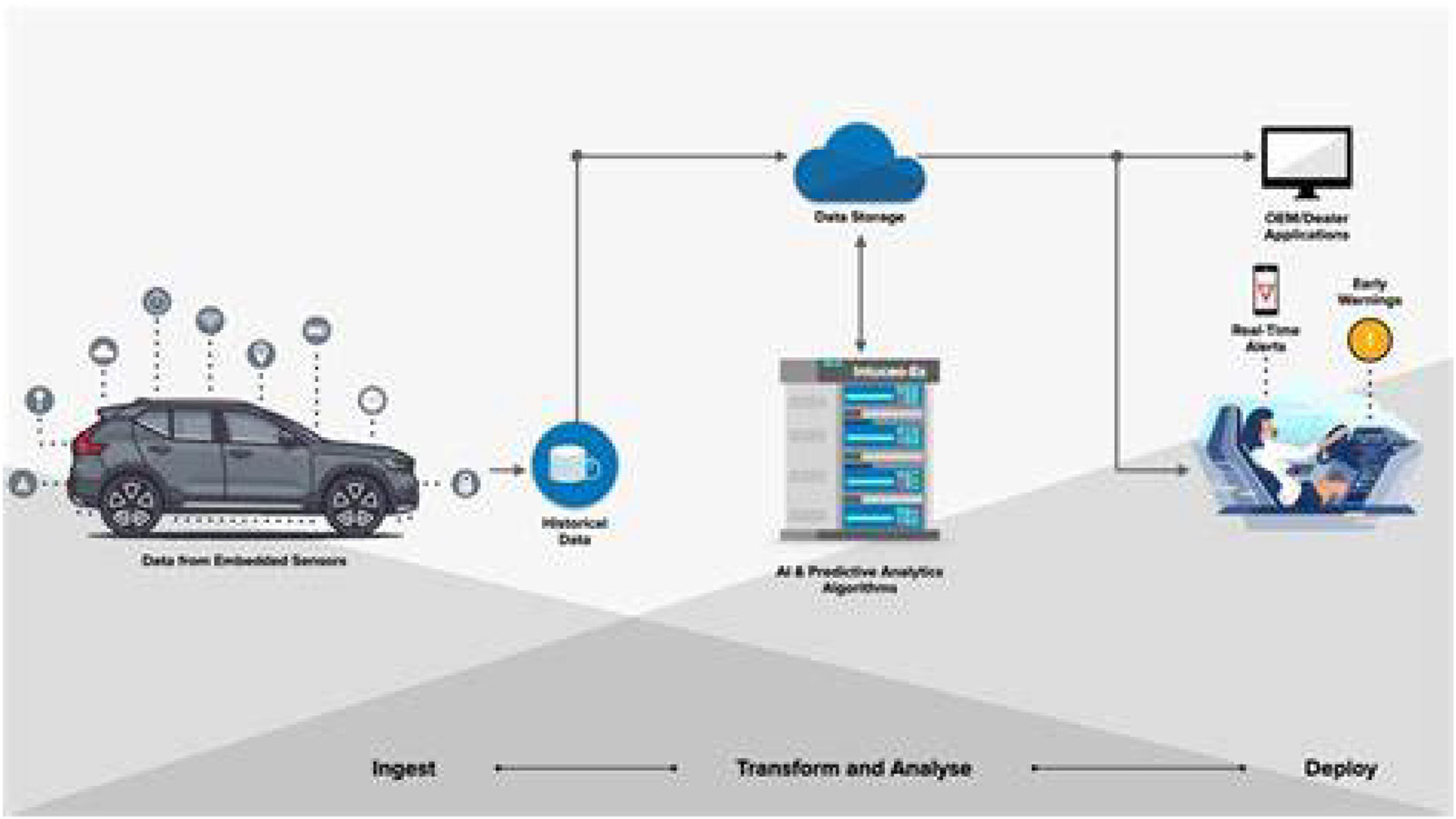
heighten collision risks (Figure 1).
9
Flight Path Optimization
On the path of becoming an essential AI-inspired inno
vation for aviation efficiency and safety is flight path
optimization. Static routing used in standard flight
planning can lead to undesirable fuel consumption
and exposure to hostile weather. Real-time factors
such as weather conditions, air traffic congestion, and
turbulence risks are taken into account by AI algo
rithms, and route recommendations are made based
on them.
10
AI-based optimization integrates to reduce
travel time, fuel consumption, and environmental im
pact while potentially improving passenger comfort by
avoidance of turbulence-prone flights. Examples in
clude satellite weather data combined with ML model
predictions, of course, to personalize adaptive routing
recommendations.
11
Pilot Assistance and Automation
Pilot assistance and automation, as well as human
decision-making and operational control, have been
greatly advanced by AI. DL models enable pilots to
quickly analyze complex scenarios that occur in real
time with actionable insights and risk assessments


3
REVIEW
PREMIER JOURNAL OF ARTIFICIAL INTELLIGENCE
DOI: https://doi.org/10.70389/PJAI.100013 | Premier Journal of Artificial Intelligence 2025;3:100013
which can support critical decision-making. For ex
ample, AI-driven tools check takes off, landing, and
emergency risk factors and provide recommendations
to improve situational awareness.
12
In addition, DL al
gorithms are being used in modern autopilot systems
to handle demanding maneuvers, as well as to preserve
flight stability in a safe manner that reduces pilot work
load. AI-driven pilot support and automation provide a
well-combined method offering a balance between re
lying on human expertise augmented with intelligent
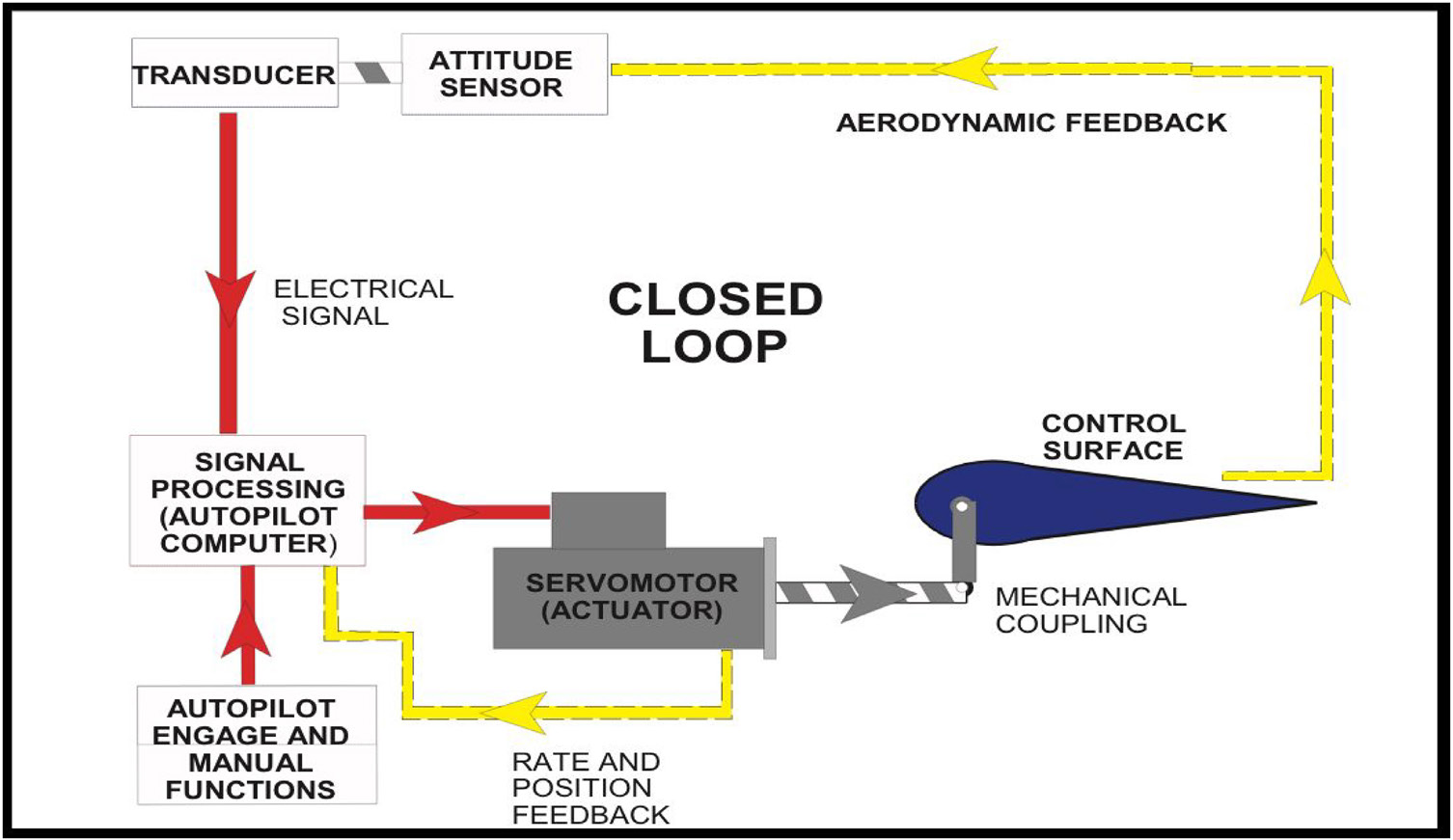
systems to achieve the safest outcome (Figure 2).
9
Applications of AI in Aviation Security
Cybersecurity
With the increasing use of digital systems for avi
ation communication, navigation, and control,
aviation cybersecurity has become an increasingly
important consideration. The security of aviation
networks is provided by AI-based solutions against
ever-increasing cyber threats. ML models are used to
detect anomalies in the network traffic and system
behavior related to potential attacks. Further, DL is
powerful in deepening cybersecurity capabilities
in pattern recognition that uniquely detects mali
cious Automatic Dependent Surveillance-Broadcast
(ADS-B) messages.
14
Spoofing attacks are possible
against ADS-B, one of the core tools of modern air
traffic surveillance, leading aircraft tracking and
control. AI-based algorithms can monitor message
authenticity and detect irregularities that might rep
resent tampering.
13
Fig 1 | AI in predictive maintenance of vehicles, one used by Rolls-Royce
source: Drishti (2022).
10
Fig 2 | AI-driven autopilot system components and their interactions with flight controls
Source: Maaz (2022).
13


4
PREMIER JOURNAL OF ARTIFICIAL INTELLIGENCE
REVIEW
DOI: https://doi.org/10.70389/PJAI.100013 | Premier Journal of Artificial Intelligence 2025;3:100013
Passenger and Baggage Screening
Passenger and baggage screening at airports have ben
efited from AI-driven advancements in security pro
cesses that are both efficient and accurate. Manually
inspecting luggage scans was, traditionally, a compli
cated, time-consuming, and error-prone process. With
computer vision and DL models, the process has been
automated using AI solutions, and prohibited items
have been substantially detected.
14
These models,
trained on large amounts of X-ray images, can identify
weapons, explosives, and restricted material at high
er precision than human operators. AI-equipped au
tomated screening systems can screen images in real
time, cutting down on wait times for passengers while
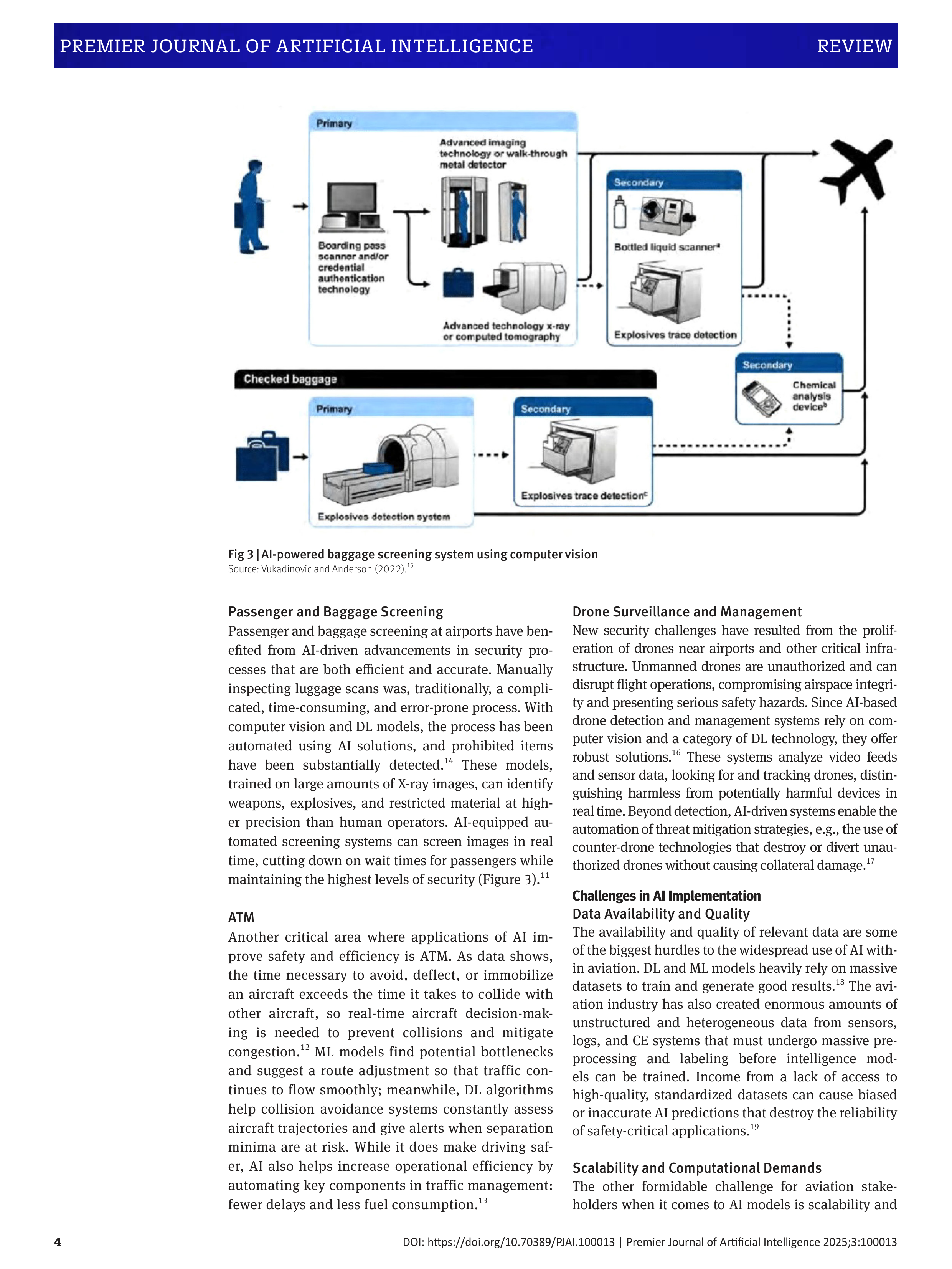
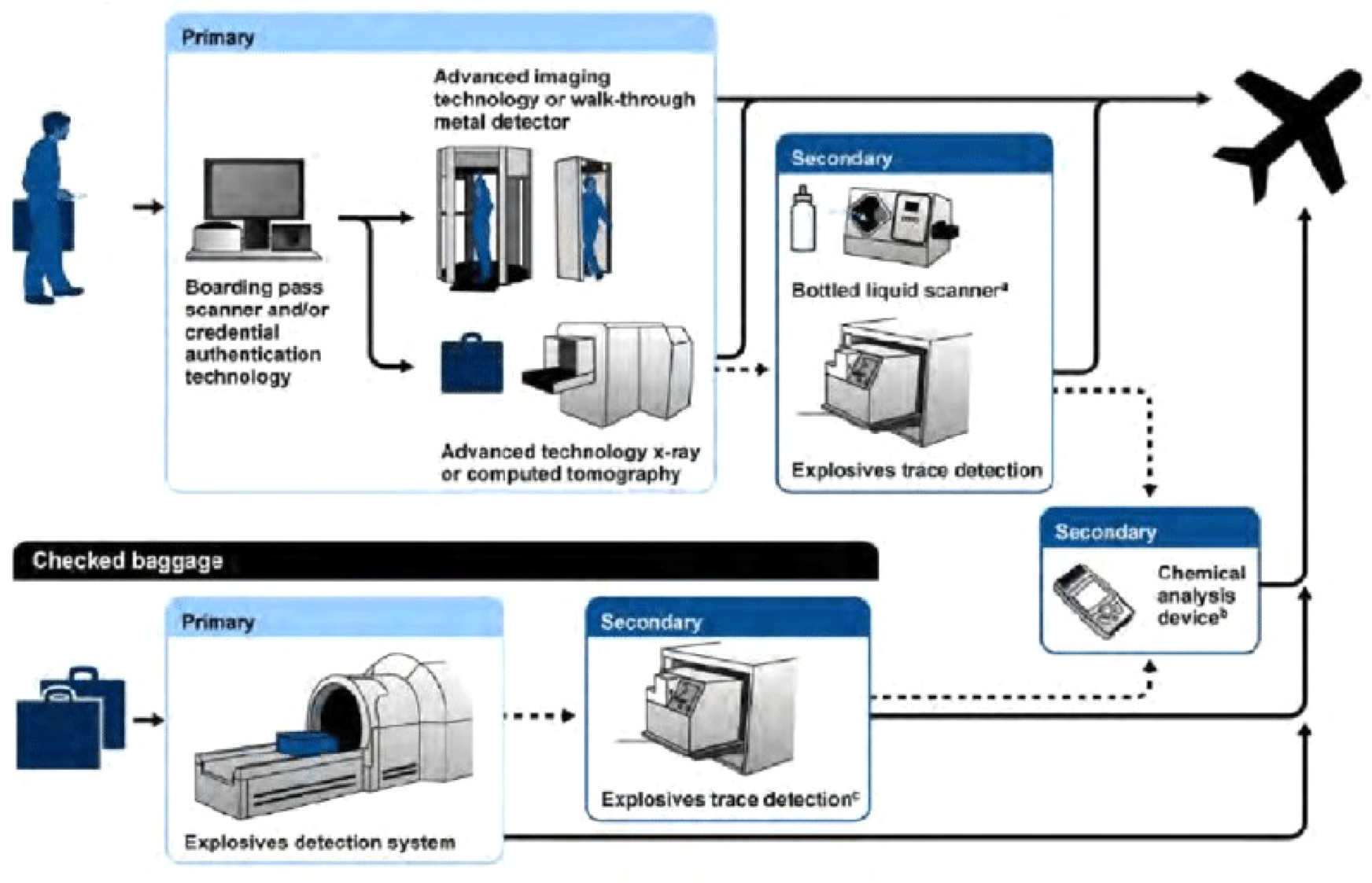
maintaining the highest levels of security (Figure 3).
11
ATM
Another critical area where applications of AI im
prove safety and efficiency is ATM. As data shows,
the time necessary to avoid, deflect, or immobilize
an aircraft exceeds the time it takes to collide with
other aircraft, so real-time aircraft decision-mak
ing is needed to prevent collisions and mitigate
congestion.
12
ML models find potential bottlenecks
and suggest a route adjustment so that traffic con
tinues to flow smoothly; meanwhile, DL algorithms
help collision avoidance systems constantly assess
aircraft trajectories and give alerts when separation
minima are at risk. While it does make driving saf
er, AI also helps increase operational efficiency by
automating key components in traffic management:
fewer delays and less fuel consumption.
13
Drone Surveillance and Management
New security challenges have resulted from the prolif
eration of drones near airports and other critical infra
structure. Unmanned drones are unauthorized and can
disrupt flight operations, compromising airspace integri
ty and presenting serious safety hazards. Since AI-based
drone detection and management systems rely on com
puter vision and a category of DL technology, they offer
robust solutions.
16
These systems analyze video feeds
and sensor data, looking for and tracking drones, distin
guishing harmless from potentially harmful devices in
real time. Beyond detection, AI-driven systems enable the
automation of threat mitigation strategies, e.g., the use of
counter-drone technologies that destroy or divert unau
thorized drones without causing collateral damage.
17
Challenges in AI Implementation
Data Availability and Quality
The availability and quality of relevant data are some
of the biggest hurdles to the widespread use of AI with
in aviation. DL and ML models heavily rely on massive
datasets to train and generate good results.
18
The avi
ation industry has also created enormous amounts of
unstructured and heterogeneous data from sensors,
logs, and CE systems that must undergo massive pre
processing and labeling before intelligence mod
els can be trained. Income from a lack of access to
high-quality, standardized datasets can cause biased
or inaccurate AI predictions that destroy the reliability
of safety-critical applications.
19
Scalability and Computational Demands
The other formidable challenge for aviation stake
holders when it comes to AI models is scalability and
Fig 3 | AI-powered baggage screening system using computer vision
Source: Vukadinovic and Anderson (2022).
15


5
REVIEW
PREMIER JOURNAL OF ARTIFICIAL INTELLIGENCE
DOI: https://doi.org/10.70389/PJAI.100013 | Premier Journal of Artificial Intelligence 2025;3:100013
computational requirements. Training even complex
DL architectures like CNNs or RNNs eats up a tremen
dous amount of computing: it requires powerful GPUs
or special-purpose hardware such as TPUs. These de
mands are further exacerbated by the real-time pro
cessing needs of AI systems in applications such as
anomaly detection and autonomous flight control.
20
The big thing about investment is that implementing
AI at scale across the entire fleet or network is pretty
much nuts and bolts of giving it to you cold, but it is
economically prohibitive for smaller airlines or smaller
aviation service providers.
21
Regulatory and Ethical Concerns
Accountability and transparency issues bubble to the
surface when AI systems take control or make autono
mous decision-making about flight safety.
22
To prove,
certify, and subsequently get validated, AI systems
must meet strict safety standards, and the regulatory
bodies must set clear guidelines for these systems as
to what needs to be done to validate and from where.
Meanwhile, the transparency problem of the black box
nature of many DL models makes it difficult for the
regulators to understand what is happening inside.
This lack of explainability also raises ethical concerns
about fairness, bias, and trustworthiness.
23
Integration with Legacy Systems
AI integration demands large-scale reworking of legacy
infrastructure: updating the existing communication
of data, software interfaces, and system interoperabili
ty. This is on top of the fact that strict safety regulations
are preventing any modifications to aircraft systems,
and hence, every modification needs to be rigorous
ly tested and validated before being used in an aging
aircraft. Additionally, integrating also introduces new
risks of introducing new vulnerabilities.
24
Emerging Trends and Future Directions
Improved Trust Using XAI
ML and DL models, with their complex structure, leave
aviation professionals struggling to find the practical
applications they need. The rise of XAI helps aviation
practitioners understand the processes behind AI mod
el predictions and decisions. To understand AI model
predictions better, stakeholders can use feature attri
bution methods like Shapley Additive Explanations to
find which parameters matter most, such as identify
ing engine failure markers in predictive maintenance.
25
Saliency maps allow AI model visualization to identify
specific image parts that help object detection systems
find unauthorized drones in restricted airspace. These
advancements increase trust between engineers and
regulators by showing them safety rules clearly and
helping them follow regulatory requirements.
26
Advanced AI Capabilities Using Quantum Computing
Quantum computing technology lets AI systems re
solve aviation problems in ways faster than current
methods allow. Traditional computers handle bina
ry data through single bits, but quantum computers
deliver parallel operations using qubits. Flight route
optimization can run many times faster through quan
tum algorithms when it examines millions of factors,
including fuel usage, weather patterns, and air traffic
patterns. During severe weather disruptions, quantum
AI programs can instantly adjust flight paths for all
aircraft in an airline fleet to cut down on flight delays
and fuel usage.
25
Predictive maintenance systems can
leverage quantum ML to examine aircraft sensor infor
mation, which helps them forecast component break
downs and automate maintenance scheduling. Early
quantum computing advancements will soon help
improve how we manage air traffic and detect security
risks in aviation systems.
27
Collaborative AI for Multi-Stakeholder Decision-
Making
The success of aviation operations needs all stake
holders, including airlines, air traffic controllers,
maintenance teams, and regulators, to function as one
unit. New AI platforms unite multiple data sources to
create comprehensive views that support smarter deci
sion-making.
27
An AI network combines instant weath
er updates with flight maintenance plans and air traffic
status to make dynamic airport schedule updates. By
using AI, the European airport improved terminal ca
pacity planning through flight data analysis, resulting
in smoother passenger processing and enhanced peak-
hour operations. AI technology allows unmanned
drones and flight crews to exchange real-time updates
that protect airspace users as flight traffic increases.
28
AI in Next-Generation ATM
ATM systems need immediate modernization because
travel demand has reached new heights. AI-driven sys
tems create future traffic forecasts and find solutions
for airflow control as they monitor current traffic con
ditions. AI technology scanning airspace continuously
helps detect and prevent air traffic disturbances before
they happen. Automatic systems powered by AI make
better flight route choices for drones and air taxis to
work well within standard air traffic control networks
in urban areas. As an example of an AI application
NASA successfully tested autonomous drone flight
management in its ATM eXploration project. AI tech
nology needs to transform aviation management sys
tems before autonomous aircraft multiply in our busy
airspace.
22
Discussion
Integrating AI into aviation has significant benefits,
including safe, efficient, and cost-efficient integration.
Predictive maintenance systems lower downtime along
with the elimination of costly failures, anomaly detec
tion, and cybersecurity solutions enhance situational
awareness and threat response. All these advantages
lead to some limitations of AI.
23
Another significant
problem is data dependency—many models require
enormous (sometimes felt qualitative) datasets, which
are not always provided in aviation. More constraints
on scalability include computational complexity and


6
PREMIER JOURNAL OF ARTIFICIAL INTELLIGENCE
REVIEW
DOI: https://doi.org/10.70389/PJAI.100013 | Premier Journal of Artificial Intelligence 2025;3:100013
resource demands. Furthermore, regulatory hurdles
and problems of XAI models impede adoption in
safety-critical domains.
24
The rules and regulations-based system of tradi
tional aviation safety is coupled with historical trends
and manual oversight. While effective, these meth
odologies are not as flexible as they could be and do
not provide a similar degree of predictive power as the
methods offered by AI.
26
This is where AI-driven sys
tems are markedly excelling in processing large vol
umes of real-time data to detect the slightest anomaly
or predict future failures that traditional inspection
methods may miss. For example, sensor readings from
machines also allow ML models to forecast wear in air
craft components better than scheduled maintenance
approaches that are based on fixed timeframes.
29
To accelerate the rate of adoption of AI, a multi-faceted
collaboration strategy among researchers, industries,
and policymakers is needed.
30
Therefore, regulatory
frameworks need to catch up and define clear guidelines
for AI validation, safety assurance, and accountability.
Those investments in data-sharing initiatives, standard
ization efforts, and XAI will fortify the foundation for
broader implementation.
31
Furthermore, advancements
will be driven by an innovation-friendly environment
that will promote partnerships between aviation orga
nizations and technology firms. Another important part
will be training programs to upskill aviation profession
als in AI competencies toward transition.
Limitations and Challenges in AI Adoption in Aviation
Technological Constraints
AI systems use ML and DL technologies but need sub
stantial data inputs to work effectively. The aviation
industry struggles to unite data from many systems
across aircraft models while standardizing it for differ
ent operational regions.
28
Predictive maintenance sys
tems need exact and complete component data from
sensors to work appropriately.
Regulatory and Certification Hurdles
Air transportation standards demand new technologies
to work perfectly without safety issues. AI systems must
complete extensive tests before receiving FAA and EASA
certification to operate safely. Air traffic control and air
craft automation systems must confirm their ability to
maintain safety across different operating conditions.
Ethical and Trust Issues
Aviation stakeholders find it difficult to have faith in AI
systems due to their mysterious decision patterns. Air
traffic controllers and pilots want to trust automated
systems but need to know the logic behind emergency
flight reroutes before they activate them. An AI passen
ger screening system could accidentally harm specific
groups, helping to shape complaints from both ethics
and law experts.
22
Integration Challenges
AI systems face technical and operational barriers
when we try to add them to current aviation platforms.
Traditional aviation systems, like old air traffic con
trols and maintenance processes, do not work well
with new AI technology.
Cybersecurity Risks
AI technology implementation in aviation brings fresh
threats to aviation cyber security. AI systems that use
cloud computing for data processing have cybersecuri
ty weaknesses that cyberattacks can exploit to damage
vital functions and expose confidential data.
20
Economic and Skill Barriers
AI systems need considerable financial support to de
velop and operate, yet small aviation companies often
struggle to afford these costs. Making AI work properly
in aviation requires people who know AI technology
and aviation systems and who have experience with
regulatory guidelines. The inability to find enough
people with AI expertise stops many companies from
adopting AI systems across industries.
Conclusion
Aviation safety and security are being transformed
by AI, which is bringing innovative solutions to
long-standing challenges. AI has shown its potential
to transform the industry through predictive main
tenance, anomaly detection, and greatly enhanced
cybersecurity. Continued research, cross-sector col
laboration, and proactively developed regulation are
important to maximize the benefit derived from AI. As
aviation turns to a data-driven future, AI will remain
among the main drivers of progress, helping make
air travel safer, more secure, and more efficient. That
leaves AI’s transformative power to be fully realized in
years to come and a collective effort among technology
developers, aviation authorities, and policymakers.
Practical Implications and Recommendations for
Integrating AI into Aviation Systems
AI systems bring critical benefits to aviation by making
operations more efficient and increasing both safety
and predictive power.
Data Infrastructure and Standardization
To introduce AI into aviation, we need to first create
an effective data system that keeps all information to
gether. The aviation sector maintains its data across
multiple isolated platforms used by airlines, air traf
fic control, and maintenance groups. The scattered
nature of the data makes it hard to use AI effectively.
Air transport must establish consistent data standards
that ICAO directs and regulates.
Regulatory Alignment and Certification Pathways
AVMC does not yet have strong rules to certify adap
tive AI systems for aviation use. Aviation stakeholders
need to partner with regulatory agencies like the FAA
and EASA to establish certification rules for emerging
technology. Digital twin models create realistic envi
ronments to prove that AI systems work safely. Simula
tion testing shows AI systems in multiple operational


7
REVIEW
PREMIER JOURNAL OF ARTIFICIAL INTELLIGENCE
DOI: https://doi.org/10.70389/PJAI.100013 | Premier Journal of Artificial Intelligence 2025;3:100013
conditions to speed up and lower certification ex
penses. The creation of XAI models represents a key
component in these efforts. Showing AI systems’ deci
sion-making logic with XAI enables regulation compli
ance and helps stakeholders trust AI systems.
Workforce Development and Upskilling
To make AI systems work in aviation, we must teach
aviation staff the proper techniques for using these
advanced tools. For AI to work well in aviation oper
ations, staff, including pilots, traffic controllers, and
maintenance personnel, need specific education about
these tools. AR and VR systems can build virtual train
ing spaces that let staff practice with AI systems in real
environments.
Cybersecurity Measures
Air transport operators must strengthen their digital
protection as AI controls increase and linked systems
become more common. AI systems must watch com
puter networks for safety holes and stop threats in
stantly. Blockchain technology provides secure data
interchange protection for linked AI systems to main
tain data authenticity.
Pilot Projects and Incremental Integration
The introduction of AI technology should start inac
cessible operations, such as airport resources and
baggage systems, to validate their effectiveness before
applying them to critical tasks. Narrow AI projects help
stakeholders discover system weaknesses and opti
mize functions before rolling out AI across large-scale
operations.
Collaborative Ecosystems and Stakeholder
Engagement
Multiple aviation organizations need to partner up be
cause flying operations require many different teams.
Several interested parties must work together in ded
icated teams to ensure consistent AI plans and spread
good practices among all groups. AI systems that
combine data from all sources enable organizations to
make linked decisions simultaneously throughout the
aviation industry network.
Advanced Use Cases and Continuous Improvement
The aviation sector sees substantial growth potential
through advanced AI applications for flight prediction
maintenance and automated airspace operation along
side self-operating systems. AI technology in aviation
tracks real-time flight information about weather pat
terns, flight routes, and traffic flow to improve airspace
usage and shorten delays between planes.
References
1
Alreshidi I, Moulitsas I, Jenkins KW. Advancing aviation safety
through machine learning and psychophysiological data: A
systematic review. IEEE Access. 2024. Available from: https://
ieeexplore.ieee.org/abstract/document/10379685
2
Helgo M. Deep learning and machine learning algorithms for
enhanced aircraft maintenance and flight data analysis. J Robot
Spectr. 2023;1:90–9. Available from: https://anapub.co.ke/
journals/jrs/jrs_pdf/2023/jrs_volume01/JRS202301009.pdf
3
Alqahtani H, Kumar G. Machine learning for enhancing
transportation security: A comprehensive analysis of electric and
flying vehicle systems. Eng Appl Artif Intell. 2024;129:107667.
Available from: https://www.sciencedirect.com/science/article/abs/
pii/S0952197623018511
4
Ucar A, Karakose M, Kırımça N. Artificial intelligence for predictive
maintenance applications: Key components, trustworthiness, and
future trends. Appl Sci. 2024;14(2):898. Available from: https://
www.mdpi.com/2076-3417/14/2/898
5
Khan ZU, Nasim B, Rasheed Z. Generative AI-based predictive
maintenance in aviation: A systematic literature review. 2024.
Available from: https://www.researchsquare.com/article/rs-
5277729/v1
6
Batyha RM, Krishna MH, Kumar MS, Tiwari T, Mishra D, Ranjit PS.
Predictive maintenance using machine learning in the aviation
industry. In Recent Technological Advances in Engineering and
Management 2024;(pp. 253–8). CRC Press. Available from: https://
www.taylorfrancis.com/chapters/edit/10.1201/9781003531395-
51/predictive-maintenance-using-machine-learning-aviation-
industry-radwan-batyha-hari-krishna-sai-kumar-tripti-tiwari-deepti-
mishra-ranjit
7
Ain QU, Jilani AAA, Butt NA, Ur Rehman S, Alhulayyil HA. Anomaly
detection for aviation cyber-physical system: Opportunities and
challenges. IEEE Access. 2024. Available from: https://ieeexplore.
ieee.org/abstract/document/10749801
8
Goriparthi RG. AI-driven predictive analytics for autonomous
systems: A machine learning approach. Rev Intel Artif Med.
2024;15(1):843–79. Available from: https://redcrevistas.com/
index.php/Revista/article/view/218
9
Chaudhry ZJ, Fox KL. Artificial intelligence applicability to air
traffic management network operations. In 2020 Integrated
Communications Navigation and Surveillance Conference (ICNS)
2020;(pp. 5A1–1). Available from: https://ieeexplore.ieee.org/
abstract/document/9222889
10
Drishti. Application of AI in Predictive Maintenance of
Vehicles. Analytics Vidhya. 2022. Available from: https://www.
analyticsvidhya.com/blog/2022/07/application-of-ai-in-
predictive-maintenance-of-vehicles/
11
Gülcü A. AI-enhanced cybersecurity solutions for protecting US
aerospace manufacturing infrastructure: Techniques and real-world
applications. J Bioinform Artif Intell. 2023;3(2):192–212. Available
from: https://biotechjournal.org/index.php/jbai/article/view/113
12
Mızrak F. Integrating AI with aviation cybersecurity: The strategic
role of human resources. Bus Manag Stud Int J. 2024;12(3):610–
28. Available from: https://www.bmij.org/index.php/1/article/
view/2396
13
Maaz A. Autopilot: A Complete Guide. Simple Flying. 2022.
Available from: https://simpleflying.com/autopilot-complete-guide/
14
Jones T. Investigating the opportunities and limitations of artificial
intelligence and cybersecurity in aviation. Master’s thesis, Eastern
Michigan University. 2024. Available from: https://www.proquest.
com/openview/39b84df3a74dd8c6cf2121f6614c9707/1?pq-ori
gsite=gscholar&cbl=18750&diss=y
15
Vukadinovic D, Anderson D. X-ray baggage screening and
artificial intelligence (AI). Publications Office of the European
Union. 2022. Available from: https://www.researchgate.net/
publication/361305570_X-ray_Baggage_Screening_and_
Artificial_Intelligence_AI
16
Sutthithatip S, Perinpanayagam S, Aslam S. (Explainable) artificial
intelligence in aerospace safety-critical systems. In 2022 IEEE
Aerospace Conference (AERO) 2022;(pp. 1–12). Available from:
https://ieeexplore.ieee.org/abstract/document/9843612
17
Wiggerthale J, Reich C. Explainable machine learning in critical
decision systems: Ensuring safe application and correctness. Artif
Intell. 2024;5(4):2864–96. Available from: https://www.mdpi.
com/2673-2688/5/4/138
18
Perez-Cerrolaza J, Abella J, Borg M, Donzella C, Cerquides J,
Cazorla FJ, et al. Artificial intelligence for safety-critical systems
in industrial and transportation domains: A survey. ACM Comput
Surv. 2024;56(7):1–40. Available from: https://dl.acm.org/doi/
full/10.1145/3626314
19
Reddy BR, Chokkalingam SP. Enhancing transportation security:
Automated prohibited object detection for baggage inspection
leveraging YOLO-NAS. In 2023 Seventh International Conference on
Image Information Processing (ICIIP) 2023;(pp. 721–6). Available
from: https://ieeexplore.ieee.org/abstract/document/10537641


8
PREMIER JOURNAL OF ARTIFICIAL INTELLIGENCE
REVIEW
DOI: https://doi.org/10.70389/PJAI.100013 | Premier Journal of Artificial Intelligence 2025;3:100013
20
Philip JJ, Panda S, Meesala KR, Garad J, Bandhari O, Rani R,
et al. Object detection in airport security checks. In 2024
International Conference on Advances in Computing Research
on Science Engineering and Technology (ACROSET) 2024;(pp.
1–6). Available from: https://ieeexplore.ieee.org/abstract/
document/10743507
21
Kahan N. Enhancing security: Millimetre-wave imaging for
concealed object detection and localization in passenger
screening. 2024. Available from: https://www.researchgate.net/
publication/387326665_ENHANCING_SECURITY_MILLIMETRE-
WAVE_IMAGING_FOR_CONCEALED_OBJECT_DETECTION_AND_
LOCALIZATION_IN_PASSENGER_SCREENING
22
Steno P, Alsadoon A, Prasad PWC, Al-Dala’in T, Alsadoon OH.
A novel enhanced region proposal network and modified loss
function: Threat object detection in secure screening using deep
learning. J Supercomput. 2021;77:3840–69. Available from:
https://link.springer.com/article/10.1007/s11227-020-03418-4
23
Xu W. From automation to autonomy and autonomous vehicles:
Challenges and opportunities for human-computer interaction.
Interactions. 2020;28(1):48–53. Available from: https://dl.acm.
org/doi/abs/10.1145/3434580
24
Bridgelall R, Tolliver D. Autonomous aircraft: Challenges and
opportunities. 2023. Available from: https://rosap.ntl.bts.gov/view/
dot/72546
25
Efe A. Assessment of the artificial intelligence and quantum
computing in the smart management information systems. Bilişim
Teknolojileri Derg. 2023;16(3):177–88. Available from: https://
dergipark.org.tr/en/pub/gazibtd/article/1190670
26
Veeramachaneni V. Optimizing renewable energy integration
in AI-driven data centres using quantum algorithms. J Netw
Secure Data Mining. 2025;8(1):36–48. Available from: https://
www.researchgate.net/publication/387262890_Optimizing_
Renewable_Energy_Integration_in_AI-Driven_Data_Centers_Using_
Quantum_Algorithms
27
Sood SK. A scientometric analysis of quantum driven innovations
in intelligent transportation systems. Eng Appl Artif Intell.
2024;138:109258. Available from: https://www.sciencedirect.
com/science/article/abs/pii/S0952197624014167
28
Rajkumar N, Viji C, Latha PM, Vennila VB, Shanmugam SK, Pillai NB.
The power of AI, IoT, and advanced quantum based optical systems
in smart cities. Opt Quantum Electron. 2024;56(3):450. Available
from: https://link.springer.com/article/10.1007/s11082-023-
06065-0
29
Curtis TL. AI-driven avionics: Innovations in real-time data
analysis for enhancing air travel experience. Aerosp Syst Technol
J. 2023;17(2):310–25. Available from: https://aerospace-
techjournal.com/article/view/25
30
Hendershot WE. Avionics systems of the future: Exploring the
role of AI in safety-critical applications. J Aerosp Saf Technol.
2023;28(1):56–72. Available from: https://link.springer.com/
article/10.1007/s00251-023-01478-7
31
Arafat MY, Pan S. Urban air mobility communications and
networking: Recent advances, techniques, and challenges. Drones.
2024;8(12):702. Available from: https://www.researchgate.net/
publication/386093820_Urban_Air_Mobility_Communications_
and_Networking_Recent_Advances_Techniques_and_Challenges