


Information Fusion 97 (2023) 101804
Available online 7 April 2023
1566-2535/© 2023 The Author(s).
Published by Elsevier B.V. This is an open access article under the CC BY-NC-ND license (
http://creativecommons.org/licenses/by-
nc-nd/4.0/
).
Artificial intelligence for cybersecurity: Literature review and future
research directions
Ramanpreet Kaur
*
, Du
ˇ
san Gabrijel
ˇ
ci
ˇ
c , Toma
ˇ
z Klobu
ˇ
car
Laboratory for Open Systems and Networks, Jo
ˇ
zef Stefan Institute, Ljubljana, Slovenia
A
R
T
I
C
L
E I
N
F
O
Keywords:
Detection
Protection
Response
Recovery
Identify
Learning
Cyberattacks
Taxonomy
A
B
S
T
R
A
C
T
Artificial intelligence (AI) is a powerful technology that helps cybersecurity teams automate repetitive tasks,
accelerate threat detection and response, and improve the accuracy of their actions to strengthen the security
posture against various security issues and cyberattacks. This article presents a systematic literature review and a
detailed analysis of AI use cases for cybersecurity provisioning. The review resulted in 2395 studies, of which 236
were identified as primary. This article classifies the identified AI use cases based on a NIST cybersecurity
framework using a thematic analysis approach. This classification framework will provide readers with a
comprehensive overview of the potential of AI to improve cybersecurity in different contexts. The review also
identifies future research opportunities in emerging cybersecurity application areas, advanced AI methods, data
representation, and the development of new infrastructures for the successful adoption of AI-based cybersecurity
in today
’
s era of digital transformation and polycrisis.
1.
Introduction
The term cybersecurity refers to a set of technologies, processes and
practices to protect and defend networks, devices, software and data
from attack, damage or unauthorized access
[1]
. Cybersecurity is
becoming complex because of the exponential growth of interconnected
devices, systems and networks. This is exacerbated by advances in the
digital economy and infrastructure, leading to a significant growth of
cyberattacks with serious consequences. In addition, researchers report
the continued evolution of nation-state-affiliated and criminal adver
saries, as well as the increasing sophistication of cyberattacks, which are
finding new and invasive ways to target even the savviest of targets
[2]
.
This evolution is driving an increase in the number, scale and impact of
cyberattacks,
and
necessitating
the
implementation
of
intelligence-driven cybersecurity to provide a dynamic defence against
evolving cyberattacks and to manage big data. Advisory organizations,
such as the National Institute of Standards and Technologies (NIST), are
also encouraging the use of more proactive and adaptive approaches by
shifting towards real-time assessments, continuous monitoring and
data-driven analysis to identify, protect against, detect, respond to, and
catalogue cyberattacks to prevent future security incidents
[3]
.
AI is an intriguing tool that can provide analytics and intelligence to
protect against ever-evolving cyberattacks by swiftly analysing millions
of events and tracking a wide variety of cyber threats to anticipate and
act in advance of the problem. For this reason, AI is increasingly being
integrated into the cybersecurity fabric and used in a variety of use cases
to automate security tasks or support the work of human security teams.
The flourishing field of cybersecurity and the growing enthusiasm of
researchers from both AI and cybersecurity have resulted in numerous
studies to solve problems related to the identification, protection,
detection, response and recovery from cyberattacks.
Several reviews on cybersecurity and AI applications were published
in recent years
[4
–
7]
. However, to the best of our knowledge, there is no
comprehensive review that covers state-of-the-art research to explain
cybersecurity activities covered by AI techniques and the details of how
they are applied. Therefore, our objective was to provide a systematic
review, a comprehensive view of AI use cases in cybersecurity, and a
discussion of the research challenges related to the adaptation and use of
AI for cybersecurity to serve as a reference for future researchers and
practitioners.
Table 1
shows a comparison of the study with review ar
ticles from recent years.
We performed a systematic literature review (SLR) on the use of AI
for the provision of cybersecurity, with a particular focus on practical
applications within five different cybersecurity functions (Identify,
Protect, Detect, Respond and Recover) defined by the NIST cyberse
curity framework
[3]
. The specific research questions addressed by this
*
Corresponding author.
E-mail address:
raman@e5.ijs.si
(R. Kaur).
Contents lists available at
ScienceDirect
Information Fusion
journal homepage:
www.elsevier.com/locate/inffus
https://doi.org/10.1016/j.inffus.2023.101804
Received 19 January 2023; Received in revised form 16 March 2023; Accepted 6 April 2023
Information Fusion 97 (2023) 101804
2
SLR are:
•
RQ1: What would be the taxonomical representation of the appli
cation of AI for the provision of cybersecurity?
•
RQ2: What are the specific use cases of AI for cybersecurity?
•
RQ3: What are the current research trends associated with AI for
cybersecurity?
•
RQ4: What are the trending topics and future research directions for
the adoption of AI for cybersecurity?
To answer these research questions and to provide a valuable output
for the research community, 236 articles were examined prior to
February 2022. Then, the selected studies were further analysed to
specify the cybersecurity applications where AI was used, the selected AI
domain, and the resulting impact. The SLR led to the following:
•
A taxonomy of AI for cybersecurity that provides the multi-level
classification of the reviewed articles based on the cybersecurity
functions, solution categories, and specific use cases.
•
Specific use cases of AI for cybersecurity to reveal the potential areas
to harness the capabilities of AI.
•
A descriptive analysis of the literature to explore the research trends
of AI for cybersecurity.
•
A critical analysis of the existing literature, identifying research gaps,
to stimulate future research in the field.
The rest of the article is structured as follows.
Section 2
discusses the
relevant background to provide an introduction and conceptualization
of cybersecurity and AI topics along with an explanation of the classi
fication paradigms used in the literature related to AI for cybersecurity.
Section 3
describes the research methodology adopted to conduct the
SLR.
Section 4
discusses the data extraction process to feed the
descriptive analysis and state-of-the-art research presented in
Section 5
.
Section 6
provides a descriptive analysis of the synthesized literature
review.
Section 7
identifies various research gaps that new studies can
target, while
Section 8
points out the limitations of our study. Finally,
Section 9
presents the main conclusions and the research implications of
this SLR.
2.
Background
This section is dedicated to analysing the background information
concerning the key concepts of this review, including the operational
definition of cybersecurity using the NIST cybersecurity framework
[3]
and the AI taxonomy proposed by AI Watch
[8]
to clarify the concept of
different applications of AI for cybersecurity.
2.1.
Cybersecurity
Cybersecurity puts policies, procedures and technical mechanisms in
place to protect, detect, correct and defend against damage, unautho
rized use or modification, or exploitation of information and commu
nication systems and the information they contain. The rapid pace of
technological change and innovation, along with the rapidly evolving
nature of cyber threats, further complicates the situation. In response to
this unprecedented challenge, AI-based cybersecurity tools have
emerged to help security teams efficiently mitigate risks and improve
security. Given the heterogeneity of AI and cybersecurity, a uniformly
accepted and consolidated taxonomy is needed to examine the literature
on applying AI for cybersecurity. This structured taxonomy will help
researchers and practitioners come to a common understanding of the
technical procedures and services that need to be improved using AI for
the implementation of effective cybersecurity.
For this purpose, a well-known cybersecurity framework proposed
by NIST was used to understand the solution categories needed to pro
tect, detect, react and defend against cyberattacks
[3]
. The NIST
cybersecurity framework
’
s core describes the practices to improve the
cybersecurity of any organization. The framework
’
s core has four ele
ments: Functions, Categories, Subcategories and Informative references.
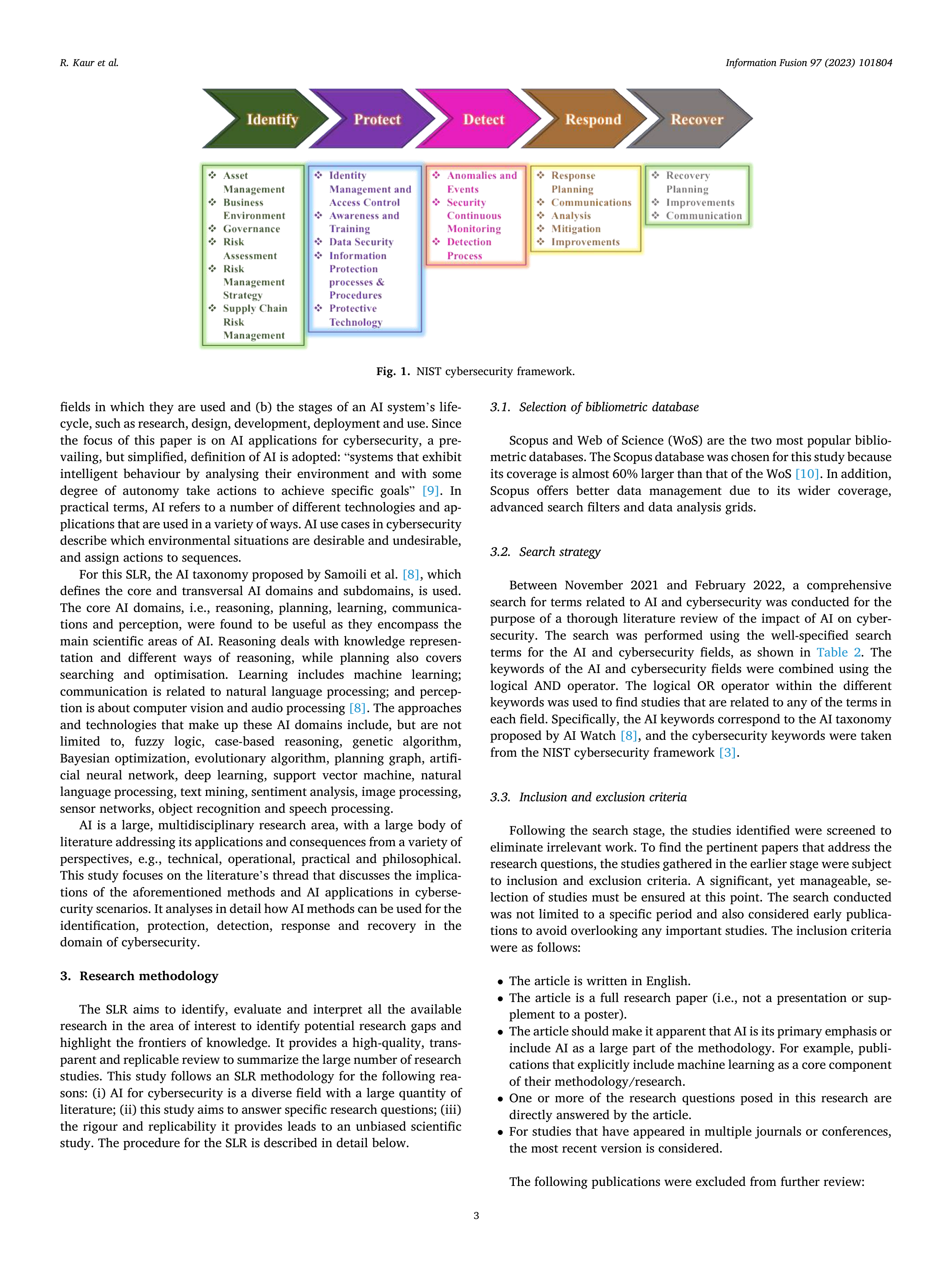
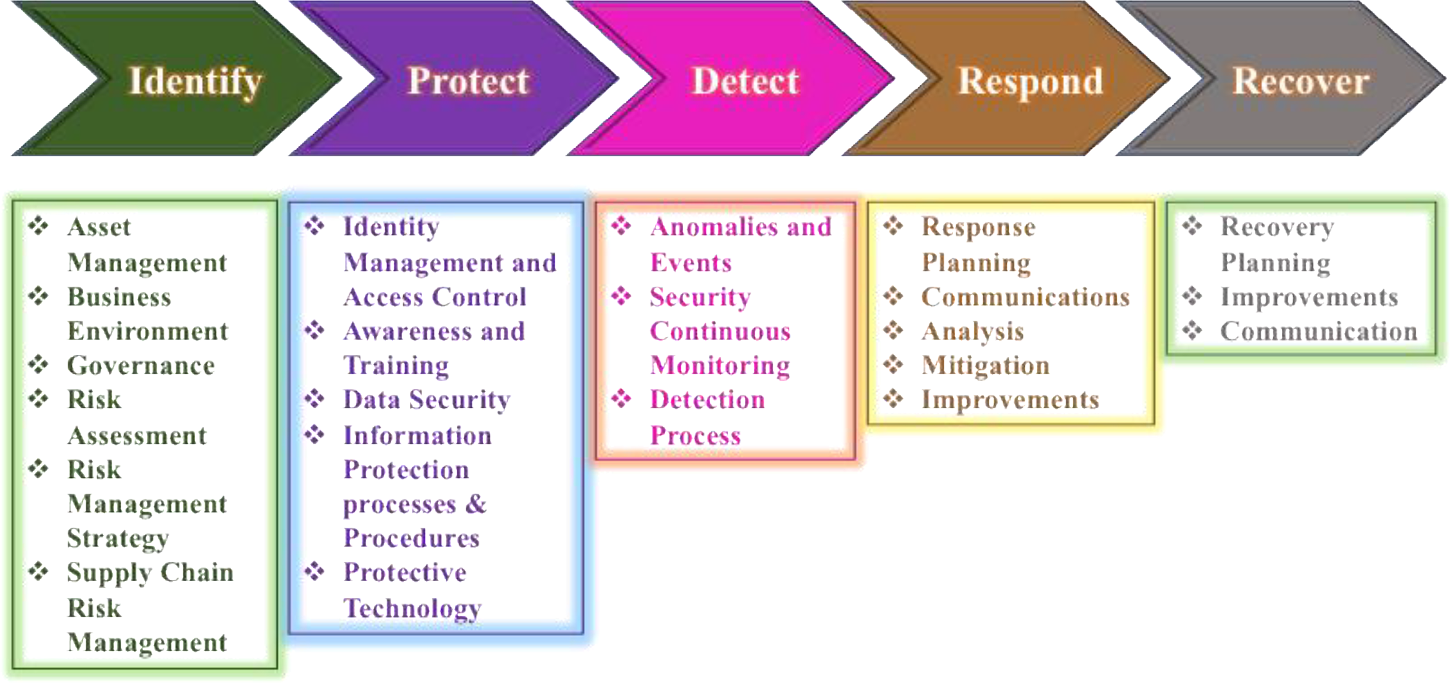
The first two levels of the NIST framework, which consist of 5 cyber
security functions and 23 solution categories, were used to classify the
identified AI use cases. The functions provide a comprehensive view of
the lifecycle for managing cybersecurity over time. The solution cate
gories listed under each function offer a good starting point to identify
the AI use cases to improve the cybersecurity. The main purpose of
selecting these two levels is to provide a clear and intuitive categori
zation to classify the existing AI for cybersecurity literature into the
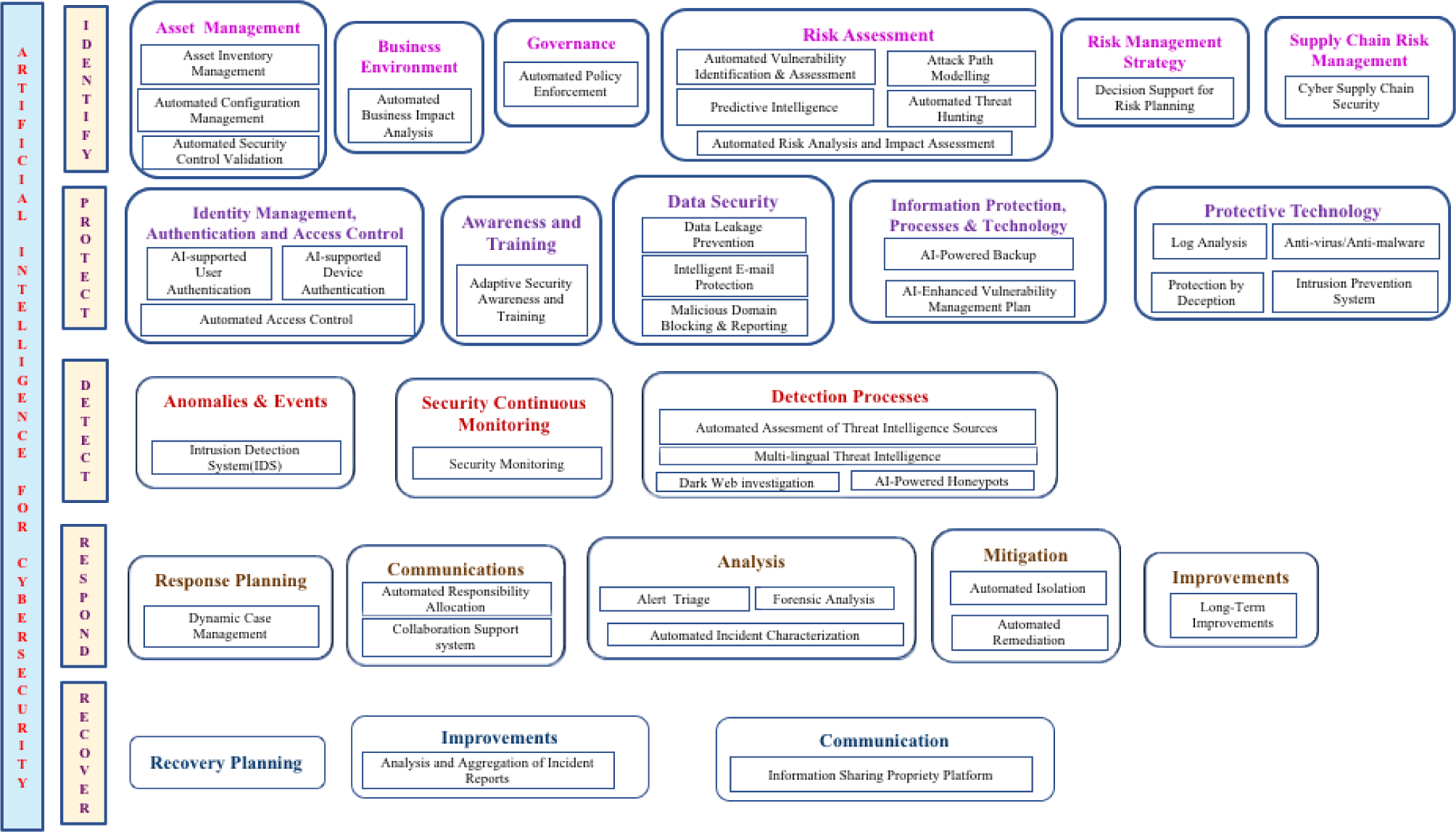
appropriate solution category. The proposed taxonomy introduces a
third level consistent with the first two levels by specifying AI-based use
cases corresponding to each level of the cybersecurity framework, as
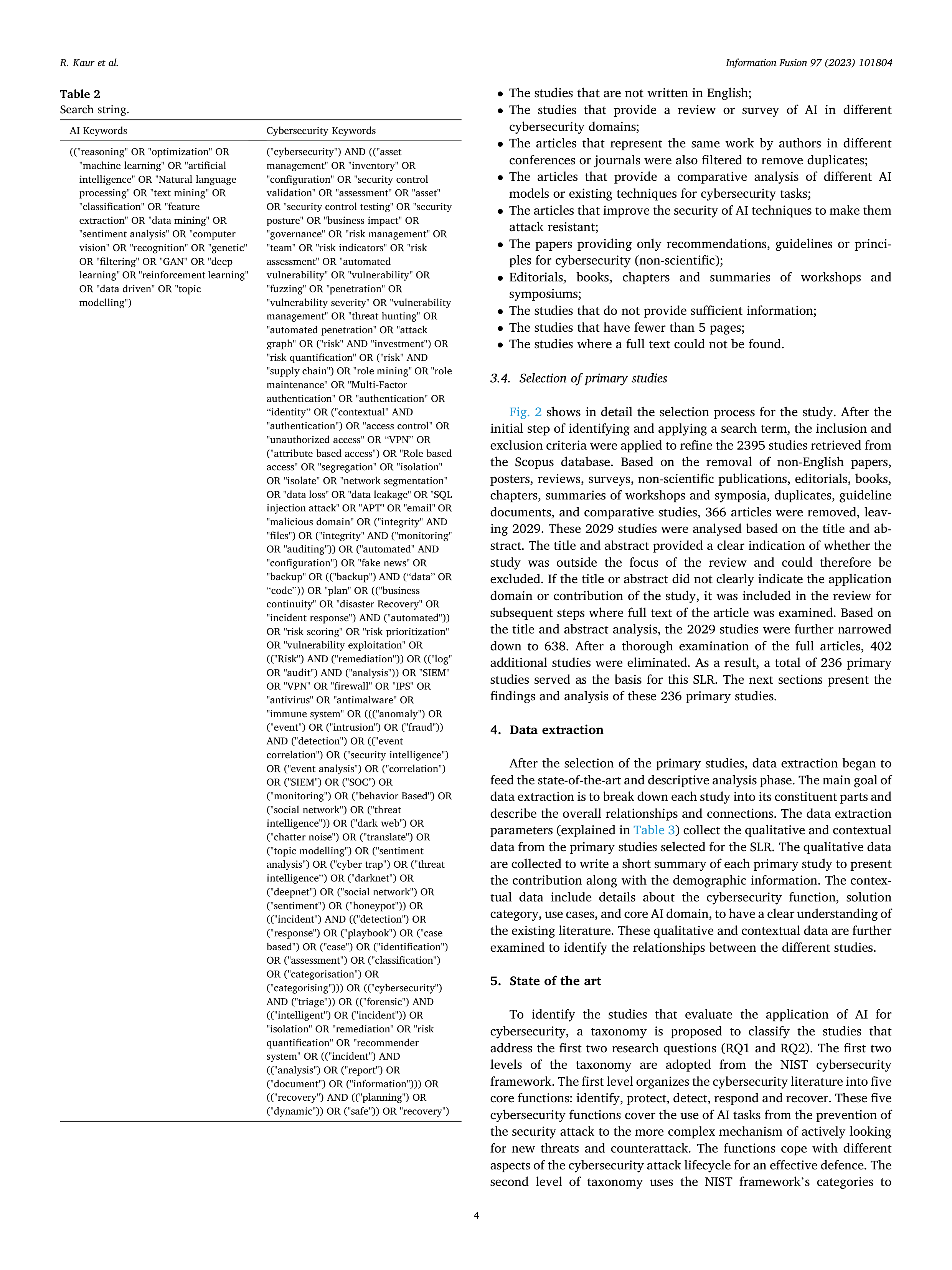
shown in
Fig. 1
. A detailed description of the proposed taxonomy with a
state-of-the-art review of AI for cybersecurity is provided in
Section 5
.
This taxonomy forms the basis for our SLR, by providing a descrip
tion of the related subfields to cover the main aspects and fundamental
keywords in the definition of cybersecurity solution categories. A
detailed description of the keyword selection can be found in
Section 3
.
2.2.
Artificial intelligence
Several definitions of AI systems can be found that relate to (a) the
Table 1
Comparison of this review with existing studies.
References
Taxonomy
Use case
identification
Classification of
defence solution
based on the
SLR
Coverage
Research
gaps
Purpose
Function
AI
domain
Wiafe et al.
[4]
No
No
No
Yes
Yes
IEEE
&
ACM digital library
No
Provides an overview of existing research on AI for
cybersecurity
Zhang et al.
[5]
No
No
No
No
Yes
Google Scholar,
SpringerLink,
ScienceDirect, IEEE
&
ACM
digital library
No
Provides a review constrained to the application of
AI in the areas of user authentication, dangerous
behaviour monitoring, network situation
awareness,
&
identification of abnormal traffic
Torres et al.
[6]
No
No
No
No
No
Nil
No
Reviews the application of machine learning
techniques in spam, malware, and phishing
detection
Truong et al.
[7]
No
No
No
No
No
Nil
No
Reviews the application of AI techniques in
intrusion, malware, APT and phishing detection
Proposed
Study
Yes
Yes
Yes
Yes
Yes
Scopus Database
Yes
Explores research from 2010 to February 2022
related to AI applications for cybersecurity from a
descriptive point of view, and a detailed state-of-
the-art analysis
R. Kaur et al.
Information Fusion 97 (2023) 101804
3
fields in which they are used and (b) the stages of an AI system
’
s life
cycle, such as research, design, development, deployment and use. Since
the focus of this paper is on AI applications for cybersecurity, a pre
vailing, but simplified, definition of AI is adopted:
“
systems that exhibit
intelligent behaviour by analysing their environment and with some
degree of autonomy take actions to achieve specific goals
”
[9]
. In
practical terms, AI refers to a number of different technologies and ap
plications that are used in a variety of ways. AI use cases in cybersecurity
describe which environmental situations are desirable and undesirable,
and assign actions to sequences.
For this SLR, the AI taxonomy proposed by Samoili et al.
[8]
, which
defines the core and transversal AI domains and subdomains, is used.
The core AI domains, i.e., reasoning, planning, learning, communica
tions and perception, were found to be useful as they encompass the
main scientific areas of AI. Reasoning deals with knowledge represen
tation and different ways of reasoning, while planning also covers
searching and optimisation. Learning includes machine learning;
communication is related to natural language processing; and percep
tion is about computer vision and audio processing
[8]
. The approaches
and technologies that make up these AI domains include, but are not
limited to, fuzzy logic, case-based reasoning, genetic algorithm,
Bayesian optimization, evolutionary algorithm, planning graph, artifi
cial neural network, deep learning, support vector machine, natural
language processing, text mining, sentiment analysis, image processing,
sensor networks, object recognition and speech processing.
AI is a large, multidisciplinary research area, with a large body of
literature addressing its applications and consequences from a variety of
perspectives, e.g., technical, operational, practical and philosophical.
This study focuses on the literature
’
s thread that discusses the implica
tions of the aforementioned methods and AI applications in cyberse
curity scenarios. It analyses in detail how AI methods can be used for the
identification, protection, detection, response and recovery in the
domain of cybersecurity.
3.
Research methodology
The SLR aims to identify, evaluate and interpret all the available
research in the area of interest to identify potential research gaps and
highlight the frontiers of knowledge. It provides a high-quality, trans
parent and replicable review to summarize the large number of research
studies. This study follows an SLR methodology for the following rea
sons: (i) AI for cybersecurity is a diverse field with a large quantity of
literature; (ii) this study aims to answer specific research questions; (iii)
the rigour and replicability it provides leads to an unbiased scientific
study. The procedure for the SLR is described in detail below.
3.1.
Selection of bibliometric database
Scopus and Web of Science (WoS) are the two most popular biblio
metric databases. The Scopus database was chosen for this study because
its coverage is almost 60% larger than that of the WoS
[10]
. In addition,
Scopus offers better data management due to its wider coverage,
advanced search filters and data analysis grids.
3.2.
Search strategy
Between November 2021 and February 2022, a comprehensive
search for terms related to AI and cybersecurity was conducted for the
purpose of a thorough literature review of the impact of AI on cyber
security. The search was performed using the well-specified search
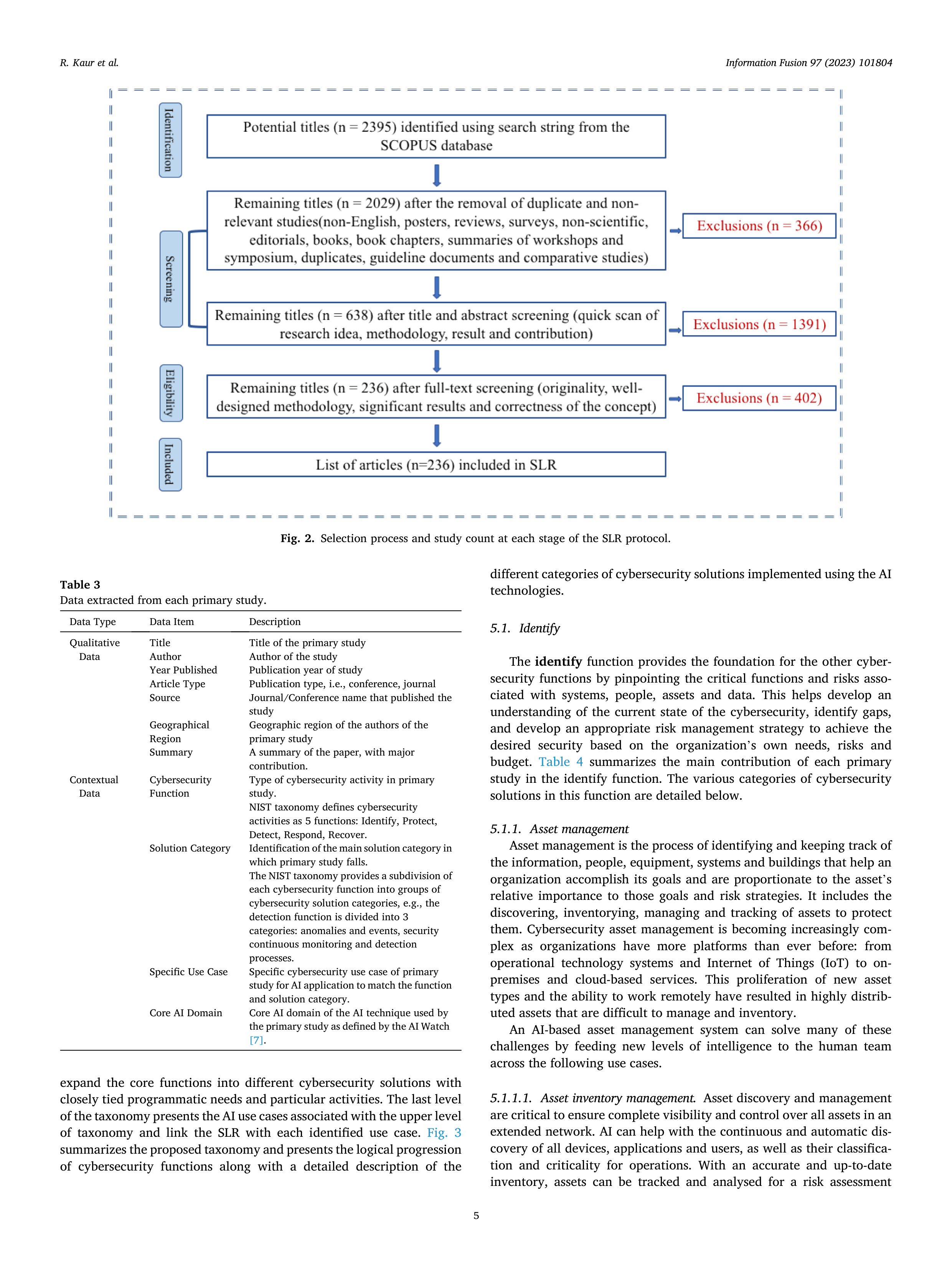
terms for the AI and cybersecurity fields, as shown in
Table 2
. The
keywords of the AI and cybersecurity fields were combined using the
logical AND operator. The logical OR operator within the different
keywords was used to find studies that are related to any of the terms in
each field. Specifically, the AI keywords correspond to the AI taxonomy
proposed by AI Watch
[8]
, and the cybersecurity keywords were taken
from the NIST cybersecurity framework
[3]
.
3.3.
Inclusion and exclusion criteria
Following the search stage, the studies identified were screened to
eliminate irrelevant work. To find the pertinent papers that address the
research questions, the studies gathered in the earlier stage were subject
to inclusion and exclusion criteria. A significant, yet manageable, se
lection of studies must be ensured at this point. The search conducted
was not limited to a specific period and also considered early publica
tions to avoid overlooking any important studies. The inclusion criteria
were as follows:
•
The article is written in English.
•
The article is a full research paper (i.e., not a presentation or sup
plement to a poster).
•
The article should make it apparent that AI is its primary emphasis or
include AI as a large part of the methodology. For example, publi
cations that explicitly include machine learning as a core component
of their methodology/research.
•
One or more of the research questions posed in this research are
directly answered by the article.
•
For studies that have appeared in multiple journals or conferences,
the most recent version is considered.
The following publications were excluded from further review:
Fig. 1.
NIST cybersecurity framework.
R. Kaur et al.
Information Fusion 97 (2023) 101804
4
•
The studies that are not written in English;
•
The studies that provide a review or survey of AI in different
cybersecurity domains;
•
The articles that represent the same work by authors in different
conferences or journals were also filtered to remove duplicates;
•
The articles that provide a comparative analysis of different AI
models or existing techniques for cybersecurity tasks;
•
The articles that improve the security of AI techniques to make them
attack resistant;
•
The papers providing only recommendations, guidelines or princi
ples for cybersecurity (non-scientific);
•
Editorials, books, chapters and summaries of workshops and
symposiums;
•
The studies that do not provide sufficient information;
•
The studies that have fewer than 5 pages;
•
The studies where a full text could not be found.
3.4.
Selection of primary studies
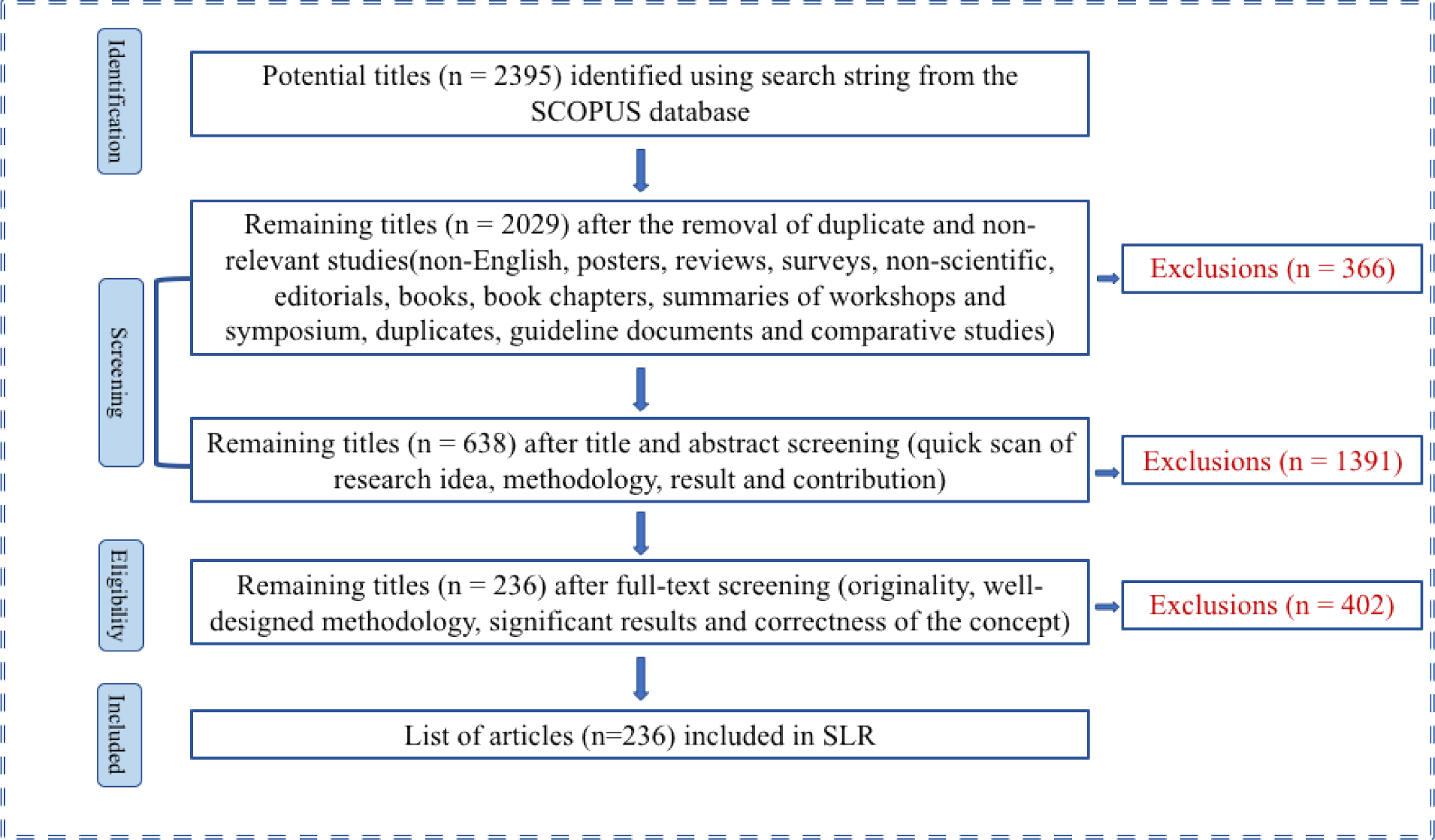
Fig. 2
shows in detail the selection process for the study. After the
initial step of identifying and applying a search term, the inclusion and
exclusion criteria were applied to refine the 2395 studies retrieved from
the Scopus database. Based on the removal of non-English papers,
posters, reviews, surveys, non-scientific publications, editorials, books,
chapters, summaries of workshops and symposia, duplicates, guideline
documents, and comparative studies, 366 articles were removed, leav
ing 2029. These 2029 studies were analysed based on the title and ab
stract. The title and abstract provided a clear indication of whether the
study was outside the focus of the review and could therefore be
excluded. If the title or abstract did not clearly indicate the application
domain or contribution of the study, it was included in the review for
subsequent steps where full text of the article was examined. Based on
the title and abstract analysis, the 2029 studies were further narrowed
down to 638. After a thorough examination of the full articles, 402
additional studies were eliminated. As a result, a total of 236 primary
studies served as the basis for this SLR. The next sections present the
findings and analysis of these 236 primary studies.
4.
Data extraction
After the selection of the primary studies, data extraction began to
feed the state-of-the-art and descriptive analysis phase. The main goal of
data extraction is to break down each study into its constituent parts and
describe the overall relationships and connections. The data extraction
parameters (explained in
Table 3
) collect the qualitative and contextual
data from the primary studies selected for the SLR. The qualitative data
are collected to write a short summary of each primary study to present
the contribution along with the demographic information. The contex
tual data include details about the cybersecurity function, solution
category, use cases, and core AI domain, to have a clear understanding of
the existing literature. These qualitative and contextual data are further
examined to identify the relationships between the different studies.
5.
State of the art
To identify the studies that evaluate the application of AI for
cybersecurity, a taxonomy is proposed to classify the studies that
address the first two research questions (RQ1 and RQ2). The first two
levels of the taxonomy are adopted from the NIST cybersecurity
framework. The first level organizes the cybersecurity literature into five
core functions: identify, protect, detect, respond and recover. These five
cybersecurity functions cover the use of AI tasks from the prevention of
the security attack to the more complex mechanism of actively looking
for new threats and counterattack. The functions cope with different
aspects of the cybersecurity attack lifecycle for an effective defence. The
second level of taxonomy uses the NIST framework
’
s categories to
Table 2
Search string.
AI Keywords
Cybersecurity Keywords
(("reasoning" OR "optimization" OR
"machine learning" OR "artificial
intelligence" OR "Natural language
processing" OR "text mining" OR
"classification" OR "feature
extraction" OR "data mining" OR
"sentiment analysis" OR "computer
vision" OR "recognition" OR "genetic"
OR "filtering" OR "GAN" OR "deep
learning" OR "reinforcement learning"
OR "data driven" OR "topic
modelling")
("cybersecurity") AND (("asset
management" OR "inventory" OR
"configuration" OR "security control
validation" OR "assessment" OR "asset"
OR "security control testing" OR "security
posture" OR "business impact" OR
"governance" OR "risk management" OR
"team" OR "risk indicators" OR "risk
assessment" OR "automated
vulnerability" OR "vulnerability" OR
"fuzzing" OR "penetration" OR
"vulnerability severity" OR "vulnerability
management" OR "threat hunting" OR
"automated penetration" OR "attack
graph" OR ("risk" AND "investment") OR
"risk quantification" OR ("risk" AND
"supply chain") OR "role mining" OR "role
maintenance" OR "Multi-Factor
authentication" OR "authentication" OR
“
identity
”
OR ("contextual" AND
"authentication") OR "access control" OR
"unauthorized access" OR
“
VPN
”
OR
("attribute based access") OR "Role based
access" OR "segregation" OR "isolation"
OR "isolate" OR "network segmentation"
OR "data loss" OR "data leakage" OR "SQL
injection attack" OR "APT" OR "email" OR
"malicious domain" OR ("integrity" AND
"files") OR ("integrity" AND ("monitoring"
OR "auditing")) OR ("automated" AND
"configuration") OR "fake news" OR
"backup" OR (("backup") AND (
“
data
”
OR
“
code
”
)) OR "plan" OR (("business
continuity" OR "disaster Recovery" OR
"incident response") AND ("automated"))
OR "risk scoring" OR "risk prioritization"
OR "vulnerability exploitation" OR
(("Risk") AND ("remediation")) OR (("log"
OR "audit") AND ("analysis")) OR "SIEM"
OR "VPN" OR "firewall" OR "IPS" OR
"antivirus" OR "antimalware" OR
"immune system" OR ((("anomaly") OR
("event") OR ("intrusion") OR ("fraud"))
AND ("detection") OR (("event
correlation") OR ("security intelligence")
OR ("event analysis") OR ("correlation")
OR ("SIEM") OR ("SOC") OR
("monitoring") OR ("behavior Based") OR
("social network") OR ("threat
intelligence")) OR ("dark web") OR
("chatter noise") OR ("translate") OR
("topic modelling") OR ("sentiment
analysis") OR ("cyber trap") OR ("threat
intelligence
”
) OR ("darknet") OR
("deepnet") OR ("social network") OR
("sentiment") OR ("honeypot")) OR
(("incident") AND (("detection") OR
("response") OR ("playbook") OR ("case
based") OR ("case") OR ("identification")
OR ("assessment") OR ("classification")
OR ("categorisation") OR
("categorising"))) OR (("cybersecurity")
AND ("triage")) OR (("forensic") AND
(("intelligent") OR ("incident")) OR
"isolation" OR "remediation" OR "risk
quantification" OR "recommender
system" OR (("incident") AND
(("analysis") OR ("report") OR
("document") OR ("information"))) OR
(("recovery") AND (("planning") OR
("dynamic")) OR ("safe")) OR "recovery")
R. Kaur et al.
Information Fusion 97 (2023) 101804
5
expand the core functions into different cybersecurity solutions with
closely tied programmatic needs and particular activities. The last level
of the taxonomy presents the AI use cases associated with the upper level
of taxonomy and link the SLR with each identified use case.
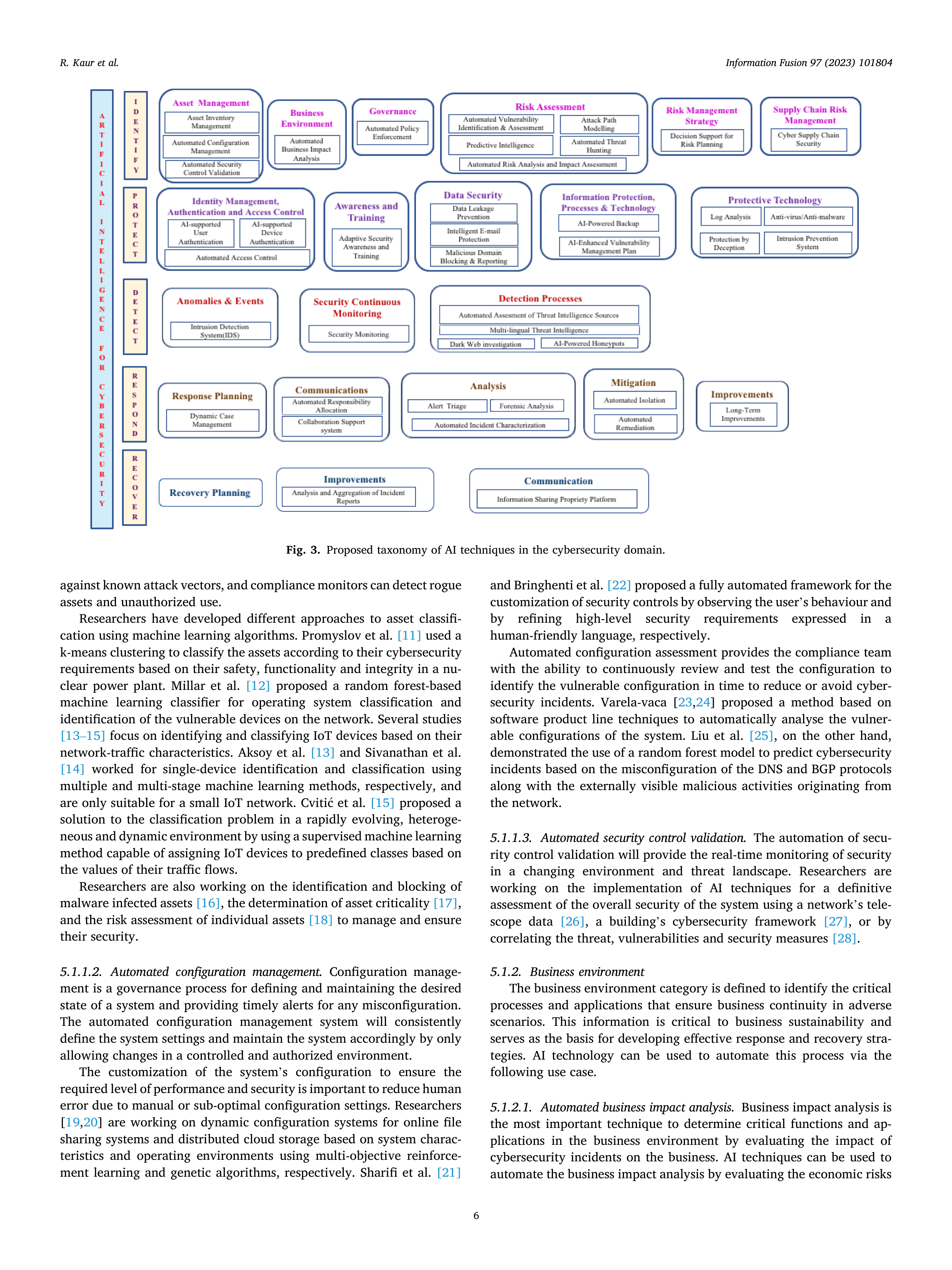
Fig. 3
summarizes the proposed taxonomy and presents the logical progression
of cybersecurity functions along with a detailed description of the
different categories of cybersecurity solutions implemented using the AI
technologies.
5.1.
Identify
The
identify
function provides the foundation for the other cyber
security functions by pinpointing the critical functions and risks asso
ciated with systems, people, assets and data. This helps develop an
understanding of the current state of the cybersecurity, identify gaps,
and develop an appropriate risk management strategy to achieve the
desired security based on the organization
’
s own needs, risks and
budget.
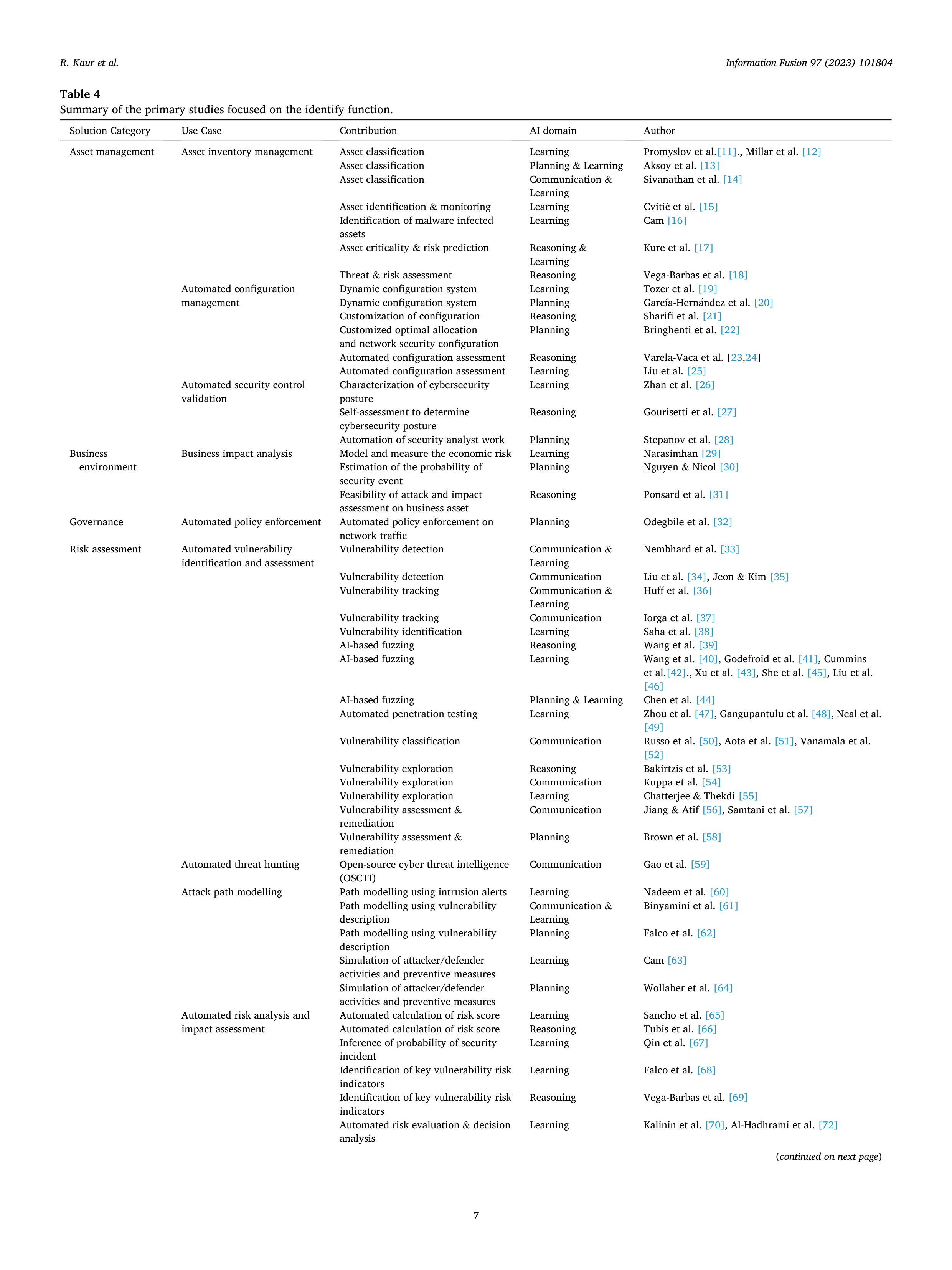
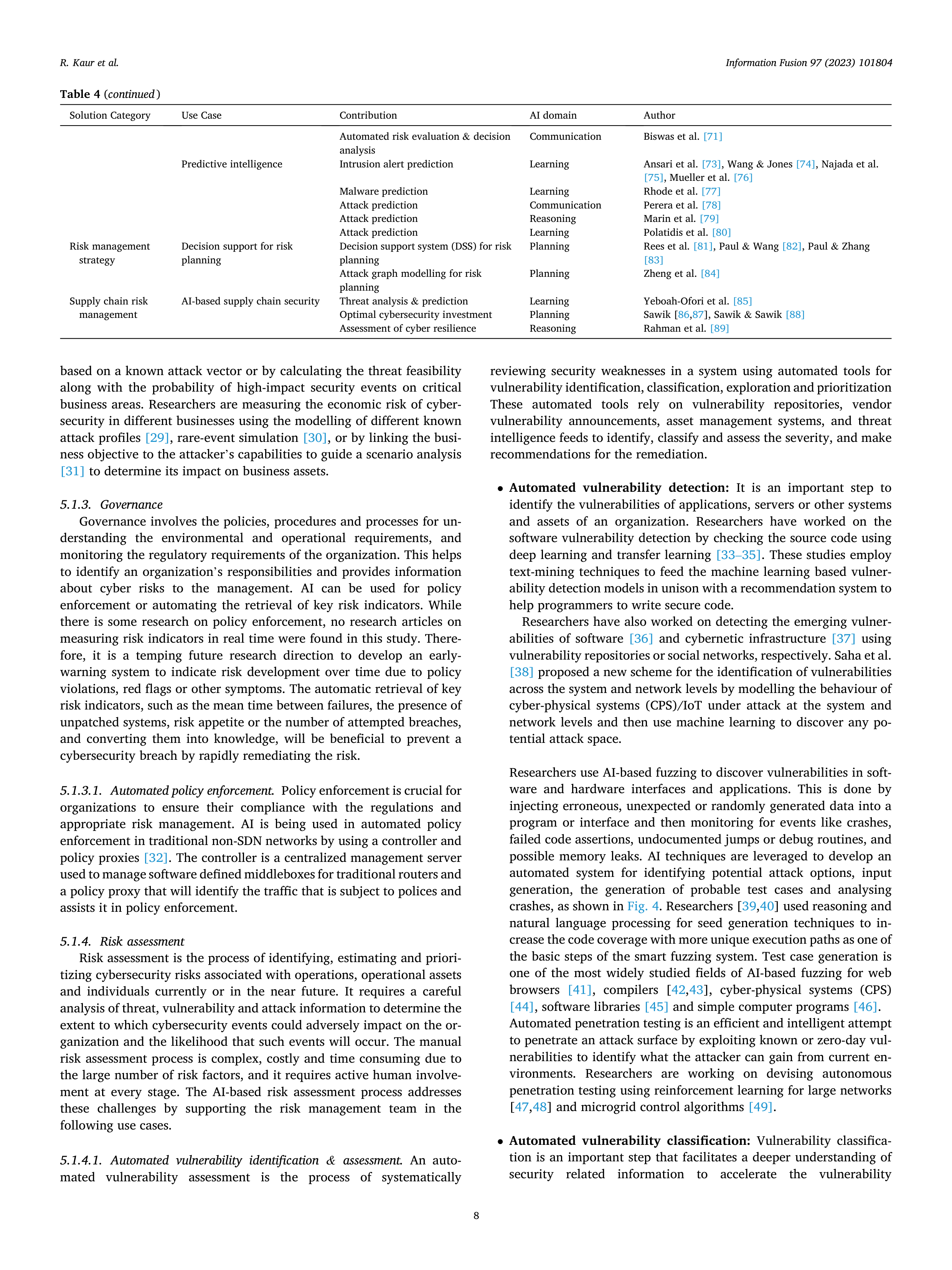
Table 4
summarizes the main contribution of each primary
study in the identify function. The various categories of cybersecurity
solutions in this function are detailed below.
5.1.1.
Asset management
Asset management is the process of identifying and keeping track of
the information, people, equipment, systems and buildings that help an
organization accomplish its goals and are proportionate to the asset
’
s
relative importance to those goals and risk strategies. It includes the
discovering, inventorying, managing and tracking of assets to protect
them. Cybersecurity asset management is becoming increasingly com
plex as organizations have more platforms than ever before: from
operational technology systems and Internet of Things (IoT) to on-
premises and cloud-based services. This proliferation of new asset
types and the ability to work remotely have resulted in highly distrib
uted assets that are difficult to manage and inventory.
An AI-based asset management system can solve many of these
challenges by feeding new levels of intelligence to the human team
across the following use cases.
5.1.1.1.
Asset inventory management.
Asset discovery and management
are critical to ensure complete visibility and control over all assets in an
extended network. AI can help with the continuous and automatic dis
covery of all devices, applications and users, as well as their classifica
tion and criticality for operations. With an accurate and up-to-date
inventory, assets can be tracked and analysed for a risk assessment
Fig. 2.
Selection process and study count at each stage of the SLR protocol.
Table 3
Data extracted from each primary study.
Data Type
Data Item
Description
Qualitative
Data
Title
Title of the primary study
Author
Author of the study
Year Published
Publication year of study
Article Type
Publication type, i.e., conference, journal
Source
Journal/Conference name that published the
study
Geographical
Region
Geographic region of the authors of the
primary study
Summary
A summary of the paper, with major
contribution.
Contextual
Data
Cybersecurity
Function
Type of cybersecurity activity in primary
study.
NIST taxonomy defines cybersecurity
activities as 5 functions: Identify, Protect,
Detect, Respond, Recover.
Solution Category
Identification of the main solution category in
which primary study falls.
The NIST taxonomy provides a subdivision of
each cybersecurity function into groups of
cybersecurity solution categories, e.g., the
detection function is divided into 3
categories: anomalies and events, security
continuous monitoring and detection
processes.
Specific Use Case
Specific cybersecurity use case of primary
study for AI application to match the function
and solution category.
Core AI Domain
Core AI domain of the AI technique used by
the primary study as defined by the AI Watch
[7]
.
R. Kaur et al.
Information Fusion 97 (2023) 101804
6
against known attack vectors, and compliance monitors can detect rogue
assets and unauthorized use.
Researchers have developed different approaches to asset classifi
cation using machine learning algorithms. Promyslov et al.
[11]
used a
k-means clustering to classify the assets according to their cybersecurity
requirements based on their safety, functionality and integrity in a nu
clear power plant. Millar et al.
[12]
proposed a random forest-based
machine learning classifier for operating system classification and
identification of the vulnerable devices on the network. Several studies
[13
–
15]
focus on identifying and classifying IoT devices based on their
network-traffic characteristics. Aksoy et al.
[13]
and Sivanathan et al.
[14]
worked for single-device identification and classification using
multiple and multi-stage machine learning methods, respectively, and
are only suitable for a small IoT network. Cviti
´
c et al.
[15]
proposed a
solution to the classification problem in a rapidly evolving, heteroge
neous and dynamic environment by using a supervised machine learning
method capable of assigning IoT devices to predefined classes based on
the values of their traffic flows.
Researchers are also working on the identification and blocking of
malware infected assets
[16]
, the determination of asset criticality
[17]
,
and the risk assessment of individual assets
[18]
to manage and ensure
their security.
5.1.1.2.
Automated configuration management.
Configuration manage
ment is a governance process for defining and maintaining the desired
state of a system and providing timely alerts for any misconfiguration.
The automated configuration management system will consistently
define the system settings and maintain the system accordingly by only
allowing changes in a controlled and authorized environment.
The customization of the system
’
s configuration to ensure the
required level of performance and security is important to reduce human
error due to manual or sub-optimal configuration settings. Researchers
[
19
,
20
] are working on dynamic configuration systems for online file
sharing systems and distributed cloud storage based on system charac
teristics and operating environments using multi-objective reinforce
ment learning and genetic algorithms, respectively. Sharifi et al.
[21]
and Bringhenti et al.
[22]
proposed a fully automated framework for the
customization of security controls by observing the user
’
s behaviour and
by refining high-level security requirements expressed in a
human-friendly language, respectively.
Automated configuration assessment provides the compliance team
with the ability to continuously review and test the configuration to
identify the vulnerable configuration in time to reduce or avoid cyber
security incidents. Varela-vaca [
23
,
24
] proposed a method based on
software product line techniques to automatically analyse the vulner
able configurations of the system. Liu et al.
[25]
, on the other hand,
demonstrated the use of a random forest model to predict cybersecurity
incidents based on the misconfiguration of the DNS and BGP protocols
along with the externally visible malicious activities originating from
the network.
5.1.1.3.
Automated security control validation.
The automation of secu
rity control validation will provide the real-time monitoring of security
in a changing environment and threat landscape. Researchers are
working on the implementation of AI techniques for a definitive
assessment of the overall security of the system using a network
’
s tele
scope data
[26]
, a building
’
s cybersecurity framework
[27]
, or by
correlating the threat, vulnerabilities and security measures
[28]
.
5.1.2.
Business environment
The business environment category is defined to identify the critical
processes and applications that ensure business continuity in adverse
scenarios. This information is critical to business sustainability and
serves as the basis for developing effective response and recovery stra
tegies. AI technology can be used to automate this process via the
following use case.
5.1.2.1.
Automated business impact analysis.
Business impact analysis is
the most important technique to determine critical functions and ap
plications in the business environment by evaluating the impact of
cybersecurity incidents on the business. AI techniques can be used to
automate the business impact analysis by evaluating the economic risks
Fig. 3.
Proposed taxonomy of AI techniques in the cybersecurity domain.
R. Kaur et al.
Information Fusion 97 (2023) 101804
7
Table 4
Summary of the primary studies focused on the identify function.
Solution Category
Use Case
Contribution
AI domain
Author
Asset management
Asset inventory management
Asset classification
Learning
Promyslov et al.
[11]
., Millar et al.
[12]
Asset classification
Planning
&
Learning
Aksoy et al.
[13]
Asset classification
Communication
&
Learning
Sivanathan et al.
[14]
Asset identification
&
monitoring
Learning
Cviti
ˇ
c et al.
[15]
Identification of malware infected
assets
Learning
Cam
[16]
Asset criticality
&
risk prediction
Reasoning
&
Learning
Kure et al.
[17]
Threat
&
risk assessment
Reasoning
Vega-Barbas et al.
[18]
Automated configuration
management
Dynamic configuration system
Learning
Tozer et al.
[19]
Dynamic configuration system
Planning
García-Hern
´
andez et al.
[20]
Customization of configuration
Reasoning
Sharifi et al.
[21]
Customized optimal allocation
and network security configuration
Planning
Bringhenti et al.
[22]
Automated configuration assessment
Reasoning
Varela-Vaca et al. [
23
,
24
]
Automated configuration assessment
Learning
Liu et al.
[25]
Automated security control
validation
Characterization of cybersecurity
posture
Learning
Zhan et al.
[26]
Self-assessment to determine
cybersecurity posture
Reasoning
Gourisetti et al.
[27]
Automation of security analyst work
Planning
Stepanov et al.
[28]
Business
environment
Business impact analysis
Model and measure the economic risk
Learning
Narasimhan
[29]
Estimation of the probability of
security event
Planning
Nguyen
&
Nicol
[30]
Feasibility of attack and impact
assessment on business asset
Reasoning
Ponsard et al.
[31]
Governance
Automated policy enforcement
Automated policy enforcement on
network traffic
Planning
Odegbile et al.
[32]
Risk assessment
Automated vulnerability
identification and assessment
Vulnerability detection
Communication
&
Learning
Nembhard et al.
[33]
Vulnerability detection
Communication
Liu et al.
[34]
, Jeon
&
Kim
[35]
Vulnerability tracking
Communication
&
Learning
Huff et al.
[36]
Vulnerability tracking
Communication
Iorga et al.
[37]
Vulnerability identification
Learning
Saha et al.
[38]
AI-based fuzzing
Reasoning
Wang et al.
[39]
AI-based fuzzing
Learning
Wang et al.
[40]
, Godefroid et al.
[41]
, Cummins
et al.
[42]
., Xu et al.
[43]
, She et al.
[45]
, Liu et al.
[46]
AI-based fuzzing
Planning
&
Learning
Chen et al.
[44]
Automated penetration testing
Learning
Zhou et al.
[47]
, Gangupantulu et al.
[48]
, Neal et al.
[49]
Vulnerability classification
Communication
Russo et al.
[50]
, Aota et al.
[51]
, Vanamala et al.
[52]
Vulnerability exploration
Reasoning
Bakirtzis et al.
[53]
Vulnerability exploration
Communication
Kuppa et al.
[54]
Vulnerability exploration
Learning
Chatterjee
&
Thekdi
[55]
Vulnerability assessment
&
remediation
Communication
Jiang
&
Atif
[56]
, Samtani et al.
[57]
Vulnerability assessment
&
remediation
Planning
Brown et al.
[58]
Automated threat hunting
Open-source cyber threat intelligence
(OSCTI)
Communication
Gao et al.
[59]
Attack path modelling
Path modelling using intrusion alerts
Learning
Nadeem et al.
[60]
Path modelling using vulnerability
description
Communication
&
Learning
Binyamini et al.
[61]
Path modelling using vulnerability
description
Planning
Falco et al.
[62]
Simulation of attacker/defender
activities and preventive measures
Learning
Cam
[63]
Simulation of attacker/defender
activities and preventive measures
Planning
Wollaber et al.
[64]
Automated risk analysis and
impact assessment
Automated calculation of risk score
Learning
Sancho et al.
[65]
Automated calculation of risk score
Reasoning
Tubis et al.
[66]
Inference of probability of security
incident
Learning
Qin et al.
[67]
Identification of key vulnerability risk
indicators
Learning
Falco et al.
[68]
Identification of key vulnerability risk
indicators
Reasoning
Vega-Barbas et al.
[69]
Automated risk evaluation
&
decision
analysis
Learning
Kalinin et al.
[70]
, Al-Hadhrami et al.
[72]
(
continued on next page
)
R. Kaur et al.
Information Fusion 97 (2023) 101804
8
based on a known attack vector or by calculating the threat feasibility
along with the probability of high-impact security events on critical
business areas. Researchers are measuring the economic risk of cyber
security in different businesses using the modelling of different known
attack profiles
[29]
, rare-event simulation
[30]
, or by linking the busi
ness objective to the attacker
’
s capabilities to guide a scenario analysis
[31]
to determine its impact on business assets.
5.1.3.
Governance
Governance involves the policies, procedures and processes for un
derstanding the environmental and operational requirements, and
monitoring the regulatory requirements of the organization. This helps
to identify an organization
’
s responsibilities and provides information
about cyber risks to the management. AI can be used for policy
enforcement or automating the retrieval of key risk indicators. While
there is some research on policy enforcement, no research articles on
measuring risk indicators in real time were found in this study. There
fore, it is a temping future research direction to develop an early-
warning system to indicate risk development over time due to policy
violations, red flags or other symptoms. The automatic retrieval of key
risk indicators, such as the mean time between failures, the presence of
unpatched systems, risk appetite or the number of attempted breaches,
and converting them into knowledge, will be beneficial to prevent a
cybersecurity breach by rapidly remediating the risk.
5.1.3.1.
Automated policy enforcement.
Policy enforcement is crucial for
organizations to ensure their compliance with the regulations and
appropriate risk management. AI is being used in automated policy
enforcement in traditional non-SDN networks by using a controller and
policy proxies
[32]
. The controller is a centralized management server
used to manage software defined middleboxes for traditional routers and
a policy proxy that will identify the traffic that is subject to polices and
assists it in policy enforcement.
5.1.4.
Risk assessment
Risk assessment is the process of identifying, estimating and priori
tizing cybersecurity risks associated with operations, operational assets
and individuals currently or in the near future. It requires a careful
analysis of threat, vulnerability and attack information to determine the
extent to which cybersecurity events could adversely impact on the or
ganization and the likelihood that such events will occur. The manual
risk assessment process is complex, costly and time consuming due to
the large number of risk factors, and it requires active human involve
ment at every stage. The AI-based risk assessment process addresses
these challenges by supporting the risk management team in the
following use cases.
5.1.4.1.
Automated vulnerability identification
&
assessment.
An auto
mated vulnerability assessment is the process of systematically
reviewing security weaknesses in a system using automated tools for
vulnerability identification, classification, exploration and prioritization
These automated tools rely on vulnerability repositories, vendor
vulnerability announcements, asset management systems, and threat
intelligence feeds to identify, classify and assess the severity, and make
recommendations for the remediation.
•
Automated vulnerability detection:
It is an important step to
identify the vulnerabilities of applications, servers or other systems
and assets of an organization. Researchers have worked on the
software vulnerability detection by checking the source code using
deep learning and transfer learning
[33
–
35]
. These studies employ
text-mining techniques to feed the machine learning based vulner
ability detection models in unison with a recommendation system to
help programmers to write secure code.
Researchers have also worked on detecting the emerging vulner
abilities of software
[36]
and cybernetic infrastructure
[37]
using
vulnerability repositories or social networks, respectively. Saha et al.
[38]
proposed a new scheme for the identification of vulnerabilities
across the system and network levels by modelling the behaviour of
cyber-physical systems (CPS)/IoT under attack at the system and
network levels and then use machine learning to discover any po
tential attack space.
Researchers use AI-based fuzzing to discover vulnerabilities in soft
ware and hardware interfaces and applications. This is done by
injecting erroneous, unexpected or randomly generated data into a
program or interface and then monitoring for events like crashes,
failed code assertions, undocumented jumps or debug routines, and
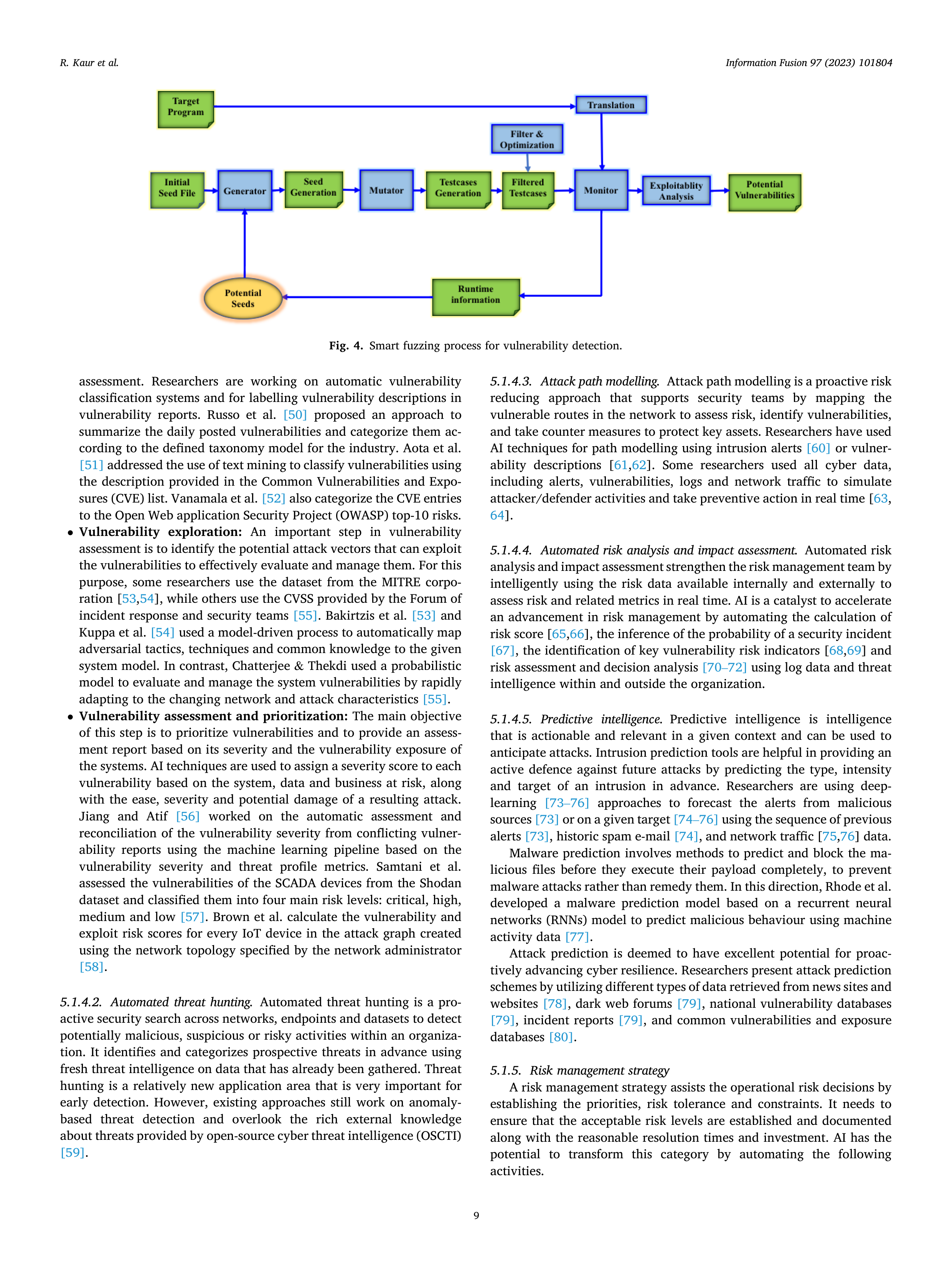
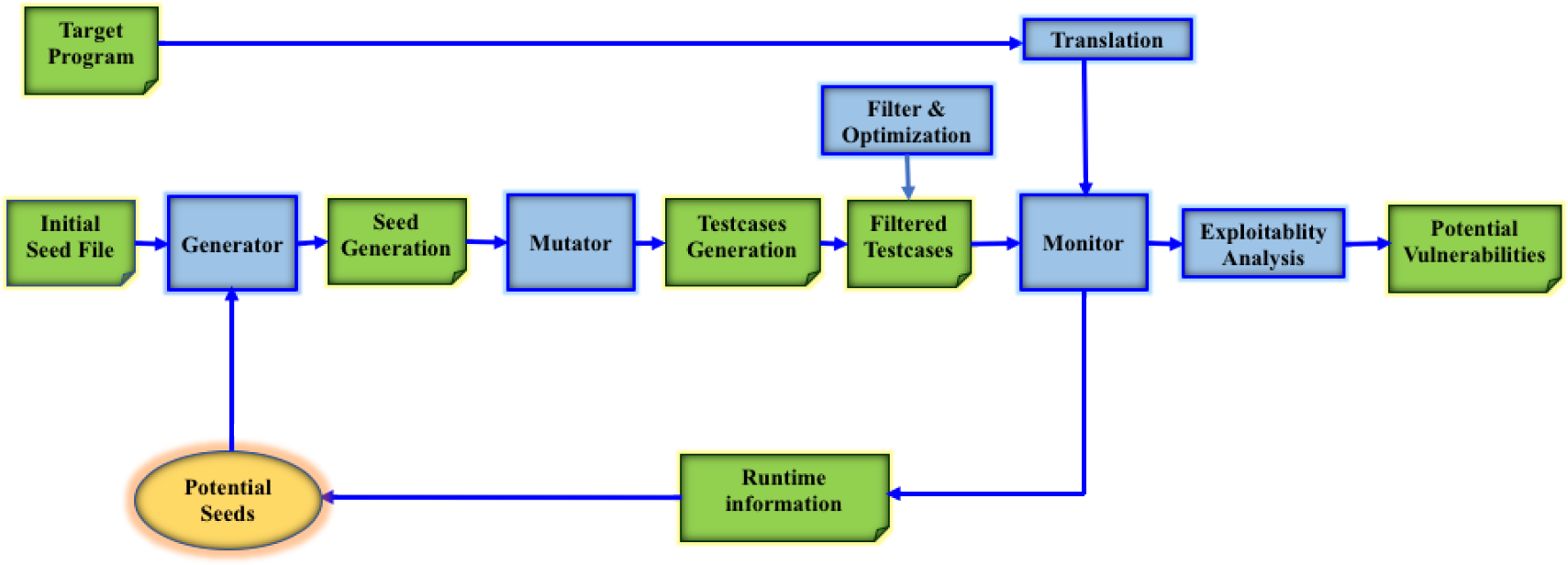
possible memory leaks. AI techniques are leveraged to develop an
automated system for identifying potential attack options, input
generation, the generation of probable test cases and analysing
crashes, as shown in
Fig. 4
. Researchers [
39
,
40
] used reasoning and
natural language processing for seed generation techniques to in
crease the code coverage with more unique execution paths as one of
the basic steps of the smart fuzzing system. Test case generation is
one of the most widely studied fields of AI-based fuzzing for web
browsers
[41]
, compilers [
42
,
43
], cyber-physical systems (CPS)
[44]
, software libraries
[45]
and simple computer programs
[46]
.
Automated penetration testing is an efficient and intelligent attempt
to penetrate an attack surface by exploiting known or zero-day vul
nerabilities to identify what the attacker can gain from current en
vironments. Researchers are working on devising autonomous
penetration testing using reinforcement learning for large networks
[
47
,
48
] and microgrid control algorithms
[49]
.
•
Automated vulnerability classification:
Vulnerability classifica
tion is an important step that facilitates a deeper understanding of
security related information to accelerate the vulnerability
Table 4
(
continued
)
Solution Category
Use Case
Contribution
AI domain
Author
Automated risk evaluation
&
decision
analysis
Communication
Biswas et al.
[71]
Predictive intelligence
Intrusion alert prediction
Learning
Ansari et al.
[73]
, Wang
&
Jones
[74]
, Najada et al.
[75]
, Mueller et al.
[76]
Malware prediction
Learning
Rhode et al.
[77]
Attack prediction
Communication
Perera et al.
[78]
Attack prediction
Reasoning
Marin et al.
[79]
Attack prediction
Learning
Polatidis et al.
[80]
Risk management
strategy
Decision support for risk
planning
Decision support system (DSS) for risk
planning
Planning
Rees et al.
[81]
, Paul
&
Wang
[82]
, Paul
&
Zhang
[83]
Attack graph modelling for risk
planning
Planning
Zheng et al.
[84]
Supply chain risk
management
AI-based supply chain security
Threat analysis
&
prediction
Learning
Yeboah-Ofori et al.
[85]
Optimal cybersecurity investment
Planning
Sawik [
86
,
87
], Sawik
&
Sawik
[88]
Assessment of cyber resilience
Reasoning
Rahman et al.
[89]
R. Kaur et al.
Information Fusion 97 (2023) 101804
9
assessment. Researchers are working on automatic vulnerability
classification systems and for labelling vulnerability descriptions in
vulnerability reports. Russo et al.
[50]
proposed an approach to
summarize the daily posted vulnerabilities and categorize them ac
cording to the defined taxonomy model for the industry. Aota et al.
[51]
addressed the use of text mining to classify vulnerabilities using
the description provided in the Common Vulnerabilities and Expo
sures (CVE) list. Vanamala et al.
[52]
also categorize the CVE entries
to the Open Web application Security Project (OWASP) top-10 risks.
•
Vulnerability exploration:
An important step in vulnerability
assessment is to identify the potential attack vectors that can exploit
the vulnerabilities to effectively evaluate and manage them. For this
purpose, some researchers use the dataset from the MITRE corpo
ration [
53
,
54
], while others use the CVSS provided by the Forum of
incident response and security teams
[55]
. Bakirtzis et al.
[53]
and
Kuppa et al.
[54]
used a model-driven process to automatically map
adversarial tactics, techniques and common knowledge to the given
system model. In contrast, Chatterjee
&
Thekdi used a probabilistic
model to evaluate and manage the system vulnerabilities by rapidly
adapting to the changing network and attack characteristics
[55]
.
•
Vulnerability assessment and prioritization:
The main objective
of this step is to prioritize vulnerabilities and to provide an assess
ment report based on its severity and the vulnerability exposure of
the systems. AI techniques are used to assign a severity score to each
vulnerability based on the system, data and business at risk, along
with the ease, severity and potential damage of a resulting attack.
Jiang and Atif
[56]
worked on the automatic assessment and
reconciliation of the vulnerability severity from conflicting vulner
ability reports using the machine learning pipeline based on the
vulnerability severity and threat profile metrics. Samtani et al.
assessed the vulnerabilities of the SCADA devices from the Shodan
dataset and classified them into four main risk levels: critical, high,
medium and low
[57]
. Brown et al. calculate the vulnerability and
exploit risk scores for every IoT device in the attack graph created
using the network topology specified by the network administrator
[58]
.
5.1.4.2.
Automated threat hunting.
Automated threat hunting is a pro
active security search across networks, endpoints and datasets to detect
potentially malicious, suspicious or risky activities within an organiza
tion. It identifies and categorizes prospective threats in advance using
fresh threat intelligence on data that has already been gathered. Threat
hunting is a relatively new application area that is very important for
early detection. However, existing approaches still work on anomaly-
based threat detection and overlook the rich external knowledge
about threats provided by open-source cyber threat intelligence (OSCTI)
[59]
.
5.1.4.3.
Attack path modelling.
Attack path modelling is a proactive risk
reducing approach that supports security teams by mapping the
vulnerable routes in the network to assess risk, identify vulnerabilities,
and take counter measures to protect key assets. Researchers have used
AI techniques for path modelling using intrusion alerts
[60]
or vulner
ability descriptions [
61
,
62
]. Some researchers used all cyber data,
including alerts, vulnerabilities, logs and network traffic to simulate
attacker/defender activities and take preventive action in real time [
63
,
64
].
5.1.4.4.
Automated risk analysis and impact assessment.
Automated risk
analysis and impact assessment strengthen the risk management team by
intelligently using the risk data available internally and externally to
assess risk and related metrics in real time. AI is a catalyst to accelerate
an advancement in risk management by automating the calculation of
risk score [
65
,
66
], the inference of the probability of a security incident
[67]
, the identification of key vulnerability risk indicators [
68
,
69
] and
risk assessment and decision analysis
[70
–
72]
using log data and threat
intelligence within and outside the organization.
5.1.4.5.
Predictive intelligence.
Predictive intelligence is intelligence
that is actionable and relevant in a given context and can be used to
anticipate attacks. Intrusion prediction tools are helpful in providing an
active defence against future attacks by predicting the type, intensity
and target of an intrusion in advance. Researchers are using deep-
learning
[73
–
76]
approaches to forecast the alerts from malicious
sources
[73]
or on a given target
[74
–
76]
using the sequence of previous
alerts
[73]
, historic spam e-mail
[74]
, and network traffic [
75
,
76
] data.
Malware prediction involves methods to predict and block the ma
licious files before they execute their payload completely, to prevent
malware attacks rather than remedy them. In this direction, Rhode et al.
developed a malware prediction model based on a recurrent neural
networks (RNNs) model to predict malicious behaviour using machine
activity data
[77]
.
Attack prediction is deemed to have excellent potential for proac
tively advancing cyber resilience. Researchers present attack prediction
schemes by utilizing different types of data retrieved from news sites and
websites
[78]
, dark web forums
[79]
, national vulnerability databases
[79]
, incident reports
[79]
, and common vulnerabilities and exposure
databases
[80]
.
5.1.5.
Risk management strategy
A risk management strategy assists the operational risk decisions by
establishing the priorities, risk tolerance and constraints. It needs to
ensure that the acceptable risk levels are established and documented
along with the reasonable resolution times and investment. AI has the
potential to transform this category by automating the following
activities.
Fig. 4.
Smart fuzzing process for vulnerability detection.
R. Kaur et al.
Information Fusion 97 (2023) 101804
10
5.1.5.1.
Decision support for risk planning.
Cybersecurity risk planning
involves the implementation of a desired portfolio of countermeasures
within a predetermined budget. Formal decision support systems
[81
–
83]
and attack graph modelling
[84]
can help security planners
make economic comparisons with the cost of countermeasures and
available risk budgets.
The decision-making problem in cybersecurity risk planning is
important due to the sensitivity of the risk plan to the decision maker
’
s
attitude towards risk and its interplay with the budget available. Thus,
the implementation of a decision support system for estimating an un
certain risk faced by an organization under cyberattack, factoring un
certain threat rates, countermeasure costs, and impacts on its assets is
very important. In this direction, Rees et al.
[81]
used a genetic algo
rithm to find the best combination of countermeasures to block or
mitigate security attacks, allowing the user to determine the preferred
trade-off between the investment cost and the resulting risk. Paul
&
Wang
[82]
and Paul
&
Zhang
[83]
have used robust optimisation to
investigate the optimal balance between the prevention, detection and
containment safeguards to deal with cybersecurity uncertainty.
Zheng et al.
[84]
used the attack graph model for the identification of
a portfolio of security controls to reduce risk. Their model is utilized to
choose the best possible set of controls to ensure that the overall cost
does not go above the organizational budget.
5.1.6.
Supply chain risk management
Supply chain risk management supports risk decisions specifically
related to identifying, assessing and managing supply chain risks. The
effective management of cybersecurity risks in a supply chain requires a
comprehensive view of the threats and vulnerabilities, cost-effective
supply chain risk planning strategies, and an assessment of the cyber
resilience of the supply chain. Researchers are actively using AI tech
niques to automate threat analysis and prediction
[85]
, optimal cyber
security investment
[86
–
88]
, and an assessment of the cyber resilience
[89]
of the supply chain.
5.1.6.1.
Cyber supply chain security.
Cyber supply chain security re
quires a secure integrated network between the incoming and outgoing
chain
’
s subsystems. Therefore, it is essential to understand and predict
threats using both internal and threat intelligence resources to limit the
disruption of the business. Yeboah-ofori et al. integrated cyber threat
intelligence data and used machine learning techniques to predict
cyberattack patterns on cyber supply chain systems
[85]
.
Optimizing cybersecurity investments is an important area in the
Industry 4.0 supply chain cybersecurity to quickly detect, mitigate and
balance the impact of security breaches with the available budget. In this
direction, Sawik
[86
–
88]
proposed different models to determine an
optimal cybersecurity investment with a limited budget and a portfolio
of security controls to balance the cybersecurity in the supply chain.
An assessment of the cyber resilience of a supply chain is a crucial
task to make the supply chain safe from cyber intrusions and to secure a
competitive business advantage. In 2021, Rahman et al.
[89]
proposed
an integrated and comprehensive approach based on Dempster-Shafer
(D-S) theory as a methodology for building a framework for evalu
ating the cyber resilience of an additive manufacturing supply chain.
5.2.
Protect
The
protect
function helps plan and implement appropriate controls
to limit or contain the impact of a potential cybersecurity event. This
includes a number of technical and procedural controls to proactively
protect against internal and external cyber threats. AI can improve the
resilience of the system by authenticating users, devices and other as
sets, monitoring the user behaviour, automated access control, adaptive
training, data leakage prevention
&
integrity monitoring, automated
information protection and processes and provision of protective
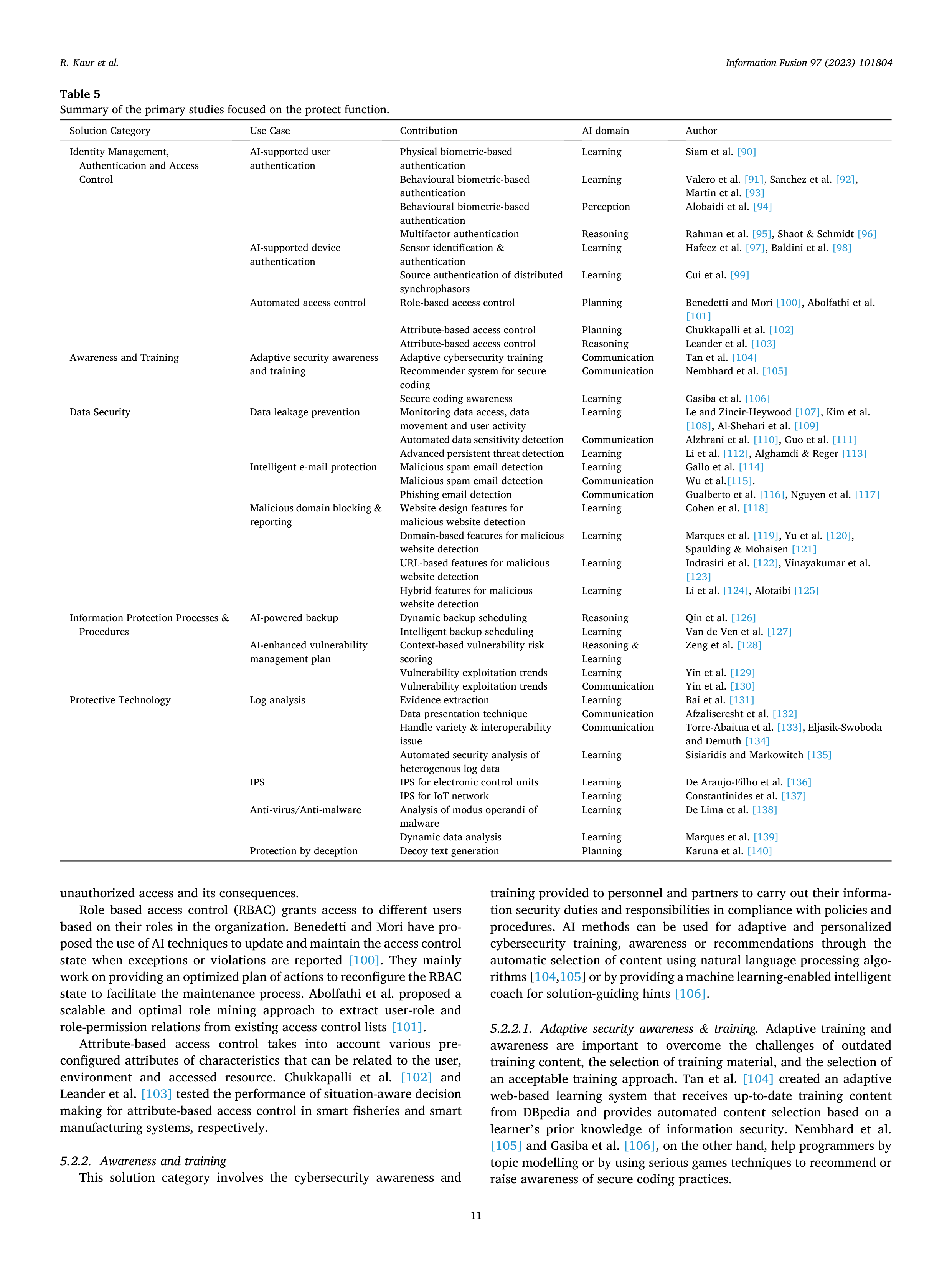
solutions to proactively secure the system. A summary of each primary
study focusing on the protect function is provided in
Table 5
. Solution
categories along with a detailed overview of the AI use cases in each
category are presented below.
5.2.1.
Identity management, authentication and access control
Identity management, authentication and access control is respon
sible for limiting the access to assets and associated facilities to autho
rized users, processes or devices, and to authorized activities. AI can be
used for the management and protection of physical and remote access
using intelligent user authentication, intelligent device authentication,
automated access control using authorizations, and access permissions
to prevent unauthorized access and its consequences.
5.2.1.1.
AI-supported user authentication.
AI can improve user authen
tication with physical biometrics
[90]
, behavioural biometrics
[91
–
94]
,
or multi-factor authentication [
95
,
96
] instead of easily compromisable
usernames, passwords and even one-time text tokens.
Physical biometrics refers to the innate physical characteristics of
users that can be used for identification such as fingerprints, iris and bio-
signals. In 2020, Siam et al. presented a PPG (photoplethysmography)
based biometric human authentication system using deep learning
[90]
.
In contrast, behavioural biometrics are related to the uniquely identifi
able and measurable patterns in human activities that can provide
continuous and user-friendly security. There are several behavioural
biometrics, including usage behaviour
[91
–
93]
and gait
[94]
. The use of
behaviour patterns related to a user
’
s interaction with its own device is
the main basis of the continuous authentication systems. In this direc
tion, Valero et al. suggested using mobile functions and usage data, e.g.,
accelerometer, gyroscope, magnetometer, and statistics from in
teractions with different applications, to determine whether the current
user is the same as the one previously authenticated
[91]
. In 2019,
S
´
anchez et al. designed and implemented a continuous authentication
mechanism based on the behavioural profiles of users according to their
interaction with different office devices for smart offices using a cloud
computing paradigm and a random forest (RF) algorithm
[92]
. In
addition, these solutions are gradually being used in federated identity
management solutions, which further increases interest in them
[93]
.
Gait authentication is a non-intrusive, transparent and continuous
method of authentication in mobile devices that captures the informa
tion needed to verify the authenticity of the user as the person walks. In
2022, Alobaidi et al.
[94]
investigated the feasibility of gait authenti
cation in the uncontrolled real world by using time and
frequency-domain feature extraction of each gait cycle.
Multi-factor authentication is a layered approach to secure data and
applications that require a combination of two or more credentials to
verify the identity or login of users. Researchers [
95
,
96
] used the
keystroke dynamics as a second layer of security for web-user authen
tication and device authentication.
5.2.1.2.
AI-supported device authentication.
Intelligent device authenti
cation is the process of authenticating devices based on their credentials
or behaviour in the network to ensure the security of machine-to-
machine communication. Researchers are actively working in the field
of sensor identification and authentication to ensure the security of
cyber-physical systems or the automotive sector. Channel
[97]
and
sensor [
98
,
99
] imperfections are used to find the transient and
steady-state parameters as an input to the machine learning model for
sensor identification.
5.2.1.3.
Automated access control.
Automated access control restricts
system access to authorized users based on situations or their roles and
regulations within an organization. Researchers are actively using AI
techniques for maintenance of the access control state
[100]
, role min
ing
[101]
and situation-aware decision making [
102
,
103
] to prevent
R. Kaur et al.
Information Fusion 97 (2023) 101804
11
unauthorized access and its consequences.
Role based access control (RBAC) grants access to different users
based on their roles in the organization. Benedetti and Mori have pro
posed the use of AI techniques to update and maintain the access control
state when exceptions or violations are reported
[100]
. They mainly
work on providing an optimized plan of actions to reconfigure the RBAC
state to facilitate the maintenance process. Abolfathi et al. proposed a
scalable and optimal role mining approach to extract user-role and
role-permission relations from existing access control lists
[101]
.
Attribute-based access control takes into account various pre-
configured attributes of characteristics that can be related to the user,
environment and accessed resource. Chukkapalli et al.
[102]
and
Leander et al.
[103]
tested the performance of situation-aware decision
making for attribute-based access control in smart fisheries and smart
manufacturing systems, respectively.
5.2.2.
Awareness and training
This solution category involves the cybersecurity awareness and
training provided to personnel and partners to carry out their informa
tion security duties and responsibilities in compliance with policies and
procedures. AI methods can be used for adaptive and personalized
cybersecurity training, awareness or recommendations through the
automatic selection of content using natural language processing algo
rithms [
104
,
105
] or by providing a machine learning-enabled intelligent
coach for solution-guiding hints
[106]
.
5.2.2.1.
Adaptive security awareness
&
training.
Adaptive training and
awareness are important to overcome the challenges of outdated
training content, the selection of training material, and the selection of
an acceptable training approach. Tan et al.
[104]
created an adaptive
web-based learning system that receives up-to-date training content
from DBpedia and provides automated content selection based on a
learner
’
s prior knowledge of information security. Nembhard et al.
[105]
and Gasiba et al.
[106]
, on the other hand, help programmers by
topic modelling or by using serious games techniques to recommend or
raise awareness of secure coding practices.
Table 5
Summary of the primary studies focused on the protect function.
Solution Category
Use Case
Contribution
AI domain
Author
Identity Management,
Authentication and Access
Control
AI-supported user
authentication
Physical biometric-based
authentication
Learning
Siam et al.
[90]
Behavioural biometric-based
authentication
Learning
Valero et al.
[91]
, Sanchez et al.
[92]
,
Martin et al.
[93]
Behavioural biometric-based
authentication
Perception
Alobaidi et al.
[94]
Multifactor authentication
Reasoning
Rahman et al.
[95]
, Shaot
&
Schmidt
[96]
AI-supported device
authentication
Sensor identification
&
authentication
Learning
Hafeez et al.
[97]
, Baldini et al.
[98]
Source authentication of distributed
synchrophasors
Learning
Cui et al.
[99]
Automated access control
Role-based access control
Planning
Benedetti and Mori
[100]
, Abolfathi et al.
[101]
Attribute-based access control
Planning
Chukkapalli et al.
[102]
Attribute-based access control
Reasoning
Leander et al.
[103]
Awareness and Training
Adaptive security awareness
and training
Adaptive cybersecurity training
Communication
Tan et al.
[104]
Recommender system for secure
coding
Communication
Nembhard et al.
[105]
Secure coding awareness
Learning
Gasiba et al.
[106]
Data Security
Data leakage prevention
Monitoring data access, data
movement and user activity
Learning
Le and Zincir-Heywood
[107]
, Kim et al.
[108]
, Al-Shehari et al.
[109]
Automated data sensitivity detection
Communication
Alzhrani et al.
[110]
, Guo et al.
[111]
Advanced persistent threat detection
Learning
Li et al.
[112]
, Alghamdi
&
Reger
[113]
Intelligent e-mail protection
Malicious spam email detection
Learning
Gallo et al.
[114]
Malicious spam email detection
Communication
Wu et al.
[115]
.
Phishing email detection
Communication
Gualberto et al.
[116]
, Nguyen et al.
[117]
Malicious domain blocking
&
reporting
Website design features for
malicious website detection
Learning
Cohen et al.
[118]
Domain-based features for malicious
website detection
Learning
Marques et al.
[119]
, Yu et al.
[120]
,
Spaulding
&
Mohaisen
[121]
URL-based features for malicious
website detection
Learning
Indrasiri et al.
[122]
, Vinayakumar et al.
[123]
Hybrid features for malicious
website detection
Learning
Li et al.
[124]
, Alotaibi
[125]
Information Protection Processes
&
Procedures
AI-powered backup
Dynamic backup scheduling
Reasoning
Qin et al.
[126]
Intelligent backup scheduling
Learning
Van de Ven et al.
[127]
AI-enhanced vulnerability
management plan
Context-based vulnerability risk
scoring
Reasoning
&
Learning
Zeng et al.
[128]
Vulnerability exploitation trends
Learning
Yin et al.
[129]
Vulnerability exploitation trends
Communication
Yin et al.
[130]
Protective Technology
Log analysis
Evidence extraction
Learning
Bai et al.
[131]
Data presentation technique
Communication
Afzaliseresht et al.
[132]
Handle variety
&
interoperability
issue
Communication
Torre-Abaitua et al.
[133]
, Eljasik-Swoboda
and Demuth
[134]
Automated security analysis of
heterogenous log data
Learning
Sisiaridis and Markowitch
[135]
IPS
IPS for electronic control units
Learning
De Araujo-Filho et al.
[136]
IPS for IoT network
Learning
Constantinides et al.
[137]
Anti-virus/Anti-malware
Analysis of modus operandi of
malware
Learning
De Lima et al.
[138]
Dynamic data analysis
Learning
Marques et al.
[139]
Protection by deception
Decoy text generation
Planning
Karuna et al.
[140]
R. Kaur et al.
Information Fusion 97 (2023) 101804
12
5.2.3.
Data security
Data security governs information management in line with the risk
strategy for protecting sensitive information. This includes protecting
data at rest and in transit, as well as managing the lifecycle of the assets
that hold the information, including its decommissioning or disposal.
Researchers are actively using AI techniques for data leakage preven
tion, intelligent e-mail protection, malicious domain blocking and
reporting, and agent-based integrity monitoring to ensure data confi
dentiality, integrity and availability.
5.2.3.1.
Data leakage prevention.
Data leakage prevention deals with
the detection and protection of data breaches, exfiltration or the un
wanted destruction of data. AI techniques are used for monitoring data
access, data movement and user activity
[107
–
109]
, automated data
sensitivity detection [
110
,
111
], and advanced persistent threat (APT)
detection
[112
–
114]
to prevent data leakage.
The identification of the authorized individuals and how they use
sensitive information provide accurate insights for data leakage pre
vention by observing their concerning behaviours or activities. Re
searchers
[107
–
109]
are actively using AI techniques to monitor user
activity to identify their anomalous behaviour in terms of a spike in
activities or unusual activities by correlating the data received from
multiple sources. In this direction, researchers are using an insider threat
test dataset provided by CERT to provide insights for data leakage pre
vention using different temporal representations of user activity
[107]
or by daily activity summaries, e-mail contents and email network
[108]
. In contrast, Al-shehari and Alsowail
[109]
proposed a model that
is only applicable for the identification of data leakage events during the
sensitive period before an employee leaves an organization.
Automated data sensitivity detection is a method of identifying and
classifying data by analysing, labelling and organizing the data into
relevant categories (confidential, private and public) based on shared
characteristics. It can empower the data leakage prevention techniques
with the ability to monitor users
’
actions towards only particular rele
vant portions of sensitive data, rather than tracking all the data at all
times. Alzhrani et al.
[110]
proposed an automated classification tech
nique enabled by security similarity (ACESS) for mitigating the threat of
sensitive data leakage from insiders. In 2021, Guo et al.
[111]
pointed
out that sensitive information often resides in unstructured data, making
unintentional data leakage easier. Therefore, they proposed a content
and context-based sensitive information identification method using
BiLSTM and an attention mechanism.
Advanced persistent threats (APTs) are a type of targeted cyberattack
that lasts for a long time and is unnoticed by the target network
’
s de
fences. The main purpose of this type of attack is to steal data rather than
cause any damage. Researchers are working on the efficient capture of
telemetry from endpoints, networks and clouds to integrate and analyse
this diverse telemetry to uncover anomalies, indicators of compromise
(IoCs) and other behaviour of interest [
112
,
113
].
5.2.3.2.
Intelligent e-mail protection.
Intelligent e-mail protection is a
class of software solutions to prevent sophisticated e-mail focused
cyberattacks. Traditionally, a spam e-mail was used as a tactic for
hawking goods and services by sending unsolicited e-mails to bulk lists.
Today, however, it is actively being used to spread malware, steal
authentication credentials, or commit financial frauds. AI techniques are
being used for automated protection against malicious spam e-mails.
Researchers are using supervised classification
[114]
and
deep-learning based
[115]
techniques to identify spam in real time using
dynamic incoming e-mail data, including general, view, subject,
attachment, and content-related features. However, Gualberto et al.
[116]
and Nguyen et al.
[117]
confined their research efforts to phishing
e-mail detection by analysing the content of e-mails.
5.2.3.3.
Malicious domain blocking
&
reporting.
Malicious domain
blocking and reporting provides the next level of security for e-mail
protection by catching any malicious network traffic resulting from
opening the spam e-mail or attachment. Researchers use AI to identify
suspicious websites for each DNS lookup and block access to malicious
websites associated with malware, phishing, ransomware and other
cyber threats.
The detection of malicious websites works by training machine
learning algorithms with a rich collection of malicious and non-
malicious website features. These features can be divided into four
main categories: website design features
[118]
, domain-based features
[119
–
121]
, URL-based features [
122
,
123
], and hybrid features [
124
,
125
].
In 2021, Cohen et al.
[118]
presented a new website categorization
method to identify malware or crack websites based on the automated
scraping and processing of thousands of visual and non-visual design
features. Domain name-based features are very popular for the detection
of malicious websites in the research domain. Researchers are using
supervised machine learning models
[119]
and deep-learning [
120
,
121
]
techniques to detect malicious domain names using classical
domain-name features. Features extracted from the URL strings,
including linguistic, lexical, contextual and statistical information are
used to determine the malicious websites. Indrasiri et al.
[122]
and
Vinayakumar et al.
[123]
provide the detection and analysis of mali
cious websites by using URL-based features as an input to the ensemble
machine learning and deep-learning models, respectively.
Some researchers are also using hybrid features for malicious website
identification to comprehend botnet detection
[124]
or phishing website
detection
[125]
. These techniques use a combination of features related
to domain name structure and DNS response such as resolution source,
daily resolution amount, etc.
5.2.4.
Information protection, processes and procedures
This area deals with the protection of information sources and assets
consistent with the defined security policies, processes and procedures.
It includes the protection of information, and the establishment, man
agement and implementation of response, recovery and vulnerability
management plans. Researchers are working on the application of AI
techniques for AI-powered backup, and an AI-enhanced vulnerability
management plan to maintain the processes and procedures to manage
information protection.
5.2.4.1.
AI-powered backup.
AI-powered backup solutions are emerging
to back up critical data and software components according to priorities
and requirements for ensuring efficient backup. AI techniques are being
used for dynamic backup scheduling
[126]
and optimized backup
scheduling
[127]
.
Qin et al.
[126]
designed a dynamic backup system with intelligent
scheduling algorithms to improve the stability and predictability of the
backup environment. The proposed system schedules the backup effi
ciently by determining which backup starts first and which storage is
assigned to that backup for improving the efficiency. In contrast, Van de
Ven et al.
[127]
used a two-dimensional Markov chain to model data
backups and study the optimization of backup scheduling. At each time
slot, the proposed technique examines a probabilistic backup policy to
initiate the backup, regardless of the backup size.
5.2.4.2.
AI-enhanced vulnerability management plan.
A vulnerability
management plan is a framework designed to proactively reduce the
exposure to risk that has the potential to disrupt and impact the system.
With the rise in reported vulnerabilities in recent years, it is more
important to align the vulnerability management plan with the system
’
s
requirements and critical success factor. Researchers are using AI tech
niques to determine context-based, vulnerability risk scores and
vulnerability exploitation trends to protect the assets and information
systems in real time.
R. Kaur et al.
Information Fusion 97 (2023) 101804
13
Context-based vulnerability risk scoring will help the analyst to
prioritize the risk in the context of particular assets or information
systems and enable them to take protective action. Zeng et al.
[128]
proposed a new risk prioritization method to assess the vulnerability risk
by integrating the attacker model to capture the attacker
’
s preference
for exploiting vulnerabilities. The risk score is defined by the criticality
of exploitation and the likelihood of the exploitation using the
logic-reasoning engine.
A vulnerability exploitation trend will help the analyst to prioritize
patching and remediation by predicting the vulnerabilities that will
most likely be exploited. Researchers are using novel AI techniques to
predict the exploitability
[129]
and solve the class imbalance problem to
improve the performance of machine learning algorithms
[130]
. Here,
Yin et al.
[129]
focused on the problem of vulnerability exploitation
prediction using transfer learning to help experts prioritize the appli
cation of a patch. Yin et al.
[130]
also proposed a novel sequential
batch-learning technique, called real-time dynamic concept adaptive
learning, to address the concept-deviation and dynamic class imbalance
issues in exploitability prediction.
5.2.5.
Protective technologies
Protective technologies provide the security and resilience of systems
and assets. These technologies use particular tamper-evident features to
identify and deter attempts to breach, change, penetrate and extract
information from the organization
’
s assets. AI can be used to provide
protective solutions in the form of log analysis tools, intrusion preven
tion systems, anti-virus/anti-malware solutions and protection by
deception.
5.2.5.1.
Log analysis.
Log analysis is the process of reviewing computer
generated event logs to proactively identify bugs, security concerns or
other risks. AI-powered log analysis tools can automate the routine and
repeated tasks to efficiently handle large amounts of distributed log
data.
Bai et al.
[131]
tested the performance of a variety of supervised
machine learning approaches for detecting the evidence of malicious
remote desktop protocol (RDP) sessions using windows RDP event logs.
Afzaliseresht et al.
[132]
, on the other hand, proposed a new approach
for data presentation using a storytelling technique to generate a natural
language report for recognizing cyber threat information according to
the users
’
level of knowledge.
Researchers are also working on providing solutions to solve variety
and interoperability issues in log management. De la Torre-Abaitua et al.
[133]
and Eljasik-Swoboda and Demuth
[134]
worked on addressing the
variety issue using intelligent methods for extracting and processing
textual data from different sources for the acceptable log feature rep
resentation with the aid of information retrieval approaches. Similarly,
Sisiaridis and Markowitch
[135]
worked on the security analytics of the
heterogenous log data derived from different network sensors by
employing automated feature extraction and feature selection
techniques.
5.2.5.2.
Intrusion prevention system.
Intrusion prevention systems
monitor the network traffic and then take an appropriate action to
thwart the attack by reporting, blocking, dropping or resetting the
connection. Researchers have proposed unsupervised isolation forest
[136]
and self-organizing incremental neural networks and SVM based
intrusion prevention systems
[137]
for embedded systems in automotive
electronics and IoT networks, respectively.
5.2.5.3.
Anti-virus/Anti-malware solutions.
AI-powered anti-virus/anti-
malware solutions can analyse thousands of files and extract useful
features to classify them as benign or malware. Researchers have created
anti-virus programs for detecting malware using the features retrieved
from the executables
[138]
or dynamic data analysis
[139]
as an input to
artificial neural networks (ANNs) or recurrent neural network (RNN)
models, respectively.
5.2.5.4.
Protection by deception.
Protection by deception is an advanced
technique to protect critical documents after an attacker has penetrated
the network. AI has been used to generate credible fake text documents
to mislead cyberattacks. Karuna et al.
[140]
proposed the creation of
decoy files to divert the adversary away from the real target when the
adversary is already in the system. Their decoy text-creation approach
uses a genetic algorithm that manipulates real document
’
s comprehen
sibility to hard-to-comprehend, but believable fake documents.
5.3.
Detect
The
detect
function enables the timely discovery of the cybersecurity
events by developing and implementing appropriate activities to iden
tify their occurrence. This function is crucial for the security as prompt
detection will minimize the disruption. It includes activities for the
timely detection of intrusions and anomalies along with the impact
assessment, implementation of security continuous monitoring to verify
the effectiveness of protective measures, and appropriate maintenance
of detection processes to ensure the awareness of cyber events. AI can
improve the detection speed by monitoring the internal and external
information sources and swiftly correlating this information to detect
the unusual activities to minimize the repercussions.
Table 6
presents a
summary of the main contribution of each research study to the detect
function, along with the details of the solution category, AI use cases and
the AI domain used. The solution categories along with a detailed review
of the AI use cases are provided below.
5.3.1.
Anomalies and events
The solutions in this area address the detection and classification of
anomalous activities by establishing and managing baselines for oper
ations and dataflows collected from multiple sources. These baselines
are then used to detect and analyse events to understand attack targets
and methods.
5.3.1.1.
Intrusion detection system (IDS).
An IDS is a set of tools and
techniques to monitor a system and network traffic to analyse the
anomalous and suspicious activities, with the aim to detect possible
intrusions targeting the system. In the state-of-the-art research, IDS was
implemented from three perspectives: binary classification, multi-
category classification or both. Binary classification assumes two la
bels: normal and attack. Multi-category classification, on the other hand,
deals with the problem of classification into three or more classes. In the
case of IDSs, the multi-category classification differentiates between
different types of attacks and provides users with more information to
deal with the attack. Benchmark datasets are needed for the effective
development and evaluation of both binary and multi-category intrusion
detection systems. Therefore, only those studies that used benchmark
datasets to evaluate their approach are included in this review.
In this direction, researchers used the ADFA-WD and ADFA-WD: SAA
datasets for system call-based IDS
[141]
, Aegean Wi-Fi (AWID) wireless
networks dataset [
142
,
172
,
184
], BGP RIPE dataset for routing infor
mation services
[143]
, datasets provided by the Canadian Institute of
Cybersecurity [
151-153
,
178
,
180-184
,
192-194
], CIFAR-10 dataset of
images [
147
,
148
], CTU-13 dataset for various botnet scenarios [
149
,
150
], Ethereum classic dataset depicting attacks on an open-source
blockchain-based distributed computing framework with a smart con
tract
[151]
, ICS Cyberattack gas-pipeline dataset [
152
,
153
,
178
,
188
,
189
], KDD99 and NSL-KDD datasets of network traffic records [
146
,
148
,
154-160
,
168
,
176
,
177
,
179
,
180
,
182
,
184
,
186
,
187
,
190-192
,
194
], Coburg
intrusion detection datasets (CIDDS) of labelled flow-based datasets
from anomaly detection
[156]
, UNSW-NB15 dataset of raw traffic files
for different types of attack [
155
,
157
,
158
,
160-163
,
176
,
190
,
191
],
R. Kaur et al.
Information Fusion 97 (2023) 101804
14
Table 6
Summary of the primary studies focused on the detect function.
Solution
Category
Use Case
Contribution
AI Domain
Author
Anomalies
&
Events
Intrusion Detection System
Binary classification
Learning
Ajayi and Gangopadhyay
[141]
, Li et al.
[143]
, Almlani et al.
[144]
, Corsini et al.
[145]
, Kumar et al.
[147]
, Maim
´
o et al.
[149]
, Le et al.
[150]
, Saveetha
&
Maragatham
[151]
,
AL-Hawawreh et al.
[152]
, Zhang et al.
[154]
, Blanco et al.
[155]
, Nguyen et al.
[156]
, Alhowaide et al.
[157]
, Dutta et al.
[161]
, Perez et al.
[162]
, Singh et al.
[163]
, Catillo et al.
[164]
,
Zhao et al.
[165]
, Nedeljkovic
&
Jakovljevic
[166]
, Liu et al.
[168]
, Vidal et al.
[169]
, Latif et al.
[170]
Binary classification
Planning
&
Learning
Granato et al.
[142]
Hyperparameter tuning of binary
classifier
Learning
Choras
&
Pawlicki
[146]
Binary classification
Perception
&
Learning
Wu et al.
[148]
Binary classification
Planning
&
Learning
Vavra et al.
[153]
Solve class imbalance problem in
dataset for binary classification
Learning
Binbusayyis and Vaiyapuri
[158]
Feature extraction from dataset for
binary classification
Learning
Herrera-Semenets et al.
[159]
, Rashid et al.
[160]
, Elnour et al.
[167]
, Leevy et al.
[171]
Multi-category classification
Learning
Iwendi et al.
[173]
, Toupas et al.
[174]
, Jagtap et al.
[178]
,
Asif et al.
[179]
, Liu et al.
[180]
Feature extraction from dataset for
multi-category classification
Learning
Abdulhammed et al.
[172]
, D
’
hooge et al.
[175]
, Shafiq et al.
[183]
Solve class imbalance problem in
dataset for multi-category
classification
Learning
Huang
&
Lei
[176]
, Gupta et al.
[177]
Feature extraction from dataset for
multi-category classification
Planning
&
Learning
Blanco et al.
[181]
Hyperparameter tuning of multi-
category classifier
Learning
Pawlicki et al.
[182]
Binary and multi-category
classification
Learning
Mikhail et al.
[184]
, Basnet
&
Ali
[185]
, Diallo and Patras
[186]
, Ullah
&
Mahmoud
[188]
, Li et al.
[189]
, Zhang et al.
[190]
Solve class imbalance problem in
dataset for binary and multi-
category classification
Learning
Gupta et al.
[187]
Data visualization and binary and
multi-category classification
Learning
Zong et al.
[191]
Feature extraction from dataset for
binary and multi-category
classification
Learning
Ieracitano et al.
[192]
, Liu et al.
[193]
, Xuan et al.
[194]
Security
continuous
monitoring
Security monitoring
Data processing and correlation
Learning
Grammatikis et al.
[195]
, Fausto et al.
[196]
Situational awareness
Learning
Kodituwakku et al.
[197]
, Nikoloudakis et al.
[198]
, Zhang
et al.
[199]
, Marino
[200]
Detection
Processes
Dark web investigation
Sentiment analysis
Communication
Al-Rowaily et al.
[201]
, Deb et al.
[202]
Proactive threat intelligence
Learning
Ishikawa et al.
[203]
Proactive threat intelligence
Communication
Pantelis et al.
[204]
, Sch
¨
afer et al.
[205]
Exploring discussion
Communication
Fang et al.
[206]
, Huang
&
Ban
[207]
Automated assessment of
different threat
intelligence sources
Automated analysis of reports
Communication
Kim et al.
[208]
, Sarhan
&
Spruit
[209]
Tweet processing pipeline for threat
information extraction
Communication
&
Reasoning
Alves et al.
[210]
Tweet processing pipeline for threat
information extraction
Communication
Dionísio et al.
[211]
Mining of tweets for threat
information extraction
Communication
Saura et al.
[212]
Vulnerability intelligence
Communication
Georgescu et al.
[213]
Identification of threat evolution
Communication
&
Reasoning
Sleeman et al.
[214]
Generation of structured cyber
threat intelligence records
Communication
Sun et al.
[215]
Issue threat warning
Communication
Sapienza et al.
[216]
Analysis of Chinese threat
intelligence
Communication
Tsai et al.
[217]
Multi-lingual threat
intelligence
Threat intelligence tool for Russian
language
Communication
Ranade et al.
[218]
AI-powered honeypots
Honeypot-based bot detection
Learning
Memos
&
Psannis
[219]
Early-warning system based on
distributed network of honeypots
Learning
Chatziadam et al.
[220]
R. Kaur et al.
Information Fusion 97 (2023) 101804
15
BOT-IoT dataset of normal and botnet traffic in an IoT network [
157
,
183
], benchmark dataset of Hadoop logs for log-based anomaly detec
tion
[164]
, SEA dataset for behaviour logs of Unix users
[165]
, Secure
water-treatment dataset (SWaT) of network data gathered from different
sensors and actuators in water-treatment plant [
153
,
166
,
167
,
178
],
UGR
’
16 dataset of well-labelled traffic collected from tier-3 internet
service provider
[168]
, DARPA
’
99 dataset with an online and offline
collection of real/synthetic samples in an experimental environment
[169]
, UCM 2011 dataset with the real traffic traces
[169]
, and TON_IoT
dataset for new generations of Industry 4.0/IoT, Industrial internet of
things (IIoT)
[170]
.
Binary classification is the basic classification type and is the most
studied in the literature for the intrusion detection problem. Most re
searchers worked on applying different machine learning classifiers
[
148-152
,
154-164
,
168-173
,
175-177
] for misuse detection, but a few
also worked on solving the hyperparameter optimization of classifiers
[146]
, the class imbalance problem in datasets
[158]
, and feature
extraction from the dataset [
159
,
160
,
167
,
171
].
In multi-category classification, the dataset contains multiple
disjoint classes and the data belonging to each class are given the same
label. In the multi-category classification problem, there are several
other classes of traffic besides normal, including denial of service (DoS),
distributed denial of service (DDoS), remote-to-local or user-to-root at
tacks. Multi-category classification for intrusion detection also explores
the application of different classifiers [
173
,
174
,
178
,
179
,
180
], feature
extraction problem [
172
,
175
,
181
,
183
], hyperparameter tuning of clas
sifiers
[182]
, and handling the class imbalance problem in datasets [
176
,
177
].
Some researchers have used both binary and multi-category classi
fication in their approaches
[191
–
201]
. They have proposed different
classifiers for the intrusion detection problem [
184-186
,
188-190
] and
address the class imbalance
[187]
, three-dimensional data visualization
[191]
and feature extraction
[192
–
194]
problems for the datasets.
5.3.2.
Security continuous monitoring
Security continuous monitoring is real-time monitoring of informa
tion systems and assets to gain a clear insight into their environment and
detect security events. AI can be used to automate monitoring by
providing security intelligence using a dynamic, heterogenous infor
mation network that will process the logs of data generated from the
monitoring of physical environments, networks, service providers, users
and systems containing sensitive information.
5.3.2.1.
Security monitoring.
Security monitoring is a process that in
volves the collection, analysis and presentation of data from a variety of
sources, with the aim to develop a universal solution to reveal the per
petrator
’
s modes of operation and intentions. In this direction, re
searchers are actively working on processing and correlating data from
heterogeneous sources [
195
,
196
] and situational awareness
[197
–
200]
for understanding security information.
An important problem in this area is processing massive, dynamic
and heterogenous security information from an evolving collection of
sources and algorithms. Thus, AI techniques are being used for a detailed
analysis to track the associated security events in a fine-grained and
reliable way. Grammatikis et al. presented a security information and
event management system specifically tailored for the smart grid to
detect, normalize and correlate cyberattacks and anomalies against a
range of smart-grid application layer protocols
[195]
. Similarly, Fausto
et al.
[196]
focused on the integration of logs belonging to both the
physical and cyber domains and correlated their data together to detect
potential anomalies in critical infrastructures.
Situational awareness provides a holistic and specific view of large-
scale networks to enable security analysts and researchers to identify,
process and comprehend information in real time. For this, Koditu
wakku et al.
[197]
introduced a platform to process and visualize
real-time, large-scale network data to not only monitor and study
network flow data, but also to develop novel analytics. Similarly,
Nikoloudakis et al.
[198]
presented an automated, situational awareness
platform that uses real-time awareness features provided by the
software-defined network (SDN) paradigm to perform a vulnerability
assessment on network-enabled entities, their assignment to a connec
tivity appropriate slice and the continuous monitoring of the underlying
infrastructure. Researchers [
199
,
200
] are actively working on main
taining holistic situational awareness (cyber and physical systems) in
cyber-physical systems due to the tight integration of cyber and physical
systems in mission-critical applications.
5.3.3.
Detection processes
The detection processes involve activities to ensure the maintenance
and readiness of detection procedures to reliably provide the threat in
telligence and awareness of cybersecurity events. This involves activities
to continuously improve and test the detection processes for efficient
working. AI can be used to provide proactive vigilance on the internet
using automated threat intelligence extraction from various web and
internal resources. The resources include the dark web, threat intelli
gence sharing platforms and honeypots. The following use cases detail
the use of AI techniques for the maintenance of detection processes.
5.3.3.1.
Dark web investigation.
A dark web investigation is a process
that monitors internet resources in the dark web related to cybercrime.
This process continuously monitors criminal forums and the black
market to detect illegal activities and take appropriate measures to
minimize risk. Researchers perform a dark web investigation by making
a sentiment analysis of textual data from dark web forums [
201
,
202
],
threat intelligence using dark web data
[203
–
205]
, and identification of
key attackers, their assets and areas of expertise [
206
,
207
].
Automated analysis tools are needed to identify the potential threats
by analysing the language and targets of hackers without manually
monitoring the large volume of posts made on the dark web. Sentiment
analysis is used to automate the mining of opinion, views and emotions
from the text using natural language processing (NLP). In this direction,
a bilingual lexical resource (BiSAL) for the sentiment analysis of English
and Arabic texts related to cyber threats, radicalism and conflicts was
reported by Al-Rowaily et al.
[201]
. Deb et al.
[202]
constructed a
methodology for predicting malicious cyber events by exploiting the
behaviour of malicious actors via a sentiment analysis of posts on hacker
forums. These forums on both the surface web and dark web have some
predictive power that can be used as signals outside the network to
predict attacks using time-series models.
Proactive threat intelligence is identifying and addressing the secu
rity risks before an attack occurs by collecting information from hacker
forums and marketplaces offering products and services focusing on
malicious attacks. Ishikawa et al.
[203]
presented a machine learning
scheme to track attack activities and the evolution of infected devices
using a dark web traffic analysis. Their analysis is based on the explo
ration of the underlying correlation between targeted network services,
as indicated by the destination port numbers of scanning packets. In
contrast, Pantelis et al.
[204]
and Schafer et al.
[205]
worked on
devising specialized information retrieval techniques for the dark web to
support cyber threat textual mining and business intelligence.
Exploring the discussion on dark web forums is an important prob
lem for extracting key ideas to uncover popular topics, emerging threats,
and key actors in the attacker community for the benefit of cybersecurity
professionals. Researchers [
206
,
207
] have used topic modelling to
extract topics, track the evolution of topics, and identify key hackers
with their speciality topics and uncover their role in the underground
market.
5.3.3.2.
Automated assessment of different threat intelligence sources.
An
automated assessment of different threat intelligence sources will help
R. Kaur et al.
Information Fusion 97 (2023) 101804
16
extract useful information from various sources, such as vulnerability
databases, twitter, news sites, incident reports, and research articles to
take timely actions to ensure the overall security of the system. This
involves processing evidence-based knowledge from multiple sources
about threats and actors to improve security and the decision-making
process. The researchers are working to solve the problem of the
quantity and heterogeneity of cyber threat intelligence sources and their
formats to provide actionable intelligence.
Security professionals face a basic challenge when analysing cyber
security reports, as immeasurable amounts of cyber information are
produced daily, necessitating automated information extraction tech
nologies to facilitate data retrieval and query. In this direction, re
searchers [
208
,
209
] have presented innovative methods for extracting
the information from cyber threat intelligence reports using
named-entity recognition to help security analysts gain accurate threat
information as quickly as possible.
Timely and relevant information extraction from open-source intel
ligence (OSINT) published daily by users, security organizations and
researchers is critical for maintaining a high level of security. Twitter is
an important OSINT platform and a hub of cybersecurity intelligence
due to its natural aggregation capability, timeliness, centre of public and
private opinions and the presence of the most important cybersecurity
feeds (e.g., NVD, ExploitDB, CVE, Security Focus). In this direction,
tweet processing pipelines [
210
,
211
] and the mining of tweets to extract
security issues
[212]
and relevance score of sources for intelligence
verification
[213]
have been proposed.
Vulnerability intelligence is extracting the information about soft
ware and system vulnerabilities from public vulnerability datasets (e.g.,
CVE and NVD). This will help in the identification of vulnerabilities and
attack vectors to prioritize security efforts and patching schedules.
Georgescu et al.
[213]
proposed an automated system for diagnosing
and detecting potential vulnerabilities in IoT systems using an IoT spe
cific ontology and content-based extraction of the most appropriate
vulnerabilities, considering the ongoing changes in the CVE database
and the current situation of the IoT system.
The explosive growth of cybersecurity information on designated
platforms, the dark web and social sites requires the development of
automated tools for the identification of threat evolution
[214]
, the
generation of structured cyber threat intelligence records
[215]
, threat
warning
[216]
, and cyber threat intelligence (CTI) analysis from local
threat intelligence sources
[217]
. To identify the threat evolution,
Sleeman et al.
[214]
used dynamic topic modelling to show the evolu
tion of key topics in a time-stamped collection of cybersecurity docu
ments. The growth and unstructured nature of the information shared on
open-source threat intelligence publishing platforms (OSTIPs) make it
challenging to automatically gather the CTI records. In this context, Sun
et al.
[215]
proposed an automatic way to generate structured CTI data
from OSTIPs using a combination of machine learning and natural lan
guage processing to achieve accurate, structured and detailed data that
can be readily used by security tools and analysts for threat mitigation.
The early threat warning systems help in defending against cyberattacks
by giving a timely notification about possible incidents and security is
sues using information feeds. Sapienza et al.
[216]
mine the tweets of
security experts and cybersecurity related blogs to issue a cyber threat
warning. The threat intelligence tools targeting a specific language to
help threat intelligence professionals gain a better insight into cyber
threats in their local language for country-specific knowledge. In this
direction, Tsai et al.
[217]
developed an automated system to analyse
Chinese cyber threat intelligence to increase the threat intelligence
visibility. This includes the development of an automatic classification
system, a recommendation system and threat-labelling techniques.
5.3.3.3.
Multi-lingual threat intelligence.
The multilingual nature of the
internet demands the translation of threat intelligence sources to draw a
reliable conclusion. Here, third party translation engines are not suitable
due to their lack of cybersecurity terminology as well as their inadequate
privacy and confidentiality policies. Ranade et al.
[218]
highlighted the
importance of developing threat intelligence tools for non-English lan
guages. However, they only worked on Russian in their threat intelli
gence tool.
5.3.3.4.
AI-powered honeypots.
The main objective of using a honeypot
is to study the techniques and behaviour of cyber attacks to improve the
existing security system and be prepared for these types of attacks. AI-
powered honeypots use a machine learning algorithm to predict the
probability of an attack using data from multiple honeypots
[219]
or
threat intelligence data from dark web sites
[220]
to prevent large-scale
security events as early as possible. A method that uses a combination of
machine learning and a honeynet-based detection method was proposed
to determine whether an IoT device could be a component of a botnet
[219]
. In contrast, Chatziadam et al.
[220]
presented an early-warning
intrusion detection system based on a distributed network of honey
pots that uses darknets for data collection.
5.4.
Respond
The
respond
function creates a roadmap for managing and limiting
the impact of a potential cybersecurity event. This function is critical as
it represents the first line of defence in incident handling and develops
risk mitigation approaches for the future. This function includes plan
ning ahead to develop effective processes to address the problem,
analyse the incidents to determine their cause, scope and impact, inci
dent containment, and the coordination of communication during and
after an attack. By using AI techniques for response activities, incidents
can be resolved more quickly and with less time and effort for security
analysts. A summary of the primary studies focusing on the respond
function is provided in
Table 7
. A detailed explanation of various
cybersecurity solutions and AI use cases in each category are described
below.
5.4.1.
Response planning
This category is about planning well-maintained response proced
ures to follow during and after an incident to limit its scope and impact.
This includes defining a contingency plan that captures various attack
scenarios with the appropriate response action and incorporating les
sons learned from ongoing incident response activities to update the
plan. AI can be used to automate the response planning by establishing a
dynamic case management tool to record, execute and update the con
tingency plan.
5.4.1.1.
Dynamic case management.
Dynamic case management tools
are based on historical security breaches to record different attack sce
narios and recommend appropriate response actions before an incident
occurs. This helps in planning the response activities for specific types of
breaches and in knowledge management for recording after an incident
is closed. Research in this field has focused on automated response
recommendations by matching the most similar incident from a
knowledge manager using case-based reasoning and revise the knowl
edge manager after the incident.
Researchers use a case-based cybersecurity incident resolution sys
tem where domain experts describe the precedent model to save and
retrieve precedents from the knowledge base. Researchers actively use a
hierarchical structure [
221
,
222
], machine learning [
223
,
224
] and an
ontological approach
[225]
to formalize the base of precedents. Kim
et al.
[221]
described a hierarchical structure containing the attributes
of the RFM (recency, frequency and monetary) technique to find similar
cases for a rapid response to a security breach. Their approach considers
the circumstances of the security event using its frequency and different
attribute values. In contrast, Jiang et al.
[222]
used the hierarchical
structure to store attributes from potential attack scenarios, such as the
R. Kaur et al.
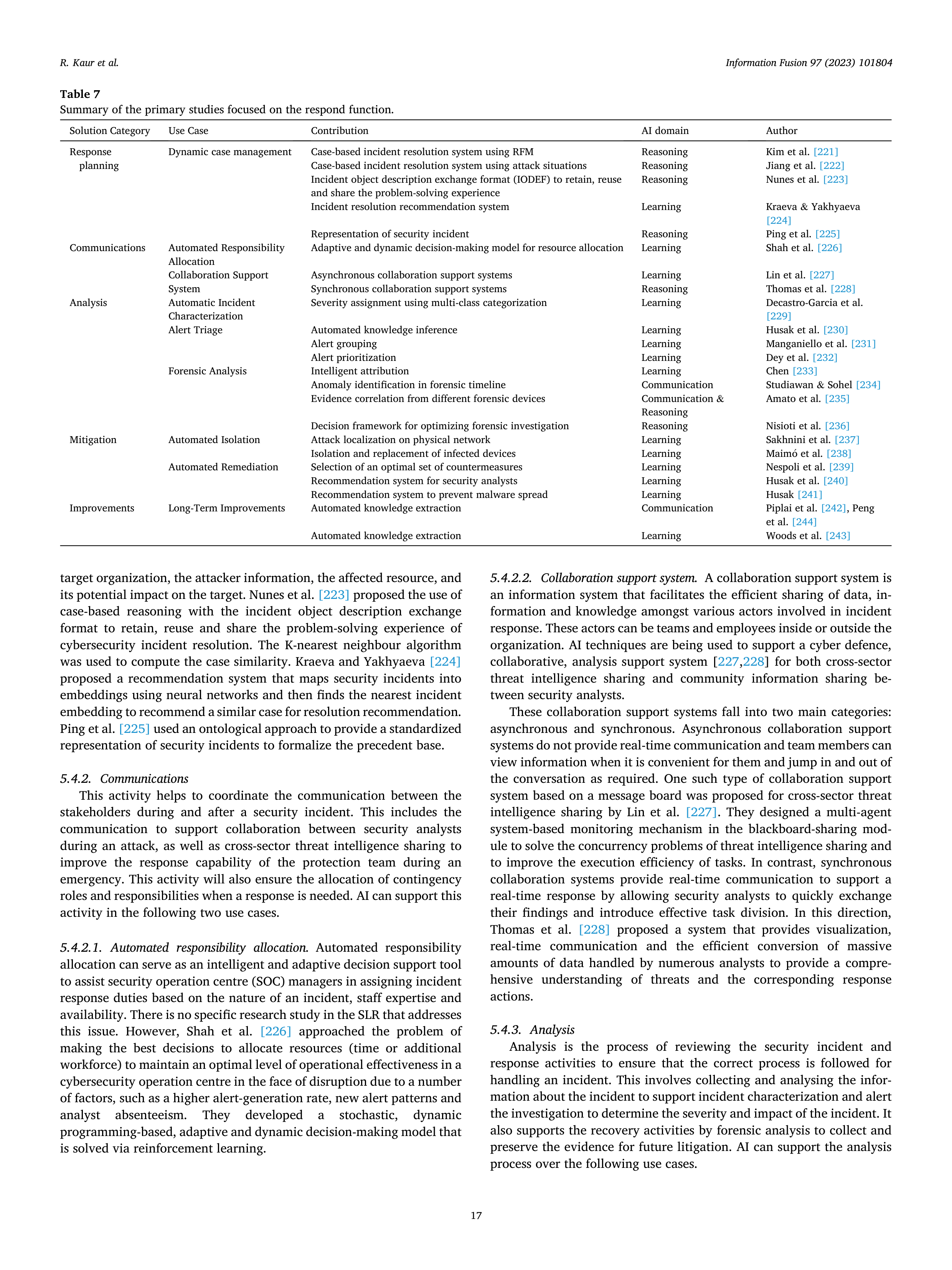
Information Fusion 97 (2023) 101804
17
target organization, the attacker information, the affected resource, and
its potential impact on the target. Nunes et al.
[223]
proposed the use of
case-based reasoning with the incident object description exchange
format to retain, reuse and share the problem-solving experience of
cybersecurity incident resolution. The K-nearest neighbour algorithm
was used to compute the case similarity. Kraeva and Yakhyaeva
[224]
proposed a recommendation system that maps security incidents into
embeddings using neural networks and then finds the nearest incident
embedding to recommend a similar case for resolution recommendation.
Ping et al.
[225]
used an ontological approach to provide a standardized
representation of security incidents to formalize the precedent base.
5.4.2.
Communications
This activity helps to coordinate the communication between the
stakeholders during and after a security incident. This includes the
communication to support collaboration between security analysts
during an attack, as well as cross-sector threat intelligence sharing to
improve the response capability of the protection team during an
emergency. This activity will also ensure the allocation of contingency
roles and responsibilities when a response is needed. AI can support this
activity in the following two use cases.
5.4.2.1.
Automated responsibility allocation.
Automated responsibility
allocation can serve as an intelligent and adaptive decision support tool
to assist security operation centre (SOC) managers in assigning incident
response duties based on the nature of an incident, staff expertise and
availability. There is no specific research study in the SLR that addresses
this issue. However, Shah et al.
[226]
approached the problem of
making the best decisions to allocate resources (time or additional
workforce) to maintain an optimal level of operational effectiveness in a
cybersecurity operation centre in the face of disruption due to a number
of factors, such as a higher alert-generation rate, new alert patterns and
analyst
absenteeism.
They
developed
a
stochastic,
dynamic
programming-based, adaptive and dynamic decision-making model that
is solved via reinforcement learning.
5.4.2.2.
Collaboration support system.
A collaboration support system is
an information system that facilitates the efficient sharing of data, in
formation and knowledge amongst various actors involved in incident
response. These actors can be teams and employees inside or outside the
organization. AI techniques are being used to support a cyber defence,
collaborative, analysis support system [
227
,
228
] for both cross-sector
threat intelligence sharing and community information sharing be
tween security analysts.
These collaboration support systems fall into two main categories:
asynchronous and synchronous. Asynchronous collaboration support
systems do not provide real-time communication and team members can
view information when it is convenient for them and jump in and out of
the conversation as required. One such type of collaboration support
system based on a message board was proposed for cross-sector threat
intelligence sharing by Lin et al.
[227]
. They designed a multi-agent
system-based monitoring mechanism in the blackboard-sharing mod
ule to solve the concurrency problems of threat intelligence sharing and
to improve the execution efficiency of tasks. In contrast, synchronous
collaboration systems provide real-time communication to support a
real-time response by allowing security analysts to quickly exchange
their findings and introduce effective task division. In this direction,
Thomas et al.
[228]
proposed a system that provides visualization,
real-time communication and the efficient conversion of massive
amounts of data handled by numerous analysts to provide a compre
hensive understanding of threats and the corresponding response
actions.
5.4.3.
Analysis
Analysis is the process of reviewing the security incident and
response activities to ensure that the correct process is followed for
handling an incident. This involves collecting and analysing the infor
mation about the incident to support incident characterization and alert
the investigation to determine the severity and impact of the incident. It
also supports the recovery activities by forensic analysis to collect and
preserve the evidence for future litigation. AI can support the analysis
process over the following use cases.
Table 7
Summary of the primary studies focused on the respond function.
Solution Category
Use Case
Contribution
AI domain
Author
Response
planning
Dynamic case management
Case-based incident resolution system using RFM
Reasoning
Kim et al.
[221]
Case-based incident resolution system using attack situations
Reasoning
Jiang et al.
[222]
Incident object description exchange format (IODEF) to retain, reuse
and share the problem-solving experience
Reasoning
Nunes et al.
[223]
Incident resolution recommendation system
Learning
Kraeva
&
Yakhyaeva
[224]
Representation of security incident
Reasoning
Ping et al.
[225]
Communications
Automated Responsibility
Allocation
Adaptive and dynamic decision-making model for resource allocation
Learning
Shah et al.
[226]
Collaboration Support
System
Asynchronous collaboration support systems
Learning
Lin et al.
[227]
Synchronous collaboration support systems
Reasoning
Thomas et al.
[228]
Analysis
Automatic Incident
Characterization
Severity assignment using multi-class categorization
Learning
Decastro-Garcia et al.
[229]
Alert Triage
Automated knowledge inference
Learning
Husak et al.
[230]
Alert grouping
Learning
Manganiello et al.
[231]
Alert prioritization
Learning
Dey et al.
[232]
Forensic Analysis
Intelligent attribution
Learning
Chen
[233]
Anomaly identification in forensic timeline
Communication
Studiawan
&
Sohel
[234]
Evidence correlation from different forensic devices
Communication
&
Reasoning
Amato et al.
[235]
Decision framework for optimizing forensic investigation
Reasoning
Nisioti et al.
[236]
Mitigation
Automated Isolation
Attack localization on physical network
Learning
Sakhnini et al.
[237]
Isolation and replacement of infected devices
Learning
Maim
´
o et al.
[238]
Automated Remediation
Selection of an optimal set of countermeasures
Learning
Nespoli et al.
[239]
Recommendation system for security analysts
Learning
Husak et al.
[240]
Recommendation system to prevent malware spread
Learning
Husak
[241]
Improvements
Long-Term Improvements
Automated knowledge extraction
Communication
Piplai et al.
[242]
, Peng
et al.
[244]
Automated knowledge extraction
Learning
Woods et al.
[243]
R. Kaur et al.
Information Fusion 97 (2023) 101804
18
5.4.3.1.
Automatic incident characterization.
Incident characterization
addresses the processes required to identify the incident category in
accordance with the response plan. This includes the identification of
incident criticality and its relationship with other incidents to auto
matically prioritize the incidents for further investigation. Decastro-
Garcia et al.
[229]
proposed automated, multiclass, categorization
models using machine learning techniques to assign the severity for
different types of cybersecurity events.
5.4.3.2.
Alert triage.
Alert processing and triage is a way of efficiently
and accurately investigating intrusion alerts to prioritize and analyse
their relationship and determine whether or not they will be escalated to
an incident response. AI techniques can be used to enable an effective
alert triage by providing the automated knowledge inference
[230]
,
alert grouping
[231]
and alert prioritization tools
[232]
to identify
threat alerts and escalate them for further investigation.
Knowledge inference is the process of applying logical rules to the
knowledge base in order to evaluate and interpret new information.
Based on this, Husak et al.
[230]
proposed a method that uses sequential
rule mining to extract knowledge from shared intrusion detection alerts
and use it to create predictive and customized blacklists.
Alert grouping and alert prioritization can address the problem of
threat-alert fatigue by aggregating or triaging alerts of significance from
massive threat-alert logs. The use of self-organizing maps and unsu
pervised clustering algorithms was proposed to group the security alerts
that are likely to belong to the same attack scenario
[231]
, while the
notion of an anomaly score for each attribute of analysed events was
defined to measure the priority of security events and find potentially
anomalous events
[232]
.
5.4.3.3.
Forensic analysis.
Forensic analysis is a post-mortem technique
to establish a timeline for the attack and shed light on the extent and
source of the breach, as well as the tools and methods employed to fully
eradicate the threat and prevent it from recurring. This investigation
also connects the dots between the fragments of evidence the attacker
left behind to create a footprint that can be used as evidence in court or
to support a prosecution. AI techniques can be used to help the incident
response team in intelligent attribution
[233]
, anomaly identification in
a forensic timeline
[234]
, evidence correlation from different forensic
devices
[235]
and a decision framework for optimizing forensic inves
tigation
[236]
.
Intelligent attribution helps in inferring the cause of security events
by discovering the relationships between different entities and events.
Contextual based learning can be used to capture the status and offer
hints for source attribution
[233]
.
A forensic timeline provides information about the activities that
occurred prior to, during and following a cybersecurity incident. A se
curity incident documented in the forensic timeline can be considered as
an anomaly that needs to be identified. A deep autoencoder can be used
to build a baseline model for normal events in log files and an anomaly
threshold for reconstructed values based on the constructed baseline to
identify anomalies
[234]
.
The main goal of forensic investigators is to detect and analyse the
fraudulent activities in order to prepare a report for a court case. In
vestigators have various forensic tools at their disposal to examine de
vices, but these tools generate data in different formats and further
complicate the analysis process. Therefore, Amato et al.
[235]
presented
a new semantics-based method that assists forensic investigators during
the analysis process by correlating the evidence found using different
forensic tools.
The emergence of new adversarial techniques and technologies
challenges the ability of a forensic analysis team to investigate incidents
in a timely and effective manner with limited resources. To address these
challenges, a novel model for a decision support system to recommend
inspection actions using threat intelligence information harvested from
the repository of known adversarial tactics, techniques and procedures
for the optimization of forensic investigation was proposed
[236]
. This
model takes into account the probability relationship and proximity
values between the potential attack activities, current investigation
findings, and the available budget for the investigation.
5.4.4.
Mitigation
Mitigation involves a set of activities to prevent the expansion of
security events and remediate their effects to eliminate any long-term
consequences of the security breach. This is a critical step that not
only contains the incident, but also mitigates the new vulnerabilities or
documents them as an accepted risk. The following use cases explain the
use of AI techniques in security incident mitigation.
5.4.4.1.
Automated isolation.
Automated isolation is based on the
principle of automatically isolating a device or set of devices in response
to the detection of an indicator of compromise (IoC). This includes
disconnecting the device or set of devices upon infection or finding the
high-risk infected users to give them more attention. The automated
isolation works by localizing the attack on the physical network and by
isolating or replacing the infected devices or users on the network using
network function virtualization (NFV) and software-defined networking
(SDN).
The localization of an attack to specific features or measurements in
the system is essential to assist cybersecurity professionals in mitigating
the impact of the attack in communication networks by linking the at
tacks to particular locations within the physical system. Sakhnini et al.
[237]
proposed an attack classification and localization model for the
physical layer in the smart grid. The model uses ensemble and repre
sentational learning for attack classification and the implementation of a
Chi-squared algorithm to correlate the attack scenario with the specific
features and localize the attack to a set of specific measurements or a
specific location in the system.
A real-time mitigation system is also needed in integrated clinical
environments to deal with cybersecurity incidents quickly and effi
ciently. Maimo et al.
[238]
have proposed the use of machine learning
techniques to detect and categorize the spread phase of ransomware
attacks and the use of the NFV and SDN paradigms to contain ransom
ware propagation by isolating and replacing the infected devices.
5.4.4.2.
Automated remediation.
Automated remediation is a guided
problem resolution process that automatically performs remedial ac
tions with simple scripts or powerful context-aware recommendation
systems. AI techniques are being used to select the optimal set of
countermeasures for threat elimination
[239]
, in recommendation sys
tems to assist security analysts with a resilient configuration and the
orchestration of security tools
[240]
, and for tracing the attacker
’
s
lateral movement
[241]
.
Developing rapid and effective response capabilities against disrup
tive cyberattacks is a fundamental pillar of defensive cybersecurity, and
the selection of the best set of countermeasures to respond to threats is
an important research problem in determining the best reaction in a
fully automatic fashion. Nespoli et al.
[239]
proposed a new cyberse
curity reaction technique based on artificial immune systems to select
and enforce the best combination of atomic countermeasures for the
assets of the protected system that are exposed to risk.
Another important research problem are decision support systems
and intelligent recommender systems that can help security analysts
quickly and effectively defend resources and services against cyber
attacks. Recently, Husak et al.
[240]
proposed a recommender system to
suggest the most robust configuration for a critical infrastructure and
then orchestrate the network security tools for rapid mitigation mea
sures. The recommendation system was used to swiftly stop the spread of
malware or to track the lateral movement of the attacker
[241]
.
R. Kaur et al.
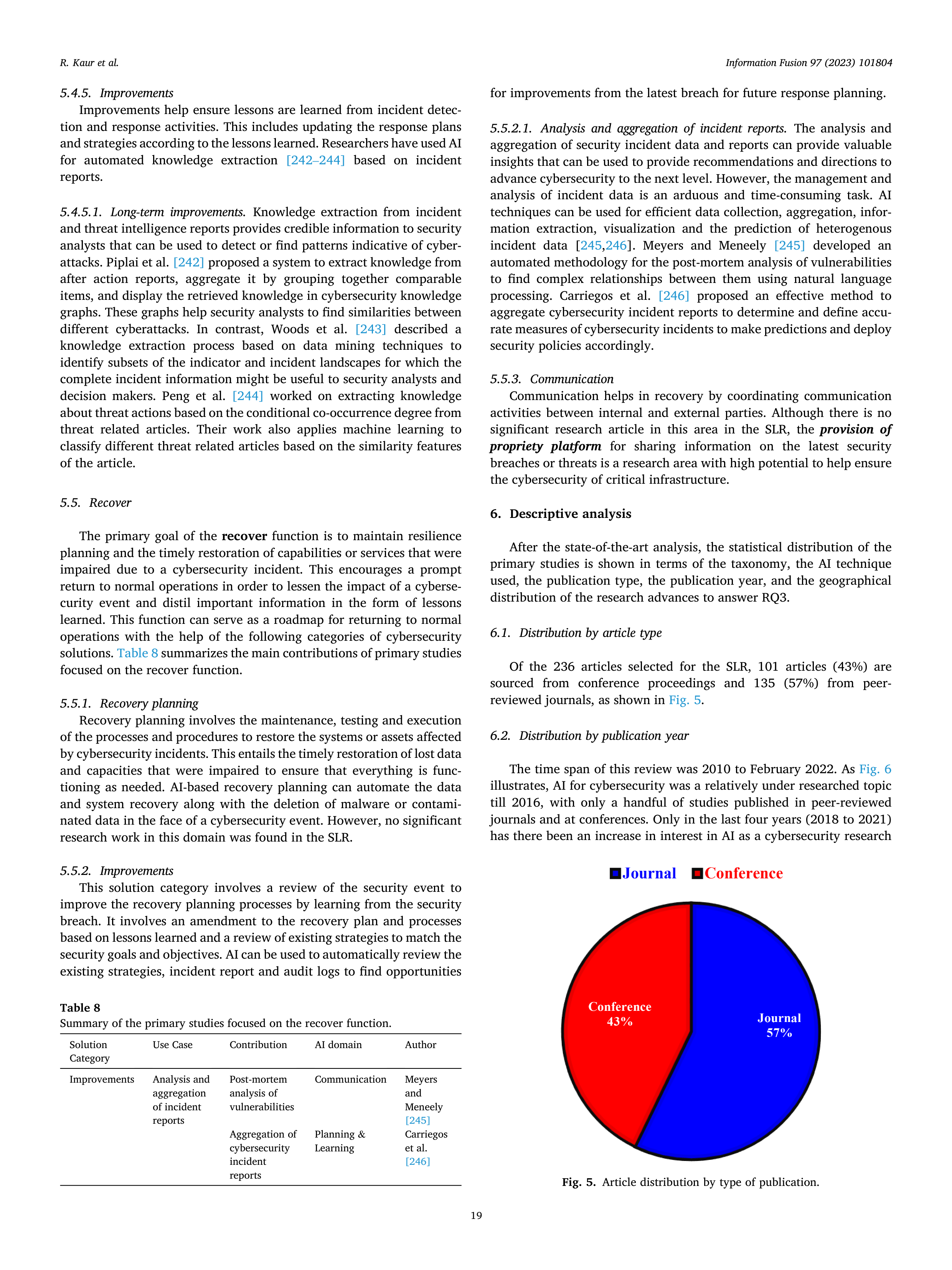
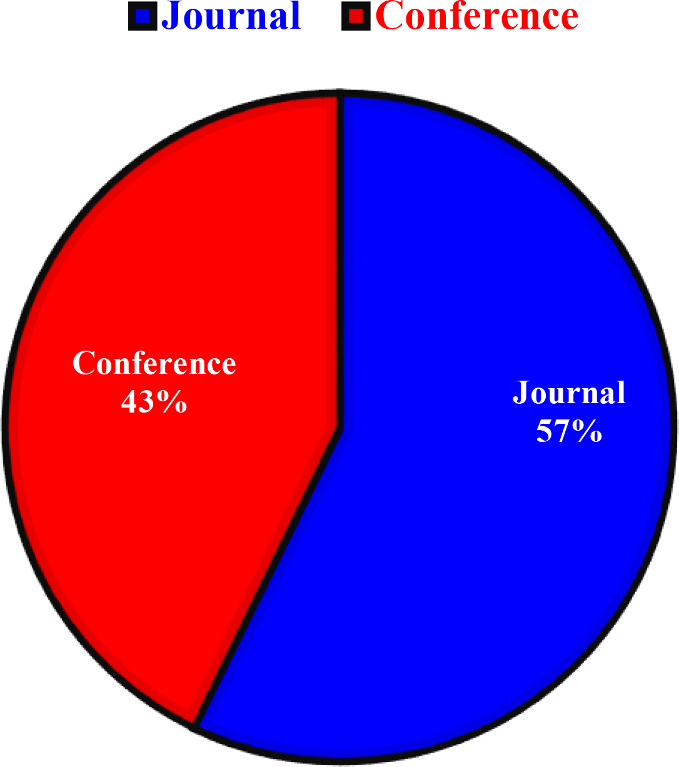
Information Fusion 97 (2023) 101804
19
5.4.5.
Improvements
Improvements help ensure lessons are learned from incident detec
tion and response activities. This includes updating the response plans
and strategies according to the lessons learned. Researchers have used AI
for automated knowledge extraction
[242
–
244]
based on incident
reports.
5.4.5.1.
Long-term improvements.
Knowledge extraction from incident
and threat intelligence reports provides credible information to security
analysts that can be used to detect or find patterns indicative of cyber
attacks. Piplai et al.
[242]
proposed a system to extract knowledge from
after action reports, aggregate it by grouping together comparable
items, and display the retrieved knowledge in cybersecurity knowledge
graphs. These graphs help security analysts to find similarities between
different cyberattacks. In contrast, Woods et al.
[243]
described a
knowledge extraction process based on data mining techniques to
identify subsets of the indicator and incident landscapes for which the
complete incident information might be useful to security analysts and
decision makers. Peng et al.
[244]
worked on extracting knowledge
about threat actions based on the conditional co-occurrence degree from
threat related articles. Their work also applies machine learning to
classify different threat related articles based on the similarity features
of the article.
5.5.
Recover
The primary goal of the
recover
function is to maintain resilience
planning and the timely restoration of capabilities or services that were
impaired due to a cybersecurity incident. This encourages a prompt
return to normal operations in order to lessen the impact of a cyberse
curity event and distil important information in the form of lessons
learned. This function can serve as a roadmap for returning to normal
operations with the help of the following categories of cybersecurity
solutions.
Table 8
summarizes the main contributions of primary studies
focused on the recover function.
5.5.1.
Recovery planning
Recovery planning involves the maintenance, testing and execution
of the processes and procedures to restore the systems or assets affected
by cybersecurity incidents. This entails the timely restoration of lost data
and capacities that were impaired to ensure that everything is func
tioning as needed. AI-based recovery planning can automate the data
and system recovery along with the deletion of malware or contami
nated data in the face of a cybersecurity event. However, no significant
research work in this domain was found in the SLR.
5.5.2.
Improvements
This solution category involves a review of the security event to
improve the recovery planning processes by learning from the security
breach. It involves an amendment to the recovery plan and processes
based on lessons learned and a review of existing strategies to match the
security goals and objectives. AI can be used to automatically review the
existing strategies, incident report and audit logs to find opportunities
for improvements from the latest breach for future response planning.
5.5.2.1.
Analysis and aggregation of incident reports.
The analysis and
aggregation of security incident data and reports can provide valuable
insights that can be used to provide recommendations and directions to
advance cybersecurity to the next level. However, the management and
analysis of incident data is an arduous and time-consuming task. AI
techniques can be used for efficient data collection, aggregation, infor
mation extraction, visualization and the prediction of heterogenous
incident data [
245
,
246
]. Meyers and Meneely
[245]
developed an
automated methodology for the post-mortem analysis of vulnerabilities
to find complex relationships between them using natural language
processing. Carriegos et al.
[246]
proposed an effective method to
aggregate cybersecurity incident reports to determine and define accu
rate measures of cybersecurity incidents to make predictions and deploy
security policies accordingly.
5.5.3.
Communication
Communication helps in recovery by coordinating communication
activities between internal and external parties. Although there is no
significant research article in this area in the SLR, the
provision of
propriety platform
for sharing information on the latest security
breaches or threats is a research area with high potential to help ensure
the cybersecurity of critical infrastructure.
6.
Descriptive analysis
After the state-of-the-art analysis, the statistical distribution of the
primary studies is shown in terms of the taxonomy, the AI technique
used, the publication type, the publication year, and the geographical
distribution of the research advances to answer RQ3.
6.1.
Distribution by article type
Of the 236 articles selected for the SLR, 101 articles (43%) are
sourced from conference proceedings and 135 (57%) from peer-
reviewed journals, as shown in
Fig. 5
.
6.2.
Distribution by publication year
The time span of this review was 2010 to February 2022. As
Fig. 6
illustrates, AI for cybersecurity was a relatively under researched topic
till 2016, with only a handful of studies published in peer-reviewed
journals and at conferences. Only in the last four years (2018 to 2021)
has there been an increase in interest in AI as a cybersecurity research
Table 8
Summary of the primary studies focused on the recover function.
Solution
Category
Use Case
Contribution
AI domain
Author
Improvements
Analysis and
aggregation
of incident
reports
Post-mortem
analysis of
vulnerabilities
Communication
Meyers
and
Meneely
[245]
Aggregation of
cybersecurity
incident
reports
Planning
&
Learning
Carriegos
et al.
[246]
Fig. 5.
Article distribution by type of publication.
R. Kaur et al.
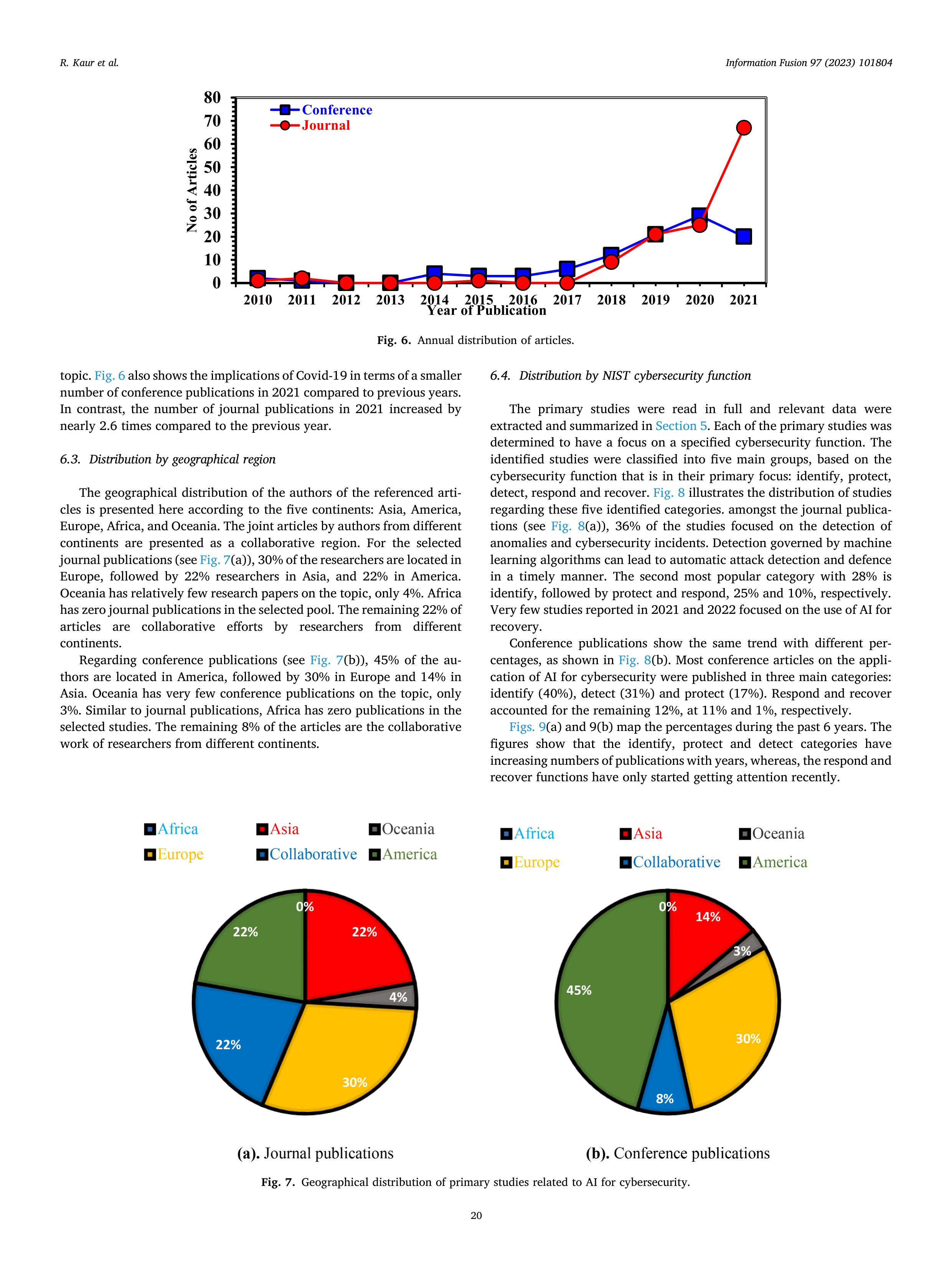
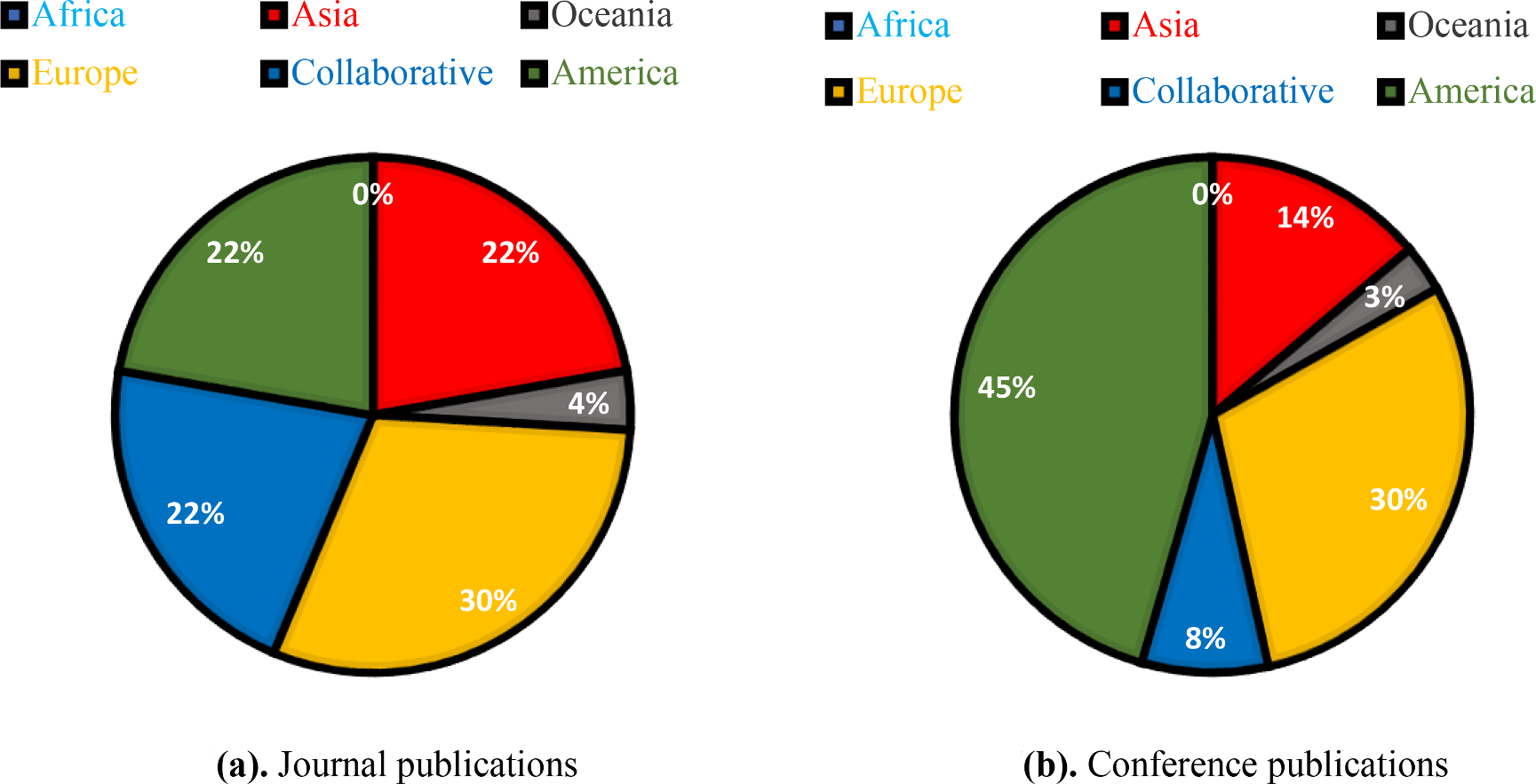
Information Fusion 97 (2023) 101804
20
topic.
Fig. 6
also shows the implications of Covid-19 in terms of a smaller
number of conference publications in 2021 compared to previous years.
In contrast, the number of journal publications in 2021 increased by
nearly 2.6 times compared to the previous year.
6.3.
Distribution by geographical region
The geographical distribution of the authors of the referenced arti
cles is presented here according to the five continents: Asia, America,
Europe, Africa, and Oceania. The joint articles by authors from different
continents are presented as a collaborative region. For the selected
journal publications (see
Fig. 7
(a)), 30% of the researchers are located in
Europe, followed by 22% researchers in Asia, and 22% in America.
Oceania has relatively few research papers on the topic, only 4%. Africa
has zero journal publications in the selected pool. The remaining 22% of
articles are collaborative efforts by researchers from different
continents.
Regarding conference publications (see
Fig. 7
(b)), 45% of the au
thors are located in America, followed by 30% in Europe and 14% in
Asia. Oceania has very few conference publications on the topic, only
3%. Similar to journal publications, Africa has zero publications in the
selected studies. The remaining 8% of the articles are the collaborative
work of researchers from different continents.
6.4.
Distribution by NIST cybersecurity function
The primary studies were read in full and relevant data were
extracted and summarized in
Section 5
. Each of the primary studies was
determined to have a focus on a specified cybersecurity function. The
identified studies were classified into five main groups, based on the
cybersecurity function that is in their primary focus: identify, protect,
detect, respond and recover.
Fig. 8
illustrates the distribution of studies
regarding these five identified categories. amongst the journal publica
tions (see
Fig. 8
(a)), 36% of the studies focused on the detection of
anomalies and cybersecurity incidents. Detection governed by machine
learning algorithms can lead to automatic attack detection and defence
in a timely manner. The second most popular category with 28% is
identify, followed by protect and respond, 25% and 10%, respectively.
Very few studies reported in 2021 and 2022 focused on the use of AI for
recovery.
Conference publications show the same trend with different per
centages, as shown in
Fig. 8
(b). Most conference articles on the appli
cation of AI for cybersecurity were published in three main categories:
identify (40%), detect (31%) and protect (17%). Respond and recover
accounted for the remaining 12%, at 11% and 1%, respectively.
Figs. 9
(a) and 9(b) map the percentages during the past 6 years. The
figures show that the identify, protect and detect categories have
increasing numbers of publications with years, whereas, the respond and
recover functions have only started getting attention recently.
0
10
20
30
40
50
60
70
80
2010
2011
2012
2013
2014
2015
2016
2017
2018
2019
2020
2021
No of Articles
Year of Publication
Conference
Journal
Fig. 6.
Annual distribution of articles.
Fig. 7.
Geographical distribution of primary studies related to AI for cybersecurity.
R. Kaur et al.
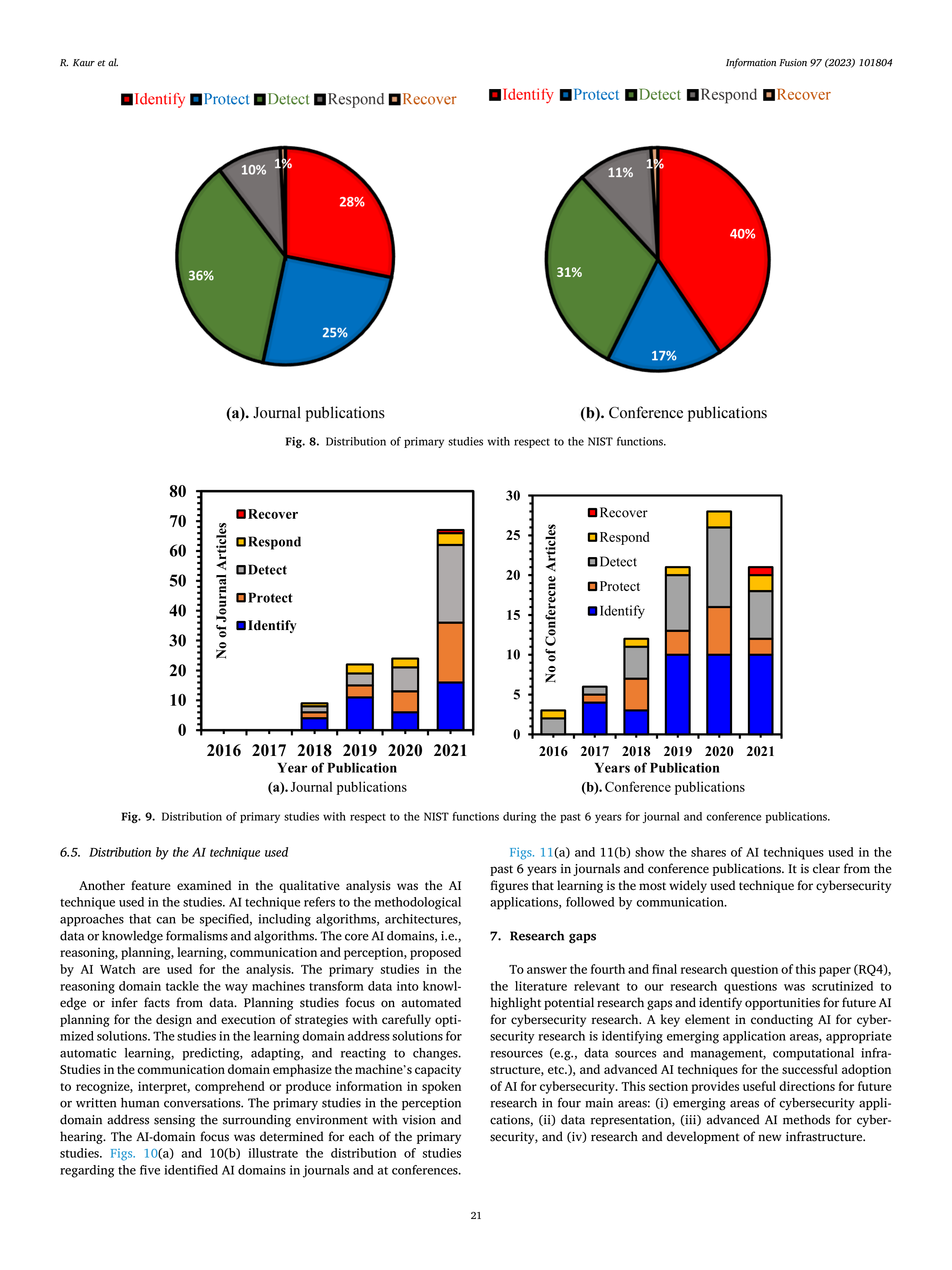
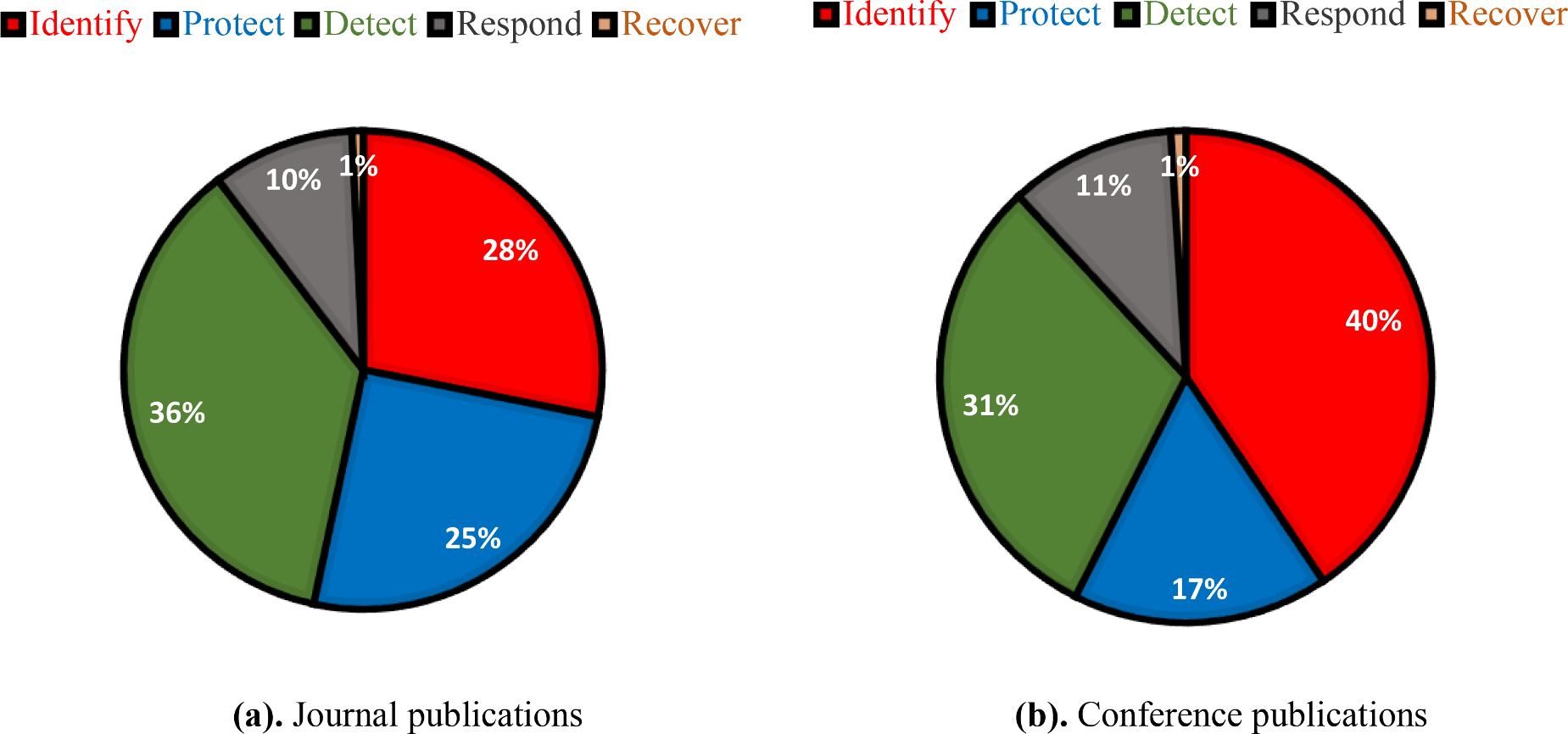
Information Fusion 97 (2023) 101804
21
6.5.
Distribution by the AI technique used
Another feature examined in the qualitative analysis was the AI
technique used in the studies. AI technique refers to the methodological
approaches that can be specified, including algorithms, architectures,
data or knowledge formalisms and algorithms. The core AI domains, i.e.,
reasoning, planning, learning, communication and perception, proposed
by AI Watch are used for the analysis. The primary studies in the
reasoning domain tackle the way machines transform data into knowl
edge or infer facts from data. Planning studies focus on automated
planning for the design and execution of strategies with carefully opti
mized solutions. The studies in the learning domain address solutions for
automatic learning, predicting, adapting, and reacting to changes.
Studies in the communication domain emphasize the machine
’
s capacity
to recognize, interpret, comprehend or produce information in spoken
or written human conversations. The primary studies in the perception
domain address sensing the surrounding environment with vision and
hearing. The AI-domain focus was determined for each of the primary
studies.
Figs. 10
(a) and 10(b) illustrate the distribution of studies
regarding the five identified AI domains in journals and at conferences.
Figs. 11
(a) and 11(b) show the shares of AI techniques used in the
past 6 years in journals and conference publications. It is clear from the
figures that learning is the most widely used technique for cybersecurity
applications, followed by communication.
7.
Research gaps
To answer the fourth and final research question of this paper (RQ4),
the literature relevant to our research questions was scrutinized to
highlight potential research gaps and identify opportunities for future AI
for cybersecurity research. A key element in conducting AI for cyber
security research is identifying emerging application areas, appropriate
resources (e.g., data sources and management, computational infra
structure, etc.), and advanced AI techniques for the successful adoption
of AI for cybersecurity. This section provides useful directions for future
research in four main areas: (i) emerging areas of cybersecurity appli
cations, (ii) data representation, (iii) advanced AI methods for cyber
security, and (iv) research and development of new infrastructure.
Fig. 8.
Distribution of primary studies with respect to the NIST functions.
(a).
Journal publications
(b).
Conference publications
0
10
20
30
40
50
60
70
80
2016
2017
2018
2019
2020
2021
s
elcitr
A
la
n
r
u
o
J
f
o
o
N
Year of Publication
Recover
Respond
Detect
Protect
Identify
0
5
10
15
20
25
30
2016
2017
2018
2019
2020
2021
No of Conferecne Articles
Years of Publication
Recover
Respond
Detect
Protect
Identify
Fig. 9.
Distribution of primary studies with respect to the NIST functions during the past 6 years for journal and conference publications.
R. Kaur et al.
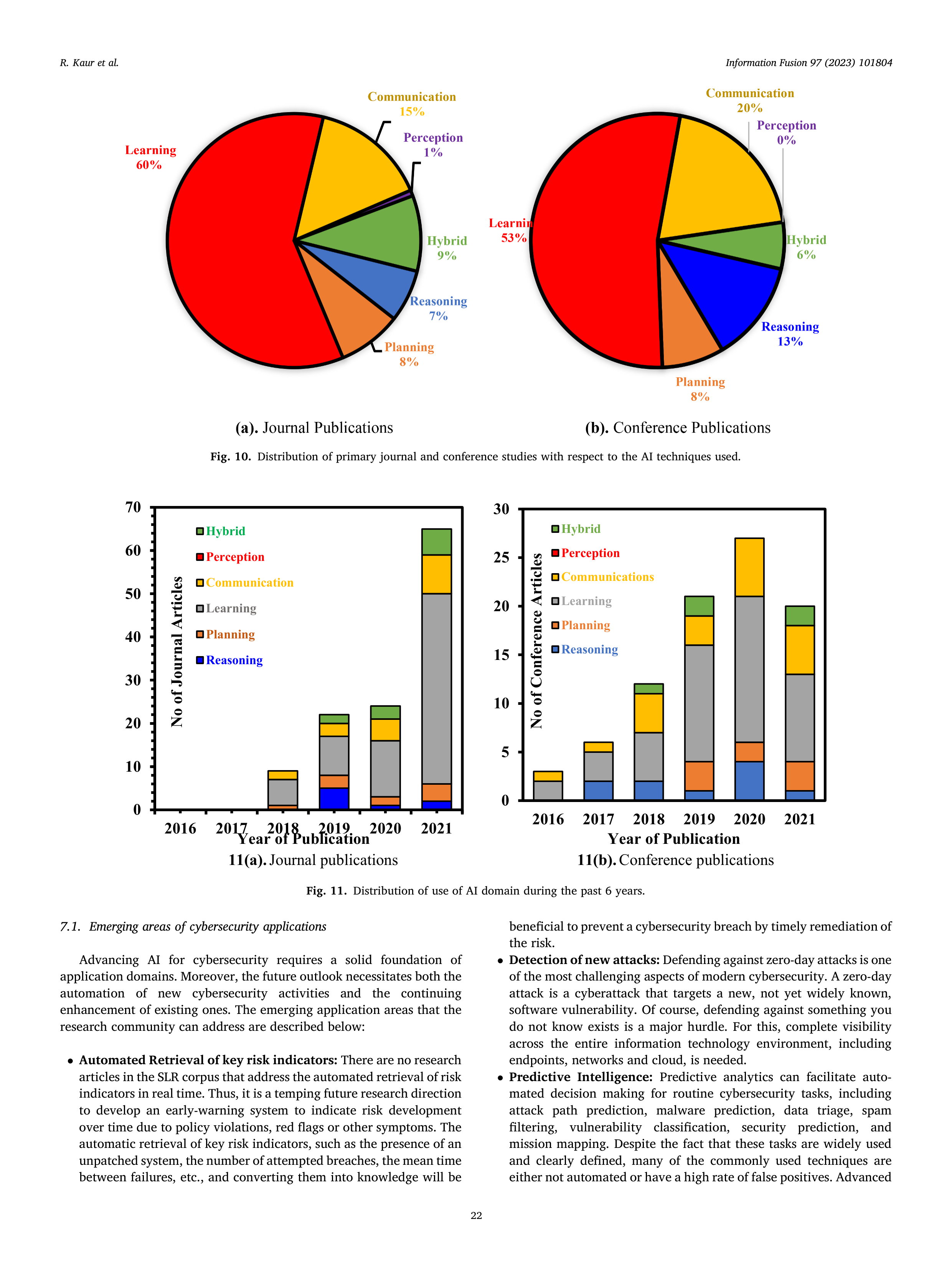
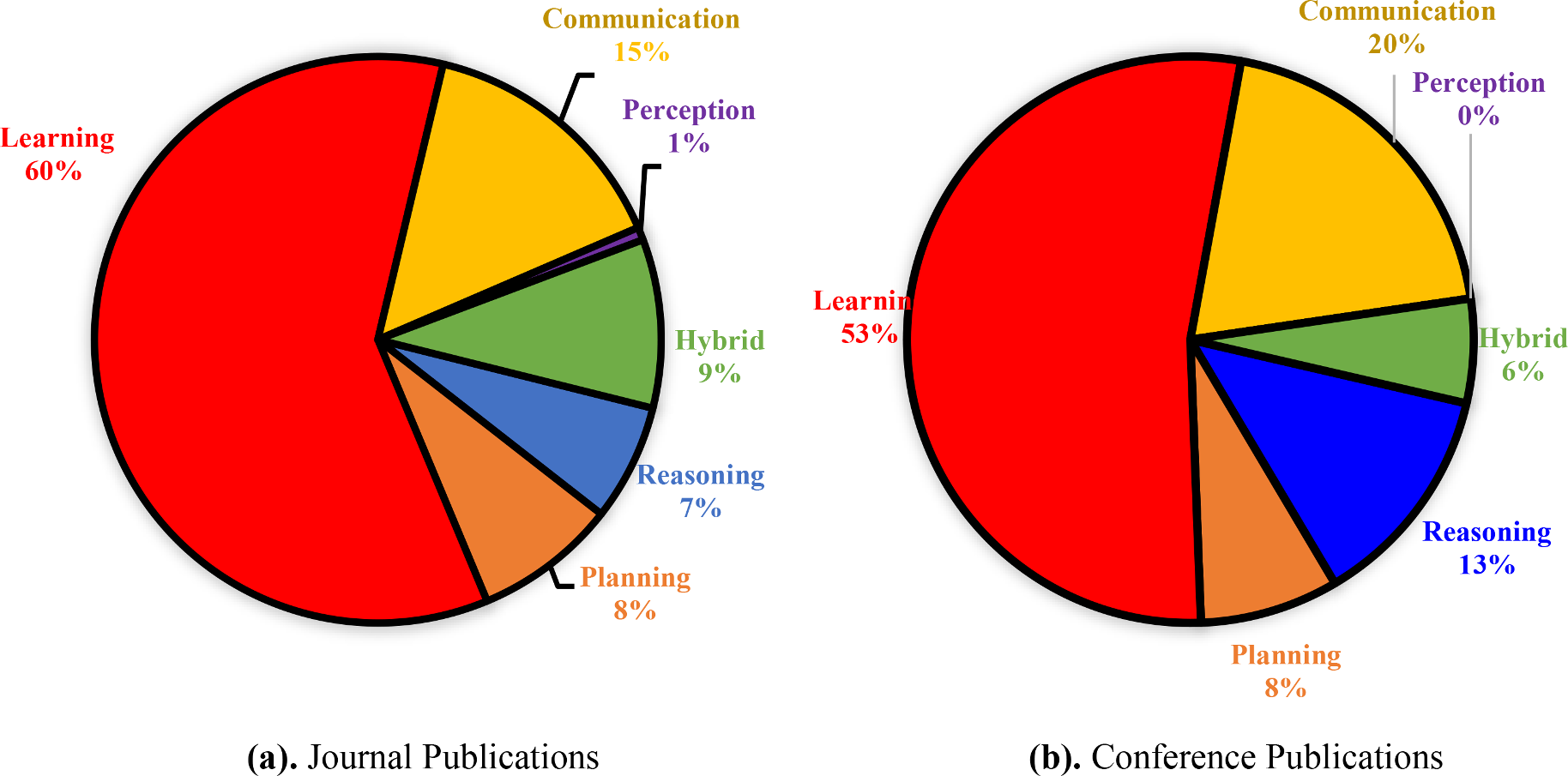
Information Fusion 97 (2023) 101804
22
7.1.
Emerging areas of cybersecurity applications
Advancing AI for cybersecurity requires a solid foundation of
application domains. Moreover, the future outlook necessitates both the
automation of new cybersecurity activities and the continuing
enhancement of existing ones. The emerging application areas that the
research community can address are described below:
•
Automated Retrieval of key risk indicators:
There are no research
articles in the SLR corpus that address the automated retrieval of risk
indicators in real time. Thus, it is a temping future research direction
to develop an early-warning system to indicate risk development
over time due to policy violations, red flags or other symptoms. The
automatic retrieval of key risk indicators, such as the presence of an
unpatched system, the number of attempted breaches, the mean time
between failures, etc., and converting them into knowledge will be
beneficial to prevent a cybersecurity breach by timely remediation of
the risk.
•
Detection of new attacks:
Defending against zero-day attacks is one
of the most challenging aspects of modern cybersecurity. A zero-day
attack is a cyberattack that targets a new, not yet widely known,
software vulnerability. Of course, defending against something you
do not know exists is a major hurdle. For this, complete visibility
across the entire information technology environment, including
endpoints, networks and cloud, is needed.
•
Predictive Intelligence:
Predictive analytics can facilitate auto
mated decision making for routine cybersecurity tasks, including
attack path prediction, malware prediction, data triage, spam
filtering, vulnerability classification, security prediction, and
mission mapping. Despite the fact that these tasks are widely used
and clearly defined, many of the commonly used techniques are
either not automated or have a high rate of false positives. Advanced
Fig. 10.
Distribution of primary journal and conference studies with respect to the AI techniques used.
11(a).
Journal publications
11(b).
Conference publications
0
10
20
30
40
50
60
70
2016
2017
2018
2019
2020
2021
s
elcitr
A
la
n
r
u
o
J
f
o
o
N
Year of Publication
Hybrid
Perception
Communication
Learning
Planning
Reasoning
0
5
10
15
20
25
30
2016
2017
2018
2019
2020
2021
No of Conference Articles
Year of Publication
Hybrid
Perception
Communications
Learning
Planning
Reasoning
Fig. 11.
Distribution of use of AI domain during the past 6 years.
R. Kaur et al.
Information Fusion 97 (2023) 101804
23
AI-based predictive analytics can be used to help tackle some of these
particular issues. Deep Bayesian forecasting, burst detection, deep
generative modelling with temporal constraints, time-based neural
graph networks, and other techniques are amongst the promising
predictive analytics techniques. Each strategy can be improved by
incorporating industry-specific policies, information, tasks and
needs. Security operation centre (SOC) analysts and CTI pro
fessionals, particularly those at the tactical and operational levels
inside their businesses, are amongst those who can profit from
improved forecasts.
•
Multi-lingual threat intelligence:
In the SLR corpus, only one study
analysed the threat intelligence understanding across unfamiliar
languages. The multi-lingual nature of the internet makes it more
challenging for the cybersecurity community to continue to strate
gically mine threat intelligence from social media, blogs and dark
web markets. Non-English-speaking nations are both the top sources
and the top targets of cyberattacks, according to the Symantec
research
[247]
. Therefore, studies should be conducted utilizing
datasets with non-English content to assess the effectiveness of text
mining in other languages. Additionally, the majority of
pre-processing tools and libraries only support the English language.
New research can provide tools that target other languages or create
language translators for private security settings.
•
AI-powered Cyber Defence and Resilience:
Organizations can
apply the right security controls automatically using data from their
analytics. Examples include automated threat modelling, automated
patching, automated remediation and mitigation, and automated
network segmentation and reorganization. SOC analysts and opera
tors can benefit greatly from intelligent job automation. Enhanced AI
agents, reinforcement learning, actor critical networks, selected
defensive, adversarial learning techniques, and Bayesian networks
are some of the modern AI techniques that enable these tasks. Future
studies can examine how each technique can produce suitable cyber
protection for various industries (e.g., scientific cyber infrastructure,
enterprise IT, sensor-based environments, etc.).
•
Data Breach Prevention and Discovery:
In recent years the prev
alence of data breaches has resulted in losses for both businesses and
consumers. This topic needs to receive considerable attention from
cybersecurity researchers as the majority of the existing research
concentrates on observing the behaviour and activities of insiders or
the analysis of telemetry from endpoints to detect the presence of
insider threats and advanced persistent threats (APTs). However, the
research on the identification of sensitive data to prevent accidental
data exposure is still lacking. The machine learning, and natural
language processing-based AI techniques can be used for sensitive
data discovery, as well as monitoring and control of the data flow
across end points to prevent or analyse the data leakages in big-data
scenarios. The studies should also consider the analysis of dark
websites to discover any accidental data exposure so as to regain
control and save the reputation.
•
Fake Document Generation
: The protection of critical digital assets
such as intellectual property and national security data is of utmost
importance in this era of cyberwarfare. In the SLR corpus only one
study reported the use of the automated generation of believable and
interactive fake documents to protect critical documents after a
network
’
s penetration. This fake document generation using AI is a
relatively new concept to safeguard sensitive material by falsifying
the information to create numerous fake versions of any document.
Thus, this topic needs to receive increased attention from the
cybersecurity community.
•
Context driven Alert Processing
&
Triage:
Thousands of warnings
and events that are meticulously gathered for threat analysis over
whelm security teams every day, necessitating the attention of
experienced threat intelligence experts. Current research articles
have attempted to overcome this problem using high-level manage
ment to correlate security alerts, considering their logical
relationship, including their prioritization, before forwarding them
to users. However, they still lack consideration of different event
contexts in a particular network environment. Researchers can use
different language models to implement representation learning for
the event context and work on developing adaptive methods for
dynamic network environments. In addition, further efforts are
needed in the area of data visualization and online update capacity to
visualize the relationships between alerts and develop an efficient
triage system for alerts.
•
AI-Powered Incident Response:
As the typical time an attacker
needs from initial compromise to complete takeover of an enter
prise
’
s infrastructures has been greatly shortened, it is also critical to
automate response efforts to effectively mitigate, contain or outsmart
attacks. Incident response process automation requires the docu
mentation of knowledge acquired from past security incidents and
events triggered by the application of a particular solution along with
the recording of new threat patterns and their traits over time. This
knowledge can then be used to create automated incident response
playbooks that can make recommendations, conduct resource allo
cation or allocate responsibilities based on their expertise, avail
ability or case history. These automated security playbooks will fuel
the proactive defence and help in staying ahead of increasingly so
phisticated and ever-evolving threats. Moreover, in future, the
sharing of these standardized security playbooks on threat intelli
gence platforms will allow different organizations to consume such
information in response to an incident at a machine time.
7.2.
Data representation
For AI to be effective, it is crucial to have good data. The biggest
challenges are the selection of appropriate datasets for training and
handling the variety and velocity of the data. Therefore, the importance
of data representation and quality, recency mining, and context
awareness for the training and modelling of AI models for cybersecurity
applications is described below:
•
Refined Data Representations.
The representation of data is crit
ical to the performance of AI algorithms. A flattened feature vector is
the most popular method for describing cybersecurity so far. Despite
being widely used, this method ignores important linkages that are
evident in the data it depicts (e.g., sequences). For this reason, this
representation, when used in production contexts, can produce
noticeably worse outcomes. Future researchers in AI for cyberse
curity could carefully evaluate how cybersecurity data exists in the
environment they are interested in and carefully choose a suitable
alternative that best depicts the phenomenon of interest to mitigate
this difficulty. For instance, file systems and applications within
virtual machines can be visualized as both trees or graphs to capture
their dependencies (due to their hierarchical nature). Grids, se
quences and non-Euclidean representations are additional potential
representations (e.g., tensors, cubes). Additionally, key data prop
erties, organizational needs, and pertinent social behavioural eco
nomics theories may all be taken into consideration when choosing
an acceptable representation.
•
Context-awareness in cybersecurity:
Current research on cyber
security typically starts with the pertinent cyber data, which contains
several low-level features. Such datasets can be used to apply data
mining and machine learning approaches to find a coherent pattern
that accurately explains them. However, to decide whether or not
suspicious activity is present, broader contextual information such as
temporal and spatial relationships between events, or connections
and dependencies can be used. For instance, while security pro
fessionals may not view individual connections as malevolent, other
methodologies may classify them as DoS assaults. Therefore, the
inability to foresee dangers or assaults using contextual knowledge is
a significant weakness of earlier efforts in cybersecurity. Context-
R. Kaur et al.
Information Fusion 97 (2023) 101804
24
aware adaptive cybersecurity solutions could therefore be another
study area in the field of AI for cybersecurity research.
•
Incremental Learning
&
Recency Mining:
To provide data-driven
decisions, machine learning-based security models often use a lot of
static data. However, the behaviour patterns of users and malicious
adversaries might not be static and can vary greatly over time.
Therefore, for predictive analytics in tackling common cybersecurity
tasks, like data triage, spam filter, vulnerability categorization and
mission mapping, recent behavioural patterns and accompanying
machine learning rules are more likely to be interesting and signifi
cant than older ones. As a result, another challenge in AI for cyber
security research could be effectively applying the idea of recency
analysis in cybersecurity solutions.
7.3.
Advanced AI methods for cybersecurity
The more sophisticated AI techniques are needed to realize the full
potential of the aforementioned data sources, application areas and data
representations. amongst the many alternatives, three crucial new
techniques
–
multiple data source analysis, explainable AI (XAI), and
augmented intelligence (human-AI interfaces)
–
can have a major
impact on the development of practical and useable AI for cybersecurity.
•
Multiple Data Source Analysis:
A major drawback of the current AI
research and practice landscape for cybersecurity is the isolated use
of individual datasets. This is frequently brought on by a lack of
access to multiple datasets (common in academics) or a failure to
comprehend the relationships between different datasets. A lack of
simultaneous processing of multiple datasets can lead to an incom
plete assessment of the environment. Future AI research for cyber
security could try to take advantage of the characteristics of different
data sources in a more comprehensive way to address this problem.
Entity matching based on deep learning, short-text matching algo
rithms (like deep structured semantic models), multi-view methods
(like multi-source), and multi-task learning techniques are the
promising approaches for multiple data source analysis. The suc
cessful fusion of multiple datasets can lead to newly derived attri
butes,
enhanced
risk
management
(such
as
vulnerability
assessments), and a comprehensive understanding of an organiza
tion
’
s cybersecurity posture.
•
Application of Explainable AI (XAI):
Knowing how and why an
algorithm made its initial conclusion is crucial in the field of
cybersecurity. Unfortunately, current AI-based algorithms lack
transparency in their decision-making process. Despite offering
unparalleled performance in high-impact cybersecurity applications
like dark web investigations, vulnerability assessments, and others,
they are notorious for their "black box" nature. Future AI research for
cybersecurity can look at how interpretable and explicable AI can
improve an algorithm
’
s performance and open their black-box
character to minimize these constraints, increasing their accep
tance and trustworthiness for important cybersecurity stakeholders.
•
Augmented Intelligence
(Human-AI Interfaces): According to many
cybersecurity experts, AI-based algorithms and systems should not
be used exclusively for cybersecurity decision-making. Instead, to
enable better decision-making processes, AI-based approaches
should be firmly interwoven with human action (for instance, having
a security analyst as an active member in the analysis process). These
methods, also referred to as augmented intelligence or human-AI
interfaces, have the potential to significantly outperform the use of
an algorithm or a single human. The breadth, scope and depth of
human-AI interaction in critical and fundamental cybersecurity tasks
has not yet been adequately researched, but this is sorely needed.
Such research would necessarily need to take a multidisciplinary
approach, specifically incorporating perspectives from psychology,
cognitive science, human-computer interaction, and other fields.
7.4.
Research
&
development of a new infrastructure
AI is gradually becoming a crucial component of cybersecurity to
benefit organizations of all sizes and in a variety of industries to increase
the efficiency of their cybersecurity. Therefore, it is necessary to
research and develop new infrastructures to support the AI technology
by dealing with enormous volumes of internal system data along with
external security research feeds to provide the real-time cybersecurity
considering global and internal security events. Key research gaps for
the successful implementation of AI in cybersecurity by organizations
and cybersecurity researchers are described below:
•
Lack of threat intelligence platforms (at national and interna
tional levels):
Cyber reality is very complicated and dynamic; there
are always new threats, and attacks are specifically designed to
circumvent a known potential scenario. Therefore, propriety plat
forms are needed to enable collaboration between designated peers
to discuss and share the latest threat data. The design of threat in
telligence platforms to offer a flexible, adaptable and networked
method of sharing threat information that relies mostly, but not
exclusively, on designated information sharing hubs at national and
international levels is lacking at present. The government, owners
and operators of critical infrastructure, as well as other entities, will
benefit from the effective and efficient sharing of accurate, usable,
timely, and relevant threat information shared by threats intelli
gence platforms. By enhancing situational awareness and facilitating
effective risk-informed decision-making, such sharing improves the
security and dependability of critical infrastructure.
•
Lack of new, real-time or broader datasets:
Datasets are the most
important component in AI for cybersecurity. The majority of the
available datasets are outdated and might not be sufficient to
comprehend the most recent behavioural patterns of different
cyberattacks. This survey noticed that many studies applied the AI
techniques to the same dataset. For example, most studies used
DARPA98, KDD99, NSLKDD, and CICIDS2017 for detection. These
studies clearly lack an evaluation of their techniques using the most
recent and different datasets. Additionally, the validation of specific
context-research across numerous datasets enables analysis across
different scenarios.
8.
Limitations
The presented SLR provides valuable information on the intersection
between cybersecurity and AI techniques, along with the identification
of research gaps to feed future research. Nevertheless, our study misses
the articles that are published in scientific databases other than Scopus
or used different keywords. Also, recent publications (after February
2022) are not included in the studied literature due to time spent on
analysing the selected primary studies to obtain reliable results.
9.
Conclusions
This SLR study examines the current state-of-the-art research on AI
applications for cybersecurity. This was achieved by identifying 236
primary studies out of 2395 related articles from the Scopus database
over a 13-year period (2010 to February 2022). The presented study
discusses the different AI techniques applied in the cybersecurity
domain and which cybersecurity activities have taken advantage of the
AI technology. The selected literature is analysed in terms of (i) the
presented taxonomy of AI in cybersecurity, (ii) the frequency of publi
cation by year, (iii) the frequency of publication by geographical region,
(iv) the cybersecurity contribution type, and (v) the type of AI technique
used.
This SLR examined the
“
how
”
and
“
what
”
of the existing research on
AI applied to cybersecurity with an in-depth exploration of specific use
cases and the theoretical basis of the research. This study contributes to
R. Kaur et al.
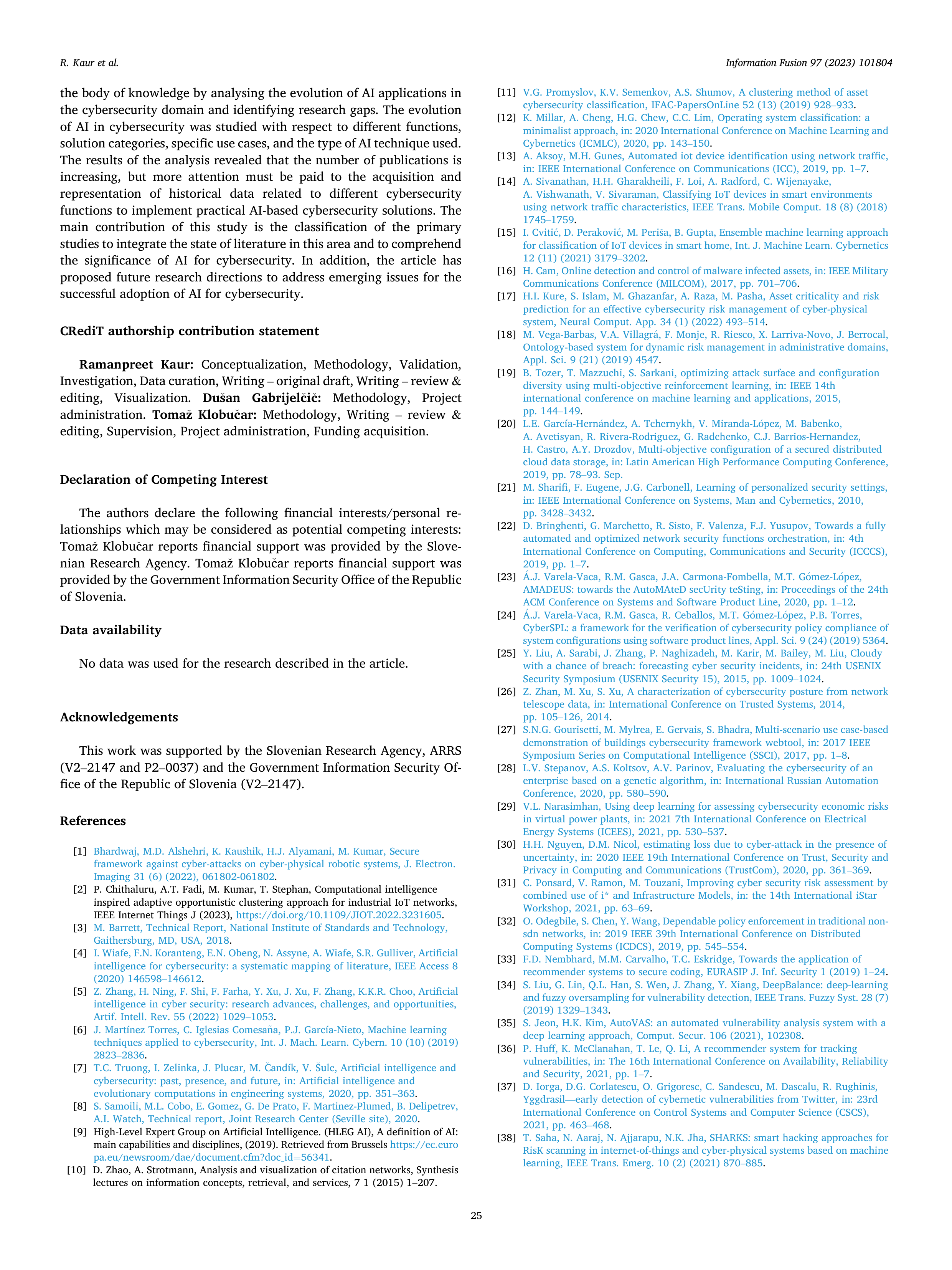
Information Fusion 97 (2023) 101804
25
the body of knowledge by analysing the evolution of AI applications in
the cybersecurity domain and identifying research gaps. The evolution
of AI in cybersecurity was studied with respect to different functions,
solution categories, specific use cases, and the type of AI technique used.
The results of the analysis revealed that the number of publications is
increasing, but more attention must be paid to the acquisition and
representation of historical data related to different cybersecurity
functions to implement practical AI-based cybersecurity solutions. The
main contribution of this study is the classification of the primary
studies to integrate the state of literature in this area and to comprehend
the significance of AI for cybersecurity. In addition, the article has
proposed future research directions to address emerging issues for the
successful adoption of AI for cybersecurity.
CRediT authorship contribution statement
Ramanpreet Kaur:
Conceptualization, Methodology, Validation,
Investigation, Data curation, Writing
–
original draft, Writing
–
review
&
editing, Visualization.
Du
ˇ
san Gabrijel
ˇ
ci
ˇ
c:
Methodology, Project
administration.
Toma
ˇ
z Klobu
ˇ
car:
Methodology, Writing
–
review
&
editing, Supervision, Project administration, Funding acquisition.
Declaration of Competing Interest
The authors declare the following financial interests/personal re
lationships which may be considered as potential competing interests:
Toma
ˇ
z Klobu
ˇ
car reports financial support was provided by the Slove
nian Research Agency. Toma
ˇ
z Klobu
ˇ
car reports financial support was
provided by the Government Information Security Office of the Republic
of Slovenia.
Data availability
No data was used for the research described in the article.
Acknowledgements
This work was supported by the Slovenian Research Agency, ARRS
(V2
–
2147 and P2
–
0037) and the Government Information Security Of
fice of the Republic of Slovenia (V2
–
2147).
References
[1]
Bhardwaj, M.D. Alshehri, K. Kaushik, H.J. Alyamani, M. Kumar, Secure
framework against cyber-attacks on cyber-physical robotic systems, J. Electron.
Imaging 31 (6) (2022), 061802-061802
.
[2]
P. Chithaluru, A.T. Fadi, M. Kumar, T. Stephan, Computational intelligence
inspired adaptive opportunistic clustering approach for industrial IoT networks,
IEEE Internet Things J (2023),
https://doi.org/10.1109/JIOT.2022.3231605
.
[3]
M. Barrett, Technical Report, National Institute of Standards and Technology,
Gaithersburg, MD, USA, 2018
.
[4]
I. Wiafe, F.N. Koranteng, E.N. Obeng, N. Assyne, A. Wiafe, S.R. Gulliver, Artificial
intelligence for cybersecurity: a systematic mapping of literature, IEEE Access 8
(2020) 146598
–
146612
.
[5]
Z. Zhang, H. Ning, F. Shi, F. Farha, Y. Xu, J. Xu, F. Zhang, K.K.R. Choo, Artificial
intelligence in cyber security: research advances, challenges, and opportunities,
Artif. Intell. Rev. 55 (2022) 1029
–
1053
.
[6]
J. Martínez Torres, C. Iglesias Comesa
˜
na, P.J. García-Nieto, Machine learning
techniques applied to cybersecurity, Int. J. Mach. Learn. Cybern. 10 (10) (2019)
2823
–
2836
.
[7]
T.C. Truong, I. Zelinka, J. Plucar, M.
ˇ
Candík, V.
ˇ
Sulc, Artificial intelligence and
cybersecurity: past, presence, and future, in: Artificial intelligence and
evolutionary computations in engineering systems, 2020, pp. 351
–
363
.
[8]
S. Samoili, M.L. Cobo, E. Gomez, G. De Prato, F. Martinez-Plumed, B. Delipetrev,
A.I. Watch, Technical report, Joint Research Center (Seville site), 2020
.
[9]
High-Level Expert Group on Artificial Intelligence. (HLEG AI), A definition of AI:
main capabilities and disciplines, (2019). Retrieved from Brussels
https://ec.euro
pa.eu/newsroom/dae/document.cfm?doc_id
=
56341
.
[10]
D. Zhao, A. Strotmann, Analysis and visualization of citation networks, Synthesis
lectures on information concepts, retrieval, and services, 7 1 (2015) 1
–
207.
[11]
V.G. Promyslov, K.V. Semenkov, A.S. Shumov, A clustering method of asset
cybersecurity classification, IFAC-PapersOnLine 52 (13) (2019) 928
–
933
.
[12]
K. Millar, A. Cheng, H.G. Chew, C.C. Lim, Operating system classification: a
minimalist approach, in: 2020 International Conference on Machine Learning and
Cybernetics (ICMLC), 2020, pp. 143
–
150
.
[13]
A. Aksoy, M.H. Gunes, Automated iot device identification using network traffic,
in: IEEE International Conference on Communications (ICC), 2019, pp. 1
–
7
.
[14]
A. Sivanathan, H.H. Gharakheili, F. Loi, A. Radford, C. Wijenayake,
A. Vishwanath, V. Sivaraman, Classifying IoT devices in smart environments
using network traffic characteristics, IEEE Trans. Mobile Comput. 18 (8) (2018)
1745
–
1759
.
[15]
I. Cviti
´
c, D. Perakovi
´
c, M. Peri
ˇ
sa, B. Gupta, Ensemble machine learning approach
for classification of IoT devices in smart home, Int. J. Machine Learn. Cybernetics
12 (11) (2021) 3179
–
3202
.
[16]
H. Cam, Online detection and control of malware infected assets, in: IEEE Military
Communications Conference (MILCOM), 2017, pp. 701
–
706
.
[17]
H.I. Kure, S. Islam, M. Ghazanfar, A. Raza, M. Pasha, Asset criticality and risk
prediction for an effective cybersecurity risk management of cyber-physical
system, Neural Comput. App. 34 (1) (2022) 493
–
514
.
[18]
M. Vega-Barbas, V.A. Villagr
´
a, F. Monje, R. Riesco, X. Larriva-Novo, J. Berrocal,
Ontology-based system for dynamic risk management in administrative domains,
Appl. Sci. 9 (21) (2019) 4547
.
[19]
B. Tozer, T. Mazzuchi, S. Sarkani, optimizing attack surface and configuration
diversity using multi-objective reinforcement learning, in: IEEE 14th
international conference on machine learning and applications, 2015,
pp. 144
–
149
.
[20]
L.E. García-Hern
´
andez, A. Tchernykh, V. Miranda-L
´
opez, M. Babenko,
A. Avetisyan, R. Rivera-Rodriguez, G. Radchenko, C.J. Barrios-Hernandez,
H. Castro, A.Y. Drozdov, Multi-objective configuration of a secured distributed
cloud data storage, in: Latin American High Performance Computing Conference,
2019, pp. 78
–
93. Sep.
[21]
M. Sharifi, F. Eugene, J.G. Carbonell, Learning of personalized security settings,
in: IEEE International Conference on Systems, Man and Cybernetics, 2010,
pp. 3428
–
3432
.
[22]
D. Bringhenti, G. Marchetto, R. Sisto, F. Valenza, F.J. Yusupov, Towards a fully
automated and optimized network security functions orchestration, in: 4th
International Conference on Computing, Communications and Security (ICCCS),
2019, pp. 1
–
7
.
[23]
´
A.J. Varela-Vaca, R.M. Gasca, J.A. Carmona-Fombella, M.T. G
´
omez-L
´
opez,
AMADEUS: towards the AutoMAteD secUrity teSting, in: Proceedings of the 24th
ACM Conference on Systems and Software Product Line, 2020, pp. 1
–
12
.
[24]
´
A.J. Varela-Vaca, R.M. Gasca, R. Ceballos, M.T. G
´
omez-L
´
opez, P.B. Torres,
CyberSPL: a framework for the verification of cybersecurity policy compliance of
system configurations using software product lines, Appl. Sci. 9 (24) (2019) 5364
.
[25]
Y. Liu, A. Sarabi, J. Zhang, P. Naghizadeh, M. Karir, M. Bailey, M. Liu, Cloudy
with a chance of breach: forecasting cyber security incidents, in: 24th USENIX
Security Symposium (USENIX Security 15), 2015, pp. 1009
–
1024
.
[26]
Z. Zhan, M. Xu, S. Xu, A characterization of cybersecurity posture from network
telescope data, in: International Conference on Trusted Systems, 2014,
pp. 105
–
126, 2014
.
[27]
S.N.G. Gourisetti, M. Mylrea, E. Gervais, S. Bhadra, Multi-scenario use case-based
demonstration of buildings cybersecurity framework webtool, in: 2017 IEEE
Symposium Series on Computational Intelligence (SSCI), 2017, pp. 1
–
8
.
[28]
L.V. Stepanov, A.S. Koltsov, A.V. Parinov, Evaluating the cybersecurity of an
enterprise based on a genetic algorithm, in: International Russian Automation
Conference, 2020, pp. 580
–
590
.
[29]
V.L. Narasimhan, Using deep learning for assessing cybersecurity economic risks
in virtual power plants, in: 2021 7th International Conference on Electrical
Energy Systems (ICEES), 2021, pp. 530
–
537
.
[30]
H.H. Nguyen, D.M. Nicol, estimating loss due to cyber-attack in the presence of
uncertainty, in: 2020 IEEE 19th International Conference on Trust, Security and
Privacy in Computing and Communications (TrustCom), 2020, pp. 361
–
369
.
[31]
C. Ponsard, V. Ramon, M. Touzani, Improving cyber security risk assessment by
combined use of i* and Infrastructure Models, in: the 14th International iStar
Workshop, 2021, pp. 63
–
69
.
[32]
O. Odegbile, S. Chen, Y. Wang, Dependable policy enforcement in traditional non-
sdn networks, in: 2019 IEEE 39th International Conference on Distributed
Computing Systems (ICDCS), 2019, pp. 545
–
554
.
[33]
F.D. Nembhard, M.M. Carvalho, T.C. Eskridge, Towards the application of
recommender systems to secure coding, EURASIP J. Inf. Security 1 (2019) 1
–
24
.
[34]
S. Liu, G. Lin, Q.L. Han, S. Wen, J. Zhang, Y. Xiang, DeepBalance: deep-learning
and fuzzy oversampling for vulnerability detection, IEEE Trans. Fuzzy Syst. 28 (7)
(2019) 1329
–
1343
.
[35]
S. Jeon, H.K. Kim, AutoVAS: an automated vulnerability analysis system with a
deep learning approach, Comput. Secur. 106 (2021), 102308
.
[36]
P. Huff, K. McClanahan, T. Le, Q. Li, A recommender system for tracking
vulnerabilities, in: The 16th International Conference on Availability, Reliability
and Security, 2021, pp. 1
–
7
.
[37]
D. Iorga, D.G. Corlatescu, O. Grigoresc, C. Sandescu, M. Dascalu, R. Rughinis,
Yggdrasil
—
early detection of cybernetic vulnerabilities from Twitter, in: 23rd
International Conference on Control Systems and Computer Science (CSCS),
2021, pp. 463
–
468
.
[38]
T. Saha, N. Aaraj, N. Ajjarapu, N.K. Jha, SHARKS: smart hacking approaches for
RisK scanning in internet-of-things and cyber-physical systems based on machine
learning, IEEE Trans. Emerg. 10 (2) (2021) 870
–
885
.
R. Kaur et al.
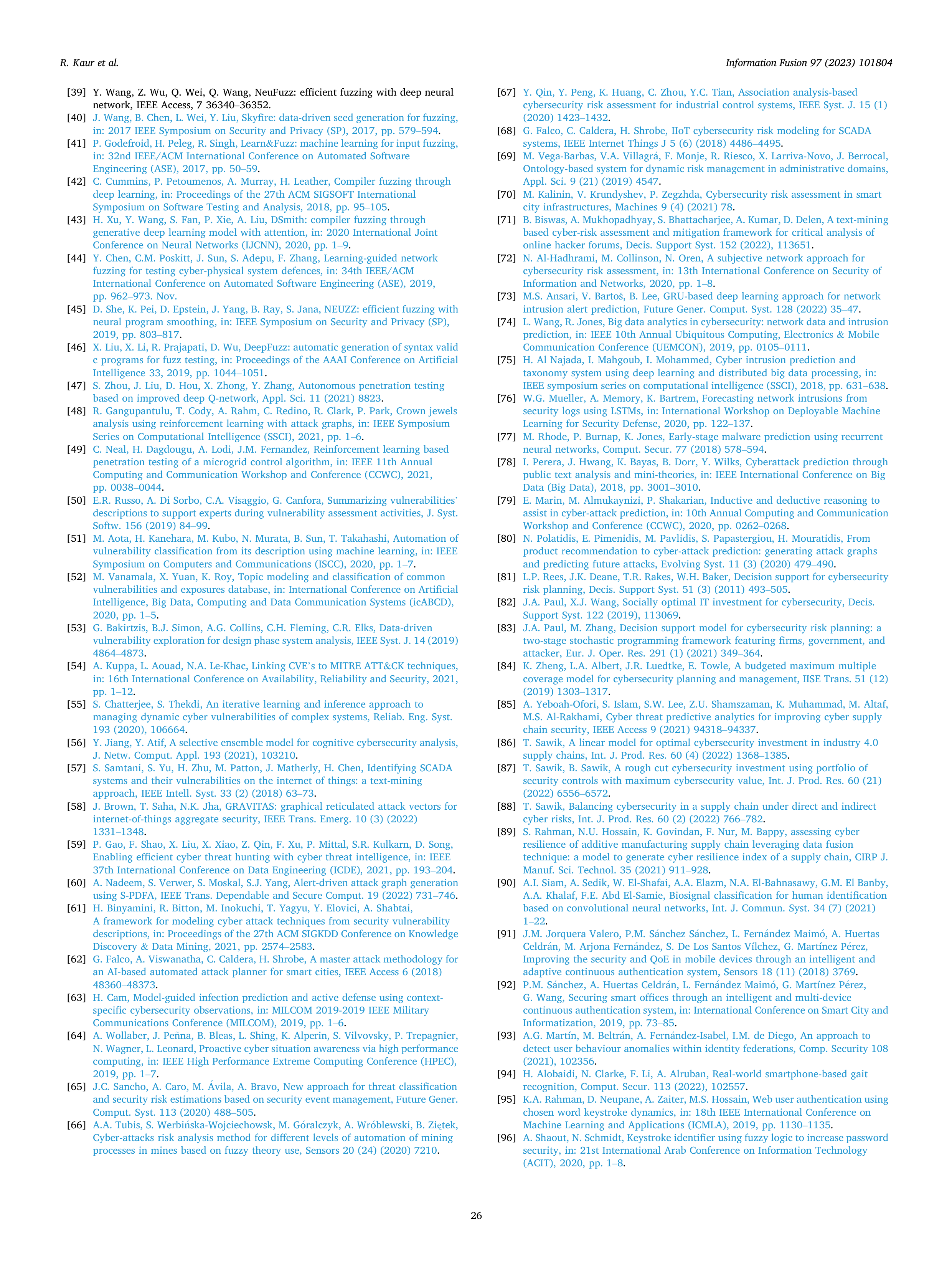
Information Fusion 97 (2023) 101804
26
[39]
Y. Wang, Z. Wu, Q. Wei, Q. Wang, NeuFuzz: efficient fuzzing with deep neural
network, IEEE Access, 7 36340
–
36352.
[40]
J. Wang, B. Chen, L. Wei, Y. Liu, Skyfire: data-driven seed generation for fuzzing,
in: 2017 IEEE Symposium on Security and Privacy (SP), 2017, pp. 579
–
594
.
[41]
P. Godefroid, H. Peleg, R. Singh, Learn
&
Fuzz: machine learning for input fuzzing,
in: 32nd IEEE/ACM International Conference on Automated Software
Engineering (ASE), 2017, pp. 50
–
59
.
[42]
C. Cummins, P. Petoumenos, A. Murray, H. Leather, Compiler fuzzing through
deep learning, in: Proceedings of the 27th ACM SIGSOFT International
Symposium on Software Testing and Analysis, 2018, pp. 95
–
105
.
[43]
H. Xu, Y. Wang, S. Fan, P. Xie, A. Liu, DSmith: compiler fuzzing through
generative deep learning model with attention, in: 2020 International Joint
Conference on Neural Networks (IJCNN), 2020, pp. 1
–
9
.
[44]
Y. Chen, C.M. Poskitt, J. Sun, S. Adepu, F. Zhang, Learning-guided network
fuzzing for testing cyber-physical system defences, in: 34th IEEE/ACM
International Conference on Automated Software Engineering (ASE), 2019,
pp. 962
–
973. Nov.
[45]
D. She, K. Pei, D. Epstein, J. Yang, B. Ray, S. Jana, NEUZZ: efficient fuzzing with
neural program smoothing, in: IEEE Symposium on Security and Privacy (SP),
2019, pp. 803
–
817
.
[46]
X. Liu, X. Li, R. Prajapati, D. Wu, DeepFuzz: automatic generation of syntax valid
c programs for fuzz testing, in: Proceedings of the AAAI Conference on Artificial
Intelligence 33, 2019, pp. 1044
–
1051
.
[47]
S. Zhou, J. Liu, D. Hou, X. Zhong, Y. Zhang, Autonomous penetration testing
based on improved deep Q-network, Appl. Sci. 11 (2021) 8823
.
[48]
R. Gangupantulu, T. Cody, A. Rahm, C. Redino, R. Clark, P. Park, Crown jewels
analysis using reinforcement learning with attack graphs, in: IEEE Symposium
Series on Computational Intelligence (SSCI), 2021, pp. 1
–
6
.
[49]
C. Neal, H. Dagdougu, A. Lodi, J.M. Fernandez, Reinforcement learning based
penetration testing of a microgrid control algorithm, in: IEEE 11th Annual
Computing and Communication Workshop and Conference (CCWC), 2021,
pp. 0038
–
0044
.
[50]
E.R. Russo, A. Di Sorbo, C.A. Visaggio, G. Canfora, Summarizing vulnerabilities
’
descriptions to support experts during vulnerability assessment activities, J. Syst.
Softw. 156 (2019) 84
–
99
.
[51]
M. Aota, H. Kanehara, M. Kubo, N. Murata, B. Sun, T. Takahashi, Automation of
vulnerability classification from its description using machine learning, in: IEEE
Symposium on Computers and Communications (ISCC), 2020, pp. 1
–
7
.
[52]
M. Vanamala, X. Yuan, K. Roy, Topic modeling and classification of common
vulnerabilities and exposures database, in: International Conference on Artificial
Intelligence, Big Data, Computing and Data Communication Systems (icABCD),
2020, pp. 1
–
5
.
[53]
G. Bakirtzis, B.J. Simon, A.G. Collins, C.H. Fleming, C.R. Elks, Data-driven
vulnerability exploration for design phase system analysis, IEEE Syst. J. 14 (2019)
4864
–
4873
.
[54]
A. Kuppa, L. Aouad, N.A. Le-Khac, Linking CVE
’
s to MITRE ATT
&
CK techniques,
in: 16th International Conference on Availability, Reliability and Security, 2021,
pp. 1
–
12
.
[55]
S. Chatterjee, S. Thekdi, An iterative learning and inference approach to
managing dynamic cyber vulnerabilities of complex systems, Reliab. Eng. Syst.
193 (2020), 106664
.
[56]
Y. Jiang, Y. Atif, A selective ensemble model for cognitive cybersecurity analysis,
J. Netw. Comput. Appl. 193 (2021), 103210
.
[57]
S. Samtani, S. Yu, H. Zhu, M. Patton, J. Matherly, H. Chen, Identifying SCADA
systems and their vulnerabilities on the internet of things: a text-mining
approach, IEEE Intell. Syst. 33 (2) (2018) 63
–
73
.
[58]
J. Brown, T. Saha, N.K. Jha, GRAVITAS: graphical reticulated attack vectors for
internet-of-things aggregate security, IEEE Trans. Emerg. 10 (3) (2022)
1331
–
1348
.
[59]
P. Gao, F. Shao, X. Liu, X. Xiao, Z. Qin, F. Xu, P. Mittal, S.R. Kulkarn, D. Song,
Enabling efficient cyber threat hunting with cyber threat intelligence, in: IEEE
37th International Conference on Data Engineering (ICDE), 2021, pp. 193
–
204
.
[60]
A. Nadeem, S. Verwer, S. Moskal, S.J. Yang, Alert-driven attack graph generation
using S-PDFA, IEEE Trans. Dependable and Secure Comput. 19 (2022) 731
–
746
.
[61]
H. Binyamini, R. Bitton, M. Inokuchi, T. Yagyu, Y. Elovici, A. Shabtai,
A framework for modeling cyber attack techniques from security vulnerability
descriptions, in: Proceedings of the 27th ACM SIGKDD Conference on Knowledge
Discovery
&
Data Mining, 2021, pp. 2574
–
2583
.
[62]
G. Falco, A. Viswanatha, C. Caldera, H. Shrobe, A master attack methodology for
an AI-based automated attack planner for smart cities, IEEE Access 6 (2018)
48360
–
48373
.
[63]
H. Cam, Model-guided infection prediction and active defense using context-
specific cybersecurity observations, in: MILCOM 2019-2019 IEEE Military
Communications Conference (MILCOM), 2019, pp. 1
–
6
.
[64]
A. Wollaber, J. Pe
˜
nna, B. Bleas, L. Shing, K. Alperin, S. Vilvovsky, P. Trepagnier,
N. Wagner, L. Leonard, Proactive cyber situation awareness via high performance
computing, in: IEEE High Performance Extreme Computing Conference (HPEC),
2019, pp. 1
–
7
.
[65]
J.C. Sancho, A. Caro, M.
´
Avila, A. Bravo, New approach for threat classification
and security risk estimations based on security event management, Future Gener.
Comput. Syst. 113 (2020) 488
–
505
.
[66]
A.A. Tubis, S. Werbi
´
nska-Wojciechowsk, M. G
´
oralczyk, A. Wr
´
oblewski, B. Zi
ę
tek,
Cyber-attacks risk analysis method for different levels of automation of mining
processes in mines based on fuzzy theory use, Sensors 20 (24) (2020) 7210
.
[67]
Y. Qin, Y. Peng, K. Huang, C. Zhou, Y.C. Tian, Association analysis-based
cybersecurity risk assessment for industrial control systems, IEEE Syst. J. 15 (1)
(2020) 1423
–
1432
.
[68]
G. Falco, C. Caldera, H. Shrobe, IIoT cybersecurity risk modeling for SCADA
systems, IEEE Internet Things J 5 (6) (2018) 4486
–
4495
.
[69]
M. Vega-Barbas, V.A. Villagr
´
a, F. Monje, R. Riesco, X. Larriva-Novo, J. Berrocal,
Ontology-based system for dynamic risk management in administrative domains,
Appl. Sci. 9 (21) (2019) 4547
.
[70]
M. Kalinin, V. Krundyshev, P. Zegzhda, Cybersecurity risk assessment in smart
city infrastructures, Machines 9 (4) (2021) 78
.
[71]
B. Biswas, A. Mukhopadhyay, S. Bhattacharjee, A. Kumar, D. Delen, A text-mining
based cyber-risk assessment and mitigation framework for critical analysis of
online hacker forums, Decis. Support Syst. 152 (2022), 113651
.
[72]
N. Al-Hadhrami, M. Collinson, N. Oren, A subjective network approach for
cybersecurity risk assessment, in: 13th International Conference on Security of
Information and Networks, 2020, pp. 1
–
8
.
[73]
M.S. Ansari, V. Barto
ˇ
s, B. Lee, GRU-based deep learning approach for network
intrusion alert prediction, Future Gener. Comput. Syst. 128 (2022) 35
–
47
.
[74]
L. Wang, R. Jones, Big data analytics in cybersecurity: network data and intrusion
prediction, in: IEEE 10th Annual Ubiquitous Computing, Electronics
&
Mobile
Communication Conference (UEMCON), 2019, pp. 0105
–
0111
.
[75]
H. Al Najada, I. Mahgoub, I. Mohammed, Cyber intrusion prediction and
taxonomy system using deep learning and distributed big data processing, in:
IEEE symposium series on computational intelligence (SSCI), 2018, pp. 631
–
638
.
[76]
W.G. Mueller, A. Memory, K. Bartrem, Forecasting network intrusions from
security logs using LSTMs, in: International Workshop on Deployable Machine
Learning for Security Defense, 2020, pp. 122
–
137
.
[77]
M. Rhode, P. Burnap, K. Jones, Early-stage malware prediction using recurrent
neural networks, Comput. Secur. 77 (2018) 578
–
594
.
[78]
I. Perera, J. Hwang, K. Bayas, B. Dorr, Y. Wilks, Cyberattack prediction through
public text analysis and mini-theories, in: IEEE International Conference on Big
Data (Big Data), 2018, pp. 3001
–
3010
.
[79]
E. Marin, M. Almukaynizi, P. Shakarian, Inductive and deductive reasoning to
assist in cyber-attack prediction, in: 10th Annual Computing and Communication
Workshop and Conference (CCWC), 2020, pp. 0262
–
0268
.
[80]
N. Polatidis, E. Pimenidis, M. Pavlidis, S. Papastergiou, H. Mouratidis, From
product recommendation to cyber-attack prediction: generating attack graphs
and predicting future attacks, Evolving Syst. 11 (3) (2020) 479
–
490
.
[81]
L.P. Rees, J.K. Deane, T.R. Rakes, W.H. Baker, Decision support for cybersecurity
risk planning, Decis. Support Syst. 51 (3) (2011) 493
–
505
.
[82]
J.A. Paul, X.J. Wang, Socially optimal IT investment for cybersecurity, Decis.
Support Syst. 122 (2019), 113069
.
[83]
J.A. Paul, M. Zhang, Decision support model for cybersecurity risk planning: a
two-stage stochastic programming framework featuring firms, government, and
attacker, Eur. J. Oper. Res. 291 (1) (2021) 349
–
364
.
[84]
K. Zheng, L.A. Albert, J.R. Luedtke, E. Towle, A budgeted maximum multiple
coverage model for cybersecurity planning and management, IISE Trans. 51 (12)
(2019) 1303
–
1317
.
[85]
A. Yeboah-Ofori, S. Islam, S.W. Lee, Z.U. Shamszaman, K. Muhammad, M. Altaf,
M.S. Al-Rakhami, Cyber threat predictive analytics for improving cyber supply
chain security, IEEE Access 9 (2021) 94318
–
94337
.
[86]
T. Sawik, A linear model for optimal cybersecurity investment in industry 4.0
supply chains, Int. J. Prod. Res. 60 (4) (2022) 1368
–
1385
.
[87]
T. Sawik, B. Sawik, A rough cut cybersecurity investment using portfolio of
security controls with maximum cybersecurity value, Int. J. Prod. Res. 60 (21)
(2022) 6556
–
6572
.
[88]
T. Sawik, Balancing cybersecurity in a supply chain under direct and indirect
cyber risks, Int. J. Prod. Res. 60 (2) (2022) 766
–
782
.
[89]
S. Rahman, N.U. Hossain, K. Govindan, F. Nur, M. Bappy, assessing cyber
resilience of additive manufacturing supply chain leveraging data fusion
technique: a model to generate cyber resilience index of a supply chain, CIRP J.
Manuf. Sci. Technol. 35 (2021) 911
–
928
.
[90]
A.I. Siam, A. Sedik, W. El-Shafai, A.A. Elazm, N.A. El-Bahnasawy, G.M. El Banby,
A.A. Khalaf, F.E. Abd El-Samie, Biosignal classification for human identification
based on convolutional neural networks, Int. J. Commun. Syst. 34 (7) (2021)
1
–
22
.
[91]
J.M. Jorquera Valero, P.M. S
´
anchez S
´
anchez, L. Fern
´
andez Maim
´
o, A. Huertas
Celdr
´
an, M. Arjona Fern
´
andez, S. De Los Santos Vílchez, G. Martínez P
´
erez,
Improving the security and QoE in mobile devices through an intelligent and
adaptive continuous authentication system, Sensors 18 (11) (2018) 3769
.
[92]
P.M. S
´
anchez, A. Huertas Celdr
´
an, L. Fern
´
andez Maim
´
o, G. Martínez P
´
erez,
G. Wang, Securing smart offices through an intelligent and multi-device
continuous authentication system, in: International Conference on Smart City and
Informatization, 2019, pp. 73
–
85
.
[93]
A.G. Martín, M. Beltr
´
an, A. Fern
´
andez-Isabel, I.M. de Diego, An approach to
detect user behaviour anomalies within identity federations, Comp. Security 108
(2021), 102356
.
[94]
H. Alobaidi, N. Clarke, F. Li, A. Alruban, Real-world smartphone-based gait
recognition, Comput. Secur. 113 (2022), 102557
.
[95]
K.A. Rahman, D. Neupane, A. Zaiter, M.S. Hossain, Web user authentication using
chosen word keystroke dynamics, in: 18th IEEE International Conference on
Machine Learning and Applications (ICMLA), 2019, pp. 1130
–
1135
.
[96]
A. Shaout, N. Schmidt, Keystroke identifier using fuzzy logic to increase password
security, in: 21st International Arab Conference on Information Technology
(ACIT), 2020, pp. 1
–
8
.
R. Kaur et al.
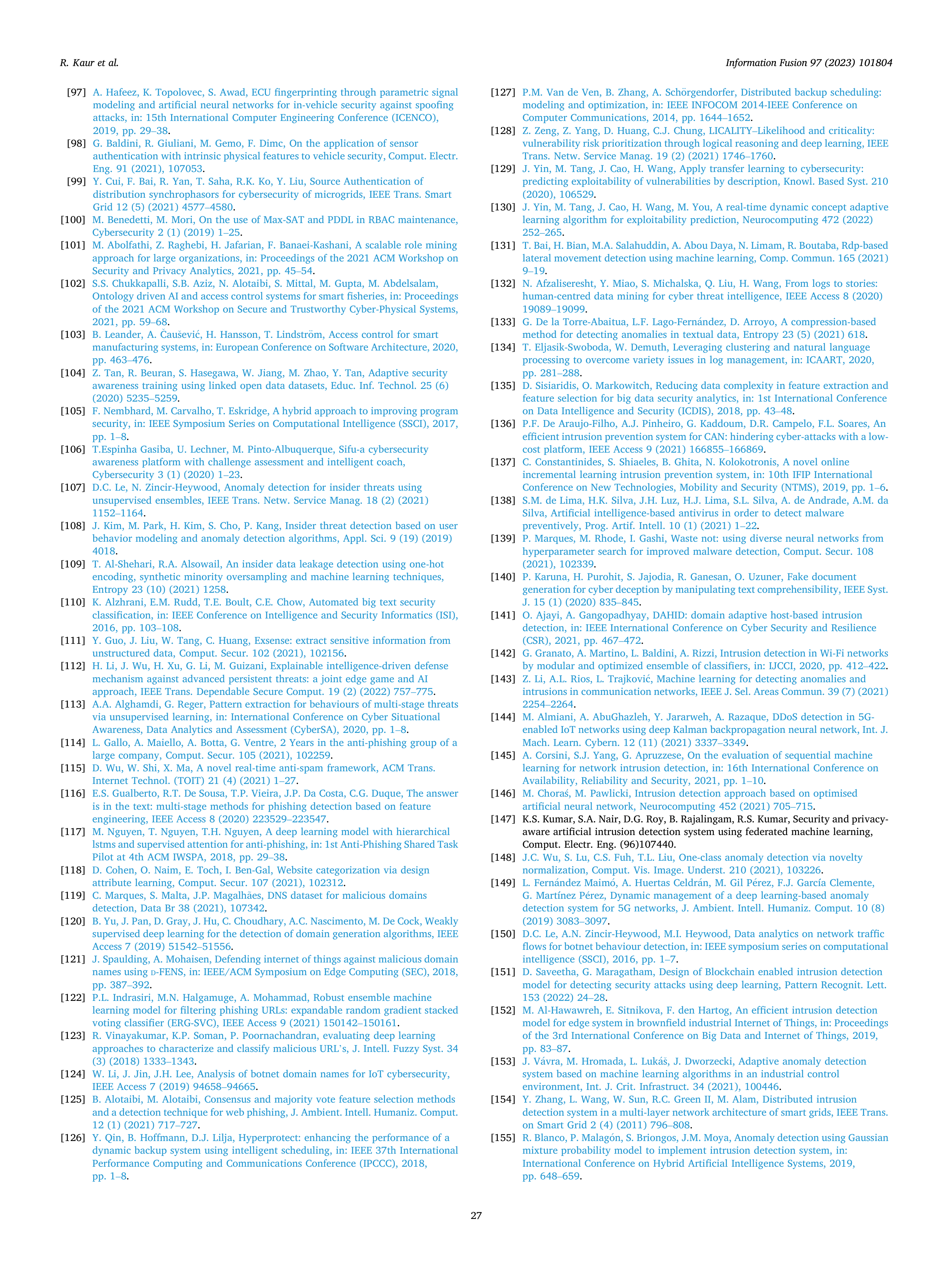
Information Fusion 97 (2023) 101804
27
[97]
A. Hafeez, K. Topolovec, S. Awad, ECU fingerprinting through parametric signal
modeling and artificial neural networks for in-vehicle security against spoofing
attacks, in: 15th International Computer Engineering Conference (ICENCO),
2019, pp. 29
–
38
.
[98]
G. Baldini, R. Giuliani, M. Gemo, F. Dimc, On the application of sensor
authentication with intrinsic physical features to vehicle security, Comput. Electr.
Eng. 91 (2021), 107053
.
[99]
Y. Cui, F. Bai, R. Yan, T. Saha, R.K. Ko, Y. Liu, Source Authentication of
distribution synchrophasors for cybersecurity of microgrids, IEEE Trans. Smart
Grid 12 (5) (2021) 4577
–
4580
.
[100]
M. Benedetti, M. Mori, On the use of Max-SAT and PDDL in RBAC maintenance,
Cybersecurity 2 (1) (2019) 1
–
25
.
[101]
M. Abolfathi, Z. Raghebi, H. Jafarian, F. Banaei-Kashani, A scalable role mining
approach for large organizations, in: Proceedings of the 2021 ACM Workshop on
Security and Privacy Analytics, 2021, pp. 45
–
54
.
[102]
S.S. Chukkapalli, S.B. Aziz, N. Alotaibi, S. Mittal, M. Gupta, M. Abdelsalam,
Ontology driven AI and access control systems for smart fisheries, in: Proceedings
of the 2021 ACM Workshop on Secure and Trustworthy Cyber-Physical Systems,
2021, pp. 59
–
68
.
[103]
B. Leander, A.
ˇ
Cau
ˇ
sevi
´
c, H. Hansson, T. Lindstr
¨
om, Access control for smart
manufacturing systems, in: European Conference on Software Architecture, 2020,
pp. 463
–
476
.
[104]
Z. Tan, R. Beuran, S. Hasegawa, W. Jiang, M. Zhao, Y. Tan, Adaptive security
awareness training using linked open data datasets, Educ. Inf. Technol. 25 (6)
(2020) 5235
–
5259
.
[105]
F. Nembhard, M. Carvalho, T. Eskridge, A hybrid approach to improving program
security, in: IEEE Symposium Series on Computational Intelligence (SSCI), 2017,
pp. 1
–
8
.
[106]
T.Espinha Gasiba, U. Lechner, M. Pinto-Albuquerque, Sifu-a cybersecurity
awareness platform with challenge assessment and intelligent coach,
Cybersecurity 3 (1) (2020) 1
–
23
.
[107]
D.C. Le, N. Zincir-Heywood, Anomaly detection for insider threats using
unsupervised ensembles, IEEE Trans. Netw. Service Manag. 18 (2) (2021)
1152
–
1164
.
[108]
J. Kim, M. Park, H. Kim, S. Cho, P. Kang, Insider threat detection based on user
behavior modeling and anomaly detection algorithms, Appl. Sci. 9 (19) (2019)
4018
.
[109]
T. Al-Shehari, R.A. Alsowail, An insider data leakage detection using one-hot
encoding, synthetic minority oversampling and machine learning techniques,
Entropy 23 (10) (2021) 1258
.
[110]
K. Alzhrani, E.M. Rudd, T.E. Boult, C.E. Chow, Automated big text security
classification, in: IEEE Conference on Intelligence and Security Informatics (ISI),
2016, pp. 103
–
108
.
[111]
Y. Guo, J. Liu, W. Tang, C. Huang, Exsense: extract sensitive information from
unstructured data, Comput. Secur. 102 (2021), 102156
.
[112]
H. Li, J. Wu, H. Xu, G. Li, M. Guizani, Explainable intelligence-driven defense
mechanism against advanced persistent threats: a joint edge game and AI
approach, IEEE Trans. Dependable Secure Comput. 19 (2) (2022) 757
–
775
.
[113]
A.A. Alghamdi, G. Reger, Pattern extraction for behaviours of multi-stage threats
via unsupervised learning, in: International Conference on Cyber Situational
Awareness, Data Analytics and Assessment (CyberSA), 2020, pp. 1
–
8
.
[114]
L. Gallo, A. Maiello, A. Botta, G. Ventre, 2 Years in the anti-phishing group of a
large company, Comput. Secur. 105 (2021), 102259
.
[115]
D. Wu, W. Shi, X. Ma, A novel real-time anti-spam framework, ACM Trans.
Internet Technol. (TOIT) 21 (4) (2021) 1
–
27
.
[116]
E.S. Gualberto, R.T. De Sousa, T.P. Vieira, J.P. Da Costa, C.G. Duque, The answer
is in the text: multi-stage methods for phishing detection based on feature
engineering, IEEE Access 8 (2020) 223529
–
223547
.
[117]
M. Nguyen, T. Nguyen, T.H. Nguyen, A deep learning model with hierarchical
lstms and supervised attention for anti-phishing, in: 1st Anti-Phishing Shared Task
Pilot at 4th ACM IWSPA, 2018, pp. 29
–
38
.
[118]
D. Cohen, O. Naim, E. Toch, I. Ben-Gal, Website categorization via design
attribute learning, Comput. Secur. 107 (2021), 102312
.
[119]
C. Marques, S. Malta, J.P. Magalh
˜
aes, DNS dataset for malicious domains
detection, Data Br 38 (2021), 107342
.
[120]
B. Yu, J. Pan, D. Gray, J. Hu, C. Choudhary, A.C. Nascimento, M. De Cock, Weakly
supervised deep learning for the detection of domain generation algorithms, IEEE
Access 7 (2019) 51542
–
51556
.
[121]
J. Spaulding, A. Mohaisen, Defending internet of things against malicious domain
names using
D
-FENS, in: IEEE/ACM Symposium on Edge Computing (SEC), 2018,
pp. 387
–
392
.
[122]
P.L. Indrasiri, M.N. Halgamuge, A. Mohammad, Robust ensemble machine
learning model for filtering phishing URLs: expandable random gradient stacked
voting classifier (ERG-SVC), IEEE Access 9 (2021) 150142
–
150161
.
[123]
R. Vinayakumar, K.P. Soman, P. Poornachandran, evaluating deep learning
approaches to characterize and classify malicious URL
’
s, J. Intell. Fuzzy Syst. 34
(3) (2018) 1333
–
1343
.
[124]
W. Li, J. Jin, J.H. Lee, Analysis of botnet domain names for IoT cybersecurity,
IEEE Access 7 (2019) 94658
–
94665
.
[125]
B. Alotaibi, M. Alotaibi, Consensus and majority vote feature selection methods
and a detection technique for web phishing, J. Ambient. Intell. Humaniz. Comput.
12 (1) (2021) 717
–
727
.
[126]
Y. Qin, B. Hoffmann, D.J. Lilja, Hyperprotect: enhancing the performance of a
dynamic backup system using intelligent scheduling, in: IEEE 37th International
Performance Computing and Communications Conference (IPCCC), 2018,
pp. 1
–
8
.
[127]
P.M. Van de Ven, B. Zhang, A. Sch
¨
orgendorfer, Distributed backup scheduling:
modeling and optimization, in: IEEE INFOCOM 2014-IEEE Conference on
Computer Communications, 2014, pp. 1644
–
1652
.
[128]
Z. Zeng, Z. Yang, D. Huang, C.J. Chung, LICALITY
–
Likelihood and criticality:
vulnerability risk prioritization through logical reasoning and deep learning, IEEE
Trans. Netw. Service Manag. 19 (2) (2021) 1746
–
1760
.
[129]
J. Yin, M. Tang, J. Cao, H. Wang, Apply transfer learning to cybersecurity:
predicting exploitability of vulnerabilities by description, Knowl. Based Syst. 210
(2020), 106529
.
[130]
J. Yin, M. Tang, J. Cao, H. Wang, M. You, A real-time dynamic concept adaptive
learning algorithm for exploitability prediction, Neurocomputing 472 (2022)
252
–
265
.
[131]
T. Bai, H. Bian, M.A. Salahuddin, A. Abou Daya, N. Limam, R. Boutaba, Rdp-based
lateral movement detection using machine learning, Comp. Commun. 165 (2021)
9
–
19
.
[132]
N. Afzaliseresht, Y. Miao, S. Michalska, Q. Liu, H. Wang, From logs to stories:
human-centred data mining for cyber threat intelligence, IEEE Access 8 (2020)
19089
–
19099
.
[133]
G. De la Torre-Abaitua, L.F. Lago-Fern
´
andez, D. Arroyo, A compression-based
method for detecting anomalies in textual data, Entropy 23 (5) (2021) 618
.
[134]
T. Eljasik-Swoboda, W. Demuth, Leveraging clustering and natural language
processing to overcome variety issues in log management, in: ICAART, 2020,
pp. 281
–
288
.
[135]
D. Sisiaridis, O. Markowitch, Reducing data complexity in feature extraction and
feature selection for big data security analytics, in: 1st International Conference
on Data Intelligence and Security (ICDIS), 2018, pp. 43
–
48
.
[136]
P.F. De Araujo-Filho, A.J. Pinheiro, G. Kaddoum, D.R. Campelo, F.L. Soares, An
efficient intrusion prevention system for CAN: hindering cyber-attacks with a low-
cost platform, IEEE Access 9 (2021) 166855
–
166869
.
[137]
C. Constantinides, S. Shiaeles, B. Ghita, N. Kolokotronis, A novel online
incremental learning intrusion prevention system, in: 10th IFIP International
Conference on New Technologies, Mobility and Security (NTMS), 2019, pp. 1
–
6
.
[138]
S.M. de Lima, H.K. Silva, J.H. Luz, H.J. Lima, S.L. Silva, A. de Andrade, A.M. da
Silva, Artificial intelligence-based antivirus in order to detect malware
preventively, Prog. Artif. Intell. 10 (1) (2021) 1
–
22
.
[139]
P. Marques, M. Rhode, I. Gashi, Waste not: using diverse neural networks from
hyperparameter search for improved malware detection, Comput. Secur. 108
(2021), 102339
.
[140]
P. Karuna, H. Purohit, S. Jajodia, R. Ganesan, O. Uzuner, Fake document
generation for cyber deception by manipulating text comprehensibility, IEEE Syst.
J. 15 (1) (2020) 835
–
845
.
[141]
O. Ajayi, A. Gangopadhyay, DAHID: domain adaptive host-based intrusion
detection, in: IEEE International Conference on Cyber Security and Resilience
(CSR), 2021, pp. 467
–
472
.
[142]
G. Granato, A. Martino, L. Baldini, A. Rizzi, Intrusion detection in Wi-Fi networks
by modular and optimized ensemble of classifiers, in: IJCCI, 2020, pp. 412
–
422
.
[143]
Z. Li, A.L. Rios, L. Trajkovi
´
c, Machine learning for detecting anomalies and
intrusions in communication networks, IEEE J. Sel. Areas Commun. 39 (7) (2021)
2254
–
2264
.
[144]
M. Almiani, A. AbuGhazleh, Y. Jararweh, A. Razaque, DDoS detection in 5G-
enabled IoT networks using deep Kalman backpropagation neural network, Int. J.
Mach. Learn. Cybern. 12 (11) (2021) 3337
–
3349
.
[145]
A. Corsini, S.J. Yang, G. Apruzzese, On the evaluation of sequential machine
learning for network intrusion detection, in: 16th International Conference on
Availability, Reliability and Security, 2021, pp. 1
–
10
.
[146]
M. Chora
´
s, M. Pawlicki, Intrusion detection approach based on optimised
artificial neural network, Neurocomputing 452 (2021) 705
–
715
.
[147]
K.S. Kumar, S.A. Nair, D.G. Roy, B. Rajalingam, R.S. Kumar, Security and privacy-
aware artificial intrusion detection system using federated machine learning,
Comput. Electr. Eng. (96)107440.
[148]
J.C. Wu, S. Lu, C.S. Fuh, T.L. Liu, One-class anomaly detection via novelty
normalization, Comput. Vis. Image. Underst. 210 (2021), 103226
.
[149]
L. Fern
´
andez Maim
´
o, A. Huertas Celdr
´
an, M. Gil P
´
erez, F.J. García Clemente,
G. Martínez P
´
erez, Dynamic management of a deep learning-based anomaly
detection system for 5G networks, J. Ambient. Intell. Humaniz. Comput. 10 (8)
(2019) 3083
–
3097
.
[150]
D.C. Le, A.N. Zincir-Heywood, M.I. Heywood, Data analytics on network traffic
flows for botnet behaviour detection, in: IEEE symposium series on computational
intelligence (SSCI), 2016, pp. 1
–
7
.
[151]
D. Saveetha, G. Maragatham, Design of Blockchain enabled intrusion detection
model for detecting security attacks using deep learning, Pattern Recognit. Lett.
153 (2022) 24
–
28
.
[152]
M. Al-Hawawreh, E. Sitnikova, F. den Hartog, An efficient intrusion detection
model for edge system in brownfield industrial Internet of Things, in: Proceedings
of the 3rd International Conference on Big Data and Internet of Things, 2019,
pp. 83
–
87
.
[153]
J. V
´
avra, M. Hromada, L. Luk
´
a
ˇ
s, J. Dworzecki, Adaptive anomaly detection
system based on machine learning algorithms in an industrial control
environment, Int. J. Crit. Infrastruct. 34 (2021), 100446
.
[154]
Y. Zhang, L. Wang, W. Sun, R.C. Green II, M. Alam, Distributed intrusion
detection system in a multi-layer network architecture of smart grids, IEEE Trans.
on Smart Grid 2 (4) (2011) 796
–
808
.
[155]
R. Blanco, P. Malag
´
on, S. Briongos, J.M. Moya, Anomaly detection using Gaussian
mixture probability model to implement intrusion detection system, in:
International Conference on Hybrid Artificial Intelligence Systems, 2019,
pp. 648
–
659
.
R. Kaur et al.
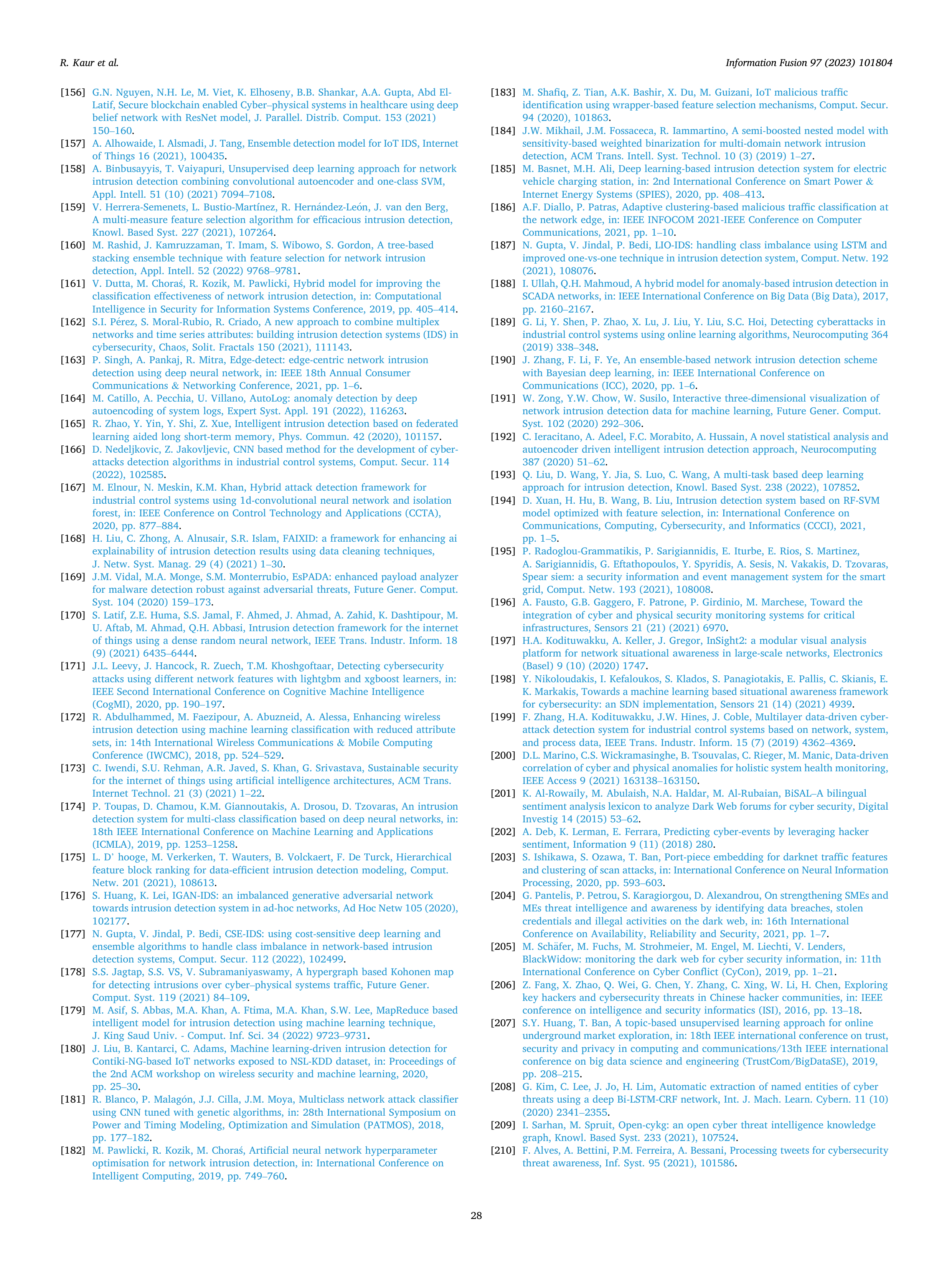
Information Fusion 97 (2023) 101804
28
[156]
G.N. Nguyen, N.H. Le, M. Viet, K. Elhoseny, B.B. Shankar, A.A. Gupta, Abd El-
Latif, Secure blockchain enabled Cyber
–
physical systems in healthcare using deep
belief network with ResNet model, J. Parallel. Distrib. Comput. 153 (2021)
150
–
160
.
[157]
A. Alhowaide, I. Alsmadi, J. Tang, Ensemble detection model for IoT IDS, Internet
of Things 16 (2021), 100435
.
[158]
A. Binbusayyis, T. Vaiyapuri, Unsupervised deep learning approach for network
intrusion detection combining convolutional autoencoder and one-class SVM,
Appl. Intell. 51 (10) (2021) 7094
–
7108
.
[159]
V. Herrera-Semenets, L. Bustio-Martínez, R. Hern
´
andez-Le
´
on, J. van den Berg,
A multi-measure feature selection algorithm for efficacious intrusion detection,
Knowl. Based Syst. 227 (2021), 107264
.
[160]
M. Rashid, J. Kamruzzaman, T. Imam, S. Wibowo, S. Gordon, A tree-based
stacking ensemble technique with feature selection for network intrusion
detection, Appl. Intell. 52 (2022) 9768
–
9781
.
[161]
V. Dutta, M. Chora
´
s, R. Kozik, M. Pawlicki, Hybrid model for improving the
classification effectiveness of network intrusion detection, in: Computational
Intelligence in Security for Information Systems Conference, 2019, pp. 405
–
414
.
[162]
S.I. P
´
erez, S. Moral-Rubio, R. Criado, A new approach to combine multiplex
networks and time series attributes: building intrusion detection systems (IDS) in
cybersecurity, Chaos, Solit. Fractals 150 (2021), 111143
.
[163]
P. Singh, A. Pankaj, R. Mitra, Edge-detect: edge-centric network intrusion
detection using deep neural network, in: IEEE 18th Annual Consumer
Communications
&
Networking Conference, 2021, pp. 1
–
6
.
[164]
M. Catillo, A. Pecchia, U. Villano, AutoLog: anomaly detection by deep
autoencoding of system logs, Expert Syst. Appl. 191 (2022), 116263
.
[165]
R. Zhao, Y. Yin, Y. Shi, Z. Xue, Intelligent intrusion detection based on federated
learning aided long short-term memory, Phys. Commun. 42 (2020), 101157
.
[166]
D. Nedeljkovic, Z. Jakovljevic, CNN based method for the development of cyber-
attacks detection algorithms in industrial control systems, Comput. Secur. 114
(2022), 102585
.
[167]
M. Elnour, N. Meskin, K.M. Khan, Hybrid attack detection framework for
industrial control systems using 1d-convolutional neural network and isolation
forest, in: IEEE Conference on Control Technology and Applications (CCTA),
2020, pp. 877
–
884
.
[168]
H. Liu, C. Zhong, A. Alnusair, S.R. Islam, FAIXID: a framework for enhancing ai
explainability of intrusion detection results using data cleaning techniques,
J. Netw. Syst. Manag. 29 (4) (2021) 1
–
30
.
[169]
J.M. Vidal, M.A. Monge, S.M. Monterrubio, EsPADA: enhanced payload analyzer
for malware detection robust against adversarial threats, Future Gener. Comput.
Syst. 104 (2020) 159
–
173
.
[170]
S. Latif, Z.E. Huma, S.S. Jamal, F. Ahmed, J. Ahmad, A. Zahid, K. Dashtipour, M.
U. Aftab, M. Ahmad, Q.H. Abbasi, Intrusion detection framework for the internet
of things using a dense random neural network, IEEE Trans. Industr. Inform. 18
(9) (2021) 6435
–
6444
.
[171]
J.L. Leevy, J. Hancock, R. Zuech, T.M. Khoshgoftaar, Detecting cybersecurity
attacks using different network features with lightgbm and xgboost learners, in:
IEEE Second International Conference on Cognitive Machine Intelligence
(CogMI), 2020, pp. 190
–
197
.
[172]
R. Abdulhammed, M. Faezipour, A. Abuzneid, A. Alessa, Enhancing wireless
intrusion detection using machine learning classification with reduced attribute
sets, in: 14th International Wireless Communications
&
Mobile Computing
Conference (IWCMC), 2018, pp. 524
–
529
.
[173]
C. Iwendi, S.U. Rehman, A.R. Javed, S. Khan, G. Srivastava, Sustainable security
for the internet of things using artificial intelligence architectures, ACM Trans.
Internet Technol. 21 (3) (2021) 1
–
22
.
[174]
P. Toupas, D. Chamou, K.M. Giannoutakis, A. Drosou, D. Tzovaras, An intrusion
detection system for multi-class classification based on deep neural networks, in:
18th IEEE International Conference on Machine Learning and Applications
(ICMLA), 2019, pp. 1253
–
1258
.
[175]
L. D
’
hooge, M. Verkerken, T. Wauters, B. Volckaert, F. De Turck, Hierarchical
feature block ranking for data-efficient intrusion detection modeling, Comput.
Netw. 201 (2021), 108613
.
[176]
S. Huang, K. Lei, IGAN-IDS: an imbalanced generative adversarial network
towards intrusion detection system in ad-hoc networks, Ad Hoc Netw 105 (2020),
102177
.
[177]
N. Gupta, V. Jindal, P. Bedi, CSE-IDS: using cost-sensitive deep learning and
ensemble algorithms to handle class imbalance in network-based intrusion
detection systems, Comput. Secur. 112 (2022), 102499
.
[178]
S.S. Jagtap, S.S. VS, V. Subramaniyaswamy, A hypergraph based Kohonen map
for detecting intrusions over cyber
–
physical systems traffic, Future Gener.
Comput. Syst. 119 (2021) 84
–
109
.
[179]
M. Asif, S. Abbas, M.A. Khan, A. Ftima, M.A. Khan, S.W. Lee, MapReduce based
intelligent model for intrusion detection using machine learning technique,
J. King Saud Univ. - Comput. Inf. Sci. 34 (2022) 9723
–
9731
.
[180]
J. Liu, B. Kantarci, C. Adams, Machine learning-driven intrusion detection for
Contiki-NG-based IoT networks exposed to NSL-KDD dataset, in: Proceedings of
the 2nd ACM workshop on wireless security and machine learning, 2020,
pp. 25
–
30
.
[181]
R. Blanco, P. Malag
´
on, J.J. Cilla, J.M. Moya, Multiclass network attack classifier
using CNN tuned with genetic algorithms, in: 28th International Symposium on
Power and Timing Modeling, Optimization and Simulation (PATMOS), 2018,
pp. 177
–
182
.
[182]
M. Pawlicki, R. Kozik, M. Chora
´
s, Artificial neural network hyperparameter
optimisation for network intrusion detection, in: International Conference on
Intelligent Computing, 2019, pp. 749
–
760
.
[183]
M. Shafiq, Z. Tian, A.K. Bashir, X. Du, M. Guizani, IoT malicious traffic
identification using wrapper-based feature selection mechanisms, Comput. Secur.
94 (2020), 101863
.
[184]
J.W. Mikhail, J.M. Fossaceca, R. Iammartino, A semi-boosted nested model with
sensitivity-based weighted binarization for multi-domain network intrusion
detection, ACM Trans. Intell. Syst. Technol. 10 (3) (2019) 1
–
27
.
[185]
M. Basnet, M.H. Ali, Deep learning-based intrusion detection system for electric
vehicle charging station, in: 2nd International Conference on Smart Power
&
Internet Energy Systems (SPIES), 2020, pp. 408
–
413
.
[186]
A.F. Diallo, P. Patras, Adaptive clustering-based malicious traffic classification at
the network edge, in: IEEE INFOCOM 2021-IEEE Conference on Computer
Communications, 2021, pp. 1
–
10
.
[187]
N. Gupta, V. Jindal, P. Bedi, LIO-IDS: handling class imbalance using LSTM and
improved one-vs-one technique in intrusion detection system, Comput. Netw. 192
(2021), 108076
.
[188]
I. Ullah, Q.H. Mahmoud, A hybrid model for anomaly-based intrusion detection in
SCADA networks, in: IEEE International Conference on Big Data (Big Data), 2017,
pp. 2160
–
2167
.
[189]
G. Li, Y. Shen, P. Zhao, X. Lu, J. Liu, Y. Liu, S.C. Hoi, Detecting cyberattacks in
industrial control systems using online learning algorithms, Neurocomputing 364
(2019) 338
–
348
.
[190]
J. Zhang, F. Li, F. Ye, An ensemble-based network intrusion detection scheme
with Bayesian deep learning, in: IEEE International Conference on
Communications (ICC), 2020, pp. 1
–
6
.
[191]
W. Zong, Y.W. Chow, W. Susilo, Interactive three-dimensional visualization of
network intrusion detection data for machine learning, Future Gener. Comput.
Syst. 102 (2020) 292
–
306
.
[192]
C. Ieracitano, A. Adeel, F.C. Morabito, A. Hussain, A novel statistical analysis and
autoencoder driven intelligent intrusion detection approach, Neurocomputing
387 (2020) 51
–
62
.
[193]
Q. Liu, D. Wang, Y. Jia, S. Luo, C. Wang, A multi-task based deep learning
approach for intrusion detection, Knowl. Based Syst. 238 (2022), 107852
.
[194]
D. Xuan, H. Hu, B. Wang, B. Liu, Intrusion detection system based on RF-SVM
model optimized with feature selection, in: International Conference on
Communications, Computing, Cybersecurity, and Informatics (CCCI), 2021,
pp. 1
–
5
.
[195]
P. Radoglou-Grammatikis, P. Sarigiannidis, E. Iturbe, E. Rios, S. Martinez,
A. Sarigiannidis, G. Eftathopoulos, Y. Spyridis, A. Sesis, N. Vakakis, D. Tzovaras,
Spear siem: a security information and event management system for the smart
grid, Comput. Netw. 193 (2021), 108008
.
[196]
A. Fausto, G.B. Gaggero, F. Patrone, P. Girdinio, M. Marchese, Toward the
integration of cyber and physical security monitoring systems for critical
infrastructures, Sensors 21 (21) (2021) 6970
.
[197]
H.A. Kodituwakku, A. Keller, J. Gregor, InSight2: a modular visual analysis
platform for network situational awareness in large-scale networks, Electronics
(Basel) 9 (10) (2020) 1747
.
[198]
Y. Nikoloudakis, I. Kefaloukos, S. Klados, S. Panagiotakis, E. Pallis, C. Skianis, E.
K. Markakis, Towards a machine learning based situational awareness framework
for cybersecurity: an SDN implementation, Sensors 21 (14) (2021) 4939
.
[199]
F. Zhang, H.A. Kodituwakku, J.W. Hines, J. Coble, Multilayer data-driven cyber-
attack detection system for industrial control systems based on network, system,
and process data, IEEE Trans. Industr. Inform. 15 (7) (2019) 4362
–
4369
.
[200]
D.L. Marino, C.S. Wickramasinghe, B. Tsouvalas, C. Rieger, M. Manic, Data-driven
correlation of cyber and physical anomalies for holistic system health monitoring,
IEEE Access 9 (2021) 163138
–
163150
.
[201]
K. Al-Rowaily, M. Abulaish, N.A. Haldar, M. Al-Rubaian, BiSAL
–
A bilingual
sentiment analysis lexicon to analyze Dark Web forums for cyber security, Digital
Investig 14 (2015) 53
–
62
.
[202]
A. Deb, K. Lerman, E. Ferrara, Predicting cyber-events by leveraging hacker
sentiment, Information 9 (11) (2018) 280
.
[203]
S. Ishikawa, S. Ozawa, T. Ban, Port-piece embedding for darknet traffic features
and clustering of scan attacks, in: International Conference on Neural Information
Processing, 2020, pp. 593
–
603
.
[204]
G. Pantelis, P. Petrou, S. Karagiorgou, D. Alexandrou, On strengthening SMEs and
MEs threat intelligence and awareness by identifying data breaches, stolen
credentials and illegal activities on the dark web, in: 16th International
Conference on Availability, Reliability and Security, 2021, pp. 1
–
7
.
[205]
M. Sch
¨
afer, M. Fuchs, M. Strohmeier, M. Engel, M. Liechti, V. Lenders,
BlackWidow: monitoring the dark web for cyber security information, in: 11th
International Conference on Cyber Conflict (CyCon), 2019, pp. 1
–
21
.
[206]
Z. Fang, X. Zhao, Q. Wei, G. Chen, Y. Zhang, C. Xing, W. Li, H. Chen, Exploring
key hackers and cybersecurity threats in Chinese hacker communities, in: IEEE
conference on intelligence and security informatics (ISI), 2016, pp. 13
–
18
.
[207]
S.Y. Huang, T. Ban, A topic-based unsupervised learning approach for online
underground market exploration, in: 18th IEEE international conference on trust,
security and privacy in computing and communications/13th IEEE international
conference on big data science and engineering (TrustCom/BigDataSE), 2019,
pp. 208
–
215
.
[208]
G. Kim, C. Lee, J. Jo, H. Lim, Automatic extraction of named entities of cyber
threats using a deep Bi-LSTM-CRF network, Int. J. Mach. Learn. Cybern. 11 (10)
(2020) 2341
–
2355
.
[209]
I. Sarhan, M. Spruit, Open-cykg: an open cyber threat intelligence knowledge
graph, Knowl. Based Syst. 233 (2021), 107524
.
[210]
F. Alves, A. Bettini, P.M. Ferreira, A. Bessani, Processing tweets for cybersecurity
threat awareness, Inf. Syst. 95 (2021), 101586
.
R. Kaur et al.
Information Fusion 97 (2023) 101804
29
[211]
N. Dionísio, F. Alves, P.M. Ferreira, A. Bessani, Cyberthreat detection from twitter
using deep neural networks, in: International Joint Conference on Neural
Networks (IJCNN), 2019, pp. 1
–
8
.
[212]
J.R. Saura, D. Palacios-Marqu
´
es, D. Ribeiro-Soriano, Using data mining
techniques to explore security issues in smart living environments in Twitter,
Comput. Commun. 179 (2021) 285
–
295
.
[213]
T.M. Georgescu, B. Iancu, M. Zurini, Named-entity-recognition-based automated
system for diagnosing cybersecurity situations in IoT networks, Sensors 19 (15)
(2019) 3380
.
[214]
J. Sleeman, T. Finin, M. Halem, Understanding cybersecurity threat trends
through dynamic topic modeling, front, Big Data 4 (2021)
.
[215]
T. Sun, P. Yang, M. Li, S. Liao, An automatic generation approach of the cyber
threat intelligence records based on multi-source information fusion, Future
Internet 13 (2) (2021) 40
.
[216]
A. Sapienza, S.K. Ernala, A. Bessi, K. Lerman, E. Ferrara, Discover: mining online
chatter for emerging cyber threats, in: Companion Proceedings of the The Web
Conference, 2018, pp. 983
–
990
.
[217]
C.E. Tsai, C.L. Yang, C.K. Chen, A.N.T. CTI, Hunting for Chinese threat
intelligence, in: IEEE International Conference on Big Data (Big Data), 2020,
pp. 1847
–
1852
.
[218]
P. Ranade, S. Mittal, A. Joshi, K. Joshi, Using deep neural networks to translate
multi-lingual threat intelligence, in: IEEE International Conference on Intelligence
and Security Informatics (ISI), 2018, pp. 238
–
243
.
[219]
V.A. Memos, K.E. Psannis, AI-powered honeypots for enhanced IoT botnet
detection, in: 3rd World Symposium on Communication Engineering (WSCE),
2020, pp. 64
–
68
.
[220]
P. Chatziadam, I.G. Askoxylakis, A. Fragkiadakis, A network telescope for early
warning intrusion detection, in: International Conference on Human Aspects of
Information Security, Privacy, and Trust, 2014, pp. 11
–
22
.
[221]
H.K. Kim, K.H. Im, S.C. Park, DSS for computer security incident response
applying CBR and collaborative response, Expert Syst. Appl. 37 (1) (2010)
852
–
870
.
[222]
F. Jiang, T. Gu, L. Chang, Z. Xu, Case retrieval for network security emergency
response based on description logic, in: International Conference on Intelligent
Information Processing, 2014, pp. 284
–
293
.
[223]
R.C. Nunes, M. Colom
´
e, F.A. Barcelos, M. Garbin, G.B. Paulus, L.A. Silva, A case-
based reasoning approach for the cybersecurity incident recording and resolution,
Int. J. Softw. Eng. Knowl. Eng. 11 (12) (2019) 1607
–
1627
.
[224]
I. Kraeva, G. Yakhyaeva, Application of the metric learning for security incident
playbook recommendation, in: IEEE 22nd International Conference of Young
Professionals in Electron Devices and Materials (EDM), 2021, pp. 475
–
479
.
[225]
L. Ping, Y. Haifeng, M. Guoqing, An incident response decision support system
based on CBR and ontology, in: International conference on computer application
and system modeling (ICCASM 2010), 2010, pp. 311
–
337
.
[226]
A. Shah, R. Ganesan, S. Jajodia, H. Cam, Dynamic optimization of the level of
operational effectiveness of a CSOC under adverse conditions, ACM Trans. Intell.
Syst. Technol. 9 (5) (2018) 1
–
20
.
[227]
Y. Lin, H. Wang, B. Yang, M. Liu, Y. Li, Y. Zhang, A blackboard sharing
mechanism for community cyber threat intelligence based on multi-agent system,
in: International Conference on Machine Learning for Cyber Security, 2019,
pp. 253
–
270
.
[228]
L. Thomas, A. Vaughan, Z. Courtney, C. Zhong, A. Alnusair, Supporting
collaboration among cyber security analysts through visualizing their analytical
reasoning processes, in: IEEE International Conference on Multimedia
&
Expo
Workshops (ICMEW), 2018, pp. 1
–
6
.
[229]
N. DeCastro-García,
´
A.L. Mu
˜
noz Casta
˜
neda, M. Fern
´
andez-Rodríguez, Machine
learning for automatic assignment of the severity of cybersecurity events,
Comput. Math. Methods Med. 2 (1) (2020) e1072
.
[230]
M. Hus
´
ak, T. Bajto
ˇ
s, J. Ka
ˇ
spar, E. Bou-Harb, P.
ˇ
Celeda, Predictive cyber
situational awareness and personalized blacklisting: a sequential rule mining
approach, ACM Trans. Manag. Inf. Syst. 11 (4) (2020) 1
–
6
.
[231]
F. Manganiello, M. Marchetti, M. Colajanni, Multistep attack detection and alert
correlation in intrusion detection systems, in: International Conference on
Information Security and Assurance, 2011, pp. 101
–
110
.
[232]
A. Dey, E. Totel, S. Navers, Heterogeneous security events prioritization using
auto-encoders, in: International Conference on Risks and Security of Internet and
Systems, 2020, pp. 164
–
180
.
[233]
J.Q. Chen, Intelligent targeting with contextual binding, in: Future Technologies
Conference (FTC), 2016, pp. 1040
–
1046
.
[234]
H. Studiawan, F. Sohel, Anomaly detection in a forensic timeline with deep
autoencoders, J. Inf. Secur. Appl. 63 (2021), 103002
.
[235]
F. Amato, A. Castiglione, G. Cozzolino, F. Narducci, A semantic-based
methodology for digital forensics analysis, J. Parallel Distrib. Comput. 138 (2020)
172
–
177
.
[236]
A. Nisioti, G. Loukas, A. Laszka, E. Panaousis, Data-driven decision support for
optimizing cyber forensic investigations, IEEE Trans. Inf. Forensics Secur. 16
(2021) 2397
–
2412
.
[237]
J. Sakhnini, H. Karimipour, A. Dehghantanha, R.M. Parizi, Physical layer attack
identification and localization in cyber
–
physical grid: an ensemble deep learning
based approach, Phys. Commun. 47 (2021), 101394
.
[238]
L. Fernandez Maimo, A. Huertas Celdran, A.L. Perales Gomez, F.J. Garcia
Clemente, J. Weimer, I. Lee, Intelligent and dynamic ransomware spread
detection and mitigation in integrated clinical environments, Sensors 19 (5)
(2019) 1114
.
[239]
P. Nespoli, F.G. M
´
armol, J.M. Vidal, A bio-inspired reaction against cyberattacks:
ais-powered optimal countermeasures selection, IEEE Access 9 (2021)
60971
–
60996
.
[240]
M. Hus
´
ak, L. Sadlek, S.
ˇ
Spa
ˇ
cek, M. La
ˇ
stovi
ˇ
cka, M. Javorník, J. Kom
´
arkov
´
a,
CRUSOE: a toolset for cyber situational awareness and decision support in
incident handling, Comput. Secur. 115 (2022), 102609
.
[241]
M. Hus
´
ak, Towards a data-driven recommender system for handling ransomware
and similar incidents, in: IEEE International Conference on Intelligence and
Security Informatics (ISI), 2021, pp. 1
–
6
.
[242]
A. Piplai, S. Mittal, A. Joshi, T. Finin, J. Holt, R. Zak, Creating cybersecurity
knowledge graphs from malware after action reports, IEEE Access 8 (2020)
211691
–
211703
.
[243]
B. Woods, S.J. Perl, B. Lindauer, Data mining for efficient collaborative
information discovery, in: Proceedings of the 2nd ACM Workshop on Information
Sharing and Collaborative Security, 2015, pp. 3
–
12
.
[244]
S. Peng, A. Zhou, S. Liao, L. Liu, A threat actions extraction method based on the
conditional co-occurrence degree, in: 7th International Conference on
Information Science and Control Engineering (ICISCE), 2020, pp. 1633
–
1637
.
[245]
B.S. Meyers, A. Meneely, An automated post-mortem analysis of vulnerability
relationships using natural language word embeddings, Procedia. Comput. Sci.
(2021) 953
–
958
.
[246]
M.V. Carriegos,
´
A.L. Casta
˜
neda, M.T. Trobajo, D.A. De Zaballa, On aggregation
and prediction of cybersecurity incident reports, IEEE Access 9 (2021)
102636
–
102648
.
[247]
Symantec, internet security threat report, Retrieved from
https://www.symantec.
com/content/dam/symantec/docs/reports/istr-24-2019-en.pdf
(2019).
R. Kaur et al.