
Citation:
Xiao, G.; Yang, D.; Xu, L.; Li,
J.; Jiang, Z. The Application of
Artificial Intelligence Technology in
Shipping:
A Bibliometric Review.
J.
Mar.
Sci.
Eng.
2024
,
12
, 624.
https://
doi.org/10.3390/jmse12040624
Received:
26 February 2024
Revised:
1 April 2024
Accepted:
3 April 2024
Published:
7 April 2024
Copyright:
©
2024
by
the
authors.
Licensee
MDPI,
Basel,
Switzerland.
This
article
is
an
open
access
article
distributed
under
the
terms
and
conditions of the Creative Commons
Attribution (CC BY) license (https://
creativecommons.org/licenses/by/
4.0/).
Journal of
Marine Science
and Engineering
Review
The Application of Artificial Intelligence Technology in
Shipping:
A Bibliometric Review
Guangnian Xiao
1
, Daoqi Yang
1
, Lang Xu
2
, Jinpei Li
3
and Ziran Jiang
4,
*
1
School of Economics and Management, Shanghai Maritime University, Shanghai 201306, China;
gnxiao@shmtu.edu.cn (G.X.); 202230710114@stu.shmtu.edu.cn (D.Y.)
2
College of Transport and Communications, Shanghai Maritime University, Shanghai 201306, China;
xulang@shmtu.edu.cn
3
School of Economics and Management, Beijing University of Chemical Technology, Beijing 100029, China;
jinpeili@mail.buct.edu.cn
4
School of Geography and Environmental Sciences, Zhejiang Normal University, Jinhua 321004, China
*
Correspondence:
jzr729@zjnu.cn
Abstract:
Artificial
intelligence
(AI)
technologies
are
increasingly
being
applied
to
the
shipping
industry to advance its development.
In this study, 476 articles published in the Science Citation
Index Expanded (SCI-EXPANDED) and the Social Sciences Citation Index (SSCI) of the Web of Science
Core Collection from 2001 to 2022 were collected, and bibliometric methods were applied to conduct
a systematic literature of the field of AI technology applications in the shipping industry.
The review
commences with an annual publication trend analysis, which shows that research in the field has
been
growing
rapidly
in
recent
years.
This
is
followed
by
a
statistical
analysis
of
journals
and
a
collaborative network analysis to identify the most productive journals, countries, institutions, and
authors.
The keyword “co-occurrence analysis” is then utilized to identify major research clusters, as
well as hot research directions in the field, providing directions for future research in the field.
Finally,
based on the results of the keyword co-occurrence analysis and the content analysis of the papers
published in recent years, the research gaps in AIS data applications, ship trajectory, and anomaly
detection, as well as the possible future research directions, are discussed.
The findings indicate that
AIS data in the future research direction are mainly reflected in the analysis of ship behavior and AIS
data repair.
Ship trajectory in the future research direction is mainly reflected in the deep learning-
based method research and the discussion of ship trajectory classification.
Anomaly detection in
the future research direction is mainly reflected in the application of deep learning technology in
ship anomaly detection and improving the efficiency of ship anomaly detection.
These insights offer
guidance for researchers’ future investigations in this area.
In addition, we discuss the implications
of research in the field of shipping AI from both theoretical and practical perspectives.
Overall, this
review can help researchers understand the status and development trend of the application field of
AI technology in shipping, correctly grasp the research direction and methodology, and promote the
further development of the field.
Keywords:
artificial intelligence; shipping; machine learning; deep learning; bibliometric analysis
1.
Introduction
With the rapid advancement of modern technology and data information technology,
artificial intelligence (AI) has begun to be widely used in many fields, including medicine,
finance
and
trade,
law,
heavy
industry,
and
many
other
industries
[
1
].
At
present,
re-
searchers around the world are seeking breakthroughs in AI technology in the industry,
constantly exploring new research directions to improve the level of intelligence in the
industry [
2
].
The
academic
concept
of
AI
first
appeared
in
1956,
when
people
were
exploring
how to make machines use language to solve problems that only humans can solve, and
J. Mar.
Sci.
Eng.
2024
,
12
, 624.
https://doi.org/10.3390/jmse12040624
https://www.mdpi.com/journal/jmse
J. Mar.
Sci.
Eng.
2024
,
12
, 624
2 of 21
subsequently, after a long period of continuous evolution and development, the meaning
of AI has been further enriched and expanded [
3
].
At present, the international unified
definition of AI mainly refers to the use of machines to achieve the goal of simulation of
human
thinking
and
consciousness
through
the
algorithm
of
training
data,
so
that
the
computer can imitate human thought and consciousness [
4
].
As an emerging discipline of
multidisciplinary cross-fertilization, AI has received extensive attention from researchers
due to its superior feature-learning capability [
5
].
In the past few decades, researchers have
developed machine learning, deep learning, and other AI techniques, which have been
widely used in many fields [
6
].
In the last decade, research on the integration of AI technologies with shipping has
been growing rapidly, covering a wide range of disciplines [
7
,
8
].
Shipping is one of the
oldest
and
most
traditional
industries,
and
shipping
occupies
an
important
position
in
international
trade
due
to
its
outstanding
advantages,
such
as
large
capacity,
minimal
energy consumption, and low costs [
9
,
10
].
With the accelerating process of world economic
integration, the shipping industry is also developing rapidly and playing an increasingly
important
role
in
the
international
economic
arena
[
11
,
12
].
In
this
context,
research
on
the
combination
of
AI
technology
and
shipping
is
continuing
to
grow
rapidly
[
13
,
14
].
Since entering the 21st century, neural networks and genetic algorithms have been first
applied
in
shipping.
For
example,
regarding
the
ship’s
domain,
which
is
the
domain
around a ship that the ship maintains around it and does not want other ships or objects
to enter, a wide variety of ships’ domain models have been derived by studying different
waters and different states of rendezvous.
Zhu et al. [
15
] raised a neural network-based
approach for constructing a ship domain model that incorporates the influences of visibility
and maneuverability, and which can respond quickly to a wide range of ships within a
certain
range.
Zubaydi
et
al.
[
16
]
presented
a
neural
network
approach
for
identifying
structural
damage
on
ships
that
combines
stochastic
reduction
techniques
with
neural
network algorithms for recognizing the scope and whereabouts of damage in the model.
Zeng [
17
] proposed a control system based on the genetic algorithm, in which the genetic
algorithm introduces a new way of genetic coding, and individual genes are constructed by
using the ship’s position; speed; and factors such as tides, winds, waves, etc., and is verified
with the automatic collision avoidance simulation system developed in VC++ language
and the actual ship, and the results of the study show that this method is a more effective
way to search for the optimal safe path.
As machine learning and deep learning methods continue to mature, they are increas-
ingly being utilized in the shipping industry.
Pagoropoulos et al. [
18
] constructed a model
based on multi-class support vector machines to achieve energy efficiency improvement
through a performance evaluation of tanker operations.
The results showed that machine
learning algorithms play an important role in improving the energy efficiency of ships.
Chen et al. [
19
] suggested a ship sports categorization algorithm utilizing convolutional
neural network, which learns labeled AIS data by training the neural network to effectively
classify unlabeled AIS data, thus realizing the classification of ship sports. The experimental
results also showed that the ship sports categorization algorithm utilizing convolutional
neural
network
proposed
in
this
paper
has
better
performance
in
classifying
AIS
data
compared with several classical classification algorithms, such as K-nearest neighbor and
decision tree.
Capobianco et al. [
20
] presented a deep learning method utilizing recurrent
neural networks to leverage historical ship trajectory data for future ship trajectory pre-
diction.
The
article
also
emphasized
that
the
deep
learning
method
utilizing
recurrent
neural networks outperforms baseline methods based on linear regression or multilayer
perceptron architecture for ship trajectory prediction.
Yang et al. [
21
] presented a vessel
trajectory
prediction
approach
using
AIS
data
and
Bi-LSTM,
showing
superior
results
compared to other models, like Support Vector Regression, recurrent neural networks, and
LSTM models.
J. Mar.
Sci.
Eng.
2024
,
12
, 624
3 of 21
Due
to
the
speedy
advancement
of
AI
technique,
its
application
in
shipping
has
become particularly important, but there are few review studies of the implementation
of
AI
technique
in
shipping,
thus
creating
a
gap
in
the
academic
literature
[
22
].
To
our
knowledge,
there
are
currently
two
review
studies
on
AI
in
shipping.
Imran
et
al.
[
23
]
did not use a systematic literature selection method,
and their literature search process
was somewhat abstract, which may lead to non-repeatability.
Also, since this review only
examined artificial neural networks and collision-avoidance algorithm AI techniques, this
may also make it a somewhat partial study.
Munim et al. [
24
] used a relatively systematic
literature search process, but the choice of search terms was not comprehensive enough,
only considering “artificial intelligence” and “machine learning”, but not considering some
specific algorithms in machine learning and deep learning to be included in the search
terms, which may have led to the research of the article being a bit one-sided.
A systematic
approach to literature selection requires that the sources, screening criteria, and procedures
for searching the literature be clearly defined to ensure the objectivity and reproducibility
of the research results; comprehensive search criteria can cover all aspects of the literature
resources to avoid omitting key information, thus ensuring the inclusiveness and accuracy
of the research.
Based on this, the current research is more extensive than prior studies.
This
study
first
introduces
the
reader
to
the
data
collection
and
research
methodology;
analyzes annual publication trends and journal statistics; conducts a collaborative network
analysis, examining collaboration between countries, institutions, and authors; and, finally,
explores keywords’ co-occurrences.
The rest of this study is organized as follows.
Section
2
outlines the data collection and
the methodology of the study.
Section
3
presents the bibliometric analysis and the study’s
findings.
Section
4
introduces the gap in research hot area and future research directions.
Section
5
recommends the practical and theoretical implications.
Finally, Section
6
offers
the conclusions.
2.
Date and Methodology
2.1.
Data Collection
2.1.1.
The Source of Data Collection
Web of Science (WoS) is an information service platform developed by Clarivate Ana-
lytics, covering the world’s most important and influential research results, and has become
an internationally recognized major search tool for scientific statistics and assessment [
25
].
The data sources for our review are the Science Citation Index Expanded (SCI-EXPANDED)
and Social Sciences Citation Index (SSCI) from the core collection of WoS.
2.1.2.
Information Retrieval
This paper focuses on the application of AI technologies in shipping, so it was neces-
sary to limit the query subject to “shipping” and “artificial intelligence”.
For the subject
search term “artificial intelligence”, we believe that it may not cover all the key technolo-
gies.
Based on the research findings of Ahmed et al. [
26
], we chose some keywords (such
as
machine
learning,
deep
learning,
genetic
algorithm,
neural
network,
support
vector
machine,
convolutional
neural
network,
long-
and
short-term
memory,
etc.)
which
are
strongly associated with AI as supplementary subject retrieval words to increase the com-
prehensiveness of the retrieved data.
The following keywords were searched in the topic to
increase the rate of the literature search:
J. Mar.
Sci.
Eng.
2024
,
12
, 624
4 of 21
TS
=
(“shipping”
OR
“maritime”)
AND
(“Artificial
Intelligen*”
OR
“AI”
OR
“big
data” OR “data mining” OR “machine learning” OR “deep learning” OR “reinforcement
learning” OR “neural network*” OR “genetic algorithm*” OR “support vector machine*”
OR “SVM” OR “convolutional neural network*” OR “CNN” OR “artificial neural network*”
OR “ANN” OR “recurrent neural network*” OR “RNN” OR “long short term memory”
OR “LSTM”).
We set the type of literature to “journal article” and “review article”,
the language
to “English”, and the year of publication to “2001–2022”.
The reasons for this choice are
that journal articles are peer-reviewed and of high academic standards and quality, and
the review article helps to understand the status and development trends of research in
the field.
English is the main language of international academic communication, which
can enhance the quality and credibility of the literature, thus promoting global exchange
and
cooperation
in
research.
On
the
one
hand,
the
year
“2001–2022”
helps
to
focus
on
the
recent
research
results,
provide
the
latest
information
and
insights,
and
ensure
the
timeliness
and
scientific
validity
of
the
literature
review;
on
the
other
hand,
due
to
the
lag in the publication of journals,
some journals may not have published the articles of
2023 yet, and so the articles of 2023 were not included in the search criteria [
27
].
Research
areas are limited to Engineering, Computer Science, Oceanography, Transportation, and
Telecommunications.
In the experiment, it was found that this search result included some
articles on non-shipping-related AI technology applications.
Then, we carried out further
screening by first excluding articles related to engineering machinery, human engineering,
and engineering manufacturing in the Web of Science Categories; excluded articles on the
topics of image segmentation,
speech recognition,
drones,
and magnetorheology in the
Citation Topics Micro; and, finally, screened to obtain 476 documents.
Among them, 460
were journal articles and 16 were review articles.
The final retrieval criteria are shown in
Table
1
.
Table 1.
Search criteria.
Project
Content
Database
SCI-EXPANDED and SSCI
Time range
2001–2022
Document type
Language
journal article OR review article
English
Search formula
TS = ((“shipping” OR “maritime”) AND (“Artificial
Intelligen*” OR “AI” OR “big data” OR “data mining” OR
“machine learning” OR “deep learning” OR “reinforcement
learning” OR “neural network*” OR “genetic algorithm*” OR
“support vector machine*” OR “SVM” OR “convolutional
neural network*” OR “CNN” OR “artificial neural network*”
OR “ANN” OR “recurrent neural network*” OR “RNN” OR
“long short term memory” OR “LSTM”))
2.2.
Research Methodology
2.2.1.
Bibliometric Methods
The bibliometric approach, first proposed by Pritchard (1969), is a method of literature
review that uses statistics to provide a comprehensive quantitative analysis of articles of
published research in a specific field [
28
].
This analytics allows for data mapping of the
current state, topicalities, and leading edges of the research field, visualizing large data
sets, which can help researchers to understand the structural and dynamic characteristics
of the field [
29
].
The advantage of bibliometrics over other literature review methods is
that it produces more objective and reliable results that provide researchers with complete
information
about
developments
in
a
field
[
30
].
Shipping,
as
a
type
of
transportation
system,
began
later
and
developed
more
slowly
compared
to
aviation,
rail,
and
road
transportation systems, so the research on the application of AI technology in shipping also
started later.
The relatively short development time of AI in the shipping industry has led
J. Mar.
Sci.
Eng.
2024
,
12
, 624
5 of 21
to a more concentrated focus on research hotspots and timelines.
Utilizing bibliometrics can
provide a more thorough analysis of the current research status and future development
trends in this field.
Initially, researchers used bibliometrics to analyze published studies
based on counts of articles, authors, and subject terms.
With the continuous development
of bibliometric methods and literature visualization and analysis software, we can map
and visualize research areas and topics through techniques such as document co-citation
analysis, collaborative network analysis, or keyword co-occurrence analysis [
31
].
2.2.2.
Analytical Measures
The h-index is a mixed index of quantification, a novel approach to assessing academic
accomplishments,
initially
introduced
by
American
researcher
J.
E.
Hirsch
in
2005;
it
aims to quantify the research results of scientific researchers.
Hirsch pointed out that if a
scientist publishes N
p
papers with h papers cited at least h, and none of the other (N
P
-h)
papers is cited more than h, then the scientist’s h-index is h [
32
].
With h denoting “high
citations”, a higher h-index for an author signifies that this/her paper has a greater impact.
However, the h-index used to measure academic achievement also has certain limitations.
For example, in terms of the influence of the time factor, young researchers may not be
able to achieve a high h-index due to a shorter research time, which may lead to an unfair
assessment of their academic achievements; in terms of the variability of disciplinary fields,
there may be differences in citation behaviors between different disciplinary fields, which
may affect the accuracy of the h-index; and in terms of the citation counts, there may exist
inaccurate citation counts, especially in interdisciplinary or cross-linguistic research, which
may result in the h-index not accurately reflecting the true academic impact of scholars.
The h-index was utilized in this study to quantify the combined impact of a country or
journal’s scholarship applied to AI and shipping.
3.
Results and Analysis
3.1.
Annual Publication Trends
This
article
reviews
the
study
of
the
application
of
AI
technology
in
the
shipping
industry
published
during
the
period
of
2001–2022,
and
the
analysis
of
the
quantity
of
publications
over
the
years
provides
an
understanding
of
the
changes
in
the
research
hotspots
in
this
field
and
the
future
development
trend
[
33
,
34
].
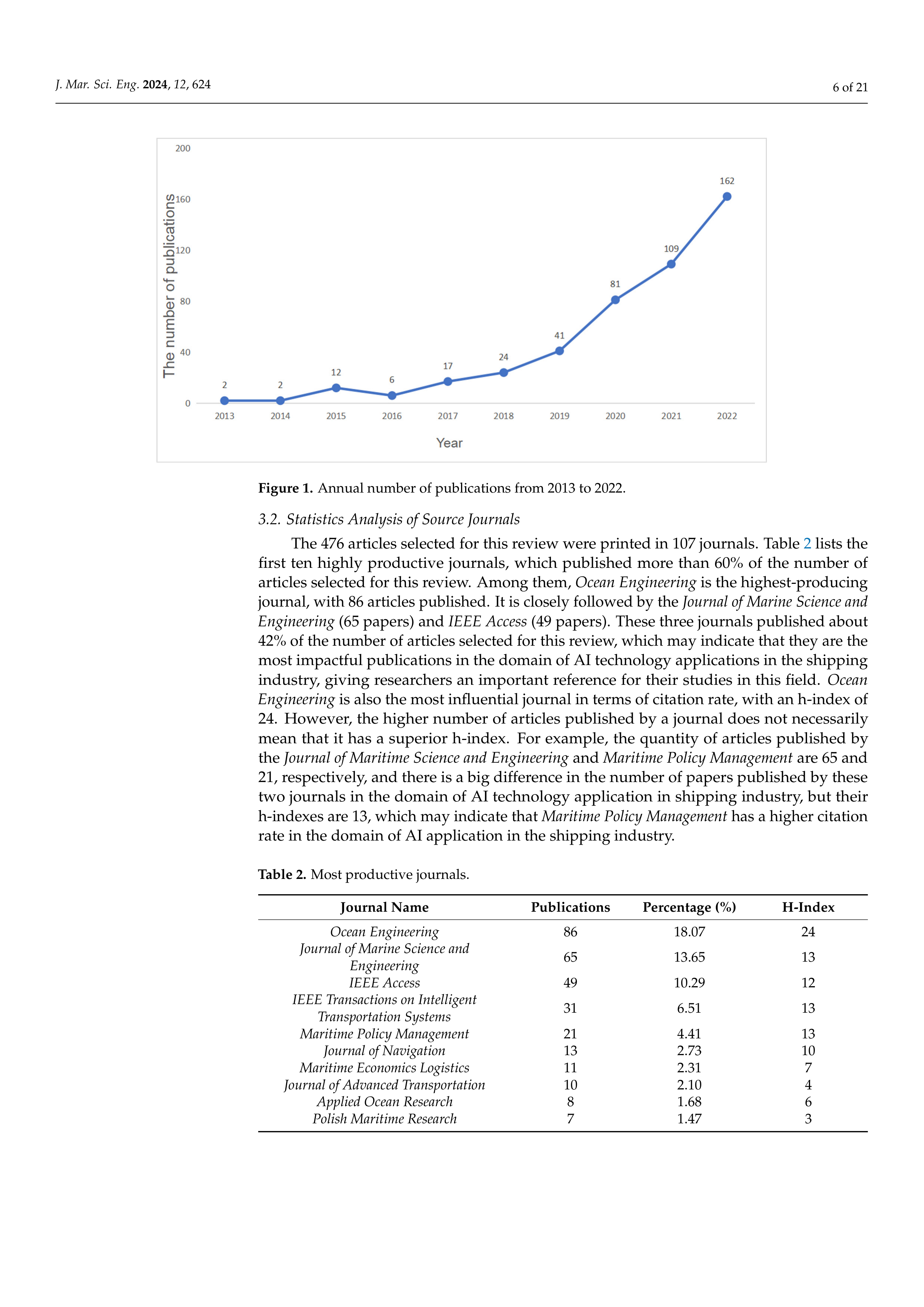
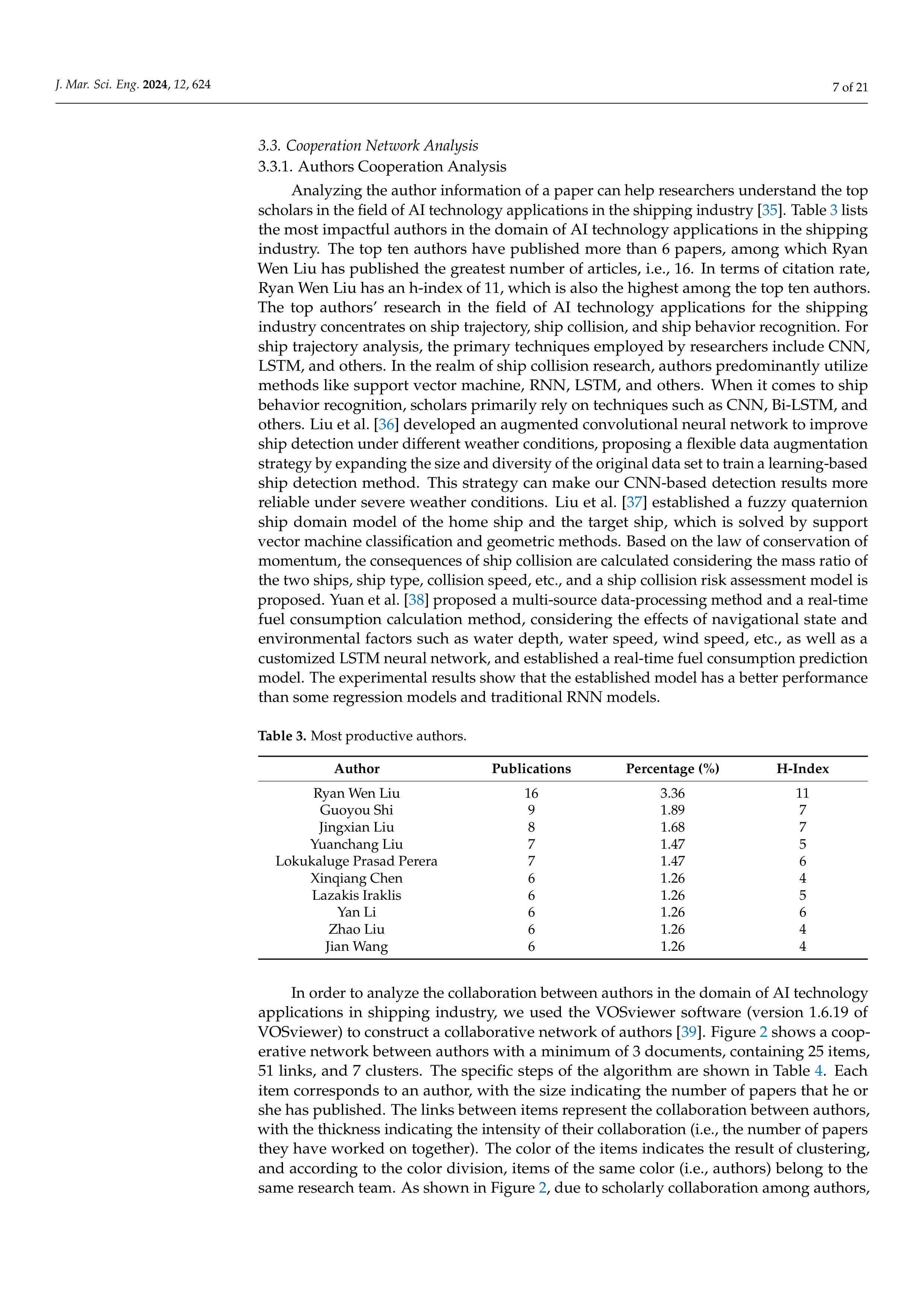
Figure
1
contains
the
statistics of the quantity of publications on the study on the application of AI technology in
the shipping industry in the past ten years.
At the early stage of the 21st century, due to
the slow evolution of AI technology, the study on AI technology in the shipping industry
was lower, so we chose the quantity of articles issued in this field in the last ten years for
analysis.
As can be seen from the Figure
1
, from 2013 to 2017, the study of the application of
AI technology in the shipping industry was in the stage of steady development.
Although
the quantity of publications in this field was low each year, the quantity of publications
each year was steadily increasing compared to the previous year.
During the period from
2018
to
2022,
the
study
of
the
application
of
AI
technology
in
the
shipping
industry
is
in a phase of rapid growth.
The number of articles published per year has continued to
increase
compared
to
the
previous
period.
In
particular,
the
number
of
publications
in
the last three years accounts for more than 70% of the number of articles selected for this
review.
This indicates that more and more academics have started to focus on the study of
the application of AI technology in the shipping industry in recent years.
J. Mar.
Sci.
Eng.
2024
,
12
, 624
6 of 21
Figure 1.
Annual number of publications from 2013 to 2022.
3.2.
Statistics Analysis of Source Journals
The 476 articles selected for this review were printed in 107 journals.
Table
2
lists the
first
ten
highly
productive
journals,
which
published
more
than
60%
of
the
number
of
articles selected for this review.
Among them,
Ocean Engineering
is the highest-producing
journal, with 86 articles published.
It is closely followed by the
Journal of Marine Science and
Engineering
(65 papers) and
IEEE Access
(49 papers).
These three journals published about
42% of the number of articles selected for this review, which may indicate that they are the
most impactful publications in the domain of AI technology applications in the shipping
industry, giving researchers an important reference for their studies in this field.
Ocean
Engineering
is also the most influential journal in terms of citation rate, with an h-index of
24.
However, the higher number of articles published by a journal does not necessarily
mean that it has a superior h-index.
For example,
the quantity of articles published by
the
Journal of Maritime Science and Engineering
and
Maritime Policy Management
are 65 and
21, respectively, and there is a big difference in the number of papers published by these
two journals in the domain of AI technology application in shipping industry, but their
h-indexes are 13, which may indicate that
Maritime Policy Management
has a higher citation
rate in the domain of AI application in the shipping industry.
Table 2.
Most productive journals.
Journal Name
Publications
Percentage (%)
H-Index
Ocean Engineering
86
18.07
24
Journal of Marine Science and
Engineering
65
13.65
13
IEEE Access
49
10.29
12
IEEE Transactions on Intelligent
Transportation Systems
31
6.51
13
Maritime Policy Management
21
4.41
13
Journal of Navigation
13
2.73
10
Maritime Economics Logistics
11
2.31
7
Journal of Advanced Transportation
10
2.10
4
Applied Ocean Research
8
1.68
6
Polish Maritime Research
7
1.47
3
J. Mar.
Sci.
Eng.
2024
,
12
, 624
7 of 21
3.3.
Cooperation Network Analysis
3.3.1.
Authors Cooperation Analysis
Analyzing the author information of a paper can help researchers understand the top
scholars in the field of AI technology applications in the shipping industry [
35
].
Table
3
lists
the most impactful authors in the domain of AI technology applications in the shipping
industry.
The
top
ten
authors
have
published
more
than
6
papers,
among
which
Ryan
Wen Liu has published the greatest number of articles, i.e., 16.
In terms of citation rate,
Ryan Wen Liu has an h-index of 11, which is also the highest among the top ten authors.
The
top
authors’
research
in
the
field
of
AI
technology
applications
for
the
shipping
industry concentrates on ship trajectory, ship collision, and ship behavior recognition.
For
ship trajectory analysis, the primary techniques employed by researchers include CNN,
LSTM, and others.
In the realm of ship collision research, authors predominantly utilize
methods like support vector machine,
RNN, LSTM, and others.
When it comes to ship
behavior recognition, scholars primarily rely on techniques such as CNN, Bi-LSTM, and
others.
Liu et al. [
36
] developed an augmented convolutional neural network to improve
ship detection under different weather conditions, proposing a flexible data augmentation
strategy by expanding the size and diversity of the original data set to train a learning-based
ship
detection
method.
This
strategy
can
make
our
CNN-based
detection
results
more
reliable under severe weather conditions.
Liu et al. [
37
] established a fuzzy quaternion
ship
domain
model
of
the
home
ship
and
the
target
ship,
which
is
solved
by
support
vector machine classification and geometric methods.
Based on the law of conservation of
momentum, the consequences of ship collision are calculated considering the mass ratio of
the two ships, ship type, collision speed, etc., and a ship collision risk assessment model is
proposed.
Yuan et al. [
38
] proposed a multi-source data-processing method and a real-time
fuel
consumption
calculation
method,
considering
the
effects
of
navigational
state
and
environmental
factors
such
as
water
depth,
water
speed,
wind
speed,
etc.,
as
well
as
a
customized LSTM neural network, and established a real-time fuel consumption prediction
model.
The experimental results show that the established model has a better performance
than some regression models and traditional RNN models.
Table 3.
Most productive authors.
Author
Publications
Percentage (%)
H-Index
Ryan Wen Liu
16
3.36
11
Guoyou Shi
9
1.89
7
Jingxian Liu
8
1.68
7
Yuanchang Liu
7
1.47
5
Lokukaluge Prasad Perera
7
1.47
6
Xinqiang Chen
6
1.26
4
Lazakis Iraklis
6
1.26
5
Yan Li
6
1.26
6
Zhao Liu
6
1.26
4
Jian Wang
6
1.26
4
In order to analyze the collaboration between authors in the domain of AI technology
applications
in
shipping
industry,
we
used
the
VOSviewer
software
(version
1.6.19
of
VOSviewer) to construct a collaborative network of authors [
39
].
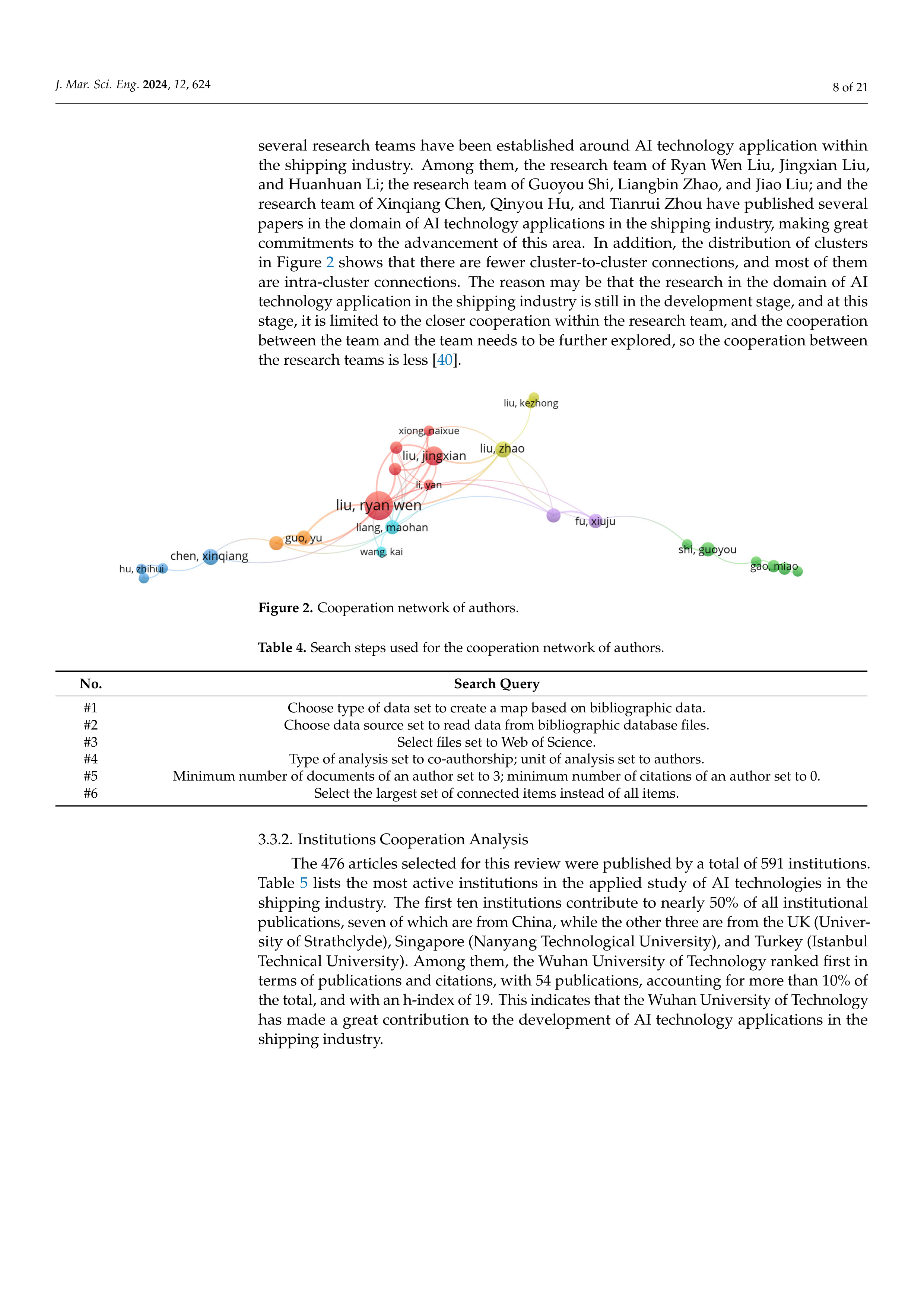
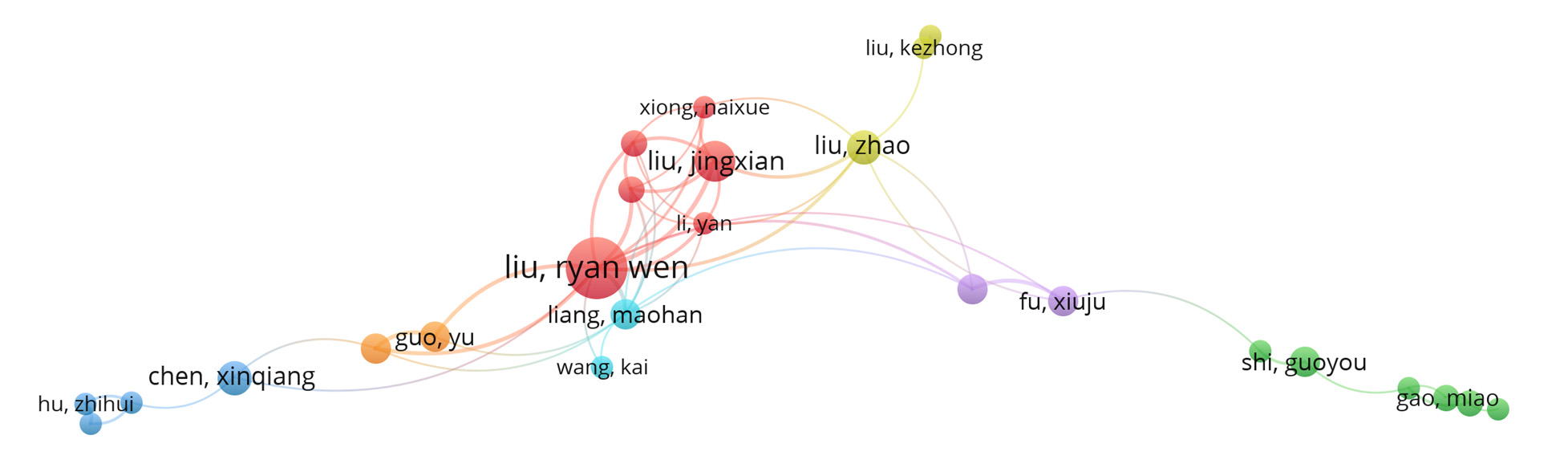
Figure
2
shows a coop-
erative network between authors with a minimum of 3 documents, containing 25 items,
51
links,
and
7
clusters.
The
specific
steps
of
the
algorithm
are
shown
in
Table
4
.
Each
item corresponds to an author, with the size indicating the number of papers that he or
she has published.
The links between items represent the collaboration between authors,
with the thickness indicating the intensity of their collaboration (i.e., the number of papers
they have worked on together).
The color of the items indicates the result of clustering,
and according to the color division, items of the same color (i.e., authors) belong to the
same research team.
As shown in Figure
2
, due to scholarly collaboration among authors,
J. Mar.
Sci.
Eng.
2024
,
12
, 624
8 of 21
several research teams have been established around AI technology application within
the
shipping
industry.
Among
them,
the
research
team
of
Ryan
Wen
Liu,
Jingxian
Liu,
and Huanhuan Li; the research team of Guoyou Shi, Liangbin Zhao, and Jiao Liu; and the
research team of Xinqiang Chen, Qinyou Hu, and Tianrui Zhou have published several
papers in the domain of AI technology applications in the shipping industry, making great
commitments
to
the
advancement
of
this
area.
In
addition,
the
distribution
of
clusters
in Figure
2
shows that there are fewer cluster-to-cluster connections,
and most of them
are
intra-cluster
connections.
The
reason
may
be
that
the
research
in
the
domain
of
AI
technology application in the shipping industry is still in the development stage, and at this
stage, it is limited to the closer cooperation within the research team, and the cooperation
between the team and the team needs to be further explored, so the cooperation between
the research teams is less [
40
].
Figure 2.
Cooperation network of authors.
Table 4.
Search steps used for the cooperation network of authors.
No.
Search Query
#1
Choose type of data set to create a map based on bibliographic data.
#2
Choose data source set to read data from bibliographic database files.
#3
Select files set to Web of Science.
#4
Type of analysis set to co-authorship; unit of analysis set to authors.
#5
Minimum number of documents of an author set to 3; minimum number of citations of an author set to 0.
#6
Select the largest set of connected items instead of all items.
3.3.2.
Institutions Cooperation Analysis
The 476 articles selected for this review were published by a total of 591 institutions.
Table
5
lists
the
most
active
institutions
in
the
applied
study
of
AI
technologies
in
the
shipping industry.
The first ten institutions contribute to nearly 50% of all institutional
publications, seven of which are from China, while the other three are from the UK (Univer-
sity of Strathclyde), Singapore (Nanyang Technological University), and Turkey (Istanbul
Technical University).
Among them, the Wuhan University of Technology ranked first in
terms of publications and citations, with 54 publications, accounting for more than 10% of
the total, and with an h-index of 19.
This indicates that the Wuhan University of Technology
has made a great contribution to the development of AI technology applications in the
shipping industry.
J. Mar.
Sci.
Eng.
2024
,
12
, 624
9 of 21
Table 5.
Most productive institutions.
Institution
Publications
Percentage (%)
H-Index
Wuhan University of Technology
54
11.35
19
Dalian Maritime University
47
9.87
16
Shanghai Maritime University
33
6.93
13
National Engineering Research Center for
Water Transport Safety
23
4.83
10
University of Strathclyde
16
3.36
9
Nanyang Technological University
12
2.52
9
Chinese Academy of Sciences
11
2.31
6
Harbin Engineering University
10
2.10
6
Istanbul Technical University
10
2.10
6
Shanghai Jiao Tong University
9
1.89
6
To analyze the collaborative relationships between institutions in the domain of AI
technology
applications
in
the
shipping
industry,
we
used
the
VOSviewer
software
to
construct a collaborative network of institutions.
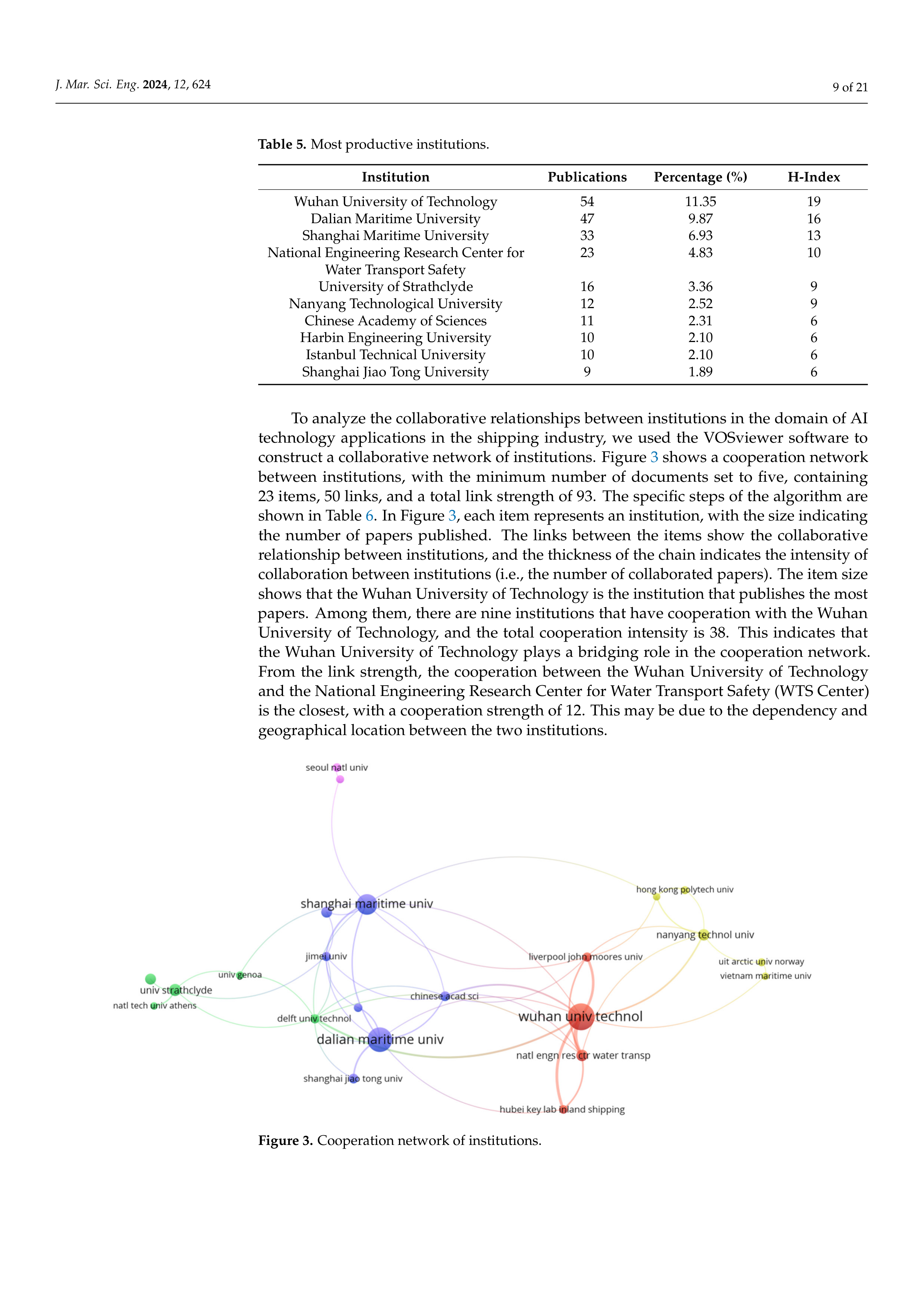
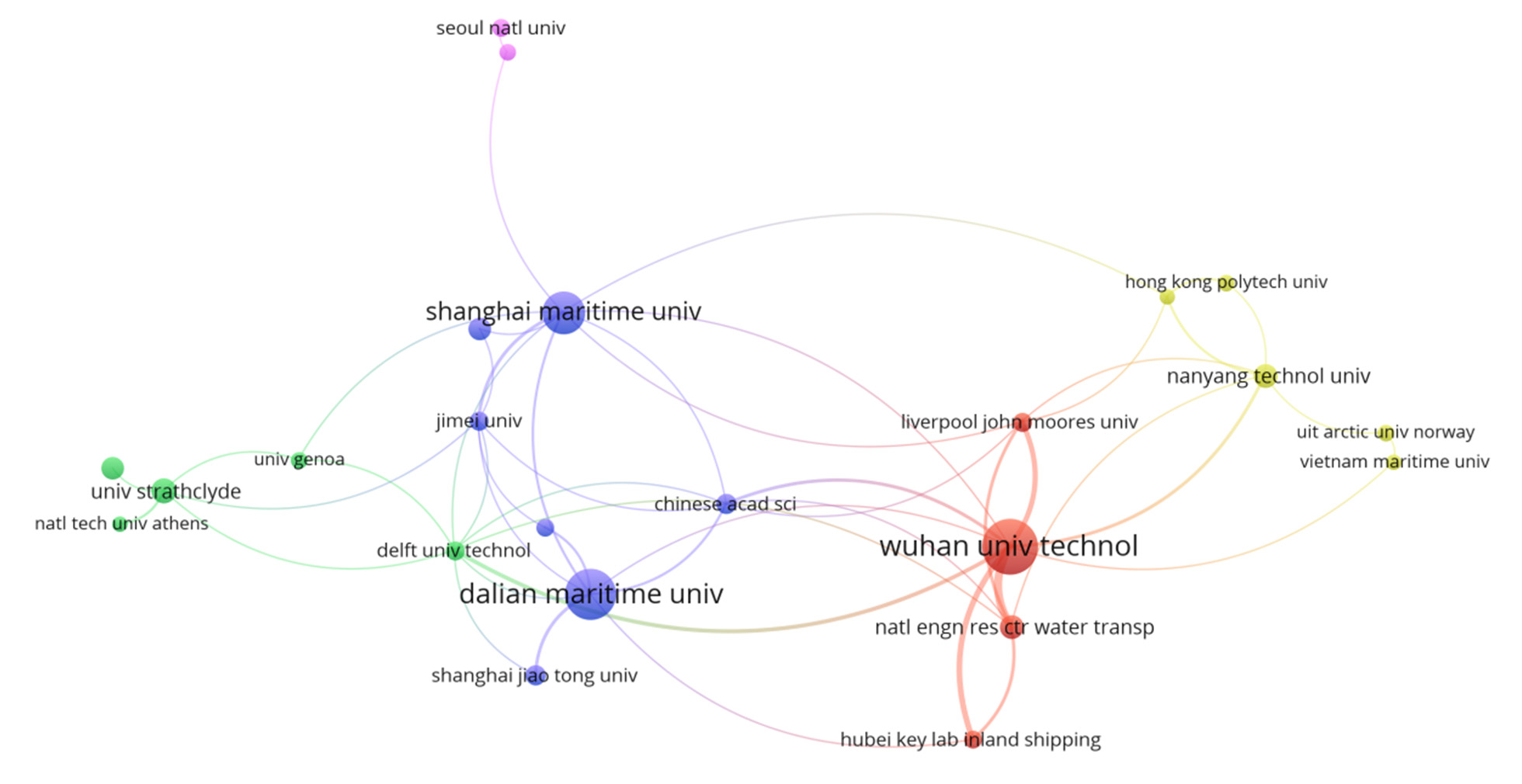
Figure
3
shows a cooperation network
between
institutions,
with
the
minimum
number
of
documents
set
to
five,
containing
23 items, 50 links, and a total link strength of 93.
The specific steps of the algorithm are
shown in Table
6
.
In Figure
3
, each item represents an institution, with the size indicating
the
number
of
papers
published.
The
links
between
the
items
show
the
collaborative
relationship between institutions, and the thickness of the chain indicates the intensity of
collaboration between institutions (i.e., the number of collaborated papers).
The item size
shows that the Wuhan University of Technology is the institution that publishes the most
papers.
Among them, there are nine institutions that have cooperation with the Wuhan
University
of
Technology,
and
the
total
cooperation
intensity
is
38.
This
indicates
that
the
Wuhan
University
of
Technology
plays
a
bridging
role
in
the
cooperation
network.
From
the
link
strength,
the
cooperation
between
the
Wuhan
University
of
Technology
and the National Engineering Research Center for Water Transport Safety (WTS Center)
is the closest, with a cooperation strength of 12.
This may be due to the dependency and
geographical location between the two institutions.
Figure 3.
Cooperation network of institutions.
J. Mar.
Sci.
Eng.
2024
,
12
, 624
10 of 21
Table 6.
Search steps used for the cooperation network of institutions.
No.
Search Query
#1
Choose type of data set to create a map based on bibliographic data.
#2
Choose data source set to read data from bibliographic database files.
#3
Select files set to Web of Science.
#4
Type of analysis set to co-authorship; unit of analysis set to organizations.
#5
Minimum number of documents of an organization set to 5; minimum number of
citations of an organization set to 0.
#6
Select the largest set of connected items instead of all items.
Zhang et al. [
41
] exemplified, in many ways, the benefits of collaboration between the
WTS Center and Wuhan University of Technology in the field of AI technology applica-
tions in the shipping industry.
The authors, from different colleges of various institutions,
shared
their
expertise
and
accelerated
knowledge
dissemination
through
collaborative
research.
Additionally, these institutions exchange and complement resources, enhancing
research efficiency and quality.
The WTS Center, a national research platform, excels in
data collection, while the Wuhan University of Technology, a strong shipping university,
specializes in shipping industry research.
The collaboration between the two organizations
leverages their strengths to advance AI in shipping.
Their location in Wuhan, China, is
also conducive for the local government to introduce relevant policies to facilitate more
cooperation between the two organizations.
Given the emerging nature of AI in shipping,
collaborative research is crucial for driving innovation in AI applications within the indus-
try.
It can also be seen in Figure
3
that the cooperation between institutions is not close,
especially the institutions at the edge of the cooperation network, as they do not constitute
a research community among multiple institutions.
This may be because the application of
AI technologies in the shipping industry involves complex algorithms and data processing
that require specialized knowledge and skills.
In addition, the shipping industry also in-
volves complex technologies and specialized knowledge, which may lead to compromised
cooperation between institutions.
As an emerging field of development, the field of AI in
shipping also has high industry barriers, and the capital and resources invested by various
institutions are very different, thus making it difficult to carry out in-depth cooperation.
To
advance the utilization of AI technology applications in the shipping industry, there should
be more cooperation among institutions to share their knowledge and research experience
in this field, which is very important to promote the research in this field [
42
].
Through
the cases of successful inter-institutional cooperation, some insights can be provided for
the innovation in the application field of AI technology in the shipping industry:
firstly,
institutions can work together to set clear goals and visions for cooperation and establish
a mutually trusting and beneficial partnership to work together on the development of
innovation in this field; secondly, the sharing of resources and technical exchanges between
institutions can improve the efficiency of research and accelerate the output of innovative
results; and, thirdly, institutions can cross the boundaries of disciplinary fields and explore
new research directions, combining the expertise in the field of shipping and AI technology
to realize cross-innovation.
3.3.3.
Country Cooperation Analysis
Analyzing the country information of the papers can help researchers to understand
the research contribution of each country in the domain of AI technology applications in
shipping, as well as the communication and cooperation between countries.
From 2001 to
2022, 55 countries have contributed to researching AI technology applications in shipping
by publishing papers in the SCI and SSCI databases.
Table
7
reveals the first ten countries
in the number of papers published.
The country that has published the highest number of
papers in the domain of AI technology applications in shipping industry is China, with a
total of 239 papers.
It is followed by the United States (37 papers), South Korea (36 papers),
and the United Kingdom (33 papers).
In addition, China has published more than 50%
J. Mar.
Sci.
Eng.
2024
,
12
, 624
11 of 21
of all the papers in the domain of AI technology application in shipping—far more than
other countries—demonstrating that China has provided a crucial impetus to the growth
of this domain.
In regard to the citation rate, China is also the most influential country,
with an h-index of 33.
In general, the number of publications is positively correlated with
the h-index.
However, there are countries that have a high h-index with a low number of
publications, thus suggesting that their papers are widely recognized [
43
].
For example,
the USA and England have published 37 and 33 papers, respectively, but their h-index is 13
and 14, respectively.
Table 7.
Most productive countries.
Country
Publications
Percentage (%)
H-Index
China
239
50.21
33
USA
37
7.77
13
South Korea
36
7.56
14
England
33
6.93
14
Norway
26
5.46
13
Singapore
23
4.83
12
Turkey
20
4.20
9
Scotland
17
3.57
9
Italy
16
3.36
8
Australia
15
3.15
7
To analyze the cooperation between countries,
we utilized VOSviewer software to
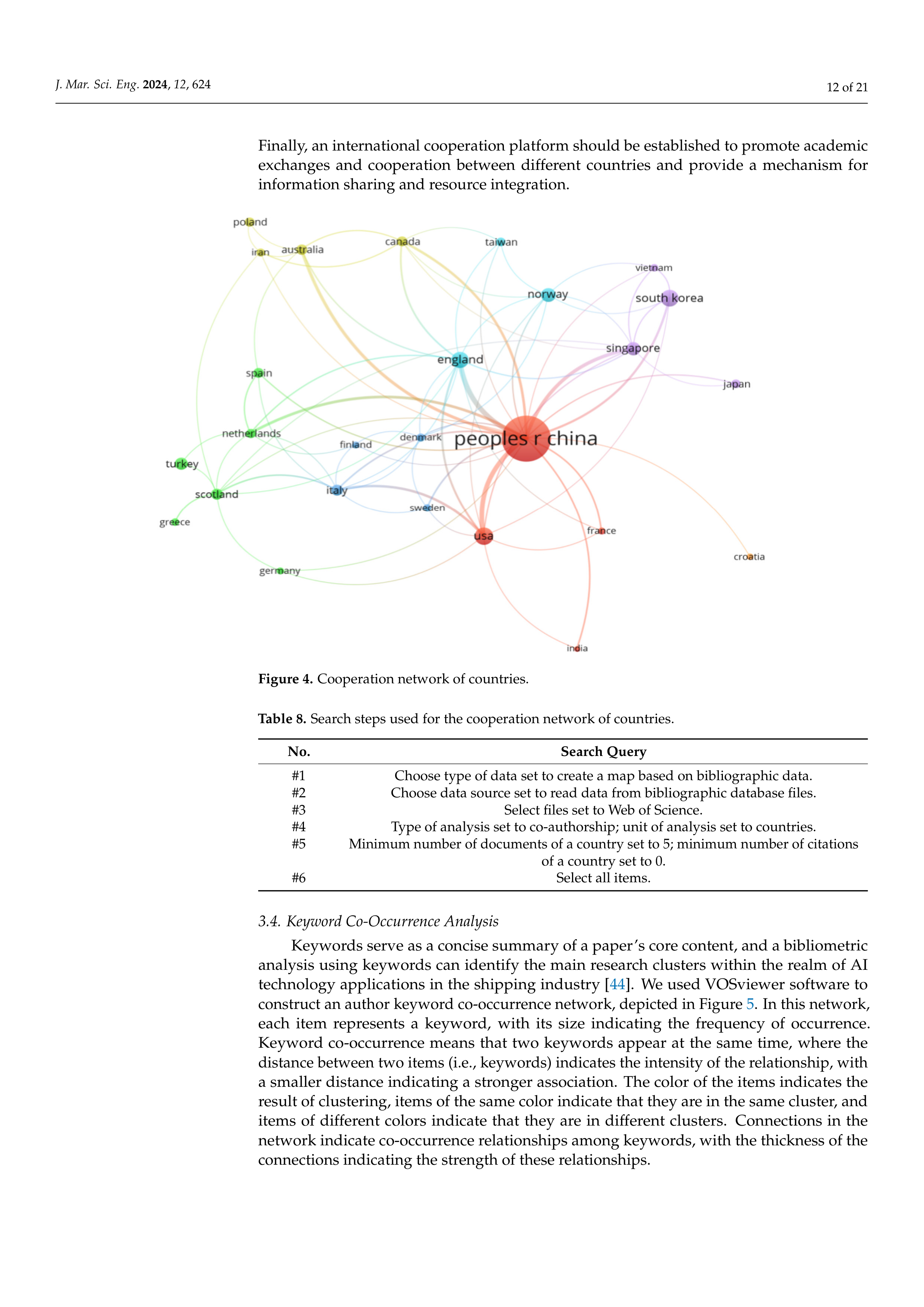
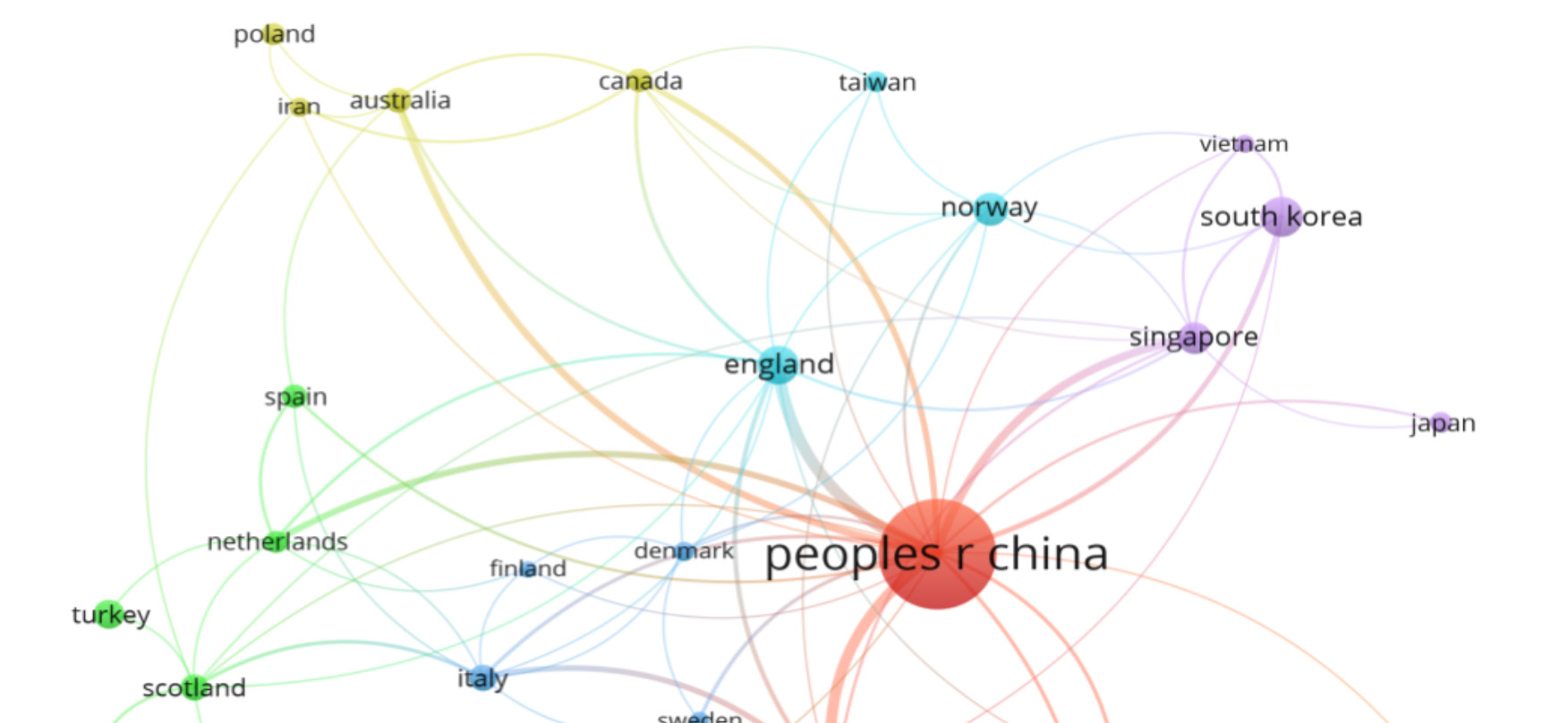
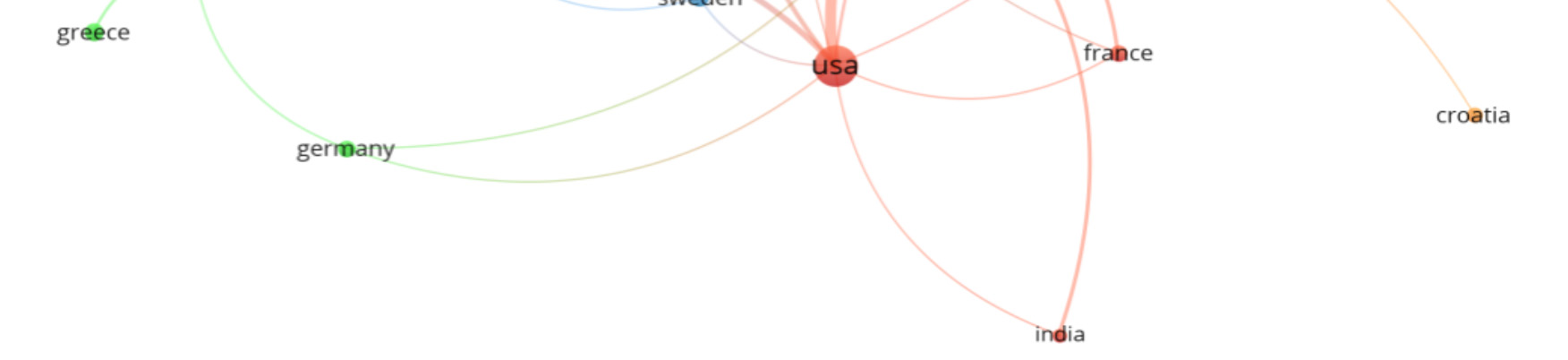
establish a collaboration network among countries. Figure
4
shows the cooperation network
between countries for a country with the minimum number of papers set to 5, containing
26 items, 76 links, and a total cooperation intensity of 172. The specific steps of the algorithm
are shown in Table
8
.
In Figure
4
, each item represents a country, with its size indicating
the number of published papers by that country.
The links connecting the items indicate
the collaborative relationship between countries, and the thickness of the chain indicates
the intensity of collaboration between countries (i.e., the number of papers collaborated).
The
item
size
shows
that
China
is
the
country
that
publishes
the
most
papers.
Among
them,
22
countries
have
collaborated
with
China,
and
the
total
collaboration
intensity
is
95,
followed
by
the
United
States
(10
collaborating
countries,
33
total
collaboration
intensity),
and
South
Korea
(5
collaborating
countries,
11
total
collaboration
intensity).
The
coarseness
of
the
chain
shows
that
collaboration
between
China
and
the
UK
is
the
closest, with an intensity of cooperation of 17.
This is followed by cooperation between
China and the US (with an intensity of cooperation of 15), and cooperation between China
and Singapore (with an intensity of cooperation of 10).
However,
we can also see from
Figure
4
that some countries have a small number of publications and a small intensity
of cooperation with other countries (e.g., Greece, India, Croatia, etc.), and there are even
many countries that do not appear in this cooperation network.
On the one hand, this may
be because developing intercountry cooperation in the field of shipping AI may involve the
sharing of intellectual property rights and the distribution of benefits, which may affect the
development of cooperation if consensus cannot be reached.
On the other hand, different
countries may have different understandings of and requirements for the standards and
norms of AI technology, which may become an obstacle to national cooperative research.
If
there are large differences in technical standards and norms between countries, it may lead
to incompatibility and increase the difficulty of national cooperative research.
Therefore,
international academic cooperation in the domain of AI technology applications in shipping
requires further enhancing for future research.
First, technical standards and data formats
can be jointly developed between countries to reduce barriers to technology integration
and data sharing and to promote the smooth progress of cooperative research.
Second,
government departments can organize regular policy dialogues and cooperation meetings
to
promote
policy
research
and
application
of
AI
technology
in
the
shipping
industry.
J. Mar.
Sci.
Eng.
2024
,
12
, 624
12 of 21
Finally, an international cooperation platform should be established to promote academic
exchanges
and
cooperation
between
different
countries
and
provide
a
mechanism
for
information sharing and resource integration.
Figure 4.
Cooperation network of countries.
Table 8.
Search steps used for the cooperation network of countries.
No.
Search Query
#1
Choose type of data set to create a map based on bibliographic data.
#2
Choose data source set to read data from bibliographic database files.
#3
Select files set to Web of Science.
#4
Type of analysis set to co-authorship; unit of analysis set to countries.
#5
Minimum number of documents of a country set to 5; minimum number of citations
of a country set to 0.
#6
Select all items.
3.4.
Keyword Co-Occurrence Analysis
Keywords serve as a concise summary of a paper’s core content, and a bibliometric
analysis using keywords can identify the main research clusters within the realm of AI
technology applications in the shipping industry [
44
].
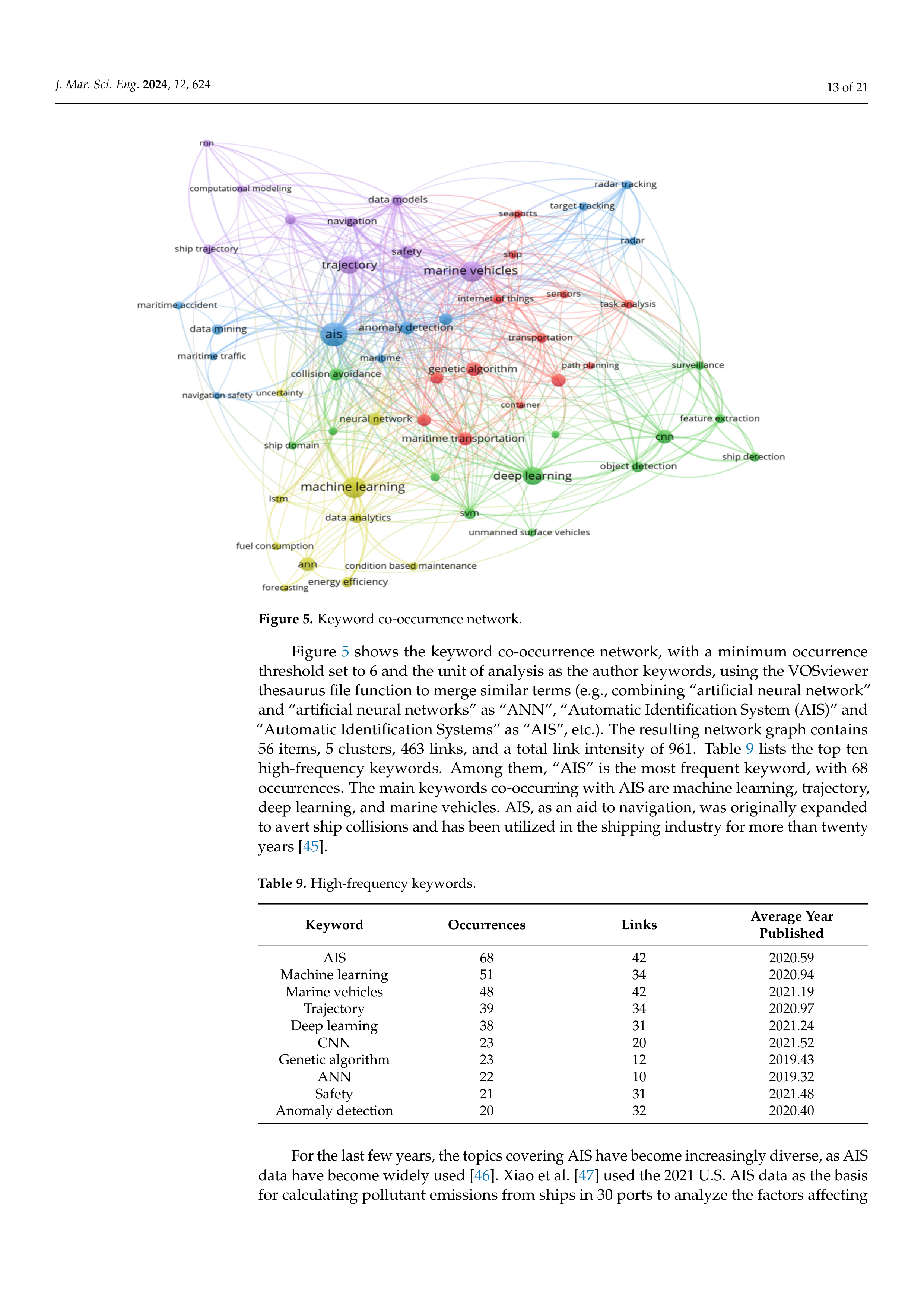
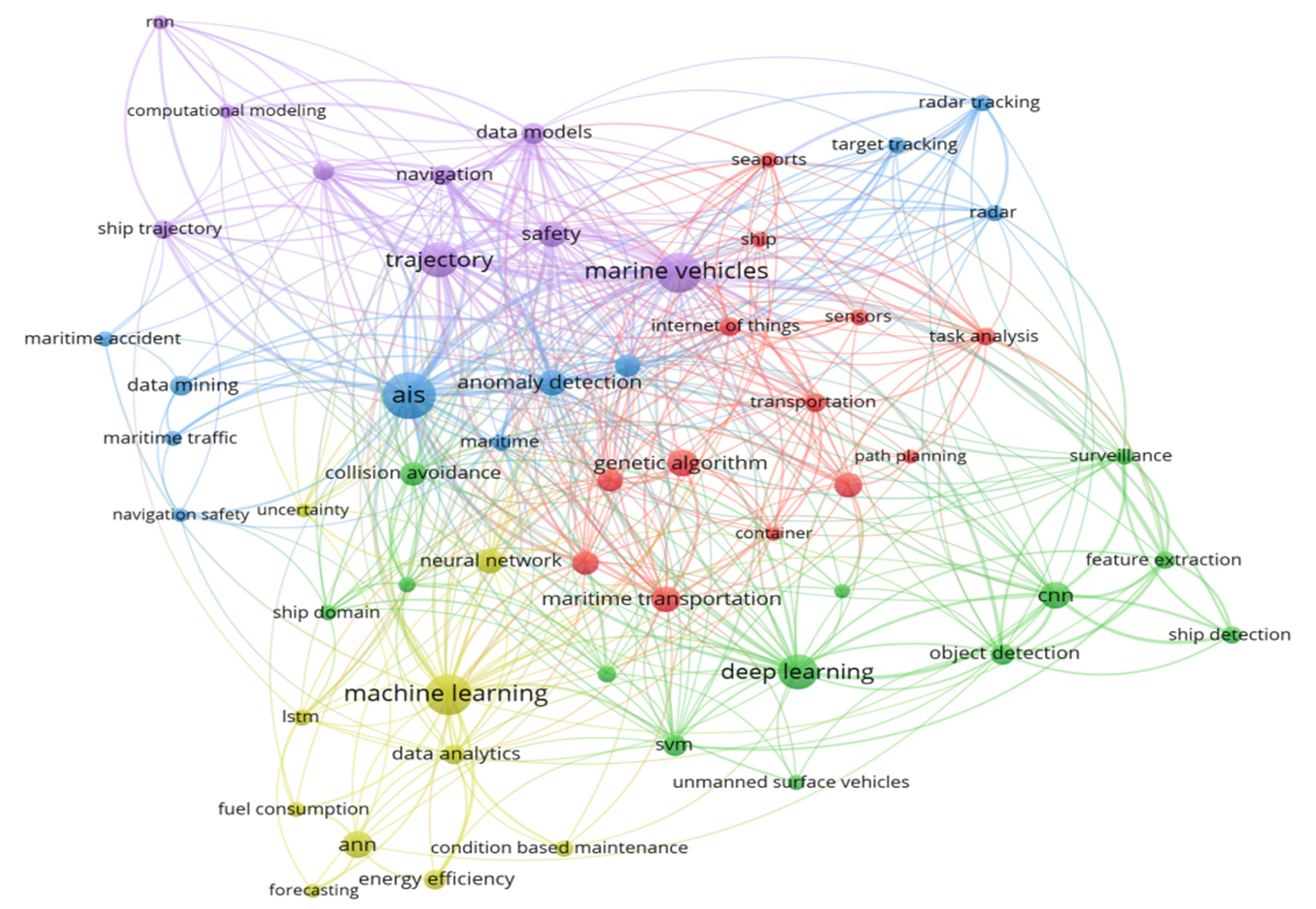
We used VOSviewer software to
construct an author keyword co-occurrence network, depicted in Figure
5
.
In this network,
each
item
represents
a
keyword,
with
its
size
indicating
the
frequency
of
occurrence.
Keyword
co-occurrence
means
that
two
keywords
appear
at
the
same
time,
where
the
distance between two items (i.e., keywords) indicates the intensity of the relationship, with
a smaller distance indicating a stronger association.
The color of the items indicates the
result of clustering, items of the same color indicate that they are in the same cluster, and
items
of
different
colors
indicate
that
they
are
in
different
clusters.
Connections
in
the
network indicate co-occurrence relationships among keywords, with the thickness of the
connections indicating the strength of these relationships.
J. Mar.
Sci.
Eng.
2024
,
12
, 624
13 of 21
Figure 5.
Keyword co-occurrence network.
Figure
5
shows
the
keyword
co-occurrence
network,
with
a
minimum
occurrence
threshold set to 6 and the unit of analysis as the author keywords, using the VOSviewer
thesaurus file function to merge similar terms (e.g., combining “artificial neural network”
and “artificial neural networks” as “ANN”, “Automatic Identification System (AIS)” and
“Automatic Identification Systems” as “AIS”, etc.).
The resulting network graph contains
56
items,
5
clusters,
463
links,
and
a
total
link
intensity
of
961.
Table
9
lists
the
top
ten
high-frequency
keywords.
Among
them,
“AIS”
is
the
most
frequent
keyword,
with
68
occurrences.
The main keywords co-occurring with AIS are machine learning, trajectory,
deep learning, and marine vehicles.
AIS, as an aid to navigation, was originally expanded
to avert ship collisions and has been utilized in the shipping industry for more than twenty
years [
45
].
Table 9.
High-frequency keywords.
Keyword
Occurrences
Links
Average Year
Published
AIS
68
42
2020.59
Machine learning
51
34
2020.94
Marine vehicles
48
42
2021.19
Trajectory
39
34
2020.97
Deep learning
38
31
2021.24
CNN
23
20
2021.52
Genetic algorithm
23
12
2019.43
ANN
22
10
2019.32
Safety
21
31
2021.48
Anomaly detection
20
32
2020.40
For the last few years, the topics covering AIS have become increasingly diverse, as AIS
data have become widely used [
46
].
Xiao et al. [
47
] used the 2021 U.S. AIS data as the basis
for calculating pollutant emissions from ships in 30 ports to analyze the factors affecting
J. Mar.
Sci.
Eng.
2024
,
12
, 624
14 of 21
pollutant
emissions
from
ships.
Chen
et
al.
[
48
]
proposed
an
AIS-based
ship
security
system that improves the network security and data integrity of AIS by establishing a trust
verification mechanism, distributed denial-of-service attack prevention, and geofencing
mechanism, while utilizing AI and 5G networks to achieve ship intelligence and security.
Li
et al. [
49
] developed a model based on AIS data to assess the navigational risk in different
sea
areas
by
extracting
and
analyzing
relevant
data
from
AIS
information.
In
addition,
there are 51 keywords co-occurring with machine learning and 38 keywords co-occurring
with deep learning.
Among them, the keywords co-occurring with “machine learning” are
mainly “energy efficiency”, “ship collision avoidance”, “data analysis”, and “optimization”;
and the keywords co-occurring with “deep learning” are mainly “target detection”, “ship
trajectory”, “unmanned surface vehicles”, and “reinforcement learning”.
As can be seen
from
Table
9
,
the
“average
publication
year”
of
the
first
ten
high-frequency
keywords
extends from 2019 to 2022, indicating that these high-frequency keywords have been the
focus of research in the domain of AI technology applications in the shipping industry in
recent years.
In this co-occurrence network, the yellow cluster studies the application of machine
learning algorithms to shipping.
The green cluster studies the application of deep learning
algorithms to shipping.
These two clusters are also the current research hotspots for the
application
of
AI
technology
in
the
shipping
industry,
which
also
provides
directions
for future research in this field.
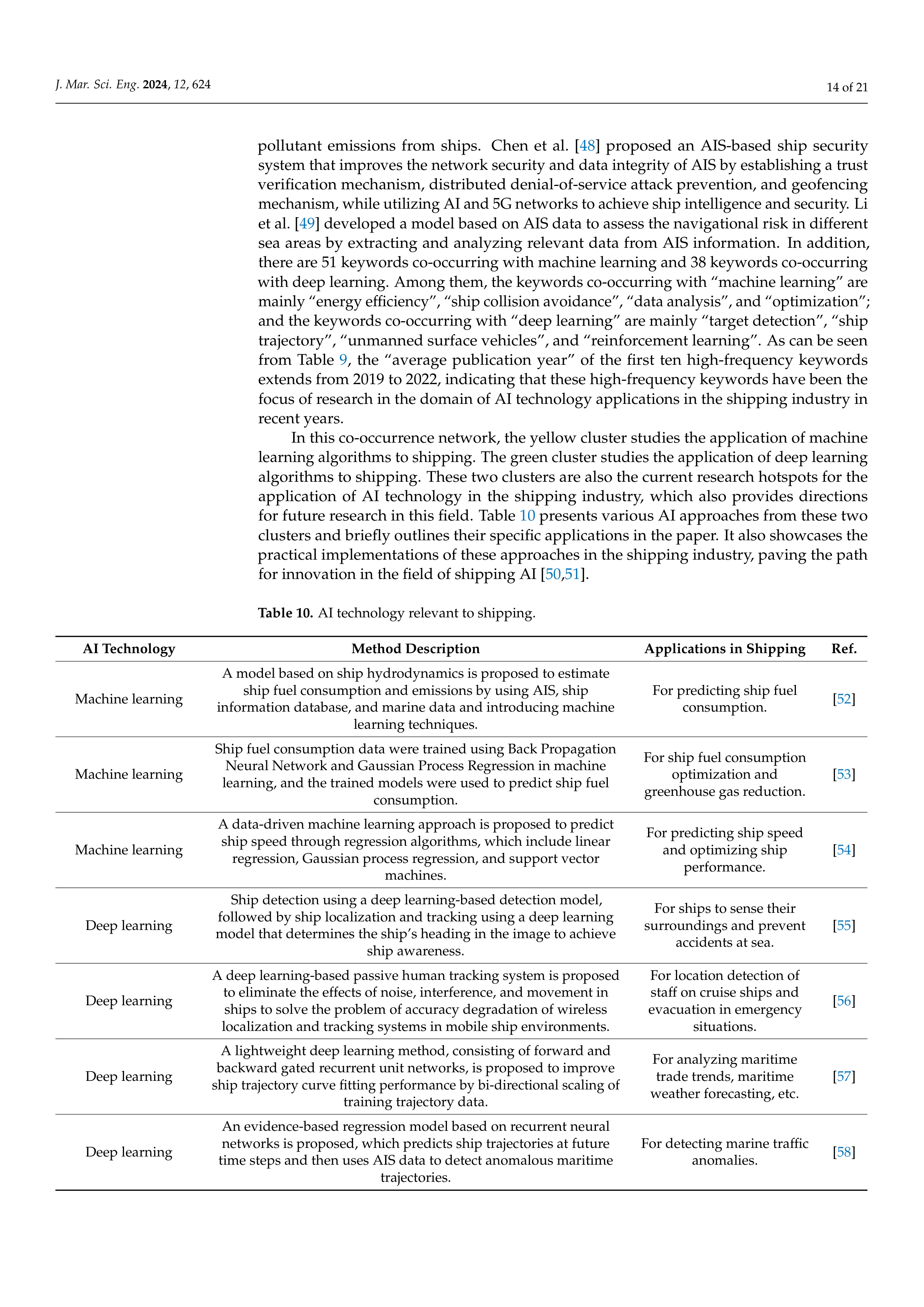
Table
10
presents various AI approaches from these two
clusters and briefly outlines their specific applications in the paper.
It also showcases the
practical implementations of these approaches in the shipping industry, paving the path
for innovation in the field of shipping AI [
50
,
51
].
Table 10.
AI technology relevant to shipping.
AI Technology
Method Description
Applications in Shipping
Ref.
Machine learning
A model based on ship hydrodynamics is proposed to estimate
ship fuel consumption and emissions by using AIS, ship
information database, and marine data and introducing machine
learning techniques.
For predicting ship fuel
consumption.
[
52
]
Machine learning
Ship fuel consumption data were trained using Back Propagation
Neural Network and Gaussian Process Regression in machine
learning, and the trained models were used to predict ship fuel
consumption.
For ship fuel consumption
optimization and
greenhouse gas reduction.
[
53
]
Machine learning
A data-driven machine learning approach is proposed to predict
ship speed through regression algorithms, which include linear
regression, Gaussian process regression, and support vector
machines.
For predicting ship speed
and optimizing ship
performance.
[
54
]
Deep learning
Ship detection using a deep learning-based detection model,
followed by ship localization and tracking using a deep learning
model that determines the ship’s heading in the image to achieve
ship awareness.
For ships to sense their
surroundings and prevent
accidents at sea.
[
55
]
Deep learning
A deep learning-based passive human tracking system is proposed
to eliminate the effects of noise, interference, and movement in
ships to solve the problem of accuracy degradation of wireless
localization and tracking systems in mobile ship environments.
For location detection of
staff on cruise ships and
evacuation in emergency
situations.
[
56
]
Deep learning
A lightweight deep learning method, consisting of forward and
backward gated recurrent unit networks, is proposed to improve
ship trajectory curve fitting performance by bi-directional scaling of
training trajectory data.
For analyzing maritime
trade trends, maritime
weather forecasting, etc.
[
57
]
Deep learning
An evidence-based regression model based on recurrent neural
networks is proposed, which predicts ship trajectories at future
time steps and then uses AIS data to detect anomalous maritime
trajectories.
For detecting marine traffic
anomalies.
[
58
]
J. Mar.
Sci.
Eng.
2024
,
12
, 624
15 of 21
4.
Gap in Research Hot Area and Future Research Directions
Despite
the
rapid
development
in
the
field
of
AI
technology
applications
for
the
shipping industry in recent years, there are still some challenges that need to be addressed.
In this part, based on the results of keyword co-occurrence analysis and the content analysis
of published papers in recent years, the gaps in the current research hot areas, as well as
the possible future research directions, are discussed.
The results of the study can provide
a reference for researchers’ future exploration in this field.
4.1.
AIS Data Applications
AIS is an automatic tracking system installed on ships that plays an important role
in
the
safe
navigation
of
ships.
AIS
data
are
the
status
information
of
the
ship
during
navigation
collected
by
various
types
of
sensors
and
sent
by
AIS
equipment.
In
recent
years, as AIS data have received widespread attention, and the application fields of AIS
data have become more and more extensive.
At present, the research on the application of
AIS data mainly focuses on ship collision risk, ship trajectory prediction, and ship collision
avoidance
systems.
Liu
et
al.
[
59
]
proposed
a
modeling,
visualization
and
prediction
framework for ship collision risk analysis and used AIS data from Chengshantou waters
to
verify
the
reliability
and
robustness
of
the
framework.
The
results
of
this
study
can
help
ship
pilots
to
judge
ship
collision
risks
in
advance
and
take
relevant
measures
in
time to avoid potential ship collision risks.
Chen et al. [
60
] introduced a deep learning-
based
framework
to
accurately
predict
ship
trajectories,
supported
by
AIS
data,
which
predicted
the
trajectory
changes
in
single
and
multiple
ships,
and
this
study
can
help
maritime
regulators
make
reasonable
traffic
control
and
management
decisions.
Zhu
et al. [
61
] proposed a scenario-based test validation method for ship collision avoidance
systems, which solves the potential flaws in previous ship collision avoidance algorithms by
mining historical AIS data and randomly producing virtual test scenarios to quickly create
appropriate test scenarios.
However, there are data-quality and -acquisition problems with
AIS data, and such problems may lead to the application of AIS data in some shipping fields
being hindered.
For example, maritime environmental monitoring is limited by the fact
that ships are equipped with AIS equipment and the vagaries of the maritime environment,
which may lead to incomplete data, as well as delays in data acquisition and transmission
due
to
environmental
factors,
which
can
affect
the
accuracy
and
reliability
of
maritime
environmental
monitoring,
thus
limiting
the
depth
and
breadth
of
related
research.
In
addition, as the quality of AIS data improves, the applications of AIS data are becoming
more diverse, meaning that researchers are faced with tougher challenges.
Future research:
Despite the growing maturity of research on AIS data, future research
on
AIS
data
should
consider
applications
in
other
directions,
such
as
analyzing
ship
behavior
from
AIS
data.
Ma
et
al.
[
62
]
proposed
a
method
to
identify
and
analyze
the
waiting behavior of ships outside the port based on AIS data, and it is of great significance
to enhance port-traffic management and optimize ship sailing plans.
In addition, due to
the problems of AIS equipment, the collection of AIS data will inevitably contain missing
and abnormal problems.
Zhang et al. [
63
] proposed an AIS data repair method that can
effectively
deal
with
long-distance
data
loss
and
large-volume
data,
indeed,
by
using
temporal convolutional networks and bidirectional long- and short-term memory to repair
AIS data, thus providing a reference for future researchers to collect AIS data.
4.2.
Ship Trajectory
Research on ship trajectories mainly includes trajectory prediction, trajectory cluster-
ing, and trajectory tracking.
In the research on trajectory prediction, deep learning-based
methods are more widely used.
Zhang et al. [
64
] reviewed the existing methods for ship
trajectory prediction in maritime transportation, including simulation methods, statistical
methods, hybrid methods, machine learning methods, and the current state-of-the-art deep
learning methods, and summarized the current challenges in the field, which is of great
significance to ensure the safety and efficiency of maritime transportation.
Li et al. [
65
]
J. Mar.
Sci.
Eng.
2024
,
12
, 624
16 of 21
proposed a data-mapping and density-based clustering method for ship trajectories, aim-
ing to improve the accuracy and computational efficiency of clustering, and realized the
clustering and identification of ship trajectories, which are of great significance for trajec-
tory visualization and safe path planning.
With the development of intelligent ships, the
research about ship trajectory tracking has also become an important task in the intelligent
navigation of ships.
Ahmed et al. [
66
] proposed a spatiotemporal trajectory correlation
algorithm for the trajectory tracking of ships at sea, solving the problems of missing ship
identifiers and time intervals.
Moreover, when constructing a ship trajectory model based
on deep learning, researchers need to spend a lot of time selecting an appropriate model
and adjusting the parameters of the model.
Therefore, choosing an optimal model for ship
trajectory-related research may be a tricky problem based on the current small amount
of research on ship trajectory.
Meanwhile,
in the research on ship trajectory prediction,
factors such as currents, winds, tides, and changes in the maritime environment are rarely
considered in the current research in this field, considering the rapidly changing conditions
at sea.
With the continuous expansion of maritime traffic, the research about ship trajectory
has increasingly become one of the important topics in the shipping industry.
Future research:
In the context of the rapid development of the shipping industry, the
research on ship trajectory prediction is still necessary and urgent to ensure the safety of
ship trajectories and reduce the occurrence of maritime accidents.
In future research, the
traditional machine learning-based method for ship trajectory prediction will be subject to
more and more restrictions, and the deep learning-based ship trajectory prediction method
should receive more and more attention from researchers [
67
].
In addition, future research
on ship trajectories can also try to classify ship trajectories in order to further determine the
behavior behind the trajectories and provide assistance to the work of maritime regulatory
authorities [
68
].
4.3.
Anomaly Detection
As the acquisition of AIS data and application research continue to deepen, maritime
anomaly detection has also received more and more attention from researchers and has
gradually become a hot research direction in the field of shipping. Maria et al. [
69
] discussed
the importance of maritime anomaly detection in ensuring the safety of ship traffic and
maritime security and provided a comprehensive summary of maritime anomaly detection
from four categories:
data, methods, systems, and user aspects.
Possible research directions
and challenges of maritime anomaly detection were outlined.
Wei et al. [
70
] designed a
maritime anomaly detection algorithm based on the support vector machine, considering
the spatiotemporal and motion characteristics of the trajectory, and the experimental results
show that the algorithm can effectively perform maritime anomaly detection.
In addition,
due to the special characteristics of the maritime environment, real-time anomaly detection
becomes
very
important
in
the
research
in
this
field,
but
there
are
few
research
studies
addressing real-time anomaly detection, mainly since the transmission speed and variability
of the data affect the effectiveness of the anomaly detection methods, thus leading to the
real-time anomaly detection becoming difficult to deal with.
Future research:
With the development of the world economy, the impact of maritime
transportation on global trade is becoming more and more important.
The detection of the
abnormal behavior of ships is an important aspect to improve the safety of maritime traffic.
In future research, multi-source data such as images and videos will become an important
factor to improve the accuracy of anomaly detection, and deep learning technology also
shows good application prospects in ship anomaly detection [
71
].
In addition, the efficiency
of
ship
anomaly
detection
can
also
be
improved
through
the
detection
of
ship
speed
anomalies, another issue of great significance to maritime navigation safety [
72
].
Overall, interdisciplinary collaboration in applied research on the shipping industry and
AI technologies can help to develop a more comprehensive and in-depth research perspective,
while
facilitating
exchanges
between
different
disciplines.
Promoting
the
application
of
AI
technology
in
the
shipping
industry
can
rapidly
realize
the
digital
transformation
of
J. Mar.
Sci.
Eng.
2024
,
12
, 624
17 of 21
the shipping industry and promote the change and progress of the industry.
In addition,
it
is
important
to
encourage
collaboration
between
AI
researchers,
maritime
experts,
and
environmental scientists. Firstly, regular interdisciplinary workshops are organized to invite AI
researchers, maritime experts, and environmental scientists to share the latest research results
in their respective fields, through which the exchange of interdisciplinary cooperation can be
promoted. Secondly, establishing a data-sharing platform so that experts in different fields can
share resources can help accelerate research progress. Finally, government departments can
formulate policies and standards to support interdisciplinary cooperation and, at the same
time, establish relevant incentive mechanisms to motivate experts in different fields to achieve
results and breakthroughs in interdisciplinary cooperation.
5.
Practical and Theoretical Implications
By examining the bibliometric analysis in the AI field of shipping,
we can see that
the utilization of AI technology in shipping introduces new research avenues in AIS data
applications, ship trajectory, and anomaly detection.
Additionally, it enhances the decision-
making and operations of shipping companies and maritime administrations in the industry.
Firstly, the theoretical study of AI technology in AIS data applications not only advances
the development of data processing and analysis methods in the shipping industry but also
enhances the theory of informatization management in shipping.
Exploring the application
of AIS data can offer theoretical support for informatization construction and intelligent
development in the shipping sector.
In practical terms, AIS data enable shipping enterprises
to
access
crucial
functions
like
real-time
ship
positioning
and
route
planning,
and
they
enhance ship transportation efficiency, thereby aiding companies in better ship management
and boosting economic benefits.
Secondly, the theoretical research on AI technology in ship
trajectory focuses on trajectory prediction,
trajectory clustering,
and trajectory tracking.
Trajectory prediction aids in collision avoidance, trajectory clustering helps in identifying
various ship behaviors, and trajectory tracking enables real-time monitoring and warning
capabilities.
In practice, trajectory prediction enhances navigation safety, reduces accident
risks,
and
serves
as
a
vital
reference
for
optimizing
ship
routes.
Trajectory
clustering
assists shipping enterprises in understanding ship behaviors better and optimizing ship
scheduling.
Trajectory tracking helps in promptly identifying any abnormal ship situations
to safeguard the ship and crew’s safety.
Lastly, the theoretical study of anomaly detection
can offer more scientific guidance for safety management and risk control in the shipping
industry.
In practical applications, anomaly detection plays a crucial role in enhancing the
level of maritime safety management.
Research in the field of AI in shipping not only enhances understanding of the shipping
industry
in
theory
but
also
enhances
efficiency
and
safety
for
shipping
companies
and
maritime
administrations
in
practical
applications.
By
consistently
advancing
the
use
and study of AI technology in shipping, the industry will embrace a more intelligent and
sustainable future.
6.
Conclusions
This study reviews the literature related to the application area of AI technologies in
the shipping industry.
A bibliometric approach was used to collect 476 articles published
from 2001 to 2022 based on the SCI-EXPANDED and SSCI databases.
This study shows that
the literature in the field of AI technology applications in the shipping industry has become
more and more extensive over the last decade, and the number of articles published in this
field has been growing rapidly, especially from 2018 onward.
The study also shows that
the
Ocean Engineering
journal, the
Journal of Marine Science and Engineering
, and the
IEEE
Access
journal have published significantly more papers in this field than the other journals,
indicating that they are the most influential publications in this field, giving researchers a
certain reference for their research in this field.
According to the country analysis, China is one of the most important contributors
to the literature in the field of AI technology applications in the shipping industry, with
J. Mar.
Sci.
Eng.
2024
,
12
, 624
18 of 21
the highest number of publications (239), followed by the United States, South Korea, and
the United Kingdom.
Also, China has the highest h-index.
The analysis of the national
cooperation network constructed by VOSviewer software shows that China is in the leading
position in terms of the number of published papers, cooperation between countries, and
the closeness of the cooperation relationship, indicating that China has made a very impor-
tant contribution to research in the field of the application of AI technology in the shipping
industry, and that the results of the academic research in this field are of some significance.
This may be because China is a world leader in the application of AI technology, and the
Chinese government has been committed to promoting the development of AI technology,
laying the foundation for China to play a leading role in the application of AI technology
in
the
shipping
industry.
However,
international
academic
cooperation
in
this
field
is
somewhat weak and needs to be further strengthened in future research.
Shipping is a
global industry that requires countries to work together to address challenges.
Different
countries have their own advantages and expertise in the field of AI, and strengthening
international cooperation can realize knowledge complementarity and promote the compre-
hensive development of AI research in shipping.
Strengthening international cooperation
can also promote knowledge exchange, resource sharing, and technological innovation,
providing a broader platform and opportunities for the application and development of AI
technology in the shipping industry.
According to the institutional analysis, the Wuhan
University of Technology, Dalian Maritime University, and Shanghai Maritime University
have
published
many
papers
in
the
field
of
AI
technology
application
in
the
shipping
industry that have made great contributions to the development of this field.
However, it is
found from the institutional cooperation network diagram that the cooperation between
institutions is not close.
To promote the development of the field, the institutions should
strengthen their cooperation and share their knowledge and research experience.
Through
the
cooperation,
the
organization
can
form
a
stronger
joint
force,
expand
its
market
in-
fluence in the field of AI technology application in shipping industry, and contribute to
the promotion and application of
the research results.
Meanwhile,
it is found
from the
authors’ cooperation network that although some authors have published more papers,
the academic cooperation in this field is still limited to the intra-research team, and the
team-to-team cooperation is still less.
In future research, cooperation between teams needs
to be strengthened, which can broaden research horizons, introduce diversified thinking
and methods, avoid limitations due to a single point of view, and improve the authority of
research results.
The keyword “co-occurrence analysis” shows the main research clusters in the field
of AI technology applications in the shipping industry.
The fact that “AIS” is the most
frequent keyword indicates that it is a research hotspot in the field.
The study also shows
that the clusters where machine learning and deep learning are located are current research
hotspots in the field.
Currently, machine learning and deep learning are often combined
with ship energy efficiency, ship collision avoidance, ship trajectory, AIS data, etc., thus
laying a solid foundation for the development of the application area of AI technology in
the shipping industry.
Then, based on the results of the keyword co-occurrence analysis
and the content analysis of the published papers in recent years, the research gaps in the
application of AIS data applications, ship trajectory, and anomaly detection, as well as the
possible future research directions, are discussed to provide a reference for the researchers’
future explorations in this field.
Finally, the implications of research in the field of shipping
AI are discussed in terms of both theory and practice.
From the perspective of the shipping
industry, ship information provided by AIS data can better provide decision support for
ship
management
and
operation.
Ship
trajectory
research
based
on
AI
technology
can
provide intelligent path planning for ships to improve navigation efficiency and safety.
It
can also provide a basis for ship behavior analysis and prediction by identifying different
patterns
of
ship
trajectories,
such
as
berthing
and
sailing.
Maritime
anomaly
detection
based
on
AI
technology
can
improve
the
level
of
maritime
safety
detection,
reduce
the
J. Mar.
Sci.
Eng.
2024
,
12
, 624
19 of 21
possibility
of
accidents,
and
provide
a
continuous
step
forward
to
push
the
shipping
industry toward intelligent development.
The findings of this paper can help scholars understand the development trend of the
application area of AI technology in the shipping industry, better understand the status
of
the
field,
and
explore
potential
research
opportunities.
At
the
same
time,
this
study
has some limitations that deserve further exploration.
Moreover, our study is based only
on
SCI-EXPANDED
and
SSCI
in
the
WoS
database,
which
may
affect
the
coverage
of
publications in the research area.
Additionally, the keywords of the literature search may
not reflect the full picture of the research area, and with the continuous development of AI
technology, future studies may include more keywords.
Author Contributions:
Conceptualization, G.X. and D.Y.; methodology, G.X., D.Y., L.X., J.L. and Z.J.;
writing—original draft preparation, G.X. and D.Y.; writing—review and editing, G.X., L.X., J.L. and Z.J.;
funding acquisition, G.X. All authors have read and agreed to the published version of the manuscript.
Funding:
This research was funded by National Natural Science Foundation of China, grant number
52002243; Beijing Natural Science Foundation, grant number 9244032; and The Youth Foundation of
Humanities and Social Science Research of the Ministry of Education (2022YJCZH070).
Institutional Review Board Statement:
Not applicable.
Informed Consent Statement:
Not applicable.
Data Availability Statement:
Readers can access our data by sending an email to the corresponding
author, Ziran Jiang.
Conflicts of Interest:
The authors declare no conflict of interest.
References
1.
Li,
X.;
Jiang,
H.
Artificial
intelligence
technology
and
engineering
applications.
Appl.
Comput.
Electromagn.
Soc.
J.
2017
,
32
,
381–388.
2.
Zhang, C.; Lu, Y. Study on artificial intelligence:
The state of the art and future prospects.
J. Ind.
Inf.
Integr.
2021
,
23
, 100224.
[
CrossRef
]
3.
McCarthy, J.; Minsky, M.L.; Rochester, N.; Shannon, C.E. A Proposal for the Dartmouth Summer Research Project on Artificial
Intelligence, august 31, 1955.
AI Mag.
2006
,
27
, 12.
4.
Ding, W.; Abdel-Basset, M.; Hawash, H.; Ali, A.M. Explainability of artificial intelligence methods, applications and challenges:
A
comprehensive survey.
Inf.
Sci.
2022
,
615
, 238–292.
[
CrossRef
]
5.
Barredo
Arrieta,
A.;
Diaz-Rodriguez,
N.;
Del
Ser,
J.;
Bennetot,
A.;
Tabik,
S.;
Barbado,
A.;
Garcia,
S.;
Gil-Lopez,
S.;
Molina,
D.; Benjamins, R.; et al.
Explainable Artificial Intelligence (XAI): Concepts, taxonomies, opportunities and challenges toward
responsible AI.
Inf.
Fusion
2020
,
58
, 82–115.
[
CrossRef
]
6.
G
ó
rriz, J.M.; Ram
í
rez, J.; Ort
í
z, A.; Mart
í
nez-Murcia, F.J.; Segovia, F.; Suckling, J.; Leming, M.; Zhang, Y.-D.;
Á
lvarez-S
á
nchez,
J.R.; Bologna, G.; et al.
Artificial intelligence within the interplay between natural and artificial computation:
Advances in data
science, trends and applications.
Neurocomputing
2020
,
410
, 237–270.
[
CrossRef
]
7.
Sanchez-Gonzalez, P.-L.; Diaz-Gutierrez, D.; Leo, T.J.; Nunez-Rivas, L.R. Toward digitalization of maritime transport?
Sensors
2019
,
19
, 926.
[
CrossRef
]
8.
Li, J.; Ren, J.; Ma, X.; Xiao, G. Environmental efficiency of ports under the dual carbon goals:
Taking China’s Bohai-rim ports as an
example.
Front.
Mar.
Sci.
2023
,
10
, 1129659.
[
CrossRef
]
9.
Yang,
Z.;
Xiu,
Q.;
Chen,
D. Historical changes in the port and shipping industry in Hong Kong and the underlying policies.
Transp.
Policy
2019
,
82
, 138–147.
[
CrossRef
]
10.
Xu,
L.;
Zou,
Z.;
Liu,
L.;
Xiao,
G.
Influence
of
emission-control
areas
on
the
eco-shipbuilding
industry:
A
perspective
of
the
synthetic control method.
J. Mar.
Sci.
Eng.
2024
,
12
, 149.
[
CrossRef
]
11.
Tong, H. The future development and restructuring of the international shipping industry:
Conference report.
Mar.
Policy
2022
,
137
, 104956.
[
CrossRef
]
12.
Xiao, G.; Cui, W. Evolutionary game between government and shipping enterprises based on shipping cycle and carbon quota.
Front.
Mar.
Sci.
2023
,
10
, 1132174.
[
CrossRef
]
13.
Jian,
L.;
Guo,
J.;
Ma,
H.
Research
on
the
impact
of
digital
innovation
driving
the
high-quality
development
of
the
shipping
industry.
Sustainability
2022
,
14
, 4648.
[
CrossRef
]
14.
Xu, L.; Yang, Z.; Chen, J.; Zou, Z.; Wang, Y. Spatial-temporal evolution characteristics and spillover effects of carbon emissions
from shipping trade in EU coastal countries.
Ocean Coast.
Manag.
2024
,
250
, 107029.
[
CrossRef
]
15.
Zhu, X.; Xu, H.; Lin, J. Domain and its model based on neural networks.
J. Navig.
2001
,
54
, 97–103.
[
CrossRef
]
J. Mar.
Sci.
Eng.
2024
,
12
, 624
20 of 21
16.
Zubaydi, A.; Haddara, M.R.; Swamidas, A.S.J. Damage identification in a ship’s structure using neural networks.
Ocean Eng.
2002
,
29
, 1187–1200.
[
CrossRef
]
17.
Zeng, X. Evolution of the safe path for ship navigation.
Appl.
Artif.
Intell.
2003
,
17
, 87–104.
[
CrossRef
]
18.
Pagoropoulos, A.; Møller, A.H.; McAloone, T.C. Applying Multi-Class Support Vector Machines for performance assessment of
shipping operations:
The case of tanker vessels.
Ocean Eng.
2017
,
140
, 1–6.
[
CrossRef
]
19.
Chen, X.; Liu, Y.; Achuthan, K.; Zhang, X. A ship movement classification based on Automatic Identification System (AIS) data
using Convolutional Neural Network.
Ocean Eng.
2020
,
218
, 108182.
[
CrossRef
]
20.
Capobianco, S.; Millefiori, L.M.; Forti, N.; Braca, P.; Willett, P. Deep learning methods for vessel trajectory prediction based on
recurrent neural networks.
IEEE Trans.
Aerosp.
Electron.
Syst.
2021
,
57
, 4329–4346.
[
CrossRef
]
21.
Yang, C.; Wu, C.; Shao, J.; Wang, Y.; Hsieh, C. AIS-based intelligent vessel trajectory prediction using Bi-LSTM.
IEEE Access
2022
,
10
, 24302–24315.
[
CrossRef
]
22.
Yang, D.; Wu, L.; Wang, S.; Jia, H.; Li, K.X. How big data enriches maritime research—A critical review of Automatic Identification
System (AIS) data applications.
Transp.
Rev.
2019
,
39
, 755–773.
[
CrossRef
]
23.
Imran, M.; Ayob, A.; Jamaludin, S. Applications of artificial intelligence in ship berthing:
A review.
Indian J. Geo Mar.
Sci.
2021
,
50
,
855–863.
24.
Munim, Z.H.; Dushenko, M.; Jimenez, V.J.; Shakil, M.H.; Lmset, M. Big data and artificial intelligence in the maritime industry:
A
bibliometric review and future research directions.
Marit.
Policy Manag.
2020
,
47
, 577–597.
[
CrossRef
]
25.
Zhu, J.;
Liu, W. A tale of two databases:
The use of Web of Science and Scopus in academic papers.
Scientometrics
2020
,
123
,
321–335.
[
CrossRef
]
26.
Ahmed, S.; Alshater, M.M.; Ammari, A.E.; Hammami, H. Artificial intelligence and machine learning in finance:
A bibliometric
review.
Res.
Int.
Bus.
Financ.
2022
,
61
, 101646.
[
CrossRef
]
27.
Xiao,
G.;
Chen,
L.;
Chen,
X.;
Jiang,
C.;
Ni,
A.;
Zhang,
C.;
Fang,
Z.
A
hybrid
visualization
model
for
knowledge
mapping:
Scientometrics, SAOM, and SAO.
IEEE Trans.
Intell.
Transp.Syst.
2024
, 1–14.
[
CrossRef
]
28.
Mukherjee, D.; Lim, W.M.; Kumar, S.; Donthu, N. Guidelines for advancing theory and practice through bibliometric research.
J.
Bus.
Res.
2022
,
148
, 101–115.
[
CrossRef
]
29.
Ellegaard, O.; Wallin, J.A. The bibliometric analysis of scholarly production:
How great is the impact?
Scientometrics
2015
,
105
,
1809–1831.
[
CrossRef
] [
PubMed
]
30.
Wallin, J.A. Bibliometric methods:
Pitfalls and possibilities.
Basic Clin.
Pharmacol.
Toxicol.
2005
,
97
, 261–275.
[
CrossRef
] [
PubMed
]
31.
Zupic, I.;
ˇ
Cater, T. Bibliometric methods in management and organization.
Organ.
Res.
Methods
2015
,
18
, 429–472.
[
CrossRef
]
32.
Hirsch, J.E. An index to quantify an individual’s scientific research output.
Proc.
Natl.
Acad.
Sci.
USA
2005
,
102
, 16569–16572.
[
CrossRef
]
33.
Torku, A.; Chan, A.P.C.; Yung, E.H.K. Age-friendly cities and communities:
A review and future directions.
Ageing Soc.
2021
,
41
,
2242–2279.
[
CrossRef
]
34.
Adnan,
A.R.;
Widowati,
R.;
Nuryakin.
Evolution
and
trends
in
indonesian
green
marketing
research:
A
systematic
review
(2018–2023).
J. Green Econ.
Low-Carbon Dev.
2023
,
2
, 162–174.
[
CrossRef
]
35.
Xu, C.;
Yu, D.; Yang, H.; Yu, S. 20 years of economic corridors development:
A bibliometric analysis.
J. Appl.
Econ.
2021
,
24
,
173–192.
[
CrossRef
]
36.
Liu, R.W.; Yuan, W.; Chen, X.; Lu, Y. An enhanced CNN-enabled learning method for promoting ship detection in maritime
surveillance system.
Ocean Eng.
2021
,
235
, 109435.
[
CrossRef
]
37.
Liu, J.; Shi, G.; Zhu, K. A novel ship collision risk evaluation algorithm based on the maximum interval of two ship domains and
the violation degree of two ship domains.
Ocean Eng.
2022
,
255
, 111431.
[
CrossRef
]
38.
Yuan, Z.; Liu, J.; Zhang, Q.; Liu, Y.; Yuan, Y.; Li, Z. Prediction and optimisation of fuel consumption for inland ships considering
real-time status and environmental factors.
Ocean Eng.
2021
,
221
, 108530.
[
CrossRef
]
39.
Waltman, L.; Eck, N.J.; Noyons, E.C.M. A unified approach to mapping and clustering of bibliometric networks.
J. Informetr.
2010
,
4
, 629–635.
[
CrossRef
]
40.
Chen, Y.; Wang, W.; Chen, X.M. Bibliometric methods in traffic flow prediction based on artificial intelligence.
Expert Syst.
Appl.
2023
,
228
, 120421.
[
CrossRef
]
41.
Zhang, Z.; Huang, L.; Peng, X.; Wen, Y.; Song, L. Loitering behavior detection and classification of vessel movements based on
trajectory shape and convolutional neural networks.
Ocean Eng.
2022
,
258
, 111852.
[
CrossRef
]
42.
Debrah, C.; Chan, A.P.; Darko, A. Artificial intelligence in green building.
Autom.
Constr.
2022
,
137
, 104192.
[
CrossRef
]
43.
Hou, Y.; Wang, Q. Big data and artificial intelligence application in energy field:
A bibliometric analysis.
Environ.
Sci.
Pollut.
Res.
2023
,
30
, 13960–13973.
[
CrossRef
]
44.
Yu, D.; Xu, Z.; Fujita, H. Bibliometric analysis on the evolution of applied intelligence.
Appl.
Intell.
2019
,
49
, 449–462.
[
CrossRef
]
45.
Robards, M.; Silber, G.; Adams, J.; Arroyo, J.; Lorenzini, D.; Schwehr, K.; Amos, J. Conservation science and policy applications of
the marine vessel Automatic Identification System (AIS)—A review.
Bull.
Mar.
Sci.
2016
,
92
, 75–103.
[
CrossRef
]
46.
Du, L.; Goerlandt, F.; Kujala, P. Review and analysis of methods for assessing maritime waterway risk based on non-accident
critical events detected from AIS data.
Reliab.
Eng.
Syst.
Saf.
2020
,
200
, 106933.
[
CrossRef
]
47.
Xiao, G.; Wang, T.; Luo, Y.; Yang, D. Analysis of port pollutant emission characteristics in United States based on multiscale
geographically weighted regression.
Front.
Mar.
Sci.
2023
,
10
, 1131948.
[
CrossRef
]
J. Mar.
Sci.
Eng.
2024
,
12
, 624
21 of 21
48.
Chen, M.; Wu, H. An automatic-identification-system-based vessel security system.
IEEE Trans.
Ind.
Inform.
2022
,
19
, 870–879.
[
CrossRef
]
49.
Li, L.; Lu, W.; Niu, J.; Liu, J.; Liu, D. AIS data-based decision model for navigation risk in sea areas.
J. Navig.
2018
,
71
, 664–678.
[
CrossRef
]
50.
Kaur,
S.;
Kumar,
R.;
Singh,
K.;
Huang,
Y.
Leveraging
artificial
intelligence
for
enhanced
sustainable
energy
management.
J.
Sustain.
Energy
2024
,
3
, 1–20.
[
CrossRef
]
51.
Kilibarda, M.; Andreji´c, M.; Popovi´c, V. Research in logistics service quality:
A systematic literature review.
Transport
2020
,
35
,
224–235.
52.
Guo, B.; Liang, Q.; Tvete, H.A.; Brinks, H.; Vanem, E. Combined machine learning and physics-based models for estimating fuel
consumption of cargo ships.
Ocean Eng.
2022
,
255
, 111435.
[
CrossRef
]
53.
Hu, Z.; Jin, Y.; Hu, Q.; Sen, S.; Zhou, T.; Osman, M.T. Prediction of fuel consumption for enroute ship based on machine learning.
IEEE Access
2019
,
7
, 119497–119505.
[
CrossRef
]
54.
Bassam, A.M.; Phillips, A.B.; Turnock, S.R.; Wilson, P.A. Ship speed prediction based on machine learning for efficient shipping
operation.
Ocean Eng.
2022
,
245
, 110449.
[
CrossRef
]
55.
Lee, W.; Roh, M.; Lee, H.; Ha, J.; Cho, Y.; Lee, S.; Son, N. Detection and tracking for the awareness of surroundings of a ship based
on deep learning.
J. Comput.
Des.
Eng.
2021
,
8
, 1407–1430.
[
CrossRef
]
56.
Liu, K.; Yang, W.; Chen, M.; Zheng, K.; Zeng, X.; Zhang, S.; Liu, C. Deep-Learning-based wireless human motion tracking for
mobile ship environments.
IEEE Internet Things J.
2022
,
9
, 24186–24198.
[
CrossRef
]
57.
Chen, J.; Chen, H.; Zhao, Y.; Li, X. FB-BiGRU: A Deep Learning model for AIS-based vessel trajectory curve fitting and analysis.
Ocean Eng.
2022
,
266
, 112898.
[
CrossRef
]
58.
Singh, S.K.; Fowdur, J.S.; Gawlikowski, J.; Medina, D. Leveraging graph and deep learning uncertainties to detect anomalous
maritime trajectories.
IEEE Trans.
Intell.
Transp.
Syst.
2022
,
23
, 23488–23502.
[
CrossRef
]
59.
Liu, R.W.; Huo, X.; Liang, M.; Wang, K. Ship collision risk analysis:
Modeling, visualization and prediction.
Ocean Eng.
2022
,
266
, 112895.
[
CrossRef
]
60.
Chen,
X.;
Wei,
C.;
Zhou,
G.;
Wu,
H.;
Wang,
Z.;
Biancardo,
S.A.
Automatic
identification
system
(AIS)
data
supported
ship
trajectory prediction and analysis via a deep learning model.
J. Mar.
Sci.
Eng.
2022
,
10
, 1314.
[
CrossRef
]
61.
Zhu, F.; Zhou, Z.; Lu, H. Randomly testing an autonomous collision avoidance system with real-world ship encounter scenario
from AIS data.
J. Mar.
Sci.
Eng.
2022
,
10
, 1588.
[
CrossRef
]
62.
Ma, J.; Zhou, Y.; Zhu, Z. Identification and analysis of ship waiting behavior outside the port based on AIS data.
Sci.
Rep.
2023
,
13
, 11267.
[
CrossRef
] [
PubMed
]
63.
Zhang, W.; Jiang, W.; Liu, Q.; Wang, W. AIS data repair model based on generative adversarial network.
Reliab.
Eng.
Syst.
Saf.
2023
,
240
, 109572.
[
CrossRef
]
64.
Zhang, X.; Fu, X.; Xiao, Z.; Xu, H.; Qin, Z. Vessel trajectory prediction in maritime transportation:
Current approaches and beyond.
IEEE Trans.
Intell.
Transp.
Syst.
2022
,
23
, 19980–19998.
[
CrossRef
]
65.
Li, H.; Liu, J.; Wu, K.; Yang, Z.; Liu, R.W.; Xiong, N. Spatio-temporal vessel trajectory clustering based on data mapping and
density.
IEEE Access
2018
,
6
, 58939–58954.
[
CrossRef
]
66.
Ahmed, I.; Jun, M.; Ding, Y. A spatio-temporal track association algorithm based on marine vessel automatic identification system
data.
IEEE Trans.
Intell.
Transp.
Syst.
2022
,
23
, 20783–20797.
[
CrossRef
]
67.
Li,
H.;
Jiao,
H.;
Yang,
Z.
Ship
trajectory
prediction
based
on
machine
learning
and
deep
learning:
A
systematic
review
and
methods analysis.
Eng.
Appl.
Artif.
Intell.
2023
,
126
, 107062.
[
CrossRef
]
68.
Luo, D.; Chen, P.; Yang, J.; Li, X.; Zhao, Y. A new classification method for ship trajectories based on AIS data.
J. Mar.
Sci.
Eng.
2023
,
11
, 1646.
[
CrossRef
]
69.
Riveiro, M.; Pallotta, G.; Vespe, M. Maritime anomaly detection:
A review.
Wiley Interdiscip.
Rev.
Data Min.
Knowl.
Discov.
2018
,
8
, e1266.
[
CrossRef
]
70.
Wei, Z.; Xie, X.; Zhang, X. Maritime anomaly detection based on a support vector machine.
Soft Comput.
2022
,
26
, 11553–11566.
[
CrossRef
]
71.
Wang, Y.; Liu, J.; Liu, R.W.; Liu, Y.; Yuan, Z. Data-driven methods for detection of abnormal ship behavior:
Progress and trends.
Ocean Eng.
2023
,
271
, 113673.
[
CrossRef
]
72.
Zhang, L.; Zhu, Y.; Ren, J.; Lu, W.; Yao, Y. A method for detecting abnormal behavior of ships based on multi-dimensional density
distance and an abnormal isolation mechanism.
Math.
Biosci.
Eng.
2023
,
20
, 13921–13946.
[
CrossRef
] [
PubMed
]
Disclaimer/Publisher’s
Note:
The
statements,
opinions
and
data
contained
in
all
publications
are
solely
those
of
the
individual
author(s) and contributor(s) and not of MDPI and/or the editor(s).
MDPI and/or the editor(s) disclaim responsibility for any injury to
people or property resulting from any ideas, methods, instructions or products referred to in the content.