
36
Buketov Business Review 2026, 31, 2(122)
https://doi.org/10.31489/2026Ec2/1234
C55, L86, Z32
ORIGINAL RESEARCH
Received: 05.01.2026 ǀ Accepted: 20.04.2026
A systematic review of the impact of artificial intelligence in the hospitality industry
Zhuldyz Zaminova
1
*, Zhanna Assipova
2
, Sholpan Abdreyeva
3
, Bauyrzhan Pazylkhaiyr
4
Abstract
Purpose: The purpose of this review is to assess the impact of artificial intelligence (AI) on the hospitality industry, fo-
cusing on how AI technologies are transforming customer experiences, operational processes, and decision-making
within the sector. With AI becoming an integral part of modern business, this review aims to consolidate existing re-
search on the integration of AI tools such as chatbots, robotic assistants, predictive analytics, and personalization sys-
tems in hospitality settings.
Design/methodology/approach: The methodology involves a systematic review of peer-reviewed journal articles, indus-
try reports, and case studies published over the last decade. The collected data were analyzed to identify key trends,
challenges, and benefits associated with AI implementation in hospitality. The article examines various articles by dif-
ferent criteria such as by year, by author, organization, countries, by document type and by field of knowledge.
Findings: The findings indicate that AI significantly enhances customer service efficiency, personalizes guest experi-
ences, and optimizes pricing and inventory management. For example, AI-driven chatbots have improved response
times and reduced staffing costs, while predictive analytics has allowed hotels to tailor offers based on guest prefer-
ences and behavior patterns. However, challenges such as high initial costs, data privacy concerns, and the need for
employee retraining remain significant barriers to widespread adoption.
Originality: We confirm that we are the original creators of this research and that no part of this work has been previ-
ously published or submitted for publication in any other venue.
Keywords:
artificial intelligence, impact, hospitality industry, systematic literature review, innovation, chat-bot, cus-
tomer experience
Introduction
The hospitality industry is currently undergoing a major transformation as artificial intelligence (AI)
and robotics become increasingly integrated into daily operations and customer service. Traditionally, hospi-
tality has been known for its personal and high-contact interactions with guests. However, the industry is
now working to find the right balance between maintaining this human-centered service and benefiting from
the efficiency and innovation that technology can provide. Broad overviews and sector-focused studies also
document this transition (Iberamia, 2016; Bhushan, 2021; Citak et al., 2021; Dangwal et al., 2023; Jabeen et
al., 2022; Nannelli et al., 2023; Samala et al., 2022; Smrutirekha et al., 2023).
The COVID-19 pandemic played a significant role in accelerating this shift toward digital solutions.
Hotels and tourism businesses were forced to adopt new technologies to improve safety, streamline opera-
tions, and create more personalized experiences for guests (Bauer, 2023). Related research has examined
pandemic-driven automation, biosecurity, hygiene, and post-COVID recovery (Afaq & Gaur, 2021; Ivanov,
Webster, Stoilova, & Slobodskoy, 2022; Marques et al., 2022; Perić & Vitezić, 2021; Pillai et al., 2021; Van
et al., 2020; Vuong & Tung, 2021; Zeng et al., 2020).
Today, AI is used in many areas of hospitality. For example, automated check-in systems allow guests
to access their rooms quickly without waiting in line, while robotic concierges can assist with information
and simple tasks. In addition, intelligent chatbots provide round-the-clock customer support, helping hotels
respond to guest requests faster and more efficiently (Blöcher & Alt, 2021; Huang, 2021). These technolo-
gies not only streamline service delivery but also address persistent challenges such as labor shortages and
increasing service expectations (Rasheed, 2023). Despite the obvious benefits of automation, researchers
emphasize the importance of maintaining emotional intelligence and human empathy when interacting with
guests, as their loss can lead to a weakening of personal connection (Yeh, 2020). Research also covers robot
hotels, intelligent rooms, digital service systems, and technology-based responses to labor shortages (Bowen
1
Al-Farabi Kazakh National University, Almaty, Kazakhstan,
zhuldyzstar03@gmail.com
(corresponding author)
2
Al-Farabi Kazakh National University, Almaty, Kazakhstan,
zhanna.assipova@kaznu.kz
3
Al-Farabi Kazakh National University, Almaty, Kazakhstan,
sholpan.abdreeva2016@gmail.com
4
Al-Farabi Kazakh National University, Almaty, Kazakhstan,
bauyrzhan.pazylkhaiyr@gmail.com
A systematic review of…
Buketov Business Review 2026, 31, 2(122)
37
& Morosan, 2018; Gupta et al., 2022; Lai & Hung, 2018; Leonidis et al., 2013; Morosan & Bowen, 2022;
Mustafa, 2022; Nam et al., 2021; Reis et al., 2020; Singh et al., 2023; Verma et al., 2021).
However, despite a significant increase in the number of scientific papers devoted to the implementa-
tion of artificial intelligence in the hospitality industry, existing studies are fragmented. Most focus either on
individual technologies or the short-term effects of their application, with insufficient attention paid to the
integration of bibliometric and systematic approaches. This gap highlights the need for a comprehensive
summary of global scientific trends to more accurately understand the current state of research and identify
promising areas. The fragmented evidence base has therefore prompted systematic, bibliometric, and concep-
tual reviews (Doborjeh et al., 2022; Hossain et al., 2022; Kumar Singh et al., 2022; Mariani & Wirtz, 2023;
Osei et al., 2020; Saydam et al., 2022; Sharma, K., Dhir, & Ongsakul, 2022; Singh, Tyagi, Singh, et al.,
2022; Yang & Chew, 2021).
The purpose of this study is to analyze the development of scientific research on the application of arti-
ficial intelligence in the hospitality industry. Specifically, the work aims to identify key research trends, the
most influential authors, leading academic institutions, and key thematic clusters. Furthermore, special atten-
tion is paid to identifying the conceptual and methodological approaches that shape the current academic
agenda in this field.
To achieve this goal, the following research questions were formulated:
1.
What are the main thematic areas and trends characterizing research of AI implementation in the
hospitality industry?
2.
Which countries, authors, and academic organizations are making the greatest contribution to the de-
velopment of this field?
3.
What research gaps exist, and what promising areas can be proposed for future research?
The conceptual framework of this study is based on a model of technological innovation adoption,
which emphasizes the relationship between the efficiency achieved through the use of AI, customer satisfac-
tion, and the interaction between employees and intelligent technologies in the service sector. Technology-
adoption studies examine guest attitudes, organizational intention, perceived value, repurchase intention, and
service-robot acceptance (Alma Çallı et al., 2023; Ayyildiz et al., 2022; Binesh & Baloglu, 2023; Ho et al.,
2022; Huang, 2022; Ivanov et al., 2018; Lei et al., 2023; Lv, Luo, Liang, et al., 2022; Meidute-
Kavaliauskiene et al., 2021; Nazir et al., 2023; Nozawa et al., 2022).
In recent years, the hospitality industry has been undergoing rapid digital transformation, driven by both
technological advances and the need for post-pandemic recovery. Despite the existence of several review
studies on the application of AI in the hospitality industry, a comprehensive analysis based on systematiza-
tion and bibliometric processing of the data remains lacking. Therefore, conducting a structured literature
review appears relevant and necessary to consolidate disparate scientific findings and form a holistic under-
standing of the development of this field. Studies of digital transformation further address software, digital
marketing, competitiveness, business performance, big data, information architecture, and hotel technologies
(Helgemeir & Cenzano, 2019; Ispahi, 2023; Kapoor & Kapoor, 2021; Kumar et al., 2023; Sharma, K., Jain,
& Dhir, 2022; Sharma, M., Bathla, Kaushik, et al., 2023; Singh & Munjal, 2021; Stylos & Zwiegelaar, 2019;
Sultanow et al., 2021; Voronova et al., 2020).
The scientific novelty of this study lies in the integration of a systematic literature review, conducted
using the PRISMA methodology, with bibliometric visualization tools. This approach allows for a more in-
depth and comprehensive analysis of the evolution of scientific research related to the application of AI in
the hospitality industry.
At the same time, several limitations of the study should be considered. In particular, the analysis is
based exclusively on publications indexed in Scopus, which may lead to the exclusion of relevant works pre-
sented in other scientific databases. Second, only English-language publications were considered, which may
restrict the diversity of perspectives represented in the review. Finally, bibliometric visualization conducted
through VOSviewer involves a degree of interpretation, which may influence how the results are understood.
Background
Artificial intelligence (AI) has become an important driver of change in the hospitality industry, influ-
encing how businesses interact with customers, manage operations, and use data to support decision-making.
Over the past decade, academic research has increasingly examined how AI technologies — such as service
robots, chatbots, and predictive analytics — are being integrated into tourism and hospitality services
(Ivanov & Webster, 2020; Huang et al., 2022). The application landscape also includes food-and-beverage
Zhuldyz Zaminova, Zhanna Assipova, Sholpan Abdreyeva, Bauyrzhan Pazylkhaiyr
38
Buketov Business Review 2026, 31, 2(122)
automation, process automation, robotics, the metaverse, and AI-enabled resource management (Dani et al.,
2022; Goyal & Singh, 2021; Ivanov, Webster, & Berezina, 2022; Khaliq et al., 2022; Nair et al., 2023;
Rosete et al., 2020; Ruel & Njoku, 2020; Singh & Chaudhary, 2023).
Many scholars highlight the potential of AI to improve operational efficiency, enhance service person-
alization, and strengthen customer engagement (Goel et al., 2022). For instance, AI-powered chatbots can
respond to guest inquiries in real time, while predictive analytics helps hotels forecast demand and adjust
pricing strategies more effectively. Furthermore, robotic technologies can support service delivery by per-
forming routine operations, ensuring greater service consistency and helping to reduce operating costs (Kim
et al., 2022; Yordanova, 2023). As a result, their implementation allows hospitality businesses to more effec-
tively adapt to changing customer expectations, especially in the post-COVID-19 period. Empirical work
additionally addresses customer analytics, demand forecasting, decision support, loyalty, emotion recogni-
tion, and online-review analysis (Akdim, 2021; Al-Hyari et al., 2023; Buckley et al., 2014; Caicedo-Torres &
Payares, 2016; Chen, 2017; Chen et al., 2021; Claveria et al., 2015; C.-Sánchez et al., 2022; González-
Rodríguez et al., 2020; Hajek & Sahut, 2022).
However, despite these advantages and the growing interest in the use of artificial intelligence, a num-
ber of unsolved problems and research gaps remain in this field. In particular, much existing work focuses
primarily on the technological potential of AI systems, while the managerial, ethical, and cultural aspects
that significantly influence the success of their implementation in the hotel industry remain understudied.
Issues such as employee adaptation, data privacy, and human–robot interaction require deeper exploration
(Herrera et al., 2023; Rawal et al., 2023). Furthermore, previous reviews have primarily been narrative rather
than systematic, lacking comprehensive bibliometric mapping of research trends and collaboration networks.
Human-centered research examines employee outcomes, technological competencies, career concerns, job
displacement, and workforce readiness (Alipour et al., 2021; Bhargava et al., 2021; Ersoy & Ehtiyar, 2023;
Hopf et al., 2018; Hsu & Tseng, 2022; Kong et al., 2021; Lestari et al., 2022; Lestari et al., 2021; Li et al.,
2019; Yeh et al., 2020).
This background thus establishes the need for a systematic review and bibliometric analysis that synthe-
sizes existing studies, identifies dominant themes, and highlights gaps in AI research within hospitality.
In the context of Central Asia, and particularly Kazakhstan, the integration of AI technologies into hos-
pitality and tourism management is still at an early stage. Local studies mainly address digitalization and
smart tourism, yet there remains a lack of bibliometric synthesis reflecting regional trends. Incorporating Ka-
zakhstan’s perspective is important for understanding how global AI developments align with emerging
markets and post-Soviet innovation systems (Lv, H., Shi, S., & Gursoy, D., 2022). Contextual applications
span halal tourism, GIS, smart and green hospitality, health tourism, eco-friendly technologies, and social-
media safety analysis (Battour et al., 2022; Chaudhuri & Ray, 2018; Tan & Wright, 2022; Wang et al., 2022;
Xess et al., 2021; Zeng et al., 2023).
This study, which combines quantitative mapping and qualitative interpretation, aims to develop a more
holistic understanding of how artificial intelligence is transforming the hospitality industry and to identify
areas requiring further research.
Methodology
This study uses a combined methodological approach, including a systematic literature review and
bibliometric analysis, to examine the development dynamics, scope, and thematic structure of research on the
application of artificial intelligence in the hospitality industry. The methodology employed complies with the
PRISMA 2020 (Preferred Reporting Items for Systematic Reviews and Meta-Analyses) guidelines, ensuring
the transparency and reproducibility of the research process.
3.1 Database Selection and Search Strategy
Scopus was chosen as the primary data source due to its broad coverage of high-quality peer-reviewed
scientific publications and its suitability for bibliometric analysis. Furthermore, Scopus integrates effectively
with visualization tools such as VOSviewer, facilitating the visual presentation and analysis of scientific data
(Pranckutė, 2021).
The study`s timeframe spans from January 2010 to February 2024, allowing us to trace the evolution of
scientific trends both before and after the COVID-19 pandemic. Publications were searched in February
2024 using keywords included in titles, abstracts, and author keywords, such as “artificial intelligence” AND
“hospitality industry” OR “tourism” OR “robotics”.
A systematic review of…
Buketov Business Review 2026, 31, 2(122)
39
To ensure the quality and relevance of the selected sources, the following inclusion criteria were estab-
lished:
Publications between 2010 and 2024;
Articles in peer-reviewed journals, conference proceedings, and review papers;
Publications in English;
Studies specifically focused on the application of AI in hospitality and tourism.
Exclusion criteria included:
Non-scientific materials (editorials, book reviews, short communications);
Publications unrelated to AI or devoted to other fields;
Duplicate records resulting from overlapping search queries.
3.2 Selection and Screening Process
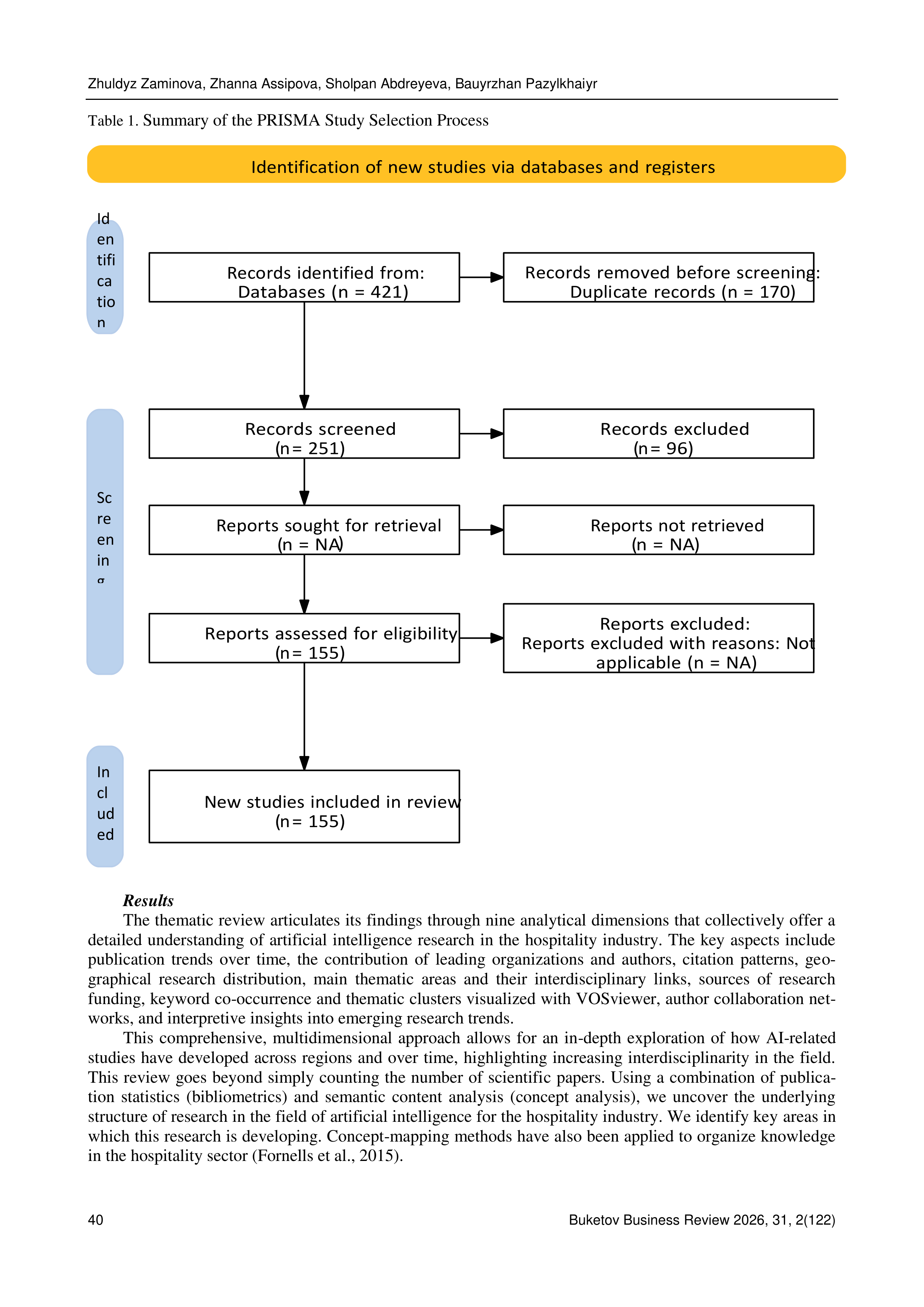
The initial search in the Scopus database identified 421 publications. During the pre-processing stage,
170 duplicate records were identified and removed, leaving 251 unique studies for further analysis.
The next step involved a detailed analysis of titles, abstracts, and author keywords to assess the rele-
vance of the publications to the study objectives. Following this stage, 96 studies that did not meet the estab-
lished relevance criteria were excluded from the sample. The main reasons for exclusion included the ab-
sence of a clear focus on the hospitality or tourism sector, limited relevance to artificial intelligence applica-
tions, or a primary focus on other industries.
Following this stage, 155 publications remained and were considered suitable for further analysis. The-
se studies directly addressed the use and role of artificial intelligence in hospitality and tourism and therefore
formed the final dataset for the bibliometric and qualitative analysis.
A summary of the selection procedure is presented in Table 1 (Summary of the PRISMA Study Selec-
tion Process).
3.3 Bibliometric and Visualization Analysis
The bibliometric data from the 155 selected publications were exported from the Scopus database in
CSV format and analyzed using VOSviewer (version 1.6.19). This software was used to visualize relation-
ships within the dataset, including co-authorship networks, keyword co-occurrence patterns, and citation
links among publications.
The analysis focused primarily on identifying relationships based on co-occurrence and citation, with
author keywords and countries serving as the primary units of analysis. The study utilized a full-count meth-
od, in which each element occurrence and each relationship were weighted equally, reflecting their cumula-
tive presence in the analyzed dataset.
To enhance the relevance of the results, a minimum threshold of at least five occurrences for each key-
word was established. This allowed us to focus on the most frequently used terms in the scientific literature.
Additionally, a normalized association strength method was used to standardize the relationships between
elements, which, in turn, facilitated their comparison and enabled a clearer identification of clusters and
structural relationships within the network. Taken together, these parameters allowed us to identify key the-
matic areas and uncover key research patterns in the field.
3.4 Limitations of the Methodology
Despite the use of a systematic approach, this study has several limitations. First, the analysis is based
exclusively on publications indexed in Scopus and presented in English, which may exclude relevant studies
published in other languages or included in alternative scientific databases.
Second, while bibliometric tools such as VOSviewer provide meaningful quantitative metrics reflecting
the relationships between scientific publications, they do not allow for a full assessment of the qualitative
depth of content and methodological rigor of individual studies. For this reason, the findings should be inter-
preted with caution. These limitations are acknowledged in the conclusion, where the need for complemen-
tary qualitative approaches is also discussed in order to achieve a more comprehensive understanding of AI
research in the hospitality industry.
Zhuldyz Zaminova, Zhanna Assipova, Sholpan Abdreyeva, Bauyrzhan Pazylkhaiyr
40
Buketov Business Review 2026, 31, 2(122)
Table 1.
Summary of the PRISMA Study Selection Process
Results
The thematic review articulates its findings through nine analytical dimensions that collectively offer a
detailed understanding of artificial intelligence research in the hospitality industry. The key aspects include
publication trends over time, the contribution of leading organizations and authors, citation patterns, geo-
graphical research distribution, main thematic areas and their interdisciplinary links, sources of research
funding, keyword co-occurrence and thematic clusters visualized with VOSviewer, author collaboration net-
works, and interpretive insights into emerging research trends.
This comprehensive, multidimensional approach allows for an in-depth exploration of how AI-related
studies have developed across regions and over time, highlighting increasing interdisciplinarity in the field.
This review goes beyond simply counting the number of scientific papers. Using a combination of publica-
tion statistics (bibliometrics) and semantic content analysis (concept analysis), we uncover the underlying
structure of research in the field of artificial intelligence for the hospitality industry. We identify key areas in
which this research is developing. Concept-mapping methods have also been applied to organize knowledge
in the hospitality sector (Fornells et al., 2015).
Identification of new studies via databases and registers
Id
en
tifi
ca
tio
n
Sc
re
en
in
g
In
cl
ud
ed
Records identified from:
Databases (n = 421)
Records removed before screening:
Duplicate records (n = 170)
Records screened
= 251)
(
n
Records excluded
(
n
= 96)
Reports sought for retrieval
(
n = NA
)
Reports not retrieved
(
n = NA
)
Reports assessed for eligibility
(
n
= 155)
Reports excluded:
Reports excluded with reasons: Not
applicable (n = NA)
New studies included in review
(
n
= 155)
A systematic review of…
Buketov Business Review 2026, 31, 2(122)
41
To identify key themes, we used VOSviewer. It groups keywords based on how frequently they appear
together. We established that a word or phrase must appear at least five times to be included in the analysis.
A normalization method was used to assess the strength of relationships between words. Initially, the pro-
gram identified five topic groups. These groups were then reviewed and slightly adjusted manually to ensure
their logical consistency. The result was clearly defined thematic areas reflecting the main research direc-
tions in this literature.
4.1 Publication Trends by Year
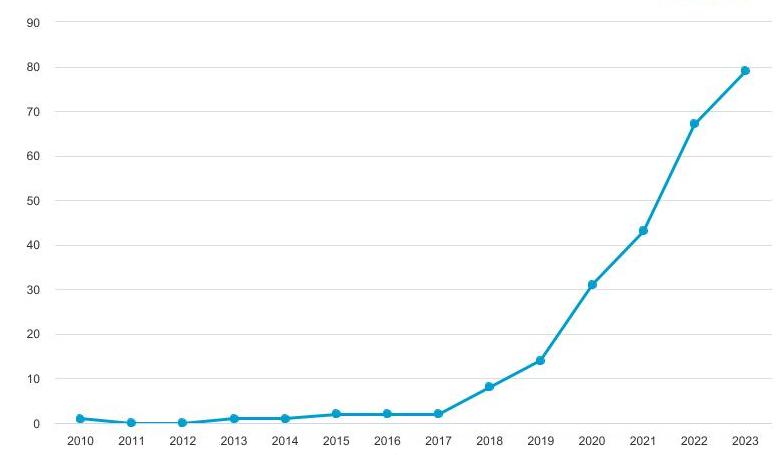
The analysis shows that interest in the application of AI in hospitality has been steadily growing over
the past decade. From 2010 to 2016, the number of publications was small and mostly theoretical or explora-
tory, consistent with the initial stage of development of this field.
However, since 2017, there has been a rapid increase in the number of studies. This suggests that schol-
ars increasingly recognize the potential of AI to transform the hotel industry and customer service. A particu-
larly noticeable surge occurred after 2020, largely due to the COVID-19 pandemic, which accelerated the
adoption of digital and contactless technologies in the industry.
This trend indicates that AI is now viewed as an important strategic tool for maintaining competitive-
ness and ensuring the sustainability of the hotel industry. The steady annual growth in the number of publica-
tions also demonstrates that AI research has evolved from a niche topic to a recognized field within tourism
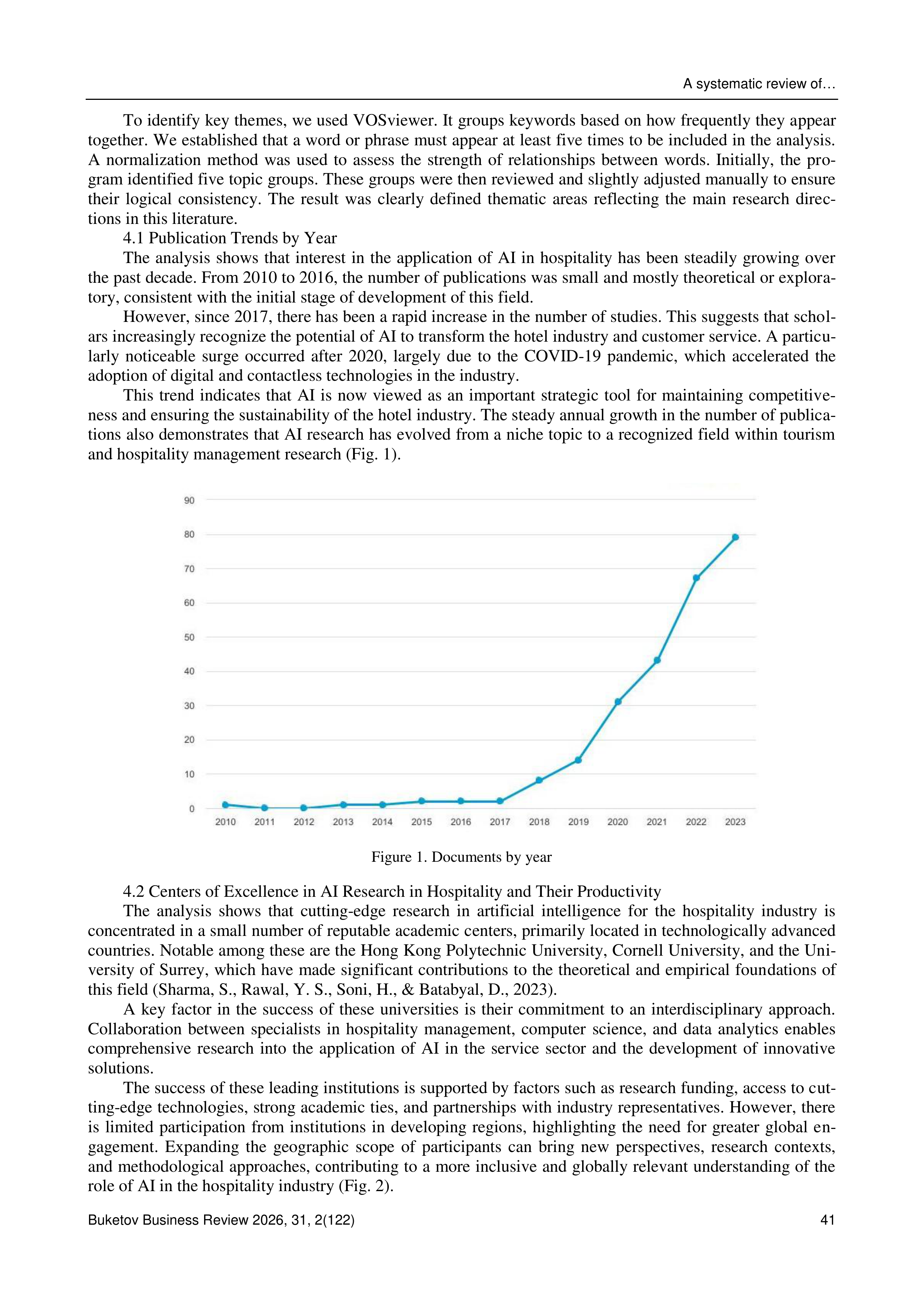
and hospitality management research (Fig. 1).
Figure 1. Documents by year
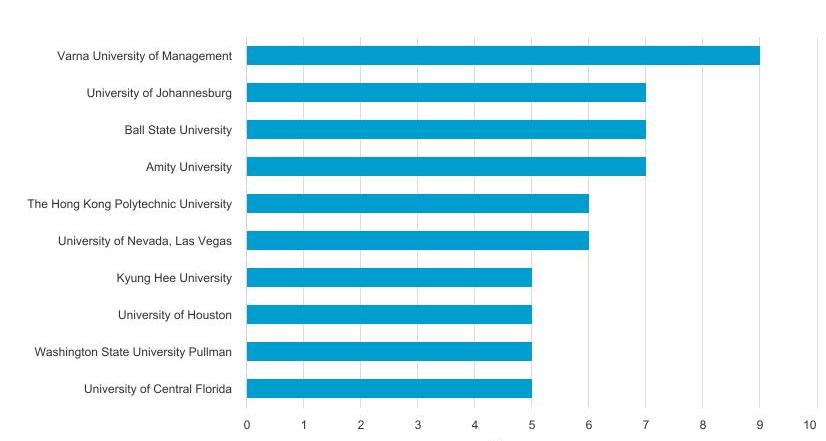
4.2 Centers of Excellence in AI Research in Hospitality and Their Productivity
The analysis shows that cutting-edge research in artificial intelligence for the hospitality industry is
concentrated in a small number of reputable academic centers, primarily located in technologically advanced
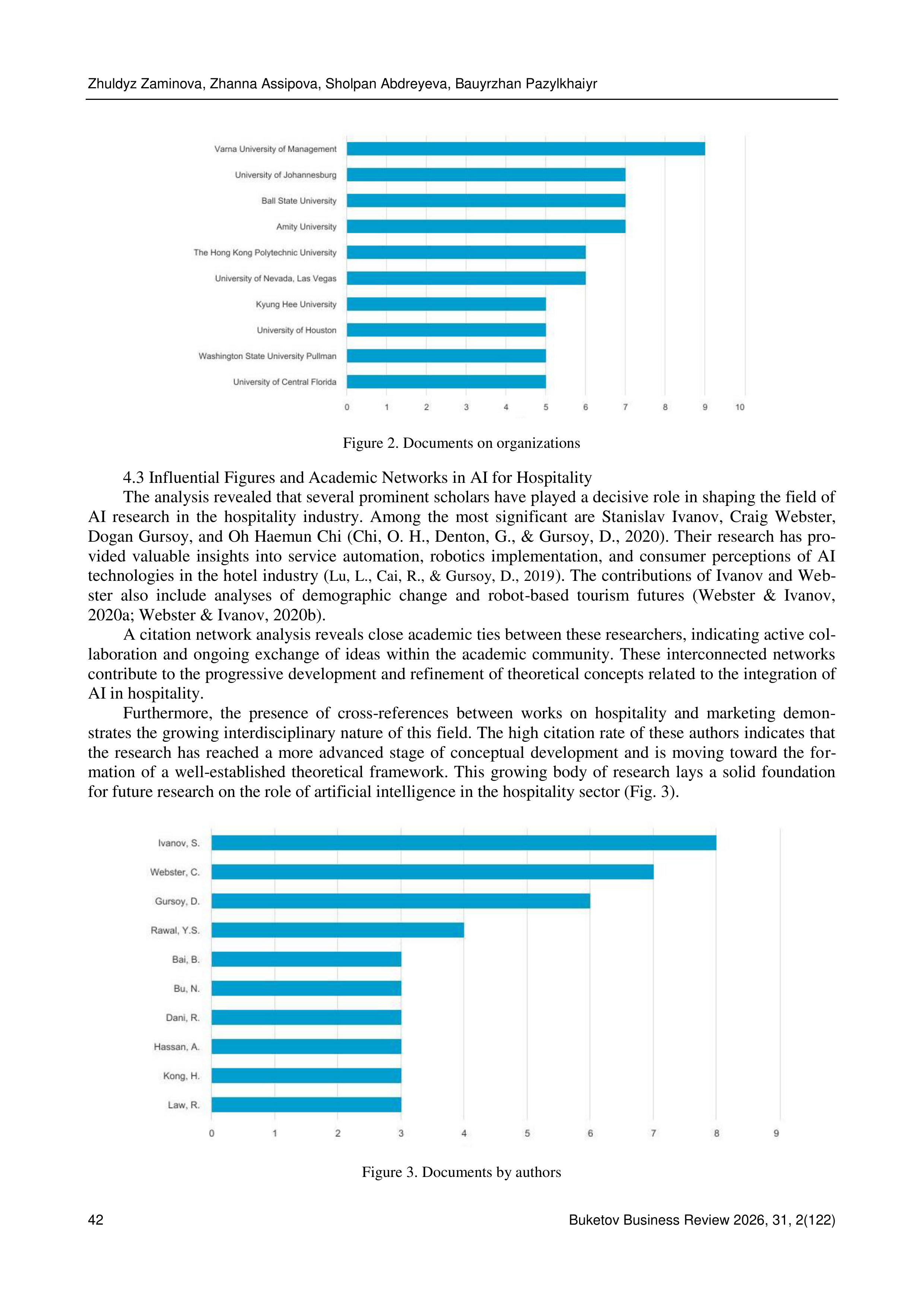
countries. Notable among these are the Hong Kong Polytechnic University, Cornell University, and the Uni-
versity of Surrey, which have made significant contributions to the theoretical and empirical foundations of
this field (Sharma, S., Rawal, Y. S., Soni, H., & Batabyal, D., 2023).
A key factor in the success of these universities is their commitment to an interdisciplinary approach.
Collaboration between specialists in hospitality management, computer science, and data analytics enables
comprehensive research into the application of AI in the service sector and the development of innovative
solutions.
The success of these leading institutions is supported by factors such as research funding, access to cut-
ting-edge technologies, strong academic ties, and partnerships with industry representatives. However, there
is limited participation from institutions in developing regions, highlighting the need for greater global en-
gagement. Expanding the geographic scope of participants can bring new perspectives, research contexts,
and methodological approaches, contributing to a more inclusive and globally relevant understanding of the
role of AI in the hospitality industry (Fig. 2).
Zhuldyz Zaminova, Zhanna Assipova, Sholpan Abdreyeva, Bauyrzhan Pazylkhaiyr
42
Buketov Business Review 2026, 31, 2(122)
Figure 2. Documents on organizations
4.3 Influential Figures and Academic Networks in AI for Hospitality
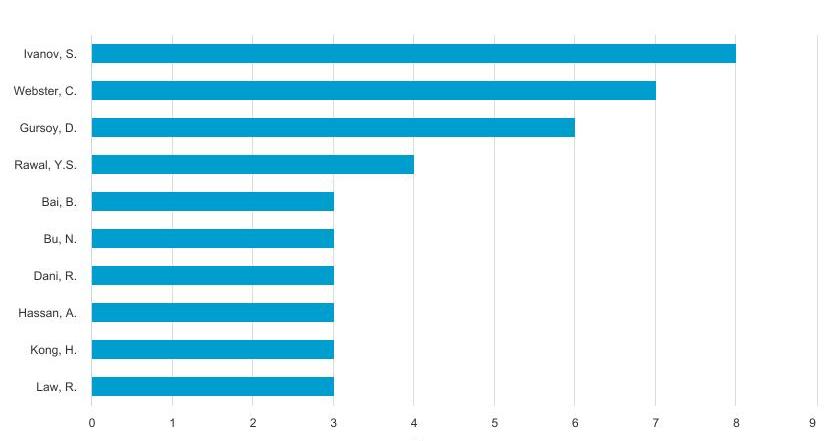
The analysis revealed that several prominent scholars have played a decisive role in shaping the field of
AI research in the hospitality industry. Among the most significant are Stanislav Ivanov, Craig Webster,
Dogan Gursoy, and Oh Haemun Chi (Chi, O. H., Denton, G., & Gursoy, D., 2020). Their research has pro-
vided valuable insights into service automation, robotics implementation, and consumer perceptions of AI
technologies in the hotel industry (
Lu, L., Cai, R., & Gursoy, D., 2019
). The contributions of Ivanov and Web-
ster also include analyses of demographic change and robot-based tourism futures (Webster & Ivanov,
2020a; Webster & Ivanov, 2020b).
A citation network analysis reveals close academic ties between these researchers, indicating active col-
laboration and ongoing exchange of ideas within the academic community. These interconnected networks
contribute to the progressive development and refinement of theoretical concepts related to the integration of
AI in hospitality.
Furthermore, the presence of cross-references between works on hospitality and marketing demon-
strates the growing interdisciplinary nature of this field. The high citation rate of these authors indicates that
the research has reached a more advanced stage of conceptual development and is moving toward the for-
mation of a well-established theoretical framework. This growing body of research lays a solid foundation
for future research on the role of artificial intelligence in the hospitality sector (Fig. 3).
Figure 3. Documents by authors
A systematic review of…
Buketov Business Review 2026, 31, 2(122)
43
4.4 Geographic Distribution of Research
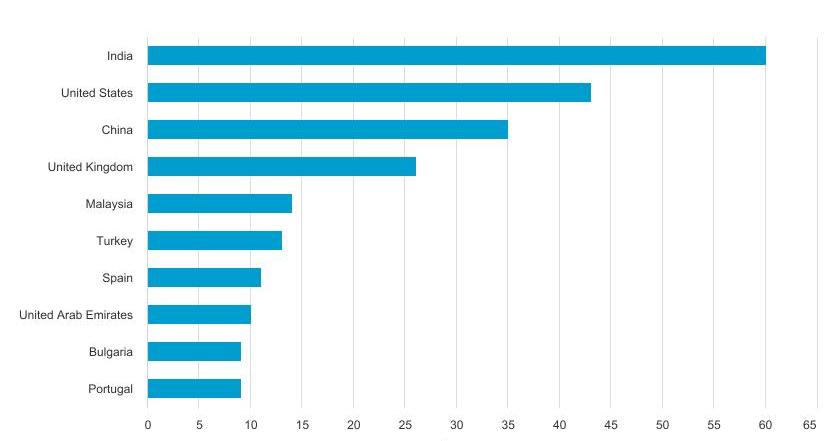
An examination of the geographic distribution of scientific publications on artificial intelligence in the
hospitality industry reveals a distinct concentration in East Asia, North America, and Western Europe. These
regions boast both high levels of technological development and mature hospitality sectors. The leading au-
thor countries are China and the United States, followed by South Korea, the United Kingdom, and Austral-
ia. The significant presence of these countries is due to their developed research infrastructure, access to fi-
nancial resources, and early adoption of AI technologies in the service sector, including hospitality and tour-
ism, which contribute to a favorable environment for technological innovation and academic research.
At the same time, research from emerging economies, particularly Central Asia, remains relatively lim-
ited. This imbalance highlights the need for more contextualized research that takes into account the specific
cultural, infrastructural, and socioeconomic factors influencing AI implementation in various regional hospi-
tality contexts. Expanding the geographic scope of research will allow for a more comprehensive understand-
ing of the impact of artificial intelligence on tourism and hospitality across diverse regional and cultural en-
vironments (Fig. 4).
Figure 4. Documents by countries
4.5 Key Areas and Interdisciplinary Links
Research in artificial intelligence for the hospitality industry is characterized by an interdisciplinary ap-
proach. Experts from disciplines such as management, computer science, psychology, and data analysis con-
tribute to this field. This diversity of specialists reflects the complex nature of AI implementation in the ser-
vice sector. Thematic mapping revealed three main research areas. The first area focuses on technological
innovation and automation, studying the integration of AI technologies into the operational activities of hos-
pitality businesses. The second area centers on customer experience and satisfaction, exploring how AI-
based services influence guest perceptions and service quality. The third theme addresses human–AI interac-
tion and ethical considerations, including issues related to trust, acceptance, and the role of human employ-
ees in increasingly automated service environments. The interdisciplinary scope extends to indoor environ-
mental quality, Industry 5.0, education, healthcare, sensory systems, blockchain, e-learning, and smart land-
scapes (Bangwal et al., 2023; Chourasia et al., 2023; Guo, 2021; Hacikara, 2023; Ilapakurti et al., 2018;
Jahan, 2021; Liu, 2023; Patzer et al., 2018; Puri et al., 2023; Tien et al., 2021).
The relationships between these themes suggest that hospitality research is gradually moving beyond
purely operational concerns. Instead, scholars are increasingly adopting broader perspectives that also con-
sider behavioral, ethical, and managerial dimensions of AI adoption. Behavioral and ethical research addi-
tionally considers empathy, vocal warmth, cuteness, social presence, resistance, and acceptance in human-
robot encounters (De Kervenoael et al., 2020; Huang & Sénécal, 2023; Pelau et al., 2021; Pitardi et al., 2022;
Rauf et al., 2022; Singh et al., 2021; Vitezić & Perić, 2021; Wang et al., 2023; Zhong et al., 2020; Zulfakar
et al., 2023).
Zhuldyz Zaminova, Zhanna Assipova, Sholpan Abdreyeva, Bauyrzhan Pazylkhaiyr
44
Buketov Business Review 2026, 31, 2(122)
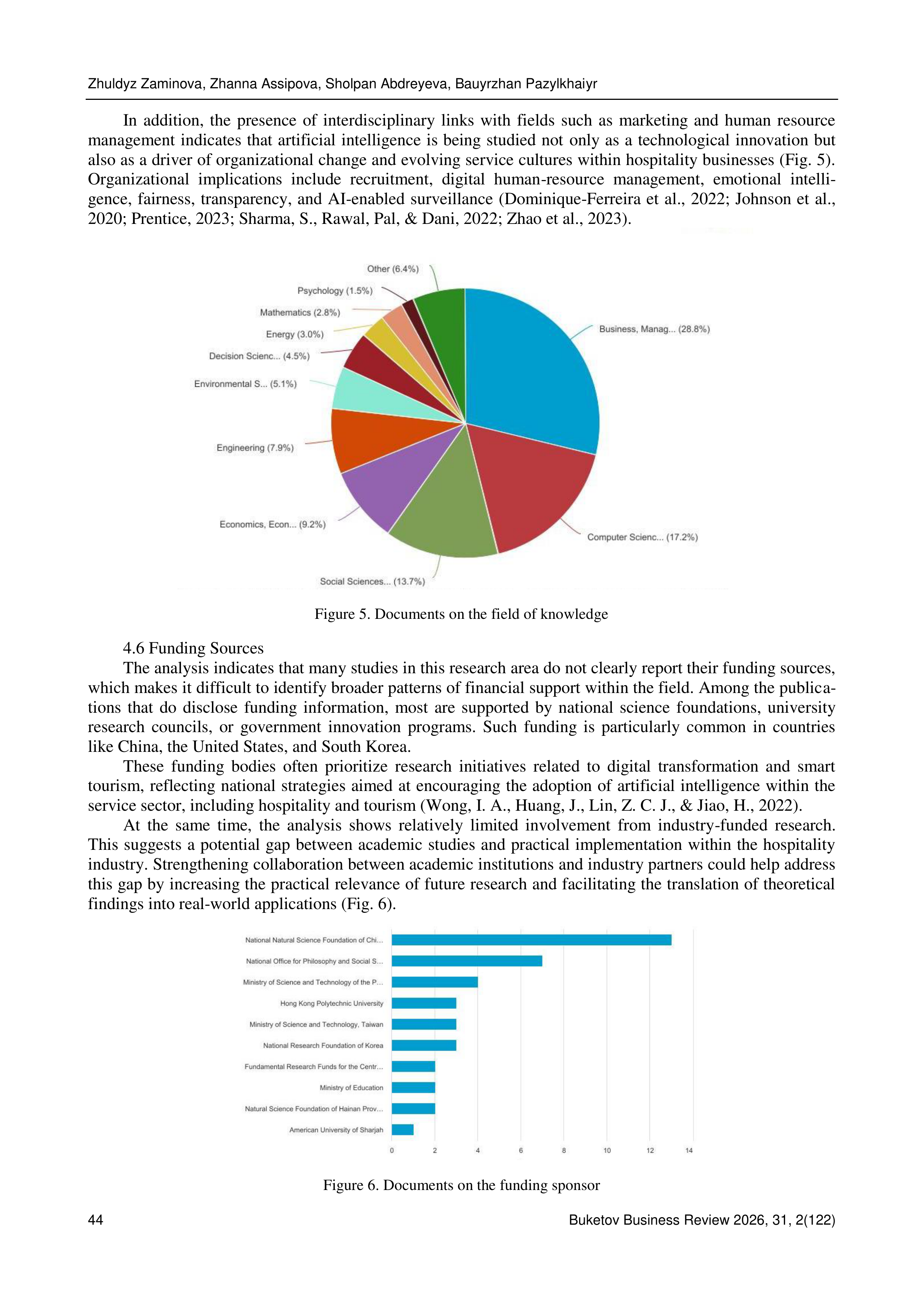
In addition, the presence of interdisciplinary links with fields such as marketing and human resource
management indicates that artificial intelligence is being studied not only as a technological innovation but
also as a driver of organizational change and evolving service cultures within hospitality businesses (Fig. 5).
Organizational implications include recruitment, digital human-resource management, emotional intelli-
gence, fairness, transparency, and AI-enabled surveillance (Dominique-Ferreira et al., 2022; Johnson et al.,
2020; Prentice, 2023; Sharma, S., Rawal, Pal, & Dani, 2022; Zhao et al., 2023).
Figure 5. Documents on the field of knowledge
4.6 Funding Sources
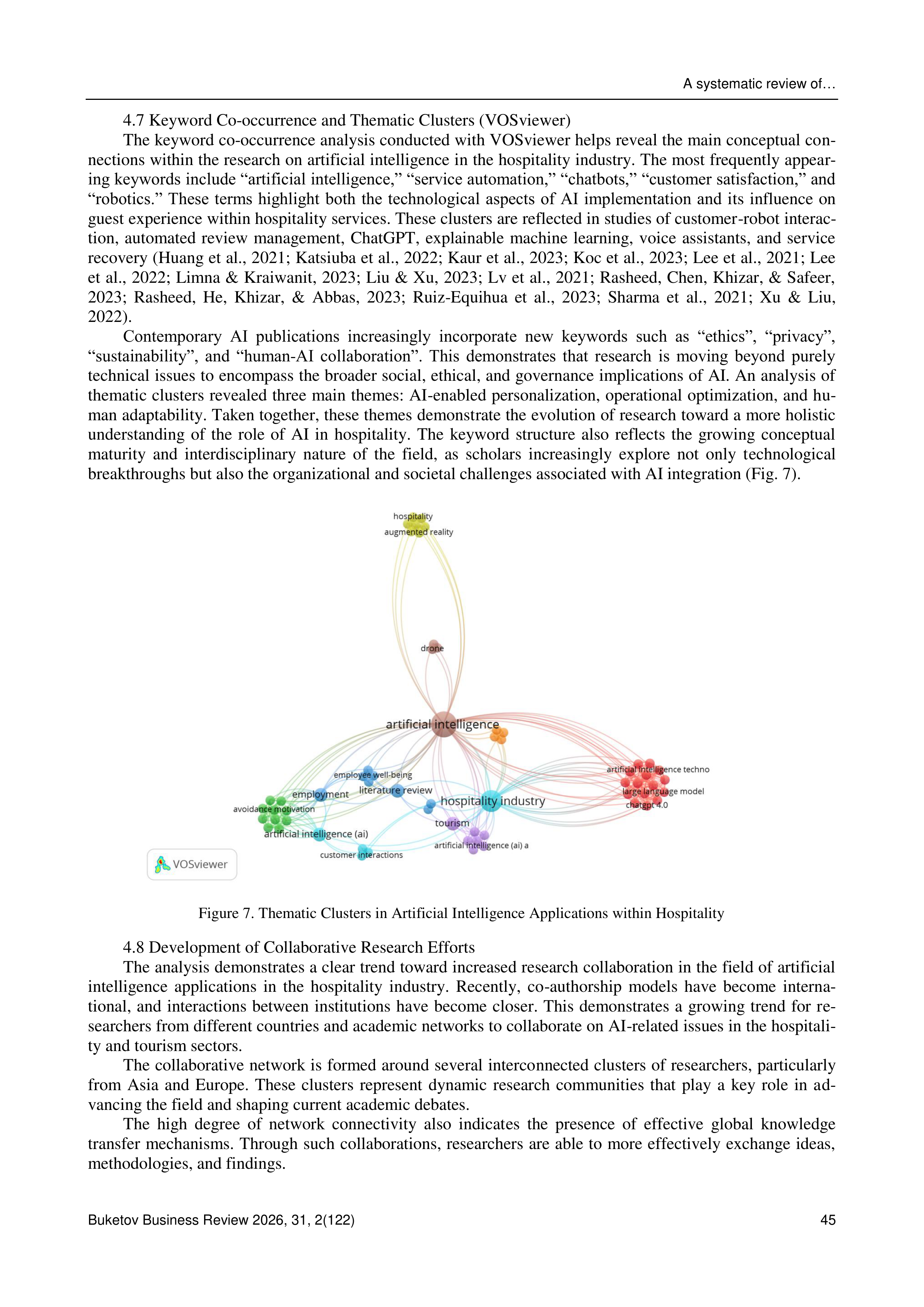
The analysis indicates that many studies in this research area do not clearly report their funding sources,
which makes it difficult to identify broader patterns of financial support within the field. Among the publica-
tions that do disclose funding information, most are supported by national science foundations, university
research councils, or government innovation programs. Such funding is particularly common in countries
like China, the United States, and South Korea.
These funding bodies often prioritize research initiatives related to digital transformation and smart
tourism, reflecting national strategies aimed at encouraging the adoption of artificial intelligence within the
service sector, including hospitality and tourism (Wong, I. A., Huang, J., Lin, Z. C. J., & Jiao, H., 2022).
At the same time, the analysis shows relatively limited involvement from industry-funded research.
This suggests a potential gap between academic studies and practical implementation within the hospitality
industry. Strengthening collaboration between academic institutions and industry partners could help address
this gap by increasing the practical relevance of future research and facilitating the translation of theoretical
findings into real-world applications (Fig. 6).
Figure 6. Documents on the funding sponsor
A systematic review of…
Buketov Business Review 2026, 31, 2(122)
45
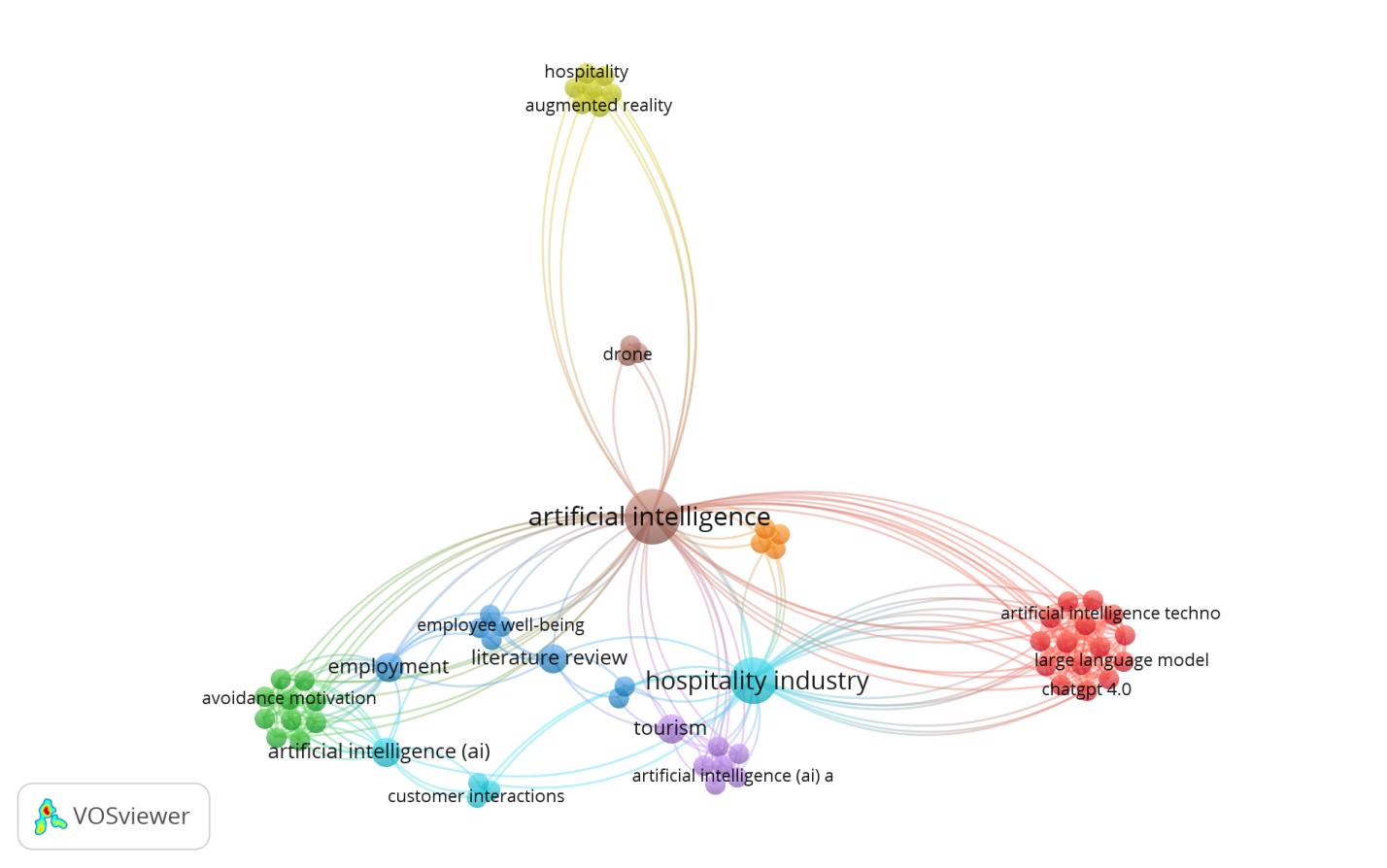
4.7 Keyword Co-occurrence and Thematic Clusters (VOSviewer)
The keyword co-occurrence analysis conducted with VOSviewer helps reveal the main conceptual con-
nections within the research on artificial intelligence in the hospitality industry. The most frequently appear-
ing keywords include “artificial intelligence,” “service automation,” “chatbots,” “customer satisfaction,” and
“robotics.” These terms highlight both the technological aspects of AI implementation and its influence on
guest experience within hospitality services. These clusters are reflected in studies of customer-robot interac-
tion, automated review management, ChatGPT, explainable machine learning, voice assistants, and service
recovery (Huang et al., 2021; Katsiuba et al., 2022; Kaur et al., 2023; Koc et al., 2023; Lee et al., 2021; Lee
et al., 2022; Limna & Kraiwanit, 2023; Liu & Xu, 2023; Lv et al., 2021; Rasheed, Chen, Khizar, & Safeer,
2023; Rasheed, He, Khizar, & Abbas, 2023; Ruiz-Equihua et al., 2023; Sharma et al., 2021; Xu & Liu,
2022).
Contemporary AI publications increasingly incorporate new keywords such as “ethics”, “privacy”,
“sustainability”, and “human-AI collaboration”. This demonstrates that research is moving beyond purely
technical issues to encompass the broader social, ethical, and governance implications of AI. An analysis of
thematic clusters revealed three main themes: AI-enabled personalization, operational optimization, and hu-
man adaptability. Taken together, these themes demonstrate the evolution of research toward a more holistic
understanding of the role of AI in hospitality. The keyword structure also reflects the growing conceptual
maturity and interdisciplinary nature of the field, as scholars increasingly explore not only technological
breakthroughs but also the organizational and societal challenges associated with AI integration (Fig. 7).
Figure 7. Thematic Clusters in Artificial Intelligence Applications within Hospitality
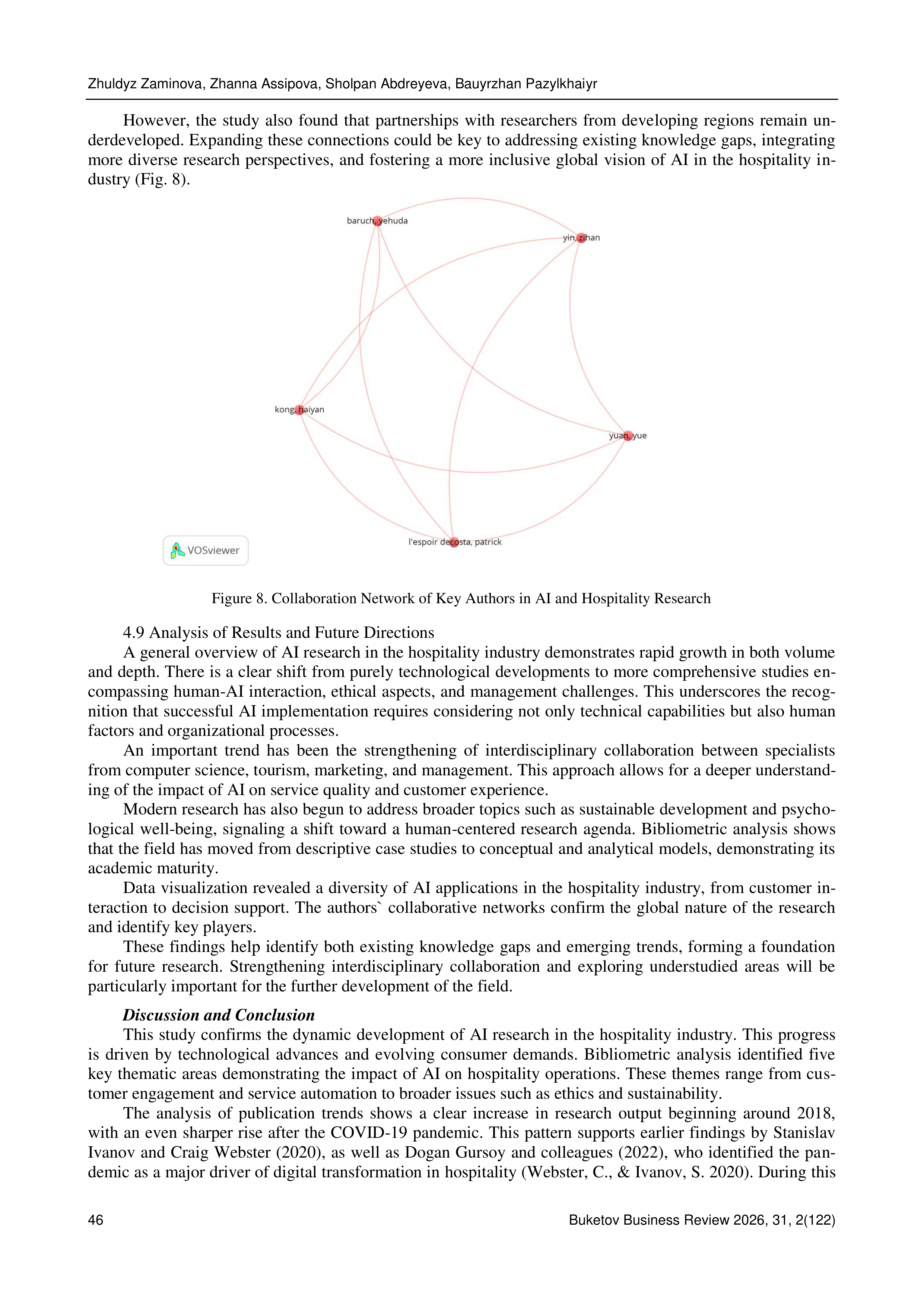
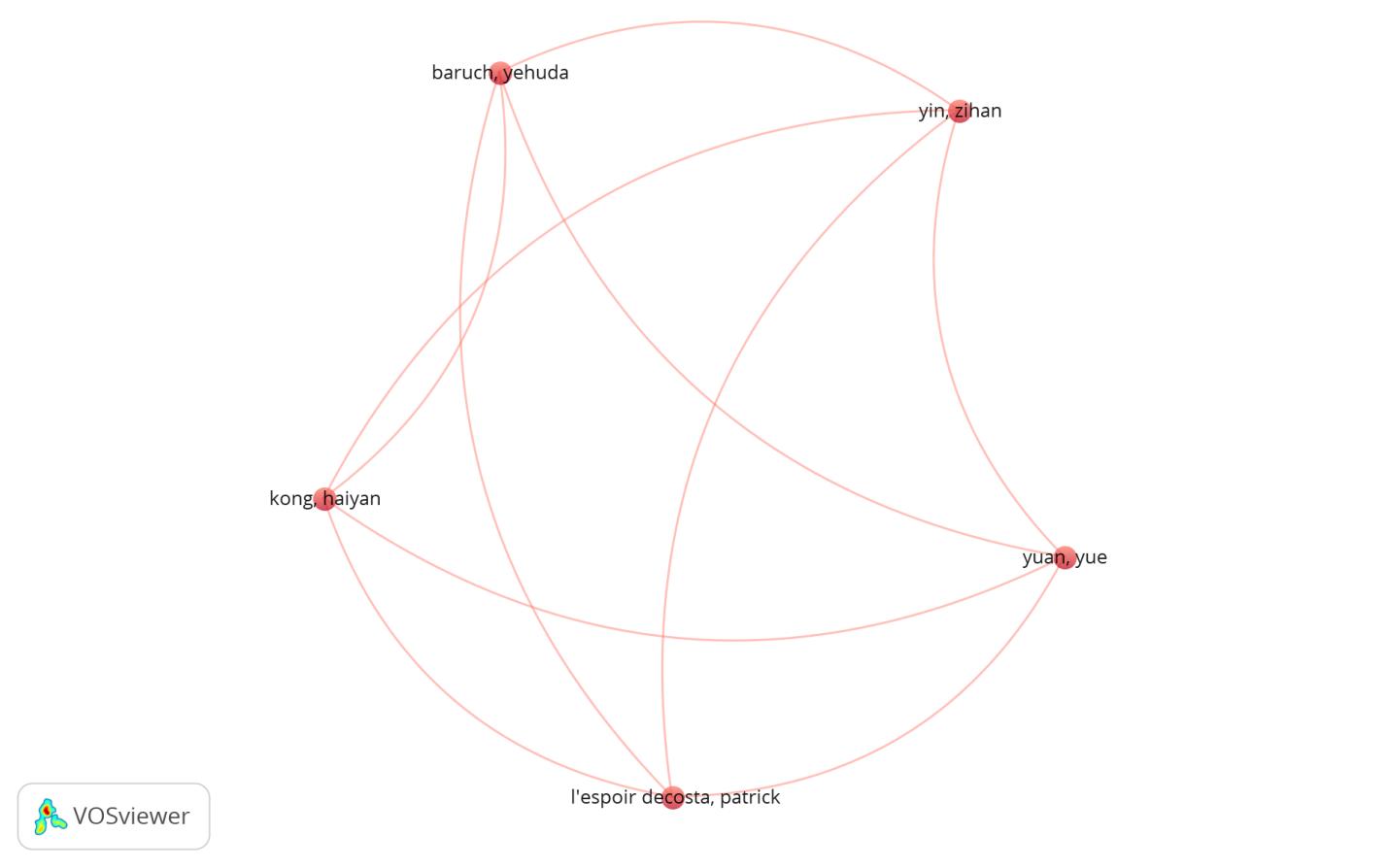
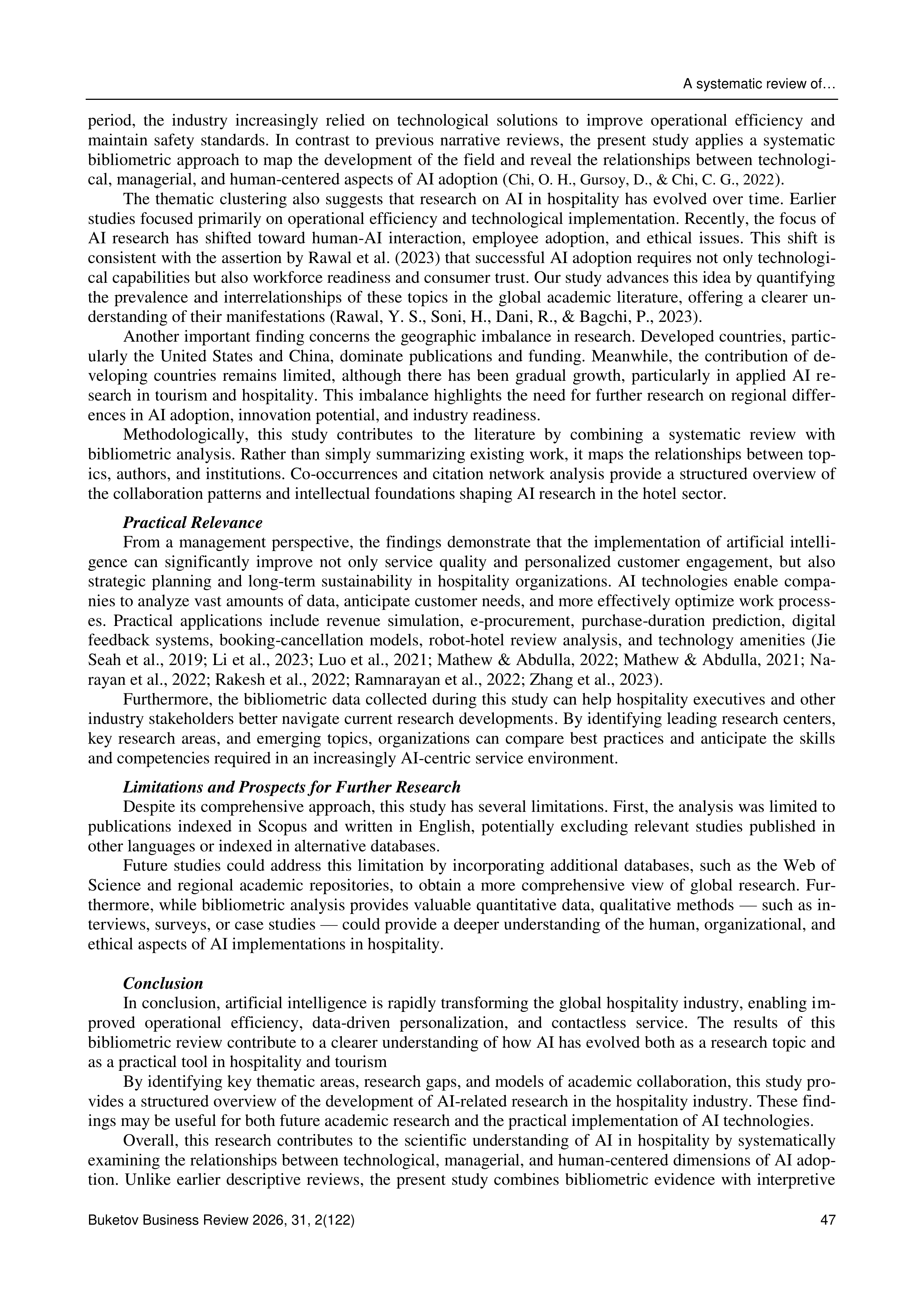
4.8 Development of Collaborative Research Efforts
The analysis demonstrates a clear trend toward increased research collaboration in the field of artificial
intelligence applications in the hospitality industry. Recently, co-authorship models have become interna-
tional, and interactions between institutions have become closer. This demonstrates a growing trend for re-
searchers from different countries and academic networks to collaborate on AI-related issues in the hospitali-
ty and tourism sectors.
The collaborative network is formed around several interconnected clusters of researchers, particularly
from Asia and Europe. These clusters represent dynamic research communities that play a key role in ad-
vancing the field and shaping current academic debates.
The high degree of network connectivity also indicates the presence of effective global knowledge
transfer mechanisms. Through such collaborations, researchers are able to more effectively exchange ideas,
methodologies, and findings.
Zhuldyz Zaminova, Zhanna Assipova, Sholpan Abdreyeva, Bauyrzhan Pazylkhaiyr
46
Buketov Business Review 2026, 31, 2(122)
However, the study also found that partnerships with researchers from developing regions remain un-
derdeveloped. Expanding these connections could be key to addressing existing knowledge gaps, integrating
more diverse research perspectives, and fostering a more inclusive global vision of AI in the hospitality in-
dustry (Fig. 8).
Figure 8. Collaboration Network of Key Authors in AI and Hospitality Research
4.9 Analysis of Results and Future Directions
A general overview of AI research in the hospitality industry demonstrates rapid growth in both volume
and depth. There is a clear shift from purely technological developments to more comprehensive studies en-
compassing human-AI interaction, ethical aspects, and management challenges. This underscores the recog-
nition that successful AI implementation requires considering not only technical capabilities but also human
factors and organizational processes.
An important trend has been the strengthening of interdisciplinary collaboration between specialists
from computer science, tourism, marketing, and management. This approach allows for a deeper understand-
ing of the impact of AI on service quality and customer experience.
Modern research has also begun to address broader topics such as sustainable development and psycho-
logical well-being, signaling a shift toward a human-centered research agenda. Bibliometric analysis shows
that the field has moved from descriptive case studies to conceptual and analytical models, demonstrating its
academic maturity.
Data visualization revealed a diversity of AI applications in the hospitality industry, from customer in-
teraction to decision support. The authors` collaborative networks confirm the global nature of the research
and identify key players.
These findings help identify both existing knowledge gaps and emerging trends, forming a foundation
for future research. Strengthening interdisciplinary collaboration and exploring understudied areas will be
particularly important for the further development of the field.
Discussion and Conclusion
This study confirms the dynamic development of AI research in the hospitality industry. This progress
is driven by technological advances and evolving consumer demands. Bibliometric analysis identified five
key thematic areas demonstrating the impact of AI on hospitality operations. These themes range from cus-
tomer engagement and service automation to broader issues such as ethics and sustainability.
The analysis of publication trends shows a clear increase in research output beginning around 2018,
with an even sharper rise after the COVID-19 pandemic. This pattern supports earlier findings by Stanislav
Ivanov and Craig Webster (2020), as well as Dogan Gursoy and colleagues (2022), who identified the pan-
demic as a major driver of digital transformation in hospitality (Webster, C., & Ivanov, S. 2020). During this
A systematic review of…
Buketov Business Review 2026, 31, 2(122)
47
period, the industry increasingly relied on technological solutions to improve operational efficiency and
maintain safety standards. In contrast to previous narrative reviews, the present study applies a systematic
bibliometric approach to map the development of the field and reveal the relationships between technologi-
cal, managerial, and human-centered aspects of AI adoption (
Chi, O. H., Gursoy, D., & Chi, C. G., 2022
).
The thematic clustering also suggests that research on AI in hospitality has evolved over time. Earlier
studies focused primarily on operational efficiency and technological implementation. Recently, the focus of
AI research has shifted toward human-AI interaction, employee adoption, and ethical issues. This shift is
consistent with the assertion by Rawal et al. (2023) that successful AI adoption requires not only technologi-
cal capabilities but also workforce readiness and consumer trust. Our study advances this idea by quantifying
the prevalence and interrelationships of these topics in the global academic literature, offering a clearer un-
derstanding of their manifestations (Rawal, Y. S., Soni, H., Dani, R., & Bagchi, P., 2023).
Another important finding concerns the geographic imbalance in research. Developed countries, partic-
ularly the United States and China, dominate publications and funding. Meanwhile, the contribution of de-
veloping countries remains limited, although there has been gradual growth, particularly in applied AI re-
search in tourism and hospitality. This imbalance highlights the need for further research on regional differ-
ences in AI adoption, innovation potential, and industry readiness.
Methodologically, this study contributes to the literature by combining a systematic review with
bibliometric analysis. Rather than simply summarizing existing work, it maps the relationships between top-
ics, authors, and institutions. Co-occurrences and citation network analysis provide a structured overview of
the collaboration patterns and intellectual foundations shaping AI research in the hotel sector.
Practical Relevance
From a management perspective, the findings demonstrate that the implementation of artificial intelli-
gence can significantly improve not only service quality and personalized customer engagement, but also
strategic planning and long-term sustainability in hospitality organizations. AI technologies enable compa-
nies to analyze vast amounts of data, anticipate customer needs, and more effectively optimize work process-
es. Practical applications include revenue simulation, e-procurement, purchase-duration prediction, digital
feedback systems, booking-cancellation models, robot-hotel review analysis, and technology amenities (Jie
Seah et al., 2019; Li et al., 2023; Luo et al., 2021; Mathew & Abdulla, 2022; Mathew & Abdulla, 2021; Na-
rayan et al., 2022; Rakesh et al., 2022; Ramnarayan et al., 2022; Zhang et al., 2023).
Furthermore, the bibliometric data collected during this study can help hospitality executives and other
industry stakeholders better navigate current research developments. By identifying leading research centers,
key research areas, and emerging topics, organizations can compare best practices and anticipate the skills
and competencies required in an increasingly AI-centric service environment.
Limitations and Prospects for Further Research
Despite its comprehensive approach, this study has several limitations. First, the analysis was limited to
publications indexed in Scopus and written in English, potentially excluding relevant studies published in
other languages or indexed in alternative databases.
Future studies could address this limitation by incorporating additional databases, such as the Web of
Science and regional academic repositories, to obtain a more comprehensive view of global research. Fur-
thermore, while bibliometric analysis provides valuable quantitative data, qualitative methods — such as in-
terviews, surveys, or case studies — could provide a deeper understanding of the human, organizational, and
ethical aspects of AI implementations in hospitality.
Conclusion
In conclusion, artificial intelligence is rapidly transforming the global hospitality industry, enabling im-
proved operational efficiency, data-driven personalization, and contactless service. The results of this
bibliometric review contribute to a clearer understanding of how AI has evolved both as a research topic and
as a practical tool in hospitality and tourism
By identifying key thematic areas, research gaps, and models of academic collaboration, this study pro-
vides a structured overview of the development of AI-related research in the hospitality industry. These find-
ings may be useful for both future academic research and the practical implementation of AI technologies.
Overall, this research contributes to the scientific understanding of AI in hospitality by systematically
examining the relationships between technological, managerial, and human-centered dimensions of AI adop-
tion. Unlike earlier descriptive reviews, the present study combines bibliometric evidence with interpretive
Zhuldyz Zaminova, Zhanna Assipova, Sholpan Abdreyeva, Bauyrzhan Pazylkhaiyr
48
Buketov Business Review 2026, 31, 2(122)
analysis, demonstrating how the research focus has gradually shifted from operational efficiency toward
broader considerations such as human interaction, ethics, and sustainable AI integration within the hospitali-
ty industry.
Acknowledgements
:
This research was funded by the Science Committee of the Ministry of Science
and Higher Education of the Republic of Kazakhstan under project AP26103653 “Recreational capacity
modeling using UAV, GIS and AI tools to prevent overtourism in Ile-Alatau National Park”.
References
15th Ibero-American Conference On Advances In Artificial Intelligence, Iberamia 2016. (2016). In
Lecture Notes
In Computer Science (Including Subseries Lecture Notes In Artificial Intelligence And Lecture Notes In Bioinformat-
ics): Vol. 10022 Lnai
.
Afaq, A., & Gaur, L. (2021). The Rise Of Robots To Help Combat Covid-19.
Proceedings Of International Con-
ference
On
Technological
Advancements
And
Innovations,
Ictai
2021
,
69–74.
Https://Doi.Org/10.1109/Ictai53825.2021.9673256
Akdim, K. (2021). The Influence Of Ewom. Analyzing Its Characteristics And Consequences, And Future Re-
search Linesla Influencia De Ewom. Analizando Sus Caracteristicas, Consecuencas Y Futuras Lineas De Investigación
的影响。分析其特点和后果
,
以及未来的研究方向
.
Spanish Journal Of Marketing — Esic
,
25
(2), 239–259.
Https://Doi.Org/10.1108/Sjme-10-2020-0186
Al-Hyari, H. S., Al-Smadi, H. M., & Weshah, S. R. (2023). The Impact Of Artificial Intelligence (Ai) On Guest
Satisfaction In Hotel Management: An Empirical Study Of Luxury Hotels.
Geojournal Of Tourism And Geosites
,
48
(2spl), 810–819.
Https://Doi.Org/10.30892/Gtg.482spl15-1081
Alipour, H., Amelshahbaz, S., Safaeimanesh, F., Peyravi, B., & Salavati, A. (2021). The Impact Of Environmental
Stimuli On Hotel Service Employees’ Service Sabotage-Mediation Role Of Emotional Intelligence And Emotional Dis-
sonance.
Sustainability (Switzerland)
,
13
(2), 1–18.
Https://Doi.Org/10.3390/Su13020876
Alma Çallı, B., Çallı, L., Sarı Çallı, D., & Çallı, F. (2023). The Impact Of Different Types Of Service Robots Us-
age In Hotels On Guests’ Intention To Stay.
Journal Of Hospitality And Tourism Technology
,
14
(1), 53–68.
Https://Doi.Org/10.1108/Jhtt-09-2021-0266
Ayyildiz, A. Y., Baykal, M., & Koc, E. (2022). Attitudes Of Hotel Customers Towards The Use Of Service Ro-
bots In Hospitality Service Encounters.
Technology In Society
,
70
.
Https://Doi.Org/10.1016/J.Techsoc.2022.101995
Bangwal, D., Kumar, R., Suyal, J., & Ghouri, A. M. (2023). Does Ai-Technology-Based Indoor Environmental
Quality Impact Occupants’ Psychological, Physiological Health, And Productivity?
Annals Of Operations Research
.
Https://Doi.Org/10.1007/S10479-023-05431-1
Battour, M., Mady, K., Elsotouhy, M., Salaheldeen, M., Elbendary, I., Marie, M., & Elhabony, I. (2022). Artificial
Intelligence Applications In Halal Tourism To Assist Muslim Tourist Journey. In
Lecture Notes In Networks And Sys-
tems
(Vol. 322).
Https://Doi.Org/10.1007/978-3-030-85990-9_68
Bauer, I. L. (2023). Robots In Travel Clinics: Building On Tourism’s Use Of Technology And Robots For Infec-
tion
Control
During
A
Pandemic.
Tropical
Diseases,
Travel
Medicine
And
Vaccines
,
9
(1).
Https://Doi.Org/10.1186/S40794-023-00197-7
Bhargava, A., Bester, M., & Bolton, L. (2021). Employees’ Perceptions Of The Implementation Of Robotics, Ar-
tificial Intelligence, And Automation (Raia) On Job Satisfaction, Job Security, And Employability.
Journal Of Technol-
ogy In Behavioral Science
,
6
(1), 106–113.
Https://Doi.Org/10.1007/S41347-020-00153-8
Bhushan, S. (2021). The Impact Of Artificial Intelligence And Machine Learning On The Global Economy And
Its Implications For The Hospitality Sector In India.
Worldwide Hospitality And Tourism Themes
,
13
(2), 252–259.
Https://Doi.Org/10.1108/Whatt-09-2020-0116
Binesh, F., & Baloglu, S. (2023). Are We Ready For Hotel Robots After The Pandemic? A Profile Analysis.
Computers In Human Behavior
,
147
.
Https://Doi.Org/10.1016/J.Chb.2023.107854
Blöcher, K., & Alt, R. (2021). Ai And Robotics In The European Restaurant Sector: Assessing Potentials For Pro-
cess
Innovation
In
A
High-Contact Service
Industry.
Electronic
Markets
,
31
(3),
529–551.
Https://Doi.Org/10.1007/S12525-020-00443-2
Bowen, J., & Morosan, C. (2018). Beware Hospitality Industry: The Robots Are Coming.
Worldwide Hospitality
And Tourism Themes
,
10
(6), 726–733.
Https://Doi.Org/10.1108/Whatt-07-2018-0045
Buckley, S., Ettl, M., Jain, P., Luss, R., Petrik, M., Ravi, R. K., & Venkatramani, C. (2014). Social Media And
Customer Behavior Analytics For Personalized Customer Engagements.
Ibm Journal Of Research And Development
,
58
(5–6).
Https://Doi.Org/10.1147/Jrd.2014.2344515
Caicedo-Torres, W., & Payares, F. (2016). A Machine Learning Model For Occupancy Rates And Demand Fore-
casting In The Hospitality Industry. In
Lecture Notes In Computer Science (Including Subseries Lecture Notes In Artifi-
cial Intelligence And Lecture Notes In Bioinformatics): Vol. 10022 Lnai
.
Https://Doi.Org/10.1007/978-3-319-47955-
2_17
A systematic review of…
Buketov Business Review 2026, 31, 2(122)
49
Chaudhuri, S., & Ray, N. (2018). Gis Applications In The Tourism And Hospitality Industry. In
Gis Applications
In The Tourism And Hospitality Industry
.
Https://Doi.Org/10.4018/978-1-5225-5088-4
Chen, J. (2017). Application Of Hotel Decision Support System In Hospitality Industry.
Agro Food Industry Hi-
Tech
,
28
(3), 2374–2377.
Chen, J., Zhang, Y., Zhang, L., & Zou, Q. (2021). Research On The Impacts Of Multisensory Marketing On Cus-
tomer
Loyalty
Based
On
Data
Analysis.
Journal
Of
Physics:
Conference
Series
,
1852
(4).
Https://Doi.Org/10.1088/1742-6596/1852/4/042083
Chi, O. H., Denton, G., & Gursoy, D. (2020). Artificially Intelligent Device Use In Service Delivery: A Systemat-
ic Review, Synthesis, And Research Agenda.
Journal Of Hospitality Marketing And Management
,
29
(7), 757–786.
Https://Doi.Org/10.1080/19368623.2020.1721394
Chi, O. H., Gursoy, D., & Chi, C. G. (2022). Tourists’ Attitudes Toward The Use Of Artificially Intelligent (Ai)
Devices In Tourism Service Delivery: Moderating Role Of Service Value Seeking.
Journal Of Travel Research
,
61
(1),
170–185.
Https://Doi.Org/10.1177/0047287520971054
Chourasia, S., Tyagi, A., Murtaza, Q., Walia, R. S., & Sharma, P. (2023). A Critical Review On Industry 5.0 And
Its Medical Applications. In
Lecture Notes In Mechanical Engineering,
251–261.
Https://Doi.Org/10.1007/978-981-19-
6107-6_18
Citak, J., Owoc, M. L., & Weichbroth, P. (2021). A Note On The Applications Of Artificial Intelligence In The
Hospitality Industry: Preliminary Results Of A Survey.
Procedia Computer Science
,
192
, 4552–4559.
Https://Doi.Org/10.1016/J.Procs.2021.09.233
Claveria, O., Monte, E., & Torra, S. (2015). A New Forecasting Approach For The Hospitality Industry.
Interna-
tional Journal Of Contemporary Hospitality Management
,
27
(7), 1520–1538.
Https://Doi.Org/10.1108/Ijchm-06-2014-
0286
C. -Sánchez, E., Sánchez-Medina, A. J., & Romero-Domínguez, L. (2022). Forecasting Hotel-Booking Cancela-
tions Using Personal Name Records: An Artificial Intelligence Approach. In
Smart Innovation, Systems And Technolo-
gies
(Vol. 279).
Https://Doi.Org/10.1007/978-981-16-9268-0_1
Dangwal, A., Kukreti, M., Angurala, M., Sarangal, R., Mehta, M., & Chauhan, P. (2023). A Review On The Role
Of Artificial Intelligence In Tourism.
Proceedings Of The 17th Indiacom; 2023 10th International Conference On
Computing For Sustainable Global Development, Indiacom 2023
, 164–168.
Dani, R., Rawal, Y. S., Bagchi, P., & Khan, M. (2022). Opportunities And Challenges In Implementation Of Arti-
ficial
Intelligence
In
Food
&Amp;
Beverage
Service
Industry.
Aip
Conference
Proceedings
,
2481
.
Https://Doi.Org/10.1063/5.0103741
De Kervenoael, R., Hasan, R., Schwob, A., & Goh, E. (2020). Leveraging Human-Robot Interaction In Hospitali-
ty Services: Incorporating The Role Of Perceived Value, Empathy, And Information Sharing Into Visitors’ Intentions
To Use Social Robots.
Tourism Management
,
78
.
Https://Doi.Org/10.1016/J.Tourman.2019.104042
Doborjeh, Z., Hemmington, N., Doborjeh, M., & Kasabov, N. (2022). Artificial Intelligence: A Systematic Re-
view Of Methods And Applications In Hospitality And Tourism.
International Journal Of Contemporary Hospitality
Management
,
34
(3), 1154–1176.
Https://Doi.Org/10.1108/Ijchm-06-2021-0767
Dominique-Ferreira, S., Rodrigues, B. Q., & Braga, R. J. (2022). Personal Marketing And The Recruitment And
Selection Process: Hiring Attributes And Particularities In Tourism And Hospitality.
Journal Of Global Scholars Of
Marketing Science: Bridging Asia And The World
,
32
(3), 351–371.
Https://Doi.Org/10.1080/21639159.2020.1808845
Ersoy, A., & Ehtiyar, V. R. (2023). The Impact Of Artificial Intelligence On Hospitality Employees’ Work Out-
comes.
Advances In Hospitality And Tourism Research
,
11
(4), 505–526.
Https://Doi.Org/10.30519/Ahtr.1264966
Fornells, A., Rodrigo, Z., Rovira, X., Sánchez, M., Santomà, R., Teixidó-Navarro, F., & Golobardes, E. (2015).
Promoting Consensus In The Concept Mapping Methodology: An Application In The Hospitality Sector.
Pattern
Recognition Letters
,
67
, 39–48.
Https://Doi.Org/10.1016/J.Patrec.2015.05.013
Goel, P., Kaushik, N., Sivathanu, B., Pillai, R., & Vikas, J. (2022). Consumers’ Adoption Of Artificial Intelli-
gence And Robotics In Hospitality And Tourism Sector: Literature Review And Future Research Agenda.
Tourism Re-
view
,
77
(4), 1081–1096.
Https://Doi.Org/10.1108/Tr-03-2021-0138
González-Rodríguez, M. R., Díaz-Fernández, M. C., & Pacheco Gómez, C. (2020). Facial-Expression Recogni-
tion: An Emergent Approach To The Measurement Of Tourist Satisfaction Through Emotions.
Telematics And Infor-
matics
,
51
.
Https://Doi.Org/10.1016/J.Tele.2020.101404
Goyal, N., & Singh, H. (2021). Process Automation Techniques In Hospitality Industry.
2021 9th International
Conference On Reliability, Infocom Technologies And Optimization (Trends And Future Directions), Icrito 2021
.
Https://Doi.Org/10.1109/Icrito51393.2021.9596303
Guo, Q. (2021). Research On The Application Of Artificial Intelligence Technology In Teaching Introduction To
Hotel Management In The Context Of Smart Hotel.
Proceedings — 2021 7th Annual International Conference On Net-
work
And
Information
Systems
For
Computers,
Icnisc
2021
,
155–157.
Https://Doi.Org/10.1109/Icnisc54316.2021.00037
Zhuldyz Zaminova, Zhanna Assipova, Sholpan Abdreyeva, Bauyrzhan Pazylkhaiyr
50
Buketov Business Review 2026, 31, 2(122)
Gupta, S., Modgil, S., Lee, C. -K., Cho, M., & Park, Y. (2022). Artificial Intelligence Enabled Robots For Stay
Experience In The Hospitality Industry In A Smart City.
Industrial Management And Data Systems
,
122
(10), 2331–
2350.
Https://Doi.Org/10.1108/Imds-10-2021-0621
Hacikara, A. (2023). Interactive Voice Response Systems: The Doubled-Edged Sword Of Ai And The Culture Of
Hospitality
In
Healthcare.
International
Journal
Of
Hospitality
Management
,
112
.
Https://Doi.Org/10.1016/J.Ijhm.2023.103463
Hajek, P., & Sahut, J. -M. (2022). Mining Behavioural And Sentiment-Dependent Linguistic Patterns From Res-
taurant
Reviews
For
Fake
Review
Detection.
Technological
Forecasting
And
Social
Change
,
177
.
Https://Doi.Org/10.1016/J.Techfore.2022.121532
Helgemeir, T., & Cenzano, C. H. (2019). Artificial Intelligence In Tourism Software Solutions: Opportunities And
Challenges Until 2024.
Managing Technology For Inclusive And Sustainable Growth — 28th International Conference
For The International Association Of Management Of Technology, Iamot 2019
, 134–142.
Herrera, A., Arroyo, Á., Jiménez, A., & Herrero, Á. (2023). Artificial Intelligence As Catalyst For The Tourism
Sector:
A
Literature
Review.
Journal
Of
Universal
Computer
Science
,
29
(12),
1439–1460.
Https://Doi.Org/10.3897/Jucs.101550
Ho, Y. -H., Alam, S. S., Masukujjaman, M., Lin, C. -Y., Susmit, S., & Susmit, S. (2022). Intention To Adopt Ai-
Powered Online Service Among Tourism And Hospitality Companies.
International Journal Of Technology And Hu-
man Interaction
,
18
(1).
Https://Doi.Org/10.4018/Ijthi.299357
Hopf, V., Velten, L., & Rowson, B. (2018). Roboptimism Or Pessimism: Hr Managers Face A Challenge. In
Ex-
periencing Hospitality
.
Hossain, M. R., Akhter, F., Sharma, A., & Hassan, A. (2022). Thirty Years Of Research On Application Of Tech-
nology In Tourism And Hospitality Industry: A Systematic Literature Review. In
Technology Application In Tourism In
Asia: Innovations, Theories And Practices
.
Https://Doi.Org/10.1007/978-981-16-5461-9_1
Hsu, H., & Tseng, K. -F. (2022). Facing The Era Of Smartness: Constructing A Framework Of Required Tech-
nology Competencies For Hospitality Practitioners.
Journal Of Hospitality And Tourism Technology
,
13
(3), 500–526.
Https://Doi.Org/10.1108/Jhtt-04-2021-0120
Huang, A., Chao, Y., De La Mora Velasco, E., Bilgihan, A., & Wei, W. (2022). When Artificial Intelligence
Meets The Hospitality And Tourism Industry: An Assessment Framework To Inform Theory And Management.
Jour-
nal Of Hospitality And Tourism Insights
,
5
(5), 1080–1100.
Https://Doi.Org/10.1108/Jhti-01-2021-0021
Huang, B., & Sénécal, S. (2023). How Should Voice Assistants Be Heard? The Mitigating Effect Of Verbal And
Vocal
Warmth
In
Voice
Assistant
Service
Failure
|
语音助手应该如何被听到?言语和声音温暖对语音助手服务失败的缓解作用
.
Service Industries Journal
,
43
(11–
12), 806–826.
Https://Doi.Org/10.1080/02642069.2023.2208522
Huang, D., Chen, Q., Huang, J., Kong, S., & Li, Z. (2021). Customer-Robot Interactions: Understanding Custom-
er
Experience
With
Service
Robot.
International
Journal
Of
Hospitality
Management
,
99
.
Https://Doi.Org/10.1016/J.Ijhm.2021.103078
Huang, T. (2022). What Affects The Acceptance And Use Of Hotel Service Robots By Elderly Customers?
Sus-
tainability (Switzerland)
,
14
(23).
Https://Doi.Org/10.3390/Su142316102
Ilapakurti, A., Vuppalapati, J. S., Kedari, S., Kedari, S., Vuppalapati, R., & Vuppalapati, C. (2018). Ai Infused
Fragrance Systems For Creating Memorable Customer Experience And Venue Brand Engagement. In
Advances In In-
telligent Systems And Computing
(Vol. 722).
Https://Doi.Org/10.1007/978-3-319-73888-8_47
Ispahi, F. G. A. (2023). Digital Transformation And The Impact Of Artificial Intelligence On The Hospitality In-
dustry. In
Service Sectors Role For Economic Development At Local And National Level
.
Ivanov, S. H., Webster, C., Stoilova, E., & Slobodskoy, D. (2022). Biosecurity, Crisis Management, Automation
Technologies And Economic Performance Of Travel, Tourism And Hospitality Companies — A Conceptual Frame-
work.
Tourism Economics
,
28
(1), 3–26.
Https://Doi.Org/10.1177/1354816620946541
Ivanov, S., Webster, C., & Berezina, K. (2022). Robotics In Tourism And Hospitality. In
Handbook Of E-
Tourism
.
Https://Doi.Org/10.1007/978-3-030-48652-5_112
Ivanov, S., Webster, C., & Seyyedi, P. (2018). Consumers’ Attitudes Towards The Introduction Of Robots In Ac-
commodation Establishments.
Tourism
,
66
(3), 302–317.
Jabeen, F., Al Zaidi, S., & Al Dhaheri, M. H. (2022). Automation And Artificial Intelligence In Hospitality And
Tourism.
Tourism Review
,
77
(4), 1043–1061.
Https://Doi.Org/10.1108/Tr-09-2019-0360
Jahan, T. (2021). Machine Learning With Iot And Big Data In Healthcare. In
Eai/Springer Innovations In Com-
munication And Computing
.
Https://Doi.Org/10.1007/978-3-030-67051-1_5
Jie Seah, S. W., Remy, D., & Yoke Hean Low, M. (2019). Hotel Revenue Management Simulation System
(Hrmss).
Proceedings — 20th Ieee/Acis International Conference On Software Engineering, Artificial Intelligence,
Networking
And
Parallel/Distributed
Computing,
Snpd
2019
,
2019-Janua
,
27–32.
Https://Doi.Org/10.1109/Snpd46140.2019.9132976
Johnson, R. D., Stone, D. L., & Lukaszewski, K. M. (2020). The Benefits Of Ehrm And Ai For Talent Acquisi-
tion.
Journal Of Tourism Futures
,
7
(1), 40–52.
Https://Doi.Org/10.1108/Jtf-02-2020-0013
A systematic review of…
Buketov Business Review 2026, 31, 2(122)
51
Kapoor, R., & Kapoor, K. (2021). The Transition From Traditional To Digital Marketing: A Study Of The Evolu-
tion Of E-Marketing In The Indian Hotel Industry.
Worldwide Hospitality And Tourism Themes
,
13
(2), 199–213.
Https://Doi.Org/10.1108/Whatt-10-2020-0124
Katsiuba, D., Kew, T., Dolata, M., & Schwabe, G. (2022). Supporting Online Customer Feedback Management
With Automatic Review Response Generation.
Proceedings Of The Annual Hawaii International Conference On Sys-
tem Sciences
,
2022-Janua
, 226–236.
Kaur, N., Mahajan, N., Singh, V., & Gupta, A. (2023). Artificial Intelligence Revolutionizing The Restaurant In-
dustry — Analyzing Customer Experience Through Data Mining And Thematic Content Analysis.
Proceedings Of
2023 3rd International Conference On Innovative Practices In Technology And Management, Iciptm 2023
.
Https://Doi.Org/10.1109/Iciptm57143.2023.10117897
Khaliq, A., Waqas, A., Nisar, Q. A., Haider, S., & Asghar, Z. (2022). Application Of Ai And Robotics In Hospi-
tality
Sector:
A
Resource
Gain
And
Resource
Loss
Perspective.
Technology
In
Society
,
68
.
Https://Doi.Org/10.1016/J.Techsoc.2021.101807
Kim, T., Jo, H., Yhee, Y., & Koo, C. (2022). Robots, Artificial Intelligence, And Service Automation (Raisa) In
Hospitality:
Sentiment
Analysis
Of
Youtube
Streaming
Data.
Electronic
Markets
,
32
(1),
259–275.
Https://Doi.Org/10.1007/S12525-021-00514-Y
Koc, E., Hatipoglu, S., Kivrak, O., Celik, C., & Koc, K. (2023). Houston, We Have A Problem!: The Use Of
Chatgpt
In
Responding
To
Customer
Complaints.
Technology
In
Society
,
74
.
Https://Doi.Org/10.1016/J.Techsoc.2023.102333
Kong, H., Yuan, Y., Baruch, Y., Bu, N., Jiang, X., & Wang, K. (2021). Influences Of Artificial Intelligence (Ai)
Awareness On Career Competency And Job Burnout.
International Journal Of Contemporary Hospitality Management
,
33
(2), 717–734.
Https://Doi.Org/10.1108/Ijchm-07-2020-0789
Kumar, S., Sajnani, M., & Chopra, A. (2023). Analysis Of Raisa (Robotics, Artificial Intelligence &Amp; Service
Automation) And Dubai Tourism.
Proceedings Of 3rd Ieee International Conference On Computational Intelligence
And Knowledge Economy, Iccike 2023
, 489–494.
Https://Doi.Org/10.1109/Iccike58312.2023.10131791
Kumar Singh, A., Tyagi, P. K., Jain, E., Tyagi, P., Singh, A. K., & Sharma, N. (2022). Robotics And Artificial In-
telligence In Hospitality Sector: A Descriptive Bibliometric Analysis And Future Research Directions.
Proceedings Of
The
International
Conference
On
Electronics
And
Renewable
Systems,
Icears
2022
,
1484–1491.
Https://Doi.Org/10.1109/Icears53579.2022.9752272
Lai, W. -C., & Hung, W. -H. (2018). A Framework Of Cloud And Ai Based Intelligent Hotel.
Proceedings Of The
International Conference On Electronic Business (Iceb)
,
2018-Decem
, 36–43.
Lee, M., Kwon, W., & Back, K. -J. (2021). Artificial Intelligence For Hospitality Big Data Analytics: Developing
A Prediction Model Of Restaurant Review Helpfulness For Customer Decision-Making.
International Journal Of Con-
temporary Hospitality Management
,
33
(6), 2117–2136.
Https://Doi.Org/10.1108/Ijchm-06-2020-0587
Lee, M., Song, Y. H., Li, L., Lee, K. Y., & Yang, S. -B. (2022). Detecting Fake Reviews With Supervised Ma-
chine Learning Algorithms |
用
监
督式机器学
习算法检测虚假评论
.
Service Industries Journal
,
42
(13–14), 1101–
1121.
Https://Doi.Org/10.1080/02642069.2022.2054996
Lei, C., Hossain, M. S., & Wong, E. (2023). Determinants Of Repurchase Intentions Of Hospitality Services De-
livered
By
Artificially
Intelligent
(Ai)
Service
Robots.
Sustainability
(Switzerland)
,
15
(6).
Https://Doi.Org/10.3390/Su15064914
Leonidis, A., Korozi, M., Margetis, G., Grammenos, D., & Stephanidis, C. (2013). An Intelligent Hotel Room. In
Lecture Notes In Computer Science (Including Subseries Lecture Notes In Artificial Intelligence And Lecture Notes In
Bioinformatics): Vol. 8309 Lncs
.
Https://Doi.Org/10.1007/978-3-319-03647-2_19
Lestari, N. S., Rosman, D., Chan, S., Nawangsari, L. C., Natalina, H. D., & Triono, F. (2022). Impact Of Robots,
Artificial Intelligence, Service Automation (Raisa) Acceptance, Self-Efficacy, And Relationship Quality On Job Per-
formance.
2022 4th
International
Conference
On
Cybernetics
And
Intelligent
System,
Icoris
2022
.
Https://Doi.Org/10.1109/Icoris56080.2022.10031336
Lestari, N. S., Rosman, D., & Putranto, T. S. (2021). The Relationship Between Robot, Artificial Intelligence,
And Service Automation (Raisa) Awareness, Career Competency, And Perceived Career Opportunities: Hospitality
Student Perspective.
Proceedings Of 2021 International Conference On Information Management And Technology,
Icimtech 2021
, 690–695.
Https://Doi.Org/10.1109/Icimtech53080.2021.9535054
Li, H., Zhang, L., & Hsu, C. H. C. (2023). Research On User-Generated Photos In Tourism And Hospitality: A
Systematic Review And Way Forward.
Tourism Management
,
96
.
Https://Doi.Org/10.1016/J.Tourman.2022.104714
Li, J. J., Bonn, M. A., & Ye, B. H. (2019). Hotel Employee’s Artificial Intelligence And Robotics Awareness And
Its Impact On Turnover Intention: The Moderating Roles Of Perceived Organizational Support And Competitive Psy-
chological Climate.
Tourism Management
,
73
, 172–181.
Https://Doi.Org/10.1016/J.Tourman.2019.02.006
Limna, P., & Kraiwanit, T. (2023). The Role Of Chatgpt On Customer Service In The Hospitality Industry: An
Exploratory Study Of Hospitality Workers’ Experiences And Perceptions.
Tourism And Hospitality Management
,
29
(4),
583–592.
Https://Doi.Org/10.20867/Thm.29.4.9
Zhuldyz Zaminova, Zhanna Assipova, Sholpan Abdreyeva, Bauyrzhan Pazylkhaiyr
52
Buketov Business Review 2026, 31, 2(122)
Liu, J., & Xu, X. (2023). Humor Type And Service Context Shape AI Service Recovery.
Annals Of Tourism Re-
search
,
103
.
Https://Doi.Org/10.1016/J.Annals.2023.103668
Liu, L. (2023). A Cdio Education Model For Hospitality Management In Context Of Artificial Intelligence And
Informatization.
Eai
Endorsed
Transactions
On
Pervasive
Health
And
Technology
,
9
.
Https://Doi.Org/10.4108/Eetpht.9.3991
Lu, L., Cai, R., & Gursoy, D. (2019). Developing And Validating A Service Robot Integration Willingness Scale.
International Journal Of Hospitality Management
,
80
, 36–51.
Https://Doi.Org/10.1016/J.Ijhm.2019.01.005
Luo, J. M., Vu, H. Q., Li, G., & Law, R. (2021). Understanding Service Attributes Of Robot Hotels: A Sentiment
Analysis
Of
Customer
Online
Reviews.
International
Journal
Of
Hospitality
Management
,
98
.
Https://Doi.Org/10.1016/J.Ijhm.2021.103032
Lv, H., Shi, S., & Gursoy, D. (2022). A Look Back And A Leap Forward: A Review And Synthesis Of Big Data
And Artificial Intelligence Literature In Hospitality And Tourism.
Journal Of Hospitality Marketing And Management
,
31
(2), 145–175.
Https://Doi.Org/10.1080/19368623.2021.1937434
Lv, X., Liu, Y., Luo, J., Liu, Y., & Li, C. (2021). Does A Cute Artificial Intelligence Assistant Soften The Blow?
The Impact Of Cuteness On Customer Tolerance Of Assistant Service Failure.
Annals Of Tourism Research
,
87
.
Https://Doi.Org/10.1016/J.Annals.2020.103114
Lv, X., Luo, J., Liang, Y., Liu, Y., & Li, C. (2022). Is Cuteness Irresistible? The Impact Of Cuteness On Custom-
ers’ Intentions To Use Ai Applications.
Tourism Management
,
90
.
Https://Doi.Org/10.1016/J.Tourman.2021.104472
Mariani, M., & Wirtz, J. (2023). A Critical Reflection On Analytics And Artificial Intelligence Based Analytics In
Hospitality And Tourism Management Research.
International Journal Of Contemporary Hospitality Management
,
35
(8), 2929–2943.
Https://Doi.Org/10.1108/Ijchm-08-2022-1006
Marques, I. A., Borges, I., Pereira, A. M., & Magalhães, J. (2022). Hotel Technology Innovations As Drivers Of
Safety And Hygiene In Hotel Customers. In
Smart Innovation, Systems And Technologies
(Vol. 284).
Https://Doi.Org/10.1007/978-981-16-9701-2_47
Mathew, E., & Abdulla, S. (2022). Integrating Ai In E-Procurement Of Hospitality Industry In The Uae. In
Artifi-
cial Intelligence And Machine Learning For Edge Computing
.
Https://Doi.Org/10.1016/B978-0-12-824054-0.00015-0
Mathew, E., & Abdulla, S. (2021). Machine Learning To Find Purchase Duration Of Chain Hotels In The Uae.
2021
International
Symposium
On
Networks,
Computers
And
Communications,
Isncc
2021
.
Https://Doi.Org/10.1109/Isncc52172.2021.9615706
Meidute-Kavaliauskiene, I., Çiğdem, Ş., Yıldız, B., & Davidavicius, S. (2021). The Effect Of Perceptions On Ser-
vice Robot Usage Intention: A Survey Study In The Service Sector.
Sustainability (Switzerland)
,
13
(17).
Https://Doi.Org/10.3390/Su13179655
Morosan, C., & Bowen, J. T. (2022). Labor Shortage Solution: Redefining Hospitality Through Digitization.
In-
ternational Journal Of Contemporary Hospitality Management
,
34
(12), 4674–4685.
Https://Doi.Org/10.1108/Ijchm-03-
2022-0304
Mustafa, E. (2022). Technology In Hotel Sector. In
Technology Application In Aviation, Tourism And Hospitality:
Recent Developments And Emerging Issues
.
Https://Doi.Org/10.1007/978-981-19-6619-4_6
Nair, A. J., Manohar, S., Mittal, A., & Khanna, V. (2023). Revolutionizing Tourism And Hospitality Services: In-
tegrating Ai In The Metaverse.
Proceedings Of International Conference On Contemporary Computing And Informat-
ics, Ic3i 2023
, 1206–1212.
Https://Doi.Org/10.1109/Ic3i59117.2023.10398064
Nam, K., Dutt, C. S., Chathoth, P., Daghfous, A., & Khan, M. S. (2021). The Adoption Of Artificial Intelligence
And Robotics In The Hotel Industry: Prospects And Challenges.
Electronic Markets
,
31
(3), 553–574.
Https://Doi.Org/10.1007/S12525-020-00442-3
Nannelli, M., Capone, F., & Lazzeretti, L. (2023). Artificial Intelligence In Hospitality And Tourism. State Of The
Art
And
Future
Research
Avenues.
European
Planning
Studies
,
31
(7),
1325–1344.
Https://Doi.Org/10.1080/09654313.2023.2180321
Narayan, R., Gehlot, A., Singh, R., Akram, S. V., Priyadarshi, N., & Twala, B. (2022). Hospitality Feedback Sys-
tem 4.0: Digitalization Of Feedback System With Integration Of Industry 4.0 Enabling Technologies.
Sustainability
(Switzerland)
,
14
(19).
Https://Doi.Org/10.3390/Su141912158
Nazir, S., Khadim, S., Ali Asadullah, M., & Syed, N. (2023). Exploring The Influence Of Artificial Intelligence
Technology On Consumer Repurchase Intention: The Mediation And Moderation Approach.
Technology In Society
,
72
.
Https://Doi.Org/10.1016/J.Techsoc.2022.102190
Nozawa, C., Togawa, T., Velasco, C., & Motoki, K. (2022). Consumer Responses To The Use Of Artificial Intel-
ligence
In
Luxury
And
Non-Luxury
Restaurants.
Food
Quality
And
Preference
,
96
.
Https://Doi.Org/10.1016/J.Foodqual.2021.104436
Osei, B. A., Ragavan, N. A., Kandappan, B., & Mensah, H. K. (2020). “Hospitality Revolution 4.0”: A Literature
Review On A Unified Typology Of Ir 4.0 Technologies For The Tourism And Hospitality Industry In The Era Of
Covid-19.
Asia-Pacific Journal Of Innovation In Hospitality And Tourism
,
9
(1), 25–45.
A systematic review of…
Buketov Business Review 2026, 31, 2(122)
53
Patzer, Y., Russler, N., & Pinkwart, N. (2018). Gamification In Inclusive Elearning. In
Lecture Notes In Computer
Science (Including Subseries Lecture Notes In Artificial Intelligence And Lecture Notes In Bioinformatics): Vol. 10896
Lncs
.
Https://Doi.Org/10.1007/978-3-319-94277-3_26
Pelau, C., Dabija, D. -C., & Ene, I. (2021). What Makes An Ai Device Human-Like? The Role Of Interaction
Quality, Empathy And Perceived Psychological Anthropomorphic Characteristics In The Acceptance Of Artificial Intel-
ligence In The Service Industry.
Computers In Human Behavior
,
122
.
Https://Doi.Org/10.1016/J.Chb.2021.106855
Perić, M., & Vitezić, V. (2021). Tourism Getting Back To Life After Covid-19: Can Artificial Intelligence Help?
Societies
,
11
(4).
Https://Doi.Org/10.3390/Soc11040115
Pillai, S. G., Haldorai, K., Seo, W. S., & Kim, W. G. (2021). Covid-19 And Hospitality 5.0: Redefining Hospitali-
ty Operations.
International Journal Of Hospitality Management
,
94
.
Https://Doi.Org/10.1016/J.Ijhm.2021.102869
Pitardi, V., Wirtz, J., Paluch, S., & Kunz, W. (2022). Will Robots Judge Me? Examining Consumer-Service Ro-
bots Interactions In Embarrassing Service Encounters: An Abstract. In
Developments In Marketing Science: Proceed-
ings Of The Academy Of Marketing Science
.
Https://Doi.Org/10.1007/978-3-030-95346-1_89
Pranckutė, R.. (2021) Web of Science (WoS) and Scopus: The Titans of Bibliographic Information in Today’s
Academic
World.
https://www.researchgate.net/publication/350065514_Web_of_Science_WoS_and_Scopus_The_Titans_of_Bibliograph
ic_Information_in_Today's_Academic_World
Prentice, C. (2023). Leveraging Emotional And Artificial Intelligence For Organisational Performance. In
Lever-
aging Emotional And Artificial Intelligence For Organisational Performance
.
Https://Doi.Org/10.1007/978-981-99-
1865-2
Puri, V., Mondal, S., Das, S., & Vrana, V. G. (2023). Blockchain Propels Tourism Industry — An Attempt To
Explore Topics And Information In Smart Tourism Management Through Text Mining And Machine Learning.
Infor-
matics
,
10
(1).
Https://Doi.Org/10.3390/Informatics10010009
Rakesh, M. V., Kumar, S. P., Yogitha, & Aishwarya., R. (2022). Hotel Booking Cancelation Prediction Using Ml
Algorithms.
Proceedings Of The 2nd International Conference On Artificial Intelligence And Smart Energy, Icais 2022
,
466–471.
Https://Doi.Org/10.1109/Icais53314.2022.9742843
Ramnarayan, Joshi, K., Reshi, J., Memoria, M., Gupta, A., & Rastogi, N. (2022). Ai/Ml Based New Smart Cus-
tomer Feedback System For Hospitality Industry.
Proceedings Of The 2022 7th International Conference On Compu-
ting, Communication And Security, Icccs 2022 And 2022 4th International Conference On Big Data And Computational
Intelligence, Icbdci 2022
.
Https://Doi.Org/10.1109/Icccs55188.2022.10079480
Rasheed, H. M. W., Chen, Y., Khizar, H. M. U., & Safeer, A. A. (2023). Understanding The Factors Affecting Ai
Services Adoption In Hospitality: The Role Of Behavioral Reasons And Emotional Intelligence.
Heliyon
,
9
(6).
Https://Doi.Org/10.1016/J.Heliyon.2023.E16968
Rasheed, H. M. W., He, Y., Khizar, H. M. U., & Abbas, H. S. M. (2023). Exploring Consumer-Robot Interaction
In The Hospitality Sector: Unpacking The Reasons For Adoption (Or Resistance) To Artificial Intelligence.
Technolog-
ical Forecasting And Social Change
,
192
.
Https://Doi.Org/10.1016/J.Techfore.2023.122555
Rauf, A., Zurcher, M., Pantelidis, I., & Winbladh, J. (2022). Millennials’ Perceptions Of Artificial Intelligence In
Hotel Service Encounters.
Consumer Behavior In Tourism And Hospitality
,
17
(1), 3–16.
Https://Doi.Org/10.1108/Cbth-
04-2021-0104
Rawal, Y. S., Soni, H., Dani, R., & Bagchi, P. (2023). A Review On Service Delivery In Tourism And Hospitality
Industry
Through
Artificial
Intelligence.
In
Lecture
Notes
In
Networks
And
Systems
(Vol.
421).
Https://Doi.Org/10.1007/978-981-19-1142-2_34
Reis, J., Melão, N., Salvadorinho, J., Soares, B., & Rosete, A. (2020). Service Robots In The Hospitality Industry:
The Case Of Henn-Na Hotel, Japan.
Technology In Society
,
63
.
Https://Doi.Org/10.1016/J.Techsoc.2020.101423
Rosete, A., Soares, B., Salvadorinho, J., Reis, J., & Amorim, M. (2020). Service Robots In The Hospitality Indus-
try: An Exploratory Literature Review. In
Lecture Notes In Business Information Processing: Vol. 377 Lnbip
.
Https://Doi.Org/10.1007/978-3-030-38724-2_13
Ruel, H., & Njoku, E. (2020). Ai Redefining The Hospitality Industry.
Journal Of Tourism Futures
,
7
(1), 53–66.
Https://Doi.Org/10.1108/Jtf-03-2020-0032
Ruiz-Equihua, D., Romero, J., Casaló, L. V., & Loureiro, S. M. C. (2023). Smart Speakers And Customer Experi-
ence In Service Contexts.
Psychology And Marketing
,
40
(11), 2326–2340.
Https://Doi.Org/10.1002/Mar.21907
Samala, N., Katkam, B. S., Bellamkonda, R. S., & Rodriguez, R. V. (2022). Impact Of Ai And Robotics In The
Tourism Sector: A Critical Insight.
Journal Of Tourism Futures
,
8
(1), 73–87.
Https://Doi.Org/10.1108/Jtf-07-2019-
0065
Saydam, M. B., Arici, H. E., & Koseoglu, M. A. (2022). How Does The Tourism And Hospitality Industry Use
Artificial Intelligence? A Review Of Empirical Studies And Future Research Agenda.
Journal Of Hospitality Marketing
And Management
,
31
(8), 908–936.
Https://Doi.Org/10.1080/19368623.2022.2118923
Sharma, K., Dhir, S., & Ongsakul, V. (2022). Artificial Intelligence And Hospitality Industry: Systematic Review
Using Tccm And Bibliometric Analysis.
Journal For International Business And Entrepreneurship Development
,
14
(1),
48–71.
Https://Doi.Org/10.1504/Jibed.2022.124245
Zhuldyz Zaminova, Zhanna Assipova, Sholpan Abdreyeva, Bauyrzhan Pazylkhaiyr
54
Buketov Business Review 2026, 31, 2(122)
Sharma, K., Jain, M., & Dhir, S. (2022). Analysing The Impact Of Artificial Intelligence On The Competitiveness
Of Tourism Firms: A Modified Total Interpretive Structural Modeling (M-Tism) Approach.
International Journal Of
Emerging Markets
,
17
(4), 1067–1084.
Https://Doi.Org/10.1108/Ijoem-05-2021-0810
Sharma, M., Bathla, G., Kaushik, A., Rohit, & Rana, S. (2023). A Study On Impact Of Adaptation Of Ai-
Artificial Intelligence Services On Business Performance Of Hotels.
Proceedings — 2023 2nd International Conference
On
Computational
Modelling,
Simulation
And
Optimization,
Iccmso
2023
,
28–32.
Https://Doi.Org/10.1109/Iccmso59960.2023.00019
Sharma, R., Kumar, A., & Chuah, C. (2021). Turning The Blackbox Into A Glassbox: An Explainable Machine
Learning Approach For Understanding Hospitality Customer.
International Journal Of Information Management Data
Insights
,
1
(2).
Https://Doi.Org/10.1016/J.Jjimei.2021.100050
Sharma, S., Rawal, Y. S., Pal, S., & Dani, R. (2022). Fairness, Accountability, Sustainability, Transparency (Fast)
Of Artificial Intelligence In Terms Of Hospitality Industry. In
Lecture Notes In Networks And Systems
(Vol. 314).
Https://Doi.Org/10.1007/978-981-16-5655-2_48
Sharma, S., Rawal, Y. S., Soni, H., & Batabyal, D. (2023). Technological Impacts Of Ai On Hospitality And
Tourism Industry. In
Lecture Notes In Networks And Systems
(Vol. 551).
Https://Doi.Org/10.1007/978-981-19-6631-
6_6
Singh, A. K., Tyagi, P. K., Singh, A. K., Tyagi, P., Kapure, S., & Singh, E. R. (2022). Robotics And Artificial In-
telligence In The Hotel Industry: A Systematic Literature Review.
8th International Conference On Advanced Compu-
ting And Communication Systems, Icaccs 2022
, 1788–1792.
Https://Doi.Org/10.1109/Icaccs54159.2022.9785257
Singh, A., & Munjal, S. (2021). How Is The Hospitality And Tourism Industry In India Responding To The Dy-
namic Digital Era?
Worldwide Hospitality And Tourism Themes
,
13
(2), 163–167.
Https://Doi.Org/10.1108/Whatt-09-
2020-0118
Singh, G., Raheja, S., & Sharma, R. (2023). Elevating Hospitality With Smart Hotel Technologies: A Guest —
Centric
Perspective.
2023
Ieee
Engineering
Informatics,
Ei
2023
.
Https://Doi.Org/10.1109/Ieeeconf58110.2023.10520539
Singh, R., & Chaudhary, A. (2023). Advances Of Robotics In Tourism.
4th International Conference On Intelli-
gent Engineering And Management, Iciem 2023
.
Https://Doi.Org/10.1109/Iciem59379.2023.10166325
Singh, S., Olson, E. D., & Tsai, C. -H. K. (2021). Use Of Service Robots In An Event Setting: Understanding The
Role Of Social Presence, Eeriness, And Identity Threat.
Journal Of Hospitality And Tourism Management
,
49
, 528–
537.
Https://Doi.Org/10.1016/J.Jhtm.2021.10.014
Smrutirekha, Sahoo, P. R., & Jha, R. S. (2023). Relevance Of Artificial Intelligence In The Hospitality And Tour-
ism Industry. In
Lecture Notes In Networks And Systems
(Vol. 396).
Https://Doi.Org/10.1007/978-981-16-9967-2_11
Stylos, N., & Zwiegelaar, J. (2019). Big Data As A Game Changer: How Does It Shape Business Intelligence
Within A Tourism And Hospitality Industry Context? In
Big Data And Innovation In Tourism, Travel, And Hospitality:
Managerial Approaches, Techniques, And Applications
.
Https://Doi.Org/10.1007/978-981-13-6339-9_11
Sultanow, E., Chircu, A., Plath, R., Friedmann, D., Merscheid, T., & Sharma, K. (2021). Al Evolves Ia: A Practi-
tioner View On Artificial Intelligence Information Architecture. In
Robotic Process Automation: Management, Tech-
nology, Applications
.
Https://Doi.Org/10.1515/9783110676693-017
Tan, Y. S., & Wright, A. S. (2022). Exploring “Smart And Green” Concepts: A New Synergy For Irish Hospitali-
ty.
Tourism And Hospitality
,
3
(1), 276–296.
Https://Doi.Org/10.3390/Tourhosp3010019
Tien, K. -W., Sitzabee, W. E., Melnick, P., & Prabhu, V. V. (2021). Smart Landscaping Services. In
Ifip Advances
In Information And Communication Technology: Vol. 631 Ifip
.
Https://Doi.Org/10.1007/978-3-030-85902-2_24
Van, N. T. T., Vrana, V., Duy, N. T., Minh, D. X. H., Dzung, P. T., Mondal, S. R., & Das, S. (2020). The Role Of
Human–Machine Interactive Devices For Post-Covid-19 Innovative Sustainable Tourism In Ho Chi Minh City, Vi-
etnam.
Sustainability (Switzerland)
,
12
(22), 1–30.
Https://Doi.Org/10.3390/Su12229523
Verma, A., Shukla, V. K., & Sharma, R. (2021). Convergence Of Iot In Tourism Industry: A Pragmatic Analysis.
Journal Of Physics: Conference Series
,
1714
(1).
Https://Doi.Org/10.1088/1742-6596/1714/1/012037
Vitezić, V., & Perić, M. (2021). Artificial Intelligence Acceptance In Services: Connecting With Generation Z.
Service Industries Journal
,
41
(13–14), 926–946.
Https://Doi.Org/10.1080/02642069.2021.1974406
Voronova, O., Khareva, V., & Khnykina, T. (2020). Modern Information Technologies In The Hotel Business:
Development
Trends
And
Implementation
Issues.
E3s
Web
Of
Conferences
,
164
.
Https://Doi.Org/10.1051/E3sconf/202016409017
Vuong, H. Q., & Tung, T. M. (2021). The Relationship Between Innovation And Value Creation By Artificial In-
telligence: The Case Of The Tourism Industry In The Covid-19 Pandemic.
Ceur Workshop Proceedings
,
3026
, 83–90.
Wang, K., Kong, H., Bu, N., Xiao, H., Qiu, X., & Li, J. (2022). Ai In Health Tourism: Developing A Measure-
ment
Scale.
Asia
Pacific
Journal
Of
Tourism
Research
,
27
(9),
954–966.
Https://Doi.Org/10.1080/10941665.2022.2142620
Wang, X., Zhang, Z., Huang, D., & Li, Z. (2023). Consumer Resistance To Service Robots At The Hotel Front
Desk:
A
Mixed-Methods
Research.
Tourism
Management
Perspectives
,
46
.
Https://Doi.Org/10.1016/J.Tmp.2023.101074
A systematic review of…
Buketov Business Review 2026, 31, 2(122)
55
Webster, C., & Ivanov, S. (2020a). Demographic Change As A Driver For Tourism Automation.
Journal Of Tour-
ism Futures
,
6
(3), 263–270.
Https://Doi.Org/10.1108/Jtf-10-2019-0109
Webster, C., & Ivanov, S. (2020b). Future Tourism In A Robot-Based Economy: A Perspective Article.
Tourism
Review
,
75
(1), 329–332.
Https://Doi.Org/10.1108/Tr-05-2019-0172
Wong, I. A., Huang, J., Lin, Z. C. J., & Jiao, H. (2022). Smart Dining, Smart Restaurant, And Smart Service Qual-
ity
(Ssq).
International
Journal
Of
Contemporary
Hospitality
Management
,
34
(6),
2272–2297.
Https://Doi.Org/10.1108/Ijchm-10-2021-1207
Xess, A., Bhargave, H., & Kumar, P. (2021). A Study On Influence Of Eco-Friendly Technologies In Hospitality
Industry.
Journal Of Physics: Conference Series
,
1950
(1).
Https://Doi.Org/10.1088/1742-6596/1950/1/012024
Xu, X., & Liu, J. (2022). Artificial Intelligence Humor In Service Recovery.
Annals Of Tourism Research
,
95
.
Https://Doi.Org/10.1016/J.Annals.2022.103439
Yang, J., & Chew, E. (2021). A Systematic Review For Service Humanoid Robotics Model In Hospitality.
Inter-
national Journal Of Social Robotics
,
13
(6), 1397–1410.
Https://Doi.Org/10.1007/S12369-020-00724-Y
Yeh, C. -C. R., Wong, C. -C. J., Chang, W. -W. V., & Lai, C. -C. S. (2020). Labor Displacement In Artificial In-
telligence Era: A Systematic Literature Review.
Taiwan Journal Of East Asian Studies
,
17
(2), 25–75.
Https://Doi.Org/10.6163/Tjeas.202012_17(2).0002
Yordanova, S. (2023). How To Apply Digitization In The Tourism And Hospitality?
Ikonomicheski Izsledvania
,
2023
(8), 164–176.
Zeng, L., Li, R. Y. M., & Zeng, H. (2023). Weibo Users And Academia’s Foci On Tourism Safety: Implications
From Institutional Differences And Digital Divide.
Heliyon
,
9
(3).
Https://Doi.Org/10.1016/J.Heliyon.2022.E12306
Zeng, Z., Chen, P. -J., & Lew, A. A. (2020). From High-Touch To High-Tech: Covid-19 Drives Robotics Adop-
tion.
Tourism Geographies
,
22
(3), 724–734.
Https://Doi.Org/10.1080/14616688.2020.1762118
Zhang, X., Tavitiyaman, P., & Tsang, W. Y. (2023). Preferences Of Technology Amenities, Satisfaction And Be-
havioral Intention: The Perspective Of Hotel Guests In Hong Kong.
Journal Of Quality Assurance In Hospitality And
Tourism
,
24
(5), 545–575.
Https://Doi.Org/10.1080/1528008x.2022.2070817
Zhao, H., Lan, J., Lyu, T., & Zeng, G. (2023). Working With Artificial Intelligence Surveillance During The
Covid-19 Pandemic: A Mixed Investigation Of The Influence Mechanism On Job Engagement In Hospitality Industry.
Current Issues In Tourism
,
26
(20), 3318–3335.
Https://Doi.Org/10.1080/13683500.2022.2117593
Zhong, L., Zhang, X., Rong, J., Chan, H. K., Xiao, J., & Kong, H. (2020). Construction And Empirical Research
On Acceptance Model Of Service Robots Applied In Hotel Industry.
Industrial Management And Data Systems
,
121
(6),
1325–1352.
Https://Doi.Org/10.1108/Imds-11-2019-0603
Zulfakar, Z. A., Rahim, F. A., Yat, D. N. C., Mun, L. H., & Cham, T. -H. (2023). Say Aye To Ai: Customer Ac-
ceptance And Intention To Use Service Robots In The Hospitality Industry. In
Lecture Notes In Networks And Systems:
Vol. 550 Lnns
.
Https://Doi.Org/10.1007/978-3-031-16865-9_7