












Journal of Sports Sciences
ISSN: 0264-0414 (Print) 1466-447X (Online) Journal homepage: www.tandfonline.com/journals/rjsp20
Artificial intelligence in sport: A narrative review
of applications, challenges and future trends
Diwei Zhou, Justin W.L. Keogh, Yingliang Ma, Raymond K.Y. Tong, Abdul R.
Khan & Nicholas R. Jennings
To cite this article:
Diwei Zhou, Justin W.L. Keogh, Yingliang Ma, Raymond K.Y. Tong, Abdul
R. Khan & Nicholas R. Jennings (15 Jun 2025): Artificial intelligence in sport: A narrative
review of applications, challenges and future trends, Journal of Sports Sciences, DOI:
10.1080/02640414.2025.2518694
To link to this article:
https://doi.org/10.1080/02640414.2025.2518694
© 2025 The Author(s). Published by Informa
UK Limited, trading as Taylor & Francis
Group.
Published online: 15 Jun 2025.
Submit your article to this journal
View related articles
View Crossmark data
Full Terms & Conditions of access and use can be found at
https://www.tandfonline.com/action/journalInformation?journalCode=rjsp20

PHYSICAL ACTIVITY, HEALTH AND EXERCISE
Artificial intelligence in sport: A narrative review of applications, challenges and
future trends
Diwei Zhou
a
, Justin W.L. Keogh
b
, Yingliang Ma
c
, Raymond K.Y. Tong
d
, Abdul R. Khan
d
and Nicholas R. Jennings
a
a
School of Science, Loughborough University, Loughborough, UK;
b
Faculty of Health Sciences and Medicine, Bond University, Gold Coast,
Australia;
c
School of Computing Sciences, University of East Anglia, Norwich, UK;
d
Department of Biomedical Engineering, The Chinese
University of Hong Kong, Hong Kong, China
ABSTRACT
This narrative review explores the transformative impact of artificial intelligence (AI) in sport,
covering its applications, challenges and future directions across key areas such as biomechanics,
performance enhancement, sports medicine, health monitoring, coaching and talent identifica
tion. AI can potentially empower athletes to optimise movement, personalise training, improve
diagnostics and accelerate rehabilitation. However, integrating AI into sport presents challenges,
particularly around data privacy, ethical concerns and adoption within sport organisations. This
review also addresses these issues, highlighting strategies for responsible data governance and
transparency. Furthermore, the review explores the promising future trends for AI in sport, which
suggest a profound impact how sport is practiced and managed globally, pointing towards an era
of enhanced performance, health and inclusivity.
KEYWORDS
Machine learning;
biomechanics; performance
enhancement; sports
medicaine and health; talent
identification; data and
ethical considerations
Introduction
Sport has evolved into a data-rich field where technol
ogy integrates seamlessly with athletic performance,
health and strategy (Hutchins,
2016
). This transformation
is firmly grounded in the long-standing tradition of
using data and evidence to enhance sporting outcomes
(Vincent et al.,
2009
). From the early days of manually
recorded performance metrics to the adoption of wear
able sensors (Yang,
2024
) and video analysis (Rangasamy
et al.,
2020
), the sporting world has consistently
embraced tools that provide actionable insights.
As the volume and complexity of available data con
tinue to expand, traditional methods of analysis are
reaching their limits (Donoho,
2000
). The opportunity
to process vast datasets, uncover subtle patterns and
make real-time decisions has paved the way for the
integration of advanced technologies (Malekloo et al.,
2022
). Artificial intelligence (AI), with its ability to learn
from data, recognise complex patterns and predict out
comes (Jiang et al.,
2017
), represents the natural pro
gression of this journey. By building on the foundations
of data, evidence and analytics, AI is opening new
opportunities to athlete performance, training optimisa
tion, injury prevention and personalised coaching
(Guelmami et al.,
2023
; Pickering & Kiely,
2019
).
In this review, AI in sport refers to the application of
advanced computational systems and algorithms
designed to process, analyse and act upon vast and
complex datasets, extending beyond algorithms to
include the integration of sensors, which capture real-
time physiological and biomechanical data, and effec
tors, which translate AI-driven insights into physical
responses or actions. Machine learning algorithms, for
instance, play a central role in predicting injury risks
(Owen et al.,
2024
), modelling performance metrics
(Bunker & Susnjak,
2022
; Cust et al.,
2019
) and identifying
talent (Musa et al.,
2020
; Reyaz et al.,
2022
), enabling
data-driven decisions for both athletes and coaches.
Deep learning models are particularly valuable in sports
medicine (H. Ma & Pang,
2019
; Ramkumar et al.,
2022
),
assisting in diagnostics (Wu et al.,
2022
) and supporting
personalised treatment planning (Parker & Forster,
2019
). Ensemble learning, by integrating multiple mod
els, increases diagnostic accuracy and strengthens
recommendations in health monitoring (Ali et al.,
2020
). Natural language processing (NLP) – a field of AI
focused on enabling machines to understand and
respond to human language – further aids coaching by
providing real-time feedback through AI-based chatbots
and
improving
athlete-coach
communication
(Boughattas et al.,
2022
). Computer vision techniques
CONTACT
Diwei Zhou
D.Zhou2@lboro.ac.uk
School of Science, Loughborough University, Loughborough LE11 3TU, UK
JOURNAL OF SPORTS SCIENCES
https://doi.org/10.1080/02640414.2025.2518694
© 2025 The Author(s). Published by Informa UK Limited, trading as Taylor & Francis Group.
This is an Open Access article distributed under the terms of the Creative Commons Attribution-NonCommercial-NoDerivatives License (
http://creativecommons.org/licenses/by-nc-
nd/4.0/
), which permits non-commercial re-use, distribution, and reproduction in any medium, provided the original work is properly cited, and is not altered, transformed, or built
upon in any way. The terms on which this article has been published allow the posting of the Accepted Manuscript in a repository by the author(s) or with their consent.
offer insights into athletes’ biomechanics (Colyer et al.,
2018
) by capturing and analysing movements, allowing
detailed assessments of technique and injury risks.
Predictive analytics informs strategic decision-making
(Watanabe et al.,
2021
), generating real-time insights
into
player
performance
and
game
dynamics.
Augmented reality (AR) (Lee et al.,
2023
) and virtual
reality (VR) (Witte et al.,
2022
) create immersive environ
ments for training and rehabilitation, aiding skill
improvement and effective recovery (Patil et al.,
2022
).
Together, these components form a sophisticated eco
system where AI is not only a computational tool but
also a critical enabler of precision and personalisation in
sport.
Despite the potential benefits of AI in sport, signifi
cant challenges and gaps remain. Key issues include
ethical concerns (Trail et al.,
2024
) around data privacy
and potential biases in AI algorithms, which might lead
to discrimination or unfair advantages (Najjar,
2023
, Yan,
2022
). Integration challenges also arise as sports organi
sations grapple with the costs and complexities of
adopting new AI technologies, disrupting traditional
methods (Zhang et al.,
2023
). Furthermore, the variabil
ity in AI performance in real-world sports settings raises
questions about the reliability and robustness of these
technologies (Araújo et al.,
2021
).
This narrative review explores the applications of AI in
sports across the key domains: biomechanics, perfor
mance enhancement, sports medicine, health monitor
ing, and coaching and talent identification. These areas
represent some of the most impactful and promising
uses of AI, with significant potential to advance sports
science and practice. Closely aligned with current
research trends and industry priorities, they are highly
relevant for both academic exploration and practical
application. Key challenges, such as ethical and privacy
concerns, data governance and the complexities of real-
time AI applications, are also addressed. Finally, the
review discusses promising future trends for AI in sports,
emphasising the importance of responsible integration
to maximise benefits while mitigating potential risks.
AI applications in sport
The review highlights AI’s role in biomechanics, focusing
on movement optimisation, technique refinement and
injury prevention, as well as its contributions to perfor
mance enhancement through advanced training proto
cols, strategy development and performance analytics.
AI’s impact on sports medicine is discussed, particularly
in diagnostics, personalised treatment and rehabilita
tion, along with its applications in health monitoring,
including nutrition planning, mental well-being and
athlete wellness. Additionally, it explores how AI-driven
insights are transforming coaching strategies and talent
identification.
AI in biomechanics: Enhancing movement and
reducing injuries
Biomechanics focuses on describing motion (kinematics)
and the factors driving it (kinetics) (Hamill et al.,
2021
).
Analysing biomechanical data supports improvements in
movement patterns, technical skill execution and injury
reduction (Hamill et al.,
2021
). Technology has played
a crucial role in sports biomechanics especially when
examining highly dynamic motions that occur over
short time-periods such as foot contact during sprinting
or ball release in striking and throwing activities, which all
require high-frequency data collection (sometimes
exceeding 1000 samples per second). Without such high-
frequency data collection, there will be insufficient time-
points to accurately describe the movement’s displace
ment, which further magnifies errors when calculating
other kinematic and kinetic variables. Therefore, even
with technological advances, standard 3D motion capture
and analysis remain complex and time-consuming (Hamill
et al.,
2021
)
AI is increasingly applied in biomechanics to improve
(1) data collection methods outside laboratory settings
and (2) the ability to integrate different types of data to
make more accurate predictions about important out
comes including injury risk (Bennett et al.,
2019
; Cornish
et al.,
2024
; Giarmatzis et al.,
2020
; Haller et al.,
2023
;
Lövdal et al.,
2021
; Sharma et al.,
2023
; Zhu et al.,
2021
).
One notable application is the use of AI to evaluate gym-
based exercises, such as the squat (Hu et al.,
2024
). Inertial
measurement units (IMUs) and a gated long short-term
memory transformer AI network were used to classify
correct and incorrect squat techniques among 22 male
participants, achieving a notable 96.3% accuracy in
detecting proper form (Hu et al.,
2024
). Such AI methods,
if integrated into mobile apps, could improve exercise
techniques and reduce injury risk for fitness enthusiasts
(Chariar et al.,
2023
; Zheng et al.,
2023
).
AI has also been applied to estimate injury risk at the
knee and hip during common movements such as walk
ing and running (Benjaminse et al.,
2024
; Cornish et al.,
2024
; Sharma et al.,
2023
; Van Hooren et al.,
2024
). An
artificial neural network (ANN) model was used to esti
mate tissue loads at common injury sites, achieving error
rates for patellofemoral stress, tibial stress and Achilles
tendon strain impulses of 1.95 ± 8.40%, −7.37 ± 6.41%
and −12.8 ± 9.44%, respectively (Van Hooren et al.,
2024
). The study, which included treadmill running with
2
D. ZHOU ET AL.
varied step frequency and trunk lean, used ARION pres
sure insoles and 3D motion capture for input variables.
Computer vision plays a crucial role in athlete train
ing and assessment by enabling non-intrusive, real-
time analysis of movement patterns, technique and
biomechanics. Using video footage from cameras or
drones, AI algorithms can automatically track body
posture, joint angles and movement sequences to
evaluate performance and detect deviations linked to
injury risks (Barris & Button,
2008
). This technology is
increasingly integrated into training environments to
provide coaches with precise feedback without relying
on manual observation or costly motion capture
systems.
While many studies show AI’s potential for accurate
predictions, the required data inputs, such as force plate
data, IMUs and 3D motion capture, limit accessibility
beyond elite sports settings. This highlights the need
for simpler, affordable AI-based solutions, like smart
phone video analysis, to make these insights available
to recreational athletes (Amrein et al.,
2023
; de Vries
et al.,
2022
).
Future research should focus on validating AI’s use in
dynamic tasks, such as sprinting and jumping, and
enhancing model accuracy by incorporating individual-
specific data (Stetter et al.,
2020
). Commercial collabora
tions, like those with ARION, which offers validated AI-
based insoles for runners, may also advance the practical
application of AI in biomechanics. Simplified, accessible
tools could broaden the impact of AI in sport, helping
athletes at all levels prevent injuries and optimise
movement.
Pushing boundaries: AI-powered performance
enhancement
Optimal performance in sports results from years of
specialised training, dietary and recovery processes,
and strategic implementation (Kellmann et al.,
2018
).
Collecting, analysing and interpreting training and com
petition data, now enhanced by AI, has the potential to
further improve performance (Forcher et al.,
2023
;
García-Aliaga et al.,
2023
). Performance analysis is parti
cularly critical in team invasion sports, which are recog
nised as dynamic systems where opposing teams
interact (Lord et al.,
2020
). Six primary themes in team
sport behaviour have been identified as focal areas in
performance analytics: (i) game actions, (ii) dynamic
actions, (iii) movement patterns, (iv) collective team
behaviour, (v) social network analysis and (vi) game
styles (Lord et al.,
2020
). These themes could be posi
tively influenced by AI through (i) automated data ana
lysis, (ii) uncovering complex patterns and (iii) providing
real-time insights to enhance decision-making and per
formance strategies (Lord et al.,
2020
).
Traditionally, sport science research examined spe
cific training aspects, such as improving physical capa
cities like strength, sprinting and aerobic power
(Huiberts et al.,
2024
; Swinton et al.,
2024
). Research
is increasingly focusing on match performance data,
including GPS-based movement characteristics (Griffin
et al.,
2021
; Janetzki et al.,
2021
; Supej et al.,
2019
), skill
execution (Bruce et al.,
2018
; Robertson et al.,
2016
;
Yue et al.,
2014
) and tactical behaviour (Browne et al.,
2021
; Lord et al.,
2020
; Plakias et al.,
2023
). Despite
advances, processing this data remains time-intensive,
often delaying real-time feedback that could provide
quantitative data to support coaches’ tactical decision-
making during competitions (Lord et al.,
2020
; Pradas
de la Fuente et al.,
2023
; Zhang & Leng,
2024
).
Consequently, using AI to provide real-time perfor
mance feedback in sport and rehabilitation contexts
has much application, with examples including spinal
cord injury rehabilitation (Tao et al.,
2024
) and for
measuring barbell velocity in the bench press
(Balsalobre-Fernández et al.,
2023
).
AI offers a solution to these challenges by optimising
training protocols (Washif et al.,
2024
) and monitoring
training components, especially in resistance training
(Chariar et al.,
2023
; Hu et al.,
2024
; Zhu et al.,
2021
). Its
strength lies in efficiently analysing large datasets
encompassing physical location and movement (Born
et al.,
2024
; Marquina et al.,
2023
), technical skills
(García-Aliaga et al.,
2023
; Song et al.,
2023
) and tactical
behaviour (Forcher et al.,
2023
; García-Aliaga et al.,
2023
), thereby addressing the limitations of traditional
data processing methods.
For instance, Born et al. (
2024
) tested the You Only
Look Once (YOLO) AI model’s ability to identify opposing
players’ locations in Australian Rules Football, using data
from 17 matches in the 2019 AFL season. The model
achieved high accuracy (mAP = 0.94; precision = 0.95;
recall = 0.97; F1-score = 0.96), with minimal error in
player position estimates compared to GPS data, indicat
ing YOLO’s utility for tracking opponents and enhancing
tactical preparation.
Forcher et al. (
2023
) used player location data from
the 2020–2021 German Bundesliga season to predict
defensive success in football (i.e., regaining possession).
Among the classifiers tested, a random forest model
with 16 features performed best (accuracy = 0.82, preci
sion = 0.47, recall = 0.70, F1-score = 0.57). This model
identified critical defensive tactics like ball pressing and
compact organisation near the ball. By mapping perfor
mance metrics to contextual factors such as ball loca
tion, AI can deepen insights into team behaviours,
JOURNAL OF SPORTS SCIENCES
3
supporting advanced performance analysis (Browne
et al.,
2021
; Lord et al.,
2020
).
Future research could explore digital twin technology
to model opponents and devise optimal counter-
strategies. A digital twin (Singh et al.,
2021
) – a virtual
representation of an opposing team – could simulate
performance and tactical behaviour using historical and
real-time data, helping coaches identify the best team
compositions and strategies.
AI could also suggest tailored tactics by analysing
opponents’ patterns, such as movement trends, skills
and tactics (Wang et al.,
2024
). These advancements
could enhance decision-making, adaptability and com
petitiveness, both in preparation and during matches
(Chen,
2024
).
Revolutionising sport medicine: AI in diagnosis,
treatment and rehabilitation
AI has shown rapid progress in numerous disciplines,
with sports, medicine and health care being no excep
tion (Fares et al.,
2024
; Ramkumar et al.,
2022
; Sulaiman,
2024
). AI brings a promising shift in sports medicine by
providing opportunities for injury prevention, injury
recovery planning and rehabilitation techniques
(Ramkumar et al.,
2022
). Sports medicine, mainly con
cerned with the diagnosis, treatment and rehabilitation
of athletes, has evolved into broad fields comprising
diagnostic decision support system (DDSS) (Rigamonti
et al.,
2021
), health apps (Dergaa et al.,
2024
), smart
trackers/devices (Chidambaram et al.,
2022
; Yang,
2024
), telemedicine (Lal et al.,
2023
), augmented reality
(Wang et al.,
2025
), virtual reality and exergaming
(Donath et al.,
2016
; Lal et al.,
2023
). Athletes suffer
from mild-to-severe injuries and their timely recovery
can be beneficial in terms of cost and performance
(Rigamonti et al.,
2021
). Sports medicine provides neces
sary medical facilities to the athletes, and AI can improve
these processes through timely and insightful decisions
(Pareek et al.,
2024
).
AI is increasingly being adopted to address numer
ous challenges in sports medicine (Ramkumar et al.,
2022b
). Traditional methods of sports medicine for
athletes rely on teams of specialised doctors, ortho
paedists and physiotherapists and can be limited by
personal bias, high costs, inconsistent availability and
difficulty in tailoring care for rare or complex cases
(Ramkumar et al.,
2022b
; Reis et al.,
2024
; Smaranda
et al.,
2024
). AI has the potential to resolve these issues
by providing numerous applications in sports medicine
(Fayed et al.,
2023
; Reis et al.,
2024
), including (i) injury
prevention, (ii) rapid diagnosis, (iii) rehabilitation and
recovery (Guelmami et al.,
2023
) and (iv) real-time
personalised treatment planning (Pavunraj et al.,
2025
). AI systems rely on substantial amounts of data
to improve their generalisability (Kelly et al.,
2019
);
with big data from fitness, exercise and sports medi
cine devices helping AI models provide personalised
diagnosis and treatment plans (Dilsizian & Siegel,
2014
). But these systems face challenges like data
privacy, data noise, domain shift over time, smart
device quality and model capacity (Chidambaram
et al.,
2022
; Rigamonti et al.,
2021
; Zeng et al.,
2021
).
The vast amount of data generated by smart devices
can be too complex for physicians to interpret quickly
and use effectively in accurate diagnosis and rehabilita
tion planning (Pareek et al.,
2024
). AI can help under
stand hidden trends faster, providing a second opinion
to the physician and helping focus on the core issue
faced by the athletes (Pareek et al.,
2024
; Qazi & Iqbal,
2024
; Sulaiman,
2024
). For example, ‘VICTOR’ is
a recently developed custom GPT-based model, specifi
cally tuned for sports medicine problems (Naughton
et al.,
2024
; Valencia,
2024
). Another example is that of
ACL rupture model which significantly improved the
diagnostic performance of sports medicine experts
from 96% to 98% and sport medicine trainees from
84% to 96%, validating the significance of second opi
nion of AI models (Wang et al.,
2024
). AI systems can
help physicians devise personalised therapy and treat
ment plans by focusing on apparent as well as hidden
factors such as medical history, injury type, location,
severity, real-time treatment response and multi-modal
data from smart devices (Chidambaram et al.,
2022
; Qazi
& Iqbal,
2024
). AI-based personalised treatment plans,
providing accurate and comprehensive recovery strate
gies, can improve the chances of a successful recovery of
an athlete and can cut down time and financial burden
on the team (Qazi & Iqbal,
2024
; Zhan,
2024
).
Rehabilitation can also assist athletes recovering from
spinal cord and brain-related injuries (X. Wang et al.,
2025
; Yang et al.,
2022
). Athletes can suffer from severe
head and spinal pathologies (Ramkumar et al.,
2022
). AI
is revolutionising rehabilitation by simultaneously ana
lysing complex interactions between physiological mar
kers, rehabilitation history and an athlete’s current
performance (Cui,
2024
); thus tailoring rehabilitation
programmes accordingly (Ramkumar et al.,
2022
).
A recent comparative study showed the significance of
RNN-LSTM model in predicting rehabilitation outcomes
for sports injuries (Cui,
2024
). AI algorithms providing
real-time feedback and personalised treatments expe
dite the healing process and minimise the risk of future
injury, enabling athletes to return to competition stron
ger and more resilient (Guelmami et al.,
2023
; Zeng et al.,
2021
).
4
D. ZHOU ET AL.
Recently, there has been a growing trend in utilising
chatbots and diagnostic decision support systems
(DDSSs) to assist in diagnosing minor and common
medical issues (Dergaa et al.,
2023
; Fayed et al.,
2023
;
Qazi & Iqbal,
2024
; Rigamonti et al.,
2021
). These systems
estimate the severity of the injury and help players as
well as their trainers/physicians to take appropriate
actions in due time (Rigamonti et al.,
2020
). Such tools
are particularly useful in cases when the athlete’s trainer
and physician is not readily available on-site or busy with
other severely injured players (Rigamonti et al.,
2021
).
These chatbots and DDSSs, equipped with expert knowl
edge, can also be used by medical specialists in cases
where they might be unsure about the state of the
player or what actions to take (Fayed et al.,
2023
;
Rigamonti et al.,
2021
).
Para athletes can particularly benefit from AI-driven
innovations in sports medicine, as their rehabilitation
and treatment often require highly individualised and
adaptive approaches (Rosa,
2025
; Rum et al.,
2021
). AI-
powered prosthetics and orthotics can learn from the
user’s movement patterns and adapt in real time to
improve functionality, comfort and performance (Dyer
et al.,
2010
). These adaptive technologies not only sup
port better medical outcomes but also enhance auton
omy and long-term athlete development in Para sport
(Teixeira & Alves,
2021
). Ensuring these AI systems are
inclusive and sensitive to classification-based differences
remains a key research and ethical consideration.
Integrating AI into sports medicine offers significant
potential, yet AI-driven systems currently lack the
nuanced reasoning, intuition and contextual under
standing essential for complex clinical decision-making
(Naughton et al.,
2024a
; Reis et al.,
2024
; Rigamonti et al.,
2020
). Furthermore, many AI algorithms are ‘black box’
in design, which restricts openness and trust and makes
clinicians reluctant to rely on results they are unable to
completely understand or defend (Mennella et al.,
2024
,
Najjar,
2023
). Another significant issue is accountability;
it’s not apparent who is at fault if an AI-informed choice
causes harm – the doctor, the developer or the organisa
tion (Mennella et al.,
2024
; Sulaiman,
2024
). Despite
these limitations, AI’s strengths in pattern recognition,
data processing and diagnostic support position it as
a valuable collaborative tool. AI can improve clinical
workflows when utilised as a second opinion system;
studies show that AI-human collaborations frequently
perform better than either one alone (Wang et al.,
2024
; Cui,
2024
).
AI offers significant potential to uplift the sports med
icine industry. Its ability to discover and learn existing
patterns and generalise to unseen patterns can provide
significant insights to sports medicine practitioners and
complement their judgements. The future direction of AI
in sports medicine is to provide explainable and reliable
diagnosis results (XAI), specialised treatment plans and
real-time rehabilitation support (Mennella et al.,
2024
;
Pareek et al.,
2024
). It is also important to address ethics
and practical factors to make AI systems more reliable
(Mennella et al.,
2024
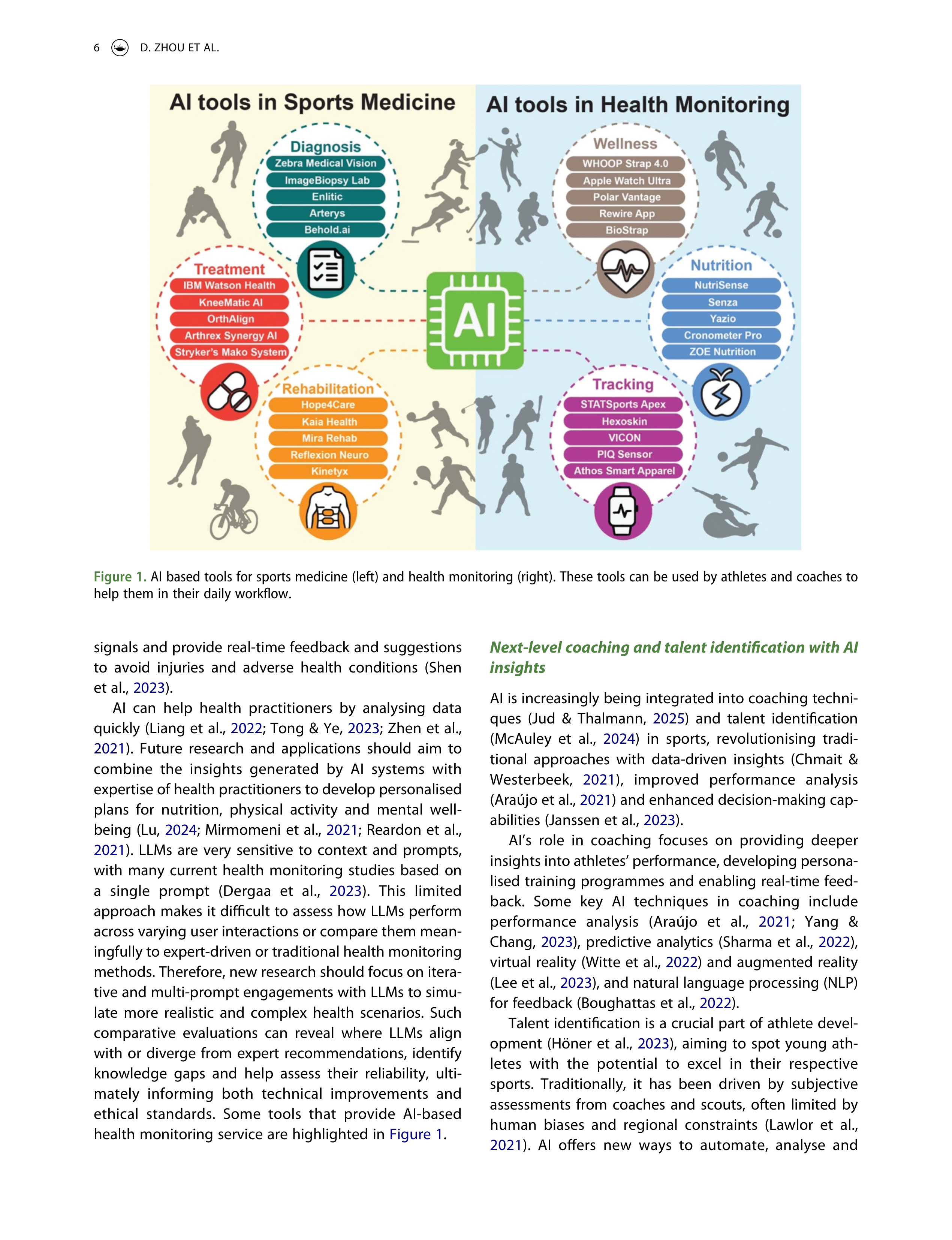
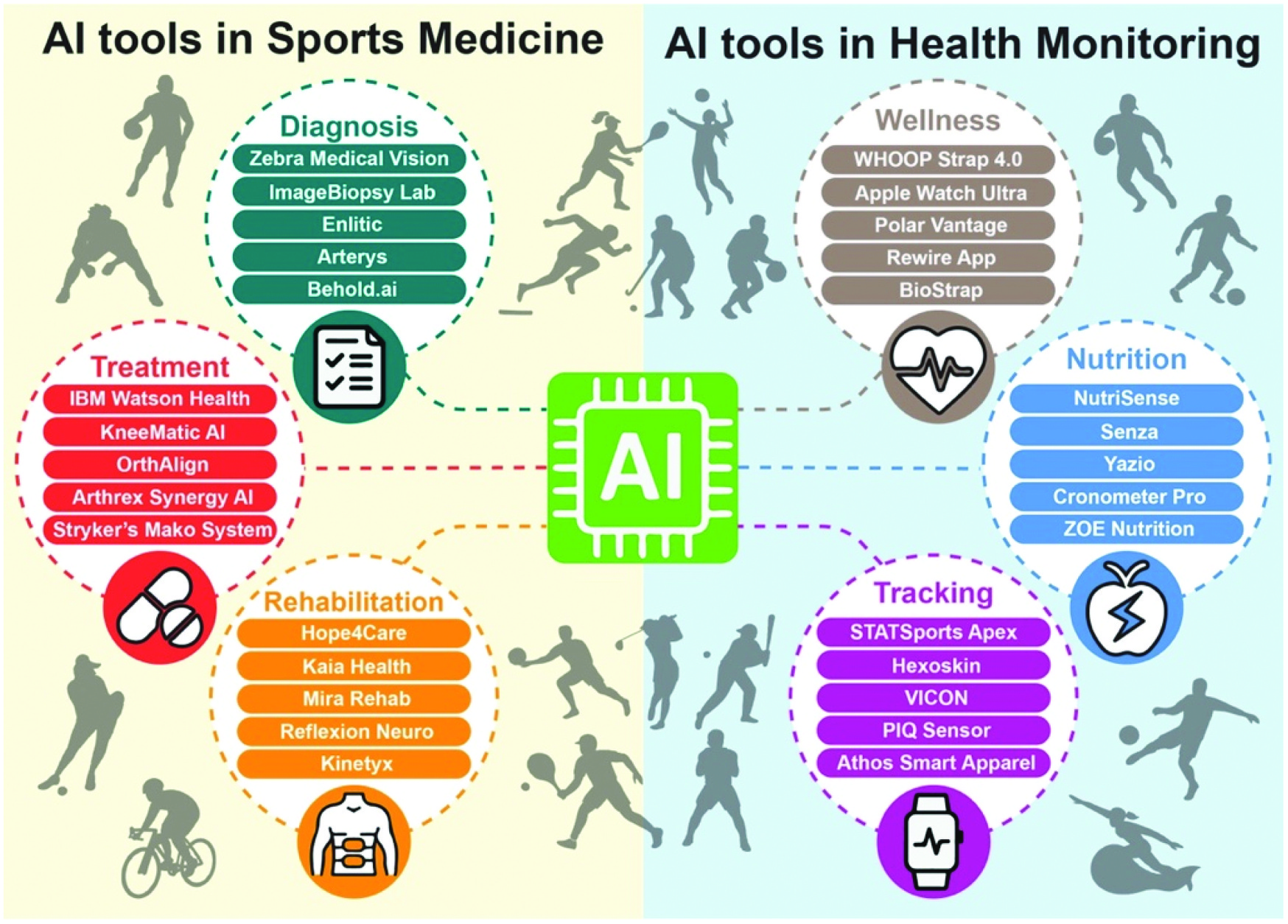
). AI-based tools for sports medi
cine are highlighted in
Figure 1
.
Health monitoring with AI: Supporting athlete
wellness and nutrition
Physical and mental health are very important for every
body but are especially important for elite athletes
whose overall health and well-being directly impact
their sporting performance and financial livelihood
(O’Donnell et al.,
2024
; Puce et al.,
2024
). Physical health
is often associated with an individual’s outward appear
ance and physical capabilities (Berry,
2016
), while mental
health pertains to the more abstract psychological pro
cesses that influence a person’s well-being (Taylor &
Brown,
1988
. Both are crucial for the success and long
evity of an athlete’s career (Reardon et al.,
2021
). The
overall wellness of an athlete relies on balancing their
training, competition, nutrition and recovery strategies
(Mirmomeni et al.,
2021
; Reardon et al.,
2021
).
Recently, large language models (LLMs) like ChatGPT
and Gemini have made a significant impact on various
industries including sports (Agne & Gedrich,
2024
;
Papastratis et al.,
2024
). These LLMs have demonstrated
performance or capabilities comparable to nutritionists,
doctors and sports health practitioners, such as (i) pro
viding advice (Agne & Gedrich,
2024
), (ii) analysing data
(Shool et al.,
2025
) or (iii) generating insights (Qiu et al.,
2024
). One such study shows that ChatGPT performed
better than a well-established tool in the market (Agne &
Gedrich,
2024
). Another study created ChatGPT-based
system to provide precision nutrition recommendations
(Papastratis et al.,
2024
). A health monitoring system,
WHMSHAR, provides an end-to-end system for the well
ness of athletes (Y. Yang,
2024b
). It uses wearable tech
nology with numerous sensors to collect athlete’s
physiological data then uses an AI algorithm to examine
multi-modal data for and provide rapid feedback and
tailored suggestions (Y. Yang,
2024b
). The study shows
that combining wearable sensor technologies with AI
presents a viable strategy for thorough health monitor
ing in athletic environments (Y. Yang,
2024b
). Similarly,
Intelligent Garment Systems are embedded with sensors
that capture physiological data such as heart rate, mus
cle activity and other bioelectric indicators to track an
athlete’s physical and emotional states (Shen et al.,
2023
). An on-chip AI models process these continuous
JOURNAL OF SPORTS SCIENCES
5
signals and provide real-time feedback and suggestions
to avoid injuries and adverse health conditions (Shen
et al.,
2023
).
AI can help health practitioners by analysing data
quickly (Liang et al.,
2022
; Tong & Ye,
2023
; Zhen et al.,
2021
). Future research and applications should aim to
combine the insights generated by AI systems with
expertise of health practitioners to develop personalised
plans for nutrition, physical activity and mental well-
being (Lu,
2024
; Mirmomeni et al.,
2021
; Reardon et al.,
2021
). LLMs are very sensitive to context and prompts,
with many current health monitoring studies based on
a single prompt (Dergaa et al.,
2023
). This limited
approach makes it difficult to assess how LLMs perform
across varying user interactions or compare them mean
ingfully to expert-driven or traditional health monitoring
methods. Therefore, new research should focus on itera
tive and multi-prompt engagements with LLMs to simu
late more realistic and complex health scenarios. Such
comparative evaluations can reveal where LLMs align
with or diverge from expert recommendations, identify
knowledge gaps and help assess their reliability, ulti
mately informing both technical improvements and
ethical standards. Some tools that provide AI-based
health monitoring service are highlighted in
Figure 1
.
Next-level coaching and talent identification with AI
insights
AI is increasingly being integrated into coaching techni
ques (Jud & Thalmann,
2025
) and talent identification
(McAuley et al.,
2024
) in sports, revolutionising tradi
tional approaches with data-driven insights (Chmait &
Westerbeek,
2021
), improved performance analysis
(Araújo et al.,
2021
) and enhanced decision-making cap
abilities (Janssen et al.,
2023
).
AI’s role in coaching focuses on providing deeper
insights into athletes’ performance, developing persona
lised training programmes and enabling real-time feed
back. Some key AI techniques in coaching include
performance analysis (Araújo et al.,
2021
; Yang &
Chang,
2023
), predictive analytics (Sharma et al.,
2022
),
virtual reality (Witte et al.,
2022
) and augmented reality
(Lee et al.,
2023
), and natural language processing (NLP)
for feedback (Boughattas et al.,
2022
).
Talent identification is a crucial part of athlete devel
opment (Höner et al.,
2023
), aiming to spot young ath
letes with the potential to excel in their respective
sports. Traditionally, it has been driven by subjective
assessments from coaches and scouts, often limited by
human biases and regional constraints (Lawlor et al.,
2021
). AI offers new ways to automate, analyse and
Figure 1.
AI based tools for sports medicine (left) and health monitoring (right). These tools can be used by athletes and coaches to
help them in their daily workflow.
6
D. ZHOU ET AL.
enhance the talent identification process, bringing data-
driven objectivity (Thirunagalingam et al.,
2025
). With
capabilities like machine learning, computer vision and
predictive analytics, AI can assess athletes in ways that
were previously impractical (Ghosh et al.,
2023
). For
example, platforms like AiSCOUT (ai.io,
2025
) use com
puter vision to remotely evaluate athletes’ movement
patterns and skills, while the Australian Institute of Sport
(AIS) has explored AI models to identify talent based on
junior athlete performance data (Australian Institute of
Sport,
2025
). Machine learning algorithms can analyse
data such as physical metrics (Teunissen et al.,
2023
),
performance statistics (Jamil et al.,
2021
) and historical
match records to identify patterns indicative of high
potential (Bunker & Susnjak,
2022
). AI systems can also
process video footage (Bennett et al.,
2019
) to analyse an
athlete’s technical skills, such as ball control in soccer,
shooting mechanics in basketball or stroke technique in
swimming. For example, NBA clubs leverage the AI sys
tems implemented by Kinexon to monitor and assess
athlete performance (Gálvez et al.,
2024
), using wearable
sensors (Elis,
2024
) to track metrics such as player load,
acceleration, speed, distance covered, heart rate and
positional data. This highlights the growing integration
of AI in professional sports.
The effectiveness of AI models is closely tied to the
quality of input data, and poor or inconsistent datasets
can significantly undermine their reliability (Chmait &
Westerbeek,
2021
). In addition, the collection of detailed
biometric and performance data raises important ethical
and privacy concerns – these are explored in more depth
in
the
Challenges
and
Recommendations
for
Trustworthy AI in Sport section. Cost is another major
barrier to adoption, particularly for smaller sports orga
nisations. Advanced AI-driven video analysis systems, for
instance, can incur annual costs of tens of thousands of
pounds in licensing and infrastructure, whereas more
traditional methods like manual video review or stop
watch timing involve minimal equipment and staffing
costs (Naughton et al.,
2024
).
AI in coaching and talent identification offers signifi
cant benefits, including objectivity and consistency. By
reducing human bias, AI enables more accurate and
impartial evaluations of talent (Lee & Lee,
2021
).
Moreover, AI has the potential to democratise talent
identification by reaching underserved and remote
regions around the globe, where traditional scouting
methods may be limited. Companies like PlayerMaker
(
https://www.playermaker.com
) and ai.io (
https://www.
ai.io
) are already leveraging AI-driven tools to assess and
identify talent in hard-to-reach areas, providing young
athletes with opportunities to showcase their skills and
access tailored development programmes. By enabling
earlier interventions and customised training, AI can
help uncover hidden talent and promote a more inclu
sive approach to athlete development (Bennett et al.,
2019
).
However, the adoption of AI in coaching and talent
identification is not without challenges. Coaches and
scouts may find it challenging to trust AI recommenda
tions if they cannot understand the reasoning behind
the predictions (Janssens et al.,
2023
). This lack of trans
parency is often due to the complexity of underlying
models, such as deep neural networks, which function
as ‘black boxes’ – producing outputs without easily
interpretable rationale. Additionally, many AI tools in
sport lack built-in explanation mechanisms or user-
friendly interfaces that could help practitioners make
sense of model decisions. Furthermore, AI models need
continuous updates and recalibration to remain accu
rate, especially as athletes progress and improve over
time (Sperlich et al.,
2023
). The long-term maintenance
costs can become a burden if not planned for, impacting
the sustainability of AI-based systems.
Challenges and recommendations for
trustworthy AI in Sport
This section will explore the critical challenges and
recommendations in applying AI within sport, focusing
on two key areas: ethical and privacy concerns in hand
ling sensitive athlete data and ensuring data accuracy,
consistency and relevance when using wearable tech
nology for real-time analysis. These areas were chosen
because they represent foundational issues that influ
ence trust, adoption and the effectiveness of AI in sport.
Ethical and privacy concerns are paramount to safe
guarding athletes’ rights and autonomy, particularly as
AI becomes more pervasive in tracking and analysing
personal data. Similarly, real-time data accuracy is vital
for actionable insights during training and competition,
where even minor inaccuracies can have significant
implications for performance and decision-making. By
addressing these issues through robust governance,
enhanced security measures and improved data proto
cols, the section aims to provide actionable strategies
that protect athlete rights while maximising AI’s poten
tial in sport performance and decision-making.
Ethical and privacy considerations in AI for Sport
Ethical and privacy concerns are critical when applying
AI in sports, particularly regarding sensitive data such as
athletes’ health metrics, performance statistics and bio
metric details (Stahl & Wright,
2018
). While these data
sets are invaluable for improving training and
JOURNAL OF SPORTS SCIENCES
7
performance, they pose significant risks of unauthorised
access, misuse and discrimination (Petersen et al.,
2025
).
For example, biometric data – such as injury risk predic
tions or physiological stress markers – could be used by
teams or sponsors to exclude athletes from competition
or contracts, even in the absence of clinical symptoms or
athlete consent. Unregulated AI applications could result
in intrusive monitoring or data breaches, jeopardising
athletes’ privacy and autonomy (Najjar,
2023
).
Recognising these challenges, the Olympic AI Agenda
(International Olympic Committee,
2024
) highlights the
broader ethical and privacy issues associated with AI,
including data security, accountability, fairness, job dis
placement and environmental impact. These concerns
underscore the importance of implementing robust fra
meworks to ensure responsible and transparent AI
deployment in sports.
To establish an ethical, privacy-respecting AI environ
ment in sport and build trust, a comprehensive
approach is essential. Existing frameworks such as the
Organisation
for
Economic
Co-operation
and
Development (OECD) AI Principles (Organisation for
Economic Co-operation and Development,
2024
) and
the European Commission’s Ethics Guidelines for
Trustworthy AI (European Commission,
2019
) offer foun
dational guidance on fairness, transparency and
accountability, while regulations like the General Data
Protection Regulation (GDPR) (European Union,
2016
)
provide legal standards for data privacy and protection.
In the sporting context, frameworks from organisations
such as the World Anti-Doping Agency (WADA) also
offer sport-specific data governance insights (World
Anti-Doping Agency,
2024
). Build on these, implement
ing robust data governance frameworks with clear
guidelines on data access and retention supports
responsible handling (Orlando,
2022
). Advanced encryp
tion and anonymisation further protect data by reducing
risks of unauthorised access (Najjar,
2023
). Ethical review
boards (Guelmami et al.,
2023
) can evaluate AI projects
for biases, while educating athletes on their data rights
empowers informed decision-making (Qi et al.,
2024
).
Several data science methods can also enhance priv
acy and fairness in sport data. Differential privacy (Abadi
et al.,
2016
; Wasserman & Zhou,
2010
), by adding statis
tical noise, allows models to learn without exposing
individual details. Federated learning (T. Li et al.,
2020
)
enables model training on local devices, keeping sensi
tive data on athletes’ personal devices rather than
a central server (Zhou et al.,
2022
). By sending only
model updates, not raw data, it enhances privacy.
Encryption (Delfs et al.,
2002
) converts data into an
unreadable format, ensuring that only authorised parties
with decryption keys can access it. This method
safeguards sensitive athlete information both in transit
and at rest, preventing potential breaches or leaks
(Mcdonald et al.,
2016
). Anonymisation (Elliot et al.,
2018
), on the other hand, removes or masks personally
identifiable information, making it harder to trace data
back to individual athletes. Explainable AI (XAI) (Arrieta
et al.,
2020
) aims to make AI model decisions transpar
ent, showing which factors influence predictions and
recommendations. In sport, XAI can clarify how specific
metrics, like biometric data or movement patterns,
impact injury risk assessments or training advice, helping
athletes and coaches make informed, trustworthy deci
sions (Procopiou & Piki,
2023
; Wang et al.,
2022
).
Although these methods show promise, their use in
sports data handling is still in its early stages and
requires further exploration to fully realise their
potential.
Ensuring data accuracy and reliability in real-time
AI systems
AI’s real-time capabilities are transforming both training
and competition in sports, though these advancements
present significant challenges related to managing data
quality, integration and context-specific interpretation.
The growing use of wearable technology exemplifies
this shift, as devices like smartwatches, GPS trackers
and heart rate monitors feed real-time data into AI sys
tems (Nahavandi et al.,
2022
). These wearables help track
crucial metrics – speed, distance, heart rate and physical
strain – throughout training sessions and live events (B.
Ma et al.,
2020
). However, there are challenges in ensur
ing data accuracy, consistency and relevance across
diverse sports contexts. Recommendations include stan
dardising data collection protocols and enhancing sen
sor reliability to improve data quality and validity,
thereby supporting more effective real-time adjust
ments for load management and injury prevention
(Palermi et al.,
2024
).
In real-time game analysis, AI systems offer insights
into tactics, formations and player positioning, allowing
for adaptive strategies in sports like football and basket
ball (Fischer et al.,
2019
; H. Li et al.,
2021
). A challenge
here is balancing AI-driven insights with the nuanced,
situational knowledge of human coaches. Training coa
ches and sport scientists to interpret and integrate AI
insights effectively could enhance in-game decisions
without compromising their expertise.
AI’s ability to monitor social media in real-time offers
significant potential for understanding fan sentiment
and driving adaptive marketing and engagement strate
gies (Midoglu et al.,
2024
). However, this capability also
presents challenges, such as the potential for
8
D. ZHOU ET AL.
information overload, which can overwhelm both
human teams and AI systems in processing vast
amounts of data effectively, and the need to balance
insights with privacy considerations. To address these
issues, implementing robust filtering tools and establish
ing clear data-use policies is crucial. These measures not
only ensure that teams can focus on actionable insights
but also reinforce trust by respecting fans’ privacy and
preferences. As AI-driven fan engagement becomes an
increasingly integral part of sports management, these
considerations must align with the broader ethical and
governance frameworks applied to AI in sport.
Future trends
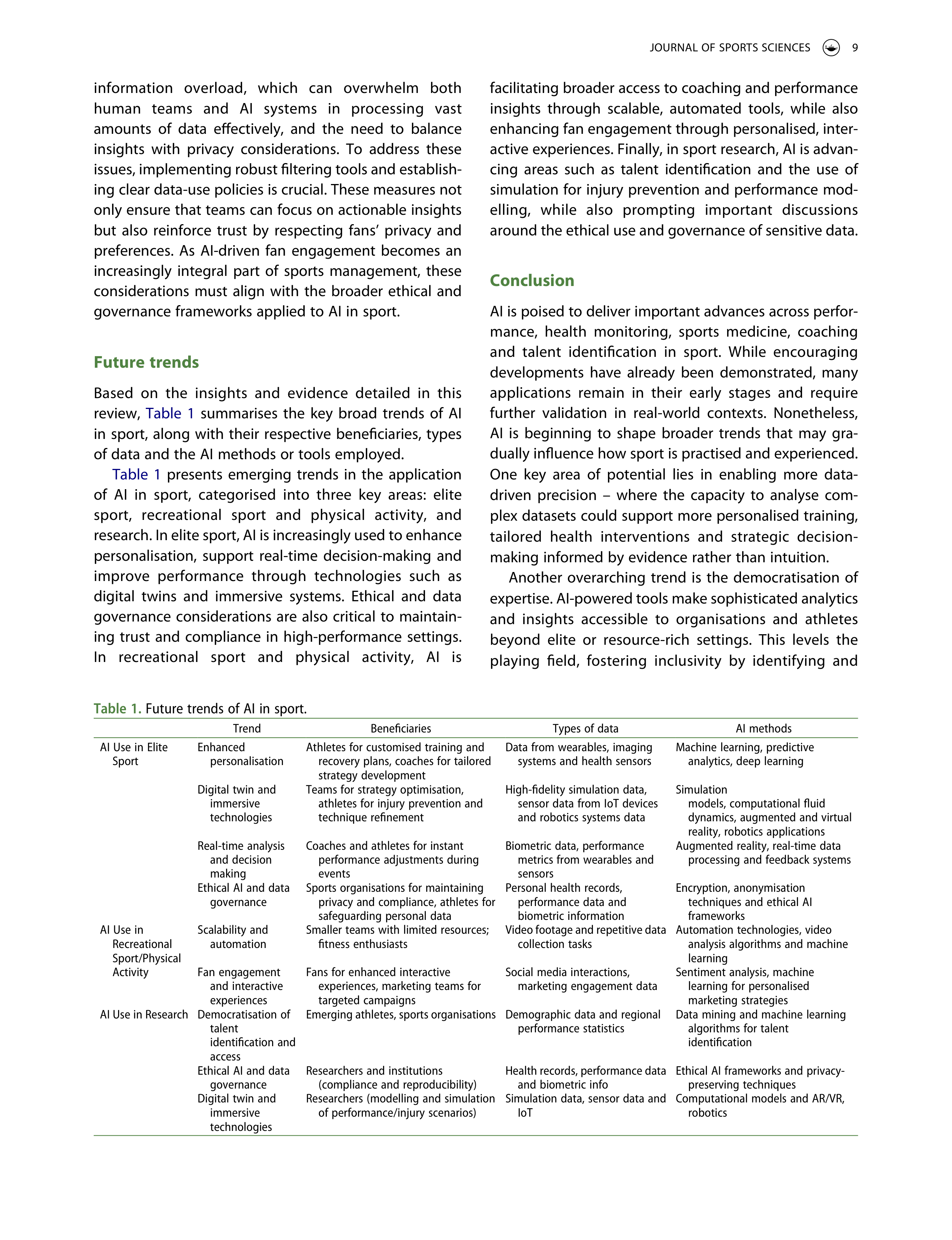
Based on the insights and evidence detailed in this
review,
Table 1
summarises the key broad trends of AI
in sport, along with their respective beneficiaries, types
of data and the AI methods or tools employed.
Table 1
presents emerging trends in the application
of AI in sport, categorised into three key areas: elite
sport, recreational sport and physical activity, and
research. In elite sport, AI is increasingly used to enhance
personalisation, support real-time decision-making and
improve performance through technologies such as
digital twins and immersive systems. Ethical and data
governance considerations are also critical to maintain
ing trust and compliance in high-performance settings.
In recreational sport and physical activity, AI is
facilitating broader access to coaching and performance
insights through scalable, automated tools, while also
enhancing fan engagement through personalised, inter
active experiences. Finally, in sport research, AI is advan
cing areas such as talent identification and the use of
simulation for injury prevention and performance mod
elling, while also prompting important discussions
around the ethical use and governance of sensitive data.
Conclusion
AI is poised to deliver important advances across perfor
mance, health monitoring, sports medicine, coaching
and talent identification in sport. While encouraging
developments have already been demonstrated, many
applications remain in their early stages and require
further validation in real-world contexts. Nonetheless,
AI is beginning to shape broader trends that may gra
dually influence how sport is practised and experienced.
One key area of potential lies in enabling more data-
driven precision – where the capacity to analyse com
plex datasets could support more personalised training,
tailored health interventions and strategic decision-
making informed by evidence rather than intuition.
Another overarching trend is the democratisation of
expertise. AI-powered tools make sophisticated analytics
and insights accessible to organisations and athletes
beyond elite or resource-rich settings. This levels the
playing field, fostering inclusivity by identifying and
Table 1.
Future trends of AI in sport.
Trend
Beneficiaries
Types of data
AI methods
AI Use in Elite
Sport
Enhanced
personalisation
Athletes for customised training and
recovery plans, coaches for tailored
strategy development
Data from wearables, imaging
systems and health sensors
Machine learning, predictive
analytics, deep learning
Digital twin and
immersive
technologies
Teams for strategy optimisation,
athletes for injury prevention and
technique refinement
High-fidelity simulation data,
sensor data from IoT devices
and robotics systems data
Simulation
models, computational fluid
dynamics, augmented and virtual
reality, robotics applications
Real-time analysis
and decision
making
Coaches and athletes for instant
performance adjustments during
events
Biometric data, performance
metrics from wearables and
sensors
Augmented reality, real-time data
processing and feedback systems
Ethical AI and data
governance
Sports organisations for maintaining
privacy and compliance, athletes for
safeguarding personal data
Personal health records,
performance data and
biometric information
Encryption, anonymisation
techniques and ethical AI
frameworks
AI Use in
Recreational
Sport/Physical
Activity
Scalability and
automation
Smaller teams with limited resources;
fitness enthusiasts
Video footage and repetitive data
collection tasks
Automation technologies, video
analysis algorithms and machine
learning
Fan engagement
and interactive
experiences
Fans for enhanced interactive
experiences, marketing teams for
targeted campaigns
Social media interactions,
marketing engagement data
Sentiment analysis, machine
learning for personalised
marketing strategies
AI Use in Research
Democratisation of
talent
identification and
access
Emerging athletes, sports organisations
Demographic data and regional
performance statistics
Data mining and machine learning
algorithms for talent
identification
Ethical AI and data
governance
Researchers and institutions
(compliance and reproducibility)
Health records, performance data
and biometric info
Ethical AI frameworks and privacy-
preserving techniques
Digital twin and
immersive
technologies
Researchers (modelling and simulation
of performance/injury scenarios)
Simulation data, sensor data and
IoT
Computational models and AR/VR,
robotics
JOURNAL OF SPORTS SCIENCES
9
nurturing talent in underserved regions and providing
equitable access to advanced training and monitoring
systems.
AI also fosters real-time adaptability, a game-changer
in both competition and athlete management. Wearable
technologies and real-time analysis systems offer instant
feedback, enabling on-the-fly adjustments that enhance
performance, prevent injuries and optimise strategies
during high-stakes events. This dynamic responsiveness
transforms how coaches and athletes operate, bridging
the
gap
between
preparation
and
real-world
application.
AI promotes sustainability and scalability in sports
management. By automating repetitive tasks, such as
video analysis or data aggregation, AI reduces time bur
dens, allowing coaches, medical professionals and
administrators to focus on critical decision-making. As
these technologies evolve, their integration into sport
will only deepen, expanding benefits to recreational
athletes, fans and stakeholders at all levels.
To maximise AI’s potential, it is vital to address
ongoing challenges, such as ethical and privacy con
cerns, data governance and ensuring equitable adop
tion across the sporting ecosystem. A careful balance
of innovation and responsibility will pave the way for
a future where AI enhances human expertise,
enabling sport to thrive in a connected, data-rich
world.
Disclosure statement
No potential conflict of interest was reported by the author(s).
Funding
The author(s) reported that there is no funding associated with
the work featured in this article.
ORCID
Diwei Zhou
http://orcid.org/0000-0003-4323-7393
References
Abadi, M., Chu, A., Goodfellow, I., McMahan, H. B., Mironov, I.,
Talwar, K., & Zhang, L. (
2016
). Deep learning with differential
privacy.
Proceedings of the 2016 ACM SIGSAC Conference on
Computer and Communications Security
, Vienna Austria (pp.
308–318).
Adam, M. A. (2024). Heartfelt insights: AI and Machine learning
applications for cardiac wellness.
International Journal of
Advanced Engineering Technologies and Innovations
,
1
(4),
231–247.
Agne, I., & Gedrich, K. (
2024
). Personalized dietary recommen
dations for obese individuals-A comparison of ChatGPT and
the Food4Me algorithm.
Clinical Nutrition Open Science
,
56
,
192–201.
https://doi.org/10.1016/j.nutos.2024.06.001
ai.io. (
2025
).
AiSCOUT: AI-powered talent identification platform
.
https://www.ai.io/
Ali, F., El-Sappagh, S., Islam, S. R., Kwak, D., Ali, A., Imran, M., &
Kwak, K.-S. (
2020
). A smart healthcare monitoring system for
heart disease prediction based on ensemble deep learning
and feature fusion.
Information Fusion
,
63
, 208–222.
https://
doi.org/10.1016/j.inffus.2020.06.008
Amrein, S., Werner, C., Arnet, U., & Vries, W. H. K. (
2023
).
Machine-learning-based methodology for estimation of
shoulder load in wheelchair-related activities using
wearables.
Sensors
,
23
(3), 1577.
https://doi.org/10.3390/
s23031577
Araújo, D. C., Couceiro, M., Seifert, L., Sarmento, H., & Davids, K.
(
2021
).
Artificial intelligence in sport performance analysis
.
Routledge.
Arrieta, A. B., Díaz-Rodríguez, N., Del Ser, J., Bennetot, A.,
Tabik, S., Barbado, A., García, S., Gil-López, S., Molina, D.,
Benjamins, R., Chatila, R., & Herrera, F. (
2020
). Explainable
artificial intelligence (XAI): Concepts, taxonomies, opportu
nities and challenges toward responsible AI.
Information
Fusion
,
58
, 82–115.
https://doi.org/10.1016/j.inffus.2019.12.
012
Australian Institute of Sport. (
2025
).
Talent identification and
development
.
https://www.ais.gov.au/ftem/talent
Balsalobre-Fernández, C., Xu, J., Jarvis, P., Thompson, S.,
Tannion, K., & Bishop, C. (
2023
). Validity of a smartphone
app using artificial intelligence for the real-time measure
ment of barbell velocity in the bench press exercise.
The
Journal of Strength & Conditioning Research
,
37
(12), e640–
e645.
https://doi.org/10.1519/JSC.0000000000004593
Barris, S., & Button, C. (
2008
). A review of vision-based motion
analysis in sport.
Sports Medicine
,
38
(12), 1025–1043.
https://
doi.org/10.2165/00007256-200838120-00006
Benjaminse, A., Nijmeijer, E. M., Gokeler, A., & Paolo, S. (
2024
).
Application of machine learning methods to investigate
joint load in agility on the football field: Creating the
model, part I.
Sensors
,
24
(11), 3652.
https://doi.org/10.3390/
s24113652
Bennett, K. J. M., Novak, A. R., Pluss, M. A., Coutts, A. J., &
Fransen, J. (
2019
). Assessing the validity of a video-based
decision-making assessment for talent identification in
youth soccer.
Journal of Science & Medicine in Sport
,
22
(6),
729–734.
https://doi.org/10.1016/j.jsams.2018.12.011
Berry, B. (
2016
).
The power of looks: Social stratification of phy
sical appearance
. Routledge.
Born, Z., Mundt, M., Mian, A., Weber, J., & Alderson, J. (
2024
).
The eye in the sky-A method to obtain on-field locations of
Australian rules football athletes.
AI
,
5
(2), 733–745.
https://
doi.org/10.3390/ai5020038
Boughattas, W., Salha, M. B., & Moella, N. (
2022
). Mental training
for young athlete: A case of study of NLP practice.
SSM -
Mental Health
,
2
, 100076.
https://doi.org/10.1016/j.ssmmh.
2022.100076
Browne, P., Sweeting, A. J., Woods, C. T., & Robertson, S. (
2021
).
Methodological considerations for furthering the under
standing of constraints in applied sports.
Sports Medicine -
Open
,
7
(1), 22.
https://doi.org/10.1186/s40798-021-00313-x
10
D. ZHOU ET AL.
Bruce, L., Brooks, E. R., & Woods, C. T. (
2018
). Team and seasonal
performance indicator evolution in the ANZ Championship
netball league.
Journal of Sports Sciences
,
36
(24), 1–7.
https://
doi.org/10.1080/02640414.2018.1473099
Bunker, R., & Susnjak, T. (
2022
). The application of machine
learning techniques for predicting match results in team
sport: A review.
Journal of Artificial Intelligence Research
,
73
,
1285–1322.
https://doi.org/10.1613/jair.1.13509
Chariar, M., Rao, S., Irani, A., Suresh, S., & Asha, C. S. (
2023
). AI
trainer: Autoencoder based approach for squat analysis and
correction.
Institute of Electrical and Electronics Engineers
Access
,
11
,
107135–107149.
https://doi.org/10.1109/
ACCESS.2023.3316009
Chen, J. (
2024
). The application and development of artificial
intelligence and high technology in sports event.
Highlights
in Business, Economics and Management
,
30
, 247–255.
https://doi.org/10.54097/n7dhp396
Chidambaram, S., Maheswaran, Y., Patel, K., Sounderajah, V.,
Hashimoto, D. A., Seastedt, K. P., McGregor, A. H.,
Markar, S. R., & Darzi, A. (
2022
). Using artificial
intelligence-enhanced sensing and wearable technology in
sports medicine and performance optimisation.
Sensors
(Switzerland)
,
22
(18), 18.
https://doi.org/10.3390/s22186920
Chmait, N., & Westerbeek, H. (
2021
). Artificial intelligence and
machine learning in sport research: An introduction for
non-data scientists.
Frontiers in Sports and Active Living
,
3
,
682287.
https://doi.org/10.3389/fspor.2021.682287
Colyer, S. L., Evans, M., Cosker, D. P., & Salo, A. I. (
2018
). A review
of the evolution of vision-based motion analysis and the
integration of advanced computer vision methods towards
developing a markerless system.
Sports Medicine - Open
,
4
(1),
1–15.
https://doi.org/10.1186/s40798-018-0139-y
Cornish, B. M., Pizzolato, C., Saxby, D. J., Xia, Z., Devaprakash, D.,
& Diamond, L. E. (
2024
). Hip contact forces can be predicted
with a neural network using only synthesised key points and
electromyography in people with hip osteoarthritis.
Osteoarthritis and Cartilage
,
32
(6), 730–739.
https://doi.org/
10.1016/j.joca.2024.02.891
Cui, Y. (
2024
). An efficient approach to sports rehabilitation and
outcome prediction using RNN-LSTM.
Mobile Networks and
Applications
, 1–16.
https://doi.org/10.1007/s11036-024-
02355-3
Cust, E. E., Sweeting, A. J., Ball, K., & Robertson, S. (
2019
).
Machine and deep learning for sport-specific movement
recognition: A systematic review of model development
and performance.
Journal of Sports Sciences
,
37
(5),
568–600.
https://doi.org/10.1080/02640414.2018.1521769
Delfs, H., Knebl, H., & Knebl, H. (
2002
).
Introduction to crypto
graphy
(Vol. 2). Springer.
Dergaa, I., Saad, H. B., Omri, A. E., Glenn, J., Clark, C., Washif, J.,
Guelmami, N., Hammouda, O., Al-Horani, R., Reynoso-
Sánchez, L., Romdhani, M., Paineiras-Domingos, L.,
Vancini, R., Taheri, M., Mataruna-Dos-Santos, L., Trabelsi, K.,
Chtourou, H., Zghibi, M., . . . Sandbakk, Ø. (
2023
). Using
artificial intelligence for exercise prescription in personalised
health promotion: A critical evaluation of OpenAI’s GPT-4
model.
Biology of Sport
,
41
(2), 221–241.
https://doi.org/10.
5114/biolsport.2024.133661
de Vries, W. H. K., Amrein, S., Arnet, U., Mayrhuber, L.,
Ehrmann, C., & Veeger, H. E. J. (
2022
). Classification of wheel
chair related shoulder loading activities from wearable
sensor data: A machine learning approach.
Sensors
,
22
(19),
7404.
https://doi.org/10.3390/s22197404
Dilsizian, S. E., & Siegel, E. L. (
2014
). Artificial intelligence in
medicine and cardiac imaging: Harnessing big data and
advanced computing to provide personalized medical diag
nosis and treatment.
Current Cardiology Reports
,
16
(1), 1–8.
https://doi.org/10.1007/s11886-013-0441-8
Donath, L., Rössler, R., & Faude, O. (
2016
). Effects of virtual
reality training (exergaming) compared to alternative exer
cise training and passive control on standing balance and
functional mobility in healthy community-dwelling seniors:
A meta-analytical review.
Sports Medicine
,
46
(9), 1293–1309.
https://doi.org/10.1007/s40279-016-0485-1
Donoho, D. L. (
2000
). High-dimensional data analysis: The
curses and blessings of dimensionality.
AMS Math
Challenges Lecture
,
1
(2000), 32.
Dyer, B. T., Noroozi, S., Redwood, S., & Sewell, P. (
2010
). The
design of lower-limb sports prostheses: Fair inclusion in
disability sport.
Disability & Society
,
25
(5), 593–602.
https://
doi.org/10.1080/09687599.2010.489309
Elis, J. J. (
2024
).
Investigating wearable technology bioethics
through the perspectives of NBA athletes
[Doctoral disserta
tion]. Concordia University Chicago.
Elliot, M., O’hara, K., Raab, C., O’Keefe, C. M., Mackey, E.,
Dibben, C., Gowans, H., Purdam, K., & McCullagh, K. (
2018
).
Functional anonymisation: Personal data and the data
environment.
Computer Law & Security Review
,
34
(2),
204–221.
https://doi.org/10.1016/j.clsr.2018.02.001
European Commission. (
2019
).
Ethics guidelines for trustworthy
AI
.
https://digital-strategy.ec.europa.eu/en/library/ethics-
guidelines-trustworthy-ai
European Union. (
2016
).
General data protection regulation (EU)
2016/679
.
https://gdpr-info.eu
Fares, M. Y., Boufadel, P., Vadhera, A. S., & Abboud, J. A. (
2024
).
Artificial intelligence in sports medicine. In F. Familiari,
O. Galasso, & G. Gasparini (Eds.),
Artificial intelligence in
orthopaedic surgery made easy
(pp. 119–127). Springer
Nature Switzerland.
Fayed, A. M., Mansur, N. S. B., Carvalho, K. A., Behrens, A.,
D’Hooghe, P., & Cesar Netto, C. (
2023
). Artificial intelligence
and ChatGPT in Orthopaedics and sports medicine.
Journal
of Experimental Orthopaedics
,
10
(1), 74.
https://doi.org/10.
1186/s40634-023-00642-8
Fischer, M. T., Keim, D. A., & Stein, M. (
2019
).
Video-based
analysis of soccer matches the 2nd International workshop
on multimedia content analysis in sports
(pp. 1–9).
Association for Computing Machinery.
Forcher, L., Beckmann, T., Wohak, O., Romeike, C., Graf, F., &
Altmann, S. (
2023
). Prediction of defensive success in elite
soccer using machine learning-tactical analysis of defensive
play using tracking data and explainable AI.
Science and
Medicine in Football
,
8
(4), 317–332.
https://doi.org/10.1080/
24733938.2023.2239766
Gálvez, A., Chan, V. S., Pérez-Carabaza, S., & Iglesias, A. (
2024
).
Artificial intelligence and machine learning-based data ana
lytics for sports: General overview and NBA case study. In
Artificial intelligence, optimization, and data sciences in sports
(pp. 149–194). Springer Nature Switzerland.
García-Aliaga, A., Marquina Nieto, M., Coterón, J., Rodríguez-
González, A., Gil Ares, J., & Refoyo Román, I. (
2023
).
A longitudinal study on the evolution of the four main
football leagues using artificial intelligence: Analysis of the
JOURNAL OF SPORTS SCIENCES
11
differences in English Premier league teams.
Research
Quarterly for Exercise & Sport
,
94
(2), 529–537.
https://doi.
org/10.1080/02701367.2021.2019661
Ghosh, I., Ramasamy Ramamurthy, S., Chakma, A., & Roy, N.
(
2023
). Sports analytics review: Artificial intelligence applica
tions, emerging technologies, and algorithmic perspective.
Wiley Interdisciplinary Reviews: Data Mining and Knowledge
Discovery
,
13
(5), e1496.
https://doi.org/10.1002/widm.1496
Giarmatzis, G., Zacharaki, E. I., & Moustakas, K. (
2020
, December
16). Neural network based prediction of knee contact forces
for different gait speeds.
2020 IEEE International Conference
on Bioinformatics and Biomedicine (BIBM)
, Seoul, Korea
(South).
Griffin, J., Newans, T., Horan, S., Keogh, J., Andreatta, M., &
Minahan, C. (
2021
). Acceleration and high-speed running
profiles of women’s international and domestic football
matches [article.
Frontiers in Sports and Active Living
,
3
, 3.
https://doi.org/10.3389/fspor.2021.604605
Guelmami, N., Fekih-Romdhane, F., Mechraoui, O., &
Bragazzi, N. L. (
2023
). Injury prevention, optimized training
and rehabilitation: How is AI reshaping the field of sports
medicine.
New Asian Journal of Medicine
,
1
(1), 30–34.
https://
doi.org/10.61186/najm.1.1.30
Haller, N., Kranzinger, S., Kranzinger, C., Blumkaitis, J. C.,
Strepp, T., Simon, P., Tomaskovic, A., O’Brien, J., Düring, M.,
& Stöggl, T. (
2023
). Predicting injury and illness with
machine learning in elite youth soccer: A comprehensive
monitoring approach over 3 months.
Journal Sports Science
Medical
,
22
(3), 476–487.
https://doi.org/10.52082/jssm.2023.
476
Hamill, J., Knutzen, K. M., & Derrick, T. R. (
2021
). Biomechanics:
40 years on.
Kinesiology Review
,
10
(3), 228–237.
https://doi.
org/10.1123/kr.2021-0015
Höner, O., Larkin, P., Leber, T., & Feichtinger, P. (
2023
). Talent
identification and development in sport. In J. Schüler, M.
Wegne, H. Plessner & R. C. Eklund (Eds.),
Sport and exercise
psychology: Theory and application
(pp. 549–581). Springer
International Publishing.
Hu, X., Zhang, W., Ou, H., Mo, S., Liang, F., Liu, J., Zhao, Z., &
Qu, X. (
2024
). Enhancing squat movement classification per
formance with a gated long-short term memory with trans
former network model.
Sports Biomechanics
, 1–16.
https://
doi.org/10.1080/14763141.2024.2315243
Huiberts, R. O., Wüst, R. C. I., & Zwaard, S. (
2024
). Concurrent
strength and endurance training: A systematic review and
meta-analysis on the impact of sex and training status.
Sports Medicine
,
54
(2), 485–503.
https://doi.org/10.1007/
s40279-023-01943-9
Hutchins, B. (
2016
). Tales of the digital sublime: Tracing the
relationship between big data and professional sport.
Convergence: The International Journal of Research into New
Media Technologies
,
22
(5), 494–509.
https://doi.org/10.1177/
1354856515587163
International Olympic Committee. (
2024
).
Olympic AI agenda
.
https://olympics.com/ioc/olympic-ai-agenda
Jamil, M., Phatak, A., Mehta, S., Beato, M., Memmert, D., &
Connor, M. (
2021
). Using multiple machine learning algo
rithms to classify elite and sub-elite goalkeepers in profes
sional men’s football.
Scientific Reports
,
11
(1), 22703.
https://
doi.org/10.1038/s41598-021-01187-5
Janetzki, S. J., Bourdon, P. C., Norton, K. I., Lane, J. C., &
Bellenger, C. R. (
2021
). Evolution of physical demands of
Australian football league matches from 2005 to 2017:
A systematic review and meta-regression.
Sports Medicine -
Open
,
7
(1), 28.
https://doi.org/10.1186/s40798-021-00301-1
Janssen, T., Müller, D., & Mann, D. L. (
2023
). From natural
towards representative decision making in sports:
A framework for decision making in virtual and augmented
environments.
Sports Medicine
,
53
(10), 1851–1864.
https://
doi.org/10.1007/s40279-023-01884-3
Janssens, B., Bogaert, M., & Maton, M. (
2023
). Predicting the next
Pogačar: A data analytical approach to detect young profes
sional cycling talents.
Annals of Operations Research
,
325
(1),
557–588.
https://doi.org/10.1007/s10479-021-04476-4
Jiang, F., Jiang, Y., Zhi, H., Dong, Y., Li, H., Ma, S., Wang, Y.,
Dong, Q., Shen, H., & Wang, Y. (
2017
). Artificial intelligence in
healthcare: Past, present and future.
Stroke and Vascular
Neurology
,
2
(4), 230–243.
https://doi.org/10.1136/svn-2017-
000101
Jud, M., & Thalmann, S. (
2025
). AI in digital sports
coaching-a systematic review.
Managing Sport and Leisure
,
1–17.
https://doi.org/10.1080/23750472.2024.2449016
Kellmann, M., Bertollo, M., Bosquet, L., Brink, M., Coutts, A. J.,
Duffield, R., Erlacher, D., Halson, S. L., Hecksteden, A.,
Heidari, J., Kallus, K. W., Meeusen, R., Mujika, I., Robazza, C.,
Skorski, S., Venter, R., & Beckmann, J. (
2018
). Recovery and
performance in sport: Consensus statement.
International
Journal of Sports Physiology and Performance
,
13
(2),
240–245.
https://doi.org/10.1123/ijspp.2017-0759
Kelly, C. J., Karthikesalingam, A., Suleyman, M., Corrado, G., &
King, D. (
2019
). Key challenges for delivering clinical impact
with artificial intelligence.
BMC Medicine
,
17
(1), 1–9.
https://
doi.org/10.1186/s12916-019-1426-2
Lal, H., Mohanta, S., Kumar, J., Patralekh, M. K., Lall, L.,
Katariya, H., & Arya, R. K. (
2023
). Telemedicine-
rehabilitation and virtual reality in orthopaedics and sports
medicine.
Indian Journal of Orthopaedics
,
57
(1), 7–19.
https://
doi.org/10.1007/s43465-022-00766-6
Lawlor, C., Rookwood, J., & Wright, C. M. (
2021
). Player scouting
and recruitment in English men’s professional football:
Opportunities for research.
Journal of Qualitative Research
in Sports Studies
,
15
(1), 57–76.
Lee, H. S., & Lee, J. (
2021
). Applying artificial intelligence in
physical education and future perspectives.
Sustainability
,
13
(1), 351.
https://doi.org/10.3390/su13010351
Lee, J., Sarda, D. P., Lee, E., Lee, A., Wang, J., Rodriguez, A., &
Froehlich, J. E. (
2023
). Towards real-time computer vision
and augmented reality to support Low vision sports:
A demonstration of ARTennis. UIST ‘23 Adjunct: Adjunct
Proceedings of the 36th Annual ACM Symposium on User
Interface Software and Technology, San Francisco, CA, USA
(pp. 1–3). Association for Computing Machinery.
Li, H., Zhang, M., & Lv, J. (
2021
). Artificial intelligence and neural
network-based shooting accuracy prediction analysis in
basketball.
Artificial Intelligence and Neural network-Based
Shooting Accuracy Prediction Analysis in Basketball
,
2021
,
4485589.
https://doi.org/10.1155/2021/4485589
Li, T., Sahu, A. K., Talwalkar, A., & Smith, V. (
2020
). Federated
learning: Challenges, methods, and future directions.
IEEE
Signal Processing Magazine
,
37
(3), 50–60.
https://doi.org/10.
1109/MSP.2020.2975749
Liang, L., Zheng, Y., Ge, Q., & Zhang, F. (
2022
). Exploration and
strategy analysis of mental health Education for students in
sports majors in the era of artificial intelligence.
Frontiers in
12
D. ZHOU ET AL.
Psychology
,
12
, 762725.
https://doi.org/10.3389/fpsyg.2021.
762725
Lord, F., Pyne, D. B., Welvaert, M., & Mara, J. K. (
2020
). Methods of
performance analysis in team invasion sports: A systematic
review.
Journal of Sports Sciences
,
38
(20), 2338–2349.
https://
doi.org/10.1080/02640414.2020.1785185
Lövdal, S. S., Den Hartigh, R. J. R., & Azzopardi, G. (
2021
). Injury
prediction in competitive runners with machine learning.
International Journal of Sports Physiology & Performance
,
16
(10), 1522–1531.
https://doi.org/10.1123/ijspp.2020-0518
Lu, L. (
2024
). Big data analysis of mental health intervention
effects in student-athletes: Based on data mining techniques
and affective computing algorithms.
Multimedia Tools and
Applications
,
84
(17), 1–19.
https://doi.org/10.1007/s11042-
024-19786-5
Ma, B., Nie, S., Ji, M., Song, J., & Wang, W. (
2020
). Research and
analysis of sports training real-time monitoring system
based on Mobile artificial intelligence terminal.
Wireless
Communications and Mobile Computing
,
2020
(1), 8879616.
https://doi.org/10.1155/2020/8879616
Ma, H., & Pang, X. (
2019
). Research and analysis of sport med
ical data processing algorithms based on deep learning and
internet of things.
Institute of Electrical and Electronics
Engineers Access
,
7
, 118839–118849.
https://doi.org/10.
1109/ACCESS.2019.2936945
Malekloo, A., Ozer, E., AlHamaydeh, M., & Girolami, M. (
2022
).
Machine learning and structural health monitoring overview
with emerging technology and high-dimensional data
source highlights.
Structural Health Monitoring
,
21
(4),
1906–1955.
https://doi.org/10.1177/14759217211036880
Marquina, M., Lozano, D., García-Sánchez, C., Sánchez-López, S.,
& Rubia, A. (
2023
). Development and validation of an obser
vational game analysis tool with artificial intelligence for
handball: Handball.Ai.
Sensors (Switzerland)
,
23
(15), 6714.
https://doi.org/10.3390/s23156714
McAuley, A. B. T., Baker, J., Johnston, K., & Kelly, A. L. (
2024
).
Artificial intelligence in talent identification and develop
ment in sport. In C. Dindorf, E. Bartaguiz, F. Gassmann, &
M. Fröhlich (Eds.),
Artificial intelligence in sports, movement,
and health
(pp. 255–270). Springer Nature Switzerland.
Mcdonald, N., Atkinson, D., Khmelevsky, Y., & McMillan, S.
(
2016
). Sport wearable biometric data encrypted emulation
and storage in cloud.
2016 IEEE Canadian Conference on
Electrical and Computer Engineering (CCECE)
, Vancouver, BC,
Canada (pp. 1–4).
Mennella, C., Maniscalco, U., De Pietro, G., & Esposito, M. (
2024
).
Ethical and regulatory challenges of AI technologies in
healthcare: A narrative review.
Heliyon
,
10
(4), e26297.
https://doi.org/10.1016/j.heliyon.2024.e26297
Midoglu, C., Sabet, S. S., Sarkhoosh, M. H., Majidi, M., Gautam, S.,
Solberg, H. M., Kupka, T., & Halvorsen, P. (
2024
). AI-based
sports highlight generation for social media. MHV ‘24: Mile-
High Video Conference, Denver, CO, USA (pp. 7–13).
Association for Computing Machinery.
Mirmomeni, M., Fazio, T., Cavallar, S., & Harrer, S. (
2021
).
Chapter 12-from wearables to THINKables: Artificial intelli
gence-enabled sensors for health monitoring. In E. Sazonov
(Ed.),
Wearable sensors
(Second, pp. 339–356). Academic
Press.
Musa, R. M., Majeed, A. P. A., Kosni, N. A., & Abdullah, M. R.
(
2020
).
Machine learning in team sports: Performance analysis
and talent identification in beach soccer & sepak-takraw
.
Springer Nature.
Nahavandi, D., Alizadehsani, R., Khosravi, A., & Acharya, U. R.
(
2022
). Application of artificial intelligence in wearable
devices: Opportunities and challenges.
Computer Methods
and Programs in Biomedicine
,
213
, 106541.
https://doi.org/
10.1016/j.cmpb.2021.106541
Najjar, M. C. (
2023
). Legal and ethical issues arising from the
application of data analytics and artificial intelligence to
traditional sports.
Albany Law Journal of Science and
Technology
,
33
(1), 51.
https://www.albanylawscitech.org/arti
cle/74928
Naughton, M., Salmon, P. M., Compton, H. R., & McLean, S.
(
2024
). Challenges and opportunities of artificial intelligence
implementation within sports science and sports medicine
teams.
Frontiers in Sports and Active Living
,
6
, 1332427.
https://doi.org/10.3389/fspor.2024.1332427
O’Donnell, A., Murray, A., Nguyen, A., Salmon, T., Taylor, S.,
Morton, J. P., & Close, G. L. (
2024
). Nutrition and golf perfor
mance: A systematic scoping review.
Sports Medicine
,
54
(12),
3081–3095.
https://doi.org/10.1007/s40279-024-02095-0
Organisation for Economic Co-operation and Development.
(
2024
).
OECD AI principles
.
https://www.oecd.org/en/topics/
sub-issues/ai-principles.html
Orlando, A. (
2022
). AI for sport in the EU legal framework.
2022
IEEE International Workshop on Sport, Technology and
Research (STAR)
, Trento-Cavalese, Italy (pp. 100–105).
Owen, R., Owen, J. A., & Evans, S. L. (
2024
). Artificial intelligence
for sport injury prediction. In C. Dindorf, E. Bartaguiz, F.
Gassmann & M. Fröhlich (Eds.),
Artificial intelligence in sports,
movement, and health
(pp. 69–79). Springer.
Palermi, S., Vecchiato, M., Saglietto, A., Niederseer, D.,
Oxborough, D., Ortega-Martorell, S., Olier, I., Castelletti, S.,
Baggish, A., Maffessanti, F., Biffi, A., D’Andrea, A., Zorzi, A.,
Cavarretta, E., & D’Ascenzi, F. (
2024
). Unlocking the potential
of artificial intelligence in sports cardiology: Does it have
a role in evaluating athlete’s heart?
European Journal of
Preventive Cardiology
,
31
(4), 470–482.
https://doi.org/10.
1093/eurjpc/zwae008
Papastratis, I., Konstantinidis, D., Daras, P., & Dimitropoulos, K.
(
2024
). AI nutrition recommendation using a deep genera
tive model and ChatGPT.
Scientific Reports
,
14
(1), 14620.
https://doi.org/10.1038/s41598-024-65438-x
Pareek, A., Ro, D. H., Karlsson, J., & Martin, R. K. (
2024
). Machine
learning/artificial intelligence in sports medicine: State of
the art and future directions.
Journal of ISAKOS
,
9
(4),
635–644.
https://doi.org/10.1016/j.jisako.2024.01.013
Parker, W., & Forster, B. B. (
2019
). Artificial intelligence in sports
medicine radiology: What’s coming?
British Journal of Sports
Medicine
,
53
(19), 1201–1202.
https://doi.org/10.1136/
bjsports-2018-099999
Patil, V., Narayan, J., Sandhu, K., & Dwivedy, S. K. (
2022
).
Integration of Virtual Reality and Augmented Reality in
Physical Rehabilitation: A State-of-the-Art Review. In K.
Subburaj, K. Sandhu & S. Ćuković (Eds.),
Revolutions in
Product Design for Healthcare: Advances in Product Design
and Design Methods for Healthcare
, 177–205.
https://doi.org/
10.1007/978-981-16-9455-4_10
Pavunraj, D., Kumar, A. M., & Anbumaheshwari, K. (
2025
). AI in
personalized treatment planning. In D. Satishkumar & M.
Sivaraja (Eds.),
AI insights on nuclear medicine
(pp.
117–142). IGI Global Scientific Publishing.
JOURNAL OF SPORTS SCIENCES
13
Petersen, T. S., Holmen, S. J., & Ryberg, J. (
2025
). AI, doping and
ethics: On why increasing the effectiveness of detecting
doping fraud in sport may be morally wrong.
Journal of
Medical
,
51
(2), 102–106.
https://doi.org/10.1136/jme-2023-
109721
Pickering, C., & Kiely, J. (
2019
). The development of
a personalised training framework: Implementation of emer
ging technologies for performance.
Journal of Functional
Morphology and Kinesiolog
,
4
(2), 25.
https://doi.org/10.
3390/jfmk4020025
Plakias, S., Moustakidis, S., Kokkotis, C., Tsatalas, T., Papalexi, M.,
Plakias, D., Giakas, G., & Tsaopoulos, D. (
2023
). Identifying
soccer teams’ styles of play: A scoping and critical review.
Journal of Functional Morphology and Kinesiology
,
8
(2), 39.
https://doi.org/10.3390/jfmk8020039
Pradas de la Fuente, F., Ortega-Zayas, M. Á., Toro-Román, V., &
Moreno-Azze, A. (
2023
). Analysis of technical-tactical actions
in high-level table tennis players: Differences between sexes.
Sports
,
11
(11), 225.
https://doi.org/10.3390/sports11110225
Procopiou, A., & Piki, A. (
2023
). The 12th player: Explainable
artificial intelligence (XAI) in football: Conceptualisation,
applications, challenges and future directions.
Proceedings
of the 11th International Conference on Sport Sciences
Research and Technology Support
, Rome, Italy (Vol. 1. pp.
213–220).
Puce, L., Ceylan, H. İ., Trompetto, C., Cotellessa, F., Schenone, C.,
Marinelli, L., Zmijewski, P., Bragazzi, N., & Mori, L. (
2024
).
Optimizing athletic performance through advanced nutri
tion strategies: Can AI and digital platforms have a role in
ultraendurance sports?
Biology of Sport
,
41
(4), 305–313.
https://doi.org/10.5114/biolsport.2024.141063
Qazi, A., & Iqbal, A. (
2024
).
ExerAide: AI-assisted multimodal
diagnosis for enhanced sports performance and personalised
rehabilitation
.
Proceedings of the IEEE/CVF Conference on
Computer Vision and Pattern Recognition
, Seattle, WA, USA
(pp. 3430–3438).
Qi, Y., Sajadi, S. M., Baghaei, S., Rezaei, R., & Li, W. (
2024
). Digital
technologies in sports: Opportunities, challenges, and stra
tegies for safeguarding athlete wellbeing and competitive
integrity in the digital era.
Technology in Society
,
77
, 102496.
https://doi.org/10.1016/j.techsoc.2024.102496
Qiu, J., Lam, K., Li, G., Acharya, A., Wong, T. Y., Darzi, A. &
Topol, E. J. (
2024
). LLM-based agentic systems in medicine
and healthcare.
Nature Machine Intelligence
,
6
(12),
1418–1420.
https://doi.org/10.1038/s42256-024-00944-1
Ramkumar, P. N., Luu, B. C., Haeberle, H. S., Karnuta, J. M.,
Nwachukwu, B. U., & Williams, R. J. (
2022
). Sports medicine
and artificial intelligence: A primer.
The American Journal of
Sports Medicine
,
50
(4), 1166–1174.
https://doi.org/10.1177/
03635465211008648
Rangasamy, K., As’ari, M. A., Rahmad, N. A., Ghazali, N. F., &
Ismail, S. (
2020
). Deep learning in sport video analysis:
A review.
TELKOMNIKA (Telecommunication Computing
Electronics and Control)
,
18
(4), 1926–1933.
http://doi.org/10.
12928/telkomnika.v18i4.14730
Reardon, C. L., Bindra, A., Blauwet, C., Budgett, R., Campriani, N.,
Currie, A., Gouttebarge, V., McDuff, D., Mountjoy, M.,
Purcell, R., Putukian, M., Rice, S., & Hainline, B. (
2021
).
Mental health management of elite athletes during
COVID-19: A narrative review and recommendations.
British
Journal of Sports Medicine
,
55
(11), 608–615.
https://doi.org/
10.1136/bjsports-2020-102884
Reis, F. J. J., Alaiti, R. K., Vallio, C. S., & Hespanhol, L. (
2024
).
Artificial intelligence and machine learning approaches in
sports: Concepts, applications, challenges, and future
perspectives.
Brazilian Journal of Physical Therapy
,
28
(3),
101083.
https://doi.org/10.1016/j.bjpt.2024.101083
Reyaz, N., Ahamad, G., Khan, N. J., & Naseem, M. (
2022
).
Machine
learning
in
sports
talent
identification:
A systematic review.
2022 2nd International Conference on
Emerging Frontiers in Electrical and Electronic Technologies
(ICEFEET)
, Patna, India (pp. 1–6).
Rigamonti, L., Albrecht, U.-V., Lutter, C., Tempel, M., Wolfarth, B.,
& Back, D. A. (
2020
). Potentials of digitalization in sports
medicine: A narrative review.
Current Sports Medicine
Reports
,
19
(4), 157.
https://doi.org/10.1249/JSR.000000
0000000704
Rigamonti, L., Estel, K., Gehlen, T., Wolfarth, B., Lawrence, J. B., &
Back, D. A. (
2021
). Use of artificial intelligence in sports
medicine: A report of 5 fictional cases.
BMC Sports Science,
Medicine and Rehabilitation
,
13
(1), 13.
https://doi.org/10.
1186/s13102-021-00243-x
Robertson, S., Back, N., & Bartlett, J. D. (
2016
). Explaining match
outcome in elite Australian rules football using team perfor
mance indicators.
Journal of Sports Sciences
,
34
(7), 637–644.
https://doi.org/10.1080/02640414.2015.1066026
Rosa, J. P. P. (
2025
). The potential role of artificial intelligence to
promote the participation and inclusion in physical exercise
and sports for people with disabilities: A narrative review.
Journal of Bodywork and Movement Therapies
,
42
, 127–131.
https://doi.org/10.1016/j.jbmt.2024.12.024
Rum, L., Sten, O., Vendrame, E., Belluscio, V., Camomilla, V.,
Vannozzi, G., Truppa, L., Notarantonio, M., Sciarra, T.,
Lazich, A., Mannini, A., & Bergamini, E. (
2021
). Wearable
sensors in sports for persons with disability: A systematic
review.
Sensors (Switzerland)
,
21
(5), 1858.
https://doi.org/10.
3390/s21051858
Sharma, M., Monika, K. N., Kumar, N., & Kumar, P. (
2022
). Naive
bayes-correlation based feature weighting technique for
sports match result prediction.
Evolutionary Intelligence
,
15
(3), 2171–2186.
https://doi.org/10.1007/s12065-021-00629-3
Sharma, S., Divakaran, S., Kaya, T., Taber, C., & Raval, M. S. (
2023
).
A framework for biomechanical analysis of jump landings for
injury risk assessment.
2023 IEEE 28th Pacific Rim International
Symposium on Dependable Computing (PRDC)
, Singapore.
Shen, D., Tao, X., Koncar, V., & Wang, J. (
2023
). A review of
Intelligent garment system for bioelectric monitoring during
long-lasting intensive sports.
Institute of Electrical and
Electronics Engineers Access
,
11
, 111358–111377.
https://doi.
org/10.1109/ACCESS.2023.3322925
Shool, S., Adimi, S., Saboori Amleshi, R., Bitaraf, E., Golpira, R., &
Tara, M. (
2025
). A systematic review of large language model
(LLM) evaluations in clinical medicine.
BMC Medical
Informatics and Decision Making
,
25
(1), 117.
https://doi.org/
10.1186/s12911-025-02954-4
Singh, M., Fuenmayor, E., Hinchy, E. P., Qiao, Y., Murray, N., &
Devine, D. (
2021
). Digital twin: Origin to future.
Applied System
Innovation
,
4
(2), 36.
https://doi.org/10.3390/asi4020036
Smaranda, A. M., Drăgoiu, T. S., Caramoci, A., Afetelor, A. A.,
Ionescu, A. M., & Bădărău, I. A. (
2024
). Artificial intelligence in
sports medicine: Reshaping electrocardiogram analysis for
athlete safety-A.
Narrative Review Sports
,
12
(6), 144.
https://
doi.org/10.3390/sports12060144
14
D. ZHOU ET AL.
Song, H., Li, Y., Zou, X., Hu, P., & Liu, T. (
2023
). Elite male table
tennis matches diagnosis using SHAP and a hybrid
LSTM-BPNN algorithm.
Scientific Reports
,
13
(1), 11533.
https://doi.org/10.1038/s41598-023-37746-1
Sperlich, B., Düking, P., Leppich, R., & Holmberg, H.-C. (
2023
).
Strengths, weaknesses, opportunities, and threats asso
ciated with the application of artificial intelligence in con
nection with sport research, coaching, and optimization of
athletic performance: A brief SWOT analysis.
Frontiers in
Sports and Active Living
,
5
, 1258562.
https://doi.org/10.
3389/fspor.2023.1258562
Stahl, B. C., & Wright, D. (
2018
). Ethics and privacy in AI and big
data: Implementing responsible research and innovation.
IEEE Security & Privacy
,
16
(3), 26–33.
https://doi.org/10.
1109/MSP.2018.2701164
Stetter, B. J., Krafft, F. C., Ringhof, S., Stein, T., & Sell, S. (
2020
).
A machine learning and wearable sensor based approach to
estimate external knee flexion and adduction moments dur
ing various locomotion tasks.
Frontiers in Bioengineering and
Biotechnology
,
8
, 9.
https://doi.org/10.3389/fbioe.2020.
00009
Sulaiman, A. B. (
2024
). The evolution of sports medicine: From
rehabilitation to performance enhancement.
Revista de
Psicología Del Deporte (Journal of Sport Psychology
),
33
(2), 2.
Supej, M., Spörri, J., & Holmberg, H. C. (
2019
). Methodological
and practical considerations associated with assessment of
alpine skiing performance using global navigation satellite
systems.
Frontiers in Sports and Active Living
,
1
, 74.
https://
doi.org/10.3389/fspor.2019.00074
Swinton, P. A., Schoenfeld, B. J., & Murphy, A. (
2024
). Dose-
response modelling of resistance exercise across outcome
domains in strength and conditioning: A meta-analysis.
Sports Medicine
,
54
(6), 1579–1594.
https://doi.org/10.1007/
s40279-024-02006-3
Tao, G., Yang, S., Xu, J., Wang, L., & Yang, B. (
2024
). Global
research trends and hotspots of artificial intelligence
research
in
spinal
cord
neural
injury
and
restoration-a bibliometrics and visualization analysis.
Frontiers in Neurology
,
15
, 1361235.
https://doi.org/10.
3389/fneur.2024.1361235
Taylor, S. E., & Brown, J. D. (
1988
). Illusion and well-being:
A social psychological perspective on mental health.
Psychological Bulletin
,
103
(2), 193.
https://doi.org/10.1037/
0033-2909.103.2.193
Teixeira, G. R. A., & Alves, A. C. D. J. (
2021
). Occupational therapy
intervention in Paralympic sport: A look at low-cost assistive
technology
for
wheelchair
rugby.
Disability
and
Rehabilitation: Assistive Technology
,
16
(4), 432–437.
https://
doi.org/10.1080/17483107.2020.1839577
Teunissen, J. W., Faber, I. R., Bock, J., Slembrouck, M.,
Verstockt, S., Lenoir, M., & Pion, J. (
2023
). A machine learning
approach for the classification of sports based on a coaches’
perspective of environmental, individual and task require
ments: A sports profile analysis.
Journal of Sports Sciences
,
43
(1), 1–10.
https://doi.org/10.1080/02640414.2023.2271706
Thirunagalingam, A., Addanki, S., Vemula, V. R., &
Selvakumar, P. (
2025
). AI in performance management:
Data-driven approaches. In F. Özsungur (Ed.),
Navigating
organizational behavior in the digital age with AI
(pp.
101–126). IGI Global Scientific Publishing.
Tong, Y., & Ye, L. (
2023
). Sports health monitoring management
system based on artificial intelligence algorithm.
Frontiers in
Physics
,
11
, 11.
https://doi.org/10.3389/fphy.2023.1141944
Trail, G., Kim, A., Bang, H., & Braunstein-Minkove, J. R. (
2024
).
Ethics in quantitative sport management research: The
impact of AI.
International Journal of Sports Marketing and
Sponsorship
,
25
(5), 1147–1162.
https://doi.org/10.1108/
IJSMS-05-2024-0111
Valencia, E. B. (
2024
, January 1).
VICTOR, the evidence-based
sports medicine expert [Chatbot]
. VICTOR, The Evidence-
Based Sports Medicine Expert.
https://chatgpt.com/g/
g-h1Es6tIdy-victor-the-evidence-based-sports-medicine-
expert
Van Hooren, B., Van rengs, L., & Mejer, K. (
2024
). Predicting
musculoskeletal loading at common running injury loca
tions using machine learning and instrumented insoles.
Medicine & Science in Sports & Exercise
,
56
(10), 2059–2075.
https://doi.org/10.1249/MSS.0000000000003493
Vincent, J., Stergiou, P., & Katz, L. (
2009
). The role of databases
in sport science: Current practice and future potential.
International Journal of Computer Science in Sport
,
8
(2),
50–66.
Wang, D., Liu, S., Ding, J., Sun, A., Jiang, D., Jiang, J., Zhao, J.,
Chen, D., Ji, G., Li, N., Yuan, H., & Yu, J. (
2024
). A deep learning
model enhances Clinicians’ diagnostic accuracy to more
than 96% for anterior cruciate ligament ruptures on mag
netic resonance imaging.
Arthroscopy: The Journal of
Arthroscopic & Related Surgery
,
40
(4), 1197–1205.
https://
doi.org/10.1016/j.arthro.2023.08.010
Wang, X., Lu, H.-Y., Lau, C. Y. C., & Tong, R. K. Y. (
2025
).
Chapter 14-augmented reality rehabilitation for stroke. In
R. K. Y. Tong & B. Ganesan (Eds.),
Digital technology in Public
health and rehabilitation care
(pp. 219–237). Academic Press.
Wang, Y., Liu, W., & Liu, X. (
2022
). Explainable AI techniques
with
application
to
NBA
gameplay
prediction.
Neurocomputing
,
483
, 59–71.
https://doi.org/10.1016/j.neu
com.2022.01.098
Wang, Z., Veličković, P., Hennes, D., Tomašev, N., Prince, L.,
Kaisers, M., Bachrach, Y., Elie, R., Wenliang, L. K., Piccinini,
F., Spearman, W., Graham, I., Connor, J., Yang, Y., Recasens,
A., Khan, M., Beauguerlange, N., Sprechmann, P., & Hassabis,
D. (
2024
). TacticAI: An AI assistant for football tactics.
Nature
Communications
,
15
(1), 15.
https://doi.org/10.1038/s41467-
024-45965-x
Washif, J. A., Pagaduan, J., James, C., Dergaa, I., & Beaven, C. M.
(
2024
). Artificial intelligence in sport: Exploring the potential
of using ChatGPT in resistance training prescription.
Biology
of Sports
,
41
(2), 209–220.
https://doi.org/10.5114/biolsport.
2024.132987
Wasserman, L., & Zhou, S. (
2010
). A statistical framework for
differential privacy.
Journal of the American Statistical
Association
,
105
(489), 375–389.
https://doi.org/10.1198/jasa.
2009.tm08651
Watanabe, N. M., Shapiro, S., & Drayer, J. (
2021
). Big data and
analytics in sport management.
Journal of Sport Management
,
35
(3), 197–202.
https://doi.org/10.1123/jsm.2021-0067
Witte, K., Droste, M., Ritter, Y., Emmermacher, P., Masik, S.,
Bürger, D., & Petri, K. (
2022
). Sports training in virtual reality
to improve response behavior in karate kumite with transfer
to real world.
Frontiers in Virtual Reality
,
3
, 903021.
https://
doi.org/10.3389/frvir.2022.903021
JOURNAL OF SPORTS SCIENCES
15
World Anti-Doping Agency. (
2024
).
Anti-doping statistics
.
https://www.wada-ama.org/en/data-research/anti-doping-
statistics
Wu, X., Zhou, J., Zheng, M., Chen, S., Wang, D., Anajemba, J.,
Zhang, G., Abdelhaq, M., Alsaqour, R., & Uddin, M. (
2022
).
Cloud-based deep learning-assisted system for diagnosis of
sports injuries.
Journal of Cloud Computing
,
11
(1), 82.
https://
doi.org/10.1186/s13677-022-00355-w
Yan, C. (
2022
). The impact of artificial intelligence on sports.
International Journal of Sports, Yoga and Physical Activity
,
1
(1), 8–14.
Yang, C., & Chang, Y. T. (
2023
). Data collection and performance
evaluation of running training sport using different neural
network techniques.
Journal of Mechanics in Medicine and
Biology
,
23
(4).
https://doi.org/10.1142/S0219519423400535
Yang, Y. (
2024
). Application of wearable devices based on
artificial intelligence sensors in sports human health
monitoring.
Measurement: Sensors
,
33
, 101086.
https://doi.
org/10.1016/j.measen.2024.101086
Yang, Z. Q., Du, D., Wei, X. Y., & Tong, R. K. Y. (
2022
). Augmented
reality for stroke rehabilitation during COVID-19.
Journal of
neuroengineering and Rehabilitation
,
19
(1), 136.
https://doi.
org/10.1186/s12984-022-01100-9
Yue, Z., Broich, H., & Mester, J. (
2014
). Statistical analysis for the
soccer matches of the first Bundesliga.
International Journal
of Sports Science & Coaching
,
9
(3), 553–560.
https://doi.org/
10.1260/1747-9541.9.3.553
Zeng, C., Huang, Y., Yu, L., Zeng, Q., Wang, B., Xu, Y., & Wong, K.
(
2021
). Long-term assessment of rehabilitation treatment of
sports through artificial intelligence research.
Computational
and Mathematical Methods in Medicine
,
2021
(1), 4980718.
https://doi.org/10.1155/2021/4980718
Zhan, C. (
2024
). Application of artificial intelligence in the
development of personalized sports injury rehabilitation
plan.
Molecular & Cellular Biomechanics
,
21
(1), 1.
https://doi.
org/10.62617/mcb.v21i1.326
Zhang, Y., Duan, W., Villanueva, L. E., & Chen, S. (
2023
).
Transforming sports training through the integration of
internet technology and artificial intelligence.
Soft
Computing
,
27
(20), 15409–15423.
https://doi.org/10.1007/
s00500-023-08960-w
Zhang, Y., & Leng, B. (
2024
). Performance of elite women’s
singles badminton players: The influence of left-handed
players.
Journal of Human
,
92
, 239–249.
https://doi.org/10.
5114/jhk/172783
Zhen, H., Kumar, P. M., & Samuel, R. D. J. (
2021
). Internet of
things framework in athletics physical teaching system and
health monitoring.
International Journal on Artificial
Intelligence Tools
,
30
(6n08), 2140016.
https://doi.org/10.
1142/S0218213021400169
Zheng, Q., Fu, X., Li, Y., & Cai, S. (
2023
). Adaptive real-time
rectifying exercise porsture of sport rehabilitation system
based on mediapipe.
2nd International Conference on
Health Big Data and Intelligent Healthcare (ICHIH)
, Zhuhai,
China.
Zhou, P., Xu, H., Lee, L. H., Fang, P., & Hui, P. (
2022
). Are you left
out? An efficient and fair federated learning for personalized
profiles on wearable devices of inferior networking
conditions.
Proceedings of the ACM on Interactive, Mobile,
Wearable and Ubiquitous Technologies
,
6
(2), 1–25.
https://
doi.org/10.1145/3534585
Zhu, D., Zhang, H., Sun, Y., Qi, H., & Nazir, S. (
2021
). Injury risk
prediction of aerobics athletes based on big data and com
puter vision.
Scientific Programming
,
2021
(1), 5526971.
https://doi.org/10.1155/2021/5526971
16
D. ZHOU ET AL.