

Date of publication xxxx 00, 0000, date of current version xxxx 00, 0000.
Digital Object Identifier 10.1109/ACCESS.2024.
Foundational AI in Insurance and Real
Estate: A Survey of Applications,
Challenges, and Future Directions
KARTHIGEYAN KUPPAN
1
, (Senior Member, IEEE), DEEPAK BHASKAR ACHARYA
2
, (Senior
Member, IEEE) and DIVYA B
3
1
JPMorgan Chase & Company, Houston, TX 77082 USA
2
Department of Computer Science, The University of Alabama in Huntsville, Huntsville, AL 35806 USA
3
Department of Electronics and Communication, Manipal Institute of Technology, Manipal Academy of Higher Education, Manipal 576104, India
Corresponding author: Divya B (e-mail: divya.ashwin@manipal.edu).
ABSTRACT
This
paper
provides
a
comprehensive
survey
on
the
applications,
challenges,
and
future
directions of Artificial Intelligence (AI) in the insurance and real estate sectors. We explore key AI-driven
solutions, such as advanced risk assessment, predictive analytics for fraud detection, and smart building
management, highlighting their impact on enhancing operational efficiency and decision-making processes.
The survey covers a wide range of AI techniques, including machine learning, deep learning, and natural
language processing, and discusses their specific applications within these industries. We address critical
challenges,
such
as
data
quality
issues,
the
need
for
model
interpretability,
regulatory
compliance,
and
integration
with
existing
systems.
Additionally,
we
identify
emerging
trends,
such
as
the
adoption
of
reinforcement learning for dynamic pricing and the use of AI for personalized insurance products. The paper
concludes by outlining significant research gaps and proposing a roadmap for future work, aimed at guiding
the development of more robust, explainable, and ethically sound AI applications in insurance and real estate.
INDEX
TERMS
Artificial
intelligence,
insurance,
real
estate,
machine
learning,
deep
learning,
natural
language processing, computer vision.
I.
INTRODUCTION AND BACKGROUND
The rapid evolution of artificial intelligence (AI) has catalyzed
transformative changes across various industries, fundamen-
tally reshaping sectors like insurance and real estate. In recent
years,
AI
has
emerged
as
a
critical
technology
enabling
innovations
in
risk
assessment,
fraud
detection,
property
valuation, customer service, and beyond [1], [2]. The advent
of AI-driven applications in these areas has been facilitated by
the increased access to massive data sets and developments in
machine learning(ML), deep learning(DL), natural language
processing(NLP), and computer vision [3]–[5]. This survey of-
fers up-to-date information on AI applications in the insurance
and real estate sectors. It covers the problems that AI replaces,
its
effectiveness
evaluation,
and
important
perspectives
for
further research to define in what direction future AI solutions
will be developed.
A.
OVERVIEW OF FOUNDATIONAL AI
AI foundational technologies spanning from the ability of AI
to learn from data to performing intricate tasks and making
decisions are predicted to have an immense impact in the fu-
ture. Such technologies include classical high-level algorithms
like
machine
learning
which
improves
over
time
with
the
use of past data and deep learning techniques which applies
neural networks to analyze and identify sophisticated patterns
in big data. In addition, Natural language processing allows
computers to comprehend, produce, and communicate with
humans in natural language, whereas concepts in computer
vision help understand and analyze pictures [6]–[9].
In the case of the insurance and real estate sectors, AI, as
the underlying technology, widens the scope of assisting better
decision-making and automating mundane tasks and insights
that weren’t possible before. One example is deep learning
systems becoming the norm for automating underwriting and
risk
assessment
through
the
use
of
vast
amounts
of
multi-
source data such as customer information, social interaction
VOLUME 4, 2016
1
This article has been accepted for publication in IEEE Access. This is the author's version which has not been fully edited and
content may change prior to final publication. Citation information: DOI 10.1109/ACCESS.2024.3509918
This work is licensed under a Creative Commons Attribution 4.0 License. For more information, see https://creativecommons.org/licenses/by/4.0/

Author
et al.
: Preparation of Papers for IEEE TRANSACTIONS and JOURNALS
via
the
internet,
and
historical
claims
data,
which
would
enhance decision-making improve efficiency [10]–[14].
To model risk assessment, a Bayesian framework can be
employed:
P
(
A
|
B
) =
P
(
B
|
A
)
P
(
A
)
P
(
B
)
,
(1)
This approach calculates the posterior probability
P
(
A
|
B
)
,
which updates the likelihood of event
A
based on evidence
B
.
Here,
P
(
B
|
A
)
represents the likelihood of observing
B
if
A
is
true, while
P
(
A
)
is the prior probability, reflecting the initial
belief about
A
before considering
B
. The marginal probability
P
(
B
)
accounts for the overall likelihood of
B
. By structuring
probabilities, diverse risk factors can be incorporated into the
predictive framework.
B.
SIGNIFICANCE OF AI IN INSURANCE AND REAL
ESTATE
The insurance sector has always relied on automated computer
systems in the form of data models to assist in underwriting,
claims, and fraud detection. The emergence of self-learning
tools has taken the sector to a better level where insurers can
automate processes, evaluate risk factors, and conduct further
advanced fraud detection [15]–[19]. More complex models,
such as ensemble scio methods and gradient boosting, are now
routinely
used
in
predictive
analytics
for
underwriting
risk
exposure and management on expected customers’ behavior,
claims incidence and rate making [20]. Any modern service
that uses AI in initiatives to enhance interaction with clients
helps the insurance business respond to many inquiries and
claims submissions instantly and carry out sentiment analysis
to understand the customer better [21].
Second, AI has transformed even the real estate business
substantially. More specific AI is utilized to more accurately
estimate the worth of properties, assess various market trends
and review investment portfolios in the real estate sector [1],
[22]. More sophisticated valuation models integrating deep
learning and regression are based on many parameters like past
sales, local economy, and much more [23]. In this context, the
following hedonic pricing formula helps express the concept
more simply.
V
=
β
0
+
m
X
j
=1
β
j
X
j
+
ϵ,
(2)
where
V
represents the estimated property value,
β
0
is the
intercept term,
β
j
are the coefficients for the features
X
j
, and
ϵ
is the error term accounting for unexplained variability.
AI has been combined with the Internet of Things (IoT) to
engineer a ‘smart’ building-centered technology that focuses
on
improving
energy
conservation,
real-time
maintenance,
security, and comfort of tenants [24], [25]. In the peace of AI
technology, managing many activities, from boarding up to
renting the place out, can now be managed through software,
enabling owners to cut costs and improve quality [26].
C.
PAPER STRUCTURE OVERVIEW
This survey paper is structured to provide a holistic view of
AI’s impact on the insurance and real estate sectors. In Section
II
we
present
the
novelty
and
significance
of
this
research,
Section
III,
we
present
an
in-depth
review
of
current
AI
applications, supported by case studies and industry examples
that
demonstrate
real-world
implementations.
Section
IV
delves into the key AI techniques and technologies employed
in these domains, including a discussion on their practical use
cases and comparative performance. Section V addresses the
challenges associated with AI adoption, encompassing tech-
nical barriers, regulatory considerations, and organizational
obstacles
[27]–[29].
Section
VI
explores
future
directions
and
emerging
trends
in
AI,
such
as
reinforcement
learning
for
dynamic
pricing
models,
explainable
AI
for
regulatory
compliance,
and
sustainable
smart
building
solutions
[30],
[31]. Section VII highlights research gaps and open questions,
such
as
the
need
for
standardized
datasets,
robust
model
interpretability,
and
fairness-aware
algorithms
to
mitigate
biases [32], [33]. Finally, Section VIII concludes the paper
with recommendations for researchers, industry practitioners,
and
policymakers
to
drive
AI
innovations
that
are
not
only
technologically advanced but also ethically sound and socially
beneficial.
II.
NOVELTY AND SIGNIFICANCE
The application of artificial intelligence (AI) in the insurance
and real estate sectors is evolving rapidly, yet existing litera-
ture lacks a comprehensive survey that addresses the distinct
challenges
and
opportunities
within
these
industries.
This
review aims to fill that gap by providing a dedicated analysis
of AI applications in insurance and real estate, highlighting the
specific requirements, constraints, and ethical considerations
that differentiate them from other fields.
A.
WHY THIS REVIEW IS TIMELY
The
growing
computerization
of
both
insurance
and
real
estate
industries,
as
well
as
the
development
of
AI,
are
the
main
reasons
for
providing
a
proper
survey
that
considers
contemporary
trends.
Adopting
emerging
technologies,
in-
cluding computer vision, natural language processing (NLP),
and
reinforcement
learning,
are
transforming
conventional
activities
within
the
industry,
like
underwriting,
property
valuation,
fraud
detection,
and
customer
service
provision.
Integrating artificial intelligence alongside other technologies
and expanding the Internet of Things (IoT) and blockchain
creates new opportunities for its applications. It raises the need
for targeted AI impact assessments, including its challenges
in
these
industries.
This
review
analysis
is
very
useful
as
companies or policymakers make efforts to unravel the ethical,
regulatory, and technological challenges that the deployment
of AI entails.
B.
RESEARCH GAPS ADDRESSED BY THIS SURVEY
Despite the significant progress made in AI, several research
gaps hinder the full exploitation of its potential in insurance
2
VOLUME 4, 2016
This article has been accepted for publication in IEEE Access. This is the author's version which has not been fully edited and
content may change prior to final publication. Citation information: DOI 10.1109/ACCESS.2024.3509918
This work is licensed under a Creative Commons Attribution 4.0 License. For more information, see https://creativecommons.org/licenses/by/4.0/

Author
et al.
: Preparation of Papers for IEEE TRANSACTIONS and JOURNALS
and real estate:
•
Lack
of
Standardized
Datasets
and
Benchmarks:
Existing
surveys
rarely
address
the
need
for
standard-
ized datasets and benchmarking frameworks tailored to
the
specific
requirements
of
insurance
and
real
estate
applications. This review emphasizes the importance of
creating domain-specific datasets and evaluation metrics.
Standardization can be achieved through benchmarking
metrics
such
as
Mean
Absolute
Error
(MAE)
or
Root
Mean
Square
Error
(RMSE)
for
property
valuation
models:
MAE
=
1
N
N
X
i
=1
ˆ
V
i
−
V
i
,
(3)
RMSE
=
v
u
u
t
1
N
N
X
i
=1
ˆ
V
i
−
V
i
2
,
(4)
where
N
is the number of data points,
ˆ
V
i
is the predicted
value, and
V
i
is the actual value.
•
Challenges in Explainable AI (XAI):
While explain-
ability is critical for regulated industries, prior reviews of-
ten overlook the unique requirements of AI transparency
in underwriting, risk assessment, and property appraisal.
This paper discusses advanced explainable AI techniques
such as SHAP (SHapley Additive exPlanations) values,
which
attribute
the
importance
of
each
feature
in
a
prediction:
ϕ
i
=
X
S
⊆
N
\{
i
}
|
S
|
!(
|
N
| −|
S
| −
1)!
|
N
|
!
[
f
(
S
∪{
i
}
)
−
f
(
S
)]
,
(5)
where
ϕ
i
is the SHAP value for feature
i
,
S
is a subset
of features excluding
i
, and
f
is the predictive model.
•
Cross-Market Generalization:
Existing literature typ-
ically focuses on models trained for specific regions or
markets, which can struggle to generalize across different
economic, regulatory, and cultural environments. This
survey identifies strategies for improving the adaptability
and
robustness
of
AI
models
across
various
markets
by utilizing techniques such as domain adaptation and
transfer learning.
•
Interdisciplinary Collaboration:
The role of interdis-
ciplinary collaboration in overcoming legal and ethical
challenges is underexplored in prior surveys. This review
emphasizes the need for joint efforts between AI technol-
ogists, legal experts, ethicists, and industry practitioners
to develop comprehensive AI governance frameworks.
C.
CONTRIBUTION TO THE EXISTING LITERATURE
Compared to existing reviews, this survey provides a unique
contribution by:
•
Industry-Specific
Focus:
This
study
stands
out
from
generic
AI
studies
by
focusing
on
the
insurance
and
real estate sectors and their problems about data quality,
compliance, and ethics.
•
Comprehensive Coverage of Emerging Trends:
This
review includes new technologies such as AI-based smart
management of buildings, concepts like dynamic pricing,
using AR to view buildings virtually, and fairness algo-
rithms in limited discussion in contemporary discussion
surveys.
•
Developing Future research Frameworks:
This paper
also
makes
a
significant
contribution
regarding
the
mapping of future investigation, such as standard data
sources,
the
sophistication
of
the
techniques
enabling
cross-market
generalization,
and
the
presence
of
an
interdisciplinary approach.
•
Ethical and Regulatory Challenges:
The article com-
prehensively analyzes ethical and regulatory problems
pertaining to AI usage in these industries, which is hardly
addressed within the existing investigation framework. It
underlines the requirements of model explainability to
meet regulations, policies, and expectations of fairness.
D.
JUSTIFYING THE IMPORTANCE OF AI IN INSURANCE
AND REAL ESTATE
The trend of AI usage in the insurance and real estate business
not only represents a form of technological advancement but
also
shows
the
readiness
of
these
fields
to
maintain
their
competitiveness.
The
sense
of
completion
of
complicated
undertakings, the ability to provide more to clients, and the
expectation to operate in a different dynamic business world
can change many established ways of doing business. How-
ever, the industries in this area have specific characteristics
that require them to deploy tailored AI technologies, which
calls for a holistic perspective of the problems and the chances
out
there.
This
review
makes
a
significant
contribution
to
enhancing the understanding of how AI can be used in safety
areas while at the same time minimizing the onslaught risks
that are attendant to it.
III.
CURRENT AI APPLICATIONS IN INSURANCE AND
REAL ESTATE
The application of artificial intelligence within the insurance
and real estate businesses has grown over the years, improving
their efficiency, decision-making, and introducing new service
offerings. This section highlights the key AI developments in
the market, integrating the practical approaches and benefits
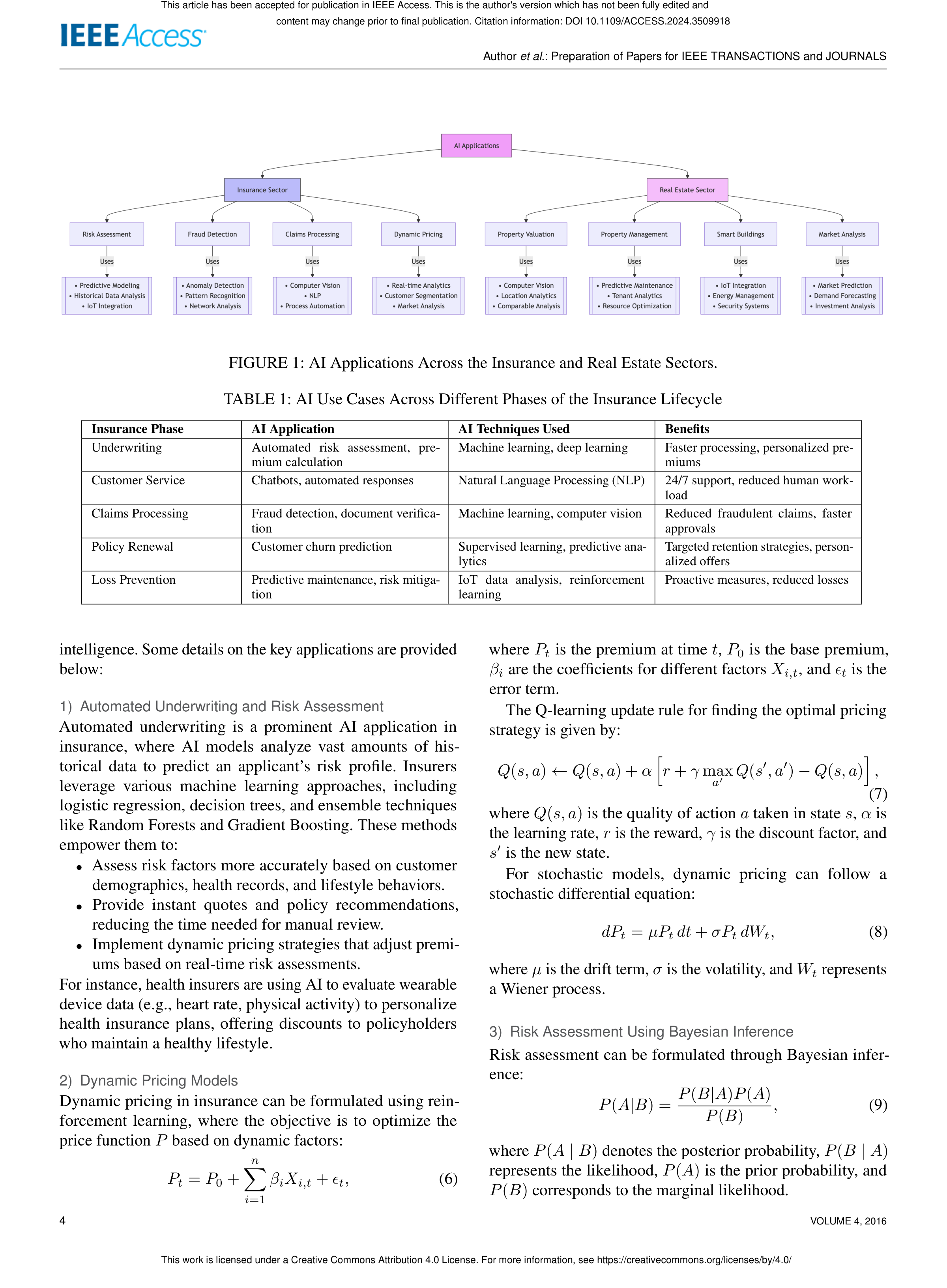
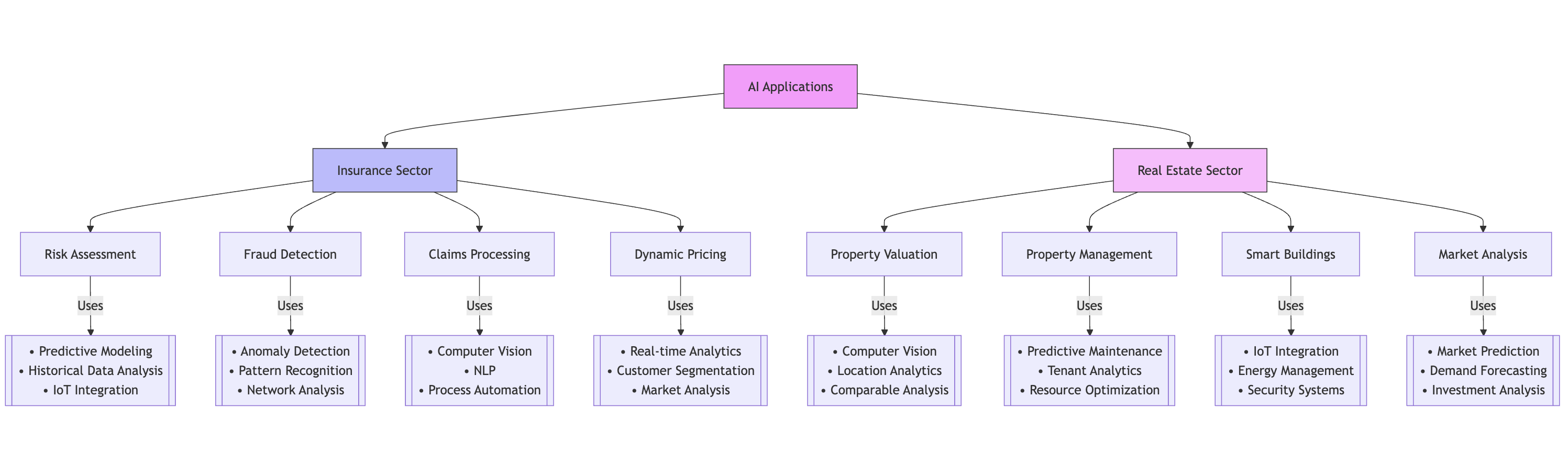
observed in these industries (see Figure 1).
Figure
1
illustrates
various
AI
applications
across
the
insurance and real estate sectors, showcasing the areas where
AI
is
making
a
significant
impact.
Table
1
further
details
specific
use
cases
in
the
insurance
industry,
categorized
by
different phases of the insurance lifecycle, demonstrating how
AI techniques contribute to various processes.
A.
AI IN INSURANCE
The
broad
uses
of
AI
technologies
within
the
insurance
business include underwriting, claims management, claims
automation, insurance fraud, and customer service artificial
VOLUME 4, 2016
3
This article has been accepted for publication in IEEE Access. This is the author's version which has not been fully edited and
content may change prior to final publication. Citation information: DOI 10.1109/ACCESS.2024.3509918
This work is licensed under a Creative Commons Attribution 4.0 License. For more information, see https://creativecommons.org/licenses/by/4.0/

Author
et al.
: Preparation of Papers for IEEE TRANSACTIONS and JOURNALS
FIGURE 1: AI Applications Across the Insurance and Real Estate Sectors.
TABLE 1: AI Use Cases Across Different Phases of the Insurance Lifecycle
Insurance Phase
AI Application
AI Techniques Used
Benefits
Underwriting
Automated
risk
assessment,
pre-
mium calculation
Machine learning, deep learning
Faster processing, personalized pre-
miums
Customer Service
Chatbots, automated responses
Natural Language Processing (NLP)
24/7 support, reduced human work-
load
Claims Processing
Fraud detection, document verifica-
tion
Machine learning, computer vision
Reduced
fraudulent
claims,
faster
approvals
Policy Renewal
Customer churn prediction
Supervised learning, predictive ana-
lytics
Targeted retention strategies, person-
alized offers
Loss Prevention
Predictive maintenance, risk mitiga-
tion
IoT
data
analysis,
reinforcement
learning
Proactive measures, reduced losses
intelligence. Some details on the key applications are provided
below:
1)
Automated Underwriting and Risk Assessment
Automated
underwriting
is
a
prominent
AI
application
in
insurance,
where
AI
models
analyze
vast
amounts
of
his-
torical
data
to
predict
an
applicant’s
risk
profile.
Insurers
leverage
various
machine
learning
approaches,
including
logistic regression, decision trees, and ensemble techniques
like Random Forests and Gradient Boosting. These methods
empower them to:
•
Assess risk factors more accurately based on customer
demographics, health records, and lifestyle behaviors.
•
Provide
instant
quotes
and
policy
recommendations,
reducing the time needed for manual review.
•
Implement dynamic pricing strategies that adjust premi-
ums based on real-time risk assessments.
For instance, health insurers are using AI to evaluate wearable
device data (e.g., heart rate, physical activity) to personalize
health
insurance
plans,
offering
discounts
to
policyholders
who maintain a healthy lifestyle.
2)
Dynamic Pricing Models
Dynamic pricing in insurance can be formulated using rein-
forcement
learning,
where
the
objective
is
to
optimize
the
price function
P
based on dynamic factors:
P
t
=
P
0
+
n
X
i
=1
β
i
X
i,t
+
ϵ
t
,
(6)
where
P
t
is the premium at time
t
,
P
0
is the base premium,
β
i
are the coefficients for different factors
X
i,t
, and
ϵ
t
is the
error term.
The Q-learning update rule for finding the optimal pricing
strategy is given by:
Q
(
s, a
)
←
Q
(
s, a
) +
α
h
r
+
γ
max
a
′
Q
(
s
′
, a
′
)
−
Q
(
s, a
)
i
,
(7)
where
Q
(
s, a
)
is the quality of action
a
taken in state
s
,
α
is
the learning rate,
r
is the reward,
γ
is the discount factor, and
s
′
is the new state.
For
stochastic
models,
dynamic
pricing
can
follow
a
stochastic differential equation:
dP
t
=
µP
t
dt
+
σP
t
dW
t
,
(8)
where
µ
is the drift term,
σ
is the volatility, and
W
t
represents
a Wiener process.
3)
Risk Assessment Using Bayesian Inference
Risk assessment can be formulated through Bayesian infer-
ence:
P
(
A
|
B
) =
P
(
B
|
A
)
P
(
A
)
P
(
B
)
,
(9)
where
P
(
A
|
B
)
denotes the posterior probability,
P
(
B
|
A
)
represents the likelihood,
P
(
A
)
is the prior probability, and
P
(
B
)
corresponds to the marginal likelihood.
4
VOLUME 4, 2016
This article has been accepted for publication in IEEE Access. This is the author's version which has not been fully edited and
content may change prior to final publication. Citation information: DOI 10.1109/ACCESS.2024.3509918
This work is licensed under a Creative Commons Attribution 4.0 License. For more information, see https://creativecommons.org/licenses/by/4.0/

Author
et al.
: Preparation of Papers for IEEE TRANSACTIONS and JOURNALS
The expected loss can be calculated as:
E
(
L
) =
n
X
i
=1
P
(
X
i
)
·
L
i
,
(10)
where
P
(
X
i
)
is the probability of occurrence of risk
X
i
, and
L
i
is the corresponding loss amount.
B.
AI IN REAL ESTATE
AI
applications
in
real
estate
have
revolutionized
property
management, investment analysis, and market trend forecast-
ing. Here are some key areas where AI is making a difference:
1)
Property Valuation Models
Property
valuation
can
benefit
significantly
from
machine
learning models. The hedonic pricing model estimates prop-
erty values as:
V
=
β
0
+
m
X
j
=1
β
j
X
j
+
ϵ,
(11)
where
V
is the estimated property value,
β
0
is the intercept
term,
β
j
are the coefficients for the features
X
j
, and
ϵ
is the
error term representing unexplained variability.
The
Spatial
Autoregressive
Model
(SAR)
for
capturing
spatial dependencies is given by:
V
=
ρWV
+
Xβ
+
ϵ,
(12)
where
W
is
the
spatial
weight
matrix,
ρ
is
the
spatial
autoregressive coefficient,
X
represents explanatory variables,
and
β
are the corresponding coefficients.
2)
Energy Optimization in Smart Buildings
Energy
consumption
in
smart
buildings
can
be
optimized
using predictive algorithms:
E
=
f
(
T, O, H
)
,
(13)
where
E
is the energy consumption,
T
is the temperature,
O
is the occupancy, and
H
represents hours of operation.
The objective for energy management can be expressed as:
min
u
(
t
)
Z
T
0
h
E
(
t
) +
λ
(
T
desired
−
T
(
t
))
2
i
dt,
(14)
where
T
desired
is the desired temperature, and
λ
is a weight
factor for the temperature deviation penalty.
3)
Predictive Analytics for Fraud Detection
The
probability
of
fraud
can
be
modeled
using
logistic
regression:
P
(
Y
= 1
|
X
) =
1
1 +
e
−
(
β
0
+
P
n
i
=1
β
i
X
i
)
,
(15)
where
β
i
are the model coefficients for features
X
i
.
Anomaly detection can also be performed using the Maha-
lanobis distance:
D
2
= (
X
−
µ
)
T
Σ
−
1
(
X
−
µ
)
,
(16)
where
X
is the feature vector,
µ
is the mean vector, and
Σ
is
the covariance matrix.
4)
Portfolio Management in Real Estate
Markowitz mean-variance optimization for portfolio manage-
ment is formulated as:
min
w
1
2
w
T
Σ
w
−
µ
T
w,
(17)
subject to:
n
X
i
=1
w
i
= 1
,
(18)
where
Σ
is the covariance matrix of returns, and
µ
is the vector
of expected returns.
Monte Carlo simulation for risk analysis can be expressed
as:
S
t
+1
=
S
t
exp
µ
−
σ
2
2
∆
t
+
σ
√
∆
tZ
t
,
(19)
where
S
t
is the asset price at time
t
,
∆
t
is the time step,
σ
is
the volatility, and
Z
t
is a standard normal random variable.
IV.
AI TECHNIQUES AND TECHNOLOGIES USED
The application of AI in insurance and real estate involves a
diverse range of techniques, each tailored to address specific
challenges and leverage available data. This section provides
a
comprehensive
overview
of
the
key
AI
techniques
and
technologies, their relevance, and practical use cases across
both sectors.
Table
2
presents
a
comparison
of
various
AI
techniques
used in insurance and real estate, highlighting their specific
applications, benefits, and challenges. This comparison helps
to understand the strengths and limitations of each technique,
guiding the selection of appropriate methods for different use
cases.
A.
MACHINE LEARNING MODELS AND ALGORITHMS
Machine learning forms the foundation of most AI applica-
tions in these industries. Various algorithms are used to derive
insights from data, automate processes, and predict outcomes.
These algorithms are selected based on the nature of the data
and the problem being solved.
1)
Supervised Learning
Supervised learning involves training models on labeled data
to make predictions. In insurance and real estate, supervised
learning algorithms are widely used for predictive modeling,
risk analysis, and automation tasks.
•
Regression Models
: Techniques such as linear regres-
sion,
decision
trees,
support
vector
regression,
and
advanced methods like Lasso and Ridge regression are
used for tasks like property price prediction, insurance
premium calculation, and risk assessment. For instance,
regression models can predict future property prices by
analyzing factors such as historical sales data, economic
trends, and property attributes:
ˆ
Y
=
β
0
+
n
X
i
=1
β
i
X
i
+
ϵ,
(20)
VOLUME 4, 2016
5
This article has been accepted for publication in IEEE Access. This is the author's version which has not been fully edited and
content may change prior to final publication. Citation information: DOI 10.1109/ACCESS.2024.3509918
This work is licensed under a Creative Commons Attribution 4.0 License. For more information, see https://creativecommons.org/licenses/by/4.0/

Author
et al.
: Preparation of Papers for IEEE TRANSACTIONS and JOURNALS
TABLE 2: Comparison of AI Techniques for Insurance and Real Estate
AI Technique
Application
Sector
Benefits
Challenges
Machine Learning
Risk assessment, dynamic
pricing
Insurance
Improved
accuracy
in
risk
predic-
tions
Requires
large
amounts
of
quality
data
Deep Learning
Property
valuation,
image
analysis
Real Estate
High
precision
in
complex
pattern
recognition
Interpretability issues (black box)
Natural Language Pro-
cessing
Document
processing,
claims automation
Insurance,
Real
Estate
Automates
tedious
document
han-
dling
Text ambiguity, domain-specific lan-
guage
Reinforcement Learn-
ing
Dynamic
pricing,
invest-
ment optimization
Insurance,
Real
Estate
Adaptive to changing environments
High computational cost
Computer Vision
Automated
inspections,
damage assessment
Insurance,
Real
Estate
Facilitates remote and accurate con-
dition analysis
Sensitive to image quality and reso-
lution
where
ˆ
Y
is the predicted outcome,
β
0
is the intercept,
β
i
are the model coefficients for the features
X
i
, and
ϵ
is
the error term.
•
Classification
Algorithms
:
Algorithms
like
logistic
regression, random forests, gradient boosting, and sup-
port vector machines (SVMs) are applied in tasks such
as
fraud
detection,
customer
segmentation,
and
credit
scoring. Logistic regression models the probability of a
binary outcome:
P
(
Y
= 1
|
X
) =
1
1 +
e
−
(
β
0
+
P
n
i
=1
β
i
X
i
)
,
(21)
where
P
(
Y
=
1
|
X
)
represents
the
probability
of
the
event occurring given the input features
X
i
.
2)
Unsupervised Learning
Unsupervised
learning
is
used
to
discover
hidden
patterns
or
groupings
within
unlabeled
data,
making
it
effective
for
clustering and anomaly detection.
•
Clustering
Techniques
(e.g.,
k-means,
DBSCAN)
:
Applied in customer segmentation to group policyholders
or
property
buyers
with
similar
characteristics.
In
real
estate, clustering can identify neighborhoods with com-
parable market trends. The k-means clustering algorithm
minimizes the objective function:
J
=
k
X
i
=1
n
X
j
=1
∥
x
(
i
)
j
−
µ
i
∥
2
,
(22)
where
x
(
i
)
j
is a data point assigned to cluster
i
, and
µ
i
is
the centroid of cluster
i
.
•
Anomaly Detection
: Employed in identifying unusual
patterns
or
outliers
in
insurance
claims
or
transaction
data,
which
could
indicate
fraud
or
exceptional
condi-
tions. Anomaly detection can be implemented using the
Mahalanobis distance:
D
2
= (
X
−
µ
)
T
Σ
−
1
(
X
−
µ
)
,
(23)
where
µ
is the mean vector,
Σ
is the covariance matrix,
and
X
is the feature vector.
3)
Reinforcement Learning (RL)
Reinforcement
learning
involves
training
an
agent
to
make
sequential decisions through trial and error to achieve specific
objectives.
It
is
particularly
useful
for
dynamic
decision-
making scenarios.
•
Dynamic
Pricing
Strategies
:
RL
models
can
adjust
insurance
premiums
based
on
real-time
changes
in
customer risk profiles or market conditions. The optimal
policy
π
∗
can be found using the Bellman equation:
V
π
(
s
) = max
a
"
R
(
s, a
) +
γ
X
s
′
P
(
s
′
|
s, a
)
V
π
(
s
′
)
#
,
(24)
where
V
π
(
s
)
is
the
value
function
for
state
s
,
R
(
s, a
)
is the reward for action
a
,
γ
is the discount factor, and
P
(
s
′
|
s, a
)
is the transition probability.
•
Investment Portfolio Optimization
: In real estate, RL
is employed to optimize investment portfolios by contin-
uously learning and adjusting asset allocations based on
historical performance. The Q-learning update rule for
an investment strategy is:
Q
(
s, a
)
←
Q
(
s, a
)+
α
h
r
+
γ
max
a
′
Q
(
s
′
, a
′
)
−
Q
(
s, a
)
i
,
(25)
where
α
is the learning rate,
r
is the reward, and
s
′
is the
next state.
B.
DEEP LEARNING AND COMPUTER VISION
Deep
learning,
a
specialized
branch
of
machine
learning,
employs neural networks to identify intricate patterns within
extensive datasets. This approach is particularly successful for
tasks with high-dimensional inputs, such as image processing
and the analysis of sequential data.
1)
Deep Learning for Risk Assessment and Claims
Processing
Deep neural networks (DNNs) are widely adopted for mod-
eling complex relationships and improving accuracy in risk
assessment and claims adjudication.
•
Convolutional
Neural
Networks
(CNNs)
:
CNNs
are
used in computer vision tasks, such as analyzing images
from property inspections or vehicle damage assessments
for
insurance
claims.
The
convolution
operation
is
de-
fined as:
(
f
∗
g
)(
t
) =
Z
∞
−∞
f
(
τ
)
g
(
t
−
τ
)
dτ,
(26)
6
VOLUME 4, 2016
This article has been accepted for publication in IEEE Access. This is the author's version which has not been fully edited and
content may change prior to final publication. Citation information: DOI 10.1109/ACCESS.2024.3509918
This work is licensed under a Creative Commons Attribution 4.0 License. For more information, see https://creativecommons.org/licenses/by/4.0/

Author
et al.
: Preparation of Papers for IEEE TRANSACTIONS and JOURNALS
where
f
is the input image and
g
is the filter kernel.
•
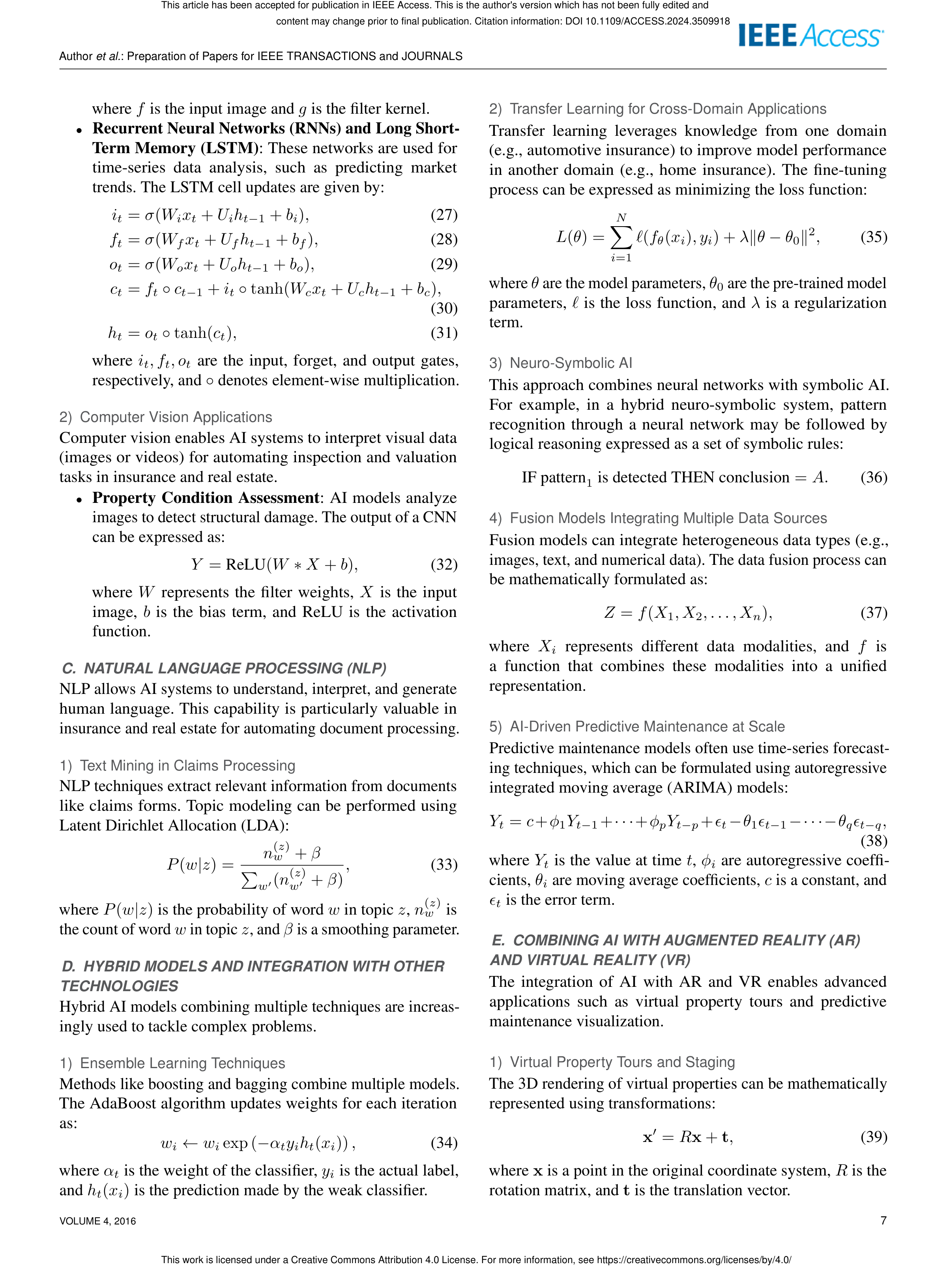
Recurrent Neural Networks (RNNs) and Long Short-
Term Memory (LSTM)
: These networks are used for
time-series
data
analysis,
such
as
predicting
market
trends. The LSTM cell updates are given by:
i
t
=
σ
(
W
i
x
t
+
U
i
h
t
−
1
+
b
i
)
,
(27)
f
t
=
σ
(
W
f
x
t
+
U
f
h
t
−
1
+
b
f
)
,
(28)
o
t
=
σ
(
W
o
x
t
+
U
o
h
t
−
1
+
b
o
)
,
(29)
c
t
=
f
t
◦
c
t
−
1
+
i
t
◦
tanh(
W
c
x
t
+
U
c
h
t
−
1
+
b
c
)
,
(30)
h
t
=
o
t
◦
tanh(
c
t
)
,
(31)
where
i
t
, f
t
, o
t
are
the
input,
forget,
and
output
gates,
respectively, and
◦
denotes element-wise multiplication.
2)
Computer Vision Applications
Computer vision enables AI systems to interpret visual data
(images or videos) for automating inspection and valuation
tasks in insurance and real estate.
•
Property
Condition
Assessment
:
AI
models
analyze
images to detect structural damage. The output of a CNN
can be expressed as:
Y
=
ReLU
(
W
∗
X
+
b
)
,
(32)
where
W
represents
the
filter
weights,
X
is
the
input
image,
b
is
the
bias
term,
and
ReLU
is
the
activation
function.
C.
NATURAL LANGUAGE PROCESSING (NLP)
NLP allows AI systems to understand, interpret, and generate
human language. This capability is particularly valuable in
insurance and real estate for automating document processing.
1)
Text Mining in Claims Processing
NLP techniques extract relevant information from documents
like
claims
forms.
Topic
modeling
can
be
performed
using
Latent Dirichlet Allocation (LDA):
P
(
w
|
z
) =
n
(
z
)
w
+
β
P
w
′
(
n
(
z
)
w
′
+
β
)
,
(33)
where
P
(
w
|
z
)
is the probability of word
w
in topic
z
,
n
(
z
)
w
is
the count of word
w
in topic
z
, and
β
is a smoothing parameter.
D.
HYBRID MODELS AND INTEGRATION WITH OTHER
TECHNOLOGIES
Hybrid AI models combining multiple techniques are increas-
ingly used to tackle complex problems.
1)
Ensemble Learning Techniques
Methods like boosting and bagging combine multiple models.
The AdaBoost algorithm updates weights for each iteration
as:
w
i
←
w
i
exp (
−
α
t
y
i
h
t
(
x
i
))
,
(34)
where
α
t
is the weight of the classifier,
y
i
is the actual label,
and
h
t
(
x
i
)
is the prediction made by the weak classifier.
2)
Transfer Learning for Cross-Domain Applications
Transfer
learning
leverages
knowledge
from
one
domain
(e.g., automotive insurance) to improve model performance
in
another
domain
(e.g.,
home
insurance).
The
fine-tuning
process can be expressed as minimizing the loss function:
L
(
θ
) =
N
X
i
=1
ℓ
(
f
θ
(
x
i
)
, y
i
) +
λ
∥
θ
−
θ
0
∥
2
,
(35)
where
θ
are the model parameters,
θ
0
are the pre-trained model
parameters,
ℓ
is
the
loss
function,
and
λ
is
a
regularization
term.
3)
Neuro-Symbolic AI
This approach combines neural networks with symbolic AI.
For
example,
in
a
hybrid
neuro-symbolic
system,
pattern
recognition
through
a
neural
network
may
be
followed
by
logical reasoning expressed as a set of symbolic rules:
IF pattern
1
is detected THEN conclusion
=
A.
(36)
4)
Fusion Models Integrating Multiple Data Sources
Fusion models can integrate heterogeneous data types (e.g.,
images, text, and numerical data). The data fusion process can
be mathematically formulated as:
Z
=
f
(
X
1
, X
2
, . . . , X
n
)
,
(37)
where
X
i
represents
different
data
modalities,
and
f
is
a
function
that
combines
these
modalities
into
a
unified
representation.
5)
AI-Driven Predictive Maintenance at Scale
Predictive maintenance models often use time-series forecast-
ing techniques, which can be formulated using autoregressive
integrated moving average (ARIMA) models:
Y
t
=
c
+
ϕ
1
Y
t
−
1
+
· · ·
+
ϕ
p
Y
t
−
p
+
ϵ
t
−
θ
1
ϵ
t
−
1
−· · ·−
θ
q
ϵ
t
−
q
,
(38)
where
Y
t
is the value at time
t
,
ϕ
i
are autoregressive coeffi-
cients,
θ
i
are moving average coefficients,
c
is a constant, and
ϵ
t
is the error term.
E.
COMBINING AI WITH AUGMENTED REALITY (AR)
AND VIRTUAL REALITY (VR)
The
integration
of
AI
with
AR
and
VR
enables
advanced
applications
such
as
virtual
property
tours
and
predictive
maintenance visualization.
1)
Virtual Property Tours and Staging
The 3D rendering of virtual properties can be mathematically
represented using transformations:
x
′
=
R
x
+
t
,
(39)
where
x
is a point in the original coordinate system,
R
is the
rotation matrix, and
t
is the translation vector.
VOLUME 4, 2016
7
This article has been accepted for publication in IEEE Access. This is the author's version which has not been fully edited and
content may change prior to final publication. Citation information: DOI 10.1109/ACCESS.2024.3509918
This work is licensed under a Creative Commons Attribution 4.0 License. For more information, see https://creativecommons.org/licenses/by/4.0/

Author
et al.
: Preparation of Papers for IEEE TRANSACTIONS and JOURNALS
F.
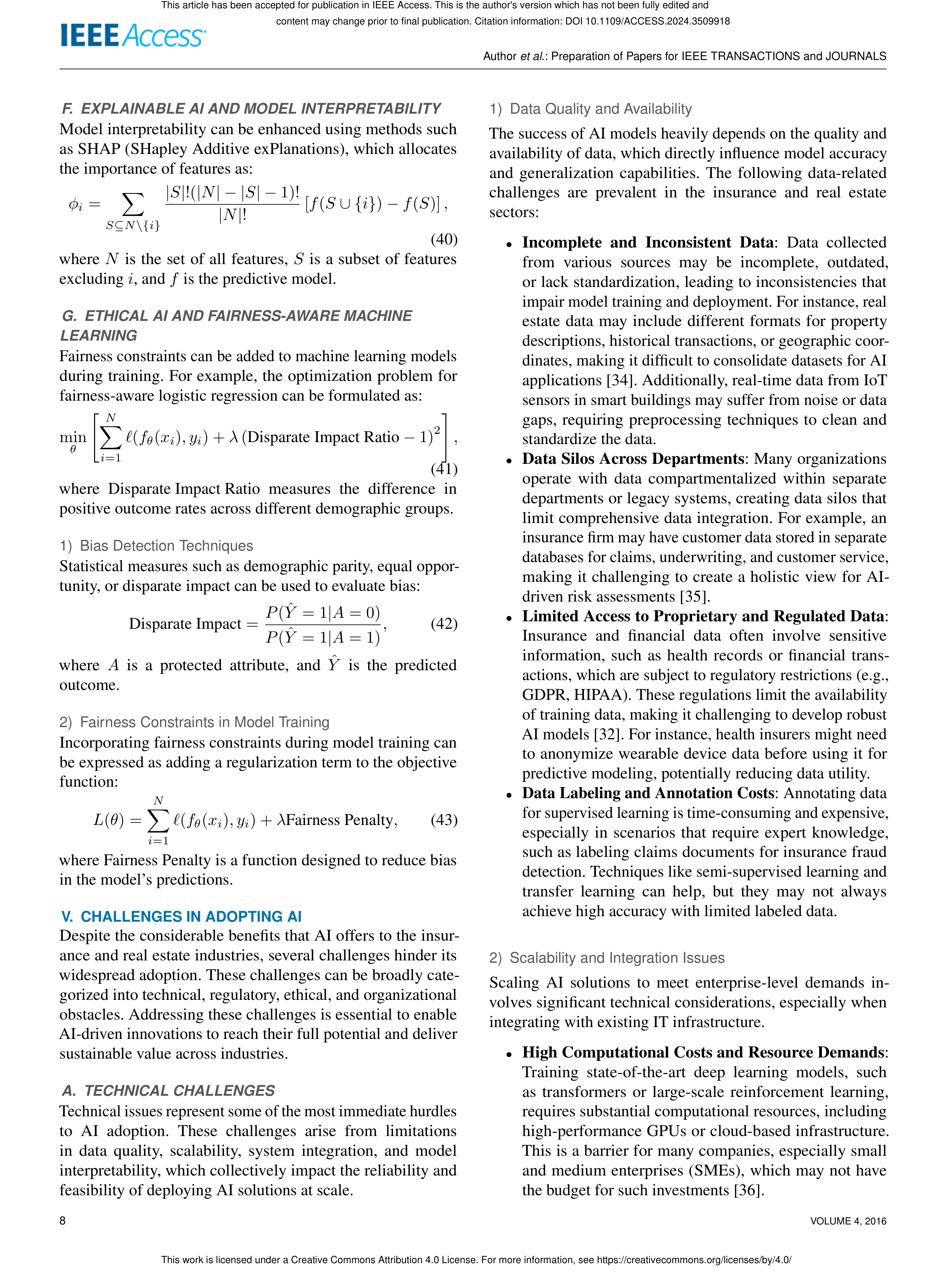
EXPLAINABLE AI AND MODEL INTERPRETABILITY
Model interpretability can be enhanced using methods such
as SHAP (SHapley Additive exPlanations), which allocates
the importance of features as:
ϕ
i
=
X
S
⊆
N
\{
i
}
|
S
|
!(
|
N
| −|
S
| −
1)!
|
N
|
!
[
f
(
S
∪{
i
}
)
−
f
(
S
)]
,
(40)
where
N
is
the
set
of
all
features,
S
is
a
subset
of
features
excluding
i
, and
f
is the predictive model.
G.
ETHICAL AI AND FAIRNESS-AWARE MACHINE
LEARNING
Fairness constraints can be added to machine learning models
during training. For example, the optimization problem for
fairness-aware logistic regression can be formulated as:
min
θ
"
N
X
i
=1
ℓ
(
f
θ
(
x
i
)
, y
i
) +
λ
(
Disparate Impact Ratio
−
1)
2
#
,
(41)
where
Disparate Impact Ratio
measures
the
difference
in
positive outcome rates across different demographic groups.
1)
Bias Detection Techniques
Statistical measures such as demographic parity, equal oppor-
tunity, or disparate impact can be used to evaluate bias:
Disparate Impact
=
P
( ˆ
Y
= 1
|
A
= 0)
P
(
ˆ
Y
= 1
|
A
= 1)
,
(42)
where
A
is
a
protected
attribute,
and
ˆ
Y
is
the
predicted
outcome.
2)
Fairness Constraints in Model Training
Incorporating fairness constraints during model training can
be expressed as adding a regularization term to the objective
function:
L
(
θ
) =
N
X
i
=1
ℓ
(
f
θ
(
x
i
)
, y
i
) +
λ
Fairness Penalty
,
(43)
where
Fairness Penalty
is a function designed to reduce bias
in the model’s predictions.
V.
CHALLENGES IN ADOPTING AI
Despite the considerable benefits that AI offers to the insur-
ance and real estate industries, several challenges hinder its
widespread adoption. These challenges can be broadly cate-
gorized into technical, regulatory, ethical, and organizational
obstacles. Addressing these challenges is essential to enable
AI-driven innovations to reach their full potential and deliver
sustainable value across industries.
A.
TECHNICAL CHALLENGES
Technical issues represent some of the most immediate hurdles
to
AI
adoption.
These
challenges
arise
from
limitations
in
data
quality,
scalability,
system
integration,
and
model
interpretability, which collectively impact the reliability and
feasibility of deploying AI solutions at scale.
1)
Data Quality and Availability
The success of AI models heavily depends on the quality and
availability of data, which directly influence model accuracy
and
generalization
capabilities.
The
following
data-related
challenges
are
prevalent
in
the
insurance
and
real
estate
sectors:
•
Incomplete
and
Inconsistent
Data
:
Data
collected
from
various
sources
may
be
incomplete,
outdated,
or lack standardization, leading to inconsistencies that
impair model training and deployment. For instance, real
estate
data
may
include
different
formats
for
property
descriptions, historical transactions, or geographic coor-
dinates, making it difficult to consolidate datasets for AI
applications [34]. Additionally, real-time data from IoT
sensors in smart buildings may suffer from noise or data
gaps,
requiring
preprocessing
techniques
to
clean
and
standardize the data.
•
Data Silos Across Departments
: Many organizations
operate
with
data
compartmentalized
within
separate
departments or legacy systems, creating data silos that
limit comprehensive data integration. For example, an
insurance firm may have customer data stored in separate
databases for claims, underwriting, and customer service,
making
it
challenging
to
create
a
holistic
view
for
AI-
driven risk assessments [35].
•
Limited Access to Proprietary and Regulated Data
:
Insurance
and
financial
data
often
involve
sensitive
information,
such
as
health
records
or
financial
trans-
actions, which are subject to regulatory restrictions (e.g.,
GDPR, HIPAA). These regulations limit the availability
of training data, making it challenging to develop robust
AI models [32]. For instance, health insurers might need
to
anonymize
wearable
device
data
before
using
it
for
predictive modeling, potentially reducing data utility.
•
Data Labeling and Annotation Costs
: Annotating data
for supervised learning is time-consuming and expensive,
especially
in
scenarios
that
require
expert
knowledge,
such as labeling claims documents for insurance fraud
detection. Techniques like semi-supervised learning and
transfer
learning
can
help,
but
they
may
not
always
achieve high accuracy with limited labeled data.
2)
Scalability and Integration Issues
Scaling
AI
solutions
to
meet
enterprise-level
demands
in-
volves significant technical considerations, especially when
integrating with existing IT infrastructure.
•
High Computational Costs and Resource Demands
:
Training
state-of-the-art
deep
learning
models,
such
as
transformers
or
large-scale
reinforcement
learning,
requires substantial computational resources, including
high-performance GPUs or cloud-based infrastructure.
This is a barrier for many companies, especially small
and
medium
enterprises
(SMEs),
which
may
not
have
the budget for such investments [36].
8
VOLUME 4, 2016
This article has been accepted for publication in IEEE Access. This is the author's version which has not been fully edited and
content may change prior to final publication. Citation information: DOI 10.1109/ACCESS.2024.3509918
This work is licensed under a Creative Commons Attribution 4.0 License. For more information, see https://creativecommons.org/licenses/by/4.0/

Author
et al.
: Preparation of Papers for IEEE TRANSACTIONS and JOURNALS
•
Legacy System Compatibility
: Many insurance and real
estate firms rely on legacy systems that were not designed
for modern AI workloads. Integrating AI solutions often
requires extensive modifications to existing systems or
developing middleware to bridge incompatibilities. For
example, an insurer using legacy COBOL-based systems
may
struggle
to
integrate
AI-driven
fraud
detection
models
without
significant
re-engineering
of
backend
processes [37].
•
Model Deployment and Maintenance at Scale
: Once
AI
models
are
deployed,
ongoing
maintenance
is
nec-
essary
to ensure
that models
continue to
perform well
as
data
distributions
change
over
time.
Continuous
monitoring and updating introduce additional operational
complexities, such as the need for automated retraining
pipelines.
3)
Model Interpretability and Explainability
The
complexity
of
AI
models,
especially
deep
learning
algorithms, makes it difficult to understand how these models
arrive
at
their
predictions.
This
is
problematic
in
regulated
industries like insurance and real estate, where transparency
and accountability are critical.
•
Black Box Nature of Advanced AI Models
: Many state-
of-the-art
models,
such
as
deep
neural
networks
and
ensemble methods, are considered "black boxes" because
their decision-making processes are not transparent. This
lack of interpretability is a significant barrier, especially
in risk-sensitive applications [38].
•
Trust and Reliability Concerns Among Stakeholders
:
When
AI-generated
insights
are
used
for
high-stakes
decision-making, stakeholders may be reluctant to adopt
the technology if they cannot understand or validate the
reasoning behind predictions. Explainable AI (XAI) tech-
niques like SHAP (SHapley Additive exPlanations) or
LIME (Local Interpretable Model-agnostic Explanations)
can help provide feature importance scores.
•
Balancing
Model
Complexity
and
Interpretability
:
There
is
often
a
trade-off
between
model
accuracy
and
interpretability.
More
interpretable
models,
such
as decision trees, may not achieve the same predictive
performance as complex deep learning models.
B.
REGULATORY AND ETHICAL CHALLENGES
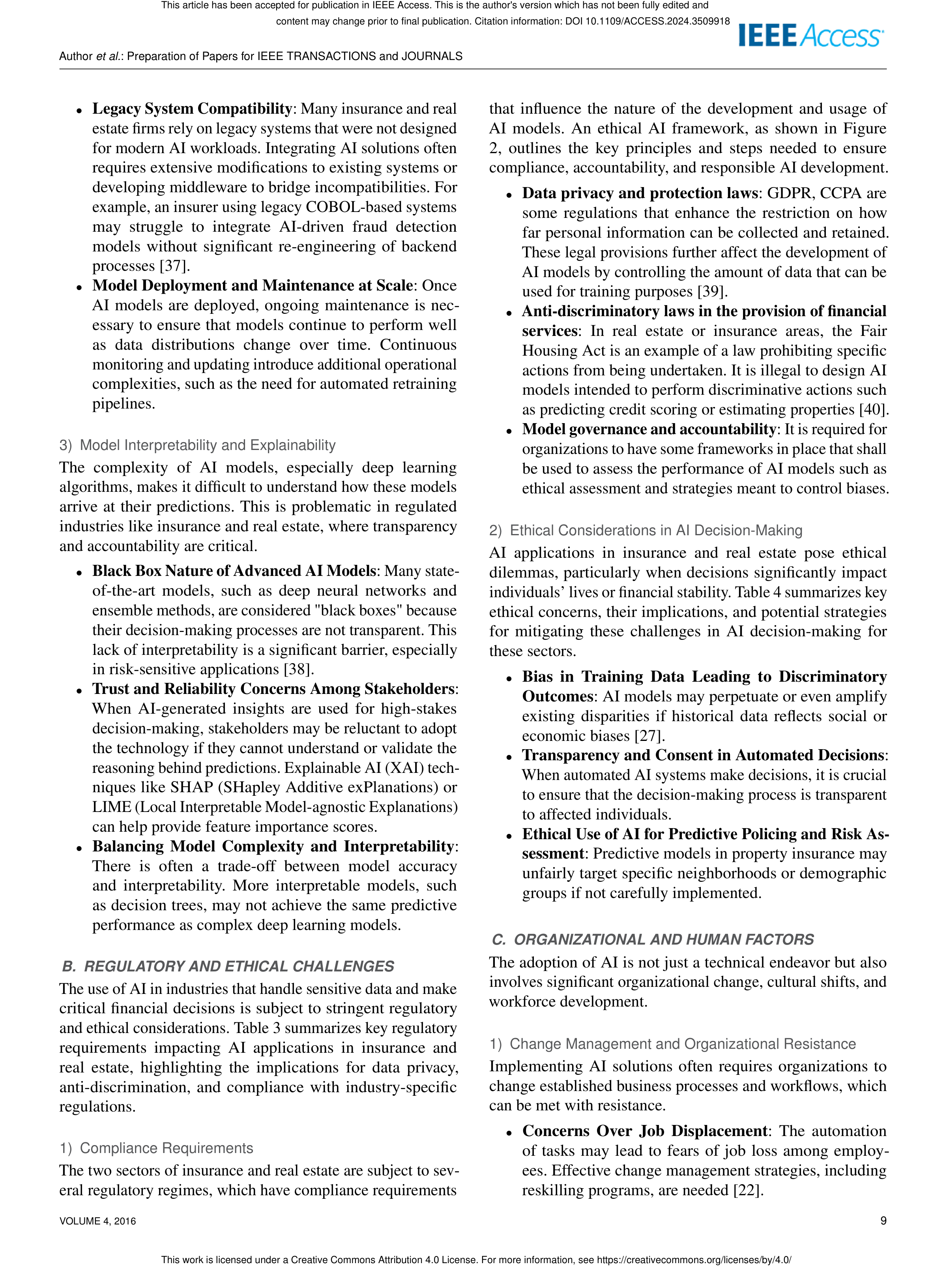
The use of AI in industries that handle sensitive data and make
critical financial decisions is subject to stringent regulatory
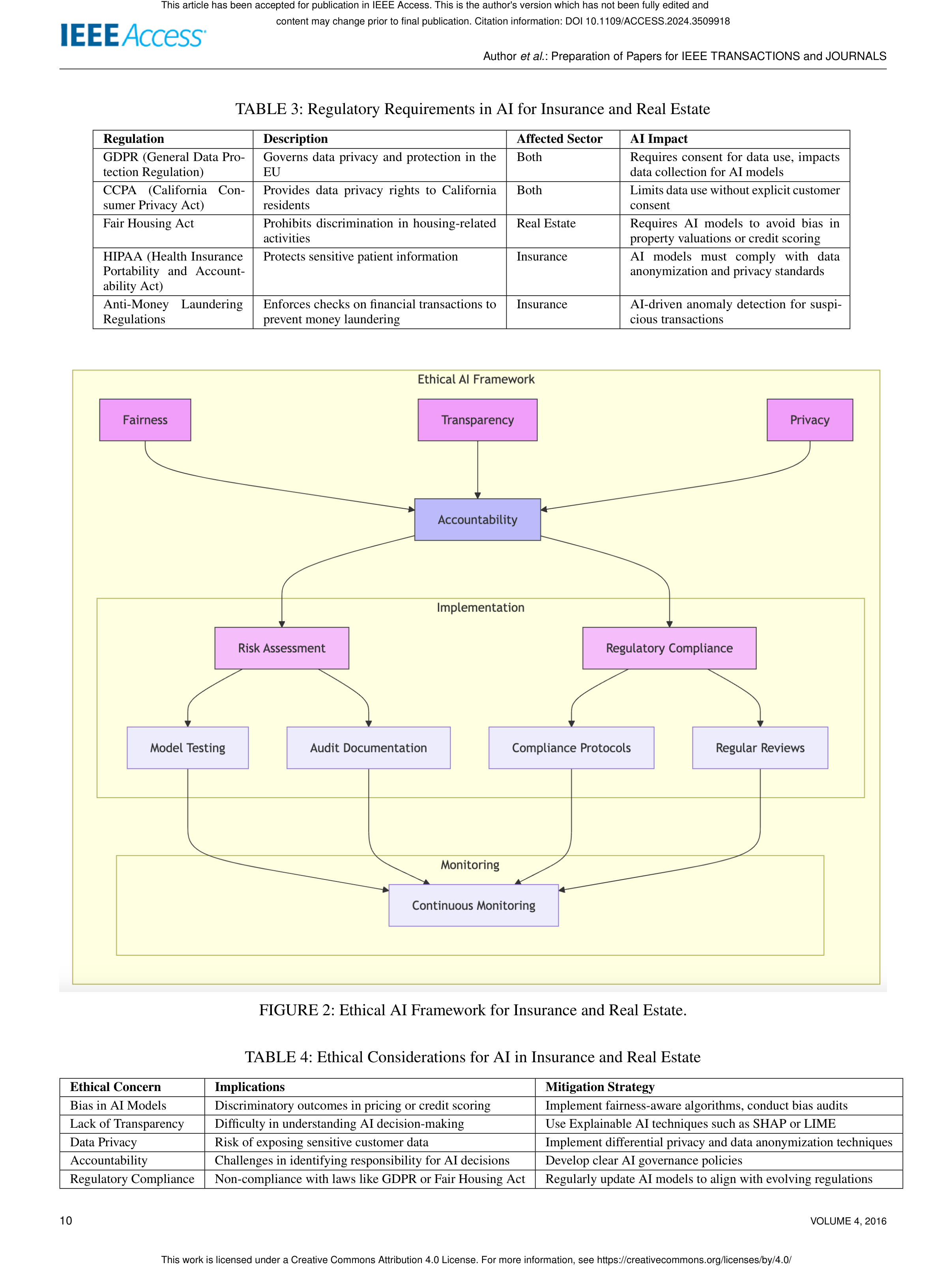
and ethical considerations. Table 3 summarizes key regulatory
requirements
impacting
AI
applications
in
insurance
and
real
estate,
highlighting
the
implications
for
data
privacy,
anti-discrimination,
and
compliance
with
industry-specific
regulations.
1)
Compliance Requirements
The two sectors of insurance and real estate are subject to sev-
eral regulatory regimes, which have compliance requirements
that
influence
the
nature
of
the
development
and
usage
of
AI
models.
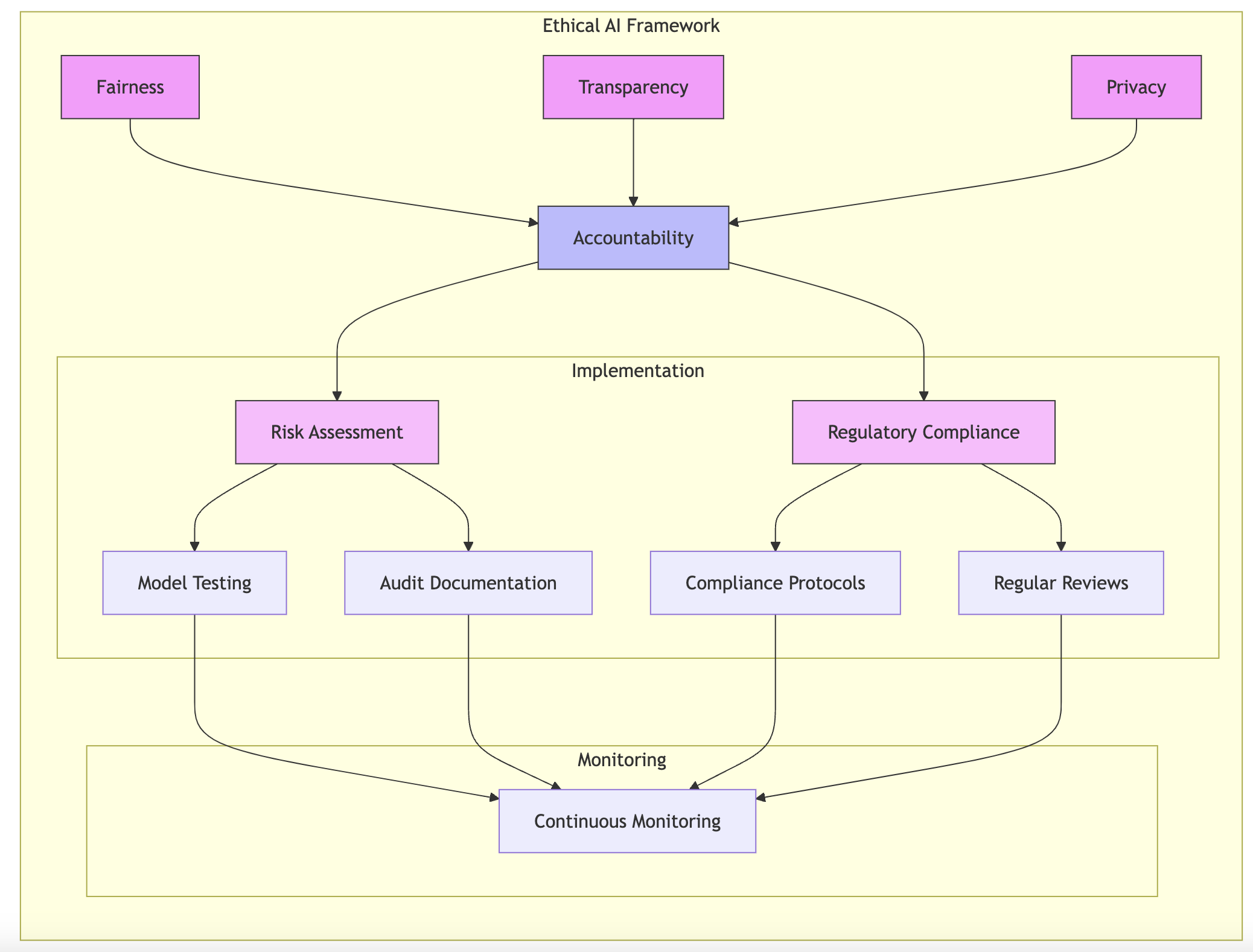
An
ethical
AI
framework,
as
shown
in
Figure
2,
outlines
the
key
principles
and
steps
needed
to
ensure
compliance, accountability, and responsible AI development.
•
Data privacy and protection laws
: GDPR, CCPA are
some
regulations
that
enhance
the
restriction
on
how
far personal information can be collected and retained.
These legal provisions further affect the development of
AI models by controlling the amount of data that can be
used for training purposes [39].
•
Anti-discriminatory laws in the provision of financial
services
:
In
real
estate
or
insurance
areas,
the
Fair
Housing Act is an example of a law prohibiting specific
actions from being undertaken. It is illegal to design AI
models intended to perform discriminative actions such
as predicting credit scoring or estimating properties [40].
•
Model governance and accountability
: It is required for
organizations to have some frameworks in place that shall
be used to assess the performance of AI models such as
ethical assessment and strategies meant to control biases.
2)
Ethical Considerations in AI Decision-Making
AI
applications
in
insurance
and
real
estate
pose
ethical
dilemmas, particularly
when
decisions significantly
impact
individuals’ lives or financial stability. Table 4 summarizes key
ethical concerns, their implications, and potential strategies
for
mitigating
these
challenges
in
AI
decision-making
for
these sectors.
•
Bias
in
Training
Data
Leading
to
Discriminatory
Outcomes
: AI models may perpetuate or even amplify
existing
disparities
if
historical
data
reflects
social
or
economic biases [27].
•
Transparency and Consent in Automated Decisions
:
When automated AI systems make decisions, it is crucial
to ensure that the decision-making process is transparent
to affected individuals.
•
Ethical Use of AI for Predictive Policing and Risk As-
sessment
: Predictive models in property insurance may
unfairly target specific neighborhoods or demographic
groups if not carefully implemented.
C.
ORGANIZATIONAL AND HUMAN FACTORS
The adoption of AI is not just a technical endeavor but also
involves significant organizational change, cultural shifts, and
workforce development.
1)
Change Management and Organizational Resistance
Implementing
AI
solutions
often
requires
organizations
to
change established business processes and workflows, which
can be met with resistance.
•
Concerns
Over
Job
Displacement
:
The
automation
of
tasks
may
lead
to
fears
of
job
loss
among
employ-
ees. Effective change management strategies, including
reskilling programs, are needed [22].
VOLUME 4, 2016
9
This article has been accepted for publication in IEEE Access. This is the author's version which has not been fully edited and
content may change prior to final publication. Citation information: DOI 10.1109/ACCESS.2024.3509918
This work is licensed under a Creative Commons Attribution 4.0 License. For more information, see https://creativecommons.org/licenses/by/4.0/

Author
et al.
: Preparation of Papers for IEEE TRANSACTIONS and JOURNALS
TABLE 3: Regulatory Requirements in AI for Insurance and Real Estate
Regulation
Description
Affected Sector
AI Impact
GDPR (General Data Pro-
tection Regulation)
Governs
data
privacy
and
protection
in
the
EU
Both
Requires
consent
for
data
use,
impacts
data collection for AI models
CCPA
(California
Con-
sumer Privacy Act)
Provides
data
privacy
rights
to
California
residents
Both
Limits data use without explicit customer
consent
Fair Housing Act
Prohibits
discrimination
in
housing-related
activities
Real Estate
Requires
AI
models
to
avoid
bias
in
property valuations or credit scoring
HIPAA
(Health
Insurance
Portability
and
Account-
ability Act)
Protects sensitive patient information
Insurance
AI
models
must
comply
with
data
anonymization and privacy standards
Anti-Money
Laundering
Regulations
Enforces checks on financial transactions to
prevent money laundering
Insurance
AI-driven
anomaly
detection
for
suspi-
cious transactions
FIGURE 2: Ethical AI Framework for Insurance and Real Estate.
TABLE 4: Ethical Considerations for AI in Insurance and Real Estate
Ethical Concern
Implications
Mitigation Strategy
Bias in AI Models
Discriminatory outcomes in pricing or credit scoring
Implement fairness-aware algorithms, conduct bias audits
Lack of Transparency
Difficulty in understanding AI decision-making
Use Explainable AI techniques such as SHAP or LIME
Data Privacy
Risk of exposing sensitive customer data
Implement differential privacy and data anonymization techniques
Accountability
Challenges in identifying responsibility for AI decisions
Develop clear AI governance policies
Regulatory Compliance
Non-compliance with laws like GDPR or Fair Housing Act
Regularly update AI models to align with evolving regulations
10
VOLUME 4, 2016
This article has been accepted for publication in IEEE Access. This is the author's version which has not been fully edited and
content may change prior to final publication. Citation information: DOI 10.1109/ACCESS.2024.3509918
This work is licensed under a Creative Commons Attribution 4.0 License. For more information, see https://creativecommons.org/licenses/by/4.0/

Author
et al.
: Preparation of Papers for IEEE TRANSACTIONS and JOURNALS
•
Organizational Inertia and Risk Aversion
: Companies
may
be
slow
to
adopt
AI
due
to
a
preference
for
established processes or a lack of understanding of AI’s
benefits.
2)
Skills Gaps and Workforce Development
Deploying
AI
is
not
easy,
and
a
workforce
embedded
with
requisite
skills
such
as
data
scientists,
machine
learning
specialists, and AI integrators is quite essential.
•
Shortage of Qualified AI Talent
: Many organizations
face
challenges
in
acquiring
potential
employees
with
adequate AI skills which acts as a barrier in the way of
AI assimilation [41].
•
Continuous Learning and Adaptation
: AI technologies
do
not
remain
stagnant;
in
fact,
they
are
fluid,
which
means
organizations
have
to
constantly
train
their
em-
ployees
so
that
they
know
how
to
leverage
the
newest
technologies and techniques [34].
3)
Cultural and Ethical Training for AI Adoption
Apart
from
technical
skills,
employees
must
be
taught
the
ethical
aspects
of
AI
and
how
it
can
be
used
responsibly
within the organization.
•
AI Ethics Awareness
: Specific training programs should
be
developed
to
ensure
that
such
employees
are
made
aware of the ethical issues that AI may promote in the
first place.
•
Creating
a
Responsible
AI
Culture
:
Organizations
must put in place measures to promote responsible AI,
which include but are not limited to definitive guidelines
on building ethical AI.
D.
ECONOMIC AND MARKET FACTORS
The social and economic aspects of AI adoption can also bring
some difficulties, especially for low-resource companies or
those operating in markets with low technological adoption.
1)
Artificial Intelligence Implementation Cost
Costs
related
to
implementation
of
AI
systems
like
that
of
purchasing the required infrastructure, software licensing and
staffing can all be very high.
•
High Initial Investment
: The entire process of creating
and/or deploying AI models needs investment especially
in terms of data and computing infrastructure [36].
•
Continued
Operational
Costs
:
Maintenance
of
AI
systems
comes
with
ongoing
expenses
like
software
renewals and cloud resources.
2)
Market Readiness and Adoption Barriers
The readiness of the market to accept AI-based innovations
also alters the trends in the degree to which AI is adopted.
•
Willingness
of
Customers
to
Accept
AI-Based
Ser-
vices
: There will be customers who will not accept AI-
driven solutions because of lack of trust in the intended
efficiency and efficacy of AI approaches.
•
Differences
in
the
Regulatory
Surroundings
:
The
legal
and
regulatory
framework
is
often
characterized
by
significant
differences
between
jurisdictions
which
makes the implementation of AI tools in other markets
fairly complex [39].
E.
SECURITY AND PRIVACY CONCERNS
The nature of AI related tasks in insurance and real estate, for
instance involves sensitive information and, as a result, the
risk of leakage relates to security as well as privacy.
1)
Vulnerabilities to Cybersecurity Threats
With
the
increasing
integration
of
AI
models
and
large
amounts of data, AI will likely be a primary target of cyber-
attacks.
•
Machine
learning
models
attacked
by
AI
models
:
Users can submit manipulated input data, which will lead
AI
models
to
predict
wrong
outputs
during
the
model
testing [42].
•
Measures
of
Data
Security
:
Effective
data
security
measures
are
required
to
protect
the
data
used
during
the AI training and inference processes to ensure that no
unauthorized access takes place.
2)
Data Privacy Concerns
AI
systems
are
required
to
comply
with
tight
data
privacy
laws whilst generating insights from large datasets, which will
always be a challenge.
•
Dilemma on Data Utility and Data Privacy
: Achiev-
ing
a
balance
between
data
utility
and
privacy
entails
techniques like differential privacy whereby anonymized
documents are released [43].
•
Legal
Requirements
for
Data
Sharing
:
There
are
several
data
sharing
legal
requirements
in
different
jurisdictions
however
the
region
limit
is
more
when
it
involves sharing personal or monetary data [44].
Tackling these hurdles is fundamental for the organizations
which are looking to deploy AI solutions in a secured, large
scale and regulatory oriented approach. With the help of an un-
derstanding of these barriers, the companies will be effectively
able
to
work
around
various
complexities
associated
with
adoption of AI technology enabling organizations to realize
great benefits brought in by artificial intelligence technology
in the insurance and real estate sectors.
VI.
FUTURE DIRECTIONS AND EMERGING TRENDS
The
promise
of
fundamental
change
in
the
insurance
and
real
estate
sectors
is
also
inherent
to
the
development
of
AI, which is characterized by constant innovation. Emerging
trends suggest AI not only supplementing but also extending
existing
uses
to
create
new
dimensions
in
business
context
of how organizations operate and capture value. This section
puts forward the possible trends of future development of AI,
including its advancing impact on these industries.
VOLUME 4, 2016
11
This article has been accepted for publication in IEEE Access. This is the author's version which has not been fully edited and
content may change prior to final publication. Citation information: DOI 10.1109/ACCESS.2024.3509918
This work is licensed under a Creative Commons Attribution 4.0 License. For more information, see https://creativecommons.org/licenses/by/4.0/

Author
et al.
: Preparation of Papers for IEEE TRANSACTIONS and JOURNALS
A.
AI-DRIVEN RISK ASSESSMENT AND DYNAMIC
PRICING MODELS
AI enabled systems will lead to a more advanced approach to
evaluation of risk together with the provision of pricing that
will be tailored, instantaneous and enhanced decision making.
1)
Granular Risk Profiling
Future AI models will leverage a wide range of data sources,
including
social
media,
real-time
behavioral
data,
and
IoT
devices,
to
develop
highly
granular
risk
profiles.
This
will
empower insurers to:
•
Personalize
Premiums
:
AI
can
offer
personalized
in-
surance premiums that accurately reflect individual risk
factors
such
as
driving
behavior,
health
habits,
and
lifestyle choices. By integrating real-time data streams,
insurers can dynamically adjust policy terms and pricing
based on evolving risk profiles, leading to more equitable
and customer-centric policies [45].
•
Enhance Predictive Accuracy
: Continuous data mon-
itoring,
for
example,
using
wearable
health
devices
or
telematics in vehicles, allows AI models to update risk
assessments in real time. This capability helps insurers
anticipate changes in risk levels and make proactive ad-
justments, thereby reducing claims costs and improving
loss ratios [46].
•
Proactive
Risk
Management
:
By
identifying
early
warning signs of potential risks through predictive ana-
lytics, AI can prompt preventive measures. For example,
health
insurers
could
provide
wellness
incentives
or
lifestyle recommendations based on real-time health data
to reduce the likelihood of high-cost claims.
2)
Real-Time Dynamic Pricing
Dynamic
pricing,
which
adjusts
prices
based
on
real-time
conditions, will become increasingly prevalent as AI models
continue to evolve and improve their ability to process large
data volumes quickly.
•
Insurance
: AI can dynamically adjust premiums based
on variables such as weather conditions, recent customer
activities,
or
changes
in
economic
indicators.
This
en-
ables insurers to optimize pricing in response to short-
term risk fluctuations and competitive market conditions
[47].
•
Real Estate
: AI can be used to dynamically price rental
properties,
mortgages,
or
property
insurance
based
on
market
demand,
local
economic
factors,
or
proximity
to
events
that
may
affect
property
values
(e.g.,
new
infrastructure development or changes in zoning laws)
[48].
•
Hyper-Personalized Offers
: Leveraging data analytics
and
customer
segmentation,
AI
can
facilitate
hyper-
personalized
insurance
and
real
estate
offers,
leading
to better customer retention and higher sales conversion
rates.
B.
SUSTAINABLE AND SMART BUILDING SOLUTIONS
As sustainability becomes a priority, AI’s role in promoting
energy efficiency and environmentally friendly practices in
real estate is expected to expand.
1)
Energy Optimization and Predictive Maintenance
Integrating
AI
with
IoT
in
smart
buildings
can
lead
to
sig-
nificant advancements in energy optimization and predictive
maintenance.
•
Adaptive
Energy
Management
:
AI
algorithms
can
analyze data from various building systems (e.g., HVAC,
lighting) to autonomously optimize energy consumption,
thus
lowering
costs
and
reducing
the
carbon
footprint
[49]–[51].
•
Predictive Maintenance at Scale
: AI can detect anoma-
lies
and
predict
equipment
failures
before
they
occur,
enabling proactive maintenance scheduling [52].
•
Data-Driven
Facility
Management
:
AI
can
provide
insights
into
building
usage
patterns,
helping
facility
managers make informed decisions about space utiliza-
tion, maintenance prioritization, and resource allocation.
2)
AI-Driven Sustainable Development
AI
will
be
crucial
in
designing
and
managing
sustainable
building projects.
•
Green Building Design
: AI can optimize architectural
designs by simulating various environmental conditions
and identifying the most energy-efficient layouts [5].
•
Lifecycle Analysis and Resource Efficiency
: AI can as-
sess the environmental impact of construction materials
and building methods, guiding developers in selecting
sustainable alternatives [53].
•
Smart Waste Management
: AI algorithms can optimize
waste management processes in buildings by predicting
waste generation patterns and suggesting efficient recy-
cling or disposal methods.
C.
ADVANCED NLP AND COMPUTER VISION
TECHNIQUES
With the development of these two fields, NLP and computer
vision, which are based on technological advancements, their
uses
for
the
insurance
and
real
estate
fields
will
increase
even further, and they will be able to automate and analyze
processes and tasks better.
1)
NLP for Legal Document Analysis
It
will
also
allow
for
the
interpretation
of
the
vast
array
of
operational and legal terminology used in such contexts, such
as contracts, leases, and other regulatory documents.
•
Automated Legal Compliance Checks
: In this case, AI
will look at legal documents and parse them to ensure
that
there
are
no
legal
compliance
issues
with
various
procured documents and locate any legal risks [54].
•
Smart Contract Lifecycle Management
: In such cases,
tools that utilize NLP have the potential to oversee the
12
VOLUME 4, 2016
This article has been accepted for publication in IEEE Access. This is the author's version which has not been fully edited and
content may change prior to final publication. Citation information: DOI 10.1109/ACCESS.2024.3509918
This work is licensed under a Creative Commons Attribution 4.0 License. For more information, see https://creativecommons.org/licenses/by/4.0/

Author
et al.
: Preparation of Papers for IEEE TRANSACTIONS and JOURNALS
lifecycle
of
legal
contracts
such
as
sending
automatic
alerts when contract renewals are reaching the end and
monitoring
compliance
of
the
contracts
and
risks
on
expiring terms [55].
2)
Computer Vision for Automated Inspections
Computer vision advancements will enhance the accuracy and
efficiency of automated inspections and damage assessments.
•
Real-Time
Property
Condition
Monitoring
:
With
advanced
AI
integrated
into
certain
drones,
directs
impressively thorough survey of the building’s internal
and external scope as well as routinely checking for Lead,
suspended securities or structural weaknesses [56].
•
Enhanced Damage Assessment for Insurance Claims
:
AI models can evaluate the extent of damage by analyz-
ing satellite imagery, drone footage, or other visual data
[57].
•
Automated Property Appraisal
: Computer vision mod-
els
can
analyze
features
such
as
the
property’s
layout,
condition,
and
finishes
to
generate
accurate
property
appraisals.
D.
AI INTEGRATION WITH AUGMENTED REALITY (AR)
AND VIRTUAL REALITY (VR) TECHNOLOGIES
AR or VR combined with AI will provide new opportunities
for customer interaction, property management, and training.
1)
Immersive Property Viewing
AI-integrated
AR/VR
tools
will
allow
buyers
or
leasees
to
visit the sites comprehensively during the real estate selection
stage.
•
Virtual Staging
: AI can help decorate empty real estate
with
realistic-looking
virtual
furniture,
making
it
a
lot
easier for potential buyers to envision the rooms full of
furniture [58].
•
Customized Property Tours
: AI systems are also able
to create virtual tours that are customized according to
the likes of the individuals, thus making the prospects of
purchasing a particular building more appealing [59].
2)
Training and Simulation
AI, together with AR and VR, will assist in effectively training
employees in the insurance and real estate industries.
•
Simulated Risk Assessment
: Such models can be bene-
ficial in training insurance brokers on types of properties,
accreditations and other related protocols [60].
•
Real Estate Management Training
: VR can simulate
property
management
scenarios,
providing
hands-on
training that enhances decision-making skills [61].
•
Remote
Collaboration
for
Property
Development
:
AR
and
VR
allow
the
construction
management
team
and
other
stakeholders
to
work
together
despite
the
construction’s geographical challenge.
E.
AI FOR ENHANCING FAIRNESS AND TRANSPARENCY
As AI becomes more integral to decision-making, there is a
growing need for models that prioritize fairness, transparency,
and explainability.
1)
Fairness-Aware Algorithms
Future AI models will incorporate fairness-aware techniques
to reduce biases in training data and ensure equitable treatment
across different demographic groups.
•
Bias Detection and Mitigation
: AI tools will automati-
cally detect and address potential biases in datasets [62],
[63].
•
Explainability Tools for Fairness Audits
: Explainable
AI (XAI) developments will enable organizations to con-
duct fairness audits by providing interpretable insights
into model behavior [64].
•
Fairness-Conscious
Model
Development
:
Research
will focus on creating algorithms that explicitly consider
fairness during the model training phase.
2)
Regulatory Compliance and Ethics Monitoring
AI
tools
will
be
developed
to
help
organizations
adhere
to
evolving
regulations
and
monitor
ethical
considerations
in
real time.
•
Automated Compliance Checks
: AI can continuously
monitor
activities
for
compliance
with
relevant
legal
standards and regulations [38].
•
Ethics Auditing and Governance
: AI-driven auditing
tools can evaluate whether algorithms align with ethical
standards and corporate governance policies.
•
Data Privacy and Protection
: AI solutions must incor-
porate privacy-preserving techniques such as differential
privacy and federated learning.
F.
CROSS-DOMAIN AI AND MULTI-MODAL LEARNING
In the insurance and real estate sectors, the future development
of AI will probably involve cross-domain AI models and multi-
modal learning, where a variety of data sources and domains
are combined.
1)
Cross-Domain AI Applications
AI
models
that
generalize
across
different
domains
will
improve prediction accuracy and decision-making.
•
Transfer Learning for Enhanced Predictions
: Models
of AI can be further enhanced where the model was only
trained
on
a
particular
domain
but
uses
data
that
has
varying domains.
•
Domain Adaptation Techniques
: In this regard, domain
adaptation
and
domain
generalization
techniques
will
assist AI systems in remaining accurate across various
market circumstances.
•
Leveraging
Multi-Domain
Datasets
:
Merging
data
from many domains allows AI to make wide predictions,
particularly in risk management and property estimation.
VOLUME 4, 2016
13
This article has been accepted for publication in IEEE Access. This is the author's version which has not been fully edited and
content may change prior to final publication. Citation information: DOI 10.1109/ACCESS.2024.3509918
This work is licensed under a Creative Commons Attribution 4.0 License. For more information, see https://creativecommons.org/licenses/by/4.0/

Author
et al.
: Preparation of Papers for IEEE TRANSACTIONS and JOURNALS
2)
Multi-Modal Learning and Data Fusion
Multi-modal
learning,
where
AI
systems
leverage
multiple
data types (e.g., text, images, sensor data), will significantly
enhance AI applications.
•
Combining Text and Visual Data for Property Valua-
tion
: By integrating textual information with visual data,
AI models can provide a more accurate valuation.
•
Sensor Fusion for Smart Building Management
: Com-
bining
data
from
multiple
IoT
sensors
with
predictive
models can optimize building operations.
•
Cross-Modal Data Interpretation for Risk Prediction
:
AI models that simultaneously analyze text, audio, and
video can detect potential risks more accurately in real-
time monitoring.
G.
COLLABORATIVE AI AND HUMAN-CENTERED AI
The next phase of AI evolution will emphasize collaboration
between AI systems and human decision-makers.
1)
Augmenting Human Expertise with AI
The drivers and tools developed based on the AI technologies
will be used in order to enhance and ameliorate the talents that
human beings already possess.
•
AI-Driven
Decision
Support
Systems
:
For
instance,
in
real
estate
appraisal
or
as
an
aid
in
the
process
of
insurance
underwriting,
systems
based
on
artificial
intelligence
can
suggest
actions
but
leave
the
ultimate
practice to a specialist.
•
Interactive AI Interfaces
: More interactive experiences
will be possible with AI systems, with the ability to pose
questions to models and change their settings.
•
Collaborative
Risk
Assessment
:
In
insurance
claims
processing, AI can assist adjusters by providing real-time
risk assessments.
2)
Human-Centered AI for Enhanced User Experience
The proposals put forward, human-centered AI perspectives
have a user experience focus which helps to ease the use of
AI systems.
•
Explainable and Transparent AI Tools
: For users to
understand AI-assisted suggestions, a human-centered
AI can make it easier by offering sound reasoning behind
the AI’s recommendation.
•
Ethical Design Considerations
: AI-driven solutions will
be designed with social constraints to prioritize the user’s
interests.
•
Empathy-Driven Customer Service Automation
: The
AI system will be able to feel the users’ emotions and,
therefore, tailor its performance to be more empathetic
to the virtual assistants.
H.
EDGE AI AND REAL-TIME ANALYTICS
The
new
trend
in
edge
AI
of
deploying
models
to
devices
within their surroundings makes real-time decision-making
and data processing possible.
1)
On-Device Processing for Real-Time Decision-Making
Edge
AI
can
process
data
locally,
reducing
latency
and
enabling faster decision-making.
•
Real-Time Insurance Risk Assessment
: For example,
in
the
case
of
automobile
insurance,
edge
AI
enables
telematics data from automobiles to be evaluated in real-
time.
•
Smart
Building
Management
:
Energy
consumption,
security,
and
operational
management
of
the
building
and its systems can be achieved through edge AI in real-
time.
•
Instant Fraud Detection
: Edge AI allows for real-time
fraud detection, thereby eliminating the possible chance
for fraud.
2)
Federated Learning for Data Privacy and Model
Improvement
Federated
learning
allows
AI
models
to
be
trained
across
multiple devices while keeping data localized.
•
Improving
Model
Accuracy
Without
Centralized
Data
: To help AI models learn, federated learning allows
for the centralization of critical data to be avoided and
learning achieved from various data pools.
•
Collaborative
AI
Development
:
Many
organizations
will focus on improving the AI models by using the AI
models that work with a standard data set.
•
Personalized Insurance and Real Estate Solutions
: AI
models can be enhanced by federated models of learning
that assist individuals looking to advertise their services
to specific models with different data patterns.
VII.
RESEARCH GAPS AND OPEN QUESTIONS
Despite the significant progress made in applying AI to insur-
ance and real estate, several research gaps hinder AI solutions’
full
potential.
Addressing
these
gaps
offers
opportunities
for advancing AI capabilities and overcoming the industry’s
current limitations. This section discusses key research gaps
and open questions that need further exploration to facilitate
AI adoption and enhance its effectiveness in these sectors.
A.
STANDARDIZED DATASETS AND BENCHMARKS
Standardized
datasets
and
benchmarks
are
still
one
of
the
most
crucial
issues
in
research
on
AI
in
insurance
and
real
estate. The need for high-quality, openly available datasets and
consistent benchmarks deters the application and verification
of powerful AI models.
1)
Need for Open and High-Quality Datasets
•
Insurance Sector
: Development of open datasets that
can include different facets of insurance industries, such
as
underwriting
records,
claims,
customers,
and
their
behavior,
in
a
way
that
does
not
contravene
regula-
tion
concerning
data
privacy
would
greatly
assist
AI
development. Synthetic datasets emulate situations that
can
be
employed
for
data
outages
where
the
accurate
information is sensitive [34].
14
VOLUME 4, 2016
This article has been accepted for publication in IEEE Access. This is the author's version which has not been fully edited and
content may change prior to final publication. Citation information: DOI 10.1109/ACCESS.2024.3509918
This work is licensed under a Creative Commons Attribution 4.0 License. For more information, see https://creativecommons.org/licenses/by/4.0/

Author
et al.
: Preparation of Papers for IEEE TRANSACTIONS and JOURNALS
•
Real Estate Sector
: There is a need for comprehensive
datasets that include diverse property valuations, transac-
tion histories, rental prices, and market trends across dif-
ferent geographic areas and economic conditions. Such
datasets would support the development of generalizable
AI models capable of adapting to different regions and
markets [65].
2)
Benchmarking Standards for AI Algorithms
•
Establishing benchmarks for common AI tasks, such as
property valuation, fraud detection, and dynamic pricing
in the insurance and real estate industries, would allow
for the comparison of different algorithms’ performance
under consistent conditions, promoting fair evaluations
and more effective solutions [66].
•
Developing performance metrics that take into account
real-world
constraints,
including
data
quality,
model
explainability, regulatory compliance, and ethical consid-
erations, is crucial to ensure AI solutions’ relevance and
reliability in practice [67].
B.
GENERALIZING AI MODELS ACROSS REGIONS AND
MARKETS
AI models often perform well in the specific regions or mar-
kets where they were trained but may struggle to generalize
to different environments. The development of AI solutions
that
can
adapt
to
varying
regulatory,
economic,
and
social
conditions remains a key challenge.
1)
Cross-Market Adaptability
•
Insurance Applications
: Regional variations in regula-
tions, customer behaviors, and risk factors often result
in AI models that perform inconsistently across different
markets. Techniques such as domain adaptation, transfer
learning, and cross-market fine-tuning can improve the
adaptability of AI solutions to various environments [68].
•
Real
Estate
Applications
:
Property
valuation
models
trained on data from specific cities or neighborhoods can
exhibit biases when applied to new locations. Incorpo-
rating diverse datasets and using methods like multi-task
learning
to
address
location-specific
factors
can
help
enhance generalization capabilities [69].
2)
Addressing Data Scarcity in Low-Resource Regions
Many regions, particularly in developing countries, lack high-
quality
data
for
training
AI
models.
Techniques
such
as
few-shot
learning,
data
augmentation,
and
synthetic
data
generation can help overcome these limitations by enabling
AI models to learn effectively from limited information [70].
C.
CHALLENGES IN EXPLAINABLE AND FAIR AI
Ensuring that AI models are transparent, interpretable, and
fair
is
a
major
challenge,
especially
in
industries
where
AI
decisions
can
have
significant
legal,
financial,
or
ethical
implications.
1)
Enhancing Model Interpretability
•
Black Box Models
: Deep learning models, though highly
accurate, often operate as black boxes, making it difficult
to understand their decision-making processes. Research
on
interpretable
AI
methods,
such
as
using
model
dis-
tillation, visual explanations, or attention mechanisms,
can help make these models more transparent, especially
in critical applications like insurance underwriting and
property valuation [71].
•
Post-Hoc Explanation Techniques
: Widely used inter-
pretability techniques, such as SHAP (SHapley Additive
exPlanations)
and
LIME
(Local
Interpretable
Model-
agnostic
Explanations),
have
limitations
in
explaining
complex models or high-dimensional data. Developing
more advanced and scalable interpretability methods is
essential for enhancing the trustworthiness of AI models
in regulated industries [72].
2)
Addressing Bias and Ensuring Fairness
•
Detecting and Mitigating Bias
: AI models can perpet-
uate biases present in training data, leading to discrim-
inatory
outcomes
in
areas
such
as
lending,
insurance
pricing,
and
housing
decisions.
There
is
a
need
for
fairness-aware algorithms that can detect bias during data
preprocessing or model training and adjust the models to
ensure equitable outcomes across demographic groups
[73].
•
Fairness Metrics for Real-World Scenarios
: Existing
fairness metrics do not always account for the nuanced
requirements of real-world applications. Research should
focus on developing metrics that reflect the complexity
of real-world decision-making processes and the diverse
fairness criteria applicable in different sectors [74].
D.
INTERDISCIPLINARY COLLABORATION NEEDS
The successful application of AI in insurance and real estate
requires
collaboration
between
experts
from
diverse
fields,
including computer science, economics, law, and ethics.
1)
Legal and Ethical Considerations
•
Interpreting Regulatory Requirements
: The rapid pace
of
technological
advancements
in
AI
often
outstrips
regulatory
development.
Interdisciplinary
research
is
needed to interpret current legal requirements, anticipate
future regulations, and ensure AI solutions are compliant
with evolving standards [39].
•
Developing Ethical Guidelines for AI Use
: Collabora-
tive efforts between technologists, ethicists, and industry
practitioners can help establish guidelines for the ethical
use
of
AI,
addressing
concerns
such
as
data
privacy,
algorithmic transparency, and consumer protection [38].
2)
Socioeconomic Implications of AI Adoption
•
Impact on Employment
: AI-driven automation could
disrupt traditional job roles in insurance and real estate,
potentially
leading
to
job
displacement.
Research
on
VOLUME 4, 2016
15
This article has been accepted for publication in IEEE Access. This is the author's version which has not been fully edited and
content may change prior to final publication. Citation information: DOI 10.1109/ACCESS.2024.3509918
This work is licensed under a Creative Commons Attribution 4.0 License. For more information, see https://creativecommons.org/licenses/by/4.0/

Author
et al.
: Preparation of Papers for IEEE TRANSACTIONS and JOURNALS
strategies
for
workforce
reskilling,
job
transition
pro-
grams, and socioeconomic impact mitigation is critical
to
manage
AI’s
effects
on
employment
patterns
[41],
[75].
•
Addressing Digital Divide Issues
: AI adoption should
not
exacerbate
existing
socioeconomic
disparities.
Re-
search on making AI tools more accessible and afford-
able to different populations can help bridge the digital
divide and promote inclusive technological development
[76].
E.
SECURITY AND PRIVACY CONCERNS
Adversary
attacks
threaten
the
security
of
AI
models,
and
privacy
concerns
over
the
data
used
for
training
exist
due
to
the
sensitivity
of
the
personal
and
financial
information
involved in such industries.
1)
Enhancing the Robustness of AI Models
•
Adversarial
Defense
Techniques
:
AI
systems
can
be
susceptible
to
adversarial
attacks,
in
which
malicious
actors
can
tangibly
alter
the
AI’s
input
to
achieve
incorrect predictions. In this context, adversarial training,
feature
denoising, and
gradient
masking, among
other
increasingly important defense mechanisms against AI
models’ vulnerabilities, need to be researched and imple-
mented [42].
•
Secure
Data
Sharing
and
Federated
Learning
:
AI
models may be trained collaboratively without sharing
individual organizations’ raw datasets thanks to techno-
logical approaches such as federated learning and homo-
morphic
encryption.
Such
arrangement
enhances
data
protection while enabling inter-organizational learning
to take place [77], [78].
2)
Data Privacy Preservation
•
Regulatory
Compliance
with
Privacy
Laws
:
With
the
application
of
AI
becoming
widespread,
consider
the
need
to
comply
with
privacy
regulations
such
as
GDPR.
Consequently,
there
is
an
increasing
necessity
to
investigate
privacy-preservative
AI
approaches
that
sustain
acceptable
model
performance
for
’end-users’
while shielding consumers’ sensitive information [43],
[79], [80].
•
Differential
Privacy
Techniques
:
The
introduction
of artificial intelligence models containing differential
privacy prevents the risk of extrusion of individual data
points and ensures users’ anonymity throughout training
the model. Further studies on differentially private tech-
niques are needed to be applied to real systems because
there must be a trade-off between privacy and predictive
performance [81].
VIII.
CONCLUSION
Artificial intelligence (AI) is gradually changing the insurance
and
real
estate
dynamics
by
offering
new
avenues
that
increase efficiency, decision-making capacity and customer
satisfaction. This survey has systematically assessed the state
of
Play
AI
applications
development
and
use
and
assessed
the existing challenges towards adopting emerging trends and,
most importantly, research gaps. The research results present
a
lot
of
knowledge
and
information
that
can
benefit
other
academic students, industry stakeholders, and policymakers,
particularly
in
promoting
AI
utilization
in
these
industries.
This section contains the most important conclusions of the
research, policy implications, and suggestions on promising
research areas that will improve the deployment of AI even
further in the insurance and real estate sectors.
A.
SUMMARY OF KEY INSIGHTS
•
Current
AI
Applications
:
AI
is
making
a
significant
impact across risk assessment, fraud detection, property
valuation,
smart
building
management,
and
customer
service automation. Insurance companies are using AI to
streamline claims processing and automate underwriting,
while the real estate sector is leveraging AI for market
trend
analysis,
automated
property
inspections,
and
predictive maintenance [48], [82].
•
Technological Diversity
: The integration of various AI
techniques—such
as
supervised
learning,
deep
learn-
ing,
computer
vision,
and
natural
language
process-
ing
(NLP)—is
enabling
a
wide
array
of
applications
across these sectors. Emerging technologies like IoT and
blockchain
further
amplify
AI’s
impact
by
enhancing
data-driven insights, security, and automation [44], [83].
•
Challenges
in
Adoption
:
Despite
the
advantages,
AI
adoption
is
hindered
by
several
technical,
regulatory,
ethical, and organizational barriers. These include issues
with data quality, model interpretability, compliance with
regulations, and the need for upskilling employees [71],
[73].
Overcoming
these
challenges
will
be
crucial
for
realizing AI’s full potential.
•
Emerging Trends and Future Directions
: The future of
AI in these sectors is marked by promising trends such as
dynamic pricing models, AI-driven energy management
in
smart
buildings,
immersive
property
viewing
with
augmented
and
virtual
reality
(AR/VR),
and
fairness-
aware algorithms. These advancements have the potential
to
reshape
the
landscape
and
introduce
new
business
models [5], [72], [84]–[89].
•
Research Gaps
: Several areas need further exploration,
including
standardization
of
datasets
and
benchmarks,
improving model generalization across markets, enhanc-
ing explainable AI (XAI), and fostering interdisciplinary
collaboration to tackle legal and ethical considerations
[66], [90].
B.
RECOMMENDATIONS FOR RESEARCHERS
•
Focus
on
Explainable
AI
and
Fairness
:
The
devel-
opment of methods that improve the transparency and
fairness of AI models should be a priority, particularly
in high-stakes applications like insurance underwriting,
credit scoring, and property valuation. Techniques such
16
VOLUME 4, 2016
This article has been accepted for publication in IEEE Access. This is the author's version which has not been fully edited and
content may change prior to final publication. Citation information: DOI 10.1109/ACCESS.2024.3509918
This work is licensed under a Creative Commons Attribution 4.0 License. For more information, see https://creativecommons.org/licenses/by/4.0/

Author
et al.
: Preparation of Papers for IEEE TRANSACTIONS and JOURNALS
as fairness-aware algorithms, advanced interpretability
methods,
and
post-hoc
explanation
tools
should
be
further researched to make AI decision-making processes
more understandable and unbiased [64], [73].
•
Standardize
Benchmarking
for
AI
Models
:
The
es-
tablishment
of
standardized
datasets
and
benchmarks
for common AI tasks in insurance and real estate, such
as fraud detection and dynamic pricing, will allow for
more consistent evaluation of AI models. This will help
drive innovation and improve model robustness across
different use cases [66], [91], [92].
•
Interdisciplinary Research
: AI development in these
sectors
should
involve
collaboration
with
experts
in
legal, ethical, economic, and social domains to address
regulatory
and
ethical
concerns.
Joint
efforts
can
help
create
comprehensive
guidelines
and
frameworks
that
ensure the responsible and ethical use of AI technologies
[93]–[95].
•
Exploration of Cross-Market Adaptability
: Future re-
search should focus on techniques like transfer learning,
domain adaptation, and few-shot learning to improve the
generalization capabilities of AI models across different
geographic regions and regulatory environments [68].
C.
RECOMMENDATIONS FOR INDUSTRY
PRACTITIONERS
•
Invest
in
Data
Quality
and
Integration
:
Companies
need to enhance their data quality management practices
by
considering
data
governance
strategies
that
avoid
gaps and allow for data that is not only reliable but also
not fragmented. This means establishing data collection
standards
and
employing
sophisticated
preprocessing
methods to train Artificial Intelligence models on better
quality data [69], [90].
•
Enhance Workforce Skills in AI
: Organizations have
the technology, but most organizations face the challenge
of
AI
skills
gaps
necessary
to
deploy
the
AI
solution
efficiently. Companies should spend resources training
their employees on the core principles of AI, data science,
and regulatory requirements to ensure a workforce ready
to embrace AI [41].
•
Adopt Explainable AI Tools
: To foster transparency and
increase stakeholder trust, industry practitioners should
integrate explainable AI tools, which help shed light on
how the AI model makes decisions. This will also aid
in
adhering
to
the
regulatory
requirements
for
model
interpretability in contexts where it is required [72], [96],
[97].
•
Implement Robust AI Governance Policies
: Organi-
zations should develop AI governance frameworks that
include ethical guidelines, compliance monitoring, and
regular audits to ensure AI solutions align with industry
standards and legal requirements [93].
D.
RECOMMENDATIONS FOR POLICYMAKERS
•
Develop AI Regulations and Standards
: Policymakers
should collaborate with industry stakeholders to create
regulations that promote ethical and responsible AI use
in
insurance
and
real
estate.
These
regulations
should
focus on issues such as data privacy, bias mitigation, and
transparency while providing guidelines for ethical AI
deployment [93].
•
Support
Open
Data
Initiatives
:
Concerted
efforts
should be made by governments and industries to foster
open
data
policies
to
allow
for
the
availability
of
rich
datasets for use in research without compromising data
privacy. This can hasten AI perusal and new technology
development while complying with privacy legislation
[90].
•
Encourage
Public-Private
Partnerships
:
Public-
private
partnerships
can
help
attract
much
attention
and
support
for
important
fields
of
AI
research
and
development. Funding programs, tax breaks, and grants
can
stimulate
investment
in
AI
innovations
that
help
tackle sector-specific hurdles [94].
•
Monitor AI’s Socioeconomic Impact
: AI Implementa-
tion by the policymakers should be evaluated critically
to appreciate its socioeconomic outcome as its influence
on job market dynamics as well as the digital divide to
promote
fair
distribution
of
AI
benefits
and
reduce
its
repercussions [76].
E.
FINAL THOUGHTS
The insurance and real estate sectors stand on the cliff’s edge,
waiting for AI to take them to a new height. AI advantages
do not stop with productivity gains; they include improved
management of risk, enhanced efficiency of processes, and
creating
greener
and
fairer
industries.
Of
course,
there
are
formidable
hurdles
on
the
way
—
such
as
data
quality
and
regulatory or inter-disciplinarity issues — but all is not lost in
this regard. As the researchers, practitioners, and policymakers
continue
their
work,
AI
can
provide
further
disruption
and
eventually
benefit
businesses,
consumers,
and
society.
The
findings
presented
in
this
survey
are
intended
for
practical
purposes as well; these practical aspects need to be addressed
to
implement
AI
in
the
aforementioned
problematic
areas
most effectively.
REFERENCES
[1]
D.
Wang
and
V.
J.
Li,
“Mass
appraisal
models
of
real
estate
in
the
21st
century: A systematic literature review,” Sustainability, vol. 11, no. 24, p.
7006, 2019.
[2]
V. S. P. Nimmagadda, “Artificial intelligence for customer behavior analysis
in insurance: Advanced models, techniques, and real-world applications,”
Journal of AI in Healthcare and Medicine, vol. 2, no. 1, pp. 227–263, 2022.
[3]
I. Goodfellow, Y. Bengio, and A. Courville, Deep Learning.
Cambridge,
MA: MIT Press, 2016.
[4]
S. Russell and P. Norvig, Artificial Intelligence: A Modern Approach, 4th ed.
Hoboken, NJ: Pearson, 2020.
[5]
C.
Debrah,
A.
P.
Chan,
and
A.
Darko,
“Artificial
intelligence
in
green
building,” Automation in Construction, vol. 137, p. 104192, 2022.
[6]
C. M. Bishop, Pattern Recognition and Machine Learning.
New York,
NY: Springer, 2006.
[7]
R.
Szeliski,
Computer
vision:
algorithms
and
applications.
Springer
Nature, 2022.
VOLUME 4, 2016
17
This article has been accepted for publication in IEEE Access. This is the author's version which has not been fully edited and
content may change prior to final publication. Citation information: DOI 10.1109/ACCESS.2024.3509918
This work is licensed under a Creative Commons Attribution 4.0 License. For more information, see https://creativecommons.org/licenses/by/4.0/

Author
et al.
: Preparation of Papers for IEEE TRANSACTIONS and JOURNALS
[8]
V.
Hassija,
V.
Chamola,
A.
Mahapatra,
A.
Singal,
D.
Goel,
K.
Huang,
S.
Scardapane,
I.
Spinelli,
M.
Mahmud,
and
A.
Hussain,
“Interpreting
black-box models: a review on explainable artificial intelligence,” Cognitive
Computation, vol. 16, no. 1, pp. 45–74, 2024.
[9]
S. Organ, “Minimum energy efficiency–is the energy performance certifi-
cate a suitable foundation?” International Journal of Building Pathology
and Adaptation, vol. 39, no. 4, pp. 581–601, 2021.
[10]
L.
H.
Choy
and
W.
K.
Ho,
“The
use
of
machine
learning
in
real
estate
research,” Land, vol. 12, no. 4, p. 740, 2023.
[11]
C. Althati, J. Perumalsamy, and B. K. Konidena, “Enhancing life insurance
risk models with ai: Predictive analytics, data integration, and real-world
applications,” Journal of Artificial Intelligence Research and Applications,
vol. 3, no. 2, pp. 448–486, 2023.
[12]
D. Zhang, R. Lin, T. Wei, L. Ling, and J. Huang, “A novel deep transfer
learning
framework
with
adversarial
domain
adaptation:
application
to
financial
time-series
forecasting,”
Neural
Computing
and
Applications,
vol. 35, no. 34, pp. 24 037–24 054, 2023.
[13]
S. Reddy, S. Allan, S. Coghlan, and P. Cooper, “A governance model for
the
application
of
ai
in
health
care,”
Journal
of
the
American
Medical
Informatics Association, vol. 27, no. 3, pp. 491–497, 2020.
[14]
R. Bommasani, D. A. Hudson, E. Adeli, R. Altman, S. Arora, S. von Arx,
M. S. Bernstein, J. Bohg, A. Bosselut, E. Brunskill et al., “On the opportu-
nities and risks of foundation models,” arXiv preprint arXiv:2108.07258,
2021.
[15]
C. Gomes, Z. Jin, and H. Yang, “Insurance fraud detection with unsuper-
vised
deep
learning,”
Journal
of
Risk
and
Insurance,
vol.
88,
no.
3,
pp.
591–624, 2021.
[16]
S.
Claus
and
M.
Stella,
“Natural
language
processing
and
cognitive
networks identify uk insurers’ trends in investor day transcripts,” Future
Internet, vol. 14, no. 10, p. 291, 2022.
[17]
J. P. Meltzer, “The impact of foundational ai on international trade, services,
and supply chains in asia,” Asian Economic Policy Review, vol. 19, no. 1,
pp. 129–147, 2024.
[18]
D. Minh, H. X. Wang, Y. F. Li, and T. N. Nguyen, “Explainable artificial
intelligence: a comprehensive review,” Artificial Intelligence Review, pp.
1–66, 2022.
[19]
R. S. Peres, X. Jia, J. Lee, K. Sun, A. W. Colombo, and J. Barata, “Industrial
artificial
intelligence
in
industry
4.0-systematic
review,
challenges
and
outlook,” IEEE access, vol. 8, pp. 220 121–220 139, 2020.
[20]
B. Prabadevi, R. Shalini, and B. R. Kavitha, “Customer churning analysis
using
machine
learning
algorithms,”
International
Journal
of
Intelligent
Networks, vol. 4, pp. 145–154, 2023.
[21]
O.
Koster,
R.
Kosman,
and
J.
Visser,
“A
checklist
for
explainable
ai
in
the
insurance
domain,”
in
International
Conference
on
the
Quality
of
Information and Communications Technology.
Springer, 2021, pp. 446–
456.
[22]
M. Eling, D. Nuessle, and J. Staubli, “The impact of artificial intelligence
along
the
insurance
value
chain
and
on
the
insurability
of
risks,”
The
Geneva Papers on Risk and Insurance-Issues and Practice, vol. 47, no. 2,
pp. 205–241, 2022.
[23]
R.
C.
Basole,
H.
Park,
and
C.
D.
Seuss,
“Complex
business
ecosystem
intelligence using ai-powered visual analytics,” Decision Support Systems,
vol. 178, p. 114133, 2024.
[24]
K. Yan, X. Zhou, and B. Yang, “Ai and iot applications of smart buildings
and
smart
environment
design,
construction
and
maintenance,”
Build.
Environ, vol. 109968, 2022.
[25]
T.
Mazhar,
M.
A.
Malik,
I.
Haq,
I.
Rozeela,
I.
Ullah,
M.
A.
Khan,
D. Adhikari, M. T. Ben Othman, and H. Hamam, “The role of ml, ai and 5g
technology in smart energy and smart building management,” Electronics,
vol. 11, no. 23, p. 3960, 2022.
[26]
S.
K.
Baduge,
S.
Thilakarathna,
J.
S.
Perera,
M.
Arashpour,
P.
Sharafi,
B. Teodosio, A. Shringi, and P. Mendis, “Artificial intelligence and smart
vision
for
building
and
construction
4.0:
Machine
and
deep
learning
methods and applications,” Automation in Construction, vol. 141, p. 104440,
2022.
[27]
N. S. Uzougbo, C. G. Ikegwu, and A. O. Adewusi, “Legal accountability and
ethical considerations of ai in financial services,” GSC Advanced Research
and Reviews, vol. 19, no. 2, pp. 130–142, 2024.
[28]
R.
Dwivedi,
D.
Dave,
H.
Naik,
S.
Singhal,
R.
Omer,
P.
Patel,
B.
Qian,
Z.
Wen,
T.
Shah,
G.
Morgan
et
al.,
“Explainable
ai
(xai):
Core
ideas,
techniques, and solutions,” ACM Computing Surveys, vol. 55, no. 9, pp.
1–33, 2023.
[29]
R.
Moro-Visconti,
“The
valuation
of
intangible
assets:
an
introduction,”
in Artificial Intelligence Valuation: The Impact on Automation, BioTech,
ChatBots,
FinTech,
B2B2C,
and
Other
Industries.
Springer,
2024,
pp.
41–129.
[30]
S.
Saharan,
S.
Bawa,
and
N.
Kumar,
“Dynamic
pricing
techniques
for
intelligent
transportation
system
in
smart
cities:
A
systematic
review,”
Computer Communications, vol. 150, pp. 603–625, 2020.
[31]
V.
S.
P.
Nimmagadda,
“Artificial
intelligence
for
dynamic
pricing
in
insurance: Advanced techniques, models, and real-world application,” Hong
Kong Journal of AI and Medicine, vol. 4, no. 1, pp. 258–297, 2024.
[32]
R. Schwartz, R. Schwartz, A. Vassilev, K. Greene, L. Perine, A. Burt, and
P. Hall, Towards a standard for identifying and managing bias in artificial
intelligence.
US Department of Commerce, National Institute of Standards
and Technology, 2022, vol. 3.
[33]
N. S. Uzougbo, C. G. Ikegwu, and A. O. Adewusi, “Legal accountability and
ethical considerations of ai in financial services,” GSC Advanced Research
and Reviews, vol. 19, no. 2, pp. 130–142, 2024.
[34]
T. R. Yu and X. Song, “Big data and artificial intelligence in the banking
industry,” in Handbook of financial econometrics, mathematics, statistics,
and machine learning.
World Scientific, 2021, pp. 4025–4041.
[35]
M.
´
Smietanka,
A.
Koshiyama,
and
P.
Treleaven,
“Algorithms
in
future
insurance
markets,”
International
Journal
of
Data
Science
and
Big
Data
Analytics, vol. 1, no. 1, pp. 1–19, 2021.
[36]
A. Zarifis and X. Cheng, “Ai is transforming insurance with five emerging
business models,” in Encyclopedia of data science and machine learning.
IGI Global, 2023, pp. 2086–2100.
[37]
R. Maestre, J. Duque, A. Rubio, and J. Arévalo, “Reinforcement learning for
fair dynamic pricing,” in Intelligent Systems and Applications: Proceedings
of the 2018 Intelligent Systems Conference (IntelliSys) Volume 1.
Springer,
2019, pp. 120–135.
[38]
J. Mökander, J. Morley, M. Taddeo, and L. Floridi, “Ethics-based auditing
of
automated
decision-making
systems:
Nature,
scope,
and
limitations,”
Science and Engineering Ethics, vol. 27, no. 4, p. 44, 2021.
[39]
N. S. Uzougbo, C. G. Ikegwu, and A. O. Adewusi, “Legal accountability and
ethical considerations of ai in financial services,” GSC Advanced Research
and Reviews, vol. 19, no. 2, pp. 130–142, 2024.
[40]
B.
P.
Kasaraneni,
“Ai-driven
approaches
for
fraud
prevention
in
health
insurance:
Techniques,
models,
and
case
studies,”
African
Journal
of
Artificial Intelligence and Sustainable Development, vol. 1, no. 1, pp. 136–
180, 2021.
[41]
V. S. P. Nimmagadda, “Artificial intelligence for customer behavior analysis
in insurance: Advanced models, techniques, and real-world applications,”
Journal of AI in Healthcare and Medicine, vol. 2, no. 1, pp. 227–263, 2022.
[42]
B.
Amerirad,
M.
Cattaneo,
R.
S.
Kenett,
and
E.
Luciano,
“Adversarial
artificial
intelligence
in
insurance:
from
an
example
to
some
potential
remedies,” Risks, vol. 11, no. 1, p. 20, 2023.
[43]
A. K. Y. Yanamala and S. Suryadevara, “Advances in data protection and
artificial
intelligence:
Trends
and
challenges,”
International
Journal
of
Advanced Engineering Technologies and Innovations, vol. 1, no. 01, pp.
294–319, 2023.
[44]
S.
B.
Dodda,
S.
Maruthi,
R.
R.
Yellu,
P.
Thuniki,
and
S.
R.
B.
Reddy,
“Federated
learning
for
privacy-preserving
collaborative
ai:
Exploring
federated learning techniques for training ai models collaboratively while
preserving data privacy,” Australian Journal of Machine Learning Research
& Applications, vol. 2, no. 1, pp. 13–23, 2022.
[45]
R.
Gupta
and
C.
Pathak,
“A
machine
learning
framework
for
predicting
purchase
by
online
customers
based
on
dynamic
pricing,”
Procedia
Computer Science, vol. 36, pp. 599–605, 2014.
[46]
M. Bodenbender, B.-M. Kurzrock, and P. M. Müller, “Broad application
of artificial intelligence for document classification, information extraction
and
predictive
analytics
in
real
estate,”
Journal
of
general
management,
vol. 44, no. 3, pp. 170–179, 2019.
[47]
S.
C.
Tekouabou,
¸S.
C.
Gherghina,
E.
D.
Kameni,
Y.
Filali,
and
K.
Idrissi
Gartoumi,
“Ai-based
on
machine
learning
methods
for
urban
real
estate
prediction:
a
systematic
survey,”
Archives
of
Computational
Methods in Engineering, vol. 31, no. 2, pp. 1079–1095, 2024.
[48]
T.
Potrawa
and
A.
Tetereva,
“How
much
is
the
view
from
the
window
worth? machine learning-driven hedonic pricing model of the real estate
market,” Journal of Business Research, vol. 144, pp. 50–65, 2022.
[49]
K. Yan, X. Zhou, and B. Yang, “Ai and iot applications of smart buildings
and
smart
environment
design,
construction
and
maintenance,”
Build.
Environ, vol. 109968, 2022.
[50]
M. Elsisi, M.-Q. Tran, K. Mahmoud, M. Lehtonen, and M. M. Darwish,
“Deep learning-based industry 4.0 and internet of things towards effective
energy management for smart buildings,” Sensors, vol. 21, no. 4, p. 1038,
2021.
18
VOLUME 4, 2016
This article has been accepted for publication in IEEE Access. This is the author's version which has not been fully edited and
content may change prior to final publication. Citation information: DOI 10.1109/ACCESS.2024.3509918
This work is licensed under a Creative Commons Attribution 4.0 License. For more information, see https://creativecommons.org/licenses/by/4.0/

Author
et al.
: Preparation of Papers for IEEE TRANSACTIONS and JOURNALS
[51]
J. Aguilar, A. Garces-Jimenez, M. R-moreno, and R. García, “A systematic
literature
review
on
the
use
of
artificial
intelligence
in
energy
self-
management
in
smart
buildings,”
Renewable
and
Sustainable
Energy
Reviews, vol. 151, p. 111530, 2021.
[52]
Y. Bouabdallaoui, Z. Lafhaj, P. Yim, L. Ducoulombier, and B. Bennadji,
“Predictive maintenance in building facilities: A machine learning-based
approach,” Sensors, vol. 21, no. 4, p. 1044, 2021.
[53]
B.
A.
Adewale,
V.
O.
Ene,
B.
F.
Ogunbayo,
and
C.
O.
Aigbavboa,
“A
systematic
review
of
the
applications
of
ai
in
a
sustainable
building’s
lifecycle,” Buildings, vol. 14, no. 7, p. 2137, 2024.
[54]
M.
Schmitt,
“Automated
machine
learning:
Ai-driven
decision
making
in
business
analytics,”
Intelligent
Systems
with
Applications,
vol.
18,
p.
200188, 2023.
[55]
M.
Facklasur
Rahaman,
M.
Golam,
M.
Raihan
Subhan,
E.
A.
Tuli,
D.-
S. Kim, and J.-M. Lee, “Meta-governance: Blockchain-driven metaverse
platform
for
mitigating
misbehavior
using
smart
contract
and
ai,”
IEEE
Transactions
on
Network
and
Service
Management,
vol.
21,
no.
4,
pp.
4024–4038, 2024.
[56]
V.
T.
Nguyen,
J.
Zhou,
C.
Dong,
G.
Cui,
Q.
An,
and
S.
Vinnakota,
“Enhancing house inspections: Uavs integrated with llms for efficient ai-
powered surveillance,” in 2024 International Joint Conference on Neural
Networks (IJCNN).
IEEE, 2024, pp. 1–8.
[57]
T. H. Agbaje, N. Abomaye-Nimenibo, C. J. Ezeh, A. Bello, and A. Olorun-
nishola,
“Building
damage
assessment
in
aftermath
of
disaster
events
by leveraging geoai (geospatial artificial intelligence),” World Journal of
Advanced Research and Reviews, vol. 23, no. 1, pp. 667–687, 2024.
[58]
U. R. Thaduri, “Virtual reality & artificial intelligence in real estate business:
A tool for effective marketing campaigns,” Asian Journal of Applied Science
and Engineering, vol. 10, no. 1, pp. 56–65, 2021.
[59]
I.
Miljkovic,
O.
Shlyakhetko,
and
S.
Fedushko,
“Real
estate
app
devel-
opment
based
on
ai/vr
technologies,”
Electronics,
vol.
12,
no.
3,
p.
707,
2023.
[60]
R. Sanwal, “Impact of artificial intelligence on the insurance industry,” in
Applications of Artificial Intelligence in Business and Finance.
Apple
Academic Press, 2021, pp. 203–219.
[61]
B. Xu and Y. Liu, “Simulating property management scenarios using ai-
driven vr training systems,” IEEE Transactions on Games, vol. 15, no. 2,
pp. 138–150, 2023.
[62]
X. Xin and F. Huang, “Antidiscrimination insurance pricing: Regulations,
fairness criteria, and models,” North American Actuarial Journal, vol. 28,
no. 2, pp. 285–319, 2024.
[63]
B. Krämer, C. Nagl, M. Stang, and W. Schäfers, “Explainable ai in a real
estate context–exploring the determinants of residential real estate values,”
Journal of Housing Research, vol. 32, no. 2, pp. 204–245, 2023.
[64]
D.
V.
Kute,
B.
Pradhan,
N.
Shukla,
and
A.
Alamri,
“Deep
learning
and
explainable artificial intelligence techniques applied for detecting money
laundering–a critical review,” IEEE Access, vol. 9, pp. 82 300–82 317, 2021.
[65]
J. C. Viriato, “Ai and machine learning in real estate investment,” Journal
of portfolio management, vol. 45, no. 7, pp. 43–54, 2019.
[66]
M.
K.
Severino
and
Y.
Peng,
“Machine
learning
algorithms
for
fraud
prediction
in
property
insurance:
Empirical
evidence
using
real-world
microdata,” Machine Learning with Applications, vol. 5, p. 100074, 2021.
[67]
J.
Shao,
Z.
Lou,
C.
Wang,
J.
Mao,
and
A.
Ye,
“The
impact
of
artificial
intelligence
(ai)
finance
on
financing
constraints
of
non-soe
firms
in
emerging
markets,”
International
Journal
of
Emerging
Markets,
vol.
17,
no. 4, pp. 930–944, 2022.
[68]
E. Tunstel, M. J. Cobo, E. Herrera-Viedma, I. J. Rudas, D. Filev, L. Tra-
jkovic, C. L. P. Chen, W. Pedrycz, M. H. Smith, and R. Kozma, “Systems
science
and
engineering
research
in
the
context
of
systems,
man,
and
cybernetics: Recollection, trends, and future directions,” IEEE Transactions
on Systems, Man, and Cybernetics: Systems, vol. 51, no. 1, pp. 5–21, 2021.
[69]
Y. Zhang and Q. Yang, “A survey on multi-task learning,” IEEE transactions
on knowledge and data engineering, vol. 34, no. 12, pp. 5586–5609, 2021.
[70]
Y. Song, T. Wang, P. Cai, S. K. Mondal, and J. P. Sahoo, “A comprehensive
survey
of
few-shot
learning:
Evolution,
applications,
challenges,
and
opportunities,” ACM Computing Surveys, vol. 55, no. 13s, pp. 1–40, 2023.
[71]
P.
J.
Lisboa,
S.
Saralajew,
A.
Vellido,
R.
Fernández-Domenech,
and
T. Villmann, “The coming of age of interpretable and explainable machine
learning models,” Neurocomputing, vol. 535, pp. 25–39, 2023.
[72]
A.
Rawal,
J.
McCoy,
D.
B.
Rawat,
B.
M.
Sadler,
and
R.
S.
Amant,
“Recent advances in trustworthy explainable artificial intelligence: Status,
challenges, and perspectives,” IEEE Transactions on Artificial Intelligence,
vol. 3, no. 6, pp. 852–866, 2021.
[73]
E. Ferrara, “Fairness and bias in artificial intelligence: A brief survey of
sources, impacts, and mitigation strategies,” Sci, vol. 6, no. 1, p. 3, 2023.
[74]
E.
E.
Agu,
A.
O.
Abhulimen,
A.
N.
Obiki-Osafiele,
O.
S.
Osundare,
I. A. Adeniran, and C. P. Efunniyi, “Discussing ethical considerations and
solutions for ensuring fairness in ai-driven financial services,” International
Journal of Frontier Research in Science, vol. 3, no. 2, pp. 001–009, 2024.
[75]
F. Ullah, S. M. Sepasgozar, and C. Wang, “A systematic review of smart real
estate technology: Drivers of, and barriers to, the use of digital disruptive
technologies and online platforms,” Sustainability, vol. 10, no. 9, p. 3142,
2018.
[76]
R. Luttrell, A. Wallace, C. McCollough, and J. Lee, “The digital divide:
Addressing artificial intelligence in communication education,” Journalism
& Mass Communication Educator, vol. 75, no. 4, pp. 470–482, 2020.
[77]
Q.
Yang,
Y.
Liu,
T.
Chen,
and
Y.
Tong,
“Federated
machine
learning:
Concept and applications,” ACM Transactions on Intelligent Systems and
Technology (TIST), vol. 10, no. 2, pp. 1–19, 2019.
[78]
Y. K. Dwivedi, L. Hughes, E. Ismagilova, G. Aarts, C. Coombs, T. Crick,
Y. Duan, R. Dwivedi, J. Edwards, A. Eirug et al., “Artificial intelligence
(ai): Multidisciplinary perspectives on emerging challenges, opportunities,
and
agenda
for
research,
practice
and
policy,”
International
journal
of
information management, vol. 57, p. 101994, 2021.
[79]
N.
Khalid,
A.
Qayyum,
M.
Bilal,
A.
Al-Fuqaha,
and
J.
Qadir,
“Privacy-
preserving artificial intelligence in healthcare: Techniques and applications,”
Computers in Biology and Medicine, vol. 158, p. 106848, 2023.
[80]
J.
A.
McDermid,
Y.
Jia,
Z.
Porter,
and
I.
Habli,
“Artificial
intelligence
explainability: the technical and ethical dimensions,” Philosophical Trans-
actions of the Royal Society A, vol. 379, no. 2207, p. 20200363, 2021.
[81]
T. Zhu, D. Ye, W. Wang, W. Zhou, and S. Y. Philip, “More than privacy:
Applying differential privacy in key areas of artificial intelligence,” IEEE
Transactions on Knowledge and Data Engineering, vol. 34, no. 6, pp. 2824–
2843, 2020.
[82]
J. Aguilar, A. Garces-Jimenez, M. R-moreno, and R. García, “A systematic
literature
review
on
the
use
of
artificial
intelligence
in
energy
self-
management
in
smart
buildings,”
Renewable
and
Sustainable
Energy
Reviews, vol. 151, p. 111530, 2021.
[83]
M. Bodenbender, B.-M. Kurzrock, and P. M. Müller, “Broad application
of artificial intelligence for document classification, information extraction
and
predictive
analytics
in
real
estate,”
Journal
of
general
management,
vol. 44, no. 3, pp. 170–179, 2019.
[84]
J. Borrego-Díaz and J. Galán-Páez, “Explainable artificial intelligence in
data science: From foundational issues towards socio-technical considera-
tions,” Minds and Machines, vol. 32, no. 3, pp. 485–531, 2022.
[85]
J. Schneider, C. Meske, and P. Kuss, “Foundation models: a new paradigm
for artificial intelligence,” Business & Information Systems Engineering,
pp. 1–11, 2024.
[86]
R. Smith, P. Badcock, and K. J. Friston, “Recent advances in the application
of
predictive
coding
and
active
inference
models
within
clinical
neuro-
science,” Psychiatry and Clinical Neurosciences, vol. 75, no. 1, pp. 3–13,
2021.
[87]
M.
Brundage,
S.
Avin,
J.
Wang,
H.
Belfield,
G.
Krueger,
G.
Hadfield,
H.
Khlaaf,
J.
Yang,
H.
Toner,
R.
Fong
et
al.,
“Toward
trustworthy
ai
development: mechanisms for supporting verifiable claims,” arXiv preprint
arXiv:2004.07213, 2020.
[88]
S.
Samtani,
M.
Kantarcioglu,
and
H.
Chen,
“Trailblazing
the
artificial
intelligence
for
cybersecurity
discipline:
A
multi-disciplinary
research
roadmap,” pp. 1–19, 2020.
[89]
Y. Sullivan and S. F. Wamba, “Artificial intelligence and adaptive response
to market changes: A strategy to enhance firm performance and innovation,”
Journal of Business Research, vol. 174, p. 114500, 2024.
[90]
M.
´
Smietanka,
A.
Koshiyama,
and
P.
Treleaven,
“Algorithms
in
future
insurance
markets,”
International
Journal
of
Data
Science
and
Big
Data
Analytics, vol. 1, no. 1, pp. 1–19, 2021.
[91]
F. Zhuang, Z. Qi, K. Duan, D. Xi, Y. Zhu, H. Zhu, H. Xiong, and Q. He, “A
comprehensive survey on transfer learning,” Proceedings of the IEEE, vol.
109, no. 1, pp. 43–76, 2020.
[92]
R. Bommasani, D. A. Hudson, E. Adeli, R. Altman, S. Arora, S. von Arx,
M. S. Bernstein, J. Bohg, A. Bosselut, E. Brunskill et al., “On the opportu-
nities and risks of foundation models,” arXiv preprint arXiv:2108.07258,
2021.
[93]
M. Al-kfairy, D. Mustafa, N. Kshetri, M. Insiew, and O. Alfandi, “Ethical
challenges and solutions of generative ai: An interdisciplinary perspective,”
in Informatics, vol. 11, no. 3.
MDPI, 2024, p. 58.
VOLUME 4, 2016
19
This article has been accepted for publication in IEEE Access. This is the author's version which has not been fully edited and
content may change prior to final publication. Citation information: DOI 10.1109/ACCESS.2024.3509918
This work is licensed under a Creative Commons Attribution 4.0 License. For more information, see https://creativecommons.org/licenses/by/4.0/





Author
et al.
: Preparation of Papers for IEEE TRANSACTIONS and JOURNALS
[94]
I. Munoko, H. L. Brown-Liburd, and M. Vasarhelyi, “The ethical implica-
tions of using artificial intelligence in auditing,” Journal of business ethics,
vol. 167, no. 2, pp. 209–234, 2020.
[95]
M. Veale, K. Matus, and R. Gorwa, “Ai and global governance: modalities,
rationales, tensions,” Annual Review of Law and Social Science, vol. 19,
no. 1, pp. 255–275, 2023.
[96]
D.
B.
Acharya,
B.
Divya,
and
K.
Kuppan,
“Explainable
and
fair
ai:
Balancing performance in financial and real estate machine learning models,”
IEEE Access, vol. 12, pp. 154 022–154 034, 2024.
[97]
Y. R. Y. RE and E. Ermetov, “Ethical considerations in the development
and deployment of ai,” Innovations in Science and Technologies, vol. 1,
no. 5, pp. 26–42, 2024.
KARTHEGEYAN KUPPAN
is Vice President and
Senior
Manager
of
Software
Engineering
with
more
than
17
years
of
experience
in
designing,
developing, and integrating complex software sys-
tems in multiple industries. Understanding multi-
ple
technologies
such
as
Java,
Python,
Machine
Learning,
and
Cloud,
Karthegeyan
Kuppan
can
produce new systems to meet today’s needs while
addressing future scalability and efficiency. He is
a
team
leader
with
multiple
years
of
experience
managing
cross-functional
teams
to
deliver
projects
meeting
technical
requirements and business goals.
He
holds
a
MCA
(Master
of
Computer
Applications)
degree
which
he
obtained from Anna University while perfecting his computer science and
software
engineering
skills.
Throughout
his
career,
he
and
his
team
have
achieved
the
highest
standards
in
the
delivery
of
IT
services,
achieving
several large government projects. They retained their leadership position
in
the
development
of
new
IT
solutions
due
to
the
tendency
to
follow
or
predict the development of new technological solutions. The goal is to build
these solutions in such a way that they are highly reliable, secure as well as
configurable to cater for future increased demand.
He is a life-long learner, a self-starter and a true high-potential professional
with
a
penchant
for
continuous
learning
and
growth.
His
passion
for
new
opportunities have led him to participate in multiple open source software
projects and further his knowledge in the field of knowledge management
through the completion of his master’s degree. Moreover, he has served as a
mentor with the guidance of persistence and dedication that has influenced
many intern students. His visionary approach to problem-solving and passion
for innovation have garnered him industry influence.
DEEPAK ACHARYA
is a scholar and teacher with
distinguished
research
experience
in
the
field
of
machine
learning,
deep
learning,
and
computer
science applications; he received his PhD and his
Master of Science in Computer Science from The
University of Alabama in Huntsville (UAH), where
he
is
now
a
Principal
Research
Scientist
at
the
Information Technology and Systems Center. He
has applied advanced machine learning techniques,
especially
in
NASA-funded
projects,
to
develop
super-resolution tools for precipitation data and Earth observation systems to
address public health issues in sub-Saharan Africa.
His areas of interest encompass a broad spectrum of Machine Learning
(ML) and Deep Learning (DL), including graph neural networks, clustering
techniques, and Gumbel-Softmax distribution. He has used his proficiency
in ML models to solve many novel domain problems in pattern recognition,
predictive
analytics,
and
data-driven
decision-making.
He
understands
the
theoretical
aspects
of
ML
algorithms
and
the
practical
challenges
of
implementing them in real-world problems.
He also teaches part-time at UAH’s Computer Science Department. He
mentors graduate and undergraduate students and serves on academic review
boards for several top-notch journals, helping to further the field of AI and
computer science.
With advanced technical skill in engineering languages including Python,
C++
and
Java,
as
well
as
in
frameworks
such
as
React
JS,
he
sits
on
the
cusp
of
theoretical
research
and
practical
development.
Dr
Acharya’s
multidisciplinary approach makes him uniquely placed to advance industrial
applications of AI as well as academic research, with his work at the leading
edge of innovation. He works to empower talent, develop AI breakthroughs
and foster responsible AI in several sectors.
DIVYA B
’s academic milestones include a Bach-
elor of Engineering (B.E.) in Electronics and Com-
munication
Engineering
Degree
awarded
to
her
by Visvesvaraya Technological University (VTU),
Belagavi, with a Master of Technology (M.Tech.)
in Signal Processing from Siddaganga Institute of
Technology, Tumkur. This specific knowledge of
electronics and signal processing and her qualifi-
cations made her successful in the academic and
research areas.
Currently, she holds the position of assistant professor in the Department
of
Electronics
and
Communication
Engineering
at
Manipal
Institute
of
Technology,
which
is
located
in
Manipal.
Her
teaching
career
spans
over
14
years,
which
is
one
of
the
factors
that
has
earned
her
a
reputation
for
dedication and passion towards her profession. She helps students hone their
critical and analytical skills and ensures that the latest technology is included
in the syllabus as needed.
Her
expertise
includes
applied
technology
subparts,
such
as
machine
learning
(ML),
deep
learning
(DL),
and
signal
processing,
to
which
she
also actively contributes research and development. Ms. Divya’s interest lies
in the application of Machine Learning and efforts related to signal processing
and biomedical image processing. She has taken part in a number of projects,
which implement ML and DL technologies for enhancing image analysis,
data analysis, and prediction. All these efforts aim to build more efficient and
precise systems that can be used in practice, particularly in the biomedical
field. She is very passionate about applying machine learning to solve real-
world problems in healthcare. As such, she is currently enrolled in a PhD
program at NITK, Surathkal, in biomedical image processing. Ms. Divya is
actively participating in the academic community undertaking responsibilities
of a mentor, conducting researches, and actively learning the new tools and
theories in the area of machine learning and deep learning technologies.
20
VOLUME 4, 2016
This article has been accepted for publication in IEEE Access. This is the author's version which has not been fully edited and
content may change prior to final publication. Citation information: DOI 10.1109/ACCESS.2024.3509918
This work is licensed under a Creative Commons Attribution 4.0 License. For more information, see https://creativecommons.org/licenses/by/4.0/