





COMPETITIVE RESEARCH JOURNAL ARCHIVE
P-ISSN: 3006-7081
E-ISSN: 3006-709X
Vol. 3. No. 02 (April-June) 2025
Page 234-250
Aiza Aziz Qureshi
SZABIST University
Dr. Marium Mateen
Khan
Institute of Business Management
Introduction
Background
The retail industry has witnessed significant transformations in recent years, drive by advancements in
technology and changing consumer expectations. In this context, the integration of AI powered
technologies has emerged as a powerful tool for retailers to enhance their operations and deliver
personalized customer shopping experiences (Yeo et al., 2022). Integrating AI powered technologies
to understand the consumer behavior in today’s digital era is a latest requirement if a brand has to sustain
in market for the long run. To avoid marketing myopia, the brands have to integrate the latest AI
powered technologies in marketing operations (Bhattaru et al., 2024a). From search engine to cashier
less checkouts to chatbots for personalized recommendations to robots, AI powered technologies can
easily predict the consumer behavior and may lead to seamless shopping behavior (Ameen et al., 2022).
According to the study that was conducted by Chen & Chang, (2023) the rise of AI powered
Abstract:
The retail industry has witnessed significant transformations in recent years, drive by
advancements in technology and changing consumer expectations. In this context, the integration of AI
powered technologies has emerged as a powerful tool for retailers to enhance their operations and deliver
personalized customer shopping experiences. There are many studies that are present in literature with
different insights, therefore there is a need to combine these insights and present as a big picture covering
different aspects from different areas. Furthermore, existing literature often focus on specific industries or
regions, limiting the generalizability of their findings to the retail industry. This systematic literature review
aims to explore the scope of AI powered technologies, factors that enhance customers’ retail shopping
experiences, customers’ concerns about AI powered technologies, the key factor that drives the customers’
purchase intention, the challenges in integrating AI powered technologies into retail setting and the external
factors which effects the customers to integrate AI powered technologies into their retail shopping experiences.
By examining these variables and their interplay, this systematic literature review seeks to contribute to the
understanding of AI powered technologies’ impact on customer behavior. The findings of this systematic
literature review will provide valuable insights for retailers in optimizing their operations leveraging AI
powered technologies in the dynamic retail landscape.
Keywords:
AI powered Technologies, Customers’ Retail Shopping Experiences, Retail
Management.
Exploring the Scope of AI Powered Technology in Customers’ Retail Shopping
Experiences: A Systematic Literature Review

competitive RESEARCH journal archive
Vol. 3. No. 02. (April-June) 2025
Page | 235
technologies in marketing operations has brought significant advancements in the way businesses
engage with customers, optimize campaigns and make data-driven decisions. Furthermore, the insights
of their study highlighted some opportunities which are:
•
Personalized Marketing
: AI powered technologies enable businesses to evaluate large
volumes of customer data and create personalized marketing campaigns, tailored
recommendations and customized experiences.
•
Customer Segmentation
: AI algorithms in different technologies such as chatbot, virtual
mirror, can identify distinct customer segments based on their preferences, behaviors and
demographics allowing for targeted messaging and improved customer understanding.
•
Content Optimizing
: AI powered technologies can optimize content creating, distribution and
targeting to enhance engagement and conversions.
•
Predictive Analytics
: AI algorithms in different technologies can analyze historical data to
predict future trends, customer behavior and optimize marketing strategies.
•
Customer Experience Enhancement
: AI powered technologies such as chatbots and virtual
assistants can provide real-time assistance and personalized customer experience.
COVID-19 pandemic has enhanced the adoption of AI powered technologies globally, transforming
various sectors. Organizations have embraced AI powered technologies to address the challenges posed
by the pandemic such as remote work, contactless interactions and the demand fluctuations (Donepudi,
2020a). Retailers have leveraged AI powered technologies for inventory management and personalized
recommendations to meet shifting consumer demands (Jian et al., 2023).
The global AI powered technologies in retail is expected to reach 10.76 billion USD by 2023 and the
demand is expected to exceed 127 billion USD by 2033 (Journal, 2023). AI powered tools and
technologies are a game changer and has already started to revolutionize the retail industry and will
continue to grow by modifying the cost elements to integrating customer participation in shopping
(Bhatia, 2023). It has introduced new aspects to shopping experience such as robots, cashier less
checkouts to big analytics which grows its popularity hence the demand of AI in retail industry is on
rise (Canhoto et al., 2024a).
AI powered technologies not only have a significant impact on customers’ retail shopping experience
but also could be seen on customer purchase-intention in retail industry. The personalized
recommendations and AI-driven customer service provided by retailers influence customer perceptions
and decision- making (Noble & Mende, 2023a). AI powered technologies enable retailers to deliver
tailored product suggestions, enhance the shopping experience and increase the customer-engagement.
By leveraging AI powered technologies, retailers can influence customer purchase-intention by offering
relevant and personalized recommendations that cater to individual preferences, leading to increased
sales and customer satisfaction (Alagarsamy & Mehrolia, 2023).
The adoption of AI powered technologies by different brands in retail industry has been steadily
increasing, driven by desire to enhance customer experiences and gain competitive edge. Many
prominent retail brands have embraced AI powered technologies to optimize various aspects of their
operations (Alexander & Varley, 2025)
This systematic literature review aims to explore the scope of AI powered technologies, factors that
enhance customers’ retail shopping experience, customers’ concerns about AI powered technologies,
the key factor that drives the customers’ purchase intention, the challenges in integrating AI powered
technologies into retail setting and the external factors which effects the customers to integrate AI
Page | 236
Competitive Research Journal Archive (CRJA)
powered technologies into their retail shopping experiences. By examining these variables and their
interplay, this systematic literature review seeks to contribute to the understanding of AI powered
technologies’ impact on customer behavior. The findings of this systematic literature review will
provide valuable insights for retailers in optimizing their operations leveraging AI powered
technologies in the dynamic retail landscape.
Problem Statement
Retail industry has increased AI technologies to enhance customer experiences and derive sales
(Chakraborty et al., 2024a). There are many studies that are present in literature with different insights,
therefore there is a need to combine these insights and present as a big picture covering different aspects
from different areas. Furthermore, existing literature often focus on specific industries or regions,
limiting the generalizability of their findings to the retail industry. This systematic literature review will
not only contribute to the academic literature but will also provide the valuable practical implications
for retail industry with different insights.
Research Questions
•
Which AI powered technology is implemented the most in modern retail setting?
•
What are the key factors that enhances the customers’ retail shopping experience?
•
What are customers’ concerns while integrating the AI powered technology into their
shopping experience?
•
What are the challenges of integrating AI powered technologies into customers’ retail
shopping experience?
•
What are the external factors which effect the integration of AI powered technologies
into customers’ retail shopping experience?
•
How AI powered technologies affect the purchase intention of the retail customers?
Research Objectives
•
To identify the AI powered technology that is implemented the most in modern retail
setting.
•
To know the key factors that enhances the customers’ retail shopping experience.
•
To know the customers’ concerns while integrating the AI powered technology into their
shopping experience.
•
To identify the challenges of integrating AI powered technologies into customers’ retail
shopping experience.
•
To explore external factors which effect the integration of AI powered technologies into
customers’ retail shopping experience.
•
To explore how AI powered technologies affect the purchase intention of the retail
customers.
Significance
This systematic literature review holds a significant importance in the current retail landscape. It
provides a comprehensive understanding of the impact of AI powered technologies on customers’ retail
shopping experiences. By focusing on peer-reviewed, mixed methods and qualitative studies published
in between 2020 and 2025, this systematic literature review offers a nuanced and in-depth examination
of the role of AI powered technologies in retail setting. The inclusion of customer-oriented studies

competitive RESEARCH journal archive
Vol. 3. No. 02. (April-June) 2025
Page | 237
ensures that review prioritizes the needs and the perspectives of end-user.
Aligning with the United Nation’s Sustainability Development Goal (SDG) 8: Decent Work and
Economic Growth which emphasizes the importance of promoting sustainable consumption patterns
and improving overall quality of life for individuals. By exploring the potential of AI powered
technologies to enhance customers’ retail shopping experience, improves efficiency and drive business
growth.
This systematic literature review contributes to the the achievement of SDG 8, while also providing
insights to retailers, policy makers and researchers seeking to harness the potential of AI powered
technologies to create more sustainable retail industry. The findings of this systematic literature review
can inform the development of evidence-based strategies to promote the adoption of AI powered
technologies, ultimately will result in economic growth, improving customers’ retail shopping
experience and contribute to more sustainable future.
Limitations
This systematic literature review focuses primarily on studies which are published in English, which
may limit the generalizability of the findings.
Furthermore, the studies which have either the mixed-method or qualitative research design, are
included which may bound the scope. The scope could be widened by reviewing the quantitative studies
with complex research framework.
By addressing these limitations and exploring the recommended avenues for future research, scholar
and practitioners can continue to advance the understanding of the complex relationships AI powered
technologies, customer experiences and retail success.
1.
Methodology
This study employs scoping review methodology to synthesize existing literature and conduct a meta-
synthesis. The study adheres to five-stage framework for scoping reviews as outlined by Mak &
Thomas (2022). These stages include: (1) Identify the Research Question, (2) Identify the relevant
studies, (3) Selecting studies for inclusion, (4) Charting the data and (5) Collating, Summarizing and
Reporting the results.
In stage 1, the research questions were identified which are:
•
Which AI powered technology is implemented the most in modern retail setting?
•
What are the key factors that enhances the customers’ retail shopping experience?
•
What are customers’ concerns while integrating the AI powered technology into their
shopping experience?
•
What are the challenges of integrating AI powered technologies into customers’ retail
shopping experience?
•
What are the external factors which effect the integration of AI powered technologies
into customers’ retail shopping experience?
•
How AI powered technologies affect the purchase intention of the retail customers?
In stage 2, a comprehensive literature search was conducted using academic database and academic
search engine i.e. Dimension AI database and Google Scholar. The search terms used for Google
scholar included “Artificial Intelligence”, “Retail”, “Robots”, “chatbots”, “AI – powered
Page | 238
Competitive Research Journal Archive (CRJA)
recommendations”, “Retail 4.0”. Whereas, the search strings which employed to identify the relevant
studies from Dimension AI are:
•
("artificial intelligence" OR "AI") AND ("retail" OR "supermarket")
•
("chatbot" OR "virtual mirror" OR “robots” OR “AI recommendation”) AND ("customer
perception" OR "user experience") AND (“retail”)
•
("qualitative study" OR “mixed method” OR "case study") AND ("AI in retail") AND
(“consumer experience”)
•
("Artificial intelligence" OR "AI") AND ("Chatbot" AND "Virtual mirror" OR “Augmented
Reality” OR “AR”) AND ("Self-checkout" OR “Robot”) AND ("Supermart*" OR "Grocer*")
In stage 3, the relevant studies were manually selected for inclusion based on the following criteria:
•
Peer-reviewed articles
•
Design: Mixed Methods/ Qualitative
•
Studies focusing on AI powered retail technologies (chatbots, virtual mirrors, augmented
reality, robots etc.)
•
Retail setting
•
Published in English
•
Studies conducted between 2020 and 2025
•
Consumer/Customer oriented studies
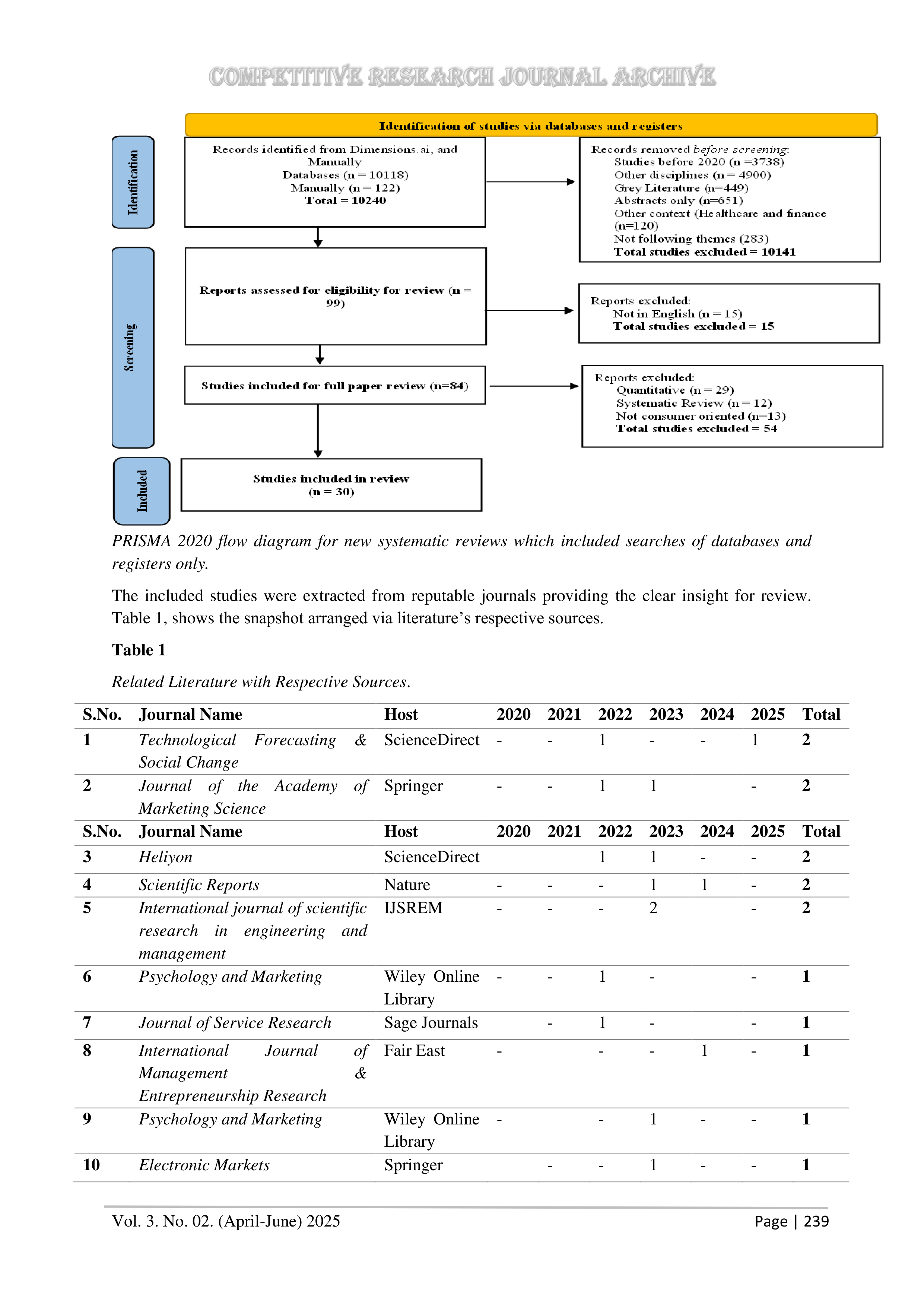
The PRISMA 2020 flow diagram Figure 1, illustrates the selection process. Initially 10240 studies
were identified through database and manual search. After applying the inclusion criteria, 99 studies
met the requirements and 10141 studies were excluded. Further filtering based on language resulted in
15 non-English studies. Ultimately, 84 studies were selected for full-paper review, and their abstracts,
methodologies, findings and conclusions were examined. This process yielded 30 studies that were
included in this scoping review.
Figure 1

competitive RESEARCH journal archive
Vol. 3. No. 02. (April-June) 2025
Page | 239
PRISMA 2020 flow diagram for new systematic reviews which included searches of databases and
registers only.
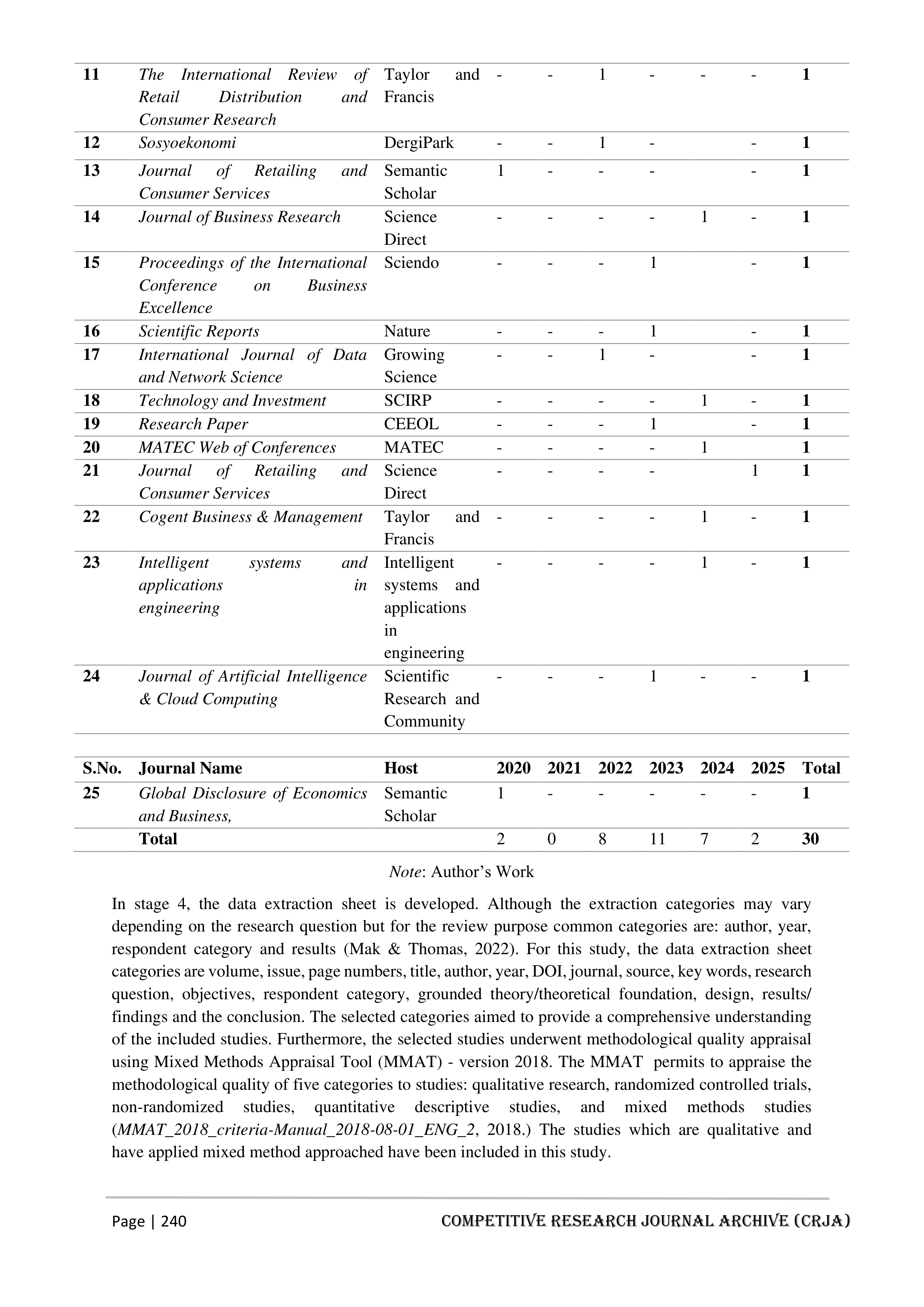
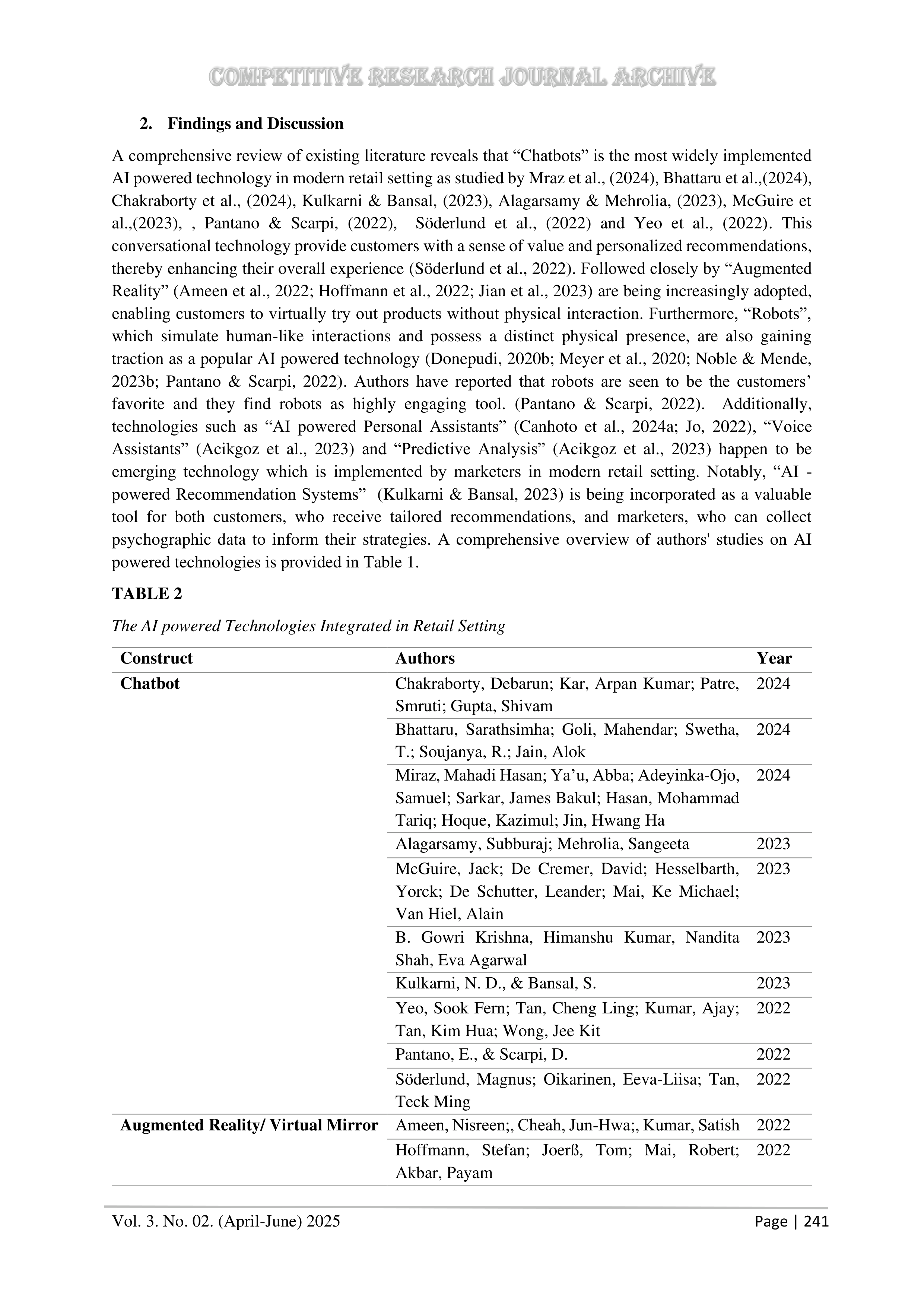
The included studies were extracted from reputable journals providing the clear insight for review.
Table 1, shows the snapshot arranged via literature’s respective sources.
Table 1
Related Literature with Respective Sources
.
S.No. Journal Name
Host
2020 2021 2022 2023 2024 2025 Total
1
Technological Forecasting &
Social Change
ScienceDirect -
-
1
-
-
1
2
2
Journal of the Academy of
Marketing Science
Springer
-
-
1
1
-
2
S.No. Journal Name
Host
2020 2021 2022 2023 2024 2025 Total
3
Heliyon
ScienceDirect
1
1
-
-
2
4
Scientific Reports
Nature
-
-
-
1
1
-
2
5
International journal of scientific
research in engineering and
management
IJSREM
-
-
-
2
-
2
6
Psychology and Marketing
Wiley Online
Library
-
-
1
-
-
1
7
Journal of Service Research
Sage Journals
-
1
-
-
1
8
International
Journal
of
Management
&
Entrepreneurship Research
Fair East
-
-
-
1
-
1
9
Psychology and Marketing
Wiley Online
Library
-
-
1
-
-
1
10
Electronic Markets
Springer
-
-
1
-
-
1
Page | 240
Competitive Research Journal Archive (CRJA)
11
The International Review of
Retail
Distribution
and
Consumer Research
Taylor
and
Francis
-
-
1
-
-
-
1
12
Sosyoekonomi
DergiPark
-
-
1
-
-
1
13
Journal
of
Retailing
and
Consumer Services
Semantic
Scholar
1
-
-
-
-
1
14
Journal of Business Research
Science
Direct
-
-
-
-
1
-
1
15
Proceedings of the International
Conference
on
Business
Excellence
Sciendo
-
-
-
1
-
1
16
Scientific Reports
Nature
-
-
-
1
-
1
17
International Journal of Data
and Network Science
Growing
Science
-
-
1
-
-
1
18
Technology and Investment
SCIRP
-
-
-
-
1
-
1
19
Research Paper
CEEOL
-
-
-
1
-
1
20
MATEC Web of Conferences
MATEC
-
-
-
-
1
1
21
Journal
of
Retailing
and
Consumer Services
Science
Direct
-
-
-
-
1
1
22
Cogent Business & Management
Taylor
and
Francis
-
-
-
-
1
-
1
23
Intelligent
systems
and
applications
in
engineering
Intelligent
systems and
applications
in
engineering
-
-
-
-
1
-
1
24
Journal of Artificial Intelligence
& Cloud Computing
Scientific
Research and
Community
-
-
-
1
-
-
1
S.No. Journal Name
Host
2020 2021 2022 2023 2024 2025 Total
25
Global Disclosure of Economics
and Business,
Semantic
Scholar
1
-
-
-
-
-
1
Total
2
0
8
11
7
2
30
Note
: Author’s Work
In stage 4, the data extraction sheet is developed. Although the extraction categories may vary
depending on the research question but for the review purpose common categories are: author, year,
respondent category and results (Mak & Thomas, 2022). For this study, the data extraction sheet
categories are volume, issue, page numbers, title, author, year, DOI, journal, source, key words, research
question, objectives, respondent category, grounded theory/theoretical foundation, design, results/
findings and the conclusion. The selected categories aimed to provide a comprehensive understanding
of the included studies. Furthermore, the selected studies underwent methodological quality appraisal
using Mixed Methods Appraisal Tool (MMAT) - version 2018. The MMAT permits to appraise the
methodological quality of five categories to studies: qualitative research, randomized controlled trials,
non-randomized
studies,
quantitative
descriptive
studies,
and
mixed
methods
studies
(
MMAT_2018_criteria-Manual_2018-08-01_ENG_2
, 2018.) The studies which are qualitative and
have applied mixed method approached have been included in this study.

competitive RESEARCH journal archive
Vol. 3. No. 02. (April-June) 2025
Page | 241
2.
Findings and Discussion
A comprehensive review of existing literature reveals that “Chatbots” is the most widely implemented
AI powered technology in modern retail setting as studied by Mraz et al., (2024), Bhattaru et al.,(2024),
Chakraborty et al., (2024), Kulkarni & Bansal, (2023), Alagarsamy & Mehrolia, (2023), McGuire et
al.,(2023), , Pantano & Scarpi, (2022), Söderlund et al., (2022) and Yeo et al., (2022). This
conversational technology provide customers with a sense of value and personalized recommendations,
thereby enhancing their overall experience (Söderlund et al., 2022). Followed closely by “Augmented
Reality” (Ameen et al., 2022; Hoffmann et al., 2022; Jian et al., 2023) are being increasingly adopted,
enabling customers to virtually try out products without physical interaction. Furthermore, “Robots”,
which simulate human-like interactions and possess a distinct physical presence, are also gaining
traction as a popular AI powered technology (Donepudi, 2020b; Meyer et al., 2020; Noble & Mende,
2023b; Pantano & Scarpi, 2022). Authors have reported that robots are seen to be the customers’
favorite and they find robots as highly engaging tool. (Pantano & Scarpi, 2022). Additionally,
technologies such as “AI powered Personal Assistants” (Canhoto et al., 2024a; Jo, 2022), “Voice
Assistants” (Acikgoz et al., 2023) and “Predictive Analysis” (Acikgoz et al., 2023) happen to be
emerging technology which is implemented by marketers in modern retail setting. Notably, “AI -
powered Recommendation Systems” (Kulkarni & Bansal, 2023) is being incorporated as a valuable
tool for both customers, who receive tailored recommendations, and marketers, who can collect
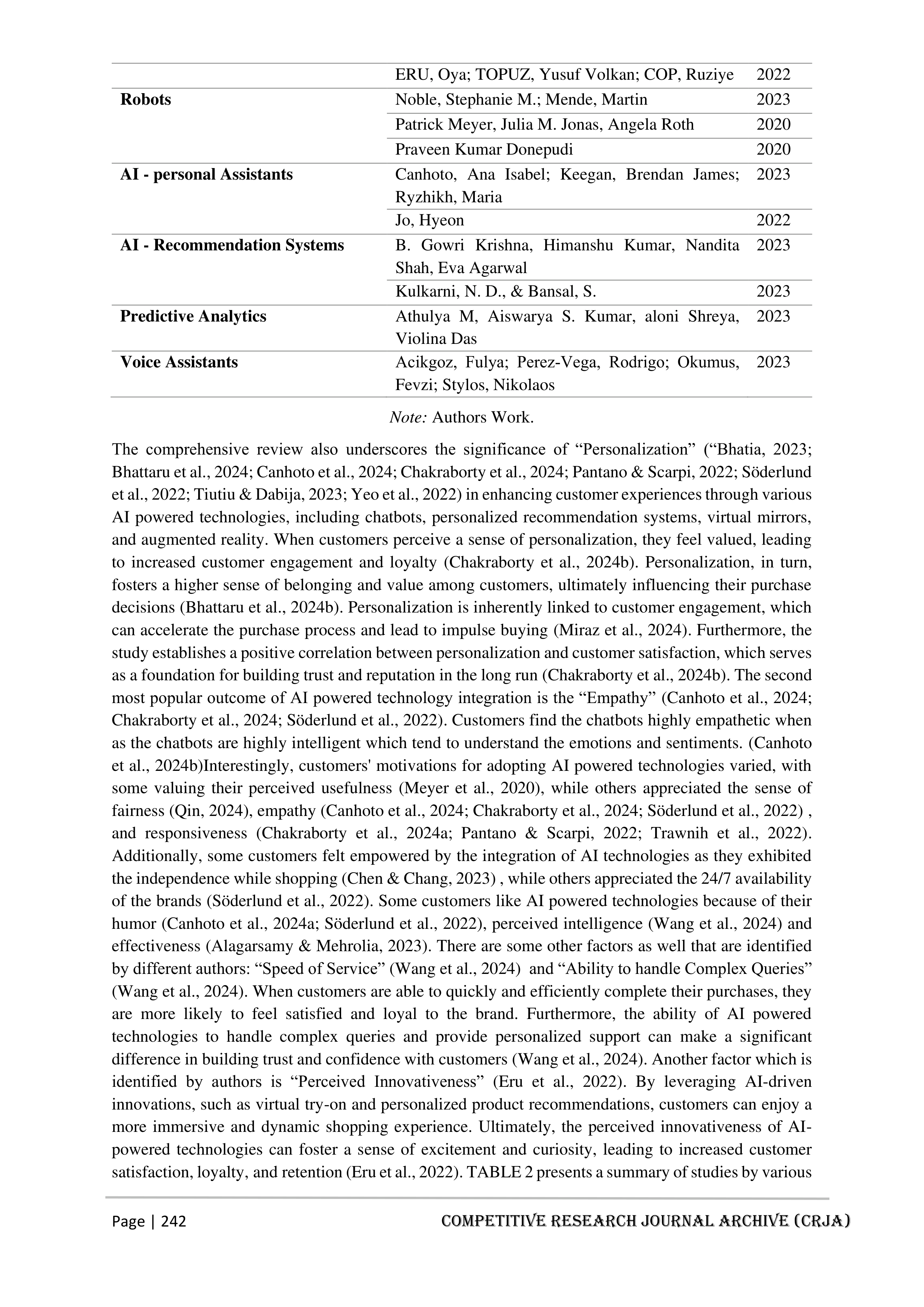
psychographic data to inform their strategies. A comprehensive overview of authors' studies on AI
powered technologies is provided in Table 1.
TABLE 2
The AI powered Technologies Integrated in Retail Setting
Construct
Authors
Year
Chatbot
Chakraborty, Debarun; Kar, Arpan Kumar; Patre,
Smruti; Gupta, Shivam
2024
Bhattaru, Sarathsimha; Goli, Mahendar; Swetha,
T.; Soujanya, R.; Jain, Alok
2024
Miraz, Mahadi Hasan; Ya’u, Abba; Adeyinka-Ojo,
Samuel; Sarkar, James Bakul; Hasan, Mohammad
Tariq; Hoque, Kazimul; Jin, Hwang Ha
2024
Alagarsamy, Subburaj; Mehrolia, Sangeeta
2023
McGuire, Jack; De Cremer, David; Hesselbarth,
Yorck; De Schutter, Leander; Mai, Ke Michael;
Van Hiel, Alain
2023
B. Gowri Krishna, Himanshu Kumar, Nandita
Shah, Eva Agarwal
2023
Kulkarni, N. D., & Bansal, S.
2023
Yeo, Sook Fern; Tan, Cheng Ling; Kumar, Ajay;
Tan, Kim Hua; Wong, Jee Kit
2022
Pantano, E., & Scarpi, D.
2022
Söderlund, Magnus; Oikarinen, Eeva-Liisa; Tan,
Teck Ming
2022
Augmented Reality/ Virtual Mirror
Ameen, Nisreen;, Cheah, Jun‐Hwa;, Kumar, Satish 2022
Hoffmann, Stefan; Joerß, Tom; Mai, Robert;
Akbar, Payam
2022
Page | 242
Competitive Research Journal Archive (CRJA)
ERU, Oya; TOPUZ, Yusuf Volkan; COP, Ruziye
2022
Robots
Noble, Stephanie M.; Mende, Martin
2023
Patrick Meyer, Julia M. Jonas, Angela Roth
2020
Praveen Kumar Donepudi
2020
AI - personal Assistants
Canhoto, Ana Isabel; Keegan, Brendan James;
Ryzhikh, Maria
2023
Jo, Hyeon
2022
AI - Recommendation Systems
B. Gowri Krishna, Himanshu Kumar, Nandita
Shah, Eva Agarwal
2023
Kulkarni, N. D., & Bansal, S.
2023
Predictive Analytics
Athulya M, Aiswarya S. Kumar, aloni Shreya,
Violina Das
2023
Voice Assistants
Acikgoz, Fulya; Perez‐Vega, Rodrigo; Okumus,
Fevzi; Stylos, Nikolaos
2023
Note:
Authors Work.
The comprehensive review also underscores the significance of “Personalization” (“Bhatia, 2023;
Bhattaru et al., 2024; Canhoto et al., 2024; Chakraborty et al., 2024; Pantano & Scarpi, 2022; Söderlund
et al., 2022; Tiutiu & Dabija, 2023; Yeo et al., 2022) in enhancing customer experiences through various
AI powered technologies, including chatbots, personalized recommendation systems, virtual mirrors,
and augmented reality. When customers perceive a sense of personalization, they feel valued, leading
to increased customer engagement and loyalty (Chakraborty et al., 2024b). Personalization, in turn,
fosters a higher sense of belonging and value among customers, ultimately influencing their purchase
decisions (Bhattaru et al., 2024b). Personalization is inherently linked to customer engagement, which
can accelerate the purchase process and lead to impulse buying (Miraz et al., 2024). Furthermore, the
study establishes a positive correlation between personalization and customer satisfaction, which serves
as a foundation for building trust and reputation in the long run (Chakraborty et al., 2024b). The second
most popular outcome of AI powered technology integration is the “Empathy” (Canhoto et al., 2024;
Chakraborty et al., 2024; Söderlund et al., 2022). Customers find the chatbots highly empathetic when
as the chatbots are highly intelligent which tend to understand the emotions and sentiments. (Canhoto
et al., 2024b)Interestingly, customers' motivations for adopting AI powered technologies varied, with
some valuing their perceived usefulness (Meyer et al., 2020), while others appreciated the sense of
fairness (Qin, 2024), empathy (Canhoto et al., 2024; Chakraborty et al., 2024; Söderlund et al., 2022) ,
and responsiveness (Chakraborty et al., 2024a; Pantano & Scarpi, 2022; Trawnih et al., 2022).
Additionally, some customers felt empowered by the integration of AI technologies as they exhibited
the independence while shopping (Chen & Chang, 2023) , while others appreciated the 24/7 availability
of the brands (Söderlund et al., 2022). Some customers like AI powered technologies because of their
humor (Canhoto et al., 2024a; Söderlund et al., 2022), perceived intelligence (Wang et al., 2024) and
effectiveness (Alagarsamy & Mehrolia, 2023). There are some other factors as well that are identified
by different authors: “Speed of Service” (Wang et al., 2024) and “Ability to handle Complex Queries”
(Wang et al., 2024). When customers are able to quickly and efficiently complete their purchases, they
are more likely to feel satisfied and loyal to the brand. Furthermore, the ability of AI powered
technologies to handle complex queries and provide personalized support can make a significant
difference in building trust and confidence with customers (Wang et al., 2024). Another factor which is
identified by authors is “Perceived Innovativeness” (Eru et al., 2022). By leveraging AI-driven
innovations, such as virtual try-on and personalized product recommendations, customers can enjoy a
more immersive and dynamic shopping experience. Ultimately, the perceived innovativeness of AI-
powered technologies can foster a sense of excitement and curiosity, leading to increased customer
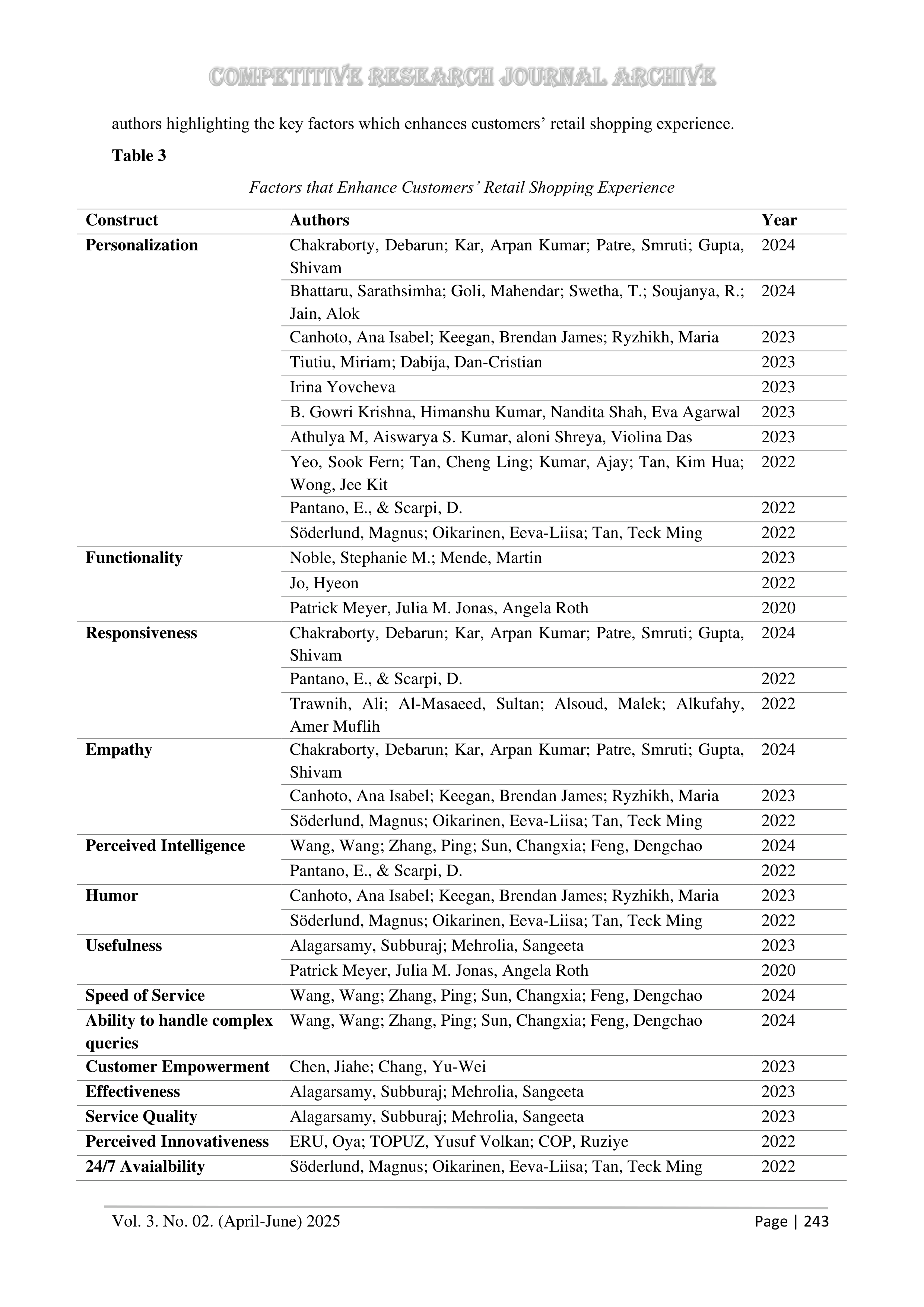
satisfaction, loyalty, and retention (Eru et al., 2022). TABLE 2 presents a summary of studies by various

competitive RESEARCH journal archive
Vol. 3. No. 02. (April-June) 2025
Page | 243
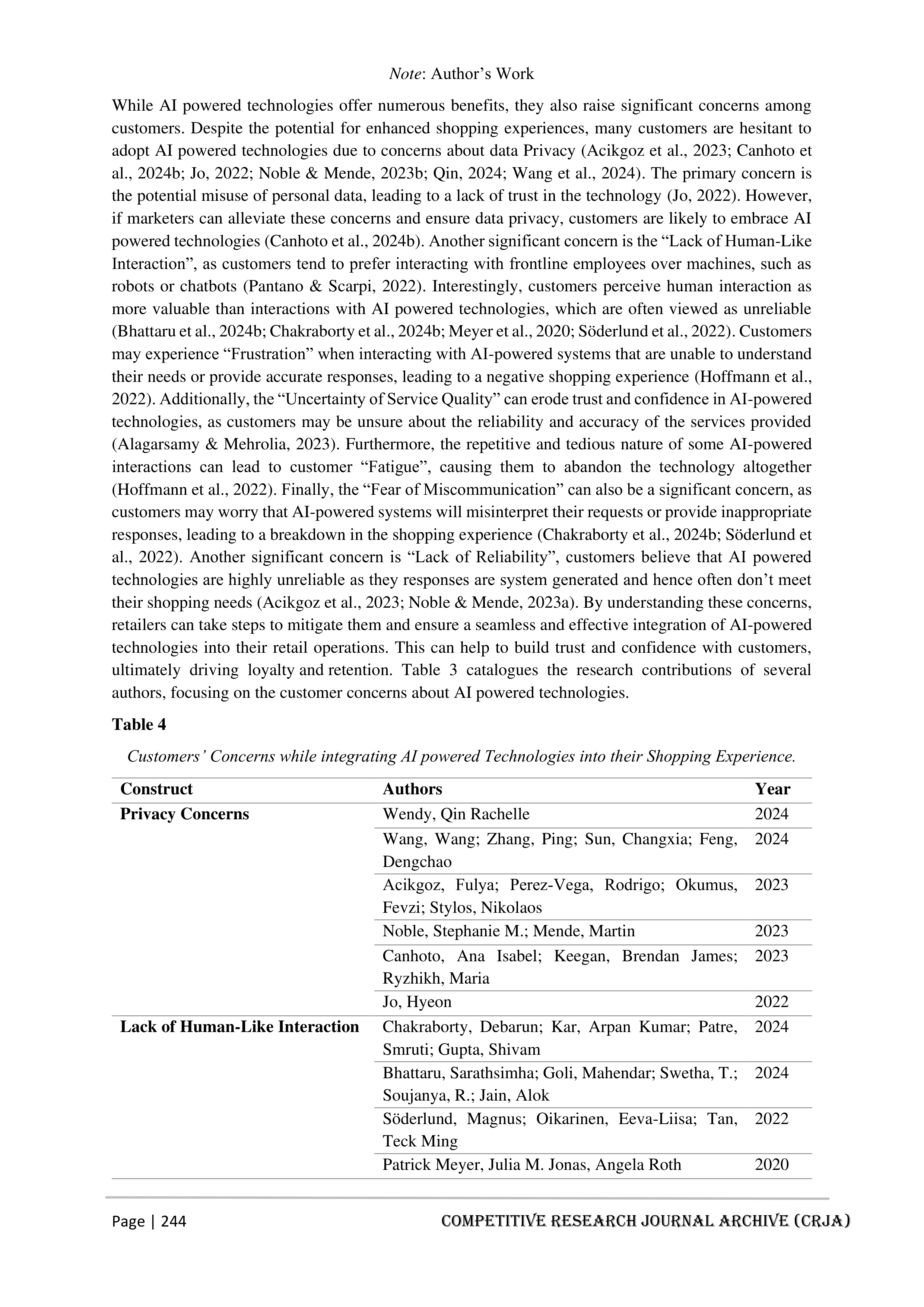
authors highlighting the key factors which enhances customers’ retail shopping experience.
Table 3
Factors that Enhance Customers’ Retail Shopping Experience
Construct
Authors
Year
Personalization
Chakraborty, Debarun; Kar, Arpan Kumar; Patre, Smruti; Gupta,
Shivam
2024
Bhattaru, Sarathsimha; Goli, Mahendar; Swetha, T.; Soujanya, R.;
Jain, Alok
2024
Canhoto, Ana Isabel; Keegan, Brendan James; Ryzhikh, Maria
2023
Tiutiu, Miriam; Dabija, Dan-Cristian
2023
Irina Yovcheva
2023
B. Gowri Krishna, Himanshu Kumar, Nandita Shah, Eva Agarwal
2023
Athulya M, Aiswarya S. Kumar, aloni Shreya, Violina Das
2023
Yeo, Sook Fern; Tan, Cheng Ling; Kumar, Ajay; Tan, Kim Hua;
Wong, Jee Kit
2022
Pantano, E., & Scarpi, D.
2022
Söderlund, Magnus; Oikarinen, Eeva-Liisa; Tan, Teck Ming
2022
Functionality
Noble, Stephanie M.; Mende, Martin
2023
Jo, Hyeon
2022
Patrick Meyer, Julia M. Jonas, Angela Roth
2020
Responsiveness
Chakraborty, Debarun; Kar, Arpan Kumar; Patre, Smruti; Gupta,
Shivam
2024
Pantano, E., & Scarpi, D.
2022
Trawnih, Ali; Al-Masaeed, Sultan; Alsoud, Malek; Alkufahy,
Amer Muflih
2022
Empathy
Chakraborty, Debarun; Kar, Arpan Kumar; Patre, Smruti; Gupta,
Shivam
2024
Canhoto, Ana Isabel; Keegan, Brendan James; Ryzhikh, Maria
2023
Söderlund, Magnus; Oikarinen, Eeva-Liisa; Tan, Teck Ming
2022
Perceived Intelligence
Wang, Wang; Zhang, Ping; Sun, Changxia; Feng, Dengchao
2024
Pantano, E., & Scarpi, D.
2022
Humor
Canhoto, Ana Isabel; Keegan, Brendan James; Ryzhikh, Maria
2023
Söderlund, Magnus; Oikarinen, Eeva-Liisa; Tan, Teck Ming
2022
Usefulness
Alagarsamy, Subburaj; Mehrolia, Sangeeta
2023
Patrick Meyer, Julia M. Jonas, Angela Roth
2020
Speed of Service
Wang, Wang; Zhang, Ping; Sun, Changxia; Feng, Dengchao
2024
Ability to handle complex
queries
Wang, Wang; Zhang, Ping; Sun, Changxia; Feng, Dengchao
2024
Customer Empowerment
Chen, Jiahe; Chang, Yu-Wei
2023
Effectiveness
Alagarsamy, Subburaj; Mehrolia, Sangeeta
2023
Service Quality
Alagarsamy, Subburaj; Mehrolia, Sangeeta
2023
Perceived Innovativeness
ERU, Oya; TOPUZ, Yusuf Volkan; COP, Ruziye
2022
24/7 Avaialbility
Söderlund, Magnus; Oikarinen, Eeva-Liisa; Tan, Teck Ming
2022
Page | 244
Competitive Research Journal Archive (CRJA)
Note
: Author’s Work
While AI powered technologies offer numerous benefits, they also raise significant concerns among
customers. Despite the potential for enhanced shopping experiences, many customers are hesitant to
adopt AI powered technologies due to concerns about data Privacy (Acikgoz et al., 2023; Canhoto et
al., 2024b; Jo, 2022; Noble & Mende, 2023b; Qin, 2024; Wang et al., 2024). The primary concern is
the potential misuse of personal data, leading to a lack of trust in the technology (Jo, 2022). However,
if marketers can alleviate these concerns and ensure data privacy, customers are likely to embrace AI
powered technologies (Canhoto et al., 2024b). Another significant concern is the “Lack of Human-Like
Interaction”, as customers tend to prefer interacting with frontline employees over machines, such as
robots or chatbots (Pantano & Scarpi, 2022). Interestingly, customers perceive human interaction as
more valuable than interactions with AI powered technologies, which are often viewed as unreliable
(Bhattaru et al., 2024b; Chakraborty et al., 2024b; Meyer et al., 2020; Söderlund et al., 2022). Customers
may experience “Frustration” when interacting with AI-powered systems that are unable to understand
their needs or provide accurate responses, leading to a negative shopping experience (Hoffmann et al.,
2022). Additionally, the “Uncertainty of Service Quality” can erode trust and confidence in AI-powered
technologies, as customers may be unsure about the reliability and accuracy of the services provided
(Alagarsamy & Mehrolia, 2023). Furthermore, the repetitive and tedious nature of some AI-powered
interactions can lead to customer “Fatigue”, causing them to abandon the technology altogether
(Hoffmann et al., 2022). Finally, the “Fear of Miscommunication” can also be a significant concern, as
customers may worry that AI-powered systems will misinterpret their requests or provide inappropriate
responses, leading to a breakdown in the shopping experience (Chakraborty et al., 2024b; Söderlund et
al., 2022). Another significant concern is “Lack of Reliability”, customers believe that AI powered
technologies are highly unreliable as they responses are system generated and hence often don’t meet
their shopping needs (Acikgoz et al., 2023; Noble & Mende, 2023a). By understanding these concerns,
retailers can take steps to mitigate them and ensure a seamless and effective integration of AI-powered
technologies into their retail operations. This can help to build trust and confidence with customers,
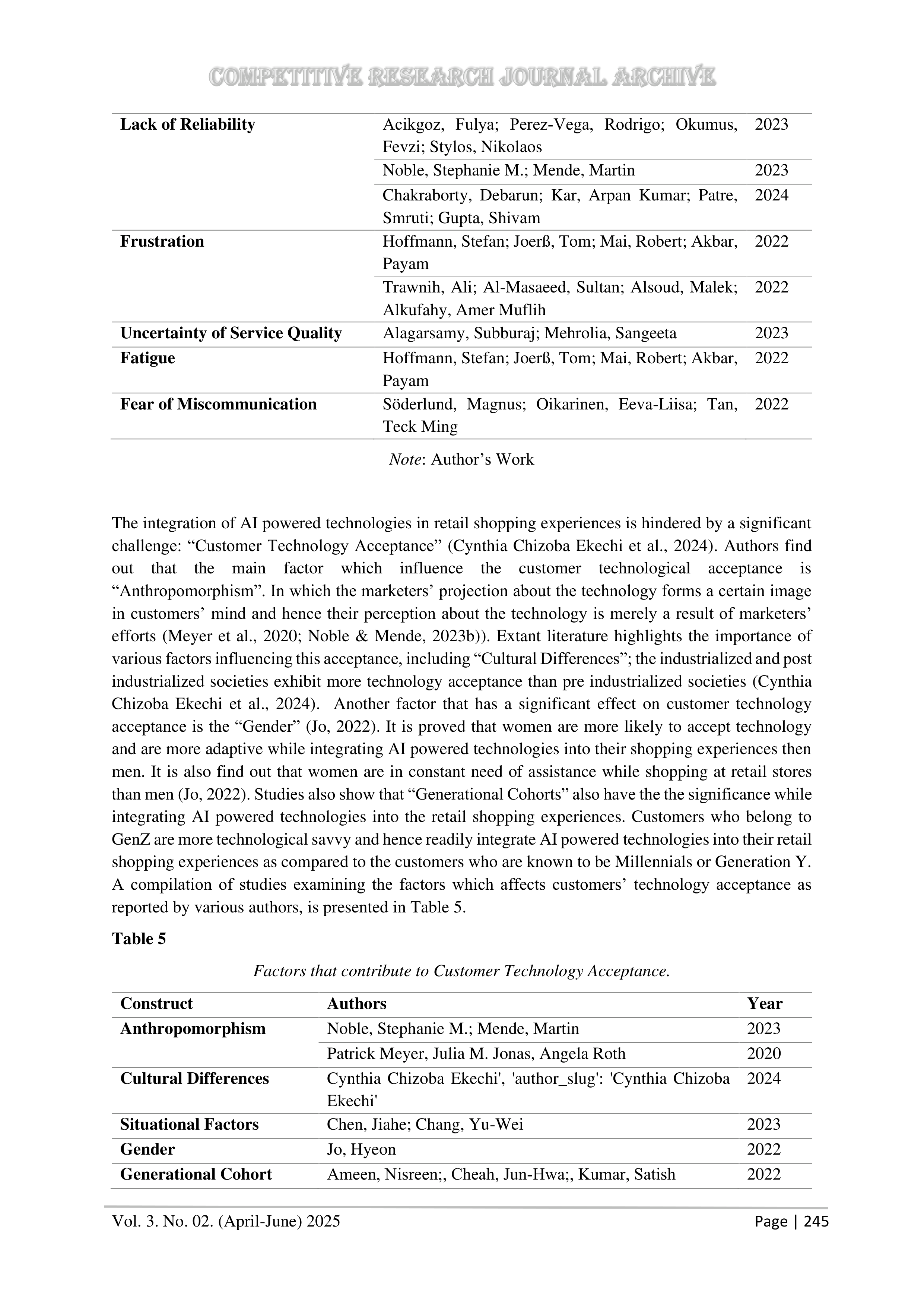
ultimately driving loyalty and retention. Table 3 catalogues the research contributions of several
authors, focusing on the customer concerns about AI powered technologies.
Table 4
Customers’ Concerns while integrating AI powered Technologies into their Shopping Experience.
Construct
Authors
Year
Privacy Concerns
Wendy, Qin Rachelle
2024
Wang, Wang; Zhang, Ping; Sun, Changxia; Feng,
Dengchao
2024
Acikgoz, Fulya; Perez‐Vega, Rodrigo; Okumus,
Fevzi; Stylos, Nikolaos
2023
Noble, Stephanie M.; Mende, Martin
2023
Canhoto, Ana Isabel; Keegan, Brendan James;
Ryzhikh, Maria
2023
Jo, Hyeon
2022
Lack of Human-Like Interaction
Chakraborty, Debarun; Kar, Arpan Kumar; Patre,
Smruti; Gupta, Shivam
2024
Bhattaru, Sarathsimha; Goli, Mahendar; Swetha, T.;
Soujanya, R.; Jain, Alok
2024
Söderlund, Magnus; Oikarinen, Eeva-Liisa; Tan,
Teck Ming
2022
Patrick Meyer, Julia M. Jonas, Angela Roth
2020

competitive RESEARCH journal archive
Vol. 3. No. 02. (April-June) 2025
Page | 245
Lack of Reliability
Acikgoz, Fulya; Perez‐Vega, Rodrigo; Okumus,
Fevzi; Stylos, Nikolaos
2023
Noble, Stephanie M.; Mende, Martin
2023
Chakraborty, Debarun; Kar, Arpan Kumar; Patre,
Smruti; Gupta, Shivam
2024
Frustration
Hoffmann, Stefan; Joerß, Tom; Mai, Robert; Akbar,
Payam
2022
Trawnih, Ali; Al-Masaeed, Sultan; Alsoud, Malek;
Alkufahy, Amer Muflih
2022
Uncertainty of Service Quality
Alagarsamy, Subburaj; Mehrolia, Sangeeta
2023
Fatigue
Hoffmann, Stefan; Joerß, Tom; Mai, Robert; Akbar,
Payam
2022
Fear of Miscommunication
Söderlund, Magnus; Oikarinen, Eeva-Liisa; Tan,
Teck Ming
2022
Note
: Author’s Work
The integration of AI powered technologies in retail shopping experiences is hindered by a significant
challenge: “Customer Technology Acceptance” (Cynthia Chizoba Ekechi et al., 2024). Authors find
out that the main factor which influence the customer technological acceptance is
“Anthropomorphism”. In which the marketers’ projection about the technology forms a certain image
in customers’ mind and hence their perception about the technology is merely a result of marketers’
efforts (Meyer et al., 2020; Noble & Mende, 2023b)). Extant literature highlights the importance of
various factors influencing this acceptance, including “Cultural Differences”; the industrialized and post
industrialized societies exhibit more technology acceptance than pre industrialized societies (Cynthia
Chizoba Ekechi et al., 2024). Another factor that has a significant effect on customer technology
acceptance is the “Gender” (Jo, 2022). It is proved that women are more likely to accept technology
and are more adaptive while integrating AI powered technologies into their shopping experiences then
men. It is also find out that women are in constant need of assistance while shopping at retail stores
than men (Jo, 2022). Studies also show that “Generational Cohorts” also have the the significance while
integrating AI powered technologies into the retail shopping experiences. Customers who belong to
GenZ are more technological savvy and hence readily integrate AI powered technologies into their retail
shopping experiences as compared to the customers who are known to be Millennials or Generation Y.
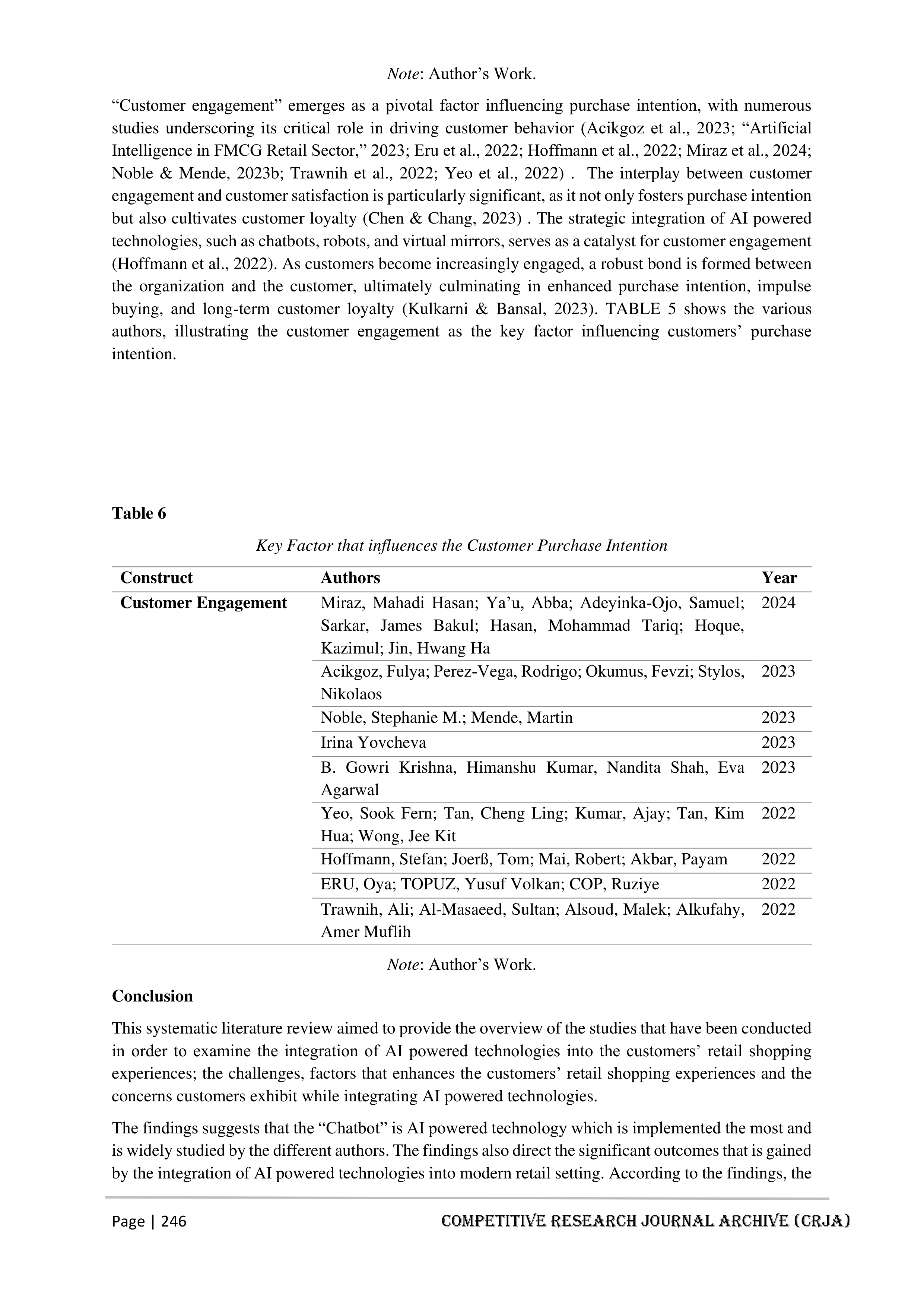
A compilation of studies examining the factors which affects customers’ technology acceptance as
reported by various authors, is presented in Table 5.
Table 5
Factors that contribute to Customer Technology Acceptance.
Construct
Authors
Year
Anthropomorphism
Noble, Stephanie M.; Mende, Martin
2023
Patrick Meyer, Julia M. Jonas, Angela Roth
2020
Cultural Differences
Cynthia Chizoba Ekechi', 'author_slug': 'Cynthia Chizoba
Ekechi'
2024
Situational Factors
Chen, Jiahe; Chang, Yu-Wei
2023
Gender
Jo, Hyeon
2022
Generational Cohort
Ameen, Nisreen;, Cheah, Jun‐Hwa;, Kumar, Satish
2022
Page | 246
Competitive Research Journal Archive (CRJA)
Note
: Author’s Work.
“Customer engagement” emerges as a pivotal factor influencing purchase intention, with numerous
studies underscoring its critical role in driving customer behavior (Acikgoz et al., 2023; “Artificial
Intelligence in FMCG Retail Sector,” 2023; Eru et al., 2022; Hoffmann et al., 2022; Miraz et al., 2024;
Noble & Mende, 2023b; Trawnih et al., 2022; Yeo et al., 2022) . The interplay between customer
engagement and customer satisfaction is particularly significant, as it not only fosters purchase intention
but also cultivates customer loyalty (Chen & Chang, 2023) . The strategic integration of AI powered
technologies, such as chatbots, robots, and virtual mirrors, serves as a catalyst for customer engagement
(Hoffmann et al., 2022). As customers become increasingly engaged, a robust bond is formed between
the organization and the customer, ultimately culminating in enhanced purchase intention, impulse
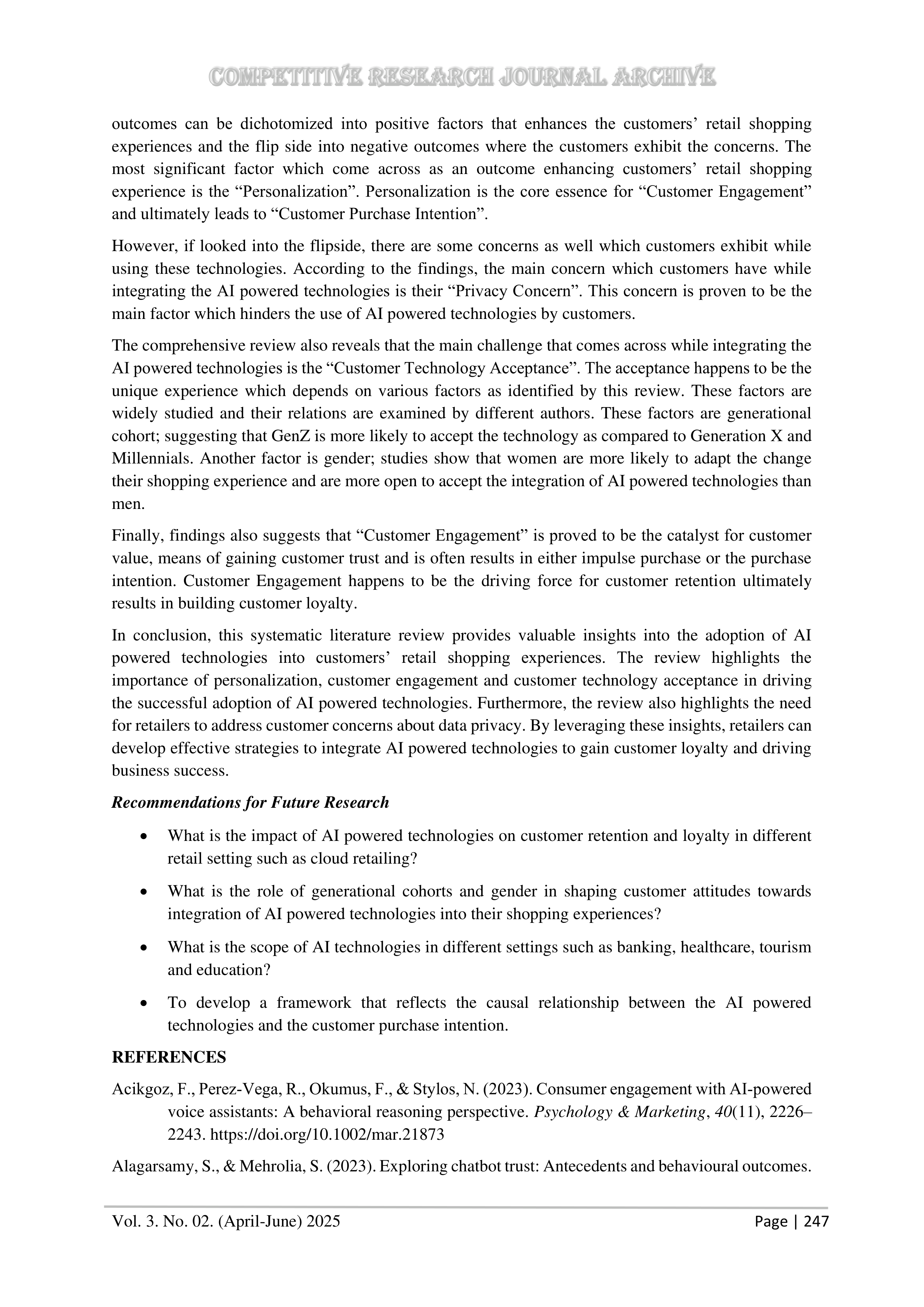
buying, and long-term customer loyalty (Kulkarni & Bansal, 2023). TABLE 5 shows the various
authors, illustrating the customer engagement as the key factor influencing customers’ purchase
intention.
Table 6
Key Factor that influences the Customer Purchase Intention
Construct
Authors
Year
Customer Engagement
Miraz, Mahadi Hasan; Ya’u, Abba; Adeyinka-Ojo, Samuel;
Sarkar, James Bakul; Hasan, Mohammad Tariq; Hoque,
Kazimul; Jin, Hwang Ha
2024
Acikgoz, Fulya; Perez‐Vega, Rodrigo; Okumus, Fevzi; Stylos,
Nikolaos
2023
Noble, Stephanie M.; Mende, Martin
2023
Irina Yovcheva
2023
B. Gowri Krishna, Himanshu Kumar, Nandita Shah, Eva
Agarwal
2023
Yeo, Sook Fern; Tan, Cheng Ling; Kumar, Ajay; Tan, Kim
Hua; Wong, Jee Kit
2022
Hoffmann, Stefan; Joerß, Tom; Mai, Robert; Akbar, Payam
2022
ERU, Oya; TOPUZ, Yusuf Volkan; COP, Ruziye
2022
Trawnih, Ali; Al-Masaeed, Sultan; Alsoud, Malek; Alkufahy,
Amer Muflih
2022
Note
: Author’s Work.
Conclusion
This systematic literature review aimed to provide the overview of the studies that have been conducted
in order to examine the integration of AI powered technologies into the customers’ retail shopping
experiences; the challenges, factors that enhances the customers’ retail shopping experiences and the
concerns customers exhibit while integrating AI powered technologies.
The findings suggests that the “Chatbot” is AI powered technology which is implemented the most and
is widely studied by the different authors. The findings also direct the significant outcomes that is gained
by the integration of AI powered technologies into modern retail setting. According to the findings, the

competitive RESEARCH journal archive
Vol. 3. No. 02. (April-June) 2025
Page | 247
outcomes can be dichotomized into positive factors that enhances the customers’ retail shopping
experiences and the flip side into negative outcomes where the customers exhibit the concerns. The
most significant factor which come across as an outcome enhancing customers’ retail shopping
experience is the “Personalization”. Personalization is the core essence for “Customer Engagement”
and ultimately leads to “Customer Purchase Intention”.
However, if looked into the flipside, there are some concerns as well which customers exhibit while
using these technologies. According to the findings, the main concern which customers have while
integrating the AI powered technologies is their “Privacy Concern”. This concern is proven to be the
main factor which hinders the use of AI powered technologies by customers.
The comprehensive review also reveals that the main challenge that comes across while integrating the
AI powered technologies is the “Customer Technology Acceptance”. The acceptance happens to be the
unique experience which depends on various factors as identified by this review. These factors are
widely studied and their relations are examined by different authors. These factors are generational
cohort; suggesting that GenZ is more likely to accept the technology as compared to Generation X and
Millennials. Another factor is gender; studies show that women are more likely to adapt the change
their shopping experience and are more open to accept the integration of AI powered technologies than
men.
Finally, findings also suggests that “Customer Engagement” is proved to be the catalyst for customer
value, means of gaining customer trust and is often results in either impulse purchase or the purchase
intention. Customer Engagement happens to be the driving force for customer retention ultimately
results in building customer loyalty.
In conclusion, this systematic literature review provides valuable insights into the adoption of AI
powered technologies into customers’ retail shopping experiences. The review highlights the
importance of personalization, customer engagement and customer technology acceptance in driving
the successful adoption of AI powered technologies. Furthermore, the review also highlights the need
for retailers to address customer concerns about data privacy. By leveraging these insights, retailers can
develop effective strategies to integrate AI powered technologies to gain customer loyalty and driving
business success.
Recommendations for Future Research
•
What is the impact of AI powered technologies on customer retention and loyalty in different
retail setting such as cloud retailing?
•
What is the role of generational cohorts and gender in shaping customer attitudes towards
integration of AI powered technologies into their shopping experiences?
•
What is the scope of AI technologies in different settings such as banking, healthcare, tourism
and education?
•
To develop a framework that reflects the causal relationship between the AI powered
technologies and the customer purchase intention.
REFERENCES
Acikgoz, F., Perez‐Vega, R., Okumus, F., & Stylos, N. (2023). Consumer engagement with AI‐powered
voice assistants: A behavioral reasoning perspective.
Psychology & Marketing
,
40
(11), 2226–
2243. https://doi.org/10.1002/mar.21873
Alagarsamy, S., & Mehrolia, S. (2023). Exploring chatbot trust: Antecedents and behavioural outcomes.
Page | 248
Competitive Research Journal Archive (CRJA)
Heliyon
,
9
(5), e16074. https://doi.org/10.1016/j.heliyon.2023.e16074
Alexander, B., & Varley, R. (2025). Retail futures: Customer experience, phygital retailing, and the
Experiential Retail Territories perspective.
Journal of Retailing and Consumer Services
,
82
,
104108. https://doi.org/10.1016/j.jretconser.2024.104108
Ameen, N., Cheah, J., & Kumar, S. (2022). It’s all part of the customer journey: The impact of
augmented reality, chatbots, and social media on the body image and self‐esteem of Generation
Z
female
consumers.
Psychology
&
Marketing
,
39
(11),
2110–2129.
https://doi.org/10.1002/mar.21715
Artificial Intelligence in FMCG Retail Sector. (2023).
Research Papers
,
63
(1), 101–113.
https://doi.org/10.37075/RP.2023.1.09
Bhatia, Dr. A. (2023). A Study to Know AI in Tracking Consumer Buying Impulses and Stimulus.
INTERANTIONAL JOURNAL OF SCIENTIFIC RESEARCH IN ENGINEERING AND
MANAGEMENT
,
07
(12), 1–13. https://doi.org/10.55041/IJSREM27813
Bhattaru, S., Goli, M., Swetha, T., Soujanya, R., & Jain, A. (2024). Customer Service 2.0: The Influence
of
Chatbots
and
AI
Solutions".
MATEC
Web
of
Conferences
,
392
,
01041.
https://doi.org/10.1051/matecconf/202439201041
Canhoto, A. I., Keegan, B. J., & Ryzhikh, M. (2024). Snakes and Ladders: Unpacking the
Personalisation-Privacy Paradox in the Context of AI-Enabled Personalisation in the Physical
Retail
Environment.
Information
Systems
Frontiers
,
26
(3),
1005–1024.
https://doi.org/10.1007/s10796-023-10369-7
Chakraborty, D., Kumar Kar, A., Patre, S., & Gupta, S. (2024). Enhancing trust in online grocery
shopping through generative AI chatbots.
Journal of Business Research
,
180
, 114737.
https://doi.org/10.1016/j.jbusres.2024.114737
Chen, J., & Chang, Y.-W. (2023). How smart technology empowers consumers in smart retail stores?
The perspective of technology readiness and situational factors.
Electronic Markets
,
33
(1), 1.
https://doi.org/10.1007/s12525-023-00635-6
Cynthia Chizoba Ekechi, Excel G Chukwurah, Lawrence Damilare Oyeniyi, & Chukwuekem David
Okeke. (2024). AI-INFUSED CHATBOTS FOR CUSTOMER SUPPORT: A CROSS-
COUNTRY EVALUATION OF USER SATISFACTION IN THE USA AND THE UK.
International Journal of Management & Entrepreneurship Research
,
6
(4), 1259–1272.
https://doi.org/10.51594/ijmer.v6i4.1057
Donepudi, P. K. (2020). Robots in Retail Marketing: A Timely Opportunity.
Global Disclosure of
Economics and Business
,
9
(2), 97–106. https://doi.org/10.18034/gdeb.v9i2.527
Eru, O., Topuz, Y. V., & Cop, R. (2022). The Effect of Augmented Reality Experience on Loyalty and
Purchasing Intent: An Application on the Retail Sector.
Sosyoekonomi
,
30
(52), 129–155.
https://doi.org/10.17233/sosyoekonomi.2022.02.08
Hoffmann, S., Joerß, T., Mai, R., & Akbar, P. (2022). Augmented reality-delivered product information
at the point of sale: When information controllability backfires.
Journal of the Academy of
Marketing Science
,
50
(4), 743–776. https://doi.org/10.1007/s11747-022-00855-w
Jian, L., Guo, S., & Yu, S. (2023). Effect of Artificial Intelligence on the Development of China’s
Wholesale
and
Retail
Trade.
Sustainability
,
15
(13),
10524.
https://doi.org/10.3390/su151310524
Jo, H. (2022). Continuance intention to use artificial intelligence personal assistant: Type, gender, and
use experience.
Heliyon
,
8
(9), e10662. https://doi.org/10.1016/j.heliyon.2022.e10662

competitive RESEARCH journal archive
Vol. 3. No. 02. (April-June) 2025
Page | 249
Journal, I. (2023). Artificial Intelligence on Retail Marketing.
INTERANTIONAL JOURNAL OF
SCIENTIFIC RESEARCH IN ENGINEERING AND MANAGEMENT
,
07
(12), 1–13.
https://doi.org/10.55041/IJSREM27814
Kulkarni, N. D., & Bansal, S. (2023). Exploring Real-World Applications of GenAI in Retail.
Journal
of
Artificial
Intelligence
&
Cloud
Computing
,
1–5.
https://doi.org/10.47363/JAICC/2023(2)186
Mak, S., & Thomas, A. (2022). Steps for Conducting a Scoping Review.
Journal of Graduate Medical
Education
,
14
(5), 565–567. https://doi.org/10.4300/JGME-D-22-00621.1
McGuire, J., De Cremer, D., Hesselbarth, Y., De Schutter, L., Mai, K. M., & Van Hiel, A. (2023). The
reputational and ethical consequences of deceptive chatbot use.
Scientific Reports
,
13
(1),
16246. https://doi.org/10.1038/s41598-023-41692-3
Meyer, P., Jonas, J. M., & Roth, A. (2020). EXPLORING CUSTOMERS’ ACCEPTANCE OF AND
RESISTANCE TO SERVICE ROBOTS IN STATIONARY RETAIL – A MIXED METHOD
APPROACH.
Semantic Scholar
,
70
(1), 102–115.
Miraz, M. H., Ya’u, A., Adeyinka-Ojo, S., Sarkar, J. B., Hasan, M. T., Hoque, K., & Jin, H. H. (2024).
Intention to use determinants of AI chatbots to improve customer relationship management
efficiency.
Cogent
Business
&
Management
,
11
(1),
2411445.
https://doi.org/10.1080/23311975.2024.2411445
MMAT_2018_criteria-manual_2018-08-01_ENG_2
. (n.d.).
Noble, S. M., & Mende, M. (2023). The future of artificial intelligence and robotics in the retail and
service sector: Sketching the field of consumer-robot-experiences.
Journal of the Academy of
Marketing Science
,
51
(4), 747–756. https://doi.org/10.1007/s11747-023-00948-0
Pantano, E., & Scarpi, D. (2022). I, Robot, You, Consumer: Measuring Artificial Intelligence Types
and their Effect on Consumers Emotions in Service.
Journal of Service Research
,
25
(4), 583–
600. https://doi.org/10.1177/10946705221103538
Qin, R. W. (2024). Navigating Integration Challenges and Ethical Considerations of AI in E-
Commerce: A Framework for Best Practices and Customer Trust.
Technology and Investment
,
15
(03), 168–181. https://doi.org/10.4236/ti.2024.153010
Söderlund, M., Oikarinen, E.-L., & Tan, T. M. (2022). The hard-working virtual agent in the service
encounter boosts customer satisfaction.
The International Review of Retail, Distribution and
Consumer Research
,
32
(4), 388–404. https://doi.org/10.1080/09593969.2022.2042715
Tiutiu, M., & Dabija, D.-C. (2023). Improving Customer Experience Using Artificial Intelligence in
Online Retail.
Proceedings of the International Conference on Business Excellence
,
17
(1),
1139–1147. https://doi.org/10.2478/picbe-2023-0102
Trawnih, A., Al-Masaeed, S., Alsoud, M., & Alkufahy, A. M. (2022). Understanding artificial
intelligence experience: A customer perspective.
International Journal of Data and Network
Science
,
6
(4), 1471–1484. https://doi.org/10.5267/j.ijdns.2022.5.004
Wang, W., Zhang, P., Sun, C., & Feng, D. (2024). Smart customer service in unmanned retail store
enhanced
by
large
language
model.
Scientific
Reports
,
14
(1),
19838.
https://doi.org/10.1038/s41598-024-71089-9
Yeo, S. F., Tan, C. L., Kumar, A., Tan, K. H., & Wong, J. K. (2022). Investigating the impact of AI-
powered technologies on Instagrammers’ purchase decisions in digitalization era–A study of
Page | 250
Competitive Research Journal Archive (CRJA)
the fashion and apparel industry.
Technological Forecasting and Social Change
,
177
, 121551.
https://doi.org/10.1016/j.techfore.2022.121551