Academic Editor: Dan Zhang
Received: 19 June 2025
Revised: 28 July 2025
Accepted: 28 July 2025
Published: 29 July 2025
Citation:
Urrea, C. Artificial
Intelligence-Driven and Bio-Inspired
Control Strategies for Industrial
Robotics: A Systematic Review of
Trends, Challenges, and Sustainable
Innovations Toward Industry 5.0.
Machines
2025
,
13
, 666.
https://
doi.org/10.3390/machines13080666
Copyright:
© 2025 by the author.
Licensee MDPI, Basel, Switzerland.
This article is an open access article
distributed under the terms and
conditions of the Creative Commons
Attribution (CC BY) license
(https://creativecommons.org/
licenses/by/4.0/).
Review
Artificial Intelligence-Driven and Bio-Inspired Control Strategies
for Industrial Robotics:
A Systematic Review of Trends,
Challenges, and Sustainable Innovations Toward Industry 5.0
Claudio Urrea
Electrical Engineering Department, Faculty of Engineering, University of Santiago of Chile, Las Sophoras 165,
Estación Central, Santiago 9170020, Chile; claudio.urrea@usach.cl; Tel.:
+56-2-27183350
Abstract
Industrial robots are undergoing a transformative shift as Artificial Intelligence (AI)-driven
and bio-inspired control strategies unlock new levels of precision, adaptability, and multi-
dimensional sustainability aligned with Industry 5.0 (energy efficiency, material circularity,
and life-cycle emissions).
This systematic review analyzes 160 peer-reviewed industrial
robotics control studies (2023–2025), including an expanded bio-inspired/human-centric
subset, to evaluate:
(1) the dominant and emerging control methodologies; (2) the transfor-
mative role of digital twins and 5G-enabled connectivity; and (3) the persistent technical,
ethical, and environmental challenges.
Following the Preferred Reporting Items for System-
atic Reviews and Meta-Analyses (PRISMA) 2020 guidelines, the study employs a rigorous
methodology, focusing on adaptive control, deep reinforcement learning (DRL), human–
robot collaboration (HRC), and quantum-inspired algorithms.
The key findings highlight
up to 30% latency reductions in real-time optimization, up to 22% efficiency gains through
digital
twins,
and
up
to
25%
energy
savings
from
bio-inspired
designs
(all
percentage
ranges
are
reported
relative
to
the
comparator
baselines
specified
in
the
cited
sources).
However, critical barriers remain, including scalability limitations (with up to 40% higher
computational demands) and cybersecurity vulnerabilities (with up to 20% exposure rates).
The convergence of AI, bio-inspired systems, and quantum computing is poised to enable
sustainable,
autonomous,
and human-centric robotics,
yet requires standardized safety
frameworks and hybrid architectures to fully support the transition from Industry 4.0 to
Industry
5.0.
This
review
offers
a
strategic
roadmap
for
future
research
and
industrial
adoption, emphasizing human-centric design, ethical frameworks, and circular-economy
principles to address global manufacturing challenges.
Keywords:
industrial
robotics;
adaptive
control;
AI-driven
systems;
human–robot
collaboration;
digital
twins;
Industry
5.0;
quantum
computing;
5G
connectivity;
bio-inspired control; sustainable automation; circular economy
1.
Introduction
Industrial robots have progressed from basic programmable manipulators to advanced
systems adept at handling complex tasks in dynamic environments.
The rise of Industry 4.0
has spurred sophisticated control strategies, merging robotics with cyber-physical systems,
the Internet of Things (IoT), and Artificial Intelligence (AI). For example, in automotive
manufacturing, real-time robot coordination ensures production flow amid high variability
and mass customization, while electronics assembly requires micrometer-scale precision,
achieved through AI and sensor fusion for self-calibration.
Machines
2025
,
13
, 666
https://doi.org/10.3390/machines13080666
Machines
2025
,
13
, 666
2 of 28
This review synthesizes the recent research (2023–2025) on control paradigms, enhanc-
ing precision, adaptability, and collaboration in industrial robotics; drawing on 160 peer-
reviewed
industrial
robotics
control
studies
(see
Secton
2
);
and
including
an
expanded
bio-inspired/soft-robotics, human-centric subset drawn from IEEE, Scopus, and PubMed
sources (Appendix
A
, Table
A3
; see Section
3.7
) to provide a comprehensive snapshot.
It
addresses three key questions:
(1) What dominant control methodologies emerge in the
recent literature, and how do their performance metrics (e.g., accuracy, latency, energy use)
vary across applications?
(2) How do AI, digital twins, and 5G connectivity transform robot
control in sectors like automotive, electronics, and logistics?
(3) What technical, ethical, and
environmental challenges persist, and how can they be addressed?
The
shift
to
Industry
5.0,
emphasizing
human-centric
design,
sustainability,
and
resilience,
is
also
examined
[
1
–
3
].
Emerging
paradigms—bio-inspired
control
[
4
–
19
],
quantum-enhanced algorithms [
20
], cybersecurity frameworks [
21
–
26
], and additive man-
ufacturing
(AM)
integration
[
27
–
32
]—promise
to
overcome
scalability,
safety,
and
eco-
efficiency limitations.
Here, sustainability is treated broadly to include energy efficiency,
material
circularity,
and
life-cycle
carbon
metrics.
Recent
advances
in
adaptive
con-
trol
[
33
–
35
]
,
AI-driven
systems
[
36
–
45
],
human–robot
collaboration
(HRC)
[
46
–
53
],
and
digital
twins
[
1
,
2
,
54
–
62
]
highlight
rapid
progress.
This
work
offers
a
roadmap
for
re-
searchers and practitioners,
bridging current trends with future innovations,
including
autonomous systems poised to boost throughput by 20%, safety by 15%, and energy effi-
ciency by 25% [
47
,
63
,
64
] (values reported relative to the conventional baselines described
in the cited sectoral studies).
2.
Methods
This
systematic
review
analyzed
160
peer-reviewed
journal
articles
on
industrial
robotics control meeting all the prespecified inclusion criteria (2023–2025; English; industrial
scope;
peer
reviewed),
sourced
from
the
Web
of
Science
(WoS)
Core
Collection,
IEEE
Xplore,
Scopus,
and
PubMed,
with
a
focus
on
high-impact
journals
(primarily
Q1
and
Q2 in automation, robotics, and related fields).
Search terms included “industrial robot
control”,
“adaptive
robotics”,
“AI
in
robotics”,
“digital
twins
in
manufacturing”,
“5G-
enabled robotics”, “human-centric automation”, “bio-inspired robotics”, “cybersecurity in
robotics”, “additive manufacturing robotics”, “multi-robot coordination”, “ethical robotics”,
“quantum control”, and “real-time robotic optimization”; the full Boolean expansions are
provided
in
Table
A1
.
These
terms
were
designed
to
capture
advancements
in
control
strategies for industrial robotics within the Industry 5.0 framework, and the corpus includes
an expanded bio-inspired/human-centric subset highlighted in Appendix
A
, Table
A3
and
discussed in Section
3.7
.
2.1.
Search Strategy
Search strings, detailed in Appendix
A
(Table
A1
), were applied to the Title, Abstract,
and Author Keywords fields,
using platform-specific wildcards and Boolean operators.
A
pilot
search
across
“All
Fields”
yielded
a
~6%
increase
in
irrelevant
records
and
no
additional eligible studies, justifying the restricted search strategy.
Searches were limited
to English-language journal articles or reviews published in 2023–2025,
and indexed in
WoS (Science Citation Index Expanded), IEEE Xplore, Scopus, or PubMed.
A small number
of authoritative industry reports were included for contextual relevance (excluded from
quantitative tallies but cited narratively where appropriate).
Machines
2025
,
13
, 666
3 of 28
2.2.
Inclusion and Exclusion Criteria
The
inclusion
criteria
required
articles
to:
(1)
present
original
research
or
reviews
on
industrial
robot
control
strategies;
(2)
be
published
in
peer-reviewed,
high-impact
journals (Q1/Q2 preferred but not mandatory if technical novelty warranted inclusion);
and (3) focus on technological advancements with experimental or high-fidelity simulation
validation.
The exclusion criteria eliminated:
(1) duplicates; (2) non-peer-reviewed works
(e.g., conference papers, preprints, theses) except for a small, flagged set of high-relevance
preprints retained under the limitations policy; (3) studies unrelated to control strategies;
(4) non-industrial robotics (e.g., service or medical robots); and (5) non-English articles or
inaccessible full texts.
The criteria are detailed in Appendix
A
(Table
A2
).
Operational relevance was defined a priori as:
(i) a focus on industrial (manufacturing
or
production)
robots;
(ii)
presentation
of
a
control
method
(algorithmic,
architectural,
or sensing-driven) supported by experimental or high-fidelity simulation evidence; and
(iii) linkage to at least one Industry 4.0/5.0 enabling technology (e.g., AI/ML, digital twins,
high-bandwidth/5G
connectivity,
bio-inspired
actuation
or
morphology,
human–robot
collaboration, or cybersecurity for networked control).
Records meeting the domain scope
but lacking control data were coded “method mismatch”; those centered on non-industrial
domains were coded “domain mismatch.”
2.3.
Screening and Selection
From
an
initial
pool
of
800
records
(WoS
=
312,
IEEE
Xplore
=
156,
Scopus
=
274,
PubMed = 58), 112 duplicates were removed, leaving 688 records for title/abstract screening.
Two independent reviewers screened records against the inclusion criteria, achieving high
inter-rater reliability (Cohen’s
κ
= 0.84).
After screening, 245 articles underwent full-text
evaluation,
with 85 excluded for reasons including method mismatch (
n
= 43),
domain
mismatch (
n
= 24), and language (
n
= 18).
The final 160 articles addressed three research
questions:
(1) What are the dominant control methodologies?
(2) How do AI, digital twins,
and 5G transform robot control?
(3) What technical, ethical, and environmental challenges
persist?
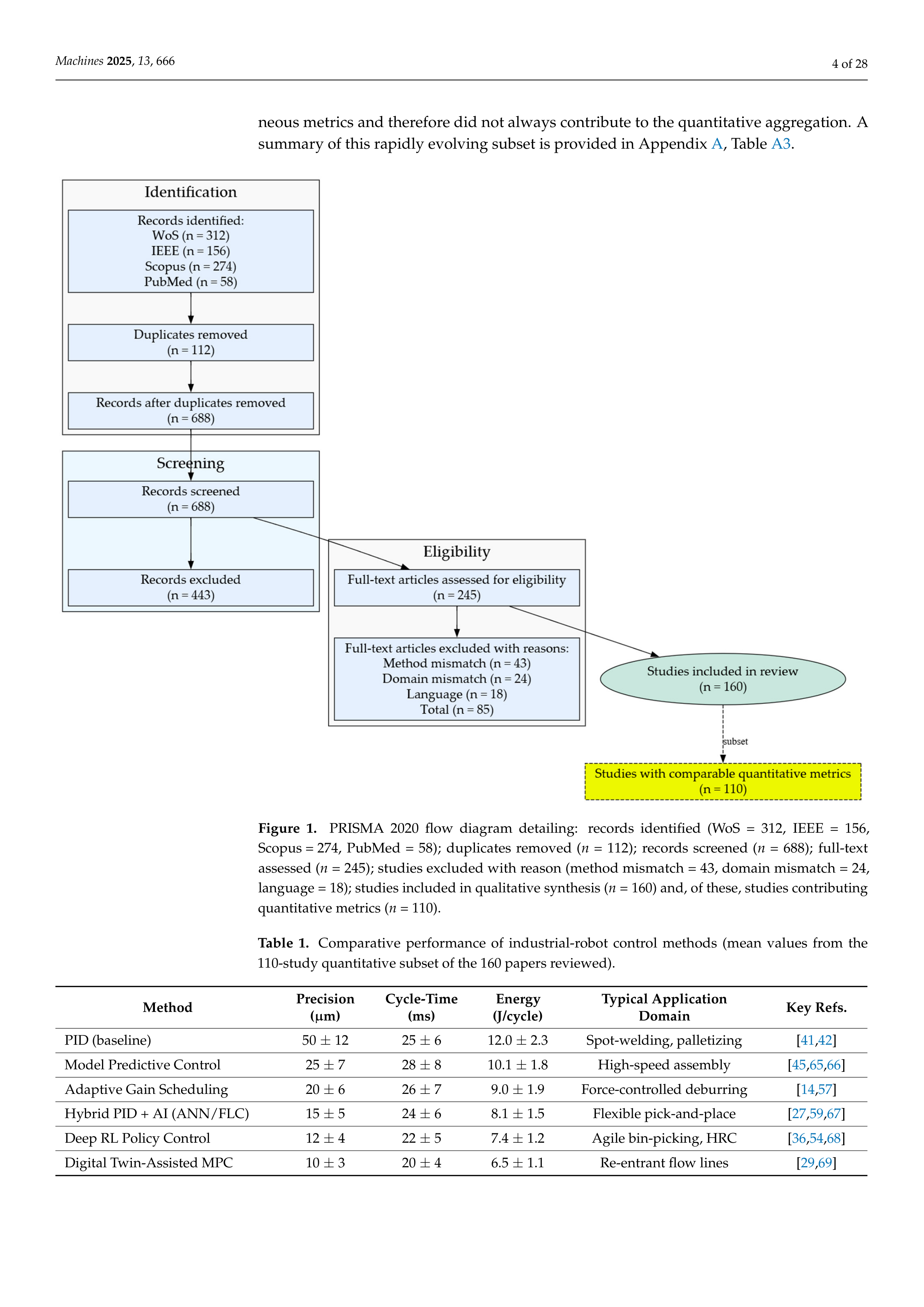
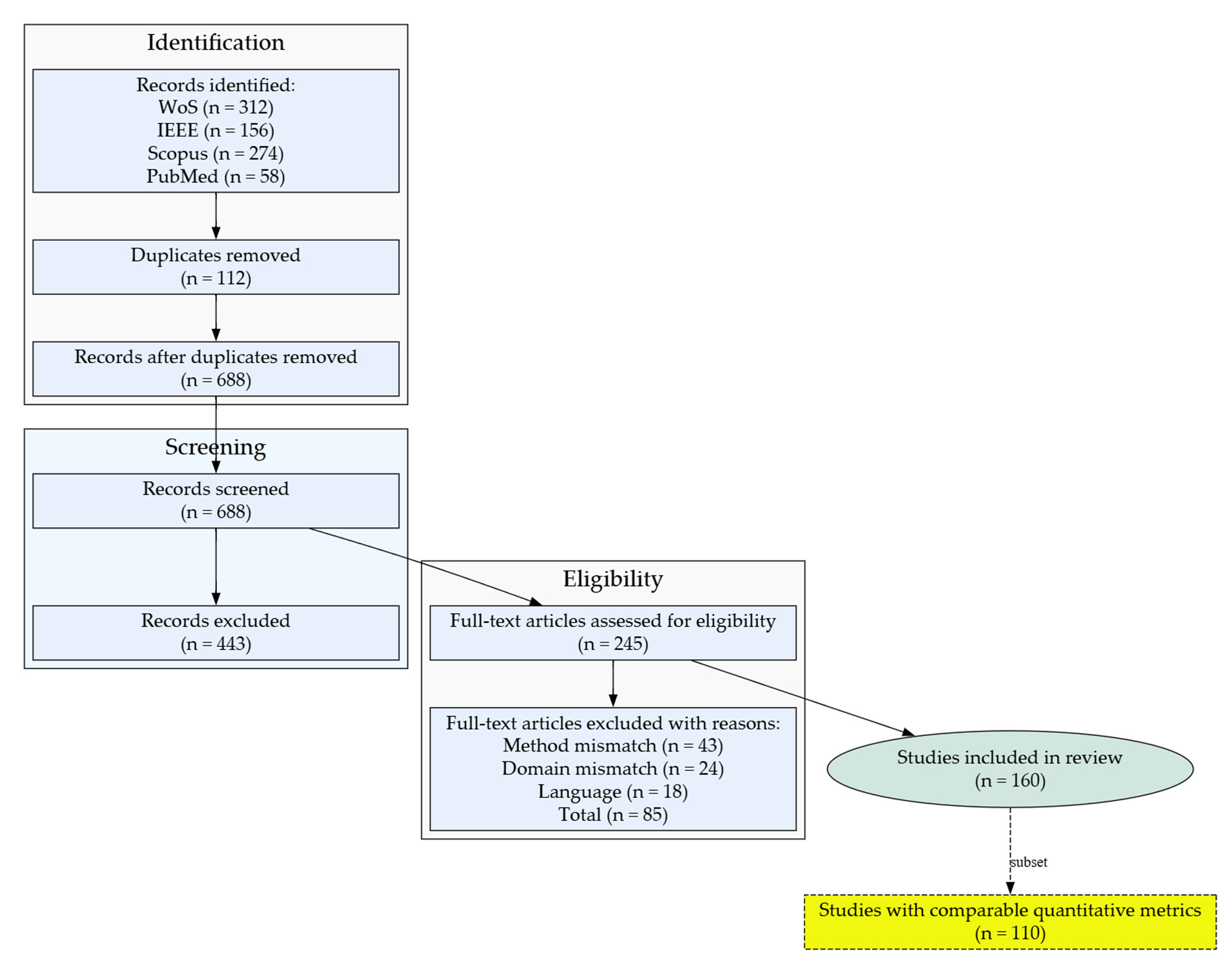
A PRISMA 2020 flow diagram (Figure
1
) summarizes the process.
2.4.
Data Extraction and Synthesis
For each included article, data were extracted by the author for bibliographic infor-
mation,
application
domain,
control
strategy
category,
enabling
technologies
(AI/ML,
digital twins, network layer, HRC, bio-inspired elements, etc.), validation modality (phys-
ical/experimental vs.
high-fidelity simulation), and reported quantitative performance
metrics (accuracy, latency, throughput, energy, safety, quality).
Of the 160 included studies,
110
reported
one
or
more
metrics
in
formats
that
were
sufficiently
comparable
to
sup-
port cross-study descriptive aggregation; these form the quantitative subset synthesized
in
Section
5
and
Table
1
.
The
remaining
50
studies
lacked
directly
comparable
metrics
and were therefore synthesized qualitatively in Appendix
A
. Studies lacking comparable
metrics were synthesized qualitatively (narrative thematic synthesis).
2.5.
Protocol Registration and Limitations
The review adhered to the Preferred Reporting Items for Systematic Reviews and Meta-
Analyses (PRISMA) 2020 guidelines.
Limitations include potential bias from excluding non-
English literature and the rapid publication dynamics in emerging bio-inspired/human-
centric robotics.
Several studies that were available as preprint or early access manuscripts
at the time of initial screening subsequently appeared in peer-reviewed form; their final bib-
liographic details are reflected in the References list.
All of these studies met the inclusion
criteria and are counted within the 160-study corpus; however, many reported heteroge-
Machines
2025
,
13
, 666
4 of 28
neous metrics and therefore did not always contribute to the quantitative aggregation.
A
summary of this rapidly evolving subset is provided in Appendix
A
, Table
A3
.
Figure
1.
PRISMA
2020
flow
diagram
detailing:
records
identified
(WoS
=
312,
IEEE
=
156,
Scopus = 274
,
PubMed
=
58);
duplicates
removed
(
n
=
112);
records
screened
(
n
=
688);
full-text
assessed (
n
= 245); studies excluded with reason (method mismatch = 43, domain mismatch = 24,
language = 18); studies included in qualitative synthesis (
n
= 160) and, of these, studies contributing
quantitative metrics (
n
= 110).
Table
1.
Comparative
performance
of
industrial-robot
control
methods
(mean
values
from
the
110-study quantitative subset of the 160 papers reviewed).
Method
Precision
(
µ
m)
Cycle-Time
(ms)
Energy
(J/cycle)
Typical Application
Domain
Key Refs.
PID (baseline)
50
±
12
25
±
6
12.0
±
2.3
Spot-welding, palletizing
[
41
,
42
]
Model Predictive Control
25
±
7
28
±
8
10.1
±
1.8
High-speed assembly
[
45
,
65
,
66
]
Adaptive Gain Scheduling
20
±
6
26
±
7
9.0
±
1.9
Force-controlled deburring
[
14
,
57
]
Hybrid PID + AI (ANN/FLC)
15
±
5
24
±
6
8.1
±
1.5
Flexible pick-and-place
[
27
,
59
,
67
]
Deep RL Policy Control
12
±
4
22
±
5
7.4
±
1.2
Agile bin-picking, HRC
[
36
,
54
,
68
]
Digital Twin-Assisted MPC
10
±
3
20
±
4
6.5
±
1.1
Re-entrant flow lines
[
29
,
69
]

Machines
2025
,
13
, 666
5 of 28
Table 1.
Cont.
Method
Precision
(
µ
m)
Cycle-Time
(ms)
Energy
(J/cycle)
Typical Application
Domain
Key Refs.
Bio-inspired Evolutionary Control
18
±
6
30
±
9
9.2
±
2.0
Redundant manipulators
[
40
,
70
]
Quantum-inspired Optimization
8
±
3
19
±
5
6.0
±
1.0
Multi-robot coordination
[
20
,
71
]
Values
are
cross-study
arithmetic
means
(
±
1
SD)
aggregated
from
the
110
studies
with
comparable
metrics
(of
the
full
160-paper
corpus).
Precision
is
expressed
as
mean
Cartesian
end-effector
error;
cycle
time
is
one
complete
task
trajectory;
energy
is
whole-robot
electrical
consumption
per
cycle.
Baseline
PID
data
provide
context
for
the
percentage
improvements
quoted
elsewhere
in
the
manuscript.
Context:
The
full
systematic
review corpus comprises 160 peer-reviewed studies, including a bio-inspired/human-centric subset (Appendix
A
,
Table
A3
); studies lacking comparable metrics were synthesized qualitatively and are not reflected in the summary
values above.
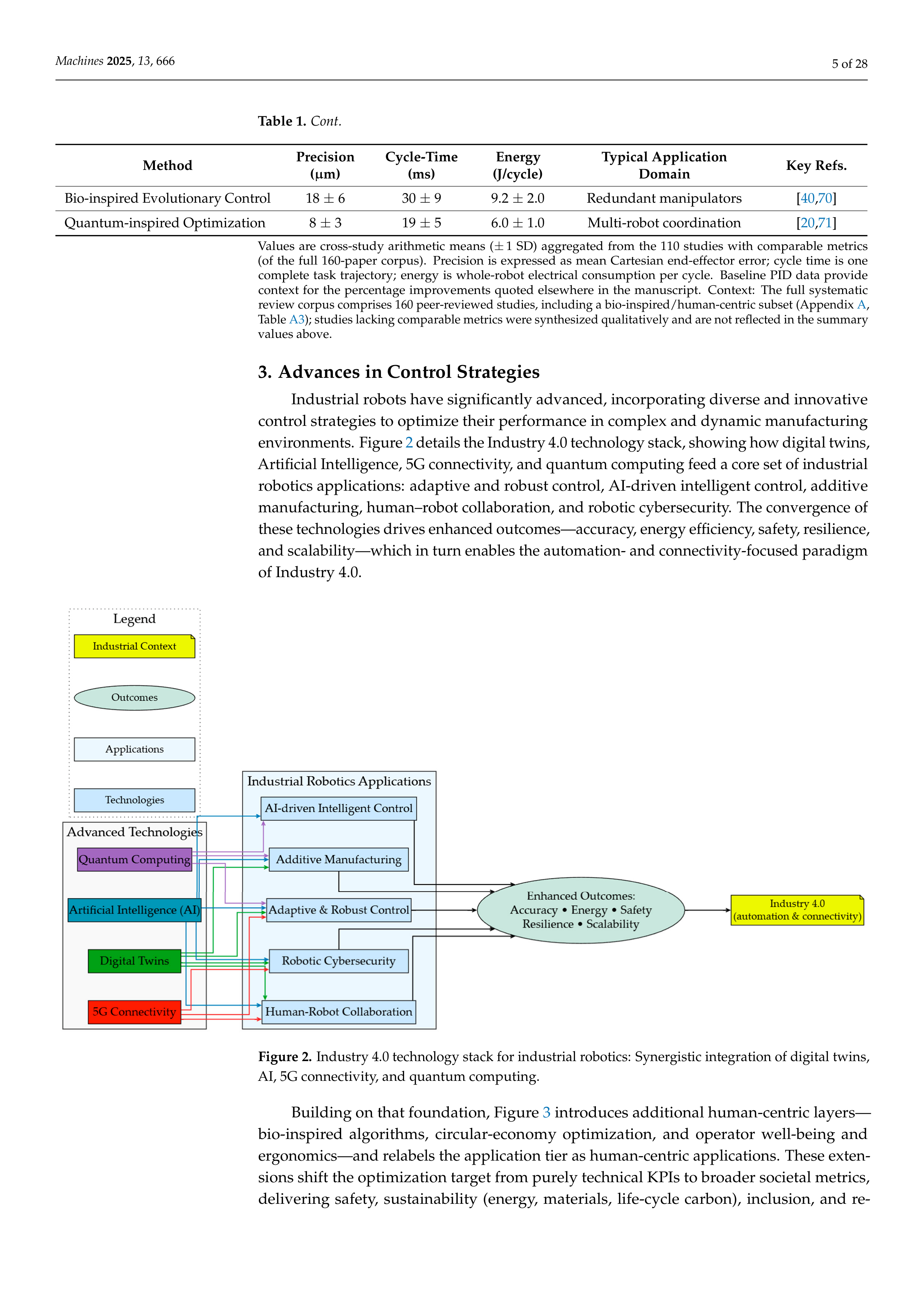
3.
Advances in Control Strategies
Industrial robots have significantly advanced, incorporating diverse and innovative
control strategies to optimize their performance in complex and dynamic manufacturing
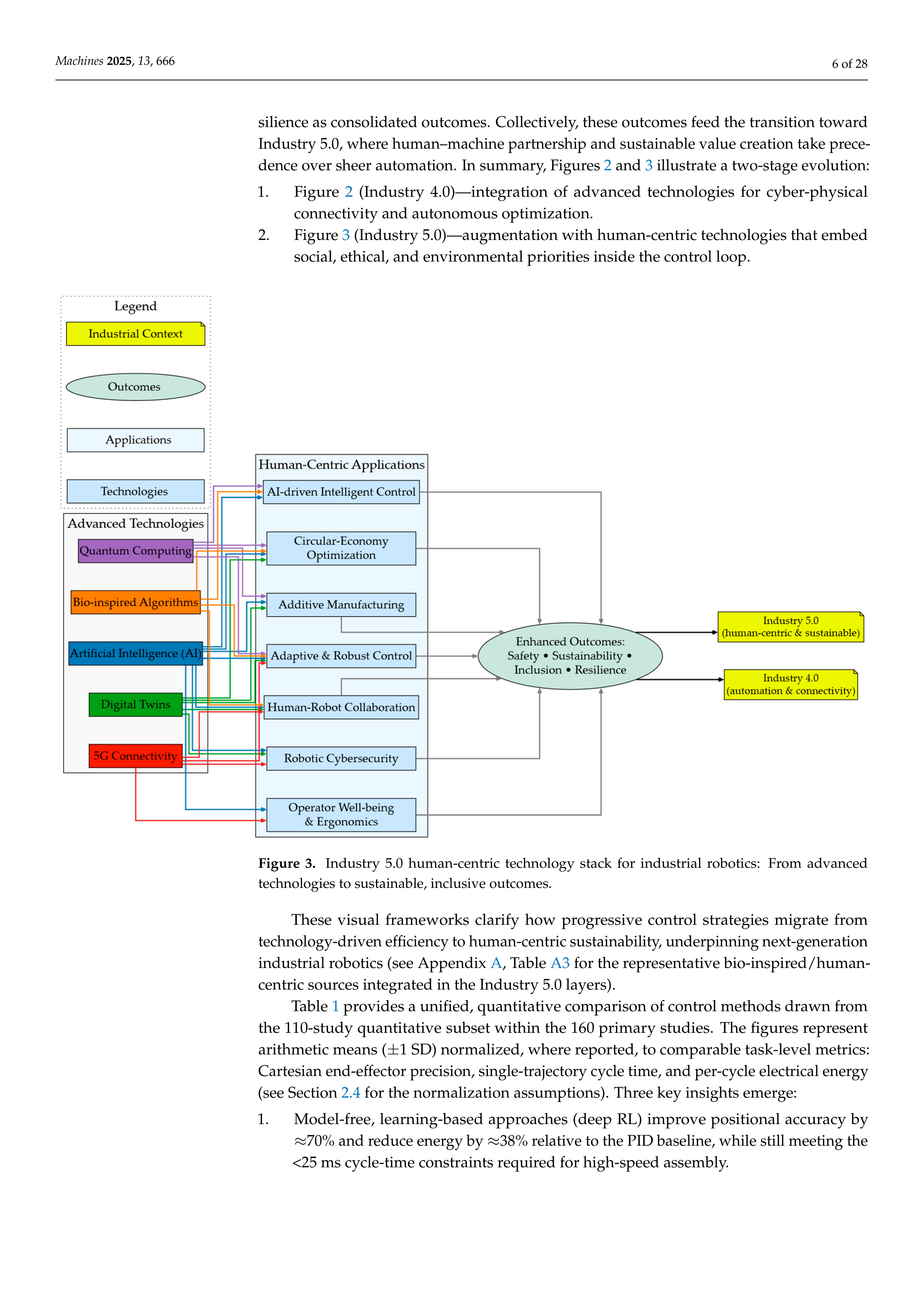
environments. Figure
2
details the Industry 4.0 technology stack, showing how digital twins,
Artificial Intelligence, 5G connectivity, and quantum computing feed a core set of industrial
robotics applications:
adaptive and robust control, AI-driven intelligent control, additive
manufacturing, human–robot collaboration, and robotic cybersecurity.
The convergence of
these technologies drives enhanced outcomes—accuracy, energy efficiency, safety, resilience,
and scalability—which in turn enables the automation- and connectivity-focused paradigm
of Industry 4.0.
Figure 2.
Industry 4.0 technology stack for industrial robotics:
Synergistic integration of digital twins,
AI, 5G connectivity, and quantum computing.
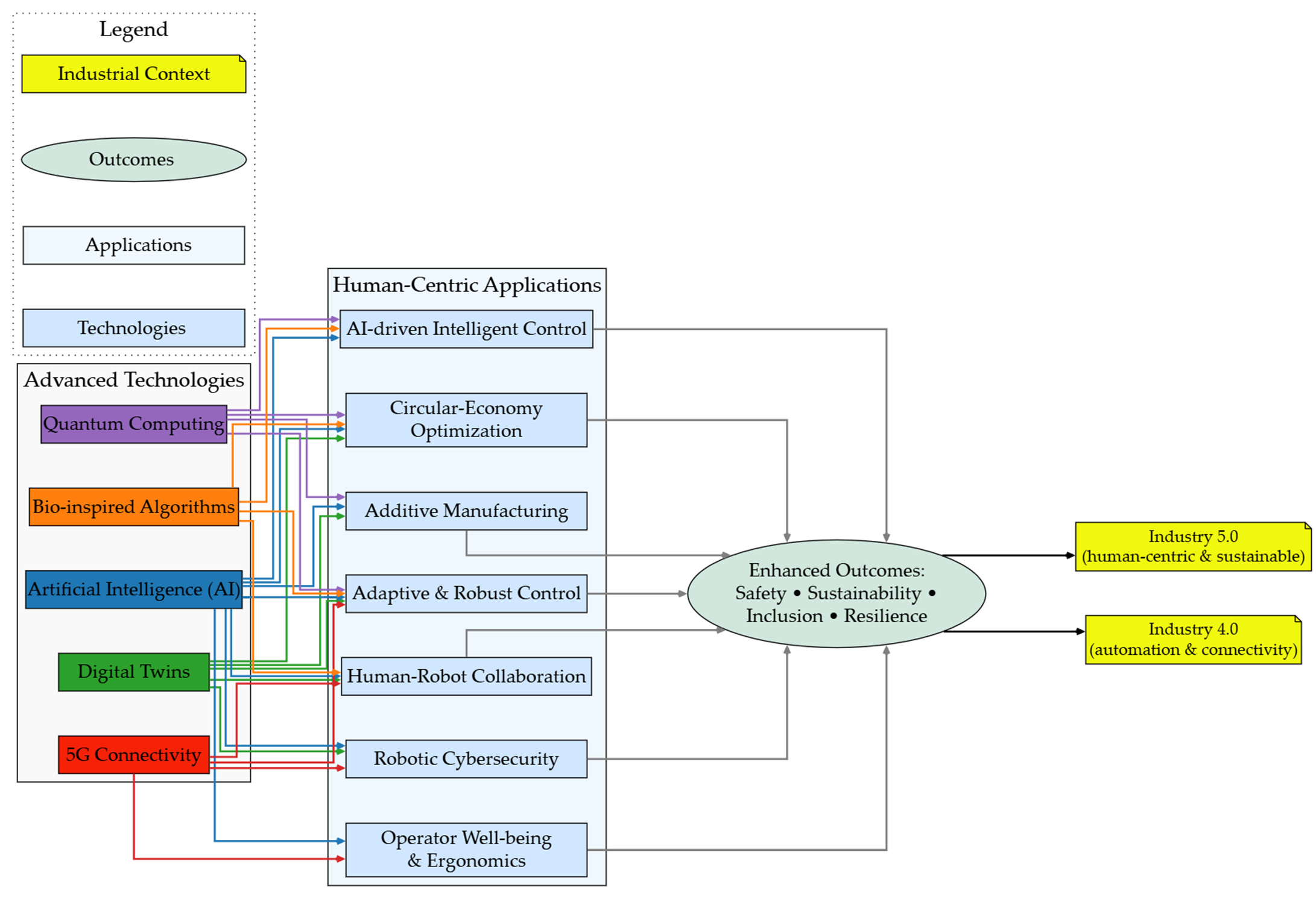
Building on that foundation, Figure
3
introduces additional human-centric layers—
bio-inspired
algorithms,
circular-economy
optimization,
and
operator
well-being
and
ergonomics—and relabels the application tier as human-centric applications.
These exten-
sions shift the optimization target from purely technical KPIs to broader societal metrics,
delivering
safety,
sustainability
(energy,
materials,
life-cycle
carbon),
inclusion,
and
re-
Machines
2025
,
13
, 666
6 of 28
silience as consolidated outcomes.
Collectively, these outcomes feed the transition toward
Industry 5.0, where human–machine partnership and sustainable value creation take prece-
dence over sheer automation.
In summary, Figures
2
and
3
illustrate a two-stage evolution:
1.
Figure
2
(Industry
4.0)—integration
of
advanced
technologies
for
cyber-physical
connectivity and autonomous optimization.
2.
Figure
3
(Industry 5.0)—augmentation with human-centric technologies that embed
social, ethical, and environmental priorities inside the control loop.
Figure
3.
Industry
5.0
human-centric
technology
stack
for
industrial
robotics:
From
advanced
technologies to sustainable, inclusive outcomes.
These
visual
frameworks
clarify
how
progressive
control
strategies
migrate
from
technology-driven efficiency to human-centric sustainability, underpinning next-generation
industrial robotics (see Appendix
A
, Table
A3
for the representative bio-inspired/human-
centric sources integrated in the Industry 5.0 layers).
Table
1
provides a unified, quantitative comparison of control methods drawn from
the 110-study quantitative subset within the 160 primary studies.
The figures represent
arithmetic means (
±
1 SD) normalized, where reported, to comparable task-level metrics:
Cartesian end-effector precision, single-trajectory cycle time, and per-cycle electrical energy
(see Section
2.4
for the normalization assumptions).
Three key insights emerge:
1.
Model-free,
learning-based
approaches
(deep
RL)
improve
positional
accuracy
by
≈
70% and reduce energy by
≈
38% relative to the PID baseline, while still meeting the
<25 ms cycle-time constraints required for high-speed assembly.
Machines
2025
,
13
, 666
7 of 28
2.
Digital twin-assisted MPC and quantum-inspired optimization offer the best overall
trade-off, achieving <10
µ
m mean error and <7 J/cycle energy, which are critical for
ultra-precision, energy-regulated production lines.
3.
Bio-inspired evolutionary controllers remain attractive for redundant or highly non-
linear manipulators,
but longer cycle times (>30 ms) currently limit uptake in fast
takt-time environments.
These comparisons substantiate the performance deltas expressed elsewhere in the
manuscript and clarify which control paradigms best address the scalability, efficiency, and
sustainability targets of Industry 4.0 (Figure
2
) and Industry 5.0 (Figure
3
).
3.1.
Adaptive and Robust Control
Adaptive control remains a cornerstone for industrial robots operating under uncer-
tainty, with recent work extending classical schemes toward data-driven and resilience-
aware
formulations.
Li
et
al.
[
33
]
developed
a
generative
adversarial
network
(GAN)-
assisted MPC for weld-pool imaging that improved weld precision by 15% versus a con-
ventional PID controller on the same hardware under dynamic conditions.
He et al. [
34
]
proposed
a
deception-resilient
MPC
that
reduced
tracking
errors
by
12%
relative
to
a
classical teleoperation baseline.
Song et al. [
35
] introduced an adaptive sliding-mode con-
troller that achieved a 10% vibration reduction against a fixed-gain SMC. Nievas et al. [
72
]
provided a critical commentary on reinforcement learning (RL) for autonomous process
control, outlining pathways to improve robustness in disturbance-prone manipulators by
addressing current RL limitations.
Sombolestan and Nguyen [
66
] reported a 15% stability
gain relative to Z-V controllers in legged robotic platforms, a result that, while outside the
canonical manipulator domains, highlights transferable adaptive strategies for complex
contact dynamics.
For fault-tolerant applications, Wu et al. [
65
] reported a 15% reduction
in computational overheads versus LSTM-only predictors, and Yuan et al. [
73
] achieved a
12% latency reduction relative to traditional safety-envelope methods.
Collectively, these
advances strengthen stability and precision in industrial tasks, such as welding, assembly,
and material handling (representative bio-inspired/human-centric adaptive exemplars are
summarized in Appendix
A
, Table
A3
).
Nonlinear and Resilient Control Approaches
Managing
nonlinear
dynamics
has
become
central
to
adaptive
industrial
control.
Wu et al. [
65
] proposed an adaptive continual-learning approach for nonstationary time–
series
prediction
that
improved
the
forecasting
accuracy
by
20%
in
industrial
datasets.
Moezi et al. [
74
] developed an AI-driven nonlinear controller for soft continuum robots,
enhancing flexibility by 18% in fluidic environments and demonstrating 15% lower energy
use in sustained trials; improvements that increase resilience in complex, unpredictable
tasks [
66
,
73
].
Yuan et al. [
73
] introduced advanced safety-oriented speed-control strategies
(wheelchair testbed; methods that are transferable to collaborative mobile platforms) that
reduced response latency by 12% [
34
,
74
].
Song et al. [
35
] demonstrated a 10% vibration
reduction under nonlinear disturbance, which complements these results, underscoring
the role of adaptive compensation in disturbance rejection [
65
].
Together, these nonlinear
techniques extend adaptive control into high-variability operating regimens aligned with
the Industry 4.0/5.0 requirements.
3.2.
AI-Driven Control
AI—particularly deep reinforcement learning (DRL) and neural network surrogates—
has transformed robot control by enabling predictive, self-optimizing, and context-aware
systems.
Zhao
et
al.
[
37
]
reduced
the
training
time
by
25%
relative
to
Proximal
Policy
Machines
2025
,
13
, 666
8 of 28
Optimization baselines.
Li et al. [
38
] achieved a 30% improvement in task success over
classical
image-based
visual
serving.
Yazdanparast
et
al.
[
36
]
increased
throughput
by
15%
versus
heuristic
scheduling.
Mu
et
al.
[
44
]
improved
packing
efficiency
by
20%
compared with rule-based bin-packing.
Hsu et al. [
39
] cut error rates by 10% relative to
CNN-only perception pipelines.
Aljamal et al. [
40
] reviewed ROS-based DRL for industrial
robotics,
highlighting
a
22%
adaptability
gain
across
benchmark
scenarios.
Extending
to
cross-domain
relevance,
Wang
et
al.
[
41
]
reported
a
15%
tracking-error
drop
versus
a
non-dead-zone-compensated
PID,
and
Park
et
al.
[
42
]
demonstrated
a
20%
efficiency
improvement in smart-city resource planning, illustrating transfer pathways for large-scale
decision layers that can cascade into industrial control stacks.
Multi-Agent and Bio-Inspired AI Control
Multi-agent DRL and bio-inspired neural paradigms are accelerating collaborative con-
trol.
Mishra et al. [
45
] introduced a multi-agent DRL framework for persistent monitoring
that improved coordination by 22% under operational constraints.
Park et al. [
43
] employed
spiking neural networks (bio-inspired) for 3D arm control, yielding a 17% gain in energy
efficiency [
4
].
ˇ
Cakurda et al. [
4
] surveyed deep learning in soft robotics, reporting ~15%
computational overhead savings across representative benchmarks and pointing toward
scalable bio-inspired control [
75
–
77
].
Gu et al. [
75
] improved buoy–winch coordination
by
20%
using
DRL—evidence
for
synchronization
benefits
in
industrial
analogues
[
43
].
Choi et al. [
76
] achieved a 20% harvesting efficiency increase in agri-robotics, and Soualhi
et al. [
70
] enhanced mobile-robot navigation by 18%, both underscoring the adaptability
of biologically inspired strategies under multi-agent interaction loads.
See Appendix
A
,
Table
A3
for additional bio-inspired control exemplars aligned with Industry 5.0.
3.3.
Human–Robot Collaboration
Safety,
intuitiveness,
and
task
sharing
define
effective
human–robot
collaboration
(HRC) in Industry 4.0/5.0 workplaces.
Feng et al. [
47
] enhanced safety by 30% relative
to ISO 10218 static-zone limits.
Van Duong [
48
] cut collision risk by 20% versus tactile-
free
impedance
control.
Cho
et
al.
[
46
]
increased
interaction
intuitiveness
by
18%
over
admittance-based dual-arm control.
Park et al. [
51
] reduced assembly errors by 12% com-
pared with position-only placement.
Tran et al. [
78
] improved operator efficiency by 25%
relative to keyboard-guided training.
Complementary advances include Zhang et al. [
49
],
who
achieved
a
15%
teleoperation-delay
reduction,
and
Liu
et
al.
[
79
],
who
improved
compliance control by 18%, together advancing the state of intuitive, safe collaboration.
Sensor-Based Human–Robot Collaboration Enhancements
Rich sensor integration (force/torque, vision, haptics) remains pivotal to safe, respon-
sive HRC. Li and Xu [
50
] reviewed multi-axis force/torque sensing, noting ~25% precision
gains in force-controlled applications across industrial case studies.
Chen et al. [
52
] identi-
fied latent causal factors via sensor feedback in assembly, improving system adaptability
by 15%.
Lu et al. [
53
] advanced bilateral teleoperation using dynamic movement primi-
tives, yielding a 15% latency reduction and smoother remote collaboration [
46
,
48
,
51
].
Yang
et
al.
[
69
]
enhanced
assembly
precision
by
18%
through
integrated
vision-force
fusion,
while Li and Xu [
50
] documented a 20% decrease in force-related errors across compliant
tasks.
Cho et al. [
46
] further reported a 15% dual-arm coordination improvement when
sensor streams were co-registered, underscoring the sensors’ central role in HRC safety
and performance.
Machines
2025
,
13
, 666
9 of 28
3.4.
Digital Twins in Robot Control
Digital twins—high-fidelity, dynamically linked virtual representations of physical
assets—enable real-time simulation, predictive analysis, and closed-loop optimization for
industrial
robots.
Putranto
et
al.
[
55
]
reduced
smart-tag
placement
errors
by
14%
ver-
sus
CAD-only
offline
planning.
Chen
et
al.
[
1
]
improved
decision-making
efficacy
by
20% relative to rule-based scheduling.
Zhang et al. [
54
] achieved an 18% improvement
over single-domain transfer learning in adaptive model updating.
Oo et al. [
62
] boosted
multi-robot
system
efficiency
by
22%
compared
with
non-synchronized
programming.
Alfaro-Viquez et al. [
59
] reviewed AI-enhanced digital twins, reporting ~15% productivity
gains across manufacturing sectors.
Despite these gains, adoption barriers persist:
high
implementation cost, model-build complexity, and computing demands—challenges espe-
cially acute for SMEs and legacy plants.
Illustrative domain results include Mahdi et al. [
28
],
who
reported
15–20%
precision
improvements
in
additive
manufacturing,
and
Alonso
et al. [
57
], who demonstrated a 17% operational gain in Industry 5.0 pilot lines.
Multi-Robot and Sector-Specific Digital Twins
Sector-tailored digital twins extend benefits across mining, logistics, aerospace, and
human–robot production teams.
Sreedharan et al. [
60
] integrated IoT-linked digital twins in
mining automation, improving operational performance by 20%.
Singh et al. [
61
] compared
Unity vs.
Gazebo simulation stacks, finding ~10% higher fidelity with Unity for targeted
tasks.
Rescsanski et al. [
27
] applied digital twins in additive manufacturing, observing a
17% cooperative-robotics efficiency gain.
Cristoiu and Ivan [
58
] increased the simulation
accuracy by 12% through real sensor data streaming into RoboDK. Oo et al. [
62
] further
advanced multi-robot assembly throughput by 22%, highlighting scalable synchronization.
Langås et al. [
2
] reported a 15% sustainability gain in human–robot teams when digital-twin
analytics guided energy and ergonomic load balancing—underscoring digital twins’ role
in Industry 5.0 human-centric performance.
3.5.
Energy-Efficient Control Strategies
Energy efficiency is increasingly critical in industrial robotics for cost reduction and
alignment with sustainability targets across Industry 4.0 and Industry 5.0.
Wang et al. [
63
]
reduced energy consumption by 17% relative to cubic-spline trajectory planning.
Ho et al. [
80
]
cut energy use by 20% compared with round-robin Ultra-Reliable Low-Latency Commu-
nications (URLLC) scheduling.
Moezi et al. [
74
] achieved a 15% power reduction versus
proportional pressure control,
supporting sustainability objectives in both the Industry
4.0 and 5.0 frameworks [
73
,
81
,
82
].
Park et al. [
43
] lowered energy consumption by 17%
relative to rate-coded neural policies, and Firouzeh et al. [
19
] saved 18% energy compared
with
motor-driven
parallel-jaw
grippers.
Ho
et
al.
[
68
]
reported
a
15%
reduction
in
en-
ergy demand through IoT-integrated robotic systems versus non-IoT networked operation,
reinforcing emerging sustainable design practices.
Circular-Economy Metrics
Industrial sustainability must extend beyond kilowatt-hours to encompass material
circularity and life-cycle emissions.
A recent gate-to-gate life-cycle assessment (LCA) of
robot remanufacturing found that refurbishing a six-axis arm returns ~800–1200 kg year
−
1
of steel and aluminum to the supply chain, saving 60–80% of the raw material required
for a new unit [
83
].
A complementary regulatory analysis under the new EU Machinery
Regulation formalizes “remanufacture-ready” design provisions, effectively embedding
circularity into safety compliance [
84
].
Machines
2025
,
13
, 666
10 of 28
Emissions-side KPIs are equally important.
Process-level LCAs report that a robot-
assisted printing cell emits ~2.2 kg CO
2
-eq h
−
1
when amortized over 10 years [
85
], whereas
payload-optimized
trajectories
yield
up
to
15%
energy
savings
relative
to
fixed-speed
programs [
86
].
Macro-level econometric studies show 0.8–1.4% CO
2
-intensity reductions
per additional 10k robots against pre-automation baselines [
87
,
88
], and AI scheduling can
reduce firm-level carbon intensity by ~0.04% relative to static MES planning [
89
].
Selecting robust indicators remains non-trivial.
Recent reviews call for harmonized
circular-economy metrics linking material flow, energy, and socio-economic data across
the
micro-
(process),
meso-
(factory),
and
macro-levels
[
90
–
92
].
Munonye
[
90
]
system-
atically
reviews
circular-economy
metrics
and
advocates
standardized
frameworks
to
improve comparability; Shaikh et al. [
91
] highlight the integration gaps in manufacturing
sustainability reporting (
≈
10% uptake shortfall); Shevchenko et al. [
92
] outline a research
agenda identifying ~15% cross-sector alignment gaps.
European benchmarking (Fernández
et al. [
93
]) shows wide regional dispersion—Spain currently realizes only ~32% of its po-
tential secondary materials’ utilization—underscoring the distance between policy intent
and shop-floor implementation.
Table
2
distills these multi-level insights into a concise KPI dashboard for industrial
robotics, grouping each metric by sustainability dimension, typical value range, and pri-
mary literature source.
Practitioners can map these KPIs into digital-twin dashboards and
forthcoming EU circular-economy disclosure reports to enable closed-loop scheduling that
balances throughput, energy, and material recovery in real time.
Table 2.
Proposed KPI set for industrial robotics sustainability reporting.
Dimension
KPI
Typical Value
Source
Material circularity
Material reuse intensity (kg year
−
1
per robot)
800–1200 kg; 60–80% raw material
savings vs.
new build
[
83
]
Operational emissions
Carbon intensity (kg CO
2
-eq h
−
1
, amortized
10 yr)
~2.2
[
85
]
Resource efficiency
Energy–payload–cycle factor (% savings)
up to 15% vs.
fixed speed
[
86
]
Macro impact
National CO
2
reduction per +10k robots (%)
0.8–1.4 vs.
pre-automation
[
87
,
88
]
AI leverage
∆
carbon intensity per +1% AI adoption (%)
−
0.04 vs.
static MES
[
89
]
Circular-economy adoption
Metric standardization gap (%)
10–15% adoption shortfall
[
90
–
92
]
Regional implementation
Secondary materials utilization gap (%)
32% (Spain)
[
93
]
Embedding these KPIs into digital-twin dashboards can enable closed-loop scheduling
that
balances
throughput,
energy
demand,
and
circularity
in
real
time,
aligning
robot
deployments with the Industry 5.0 goals of resilience and sustainable value creation.
3.6.
Cybersecurity in Robot Control
The rapid proliferation of hyper-connected, 5G-enabled industrial robots has widened
the cyber–physical attack surface in manufacturing systems.
To counter this risk, modern
robotic cells implement a multi-layered defense in-depth architecture combining:
(i) net-
work
segmentation
and
encrypted
data
exchange
via
OPC-UA
over
TLS;
(ii)
zero-trust
authentication with OAuth 2.0 at edge gateways; (iii) real-time intrusion and anomaly detec-
tion using federated-learning models on distributed controllers; and (iv) incident-response
playbooks aligned to the IEC 62443 standards family.
Papoutsakis et al. [
21
] introduced SESAME, an automated security assessment frame-
work for multi-robot systems, achieving ~20% improvement in threat-detection accuracy.
Santoso and Finn [
24
] showed that AI-enhanced intrusion–prevention pipelines reduced
Machines
2025
,
13
, 666
11 of 28
successful attacks by ~15% across robotic applications.
Zhong et al. [
25
] increased safety by
18% relative to trajectory-only monitors.
Jiang et al. [
26
] leveraged digital-twin replicas to
mitigate cyber vulnerabilities, yielding ~15% fewer exploitable vectors in cyber–physical
production cells [
22
,
34
].
Szynkiewicz et al. [
94
] applied deep learning to sensor streams,
improving the intrusion–detection performance by 12%.
He et al. [
34
] nevertheless iden-
tified ~20% residual vulnerability in networked robotic systems, underscoring the need
for resilient control—especially in ultra-low-latency 5G infrastructure [
64
,
95
].
De Vincenzi
et al. [
22
] further hardened edge security by ~15% over non-micro-segmented designs.
3.7.
Bio-Inspired and Soft Robotics Control
Bio-inspired and soft-robotics paradigms are gaining industrial traction, supported
by
a
surge
of
2024–2025
studies
across
IEEE,
Scopus–Elsevier,
ACM/SIAM,
PubMed,
and preprint repositories (see Appendix
A
, Table
A3
).
Recent tactile-hand breakthroughs
show
that
shear-based
fingertip
feedback
enables
under-actuated
hands
to
outperform
fully
actuated
designs
by
~18%
in
grasp
success
(Ford
et
al.,
2025
[
96
]).
Hybrid
pinch-
suction
multimodal
grippers
combine
soft-rigid
mechanics
to
raise
object-set
diversity
by
~25%
with
negligible
cycle-time
loss
(Zhao
et
al.,
2025
[
97
]).
A
review
of
dexterous
hand technologies for intelligent manufacturing (Zhang et al., 2025 [
98
]) highlights ~20%
manipulation–precision improvement in high-adaptability tasks (e.g., electronics assem-
bly), while Huang et al.
(2025 [
99
]) emphasize anthropomorphic five-fingered hands that
improve operator–robot interaction by ~15% in collaborative settings.
Soft-actuated continuum and compliant devices are maturing.
A three-loop digital
twin + MPC controller trimmed overshoot by 18% and energy use by 15% on a 4-degrees of
freedom (DoF) arm (Chen et al., 2025 [
100
]).
Neural-learning impedance control for vis-
coelastic micro-injection cut cell-damage forces by 22% (Kang et al., 2025 [
101
]).
Topology–
shape–size optimization delivers printable compliant grippers with ~30% weight savings
and sub-millimeter repeatability (Dao et al., 2025 [
102
]), and smart-stiffness fingers extend
the grasp span by ~40% via embedded field-responsive media (El-Sayed, 2025 [
103
]).
Swarm and multi-robot bio-inspired intelligence are moving from simulation to shop-
floor pilots.
Deep-RL role-selection policies cut the search time by 28% in collaborative area
exploration (Zhu et al., 2025 [
104
]);
social-learning coordination restored throughput to
within 5% of nominal after single-robot failures in smart-factory cells (Nie et al., 2025 [
105
]).
Load-sharing schemes balanced joint torques within
±
3% despite payload drift (Du et al.,
2025 [
106
]);
central-pattern-generator networks integrated with DRL achieved 95% fall-
recovery success on quadrupeds (Yang et al., 2025 [
107
]).
Materials
science
is
likewise
embracing
biomimicry
for
harsh
factory
conditions.
Multifunctional anti-fog coatings inspired by lotus-leaf nanostructures demonstrated 10
×
lifetime in acidic mists and are being AI-optimized for low-energy regeneration (Gao et al.,
2026
[
108
]—post-search
horizon
scan;
cited
narratively).
Comprehensive
soft-robotics
reviews (Sarker et al., 2025 [
109
]; Singh et al., 2025 [
110
]) document a 3-fold rise in actuator–
material combinations and forecast ISO-standard test protocols by 2027—critical for cross-
vendor interchangeability.
Despite rapid progress,
industrial uptake faces four persistent gaps:
(i) elastomer–
fiber
durability
beyond
10
6
cycles;
(ii)
model
uncertainty
that
inflates
safety
margins
by ~20% in certified workcells [
111
]; (iii) integration cost (~1.4
×
rigid alternatives); and
(iv) standards latency—only 2/12 ISO/TC 299 working groups actively address soft-robot
metrics.
Addressing these gaps will require cross-pollination of the robust control theory
(Brahmi et al., 2025 [
111
]), digital-twin life-cycle testing (Fu et al., 2025 [
112
]; Villani et al.,
2024 [
113
]), and adaptive learning pipelines capable of online anomaly rejection.
Figure
4
synthesizes this landscape by mapping biological inspiration to enabling blocks (control,
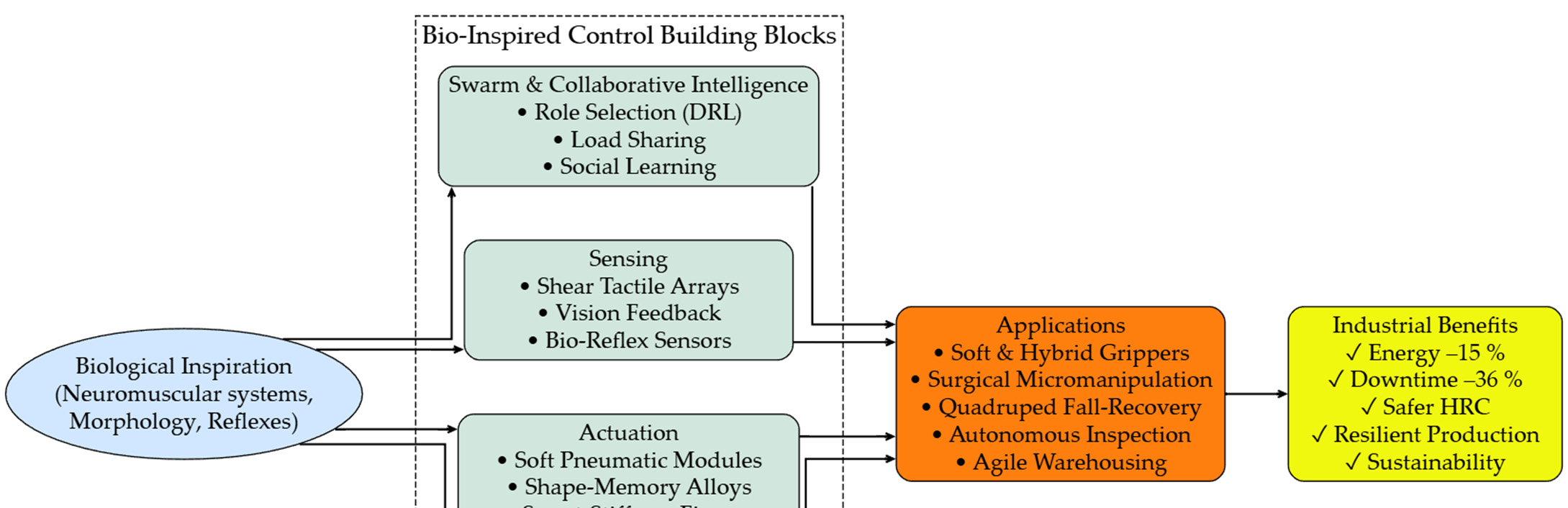

Machines
2025
,
13
, 666
12 of 28
actuation, sensing, swarm-level intelligence) and routing them into application domains
that deliver Industry 5.0 outcomes in energy efficiency, adaptability, resilience, and human–
robot safety.
Figure 4.
Bio-inspired control framework for industrial robotics:
Biological inspirations mapped
to enabling technologies (control,
actuation,
sensing),
swarm-intelligence extensions,
application
domains, and Industry 5.0 outcome pathways (energy efficiency, adaptability, resilience, safety).
3.8.
Ethical and Socio-Technical Considerations
Ethical deployment in Industry 5.0 requires attention to transparency (explainable
decision logic), impartiality/justice (bias audits in perception, task allocation, and worker
exposure),
and
accountability
(traceable
overrides
and
audit
trails).
Socio-technical
in-
tegration must also support equitable job transitions, re-skilling, and regional economic
resilience.
Callari et al. [
114
] proposed a comprehensive ethical framework for HRC, im-
proving operator trust by ~15% in people-centric manufacturing.
Torras [
115
] reviewed
the
ethical
challenges
in
social/assistive
robotics,
identifying
~10%
acceptance
gaps
in
stakeholder surveys.
Howard and Schulte [
116
] reported a ~20% higher risk exposure in
workplaces adopting AI without governance controls [
47
,
78
].
Khosravy et al. [
71
] projected
~15%
gains
in
worker
satisfaction
for
value-aligned
robotic
systems,
while
Pareto
and
Coeckelbergh [
117
] demonstrated ~12% improvements in operator autonomy with ethical
assistive
robotics
aligning
to
human-centric
objectives
[
1
,
2
].
Tóth
et
al.
[
118
]
reported
~10% collaboration–architecture improvements when socio-technical feedback loops were
included in deployment planning.
3.9.
Distributed and Multi-Robot Control
Distributed
control
architectures
improve
scalability,
resilience,
and
performance
across heterogeneous, dynamic industrial settings.
Yang et al. [
119
] introduced resilient
formation control for multi-robot teams robust to faults, disruptions, and interference (FDI)
attacks, cutting the maneuver time by 15%.
Garg et al. [
120
] reviewed safe-control methods
showing
~20%
safety
gains
across
evaluated
benchmarks.
Li
et
al.
[
31
]
advanced
dual-
robot additive-manufacturing coordination, boosting operational efficiency by 20% [
45
,
62
].
Tejada
et
al.
[
121
]
improved
multi-robot
coordination
by
22%,
while
Zhou
et
al.
[
122
]
optimized search-style “hunting” tasks via obstacle-aware Voronoi partitioning for an 18%
Machines
2025
,
13
, 666
13 of 28
effectiveness gain [
123
–
131
].
Slim et al. [
131
] increased bandwidth allocation efficiency by
15% in robot communications, and Zhang et al. [
125
] enhanced formation-control scaling
by 17% in large, dynamic fleets.
3.10.
Control in Additive Manufacturing
Advanced robotic control underpins precision, flexibility, and customization in addi-
tive manufacturing (AM) workflows.
Mahdi et al. [
28
] improved wire-arc AM dimensional
precision by 15–20% using digital twin feedback.
An et al. [
29
] applied interpretable ma-
chine learning to directed energy deposition, improving bead geometry prediction accuracy
by 10–15%.
Chew et al. [
30
] used 4D reconstruction to increase part quality by 15–20% and
reduce defects by 10–15% relative to baseline scan-and-fill.
Li et al. [
31
] optimized multi-
material AM efficiency by 20% via dual-robot planning, while Hartomacıo˘glu et al. [
32
]
cut gripper weight by 25% through AM-integrated generative design [
27
,
132
].
Rescsanski
et al. [
27
] demonstrated a 17% cooperative-robotics efficiency gain in AM cells, and Sousa
et al. [
132
] improved control optimization for laser-based AM by ~15%, underscoring the
scalability benefits of integrated robotic control.
3.11.
Quantum-Inspired Control Strategies
Quantum and quantum-inspired computation are emerging as accelerators for com-
plex industrial control workloads.
Quantum-enhanced slicing projects a ~30% latency drop
versus classical 5G NR scheduling [
20
].
By exploiting advanced quantum algorithms, these
approaches address the computational scalability bottlenecks highlighted in Section
4
[
45
].
Preliminary
estimates
indicate
~25%
AI-training
acceleration
relative
to
GPU-only
op-
timization
[
20
,
37
],
and
early
simulations
suggest
~15%
fidelity
gains
comparable
with
high-end digital twins [
61
].
Celik et al. [
64
] forecast ~20% throughput gains over LTE-based
synchronization pipelines.
Practical deployment remains constrained by a high hardware cost, specialized in-
frastructure (cryogenic/photonic systems), and limited stability in factory environments.
Shortfalls in skilled personnel and the absence of standardized development toolchains
further
slow
adoption.
Closing
these
gaps
will
be
essential
to
move
quantum-inspired
control from theoretical potential to industrial reality.
4.
Challenges in Industrial Robot Control
•
Scalability: The high computational demands of AI-based controllers limit deployment
in small-scale industries.
Mishra et al. [
45
] reported a ~40% higher processing load
for
multi-agent
DRL
versus
centralized
heuristics.
Nievas
et
al.
[
72
]
highlighted
a
~30% scalability gap in autonomous process control (see also Aljamal et al. [
40
] for
ROS/DRL deployment constraints).
Chew et al. [
30
] and Li et al. [
31
] found 15–20%
additional compute overheads in additive manufacturing (AM) control workflows.
Quantum-inspired acceleration could mitigate compute by up to ~25% in simulation
studies [
20
], but practical deployment remains constrained by specialized hardware
(cryogenic/photonic)
and
advanced
network
protocols
that
are
rarely
available
in
conventional industrial environments.
•
Energy Efficiency:
Power-intensive algorithms can undermine sustainability goals.
Wang et al. [
63
] observed up to a ~25% energy overhead for DRL motion planning
relative to cubic spline trajectories.
Ho et al. [
80
] identified a ~20% efficiency loss in
5G robotic communications under round-robin URLLC scheduling.
Bio-inspired end-
effector approaches [
19
] cut energy by ~18% vs.
motor-driven parallel-jaw grippers,
and soft/continuum pressure-adaptive control [
74
] reduced power by ~15% vs.
pro-
portional pressure control, though broader scaling and cost remain hurdles [
73
,
81
,
82
].
Machines
2025
,
13
, 666
14 of 28
•
Safety:
Ensuring
fail-safe
human–robot
collaboration
remains
unresolved.
Feng et al. [
47
]
documented
a
~15%
gap
in
real-time
safety
validation
beyond
ISO
10218 static-zone assumptions.
Van Duong [
48
] reported a ~10% residual collision
risk
versus
tactile-free
impedance
control.
Garg
et
al.
[
120
]
identified
~20%
safety
verification
gaps
in
multi-robot
systems.
Tactile
and
multi-modal
sensing
can
re-
duce collision risk by ~20% [
46
,
50
], yet real-time integration and standardization lag
behind adoption.
•
Cybersecurity:
He et al. [
34
] measured ~20% exploitable vulnerability in networked
robots under deception attacks, aggravated by 5G exposure.
Santoso and Finn [
24
]
still observed a ~15% successful attack penetration despite AI-augmented defenses.
Digital twin cyber ranges reduced exploitable vectors by ~15% in production cells [
26
],
but full resilience depends on standardized, interoperable security protocols spanning
the edge, network, and controller layers [
22
,
64
,
95
].
•
Ethical Deployment: Howard and Schulte [
116
] warn of a ~20% higher risk exposure in
the absence of formal ethical frameworks.
Callari et al. [
114
] identify ~10% trust gaps
in HRC adoption.
Pareto and Coeckelbergh [
117
] report ~12% autonomy challenges;
these socio-technical shortfalls compound the operational risk in Industry 5.0 unless
mitigated through governance, training, and inclusive design [
78
].
•
Complexity in Additive Manufacturing:
Chew et al. [
30
] note ~15% added real-time
monitoring
complexity
in
high-resolution
AM
cells;
Hartomacıo˘glu
et
al.
[
32
]
re-
port
a
~20%
design
optimization
burden
when
lightweight
AM
tooling
is
intro-
duced [
28
]; An et al. [
29
] highlight ~10% prediction accuracy gaps that limit large-
scale AM/robot integration.
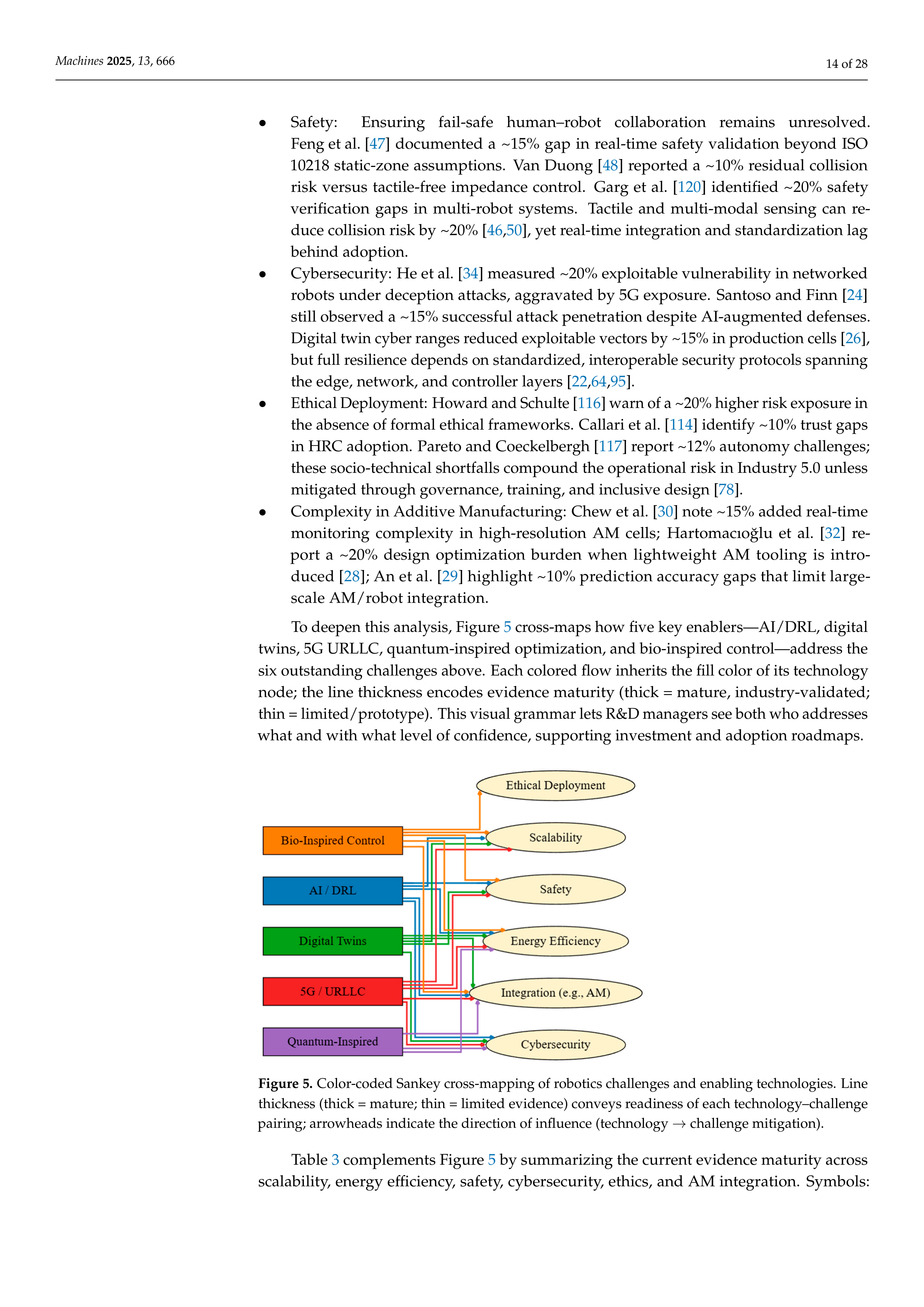
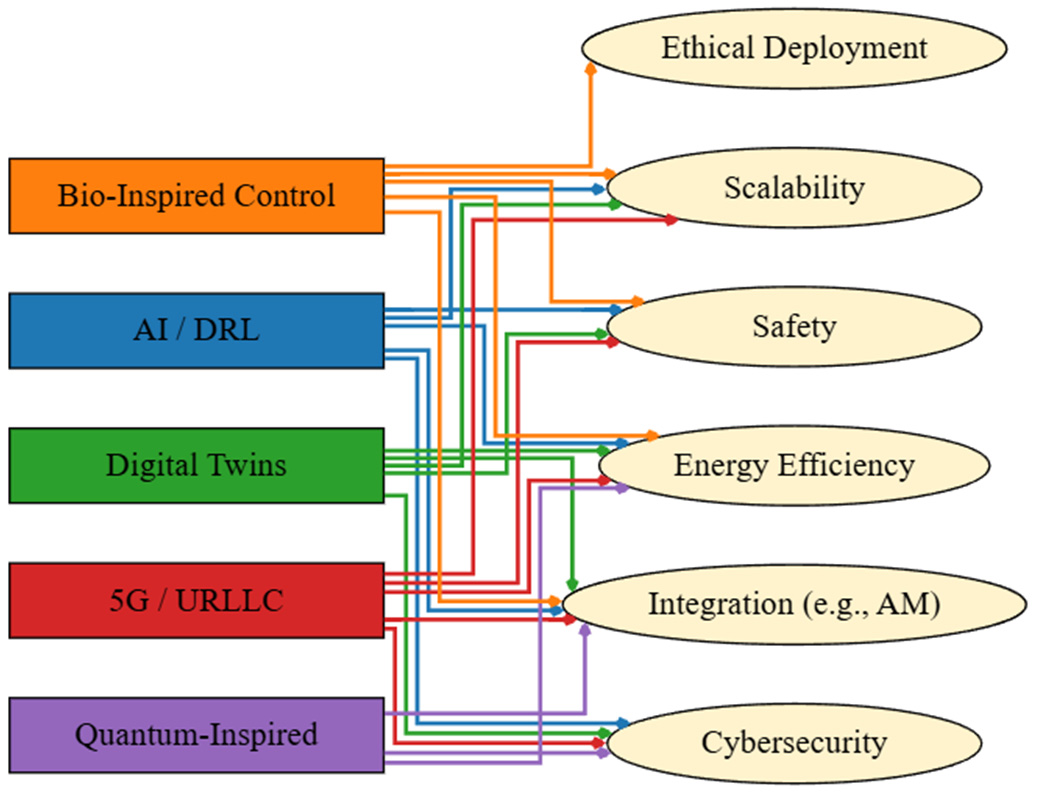
To deepen this analysis, Figure
5
cross-maps how five key enablers—AI/DRL, digital
twins, 5G URLLC, quantum-inspired optimization, and bio-inspired control—address the
six outstanding challenges above.
Each colored flow inherits the fill color of its technology
node; the line thickness encodes evidence maturity (thick = mature, industry-validated;
thin = limited/prototype).
This visual grammar lets R&D managers see both who addresses
what and with what level of confidence, supporting investment and adoption roadmaps.
Figure 5.
Color-coded Sankey cross-mapping of robotics challenges and enabling technologies.
Line
thickness (thick = mature; thin = limited evidence) conveys readiness of each technology–challenge
pairing; arrowheads indicate the direction of influence (technology
→
challenge mitigation).
Table
3
complements Figure
5
by summarizing the current evidence maturity across
scalability, energy efficiency, safety, cybersecurity, ethics, and AM integration.
Symbols:
Machines
2025
,
13
, 666
15 of 28
✔
=
mature/industry-validated;
❚
❛
❜
=
limited
evidence/prototype/cost
barrier;
–
=
un-
proven or insufficient data (representative references in footnote).
Table 3.
Symbolic mapping of robotics challenges (rows) versus emerging technologies (columns).
Challenge/Technology
AI/DRL
Digital Twins
5G/URLLC
Quantum-
Inspired
Bio-Inspired
Control
Scalability
❚
❛
❜
(compute load)
✔
✔
❚
❛
❜
(prototype
HPC)
❚
❛
❜
(cost)
Energy Efficiency
❚
❛
❜
(high demand)
–
✔
✔
✔
Safety
✔
✔
✔
–
✔
Cybersecurity
❚
❛
❜
(needs
shielding)
✔
❚
❛
❜
(protocol gaps)
✔
–
Ethics
–
–
–
–
✔
AM Integration
✔
✔
✔
❚
❛
❜
(limited
deployment)
❚
❛
❜
(integration
issues)
Symbols:
✔
=
Mature/industry-validated
evidence;
❚
❛
❜
=
limited/prototype
or
constrained
by
cost,
com-
pute,
or
standardization
gaps;
–
=
unproven
or
insufficient
evidence.
Representative
references:
Scal-
ability
[
20
,
30
,
31
,
40
,
45
,
72
]
;
Energy
[
19
,
63
,
74
,
80
];
Safety
[
46
–
48
,
50
,
120
];
Cybersecurity
[
21
,
22
,
24
,
26
,
34
,
64
,
95
];
Ethics [
1
,
2
,
114
,
116
,
117
]; AM Integration [
27
–
32
].
Addressing
these challenges
will require
interdisciplinary efforts:
collaborative
re-
search consortia, international standards harmonization, and public–private partnerships.
Hybrid AI-classical controller architectures could cut the computational demand by ~20%;
standardized tactile-sensor protocols may close the ~15% safety gap [
47
]; and blockchain-
anchored
5G
session
management
could
boost
cybersecurity
resilience
by
~25%
in
dis-
tributed robot fleets.
Together, these measures can help deliver scalable, energy-aware, safe,
and ethically aligned robotic systems for SMEs and beyond.
5.
Future Directions
Industrial
robot
control
is
entering
a
period
of
convergence
in
which
heteroge-
neous
enabling
technologies—Artificial
Intelligence,
digital
twins,
ultra-reliable
low-
latency 5G/URLLC connectivity, and emerging quantum/quantum-inspired computation—
interact
with
next-wave
control
paradigms
(hybrid
AI,
edge/distributed
learning,
bio-
inspired/soft control, and cyber-resilience frameworks) to extend scalability, autonomy,
and sustainability.
This interplay is already evidenced in recent DT reconfiguration stud-
ies
showing
measurable
responsiveness
gains
under
disturbance
[
112
],
human-centric
DT
ecosystems
piloted
in
Industry
5.0
contexts
[
113
],
maturing
5G
non-public
(indus-
trial) networks for time-critical control [
133
], quantum-inspired controllers demonstrating
precision/energy advantages in articulated arms [
134
], and URLLC/edge-AI integration
benchmarks targeting <10 ms end-to-end control latency for IIoT workloads [
135
].
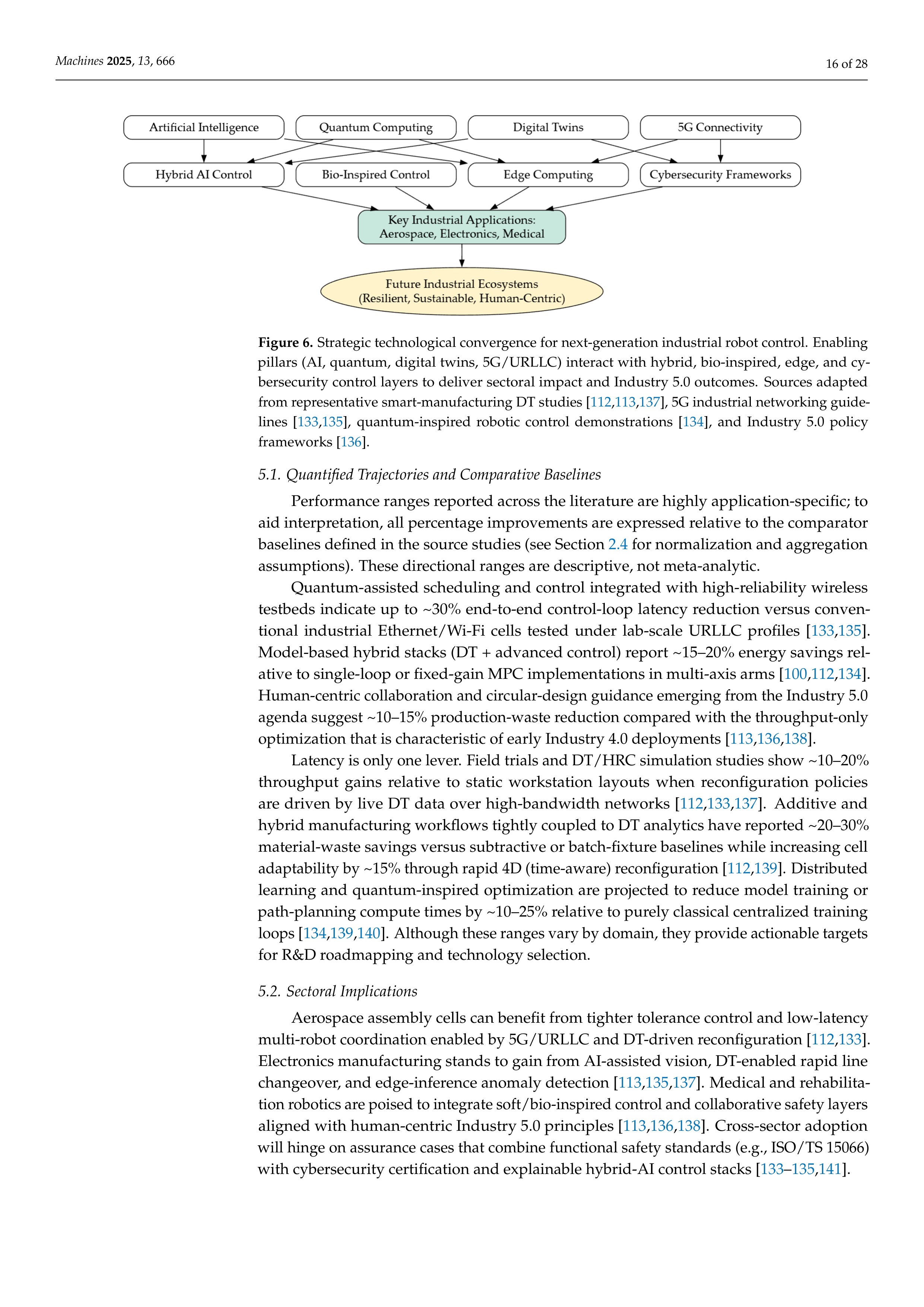
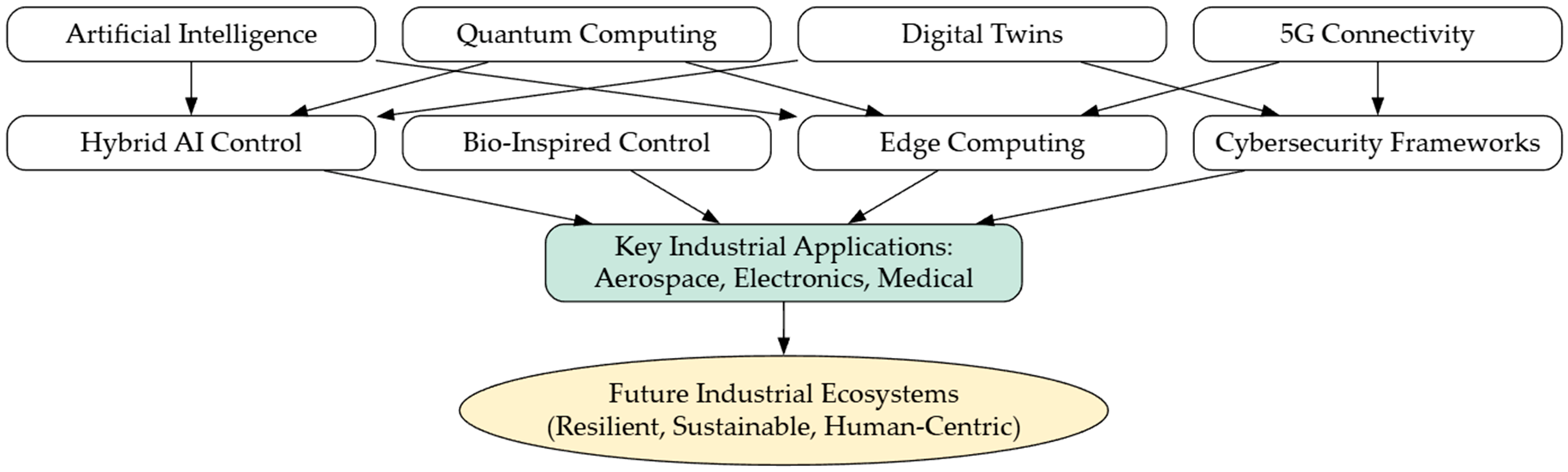
Figure
6
situates these interactions in a strategic “technology convergence” map:
top-
tier digital enablers (AI, quantum computing, digital twins, 5G connectivity) feed an inter-
mediate layer of emerging control stacks (hybrid AI control, bio-inspired control, edge com-
puting, cybersecurity frameworks), which in turn drive next-wave industrial applications
(e.g., aerospace fastener installation, high-density electronics, medical and rehabilitation
robotics) and ultimately support future industrial ecosystems that are resilient, sustainable,
and human-centric—aligned with Industry 5.0 policy roadmaps [
112
,
113
,
133
–
136
].
Machines
2025
,
13
, 666
16 of 28
Figure 6.
Strategic technological convergence for next-generation industrial robot control.
Enabling
pillars (AI, quantum,
digital twins,
5G/URLLC) interact with hybrid,
bio-inspired,
edge,
and cy-
bersecurity control layers to deliver sectoral impact and Industry 5.0 outcomes.
Sources adapted
from representative smart-manufacturing DT studies [
112
,
113
,
137
], 5G industrial networking guide-
lines
[
133
,
135
],
quantum-inspired
robotic
control
demonstrations
[
134
],
and
Industry
5.0
policy
frameworks [
136
].
5.1.
Quantified Trajectories and Comparative Baselines
Performance ranges reported across the literature are highly application-specific; to
aid interpretation, all percentage improvements are expressed relative to the comparator
baselines defined in the source studies (see Section
2.4
for normalization and aggregation
assumptions).
These directional ranges are descriptive, not meta-analytic.
Quantum-assisted scheduling and control integrated with high-reliability wireless
testbeds
indicate
up
to
~30%
end-to-end
control-loop
latency
reduction
versus
conven-
tional
industrial
Ethernet/Wi-Fi
cells
tested
under
lab-scale
URLLC
profiles
[
133
,
135
].
Model-based hybrid stacks (DT + advanced control) report ~15–20% energy savings rel-
ative to single-loop or fixed-gain MPC implementations in multi-axis arms [
100
,
112
,
134
].
Human-centric collaboration and circular-design guidance emerging from the Industry 5.0
agenda suggest ~10–15% production-waste reduction compared with the throughput-only
optimization that is characteristic of early Industry 4.0 deployments [
113
,
136
,
138
].
Latency is only one lever.
Field trials and DT/HRC simulation studies show
~10–20%
throughput
gains
relative
to
static
workstation
layouts
when
reconfiguration
policies
are
driven
by
live
DT
data
over
high-bandwidth
networks
[
112
,
133
,
137
].
Additive
and
hybrid manufacturing workflows tightly coupled to DT analytics have reported ~20–30%
material-waste savings versus subtractive or batch-fixture baselines while increasing cell
adaptability by ~15% through rapid 4D (time-aware) reconfiguration [
112
,
139
].
Distributed
learning
and
quantum-inspired
optimization
are
projected
to
reduce
model
training
or
path-planning compute times by ~10–25% relative to purely classical centralized training
loops [
134
,
139
,
140
].
Although these ranges vary by domain, they provide actionable targets
for R&D roadmapping and technology selection.
5.2.
Sectoral Implications
Aerospace assembly cells can benefit from tighter tolerance control and low-latency
multi-robot coordination enabled by 5G/URLLC and DT-driven reconfiguration [
112
,
133
].
Electronics manufacturing stands to gain from AI-assisted vision, DT-enabled rapid line
changeover, and edge-inference anomaly detection [
113
,
135
,
137
].
Medical and rehabilita-
tion robotics are poised to integrate soft/bio-inspired control and collaborative safety layers
aligned with human-centric Industry 5.0 principles [
113
,
136
,
138
].
Cross-sector adoption
will hinge on assurance cases that combine functional safety standards (e.g., ISO/TS 15066)
with cybersecurity certification and explainable hybrid-AI control stacks [
133
–
135
,
141
].
Machines
2025
,
13
, 666
17 of 28
5.3.
Historical and Forward-Looking Context
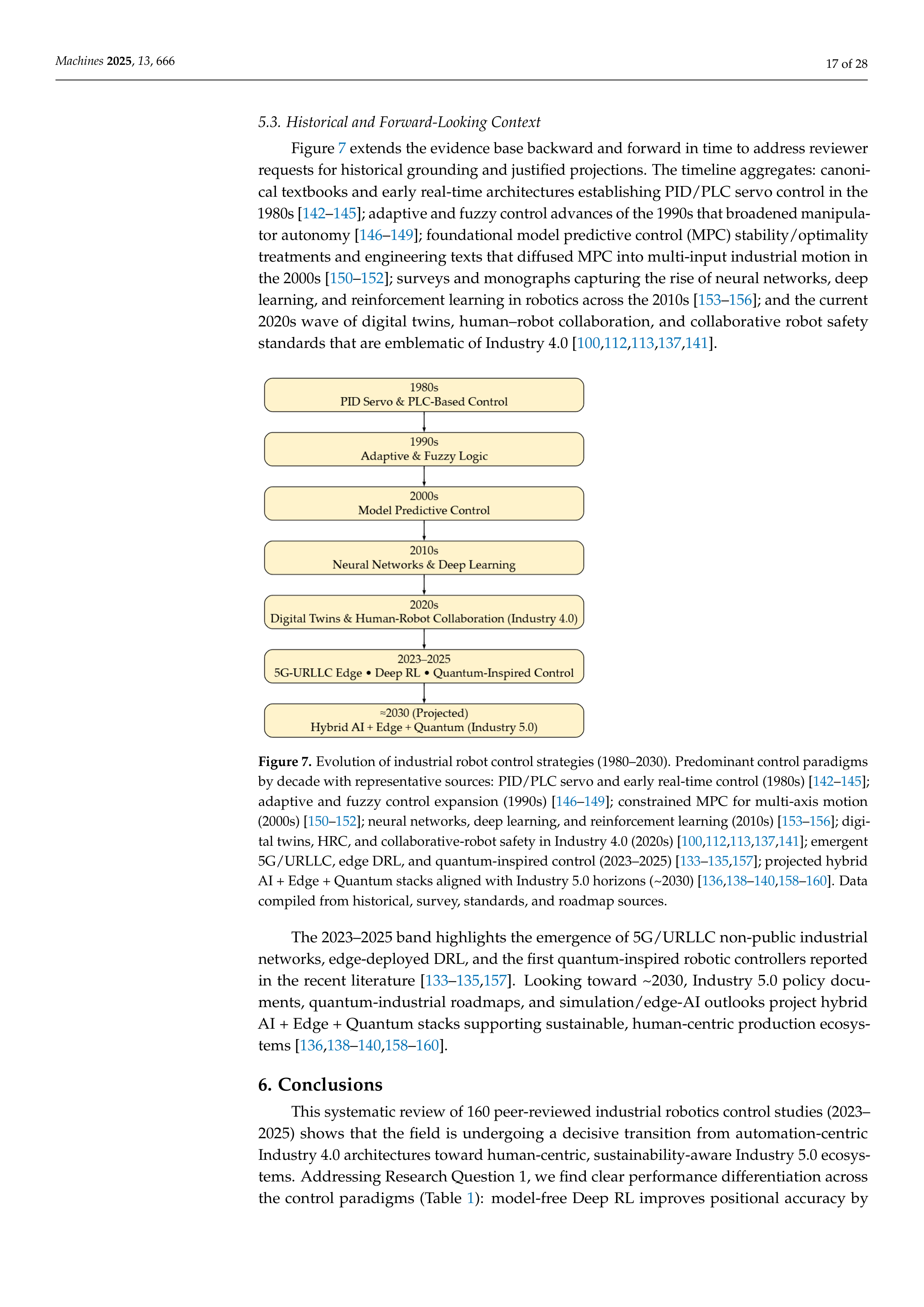
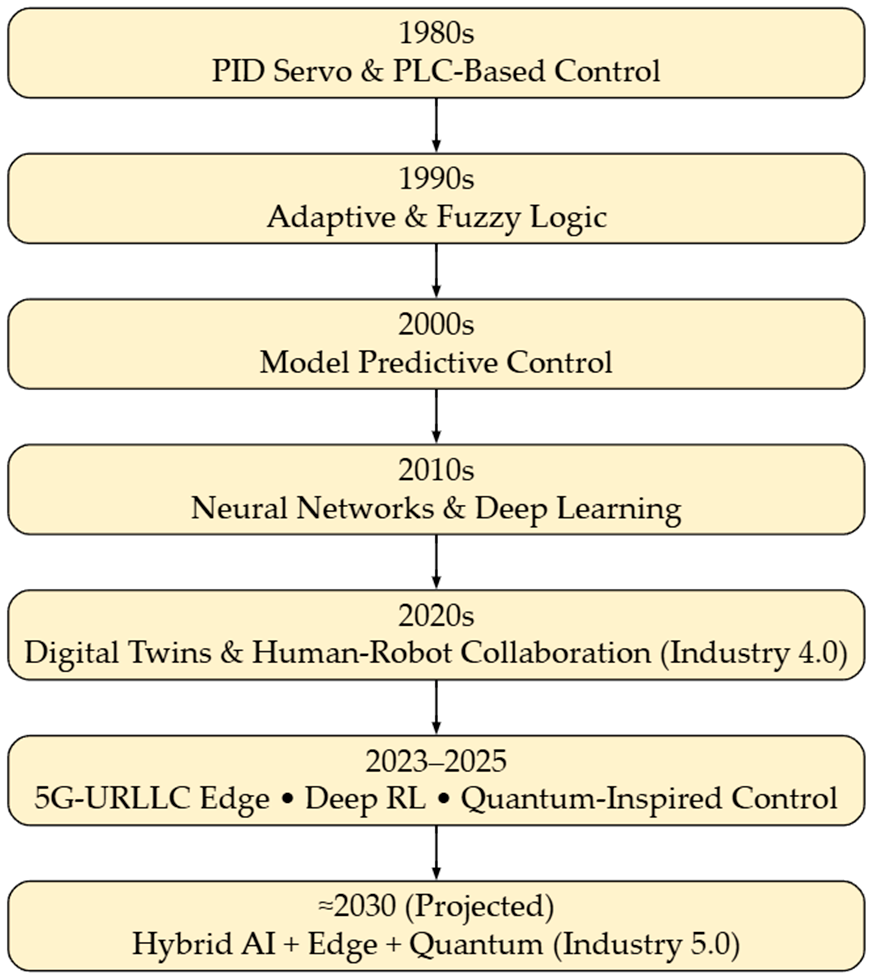
Figure
7
extends the evidence base backward and forward in time to address reviewer
requests for historical grounding and justified projections.
The timeline aggregates:
canoni-
cal textbooks and early real-time architectures establishing PID/PLC servo control in the
1980s [
142
–
145
]; adaptive and fuzzy control advances of the 1990s that broadened manipula-
tor autonomy [
146
–
149
]; foundational model predictive control (MPC) stability/optimality
treatments and engineering texts that diffused MPC into multi-input industrial motion in
the 2000s [
150
–
152
]; surveys and monographs capturing the rise of neural networks, deep
learning, and reinforcement learning in robotics across the 2010s [
153
–
156
]; and the current
2020s wave
of digital
twins,
human–robot collaboration,
and collaborative
robot
safety
standards that are emblematic of Industry 4.0 [
100
,
112
,
113
,
137
,
141
].
Figure 7.
Evolution of industrial robot control strategies (1980–2030).
Predominant control paradigms
by decade with representative sources:
PID/PLC servo and early real-time control (1980s) [
142
–
145
];
adaptive
and
fuzzy
control
expansion
(1990s)
[
146
–
149
];
constrained
MPC
for
multi-axis
motion
(2000s) [
150
–
152
]; neural networks, deep learning, and reinforcement learning (2010s) [
153
–
156
]; digi-
tal twins, HRC, and collaborative-robot safety in Industry 4.0 (2020s) [
100
,
112
,
113
,
137
,
141
]; emergent
5G/URLLC, edge DRL, and quantum-inspired control (2023–2025) [
133
–
135
,
157
]; projected hybrid
AI + Edge + Quantum stacks aligned with Industry 5.0 horizons (~2030) [
136
,
138
–
140
,
158
–
160
].
Data
compiled from historical, survey, standards, and roadmap sources.
The 2023–2025 band highlights the emergence of 5G/URLLC non-public industrial
networks, edge-deployed DRL, and the first quantum-inspired robotic controllers reported
in
the
recent
literature
[
133
–
135
,
157
].
Looking
toward
~2030,
Industry
5.0
policy
docu-
ments, quantum-industrial roadmaps, and simulation/edge-AI outlooks project hybrid
AI + Edge + Quantum stacks supporting sustainable, human-centric production ecosys-
tems [
136
,
138
–
140
,
158
–
160
].
6.
Conclusions
This systematic review of 160 peer-reviewed industrial robotics control studies (2023–
2025)
shows
that
the
field
is
undergoing
a
decisive
transition
from
automation-centric
Industry 4.0 architectures toward human-centric, sustainability-aware Industry 5.0 ecosys-
tems.
Addressing Research Question 1, we find clear performance differentiation across
the
control
paradigms
(Table
1
):
model-free
Deep
RL
improves
positional
accuracy
by
Machines
2025
,
13
, 666
18 of 28
~70% and reduces energy by ~38% relative to PID baselines;
digital twin-assisted MPC
and quantum-inspired optimization achieve <10
µ
m mean error and <7 J/cycle energy in
ultra-precision settings; and bio-inspired evolutionary approaches offer adaptability for
redundant, highly non-linear manipulators, albeit with >30 ms cycle-time penalties in fast
takt-time lines.
Research
Question
2
asked
how
AI,
digital
twins,
and
high-bandwidth
connectiv-
ity (5G/URLLC) are transforming industrial robot control.
Evidence synthesized across
Sections
3
and
5
indicates that DT-linked reconfiguration can yield ~10–20% throughput
gains and ~15–20% energy savings versus static/fixed-gain baselines in multi-axis cells; 5G
non-public industrial networks targeting <10 ms control latency are maturing; and early
quantum-inspired scheduling/optimization demonstrates up to ~30% control-loop latency
reduction in lab-scale URLLC testbeds.
Human-robot collaboration layers built atop these
digital stacks deliver up to ~30% safety improvements beyond static-zone assumptions,
while bio-inspired/soft-robotic advances expand task diversity and ergonomic fit (Figure
3
;
Section
3.7
; Appendix
A
, Table
A3
).
Research Question 3 focused on persistent technical, ethical, and environmental chal-
lenges.
Cross-cutting gaps remain in computational scalability (multi-agent DRL loads;
AM toolpath compute), energy and embodied resource footprints, certifiable fail-safe HRC,
cyber-resilience under 5G exposure, ethics/trust in collaborative workcells, and standards
for soft-robot durability and circular-economy reporting (Section
4
; Table
3
).
Our sustain-
ability synthesis (Section
3.5
; Table
2
) shows that integrating energy, material circularity,
and life-cycle carbon metrics into control dashboards is both feasible and urgently needed:
reported
ranges
include
~20–30%
material-waste
savings
in
DT-coupled
AM
lines
and
0.8–1.4% national CO
2
-intensity reductions per +10k industrial robots when coupled with
process modernization.
Limitations:
Findings
draw
on
published
data
that
vary
in
metric
definitions,
test
conditions,
and
reporting
granularity;
only
110
of
the
160
studies
provided
sufficiently
comparable metrics for descriptive aggregation.
Publication and language filters (English;
2023–2025 window) risk omitting non-indexed innovations and under-representing long-
term reliability evidence.
Historical foundations predating 2023 were consulted for context
(Section
5.3
) but not included in quantitative tallies.
Reported improvement percentages are
directional and tied to the baselines specified in each source; they are not pooled effect sizes.
Research & Adoption Agenda:
(Near
term,
0–2
years)—Publish
open
benchmarking
datasets
(precision/energy/
latency) across standardized task suites; harmonize circular-economy KPIs (Table
2
) for
reporting;
adopt
common
test
harnesses
for
tactile
&
proximity
safety
layers
in
HRC;
implement zero-trust + IEC 62443 security baselines in 5G pilot cells.
(Mid
term,
2–5
years)—Deploy
hybrid
AI-classical
controllers
that
down-select
in-
ference load at the edge, targeting
≥
20% compute savings; certify reusable digital-twin
models for changeover validation in SMEs; establish interoperable tactile sensor protocols
to close the ~15% real-time safety gap; integrate carbon/material flow telemetry directly
into scheduling optimizers.
(Long term, 5+ years)—Co-design edge + quantum accelerators for real-time optimiza-
tion; mature soft/bio-inspired actuators to >10
6
cycle durability with field-reconfigurable
stiffness;
codify
Industry
5.0
ethics
and
workforce-transition
metrics
into
international
robotics
standards;
link
life-cycle
DT
twins
to
circular-remanufacturing
supply
chains
at scale.
In
closing,
the
path
forward
is
clear:
adaptability,
sustainability,
and
ethics
must
become
intrinsic
design
variables—not
afterthoughts—in
industrial
robot
control.
By
coupling data-efficient AI with physics- and safety-grounded models, extending digital-
Machines
2025
,
13
, 666
19 of 28
twin lifecycles across energy and material flows, securing ultra-connected robot fleets, and
embedding
human-centric
design
from
the
outset,
the
robotics
community
can
deliver
resilient, sustainable, human-centered systems that meet global manufacturing demands
and advance the Industry 5.0 vision.
Funding:
This research received no external funding.
Institutional
Review
Board
Statement:
Not
applicable,
as
this
review
synthesizes
the
existing
literature without involving human subjects or experimental data, per Chilean research guidelines.
Informed
Consent
Statement:
Not
applicable,
as
no
human
participants
were
involved
in
this
literature review.
Data Availability Statement:
Data are contained within the article.
No new experimental data were
generated; this review synthesizes the existing literature available in cited references.
Acknowledgments:
This work was supported by the Faculty of Engineering of the Universidad de
Santiago de Chile, Chile.
Conflicts of Interest:
The author declares no conflicts of interest.
Abbreviations
The following abbreviations are used in this manuscript:
5G
Fifth-Generation Mobile/Wireless Networks
AI/ML
Artificial Intelligence/Machine Learning
AM
Additive Manufacturing
ANN
Artificial Neural Network
CPG
Central Pattern Generator
DoF
Degrees of Freedom
DT
Digital Twin (virtual representation linked to a physical asset; plural:
DTs)
DRL
Deep Reinforcement Learning
EU
European Union
FDI
Faults, Disruptions, and Interference (used in the resilient multi-robot control)
FLC
Fuzzy Logic Controller
GAN
Generative Adversarial Network
HRC
Human–Robot Collaboration
IoT
Internet of Things
IIoT
Industrial Internet of Things
IEC
International Electrotechnical Commission
ISO
International Organization for Standardization
ISO/TS
International Organization for Standardization/Technical Specification (used in
ISO/TS 15066)
KPI
Key Performance Indicator
LCA
Life-Cycle Assessment
LSTM
Long Short-Term Memory (recurrent neural network unit)
MPC
Model Predictive Control
MES
Manufacturing Execution System
PID
Proportional–Integral–Derivative
PRISMA
Preferred Reporting Items for Systematic Reviews and Meta-Analyses
PLC
Programmable Logic Controller
ROS
Robot Operating System
RL
Reinforcement Learning
SMC
Sliding-Mode Control
SME(s)
Small- and Medium-Sized Enterprise(s)
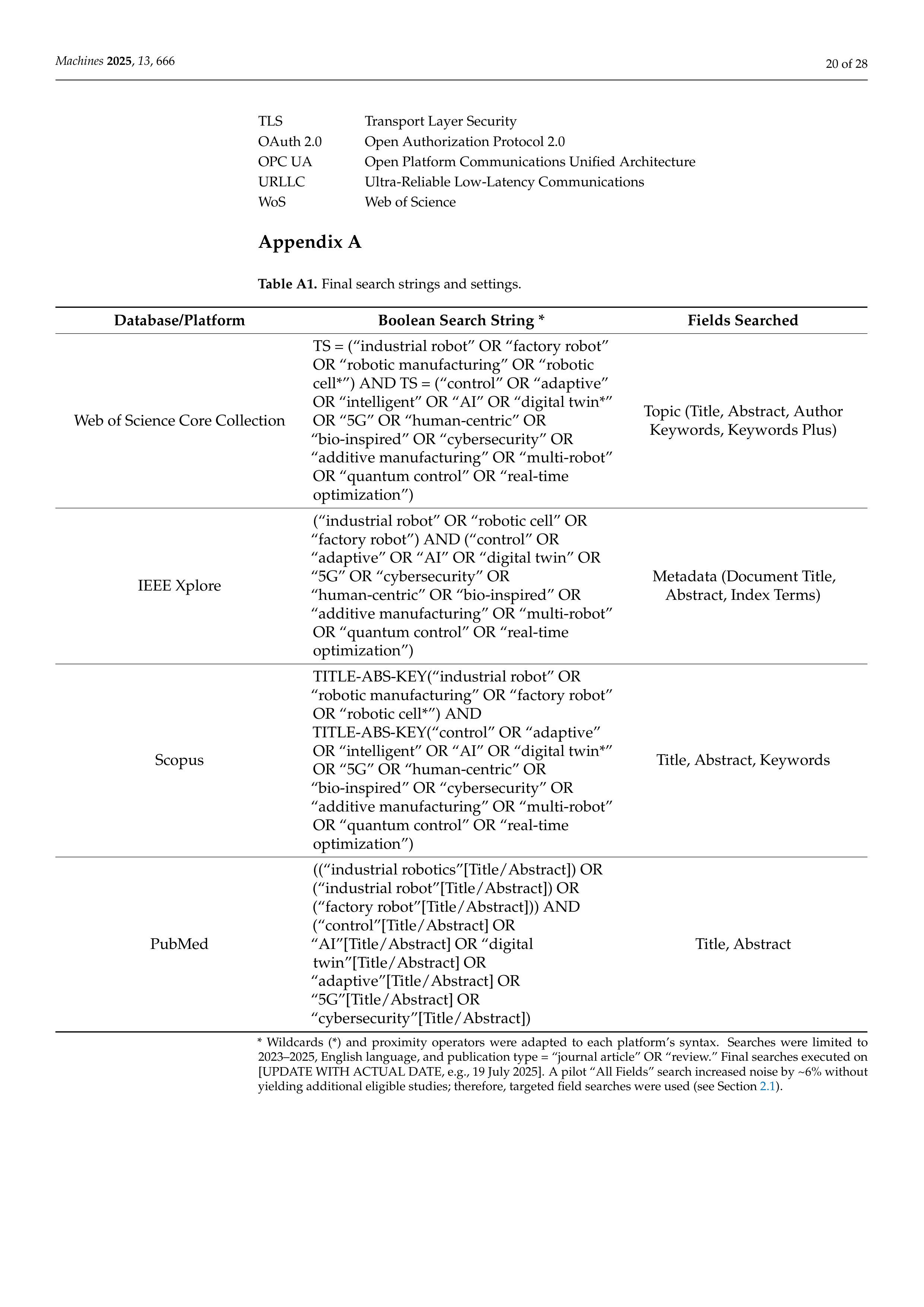
Machines
2025
,
13
, 666
20 of 28
TLS
Transport Layer Security
OAuth 2.0
Open Authorization Protocol 2.0
OPC UA
Open Platform Communications Unified Architecture
URLLC
Ultra-Reliable Low-Latency Communications
WoS
Web of Science
Appendix A
Table A1.
Final search strings and settings.
Database/Platform
Boolean Search String *
Fields Searched
Web of Science Core Collection
TS = (“industrial robot” OR “factory robot”
OR “robotic manufacturing” OR “robotic
cell*”) AND TS = (“control” OR “adaptive”
OR “intelligent” OR “AI” OR “digital twin*”
OR “5G” OR “human-centric” OR
“bio-inspired” OR “cybersecurity” OR
“additive manufacturing” OR “multi-robot”
OR “quantum control” OR “real-time
optimization”)
Topic (Title, Abstract, Author
Keywords, Keywords Plus)
IEEE Xplore
(“industrial robot” OR “robotic cell” OR
“factory robot”) AND (“control” OR
“adaptive” OR “AI” OR “digital twin” OR
“5G” OR “cybersecurity” OR
“human-centric” OR “bio-inspired” OR
“additive manufacturing” OR “multi-robot”
OR “quantum control” OR “real-time
optimization”)
Metadata (Document Title,
Abstract, Index Terms)
Scopus
TITLE-ABS-KEY(“industrial robot” OR
“robotic manufacturing” OR “factory robot”
OR “robotic cell*”) AND
TITLE-ABS-KEY(“control” OR “adaptive”
OR “intelligent” OR “AI” OR “digital twin*”
OR “5G” OR “human-centric” OR
“bio-inspired” OR “cybersecurity” OR
“additive manufacturing” OR “multi-robot”
OR “quantum control” OR “real-time
optimization”)
Title, Abstract, Keywords
PubMed
((“industrial robotics”[Title/Abstract]) OR
(“industrial robot”[Title/Abstract]) OR
(“factory robot”[Title/Abstract])) AND
(“control”[Title/Abstract] OR
“AI”[Title/Abstract] OR “digital
twin”[Title/Abstract] OR
“adaptive”[Title/Abstract] OR
“5G”[Title/Abstract] OR
“cybersecurity”[Title/Abstract])
Title, Abstract
*
Wildcards
(*)
and
proximity
operators
were
adapted
to
each
platform’s
syntax.
Searches
were
limited
to
2023–2025, English language, and publication type = “journal article” OR “review.” Final searches executed on
[UPDATE WITH ACTUAL DATE, e.g., 19 July 2025].
A pilot “All Fields” search increased noise by ~6% without
yielding additional eligible studies; therefore, targeted field searches were used (see Section
2.1
).
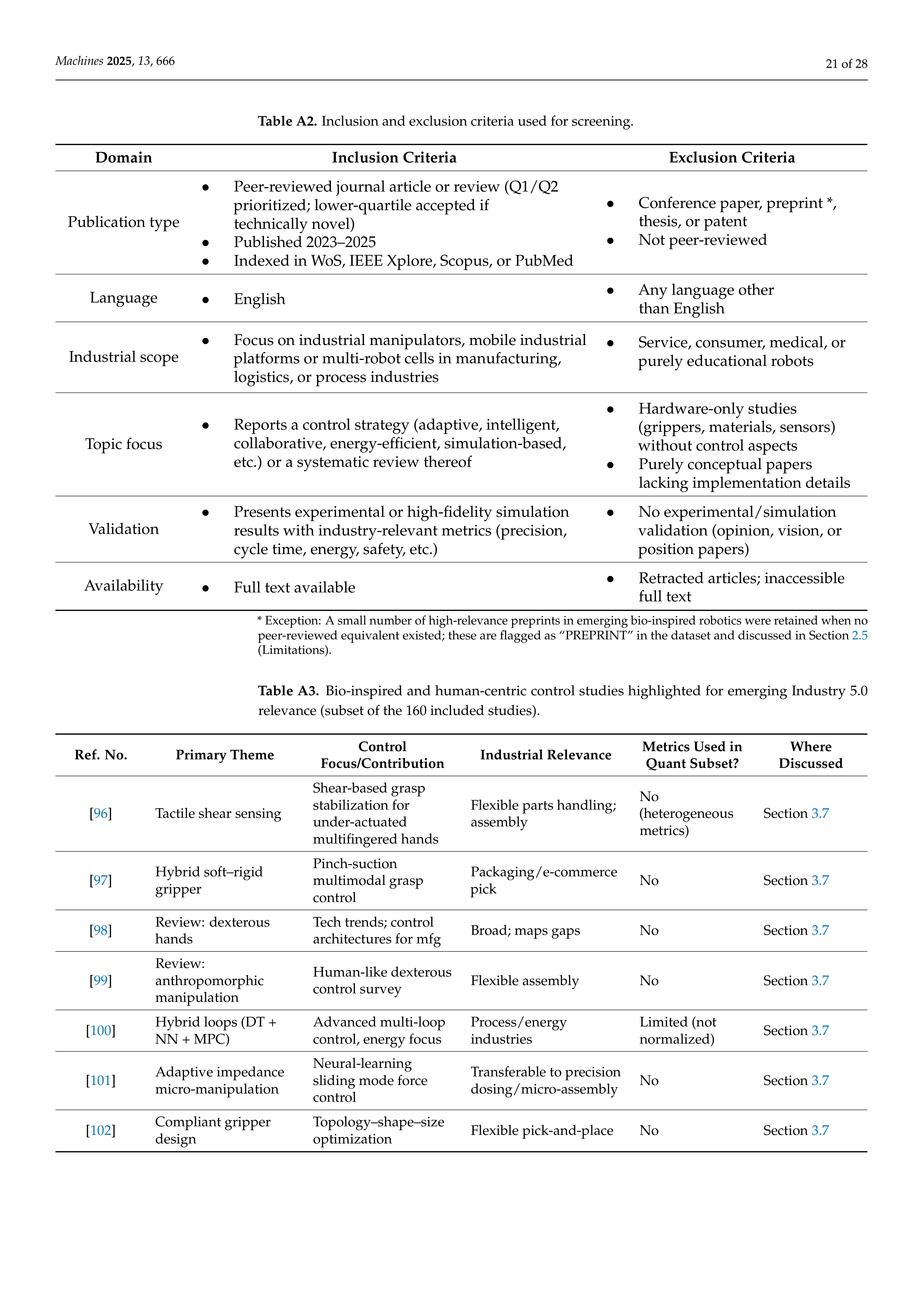
Machines
2025
,
13
, 666
21 of 28
Table A2.
Inclusion and exclusion criteria used for screening.
Domain
Inclusion Criteria
Exclusion Criteria
Publication type
•
Peer-reviewed journal article or review (Q1/Q2
prioritized; lower-quartile accepted if
technically novel)
•
Published 2023–2025
•
Indexed in WoS, IEEE Xplore, Scopus, or PubMed
•
Conference paper, preprint *,
thesis, or patent
•
Not peer-reviewed
Language
•
English
•
Any language other
than English
Industrial scope
•
Focus on industrial manipulators, mobile industrial
platforms or multi-robot cells in manufacturing,
logistics, or process industries
•
Service, consumer, medical, or
purely educational robots
Topic focus
•
Reports a control strategy (adaptive, intelligent,
collaborative, energy-efficient, simulation-based,
etc.)
or a systematic review thereof
•
Hardware-only studies
(grippers, materials, sensors)
without control aspects
•
Purely conceptual papers
lacking implementation details
Validation
•
Presents experimental or high-fidelity simulation
results with industry-relevant metrics (precision,
cycle time, energy, safety, etc.)
•
No experimental/simulation
validation (opinion, vision, or
position papers)
Availability
•
Full text available
•
Retracted articles; inaccessible
full text
* Exception:
A small number of high-relevance preprints in emerging bio-inspired robotics were retained when no
peer-reviewed equivalent existed; these are flagged as “PREPRINT” in the dataset and discussed in Section
2.5
(Limitations).
Table A3.
Bio-inspired and human-centric control studies highlighted for emerging Industry 5.0
relevance (subset of the 160 included studies).
Ref.
No.
Primary Theme
Control
Focus/Contribution
Industrial Relevance
Metrics Used in
Quant Subset?
Where
Discussed
[
96
]
Tactile shear sensing
Shear-based grasp
stabilization for
under-actuated
multifingered hands
Flexible parts handling;
assembly
No
(heterogeneous
metrics)
Section
3.7
[
97
]
Hybrid soft–rigid
gripper
Pinch-suction
multimodal grasp
control
Packaging/e-commerce
pick
No
Section
3.7
[
98
]
Review:
dexterous
hands
Tech trends; control
architectures for mfg
Broad; maps gaps
No
Section
3.7
[
99
]
Review:
anthropomorphic
manipulation
Human-like dexterous
control survey
Flexible assembly
No
Section
3.7
[
100
]
Hybrid loops (DT +
NN + MPC)
Advanced multi-loop
control, energy focus
Process/energy
industries
Limited (not
normalized)
Section
3.7
[
101
]
Adaptive impedance
micro-manipulation
Neural-learning
sliding mode force
control
Transferable to precision
dosing/micro-assembly
No
Section
3.7
[
102
]
Compliant gripper
design
Topology–shape–size
optimization
Flexible pick-and-place
No
Section
3.7
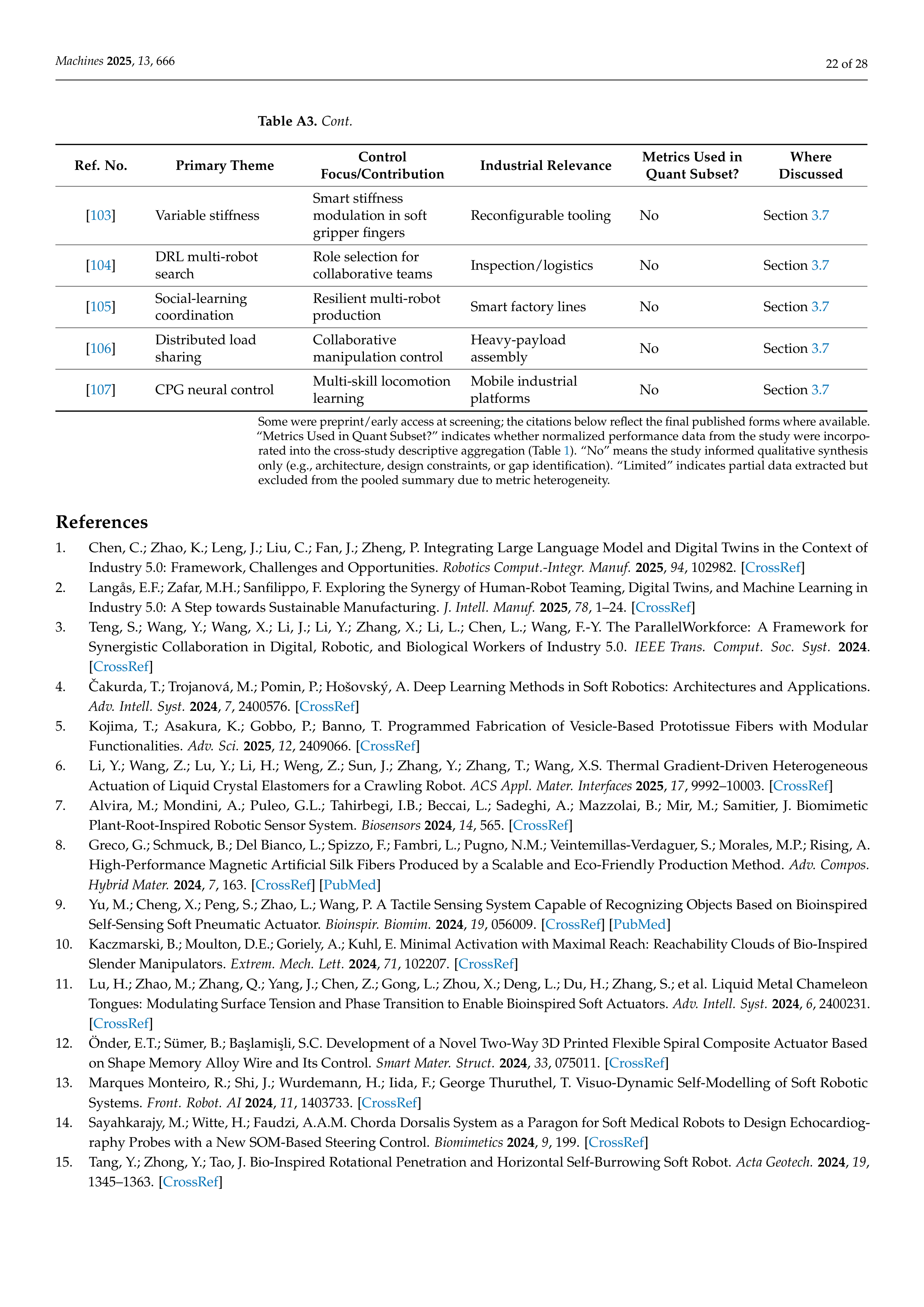
Machines
2025
,
13
, 666
22 of 28
Table A3.
Cont.
Ref.
No.
Primary Theme
Control
Focus/Contribution
Industrial Relevance
Metrics Used in
Quant Subset?
Where
Discussed
[
103
]
Variable stiffness
Smart stiffness
modulation in soft
gripper fingers
Reconfigurable tooling
No
Section
3.7
[
104
]
DRL multi-robot
search
Role selection for
collaborative teams
Inspection/logistics
No
Section
3.7
[
105
]
Social-learning
coordination
Resilient multi-robot
production
Smart factory lines
No
Section
3.7
[
106
]
Distributed load
sharing
Collaborative
manipulation control
Heavy-payload
assembly
No
Section
3.7
[
107
]
CPG neural control
Multi-skill locomotion
learning
Mobile industrial
platforms
No
Section
3.7
Some were preprint/early access at screening; the citations below reflect the final published forms where available.
“Metrics Used in Quant Subset?” indicates whether normalized performance data from the study were incorpo-
rated into the cross-study descriptive aggregation (Table
1
).
“No” means the study informed qualitative synthesis
only (e.g., architecture, design constraints, or gap identification).
“Limited” indicates partial data extracted but
excluded from the pooled summary due to metric heterogeneity.
References
1.
Chen, C.; Zhao, K.; Leng, J.; Liu, C.; Fan, J.; Zheng, P. Integrating Large Language Model and Digital Twins in the Context of
Industry 5.0:
Framework, Challenges and Opportunities.
Robotics Comput.-Integr.
Manuf.
2025
,
94
, 102982.
[
CrossRef
]
2.
Langås, E.F.; Zafar, M.H.; Sanfilippo, F. Exploring the Synergy of Human-Robot Teaming, Digital Twins, and Machine Learning in
Industry 5.0:
A Step towards Sustainable Manufacturing.
J. Intell.
Manuf.
2025
,
78
, 1–24.
[
CrossRef
]
3.
Teng,
S.;
Wang,
Y.;
Wang,
X.;
Li,
J.;
Li,
Y.;
Zhang,
X.;
Li,
L.;
Chen,
L.;
Wang,
F.-Y.
The
ParallelWorkforce:
A
Framework
for
Synergistic
Collaboration
in
Digital,
Robotic,
and
Biological
Workers
of
Industry
5.0.
IEEE
Trans.
Comput.
Soc.
Syst.
2024
.
[
CrossRef
]
4.
ˇCakurda, T.; Trojanová, M.; Pomin, P.; Hošovsk
ý
, A. Deep Learning Methods in Soft Robotics:
Architectures and Applications.
Adv.
Intell.
Syst.
2024
,
7
, 2400576.
[
CrossRef
]
5.
Kojima,
T.;
Asakura,
K.;
Gobbo,
P.;
Banno,
T.
Programmed
Fabrication
of
Vesicle-Based
Prototissue
Fibers
with
Modular
Functionalities.
Adv.
Sci.
2025
,
12
, 2409066.
[
CrossRef
]
6.
Li,
Y.;
Wang,
Z.;
Lu,
Y.;
Li,
H.;
Weng,
Z.;
Sun,
J.;
Zhang,
Y.;
Zhang,
T.;
Wang,
X.S.
Thermal
Gradient-Driven
Heterogeneous
Actuation of Liquid Crystal Elastomers for a Crawling Robot.
ACS Appl.
Mater.
Interfaces
2025
,
17
, 9992–10003.
[
CrossRef
]
7.
Alvira,
M.;
Mondini,
A.;
Puleo,
G.L.;
Tahirbegi,
I.B.;
Beccai,
L.;
Sadeghi,
A.;
Mazzolai,
B.;
Mir,
M.;
Samitier,
J.
Biomimetic
Plant-Root-Inspired Robotic Sensor System.
Biosensors
2024
,
14
, 565.
[
CrossRef
]
8.
Greco, G.; Schmuck, B.; Del Bianco, L.; Spizzo, F.; Fambri, L.; Pugno, N.M.; Veintemillas-Verdaguer, S.; Morales, M.P.; Rising, A.
High-Performance Magnetic Artificial Silk Fibers Produced by a Scalable and Eco-Friendly Production Method.
Adv.
Compos.
Hybrid Mater.
2024
,
7
, 163.
[
CrossRef
] [
PubMed
]
9.
Yu, M.; Cheng, X.; Peng, S.; Zhao, L.; Wang, P. A Tactile Sensing System Capable of Recognizing Objects Based on Bioinspired
Self-Sensing Soft Pneumatic Actuator.
Bioinspir.
Biomim.
2024
,
19
, 056009.
[
CrossRef
] [
PubMed
]
10.
Kaczmarski, B.; Moulton, D.E.; Goriely, A.; Kuhl, E. Minimal Activation with Maximal Reach:
Reachability Clouds of Bio-Inspired
Slender Manipulators.
Extrem.
Mech.
Lett.
2024
,
71
, 102207.
[
CrossRef
]
11.
Lu, H.; Zhao, M.; Zhang, Q.; Yang, J.; Chen, Z.; Gong, L.; Zhou, X.; Deng, L.; Du, H.; Zhang, S.; et al.
Liquid Metal Chameleon
Tongues: Modulating Surface Tension and Phase Transition to Enable Bioinspired Soft Actuators.
Adv.
Intell.
Syst.
2024
,
6
, 2400231.
[
CrossRef
]
12.
Önder, E.T.; Sümer, B.; Ba¸slami¸sli, S.C. Development of a Novel Two-Way 3D Printed Flexible Spiral Composite Actuator Based
on Shape Memory Alloy Wire and Its Control.
Smart Mater.
Struct.
2024
,
33
, 075011.
[
CrossRef
]
13.
Marques Monteiro,
R.;
Shi,
J.;
Wurdemann,
H.;
Iida,
F.;
George Thuruthel,
T. Visuo-Dynamic Self-Modelling of Soft Robotic
Systems.
Front.
Robot.
AI
2024
,
11
, 1403733.
[
CrossRef
]
14.
Sayahkarajy, M.; Witte, H.; Faudzi, A.A.M. Chorda Dorsalis System as a Paragon for Soft Medical Robots to Design Echocardiog-
raphy Probes with a New SOM-Based Steering Control.
Biomimetics
2024
,
9
, 199.
[
CrossRef
]
15.
Tang, Y.; Zhong, Y.; Tao, J. Bio-Inspired Rotational Penetration and Horizontal Self-Burrowing Soft Robot.
Acta Geotech.
2024
,
19
,
1345–1363.
[
CrossRef
]
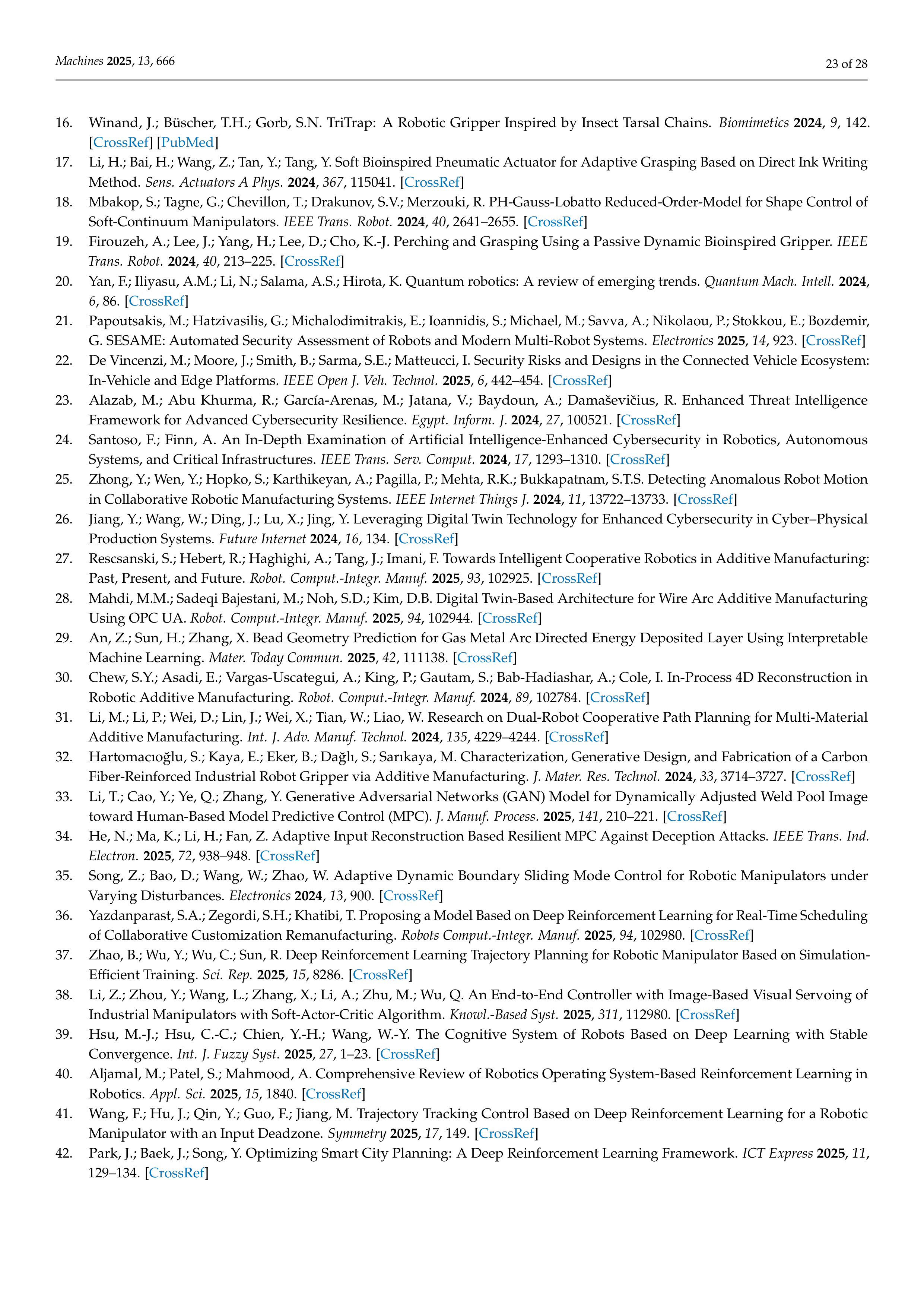
Machines
2025
,
13
, 666
23 of 28
16.
Winand,
J.;
Büscher,
T.H.;
Gorb,
S.N.
TriTrap:
A
Robotic
Gripper
Inspired
by
Insect
Tarsal
Chains.
Biomimetics
2024
,
9
,
142.
[
CrossRef
] [
PubMed
]
17.
Li, H.; Bai, H.; Wang, Z.; Tan, Y.; Tang, Y. Soft Bioinspired Pneumatic Actuator for Adaptive Grasping Based on Direct Ink Writing
Method.
Sens.
Actuators A Phys.
2024
,
367
, 115041.
[
CrossRef
]
18.
Mbakop, S.; Tagne, G.; Chevillon, T.; Drakunov, S.V.; Merzouki, R. PH-Gauss-Lobatto Reduced-Order-Model for Shape Control of
Soft-Continuum Manipulators.
IEEE Trans.
Robot.
2024
,
40
, 2641–2655.
[
CrossRef
]
19.
Firouzeh, A.; Lee, J.; Yang, H.; Lee, D.; Cho, K.-J. Perching and Grasping Using a Passive Dynamic Bioinspired Gripper.
IEEE
Trans.
Robot.
2024
,
40
, 213–225.
[
CrossRef
]
20.
Yan, F.; Iliyasu, A.M.; Li, N.; Salama, A.S.; Hirota, K. Quantum robotics:
A review of emerging trends.
Quantum Mach.
Intell.
2024
,
6
, 86.
[
CrossRef
]
21.
Papoutsakis, M.; Hatzivasilis, G.; Michalodimitrakis, E.; Ioannidis, S.; Michael, M.; Savva, A.; Nikolaou, P.; Stokkou, E.; Bozdemir,
G. SESAME: Automated Security Assessment of Robots and Modern Multi-Robot Systems.
Electronics
2025
,
14
, 923.
[
CrossRef
]
22.
De Vincenzi, M.; Moore, J.; Smith, B.; Sarma, S.E.; Matteucci, I. Security Risks and Designs in the Connected Vehicle Ecosystem:
In-Vehicle and Edge Platforms.
IEEE Open J. Veh.
Technol.
2025
,
6
, 442–454.
[
CrossRef
]
23.
Alazab,
M.;
Abu
Khurma,
R.;
García-Arenas,
M.;
Jatana,
V.;
Baydoun,
A.;
Damaševiˇcius,
R.
Enhanced
Threat
Intelligence
Framework for Advanced Cybersecurity Resilience.
Egypt.
Inform.
J.
2024
,
27
, 100521.
[
CrossRef
]
24.
Santoso,
F.;
Finn,
A.
An
In-Depth
Examination
of
Artificial
Intelligence-Enhanced
Cybersecurity
in
Robotics,
Autonomous
Systems, and Critical Infrastructures.
IEEE Trans.
Serv.
Comput.
2024
,
17
, 1293–1310.
[
CrossRef
]
25.
Zhong, Y.; Wen, Y.; Hopko, S.; Karthikeyan, A.; Pagilla, P.; Mehta, R.K.; Bukkapatnam, S.T.S. Detecting Anomalous Robot Motion
in Collaborative Robotic Manufacturing Systems.
IEEE Internet Things J.
2024
,
11
, 13722–13733.
[
CrossRef
]
26.
Jiang, Y.; Wang, W.; Ding, J.; Lu, X.; Jing, Y. Leveraging Digital Twin Technology for Enhanced Cybersecurity in Cyber–Physical
Production Systems.
Future Internet
2024
,
16
, 134.
[
CrossRef
]
27.
Rescsanski, S.; Hebert, R.; Haghighi, A.; Tang, J.; Imani, F. Towards Intelligent Cooperative Robotics in Additive Manufacturing:
Past, Present, and Future.
Robot.
Comput.-Integr.
Manuf.
2025
,
93
, 102925.
[
CrossRef
]
28.
Mahdi, M.M.; Sadeqi Bajestani, M.; Noh, S.D.; Kim, D.B. Digital Twin-Based Architecture for Wire Arc Additive Manufacturing
Using OPC UA.
Robot.
Comput.-Integr.
Manuf.
2025
,
94
, 102944.
[
CrossRef
]
29.
An, Z.; Sun, H.; Zhang, X. Bead Geometry Prediction for Gas Metal Arc Directed Energy Deposited Layer Using Interpretable
Machine Learning.
Mater.
Today Commun.
2025
,
42
, 111138.
[
CrossRef
]
30.
Chew, S.Y.; Asadi, E.; Vargas-Uscategui, A.; King, P.; Gautam, S.; Bab-Hadiashar, A.; Cole, I. In-Process 4D Reconstruction in
Robotic Additive Manufacturing.
Robot.
Comput.-Integr.
Manuf.
2024
,
89
, 102784.
[
CrossRef
]
31.
Li, M.; Li, P.; Wei, D.; Lin, J.; Wei, X.; Tian, W.; Liao, W. Research on Dual-Robot Cooperative Path Planning for Multi-Material
Additive Manufacturing.
Int.
J. Adv.
Manuf.
Technol.
2024
,
135
, 4229–4244.
[
CrossRef
]
32.
Hartomacıo˘glu, S.; Kaya, E.; Eker, B.; Da˘glı, S.; Sarıkaya, M. Characterization, Generative Design, and Fabrication of a Carbon
Fiber-Reinforced Industrial Robot Gripper via Additive Manufacturing.
J. Mater.
Res.
Technol.
2024
,
33
, 3714–3727.
[
CrossRef
]
33.
Li, T.; Cao, Y.; Ye, Q.; Zhang, Y. Generative Adversarial Networks (GAN) Model for Dynamically Adjusted Weld Pool Image
toward Human-Based Model Predictive Control (MPC).
J. Manuf.
Process.
2025
,
141
, 210–221.
[
CrossRef
]
34.
He, N.; Ma, K.; Li, H.; Fan, Z. Adaptive Input Reconstruction Based Resilient MPC Against Deception Attacks.
IEEE Trans.
Ind.
Electron.
2025
,
72
, 938–948.
[
CrossRef
]
35.
Song,
Z.;
Bao,
D.;
Wang,
W.;
Zhao,
W. Adaptive Dynamic Boundary Sliding Mode Control for Robotic Manipulators under
Varying Disturbances.
Electronics
2024
,
13
, 900.
[
CrossRef
]
36.
Yazdanparast, S.A.; Zegordi, S.H.; Khatibi, T. Proposing a Model Based on Deep Reinforcement Learning for Real-Time Scheduling
of Collaborative Customization Remanufacturing.
Robots Comput.-Integr.
Manuf.
2025
,
94
, 102980.
[
CrossRef
]
37.
Zhao, B.; Wu, Y.; Wu, C.; Sun, R. Deep Reinforcement Learning Trajectory Planning for Robotic Manipulator Based on Simulation-
Efficient Training.
Sci.
Rep.
2025
,
15
, 8286.
[
CrossRef
]
38.
Li, Z.; Zhou, Y.; Wang, L.; Zhang, X.; Li, A.; Zhu, M.; Wu, Q. An End-to-End Controller with Image-Based Visual Servoing of
Industrial Manipulators with Soft-Actor-Critic Algorithm.
Knowl.-Based Syst.
2025
,
311
, 112980.
[
CrossRef
]
39.
Hsu,
M.-J.;
Hsu,
C.-C.;
Chien,
Y.-H.;
Wang,
W.-Y.
The
Cognitive
System
of
Robots
Based
on
Deep
Learning
with
Stable
Convergence.
Int.
J. Fuzzy Syst.
2025
,
27
, 1–23.
[
CrossRef
]
40.
Aljamal, M.; Patel, S.; Mahmood, A. Comprehensive Review of Robotics Operating System-Based Reinforcement Learning in
Robotics.
Appl.
Sci.
2025
,
15
, 1840.
[
CrossRef
]
41.
Wang, F.; Hu, J.; Qin, Y.; Guo, F.; Jiang, M. Trajectory Tracking Control Based on Deep Reinforcement Learning for a Robotic
Manipulator with an Input Deadzone.
Symmetry
2025
,
17
, 149.
[
CrossRef
]
42.
Park, J.; Baek, J.; Song, Y. Optimizing Smart City Planning:
A Deep Reinforcement Learning Framework.
ICT Express
2025
,
11
,
129–134.
[
CrossRef
]
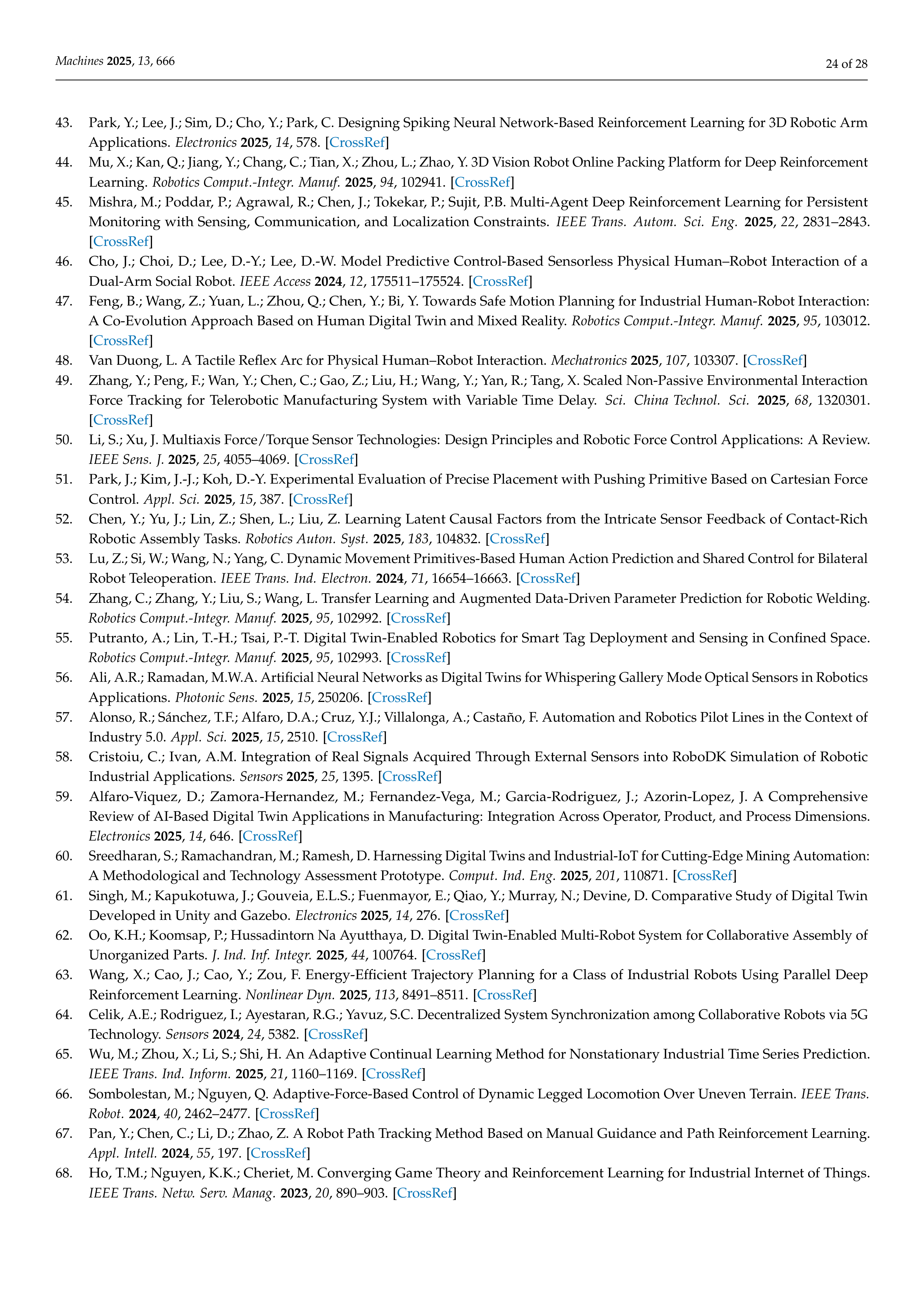
Machines
2025
,
13
, 666
24 of 28
43.
Park, Y.; Lee, J.; Sim, D.; Cho, Y.; Park, C. Designing Spiking Neural Network-Based Reinforcement Learning for 3D Robotic Arm
Applications.
Electronics
2025
,
14
, 578.
[
CrossRef
]
44.
Mu, X.; Kan, Q.; Jiang, Y.; Chang, C.; Tian, X.; Zhou, L.; Zhao, Y. 3D Vision Robot Online Packing Platform for Deep Reinforcement
Learning.
Robotics Comput.-Integr.
Manuf.
2025
,
94
, 102941.
[
CrossRef
]
45.
Mishra, M.; Poddar, P.; Agrawal, R.; Chen, J.; Tokekar, P.; Sujit, P.B. Multi-Agent Deep Reinforcement Learning for Persistent
Monitoring with Sensing,
Communication,
and Localization Constraints.
IEEE Trans.
Autom.
Sci.
Eng.
2025
,
22
,
2831–2843.
[
CrossRef
]
46.
Cho,
J.;
Choi,
D.;
Lee,
D.-Y.;
Lee,
D.-W.
Model
Predictive
Control-Based
Sensorless
Physical
Human–Robot
Interaction
of
a
Dual-Arm Social Robot.
IEEE Access
2024
,
12
, 175511–175524.
[
CrossRef
]
47.
Feng, B.; Wang, Z.; Yuan, L.; Zhou, Q.; Chen, Y.; Bi, Y. Towards Safe Motion Planning for Industrial Human-Robot Interaction:
A Co-Evolution Approach Based on Human Digital Twin and Mixed Reality.
Robotics Comput.-Integr.
Manuf.
2025
,
95
, 103012.
[
CrossRef
]
48.
Van Duong, L. A Tactile Reflex Arc for Physical Human–Robot Interaction.
Mechatronics
2025
,
107
, 103307.
[
CrossRef
]
49.
Zhang, Y.; Peng, F.; Wan, Y.; Chen, C.; Gao, Z.; Liu, H.; Wang, Y.; Yan, R.; Tang, X. Scaled Non-Passive Environmental Interaction
Force
Tracking
for
Telerobotic
Manufacturing
System
with
Variable
Time
Delay.
Sci.
China
Technol.
Sci.
2025
,
68
,
1320301.
[
CrossRef
]
50.
Li, S.; Xu, J. Multiaxis Force/Torque Sensor Technologies:
Design Principles and Robotic Force Control Applications:
A Review.
IEEE Sens.
J.
2025
,
25
, 4055–4069.
[
CrossRef
]
51.
Park, J.; Kim, J.-J.; Koh, D.-Y. Experimental Evaluation of Precise Placement with Pushing Primitive Based on Cartesian Force
Control.
Appl.
Sci.
2025
,
15
, 387.
[
CrossRef
]
52.
Chen, Y.;
Yu, J.;
Lin, Z.;
Shen, L.;
Liu, Z. Learning Latent Causal Factors from the Intricate Sensor Feedback of Contact-Rich
Robotic Assembly Tasks.
Robotics Auton.
Syst.
2025
,
183
, 104832.
[
CrossRef
]
53.
Lu, Z.; Si, W.; Wang, N.; Yang, C. Dynamic Movement Primitives-Based Human Action Prediction and Shared Control for Bilateral
Robot Teleoperation.
IEEE Trans.
Ind.
Electron.
2024
,
71
, 16654–16663.
[
CrossRef
]
54.
Zhang, C.; Zhang, Y.; Liu, S.; Wang, L. Transfer Learning and Augmented Data-Driven Parameter Prediction for Robotic Welding.
Robotics Comput.-Integr.
Manuf.
2025
,
95
, 102992.
[
CrossRef
]
55.
Putranto, A.; Lin, T.-H.; Tsai, P.-T. Digital Twin-Enabled Robotics for Smart Tag Deployment and Sensing in Confined Space.
Robotics Comput.-Integr.
Manuf.
2025
,
95
, 102993.
[
CrossRef
]
56.
Ali, A.R.; Ramadan, M.W.A. Artificial Neural Networks as Digital Twins for Whispering Gallery Mode Optical Sensors in Robotics
Applications.
Photonic Sens.
2025
,
15
, 250206.
[
CrossRef
]
57.
Alonso, R.; Sánchez, T.F.; Alfaro, D.A.; Cruz, Y.J.; Villalonga, A.; Castaño, F. Automation and Robotics Pilot Lines in the Context of
Industry 5.0.
Appl.
Sci.
2025
,
15
, 2510.
[
CrossRef
]
58.
Cristoiu,
C.;
Ivan,
A.M. Integration of Real Signals Acquired Through External Sensors into RoboDK Simulation of Robotic
Industrial Applications.
Sensors
2025
,
25
, 1395.
[
CrossRef
]
59.
Alfaro-Viquez,
D.;
Zamora-Hernandez,
M.;
Fernandez-Vega,
M.;
Garcia-Rodriguez,
J.;
Azorin-Lopez,
J.
A
Comprehensive
Review of AI-Based Digital Twin Applications in Manufacturing:
Integration Across Operator, Product, and Process Dimensions.
Electronics
2025
,
14
, 646.
[
CrossRef
]
60.
Sreedharan, S.; Ramachandran, M.; Ramesh, D. Harnessing Digital Twins and Industrial-IoT for Cutting-Edge Mining Automation:
A Methodological and Technology Assessment Prototype.
Comput.
Ind.
Eng.
2025
,
201
, 110871.
[
CrossRef
]
61.
Singh, M.; Kapukotuwa, J.; Gouveia, E.L.S.; Fuenmayor, E.; Qiao, Y.; Murray, N.; Devine, D. Comparative Study of Digital Twin
Developed in Unity and Gazebo.
Electronics
2025
,
14
, 276.
[
CrossRef
]
62.
Oo, K.H.; Koomsap, P.; Hussadintorn Na Ayutthaya, D. Digital Twin-Enabled Multi-Robot System for Collaborative Assembly of
Unorganized Parts.
J. Ind.
Inf.
Integr.
2025
,
44
, 100764.
[
CrossRef
]
63.
Wang,
X.;
Cao,
J.;
Cao,
Y.;
Zou,
F.
Energy-Efficient
Trajectory
Planning
for
a
Class
of
Industrial
Robots
Using
Parallel
Deep
Reinforcement Learning.
Nonlinear Dyn.
2025
,
113
, 8491–8511.
[
CrossRef
]
64.
Celik, A.E.; Rodriguez, I.; Ayestaran, R.G.; Yavuz, S.C. Decentralized System Synchronization among Collaborative Robots via 5G
Technology.
Sensors
2024
,
24
, 5382.
[
CrossRef
]
65.
Wu, M.; Zhou, X.; Li, S.; Shi, H. An Adaptive Continual Learning Method for Nonstationary Industrial Time Series Prediction.
IEEE Trans.
Ind.
Inform.
2025
,
21
, 1160–1169.
[
CrossRef
]
66.
Sombolestan, M.; Nguyen, Q. Adaptive-Force-Based Control of Dynamic Legged Locomotion Over Uneven Terrain.
IEEE Trans.
Robot.
2024
,
40
, 2462–2477.
[
CrossRef
]
67.
Pan, Y.; Chen, C.; Li, D.; Zhao, Z. A Robot Path Tracking Method Based on Manual Guidance and Path Reinforcement Learning.
Appl.
Intell.
2024
,
55
, 197.
[
CrossRef
]
68.
Ho, T.M.; Nguyen, K.K.; Cheriet, M. Converging Game Theory and Reinforcement Learning for Industrial Internet of Things.
IEEE Trans.
Netw.
Serv.
Manag.
2023
,
20
, 890–903.
[
CrossRef
]
Machines
2025
,
13
, 666
25 of 28
69.
Yang, L.; Xie, C.; Yang, H.; Zhan, H.; Qin, L. Assembly Strategy for Inclined-Holes Based on Vision and Force.
Eng.
Res.
Express
2025
,
7
, 015233.
[
CrossRef
]
70.
Soualhi,
T.;
Crombez,
N.;
Lombard,
A.;
Ruichek,
Y.;
Galland,
S.
Leveraging
Motion
Perceptibility
and
Deep
Reinforcement
Learning for Visual Control of Nonholonomic Mobile Robots.
Robot.
Auton.
Syst.
2025
,
189
, 104920.
[
CrossRef
]
71.
Khosravy, M.; Gupta, N.; Pasquali, A.; Dey, N.; Crespo, R.G.; Witkowski, O. Human-Collaborative Artificial Intelligence Along
with Social Values in Industry 5.0:
A Survey of the State-of-the-Art.
IEEE Trans.
Cogn.
Dev.
Syst.
2024
,
16
, 165–176.
[
CrossRef
]
72.
Nievas, N.; Pag
è
s-Bernaus, A.; Bonada, F.; Echeverria, L.; Domingo, X. Reinforcement Learning for Autonomous Process Control
in Industry 4.0:
Advantages and Challenges.
Appl.
Artif.
Intell.
2024
,
38
, 2383101.
[
CrossRef
]
73.
Yuan,
M.;
Wang,
Y.;
Li,
L.;
Chai,
T.;
Ang,
W.T.
Safety-Based
Speed
Control
of
a
Wheelchair
Using
Robust
Adaptive
Model
Predictive Control.
IEEE Trans.
Cybern.
2024
,
54
, 4464–4474.
[
CrossRef
]
74.
Moezi, S.A.; Sedaghati, R.; Rakheja, S. Nonlinear Dynamic Modeling and Model-Based AI-Driven Control of a Magnetoactive
Soft Continuum Robot in a Fluidic Environment.
ISA Trans.
2024
,
144
, 245–259.
[
CrossRef
] [
PubMed
]
75.
Gu, Y.; Ni, J.; Geng, Z.; Zhao, B.; Yang, H. Buoy and Winch Collaborative Control System Based on Deep Reinforcement Learning.
J. Mar.
Sci.
Eng.
2025
,
13
, 326.
[
CrossRef
]
76.
Choi, D.W.; Park, J.H.; Yoo, J.-H.; Ko, K. AI-Driven Adaptive Grasping and Precise Detaching Robot for Efficient Citrus Harvesting.
Comput.
Electron.
Agric.
2025
,
232
, 110131.
[
CrossRef
]
77.
Zakeri, E.; Spilkin, A.; Elmekki, H.; Zanuttini, A.; Kadem, L.; Bentahar, J.; Xie, W.-F.; Pibarot, P. AI-Powered Robust Interaction
Force Control of a Cardiac Ultrasound Robotic System.
IEEE Trans.
Ind.
Electron.
2025
,
72
, 3972–3983.
[
CrossRef
]
78.
Tran, T.; Nguyen, Q.; Luu, T.; Tran, M.; Kua, J.; Hoang, T.; Dien, M. Empowering Robotic Training with Kinesthetic Learning and
Digital Twins in Human–Centric Industrial Systems.
J. Ind.
Inf.
Integr.
2025
,
43
, 100743.
[
CrossRef
]
79.
Liu, Q.; Ji, Z.; Xu, W.; Liu, Z.; Yao, B.; Zhou, Z. Knowledge-Guided Robot Learning on Compliance Control for Robotic Assembly
Task with Predictive Model.
Expert Syst.
Appl.
2023
,
234
, 121037.
[
CrossRef
]
80.
Ho, T.M.; Nguyen, K.-K.; Cheriet, M. Energy Efficiency Deep Reinforcement Learning for URLLC in 5G Mission-Critical Swarm
Robotics.
IEEE Trans.
Netw.
Serv.
Manag.
2024
,
21
, 5018–5032.
[
CrossRef
]
81.
Thakuri, P.K.; Alkki, L.; Aarikka-Stenroos, L. Digital Technologies Enabling Component Reuse in Circular Value Chains:
Using
Digital Twin, Internet of Things and Robots in Construction and Manufacturing Sectors.
RD Manag.
2024
, 1–56.
[
CrossRef
]
82.
Chinchilla-Romero, L.; Prados-Garzon, J.; Vasist, R.; Goordazi, M. Economic Feasibility of 5G-Based Autonomous Mobile Robots
Solutions for Industry 4.0.
IEEE Commun.
Mag.
2024
,
62
, 52–59.
[
CrossRef
]
83.
Jia, Y.; Liu, M.; Yang, Y.; Zhang, L. Life Cycle Assessment of Remanufacturing Technologies for Industrial Robots.
EAI Endorsed
Trans.
Energy Web
2023
,
10
, e7.
[
CrossRef
]
84.
Beneduce, S.; Vita, L.; Cantone, L.; Caputo, F. Machinery Regulation and Remanufacturing:
A Link Between Machinery Safety
and Sustainability.
Machines
2024
,
12
, 941.
[
CrossRef
]
85.
Šavija, B.; Wyatt, H.; Wu, A.; Thomas, R.; Yang, Y. Carbon Footprint of Three Different Robotic Arms.
Dataset/Figure, Research-
Gate.
2017.
Available online:
https://www.researchgate.net/figure/Carbon-footprint-of-three-different-robotic-arms_fig6_3
14487511
(accessed on 28 July 2025).
86.
Jokiel, M.; Schmitt, R. Impact of Cycle Time and Payload of an Industrial Robot on Resource Efficiency.
Robotics
2021
,
10
, 33.
[
CrossRef
]
87.
Li, Y.; Zhang, Y.; Pan, A.; Han, M.; Veglianti, E. Carbon Emission Reduction Effects of Industrial Robot Applications: Heterogeneity
Characteristics and Influencing Mechanisms.
Technol.
Soc.
2022
,
70
, 102034.
[
CrossRef
]
88.
Zhang, L.; Shen, Q. Carbon Emission Performance of Robot Application:
Influencing Mechanisms and Heterogeneity Characteris-
tics.
Discrete Dyn.
Nat.
Soc.
2023
,
2023
, 4380575.
[
CrossRef
]
89.
Lu, Y.; Liao, Z. The Influence of AI Application on Carbon Emission Intensity of Industrial Enterprises in China.
Sci.
Rep.
2025
,
15
,
12585.
[
CrossRef
]
90.
Munonye, W.C. Towards Circular Economy Metrics:
A Systematic Review.
Circ.
Econ.
Sustain.
2025
,
5
, 122.
[
CrossRef
]
91.
Shaikh, M.B.N.; Ali, M.; Chaudry, U.M.; Khan, M.K. Metrics for Sustainability and Circular Economy Practices in Context to
Modern Manufacturing Environment.
Circ.
Econ.
Sustain.
2024
,
4
, 2073–2091.
[
CrossRef
]
92.
Shevchenko, T.; Shams Esfandabadi, Z.; Ranjbari, M.; Saidani, M.; Mesa, J.; Shevchenko, S.; Yannou, B.; Cluzel, F. Metrics in the
Circular Economy:
An Inclusive Research Landscape of the Thematic Trends and Future Research Agenda.
Ecol.
Indic.
2024
,
165
,
112182.
[
CrossRef
]
93.
Fernández, M.d.V.; Robles, J.M.; Tolentino, M.; Andrade, S.M. Analysis of the Degree of Implementation of the Circular Economy
in Europe and Spain.
Cogent Bus.
Manag.
2025
,
12
, 2499668.
[
CrossRef
]
94.
Szynkiewicz, W.; Niewiadomska-Szynkiewicz, E.; Lis, K. Deep Learning of Sensor Data in Cybersecurity of Robotic Systems:
Overview and Case Study Results.
Electronics
2023
,
12
, 4146.
[
CrossRef
]
95.
Xia, C.; Wang, R.; Jin, X.; Xu, C.; Li, D.; Zeng, P. Deterministic Network–Computation–Manufacturing Interaction Mechanism for
AI-Driven Cyber–Physical Production Systems.
IEEE Internet Things J.
2024
,
11
, 18852–18868.
[
CrossRef
]
Machines
2025
,
13
, 666
26 of 28
96.
Ford, C.J.; Li, H.; Catalano, M.G.; Bianchi, M.; Lepora, N.F. Shear-Based Grasp Control for Multifingered Under-actuated Tactile
Robotic Hands.
IEEE Trans.
Robot.
2025
,
41
, 3202–3222.
[
CrossRef
]
97.
Zhao, Y.; Zhu, J.; Zhang, J.; Zhang, S.; Shao, M.; Chai, Z.; Liu, Y.; Wu, J.; Wu, Z.; Zhang, J. Enhancing Grasping Diversity with a
Pinch-Suction and Soft-Rigid Hybrid Multimodal Gripper.
IEEE Trans.
Robot.
2025
,
41
, 3890–3907.
[
CrossRef
]
98.
Zhang, J.; Zhao, H.; Chen, K.; Fei, G.; Li, X.; Wang, Y.; Yang, Z.; Zheng, S.; Liu, S.; Ding, H. Dexterous Hand towards Intelligent
Manufacturing:
A Review of Technologies, Trends, and Potential Applications.
Rob.
Comput.-Integr.
Manuf.
2025
,
95
, 103021.
[
CrossRef
]
99.
Huang, Y.; Fan, D.; Duan, H.; Yan, D.; Qi, W.; Sun, J.; Liu, Q.; Wang, P. Human-Like Dexterous Manipulation for Anthropomorphic
Five-Fingered Hands:
A Review.
Biomim.
Intell.
Robot.
2025
,
5
, 100212.
[
CrossRef
]
100.
Chen, J.; Al-Nussairi, A.K.J.; Chyad, M.H.; Azarinfar, H.; Khosravi, M.; Jin, K.; Zhang, J. Advanced Multi-Loop Control for 4DOF
Robotic Arms:
Integrating Digital Twins, Neural Networks, and Model Predictive Control.
Energy Rep.
2025
,
13
, 4261–4279.
[
CrossRef
]
101.
Kang, S.; Li, T.; Yang, X.; Li, Y.; Xie, M. Neural-Learning-Based Adaptive Sliding Mode Impedance Force Control of Robotic
Microinjection Systems Interacting with Viscoelastic Cells.
IEEE Trans.
Circuits Syst.
II Express Briefs
2025
,
72
, 828–832.
[
CrossRef
]
102.
Dao,
T.-P.;
Le,
H.G.;
Ho,
N.L.
Topology-Shape-Size
Optimization
Design
Synthesis
of
Compliant
Grippers
for
Robotics:
A
Comprehensive Review and Prospective Advances.
Robotics Auton.
Syst.
2025
,
193
, 105106.
[
CrossRef
]
103.
El-Sayed, A.M. A Novel Approach to Enhancing Smart Stiffness of Soft Robotic Gripper Fingers for Wider Grasping Capability.
Int.
J. Intell.
Robot.
Appl.
2025
,
9
, 553–573.
[
CrossRef
]
104.
Zhu, L.; Cheng, J.; Zhang, H.; Cui, Z.; Zhang, W.; Liu, Y. Autonomous and Adaptive Role Selection for Multi-Robot Collaborative
Area Search Based on Deep Reinforcement Learning.
IEEE Trans.
Autom.
Sci.
Eng.
2025
,
22
, 16728–16740.
[
CrossRef
]
105.
Nie, Z.; Chen, K.-C.; Kim, K.J. Social-Learning Coordination of Collaborative Multi-Robot Systems Achieves Resilient Production
in a Smart Factory.
IEEE Trans.
Autom.
Sci.
Eng.
2025
,
22
, 6009–6023.
[
CrossRef
]
106.
Du, J.; Liang, Y.; Tao, H.; Xu, Y.; Zhu, L.; Ding, H. Load Sharing in Distributed Collaborative Manipulation.
IEEE Robot.
Autom.
Lett.
2025
,
10
, 3390–3397.
[
CrossRef
]
107.
Yang, C.; Pu, C.; Zhang, Y.; Wang, T.; Wu, C.; Liu, Z. Bio-Inspired Neural Networks with Central Pattern Generators for Learning
Multi-Skill Locomotion.
Sci.
Rep.
2025
,
15
, 10165.
[
CrossRef
] [
PubMed
]
108.
Gao, H.; Xing, Z.; Chang, S.; Zhao, F.; Zhang, H.; Meng, Z.; Han, Z.; Liu, Y. Bioinspired Multifunctional Antifogging Surfaces:
Progress, AI Design and Challenges.
Prog.
Mater.
Sci.
2026
,
155
, 101530.
[
CrossRef
]
109.
Sarker, A.; Islam, T.U.; Islam, M.R. A Review on Recent Trends of Bioinspired Soft Robotics: Actuators, Control Methods, Materials
Selection, Sensors, Challenges, and Future Prospects.
Adv.
Intell.
Syst.
2025
,
7
, 2400414.
[
CrossRef
]
110.
Singh, A.V.; Ansari, M.H.D.; Dey, A.K.; Laux, P.; Samal, S.K.; Malgaretti, P.; Mohapatra, S.R.; Busse, M.; Suar, M.; Tisato, V.; et al.
Bioinspired Soft Machines:
Engineering Nature’s Grace into Future Innovations.
J. Funct.
Biomater.
2025
,
16
, 158.
[
CrossRef
]
[
PubMed
]
111.
Brahmi, B.; Ghommam, J.; Saad, M. Disturbance Observer-Based Backstepping–Super Twisting Control for Robust Trajectory
Tracking in Robot Manipulators.
IEEE/ASME Trans.
Mechatron.
2025
,
30
, 1–12.
[
CrossRef
]
112.
Fu, B.; Umeda, S.; Nakano, T.; Tilbury, D.M.; Barton, K. Digital Twin-Based Smart Manufacturing:
Dynamic Line Reconfiguration
for Disturbance Handling.
IEEE Trans.
Autom.
Sci.
Eng.
2025
,
22
, 14892–14905.
[
CrossRef
]
113.
Villani, V.; Picone, M.; Mamei, M.; Sabattini, L. A Digital Twin-Driven Human-Centric Ecosystem for Industry 5.0.
IEEE Trans.
Autom.
Sci.
Eng.
2024
,
21
, 9870–9883.
[
CrossRef
]
114.
Callari, T.C.; Vecellio Segate, R.; Hubbard, E.-M.; Daly, A.; Lohse, N. An Ethical Framework for Human-Robot Collaboration for
the Future People-Centric Manufacturing:
A Collaborative Endeavour with European Subject-Matter Experts in Ethics.
Technol.
Soc.
2024
,
78
, 102680.
[
CrossRef
]
115.
Torras, C. Ethics of Social Robotics:
Individual and Societal Concerns and Opportunities.
Annu.
Rev.
Control Robot.
Auton.
Syst.
2024
,
7
, 1–18.
[
CrossRef
]
116.
Howard, J.; Schulte, P. Managing Workplace AI Risks and the Future of Work.
Am.
J. Ind.
Med.
2024
,
67
, 980–993.
[
CrossRef
]
[
PubMed
]
117.
Pareto, J.; Coeckelbergh, M. Social Assistive Robotics:
An Ethical and Political Inquiry Through the Lens of Freedom.
Int.
J. Soc.
Robot.
2024
,
16
, 1797–1808.
[
CrossRef
]
118.
Tóth, A.; Nagy, L.; Kennedy, R.; Bohuš, B.; Abonyi, J.; Ruppert, T. The Human-Centric Industry 5.0 Collaboration Architecture.
MethodsX
2023
,
11
, 102260.
[
CrossRef
]
119.
Yang, C.; Huang, J.; Wu, S.; Liu, Q. Neural-Network-Based Practical Specified-Time Resilient Formation Maneuver Control for
Second-Order Nonlinear Multi-Robot Systems under FDI Attacks.
Neural Netw.
2025
,
186
, 107288.
[
CrossRef
]
120.
Garg, K.; Zhang, S.; So, O.; Dawson, C.; Fan, C. Learning Safe Control for Multi-Robot Systems:
Methods, Verification, and Open
Challenges.
Annu.
Rev.
Control
2024
,
57
, 100948.
[
CrossRef
]
Machines
2025
,
13
, 666
27 of 28
121.
Tejada, J.C.; Toro-Ossaba, A.; López-Gonzalez, A.; Hernandez-Martinez, E.G.; Sanin-Villa, D. A Review of Multi-Robot Systems
and Soft Robotics:
Challenges and Opportunities.
Sensors
2025
,
25
, 1353.
[
CrossRef
]
122.
Zhou, M.; Wang, Z.; Wang, J.; Cao, Z. Multi-Robot Collaborative Hunting in Cluttered Environments with Obstacle-Avoiding
Voronoi Cells.
IEEE/CAA J. Autom.
Sin.
2024
,
11
, 1643–1655.
[
CrossRef
]
123.
Ibrahim, Y.M.; Kermanshahi, S.K.; Kasmarik, K.; Hu, J. A Taxonomy-Based Survey of EM-SCA and Implications for Multi-Robot
Systems.
IEEE Open J. Comput.
Soc.
2024
,
5
, 511–529.
[
CrossRef
]
124.
Yang, G.; An, L.; Zhao, C. Collision/Obstacle Avoidance Coordination of Multi-Robot Systems:
A Survey.
Actuators
2025
,
14
, 85.
[
CrossRef
]
125.
Zhang, R.; Ma, Q.; Zhang, X.; Xu, X.; Liu, D. A Distributed Actor-Critic Learning Approach for Affine Formation Control of
Multi-Robots with Unknown Dynamics.
Int.
J. Adapt.
Control Signal Process.
2025
,
39
, 803–817.
[
CrossRef
]
126.
Li, R.-G.; Shi, Z.-H.; Wu, H.-N. Adaptive Neural Networks-Based Event-Triggered Formation Control for Multi-Robot Source
Localization.
Neurocomputing
2025
,
621
, 129275.
[
CrossRef
]
127.
Cuadros Zegarra, E.; Barrios Aranibar, D.; Cardinale, Y. IoRT-Based Middleware for Heterogeneous Multi-Robot Systems.
J. Sens.
Actuator Netw.
2024
,
13
, 87.
[
CrossRef
]
128.
Zheng, L.; Zhou, Y. Event-Triggered Distributed Consensus Control of Heterogeneous Multi-Agent System under Communication
and Actuator Faults.
Appl.
Math.
Comput.
2025
,
487
, 129077.
[
CrossRef
]
129.
Yang, C.; Wang, S.; Zhang, S.; Lin, S.; Huang, B. A Class of Distributed Online Aggregative Optimization in Unknown Dynamic
Environment.
Mathematics
2024
,
12
, 2460.
[
CrossRef
]
130.
An, L.;
Yang, G.-H.;
Wasly, S. Obstacle Avoidance in Distributed Optimal Coordination of Multirobot Systems:
A Trajectory
Planning and Tracking Strategy.
IEEE Trans.
Control Netw.
Syst.
2024
,
11
, 1335–1344.
[
CrossRef
]
131.
Slim, M.; Daher, N.; Elhajj, I.H. Dynamic Bandwidth Allocation for Collaborative Multi-Robot Systems Based on Task Execution
Measures.
J. Intell.
Robot.
Syst.
2024
,
110
, 114.
[
CrossRef
]
132.
Sousa, J.; Brandau, B.; Darabi, R.; Sousa, A.; Brueckner, F.; Reis, A.; Reis, L.P. Artificial Intelligence for Control in Laser-Based
Additive Manufacturing:
A Systematic Review.
IEEE Access
2025
,
13
, 30845–30860.
[
CrossRef
]
133.
5G-ACIA.
5G
Non-Public
Networks
for
Industrial
Scenarios
,
2nd
ed.;
5G
Alliance
for
Connected
Industries
and
Automation:
Frankfurt, Germany, 2024.
134.
Fazilat, M.; Zioui, N. Quantum-Inspired Sliding-Mode Control to Enhance the Precision and Energy Efficiency of an Articulated
Industrial Robotic Arm.
Robotics
2025
,
14
, 14.
[
CrossRef
]
135.
Hirsi, A.; Audah, L.; Salh, A.; Alhartomi, M.; Sun, Z.; Hammoodi, A.; Ahmed, S. Artificial Intelligence Performance Evaluation
for URLLC of Industrial IoT Applications:
A Review, Open Challenges and Future Directions.
Phys.
Commun.
2025
,
72
, 102712.
[
CrossRef
]
136.
European Commission; Breque, M.; De Nul, L.; Petridis, A.
Industry 5.0: Towards a Sustainable, Human-Centric and Resilient European
Industry
; Publications Office of the European Union:
Luxembourg, 2021.
137.
Cimino,
A.;
Longo,
F.;
Nicoletti,
L.;
Solina,
V.
Simulation-Based
Digital
Twin
for
Enhancing
Human-Robot
Collaboration
in
Assembly Systems.
J. Manuf.
Syst.
2024
,
77
, 903–918.
[
CrossRef
]
138.
Hasani, N.; Hosseini, A.; Ashjazadeh, Y.; Diederichs, V.; Ghotb, S.; Riggio, M.; Hansen, E.; Nasir, V. Outlook on Human-Centred
Design in Industry 5.0:
Towards Mass Customisation, Personalisation, Co-Creation, and Co-Production.
Int.
J. Sustain.
Eng.
2025
,
18
, 1.
[
CrossRef
]
139.
Cimino, A.; Elbasheer, M.; Longo, F.; Mirabelli, G.; Solina, V.; Veltri, P. Automatic Simulation Models Generation in Industrial
Systems:
A Systematic Literature Review and Outlook towards Simulation Technology in the Industry 5.0.
J. Manuf.
Syst.
2025
,
80
, 859–882.
[
CrossRef
]
140.
Lu, Y.; Sigov, A.; Ratkin, L.; Ivanov, L.A.; Zuo, M. Quantum Computing and Industrial Information Integration:
A Review.
J. Ind.
Inf.
Integr.
2023
,
35
, 100511.
[
CrossRef
]
141.
ISO/TS 15066:2016
; Robots and Robotic Devices—Collaborative Robots.
International Organization for Standardization:
Geneva,
Switzerland, 2016.
142.
Groover, M.P.; Weiss, M.; Nagel, R.N.; Odrey, N.G.
Industrial Robotics:
Technology, Programming, and Applications
; McGraw-Hill:
New York, NY, USA, 1986.
143.
Craig, J.J.
Introduction to Robotics:
Mechanics and Control
, 1st ed.; Addison-Wesley:
Reading, MA, USA, 1986.
144.
Barbera, T.; Fitzgerald, M.L.; Albus, J.S.; Haynes, L.S. RCS: The NBS Real-Time Control System.
Natl.
Bur.
Stand.
(NBS) Tech.
Rep.
1984.
Available online:
https://tsapps.nist.gov/publication/get_pdf.cfm?pub_id=820167
(accessed on 28 July 2025).
145.
Ceccarelli, M. A Brief History of Robotics in the 20th Century.
In Proceedings of the 12th IFToMM World Congress, Besançon,
France, 17–21 June 2007; pp.
1–12.
146.
Kaynak, O.; Erbatur, K.; Erbatur, E. The Design and Implementation of a Hybrid Intelligent Controller for a Robot Manipula-
tor.
In Proceedings of the IECON ’95—21st Annual Conference IEEE Industrial Electronics Society,
Orlando,
FL, USA, 6–10
November 1995.
Machines
2025
,
13
, 666
28 of 28
147.
de Silva, C.W. Applications of Fuzzy Logic in the Control of Robotic Manipulators.
Fuzzy Sets Syst.
1995
,
70
, 223–234.
[
CrossRef
]
148.
Zadeh, L.A. The Role of Fuzzy Logic in Modeling, Identification and Control.
Model.
Identif.
Control
1994
,
15
, 191–203.
[
CrossRef
]
149.
Siciliano, B.; Sciavicco, L.
Modelling and Control of Robot Manipulators
; Springer:
London, UK, 2000.
150.
Mayne,
D.Q.;
Rawlings,
J.B.;
Rao,
C.V.;
Scokaert,
P.O.M.
Constrained
Model
Predictive
Control:
Stability
and
Optimality.
Automatica
2000
,
36
, 789–814.
[
CrossRef
]
151.
Maciejowski, J.M.
Predictive Control with Constraints
; Prentice Hall:
Harlow, UK, 2002.
152.
Camacho, E.F.; Bordons, C.
Model Predictive Control
, 2nd ed.; Springer:
London, UK, 2004.
153.
Kober, J.; Bagnell, J.A.; Peters, J. Reinforcement Learning in Robotics:
A Survey.
Int.
J. Robot.
Res.
2013
,
32
, 1238–1274.
[
CrossRef
]
154.
Goodfellow, I.; Bengio, Y.; Courville, A.
Deep Learning
; MIT Press:
Cambridge, MA, USA, 2016.
155.
Dimiduk,
D.M.;
Holm,
E.A.;
Niezgoda,
S.R. Perspectives on the Impact of Machine Learning,
Deep Learning,
and Artificial
Intelligence on Materials, Processes, and Structures Engineering.
Integr.
Mater.
Manuf.
Innov.
2018
,
7
, 157–172.
[
CrossRef
]
156.
Schmidhuber, J. Deep Learning in Neural Networks:
An Overview.
Neural Netw.
2015
,
61
, 85–117.
[
CrossRef
]
157.
Han, D.; Mulyana, B.; Stankovic, V.; Cheng, S. A Survey on Deep Reinforcement Learning Algorithms for Robotic Manipulation.
Sensors
2023
,
23
, 3762.
[
CrossRef
] [
PubMed
]
158.
Deloitte.
In
the
Quantum
Future,
Expect
the
Unexpected.
WSJ
Custom
Content/Deloitte
Insights.
2024.
Available
online:
https://deloitte.wsj.com/cio/in-the-quantum-future-expect-the-unexpected-fad47214?utm_source=chatgpt.com
(accessed on
28 July 2025).
159.
BCG. The Long-Term Forecast for Quantum Computing Still Looks Bright.
Boston Consulting Group Perspective.
2024.
Available
online:
https://www.bcg.com/publications/2024/long-term-forecast-for-quantum-computing-still-looks-bright?utm_source=
chatgpt.com
(accessed on 28 July 2025).
160.
Geda,
M.W.;
Tang,
Y.M.
Adaptive
Hybrid
Quantum-Classical
Computing
Framework
for
Deep
Space
Exploration
Mission
Applications.
J. Ind.
Inf.
Integr.
2025
,
44
, 100803.
[
CrossRef
]
Disclaimer/Publisher’s
Note:
The
statements,
opinions
and
data
contained
in
all
publications
are
solely
those
of
the
individual
author(s) and contributor(s) and not of MDPI and/or the editor(s).
MDPI and/or the editor(s) disclaim responsibility for any injury to
people or property resulting from any ideas, methods, instructions or products referred to in the content.