International Journal of Trend in Scientific Research and Development (IJTSRD)
Volume 9 Issue 6, Nov-Dec 2025 Available Online: www.ijtsrd.com e-ISSN: 2456 – 6470
@ IJTSRD | Unique Paper ID – IJTSRD98743 | Volume – 9 | Issue – 6 | Nov-Dec 2025
Page 163
Machine Learning in Media and Entertainment
Matthew N. O. Sadiku
1
, Samuel A. Ajayi
2
, Janet O. Sadiku
3
1
Roy G. Perry College of Engineering, Prairie View A&M University, Prairie View, TX, USA
2
Texas Southern University, Houston, TX, USA
3
Juliana King University, Houston, TX, USA
ABSTRACT
Machine learning (ML) is a branch of artificial intelligence (AI) that
uses statistical algorithms to automatically learn from data without
being explicitly programmed. It allows computers to learn from data
and make decisions without being directly programmed. It is
revolutionizing media and entertainment by personalizing content,
creating and enhancing media, and automating operational tasks. The
AI/ML revolution in media and entertainment has caused a dramatic
upheaval in the sector, from audience engagement to content
development. With the help of machine learning algorithms, it is
easier to find trends and preferences, assisting content producers in
making decisions about what appeals to their target audience. This
paper explains how machine learning is transforming the media and
entertainment industry.
KEYWORDS:
machine learning, artificial intelligence, deep learning,
media and entertainment, M&E industry.
How to cite this paper
:
Matthew N. O.
Sadiku | Samuel A. Ajayi | Janet O.
Sadiku "Machine Learning in Media and
Entertainment"
Published
in
International
Journal of Trend in
Scientific Research
and
Development
(ijtsrd),
ISSN:
2456-6470,
Volume-9 | Issue-6,
December
2025,
pp.163-171,
URL:
www.ijtsrd.com/papers/ijtsrd98743.pdf
Copyright © 2025 by author (s) and
International Journal of Trend in
Scientific Research and Development
Journal. This is an
Open Access article
distributed under the
terms of the Creative Commons
Attribution License (CC BY 4.0)
(http://creativecommons.org/licenses/by/4.0)
INTRODUCTION
Media and entertainment encompass a broad
spectrum of creative and communication-based fields
that aim to entertain, inform, and inspire audiences.
This industry includes television, film, radio, music,
gaming, advertising, digital media, social media, live
events, and much more. The entertainment industry
has been through several waves of digitalization –
file-sharing, streaming, social and mobile – driven
platforms for the consumers to access any content
from anywhere in the world at any time. This
digitalization is compelled by changing consumer
behavior and expectations, and consumers who
demand instant access to content, anytime, anywhere.
The industry is being transformed by applied artificial
intelligence and machine learning. It has always been
in the forefront of adopting innovation for business
[1]. As consumers stream music, movies and TV
shows, their data is being captured to inform a new
age of personalized entertainment.
Using machine learning, computers can learn from
data and improve their performance over time. ML
applications use machine learning algorithms to
process large volumes of training data, develop their
own problem-solving models, make predictions,
measure the accuracy of those predictions, and adjust
their modeling to improve predictive performance
over time. ML also improves content security by
detecting piracy and automates the moderation of
inappropriate content.
WHAT IS MACHINE LEARNING?
Machine learning is a subfield of artificial
intelligence that uses algorithms trained on data sets
to create models capable of performing tasks that
would otherwise only be possible for humans, such as
categorizing images, analyzing data, or predicting
price fluctuations. It uses algorithms (essentially lists
of rules) trained on data sets to create self-learning
models capable of predicting outcomes and
classifying information without human intervention.
It focuses on algorithms that can “learn” the patterns
of training data and, subsequently, make accurate
inferences about new data. This pattern recognition
ability enables machine learning models to make
decisions or predictions without explicit, hard-coded
IJTSRD98743
International Journal of Trend in Scientific Research and Development @
www.ijtsrd.com
eISSN: 2456-6470
@ IJTSRD | Unique Paper ID – IJTSRD98743 | Volume – 9 | Issue – 6 | Nov-Dec 2025
Page 164
instructions. To ensure such algorithms work
effectively, however, they must typically be refined
many times until they accumulate a comprehensive
list of instructions that allow them to function
correctly [2]. A symbol of machine learning is shown
in Figure 1 [3].
Generally speaking, a learning problem considers a
set of samples of data and then tries to predict
properties of unknown data. ML builds heavily on
statistics because when we train a machine to learn,
we have to give it a statistically significant random
sample as training data. Intelligent machines are
increasing doing incredible things: Facebook
recognizes faces in photos, Siri understands voices,
and Google translates websites [4].
Machine learning techniques are transforming many
fields including computer science, engineering,
mathematics, physics, neuroscience, and cognitive
science.
We
are
surrounded
by
ML-based
technologies: search engines learn how to bring us the
best results, digital cameras learn to detect faces,
credit card transactions are secured by a software that
detects frauds, and cars are equipped with accident
prevention systems that are built using ML algorithms
[5]. In ML, data plays an indispensable role, and the
learning algorithm is used to learn from the data. ML
algorithms are now easy to use. One can download
packages in Python. Programming languages used in
ML include C++, Java, Python.
As its name indicates, machine learning works by
creating computer-based statistical models that are
refined for a given purpose by evaluating training
data, rather than by the classical approach where
programmers develop a static algorithm that attempts
to solve a problem. Because the algorithm adjusts as
it evaluates training data, the process of exposure and
calculation around new data trains the algorithm to
become better at what it does. Algorithms are the
computational part of a machine learning project.
Once trained, algorithms produce models with a
statistical probability of answering a question or
achieving a goal. Unlike in expert systems, the logic
by which a machine learning model operates is not
explicitly programmed; it is learned through
experience. Machine learning has come to dominate
the field of AI: it provides the backbone of most
modern AI systems, from forecasting models to
autonomous vehicles to large language models
(LLMs) and other generative AI tools. Machine
learning has become a household term in recent years
as the concept moved from science fiction to a key
driver of how businesses and organizations process
information [6].
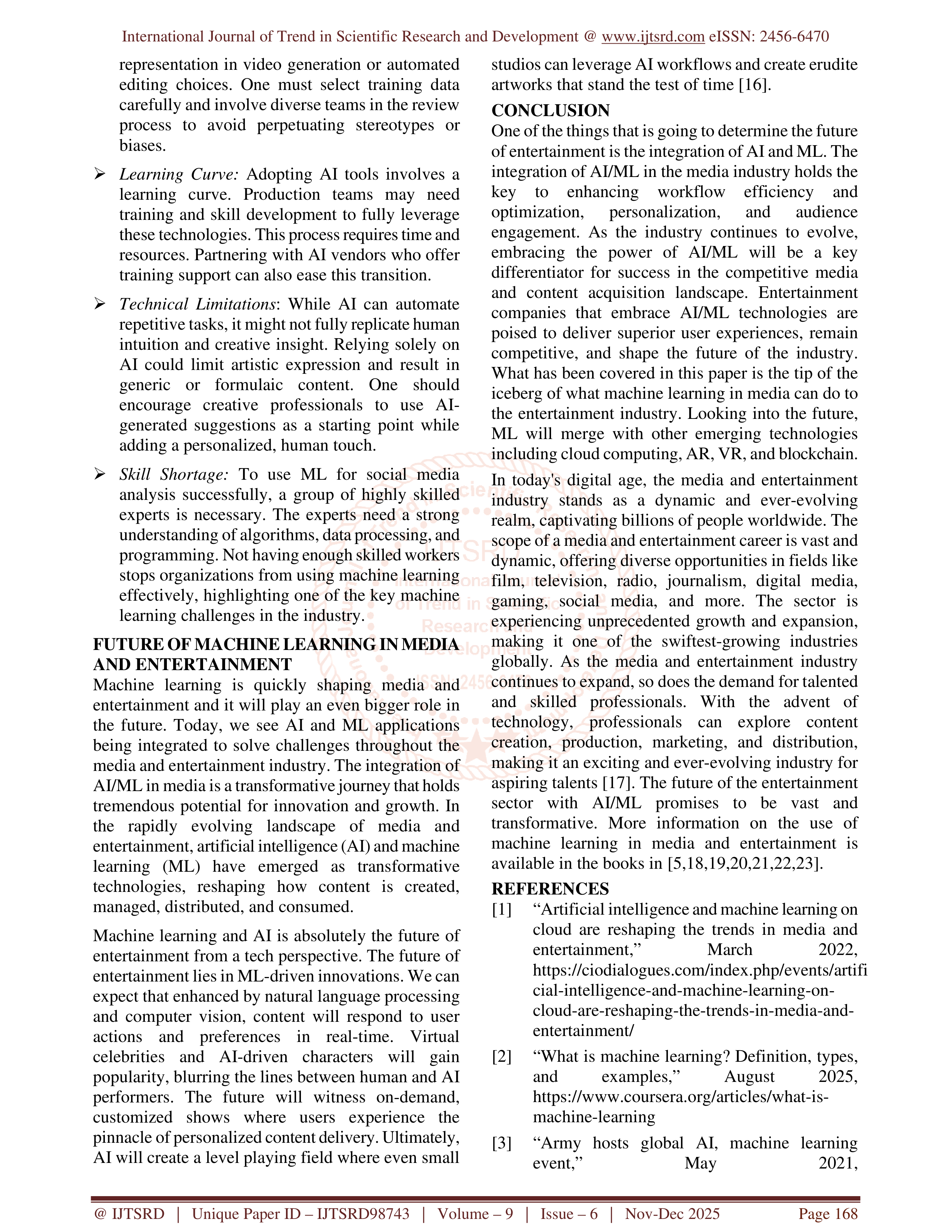
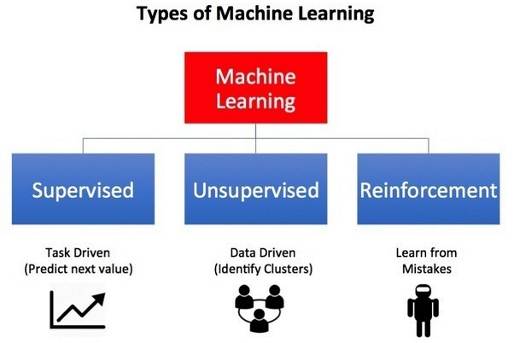
As shown in Figure 2 [7], there are different types of
machine learning. The four major types of machine
learning are supervised learning, unsupervised
learning, semi-supervised learning, and reinforcement
learning, each suited to different kinds of data and
outcomes. Different types of machine learning
include the following [8]:
Supervised Learning
: The program is “trained” on
a pre-defined set of “training examples” from a
“teacher,” which then facilitate its ability to reach
an accurate conclusion when given new data. In
this case, the data comes with additional attributes
that we want to predict. A common case of
supervised learning is to use historical data to
predict statistically likely future events. Under
supervised ML, we have regression ML and
classification ML.
Unsupervised Learning:
As their name suggests,
unsupervised learning algorithms can be broadly
understood
as
somewhat
“optimizing
themselves.” Unsupervised algorithms do not
need to be trained with desired outcome data. The
program is given a bunch of data and must find
patterns and relationships therein. A typical goal
of
unsupervised
learning
may
be
as
straightforward as discovering hidden patterns
within a dataset. Without being told a “correct”
answer, unsupervised learning methods can look
at complex data and organize it in potentially
meaningful ways.
Reinforcement Learning
:
Reinforcement learning
models are trained holistically through trial and
error. Reinforcement learning is a method with
reward values attached to the different steps that
the algorithm must go through. So, the model’s
goal is to accumulate as many reward points as
possible and eventually reach an end goal.
Reinforcement learning is an area of machine
learning concerned with how software agents
ought to take actions in an environment so as to
maximize some notion of cumulative reward.
Deep Learning:
Deep learning (DL) is a
specialized form of machine learning that uses
artificial neural networks to mimic the human
brain. It is a type of machine learning technique
that is modeled on the human brain. It is an
advanced technique for handling complex tasks
like image and speech recognition. The way in
which neural networks are trained can be
described as deep learning. It is called deep
because the network of neurons is arranged in
several hierarchical levels. Deep learning laid the
foundation for advances in generative artificial
intelligence.
International Journal of Trend in Scientific Research and Development @
www.ijtsrd.com
eISSN: 2456-6470
@ IJTSRD | Unique Paper ID – IJTSRD98743 | Volume – 9 | Issue – 6 | Nov-Dec 2025
Page 165
MACHINE LEARNING IN MEDIA AND
ENTERTAINMENT
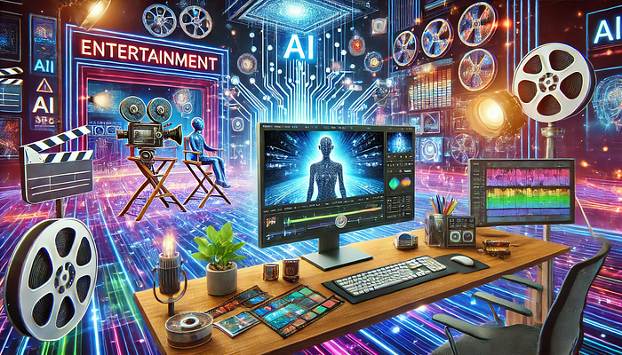
Media and entertainment companies are facing
increased competition and market uncertainty. Figure
3 shows a representation of entertainment [9].
The
entertainment industry has undergone a profound
transformation in recent years, partly due to
advancements in machine learning (ML) and artificial
intelligence (AI). This has accelerated the demand for
data-driven
technologies
that
use
artificial
intelligence and machine learning to optimize
customer experiences and generate more revenue
from content while lowering operating costs. AI has
broadened its influence across all the major
industries, and AI in entertainment industry is no
exception. AI is democratizing intuitive interfaces
through smarter tools and exuberant technologies.
The purpose of AI is not to replace human capital but
rather to enable creators and thinkers to better
envision dream projects [9]. ML algorithms can assist
in image and video editing, content tagging, and
automated data movement, allowing for more
efficient post-production workflows. ML models are
able to estimate demand, customer sentiment, and
revenue under a variety of conditions, enhancing the
data available to inform the decision-making process
for business leaders.
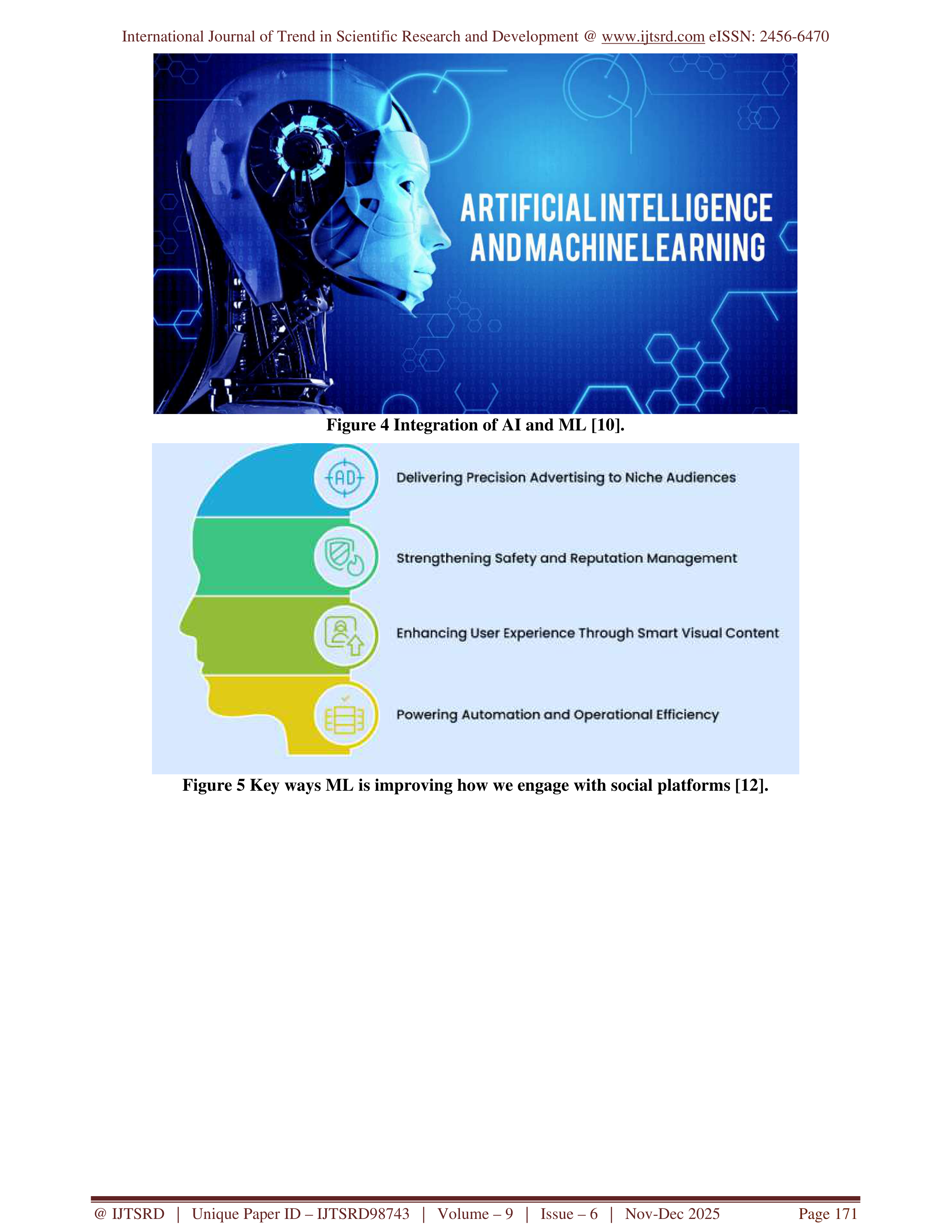
Figure 4 represents the integration of AI and ML [10].
Both ML and AI-driven applications use algorithms
to solve problems. While AI-driven apps follow rules-
based algorithms written by software developers,
ML-driven applications develop their own problem-
solving models by imitating the human process of
learning. By leveraging these AI/ML technologies
strategically, media organizations can unlock new
possibilities, drive workflow efficiency, and deliver
more personalized and engaging content experiences
to their audience [11].
APPLICATIONS OF MACHINE LEARNING IN
MEDIA AND ENTERTAINMENT
Machine learning (ML) is used in media and
entertainment for personalized recommendations,
content creation and editing, audience analytics, and
content moderation. Machine learning has ushered in
a new era of entertainment, from personalized
recommendations to AI-generated content. By
harnessing the power of artificial intelligence and
machine learning, you can transform your content
creation,
distribution,
and
audience-targeting
strategies like never before. Whether it is the next
song on Spotify or a movie recommendation on
Netflix, machine learning is the secret behind it.
Common areas of application of ML in media and
entertainment include the following [10-13]:
Personalized Recommendations:
One of the most
impactful applications of AI in media is
personalized
content
recommendations.
A
recommendation system is an algorithm that
offers personalized products to online consumers.
When applied to media and entertainment,
recommendation engines can provide tailor-made
customer experiences that would not be feasible
with a manual process. ML algorithms analyze
viewing history, ratings, time of day, and other
user data to suggest content, as seen with Netflix
and Spotify. This not only enhances user
satisfaction but also contributes to increased
engagement and longer viewing sessions.
Personalized content recommendations based on
user preferences and activity are improving user
experiences. One of the most important benefits
of content recommendation systems is that they
enable users to discover new content that aligns
with their interests even before they think of
making such decision.
Content Creation:
Traditional approaches to
content creation and distribution are no longer
enough to stand out in this crowded market. ML-
driven tools enable content creators to generate,
edit, and enhance media more efficiently. For
example, AI can assist in writing scripts,
composing music, and creating visual art. Tools
can automate parts of video editing, generate
metadata, and create special effects, speeding up
post-production
workflows.
Entertainment
production exceeds all bounds with the latest AI
tools like generative AI for content creation
entering this space.
Film Production:
The integration of machine
learning in film production has been nothing short
of remarkable. As artificial intelligence continues
to evolve, filmmakers are discovering innovative
ways to leverage this technology throughout the
production process. From script analysis to visual
effects,
machine
learning
algorithms
are
revolutionizing every aspect of moviemaking.
These advancements are not only saving time and
resources but also opening up new creative
possibilities for filmmakers of all levels. By
leveraging
machine
learning
algorithms,
producers and directors can optimize their
planning process, potentially saving millions in
production costs and increasing the chances
success. During filming, machine learning in film
production continues to prove its worth. From
intelligent camera systems to real-time visual
effects previews, AI is transforming the on-set
experience for cast and crew alike.
International Journal of Trend in Scientific Research and Development @
www.ijtsrd.com
eISSN: 2456-6470
@ IJTSRD | Unique Paper ID – IJTSRD98743 | Volume – 9 | Issue – 6 | Nov-Dec 2025
Page 166
Video Production:
Artificial intelligence (AI) and
machine learning (ML) are transforming the video
production industry, introducing tools and
techniques that streamline workflows, enhance
creativity, and improve efficiency. Machine
learning algorithms can analyze viewer data to
create personalized videos tailored to individual
preferences. This technology is particularly
effective in marketing, where dynamic videos can
adapt
to
different
audiences
based
on
demographics, behavior, or purchase history. AI
tools improve video quality through automated
color correction, noise reduction, and upscaling.
AI and machine learning are reshaping the video
production landscape, offering tools that improve
efficiency, creativity, and personalization.
Music and Art Generation:
AI has even ventured
into creative domains such as music and art
generation. Using deep learning algorithms, AI
can compose music or create visual art that
mimics the style of renowned artists. There are
now new opportunities for both artists and
customers as a result of the confluence of
technology and creativity. AI supports music
composition, beat creation, and mixing, offering
innovative
tools
for
musical
creativity.
Recommendation systems on music streaming
platforms deliver personalized content, increasing
user satisfaction and engagement. Copyright
protection is bolstered by AI, safeguarding
musicians' and composers' intellectual property.
Social
Media:
From
just
a
means
of
communication, social media has become an
essential part of commerce and community
building. With the use of ML algorithms, social
media can provide personalized experiences,
predict what users are likely to do and present
content and services more smartly and quickly.
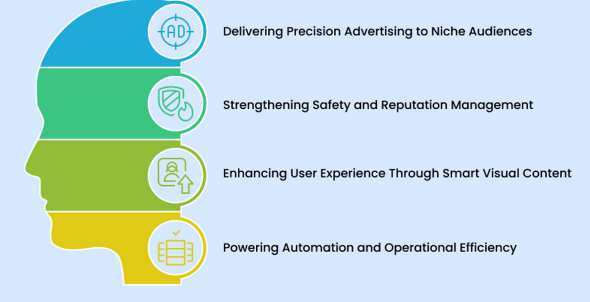
The key ways ML is improving how we engage
with social platforms are depicted in Figure 5
[12]. ML for social media is critical for detecting
harmful content like hate speech, spam,
deepfakes, and misinformation. ML algorithms
are key to creating good social media experiences
by working with large volumes of data and
automating some aspects of the platform.
BENEFITS
AI and ML technologies have revolutionized how
content is created, distributed, and consumed,
enhancing user experiences and opening up new
possibilities for entertainment companies. These
game-changing technologies empower you to unlock
limitless creativity, drive engagement, and stay ahead
of your competitors. ML algorithms analyze user
behavior, preferences, and viewing history to provide
tailored
content
recommendations.
Digitally
sophisticated media and entertainment companies
(Netflix, Amazon, and Disney) are already leveraging
ML algorithms in their data analysis. Other benefits
include the following [14,15]:
Automation:
AI/ML
technologies
have
revolutionized content creation by automating
certain aspects of the workflow process. Machine
learning is used in tools that automate tasks like
animation, character modeling, and rotoscoping,
accelerating production and enhancing visual
effects in films and video games. It handles
mundane tasks such as color correction, object
removal, or generating visual effects, freeing up
artists to focus on more creative aspects of their
work. Speech-to-text technology powered by ML
automatically generates closed captions for video
content, making it more accessible to a wider
audience. Automating time-consuming tasks like
editing, color correction, and rendering frees up
creative professionals to focus on storytelling and
innovation.
Content Generation:
AI can be used to generate
elements like music, scripts, or entire videos
based on specified criteria, offering new creative
possibilities and tools for creators. Natural
Language Processing (NLP) algorithms can
analyze vast amounts of data to generate engaging
and relevant content
Predictive Analytics:
The predictive power of
machine learning can enable executives to make
informed choices and allow a much shorter
turnaround time than traditional forecasting. ML
models analyze big data to predict audience
preferences and market trends. ML can analyze
market trends and audience data to predict which
content is likely to be a hit, helping studios make
better decisions on what to produce. Predictive
analytics plays a crucial role in optimizing
revenue
generation
and
enables
revenue
forecasting. It helps businesses to make strategic
decisions in terms of resource allocation, pricing
strategies, and overall business planning.
Audience profiling is major thing that predictive
analysis can help businesses in the media and
entertainment industry do.
Audience Analytics:
ML models process large
datasets from social media and viewing habits to
provide insights into audience behavior and
preferences. This helps companies make data-
driven
decisions
about
content
strategy,
marketing, and release schedules.
International Journal of Trend in Scientific Research and Development @
www.ijtsrd.com
eISSN: 2456-6470
@ IJTSRD | Unique Paper ID – IJTSRD98743 | Volume – 9 | Issue – 6 | Nov-Dec 2025
Page 167
Informed Decisions:
We make decisions all the
time, ranging from trivial to life-altering. For the
first time in human history, science is mitigating
the challenges of the decision process. AI-
powered analytics tools can process large
amounts of data, extracting valuable insights into
audience behavior, demographics, and content
consumption patterns. This data-driven approach
enables media companies to make informed
decisions on content strategy, advertising, and
overall user experience. ML models analyze
viewer data to provide actionable insights,
helping producers understand what content
resonates most and refine future projects
accordingly.
Market
Segmentation:
Effective
market
segmentation can empower M&E companies to
effectively manage customer relationships and
drive satisfaction and retention by delivering
value to customer groups along the dimensions
that matter most. The traditional approach to
marketing segmentation has marketing analysts
reviewing customer data and grouping customers
in terms of their demographics and behavioral
analytics (i.e. engagement patterns, and content
preferences), but this process is time-consuming.
Engagement:
AI-ML revolution in media and
entertainment has greatly impacted the way we
consume and interact with digital content.
Machine learning algorithms can precisely
forecast what forms of media or entertainment a
person would find enjoyable by analyzing user
data, which increases engagement and consumer
happiness. Through the creation of new
opportunities for storytelling and audience
engagement, these technologies are boosting the
immersive experiences provided by the media and
entertainment sector. The speed of engagement
relies on connectivity and infrastructure.
Personalization:
Personalized user interfaces are
another aspect of content recommendation
systems. These interfaces are designed to
showcase the recommended content prominently
based on the user’s viewing preferences. It is a
form of content personalization with AI and ML
that ensures that users have easy access to the
content they are most likely to enjoy, enhancing
their overall experience.
CHALLENGES
Since
artificial
intelligence
in
media
and
entertainment is trained on pre-existing creative
models, the attribution of ownership remains elusive.
While AI brings significant advantages to video
production, it also presents several challenges that
require careful consideration to ensure effective and
ethical use. Other challenges include the following
[11,15]:
Cost:
Machine learning drives down operational
costs in media and entertainment industry.
Employing machine learning methods on social
networks often costs a significant amount. Some
of these costs involve storing data, developing
infrastructure,
finding
skilled
personnel,
continuously upgrading systems and maintenance.
Some AI tools and software solutions require
significant initial investments in technology,
training, and infrastructure. Small businesses and
independent creators might find these costs
prohibitive. Many platforms offer flexible pricing
or free trials to test the technology before fully
committing.
Data Privacy:
As social media platforms are
relying more on machine learning, concerns about
privacy and security have increased. If personal
information is leaked as a result of security
breaches or inappropriate handling, it can
endanger users’ personal information. AI systems
that use personal data for video personalization
must comply with data protection laws such as
GDPR and CCPA. Improper data handling can
lead to legal issues and damage brand reputation.
Ethical Concerns
: Ethics is a major problem
when it comes to using machine learning. AI/ML
solutions present ethical issues with relation to
data privacy, algorithmic prejudice, employment
displacement, and copyright infringement. Ethical
guidelines are necessary to prevent misuse.
Deepfakes have the potential for misuse, such as
spreading false information or manipulating
public perception by creating realistic but
fabricated content. We have singled out these few
ethical considerations to highlight the need for
careful
regulation,
transparency,
and
accountability when implementing AI and ML in
content enrichment.
Biases
: AI/ML algorithms employ machine
learning methods on social networks often costs a
significant amount. Some of these costs involve
storing data, developing infrastructure, finding
skilled
personnel,
continuously
upgrading
systems. ML algorithms can be biased by nature.
Usually, these biases develop because of the
training data the models rely on. If the training
data is not fair or correct, the outcomes produced
could be untrue or dangerous which could cause
big ethical issues. AI/ML systems learn from
existing data, which can sometimes introduce
biases into video content, such as biased
International Journal of Trend in Scientific Research and Development @
www.ijtsrd.com
eISSN: 2456-6470
@ IJTSRD | Unique Paper ID – IJTSRD98743 | Volume – 9 | Issue – 6 | Nov-Dec 2025
Page 168
representation in video generation or automated
editing choices. One must select training data
carefully and involve diverse teams in the review
process to avoid perpetuating stereotypes or
biases.
Learning Curve:
Adopting AI tools involves a
learning curve. Production teams may need
training and skill development to fully leverage
these technologies. This process requires time and
resources. Partnering with AI vendors who offer
training support can also ease this transition.
Technical Limitations
: While AI can automate
repetitive tasks, it might not fully replicate human
intuition and creative insight. Relying solely on
AI could limit artistic expression and result in
generic or formulaic content. One should
encourage creative professionals to use AI-
generated suggestions as a starting point while
adding a personalized, human touch.
Skill Shortage:
To use ML for social media
analysis successfully, a group of highly skilled
experts is necessary. The experts need a strong
understanding of algorithms, data processing, and
programming. Not having enough skilled workers
stops organizations from using machine learning
effectively, highlighting one of the key machine
learning challenges in the industry.
FUTURE OF MACHINE LEARNING IN MEDIA
AND ENTERTAINMENT
Machine learning is quickly shaping media and
entertainment and it will play an even bigger role in
the future. Today, we see AI and ML applications
being integrated to solve challenges throughout the
media and entertainment industry. The integration of
AI/ML in media is a transformative journey that holds
tremendous potential for innovation and growth. In
the rapidly evolving landscape of media and
entertainment, artificial intelligence (AI) and machine
learning (ML) have emerged as transformative
technologies, reshaping how content is created,
managed, distributed, and consumed.
Machine learning and AI is absolutely the future of
entertainment from a tech perspective. The future of
entertainment lies in ML-driven innovations. We can
expect that enhanced by natural language processing
and computer vision, content will respond to user
actions and preferences in real-time. Virtual
celebrities and AI-driven characters will gain
popularity, blurring the lines between human and AI
performers. The future will witness on-demand,
customized shows where users experience the
pinnacle of personalized content delivery. Ultimately,
AI will create a level playing field where even small
studios can leverage AI workflows and create erudite
artworks that stand the test of time [16].
CONCLUSION
One of the things that is going to determine the future
of entertainment is the integration of AI and ML. The
integration of AI/ML in the media industry holds the
key
to
enhancing
workflow efficiency
and
optimization,
personalization,
and
audience
engagement. As the industry continues to evolve,
embracing the power of AI/ML will be a key
differentiator for success in the competitive media
and content acquisition landscape. Entertainment
companies that embrace AI/ML technologies are
poised to deliver superior user experiences, remain
competitive, and shape the future of the industry.
What has been covered in this paper is the tip of the
iceberg of what machine learning in media can do to
the entertainment industry. Looking into the future,
ML will merge with other emerging technologies
including cloud computing, AR, VR, and blockchain.
In today's digital age, the media and entertainment
industry stands as a dynamic and ever-evolving
realm, captivating billions of people worldwide. The
scope of a media and entertainment career is vast and
dynamic, offering diverse opportunities in fields like
film, television, radio, journalism, digital media,
gaming, social media, and more. The sector is
experiencing unprecedented growth and expansion,
making it one of the swiftest-growing industries
globally. As the media and entertainment industry
continues to expand, so does the demand for talented
and skilled professionals. With the advent of
technology, professionals can explore content
creation, production, marketing, and distribution,
making it an exciting and ever-evolving industry for
aspiring talents [17]. The future of the entertainment
sector with AI/ML promises to be vast and
transformative. More information on the use of
machine learning in media and entertainment is
available in the books in [5,18,19,20,21,22,23].
REFERENCES
[1]
“Artificial intelligence and machine learning on
cloud are reshaping the trends in media and
entertainment,”
March
2022,
https://ciodialogues.com/index.php/events/artifi
cial-intelligence-and-machine-learning-on-
cloud-are-reshaping-the-trends-in-media-and-
entertainment/
[2]
“What is machine learning? Definition, types,
and
examples,”
August
2025,
https://www.coursera.org/articles/what-is-
machine-learning
[3]
“Army hosts global AI, machine learning
event,”
May
2021,
International Journal of Trend in Scientific Research and Development @
www.ijtsrd.com
eISSN: 2456-6470
@ IJTSRD | Unique Paper ID – IJTSRD98743 | Volume – 9 | Issue – 6 | Nov-Dec 2025
Page 169
https://www.army.mil/article/246398/army_hos
ts_global_ai_machine_learning_event
[4]
“Machine learning”
Wikipedia
, the free
encyclopedia
https://en.wikipedia.org/wiki/Machine_learning
[5]
S.
Shalev-Shwartz
and
S.
Ben-David,
Understanding Machine Learning: From
Theory to Algorithms
. New York, NY:
Cambridge University Press, 2014.
[6]
M. N. O. Sadiku, S. M. Musa, and O. S. Musa,
“Machine learning, ”
International Research
Journal of Advanced Engineering and Science
,
vol. 2, no. 4, 2017, pp. 79-81.
[7]
“Machine learning: Application in gaming and
various
industries,”
October
2020,
https://www.linkedin.com/pulse/machine-
learning-application-gaming-various-industries-
radha--1f
[8]
T. Wuest et al., “Machine learning in
manufacturing: Advantages, challenges, and
applications,”
Production & Manufacturing
Research
, vol. 4, no. 1, 2016, pp. 23-45.
[9]
“How the entertainment industry is embracing
ai
&
machine
learning?”
July
2025,
https://medium.com/@jiitak.global/how-the-
entertainment-industry-is-embracing-ai-
machine-learning-26e11b6c121b
[10]
Mango Media, “The impact of AI and machine
learning on video production,” October 2025,
https://www.mangomedia.ie/blog/the-impact-
of-ai-and-machine-learning-on-video-
production
[11]
R. Morgan, “Harnessing the potential of AI/ML
in media and entertainment workflows,”
February
2024,
https://www.pixitmedia.com/blog/harnessing-
the-potential-of-ai-ml-in-media-and-
entertainment-workflows/
[12]
G. Singh, “The role of machine learning for
social
media
in
2025,”
June
2025,
https://www.debutinfotech.com/blog/machine-
learning-for-social-media
[13]
“Revolutionary machine learning in film
production:
Transform
your
movies,”
https://vitrina.ai/blog/machine-learning-in-film-
production/
[14]
“The impact of machine learning on the
entertainment industry: From recommendations
to
predictive
analytics,”
https://cookiedev.com/blog/ml-changing-
entertainment-industry
[15]
G. Anil, “AI-ML revolution in media and
entertainment: Enriching content experiences,”
October
2025,
https://prometteursolutions.com/blog/ai-ml-
revolution-in-media-and-entertainment-
enriching-content-experiences/
[16]
J. Wilson, “Artificial intelligence, machine
learning, and the future of entertainment,”
December
2022,
https://www.forbes.com/sites/joshwilson/2022/
12/06/artificial-intelligence-machine-learning-
and-the-future-of-entertainment/
[17]
Whistling Woods International, “What is the
scope of media and entertainment career?”
https://vocal.media/education/what-is-the-
scope-of-media-and-entertainment-career
[18]
R. Kumar,
AI Agents for Entertainment &
Media: Exploring the Role of Intelligent Agents
in the Future of Creativity and Content.
Kindle
Edition, 2025.
[19]
M. Ebers and P. K. Tupay,
Artificial
Intelligence and Machine Learning Powered
Public
Service
Delivery
in
Estonia:
Opportunities and Legal Challenges (Data
Science, Machine Intelligence, and Law Book
2).
Springer, 2023.
[20]
Ajayi, A.S., Kim, S. & Yun, R. Study of
developing a condensation heat transfer
coefficient and pressure drop model for whole
reduced
pressure
ranges.
Int.
J.
Air-
Cond.Ref.32, 15 (2024).
[21]
Ajayi, A., Badmus, O., Iheuwa, G., Ehizojie,
L., & Segun, S. (2025). Comparative Analysis
of GitOps Tools and Frameworks. Path of
Science, 11(5), 2017-2030.
[22]
Ajayi, A. S., Abimbola, J., Segun, S. E., Ajayi,
E. I., & Bodude, A. D. (2026). Harnessing
artificial intelligence for methane emissions
control in industrial natural gas engines:
Optimizing exhaust after treatment to advance
U.S. clean energy goals–A review. European
Journal
of
Sustainable
Development
Research,10(1), em0345.
[23]
Oyetunji, O. R., Ajayi, A. Samuel, Amuda, B.
A., & Morawo, I. I. (2023). Comparative
study of mechanical properties of 3D printing
materials (polylactic acid and acrylonitrile
butadiene styrene) via simulations using
COMSOL
Multiphysics.
Advances
in
Multidisciplinary and Scientific Research
Journal, 9(3), 21–34

International Journal of Trend in Scientific Research and Development @
www.ijtsrd.com
eISSN: 2456-6470
@ IJTSRD | Unique Paper ID – IJTSRD98743 | Volume – 9 | Issue – 6 | Nov-Dec 2025
Page 170
Figure 1 A symbol of machine learning [3].
Figure 2 Different types of machine learning [7].
Figure 3 A representation of entertainment [9].
International Journal of Trend in Scientific Research and Development @
www.ijtsrd.com
eISSN: 2456-6470
@ IJTSRD | Unique Paper ID – IJTSRD98743 | Volume – 9 | Issue – 6 | Nov-Dec 2025
Page 171
Figure 4 Integration of AI and ML [10].
Figure 5 Key ways ML is improving how we engage with social platforms [12].